Exhibition: ‘The Staged Photograph’ at the Chau Chak Wing Museum at The University of Sydney

Exhibition dates: 22nd April 2023 – 4th August 2024


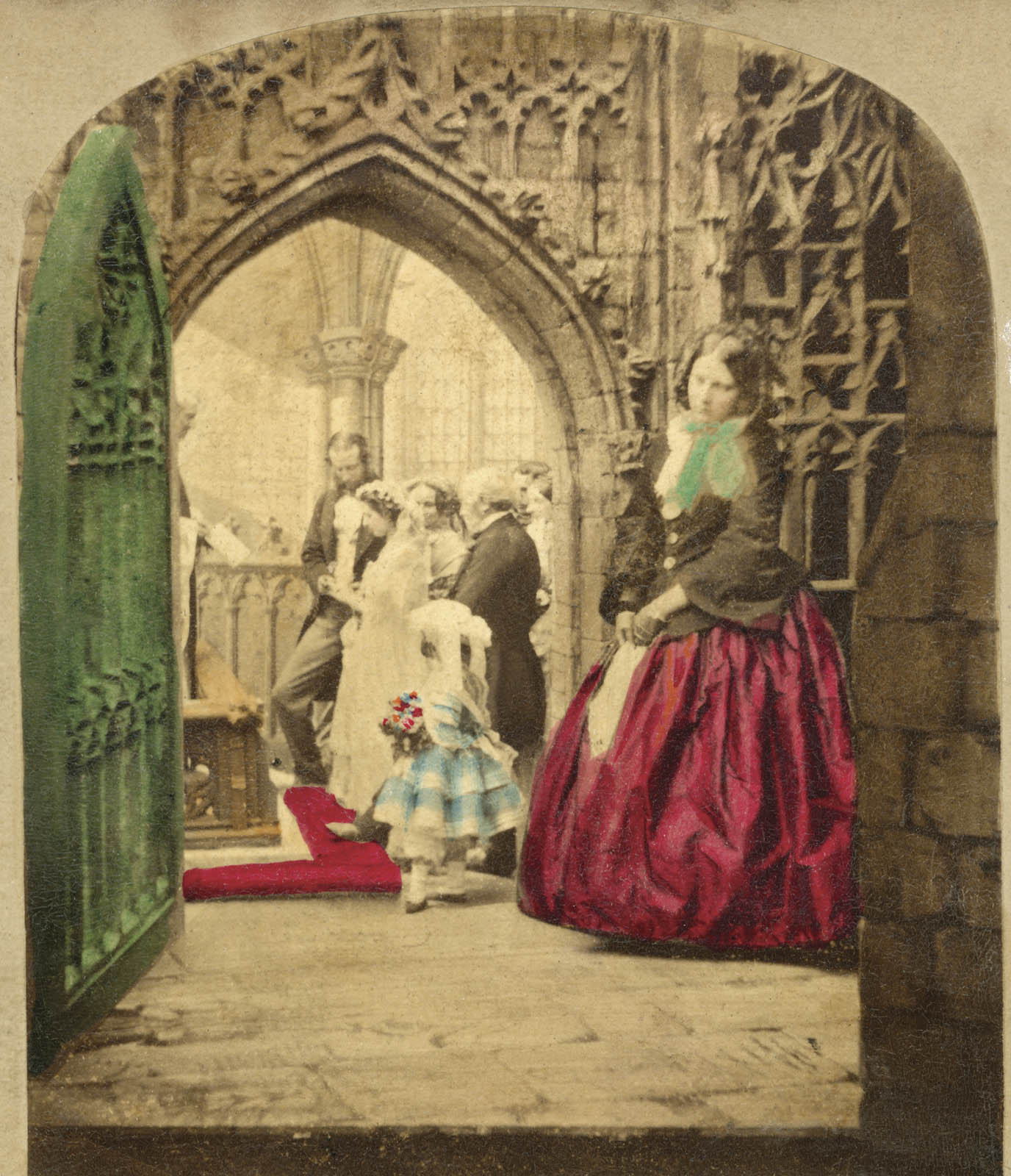
James Elliott (British) 'A Week after the Derby' c. 1855-1860


James Elliott (British)
‘A Week after the Derby’
c. 1855-1860
Hand-coloured stereograph (single image)
Chau Chak Wing Museum, The University of Sydney
Donated by Sandra Savides, 2014


A short text this week as I’m not well.

What a delightful exhibition – a clean installation showcasing some beautiful, contemplative, witty and humorous images on an interesting subject.

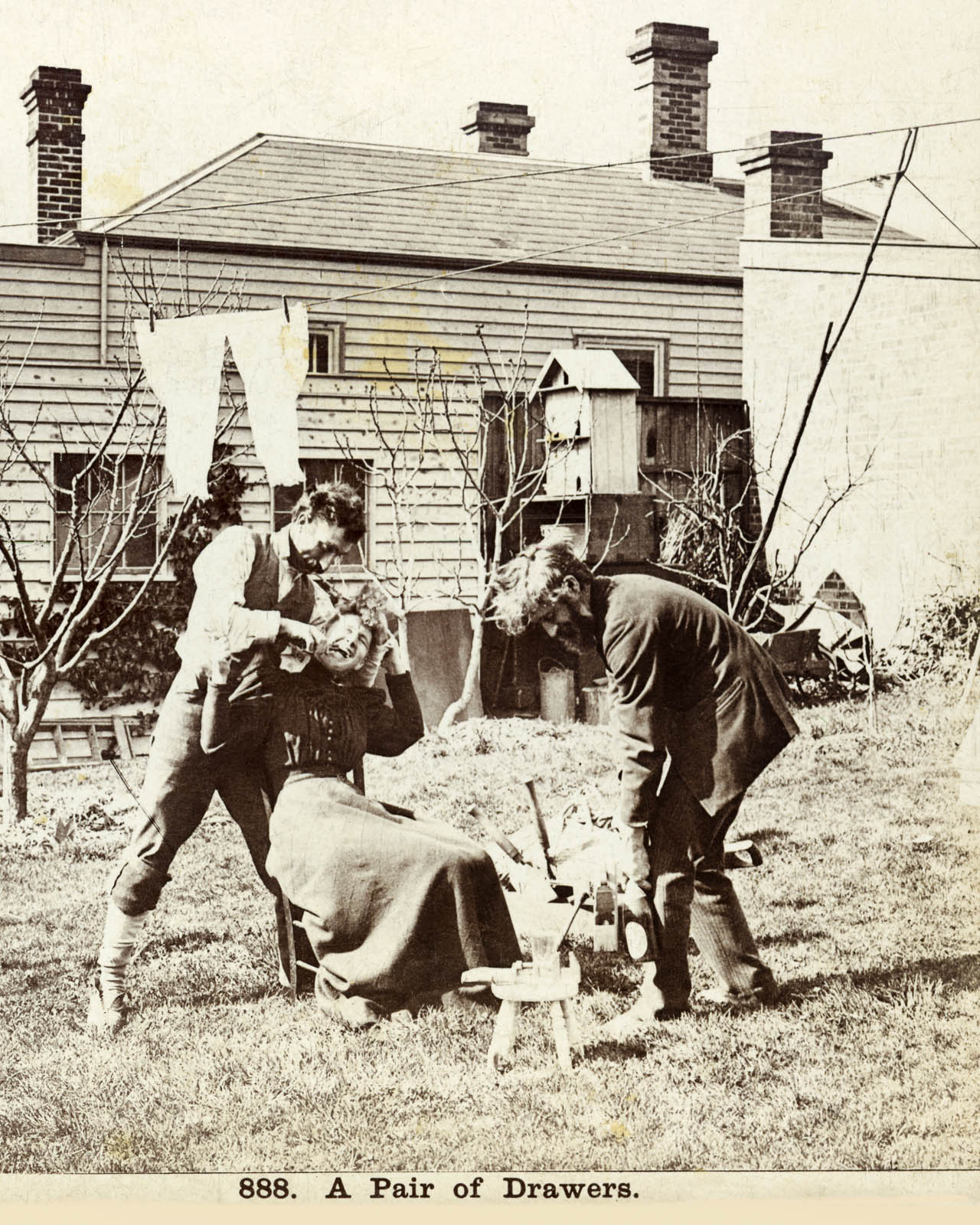
The pathos of A Week after the Derby (c. 1855-1860, above); the gruesome humour of A Pair of Drawers (c. 1895, below); the Australian humour of The Great Australian Bite (Bight) (c. 1895, below). Staged for the camera, posed for the viewer, possessed of innocence, national pride and the delightful joy of living.

To flesh out the posting I have added bibliographic information for the artists and publishers where possible.

Dr Marcus Bunyan


Many thankx to the Chau Chak Wing Museum for allowing me to publish the photographs in the posting. Please click on the photographs for a larger version of the image.


From costume portraits to comic and sentimental stereographs

This exhibition presents staged photographs taken between the mid-19th and early 20th centuries, illuminating the popular culture of the time.
These photographs were created in the photographic studio, with its painted backgrounds and props, where people came to have fancy dress or special outfits captured. Studio photographers also created tableaux, using posed models to stage scenes to tell stories, sentimental or comic. The most popular format was the stereograph. Even the home backyard became a stage for family portraits, posed in the manner of the studio.

Featuring enlarged reproductions, and original examples of glass negatives and stereographs from the historic photograph collection, The Staged Photograph is a fascinating delve into an unfamiliar photographic history.

Text from the Chau Chak Wing Museum website
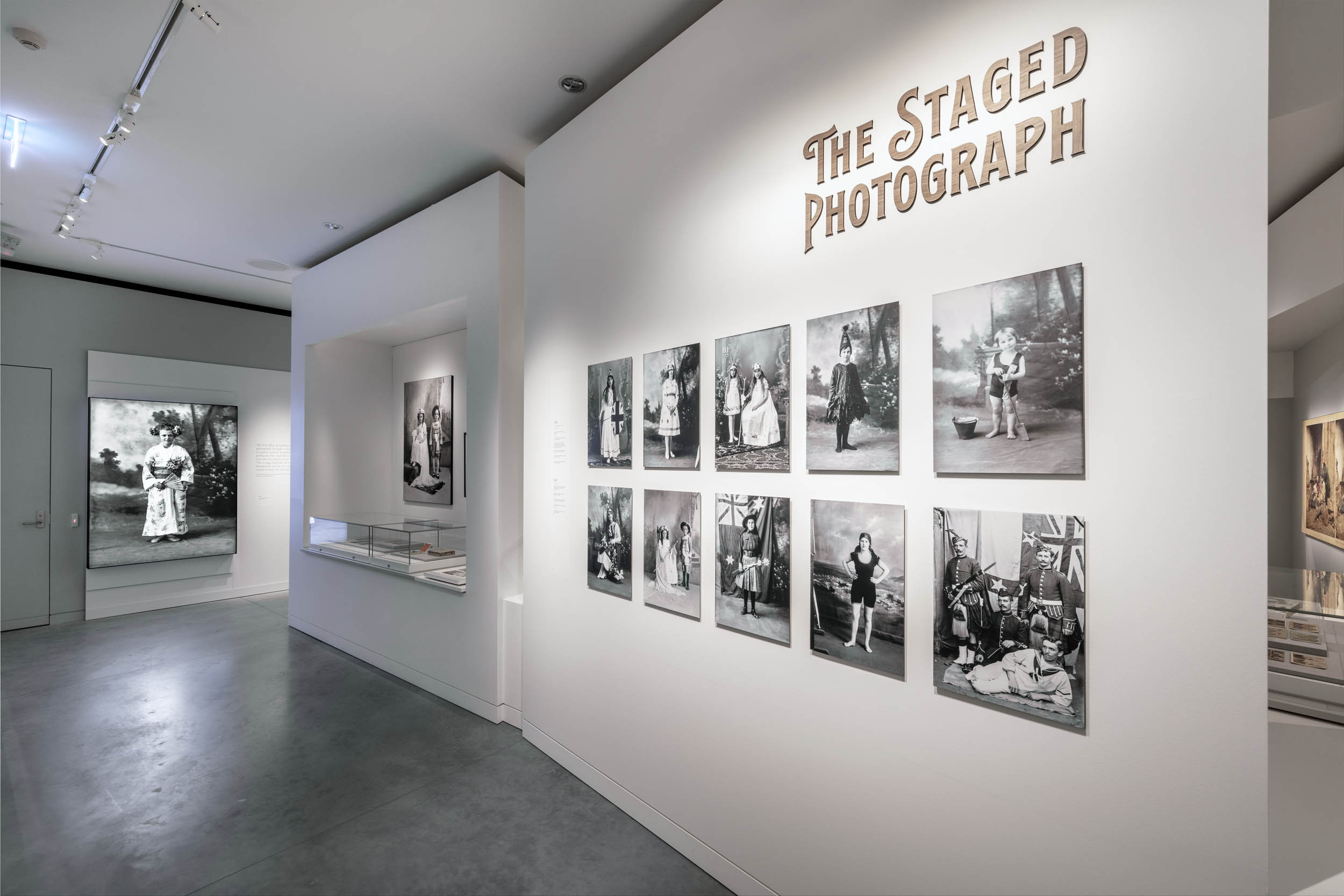
 

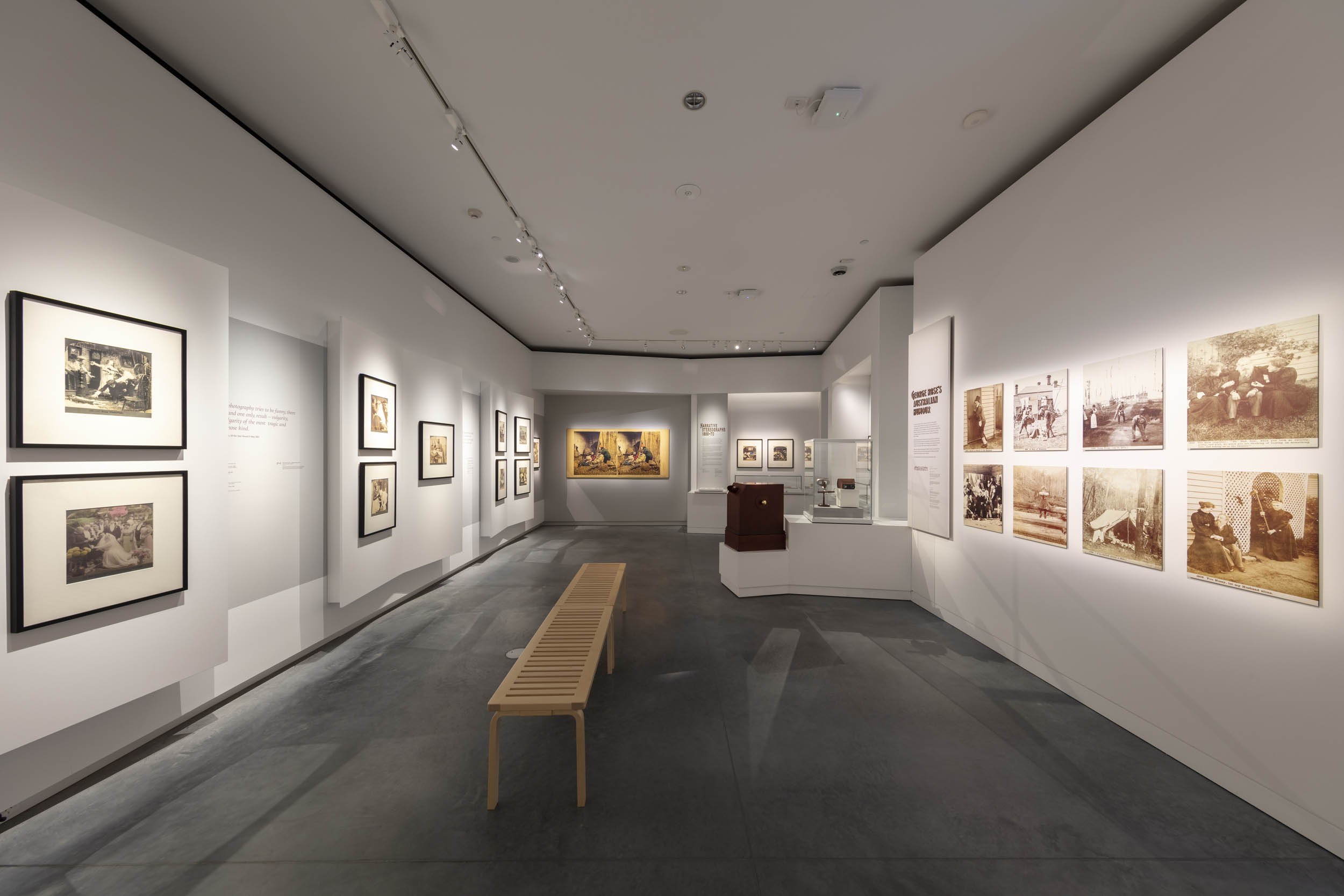
Installation view of the exhibition 'The Staged Photograph' at the Chau Chak Wing Museum at The University of Sydney

Installation view of the exhibition 'The Staged Photograph' at the Chau Chak Wing Museum at The University of Sydney

Installation view of the exhibition 'The Staged Photograph' at the Chau Chak Wing Museum at The University of Sydney

Installation view of the exhibition 'The Staged Photograph' at the Chau Chak Wing Museum at The University of Sydney

Installation view of the exhibition 'The Staged Photograph' at the Chau Chak Wing Museum at The University of Sydney

Installation view of the exhibition 'The Staged Photograph' at the Chau Chak Wing Museum at The University of Sydney

Installation view of the exhibition 'The Staged Photograph' at the Chau Chak Wing Museum at The University of Sydney

Installation view of the exhibition 'The Staged Photograph' at the Chau Chak Wing Museum at The University of Sydney


Installation views of the exhibition The Staged Photograph at the Chau Chak Wing Museum at The University of Sydney with the exhibition texts in the bottom photograph to be seen below…


The Staged Photograph

Created in the theatrical space of the 19th century photographic studio, a staged photograph used the artifice of painted backgrounds and props against which to pose costumed sitters or models arranged in a tableau.

Sitters often used this studio stage to capture a special fancy dress or other costume worn to be photographed either on the way to, or sometimes after, the ball. From the time of the popular cartes-de-visite of the 1860s into the early 20th century, these private memories, storied in albums or framed on walls, give us rare visuals of the costumes worn.

The studio photographer also found a business line in selling staged fictional scenes, which told a story or posed a humorous moment. The most popular were the genre or narrative stereographs, featuring scenes of everyday life, sentimental or comic. Beginning in the late 1850s, this market changed from a middle-class parlour entertainment to a broader popular entertainment, and the views depicted reflect this change as a new century began.

With the advent of easier amateur photography through the Kodak revolution, rather than visiting the studio, the home photographer found a stage in the backyard. Family members were posed in the manner of the studio, with a suspended curtain on the washing line or a pot plant on a stand, often still capturing a special fancy dress costume.

This exhibition explores a range of these staged photographs, a window into popular culture of the time, revealing cultural and social values.

Costume Portraits

Photographers’ studios were theatrical spaces, with props and backgrounds that could give context to a fancy dress or other costume. In Sydney in 1879, photographer E. Riisfeldt advertised that he had ‘specially painted 12 SCENES by one of the finest scenic artists, suitable for any fancy costume’. (Sydney Morning Herald, 24 February 1879)

Costume balls were a popular feature of Sydney life from the 1830s. Balls were held to raise money for charities, including children’s fancy dress balls and poster balls, popular from 1900 in Australia where costumes featured in advertisements.

While there are long accounts in newspapers of the attendees, with lists of names and costumes worn, photography offered the possibility of capturing what an outfit looked like.

Wall text from the exhibition


James Elliott (British) 'Broken Vows' c. 1857


James Elliott (British)
‘Broken Vows’
c. 1857
Hand-coloured stereograph (single image)
Chau Chak Wing Museum, The University of Sydney
Donated by Sandra Savides, 2014


James Elliott operated in London from approximately 1856 to 1861 and produced stereocards. According to Michael Pritchard’s Directory of London Photographers 1841-1908 he operated from two London addresses simultaneously: 9, Albany Court Yard and 48, Piccadilly.

Most famous for several hundred outstanding genre, usually beautifully tinted, on SCMs; most were elaborate studio sets, with large casts and complex accessories; several were in sets, such as “The Eve of Waterloo”; “The Wedding”, etc.; made views of England, esp. London on SCMs, which are much rarer and fairly ordinary. Often but not always used label with his name, or blind-stamp; views were extensively pirated both in England and US; he also pub. photos by W.M. Grundy.

Credit: National Stereoscopic Association with corrections and additions by Alan Griffiths and others.

Text from the Luminous-Lint website


Mark Anthony (Marc Antoine Gaudin) (French, 1804-1880)(attributed) '[Staged scene featuring five women, their fingers pointing upwards]' England c. 1855-1865


Mark Anthony (Marc Antoine Gaudin) (French, 1804-1880)(attributed)
[Staged scene featuring five women, their fingers pointing upwards]
England c. 1855-1865
Half stereograph (single image)
Macleay Collections, Chau Chak Wing Museum
Donated by Alison Skeels, 1982


Freeman Brothers, Sydney (Australian) '[Portrait of two girls in fancy dress]' c. 1855-1865


Freeman Brothers, Sydney (Australian)
[Portrait of two girls in fancy dress]
c. 1855-1865
Carte-de-visite
Chau Chak Wing Museum, The University of Sydney


One of the largest and most celebrated Sydney photographic studios was run by the Freeman Brothers, whose skilful portraits were much admired. This pair of entrepreneurial photographers used the latest processes, building a large, well-appointed studio and actively promoting their work through display in international exhibitions. James Freeman was also extremely well versed in the potential uses of the medium, delivering a comprehensive lecture on the topic to a Sydney society in 1858.

Text from the exhibition Colony: Australia 1770-1861 at NGV Australia 2018


Freeman and Co was established by the professional photographers William and James who arrived in Sydney from London in 1853 and 1854 respectively. Trading as Freeman Brothers, the pair opened Freeman’s Sydney Gallery of Photographic Art in 1855, specialising initially in daguerreotype portraits. James Freeman is credited with introducing the ambrotype process to the colony in 1856, and the company adopted this medium after this date. By the 1860s, the studio was busy producing carte de visite portraits, amassing nearly 30,000 negatives by 1870. In 1866 the brothers collaborated with the renowned English photographer Victor Prout, capitalising on his fine reputation in the colony and advertising themselves as ‘photographers to their Royal Highnesses the Prince and Princess of Wales and His Excellency the Governor.’ After William Freeman retired around 1890, the company passed into the hands of employee William Rufus George. Under George’s management in the 1890s the firm targeted a wealthy clientele, producing expensive platinum prints. The company still operates in Sydney, specialising in corporate, wedding, architectural and portrait photography.

Text from the Art Gallery of New South Wales website


G.H. Nicholas, Sydney (Australian) '[Portrait of a child holding a stereoscope]' c. 1870


G.H. Nicholas, Sydney (Australian)
[Portrait of a child holding a stereoscope]
c. 1870
Carte-de-visite
Chau Chak Wing Museum, The University of Sydney
Donated by Judith Mackinolty, 1982


These unique photos offer an intriguing insight into pop culture history

The Chau Chak Wing Museum presents The Staged Photograph, an exhibition exploring images from the mid-19th and early 20th centuries from Australia, Britain and the United States.

Australians embraced photography long before smartphone cameras enabled us to capture and curate every moment of our lives.

A new exhibition of rarely seen images at the Chau Chak Wing Museum transports us to a time when costumes had to be captured in a studio, and when fictional photographs, posing models in a story or comic scene, were sold and bought for home entertainment.

The Staged Photograph presents images taken between the mid-19th and early 20th centuries, by professional and amateur photographers, from Australia, Britain and the United States.

Exhibition curator Jan Brazier said: “The Staged Photograph is a fascinating dive into an unfamiliar photographic history. Its images are a diverse and intriguing insight into the role staged photographs played in our lives and the popular culture of the time.”

Studio: from the ballroom to bath soap

Costume balls were immensely popular from the 1830s. From the 1860s, families in their fancy dress costumes or special outfits could be professionally photographed in a studio complete with props and a painted background.

“These photos were private memories kept in frames or the family album, where undoubtedly many are still to be found,” said Jan Brazier.

Communities held balls to raise money for good causes and from 1900 they included the ‘poster ball’ when businesses would pay fundraisers to have someone wear a costume festooned with advertisements for their products. These balls were as popular in high society as in country towns and suburbs. Costumes for Sunlight Soap, Silver Starch laundry powder, Jelline jelly crystals and Silver Drop self-raising flour can be seen in the exhibition.

Stereograph, mass home entertainment

The ‘online’ experience of the 19th century, the stereograph used two nearly identical photographs to create a 3D image when seen through a viewer called a stereoscope. Originally a middle-class activity, with the family gathering in the parlour to enjoy the images, it became more affordable by the 1890s and the mass home entertainment of its time. Its transformation saw millions of stereographs in use worldwide.

Views of exotic locations were by far the most popular stereographs for ‘armchair travelling’, but commercial photographers also created fictional s­­­­­­­­cenes using actors and props to tell highly theatrical stories. Sentimental and comical scenes were big sellers.

Some of the most popular themes are still familiar – love, courtship, marriage, children and drunkenness – but others are of their time, taken from vaudeville jokes or the prejudices of the age. Both Irish servant women and African American plantation workers were held up to racist ridicule. One popular genre was college girls taking part in dormitory ‘larks and pranks’. Another was financial ruin from horse racing.

“The visual humour revealed in these stereographs provides a way for us to understand and interrogate a previous era’s cultural and social values,” said Jan Brazier.

The Home Studio

Home photography took off when smaller, more portable cameras became available, and the Kodak revolution arrived in the early 20th century. Amateur photographers captured special family moments using the backyard as a set. Family members posed as if in a studio, with a suspended curtain on the washing line or a pot plant on a stand, often still capturing a special costume. There was also a practical reason to work outdoors: better light.

Our photographic collection

All photographs are drawn from the Macleay Collections of the Chau Chak Wing Museum. These photographs are some of the more than 60,000 in the University’s social history photograph collection. The majority were donated and cover the mid-19th to 20th century.

“It doesn’t surprise me the Museum’s historical photographic exhibitions are so popular as people make a direct connection with our past ways of seeing ourselves. Anyone interested in Australia’s photography, history and early pop culture will enjoy this current exhibition,” Jan Brazier said.

Text from the Chau Chak Wing Museum website


Rose Stereograph Company, Melbourne (Australian)(publisher) 'A Pair of Drawers' c. 1895


Rose Stereograph Company, Melbourne (Australian)(publisher)
‘A Pair of Drawers’
c. 1895
Stereograph (single image)
Chau Chak Wing Museum, The University of Sydney
Donated by Sandra Savides, 2014
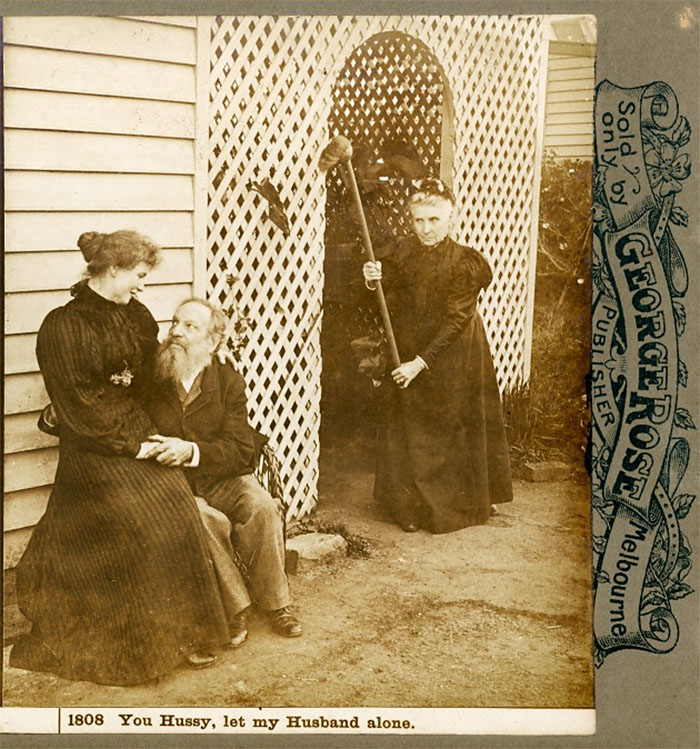
 

Rose Stereograph Company, Melbourne (Australian)(publisher) 'You Hussy, let my Husband alone' c. 1895


Rose Stereograph Company, Melbourne (Australian)(publisher)
‘You Hussy, let my Husband alone’
c. 1895
Stereograph (single image)
Macleay Collections, Chau Chak Wing Museum
donated by Sandra Savides, 2014


The Rose Stereograph Company

The publishing output of this long-lived firm (which operated from about 1880 until it went into liquidation in 2017) was phenomenal, and when the remains of what must have been a vast photographic archive went on sale in June 2021 with Lloyds Auctions…

According to a brief history by postcard collector Leo Fitzgerald, the Rose story began when Cornish sea captain William Rose came to the Victorian Ballarat gold fields from California and married Grace Ash at Ballarat in 1861. The couple’s son, George, was born in 1862 at the town of Clunes. He worked in his father’s shoe shop in Chapel Street, Prahran, between 1877 and 1880 (apparently producing his earliest photos from those premises) and began spending his Sundays selling photos to picnic parties in the Dandenong hills. Finding his niche in photography, he moved to a new address at Armadale and founded his own firm publishing stereographic views. Over the years he travelled to many countries and recorded numerous important historic events with his stereographic camera equipment, opening offices in Sydney, Wellington and London. His images from Korea have become especially celebrated in Korea, where they represent an extremely rare glimpse of the nation in 1904, before the onset of the destruction wrought by the wars of the 20th century. …

Collector and researcher Ron Blum, whose excellent books built on Leo Fitzgerald’s work, wrote that George’s son Walter took over the business sometime before 1931, selling it in that year to long-time employees Edward Gilbert and Herbert Cutts… George’s wife, Elizabeth, died in 1929, and both George’s sons died before him. With no longer any legal interest in the company he had founded, George kept on taking photographs for the old firm, travelling around Australia in a mobile darkroom and camping along the way. He worked almost until his death in 1942, aged 80… The Rose Stereographic Company continued under the stewardship of Herbert “Bert” Cutts, who brought his son Neil into the business in the 1950s.

Greg Ray. “The Rose Stereograph Company: a snapshot,” on the Photo Time Tunnel website July 16, 2021 [Online] Cited 23/09/2023


Rose Stereograph Company, Melbourne (Australian)(publisher) 'The Great Australian Bite (Bight)' c. 1895


Rose Stereograph Company, Melbourne (Australian)(publisher)
‘The Great Australian Bite (Bight)’
c. 1895
Stereograph (single image)
Chau Chak Wing Museum, The University of Sydney
Donated by Sandra Savides, 2014


George Rose was born in Clunes, Victoria, in 1861. He did not follow his father into boot-making, but was interested in astronomy and natural history. He was unconventional, of rather eccentric and Bohemian character. After moving to Melbourne in 1876, George developed his skills as a photographer, especially in the stereoscopic field – what is known as 3D photography today. He founded the Rose Stereographic Company in 1880. In 1901 George recorded the celebrations for the visit of the Duke and Duchess of York, and in the following years travelled across Australia and over 35 countries taking three-dimensional photos. By 1907 his business employed six people – two males and four females; at its peak, staff numbered around 20. In 1913 the Rose Stereographic Company began manufacturing “real photo” postcards. George’s son Walter managed the company, allowing his father to concentrate on taking the photographs. In 1931 the business was sold to two long-time employees, Edward Gilbert and Herbert (Bert) Cutts. George Rose died of cancer in 1942, having outlived both his sons, but the business remained in the Cutts family for many years before it finally closed down in March 2017.

Information from the book George Rose – The Postcard Era by Ron Blum.


C.H. Graves, Universal Photo Art Co (American) 'How Bridget served the POTATOES UNDRESSED. 'I'll not take off another STITCH if I lose me JOB'' c. 1897


C.H. Graves, Universal Photo Art Co (American)
‘How Bridget served the POTATOES UNDRESSED. ‘I’ll not take off another STITCH if I lose me JOB’ ‘
c. 1897
Stereograph (single image)
Chau Chak Wing Museum, The University of Sydney
Donated by Sandra Savides, 2014


The Universal Photo Art Company was one of several business titles under which photographer Carlton Harlow Graves sold his photographs late in his career. He was the son of Jesse Albert Graves, an important early worker who was based in the Delaware Water Gap area of Pennsylvania in the 1860-1880 time frame and produced some 500 generally fine scenic views of the western part of the state. Carlton learned the photographic art from his father and moved to Philadelphia to began producing on his own in about 1880. In his early years, he seems to have taken all the views which he published, but he soon began to buy or pirate images from others. Stereoviews issued under his own name are extremely rare.

At its peak, The Universal Photo Art Company seems to have been a rather substantial outfit. In addition to the headquarters offices and production facilities in Philadelphia, there was a western branch in Naperville, Ill., under F. A. Messerschmidt as general manager. There are numbers listed to almost to 5,000, although the number of individual photos actually used is only about 1,300. By the late 1890’s, C. H. Graves company became a major publisher offering “Art Nouveau Stereographs” on light gray curved mounts. His trade list offered excellent views of hunting scenes, Jamaica, Japan, Java, New York City, Palestine and others. To compete with low priced lithographs and copies, Graves offered his “Universal Series” or “Universal Views” on black mounts with no credit to himself. These have the number and the title in the negative and were sold at a reduced price from the regular “Art Nouveau” issues. Graves also offered boxed sets but they were not sold in the quantities of Underwood and Underwood, the Keystone View Company and H. C. White. The company seems to have been active until about 1910 when its stock of negatives were sold to Underwood & Underwood and presumably went from there to the Keystone View Company with the rest of the Underwood photos.

Paul Rubinstein. “Universal Photo Art Company,” on the Yellowstone stereoviews website Nd [Online] Cited 07/07/2024
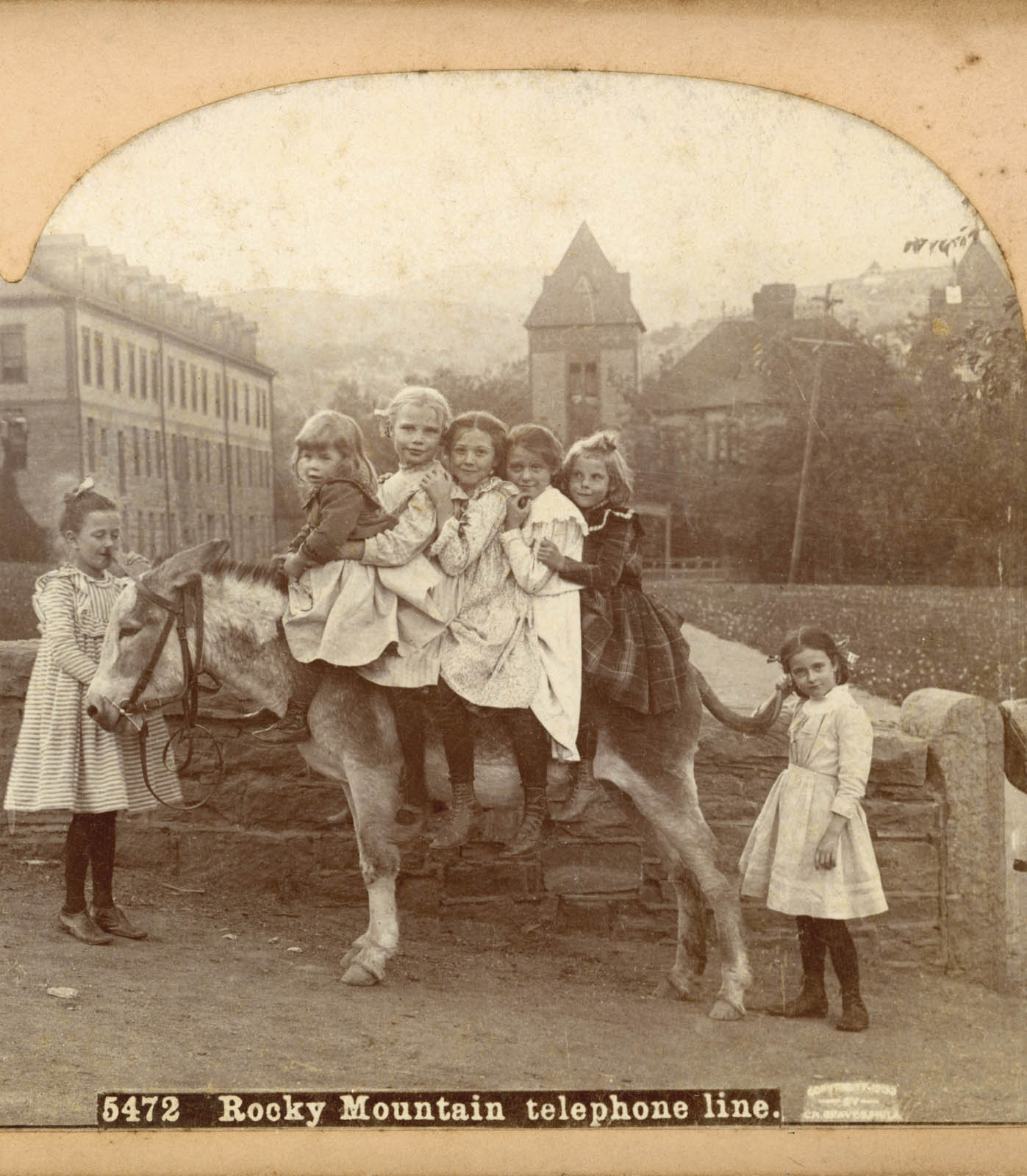
 

C.H. Graves, Universal Photo Art Co (American) 'Rocky Mountain telephone line' 1895-1905


C.H. Graves, Universal Photo Art Co (American)
‘Rocky Mountain telephone line’
1895-1905
Stereograph (single image)
Chau Chak Wing Museum, The University of Sydney
Donated by Sandra Savides, 2014
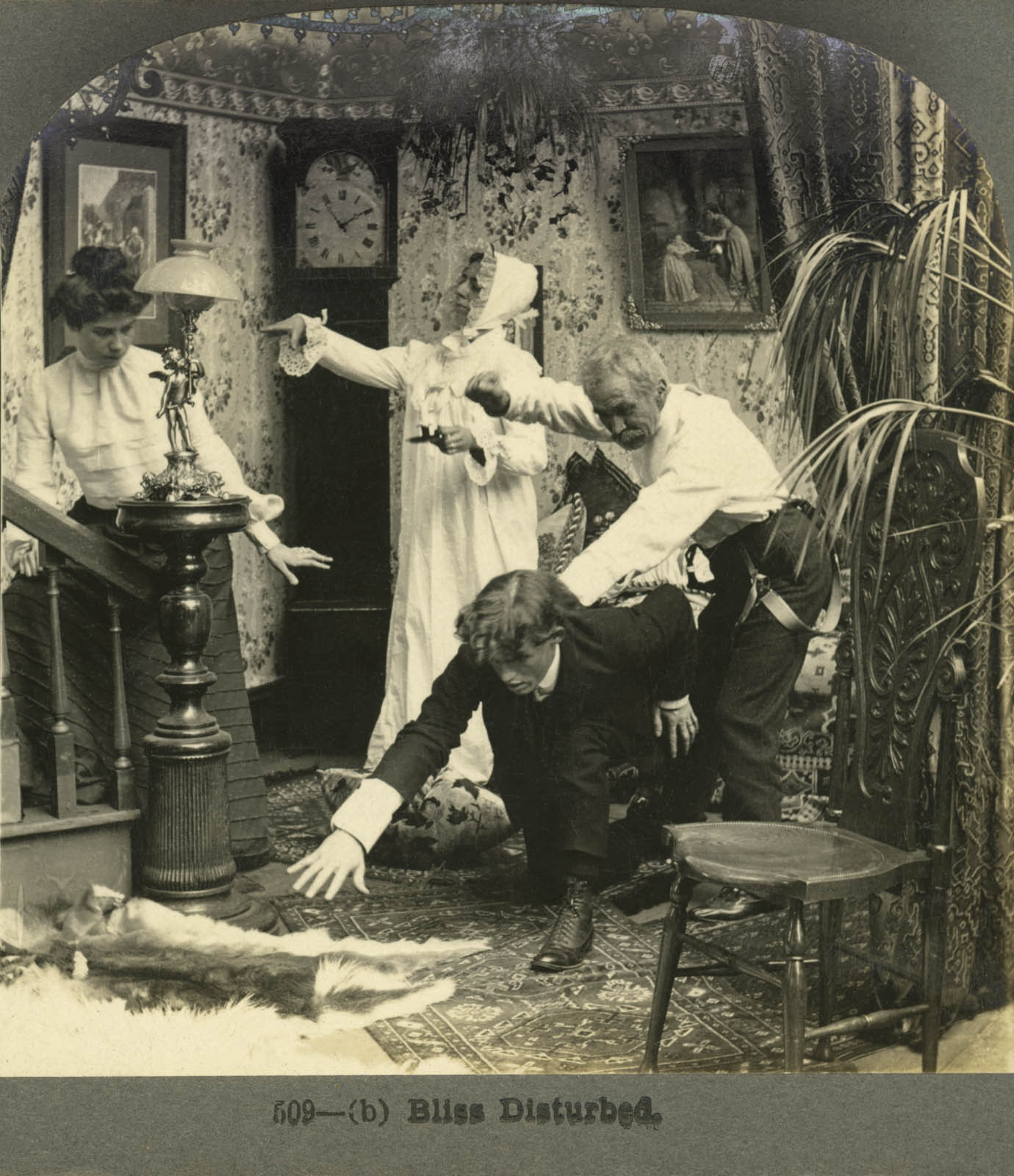
 

Keystone View Company (American) 'Bliss disturbed' c. 1903


Keystone View Company (American)
‘Bliss disturbed’
c. 1903
Stereograph
Chau Chak Wing Museum, The University of Sydney
Donated by Sandra Savides, 2014


The Keystone View Company was founded in 1892 in Meadville, Pennsylvania, U.S.A. by amateur photographer B. L. Singley (Benneville Lloyd Singley). The trade list at the end of 1892 consisted of only a hundred titles but by 1940 they had commercially produced more than 40,000 titles. …

The views sold by the company in the U.K. from 1898 to 1906 were distributed under the name ‘The Fine-Art Photographers’ Publishing Co.’ and included instructions on how to view them with a ‘Realistiscope’; the company were manufacturing and selling stereoscopes from 1898 onwards.

There was an increased popularity of stereographs between 1898 and 1906, during which Keystone (like Underwood & Underwood) entered the box-set market. Along with topographical, nature, events and genre-view scenes, Keystone also began an Educational department in 1898 which issued sets illustrating geography, commerce, technology, history and natural studies.

After 1920 the Keystone View Company was the major global publisher of stereoviews, between 1915 and 1921 they had bought the negatives of nearly all of their competitors. With offices all over the world at this time the company was successful, especially from the sales of World War I stereoview sets.

The Keystone View Company maintained regular production right up until 1939 but continued to manufacture views for optometric purposes, with individual orders for stereoviews being filled up until the early 1970s.

Rebecca. “Keystone View Company,” on The Stereoscopy Blog 3rd January 2021 [Online] Cited 07/07/2024


Lorna Studios, Glebe (Australian) '[Sunlight Soap Girl]' 1905-1915


Lorna Studios, Glebe (Australian)
[Sunlight Soap Girl]
1905-1915
Cabinet card
Chau Chak Wing Museum, The University of Sydney
Donated from Lydia Bushell, 1983


George Henry Hawkins, Sydney (Australian) '[Four children in fancy dress featuring the products, Jelline and Silver Drop Flour]' 1910-1930


George Henry Hawkins, Sydney (Australian)
[Four children in fancy dress featuring the products, Jelline and Silver Drop Flour]
1910-1930
Glass negative, half-plate
Chau Chak Wing Museum, The University of Sydney
Donated by R. Hawkins, 1988


George Henry Hawkins, Sydney (Australian) '[Lily dressed in costume as 'Victoria']' 1910-1930


George Henry Hawkins, Sydney (Australian)
[Lily dressed in costume as ‘Victoria’]
1910-1930
Glass negative, quarter-plate
Chau Chak Wing Museum, The University of Sydney
Donated by R. Hawkins, 1988


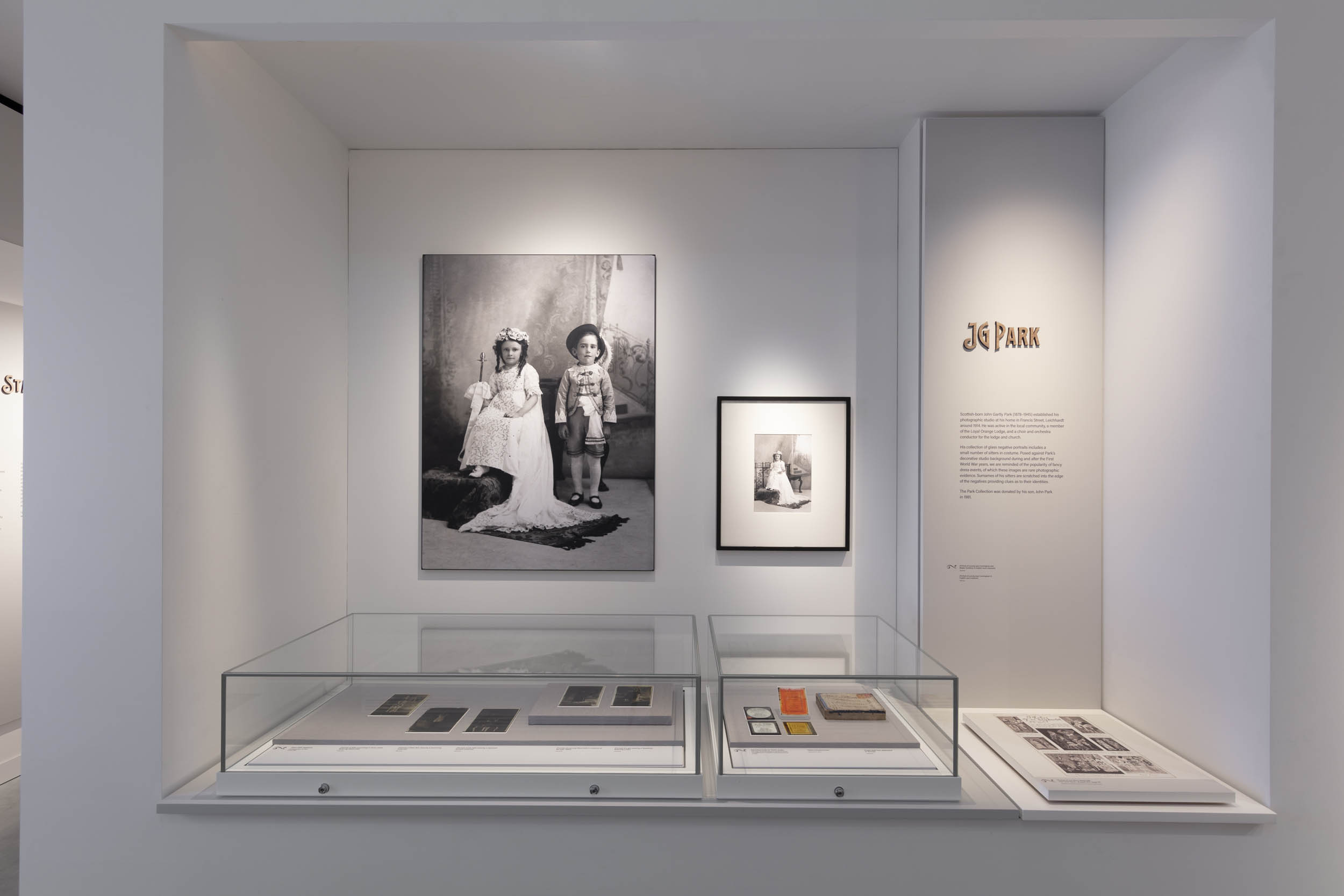
J.G. Park, Leichhardt (Australian) '[Portrait of a young Jean Cunningham and Master Hurlstone in English court costumes]' c. 1914-1920s


J.G. Park, Leichhardt (Australian)
[Portrait of a young Jean Cunningham and Master Hurlstone in English court costumes]
c. 1914-1920s
Glass negative
Chau Chak Wing Museum, The University of Sydney
Donated by J. Park, 1981


Scottish-born John Gartly Park (1878-1945) established his photographic studio at his home in Francis Street, Leichhardt around 1914. He was active in the local community, a member of the Loyal Orange Lodge, and a choir and orchestra conductor for the lodge and church.

His collection of glass negative portraits includes a small number of sitters in costume. Posed against Park/s decorative studio background during and after the First World War years, we are reminded of the popularity of fancy dress events, of which these images are rare photographic evidence. Surnames of his sitters are scratched into the edge of the negatives providing clues as to the identities.

The Park Collection was donated by his son, John Park in 1981.

Wall text from the exhibition


J.G. Park, Leichhardt (Australian) '[Portrait of Miss Orr in fancy dress as Britannia]' c. 1914-1920s


J.G. Park, Leichhardt (Australian)
[Portrait of Miss Orr in fancy dress as Britannia]
c. 1914-1920s
Glass negative
Chau Chak Wing Museum, The University of Sydney
Donated by J Park, 1981


J.G. Park, Leichhardt (Australian) '[Portrait of Miss Larsen wearing a Silver Star Starch costume]' c. 1914-1920s


J.G. Park, Leichhardt (Australian)
[Portrait of Miss Larsen wearing a Silver Star Starch costume]
c. 1914-1920s
Glass negative Chau Chak Wing Museum, The University of Sydney
Donated by J. Park, 1981


Oliver Emery, Sydney (Australian) '[Three boys posed outside against a makeshift backdrop]' c. 1914-1930


Oliver Emery, Sydney (Australian)
[Three boys posed outside against a makeshift backdrop]
c. 1914-1930
Glass negative, half-plate
Chau Chak Wing Museum, The University of Sydney
Donated by O. Emery, 1983


Chau Chak Wing Museum – The University of Sydney
Level 1, University Place, Camperdown, NSW 2006
Phone: 02 9351 2812

Opening hours:
Monday to Friday (until 9pm Thursdays) 9am – 5pm
Saturday and Sunday 12 – 4pm
Closed public holidays

Chau Chak Wing Museum website

LIKE ART BLART ON FACEBOOK

Back to top

Exhibition: ‘The photograph and Australia’ at the Art Gallery of New South Wales, Sydney

Exhibition dates: 21st March – 8th June 2015

Curator: Judy Annear, Senior curator of photographs, AGNSW


Judy Annear. 'The photograph and Australia'. Sydney: Art Gallery of New South Wales, 2015. p. 236


Judy Annear. The photograph and Australia. Sydney: Art Gallery of New South Wales, 2015. p. 236


“Cultural theorist Ross Gibson has written that ‘being Australian might actually mean being untethered or placeless … and appreciating how to live in dynamic patterns of time rather than native plots of space’. Photographs always enable imaginative time and space regardless of their size and how little we might know of the ostensible subject. When people are oriented toward the camera and photographer, there is a gap which the viewer intuitively recognises. The gap is time as much as space. Occasionally – as in an anonymous 1855 daguerreotype taken at Ledcourt, Victoria, of Isabella Carfrae on horseback where we see a servant standing on the verandah, shading her eyes, and in the 1877 Fred Kruger photograph of the white-clad cricketer at Coranderrk – a subject in the photograph presses so close to the picture plane that we know for the time of the exposure they look directly into an unknowable future and collide now with our gaze as we look back.”


Judy Annear. “Time,” in Judy Annear. ‘The photograph and Australia’. Sydney: Art Gallery of New South Wales, 2015. p. 19.


This is an important exhibition and book by Judy Annear and team at the Art Gallery of New South Wales, an investigation into the history of Australian photography that is worthy of the subject. Unfortunately, I could not get to Sydney to see the exhibition and I have only just received the catalogue. I have started reading it with gusto.

With regard to the exhibition all I have to go on is a friend of mine who went to see the exhibition, and whose opinion I value highly, who said that is was the messiest exhibition that she had seen in a long while, and that for a new generation of people approaching this subject matter for the first time it’s non-chronological nature would have been quite off putting.

But this is the nature of the beast (that being a thematic not chronological approach) and personally I believe that modern audiences are a lot more understanding of what was going on in the exhibition than she would give them credit for.

In the “Introduction” to the book, Annear rightly credits the work undertaken by colleagues – especially Gael Newton’s Shades of light: photography and Australia 1839-1988, published in 1988; Alan Davis’ The mechanical eye in Australia: photography 1841-1900, published in 1977; and Helen Ennis’ Photography and Australia, published in 2007.

As the latter did, this new book “emphasises the ways in which photographs, especially in the nineteenth century, function in social, cultural and political contexts, exploring photography’s role in representing relationships between Indigenous and settler cultures, the construction of Australia, and its critique.” (Annear, p. 10)

While Ennis’ book took a chronological approach, with sections titled First Photographs, Black to Blak, Land and Landscape, Being Modern, Made in Australia, Localism and Internationalism, The Presence of the Past – Annear’s book takes a more conceptual, thematic approach, one that crosses time and space, linking past and present work in classificatory sections titled Time, Nation, People, Place and Transmission.

Both books acknowledge the key issues that have to be dealt with when formulating a book on the photograph and Australia: “the medium itself, Australia’s history, and the relationship between them. Is Australian photography different? If so, how, and in relation to what? One has to look at places with not dissimilar histories, such as Canada and New Zealand. And other questions: what has preoccupied photographers working in relation to Australia at various points in time? Have their concerns been primarily commercial, aesthetic, historical, realist, interpretive, or theoretical? Have they developed projects unique to the photographic medium; for example, large-scale classificatory projects? What have they achieved, what did it mean then, and what does it mean now?” (Annear, p.10)

These questions are the nexus of Annear’s investigation and she seeks to answer them in the well researched chapters that follow, while being mindful of “preserving some of the slipperiness of the medium.” And there is the rub.

In order to define these classificatory sections in the exhibition and book, it would seem to me that Annear shoehorns these themes onto the fluid, mutable “state of being” of the photograph, imposing classifications to order the mass of photography into bite sized entities. While “the book encourages the reader to explore connections – between different forms of photography, people and place, past and present” it also, inevitably, imposes a reading on these historical photographs that would not have been present at the time of their production.

The press release for the book says, “The photograph and Australia investigates how photography was harnessed to create the idea of a nation.” Now I find the use of that word “harnessed” – as in control and make use of – to be hugely problematic.

Personally, I don’t think that the slipperiness and mutability of photography can ever be controlled by anyone to help create the idea (imagination?) of a nation. Nations build nations, not photography. As a friend of mine said to me, it’s a long bow to draw… and I would agree.

The crux of the matter is that THERE ARE NO HANDLES, only the ones that we impose, later, from a distance. There is no definitive answer to anything, there are always twists and turns, always another possibility of how we look at things, of the past in the present.

Photography and photographs, “with its ability to capture both things of the world and those of the imagination,” are always unstable (which is why the photograph can still induce A SENSE OF WONDER) – always uncertain in their interpretation, then and now. Photographs do not belong to a dimension or a classification of time and space because you feel their being NOT their (historical) consequence. Hence, all of these classifications are essentially the same/redundant.

Perhaps it’s only semantics, but I think the word “utilises” – make practical and effective use of – would be a better word in terms of Annear’s enquiries. It also occurred to me to turn the question around: instead of “how photography was harnessed to create the idea of a nation”; instead, “how the idea of a nation helped change photography.” Think about it.

Finally, a comment on the book itself. Beautifully printed, of a good size and weight, the paper stock is of excellent quality and thickness. The type is simple and legible and the book is lavishly illustrated with photographs. The reproductions are a little ‘flat’ but the main point of concern is the size of the reproductions. Instead of reproducing carte de visite at 1:1 scale (that is, 64 mm × 100 mm), their mounted on card size – they are reproduced at 40 mm x 68 mm (see p. 236 of the catalogue below). Small enough already, this printing size renders the detailed reading of the images almost impossible. Worse, the images are laid out horizontally on a vertical page, with no size attribution of the original, nor whether they are 1/9th, 1/6th daguerreotype’s or ambrotypes, CDV’s or cabinet cards next to the image.

The reproduction size of the daguerreotypes and ambrotypes is even worse, making the images almost unreadable. For example, in an excellent piece of writing at the end of the first chapter, “Time”, Annear refers to “an anonymous 1855 daguerreotype taken at Ledcourt, Victoria, of Isabella Carfrae on horseback where we see a servant standing on the verandah, shading her eyes,”.

In the image in this posting (below) we can clearly see this woman standing on the verandah, but in the reproduction in the book (p. 139), she is reduced to a mere smudge in history, an invisibility caused by the size of the reproduction, thereby negating all that Annear comments upon.

Instead of the “subject in the photograph presses so close to the picture plane that we know for the time of the exposure they look directly into an unknowable future and collide now with our gaze as we look back,” there is no pressing, hers has no presence, and our gaze cannot collide with this vision from the future past. Why designers of photographic books consistently fall prey to these traps is beyond me.

Dr Marcus Bunyan


Many thank to the Art Gallery of New South Wales for allowing me to publish the photographs and text in the posting. Please click on the photographs for a larger version of the image.


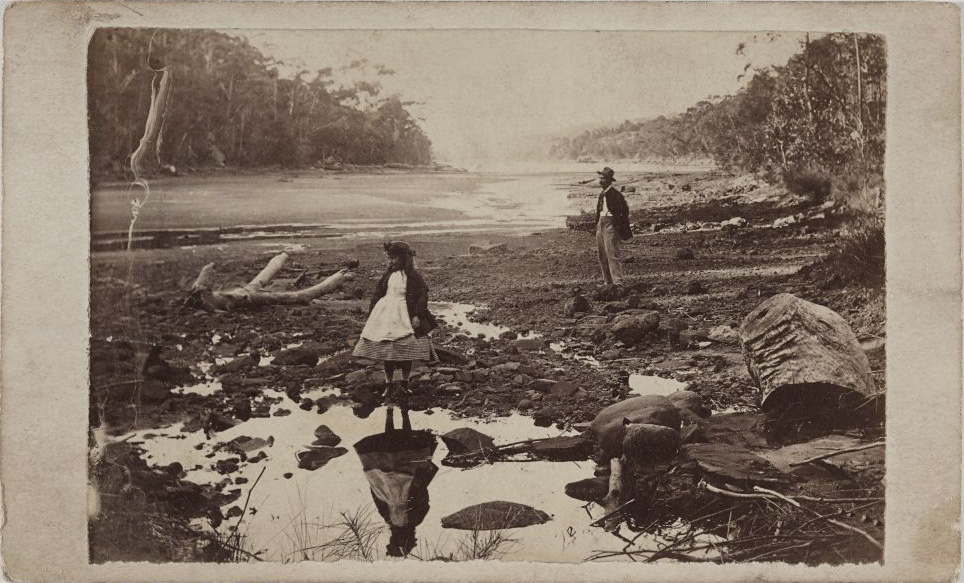
Unknown photographer. 'Australian scenery, Middle Harbour, Port Jackson' c. 1865


Unknown photographer
Australian scenery, Middle Harbour, Port Jackson
c. 1865
Carte de visite
Art Gallery of New South Wales, gift of Josef & Jeanne Lebovic, Sydney 2014


Unknown photographer. 'Australian scenery, Middle Harbour, Port Jackson' c. 1865 (verso)


Unknown photographer
Australian scenery, Middle Harbour, Port Jackson (verso)
c. 1865
Carte de visite
Art Gallery of New South Wales, gift of Josef & Jeanne Lebovic, Sydney 2014


The first large-scale exhibition of its kind to be held in Australia in 27 years, The photograph and Australia presents more than 400 photographs from more than 120 artists, including Richard Daintree, Charles Bayliss, Frank Hurley, Harold Cazneaux, Olive Cotton, Max Dupain, Sue Ford, Carol Jerrems, Tracey Moffatt, Robyn Stacey, Ricky Maynard and Patrick Pound.

The works of renowned artists are shown alongside those of unknown photographers and everyday material, such as domestic and presentation albums. These tell peoples’ stories, illustrate where and how they lived, as well as communicate official public narratives. Sourced from more than 35 major collections across Australia and New Zealand, including the National Gallery of Australia, the National Library of Australia and the Australian Museum, The photograph and Australia uncovers hidden gems dating from 1845 until now.

A richly illustrated publication accompanies the exhibition, reflecting the exhibition themes and investigating how Australia itself has been shaped by photography.

Extract from “Introduction”

“The task of this book is to formulate questions around Australian photography and its history, regardless of Australia’s, and the medium’s, permeable identity. While early photography in Australia made histories of the colonies visible, and a great deal can be read from the surviving photographic archives, interpretation of this material is often conjecture, and much remains oblique. Patrick Pound describes the sheer mass of photographs and images in the world today as an “unhinged album.”11 This dynamic of making, accumulating, ordering, disseminating, reinterpreting, re-collecting and re-narrating is an important aspect of photography. The intimate relationship, historically, between the photograph and the various arts and sciences, along with the adaptability to technological change and imaginative interpretations, allows for a constant montaging or weaving together of uses and meanings. This works against the conventional linear structure of classical histories and the idea of any progressive evolution of the medium. If what we are dealing with is a phenomenon rather than simply a form then analysing the phenomenon and its dynamic relationship to art, society, peoples, sciences, genres, and processes is critical to our modern understanding of ourselves and our place in the world as well as of the medium itself.12

In the 1970s, cultural theorist Roland Barthes wrote an essay entitled The photographic message.13 While he focussed primarily on press photography and made a distinction between reportage and ‘artistic’ photography, his pinpointing of the special status of the photographic image as a message without a code – one could say, even, a face without a name – and his understanding of photography as a simultaneously objective and invested, natural and cultural, is relevant in the colonial and post-colonial context.

We search for clues in photographs of our past and present. In some ways this is a melancholy activity, in other ways valuable detective work. In many cases it is both. Photography since its inception has belonged in a nether world of being and not being, legibility and opacity. This book preserves some of the slipperiness of the medium, while providing a series of texts touching on the photographs at hand. The history of the photograph and its relationship to Australia remains tantalisingly partial; the ever-burgeoning archives await further excavation.”14

Judy Annear. “Introduction,” in Judy Annear. The photograph and Australia. Sydney: Art Gallery of New South Wales, 2015. p. 13.


11. See ‘Transmission’ pp. 227-33
12. See Geoffrey Batchen, A Subject For, A History About, Photography accessed 23 December 2021
13. Roland Barthes, ‘The photographic message’, Image, music, text, trans Stephen Heath, Flamingo, London, 1984, pp. 15-31
14. Parts of this Introduction were in a paper delivered at the symposium, Border-lands: photography & cultural contest, Art Gallery of New South Wales, Sydney 31 Mar 2012


Time

The relationship of the photograph to ‘Time’ is discussed in chapter one, which examines how contemporary artists such as Anne Ferran, Rosemary Laing and Ricky Maynard reinvent the past through photography. The activities of nineteenth-century photographers such as George Burnell and Charles Bayliss are also discussed… The manipulation by artists and photographers of imaginative time – the time of looking at the photographic image – allows for consideration of the nexus between space and time, how subjects can be momentarily tethered and, equally, how they can float free.

Nation

Chapter two considers the idea of ‘Nation’: looking at the public role of the photograph in representing Australia at world exhibitions before Federation in 1901. Photography in this period enabled new classificatory systems to come into existence… Of particular importance was the use of the photograph to cement Darwinistic views that determined racial hierarchies according to superficial physical differences. The photograph also advertised the growing colonies to potential migrants and investors through the depiction of landscapes and amenities.

People

The third chapter, ‘People’, analyses the uncertain post-colonial heritage that all Australian inherit and how that can be evidenced and examined in photographs. The chapter encompasses portraits by Tracy Moffatt and George Goodman, for example, and considerations of where and how people lived and chose to be photographed. These include the people of the Kulin nation of Victoria, those who resided at Poonindie Mission in South Australia, the Yued people living at New Norcia mission in Western Australia, as well as the Henty family in Victoria, the Mortlocks of South Australia, the children living at The Bungalow in Alice Springs and the people of Tumut in New South Wales.

Place

‘Place’ is examined in chapter four, particularly in terms of the use of photography to enable exploration, whether to Antarctica (Frank Hurley), to map stars and further the natural sciences (Henry Chamberlain Russell, Joseph Turner), or to open up ‘wilderness’ for tourism or mining (JW Beattie, Nicholas Caire, JW Lindt, Richard Daintree) … Photographs are examined as both documents and imaginative interpretations of activity and place.

Transmission

Chapter five, ‘Transmission’, considers the traffic in photographs and the fascination with the medium’s reproducibility and circulation… The evidential aspect of the photograph has proven to be fleeting and only tangentially related to the thing it traces. The possibility of being able to fully decipher a photograph’s meaning is remote, even when it has been promptly ordered and annotated in some form of album. Each photographic form expands the possibility of instant and easy communication, but the swarm of material serves only to prove the impossibility of order, classification, and accuracy. The photograph as an aestheticised object continues regardless of platform, and the imaginative possibilities of the medium have not been exhausted.

Sections from Judy Annear. “Introduction,” in Judy Annear. The photograph and Australia. Sydney: Art Gallery of New South Wales, 2015. p. 12.


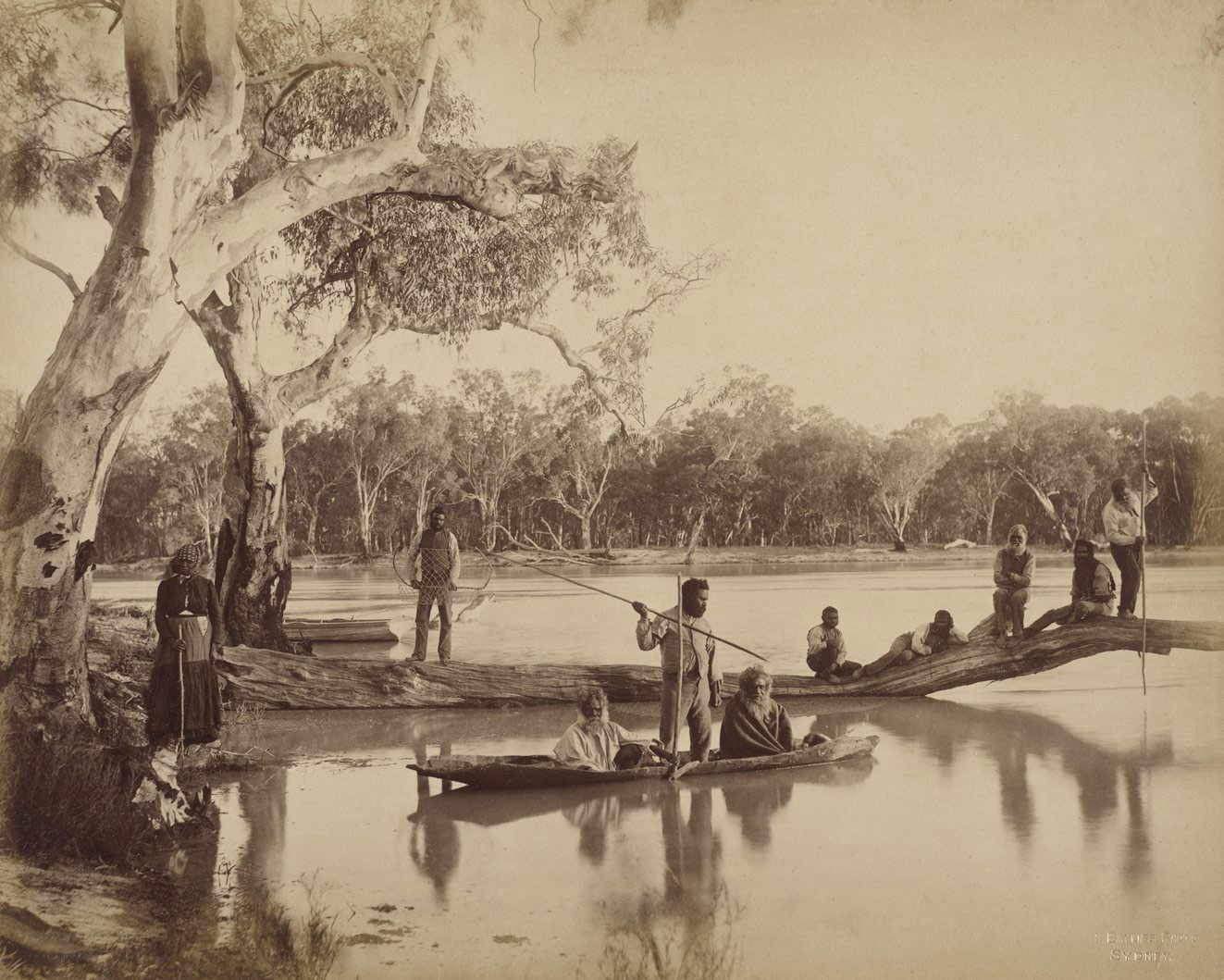
Charles Bayliss (Australian born United Kingdom, 1850-1897) 'Group of local Aboriginal people, Chowilla Station, Lower Murray River, South Australia' 1886


Charles Bayliss (Australian born United Kingdom, 1850-1897)
Group of local Aboriginal people, Chowilla Station, Lower Murray River, South Australia
1886
From the series New South Wales Royal Commission: Conservation of water. Views of scenery on the Darling and Lower Murray during the flood of 1886
Albumen photograph
Art Gallery of New South Wales, purchased 1984


This tableaux of Ngarrindjeri people fishing was carefully staged by photographer Charles Bayliss in 1886. Not just subjects, they actively participated in the photography process. It was observed at the time that the fishermen arranged themselves into position, with “the grace and unique character of which a skilful artist only could show.”

“In one extraordinary image created in 1886 by the photographer Charles Bayliss, the Ngarrindjeri people of the lower Murray River were active participants in the staging of a fishing scene. Writing in his journal, Bayliss’s companion Gilbert Parker noted: “Without a word of suggestion, these natives arranged themselves in a group, the grace and unique character of which a skilful artist only could show.” Annear says the image looks like a museum diorama to modern eyes. “But these people were very active in deciding how they wanted to be photographed,” she says. “They were determined to create an image they felt was appropriate.”

The first photographs of indigenous Australians were formal, posed portraits, taken in blazing sunlight. The sitters are often pictured leaning against each other (stillness was required for long exposure times) with eyes turned to the camera and bodies wrapped in blankets or kangaroo skins. Some wore headdresses or necklaces that may or may not have belonged to them.

“Indigenous Australians agreed to be photographed out of curiosity, or perhaps for food,” says Judy Annear, curator of The photograph and Australia, a major new photography exhibition at the Art Gallery of New South Wales. “In the past, it was considered that these sorts of early pictures were indicative of the colonial gaze. But now there is a lot of research going on into how these early photos were made. Often, the local people would have been invited to come into a studio and they were paid. They would have been dressed up and told what to do.””

Text in quotations from Elissa Blake. “Art Gallery of NSW photography exhibition: Stories told in black and white,” on the the Sydney Morning Herald website April 2, 2015 [Online] Cited 28/05/2015.


Ernest B Docker (Australian, 1842-1923) 'The Three Sisters Katoomba – Mrs Vivian, Muriel Vivian and Rosamund 7 Feb 1898' 1898


Ernest B Docker (Australian, 1842-1923)
The Three Sisters Katoomba – Mrs Vivian, Muriel Vivian and Rosamund 7 Feb 1898
1898
Stereograph
Macleay Museum, The University of Sydney


Charles Nettleton (Australian, 1825-1902) 'Untitled' 1867-1874


Charles Nettleton (Australian, 1825-1902)
Untitled
1867-1874
Carte de visite
6.2 x 9.1cm image; 6.3 x 10.0cm mount card
Purchased 2014
Art Gallery of New South Wales


Charles Nettleton was a professional photographer born in the north of England who arrived in Australia in 1854, settling in Melbourne. He joined the studio of Townsend Duryea and Alexander McDonald, where he specialised in outdoor photography. Nettleton is credited with having photographed the first Australian steam train when the private Melbourne-Sandridge (Port Melbourne) line was opened on 12 September 1854. Nettleton established his own studio in 1858, offering the first souvenir albums to the Melbourne public. He worked as an official photographer to the Victorian government and the City of Melbourne Corporation from the late 1850s to the late 1890s, documenting Melbourne’s growth from a colonial town to a booming metropolis. He photographed public buildings, sewerage and water systems, bridges, viaducts, roads, wharves, and the construction of the Botanical Gardens. In 1861 he boarded the ‘Great Britain’ to photograph the first English cricket team to visit Australia and in 1867 was appointed official photographer of the Victorian visit of the Duke of Edinburgh. For the Victorian police he photographed the bushranger Ned Kelly in 1880. This is considered to be the only genuine photograph of the outlaw.


Tracey Moffatt (Australian, b. 1960) 'I made a camera' 2003


Tracey Moffatt (Australian, b. 1960)
I made a camera
2003
Photolithograph
Collection of the artist
© Tracey Moffatt, courtesy Roslyn Oxley9 Gallery, Sydney


The Art Gallery of New South Wales is proud to present the major exhibition The photograph and Australia, which explores the crucial role photography has played in shaping our understandings of the nation. It will run from 21 March to 8 June 2015.

Tracing the evolution of the medium and its many uses from the 1840s until today, this is the largest exhibition of Australian photography held since 1988 that borrows from collections nationwide. It presents more than 400 photographs by more than 120 artists, including Morton Allport, Richard Daintree, Paul Foelsche, Samuel Sweet, JJ Dwyer, Charles Bayliss, Frank Hurley, Harold Cazneaux, Olive Cotton, Max Dupain, Sue Ford, Carol Jerrems, Tracey Moffatt, Robyn Stacey, Ricky Maynard, Anne Ferran and Patrick Pound.

Iconic images are shown alongside works by unknown and amateur photographers, including photographic objects such as cartes de visite, domestic albums and the earliest Australian X-rays. The exhibition’s curator – Judy Annear, senior curator of photographs, Art Gallery of NSW – said:

“Weaving together the multiple threads of Australia’s photographic history, The photograph and Australia investigates how photography invented modern Australia. It poses questions about how the medium has shaped our view of the world, ourselves and each other. Audiences are invited to experience the breadth of Australian photography, past and present, and the sense of wonder the photograph can still induce through its ability to capture both things of the world and the imagination.”

The exhibition brings together hundreds of photographs from more than 35 private and public collections across Australia, England and New Zealand, including the National Gallery of Australia, the National Library of Australia and the State Library of Victoria. Highlights include daguerreotypes by Australia’s first professional photographer, George Goodman, and recent works by Simryn Gill. From mass media’s evolution in the 19th century to today’s digital revolution, The photograph and Australia investigates how photography has been harnessed to create the idea of a nation and reveals how our view of the world, ourselves and each other has been changed by the advent of photography. It also explores how photography operates aesthetically, technically, politically and in terms of distribution and proliferation, in the Australian context.

Curated from a contemporary perspective, the exhibition takes a thematic rather than a chronological approach, looking at four interrelated areas: Aboriginal and settler relations; exploration (mining, landscape and stars); portraiture and engagement; collecting and distributing photography. A lavishly illustrated 308-page publication, The photograph and Australia (Thames & Hudson, RRP $75.00), accompanies the exhibition, reflecting its themes and investigating the medium’s relationship to people, place, culture and history.

Press release from the Art Gallery of New South Wales


David Moore (Australian, 1927-2003) 'Migrants arriving in Sydney' 1966, printed later


David Moore (Australian, 1927-2003)
Migrants arriving in Sydney
1966, printed later
Gelatin silver photograph
30.2 x 43.5cm
Gift of the artist 1997
© Lisa, Karen, Michael and Matthew Moore


In this evocative image Moore condenses the anticipation and apprehension of immigrants into a tight frame as they arrive in Australia to begin a new life. The generational mix suggests family reconnections or individual courage as each face displays a different emotion.

Moore’s first colour image Faces mirroring their expectations of life in the land down under, passengers crowd the rail of the liner Galileo Galilei in Sydney Harbour was published in National Geographic in 1967.1 In that photograph the figures are positioned less formally and look cheerful. But it is this second image, probably taken seconds later, which Moore printed in black-and-white, that has become symbolic of national identity as it represents a time when Australia’s rapidly developing industrialised economy addressed its labour shortage through immigration. The strength of the horizontal composition of cropped figures underpinned by the ship’s rail is dramatised by the central figure raising her hand – an ambiguous gesture either reaching for a future or reconnecting with family. The complexity of the subject and the narrative the image implies ensured its public success, which resulted in a deconstruction of the original title, ‘European migrants’, by the passengers, four of whom it later emerged were Sydneysiders returning from holiday, alongside two migrants from Egypt and Lebanon.2 Unintentionally Moore’s iconic image has become an ‘historical fiction’, yet the passengers continue to represent an evolving Australian identity in relation to immigration.

1. Max Dupain and associates. Accessed 17/06/2006. No longer available online
2. Thomas D & Sayers A 2000, From face to face: portraits by David Moore, Chapter & Verse, Sydney

© Art Gallery of New South Wales Photography Collection Handbook, 2007


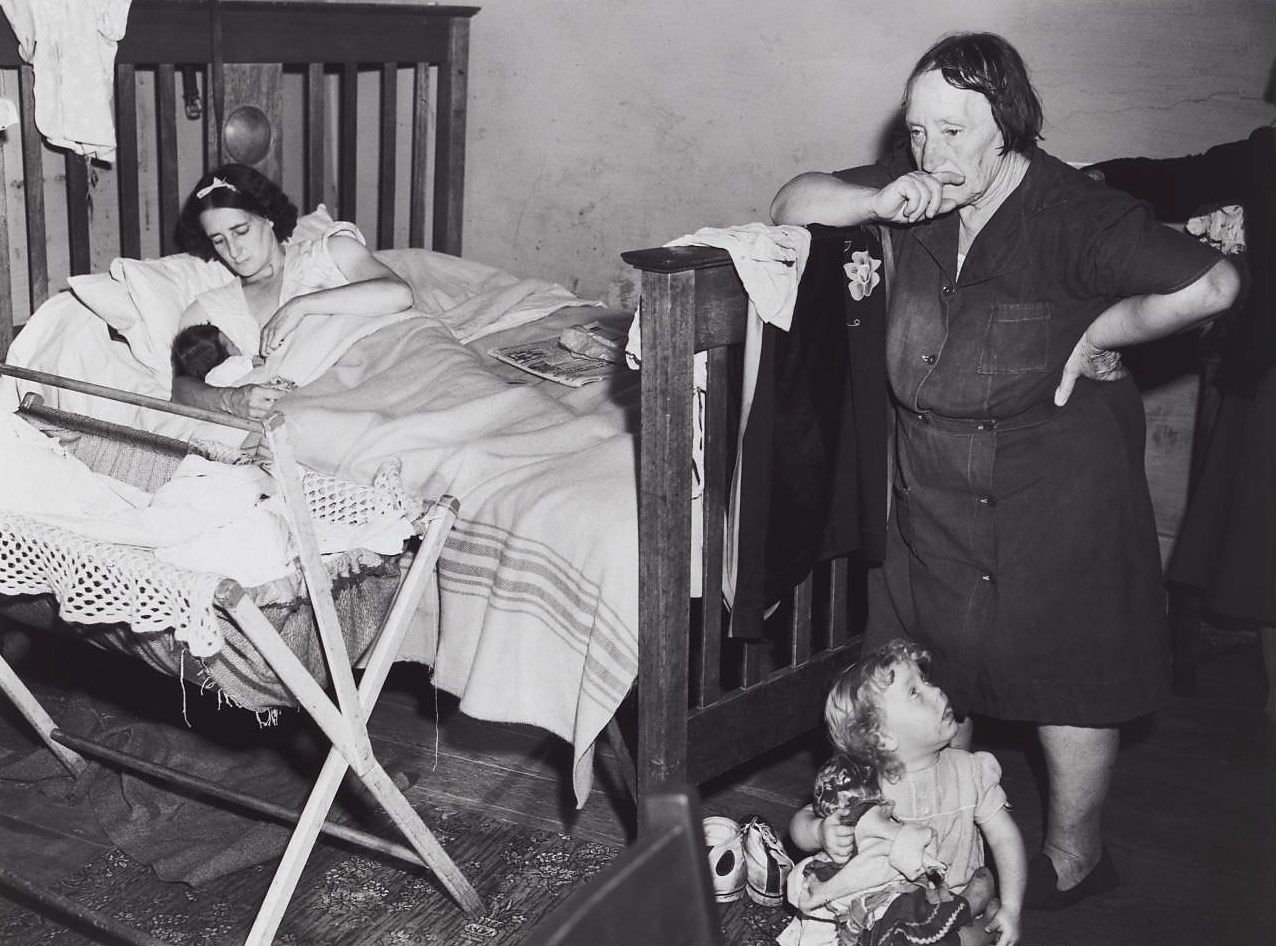
David Moore (Australian, 1927-2003) 'Redfern Interior' 1949


David Moore (Australian, 1927-2003)
Redfern Interior
1949
Silver gelatin print
26.7 x 35.4cm
Purchased with funds provided by the Art Gallery Society of New South Wales 1985


David Moore’s career spanned the age of the picture magazines (for example: Life, Time, The Observer) through to major commissions such as the Sydney Opera House, CSR, and self initiated projects like To build a Bridge: Glebe Island. The breadth and depth of his career means there is an extraordinary archive of material which describes and interprets the last 50 years of Australian life, the life of the region, and events in Britain and the United States. He was instrumental in advancing Australian photography throughout his career and in the early 1970s was active in setting up the Australian Centre for Photography, Sydney. From well-known images such as Migrants arriving in Sydney to Redfern interior, Moore has documented events and conditions in Sydney.


Charles Bayliss (England, Australia 1850-1897) Henry Beaufoy Merlin (England, Australia 1830-1873) 'Untitled' c. 1872


Charles Bayliss (England, Australia 1850-1897)
Henry Beaufoy Merlin (England, Australia 1830-1873)
Untitled
c. 1872
Albumen photograph
Dimensions
24.5 x 29.4cm image/sheet
Gift of Josef & Jeanne Lebovic, Sydney 2014


Paul Foelsche (Australian, 1831-1914) 'Adelaide River' 1887


Paul Foelsche (Australian, 1831-1914)
Adelaide River
1887
Albumen photograph
Art Gallery of New South Wales, gift of Josef & Jeanne Lebovic, Sydney 2014


This photo of people relaxing on the banks of the Adelaide River in the Northern Territory was taken by Paul Foelsche, a policeman and amateur anthropologist.

The collection of 19th century images brought together in The photograph and Australia show indigenous people in formal group portraits or as “exotic” subjects. They are photographed alongside early settlers, working as stockmen or holding tools. Amateur gentleman photographers such as the Scottish farmer John Hunter Kerr captured such images on his own property, Fernyhurst Station, in Victoria. Another amateur photographer, Paul Foelsche, the first policeman in the Northern Territory, took portraits of the Larrakia people, which have since become a priceless archive for their descendants.


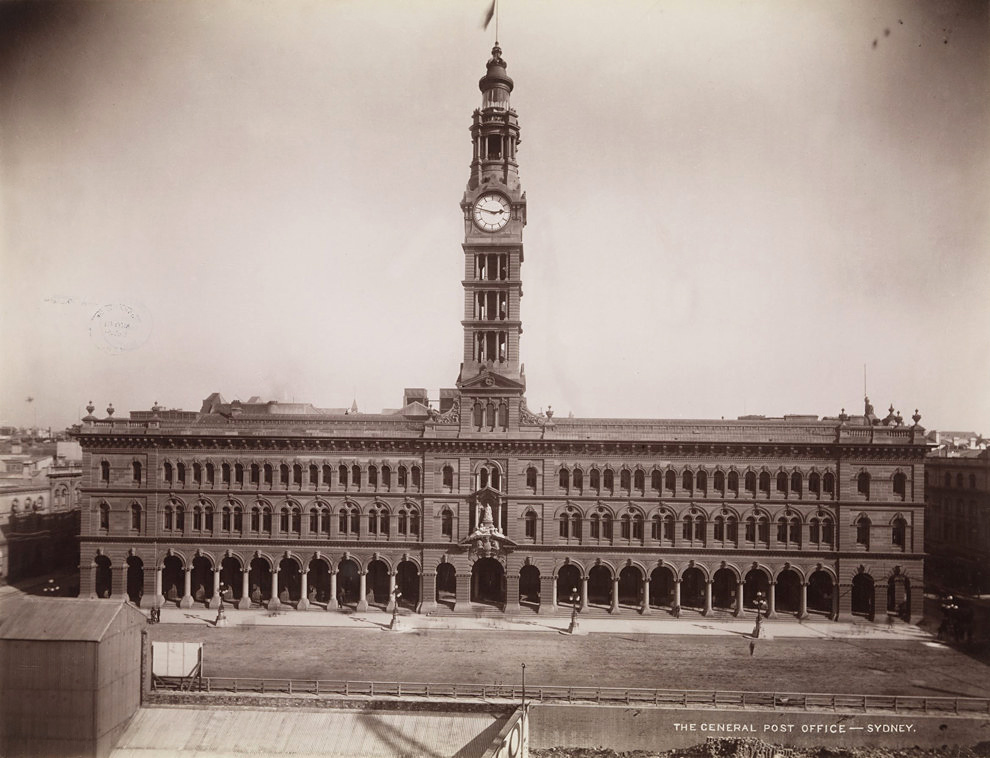
NSW Government Printer. 'The General Post Office, Sydney' 1892–1900


NSW Government Printer
The General Post Office, Sydney
1892-1900
Albumen photograph
State Library of New South Wales, Sydney, presented 1969


Melvin Vaniman (American, 1866-1912) 'Panorama of intersection of Collins and Queen Streets, Melbourne' 1903


Melvin Vaniman (American, 1866-1912)
Panorama of intersection of Collins and Queen Streets, Melbourne
1903


Melvin Vaniman (American, 1866-1912)

Chester Melvin Vaniman (October 30, 1866 – July 2, 1912) was an American aviator and photographer who specialised in panoramic images. He shot images from gas balloons, ships masts, tall buildings and even a home-made 30-metre (98 ft) pole. He scaled buildings, hung from self-made slings, and scaled dangerous heights to capture his unique images.

Vaniman’s photographic career began in Hawaii in 1901, and ended some time in 1904. He spent over a year photographing Australia and New Zealand on behalf of the Oceanic Steamship Company, creating promotional images for the company, many as panoramas and which popularised the format in Australia, which was taken up with enthusiasm by Robert Vere Scott among others. During this time the New Zealand Government also commissioned panoramas.

Beginning in 1903, he spent over a year photographing Sydney and the surrounding areas. It was during this time that he created his best known work, the panorama of Sydney, shot from a hot air balloon he had specially imported from the United States. Vaniman is best known for his images of Hawaii, Australia, and New Zealand.

Text from the Wikipedia website


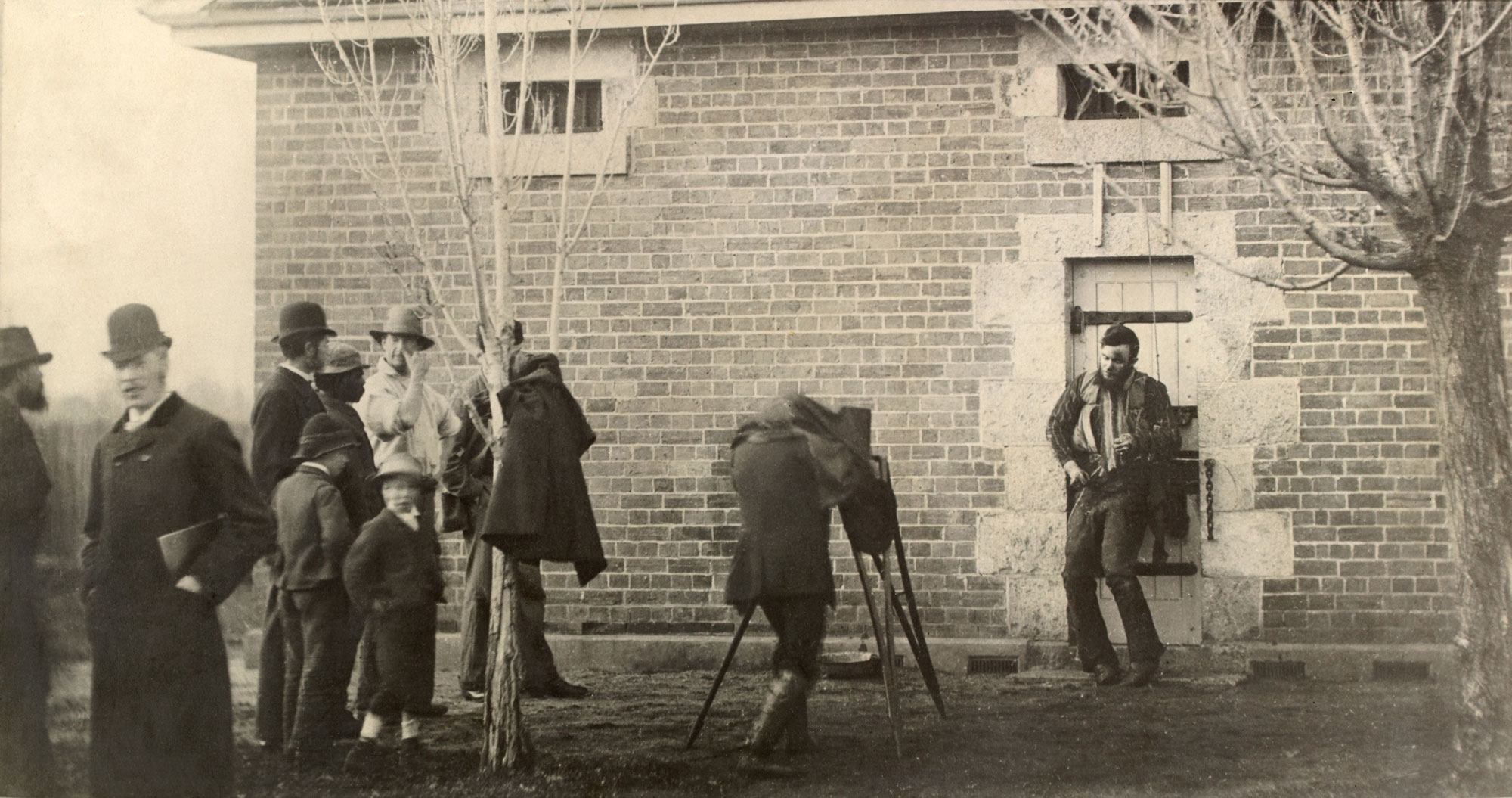
J. W. Lindt (Germany 1845 - Australia from 1862, Australia 1926) 'Body of Joe Byrne, member of the Kelly gang, hung up for photography, Benalla' 1880


J. W. Lindt (Germany 1845 – Australia from 1862, Australia 1926)
Body of Joe Byrne, member of the Kelly gang, hung up for photography, Benalla
1880
Gelatin silver print


Australia’s first ever press photograph pushed boundaries few journalists would transgress today. Captured by J.W, Lindt in 1880, the photo shows the dead body of a member of Ned Kelly’s infamous gang, strung up on a door outside the jail house in Benalla in regional Victoria.

Joe Byrne died from loss of blood after being shot in the groin during the siege of Glenrowan pub. Another photographer is pictured mid-shot, while an illustrator walks away from the new technology with his hat on and portfolio tucked under his arm. “We see this as the first Australian press photograph. It has that spontaneity media photographs have, and it’s also very evocative with many different stories in it,” the gallery’s senior curator of photographs, Judy Annear, said.

Text from Rose Powell. “First Australian press photo shows body of Kelly Gang member Joe Byrne,” on the Sydney Morning Herald website March 20, 2015 [Online] Cited 30/05/2015.


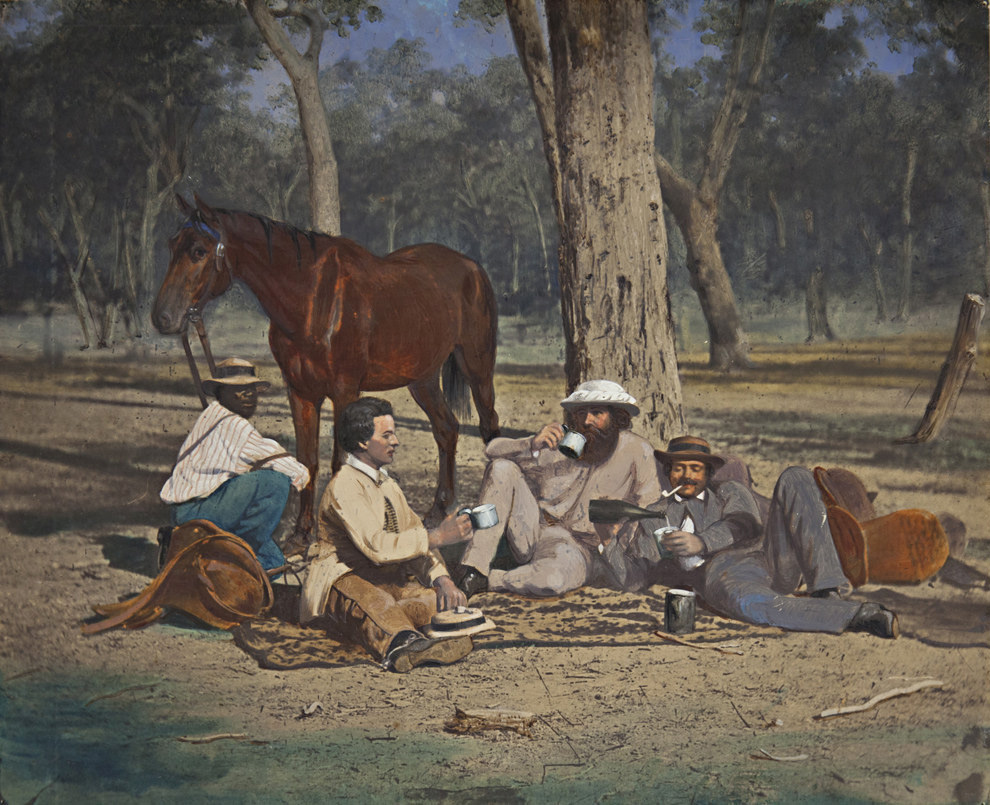
Richard Daintree (Australian, 1832-1878) 'Midday camp' 1864-1870


Richard Daintree (Australian, 1832-1878)
Midday camp
1864-1870
Albumen photograph, overpainted with oils
Queensland Museum, Brisbane


This image was an albumen photograph (using egg whites to bind chemicals to paper) which was then hand-coloured with oil paints to bring it to life. The photographer took it in the 1860s to advertise Australia as a land of opportunity.


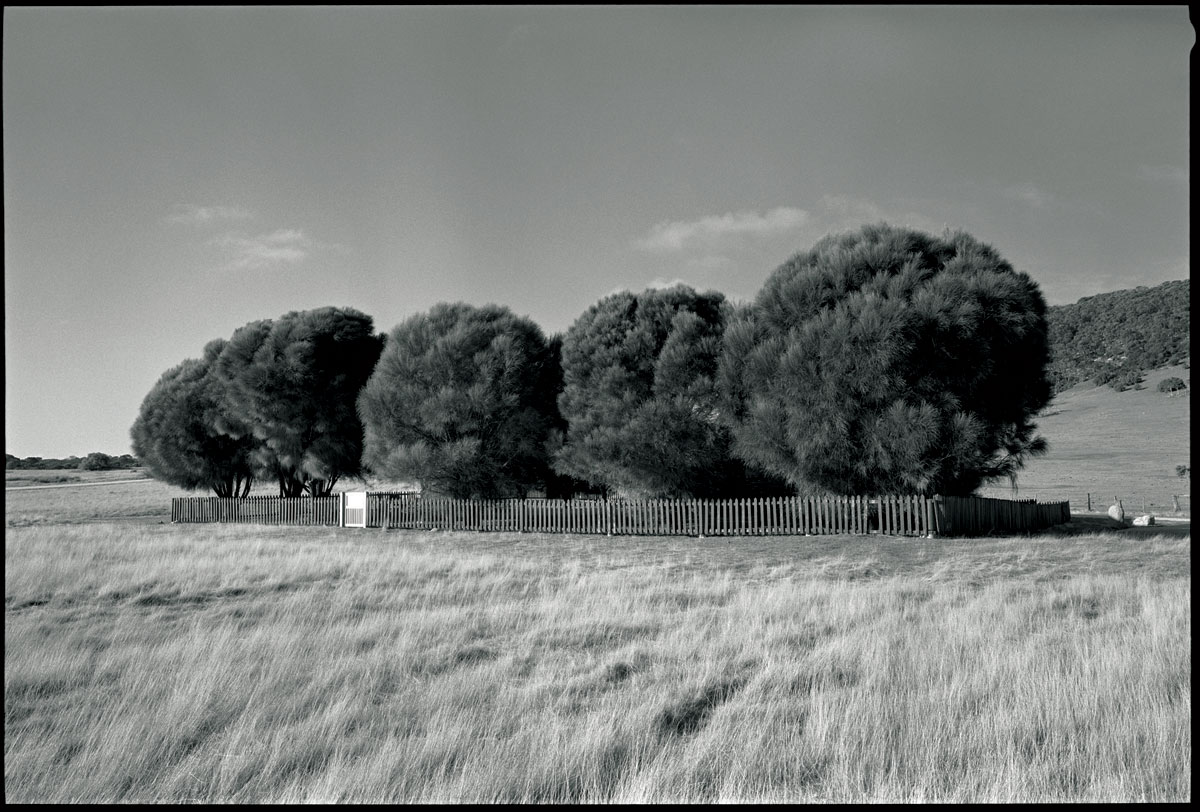
Ricky Maynard (Australian, b. 1953) 'The Healing Garden, Wybalenna, Flinders Island, Tasmania' 2005


Ricky Maynard (Australian, b. 1953)
Ben Lomond, Tasmania , Cape Portland, Tasmania
The Healing Garden, Wybalenna, Flinders Island, Tasmania, from the series Portrait of a distant land
2005, printed 2009
Gelatin silver photograph, selenium toned
34 x 52cm
Art Gallery of New South Wales, purchased with funds provided by the Aboriginal Collection Benefactors’ Group and the Photography Collection Benefactors’ Program 2009


Ricky Maynard has produced some of the most compelling images of contemporary Aboriginal Australia over the last two decades. Largely self taught, Maynard began his career as a darkroom technician at the age of sixteen. He first established his reputation with the 1985 series Moonbird people, an intimate portrayal of the muttonbirding season on Babel, Big Dog and Trefoil Islands in his native Tasmania. The 1993 series No more than what you see documents Indigenous prisoners in South Australian gaols.

Maynard is a lifelong student of the history of photography, particularly of the great American social reformers Jacob Riis, Lewis Hines, Dorothea Lange and Walker Evans. Maynard’s images cut through the layers of rhetoric and ideology that inevitably couch black history (particularly Tasmanian history) to present images of experience itself. His visual histories question ownership; he claims that ‘the contest remains over who will image and own this history…we must define history, define whose history it is, and define its purpose as well as the tools used for the telling it’.

In Portrait of a distant land Maynard addresses the emotional connection between history and place. He uses documentary style landscapes to illustrate group portraits of Aboriginal peoples’ experiences throughout Tasmania. Each work combines several specific historical events, creating a narrative of shared experience – for example The Mission relies on historical records of a small boy whom Europeans christened after both his parents died in the Risdon massacre. This work highlights the disparity between written, oral and visual histories, as Maynard attempts to create ‘a combination of a very specific oral history as well as an attempt to show a different way of looking at history in general’.


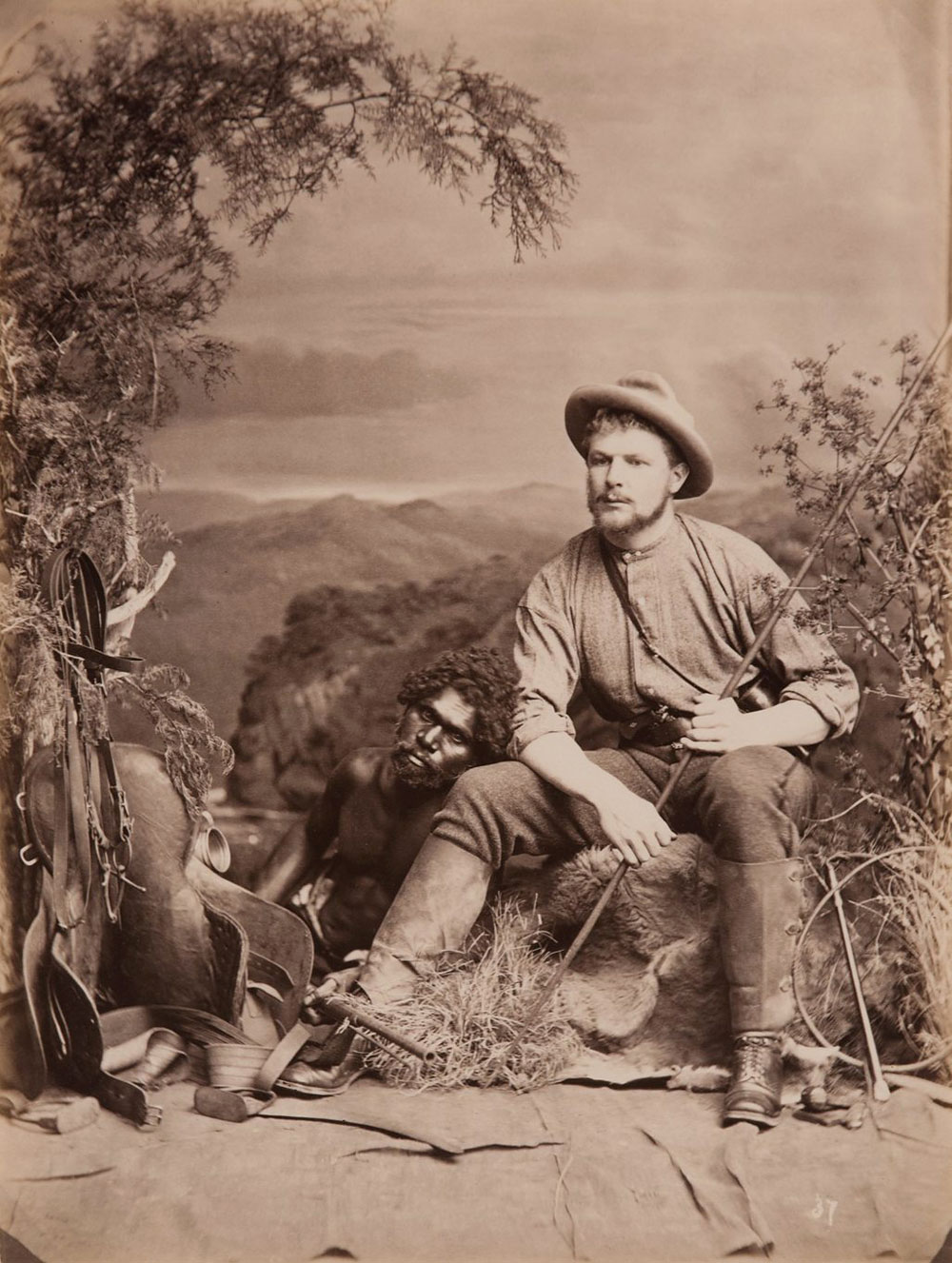
JW Lindt (Australian born Germany, 1845-1926) 'No 37 Bushman and an Aboriginal man' 1873


JW Lindt (Australian born Germany, 1845-1926)
No 37 Bushman and an Aboriginal man
1873
Albumen photograph
Grafton Regional Gallery Collection, Grafton, gift of Sam and Janet Cullen and family 2004


Professional photographers such as the Frankfurt-born John William Lindt (who became famous for photographing the capture of the Kelly Gang at Glenrowan in 1880) took carefully posed tableaux images in his Melbourne studio. One set of Lindt photographs, taken between 1873 and 1874, show settlers and indigenous people posing with the tools of their trade. One unusual image shows a settler holding a spear and a local man holding a rifle.

Annear says the photographs speak of a time when early settlers and indigenous people were engaged in an exchange of cultures. “These photos weren’t just a passive, one-way process,” Annear says. “It wasn’t just about capture and exoticism. We are finding contemporaneous accounts that point to a level of exchange going on that was extremely important. These photos show who those people were, where they lived and what they were doing. They have a very powerful presence in that regard, and Aboriginal people today are going back through these photographs in order to trace their family trees.” …

Annear says she could have put together an exhibition of images of the “great suffering” experienced by Aboriginal people in Australia, but chose not to. “I found the 19th century material so rich and strong and most people aren’t aware of these images. It seemed like a great opportunity to bring them forward,” she says. “I don’t want to whitewash history, but I do want people to see how rich life was, how people were adapting, and then how that was removed. After Federation and the White Australia policy and other assimilation policies, photos of indigenous people seem to disappear. Why did they disappear? The people were still here. They were greatly diminished in many senses, but nonetheless they were still here.”

Elissa Blake. “Art Gallery of NSW photography exhibition: Stories told in black and white,” on the Sydney Morning Herald website, April 2, 2015 [Online] Cited 30/05/2015


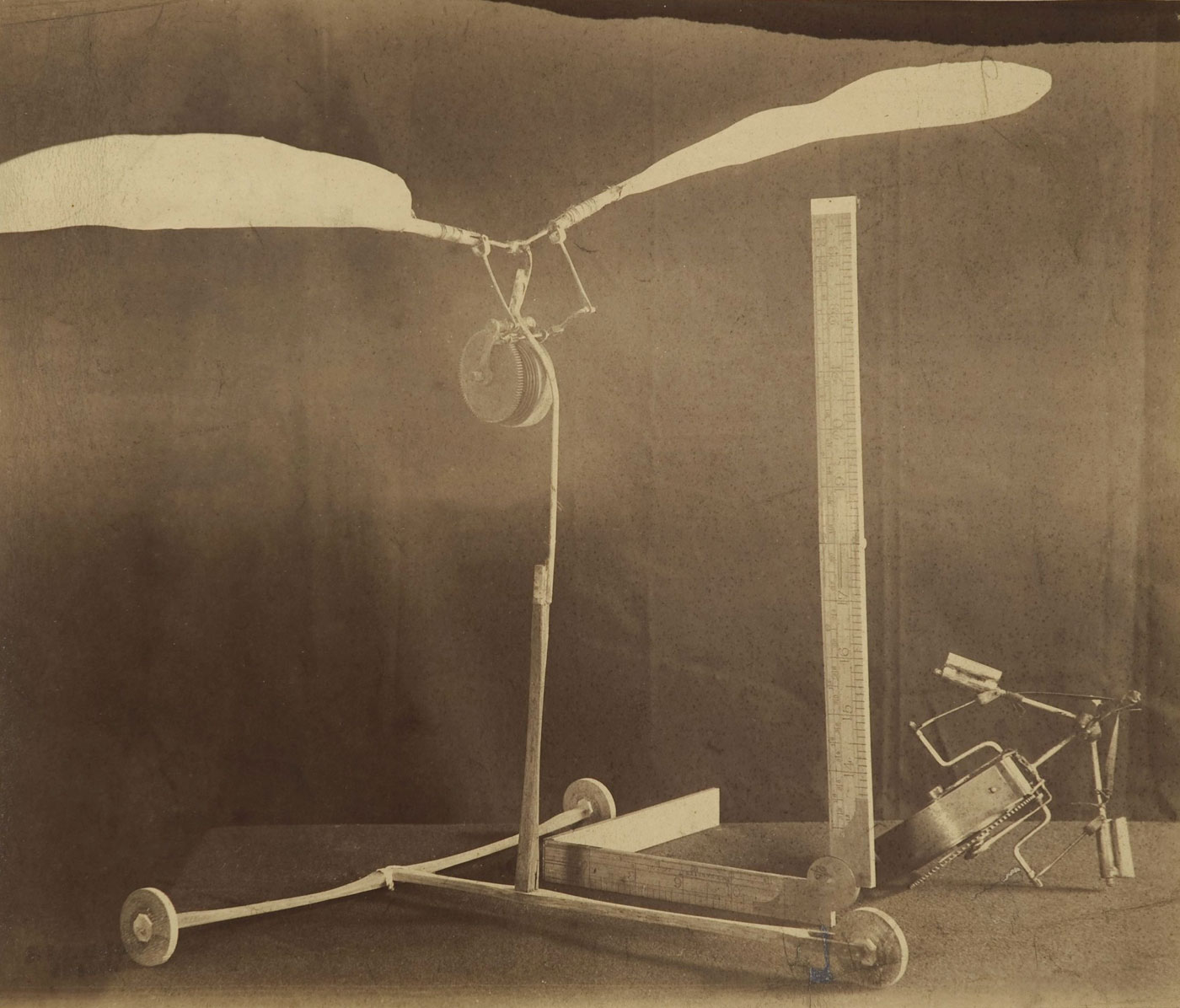
Charles Bayliss (Australian born England, 1850-1897) 'Lawrence Hargrave trochoided plane model' 1884


Charles Bayliss (Australian born England, 1850-1897)
Lawrence Hargrave trochoided plane model
1884
Albumen photograph
Museum of Applied Arts and Sciences, Sydney, gift of Mr William Hudson Shaw 1994


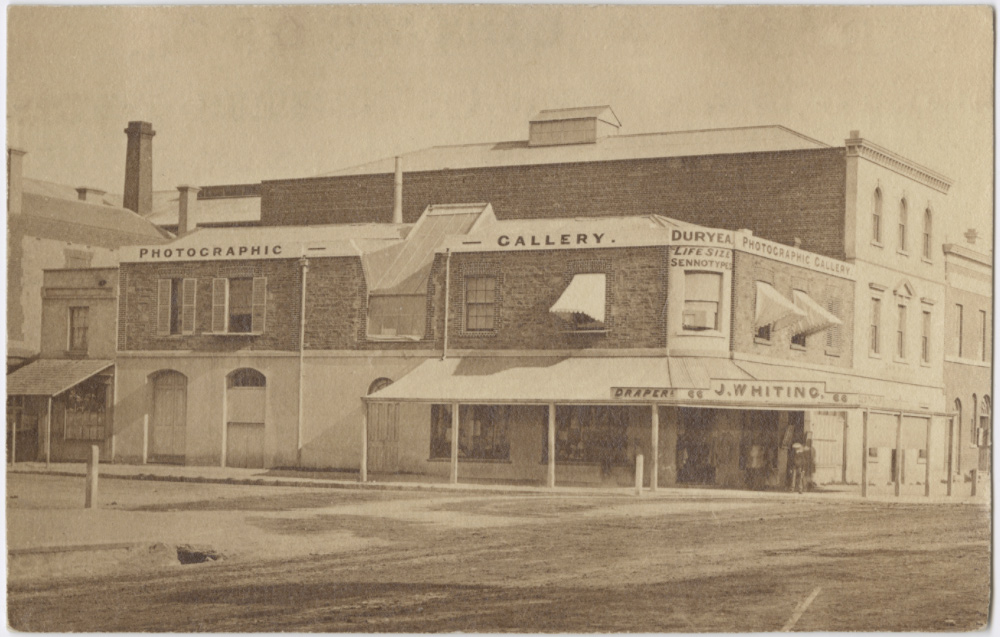
Unknown photographer. 'Duryea Gallery, Grenfell Street, Adelaide' c. 1865


Unknown photographer
Duryea Gallery, Grenfell Street, Adelaide
c. 1865
Carte de visite
State Library of South Australia, Adelaide


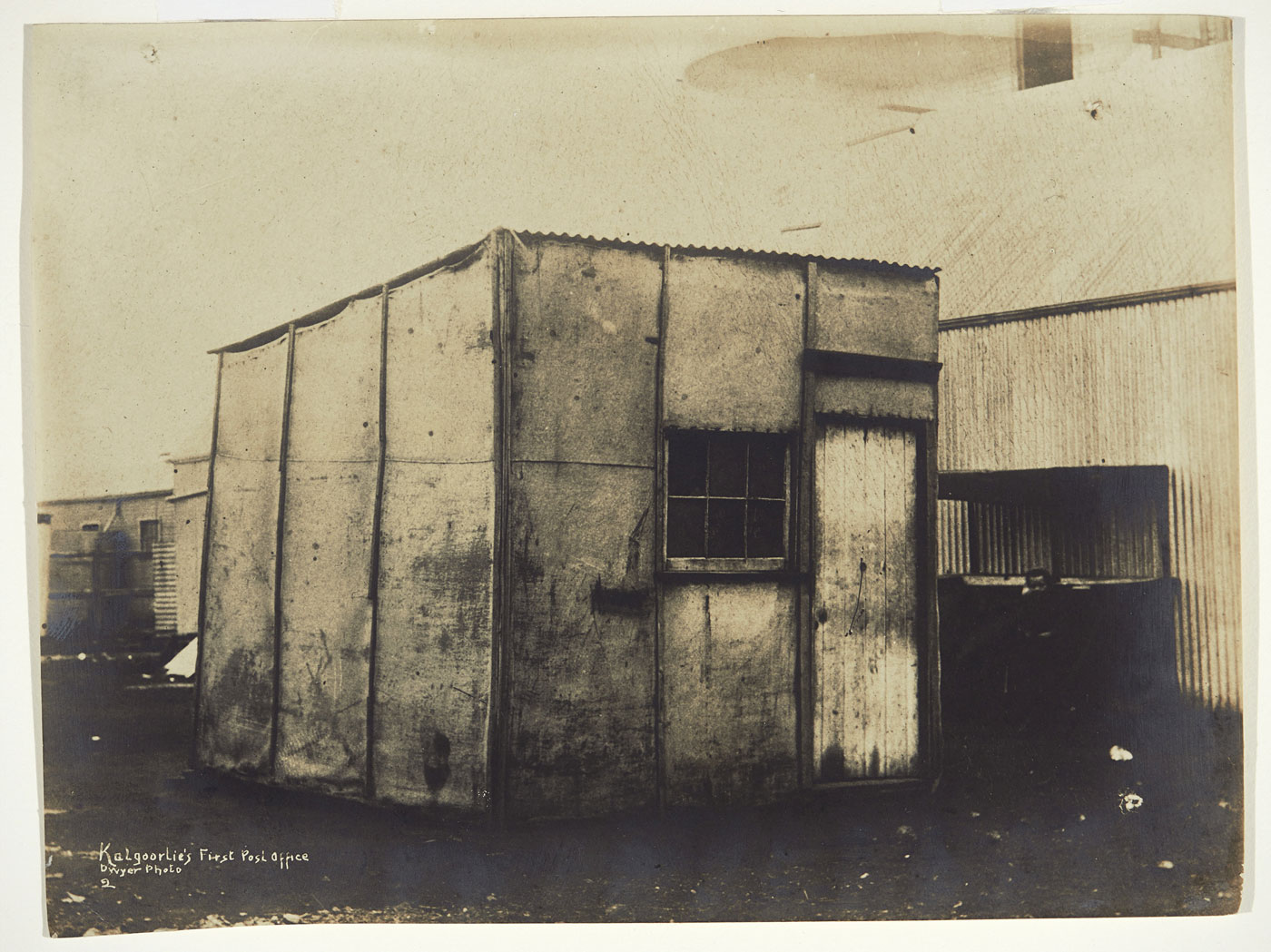
J. J. Dwyer (Australian, 1869-1928) 'Kalgoorlie's first post office' c. 1900


J. J. Dwyer (Australian, 1869-1928)
Kalgoorlie’s first post office
c. 1900
Gelatin silver photograph
Kerry Stokes Collection, Perth
Photo: Acorn Photo, Perth


Harold Cazneaux (Australian, 1878-1953) 'Spirit of endurance' 1937


Harold Cazneaux (Australian, 1878-1953)
Spirit of endurance
1937
Gelatin silver photograph
Art Gallery of New South Wales, gift of the Cazneaux family 1975


Keast Burke (New Zealand, Australia 1896-1974) 'Husbandry 1' c. 1940


Keast Burke (New Zealand, Australia 1896-1974)
Husbandry 1
c. 1940
Gelatin silver photograph, vintage
30.5 x 35.5cm image/sheet
Gift of Iris Burke 1989


Eric Keast Burke (16 January 1896 – 31 March 1974) was a New Zealand-born photographer and journalist.


Unknown photographer. 'Isabella Carfrae on horseback, Ledcourt, Stawell, Victoria' c. 1855 (detail)


Unknown photographer
Isabella Carfrae on horseback, Ledcourt, Stawell, Victoria
c. 1855
Daguerreotype, hand-tinted
National Gallery of Australia, Canberra, purchased 2012


Unknown photographer. 'Isabella Carfrae on horseback, Ledcourt, Stawell, Victoria' c. 1855


Unknown photographer
Isabella Carfrae on horseback, Ledcourt, Stawell, Victoria
c. 1855
Daguerreotype, hand-tinted
National Gallery of Australia, Canberra, purchased 2012


“In the late 19th century, cameras were taking us both inside the human body and all the way to the moon. By the 1970s the National Gallery of Victoria had begun collecting photographic art, and within another decade the digital revolution was underway. But this exhibition – the largest display of Australian photography since Gael Newton mounted the 900-work Shades of Light: Photography and Australia 1838-1988 at the National Gallery of Australia 27 years ago – is not chronological.

It opens with a salon hang of portraits of 19th and 20th century photographers, as if to emphasise their say in what we see, and continues with works grouped by themes: Aboriginal and settler relations; exploration; mining, landscape and stars; portraiture and engagement; collecting and distributing photography.

“A number of institutions and curators have tackled Australian photography from a chronological perspective and have done an extremely good job of it,” Annear says. “I have used their excellent research as a springboard into another kind of examination of the history of photography in this country. Nothing in photography was actually invented here, so I have turned it around and considered how photography invented Australia.”

Most of the photographs – about three quarters of the show, in fact – date from the first 60 years after Frenchman Louis Daguerre had his 1839 revelation about how to capture detailed images in a permanent form. Annear says the decades immediately following photography’s arrival in Australia provide a snapshot of all that has followed since.

“In terms of the digital revolution it is interesting to look back at the 19th century. What is going on now was all there then, it is just an expansion. There is a very clear trajectory from the birth of photography towards multiplication. After the invention of the carte de visite in the late 1850s they were made like there was no tomorrow. There are millions of cartes de visite in existence.”

There are quite a few of these small card-mounted photographs (the process was patented in Paris, hence the French) in the exhibition too, including one of a woman reflected in water at Port Jackson dating from circa 1865. With the trillions of images now in existence, it is easy to forget that once upon a time catching your reflection in the water, glass or a mirror was the only way to glimpse your own image (short of paying hefty sums for an artist to draw you).

After the invention of photography, people were quick to see how easily they could manipulate the impression created. While photographs are about fixing a moment in time, we can never be really sure just what it is they are fixing. “It’s not as simple as windows and mirrors – what we are looking at has always been constructed in some way,” Annear says. “What’s interesting about the medium is that you think it’s recording, fixing and capturing, but it is just creating an endless meditation on whatever a photograph’s relationship might be to whatever was real at the time it was taken.”

Extract from Megan Backhouse. “How the Photograph Shaped a Nation,” on the Art Guide Australia website, 20 April 2015 [Online] Cited 30/05/2015. No longer available online.


Sue Ford (Australian, 1943-2009) 'Self-portrait' 1986


Sue Ford (Australian, 1943-2009)
Self-portrait
1986
From the series Self-portrait with camera (1960-2006) 2008
Colour Polaroid photograph
Art Gallery of New South Wales, purchased with funds provided by the Paul & Valeria Ainsworth Charitable Foundation, Russell Mills, Mary Ann Rolfe, the Photography Collection Benefactors and the Photography Endowment Fund 2015
© Sue Ford Archive


George Goodman (Australian born England, 1815-1891) 'Caroline and son Thomas James Lawson' 1845


George Goodman (Australian born England, 1815-1891)
Caroline and son Thomas James Lawson
1845
Daguerreotype
State Library of New South Wales, Sydney, presented 1991


Olive Cotton (Australian, 1911-2003) 'Only to taste the warmth, the light, the wind' c. 1939


Olive Cotton (Australian, 1911-2003)
Only to taste the warmth, the light, the wind
c. 1939
Gelatin silver photograph
Art Gallery of New South Wales, purchased with funds provided by John Armati 2006


Unknown photographer. 'John Gill and Joanna Kate Norton' 1856


Unknown photographer
John Gill and Joanna Kate Norton
1856
Albumen photograph
Picture Collection, State Library of Victoria, Melbourne


Unknown photographer. 'Alfred and Fred Thomas, proprietors of the Ravenswood Hotel' 1880-1890


Unknown photographer
Alfred and Fred Thomas, proprietors of the Ravenswood Hotel
1880-1890
Tintype
State Library of Western Australia, Perth


Mervyn Bishop (Australian, b. 1945) 'Prime Minister Gough Whitlam pours soil into the hands of traditional land owner Vincent Lingiari, Northern Territory' 1975


Mervyn Bishop (Australian, b. 1945)
Prime Minister Gough Whitlam pours soil into the hands of traditional land owner Vincent Lingiari, Northern Territory
1975
Type R3 photograph
Art Gallery of New South Wales, Hallmark Cards Australian Photography Collection Fund 1991
© Mervyn Bishop. Department of the Prime Minister and Cabinet


Mervyn Bishop (born July 1945) is an Australian news and documentary photographer. Joining The Sydney Morning Herald as a cadet in 1962 or 1963, he was the first Aboriginal Australian to work on a metropolitan daily newspaper and one of the first to become a professional photographer. In 1971, four years after completing his cadetship, he was named Australian Press Photographer of the Year. He has continued to work as a photographer and lecturer.


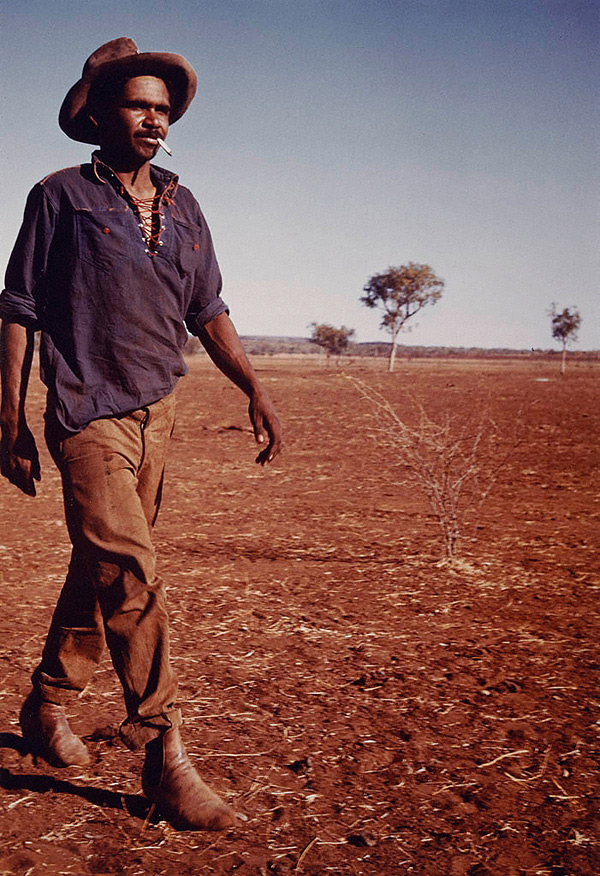
Axel Poignant (England, Australia, England 1906-1986) 'Aboriginal stockman, Central Australia' c. 1947, printed 1982


Axel Poignant (England, Australia, England 1906-1986)
Aboriginal stockman, Central Australia
c. 1947, printed 1982
Type C photograph
35.6 x 24.4cm image/sheet
Purchased 1984
© Courtesy Roslyn Poignant


Though not born in Australia, Axel Poignant’s work is largely about the ‘Outback’, its flora and fauna and the traditions of Australian and Indigenous identity. Poignant was born in Yorkshire in 1906 to a Swedish father and English mother, and arrived in Australia in 1926 seeking work and adventure. After tough early years of unemployment and homelessness, he eventually settled in Perth and found work as a portrait photographer, before taking to the road and the bush in search of new subjects. Poignant became fascinated with the photo-essay as a means of adding real humanity to the medium, and much of his work is in this form. The close relationships he developed with Aborigines on his travels are recorded in compassionate portraits of these people and their lives – the low angles and closely cropped frames appear more natural and relaxed than the stark compositions of earlier ethnographic photography.


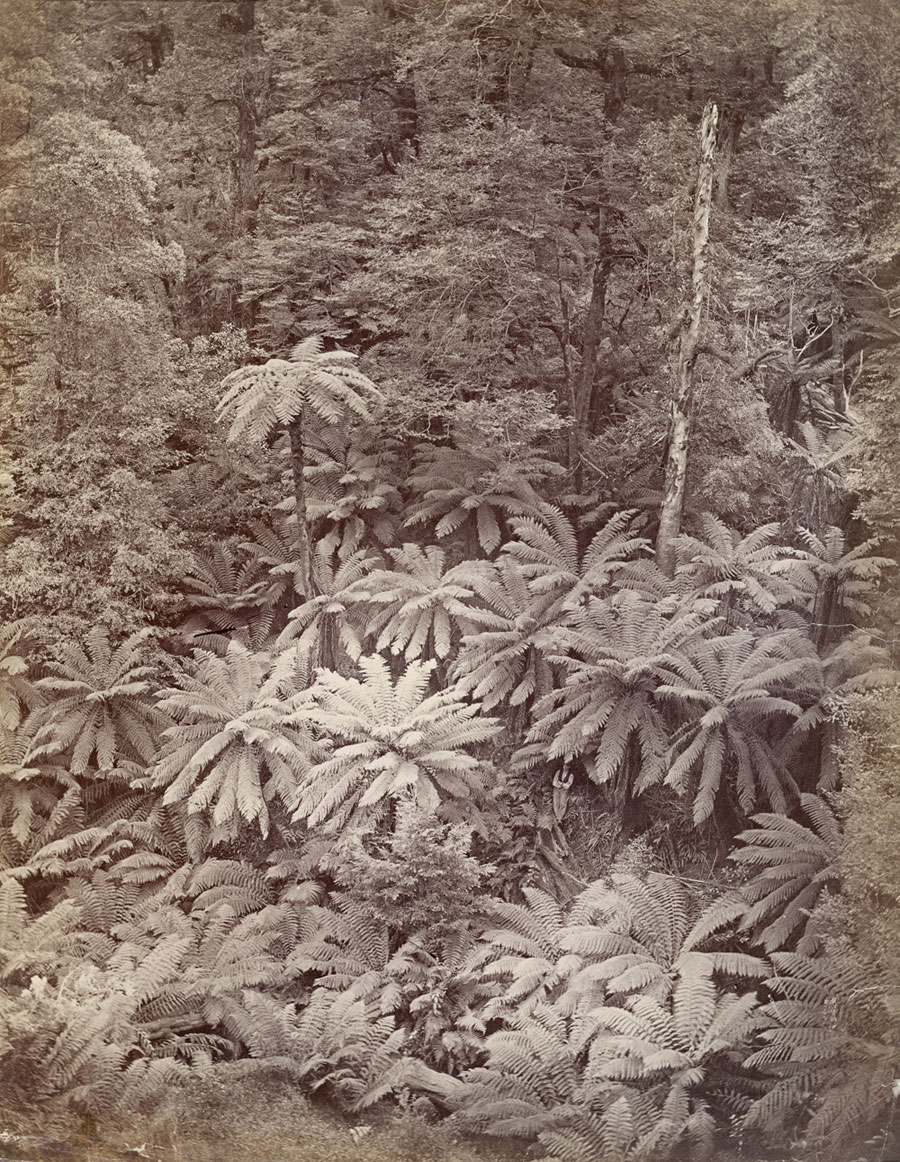
Nicholas Caire (Australian born England, 1837-1918) 'Fairy scene at the Landslip, Blacks' Spur' c. 1878


Nicholas Caire (Australian born England, 1837-1918)
Fairy scene at the Landslip, Blacks’ Spur
c. 1878
Albumen photograph
National Gallery of Victoria, Melbourne, purchased 1994


Nicholas John Caire (28 February 1837 – 13 February 1918) was an Australian photographer. Caire was born in Guernsey, Channel Islands, to Nicholas Caire and Hannah Margeret. As a boy Caire spoke French found he had a passion for photography that his parents encouraged. Caire moved to Adelaide, Australia, along with both his parents in 1860. Around this time Caire Found a mentor in Townsend Duryea. in 1867 he opened his own studio in Adelaide, Australia. He was married to Louisa Master in 1870 and then shortly after moved to Talbot, Victoria where he continued his photography and started to write for Life and Health Magazine. Caire died in 1918 in Armadale, Victoria.


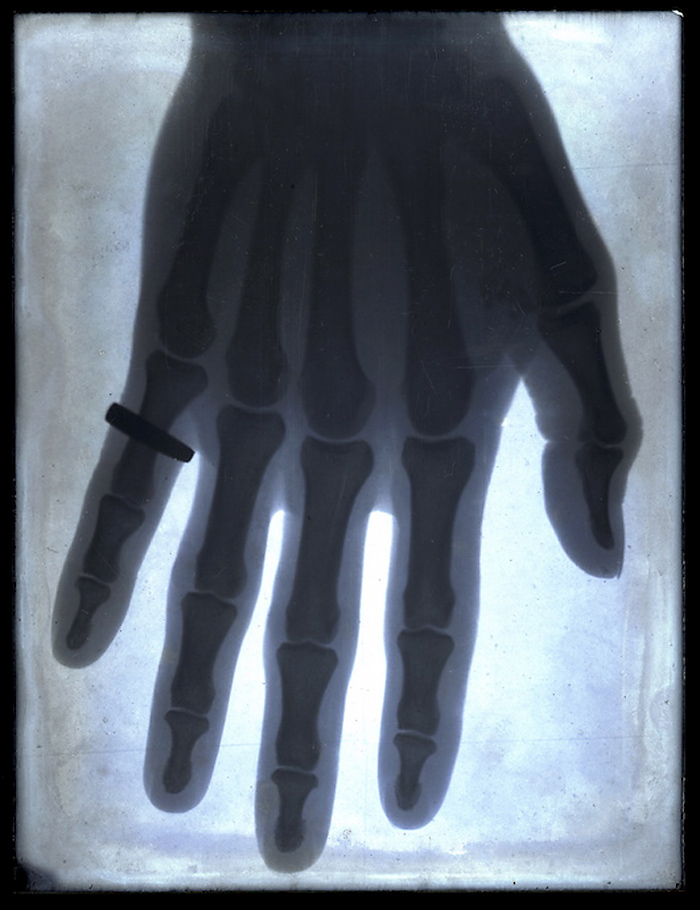
Frank Styant Browne (Australian born England, 1854-1938) 'Hand' 1896


Frank Styant Browne (Australian born England, 1854-1938)
Hand
1896
X-ray
Queen Victoria Museum and Art Gallery collection, Launceston


Art Gallery of New South Wales
Art Gallery Road, The Domain
Sydney NSW 2000, Australia

Opening hours:
Open every day 10am – 5pm
except Christmas Day and Good Friday

Art Gallery of New South Wales website

LIKE ART BLART ON FACEBOOK

Back to top

Exhibition: ”Poor man’s picture gallery’: Victorian Art and Stereoscopic Photography’ at Tate Britain, London

Exhibition dates: 7th October 2014 – 12th April 2015

Curator: Carol Jacobi with Dr Brian May and Denis Pellerin


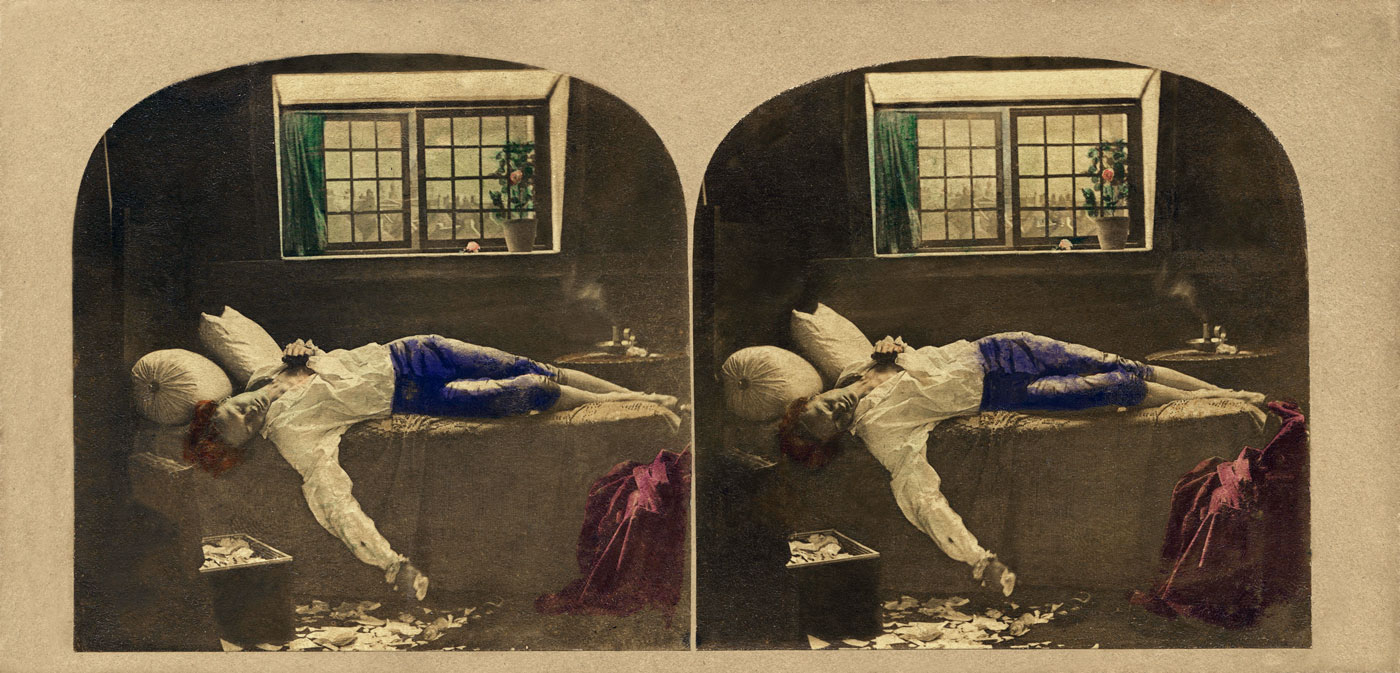
James Robinson (Ireland, 1850s-1870s) 'The Death of Chatterton' 1859


James Robinson (Ireland, 1850s-1870s)
The Death of Chatterton
1859
Two photographs, hand-tinted albumen prints on paper mounted on card
Collection Dr Brian May


I have always been fascinated by early three-dimensional photography, inexpensive stereograph pictures. To me, they are an early form of VR. You bring a machine to your eyes, focus and wham, your in another world – just like wearing an enveloping VR headset. Here are the Pyramids, or the Venice canals, right in front of you. The pictures separate fore, mid and background so there is real depth to the tableaux, like sitting in an iMax cinema and watching old New York come to life. The photographs seem to reach out to you, not just the scene being brought to life, but the transcendence of time as well. This is how these things looked all those years ago in Technicolor 3D. Even now, there is nothing quite like looking through a stereoscope viewer.

In this exhibition we see that, not only did photographers copy famous paintings, but new innovation and mis en scene techniques in photography also inspired painters. “Stereographic techniques of arranging real figures in compositions that were at once carefully composed and naturally spontaneous were particularly pertinent to Pre-Raphaelite painters, who observed and used friends and acquaintances as models in inventive and expressive new poses.”

Both mediums had their advantages: the artistic possibilities of the precocious technology of photography allowed the mind of the viewer “to feel its way into the very depths of the picture” and produce “a surprise such as no painting ever produced.” The photographs added a charm and depth never dreamt of by the original artists, the painters. While “the light and colour [of the photographs] appear crude in comparison with the painting … the stereoscope records ‘every stick, straw, scratch’ in a manner that the painting cannot.” The painters colour harmonies are infinitely more nuanced than the hand-tinted photograph and the brushwork asserts the painter’s individual touch.

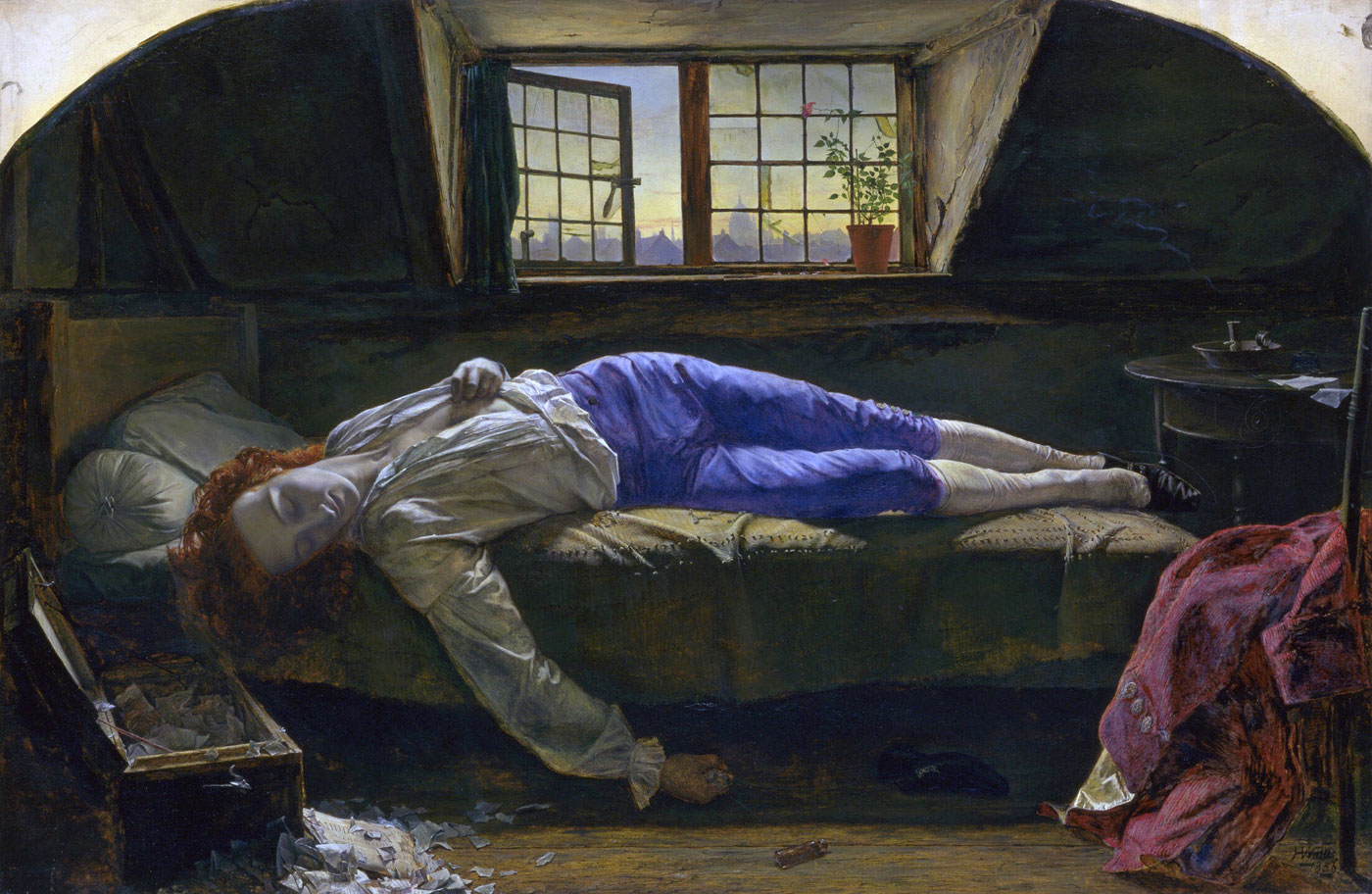
But, as curator Carol Jacobi’s erudite essay “Tate Painting and the Art of Stereoscopic Photography,” (which is well worth the time to read) observes, one medium did not defer to the other but played off each other, working in different form in the service of realism. As Jacobi observes, “The problems and possibilities of realism… underpinned the dialogue between painters and stereographers.” For example, “Robinson’s The Death of Chatterton illustrates the way this uncanny quality [the ability to record reality in detail] distinguishes the stereograph from even the immaculate Pre-Raphaelite style of Wallis’s painting of the same subject.” Jacobi also notes that, “Unlike painting, stereographs exclude things outside the frame. When the eyes come close to the stereoscope lenses and manage to bring the image into focus they experience the sudden sensation of being in the picture… Stereography was a new art. Gaudin’s stereograph can be seen exploring its distinctive characteristics, the actuality of figures and its immersive three-dimensionality, to bring the Pre-Raphaelite painter’s composition to life in new ways.” You only have to look at Alfred Silvester’s The Road, the Rail, the Turf, the Settling Day (The Turf) (detail, below) to understand what Jacobi is proposing.

The actuality and presence of figures and contexts. This is why this form of photography retains its undoubted fascination.

Dr Marcus Bunyan


Many thankx to Tate Britain for allowing me to publish the photographs in the posting. Please click on the photographs for a larger version of the image. My apologies for some of the small images in the posting, that was all I could get!


Henry Wallis (British, 1830-1916) 'The Death of Chatterton' 1856


Henry Wallis (British, 1830-1916)
The Death of Chatterton
1856
Oil paint on canvas
622 x 933mm
Tate. Bequeathed by Charles Gent Clement 1899


‘Poor man’s picture gallery’: Victorian Art and Stereoscopic Photography is the first display in a major British art gallery devoted to early three-dimensional photography. These ingenious but inexpensive stereograph pictures were a nineteenth century craze, circulating world-wide in tens of thousands and more. Pioneers of the art form were quick to challenge fine art itself. Celebrated canvases of the age, such as Henry Wallis’s Chatterton and William Powell Frith’s Derby Day, were recreated in real depth.

This display brings twelve of Tate’s Victorian and Pre-Raphaelite works face to face with a rare collection of their three-dimensional doubles assembled by Brian May. Viewers can finally appreciate the interpretations that the photographers explored and the ways they brought the paintings to life. This display has been curated by Carol Jacobi with Dr Brian May and Denis Pellerin. The Poor Man’s Picture Gallery: Stereoscopy versus Paintings in the Victorian Era by Dr Brian May and Denis Pellerin is published 20 October 2014 by the London Stereoscopic Company.

Text from the Tate Britain website


“Holmes’s 1859 article confirms that, in its earliest moment, stereography was thought of in relation to realist painting. “The first effect of looking at a good photograph through the stereoscope is a surprise such as no painting ever produced,” he declared, “the mind feels its way into the very depths of the picture.” He provides a sophisticated understanding of the artistic possibilities of the precocious technology, at the date at which the stereographs on display at Tate Britain were made, but it is the stereographs themselves which bear this out.”


“Many artists, such as Leonardo da Vinci, understood that the world appears to us in three dimensions because our two eyes see from two slightly different angles (look at your hand with one eye covered, then the other eye covered, and you will see it move and alter slightly). Our mind combines these two views to perceive depth. Leonardo concluded that even the most realistic painting, being just one view, can only be experienced in two dimensions.

Nearly 350 years later, in London, the Victorian scientist Charles Wheatstone (1802-1875) took up the challenge. In 1838, he showed that a pair of two-dimensional pictures represented from slightly different viewpoints, brought together in his ‘stereoscope’, could appear three-dimensional. William Fox Talbot announced his technique of print photography a few months later and soon photographs were being taken in pairs for this purpose. Within a decade special cameras and viewers were invented; stereoscopes and stereographs were soon available worldwide. In 1859, Oliver Wendell Holmes’s essay The Stereoscope and the Stereograph celebrated the invention:

The two eyes see different pictures of the same thing, for the obvious reason that they look from points two or three inches apart. By means of these two different views of an object, the mind, as it were, feels round it and gets an idea of its solidity. We clasp an object with our eyes, as with our arms, or with our hands.


Stereographs sold for a few shillings and people of all classes collected them for education and for pleasure. Small hand-held stereoscopes allowed them to gaze on faraway countries, mechanical inventions, comic incidents, beauty spots, zoological or botanical specimens or celebrity weddings, in the comfort of their homes. Three-dimensional images of famous sculptures were especially successful and Dr Brian May’s and Denis Pellerin’s new book, The Poor Man’s Picture Gallery: Stereoscopy versus Paintings in the Victorian Era (2014) has drawn attention to stereo photographers’ engagement with famous paintings of the age. Tate Britain’s display of some of the stereographs in Brian May’s collection creates a dialogue between these and celebrated Tate works, six of which are discussed here. It also introduces the photographers who, with rapidity and invention, took up this new medium.

The phrase ‘poor man’s picture gallery’, borrowed from print-making, appeared in The Times newspaper in 1858 in an article speculating on making stereographs of ‘our most remarkable pictures’. The writer did not think of these as mere imitations: “So solid and apparently real”, they would have “added a charm never dreamt of by their producers”, the original artists. Interestingly, the writer was discussing attempts to make stereographs from the paintings themselves because, he or she regretted, that such elaborate compositions could never be recreated in real life; “No exertion could gather together the characters with the requisite expression and all the adjuncts of suitable scenery… and retain them still until they were fixed by the camera’. This assertion was incorrect.”

Extract from the essay by Carol Jacobi. “Tate Painting and the Art of Stereoscopic Photography,” on the Tate website 17th October, 2014 [Online] Cited 14/02/2015


James Robinson (Ireland, 1850s-1870s) 'The Death of Chatterton' 1859 (detail)


James Robinson (Ireland, 1850s-1870s)
The Death of Chatterton (detail)
1859
Two photographs, hand-tinted albumen prints on paper mounted on card
Collection Dr Brian May


One of the most famous paintings of Victorian times was Chatterton, 1856 (Tate) by the young Pre-Raphaelite-style artist, Henry Wallis (1830-1916). Again, the tale of the suicide of the poor poet, Thomas Chatterton, exposed as a fraud for faking medieval histories and poems to get by, had broad appeal. Chatterton was also an 18th-century figure, but Wallis set his picture in a bare attic overlooking the City of London which evoked the urban poverty of his own age. The picture toured the British Isles and hundreds of thousands flocked to pay a shilling to view it. One of these was James Robinson, who saw the painting when it was in Dublin. He immediately conceived a stereographic series of Chatterton’s life. Unfortunately Robinson started with Wallis’s scene (The Death of Chatterton, 1859). Within days of its publication, legal procedures began, claiming his picture threatened the income of the printmaker who had the lucrative copyright to publish engravings of the painting. The ensuing court battles were the first notorious copyright cases. Robinson lost, but strangely, in 1861, Birmingham photographer Michael Burr published variations of Death of Chatterton with no problems. No other photographer was ever prosecuted for staging a stereoscopic picture after a painting and the market continued to thrive…

Robinson’s The Death of Chatterton illustrates the way this uncanny quality [the ability to record reality in detail] distinguishes the stereograph from even the immaculate Pre-Raphaelite style of Wallis’s painting of the same subject. The stereograph represented a young man in 18th-century costume on a bed. The backdrop was painted, but the chest, discarded coat and candle were real. Again, the light and colour appear crude in comparison with the painting but the stereoscope records ‘every stick, straw, scratch’ in a manner that the painting cannot. The torn paper pieces, animated by their three-dimensionality, trace the poet’s recent agitation, while the candle smoke, representing his extinguished life, is different in each photograph due to their being taken at separate moments. The haphazard creases of the bed sheet are more suggestive of restless movement, now stilled, than Wallis’s elegant drapery. Even the individuality of the boy adds potency to his death.

Extract from the essay by Carol Jacobi. “Tate Painting and the Art of Stereoscopic Photography,” on the Tate website 17th October, 2014 [Online] Cited 14/02/2015


Michael Burr (British, 1826-1912) 'Hearts are Trumps' 1866


Michael Burr (British, 1826-1912)
Hearts are Trumps
1866
Hand coloured albumen prints on stereo card
Collection Dr Brian May


Michael Burr (British, 1826-1912) 'Hearts are Trumps' 1866 (detail)

Michael Burr (British, 1826-1912) 'Hearts are Trumps' 1866 (detail)


Michael Burr (British, 1826-1912)
Hearts are Trumps (details)
1866
Hand coloured albumen prints on stereo card
Collection Dr Brian May


Stereographic techniques of arranging real figures in compositions that were at once carefully composed and naturally spontaneous were particularly pertinent to Pre-Raphaelite painters, who observed and used friends and acquaintances as models in inventive and expressive new poses. Michael Burr was skilled at intimate scenes; The Death of Chatterton was typical of his use of an unusually shallow, portrait-like space. In 1866, Burr’s Hearts are Trumps (above) photographed three women in modern dress. They interact casually around a card table, and one regards us directly, but they are at the same time artfully positioned equally close the picture plane. This created a natural effect while keeping them the same length from the camera to avoid the distortions that a lens gives to near objects at different distances. Six years on, Sir John Everett Millais adapted the stereograph’s composition in his own Hearts are Trumps (1872, Tate, below). He might have incorporated its informal effect to challenge accusations that had recently appeared in the press that he could not represent modern beauties in contemporary fashion. The life-like size of Millais’s image fills the field of vision with the same impact that the encompassing scene presents in the stereoscope…

Millais’s Hearts are Trumps may have nodded to the alternative stereographic art form, but it did not defer to it. His colour harmonies are infinitely more nuanced than Burr’s hand-tinted photograph. The brushwork whips up extra vivacity and asserts the painter’s individual touch. Nonetheless, Oliver Wendell Holmes argued that stereography had its own artistic possibilities:

The very things which an artist would leave out, or render imperfectly, the photograph takes infinite care with; there will be incidental truths which interest us more than the central object of the picture… every stick, straw, scratch… look at the lady’s hands. You will very probably find the young countess is a maid-of-all-work.


Extract from the essay by Carol Jacobi. “Tate Painting and the Art of Stereoscopic Photography,” on the Tate website 17th October, 2014 [Online] Cited 14/02/2015


Sir John Everett Millais, Bt (English, 1829-1896) '
Hearts are Trumps' 1872


Sir John Everett Millais, Bt (English, 1829-1896)
Hearts are Trumps
1872
Oil on canvas
1657 x 2197mm
Tate. Presented by the Trustees of the Chantrey Bequest 1945


In its style, which recalls the works of the eighteenth-century painter Sir Joshua Reynolds, and in its flattering depiction of the fashionable sitters, this picture expresses a gentle and nostalgic vision of family life. Elizabeth, Diana and Mary, daughters of Walter Armstrong of Scotland and London, were in their twenties when Millais painted them. Mary holds most of the trumps and looks towards the viewer. Delicately, the card game hints at sisterly competition in husband-finding.


William Powell Frith (English, 1819-1909) 'Dolly Varden' c. 1842-1849


William Powell Frith (English, 1819-1909)
Dolly Varden
c. 1842-1849
Oil on wood
273 x 216 mm
Tate. Bequeathed by Mrs E.J. Thwaites 1955


The delightfully fluttery Dolly Varden is a character in Charles Dickens’ novel Barnaby Rudge, published in 1841. Its action is set in the London of the 1780s. Dickens describes Dolly, daughter of a worthy locksmith, as “the very pink and pattern of good looks, in a smart little cherry coloured mantle.” This work, apart from drawing on a well-known novel of the day, also owes much to a strong nineteenth-century tradition of ‘fancy portraits’ – where likenesses of pretty and anonymous young women would be graced by the names of characters from literature.


Frederic Jones (British, active 1861-1868) 'Dolly Varden' 1858


Frederic Jones (British, active 1861-1868)
Dolly Varden
1858
Albumen prints on paper mounted on card
Collection Dr Brian May


The problems and possibilities of realism were fundamental to 19th-century science and literature as well as the arts. It underpinned the dialogue between painters and stereographers. Even painted subjects from history and literature represented by stereographers appear to have been chosen for their familiar, everyday aspects. This shared realism reflected and therefore appealed to 19th-century audiences and was essential to the medium’s success. In 1854 The London Stereoscopic Company was set up on Oxford Street to sell stereographs and stereoscopes. Its first catalogue (1856) advertised scenes as ‘Miscellaneous Subjects of the “Wilkie” character’, referring to the most famous genre painter of the day, Sir David Wilkie. Wilkie’s younger rival, William Powell Frith (1819-1909), and Welsh photographer Frederic Jones (1827 – date not known), a manager of the London Stereographic Company, recreated one of his most popular paintings, Dolly Varden. Frith’s composition was taken in turn from Charles Dickens’s (1812-1870) classic realist novel Barnaby Rudge (1841). It drew on the popularity of the author and book, and was intended to reach a similarly broad audience in the form of engraved prints. Although Dickens’s story was set in the 18th-century, the episode Frith chose, in which Dolly came across a man when she was alone in the woods and laughed bravely, appealed to modern preoccupations with women’s vulnerability and independence. Both Frith’s and Jones’s pictures placed the viewer in the position of the approaching man, but only Jones’s three-dimensional Dolly offered the spectator the opportunity to “clasp an object with our eyes, as with our arms, or with our hands,” as Holmes put it, as her predator does in the book. Fortunately, Dolly eventually eluded his attentions.

Extract from the essay by Carol Jacobi. “Tate Painting and the Art of Stereoscopic Photography,” on the Tate website 17th October, 2014 [Online] Cited 14/02/2015


William Collins (English, 1788-1847) 'Happy as a King' c. 1836 (replica)


William Collins (English, 1788-1847)
Happy as a King (replica)
c. 1836
Oil paint on canvas
711 x 914mm
Tate. Presented by Robert Vernon 1847


Michael Burr (British, 1826-1912) 'Happy as a King' 1865


Michael Burr (British, 1826-1912)
Happy as a King
1865
Hand coloured albumen prints on stereo card
Collection Dr Brian May


Michael Burr (British, 1826-1912) 'Happy as a King' 1865 (detail)


Michael Burr (British, 1826-1912)
Happy as a King (detail)
1865
Hand coloured albumen prints on stereo card
Collection Dr Brian May


Astronomer and Queen‘s guitarist, Dr Brian May has lent a rare collection of Victorian stereographic photographs to Tate Britain. They are featured in ‘Poor man’s picture gallery’: Victorian Art and Stereoscopic Photography until 12 April 2015. This is the first display in a major British art gallery devoted to the nineteenth-century craze of three-dimensional photography, known as stereographs, and open up this neglected area of British art.

In the 1850s and 1860s pioneer photographers staged real men, women and children in tableaux based on famous paintings of the day, in order to bring them to life as three-dimensional scenes. Henry Wallis’ Chatterton 1856, William Powell Frith’s Derby Day 1857 and John Everett Millais’ The Order of Release 1746 are among twelve of Tate’s famous Victorian and Pre-Raphaelite paintings to be shown with their 3D hand-coloured photographic equivalents.

Stereographs comprise two photographs of the same scene taken from fractionally different viewpoints. When these are mounted side by side and viewed through a stereoscope, the viewer sees just one three-dimensional image. Stereographs were inexpensive, and in the 1850s and 1860s they circulated world-wide in their tens of thousands. Many Victorians became familiar with well-known paintings through their stereoscopic counterparts which became known as a ‘Poor Man’s Picture Gallery’. The photographs were regarded by many as fairly disposable, making them hard to track down today.

The display introduces important figures in stereoscopic photography such as Alexis Gaudin and Michael Burr, and shows how some of their innovations also inspired painters. Burr’s stereograph Hearts are Trumps 1866 anticipated John Everett Millais’ voluptuous painting with the same title six years later, and James Elliott’s Derby Day, One Week after the Derby 1858, pre-empted Robert Martineau’s renowned oil painting of family ruin, The Last Day in the Old Home 1862.

Dr Brian May, said: “We’re thrilled that for the very first time Stereographs are now on view at Tate. In this unique display they can be viewed in their full 3-D splendour alongside the beautiful Victorian narrative paintings to which they relate. We’re grateful to Tate Britain, and hope to inspire a new love of stereoscopy in the 21st Century.”

Carol Jacobi, Curator, British Art, 1850-1915, Tate Britain said: “This display allows us to consider the works in Tate’s collection in a new light. We are delighted to be collaborating with Dr Brian May, who has built this collection over 40 years, and with Denis Pellerin, who has researched the connections.”

The photographs exhibited in this display at Tate Britain are kindly lent by Dr Brian May. This display has been curated by Carol Jacobi with Dr Brian May and Denis Pellerin. The book The Poor Man’s Picture Gallery: Stereoscopy versus Paintings in the Victorian Era by Dr Brian May and Denis Pellerin is published by the London Stereoscopic Company on 20 October 2014.

Press release from Tate Britain


Charles Robert Leslie (English, 1794-1859) 'A Scene from Tristram Shandy ('Uncle Toby and the Widow Wadman')' 1829-1830


Charles Robert Leslie (English, 1794-1859)
A Scene from Tristram Shandy (‘Uncle Toby and the Widow Wadman’)
1829-1830, exhibited 1831
Oil paint on canvas
813 x 559mm
Tate. Presented by Robert Vernon 1847


Anonymous photographer. 'Uncle Toby' Nd


Anonymous photographer
Uncle Toby
Nd
Albumen prints on paper mounted on card
Collection Dr Brian May


Sir John Everett Millais, Bt (English, 1829-1896) 'The Order of Release 1746' 1852-1853


Sir John Everett Millais, Bt (English, 1829-1896)
The Order of Release 1746
1852-1853
Oil on canvas
1029 x 737mm
Tate. Presented by Sir Henry Tate 1898


In 1855, the French photographer Alexis Gaudin (1816-1894) saw the Scottish scene from the Jacobite Rebellion, The Order of Release, 1746 by John Everett Millais(1829-1896), at the first Exposition Universelle in Paris. A woman carrying a sleeping child comforts her wounded husband, a defeated rebel, while handing an order for his release to a gaoler. Shortly afterwards, Gaudin made a stereograph, the rare surviving examples of which bear no title, which posed a young woman, child and two men in the same attitudes (Untitled, after Millais, The Order of Release, c. 1855).

Millais’s subject may have appealed to the Frenchman because of its theme of revolution (the Jacobites had been supported by France) and he may have hoped to capitalise on the painting’s popular success. It is notable too, however, that the picture is an example of Pre-Raphaelite realism, not just in appearance, but in the emotions expressed in pose and expression. Millais’s figures were, moreover, renowned as portraits of real people. Pre-Raphaelite painting was a challenge to photography, which Gaudin took up.

Gaudin’s stereograph was not a copy of Millais’s composition; it was a response to it. His image combined a backdrop painted in the conventional way behind the figures with real furniture and a door jutting out in front. Such round and rectangular geometric objects became common in stereographs because they created clear three-dimensional shapes. Like Millais, Gaudin used real models. They express the sternness, despair and stoicism of the gaoler, soldier and wife. The child’s bare legs and feet and head dropping on the mother’s shoulder indicate that s/he is sleeping, innocent of the tense exchange. The dog is probably an example of taxidermy as a real one is unlikely to have stayed still while the photograph, which would have been exposed over several seconds, was taken. Since they were taken and developed, the pictures have been hand-coloured.

Differences between the painting and the stereograph adapted Millais’s image to the new medium and new ideas. The gaoler could be resting the hand holding the order against the rebel’s shoulder to avoid moving and blurring the image, or Gaudin may have liked the juxtaposition of the document of release with the window indicating the outside world. The little dog is less romanticised than Millais’s loyal, silky specimen. It would have been recognisable at the time as a typical British terrier breed, a working dog similar to Bullseye, familiar from Phiz’s illustrations to Dickens’s Oliver Twist (1837). This proletarian touch is compounded by the dog’s apparent interest in the empty food bowl.

Gaudin’s image could conjure reality in ways not available to Millais. Unlike painting, stereographs exclude things outside the frame. When the eyes come close to the stereoscope lenses and manage to bring the image into focus they experience the sudden sensation of being in the picture. Even the tiny scale of the scenes imitates the scale at which distant objects are experienced in life (to get a sense of this, look at a person on the other side of the room and holding your hand near your eye line up your forefinger with their head and your thumb with their feet). This characteristic provided Gaudin with a different way to explore Millais’s theme of imprisonment. The painter created an enclosed feeling for the viewer with a claustrophobic shadowy shallow space. The stereographer used a deeper room so that when seen through the viewer the figure, and the viewer, are enclosed within its walls.

Stereography was a new art. Gaudin’s stereograph can be seen exploring its distinctive characteristics, the actuality of figures and its immersive three-dimensionality, to bring the Pre-Raphaelite painter’s composition to life in new ways. This complexity was admired at the time: “It is a mistake to suppose one knows a stereoscopic picture when he has studied it a hundred times,” Holmes advised. Tate Britain’s display provides the opportunity to view originals with and without the stereoscopic viewer, and examine and appreciate their distinctive approach.

Extract from the essay by Carol Jacobi. “Tate Painting and the Art of Stereoscopic Photography,” on the Tate website 17th October, 2014 [Online] Cited 14/02/2015


Alexis Gaudin (French, 1816-1894) 'Untitled, after Millais, The Order of Release' c. 1855


Alexis Gaudin (French, 1816-1894)
Untitled, after Millais, The Order of Release
c. 1855
Two photographs, hand-tinted albumen prints on paper mounted on card
Collection Dr Brian May


Alexis Gaudin (French, 1816-1894) 'Untitled, after Millais, The Order of Release' c. 1855 (detail)


Alexis Gaudin (French, 1816-1894)
Untitled, after Millais, The Order of Release (detail)
c. 1855
Two photographs, hand-tinted albumen prints on paper mounted on card
Collection Dr Brian May


Philip Hermogenes Calderon (English born France, 1833-1898) 'Broken Vows' 1856


Philip Hermogenes Calderon (English born France, 1833-1898)
Broken Vows
1856
Oil paint on canvas
914 x 679mm
Tate, purchased 1947


James Elliott (British, active 1860s) 'Broken Vows' Nd


James Elliott (British, active 1860s)
Broken Vows
Nd
Two photographs, hand-tinted albumen prints on paper mounted on card
Collection Dr Brian May


James Elliott (British, active 1860s) 'Broken Vows' Nd (detail)


James Elliott (British, active 1860s)
Broken Vows (detail)
Nd
Two photographs, hand-tinted albumen prints on paper mounted on card
Collection Dr Brian May


William Powell Frith (English, 1819-1909) 'The Derby Day' 1856-1858


William Powell Frith (English, 1819-1909)
The Derby Day
1856-1858
Oil paint on canvas
1016 x 2235mm
Tate. Bequeathed by Jacob Bell 1859


When The Derby Day was first exhibited at the Royal Academy in 1858, it proved so popular that a rail had to be put up to keep back the crowds. It presents a panorama of modern Victorian life, a previously unknown genre which Frith largely created in his earlier work, Life at the Seaside, Ramsgate Sands of 1854 (Royal Collection). Frith was a firm believer in the spurious sciences of phrenology and social type, which considered people’s characters and social origins were visible in their physical features. Each character in Frith’s picture is depicted to conform to these stereotypes, notably in the range of criminal and low-life types present (see Cowling 1989, Ch.2).

On the basis of an initial sketch, which he made after a visit to Epsom in 1856, Frith was commissioned by Jacob Bell, a chemist and amateur artist, to paint a large 5-6 foot canvas for £1,500. He worked on the project for fifteen months, producing two large sketches in addition to the finished work. He brought the composition together with the aid of drawings and sketches, hiring models to pose for all the main figures. He also commissioned the photographer Robert Howlett to “photograph for him from the roof of a cab as many queer groups of figures as he could” (Journal of the Photographic Society, 15 January 1863). He asked a real jockey called Bundy to pose on a hobbyhorse in his studio for the riders on the right of the picture, and also hired an acrobat and his son, whom he saw performing in a pantomime in Drury Lane. For the remaining figures he called on family and friends, as well as a string of young women sent by Jacob Bell.

Despite a remarkable feat of organisation, the picture remains fairly static, and the figures are more interesting when examined individually. There are three main incidents taking place in the picture. On the far left, next to the Reform Club’s private tent, a group of men in top hats focus on the thimble-rigger with his table, inviting the audience to participate in the game. The man taking a note from his pocket is the trickster’s accomplice. He is tempting the rustic-looking man in a smock, whose wife is trying to restrain him. On the right of this group, another man, with his hands in his pockets, has had his gold watch stolen by the man behind. In the centre of the picture we see the acrobat and his son, who looks longingly over at a sumptuous picnic being laid out by a footman. Behind them are carriages filled with race-goers, including a courtesan on the far right, who is the kept mistress of the foppish-looking character leaning against the carriage. The courtesan is balanced on the far left of the picture by the woman in a dark riding habit, one of a number of high-class prostitutes who daily paraded on horseback in Hyde Park.

Text from the Tate website


Alfred Silvester (British, active 1850s-1860s) 'The Road, the Rail, the Turf, the Settling Day (The Rail Second Class)' 1859


Alfred Silvester (British, active 1850s-1860s)
The Road, the Rail, the Turf, the Settling Day (The Rail Second Class)
1859
Two photographs, hand-tinted albumen prints on paper mounted on card
Collection Dr Brian May


Alfred Silvester (British, active 1850s-1860s) 'The Road, the Rail, the Turf, the Settling Day (The Rail Second Class)' 1859 (detail)


Alfred Silvester (British, active 1850s-1860s)
The Road, the Rail, the Turf, the Settling Day (The Rail Second Class) (detail)
1859
Two photographs, hand-tinted albumen prints on paper mounted on card
Collection Dr Brian May


Alfred Silvester (British, active 1850s-1860s) 'The Road, the Rail, the Turf, the Settling Day (The Turf)' 1859


Alfred Silvester (British, active 1850s-1860s)
The Road, the Rail, the Turf, the Settling Day (The Turf)
1859
Two photographs, hand-tinted albumen prints on paper mounted on card
Collection Dr Brian May


Alfred Silvester (British, active 1850s-1860s) 'The Road, the Rail, the Turf, the Settling Day (The Turf)' 1859 (detail)


Alfred Silvester (British, active 1850s-1860s)
The Road, the Rail, the Turf, the Settling Day (The Turf) (detail)
1859
Two photographs, hand-tinted albumen prints on paper mounted on card
Collection Dr Brian May


The relationship between photography and painting went two ways. In the mid 1850s, Frith began to use photographs to help him paint elaborate and up-to-date scenes on a very large scale. Lively descriptions of racegoers at Epsom often appeared in popular magazines such as Punch (1949) and Dickens’s Household Words (Epsom, 1852) and between 1856 and 1858 he created a panorama of the crowds, Derby Day (Tate). It caused a sensation. Its quality of reflecting its modern audience is clear from a contemporary comment from the Birmingham Daily Post:

“Frith’s picture will conjure around it as great a crowd of gazers as any to be found even on the most crowded part of the racecourse.”


Stereography had the potential to take the viewer inside the crowd’s jostling and excitement. “The elbow of a figure stands forth so as to make us almost uncomfortable,” as Holmes observed. To this end, the London photographer Alfred Silvester (1831-1886) published two series based on the Epsom Races, National Sports, The Race-course of which there are several variations echoing the different scenes within Frith’s painting, and The Road, the Rail, the Turf, the Settling Day (1859) a series of five. They were the portrait shape required by the stereoscope rather than panoramas like Frith’s painting, but Silvester squeezed in dozens of people. The Turf (below) contained an astonishing 60 gesticulating figures in front of a painted backdrop of more distant crowds. Carriage wheels and cylindrical top hats occupy the foregrounds to enhance the three-dimensional effect.

Silvester expanded Frith’s narrative in time as well as content (moving pictures were still 40 years away). The Road, the Rail, the Turf, the Settling Day began with the exodus from London to Epsom Downs and ended with the settlement of bets. This narrative momentum was complemented by motion within the pictures. In The Road, aristocrats ride in their fine carriages while in The Rail (Second Class) (above) and The Rail (Third Class) the less well-to-do travel on the new railway from London Bridge to Sutton, opened in 1847. The Turf shows three horses (sculpted from papier mâché and rather reminiscent of those in the Elgin Marbles in the British Museum) plunging headlong through the crowd. Further movement is contributed by the people. In each, Silvester orchestrated incessant activity in poses which betray no hint that they were held for several seconds. The Turf is the most spectacular, where all 60 people cheer and gesticulate. In The Rail (Second Class) a man kneels solicitously offering refreshment to a woman who appears to have fainted. Her child and others look on while an older gentleman (whose covered nose suggests he may be suffering from syphilis) shows his disapproval. The action continues into depth; in the background two men fight with bottles and a white top-hatted figure looms troublingly over a young girl.

Such photographs informed and challenged the naturalism of Frith’s painting and influenced others of the period. William Maw Egley’s (1826-1916) Omnibus Life in London (1859, below) depicted the discomforts, intrusions and intrigues of mass transport from a viewpoint within – or just outside – the carriage (an omnibus in this case, introduced 1826) which envelops the observer in a similar manner to Silvester’s The Rail (Second Class).

Extract from the essay by Carol Jacobi. “Tate Painting and the Art of Stereoscopic Photography,” on the Tate website 17th October, 2014 [Online] Cited 14/02/2015


William Maw Egley (English, 1826-1916) 'Omnibus Life in London' 1859


William Maw Egley (English, 1826-1916)
Omnibus Life in London
1859
Oil on canvas
448 x 419mm
Tate. Bequeathed by Miss J. L. R. Blaker 1947


The painting of modern-life subjects was popularised during the 1850s by such artists as William Frith (1819-1909). Artists deliberately chose subjects such as racetracks, seaside resorts and busy streets where all classes of society could be represented in the one picture. Following this trend, Egley exhibited Omnibus Life in London at the British Institution in 1859. He may have been inspired by the French artist Honoré Daumier’s pictures of the cramped interior of railway carriages, but comparisons can also be drawn with such works as Charles Rossiter’s To Brighton and Back for 3s 6d (Birmingham City Museum and Art Gallery), painted in the same year as Egley’s picture.

The omnibus – a horse-drawn carriage that picked up and deposited people along an established route – was introduced into London on 4 July 1829 and quickly became a popular mode of transport. One observer commented that, “Among the middle classes of London the omnibus stands immediately after air, tea, and flannel, in the list of the necessaries of life… the Londoner cannot get on without it.” (M.E. Purgini in Victorian Days and Ways, London 1936). To achieve as authentic an effect as possible, Egley painted the interior of the omnibus in a coach builder’s yard in Paddington. The view out of the back of the bus is of Westbourne Grove, painted from the chemist’s shop at the corner of Hereford Road where Egley lived. He posed the sitters in a makeshift ‘carriage’ constructed from boxes and planks in his back garden.

Egley painted the scene as if glimpsed through a window and attempted to convey the claustrophobic and cramped conditions that the passengers were forced to endure. The subject permitted him to portray every class of society, from an old country woman, perhaps a family servant, with her piles of baggage, to the city clerk with his cane. The old woman stares sympathetically towards the young mother and her children, who avert their gazes, in a gesture of gentility. The mother was modelled on Egley’s wife and the ringletted daughter was posed for by a twelve-year old girl, Susannah (Blanche) Rix.

Egley worked on the picture for 44 days and sold it to a man called William Jennings for £52 10s. It was described by the Illustrated London News as follows: “a droll interior, the stern and trying incidents of which will be recognised by thousands of weary wayfarers through the streets of London.”

Text from the Tate website


James Elliott. 'The Last Look' 1858


James Elliott
The Last Look
1858
Two photographs, hand-tinted albumen prints on paper mounted on card
Collection Dr Brian May


Similarly, a series by James Elliott (1833-?) charting the aftermath of the Derby appears to have pre-empted The Last Day in the Old Home 1862 (Tate, below) by Robert Braithwaite Martineau (1826-1869). Elliott’s One Week after the Derby extended Frith’s Derby Day into the future to show an auctioneer assessing the belongings of a family ruined by the races. The Last Look (above) shows them leaving their house. Lot numbers have been attached to the furniture and in the background a servant, who has also lost her home, weeps. A horse print on the floor hints at the husband’s extravagant habits and only the grandmother, wife and daughter look back with regret. The last picture, Sold Up, shows the auction. The doll’s house which the little girl must to leave behind, a miniature replica of her home and her aspirations for the future is placed poignantly in the foreground. These narratives and motifs had been widely used in literature and cartoons since the time of William Hogarth, but Martineau’s image of a middle-class family forced to sell their home is close to Elliott’s The Last Look. Martineau adopted a photographic composition, figures enclosed within a room cluttered with clues to both narrative and depth. A stereograph-style view into another space shows men assessing possessions. Lot numbers are attached to the furniture. Another horse image suggests gambling. Once more, the women show regret while the husband appears unconcerned, cheerily leading his son down the same path.

Extract from the essay by Carol Jacobi. “Tate Painting and the Art of Stereoscopic Photography,” on the Tate website 17th October, 2014 [Online] Cited 14/02/2015


Robert Braithwaite Martineau. 'The Last Day in the Old Home' 1862


Robert Braithwaite Martineau
The Last Day in the Old Home
1862
Oil on canvas
1073 x 1448mm
Tate. Presented by E.H. Martineau 1896


Tate Britain
Millbank, London SW1P 4RG
United Kingdom
Phone: +44 20 7887 8888

Opening hours:
10.00 am – 18.00 pm daily

Tate Britain website

LIKE ART BLART ON FACEBOOK

Back to top