Review: ‘Desire’ paintings and video by Judith Wright at Sophie Gannon Gallery, Melbourne

Exhibition dates: 19th May – 13th June, 2009
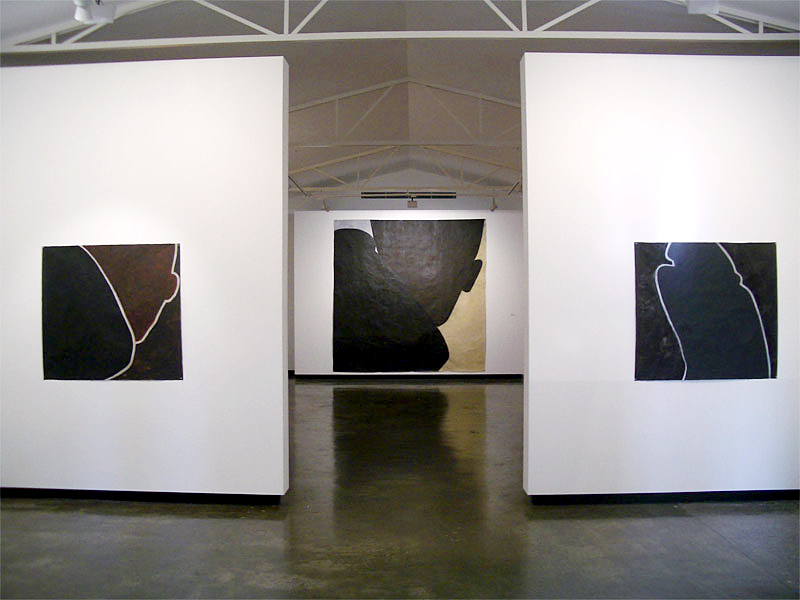
 

Installation view of Judith Wright's exhibition 'Desire' at Sophie Gannon Gallery, Melbourne

Installation view of Judith Wright's exhibition 'Desire' at Sophie Gannon Gallery, Melbourne


Installation views of Judith Wright’s exhibition Desire at Sophie Gannon Gallery, Melbourne


On a beautiful sunny Autumn afternoon in Melbourne I made a visit to Space Furniture on Church Street to ogle at the wondrous designs and then to the galleries of Albert Street in Richmond for three outstanding painting exhibitions: John Beard at John Buckley Gallery, McLean Edwards at Karen Woodbury Gallery and Judith Wright at Sophie Gannon Gallery. First cab off the rank is Judith Wright but reviews of the other two shows will follow…

There is a part in Jim Jarmusch’s film Ghost Dog: The Way of the Samurai (1999) where the anti-hero stares into the eyes of a dog and Jarmusch just holds the scene for what seems like an eternity. The camera observes the infinite bond between human and animal, an almost palpable connection across time and space, with an unflinching eye. The same can be said of Judith Wright’s encaustic paintings (also known as hot wax painting, involves using heated beeswax to which coloured pigments are added) but here she pushes the relationship further – into an investigation of the animal in the human and vice versa, and their erotic charge when placed together. Here is the carnivalesque at it most daring, most paired back, revealing in quiet Zen like compositions the dissolution of boundaries between both states of being.

Nominally based on the symbology of characters presented in two videos in the exhibition (masked figures playing with each other, a comical goats head with horns being one figure) the paintings are much more interesting than the videos. Painted on Japanese paper in wax and acrylic the biomorphic forms of babies heads, torsos and sculpted free forms and designs suggestive of living organisms address the title of the exhibition: desire!

Wright plays with scale and form, using earth tones and a luminous palette of oranges, yellows and pinks. Her shape-shifting paintings work to unhinge stagnant systems of thought that surround identity and the body. The waxed Japanese paper adds to the sensuality of the skin-like work. A baby seems to feed on a double nipple but the nipple has missed the mouth and is invading the eye. Forms intersect and the sensual shapes slip over each other: as in the Zen idea of ‘satori’ or enlightenment attained when two circles intersect here we have the intersection of an erotic enlightenment.

As Russian theorist Mikhail Bakhtin notes the carnivalesque is the contravention of normal laws of behaviour, “and he proposes that the carnivalesque is also the home of the grotesque, where otherwise antithetical properties or characteristics are matched together in the same being: beast with human, youth with age, male with female.”1

“The carnival offers the chance to have a new outlook on the world, to realise the relative nature of all that exists, and to enter a completely new order of things.”2


And this is what these paintings propose: a new order of things, a chance for desires formed of new pleasures.

As Michel Foucault has observed,

“The possibility of using our bodies as a possible source of very numerous pleasures is something that is very important. For instance, if you look at the traditional construction of pleasure, you see that bodily pleasure, or pleasures of the flesh, are always drinking, eating and fucking. And that seems to be the limit of the understanding of our bodies, our pleasures … It is very interesting to note, for instance, that for centuries people generally, as well as doctors, psychiatrists, and even liberation movements, have always spoken about desire, and never about pleasure. “We have to liberate our desire,” they say. No! We have to create new pleasure. And then maybe desire will follow.”3


In their luminosity, in their skin-like textures, in their balance between the colour of the paper, the dark voids and the brown of babies heads we feel the sharp intake of the cold breathe of winter on the nostrils – we feel an evocation of new pleasure, of possible desires within us and the loosening of the grip of conformity. Like the perfect placement of rocks in a Japanese garden and the ripples of the gravel, of a reality that swirls around them these paintings open hearts and minds to inner states of being unexperienced before. And yes, I did enjoy the ride.

Dr Marcus Bunyan


Many thankx to Sophie Gannon Gallery for allowing me to publish the art work in the posting. Please click on some of the photographs for a larger version of the image.


1/ Buchbinder, David. Masculinities and Identities. Melbourne: Melbourne University Press, 1994, p. 53. For a discussion of carnivalesque see Bakhtin, Mikhail. Rabelais and his World (trans. Hélène Iswolsky). Bloomington: Indiana University Press, 1984, pp. 196-277, 303-367.

2/ Bakhtin, Mikhail. Rabelais and his World (trans. Hélène Iswolsky). Bloomington: Indiana University Press, 1984, p. 34.

3/ Gallagher, Bob and Wilson, Alexander. “Sex and the Politics of Identity: An Interview with Michel Foucault,” in Thompson, Mark. Gay Spirit: Myth and Meaning. New York: St. Martin’s Press, 1987, p. 31.
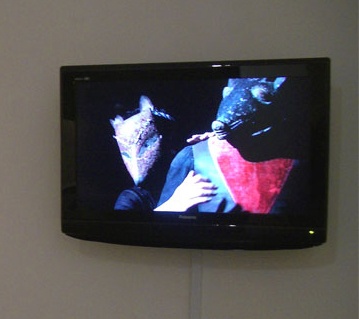


Judith Wright video installation


Judith Wright (Australian, b. 1945) 'Desire [14]' 2009 from the exhibition 'Desire' paintings and video by Judith Wright at Sophie Gannon Gallery, Melbourne, May - June, 2009


Judith Wright (Australian, b. 1945)
Desire [14]
2009
Acrylic and wax on Japanese paper
200 x 200cm


Judith Wright (Australian, b. 1945) 'Desire [5]' 2009 from the exhibition 'Desire' paintings and video by Judith Wright at Sophie Gannon Gallery, Melbourne, May - June, 2009


Judith Wright (Australian, b. 1945)
Desire [5]
2009
Acrylic and wax on Japanese paper
100 x 100cm


Judith Wright (Australian, b. 1945) 'Desire [7]' 2009


Judith Wright (Australian, b. 1945)
Desire [7]
2009
Acrylic and wax on Japanese paper
100 x 100cm


Judith Wright (Australian, b. 1945) Desire [16]' 2009


Judith Wright (Australian, b. 1945)
Desire [16]
2009
Acrylic and wax on Japanese paper
300 x 300cm


Judith Wright (Australian, b. 1945) 'The Gift [2]' 2009


Judith Wright (Australian, b. 1945)
The Gift [2]
2008
Acrylic and wax on Japanese paper


Judith Wright (Australian, b. 1945) 'The Gift [7]' 2008


Judith Wright (Australian, b. 1945)
The Gift [7]
2008
Acrylic and wax on Japanese paper


Sophie Gannon Gallery
2, Albert Street, Richmond, Melbourne
Phone: +61 3 9421 0857

Opening hours:
Tuesday – Saturday 11am – 5pm

Sophie Gannon Gallery website

LIKE ART BLART ON FACEBOOK

Back to top

Review: ‘My Jesus Lets Me Rub His Belly’ exhibition by Martin Smith at Sophie Gannon Gallery, Melbourne

Exhibition dates: 21st April – 16th May, 2009


Martin Smith (Australian, b. 1972) 'Hot/humid/oppressive/stifling/still' 2009 from the exhibition 'My Jesus Lets Me Rub His Belly' by Martin Smith at Sophie Gannon Gallery, Melbourne, April - May, 2009


Martin Smith (Australian, b. 1972)
Hot/humid/oppressive/stifling/still
2009
Pigment print and collage
90 x 130cm


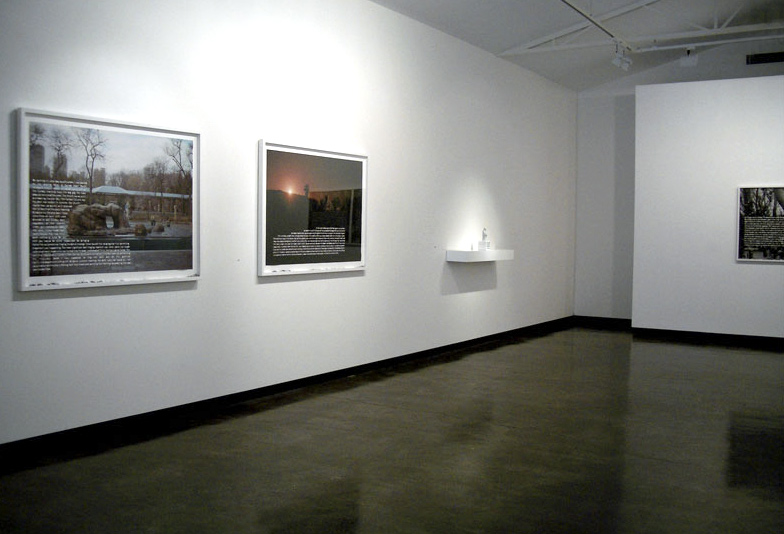
This is an interesting, well constructed exhibition of photographs, collage and sculpture by Martin Smith presented at Sophie Gannon Gallery, Melbourne that addresses issues of place and faith: memories of growing up within a religious framework. The work is well resolved, the themes explored are poignant, full of pathos, laden with sardonic humour and pull no punches.

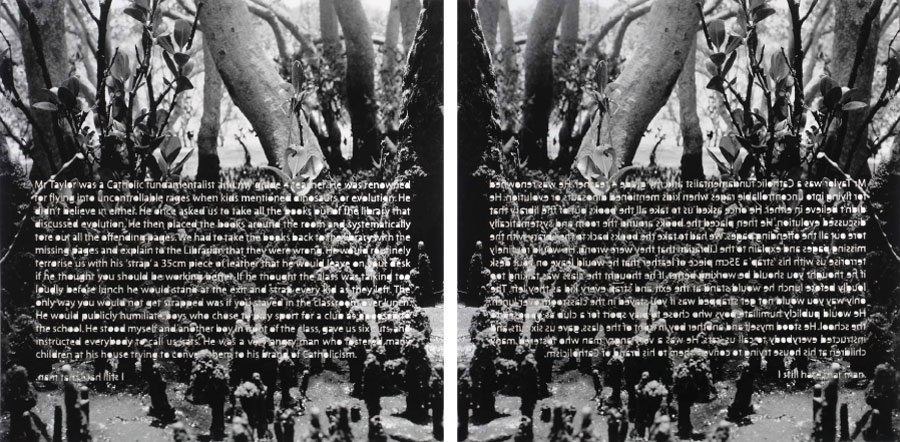
The main body of the exhibition are contemporary personal photographs of sunsets, landscapes and urban spaces (such as the photograph of Central Park in New York, above). Incised into the surface of the photograph, actually cut into the surface, are narratives of boredom, anger and the blind injustice of devotion, memories of stories of a fifteen year old boy. In some of the photographs the lettering follows the pictorial representation of the photograph, in others it overwrites it. The cut letters fall away to the bottom of the picture and are captured by the picture frame, sitting at the bottom of each image like the leaves of autumn – half remembered stories that become jumbled in the mind, played over and over again.

These images consolidate both photographic and written texts while at the same time undermining their veracity and referentiality. Image and text are performative, playing off of each other to provide a transgressive textuality that becomes a mode of agential resistance capable of fragmenting and releasing the subject. In this engagement between image and text the work becomes intertextual, the ritual of production engaging a network of texts, a discursive multiplicity that traverses the entire scope of social, cultural, and institutional production. The childhood taboo of not criticising ‘faith’ is cross/ed in the process of re-remembering, re-inscription.

In these assemblages the surface of the photograph and the body of the text are subverted through a ritualised cutting, like the incision of the stigmata into the body of Christ. They become sites of resistance. As Deleuze and Guittari have noted of this process the site of resistance is both a productive and disruptive re-territorialization and de-territorialization of meaning:

“For them (Deleuze and Guattari), assemblages are the processes by which various configurations of linked components function in an intersection with each other, a process that can be both productive and disruptive. Any such process involves a territorialization; there is a double movement where something accumulates meanings (re-territorialization), but does so co-extensively with a de-territorialization where the same thing is disinvested of meanings. The organization of a territory is characterized by such a double movement … An assemblage is an extension of this process, and can be thought of as constituted by an intensification of these processes around a particular site through a multiplicity of intersections of such territorializations.”1


The particular site, the particular intersection that Smith addresses in his work is that of memory, faith and place. The lack of fixity in this intersection provides the artist with abundant opportunity to reinscribe the already inscribed ritual of faith, subverting the iteration of the norms already attributed to it, providing a loss of original meaning and the gaining of new meanings. This productive, disruptive re-inscription provides the positionality of the work and the viewer struggles with the emotional conflicts that result from this territorialization: even if you don’t know these stories they challenge what you believe, now.

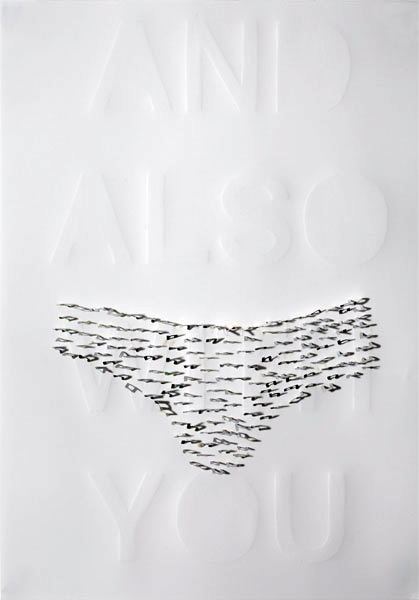
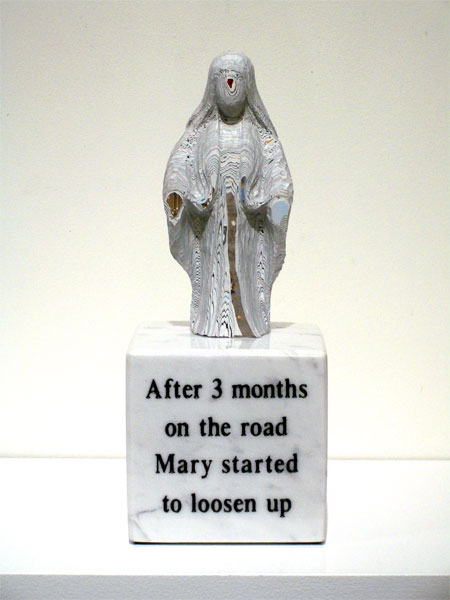
Counterbalancing the colour photographs are white collages that are embossed with the answer to the celebrants greeting “The Lord be with you” to which the people respond “And also with you.” Hovering in the background of the work the words are again subverted, this time in a resurrection of cut letters – instead of being cut into the photograph the letters project outwards towards the viewer forming commodified shapes such as cars, underpants and people. The joy doesn’t stop there: the two sculptures in the exhibition add to the chaos with a wonderful sense of humour.

Through their hypertexts the work “becomes more and more layered until they are architectural in design, until their relationship to the context from which they have grown cannot be talked about through the simple models offered by referentiality, or by attributions of cause and effect.”2

Without absolute attribution the work becomes a form of transubstantiation. The flexibility of memory and the orthodoxy of religion are transformed into a spirituality of the self that the child of fifteen with blood running down his arms from his personal stigmata of boredom could never have imagined. At the end of days, when all is said and done, the funny diatribes with their ambiguous photographs are homily and heretic, and together form a more inclusive body of bliss: ‘And also with you and you and you and you’.

Whatever your faith, whoever you are.

Dr Marcus Bunyan


1/ Wood, Aylish. “Fresh Kill: Information technologies as sites of resistance,” in Munt, Sally (ed.,). Technospaces: Inside the New Media. London: Continuum, 2001, p. 166

2/ Burnett, Ron. Cultures of Vision: Images, Media, & the Imaginary. Bloomington: Indiana University Press, 1995, pp. 137-138

Thank you to Edwin Nicholls for his help.


Martin Smith (Australian, b. 1972) 'Hot/humid/oppressive/stifling/still' 2009 (detail)


Martin Smith (Australian, b. 1972)
Hot/humid/oppressive/stifling/still (detail)
2009
Pigment print and collage
90 x 130cm


Installation view of Martin Smith's exhibition 'My Jesus Lets Me Rub His Belly' at Sophie Gannon Gallery, Melbourne


In the above installation photograph you can just see the cut letters lying at the bottom of the picture frame


Martin Smith (Australian, b. 1972) 'I still hate that man' 2009 from the exhibition 'My Jesus Lets Me Rub His Belly' by Martin Smith at Sophie Gannon Gallery, Melbourne, April - May, 2009


Martin Smith (Australian, b. 1972)
I still hate that man
2009
Pigment print and collage
130 x 180cm


Martin Smith (Australian, b. 1972) 'My Frenetic, Anxiety Driven Snuffing' 2009


Martin Smith (Australian, b. 1972)
My Frenetic, Anxiety Driven Snuffing
2009
Pigment print and collage
90 x 130cm


Artist statement

I grew up in the bayside suburbs of Brisbane, Australia with a speech impediment. My teenage years were spent watching and observing, as I was too embarrassed to speak. My inability to express myself during this time left an indelible mark on my personal history and has provided the impetus for my artistic enquiries. Therefore it is no surprise that my art practice is primarily about language and the modes of representation used to express and interpret personal experience.

Among the studio methodologies that I employ are the combination of traditional story telling writing with vernacular photography. The text and the images have no literal relationship and I am very careful to avoid any obvious connection between the two. I write personal stories then hand-cut the text out of the image. The removed letters from the image are collected and captured by the picture frame, sitting at the bottom of each image like fallen leaves creating an Autumnal scene where visible change has occurred and the picture and the figure are going through a transition. The text punctures the surface of the image disrupting the way we view and read the work. We can’t fully view the image because of the text and we can’t read the text without the image creating a constant back and forth between the two. When viewing the visual and textual oscillation between the two narrative devices that have no literal connection we find balance outside the picture frame in a new discursive space. It is through this collision of narrative and languages that unique interpretations of personal experience are built. I am interested in exploring spaces of meaning that are created when two or more narrative devices are blended.

In other works the letters are also glued directly onto the wall of the gallery to form recognisable but featureless figures. These installations explore how meaning and identity are generated through language. The individual letters (the building blocks of language) combine together to form a representation of a life that exists only through the formulation of language.

Recently I performed a stand-up ‘comedy’ routine as another vehicle for exploring story-telling and personal histories. The routine titled “Hello Newmarket Hotel” was performed at an ‘open mic’ night in front of a regular comedy audience. The aim was to recreate and recontextualise a particularly painful childhood memory while incorporating known ‘comedy’ tropes. This work along with my whole practice is interested in the role that photography, and other forms of narrative, plays in the construction of our identity and how personal histories are written and interpreted.

Martin Smith 2017


Martin Smith (Australian, b. 1972) 'The Relationship Blossomed' 2009


Martin Smith (Australian, b. 1972)
The Relationship Blossomed
2009
Pigment print and collage
115 x 115cm


Martin Smith (Australian, b. 1972) 'The Relationship Blossomed' 2009 (detail)


Martin Smith (Australian, b. 1972)
The Relationship Blossomed (detail)
2009
Pigment print and collage
115 x 115cm


Martin Smith (Australian, b. 1972) 'The Homily' 2009


Martin Smith (Australian, b. 1972)
The Homily
2009
Pigment print and collage
130 x 90cm


Martin Smith (Australian, b. 1972) 'And also with you #2' 2009


Martin Smith (Australian, b. 1972)
And also with you #2
2009
Collage on paper, eva
42 x 30cm


Martin Smith (Australian, b. 1972) 'And also with you #3' 2009


Martin Smith (Australian, b. 1972)
And also with you #3
2009
Collage on paper, eva
42 x 30cm


Martin Smith (Australian, b. 1972) 'After 3 months on the road Mary started to loosen up' 2009


Martin Smith (Australian, b. 1972)
After 3 months on the road Mary started to loosen up
2009
Photographic carving on marble base
18 x 10 x 10cm


Sophie Gannon Gallery
2, Albert Street
Richmond, Vic 3121

Opening hours:
Tuesday – Saturday 11am – 5pm

Sophie Gannon Gallery website

LIKE ART BLART ON FACEBOOK

Back to top

Opening 2: ‘Urban Edge’ photographs by John Bodin at Anita Traverso Gallery, Melbourne

Exhibition dates: 6th May – 30th May, 2009


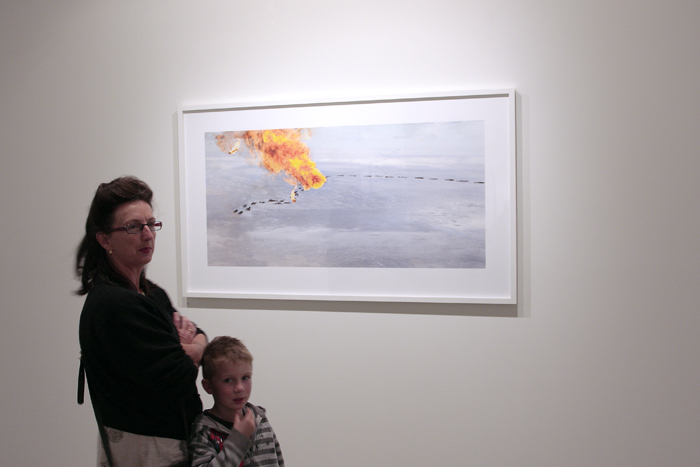
Opening night crowd for John Bodin exhibition at Anita Traverso Gallery, Melbourne

John Bodin photographs at Anita Traverso Gallery, Melbourne


Opening and installation views of John Bodin’s exhibition Urban Edge at Anita Traverso Gallery, Melbourne


“Each one of us, then, should speak of his roads, his crossroads, his roadside benches; each one of us should make a surveyor’s map of his lost fields and meadows … Thus we cover the universe with drawings we have lived …

Space calls for action, and before action, the imagination is at work. It mows and ploughs. We should speak of the benefits of all these imaginary actions.”


Gaston Bachelard The Poetics of Space


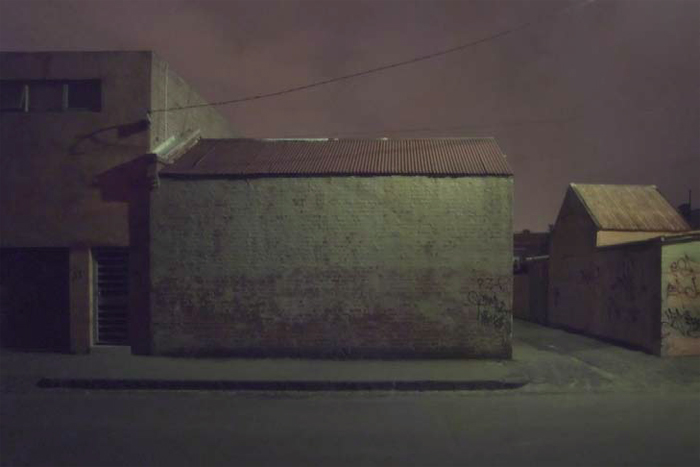
More interesting are the eerie contemplative photographs of John Bodin presented at Anita Traverso Gallery, Melbourne, our second opening of the night. In a well presented show Bodin’s hyper-real photographs employ a limited colour palette to portray the constructed landscape of the urban fringe. The images work well because the artist leaves room for doubt in the mind of the viewer – what am I looking at, where is it, do I subconsciously remember these places? How do the photographs make me feel about the edges of the world, this strangeness that we inhabit? They engage the viewer in a fluid architecture of space and place.

Light and colour are important tools for Bodin and he plays with their form, darkening pavements, shooting at night, making subtle negative interpretations of roads and underground car-parks while desaturating buildings, landscapes and skies of ‘natural’ colour. Walls bleed in Witchhunt (2007) and then you work out the photograph is taken under a bridge with a pavement, graffiti providing the title of the work. Blue light emotes from behind the cloaked window of a house in Shrouded (2005) and you are left wondering by the crazed cellular like constructions of As if by Nature (2007).

Haunting and elegiac these compositions are worthy of your attention.

Lovely to meet Catherine Fogarty and John Bodin. Thank you for your help!

Dr Marcus Bunyan


John Bodin (Australian) 'Witchhunt' 2007 from the exhibition 'Urban Edge' photographs by John Bodin at Anita Traverso Gallery, Melbourne, May, 2009


John Bodin (Australian)
Witchhunt
2007


John Bodin (Australian) 'Shrouded' 2005 from the exhibition 'Urban Edge' photographs by John Bodin at Anita Traverso Gallery, Melbourne, May, 2009


John Bodin (Australian)
Shrouded
2005


John Bodin (Australian) 'As If By Nature' 2007


John Bodin (Australian)
As If By Nature
2007


Urban Edge continues on from the 2006 ‘Urban Abstraction’ exhibition at Anita Traverso Gallery by introducing contrasting elements and structure from the natural world alongside stark semi-abstracted urban scapes. Whilst we may at first perceive these as opposing forces, I contend that the integration is more harmonious than we think.”


John Bodin


When John Bodin takes a risk – which indeed he seems to do aplenty – he does so with a self-assurance that would make many photographers – and artists in general – weep.

All the clichés are there in his work – the towering skyscraper, the car traversing the road at dusk, the pitted track through the woods. But when Bodin frames his image something quite magical occurs. Rather than raise an eyebrow and say – ‘seen it all before’ – instead we are seduced into the deep chiaroscuro, the inarguably romantic, shadowy mis en scene.

Bodin has said that his photographs “comment on the conditioning process of familiarisation.” Indeed, the strange moment of familiarity is immediately cushioned by the sensual softness of tone he employs. If anything, it is the shock of the old.

Bodin has said that his study in philosophy and meditation serve as a visual source of reflection and are integral to his image making.

Whether it is a distinctly phallic office tower or the moments of surrealism in a found structure in the rural countryside, Bodin’s work exudes a strange peacefulness, a distinctly contemplative air. Everything he grabs from reality is given Bodin’s own air of tranquility. He doesn’t eschew colour exactly, but he tones it down, blanketing his subjects in a kind of downy, nostalgic but not quite melancholic fashion that links his entire oeuvre.

A work such as Lover’s Lane – a sandy track somewhere by the coast – links his sensual eye with a not altogether comforting sense of intimacy. The shadows of the trees encroach in an almost threatening tangle of dark shapes – the ideal place to reassure a trembling lass as they wander into the dark.

In 2006, the renowned fellow-photographer Les Horvat said in an opening speech that Bodin’s “stated interests in philosophy and meditation serve as a fertile source of reflection, integral to his image making. His images cleverly explore the contrast between the form and the aesthetic of the landscape. They do this by examining the utility of urban structure, and juxtaposing it against an aesthetic emotional sensibility that is evocatively expressed through his images.

“The paradox he lays before us is that on one hand, they ingeniously remind us of our human incursions in the natural world; on the other, they suggest that the significance of the landscape is actually assigned by these incursions,” stated Horvat.

Bodin has travelled extensively and in 2003 he served a short residency in New Delhi, India. Closer to home he held a solo show in May 2006 and participated in 11 group exhibitions over the last six years. He was a finalist in the 2005 New Social Commentaries Acquisitive Prize and the acclaimed Prometheus Visual Art Award in 2007. The respect Bodin holds amongst his peers is renowned and, as this show attests, will only grow with time.

Ashley Crawford. “John Bodin,” in Photofile 86 2009, p. 14


John Bodin in front of his work at the opening of his exhibition 'Urban Edge' at Anita Traverso Gallery, Melbourne


Artist John Bodin in front of his work Lover’s Lane (2007, left) and Object of Speculation (2008, right) at the opening of his exhibition Urban Edge at Anita Traverso Gallery, Melbourne


John Bodin (Australian) 'Midnight Solitude' 2005


John Bodin (Australian)
Midnight Solitude
2005


John Bodin (Australian) 'Stumbling into Grace' 2008


John Bodin (Australian)
Stumbling into Grace
2008
Type c print
120 x 80 cm


John Bodin (Australian) 'Mondrian in Berlin' 2005


John Bodin (Australian)
Mondrian in Berlin
2005
Type C-print
60 x 80cm


John Bodin (Australian) 'Adrenalin Addiction' 2006


John Bodin (Australian)
Adrenalin Addiction
2006
Type-C photograph
108 x 183cm


Anita Traverso Gallery
PO Box 7001, Hawthorn North 3122

Mobile: 0408 534 034

Anita Traverso Gallery website

LIKE ART BLART ON FACEBOOK

Back to top

Opening 1: ‘Faith in a Faithless Land’ photographs by Jill Orr at Jenny Port Gallery, Melbourne

Exhibition dates: 6th May – 30th May, 2009


Installation view of Jill Orr exhibition 'Faith in a Faithless Land' at Jenny Port Gallery, Melbourne


Installation view of Jill Orr exhibition Faith in a Faithless Land at Jenny Port Gallery, Melbourne


First cab off the rank on a busy night of openings in Melbourne were the self-conscious photographs of Jill Orr presented at Jenny Port Gallery in Richmond, Melbourne (the gallery now in Collingwood). Beautifully hung in the gallery space in white frames the photographs were the least engaging artworks on the night. Their message seemed over determined, the use of reflection to add layering to the human-landscape mis en scene trite. Perhaps the performance itself would have evinced a more authentic, nuanced connection with the viewer vis a vis a response to the overwhelming expanse of nature and the place humans occupy on the thin crust of the earth. These photographs did not make that telluric connection and left me emotionally uninvolved in their pictorial representation.

Unfortunately I cannot show you any of the photographs because of copyright reasons but thank you to Jenny for allowing me to photograph the installation itself.

Dr Marcus Bunyan


Installation view of Jill Orr exhibition 'Faith in a Faithless Land' at Jenny Port Gallery, Melbourne

Installation view of Jill Orr exhibition 'Faith in a Faithless Land' at Jenny Port Gallery, Melbourne


Installation views of Jill Orr exhibition Faith in a Faithless Land at Jenny Port Gallery, Melbourne


Jenny Port Gallery

This gallery is now closed.

Jill Orr website

LIKE ART BLART ON FACEBOOK

Back to top

Review: ‘triestement (more-is u thrill-o)’ exhibition by Domenico De Clario at John Buckley Gallery, Melbourne

Exhibition dates: 22nd April – 9th May, 2009


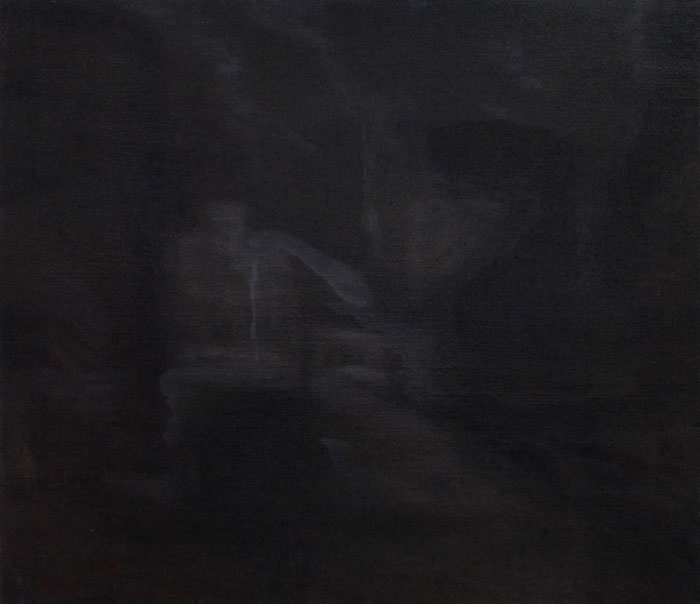
Domenico de Clario (Australian born Italy, b. 1947) 'u (renoir’s garden)' 2008/09 from the exhibition 'triestement (more-is u thrill-o)' by Domenico De Clario at John Buckley Gallery, Melbourne, April - May, 2009


Domenico de Clario (Australian born Italy, b. 1947)
u (renoir’s garden)
2008/09
Oil on canvas


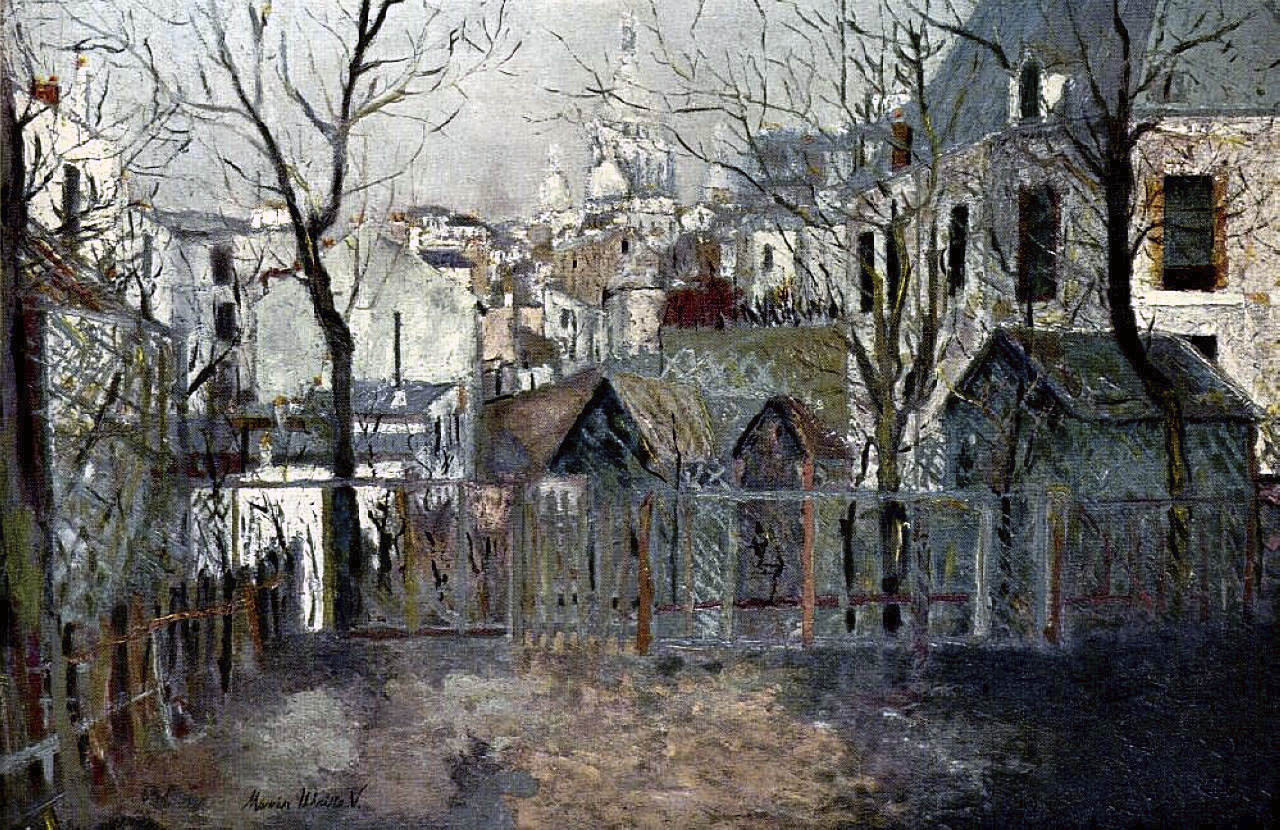
Based on the music of melancholy that inhabits the shadows of the paintings of Montmarte by the French artist Maurice Utrillo, Domenico de Clario’s exhibition of paintings at John Buckley Gallery in Melbourne is a major achievement. This is a superlative exhibition of focused, resonant work beautifully and serenely installed in the gallery space.

The exhibition features seven small and seven large oil and acrylic on canvas paintings that envelop the viewer in a velvety quietness, an intense stillness accompanied by ambient music composed by de Clario himself. All fourteen paintings are reinterpretations of works by Utrillo picked at random by de Clario that strip away surface matter to reveal the shadow substance that lays at the anxious heart of Utrillo’s meta/physical body of work (Utrillo was an alcoholic at fourteen and spent numerous periods in sanatoriums). When de Clario was fifteen he was fascinated by a small book on Utrillo and found that his paintings reminded him of his childhood, growing up in the town of Trieste. Recently he noticed that the word ‘triestement’ was used to mean, essentially, an investigation of sadness, of melancholy and started an investigation into the life and work of Utrillo. From this dialogue the paintings for the exhibition have emerged as de Clario found the ‘more is’ of Utrillo, the anima of his presence within the work.

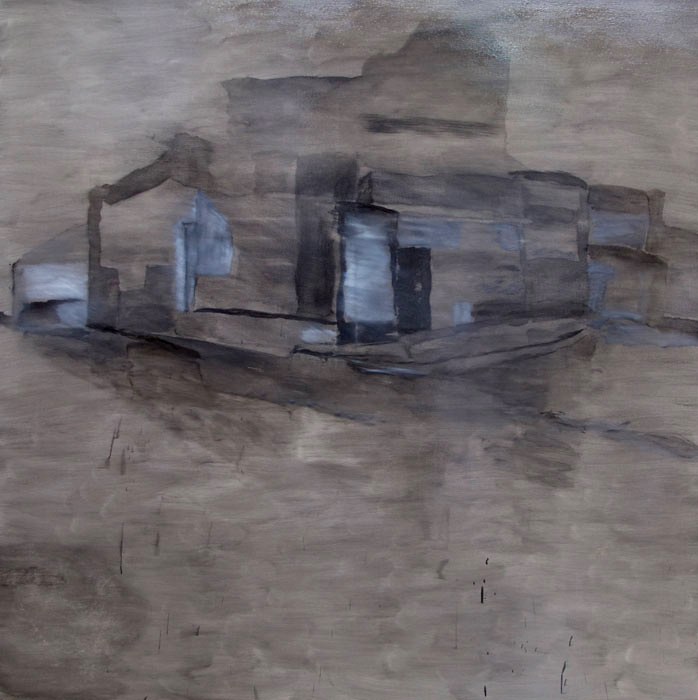
The small abstract paintings (such as renoir’s garden, above) are dark and miasmic, vaporous emanations of atmosphere that contain traces of Utrillo’s lifelong battle with the black dog but it is the seven large paintings facing each other in the main gallery space that are at the heart of de Clario’s project. They are magnificent.

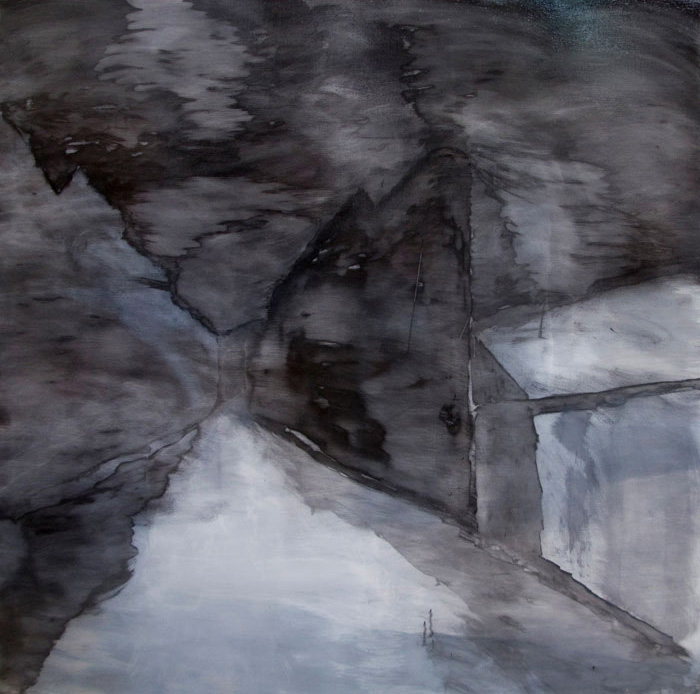
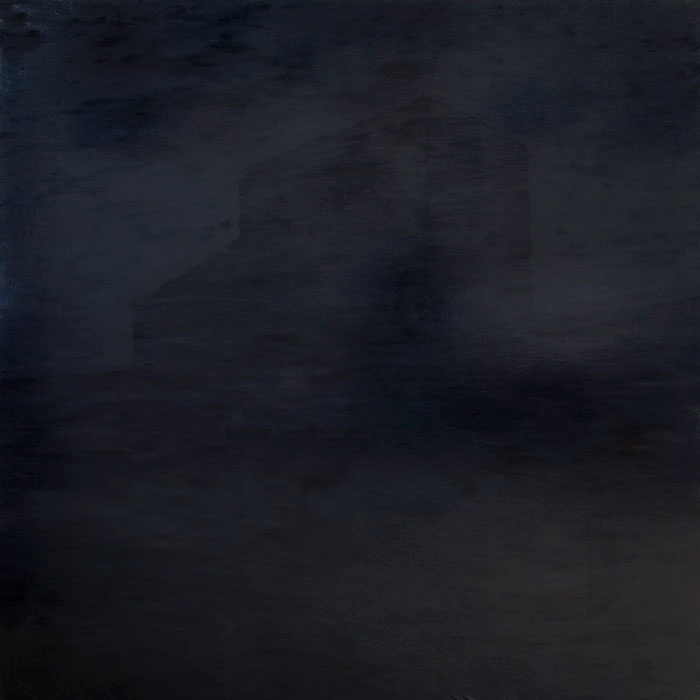
Painted in a limited colour palette of ochres, greys and blacks the works vibrate with energy. Cezanne-like spatial representations are abstracted and the paint bleeds across the canvas forming a maze of buildings. Walls and hedges loom darkly over roadways, emanations of heads and figures float in the picture plane and the highlight white of snow hovers like a spectral figure above buildings. These are elemental paintings where the shadow has become light and the light is shadow, meanderings of the soul in space. In the painting i (the house of hector berlioz – night) below, the single dark line of the house rises from the plain; the shadowy haze of recognition sits in the subconscious like the trace of our own mortality. My mind made an association with the modernist photograph by Paul Strand of the church at Taos (see photo at bottom of posting) with the looming bulk of the ramparts: it’s funny how things just click into place.

“The watergaw, the faint rainbow glimmering in chittering light, provides a sort of epiphany, and MacDiarmid connects the shimmer and weakness and possible revelation in the light behind the drizzle with the indecipherable look he received from his father on his deathbed … Each expression, each cadence, each rhyme is as surely and reliably in place as a stone on a hillside.”Seamus Heaney1


To paint these works de Clario was open and receptive to the idea of the letting go. In the wonderfully erudite catalogue essay he says he felt like he was standing under a waterfall experiencing the joyful bliss of substance, material, surface, shadow, blandness, light, plenitude and triestement while acknowledging that he could never capture them and that their value could only be fully understood once he abandoned any thought of possessing them. Like Seamus Heaney in the quotation above, de Clario experienced the glimmering in chittering light, the possible revelation in the light behind the drizzle (of the shadow) and he then paints the trace of Utrillo’s subconscious anima, the indecipherable look of his triestement. de Clario feels the fluid relationship between substance and appearance; he understands that Utrillo is embedded in the position of each building and stone, in the cadences and rhymes of the paintings of Montmarte. de Clario interprets this knowledge in a Zen like rendition of shadow substance in his paintings. Everything has it’s place without possession of here and there, dark and light.

For my part it was my soul responding to the canvases. I was absorbed into their fabric. As in the dark night of the soul my outer shell gave way to an inner spirituality stripped of the distance between viewer and painting. I felt communion with this man, Utrillo, with this art, de Clario, that brought a sense of revelation in the immersion, like a baptism in the waters of dark light. For art this is a fantastic achievement. Highly recommended.

Dr Marcus Bunyan


1/ Heaney, Seamus. The Redress of Poetry. London: Faber and Faber, 1995, pp. 107-108.


Please click on the artwork for a larger version of the image.


Domenico de Clario (Australian born Italy, b. 1947) 'l (le lapin agile - snow coming)' 2008/09 from the exhibition 'triestement (more-is u thrill-o)' by Domenico De Clario at John Buckley Gallery, Melbourne, April - May, 2009


Domenico de Clario (Australian born Italy, b. 1947)
l (le lapin agile – snow coming)
2008/09
Oil on canvas


Maurice Utrillo (French, 1883-1955) 'Renoir's Garden' 1909-1910


Maurice Utrillo (French, 1883-1955)
Renoir’s Garden
1909-1910
Oil on canvas


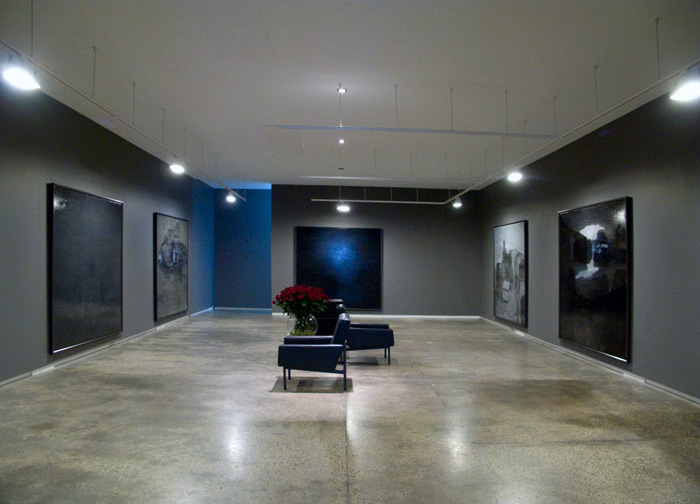
Installation view of 'triestement (more-is u thrill-o)' by Domenico De Clario at John Buckley Gallery

Installation view of 'triestement (more-is u thrill-o)' by Domenico De Clario at John Buckley Gallery


Installation views of triestement (more-is u thrill-o) by Domenico De Clario at John Buckley Gallery


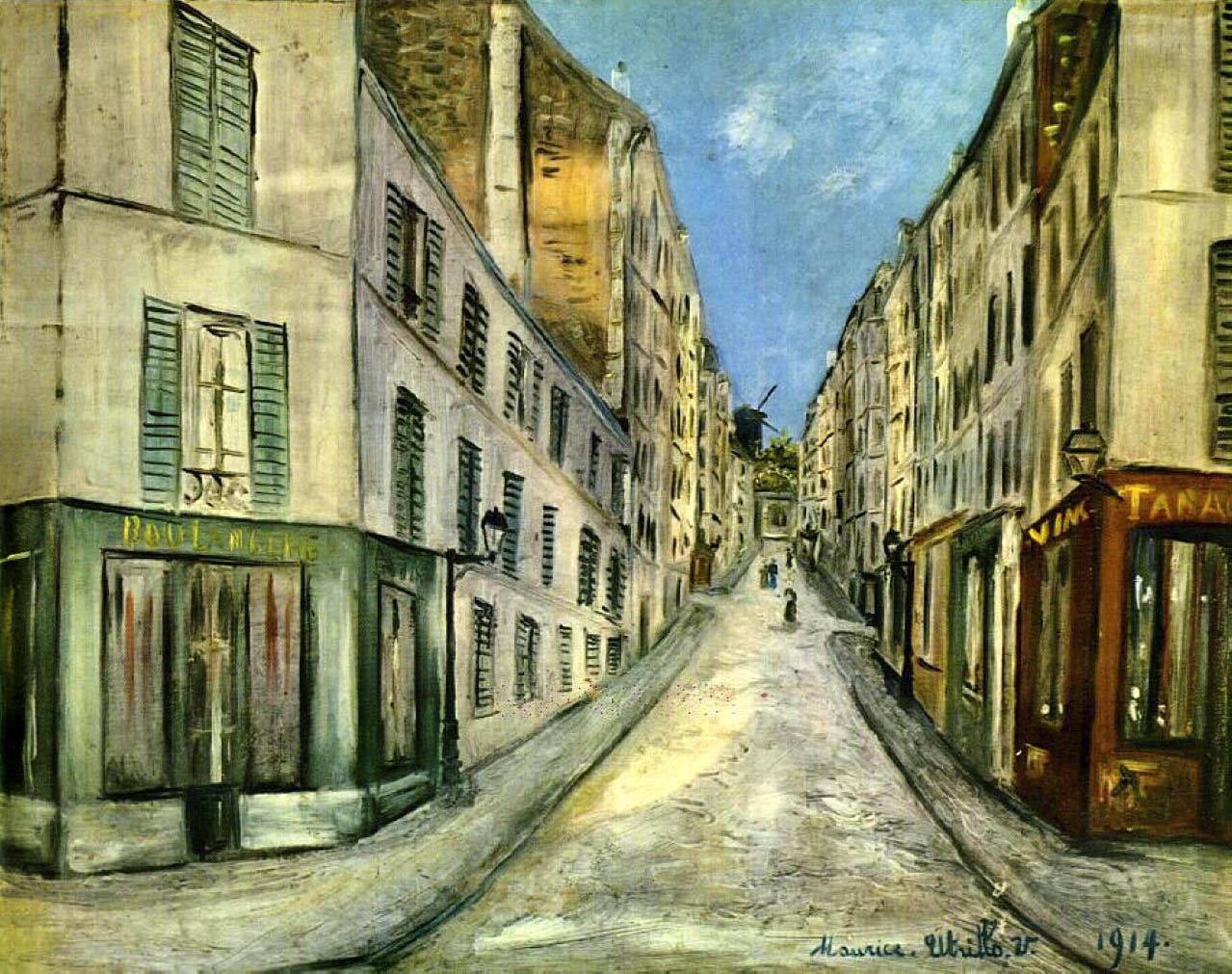
Maurice Utrillo (French, 1883-1955) 'Paris Street' 1914


Maurice Utrillo (French, 1883-1955)
Paris Street
1914
Oil on canvas


Domenico de Clario (Australian born Italy, b. 1947) 'r (rue ravignan - le bateau lavoir)' 2008/09


Domenico de Clario (Australian born Italy, b. 1947)
r (rue ravignan – le bateau lavoir)
2008/09
Oil on canvas


Domenico de Clario (Australian born Italy, b. 1947) 'l (le lapin agile and rue du mont cenis - snow receding)' 2008/09


Domenico de Clario (Australian born Italy, b. 1947)
l (le lapin agile and rue du mont cenis – snow receding)
2008/09
Oil on canvas


Domenico de Clario (Australian born Italy, b. 1947) 'o (la grande maison blanche – snow clouds massing)' 2008/09


Domenico de Clario (Australian born Italy, b. 1947)
o (la grande maison blanche – snow clouds massing)
2008/09
Oil on canvas


Is there any limit, I thought, to the kinds of shadows that might be transmuted into light? And is this because the key component of the nature of shadow is its deep longing for a transmutation to light?

As a consequence of these thoughts I arrived at the question that animates the core of this current project; what, I asked myself, might the original shadow-substance Utrillo experienced and subsequently transmutes into the paintings we known, have looked like? What shadow images did Utrillo first see, or even imagine, before he transmuted them into colour? …

Utrillo must have believed that the outer world of coloured light belonged exclusively to others, for he never succeeded in releasing himself from the dark inner shadows that engulfed him. Though he struggled much to reach the light he accepted shadow as constituting his world and worked ceaselessly to offer us images that reflected this side’s plenitude.

Perhaps the luminous surfaces of his paintings functioned as the thin membrane that separates the outer world of cacophonously coloured light from the velvety grey inner world of the monotic anxiety he inhabited. Upon that thought the momentousness of his gift became apparent to me …

For the purposes of this present project I believe that the shadow substance laying beneath the architecture of Utrillo’s streetscapes existed within the artist long before his paintings came into being. This non-substance generated the appearance of matter on the paintings’ surfaces and more significantly it gradually came to contain the spirit of his Montmarte-body.

The process of removing matter results in an obvious absence of substance but paradoxically this leads me to feel that here, under all this discarded visible matter, an invisible substance that has always contained more than matter awaits to be revealed. This leads to the provisional conclusion that the primal trace of normally unseen shadow is far richer than any material constituting appearance, containing as it does infinitely more substance than appearance.

Astonishing paradox; infinite substance can only be discovered once all matter is removed.

Text from the catalogue essay by Domenico de Clario [Online] Cited 26/04/2009. No longer available online


Maurice Utrillo (French, 1883-1955) 'Berlioz House' 1910


Maurice Utrillo (French, 1883-1955)
Berlioz House
1910
Oil on canvas


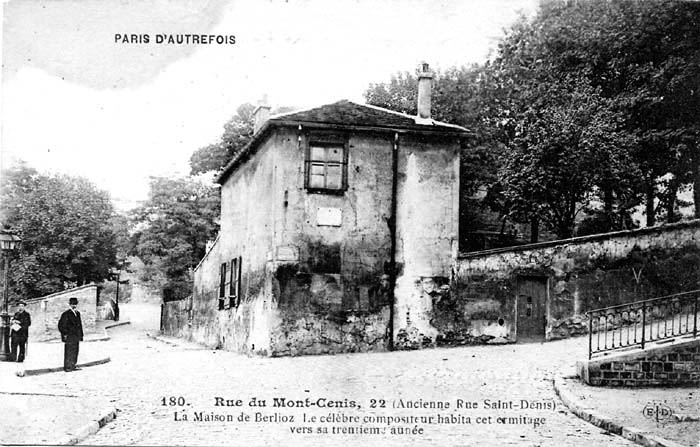
Postcard of Hector Berlioz House Nd


Anonymous
Postcard of Hector Berlioz House
Nd


Domenico de Clario (Australian born Italy, b. 1947) 'i (the house of hector berlioz - night)' 2008/09


Domenico de Clario (Australian born Italy, b. 1947)
i (the house of hector berlioz – night)
2008/09
Oil on canvas


Paul Strand (American, 1890-1976) Inverted colour burn of his photograph 'Church, Ranchos de Taos' New Mexico 1932


Paul Strand (American, 1890-1976)
Inverted colour burn of his photograph Church, Ranchos de Taos New Mexico 1932


John Buckley Gallery

This gallery has now closed.

LIKE ART BLART ON FACEBOOK

Back to top