
Exhibition dates: 26th June – 13th September, 2015

Hugo Gellert (Hungarian-American, 1892-1985)
Daily Worker
c. 1935
Lithograph on paper
Collection of Merrill C. Berman
Courtesy Mary Ryan Gallery, New York
It has given me greater insight after researching the artists and the issues for this posting. Strong graphics for just social causes. Words and images are powerful tools against bigotry, racism and extremism of any form.
The older I get the more fiercely liberal and socially conscious I become.
Dr Marcus Bunyan
Many thankx to the New-York Historical Society Museum and Library for allowing me to publish the photographs in the posting. Please click on the photographs for a larger version of the image.
Great Depression to World War II
Featuring three main sections, Art as Activism opens with works dating from the Great Depression to World War II. The posters and broadsides from the era focus on the American labor movement, Communism, racism in the South, housing in the North, and the legacy of the Harlem Renaissance.
The Scottsboro Boys
The Scottsboro Boys were a group of nine black teenagers accused of rape in the 1930s South. The blatant injustice given to them during their trial lead to several legal reforms. Watch as Emory’s Associate Professor of African American Studies, Carol Anderson, discusses what happened to these boys both during and after their trial.

J. Louis Engdahl (American, 1884-1932)
Labor Defender
June 1931
Lithograph on paper
Collection of Merrill C. Berman
Scottsboro Boys
The Scottsboro Boys were nine African-American teenagers accused in Alabama of raping two White American women on a train in 1931. The landmark set of legal cases from this incident dealt with racism and the right to a fair trial. The cases included a lynch mob before the suspects had been indicted, a frameup, all-white juries, rushed trials, and disruptive mobs. It is frequently cited as an example of an overall miscarriage of justice in the United States legal system.
On March 25, 1931, several people were hoboing on a freight train traveling between Chattanooga and Memphis, Tennessee. Several white teenagers jumped off the train and reported to the sheriff that they had been attacked by a group of African-American teenagers. The sheriff deputised a posse comitatus, stopped and searched the train at Paint Rock, Alabama and arrested the African Americans. Two young white women also got off the train and accused the African-American teenagers of rape. The case was first heard in Scottsboro, Alabama, in three rushed trials, in which the defendants received poor legal representation. All but 12-year-old Roy Wright were convicted of rape and sentenced to death, the common sentence in Alabama at the time for black men convicted of raping white women, even though there was medical evidence to suggest that they had not committed the crime.
With help from the Communist Party USA (CPUSA), the case was appealed. The Alabama Supreme Court affirmed seven of the eight convictions, and granted 13-year-old Eugene Williams a new trial because he was a minor. Chief Justice John C. Anderson dissented, ruling that the defendants had been denied an impartial jury, fair trial, fair sentencing, and effective counsel. While waiting for their trials, eight of the nine defendants were held in Kilby Prison. The cases were twice appealed to the United States Supreme Court, which led to landmark decisions on the conduct of trials. In Powell v. Alabama (1932), it ordered new trials.
The case was returned to the lower court and the judge allowed a change of venue, moving the retrials to Decatur, Alabama. Judge Horton was appointed. During the retrials, one of the alleged victims admitted fabricating the rape story and asserted that none of the Scottsboro Boys touched either of the white women. The jury found the defendants guilty, but the judge set aside the verdict and granted a new trial.
The judge was replaced and the case tried under a more biased judge, whose rulings went against the defence. For the third time a jury – now with one African-American member – returned a third guilty verdict. The case returned to the US Supreme Court on appeal. It ruled that African Americans had to be included on juries, and ordered retrials. Charges were finally dropped for four of the nine defendants. Sentences for the rest ranged from 75 years to death. All but two served prison sentences. One was shot in prison by a guard and permanently disabled. Two escaped, were later charged with other crimes, convicted, and sent back to prison. Clarence Norris, the oldest defendant and the only one sentenced to death, “jumped parole” in 1946 and went into hiding. He was found in 1976 and pardoned by Governor George Wallace, by which time the case had been thoroughly analysed and shown to be an injustice. Norris later wrote a book about his experiences. The last surviving defendant died in 1989.
“The Scottsboro Boys,” as they became known, were defended by many in the North and attacked by many in the South. The case is now widely considered a miscarriage of justice, particularly highlighted by use of all-white juries. African Americans in Alabama had been disenfranchised since the turn of the century and thus were generally disqualified from jury duty. The case has been explored in many works of literature, music, theatre, film and television. On November 21, 2013, Alabama’s parole board voted to grant posthumous pardons to the three Scottsboro Boys who had not been pardoned or had their convictions overturned.
Text from Wikipedia website
nina simone – strange fruit
Not the usual version of this song by Billie Holiday, but a different rendition by the great Nina Simone (no date to the recording). White southerners lynched nearly 4,000 black men, women and children between the years 1877 and 1950.
This song, written by white teacher Abel Meeropol as a poem and published in 1937, was performed by many artists (but most notably, Billie Holiday and Nina Simone,) is a dark and profound song about the lynching of African Americans in the Southern United States during the Jim Crow Era. In the lyrics, black victims are portrayed as “strange fruit,” as they hang from trees, rotting in the sun, blowing in the wind, and becoming food for crows upon being burned.
Southern trees
Bearing strange fruit
Blood on the leaves
And blood at the roots
Black bodies
Swinging in the southern breeze
Strange fruit hangin’
From the poplar trees
Pastoral scene
Of the gallant south
Them big bulging eyes
And the twisted mouth
Scent of magnolia
Clean and fresh
Then the sudden smell
Of burnin’ flesh
Here is a fruit
For the crows to pluck
For the rain to gather
For the wind to suck
For the sun to rot
For the leaves to drop
Here is
strange and bitter crop

Vera Bock (American born Russia, 1905-1973)
Haiti; A Drama of the Black Napoleon by William Du Bois at Lafayette Theatre
1938
Screenprint on board
Collection of Merrill C. Berman
François-Dominique Toussaint Louverture (Haitian, 1743-1803)
François-Dominique Toussaint Louverture (20 May 1743 – 7 April 1803), also known as Toussaint L’Ouverture, Toussaint-Louverture, Toussaint Bréda, and nicknamed the “Napoléon Noir” (Black Napoleon), was the leader of the Haitian Revolution. His military genius and political acumen transformed an entire society of slaves into the independent state of Haiti. The success of the Haitian Revolution shook the institution of slavery throughout the New World.
Toussaint Louverture began his military career as a leader of the 1791 slave rebellion in the French colony of Saint-Domingue; he was by then a free black man. Initially allied with the Spaniards of neighbouring Santo Domingo, Toussaint switched allegiance to the French when they abolished slavery. He gradually established control over the whole island and used political and military tactics to gain dominance over his rivals. Throughout his years in power, he worked to improve the economy and security of Saint-Domingue. He restored the plantation system using paid labour, negotiated trade treaties with Britain and the United States, and maintained a large and well-disciplined army.
In 1801 he promulgated an autonomist constitution for the colony, with himself as governor for life. In 1802 he was forced to resign by forces sent by Napoleon Bonaparte to restore French authority in the former colony. He was deported to France, where he died in 1803. The Haitian Revolution continued under his lieutenant, Jean-Jacques Dessalines, who declared independence in early 1804. The French had lost two-thirds of forces sent to the island in an attempt to suppress the revolution; most died of yellow fever.
Text from the Wikipedia website
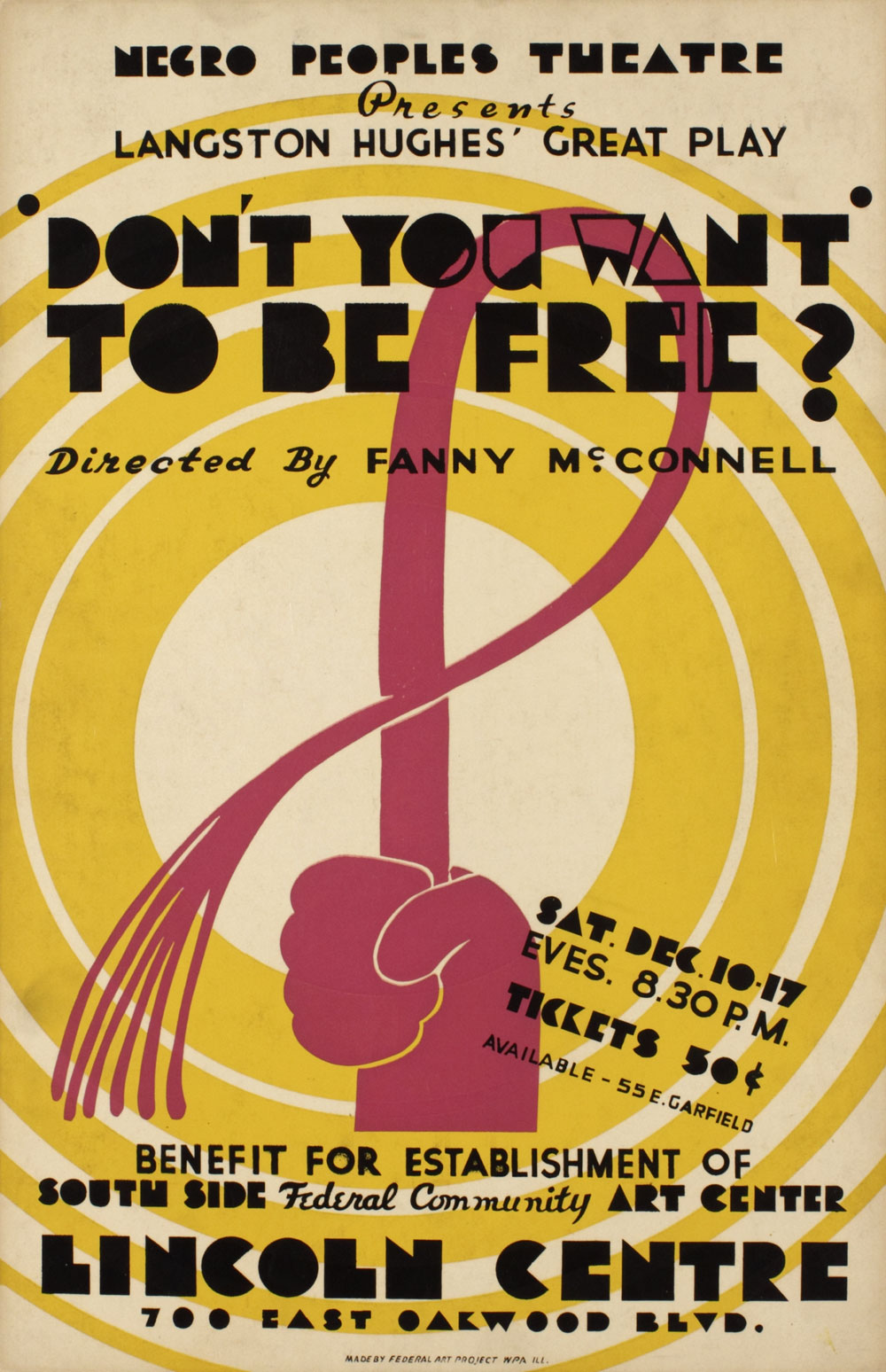
Unidentified artist
Negro Peoples Theatre Presents: Langston Hughes’ Great Play, “Don’t You Want to be Free?” Directed by Fanny McConnell, Lincoln Centre
1938
Screenprint on paper mounted on board
Collection of Merrill C. Berman
James Mercer Langston Hughes (American, 1902-1967)
James Mercer Langston Hughes (February 1, 1902 – May 22, 1967) was an American poet, social activist, novelist, playwright, and columnist from Joplin, Missouri. He was one of the earliest innovators of the then-new literary art form called jazz poetry. Hughes is best known as a leader of the Harlem Renaissance. He famously wrote about the period that “the negro was in vogue”, which was later paraphrased as “when Harlem was in vogue”.
When Langston Hughes returned from his assignment in Spain as a war correspondent, he told Louise Patterson of his idea for establishing a people’s theatre. She suggested the hall of the International Workers Order (a leftist labor-cultural group) above Frank’s Restaurant on 125th Street. This was the first home of the Harlem Suitcase Theatre, in 1937.
Named for its arena staging and lack of scenic properties, Suitcase Theatre was a peoples’ theatre composed of amateur actors. The audiences were seventy-five per cent black; admission was thirty-five cents. The program was usually two or three short pieces; The Slave, or The Man Who Died at Twelve O’Clock, or several skits written by Mr. Hughes lampooning white caricatures of blacks: Em-Fueher Jones, Limitations of Life, and Little Eva’s End. The piece de resistance was always Don’t You Want To Be Free? We had no play so the suggestion came up one evening as we were sitting there plotting the theatre, that Langston should do a play and why not a play of music-drama of many of his folk poems? So that he went home that night after we had had that discussion and sat up all night writing it and came back the next night with Don’t You Want To Be Free? (from an interview with Louise Patterson by Norma Markman, 1969)
Although Suitcase Theater lasted only two years (it did not survive its transplant to the library basement on 135th Street) the idea of a Negro People’s Theater spread to other cities. In March 1939, Mr. Hughes founded the New Negro Theater in Los Angeles.
The success of Don’t You Want To Be Free?, which opened in February 1937 and ran for 135 performances, may be found in three factors: (1) the direct appeal to the problems of the audience (most businesses in Harlem were owned by whites and only one of every six employees of the businesses were black), (2) the simplicity and beauty of the poetry and songs, (3) the appeal to unite poor whites and blacks in a fight against exploitation by the rich.
Text from The University Theatre website Cited [Online] Cited 20/07/2015. No longer available online

Lester Beall (American, 1903-1969)
Cross Out Slums
1941
Lithograph on paper
Collection of Merrill C. Berman
© Dumbarton Arts, LLC
Licensed by VAGA, New York, NY
Lester Beall (American, 1903-1969)
Lester Beall (1903-1969) was an American graphic designer notable as a leading proponent of modernist graphic design in the United States.
His clear and concise use of typography was highly praised both in the United States and abroad. Throughout his career he used bold primary colours and illustrative arrows and lines in a graphic style that became easily recognisable as his own. He eventually moved to rural New York and set up an office, and home, at a premises that he and his family called “Dumbarton Farm”. He remained at the farm until his death in 1969.
Lester Thomas Beall was born in Kansas City, Missouri. His family soon moved to St. Louis, Missouri, and later to Chicago, Illinois. Beall studied at the University of Chicago and was active on the varsity track team coached by Amos Alonzo Stagg. Beall also took classes at the Art Institute of Chicago. After a short period of experimentation and professional work in Chicago, Beall moved to New York in 1935. The following year he established his home / office in Wilton, Connecticut.
According to his online AIGA biography by R. Roger Remington: “Through the 1930s and 1940s Beall produced innovative and highly regarded work for clients including the Chicago Tribune, Sterling Engraving, The Art Directors Club of New York, Hiram Walker, Abbott Laboratories and Time magazine. Of particular interest was his work for the Crowell Publishing Company which produced Colliers magazine. The promotional covers “Will There Be War?” and “Hitler’s Nightmare” are powerful designs which distill messages of the time. In these works he utilises angled elements, iconic arrows, silhouetted photographs and dynamic shapes, all of which captures the essence of his personal style of the late 1930s. Also of interest in this period are the remarkable poster series for the United States Government’s Rural Electrification Administration.”
Text from the Wikipedia website

Unidentified artist
Vote American Labor Party; Roosevelt and Lehman
1936
Lithograph on paper
Collection of Merrill C. Berman
Long before digital technology made worldwide communication possible, political protests and calls for action reached the public through posters. Posted on walls and bulletin boards, slapped up on store windows and church doors, these works often featured bright colours and modernist art-inspired graphics, and were quickly mass-produced to inform communities, stir audiences, and call attention to injustice. This summer, the New-York Historical Society will present 72 posters dating from the early 1930s through the 1970s, drawn from one of the world’s finest collections of American protest art in Art as Activism: Graphic Art from the Merrill C. Berman Collection, on view June 26 through September 13, 2015.
“These seemingly ephemeral activist artefacts are of tremendous historical and artistic importance, with deep roots in the past and a lasting influence,” said Dr. Louise Mirrer, President and CEO of the New-York Historical Society. “Merrill Berman’s collection rivals the graphic design holdings of the Museum of Modern Art in New York and the Stedelijk Museum in Amsterdam, and we are thrilled to be able to share some highlights with the public this summer.”
Art as Activism presents a wide selection of posters addressing movements that arose in reaction to the Great Depression, World War II, racial inequality, the Vietnam War, and environmental concerns. Featured posters include works by artists such as Emory Douglas, Hugo Gellert, James Rosenquist and Tomi Ungerer, as well as numerous unidentified designers.
“Art as Activism will showcase imagery that served as the wallpaper of public discontent,” said New-York Historical’s Chief Curator Stephen Edidin. “Posters shaped the visual language of protest for generations, “going viral” decades before the term was born, until they were replaced by other forms of social media, including street art and ultimately the Internet.”
Exhibition highlights
Featuring three main sections, Art as Activism opens with works dating from the Great Depression to World War II, with themes that include electoral politics, workers’ marches and the political, social, and economic inequalities endured by African Americans. Featured works include a poster for Langston Hughes’ political play Don’t You Want to be Free?: From Slavery Through the Blues to Now – and then some! (1938), with bright red and yellow graphics of a whip in a raised fist. A colourful 1941 poster Cross Out Slums promoted the U.S. Housing Authority, which cleared slums and built new low-income housing. Using photomontage and European modernist design, graphic artist Lester Beall shows a bucolic neighbourhood in the form of a hand, crossing out substandard accommodations with a large “X.”
The second section of the exhibition explores the Black Panther organisation, beginning with its founding in California in 1966 and tracing its rise to national prominence. The Panthers used posters and the press to spread their message, leveraging advertising techniques and celebrity culture to compose and disseminate powerful imagery. One of the most defining photographs of this era is the iconic image Huey Newton seated in a wicker chair (1967), featuring the Panthers’ Minister of Defense enthroned in a wicker chair, holding a rife and a spear. Another highlight is the poster An Attack Against One is An Attack Against All, The Slaughter of Black People Must be Stopped by Any Means Necessary! (circa 1970), featuring the image of a black panther with massive claws and a sinuous body, poised to attack.
The final section of Art as Activism focuses on the anti-Vietnam War movement and other protest movements of the era, such as the American Indian movement and the nascent Environmentalist effort. To cut costs and distribute the message by any means available, activists printed posters on computer paper. In 1970, U.C. Berkeley students protested President Nixon’s bombing of Cambodia with the poster Amerika is Devouring Its Children, making a powerful anti-war statement by appropriating Francisco Goya’s terrifying image of the god Saturn fiendishly eating his own son. Another highlight on view is a poster from the 1975 Central Park rally celebrating the end of the Vietnam War, featuring a photograph of a Hanoi circus performer with doves balanced on her outstretched arms, offering an uplifting image and global message.
Press release from the New-York Historical Society Museum and Library
Black Panther Party
The second section of the exhibition explores the Black Panther Party, beginning with its founding in California in 1966 and traces its rise to international prominence. Their policies of self-defense and anti-imperialism prompted FBI Director J. Edgar Hoover to notoriously condemn them as “the greatest threat to internal security.” Their legacy of lesser-known initiatives to aid impoverished black communities, including a breakfast program that at its height served 10,000 kids in need every day was overshadowed as a result.

Unidentified artist
Free Angela Davis
c. 1970-72
Lithograph on paper
Collection of Merrill C. Berman
Angela Yvonne Davis (American, b. 1944)
Angela Yvonne Davis (born January 26, 1944) is an American political activist, scholar, and author. She emerged as a prominent counterculture activist and radical in the 1960s as a leader of the Communist Party USA, and had close relations with the Black Panther Party through her involvement in the Civil Rights Movement, although she was never a party member. Her interests included prisoner rights; she founded Critical Resistance, an organisation working to abolish the prison-industrial complex. She is a retired professor with the History of Consciousness Department at the University of California, Santa Cruz, and a former director of the university’s Feminist Studies department.
Davis was arrested, charged, tried, and acquitted of conspiracy in the 1970 armed take-over of a Marin County courtroom, in which four persons died.
On August 7, 1970, Jonathan Jackson, a heavily armed 17-year-old African-American high-school student, gained control over a courtroom in Marin County, California. Once in the courtroom, Jackson armed the black defendants and took Judge Harold Haley, the prosecutor, and three female jurors as hostages.
As Jackson transported the hostages and two black convicts away from the courtroom, the police began shooting at the vehicle. The judge and the three black men were killed in the melee; one of the jurors and the prosecutor were injured. The firearms used in the attack, including the shotgun used to kill Haley, had been purchased by Davis two days prior and the barrel of the shotgun had been sawed off. Davis was also corresponding with one of the inmates involved. Since California considers “all persons concerned in the commission of a crime, whether they directly commit the act constituting the offence… principals in any crime so committed”, Marin County Superior Judge Peter Allen Smith charged Davis with “aggravated kidnapping and first degree murder in the death of Judge Harold Haley” and issued a warrant for her arrest. Hours after the judge issued the warrant on August 14, 1970, a massive attempt to arrest Angela Davis began. On August 18, 1970, four days after the initial warrant was issued, the FBI director J. Edgar Hoover made Angela Davis the third woman and the 309th person to appear on the FBI’s Ten Most Wanted Fugitive List.
Soon after, Davis became a fugitive and fled California. According to her autobiography, during this time she hid in friends’ homes and moved from place to place at night. On October 13, 1970, FBI agents found her at the Howard Johnson Motor Lodge in New York City. President Richard M. Nixon congratulated the FBI on its “capture of the dangerous terrorist, Angela Davis”.
On January 5, 1971, after several months in jail, Davis appeared at the Marin County Superior Court and declared her innocence before the court and nation: “I now declare publicly before the court, before the people of this country that I am innocent of all charges which have been levelled against me by the state of California.” John Abt, general counsel of the Communist Party USA, was one of the first attorneys to represent Davis for her alleged involvement in the shootings. While being held in the Women’s Detention Center there, she was initially segregated from the general population, but with the help of her legal team soon obtained a federal court order to get out of the segregated area.
Across the nation, thousands of people who agreed with her declaration began organising a liberation movement. In New York City, black writers formed a committee called the Black People in Defense of Angela Davis. By February 1971 more than 200 local committees in the United States, and 67 in foreign countries worked to liberate Angela Davis from prison. Thanks, in part, to this support, in 1972 the state released her from county jail. On February 23, 1972, Rodger McAfee, a dairy farmer from Fresno, California, paid her $100,000 bail with the help of Steve Sparacino, a wealthy business owner. Portions of her legal defence expenses were paid for by the United Presbyterian Church.
Davis was tried, and the all-white jury returned a verdict of not guilty. The fact that she owned the guns used in the crime was judged not sufficient to establish her responsibility for the plot. She was represented by Leo Branton Jr., who hired psychologists to help the defence determine who in the jury pool might favour their arguments, a technique that was uncommon at the time, and also hired experts to undermine the reliability of eyewitness accounts.
Her research interests are feminism, African-American studies, critical theory, Marxism, popular music, social consciousness, and the philosophy and history of punishment and prisons. Her membership in the Communist Party led to Ronald Reagan’s request in 1969 to have her barred from teaching at any university in the State of California. She was twice a candidate for Vice President on the Communist Party USA ticket during the 1980s.
Text from the Wikipedia website
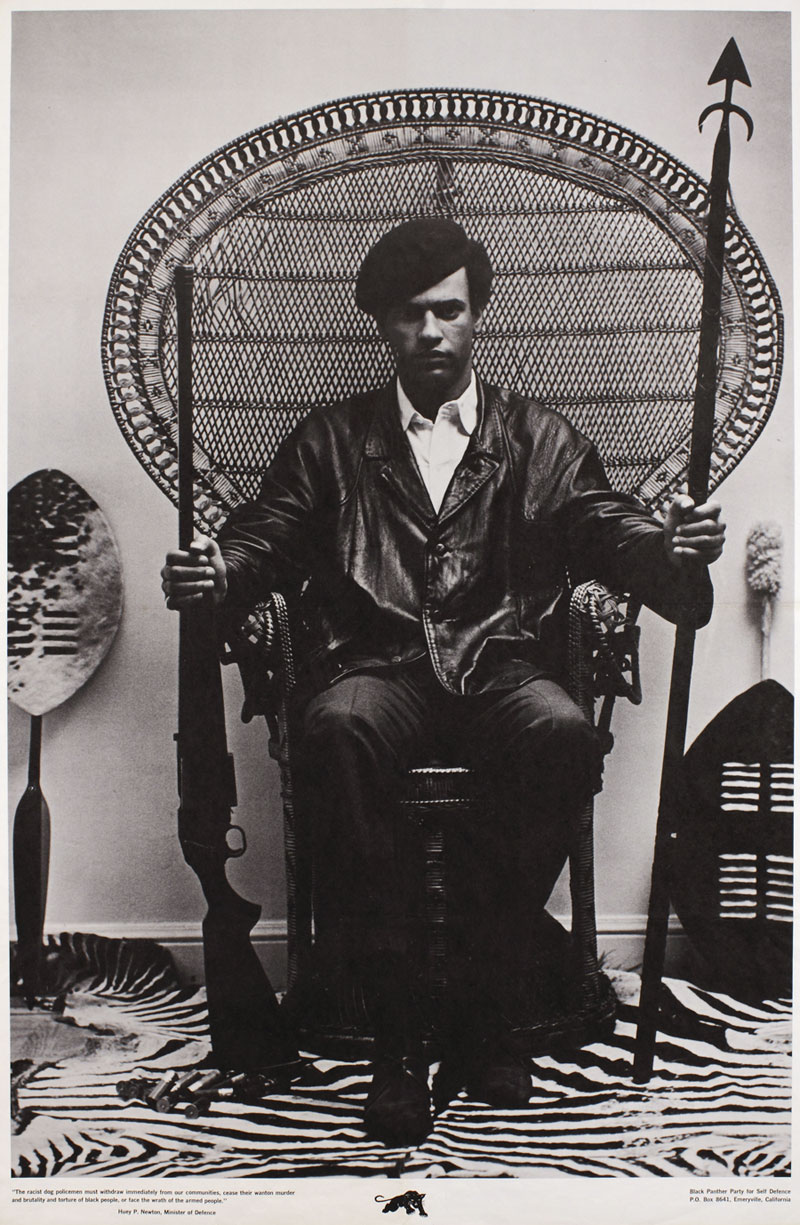
Photography attributed to Blair Stapp
Composition by Eldridge Cleaver
Huey Newton seated in wicker chair
1967
Lithograph on paper
Collection of Merrill C. Berman
Huey Percy Newton (American, 1942-1989)
Huey Percy Newton (February 17, 1942 – August 22, 1989) was an African-American political and urban activist who, along with Bobby Seale, co-founded the Black Panther Party in 1966. Newton had a long series of confrontations with law enforcement, including several convictions, while he participated in political activism. He continued to pursue an education, eventually earning a Ph.D. in Social Science. Newton spent time in prison for manslaughter and was involved in a shooting that killed a police officer, for which he was later acquitted. In 1989 he was shot and killed in Oakland, California by Tyrone “Double R” Robinson, a member of the Black Guerrilla Family.
Text from the Wikipedia website

Emory Douglas (American, b. 1943)
All Power To The People
1969
Lithograph on paper
Collection of Merrill C. Berman
© 2015 Artists Rights Society (ARS), New York
Emory Douglas (American, b. 1943)
Emory Douglas (born May 24, 1943) was born in Grand Rapids, Michigan and grew up in the San Francisco Bay Area. As a teenager, Douglas was incarcerated at the Youth Training School in Ontario, California; during his time there he worked in the prison’s printing shop. He later studied commercial art, taking graphic design classes, at San Francisco City College. As Erika Doss wrote, “He also joined the college’s Black Students Union and was drawn to political activism.”
In 1967 Douglas became Minister of Culture for the Black Panther Party. In 2007, The San Francisco Chronicle reporter Jessica Werner Zack reported that he “branded the militant-chic Panther image decades before the concept became commonplace. He used the newspaper’s popularity to incite the disenfranchised to action, portraying the poor with genuine empathy, not as victims but as outraged, unapologetic and ready for a fight.”
Douglas worked at the black community-oriented San Francisco Sun Reporter newspaper for over 30 years after The Black Panther newspaper was no longer published. He continued to create activist artwork. According to Greg Morozumi, of the Bay Area EastSide Arts Alliance, his artwork stayed relevant. “Rather than reinforcing the cultural dead end of “post-modern” nostalgia, the inspiration of his art raises the possibility of rebellion and the creation of new revolutionary culture.”
In 2006, artist and curator Sam Durant edited a comprehensive monograph of Black Panther artist Emory Douglas’ work, Black Panther: The Revolutionary Art of Emory Douglas, with contributors including Danny Glover, Kathleen Cleaver, St. Clair Bourne, Colette Gaiter (associate professor at the University of Delaware), Greg Morozumi (artistic director of the EastSide Arts Alliance in Oakland, California), and Sonia Sanchez.
“Douglas was the most prolific and persistent graphic agitator in the American Black Power movements. Douglas profoundly understood the power of images in communicating ideas…. Inexpensive printing technologies – including photostats and presstype, textures and patterns – made publishing a two-colour heavily illustrated, weekly tabloid newspaper possible. Graphic production values associated with seductive advertising and waste in a decadent society became weapons of the revolution. Technically, Douglas collaged and re-collaged drawings and photographs, performing graphic tricks with little budget and even less time. His distinctive illustration style featured thick black outlines (easier to trap) and resourceful tint and texture combinations. Conceptually, Douglas’s images served two purposes: first, illustrating conditions that made revolution seem necessary; and second, constructing a visual mythology of power for people who felt powerless and victimised. Most popular media represents middle to upper class people as “normal.” Douglas was the Norman Rockwell of the ghetto, concentrating on the poor and oppressed. Departing from the WPA / social realist style of portraying poor people, which can be perceived as voyeuristic and patronising, Douglas’s energetic drawings showed respect and affection. He maintained poor people’s dignity while graphically illustrating harsh situations.”
Colette Gaiter quoted in the Wikipedia entry for Emory Douglas.

Distributed by the Robert Brown Elliott League
An Attack Against One is An Attack Against All
c. 1970
Lithograph on paper
Collection of Merrill C. Berman
Art as Activism
The final section of Art as Activism focuses on the anti-Vietnam War movement and other protest movements of the 1960s and 1970s. The mass protest movements varied greatly in their demands and their activist style. Some were violent, others peaceful. Some pushed for reform, others revolution. Regardless of their messages, these movements brought millions to the streets and forever changed American society; they helped end the Vietnam War and gave rise to watershed legislation and fundamental social change.

Jay Belloli (American, 1944-2021) Berkeley, California
Amerika is Devouring Its Children
1970
Screenprint on computer paper
Collection of Merrill C. Berman
Decade of Dissent – Jay Belloli
Jay Belloli is an independent contemporary art curator and writer who created an iconic political poster while a student at UC Berkeley during the strike to oppose Nixon’s bombing of Cambodia in 1970. In this video, Jay discusses his developing politicisation during the Vietnam War era and describes the urgent activity of students across the country to use political posters to define the pressing issues of the day.
This interview is part of a video series in which poster artists share stories about art and activism. The interviews accompany Decade of Dissent: Democracy in Action 1965-1975, a traveling political poster art exhibition that premiered at the West Hollywood Library, February – April 2012. Both the exhibition and interviews were produced by the Center for the Study of Political Graphics.
1965-1975 – years that span the U.S. war in Viet Nam – was a watershed decade for California and the country as a whole. Through legislation and demonstrations, democracy was both advanced and challenged at the ballot box, in the classroom and in the streets. U.S. democracy embraces free speech, yet California’s students fought for the right to engage in free speech in high schools and college campuses. Our democracy ensures freedom of assembly, yet the police often attacked peaceful demonstrators. The Constitution protects civil liberties and civil rights regardless of race, gender, class or ethnicity, yet African Americans, Asians, Latinos, women, lesbians, gays and others fought – and continue to fight – for their equality.
Whenever people organise and protest, artists are in the forefront of the struggles for greater democracy and justice. This exhibition documents the importance of poster art for developing and promoting the ideas and ideals of democracy in California during a very turbulent decade – not unlike the present. The posters forcefully and graphically demonstrate that democracy includes the obligation to speak-out and struggle for justice. Dissent is patriotic. The exhibition also shows the power of art to recall historical events and views of the world that can create a deeper context for understanding contemporary society.
Text from the YouTube website

Unidentified artist
Red Power
1970
Lithograph on paper
Collection of Merrill C. Berman
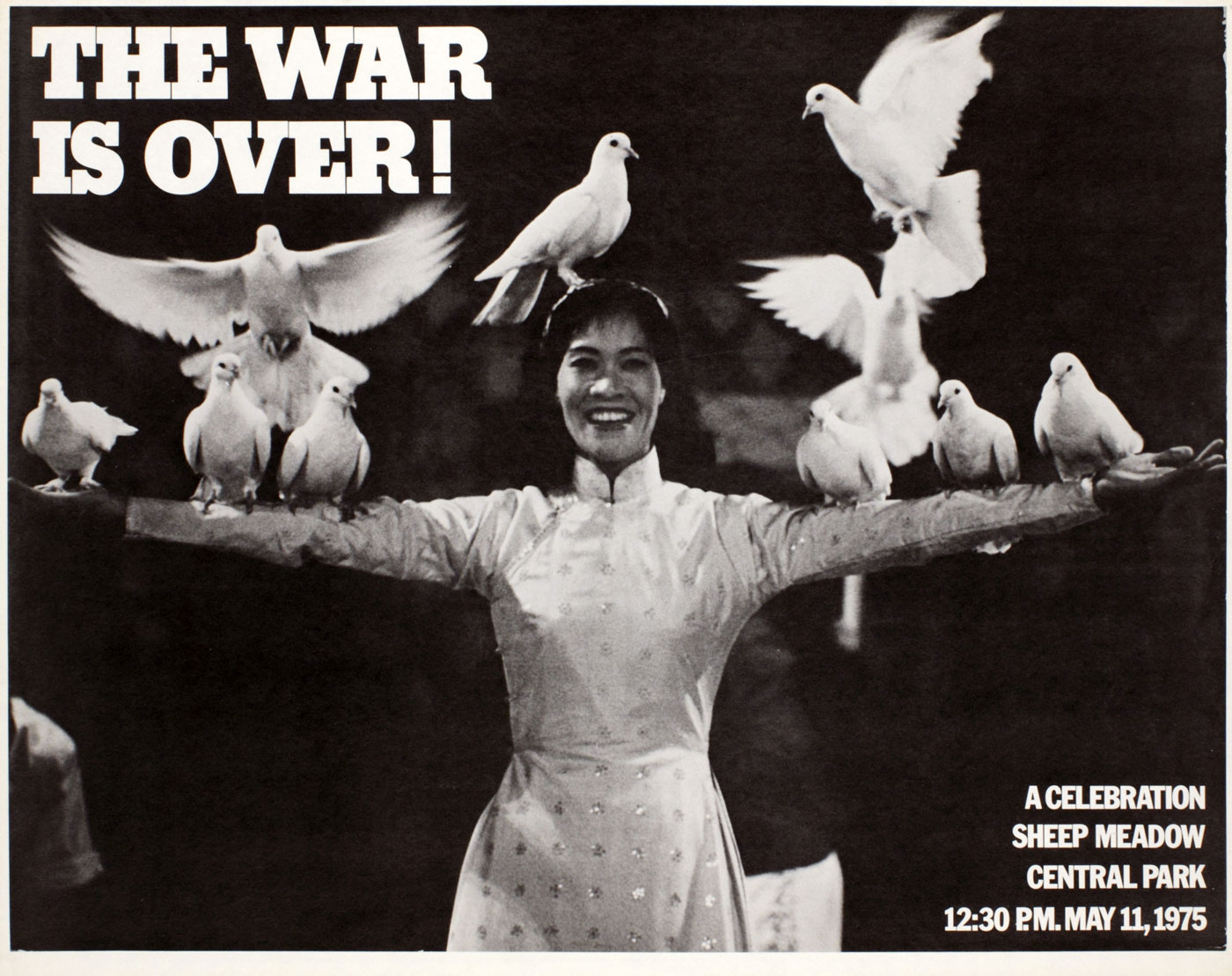
Phil Ochs (American, 1940-1976), Cora Weiss (American, b. 1934) and Dan Luce
The War is Over!
1975
Lithograph on paper
Collection of Merrill C. Berman
New-York Historical Society
170 Central Park West
at Richard Gilder Way (77th Street)
New York, NY 10024
Phone: (212) 873-3400
Opening hours:
Monday CLOSED
Tuesday – Thursday 11am – 5pm
Friday 11am – 8pm
Saturday – Sunday 11am – 5pm



 Art Blart _ art and cultural memory archive
You must be logged in to post a comment.