Exhibition: ‘Eyes on the Street: street photography in the 21st century’ at the Cincinnati Art Museum

Exhibition dates: 11th October 2014 – 4th January 2015

Artists

Olivo Barbieri (Italian; lives and works in Modena, Italy)
Philip-Lorca diCorcia (American; lives and works in New York)
Jason Evans (British; lives and works in London)
Paul Graham (British; lives and works in New York)
Mark Lewis (Canadian; lives and works in London)
Jill Magid (American; lives and works in New York)
James Nares (American; lives and works in New York)
Barbara Probst (German; lives and works in New York)
Jennifer West (American; lives and works in Los Angeles)
Michael Wolf (German; lives and works in Paris and Hong Kong)


Installation view of the exhibition 'Eyes on the Street: street photography in the 21st century' at the Cincinnati Art Museum photo by Rob Deslongchamps


Installation view by Rob Deslongchamps


Watching the watcher watching…

Marcus


Many thankx to the Cincinnati Art Museum for allowing me to publish the photographs in the posting. Please click on the photographs for a larger version of the image.


“Some of the artists in ‘Eyes on the Street’ made their work at street level; others sought higher vantage points. Some sharpen our appreciation for individuals, while others underscore universal urban traits. Some work with still images, while others create films and videos. What links them, and binds them to the historical tradition of street photography, is the quality of attention they give these bustling environments. They are watchful. What distinguishes them from the twentieth-century street-photography tradition, however, is that these artists are also acutely conscious of the active roles cameras play in making urban public places today. They know they are part of a greater system of watching.”


Brian Sholis, Associate Curator of Photography, Cincinnati Art Museum
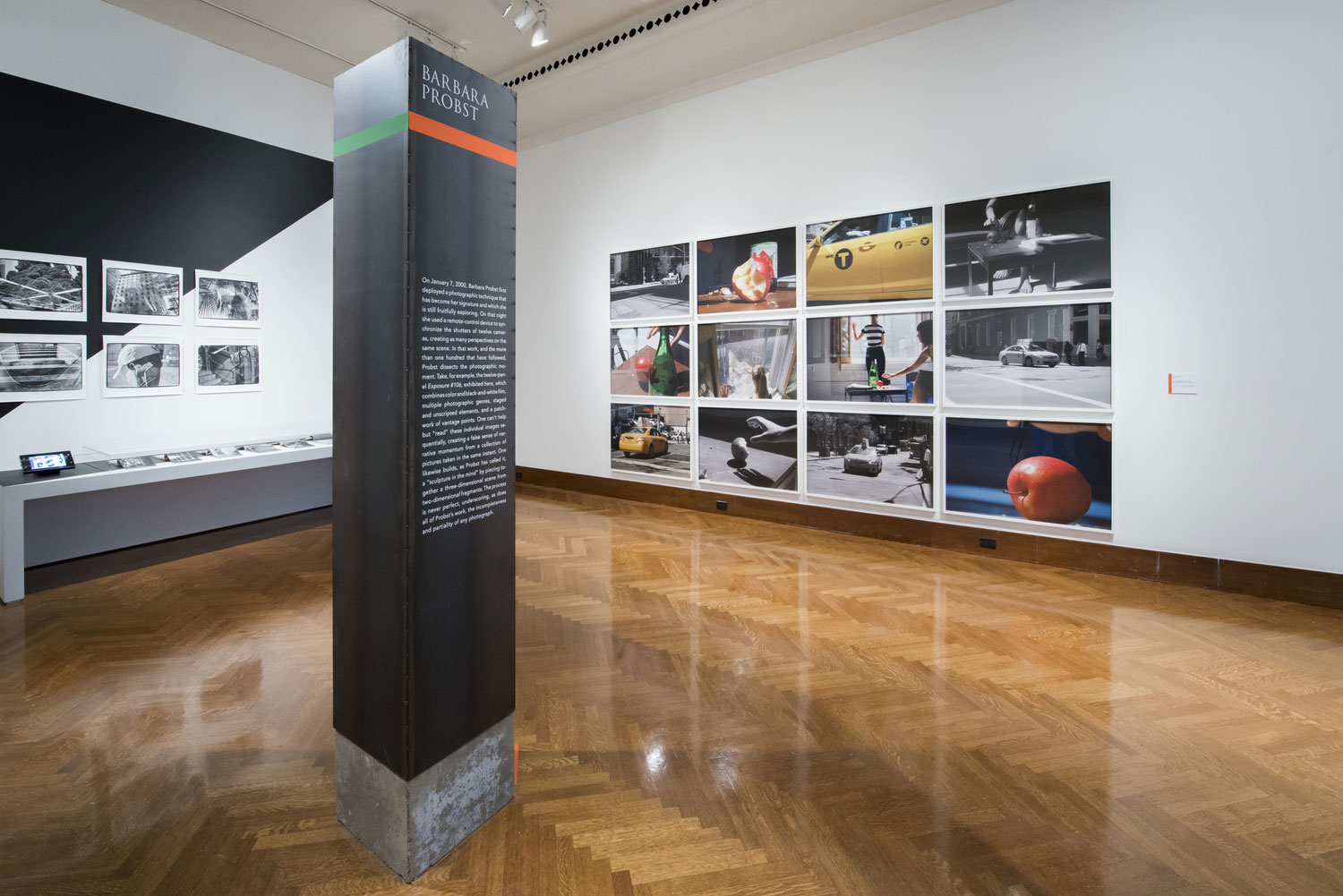


Installation view of the exhibition 'Eyes on the Street: street photography in the 21st century' at the Cincinnati Art Museum photo by Rob Deslongchamps


Installation view by Rob Deslongchamps


Barbara Probst (German, b. 1964) 'Exposure #106: N.Y.C., Broome & Crosby Streets, 04.17.13, 2:29 p.m.' 2013


Barbara Probst (German, b. 1964)
Exposure #106: N.Y.C., Broome & Crosby Streets, 04.17.13, 2:29 p.m.
2013
Ultrachrome ink on cotton paper in twelve parts
Each 29 x 44 inches
Courtesy of the artist and Murray Guy, New York


On January 7, 2000, Barbara Probst first deployed a photographic technique that has become her signature and which she is still fruitfully exploring. On that night she used a remote-control device to synchronise the shutters of twelve cameras, creating as many perspectives on the same scene. In that work, and the more than one hundred that have followed, Probst dissects the photographic moment. Take, for example, the twelve-panel Exposure #106, exhibited here, which combines colour and black-and-white film, multiple photographic genres, staged and unscripted elements, and a patchwork of vantage points. One can’t help but “read” these individual images sequentially, creating a false sense of narrative momentum from a collection of pictures taken in the same instant. One likewise builds, as Probst has called it, a “sculpture in the mind” by piecing together a three-dimensional scene from two-dimensional fragments. The process is never perfect, underscoring, as does all of Probst’s work, the incompleteness and partiality of any photograph.

“Probst forcefully deconstructs the notion of photographic truth, not by specifically questioning that photographic truth but merely by pointing out its necessary incompleteness.

~ Jens Erdman Rasmussen, Dutch curator.
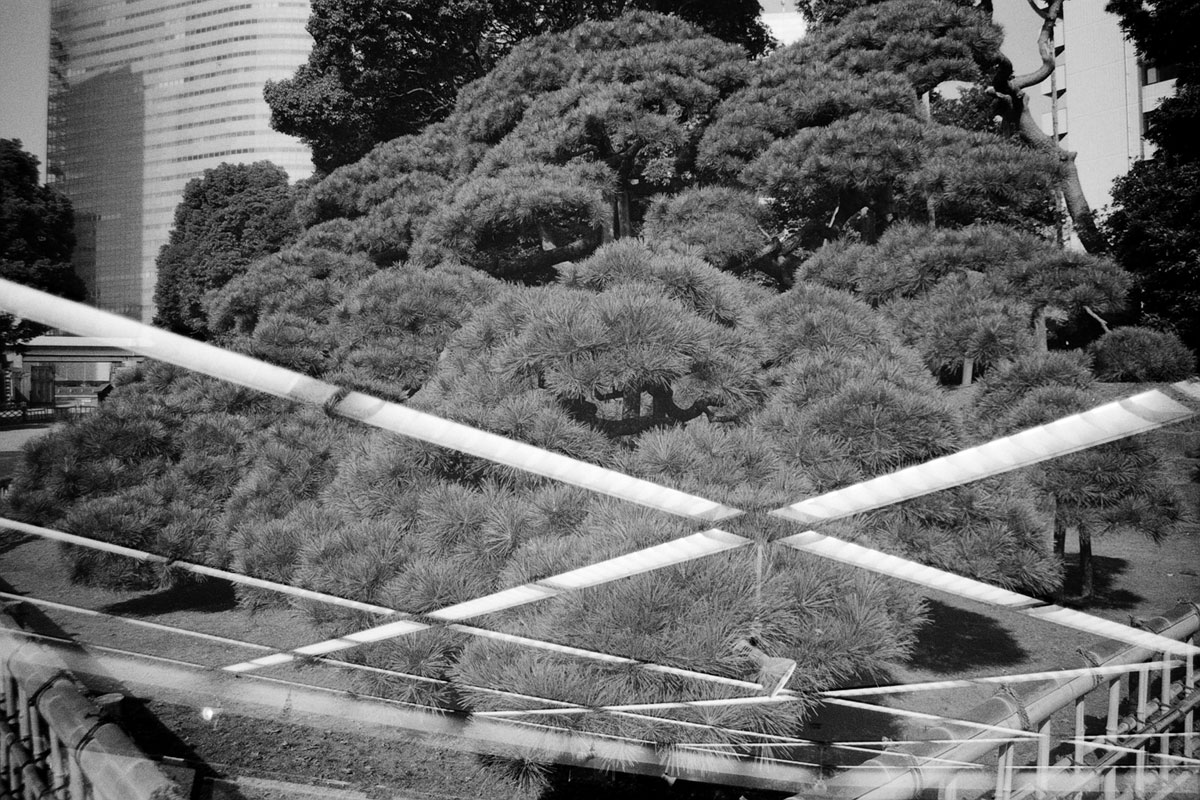
 

Jason Evans (Welsh, b. 1968) 'Untitled,' from the series "NYLPT," 2008


Jason Evans (Welsh, b. 1968)
Untitled from the series NYLPT
2008
Gelatin silver print
24 x 24 inches
Courtesy of the photographer


Jason Evans is a street photographer who, in his words, simply likes to “walk around and look at things, follow people, and get lost.” The series exhibited here, NYLPT, was made between 2005 and 2012 in New York, London, Paris, and Tokyo. Evans would expose a roll of 35-mm black-and-white film in one of these cities, then rewind and set aside the roll until his travels brought him to another. There, he would reload the film and re-expose the frames, doing so up to five times without knowing what the results would look like. Sometimes a fragment of language or familiar landmark reveals where part of the picture was made. More often, however, the textures, shapes, and surreal combinations of built environments come together to connote urbanness as a category of experience. Aware that people consume images in myriad ways, Evans not only developed the photographs in a darkroom, but also worked closely with a book publisher and digital programmers to create versions of the series specific to different mediums.


Olivo Barbieri (Italian, b. 1954) 'site specific_ISTANBUL #4' 2011


Olivo Barbieri (Italian, b. 1954)
site specific_Istanbul #4
2011
Archival pigment print
45 x 61 inches
Courtesy of the artist and Yancey Richardson Gallery, New York


Between 2003 and 2013, the Italian artist Olivo Barbieri photographed more than forty of the world’s cities from low-flying helicopters. Fascinated by the expanding megalopolises, Barbieri sought a new visual language to present their shifting forms. He hit upon the idea of using a tilt-shift lens – normally used to correct the apparent convergence of parallel lines in pictures of buildings – to render sections of his images out of focus. By also slightly overexposing the photographs, Barbieri created a diorama-like effect; the people and places he captured seemed to inhabit miniature worlds. His pictures contained enormous amounts of information yet placed some of it tantalisingly out of focus.

This visual effect became so popular that Barbieri sought other ways to push photography’s language in response to the cities that inspired him. In recent years he has adopted a wide array of digital post-production techniques to modify his images, all in service of representing the dizzying state of cities today.

“Captivated by a vision of the twenty-first-century city as a kind of site-specific installation – temporary, malleable, and constantly in flux – [Barbieri] sought a photographic corollary for the radical mutations of urban form that he saw taking place.”

~ Christopher S. Phillips, curator
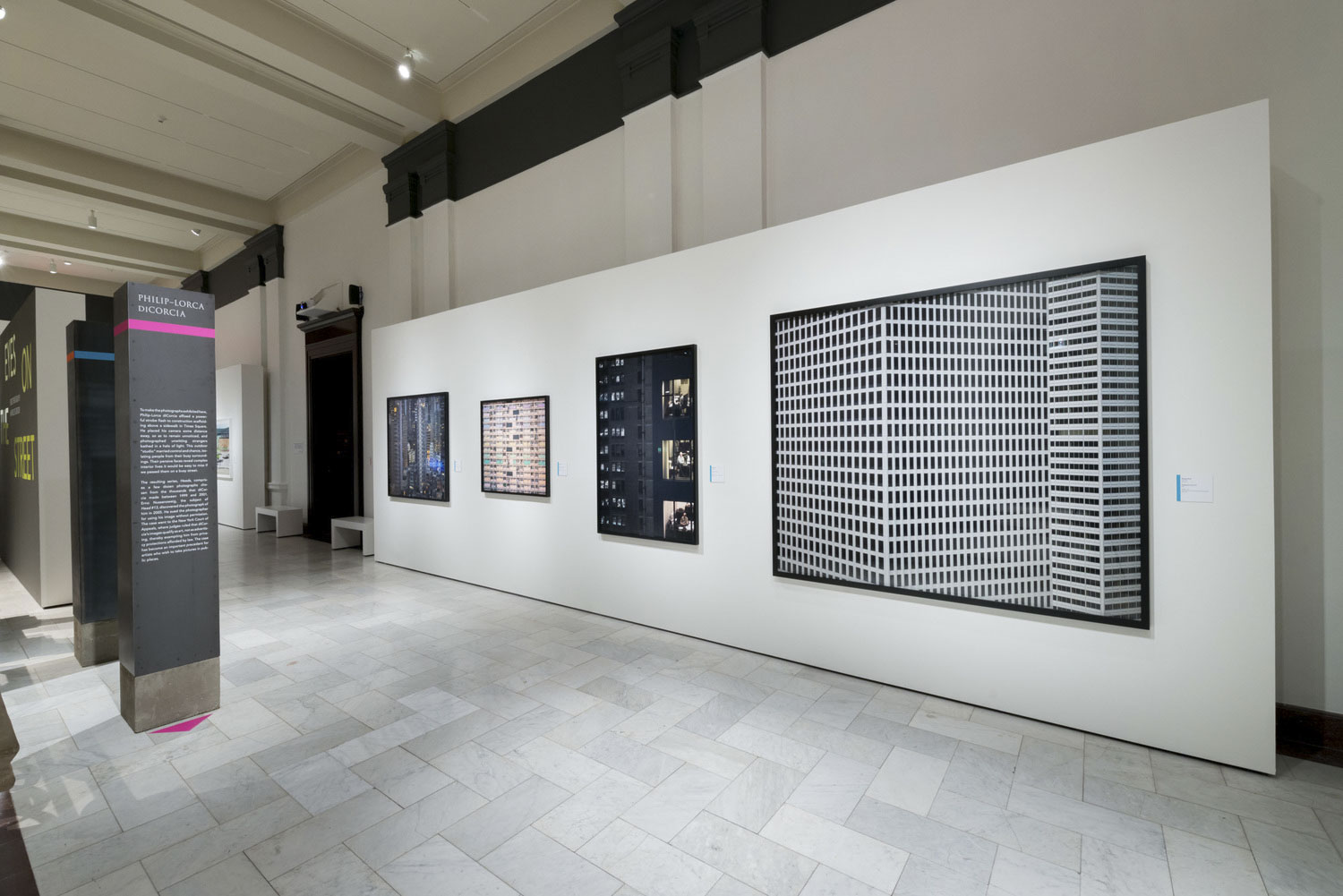
 

Installation view of the exhibition 'Eyes on the Street: street photography in the 21st century' at the Cincinnati Art Museum photo by Rob Deslongchamps


Installation view by Rob Deslongchamps


Cameras are an integral part of our lives, and the Cincinnati Art Museum’s new exhibition, Eyes on the Street, on view Oct. 11, 2014 – Jan. 4, 2015, examines how they can be used in public spaces. Through a collection of photographs, films and videos by 10 internationally renowned artists – most of whom have never previously exhibited in Cincinnati – the exhibition reimagines street photography and reveals how cameras shape perceptions of cities. Eyes on the Street is the Art Museum’s contribution to the region-wide FotoFocus festival and is a celebration of street photography in the twenty-first century.

“Street photography is a perennial subject of museum exhibitions, but by emphasising the role cameras’ technical capabilities play in making these artworks, I hope to broaden our understanding of the genre,” said Brian Sholis, associate curator of photography. “At the same time, it’s important to recognise that we are not merely subject to faceless surveillance, but can use cameras to amplify the invigorating aspects of city life.”

Eyes on the Street reimagines the genre of street photography and demonstrates how cameras shape our perceptions of cities. It features ten internationally renowned artists who work in photography, film, and video, each of whom deliberatively uses the camera’s technical capabilities to reveal new aspects of the urban environment. Through high-speed and high-definition lenses, multiple or simultaneous exposures, “impossible” film shots, and appropriated surveillance-camera footage, these artists breathe new life into the genre and remind us that urban public places are sites of creative and imaginative encounters.

The exhibition title comes from influential urban theorist Jane Jacobs, who wrote, in her classic treatise The Death and Life of Great American Cities, of “eyes on the street” being crucial to urban neighbourhoods’ vitality – and their ability to accommodate different people and activities. Today, discussion of cameras in public spaces often revolves around surveillance tactics or battles over first-amendment rights. Eyes on the Street reflects the diversity of urban experience and shows us how cameras can help us comprehend the complex urban environment.

The show includes artworks made in New York, San Francisco, Paris, Beirut, Tokyo, Istanbul, and elsewhere by artists who have exhibited widely and have received numerous grants, fellowships, and prizes. Most have never before exhibited in the Cincinnati area.

Press release from the Cincinnati Art Museum


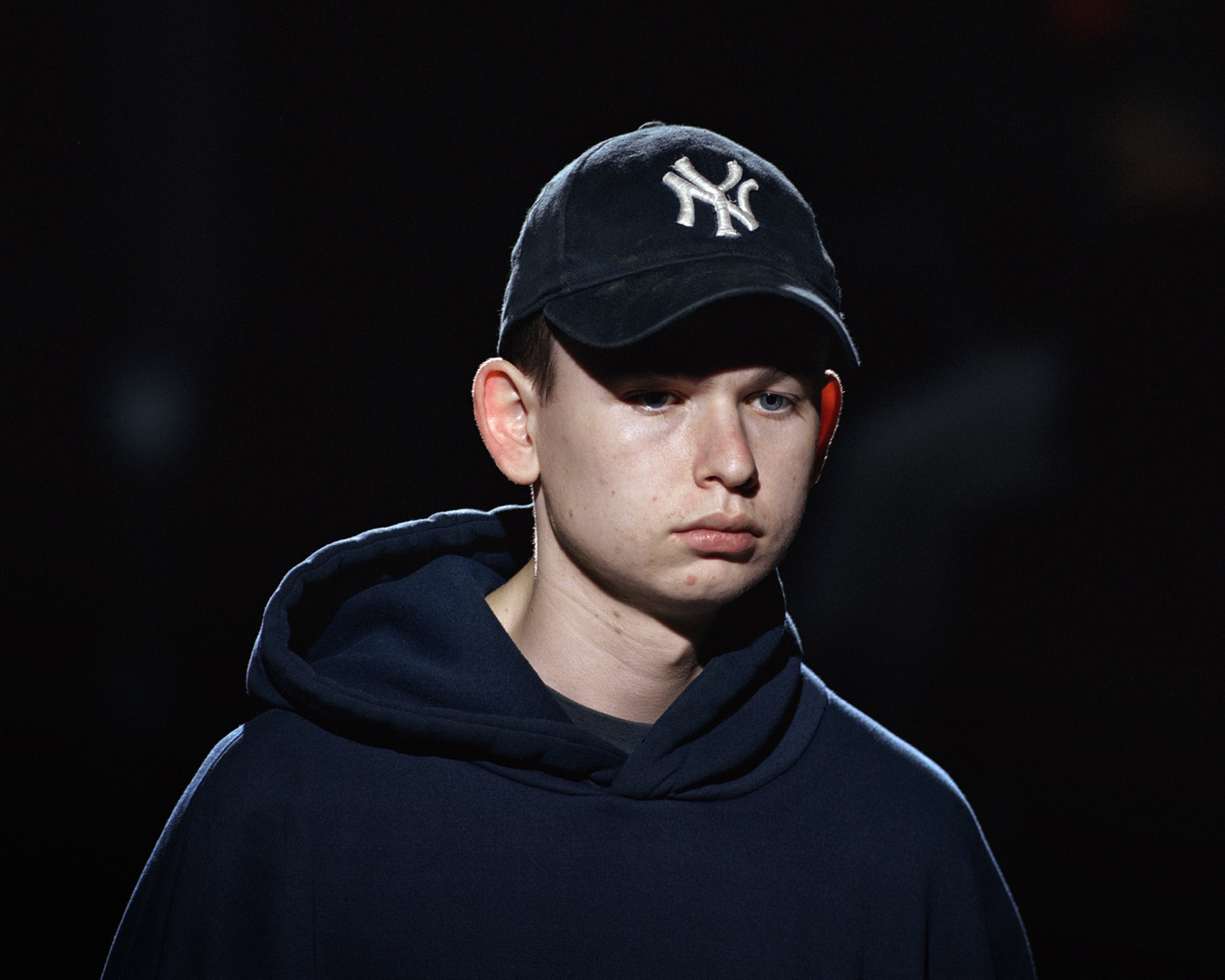
Philip-Lorca diCorcia (American, b. 1951) 'Head #23' 2001


Philip-Lorca diCorcia (American, b. 1951)
Head #23
2001
Fujicolor Crystal Archive print
48 x 60 inches
Courtesy of the artist and David Zwirner, New York/London


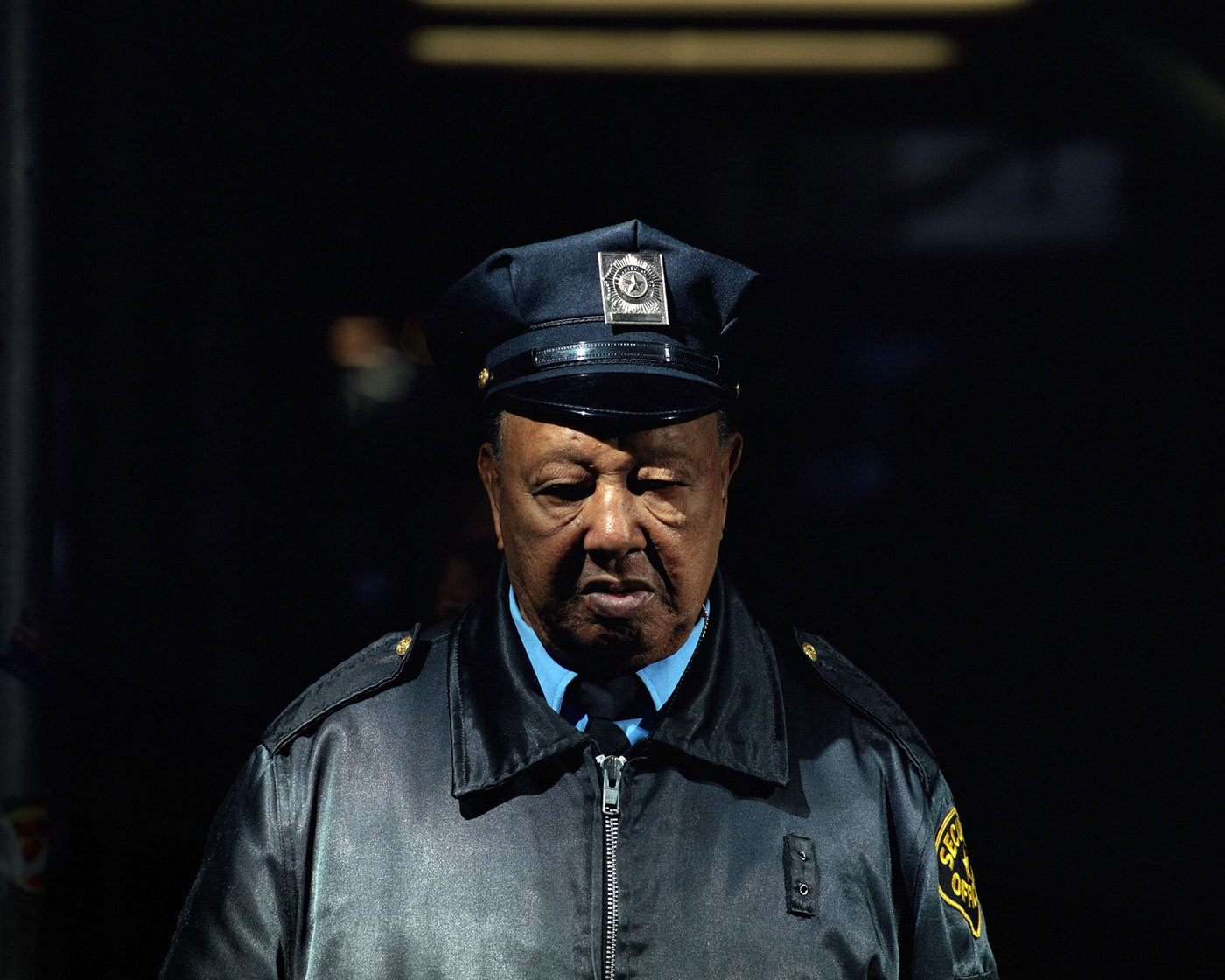
To make the photographs exhibited in Eyes on the Street, Philip-Lorca diCorcia affixed a powerful strobe flash to construction scaffolding above a sidewalk in Times Square. He placed his camera some distance away, so as to remain unnoticed, and photographed unwitting strangers bathed in a halo of light. This outdoor “studio” married control and chance, isolating people from their busy surroundings. Their pensive faces reveal complex interior lives it would be easy to miss if we passed them on a busy street.

The resulting series, Heads, comprises a few dozen photographs chosen from the thousands that diCorcia made between 1999 and 2001. Erno Nussenzweig, the subject of Head #13, discovered the photograph of him in 2005. He sued the photographer for using his image without permission. The case went to the New York Court of Appeals, where judges ruled that diCorcia’s images qualify as art, not as advertising, thereby exempting him from privacy protections afforded by law. The case has become an important precedent for artists who wish to take pictures in public places.
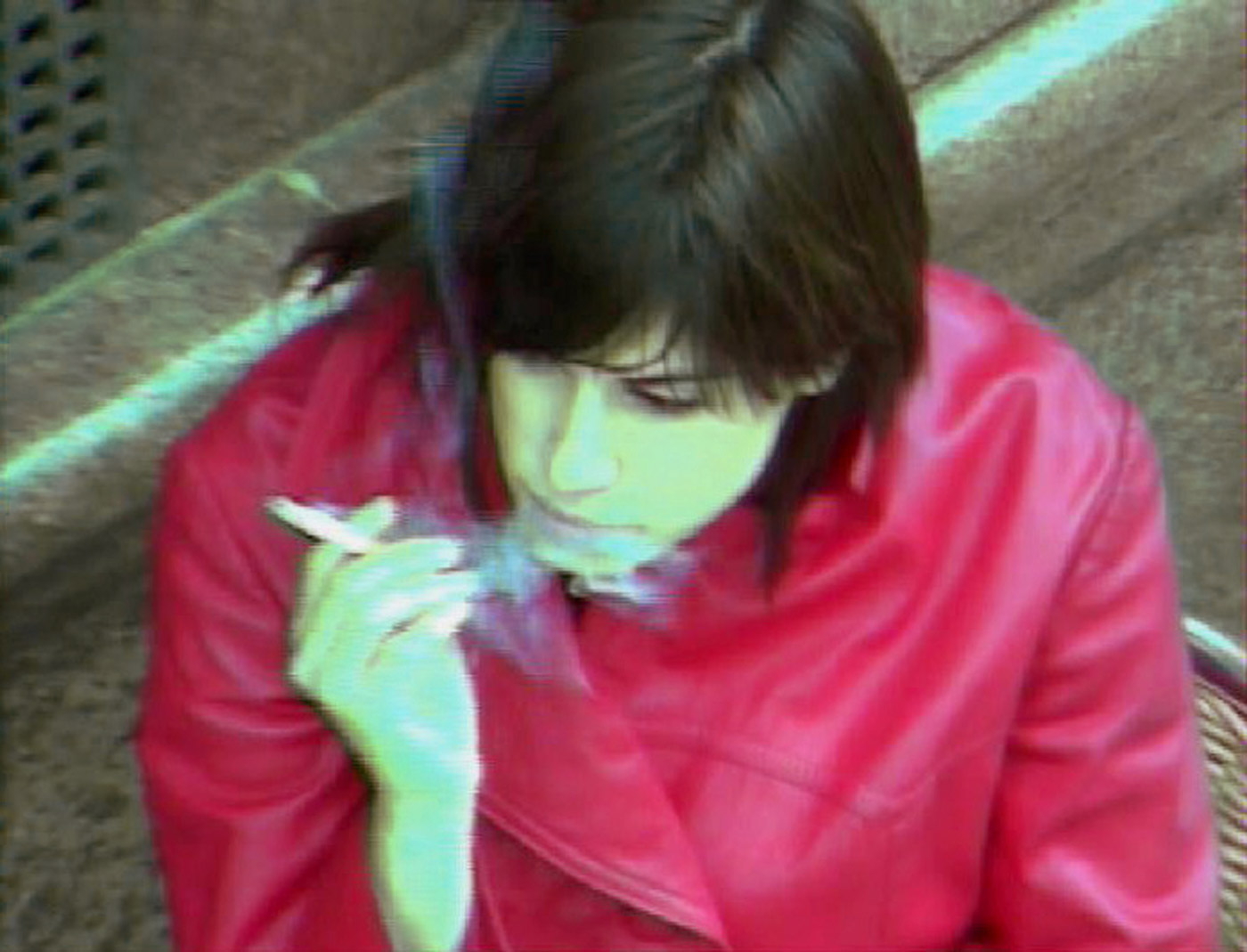
 

Jill Magid (American, b. 1973) 'Control Room' 2004


Jill Magid (American, b. 1973)
Control Room
2004
Still from a two-channel digital video, ten minutes
Courtesy of the artist and Galerie Yvon Lambert, Paris


For more than a decade artist Jill Magid has deliberately worked with institutions of authority to create videos, books, installations, and other artworks. For a series made in Liverpool in 2004, Magid spent thirty-one days in the English port city – the length of time footage from its Citywatch surveillance system is stored. Wearing a red trench coat, she aimed “to use the CCTV system as a film crew, to act as the protagonist, and to be saved in [its] evidence locker.”

During the project she developed relationships with the camera operators. In the video Trust, Magid closes her eyes and allows a CCTV operator to verbally guide her safely through the city’s busy streets. She has described the interaction as one of the most intimate she has experienced, and wrote the Subject Access Request Forms, used to obtain the footage, in the form of love letters. As she later said, “Only by being watched, and influencing how I was watched, could I touch the system and become vulnerable to it.”
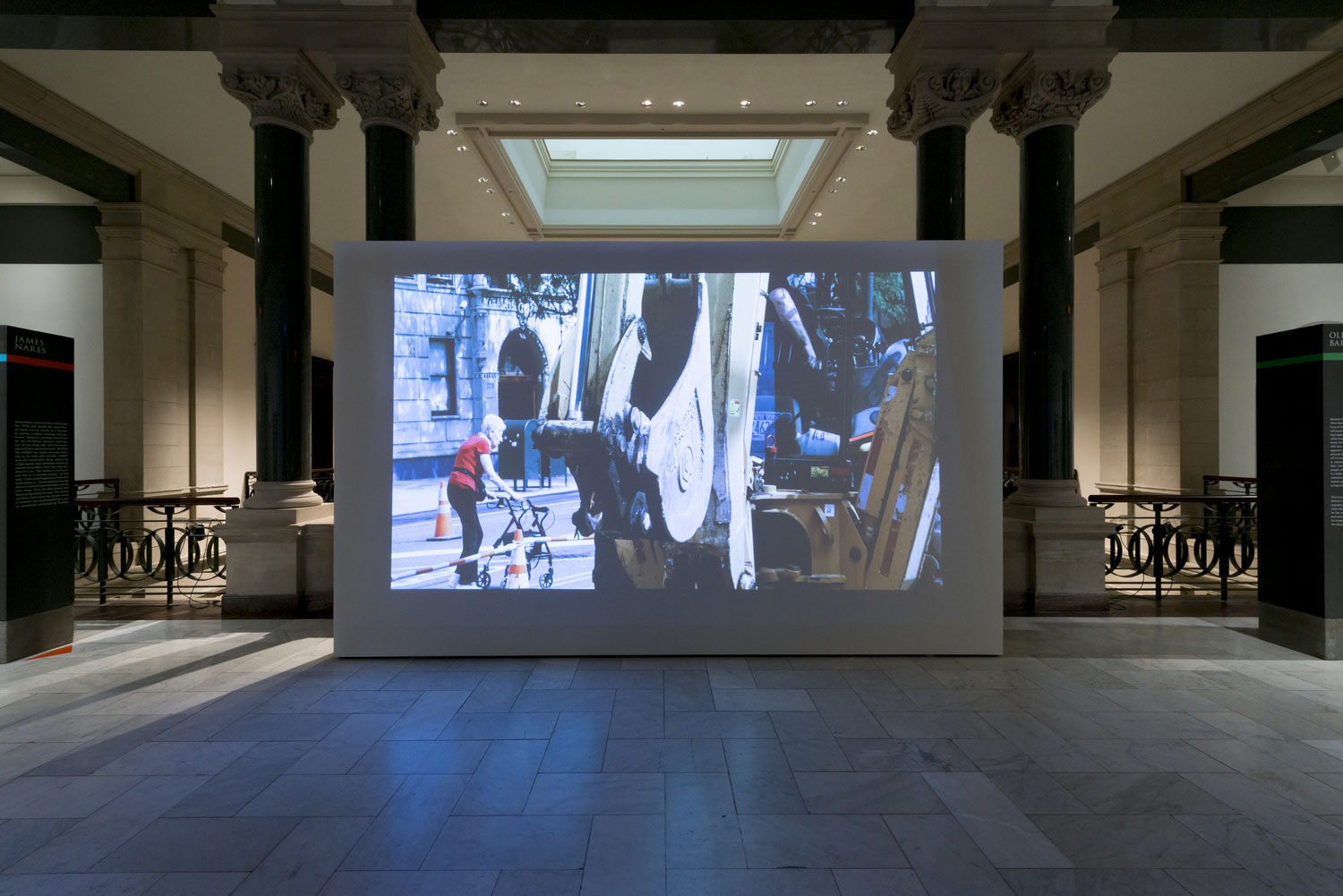
 

Installation view of James Nares's film 'Street' in the exhibition 'Eyes on the Street: street photography in the 21st century' at the Cincinnati Art Museum photo by Rob Deslongchamps


Installation view of James Nares’s film Street. Photo by Rob Deslongchamps.


James Nares Street


James Nares moved to New York during the 1970s and joined the experimental music and art scenes as a filmmaker, painter, sculptor, musician, and performer. Today he is perhaps best known for his beautiful abstract paintings, but he has made still- and moving-image work throughout his career. His 2012 film STREET has drawn renewed attention to his work with cameras. STREET uses the remarkable clarity offered by a high-speed, high-definition camera to mesmerising effect. Shot from the window of a car, “the camera is moving in one line at a constant speed,” he has said. “I take small fragments of time and extend them. […] I just wanted to see the drama in small things that happen all the time, everywhere, the little dramas that become big along the way.”

STREET is an unscripted 61-minute high definition video filmed by artist James Nares over one week in September 2011. The final video is a mesmerising experiment in the nuance and beauty of everyday people and people-watching; providing a global view that extends beyond the streets of New York where it was filmed: from Battery Park to the furthest reaches of Upper Broadway, and West Side to East Side in Nares’ personal homage to actualité films. In Nares’ words, “I wanted the film to be about people. All it needed were magical moments, and there are enough of those happening every moment of any given day.”

The scenes are drawn from more than sixteen hours of material and accompanied by a guitar soundtrack performed by Thurston Moore of Sonic Youth.


Eyes on the Street

Brian Sholis

Associate Curator of Photography
Cincinnati Art Museum


The title of this exhibition comes from the architecture writer and urban activist Jane Jacobs, who, in her classic 1961 treatise The Death and Life of Great American Cities, wrote of eyes on the street being crucial to the vitality of urban neighbourhoods, in particular their ability to accommodate different people and activities. She was celebrating her Greenwich Village neighbours, “allies whose eyes help us natives keep the peace of the street,” the “lucky possessors of a city order that makes it relatively simple to keep the peace.” She was quick to add, “there is nothing simple about that order itself, or the bewildering number of components that go into it.” Fifty years later the elements that make urban life vibrant and challenging are even greater in number, and the omnipresence of cameras is one of the greatest changes to the ways we manage a city’s order. Today, discussion of cameras in public places often concentrates on issues of surveillance, personal privacy, and first-amendment rights. As the writer Tom Vanderbilt asked in a 2002 essay that touches on Jacobs’s legacy, “Why is a police surveillance camera on a public street any more intrusive than a patrolman stationed on the corner? […] The real question in all of this is motive, not means: who’s doing the watching, and for what purpose?” The artworks brought together in Eyes on the Street offer ways to think about the social, political, legal, and architectural implications of these questions.

The photographs, films, and videos exhibited here also offer ways to reimagine the genre of street photography, which art historians typically associate with Jacobs’s mid-twentieth-century era. At the time she was drafting the ideas quoted above, photographers like Robert Frank, Henri Cartier-Bresson, and Garry Winogrand prowled Western cities, 35-mm cameras in hand, taking pictures of the daily sidewalk ballet. They worked tirelessly, often photographing rapidly and without introducing themselves to their subjects, whom they corralled into rectangular compositions that expressed some of the dynamism of the passing parade. By contrast, the artists in Eyes on the Street, all working in the twenty-first century, respond to the changed conditions of the city in part by using more deliberative strategies to capture their subjects. They recognise the pervasive influence of cameras on the urban environment by employing their own cameras’ special capabilities to show things our eyes may not see or our minds might not notice. For photographers working half a century ago, the lens was a natural extension of their hands and a relatively simple conduit of their artistic sensibilities. The artists in Eyes on the Street work more self-consciously to disclose the forces conditioning the urban environment and to acknowledge cameras’ active role in that process. In so doing, they create stunning still- and moving-image artworks that show us such places as New York, Shanghai, Beirut, Paris, Chicago, and Istanbul as we’ve never seen them before.

Faces in the Crowd

Writing more than a century ago, German sociologist Georg Simmel diagnosed the mental life of people living in rapidly modernising cities, suggesting that our psychological survival depended upon separating ourselves from the many stimulations of the urban environment. The influence of Simmel’s thinking upon the social sciences has been profound, but scholars today increasingly identify an inversion of his theory as true: for the survival of the metropolis, we must overcome narrow individualism to empathise with others who share it with us. However, one’s capacity to relate to others is necessarily limited, and this cosmopolitan ethics can be difficult to maintain. James Nares’s 2012 film Street uses the remarkable clarity offered by a high-speed, high-definition camera to offset the potentially numbing effect of so many encounters. By slowing down his footage of New York sidewalks, taken from the window of a car moving thirty miles per hour, Nares isolates small vignettes unspooling on the sidewalk. Peoples’ movements are picked out in fine detail, their individual gestures and expressions heightened into a slow-motion monumentality. A similar effect characterises the photographs in Philip-Lorca diCorcia’s series Heads (1999-2001). To make these works, diCorcia, affixed a flash strobe to construction scaffolding on a sidewalk in Times Square. Placing his camera far enough away to be unnoticed, he pre-focused his lens on the spot illuminated by the flash and captured unwitting strangers bathed in a halo of light. His improvised outdoor studio married control and chance, isolating people from their busy surroundings and catching them in moments of inwardness. Their pensive faces reveal complex interior lives it would be all too easy to ignore should we be strolling past them. The quality of attention afforded by Nares and diCorcia’s cameras results in the humanism of their work and grants the dignity we can read in these faces. As the critic Ken Johnson observed of Street, what results is an update of “Walt Whitman’s poetic embrace of humanity. The camera gazes at all with the same equanimity and finds each person, in his or her own way, dignified, loveable, and even beautiful.”

In his series NYLPT, photographer Jason Evans reverses this penchant for individuation. The acronym stands for “New York London Paris Tokyo.” Working over a period of eight years, Evans would expose a roll of 35-mm black-and-white film in one of these cities, then rewind and set aside the roll until his travels brought him to another. There, he would reload the film and re-expose the frames, sometimes doing so up to five times without knowing what the results would look like. As he has said, “The ‘decisive moment’ was no longer out there waiting to be hunted down,” as with traditional street photography. Instead, “it had moved behind the lens, onto the film plane.” Sometimes a fragment of language or familiar landmark reveals where part of the picture was made. More often, however, the textures, shapes, and surreal combinations of built environments come together to connote urbanness as a category of experience.
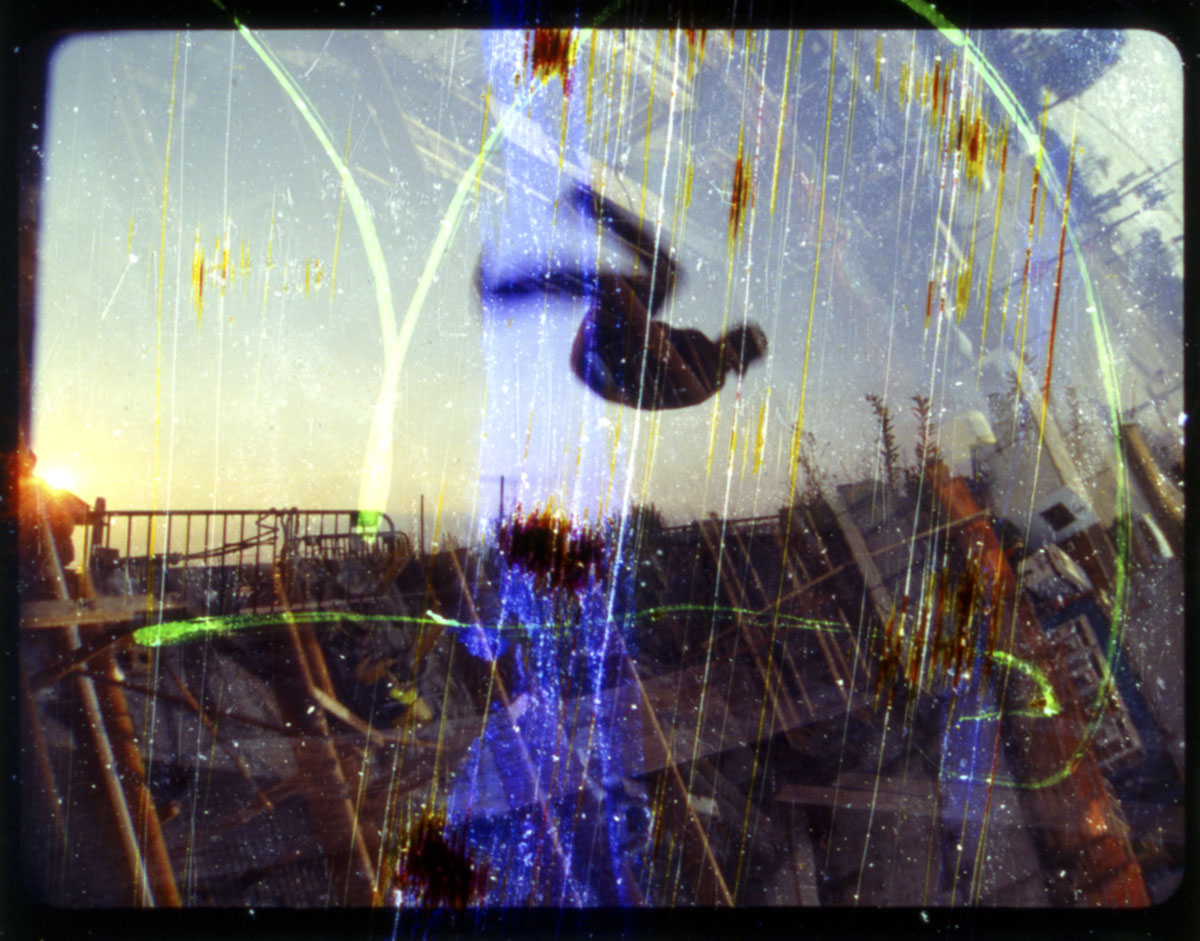
 

Jennifer West (American, b. 1966) Still from 'One Mile Film' 2012


Jennifer West (American, b. 1966)
One Mile Film (5,280 feet of 35mm film negative and print taped to the mile-long High Line walk way in New York City for 17 hours on Thursday, September 13th, 2012 with 11,500 visitors – the visitors walked, wrote, jogged, signed, drew, touched, danced, parkoured, sanded, keyed, melted popsicles, spit, scratched, stomped, left shoe prints of all kinds and put gum on the filmstrip – it was driven on by baby stroller and trash can wheels and was traced by art students – people wrote messages on the film and drew animations, etched signs, symbols and words into the film emulsion lines drawn down much of the filmstrip by visitors and Jwest with highlighters and markers – the walk way surfaces of concrete, train track steel, wood, metal gratings and fountain water impressed into the film; filmed images shot by Peter West – filmed Parkour performances by Thomas Dolan and Vertical Jimenez – running on rooftops by Deb Berman and Jwest – film taped, rolled and explained on the High Line by art students and volunteers)
2012
Still from 35-mm film transferred to high-definition video
Commissioned and produced by Friends of the High Line and the New York City Department of Parks and Recreation
Courtesy of the artist and Marc Foxx, Los Angeles


Jennifer West is resolutely experimental in her approach to film, and is known in particular for the ways she treats her film stock: submerging it in seawater, bathing it in chemicals, or exposing it to different types of radiation, usually to psychedelic effect. Her One Mile Film … (2012), commissioned by and for the High Line, an elevated park in New York, documents free-running practitioners – athletes who explore environments without limitations of movement – climbing, jumping, and exploring the park and its environs. Here, though, her “treatment” is an alternative method of recording people in this public space. Once she had completed filming, West affixed her film stock to the High Line’s footpaths, inviting park visitors – some 11,500 of them – to walk on, roll over, draw on, and otherwise imprint their presence upon her work. The finished film appears semi-abstract but is in fact a trace of the people who passed through that particular place on that September 2012 day, like the rubbings people make of manholes and headstones.
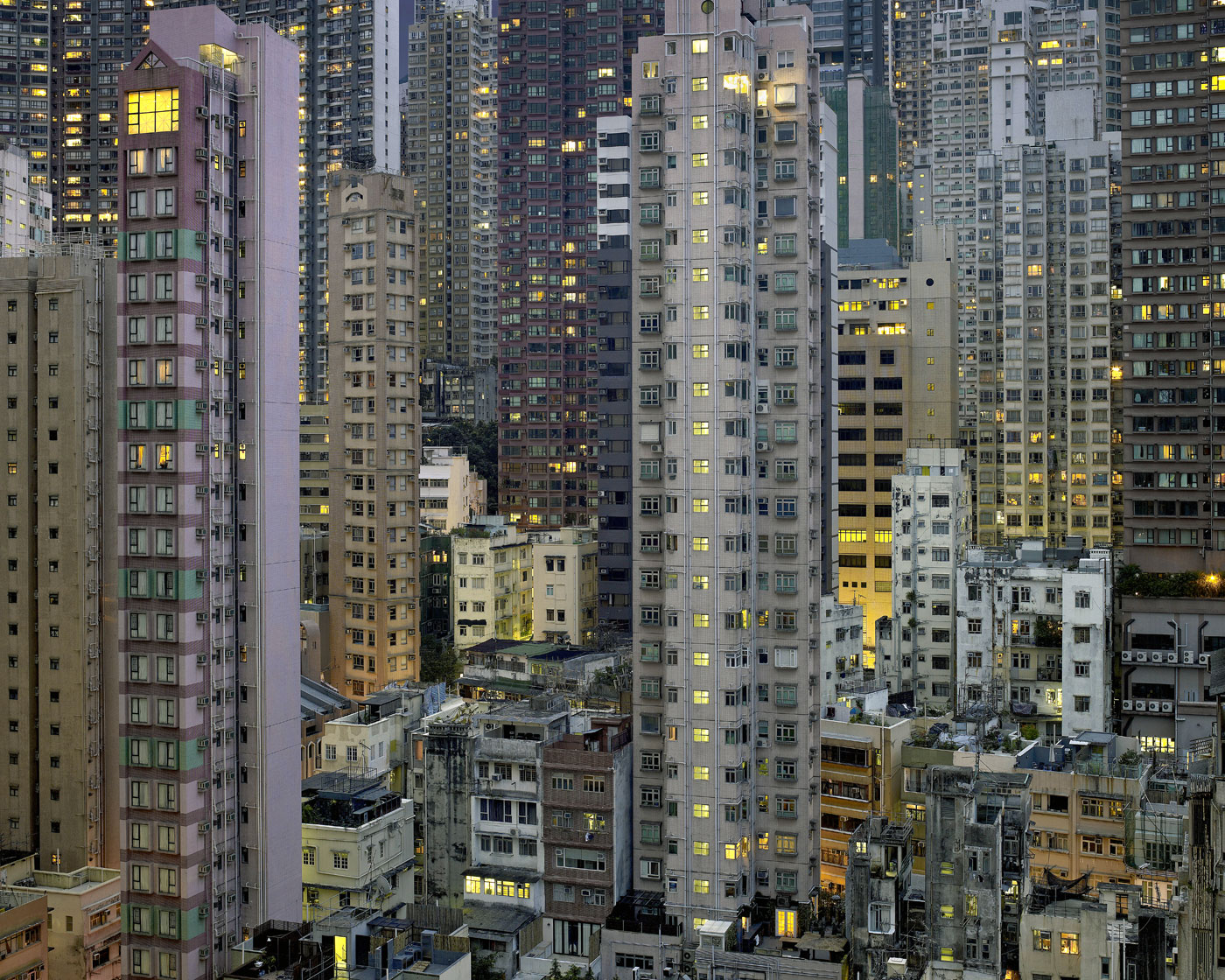
 

Michael Wolf (German, 1954-2019) 'Night #20' 2007


Michael Wolf (German, 1954-2019)
Night #20
2007
Digital c-print
48 x 60 inches
Courtesy of the artist and Bruce Silverstein Gallery, New York


The number of both people and buildings tucked into Hong Kong’s small landmass inspired Michael Wolf to express the verticality and compactness of that unique place. His series Architecture of Density emphasises the repetition inherent to most large-scale construction by zeroing in on building facades and eliminating the ground, the sky, and all other elements that might reveal the picture’s scale. The residential towers seem to stretch on forever; the only variation comes from small human elements, such as laundry hung out to dry. The buildings depicted in the series Transparent City, made in 2007 and 2008 in Chicago, are not quite as close together, and Wolf subsequently created looser compositions. He likewise took advantage of a 300-mm lens and the buildings’ glass curtain-wall construction to peer through the windows at the life inside. “I became acutely aware of being a voyeur,” Wolf said.


Mark Lewis (Canadian, b. 1958) Still from 'Beirut' 2011


Mark Lewis (Canadian, b. 1958)
Beirut
2011
Still from a high-definition video, 8 minutes 11 seconds
Courtesy of the artist and Daniel Faria Gallery, Toronto


In his short films, Mark Lewis repeatedly isolates the fundamental gestures of cinema, exaggerating a zoom or a tracking shot to reveal the constructedness of a seemingly natural scene. Without sacrificing beauty or mystery, Lewis’s meticulously planned works uncover the kinds of artifice that big-budget popular movies aim to conceal. In his eight-minute film Beirut (2011), Lewis crafts a Steadicam shot to explore the multiple cultures and tangled histories represented on a Lebanese street. In a remarkable single take, the camera rounds a corner, proceeds down the street, then lifts magically into the air, floating above roofline to situate these histories in the larger urban fabric. And the end of this short film reminds us of the life that continues around us even as we focus only at street level.


Cincinnati Art Museum
953 Eden Park Drive
Cincinnati, Ohio 45202
Phone: (513) 721-ARTS (2787)

Opening hours:
Open Tuesday – Sunday 11am – 5pm
Closed Mondays
Cincinnati Art Museum website

LIKE ART BLART ON FACEBOOK

Back to top

Exhibition: ‘Philip-Lorca diCorcia: Photographs 1975-2012’ at the De Pont museum of contemporary art, Tilburg

Exhibition dates: 5th October 2013 – 19th January 2014

PLEASE NOTE: THIS POSTING CONTAINS ART PHOTOGRAPHS OF FEMALE NUDITY – IF YOU DO NOT LIKE PLEASE DO NOT LOOK, FAIR WARNING HAS BEEN GIVEN


Philip-Lorca diCorcia (American, b. 1951) 'Norfolk' 1979


Philip-Lorca diCorcia (American, b. 1951)
Norfolk
1979
Fujicolor Crystal Archive print
16 x 20 inches (40.6 x 50.8cm)
Courtesy the artist and David Zwirner, New York/London


This is (our) reality.


Many thankx to the De Pont museum of contemporary art for allowing me to publish the photographs in the posting. Please click on the photographs for a larger version of the image.


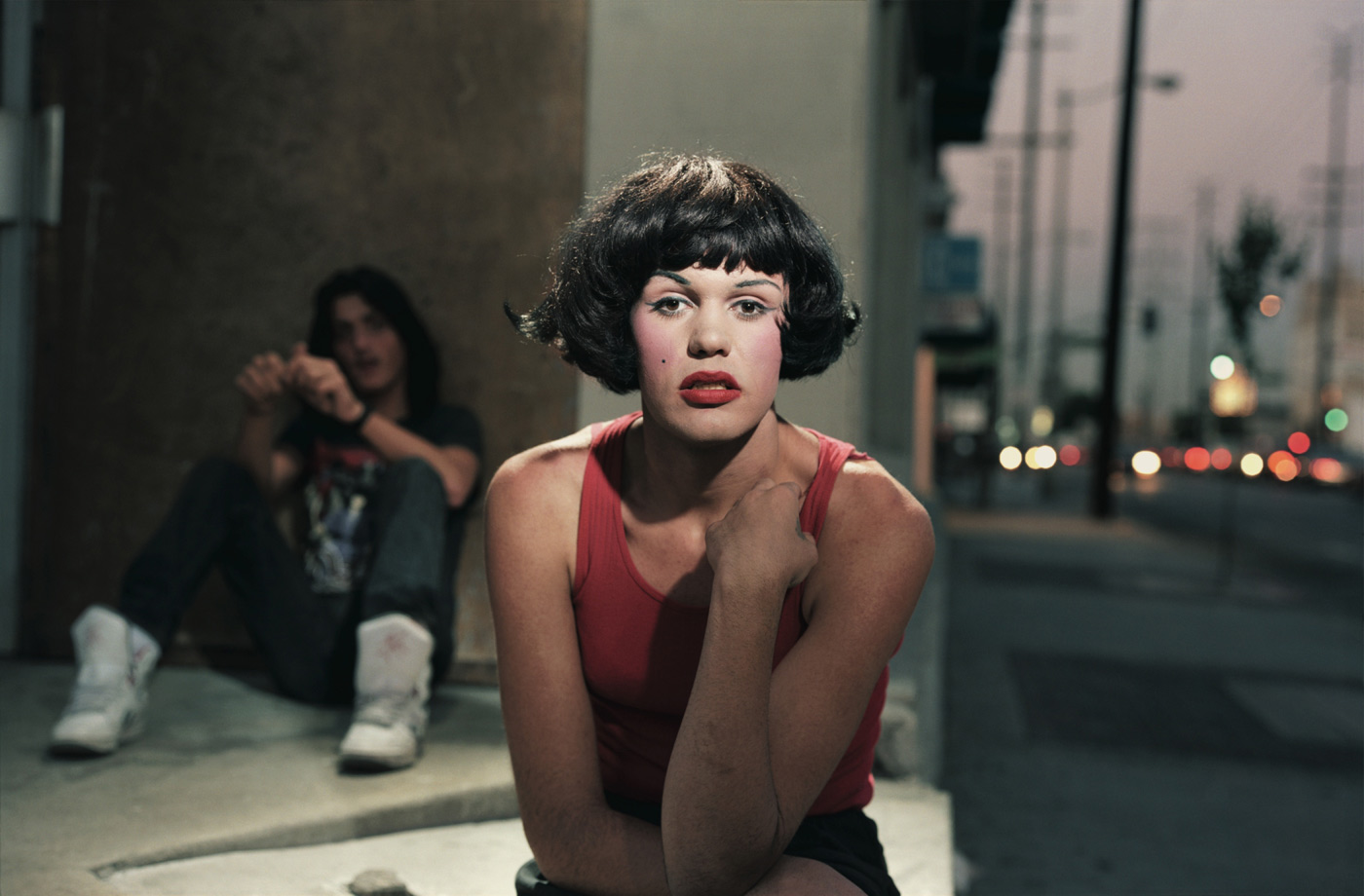
Philip-Lorca diCorcia (American, b. 1951) 'Marilyn; 28 years old; Las Vegas, Nevada; $30' 1990-1992


Philip-Lorca diCorcia (American, b. 1951)
Marilyn; 28 years old; Las Vegas, Nevada; $30
1990-1992
© Philip-Lorca diCorcia, Courtesy David Zwirner, New York/London


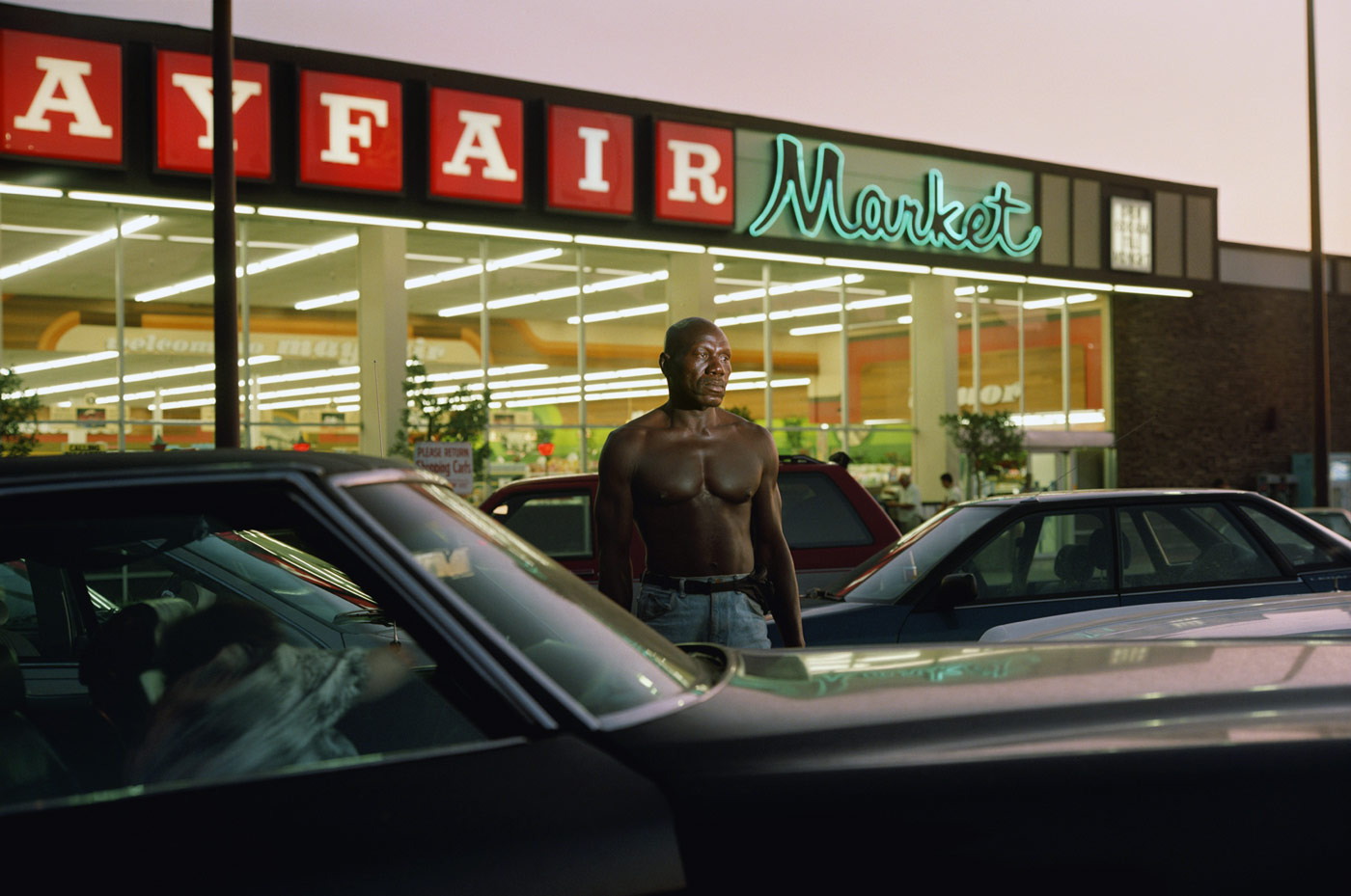
Philip-Lorca diCorcia (American, b. 1951) 'Ike Cole, 38 years old, Los Angeles, California, $25' 1990-1992


Philip-Lorca diCorcia (American, b. 1951)
Ike Cole, 38 years old, Los Angeles, California, $25
1990-1992
Fujicolor Crystal Archive print
30 x 40 inch (111.8 x 167.6cm)
© Courtesy of the artist and David Zwirner, New York and Sprüth Magers, London/Berlin


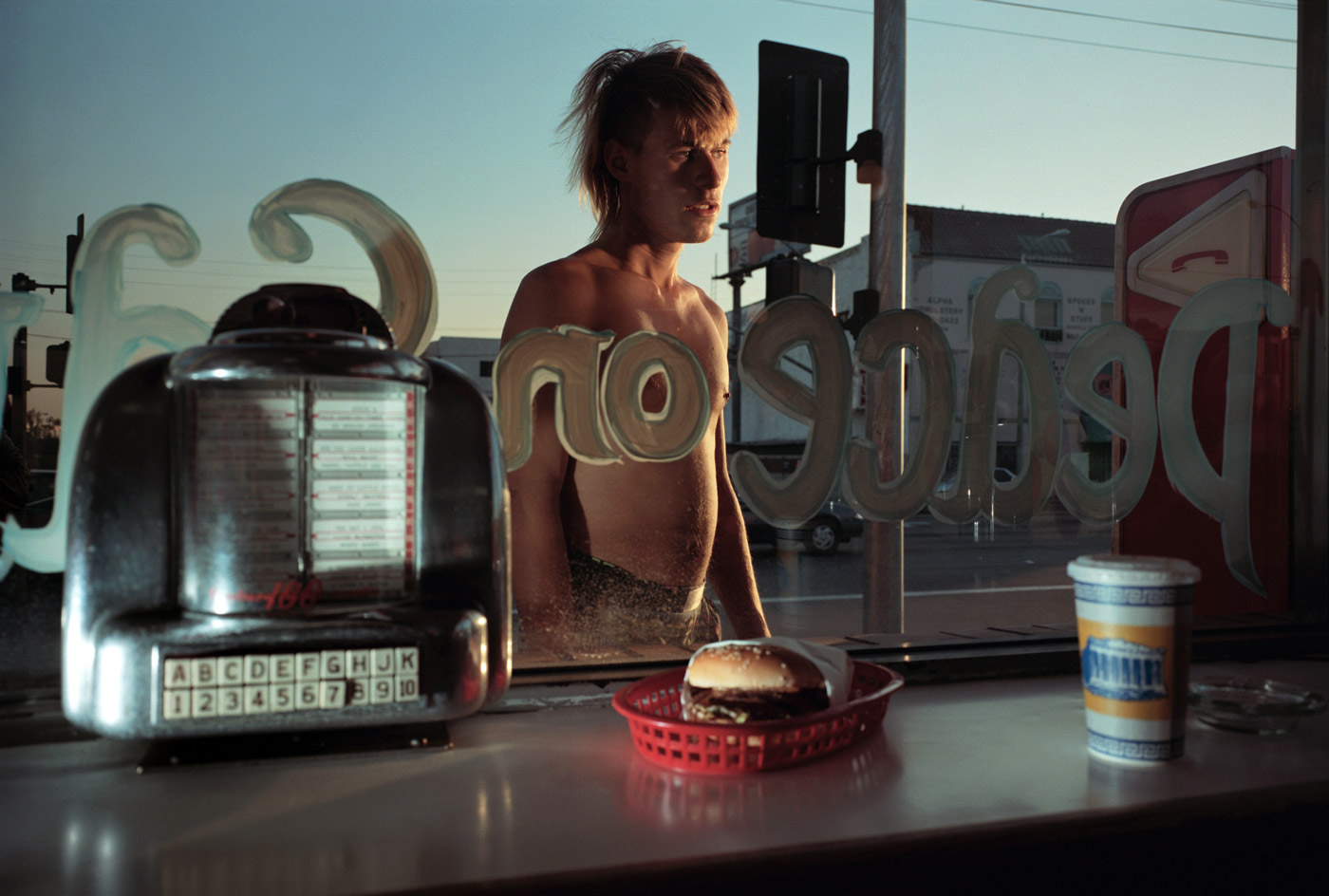
Philip-Lorca diCorcia (American, b. 1951) 'Eddie Anderson, 21 years old, Houston, Texas, $ 20' 1990-1992


Philip-Lorca diCorcia (American, b. 1951)
Eddie Anderson, 21 years old, Houston, Texas, $ 20
1990-1992
Fujicolor Crystal Archive print
30 x 40 inches (76.2 x 101.6cm)
Courtesy the artist and David Zwirner, New York/London


Philip-Lorca diCorcia (American, b. 1951) 'New York' 1993


Philip-Lorca diCorcia (American, b. 1951)
New York
1993
Ektacolor print
30 x 40 inches (76.2 x 101.6cm)
Courtesy the artist and David Zwirner, New York/London


Philip-Lorca diCorcia (American, b. 1951) 'Wellfleet' 1993


Philip-Lorca diCorcia (American, b. 1951)
Wellfleet
1993
Fujicolor Crystal Archive print
41.3 x 51.8cm
© Courtesy of the artist and David Zwirner, New York/London


Philip-Lorca diCorcia (American, b. 1951) 'Hong Kong' 1996


Philip-Lorca diCorcia (American, b. 1951)
Hong Kong
1996
Ektacolor print
25 x 37 1/2 inches (63.50 x 95.25cm)
Courtesy the artist, and David Zwirner, New York/London


Philip-Lorca diCorcia (American, b. 1951) 'New York City' 1996


Philip-Lorca diCorcia (American, b. 1951)
New York City
1996
Fujicolor Crystal Archive print
16 1/4 x 20 3/8 inches (41.3 x 51.8cm)
© Courtesy of the artist and David Zwirner, New York/London


Starting October 5, 2013 De Pont museum of contemporary art is hosting the first European survey of the oeuvre of US photographer Philip-Lorca diCorcia. Born in 1951, diCorcia is one of the most important and influential contemporary photographers. His images oscillate between everyday elements and arrangements that are staged down to the smallest detail. In his works, seemingly realistic images that are taken with an ostensibly documentary eye are undermined by their highly elaborate orchestration. This exhibition is organised in collaboration with Schirn Kunsthalle Frankfurt.

One of the primary issues that diCorcia addresses is the question of whether it is possible to depict reality, and this is what links his photographs, most of which he creates as series. For Hustlers (1990-1992), for example, he took pictures of male prostitutes in meticulously staged settings, while in what is probably his most famous series, Heads (2000-2001), he captured an instant in the everyday lives of unsuspecting passers­‐by. Alongside the series Streetwork (1993-1999), Lucky 13 (2004) and A Storybook Life (1975-1999), the exhibition at the Schirn, which was organised in close collaboration with the artist, will also present works from his new and ongoing East of Eden (2008-) project for the first time.

In addition, the work Thousand (2007) will also be on show in Tilburg. This installation consisting of 1,000 Polaroid’s, which are considered one complete work, offers a distinctive vantage point into the artist’s sensibility and visual preoccupations. Seen alongside Polaroid’s from some of diCorcia’s most recognised bodies of work and distinctive series – Hustlers, Streetwork, Heads, Lucky Thirteen – are intimate scenes with friends, family members, and lovers; self portraits; double-exposures; test shots from commercial and fashion shoots; the ordinary places of everyday life, such as airport lounges, street corners, bedrooms; and still life portraits of common objects, including clocks and lamps.

For the Hustlers series (1990-1992), diCorcia shot photographs of male prostitutes along Santa Monica Boulevard in Hollywood. The artist carefully staged the protagonists’ positions as well as the setting and the accompanying lighting. The titles of the respective photographs make reference to the name, age, and birthplace of the men as well as the amount of money diCorcia paid them for posing and which they typically receive for their sexual services. Staged in Tinseltown, the Hollywood district of Los Angeles, the hustlers become the touching performers of their own lost dreams.

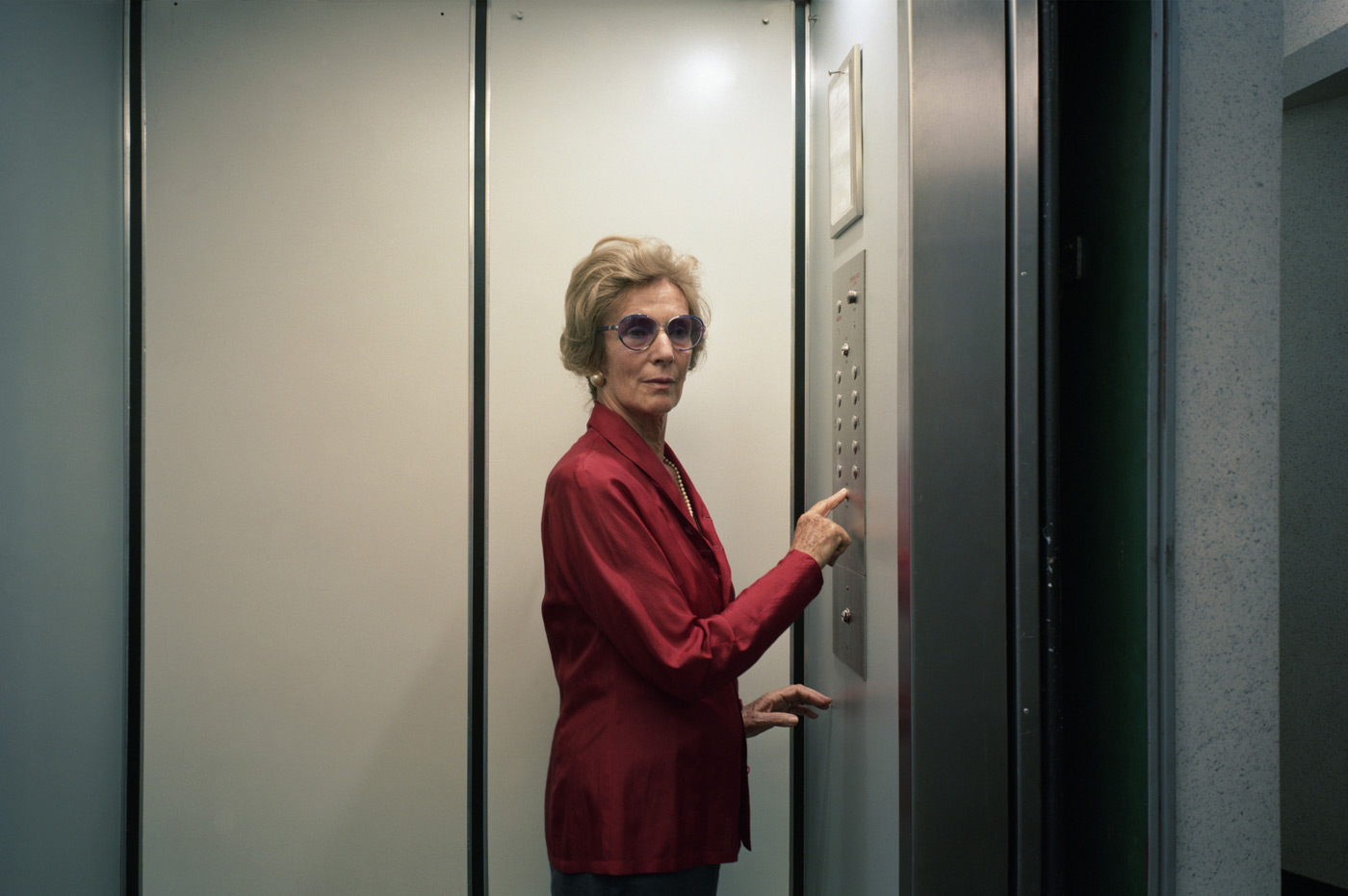
The streets of New York, Tokyo, Paris, London, Mexico City, or Los Angeles are the setting for diCorcia’s Streetwork series. Produced between 1993 and 1999, passers-by walk into the artist’s photo trap on their way home, to work, to the gym, or to the grocery store, unsuspectingly passing through diCorcia’s arranged photoflash system. The photographer releases the shutter at a certain moment, “freezing” it in time. DiCorcia has time stand still in the hustle and bustle of big-city life and shifts individuals and groups of people into the centre of events. In much the same way as in Hustlers, what counts here is not the documentary character of the work; instead, diCorcia poses the question: What is reality?

The artist heightens this focus on the individual in his subsequent series, Heads (2000-2001), for which he selected seventeen heads out of a total of some three thousand photographs. The viewer’s gaze is directed toward the face of the passer-by, who is moved into the centre of the image by means of the lighting and the pictorial detail. The rest remains in shadowy darkness. The individuals – a young woman, a tourist, a man wearing a suit and tie – seem strangely isolated, almost lonely, their gazes otherworldly. DiCorcia turns the inside outward and for a brief moment elevates the individual above the crowd. The artist produces a profound intimacy.

With Streetwork and Heads, diCorcia treads a very individual path of street photography, which in America looks back at a long tradition established by artists such as Walker Evans, Robert Frank, or Diane Arbus. He reinvents the seemingly chance moment and transfers it into the present.

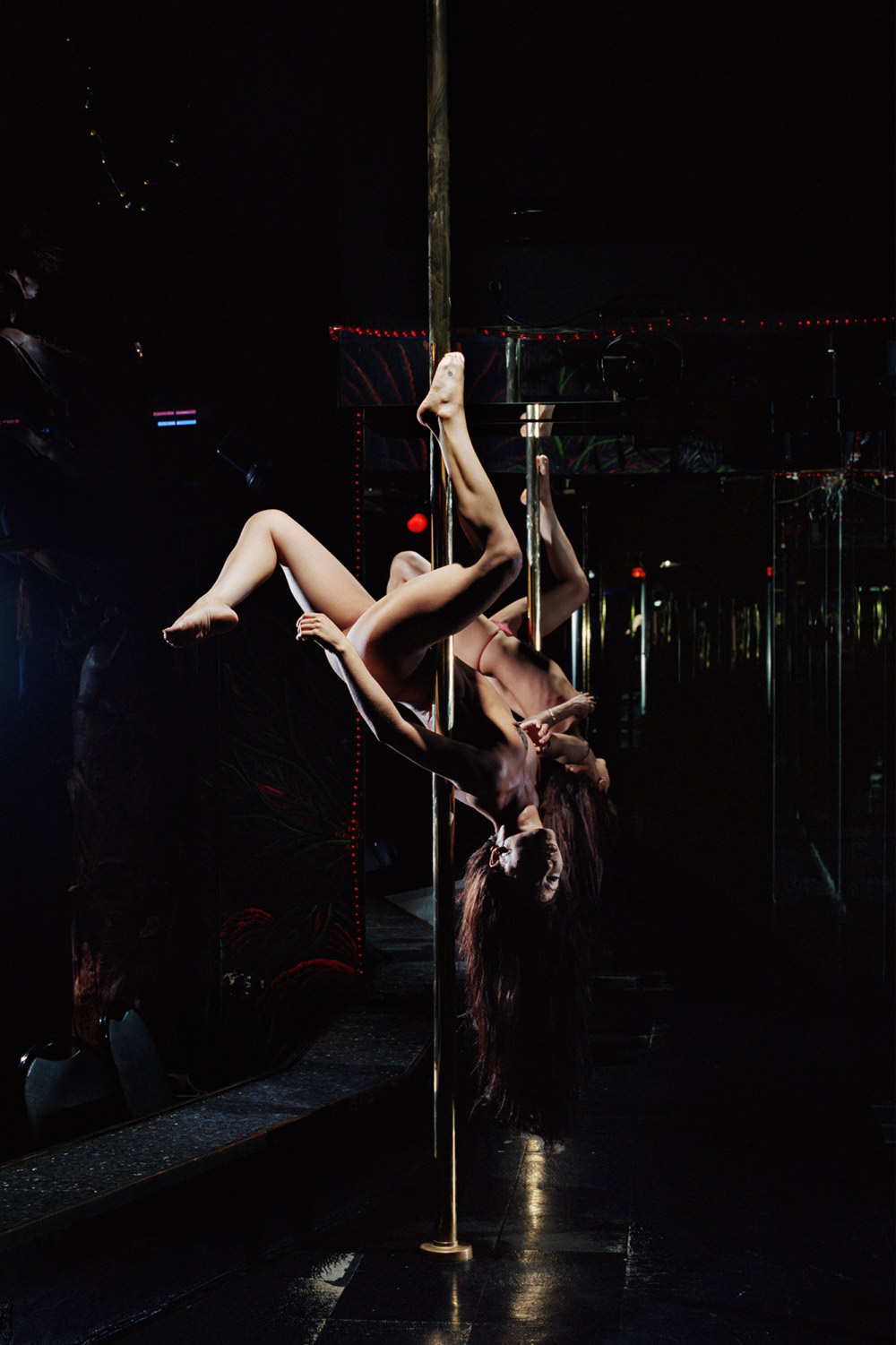
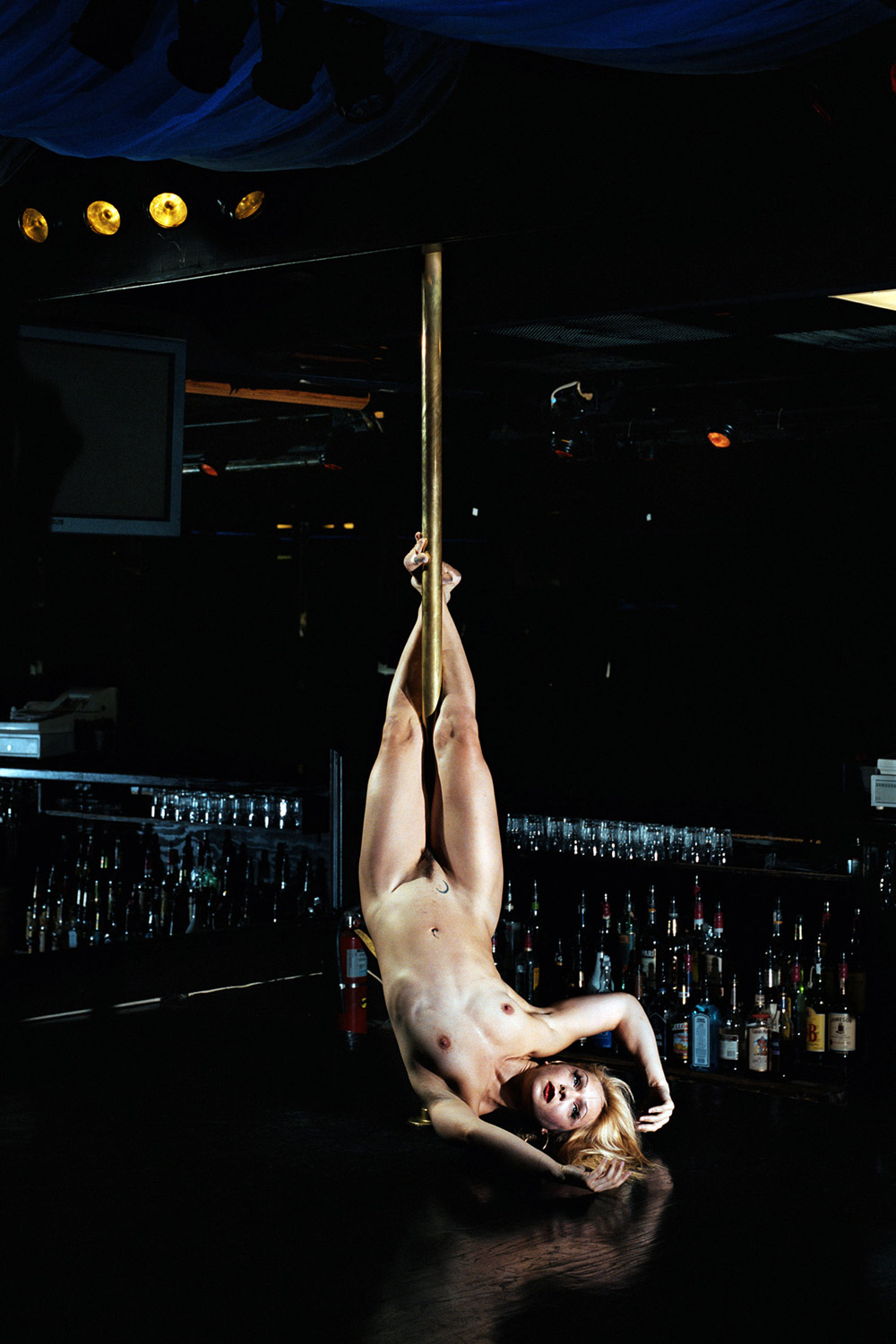
The painterly quality of diCorcia’s photographs, which is produced by means of dramatic lighting, becomes particularly evident in the series Lucky 13 (2004). The artist captures the athletic, naked bodies of pole dancers in the midst of a falling motion. The women achieve a sculptural plasticity by means of the strong lighting and the almost black background, and seem to have been chiselled in stone. Although the title of the series, an American colloquialism used to ward off a losing streak, makes reference to the seamy milieu of strip joints, the artist is not seeking to create a milieu study or celebrate voyeurism. Instead, the performers become metaphors for impermanence, luck, or the moment they begin to fall, suggesting the notion of “fallen angels.”

DiCorcia also includes a religious element in his most recent works, the series East of Eden, a work in progress that is being published for the first time in the catalogue accompanying the exhibition. Besides the biblical inspiration, which the title underscores, a literary connection can furthermore be made to the eponymous novel by John Steinbeck, which relates the story of Cain and Abel in the form of an American family saga set between the period of the Civil War and World War I. In his choice of motifs, diCorcia makes use of iconographic visual worlds: an apple tree in all its tantalising glory, a blind married couple sitting at the dining table, a landscape photograph that leads us into endless expanses.

DiCorcia deals intensely with the motif of the figure in his oeuvre. His compact compositions are marked by a non-dialogue between people and their environment or between individual protagonists. The motifs captured in compositional variations in most of the series feature painterly qualities. Subtly arranged and falling back on a complex orchestration of the lighting, the visual worlds created by the American manifest social realities in an almost poetic way. The emotionally and narratively charged works are complex nexuses of iconographic allusions to and depictions of contemporary American society.

Press release from the De Pont website


Philip-Lorca diCorcia (American, b. 1951) 'Head #10' 2001


Philip-Lorca diCorcia (American, b. 1951)
Head #10
2001
Fujicolor Crystal Archive print
48 x 60 inches (121.9 x 152.4cm)
Courtesy the artist and David Zwirner, New York/London


Philip-Lorca diCorcia (American, b. 1951) 'Head #11' 2001


Philip-Lorca diCorcia (American, b. 1951)
Head #11
2001
Fujicolor Crystal Archive print
48 x 60 inches (121.9 x 152.4cm)
Collection De Pont museum of contemporary art, Courtesy the artist and David Zwirner, New York/London


Philip-Lorca diCorcia (American, b. 1951) 'Head #23' 2001


Philip-Lorca diCorcia (American, b. 1951)
Head #23
2001
Fujicolor Crystal Archive print
48 x 60 inches (121.9 x 152.4cm)
© Courtesy of the artist and David Zwirner, New York/London


Philip-Lorca diCorcia (American, b. 1951) 'Lola' 2004


Philip-Lorca diCorcia (American, b. 1951)
Lola
2004
Fujicolor Crystal Archive print
64 1/2 x 44 1/2 inches (163.8 x 113cm)
Courtesy the artist and David Zwirner, New York/London


Philip-Lorca diCorcia (American, b. 1951) 'Juliet Ms. Muse' 2004


Philip-Lorca diCorcia (American, b. 1951)
Juliet Ms. Muse
2004
Fujicolor Crystal Archive print
64 1/2 x 44 1/2 inches (163.8 x 113cm)
Courtesy the artist and David Zwirner, New York/London


Philip-Lorca diCorcia (American, b. 1951) 'The Hamptons' 2008


Philip-Lorca diCorcia (American, b. 1951)
The Hamptons
2008
Inkjet print
40 x 60 inches (101.6 x 152.4cm)
Courtesy the artist and David Zwirner, New York/London


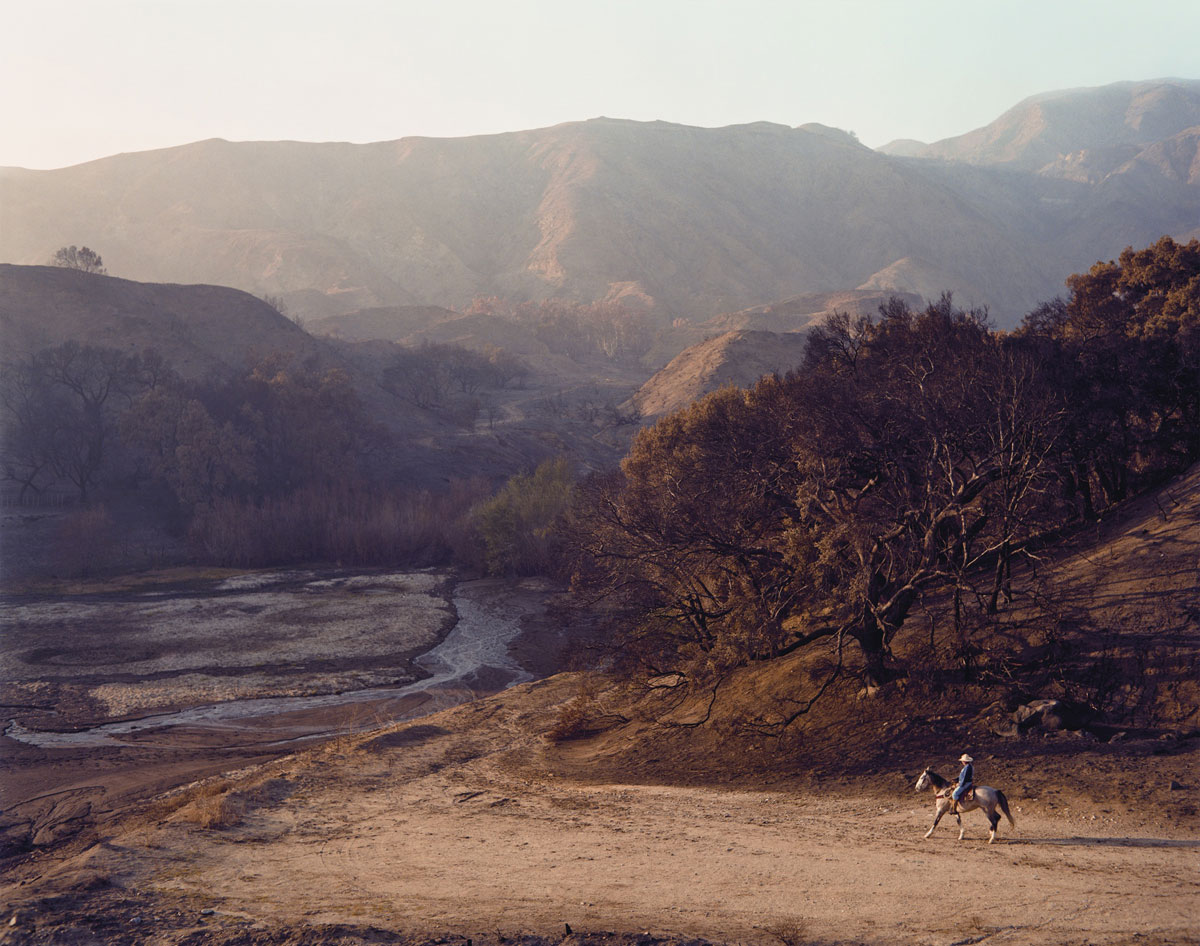
Philip-Lorca diCorcia (American, b. 1951) 'Sylmar, California' 2008


Philip-Lorca diCorcia (American, b. 1951)
Sylmar, California
2008
Inkjet print
56 x71 inches (142.2 x 180.3cm)
Collection De Pont museum of contemporary art, Courtesy the artist and David Zwirner, New York/London


De Pont museum of contemporary art
Wilhelminapark 1
5041 EA Tilburg

Opening hours:
Tuesday through Sunday 11am – 5pm

De Pont museum of contemporary art website

LIKE ART BLART ON FACEBOOK

Back to top

Exhibition: ‘Exposed: Voyeurism, Surveillance & the Camera’ at Tate Modern, London

Exhibition dates: 28th May – 3rd October 2010


Many thankx to Rose Dahlsen and the Tate Modern for allowing me to publish the photographs in the posting. Please click on the photographs for a larger version of the image.


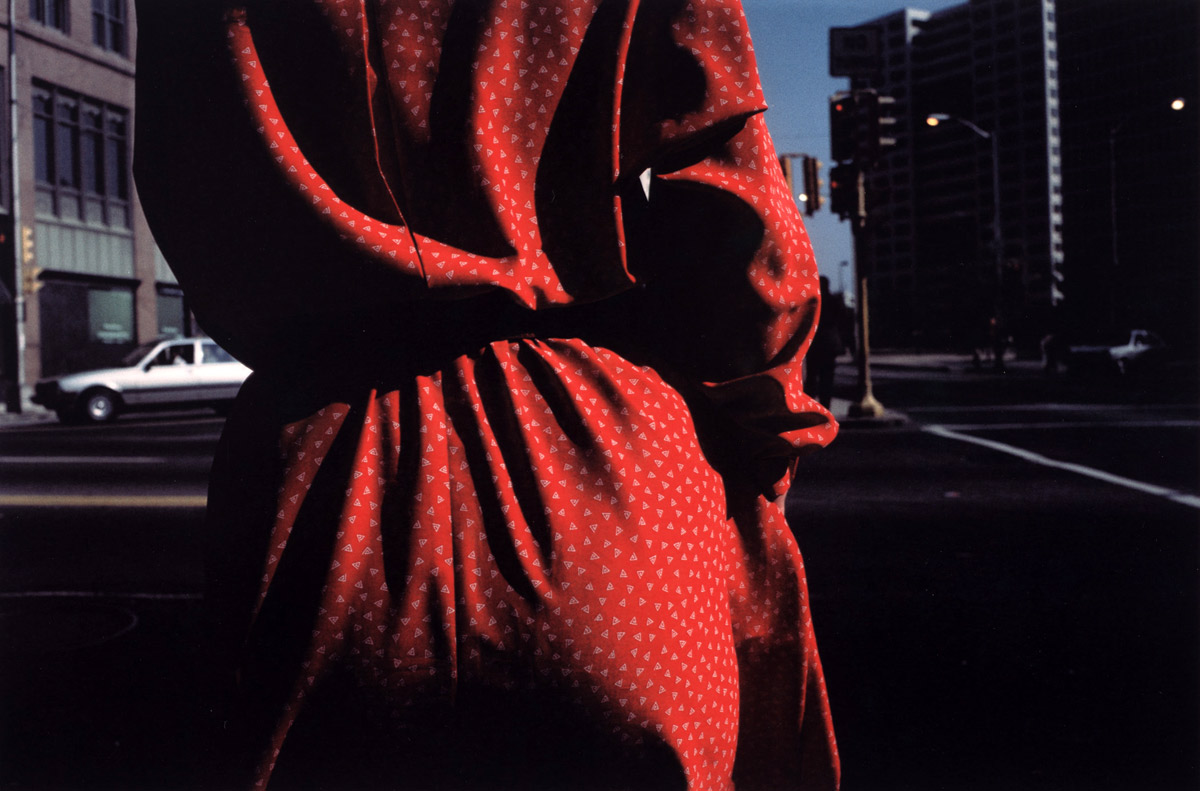
Harry Callahan (American, 1912-1999)
 'Untitled (Atlanta)' 1984 from the exhibition 'Exposed: Voyeurism, Surveillance & the Camera' at Tate Modern, London, May - Oct 2010 from the exhibition 'Exposed: Voyeurism, Surveillance & the Camera' at Tate Modern, London, May - Oct 2010


Harry Callahan (American, 1912-1999)
Untitled (Atlanta)
1984
Dye transfer print 
9 7/16 x 14 5/16 in. (23.97 x 36.35cm)
San Francisco Museum of Modern Art
© The Estate of Harry Callahan, courtesy Pace/MacGill Gallery, New York


Jonathan Olley. 'Golf Five Zero watchtower (known to the British Army as 'Borucki Sanger'), Crossmaglen Security Force Base, South Armagh' 1999 from the exhibition 'Exposed: Voyeurism, Surveillance & the Camera' at Tate Modern, London, May - Oct 2010


Jonathan Olley (British, b. 1967)
Golf Five Zero watchtower (known to the British Army as ‘Borucki Sanger’), Crossmaglen Security Force Base, South Armagh
1999
Gelatin silver bromide print
Coutesy Diemar/Noble Photography, London
© J.Olley


Philip-Lorca diCorcia (American, b. 1951) 'Head #23' 2001 from the 'Head' series


Philip-Lorca diCorcia (American, b. 1951)
Head #23
2001
From the Head series


Examining photography as an invasive act immediately confronts the complacency with which we accept these invasions, encourage them even in our curiosity, and though it falters in parts and overwhelms in others (this is a huge exhibition), EXPOSED successfully addresses a number of the social, cultural and psychologically motivating factors behind these kinds of images – why we take them and why we look at them. Critical to this engagement is the wall text at the beginning, which states that most of the hundreds of photographs on display were taken without the subject’s knowledge. It is a distinctly creepy start.

Philip-Lorcia diCorcia’s Head series perhaps best embodies this conundrum. Visually they are not terribly shocking or even necessarily interesting. Theatrical lighting catches the head of someone in a crowd and the effect is of a staged encounter. In fact, these people, denominated variously as Head #23 or Head #4, were photographed without their knowledge by a series of hidden cameras, the flash triggering as they walked by. Famously, one of diCorcia’s unwitting targets tried to take legal action against him but the landmark ruling defended the artist and his right to self-expression over any right the subject might have over their own image. It is difficult to know which is worse – to be censored or to be spied upon.

Jo Higgins. “Review: Exposed: Voyeurism, Surveillance & the Camera, Tate Modern, London,” on the Jo Higgins website, July 5, 2010 [Online] Cited 22/03/2025


Benjamin Lowy (American, b. 1979) 'Iraq Perspective II' 2003-2007 from the exhibition 'Exposed: Voyeurism, Surveillance & the Camera' at Tate Modern, London, May - Oct 2010


Benjamin Lowy (American, b. 1979)
Iraq Perspective II
2003-2007


US soldiers go on a late night raid with Iraqi Sunni Concerned citizens leading the way and identifying potential AQi targets. Due to a high level of IEDs in the area the company size raiding party walked 5 kilometres to the target in complete darkness, raided the target houses, detained questionable suspects and walked 5 kilometres back to waiting humvees.


Sophie Calle (French, b. 1953) 'The Hotel, Room 47' (L'Hôtel, Chambre 47) 1981


Sophie Calle (French, b. 1953)
The Hotel, Room 47 (L’Hôtel, Chambre 47)
1981
2 works on paper, photographs and ink
2140 x 1420 mm
Tate
Presented by the Patrons of New Art through the Tate Gallery Foundation 1999


This is a two-part framed work comprising photographs and text. In the upper part, the title Room 47 is printed below a colour photograph of elegantly carved wooden twin head-boards behind a bed covered in rich brown satin. Below it, three columns of italic text are diary entries describing findings in the hotel room between Sunday 22 February 1981 and Tuesday 24. In the lower frame a grid of nine black and white photographs show things listed in the text above. This work is part of a project titled The Hotel, which the artist has defined:

“On Monday, February 16, 1981, I was hired as a temporary chambermaid for three weeks in a Venetian hotel. I was assigned twelve bedrooms on the fourth floor. In the course of my cleaning duties, I examined the personal belongings of the hotel guests and observed through details lives which remained unknown to me. On Friday, March 6, the job came to an end.” (Quoted in Calle, pp. 140-141.)

Each of the twelve rooms gave rise to a diptych of similar structure following the occupancy of one or more guests during the period of the artist’s employment at the hotel. Some rooms feature more than once as a second set of guests occupied them, giving rise to a total of twenty-one diptychs in the series. Calle’s descriptions of the hotel rooms and their contents combine factual documentation along with her personal response to the people whose lives she glimpsed by examining their belongings. Each text begins with the chambermaid / artist’s first entry into the room and a notation of which bed or beds have been slept in, with a description of the nightwear the guests have left. A list of objects usually follows, as the artist transcribes her activities in the room. Calle is unashamedly voyeuristic, reading diaries, letters, postcards and notes written or kept by the unknown guests, rummaging in suitcases, and looking into wardrobes and drawers. She sprays herself with their perfume and cologne, makes herself up using the contents of a vanity case, eats food left behind and salvages a pair of women’s shoes left in the bin. Outside the room, she listens at doors, recording the occupants’ conversations or any other sounds she may overhear, and even peers into a room when the floor-waiter opens the door to catch a glimpse of the unknown guests.

The absent occupants described in Room 47 are a family of four – two parents and two children – as revealed by their four pairs of slippers. Calle does not go through their suitcase, commenting: ‘I am already bored’. From their passports she discovers that the parents are a married couple from Geneva and she copies out four postcards one of them has written. Words on one of these hint at problems within the family.

Calle began her artistic projects in 1979 on returning to Paris after seven years’ travel abroad. Disorientated, she felt like a stranger in her own city, not knowing how to occupy her time. She started to follow random passers-by and spend her days as they did. Eventually she picked up the camera she had been experimenting with during her time abroad and photographed the strangers, writing diaristic notes of their movements. From this she has developed a particular way of working, collecting information about people who are absent and investigating her subjects like a detective. The Hotel follows directly from a project the artist undertook the previous year entitled Suite Venetienne 1980, which evolved from a chance encounter with a man she had been following in Paris. He told her he was going to Venice, so she followed him there in disguise, documenting her observations. After a year of planning and waiting, she returned to Venice in 1981 as a chambermaid.

The Hotel diptychs were produced in an edition of four in English and four in French. Tate’s copy of Room 47 (22 February) is the first in the English edition. Another version of Room 47 exists for the period 2-6 March.

Elizabeth Manchester
June 2005

Text from the Tate website [Online] Cited 26/12/2019


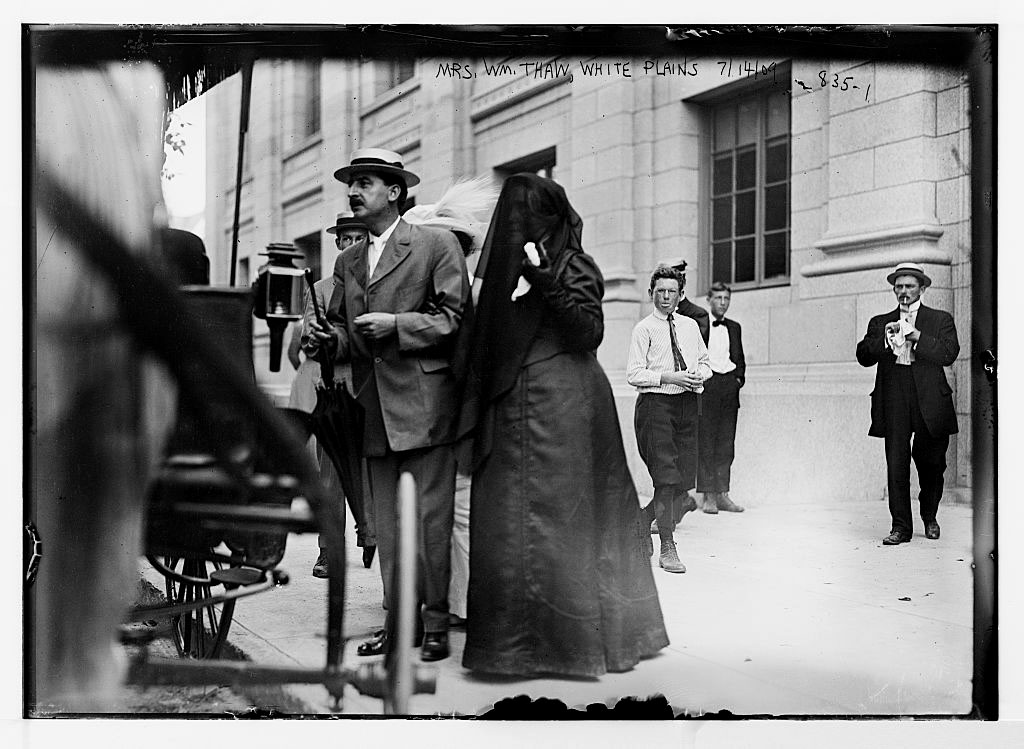
Unknown photographer / Bain News Service, publisher. 'Mrs. Wm. Thaw, veiled, on street, White Plains, N.Y.'
1909


Unknown photographer
Bain News Service, publisher

Mrs. Wm. Thaw, veiled, on street, White Plains, N.Y.
1909
From a glass negative
Library of Congress Prints and Photographs Division Washington, D.C.


Tom Howard (American, 1894 - 1961) '[Electrocution of Ruth Snyder, Sing Sing Prison, Ossining, New York]' 1928


Tom Howard (American, 1894-1961)
[Electrocution of Ruth Snyder, Sing Sing Prison, Ossining, New York]
1928
Gelatin silver print
Collection SFMOMA, Accessions Committee Fund purchase


In 1925, Ruth Snyder, a housewife from Queens, New York, took a lover, Judd Gray, a corsetmaker from upstate. Already married to Albert Snyder, an arts editor at MotorBoating magazine, she hid the affair for nearly three years. But on March 12, 1927, she and Gray planned a murder. After taking out a forged insurance policy, the two killed Ruth’s husband and staged a burglary scene. It didn’t take long for law enforcement to connect the dots, and a few months later, Gray and Snyder found themselves charged with first degree murder.
The court case was front page news and both Ruth and Judd found themselves constantly photographed for ever-evolving stories. Sing Sing, not one to change policy for press, reinstated that no photographers were to be present at the execution. But the public wanted to see.

The New York Daily News knew that the prison was familiar with many journalists from their staff, so they hired someone from out of town, Tom Howard, a then-unknown local photographer from the Chicago Tribune. Knowing he would never be allowed in with a camera, Howard strapped a single-use camera to his right ankle and wired a trigger release up his pant leg. Remarkably, he was allowed in. From across the room, Howard pointed his toe at the chair and took but one photo as Snyder took her last breaths.

The camera was rushed to the city and the film developed overnight. Editors and writers marveled at what was to be one of the most shocking photographs ever made: Snyder in the chair, the legs of the prison guard to the right. The image, shot on an angle, was cropped and published immediately with the headline: Dead!

The black-and-white image was shocking to the U.S. and international public alike. There sat a 32-year-old wife and mother, killed for killing. Her blurred figured seemed to evoke her struggle, as one can imagine her last, strained breaths. Never before had the press been able to attain such a startling image – one not made in a faraway war, one not taken of the aftermath of a crime scene, but one capturing the very moment between life and death here at home.

Erica Fahr Campbell. “The First Photograph of an Execution by Electric Chair,” on the TIME website, April 10,2024 [Online] Cited 24/03/2025


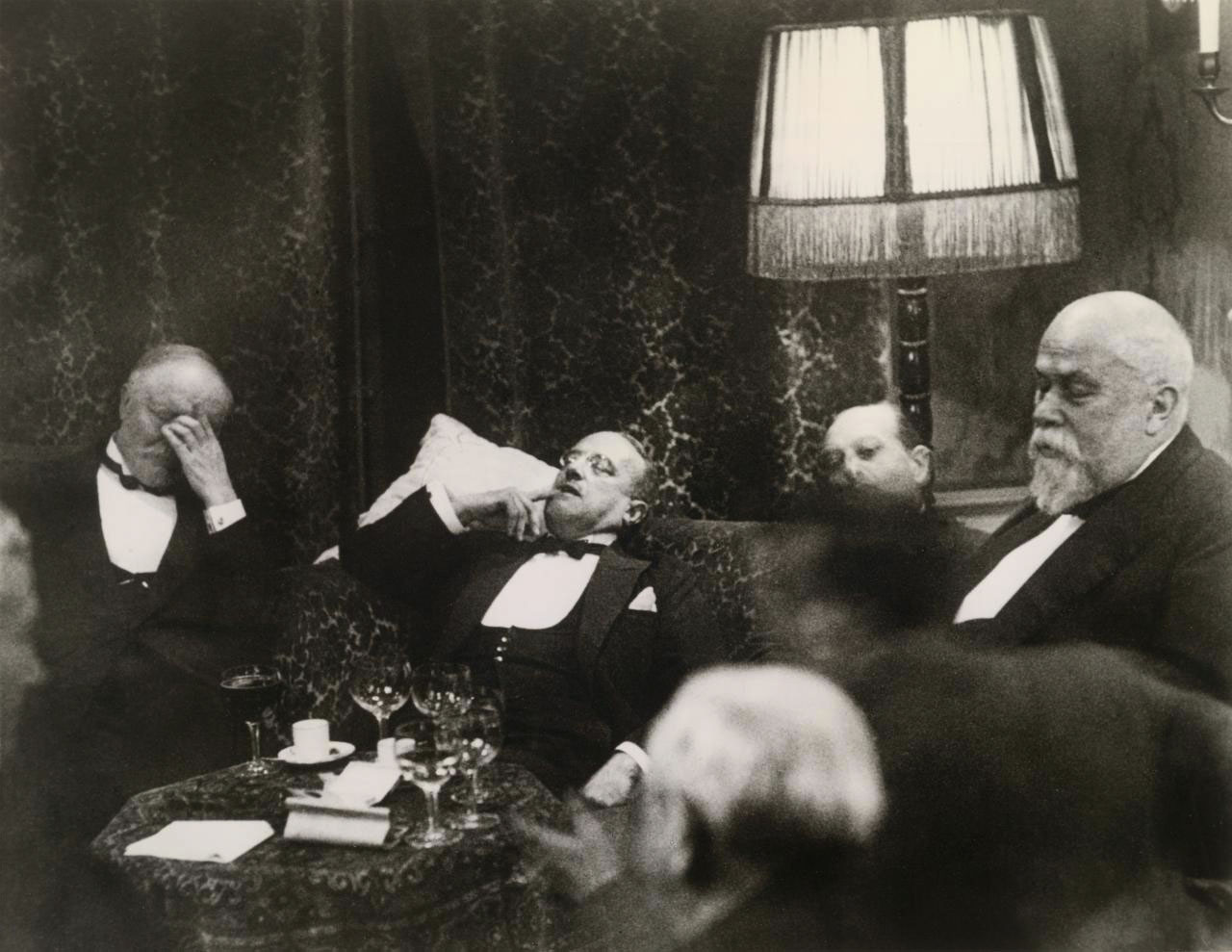
Erich Salomon (German Jewish, 1886-1944) 'Hague Conference (Second Hague Conference on Reparations, January 1930, in the early morning hours)' 1930


Erich Salomon (German Jewish, 1886-1944)
Hague Conference (Second Hague Conference on Reparations, January 1930, in the early morning hours)
1930
Promised gift of Paul Sack to the Sack Photographic Trust of the San Francisco Museum of Modern Art


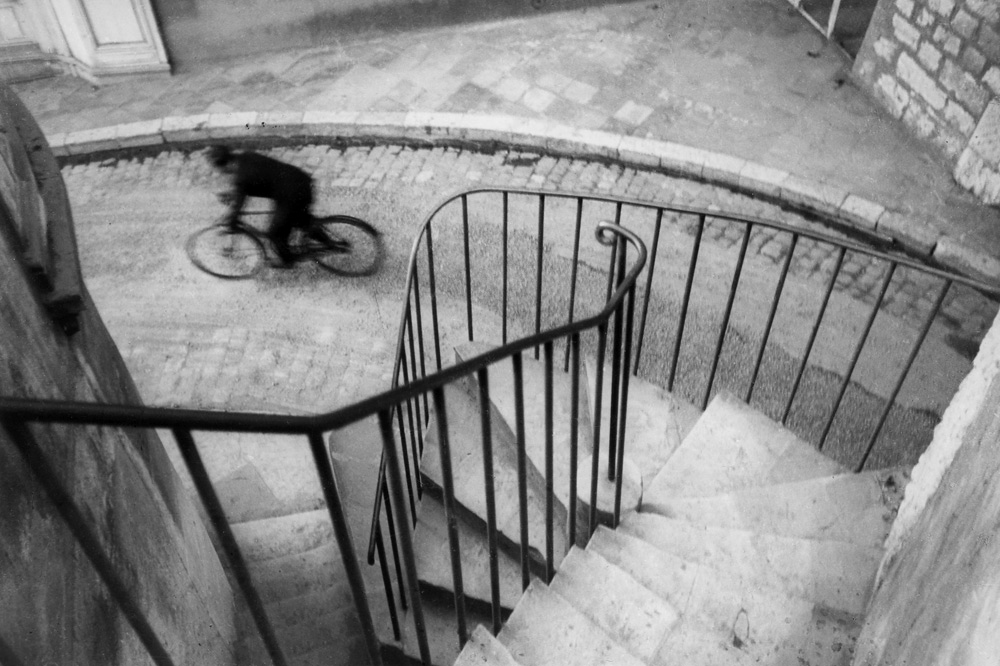
Henri Cartier Bresson (French, 1908-2004) 'Hyeres, France' 1932


Henri Cartier Bresson (French, 1908-2004)
Hyeres, France
1932
Gelatin silver print


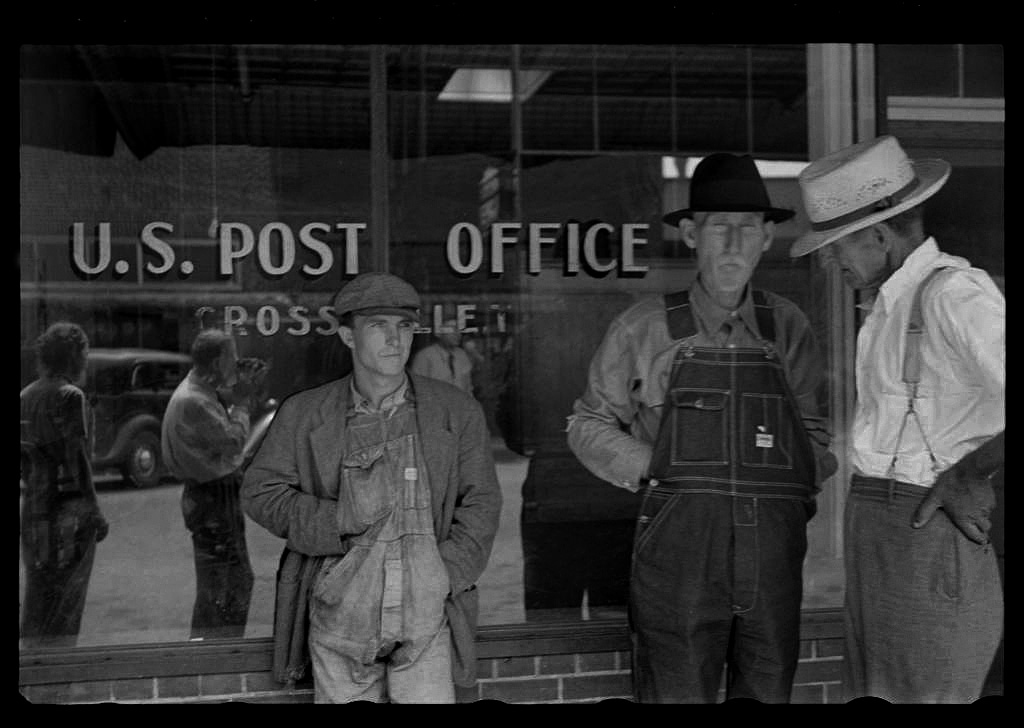
Ben Shah (American, 1898-1969) 'Post Office, Crossville, Tennesse' 1937


Ben Shah (American, 1898-1969)
Post Office, Crossville, Tennesse
1937
Gelatin silver print


Ben Shahn visible using his right-angled lens in the window reflection


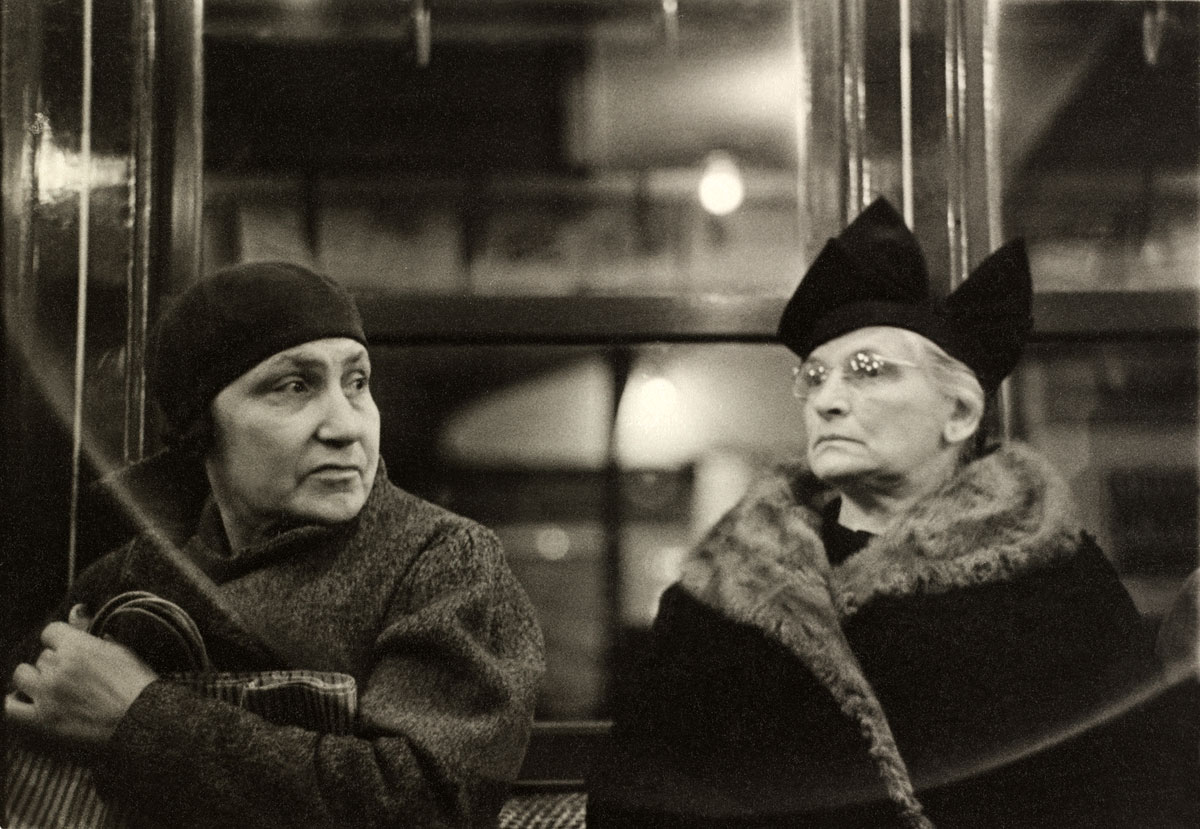
Walker Evans (American, 1903-1975) 'Subway Passengers, New York' 1938


Walker Evans (American, 1903-1975)
Subway Passengers, New York
1938
Gelatin silver print


Walker Evans (American, 1903-1975) 'Subway portrait' 1938-1941


Walker Evans (American, 1903-1975)
Subway Passengers, New York
1938-1941
Gelatin silver print


Weegee (Arthur H. Fellig) (American, 1899-1968) 'Their First Murder' Before 1945


Weegee (Arthur H. Fellig) (American, 1899-1968)
Their First Murder
Before 1945
Gelatin silver print


“Brooklyn School Children see Gambler Murdered in Street
Pupils were leaving P.S. 143, [Sixth Ave. and Roebling St.] in the Williamsburg section of Brooklyn, at 3:15 yesterday when Peter Mancuso, 22, described by police as a small time gambler, pulled up in a 1931 Ford at a traffic light a block from the school. Up to the car stepped a waiting gunman, who fired twice and escaped through the throng of children. Mancuso, shot through the head and heart, struggled to the board and collapsed dead on the pavement. Above are some of the spectators. The older woman is Mancuso’s aunt, who lives in the neighborhood, and the boy tugging at the hair of the girl in front of him is her son, hurrying away from her. Below is what they saw as a priest, flanked by an ambulance doctor and a detective, said the last rites of the Church over the body.”
PM Daily, October 9, 1941, Vol. II, No. 82, p. 15

Text from the International Center of Photography website


Weegee (Arthur H. Fellig) (American, 1899-1968) 'Audience in the Palace Theatre' c. 1943


Weegee (Arthur H. Fellig) (American, 1899-1968)
Audience in the Palace Theatre
c. 1943
Gelatin silver print
© Weegee/International Center of Photography/Getty Images


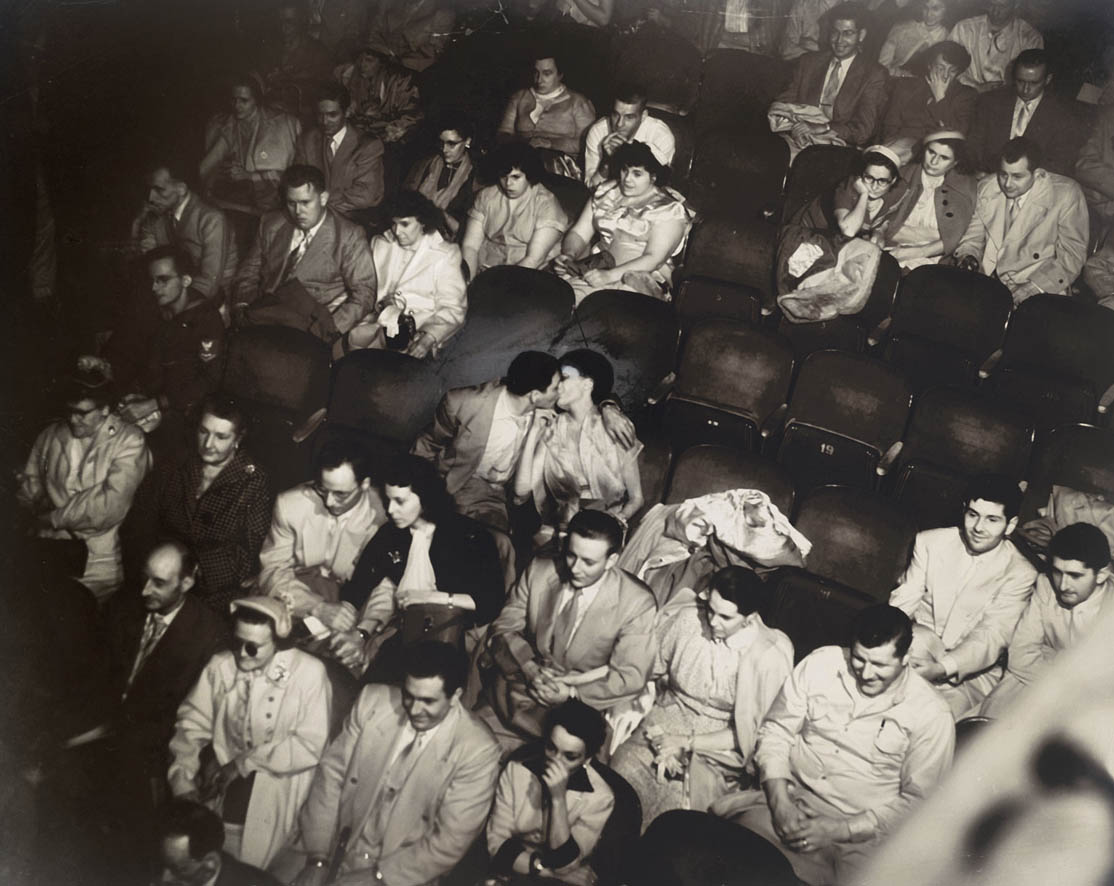
Weegee (Arthur Fellig) (American, born Austria, 1899-1968) '[Lovers at the Movies, Times Square]' c. 1953


Weegee (Arthur Fellig) (American born Austria, 1899-1968)
[Lovers at the Movies, Times Square]
c. 1953
Gelatin silver print
26.7 × 35.4cm (10 1/2 × 13 15/16 in)
© International Center of Photography


Robert Frank (American, 1924-2019)
'New York City' 1955 From 'The Americans'


Robert Frank (American, 1924-2019)
New York City
1955
From The Americans
Gelatin silver print


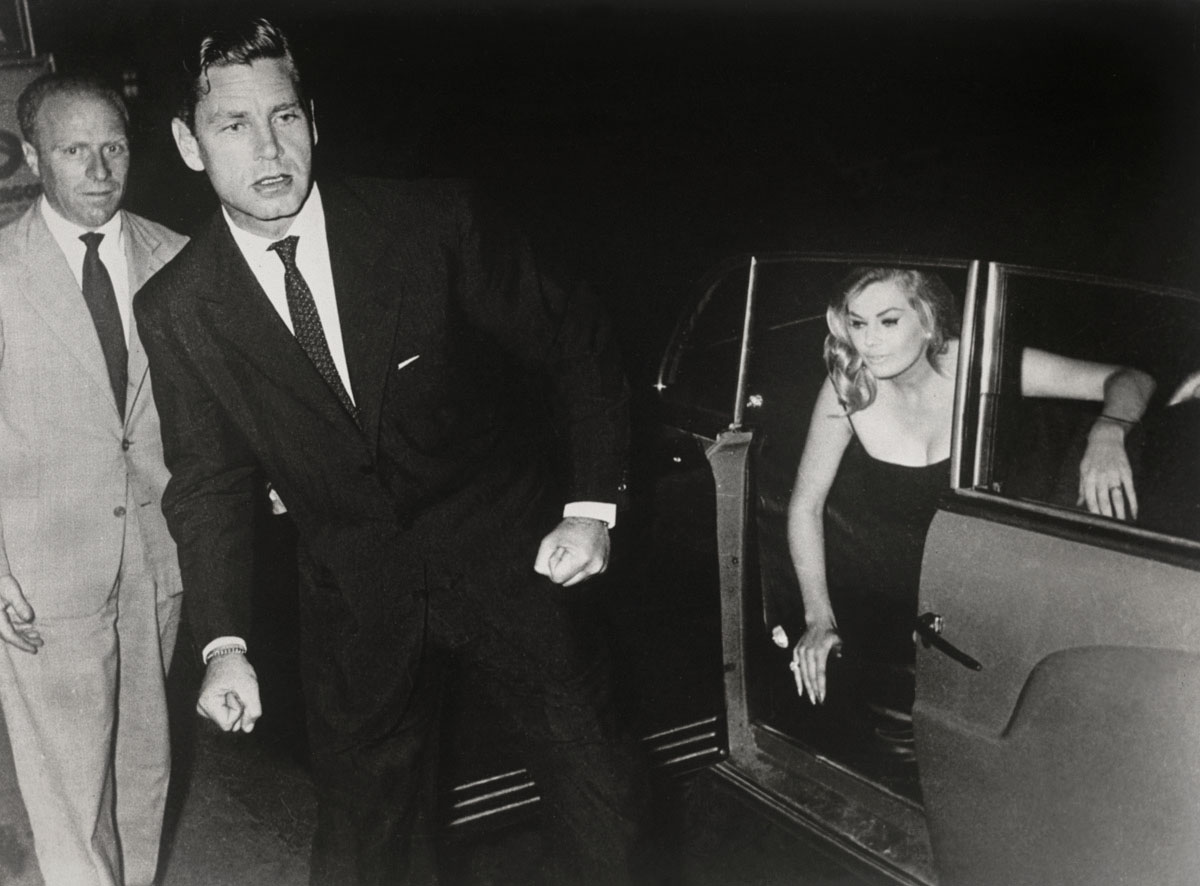
Tazio Secchiaroli (Italian, 1925-1998) 'Anita Ekberg and Husband Anthony Steel, Vecchia, Roma' 1958


Tazio Secchiaroli (Italian, 1925-1998)
Anita Ekberg and Husband Anthony Steel, Vecchia, Roma
1958
Gelatin silver print
SFMOMA, Accessions Committee Fund purchase


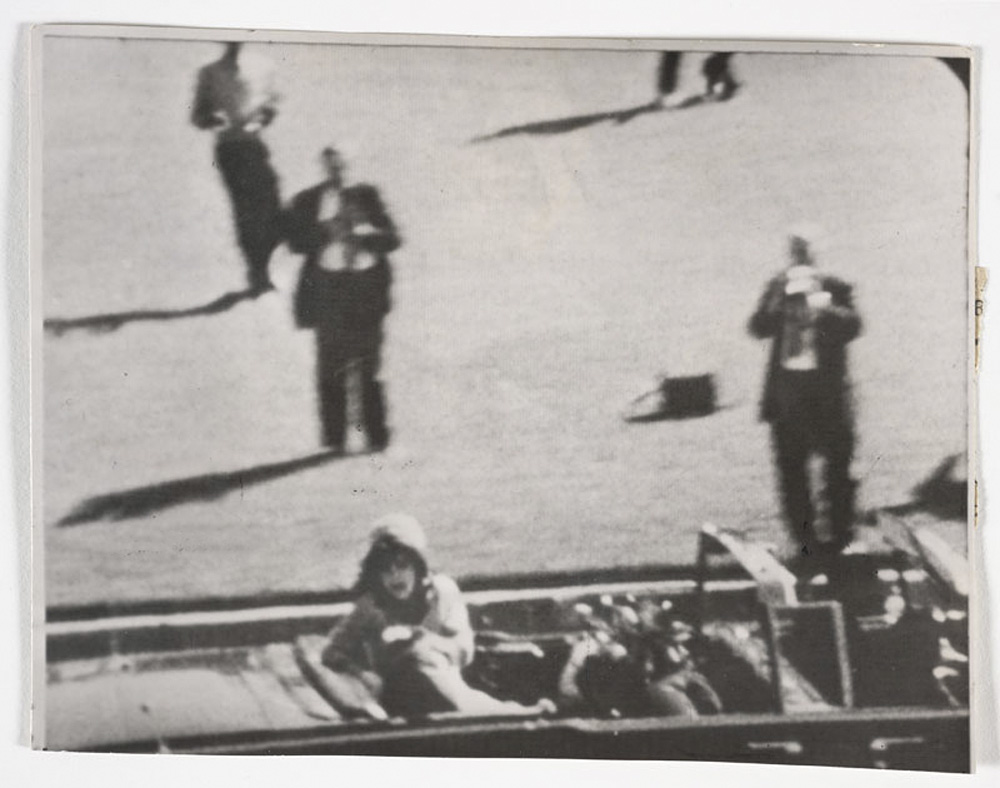
Abraham Zapruder (American born Ukraine, 1905-1970) 'Assassination of John F. Kennedy, November 22, 1963' 1963


Abraham Zapruder (American born Ukraine, 1905-1970)
Assassination of John F. Kennedy, November 22, 1963
1963
Collection SFMOMA, Accessions Committee Fund purchase
© The Sixth Floor Museum at Dealey Plaza


United Press International. 'Suffolk, Virginia, Race Confrontation, May 6, 1964' 1964


United Press International
Suffolk, Virginia, Race Confrontation, May 6, 1964
1964
Collection SFMOMA, Accessions Committee Fund purchase
© United Press International, Inc. All Rights Reserved


Lee Friedlander (American, b. 1934) 'New York City' 1966


Lee Friedlander (American, b. 1934)
New York City
1966
Gelatin silver print


Vito Acconci (Italian, 1940-2017)
'Following Piece' 1969


Vito Acconci (Italian, 1940-2017)
Following Piece
1969
Gelatin silver prints


Exposed offers a fascinating look at pictures made on the sly, without the explicit permission of the people depicted. With photographs from the late nineteenth century to present day, the pictures present a shocking, illuminating and witty perspective on iconic and taboo subjects.

Beginning with the idea of the ‘unseen photographer’, Exposed presents 250 works by celebrated artists and photographers including Brassaï’s erotic Secret Paris of the 1930s images; Weegee’s iconic photograph of Marilyn Monroe; and Nick Ut’s reportage image of children escaping napalm attacks in the Vietnam War. Sex and celebrity is an important part of the exhibition, presenting photographs of Liz Taylor and Richard Burton, Paris Hilton on her way to prison and the assassination of JFK. Other renowned photographers represented in the show include Guy Bourdin, Henri Cartier-Bresson, Philip Lorca DiCorcia, Walker Evans, Robert Frank, Nan Goldin, Lee Miller, Helmut Newton and Man Ray.

The UK is now the most surveyed country in the world. We have an obsession with voyeurism, privacy laws, freedom of media, and surveillance – images captured and relayed on camera phones, YouTube or reality TV.

Much of Exposed focuses on surveillance, including works by both amateur and press photographers, and images produced using automatic technology such as CCTV. The issues raised are particularly relevant in the current climate, with topical debates raging around the rights and desires of individuals, terrorism and the increasing availability and use of surveillance. Exposed confronts these issues and their implications head-on.

Text from the Tate Modern website [Online] Cited 21/09/2010 no longer available online


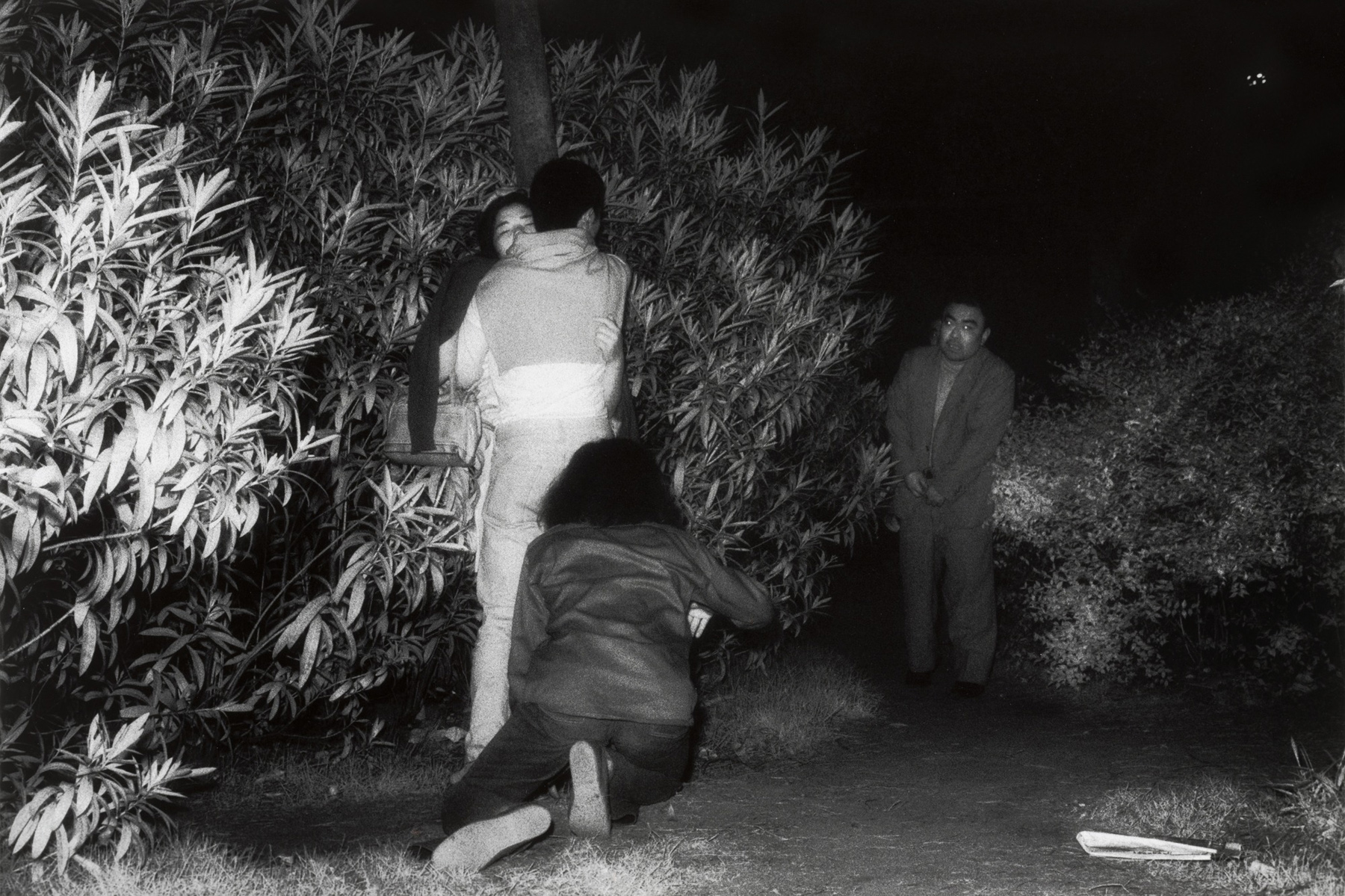
Kohei Yoshiyuki (Japan, b. 1946)
'Untitled' 1971 From the series 'The Park'


Kohei Yoshiyuki (Japan, b. 1946)
Untitled
1971
From the series The Park
Gelatin silver print


Kohei Yoshiyuki (Japan, b. 1946) 'Untitled' 1971 From the series 'The Park'


Kohei Yoshiyuki (Japan, b. 1946)
Untitled
1971
From the series The Park
Gelatin silver print


Sandra Phillips on Surveillance – Exposed at Tate Modern

SFMOMA’s Curator of Photography Sandra Phillips describes how contemporary artists like Sophie Calle and Benjamin Lowry have started to talk back to surveillance.


Ron Galella (American, b. 1931) 'What Makes Jackie Run? Central Park, New York City, October 4, 1971' 1971


Ron Galella (American, 1931-2022)
What Makes Jackie Run? Central Park, New York City, October 4, 1971
1971
Gelatin silver print
7 3/8 in x 9 7/8 in (18.73 x 25.08cm)
© Ron Galella


Ronald Edward Galella (January 10, 1931 – April 30, 2022) was an American photographer, known as a pioneer paparazzo. Dubbed “Paparazzo Extraordinaire” by Newsweek and “the Godfather of the U.S. paparazzi culture” by Time magazine and Vanity Fair, he is regarded by Harper’s Bazaar as “arguably the most controversial paparazzo of all time”. He photographed many celebrities out of the public eye and gained notice for his feuds with some of them, including Jacqueline Onassis and Marlon Brando. Despite the numerous controversies and claims of stalking, Galella’s work was praised and exhibited in art galleries worldwide.

Text from the Wikipedia website


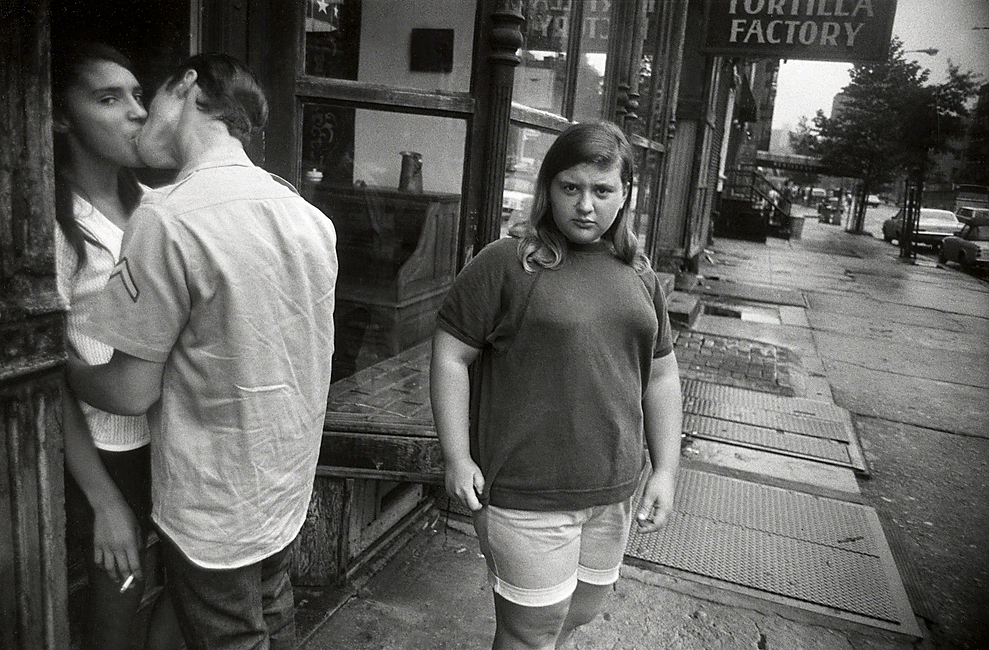
Garry Winogrand (American, 1928-1984) 'Couple Kissing, Girl Staring at Camera, Tortilla Factory, New York' 1969


Garry Winogrand (American, 1928-1984)
Couple Kissing, Girl Staring at Camera, Tortilla Factory, New York
1969
Gelatin silver print
© Garry Winogrand/Fraenkel Gallery, San Francisco


Nan Goldin (American, b. 1953) 'Nan and Brian in Bed, New York City' 1983


Nan Goldin (American, b. 1953)
Nan and Brian in Bed, New York City
1983
Chromogenic print
Nan Goldin and Matthew Marks Gallery, NYC


Denis Beaubois (Mauritian, b. 1970) 'In the event of Amnesia the city will recall…' 1996-1997 (still)


Denis Beaubois (Mauritian, b. 1970)
In the event of Amnesia the city will recall... (still)
1996-1997
DVD
9 mins 30 secs
Courtesy the artist


Denis Beaubois (Mauritian, b. 1970) 'In the event of Amnesia the city will recall…' 1996-1997 (still)


Denis Beaubois (Mauritian, b. 1970)
In the event of Amnesia the city will recall… (still)
1996-1997
DVD
9 mins 30 secs
Courtesy the artist


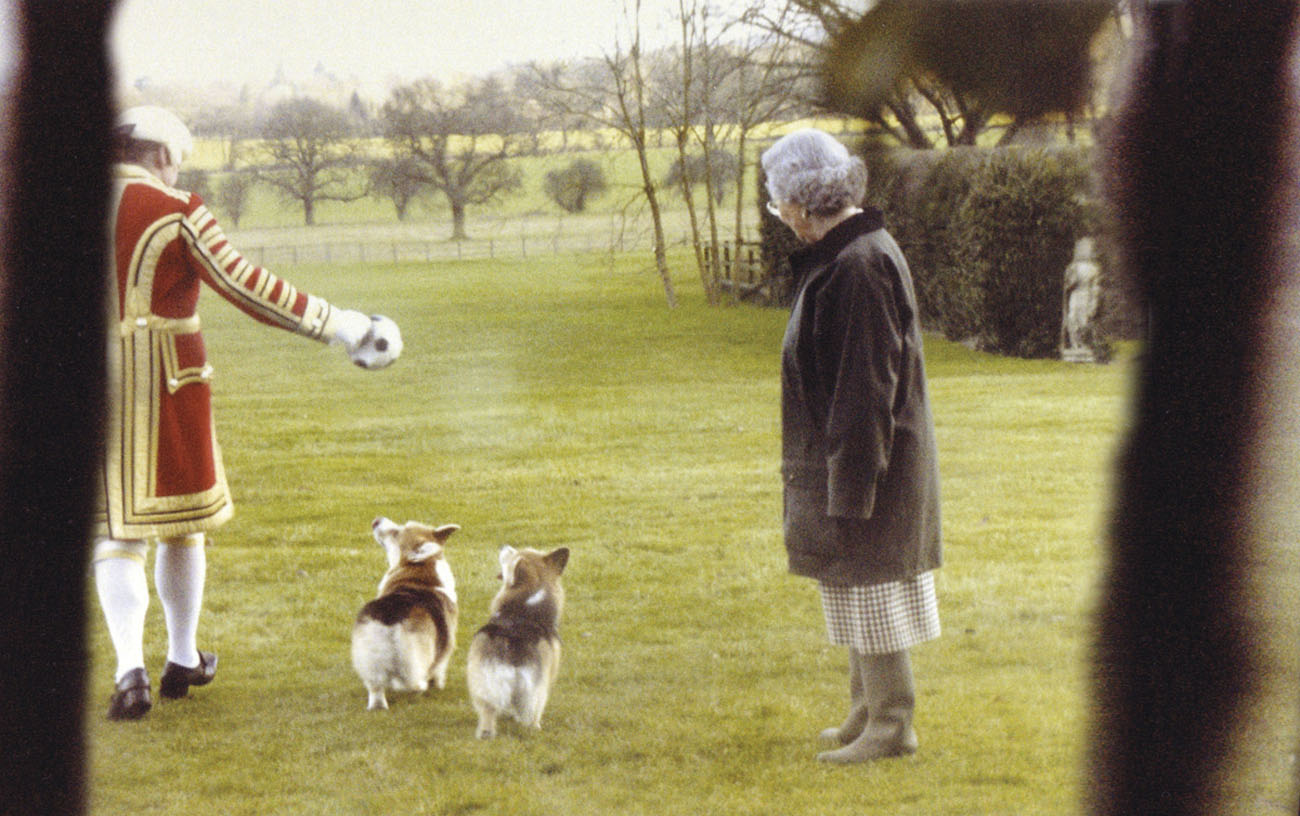
Alison Jackson (English, b. 1960)
'The Queen plays with her corgis' 2007


Alison Jackson (English, b. 1960)
The Queen plays with her corgis
2007
From the series Confidential
Chromogenic print
Courtesy the artist and Hamiltons Gallery, London
© Alison Jackson, Hamiltons Gallery, London


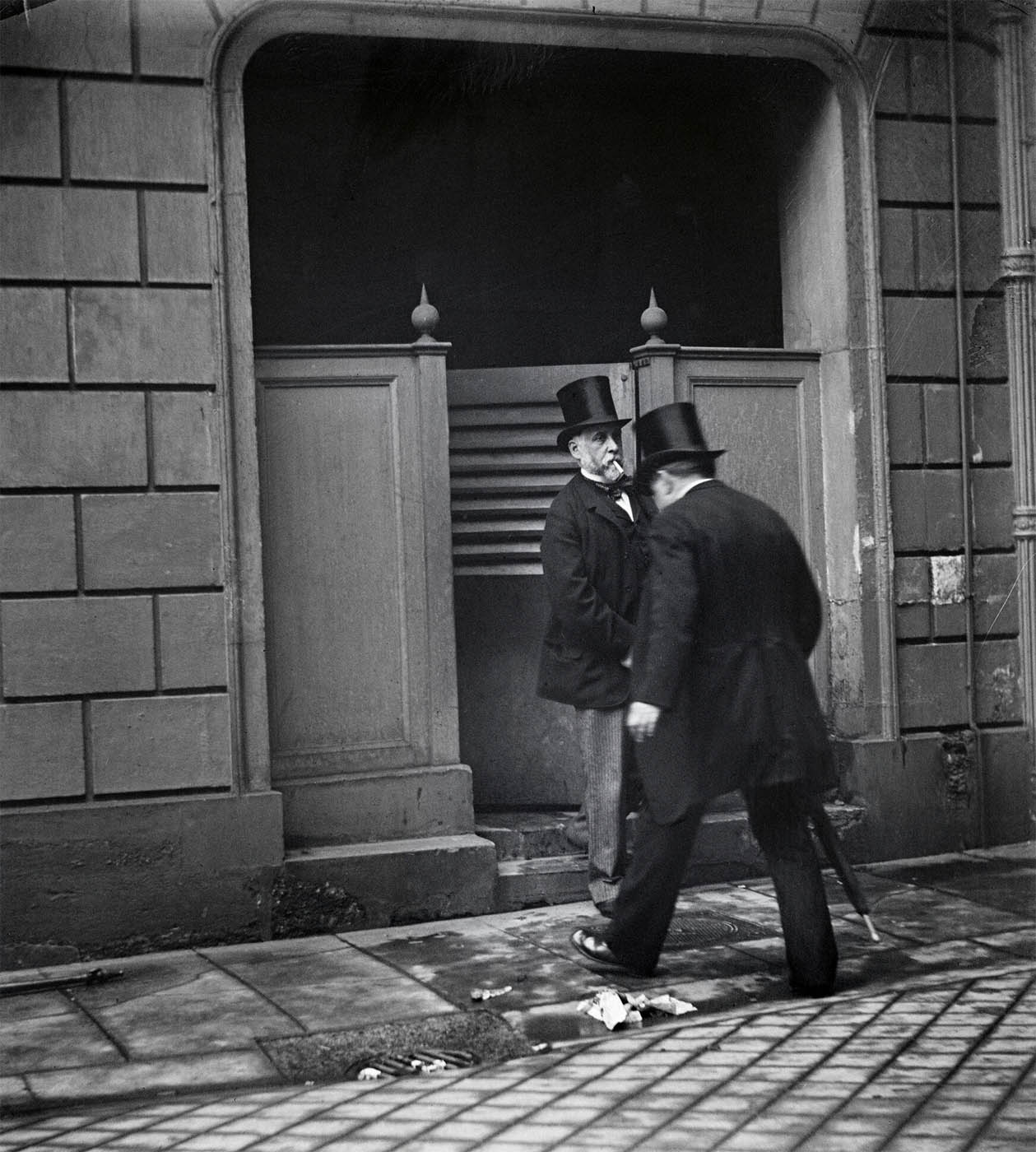
Giuseppe Primoli (Italian, 1851-1927)
'Edgar Degas emerging from a Parisian public toilet' 1889


Giuseppe Primoli (Italian, 1851-1927)
Edgar Degas emerging from a Parisian public toilet
1889
Gelatin silver print


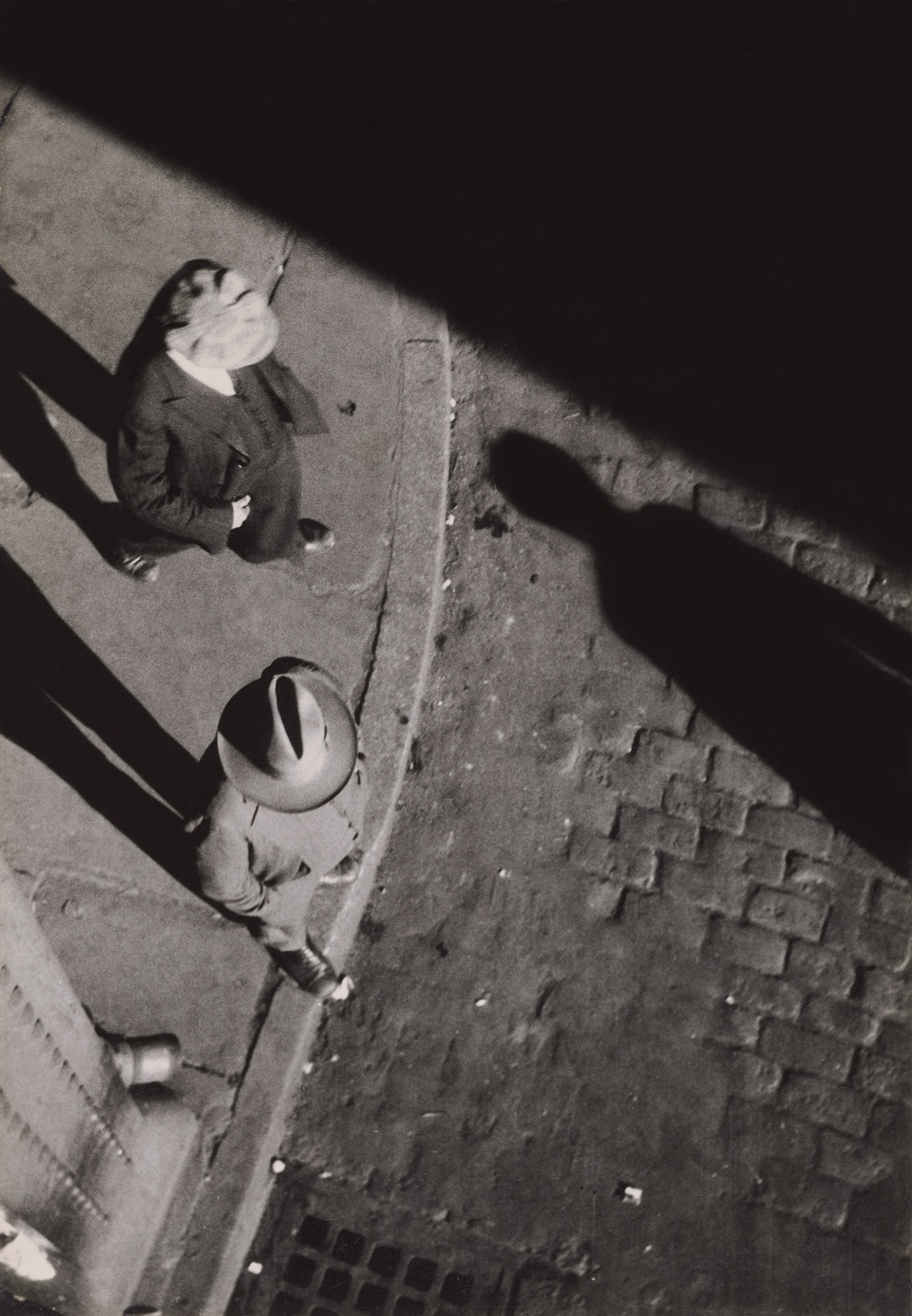
Walker Evans (American, 1903-1975) 'Street Scene, New York' 1929


Walker Evans (American, 1903-1975)
Street Scene, New York
1928
Gelatin silver print
San Francisco Museum of Modern Art
© Walker Evans Archive, The Metropolitan Museum of Art


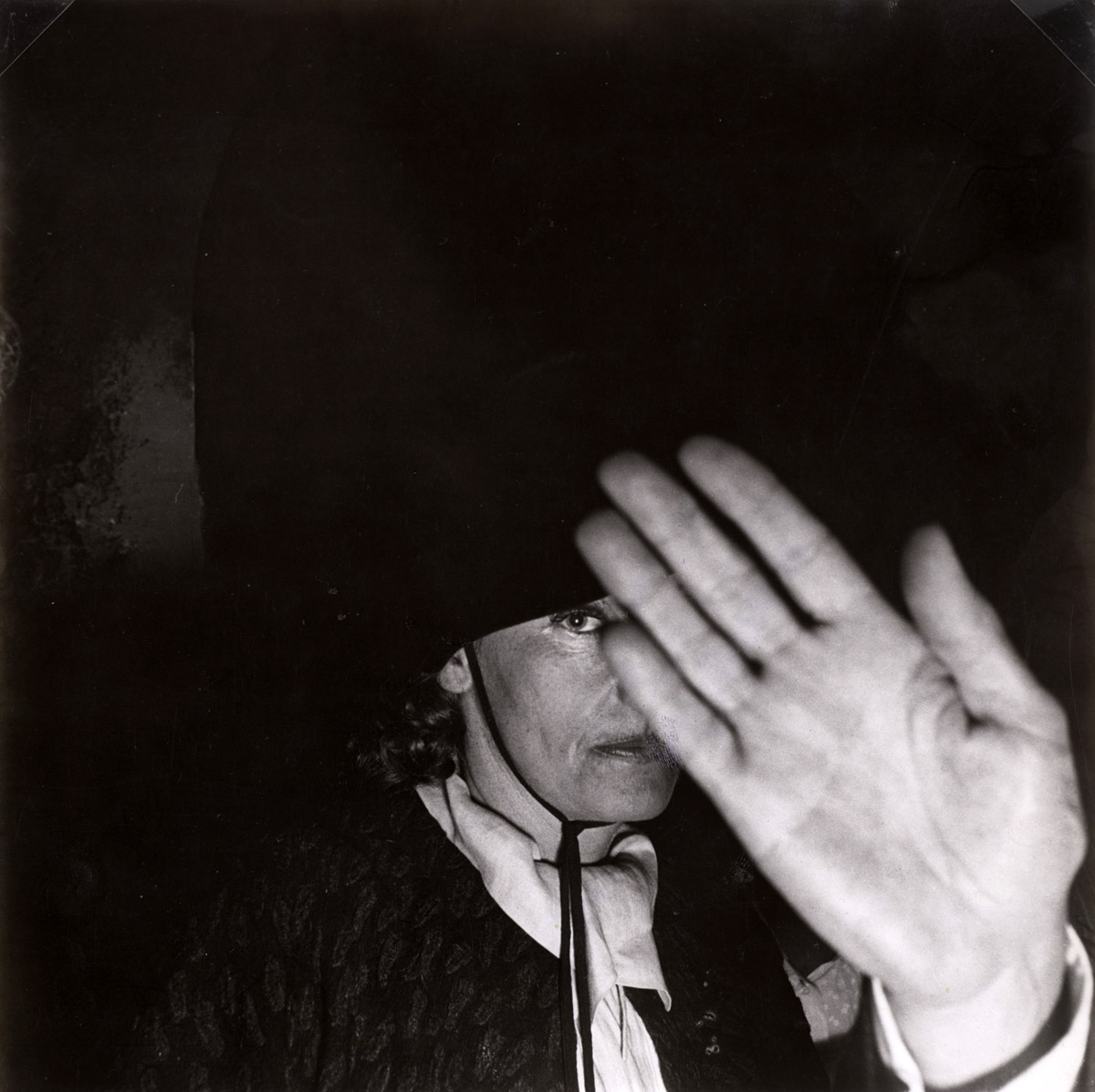
Georges Dudognon (French, 1922-2001) 'Greta Garbo in the Club St. Germain, Paris' c. 1950s


Georges Dudognon (French, 1922-2001)
Greta Garbo in the Club St. Germain, Paris
c. 1950s
Gelatin silver print
7 1/16  x 7 1/8 in. (17.94 x 18.1cm)
San Francisco Museum of Modern Art, Members of Foto Forum, 2005.200
© Estate of Georges Dudognon


The face in the paparazzi image above is actually The Face: Greta Garbo. One of the most famous and admired women in the world, Garbo became a New York recluse after retiring from films at the beginning of the 1940s. Sightings of her were rare, and this 1950s image captures the conflict between a movie star’s public persona and private life. Now older and with her face obscured, Garbo is unrecognisable, but once understood to be her it becomes a contrasting reference to all those images of her as an icon of beauty and stardom.

Christian Hayes. “Exposed: Voyeurism, Surveillance and the Camera,” on The Classic Film Show website, June 15, 2010 [online] Cited 24/03/2025


Weegee (Arthur H. Fellig) (American, 1899-1968) '[Marilyn Monroe]' c. 1950s


Weegee (Arthur H. Fellig) (American, 1899-1968)
[Marilyn Monroe]
c. 1950s
Gelatin silver print
International Center of Photography, New York, Gift of Wilma Wilcox, 1993
© Weegee / International Center of Photography / Getty Images


Richard Avedon (American, 1923-2004) 'And Warhol' 1969
Screenshot


Richard Avedon (American, 1923-2004)
And Warhol
1969
Gelatin silver print


Shizuka Yokomizo (Japanese, b. 1966) 'Stranger No. 1' 1998


Shizuka Yokomizo (Japanese, b. 1966)
Stranger No. 1
1998
Chromogenic print
50 x 42 1/2 in. (127 x 108 cm)
© Shizuka Yokomizo


Shizuka Yokomizo (Japanese, b. 1966)
'Stranger No. 2' 1998


Shizuka Yokomizo (Japanese, b. 1966)
Stranger No. 2
1998
Chromogenic print
SFMOMA, Accessions Committee Fund purchase
© Shizuka Yokomizo


Tate Modern
Bankside
London SE1 9TG
020 7887 8888

Opening hours:
Daily 10.00 – 18.00

Tate Modern website

LIKE ART BLART ON FACEBOOK

Back to top