Exhibition: ‘Zurbarán’ at the National Gallery, London

Exhibition dates: 2nd May – 23rd August, 2026

Curators: Francesca Whitlum-Cooper and Daniel Sobrino Ralston with Imogen Tedbury, in collaboration with Charlotte Chastel-Rousseau (Musée du Louvre) and Rebecca Long (Art Institute of Chicago)
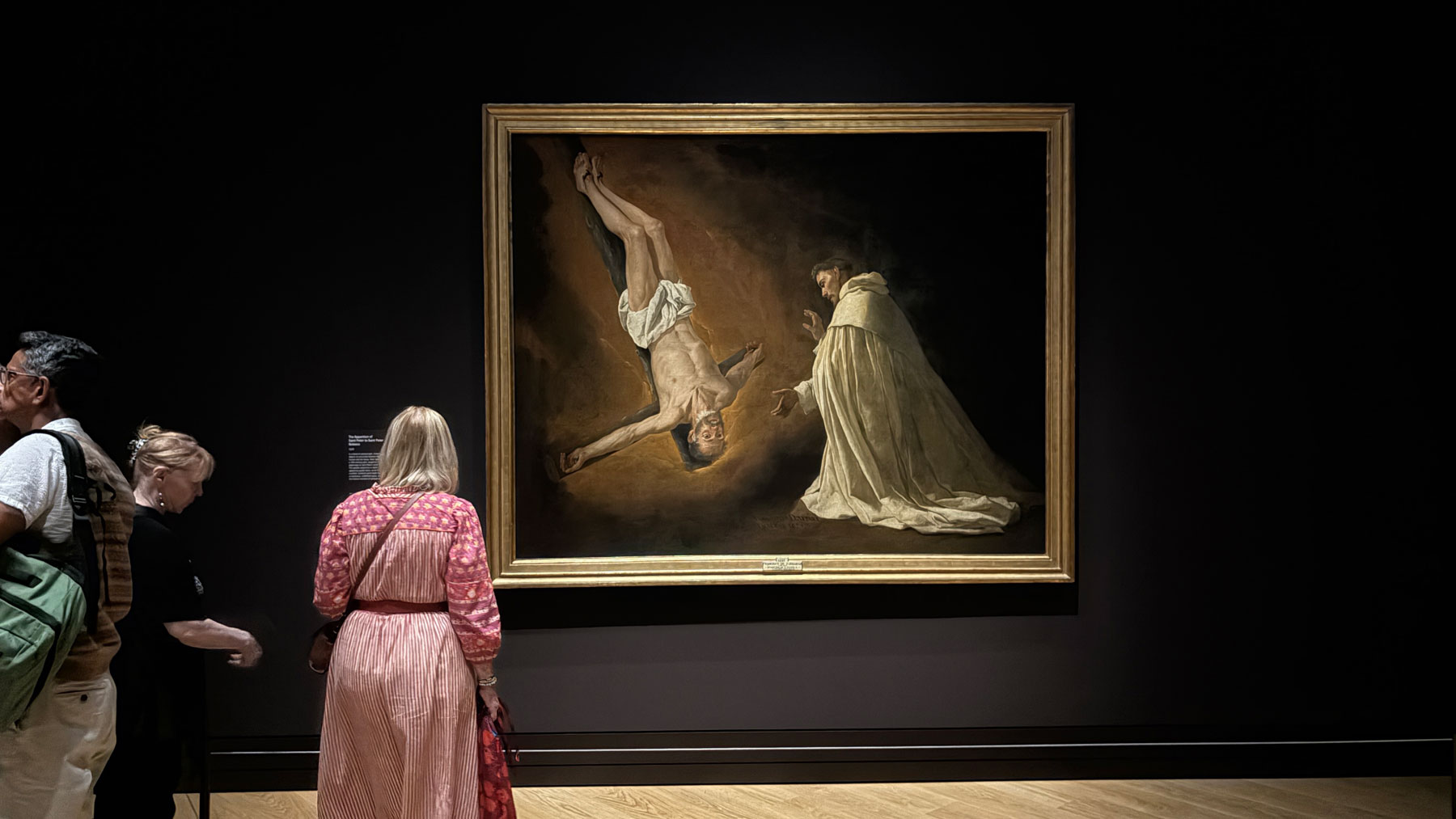
 

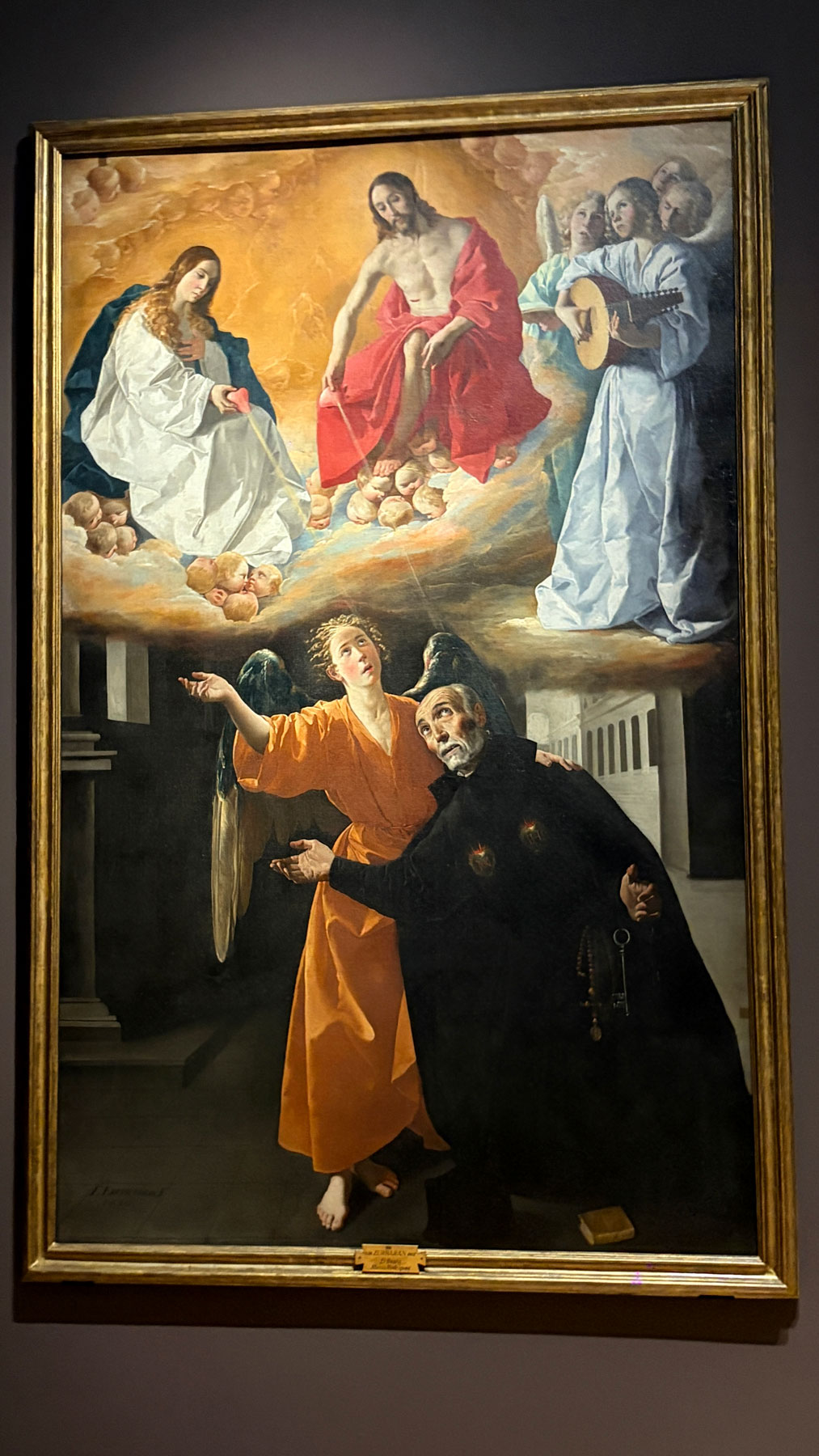
Installation view of the exhibition 'Zurbarán' at the National Gallery, London showing Francisco de Zurbarán (Spain, 1598-1664)
'The Apparition of Saint Peter to Saint Peter Nolasco' 1629


Francisco de Zurbarán (Spain, 1598-1664)
The Apparition of Saint Peter to Saint Peter Nolasco (installation view)
1629
Oil on canvas
Museo Nacional Del Prado, Madrid


A bonus weekend posting of this small but wonderfully intense exhibition. The posting flows chronologically through the exhibition.

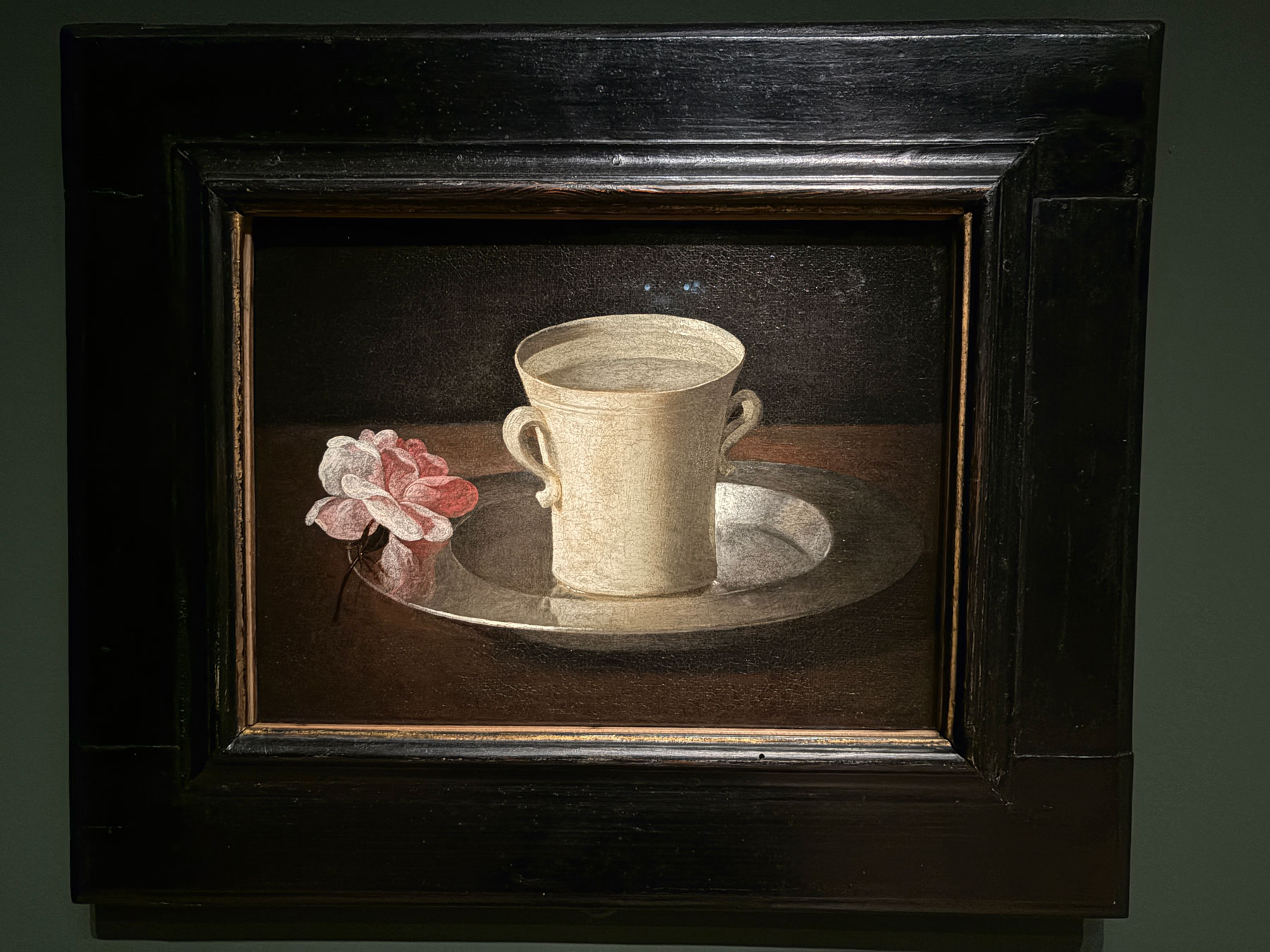
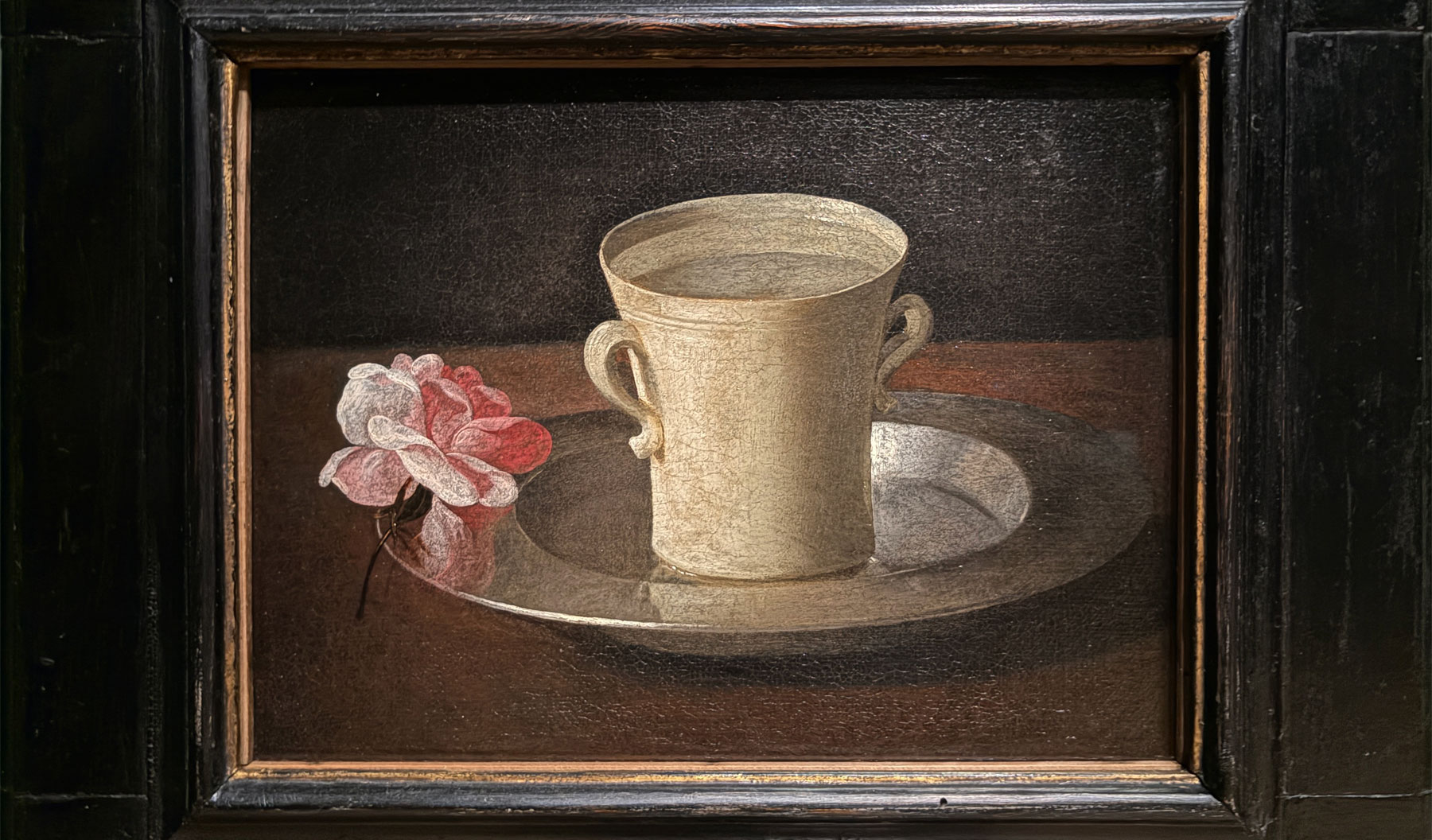
The best still life I have ever seen: A Cup of Water and a Rose (about 1630, below). The reflection of the rose in the silver bowl is just exquisite.

As a friend of mine Elizabeth Gertsakis observes, “No matter what the subject, his images tremble with intensity and life … they want to leap out of the frame and speak with you.”

Amen to that.

Dr Marcus Bunyan


Please click on the photographs for a larger version of the image. All installation photographs © Marcus Bunyan


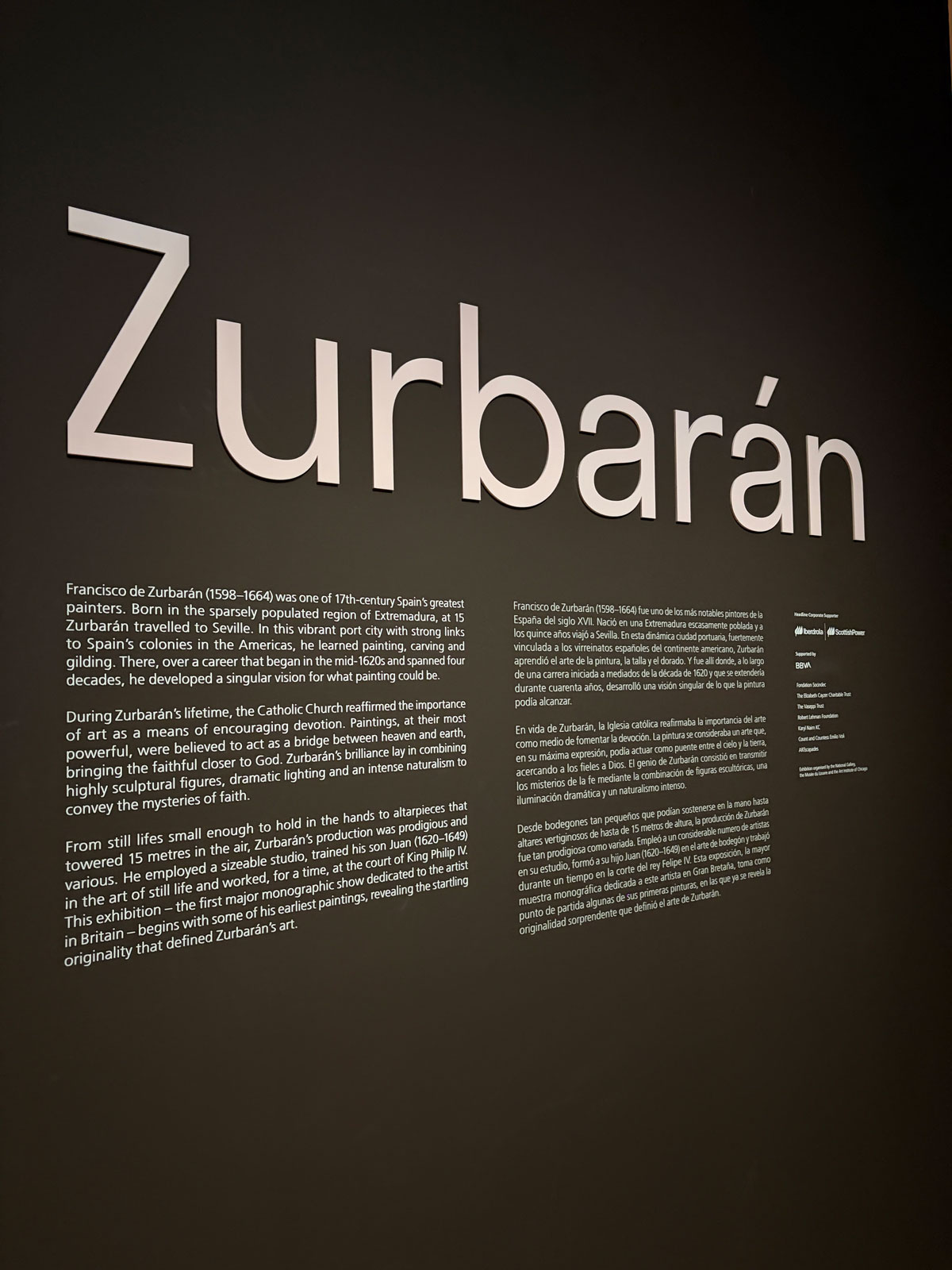
Wall text from the exhibition 'Zurbarán' at the National Gallery, London


Introductory wall text from the exhibition Zurbarán at the National Gallery, London
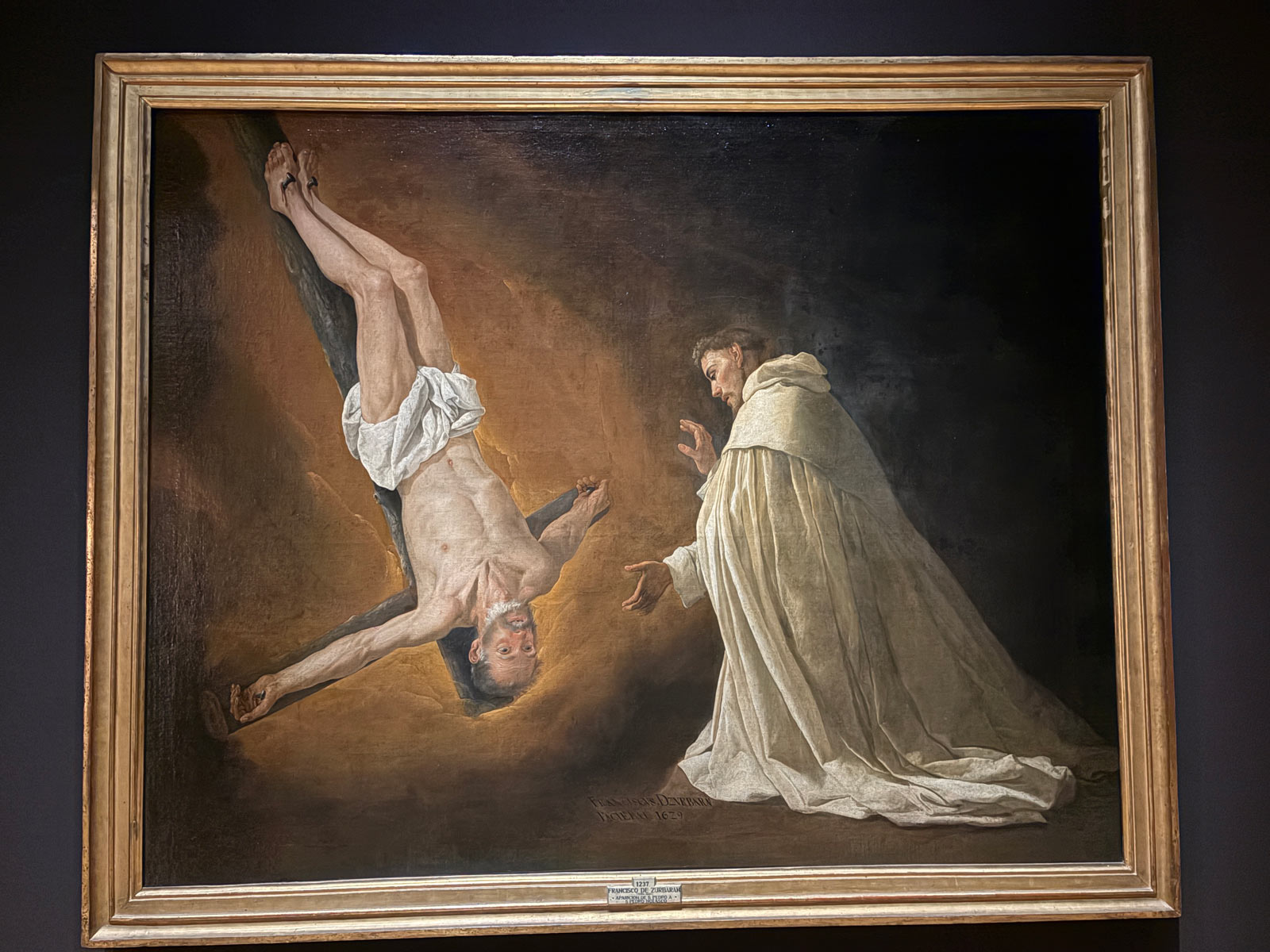
 

Installation view of the exhibition 'Zurbarán' at the National Gallery, London showing Francisco de Zurbarán (Spain, 1598-1664)
'The Apparition of Saint Peter to Saint Peter Nolasco' 1629


Francisco de Zurbarán (Spain, 1598-1664)
The Apparition of Saint Peter to Saint Peter Nolasco (installation view)
1629
Oil on canvas
Museo Nacional Del Prado, Madrid
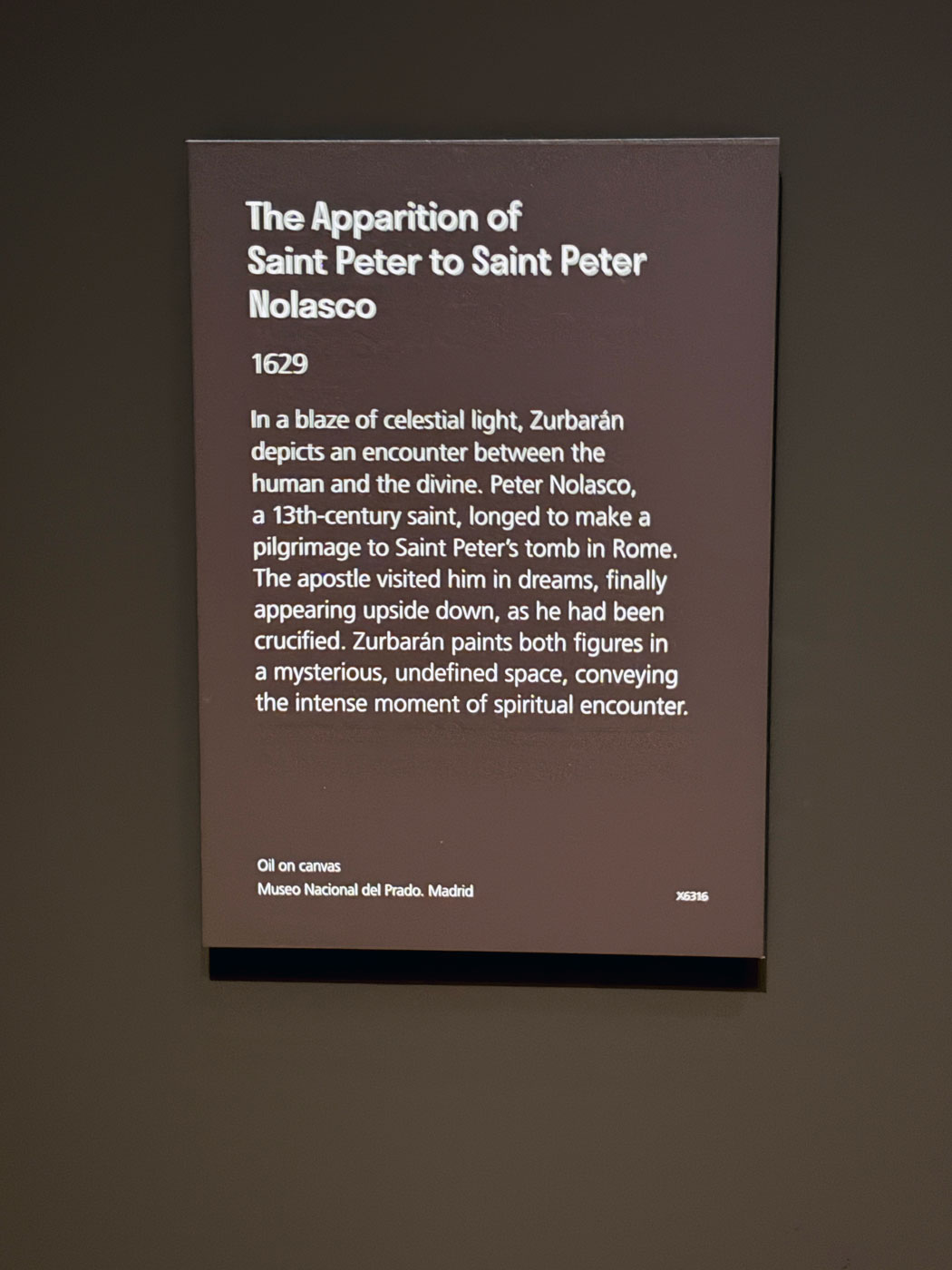
 

Wall text from the exhibition 'Zurbarán' at the National Gallery, London


Wall text from the exhibition Zurbarán at the National Gallery, London
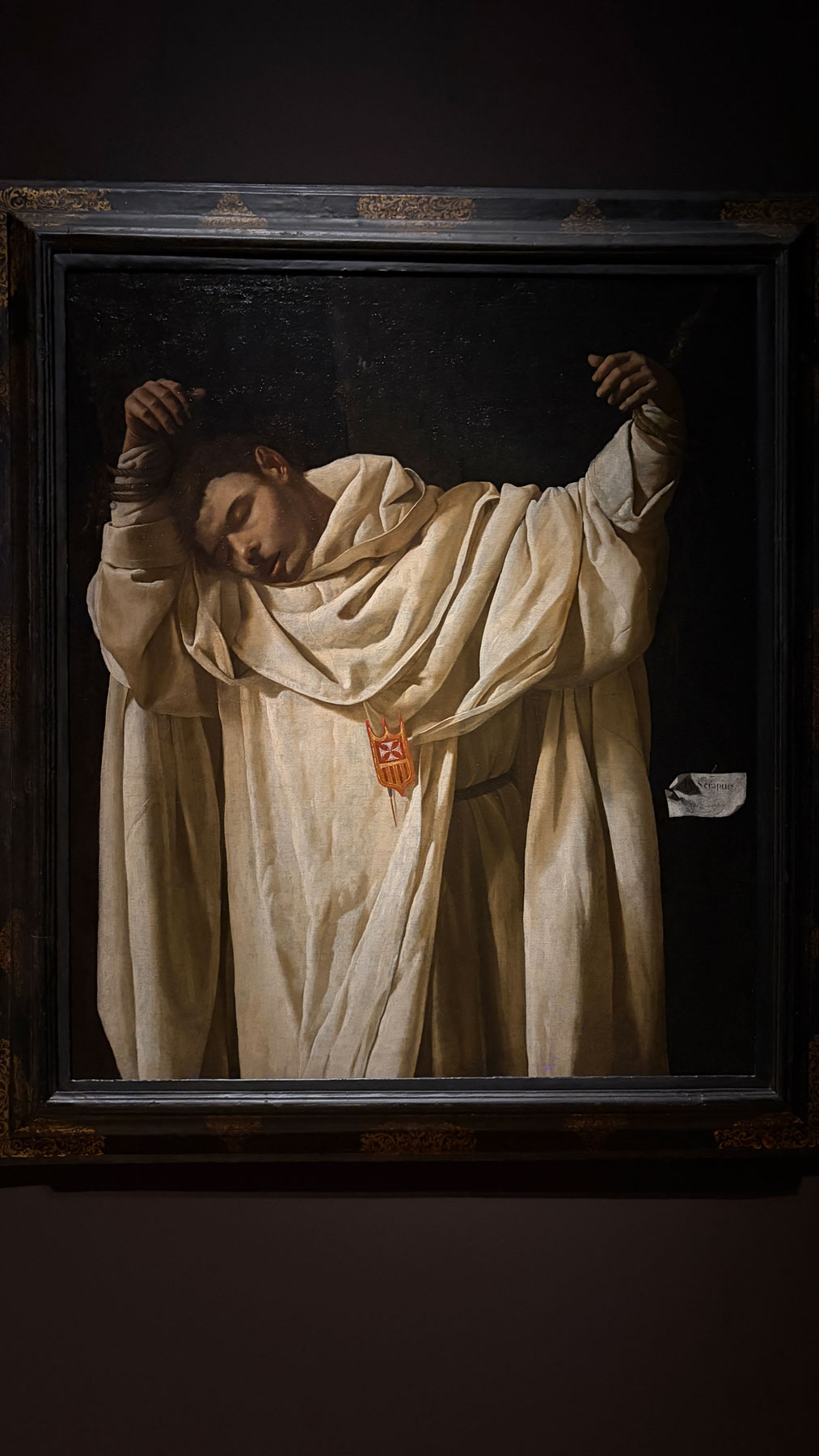
 

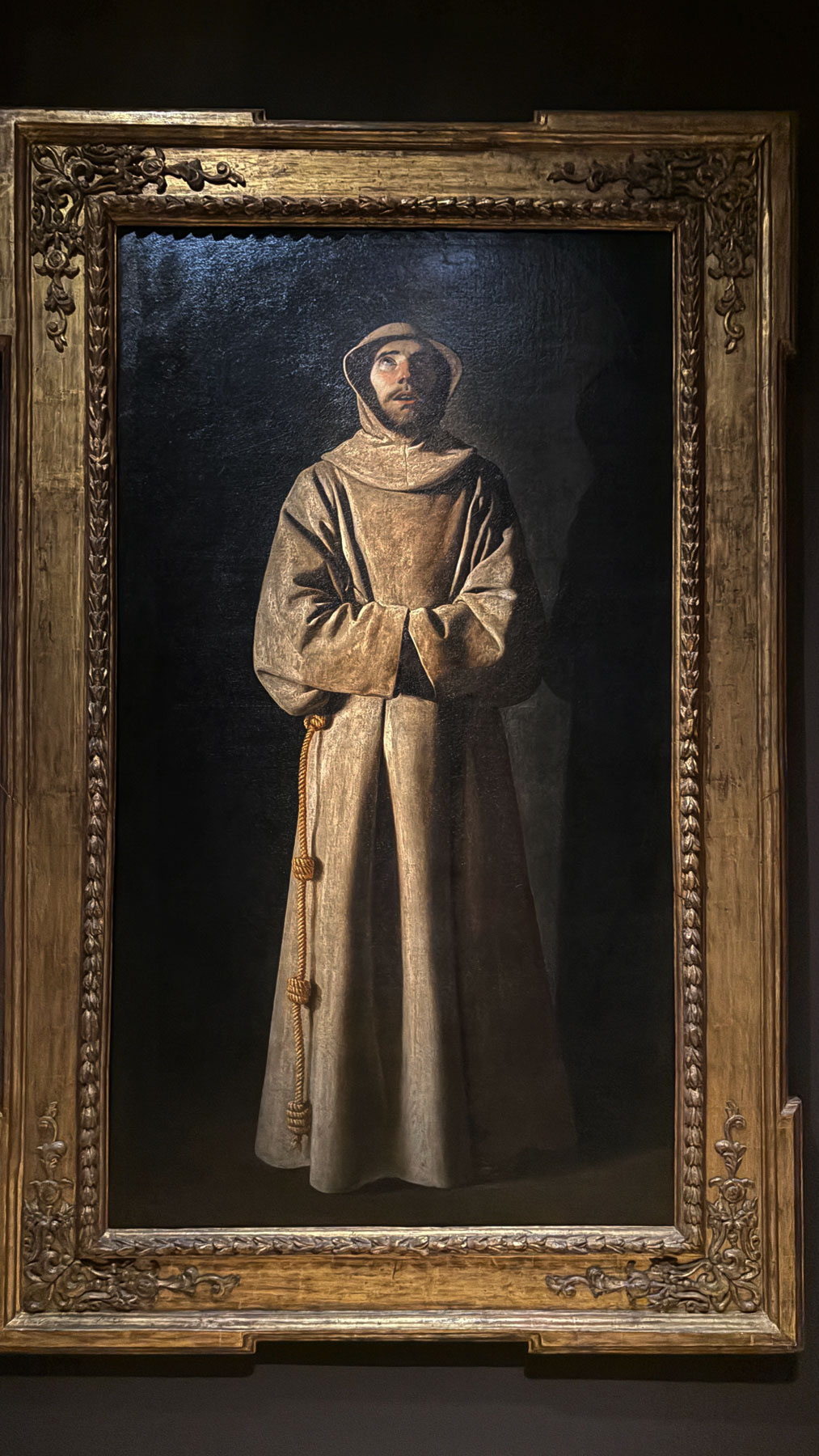
Installation view of the exhibition 'Zurbarán' at the National Gallery, London showing Francisco de Zurbarán (Spain, 1598-1664)
'Saint Serapion' 1628


Francisco de Zurbarán (Spain, 1598-1664)
Saint Serapion (installation view)
1628
Oil on canvas
The Wadsworth, Hartford, CT
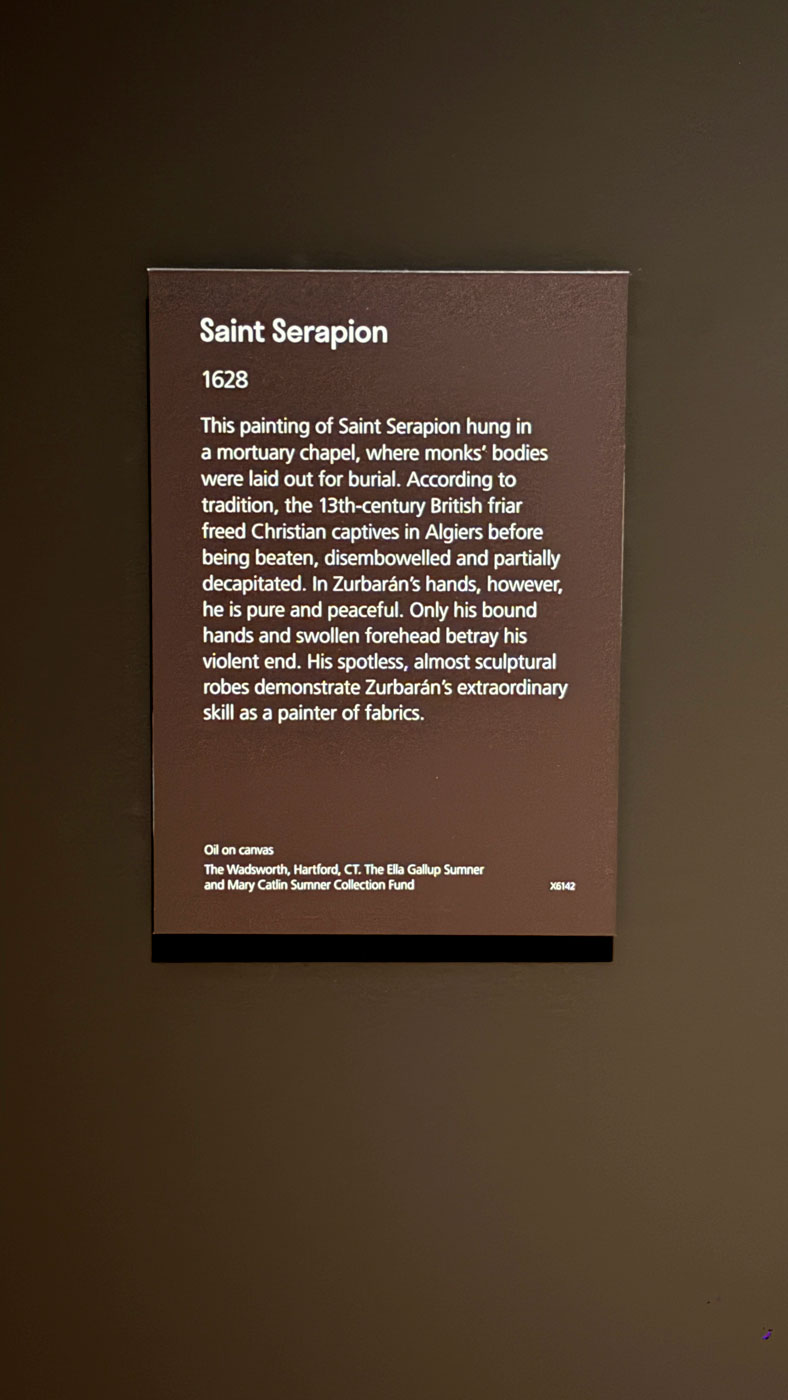
 

Wall text from the exhibition 'Zurbarán' at the National Gallery, London


Wall text from the exhibition Zurbarán at the National Gallery, London
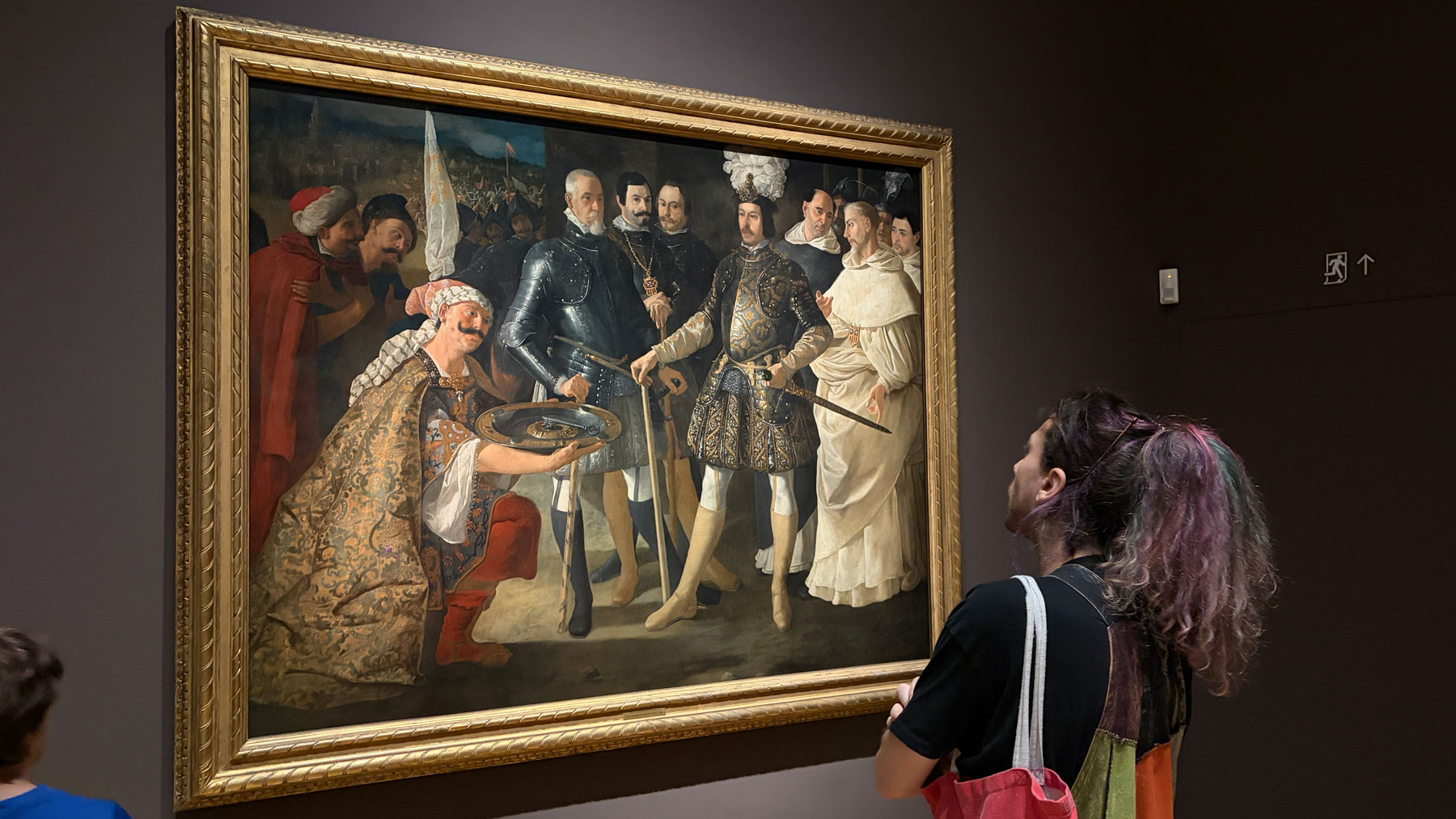
 

Installation view of the exhibition 'Zurbarán' at the National Gallery, London showing Francisco de Zurbarán (Spain, 1598-1664)
'The Surrender of Seville' 1629


I love how the woman’s hair immitates the man’s flowing head dress at left
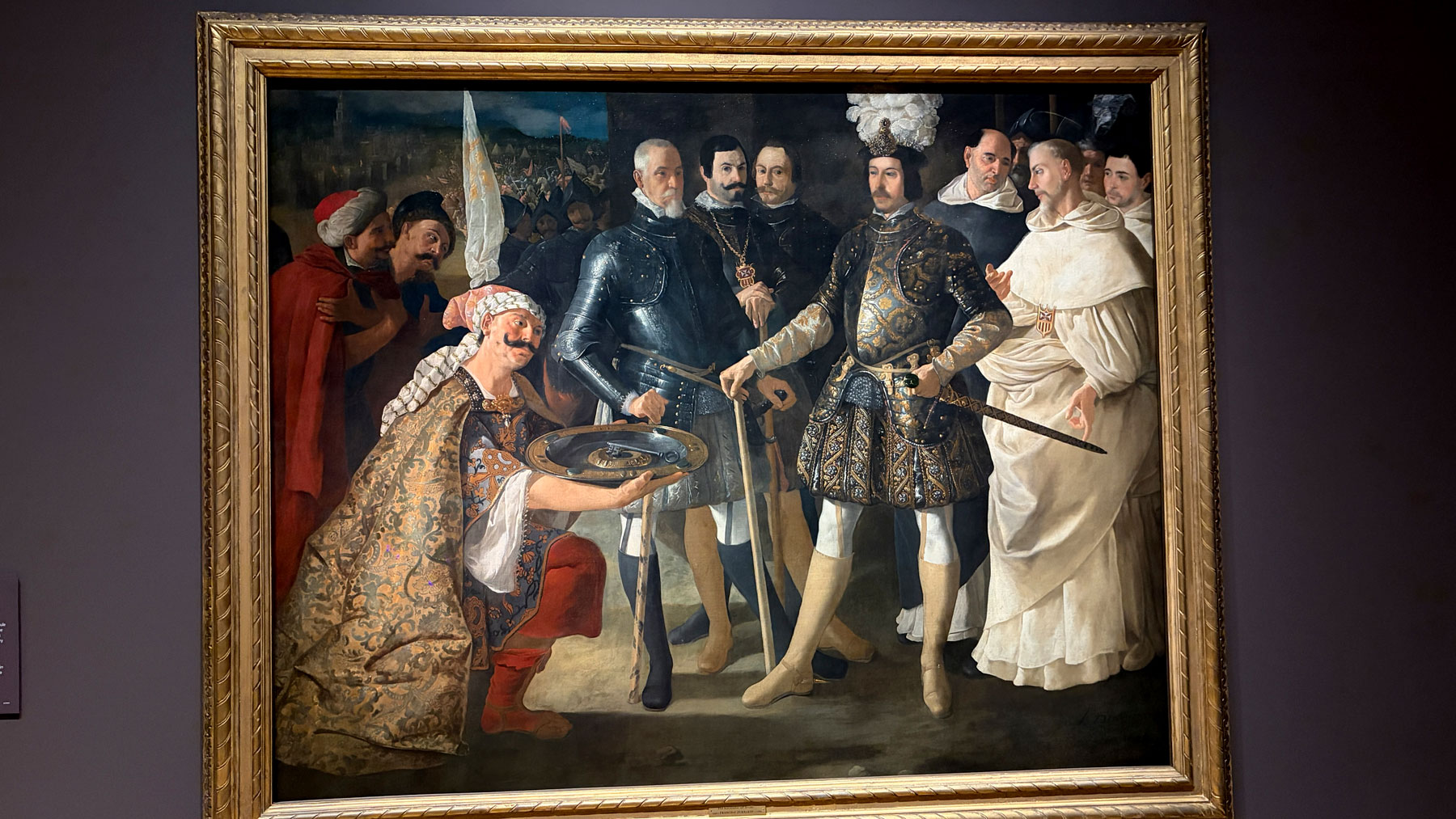
 

Installation view of the exhibition 'Zurbarán' at the National Gallery, London showing Francisco de Zurbarán (Spain, 1598-1664)
'The Surrender of Seville' 1629


Francisco de Zurbarán (Spain, 1598-1664)
The Surrender of Seville (installation view)
1629
Oil on canvas
Private collection
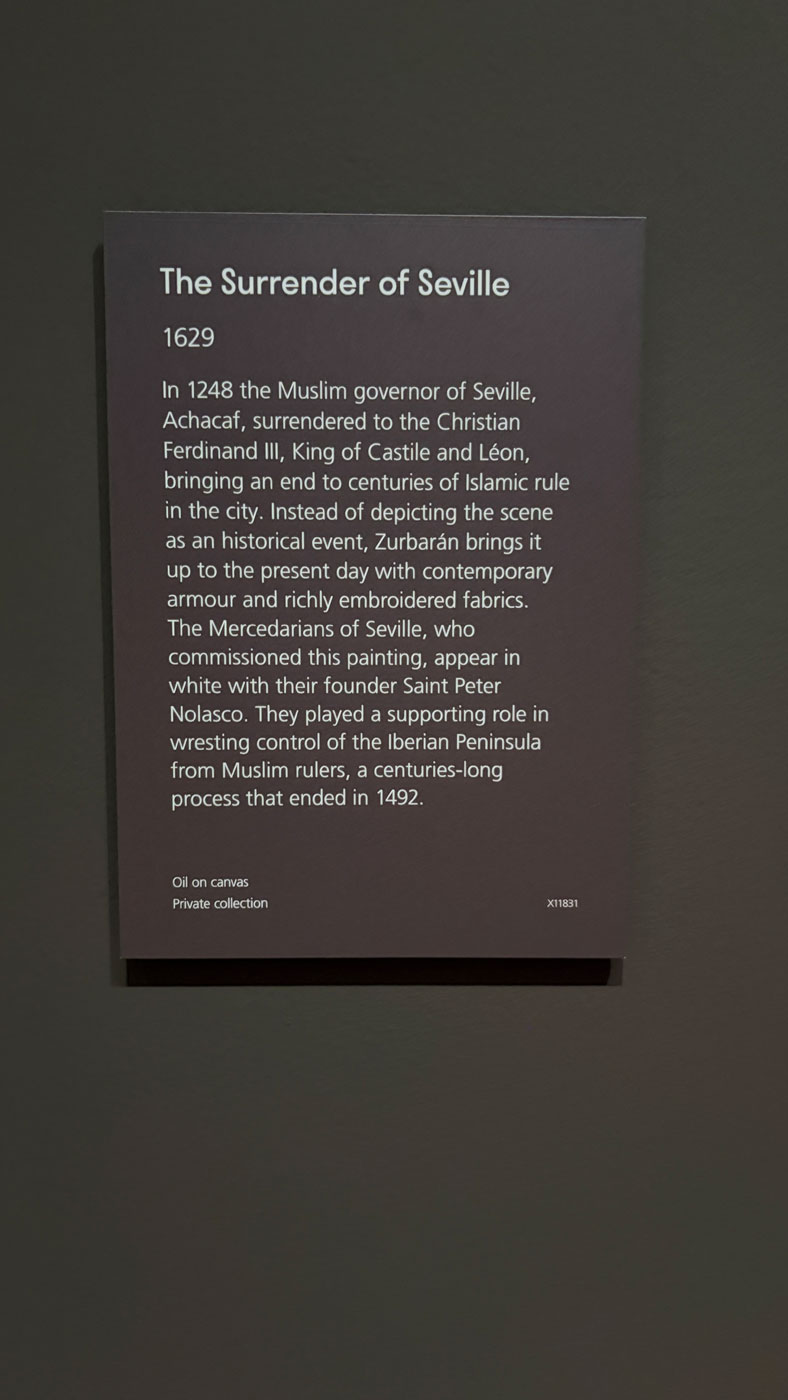
 

Wall text from the exhibition 'Zurbarán' at the National Gallery, London


Wall text from the exhibition Zurbarán at the National Gallery, London
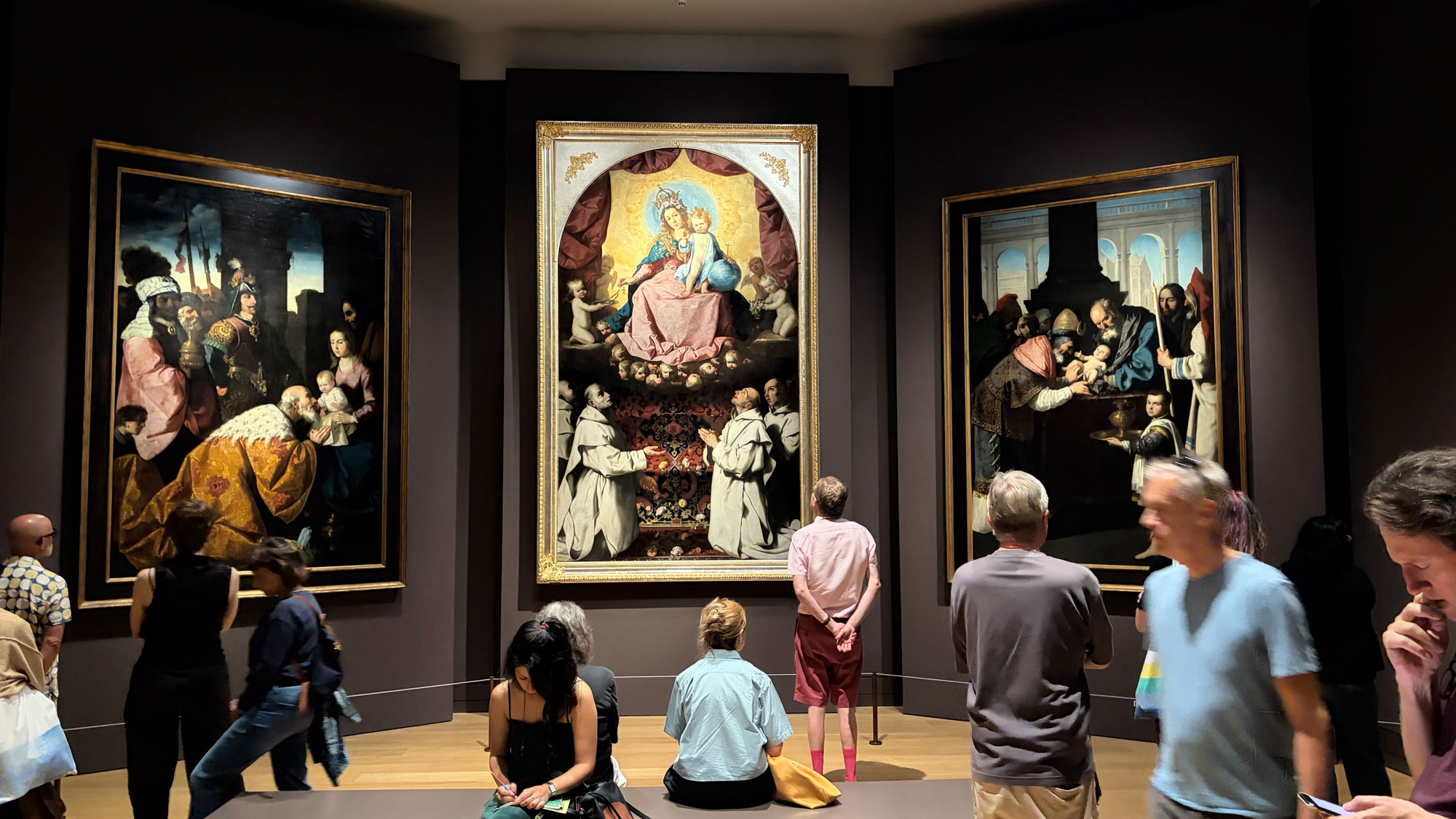
 

Installation view of the exhibition 'Zurbarán' at the National Gallery, London
Installation view of the exhibition 'Zurbarán' at the National Gallery, London showing at centre, 'The Virgin of the Rosary venerated by Carthusians' (about 1637-1639); and at right, 'The Circumcision' (1639)


Installation views of the exhibition Zurbarán at the National Gallery, London showing at left, The Adoration of the Magi (about 1638-1639); at centre, The Virgin of the Rosary venerated by Carthusians (about 1637-1639, below); and at right, The Circumcision (1639, below)
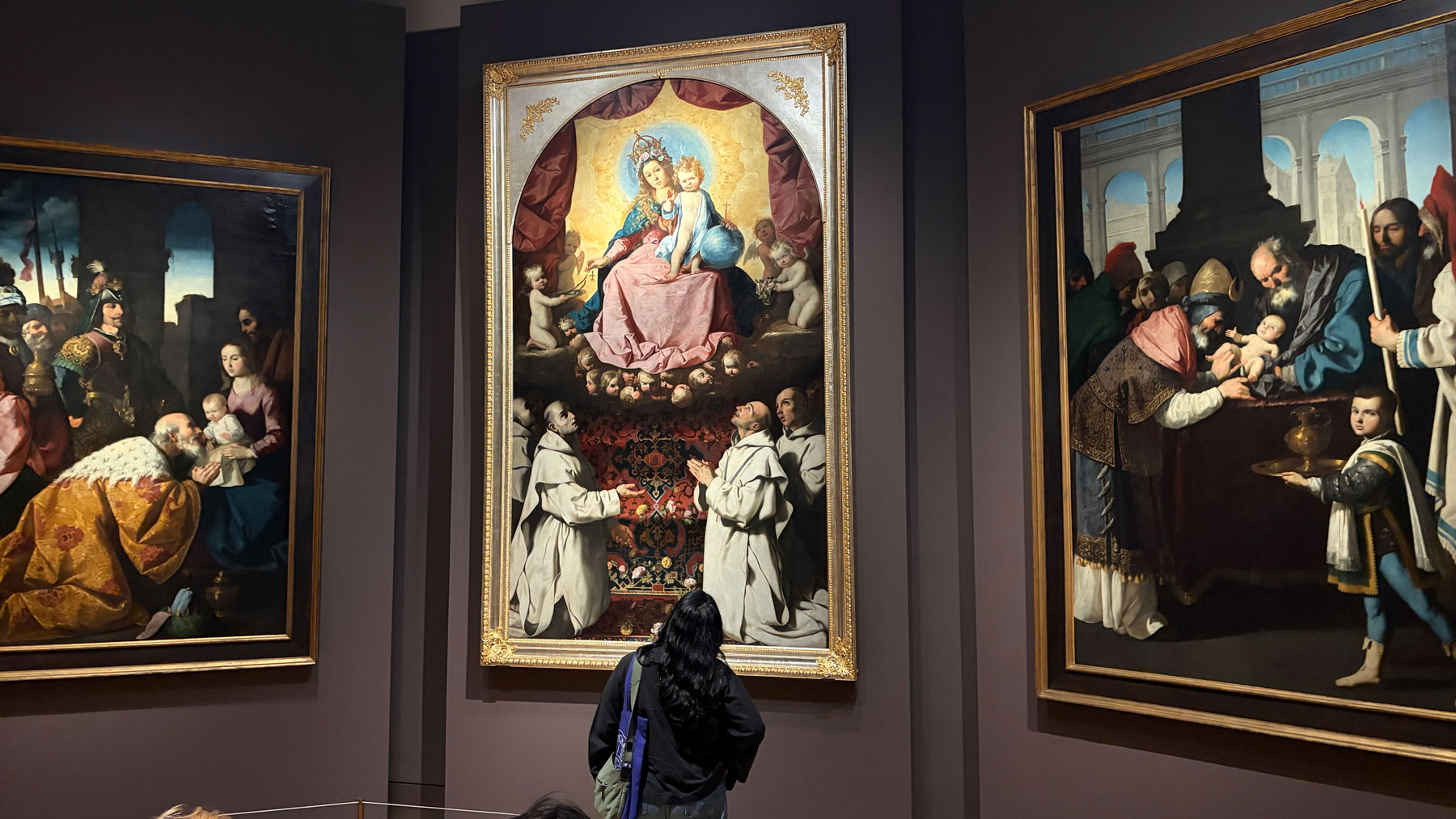
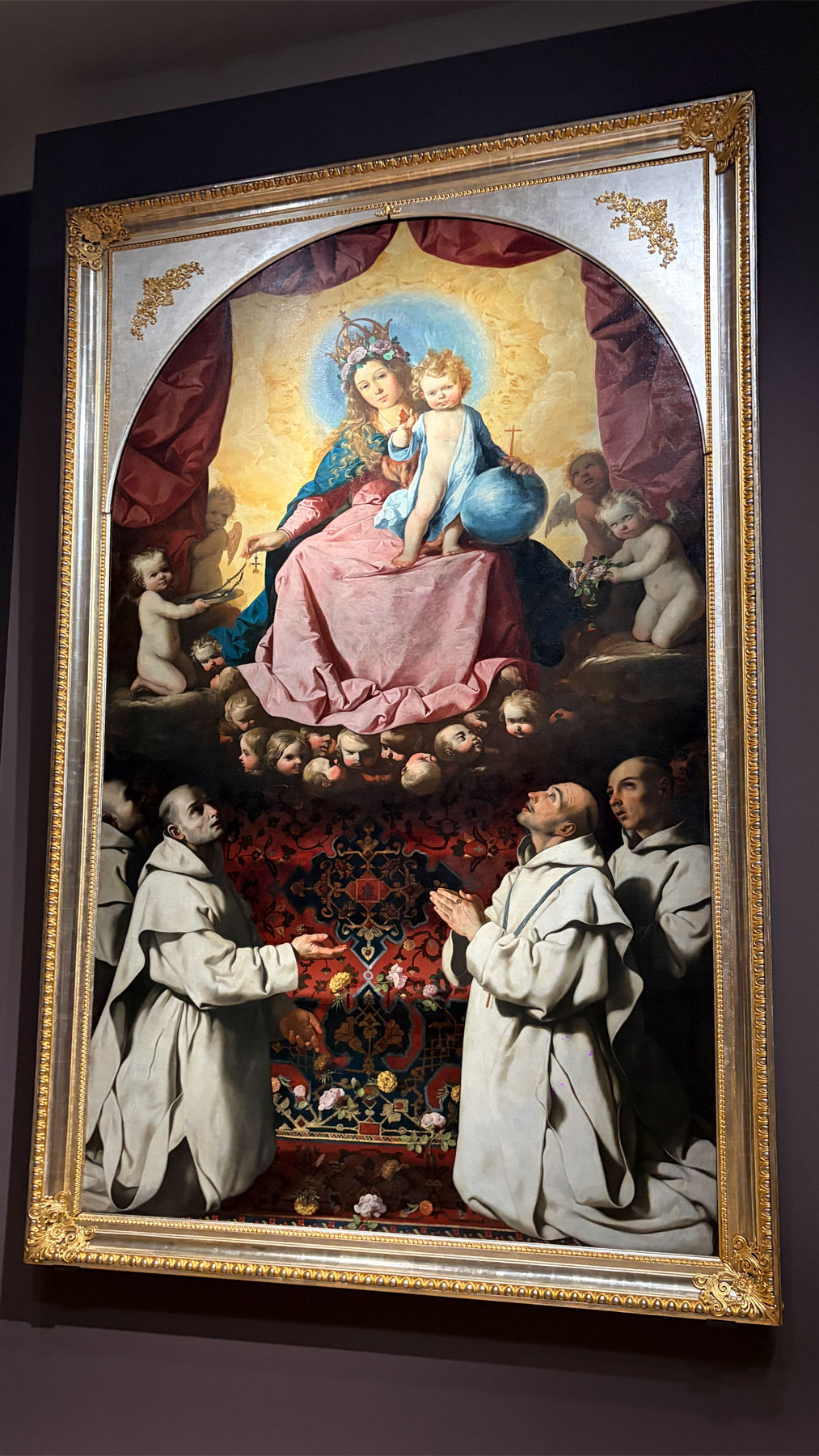
 

Installation view of the exhibition 'Zurbarán' at the National Gallery, London showing Francisco de Zurbarán (Spain, 1598-1664)
'The Virgin of the Rosary venerated by Carthusians' about 1637-1639


Francisco de Zurbarán (Spain, 1598-1664)
The Virgin of the Rosary venerated by Carthusians (installation view)
About 1637-1639
Oil on canvas
National Museum in Poznań
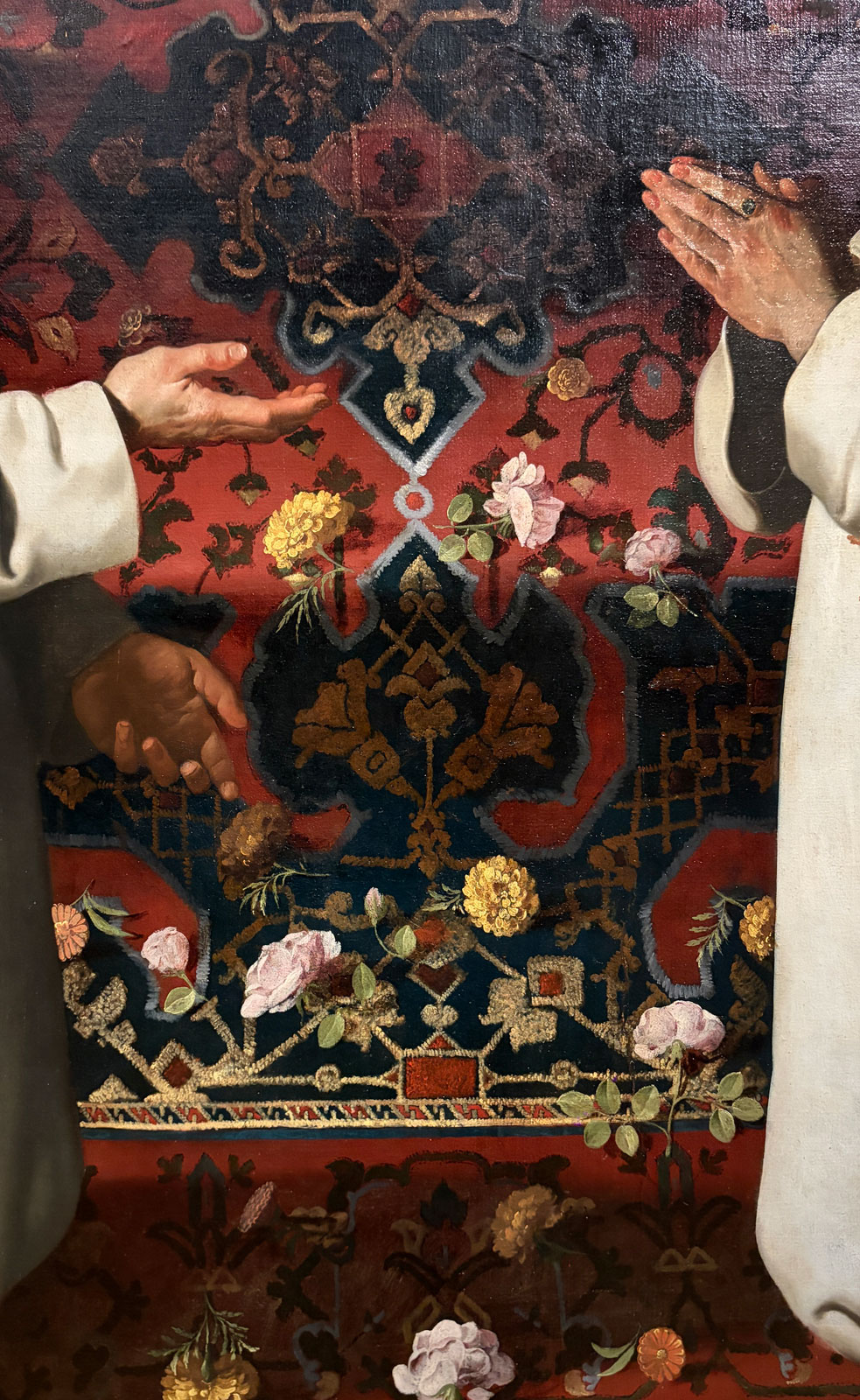
 

Installation view of the exhibition 'Zurbarán' at the National Gallery, London showing Francisco de Zurbarán (Spain, 1598-1664)
'The Adoration of the Magi' about 1638-1639 (detail)


Francisco de Zurbarán (Spain, 1598-1664)
The Adoration of the Magi (installation view detail)
About 1638-1639
Oil on canvas
Collection of Musee de Grenoble
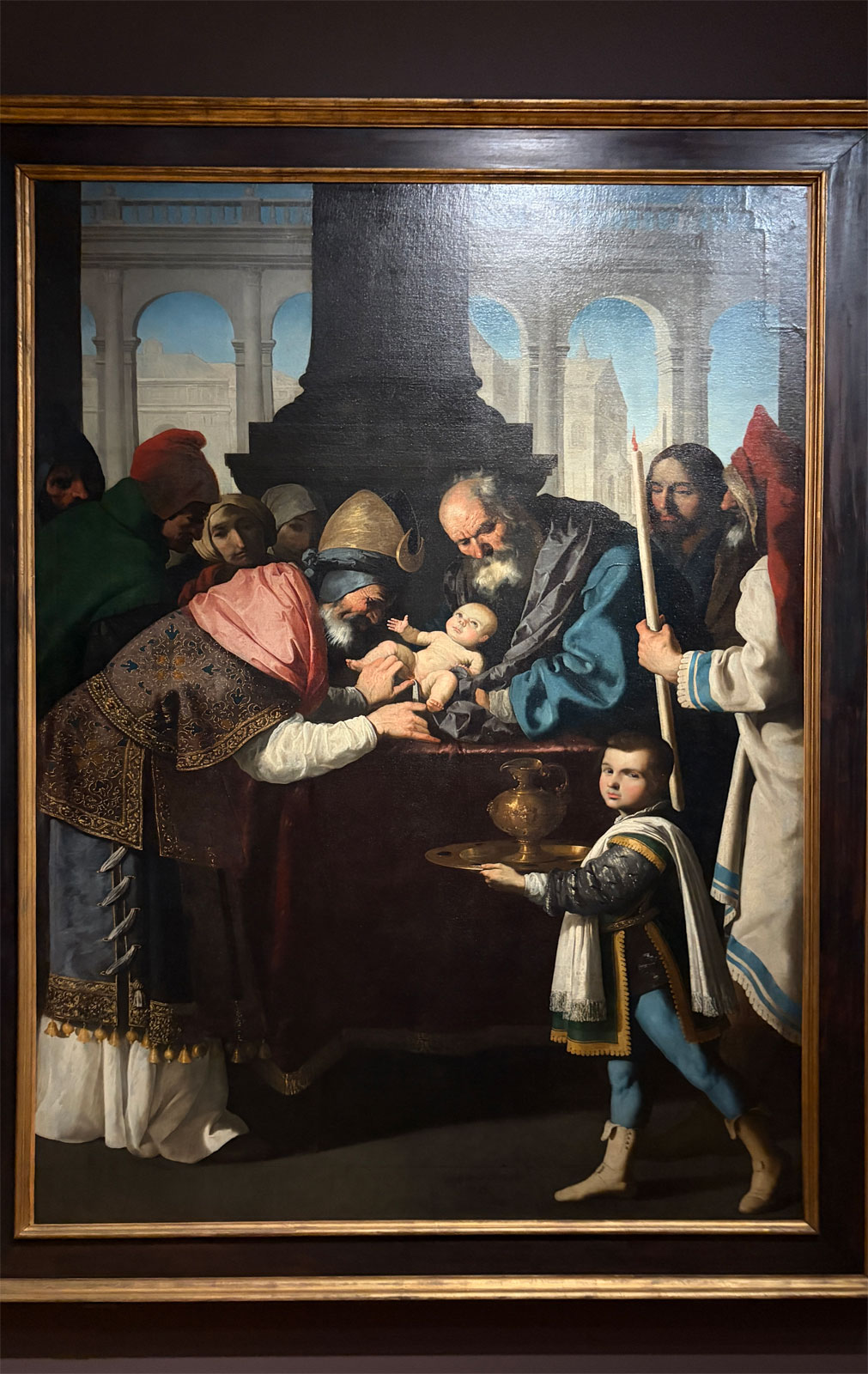
 

Installation view of the exhibition 'Zurbarán' at the National Gallery, London showing Francisco de Zurbarán (Spain, 1598-1664)
'The Circumcision' 1639


Francisco de Zurbarán (Spain, 1598-1664)
The Circumcision (installation view)
1639
Oil on canvas
Collection of Musee de Grenoble
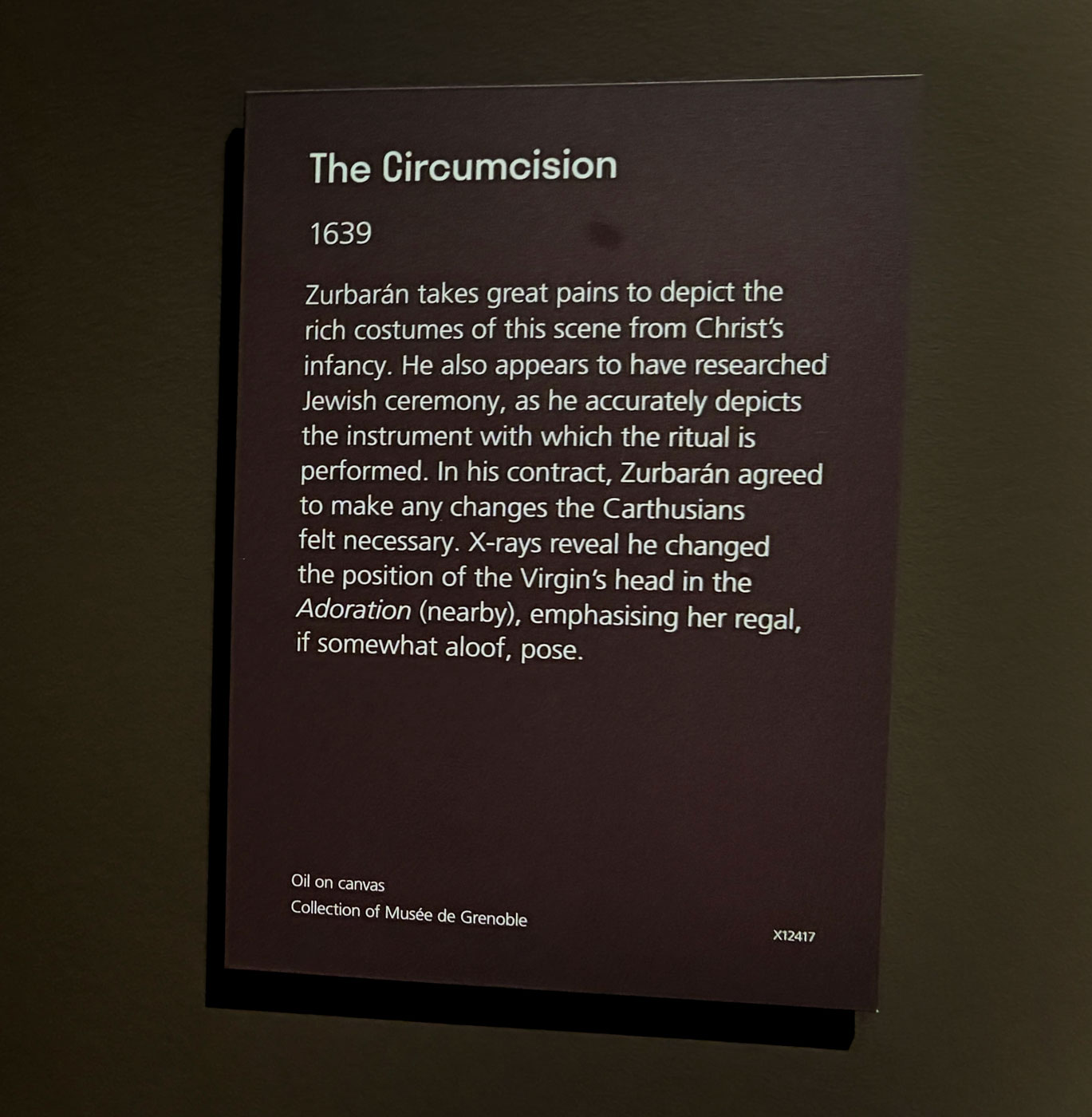
 

Wall text from the exhibition 'Zurbarán' at the National Gallery, London


Wall text from the exhibition Zurbarán at the National Gallery, London


Enter the spellbinding world of visionary Spanish painter Francisco de Zurbarán. Spend time with his paintings, celebrated for their vivid naturalism and deep emotional power. Move between soaring altarpieces and exquisite still lifes in the first major UK exhibition of this great artist from Baroque Seville.

A peer of Murillo and Velázquez, Zurbarán stands out for his drama, mystery and vision. From the rind of a lemon to the timeless gaze of a saint, he finds an intensity in the ordinary. Strong light and deep shadow bring real faces, soft fabrics, fresh fruit and flowers to life. His paintings unite stillness, focus and faith.

The exhibition brings together works from major galleries across Europe and the US that span Zurbarán’s career from his first religious commissions to paintings made for private devotion. Stand in front of monumental works that can still move and inspire us today.

‘Zurbarán’ is at the National Gallery, Sainsbury Wing between 2 May and 23 August 2026. The exhibition is organised by the National Gallery, London, Musée du Louvre, Paris and the Art Institute of Chicago.

Text from the National Gallery website
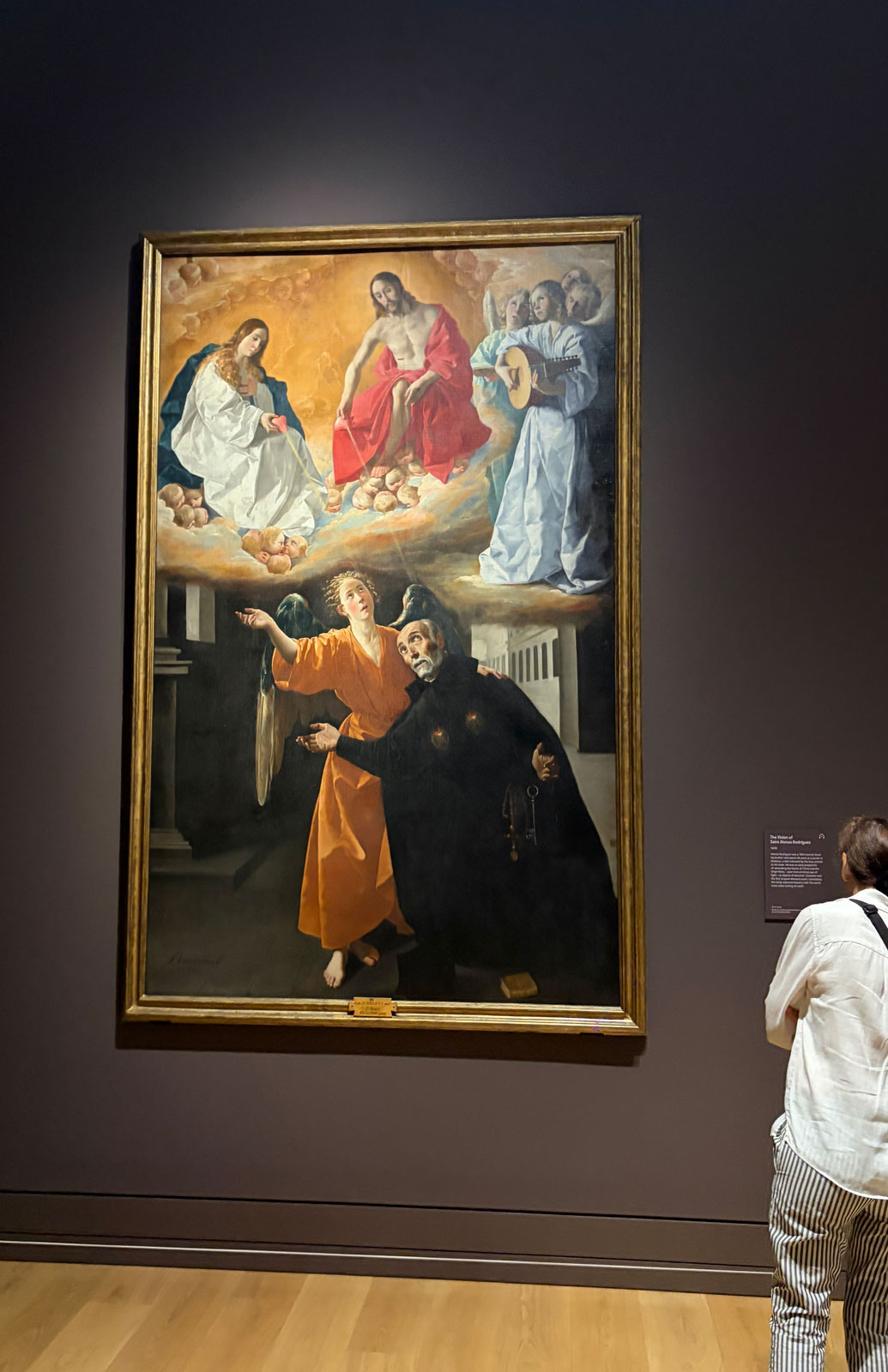
 

Installation view of the exhibition 'Zurbarán' at the National Gallery, London
Installation view of the exhibition 'Zurbarán' at the National Gallery, London showing Francisco de Zurbarán (Spain, 1598-1664)
'The Vision of Saint Alonso Rodriguez' 1630


Francisco de Zurbarán (Spain, 1598-1664)
The Vision of Saint Alonso Rodriguez (installation views)
1630
Oil on canvas
Museo de la Real Academia de Bellas Artes de San Fernando, Madrid
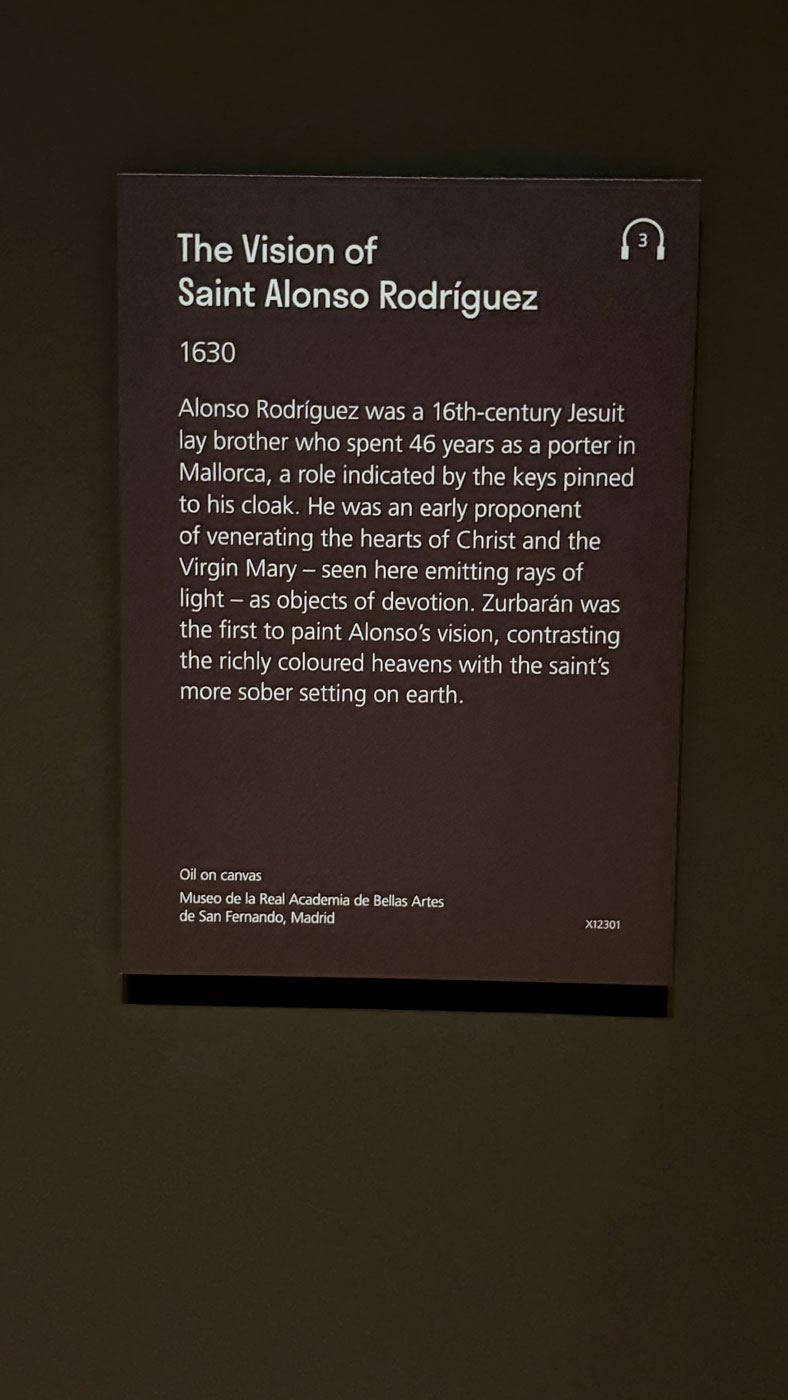
 

Wall text from the exhibition 'Zurbarán' at the National Gallery, London


Wall text from the exhibition Zurbarán at the National Gallery, London
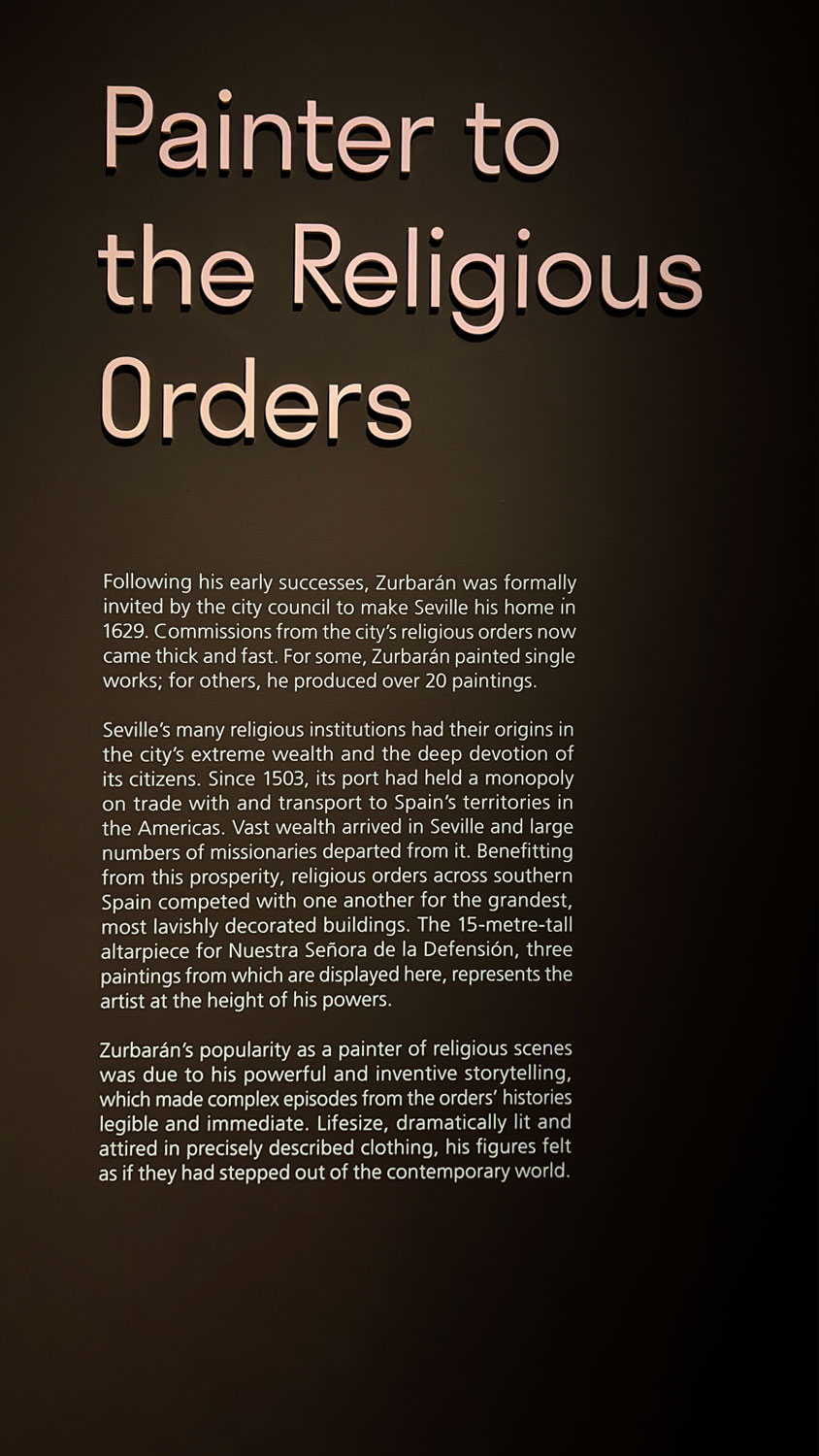
 

Wall text from the exhibition 'Zurbarán' at the National Gallery, London


Wall text from the exhibition Zurbarán at the National Gallery, London
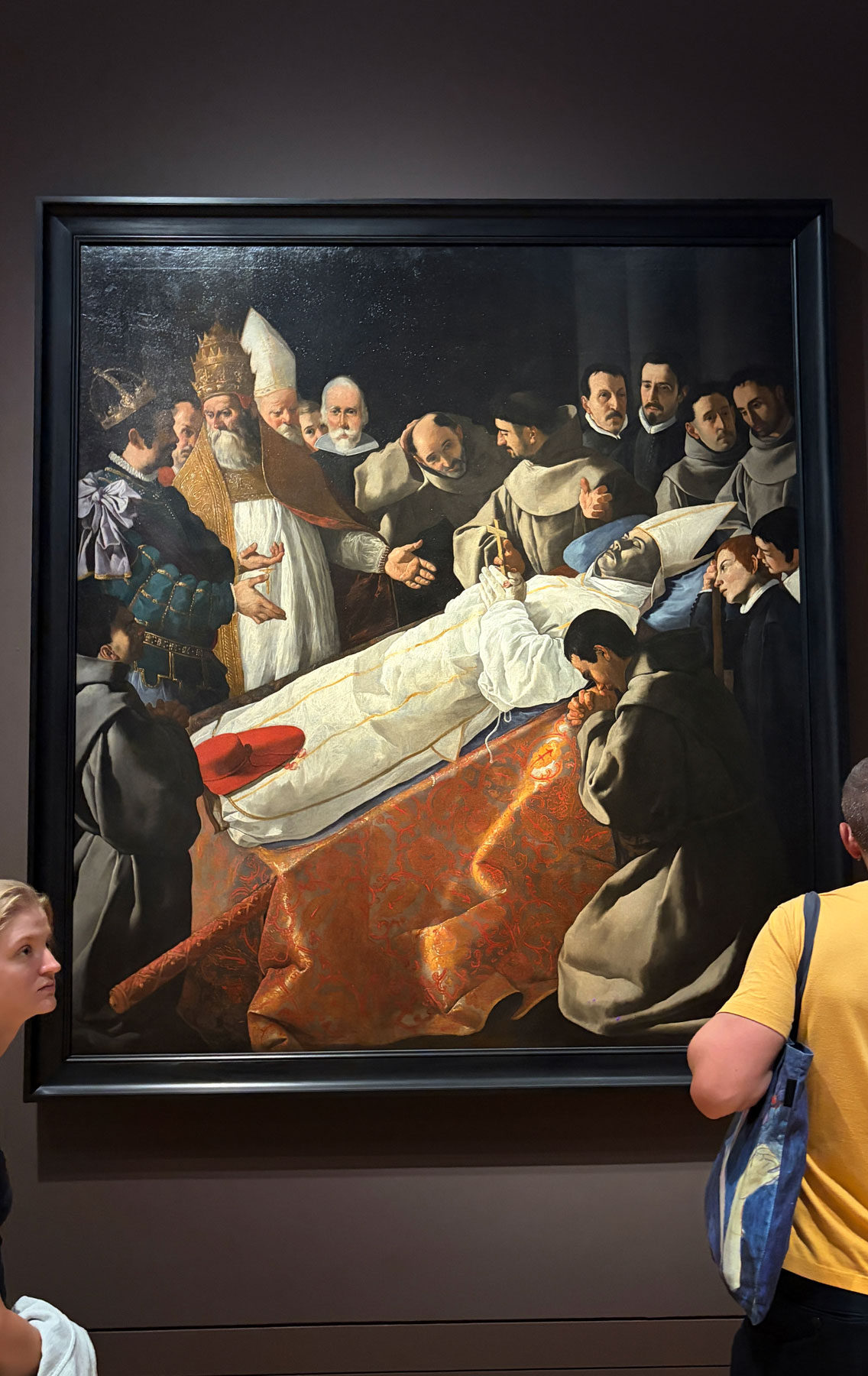
 

Installation view of the exhibition 'Zurbarán' at the National Gallery, London showing Francisco de Zurbarán (Spain, 1598-1664)
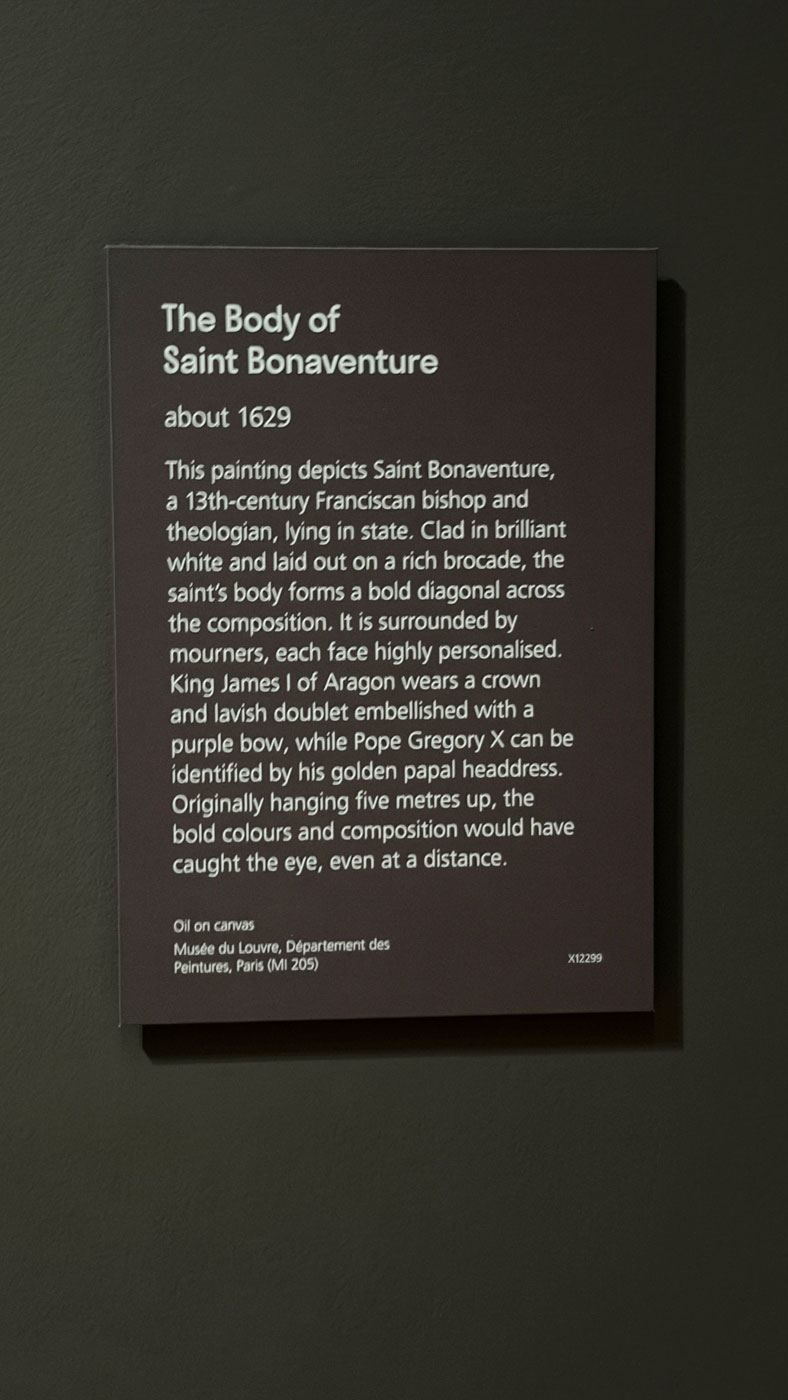
'The Body of Saint Bonaventure'
About 1629
Installation view of the exhibition 'Zurbarán' at the National Gallery, London showing Francisco de Zurbarán (Spain, 1598-1664)
'The Body of Saint Bonaventure'
About 1629


Francisco de Zurbarán (Spain, 1598-1664)
The Body of Saint Bonaventure (installation views)
About 1629
Oil on canvas
Musee de Louvre, Department des Peintures, Paris


Wall text from the exhibition 'Zurbarán' at the National Gallery, London


Wall text from the exhibition Zurbarán at the National Gallery, London
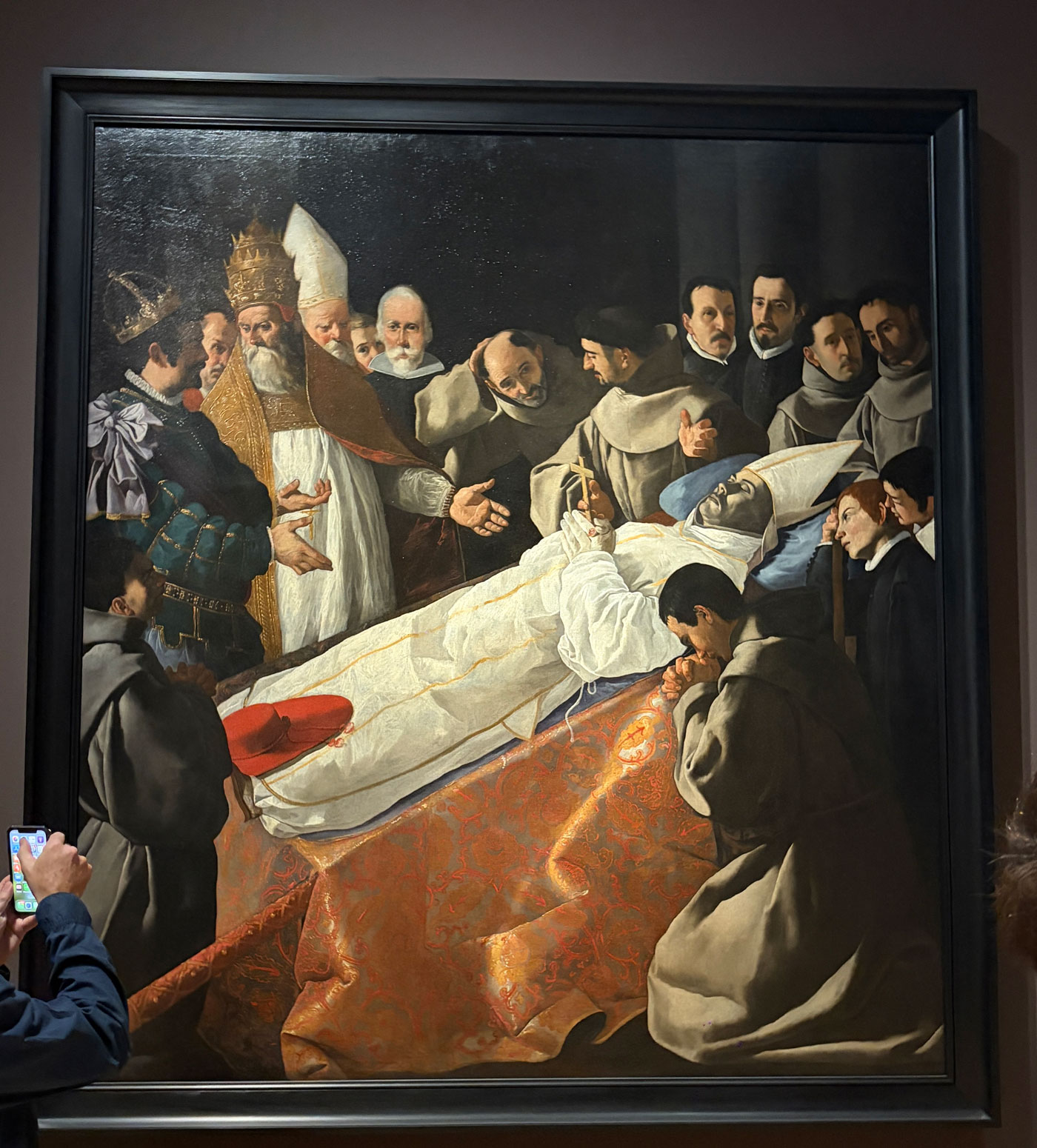
 

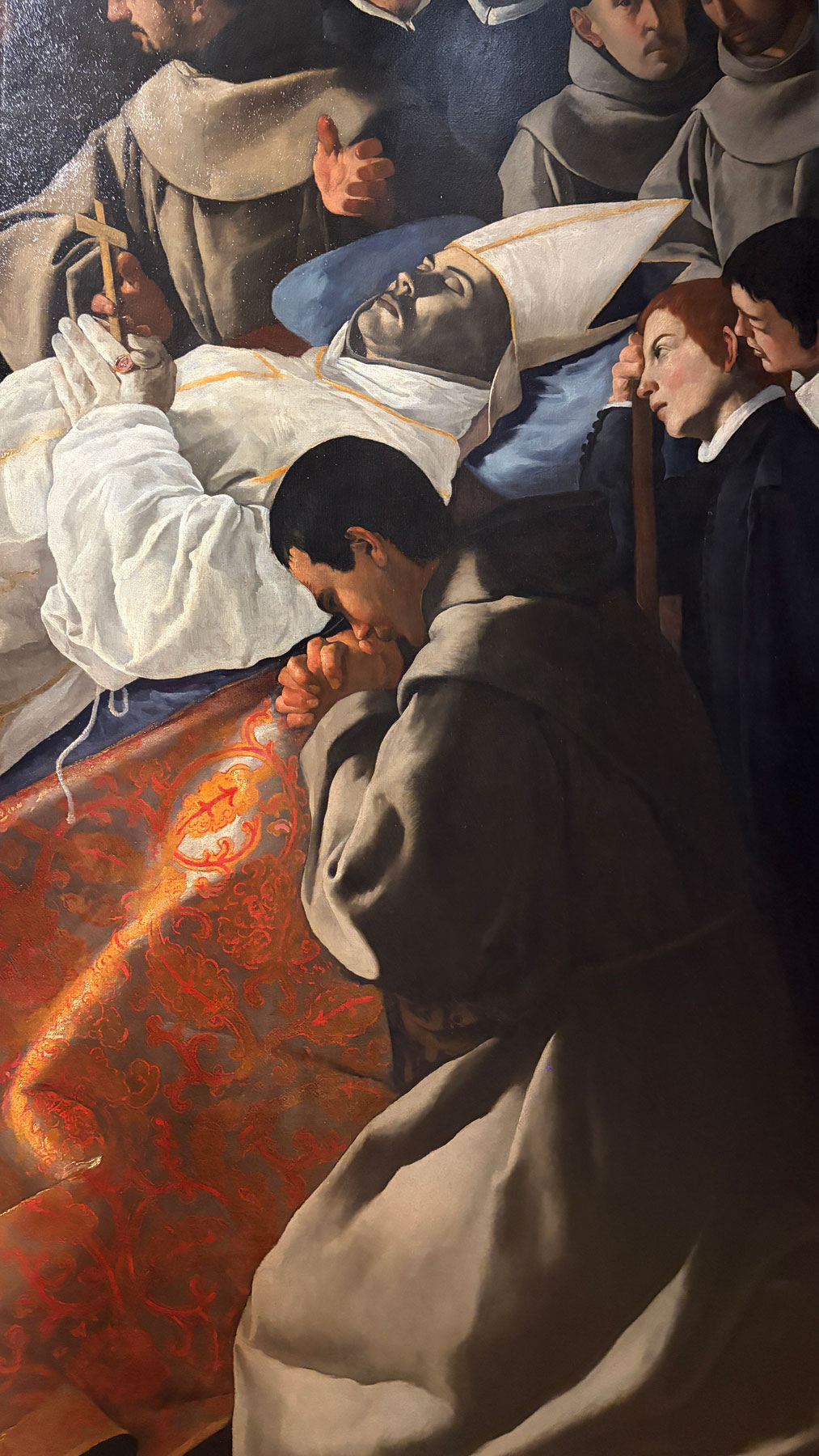
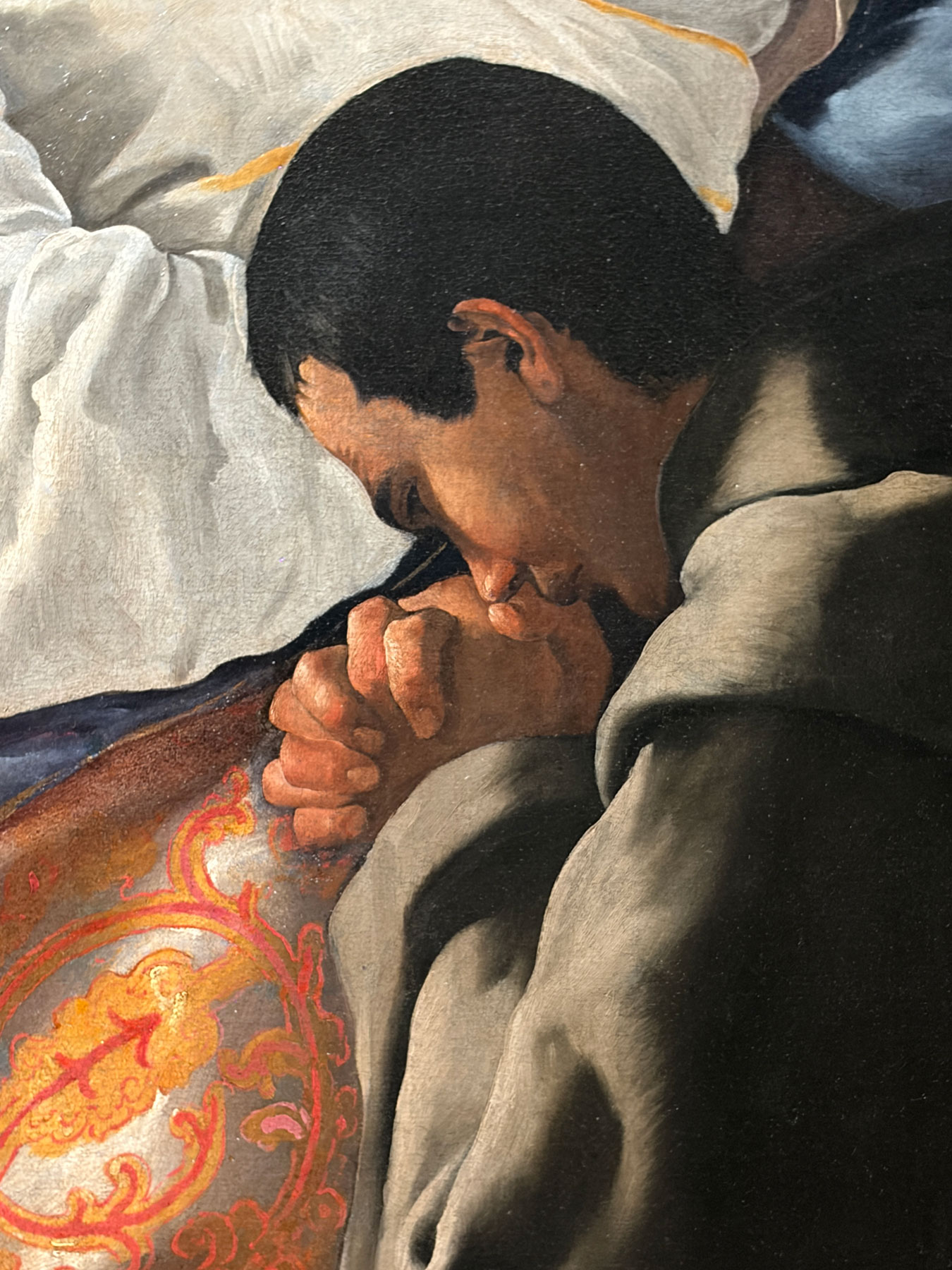
Installation view of the exhibition 'Zurbarán' at the National Gallery, London showing Francisco de Zurbarán (Spain, 1598-1664) 'The Body of Saint Bonaventure'
about 1629 (detail)
Installation view of the exhibition 'Zurbarán' at the National Gallery, London showing Francisco de Zurbarán (Spain, 1598-1664) 'The Body of Saint Bonaventure'
about 1629 (detail)


Francisco de Zurbarán (Spain, 1598-1664)
The Body of Saint Bonaventure (installation view details)
About 1629
Oil on canvas
Musee de Louvre, Department des Peintures, Paris
 

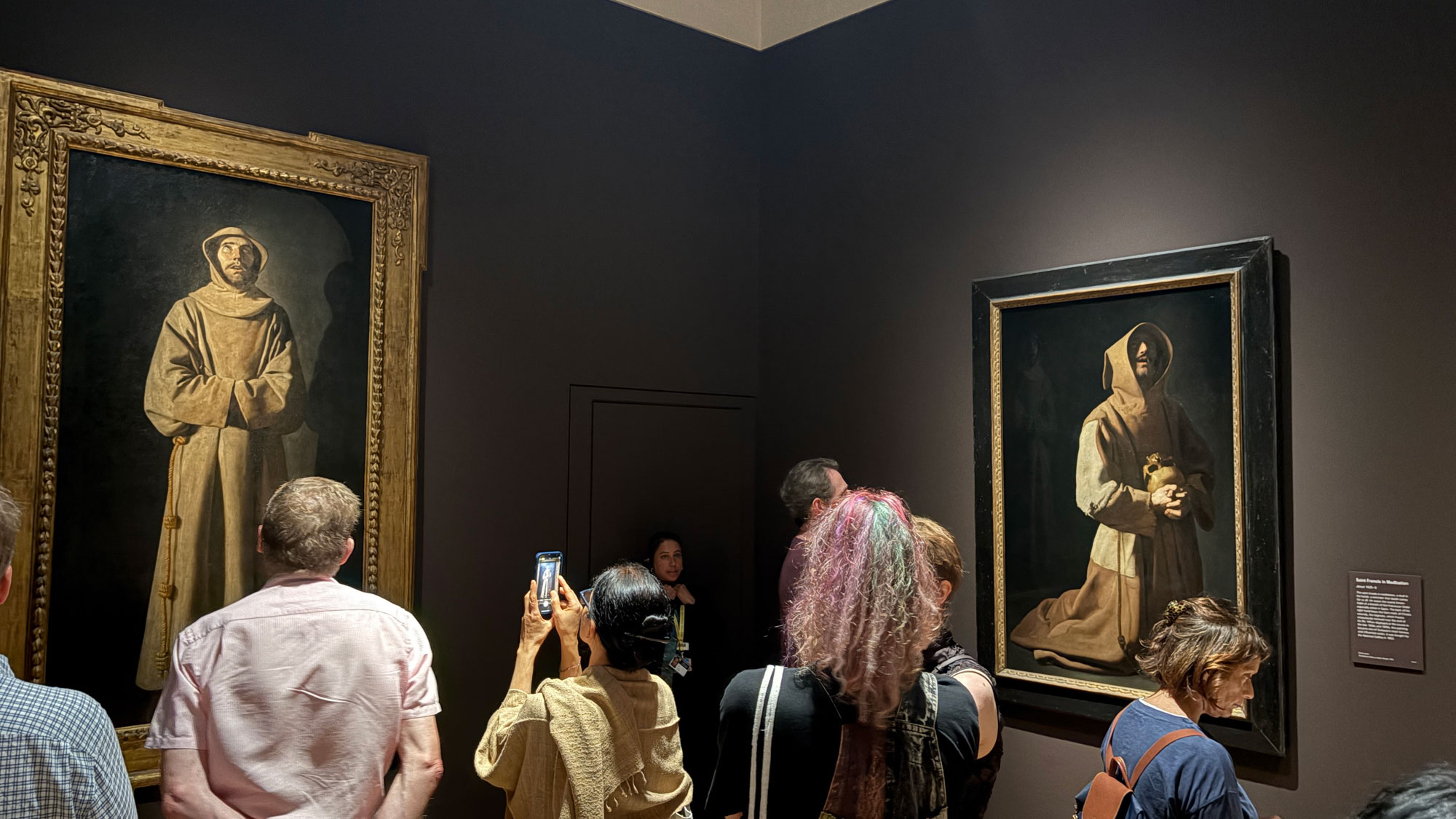
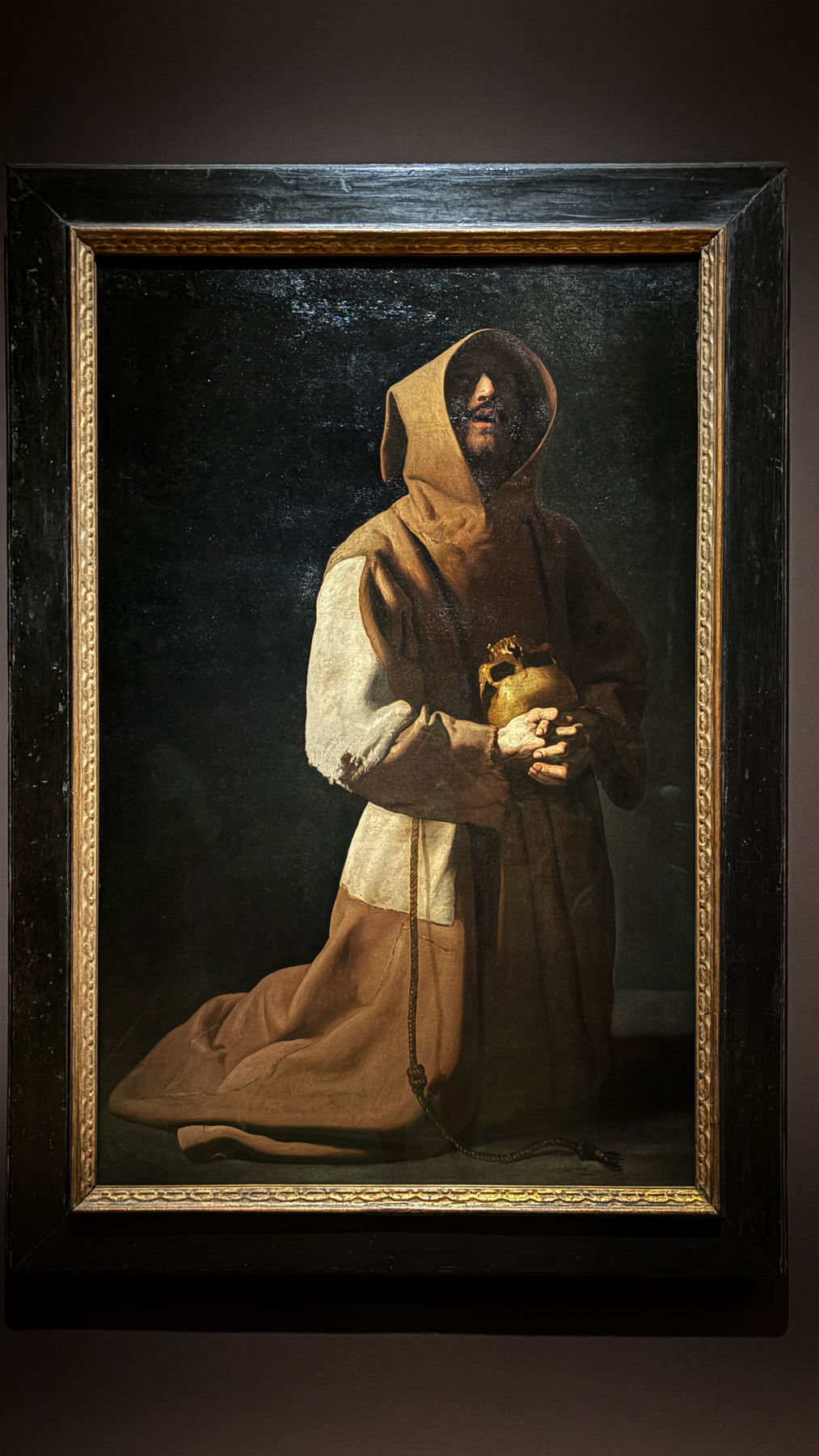
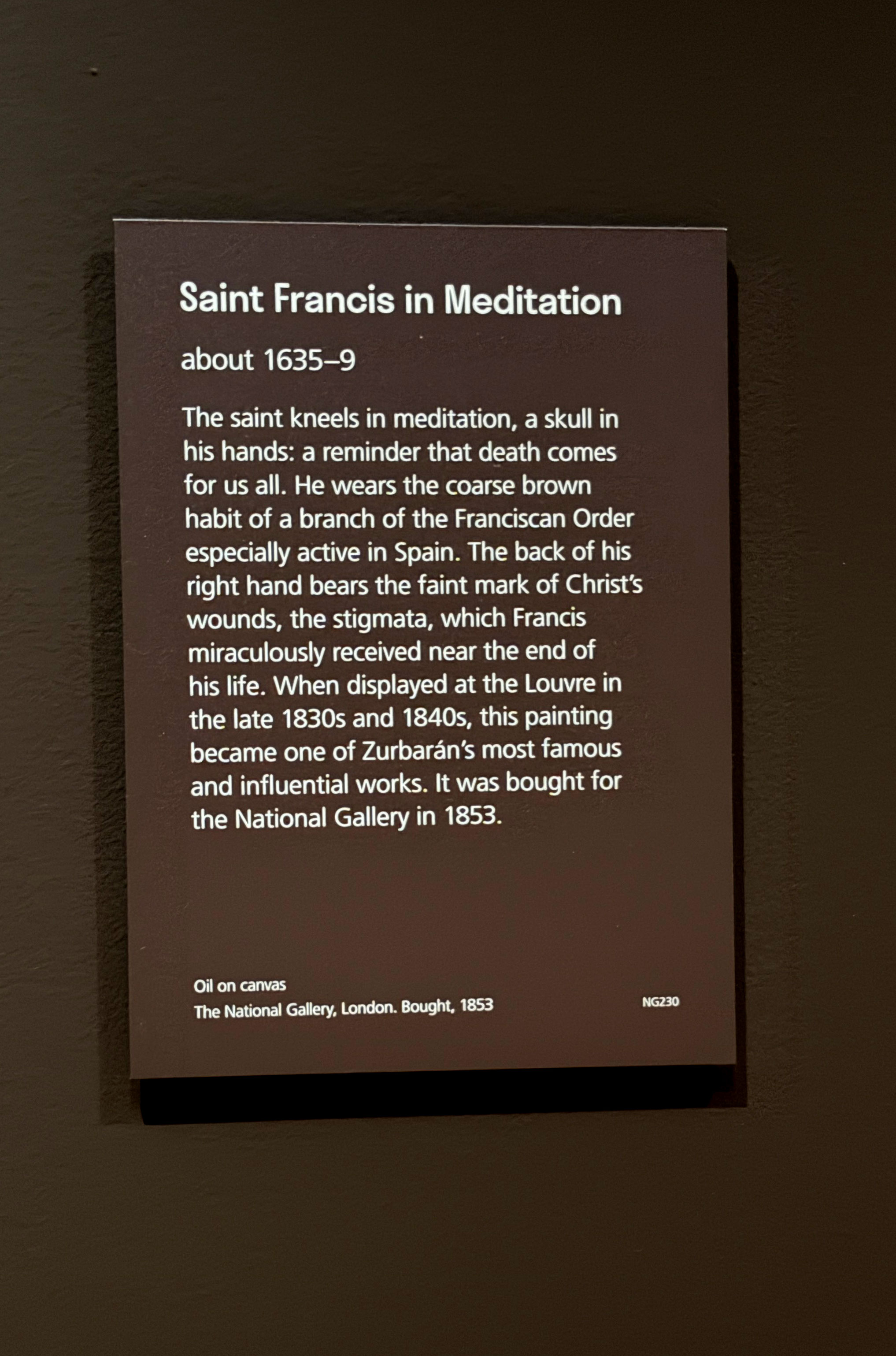
Installation view of the exhibition 'Zurbarán' at the National Gallery, London showing at right Saint Francis in Meditation (about 1635-1639)


Installation view of the exhibition Zurbarán at the National Gallery, London showing at right Saint Francis in Meditation (about 1635-1639, below)
 

Installation view of the exhibition 'Zurbarán' at the National Gallery, London
Installation view of the exhibition 'Zurbarán' at the National Gallery, London showing Francisco de Zurbarán (Spain, 1598-1664)
'Saint Francis in Meditation' about 1635-1639


Francisco de Zurbarán (Spain, 1598-1664)
Saint Francis in Meditation (installation view)
About 1635-1639
Oil on canvas
The National Gallery, London


Wall text from the exhibition 'Zurbarán' at the National Gallery, London


Wall text from the exhibition Zurbarán at the National Gallery, London
 

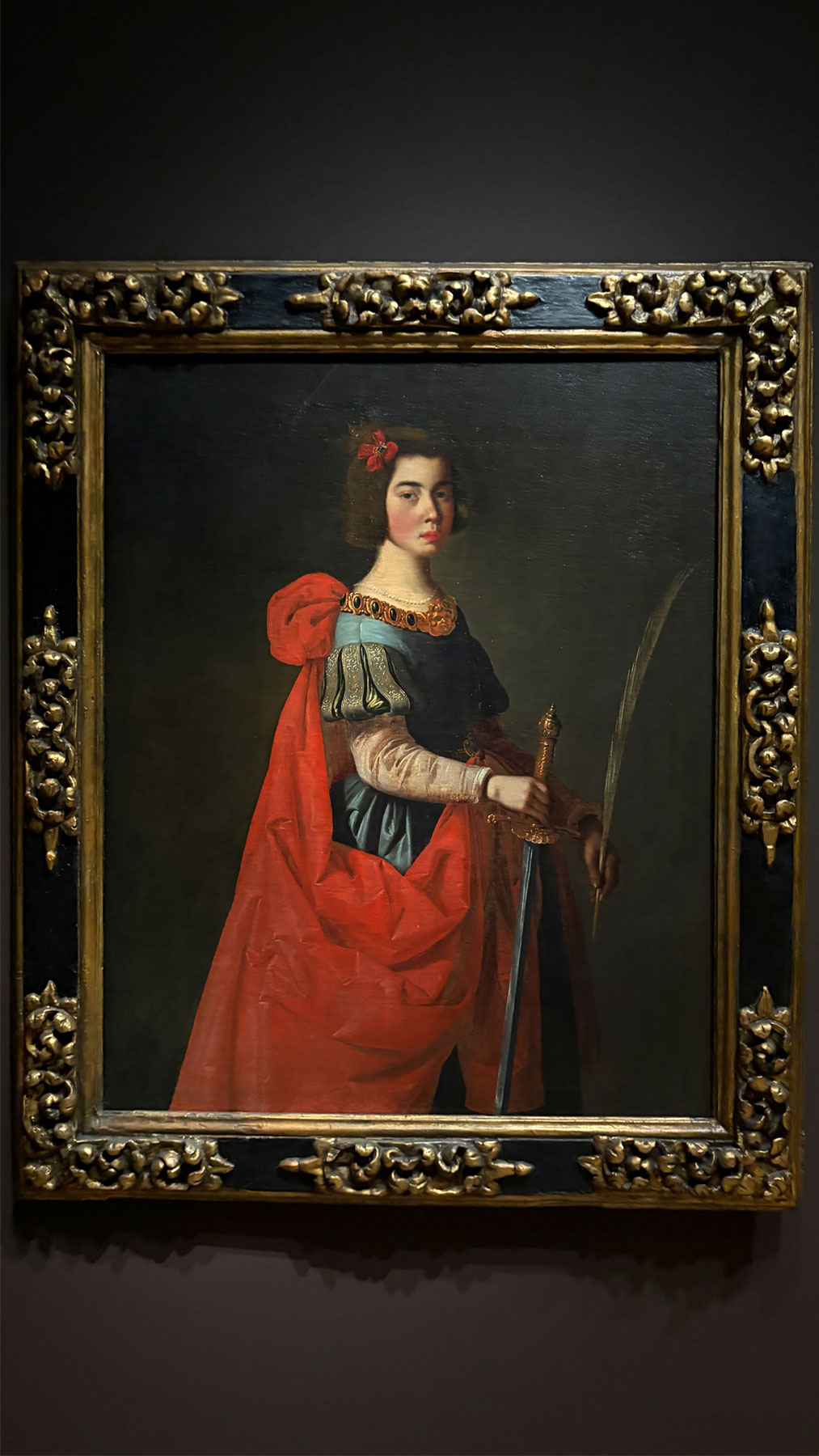
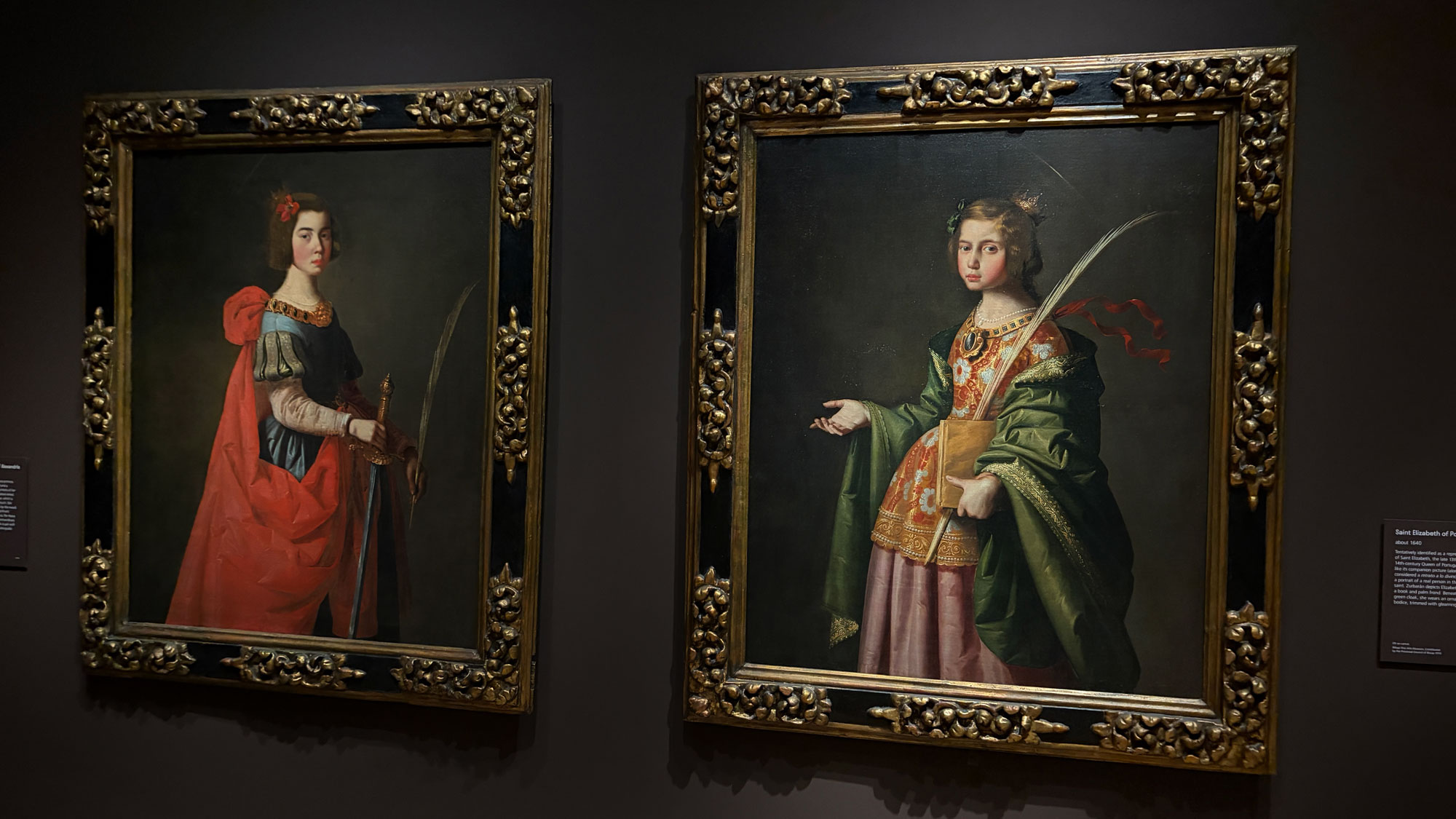
Installation view of the exhibition 'Zurbarán' at the National Gallery, London, showing at left, 'Saint Catherine of Alexandria' (about 1640, below); and at right, 'Saint Elizabeth of Portugal' (about 1640)


Installation view of the exhibition Zurbarán at the National Gallery, London showing at left, Saint Catherine of Alexandria (about 1640, below); and at right, Saint Elizabeth of Portugal (about 1640)


Installation view of the exhibition 'Zurbarán' at the National Gallery, London showing Francisco de Zurbarán (Spain, 1598-1664)
'Saint Catherine of Alexandria'
about 1640


Francisco de Zurbarán (Spain, 1598-1664)
Saint Catherine of Alexandria (installation view)
About 1640
Oil on canvas
Bilbao Fine Arts Museum


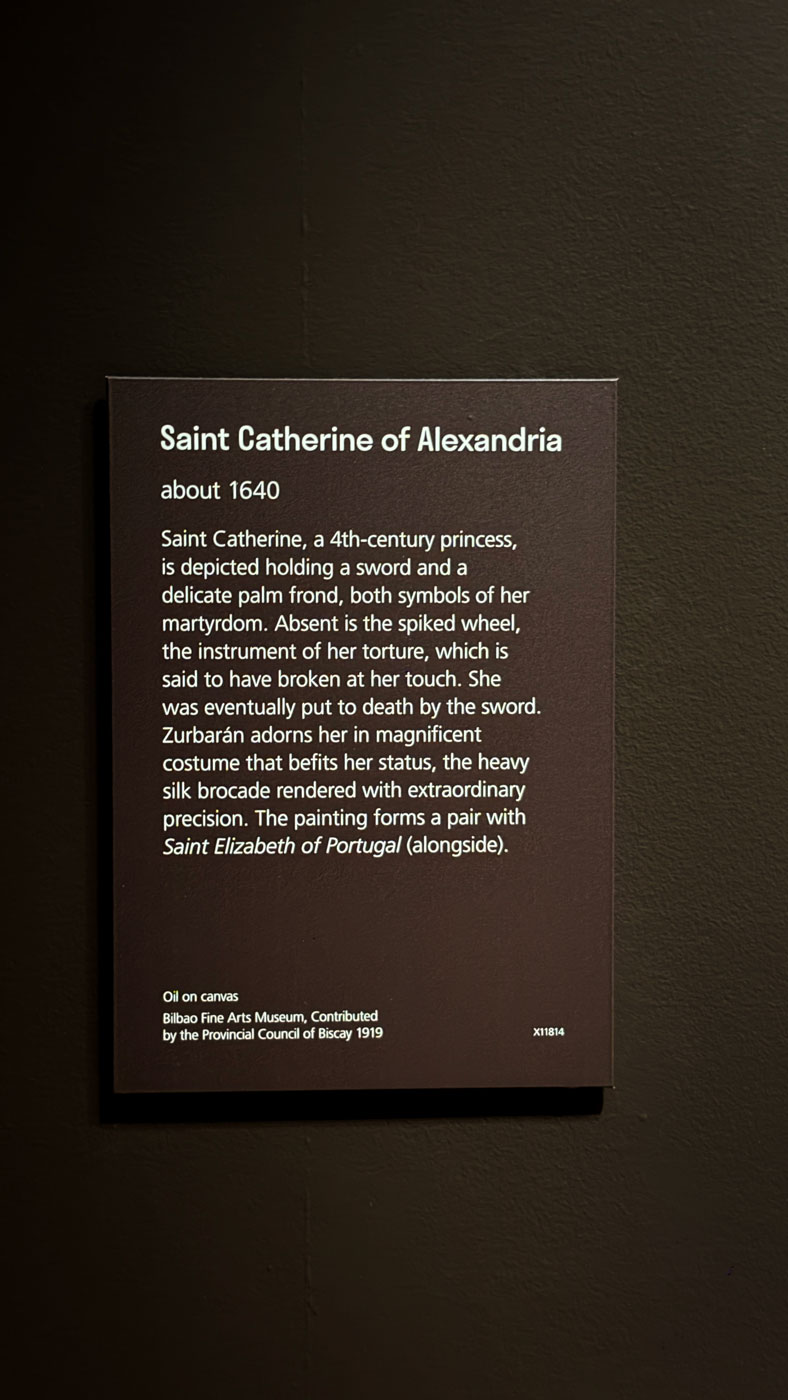
Wall text from the exhibition 'Zurbarán' at the National Gallery, London


Wall text from the exhibition Zurbarán at the National Gallery, London


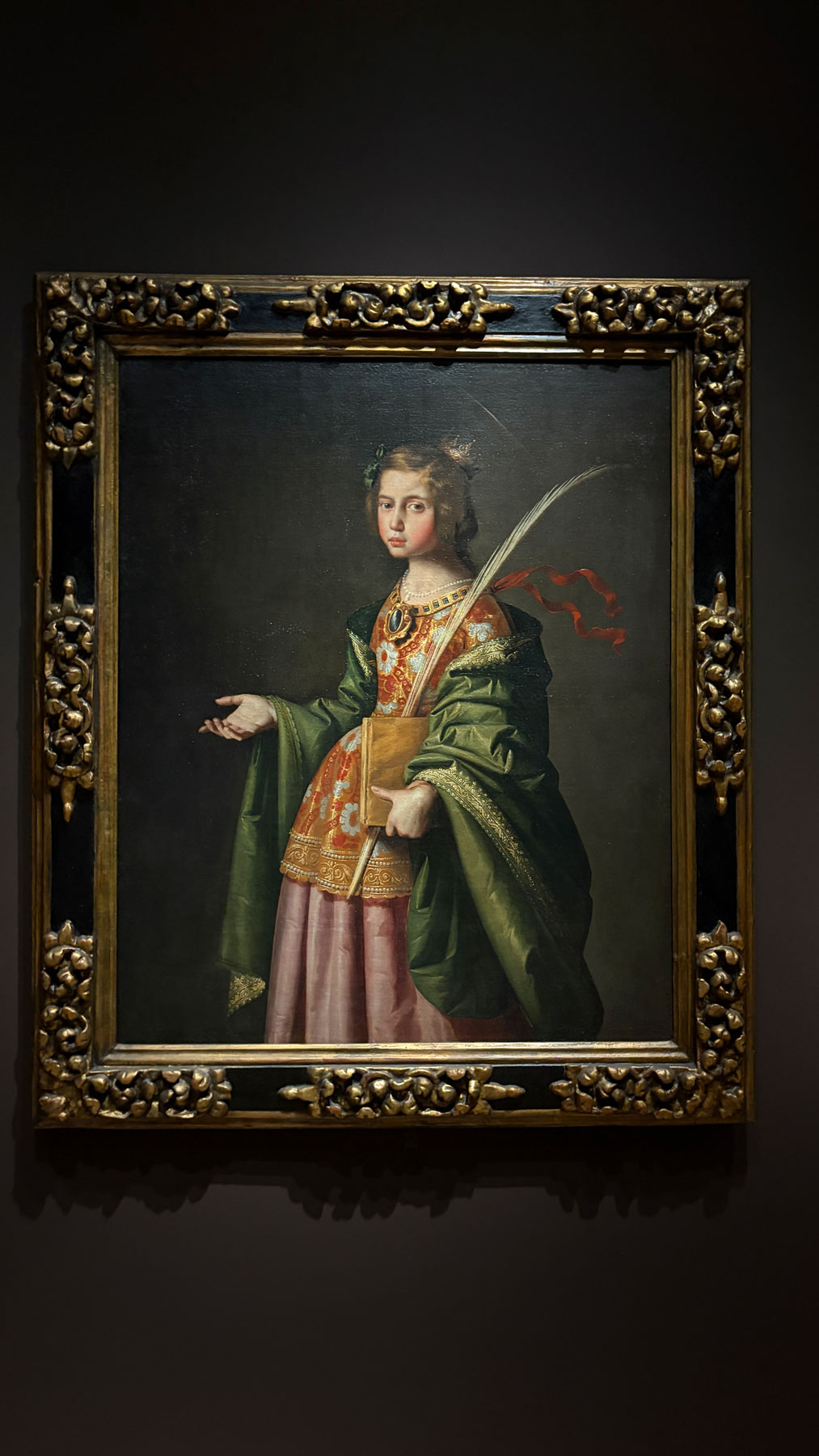
Installation view of the exhibition 'Zurbarán' at the National Gallery, London showing Francisco de Zurbarán (Spain, 1598-1664)
'Saint Elizabeth of Portugal' about 1640


Francisco de Zurbarán (Spain, 1598-1664)
Saint Elizabeth of Portugal (installation view)
About 1640
Oil on canvas
Bilbao Fine Arts Museum


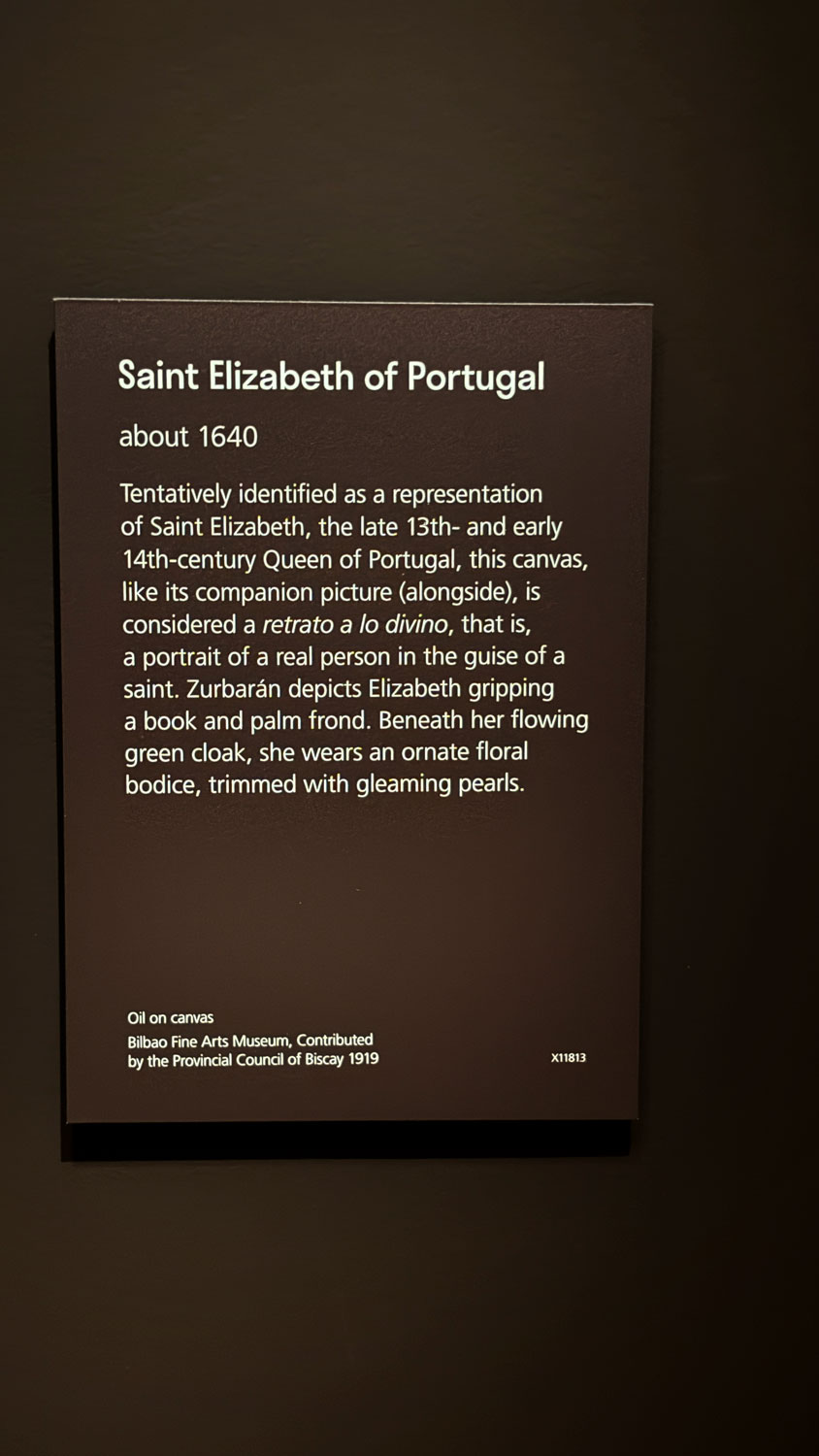
Wall text from the exhibition 'Zurbarán' at the National Gallery, London


Wall text from the exhibition Zurbarán at the National Gallery, London


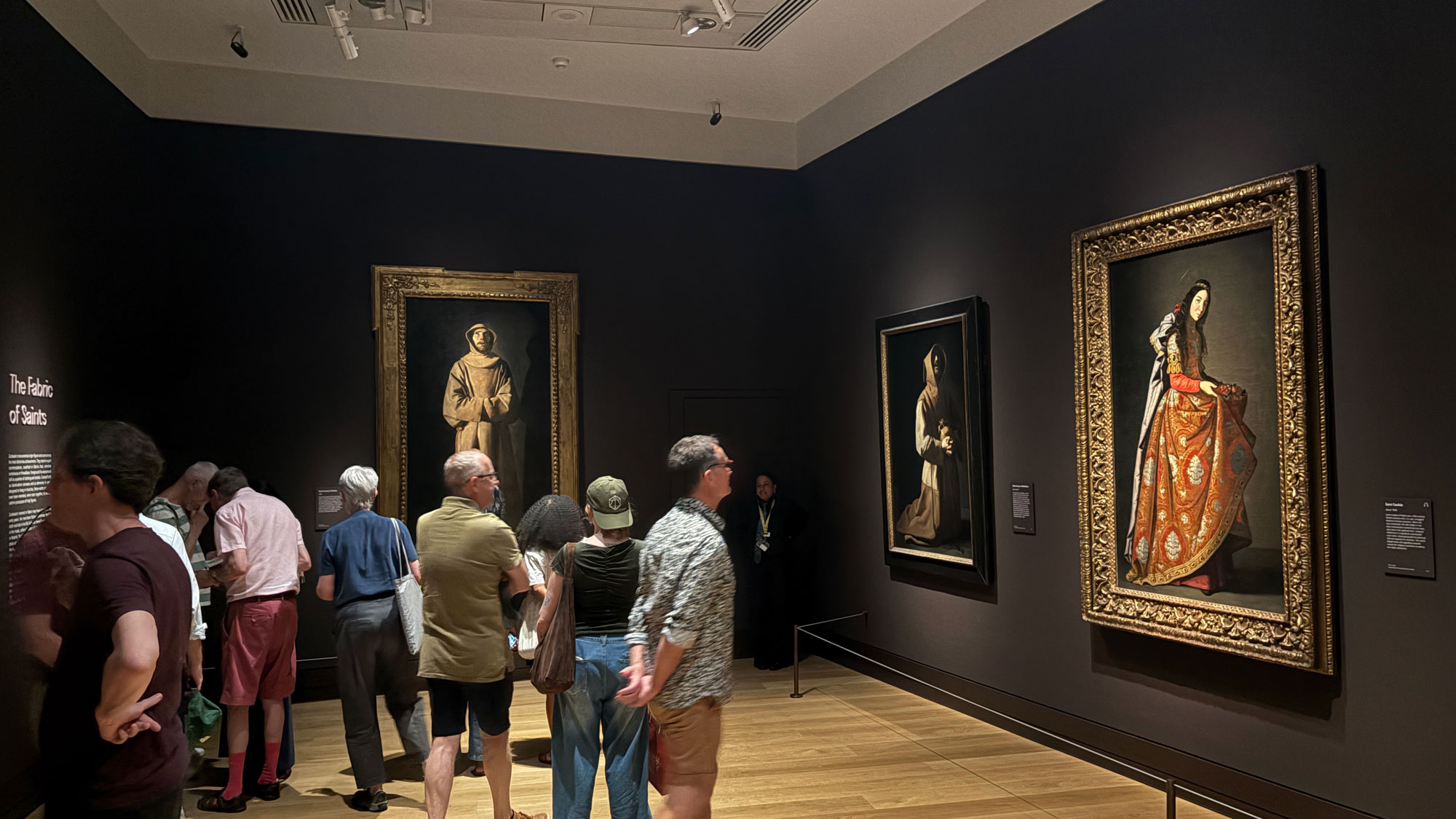
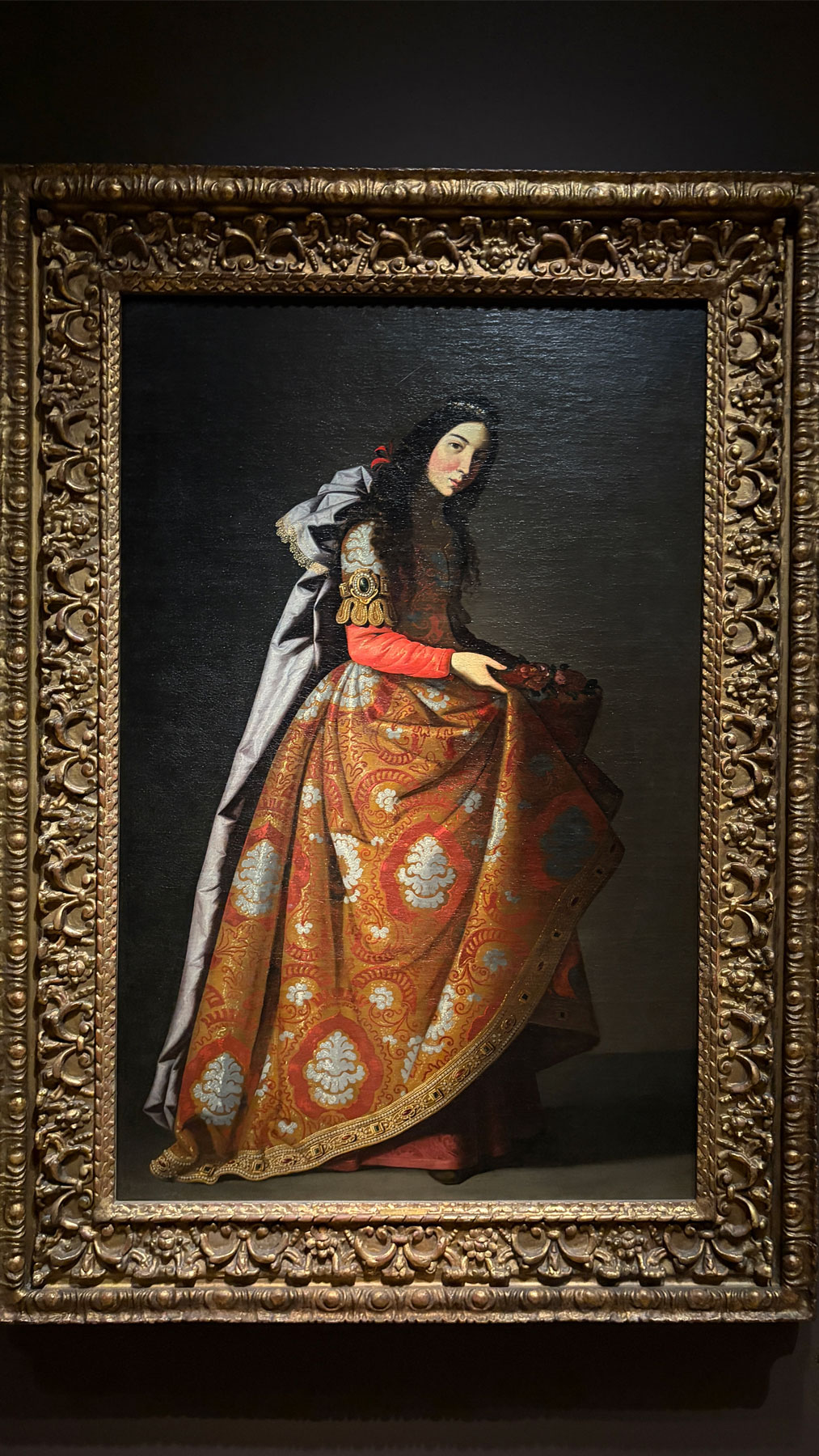
Installation view of the exhibition 'Zurbarán' at the National Gallery, London showing Francisco de Zurbarán (Spain, 1598-1664)
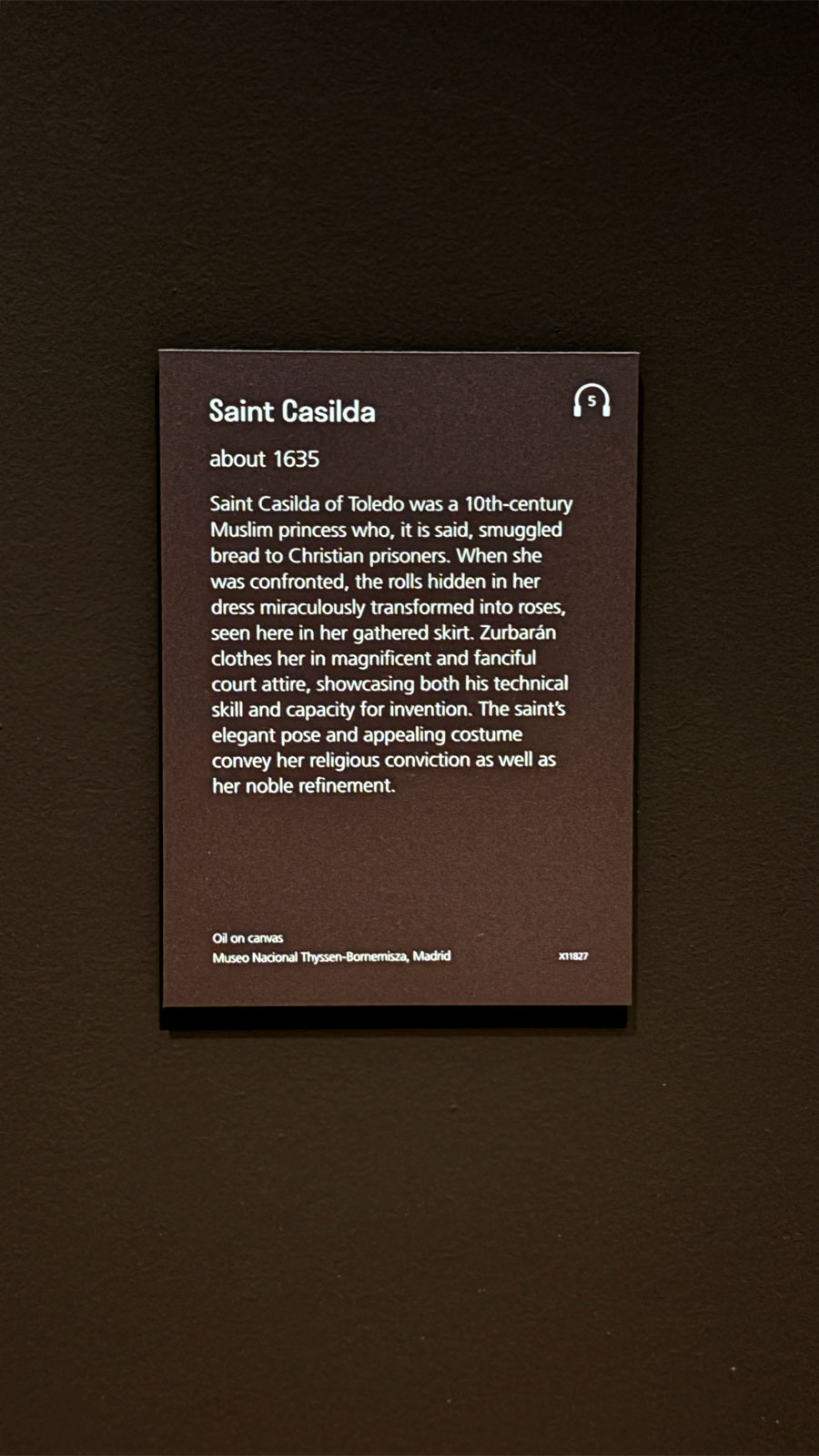
'Saint Casilda' about 1635


Francisco de Zurbarán (Spain, 1598-1664)
Saint Casilda (installation view)
About 1635
Oil on canvas
Museo Nacional Thyssen-Bornemisza, Madrid


Wall text from the exhibition 'Zurbarán' at the National Gallery, London


Wall text from the exhibition Zurbarán at the National Gallery, London


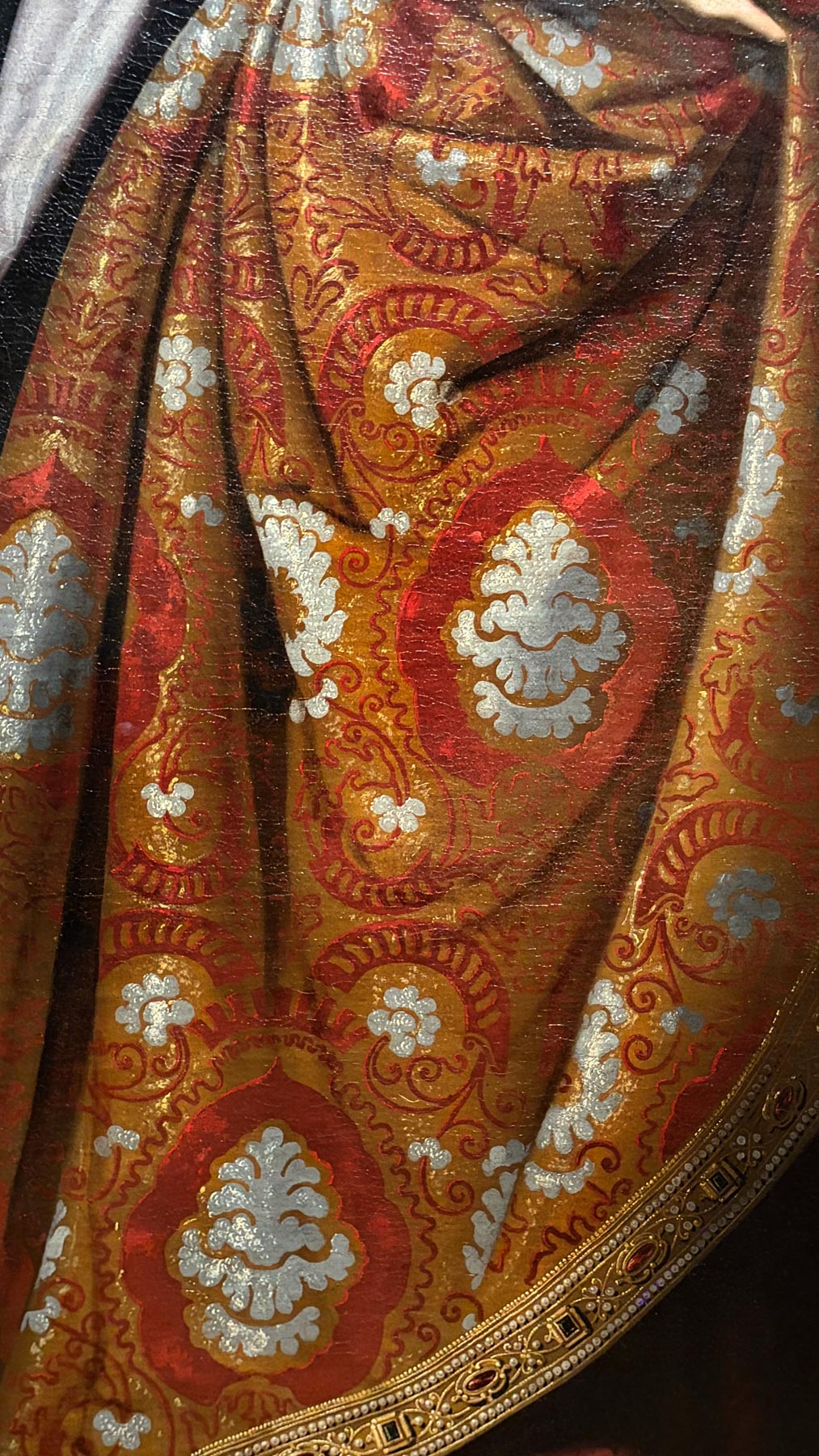
Installation view of the exhibition 'Zurbarán' at the National Gallery, London showing Francisco de Zurbarán (Spain, 1598-1664)
'Saint Casilda' about 1635 (detail)


Francisco de Zurbarán (Spain, 1598-1664)
Saint Casilda (installation view detail)
About 1635
Oil on canvas
Museo Nacional Thyssen-Bornemisza, Madrid


Installation view of the exhibition 'Zurbarán' at the National Gallery, London showing at right, 'Saint Casilda' (about 1635)


Installation view of the exhibition Zurbarán at the National Gallery, London showing at right, Saint Casilda (about 1635, above)


Wall text from the exhibition 'Zurbarán' at the National Gallery, London


Wall text from the exhibition Zurbarán at the National Gallery, London


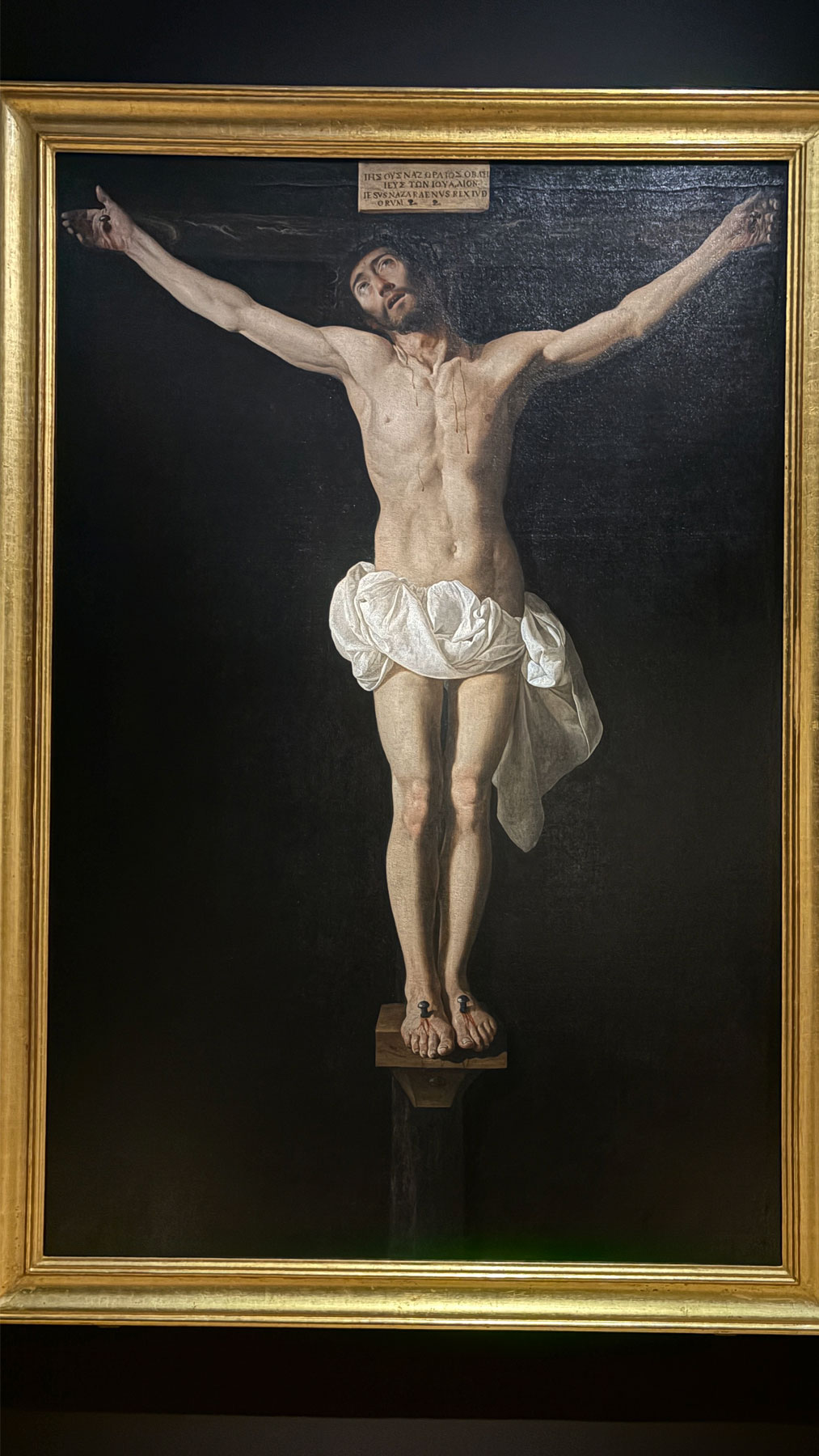
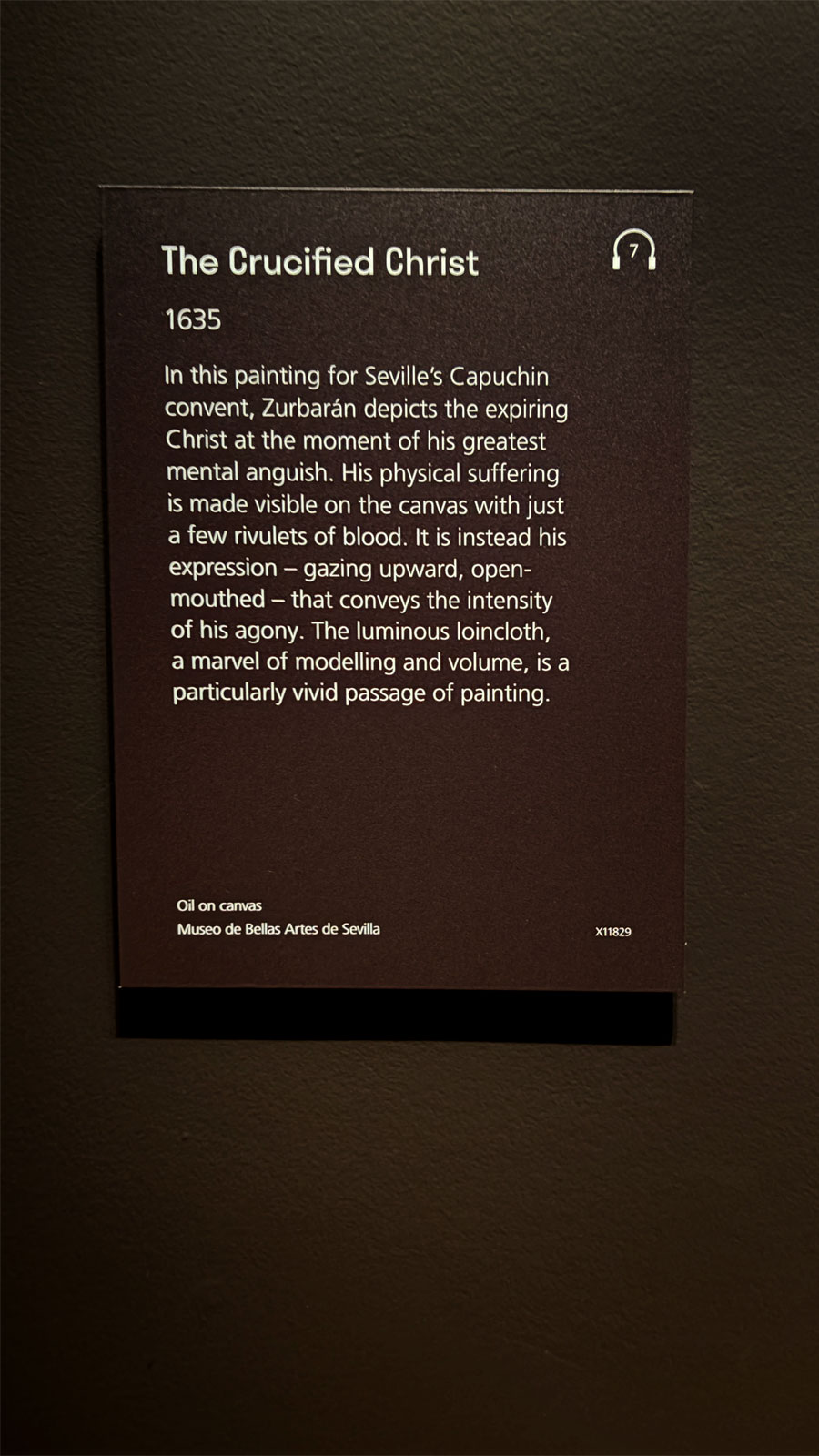
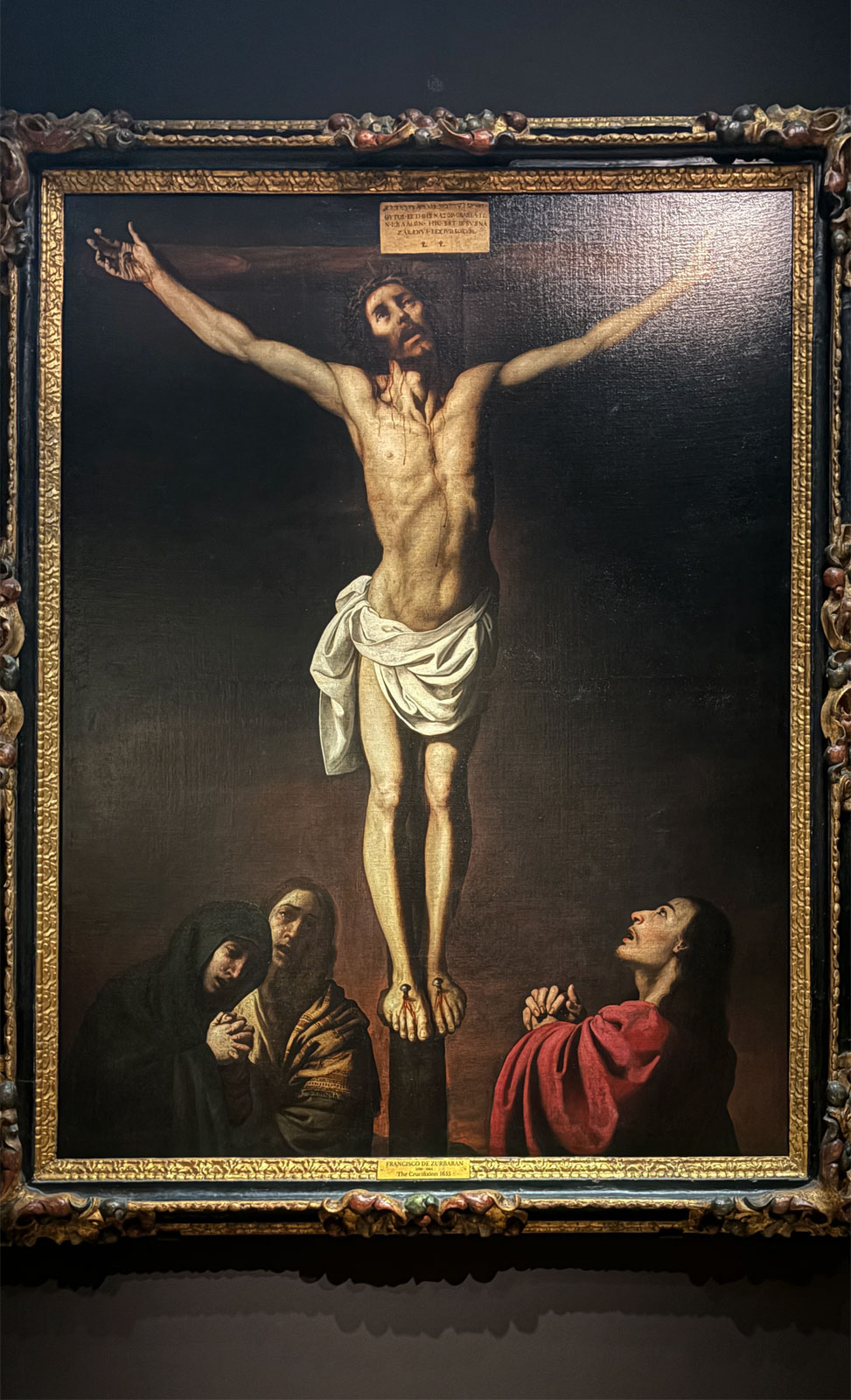
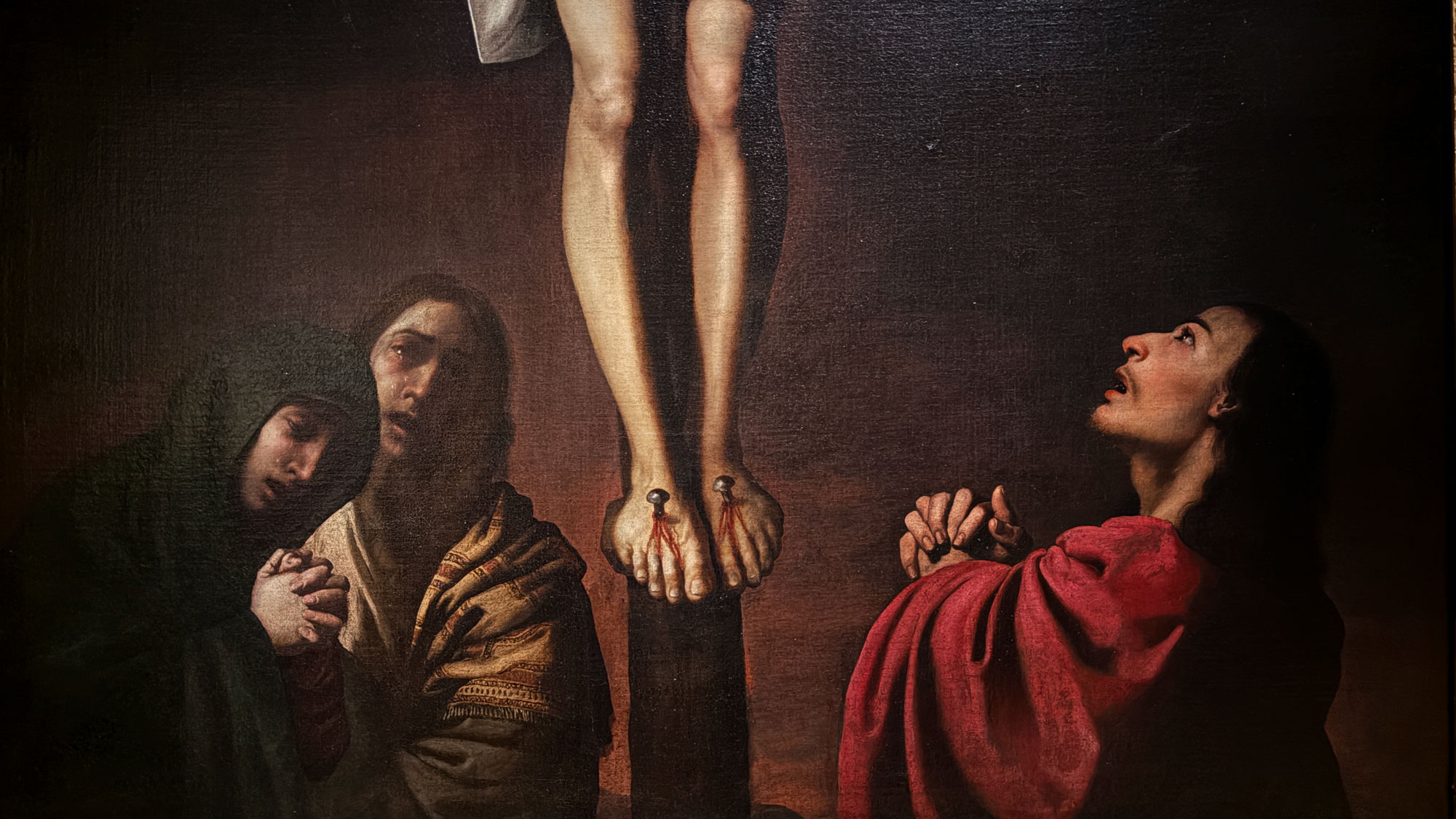
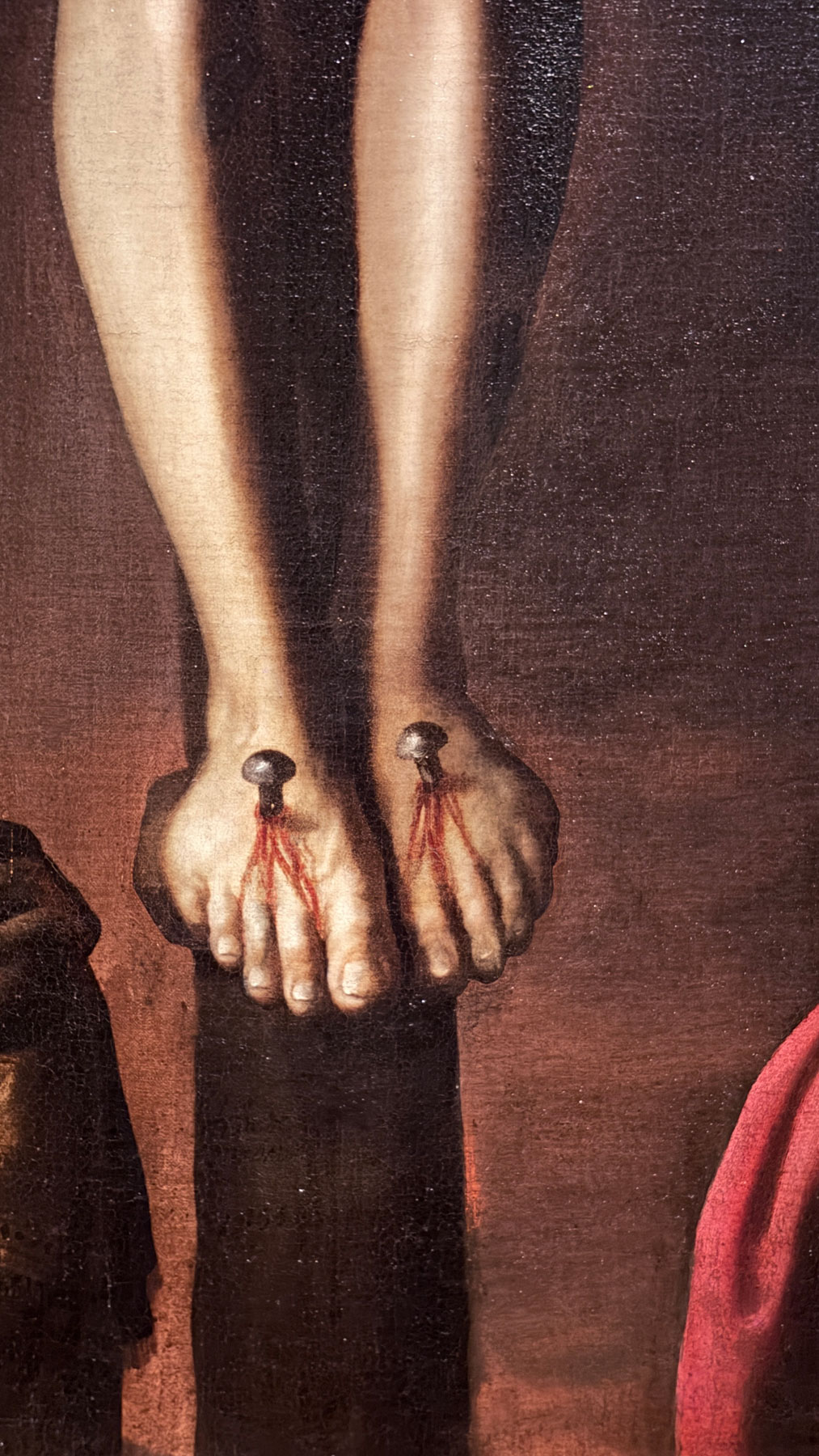
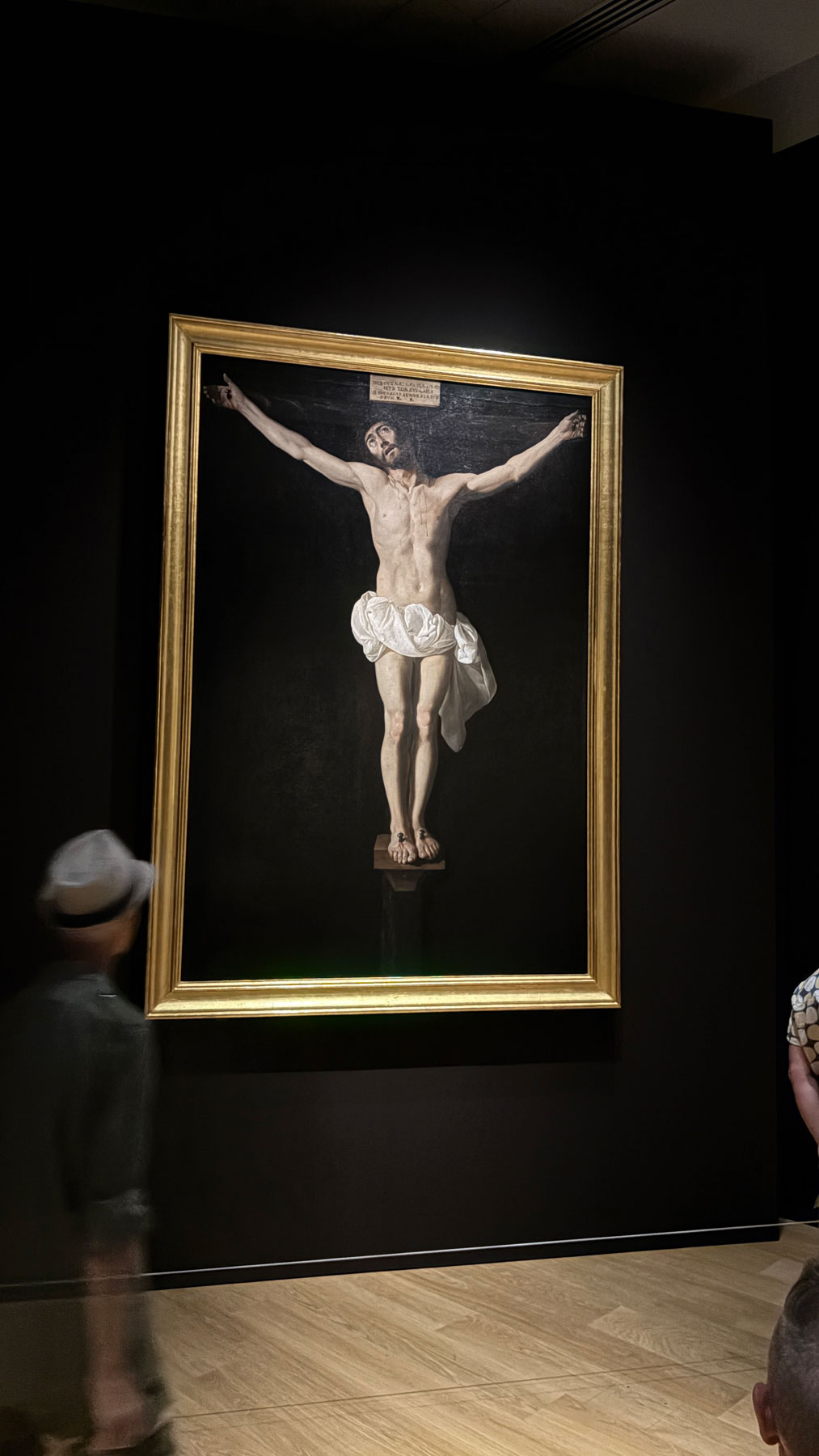
Installation view of the exhibition 'Zurbarán' at the National Gallery, London showing 'The Crucified Christ' (1635)


Installation view of the exhibition Zurbarán at the National Gallery, London showing The Crucified Christ (1635, below)


Installation view of the exhibition 'Zurbarán' at the National Gallery, London showing Francisco de Zurbarán (Spain, 1598-1664)
'The Crucified Christ' 1635


Francisco de Zurbarán (Spain, 1598-1664)
The Crucified Christ (installation view)
1635
Oil on canvas
Museo des Bellas Artes der Sevilla


Wall text from the exhibition 'Zurbarán' at the National Gallery, London


Wall text from the exhibition Zurbarán at the National Gallery, London


Installation view of the exhibition 'Zurbarán' at the National Gallery, London showing 'Christ on the Cross with the Virgin, Mary Magdalene and Saint John' (1655)


Francisco de Zurbarán (Spain, 1598-1664)
Christ on the Cross with the Virgin, Mary Magdalene and Saint John (installation view)
1655
Oil on canvas
on loan from a private collection


Installation view of the exhibition 'Zurbarán' at the National Gallery, London showing 'Christ on the Cross with the Virgin, Mary Magdalene and Saint John' (1655) (detail)


Francisco de Zurbarán (Spain, 1598-1664)
Christ on the Cross with the Virgin, Mary Magdalene and Saint John (installation view details)
1655
Oil on canvas
On loan from a private collection


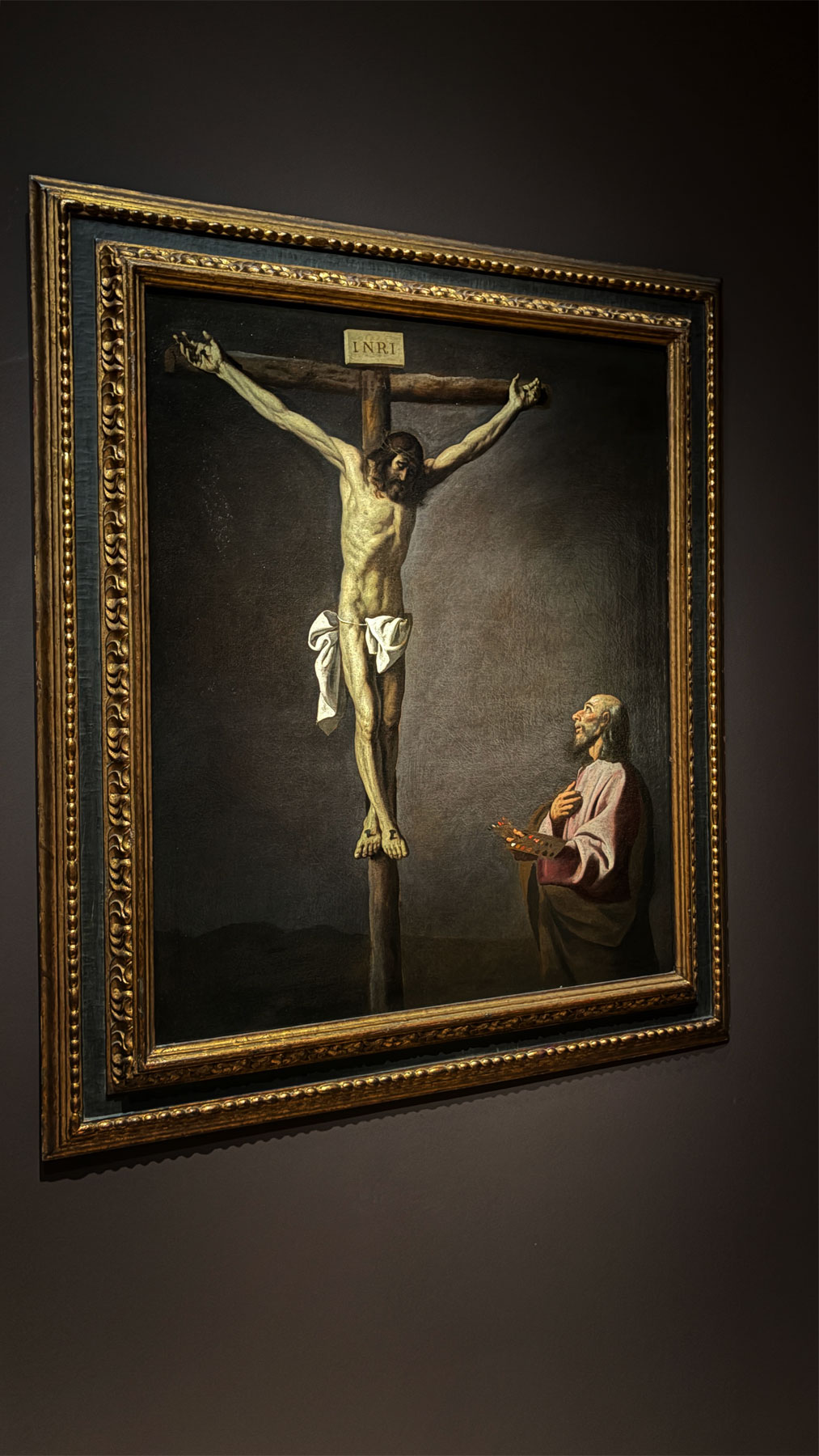
Installation view of the exhibition 'Zurbarán' at the National Gallery, London showing Francisco de Zurbarán (Spain, 1598-1664) 'The Crucified Christ with a Painter' 1650


Francisco de Zurbarán (Spain, 1598-1664)
The Crucified Christ with a Painter (installation view)
1650
Oil on canvas
Museu Nacional del Prado, Madrid


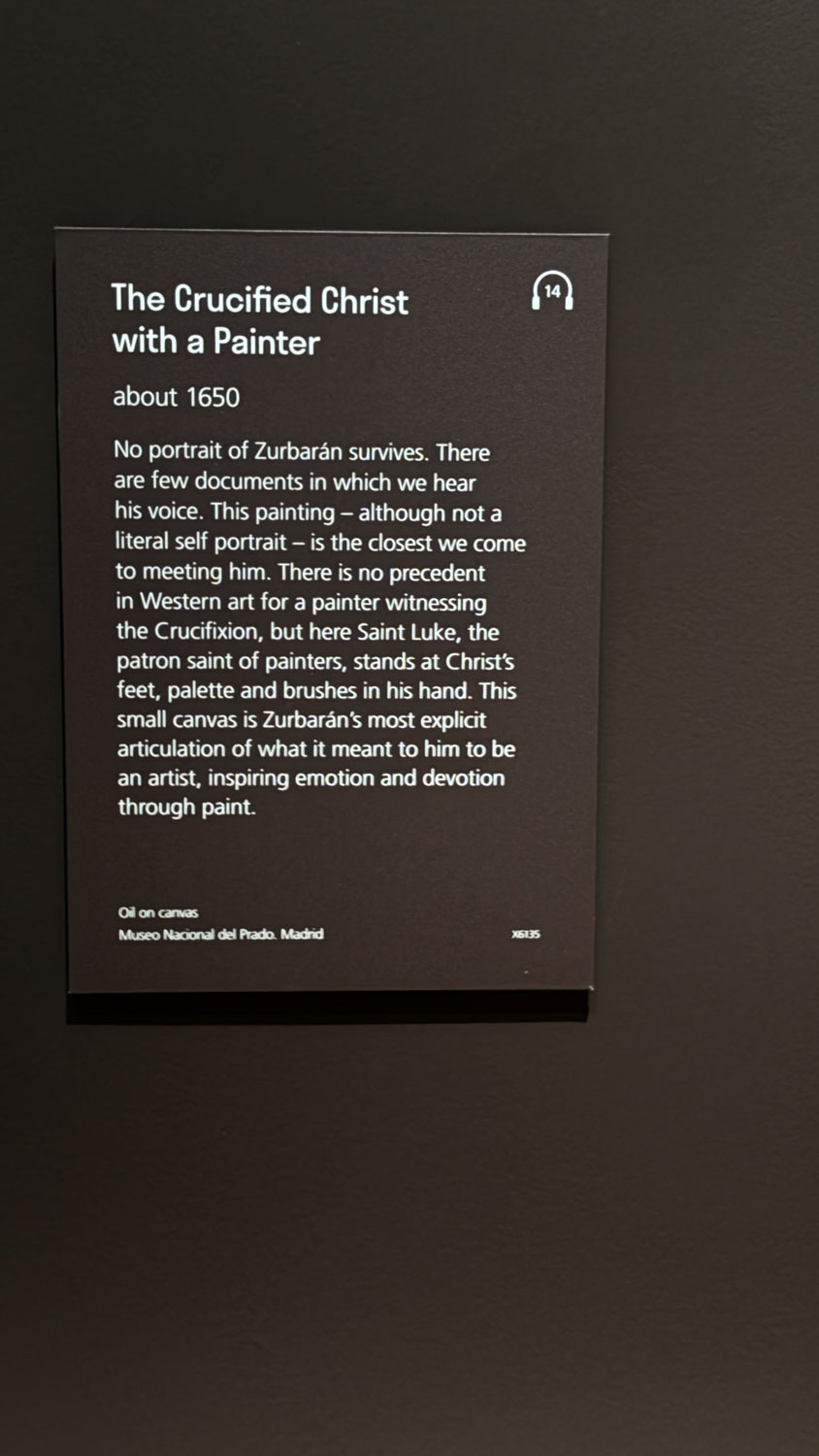
Wall text from the exhibition 'Zurbarán' at the National Gallery, London


Wall text from the exhibition Zurbarán at the National Gallery, London


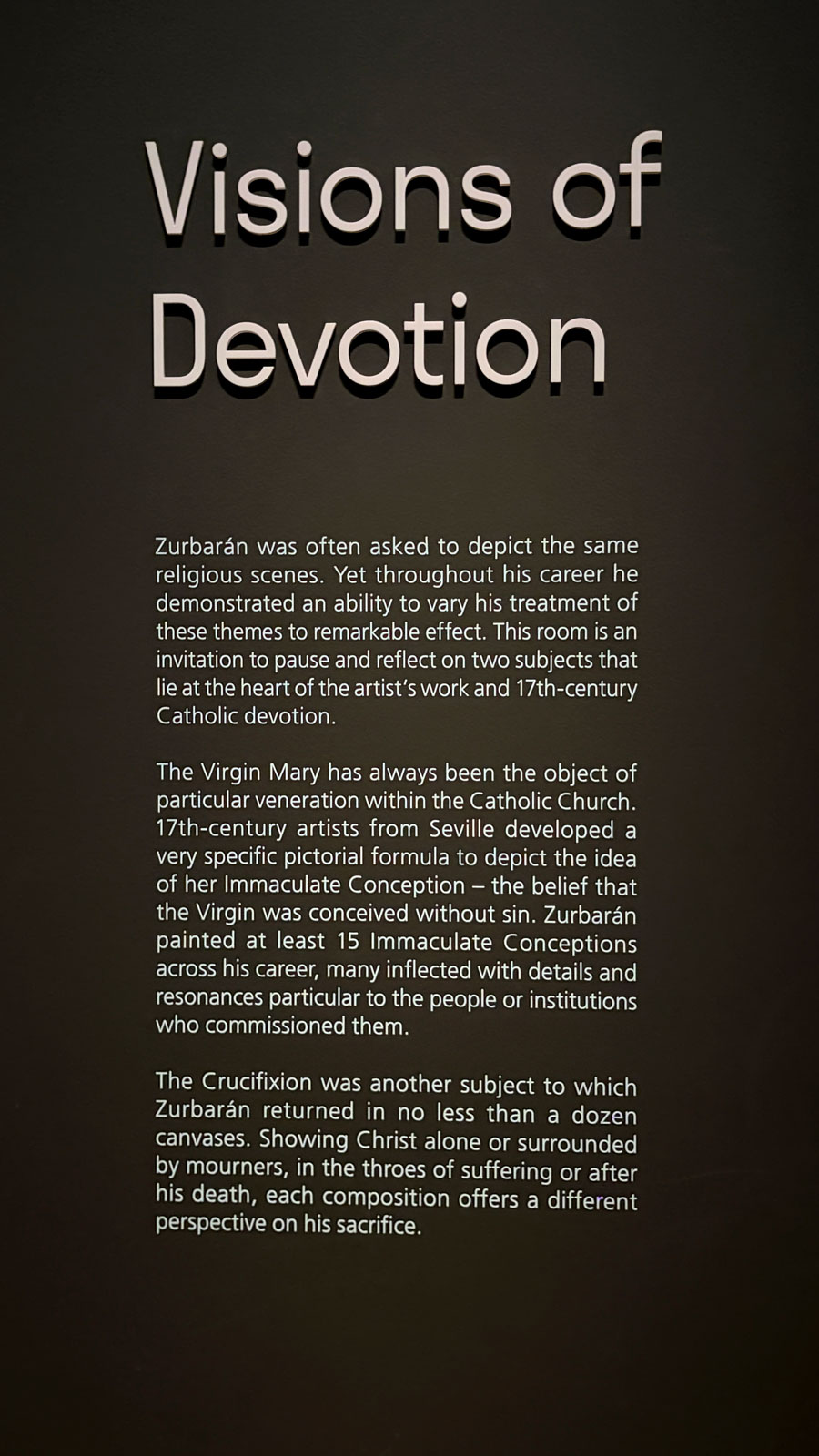
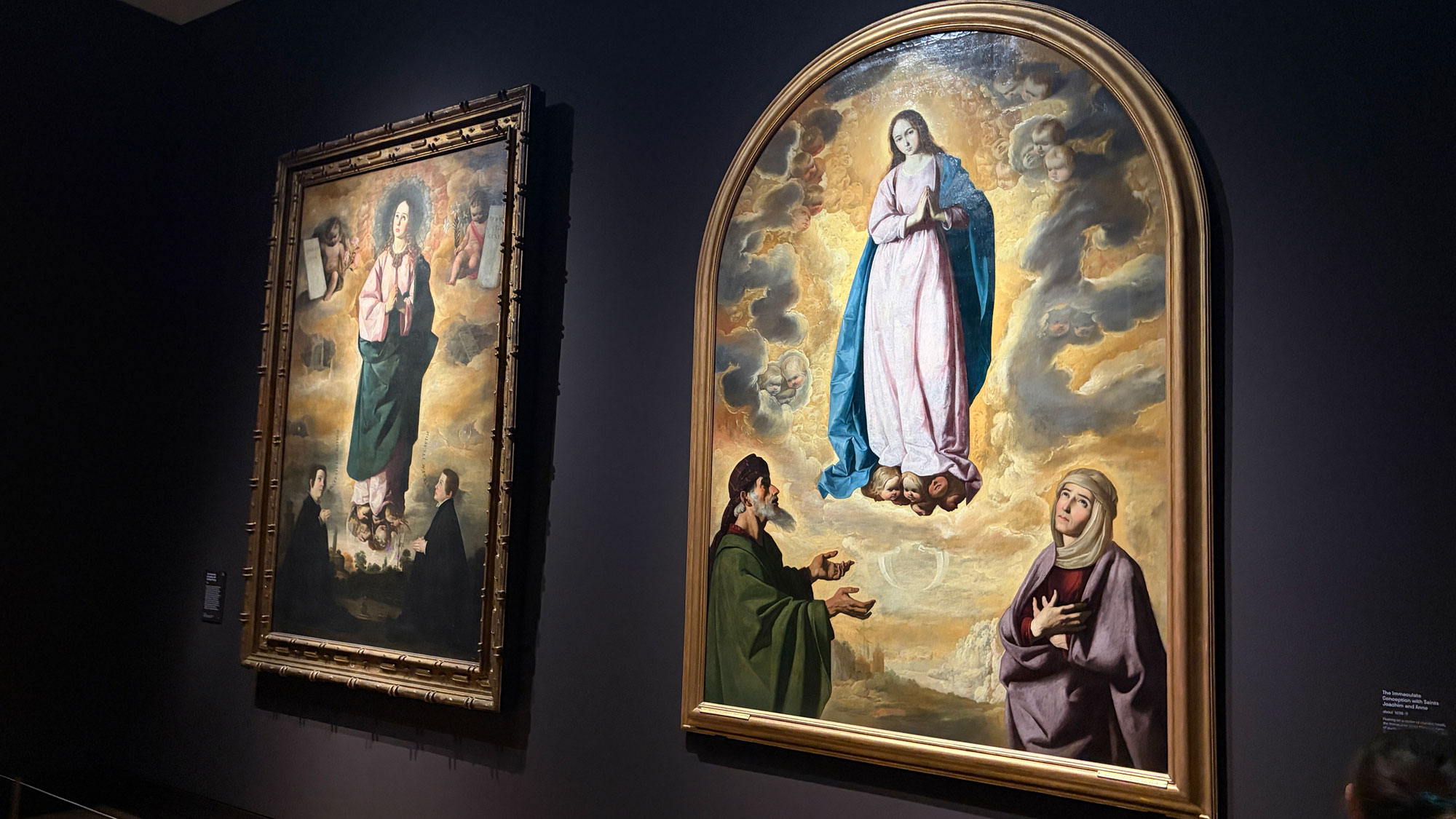
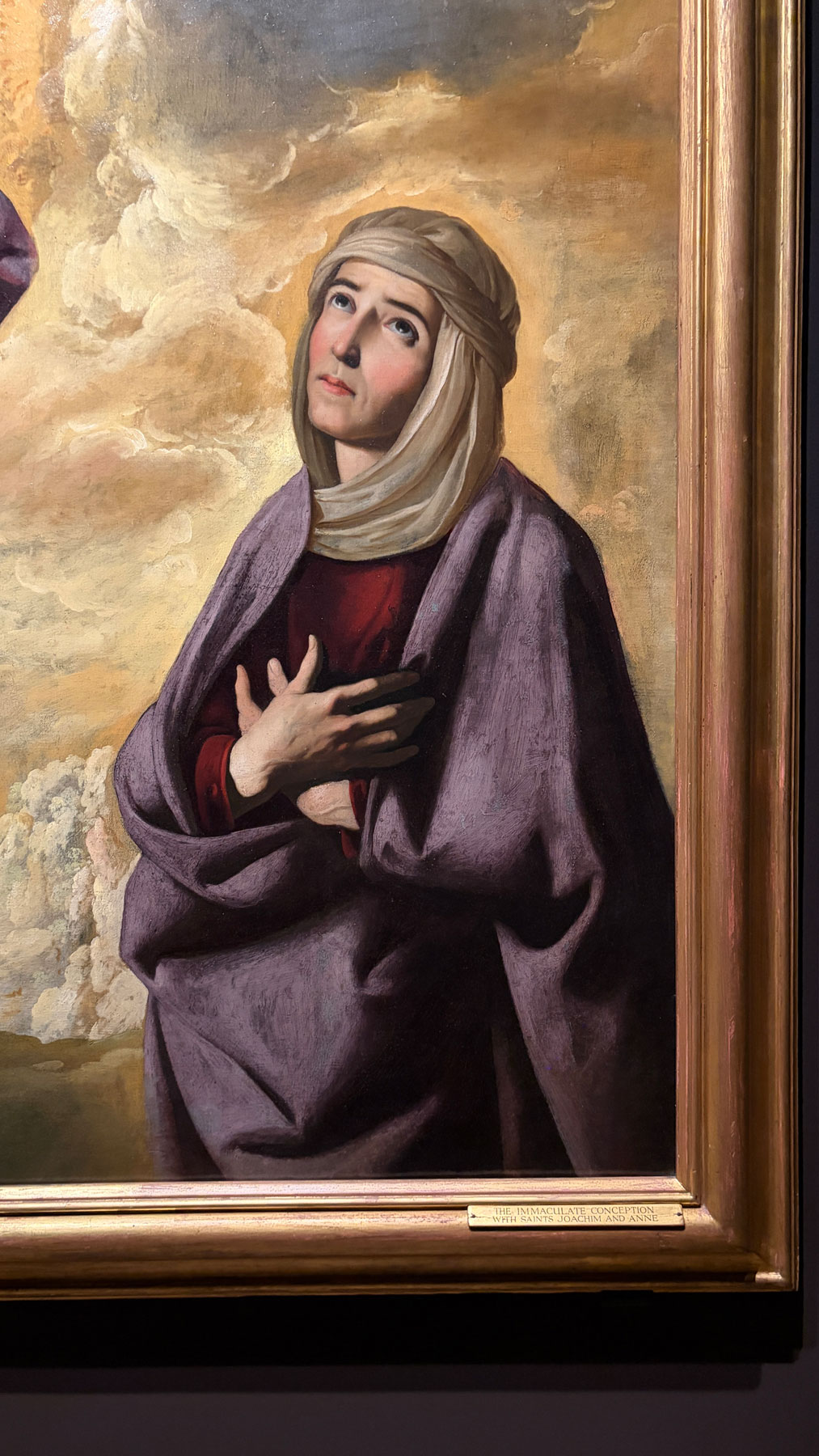
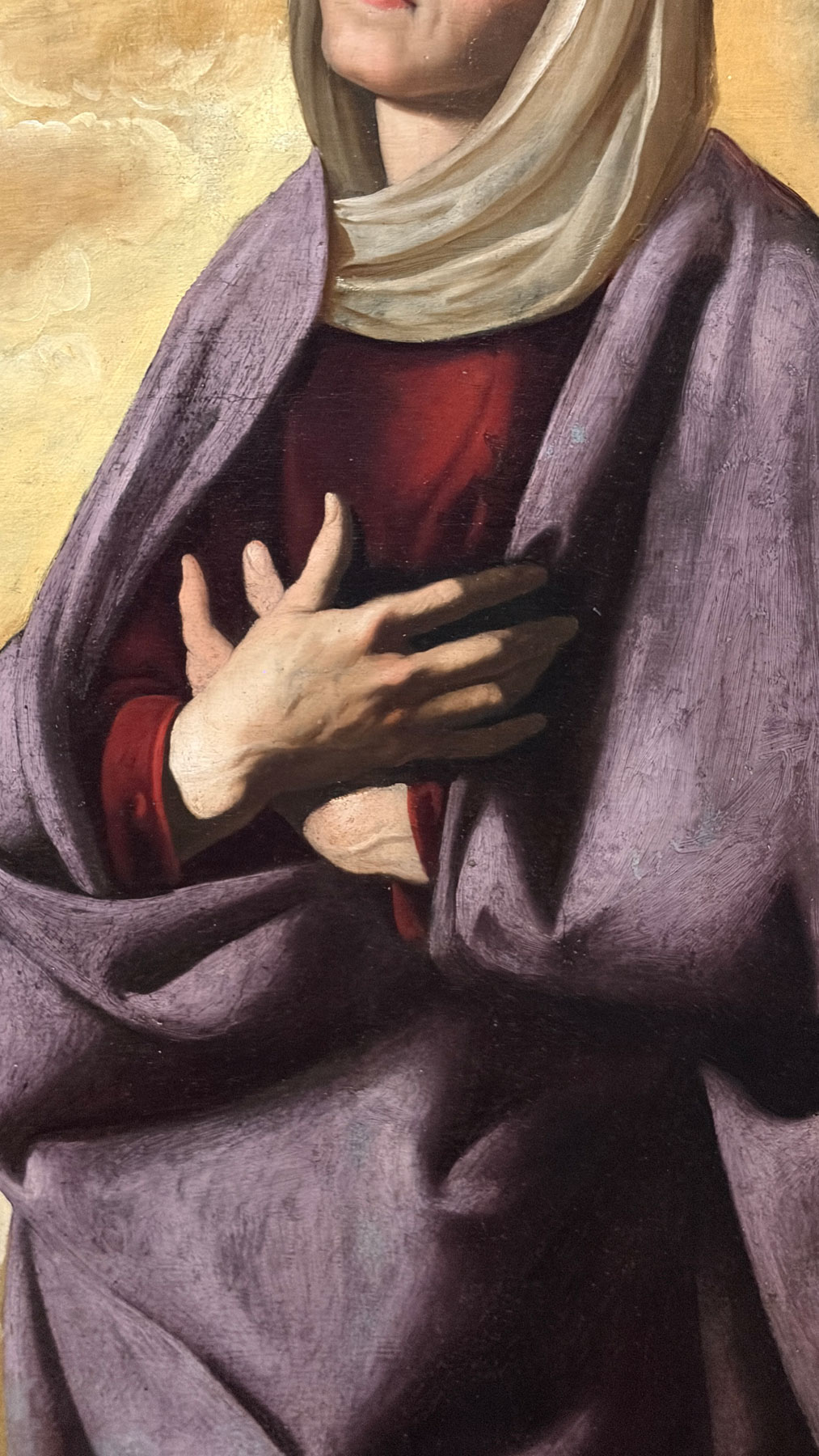
Installation view of the exhibition 'Zurbarán' at the National Gallery, London showing at right, 'The Immaculate Conception with Two Boys Praying' (1632)


Installation view of the exhibition Zurbarán at the National Gallery, London showing at right, The Immaculate Conception with Two Boys Praying (1632)


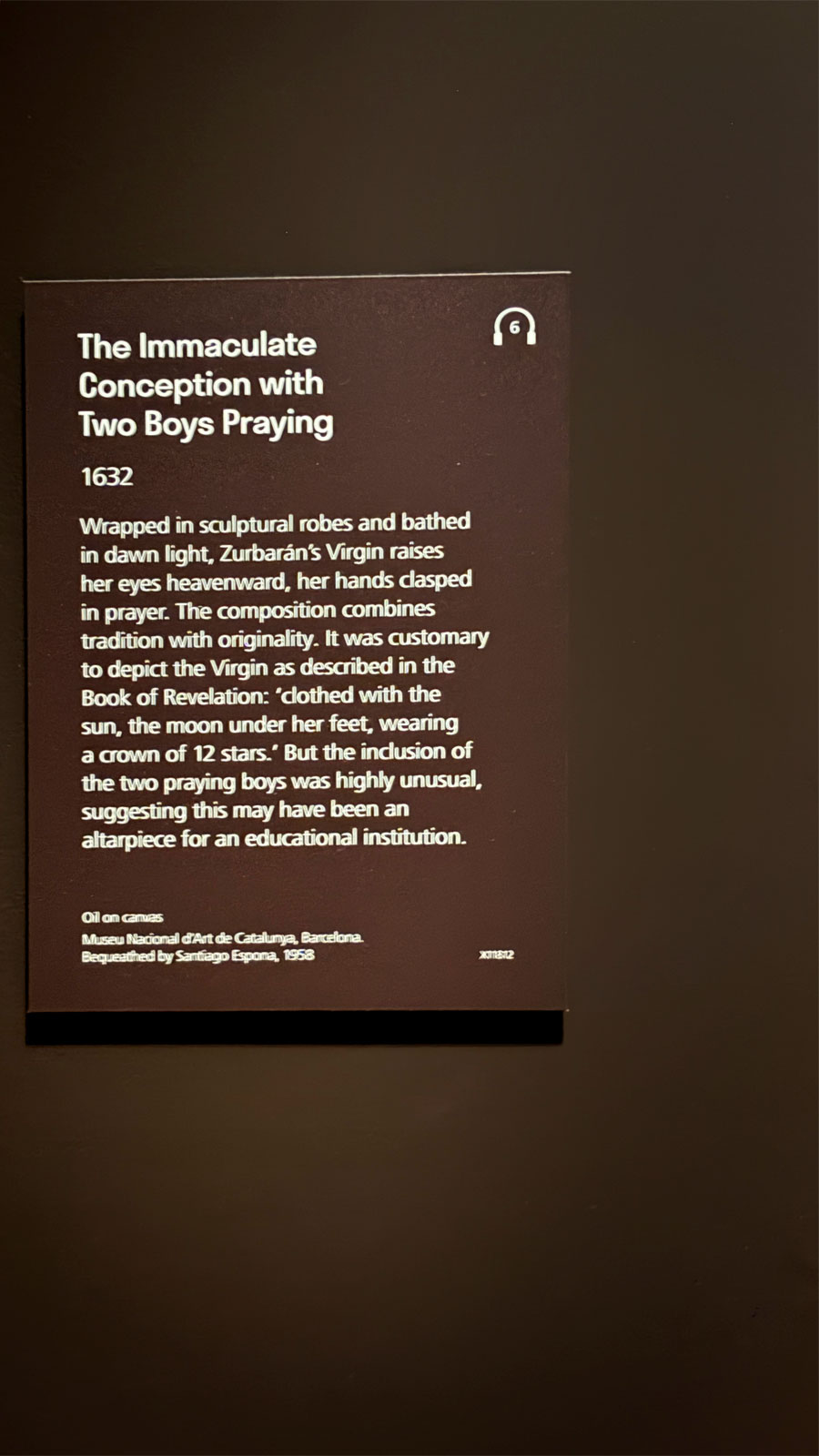
Wall text from the exhibition 'Zurbarán' at the National Gallery, London


Wall text from the exhibition Zurbarán at the National Gallery, London


Installation view of the exhibition 'Zurbarán' at the National Gallery, London showing Francisco de Zurbarán (Spain, 1598-1664)
'The Immaculate Conception with Two Boys Praying' (1632) (detail)
Installation view of the exhibition 'Zurbarán' at the National Gallery, London showing Francisco de Zurbarán (Spain, 1598-1664)
'The Immaculate Conception with Two Boys Praying' (1632) (detail)


Francisco de Zurbarán (Spain, 1598-1664)
The Immaculate Conception with Two Boys Praying (installation view details)
1632
Oil on canvas
Museo Nacional d’Art de Catalunya, Barcelona


The first major monographic exhibition in the UK devoted to Francisco de Zurbarán (1598-1664), will open at the National Gallery next spring (2 May – 23 August 2026).

Along with Diego Velázquez (1599-1660) and Bartolomé Esteban Murillo (1617-1682), Zurbarán was one of the leading painters of 17th-century Spain. His paintings, which include stunning life-size depictions of saints, soaring altarpieces and contemplative still lifes, are celebrated for their naturalism, directness and deep emotional power.

This exhibition of over forty paintings will span the chronological and iconographic breadth of the artist’s career. It will unite exceptional works from public and private collections, including the Musée du Louvre (‘Saint Bonaventure on His Bier’ and ‘Saint Apollonia’) and the Art Institute of Chicago (‘The Crucifixion’, ‘Saint Romanus of Antioch’ and ‘Saint Barulas’ and Juan de Zurbarán’s ‘Flowers and Fruit in a Chinese Bowl’), the two partner museums to which the exhibition will travel between October 2026 and June 2027, and from the collection of the National Gallery (including Saint Margaret of Antioch and Juan de Zurbarán’s Still Life with Lemons in a Wicker Basket).

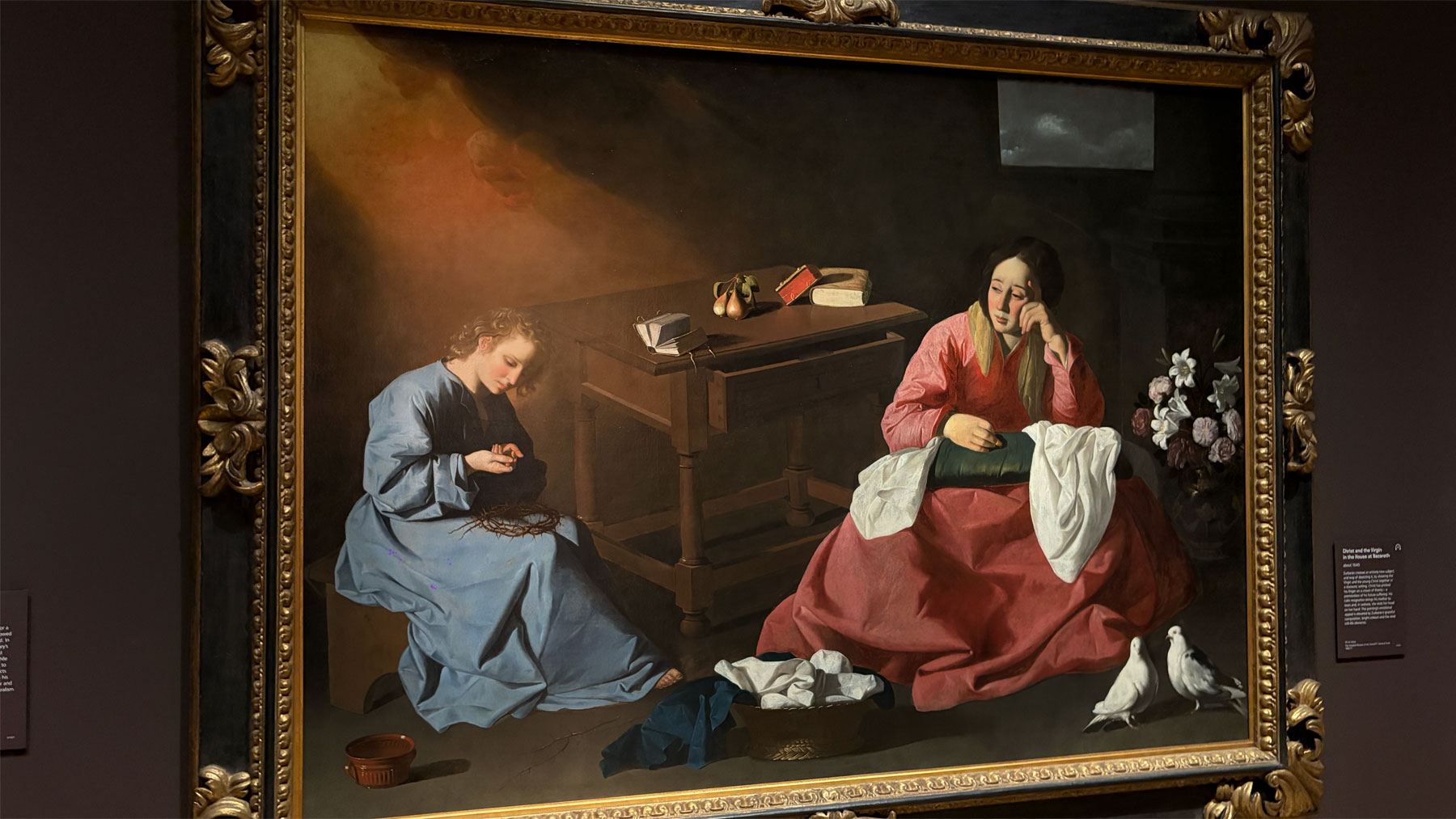
Other major loans from France (‘Saint Francis of Assisi’, Musée des Beaux-Arts de Lyon), Spain (‘Agnus Dei’ and ‘The Crucified Christ with a Painter’, Museo Nacional del Prado; ‘Santa Casilda’, Museo Nacional Thyssen-Bornemisza) and the USA (‘Christ and the Virgin in the House at Nazareth’, Cleveland Museum of Art; ‘Still Life with Lemons, Oranges and a Rose’, The Norton Simon Foundation) will complete this comprehensive exploration of Zurbarán’s career, which seeks to evoke the mystery, vision and power of his art. 

Zurbarán spent most of his life in Seville, then one of the richest cities in Europe, whose maritime links to the Americas made it a hub of global trade. He painted primarily for the city’s religious orders, producing altarpieces and cycles of paintings of staggering scale and ingenuity, but also for private patrons and even, for a time in Madrid, for the king of Spain. He was also an acute observer of reality, and his still-life paintings and works for private devotion are still strikingly vivid today.

The exhibition will be divided into seven different sections: the first room will introduce the artist and explore his unique ability to inspire awe as a painter, his visionary take on the subjects he represents and his artistic particularities (‘The Apparition of Saint Peter to Saint Peter Nolasco’ and ‘The Crucified Christ with a Painter’, both from Museo Nacional del Prado). 

The second room will dive into the paintings which Zurbarán produced for the many religious orders of the city of Seville (‘The Vision of Alonso Rodríguez’, Museo de la Real Academia de Bellas Artes de San Fernando), demonstrating the wide range of his skills as a painter of scale and narrative, and also his incredible inventiveness in the way he structured his compositions and devised iconographic solutions.

The third room, the Fabric of Saints, shows Zurbarán’s remarkable ability to represent saints as figures from our world, especially through his evocation of fabrics, drapery and textures such as wool, embroidery, leather or fine cord (‘Saint Casilda’, Museo Nacional Thyssen-Bornemisza; ‘Saint Apollonia’, Musée du Louvre). Zurbarán’s father was a haberdasher so the artist may have developed a keen interest in textiles from a young age. He was also undoubtedly inspired by the many religious processions, parades and theatrical performances that were part of the visual culture of Seville in the 17th century. 

The fourth room focuses on iconography, particularly that of the Immaculate Conception, important to the religious life of Seville. Juxtaposing treatments of the same subject from different moments in his career, visitors will appreciate how Zurbarán continuously strove for new ways to evoke powerful feelings through paint. 

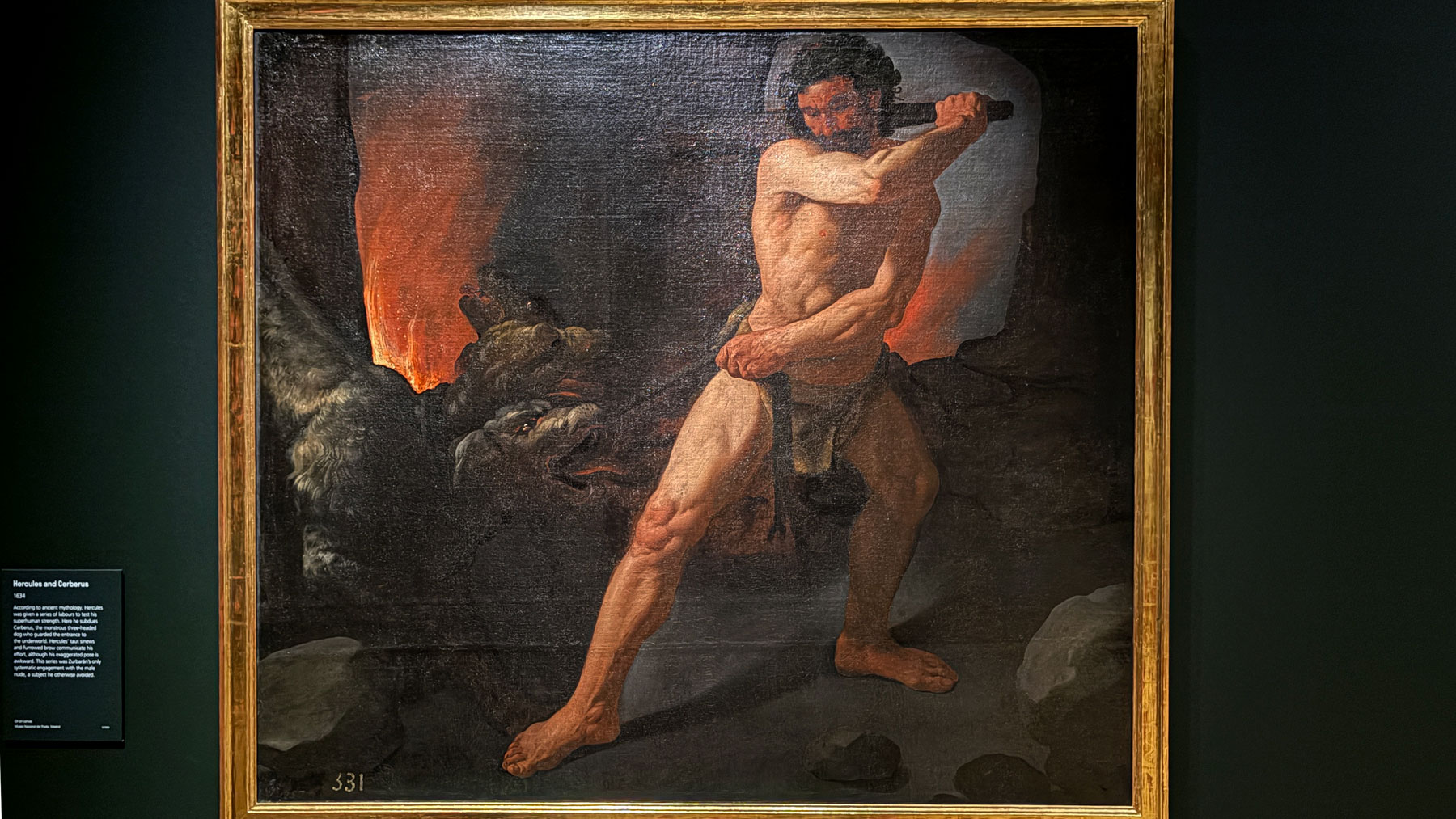
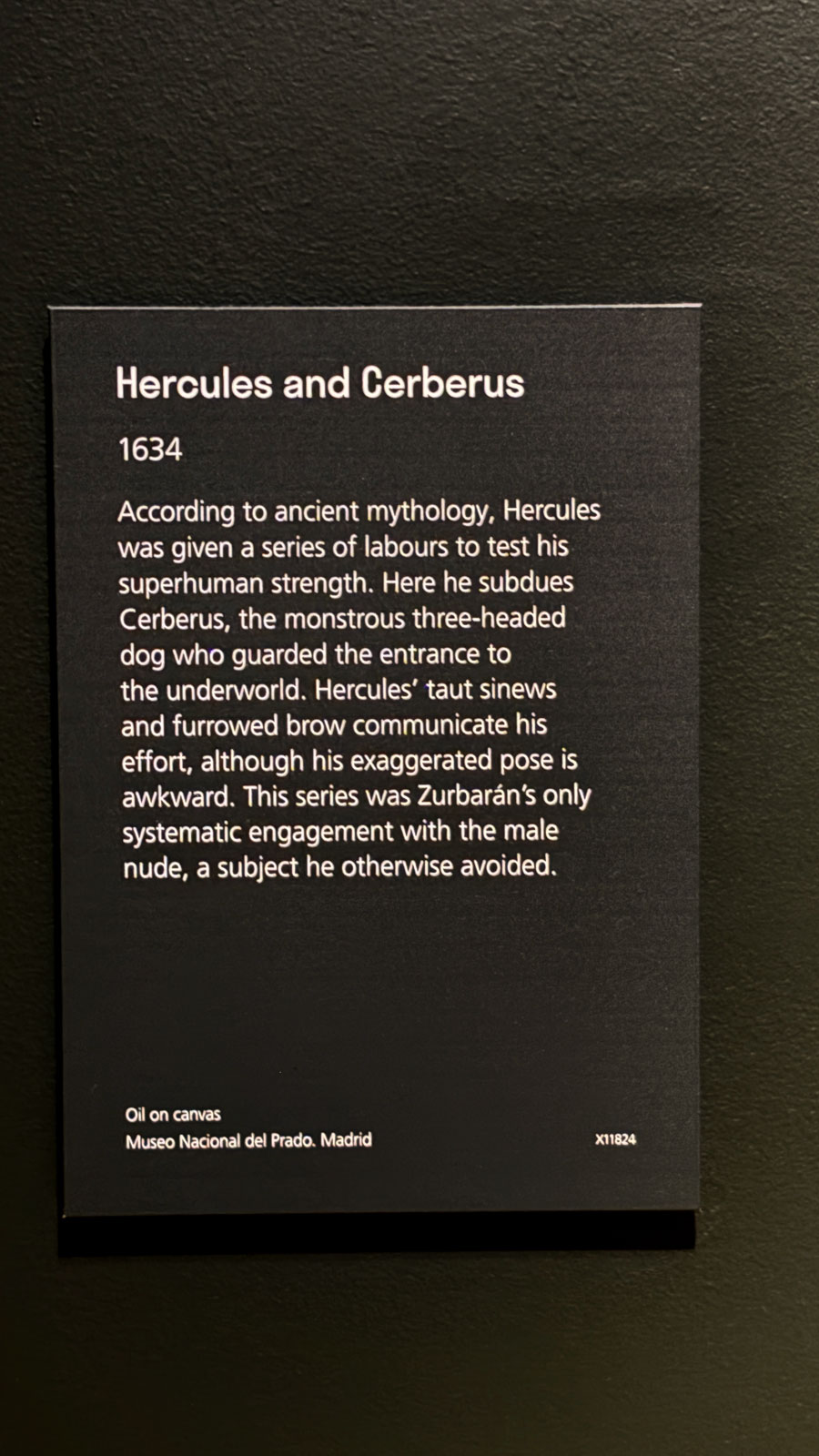
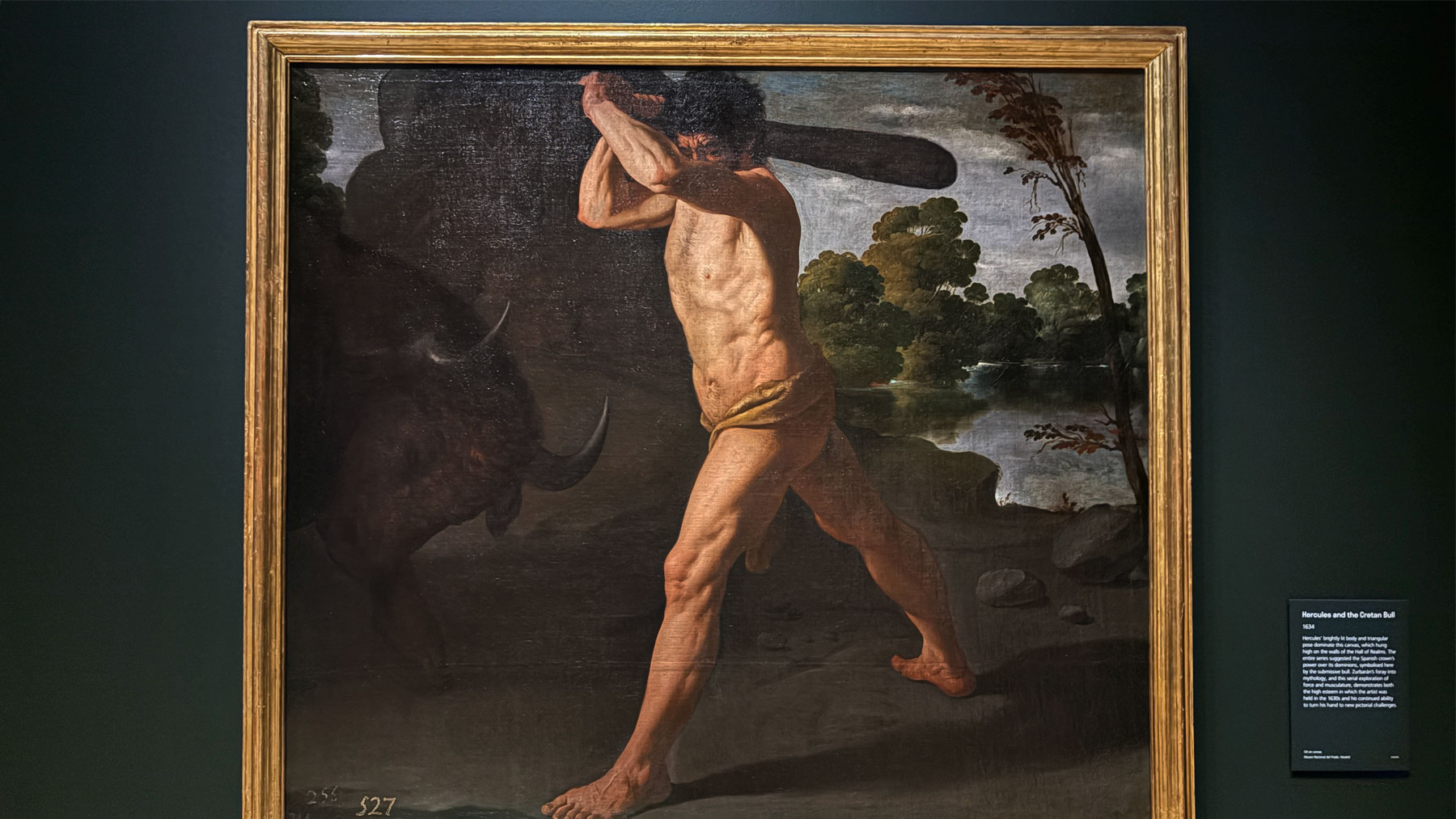
The fifth room, Beyond Seville, looks at the paintings which Zurbarán made for patrons outside the city with which he is most closely associated. In 1634 he received the most prestigious commission of his career: an invitation to travel to Madrid and participate in the decoration of the newly built royal palace, the Buen Retiro. Zurbarán was nominated to contribute to the decoration of the Hall of Realms, an enormous room at the heart of the palace complex, some 35 metres long and 10 metres wide. To this room Zurbarán contributed 12 paintings, including a series focused on the labours of Hercules, two of which will be shown in the exhibition (‘Hercules and Cerberus’ and ‘Hercules and the Cretan Bull’, both Museo Nacional del Prado). 

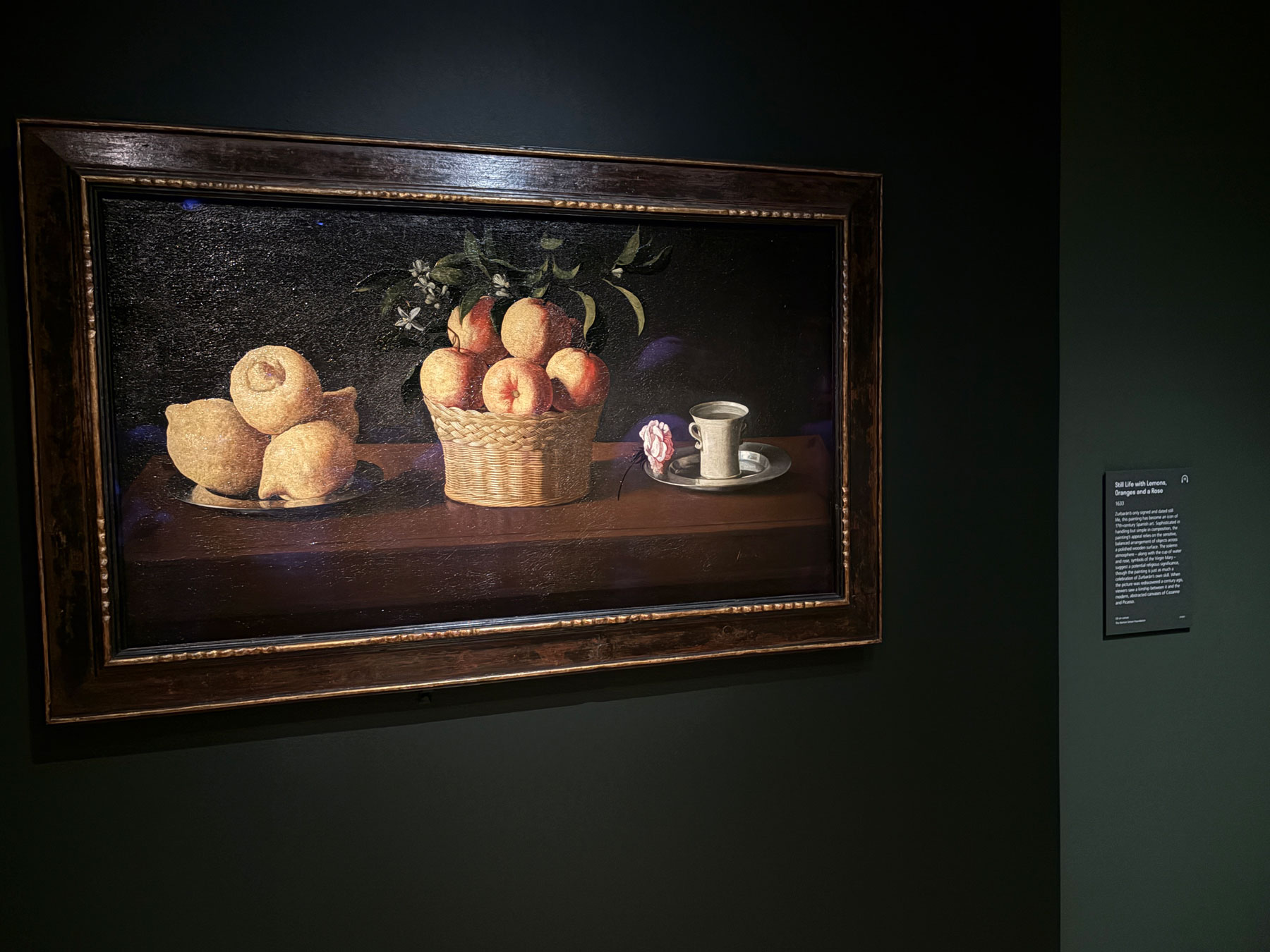
The sixth room displays still lifes, including four by Zurbarán’s son Juan. It is thought that Francisco de Zurbarán may not have produced more than 10 still lifes in his lifetime so this room offers visitors a rare occasion to discover some remarkable examples of this element of his art (‘Still Life with Lemons, Oranges and a Rose,’ The Norton Simon Foundation, shown for the first time alongside the National Gallery’s painting ‘A Cup of Water and a Rose’).

The last sections of the exhibition will explore the paintings Zurbarán made for private devotion and contemplation (‘The Family of the Virgin’, Abelló Collection) which, though often smaller in size, nevertheless pack a powerful emotional punch (‘Agnus Dei’, Museo Nacional del Prado; ‘The Veil of Veronica’, Museo Nacional de Escultura).

This exhibition is the first dedicated presentation of the artist’s paintings at the National Gallery since 1994, when the series of ‘Jacob and his Twelve Sons’ from Auckland Castle was shown in the Sunley Room. Several works by Zurbarán also featured in The Sacred Made Real, an exhibition held in 2009-2010.

Building on existing scholarship and accompanied by a fully illustrated catalogue, Zurbarán will highlight new discoveries, reunite works from major commissions and bring together a selection of still lifes by Zurbarán and his son, Juan (1620-1649), whose small but superlative oeuvre continues to come to light.

Francesca Whitlum-Cooper, Curator of Later Italian, Spanish and French Paintings, says ‘It is thrilling to present the UK’s first major monographic exhibition on Zurbarán, which is long overdue. Whether they are 10 feet tall or small enough to hold in the hands, his paintings are extraordinarily powerful. I hope visitors in London – and at our partner venues in Paris and Chicago – will be both amazed and moved by this encounter with Zurbarán’s work’

Daniel Sobrino Ralston, the National Gallery’s CEEH (Centro de Estudios Europa Hispánica) Associate Curator of Spanish Paintings, says ‘We are excited to present the most comprehensive survey of Zurbarán’s work ever seen in Britain, bringing together exceptional loans from across the UK, Europe and the United States. This exhibition offers new insights on one of the great artists of the Baroque era, whose visionary paintings have shaped our understanding of 17th-century Spain.’

Ignacio Galán, Iberdrola and ScottishPower Chairman, says ‘In our 125th year we are honoured to help showcase in the UK one of the most celebrated painters of the 17th century. Culture and energy share a common purpose – they both illuminate lives and inspire progress. Our commitment to the arts reflects our dedication to preserving heritage and creativity. As a global business with roots in Spain, proudly working in partnership with the UK for two decades, it is fitting to support the National Gallery to bring Zurbarán to the UK for the first time in 30 years.

Exhibition organised by the National Gallery, London, the Musée du Louvre, Paris and the Art Institute of Chicago.

The exhibition in London is curated by Francesca Whitlum-Cooper and Daniel Sobrino Ralston with Imogen Tedbury, in collaboration with Charlotte Chastel-Rousseau (Musée du Louvre) and Rebecca Long (Art Institute of Chicago).
 
The Musée du Louvre exhibition of Zurbarán’s works will be on view from 7 October 2026 to 25 January 2027, and the exhibition at the Art Institute of Chicago will take place from 28 February until 20 June 2027.

Press release from the National Gallery


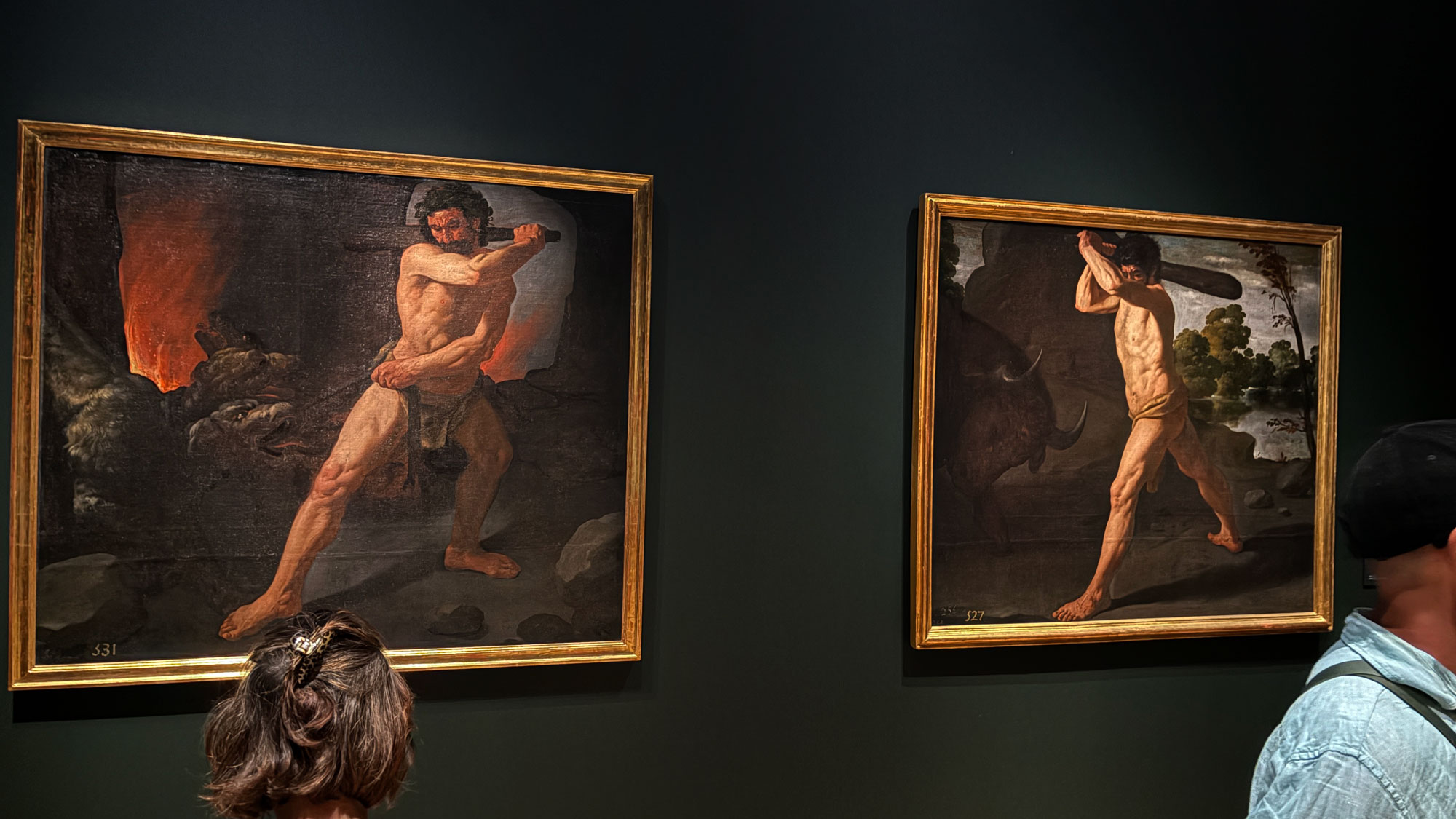
Installation view of the exhibition 'Zurbarán' at the National Gallery, London showing at left, 'Hercules and Cerberus' (1634); and at right, 'Hercules and the Cretan Bull' (1634)


Installation view of the exhibition Zurbarán at the National Gallery, London showing at left, Hercules and Cerberus (1634, below); and at right, Hercules and the Cretan Bull (1634, below)


Installation view of the exhibition 'Zurbarán' at the National Gallery, London showing Francisco de Zurbarán (Spain, 1598-1664)
'Hercules and Cerberus' 1634


Francisco de Zurbarán (Spain, 1598-1664)
Hercules and Cerberus (installation view)
1634
Oil on canvas
Museo Nacional del Prado, Madrid


Wall terxtg from the exhibition 'Zurbarán' at the National Gallery, London


Wall text from the exhibition Zurbarán at the National Gallery, London


Installation view of the exhibition 'Zurbarán' at the National Gallery, London showing Francisco de Zurbarán (Spain, 1598-1664)
'Hercules and the Cretan Bull' 1634


Francisco de Zurbarán (Spain, 1598-1664)
Hercules and the Cretan Bull (installation view)
1634
Oil on canvas
Museo Nacional Del Prado, Madrid


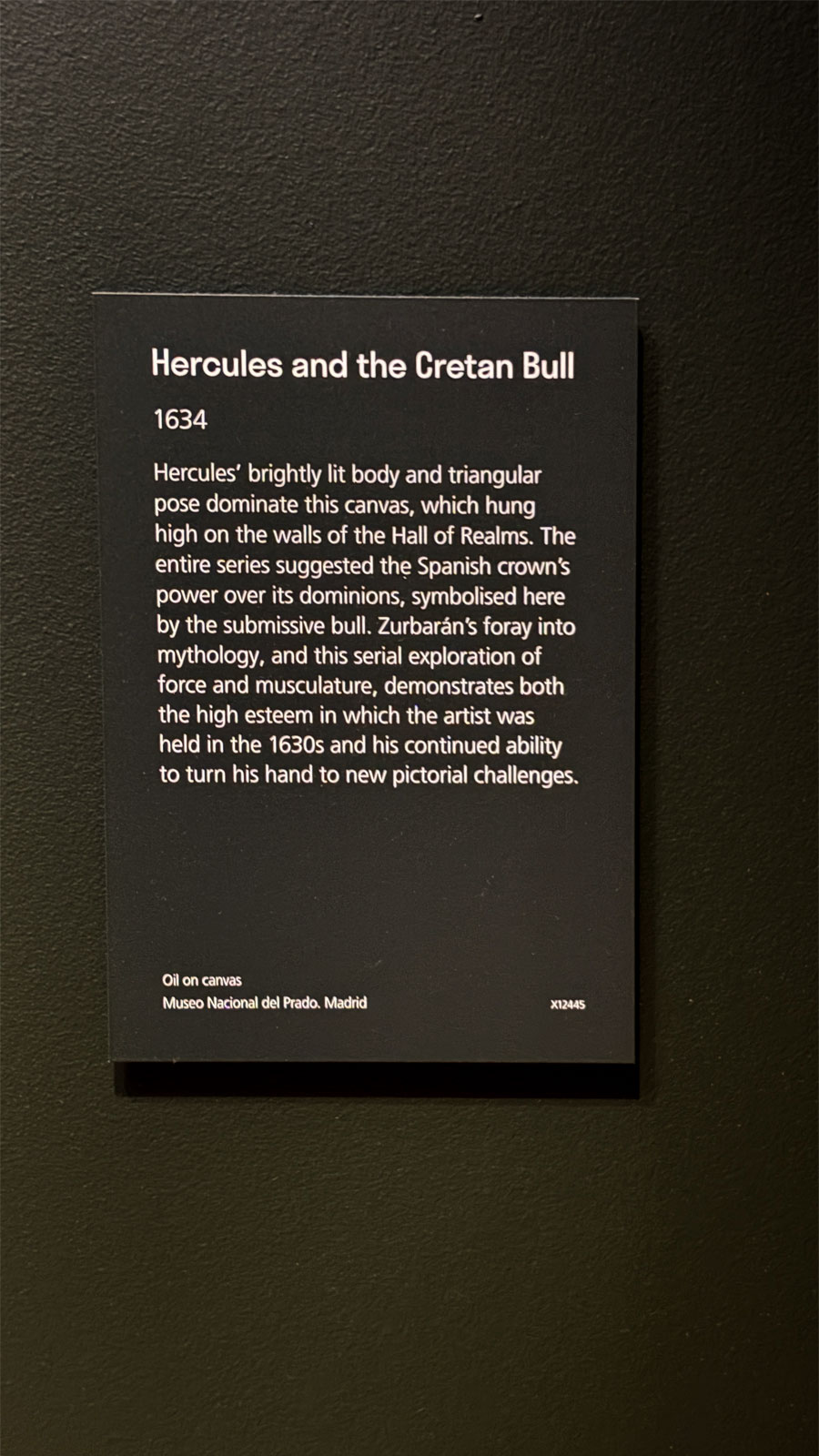
Wall text from the exhibition 'Zurbarán' at the National Gallery, London


Wall text from the exhibition Zurbarán at the National Gallery, London


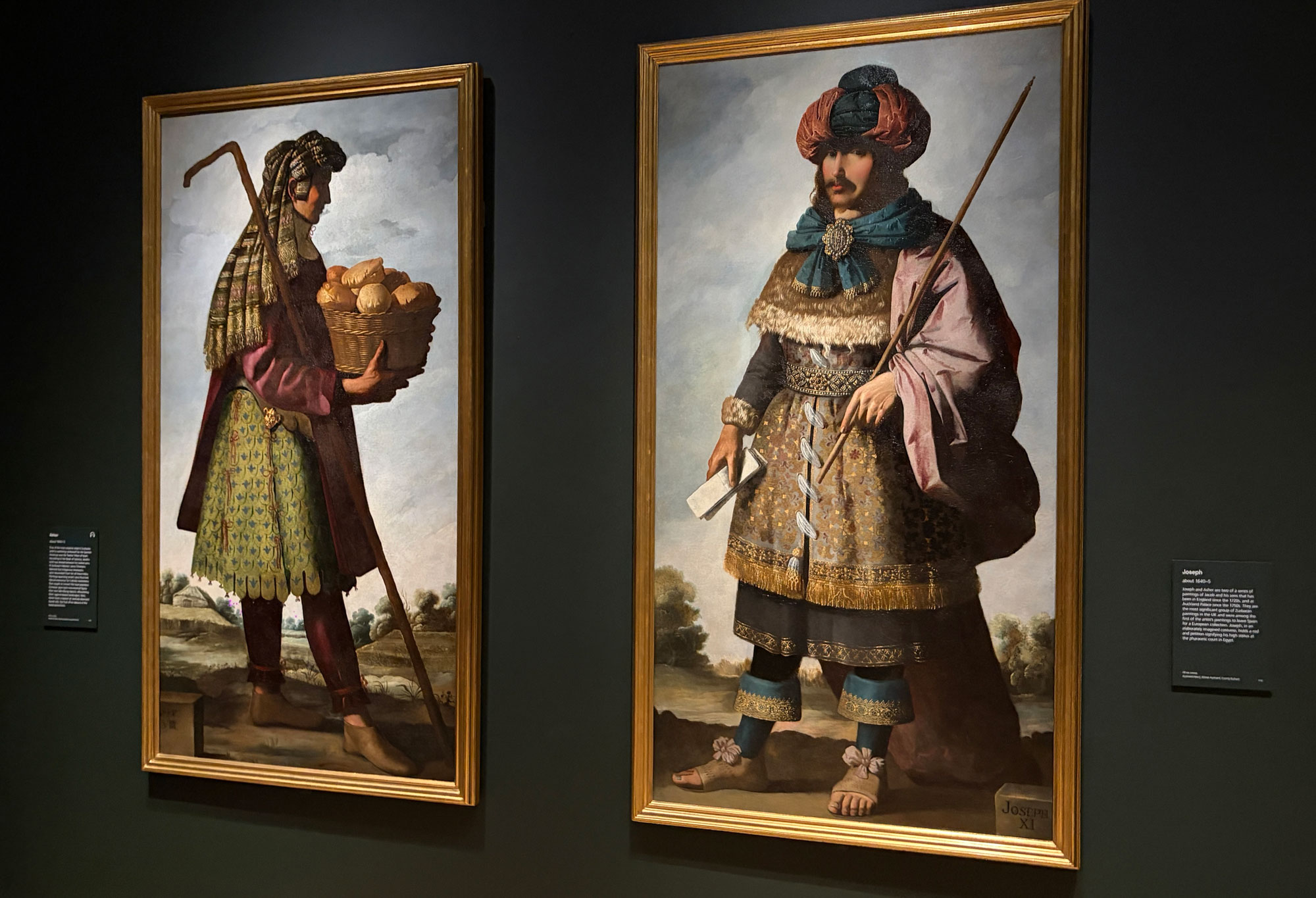
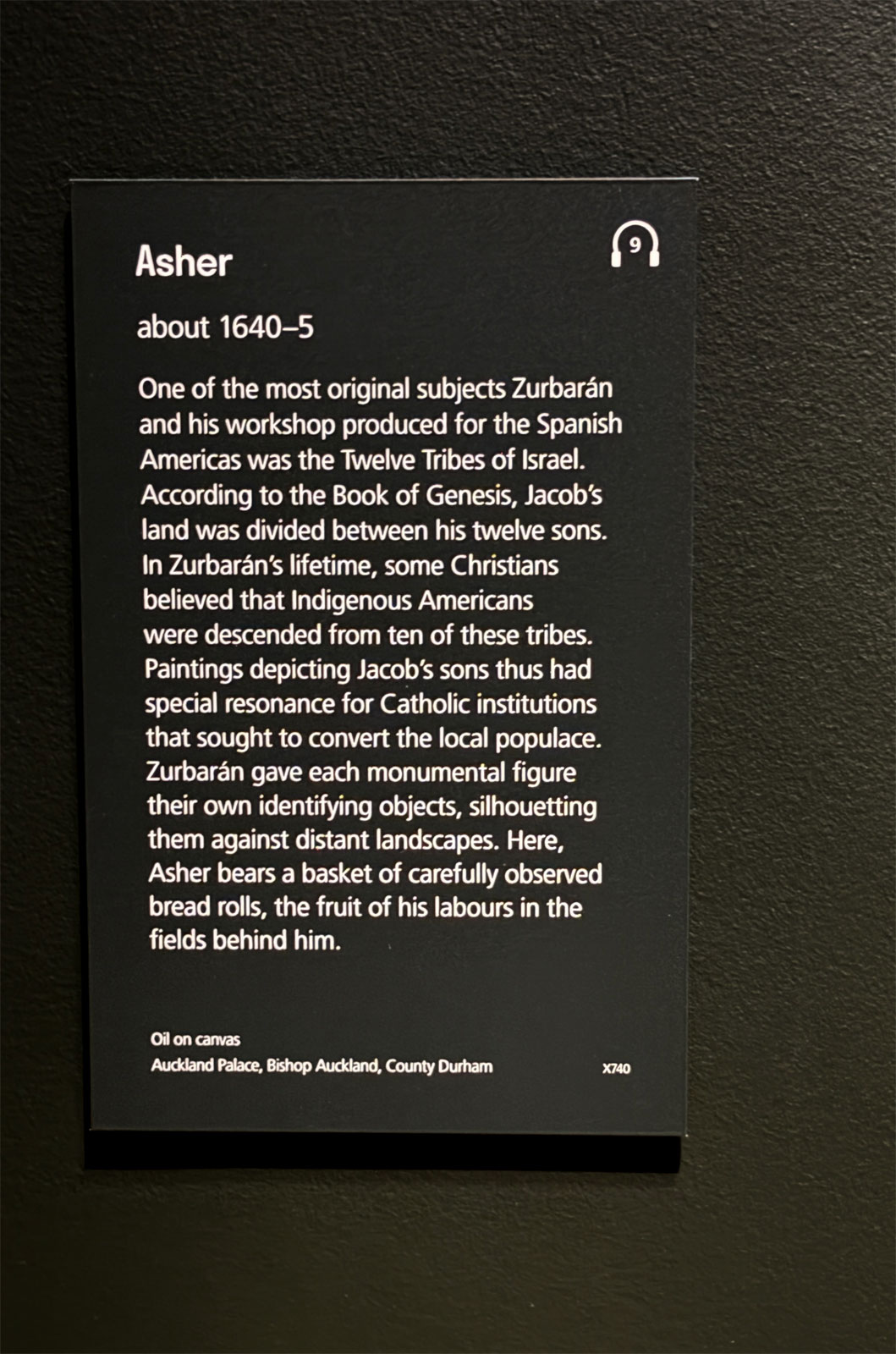
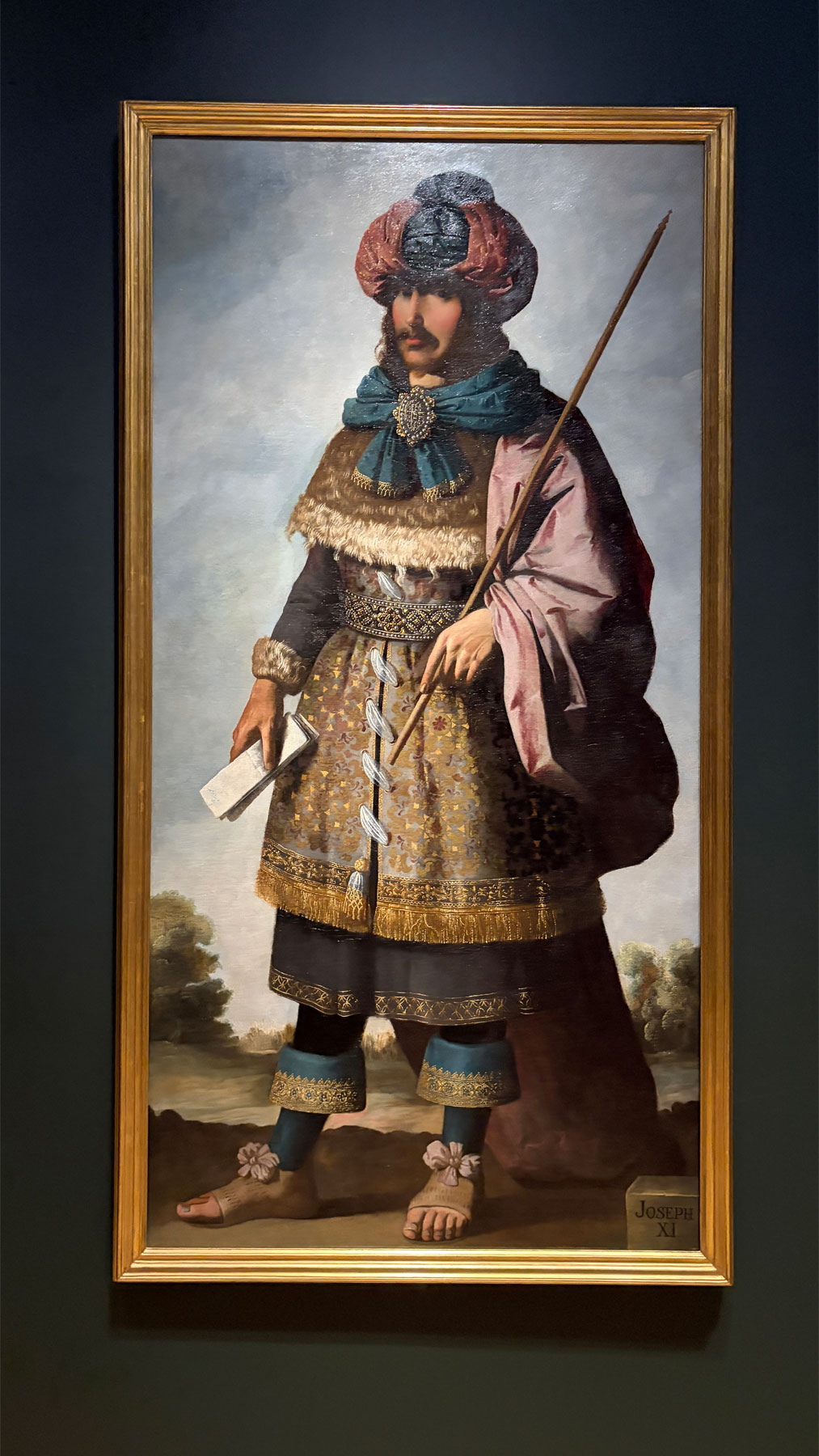
Installation view of the exhibition 'Zurbarán' at the National Gallery, London showing at left, 'Asher' (about 1640-1645); and at right, 'Joseph' (about 1640-1645)


Installation view of the exhibition Zurbarán at the National Gallery, London showing at left, Asher (about 1640-1645, below); and at right, Joseph (about 1640-1645, below)


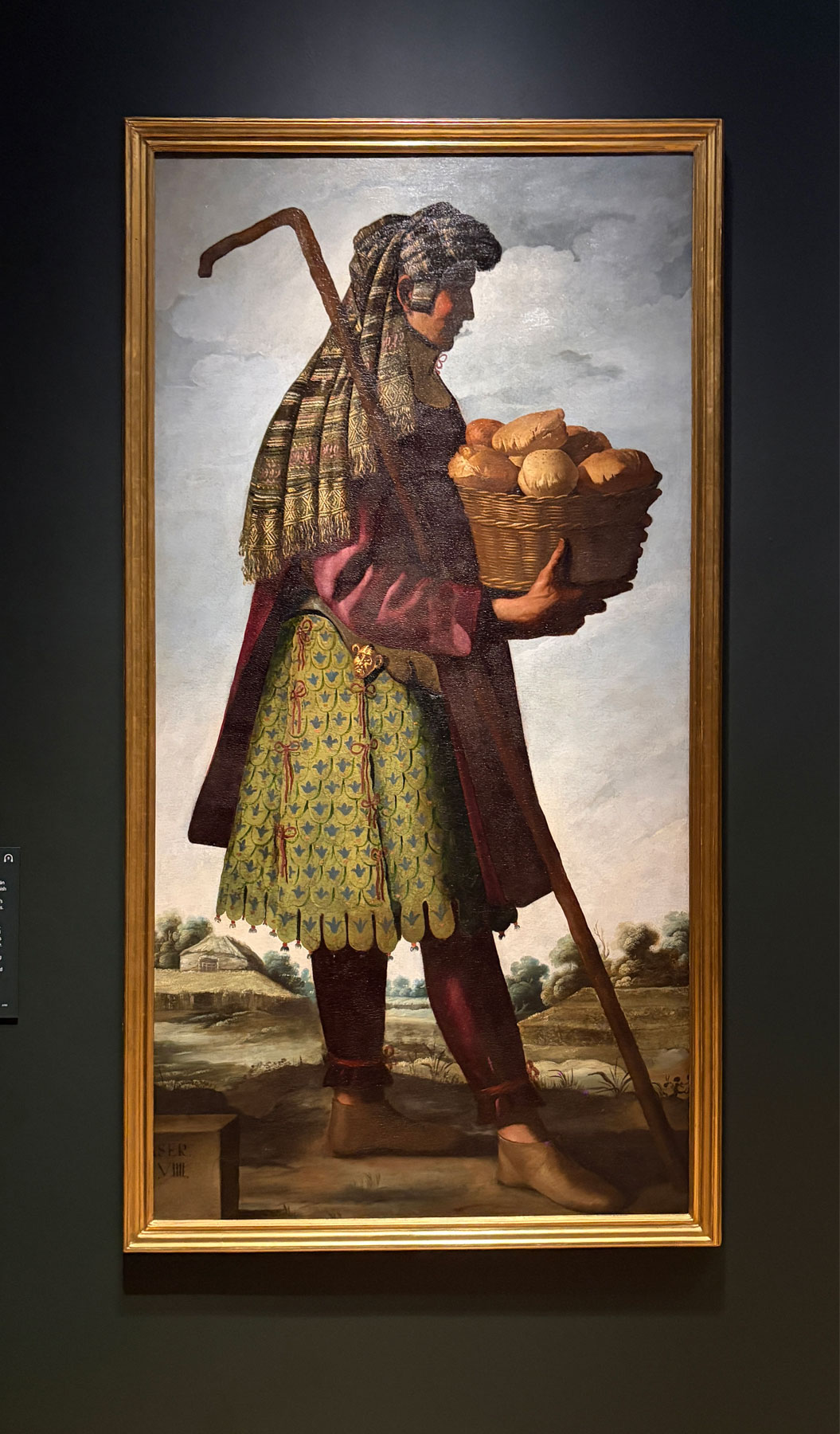
Installation view of the exhibition 'Zurbarán' at the National Gallery, London showing Francisco de Zurbarán (Spain, 1598-1664)
'Asher' about 1640-1645


Francisco de Zurbarán (Spain, 1598-1664)
Asher (installation view)
About 1640-1645
Oil on canvas
Auckland Palace, Bishop Auckland, County Durham


Wall text from the exhibition 'Zurbarán' at the National Gallery, London


Wall text from the exhibition Zurbarán at the National Gallery, London


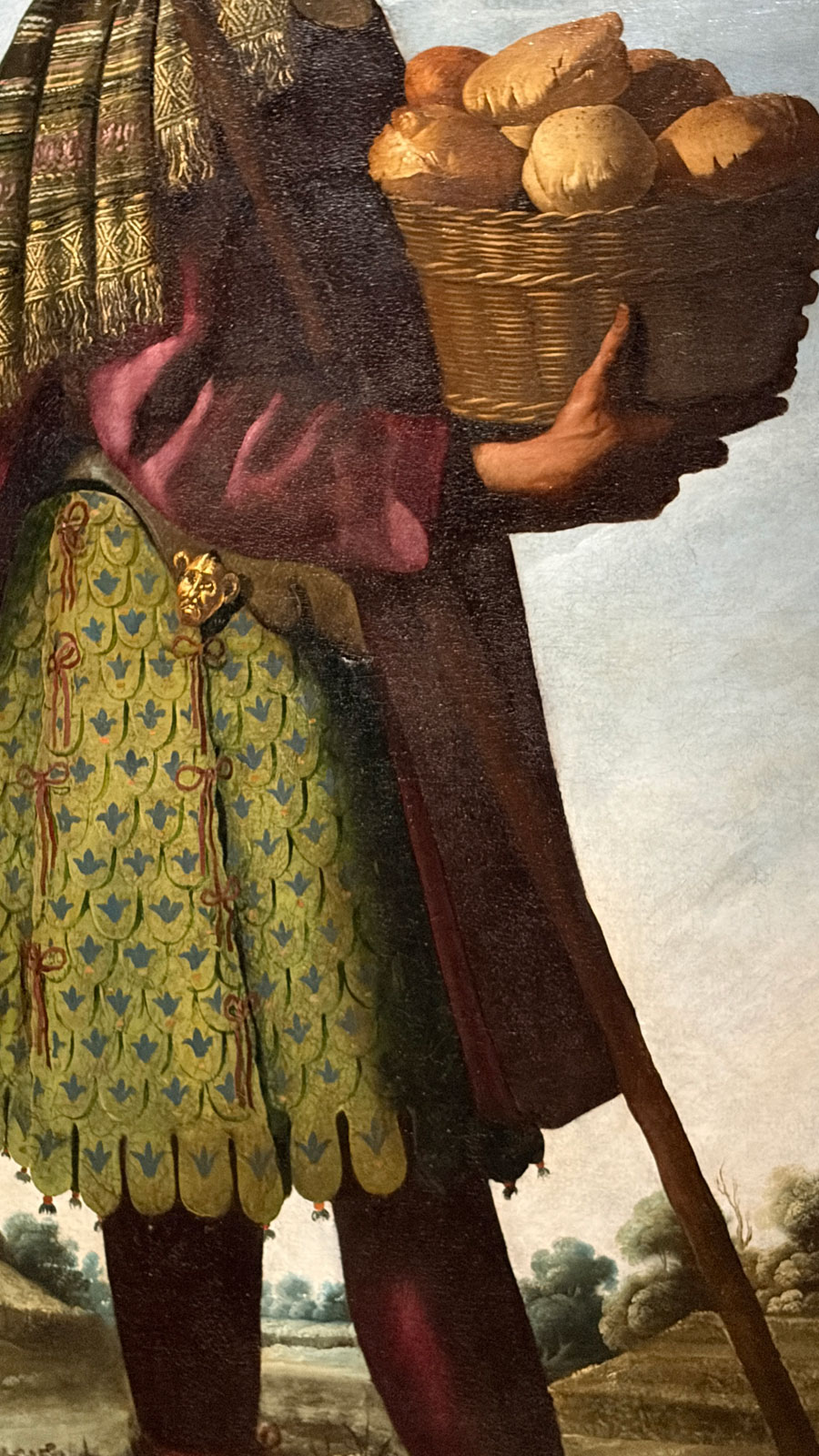
Installation view of the exhibition 'Zurbarán' at the National Gallery, London showing Francisco de Zurbarán (Spain, 1598-1664)
'Asher' about 1640-1645 (detail)


Francisco de Zurbarán (Spain, 1598-1664)
Asher (installation view detail)
About 1640-1645
Oil on canvas
Auckland Palace, Bishop Auckland, County Durham


Installation view of the exhibition 'Zurbarán' at the National Gallery, London showing Francisco de Zurbarán (Spain, 1598-1664)
'Joseph' about 1640-1645 (detail)


Francisco de Zurbarán (Spain, 1598-1664)
Joseph (installation view)
About 1640-1645
Oil on canvas
Auckland Palace, Bishop Auckland, County Durham


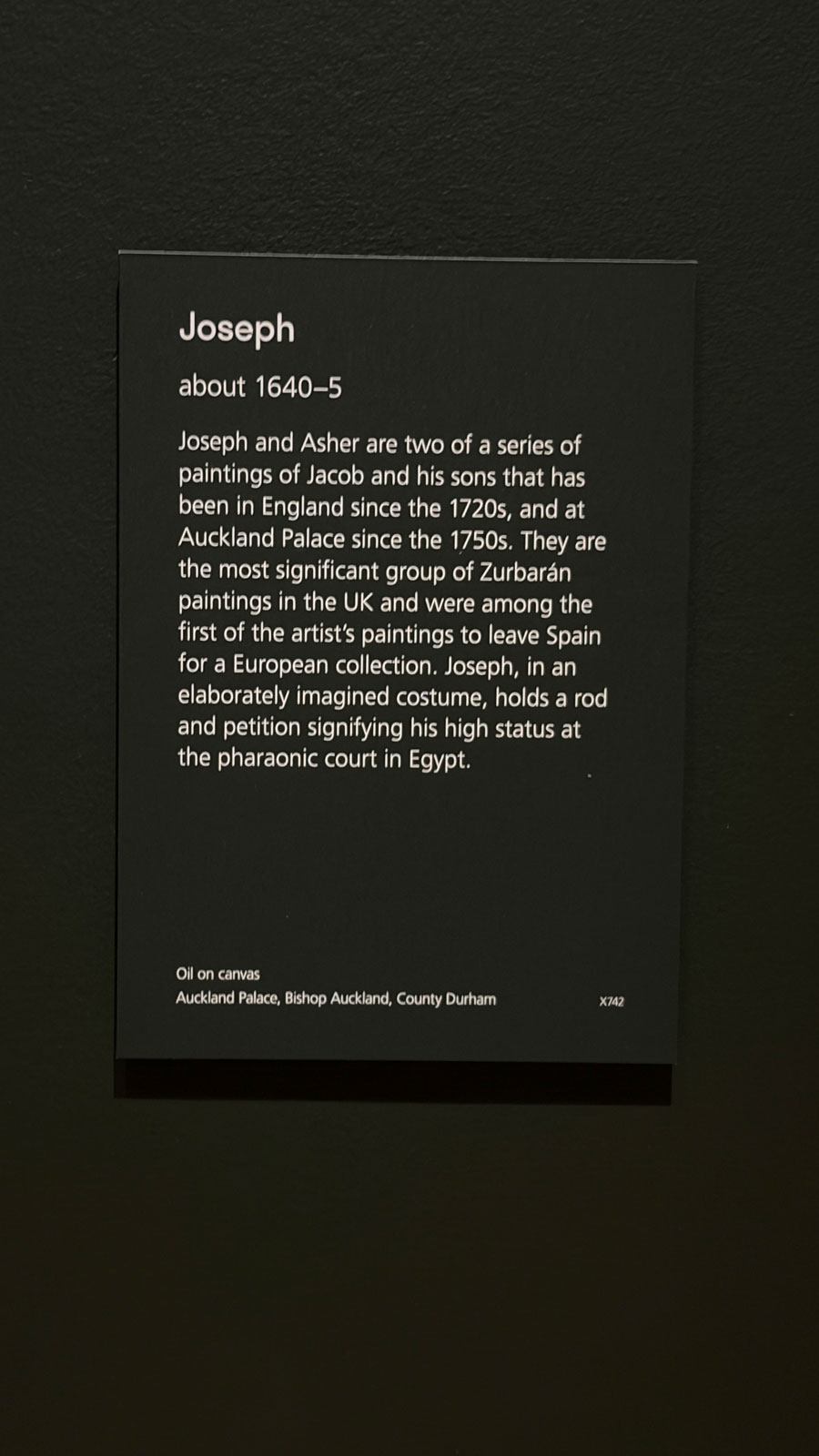
Wall text from the exhibition 'Zurbarán' at the National Gallery, London


Wall text from the exhibition Zurbarán at the National Gallery, London


Installation view of the exhibition 'Zurbarán' at the National Gallery, London showing Francisco de Zurbarán (Spain, 1598-1664)
'A Cup of Water and a Rose' about 1630


Francisco de Zurbarán (Spain, 1598-1664)
A Cup of Water and a Rose (installation view)
About 1630
Oil on canvas
The National Gallery, London
 

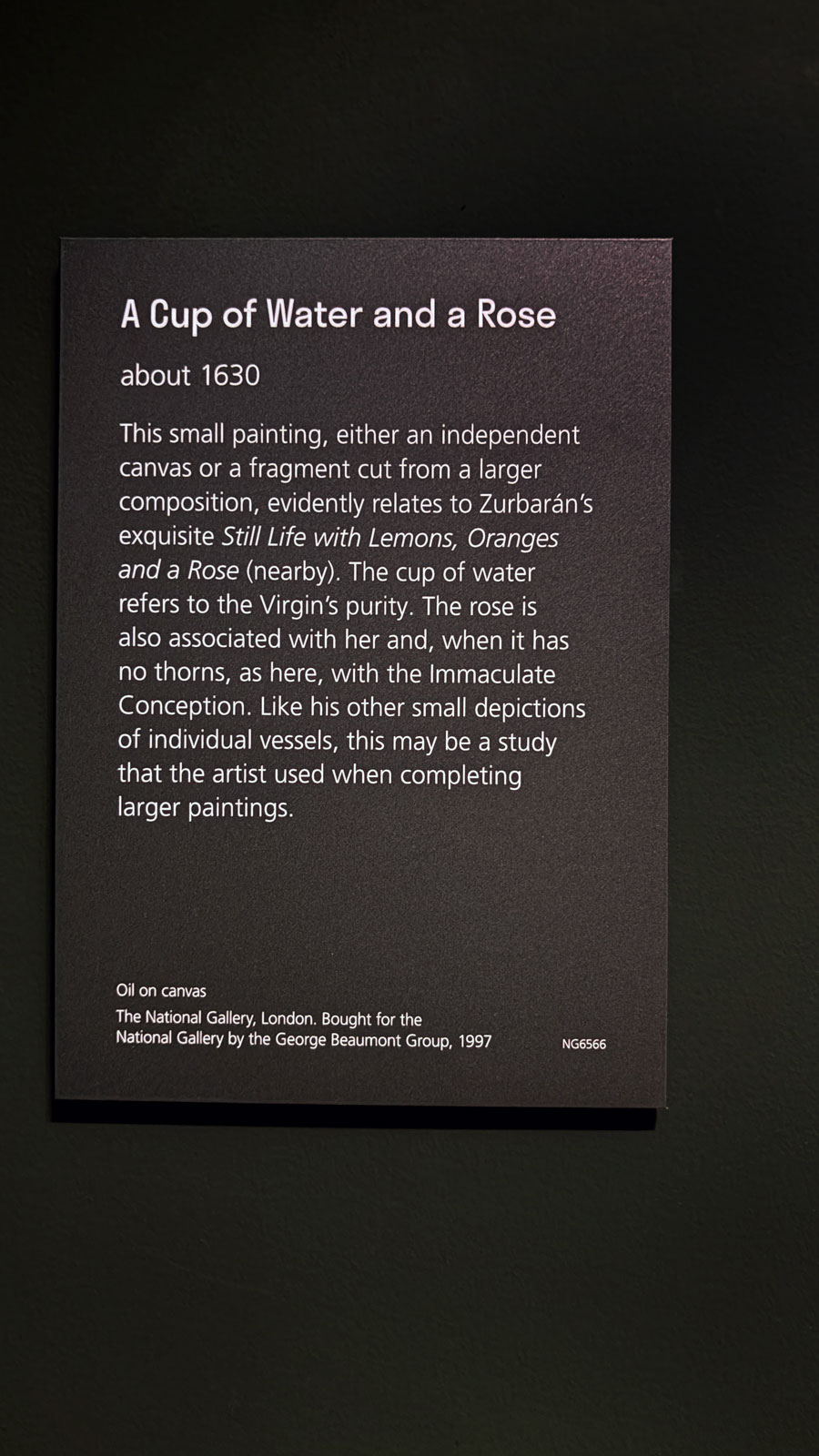
Wall text from the exhibition 'Zurbarán' at the National Gallery, London


Wall text from the exhibition Zurbarán at the National Gallery, London
 

Installation view of the exhibition 'Zurbarán' at the National Gallery, London showing Francisco de Zurbarán (Spain, 1598-1664)
'A Cup of Water and a Rose' about 1630


Francisco de Zurbarán (Spain, 1598-1664)
A Cup of Water and a Rose (installation view)
About 1630
Oil on canvas
The National Gallery, London


Installation view of the exhibition 'Zurbarán' at the National Gallery, London showing Francisco de Zurbarán (Spain, 1598-1664)
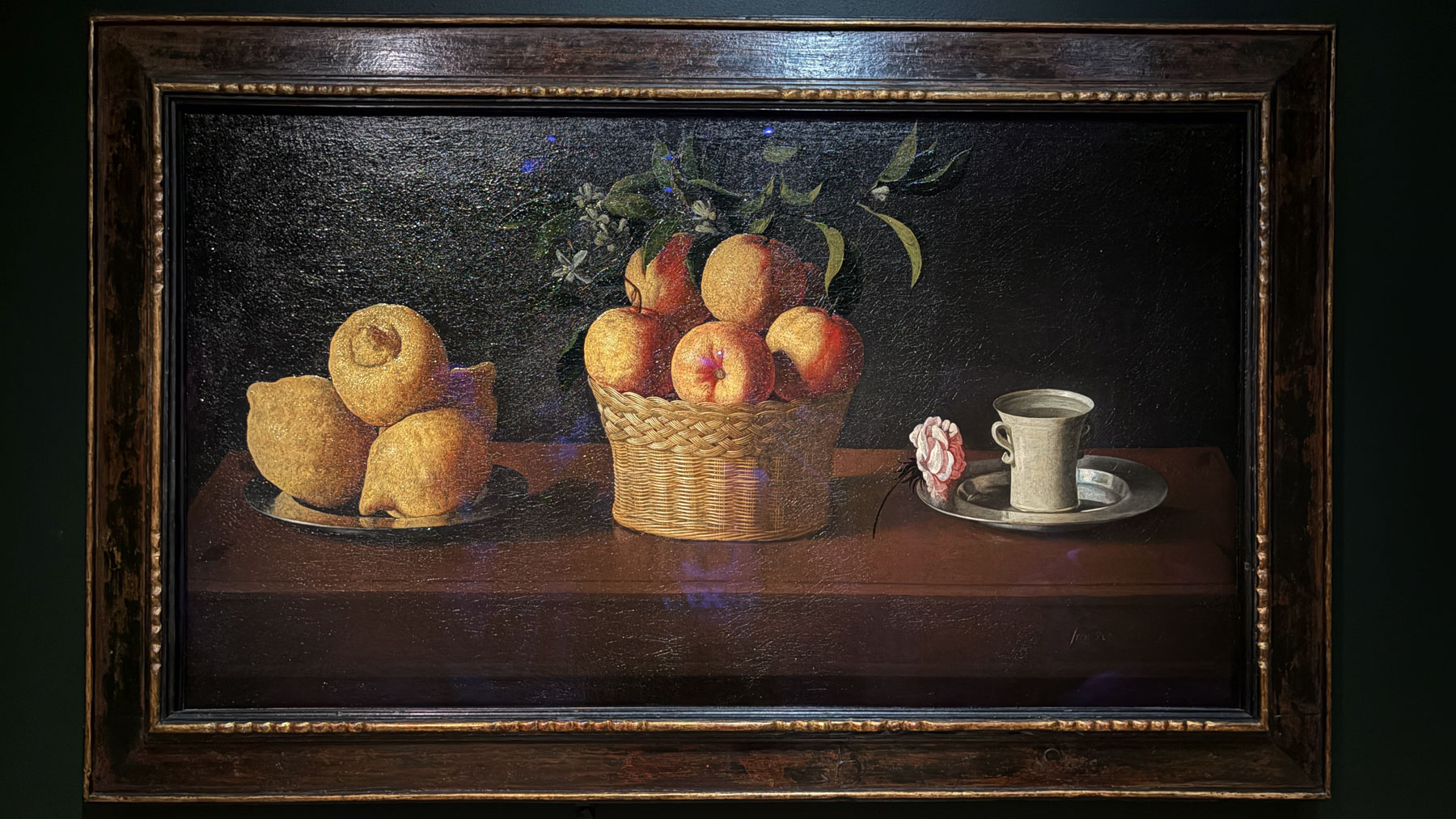
'Still Life with Lemons, Oranges and a Rose' 1633


Francisco de Zurbarán (Spain, 1598-1664)
Still Life with Lemons, Oranges and a Rose (installation view)
1633
Oil on canvas
The Norton Simon Foundation


This extraordinary painting by Zurbarán, the only signed and dated still life by this great master of the school of Seville, has been widely admired as a masterpiece of the genre. To devout Spanish Catholics in the 17th century, the apparently humble objects portrayed here contained significant religious meaning. The measured placement of the three motifs, for example, would have been instantly understood as an allusion to the Holy Trinity. The painting has also been interpreted as an homage to the Virgin, with the oranges, their blossoms, and the cup of water symbolizing her purity, and the thornless rose referring to her Immaculate Conception. 

Zurbarán depicted the physical character of the objects, and the space they inhabit, with unparalleled focus and skill. By modelling the rough-skinned yellow citrons with hints of green and russet, he suggests the fruit’s protuberance and weight. The arrangement of the orange leaves creates a rhythm of light and shadow, echoed again in the reflective surfaces of the pewter plates. Presented as a quiet, meditative piece within a shallow, minimally described space, this still life evokes a mystical intensity that transcends time in its appeal.

A recent cleaning has removed opaque layers of varnish and discolored retouches, revealing once again the clearly defined edges of the table, the four decorative inlays at each corner, and Zurbarán’s characteristic skill in describing the rough, textural skin of the citrus fruit. The welcome balance between the dark, atmospheric background, the warm tones of the fruit and basket, and the cooler tones of the silver plate and ceramic cup have been restored.

Text from the Norton Simon Foundation website


Francisco de Zurbarán (Spain, 1598-1664) 'Still Life with Lemons, Oranges and a Rose' 1633


Francisco de Zurbarán (Spain, 1598-1664)
Still Life with Lemons, Oranges and a Rose
1633
Oil on canvas
The Norton Simon Foundation
Wikipedia Commons


Installation view of the exhibition 'Zurbarán' at the National Gallery, London showing Francisco de Zurbarán (Spain, 1598-1664)
'Still Life with Lemons, Oranges and a Rose' 1633


Francisco de Zurbarán (Spain, 1598-1664)
Still Life with Lemons, Oranges and a Rose (installation view)
1633
Oil on canvas
The Norton Simon Foundation


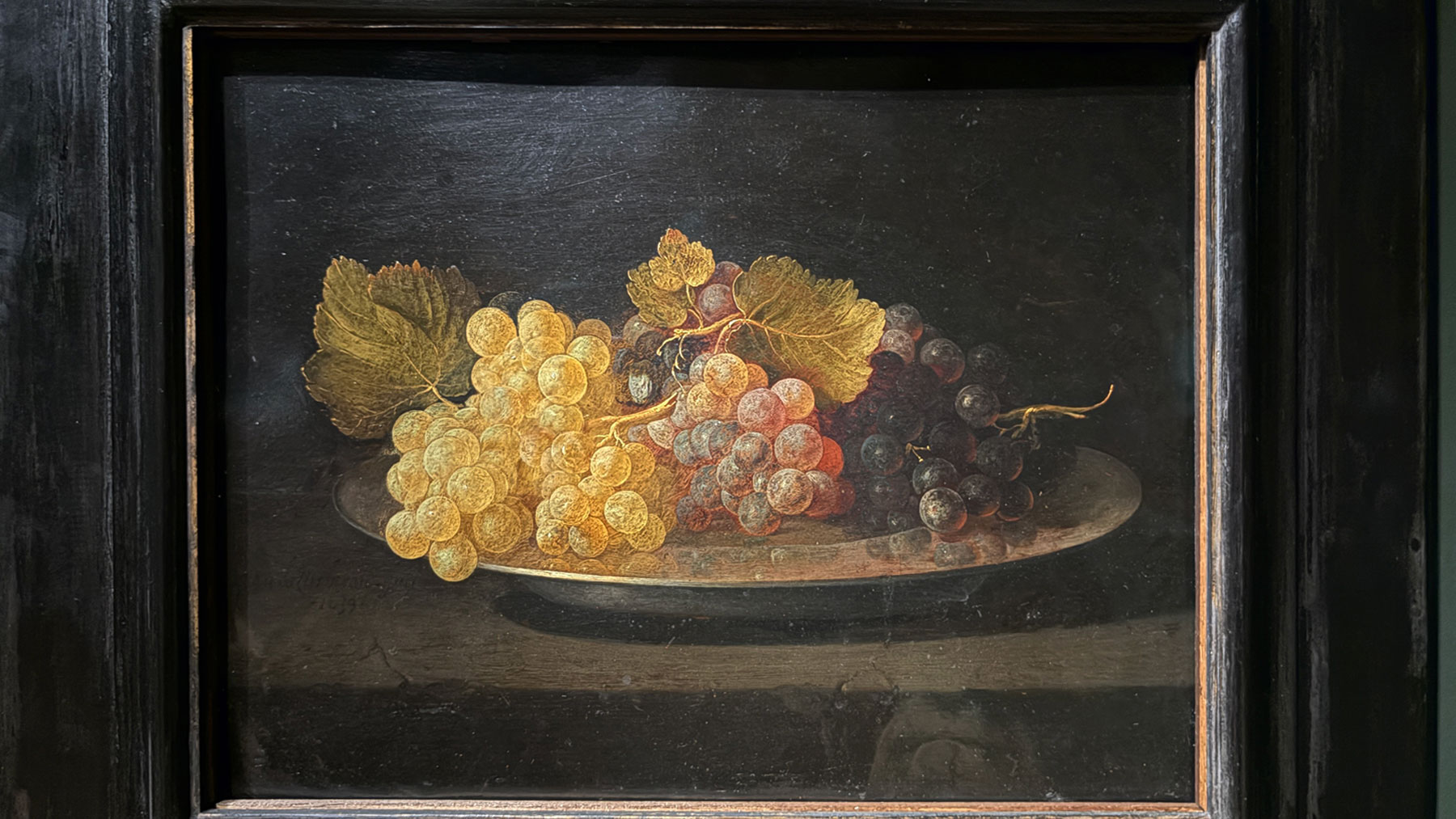
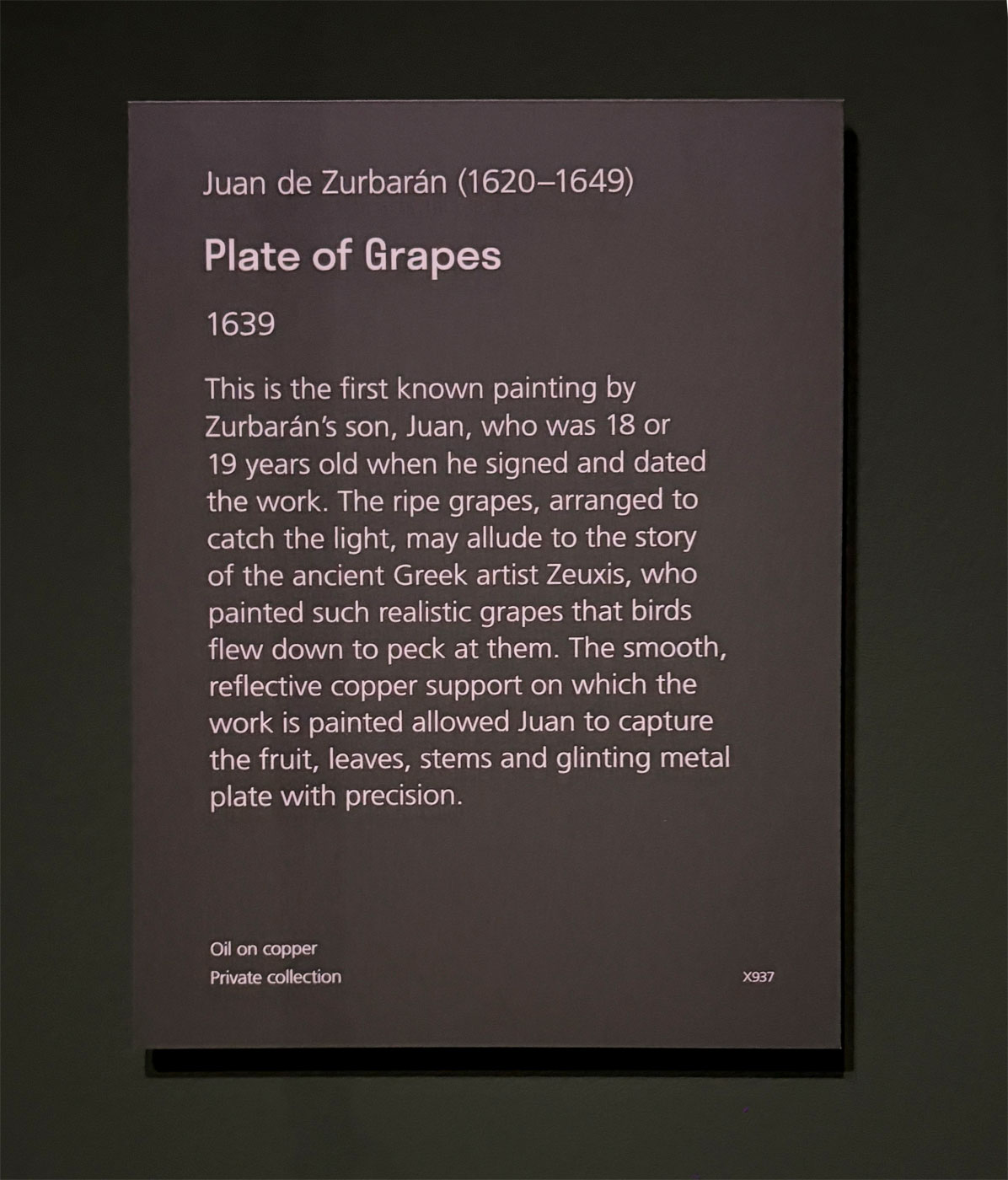
Installation view of the exhibition 'Zurbarán' at the National Gallery, London showing Francisco de Zurbarán (Spain, 1598-1664) 'A Plate of Grapes' 1639


Juan de Zurbarán (Spain, 1620-1649)
A Plate of Grapes (installation view)
1639
Oil on copper
Private collection


Wall text from the exhibition 'Zurbarán' at the National Gallery, London


Wall text from the exhibition Zurbarán at the National Gallery, London
 

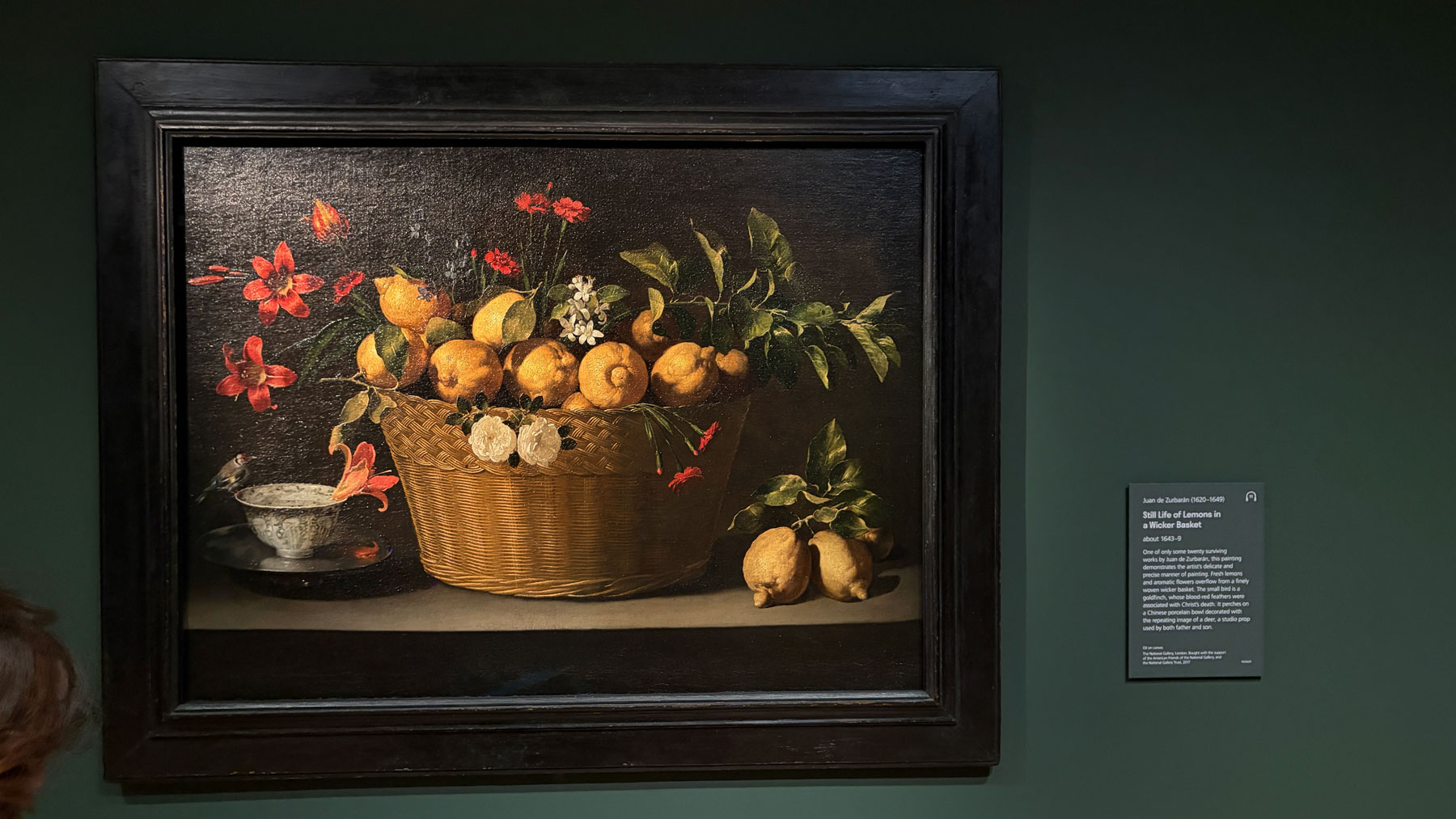
Installation view of the exhibition 'Zurbarán' at the National Gallery, London showing Juan de Zurbarán (Spain, 1620-1649) 'Still Life of Lemons in a Wicker Basket' about 1643-1649


Juan de Zurbarán (Spain, 1620-1649)
Still Life of Lemons in a Wicker Basket (installation view)
About 1643-1649
Oil on canvas
The National Gallery, London


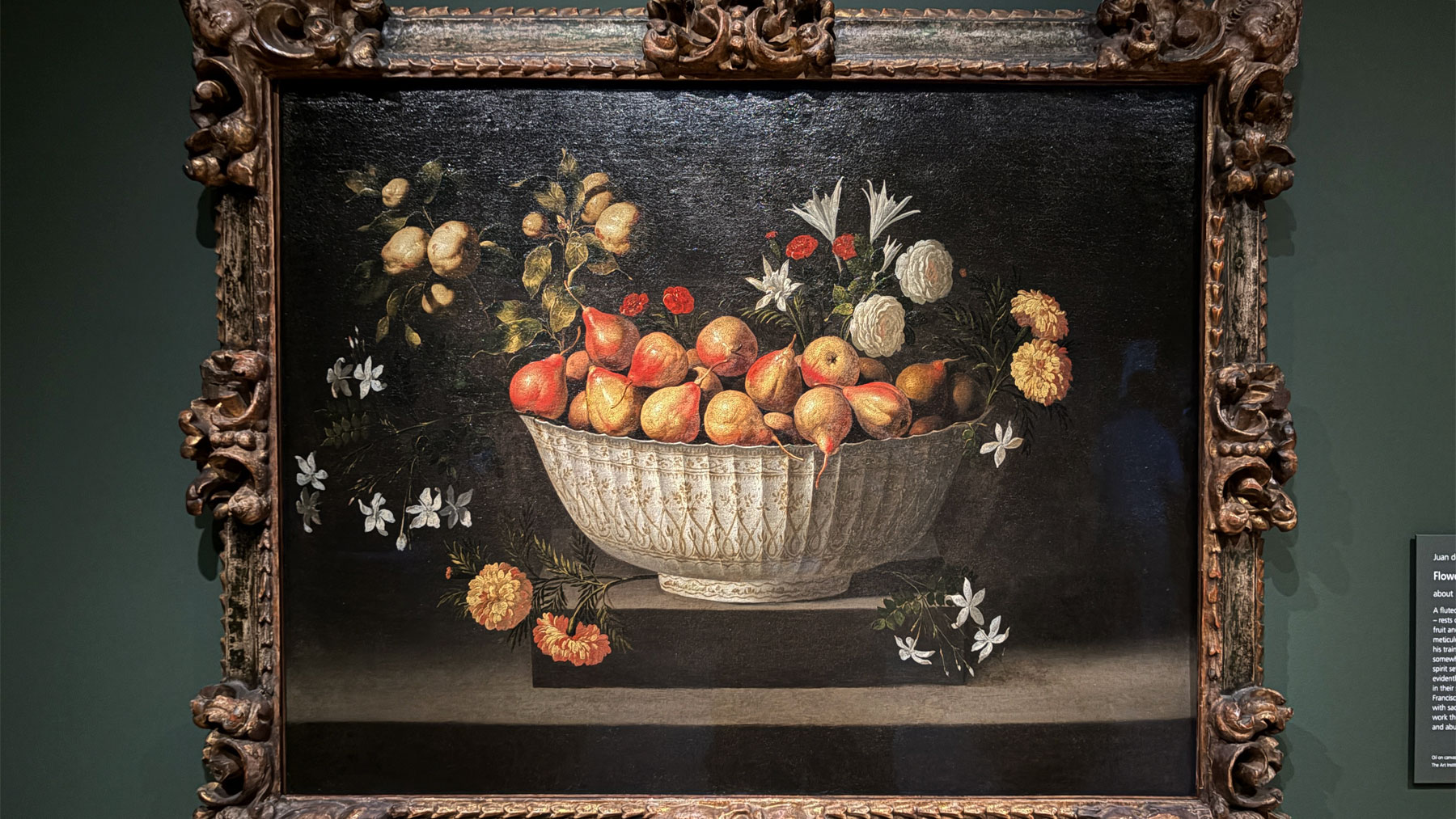
Installation view of the exhibition 'Zurbarán' at the National Gallery, London showing Juan de Zurbarán (Spain, 1620-1649)
'Flowers and Fruit in a Bowl' about 1645


Juan de Zurbarán (Spain, 1620-1649)
Flowers and Fruit in a Bowl (installation view)
About 1645
Oil on canvas
The National Gallery, London


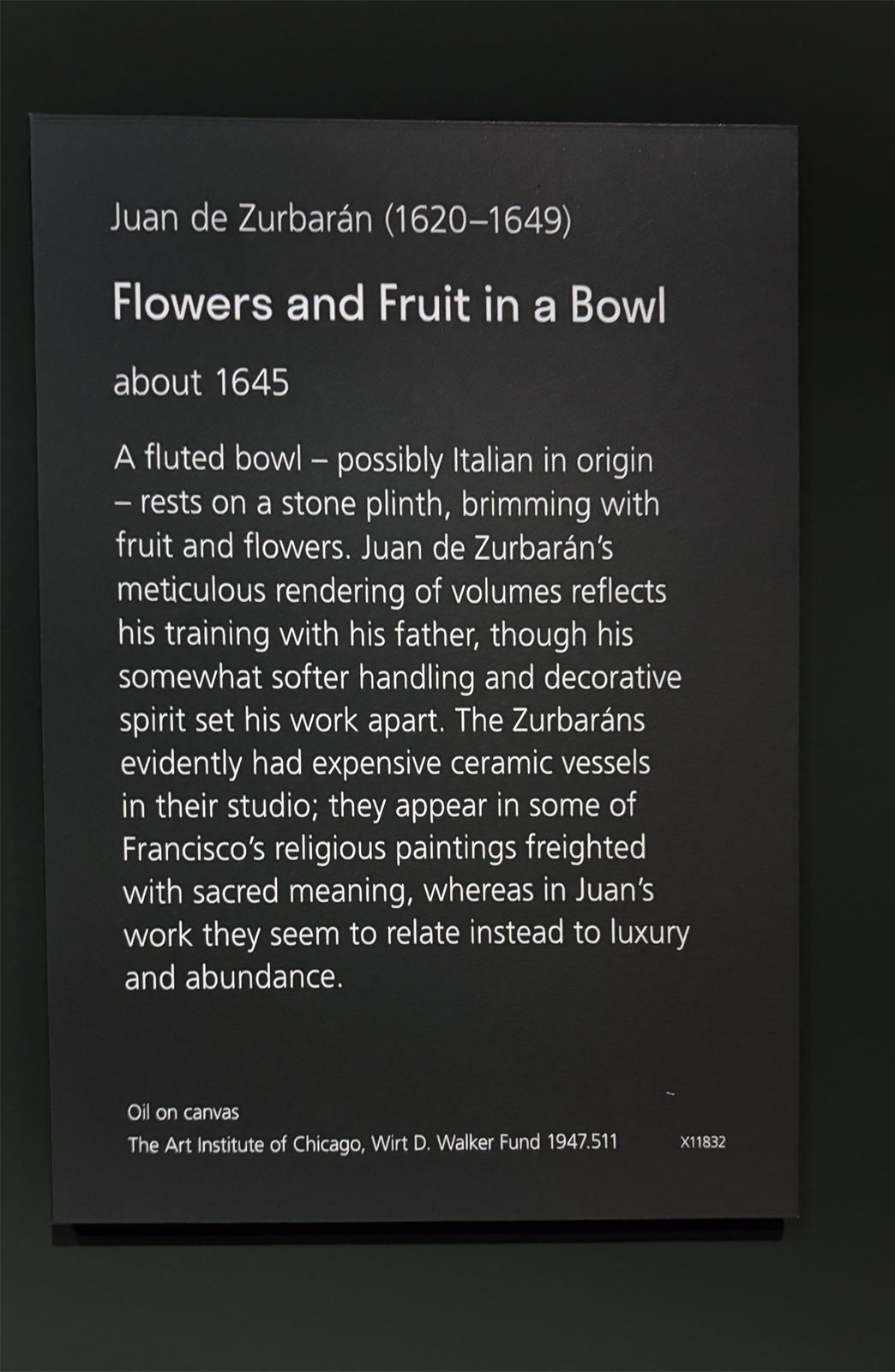
Wall text from the exhibition 'Zurbarán' at the National Gallery, London


Wall text from the exhibition Zurbarán at the National Gallery, London
 

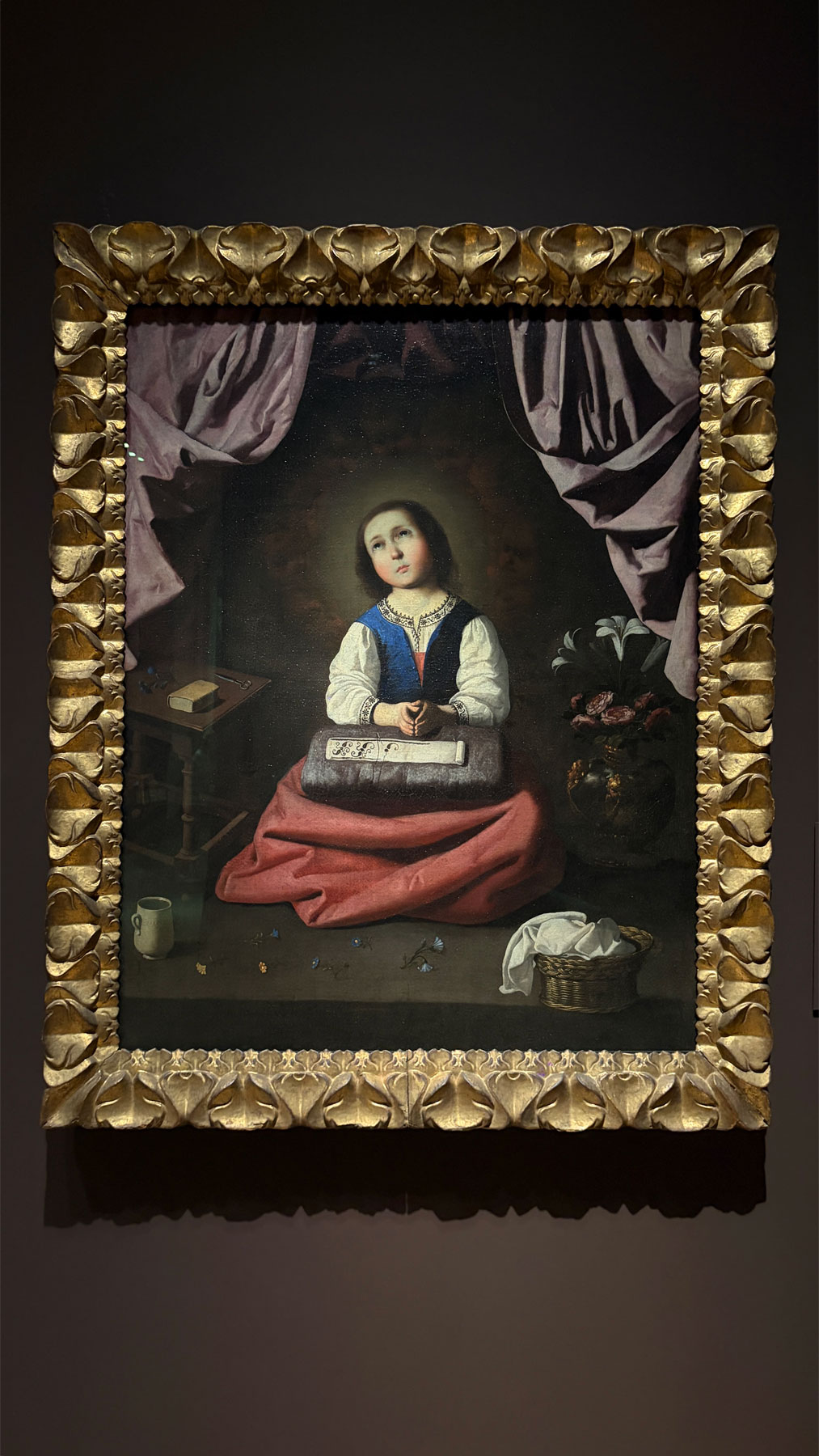
Installation view of the exhibition 'Zurbarán' at the National Gallery, London showing Francisco de Zurbarán (Spain, 1598-1664)
'The Young Virgin' about 1632-1633


Francisco de Zurbarán (Spain, 1598-1664)
The Young Virgin (installation view)
About 1632-1633
Oil on canvas
Lent by the Metropolitan Museum of Art


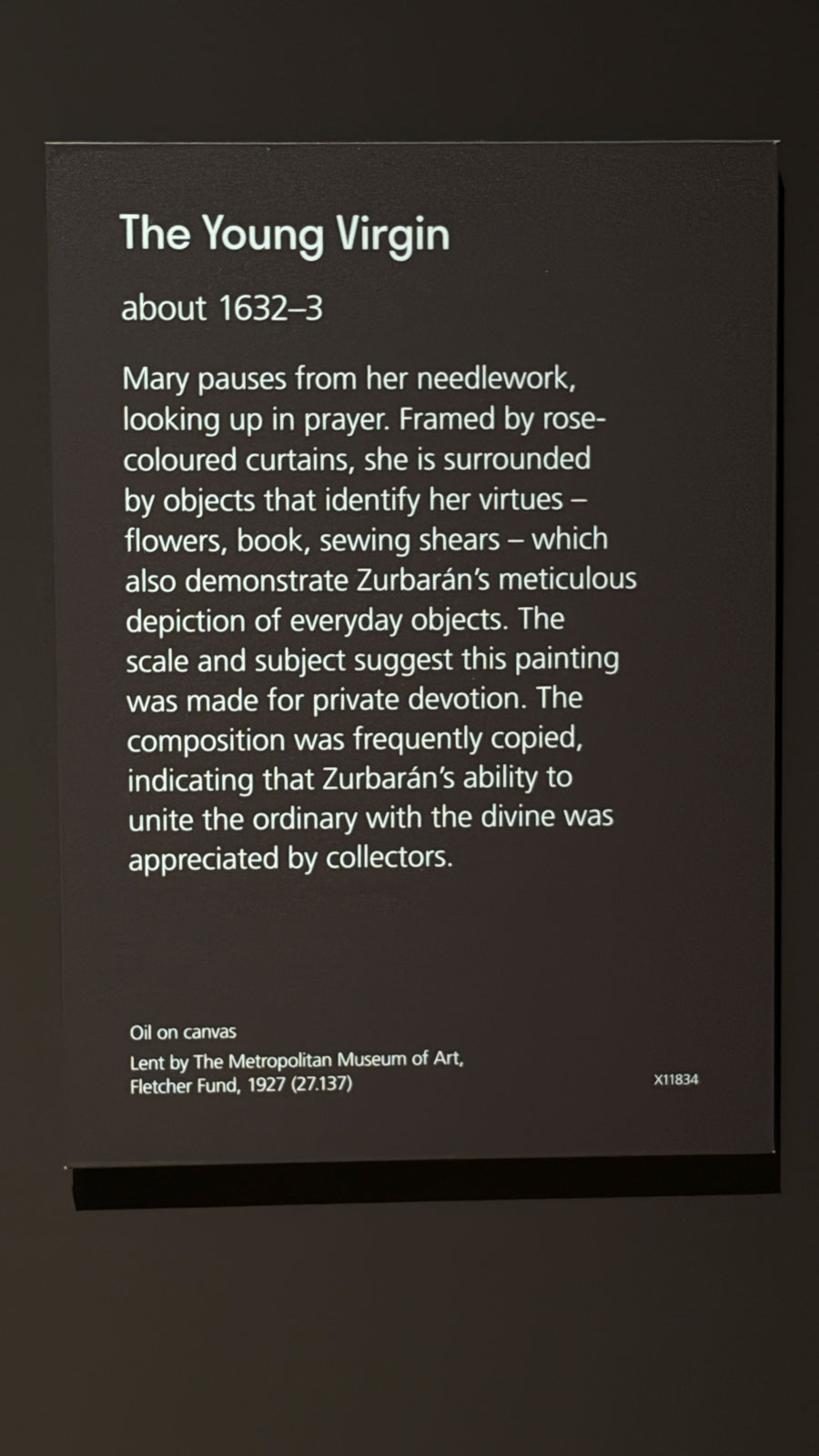
Wall text from the exhibition 'Zurbarán' at the National Gallery, London


Wall text from the exhibition Zurbarán at the National Gallery, London
 

Installation view of the exhibition 'Zurbarán' at the National Gallery, London showing Francisco de Zurbarán (Spain, 1598-1664)
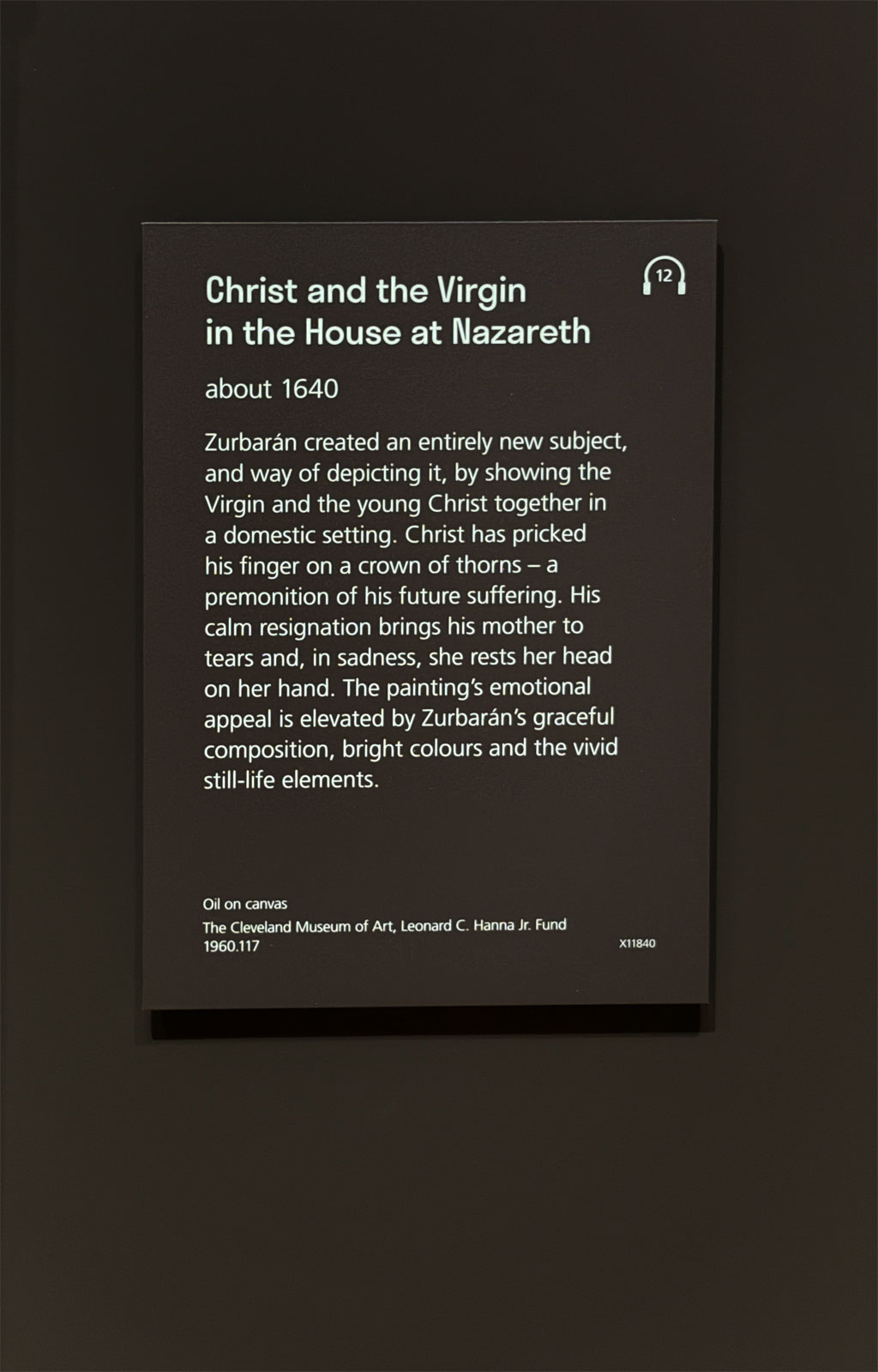
'Christ and the Virgin in the House at Nazareth' about 1640


Francisco de Zurbarán (Spain, 1598-1664)
Christ and the Virgin in the House at Nazareth (installation view)
About 1640
Oil on canvas
The Cleveland Museum of Art


Wall text from the exhibition 'Zurbarán' at the National Gallery, London


Wall text from the exhibition Zurbarán at the National Gallery, London


The National Gallery
Trafalgar Square, London WC2N 5DN

Opening hours:
Daily 10am – 6pm
Friday 10am – 9pm

The National Gallery website

LIKE ART BLART ON FACEBOOK

Back to top

Exhibition: ‘Goya: The Portraits’ at the National Gallery, London

Exhibition dates: 7th October, 2015 – 10th January, 2016

Curator: Dr Xavier Bray


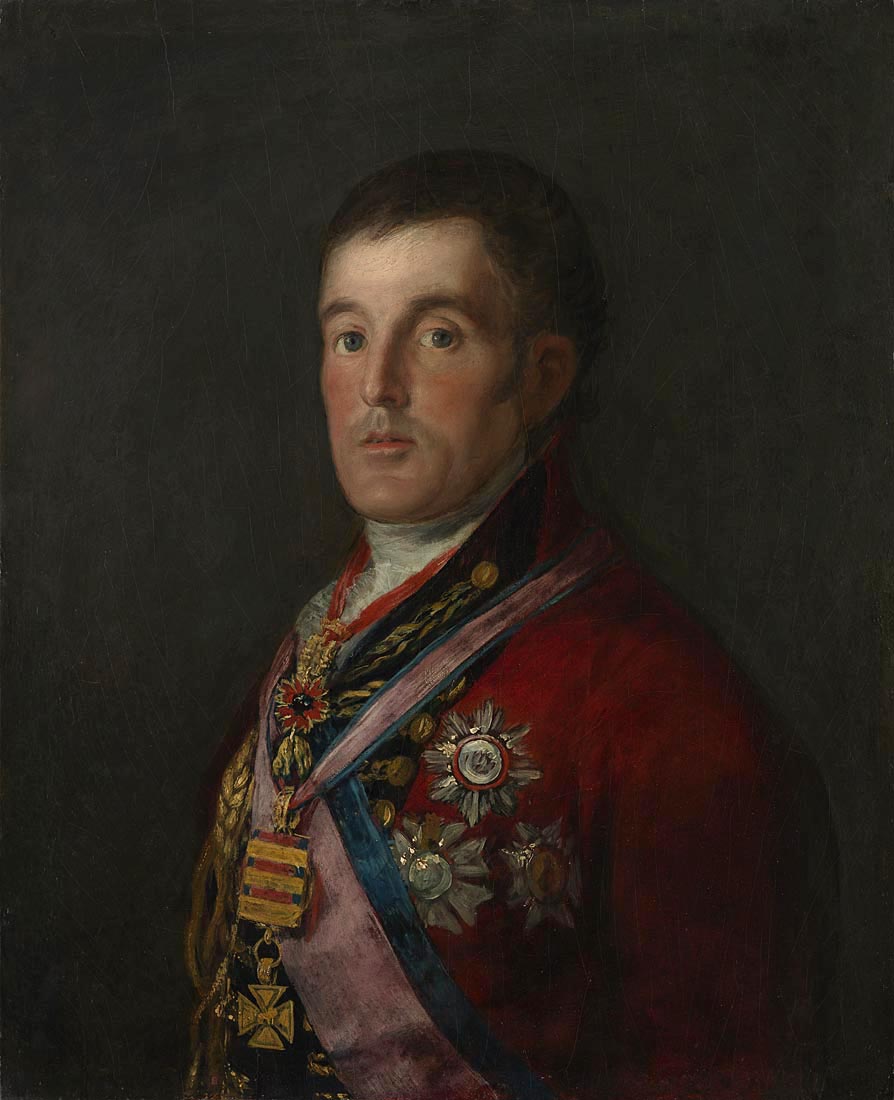
Francisco de Goya (Spanish, 1746-1828) 'The Duke of Wellington' 1812-1814 from the exhibition 'Goya: The Portraits' at the National Gallery, London, Oct 2015 - Jan 2016


Francisco de Goya (Spanish, 1746-1828)
The Duke of Wellington
1812-1814
Oil on mahogany
64.3 x 52.4cm
© The National Gallery, London


Rushing through a dimly lit gallery I remember stumbling upon my first, larger than life, full length Goya portrait in the Louvre, a portrait of a women in a pale blue dress. It literally stopped me in my tracks, the visceral affect was so powerful. There was a certain tactility to the painting, a presence to the figure that produced this emotive response. And the light that emanated from the painting. I think my jaw dropped to the floor.

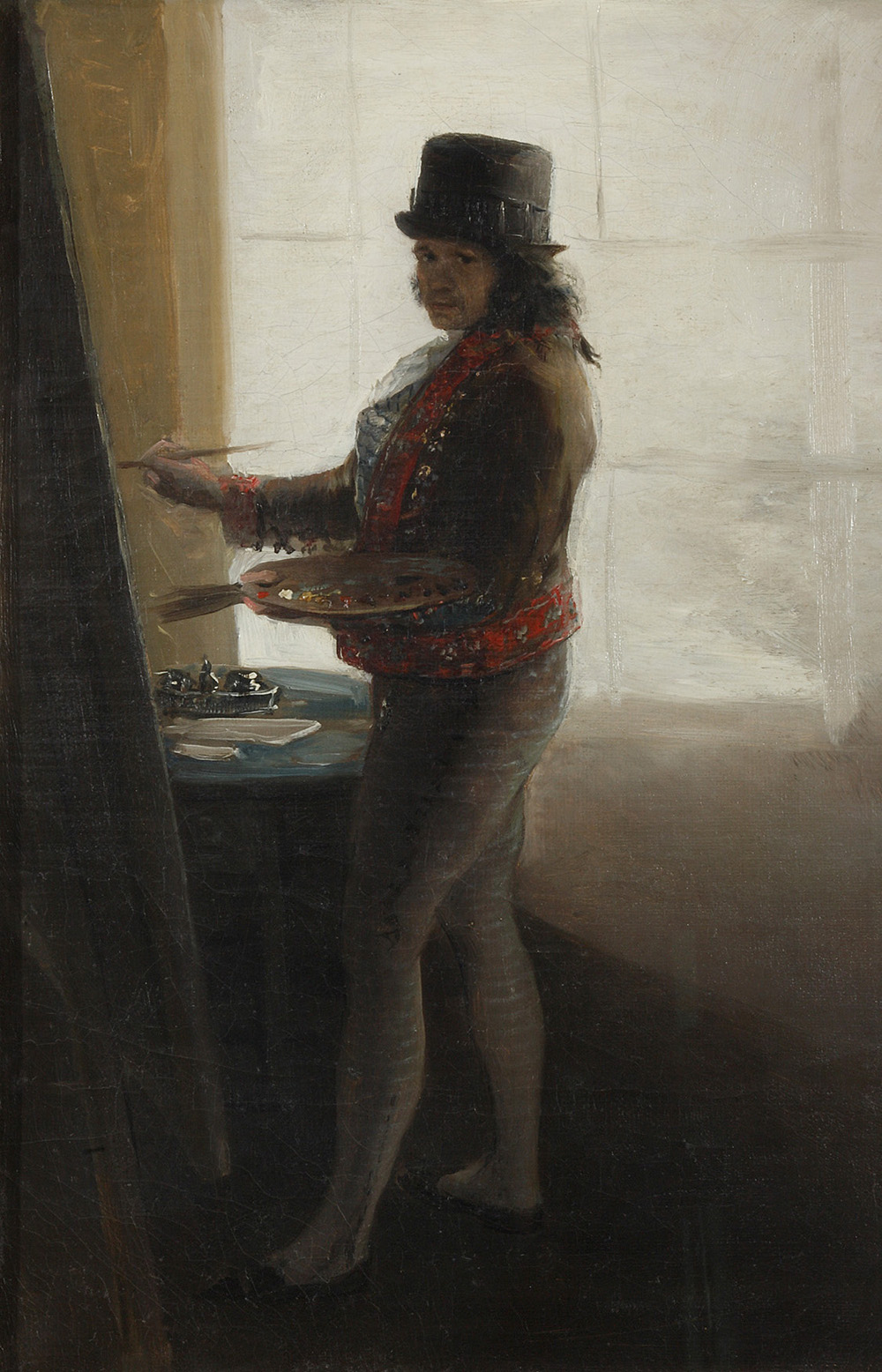
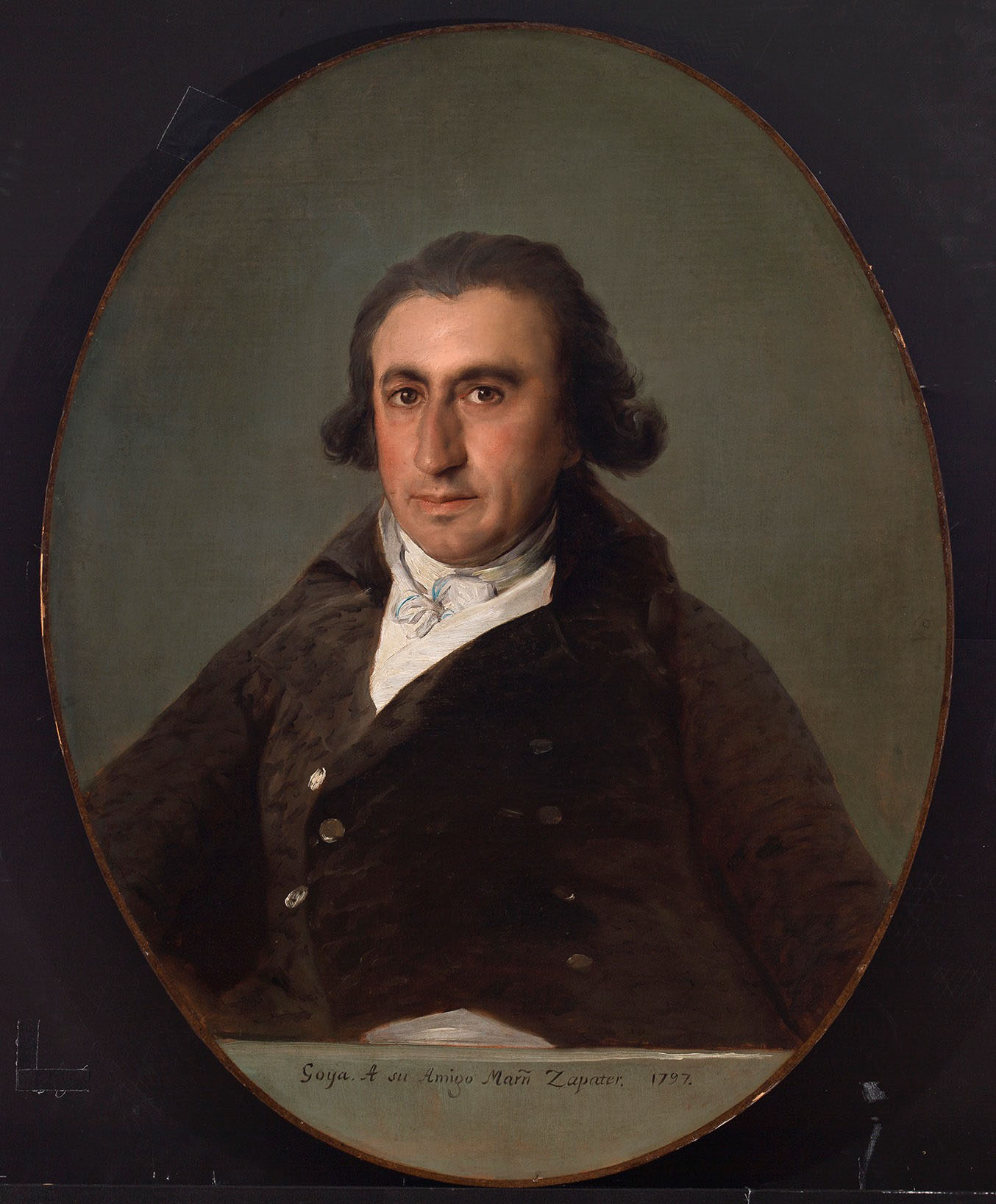
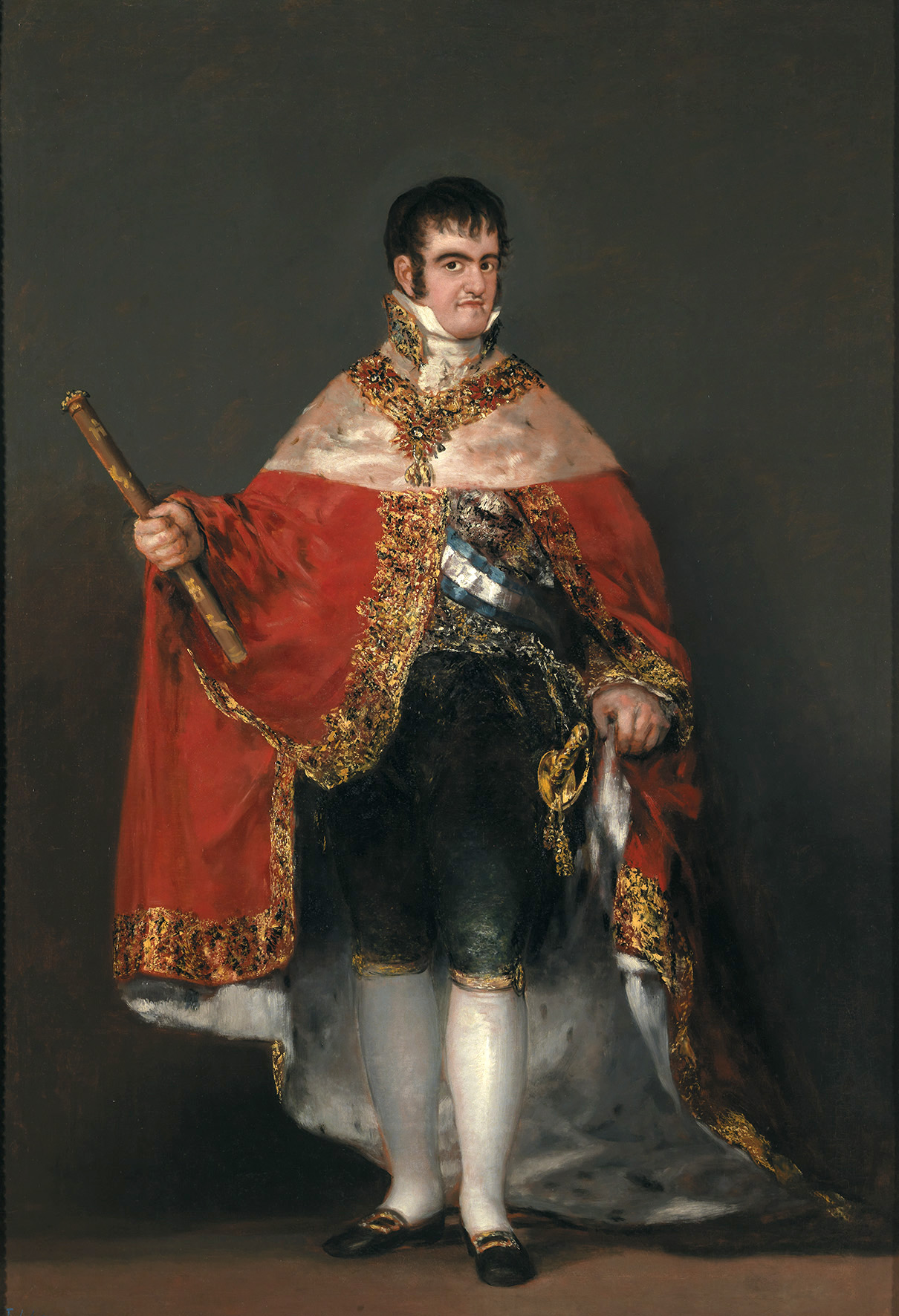
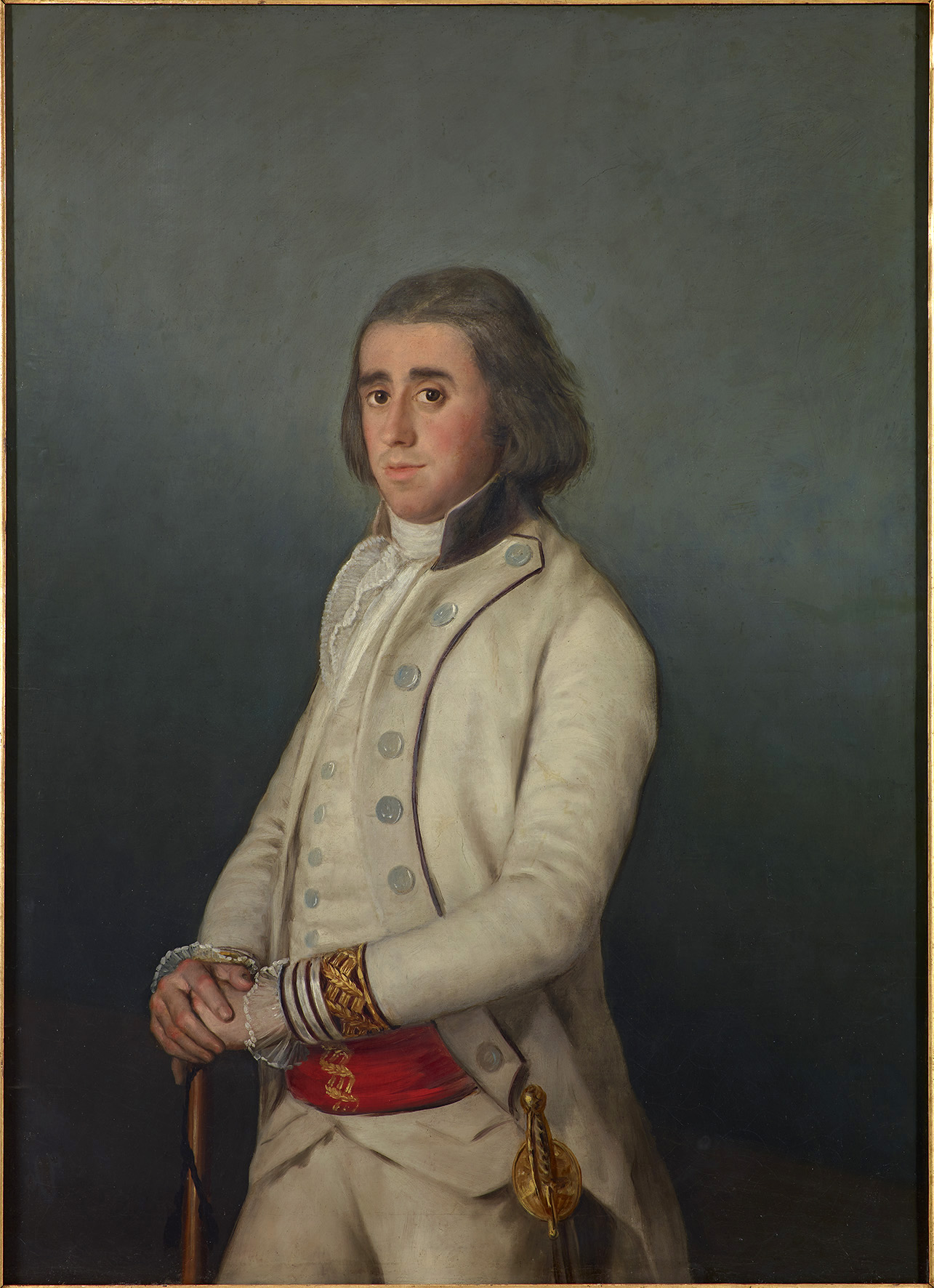
Goya can be cutting when he wants to be, as in the pompous portrait of the buffoon Ferdinand VII in Court Dress (1814-1815, below); he can be precise and reserved as in Don Valentín Bellvís de Moncada y Pizarro (around 1795, below) where the eyes are the key to the portrait; he can be strong and forthright as in the muscular portrait of Martín Zapater (1797, below); or he can be inscrutably honest Self Portrait before an Easel (1792-1795, below) and loving Mariano Goya y Goicoechea (the artist’s grandson) (1827, below). But above all, he is human.

The richness and combination of colours, the sense of space that surrounds the sitter (with their mainly contextless backgrounds and the isolation of the figure in pictorial space), their power – both personal and political – and the certain wariness, weariness and insouciance of their expressions… are just a marvel to behold. It’s as though the sitters had just stopped for a moment to ponder their lives. Almost as though they had conjured or envisaged their own visage, as if from a dream.

Dr Marcus Bunyan


Many thankx to the National Gallery, London for allowing me to publish the photographs in the posting. Please click on the photographs for a larger version of the image.


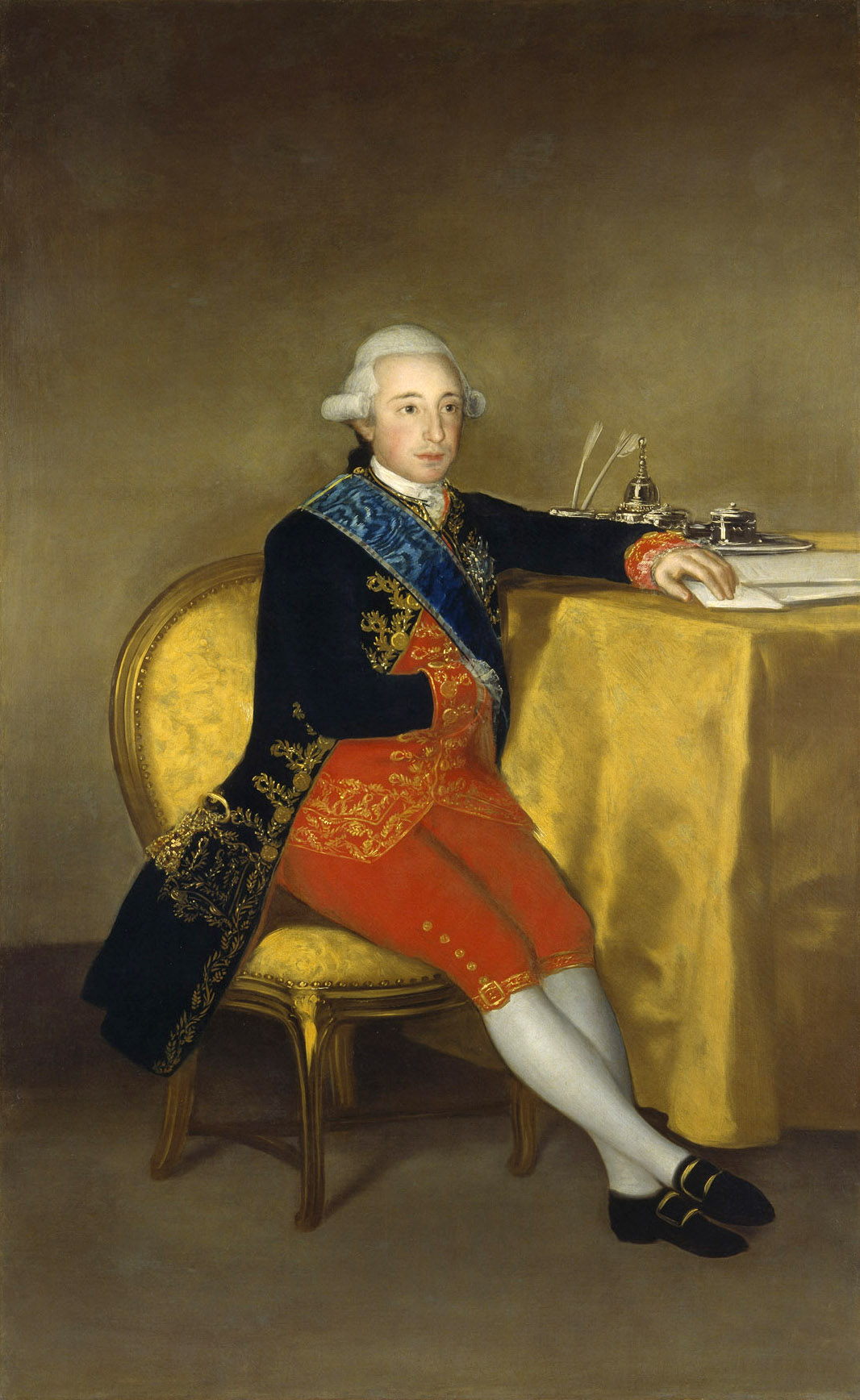
Francisco de Goya (Spanish, 1746-1828) 'The Count of Altamira' 1787 from the exhibition 'Goya: The Portraits' at the National Gallery, London, Oct 2015 - Jan 2016


Francisco de Goya (Spanish, 1746-1828)
The Count of Altamira
1787
Oil on canvas
177 x 108cm
Colección Banco de España
© Colección Banco de España


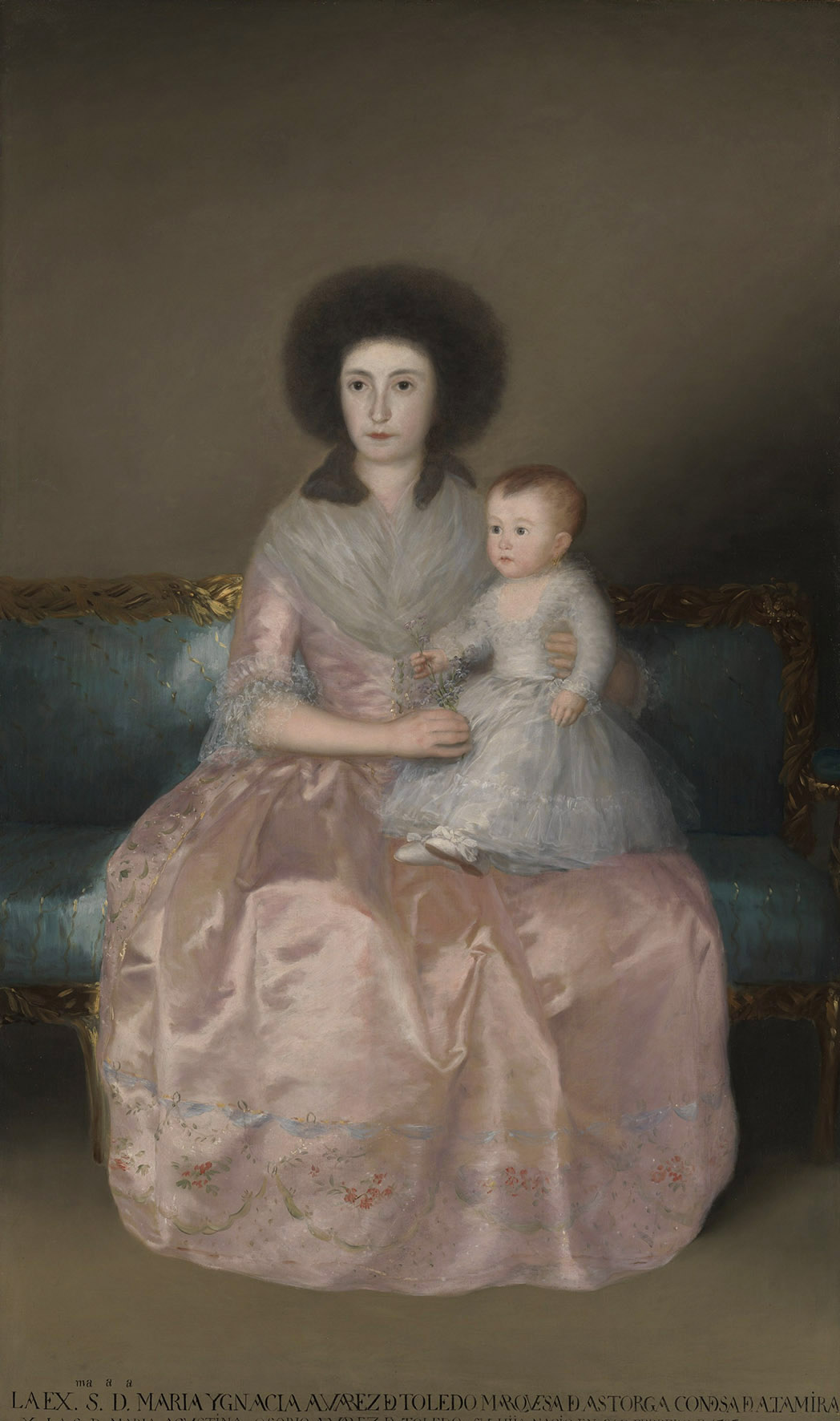
Francisco de Goya (Spanish, 1746-1828) 'Countess of Altamira with her daughter' 1787-1788


Francisco de Goya (Spanish, 1746-1828)
The Countess of Altamira and Her Daughter, María Agustina
1787-1788
Oil on canvas
195 x 115cm
Lent by The Metropolitan Museum of Art, Robert Lehman Collection, 1975
© The Metropolitan Museum of Art, New York


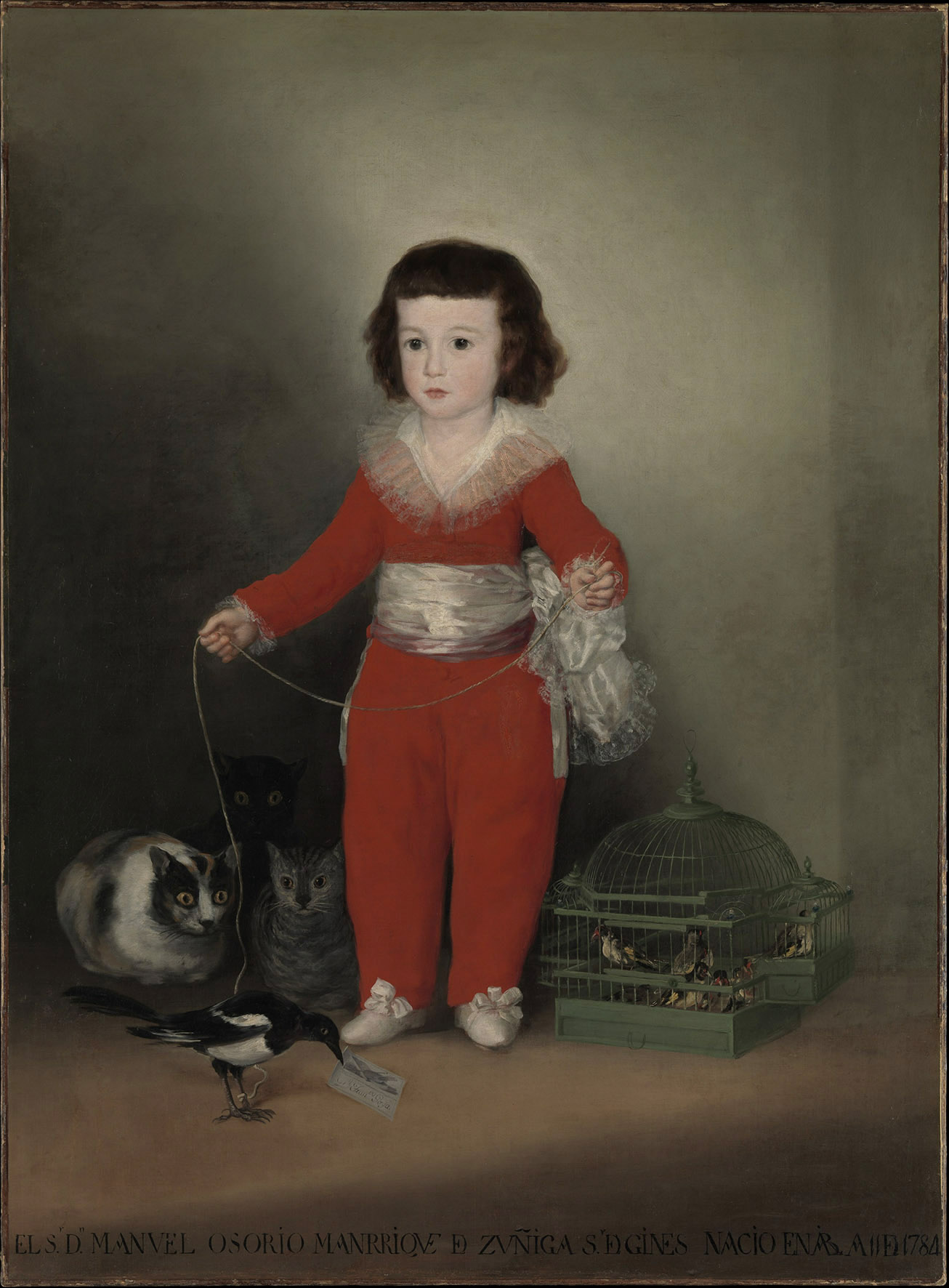
Francisco de Goya (Spanish, 1746-1828) 'Manuel Osorio Manrique de Zuñiga' 1788


Francisco de Goya (Spanish, 1746-1828)
Manuel Osorio Manrique de Zuñiga
1788
Oil on canvas
127 x 101.6cm
Lent by The Metropolitan Museum of Art, The Jules Bache Collection, 1949
© The Metropolitan Museum of Art, New York


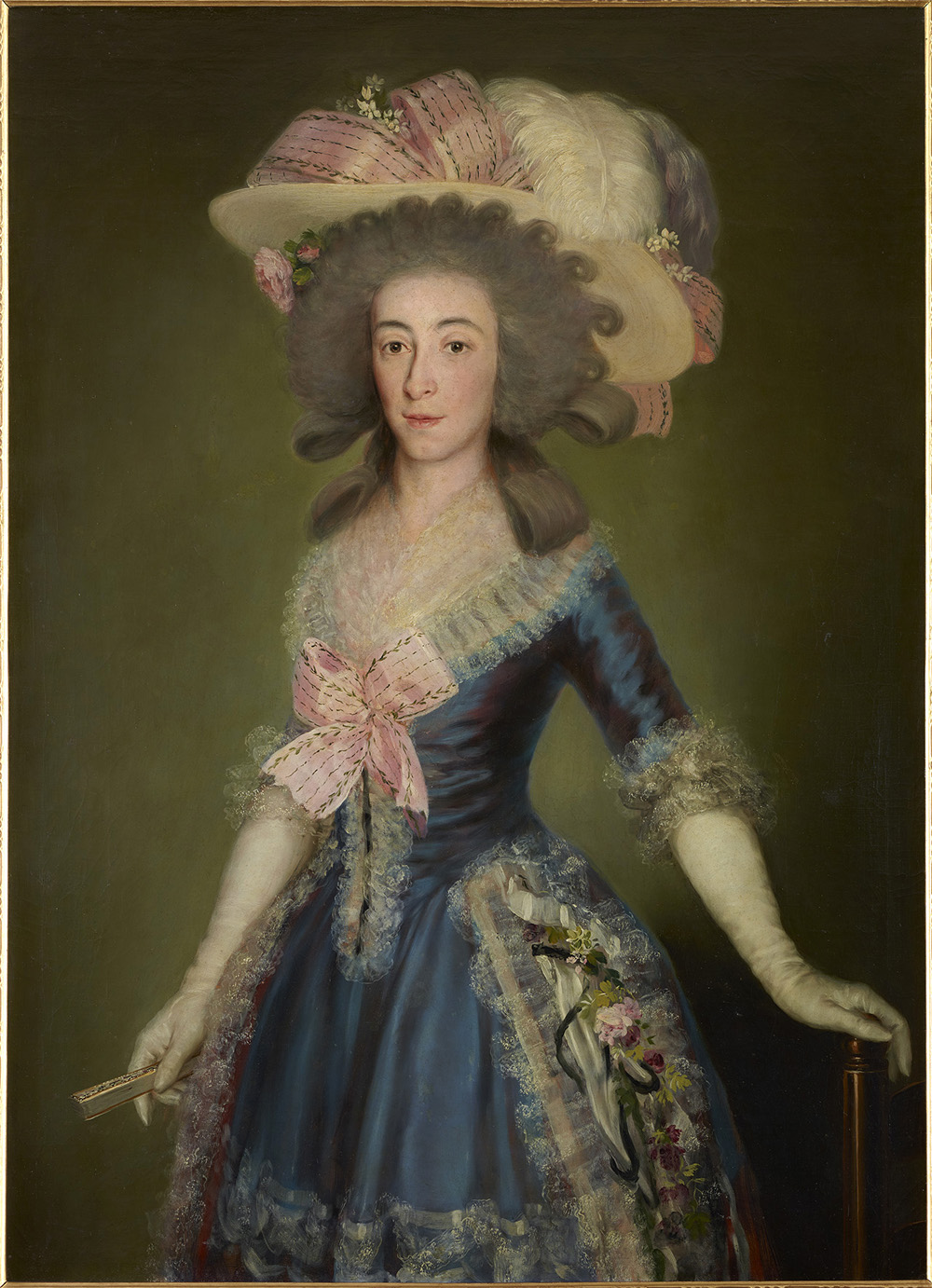
Francisco de Goya (Spanish, 1746-1828) 'Countess-Duchess of Benavente' 1785


Francisco de Goya (Spanish, 1746-1828)
The Countess-Duchess of Benavente
1785
Oil on canvas
105 × 78cm
Private Collection, Spain
© Joaquín Cortés


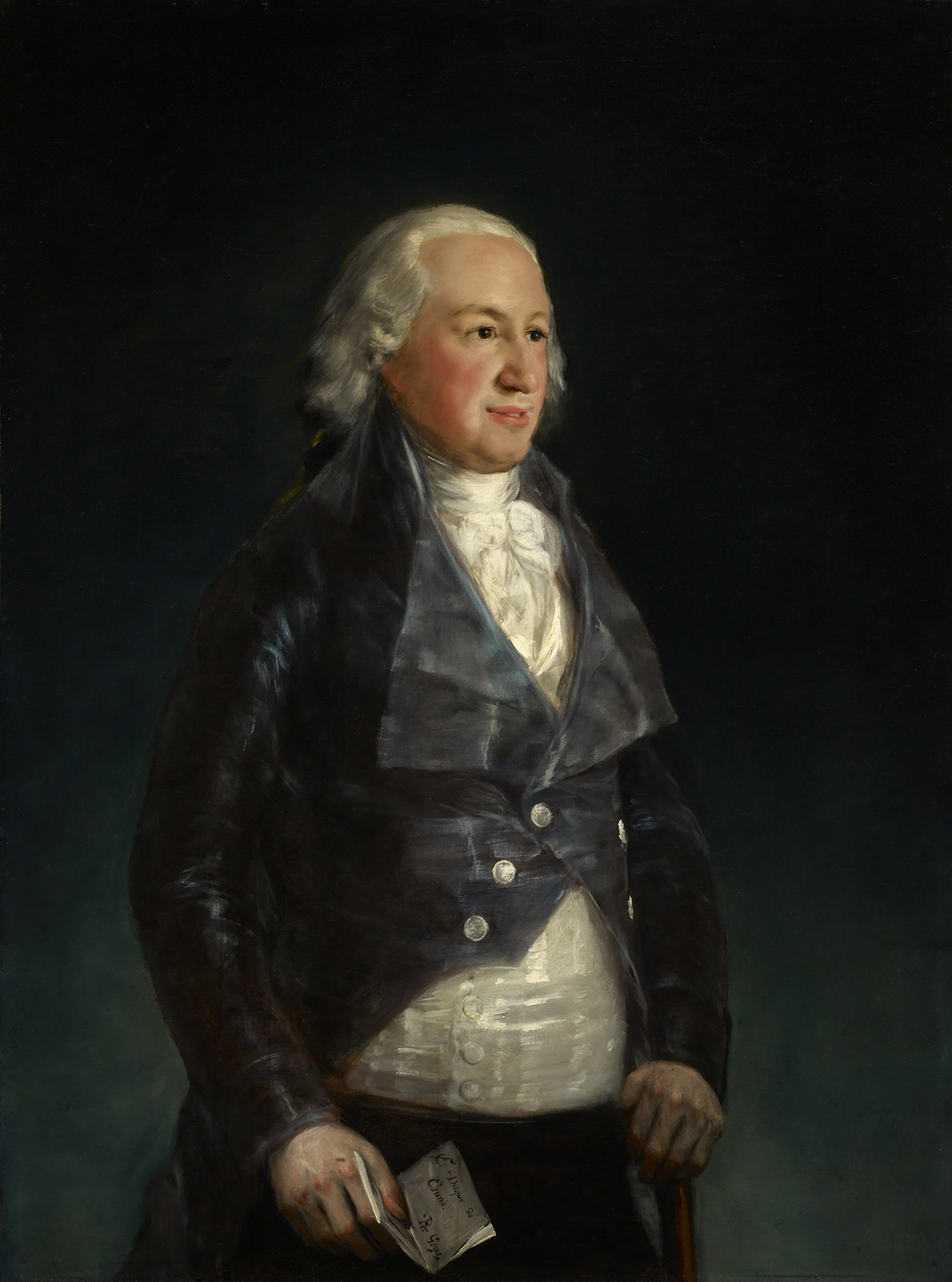
Francisco de Goya (Spanish, 1746-1828) 'Don Pedro, Count of Osuna' 1797-1799


Francisco de Goya (Spanish, 1746-1828)
The Duke of Osuna
1797-1799
Oil on canvas
113 x 83.2cm
The Frick Collection, New York, Purchase, 1943
© The Frick Collection


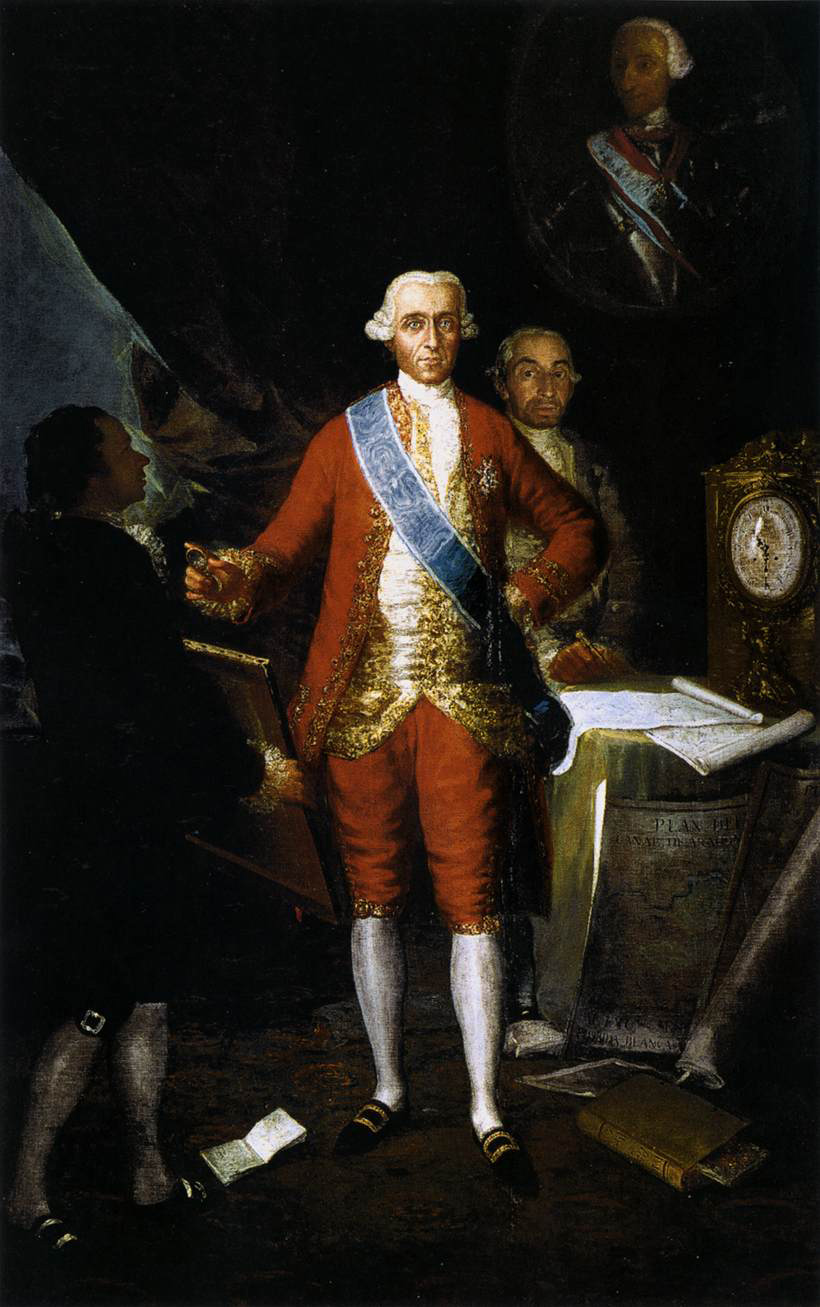
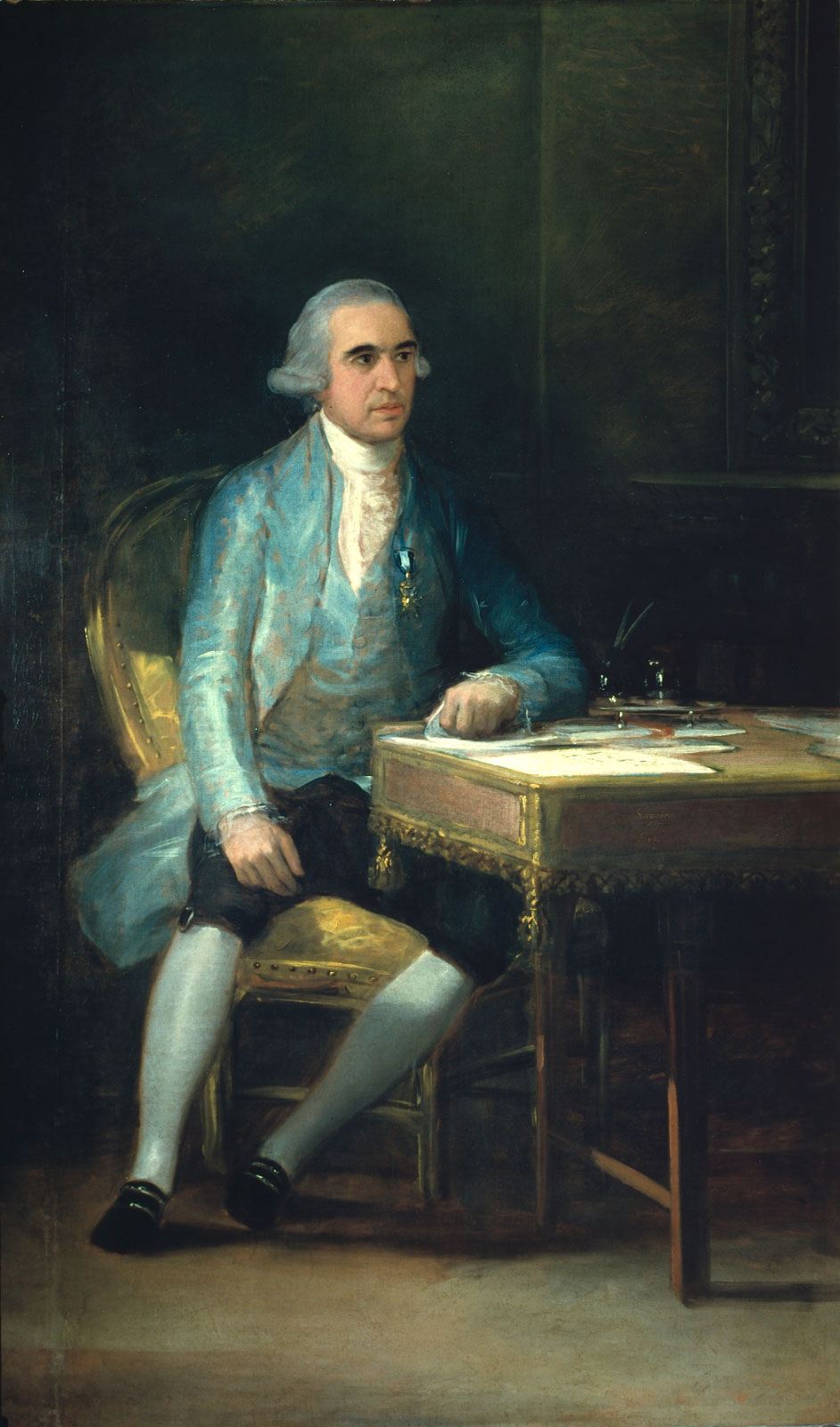
Francisco de Goya (Spanish, 1746-1828) 'Portrait of the Count of Floridablanca' 1783


Francisco de Goya (Spanish, 1746-1828)
Portrait of the Count of Floridablanca
1783
Oil on canvas
262cm (103.1 in). Width: 166cm (65.4 in).
Colección del Banco de España, Madrid


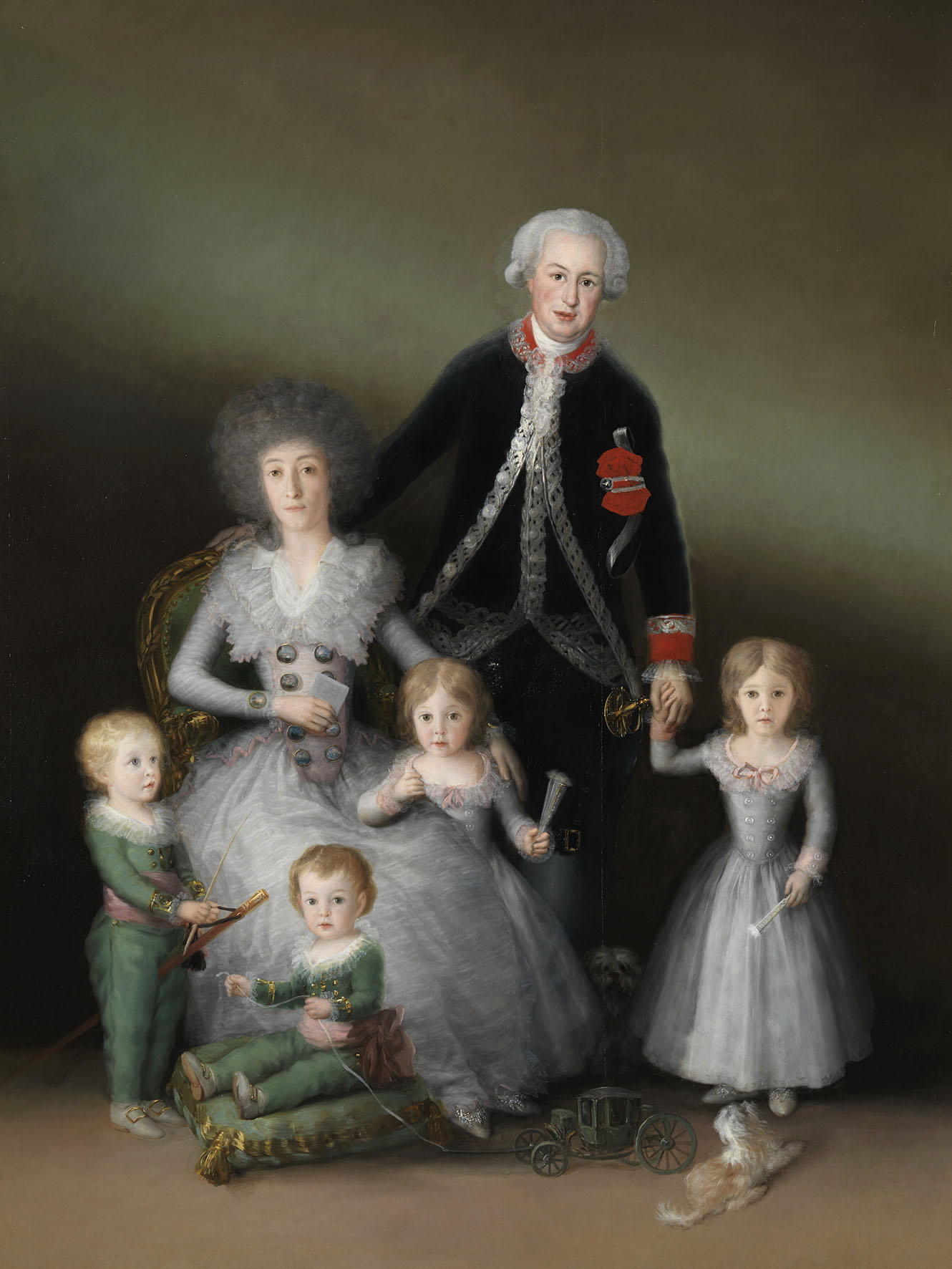
Francisco de Goya (Spanish, 1746-1828) 'The Osuna Family' 1788


Francisco de Goya (Spanish, 1746-1828)
The Duke and Duchess of Osuna and their Children
1788
Oil on canvas
225 x 174cm
Museo Nacional del Prado, Madrid
© Madrid, Museo Nacional del Prado


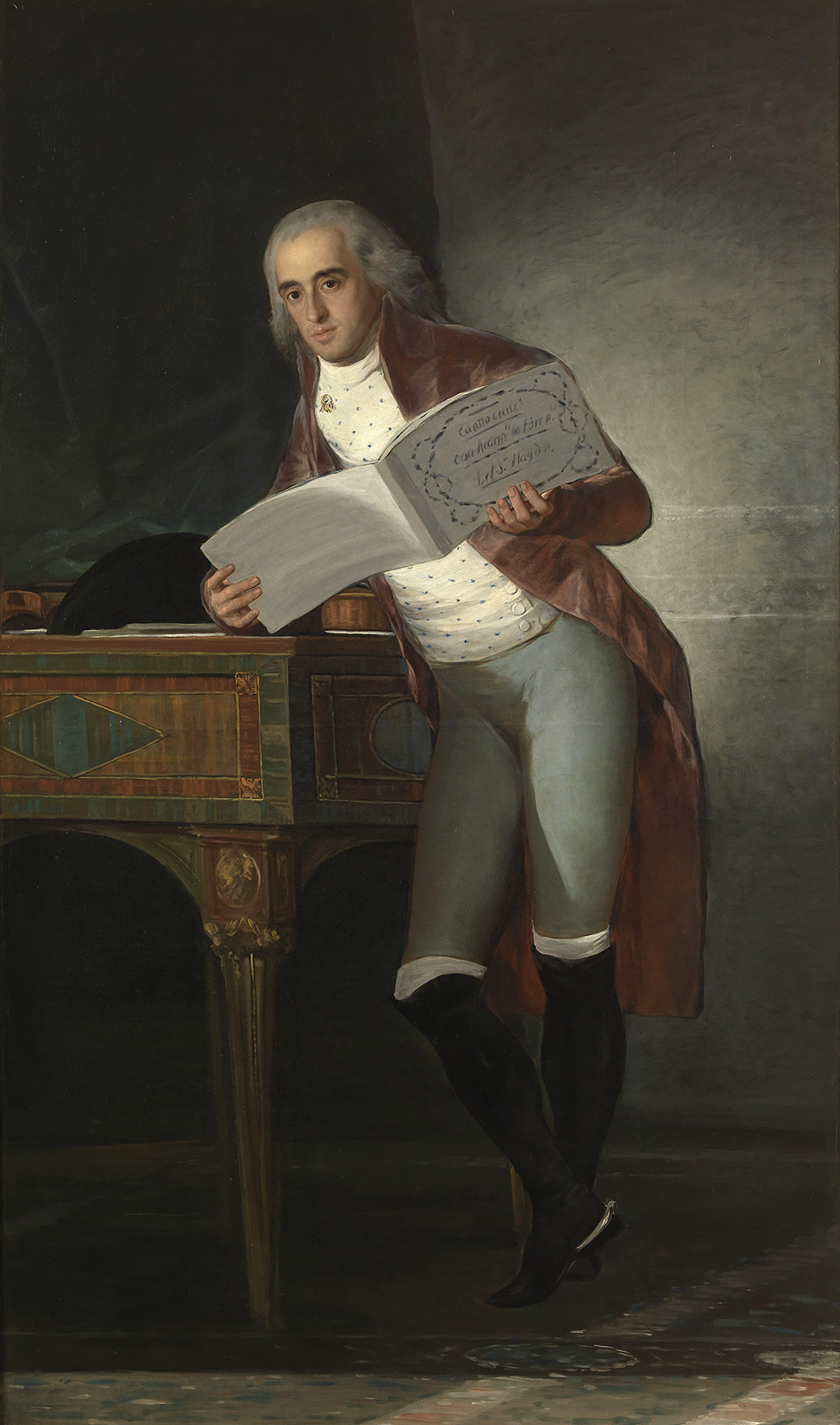
Francisco de Goya (Spanish, 1746-1828) 'The Marquis of Villafranca and Duke of Alba' 1795


Francisco de Goya (Spanish, 1746-1828)
The Marquis of Villafranca and Duke of Alba
1795
Oil on canvas
195 x 126cm
Museo Nacional del Prado, Madrid
© Madrid, Museo Nacional del Prado


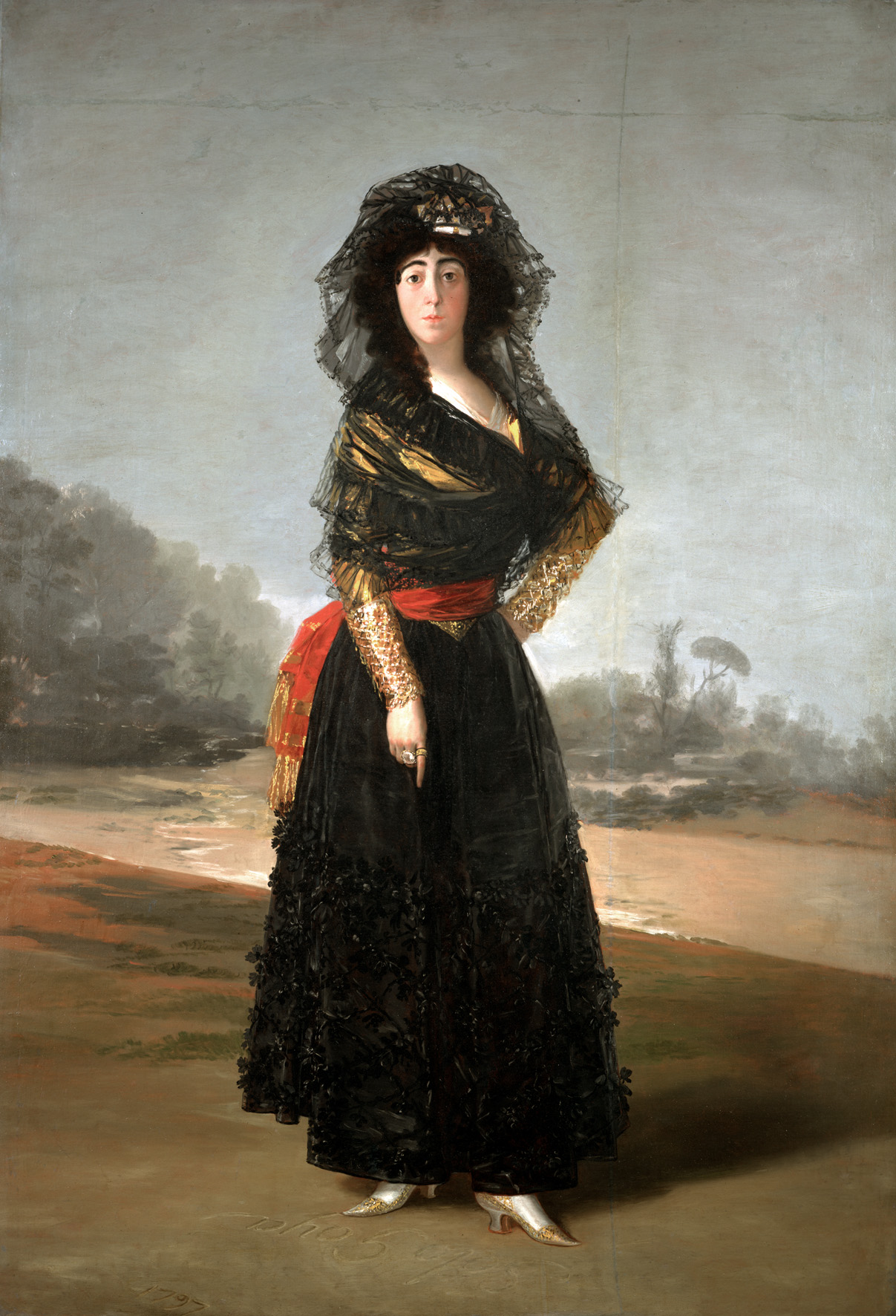
Francisco de Goya (Spanish, 1746-1828) 'The Duchess of Alba' 1797


Francisco de Goya (Spanish, 1746-1828)
The Duchess of Alba
1797
Oil on canvas
210.1 × 149.2cm
On loan from The Hispanic Society of America, New York, NY
© Courtesy of The Hispanic Society of America, New York


Francisco de Goya y Lucientes (1746-1828) is one of Spain’s most celebrated artists. He was an incisive social commentator, considered (even during his own lifetime) as a supremely gifted painter who took the genre of portraiture to new heights. Goya saw beyond the appearances of those who sat before him, subtly revealing their character and psychology within his portraits.

Born before Mozart and Casanova, and surviving Napoleon, Goya’s life spanned more than 80 years during which he witnessed a series of dramatic events that changed the course of European history. Goya: The Portraits will trace the artist’s career, from his early beginnings at the court in Madrid to his appointment as First Court Painter to Charles IV, and as favourite portraitist of the Spanish aristocracy. It will explore the difficult period under Joseph Bonaparte’s rule and the accession to the throne of Ferdinand VII, before concluding with his final years of self-imposed exile in France. Exhibition curator Dr Xavier Bray says:

“The aim of this exhibition is to reappraise Goya’s status as one of the greatest portrait painters in art history. His innovative and unconventional approach took the art of portraiture to new heights through his ability to reveal the inner life of his sitters, even in his grandest and most memorable formal portraits.”

This landmark exhibition will bring to Trafalgar Square more than 60 of Goya’s most outstanding portraits from both public and private collections around the world. These include works that are rarely lent, and some which have never been exhibited publicly before, having remained in possession of the descendants of the sitters. The exhibition will show the variety of media Goya used for his portraits; from life-size paintings on canvas, to the miniatures on copper and his fine black and red chalk drawings. Organised chronologically and thematically, we will for the first time be able to engage with Goya’s technical, stylistic, and psychological development as a portraitist.

From São Paulo to New York, and Mexico to Stockholm, private and institutional lenders have been outstandingly generous, including 10 exceptional loans from the Museo del Prado, Madrid. One of the stars of the show will undoubtedly be the iconic Duchess of Alba (The Hispanic Society of America Museum & Library) which has only once left the United States and has never travelled to Britain. Painted in 1797, this portrait of Goya’s close friend and patron shows the Duchess dressed as a ‘maja’, in a black costume and ‘mantilla’ pointing imperiously at the ground where the words ‘Solo Goya’ (‘Only Goya’) are inscribed.

Other patrons who assisted Goya on his upward trajectory to become First Court Painter, as Velázquez had done more than 150 years before him, are well represented: these include The Count of Floridablanca (Banco de España, Madrid) and The Duke and Duchess of Osuna and their Children (Museo Nacional del Prado, Madrid) – both key and influential patrons. The immense group portrait of The Family of the Infante Don Luis de Borbón (Magnani-Rocca Foundation, Parma), will be reunited with some of the other portraits Goya painted of the Infante’s young family who were living in exile from the Spanish court.

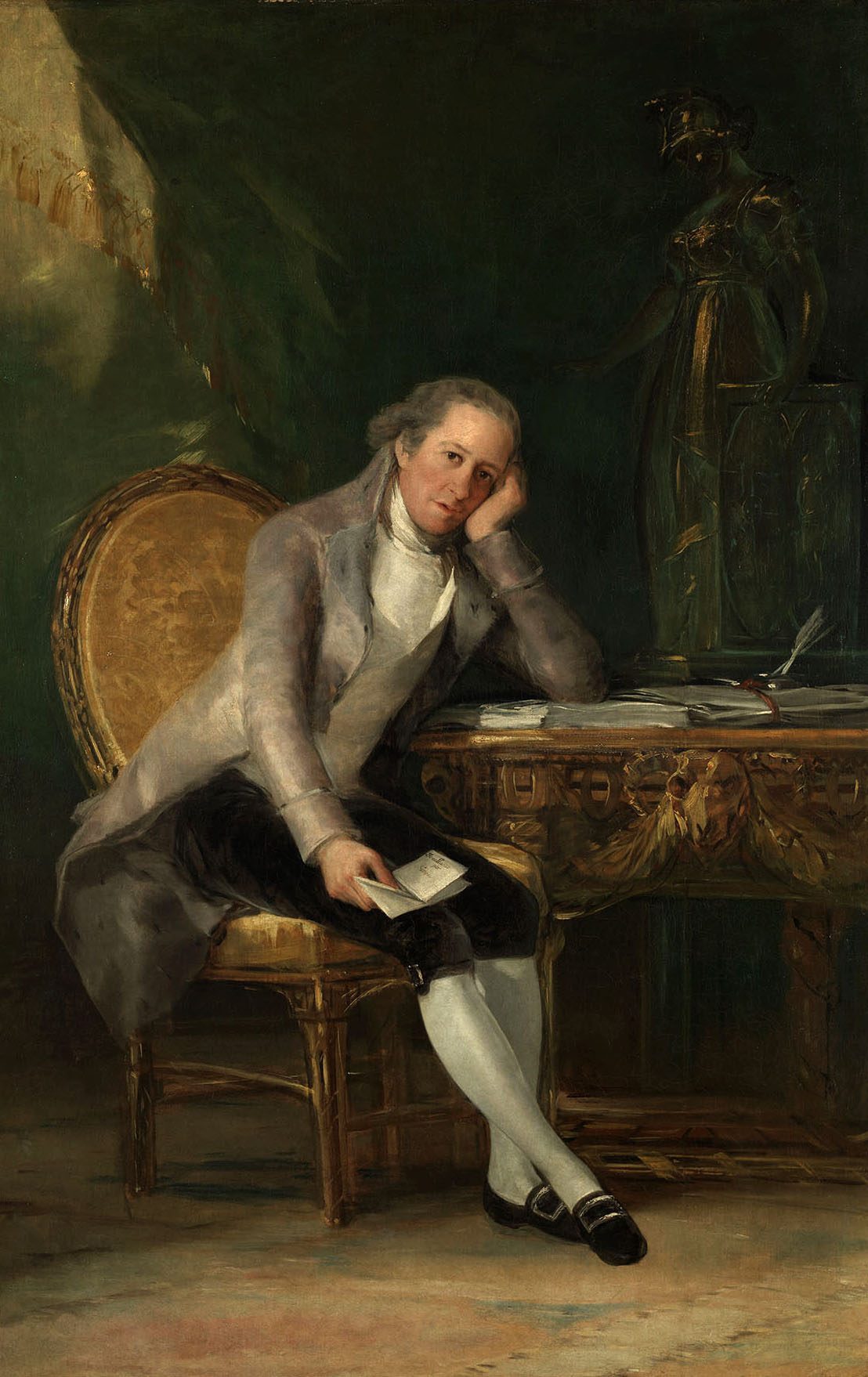
Other highlights will include the charismatic portrait of Don Valentin Bellvís de Moncada y Pizarro (Fondo Cultural Villar Mir, Madrid) which is unpublished and has never been seen before in public, and the rarely exhibited Countess-Duchess Benavente (Private Collection, Spain). The recently conserved 1798 portrait of Government official Francisco de Saavedra (Courtauld Gallery, London) will be exhibited for the first time in more than 50 years alongside its pendant painted in the same year, showing his friend and colleague Gaspar Melchor de Jovellanos (Museo del Prado, Madrid).

The Countess of Altamira and her daughter, María Agustina, which has never been lent internationally from the Lehman Collection at the Metropolitan Museum of Art, New York, will come to Europe for the very first time to be reunited with her husband The Count of Altamira (Banco de España, Madrid) and their son Manuel Osorio Manrique de Zuñiga (The Metropolitan Museum of Art, New York), wearing a fashionably expensive red costume and playing with a pet magpie (which holds the painter’s calling card in its beak). It was shortly after completing his imposing portrait of the Countess, wearing a shimmering embroidered silk gown and shown with an introspective expression, that Goya was appointed court painter to Charles IV, King of Spain.

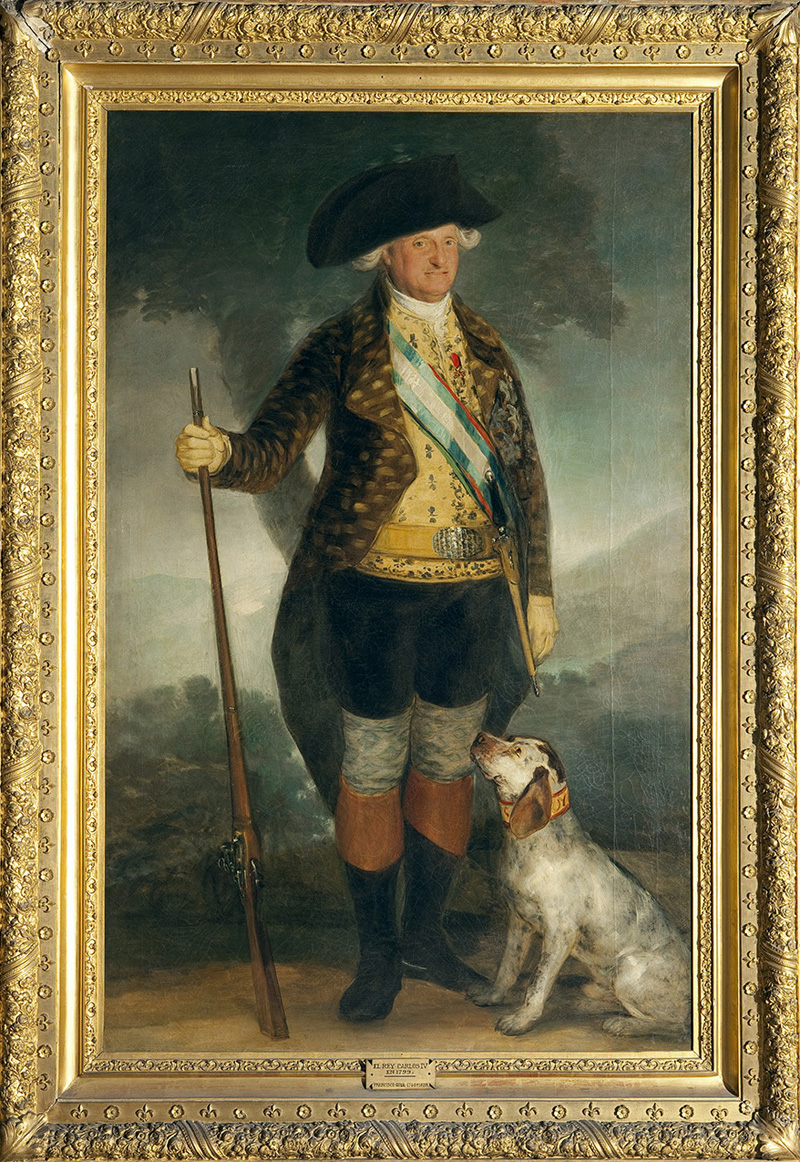
It was in his royal portraits in particular that Goya managed to combine his insightful observation and technical refinement to create unique, memorable portraits; in these he condensed the various aspects of his sitter’s personality into a subtle look or gesture, which often did not flatter his sitters. Charles III in Hunting Dress (Duquesa del Arco) stands in a pose directly inspired by Velázquez’s hunting portraits of the Spanish royal family in the previous century, but the candid portrayal of a weather-beaten face with its marked wrinkles and a somewhat ironic gesture is unique to Goya, clearly revealing to us the personality of the King – an enlightened man, a lover of nature and his people, who wished to be approached as ‘Charles before King’. Similarly, in the portrait of Ferdinand VII (Museo del Prado, Madrid) we can imagine Goya’s mistrust of the pompous and selfish monarch who abolished the constitution and reintroduced the Spanish Inquisition.

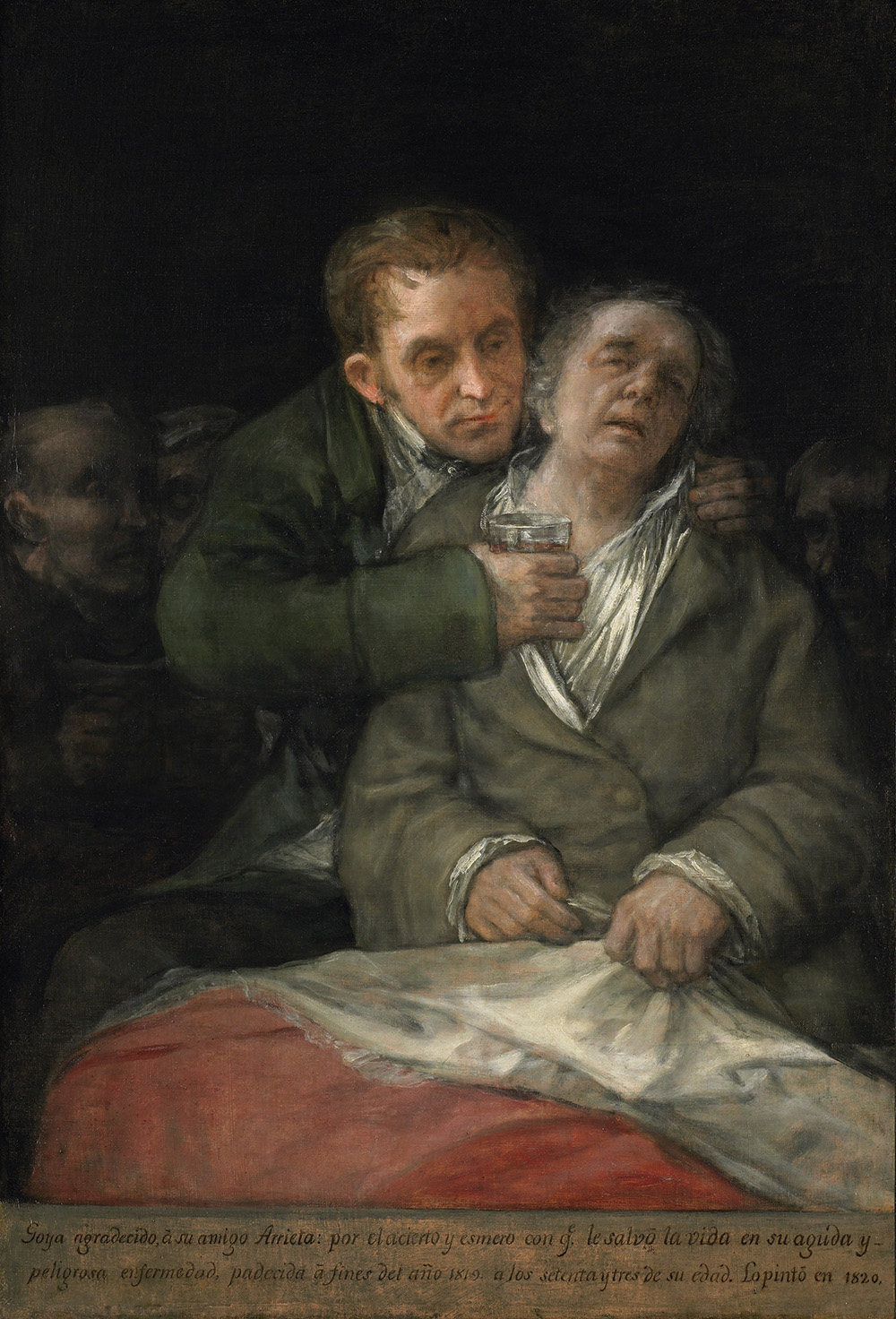
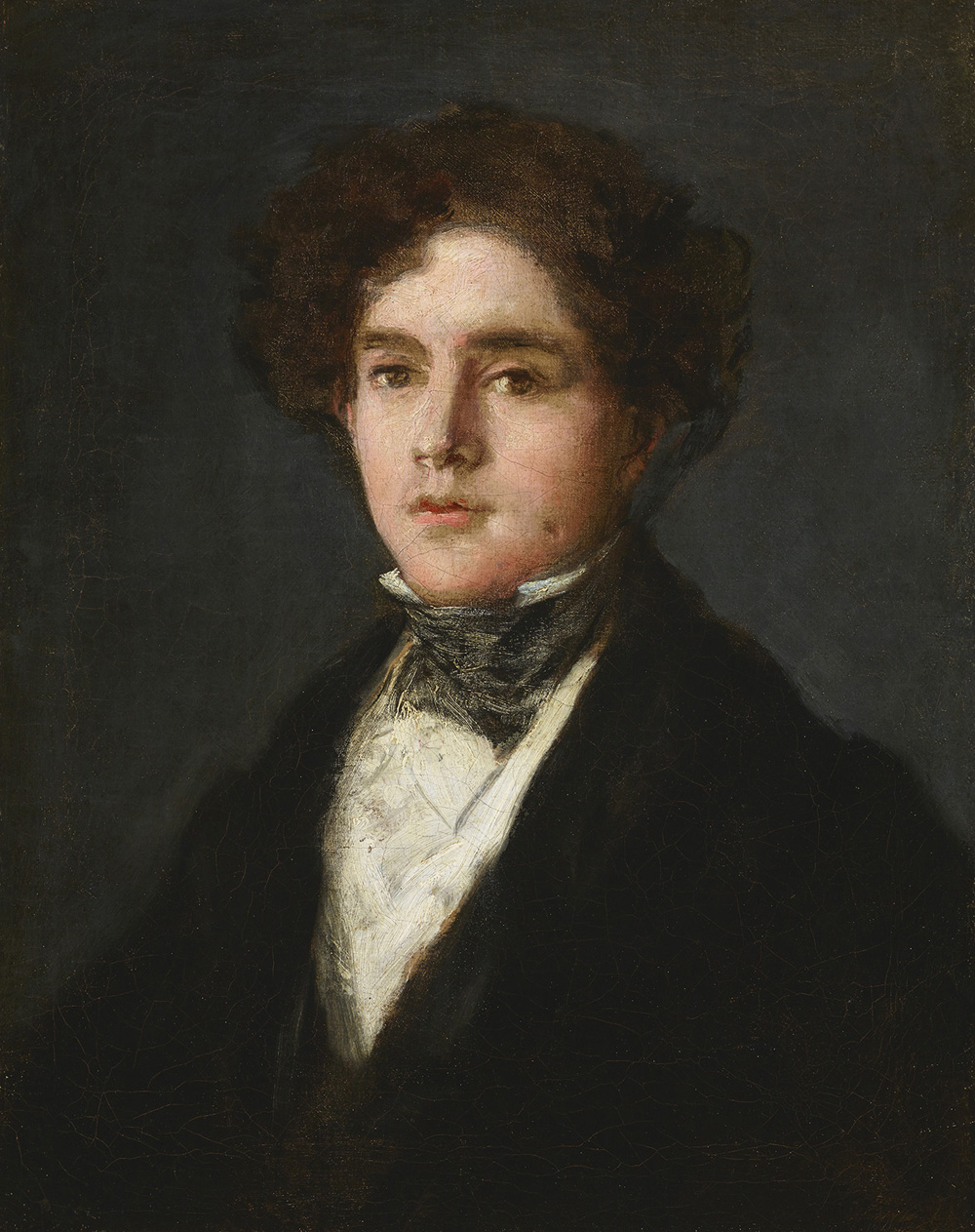
In contrast to the formality of his royal portraits, the exhibition also features more personal works by Goya, including a number of self-portraits in different media, and depictions of his friends and family. 47 years lie between the first Self Portrait (about 1773, Museo Goya, Colección Ibercaja, Zaragoza) in the show, completed when Goya was in his late 20s, and the last, the poignant Self Portrait with Doctor Arrieta (1820, The Minneapolis Institute of Art) painted after an illness from which he almost died when he was 74 years old. There will also be a chance to ‘meet’ the people who were closest to Goya; his wife Josefa Bayeu (Abelló Collection, Madrid), his son Javier Goya (Courtesy of The Metropolitan Museum of Art, Private Collection; Museo de Bellas Artes, Zaragoza) and his best friend and life-long correspondent Martin Zapater (Bilboko Art Eder Museoa / Museo de Bellas Artes de Bilbao). The exhibition also includes the last work Goya ever painted, of his only, beloved grandson Mariano Goya (Meadows Museum, SMU, Dallas) – painted just months before Goya’s death on 16 April, 1828, this portrait is a testament to the genius, skill, and unfaltering creativity of an artist who persevered with his craft to his very last days.

Press release from the National Gallery website
 

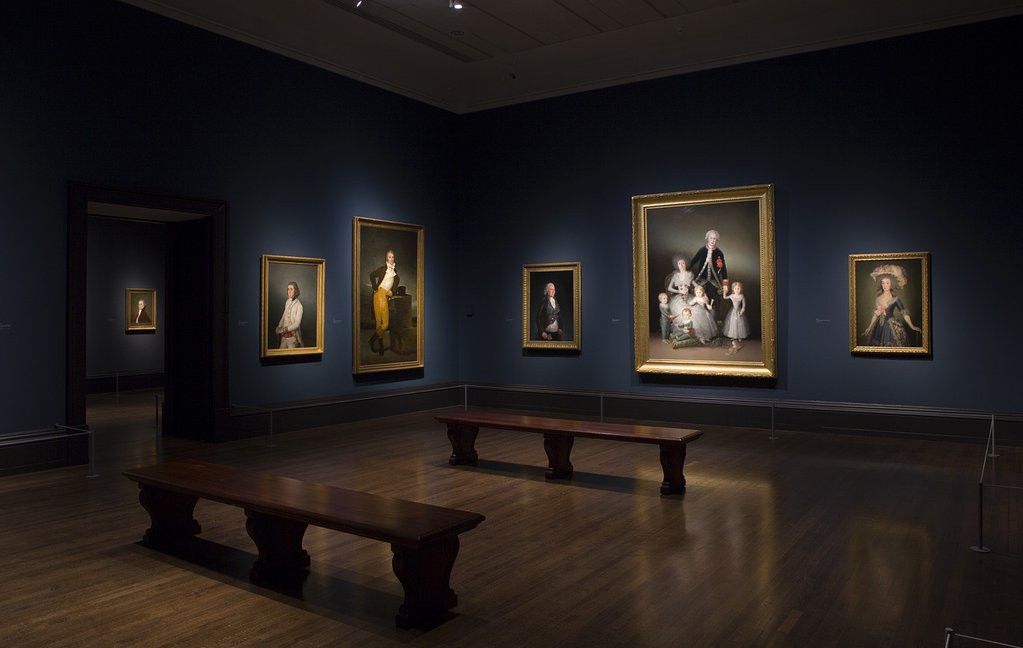
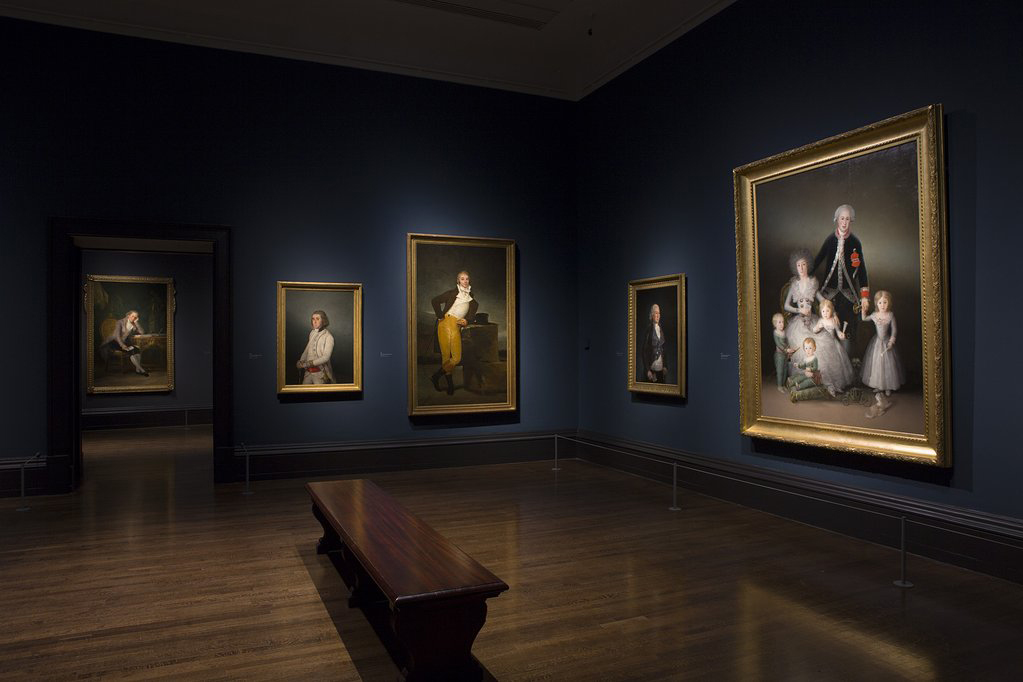
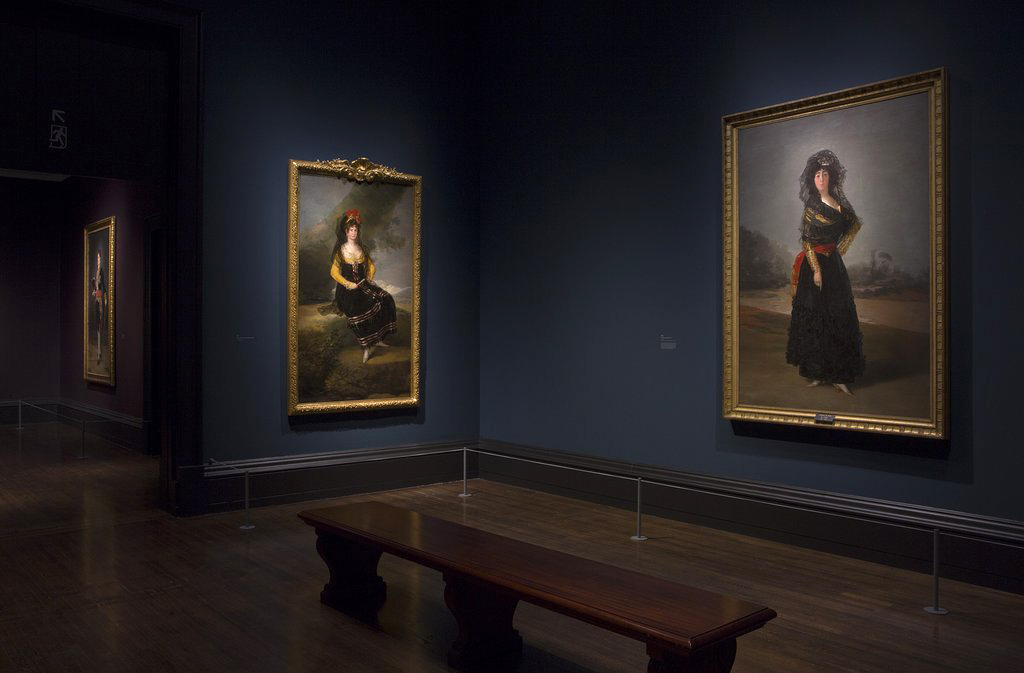
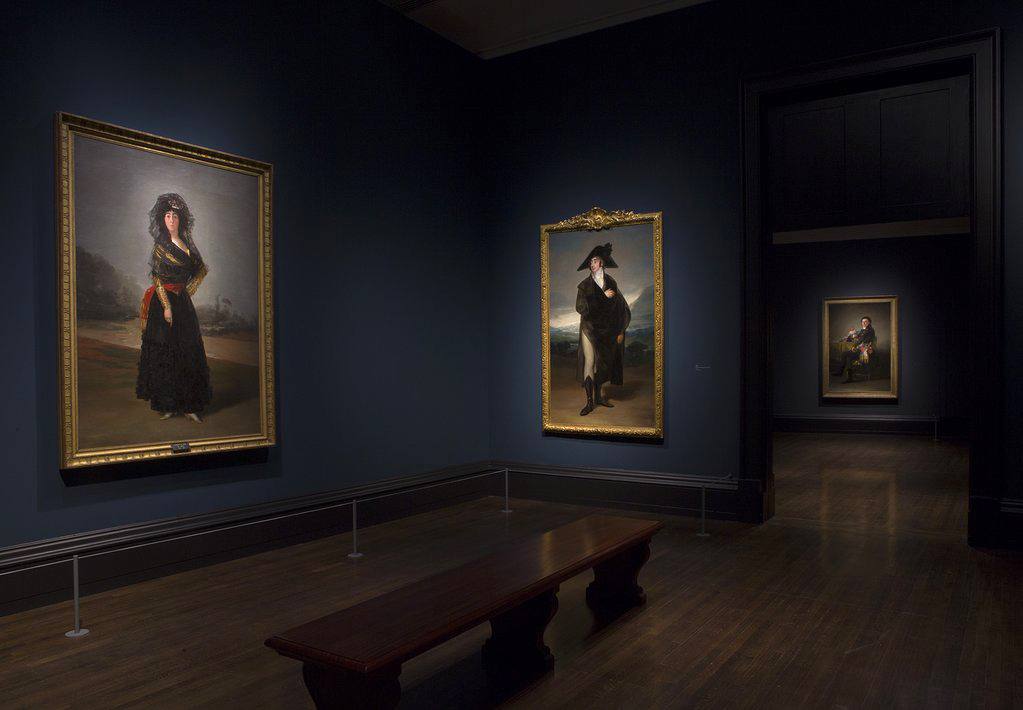
Installation photograph of the exhibition 'Goya: The Portraits' at the National Gallery, London

Installation photograph of the exhibition 'Goya: The Portraits' at the National Gallery, London

Installation photograph of the exhibition 'Goya: The Portraits' at the National Gallery, London

Installation photograph of the exhibition 'Goya: The Portraits' at the National Gallery, London


Installation photographs of the exhibition Goya: The Portraits at the National Gallery, London


Francisco de Goya (Spanish, 1746-1828) 'The Marchioness of Santa Cruz' 1805


Francisco de Goya (Spanish, 1746-1828)
The Marchioness of Santa Cruz
1805
Oil on canvas
124.7 × 207.7cm
Museo Nacional del Prado, Madrid
© Madrid, Museo Nacional del Prado


Francisco de Goya (Spanish, 1746-1828) 'Self Portrait before an Easel' 1792-1795


Francisco de Goya (Spanish, 1746-1828)
Self Portrait before an Easel
1792-1795
Oil on canvas
42 x 28cm
Museo de la Real Academia de Bellas Artes de San Fernando, Madrid
© Museo de la Real Academia de Bellas Artes de San Fernando, Madrid


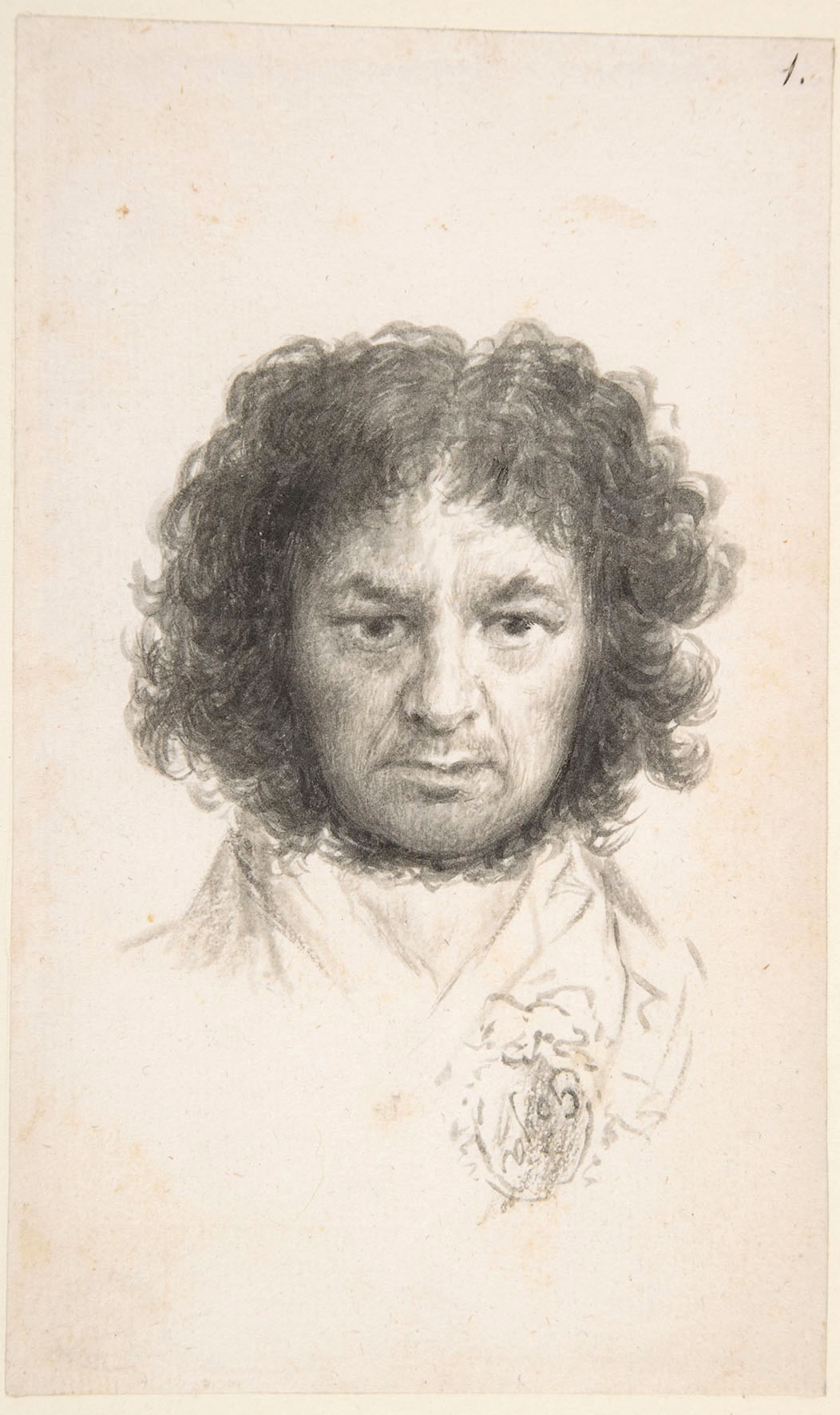
Francisco de Goya (Spanish, 1746-1828) 'Self Portrait after Illness of 1792-1793' 1795-1797


Francisco de Goya (Spanish, 1746-1828)
Self Portrait after Illness of 1792-1793
1795-1797
Brush and grey wash on laid paper
15.3 x 9.1cm
Lent by The Metropolitan Museum of Art, Harris Brisbane Dick Fund, 1935
© The Metropolitan Museum of Art, New York


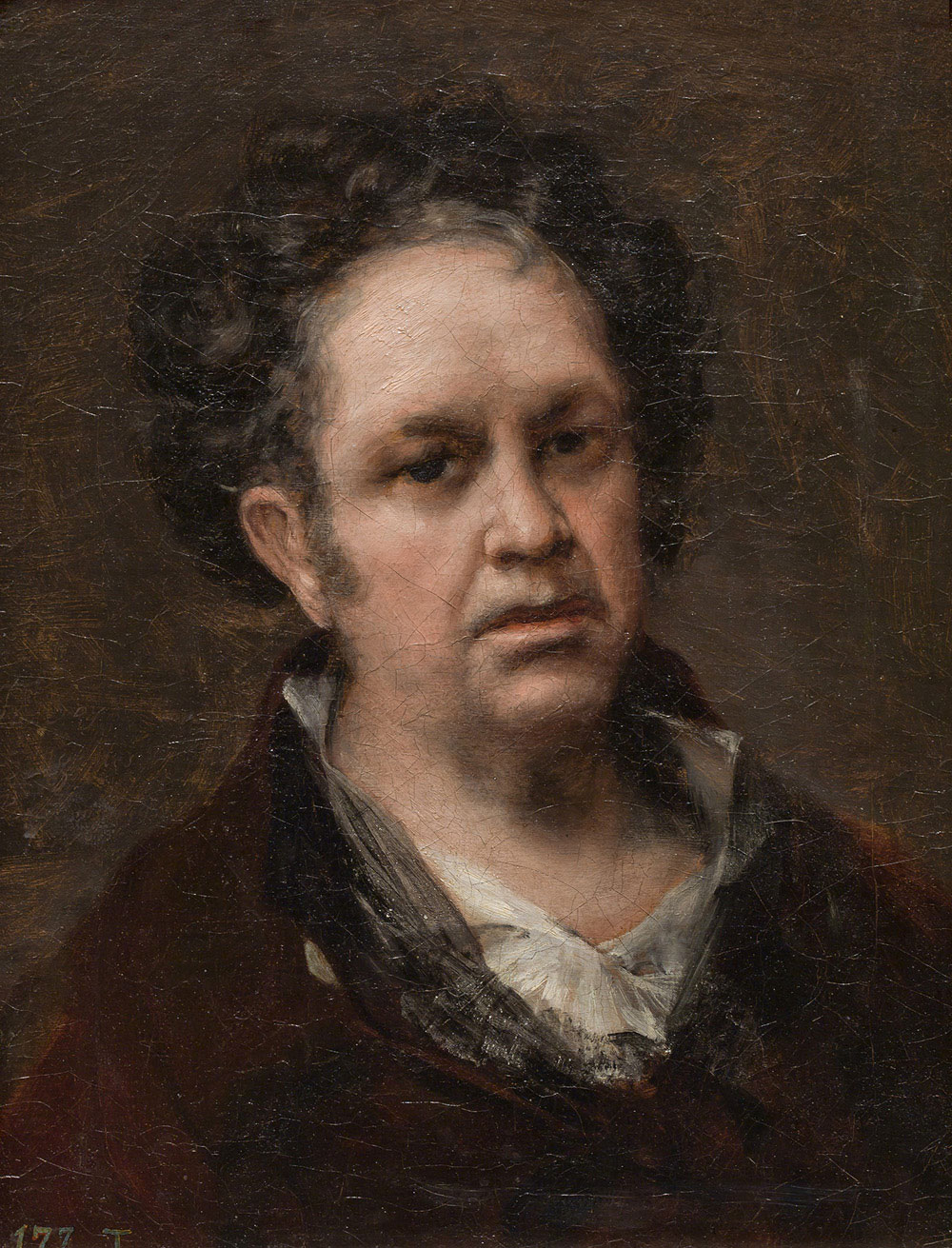
Francisco de Goya (Spanish, 1746-1828) 'Self Portrait' 1815


Francisco de Goya (Spanish, 1746-1828)
Self Portrait
1815
Oil on canvas
45.8 × 35.6cm
Museo Nacional del Prado, Madrid
© Madrid, Museo Nacional del Prado


Francisco de Goya (Spanish, 1746-1828) 'Self Portrait with Doctor Arrieta' 1820


Francisco de Goya (Spanish, 1746-1828)
Self Portrait with Doctor Arrieta
1820
Oil on canvas
114.6 × 76.5cm
Lent by The Minneapolis Institute of Art, The Ethel Morrison Van Derlip Fund
© Minneapolis Institute of Art


Francisco de Goya (Spanish, 1746-1828) 'Gaspar Melchor de Jovellanos' 1798


Francisco de Goya (Spanish, 1746-1828)
Gaspar Melchor de Jovellanos
1798
Oil on canvas
205 x 133cm
Museo Nacional del Prado, Madrid
© Madrid, Museo Nacional del Prado


Francisco de Goya (Spanish, 1746-1828) 'Portrait of Don Francisco de Saavedra' 1798


Francisco de Goya (Spanish, 1746-1828)
Portrait of Don Francisco de Saavedra
1798
The Samuel Courtauld Trust, The Courtauld Gallery, London


The Spanish politician Francisco de Saavedra was noted for his integrity. In late 1798 Saavedra and his great friend and ally, Gaspar de Jovellanos, were appointed to the two highest political offices in Spain: Minister of Finance and Minister of State. Jovellanos was one of Goya’s most consistent supporters, and the two men commissioned a pair of portraits from him.

The two pictures are closely related. In each, the sitter faces to the right, and sits on a round-backed chair beside a table. But while Jovellanos is thoughtful, Saavedra seems about to leave his paper-strewn desk having decided on a course of action. The simplicity of the background may be influenced by Goya’s knowledge of eighteenth-century English portraiture. It could, however, have been chosen by Saavedra, who was known for the well ordered and ‘English’ character of his household.


Francisco de Goya (Spanish, 1746-1828) 'Charles IV in Hunting Dress' 1799


Francisco de Goya (Spanish, 1746-1828)
Charles IV in Hunting Dress
1799
Oil on canvas
205 x 129cm
Colecciones Reales, Patrimonio Nacional, Palacio Real de Madrid
© Patrimonio Nacional


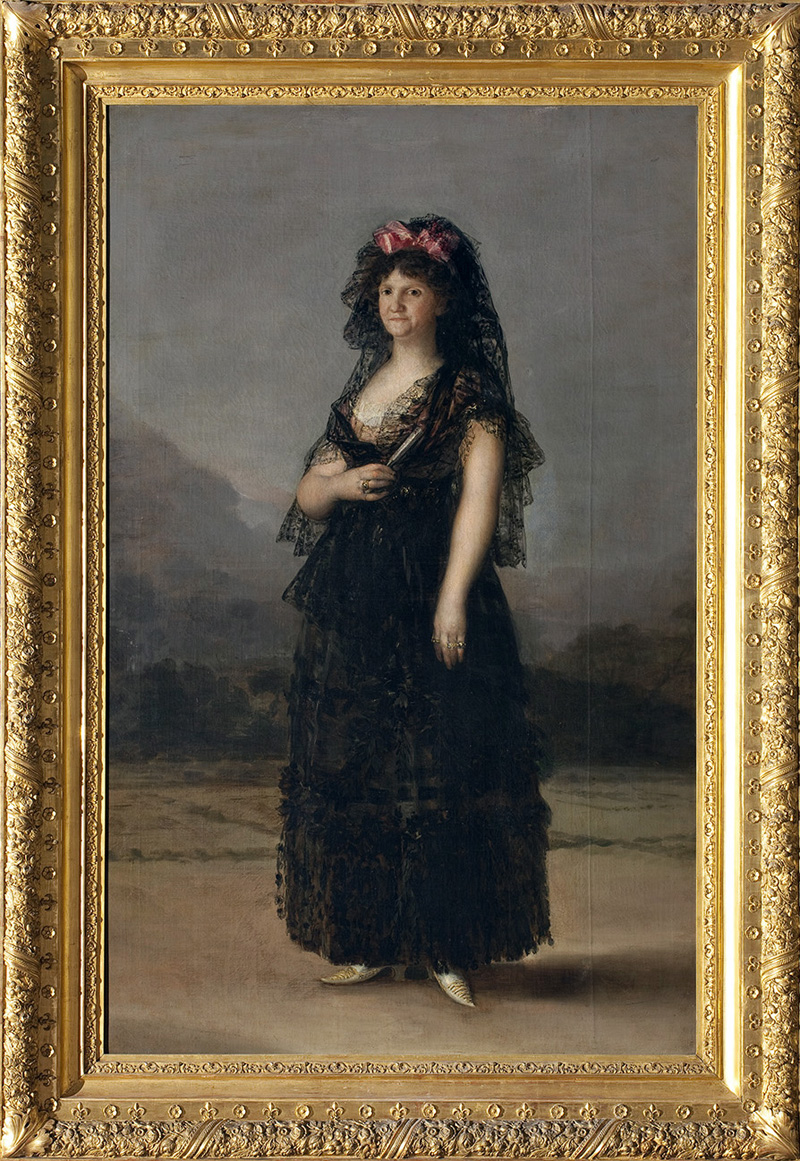
Francisco de Goya (Spanish, 1746-1828) 'María Luisa wearing a Mantilla' 1799


Francisco de Goya (Spanish, 1746-1828)
María Luisa wearing a Mantilla
1799
Oil on canvas
205 x 130cm
Colecciones Reales, Patrimonio Nacional, Palacio Real de Madrid
© Patrimonio Nacional


Francisco de Goya (Spanish, 1746-1828) 'Portrait of Mariano Goya, the Artist's Grandson' 1827


Francisco de Goya (Spanish, 1746-1828)
Mariano Goya y Goicoechea (the artist’s grandson)
1827
Oil on canvas
52.1 x 41.3cm
Meadows Museum, SMU, Dallas. Museum Purchase with Funds Donated by the Meadows Foundation and a Gift from Mrs Eugene McDermott, in honour of the Meadows Museum’s 50th Anniversary
© Photograph by Michael Bodycomb


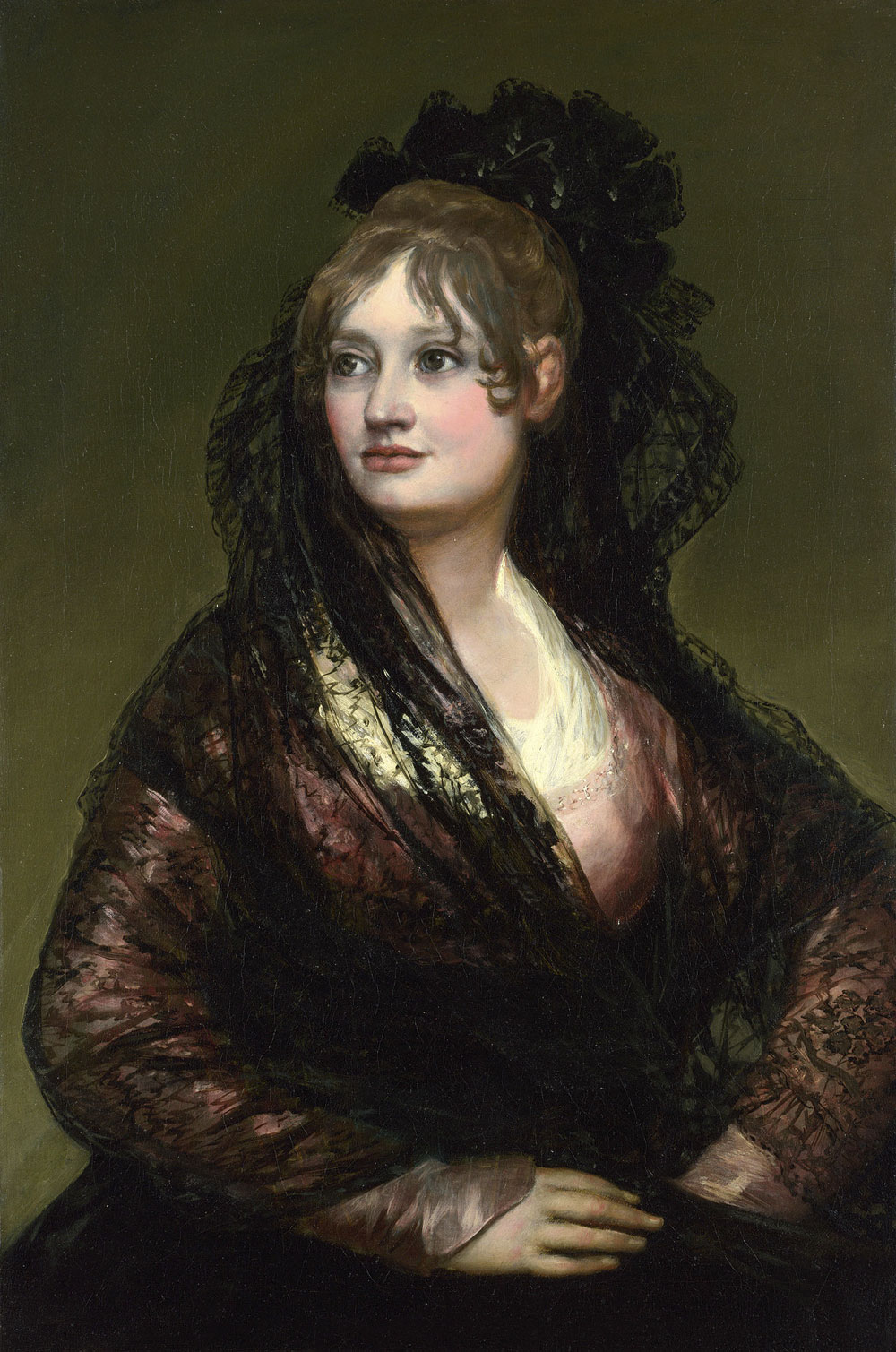
Francisco de Goya (Spanish, 1746-1828) 'Doña Isabel de Porcel' before 1805


Francisco de Goya (Spanish, 1746-1828)
Doña Isabel de Porcel
before 1805
Oil on canvas
82 x 54.6cm
The National Gallery, London, bought, 1896
© The National Gallery, London


The exhibition Goya: The Portraits includes around 70 works unquestionably by his hand, provides us with a unique opportunity to look more closely at Portrait of Doña Isabel de Porcel and ask the question: is she really by Goya? This Room 1 display will present historical information surrounding the portrait and its acquisition by the National Gallery in 1896, together with technical evidence, including an X-ray image which reveals an earlier portrait painted underneath.

Who was Doña Isabel de Porcel?

The sitter has long been identified as Doña Isabel Lobo de Porcel on account of an inscription on the back of the original canvas. Goya exhibited a portrait of Doña Isabel Lobo de Porcel in Madrid in 1805, and this has traditionally been linked to the National Gallery painting. Isabel married Antonio Porcel (Secretary of State for Spain’s American Colonies) in 1802 and the couple had four children. Isabel died in 1842, surviving her husband by 10 years. Antonio, who was a political associate of Goya’s friend and patron Gaspar Melchor de Jovellanos (whose portrait can be seen in Goya: The Portraits), was also painted by Goya in 1806, but his portrait was destroyed by fire in 1953.

The National Gallery’s purchase of Portrait of Doña Isabel de Porcel

The National Gallery bought Portrait of Doña Isabel de Porcel in June 1896 for just over £404. It was among the first pictures by the artist – and the very first portrait by Goya – to enter the National Gallery collection, having made its first Goya purchases (A Picnic and A Scene from ‘The Forcibly Bewitched’) the previous month. The portrait was no longer owned by the sitter’s descendants when the Gallery acquired it, having been sold by the Porcel y Zayas family from Granada, in whose possession it had apparently remained until around 1887, to Don Isidro de Urzáiz Garro (d. 1894). It was from the latter’s heir, Andrés de Urzáiz (1866-1912), that the Gallery acquired the portrait about 10 years later.

A question of attribution

The glamorous sitter is shown wearing a black lace ‘mantilla’, a traditional headdress which became fashionable among the Spanish aristocracy in the late 18th century. Although painted with tremendous flair, the picture’s brushwork – when compared with Goya’s other portraits – lacks his customary subtlety in describing transparencies and textures. Isabel is extremely charismatic but we struggle to grasp her psychological state – something in which Goya invariably excelled.

The hidden portrait

When an X-ray image was made of the Portrait of Doña Isabel de Porcel during conservation treatment in 1980, another portrait was unexpectedly found underneath. The head and striped jacket of the underlying figure are clearly visible in the X-ray, and Doña Isabel de Porcel was painted directly on top of the initial portrait, without first hiding it with new priming. Although perhaps surprising, this is not unique in Goya’s work. During the period of political upheaval in Spain at the turn of the 19th century, Goya – and other artists – had to be resourceful and adapt to circumstance, recycling canvases as their patrons fell in and out of political favour. Doña Isabel de Porcel must have been painted soon after the underlying portrait, since no dirt is visible between the paint layers of the two figures. A clearer image of the underlying portrait has recently been obtained by using an X-ray fluorescence scanning spectrometer, a cutting-edge piece of analytical technology on loan to the National Gallery through collaboration with Delft University of Technology, which maps the chemical elements in the paint.

Letizia Treves, National Gallery Curator of Italian and Spanish Paintings 1600-1800, says:

“Goya is one of the most admired and imitated painters in the history of art. Pastiches and forgeries of his works proliferated on the European and American art market in the second half of the 19th and early 20th centuries. The technical studies and provenance information regarding the Portrait of Doña Isabel de Porcel are inconclusive so far as Goya’s authorship is concerned, and the attributional status of the painting rests largely on perceptions of quality and on how close it comes to works that are indisputably by the artist – something we all have a unique opportunity to explore during the exhibition Goya: The Portraits. If it is a pastiche, it has been carried out with such impressive skill that its long-standing attribution to Goya has convinced several generations of specialists and gallery visitors.”


Francisco de Goya (Spanish, 1746-1828) 'Martín Zapater' 1797


Francisco de Goya (Spanish, 1746-1828)
Martín Zapater
1797
Oil on canvas
83 x 65cm
Bilbao Fine Arts Museum
© Bilboko Arte Ederren Museoa-Museo de Bellas Artes de Bilbao


Francisco de Goya (Spanish, 1746-1828) 'Ferdinand VII in Court Dress' 1814-1815


Francisco de Goya (Spanish, 1746-1828)
Ferdinand VII in Court Dress
1814-1815
Oil on canvas
208 x 142.5cm
Museo Nacional del Prado. Madrid
© Madrid, Museo Nacional del Prado


Francisco de Goya (Spanish, 1746-1828) 'Don Valentín Bellvís de Moncada y Pizarro' around 1795


Francisco de Goya (Spanish, 1746-1828)
Don Valentín Bellvís de Moncada y Pizarro
around 1795
Oil on canvas
115 x 83cm
Fondo Cultural Villar Mir, Madrid
© Fondo Cultural Villar Mir, Madrid


The National Gallery
Trafalgar Square, London WC2N 5DN

Opening hours:
Daily 10am – 6pm
Friday 10am – 9pm
The National Gallery website

LIKE ART BLART ON FACEBOOK

Back to top