Exhibition: ‘TO BE SEEN: Queer Lives 1900-1950’ at the Munich Documentation Center for the History of National Socialism

Exhibition dates: 7th October, 2022 – 21st May, 2023

Head Curator: Karolina Kühn
Curators: Juliane Bischoff, Angela Hermann, Sebastian Huber, Anna Straetmans, Ulla-Britta Vollhardt
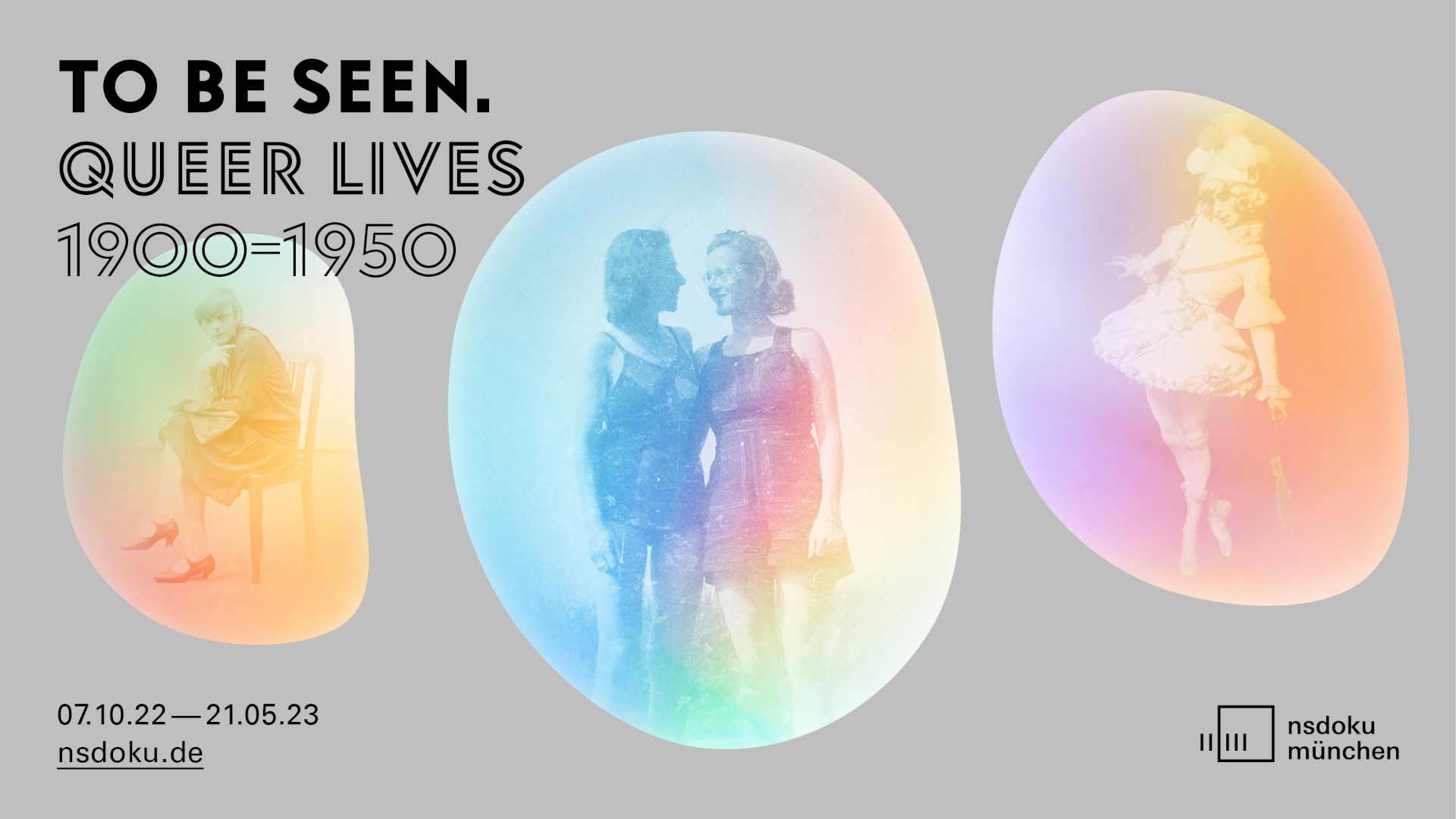
 

'TO BE SEEN: Queer Lives 1900-1950' promo poster


Wer’e here, we’re queer, we’re not going anywhere.

Despite years of persecution, death and inequality, the presence of queer identity, diversity and creativity remains undimmed.

There are some fabulous, groundbreaking human beings who are “being seen” in this posting. Equally, there are some fabulous art works that illuminate the(ir) human condition.

Let’s celebrate their existence.

Dr Marcus Bunyan


Many thankx to the Munich Documentation Center for the History of National Socialism for allowing me to publish the photographs in the posting. Please click on the photographs for a larger version of the image.


About the exhibition

TO BE SEEN is an exhibition devoted to the stories of LGBTQI+ in Germany in the first half of the twentieth century. Through historical testimony and artistic positions from then and now, it traces queer lives and networks, the areas of freedom enjoyed by LGBTQI+, and the persecution they suffered.

The exhibition takes an intimate look at a variety of genders, bodies, and identities. It shows how queer life became ever more visible during the 1920s, giving rise to a more open treatment of role models and of desire. During this period, homosexual, trans, and non-binary people achieved their first successes in their fight for equal rights and social acceptance. They organised, fought for scientific and legal recognition of their gender identity, and carved out their own spaces.

But as recognition and visibility in art and culture, science, politics, and society increased, so did resistance. After the Nazis came to power, the LGBTQI+ subculture was largely destroyed. After 1945, their stories and fates were scarcely archived or remembered.

Text from the Munich Documentation Center for the History of National Socialism website


“When a right is withheld from you, you must fight and not give in; that is a moral duty.”


Joseph Schedel opened the first meeting of the Scientific-Humanitarian Committee of Munich on September 24, 1902
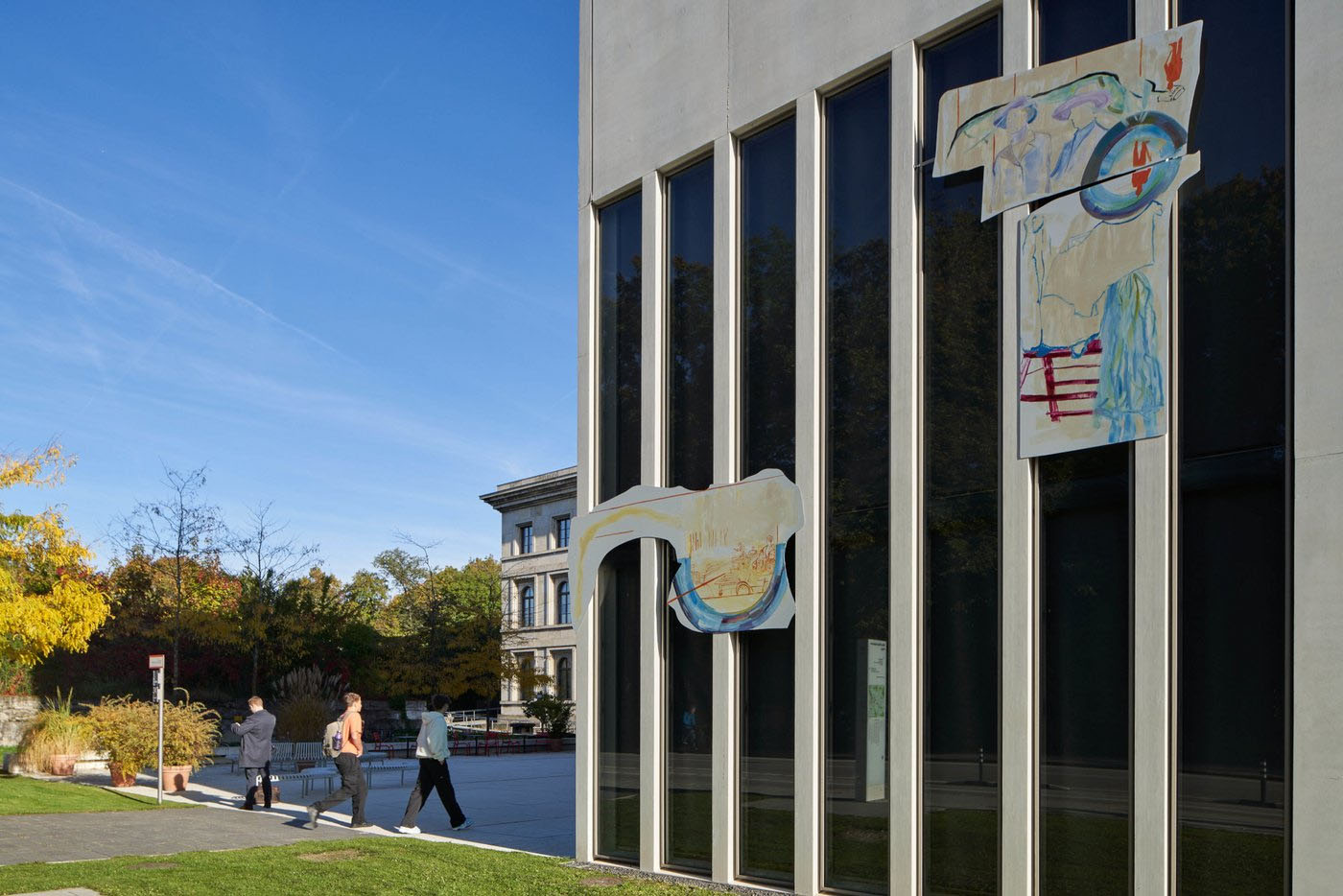


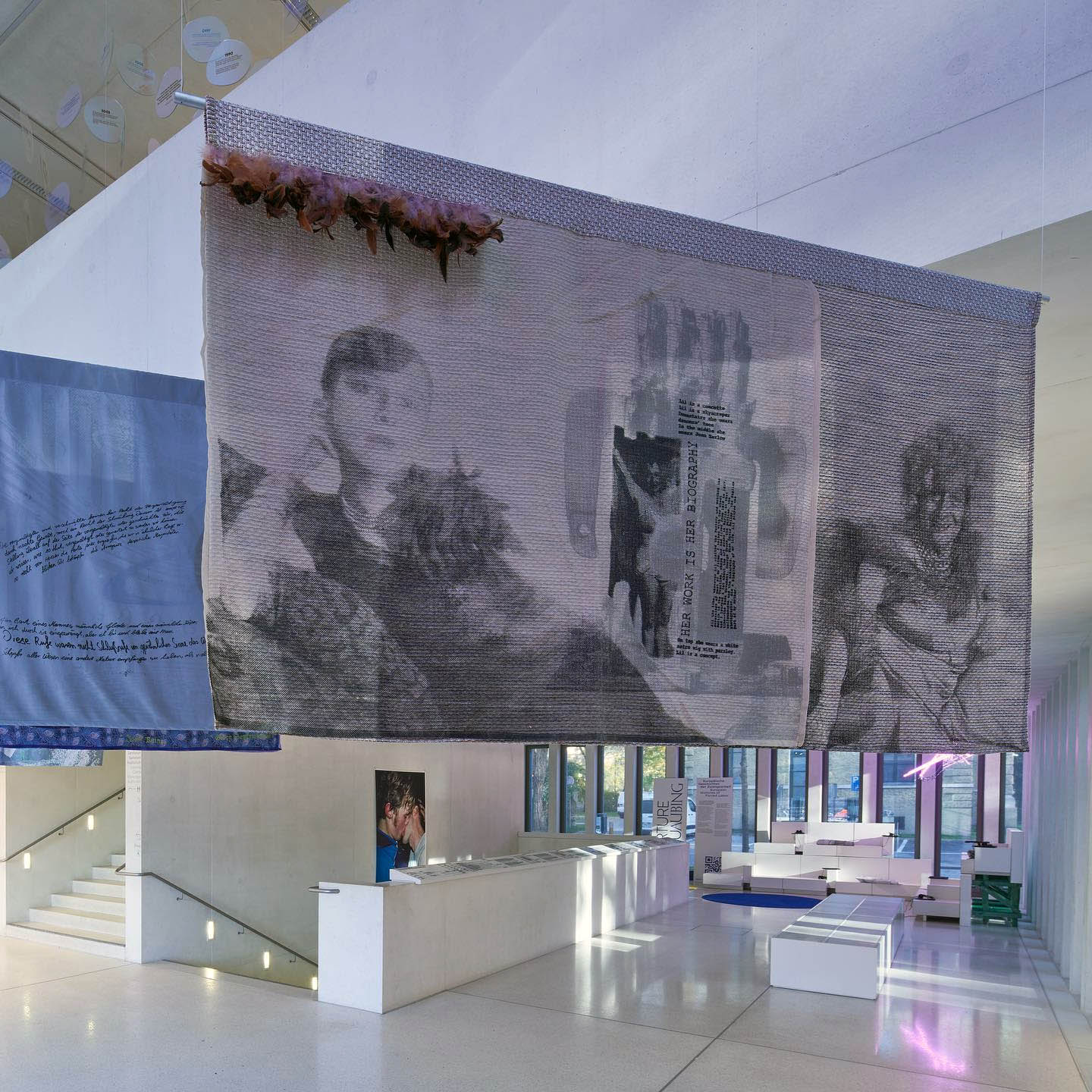
Exterior view of the NS Documentation Center in Munich showing a work in the exhibition TO BE SEEN: Queer Lives 1900-1950 – Maximiliane Baumgartner's '"You look at us – we look at you": Rubbing against the architecture of the executive gaze (Based on a paper by Anita Augspurg 'Mißgriffe der Polizei' / 'Abuses by the Police', 1902)' 2021


Exterior view of the NS Documentation Center in Munich showing a work in the exhibition TO BE SEEN: Queer Lives 1900-1950 – Maximiliane Baumgartner’s “You look at us – we look at you”: Rubbing against the architecture of the executive gaze (Based on a paper by Anita Augspurg ‘Mißgriffe der Polizei’ / ‘Abuses by the Police’, 1902) 2021
Photo: Connolly Weber Photography/NS-Dokumentationszentrum München
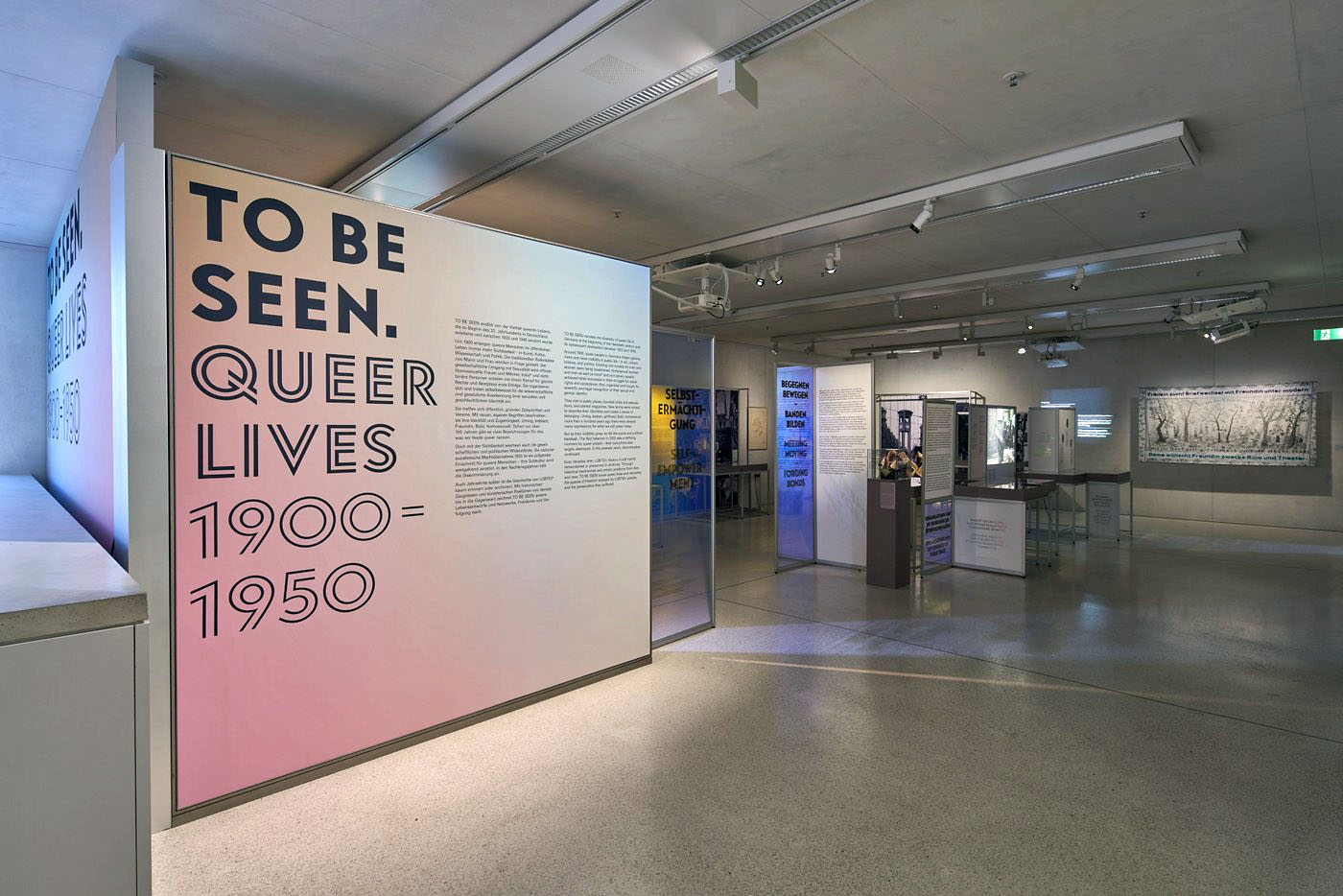
 

Installation view of the exhibition 'TO BE SEEN: Queer Lives 1900-1950' at the Munich Documentation Center for the History of National Socialism


Installation view of the exhibition TO BE SEEN: Queer Lives 1900-1950 at the Munich Documentation Center for the History of National Socialism
Photo: Connolly Weber Photography/NS-Dokumentationszentrum München


TO BE SEEN | Trailer

The exhibition TO BE SEEN: Queer Lives 1900-1950 is dedicated to the stories of LGBTIQ* in Germany in the first half of the 20th century from October 7th, 2022 to May 21st, 2023 at the Munich Documentation Center. With historical testimonies and artistic positions from then to the present, the exhibition traces queer life plans and networks, freedom and persecution.

The exhibition takes an intimate look at diverse genders, bodies and identities. It shows how queer life became more and more visible in the 1920s and how role models and desires were dealt with more openly. Homosexual, trans* and non-binary people achieved their first successes in their fight for equal rights and social acceptance: they organised themselves, fought for scientific and legal recognition of their gender identity and conquered their own spaces.

In addition to recognition and visibility in art and culture, science, politics and society, resistance also increased. After the National Socialists came to power, the LGBTIQ* subculture was largely destroyed. After 1945 their stories and fates were hardly archived or remembered.


Unknown photographer. 'Lili, Paris' 1926


Unknown photographer
Lili, Paris
1926
From N. Hoyer (ed.). Man into Woman. An Authentic Record of a Change of Sex. The true story of the miraculous transformation of the Danish painter Einar Wegener (Andreas Sparre). London: Jarrolds, 1933, 1926, opp. p. 40.
Attribution 4.0 International (CC BY 4.0)


Lili Elbe, a transgender woman who underwent sex reassignment surgery in Berlin in the 1930s.


Around 1900, queer people in Germany began gaining more and more visibility in public life – in art, culture, science, and politics. Existing role models for men and women were being questioned. Homosexual women and men as well as trans* and non-binary people achieved initial successes in their struggle for equal rights and acceptance: they organised and fought for scientific and legal recognition of their sexual and gender identity.

They met in public places, founded clubs and associations, and started magazines. New terms were coined to describe their identities and create a sense of belonging. Urning, lesbian, girlfriend, Bubi, homosexual: more than a hundred years ago there were already many expressions for what we call queer today. But as their visibility grew, so did the social and political backlash. The Nazi takeover in 1933 was a defining moment for queer people – their subculture was largely destroyed. In the postwar years, discrimination continued.

Even decades later, LGBTQI+ history is still hardly remembered or preserved in archives. Through historical testimonies and artistic positions from then and now, TO BE SEEN traces queer lives and networks, the spaces of freedom enjoyed by LGBTQI+ people, and the persecution they suffered.

Text from Stories of the exhibition TO BE SEEN: Queer Lives 1900-1950


Unknown photographer. 'Police photo of Liddy Bacroff' 1933


Unknown photographer
Police photo of Liddy Bacroff
1933
Gelatin silver print
© Staatsarchiv Hamburg


Police photo of Liddy Bacroff, taken after an arrest, 1933. Barcoff described themself as a “homosexual transvestite”, lived from sex work, and was convicted several times. In 1943, they was murdered in the Mauthausen concentration camp.


Liddy Bacroff, a transgender woman initially from Ludwigshafen, who moved to Hamburg and lived for the majority of her life publicly presenting herself as a woman. She did not perceive herself to be a man (and, indeed, in papers she left after having been imprisoned, she determined what her name would be while also conspicuously referring to herself as “Liddy Bacroff, Transvestit”). But this was effectively her own form of self-ID. Certainly the authorities didn’t see her as such — her records remain filed under her deadname and identify her as a homosexual man – and, though she’d have been given a Transvestitenschein in Berlin, she wasn’t IN Berlin. Having not visited Hirschfeld and his Institut, it’s a marvel she uses the term “Transvestit”; elsewhere she does refer to herself as a “Mann-Weib” (a “male woman”), and frequently as a girl or a woman. The authorities, again, call her a man or, occasionally, a “Zwitter.” (NB. “Zwitter” means “hermaphrodite” and is here not meant literally but rather as an epithet recorded in the official files – an insult to her.) So the language that is used to describe trans people is inconsistent and, often, absent (depending on the sources). Reading between the lines is necessary, especially in the official records, which view trans women (regardless their lived circumstances or their appearance) only as homosexual men, and charge them as such. And while Hirschfeld was conscientious, the police were… not. This is especially true as the 1930s unfolded and the country Nazified. I wrote a very long thread a while back about “Heinrich Bode”, who was assigned male at birth but frequently presented as a woman. I used that thread to highlight difficulties of definition because Bode denounced their appearance as a woman in court filings and personal testimony, but at the same time also hinted that there was something much deeper than “just” dressing as a woman. But as they were subjected to prosecution by the Nazified judiciary and security state, they were under duress. So, do we assume that Bode was trans, and denied it because of the threat of punishment? Or was their presentation simply playing with the conventions of gender?

Dr. Bodie A. Ashton Historiker, Universität Erfurt. Text from his Twitter account
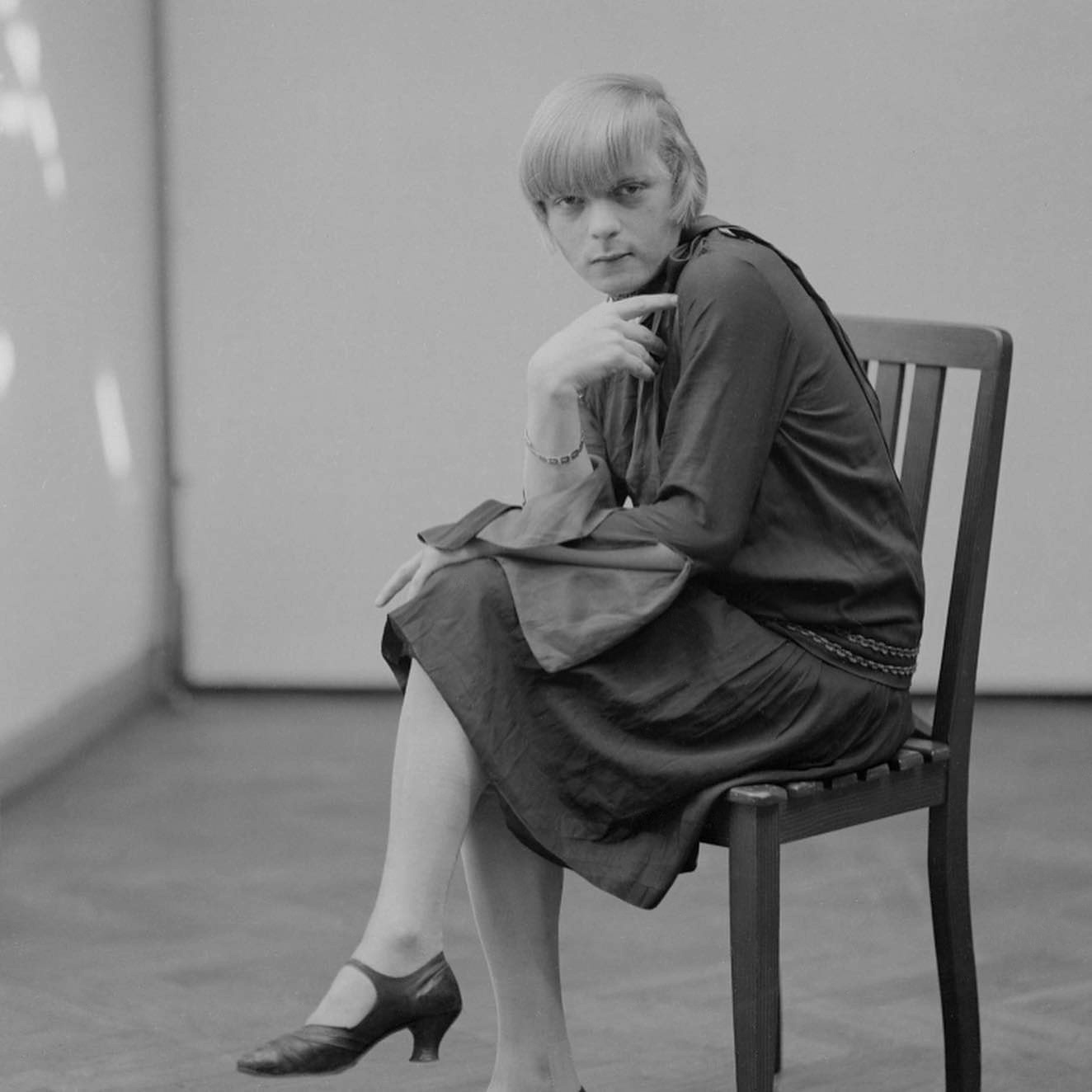
 

Unknown photographer. 'Police photo of Liddy Bacroff' 1933


Unknown photographer
Police photo of Liddy Bacroff
1933
Gelatin silver print
© Staatsarchiv Hamburg
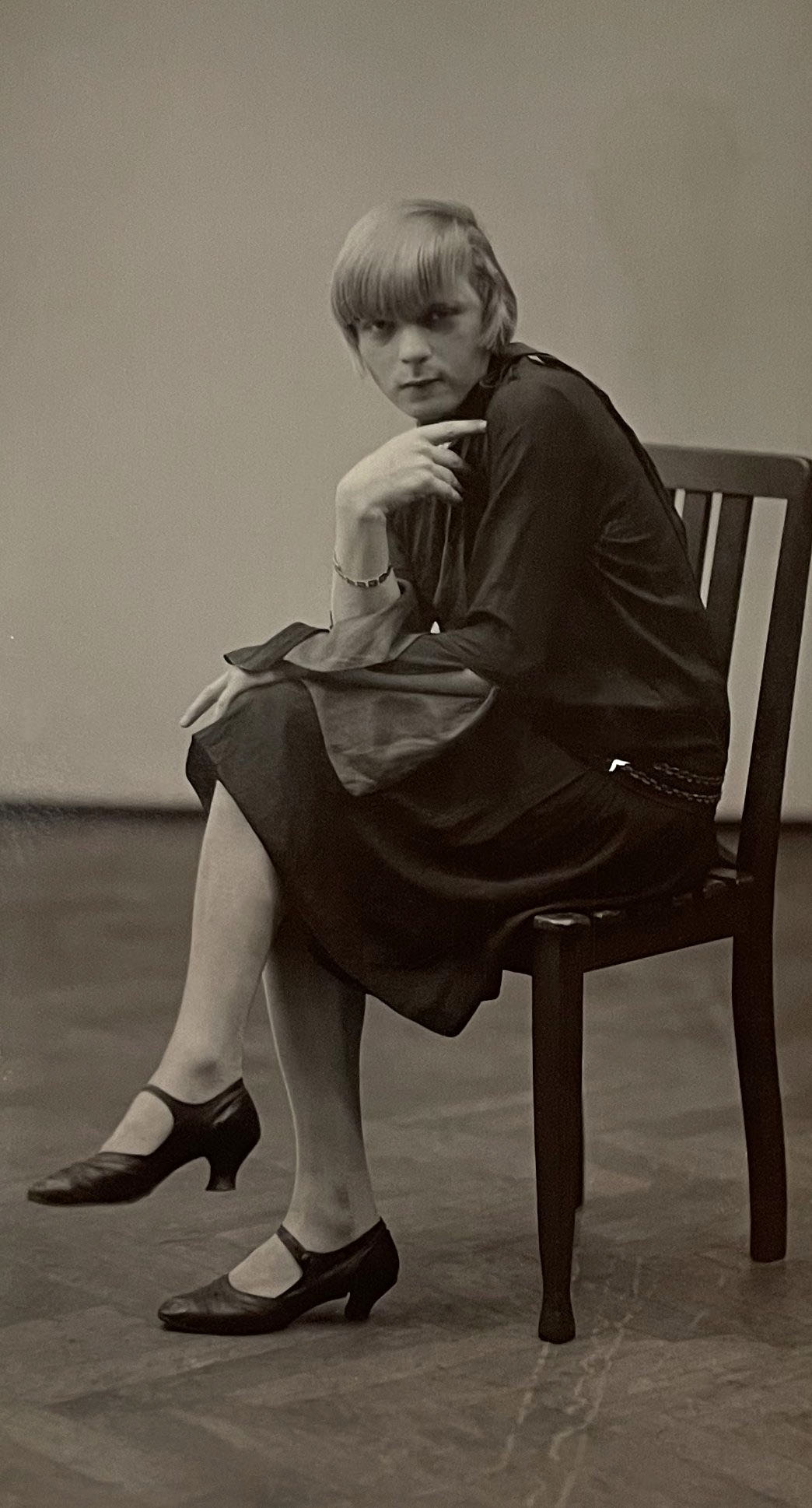
 

Unknown photographer. 'Police photo of Liddy Bacroff' 1933


Unknown photographer
Police photo of Liddy Bacroff
1933
Gelatin silver print
© Staatsarchiv Hamburg
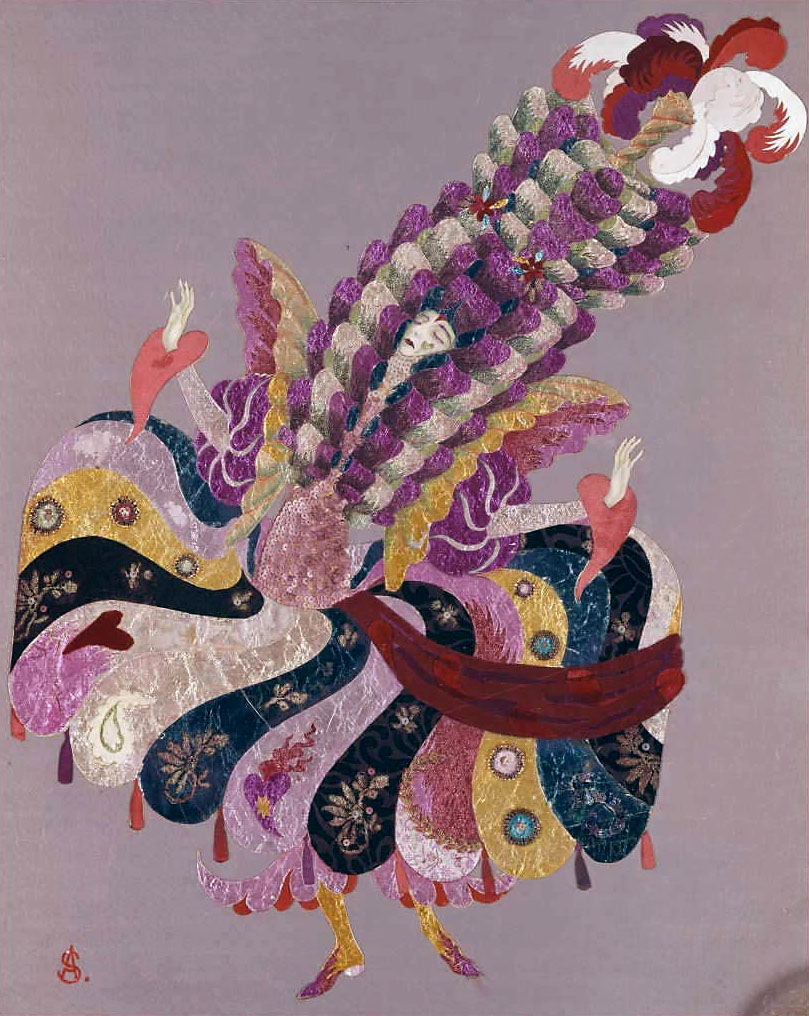
 

Alexander Sacharoff (Russian, 1886-1963) 'Pavane Fantastique' c. 1916/1917


Alexander Sacharoff (Russian, 1886-1963)
Pavane Fantastique
c. 1916/1917
© Städtische Galerie im Lenbachhaus und Kunstbau München


Unknown photographer. 'Alexander Sacharoff' c. 1914


Unknown photographer
Alexander Sacharoff
c. 1914
© Deutsches Theatermuseum München


The androgynous dancer created new body images and developed the swapping of clothes into a stage genre of its own.
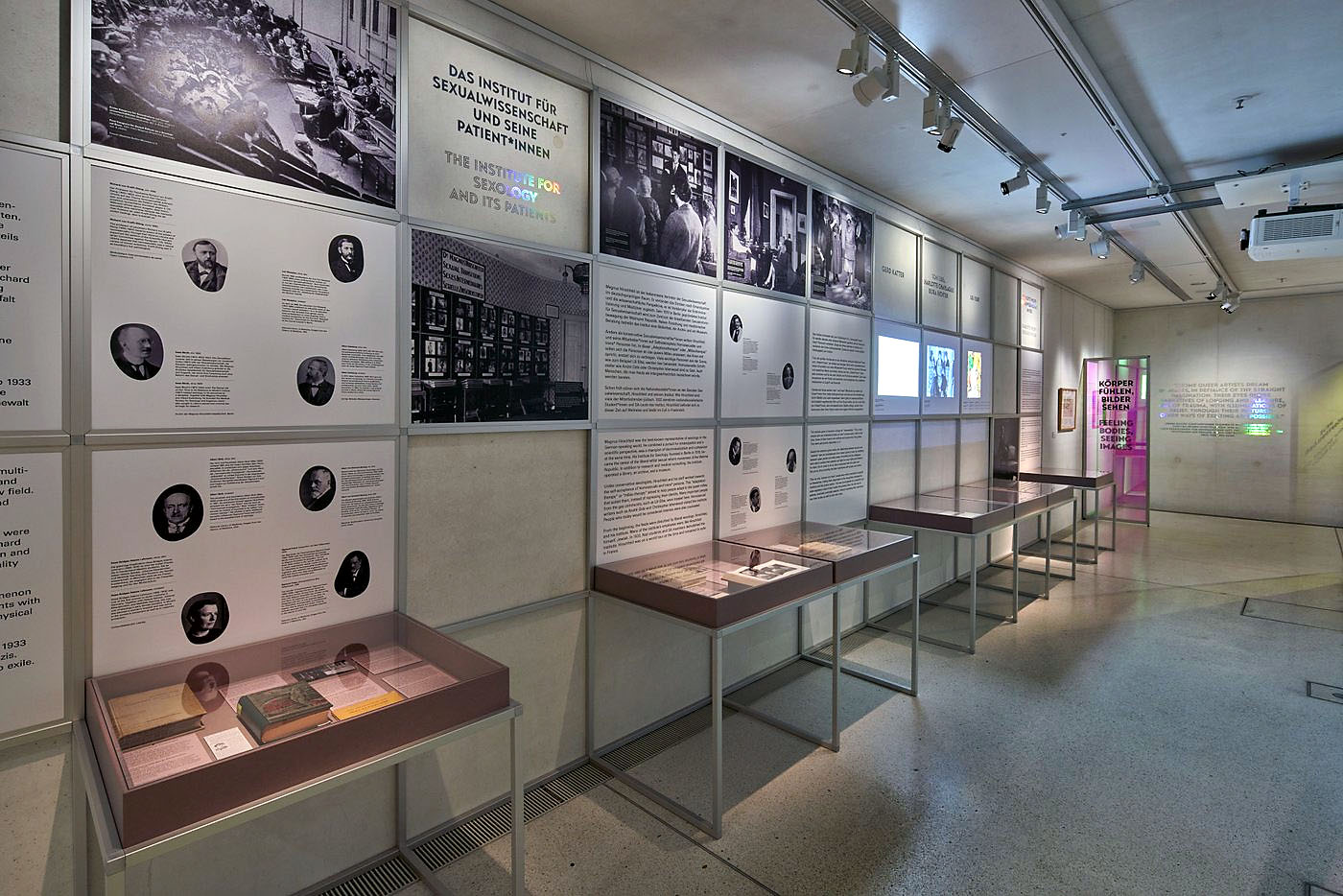
 

Installation view of the exhibition 'TO BE SEEN: Queer Lives 1900-1950' at the Munich Documentation Center for the History of National Socialism


Installation view of the exhibition TO BE SEEN: Queer Lives 1900-1950 at the Munich Documentation Center for the History of National Socialism
Photo: Connolly Weber Photography/NS-Dokumentationszentrum München


Queer

“Queer” originally referred to anything that did not fit into the usual categories. In English the word queer (meaning strange, other, suspicious), was used earlier as a derogative term for homosexuals. Since the 1990s, however, the term has been adopted by many non heterosexual and non-binary people as a positive self-designation. Within the exhibition, queer is used as a catch-all term for a variety of sexual and gender identities and practices that deviate from heterosexual ideas. The term primarily, but not only, refers to LGBTQI+ – in other words lesbian, gay, bisexual, trans and intersexual persons. Furthermore, “queering” can be understood as a practice of combating various forms of discrimination and exclusion. Applied to gender, sexuality, and identity issues, it means casting a critical gaze at the worldview that regards a heterosexual relationship between two persons as the social norm. The rigid binary division of gender into man and woman and the associated role models are thrown into question. In the exhibition, historical self-designations are used where they can be traced through sources.

Self empowerment

In the German Empire, politics, the economy, and society were dominated by men. The gender order, which was maintained over centuries by state and church, was strictly divided into two parts: men and women were assigned clear roles within which they must operate. People who did not conform to these role models and lived gender and sexual identities outside the normative order were ostracised. They were considered immoral, criminal, or ill. According to Paragraph 175 of the Imperial Criminal Code of 1871, sexual acts between men were forbidden and punishable by imprisonment. In Austria, sex between women was also punishable.

But there were individuals who rebelled against the prevailing gender order and fought for a more open society. They opposed the outlawing of homosexuality and transsexuality, advocated a change in criminal law, and assertively engaged in the recognition of their identities. New alliances and self-images emerged. Many of these pioneers paid a high price for their rebellion: they lost their jobs, their families, and their friendships, and were socially isolated.

Text from Stories of the exhibition TO BE SEEN: Queer Lives 1900-1950
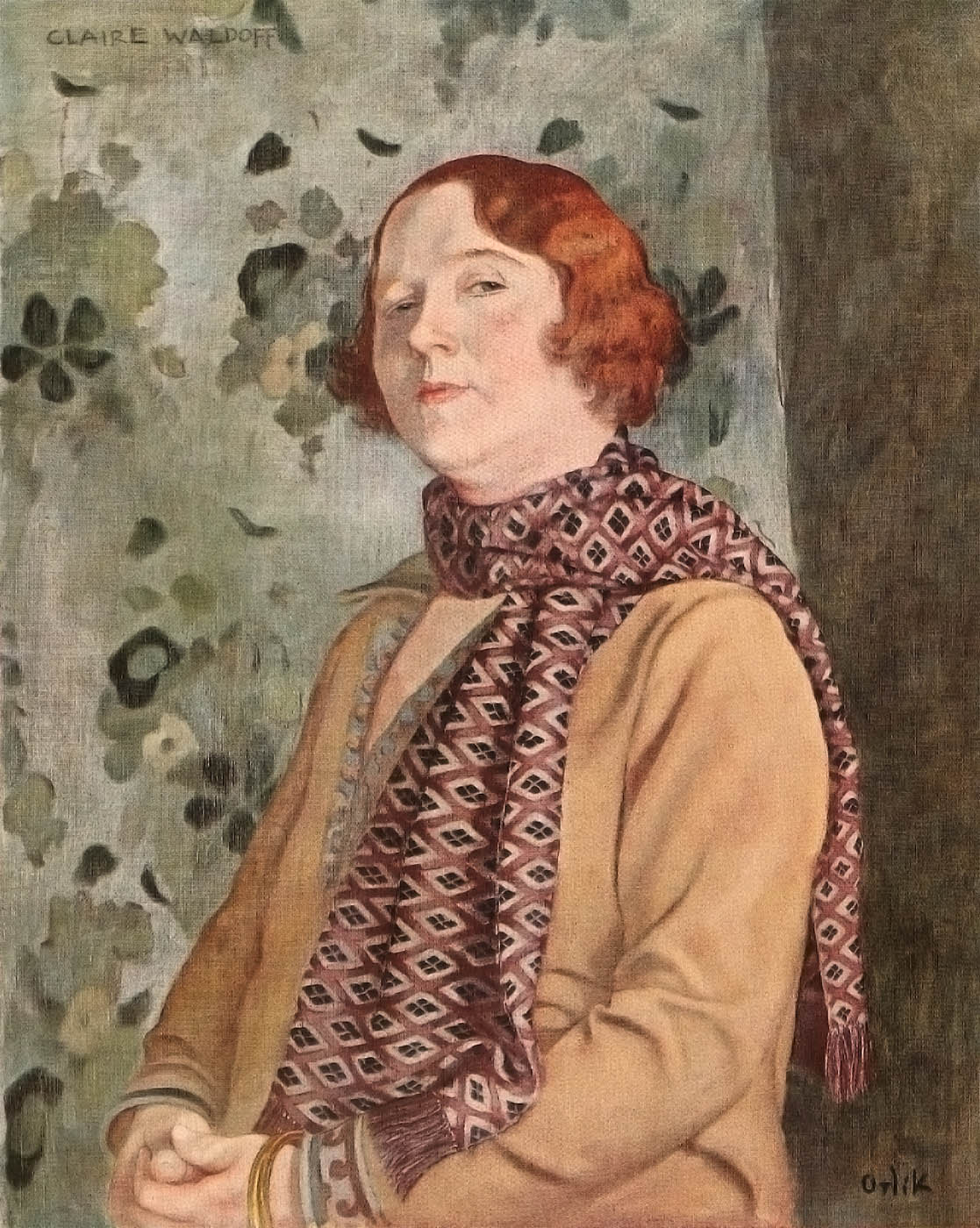
 

Emil Orlík (European born Prague, 1870-1932) 'Claire Waldoff' c. 1930


Emil Orlík (European born Prague, 1870-1932)
Claire Waldoff
c. 1930
© bpk | Stiftung Deutsches Historisches Museum


In TO BE SEEN #QueerLives we present individuals and movements who rebelled against the gender order that prevailed around 1900 and advocated a more open society. In their fight for equal rights and acceptance, they showed solidarity with each other, organised themselves in clubs, founded magazines, coined new terms and met in bars and clubs.

One of them was the chansonnière and cabaret artist Claire Waldoff (1884-1957). Born as Clara Wortmann in Gelsenkirchen, she is a central figure in the Berlin cultural scene of the 1920s. Her songs are known throughout Germany. She lives openly with her partner Olga (Olly) von Roeder and shapes the city’s lesbian scene.


Emil Orlik (21 July 1870 – 28 September 1932) was a painter, etcher and lithographer. He was born in Prague, which was at that time part of the Austro-Hungarian Empire, and lived and worked in Prague, Austria and Germany.

Emil Orlik was born the son of a tailor on July 21, 1870, in Prague, then the capital of a province within the Austro-Hungarian empire. He first studied art at the private art school of Heinrich Knirr, where one of his fellow pupils was Paul Klee. Other friends at this time included Franz Kafka, Max Brod, and Rainer Maria Rilke.

Starting in 1891, Orlik studied at the Munich Academy under Wilhelm Lindenschmit. He later learned engraving from Johann Leonhard Raab and proceeded to experiment with various printmaking processes, including woodcut, which he and his friend, Bernard Pankok, experimented with in 1896.

Orlik left the Academy in 1893. He performed his military service for a year before returning to Prague in 1894. He relocated to Munich in 1896, where he worked for the magazine Jugend (Youth). He spent most of 1898 travelling through Europe, visiting the Netherlands, Great Britain, Belgium, and Paris.

Emil Orlik’s prints and techniques went through extensive changes as he traveled internationally, learning new methods wherever he went. Known for his portraits of a wide variety of well-known individuals including Josephine Baker, Albert Einstein, and Marc Chagall, Orlik was an artistic chameleon, never sticking to one genre or style but studying many. His prints catalog his travels, creating a kind of pictorial diary of the years 1892 to 1900 in particular. Many of his works, often produced in color, appeared in the European periodical PAN, along with the work of Toulouse-Lautrec, Kathe Kollwitz, and Max Klinger.

Japanese art and culture fascinated Orlik. He was aware of the impact Japanese art was having on European art and decided to visit Japan. In 1900, he traveled to Japan and spent a year studying Japanese woodblock cutting and printing. His studies of the Japanese culture led him to the art of Utamaro and Hiroshige. Orlik studied the language before his departure and within four months of his arrival he was proficient enough in Japanese to converse with the artisans whose work he admired and under whom he studied.

Orlik never limited himself to popular subject matter. He studied any scene that inspired him, major events or everyday life. He produced fourteen lithographs of the trial of Arthur Schnitzler and his fellow actors; reenactment of the banned play, “Aus dem Reigin,” for which Orlik was a defence witness. After the trial, Orlik began working for the theatre as a designer of costumes, stage sets, and posters.

He kept all his early woodblocks and, in 1920, he published his celebrated portfolio Kleine Holzschnitte (Small woodcuts) in an edition of 100, which also contained the text of his descriptions of each of the prints. The portfolio contained thirty-four woodcuts, eighteen of which were printed in colours. The complete portfolio is now very rarely found. It included such delightful items as Aus London and the superb colour woodcut Schneiderwerkstatt bei Orlik in Prag (the Orlik tailoring workshop in Prague), which depicts his father and colleague’s busy sewing.

Orlik was also commissioned to design colour posters for the Best-Litovsk Peace Conference at which Russia and Germany ended their conflict. He produced seventy-two lithographs, including a number portraits of Leon Trotsky. Around this time he also began to study photography, and by the mid-1920s was photographing celebrities such as Marlene Dietrich and Albert Eintstein.

Emil Orlik died of a heart attack on September 28, 1932. His brother Hugo was willed the estate, and with it the numerous works of art Orlik had collected throughout the years. Hugo Orlik and his family perished in WWII at the hands of the Nazis, and the only survivor was an aunt who regained what little was left of Emil’s effects. To this day Orlik’s work is still exhibited throughout the world.

Anonymous. “Emil Orlik Biography” on The Annex Galleries website Nd [Online] Cited 17/04/2023


Installation view of the exhibition 'TO BE SEEN: Queer Lives 1900-1950' at the Munich Documentation Center for the History of National Socialism

Installation view of the exhibition 'TO BE SEEN: Queer Lives 1900-1950' at the Munich Documentation Center for the History of National Socialism


Installation views of the exhibition TO BE SEEN: Queer Lives 1900-1950 at the Munich Documentation Center for the History of National Socialism
Photo: Connolly Weber Photography/NS-Dokumentationszentrum München


Unknown photographer. 'Trans* people in the Eldorado in Berlin' 1926


Unknown photographer
Trans* people in the Eldorado in Berlin
1926
© bpk / Kunstbibliothek, SMB


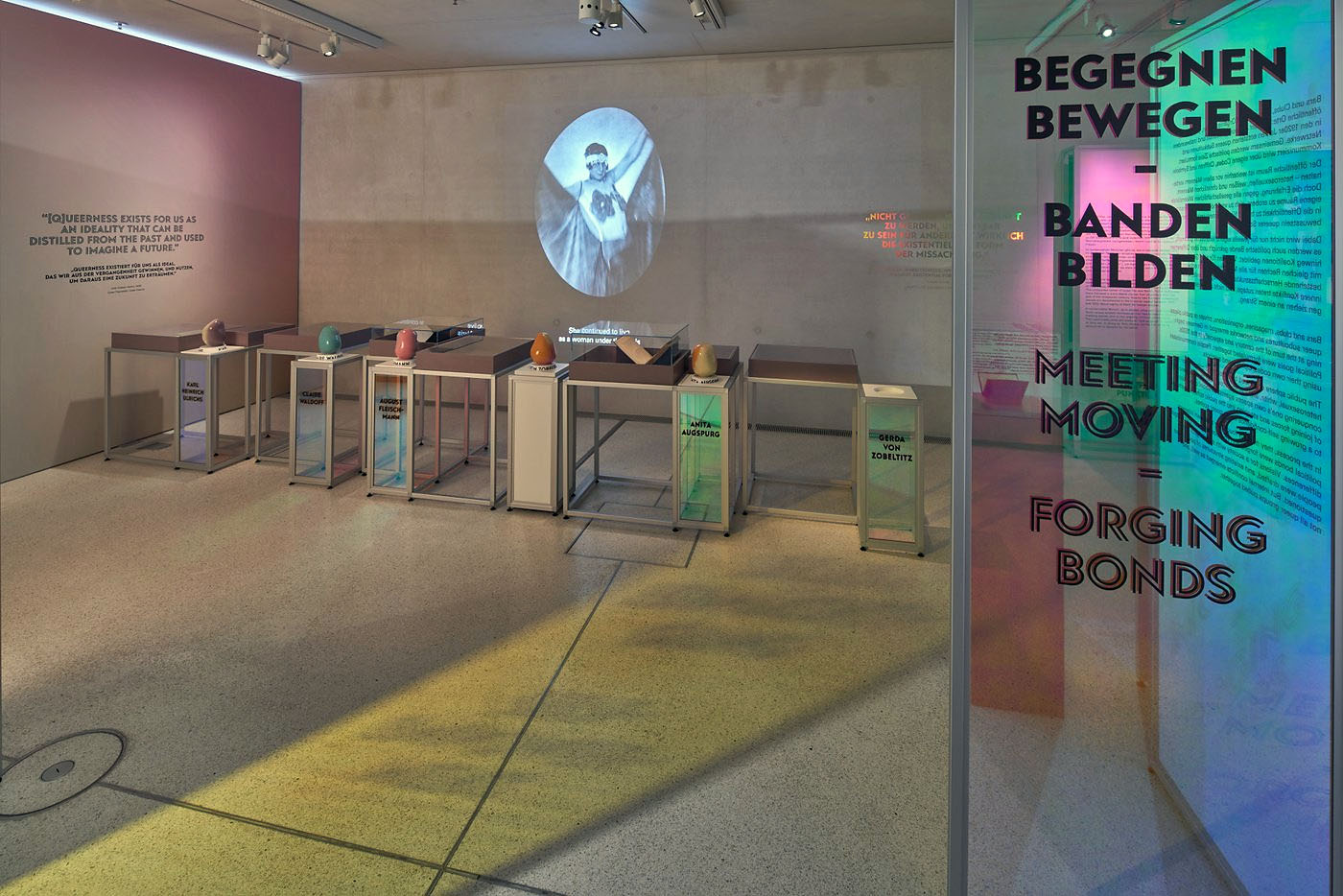
Meeting, moving – forging bonds

Bars and clubs, magazines, organisations, private or public places: queer subcultures and networks emerged in Germany beginning at the turn of the century and especially in the 1920s. Political goals were formulated together. People communicated using their own codes, ciphers, and symbols.

The public sphere continued to be reserved primarily for men – heterosexual, white, and Christian men. But the experience of conquering one’s own spaces against all social opposition, of joining forces and stepping into the public sphere together, led to a growing self-confidence in the queer scenes. In the process, they not only fought for their own interests; political bonds were forged and coalitions formed that bridged differences.

Visions for a society with equal rights for all people were drafted, and existing structures of power were questioned. But internal conflicts emerged as well, and not all queer groups pulled together.

§ 175 des Reichsstrafgesetzbuchs

Trancript: “Paragraph 175: Perverse fornication committed between persons of the male sex or by persons with animals is punishable by imprisonment; loss of civil rights may also be imposed.”

According to Paragraph 175 of the Imperial Criminal Code, sexual intercourse between men was punishable. This provision originated in the Prussian Criminal Code and was introduced throughout Germany with the founding of the German Empire in 1871. Prior to this, homosexuality was exempt from punishment in some German states, such as Bavaria, Württemberg, and Baden, following the example of France. The paragraph was controversial from the beginning: ecclesiastical conservatives and extreme right-wing parties demanded it be made more severe; liberals, social democrats, and communists called for its abolition.

Organisations and the conquest of public space

At the end of the nineteenth century, gay men joined forces to fight against persecution based on Paragraph 175. They founded clubs and associations and sought supporters to achieve their vision of a more open society. Berlin became the hub of this movement and developed into a leading centre of attraction for queer people. It was in Berlin that, in 1897, the Scientific-Humanitarian Committee was founded, which aimed to achieve legal and social equality for homosexual and trans* people.

Some activists from the women’s movements joined this struggle, especially when the extension of Paragraph 175 to encompass women was debated in 1909. Their goal was far-reaching sexual and social reform: a woman’s right to sexual self-determination, abortion, extramarital relations, and independence from her husband. Some leading women’s rights activists lived with another woman, but only few openly identified as lesbian.

Queer subcultures flourished in the Weimar Republic. A diverse landscape of organisations emerged that represented the interests of gays, lesbians, and trans* persons. However, the struggle against Paragraph 175 was not always synonymous with advocacy for an open society. Among gay activists there were also those who paid homage to a homoerotic male cult. They excluded – in addition to women – all those who did not conform to their heroic, in some cases also racist ideas of masculinity.

Text from Stories of the exhibition TO BE SEEN: Queer Lives 1900-1950
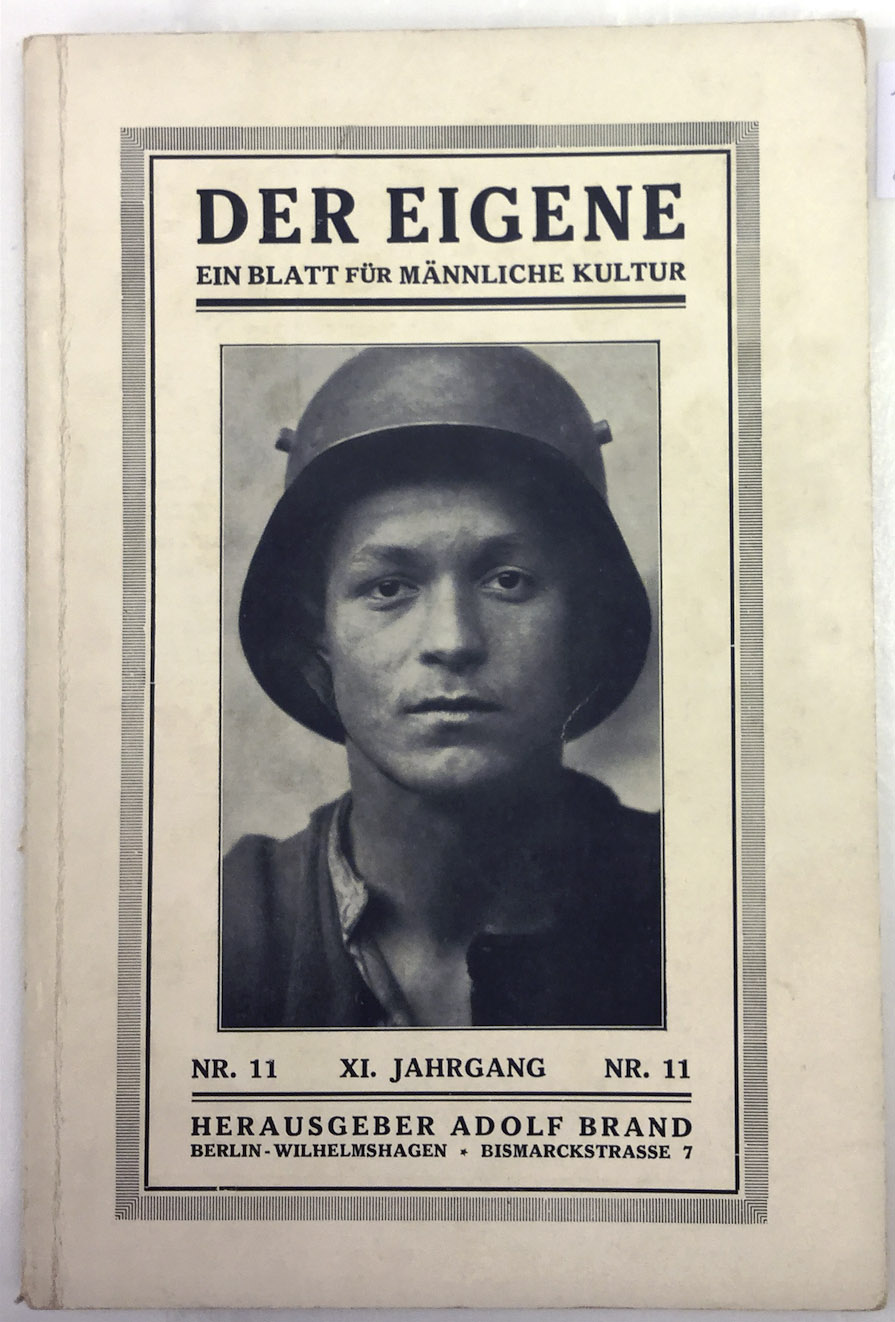
 

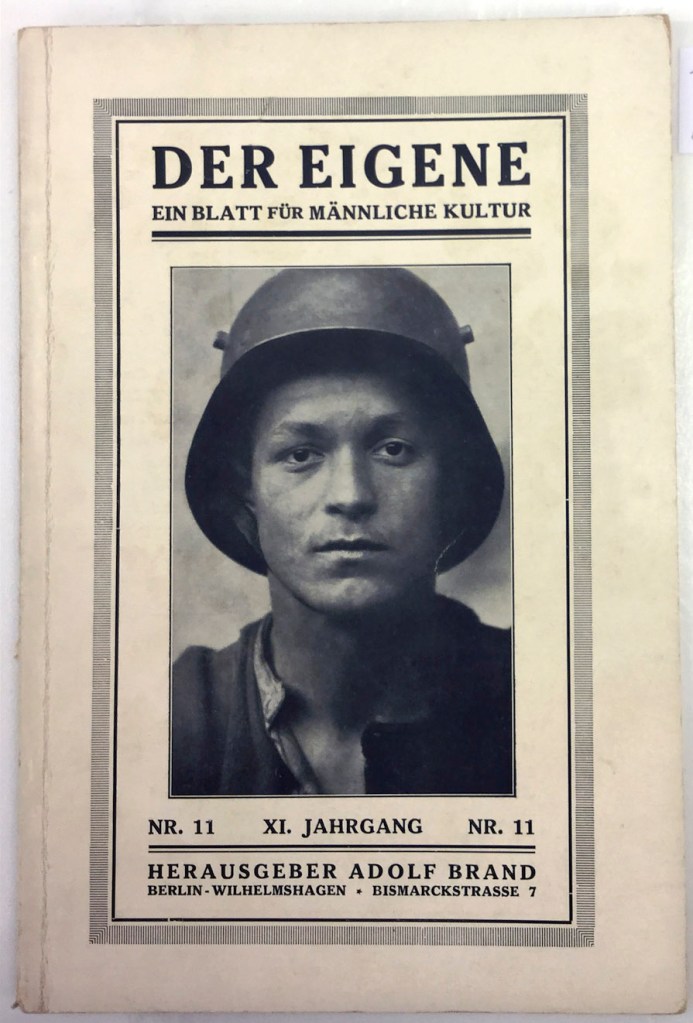
Der Eigene (The Unique), 1925


Adolf Brand (publisher)
Der Eigene (The Unique)
1926


Founded in 1896 by Adolf Brand, “Der Eigene” was the longest-running homosexual journal. With its literary-artistic contributions it evoked the image of heroic masculinity.


Struggle against Paragraph 175: the Scientific-Humanitarian Committee

The physician Magnus Hirschfeld (1868-1935) came from a liberal Jewish family and began actively campaigning for the abolition of Paragraph 175 at the end of the nineteenth century. His actions were motivated by the persecution to which gay men were subjected. As a sexual reformer and founder of the Scientific-Humanitarian Committee, he fought against the prevailing rigid sexual morality and contributed significantly to the visibility of queer people.

Magnus Hirschfeld utilised modern means in his educational activities. The silent film drama was shot in 1919 with his active participation. It is considered the first film to deal openly with Anders als die Andern (Different from the Others) the subject of homosexuality. Heavily attacked by conservative and right-wing extremists, and by some with anti-Semitic motives, the film was used as an opportunity to curtail the artistic freedom introduced after the 1918 revolution. After being screened publicly for a full year, the film was banned by censors in 1920 and almost all copies were destroyed.

“Anders als die Andern” is about a homosexual musician who is subject to blackmail. When he no longer knows what to do and files charges, not only is the blackmailer convicted, but he himself is also sentenced – for violating Paragraph 175. He is shattered by the verdict and takes his own life.

Text from Stories of the exhibition TO BE SEEN: Queer Lives 1900-1950


Excerpt from Different from the Others | © UCLA Film & Television Archive

Excerpts from Different From the Others (Anders als die Andern) (Germany, 1919), which was preserved by UCLA Film & Television Archive as part of the Outfest UCLA Legacy Project. Funding provided by The Andrew J. Kuehn Jr. Foundation and the members of Outfest.

Synopsis

The concert violinist Paul Koerner takes a student under his wing, much to the worry of the boy’s parents. Koerner is meanwhile being blackmailed by a former lover, since in Germany any homosexual relations at that time were punishable under the law, codified in Article 175, which was not removed from the books until the 1960s. The German film, Different From the Others is, as far as we know, the first fiction feature film to address a specifically gay audience. Fortunately, even though more than 90% of all German silent films have disappeared, this film exists today in at least half its original length. When the film was first shown in 1919, gay and lesbian audiences must have been amazed that a mainstream fiction feature film would portray their situation as a fact of nature, rather than a perversion. Today, this film celebrates the brief opening of that door, before it slammed shut for another 50 years.

The film was produced and directed by Richard Oswald, at that time one of Germany’s most prolific independents, who made films cheaply and premiered them in a Berlin cinema he owned, where his wife would often handle the office box. Oswald had earned a fortune in 1917 / 1918 with a number of “educational” feature films about sexually transmitted diseases, which were approved by the censorship authorities, simply because syphilis was rampant in the trenches. Oswald would continue to produce controversial films, like his acknowledged masterpiece, The Captain from Koepenick (1931) based on Carl Zuckmayer’s anti-authoritarian play. The Nazis never forgave Oswald for Anders als die Andern or Koepenick, forcing Oswald into exile and eventually to Hollywood, where he directed several films and televisions shows. Although long under appreciated in Germany, recent critical reappraisals have valued his in-your-face aesthetic and modern subject matter.

Only a severely truncated version of the film has survived, with Ukrainian titles, as Gosfilmofond in Russia. It was restored previously to a semblance of the original 1919 release by the Munich Film Museum. The UCLA restoration is based on that Munich reconstruction, with some changes and additions made.

Credits

Richard-Oswald-Produktion. Screenwriters: Magnus Hirschfeld and Richard Oswald. Cinematographer: Max Fassbender. With: Conrad Veidt, Leo Connard, Ilse von Tasso-Lind, Alexandra Willegh, Ernst Pittschau, Fritz Schulz.


Different From Others: A Legacy Preserved (2012)

Featurette about the restoration of German silent film Different From Others (1919). Produced for the Outfest Legacy Project and the UCLA Film & Television Archive.


On October 6 the exhibition TO BE SEEN: Queer lives 1900-1950 opens at the Munich Documentation Center for the History of National Socialism. TO BE SEEN is devoted to the stories of LGBTQI+ in Germany in the first half of the 20th century. Through historical testimony and artistic positions from then and now, it traces queer lives and networks, the areas of freedom enjoyed by LGBTQI+, and the persecution they suffered.

The exhibition takes an intimate look at a variety of genders, bodies, and identities. It shows how queer life became ever more visible during the 1920s, giving rise to a more open treatment of role models and of desire. During this period, homosexual, trans, and non-binary people achieved their first successes in their fight for equal rights and social acceptance. They organised, fought for scientific and legal recognition of their gender identity, and carved out their own spaces.

But as recognition and visibility in art and culture, science, politics, and society increased, so did resistance. After the Nazis came to power, the LGBTQI+ subculture was largely destroyed. After 1945, their stories and fates were scarcely archived or remembered.

Participating artists

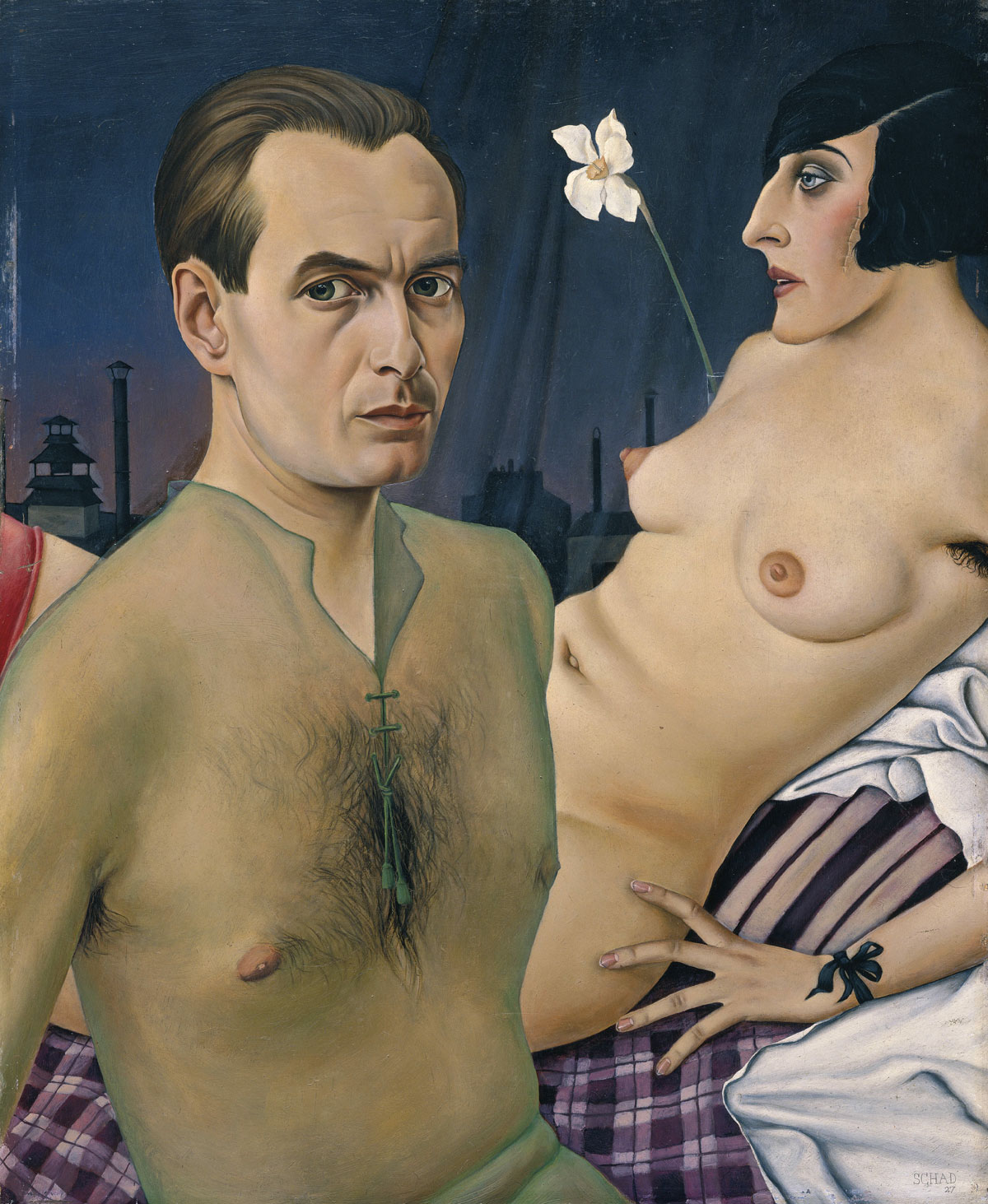
Katharina Aigner, Maximiliane Baumgartner, Pauline Boudry & Renate Lorenz, Claude Cahun, Zackary Drucker & Marval Rex, Nicholas Grafia, Philipp Gufler, Richard Grune, Lena Rosa Händle, Hannah Höch, Paul Hoecker, Nina Jirsíková, Germaine Krull, Elisar von Kupffer, Zoltán Lesi & Ricardo Portilho, Herbert List, Heinz Loew, Jeanne Mammen, Michaela Melián, Henrik Olesen, Emil Orlik, Max Peiffer Watenphul, Jonathan Penca, Lil Picard, Karol Radziszewski, Alexander Sacharoff, Gertrude Sandmann, Christian Schad, Renée Sintenis, Mikołaj Sobczak, Wolfgang Tillmans and others.

TO BE SEEN will be accompanied by an extensive program of events and outreach on topics such as the persecution of LGBTQI+ persons under National Socialism, the queer history of Munich, intersectionality and drag, as well as queer identity in literature and film. All information and updates can be found at nsdoku.de/tobeseen.

The accompanying publication features a collection of texts and artworks from the exhibition as well as essays by key voices that shed light on past and present queer lives from an academic and social perspective. The book in German and English will be published in December 2022 by Hirmer Verlag. It features contributions by, among others, Gürsoy Doğtaş, Michaela Dudley, Sander L. Gilman, Dagmar Herzog, Ulrike Klöppel, Ben Miller, Cara Schweitzer, Sebastien Tremblay.

TO BE SEEN: Queer lives 1900-1950 takes place under the patronage of Claudia Roth, Minister of State for Culture and Media. The exhibition was funded by the German Federal Cultural Foundation and the German Federal Government Commissioner for Culture and the Media.

Director: Mirjam Zadoff
Head Curator: Karolina Kühn
Curators: Juliane Bischoff, Angela Hermann, Sebastian Huber, Anna Straetmans, Ulla-Britta Vollhardt
Project Management: Karolina Kühn, Anna Straetmans, Sebastian Huber

Press release from the Munich Documentation Center for the History of National Socialism


Film still from 'The Mystery of Gender' Austria 1933


Film still from The Mystery of Gender
Austria 1933
© Filmarchiv Austria


In April 1933, the film “The Mystery of the Gender” ran in Viennese cinemas for about two weeks before it was banned. The film is a mixture of romance and medical educational film, including close-ups of the women’s genitals. Among the protagonists are – without mentioning their names – Toni Ebel, Charlotte Charlaque and Dora Richter. You can find an excerpt of the film in our storytelling http://www.tobeseen.nsdoku.de

Toni Ebel converted to Judaism in early 1933, but reversed the conversion as the pressure of persecution increased. After 1945 she was recognised in the GDR as a victim of fascism. Ebel was able to start a new life as a painter.

Charlotte Charlaque and Toni Ebel remained in correspondence after their forced separation in 1942. In 1946 Charlaque told her friend about her loneliness, her arrival as a refugee in New York and the difficulties in getting her female name recognised.

Dora Richter became known as one of the first trans* women to undergo gender reassignment surgery. Since it was difficult for trans* people to find work, she took a job as a housemaid at the Institute for Sexology, which was looted by National Socialist groups in 1933. Nothing is known of Richter’s fate after 1933.

Text from the Munich Documentation Center for the History of National Socialism Instagram page
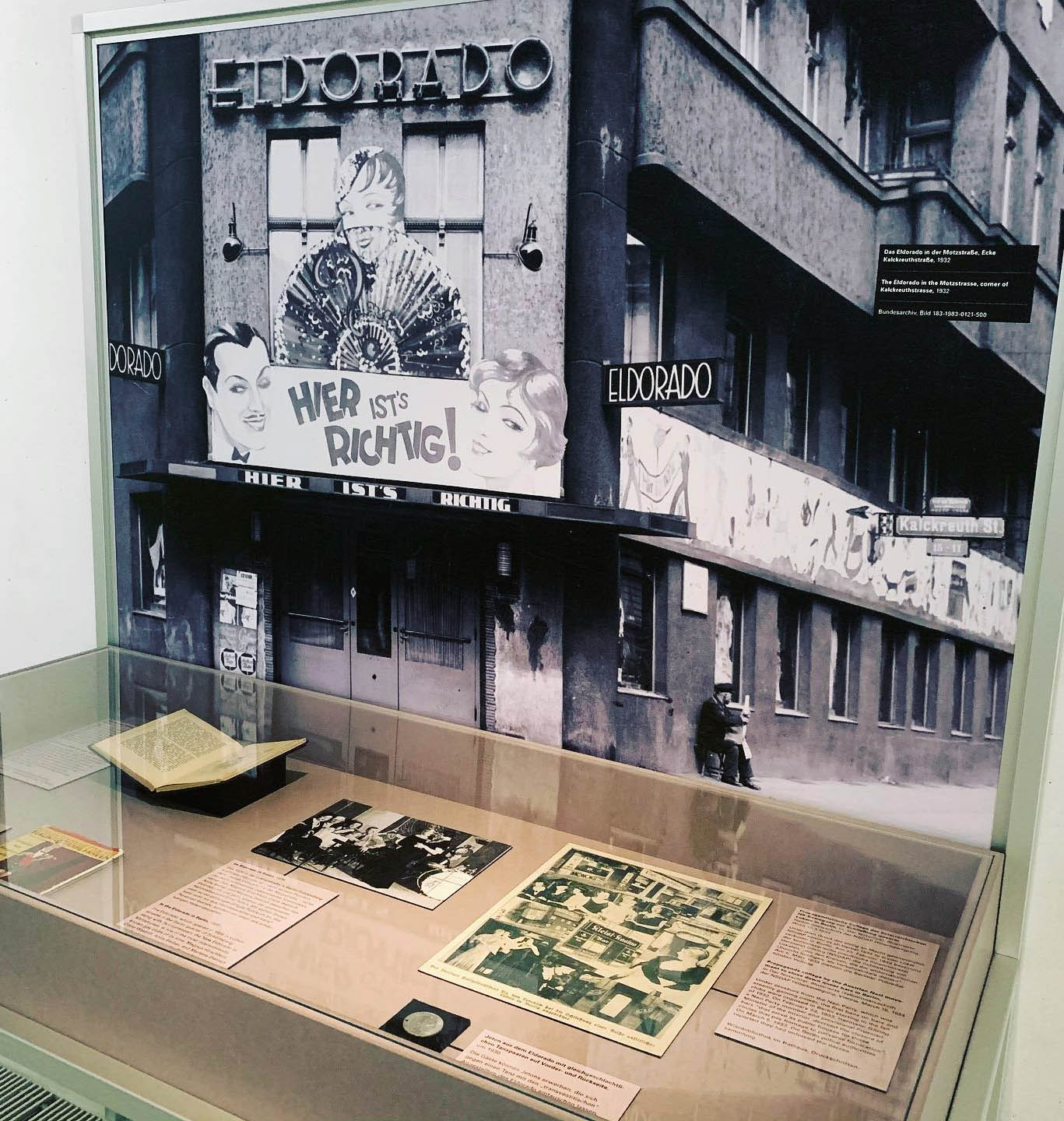
 

Installation view of the exhibition 'TO BE SEEN: Queer Lives 1900-1950' at the Munich Documentation Center for the History of National Socialism showing at rear, an enlargement of an image by an unknown photographer of the Eldorado in the Motzstrasse (1932); and at left centre in the display cabinet, an image by an unknown photographer Trans* people in the Eldorado in Berlin (1926)


Installation view of the exhibition TO BE SEEN: Queer Lives 1900-1950 at the Munich Documentation Center for the History of National Socialism showing at rear, an enlargement of an image by an unknown photographer of the Eldorado in the Motzstrasse (1932, below); and at left centre in the display cabinet, an image by an unknown photographer Trans* people in the Eldorado in Berlin (1926, above)
Photo: Connolly Weber Photography/NS-Dokumentationszentrum München


The Eldorado on Lutherstraße was one of the city’s infamous cabaret bars.

The Eldorado was the name of multiple nightclubs and performance venues in Berlin before the Nazi Era and World War II. The name of the cabaret Eldorado has become an integral part of the popular iconography of what has come to be seen as the culture of the period in German history often referred to as the “Weimar Republic”. …

Eldorado was a gay cabaret in that along with gay, lesbian, bisexual, trans* patrons, a heterosexual-identifying audience (artists, authors, celebrities, tourists) would have been present as well. “Cross-dressing” was tolerated on the premises, though for the most part legally prohibited and / or sharply regulated in public (and to an extent in private) at the time. This exception to everyday life attracted not only male patrons who wished to dress in the “clothing of the opposite sex”, and their admirers, but also to no small extent women who wished to do the same, and their admirers. Wealthy lookers-on were encouraged to come and drink and watch as so-called “Zechenmacher” (tab payers). The practice was particularly common in so-called “Lesbian bars” or at so-called “Lesbian balls” in the neighbourhood at the time and up the 1960s in places like the Nationalhof at nearby Bülowstraße 37. As women’s incomes were on average much lower than men’s then as now, male spectators with money to spend were explicitly welcome, and it was not uncommon that there were sex-workers present to offer their services. Eldorado also included what have come to be called drag shows as a regular part of the cabaret performances.

Text from the Wikipedia website


The Eldorado, which opened in 1926 on Lutherstrasse in Berlin-Schoeneberg, was – along with its counterpart, the “new Eldorado” on Motzstrasse – one of the internationally most well-known trendy bars of its time. Magnus Hirschfeld, Claire Waldoff, Anita Berber and Marlene Dietrich often and happily visited the Eldorado, as did the prominent National Socialist Ernst Röhm. With its shows, it attracted a wealthy audience, which soon consisted not only of homosexuals and trans* people, but above all of onlookers heterosexuals. Guests could purchase tokens that could be exchanged for a dance with the Eldorado’s “transvestite” staff.
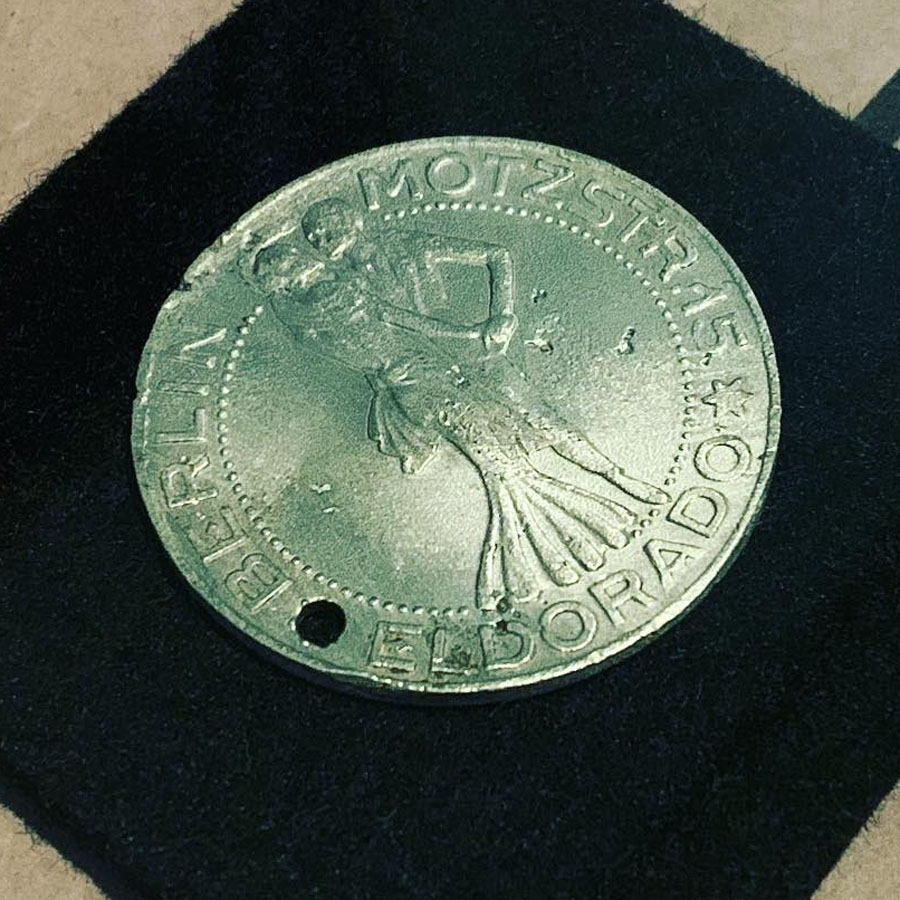
 

'Token from the Eldorado with same-sex dancing couples on the front and back' c. 1930


Token from the Eldorado with same-sex dancing couples on the front and back
c. 1930
© Gay Museum, Berlin


Dance monocle in original bag


Dance monocle in original bag
© dhmberlin


A popular accessory for lesbian women in the 1920s was the “dance monocle”

Short hair, ties, tails, and top hats were other identifying marks within part of the lesbian scene – and soon to be common among modern heterosexual women as well. The “New Woman” of the 1920s broke away from traditional gender images and appropriated new things and spaces that had previously been occupied by men.

In the Berlin scene, but also in other cities, numerous gay and lesbian clubs that rented premises, called for social activities, but also explicitly pursued political and emancipatory goals. One of the largest “women’s clubs” was the Violetta Ladies’ Club, founded in Berlin in 1926.

The founder of the women’s club Violetta was the lesbian activist Lotte Hahm (1890-1967), who also wrote for “The Girlfriend”. Together with her Jewish partner Käthe Fleischmann (1899-1967) she ran the lesbian bar Monokel-Diele in Berlin. After 1933, both initially tried to maintain lesbian networks and meeting places under cover names. Fleischmann, persecuted as a Jew, survived the Nazi era in various hiding places.

Text from the Munich Documentation Center for the History of National Socialism Instagram page


Invitations to monocle parties of the Violetta women's club in Berlin

Invitations to monocle parties of the Violetta women’s club in Berlin and the women’s association “Geselligkeit” in Chemnitz
In Garçonne 1931/1939
© forummuenchenev


Unknown photographer. 'The Eldorado in the Motzstrasse, corner of Kalckreuthstrasse' 1932


Unknown photographer
The Eldorado in the Motzstrasse, corner of Kalckreuthstrasse
1932
© nsdoku


Meeting places

A lively scene for homosexuals and trans* persons emerged in Germany during the 1920s. Especially in major cities, a number of clubhouses, bars, and clubs functioned as meeting places. The undisputed centre of queer life was Berlin. Police authorities there followed a more liberal course than elsewhere after the end of the nineteenth century. Nearly two hundred subcultural venues are documented in the imperial capital between 1919 and 1933, about eighty of them for lesbian women.

In conservative Munich, as in smaller cities and rural areas, fewer venues existed. Homosexual men had to resort to informal meeting places, due to the ongoing criminal persecution. They used public parks and toilets as “pick-up spots” to socialise or have sex. In doing so, they always ran the risk of being denounced or stopped by the police.

Magazines and informal networks

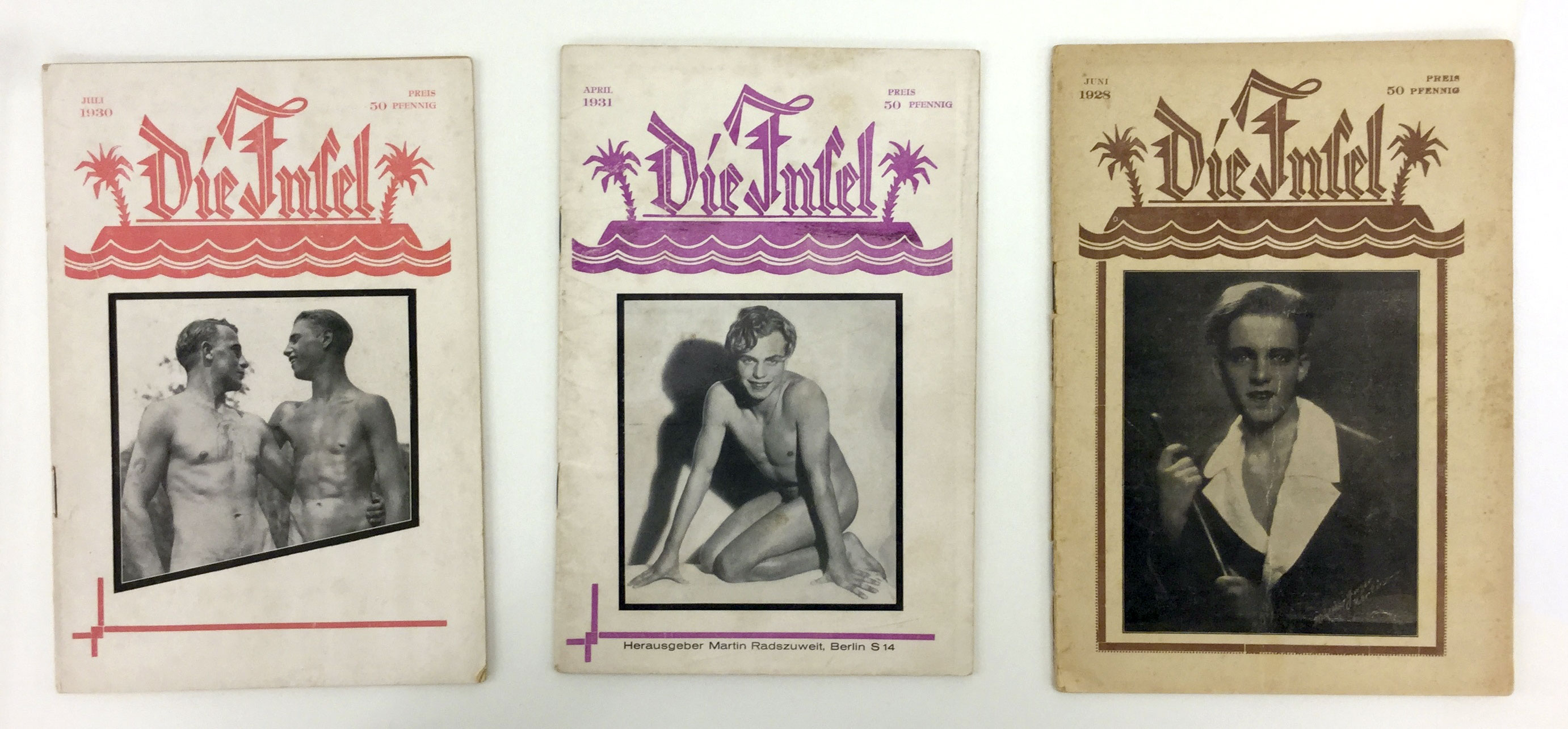
Magazines were an important means of communication for queer subcultures. They listed relevant clubs and bars, bookstores, and associations, and served as contact exchanges. These references and opportunities were essential particularly for queer people in rural areas, where there were no functioning networks. However, the publishers had to reckon with the banning of their print products at any time. It was not uncommon for entire print runs or volumes to be labeled as “trash texts” and confiscated.

In order to avoid police persecution and social exclusion, the scene employed its own linguistic codes. Camouflage terms such as “friend”, “girlfriend”, “ideal friendship”, “friendly exchange of ideas”, or “ideal-minded” were used to refer to lesbian and gay connections. Lonely hearts ads in relevant magazines were often the only way to find like-minded people, especially in smaller towns and in the countryside.

Text from Stories of the exhibition TO BE SEEN: Queer Lives 1900-1950


Installation view of the exhibition 'TO BE SEEN: Queer Lives 1900-1950' at the Munich Documentation Center for the History of National Socialism


Installation view of the exhibition TO BE SEEN: Queer Lives 1900-1950 at the Munich Documentation Center for the History of National Socialism showing historical magazines


In TO BE SEEN you can leaf through historical magazines. They were an important means of communication for queer subcultures.

Magazines such as “Die Freundsblatt”, “DasFreundschaftsblatt” or “Frauenliebe” referred to relevant pubs, bookstores and associations and served as contact exchanges. Especially for queer people in rural areas, where there were no functioning networks, these tips and opportunities were essential. However, the publishers had to expect their printed products to be banned at any time. It is not uncommon for entire editions or volumes to be marked as “trash and dirty writing” and confiscated.

“The Girlfriend” (subtitle “The Ideal Friendship Journal”, later “Weekly Journal for Ideal Female Friendship”) was a magazine for lesbian women from 1924 to 1933 in Berlin during the Weimar Republic. It is considered the first lesbian magazine and was first published monthly, then every two weeks, and later even weekly.

The editor was Friedrich Radzuweit (1876-1932), chairman of the Federation for Human Rights. The content focuses on information on lesbian life and meeting places for lesbians, political topics, short stories, serialised novels and classifieds. Although “The Girlfriend” was primarily aimed at a lesbian readership, there are also numerous articles that deal with topics such as ‘transvestism’ or transgender. It was discontinued a few weeks after the National Socialists seized power in January 1933: the last issue appeared on March 15, 1933, a week before the Enabling Act was passed.
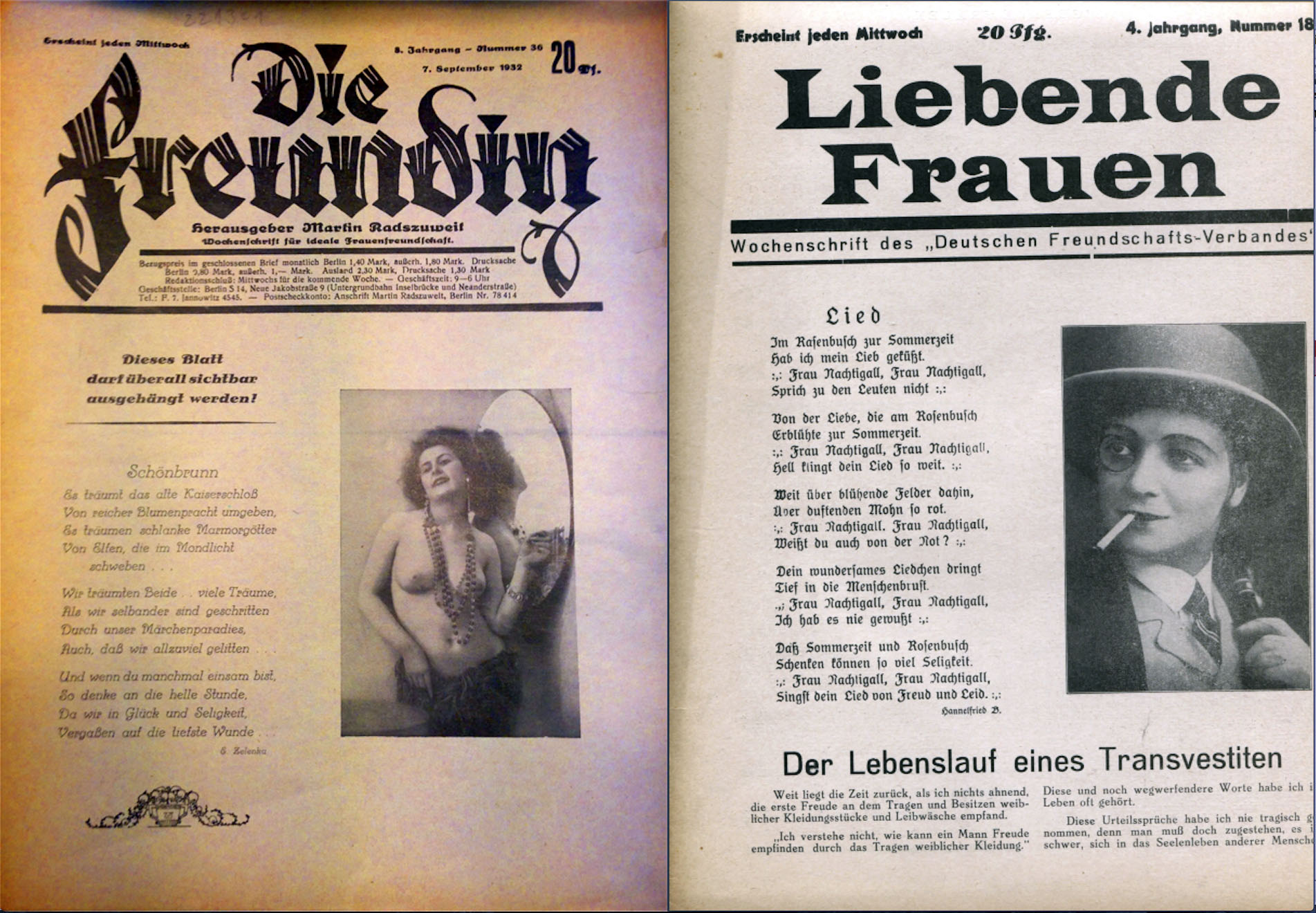
 

Die Freundin (The Girlfriend), September 1932, and Liebende Frauen (Women in Love), 1929


Covers from Die Freundin (The Girlfriend), September 1932, and Liebende Frauen (Women in Love), 1929


Cover of "Die Freundin" (The Girlfriend) 26. December 1927


Cover of “Die Freundin” (The Girlfriend)
26. December 1927
© Forum Queeres Archiv München


Unknown photographer. 'Magnus Hirschfeld' c. 1900


Unknown photographer
Magnus Hirschfeld
c. 1900
© Staatsbibliothek zu Berlin – Preußischer Kulturbesitz


Unknown photographer. "Zwischenstufenwand" (sexual transitions wall) c. 1925-1930


Unknown photographer
“Zwischenstufenwand” (sexual transitions wall)
c. 1925-1930
Bildarchiv Preussischer Kulturbesitz


The “Zwischenstufenwand” (sexual transitions wall) in the Institute for Sexology illustrated Hirschfeld’s theory that all people have male and female qualities in them.

The famous picture wall, illustrating Hirschfeld’s sex and gender theories. It was first exhibited in Leipzig (1922) on occasion of the German Natural Scientists’ and Physicians’ centenary and then in Vienna (1930) at the World League for Sexual Reform’s congress. The picture wall (2×1 m by 4×5 m) always had a prominent place in the Institute and was used to explain sexual theories to visitors.


Installation view of the exhibition 'TO BE SEEN: Queer Lives 1900-1950' at the Munich Documentation Center for the History of National Socialism


Installation view of the exhibition TO BE SEEN: Queer Lives 1900-1950 at the Munich Documentation Center for the History of National Socialism


Knowledge, diagnosis, control

Scientific interest in sexuality and gender was expanding around the turn of the century. The amount of sexological research and number of publications increased. Most writings described homosexuality or trans* identities as “pathological” conditions. This assumption has since been scientifically refuted. At the same time, groundbreaking theories emerged, for example Magnus Hirschfeld’s model of “sexual intermediates.” In it, the sexologist anticipated the later realisation that numerous other gender identities besides man and woman exist.

Yet, then as now, knowledge also meant power and control. People were examined, described, classified, and judged as patients. Some sexologists incorporated ideas in their research that drew on biologism and eugenics. These were spread throughout society and later played a central role for the Nazis: their conception of so-called “racial hygiene” distinguished between “valuable” and “unworthy” life.

The driving forces in the German-speaking world from the 1860s on were the lawyer and physician Karl Heinrich Ulrichs and the physician Richard von Krafft-Ebing. Ulrichs in particular fought for the decriminalisation and recognition of homosexuality. His insights into the diversity of sexuality and gender are still essential today. Other scientists understood the “third sex” as a pathological phenomenon and wanted to effect the “re-education” and “healing” of their patients with methods that were sometimes questionable. The result was often physical or psychological trauma.

The Institute for Sexology and its patients

Magnus Hirschfeld was the best-known representative of sexology in the German-speaking world. He combined a pursuit for emancipation and a scientific perspective, was a champion of decriminalisation and a physician at the same time. His Institute for Sexology, founded in Berlin in 1919, became the centre of the liberal-leftist sexual reform movement of the Weimar Republic. In addition to research and medical consulting, the institute operated a library, an archive, and a museum. Unlike conservative sexologists, Hirschfeld and his staff worked towards the self-acceptance of homosexuals and trans* persons.

This “adaptation therapy” or “milieu therapy” aimed to help people adapt to the queer milieu that suited them, instead of repressing their identity. Many important people from the gay community, such as Lili Elbe, were treated here. Homosexual writers such as André Gide and Christopher Isherwood visited the institute. People who today would be considered intersex were also counselled. From the beginning, the Nazis were disturbed by liberal sexology, Hirschfeld, and his institute. Many of the institute’s employees were, like Hirschfeld himself, Jewish. In 1933, Nazi students and SA members demolished the institute; Hirschfeld was on a world tour at the time and remained in exile in France.

The institute grew to become a refuge for “transvestites”. This is how people who we understand today as trans* persons were called at the time. Some of them lived in the institute and earned their living there. They were particularly dependent on it. Despite the institute’s great merits, the relationship between doctors and “patients” was not unproblematic from today’s point of view.

By mediating between queer people and state power, Hirschfeld and his colleagues were able to protect their patients and fight for more rights and freedom for them. But in order to do so, they cooperated with the police and the courts, thus providing the state institutions with access and control. Then as now, intersex and trans* people were rarely perceived as experts on themselves, making them dependent on the recognition bestowed by medicine and the justice system. This was accompanied by a scientific and state-regulatory view of their bodies that pushed them into the role of patients, externally controlled subjects, instead of granting them autonomy over their bodies as well as their own voice.

Text from Stories of the exhibition TO BE SEEN: Queer Lives 1900-1950


Hirschfeld’s medical practices are controversial today

However, Magnus Hirschfeld also referred those male homosexuals who, based on his biological research, assumed that homosexuality could also be treated, to other doctors. They castrated the patients and implanted heterosexual testicles in them.

Not only Magnus Hirschfeld’s medical practices, but also his scientific approach is controversial today. His absolute belief in biology leaned towards social Darwinism and eugenics. He founded a “Medical Society for Sexology and Eugenics”. He thus promoted “sexual selection” in order to improve the “mental fitness of the offspring”. He was thus at the same time far away and entirely in line with the National Socialists.

The National Socialists saw Hirschfeld as a security risk, a threat to the population growth of the “Aryan race” and not only in him. Tens of thousands of gay men are sentenced to prison, jail, and concentration camps, the gay civil rights movement is crushed, gay hangouts are closed, magazines are banned, and then, on May 6, 1933, the Institute for Sex Research is looted and its library burned.

Gabi Schlag and Benno Wenz. “Magnus Hirschfeld – pioneer of sex research,” on the SWR website 29.7.2021 [Online] Cited 12/04/2023


Unknown photographer. 'First Congress for Sexual Reform on a Sexological Basis' 1921


Unknown photographer
First Congress for Sexual Reform on a Sexological Basis
1921
From Magnus Hirschfeld, Sexology, vol. 4, plates
© Forum Queeres Archiv München


Session of the “International Conference for Sex Reform on a Sexological Basis”, organised by Hirschfeld 1921 in Berlin at the Langenbeck-Virchow-Haus. (Hirschfeld, leaning forward, is seated just beneath the lectern.) This was the first sexological congress held anywhere, and it laid the groundwork for the Copenhagen congress of 1928.
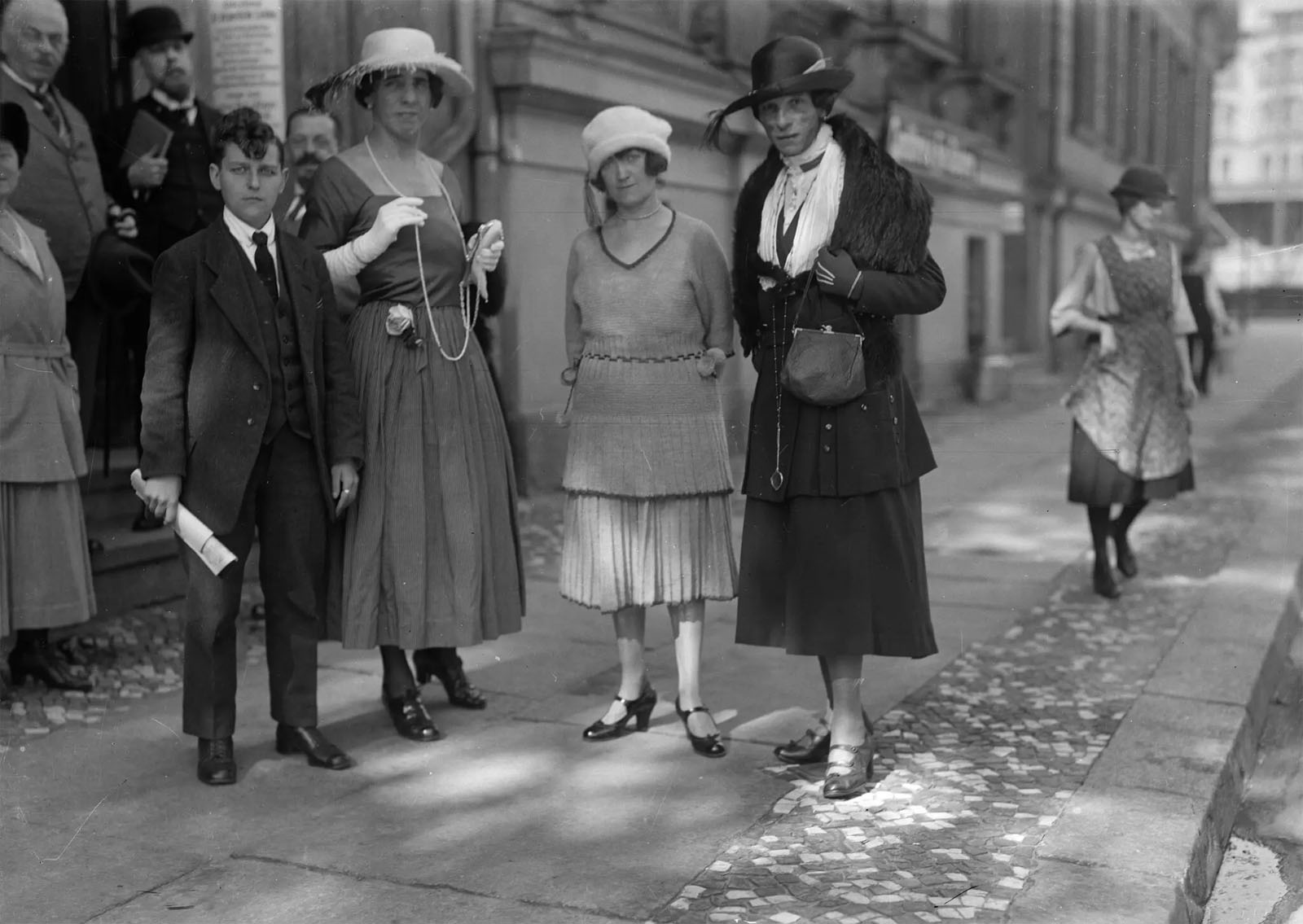
 

Willy Römer (German, 1887-1979) 'Transvestites in Front of the Institute of Sexology' 1921


Willy Römer (German, 1887-1979)
Transvestites in Front of the Institute of Sexology
1921
Gelatin silver print
© bpk / Kunstbibliothek, SMB, Photothek Willy Römer


Titled “Transvestites in Front of the Institute of Sexology” this photograph was taken on the occasion of the First International Congress for Sexual Reform on the Basis of Sexology in Berlin, 1921.

Willy Römer (December 31 , 1887 in Berlin – October 26, 1979 in West Berlin ) was a press photographer. His picture agency was one of the ten most important of the Weimar period. The pictures mainly illustrate life in Berlin from 1905 to 1935. It is thanks to a rare stroke of luck that his extensive picture archive survived the Second World War almost unscathed.


'"Transvestite Certificate" for Gerd Katter' 1928


“Transvestite Certificate” for Gerd Katter
1928
© Archiv der Magnus-Hirschfeld-Gesellschaft


Starting in 1900, “Transvestite Certificates” were issued by a doctor, that officially certified that a person was known to be “wearing men’s clothing” or “wearing women’s clothing”.

In TO BE SEEN #QueerLives we also show Gerd Katter’s “Transvestite License”. From 1900, “transvestite certificates” were issued in some cities. It is a medically certified official confirmation that a person is known as “wearing men’s clothing” or “wearing women’s clothing”. The authorities refrain from making an arrest if you show them during checks. However, those affected are thus registered with the police and can be monitored more easily.

Gerd Katter (1910-1995) came to the Institute for Sexology at the age of 16 – at that time still with a female birth name. Barred from having his breasts amputated because of his youth, Katter tries to operate on himself, which requires an emergency amputation. Katter is one of many people who receive concrete, albeit unconventional, help at the institute. So he is prescribed to visit bars where “transvestites” meet. According to the adaptation therapy pursued at the institute, those seeking advice should be brought into contact with like-minded people. This is how they should learn to accept themselves.

Magnus Hirschfeld repeatedly invited Gerd Katter to the institute to show his guests a medical case study – a practice of displaying people and their bodies that was common at the time, but which is problematic from today’s medical-ethical point of view. Gerd Katter later completed an apprenticeship as a carpenter and lived in the GDR.

Text from the Munich Documentation Center for the History of National Socialism Instagram page


Charlotte Wolff (German-British, 1897-1986) 'Bisexuality' German edition from 1981


Charlotte Wolff (German-British, 1897-1986)
Bisexuality
German edition from 1981
© NS-Dokumentationszentrum München


Charlotte Wolff – Sexology in Exile

Female homosexuality and bisexuality received little attention in the male-dominated field of sexology. An exception was the research of Charlotte Wolff (1897-1986). The physician situated precisely these topics at the centre of her work. After 1933, left-wing, Jewish, and openly lesbian women in Germany were increasingly targeted by the Nazis. Being Jewish, she emigrated to Paris in 1933, and to London in 1936. Her research on lesbian sexuality and bisexuality earned her international recognition beginning in the 1960s.

Feeling Bodies, Seeing Images

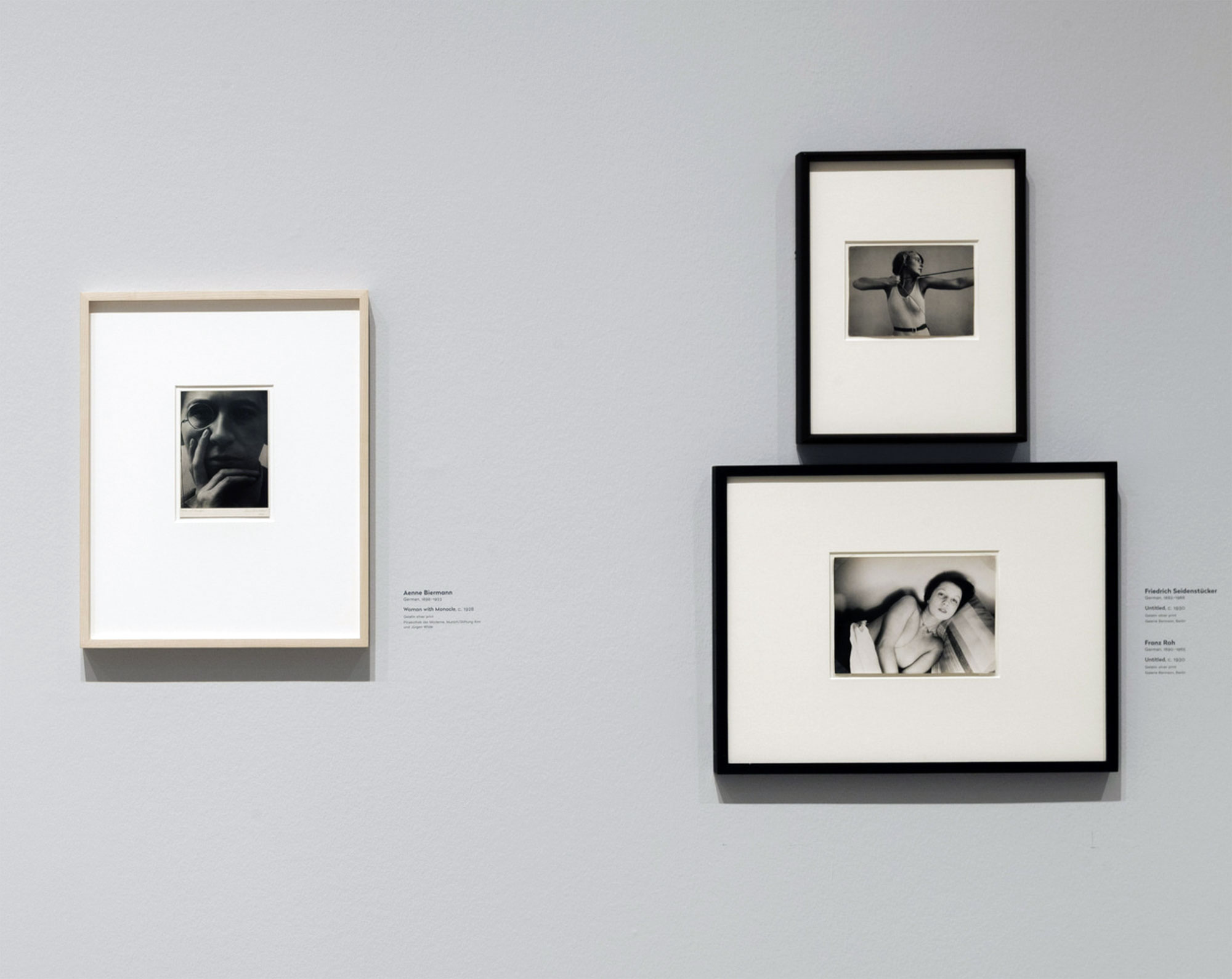
At the same time as the advancements in sexology, new notions of the body, gender, and intimacy were finding expression in art and culture. Literature, theatre, film, and the visual arts offered an opportunity to question gender stereotypes and to create new roles and body images. These served as the basis for imagining freer ways of living and to lay the foundation for what we perceive today as queer aesthetics.

While Article 142 of the Weimar Constitution promised extensive artistic freedom, censorship was simultaneously introduced for the new medium of film. Munich in particular had numerous bans on film and theatre performances deemed offensive.

Text from Stories of the exhibition TO BE SEEN: Queer Lives 1900-1950
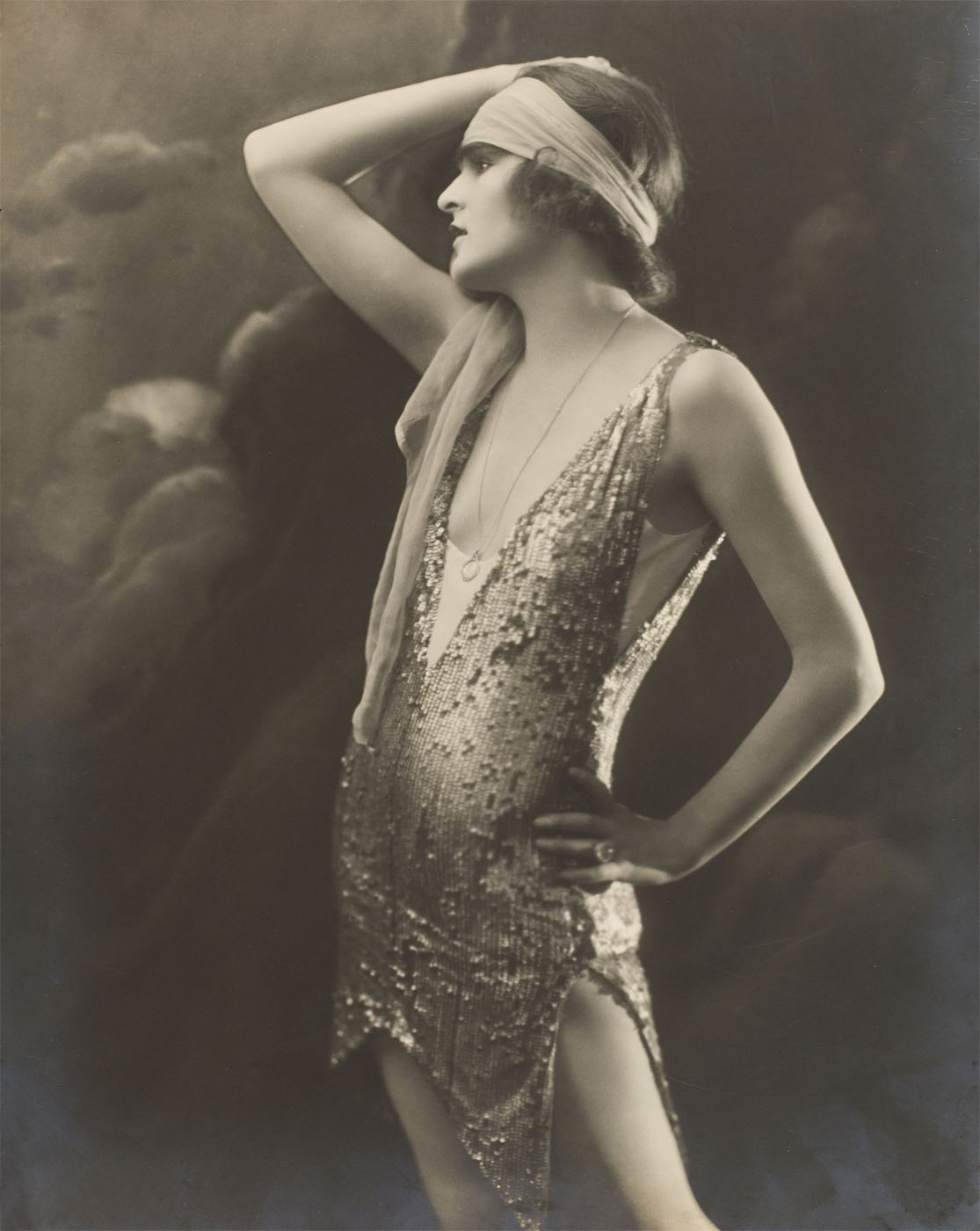
 

Unknown photographer. 'Anita Berber' c. 1925


Unknown photographer
Anita Berber
c. 1925
© Stiftung Stadtmuseum Berlin – Archive German State Opera


The bisexual dancer Anita Berber (1899-1928) confronted audiences with homoeroticism, nudity, and drug use, addressing issues that were taboo in the public eye.

The pejorative connotations of decadence as a moral failing or degenerate or degenerative state have often played into the pathologisation and criminalisation of specific bodies and practices. This is especially the case when these bodies and practices come to be seen as a threat to the health and integrity of a nation. Some of the most interesting examples can be found in Berlin at the dawn of the Weimar Republic, when the city itself was subject to charges of miasmic contagion. ‘Even the alkaline air around the Prussian capital (Berliner Luft)’, writes performance scholar Mel Gordon in characteristically hyperbolic style, ‘was said to contain a toxic ether that attacked the central nervous system, stimulating long suppressed passions as it animated all the external tics of sexual perversity’.[1]

Dance was regarded as a vector of transmission in spreading this toxic ether. Social dancing (Tanztaumel) swept Berlin in the year following the armistice, offering writers and cultural commentators a rich repository of tropes and metaphors for describing a social, economic and political situation that appeared to be spinning out of control. …

For dance and theater scholar Karl Toepfer, Berber’s aestheticization of her addictions to a plethora of narcotics presented ‘an almost satiric critique of the pretensions to a healthy, modern identity’.[11] Sickness formed the basis of a carefully stage-managed persona in the public eye that was to manifest in equally carefully choreographed routines. For instance, in one of the better-known dances from the Tänze des Lasters series, Kokain (Cocaine, 1922), Berber stages an embattled, spasmodic body torn between a will to live and the delirious effects of a narcotic. One reviewer described the dance as ‘a product of decay’ and a ‘style of degeneracy’,[12] suggesting that her embodiment of Berlin’s ‘toxic ether’ landed with her audiences (ether was also one of Berber’s drugs of choice, particularly once mixed with chloroform and white rose petals). That this piece was set to Camille Saint-Saëns’s Danse macabre (1874) makes it tempting to position it as the epitome of Berlin’s own ‘dance of death’ in which death and sexuality perform a pas de deux across Berber’s performing body – a body that was to succumb to tuberculosis aged only twenty-nine.

Berber’s dances have been read as ‘jejune’ and derivative;[13] however, this does a disservice to what Susan Laikin Funkenstein describes as ‘a more profound understanding of her contributions’ to modern dance history that were ahead of their time.[14] Although Funkenstein is looking to put some distance between Berber’s perception as a ‘depraved vamp’ and her innovativeness as a dancer, I argue that these are mutually enriching considerations in the development of her decadent choreographies. Berber’s ‘sickness’ as an addict, her perceived corruption as a sexual libertine, and (later) her physical sickness after contracting tuberculosis were not adjacent to her work as a dancer. She danced as she lived – which is to say, decadently – just as her bohemian aestheticism makes it difficult to distinguish where her choreographies begin and end.

Dr Adam Alston. “Dancing decadence: Anita Berber,” on the Staging Decadence website 24 January 2023 [Online] Cited 11/04/2023


New images of the body

In the first half of the twentieth century, artists experimented with new representations of the human body. They conceived of a wide spectrum of possible identities and sexualities situated outside the dominant categories. Artists subverted binary notions of gender, whether through ambiguities, gender-neutral codes, or playing with androgynous body images.

In 1933, the Nazis put an end to this diversity. Avant-garde works by artists such as Hannah Höch or Jeanne Mammen were denounced as “degenerate” and confiscated, banned, or destroyed. The regime instead honoured artists such as Arno Breker, Leni Riefenstahl, and Josef Thorak, who immortalised traditional gender images in monumental depictions. Such images supported the Nazi regime’s racial ideals, and endured well into the postwar period.

Text from Stories of the exhibition TO BE SEEN: Queer Lives 1900-1950
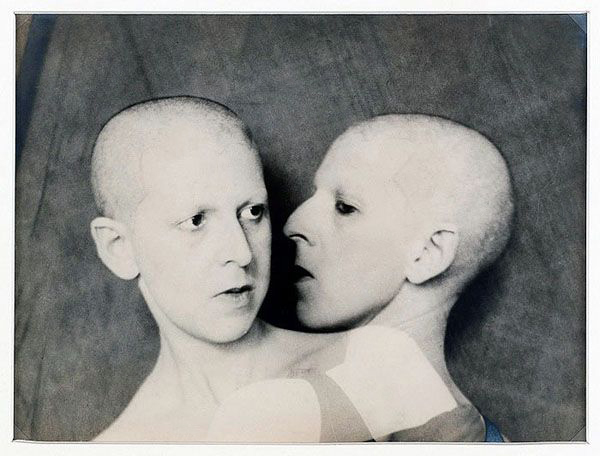
 

Claude Cahun (French, 1894-1954) 'Que me veux tu?' 1929


Claude Cahun (French, 1894-1954)
Que me veux-tu?
1929
Gelatin silver print
Paris Musees, musée d’Art moderne


Hannah Höch (German, 1889-1978) 'Untitled (Hannah Höch at her easel, The Hague; self-portrait (double exposure) with the painting Symbolic Landscape III)' 1930


Hannah Höch (German, 1889-1978)
Untitled (Hannah Höch at her easel, The Hague; self-portrait (double exposure) with the painting Symbolic Landscape III)
1930
Gelatin silver print
© VG Bild-Kunst, Bonn 2022


Hannah Höch worked with clichés and role models in her art and was a significant influence on the Dada movement.


Hannah Höch (German: [hœç]; 1 November 1889 – 31 May 1978) was a German Dada artist. She is best known for her work of the Weimar period, when she was one of the originators of photomontage. Photomontage, or fotomontage, is a type of collage in which the pasted items are actual photographs, or photographic reproductions pulled from the press and other widely produced media.

Höch’s work was intended to dismantle the fable and dichotomy that existed in the concept of the “New Woman”: an energetic, professional, and androgynous woman, who is ready to take her place as man’s equal. Her interest in the topic was in how the dichotomy was structured, as well as in who structures social roles.

Other key themes in Höch’s works were androgyny, political discourse, and shifting gender roles. These themes all interacted to create a feminist discourse surrounding Höch’s works, which encouraged the liberation and agency of women during the Weimar Republic (1919-1933) and continuing through to today.

Text from the Wikipedia website
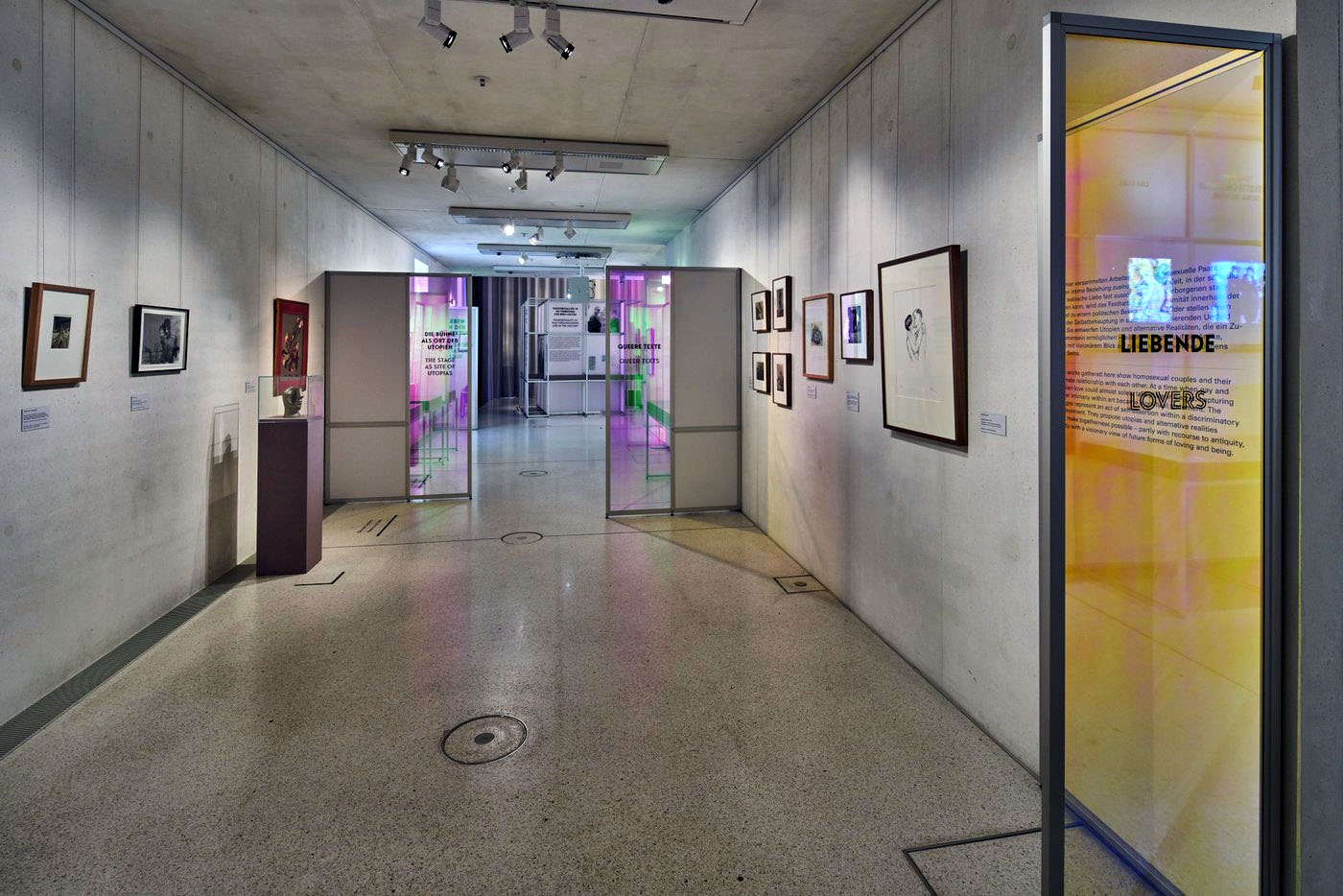
 

Installation view of the exhibition 'TO BE SEEN: Queer Lives 1900-1950' at the Munich Documentation Center for the History of National Socialism


Installation view of the exhibition TO BE SEEN: Queer Lives 1900-1950 at the Munich Documentation Center for the History of National Socialism
Photo: Connolly Weber Photography/NS-Dokumentationszentrum München


Lovers

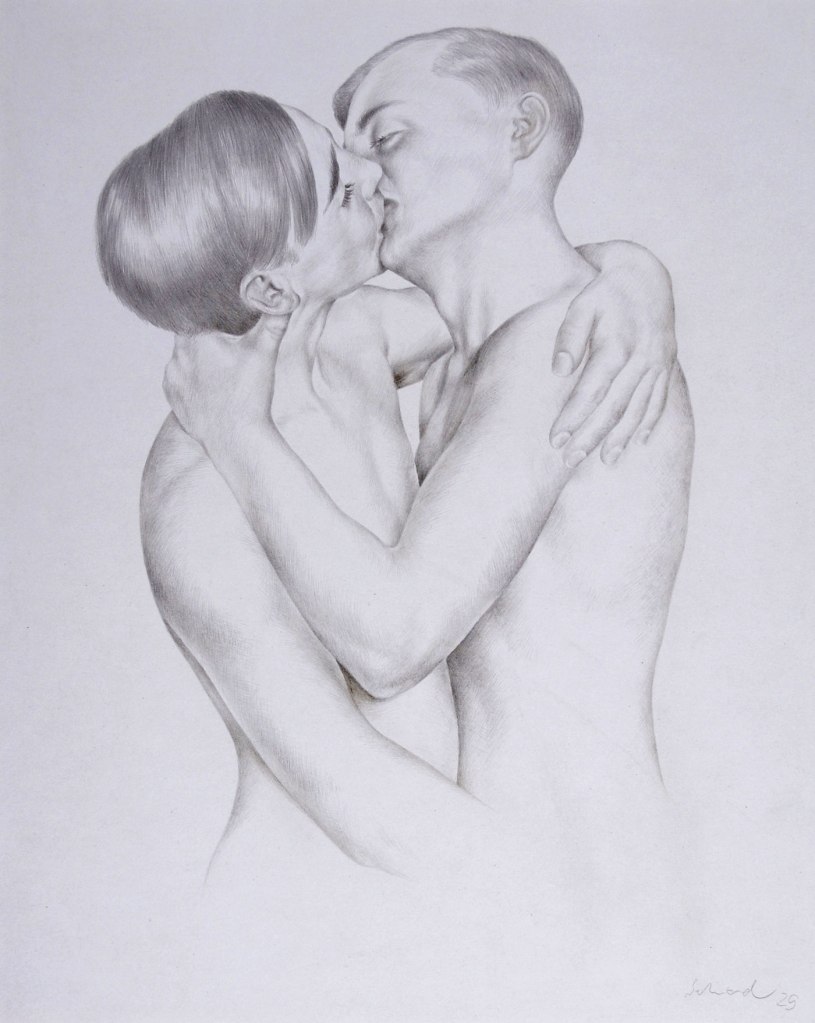
The works gathered here show homosexual couples and their intimate relationship with each other. At a time when gay and lesbian love could almost solely take place in secret, capturing queer intimacy within art became a political statement. The images represent an act of self-assertion within a discriminatory environment. They propose utopias and alternative realities that make togetherness possible – partly with recourse to antiquity, partly with a visionary view of future forms of loving and being.

Text from Stories of the exhibition TO BE SEEN: Queer Lives 1900-1950
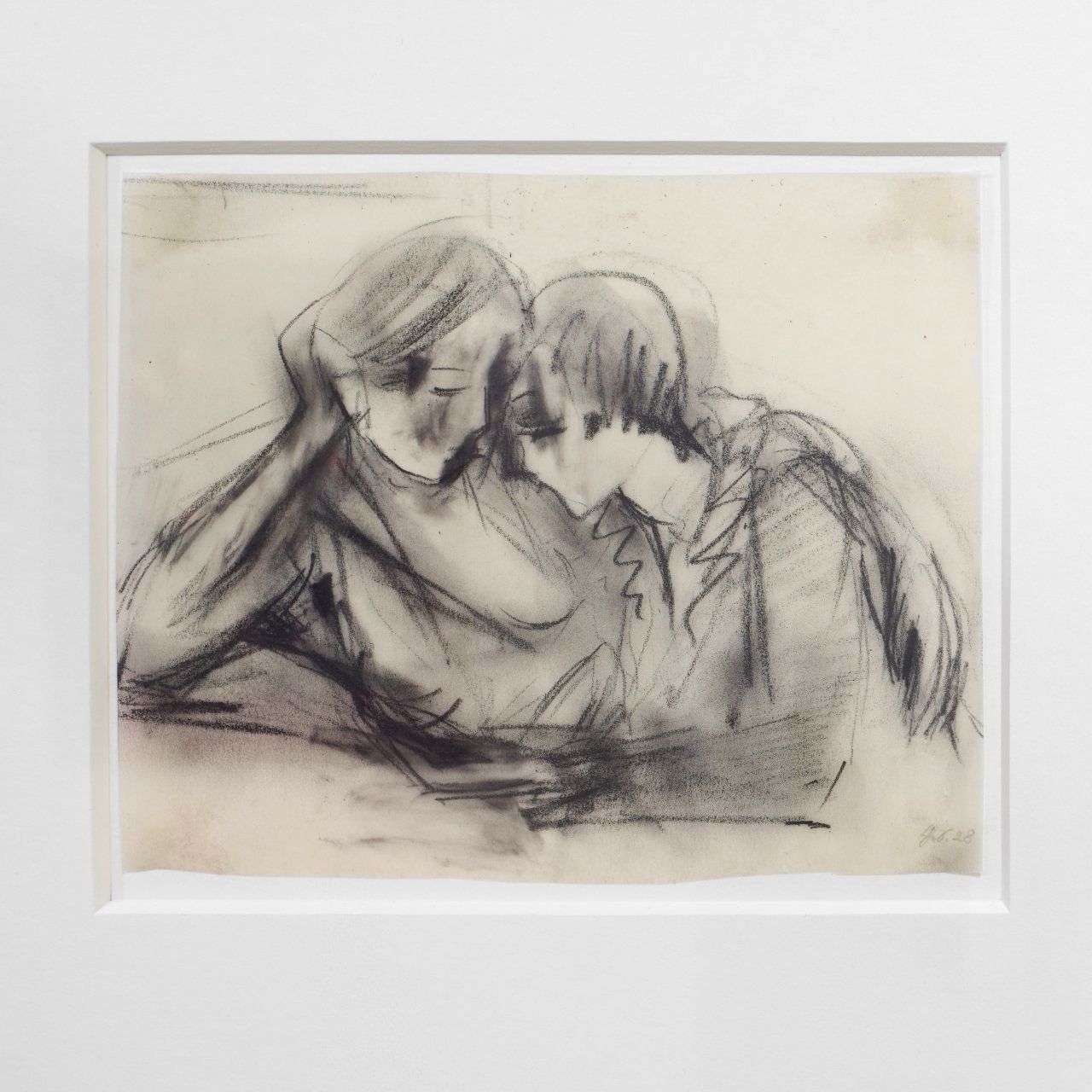
 

Gertrude Sandmann (German, 1893-1981) 'Rosa Nachthemd und schwarzer Pyjama' (Pink nightgown and black pyjamas) 1928


Gertrude Sandmann (German, 1893-1981)
Rosa Nachthemd und schwarzer Pyjama (Pink nightgown and black pyjamas)
1928
© Anja Elisabeth Witte/Berlinische Galerie


Gertrude Sandmann (16 November 1893 – 6 January 1981) was a German artist and Holocaust survivor. Born into a wealthy German-Jewish family, Sandmann studied at the Verein der Berliner Künstlerinnen and had private tutelage from Käthe Kollwitz. In 1935 she was banned from practicing her profession due to the Nuremberg Laws. Given a deportation order in 1942, she ignored it, faked her own suicide, and hid with friends in Berlin until the end of the war. She lived in an apartment in Berlin-Schöneberg until the end of her life. She was a lesbian and, after the war, worked to improve the rights and visibility of LGBT people. Much of her oeuvre is held by the Potsdam Museum.

Text from the Wikipedia website


Gertrude Sandmann (1893-1981), who trained in Berlin and Munich, took private lessons from Käthe Kollwitz in the 1920s. She and the older artist remained lifelong friends. Unlike Kollwitz, however, Sandmann was less focused on social critique. A committed feminist, women were her favourite theme, as they were for her colleague Jeanne Mammen, who was about the same age.
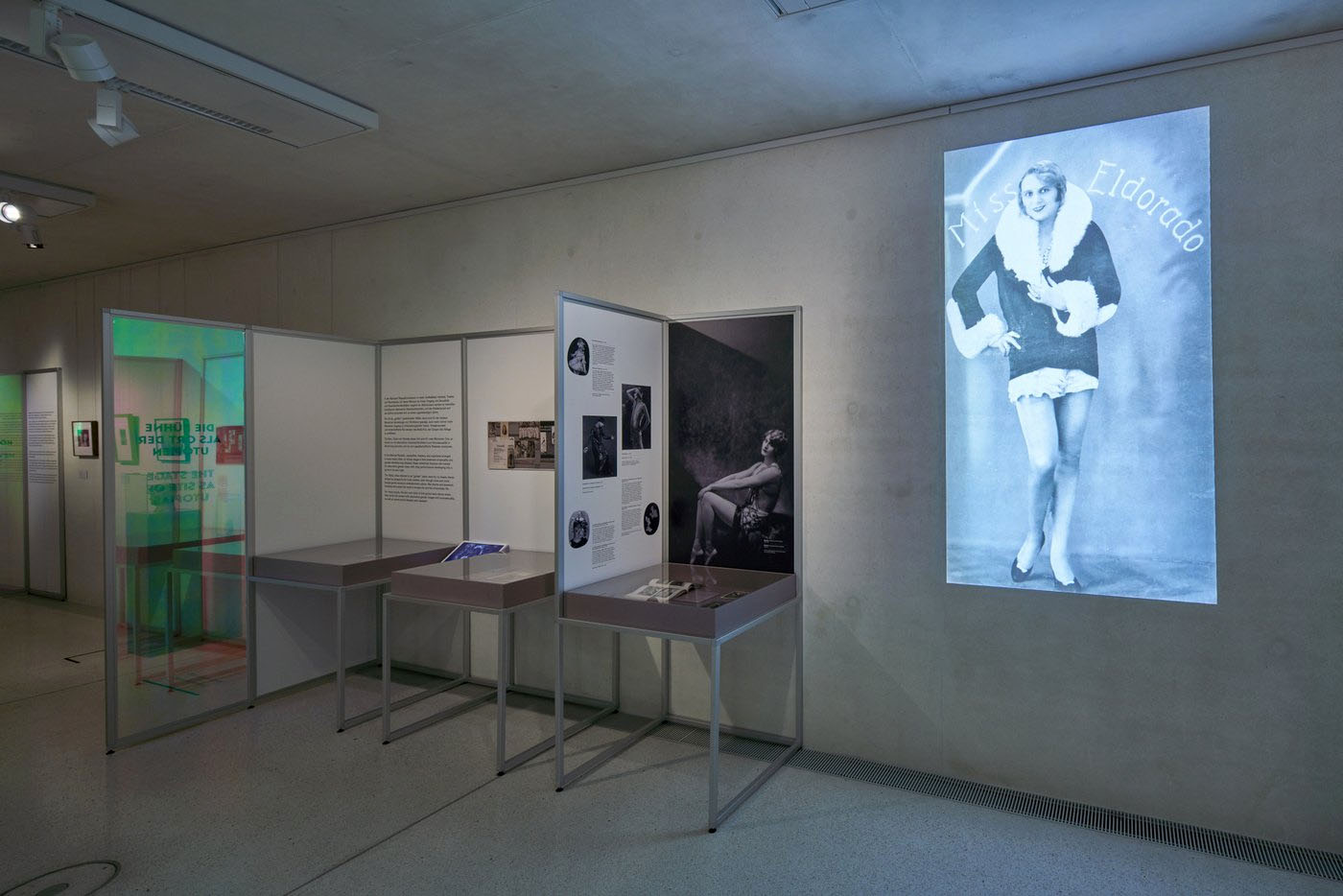
 

Installation view of the exhibition 'TO BE SEEN: Queer Lives 1900-1950' at the Munich Documentation Center for the History of National Socialism


Installation view of the exhibition TO BE SEEN: Queer Lives 1900-1950 at the Munich Documentation Center for the History of National Socialism showing at centre, Dora Kallmus’ photograph The trapeze artist Barbette (Nd, below)
Photo: Connolly Weber Photography/NS-Dokumentationszentrum München


The stage as site of utopias

In the Weimar Republic, vaudevilles, theatres, and nightclubs emerged in many major cities, on whose stages a freer treatment of sexuality and gender identities was allowed. Stage celebrities became role models for alternative gender roles, with drag performances developing into a genre in its own right.

The 1920s, often referred to as “golden” years, were by no means characterised by prosperity for most citizens, even though more and more people gained access to entertainment culture. War trauma and economic hardship stimulated the need to escape the worries of everyday life.

For many people, the bars and clubs of this period were places where they came into contact with alternative gender images and homosexuality, as well as where social debates were sparked.

Text from Stories of the exhibition TO BE SEEN: Queer Lives 1900-1950
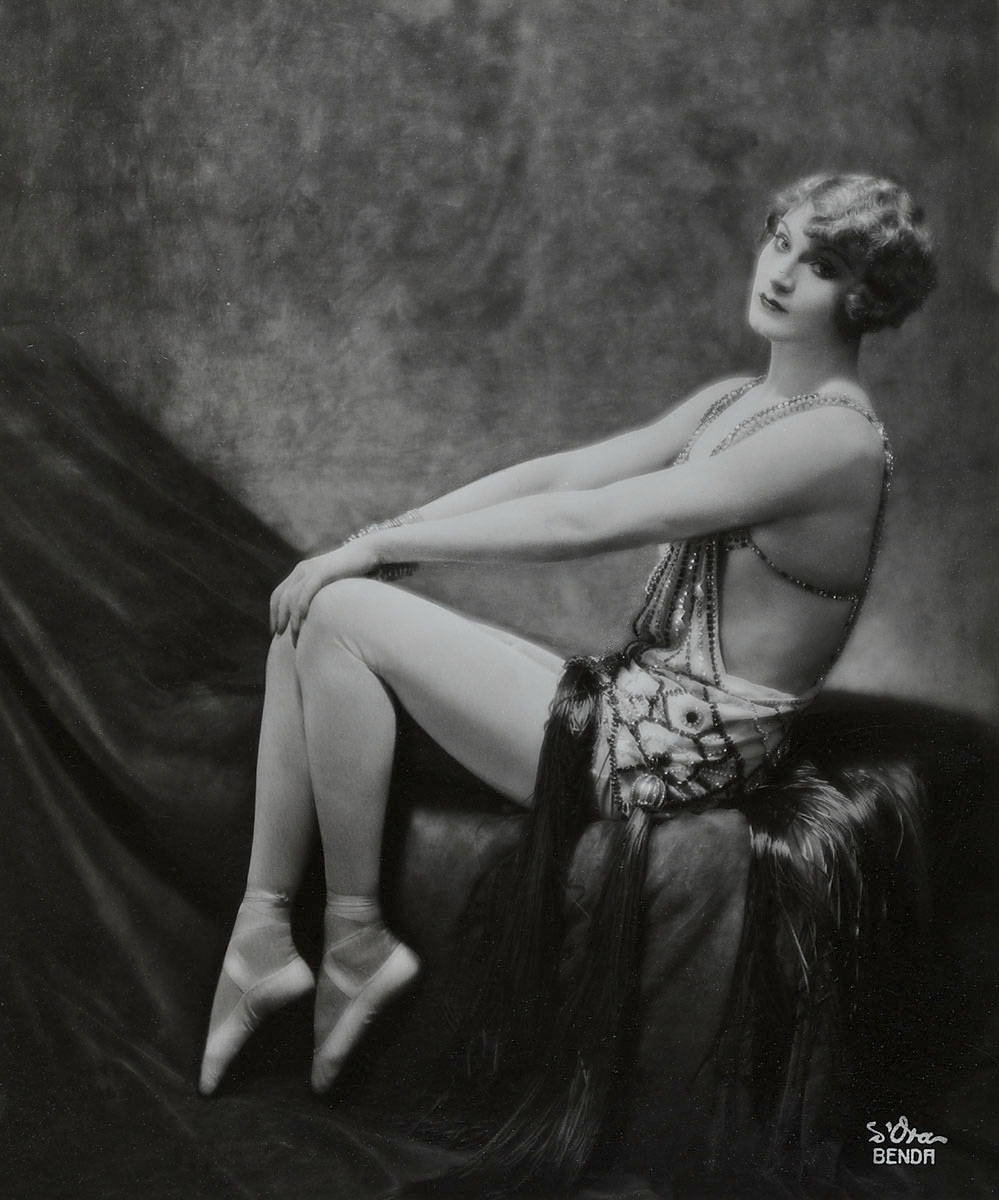
 

Dora Kallmus (Austrian, 1881-1963) 'The vaudeville and trapeze artist Barbette' Nd


Dora Kallmus (Atelier d’Ora) (Austrian, 1881-1963)
The vaudeville and trapeze artist Barbette
Nd
© Estate of Madame d’Ora, MK&G ~ Museum für Kunst und Gewerbe Hamburg


The trapeze artist Barbette (real name Vander Clyde, 1899-1973) celebrated great success in Europe from the mid-1920s. Barbette performed, among other things, in the Berlin Varieté Wintergarten. The sensational productions of the “female impersonators” became increasingly known to a mass audience – and thus also helped the male and female impersonators of the Berlin scene to gain acceptance.


Dora Philippine Kallmus (20 March 1881 – 28 October 1963), also known as Madame D’Ora or Madame d’Ora, was an Austrian fashion and portrait photographer.


Early life

Dora Philippine Kallmus was born in Vienna, Austria, in 1881 to a Jewish family. Her father was a lawyer. Her sister, Anna, was born in 1878 and deported in 1941 during the Holocaust. Although her mother, Malvine (née Sonnenberg), died when she was young, her family remained an important source of emotional and financial support throughout her career.

She and her sister, Anna, were both “well-educated,” spoke English and French, and played the piano. They had also traveled throughout Europe.

She became interested in the photography field while assisting the son of the painter Hans Makart, and in 1905 she was the first woman to be admitted to theory courses at the Graphische Lehr- und Versuchsanstalt (Graphic Training Institute). That same year she became a member of the Association of Austrian photographers. At that time she was also the first woman allowed to study theory at the Graphischen Lehr- und Versuchsanstalt, which in 1908 granted women access to other courses in photography.

Career

In 1907, she established her own studio with Arthur Benda in Vienna called the Atelier d’Ora or Madame D’Ora-Benda. The name was based on the pseudonym “Madame d’Ora”, which she used professionally. D’ora and Benda operated a summer studio from 1921 to 1926 in Karlsbad, Germany, and opened another gallery in Paris in 1925. The Karlsbad gallery allowed D’Ora to cater to the “international elite vacationers.” These same clients later convinced her to open her Paris studio.

Between 1917 and 1927, D’Ora’s studio “produced” photographs for Ludwig Zwieback & Bruder, a Viennese department store. She was represented by Schostal Photo Agency (Agentur Schostal) and it was her intervention that saved the agency’s owner after his arrest by the Nazis, enabling him to flee to Paris from Vienna.

Her subjects included Josephine Baker, Coco Chanel, Tamara de Lempicka, Alban Berg, Maurice Chevalier, Colette, and other dancers, actors, painters, and writers.

Text from the Wikipedia website


Dora Kallmus (Austrian, 1881-1963) 'The vaudeville and trapeze artist Barbette' Nd (detail)


Dora Kallmus (Austrian, 1881-1963)
The vaudeville and trapeze artist Barbette (detail)
Nd
© Museum für Kunst und Gewerbe Hamburg


Unknown photographer. 'Dance study of Alexander Sakharoff' 1912


Unknown photographer
Dance study of Alexander Sakharoff
1912
Deutsche Kunst und Dekoration: illustr. Monatshefte für moderne Malerei, Plastik, Architektur, Wohnungskunst u. künstlerisches Frauen-Arbeiten – 30.1912


Installation view of the exhibition 'TO BE SEEN: Queer Lives 1900-1950' at the Munich Documentation Center for the History of National Socialism


Installation view of the exhibition TO BE SEEN: Queer Lives 1900-1950 at the Munich Documentation Center for the History of National Socialism
Photo: Connolly Weber Photography/NS-Dokumentationszentrum München


Life under dictatorship

After the Nazis took power in 1933, every form of queer life was threatened and continued to exist only in private spaces or secret locations. Hopes for a tacit tolerance of homosexuality by the Nazis were finally dashed after the murder of Ernst Röhm, chief of- staff of the SA (Storm Troopers). The period of open persecution had begun.

During the first major Nazi raids against homosexuals on October 20, 1934, 145 men were arrested in Munich alone. Paragraph 175 of the penal code was made more severe in June 1935: any act between men bearing sexual suggestion was now punishable.

About 57,000 homosexual men were sentenced to prison, and between 6,000 and 10,000 of them were deported to concentration camps, of whom at least half were murdered.

Female homosexuality was not prosecuted in the dictatorship, but was socially ostracised. If lesbian women and persons who did not conform to their gender were denounced, they were threatened with police investigations, house searches, and interrogations. If political opposition, social deviance, or racial persecution additionally occurred, they faced repression or even internment in a concentration camp.

The graphic artist Richard Grune (1903-1983) was imprisoned almost continuously from 1934 to 1945 because of his homosexuality. After his liberation from the concentration camp, he processed what he had experienced through art.

Text from Stories of the exhibition TO BE SEEN: Queer Lives 1900-1950


Richard Grune (German, 1903-1983) 'Solidarity: Prisoner Supports His Exhausted Comrade' 1945-1947


Richard Grune (German, 1903-1983)
Solidarity: Prisoner Supports His Exhausted Comrade
1945-1947
Lithograph
© Wien Museum


“Solidarity,” a lithograph of one prisoner supporting another, by German artist Richard Grune, who spent eight years in Nazi concentration camps after being convicted for homosexuality.


Trained as an artist and graphic designer, 29-year-old Richard Grune moved to Berlin the same month that the police began forcing these establishments to shut down. Although prominent nightclubs like the Eldorado faced closure, members of these communities still found ways to continue gathering more privately. For example, Grune hosted two parties for friends in his studio in fall 1934. He was denounced afterward – along with dozens of others – by a private citizen who often passed information to police. Grune was then arrested for alleged violations of Paragraph 175, the statute of the German criminal code that criminalised sexual relations between men. He was imprisoned for several months before being convicted and sentenced to a year in prison.

After serving his sentence, Grune was arrested again by the Gestapo and held indefinitely in what was misleadingly referred to as “protective custody” (“Schutzhaft”) – an experience shared by many convicted of violating Paragraph 175 under the Nazi regime.5 Grune spent the next decade in concentration camps, including Sachsenhausen and Flossenbürg. He escaped from Flossenbürg in April 1945 as American forces approached and camp authorities evacuated the prisoners.

Grune created the featured lithograph6 – “Solidarity: Prisoner Supports His Exhausted Comrade” – in 1945 as part of a series of images inspired by his experiences as a prisoner in the Nazi camp system. These lithographs were reproduced in two published portfolios in 1947.7 Grune’s artwork reflects many of his own experiences, but it does not reference his persecution as a gay man in any specific way. Instead, his lithographs seem to suggest the idea of shared suffering among all concentration camp prisoners. Because sexual relations between men remained criminalised for decades in Germany after the end of World War II, many people convicted under Paragraph 175 chose to conceal the details of their past persecution under the Nazi regime.8

After the war, Grune chose to portray himself as a political prisoner of Nazism, but he was not able to obtain official recognition or compensation for his suffering. Although his lithographs are among the most important artistic representations of concentration camp experiences created immediately after the war, Grune could not support himself as an artist. He did occasionally find design and illustration work, but he made his living by working as a bricklayer. Grune died in obscurity in Kiel, Germany in 1983.

Anonymous. “Lithograph by Richard Grune,” on the Holocaust Sources in Context website Nd [Online] Cited 10/04/2023


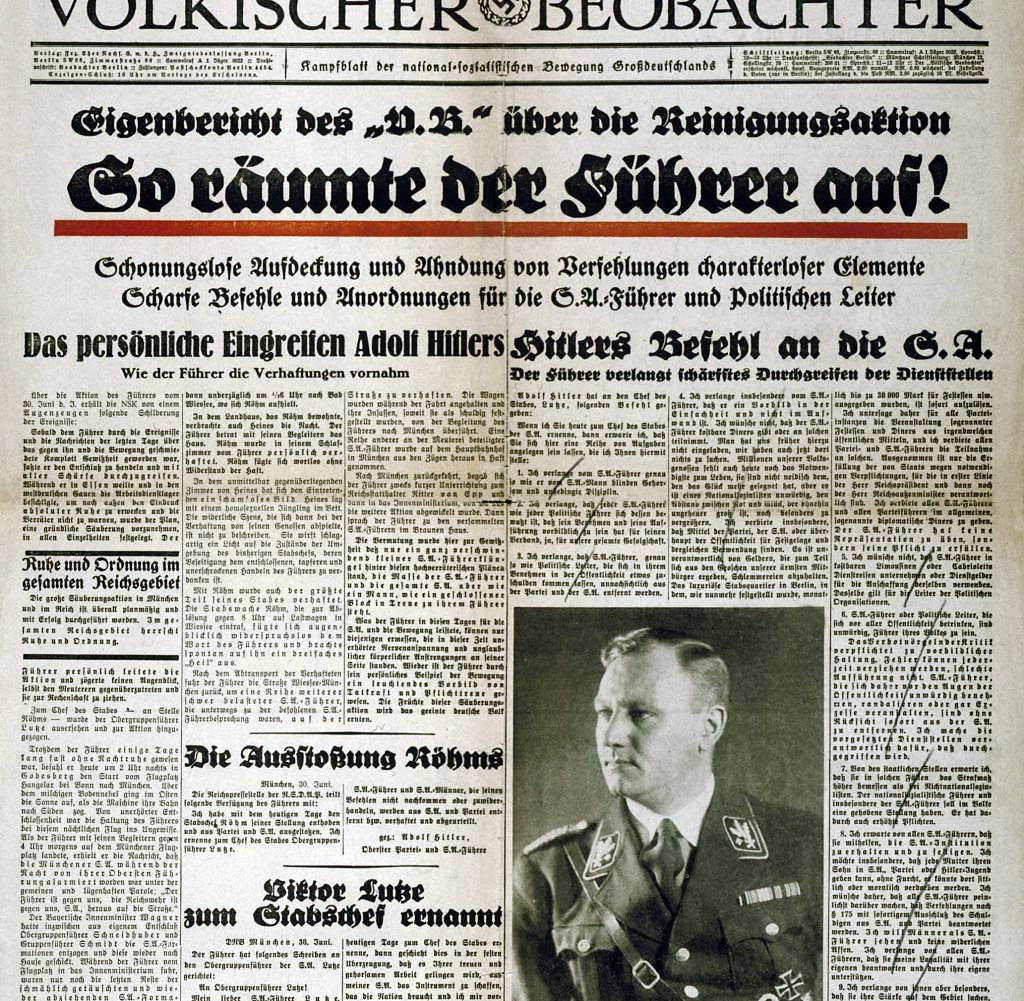
"This is how the Führer cleaned up!" Front page of the extra issue of the 'Völkischer Beobachter', June 30, 1934, Berlin edition


“This is how the Führer cleaned up!”
Front page of the extra issue of the Völkischer Beobachter, June 30, 1934, Berlin edition
Public domain


Homosexuality in Nazi organisations and in the military

The proscription of homosexuality was used by various sides in the political struggle. In 1931 / 1932, the Social Democrats utilised Ernst Röhm’s homosexuality to harm the Nazi Party. The Röhm case served the notion of “gay Nazis” gathering together in male associations, a phenomenon that did exist. Beginning in the mid-1930s, the Nazi regime increasingly cracked down on homosexual activity in the army, police, and Nazi associations. Intimacy between men was now punished particularly severely in party organisations and the police. Nazi propaganda labeled homosexual men as “enemies of the state” to legitimise this persecution. Nevertheless, clandestine homosexual encounters continued to occur.

Adapting to survive

After the dismantling of gay and lesbian subcultures across the entire state and the harshening of criminal law, homosexual contact took place almost exclusively in private spaces. Fear of denunciation and persecution drove most homosexuals to hide their sexuality and conform.

This also applied to lesbian women and trans* persons, who were not prosecuted per se. They could remain unhampered as long as they did not attract attention. Marriages of convenience were one of many survival strategies. Certain prominent artists were tolerated by the Nazi regime despite their widely known homosexuality. The regime, which needed these stars for its propaganda, held off on persecution, and demanded that they conform in their way of living.

Persecution and imprisonment

The Nazi regime’s treatment of homosexuals and trans* persons was not uniform. Initially, most of the men convicted under Paragraph 175 were released after serving their prison sentences. Especially since 1940 many were transferred to concentration camps. Lesbian women and trans* persons were sometimes charged with other crimes, such as prostitution or indecent behaviour. Others were persecuted for political, social, or racist reasons.

The Nazi regime’s treatment of homosexuals and trans* persons was not uniform. Initially, most of the men convicted under Paragraph 175 were released after serving their prison sentences. Especially since 1940 many were transferred to concentration camps. Lesbian women and trans* persons were sometimes charged with other crimes, such as prostitution or indecent behaviour. Others were persecuted for political, social, or racist reasons.

Text from Stories of the exhibition TO BE SEEN: Queer Lives 1900-1950
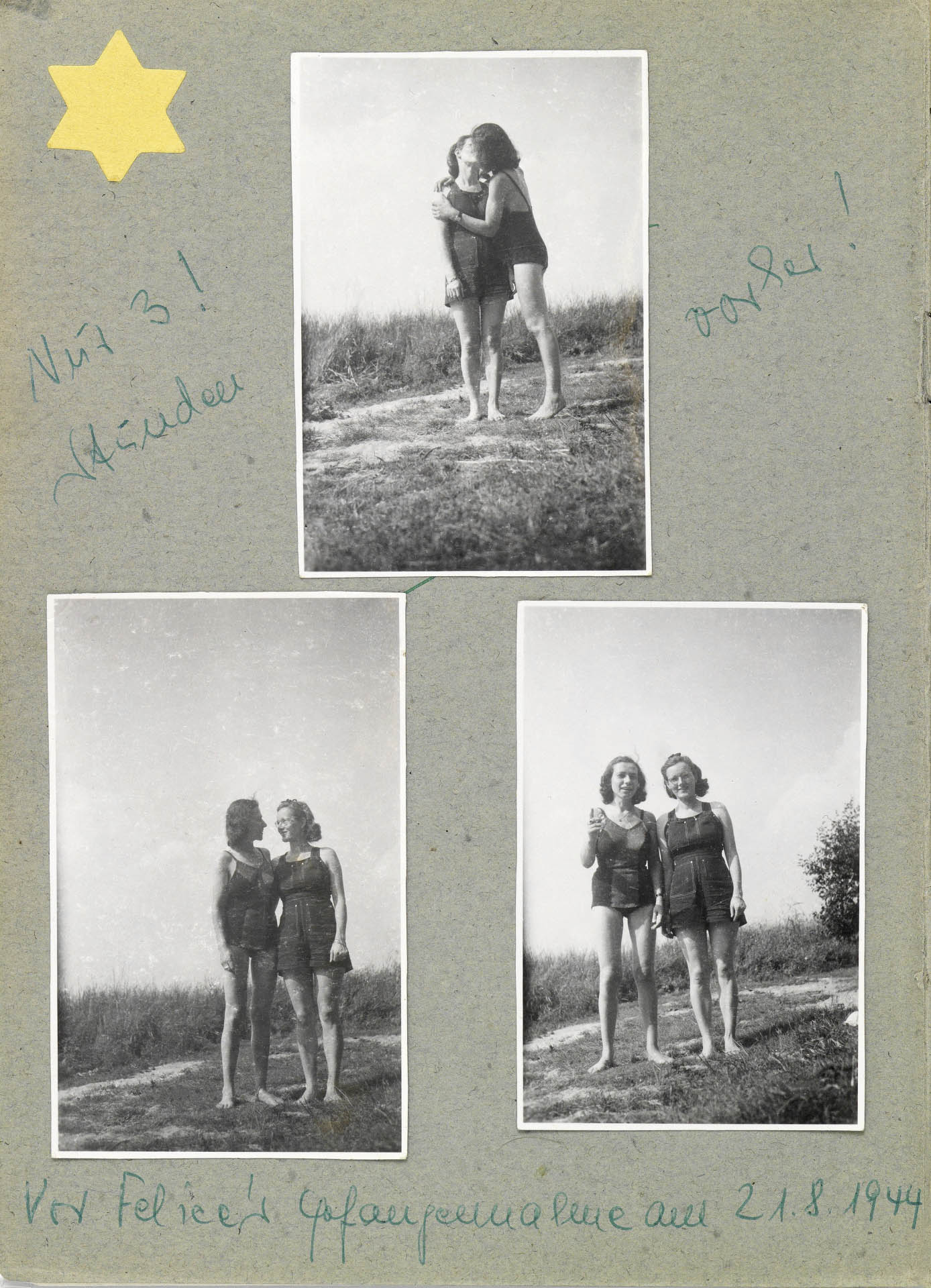
 

Unknown photographer. 'Photographs from Elisabeth (Lilly) Wust's diary entry on the deportation of her Jewish partner Felice Schragenheim to the Theresienstadt concentration camp' August 21, 1944


Unknown photographer
Photographs from Elisabeth (Lilly) Wust’s diary entry on the deportation of her Jewish partner Felice Schragenheim to the Theresienstadt concentration camp
August 21, 1944
© Jewish Museum Berlin


Part of the diary entry by Elisabeth (Lilly) Wust on the deportation of her Jewish partner Felice Schragenheim to the Theresienstadt concentration camp, August 21, 1944


Elisabeth (Lilly) Wust (1913-2006) and Felice Schragenheim (1922-1945) met in Berlin in 1942, shortly after Schragenheim went into hiding as a Jew. They moved in together a little later and promised to marry in June 1944. On August 21, 1944, Felice Schragenheim was discovered and taken to a Berlin collection point for Jews. Lilly Wust visited her there several times before the deportation to the Theresienstadt ghetto. In the hope of being able to help her beloved, Lilly Wust travelled to Theresienstadt herself in the fall of 1944.

Felice was deported to Auschwitz a little later. She died in early 1945, probably in the Bergen-Belsen concentration camp. Lilly Wust searched for her for years.

The love story of Lily Wust and Felice Schragenheim gained notoriety in the 1990s through the book “Aimée & Jaguar” and the feature film of the same name. However, there is another version of the story: Elenai Predski-Kramer, a former girlfriend of Felice Schragenheim, tells her perspective on the love story after the book was published and expresses the suspicion that Lilly Wust herself might have betrayed Felice Schragenheim. However, there is no evidence for this.

Text from the Munich Documentation Center for the History of National Socialism Instagram page
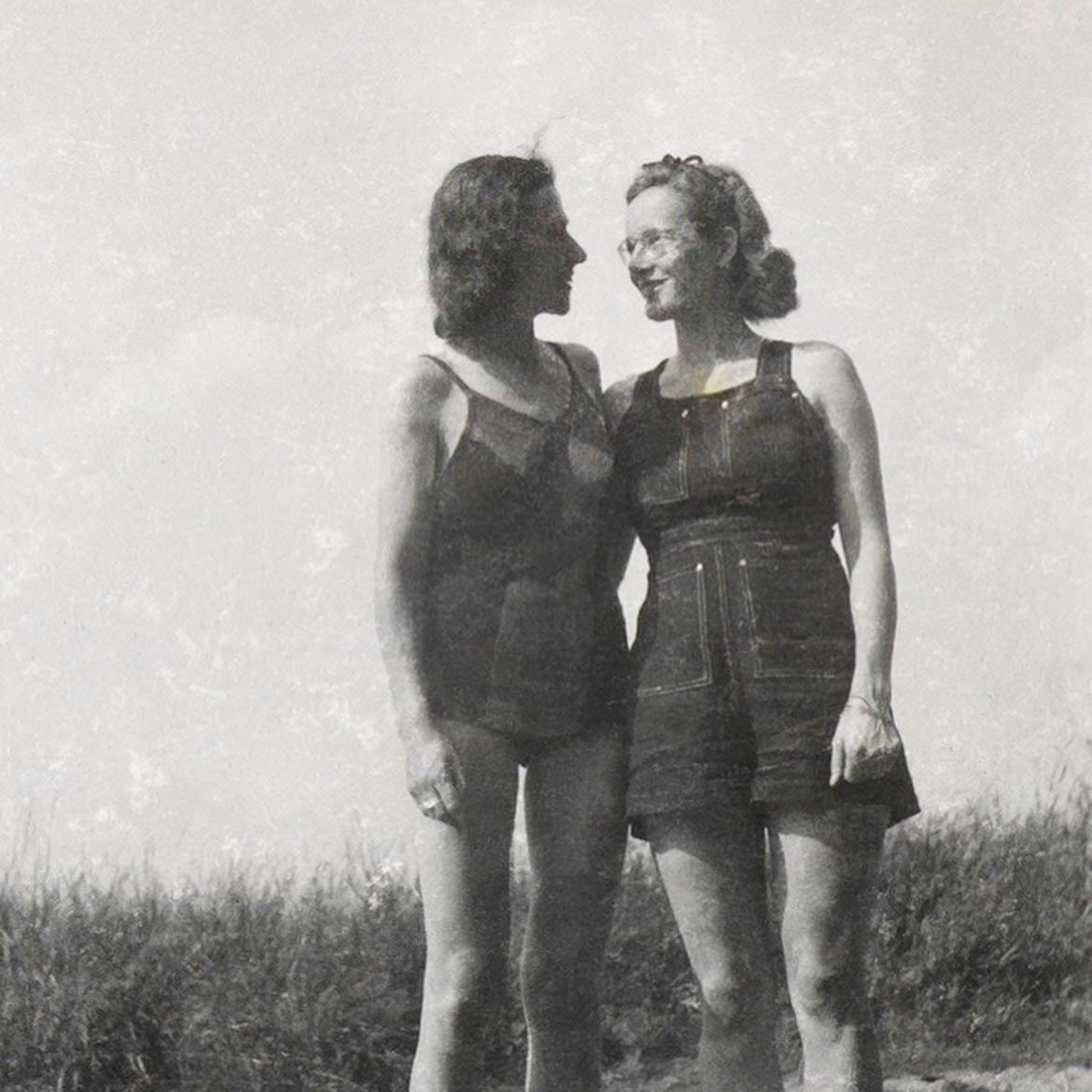
 

Unknown photographer. 'Photograph from Elisabeth (Lilly) Wust's diary entry on the deportation of her Jewish partner Felice Schragenheim to the Theresienstadt concentration camp' August 21, 1944 (detail)


Unknown photographer
Photograph from Elisabeth (Lilly) Wust’s diary entry on the deportation of her Jewish partner Felice Schragenheim to the Theresienstadt concentration camp (detail)
August 21, 1944
© Jewish Museum Berlin


Exile and resistance

Only a few homosexual and trans* people succeeded in escaping Nazi persecution through emigration. This option was usually only open to the wealthy or those who had international contacts and could find work abroad thanks to their education and language skills. Leaving Nazi Germany was made more difficult by the measures against capital transfer, which were tightened in 1934. The “Reich Flight Tax” reduced assets by 25 percent upon departure, the export of foreign currency was prohibited, and the transfer of bank or securities assets was made almost impossible.

Individual homosexual or transgender people decided to actively resist the Nazi regime, also in the territories occupied by Germany. They documented the crimes of the Nazi regime, called for resistance, carried out sabotage, committed attacks, or fought as partisans or members of foreign troops against Hitler’s Germany.

Text from Stories of the exhibition TO BE SEEN: Queer Lives 1900-1950


Claude Cahun. 'Self-portrait (with Nazi badge between her teeth)' 1945


Claude Cahun (French, 1894-1954)
Self Portrait (with Nazi badge between her teeth)
1945
Gelatin silver print
© Jersey Heritage Collection


Jewish-French author and photographer Claude Cahun (French, 1894-1954) and her partner Marcel Moore (French, 1892-1972)  put up resistance against the Nazi regime.


After four years of subversive activity, the pair were arrested by the Germans in 1944. Initially, the Nazi authorities couldn’t believe that the women carried it out by themselves. “They believed that there must be somebody else involved, there must be a man involved,” says Downie.

While waiting to be questioned, Cahun and Moore attempted suicide. They both took pills – barbiturates – which put them into a coma. Once they were well enough, they were sentenced to death for undermining the German forces. But the Bailiff of Jersey and the French Consul pleaded on their behalf – by that time, the Normandy landings had happened and Saint-Malo (the main connecting port) had been liberated, so they could no longer be deported to camps in Europe – and their sentence was commuted.

Although their lives had been saved, Moore and Cahun were not pleased. “They wanted to be martyrs for their cause,” says Downie. “To them, that would’ve been the realisation of their life of resistance, to be a martyr for freedom.”

At 3.40pm on May 9, 1945, the swastika was lowered from Fort Regent, a 19th-century fortification in St Helier, and the Union Jack was hoisted, signalling the official end of the occupation. Then the celebrations began. Cahun joined the crowds in Royal Square cheering, flag-waving, and holding a sailor aloft. Despite ill health from their time in prison, they kept on creating work after the war. In the same month, a photograph shows them gripping a Nazi eagle badge brazenly between their teeth, a silk scarf tied around their head, their hands dug into their coat pockets, their eyes staring defiantly at the camera.

Jessie Williams. “Claude Cahun: Jersey’s queer, anti-Nazi freedom fighter,” on the Huck website 14th May, 2020 [Online] Cited 17/04/2023


After 1945

Queer history was hardly remembered or archived after 1945. To this day, we know only some of the pioneers of the queer emancipation movement. We know even less about the life of those who were persecuted, driven into exile, murdered – or simply remained invisible.

After the end of the war, queer people continued to be marginalised. Gay men in particular continued to suffer in large numbers under Paragraph 175, many of whom did not go free but were transferred from concentration camps directly to prisons.

The ongoing discrimination by state and society changed only slowly. In 1969, Paragraph 175 was reformed and criminal law liberalised. Beginning in the 1970s, new social movements emerged, including a homosexual emancipation movement. Various groups reclaimed the “pink triangle” as a symbol to stand up for the rights of queer people.

Lesbian and feminist groups also gained popularity during the 1970s. Although lesbian sexuality was not directly persecuted by the state, many suffered from the misogynistic legal situation. The legal preferential treatment of men made it difficult to live out lesbian relationships, due to discrimination in labor and marriage laws.

The emergence of HIV in the 1980s affected many gay men and trans* people: thousands became infected, developed AIDS, and died. The state did not help, but instead relied on stigmatising measures and an aggressive rhetoric of exclusion, especially in Bavaria. For those affected, this recalled the previous period of open persecution.

Thanks to the efforts of activists, the health, political, and social situation of LGBTQI+ persons has improved since the 1990s. Today, queer people in Germany can celebrate some achievements and are also represented in politics. However, much remains to be done for LGBTQI+ equality. In many places around the world the situation is increasingly deteriorating. Trans* people in particular continue to face great discrimination.

Therefore, the commitment to queer self-determination is not over, but more relevant than ever. Because in the end, it not only ensures the preservation of LGBTIQ* human rights, but creates a more just society for all.

Text from Stories of the exhibition TO BE SEEN: Queer Lives 1900-1950


Paul Hoecker (German, 1854-1910)


Installation view of the exhibition 'TO BE SEEN: Queer Lives 1900-1950' at the Munich Documentation Center for the History of National Socialism

Installation view of the exhibition 'TO BE SEEN: Queer Lives 1900-1950' at the Munich Documentation Center for the History of National Socialism showing at left on the wall, Paul Hoecker's painting 'Head of a youth / Portrait of a boy' (1901); and at right on the wall, Paul Hoecker's painting 'Pierrot' (Nd)


Installation view of the exhibition TO BE SEEN: Queer Lives 1900-1950 at the Munich Documentation Center for the History of National Socialism showing in the bottom image at left on the wall, Paul Hoecker’s painting Head of a youth / Portrait of a boy (1901); and at right on the wall, Paul Hoecker’s painting Pierrot (Nd)
Photo: Connolly Weber Photography/NS-Dokumentationszentrum München
 

Paul Hoecker (German, 1854-1910) 'Young Man's Head' Cover of 'Jugen' magazine, volume 44, 1901


Paul Hoecker (German, 1854-1910)
Young Man’s Head
Cover of Jugend magazine, volume 44, 1901
Public domain


A chapter of TO BE SEEN #QueerLives is dedicated to the artist Paul Hoecker (1854-1910). It was created in collaboration with @forummuenchenev, which researches Hoecker’s story to honor and commemorate his life and work.

Paul Hoecker shaped the Munich art scene in the late 19th century. After his homosexuality became known, the artist was excluded and fell into oblivion. As a professor at the Munich Academy of Fine Arts, Hoecker had a great deal of influence during his lifetime: almost all the painters in the artist group “Die Scholle” and many illustrators for the magazines “Simplicissimus” and “Die Jugend” were among his students. The co-founder of the Munich Secession also received great recognition for his artistic work.

Hoecker privately exchanged views with the sexologist Magnus Hirschfeld about the fact that he has “contrasexual tendencies”, i.e. is gay. When a sex worker was recognised in the model of his acclaimed work “Ave Maria”, he was involuntarily outed. Paul Hoecker forestalled a scandal by resigning from his professorship. In this way he was able to avoid having to take a public position on his sexuality. He withdrew first to Italy and later to his home in Silesia, Oberlangenau.

Text from the Munich Documentation Center for the History of National Socialism Instagram page


Paul Hoecker (11 August 1854, Oberlangenau – 13 January 1910, Munich) was a German painter of the Munich School and founding member of the Munich Secession…

The Munich Academy

In 1891, at the young age of 36, he was appointed to the Munich Academy, where he replaced Friedrich August von Kaulbach, who had resigned suddenly. He was the first teacher at the academy to take his students on field trips, which often lasted two weeks. He was also one of the first “modern” teachers there, exposing his students to impressionism and the latest developments from the Barbizon School. His studio was often referred to as the “Geniekasten” (Genius Box).

Due to the pervasive influence of Franz von Lenbach, very little exhibition space was available for any art that was considered modern. In 1892, shortly after being appointed a professor, this problem motivated Hoecker to become one of the founding members of the Munich Secession, acting as its secretary. The Secession ultimately inspired similar movements in Berlin and other cities.

Scandal

In 1897, a scandal broke out when it was rumoured that Hoecker had used a male prostitute as a model for a painting of the Madonna. Eventually, the scandal became more personal in nature, and he chose to resign from the academy. He then travelled to Capri, where he stayed at the Villa Lysis, home of industrialist and poet Jacques d’Adelswärd-Fersen, who had left Paris in the wake of his own scandal. While there, Hoecker painted several portraits of Fersen’s lover, Nino Cesarini, a professional model. Though the Jugend magazine published one of his Nino portraits in 1904 – a fully clothed version. By 1901 he returned to Oberlangenau. In 1910, he died of what was diagnosed as “Roman Malaria”.

Posthumous recognition

Despite his important role for the Munich art scene of the late 19th century, Paul Hoecker is hardly known today. This is probably due to the fact that he left the professorship in connection with his homosexuality. In October 2019 a research group was formed at the Forum Queeres Archiv München to investigate the life and work of the painter. Part of the family owned estate of Paul Hoecker has found its way into the archive of the Forum Queeres Archiv München and was digitalised.

Text from the Wikipedia website
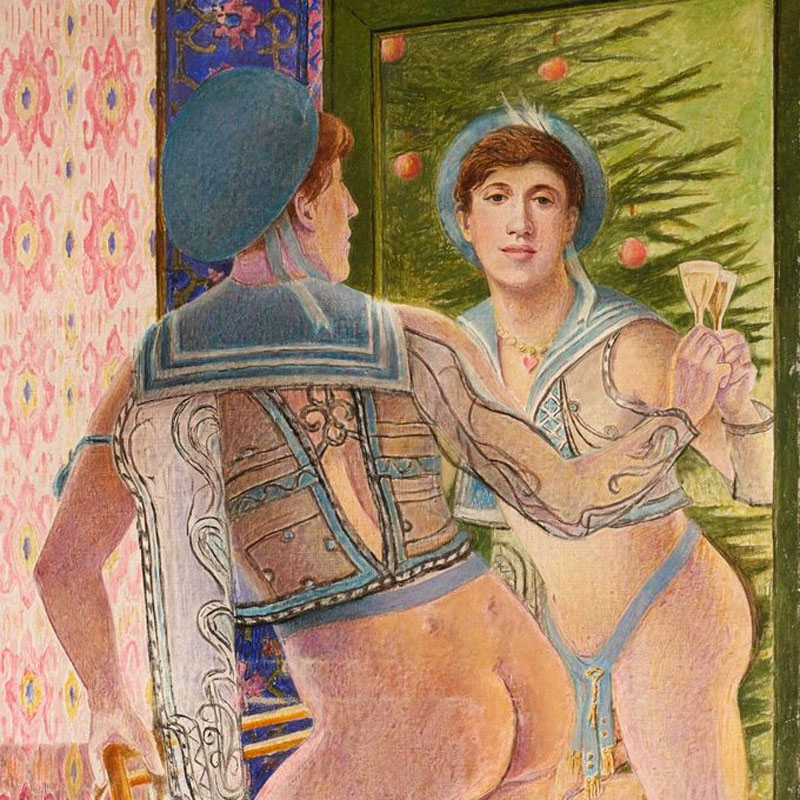
 

Elisar von Kupffer (German, 1872-1942) 'Dove Sei? / Where Are You?' 1914/1918


Elisar von Kupffer (German, 1872-1942)
Dove Sei? / Where Are You?
1914/1918
© Comune di Minusio – Centro Elisarion


Elisàr August Emanuel von Kupffer (20 February 1872 – 31 October 1942) was a Baltic German artist, anthologist, poet, historian, translator, and playwright. He used the pseudonym “Elisarion” for most of his writings…

Career

In 1895 he published Leben und Liebe (Life and Love), a book of poetry. In autumn of that year he moved to Berlin to study at the Berlin Art Academy and moved in with Von Mayer. The following year, he left Agnes and wrote the dramas Der Herr der Welt (Master of the World), and Irrlichter (Wisps) as well as three one-act plays. In 1897 he published the anthology Ehrlos (Infamous, or Dishonorable).

Von Mayer graduated in 1897 and they travelled throughout Italy, Sicily, Southern France and Geneva before returning to Berlin. They spent the summer in Thuringia and Heiligendamm and went back to Italy in 1899. Early next year, Adolf Brand published Von Kupffer’s influential anthology of homoerotic literature, Lieblingminne und Freundesliebe in der Weltliteratur (roughly, “Love of Favourites and Love Between Friends in World Literature”. Lieblingminne is a neologism created by Von Kupffer). The anthology was researched and created, in part, as a protest against the imprisonment of Oscar Wilde in England. It was reprinted in 1995.

In 1908 he published a book on Il Sodoma, the Renaissance artist. In 1911, he and Von Mayer founded the publishing house Klaristische Verlag Akropolis in Munich and Von Kupffer published three major works: a play, Aino und Tio, Hymnen der heiligen Burg (Hymns of the Holy Castle) and Ein neuer Flug und eine heilige Burg (A New Flight and a Holy Castle). His work was also published and reviewed in the gay magazine Akademos, published by Jacques d’Adelswärd-Fersen. That same year, he and Von Meyer announced the creation of a “new religion”, Klarismus (Clarity), and established a community in Weimar. The following year he published a book on Klarismus called Der unbekannte Gott (The Unknown God). In 1913, the Brogi Gallery in Florence hosted his first art exhibition. Later that year, a Klarist community was established in Zürich.

Later life and death

In 1915, with World War I in progress and growing animosity towards Germans, they left Italy and moved to Ticino, where Von Kupffer established himself as a painter and muralist in Locarno, Switzerland. They were granted Swiss citizenship in 1922. From 1925 to 1929 they transformed their villa in Minusio, near Lake Maggiore, into an opulent collection of art, the “Sanctuarium Artis Elisarion”. He was also a photographer, making photographic studies of boys for use in the creation of his paintings, but most of his works featured a youthful version of himself. The Klarist “Elisarion Community” was founded at Minusio in 1926. During the 1930s, the number of visitors increased, then sharply decreased; stopping altogether just before the onset of World War II.

As his health declined, he became reclusive and died on 31 October 1942. Since 1981 the “Sanctuarium Artis Elisarion” has been a Museum dedicated to Von Kupffer’s work. The villa was willed to the municipality of Minusio, and his ashes are interred inside, together with Von Meyer’s. The Elisarion Community was satirically referenced as the “Polysadrion” (roughly; Place of Many Idiots), in the 1931 novel Schloss Gripsholm by Kurt Tucholsky.

Text from the Wikipedia website


Germaine Krull. 'Nude' Nd

Germaine Krull (1897-1985, photographer) From the portfolio 'Les amies' c. 1924


Germaine Krull (European, 1897-1985)
Les Amies
1924
From the portfolio Nudes
© Staatsgalerie Stuttgart


Germaine Luise Krull (20 November 1897 – 31 July 1985) was a photographer, political activist, and hotel owner. Her nationality has been categorised as German, French, and Dutch, but she spent years in Brazil, Republic of the Congo, Thailand, and India. Described as “an especially outspoken example” of a group of early 20th-century female photographers who “could lead lives free from convention”, she is best known for photographically illustrated books such as her 1928 portfolio Métal.
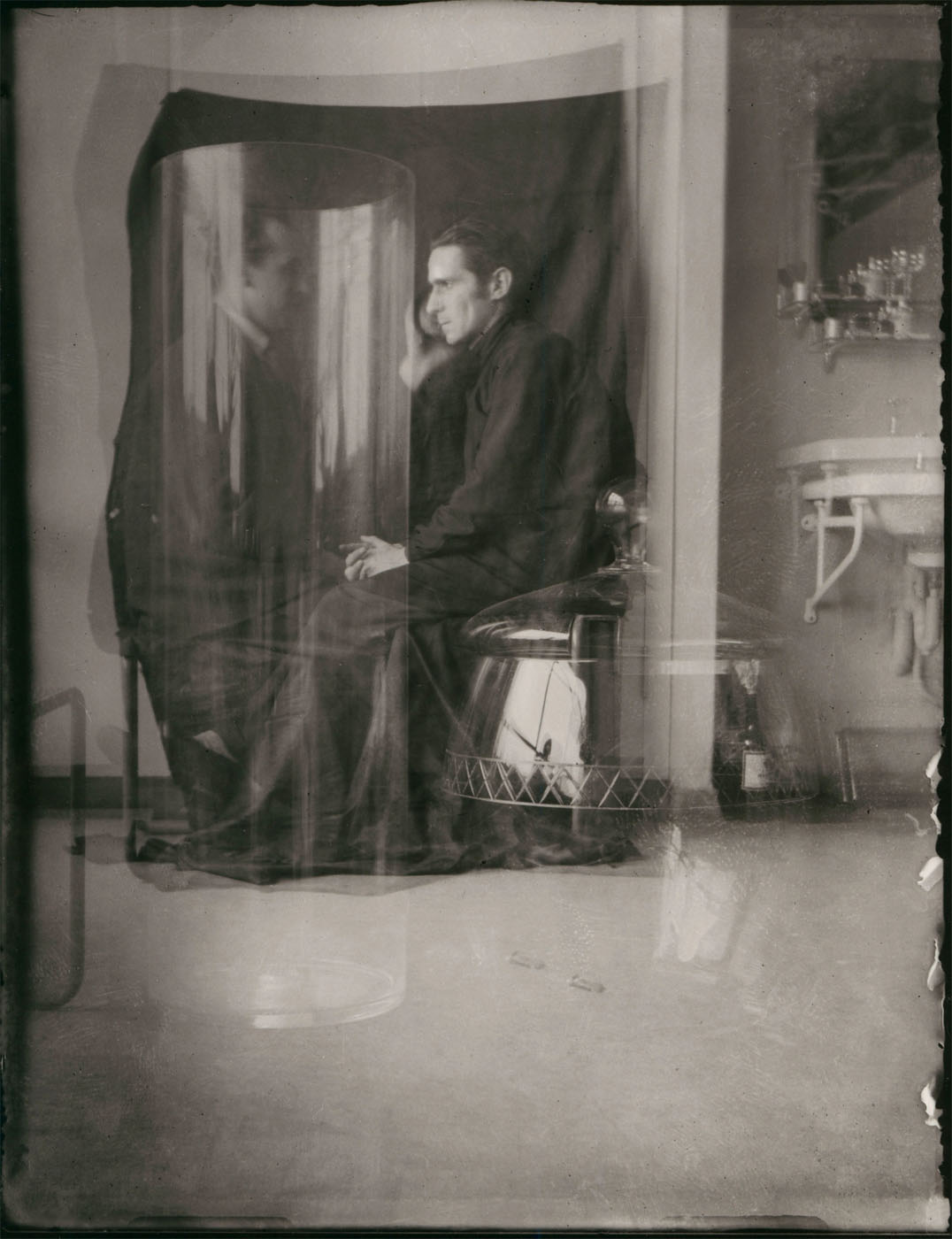
 

Heinz Loew (German, 1903-1981) 'Doppelportrait Heinz Loew und Hermann Trinkaus im Atelier, Bauhaus Dessau, Doppelbelichtung' (Double portrait of Heinz Loew and Hermann Trinkaus in the studio, Bauhaus Dessau, double exposure) 1927


Heinz Loew (German, 1903-1981)
Doppelportrait Heinz Loew und Hermann Trinkaus im Atelier, Bauhaus Dessau, Doppelbelichtung (Double portrait of Heinz Loew and Hermann Trinkaus in the studio, Bauhaus Dessau, double exposure)
1927
Gelatin silver print
3 1/2 x 4 1/4″ (9 x 12cm)
© Bauhaus-Archiv Berlin
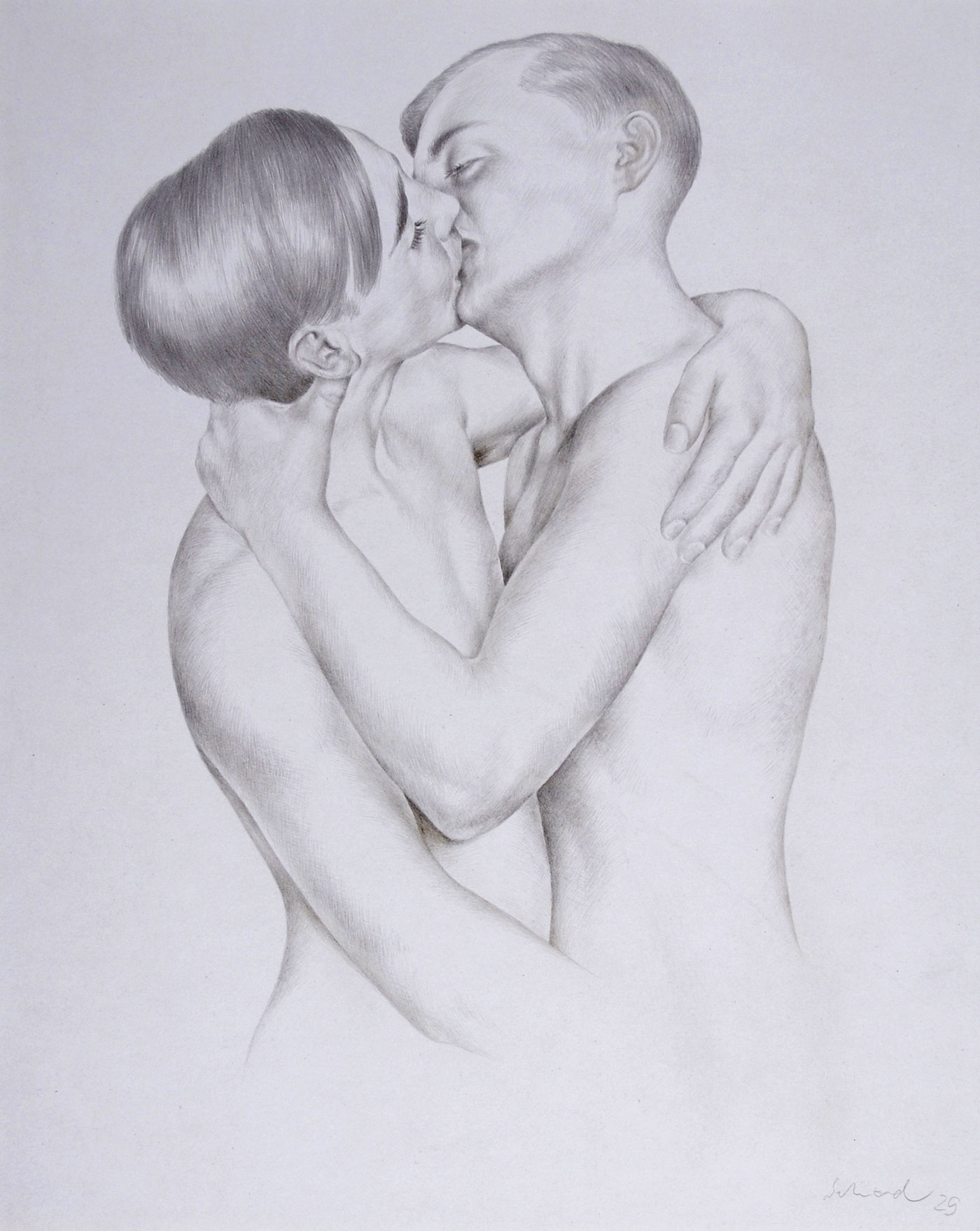
 

Christian Schad. 'Boys in Love' (Liebende Knaben), 1929


Christian Schad
Boys in Love (Liebende Knaben)
1929
© Museen der Stadt Aschaffenburg / VG Bild-Kunst, Bonn 2022


Max Peiffer Watenphul (German, 1896-1976) 'Stillleben mit Mimosen' (Still Life with Mimosas) 1932


Max Peiffer Watenphul (German, 1896-1976)
Stillleben mit Mimosen (Still Life with Mimosas)
1932


Max Peiffer Watenphul (1896 – 13 July 1976) was a German artist. Described as a “lyric poet of painting”, he belongs to a “tradition of German painters for whom the Italian landscape represented Arcadia.” In addition to Mediterranean scenes, he regularly depicted Salzburg and painted many still lifes of flowers. As well as oil paintings, his extensive body of work encompasses watercolours, drawings, enamel, textiles, graphic art, and photographs.


Gerda Wegener (Danish, 1885-1940). 'Lili with a Feather Fan' 1920


Gerda Wegener (Danish, 1885-1940)
Lili with a Feather Fan
1920


Gerda Wegener (Danish, 1885-1940). 'Lili Elbe' c. 1928


Gerda Wegener (Danish, 1885-1940)
Lili Elbe
c. 1928


Gerda Wegener (Danish, 1885-1940). 'At the mirror' 1931-1936


Gerda Wegener (Danish, 1885-1940)
At the mirror
1931-1936
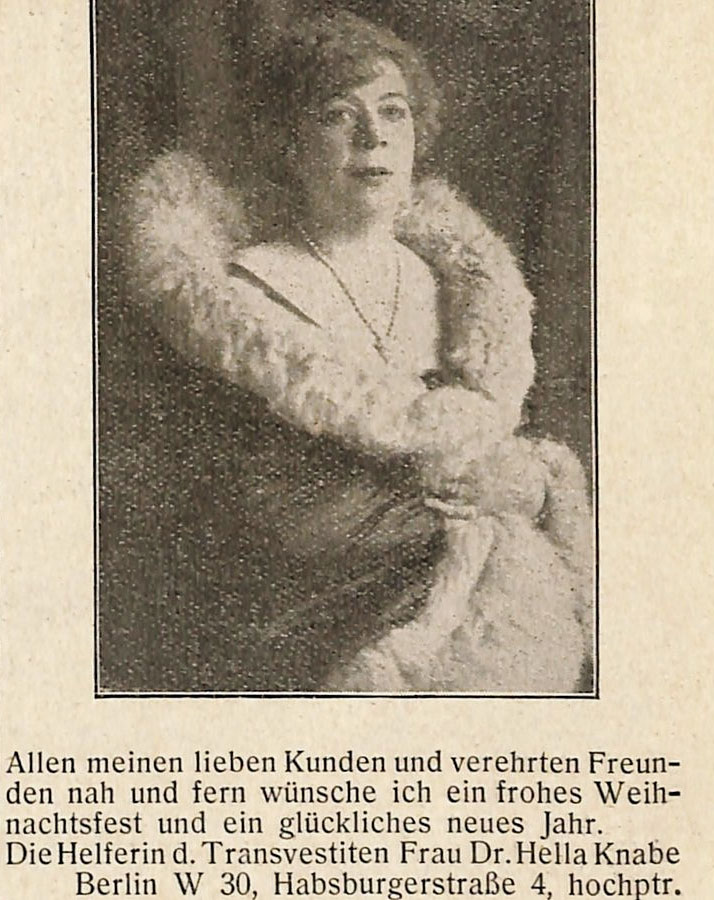
 

'Advertisement by the Hella Knabe tailoring studio' 1932


Advertisement by the Hella Knabe tailoring studio
In Die Freund, December 31, 1932
© forummuenchenev


On December 31, 1932 … this advertisement for Hella Knabe’s tailoring studio appeared in “Die Freund”. In the 1920s, a separate infrastructure was also created for “transvestites” – people who preferred the clothing of the opposite sex, including trans* people. Hella Knabe’s made-to-measure studio became a nationwide attraction. The hairdresser and seamstress, whose husband was a “transvestite” himself, advertised not only in scene magazines, but also in national magazines such as Jugend and Simplicissimus.

Hella Knabe made women’s underwear, artificial busts, corsets and chastity belts for her customers and ran a mail order business. In addition, she received boarders, clothed them, applied make-up and enabled them to live in the opposite sex for a short time. She continued to offer her services after 1933 and kept in touch with her clients through her own magazine with subcultural content. In 1938 she was therefore fined for distributing “lewd literature”.

Text from the Munich Documentation Center for the History of National Socialism Instagram page


Jeanne Mammen (German, 1890-1976) 'Damenbar' (Lesbian Bar) c. 1930-1932


Jeanne Mammen (German, 1890-1976)
Damenbar (Lesbian Bar)
c. 1930-1932
Lithograph


Jeanne Mammen (German, 1890-1976) 'Siesta' c. 1930-1932


Jeanne Mammen (German, 1890-1976)
Siesta
c. 1930-1932


Jeanne Mammen (German, 1890-1976) 'Hermaphrodite' c. 1945


Jeanne Mammen (German, 1890-1976)
Hermaphrodite
c. 1945
© Stadtmuseum Berlin / VG Bild-Kunst, Bonn 2022


Jeanne Mammen (21 November 1890 – 22 April 1976) was a German painter and illustrator of the Weimar period. Her work is associated with the New Objectivity and Symbolism movements. She is best known for her depictions of strong, sensual women and Berlin city life.

Jeanne Mammen was born in Berlin, the daughter of a successful German merchant. She and her family moved to Paris when she was five years old. She studied art in Paris, Brussels and Rome from 1906-1911. Her early work, influenced by Symbolism, Art Nouveau, and the Decadent movement, was exhibited in Brussels and Paris in 1912 and 1913.

In 1916 Mammen and her family fled Paris to avoid internment during World War I. While her parents moved to Amsterdam, Mammen chose instead to return to Berlin. She was now financially on her own for the first time, as the French government had confiscated all of her family’s property. For several years Mammen struggled to make ends meet, taking any work she could find, and spending time with people from different class backgrounds. These experiences and newfound sympathies are reflected in her artwork from the period.

In time Mammen was able to find work as a commercial artist, producing fashion plates, movie posters, and caricatures for satirical journals such as Simplicissimus, Ulk, and Jugend. In the mid-1920s she became known for her illustrations evoking the urban atmosphere of Berlin. Much of her artwork depicted women. These women subjects often included haughty socialites, fashionable middle-class shop girls, street singers, and prostitutes. Her drawings were often compared to those of George Grosz and Otto Dix. Throughout the late 1920s and early 1930s she worked mainly in pencil with watercolour washes, and in pen and ink.

In 1921, Mammen moved into an apartment with her sister in Berlin. This apartment was a former photographer’s studio which she lived in until her death. Aside from Art throughout her life Mammen also was interested in science. She was close friends with Max Delbrück who left Europe and took some of her artwork with him and exhibited them in California. In addition to bringing these art works to be exhibited he also sent Mammen care packages from the United States with art supplies.

In 1930 she had a major exhibition in the Fritz Gurlitt gallery. Over the next two years, at Gurlitt’s suggestion, she created one of her most important works: a series of eight lithographs illustrating Les Chansons de Bilitis, a collection of lesbian love poems by Pierre Louÿs.

In 1933, following Mammen’s inclusion in an exhibition of female artists in Berlin, the Nazi authorities denounced her motifs and subjects as “Jewish”, and banned her lithographs for Les Chansons de Bilitis. The Nazis were also opposed to her blatant disregard to for apparent ‘appropriate’ female submissiveness in her expressions of her subjects. Much of her work also includes imagery of lesbians. The Nazis shut down most of the journals she had worked for, and she refused to work for those that complied with their cultural policies. Until the end of the war she practiced a kind of “inner emigration”. She stopped exhibiting her work and focused on advertising. For a time she also peddled second-hand books from a handcart.

In the 1940s, in a show of solidarity, Mammen began experimenting with Cubism and expressionism, a risky move given the Nazis’ condemnation of abstract art as “degenerate”. After the war she took to collecting wires, string, and other materials from the streets of bombed-out Berlin to create reliefs. In the late 1940s she began exhibiting her work again, as well as designing sets for the Die Badewanne cabaret. She created abstract collages from various materials, including candy wrappers. In the 1950s she adopted a new style, combining thick layers of oil paint with a few fine marks on the surface.

In the 1970s there was a resurgence of interest in Mammen’s early work as German art historians, as well as art historians of the women’s movement, rediscovered her paintings and illustrations from the Weimar period. In 2013 her later, more abstract work was featured in “Painting Forever!”, a large-scale exhibition held during Berlin Art Week. In 2017-2018, the Berlinische Galerie mounted a major exhibition of Mammen’s work, titled, “Jeanne Mammen: Die Beobachterin: Retrospektive 1910-1975” (Jeanne Mammen: The Observer: Retrospective 1910-1975), which included more than 170 works in various media, covering the period from the 1920s to her late work in the 1960s and beyond. The show was conceived as an update to a show mounted by the Galerie at the Martin Gropius Bau in 1997, which featured primarily works from the 1920s. In 2010 the Des Moines Art Center exhibited 13 water colour paintings done by Mammen which were inspired by Berlin in the Weimer era.

Text from the Wikipedia website


Herbert List (German, 1903-1975) 'Beachcomber, Baltic Sea' 1933


Herbert List (German, 1903-1975)
Beachcomber, Baltic Sea
1933
Gelatin silver print
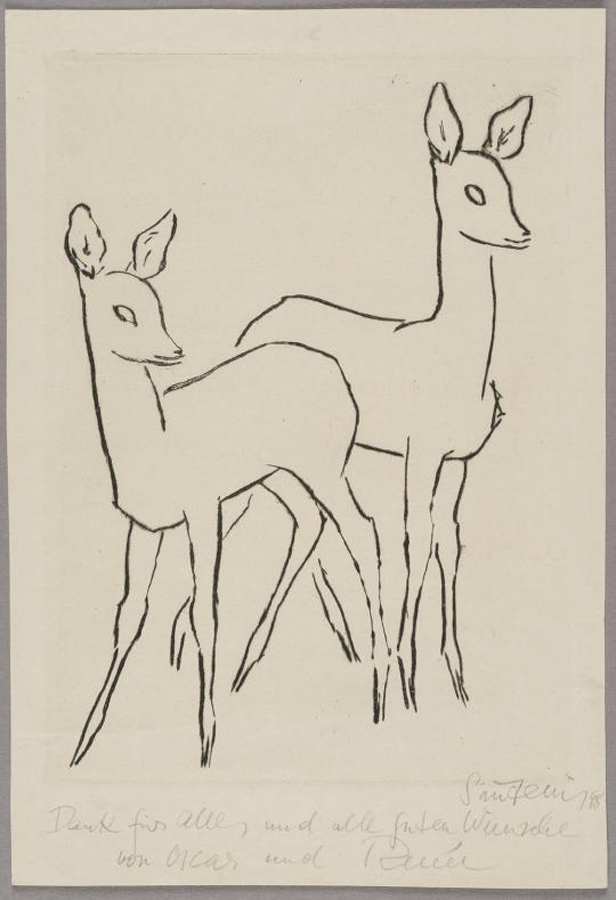
 

Renée Sintenis (German born Poland, 1888-1965) 'Zwei stehende Rehe' (Two Standing Deer) 1948


Renée Sintenis (German born Poland, 1888-1965)
Zwei stehende Rehe (Two Standing Deer)
1948
Etching
22.3 x 15.2cm
© Georg Kolbe Museum, Berlin


Renée Sintenis, née Renate Alice Sintenis (20 March 1888 – 22 April 1965), also known as Frau Emil R. Weiss, was a German sculptor, medallist, and graphic artist who worked in Berlin. She created mainly small-sized animal sculptures, female nudes, portraits, and sports statuettes. She is especially known for her Berlin Bear sculptures, which was used as the design for the Berlinale’s top film award, the Golden Bear…

Career

When Renée Sintenis (as she called herself from then on) met the sculptor Georg Kolbe in 1910, she became his model. She modelled for a now lost life-sized statue.

Inspired by this activity, she began creating in sculpture female nudes, expressive heads like those of André Gide and Joachim Ringelnatz, athletes like the Finnish runner Paavo Nurmi, and self-portraits in drawings, sculptures (in terracotta) and etchings.

After 1915, the concise animal figures emerged, which became the subject of her artistic life. Since she rejected monumentality in sculpture, she mainly created small-format sculptures. These small works of art such as horses, deers, donkeys and dogs, enjoyed great popularity with the public because they were cheaper, suitable as gifts and could be placed in small rooms.

From attending Kolbe’s studio, a long-term friendship developed, which he accompanied artistically. In the 1913 Berlin autumn exhibition, the first major exhibition of the Free Secession, Sintenis took part (as in the following years) with small-format plaster sculptures.

From 1913 on, she had her works cast in the Hermann Noack fine art foundry, which she attended artistically for decades.

In 1917 she married the type artist, book designer, painter and illustrator Emil Rudolf Weiß, whom she had met years earlier as her teacher and was also and then as a fatherly friend. He supported her and introduced her to numerous other artists. Their collaboration was limited to a few joint projects, of which the edition of the 22 Songs of the poems by Sappho, for which she created the etchings and Weiß made the font designs, achieved particular fame.

From 1913 she exhibited her sculptures regularly and was highly valued by her colleagues from the Free Secession, the most important Berlin artists’ association, among others, by Max Liebermann, Max Beckmann, and Karl Schmidt-Rottluff. The opening of a gallery in Berlin in 1922 made her the most important protagonist of the well-known Flechtheim art circle in those years. The art-interested public was infatuated with her athletic figures, portraits of friends and the small-format self-portraits.

In addition, due to her body size, slim figure, charisma, her self-confident, fashionable demeanor and androgynous beauty, she was often portrayed by artists like her husband, Emil Rudolf Weiß and Georg Kolbe, and by photographers, like Hugo Erfurth, Fritz Eschen and Frieda Riess. She embodied perfectly the type of the ‘new woman’ of the 1920s, even if she appeared rather reserved.

During the Weimar Republic, Renée Sintenis became an internationally recognised artist, with exhibitions in the Berlin Nationalgalerie, in Berlin, in Paris, the Tate Gallery, in London, the Museum of Modern Art, in New York, Glasgow and Rotterdam. Her small-sized depictions of athletes (boxers, footballers, runners) and portrait busts of their circle of friends were found in public and private collections around the world.

In 1928 Sintenis won the bronze medal in the sculpture section of the art competition for the Summer Olympics in Amsterdam, for her “Footballeur”. She is thought to be the first LGBTQ+ Olympic medallist. Renée Sintenis took part in the 1929 exhibition of the German Association of Artists in the Cologne State House, with five small-format animal sculptures. In 1930 she met the French sculptor Aristide Maillol in Berlin. In 1931 she was appointed as the first sculptor, and second woman after Käthe Kollwitz, together with 13 other artists, to join the Berlin Academy of the Arts – Fine Arts section, although the National Socialists forced her to leave in 1934.

In 1932, she created a statue of the Berlin Bear, a bear standing on its hind legs with its arms raised, based on the Coat of arms of Berlin. The design was popular, and she sold many 15 cm (5.9 in) statues of the bear, which brought wealth and was taken up again in later life.

Third Reich

Emil Rudolf Weiß was dismissed from his university post on 1 April 1933, because of an angry statement against the Nazi regime and the law to reintroduce the civil service. Sintenis herself was excluded from the Academy of the Arts in 1934 because of her Jewish origins – her maternal grandmother was Jewish before her conversion. Nevertheless, she was able to stay in the Reich Chamber of Culture, even if her works were removed from public collections by the National Socialists.

During the Third Reich, Renée Sintenis and her husband Emil Rudolf Weiß lived with considerable restrictions. She continued to exhibit, although one of her self-portraits was shown in the Degenerate Art exhibition in Munich in 1934. Since she was not banned from exhibiting, she was represented in Düsseldorf by the art dealer Alex Vömel, Flechtheim’s successor. In contrast to the 1920s, she was not doing well financially, which was reinforced by the bronze casting ban of 1941.

Until the forced dissolution of the Deutscher Künstlerbund in 1936, Sintenis remained a member of the German Association of Artists. That she was sponsored by the NSDAP propagandist Hans Hinkel, as it was later claimed, has not been proven and is highly unlikely.

Her husband died unexpectedly on 7 November 1942 in Meersburg on the Lake Constance. His death plunged Sintenis into a deep crisis. As a result, she took over his studio in the Künstlerhaus on Kurfürstenstrasse, where Max Pechstein also worked. His family took temporarily on her when her studio house was destroyed by arson and several Allied bombings in 1945. Sintenis lost almost all of her possessions; all papers and parts of her work were lost. While most of the cast models were preserved, the plaster frames of most of the portrait heads were also destroyed. In a self-portrait mask from 1944, the hardships of the war years are visible in her features.

Post-war career

After the war, Sintenis and her partner Magdalena Goldmann moved into an apartment on Innsbrucker Strasse in 1945, where they both lived until their deaths. In 1948, Sintenis received the art prize of the city of Berlin and was appointed by Karl Hofer to the Berlin University of Fine Arts. She was appointed full professor in 1955, although she gave up teaching the same year. She was also appointed to the newly founded Academy of the Arts of Berlin (West) in 1955.

In the 1950s, she became very successful once again. She stayed true to her artistic focus and motifs, which she called “making animals”.

Text from the Wikipedia website


Lena Rosa Händle (German, b. 1976) 'Girl Under Trees' 2016


Lena Rosa Händle (German, b. 1976)
Girl Under Trees
2016
Courtesy the artist
Photo: @frau_orla


In “These hands – a world without equal” (2022, below), the artist Lena Rosa Händle explores the continuation of hidden lesbian codes from the 1920s to the present day. Händle refers to the dancer Tilly Losch, the painter Mariette Lydis and the artist Claude Cahun and focuses on the motif of the hands as a gesture and code of lesbian people. In her photographs, @lenarosahaendle, together with DJane and curator @tonicahunter, reinterprets traditional gestures and is reminiscent of the first female photo studios of the 1920s.

For her work “Girls under Trees” (2016, above), Händle draws on the motif of a tapestry that schoolgirls painstakingly embroidered in 1941 in needlework classes, which were compulsory for girls at the time. Händle adds two personal ads from the newsreel published in Vienna in 1942 to the motif: “Miss is looking for correspondence with a girlfriend under modern” and “Lady wants a girlfriend for the purpose of cinema and theatre”. Advertisements like these are testimonies to the few coded signs of lesbian subculture during the Nazi era. Terms such as “Miss”, “Girlfriend” and “Lady” served as lesbian identification codes, as did the colours lilac and violet. In doing so, the artist sensitively refers to issues such as political power structures, socially enforced expectations and the resulting subtlety of lesbian aesthetics.

Text from the Munich Documentation Center for the History of National Socialism Instagram page
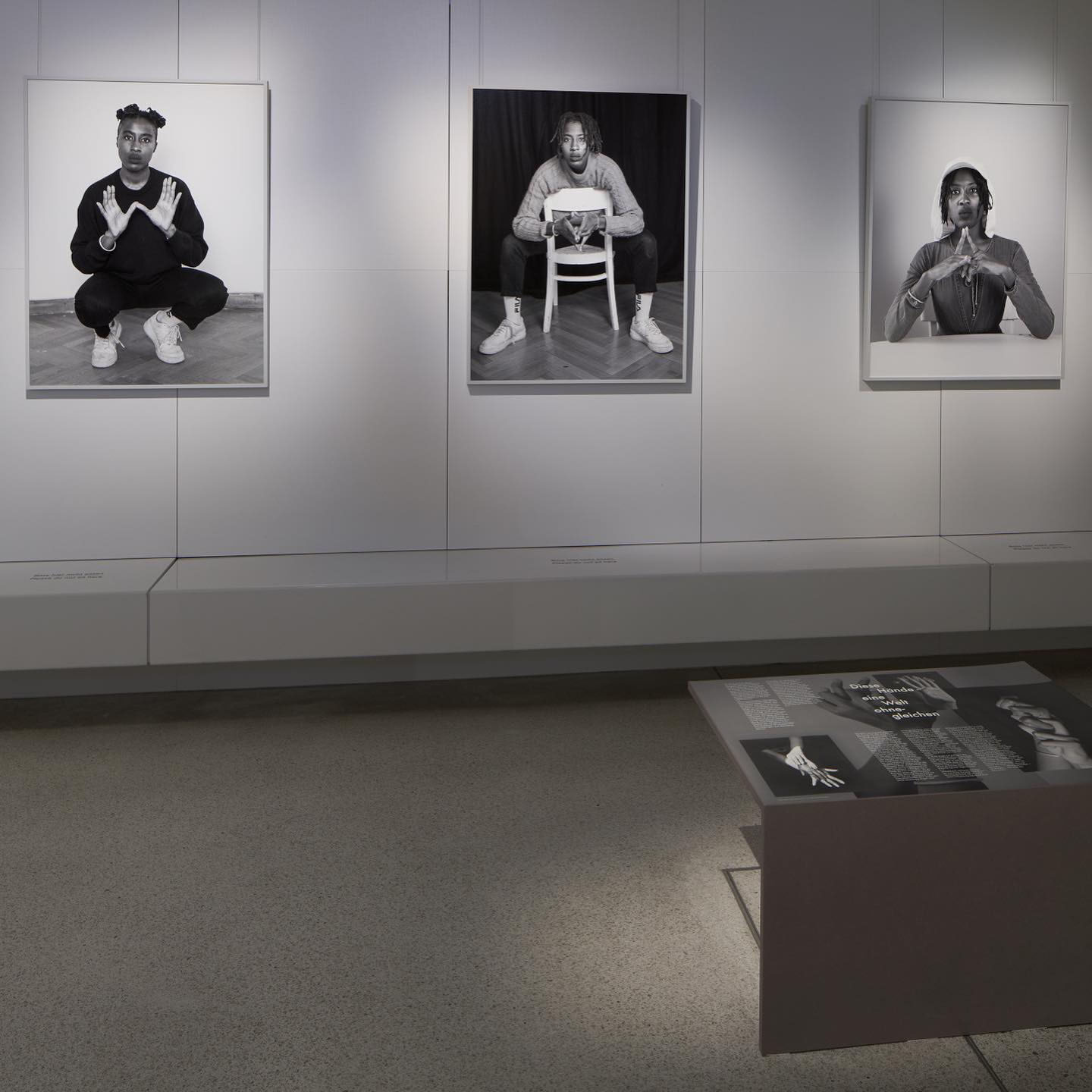
 

Lena Rosa Händle (German, b. 1976) 'These hands – a world without equal' 2022

Lena Rosa Händle (German, b. 1976) 'These hands – a world without equal' 2022


Lena Rosa Händle (German, b. 1976)
These hands – a world without equal
2022
Courtesy the artist


Installation view of the exhibition 'TO BE SEEN: Queer Lives 1900-1950' at the Munich Documentation Center for the History of National Socialism showing Wolfgang Tillmans's photograph 'The Cock (Kiss)' (2002)


Installation view of the exhibition TO BE SEEN: Queer Lives 1900-1950 at the Munich Documentation Center for the History of National Socialism showing Wolfgang Tillmans’s photograph The Cock (Kiss) (2002, below)
Photo: Connolly Weber Photography/NS-Dokumentationszentrum München


Wolfgang Tillmans (German, born 1968) 'The Cock (Kiss)' 2002


Wolfgang Tillmans (German, b. 1968)
The Cock (Kiss)
2002
Courtesy Galerie Buchholz


El Palomar. 'Schreber is a Woman' 2020


El Palomar
Schreber is a Woman
2020
Film still
© El Palomar


In their audiovisual piece Schreber is a Woman, the Barcelona-based artists’ collective El Palomar delves into the mind of Daniel Paul Schreber, a German lawyer (1842-1911) who became famous for his reports from a psychiatric clinic that later inspired Freud. In his Memoirs of My Nervous Illness from 1903 Schreber recounts feeling like a woman, among other experiences. The book influenced Sigmund Freud to elaborate his theories on paranoia and schizophrenia. Relevant to Schreber’s story is the fact that his father, Dr. Moritz Schreber, authored several books that proposed strict authoritarian models for the physical and moral education of children, which were very popular in Germany and other parts of Europe at the turn of the nineteenth century.

El Palomar uncover and reinterpret the writings of Schreber from a transfeminist perspective to deconstruct the Freudian link between Schreber and schizoprenic paranoia trough a queer viewpoint. Focusing on the images and sounds that Schreber describes in his memoirs, the film offers a rereading of the case as rooted in a period when gender identities were restricted to classical binary archetypes. Schreber is a Woman subverts the original circumstances of queer lineage, recontextualizing gender and pleasure in the present.

Anonymous. “Schreber is a Woman – Video Art on Queer and Trans History,” on the Munich Documentation Center for the History of National Socialism website Oct 7, 2022 [Online] Cited 10/04/2023


Installation view of the exhibition 'TO BE SEEN: Queer Lives 1900-1950' at the Munich Documentation Center for the History of National Socialism showing work from Philipp Gufler's series 'Quilts'

Installation view of the exhibition 'TO BE SEEN: Queer Lives 1900-1950' at the Munich Documentation Center for the History of National Socialism showing work from Philipp Gufler's series 'Quilts', with the work 'Quilt #43 (Sophia Goudstikker)' (2021)


Installation view of the exhibition TO BE SEEN: Queer Lives 1900-1950 at the Munich Documentation Center for the History of National Socialism showing work from Philipp Gufler’s series Quilts, in the bottom image Quilt #43 (Sophia Goudstikker) (2021)
Photo: Connolly Weber Photography/NS-Dokumentationszentrum München


Philipp Gufler (German, b. 1989) 'Quilt #50 (Lil Picard)' 2022


Philipp Gufler (German, b. 1989)
Quilt #50 (Lil Picard)
2022
Screenprint on fabric
Courtesy the artist and Galerie Françoise Heitsch
Photo: @frau_orla


In his quilts Philipp Gufler references queer artists, scholars, and places of queer life that have found little or no place in written memories and the historical canon. The series thus becomes an alternative archive that generates a form of intergenerational memory through the technique of “quilting.” In this technique the textiles left behind by deceased people are reassembled and contextualised. The fine materiality of the fabrics stands in direct contrast to the often massive, solid stone monuments of Western historiography. By reusing a variety of historical relics, he creates diverse personal and ancestral forms of memory of different origins. The choice of materials in the works is just as important as the choice of motifs and the associated stories that are told.

Text from the Munich Documentation Center for the History of National Socialism Instagram page

 

Zoltán Lesi (Hungarian, b. 1982) and Ricardo Portilho (Brazilian) In Frauenkleidung (In Women's Clothing) 2019


Zoltán Lesi (Hungarian, b. 1982) and Ricardo Portilho (Brazilian)
In Frauenkleidung (In Women’s Clothing)
2019
Courtesy the artists and Edition Mosaik Salzburg
Foto: @frau_orla


The poetry collection “In Frauenkleidung” (In Women’s Clothing, above) is a joint work by the lyricist Zoltán Lesi and the designer Ricardo Portilho and is dedicated to the lives of intergender athletes in the early 1930s. In their book, both artists combine documentary language with historical photographs and newspaper clippings drawn from Lesi’s image archive, which has been in the making since 2017. The resulting surrealistic collage uses historical distance to question facts, construction, and truth in a humorous yet sensitive way.

Parallel to the publication, they have created the audio installation “Ein Sprung und der Hummer” (A Jump and the Lobster, below) which, in the form of a Dadaist assemblage inspired by Joseph Cornell, blurs the line between fiction and the documentation of the biographies of the athletes, contributing another layer to the narrative level of the book of poems.

Text from the Munich Documentation Center for the History of National Socialism Instagram page
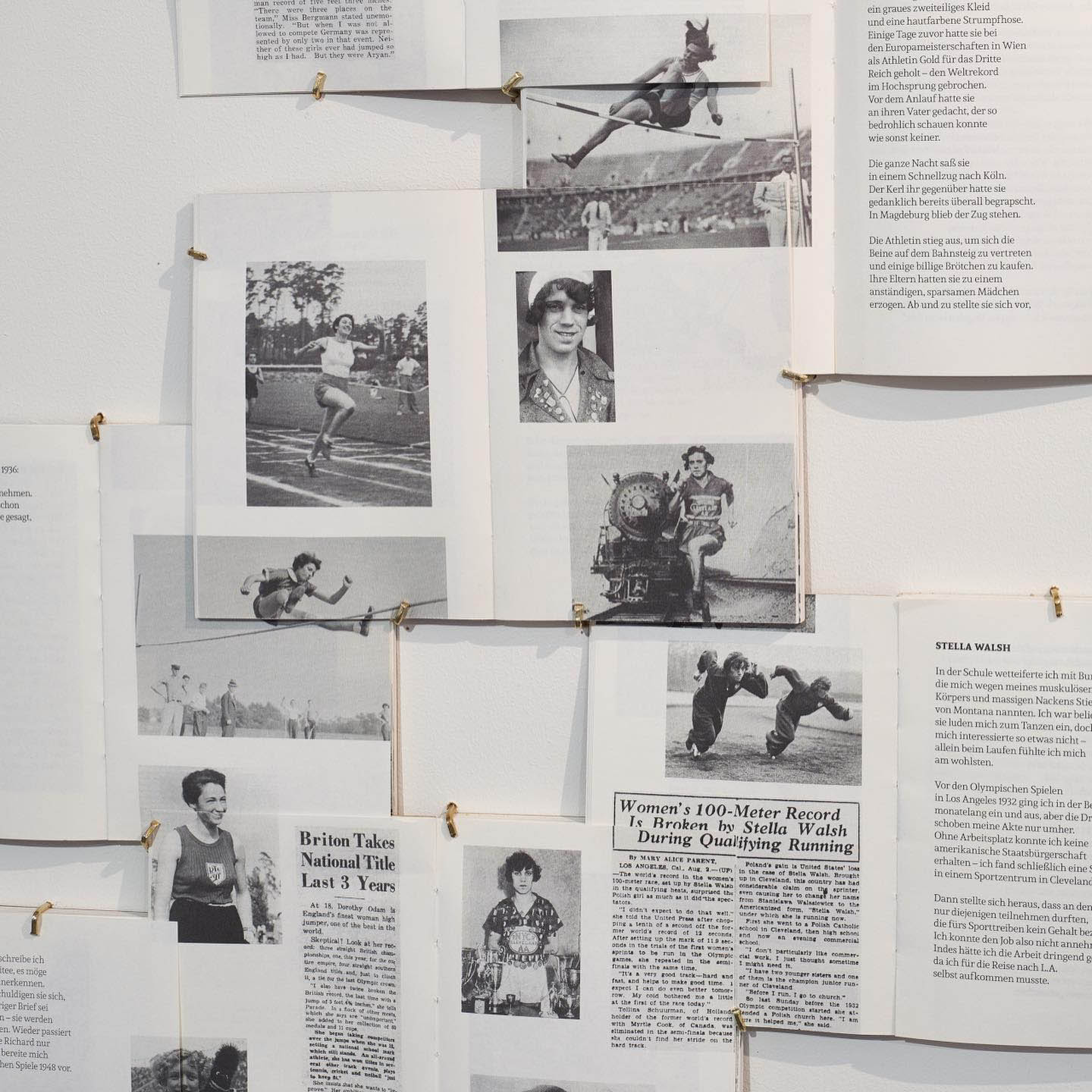
 

Zoltán Lesi (Hungarian, b. 1982) and Ricardo Portilho (Brazilian) 'Ein Sprung und der Hummer' (A Jump and the Lobster) 2018/2022 (installation view)


Zoltán Lesi (Hungarian, b. 1982) and Ricardo Portilho (Brazilian)
Ein Sprung und der Hummer (A Jump and the Lobster) (installation view)
2018/2022
Courtesy the artists
Foto: @frau_orla

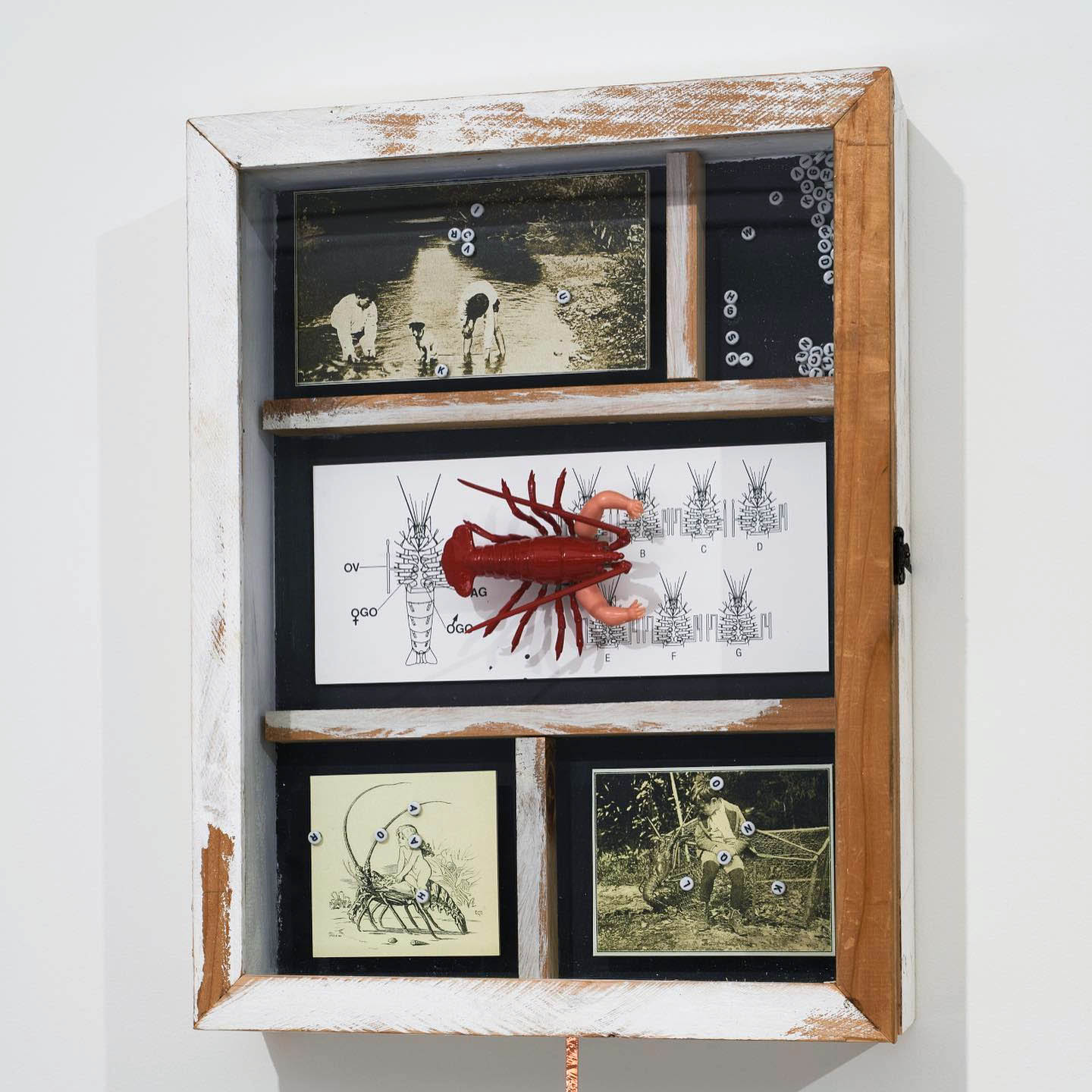
 

Zoltán Lesi (Hungarian, b. 1982) and Ricardo Portilho (Brazilian) 'Ein Sprung und der Hummer' (A Jump and The Lobster) 2018/2022

Zoltán Lesi (Hungarian, b. 1982) and Ricardo Portilho (Brazilian) 'Ein Sprung und der Hummer' (A Jump and The Lobster) 2018/2022


Zoltán Lesi (Hungarian, b. 1982) and Ricardo Portilho (Brazilian)
Ein Sprung und der Hummer (A Jump and The Lobster) (installation view)
2018/2022
Courtesy the artists
Foto: @frau_orla


Munich Documentation Center for the History of National Socialism
Max-Mannheimer-Platz 1
80333 Munich
Phone: +49 (0)89 233-67000

Opening hours:
Tuesday – Sunday 10am – 7pm

Munich Documentation Center for the History of National Socialism website
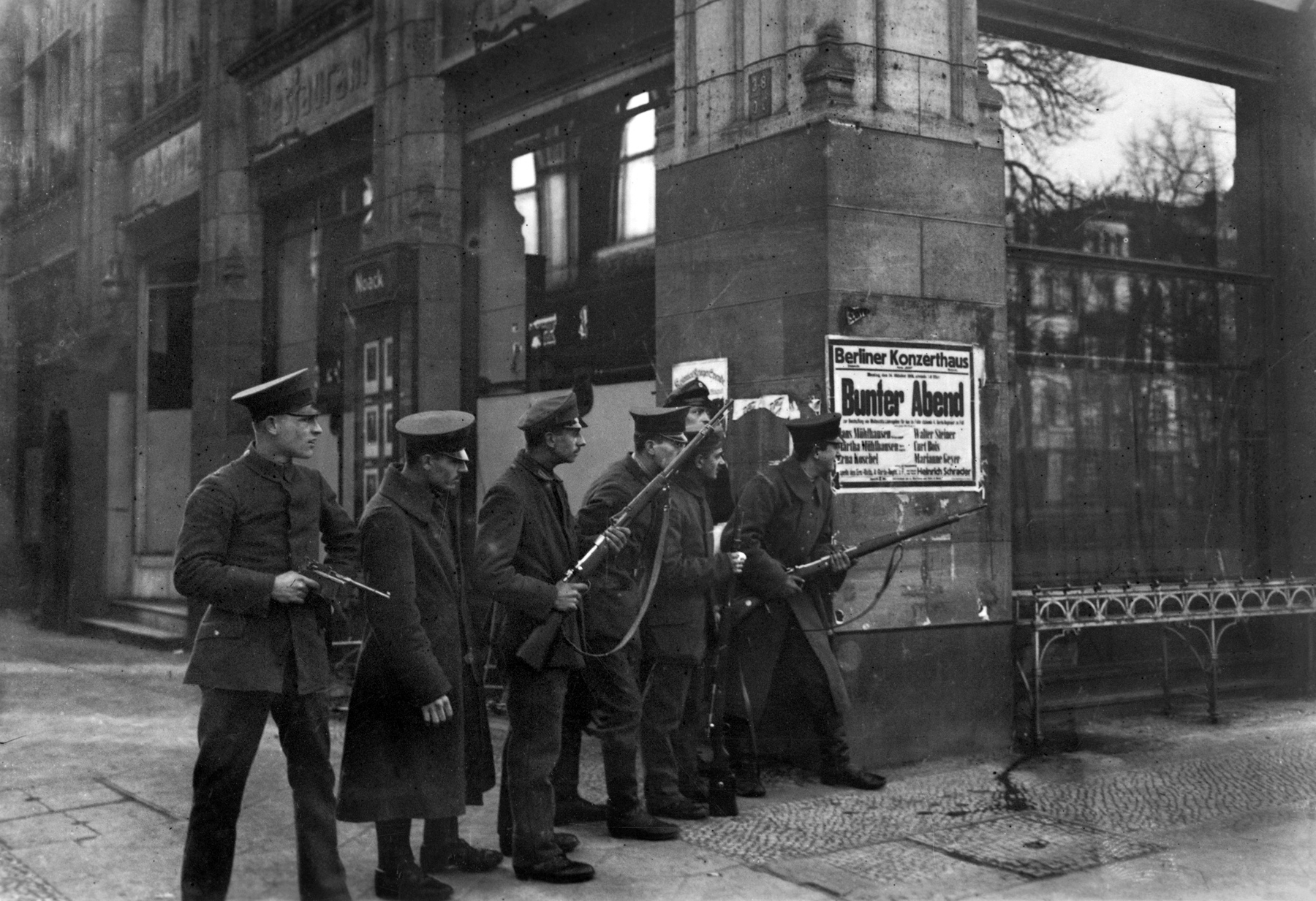
LIKE ART BLART ON FACEBOOK

Back to top

Exhibition: ‘Berlin in the revolution 1918/19’ at the Museum für Fotografie, Berlin

Exhibition dates: 9th November, 2018 – 3rd March, 2019


Otto Haeckel (German, 1872-1945) and Georg Haeckel (German, 1873-1942) 'Soldiers with weapons Unter den Linden, corner Charlottenstraße' November 1918 from the exhibition 'Berlin in the revolution 1918/19' at the Museum für Fotografie, Berlin, Nov 2018 - March 2019


Otto Haeckel (German, 1872-1945) and Georg Haeckel (German, 1873-1942)
Soldiers with weapons Unter den Linden, corner Charlottenstraße
November 1918
Gelatin silver print
© Staatliche Museen zu Berlin, Art Library – Photothek Willy Römer / Gebrüder Haeckel


Today, revolution is in the air around the world, just like it was in 1968 (a posting on this year to follow soon) and in 1918. I hope this wonderful posting of photographs, posters, films, murders, bombings, funerals, detailed close ups of the barricades and the people manning them gives you some of the flavour of the times. This was the order of the day in Berlin in 1918/19. Revolution.

What we must not forget is out of this revolution, out of this ferment of creativity, uncertainty, “liberal” democracy and militaristic society emerged the seeds of its downfall: the beginnings of the National Socialist Party (the Nazis).

“In July 1919 Hitler was appointed Verbindungsmann (intelligence agent) of an Aufklärungskommando (reconnaissance unit) of the Reichswehr, assigned to influence other soldiers and to infiltrate the German Workers’ Party (DAP). At a DAP meeting on 12 September 1919, Party Chairman Anton Drexler was impressed with Hitler’s oratorical skills. He gave him a copy of his pamphlet My Political Awakening, which contained anti-Semitic, nationalist, anti-capitalist, and anti-Marxist ideas. On the orders of his army superiors, Hitler applied to join the party, and within a week was accepted as party member 555 (the party began counting membership at 500 to give the impression they were a much larger party). …

At the DAP, Hitler met Dietrich Eckart, one of the party’s founders and a member of the occult Thule Society. Eckart became Hitler’s mentor, exchanging ideas with him and introducing him to a wide range of Munich society. To increase its appeal, the DAP changed its name to the Nationalsozialistische Deutsche Arbeiterpartei (National Socialist German Workers Party; NSDAP). Hitler designed the party’s banner of a swastika in a white circle on a red background.” (Text from the Wikipedia website)

Rising to prominence through his demagogic beer hall speeches on populist themes, Hitler would attempt a coup known as the “Beer Hall Putsch” in 1923, a stepping stone on his rise to becoming the dictator of Nazi Germany.

The flowering of German Expressionism (modern art labelled by Hitler Entartete Kunst or “Degenerate Art” in the 1920s) and a society which proposed the first advocacy for homosexual and transgender rights, were both positives of the interwar period. A prominent advocate for sexual minorities was the German sexologist Magnus Hirschfeld.

“In 1920, Hirschfeld was very badly beaten up by a group of völkisch activists who attacked him on the street; he was initially declared dead when the police arrived. In 1921, Hirschfeld organised the First Congress for Sexual Reform, which led to the formation of the World League for Sexual Reform. Congresses were held in Copenhagen (1928), London (1929), Vienna (1930), and Brno (1932)… Hirschfeld co-wrote and acted in the 1919 film Anders als die Andern (“Different From the Others”) [see below], in which Conrad Veidt played one of the first homosexual characters ever written for cinema. The film had a specific gay rights law reform agenda; after Veidt’s character is blackmailed by a male prostitute, he eventually comes out rather than continuing to make the blackmail payments. His career is destroyed and he is driven to suicide.” (Text from the Wikipedia website)

Of course these small, hard won freedoms, this cabaret of life, and the more liberal atmosphere of the newly founded Weimar Republic were all swept away by the Nazis in the 1930s.

How quickly it can turn. Today, as then, we must be ever vigilant to guard our freedom against the power of conservative forces that seek to do us harm. Brothers, never again!

Dr Marcus Bunyan


Many thankx to the Museum of Photography, Berlin for allowing me to publish the photographs in the posting. All the photographs have been digitally cleaned. Please click on the photographs for a larger version of the image.


In November 1918, exactly 100 years ago, the old regime of Kaiser Wilhelm II was swept away by a revolution. It ended the First World War and led to the establishment of democracy in Germany. The Weimar Republic was born out of the struggle for a new social order and political system. The upheavals that occurred in 1918/19 were captured on camera, sometimes by renowned press photographers such as Willy Römer; their works are crucial for historians today. For the first time ever, this book investigates the role of film and entertainment in the Weimar Republic and includes it in the historical analysis. What do the street fights in the first months following the First World War have in common with the people’s recreational pleasures? How did photographers record the political turmoil, the demonstrations, strikes, shootings, and fights for control of the palace and the newspaper district? And, at the same time, what distractions were offered in Berlin’s cinemas and revue shows? How did the entertainment industry react to the revolution? Examining photos, films, and poster art, this book presents a dense and previously unseen portrait of German history.

Text from the catalogue


“So ends this first day of the revolution, which in just a few hours has witnessed the downfall of the House of Hohenzollern, the dissolution of the German army, and the demise of the old German social order. One of the most memorable and dreadful days in German history.”


Harry Graf Kessler, diary entry from November 9, 1918


“The Christmas fair carries on blithely throughout all of these bloody events. Hurdy-gurdies play on Friedrichstraße, street vendors peddle indoor fireworks, gingerbread, and silver tinsel, the jewellery shops on Unter den Linden remain unheedingly open, their brightly lit display windows glittering. On Leipziger Strasse, the usual Christmas crowds throng toward Wertheim, Kayser, and the other big stores. It is safe to say that in thousands of homes, Christmas trees are lit and children are playing around them with presents from Daddy, Mummy and dear Aunty. The dead lie in the royal stables, and on Holy Night, the wounds freshly inflicted on the palace and on Germany gape wide.”


Harry Graf Kessler, diary entry, December 24, 1918


“I cannot get out of head the execution of 24 sailors on Französische Strasse, where during all of these days, there has been no trouble. It is one of the most abominable civil war crimes I know of in history. This evening I tried to watch Reinhardt’s production of ‘As You Like It’, but was not in the mood. I cannot stop thinking about these murders and shootings, which are the order of the day in Berlin.”


Harry Graf Kessler: diary entry, March 14, 1919


Otto Haeckel (German, 1872-1945) and Georg Haeckel (German, 1873-1942) 'Soldiers with weapons Unter den Linden, corner Charlottenstraße' November 1918 (detail)


Otto Haeckel (German, 1872-1945) and Georg Haeckel (German, 1873-1942)
Soldiers with weapons, Unter den Linden, corner Charlottenstraße (detail)
November 1918
Gelatin silver print
© Staatliche Museen zu Berlin, Art Library – Photothek Willy Römer / Gebrüder Haeckel


Willy Römer (German, 1887-1979) '"The Guards Ranger Battalion marching past General Lequis"; on the left, next to the Brandenburg Gate, the photographer Walter Gircke with camera' 10/11 December 1918 from the exhibition 'Berlin in the revolution 1918/19' at the Museum für Fotografie, Berlin, Nov 2018 - March 2019


Willy Römer (German, 1887-1979)
“The Guards Ranger Battalion marching past General Lequis”; on the left, next to the Brandenburg Gate, the photographer Walter Gircke with camera
10/11 December 1918, old contact print
Gelatin silver print
Kunstbibliothek
© Staatliche Museen zu Berlin, Art Library – Photothek Willy Römer / Willy Römer


Willy Römer (German, 1887-1979) 'Street battles on Christmas Eve in Berlin. Naval ratings in front of the ruined Palace entrance after bombardment by artillery' 24.12.1918


Willy Römer (German, 1887-1979)
Street battles on Christmas Eve in Berlin. Naval ratings in front of the ruined Palace entrance after bombardment by artillery
24.12.1918, old contact print
Gelatin silver print
Kunstbibliothek
© Staatliche Museen zu Berlin, Art Library – Photothek Willy Römer / Willy Römer


Willy Römer (German, 1887-1979) 'Street battles on Christmas Eve in Berlin. Naval ratings in front of the ruined Palace entrance after bombardment by artillery' 24.12.1918 (detail)


Willy Römer (German, 1887-1979)
Street battles on Christmas Eve in Berlin. Naval ratings in front of the ruined Palace entrance after bombardment by artillery (detail)
24.12.1918, old contact print
Gelatin silver print
Kunstbibliothek
© Staatliche Museen zu Berlin, Art Library – Photothek Willy Römer / Willy Römer


Willy Römer (German, 1887-1979) 'Street battles on Christmas Eve in Berlin. Naval ratings in front of the ruined Palace entrance after bombardment by artillery' 24.12.1918 (detail)


Willy Römer (German, 1887-1979)
Street battles on Christmas Eve in Berlin. Naval ratings in front of the ruined Palace entrance after bombardment by artillery (detail)
24.12.1918, old contact print
Gelatin silver print
Kunstbibliothek
© Staatliche Museen zu Berlin, Art Library – Photothek Willy Römer / Willy Römer


The revolution in winter and spring 1918/19 was decided in the streets of the imperial capital, Berlin. Berliners celebrated the abdication of the German Emperor with demonstrations in front of the Reichstag and the palace on November 9th, 1918, in the newspaper quarter in January 1919 rolls of printing paper were used by the Spartacists to erect barricades against approaching government troops, after fighting had ceased, a large funeral procession crossed Frankfurter Allee to the cemetery in Friedrichsfelde. Press photographers were omnipresent with their big plate cameras, taking shots of orators in the crowd, soldiers behind machine-guns, vehicles carrying party posters in the National Assembly election campaign, and destroyed buildings and ravaged squares. At the same time, everyday life in the city went on. People went to the numerous cinemas with their expanding repertoire of films, enjoyed themselves at revues and cabarets, and danced the two-step and the foxtrot. The exhibition in the Museum für Fotografie shows both a photographic visual history of the revolution in Berlin and a panorama of the entertainment culture of those months.

The brothers Otto and Georg Haeckel were the most important press photographers during the first days of the revolution. As experienced war reporters, they reacted quickly to cover the spontaneous rallies on Unter den Linden and in front of the palace. The photographers worked without assignment and offered their images to publishers like Mosse or Ullstein. There are few visual records of the fighting itself. Rather, photographers took advantage of breaks in the fighting to recreate scenes on the barricades or with soldiers with readied weapons. The largest group of photos of the revolution of which the original contact prints survive is by Willy Römer. One of his photographs was even taken immediately before his own arrest by a troop of Spartacists.

Weekly newsreels in cinemas across Germany reported on the rallies and demonstrations in Berlin, showed film portraits of the ministers of the new imperial government, and confirmed the restoration of order by showing scenes from everyday life in the streets of the capital. At the same time, they solicited votes for the National Assembly. Given lengthy production times, the feature films of winter 1918/19 do not yet reflect the revolution in any way. But the suspension of censorship enabled the production of new, more daring films, which, for example, opposed the criminal persecution of homosexuals.

As a reaction to the end of the war and without as yet reckoning with the dangers of the revolution and its fighting, an unprecedented desire for pleasure-seeking reigned in Berlin during the winter and spring of 1918/19. Besides opera houses and straight theatres, Berliners frequented the popular operetta and revue theatres, as well as cinemas; they also went to ballrooms and drinking holes to dance. Some revues reacted to current issues like the housing shortage and the strikes. The poverty of war invalids was also a subject of popular music. The song ‘Bein ist Trumpf’ from 1919 alludes to the fate of four men maimed in the war: the dance with a wooden leg or prosthesis amid the workings of a world-apparatus that turns and turns without end.

Anonymous text from the Museum of Photography, Berlin website [Online] Cited 08/02/2019


Josef Steiner (German, 1899-1977) 'Senta Söneland in her sketch "Pst! Pst!"'


Josef Steiner (German, 1899-1977)
Senta Söneland in her sketch “Pst! Pst!”
Nd
Poster for the performance in the Metropolitan Cabaret
Kunstbibliothek
© Staatliche Museen zu Berlin, Kunstbibliothek


Willy Römer (German, 1887-1979) 'Demonstration of the soldiers for immediate demobilisation: Karl Liebknecht speaks in front of the Ministry of the Interior on Unter den Linden' 4.1.1919


Willy Römer (German, 1887-1979)
Demonstration of the soldiers for immediate demobilisation: Karl Liebknecht speaks in front of the Ministry of the Interior on Unter den Linden
4.1.1919
Gelatin silver print
© Staatliche Museen zu Berlin, Art Library – Photothek Willy Römer / Willy Römer


Karl Liebknecht

Karl Paul August Friedrich Liebknecht (German 13 August 1871 – 15 January 1919) was a German socialist, originally in the Social Democrat (SPD) and later a co-founder with Rosa Luxemburg of the Spartacist League and the Communist Party of Germany which split way from the SPD. He is best known for his opposition to World War I in the Reichstag and his role in the Spartacist uprising of 1919. The uprising was crushed by the Social Democrat government and the Freikorps (paramilitary units formed of World War I veterans). Liebknecht and Luxemburg were executed.

After their deaths, Karl Liebknecht and Rosa Luxemburg became martyrs for Socialists. According to the Federal Office for the Protection of the Constitution, commemoration of Liebknecht and Luxemburg continues to play an important role among the German left, including Die Linke (The Left). …

Revolution and death

Liebknecht was released again in October 1918, when Prince Maximilian of Baden granted an amnesty to all political prisoners. Upon his return to Berlin on 23 October he was escorted to the Soviet embassy by a crowd of workers. Following the outbreak of the German Revolution, Liebknecht carried on his activities in the Spartacist League. He resumed leadership of the group together with Luxemburg and published its party organ, Die Rote Fahne (The Red Flag).

On 9 November, Liebknecht declared the formation of a Freie Sozialistische Republik (Free Socialist Republic) from a balcony of the Berliner Stadtschloss, two hours after Philipp Scheidemann’s declaration of a German Republic from a balcony of the Reichstag. On 31 December 1918/1 January 1919, Liebknecht was involved in the founding of the Communist Party of Germany (KPD). Together with Luxemburg, Jogiches and Zetkin, Liebknecht was also instrumental in the January 1919 Spartacist uprising in Berlin. Initially he and Luxemburg opposed the revolt, but they joined it after it had begun. The uprising was brutally opposed by the new German government under Friedrich Ebert with the help of the remnants of the Imperial German Army and militias called the Freikorps. By 13 January, the uprising had been extinguished. Liebknecht and Luxemburg were captured by Freikorps troops on 15 January 1919 and brought to the Eden Hotel in Berlin, where they were tortured and interrogated for several hours. Following this, Luxemburg was beaten with rifle butts and afterwards shot, and her corpse thrown into the Landwehr Canal, while Liebknecht was forced to step out of the car in which he was being transported, and he was then shot in the back. Official declarations said he had been shot in an attempt to escape. Although the circumstances were disputed by the perpetrators at the time, the Freikorps commander, Captain Waldemar Pabst, later claimed, “I had them executed”.

Text from the Wikipedia website


Willy Römer (German, 1887-1979) 'Election propaganda with car, flags and posters "Vote List 4"' [Election propaganda automobile of the German National Party on the streets of Berlin] January 1919


Willy Römer (German, 1887-1979)
Election propaganda with car, flags [red] and posters “Vote List 4” [Election propaganda automobile of the German National Party on the streets of Berlin]
January 1919, later contact print
Gelatin silver print
Kunstbibliothek
© Staatliche Museen zu Berlin, Art Library Willy Römer / Willy Römer


Paul Telemann (German, 1883-1968) 'Mariposa. Fox-trot (Fuchs Dance)' 1919


Paul Telemann (German, 1883-1968)
Mariposa. Fox-trot (Fuchs Dance)
Music by Ernest Tompa
Berlin 1919
Sheet music, private collection
© Drei Masken-Verlag, Berlin-Munich


Fox Trot

“The new flu is here – and it is not Spanish, but English in origin, and it is known as “the new popular dance” […]. In Berlin, “Fox Trot steps” are applied to any old melody […]. Outside, they are banging away at the Palace […]. Machine-gun fire rattles around the advertising pillars, whose colourful posters bear invitations to Fox Trot teas.”

F.W. Koebner, in: Der Roland von Berlin, 1919

Film

In the years 1918 and 1919, the German film industry experienced pronounced growth tendencies. Among the most successful production firms of the era alongside Universum Film AG (Ufa), established in 1917 as a propaganda establishment by the Supreme Army Command, were the Projektions-AG Union (PAGU), the Decla-Film-Gesellschaft-Holz & Co. (later Decla-Bioskop), and the Deutsche Lichtspiel-Gesellschaft (Deulig, DLG). Alongside new, advantageous financing possibilities, it was the announcement of the abolition of film censorship in November of 1918 that inaugurated rising production figures. At the same time, lowered admission prices allowed cinema to become a leisure activity for broad social strata.

More than in any other German city, these developments were observable in Berlin: the greater part of the film industry was headquartered here, and accordingly, this continuously growing metropolis, with approximately 200 cinemas, became a centre of attraction for representatives of all cinematic branches.

Immediately after November 9, 1918, the revolution played virtually no role in the city’s multifarious cinematic program – primarily responsible for this was production scheduling for most films, which usually entailed intervals of many months. In the course of 1919, the film industry responded emphatically to current political events, releasing a series of feature films that either thematised the revolutionary goings-on explicitly or at least alluded to them.

Newsreel 1918/19

With their compilations of up-to-date documentary film footage, the Wochenschauen (weekly newsreels) were able to convey impressions of revolutionary events in Berlin to a contemporary public more quickly than other film genres. Launched during World War I, this format – which was screened in cinemas before main features – soon became the most important medium of information for large segments of the population.

Only a portion of the newsreel editions produced by German firms and pertaining to the revolutionary events of 1918-19 in Berlin have survived, and in many instances only as fragments. Among them are numbered editions of the Messter-Woche, named for their initiator, the film pioneer Oskar Messter. With the aid of these 5-15-minute short films, produced under time pressure and with minimal technical expenditures or design features, it becomes possible to reconstruct central stages of the revolution – and the perspectives of contemporary film journalists of these events.

Joe May

Among the most productive directors in Berlin at the time was the Austrian Joe May, who – like the majority of participants in Berlin’s film world – observed the revolutionary events in the city only from a distance. In his monumental films, his wife Mia May played the main role. Veritas vincit, premiered in April of 1919, is an elaborately outfitted historical film whose episodic plot revolves around the transmigration of souls. During 1919, Joe May intensified his cinematic approach, oriented toward spectacular entertainments, with the production of an eight-part adventure film entitled The Mistress of the World, outfitted with an exotic flair.

Wall texts


Willy Römer (German, 1887-1979) 'Spartacists behind barricades made from rolled newspaper in front of the Mosse building (Berliner Tageblatt) on Schützenstraße at the corner of Jerusalemerstraße' 11.1.1919


Willy Römer (German, 1887-1979)
Spartacists behind barricades made from rolled newspaper in front of the Mosse building (Berliner Tageblatt) on Schützenstraße at the corner of Jerusalemerstraße
11.1.1919, later contact print
Gelatin silver print
© Staatliche Museen zu Berlin, Art Library – Photothek Willy Römer / Willy Römer


The Spartacists

A member of a group of German radical socialists formed in 1916 and in 1919 becoming the German Communist Party, led by Karl Liebknecht and Rosa Luxemburg. In December 1918, some of the Spartacists – including Luxemburg and Liebknecht – founded the German Communist Party. Luxemburg had written numerous pamphlets about Lenin and how his leadership of theRussian Revolution would be of such great value to Russia.

While her political philosophy may well have merited such pamphlets, many Germans (and Europeans in general) were terrified of the ‘Red Plague’ in Russia and the adoption of the name ‘communist’ was fraught with danger. Many soldiers had returned from the war fronts massively disillusioned with the German government and hugely suspicious of anything that smacked of left-wing political beliefs. Many who had quit the German Army joined the right wing Free Corps (Freikorps). These would have been battle-hardened men who had been subjected to military discipline.

In January 1919, the Communists rose up in revolt in Berlin. In every sense it was a futile gesture against the government. Ebert withdrew his government to the safety of Weimar and allowed the Freikorps and what remained of the regular army to bring peace and stability back to Berlin once again. No mercy was shown to the Spartacists / Communists whose leaders were murdered after being arrested. The Freikorps was better organised and armed – they also had a military background. The majority of the Spartacists were civilians. No-one doubted who would win.

C. N. Trueman. “The Spartacists,” on The History Learning Site, 22 May 2015 [Online] Cited 09/02/2019


Spartacist uprising

The Spartacist uprising (German: Spartakusaufstand), also known as the January uprising (Januaraufstand), was a general strike (and the armed battles accompanying it) in Germany from 5 to 12 January 1919. Germany was in the middle of a post-war revolution, and two of the perceived paths forward were either social democracy or a council republic similar to the one which had been established by the Bolsheviks in Russia. The uprising was primarily a power struggle between the moderate Social Democratic Party of Germany (SPD) led by Friedrich Ebert, and the radical communists of the Communist Party of Germany (KPD), led by Karl Liebknecht and Rosa Luxemburg, who had previously founded and led the Spartacist League (Spartakusbund). This power struggle was the result of the abdication of Kaiser Wilhelm II and the resignation of Chancellor Max von Baden, who had passed power to Ebert, as the leader of the largest party in the German parliament. Similar uprisings occurred and were suppressed in Bremen, the Ruhr, Rhineland, Saxony, Hamburg, Thuringia and Bavaria, and another round of even bloodier street battles occurred in Berlin in March, which led to popular disillusionment with the Weimar Government.

Text from the Wikipedia website


Willy Römer (German, 1887-1979) 'Machine-gun post behind barricades consisting of rolled newspaper in front of the Mosse building on Schützenstraße' 11.1.1919


Willy Römer (German, 1887-1979)
Machine-gun post behind barricades consisting of rolled newspaper in front of the Mosse building on Schützenstraße
11.1.1919, old contact print
Gelatin silver print
13 x 18cm
Ullstein picture
© Staatliche Museen zu Berlin, Art Library Willy Römer / Willy Römer


Willy Römer (German, 1887-1979) 'Machine-gun post behind barricades consisting of rolled newspaper in front of the Mosse building on Schützenstraße' 11.1.1919 (detail)


Willy Römer (German, 1887-1979)
Machine-gun post behind barricades consisting of rolled newspaper in front of the Mosse building on Schützenstraße (detail)
11.1.1919, old contact print
Gelatin silver print
13 x 18cm
Ullstein picture
© Staatliche Museen zu Berlin, Art Library Willy Römer / Willy Römer


Wolfgang Ortmann (German, 1885-1967) 'Song from the Strike from Halloh! Halloh!' Berlin 1919


Wolfgang Ortmann (German, 1885-1967)
Song from the Strike from Halloh! Halloh!
Berlin 1919
Cabaret pieces by Fritz Grünbaum. Music by Rudolf Nelson
Sheet Music with Portrait of Käthe
Erlholz, Staatsbibliothek zu Berlin, Music Department
© Wolfgang Ortmann / Kollo-Verlag GmbH, Berlin


With more than 300 photographs, postcards, posters, sheet music, newspapers and magazines, film clips, newsreels and audio stations, the exhibition at the Museum of Photography shows a photographic picture of the 1918-19 revolution in Berlin as a panorama of the entertainment culture of these troubled months.

The revolution in the winter and spring of 1918-1919 and thus the struggle for the construction of the first German republic decided in the streets of the capital Berlin. Berliners celebrated the abdication of the Emperor on November 9, 2018 with demonstrations in front of the Reichstag and the castle. In January 1919, in the newspaper district, barricades of the Spartacists were erected from printing paper rolls against the advancing government troops. After the end of the fighting, the great funeral procession moved to the cemetery in Friedrichsfelde via Frankfurter Allee.

There were always press photographers recording the speakers in the crowd, the soldiers behind the machine guns, the parties’ party wagons for the National Assembly elections and the ruined houses and devastated squares. But at the same time, everyday life in the city continued, people visited the many cinemas with their expanding film offering, amused themselves in revues and cabarets, danced One-Step, Two-Step and Foxtrot.

The photographers did not provide an objective picture of the story. They could not work all focal points, so their cameras judged the events according to subjective criteria and they determined with the image what should be handed down. And yet their recordings bring the events back to life. For example, the photographs help with the reconstruction of dramatic episodes such as the Christmas battles for the castle and the stables between the Volksmarine Division and government troops.

They show the huge number of mourners around Karl Liebknecht and Rosa Luxemburg and exemplify the involvement of actress Senta Söneland as election campaign speaker for the National Assembly. The press photos also allow critical inquiries into the history of the revolution: the clothes of the demonstrators and the fighters suggest that by no means only workers and soldiers, but also employees and commoners engaged politically.

In the first days of the revolution, the brothers Otto and Georg Haeckel were the most important press photographers. As experienced war reporters, they were quick to accompany the spontaneous rallies at Unter den Linden and in front of the castle. They worked without a commission and offered publishers such as Mosse or Ullstein their photographs as contact prints in the format 13 x 18 cm for the weekly picture supplements of the daily newspapers (eg for the “Zeitbilder” of the “Vossische Zeitung”) or magazines (eg the “Berliner Illustrirte Newspaper”).

There are few photographs as evidence of the fighting itself. Rather, the photographers used the breaks in fighting to recreate scenes of soldiers with shot-guns or at the barricades. From Willy Römer most of the images of the revolution in original contact prints are handed down. One of his photographs was even made immediately before his own arrest by a squad of Spartacists. Romans had a keen eye for the special situations of everyday life, when he photographed the unusual means of transportation of the Berliners during the general strike in January.

In the cinemas, the newsreels throughout Germany reported on the rallies and demonstrations in Berlin, produced film portraits of the ministers of the new Reich government and, as proof of the restored order, showed everyday scenes from the streets of the capital. At the same time, they campaigned for the National Assembly. The humorous short film “Anna Müller-Lincke kandidiert” (“Anna Müller-Lincke is a candidate”) presented the colourful range of candidates and challenged the population to make their own electoral decision. Due to the longer production processes, the feature films offered no reflection on the revolution in the winter of 1918-1919. However, the lifting of censorship enabled the production of new, daring films that were directed against the criminal prosecution of homosexuals. Immediately after the revolutionary event in Berlin, Richard Oswald‘s work “Anders als die Andern” (“Different from the Others”) began, the first film explicitly referring to Paragraph 175.

One of the most significant feature films on the revolution and at the same time a representative example of the socio-democratic values supported by the film industry is “Die entfesselte Menschheit” (“Unleashed humanity”) by Joseph Delmont, which was released in cinemas in 1920. Willy Römer was a press photographer during filming of barricades in Kreuzberg in autumn. His photographs are more dramatic than many photographs of the revolution the year before.

In response to the end of the war and without first taking into account the dangers of the revolutionary struggles, an unprecedented desire for pleasure prevailed in Berlin during the winter and spring of 1918-1919. In addition to opera houses and straight theatres, the Berliners frequented the more popular operetta and revue theatres, the cinemas, as well as ballrooms and Kaschemmen (bars) to dance there. Operettas like “Schwarzwaldmädel” (“Black forest girl”) in the Komische Oper (Comic Opera) were supposed to transport the audience into an ideal world and distract them from the everyday life of war and revolution.

But there were also revues that responded daily to topics such as the housing problem and the strikes like “Halloh! Halloh!” by Rudolf Nelson (music) and Fritz Grünbaum (text). The misery of war invalids was also a subject of popular music. In the song “Bein ist Trumpf” from the year 1919, the fate of many war-injured men is addressed: the dance with the wooden leg or the prosthesis in the transmission of an ever-rotating world structure. At the same time, the footage of the press photographers showed them with crutches and tied to wheelchairs and their protests against the insufficient supply.

The exhibition in the Museum of Photography is essentially based on the archive of Willy Römers, which is preserved in the Photography Collection of the Art Library – National Museums in Berlin. The comprehensive holdings of the bpk-Bildagentur and ullstein bild offer valuable additions. For the field of film and entertainment culture, exhibits from the graphic design collection of the Art Library have be used. Important loans come from the Music Department of the National Museums in Berlin, from the Deutsche Kinemathek Foundation, the Falkensee Museum and Gallery, and from private collections.

Press release from the Museum of Photography, Berlin translated from the German by Google Translate Cited 08/02/2019


With more than 300 photographs, postcards, posters, sheet music, newspapers and magazines, film clips, newsreels and audio stations, the exhibition at Museum für Fotografie shows both a photographic history of the 1918-19 revolution in Berlin as a panorama of the entertainment culture of these troubled months.

The revolution in winter and spring 1918/19 was decided in the streets of the imperial capital, Berlin. Berliners celebrated the abdication of the German Emperor with demonstrations in front of the Reichstag and the palace on November 9th, 1918, in the newspaper quarter in January 1919 rolls of printing paper were used by the Spartacists to erect barricades against approaching government troops, after fighting had ceased, a large funeral procession crossed Frankfurter Allee to the cemetery in Friedrichsfelde. Press photographers were omnipresent with their big plate cameras, taking shots of orators in the crowd, soldiers behind machine-guns, vehicles carrying party posters in the National Assembly election campaign, and destroyed buildings and ravaged squares. At the same time, everyday life in the city went on. People went to the numerous cinemas with their expanding repertoire of films, enjoyed themselves at revues and cabarets, and danced the two-step and the foxtrot. The exhibition in the Museum für Fotografie shows both a photographic visual history of the revolution in Berlin and a panorama of the entertainment culture of those months.

The brothers Otto and Georg Haeckel were the most important press photographers during the first days of the revolution. As experienced war reporters, they reacted quickly to cover the spontaneous rallies on Unter den Linden and in front of the palace. The photographers worked without assignment and offered their images to publishers like Mosse or Ullstein. There are few visual records of the fighting itself. Rather, photographers took advantage of breaks in the fighting to recreate scenes on the barricades or with soldiers with readied weapons. The largest group of photos of the revolution of which the original contact prints survive is by Willy Römer. One of his photographs was even taken immediately before his own arrest by a troop of Spartacists.

Weekly newsreels in cinemas across Germany reported on the rallies and demonstrations in Berlin, showed film portraits of the ministers of the new imperial government, and confirmed the restoration of order by showing scenes from everyday life in the streets of the capital. At the same time, they solicited votes for the National Assembly. Given lengthy production times, the feature films of winter 1918/19 do not yet reflect the revolution in any way. But the suspension of censorship enabled the production of new, more daring films, which, for example, opposed the criminal persecution of homosexuals.

As a reaction to the end of the war and without as yet reckoning with the dangers of the revolution and its fighting, an unprecedented desire for pleasure-seeking reigned in Berlin during the winter and spring of 1918/19. Besides opera houses and straight theatres, Berliners frequent-ed the popular operetta and revue theatres, as well as cinemas; they also went to ballrooms and drinking holes to dance. Some revues reacted to current issues like the housing shortage and the strikes. The poverty of war invalids was also a subject of popular music. The song ‘Bein ist Trumpf’ from 1919 alludes to the fate of four men maimed in the war: the dance with a wooden leg or prosthesis amid the workings of a world-apparatus that turns and turns without end.

Press release from the Museum of Photography, Berlin in English [Online] Cited 08/02/2019


Walter Gircke (German, 1885-1974) 'Elections to the National Assembly in Berlin. Agitation by the actress Senta Söneland in front of the Zoologischer Garten station' [National Assembly in Berlin: agitation by the actress Senta Söneland] January 1919


Walter Gircke (German, 1885-1974)
Elections to the National Assembly in Berlin. Agitation by the actress Senta Söneland in front of the Zoologischer Garten station [National Assembly in Berlin: agitation by the actress Senta Söneland]
January 1919
Postcard
© bpk / Walter Gircke


Senta Söneland

Senta Söneland (née Werder) was born in 1882 the daughter of a Prussian officer. She attended a higher girls’ school and then a teacher seminar, but also took additional training courses at the Berlin Schiller Theater.

In 1910 she received her first engagement at the Hoftheater Meiningen. In 1912 she returned to Berlin and in the following years appeared on various stages such as the Komödienhaus, the Theater am Kurfürstendamm and the Metropol-Theater. As at the beginning of the war in 1914, when theatre life was severely impaired, she sought like many other actors of the time their chance in film.

Söneland was known primarily as a comedian in film comedies. After a long absence from the screen in the 1920s, she had many performances as a supporting actress at the beginning of the sound film era after 1930. She also participated in entertainment evenings on the radio. So she was heard in the program Kunterbunt with the Berlin Radio Chapel.

The artist was politically involved in women’s suffrage, and her fiery speech on 19 January 1919 at the Berlin Zoo Station on the occasion of the election to the National Assembly (see photograph above) is remembered above all.

After the sudden death of her husband, Söneland said goodbye in 1934 and took her own life a little later. She was buried in the cemetery Wilmersdorf in Berlin.

Text from the Wikipedia website translated from the German


Unknown photographer. 'Hoardings with SPD election posters' before 19.1.1919


Unknown photographer
Hoardings with SPD election posters
before 19.1.1919
Old contact print
Gelatin silver print
bpk


Anders als die Andern (Different from the Others) 1919 Homosexuality Advocacy Film

Different from the Others (German: Anders als die Andern, literally ‘Other than the Others’) is a German film produced during the Weimar Republic. It was first released in 1919 and stars Conrad Veidt and Reinhold Schünzel. The story was co-written by Richard Oswald and Magnus Hirschfeld, who also had a small part in the film and partially funded the production through his Institute for Sexual Science. The film was intended as a polemic against the then-current laws under Germany’s Paragraph 175, which made homosexuality a criminal offence. It is believed to be the first pro-gay film in the world.

The cinematography was by Max Fassbender, who two years previously had worked on Das Bildnis des Dorian Gray, one of the earliest cinematic treatments of Oscar Wilde’s The Picture of Dorian Gray. Director Richard Oswald later became a director of more mainstream films, as did his son Gerd. Veidt became a major film star the year after Anders was released, in The Cabinet of Dr. Caligari.

Anders als die Andern is one of the first sympathetic portrayals of homosexuals in the cinema. The film’s basic plot was used again in the 1961 UK film, Victim, starring Dirk Bogarde. Censorship laws enacted in reaction to films like Anders als die Andern eventually restricted viewing of this movie to doctors and medical researchers, and prints of the film were among the many “decadent” works burned by the Nazis after they came to power in 1933.

Text from the Wikipedia website


Paragraph 175

Paragraph 175 (known formally as §175 StGB; also known as Section 175 in English) was a provision of the German Criminal Code from 15 May 1871 to 10 March 1994. It made homosexual acts between males a crime, and in early revisions the provision also criminalised bestiality as well as forms of prostitution and underage sexual abuse. All in all, around 140,000 men were convicted under the law.

The statute drew legal influence from previous measures, including those undertaken by the Holy Roman Empire and Prussian states. It was amended several times. The Nazis broadened the law in 1935; in the prosecutions that followed, thousands died in concentration camps as a widespread social persecution of homosexuals took place.

Text from the Wikipedia website

Different from the Others

The director and producer Richard Oswald (1880-1863) is regarded as the founder of the so-called Sitten – or Aufklärungsfilm (i.e. a film concerned with public morals or sex education) – a genre that took up socially taboo themes such as the spread of sexually transmitted diseases, drug consumption, or topics such as abortion and homosexuality, activities still subject to criminal prosecution at that time. The production of such films, propelled by an educational impetus, was intimately bound up with the abolition of censor-ship in Germany, announced in November of 1918. For Anders als die Andern (Different from the Others), the first film to take an explicit stand against Paragraph 175, which made homosexual acts between males a crime, Oswald called upon the expertise of the sexologist Magnus Hirschfeld as his advisor.

The film narrates the story of the violinist Paul Körner, who is blackmailed by a male prostitute who threatens to reveal his homosexuality, and is finally charged with violating Paragraph 175. In a central scene of the film, Magnus Hirschfeld – who plays himself – delivers a plea for tolerance of homosexuals. To be sure, the blackmailer is condemned, but so too is Körner, found guilty of infringing Paragraph 175. In despair over the social ruin brought about by the verdict, he commits suicide.

Folkets Ven, Die entfesselte Menschheit, and Irrwahn (Mania)

The Danish film Folkets Ven arrived in German cinemas in December of 1918 under the distribution title Söhne des Volkes (Sons of the People). In Berlin, the production of films about the political upheavals had just be-gun, necessitating a recourse to import films in order to entertain – and to influence – Berlin cinema-goers. In the magazine Der Kinematograph, the film was promoted as “a new film for a new time” with the message: “For the unification of the socialist groups, against Bolshevism.”

One of the most important feature films dating from around the time of the revolution, and at the same time a typical document of the (social) democratic values reinforced by the film industry, is Die entfesselte Menschheit (Humanity Unchained). Narrated in this “key work of anti-Bolshevist film” is the story of a group of German prisoners of war who return to a Berlin that has been convulsed by Spartacist battles, and are steered toward participation in a bloody civil war by the Bolshevist fanatic Karenow. Approximately 17,000 extras took part in this ambitious undertaking, part of it filmed on Am Tempelhofer Berg, a street in Kreuzberg.

Along with their anti-Bolshevist tendencies, the principal characteristic of the “political problem films” produced around 1919 and 1922, with their references to the revolution, was a deliberate renunciation of any explicit identification of the location of the events. In Irrwahn (Mania), filmed in Berlin in 1919 and heralded in the press as a “socialist-revolutionary drama,” the director Hans Werckmeister maintains a certain ambiguity about whether the events are taking place in Germany, Russia, or in some imaginary fantasy land.

Nerven (Nerves)

Robert Reinert’s influential silent film drama Nerven (Nerves) had only a brief reception among the contemporary cinema public: after its premiere in December of 1919, a number of spectators are said to have developed symptoms of madness. As a consequence, the censors resolved upon radical interventions which left the film in an utterly mutilated state. The story of Roloff, a wealthy factory owner who loses his faith in technological progress during the revolutionary turmoil occurring at the end of World War I, his sister Marja, who is committed to armed struggle against the ruling powers, and the teacher Johannes, who calls for social reforms at the people’s assembly, offers a multifaceted description of the traumatic impact of war and revolution on the psychological states of human individuals. Observable in Nerven are design elements that are immediately reminiscent of Expressionism: close-up shots of faces registering intense emotion, gloomy, oversized buildings, dissolves suggestive of menace, as well as striking effects of light and shadow. This fateful historic document has now been successfully reconstructed from fragments.

Wall texts


Nerves (Germany, 1919)

The films tells the political disputes of an ultraconservative factory owner Herr Roloff and Teacher John, who feels a compulsive but secret love for Roloff’s sister, a left-wing radical. They are all driven psychologically and morally to the borderline, tormented souls living their lives in a tormented country.

Duration: 110 Minutes
Director, Producer, Screenplay: Robert Reinert
Starring: Eduard von Winterstein, Lia Borré, Erna Morena, Paul Bender, Lili Dominici, Rio Ellbon, Margarete Tondeur, Paul Burgen Reconstruction
Producer: Stefan Drössler
Cinematography: Helmar Lerski


Willy Römer (German, 1887-1979) 'Fighting in the Berlin newspaper district. The Vorwärts building after being bombarded by government troops' [The Spartacist had barricaded themselves inside the Vorwärts building. The photo shows the Vorwärts building after an artillery assault by government troops] 11.1.1919


Willy Römer (German, 1887-1979)
Fighting in the Berlin newspaper district. The Vorwärts building after being bombarded by government troops [The Spartacist had barricaded themselves inside the Vorwärts building. The photo shows the Vorwärts building after an artillery assault by government troops]
11.1.1919, old contact print
Gelatin silver print
Kunstbibliothek
© Staatliche Museen zu Berlin, Art Library – Photothek Willy Römer / Willy Römer


Willy Römer (German, 1887-1979) 'General strike in Berlin. Moving van as barricade on Prenzlauer Straße' 7.3.1919


Willy Römer (German, 1887-1979)
General strike in Berlin. Moving van as barricade on Prenzlauer Straße
7.3.1919, old contact print
Gelatin silver print
Kunstbibliothek
© Staatliche Museen zu Berlin, Art Library – Photothek Willy Römer / Willy Römer


Willy Römer (German, 1887-1979) 'Street battles in Berlin. Battleplace Alexanderplatz with the downed lines of the tram' 8.3.1919


Willy Römer (German, 1887-1979)
Street battles in Berlin. Battleplace Alexanderplatz with the downed lines of the tram
8.3.1919, old contact print
Gelatin silver print
Kunstbibliothek
© Staatliche Museen zu Berlin, Art Library Willy Römer / Willy Römer


Willy Römer (German, 1887-1979) 'View of the funeral procession in the Frankfurter Allee on the occasion of the funeral of Rosa Luxemburg' [Funeral of Liebknecht and Rosa Luxemburg. Funeral procession on Große Frankfurter Strasse] 13.6.1919


Willy Römer (German, 1887-1979)
View of the funeral procession in the Frankfurter Allee on the occasion of the funeral of Rosa Luxemburg [Funeral of Liebknecht and Rosa Luxemburg. Funeral procession on Große Frankfurter Strasse]
13.6.1919
Gelatin silver print
© Staatliche Museen zu Berlin, Art Library Willy Römer / Willy Römer


Artistic Dance

During the revolutionary period of 1918-19, artistic or expressive dance – whose best-known exponent, Mary Wigman, was accorded considerable acclaim even before World War I – was characterised by heightened variety and intensity. The aim of the tendency was to generate a new conception of humanity through the unity of music, movement, costume, and stage design. Expressive rhythm and a natural approach to bodily experience harmonised well with the expressive forms of the artistic avant-gardes, in particular Expressionist painting. The search for modern expressive resources that were remote from classical balletic conventions was spearheaded by renowned dance reformers. Among them were Valeska Gert, with her grotesque caricature dances, Anita Berber, with her eccentric and erotic performances, and Gret Palucca, with her powerful leaps. But Hannelore Ziegler – no longer a familiar figure today – too numbered among the representatives of these new, contemporary dance forms.

Erna Offeney

Erna Offeney (1888-1977), one of the less-known erotic dancers and ballet mistresses, who is presented here in a larger context for the first time, headed her own touring ballet company, with up to 150 ensemble members, which made acclaimed guest performances throughout Germany and Switzerland, as well as Vienna. In a way that is characteristic of the pre-revolutionary era, she wrote in her diary: “It was 1918, the final year of the war, the theatre was full of soldiers on leave who wanted to forget the miseries of war during this brief intermezzo, and were delighted with every diversion and pleasure. Most were invalids, cripples who had been obliged to sacrifice arms or legs for the Fatherland. They were scattered throughout every town, and nearly every family lamented the presence of a member in such a state, and depending upon temperament, those affected – or those who were more foreseeing – were suffused with hate or gloomy resignation […] And then came the applause, which never seemed to end. In the orchestra area, I saw two soldiers, each one-armed, slapping their single hands together in order to applaud. Seeing this, I nearly wept.”

‘Nude’ and Erotic Dance

During the revolutionary period of 1918/1919, ‘nude’ dance, erotic ballet, and erotic dance enjoyed a decided popularity. At the same time, the war wounded and war cripples filled the streets of Berlin. “The sheer profusion of erotic dance performances – appearing in every cabaret, in every better dance club, in every bar that offered the public music and entertainment, were nude dancers or groups of dancers – this mass phenomenon only became possible after the war,” wrote Hans Ostwald in 1931. “Favouring the movement was a lust for life that sprang from sheer misery, and the greater general freedom.” But the abolition of censorship also promoted the proliferation of such offerings. Although the dancers were for the most part clad in gossamer fabrics, with breasts and privates veiled, they appeared to be naked. Performances by dancers such as Olga Desmond and Celly de Rheydt belonged in the context of the movement toward naturism and nudism.

Ballroom Dancing

The great dance wave, the dance frenzy, the dance craze – all referred to the mass phenomenon of dance as a form of participatory entertainment among the populace of Berlin after World War I. This form of enjoyment was ubiquitous, with each dancer dancing for a different reason: for one, dancing compensated for the general misery. Another enjoyed the license to dance when and where it pleased – a freedom that accompanied the demise of the Wilhelminian moral codex. Depending upon the financial resources available, people met in the elegant dance clubs in the city centre, or instead shook a leg in dives found in the northern and eastern districts of Berlin. The new popular dances – ragtime, jazz, the Boston waltz, the shimmy, but first and foremost the foxtrot – found their ways into dance clubs, dance halls and ballrooms, dance floors, and hotel lobbies, and were an essential component of the amusement and entertainment industry that expanded explosively after the war. The rapidly growing number of performances of operettas and revues meant that a public hungry for diversion was continuously exposed to new hit tunes. Thus primed, they spread out onto the dance floor, with dance bands providing the requisite atmosphere of exuberance.

Sheet Music Cover Pages

Originally, sheet music cover pages were little more than decorative ‘accessories’ accompanying printed music. At the same time, they mirror contemporary social and political life. Observable around 1918/19 are topical foci such as emancipation and the pleasures of dance, eroticism, fashion, beauty, and film. In some instances, sheet music cover pages were furnished with portraits of interpreters whose names were familiar through the advertisements that appeared in the daily press. Like the artist’s postcards so widely disseminated at the time, these images allowed the public to see the stars at least in picture form – not everyone could afford tickets to live operetta or revue appearances.

Domestic music-making, including light music, was widespread. Inseparable from such activities were the countless popular dance forms. And all of this required accessible sheet music. With the growing vogue for revues, operettas, film operettas, and burlesques after the end of World War I, the circulation figures of printed music rose quickly. After the recent horrors, there title motifs satisfied a yearning for togetherness, harmony, happiness, and a peaceful life.

Places of Entertainment and Amusement

In 1918/19, entertainment was of paramount importance. As much can be gathered from numerous travel guides intended for visitors to Berlin, such as those by Grieben. These supplied tips for performances of operettas, burlesques, revues, promoted information on which cabarets and coffee-houses provide live music, recommended dance halls, and offered general information on other entertainment options. Providing guidance is well were the advertising pages of daily newspapers such as the Vossische Zeitung, the Berliner Tageblatt, and the Berliner Volkszeitung. Found in particular on Friedrichstraße, Behrensstraße, and Jägerstraße alongside theatres and operetta stages were ballrooms, dance clubs, dance cafés, concert houses, cabarets, and coffeehouses. Advertised as well were summer theatre performances and garden concerts where military bands supplied the music. With seating for up to 3000 people, they were frequented by numerous visitors. In the working class district of Prenzlauer Berg, there was the Prater Summer Garden; in Treptow, the Zenner Beer Garden – every urban district had its entertainment establishments featuring concert and dance. And all promoted themselves through specially printed postcards, so that today, we have a detailed picture of the sheer variety that prevailed at the time.

Wall texts from the exhibition


Robert L. Leonard (German, 1879-1943) '"Strindberg's intoxication" with Asta Nielsen' 1.8.1919


Robert L. Leonard (German, 1879-1943)
“Strindberg’s intoxication” with Asta Nielsen
1.8.1919
Poster for the premiere of the film in UT Kurfürstendamm
Actors: Alfred Abel, Carl Meinhard
Director: Ernst Lubitsch
Kunstbibliothek
© Staatliche Museen zu Berlin, Art Library


Willy Römer (German, 1887-1979) 'Dismissed soldiers and unemployed. The gaming tables in front of the employment office in Gormannstraße' [Gambling den in front of the employment agency on Gormannstraße. For strengthening during the game, there is coffee and cake at the next table] 24.11.1919


Willy Römer (German, 1887-1979)
Dismissed soldiers and unemployed. The gaming tables in front of the employment office in Gormannstraße [Gambling den in front of the employment agency on Gormannstraße. For strengthening during the game, there is coffee and cake at the next table]
24.11.1919, later contact print
Gelatin silver print
Kunstbibliothek
© Staatliche Museen zu Berlin, Art Library – Photothek Willy Römer / Willy Römer


'Berlin in the revolution 1918/19' catalogue cover


Berlin in the revolution 1918/19 catalogue cover


Museum für Fotografie
Jebensstraße 2, 10623 Berlin, Germany
Phone: +49 30 266424242

Opening hours:
Tues – Sunday 11am – 7pm

Museum für Fotografie website

LIKE ART BLART ON FACEBOOK

Back to top

Exhibition: ‘New Objectivity: Modern German Art in the Weimar Republic, 1919-1933’ at the Los Angeles County Museum of Art (LACMA)

Exhibition dates: 4th October 2015 – 18th January 2016


Otto Dix (German, 1891-1969) 'Card Players' (Kartenspieler), 1920


Otto Dix (German, 1891-1969)
Card Players (Kartenspieler)
1920
Drypoint
19 7/8 × 13 1/16 in. (50.5 × 32.5cm)
Los Angeles County Museum of Art, the Robert Gore Rifkind Center for German Expressionist Studies, purchased with funds provided by the Robert Gore Rifkind Foundation, Beverly Hills, CA, and Helgard Field-Lion and Irwin Field
© 2015 Artists Rights Society (ARS), New York/VG Bild-Kunst, Bonn
Photo © 2015 Museum Associates/LACMA


If I had to nominate one period of art that is my favourite, it would be European avant-garde art between 1919-1939. The sense of renewed creativity, inventiveness, and sustained enquiry into the nature of things by artists, this texture of reality, just fascinates me. A hyper-sensory, objective sobriety, yes, but more – an opposite, apposite expression of critical, cultural opprobrium that sticks its proboscis into mental and machinic spaces.

The relations between the physical and the psychic are evidenced during this period “as a general movement and multiplicity, rather than just a series of mechanisms.” What surrounds the metaphysical body, its environment, is enacted as a performance upon the body through a “continuous set of relations, multiplicities, speeds, connections. Bodies are only distinguished by certain singularities, which are clarifications of expression drawing together certain multiplicities, under the aegis of an event.” Bodies are (en)acted upon. Conversely, “Just as bodies can be seen as machinic, so too does the machinic depend upon bodies wrought out of vibration [of energy, of ideas] by clarity of expression of events.” They are folded and refolded into each other, in a series of multiplicities and intensities – of architecture and art, of sex and gender, of flagellation and flight – so that  there is a ‘synthesis of heterogeneties’, or hetero(gene)ties that evidence the DNA of our becoming, our diverse difference, our heterogeneic alterity. This folding, this vibration of energy, these clear zones of expression and performance produce this dazzling, de(gene)rate art.1

In this huge posting I have tried to sequence the machinic (the spelling auto correct keeps changing it to “mechanic” which is quite ironic) with the figurative, the painting of architecture with the architectural photograph; the photograph of the sewing machine with the painting of the Paper Machine; the distorted, etched face with the photographic war damaged face; the Modernist housing estate with the alienation of the Picture of Industry. You get the picture. One is folded into the other as performance, as vibration of energy, as (destructive, or creative) ritual of re/production. And there we have the gay lovers, the first transgender woman who dies after operations on her body, the climax – in an erotic sense – of the scar on the woman’s leg in Friedrich Seidenstücker’s Untitled (c. 1930, below) or the blood lines of the eyeball in Herbert Ploberger’s Self-Portrait with Ophthalmological Models (c. 1928-1930, below). Or the cool objectiveness of Sander’s photographs – Coal Carrier, Painter’s Wife, The Architect – against the detached titles (The Jeweller, Portrait of a Lawyer, Portrait of an Architect, name of person secondary) but outrageous colours and distortions / elongations of the painted portraits. Fascinating archetypal, subjective / objective correlation.

This is a mad, dangerous, exciting world in which these artists lived, which they mapped and depicted in all its glorious intensity. Flowering one minute, dead the next.

Dr Marcus Bunyan


Many thankx to the Los Angeles County Museum of Art for allowing me to publish the photographs in the posting. Please click on the photographs for a larger version of the image.

Further reading: New Objectivity: Modern German Art in the Weimar Republic, 1919-1933 (135kb pdf)

1/ Some of these ideas came from Murphie, Andrew. “Computers are not theatre: the machine in the ghost in Gilles Deleuze and Félix Guattari’s thought,” in Genosko, Gary (ed.,). Deleuze and Guattari: Critical Assessments of Leading Philosophers. London, Routledge, 2001, pp. 1311-1312


“German Expressionism is an art which above all, celebrated, inwardness.”

“There’s no contradiction between being a Fascist and being an artist… I’m sorry but there isn’t. It happens that not very many good artists have been Nazis.”


Robert Hughes


Georg Scholz (German, 1890-1945) 'Industrial Peasants' (Industriebauern), 1920


Georg Scholz (German, 1890-1945)
Industrial Peasants (Industriebauern)
1920
Lithograph on wove paper
15 1/2 × 19 in. (39.4 × 48.3cm)
Los Angeles County Museum of Art, purchased with funds provided by the Robert Gore Rifkind Foundation, Beverly Hills, CA, and the Modern Art Deaccession Fund
© 2015 Artists Rights Society (ARS), New York/VG Bild-Kunst, Bonn, photo
© Museum Associates/LACMA


Otto Dix (German, 1891-1969) 'Sex Murder' (Lustmord), 1922


Otto Dix (German, 1891-1969)
Sex Murder (Lustmord)
1922
Etching
10 7/8 x 13 5/8 in. (27.5 x 34.6cm)
© 2015 Artists Rights Society (ARS), New York/VG Bild-Kunst, Bonn
Photo courtesy Galerie Nierendorf, Berlin


Facial reconstruction WW1. Willie Vicarage, suffering facial wounds in the Battle of Jutland 1916 Naval Battle was one of the first men to receive facial reconstruction using plastic surgery


Willie Vicarage, suffering facial wounds in the Battle of Jutland 1916 Naval Battle was one of the first men to receive facial reconstruction using plastic surgery. Doctor Harold Gillies created the “tubed pedicle” technique that used a flap of skin from the chest or forehead and swung it into place over the face. The flap remained attached but was stitched into a tube, keeping the original blood supply intact and dramatically reducing the infection rate.


This photograph is not in the exhibition, but I have included it to show an actual case study of facial reconstruction during WW1. While there were few books in Britain about the war, soldiers injuries and facial reconstruction, Otto Dix produced his seminal portfolio Der Krieg (War) (below).

“Otto Dix was born in 1891 in Untermhaus, Thuringia, the son of an ironworker. He initially trained in Gera and at the Dresden School of Arts and Crafts as a painter of wall decorations and later taught himself how to paint on canvas. He volunteered as a machine-gunner during World War I and in the autumn of 1915 he was sent to the Western Front. He was at the Somme during the major allied offensive of 1916.

After the war he studied at the academies of Dresden and Dusseldorf. Together with George Grosz, he was one of the leading exponents of the artistic movement Die Neue Sachlichkeit (New Objectivity), a form of social realist art which unsentimentally examined the decadence and underlying social inequality of post-war German society. With the rise of the National Socialists in 1933, Dix was dismissed from his teaching post at the Dresden Academy. He moved south to Lake Constance and was only allowed to continue practising as an artist after he agreed to relinquish overtly political subject matter in favour of landscape painting. Dix was conscripted into the army during World War II and in 1945 was captured and put into a prisoner of war camp. He returned to Dresden after the war where his paintings became more religiously reflective of his war-time experiences. He died in 1969.

Der Krieg (War) 1924 arose out of Dix’s own experiences of the horrors of war. As outlined above, he had volunteered for service in the army and fought as a machine-gunner on the Western Front. He was wounded a number of times, once almost fatally. War profoundly affected him as an individual and as an artist, and he took every opportunity, both during his active service and afterwards, to document his experiences. These experiences would become the subject matter of many of his later paintings and are central to the Der Krieg cycle.

Der Krieg itself, as a cycle of prints (51 in total), is consciously modelled on Goya’s (1746-1828) equally famous and equally devastating Los Desastres de la Guerra (The disasters of war). Los Desastres detailed Goya’s own account of the horrors of the Napoleonic invasion and the Spanish War of Independence from 1808 to 1814. Goya’s cycle of 82 etchings, which he worked on for a decade after the Spanish War of Independence were not, however, published until 1863, long after his death.

Like Los Desastres, Der Krieg uses a variety of etching techniques and does so with an equally astonishing facility. Similarly, it exploits the cumulative possibilities of a long sequence of images and mirrors Goya’s unflinching, stark realism in terms of its fundamental presentation. GH Hamilton describes Dix’s cycle as ‘perhaps the most powerful as well as the most unpleasant anti-war statements in modern art… It was truly this quality of unmitigated truth, truth to the most commonplace and vulgar experiences, as well as the ugly realities of psychological experience, that gave his work a strength and consistency attained by no other contemporary artist, not even by (George) Grosz…’ It has become a commonplace to see this cycle as an admonition against the barbarity of war. And there is no doubt that as a human document it is a powerful cautionary work. At a psychological level, however, its truth goes deeper than this. Dix was both horrified and fascinated by the experience of war…

This nightmarish, hallucinatory quality pervades all of the Der Krieg images. Paradoxically, there is also a quality of sensuousness, an almost perverse delight in the rendering of horrific detail, which indicates that there was perhaps, in Dix’s case, an almost addictive quality to the hyper-sensory input of war. In terms of the general corpus of Dix’s work, Der Krieg occupies a central place amongst the large number of paintings and works-on-paper devoted to the theme of war. The work is astonishingly powerful and, as stated above, it remains one of the most powerful indictments of war ever conceived. It is universally regarded as one of the great masterpieces of twentieth century. Dix’s oeuvre as a whole, and Der Krieg in particular, was hugely influential on a number of other twentieth century artist such as Ben Shahn, Pablo Picasso and Robert Motherwell.”

Mark Henshaw. “The Art of War: Otto Dix’s Der Krieg [War] cycle 1924,” on the National Gallery of Australia website [Online] Cited 07/01/2016

Education resource material: beauty, truth and goodness in Dix’s War (250kb pdf)


Otto Dix (German, 1891-1969) 'Skin Graft (Transplantation)' from the portfolio 'War' (Der Krieg), 1924


Otto Dix (German, 1891-1969)
Skin Graft (Transplantation) from the portfolio War (Der Krieg)
1924
Etching with aquatint on copperplate paper
18 11/16 x 13 7/8 in. (47.5 x 35.2cm)
Los Angeles County Museum of Art, the Robert Gore Rifkind Center for German Expressionist Studies
© 2015 Artists Rights Society (ARS), New York/VG Bild-Kunst, Bonn
Photo © Museum Associates/LACMA


The Los Angeles County Museum of Art (LACMA) presents New Objectivity: Modern German Art in the Weimar Republic, 1919-1933, the first comprehensive show in the United States to explore the themes that characterize the dominant artistic trends of the Weimar Republic. Organised in association with the Museo Correr in Venice, Italy, this exhibition features nearly 200 paintings, photographs, drawings, and prints by more than 50 artists, many of whom are little known in the United States. Key figures – Otto Dix, George Grosz, Christian Schad, August Sander, and Max Beckmann – whose heterogeneous careers are essential to understanding 20th century German modernism, are presented together with lesser known artists, including Herbert Ploberger, Hans Finsler, Georg Schrimpf, Heinrich Maria Davringhausen, Carl Grossberg, and Aenne Biermann, among others. Special attention is devoted to the juxtaposition of painting and photography, offering the rare opportunity to examine both the similarities and differences between the movement’s diverse media.

During the 14 years of the Weimar Republic (1919-1933), artists in Germany grappled with the devastating aftermath of World War I: the social, cultural, and economic effects of rapid modernisation and urbanisation; staggering unemployment and despair; shifting gender identities; and developments in technology and industry. Situated between the end of World War I and the Nazi assumption of power, Germany’s first democracy thrived as a laboratory for widespread cultural achievement, witnessing the end of Expressionism, the exuberant anti-art activities of the Dadaists, the establishment of the Bauhaus design school, and the emergence of a new realism.

This new turn to realism, best recognised by a 1925 exhibition in Mannheim, Neue Sachlichkeit (of which New Objectivity is the English translation), has at times been called Post-Expressionism, neo-naturalism, Verism, and Magic Realism. The diverse group of artists associated with this new realism was not unified by manifesto, political tendency, or geography, they shared a skepticism regarding the direction Germany society was taking in the years following World War I and an awareness of the human isolation these changes brought about.

Germany’s financial, sociopolitical, and emotional defeat in WWI took a profound toll on the nation. In contrast to their Expressionist predecessors – who had enthusiastically embraced the war before confronting its harrowing realities on the battlefield – practitioners of the New Objectivity movement were disillusioned with the complex realities of the new Germany. Digressing from Expressionism’s penchant for bold, abstract subjectivity, the Weimar Republic’s burgeoning group of artists favoured realism, precision, objective sobriety, and the appropriation of Old Master painting techniques, including a nostalgic return to portraiture and heightened attention to the appearance of surface…


Hans Finlser (German, 1891-1972) 'Eggs on a Plate' (Eier auf Teller), 1929


Hans Finlser (German, 1891-1972)
Eggs on a Plate (Eier auf Teller)
1929
Gelatin silver print
9 9/16 x 6 13/16 in. (24.3 x 17.3cm)
Kunstmuseum Moritzburg Halle (Saale)
© 2015 Finsler Estate, Stiftung Moritzburg Halle (Saale), Kunstmuseum des Landes Sachsen-Anhalt


Hans Finsler (German, 1891-1972) 'Electric Bulb with Parts of the Socket' (Elektrische Birne mit Teilen der Fassung), 1928


Hans Finsler (German, 1891-1972)
Electric Bulb with Parts of the Socket (Elektrische Birne mit Teilen der Fassung)
1928
Vintage print
8 5/8 x 5 7/8 in. (21.9 x 14.9cm)
Kunstmuseum Moritzburg Halle (Saale)
© 2015 Finsler Estate, Stiftung Moritzburg Halle (Saale), Kunstmuseum des Landes Sachsen-Anhalt


Born in Munich, Hans Finsler was a gifted teacher of photography in Switzerland from the 1920s to the 1950s, where he taught students the vocabulary of modernism and its strength of vision. Finsler was also well-known for his stylish and innovative commercial work reflecting the contemporary Neue Sachlichkeit (New Vision) aesthetic of describing machinery, architecture and manufactured products with clarity and respect. His private work, however, was more profound and philosophical. He experimented tirelessly with simple and elemental forms, developing theories of motion and stillness with highlights and shadows, often using eggs as his principal subject matter. Finsler’s photographs were exhibited in the important exhibition Film und Foto in Stuttgart in 1929.


Carl Grossberg (German, 1894-1940) 'The Yellow Boiler' (Der Gelbe Kessel), 1933


Carl Grossberg (German, 1894-1940)
The Yellow Boiler (Der Gelbe Kessel)
1933
Oil on wood
37 x 29 in. (94 x 73.7cm)
Von der Heydt-Museum Wuppertal, Germany
Photo courtesy Von der Heydt-Museum Wuppertal, Germany


Carl Grossberg (German, 1894-1940) 'The Paper Machine' (Die Papiermaschine), 1934


Carl Grossberg (German, 1894-1940)
The Paper Machine (Die Papiermaschine)
1934
Oil on wood
35 7/16 x 45 11/16 in. (90 x 116cm)
Private collection
Photo by Benjamin Hasenclever, Munich


Wanda von Debschitz-Kunowski (German, 1870-1935) 'Sewing Machine' (Nähmaschine), c. 1930


Wanda von Debschitz-Kunowski (German, 1870-1935)
Sewing Machine (Nähmaschine)
c. 1930
Photograph
7 7/16 x 5 5/16 in. (18.9 x 15.1cm)
Galerie Berinson, Berlin
Photo: Galerie Berinson, Berlin


Wanda von Debschitz-Kunowski was a German portrait photographer based in Munich. From 1902 through 1914, she worked at the Debschitz School, first in the metal workshop (1902-1905) and later teaching photography (1905-1914). By 1921, she had opened her own photography studio in Berlin. Her work included nudes, and dancers.


Albert Renger-Patzsch (German, 1897-1966) 'Flat Irons for Shoe Manufacture, Fagus Factory I' (Bügeleisen für Schuhfabrikation, Fagus-Werk, Alfeld), 1926


Albert Renger-Patzsch (German, 1897-1966)
Flat Irons for Shoe Manufacture, Fagus Factory I (Bügeleisen für Schuhfabrikation, Fagus-Werk, Alfeld)
1926
Gelatin silver print
9 x 6 5/8 in. (22.9 x 16.8cm)
The J. Paul Getty Museum, Los Angeles
© 2015 Albert Renger-Patzsch Archiv/Ann u. Jürgen Wilde, Zülpich/Artists Rights Society (ARS), New York


“We still don’t sufficiently appreciate the opportunity to capture the magic of material things. The structure of wood, stone, and metal can be shown with a perfection beyond the means of painting… To do justice to modern technology’s rigid linear structure… only photography is capable of that.”

So wrote Albert Renger-Patzsch in 1927 about the camera’s innate ability to depict the Industrial Age. Here he studied the materials of identically shaped, finished wooden handles and industrially produced steel heads, while also representing the flatirons as an army of tools standing at attention like bowling pins. Renger-Patzsch’s photograph celebrates the beauty of the commonplace object.

Text from the J. Paul Getty Museum website


Renger-Patzsch was born in Würzburg and began making photographs by age twelve. After military service in the First World War he studied chemistry at Dresden Technical College. In the early 1920s he worked as a press photographer for the Chicago Tribune before becoming a freelancer and, in 1925, publishing a book, The choir stalls of Cappenberg. He had his first museum exhibition in 1927. A second book followed in 1928, Die Welt ist schön (The World is Beautiful). This, his best-known book, is a collection of one hundred of his photographs in which natural forms, industrial subjects and mass-produced objects are presented with the clarity of scientific illustrations. The book’s title was chosen by his publisher; Renger-Patzsch’s preferred title for the collection was Die Dinge (“Things”).

In its sharply focused and matter-of-fact style his work exemplifies the aesthetic of The New Objectivity that flourished in the arts in Germany during the Weimar Republic. Like Edward Weston in the United States, Renger-Patzsch believed that the value of photography was in its ability to reproduce the texture of reality, and to represent the essence of an object. He wrote: “The secret of a good photograph – which, like a work of art, can have aesthetic qualities – is its realism … Let us therefore leave art to artists and endeavour to create, with the means peculiar to photography and without borrowing from art, photographs which will last because of their photographic qualities.”

Text from the Wikipedia website


Wilhelm Lachnit (German, 1899-1962) 'Worker with Machine' (Arbeiter mit Maschine), 1924-1928


Wilhelm Lachnit (German, 1899-1962)
Worker with Machine (Arbeiter mit Maschine)
1924-1928
Oil on wood
19 11/16 x 20 1/2 in. (50 x 52cm)
Staatliche Museen zu Berlin, Nationalgalerie
© 2015 Estate of Wilhelm Lachnit
Photo: bpk, Berlin/Staatliche Museen/Jörg P. Anders/Art Resource, NY


Lachnit was born in the small town of Gittersee; his family moved to Dresden in 1906. He studied at the Kunstgewerbeschule Dresden under Richard Guhr, and later at the Dresden Academy of Fine Arts, where he was acquainted with and influenced by Otto Dix, Conrad Felixmüller, and Otto Griebel. He joined the Communist Party of Germany in 1924 and was active in producing various forms of Agitprop throughout the 1920s. He co-founded the “Neue Gruppe” with Hans Grundig, Otto Griebel, and Fritz Skade; successful exhibitions in Paris, Düsseldorf, Ansterdam, and Dresden followed.

After the Nazis seized power in 1933, Lachnit’s work was declared “degenerate” and confiscated by authorities. During this period he was not allowed to make art and worked as an exhibition designer. Much of his confiscated work was destroyed during the February 1945 firebombing of Dresden. His 1923 watercolours Man and Woman in the Window and “Girl at Table” were found in the 2012 Nazi loot discovery.

Text from the Wikipedia website


Hans Mertens (German, 1906-1944) 'Still Life with Household Appliances' (Stilleben mit Hausgeräten), 1928


Hans Mertens (German, 1906-1944)
Still Life with Household Appliances (Stilleben mit Hausgeräten)
1928
Oil on canvas
25 5/8 x 27 9/16 in. (65 x 70cm)
Sprengel Museum Hannover
Photo: bpk, Berlin/Sprengel Museum/Aline Gwose/Art Resource, NY


Hans Mertens (January 2, 1906 – August 18, 1944) was a German painter associated with the New Objectivity. Mertens was born in Hanover and had his artistic training there at the School of Arts and Crafts during 1925-1926. He found work as a restorer, first in the Provinzialmuseum and then in the Kestner-Museum in Hanover. He was a friend of Carl Buchheister and Kurt Schwitters.

During the 1920s, Mertens painted still lifes, landscapes, and figurative subjects in a controlled style. A Constructivist tendency is visible in his painting Card Players (1926): the imposition of geometric order onto organic forms causes the man’s hair part, shirtfront, and cards to align with an edge of a background wall. Still Life with Household Articles (1928, above) is typical of much New Objectivity painting in its dispassionate rendering of mundane objects.

Mertens remained dependent on work as a commercial artist to make a living. In 1933 he married Hanna Vogel. In 1939 he was called to military service. Many of his works were destroyed when his studio was bombed by Allied forces in 1943. In 1944 Mertens was killed in action at Albi.

Text from the Wikipedia website


Herbert Ploberger (Austrian, 1902-1977) 'Dressing Table' (Toilettentisch), 1926


Herbert Ploberger (Austrian, 1902-1977)
Dressing Table (Toilettentisch)
1926
Oil on canvas
17 11/16 x 27 9/16 in. (45 x 70cm)
Private collection
© 2015 Artists Rights Society (ARS), New York/Bildrecht, Vienna
Photo by Benjamin Hasenclever, Munich


Herbert Ploberger (1902-1977) was an Austrian costume designer and art director active in German and Austrian cinema.


Arthur Köster (German, 1890-1960) 'St. Georgs-Garten Housing Settlement, Architect Otto Haesler' (St. Georgs-Garten Siedlung, Architekt Otto Haesler), 1920s


Arthur Köster (German, 1890-1960)
St. Georgs-Garten Housing Settlement, Architect Otto Haesler (St. Georgs-Garten Siedlung, Architekt Otto Haesler)
1920s
Vintage print
8 13/16 x 6 3/4 in. (22.4 x 17.2cm)
Galerie Berinson, Berlin
© 2015 Artists Rights Society (ARS), New York/VG Bild-Kunst, Bonn
Photo: Galerie Berinson, Berlin


Karl Völker (German, 1889-1962) 'Picture of Industry' (Industriebild), c. 1924


Karl Völker (German, 1889-1962)
Picture of Industry (Industriebild)
c. 1924
Oil on canvas
36 5/8 x 36 5/8 in. (93 x 93cm)
Kunstmuseum Moritzburg Halle (Saale)
© Klaus Völker
Photo: Klaus E. Göltz


Karl Völker (17 October 1889 – 28 December 1962) was a German architect and painter associated with the New Objectivity movement. He was born in Halle, Saxony-Anhalt. After an apprenticeship as an interior decorator from 1904 to 1910, he studied in 1912-1913 at the Dresden School of Arts and Crafts where Richard Guhr was his teacher. His first solo exhibition was in 1918 at the Halle Kunstverein.

Völker was the director of the Halle Artists Group, founded in 1919 and associated with the Berlin November Group. In the early years of the Weimar Republic he contributed many articles and prints to newspapers of the KPD (Communist Party of Germany).

He joined the Berlin “Red Group” in 1924 and was a contributor to the journal Das Wort. His early paintings, such as Industriebild (Picture of Industry, 1923 above) are in a constructivist style. His painting Railroad Station (1924) celebrates both the station – newly built by Halle’s KPD government – and the unity of the massed workers descending the stairs.

He worked as an architect until 1933, when Hitler took power. Declared a degenerate artist by the Nazis, he was forced to support himself from 1933 to 1943 performing architectural conservation work. After military service in World War II he resumed working as an architect and painter. In 1949 he had a retrospective exhibition at the Moritzburgmuseum in Halle. He died in Halle in 1962.

Text from the Wikipedia website


Unknown photographer. 'Karl Völker' early 1930s


Unknown photographer
Karl Völker
early 1930s
Silver gelatin photograph


This photograph is not in the exhibition. It looks like the man at left in the painting above, possibly a self-portrait.


George Grosz (German, 1893-1959) 'Construction (Untitled)' (Konstruktion [Ohne Titel]), 1920


George Grosz (German, 1893-1959)
Construction (Untitled) (Konstruktion [Ohne Titel])
1920
Oil on canvas
31 7/8 x 24 in. (81 x 61cm)
Stiftung Kunstsammlung Nordrhein-Westfalen
Art © 2015 Estate of George Grosz/Licensed by VAGA, New York, NY
Photo: Walter Klein


“In Grosz’s Germany, everything and everybody is for sale. All human transactions, except for the class solidarity of the workers, are poisoned. The world is owned by four breeds of pig: the capitalist, the officer, the priest and the hooker, whose other form is the sociable wife. He was one of the hanging judges of art.”

~ Robert Hughes


Degenerate Art – 1993, The Nazis vs. Expressionism

This is a documentary from 1993 by David Grubin (written, produced, and directed) about the art exhibit under the Nazi regime of what they considered to be the most corrupting and corrosive examples of what they called ‘Entartete Kunst’ or ‘Degenerate Art.’ The exhibit, which opened in July of 1937, was meant to be laughed at and despised. I ran across it in a class on Modernism and Post-Modernism. The film is not generally available at the time of this writing (other than on VHS). Personally, I could think of no better backdrop for the ideas and pathos of expressionist art than Nazi Germany, shown by a great deal of actual footage (most provided by the Los Angeles County Museum of Art – they had an exhibit of their own based on the event that same year). The music is similarly striking, including Schoenberg, Hindemith, and Wagner.

“You know, one of the, most grotesque kind of, unintended results of this… I remember seeing as a kid one of the newsreels of the liberation of the camps… I never forgot that shot of the bulldozer rolling the mass of starved corpses, the typhoid dead, the murdered, into this mass grave… and it always comes back to me strangely enough when I look at the distortion and elongation in German, in certain German expressionist pictures… as though the, uh, the aesthetic distortions of expressionism had been made real, absolute and concrete on the real suffering human body by the Nazis, you know as though this was some kind of climactic work of art which ended up mimicking what they had attempted to suppress.  This is a very superficial way of looking at it, I know, because it leaves out the actual content of the suffering, but for a, a gentile boy seeing that in Australia, forty-some years ago… uh, on a grainy movie – I compare the two images and I can’t help thinking of it.”

~ Robert Hughes, 50:52


Anton Räderscheidt (German, 1892-1970) 'Man with Bowler' (Mann mit steifem Hut), 1922


Anton Räderscheidt (German, 1892-1970)
Man with Bowler (Mann mit steifem Hut)
1922
Oil on canvas
19 11/16 × 15 3/4 in. (50 × 40cm)
Museum Ludwig, Cologne
© 2015 Artists Rights Society (ARS), New York/VG Bild-Kunst, Bonn,
Photo © Rheinisches Bildarchiv


In 1934-1935 Räderscheidt lived in Berlin. He fled to France in 1936, and settled in Paris, where his work became more colourful, curvilinear and rhythmic. He was interned by the occupation authorities in 1940, but he escaped to Switzerland. In 1949 he returned to Cologne and resumed his work, producing many paintings of horses shortly before adopting an abstract style in 1957.


Anton Räderscheidt (October 11, 1892 – March 8, 1970) was a German painter who was a leading figure of the New Objectivity.

Räderscheidt was born in Cologne. His father was a schoolmaster who also wrote poetry. From 1910 to 1914, Räderscheidt studied at the Academy of Düsseldorf. He was severely wounded in the First World War, during which he fought at Verdun. After the war he returned to Cologne, where in 1919 he cofounded the artists’ group Stupid with other members of the local constructivist and Dada scene. The group was short-lived, as Räderscheidt was by 1920 abandoning constructivism for a magic realist style. In 1925 he participated in the Neue Sachlichkeit (“New Objectivity”) exhibition at the Mannheim Kunsthalle.

Many of the works Räderscheidt produced in the 1920s depict a stiffly posed, isolated couple that usually bear the features of Räderscheidt and his wife, the painter Marta Hegemann. The influence of metaphysical art is apparent in the way the mannequin-like figures stand detached from their environment and from each other. A pervasive theme is the incompatibility of the sexes, according to the art historian Dennis Crockett. Few of Räderscheidt’s works from this era survive, because most of them were either seized by the Nazis as degenerate art and destroyed, or were destroyed in Allied bombing raids. His work was also part of the painting event in the art competition at the 1932 Summer Olympics.

His marriage to Marta ended in 1933. In 1934-1935 he lived in Berlin. He fled to France in 1936, and settled in Paris, where his work became more colourful, curvilinear and rhythmic. He was interned by the occupation authorities in 1940, but he escaped to Switzerland. In 1949 he returned to Cologne and resumed his work, producing many paintings of horses shortly before adopting an abstract style in 1957.

Räderscheidt was to return to the themes of his earlier work in some of his paintings of the 1960s. After suffering a stroke in 1967, he had to relearn the act of painting. He produced a penetrating series of self-portraits in gouache in the final years of his life. Anton Räderscheidt died in Cologne in 1970.

Text from the Wikipedia website


Werner Mantz (German, 1901-1983) 'Entrance to an Apartment Block in the Cologne–Kalkerfeld Housing Settlement' (Eingang in einen Wohnblock in der Siedlung Köln–Kalkerfeld), 1928


Werner Mantz (German, 1901-1983)
Entrance to an Apartment Block in the Cologne-Kalkerfeld Housing Settlement (Eingang in einen Wohnblock in der Siedlung Köln-Kalkerfeld)
1928
Gelatin silver print
15 3/16 × 8 3/4 in. (38.6 × 22.3cm)
The Metropolitan Museum of Art, New York, Ford Motor Company Collection, Gift of Ford Motor Company and John C. Waddell, 1987
© 2015 Artists Rights Society (ARS), New York/VG Bild-Kunst, Bonn
Image copyright © The Metropolitan Museum of Art, image source: Art Resource, NY


During the 1920s and ’30s Mantz photographed functionalist architecture such as houses, factories, bridge constructions and motorways. The pictures are extremely detailed, and with their bold cropping and angles they profit from architecture’s geometric and modern idiom. Mantz later moved to the Netherlands where he set up a portrait studio.


A Kodak Brownie camera launched Werner Mantz’s photographic career. As an adolescent, he photographed Cologne and the surrounding landscape and later studied photography at the Bavarian State Academy in Munich. He returned to Cologne, set up a studio and began a freelance career. Mantz soon distinguished himself as an architectural photographer, receiving numerous commissions. In 1932 he moved to Maastricht, in the Netherlands near the German border. He opened a second studio there and closed the Cologne studio in 1938. Mantz received public and private commissions throughout his career and retired in 1971.

Text from the J. Paul Getty Museum website


Franz Radziwill (German, 1895-1983) 'The Handtowel' (Das Handtuch), 1933


Franz Radziwill (German, 1895-1983)
The Handtowel (Das Handtuch)
1933
Oil on canvas on wood
20 7/8 x 17 11/16 in. (53 x 45 cm)
Radziwill Sammlung Claus Hüppe, courtesy Kunsthalle Emden
© 2015 Artists Rights Society (ARS), New York/VG Bild-Kunst, Bonn
Photo by Fotostudio Blatterspiel & Haftstein, Wardenburg


Franz Radziwill was a German painter best known for his use of haunting, dream-like imagery. The artist often depicted apocalyptic cityscapes, overcome by war, death, and extreme weather, inspired by his service in both World War I and World War II.

Radziwill spent most of his life in the North Sea resort Dangast at Varel on Jadebusen. During the period of National Socialism he had repeatedly been banned from exhibiting, three of his early works were shown in the exhibition “Entartete Kunst”. Despite the exhibition ban he was committed to Nazism and was a functionary of the Nazi Party. He addressed the tension between art and nature.


Aenne Biermann (German, 1898-1933) 'Ficus elastic: Rubber Plant' (Ficus elastic: Gummibaum), c. 1927


Aenne Biermann (German, 1898-1933)
Ficus elastic: Rubber Plant (Ficus elastic: Gummibaum)
c. 1927
Gelatin silver print
18 2/5 x 13 3/4 in. (46.7 x 35cm)
Bayerische Staatsgemäldesammlungen, Munich, Pinakothek der Moderne
Photo: Bayerische Staatsgemäldesammlungen, Fotoarchiv


Biermann’s photographs of minerals transformed her practice from the early personal views of her children to the close-up, direct studies of form that would define her photographs of plants and people that followed and make her a central figure in New Objectivity photography. Thus 1926 began a period of intense productivity for Biermann that lasted until her untimely death, from liver disease, at the age of thirty-five, in 1933.


A self-taught photographer, Aenne Biermann was born Anna Sibilla Sternfeld into a wealthy mercantile family in Goch, on the Lower Rhine, where she received an education in culture and music. In 1920 she married Herbert Joseph Biermann, a prosperous textile merchant and art lover whose family was a founding member of the Jewish community in Goch; following their wedding, they moved to the progressive town of Gera. The couple soon had two children, Helga (born 1921) and Gershon (born 1923), who were the photographer’s first subjects. An avid amateur mineralogist, it was through her collection of rocks that in 1926 she met the geologist Rudolf Hundt, who commissioned her to photograph his specimens the following year for his scientific work. Her photographs of minerals transformed her practice from the early personal views of her children to the close-up, direct studies of form that would define her photographs of plants and people that followed and make her a central figure in New Objectivity photography.

Thus 1926 began a period of intense productivity for Biermann that lasted until her untimely death, from liver disease, at the age of thirty-five, in 1933. In those years, Biermann published in international photography journals and participated in numerous exhibitions, including a solo show in 1929 at the Kunstkabinett, Munich, as well as the influential exhibitions Fotografie der Gegenwart in Essen and Film und Foto in Stuttgart, the same year. This exposure led to art historian Franz Roh’s choice to feature her work in the monograph 60 Fotos: Aenne Biermann (1930), the second (and, ultimately, final) volume in his Fototek series, securing her place in the photographic discourse of the era.

Mitra Abbaspour on the MoMA website


George Scholz (German, 1890-1945) 'Cacti and Semaphore' (Kakteen und Semaphore), 1923


George Scholz (German, 1890-1945)
Cacti and Semaphore (Kakteen und Semaphore)
1923
Oil on hardboard
27 3/16 x 20 9/16 in. (69 x 52.3cm)
LWL-Museum für Kunst und Kultur, Münster, Westfälisches Landesmuseum
© 2015 Artists Rights Society (ARS), New York/VG Bild-Kunst, Bonn
Photo: LWL-Museum für Kunst und Kultur (Westfälisches Landesmuseum), Münster/Rudolf Wakonigg


Franz Radziwill (German, 1895-1983) 'The Harbor II' (Der Hafen II), 1930


Franz Radziwill (German, 1895-1983)
The Harbor II (Der Hafen II)
1930
Oil on canvas
29 15/16 x 39 3/16 in. (76 x 99.5cm)
Staatliche Museen zu Berlin, Nationalgalerie
© 2015 Artists Rights Society (ARS), New York/VG Bild-Kunst, Bonn
Photo: bpk, Berlin/Staatliche Museen zu Berlin, Nationalgalerie/Klaus Goeken/Art Resource, NY


Franz Radziwill (German, 1895-1983) 'The Street' (Die StrasseI), 1928


Franz Radziwill (German, 1895-1983)
The Street (Die StrasseI)
1928
Oil on canvas
31 11/16 x 33 7/8 in. (80.5 x 86cm)
Museum Ludwig, Cologne
© 2015 Artists Rights Society (ARS), New York/VG Bild-Kunst, Bonn
Photo © Rheinisches Bildarchiv


New Objectivity: Modern German Art in the Weimar Republic, 1919-1933 is organised into five thematic sections: Life in Democracy and the Aftermath of the War examines both the polar conditions dividing Germany’s rising bourgeoisie and those who suffered most from the war’s aftereffects, including maimed war veterans, the unemployed, prostitutes, and victims of political corruption and violence; The City and the Nature of Landscape addresses the growing disparity between an increasingly industrialised urbanity and nostalgic longing for the pastoral; Still Life and Commodities highlights a new form of the traditional still life in which quotidian objects – often indicative of mass production – are staged to create object-portraits; Man and Machine looks to artists’ attempts to reconcile the transformative yet dehumanising effects of rapid industrialisation; and lastly, New Identities: Type and Portraiture showcases a new trend in portraiture in which subjects are rendered as social typecasts rather than individual subjects.

Stephanie Barron, Exhibition Curator and Senior Curator of Modern Art at LACMA, said, “Close examinations of this period still yield new insights into a complicated chapter in modern German art. With very different backgrounds, these artists – some among the most well-known artists of the century, while others are virtually unknown outside Germany – eschewed emotion, gesture, and ecstasy, and sought instead to record and unmask the world around them with a close, impersonal, restrained gaze. Together, they created a collective portrait of a society in uneasy transition, in images that are as striking today as they were in their own time.”

“Contemporary art and popular culture alike are preoccupied with documenting ‘the real,’ and it is worth taking a fresh look at how artists in the 1920s dealt with the uses of realism in a time of postwar uncertainty,” said Michael Govan, LACMA CEO and Wallis Annenberg Director. “We hope that New Objectivity: Modern German Art in the Weimar Republic, 1919-1933 will shed new light on this important intersection of art, politics, and modernisation that marks one of the most crucial periods of the 20th century.”

Press release from LACMA


Installation view of the exhibition 'New Objectivity: Modern German Art in the Weimar Republic, 1919-1933' at LACMA

Installation view of the exhibition 'New Objectivity: Modern German Art in the Weimar Republic, 1919-1933' at LACMA

Installation view of the exhibition 'New Objectivity: Modern German Art in the Weimar Republic, 1919-1933' at LACMA

Installation view of the exhibition 'New Objectivity: Modern German Art in the Weimar Republic, 1919-1933' at LACMA

Installation view of the exhibition 'New Objectivity: Modern German Art in the Weimar Republic, 1919-1933' at LACMA

Installation view of the exhibition 'New Objectivity: Modern German Art in the Weimar Republic, 1919-1933' at LACMA

Installation view of the exhibition 'New Objectivity: Modern German Art in the Weimar Republic, 1919-1933' at LACMA


Installation photograph, New Objectivity: Modern German Art in the Weimar Republic, 1919-1933, with in the bottom image, a photo mural showing the exterior of famous Berlin nightclub Eldorado, Los Angeles County Museum of Art, October 4, 2015 – January 18, 2016, photo © Museum Associates/LACMA


Installation view of the exhibition 'New Objectivity: Modern German Art in the Weimar Republic, 1919-1933' at LACMA

Installation view of the exhibition 'New Objectivity: Modern German Art in the Weimar Republic, 1919-1933' at LACMA

Installation view of the exhibition 'New Objectivity: Modern German Art in the Weimar Republic, 1919-1933' at LACMA


Installation photograph, New Objectivity: Modern German Art in the Weimar Republic, 1919-1933, showing photographs by Albert Renger-Patzsch (left), Aenne Biermann (centre top) and Hans Finsler (centre bottom), and Hans Finsler (right top) and Gerda Leo (bottom right), Los Angeles County Museum of Art, October 4, 2015 – January 18, 2016, photo © Museum Associates/LACMA


Installation view of the exhibition 'New Objectivity: Modern German Art in the Weimar Republic, 1919-1933' at LACMA showing photographs by August Sander


Installation photograph, New Objectivity: Modern German Art in the Weimar Republic, 1919-1933, showing photographs by August Sander.


Installation view of the exhibition 'New Objectivity: Modern German Art in the Weimar Republic, 1919-1933' at LACMA showing Aenne Biermann, 'Woman with Monocle' (Dame mit Monokel), c. 1928 at left, with photographs by Friedrich Seidenstücker (right top) and Franz Roh (right bottom)


Installation photograph, New Objectivity: Modern German Art in the Weimar Republic, 1919-1933, showing Aenne Biermann, Woman with Monocle (Dame mit Monokel), c. 1928 at left, with photographs by Friedrich Seidenstücker (right top) and Franz Roh (right bottom)


Exhibition themes

New Objectivity is divided into five sections that address the competing and, at times, conflicting approaches that the adherents to this new realism applied to the turbulent and ever-changing Weimar years.

The first section, Life in the Democracy and the Aftermath of the War, highlights the disparity between victims of the Weimar Republic and the growing bourgeoisie that benefited from the deprivation of that period. Artists such as Max Beckmann, Otto Dix, George Grosz, August Sander, and Heinrich Maria Davringhausen, portrayed urban landscapes highlighting postwar outcasts and their environs: the unemployed, disfigured, victims of violence, and prostitutes are set amid backdrops of bordellos, street corners and other scenes fraught with menace. In contrast, the Weimar Republic’s burgeoning upper class was often depicted as corrupt and ruthless. Davringhausen’s The Profiteer (1920-1921), for example, caricatures a common social type of the early Weimar era: the exploitative businessman making his fortune during the period of hyperinflation. Davringhausen places his profiteer on the top floor of a skyscraper in a long, narrow room filled with windows that appear to be left open, as if there may be the danger of falling out. The brick red walls add to the psychological intensity of the hyper-modern space, in which the well-dressed businessman sits at his desk, enjoying a glass of wine and a cigar as he stares out dispassionately, avoiding the viewer’s gaze.

In The City and the Nature of Landscape, artists respond to the tensions caused by the effects of industrialisation, which bled from cities into rural areas. As factories and jobs proliferated, Germany experienced a mass migration of its population from the countryside to urban areas. The notion of the city became associated with the future while the rural was nostalgically regarded as the past, and those who experienced the transition of migration were subject to feelings of displacement. The complex relationship between the urban and rural reflected the disparate conditions of the Weimar Republic. In addition to artists such as Leonhard Schmidt, Gustav Wunderwald, Erich Wegner, Georg Scholz, and Anton Räderscheidt, this section features Arthur Köster, whose photographs of architect Otto Haesler’s Georgsgarten Siedlung represented architectural spaces using high-contrast lighting and experimental framing. In St. Georgs-Garten Siedlung, Architekt Otto Haesler, Köster’s human subjects, dwarfed by the buildings’ geometric rigour and frozen in the composition’s overriding sense of stillness, suggest an apprehension toward the new, modernised Germany; meanwhile, his images portraying the green spaces of Georgsgarten Siedlung distill nature through the lens of industry.

Still Life and Commodities proposes a new form of the still life, meticulously staged compositions that might be called object-portraits. Zeroing in on disparate, banal objects of everyday life, these images represent things as markers of modernity and mass production. This section sees a recurring motif of cacti and rubber plants – “exotic” plants that were common in households at the time – and includes work by Aenne Biermann, Georg Scholz, Albert Renger-Patzsch, and Finsler, among others.

Man and Machine, the penultimate section of New Objectivity, highlights artists’ attention to the Weimar Republic’s advancements in technology and industry. While some were skeptical about the lack of humanity found within networks of new machinery, others acknowledged the transformative power of technologies and sought new ways of conceiving man’s relationship to industry. Photography plays a key role in this section, not only commenting on its newly accepted position as an art form, but also serving as a key influence for painters such as Carl Grossberg, who executed paintings of factories with photographic precision as seen in Paper Machine (1934). Additionally, some artists, such as Renger-Patzch, attempted to bridge the psychological divide between the natural and the industrial by drawing structural parallels between machinery and botany.

The final section of New Objectivity is dedicated to New Identities: Type and Portraiture, which examines the way artists including Beckmann, Dix, Schad, and their peers turned to portraiture. While diverse in approach, the portraits featured numerous commonalities, including social typecasting, unsentimental renderings, and self-portraiture. Dominating these portraits are depictions of other artists, writers, and performers, the working class, and marginalsed members of society as well as newly established types specific to the period, such as the war veteran and the “new woman.” One of the most iconic images to derive from this new trend informal realism is Max Beckmann’s Self-Portrait in Tuxedo (1927) in which he wears a smoking jacket and its class connotations like a costume and stares brazenly at the viewer. Another of the most important practitioners of this new portraiture is August Sander, who photographed his many subjects in somber, unexpressive poses, which he then arranged according to profession. The faces captured in his unfinished series – his subjects are only rarely identified by name – form an indelible archive of Weimar society.

Text from the LACMA press release


'Die Insel' (The Island), L-R: June 1928, July 1930, April 1931


Die Insel (The Island), L-R: June 1928, July 1930, April 1931
Schwules Museum, Berlin
Photo by Nana Bahlmann


'Die Freundin' (The Girlfriend), September 1932, and 'Liebende Frauen' (Women in Love), 1929


Die Freundin (The Girlfriend), September 1932, and Liebende Frauen (Women in Love), 1929
Spinnboden Berlin
Photo by Nana Bahlmann


Niels Hoyer (editor) 'Lili Elbe. Ein Mensch wechseit sein Geschlecht' (Man into Woman The First Sex Change), 1932


Niels Hoyer (editor)
Lili Elbe. Ein Mensch wechseit sein Geschlecht (Man into Woman The First Sex Change)

1932
Los Angeles County Museum of Art
Photo by Nana Bahlmann


Lili Ilse Elvenes, better known as Lili Elbe (28 December 1882 – 13 September 1931), was a Danish transgender woman and one of the first identifiable recipients of sex reassignment surgery. Elbe was born Einar Magnus Andreas Wegener and was a successful artist under that name. She also presented as Lili, sometimes spelled Lily, and was publicly introduced as Einar’s sister. After transitioning, however, she made a legal name change to Lili Ilse Elvenes and stopped painting.

Elbe met Gerda Gottlieb at the Royal Danish Academy of Fine Arts in Copenhagen, and they married in 1904, when Gottlieb was 19 and Wegener was 22. The two of them worked as illustrators, with Elbe specialising in landscape paintings, while Gottlieb illustrated books and fashion magazines. They both travelled through Italy and France, eventually settling in Paris in 1912, where Elbe could live openly as a woman, and Gottlieb a lesbian. Elbe received the Neuhausens prize in 1907 and exhibited at Kunstnernes Efterårsudstilling (the Artists Fall Exhibition), at the Vejle Art Museum, and in the Saloon and Salon d’Automme in Paris. She is represented at Vejle Art Museum in Denmark.

Elbe started dressing in women’s clothes one day filling in for Gottlieb’s absentee model; she was asked to wear stockings and heels so her legs could substitute for those of the model. Elbe felt surprisingly comfortable in the clothing. Over time, Gottlieb became famous for her paintings of beautiful women with haunting almond-shaped eyes dressed in chic fashions. In 1913, the unsuspecting public was shocked to discover that the model who had inspired Gottlieb’s depictions of petites femmes fatales was in fact Gottlieb’s spouse, “Elbe”.

In 1930, Elbe went to Germany for sex reassignment surgery, which was experimental at the time. A series of four operations was carried out over a period of two years. The first surgery, removal of the testicles, was made under the supervision of sexologist Magnus Hirschfeld in Berlin. The rest of Elbe’s surgeries were carried out by Kurt Warnekros, a doctor at the Dresden Municipal Women’s Clinic. The second operation was to implant an ovary onto her abdominal musculature, the third to remove the penis and the scrotum, and the fourth to transplant a uterus and construct a vaginal canal. At the time of Elbe’s last surgery, her case was already a sensation in newspapers of Denmark and Germany. A Danish court invalidated the Wegeners’ marriage in October 1930, and Elbe managed to get her sex and name legally changed, including receiving a passport as Lili Ilse Elvenes…

In June 1931, Elbe had her fourth operation, which consisted of a uterus transplant and the construction of a vagina, both of which were new and experimental procedures at that time. She died three months after the surgery due to heart paralysis caused by the uterus transplant.

Text from the Wikipedia website


'Der Eigene' (The Unique), 1925


Der Eigene (The Unique)
1925
Schwules Museum, Berlin
Photo by Nana Bahlmann


Der Eigene was one of the first gay journals in the world, published from 1896 to 1932 by Adolf Brand in Berlin. Brand contributed many poems and articles; other contributors included writers Benedict Friedlaender, Hanns Heinz Ewers, Erich Mühsam, Kurt Hiller, Ernst Burchard, John Henry Mackay, Theodor Lessing, Klaus Mann, and Thomas Mann, as well as artists Wilhelm von Gloeden, Fidus, and Sascha Schneider. The journal may have had an average of around 1500 subscribers per issue during its run, but the exact numbers are uncertain.

Text from the Wikipedia website


Christian Schad (German, 1894-1982) 'Boys in Love' (Liebende Knaben), 1929


Christian Schad (German, 1894-1982)
Boys in Love (Liebende Knaben)
1929
Silverpoint
11 13/16 x 9 1/4 in. (30 x 23.5cm)
Museen der Stadt Aschaffenburg, Christian Schad Stiftung Aschaffenburg, Leihgabe der Kurt-Gerd-Kunkel Stiftung Aschaffenburg, MSA Dep. KGKS 1/1986
© 2015 Christian-Schad-Stiftung Aschaffenburg/Artists Rights Society (ARS), New York/VG Bild-Kunst, Bonn


Christian Schad (German, 1894-1982) 'Self-Portrait with model' (Selbstbildnis mit Modell), 1927


Christian Schad (German, 1894-1982)
Self-Portrait with Model (Selbstbildnis mit Modell)
1927
Oil on wood
29 15/16 x 24 3/16 in. (76 x 61.5cm)
Private collection, courtesy of Tate
© 2015 Christian Schad Stiftung Aschaffenburg/Artists Rights Society (ARS), New York/VG Bild-Kunst, Bonn
Photo by Benjamin Hasenclever, Munich


Christian Schad (August 21, 1894 – February 25, 1982) was a German painter associated with Dada and the New Objectivity movement. Considered as a group, Schad’s portraits form an extraordinary record of life in Vienna and Berlin in the years following World War I.

Schad’s art was not condemned by the Nazis in the way that the work of Otto Dix, George Grosz, Max Beckmann, and many other artists of the New Objectivity movement was; this may have been because of his lack of commercial success. He became interested in Eastern philosophy around 1930, and his artistic production declined precipitously. After the crash of the New York stock market in 1929, Schad could no longer rely on his father’s financial support, and he largely stopped painting in the early 1930s. In 1937, unknown to him, the Museum of Modern Art showed three Schadographs, given by Tristan Tzara, in a show about Dada and Surrealism. The same year, Nazis included Schad in Great German Art, their antidote to the Degenerate Art show.

Schad lived in obscurity in Germany through the war and after it. After the destruction of his studio in 1943 Schad moved to Aschaffenburg. The city commissioned him to copy Matthias Grünewald’s Virgin and Child (Stuppach, parish church), a project on which he worked until 1947. Schad continued to paint in the 1950s in Magic Realist style and returned in the 1960s to experiments with photograms. Schad’s reputation did not begin to recover until the 1960s, when a couple of shows in Europe dovetailed with the rise of Photorealism.

Text from the Wikipedia website


Rudolf Schlichter (German, 1890-1955) 'Meeting of Fetishists and Maniacal Flagellants' (Zusammenkunft von Fetischisten und manischen Flagellanten), c. 1921


Rudolf Schlichter (German, 1890-1955)
Meeting of Fetishists and Maniacal Flagellants (Zusammenkunft von Fetischisten und manischen Flagellanten)
c. 1921
Watercolour on paper
17 5/16 x 10 3/4 in. (43.9 x 27.3cm)
Private Collection
© Viola Roehr v. Alvensleben, Munich
Photo by Christian Wirth, Munich


Meeting of Fetishists and Maniacal Flagellants (1921) is a group fantasy of clothed males, half-naked women, old men masturbating and young women with knee-high boots flashing what Mick Jagger once called “far away eyes”.


Rudolf Schlichter (or Rudolph Schlichter) (December 6, 1890 – May 3, 1955) was a German painter and one of the most important representatives of the Neue Sachlichkeit (New Objectivity) movement.

Schlichter was born in Calw, Württemberg. After an apprenticeship as an enamel painter at a Pforzheim factory he attended the School of Arts and Crafts in Stuttgart. He subsequently studied under Hans Thoma and Wilhelm Trübner at the Academy in Karlsruhe. Called for military service in World War I, he carried out a hunger strike to secure early release, and in 1919 he moved to Berlin where he joined the Communist Party of Germany and the “November” group. He took part in a Dada fair in 1920 and also worked as an illustrator for several periodicals.

A major work from this period is his Dada Roof Studio, a watercolour showing an assortment of figures on an urban rooftop. Around a table sit a woman and two men in top hats. One of the men has a prosthetic hand and the other, also missing a hand, appears on closer scrutiny to be mannequin. Two other figures in gas masks may also be mannequins. A child holds a pail and a woman wearing high button shoes (for which Schlichter displayed a marked fetish) stands on a pedestal, gesturing inexplicably.

In 1925 Schlichter participated in the “Neue Sachlichkeit” exhibit at the Mannheim Kunsthalle. His work from this period is realistic, a good example being the Portrait of Margot (1924) now in the Berlin Märkisches Museum. It depicts a prostitute who often modelled for Schlichter, standing on a deserted street and holding a cigarette.

When Adolf Hitler took power, bringing to an end the Weimar period, his activities were greatly curtailed. In 1935 he returned to Stuttgart, and four years later to Munich. In 1937 his works were seized as degenerate art, and in 1939 the Nazi authorities banned him from exhibiting. His studio was destroyed by Allied bombs in 1942.

At the war’s end, Schlichter resumed exhibiting works. His works from this period were surrealistic in character. He died in Munich in 1955.

Text from the Wikipedia website


Gert Wollheim (German, 1894-1974) 'Untitled (Couple)' (Ohne Titel [Paar]), 1926


Gert Wollheim (German, 1894-1974)
Untitled (Couple) (Ohne Titel [Paar])
1926
Oil on canvas
39 1/2 x 29 1/2 in. (100.3 x 74.9cm)
The Jewish Museum, New York, gift of Charlotte Levite in memory of Julius Nassau, 1990-1930
Photo: The Jewish Museum, New York/Art Resource, NY by John Parnell


Immediately after Hitler’s seizure of power in 1933 his works were declared degenerate art and many were destroyed. He fled to France and became active in the Resistance. He was one of the co-founders of the artists’ federation, the Union des Artistes Allemandes Libres, an organisation of exiled German artists founded in Paris in autumn 1937. In that same year, he became the companion of the dancer Tatjana Barbakoff. Meanwhile, in Munich, three of his pictures were displayed in the defamatory Nazi exhibition Entartete Kunst (Degenerate Art) in 1937.

From Paris, he fled to Saarbrücken and later to Switzerland. He was arrested in 1939 and held in a series of labor camps in France (Vierzon, Ruchard, Gurs and Septfonds) until his escape in 1942, after which he and his wife hid in the Pyrénées with the help of a peasant woman. At war’s end in 1945 he returned to France, and in 1947 moved to New York and became an American citizen. He died in New York in 1974.

Text from the Wikipedia website


Homosexuality Is a German Invention

Nana Bahlmann, Assistant Curator, Contemporary Exhibitions

December 14, 2015

Homosexuality was invented in Germany? While this might at first sound like a rather preposterous proposition, the idea of an identity based on a fixed sexual orientation did indeed originate in Germany. The public discourse and political movement supporting this idea also started in Germany, in Berlin in particular, and not, as one might assume, in London or New York. As Robert Beachy describes in his recent groundbreaking book Gay Berlin: Birthplace of a Modern Identity (2014), even the term HOMOSEXUALITÄT itself was a German invention, first appearing in a German language pamphlet in 1869. Although the origins of the movement date back to the 19th century, it was during the Weimar Republic (1919-1933), with its new social and democratic freedoms, that gay life experienced its unprecedented heyday. Despite the fact that sexual acts between men (women were simply not addressed) were still criminalized by Paragraph 175 of the penal code, homosexual men and women were able to express their identity more visibly than ever before. By the mid-1920s, around fifty thousand gays and lesbians lived in Berlin. With its countless nightclubs and meeting points for homosexuals, bisexuals, or transvestites, the city became a true “Eldorado” for this growing and vibrant community.

Our exhibition, New Objectivity: Modern German Art in the Weimar Republic, 1919-1933 (on view until January 18, 2016), devotes a whole section to these new social identities of the Weimar Republic. Here you will find stunning paintings and photographs depicting the so-called New Woman, with her bob, monocle, cigarette, and overall masculine demeanor, next to striking renderings of even more androgynous types, whose gender identity is ambiguous and even inscrutable at times. Look at Gert Wollheim’s Couple (1926, above), for instance, who might have come straight out of the popular nightclub Eldorado. With its transvestite hostesses, the infamous establishment attracted an illustrious crowd from all over Europe and featured performances by the likes of Marlene Dietrich. A contemporary visitor described the clientele of the famous cabaret as follows: “… you had lesbians looking like beautiful women, lesbians dressed exactly like men and looking like men. You had men dressed like women so you couldn’t possibly recognise they were men (…) Then you would see couples dancing and wouldn’t know anymore what it was.”

Or look at Christian Schad’s extraordinary Boys in Love (1929, above). This exquisite silverpoint drawing is a rare rendering of male homosexuality. The tenderness of the embrace is astonishing and congruent with the delicate subject matter. The loving intimacy between men so sensitively represented here seems even more provocative than a more explicit depiction of homosexual acts.

To illustrate the vast and far-reaching discourse surrounding the new identities of the Weimar Republic and to introduce the main protagonists defining and steering the movement, we are presenting books, magazines, and other ephemeral objects alongside the artworks. The vitrines in the exhibition include publications by the influential physician and sexologist Magnus Hirschfeld, a pioneer and principal advocate of homosexual and transgender rights. The so-called “Einstein of Sex” founded the Scientific Humanitarian Committee, the first gay-rights organisation and gathered more than five thousand signatures to overturn Paragraph 175. His prolific empirical research resulted in the publication of several anthologies examining gender and sexual identity and in the founding of the Institute for Sexual Research in Berlin, a museum, clinic, meeting point, and research centre. There, in 1930, the first sex reassignment surgery in history was performed on Lili Elbe (previously Einar Wegener). This process is chronicled in the book Man into Woman, also displayed in the exhibition and the basis for the film The Danish Girl directed by Tom Hooper, which is currently playing in theatres across America.

Shining a light on the various publications – over thirty at the time – for homosexuals, bisexuals, transsexuals, and transvestites, a selection of the most important gay and lesbian magazines is also presented in these vitrines. They include Der Eigene (The Unique), the first gay journal in the world. Published from 1896 until 1932 by Adolf Brand, it featured texts about politics and homosexual rights, literature, art, and culture, as well as aesthetic nude photography. Der Eigene was followed by many other gay magazines like Friedrich Radzuweit’s Die Insel (The Island). Surprisingly, these publications were displayed publicly and sold at newsstands alongside other mainstream papers. They included advertisements and announcements for various kinds of nightspots and meeting points, catering to the respective preferences of their readers.

Throughout the 1920s, Radzuweit, who was also an important homosexual rights activist and author, established a publishing network for gay and lesbian magazines. In 1924 he issued Die Freundin (The Girlfriend: Journal for Ideal Friendship between Women), the first lesbian magazine, for instance, and later Das dritte Geschlecht (The Third Gender). After his death in 1932, his son Martin took over the business. Other lesbian magazines presented here are Liebende Frauen (Women in Love), and Frauenliebe (Women Love).

With Hitler’s assumption of power in 1933, the vibrant movement came to an abrupt and brutal end. The Nazis immediately raided Hirschfeld’s Institute for Sexual Research and burned its archives. Wisely, Hirschfeld had not returned from a speaking tour and remained in exile until his death in 1935. Gay publications and organisations were banned and homosexuals were incarcerated, sent to concentration camps, or murdered; the Nazis eradicated the achievements and memories of this pioneering movement in Germany. We are happy to bring it back to life here in our exhibition at LACMA.

Nana Bahlmann. “Homosexuality Is a German Invention,” on the LACMA website, December 14, 2015 [Online] Cited 06/02/2016.


Georg Schrimpf (German, 1889-1938) 'Reclining Girls in the Countryside' (Liegende Mädchen im Grünen), 1930


Georg Schrimpf (German, 1889-1938)
Reclining Girls in the Countryside (Liegende Mädchen im Grünen)
1930
Oil on canvas
21 1/4 × 39 3/4 in. (54 × 101cm)
Staatsgalerie Stuttgart
Photo © 2015 Staatsgalerie Stuttgart


Georg Schrimpf (13 February 1889 – 19 April 1938) was a German painter and graphic artist. Along with Otto Dix, George Grosz and Christian Schad, Schrimpf is broadly acknowledged as a main representative of the art movement Neue Sachlichkeit (usually translated New Objectivity), which developed, in Weimar Germany, from 1919 to 1933, as an outgrowth of Expressionism. Schrimpf was listed as a producer of Degenerate Art by the German National Socialist government in the 1930s.


Friedrich Seidenstücker (German, 1882-1966) 'Untitled' c. 1930


Friedrich Seidenstücker (German, 1882-1966)
Untitled
c. 1930
Vintage print
6 15/16 x 5 1/16 in. (17.6 x 12.9cm)
Galerie Berinson, Berlin
Photo: Galerie Berinson, Berlin


Friedrich Seidenstücker (1882-1966) is noted for his atmospheric photographs of everyday life in Berlin during the Weimar Republic. Thanks to his compassionate studies of animals, he has an almost legendary reputation among animal and zoo lovers, and his haunting pictures of Berlin in ruins are a precious source of material for historians. His images seem to be spontaneous, sympathetic examples of the kind of photography that excels at capturing the moment. They are free of any exaggeration or extravagance, and display a sense of humour rarely found in photography. His work is buoyed by a fundamental optimism, yet it does not ignore the harshness, poverty, and suffering that prevailed at that time.


Max Beckmann (German, 1884-1950) 'Paris Society' (Gesellschaft Paris), 1931


Max Beckmann (German, 1884-1950)
Paris Society (Gesellschaft Paris)
1931
Oil on canvas
43 × 69 1/8 in (109.2 × 175.6cm)
Solomon R. Guggenheim Museum, New York
© 2015 Artists Rights Society (ARS), New York/VG Bild-Kunst, Bonn,
Photo © The Solomon R. Guggenheim Foundation, New York


“My pictures reproach God for his errors.”

“We have to lay our hearts bare, to the cries of people who have been lied to.”

~ Max Beckmann


Unlike several of his avant-garde contemporaries, Beckmann rejected non-representational painting; instead, he took up and advanced the tradition of figurative painting. He greatly admired not only Cézanne and Van Gogh, but also Blake, Rembrandt, and Rubens, as well as Northern European artists of the late Middle Ages and early Renaissance, such as Bosch, Bruegel, and Matthias Grünewald. His style and method of composition are partially rooted in the imagery of medieval stained glass.

Engaging with the genres of portraiture, landscape, still life, and history painting, his diverse body of work created a very personal but authentic version of modernism, one with a healthy deference to traditional forms. Beckmann reinvented the religious triptych and expanded this archetype of medieval painting into an allegory of contemporary humanity.

From his beginnings in the fin de siècle to the period after World War II, Beckmann reflected an era of radical changes in both art and history in his work. Many of Beckmann’s paintings express the agonies of Europe in the first half of the 20th century. Some of his imagery refers to the decadent glamor of the Weimar Republic’s cabaret culture, but from the 1930s on, his works often contain mythologized references to the brutalities of the Nazis. Beyond these immediate concerns, his subjects and symbols assume a larger meaning, voicing universal themes of terror, redemption, and the mysteries of eternity and fate.

Text from the Wikipedia website


Kurt Günther (German, 1893-1955) 'Portrait of a Boy' (Knabenbildnis), 1928


Kurt Günther (German, 1893-1955)
Portrait of a Boy (Knabenbildnis)
1928
Tempera on wood
18 7/8 x 14 9/16 in. (48 x 37cm)
Staatliche Museen zu Berlin, Nationalgalerie
© 2015 Artists Rights Society (ARS), New York/VG Bild-Kunst, Bonn
Photo: bpk, Berlin/Staatliche Museen zu Berlin, Nationalgalerie/Art Resource, NY


Herbert Ploberger (German, 1902-1977) 'Self-Portrait with Ophthalmological Models' (Selbstbildnis mit ophthamologischen Lehrmodellen), c. 1928-1930


Herbert Ploberger (German, 1902-1977)
Self-Portrait with Ophthalmological Models (Selbstbildnis mit ophthamologischen Lehrmodellen)
c. 1928-1930
Oil on canvas
19 11/16 x 15 3/4 in. (50 x 40cm)
Städtische Galerie im Lenbachhaus und Kunstbau, Munich
© 2015 Artists Rights Society (ARS), New York/Bildrecht, Vienna


August Sander (German, 1876-1964) 'Coal Carrier, Berlin' (Berliner Kohlenträger), 1929


August Sander (German, 1876-1964)
Coal Carrier, Berlin (Berliner Kohlenträger)
1929
Gelatin silver print
9 1/2 x 6 in. (24.1 x 15.2cm)
J. Paul Getty Museum, Los Angeles, 84.XM.126.52
© 2015 Die Photographische Sammlung/SK Stiftung Kultur-August Sander Archiv, Cologne/Artists Rights Society (ARS), New York


Sander’s Face of our Time was published in 1929. It contains a selection of 60 portraits from his series People of the 20th Century, and is introduced by an essay by Alfred Döblin titled “On Faces, Pictures, and their Truth.” Under the Nazi regime, his work and personal life were greatly constrained. His son Erich, who was a member of the left wing Socialist Workers’ Party (SAP), was arrested in 1934 and sentenced to 10 years in prison, where he died in 1944, shortly before the end of his sentence. Sander’s book Face of our Time was seized in 1936 and the photographic plates destroyed. Around 1942, during World War II, he left Cologne and moved to a rural area, allowing him to save most of his negatives. His studio was destroyed in a 1944 bombing raid. Thirty thousand of Sander’s roughly forty-thousand negatives survived the war, only to perish in an accidental fire in Cologne in 1946. Sander practically ceased to work as a photographer after World War II. He died in Cologne in 1964.


George Grosz (German, 1893-1959) 'Portrait of Dr. Felix J. Weil' (Bildnis Dr. Felix J. Weil), 1926


George Grosz (German, 1893-1959)
Portrait of Dr. Felix J. Weil (Bildnis Dr. Felix J. Weil)
1926
Oil on canvas
53 x 61 in. (134.6 x 154.9cm)
Los Angeles County Museum of Art, gift of Richard L. Feigen in memory of Gregor Piatigorsky Art
© 2015 Estate of George Grosz/Licensed by VAGA, New York, NY
Photo © 2015 Museum Associates/LACMA


August Sander (German, 1876-1964) 'Painter’s Wife (Helene Abelen)' (Frau des Malers Abelen), 1926


August Sander (German, 1876-1964)
Painter’s Wife (Helene Abelen) (Frau des Malers Abelen)
1926
Gelatin silver print
9 x 6 7/16 in. (22.9 x 16.4cm)
© Die Photographische Sammlung/SK Stiftung Kultur-August Sander Archiv, Cologne/Artists Rights Society (ARS), New York


August Sander (German, 1876-1964) 'The Architect (Hans Poelzig)' (Der Architekt Hans Poelzig), 1928


August Sander (German, 1876-1964)
The Architect (Hans Poelzig) (Der Architekt Hans Poelzig)
1928
Vintage print
11 7/16 x 7 11/16 in. (29.1 x 19.5cm)
Galerie Berinson, Berlin
© 2015 Die Photographische Sammlung/SK Stiftung Kultur – August Sander Archiv, Cologne/Artists Rights Society (ARS), New York
Photo: Galerie Berinson, Berlin


Otto Dix (German, 1891-1969) 'The Jeweller Karl Krall' (Der Juwelier Karl Krall), 1923


Otto Dix (German, 1891-1969)
The Jeweller Karl Krall (Der Juwelier Karl Krall)
1923
Oil on canvas
35 5/8 x 23 13/16 in. (90.5 x 60.5cm)
Von der Heydt-Museum Wuppertal, Germany
© 2015 Artists Rights Society (ARS), New York/VG Bild-Kunst, Bonn
Photo courtesy Von der Heydt-Museum Wuppertal, Germany


Otto Dix (German, 1891-1969) 'Portrait of the Lawyer Hugo Simons' (Porträt des Rechtsanwalts Hugo Simons), 1925


Otto Dix (German, 1891-1969)
Portrait of the Lawyer Hugo Simons (Porträt des Rechtsanwalts Hugo Simons)
1925
Tempera and oil on plywood
39 1/2 x 27 11/16 in. (100.3 x 70.3cm)
Montreal Museum of Fine Arts, purchase, grant from the Government of Canada under the terms of the Cultural Property Export and Import Act, gifts of the Succession J. A. DeSève, Mr. and Mrs. Charles and Andrea Bronfman, Mr. Nahum Gelber and Dr. Sheila Gelber, Mrs. Phyllis Lambert, the Volunteer Association and the Junior Associates of the Montreal Museum of Fine Arts, Mrs. Louise L. Lamarre, Mr. Pierre Théberge, the Museum’s acquisition fund, and the Horsley and Annie Townsend Bequest
© 2015 Artists Rights Society (ARS), New York/VG Bild-Kunst, Bonn
Photo: The Montreal Museum of Fine Arts, Brian Merrett


Wilhelm Schnarrenberger (German, 1892-1966) 'Portrait of an Architect' (Porträt eines Architekten), 1923


Wilhelm Schnarrenberger (German, 1892-1966)
Portrait of an Architect (Porträt eines Architekten)
1923
Oil on canvas
34 1/4 x 23 1/16 in. (87 x 58.5cm)
Städtische Galerie Karlsruhe, on loan from private collection
© 2015 Artists Rights Society (ARS), New York/VG Bild-Kunst, Bonn
Photo by Ernst Reinhold, Munich


Wilhelm Schnarrenberger (June 30, 1892 – April 12, 1966) was a German painter associated with the New Objectivity. He was born in Buchen. From 1911 to 1916 he studied at the Munich School of Arts and Crafts. He had his first solo exhibition in 1916 at Hans Goltz’ gallery in Munich. In that same year he began a period of military service.

By 1920 he had returned to Munich, where he contributed illustrations to magazines such as Simplicissimus and Wieland. In 1921 he was made a professor of commercial art at the Karlsruhe Academy and joined the “Rih” group of artists that included Karl Hubbuch, Rudolph Schlichter, and Georg Scholz. At about this time, he published a series of lithographs of meticulously rendered landscape scenes.

The influence of Henri Rousseau is evident in Schnarrenberger’s work of the early 1920s. Paintings such as Old Men Going for a Walk (1922) adopt a deliberately naive approach to composition and the depiction of the figures. By 1924, when Schnarrenberger painted The Friends, his work fully exemplified the New Objectivity style in its sharp-edged, dispassionate rendering of a prosaic contemporary scene. According to art historian Sergiusz Michalski, “Schnarrenberger almost demonstratively refrains from portraying an emotional link between the persons in the picture.”

In 1925 Schnarrenberger’s paintings were included in the Neue Sachlichkeit (“New Objectivity”) exhibition organised by Gustav Friedrich Hartlaub at the Kunsthalle in Mannheim. By 1929, Schnarrenberger had begun to paint in a looser style. His work met with official disfavour during the Nazi era: In 1933 he was dismissed from his teaching job, and in 1937 he was declared a degenerate artist. From 1938 until 1947 he lived in Lenzkirch. In 1947 he regained his position as a professor the Karlsruhe Academy, and he relocated to Karlsruhe in 1948. In 1955 he began exhibiting with the Baden-Wurttemberg Federation of Artists. He was awarded the Hans Thoma State Prize [de] in 1962. Schnarrenberger died in Karlsruhe in 1966.

Text from the Wikipedia website


Aenne Biermann (German, 1898-1933) 'Woman with Monocle' (Dame mit Monokel), c. 1928


Aenne Biermann (German, 1898-1933)
Woman with Monocle (Dame mit Monokel)
c. 1928
Gelatin silver print
7 1/4 x 5 1/5 in. (18.4 x 13cm)
Bayerische Staatsgemäldesammlungen, Munich, Pinakothek der Moderne
Photo: Bayerische Staatsgemäldesammlungen, Fotoarchiv


Max Beckmann (German, 1884-1950) 'Self-Portrait in Tuxedo' (Selbstbildnis im Smoking), 1927


Max Beckmann (German, 1884-1950)
Self-Portrait in Tuxedo (Selbstbildnis im Smoking)
1927
Oil on canvas
54 15/16 x 37 5/8 in. (139.5 x 95.5cm)
Harvard Art Museums/Busch-Reisinger Museum, Association Fund
© 2015 Artists Rights Society (ARS), New York/VG Bild-Kunst, Bonn
Photo: Imaging Department © President and Fellows of Harvard College


Christian Schad (German, 1894-1982) '“The Pigeon Chested Man,” and Rasha, “The Black Dove,”' (Agosta, der Flügelmensch, und Rasha, die schwarze Taube), 1929


Christian Schad (German, 1894-1982)
Agosta, “The Pigeon Chested Man,” and Rasha, “The Black Dove,” (Agosta, der Flügelmensch, und Rasha, die schwarze Taube)
1929
Oil on canvas
47 1/4 x 31 1/2 in. (120 x 80cm)
Private Collection, loan by courtesy of Tate Gallery London
© 2015 Christian Schad Stiftung Aschaffenburg/Artists Rights Society (ARS), New York/VG Bild-Kunst, Bonn


Jeanne Mammen (German, 1890-1976) 'Chess Player' (Schachspieler), c. 1929-1930


Jeanne Mammen (German, 1890-1976)
Chess Player (Schachspieler)
c. 1929-1930
Oil on canvas
27 9/16 × 31 11/16 in. (70 × 80.5cm)
Berlinische Galerie, Landesmuseum für Moderne Kunst, Fotografie und Architektur
© 2015 Artists Rights Society (ARS), New York/VG Bild-Kunst, Bonn


Jeanne Mammen (21 November 1890 – 22 April 1976) was a German painter and illustrator of the Weimar period. Her work is associated with the New Objectivity and Symbolism movements. She is best known for her depictions of strong, sensual women and Berlin city life.


Heinrich Maria Davringhausen (German, 1894-1970) 'The Profiteer' (Der Schieber), 1920-1921


Heinrich Maria Davringhausen (German, 1894-1970)
The Profiteer (Der Schieber)
1920-1921
Oil on canvas
47 1/4 x 47 1/4 in. (120 x 120cm)
Stiftung Museum Kunstpalast, Düsseldorf
© Renata Davringhausen
Photo © Stiftung Museum Kunstpalast-ARTOTHEK


Perhaps the best-known work from Davringhausen’s New Objectivity period is Der Schieber (The Black-Marketeer), a Magic realist painting of 1920-1921, which is in the Kunstmuseum Düsseldorf im Ehrenhof. Painted in acidulous colours, it depicts a glowering businessman seated at a desk in a modern office suite that foreshortens dramatically behind him. Although Davringhausen rarely presented social criticism in his work, in Der Schieber “the artist created the classic pictorial symbol of the period of inflation that was commencing.”


Otto Dix (German, 1891-1969) 'To Beauty' (An die Schönheit), 1922


Otto Dix (German, 1891-1969)
To Beauty (An die Schönheit)
1922
Oil and collage on canvas
54 15/16 x 47 7/16 in. (139.5 x 120.5cm)
Von der Heydt-Museum Wuppertal, Germany
© 2015 Artists Rights Society (ARS), New York/VG Bild-Kunst, Bonn
Photo courtesy Von der Heydt-Museum Wuppertal, Germany


George Grosz (German, 1893-1959) 'Eclipse of the Sun' (Sonnenfinsternis), 1926


George Grosz (German, 1893-1959)
Eclipse of the Sun (Sonnenfinsternis)
1926
Oil on canvas
81 5/8 × 71 7/8 in. (207.3 × 182.6cm)
The Heckscher Museum of Art, Huntington, New York, Museum, Purchase Art
© 2015 Estate of George Grosz/Licensed by VAGA, New York, NY


Max Beckmann (German, 1884-1950) 'Dance in Baden-Baden' (Tanz in Baden-Baden), 1923


Max Beckmann (German, 1884-1950)
Dance in Baden-Baden (Tanz in Baden-Baden)
1923
Oil on canvas
42 1/2 x 26 in. (108 x 66cm)
Bayerische Staatsgemäldesammlungen, Munich, Pinakothek der Moderne
© 2015 Artists Rights Society (ARS), New York/VG Bild-Kunst, Bonn
Photo: bpk, Berlin/Bayerische Staatsgemäldesammlungen/Art Resource, NY


Los Angeles County Museum of Art (LACMA)
5905 Wilshire Boulevard (at Fairfax Avenue)
Los Angeles, CA, 90036
Phone: 323 857 6000

Opening hours:
Monday, Tuesday, Thursday, Friday: 11am – 6pm
Saturday, Sunday: 10am – 7pm
Closed Wednesday

LACMA website

LIKE ART BLART ON FACEBOOK

Back to top

Exhibition: ‘Hold That Pose: Erotic Imagery in 19th Century Photography’ at the Kinsey Institute, Bloomington, Indiana Part 1

Exhibition dates: 23rd January – 4th September 2015

Kinsey Institute Gallery, Indiana University

*PLEASE NOTE THIS POSTING CONTAINS ART PHOTOGRAPHS OF HUMAN EROTIC ACTIVITY AND NUDITY – IF YOU DO NOT LIKE PLEASE DO NOT LOOK, FAIR WARNING HAS BEEN GIVEN*


Gallery wall of the exhibition 'Hold That Pose' at the Kinsey Institute


Gallery wall of the exhibition Hold That Pose at the Kinsey Institute


A first for Art Blart – photographs from the world famous Kinsey Institute for Research in Sex, Gender, and Reproduction!

After visiting the Kinsey Institute as part of my PhD in 2001 I was not allowed to publish any photographs from the collection for my research, which was a pity. Things have changed over the last decade and a half I am happy to say. As I observed in an email to Catherine Johnson-Roehr, Curator of Art, Artifacts, and Photographs recently, I understood that they had to be more sensitive than most institutions, especially with some of the material they hold in their collection. In reply, Catherine noted that while the Kinsey still had to be careful with the use of their materials especially when they are made public online, things had improved in the last 15 years. “Although we have collected artworks since the 1940s, we did not exhibit any of the materials until the 1990s and then on a very limited basis until 2002. When I arrived here in 2000, we had only a few tame images on our website, but now we have online galleries for some of our exhibitions (including all the juried art shows).”

Therefore, after some negotiation for online release, it is with great pleasure that I can feature 40 images in this two-part posting. Nobody should be offended by these glorious, historic photographs of the human body and a human action that everyone does, and it is fantastic to see the Kinsey opening up their collection to the world. We must oppose bigoted views such as that of Nazi Germany where they destroyed the library of the Institut für Sexualwissenschaft (Institute for Sexology) headed by Magnus Hirschfeld, in 1933… by making these images visible in the world, not hiding them away behind closed doors. These are joyous photographs of the male and female body, a body in which everyone of us lives, desires, and enjoys pleasure.

See Part 2 of the posting.

Dr Marcus Bunyan


Many thankx for the Kinsey Institute for allowing me to publish the photographs in the posting. Please click on the photographs for a larger version of the image.


The Kinsey Institute research collection contains thousands of examples of erotic imagery produced over centuries by artists around the world. When the new technology of photography was announced in France in 1839, it was not long before it became the most popular medium for depictions of the nude figure, as well as erotic imagery. The first photographic process to be widely used was the daguerreotype, which produced a unique image. With the invention of other processes that used negatives to make multiple prints, the mass production of erotic photographs became possible. Hold That Pose features daguerreotypes, tintypes, albumen and gelatin silver prints, stereocards, and other examples of photographic processes that were used by professional photographers in the 19th century to produce and distribute erotic material.


Photo process display case from the exhibition 'Hold That Pose' at the Kinsey Institute


Photo process display case from the exhibition Hold That Pose at the Kinsey Institute


Stanhopes on display from the exhibition 'Hold That Pose' at the Kinsey Institute


Stanhopes on display from the exhibition Hold That Pose at the Kinsey Institute


Unknown photographers 'Stanhope lenses and holders' 19th or early 20th century

Unknown photographers 'Stanhope lenses and holders' 19th or early 20th century


Unknown photographers
Stanhope lenses and holders
19th or early 20th century


Unknown photographer. 'Stanhope lens and holder' (detail) 19th or early 20th century


Unknown photographer
Stanhope lens and holder (detail)
19th or early 20th century


Stanhope lenses and holders, 19th or early 20th century


Stanhope lenses and holders
19th or early 20th century


Stanhopes derive their name from Lord Stanhope, who created the tiny rod-shaped lens before the invention of photography. In 1859, an entrepreneurial French inventor named René Prudent Patrice Dagron patented a process for making “cylindres photomicroscopiques”, and then created a successful business selling them as inexpensive novelty items. A photograph smaller than the head of a pin was mounted on a Stanhope lens, and then both were placed in a holder such as a pen knife, ring, or other small object. Stanhopes were popular souvenir items – many featured photographs of places or famous monuments such as the Eiffel Tower, but images of nude women or explicit sexual activity were also produced.


Gallery wall from the exhibition 'Hold That Pose' at the Kinsey Institute


Gallery wall from the exhibition Hold That Pose at the Kinsey Institute


Stereoscope display case from the exhibition 'Hold That Pose' at the Kinsey Institute


Stereoscope display case from the exhibition Hold That Pose at the Kinsey Institute


Stereoscope on display in the exhibition 'Hold That Pose' at the Kinsey Institute

Stereoscope on display in the exhibition 'Hold That Pose' at the Kinsey Institute


Stereoscope on display in the exhibition Hold That Pose at the Kinsey Institute


Stereo photography

The stereoscope, a device for viewing images in three dimensions, was invented in England in1838, just as the first photographic processes were being developed in France. The first stereo photographs were created using the daguerreotype process, which preserved an image on a highly polished silver plate. Initially a single camera was used to produce two nearly identical images that when viewed through a stereo device gave the illusion of seeing in 3-D, but soon a camera equipped with two lenses came into use for the production of stereo images. Stereoscopes became as popular as televisions are today, as a form of affordable home entertainment that could be enjoyed by children and adults.


Webster & Albee, Publishers, United States 'Woman standing on the back of a kneeling man' late 19th century


Webster & Albee (Publishers, United States)
Woman standing on the back of a kneeling man
Late 19th century
Hand-colored stereocard


See the installation photograph above and the card in the Stereoscope


Unknown photographer, France 'Two nude women in a room with a mirror' c. 1850-1855


Unknown photographer (France)
Two nude women in a room with a mirror
c. 1850-1855
Stereo daguerreotype under glass


Underwood & Underwood, United States 'Oh ! you naughty man' 1900


Underwood & Underwood (United States)
Oh ! you naughty man
1900
Stereocard


Unknown photographer. 'The Entanglement' Mid 19th century


Unknown photographer
The Entanglement
Mid 19th century
Hand-coloured stereocard


Unknown photographer, France 'Nude woman in a room with a mirror' c.1850-1855


Unknown photographer (France)
Nude woman in a room with a mirror
c. 1850-1855
Copy photograph of stereo daguerreotype


Unknown photographer. 'Photomontage of men and women engaged in sexual activity' 1895-1900


Unknown photographer
Photomontage of men and women engaged in sexual activity
1895-1900
Gelatin silver print


Unknown photographer. 'Photomontage of men and women engaged in sexual activity' 1895-1900 (detail)


Unknown photographer
Photomontage of men and women engaged in sexual activity (detail)
1895-1900
Gelatin silver print


Unknown photographer. 'Woman penetrating a woman with a dildo' 1880-1885


Unknown photographer
Woman penetrating a woman with a dildo
1880-1885
Gelatin silver copy print


Unknown photographer. 'Bathing in a Baetingplace' Japan, 1880-1890


Unknown photographer
Bathing in a Baetingplace
Japan, 1880-1890
Hand-coloured albumen print


___ and ___ – bathing, attended by their ____ (maid) who is putting charcoal into the fire under the tub


Unknown photographer (United States) 'Nude woman reclining on a fallen tree' c. 1880


Unknown photographer (United States)
Nude woman reclining on a fallen tree
c. 1880
Modern platinum print from glass plate negative
(printed in 2012 by Herbert Ascherman, Jr.)


Unknown photographer, Indiana, United States 'Erect penis' 19th century


Unknown photographer (Indiana, United States)
Erect penis
19th century
Modern gelatin silver print from glass plate negative


Baron Wilhelm von Gloeden (1856-1931), Germany 'Man seated beside a tree' Taormina, Sicily, 1899


Baron Wilhelm von Gloeden (German, 1856-1931)
Man seated beside a tree
Taormina, Sicily, 1899
Albumen print


Baron Wilhelm von Gloeden (1856-1931), Germany 'Two nude men standing in a forest' Taormina, Sicily, 1899


Baron Wilhelm von Gloeden (German, 1856-1931)
Two nude men standing in a forest
Taormina, Sicily, 1899
Albumen print


The Kinsey Institute
Morrison Hall 313, Indiana University
Bloomington, Indiana, USA

Opening hours
Monday – Friday 1 – 5pm

The Kinsey Institute website

LIKE ART BLART ON FACEBOOK

Back to top

Exhibition: ‘Nude in Public: Sascha Schneider, Homoeroticism and the Male Form circa 1900’ at The Leslie-Lohman Museum of Gay and Lesbian Art, New York City

Exhibition dates: 20th September – 8th December 2013

Curator: Jonathan David Katz

PLEASE NOTE: THIS POSTING CONTAINS ART WORK OF MALE NUDITY – IF YOU DO NOT LIKE PLEASE DO NOT LOOK, FAIR WARNING HAS BEEN GIVEN


Sascha Schneider (German, 1870-1927) 'Mammon and his Slave' c. 1896


Sascha Schneider (German, 1870-1927)
Mammon and his Slave
c. 1896
Wood engraving, published by J. J. Weber, Leipzig
9.44 x 12.59 in.
Collection of Hans-Gerd Röder


Many thankx to The Leslie-Lohman Museum of Gay and Lesbian Art for allowing me to publish the art work in the posting. Please click on the photographs for a larger version of the image.


“Schneider was born in Saint Petersburg in 1870. During his childhood his family lived in Zürich, but following the death of his father, Schneider, moved to Dresden, where in 1889 he became a student at the Dresden Academy of Fine Arts (Kreuzgymnasium). In 1903 he met best-selling author Karl May, and subsequently became the cover illustrator of a number of May’s books including WinnetouOld SurehandAm Rio de la Plata. A year later in 1904, Schneider was appointed professor at the Großherzoglich-Sächsische Kunstschule Weimar.

During this period Schneider lived together with painter Hellmuth Jahn. Jahn began blackmailing Schneider by threatening to expose his homosexuality, which was punishable under §175 of the penal code. Schneider fled to Italy, where homosexuality was not criminalised at that time. In Italy, Schneider met painter Robert Spies, with whom he travelled through the Caucasus Mountains. He then traveled back to Germany, where he lived for six months in Leipzig before returning to Italy, where he resided in Florence. When the First World War started, Schneider returned to Germany again, taking up residence in Hellerau (near Leipzig). After 1918, he co-founded an institute called Kraft-Kunst for body building. Some of the models for his art works trained here.

Schneider, who suffered from diabetes mellitus, suffered a diabetic seizure during a ship voyage in the vicinity of Swinemünde. As a result he collapsed and died in 1927 in Swinemünde. He was buried in Loschwitz Cemetery, Germany.”

Text from Wikipedia, where a good gallery of further work by Schneider can be found.


Sascha Schneider (German, 1870-1927) 'Patriarch' 1895


Sascha Schneider (German, 1870-1927)
Patriarch
1895
Oil on canvas
40.15 x 58.26 in.
Collection of Hans-Gerd Röder


Images of rulers, emperors, and patriarchs [are] a reminder that Schneider was born into an imperial political system. But like the Babylonian figure of Growing Stronger, this large patriarch isn’t a figure of contemporary life, but an echo of a resurgent classicism. Schneider’s fascination with authoritarian masculinity bookends his interest in male youth, a parallel itself rooted in classical ideals.

Text from the exhibition web page


Sascha Schneider (German, 1870-1927) 'Triumph of Darkness' 1896


Sascha Schneider (German, 1870-1927)
Triumph of Darkness [Der Fürst der Verdammten (Prince of the Damned)]
1896
Mixed media
62.99 x 106.29 in.
Collection of Hans-Gerd Röder


Sascha Schneider (German, 1870-1927) 'Untitled (study of a reclining male nude with tucked up legs)' 1894


Sascha Schneider (German, 1870-1927)
Untitled (study of a reclining male nude with tucked up legs)
1894
Pencil and charcoal with white highlights on grey paper
20.07 x 15.74 in.
Collection of Hans-Gerd Röder


Sascha Schneider (German, 1870-1927) 'War Cry' 1915


Sascha Schneider (German, 1870-1927)
War Cry
1915
Charcoal on paper
19.68 x 17.17 in.
Collection of Hans-Gerd Röder


The Leslie-Lohman Museum of Gay and Lesbian Art will kick off its autumn 2013 season by exploring the German painter Sascha Schneider (1870-1927). At the beginning of the 20th Century, Schneider was elevated to a prestigious post at a German university and was one of the most well-known and well-respected public artists of his time. Only a generation later, he was largely relegated to obscurity. This exhibit examines not only Schneider’s art, but the strange cultural phenomenon that caused his dramatic rise and fall. Curated by Jonathan David Katz, this will not only be the single most extensive one-person exhibition of Sascha Schneider’s art ever mounted since his premature death, but the very first exhibition of Sascha Schneider’s art in the U.S.

A Strange Historical Interval

While the history of art is overwhelmingly a history of imaging the female nude, for a brief moment – and in Germany above all – it is instead a history of the male nude. Sascha Schneider was product and beneficiary of this unusual historical moment, one of the most fraught, contradictory and unresolved periods in the modern history of sexual regulation.

This strange historical interval, more developed in Germany in the early 20th century than anywhere else, goes by the English name of the Health and Hygiene Movement. In part a response to rapid industrialisation, urban crowding, and the fear that modern life was weakening the inherent strength and drive of Germany’s youth, this reformist movement proposed a bold solution, at once forward and backward looking: it advocated a return to a classical conception of the gymnasium – of training the body as well as the mind through youthful exercise outdoors, preferably in the nude, all in pursuit of a natural health and vitality. Conjoining an idealised youthful beauty, sport and bold nudity, Freikörperkultur (which literally means free body culture) made paintings, photographs, sculptures, and especially public murals that today look strikingly homoerotic, merely part of the visual landscape of early twentieth-century Germany.

Adherents of the movement claimed that only through the confident and shameless exposure of strong, beautiful, male bodies, would young German men throw off the enervating effects of modern life and return to their natural vitality. The emphasis on male nudity had a simple rationale: not only had modern life ostensibly put the German ideal of “manliness” under pressure – a dynamic that would have tragic repercussions with the rise of the Nazis – but since the erotic dimension of female nudity was widely acknowledged, male nudity was paradoxically framed as inherently purer and untainted by eros, as an image of German manhood and its strength and power without any admixture of desire.

The Cultural Conflict

Yet at the same exact moment that Freikörperkultur made the sight of handsome nude young men ubiquitous in public spaces as diverse as stadiums and opera houses, another movement was brewing – the very first modern gay-rights movement. Led by such pioneering figures as Magnus Hirschfeld, founder of the Institute for Sexual Research (which was destroyed by the Nazis in 1933), this new political movement sought to make same-sex relationships entirely legal, in part through claiming that gay people were born gay, that same-sex desire was as natural to some as heterosexuality was to others. But whereas Freikörperkultur sought to generalise an (unacknowledged) homoerotic sensibility across all of German culture, this new politics essentially set up the first self-described homosexual minority in history. Thus a collision was set in motion between those who worked to make homosexuality more tolerable by generalising a gay aesthetic (though distinctly not a gay politics) across the culture at large and those who named their homosexuality, who specifically sought civil rights under the guise of inborn and natural difference.

Caught in the Conflict

Schneider, who emblematised Freikörperkultur in almost every work he ever did, nonetheless came to understand the limits of a social world that accepted homoeroticism but not homosexuals. He was forced to resign from his prestigious post at Weimar University and flee to Italy.

Schneider’s fortunes as an artist were so intimately bound up with this historical interlude and its inherent contradictions that his career couldn’t survive its passing. When he died at age 57 in 1927, of complications from diabetes, his star was already dimming. By the end of World War II, he was largely forgotten. But through the efforts of one man, the German collector Hans-Gerd Röder, who became fascinated by this unknown figure while still in his twenties and began to seek out every work by Schneider he could find, a tattered reputation in modern art history has been painstakingly restored. Mr. and Mrs. Röder and their family have generously agreed to lend their collection of masterworks to the Leslie-Lohman Museum.

.
The Leslie-Lohman Museum of Gay and Lesbian Art is the first and only dedicated gay and lesbian art museum in the world with a mission to exhibit and preserve gay and lesbian art, and foster the artists who create it. The Museum has a permanent collection of over 22,000 objects, 6-8 major exhibitions annually, artist talks, film screenings, readings, THE ARCHIVE – a quarterly art newsletter, a membership program, and a research library. The Leslie-Lohman Museum is operated by the Leslie-Lohman Gay Art Foundation, a non-profit founded in 1987 by Charles W. Leslie and Fritz Lohman who have supported gay and lesbian artists for over 30 years. The Leslie-Lohman Museum embraces the rich creative history of the gay and lesbian art community by informing, inspiring, entertaining and challenging all who enter its doors.

Press release from The Leslie-Lohman Museum of Gay and Lesbian Art


Sascha Schneider (German, 1870-1927) 'Hypnotism' 1904


Sascha Schneider (German, 1870-1927)
Hypnotism
1904
Lithograph, published Breitkopf and Hartel, Leipzig
19.68 x 15.74 in.
Collection of Hans-Gerd Röder


Sascha Schneider (German, 1870-1927) 'The Anarchist' 1894


Sascha Schneider (German, 1870-1927)
The Anarchist
1894
Lithograph on paper
19.68 x 15.74 in.
Collection of Hans-Gerd Röder


Sascha Schneider (German, 1870-1927) 'Feeling of Dependency' 1894


Sascha Schneider (German, 1870-1927)
Gefühl der Abhängigkeit (Feeling of Dependency)
1894
Chalk, charcoal and paints on cardboard
27.55 x 19.09 in.
Collection of Hans-Gerd Röder


Sascha Schneider (1870-1927) was an artist who achieved mainstream critical and commercial success in turn-of-the-century Germany despite its striking homoeroticism. Appointed painting chair at the Weimar-Saxon Grand Ducal Art School, and a recipient of prestigious aristocratic commissions, Schneider was once a celebrated painter. Today he is practically unknown, even in Germany. If his name is mentioned at all, it usually is only as the illustrator of the hugely successful Karl May novels, a German adventure series set in the American West. This exhibition seeks to do more than resurrect a forgotten career. It asks why his art was less controversial a hundred years ago than it is today.

Turn-of-the-century Germany was a culture modelled on the classical past, reinvigorating classical ideals in art, architecture, and education. The Greek notion of the gymnasium, where young men developed both mind and body together, continues to be the German word for “high school” even today. Schneider, who actually built a body-building studio in his atelier, was an adherent of this classical ideal. And since this attitude toward mental and physical development was by no means an exclusively homosexual one, it was Schneider’s frank depiction of male beauty that made his art, paradoxically, so mainstream. This exhibition is dedicated to Hans-Gerd Röder, who has almost single-handedly safeguarded Schneider’s work. The art shown is from his collection.

Growing Stronger is a distillation of several of Schneider’s key themes. It features a bearded man whose face and pose are likely drawn from ancient Babylonian relief sculptures excavated by the Germans in the late 19th century and relocated to Germany. This quasi-Babylonian figure is depicted as warmly encouraging the strength of a nude youth. In its original early 20th century context, the image would have been seen as an example of the classical ideal of the gymnasium, where naked youth competed for glory. The paternalism evoked in the image, a celebration of masculine achievement, would have made it in no way controversial in Schneider’s time, when countless such images were painted and sculpted in public settings across the country.

In 1919 Schneider convinced the owner of a Dresden department store to let him have the top floor as a combined atelier and bodybuilding studio. Thus was born Schneider’s Kraft-Kunst-Institut (literally, strength-art-institute). The studio contained a complete gymnasium and some of the participants became models for his art. Privately, Schneider complained that the Institute’s recruits who could afford tuition were not the youthful types he desired.

From the spooky Oak Forest on Ruegen Island to the explicit War Cry, Schneider’s work reflects the tumultuous times in which he lived. Born a year before the unification of Germany in 1871, he saw its defeat in World War I and the onerous peace treaty Germany was forced to sign. Images of death, war, and foreboding are constant throughout his long career.

The image of an ephebic youth, poised at the brink of manhood, as the ideal figure of the classical past, became familiar throughout Germany in the early 20th century. This image of youth was also more broadly associated with modernity and change – the German variant of Art Nouveau. Strong and healthy, lifting weights, these youths were available as a virile, nationalistic metaphor for Germany itself carrying a range of associations, not all of them erotic.

Young men had been familiar subjects in Western art, ranging from Renaissance putti to revellers splashing at beaches or swimming holes in the early 20th century, and as such Schneider’s art reflects a much less guarded ethic governing the representation of youth than we see today. But notably, his subjects are not the realist nudes of an earlier era. Simplified, made over into a repetitious pattern, the body here is an exercise in modernity, in formal patterning and aestheticised contours. Whereas French modernism was generally built over the figure of the nude female, German modernity tended to instead invoke the body of a young man.

Text from the exhibition web page


Sascha Schneider (German, 1870-1927) 'Athlete in Basic Position' 1907


Sascha Schneider (German, 1870-1927)
Athlete in Basic Position
1907
Chalk on paper relined on canvas
83.85 x 42.91 in.
Collection of Hans-Gerd Röder


Sascha Schneider (German, 1870-1927) 'Rear View of Nude with Towel' c. 1920


Sascha Schneider (German, 1870-1927)
Rear View of Nude with Towel
c. 1920
Oil on canvas
40.15 x 14.56 in
Collection of Hans-Gerd Röder


The Leslie-Lohman Museum of Gay and Lesbian Art
26 Wooster Street, Soho, New York City
Phone: 212-431-2609

Opening hours:
Wednesday 12 – 5pm
Thursday – Sunday 12 – 6pm
The Museum is closed Monday, Tuesday and all major holidays.
Admission is free.

Leslie-Lohman Museum of Gay and Lesbian Art website

LIKE ART BLART ON FACEBOOK

Back to top