Exhibition: ‘David Goldblatt: No Ulterior Motive’ at Fundación MAPFRE, Madrid

Exhibition dates: 30th May – 25th August 2024

Curators: Judy Ditner, Leslie M. Wilson and Matthew S. Witkovsky


David Goldblatt (South African, 1930-2018) 'Yaksha Modi, the daughter of Chagan Modi, in her father's shop before its destruction under the Group Areas Act, 17th Street, Fietas, Johannesburg' 1976


David Goldblatt (South African, 1930-2018)
Yaksha Modi, the daughter of Chagan Modi, in her father’s shop before its destruction under the Group Areas Act, 17th Street, Fietas, Johannesburg
1976
From the series Fietas
Gelatin silver print
The Art Institute of Chicago, promised donation of Cecily Cameron and Derek Schrier
© The David Goldblatt Legacy Trust


David Goldblatt writing history

To keep this archive relevant I am constantly refreshing the postings to make sure all the links work, all the videos are still available, and all the bibliographic information about the photographers is up to date.

With the switch to the new template I am having to refresh every page that I have published since 2008 which is a mammoth task. Every time I search the Internet for an artist and their dates I say a little “thank you” when I find an artist is still living… for their creativity and energy is still present in the world. Unfortunately what I have found is that so many photographers have passed away since I started Art Blart in 2008, many within the last 8-10 years.

This is not surprising, people die! But we seem to be loosing that generation of photographers who were born in the 1920s-1940s who actually made a difference to the world and how we live in it. How they viewed the world in their own unique way and used photography to advocate for a fairer world free from war, discrimination and injustice. Photographs making a difference. As Lewis Hine observed, “Photography can light up darkness and expose ignorance.”

I find it very sad that every time a creative person dies you can no longer have a conservation with that person about their passion, their vision, their understanding of the world around them and how they photographed it. All we have left are their photographs, their lived consciousness if you like, as to what was important for them to photograph during their lifetime: family, friends, people, environment, spirit, protest, war, whatever … and what values they held fast to in order to picture the “improvised realities of everyday life.”

We are loosing a generation of photographers.

We are loosing a generation of photographers that captured an image of human existence as a reflection of reality, a truth lived in the world (rather than postmodern fragmentation, posthuman or AI).

At a time when the last fighter pilot who fought in the Battle of Britain in 1940 just turned 105 in July 2024 (Group Captain John Allman Hemingway, DFC, AE – one of the few that saved Britain), a large proportion of the artists listed below were born before or in the shadow of the cultural and ideological conflict that was the global conflagration of the Second World War. The grew up suffering the vicissitudes of war, bombing, death, rationing, deprivations, genocide and mass migration. They grew up knowing of the threat to their freedom and survival. They grew up with a heightened sense of the value of human life and the need to record that humanity. As my friend and photographer Joyce Evans (Australian, 1929-2019) eloquently said:

“We believed we had an obligation, neither social nor political, to make a difference. We were brought up as children to believe that we had an obligation to make that difference.

If we can find out what we are… that is the artist. This goes to the core element of your being, and the core element of your enquiry remains the same.

If the core part of your life is the search for the truth then that becomes a core part of your identity for the rest of your life. It becomes embedded in your soul.”1


I suggest that David Goldblatt was one such artist who was brought up to believe that he had a obligation to make a difference. And it was through the truth of his photographs that he made that difference.

Goldblatt was “the grandson of Lithuanian-Jewish migrants, who left Europe for South Africa in the 1890s to escape religious persecution. Goldblatt was born in the small gold-mining town of Randfontein in 1930 and later lived and worked in Johannesburg.”2

“In 1910 Chinese indentured labourers were repatriated and replaced by migrant black labour, many recruited from neighbouring territories. In 1921-1922 The Rand Rebellion/ Revolt saw white mine workers protest the industry’s attempt to replace semi-skilled white men with cheap black labour leaving about 200 people dead, more than 1,000 injured, 15,000 men out of work and a slump in gold production. The government came under pressure to protect skilled white workers in mining and three Acts were passed that gave employment opportunities to whites and introduced a plan for African segregation. In 1948 apartheid was legislated.”3

During the Second World War, “South Africa made significant contributions to the Allied war effort. Some 135,000 white South Africans fought in the East and North African and Italian campaigns, and 70,000 Blacks and Coloureds served as labourers and transport drivers… The war proved to be an economic stimulant for South Africa, although wartime inflation and lagging wages contributed to social protests and strikes after the end of the war. Driven by reduced imports, the manufacturing and service industries expanded rapidly, and the flow of Blacks to the towns became a flood. By the war’s end, more Blacks than whites lived in the towns. They set up vast squatter camps on the outskirts of the cities and improvised shelters from whatever materials they could find. They also began to flex their political muscles. Blacks boycotted a Witwatersrand bus company that tried to raise fares, they formed trade unions, and in 1946 more than 60,000 Black gold miners went on strike for higher wages and improved living conditions.”4

Goldblatt was a first generation migrant who grew up surrounded by the oppression of blacks in a small gold-mining town. He lived through the Second World War and as a human being and a Jew would know of the atrocities of the concentration camps. He started taking photographs when he was a teenager in the late 1940s after the war ended and just after the beginning of apartheid. All of these events – black oppression, Jewish genocide, and apartheid – would have affected his outlook on life and his values. He is quoted as saying, “Apartheid became very much the central area of my work, but my real preoccupation was with our values … how did we get to be the way we are?”5

How does any human being believe that their values are “right” and more valuable than those of another culture? that then leads them into conflict with other people who have different values? or to a belief that they are superior to another race? Such is the case with white supremacy and apartheid, a word used to describe a racist program of tightened segregation and discrimination.

Early in his career, to get subjects for his photographs, David Goldblatt posted “classified advertisements in local newspapers requesting sitters for his portraits. Goldblatt’s ads for his personal work often included a note of reassurance, one of which gave [this] exhibition its title: “I would like to photograph people in their homes in Johannesburg, Randburg and Sandton. There will be no charge and one free print will be supplied. Further copies at cost price. There is no catch and no ulterior motive.””6

The phrase “no ulterior motive” is part misnomer.

Leslie Wilson and Yechen Zhao have observed that while “Goldblatt’s use of “no ulterior motive” was supposed to allay concerns that he was trying to take advantage of his sitters,” Goldblatt was also fully aware of the use he wanted to put his photographs. “Even as he positioned himself as a photographer without an ulterior motive, Goldblatt certainly had an intention for the resulting photographs: to use them in service of understanding and representing South African social relations.”7

Goldblatt was fully aware, fully attentive and informed about the history his country – “the history of South Africa’s mining industry, white middle class, forced segregation of black and Asian communities into townships under the Group Areas Act” – and he used his photographs to objectively document social conditions in South Africa, photographs which were then published in magazines and books for wider distribution.

Unlike the more overtly activist photographs of the legendary Ernest Cole (which led to Cole fleeing South Africa after the publication of his book House of Bondage in 1967), Goldblatt’s photographs are quieter and more insidious in their criticism of the structures of the apartheid system. Through the quietness of everyday photographs, through the dignity of his subjects and through the elision of violence, Goldblatt subtly chisels away at the foundations of oppression and injustice in South African society. As Susan Aurinko observes, “One might argue that in his own silent way, he was an activist, using his camera to expose things that should never have been allowed to happen.”8

With the waning of a generation of social documentary photographers around the world who wrote history through their photographs, we leave ourselves open and vulnerable to the duplicity and misinformation of current media trends (including the viral promulgation of images).9 Photographs of truth and substance can still make a difference. I repeat the quote from Lewis Hine earlier in this text: “Photography can light up darkness and expose ignorance.”

With the rise of the far right around the contemporary world, the forces of darkness must be opposed; truth and justice must, can and will be upheld. Ignorance is not strength.

Dr Marcus Bunyan


Here are some of the artists that I have had to update their details:

Abbas (Iranian, 1944-2018)
John Baldessari (American, 1931-2020)
Hilla Becher (German, 1934-2015)
Richard Benson (American, 1943-2017)
James Bidgood (American, 1933-2022)
Geta Brâtescu (Romanian, 1926-2018)
Anna Blume (German, 1937-2020)
Jimmy Caruso (Canadian, 1926-2021)
Christo
 (Bulgaria, 1935-2020)
John Cohen (American, 1932-2019)
Joan Colom (Spanish, 1921-2017)
Marie Cosindas (American, 1923-2017)
Barbara Crane (American, 1928-2019)
Bill Cunningham (American, 1929-2016)
Destiny Deacon (Australian, Kuku/Erub/Mer, 1957-2024)
Maggie Diaz (American Australian, 1925-2016)
Elliott Erwitt (American, 1928-2023)
Joyce Evans (Australian, 1929-2019)
Larry Fink (American, 1941-2023)
Robert Frank 
(Swiss, 1924-2019)
Vittorio Garatti (Italian, 1927-2023)
David Goldblatt (South African, 1930-2018)
Arlene Gottfried (American, 1950-2017)
F. C. Gundlach (German, 1926-2021)
Károly Halász (Hungarian, 1946-2016)
Dave Heath (American, 1931-2016)
Fred Herzog (Canadian born Germany, 1930-2019)
Ken Heyman (American, 1930-2019)
Thomas Hoepker (German, 1936-2024)
Frank Horvat (Italian, 1928-2020)
Hillert Ibbeken (German, 1935-2021)
Vo Anh Khanh (Vietnamese, 1936-2023)
Jean Mohr (Swiss, 1925-2018)
Sigrid Neubert (German, 1927-2018)
Floris Neusüss (German, 1937-2020)
Ranjith Kally (South African, 1925-2017)
Sy Kattelson (American, 1923-2018)
Chris Killip (British, 1946-2020)
William Klein (French born America, 1926-2022)
Karl Lagerfeld (German, 1933-2019)
Rosemary Laing (Australian, 1959-2024)
Ian Lobb (Australian, 1948-2023)
Ulrich Mack (German, 1934-2024)
Mary Ellen Mark (American, 1940-2015)
Elfriede Mejchar (Austrian, 1924-2020)
Sonia Handelman Meyer (American, 1920-2022)
Santu Mofokeng (South African, 1956-2020)
Floris Neusüss (German, 1937-2020)
Marvin E. Newman (American, 1927-2023)
Terry O’Neill (British, 1938-2019)
Polixeni Papapetrou (Australian, 1960-2018)
Marlo Pascual (American, 1972-2020)
Peter Peryer (New Zealand, 1941-2018)
Marc Riboud (French, 1923-2016)
Robert Rooney (Australian, 1937-2017)
Lucas Samaras (American born Greece, 1936-2024)
Jurgen Schadeberg (South African born Germany, 1931-2020)
Michael Schmidt (German, 1945-2014)
Malick Sidibé (Malian, 1935-2016)
Michael Snow (Canadian, 1928-2023)
Frank Stella (American, 1936-2024)
Louis Stettner (American, 1922-2016)
Charles H. “Chuck” Stewart (American, 1927-2017)
Jerry N. Uelsmann (American, 1934-2022)
Bill Viola (American, 1951-2024)
John F Williams (Australian, 1933-2016)
Michael Wolf (German, 1954-2019)
Ida Wyman (American, 1926-2019)
George S. Zimbel (American-Canadian, 1929-2023)

Footnotes

1/ Joyce Evans in conversation with Marcus Bunyan 2019

2/ Anonymous. “David Goldblatt,” on the MCA website October 2018 [Online] Cited 06/08/2024

3/ Anonymous. “Brief History of Gold Mining in South Africa,” on the Mining for Schools website 2022 [Online] Cited 06/08/2024

4/ Alan S. Mabin and Julian R.D. Cobbing. “World War II in South Africa,” on the Britannica website last updated Aug 5, 2024 [Online] Cited 06/08/2024

5/ David Goldblatt quoted in Anonymous. “David Goldblatt,” on the MCA website October 2018 [Online] Cited 06/08/2024

6/ Leslie Wilson and Yechen Zhao. “In the Room with David Goldblatt,” on the Art Institute of Chicago website December 19, 2023 [Online] Cited 11/07/2024

7/ Ibid.,

8/ Susan Aurinko. “Painful Truths: A Review of David Goldblatt at the Art Institute of Chicago,” on the New City Art website December 22, 2023 [Online] Cited 07/07/2024

9/ “… the French philosopher and critic, Paul Virilio, speaking of contemporary images, described them as ‘viral’. He suggests that they communicate by contamination, by infection. In our ‘media’ or ‘information’ society we now have a ‘pure seeing’; a seeing without knowing.”

Paul Virilio. “The Work of Art in the Electronic Age,” in Block No. 14, Autumn, 1988, pp. 4-7 quoted in Roberta McGrath. “Medical Police”,  in Ten.8 No. 14, 1984 quoted in Simon Watney and Sunil Gupta. “The Rhetoric of AIDS,” in Tessa Boffin and Sunil Gupta (eds.,). Ecstatic Antibodies: Resisting the AIDS Mythology. London: Rivers Osram Press, 1990, p. 143.


Many thankx to Fundación MAPFRE for allowing me to publish the photographs in the posting. Please click on the photographs for a larger version of the image.


“… the kind of photography that I am interested in is much closer to writing than to painting. Because making a photograph is rather like writing a paragraph or a short piece, and putting together a whole string of photographs is like producing a piece of writing in many ways. There is the possibility of making coherent statements in an interesting, subtle, complex way.”


David Goldblatt


“Apartheid became very much the central area of my work, but my real preoccupation was with our values … how did we get to be the way we are?”


David Goldblatt


“While Goldblatt’s style and method vary from one series to the next, the constant impartiality and benevolence of his gaze are perhaps what best describe his unique approach to social documentary photography at the crossroads with fine art. He never judges his subjects, but seeks to expose the most insidious dynamics of discrimination in the everyday – that is, in the simple ways people and their surroundings present themselves before his eyes. His work is all the more subtle in that it doesn’t always engage head-on with politics, or at least at first glance.”


Violaine Boutet de Monvel. “David Goldblatt and the Legacy of Apartheid,” on the Aperture website March 2018 [Online] Cited 30/04/2024


One of Goldblatt’s early methods for accessing such intimate spaces, in addition to word of mouth and fortuitous encounters, was to post classified advertisements in local newspapers requesting sitters for his portraits. Goldblatt’s ads for his personal work often included a note of reassurance, one of which gave our exhibition its title: “I would like to photograph people in their homes in Johannesburg, Randburg and Sandton. There will be no charge and one free print will be supplied. Further copies at cost price. There is no catch and no ulterior motive.”

In the most practical sense, Goldblatt’s use of “no ulterior motive” was supposed to allay concerns that he was trying to take advantage of his sitters. But this message also conveys the promise of a transparent and straightforward photographic encounter, a working method that cuts across his body of work. …

Even as he positioned himself as a photographer without an ulterior motive, Goldblatt certainly had an intention for the resulting photographs: to use them in service of understanding and representing South African social relations. He applied his analysis, captions, and sequencing to the pictures and presented them to a broad public audience. At first, much of Goldblatt’s work appeared in magazines and journals, but he labored to publish his photographs in books, finding them the ideal format to crystallize his perspective on South African people, history, and land.


Leslie Wilson and Yechen Zhao. “In the Room with David Goldblatt,” on the Art Institute of Chicago website December 19, 2023 [Online] Cited 11/07/2024


The renowned South African photographer David Goldblatt (Randfontein, Union of South Africa, British Empire 1930 – Johannesburg, 2018, South Africa) dedicated his life to documenting his country and its people. His photography focused on capturing issues related to South African society and politics, subjects that are essential today for a visual understanding of one of history’s most painful processes: apartheid.

David Goldblatt: No Ulterior Motive, organised in collaboration with the Art Institute of Chicago and the Yale University Art Gallery, is the first exhibition to delve into the connections and dialogues Goldblatt established with other photographers from different geographical and generational backgrounds who, like him, focused on representing the social and environmental changes taking place in their respective countries. Moreover, this ambitious project abounds in rare, old or unpublished material, and is exceptional in that it presents some series in their entirety. For all these reasons, the exhibition is intended as a fitting tribute to David Goldblatt, as well as the beginning of a new chapter in the study of his work.

Exhibition co-organised by The Art Institute of Chicago and the Yale University Art Gallery, New Haven, in collaboration with Fundación MAPFRE, Madrid.

Text from the Fundación MAPFRE
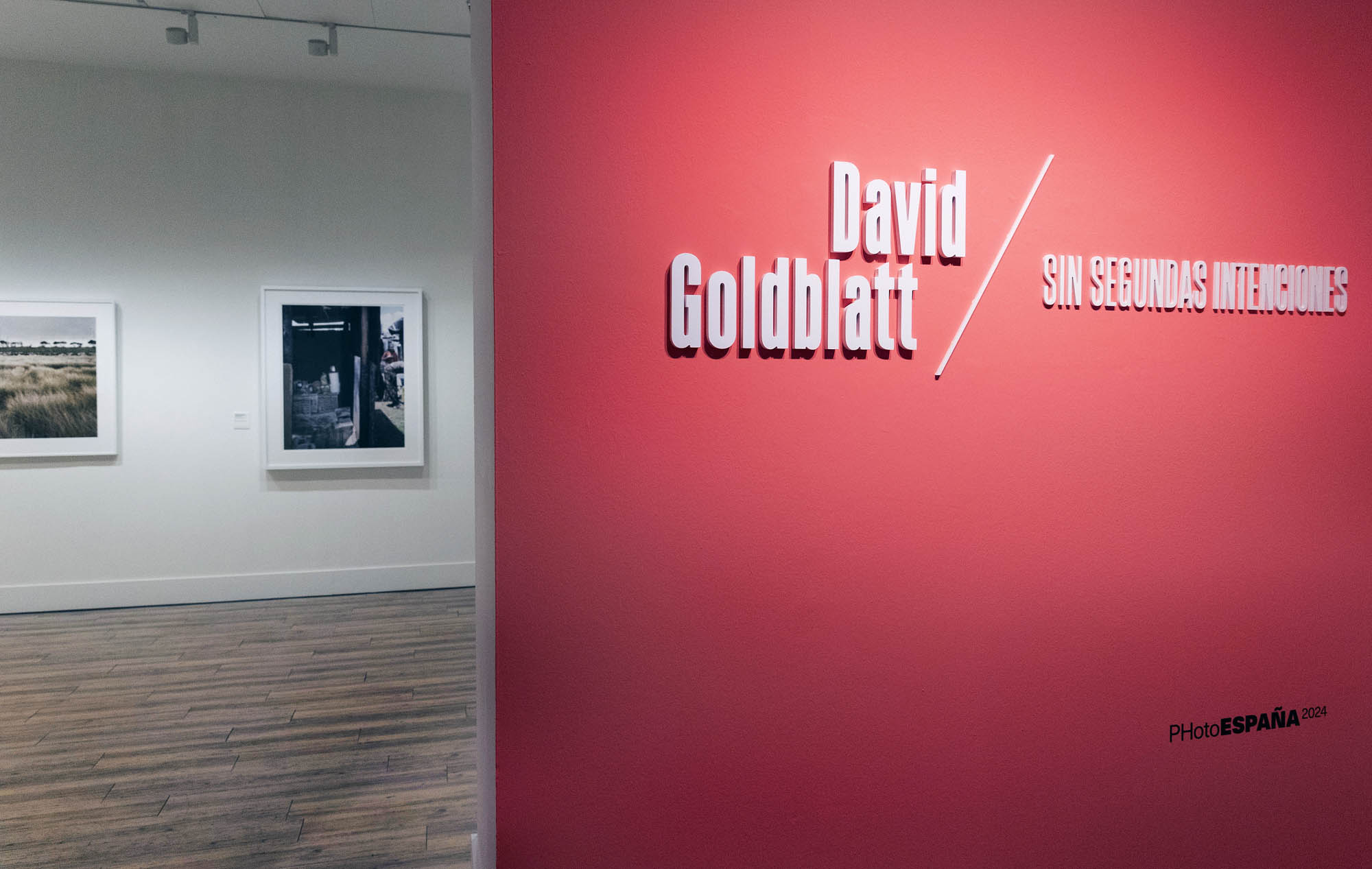
 

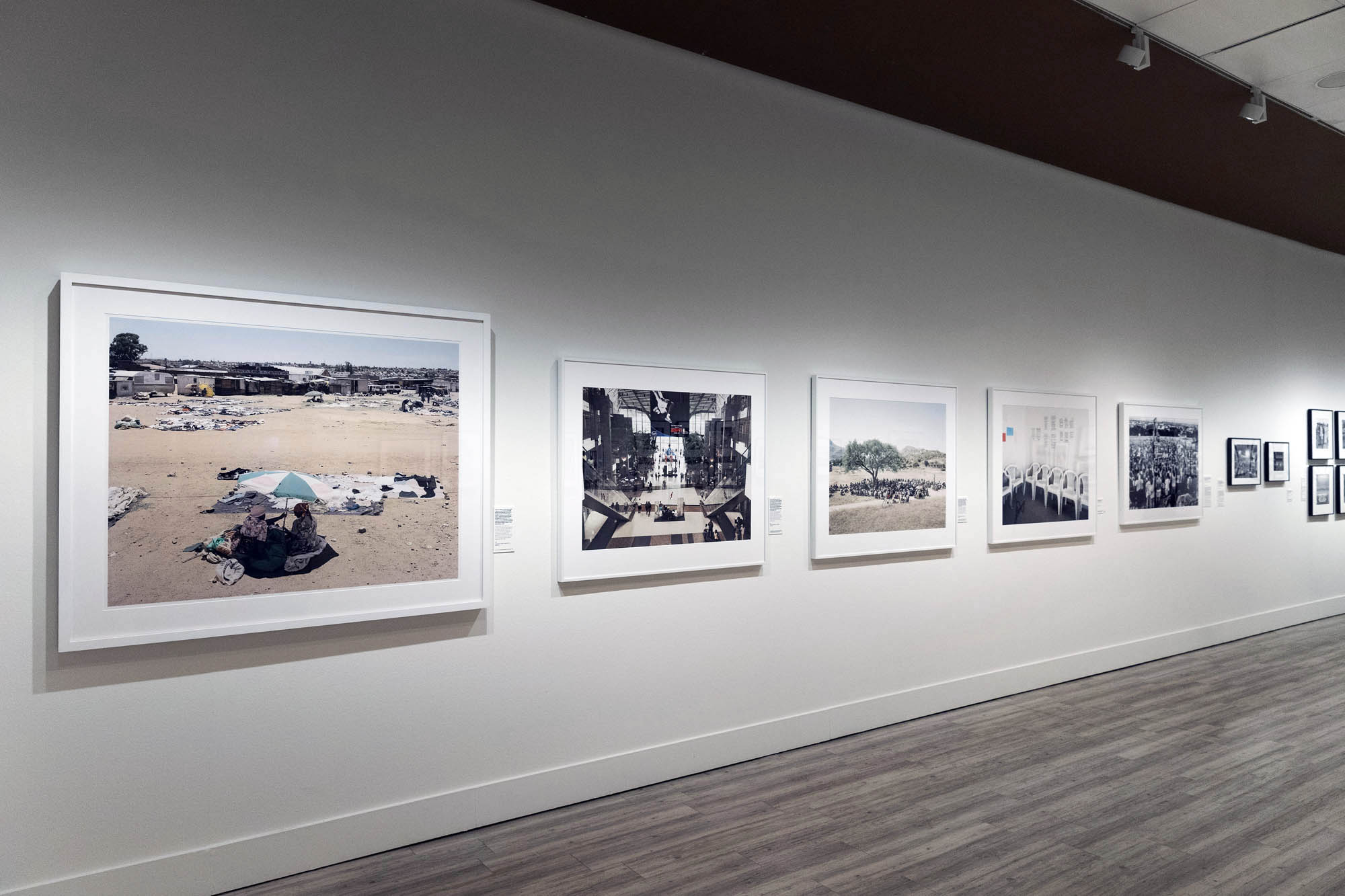
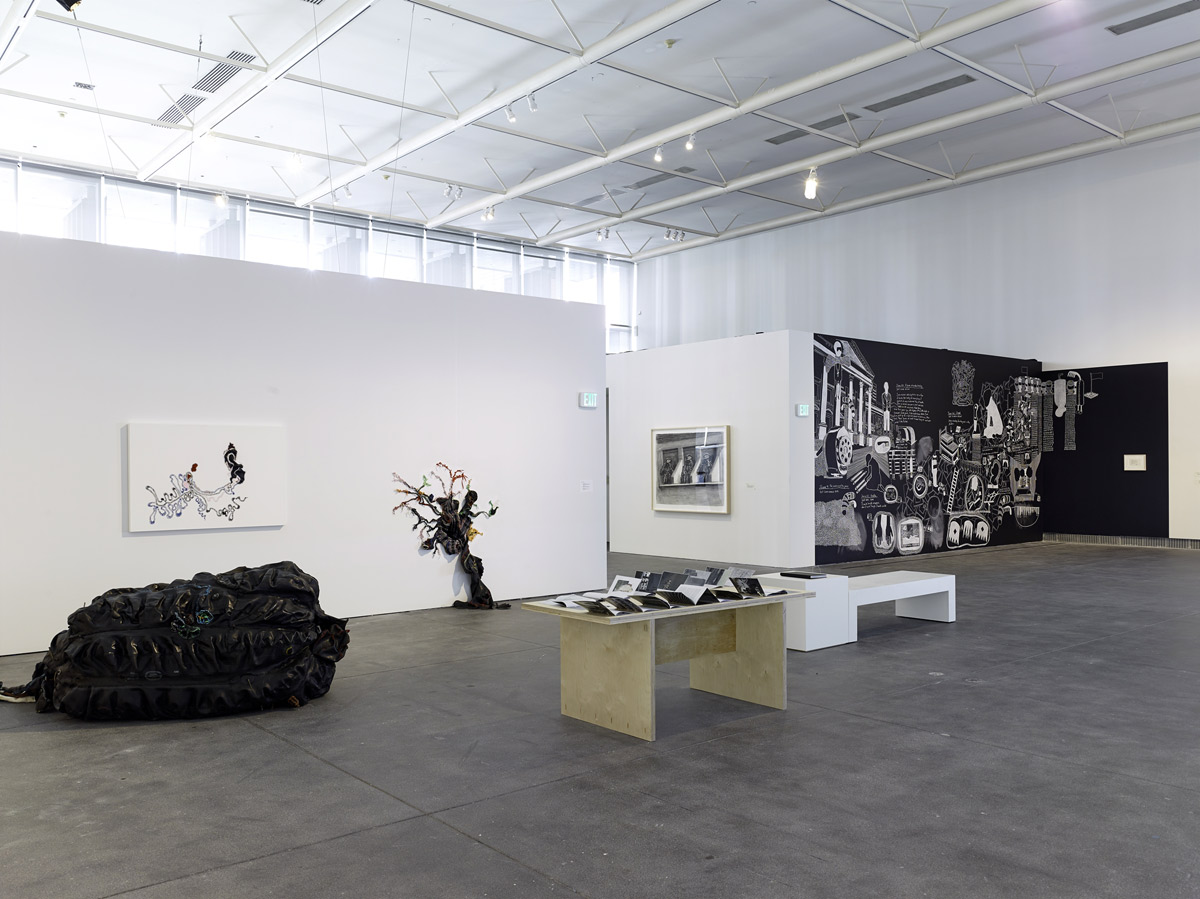
Installation view of the exhibition 'David Goldblatt: No Ulterior Motive' at Fundación MAPFRE, Madrid 

Installation view of the exhibition 'David Goldblatt: No Ulterior Motive' at Fundación MAPFRE, Madrid 


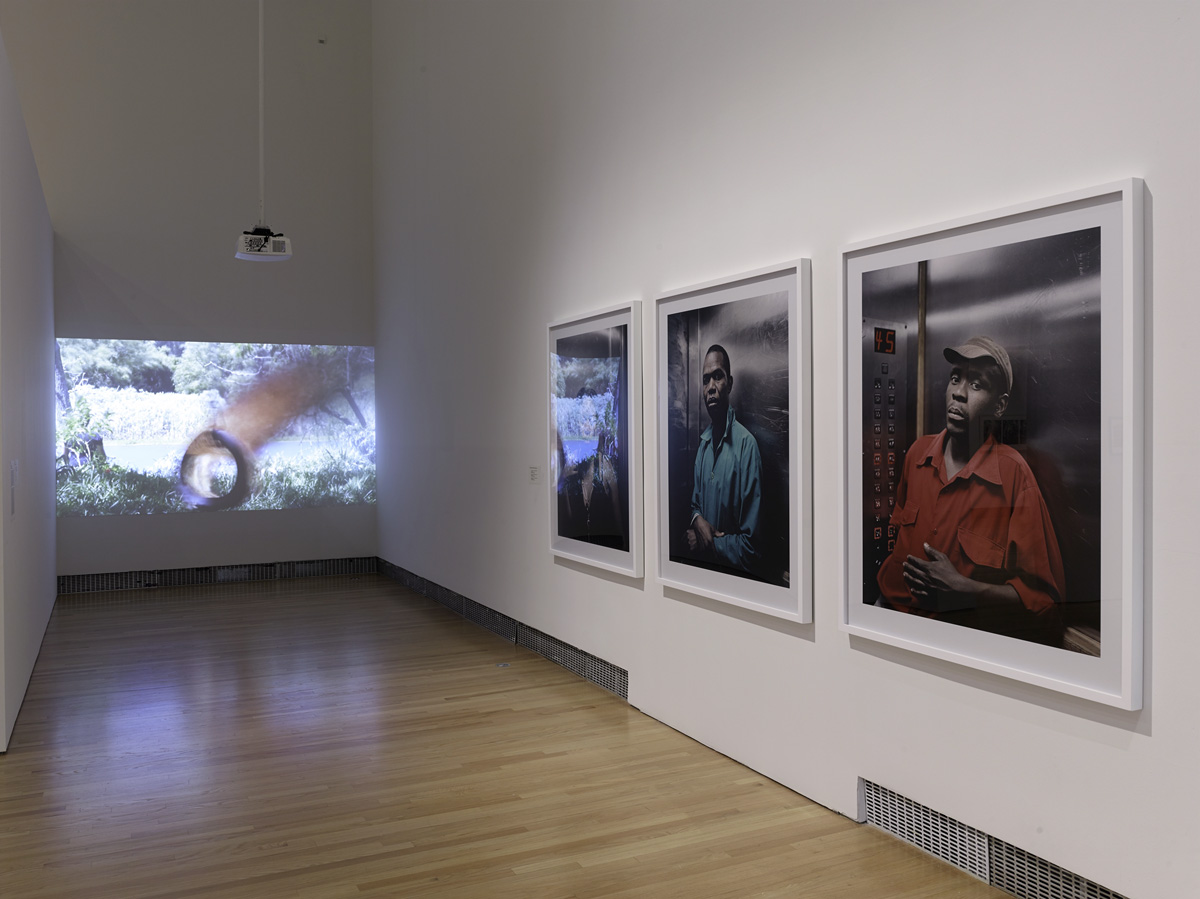
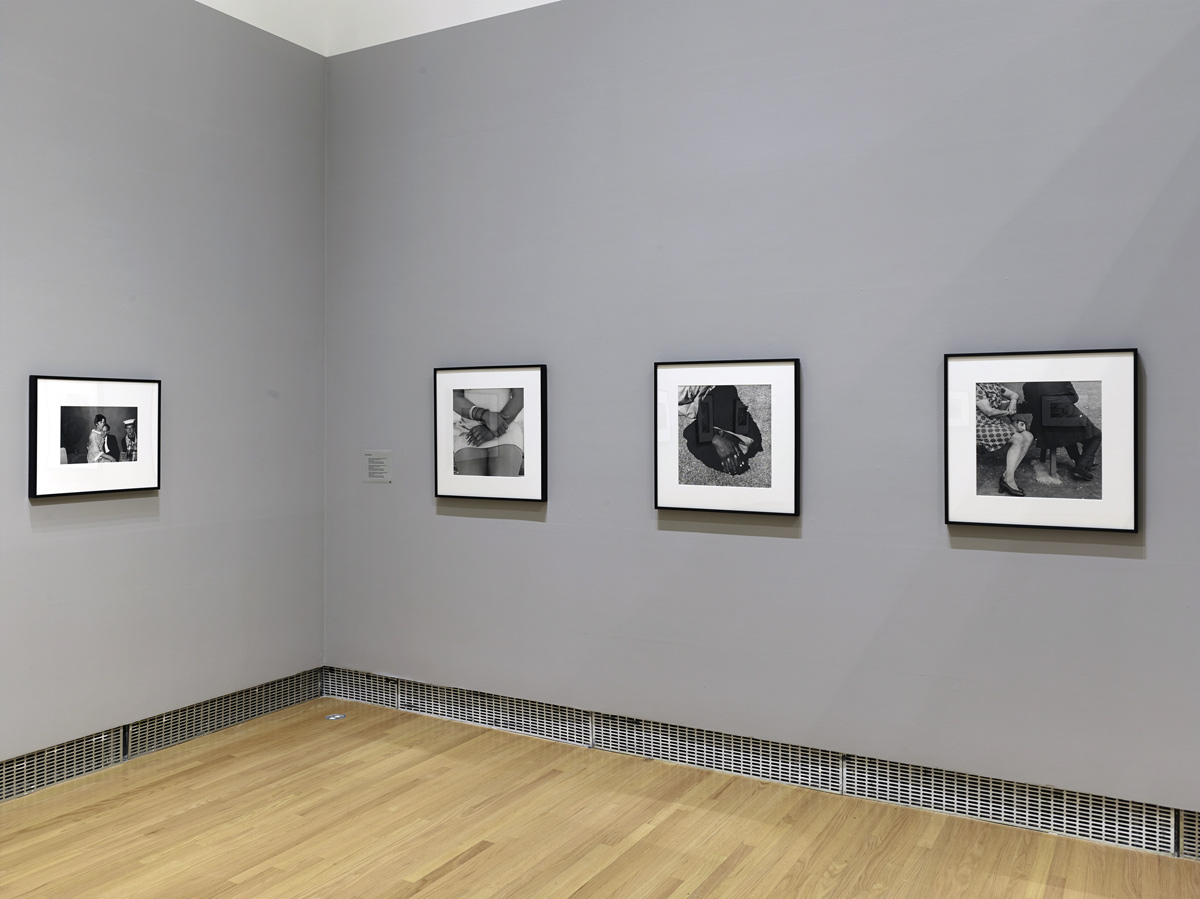
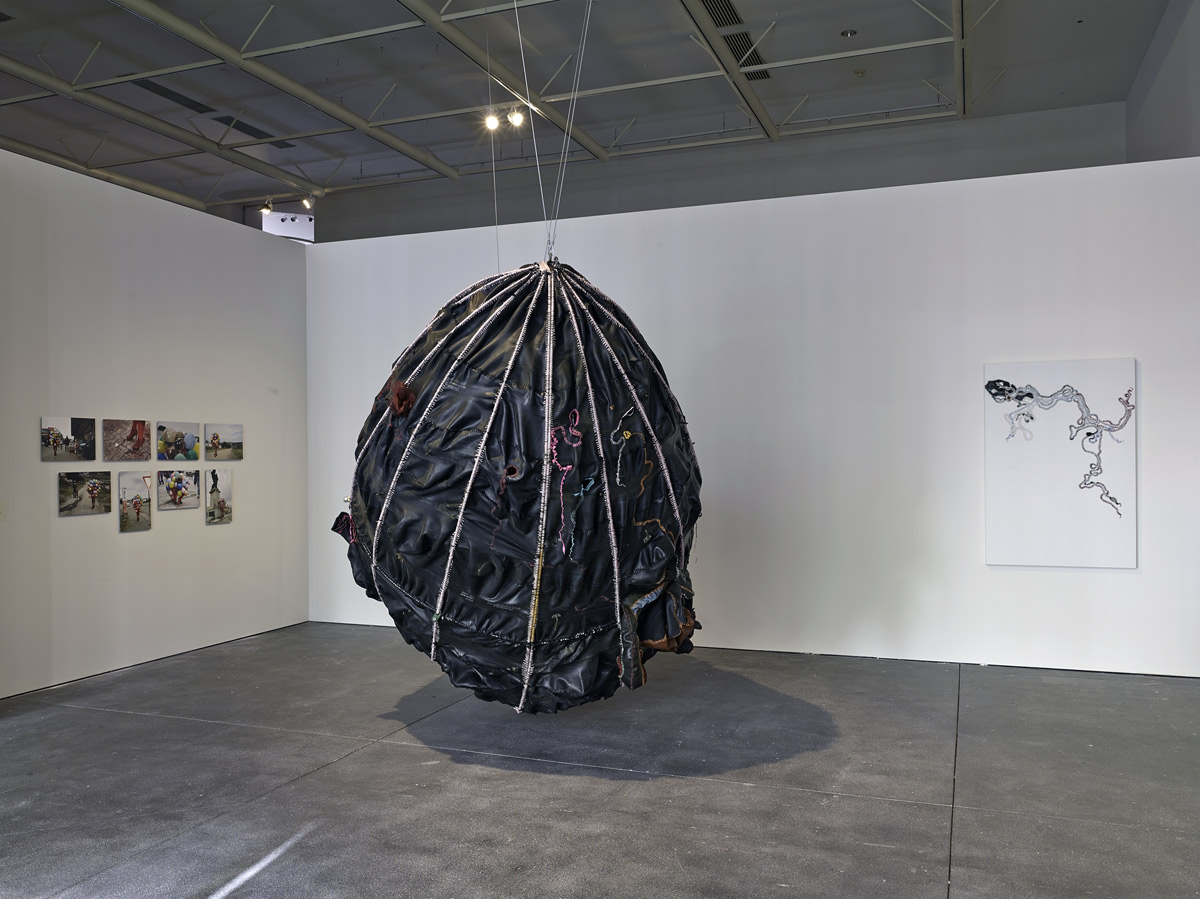
Installation views of the exhibition David Goldblatt: No Ulterior Motive at Fundación MAPFRE, Madrid
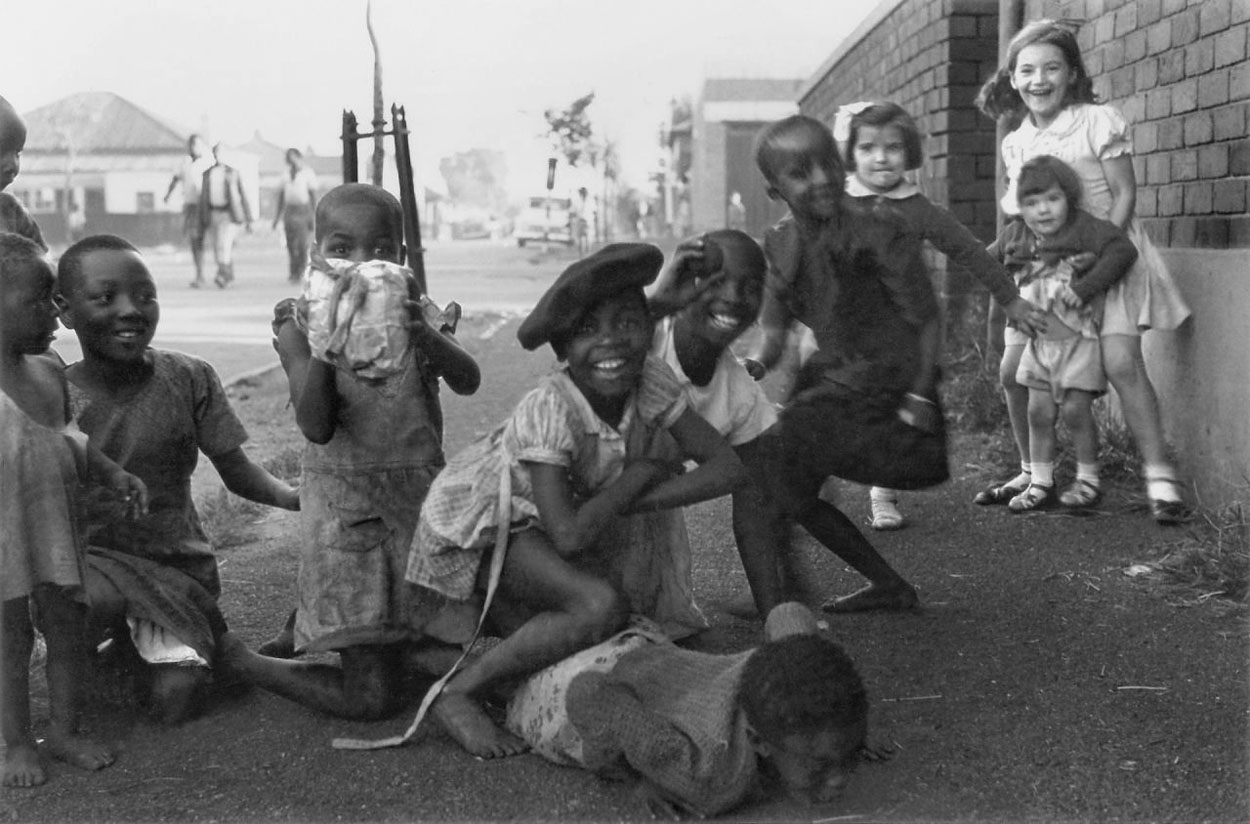
 

David Goldblatt (South African, 1930-2018) 'Children on the border between Fietas and Mayfair, Johannesburg' 1949, printed later


David Goldblatt (South African, 1930-2018)
Children on the border between Fietas and Mayfair, Johannesburg
1949, printed later
Gelatin silver print
Yale University Art Gallery, New haven, Connecticut, purchased with a gift from Jane P. Watkins, M.P.H. 1979; with the Leonard C. Hanna, Jr., Class of 1913, Fund; and with support from the Reinecke Rare Book and Manuscript Library
© The David Goldblatt Legacy Trust


Goldblatt caught this raucous scene during his initial foray into photography just after high school. The spontaneous interaction of children of different races on a city street clashed with the country’s emerging politics at mid-century. The year before Goldblatt made this image, a white nationalist movement fomented by Afrikaners – an ethnic group descended predominantly from Dutch settlers – had come to political power as the National Party. In 1949 the government passed legislation to authorise new racial classifications and urban racial segregation. They subsequently allocated the neighbourhoods of Fietas (known officially as Pageview) and Mayfair as areas for white residents only, enforcing segregation by fines and compulsory resettlement.

Wall text from the exhibition
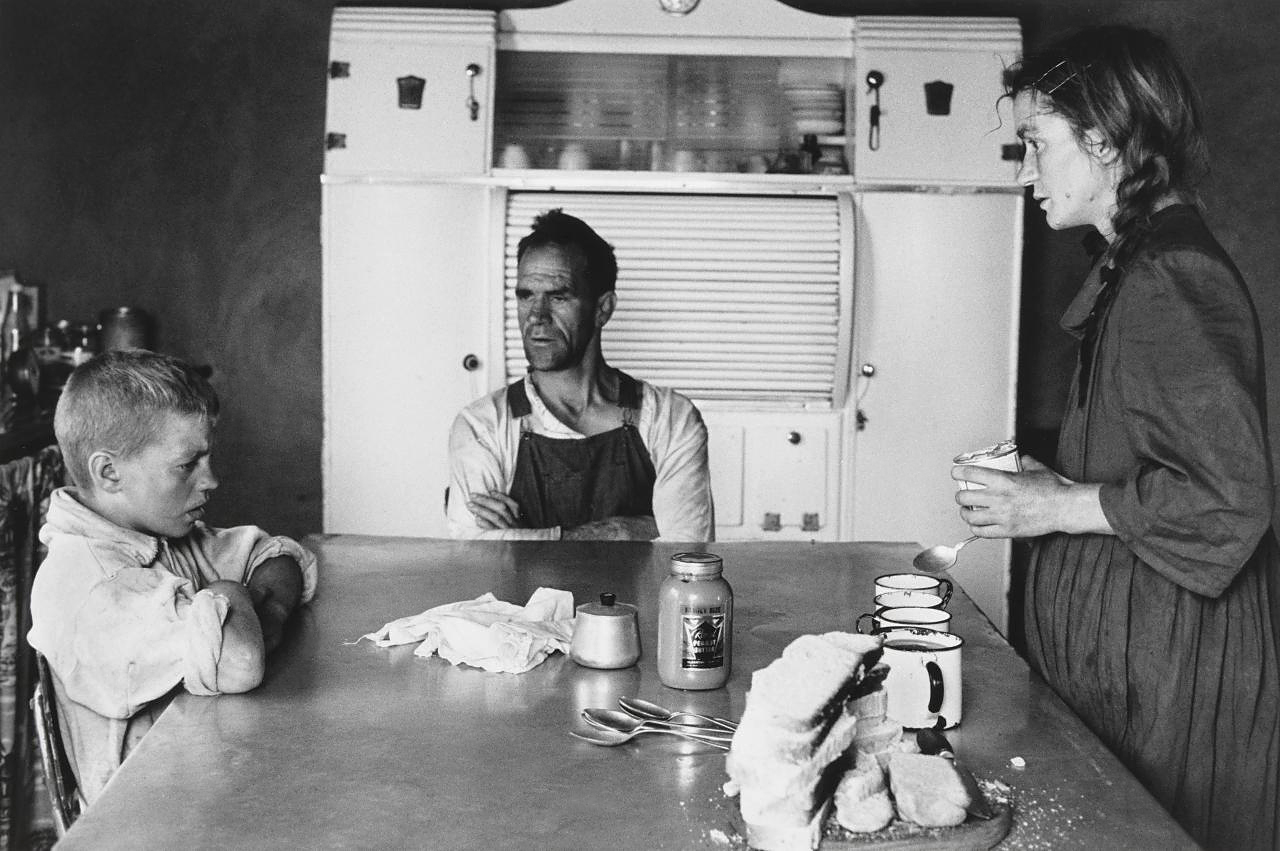
 

David Goldblatt (South African, 1930-2018) 'A plot-holder, his wife, and their eldest son at lunch, Wheatlands, Randfontein' 1962, printed later


David Goldblatt (South African, 1930-2018)
A plot-holder, his wife, and their eldest son at lunch, Wheatlands, Randfontein
1962, printed later
Gelatin silver print
Yale University Art Gallery, New haven, Connecticut, purchased with a gift from Jane P. Watkins, M.P.H. 1979; with the Leonard C. Hanna, Jr., Class of 1913, Fund; and with support from the Reinecke Rare Book and Manuscript Library
© The David Goldblatt Legacy Trust


The artistic career of South African artist David Goldblatt (1930, Randfontein – 2018, Johannesburg) embraced both a wide geographical spread of his country and a wide variety of human situations portraying the day-to-day life of his fellow citizens during and after apartheid. From his beginnings in 1950, his work – which he has progressively reflected in numerous books – has gone hand in hand with the historical, political, social and economic evolution of South Africa. From 1999 onwards, Goldblatt adopted colour for his work, which focused on the harsh living conditions of the post-apartheid period.

Goldblatt photographed with great objectivity the “watchmen”, dissidents, settlers and victims of that regime, the cities they lived in, their buildings, the inside of their homes… His images provide an extensive and touching visual record of the racist apartheid regime, a record that never explicitly shows its violence but clearly reveals all that it represented, as he himself pointed out: […] I avoid violence. And I wouldn’t know how to handle it as a photographer if I found myself caught up in a violent scene […] But then I’ve long since realised – it took me a few years to realise – that events in themselves are not so interesting to me as the conditions that led to the events. These conditions are often quite commonplace, and yet full of what is imminent. Immanent and imminent.

David Goldblatt. No ulterior motive gathers together nearly 150 works that show the continuity and strength of his work and also offers, for the first time, connections to other South African photographers from one to three generations later who acknowledge their debt to Goldblatt as a mentor who believed deeply in the value of exchange and debate, as well as in the importance of expressing one’s own opinions.

Text from the Fundación MAPFRE website


David Goldblatt (South African, 1930-2018) 'A plot holder with the daughter of his servant, Wheatlands, Randfontein' 1962


David Goldblatt (South African, 1930-2018)
A plot holder with the daughter of his servant, Wheatlands, Randfontein
1962
Gelatin silver print
The Art Institute of Chicago, promised donation of Cecily Cameron and Derek Schrier
© The David Goldblatt Legacy Trust
 

David Goldblatt (South African, 1930-2018) 'The son of an ostrich farmer waits with a labourer for the day's work to begin, near Oudtshoorn, Cape Province (Western Cape)' [El hijo de un criador de avestruces espera junto a un jornalero a que comience la jornada de trabajo, cerca de Oudtshoorn, Provincia del Cabo Occidental] 1966


David Goldblatt (South African, 1930-2018)
The son of an ostrich farmer waits with a labourer for the day’s work to begin, near Oudtshoorn, Cape Province (Western Cape) [El hijo de un criador de avestruces espera junto a un jornalero a que comience la jornada de trabajo, cerca de Oudtshoorn, Provincia del Cabo Occidental]
1966
Gelatin silver print
The Art Institute of Chicago, promised donation of Cecily Cameron and Derek Schrier
© The David Goldblatt Legacy Trust


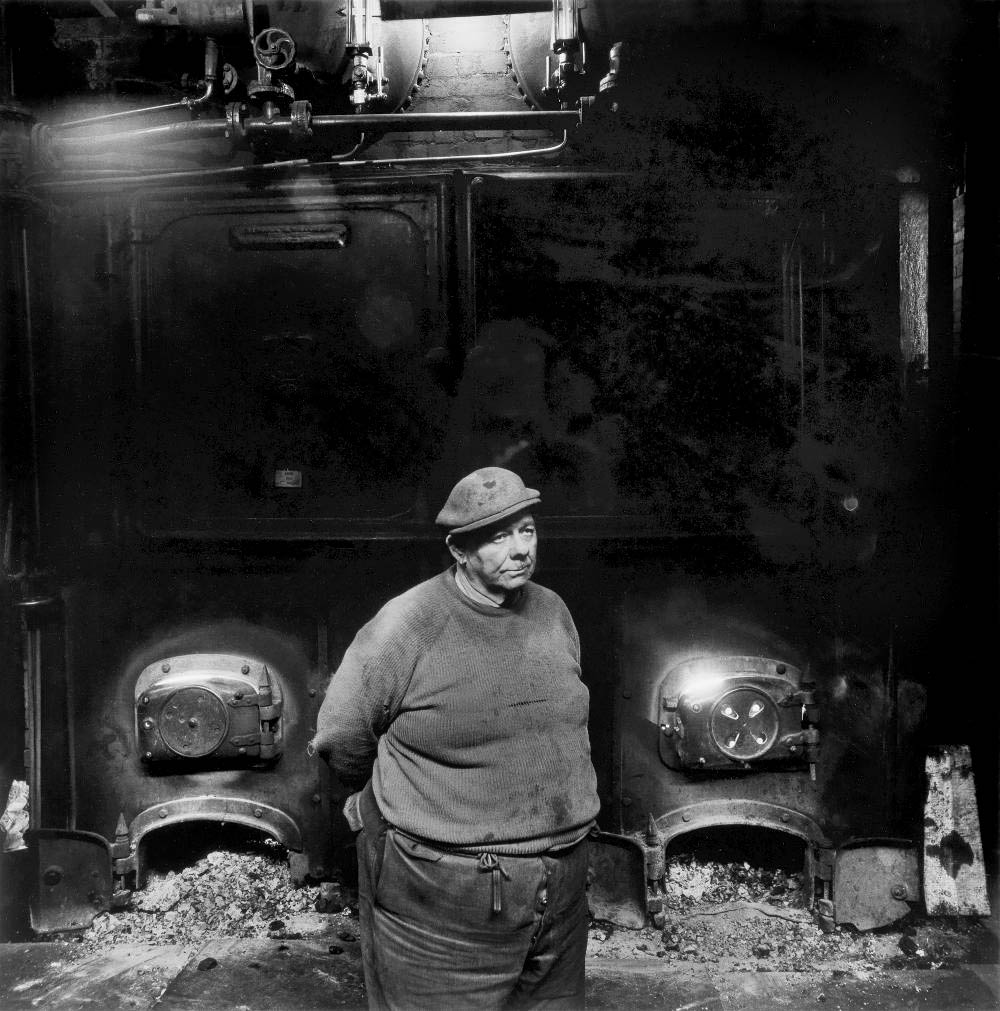
David Goldblatt (South African, 1930-2018) 'Joe Maloney, boiler-hose attendant, City Deep Gold Mine' 1966


David Goldblatt (South African, 1930-2018)
Joe Maloney, boiler-hose attendant, City Deep Gold Mine
1966
Gelatin silver print
The Art Institute of Chicago, promised donation of Cecily Cameron and Derek Schrier
© The David Goldblatt Legacy Trust


David Goldblatt (South African, 1930-2018) '"Boss Boy" detail, Battery Reef, Randfontein Estates Gold Mine' 1966, printed later


David Goldblatt (South African, 1930-2018)
“Boss Boy” detail, Battery Reef, Randfontein Estates Gold Mine
1966, printed later
Platinum print
Yale University Art Gallery, New haven, Connecticut, purchased with a gift from Jane P. Watkins, M.P.H. 1979; with the Leonard C. Hanna, Jr., Class of 1913, Fund; and with support from the Reinecke Rare Book and Manuscript Library
© The David Goldblatt Legacy Trust


European settlement began at the Cape in 1652. The oldest modern structure still in existence is, appropriately, the Castle in Cape Town erected between 1666 and 1679 as a fortress to consolidate that settlement against growing opposition by indigenous people. The core of the history of this land in the 333 years since 1666 is its domination by white people, the subjection to them by force and institutionalised economic dependence of black people, and of sporadic and latterly of massively growing opposition by blacks and disaffected whites to the system of domination.

White hegemony approached its ultimate expression in the past thirty-nine years with the emergence of Afrikaner nationalism as the overwhelmingly ascendant social force in this society. The apotheosis of that force is the ideology of apartheid. There is hardly any part of life in this country that has not been profoundly affected by the quest for power, the determination to hold onto it, and the expression of that power through apartheid of the Afrikaner Nationalists and of their supporters and fellow travellers of other origins.

Innumerable structures of every imaginable kind and not a few ruins bear witness to the huge thrust of these movements across our land.

Now, Afrikaner nationalism, though by no means spent, is in decline. Change, probably convulsive, to something as yet unclear has begun. The first structures based in countervailing forces and ideology have made their tentative appearance.

David Goldblatt from the book “Structures,” 1987, p. 42


The fabric of this society permeates everything I do. I don’t know if this is the case with other photographers. I would dearly love to be a lyrical photographer. Every so often I try to branch out and rid myself of these concerns, but it rarely happens. You take your first breath of fresh air and you have compromised.

Recently I became very aware of the people thrown into detention. There is the elementary fact that is lost sight of in this country, that they are put in detention without trial, without recourse to the courts. Has become necessary here to remind ourselves of this fact. I have catalogued the faces fo some fo the people who have been in detention with something of their life and what happened to them in detention. I have also me with some who have been abused in detention. The photographs might in some small way, through their publication, act as a deterrent to further abuse or even to detention without trial itself. As the struggle for the survival of the apartheid system becomes more acute, so the system becomes more restrictive, especially with regard to the flow of information. We are going into a period of long darkness when the restrictions with become more severe. I am aware of photographing things that are disappearing and need to be documented, but in another sense I have a private mission to document what is happening in this country to form a record. There are many other photographers engaged in this. I regard this aspect of our work as very important, so that in the future, when the time comes, people will know what happened here, what transpired.

David Goldblatt from the book “Structures,” 1987, p. 68


David Goldblatt (South African, 1930-2018) 'Gang on surface work, Rustenberg Platinum Mine, Rustenburg, North-West Province' [Cuadrilla en trabajos de superficie, mina de platino de Rustenberg, Provincia del Noroeste] 1971


David Goldblatt (South African, 1930-2018)
Gang on surface work, Rustenberg Platinum Mine, Rustenburg, North-West Province [Cuadrilla en trabajos de superficie, mina de platino de Rustenberg, Provincia del Noroeste]
1971
Carbon ink print
Yale University Art Gallery, New haven, Connecticut, purchased with a gift from Jane P. Watkins, M.P.H. 1979; with the Leonard C. Hanna, Jr., Class of 1913, Fund; and with support from the Reinecke Rare Book and Manuscript Library
© The David Goldblatt Legacy Trust
 

David Goldblatt (South African, 1930-2018) 'Young men with dompas (an identity document that every African had to carry), White City, Jabavu, Soweto' 1972


David Goldblatt (South African, 1930-2018)
Young men with dompas (an identity document that every African had to carry), White City, Jabavu, Soweto
1972
Gelatin silver print
Yale University Art Gallery, New haven, Connecticut, purchased with a gift from Jane P. Watkins, M.P.H. 1979; with the Leonard C. Hanna, Jr., Class of 1913, Fund; and with support from the Reinecke Rare Book and Manuscript Library
© The David Goldblatt Legacy Trust


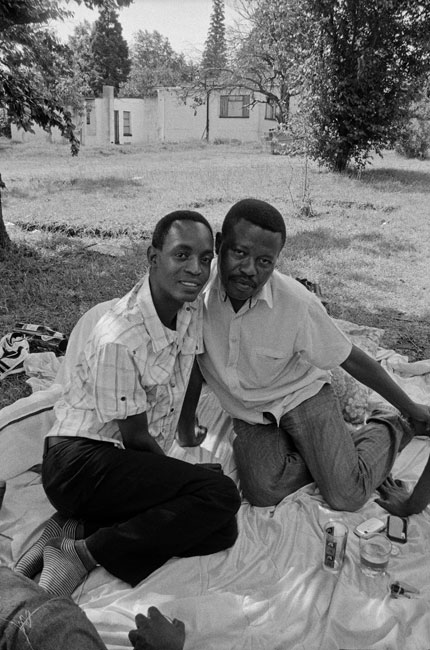
Two men lean against one another tenderly as one holds up an identification document called a passbook. under the Pass Laws Act of 1952, all Black South Africans over the age of 16 were required to carry such identification at all times. Passbooks were also known as dompas, a term deriving from the phrase “dumb pass,” used to openly mock this hated tool for enforcing apartheid. Anyone stopped by police without a passbook or official permission to be in a given area could be penalised with arrest or fines. Policies that restricted the movement of Black people throughout the country have a long history in South Africa and were a key target of resistance movements.

Wall text from the exhibition


David Goldblatt (South African, 1930-2018) 'In the office of the funeral parlour, Orlando West, Soweto' [En la oficina de la funeraria, Orlando West, Soweto] 1972


David Goldblatt (South African, 1930-2018)
In the office of the funeral parlour, Orlando West, Soweto [En la oficina de la funeraria, Orlando West, Soweto]
1972
Gelatin silver print
The Art Institute of Chicago, promised donation of Cecily Cameron and Derek Schrier
© The David Goldblatt Legacy Trust


In his photographs of office and office workers, Goldblatt often teased out the continuities between professional and private identities. The two women in this photograph are dressed for winter on Earth, but the art on the walls hearkens to a journey to outer space. At this moment in 1972, apartheid was so firmly in place that, for many, change was almost unthinkable – perhaps akin to landing on the moon. The artwork brings the prospect of liberty and the sheer thrill of adventure into an otherwise ordinary setting. Of course, the art might not have been their choice at all, but the photograph holds open the possibility that these women have a stake in missions long thought impossible.

Wall text from the exhibition


David Goldblatt (South African, 1930-2018) 'Lulu Gebashe and Solomon Mlutshana, who both worked in a record shop in the city, Mofolo Park' [Lulu Gebashe y Solomon Mlutshana, que trabajaban en una tienda de discos de la ciudad, Mofolo Park] 1972


David Goldblatt (South African, 1930-2018)
Lulu Gebashe and Solomon Mlutshana, who both worked in a record shop in the city, Mofolo Park [Lulu Gebashe y Solomon Mlutshana, que trabajaban en una tienda de discos de la ciudad, Mofolo Park]
1972
Carbon ink print
Yale University Art Gallery, New haven, Connecticut, purchased with a gift from Jane P. Watkins, M.P.H. 1979; with the Leonard C. Hanna, Jr., Class of 1913, Fund; and with support from the Reinecke Rare Book and Manuscript Library
© The David Goldblatt Legacy Trust


David Goldblatt (South African, 1930-2018) 'Miriam Diale, 5357 Orlando East, Soweto, 18 October 1972' [Miriam Diale, Orlando East n.º 5357, Soweto, 18 de octubre de 1972] 1972


David Goldblatt (South African, 1930-2018)
Miriam Diale, 5357 Orlando East, Soweto, 18 October 1972 [Miriam Diale, Orlando East n.º 5357, Soweto, 18 de octubre de 1972]
1972
Carbon ink print
Yale University Art Gallery, New haven, Connecticut, purchased with a gift from Jane P. Watkins, M.P.H. 1979; with the Leonard C. Hanna, Jr., Class of 1913, Fund; and with support from the Reinecke Rare Book and Manuscript Library
© The David Goldblatt Legacy Trust


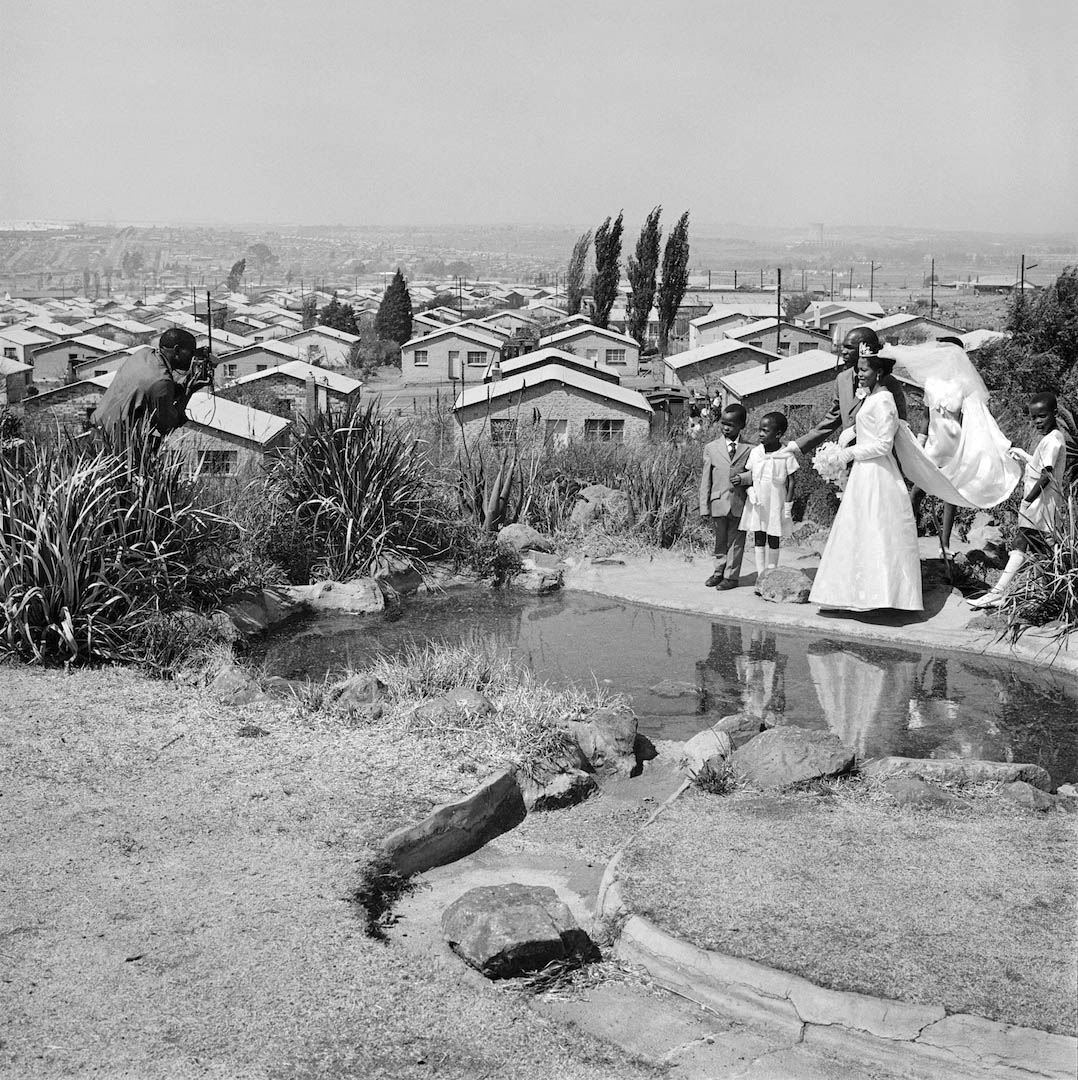
David Goldblatt (South African, 1930-2018) 'Wedding photography at the Oppenheimer Memorial, Jabavu, Soweto' 1972, printed later


David Goldblatt (South African, 1930-2018)
Wedding photography at the Oppenheimer Memorial, Jabavu, Soweto
1972, printed later
Carbon ink print
Yale University Art Gallery, New haven, Connecticut, purchased with a gift from Jane P. Watkins, M.P.H. 1979; with the Leonard C. Hanna, Jr., Class of 1913, Fund; and with support from the Reinecke Rare Book and Manuscript Library
© The David Goldblatt Legacy Trust


The grandson of Lithuanian refugees, David Goldblatt was born in Randfontein in 1930 and spent most of his life in Johannesburg. From a very young age he showed an interest in photography and took his first images when he was only eighteen. After the death of his father, in 1963 he decided to become a professional photographer.

David Goldblatt scrupulously examined the history and politics of South Africa, where he witnessed the rise of apartheid, its brutal segregationist policies and its eventual disappearance. His sensitive photographs offer a vision of daily life under this regime and in the complex period that followed, when he moved from black and white to colour in his work.

Employing great objectivity, Goldblatt photographed dissidents, settlers and victims of apartheid, the cities where they lived, their buildings, the interior of their homes, etc. His images configure a wide-ranging and moving visual record of this racist regime, a record which, while never explicitly showing its violence, clearly reveals everything it represented, as the artist himself pointed out: “I avoid violence. And I wouldn’t know how to handle it as a photographer if I found myself caught up in a violent scene […] But then I’ve long since realised – it took me a few years to realise – that events in themselves are not so interesting to me as the conditions that led to the events. These conditions are often quite commonplace, and yet full of what is imminent. Immanent and imminent.

In 1998 David Goldblatt was the first South African to be the subject of a solo exhibition at the Museum of Modern Art (MoMA) in New York. His work has been recognised with the Hasselblad (2006) and Henri Cartier-Bresson (2009) prizes and the International Center of Photography award (2013). In 2016 he was made a knight of the Order of Arts and Letters by the French government. He died in Johannesburg in 2018 at the age of eighty-eight.

David Goldblatt: No Ulterior Motive brings together around 150 works from several of the artist’s series with the aim of revealing the continuity of his work while also and for the first time establishing a dialogue with the work of other South African photographers of between one and three generations subsequent to Goldblatt, such as Lebohang Kganye, Ruth Seopedi Motau and Jo Ractliffe. Also on display are three mock-ups of books by Goldblatt, an aspect of his work to which he gave great importance.

The works on display are from the collections of The Art Institute of Chicago and Yale University Art Gallery and include important recent acquisitions of photographs by Goldblatt. Having been shown at The Art Institute of Chicago between December 2023 and March 2024, Fundación MAPFRE is now presenting the exhibition at its venue on Paseo de Recoletos, Madrid, until August this year. It will then be seen next year at Yale University Art Gallery, New Haven (Connecticut).

David Goldblatt: No Ulterior Motive is curated by Judy Ditner (Yale University Art Gallery, New Haven), Leslie M. Wilson and Matthew S. Witkovsky (The Art Institute of Chicago).


Key themes in the exhibition

Apparent tranquility

Throughout his career Goldblatt avoided the most difficult and shocking incidents that were a daily reality under apartheid. Rather, he considered that depicting everyday life, “the quiet and commonplace where nothing ‘happened'”, allowed the viewer to draw their own conclusions. The content was implicit in the apparent tranquility and in the very precise captions that accompany these images, which show ongoing, daily expressions of racism and the economic, social and political exploitation of the Black population under white rule.

Goldblatt, No Ulterior Motive

Goldblatt’s status as a white man allowed him greater freedom of movement and he took advantage of that privilege to document life in South Africa in the most honest and direct way possible. In the early 1970s he published a classified ad which read: “I would like to photograph people in their homes […]. No ulterior motive.” Nonetheless, this impartiality concealed a critical perspective towards his country’s people, history and geography.

Apartheid

In 1948 the National Party, one of the most visible entities representing Afrikaners (a European, colonising ethnic group mainly comprising descendants of the Dutch, North Germans and French), came to power in South Africa. This minority of European origin then proceeded to institute apartheid as a State policy while promoting the ideology that people of different racial origins could not live together in equality and harmony. Successive governments reinforced the legacy of racist oppression against non-white peoples (indigenous Africans, people of Asian origin and those of mixed race), who made up more than 80% of the population. In 1990 segregation laws began to be eliminated, the activity of the African National Congress was legalised and its most important leader, Nelson Mandela, who was elected president of South Africa in 1993, was released from prison.

Press release from Fundación MAPFRE


David Goldblatt (South African, 1930-2018) ;Sylvia Gibbert in her apartment, Melrose, Johannesburg; [Sylvia Gibbert en su apartamento, Melrose, Johannesburgo] 1974


David Goldblatt (South African, 1930-2018)
Sylvia Gibbert in her apartment, Melrose, Johannesburg [Sylvia Gibbert en su apartamento, Melrose, Johannesburgo]
1974
Gelatin silver print
The Art Institute of Chicago, promised donation of Cecily Cameron and Derek Schrier
© The David Goldblatt Legacy Trust


David Goldblatt (South African, 1930-2018) 'Ozzie Docrat with his daughter Nassima in his shop before its destruction under the Group Areas Act, Fietas, Johannesburg' [Ozzie Docrat con su hija Nassima en su tienda antes de ser destruida en virtud de la Ley de Agrupación por Áreas, Fietas, Johannesburgo] 1977


David Goldblatt (South African, 1930-2018)
Ozzie Docrat with his daughter Nassima in his shop before its destruction under the Group Areas Act, Fietas, Johannesburg [Ozzie Docrat con su hija Nassima en su tienda antes de ser destruida en virtud de la Ley de Agrupación por Áreas, Fietas, Johannesburgo]
1977
From the series Fietas
Carbon ink print
Yale University Art Gallery, New haven, Connecticut, purchased with a gift from Jane P. Watkins, M.P.H. 1979; with the Leonard C. Hanna, Jr., Class of 1913, Fund; and with support from the Reinecke Rare Book and Manuscript Library
© The David Goldblatt Legacy Trust


“I feel as though my teeth are being pulled out one by one. I run by tongue over the spaces and I try to remember the shape of what was there.” These words, spoken to Goldblatt by shop owner Ozzie Docrat, express what many residents must have experienced during their forced removal from the Johannesburg suburb of Fietas in the 1970s. Throughout the mid-20th century, Fietas was exceptional for the endurance of it multiracial, interfaith community of working- and middle-class people in the face of encroaching segregationist housing policies. In 1977, however, the government forced out Indian families like the Docrats, along with other people of color, to make this area exclusive to whites.

Wall text from the exhibition


David Goldblatt (South African, 1930-2018) 'Sunday morning: A not-White family living illegally in the "White" group area of Hillbrow, Johannesburg' [Domingo por la mañana: una familia no blanca viviendo ilegalmente en la zona "blanca" de Hillbrow, Johannesburgo] 1978


David Goldblatt (South African, 1930-2018)
Sunday morning: A not-White family living illegally in the “White” group area of Hillbrow, Johannesburg [Domingo por la mañana: una familia no blanca viviendo ilegalmente en la zona “blanca” de Hillbrow, Johannesburgo]
1978
Pigmented inkjet print
Yale University Art Gallery, New haven, Connecticut, purchased with a gift from Jane P. Watkins, M.P.H. 1979; with the Leonard C. Hanna, Jr., Class of 1913, Fund; and with support from the Reinecke Rare Book and Manuscript Library
© The David Goldblatt Legacy Trust


“Over the course of a career that spanned more than six decades, Goldblatt went looking for scenes like this one – quiet and tender, while also deeply revealing of the structures and values that constituted South African society. Though the family appears to be right at home, Goldblatt’s title shares that they were living illegally in the Johannesburg neighborhood of Hillbrow, violating laws that, under the system of segregation known as apartheid, dictated where different racial groups were permitted to reside. The cozy scene is therefore profoundly fragile because the family faced the persistent threat of removal.

This image powerfully presents the tensions that were central to what Goldblatt pursued through photography: soft furnishings and brutal laws, proximity and distance, access and exclusion, and informality and formality.”

Leslie Wilson and Yechen Zhao. “In the Room with David Goldblatt,” on the Art Institute of Chicago website December 19, 2023 [Online] Cited 11/07/2024
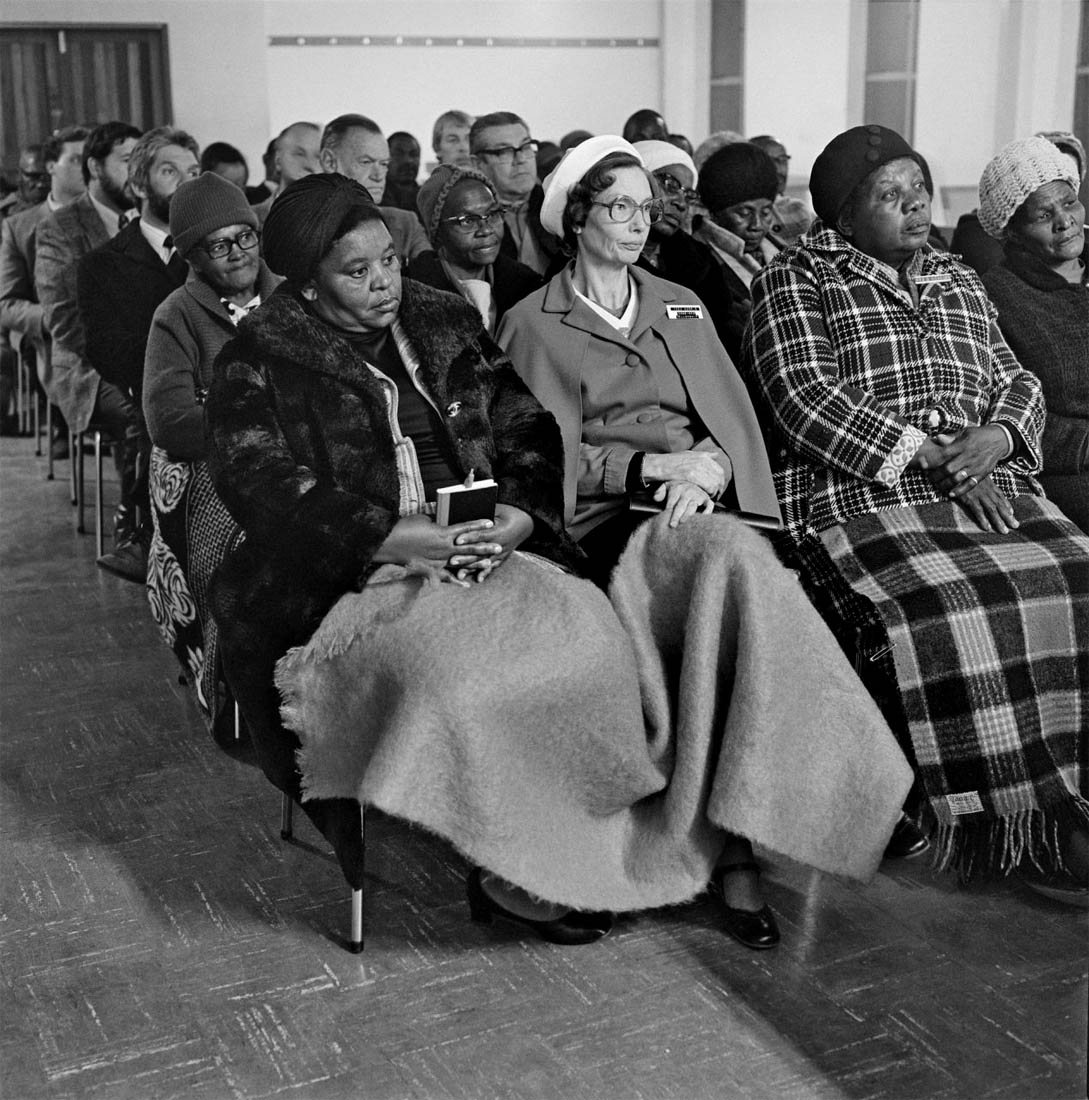
 

David Goldblatt (South African, 1930-2018) 'Methodists meet to find ways of reducing the racial, cultural, and class barriers that divide them, 3 July 1980' 1980, printed later


David Goldblatt (South African, 1930-2018)
Methodists meet to find ways of reducing the racial, cultural, and class barriers that divide them, 3 July 1980
1980, printed later
Gelatin silver print
Yale University Art Gallery, New haven, Connecticut, purchased with a gift from Jane P. Watkins, M.P.H. 1979; with the Leonard C. Hanna, Jr., Class of 1913, Fund; and with support from the Reinecke Rare Book and Manuscript Library
© The David Goldblatt Legacy Trust
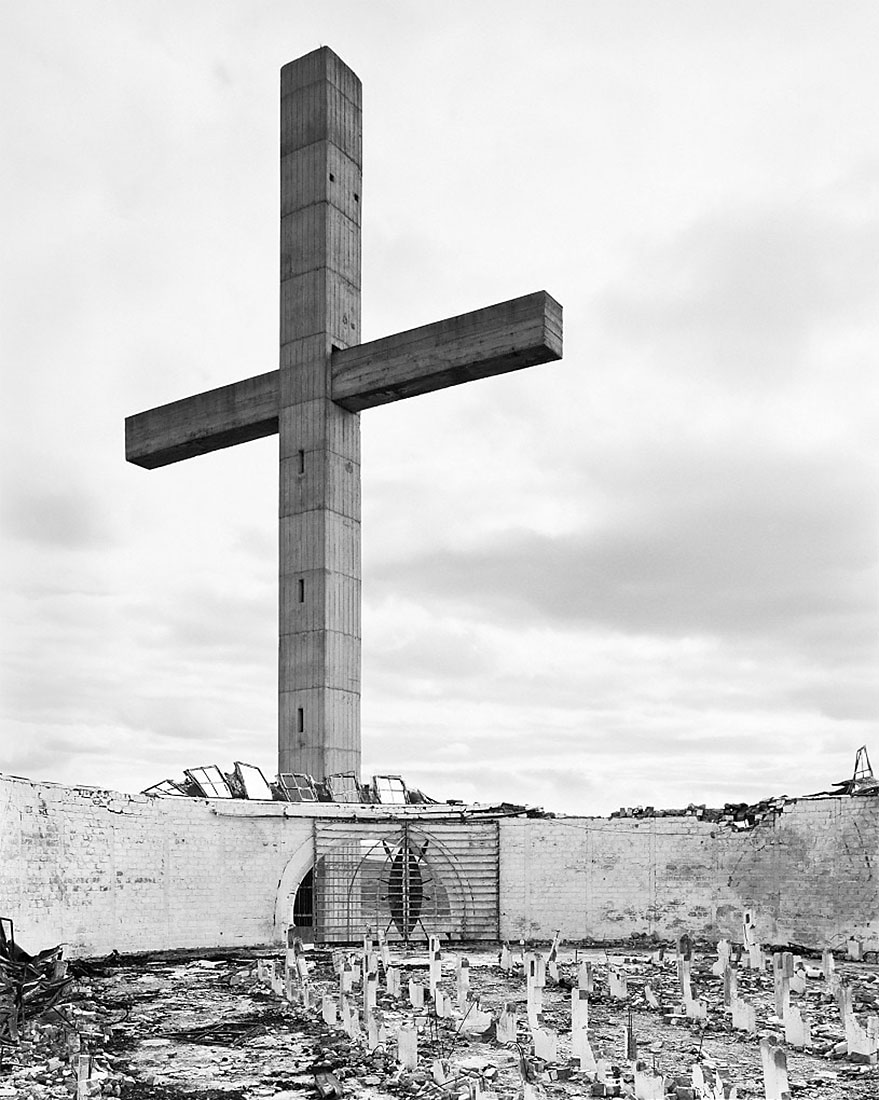
 

Throughout South Africa and even across the continent, religion bears a complicated history embroiled in legacies of colonisation, oppression, and apartheid. Religion holds power. It was through the cross and the bullet that the continent was dissected by European powers. It was through the pages of the Bible that apartheid was theologically justified, and it was through the Dutch Reformed Church of white Afrikaners that “the races” were declared separate as mandated by God. Yet, it was also through the World Alliance of Reformed Churches that apartheid was acknowledged as heresy. It was through the Christian ethos and through ubuntu that Archbishop Desmond Tutu guided the post-apartheid Truth and Reconciliation Commission through ways of healing in a society bifurcated into “European” and “Non-White;” “have” and “have-not;” “believer” and “unbeliever.” Religion has the power to both destroy and heal a nation.

In a discussion about life under apartheid, my South African friend designated as “Coloured” – a category in between “White” and “Black African” – revealed that his parents were once denied communion on Sunday morning due to their sin of attending a “white church” while being of color. Whiteness meant purity and closeness with God; anything less than was deemed as “separate,” “other,” “unworthy” – “impure.” The sharing of bread and wine in the Christian tradition is meant to signify connection between people and between the divine. The denial of such connection, of saying that one was unworthy to drink from the same chalice because of one’s race or ethnicity, is an ultimate denial of humanity. It is an affront to the very word “communion” and an insult to fellowship. Religion was co-opted to subjugate and enforce a system of racial hierarchy. Sunday morning saw no race-mixing amongst God’s children.

Trevor O’Connor. “Religion in South Africa: The Power to Destroy and Heal a Nation,” on the Berkley Center for Religion, Peace & World Affairs website November 16, 2018 [Online] Cited 11/07/2024


David Goldblatt (South African, 1930-2018) 'Saturday morning at the hypermarket: Semifinal of the Miss Lovely Legs Competition, 28 June 1980' [Sábado por la mañana en el hipermercado: semifinal del concurso Miss Piernas Bonitas, 28 de junio de 1980] 1980


David Goldblatt (South African, 1930-2018)
Saturday morning at the hypermarket: Semifinal of the Miss Lovely Legs Competition, 28 June 1980 [Sábado por la mañana en el hipermercado: semifinal del concurso Miss Piernas Bonitas, 28 de junio de 1980]
1980
Carbon ink print
Yale University Art Gallery, New haven, Connecticut, purchased with a gift from Jane P. Watkins, M.P.H. 1979; with the Leonard C. Hanna, Jr., Class of 1913, Fund; and with support from the Reinecke Rare Book and Manuscript Library
© The David Goldblatt Legacy Trust


David Goldblatt (South African, 1930-2018) 'Apostolic Faith Mission (AGS), Birchleigh, Kempton Park, 28 December 1983' [Misión de la Fe Apostólica (AGS, en afrikáans), Birchleigh, Kempton Park, 28 de diciembre de 1983] 1983


David Goldblatt (South African, 1930-2018)
Apostolic Faith Mission (AGS), Birchleigh, Kempton Park, 28 December 1983 [Misión de la Fe Apostólica (AGS, en afrikáans), Birchleigh, Kempton Park, 28 de diciembre de 1983]
1983
Gelatin silver print
The Art Institute of Chicago, promised donation of Cecily Cameron and Derek Schrier
© The David Goldblatt Legacy Trust


Goldblatt’s photographs of churches were so beautiful. They were wonderful architectural images, but they were deep with meaning capturing the issues of a missionary religion in a nonnative land. They symbolise the conflicts within the country which mirrored issues throughout other parts of the world. When I thought about South Africa it was about apartheid and relationships between blacks and whites, I had not considered the impact of western religion on the indigenous population (I should have because it is an issue still in our country today), nor did I know about the issues with the Muslim population in the country. In researching the issue of religion further, it appears the conflicts and violence in South Africa related to it appear to be ongoing to this day.

William Carl Valentine. “David Goldblatt: No Ulterior Motive,” on the William Carl Valentine website June 15, 2024 [Online] Cited 06/07/2024


David Goldblatt (South African, 1930-2018) 'Thirteen kilometres of this coastline were a White Group Area, Bloubergstrand, Cape Town, 9 January 1986' [Trece kilómetros de esta costa eran una zona reservada para blancos, Bloubergstrand, Ciudad del Cabo, 9 de enero de 1986] 1986


David Goldblatt (South African, 1930-2018)
Thirteen kilometres of this coastline were a White Group Area, Bloubergstrand, Cape Town, 9 January 1986 [Trece kilómetros de esta costa eran una zona reservada para blancos, Bloubergstrand, Ciudad del Cabo, 9 de enero de 1986]
1986
Carbon ink print
Yale University Art Gallery, New haven, Connecticut, purchased with a gift from Jane P. Watkins, M.P.H. 1979; with the Leonard C. Hanna, Jr., Class of 1913, Fund; and with support from the Reinecke Rare Book and Manuscript Library
© The David Goldblatt Legacy Trust


David Goldblatt (South African, 1930-2018) 'Assegais, shield, and 23-metre-high cross of the Nederduitse Gereformeerde Kerk in Afrika, (Dutch Reformed Mission Church to Africans), which stands above Dingane's destroyed capital, uMgungundlovu. The church was burnt down in 1985; Dinganestad, Natal' 1989, printed later


David Goldblatt (South African, 1930-2018)
Assegais, shield, and 23-metre-high cross of the Nederduitse Gereformeerde Kerk in Afrika, (Dutch Reformed Mission Church to Africans), which stands above Dingane’s destroyed capital, uMgungundlovu. The church was burnt down in 1985; Dinganestad, Natal
1989, printed later
Carbon ink print
Yale University Art Gallery, New haven, Connecticut, purchased with a gift from Jane P. Watkins, M.P.H. 1979; with the Leonard C. Hanna, Jr., Class of 1913, Fund; and with support from the Reinecke Rare Book and Manuscript Library
© The David Goldblatt Legacy Trust


David Goldblatt (1930-2018) scrupulously examined the history and politics of South Africa, where he witnessed the rise of apartheid, its divisive and brutal policies, and its eventual demise. His sensitive photographs offer a view of daily life under the apartheid system and its complex aftermath. Goldblatt was drawn, in his own words, “to the quiet and commonplace where nothing ‘happened’ and yet all was contained and immanent.” Accompanied by precise captions, his images expose everyday manifestations of racism and point to Black dispossession – economic, social, and political – under white rule.

The grandson of Lithuanian Jews who had fled Europe in the 1890s, Goldblatt spent most of his life in Johannesburg. Although not part of the ascendant Dutch Protestant community, his position as a white man allowed him greater freedom of movement and he leveraged this privilege to document life in South Africa as honestly and straightforwardly as possible. In the early 1970s, he placed a classified ad: “I would like to photograph people in their homes […]. No ulterior motive.” Yet this professed impartiality masked a critical perspective toward South Africa’s people, history, and geography.

Goldblatt first took up the camera in 1948, the year the apartheid system was introduced, and over the next seven decades he assiduously photographed South Africa’s people, landscape, and built environment. Recognising the layered connections in his oeuvre, this exhibition proceeds thematically rather than chronologically: here, black-and-white photographs taken during the period of institutionalised segregation are interwoven with his work in colour from the 1990s on. Six thematic sections explore Goldblatt’s engagement with apartheid, its contradictions, and its multifaceted legacy.
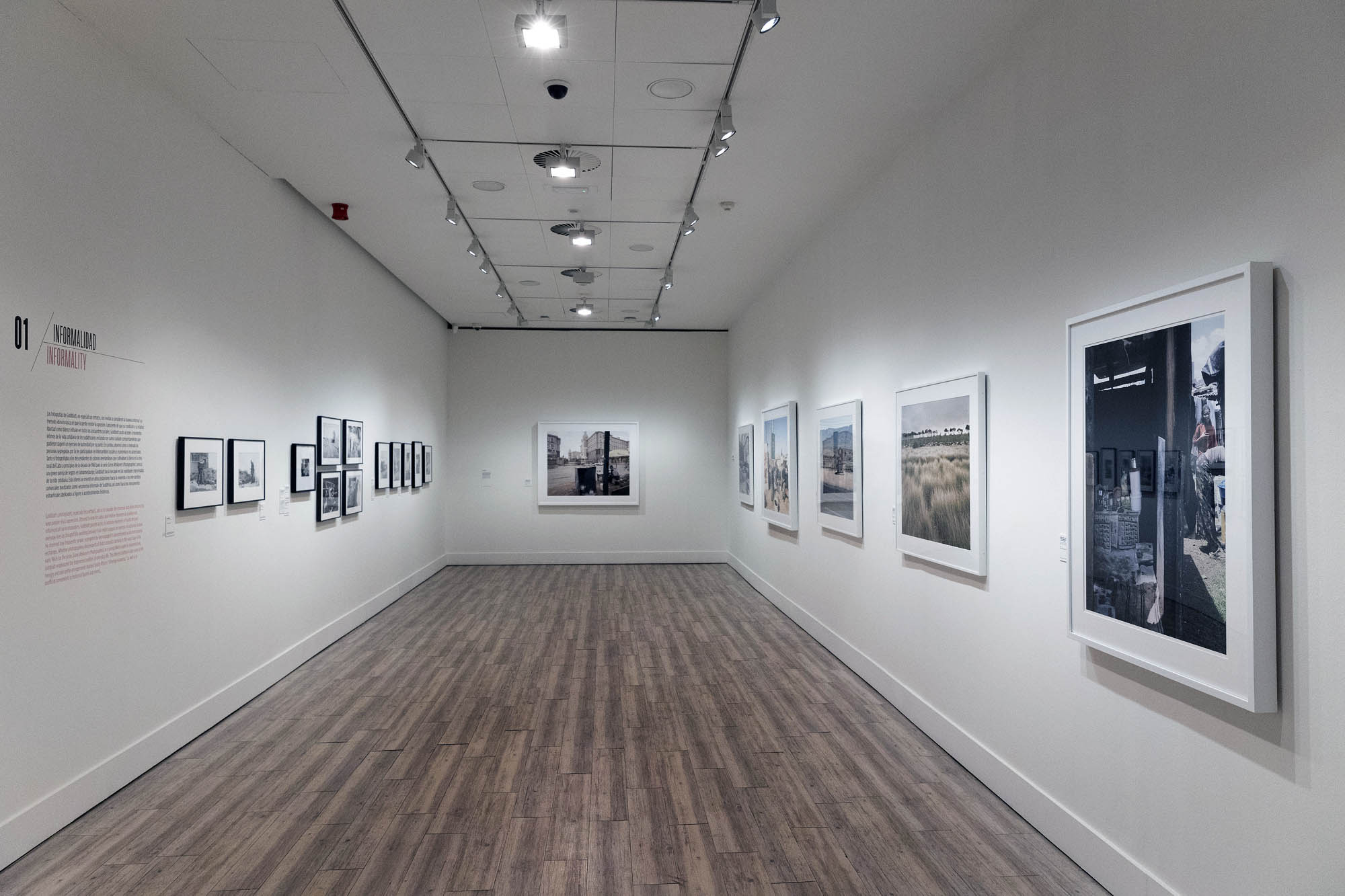
 

Installation view of the exhibition 'David Goldblatt: No Ulterior Motive' at Fundación MAPFRE, Madrid showing at left, wall text from the section 'Informality'


Installation view of the exhibition David Goldblatt: No Ulterior Motive at Fundación MAPFRE, Madrid showing at left, wall text from the section ‘Informality’ (see below)


1/ Informality

Goldblatt’s photographs, especially his portraits, ask us to consider the informal and often idiosyncratic ways people resist oppression. Attuned to how his status and relative freedom as a white man influenced all social encounters, Goldblatt gained access to intimate moments of South Africans’ everyday lives by thoughtfully avoiding behaviour that might suggest an exercise of authority. Instead, he observed how frequently people segregated by law engaged in unsanctioned social and economic exchanges. Whether photographing descendants of Dutch colonists farming in the rural Cape in the early 1960s for the series Some Afrikaners Photographed, or a young Black couple in Johannesburg, Goldblatt emphasised the improvised realities of everyday life. This interest shifted in later years to the housing and mercantile arrangements dubbed South Africa’s “informal economy,” as well as to unofficial monuments to historical figures and events.

2/ Working people

Even as the architects of apartheid sought to separate South Africans, the system functioned through an economic structure that placed people into tense proximity on a daily basis. White families hired Black workers to raise their children and clean their homes; mines owned and managed by whites depended on people of color to perform the most dangerous labor. Government-dictated racial categories profoundly shaped the jobs that people could hold, creating strict hierarchies in workplaces. Goldblatt highlighted these inequalities with pictures like one of a domestic worker rushing to meet her employer. At the same time, he attended to how people retained a sense of self and dignity in their labor, as in his portraits of mineworkers who chose to pose for his camera in their traditional clothing.

3/ Extraction

Born in the mining town of Randfontein, Goldblatt began his career by looking at the extractive economy built by colonial ventures to exploit its natural resources. Goldblatt created his earliest series, On the Mines (1964–73), while working as a photographer for the country’s biggest mining corporations. The series showed how a predominantly Black migrant labor force performed the most dangerous work in gold and platinum mines, work that primarily enriched their white bosses. Decades later, the photographer found similar manifestations of inequality while recording the toxic legacy of asbestos mining and its disproportionate impact on Black communities.

4/ Near/Far

The white supremacist National Party, led by Afrikaners (descendants of predominantly Dutch settlers) and English-speaking whites, attempted to impose distance between people of different racial categories in South Africa. Goldblatt looked at how the National Party government pulled people from their homes to realise its vision of racial segregation, dispossessing and dispersing Black and Indian residents to make room for new white neighbourhoods.

However, the exclusive urban centres the party sought to create could not function without a daily influx of labourers and domestic workers from the country’s diverse population. Goldblatt was interested in the ways closeness continued to manifest even when distance was dictated by law, a status quo that also affected his relationship with the people he photographed. These images wryly register the constant collision of segregated groups in public and private spaces throughout the country.

5/ Disbelief

The illogic of apartheid led to widespread skepticism and practices of self-delusion among those who actively perpetuated the system. The photographs in this section capture the sense of disbelief with the labyrinthine, endlessly rewritten laws intended to legitimise a morally bankrupt system of abuse and oppression. Goldblatt rendered this state of affairs in brilliant deadpan, giving visual form to the incredulity that all but the most cynical and opportunistic beneficiaries of apartheid must have felt. Fortress-like churches of the Dutch Reformed Protestant faith mix with absurd scenes of suburban leisure in whites-only areas, while stony or stoic gazes meet moments of sudden demolition. Even after the official end of apartheid, Goldblatt continued to photograph sites that inspired feelings of disbelief as seen in his photographs of incomplete housing developments.

6/ Assembly

How do people come together in a country divided by segregation? In everything, from the bench they could sit on to where they could live, South Africans were physically separated by race. In the 1950s, protests against these new policies were common, but in the decades that followed, the government introduced increasingly brutal tactics to repress dissent and severely curtailed the right to assemble.

Goldblatt avoided straightforward depictions of open rebellion, seeing his country’s political struggles as clearly in the routine occasions that brought people together by choice or necessity. In later decades, he engaged more with overtly political subjects, turning his camera to newly elected lawmakers and young South Africans openly protesting colonial legacies in their post-apartheid society.

7/ Connections

Beyond his own work, Goldblatt was committed to aiding future generations of South African photographers. He helped found the Market Photo Workshop in 1989 to offer instruction and support to emerging, socially engaged photographers, hoping the school would be “a small counter to the ethnic surgery that had so successfully separated South Africans under apartheid.” Today, it remains a centre of education and community for photography in Johannesburg. Lebohang Kganye, Sabelo Mlangeni, Ruth Seopedi Motau, and Zanele Muholi are alumni with close ties to Goldblatt, who was a friend and mentor. All have explored themes of belonging, loss, memory, migration, and representation while uncovering original, often deeply personal ways to examine South Africa’s people, places, and policies.

Like Goldblatt, the artists in this gallery – Ernest Cole, Santu Mofokeng, and Jo Ractliffe – use the camera to reflect critically on their country’s society and politics. Cole used his camera to confront sweeping social, political, and environmental change from the 1950s to the 1980s. Mofokeng was a member of the Afrapix collective of South African documentary photographers throughout the 1980s. A former student of Goldblatt, he received his first long-term position in photography in part through Goldblatt’s recommendation. Ractliffe’s landscape photographs address issues of displacement and conflict, capturing the traces of often violent histories. She knew Goldblatt as a friend and colleague and has taught at the Market Photo Workshop, a vitally important school for photography in Johannesburg whose alumni are featured in gallery 3.

Text from the exhibition


David Goldblatt (South African, 1930-2018) 'Victoria Cobokana, housekeeper, in her employer's dining room with her son Sifiso and daughter Onica, Johannesburg, June 1999. Victoria died of AIDS on 13 December 1999, Sifiso dies of AIDS on 12 January 2000, Onica died of AIDS in May 2000, June 1999' 1999


David Goldblatt (South African, 1930-2018)
Victoria Cobokana, housekeeper, in her employer’s dining room with her son Sifiso and daughter Onica, Johannesburg, June 1999. Victoria died of AIDS on 13 December 1999, Sifiso dies of AIDS on 12 January 2000, Onica died of AIDS in May 2000, June 1999
1999
Pigmented inkjet print
The Art Institute of Chicago, Promised gift of Cecily Cameron and Derek Schrier
© The David Goldblatt Legacy Trust
 

One might argue that in his own silent way, he was an activist, using his camera to expose things that should never have been allowed to happen. A single color image seems to define the show – in it, a housekeeper sits in her employer’s dining room with her two children on her lap. Behind her a round window forms a halo around her wrapped head, Madonna-like. The didactic tells us that all three of them died of AIDS within months. Such is the inequity of South Africa, quietly portrayed by David Goldblatt over seven decades.

Susan Aurinko. “Painful Truths: A Review of David Goldblatt at the Art Institute of Chicago,” on the New City Art website December 22, 2023 [Online] Cited 07/07/2024


David Goldblatt (South African, 1930-2018) 'Swerwers, nomadic sheep shearers and farmworkers descended from the San hunter-gatherers and Khoi pastoralists. Without work for four months they lived in the gang, the corridor between farms, fences and roads, hunting, fishing when they could, and eating roadkill, near Nuwe Rooiberg, Northern Cape, 18 September 2002' [Swerwers, esquiladores de ovejas y trabajadores agrícolas nómadas, descendientes de los cazadores-recolectores san y de los pastores khoi. Sin trabajo durante cuatro meses, vivían en el paso, el corredor que hay entre las vallas de las granjas y las carreteras, cazando, pescando cuando podían y comiendo animales atropellados, cerca de Nuwe Rooiberg, Cabo Septentrional, 18 de septiembre de 2002] 2002, printed 2005


David Goldblatt (South African, 1930-2018)
Swerwers, nomadic sheep shearers and farmworkers descended from the San hunter-gatherers and Khoi pastoralists. Without work for four months they lived in the gang, the corridor between farms, fences and roads, hunting, fishing when they could, and eating roadkill, near Nuwe Rooiberg, Northern Cape, 18 September 2002 [Swerwers, esquiladores de ovejas y trabajadores agrícolas nómadas, descendientes de los cazadores-recolectores san y de los pastores khoi. Sin trabajo durante cuatro meses, vivían en el paso, el corredor que hay entre las vallas de las granjas y las carreteras, cazando, pescando cuando podían y comiendo animales atropellados, cerca de Nuwe Rooiberg, Cabo Septentrional, 18 de septiembre de 2002]
2002, printed 2005
Pigmented inkjet print
The Art Institute of Chicago, Promised gift of Cecily Cameron and Derek Schrier
© The David Goldblatt Legacy Trust


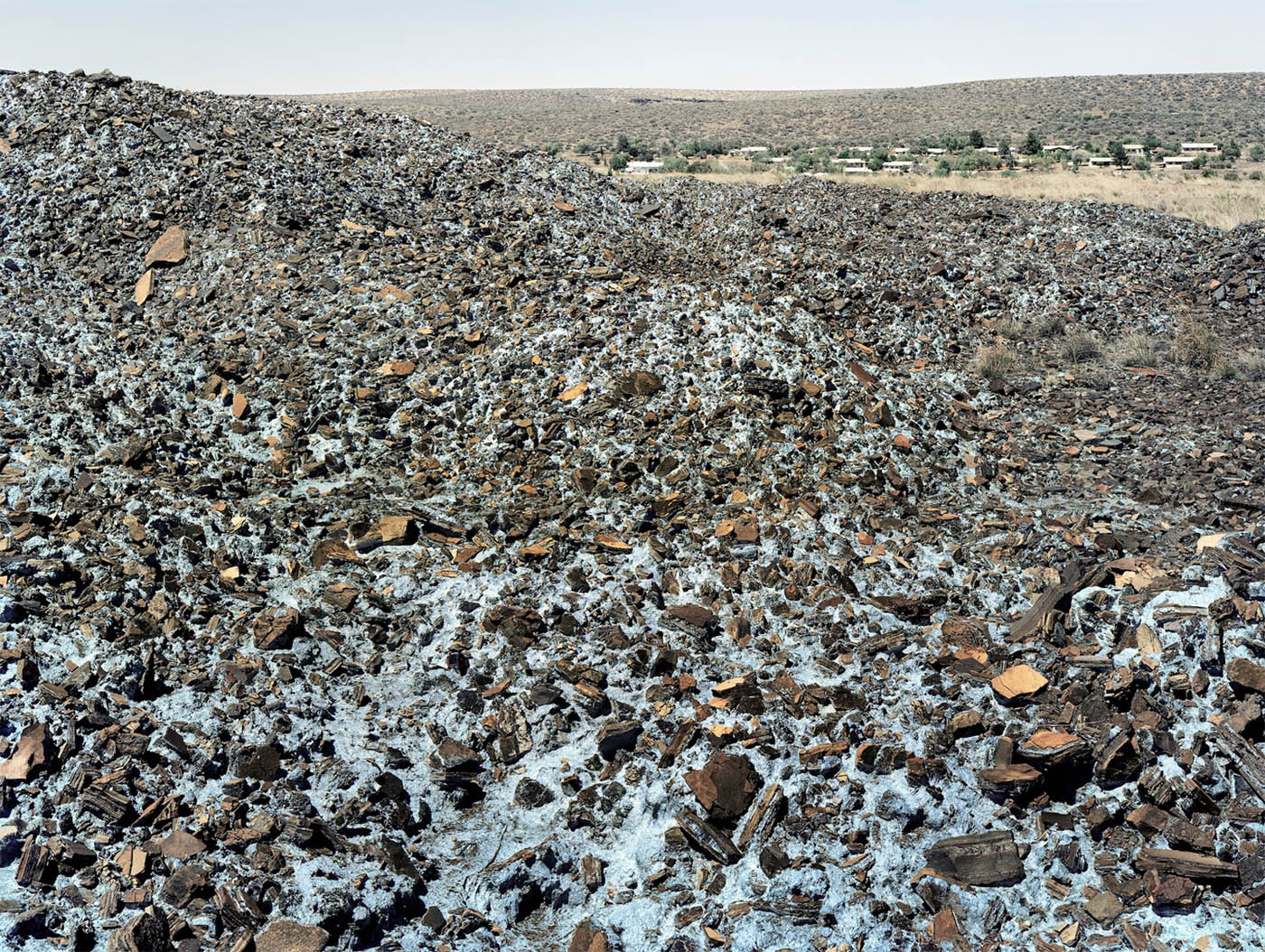
David Goldblatt (South African, 1930-2018) 'Highly carcinogenic blue asbestos waste on the Owendale Asbestos Mine tailings dump, near Postmasburg, Northern Cape. The prevailing wind was in the direction of the mine officials' houses at right. 21 December, 2002' 2002, printed 2005


David Goldblatt (South African, 1930-2018)
Highly carcinogenic blue asbestos waste on the Owendale Asbestos Mine tailings dump, near Postmasburg, Northern Cape. The prevailing wind was in the direction of the mine officials’ houses at right. 21 December, 2002
2002, printed 2005
Pigmented inkjet print
© The David Goldblatt Legacy Trust
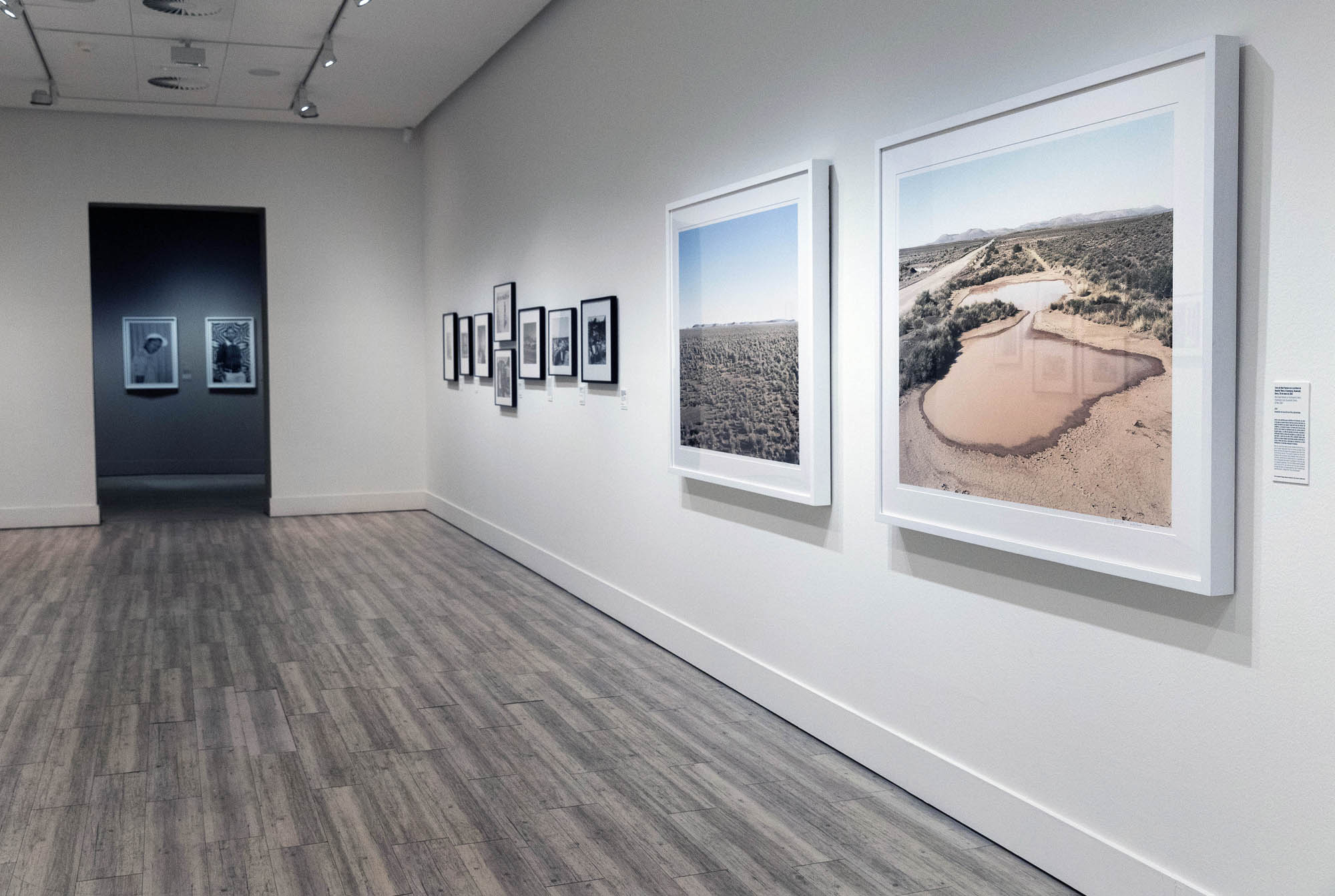
 

Installation view of the exhibition David Goldblatt: No Ulterior Motive at Fundación MAPFRE, Madrid showing at right, Goldblatt's 'Near Brak Pannen on the Beaufort West-Fraserburg road, Nuweveld, Karoo, 30 May 2004'


Installation view of the exhibition David Goldblatt: No Ulterior Motive at Fundación MAPFRE, Madrid showing at right, Goldblatt’s Near Brak Pannen on the Beaufort West-Fraserburg road, Nuweveld, Karoo, 30 May 2004 (2004, below)
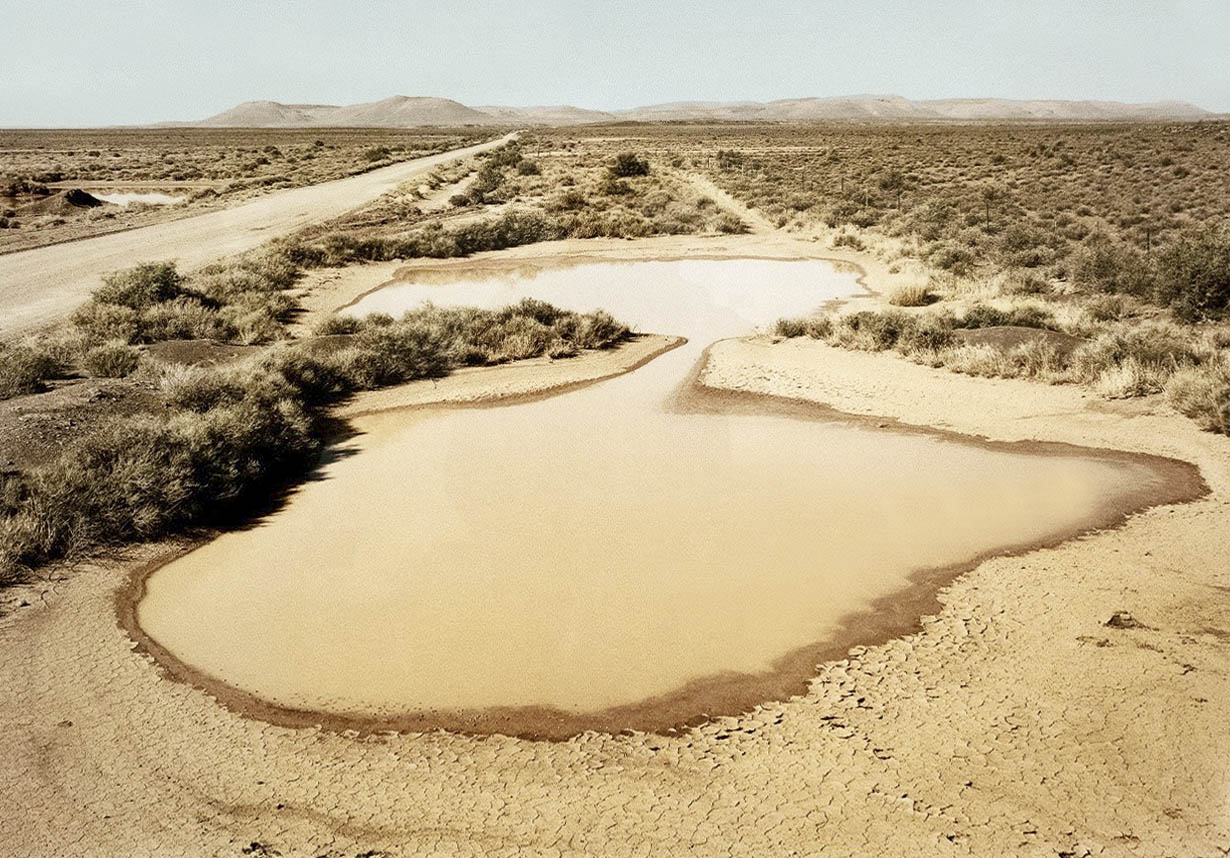
 

David Goldblatt (South African, 1930-2018) 'Near Brak Pannen on the Beaufort West-Fraserburg road, Nuweveld, Karoo, 30 May 2004' 2004


David Goldblatt (South African, 1930-2018)
Near Brak Pannen on the Beaufort West-Fraserburg road, Nuweveld, Karoo, 30 May 2004
2004
Pigmented inkjet print
The Art Institute of Chicago, promised gift of Cecily Cameron and Derek Schrier


Next to a road that shoots arrow-straight to the horizon, a pool of water evaporates from the intense sunlight of the Karoo, the semi-arid region that separates Cape Town from South Africa’s interior. The scarcity of water and the harsh climate in this enormous area impeded white settlers from centuries, an the lack of grand natural or manmade features confounded their desire to assimilate it into their idea of a beautiful landscape. From the 2000s onward Goldblatt made much of his new work by driving great distances through the Karoo. He appreciated the way it resisted easy aestheticisation, calling it the “fuck-all landscape.”

Wall text from the exhibition


David Goldblatt (South African, 1930-2018) 'Incomplete houses, part of a stalled municipal development of 1,000 houses. The funding allocation was made in 1998, building started in 2003. Officials and a politician gave various reasons for the stalling of the scheme: Shortage of water, theft of materials, problems with sewage disposal, problems caused by the high clay content of the soil, and shortage of funds. By August 2006, 420 houses had been completed, Lady Grey, Eastern Cape, 5 August 2006' [Casas sin terminar, parte de una promoción municipal de 1.000 viviendas paralizada. La financiación se consignó en 1998 y la construcción empezó en 2003. Los funcionarios y un político dieron varias razones para la paralización del proyecto: escasez de agua, robo de materiales, problemas con la evacuación de aguas residuales, problemas causados por el alto contenido de arcilla del suelo y escasez de fondos. En agosto de 2006 se habían terminado 420 viviendas, Lady Grey, Cabo Oriental, 5 de agosto de 2006] 2006


David Goldblatt (South African, 1930-2018)
Incomplete houses, part of a stalled municipal development of 1,000 houses. The funding allocation was made in 1998, building started in 2003. Officials and a politician gave various reasons for the stalling of the scheme: Shortage of water, theft of materials, problems with sewage disposal, problems caused by the high clay content of the soil, and shortage of funds. By August 2006, 420 houses had been completed, Lady Grey, Eastern Cape, 5 August 2006 [Casas sin terminar, parte de una promoción municipal de 1.000 viviendas paralizada. La financiación se consignó en 1998 y la construcción empezó en 2003. Los funcionarios y un político dieron varias razones para la paralización del proyecto: escasez de agua, robo de materiales, problemas con la evacuación de aguas residuales, problemas causados por el alto contenido de arcilla del suelo y escasez de fondos. En agosto de 2006 se habían terminado 420 viviendas, Lady Grey, Cabo Oriental, 5 de agosto de 2006]
2006
Pigmented inkjet print
Yale University Art Gallery, New haven, Connecticut, purchased with a gift from Jane P. Watkins, M.P.H. 1979; with the Leonard C. Hanna, Jr., Class of 1913, Fund; and with support from the Reinecke Rare Book and Manuscript Library
© The David Goldblatt Legacy Trust
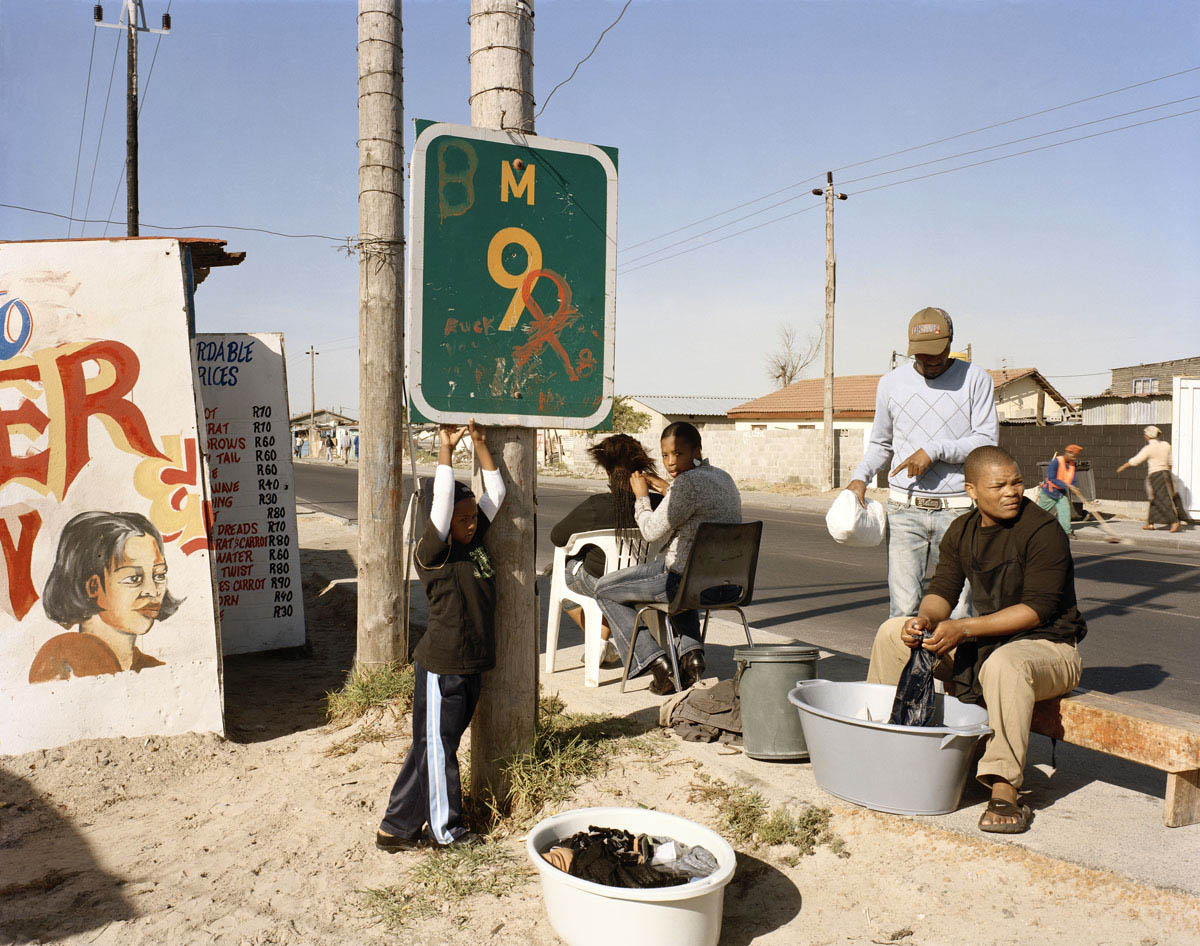
 

David Goldblatt (South African, 1930-2018) 'At Kewin Kwaneles Takwaito Barber, Landsdowne Road, Cape Town in the time of AIDS, 16 May 2007' 2007


David Goldblatt (South African, 1930-2018)
At Kewin Kwaneles Takwaito Barber, Landsdowne Road, Cape Town in the time of AIDS, 16 May 2007
2007
Pigmented inkjet print
The Art Institute of Chicago, promised gift of Cecily Cameron and Derek Schrier


David Goldblatt (South African, 1930-2018) 'The dethroning of Cecil John Rhodes, after the throwing of human feces on the statue and the agreement of the university to the demands of students for its removal, the University of Cape Town, 9 April 2015' [El derrocamiento de Cecil John Rhodes después de arrojar heces humanas contra la estatua y de que la universidad accediera a las demandas de los estudiantes para su retirada, Universidad de Ciudad del Cabo, 9 de abril de 2015] 2015


David Goldblatt (South African, 1930-2018)
The dethroning of Cecil John Rhodes, after the throwing of human feces on the statue and the agreement of the university to the demands of students for its removal, the University of Cape Town, 9 April 2015 [El derrocamiento de Cecil John Rhodes después de arrojar heces humanas contra la estatua y de que la universidad accediera a las demandas de los estudiantes para su retirada, Universidad de Ciudad del Cabo, 9 de abril de 2015]
2015
Carbon ink print
Yale University Art Gallery, New haven, Connecticut, purchased with a gift from Jane P. Watkins, M.P.H. 1979; with the Leonard C. Hanna, Jr., Class of 1913, Fund; and with support from the Reinecke Rare Book and Manuscript Library
© The David Goldblatt Legacy Trust


Here, Goldblatt joined a mass of onlookers recording the removal of the statue of 19th-century British mining magnate Cecil John Rhodes at the University of Cape Town (UCT). Rhodes vastly expanded European colonial rule on the African continent and exploited local labour to amass immense wealth. Disgusted by what they viewed as a symbol of white supremacy, student activists successfully campaigned to take down the statue honouring Rhodes.

UCT responded to this and related student protests by forming a committee to evaluate art on campus, intending to remove or hide problematic works from view. While Goldblatt had promised his archive to the university, he became concerned that this committee might censor art ad free speech. He ultimately withdrew his offer in 2017, bequeathing his archive to Yale University instead. In response to this decision, scholar Njabulo S. Ndebele has asked. “Was Goldblatt worried that the photographs would not survive the tests of freedom, even after they had survived those of oppression?”

Wall text from the exhibition


Fundación MAPFRE
Recoletos Exhibition Hall
Paseo Recoletos 23, 28004 Madrid

Opening hours:
Mondays (except holidays): 2pm – 8pm
Tuesday to Saturday: 11am – 8pm
Sunday and holidays: 11am – 7pm
Fundación MAPFRE website

LIKE ART BLART ON FACEBOOK

Back to top

Exhibition: ‘Pieter Hugo: Kin’ at Fondation Henri Cartier-Bresson, Paris

Exhibition dates: 14th January – 26th April, 2015

Curator: Pieter Hugo


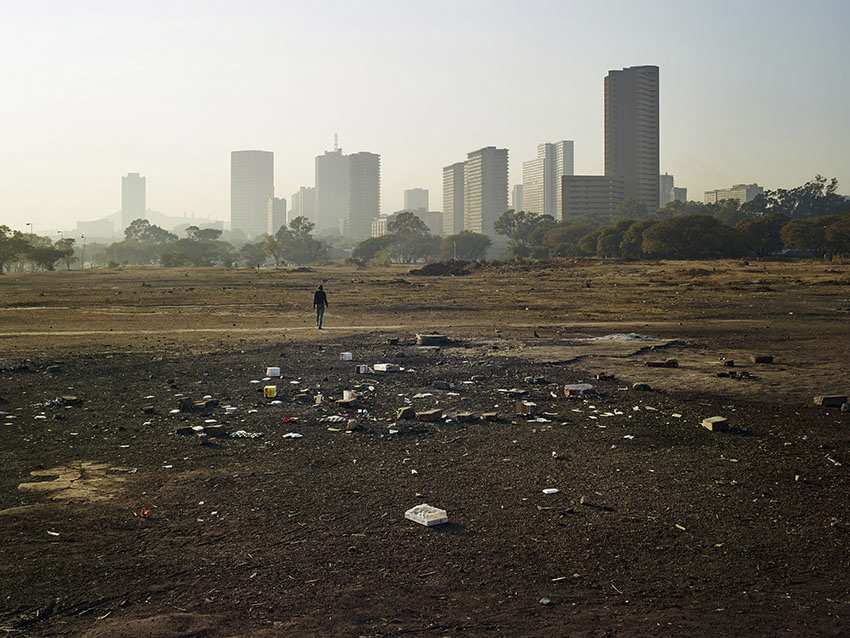
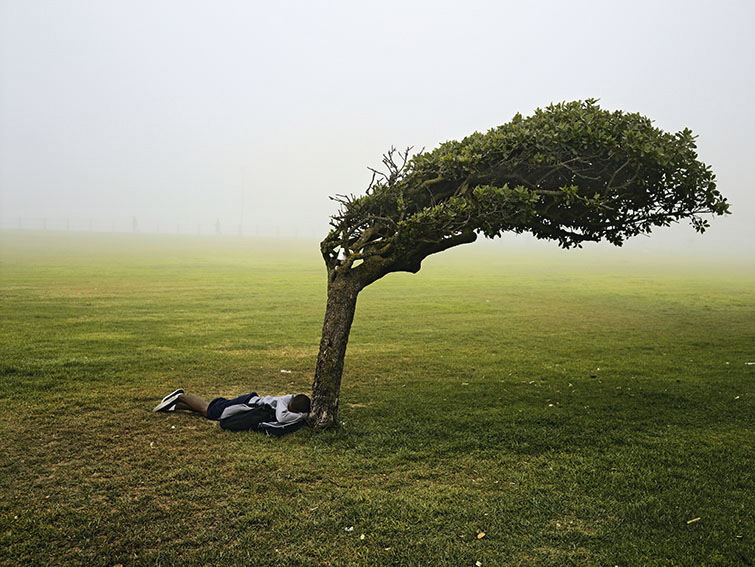
Pieter Hugo (South African, b. 1976) 'Green Point Common, Capetown' 2013 from the exhibition 'Pieter Hugo: Kin' at Fondation Henri Cartier-Bresson, Paris, January - April, 2015


Pieter Hugo (South African, b. 1976)
Green Point Common, Capetown
2013
© Pieter Hugo
Courtesy Stevenson Gallery, Capetown/Johannesburg and Yossi Milo, New York


At this moment in time, I believe that Pieter Hugo is one of the best photographers in the world.

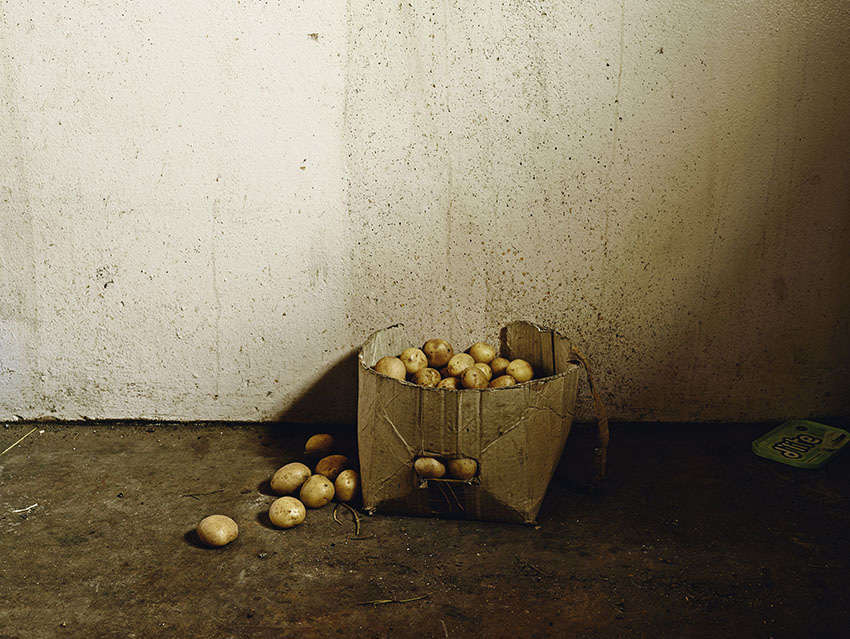
Approaching photography with a keen awareness of the problems inherent in pointing a camera at anything, Hugo’s latest series Kin is a tour de force where concept meets clarity of vision and purpose; where a deep suspicion of photography and what it can accurately portray is used in the most incisive way to interrogate identity formation and power structures, colonisation, racial diversity and economic disparity in Hugo’s homeland of South Africa. This is intelligent, beautiful, focused art.

While there is a deep suspicion about what photography can achieve, Hugo uses that suspicion… and balances it with sensitivity, respect and dignity towards subject. An enquiring mind coupled with a wonderful eye, fantastic camera position and understanding of his colour palette complete the picture. These are beautiful, classical and yes, iconic images. Not for Hugo the interchangeability of so much contemporary photobook photography, where one image, one artist, can be replaced by another with no discernible difference in feeling or form. Where single images, whole series of work even, mean very little. The re/place ability of so much post-photography.

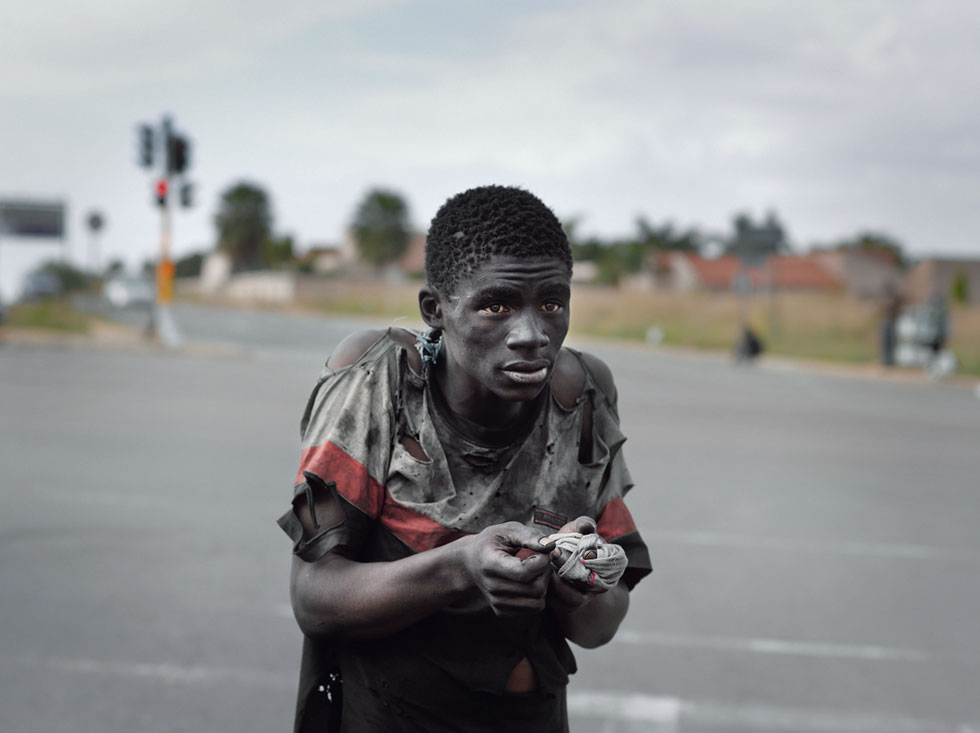
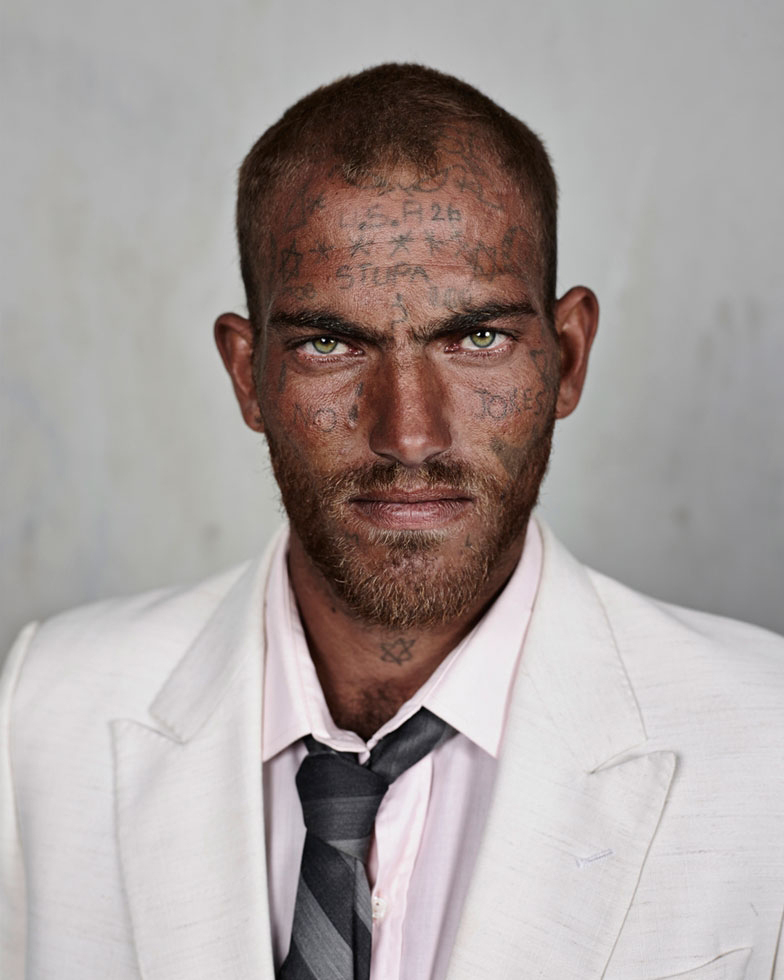
Just look at those eyes and face in Daniel Richards, Milnerton (2013, below), eyes that bore right through you; or the human being in At a Traffic Intersection, Johannesburg (2011, below) and tell me you’re not moved. Hugo is one of the brightest of stars in the photographic firmament.

Dr Marcus Bunyan


Many thankx to the Fondation Henri Cartier-Bresson for allowing me to publish the photographs in the posting. Please click on the photographs for a larger version of the image.


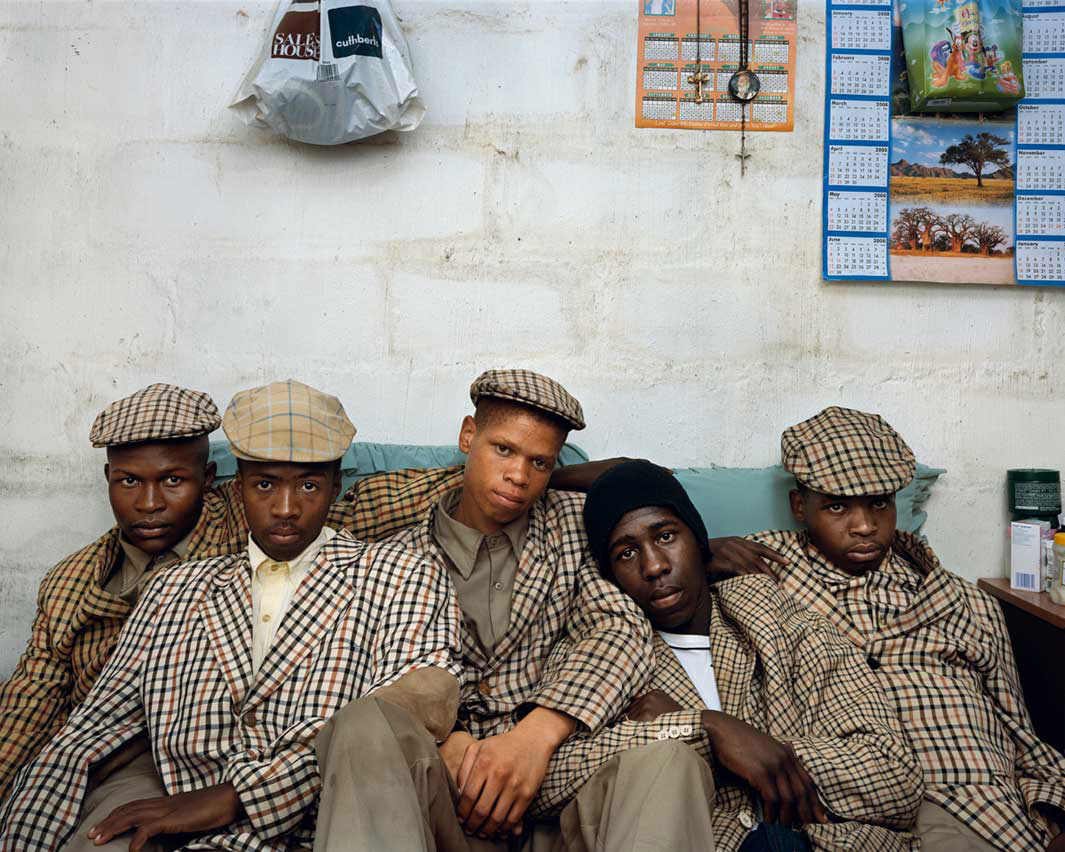
Pieter Hugo (South African, b. 1976) 'Loyiso Mayga, Wandise Ngcama, Lunga White, Luyanda Mzanti and Khungsile Mdolo after their initiation ceremony, Mthatha' 2008 from the exhibition 'Pieter Hugo: Kin' at Fondation Henri Cartier-Bresson, Paris, January - April, 2015


Pieter Hugo (South African, b. 1976)
Loyiso Mayga, Wandise Ngcama, Lunga White, Luyanda Mzanti and Khungsile Mdolo after their initiation ceremony, Mthatha
2008
© Pieter Hugo
Courtesy Stevenson Gallery, Capetown/Johannesburg and Yossi Milo, New York


Pieter Hugo (South African, b. 1976) 'Outside Pretoria' 2013


Pieter Hugo (South African, b. 1976)
Outside Pretoria
2013
© Pieter Hugo
Courtesy Stevenson Gallery, Capetown/Johannesburg and Yossi Milo, New York


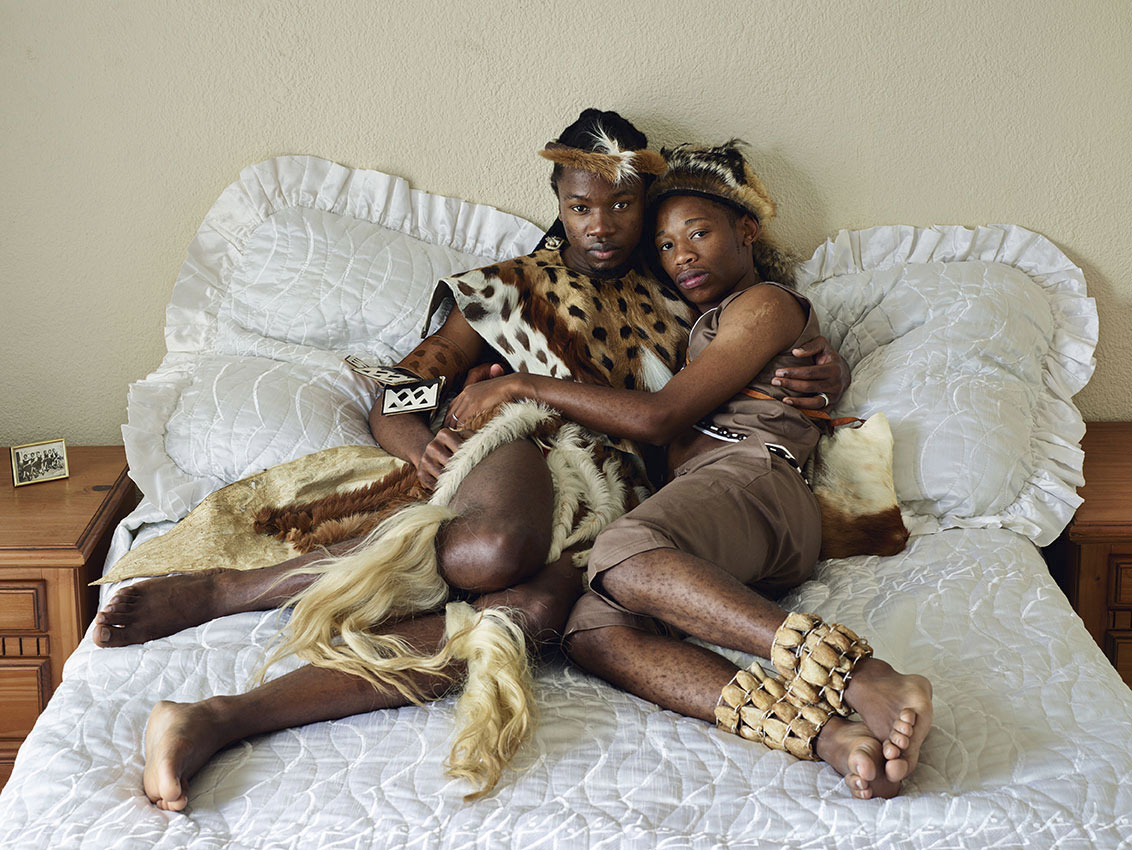
Pieter Hugo (South African, b. 1976) 'Thoba Calvin and Tshepo Cameron Sithole-Modisane, Pretoria' 2013


Pieter Hugo (South African, b. 1976)
Thoba Calvin and Tshepo Cameron Sithole-Modisane, Pretoria
2013
© Pieter Hugo
Courtesy Stevenson Gallery, Capetown/Johannesburg and Yossi Milo, New York


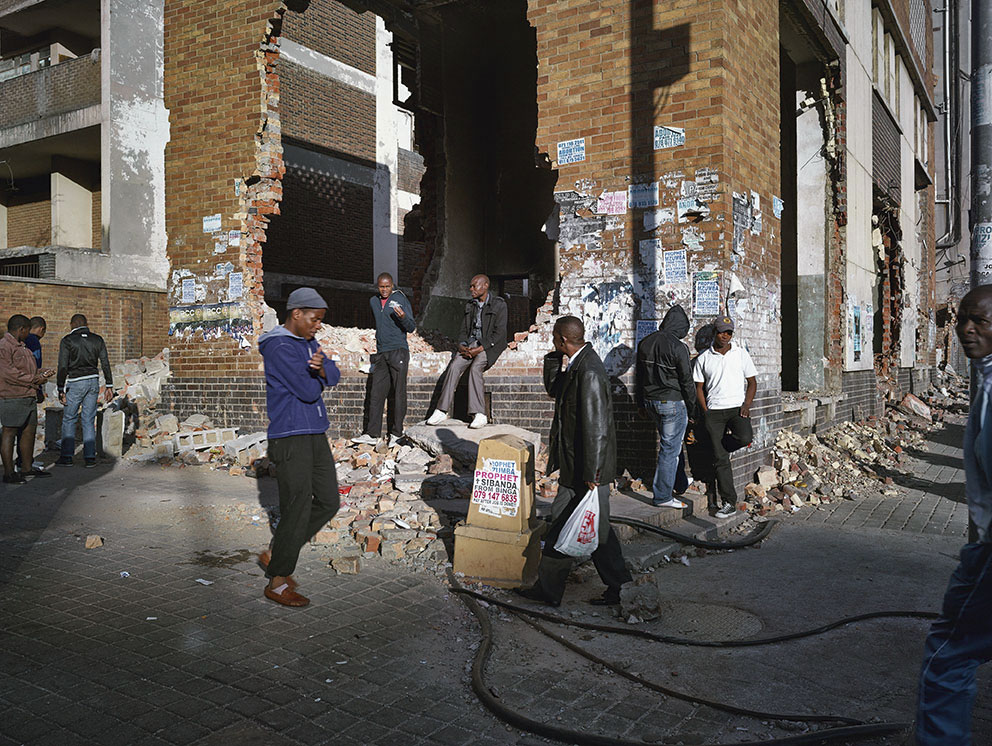
Pieter Hugo (South African, b. 1976) 'Hilbrow' 2013


Pieter Hugo (South African, b. 1976)
Hilbrow
2013
© Pieter Hugo
Courtesy Stevenson Gallery, Capetown/Johannesburg and Yossi Milo, New York


Created over the past eight years, Pieter Hugo’s series Kin confronts complex issues of colonisation, racial diversity and economic disparity in Hugo’s homeland of South Africa. These subjects are common to the artist’s past projects in Nigeria, Ghana, Liberia and Botswana; however, this time, Hugo’s attention is focused on his conflicted relationship with the people and environs closest to home. 
Hugo depicts locations and subjects of personal significance, such as cramped townships, contested farmlands, abandoned mining areas and sites of political influence, as well as psychologically charged still lives in people’s homes and portraits of drifters and the homeless. Hugo also presents intimate portraits of his pregnant wife, his daughter moments after her birth and the domestic servant who worked for three generations of Hugo’s family. Alternating between private and public spaces, with a particular emphasis on the growing disparity between rich and poor, Kin is the artist’s effort to locate himself and his young family in a country with a fraught history and an uncertain future.

Text from the Fondation Henri-Cartier Bresson website


“I have a deep suspicion of photography, to the point where I do sometimes think it cannot accurately portray anything, really. And, I particularly distrust portrait photography. I mean, do you honestly think a portrait can tell you anything about the subject? And, even if it did, would you trust what it had to say?… It sounds extreme, but for me to work at all as a photographer, I have to be conscious always of the problems inherent in what I do. I have to be conscious, if you like, of the impossibility of photography…

I matriculated at the end of apartheid and the photographs I grew up looking at were directly political in that they attempted to reveal, or change, what was happening. Back then, the lines were clear. You tried to tell the world what was going on with your photographs. It’s much more complex now. I am of a generation that approaches photography with a keen awareness of the problems inherent in pointing a camera at anything.

My homeland is Africa, but I’m white. I feel African, whatever that means, but if you ask anyone in South Africa if I’m African, they will almost certainly say no. I don’t fit into the social topography of my country and that certainly fuelled why I became a photographer.”


Pieter Hugo quoted in Sean O’Hagan. “Africa as you’ve never seen it,” on the Guardian website 20th July 2008 [Online] Cited 24/02/2015


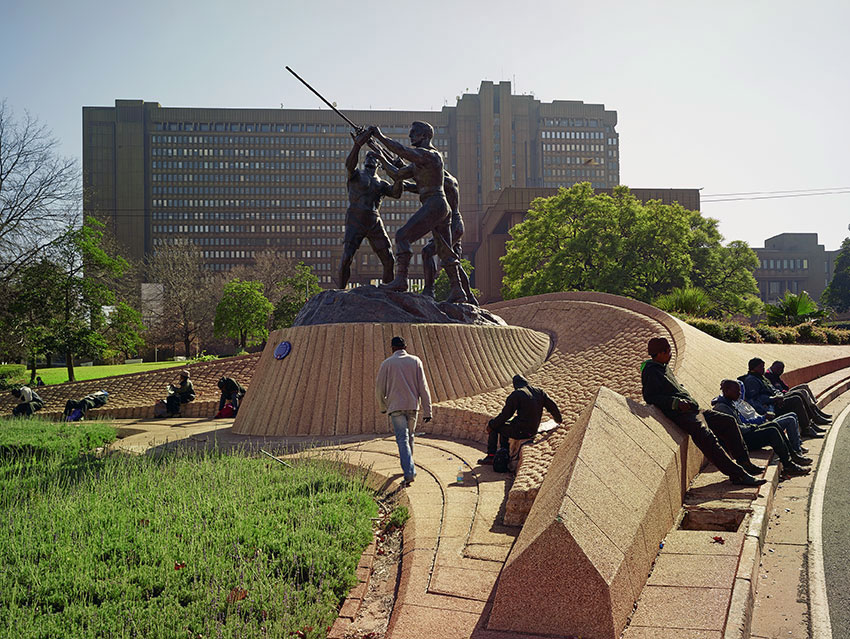
Pieter Hugo (South African, b. 1976) 'The Miners’ Monument, Braamfontein' 2013


Pieter Hugo (South African, b. 1976)
The Miners’ Monument, Braamfontein
2013
© Pieter Hugo
Courtesy Stevenson Gallery, Capetown/Johannesburg and Yossi Milo, New York


From January 14th to April 26th, Fondation HCB is showing Kin, the last project of the south-african photographer Pieter Hugo. Through landscapes, portraits and still life photography exhibited for the first time in France, the photographer offers a personal exploration of South Africa. The exhibit, accompanied by a book published by Aperture is coproduced with Foto Colectania Foundation, Barcelone and Stevenson Gallery, Cape Town/Johannesburg.

Created over the past eight years, Pieter Hugo’s series Kin confronts complex issues of colonisation, racial diversity and economic disparity in Hugo’s homeland of South Africa. These subjects are common to the artist’s past projects in Nigeria, Ghana, Liberia and Botswana; however, this time, Hugo’s attention is focused on his conflicted relationship with the people and environs closest to home.

Hugo depicts locations and subjects of personal significance, such as cramped townships, contested farmlands, abandoned mining areas and sites of political influence, as well as psychologically charged still lives in people’s homes and portraits of drifters and the homeless. Hugo also presents intimate portraits of his pregnant wife, his daughter moments after her birth and the domestic servant who worked for three generations of Hugo’s family. Alternating between private and public spaces, with a particular emphasis on the growing disparity between rich and poor, Kin is the artist’s effort to locate himself and his young family in a country with a fraught history and an uncertain future.

“South Africa is such a fractured, schizophrenic, wounded and problematic place. It is a very violent society and the scars of colonialism and Apartheid run deep. Issues of race and cultural custodianship permeate every aspect of society here and the legacy of Apartheid casts a long shadow … How does one live in this society? How does one take responsibility for history, and to what extent does one have to? How do you raise a family in such a conflicted society? Before getting married and having children, these questions did not trouble me; now, they are more confusing. This work attempts to address these questions and to reflect on the nature of conflicting personal and collective narratives. I have deeply mixed feelings about being here. I am interested in the places where these narratives collide. ‘Kin’ is an attempt at evaluating the gap between society’s ideals and its realities.”

Biography

Born in Johannesburg in 1976, Pieter Hugo grew up in Cape Town where he currently lives. His work is held in the permanent collections of The Metropolitan Museum of Art, New York; Museum of Modern Art, New York; J. Paul Getty Museum, Los Angeles; San Francisco Museum of Modern Art; Musée de l’Elysée, Lausanne; Huis Marseille, Amsterdam; and the Victoria and Albert Museum, London, among others. He is the winner of numerous awards, including in 2008 the KLM Paul Huf Award and the Discovery Award at Rencontres d’Arles. He won the Seydou Keita Award at the ninth Rencontres de Bamako African Photography Biennial, Mali, in 2011, and was short-listed for the 2012 Deutsche Börse Photography Prize.

Press release from the Fondation Henri Cartier-Bresson


Pieter Hugo (South African, b. 1976) 'Inside the Bester’s home, Vermaaklikheid' 2013


Pieter Hugo (South African, b. 1976)
Inside the Bester’s home, Vermaaklikheid
2013
© Pieter Hugo
Courtesy Stevenson Gallery, Capetown/Johannesburg and Yossi Milo, New York


Pieter Hugo (South African, b. 1976) 'At a Traffic Intersection, Johannesburg' 2011


Pieter Hugo (South African, b. 1976)
At a Traffic Intersection, Johannesburg
2011
© Pieter Hugo
Courtesy Stevenson Gallery, Capetown/Johannesburg and Yossi Milo, New York

Used under fair use conditions for the purposes of academic comment and criticism


Pieter Hugo (South African, b. 1976) 'Daniel Richards, Milnerton' 2013


Pieter Hugo (South African, b. 1976)
Daniel Richards, Milnerton
2013
© Pieter Hugo
Courtesy Stevenson Gallery, Capetown/Johannesburg and Yossi Milo, New York


Pieter Hugo (South African, b. 1976) 'Daniela Beukman, Milnerton' 2013


Pieter Hugo (South African, b. 1976)
Daniela Beukman, Milnerton
2013
© Pieter Hugo
Courtesy Stevenson Gallery, Capetown/Johannesburg and Yossi Milo, New York


Pieter Hugo (South African, b. 1976) 'Ann Sallies, who worked for my parents and helped raise their children, Douglas' 2013


Pieter Hugo (South African, b. 1976)
Ann Sallies, who worked for my parents and helped raise their children, Douglas
2013
© Pieter Hugo
Courtesy Stevenson Gallery, Capetown/Johannesburg and Yossi Milo, New York


Fondation Henri Cartier-Bresson
79 rue des Archives
75003 Paris

Opening hours:
Tuesday – Sunday
11am – 7pm
Closed on Mondays

Fondation Henri Cartier-Bresson website

LIKE ART BLART ON FACEBOOK

Back to top

Exhibition: ‘Public Intimacy: Art and Other Ordinary Acts in South Africa’ at the Yerba Buena Center for the Arts, San Francisco

Exhibition dates: 21st February – 29th June 2014

Exhibition artists

Public Intimacy presents

~ Photography by Ian Berry, Ernest Cole, David Goldblatt, Terry Kurgan, Sabelo Mlangeni, Santu Mofokeng, Billy Monk, Zanele Muholi, Lindeka Qampi, Jo Ractliffe, and Mikhael Subotzky and Patrick Waterhouse
~ Video works by William Kentridge, Donna Kukama, Anthea Moys, and Berni Searle
~ Painting and sculpture by Nicholas Hlobo and Penny Siopis
~ Puppetry by Handspring Puppet Company
~ Publications, prints, graphic works, and public interventions by Chimurenga, ijusi (Garth Walker), Anton Kannemeyer, and Cameron Platter
~ Performances by Athi-Patra Ruga, Kemang Wa Lehulere, and Sello Pesa and Vaughn Sadie with Ntsoana Contemporary Dance Theatre


Santu Mofokeng (South Africa, 1956-2020) 'Opening Song, Hand Clapping and Bells' 1986


Santu Mofokeng (South Africa, 1956-2020)
Opening Song, Hand Clapping and Bells
1986
From the series Train Church
Pigment print
9 13/16 x 13 3/4 in. (25 x 35cm)
© Santu Mofokeng


Continuing my fascination with South African art and photography, here is another exhilarating collection of work from an exhibition jointly arranged between SFMOMA and the Yerba Buena Center for the Arts, San Francisco. This art has so much joy, life, movement and “colour”. I particularly like The Future White Women of Azania series by Athi-Patra Ruga, who presented his work at the 55th Venice Biennale in the African pavilion. Thank god not another rehashed colonial image, even though he is working with the tropes of myth and the history of Africa as a contemporary response to the post-apartheid era.

Dr Marcus Bunyan


Many thankx to SFMOMA and Yerba Buena Center for the Arts for allowing me to publish the installation photographs in the posting. Most of the other photographs were gathered from the internet. Please click on the photographs for a larger version of the image.


“Disrupting expected images of South Africa, the 25 contemporary artists and collectives featured in Public Intimacy eloquently explore the poetics and politics of the everyday. This collaboration with Yerba Buena Center for the Arts presents pictures from SFMOMA’s collection of South African photography alongside works in a broad range of media, including video, painting, sculpture, performance, and publications – most made in the last five years, and many on view for the first time on the West Coast. Coinciding with the 20th anniversary of democracy in South Africa, Public Intimacy reveals the nuances of human interaction in a country still undergoing significant change, vividly showing public life there in a more complex light.”

Text from the SFMOMA website


Santu Mofokeng (South Africa, 1956-2020) 'Leading in Song, Johannesburg – Soweto Line' 1986


Santu Mofokeng (South Africa, 1956-2020)
Leading in Song, Johannesburg – Soweto Line
1986
From the series Train Church
Pigment print
9 13/16 x 13 3/4 in. (25 x 35cm)
© Santu Mofokeng


Santu Mofokeng (South Africa, 1956-2020) 'Hands in Worship, Johannesburg – Soweto Line' 1986


Santu Mofokeng (South Africa, 1956-2020)
Hands in Worship, Johannesburg – Soweto Line
1986
From the series Train Church
Pigment print
9 13/16 x 13 3/4 in. (25 x 35cm)
© Santu Mofokeng


These images, by the South African photographer Santu Mofokeng, ostensibly depict scenes of segregated transport during apartheid. Yet in their composition they evoke something more: the rhythms and textures of everyday life. Taken from within and among a crowd of commuters, the pictures seem to sway with the velocity of the train carriage. Shards of light blur the edges of figures, interplaying with shifting shadows as passengers move in unison. Titled “Train Church,” Mofokeng’s series was made during a few weeks in 1986, and in South Africa it became veritably synonymous with his name. Mofokeng, who died in January, at the age of sixty-three, was a photographer whose body of work – both images and text – waded through themes of history and land, memory and spirituality, and helped shape the course of South African photography.

Oluremi C. Onabanjo. “How Santu Mofokeng Shaped South African Photography,” on The New Yorker website February 24, 2020 [Online] Cited 10/04/2021.


Santu Mofokeng (South Africa, 1956-2020) 'Supplication, Johannesburg – Soweto Line' 1986


Santu Mofokeng (South Africa, 1956-2020)
Supplication, Johannesburg – Soweto Line
1986
From the series Train Church
Pigment print
9 13/16 x 13 3/4 in. (25 x 35cm)
© Santu Mofokeng


Ian Berry (British, b. 1934) 'Guests at a 'moffie'drag party' Cape Town, South Africa, 1960


Ian Berry (British, b. 1934)
Guests at a ‘moffie’drag party
Cape Town, South Africa, 1960
Silver gelatin photograph


Ian Berry was born in Lancashire, England. He made his reputation in South Africa, where he worked for the Daily Mail and later for Drum magazine. He was the only photographer to document the massacre at Sharpeville in 1960, and his photographs were used in the trial to prove the victims’ innocence.

He moved to South Africa in 1952, where he soon taught himself photography. He worked under the tutelage of Roger Madden, a South African photographer who had been an assistant to Ansel Adams. After some time as an amateur photographer, Berry began photographing communities and weddings. During this period he met Jürgen Schadeberg, also a European immigrant and photographer. Schadeberg was offered a position with the new African Sunday newspaper eGoli but declined, suggesting Berry apply for the position instead. After working there only 10 months, the newspaper closed, and Berry began working for the Benoni City Times, but he soon became more interested in freelance work.

Berry returned to Great Britain and traveled for some time but returned to South Africa in the early 1960s and worked for the Daily Mail. Later Tom Hopkinson, previously editor of the British Picture Post, hired Berry to work for Drum magazine. He was in Sharpeville on 21 March 1960, when a peaceful protest turned violent, leading to the deaths of 69 people and the wounding of 178 others by police. There were no other photographs documenting the events, and Berry’s were entered into evidence in the court proceedings proving that the victims had done nothing wrong. Berry was invited by Henri Cartier-Bresson to join Magnum Photos in 1962 when he was based in Paris; five years later he became a full member. In 1964 he moved to London and began working for Observer Magazine. He has since traveled the globe, documenting social and political strife in China, Republic of Congo, Czechoslovakia, Ethiopia, Israel, Ireland, Vietnam, and the former Soviet Union. He has contributed to publications including Esquire, Fortune, Geo, Life, National Geographic, Paris-Match, and Stern.

Text from the Wikipedia website


Billy Monk (South African, 1937-1982) 'The Catacombs, 30 September 1967' 1967, printed 2011


Billy Monk (South African, 1937-1982)
The Catacombs, 30 September 1967
1967, printed 2011
Gelatin silver print
10 1/16 x 14 15/16 in. (25.56 x 37.94 cm)
Collection SFMOMA, Accessions Committee Fund purchase
© Estate of Billy Monk


Billy Monk (South African, 1937-1982) 'The Catacombs, 5 February 1968' 1968, printed 2011


Billy Monk (South African, 1937-1982)
The Catacombs, 5 February 1968
1968, printed 2011
Gelatin silver print
11 x 16 in. (27.94 x 40.64cm)
Courtesy of Stevenson, Cape Town and Johannesburg
© Estate of Billy Monk


William John Monk (died 31 July 1982) was a South African, known for his photographs of a Cape Town nightclub between 1967 and 1969, during apartheid. In 2012 a posthumous book was published, Billy Monk: Nightclub Photographs. …

When Monk’s work as a bouncer did not work out he took up photography. Still working in The Catacombs, he began to make his living taking pictures of the diverse clientele in a seedy bar. He used a Pentax camera, with a 35 mm focal-length lens, a small flash and Ilford FP4 film. Monk stopped taking pictures in 1969. His photographs show a variety of the underbelly of Cape Town life at the time – ranging from old men with young wives and gay couples, to midgets and mixed race relationships, he shows a side of life under apartheid that is rarely seen elsewhere.

Discovery of his work

Monk’s work was discovered in 1979 by Jac de Villiers, when he moved into Monk’s old studio. Not only were they already well constructed by the photographer, they were also impeccably annotated with dates and names, which made curation a simple and enjoyable process. The first exhibition of Monk’s work took place at the Market Gallery in Johannesburg in 1982 – and although Monk could not attend the event it was subject to much critical acclaim.

Apartheid

Monk was working during apartheid in South Africa – a time when the colour of your skin was indicative of where you could live, work, who you could marry, and where you could drink. The underground lifestyle of The Catacombs allowed for dissent. Monk chose to take pictures originally as a way of making money, by selling them to his clients.

His photographs reveal a variety of clientele. Some are sloppy, some are neat and put together. Many of the women are heavily made up with short dresses, and almost all the photographs are highly sexually charged. The photographs reveal much of what was not allowed under apartheid rule – specifically a variety of same sex and mixed race couples.

Text from the Wikipedia website


Zanele Muholi (South Africa, b. 1972) 'Nomonde Mbusi, Berea, Johannesburg' 2007


Zanele Muholi (South Africa, b. 1972)
Nomonde Mbusi, Berea, Johannesburg
2007
From the Faces and Phases series
Gelatin silver print
23 13/16 in. x 34 1/16 in. (60.5 cm x 86.5cm)
Courtesy of the artist and Stevenson, Cape Town and Johannesburg
© Zanele Muholi


Zanele Muholi, born 1972

Muholi’s work addresses the reality of what it is to be LGBT (lesbian, gay, bisexual, transgender) in South Africa. She identifies herself as a visual activist, dealing with issues of violation, violence and prejudice that she and her community face, despite South Africa’s progressive constitution.

In Faces and Phases, she sets out to give visibility to black lesbians and to celebrate the distinctiveness of individuals through the traditional genre of portraiture. The portraits are taken outdoors with a hand-held camera to retain spontaneity and often shown in a grid to highlight difference and diversity. In the series Beulahs, she shows young gay men, wearing Zulu beads and other accessories usually worn by women, who invert normative gender codes in both costume and pose. At the same time her photographs evoke tourist postcards and recycled stereotypes of Africans and recall traditional anthropological and ethnographic iconography.

Faces and Phases, is a group of black and white portraits that I have been working on from 2006 until now – it has become a lifetime project. The project is about me, the community that I’m part of. I was born in the township: I grew up in that space. Most of us grew up in a household where heterosexuality was the norm. When you grow up, you think that the only thing that you have to become as a maturing girl or woman is to be with a man; you have to have children, and also you need to have lobola or “bride price” paid for you. For young men, the expectation for them is to be with women and have wives and procreate: that’s the kind of space which most of us come from. We are seen as something else by society – we are seen as deviants. We’re not going to be here forever, and I wanted to make sure that we leave a history that is tangible to people who come after us.”

Zanele Muholi, interviewed by Tamar Garb, South Africa, 2010.
Text from the V&A website


David Goldblatt (South Africa, 1930-2018) 'Woman smoking, Fordsburg, Johannesburg' 1975


David Goldblatt (South Africa, 1930-2018)
Woman smoking, Fordsburg, Johannesburg
1975
Pigment inkjet print
23 5/8 in. x 29 1/2 in. (60 cm x 75cm)
Collection SFMOMA, Accessions Committee Fund purchase
© David Goldblatt


David Goldblatt HonFRPS (29 November 1930 – 25 June 2018) was a South African photographer noted for his portrayal of South Africa during the period of apartheid. After apartheid had ended he concentrated more on the country’s landscapes. What differentiates Goldblatt’s body of work from those of other anti-apartheid artists is that he photographed issues that went beyond the violent events of apartheid and reflected the conditions that led up to them. His forms of protest have a subtlety that traditional documentary photographs may lack: “[M]y dispassion was an attitude in which I tried to avoid easy judgments. … This resulted in a photography that appeared to be disengaged and apolitical, but which was in fact the opposite.”


Jointly organised by the San Francisco Museum of Modern Art (SFMOMA) and Yerba Buena Center for the Arts (YBCA), Public Intimacy: Art and Other Ordinary Acts in South Africa brings together 25 artists and collectives who disrupt expected images of a country known through its apartheid history. The exhibition features an arc of artists who look to the intimate encounters of daily life to express the poetics and politics of the “ordinary act,” with work primarily from the last five years as well as photographic works that figure as historical precedents. On view at YBCA February 21 through June 29, 2014, Public Intimacy presents more than 200 works in a wide range of mediums, many of them making U.S. or West Coast debuts.

The exhibition joins SFMOMA’s important and growing collection of South African photography with YBCA’s multidisciplinary purview and continued exploration of the Global South. Significant documentary photography is paired with new photographs and work in other mediums, including video, painting, sculpture, performance, and publications, to reveal the multifaceted nuances of everyday life in a country still undergoing significant change. Coinciding with the 20th anniversary of democracy in South Africa, Public Intimacy looks at the way artists imagine present and future possibilities in South Africa. A new orientation emerges through close-up views of street interactions, portraiture, fashion and costume, unfamiliar public actions, and human imprints on the landscape.

The exhibition’s three curators – Betti-Sue Hertz, director of visual arts at YBCA; Frank Smigiel, associate curator of public programs at SFMOMA; and Dominic Willsdon, Leanne and George Roberts Curator of Education and Public Programs at SFMOMA – developed the show after visits to South Africa, where they met with artists, curators, and critics. The exhibition – and a companion publication to be published in fall 2014 – grew out of this research.

“Although South Africa’s political history remains vital to these artists and is important for understanding their work, Public Intimacy offers a more subtle view of the country through personal moments,” said Hertz. “It goes against expectations in order to reveal the smaller gestures and illuminate how social context has affected artists and how they work.”

“The familiar image of contemporary South Africa as a place of turmoil is, of course, not the whole story,” added Willsdon. “The art in this exhibition restages how those violent incidents fit in the broader realm of human interactions – a way of showing public life there in a more complex light.”

“Another central aspect of the exhibition is live performance,” said Smigiel. “Three major live works will unfold both in and outside the gallery context, offering a way to situate and reframe San Francisco through the lens of what artists are producing in South Africa.”

Public Intimacy is part of SFMOMA’s collaborative museum exhibitions and extensive off-site programming taking place while its building is temporarily closed for expansion construction through early 2016. As neighbours across Third Street in San Francisco, YBCA and SFMOMA have partnered in the past on various performance and exhibition projects, but Public Intimacy represents the deepest collaboration of shared interests to date between the two institutions. It also brings together SFMOMA’s approach to curating live art and YBCA’s multidisciplinary interest in exhibitions, social practice, and performances.

Exhibition highlights

While the exhibition explores new approaches to daily life in post-apartheid South Africa, it also makes visible the continued commitment of artists to activism and contemporary politics. Beginning with photographs from the late 1950s and after, the exhibition includes vital moments in the country’s documentary photography – from Ian Berry’s inside look at an underground drag ball to Billy Monk’s raucous nightclub photos – each capturing a moment of celebration within different social strata of South African society. Ernest Cole’s photographs of miners’ hostels and bars and Santu Mofokeng’s stirring photographs of mobile churches on commuter trains reveal everyday moments both tender and harsh.

David Goldblatt’s photographs depict the human landscape in apartheid and after, providing the genesis of the idea of “public intimacy.” Over decades of photographs in urban, suburban, and rural locations, Goldblatt has chronicled the changing nature of interpersonal engagement in South Africa. At the same time, they provide a historical backdrop and visual precedent for other artists in the exhibition, including Zanele Muholi and Sabelo Mlangeni.

Muholi has won several awards for her powerful photographic portraits as well as her activism on behalf of black lesbians in South Africa. Although best known for her photographs – in particular her Faces and Phases series – Muholi continuously experiments with an expanded practice including documentary film, beadwork, text, and her social-action organisation Inkanyiso, which gives visibility to conditions facing lesbians of colour in her country. “Sexual politics has been looked at less than racial politics in South Africa, but in many ways, the two have always been intertwined,” said Willsdon.

Mikhael Subotzky and Patrick Waterhouse bring another perspective to the upheavals of life in the city of Johannesburg with works from their Ponte City (2008-10) series, comprised of photographs, video, and a publication offering various views of this centrally located and iconic 54-story building. The works illustrate the struggles facing many native and immigrant South Africans in the years following the dissolution of apartheid, including stalled economic growth and social opportunities.

In contrast to the daily realities pictured in photographic works in the exhibition, Athi-Patra Ruga’s ongoing performance series The Future White Women of Azania (2010-present) features fantastical characters – usually played by the artist – whose upper bodies sprout colourful balloons while their lower bodies pose or process in stockings and high heels. Ruga’s Azania is a changing utopia, and Smigiel notes the shift: “The balloons are filled with liquid, and as the figure moves through the streets, they start popping, so the character dissolves and reveals a performer, and the liquid spills out and into a rather sloppy line drawing.” A new iteration of the series, The Elder of Azania, will premiere in the YBCA Forum during the exhibition’s opening weekend.

Chimurenga, an editorial collective working at the intersection of pan-African culture, art, and politics produces publications, events, and installations. Founded in 2002 by Ntone Edjabe, the collective has created the Chimurenga Library, an online archiving project that profiles independent pan-African paper periodicals from around the world. Expanding upon this concept, their presence in Public Intimacy will have two elements: a text and media resource space in YBCA’s galleries and an intervention at the San Francisco Public Library main branch that will explore the history of pan-African culture in the Bay Area, scheduled to open in late May.

Providing one of the most personally vulnerable moments in the exhibition, Penny Siopis’s series of 90 small paintings on enamel, Shame (2002), provokes a visceral reaction. With red paint reminiscent of blood and bruises, Siopis mixes colour and text in an attempt to convey emotion rather than narrative. While she is interested in the guilt and embarrassment most frequently associated with shame, she also looks at the possibility for empathy that emerges from traumatic experiences.

In all of these works, explains Hertz, “We are looking at how art and activism align, but we’re also interested in how politics is embedded in less obviously political practices, such as Sabelo Mlangeni’s photographs of mining workers’ hostels, Penny Siopis’s powerful painting series about human vulnerability, or Nicholas Hlobo’s large-scale, organically shaped sculptures made primarily of rubber.

Text from the SFMOMA website


Installation view of the exhibition 'Public Intimacy: Art and Other Ordinary Acts in South Africa' at the Yerba Buena Center for the Arts, San Francisco

Installation view of the exhibition 'Public Intimacy: Art and Other Ordinary Acts in South Africa' at the Yerba Buena Center for the Arts, San Francisco

Installation view of the exhibition 'Public Intimacy: Art and Other Ordinary Acts in South Africa' at the Yerba Buena Center for the Arts, San Francisco

Installation view of the exhibition 'Public Intimacy: Art and Other Ordinary Acts in South Africa' at the Yerba Buena Center for the Arts, San Francisco

Installation view of the exhibition 'Public Intimacy: Art and Other Ordinary Acts in South Africa' at the Yerba Buena Center for the Arts, San Francisco

Installation view of the exhibition 'Public Intimacy: Art and Other Ordinary Acts in South Africa' at the Yerba Buena Center for the Arts, San Francisco


Installation views of the exhibition Public Intimacy: Art and Other Ordinary Acts in South Africa at the Yerba Buena Center for the Arts, San Francisco with, in the last photo, Nicholas Hlobo, Umphanda ongazaliyo (installation view), 2008; rubber, ribbon, zips, steel, wood, plaster; ICA Boston; © Nicholas Hlobo; photo: John Kennar.


Sabelo Mlangeni (South Africa, b. 1980) 'Couple Bheki and Sipho' 2009


Sabelo Mlangeni (South Africa, b. 1980)
Couple Bheki and Sipho
2009
From the series Country Girls
Gelatin silver print
40 x 30cm
Courtesy the artist and Stevenson, Cape Town and Johannesburg
© Sabelo Mlangeni


Figures & Fictions: Sabelo Mlangeni from Victoria and Albert Museum on Vimeo.


Anton Kannemeyer (South Africa, b. 1967) 'D is for dancing ministers' 2006


Anton Kannemeyer (South Africa, b. 1967)
D is for dancing ministers
2006
From the series Alphabet of Democracy
Lithograph on Chine Collé
22 1/16 x 24 in. (56 x 61cm)
Courtesy the artist and Stevenson, Cape Town and Johannesburg
© Anton Kannemeyer


Anton Kannemeyer (born 1967) is a South African comics artist, who sometimes goes by the pseudonym Joe Dog.

Anton Kannemeyer was born in Cape Town. He studied graphic design and illustration at the University of Stellenbosch, and did a Master of Arts degree in illustration after graduating. Together with Conrad Botes, he co-founded the magazine Bitterkomix in 1992 and has become revered for its subversive stance and dark humour. He has been criticised for making use of “offensive, racist imagery”. Kannemeyer himself said that he gets “lots of hate mail from white Afrikaners”.

His works challenge the rigid image of Afrikaners promoted under Apartheid, and depict Afrikaners having nasty sex and mangling their Afrikaans. “X is for Xenophobia”, part of his “Alphabet of Democracy”, depicts Ernesto Nhamwavane, a Mozambican immigrant who was burnt alive in Johannesburg in 2008. Some of Kannemeyer’s works deal with the issues of race relations and colonialism, by appropriating the style of Hergé’s comics, namely from Tintin in the Congo. In “Pappa in Afrika”, Tintin becomes a white African, depicted either as a white liberal or as a racist white imperialist in Africa. In this stereotyped satire, the whites are superior, literate and civilised, and the blacks are savage and dumb. In “Peekaboo”, a large acrylic work, the white African is jumping up in alarm as a black man figure pokes his head out of the jungle shouting an innocuous ‘peekaboo!’ A cartoon called “The Liberals” has been interpreted as an attack on white fear, bigotry and political correctness: a group of anonymous black people (who look like golliwogs) are about to rape a white lady, who calls her attackers “historically disadvantaged men”.

Text from the Wikipedia website


Terry Kurgan (South Africa, b. 1958) 'Hotel Yeoville' 2012


Terry Kurgan (South Africa, b. 1958)
Hotel Yeoville
2012
Digital print on bamboo hahnemulle paper
Courtesy the artist
© Terry Kurgan


Penny Siopis (South Africa, b. 1953) 'Untitled' from the series 'Shame' 2002


Penny Siopis (South Africa, b. 1953)
Untitled from the series Shame
2002
Paint on enamel
© Penny Siopis


Siopis established herself as one of the most talented and challenging artists in South Africa and beyond, by working across painting, installation and film, bringing together diverse references and materials in ways that disturb disciplinary boundaries and binaries.

Concepts of time run through all her work often manifesting in the actual physical changes of her materials; in her early cake paintings oil paint is made to be unnaturally affected by gravity, age and decay; in her films using archival footage time is marked as much by the effects of age on the celluloid as by the historical period caught in the sweep of the camera; in her accumulations of found objects in her installations, ideas of the heirloom come to the fore with her ongoing conceptual work Will (1997- ) – in which she bequeaths objects to beneficiaries – being the ultimate time piece only becoming complete on her death; her glue and ink paintings index flux as they record the material transformation that happens when viscous glue matter reacts with pigment, gravity, the artist’s bodily gestures, and the drying effects of the air.

Siopis sees her art practice as ‘open form’, operating as an intimate model in which the physical changes of her materials can be extrapolated into a larger ethics of personal and political transformation. According to Achille Mbembe this quality marks her interest in process as a perpetual state of becoming and entails “the crafting of an unstable relation between form and formlessness, in the understanding that the process of becoming proceeds in ways that are almost always unpredictable and at times accidental.”

Shame paintings

Siopis began the Shame paintings in 2002 and they became a key feature of her exhibition Three Essays on Shame (2005), an intervention in the museum of Sigmund Freud, once his house, in London. It was part of a project that marked the centenary of Freud’s groundbreaking publication Three Essays on the Theory of Sexuality. Responding to Freud, Siopis’ installation consisted of three parts located in Freud’s study (with the famous couch), dining room and bedroom and titled Voice, Gesture and Memory. The small paintings shown in a grid in this room were presented as a frieze in the Memory section of the original exhibition. The artist invokes this exhibition here through the arrangement of some of the objects from the installation on a table reminiscent of that in Freud’s dining room, where she had placed Baubo, one of Freud’s objects from his collection of antiquities. Baubo is a small terracotta figurine who gestures to her genitalia in a provocative way, an act some have interpreted as a show of shame that speaks of both vulnerability and empowerment.

In the installation Siopis also evoked a complex dialogue between Freud’s ideas and her personal experiences by inserting references (voice recordings and objects) to the traumatic proceedings of the South African Truth and Reconciliation Commission and colonial and apartheid history. Once again she was interested in binding the traces of human vulnerability and the dramatic effects of sweeping historical narratives.

In this body of work Siopis manipulates thick and gooey lacquer gel paint, used in home-craft to create stained glass and coloured mirror effects on surfaces. For her it is a physical process that moulds anxiety into form. It translates the result of childhood trauma that we know as shame onto a painted surface. Through the reflective qualities of the medium Siopis blends the bodily sensation with the experience of being looked at, both of which define shame. The use of language in the form of ready-made rubber stamped clichés that clash with the raw power of this familiar emotion further underscores the ‘unspeakable’ character of the experience.

Text from the Wikipedia website


Athi-Patra Ruga (South Africa, b. 1984) 'The Future White Women of Azania' 2012


Athi-Patra Ruga (South Africa, b. 1984)
The Future White Women of Azania
2012
Performed as part of Performa Obscura in collaboration with Mikhael Subotzky
Commissioned for the exhibition Making Way, Grahamstown, South Africa
Photo: Ruth Simbao, courtesy Athi-Patra Ruga and WHATIFTHEWORLD/GALLERY


Athi-Patra Ruga (South Africa, b. 1984) 'The Future White Women of Azania' 2012


Athi-Patra Ruga (South Africa, b. 1984)
The Future White Women of Azania
2012
Performed as part of Performa Obscura in collaboration with Mikhael Subotzky
Commissioned for the exhibition Making Way, Grahamstown, South Africa
Photo: Ruth Simbao, courtesy Athi-Patra Ruga and WHATIFTHEWORLD/GALLERY


Athi-Patra Ruga (born in 1984) is a South African artist who uses performance, photography, video, textiles, and printmaking to explore notions of utopia and dystopia, material and memory. His work explores the body in relation to sensuality, culture, and ideology, often creating cultural hybrids. Themes such as sexuality, HIV/AIDS, African culture, and the place of queerness within post-apartheid South Africa also permeate his work. …

Future White Women of Azania (FWWoA, 2010-2016)

FWWoA consists of several works, including performance, tapestry, sculpture, video, and photography creating a saga. FWWoA is an allegory of post apartheid nationalism, where Ruga then becomes the “elder” or historian. Creating this constellationary history, drawing references from pre Xhosa history and post apartheid South Africa, tells the history of the non-dynastic line of queens who rule the lands of Azania. Ruga’s works are attentive to the demands for justice for his ancestors and the need for radical transformation in the future, to shatter the ideologies of “rainbowism”. By using Azania as the framework for a critical history of South Africa, FWWoA reveals the silencing of black voices that extends back to the first moments of colonial contact, while also addressing the impossible and unrealized ideologies of forgiveness, reconciliation and redemption practiced in a post apartheid South African.

Azania’s allegorical capacity derives from its status as a symbol of a liberated South Africa during the anti-apartheid struggle. However, the term has a specific history that complicates such dreams. The place name ‘Azania’ first appears in The Periplus of the Erythraean Sea (40 AD) to refer to the lands of southern and eastern Africa. By designating the lands of Africa as ‘Azania’, Ruga understands the label as one example in a long history of constructing Africa as uninhabited until European colonial contact.

Ruga’s tapestries in the FWWoA saga chronicles allegorical depictions of queens, maps, and other iconography of Azania. The struggles of the non-dynastic line of queens depicting signifiers of an Azanian national identity: national seal, crest, flower, maps, while also including Ruga’s long standing interest in popular culture. Taking inspirations from Gustave Eiffel’s ‘Statue of Liberty’ or Eugene Delacroix’s ‘Liberty Leading the People’, Ruga brings about the idea of objectifying the woman’s body as the conflict, but in his own work creates them as powerful but passive. In his work ‘The Lands of Azania’, Ruga reworks the map of Eastern Africa. Insetting a national animal, the saber-tooth zebra, the Azanian flag, and giving several countries new names. Throughout the geography of Azania he further explores the overlaps of exile and diaspora in the African and Jewish communities.

A narrative with five characters, a national flower, crest and animal including the rainbow coloured balloon characters. One of Ahti-Patra’s goals was to make a myth accessible even for children. A cute figure that has the capacity to be festive, create fanfare yet become disquieting when it violently pops and bleeds.

Text from the Wikipedia website


Athi-Patra Ruga (South Africa, b. 1984) 'The Night of the Long Knives I' 2013


Athi-Patra Ruga (South Africa, b. 1984)
The Night of the Long Knives I
2013


Archival inkjet Print on Photorag Baryta
202 x 157cm


The Future White Woman of Azania is an ongoing series of performances first conceived in 2010 and evolving to engage new definitions of nationhood in relation to the autonomous body. In the enactment of the site-specific work commissioned for the 55th Venice Biennale, the performance takes the form of an absurdist funerary procession. The participants are the ABODADE – the sisterhood order of Azania and the central protagonist – The Future White Woman.

“Azania, as a geographic location, is first described in 1stCentury Greek records of navigation and trade, The Peryplus of the Erythrean Sea and is thought to refer to a portion of the East and Southern African coast. The word Azania itself is thought to have been derived from an Arabic word referring to the ‘dark-skinned inhabitants of Africa.’

Azania is then eulogised in the black consciousness movement as a pre-colonial utopian black homeland – this Promised Land, referenced in struggle songs, political sermons and African Nationalist speeches. In Cold War pop culture, Marvel Comics used Azania as a fictional backdrop to a Liberation story that bares a close resemblance to the situation that was Apartheid in Old South Africa… so it is at once a mythical and faintly factual place/state that this performance unfolds… Who are the Azanians for what it’s worth? It is in this liminal state that the performance unfolds…”

Seeking to radically reimage the potential of Azania and its inhabitants, the performance questions the mythical place that we mourn for and asks who its future inhabitants may be. Using the “Nation-Finding language of pomp and procession,” Ruga proposes a bold and iconoclastic break with the past Utopian promise of the elders and instead presents us with a new potential and hybridity.

Text from the Athi-Patra Ruga blog March 17, 2015 [Online] Cited 08/04/2021.


Athi-Patra Ruga (South Africa, b. 1984) 'Uzuko' 2013


Athi-Patra Ruga (South Africa, b. 1984)
Uzuko
2013
Wool, thread and artificial flowers on tapestry canvas
200 x 180 cm


Athi-Patra Ruga is one of a handful of artists, working in South Africa today, who has adopted the tropes of myth as a contemporary response to the post-apartheid era. Ruga has always worked with creating alternative identities that sublimate marginalised experience into something strangely identifiable.

In The Future White Women of Azania he is turning his attention to an idea intimately linked to the apartheid era’s fiction of Azania – a Southern African decolonialised arcadia. It is a myth that perhaps seems almost less attainable now than when the Pan Africanist Congress (PAC) appropriated the name in 1965 as the signifier of an ideal future South Africa – then at least was a time to dream more optimistically largely because the idea seemed so infinitely remote.

But Ruga, in his imaginings of Azania, has stuck closer to the original myth, situating it in Eastern Africa as the Roman, Pliny the Elder, did in the first written record of the name. Here Ruga in his map The Lands of Azania (2014-2094) has created lands suggestive of sin, of decadence and current politics. Countries named Palestine, Sodom, Kuntistan, Zwartheid and Nunubia are lands that reference pre-colonial, colonial and biblical regions with all their negative and politically disquieting associations. However, in what seems like something of a response to the ‘politically’ embroidered maps of the Italian artist Alighiero e Boetti, Ruga infers that the politicisation of words are in a sense prior to the constructed ideology of the nation state.

What is more Azania is a region of tropical chromatic colours, which is populated with characters whose identities are in a state of transformation. At the centre of the panoply of these figures stands The Future White Woman whose racial metamorphosis, amongst a cocoon of multi-coloured balloons, suggests something disturbing, something that questions the processes of a problematic cultural assimilation. And it is here that the veracity of the myth of a future arcadia is being disputed if not entirely rejected.

To be sure, unlike Barthes’ suggestion in his essay ‘Myth Today’, Ruga is not creating myth in an act that depoliticises, simplifying form in order to perpetuate the idea of an erroneous future ‘good society’. Instead, placing himself in amongst the characters in a lavish self portrait Ruga imagines himself into the space of the clown or jester (much like the Rococo painter Watteau did in his painting ‘Giles’), into the space of interpreter as well as a cultural product of the forces outside of his own control.

Ruga’s Azania is a world of confusing transformations whose references are Rococo and its more modern derivative Pop. But whatever future this myth is foreshadowing, with its wealth, its tropical backdrop, its complicated and confusing identities, it is not a place of peaceful harmony – or at least not one that is easily recognisable. As Ruga adumbrated at a recent studio visit, his generation’s artistic approach of creating myths or alternative realities is in some ways an attempt to situate the traumas of the last 200 years in a place of detachment. That is to say at a farsighted distance where their wounds can be contemplated outside of the usual personalised grief and subjective defensiveness.

Statement from WHATIFTHEWORLD.com on the Empty Kingdom website [Online] Cited 20/06/2014. No longer available online


Mikhael Subotzky and Patrick Waterhouse. 'Ponte City from Yeoville Ridge' 2008


Mikhael Subotzky and Patrick Waterhouse
Ponte City from Yeoville Ridge
2008
Lightjet chromogenic print
Courtesy the artists and Goodman Gallery
© Mikhael Subotzky and Patrick Waterhouse


Mikhael Subotzky and Patrick Waterhouse. 'Ponte City, Johannesburg' 2008


Mikhael Subotzky and Patrick Waterhouse
Ponte City, Johannesburg
2008
Lightjet chromogenic print
Courtesy the artists and Goodman Gallery
© Mikhael Subotzky and Patrick Waterhouse


Mikhael Subotzky and Patrick Waterhouse. 'Ponte City, Johannesburg' 2008


Mikhael Subotzky and Patrick Waterhouse
Ponte City, Johannesburg
2008
Lightjet chromogenic print
Courtesy the artists and Goodman Gallery
© Mikhael Subotzky and Patrick Waterhouse


Mikhael Subotzky and Patrick Waterhouse. 'Cleaning the Core, Ponte City, Johannesburg' 2008


Mikhael Subotzky and Patrick Waterhouse
Cleaning the Core, Ponte City, Johannesburg
2008
Lightjet chromogenic print
49 7/16 x 59 1/16 in. (125.5 x 150cm)
Courtesy the artists and Goodman Gallery
© Mikhael Subotzky and Patrick Waterhouse


Mikhael Subotzky and Patrick Waterhouse. 'Untitled I, Ponte City, Johannesburg' 2008


Mikhael Subotzky and Patrick Waterhouse
Untitled I, Ponte City, Johannesburg
2008
Lightjet chromogenic print
Courtesy the artists and Goodman Gallery
© Mikhael Subotzky and Patrick Waterhouse


Originally intended as a nuclear point in the upwardly mobile social cartography of Johannesburg’s Hillbrow, the 173 meter-high cylindrical apartment building Ponte City became an urban legend, and an essential part of visual renderings of the city. It was the conflicted spectacle of Ponte City that drew South African photographer, Mikhael Subotzky and Patrick Waterhouse, a British artist, to look more closely in rather than at the tower.


Mikhael Subotzky and Patrick Waterhouse. 'Lift Portrait 2, Ponte City, Johannesburg (0328)' 2008


Mikhael Subotzky and Patrick Waterhouse
Lift Portrait 2, Ponte City, Johannesburg (0328)
2008
C-print mounted on Dibond
124 cm x 151.5cm


Yerba Buena Center for the Arts
701 Mission Street
San Francisco, CA 94103

Opening hours:
Sunday and Wednesday noon – 6.00pm
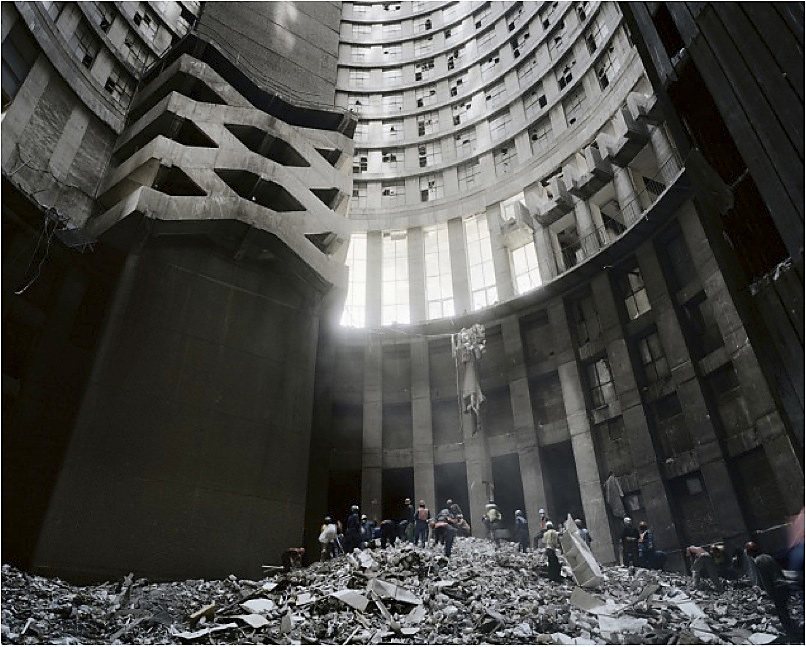
Thursday – Saturday noon – 8.00pm
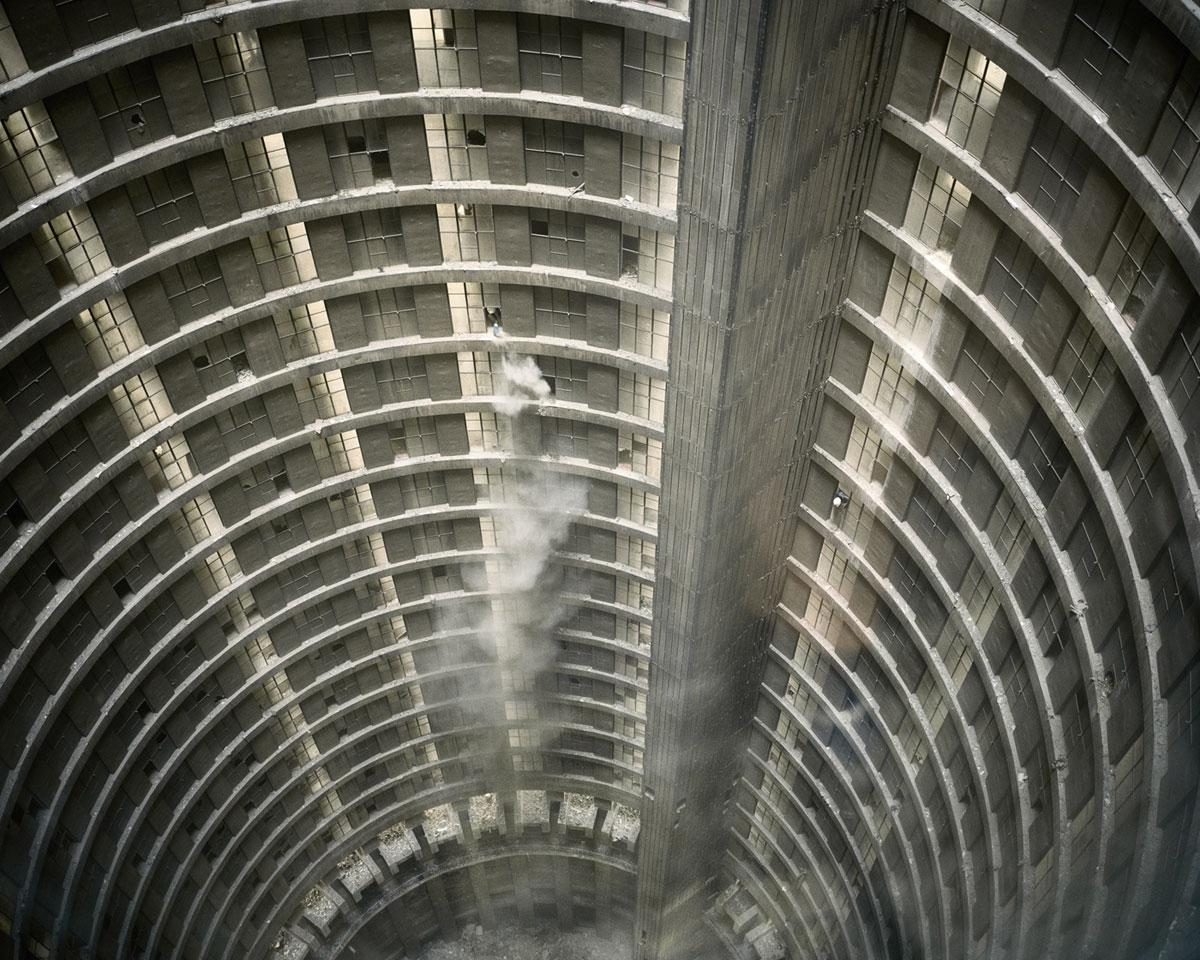
Free First Tuesday of the month noon – 8.00pm

SFMOMA website

LIKE ART BLART ON FACEBOOK

Back to top

Exhibition: ‘Pieter Hugo: This Must Be The Place – Selected Works 2003-2012’ at the Ludwig Museum of Contemporary Art, Budapest

Exhibition dates: 24th May – 11th August 2013


Pieter Hugo (South African, b. 1976) 'The Hyena Men of Abuja, Nigeria' 2005


Pieter Hugo (South African, b. 1976)
The Hyena Men of Abuja, Nigeria
2005
From the series The Hyena & Other Men
© Pieter Hugo
Courtesy of Stevenson, Cape Town/Johannesburg and Yossi Milo, New York


I have not seen enough of the other series of Pieter Hugo to make an informed decision, but work from the The Hyena & Other Men (2005-2007) and Permanent Error (2009-2010) series, the most often reproduced, is certainly strong. Whether I am fully convinced by his singular frontality is another matter…

Dr Marcus Bunyan

Many thankx to the Ludwig Museum of Contemporary Art for allowing me to publish the photographs in the posting. Please click on the photographs for a larger version of the image.


Installation view of the exhibition 'Pieter Hugo: This Must Be The Place – Selected Works 2003-2012' at the Ludwig Museum of Contemporary Art, Budapest showing work from Hugo's 'The Hyena and Other Men' Nigeria, 2005-2007 


Installation view of the exhibition Pieter Hugo: This Must Be The Place – Selected Works 2003-2012 at the Ludwig Museum of Contemporary Art, Budapest showing work from Hugo’s The Hyena and Other Men Nigeria, 2005-2007
Exhibition view © Tamás Bujnovszky / Ludwig Museum – Museum of Contemporary Art, Archives


Installation view of the exhibition 'Pieter Hugo: This Must Be The Place – Selected Works 2003-2012' at the Ludwig Museum of Contemporary Art, Budapest showing work from Hugo's 'The Hyena and Other Men' Nigeria, 2005-2007 


Installation view of the exhibition Pieter Hugo: This Must Be The Place – Selected Works 2003-2012 at the Ludwig Museum of Contemporary Art, Budapest showing work from Hugo’s The Hyena and Other Men Nigeria, 2005-2007
Exhibition view © Tamás Bujnovszky / Ludwig Museum – Museum of Contemporary Art, Archives


Pieter Hugo (South African, b. 1976) 'The Hyena Men of Abuja, Nigeria' 2005


Pieter Hugo (South African, b. 1976)
The Hyena Men of Abuja, Nigeria
2005
From the series The Hyena & Other Men
© Pieter Hugo
Courtesy of Stevenson, Cape Town/Johannesburg and Yossi Milo, New York


The hyena men are itinerants: they never spend more than two days anywhere. I found them in a shanty town near Abuja, the capital. Despite the language barrier we got to know each other pretty quickly. Outside of Lagos and Port Harcourt, I didn’t see a single white person in Nigeria. So I probably seemed as odd to them as a guy walking a hyena in the street seemed to me.

We smoked some weed to break the ice. It turned out they weren’t debt collectors – they were more like town criers, traditional storytellers who performed in the streets and sold potions after their shows. It reminded me of stories I’d read about eastern European circus troupes in the 1930s – except instead of bears, these guys had hyenas, baboons and pythons.

Seeing them perform was unforgettable. It was a huge spectacle. They would beat drums to draw in the crowds, then take the muzzles off the hyenas. Next they’d put their arms and even their heads between the animals’ jaws. The aim was to convince the audience they had special powers, and that the audience could acquire them too, if they bought their potions.

At first I tried photographing the street shows, but there was just too much going on. Then I realised that the relationship between man and beast was more interesting than all the fireworks of the performance. There was something very strange going on between the guys and the hyenas, bordering on sadomasochism. These animals had been taken out of the wild as pups. They couldn’t return. They were entirely dependent on these guys for food. And these men were dependent on the animals for their livelihoods. They needed each other, but it wasn’t an easy symbiosis. …

I love how confrontational this shot is. At no point did I tell him how to pose. It’s all him. He flexed his bicep, stared straight at me, while his hyena jumped all over him. Then in the background, there’s this kind of Mad Max landscape strewn with broken-down trucks, though you can hardly see them because of the light. It was Harmattan season, a time between November and March when the sands of the Sahara blow over western Africa creating this murky, diffused lighting, which I love. It’s a simple shot with an incredible economy. I wish I could take more like it.

Interview by Edward Siddons. “Pieter Hugo’s best photograph: the hyena men of Nigeria,” on the Guardian website Thursday 19 Jul 2018 [Online] Cited 09/07/2024


Pieter Hugo (South African, b. 1976) 'Naasra Yeti, Agbogbloshie Market, Accra, Ghana' 2009


Pieter Hugo (South African, b. 1976)
Naasra Yeti, Agbogbloshie Market, Accra, Ghana
2009
From the series Permanent Error (2009-2010)
© Pieter Hugo
Courtesy of Stevenson, Cape Town/Johannesburg and Yossi Milo, New York


Pieter Hugo (South African, b. 1976) 'Aissah Salifu, Agbogbloshie Market, Accra, Ghana' 2010


Pieter Hugo (South African, b. 1976)
Aissah Salifu, Agbogbloshie Market, Accra, Ghana
2010
From the series Permanent Error (2009-2010)
© Pieter Hugo
Courtesy of Stevenson, Cape Town/Johannesburg and Yossi Milo, New York


Installation view of the exhibition Pieter Hugo: This Must Be The Place – Selected Works 2003-2012 at the Ludwig Museum of Contemporary Art, Budapest showing at second right, Hugo's 'Obechukwu Nwoye, Enugu' 2008-2009; and at right, 'Escort Kama. Enugu, Nigeria' 2008 (below) both from the series 'Nollywood' (2008-2009)


Installation view of the exhibition Pieter Hugo: This Must Be The Place – Selected Works 2003-2012 at the Ludwig Museum of Contemporary Art, Budapest showing at second right, Hugo’s Obechukwu Nwoye, Enugu 2008-2009; and at right, Escort Kama. Enugu, Nigeria 2008 (below) both from the series Nollywood (2008-2009)
Exhibition view © Tamás Bujnovszky / Ludwig Museum – Museum of Contemporary Art, Archives


Pieter Hugo (South African, b. 1976) 'Escort Kama. Enugu, Nigeria' 2008


Pieter Hugo (South African, b. 1976)
Escort Kama. Enugu, Nigeria
2008
From the series Nollywood (2008-2009)
© Pieter Hugo
Courtesy of Stevenson, Cape Town/Johannesburg and Yossi Milo, New York


Pieter Hugo (South African, b. 1976) 'Chris Nkulo and Patience Umeh. Enugu, Nigeria' 2008


Pieter Hugo (South African, b. 1976)
Chris Nkulo and Patience Umeh. Enugu, Nigeria
2008
From the series Nollywood (2008-2009)
© Pieter Hugo
Courtesy of Stevenson, Cape Town/Johannesburg and Yossi Milo, New York


Pieter Hugo’s (b. Johannesburg, 1976) career is quite young, yet his photography is already so comprehensive that we can rightly speak of a consistent oeuvre. Since 2003 Hugo has photographed people and themes exclusively in sub-Saharan Africa. Daily life in post-colonial Africa, the complex conditions after the end of apartheid in his own land and the impact of global trade and commerce are themes that circulate throughout his intriguing series.

Pieter Hugo spends long periods of time photographing his extensive series in order to capture intimate and often bizarre moments. His use of a large-format camera requires patience and trust between photographer and subject, which is visible in straightforward expressions and candid interactions. There is a moment of calm and even timelessness in these works that allows the viewer to engage more fully with the subject matter.

The political diversity of a continent that is rapidly transforming – some note that Africa will be a global economic power of the future – is portrayed by Pieter Hugo with the clarity of familiar painting genres such as landscape, portraiture, group portraiture and still life. The subjects of his photography: the elderly, the poor, the blind, street artists, soap actors, close family and friends – form a social tableau that is at once personalised while also presenting a more universal image of Africa at the beginning of the twenty first century.

The initial motivation for the series The Hyena & Other Men (2005-2007) comes from a cell phone camera image Pieter Hugo discovered on the internet. The image concerns a group of performers who travel throughout Nigeria with tamed hyenas and other wild animals and collect money from their choreographed public performances. Hugo embarked on two separate trips to document this remarkable nomadic group up close. Hugo presents the complex relationship between animal and owner, capturing moments of calm and tenderness amidst situations full of drama and spectacle.

The Agbogbloshie market on the outskirts of Accra (Ghana) is the thematic of the Permanent Error series (2009-2010), which is mainly a dumping site for the technological waste of the western world. Here computers and other electronic equipment are collected and burned by inhabitants, often children, to extract precious raw materials. These machines formerly representing prosperity and progress are here transformed into only noxious and life threatening vapours. The charred ground, grey sky and scattered groups of foragers and cattle seem isolated from the world, but are in fact one of the last links in a chain of global commerce. Despite the harsh surroundings, the subjects stand tall, identified by full name and framed in the style of classical portraiture.

Nollywood (2008-2009) is the third largest film industry in the world, releasing between 500 and 1,000 movies each year. It produces movies on its own terms, telling stories that appeal to and reflect the lives of its public: it is a rare instance of self-representation on such a scale in Africa. The continent has a rich tradition of story-telling that has been expressed abundantly through oral and written fiction, but has never been conveyed through the popular media before. Stars are local actors; plots confront the public with familiar situations of romance, comedy, witchcraft, bribery, prostitution. The narrative is overdramatic, deprived of happy endings, tragic. The aesthetic is loud, violent, excessive; nothing is said, everything is shouted.

At a morgue in the township of Khayelitsha in Cape Town, Pieter Hugo turns his camera to individuals who have died of AIDS related illnesses. In The Bereaved (2005) as with many of his other series, Hugo gives first and last names of his subjects. Such a personal statement challenges the anonymity of AIDS statistics in South Africa. Ten years after the Rwandan Genocide, Pieter Hugo captures the unimaginable violence of these events through leftover fragments (Vestiges of a Genocide, 2004). The absence of human life is disturbingly present in the images. Bones are preserved with lime so as not to disintegrate. Heavy dust and dirt create an organic seal over the remains. While these substances often signify what is past and forgotten, the items in the photographs are preserved artificially and naturally for all to remember.

The series entitled Messina / Musina (2006) deals with the inhabitants of a small town on the border of Zimbabwe in South Africa’s Limpopo Province. The title reflects the correction of an earlier colonial misspelling of the town’s name (Messina), as well as the transition taking place at this geographical and social periphery.

In Pieter Hugo’s studio portraits of the elderly, the blind and people with albinism – Looking Aside, 2003-2006 – there is a direct and confrontational engagement between the viewer and the subjects. The viewer is made to feel uncomfortable and immobilised by the subject’s gaze. In There’s a Place in Hell for Me and My Friends (2011) – a recent series of portraits realised in the same spirit and adopting a stripped back, close-up and confrontationally direct approach – Hugo explores similar territory [to his earlier series Looking Aside] but from practically the opposite angle. In this case, the subjects are simply the photographer and his friends, who represent an array of ethnicities but are not particularly atypical, abnormal or ‘unusual’ in a genetic sense. Instead they are rendered unusually, portrayed in a heightened monotone with their skin transformed into a range of exaggerated black spots and dark tones.

With Kin (2011), his most autobiographical series to date, Pieter Hugo reflects on his own family and deep ambivalence towards the notion of home. Personal moments such as the pregnancy of his wife, the birth of their child and an operation of his mother are interspersed with national icons: open landscapes, anthropological museums and references to historical places and figures in South Africa. The recent and historical, private and public, rich and poor, ugly and beautiful interact closely in this series and represent the social complexities of post-apartheid South Africa.

Press release from the Ludwig Museum of Contemporary Art website


Installation view of the exhibition 'Pieter Hugo: This Must Be The Place – Selected Works 2003-2012' at the Ludwig Museum of Contemporary Art, Budapest showing work from Hugo's 'Vestiges of a Genocide' Rwanda, 2004


Installation view of the exhibition Pieter Hugo: This Must Be The Place – Selected Works 2003-2012 at the Ludwig Museum of Contemporary Art, Budapest showing work from Hugo’s Vestiges of a Genocide Rwanda, 2004
Exhibition view © Tamás Bujnovszky / Ludwig Museum – Museum of Contemporary Art, Archives

Vestiges of a Genocide

Rwanda, 2004

Ten years after the Rwandan Genocide, Pieter Hugo captures the unimaginable violence of these evens through leftover fragments. The absence of human life is disturbingly person in the images. Bones are preserved with lime so as not to disintegrate. Heavy dust and dirt create an organic seal over the remains. While these substances often signify what is past and forgotten, the items in the photographs are preserved artificially and naturally for all to remember.

Wall text from the exhibition


Pieter Hugo (South African, b. 1976) 'John Kwesi, Wild Honey Collector, Techiman District, Ghana' 2005


Pieter Hugo (South African, b. 1976)
John Kwesi, Wild Honey Collector, Techiman District, Ghana
2005
From the series Wild Honey Collectors Ghana 2005
© Pieter Hugo
Courtesy of Stevenson, Cape Town/Johannesburg and Yossi Milo, New York


Pieter Hugo (South African, b. 1976) 'The Honourable Justice Unity Dow' 2005


Pieter Hugo (South African, b. 1976)
The Honourable Justice Unity Dow
2005
© Pieter Hugo
Courtesy of Stevenson, Cape Town/Johannesburg and Yossi Milo, New York


Installation view of the exhibition 'Pieter Hugo: This Must Be The Place – Selected Works 2003-2012' at the Ludwig Museum of Contemporary Art, Budapest showing work from Hugo's 'Looking Aside: Studio Portraits' South Africa, 2003-2006


Installation view of the exhibition Pieter Hugo: This Must Be The Place – Selected Works 2003-2012 at the Ludwig Museum of Contemporary Art, Budapest showing work from Hugo’s Looking Aside: Studio Portraits South Africa, 2003-2006
Exhibition view © Tamás Bujnovszky / Ludwig Museum – Museum of Contemporary Art, Archives


Looking Aside: Studio Portraits

South Africa, 2003-2006

In Pieter Hugo’s studio portraits of the elderly, the blind and people with albinism there is a direct and confrontational engagement between the viewer and the subjects. The viewer is made to feel uncomfortable and immobilised by the subject’s gaze.

Wall text from the exhibition


Pieter Hugo (South African, b. 1976) 'Steven Mohapi, Johannesburg' 2003


Pieter Hugo (South African, b. 1976)
Steven Mohapi, Johannesburg
2003
From the series Looking Aside: Studio Portraits South Africa, 2003-2006
© Pieter Hugo
Courtesy of Stevenson, Cape Town/Johannesburg and Yossi Milo, New York


Pieter Hugo (South African, b. 1976) 'Themba Tshabalala, Cape Town' 2011


Pieter Hugo (South African, b. 1976)
Themba Tshabalala, Cape Town
2011
From the series There’s a Place in Hell for Me and My Friends
© Pieter Hugo
Courtesy of Stevenson, Cape Town/Johannesburg and Yossi Milo, New York


Installation view of the exhibition 'Pieter Hugo: This Must Be The Place – Selected Works 2003-2012' at the Ludwig Museum of Contemporary Art, Budapest showing work from Hugo's 'There's a Place in Hell for Me and My Friends', 2011


Installation view of the exhibition Pieter Hugo: This Must Be The Place – Selected Works 2003-2012 at the Ludwig Museum of Contemporary Art, Budapest showing work from Hugo’s There’s a Place in Hell for Me and My Friends, 2011
Exhibition view © Tamás Bujnovszky / Ludwig Museum – Museum of Contemporary Art, Archives


There’s a Place in Hell for Me and My Friends

2011

In There’s a Place in Hell for Me and My Friends, a recent series of portraits that adopts a stripped back, close-up confrontationally direct approach – Hugo explores similar territory (to his earlier series Looking Aside, above) but from practically the opposite angle. In this case the subjects are simply the photographer and his friends, who represent an array of ethnicities but are not particularly atypical, abnormal or ‘unusual’ in a genetic sense. Instead they are rendered unusually, portrayed in a heightened monotone with their skin transformed into a range of exaggerated black spots and dark tones.

Wall text from the exhibition


Pieter Hugo (South African, b. 1976) 'Ashleigh McLean' 2011


Pieter Hugo (South African, b. 1976)
Ashleigh McLean
2011
From the series There’s a Place in Hell for Me and My Friends
© Pieter Hugo
Courtesy of Stevenson, Cape Town/Johannesburg and Yossi Milo, New York


Pieter Hugo (South African, b. 1976) 'Yasser Booley, Cape Town' 2011


Pieter Hugo (South African, b. 1976)
Yasser Booley, Cape Town
2011
From the series There’s a Place in Hell for Me and My Friends
© Pieter Hugo
Courtesy of Stevenson, Cape Town/Johannesburg and Yossi Milo, New York


Ludwig Museum of Contemporary Art
1095 Budapest Komor Marcell Street 1
Hungary 06 1 555-3444

Opening hours:
Tuesday – Sunday: 10.00 – 18.00
Closed on Mondays

Ludwig Museum of Contemporary Art website

LIKE ART BLART ON FACEBOOK

Back to top

Exhibition: ‘Distance and Desire: Encounters with the African Archive Part I’ at The Walther Collection, Neu-Ulm, Germany

Exhibition dates: 9th June 2013 – 17th May 2015


Santu Mofokeng (South African, 1956-2020) 'The Black Photo Album / Look at me: 1890-1950' 1997


Santu Mofokeng (South African, 1956-2020)
The Black Photo Album / Look at me: 1890-1950
1997
© Santu Mofokeng / Courtesy of Lunetta Bartz, MAKER, Johannesburg


Another group of interesting colonial African photographs from The Walther Collection. Similar in scope to the 20 volume series The American Indian (1906-1930) by ethnologist and photographer Edward S. Curtis which “documented as much American Indian (Native American) traditional life as possible before that way of life disappeared,” (Wikipedia), A. M. Duggan-Cronin’s 11 volume series The Bantu Tribes of South Africa (1928-1954), “set out to depict what he considered the disappearing indigenous populations of South Africa.” Disappearance and loss are the all to ready themes of these recorders of vanishing races.

“Santu Mofokeng’s The Black Photo Album / Look at Me: 1890-1950 introduces the concept of the photographic archive as both a repository of documents and an assemblage of representations ” (media release). In this work Mofokeng juxtaposes images of “civilised” natives – images urban black working- and middle-class families had commissioned, requested, or tacitly sanctioned without evidence of coercion – with text that spurns, questions or challenges official integrationist policies taking their model from colonial officials and settlers. “The images depicted here reflect their sensibilities, aspirations and their self-image.”

The artist asks:

“Are these mere solemn relics of disrupted narratives or are these images expressive of the general human predicament?”

“Who is gazing”

“Who are these people?”

“What were their aspirations?”

“Did these images serve to challenge prevailing western perceptions of the African?”

“Do these images serve as testimony of mental colonisation?”


Dr Marcus Bunyan


Many thankx to The Walther Collection for allowing me to publish the photographs in the posting. Please click on the photographs for a larger version of the image.


A.M. Duggan-Cronin (South African born Ireland, 1874-1954) 'Korana Girl, Kimberley, South Africa' c. 1900-1930


A.M. Duggan-Cronin (South African born Ireland, 1874-1954)
Korana Girl, Kimberley, South Africa
c. 1900-1930
Gelatin-silver developed-out print
Paper: 5.67 x 3.86 inches (14.4 x 9.8cm)
The Walther Collection


Part I: The Black House: Santu Mofokeng and A.M. Duggan-Cronin

A juxtaposition of A. M. Duggan-Cronin’s The Bantu Tribes of South Africa and Santu Mofokeng’s The Black Photo Album / Look at Me: 1890-1950 introduces the concept of the photographic archive as both a repository of documents and an assemblage of representations. Duggan-Cronin, an Irish South African who lived in the mining town of Kimberley, set out to depict what he considered the disappearing indigenous populations of South Africa. His monumental study, entitled The Bantu Tribes of South Africa, published between 1928-1954, includes photographs, descriptive captions, and anthropological essays. In addition to presenting all eleven Bantu Tribes books, a complete sequence of photogravure plates from The Nguni: Baca, Hlubi, Xesibe (1954) will be on view, alongside a selection of vintage gelatin-silver prints by Duggan-Cronin, which had previously circulated as individual objects.

In contrast to Duggan-Cronin’s renowned and contested ethnographic vision of African heritage, Santu Mofokeng’s The Black Photo Album / Look at Me: 1890-1950 portrays the modern self-representation of African subjects. In the early 1990s, the artist collected family studio portraits from late-nineteenth and early-twentieth century South Africa and transformed the images into a slide show, complete with narratives about the sitters. He also produced a series of gelatin-silver print reproductions of the portraits, which are on view together with a selection of the project’s original vintage prints and Mofokeng’s research notes. Envisioned as a “counter-archive,” The Black Photo Album challenges fixed ideas most often associated with images of Africans.

By placing these two bodies of work alongside one another, Part I of Distance and Desire opens up the question of the “African Archive,” understood here not so much as an official repository of documents and objects but as a contested assemblage of representations that have helped to construct and project a dominant image of Africans that is now under pressure and revision.

Press release from The Walther Collection website


A.M. Duggan-Cronin (South African born Ireland, 1874-1954) 'The Late Chief Jonathan Molapo' South Africa, early twentieth century


A.M. Duggan-Cronin (South African born Ireland, 1874-1954)
The Late Chief Jonathan Molapo
South Africa, early twentieth century
The Walther Collection


A.M. Duggan-Cronin (South African born Ireland, 1874-1954) 'Woman of Middle Age at Moitšupeli’s' South Africa, early twentieth century


A.M. Duggan-Cronin (South African born Ireland, 1874-1954)
Woman of Middle Age at Moitšupeli’s
South Africa, early twentieth century
The Walther Collection


Alfred Martin Duggan-Cronin was an Irish-born South African photographer who undertook several photographic and collecting expeditions in South Africa and adjacent territories between 1919 and 1939, in the course of which he documented people and rural life throughout the subcontinent. Based in Kimberley, it was while working in the mine compounds that he initially encountered African migrant workers, stimulating an interest in ethnographic subjects. Duggan-Cronin was born on 17 May 1874 in Innishannon, County Cork, Ireland, and died on 25 August 1954 in Kimberley, South Africa. …

Duggan-Cronin embarked on the first of his major ethnographic endeavours in 1919 when he went to the Langeberg to photograph the San people living there – the first of many expeditions into Kimberley’s Southern African hinterland. Between the world wars he travelled some 128 000 kilometres, making at least 18 expeditions to photograph the peoples of southern Africa. He was accompanied by his Mfengu assistant, Richard Madela, on some of these expeditions.

A significant number of his photographs were published in The Bantu Tribes of South Africa: Reproductions of Photographic Studies by A.M. Duggan-Cronin, eleven volumes of which appeared under the imprint of the McGregor Memorial Museum, Kimberley, between 1928 and 1954. In 1925 he opened his first ‘Bantu Gallery’ at his home on Kimberley’s outskirts, his collection of some 8,000 photographs and ethnographic objects being more permanently housed at what was named the Duggan-Cronin Bantu Gallery at The Lodge in Kimberley from the late 1930s.

Text from the Wikipedia website


A.M. Duggan-Cronin (South African born Ireland, 1874-1954) 'A Morolong Youth' South Africa, early twentieth century


A.M. Duggan-Cronin (South African born Ireland, 1874-1954)
A Morolong Youth
South Africa, early twentieth century
The Walther Collection


A.M. Duggan-Cronin (South African born Ireland, 1874-1954) 'Bomvana Initiates' 1930


A.M. Duggan-Cronin (South African born Ireland, 1874-1954)
Bomvana Initiates
1930
The Walther Collection


Bomvana

According to their own tradition, the Bomvana originate from the AmaNgwane people of KwaZulu-Natal. The AmaBomvana are descended from Nomafu, the first of the AmaNgwana tribe and from Bomvu, who gave rise to the AmaBomvu tribe. Bomvu’s Great Son, Nyonemnyam, carried on the Bomvu dynasty. His son Njilo is the progenitor of the AmaBomvana. The AmaBomvana people left Natal in 1650 to settle in Pondoland after a dispute over cattle. After the death of Njilo’s wife, their grandson Dibandlela refused to send, in accordance with custom, the isizi cattle to his grandfather. This led to an open dispute. Dibandlela fled with his supporters and their cattle to settle in Pondoland.

The AmaBomvana remained in Pondoland until 1837. After experiencing two centuries of tribal wars, the amaBomvana were driven out of Pondoland into the area east of the Mbashe river, including the present-day Cwebe reserve and they put themselves under the wing of the Gcaleka, with permission from King Hintsa, who was the Paramount of all states in the Eastern Cape.

They are historically related and share a common lineage with the AmaMpondomise, AmaXesibe, AbakwaMkhize, AmaBomvu and AmaMpondo as they all have related cultural similarities. The passing of four centuries since their division and the influence of neighboring tribal groups have brought about the linguistic and cultural differences, and differences in their rituals and rites of passage that we observe today.

Text from the Wikipedia website


A.M. Duggan-Cronin (South African born Ireland, 1874-1954) 'Ovambo (Ogandjera) Woman' 1936


A.M. Duggan-Cronin (South African born Ireland, 1874-1954)
Ovambo (Ogandjera) Woman
1936
The Walther Collection


Ongandjera

Ongandjera (from “aagandji yiiyela”, place of gold metal thread beads) is a tribal area near Okahao in the Omusati Region in northern Namibia. Ongandjera is the birthplace of Sam Nujoma, the country’s first president, and of Pendukeni Iivula-Ithana who was the secretary-general of South West Africa People’s Organisation (SWAPO) from 2007 to 2012.

Historically part of Ovamboland, Ongandjera is the seat of a traditional kingship, the Ongandjera Traditional Authority. In 1917, South Africa stripped the rulers of seven kingships, including Ongandjera, of their authority to rule their territory. Nevertheless, the position of King of the Ongandjera was continued. Following Namibia’s independence, the king of Ongandjera declared the royal family restored.

Text from the Wikipedia website


Santu Mofokeng (South African, 1956-2020) 'The Black Photo Album / Look at Me: 1890-1950' 1997


Santu Mofokeng (South African, 1956-2020)
The Black Photo Album / Look at Me: 1890-1950
1997
(Bishop Jacobus G. Xaba and his family? Photographer: Deale, Bloemfontein, Orange River Colony, c. 1890s)
© Santu Mofokeng / Courtesy of Lunetta Bartz, MAKER, Johannesburg


Santu Mofokeng (South African, 1956-2020) 'The Black Photo Album / Look at Me: 1890-1950' 1997


Santu Mofokeng (South African, 1956-2020)
The Black Photo Album / Look at Me: 1890-1950
1997
(Unidentified photographer, Moeti and Lazarus Fume)
© Santu Mofokeng / Courtesy of Lunetta Bartz, MAKER, Johannesburg


Santu Mofokeng (South African, 1956-2020) 'The Black Photo Album / Look at Me: 1890-1950' 1997


Santu Mofokeng (South African, 1956-2020)
The Black Photo Album / Look at Me: 1890-1950
1997
(Scholtz Studio, Lindley, Ouma Maria Letsipa, née van der Merwe, with her daughter Minkie, Orange River Colony, c. 1900s)
© Santu Mofokeng / Courtesy of Lunetta Bartz, MAKER, Johannesburg


Santu Mofokeng (South African, 1956-2020) 'The Black Photo Album / Look at Me: 1890-1950' 1997


Santu Mofokeng (South African, 1956-2020)
The Black Photo Album / Look at Me: 1890-1950
1997
(Unidentified photographer, South Africa, early twentieth century)
© Santu Mofokeng / Courtesy of Lunetta Bartz, MAKER, Johannesburg


Santu Mofokeng (South African, 1956-2020) 'The Black Photo Album / Look at Me: 1890-1950' 1997


Santu Mofokeng (South African, 1956-2020)
The Black Photo Album / Look at Me: 1890-1950
1997
(Unidentified photographer, Elizabeth and Jan van der Merwe, Johannesburg, c. 1900s)
© Santu Mofokeng / Courtesy of Lunetta Bartz, MAKER, Johannesburg


Santu Mofokeng (South African, 1956-2020) 'The Black Photo Album / Look at Me: 1890-1950' 1997


Santu Mofokeng (South African, 1956-2020)
The Black Photo Album / Look at Me: 1890-1950
1997
(Unidentified photographer, Elliot Phakane, Bethlehem Location, c. 1900s)
© Santu Mofokeng / Courtesy of Lunetta Bartz, MAKER, Johannesburg


Santu Mofokeng (South African, 1956-2020) 'The Black Photo Album / Look at Me: 1890-1950' 1997


Santu Mofokeng (South African, 1956-2020)
The Black Photo Album / Look at Me: 1890-1950
1997
(Unidentified photographer, c. 1900s)
© Santu Mofokeng / Courtesy of Lunetta Bartz, MAKER, Johannesburg


Santu Mofokeng (South African, 1956-2020) 'The Black Photo Album / Look at Me: 1890-1950' 1997


Santu Mofokeng (South African, 1956-2020)
The Black Photo Album / Look at Me: 1890-1950
1997
(Unidentified photographer, c. 1900s)
© Santu Mofokeng / Courtesy of Lunetta Bartz, MAKER, Johannesburg


Santu Mofokeng (South African, 1956-2020) 'The Black Photo Album / Look at Me: 1890-1950' 1997


Santu Mofokeng (South African, 1956-2020)
The Black Photo Album / Look at Me: 1890-1950
1997
(Unidentified subjects, Clifton Studio, Braamfontein c.1900s)
© Santu Mofokeng / Courtesy of Lunetta Bartz, MAKER, Johannesburg


The Walther Collection
Reichenauer Strasse 21
89233 Neu-Ulm, Germany

Opening hours:
Thurs – Sunday 2 – 5pm

The Walther Collection website

LIKE ART BLART ON FACEBOOK

Back to top

Exhibition: ‘Rise and Fall of Apartheid: Photography and the Bureaucracy of Everyday Life’ at Haus der Kunst, Munich

Exhibition dates: 15th February – 26th May 2013


Eli Weinberg (South African born Latvia, 1908-1981) 'Crowd near the Drill Hall on the opening day of the Treason Trial, Johannesburg, 19. December 1956' 1956


Eli Weinberg (South African born Latvia, 1908-1981)
Crowd near the Drill Hall on the opening day of the Treason Trial, Johannesburg, 19. December 1956
1956
Times Media Collection, Museum Africa, Johannesburg


NEVER AGAIN!


Many thankx to Haus der Kunst for allowing me to publish the photographs in the posting. Please click on the photographs for a larger version of the image.


Gille de Vlieg (South African born England, b. 1940) 'Coffins at the mass funeral held in KwaThema, Gauteng, July 23, 1985' 1985


Gille de Vlieg (South African born England, b. 1940)
Coffins at the mass funeral held in KwaThema, Gauteng, July 23, 1985
1985


Gille de Vlieg (born 26 July 1940) is a photographer and anti-apartheid activist. She was born in England and moved to South Africa with her mother when she was 3 years old. During apartheid she was a member of both the Black Sash and one of the few women members of the Afrapix photography collective. Her images have been published in newspapers, magazines and books nationally and internationally. Unlike many of her counterparts, de Vlieg received little public acclaim for her work up until recently. About her work, she says, “I wanted to make a contribution to an alternative view of South Africa, a view not seen on the South African TV screen then.” Her images cover the following topics: land removals, rural lifestyle, township lifestyle, gender lifestyle, United Democratic Front (UDF), anti-harassment campaign, police violence, protests against death penalty, funerals, Black Sash, protests against incorporation into Bophuthatswana; Release Mandela Campaign, End Conscription Campaign (ECC), conscientious objectors, African National Congress (ANC) Welcome Home Rally, Day of the Vow (Geloftedag), street children, and homeless people.

Text from the Wikipedia website


Gille de Vlieg (South African born England, b. 1940) 'Pauline Moloise (mother of Ben), two women & Winnie Madikizela Mandela mourn at the Memorial Service for Benjamin Moloise, who was hanged earlier that morning. Khotso House, Johannesburg, October 18, 1985' 1985


Gille de Vlieg (South African born England, b. 1940)
Pauline Moloise (mother of Ben), two women & Winnie Madikizela Mandela mourn at the Memorial Service for Benjamin Moloise, who was hanged earlier that morning. Khotso House, Johannesburg, October 18, 1985
1985


“All the armies that ever marched, all the parliaments that ever sat, have not affected the life of man on earth as that one solitary life… I am proud of what I am… The storm of oppression will be followed by the rain of my blood. I am proud to give my life, my one solitary life.”


Moloise, Benjamin (18 October 1985). “All the armies that ever marched”. Weekly Mail. p. 1


Malesela Benjamin Moloise (c.  1955 – 18 October 1985) was a South African poet and political activist who came to international attention following his arrest and subsequent execution by the government of South Africa. From Soweto, Moloise worked as an upholsterer before turning to poetry during his time on death row. In 1983, Moloise was arrested for the 1982 murder of Phillipus Selepe, a black security policeman who assisted in capturing three African National Congress (ANC) members. Although he initially confessed to the murder, he later retracted the statement during his trial. Moloise’s death sentence sparked national and international outrage and was seen as emblematic of South Africa’s brutal crackdown on anti-apartheid activists.

Throughout Moloise’s trial, allegations arose about the legitimacy of the evidence against him, the veracity of his confession, and the overall fairness of the process. Following a refusal of clemency or retrial by President P. W. Botha, Moloise was executed in 1985. His execution sparked riots in Johannesburg, protests in major world cities, and a flurry of diplomatic condemnations. The legacy of Moloise’s life, death, and anti-apartheid poems penned during his time on death row transcended South Africa, manifesting in global displays of solidarity and streets named in his honor.

Text from the Wikipedia website


Jodi Bieber (South African, b. 1966) 'Protest against Chris Hani's assassination' 1993


Jodi Bieber (South African, b. 1966)
Protest against Chris Hani’s assassination
1993
© Goodman Gallery Johannesburg


Chris Hani (28 June 1942 – 10 April 1993), born Martin Thembisile Hani SSA, SBS, CLS, DMG, MMS, was the leader of the South African Communist Party and chief of staff of uMkhonto we Sizwe, the armed wing of the African National Congress (ANC). He was a fierce opponent of the apartheid government, and was assassinated by Janusz Waluś, a Polish immigrant and sympathiser of the Conservative opposition on 10 April 1993, during the unrest preceding the transition to democracy.

Text from the Wikipedia website


Complex, vivid, evocative, and dramatic, Rise and Fall of Apartheid: Photography and the Bureaucracy of Everyday Life represents the most comprehensive exhibition of its kind, attempting to formulate an understanding of apartheid’s legacy in South Africa through visual records. These images responded to the procedures and processes of the apartheid state from its beginning in 1948 to the first non-racial democratic elections that attended its demise in 1994. Featuring more than 600 documentary photographs, artworks, films, newsreel footage, books, magazines, and assorted archival documents, the exhibition will fill more than 2,000 square meters of the East Wing of Haus der Kunst. Starting in the entrance gallery (where two film clips are juxtaposed; one from 1948 showing the victorious Afrikaner National Party’s celebration rally, and another of President F. W. De Klerk in February 1990 announcing Nelson Mandela’s release from prison) the exhibition offers an absorbing exploration of one of the twentieth century’s most contentious historical eras.

The exhibition highlights the different strategies adopted by photographers and artists; from social documentary to reportage, photo essays to artistic appropriation of press and archival material. Through these polysemic images, the exhibition embarks on a tour of how photographers and artists think with pictures, the questions these images pose, and the issues of social justice, resistance, civil rights and the actions of opposition to apartheid raise. In so doing, The Rise and Fall of Apartheid brings together many iconic photographs that have rarely been shown before, to propose a fresh historical overview of the photographic and artistic responses to apartheid.

A fundamental argument of the exhibition is that the rise of the Afrikaner National Party to political power and its introduction of apartheid as the legal foundation of governance in 1948 changed the country’s pictorial perception from a “relatively benign colonial space based on racial segregation to a highly contested space in which the majority of the population struggled for equality, democratic representation, and civil rights” (Okwui Enwezor). From the moment apartheid was introduced, photographers in South Africa were immediately aware of how these changes taking place in politics and society accordingly affected photography’s visual language: The medium was transformed from a purely anthropological tool into a social instrument. No one photographed the struggle against apartheid better, more critically, and incisively than South African photographers. For that reason, with the notable exception of a few Western photographers and artists, including Ian Berry, Dan Weiner, Margaret Bourke-White, Hans Haacke, Adrian Piper, and others, the works in the exhibition are overwhelmingly produced by South African photographers.

Resisting the easy dichotomy of victims and oppressors, the photographers’ images present the reading of an evolving dynamic of repression and resistance. Ranging in approach between “engaged” photography of photo essays to the “struggle” photography of social documentary which was aligned with activism, to photojournalistic reportage, the photographers did not only show African citizens as victims, but more importantly as agents of their own emancipation. Included in the exhibition are seminal works by Leon Levson, Eli Weinberg, David Goldblatt and members of Drum magazine, such as Peter Magubane, Jürgen Schadeberg, Alf Kumalo, Bob Gosani, G.R. Naidoo, and others in the 1950s. Also represented are the investigative street photography of Ernest Cole and George Hallett in the 1960s, the reportage of Sam Nzima, Noel Watson, and protest images of the Black Consciousness movement, and student marches in the 1970s to those of the Afrapix Collective in the 1980s, as well as reportages by the members of the so-called Bang Bang Club in the 1990s. The exhibition concludes with works by a younger generation of South African photographers, such as Sabelo Mlangeni and Thabiso Sekgale, and the collective Center for Historical Reenactments, whose projects offer subtle reappraisals of the after effects of apartheid still felt today.

These South African photographers represented a clear political belief. They were opponents of the apartheid regime, and they employed photography as an instrument to overcome it. The independent photo agency Afrapix, founded in 1982 by Omar Badsha and Paul Weinberg, saw itself as a group of “cultural workers”. They believed political convictions came first, and that photography, like writing or acting, was part of the anti-apartheid movement. This attitude was supported by photographers such as Peter McKenzie, who – at a cultural conference organised by the ANC (African National Congress) in Gabarone, Botswana in 1982 – argued that the work of cultural producers is necessarily part of the struggle against apartheid. McKenzie’s argument stood in sharp contrast to that of David Goldblatt, who had the opinion that photographers should report on events with as much inner distance as they can muster.

On the other end of the spectrum, the so-called “struggle” or “frontline photography” is characterised by immediacy, giving the impression of being in the middle of the action. “If you want a picture, you get that picture, under all circumstances” was the leitmotif of one of the leading figures, Peter Magubane.

The photographs’ subjects are different historical events. These include the “Treason Trial” of 1956-1961, which ended with the acquittal of 156 anti-apartheid activists, including Nelson Mandela; the Sharpeville massacre of 1960, in which police shot 69 demonstrators dead; Mandela’s release in 1990 after 27 years in prison; and the civil war between opposing political factions during the 1994 election. Yet this exhibition is not a history of apartheid itself. Instead it aims to critically interrogate the normative symbols and signs of the photographic and visual responses to apartheid. For example, ritualised gestures were also part of the apartheid imagery. The “thumbs up” as a sign of solidarity among activists belonged to the movement’s nonviolent start when civil disobedience and strikes were still regarded as effective agents. After the Sharpeville massacre of 1960, the resistance became militarised. The cherished “thumbs up” was transformed into the upraised fist, the general symbol of black power. Since the burial of the Sharpeville massacre’s victims, black South Africans expressed their sense of community and identity at funerals. Their public mourning thus became a ritualised form of mass mobilisation and defiance.

From the ordinary and mundane to the bureaucratic and institutional, the corrosive effects of the apartheid system on everyday life are explored in the multiplicity of public signage that drew demarcating lines of segregation between whites, Africans, and non-Europeans. For example, Ernest Cole engaged in a sustained study of apartheid signage at train stations, banks, buses, taxi ranks, and throughout the streets of cities like Johannesburg and Pretoria in the early to mid-1960s. Another exemplary image is a photo from 1956 taken by Peter Magubane. It draws attention to the fact that racial segregation restricted movement in both private and public space. The image shows a young white girl sitting on a bench with the inscription “Europeans only” as her black nanny strokes her neck, but must do so from the back bench.

However, the everyday was not limited to the humiliations of policed segregation. “Drum” magazine, one of the most important media outlets for African social life, combined the gritty realism of reportage and the fantasy of normality in the self-constructions of non-European dandies, beauty queens, and the exuberance of township life. Its pages offered images of entertainment, representations of leisure, cultural events, and celebrity portraits. The magazine encompassed a full range of motifs, from relentless documentary photography to fashion shoots, dance revues, and concerts. Through the magazine, photographs found an audience that was politically sensitive and attentive; it also gave South African photographers the opportunity to exchange ideas with colleagues from other African countries, India, and Europe for the first time.

In 1990, the interest of the international press was focused on Mandela’s imminent release. Photographs from South Africa had finally prepared the ground for the participation of world opinion in shaping the country’s future. In this context, the exhibition also asks whether photography can help inform the political face of the world.

Press release from the Haus der Kunst website


Jurgen Schadeberg (South African born Germany, 1931-2020) 'The 29 ANC Women’s League women are being arrested by the police for demonstrating against the permit laws, which prohibited them from entering townships without a permit, 26th August 1952' 1952


Jurgen Schadeberg (South African born Germany, 1931-2020)
The 29 ANC Women’s League women are being arrested by the police for demonstrating against the permit laws, which prohibited them from entering townships without a permit, 26th August 1952
1952
Courtesy the artist


Jurgen Schadeberg (South African born Germany, 1931-2020) '20 defiance campaign Leaders appear in the Johannesburg Magistrates Court on a charge of contravening the Suppression of Communism Act, August 26, 1952' 1952


Jurgen Schadeberg (South African born Germany, 1931-2020)
20 defiance campaign Leaders appear in the Johannesburg Magistrates Court on a charge of contravening the Suppression of Communism Act, August 26, 1952
1952
Courtesy the artist


Jurgen Schadeberg (South African born Germany, 1931-2020) 'Nelson Mandela, Treason Trial' 1958


Jurgen Schadeberg (South African born Germany, 1931-2020)
Nelson Mandela, Treason Trial
1958
Courtesy the artist


Eli Weinberg (South African born Latvia, 1908-1981) 'Nelson Mandela portrait wearing traditional beads and a bed spread. Hiding out from the police during his period as the "black pimpernel," 1961' 1961


Eli Weinberg (South African born Latvia, 1908-1981)
Nelson Mandela portrait wearing traditional beads and a bed spread. Hiding out from the police during his period as the “black pimpernel,” 1961
1961
Courtesy of IDAFSA


Ranjith Kally (South African, 1925-2017) 'Chief Albert Luthuli, former President General of the African National Congress, Rector of Glasgow University and 1960 Nobel Peace Prize Winner, gagged by the government from having any of his words published in his country, confined to small area around his home near Stanger in Natal, April 1964' 1964


Ranjith Kally (South African, 1925-2017)
Chief Albert Luthuli, former President General of the African National Congress, Rector of Glasgow University and 1960 Nobel Peace Prize Winner, gagged by the government from having any of his words published in his country, confined to small area around his home near Stanger in Natal, April 1964
1964
© Bailey’s Archives


Greame Williams (South African, b. 1961) 'Nelson Mandela and Winnie Mandela as he is released from the Victor Vester Prison' 1990


Greame Williams (South African, b. 1961)
Nelson Mandela and Winnie Mandela as he is released from the Victor Vester Prison
1990
Courtesy the artist
© Greame Williams


Haus der Kunst
Prinzregentenstraße 1
80538 Munich
Germany
Phone: +49 89 21127 113

Opening hours:
Monday, Wednesday  -  Sunday 10 am  -  8pm
Thursday 10am  -  10pm
Closed Tuesdays

Haus der Kunst website

LIKE ART BLART ON FACEBOOK

Back to top

Exhibition: ‘South Africa in Apartheid and After: David Goldblatt, Ernest Cole, Billy Monk’ at the San Francisco Museum of Modern Art (SFMOMA)

Exhibition dates: 1st December 2012 – 5th March 2013


Ernest Cole (South African, 1940-1990) 'A student who said he was going to fetch his textbook is pulled in. To prove he was still in school he showed his fountain pen and ink-stained fingers. But that was not enough; in long pants he looked older than sixteen' 1960–1966


Ernest Cole (South African, 1940-1990)
A student who said he was going to fetch his textbook is pulled in. To prove he was still in school he showed his fountain pen and ink-stained fingers. But that was not enough; in long pants he looked older than sixteen
1960-1966
Gelatin silver print
8 11/16 x 12 5/8 in. (22 cm x 32cm)
Courtesy of the Hasselblad Foundation, Gothenburg, Sweden
© The Ernest Cole Family Trust


It is the work of Billy Monk that is most impressive in this posting. Photographed in the rowdy Cape Town nightclub The Catacombs in the 1960s, Monk’s photographs of the racially mixed clientele portray them in extraordinary intimacy in all their states of joy and sadness. While his protagonists take centre stage within his photographs there is a wonderful spatial openness to Monk’s 35mm flash images photographed with a slightly wide angle 35mm lens. Monk does not fill the pictorial frame; he allows his images to breathe. Witness (and that is what he did) the moment of stasis before kiss of The Catacombs, 30 September 1967 (below), the intensity of the man’s passionate embrace, gaze, the sublime distance between bottle at right and bottle top, the image replete with blank, contextless wall behind. There is passion and hilarity here coupled with a feeling of infinite sadness – the squashed faces of The Catacombs, 31 July 1967, the convivial happiness of the couple in The Catacombs, 5 February 1968 (he with his stained trouser leg) counterbalanced by the desolate looking man behind them and the mute expression on the trapped go-go dancers face in The Balalaika, December 1969 as the man reaches his hand through the bars towards her.

Observe the masterpiece that is The Catacombs, 21 November 1967 (below). The cheap Formica bench top and empty Coca-Cola bottle with straw, a half smoked cigarette pointing out of the photograph at bottom right. If the cigarette wasn’t there the image would fall away in that corner: it HAS to be there, and Monk’s eye knew it. The women, standing, singing? holding two bottles of liquor in her out thrust arms, her eyes and hair mimicking the patterns of the painted Medusa behind her. And the young man dressed in jacket and time, one arm outstretched and resting on the bench, the other resting curled up next to his mouth and cheek. It’s his look that gets you – she, declamatory; he, lost in melancholic reverie, with the troubles of the world on his shoulders totally oblivious to her performance. The emotional distance between the two, as the distance between his resting hand and the empty Coke bottle, is enormous, insurmountable. Such a profound and troubling image of a society in hedonistic denial. His look is the look of loneliness, anguish and despair.

These photographs that are the eye of Billy Monk, these slivers of possibility, should not be regarded as a “what if he had lived” sliver, but the silver possibility of what he did see when he was alive. They are a celebration of his informed eye and a recognition of his undoubted talent. I am moved by their pathos and humanity.

Dr Marcus Bunyan


Many thankx to the San Francisco Museum of Modern Art for allowing me to publish the text and photographs in the posting. Please click on the photographs for a larger version of the image.


“We were insiders, all three of us: Ernest Cole, Billy Monk, and me. We each photographed from the inside what we most intimately knew.

Cole was born Ernest Levi Tsoloane Kole in 1940, to a working-class Black family in a Black township outside the city of Pretoria. Growing into that society he came to know, with a depth of understanding that only belonging could bring, both its richness and the hardship and humiliation imposed by apartheid. As a boy he photographed people in the township for a shilling a time. By the age of eighteen he had begun to work as a photojournalist, and within a few years he was deeply committed to his essay on what it meant to be Black under apartheid. At age twenty-six, to escape the Security Police and to publish his seminal book, House of Bondage, he went into bitter and destructive exile. Cancer killed him in 1990. Apartheid destroyed him.

Billy Monk’s photographs have the frank and warm intimacy that comes to someone who was completely trusted by his subjects. They are of a tiny splinter of another way of being: a place in apartheid South Africa of neither Black nor White but of somewhere not quite in between. Not quite, because while Blacks would not have gained participatory entrance to the Catacombs nightclub, people “of colour” did, and mixed there freely with Whites. It was a question of bending the law – within limits. Here you were judged not by your conformity with the pathological rigidities of Calvinism gone mad, but by your immersion in the conviviality of brandy and Coke. We will never know what might have become of the eye of Billy Monk, for in 1982 he died at age forty-five in a brawl while on his way to the first exhibition of his work. He has left us what the photographer Paul Graham might describe as a sliver of possibility.

My series In Boksburg tells of what it meant to be White in a middle-class South African community during the years of apartheid. It was a place of quiet respectability such as might be found in innumerable towns around the world. Except that Blacks were not of it. They were the largest component of its population; they served it, traded with it, received charity from it, and were ruled, rewarded, and punished by its precepts. Some, on occasion, were its privileged guests. But all who went there did so by permit or invitation, never by right. White and Black: locked into a system of manic control and profound immorality. Simply to draw breath was to be complicit. Heroism or emigration seemed to offer the only escape.

That’s how it was and is no longer.”


David Goldblatt


Ernest Cole (South African, 1940-1990) 'After processing they wait at railroad station for transportation to mine. Identity tag on wrist shows shipment of labor to which man is assigned' 1960-1966


Ernest Cole (South African, 1940-1990)
After processing they wait at railroad station for transportation to mine. Identity tag on wrist shows shipment of labor to which man is assigned
1960-1966
Gelatin silver print
8 11/16 x 12 5/8 in. (22 x 32cm)
Courtesy of the Hasselblad Foundation, Gothenburg, Sweden
© The Ernest Cole Family Trust


Ernest Cole (South African, 1940-1990) 'Africans throng Johannesburg station platform during late afternoon rush' 1960–1966


Ernest Cole (South African, 1940-1990)
Africans throng Johannesburg station platform during late afternoon rush
1960-1966
Gelatin silver print
8 11/16 x 12 5/8 in. (22 x 32cm)
Courtesy of the Hasselblad Foundation, Gothenburg, Sweden
© The Ernest Cole Family Trust


Ernest Cole (South African, 1940-1990) 'Every African must show his pass before being allowed to go about his business. Sometimes check broadens into search of a man's person and belongings' 1960-1966


Ernest Cole (South African, 1940-1990)
Every African must show his pass before being allowed to go about his business. Sometimes check broadens into search of a man’s person and belongings
1960-1966
Gelatin silver print
8 11/16 x 12 5/8 in. (22 x 32cm)
Courtesy of the Hasselblad Foundation, Gothenburg, Sweden
© The Ernest Cole Family Trust


Ernest Cole (South African, 1940-1990) 'Untitled [White Washroom]' 1960-1966


Ernest Cole (South African, 1940-1990)
Untitled [White Washroom]
1960-1966
Gelatin silver print
12 5/8 x 8 11/16 in. (32 x 22cm)
Courtesy of the Hasselblad Foundation, Gothenburg, Sweden
© The Ernest Cole Family Trust


Ernest Cole (South African, 1940-1990) 'Newspapers are her carpet, fruit crates her chairs and table' 1960-1966


Ernest Cole (South African, 1940-1990)
Newspapers are her carpet, fruit crates her chairs and table
1960-1966
Gelatin silver print
12 5/8 x 8 11/16 in. (32 x 22cm)
Courtesy of the Hasselblad Foundation, Gothenburg, Sweden
© The Ernest Cole Family Trust


From December 1, 2012, through March 5, 2013, the San Francisco Museum of Modern Art (SFMOMA) presents South Africa in Apartheid and After: David Goldblatt, Ernest Cole, Billy Monk, featuring work by three photographers that illuminates a rich and diverse photographic tradition as well as a vital, difficult, and contested period in the history of South Africa. The exhibition continues the museum’s longstanding commitment to documentary photography, showcasing the greatest breadth of each artist’s work ever shown in San Francisco, and in the U.S. for Cole and Monk. Organised by Sandra S. Phillips, SFMOMA’s senior curator of photography, South Africa in Apartheid and After brings together more than 120 photographs.

“South Africa is proving to be a very fertile and active area for contemporary photography, to which David Goldblatt’s contributions and longstanding concerns have contributed significantly,” notes Phillips. “With this show we hope to show some of this rich and varied activity.”

The internationally recognised artist David Goldblatt (1930-2018) has created an immense and powerful body of work depicting his native South Africa for a half century. The exhibition features photographs from Goldblatt’s early project In Boksburg (1982), which portrays a suburban white community near Johannesburg shaped by what the artist calls “white dreams and white proprieties.” Losing its distinctiveness in the accelerated growth of development, Boksburg could almost be mistaken for American suburbia in Goldblatt’s pictures, made in 1979 and 1980. In them, the quaintness of small-town life in South Africa is startlingly set against the increasing entrenchment of racial inequality in the country under apartheid.

Offering multiple perspectives on South Africa during this period, the work of Ernest Cole and Billy Monk are presented in the exhibition at Goldblatt’s suggestion. Adding an important dimension to Goldblatt’s Boksburg project is the work of Cole (1940-1990), a black South African photographer who documented the other side of the racial divide until he was forced to leave his country in 1966. The following year, his project was published in the United States as the book, House of Bondage, and immediately banned in South Africa; this major critique of apartheid has hardly been seen in his own country. In 2006, Goldblatt received the Hasselblad Award and became aware of Cole’s original, uncropped prints. Goldblatt was instrumental in helping bring Cole’s work to international prominence, assisting in organising a retrospective tour of the work, and championing an accompanying book project, Ernest Cole Photographer (2010). Selected works from the publication are included in the SFMOMA exhibition, featuring pictures that are eloquent, tragic, and deeply humane without a trace of sensationalism. Billy Monk (1937-1982) was a gregarious self-taught photographer who worked as a bouncer in the rowdy Cape Town nightclub The Catacombs in the 1960s. His work, recovered and reprinted posthumously by South African photographer Jac de Villiers, exists as a raw and beautiful record of the port city’s racially mixed population. These three groups of pictures are complemented by a selection of Goldblatt’s post-apartheid photographs, including large colour triptychs of beautiful and sober yet hopeful records of an imperfect, still evolving democracy.

The work of all three photographers are also featured in the exhibition Rise and Fall of Apartheid: Photography and the Bureaucracy of Everyday Life at the International Center of Photography, New York (September 14, 2012 – January 6, 2013), and Goldblatt and Cole are included in Everything Was Moving: Photography from the 60s and 70s at Barbican Art Gallery, London (September 13, 2012 – January 13, 2013).


David Goldblatt

Born in Randfontein, South Africa, Goldblatt first started photographing his native country in 1948, the same year the National Party came to power and instituted the policy of apartheid. Since then, he has devoted himself to documenting the South African people, landscape, and cities. Goldblatt photographed exclusively in black and white until the late 1990s. Following the end of apartheid and South Africa’s democratic elections in 1994, he looked for new expressive possibilities for his work and turned to colour and digital photography. This transition only took place after developments in scanning and printing technology allowed Goldblatt to achieve the same sense of depth in his colour work as in his black and white photographs.

In 1989 Goldblatt founded the Market Photography Workshop in Johannesburg with “the object of teaching visual literacy and photographic skills to young people, with particular emphasis on those disadvantaged by apartheid,” he has said. In 1998 he was the first South African to be given a solo exhibition at the Museum of Modern Art (MoMA), New York. That year, the retrospective David Goldblatt, Fifty-one Years began its international tour, traveling to New York, Barcelona, Rotterdam, Lisbon, Oxford, Brussels, Munich, and Johannesburg. He was also one of the few South African artists to exhibit at Documenta 11 (2002) and Documenta 12 (2007) in Kassel, Germany. In addition to numerous other solo and group exhibitions, Goldblatt was featured recently in solo shows at the New Museum (2009), the Jewish Museum (2010) in New York – which also traveled to the South African Jewish Museum – and the Victoria and Albert Museum (2011).

Ernest Cole

Cole left school at 16 as the Bantu education for black South Africans during apartheid prepared them only for menial jobs. Essentially self taught, Cole worked early on as a layout and darkroom assistant for Drum Magazine, a publication loosely inspired by Life magazine and directed toward the native African population. Cole was relatively mobile due to his racial reclassification as “coloured,” the designation for mixed race, that likely stemmed from his ability to speak Afrikaans, the language of Afrikaners. However, Cole was closely surveilled and had to photograph covertly, so he always worked at the risk of being arrested and jailed. He believed passionately in his mission to tell the world in photographs what it was like and what it meant to be black under apartheid, and identified intimately with his own people in photographs. With imaginative daring, courage, and compassion, he portrayed the full range of experience of black people as they negotiated their lives through apartheid.

In 1966, Cole decided to leave South Africa with a dream of making a book; House of Bondage was eventually published in the U.S. in 1967. The book, and Cole himself, were immediately banned in South Africa, and Cole passed away after more than 23 years of painful exile, never returning to his home country and leaving no known negatives and few prints of his monumental work. Tio fotografer, an association of Swedish photographers with whom Cole worked from 1970 to 1975 while living in Stockholm, received a collection of his prints, and these were later donated to the Hasselblad Foundation in Sweden.When David Goldblatt received the Hasselblad award in 2006, he viewed the works and then collaborated with the foundation to bring Cole’s work to light. Many of the prints were shown publicly for the first time in the traveling 2010 retrospective Ernest Cole Photographer, which offered new insights to the complex interaction between Cole’s unflinching revelations of apartheid at work and the power, yet subtlety and even elegance, of his photographic perspective. Ernest Cole Photographer has only been seen in South Africa and Sweden. Approximately one-third of Cole’s photographs on view in the SFMOMA exhibition have never been shown before.

Billy Monk

Using a Pentax camera with 35mm lens, Monk photographed the nightclub revellers of The Catacombs and sold the prints to his subjects. His close friendships with many of the people in the pictures allowed him to photograph them with extraordinary intimacy in all their states of joy and sadness. His pictures of nightlife seem carefree and far away from the scars and segregation of apartheid that fractured this society in the daylight.

In 1969, Monk stopped taking photographs at the club. A decade later his contact sheets and negatives were discovered in a studio by photographer Jac de Villiers, who recognised the significance of his work and arranged the first exhibition of Monk’s work in 1982 at the Market Gallery in Johannesburg. Monk could not attend the opening, and two weeks later, en route to seeing the exhibition, he was tragically shot dead in a fight. From 2010 to 2011, De Villiers revisited Monk’s contact sheets and curated an exhibition at the  Stevenson Gallery in Cape Town, including works that had never been shown before, accompanied by a publication.

Press release from the SFMOMA website


Billy Monk (South African, 1937-1982) 'The Catacombs, 30 September 1967' 1967


Billy Monk (South African, 1937-1982)
The Catacombs, 30 September 1967
1967, printed 2011
Gelatin silver print
10 1/16 x 14 15/16 in. (25.56 x 37.94cm)
Collection SFMOMA, Accessions Committee Fund purchase
© Estate of Billy Monk


Billy Monk (South African, 1937-1982) 'The Catacombs, 31 July 1967' 1967


Billy Monk (South African, 1937-1982)
The Catacombs, 31 July 1967
1967, printed 2011
Gelatin silver print; 11 x 16 in. (27.94 x 40.64cm)
Courtesy of Stevenson, Cape Town and Johannesburg
© Estate of Billy Monk


Billy Monk (South African, 1937-1982) 'The Catacombs, 5 February 1968' 1968


Billy Monk (South African, 1937-1982)
The Catacombs, 5 February 1968
1968, printed 2011
Gelatin silver print
11 x 16 in. (27.94 x 40.64cm)
Courtesy of Stevenson, Cape Town and Johannesburg
© Estate of Billy Monk


Billy Monk (South African, 1937-1982) 'The Catacombs, 1968' 1968


Billy Monk (South African, 1937-1982)
The Catacombs, 1968
1968, printed 2011
Gelatin silver print
11 x 16 in. (27.94 x 40.64cm)
Collection SFMOMA, Accessions Committee Fund purchase
© Estate of Billy Monk


Billy Monk (South African, 1937-1982) 'The Balalaika, December 1969' 1969


Billy Monk (South African, 1937-1982)
The Balalaika, December 1969
1969, printed 2011
Gelatin silver print
16 x 11 in. (40.64 x 27.94cm)
Courtesy of Stevenson, Cape Town and Johannesburg
© Estate of Billy Monk


Billy Monk (South African, 1937-1982) 'The Catacombs, 21 November 1967' 1967


Billy Monk (South African, 1937-1982)
The Catacombs, 21 November 1967
1967, printed 2011
Gelatin silver print
15 x 10 in. (38.1 x 25.4cm)
Collection SFMOMA, Accessions Committee Fund purchase
© Estate of Billy Monk


David Goldblatt (South African, 1930-2018) 'At a meeting of Voortrekkers in the suburb of Witfield' 1979-1980


David Goldblatt (South African, 1930-2018)
At a meeting of Voortrekkers in the suburb of Witfield
1979-1980
Gelatin silver print
14 9/16 x 14 9/16 in. (37 x 37cm)
Courtesy of the artist and Goodman Gallery, South Africa
© David Goldblatt


David Goldblatt (South African, 1930-2018) 'Eyesight testing at the Vosloorus Eye Clinic of the Boksburg Lions Club' 1980


David Goldblatt (South African, 1930-2018)
Eyesight testing at the Vosloorus Eye Clinic of the Boksburg Lions Club
1980
Gelatin silver print
19 11/16 x 19 11/16 in. (50 x 50cm)
Courtesy of the artist and Goodman Gallery, South Africa
© David Goldblatt


David Goldblatt (South African, 1930-2018) 'Saturday afternoon in Sunward Park' 1979


David Goldblatt (South African, 1930-2018)
Saturday afternoon in Sunward Park
1979
Gelatin silver print
6 7/8 x 6 7/8 in. (17.5 x 17.5cm)
Collection SFMOMA, purchase through a gift of Mark McCain and the Accessions Committee Fund
© David Goldblatt


San Francisco Museum of Modern Art
151 Third Street
San Francisco, CA 94103

Opening hours:
Monday – Tuesday: 10am – 5pm
Wednesday: Closed
Thursday: 1 – 8pm
Fri – Sun: 10am – 5pm

San Francisco Museum of Modern Art website

LIKE ART BLART ON FACEBOOK

Back to top

Notes from the lecture ‘Anti-Entropy: A natural History of the Studio’ by William Kentridge at the Australian Centre for the Moving Image (ACMI), Melbourne

Date: 8th March 2012


Edward Francis Burney (English, 1760-1848) 'A view of Philip James de Loutherbourg's Eidophusikon' c. 1782


Edward Francis Burney (English, 1760-1848)
A view of Philip James de Loutherbourg’s Eidophusikon
c. 1782
At left a man bowing to a woman, to right figures seated on a bench in the foreground, watching a scene titled ‘Satan Arraying his Troops on the Banks of a Fiery Lake, with the Raising of the Palace of Pandemonium’ during a performance of Milton’s “Paradise Lost” on a stage labelled EIDOPHUSIKON in a cartouche above
Pen and grey ink and grey wash, with watercolour
© The Trustees of the British Museum


A munificence of Minor White and the revelation of the object through contemplation could be found in the lecture by William Kentridge. As an artist you must keep repeating and constructively playing and something else, some new idea, some new way of looking at the world may emerge. As a glimpse into the working methodology of one of the worlds great artists the lecture was fascinating stuff!

Images in this posting are used under fair use for commentary and illustration of the lecture notes. No copyright breach is intended. © All rights remain with the copyright holder. My additions to the text can be found in [ ] brackets.


On self-doubt as an artist

“At four in the morning there are no lack of branches for the crow of doubt to land upon.”


On Memory

“Memory – both memory and the forgetting of memory. For example, the building of monuments [monuments to the Holocaust, to wars] takes the responsibility of remembering away.”


On Play

“We absolutely want to make sense of the world in that way. That’s one of the principles of play – that however much you distort and break things apart, in the end we will try to reconstruct them in some way to make sense of the world. I think that every child does it. It’s fundamental.”


On Looking

“It’s the capacity for recognition that makes a difference between order and disorder in looking at visual images. And it’s the vocabulary of recognisable images that we have inside us, which is completely vital to what it is to see. I don’t really buy the idea that order and disorder are the same.”


William Kentridge


First History of the Cinema

Performances of Transformation

~ Cinema
~ Shadow dancing
~ Eidophusikon (The Eidophusikon was a piece of art, no longer extant, created by 18th century English painter Philip James de Loutherbourg. It opened in Leicester Square in February 1781.Described by the media of his day as “Moving Pictures, representing Phenomena of Nature,” the Eidophusikon can be considered an early form of movie making. The effect was achieved by mirrors and pulleys.
~ Quick change artist
~ Stage magicians


All work against the time of the audience e.g. the quick change artist may take 3 seconds, the sunset in a Georges Méliès film may take 2 minutes instead of 2 hours. The technology / scrims / screens happen at different speeds but the different times become one in the finished film. There is an elision of time: appearances / disappearances. Stopping time [changing a scene, changing clothing etc…], starting time again.


Méliès starring in 'The Living Playing Cards' 1904


George Méliès starring in The Living Playing Cards (1904)


Second History of the Cinema

The sedimented gaze of the early camera. The slow chemicals meant that the object had to wait under the camera’s gaze for minutes. People were held in place by stiff neck braces to capture the trace of their likeness. Congealed time.

On the other hand, in cinema, a tear forward becomes a repair in reverse.

By rolling the film in reverse there is a REVERSAL of time, a REMAKING of the world – the power to be more than you are – by reversing to perfection. You throw a book or smash a plate: in reverse they become perfect again, a utopian world.

YOU MUST GIVE YOURSELF OVER TO PLAY!

Giving yourself over to what the medium suggests, you follow the metaphor back to the surface. Following the activity [of play] back to its root. Projecting forwards, projecting backwards. There is endless rehearsal, constant repetition, then discovering the nature of the final shot or drawing to be made. New ideas get thrown around: leaning into the experience, the experiment, the repetition, the rehearsal.

Four elements

1/ something to be seen

2/ the utopian perfection: perfectibility

3/ the grammar of learning that action

4/ Greater ideas, further ideas and thoughts; potentiality and its LOSS
Further meanings arise


How is this achieved?
Rehearsal, repetition

New thoughts will arise being led by the body in the studio NOT in the mind. Not conceptual but the feeling of the body walking in the studio.

The physical action as the starting point not the concept.

Six different degrees of tension

1/ Least tension in the body possible: slumped

2/ Relaxed

3/ Neutral

4/ Purpose: an impulse to make things happen – desire

5/ Insistence: listen to me, this is very important

6/ Manic: Noh theatre with its rictus of the body


What the body suggests is the construction of an image.

There are different degrees of tension in these performances. What do they suggest? This reverse osmosis from one state to another?


Third History of Cinema

Technologies of Looking

Pre-cinematic devices – a process of seeing in the world, of looking. Produces a reconfigured seeing, the invisible made [moving] visible.

Stereoscope

3D world made into a 2D image put back into 3D by our brains. The nature of binocularity, of depth perception. We see an illusion of depth, a construction by the eyes. Our brain is a muscle combining the two images. Depth of Field (DOF): focusing at different distances, we are inside the field of the image. Peripheral vision is blanked off; we look through a magnifying glass. A machine for demonstrating seeing.

Text from the Wikipedia website


William Kentridge (South African, b. 1955) Drawing for the film 'Stereoscope' 1998-1999


William Kentridge (South African, b. 1955)
Drawing for the film Stereoscope
1998-1999
Charcoal, pastel, and coloured pencil on paper
The Museum of Modern Art, New York
© 2008 William Kentridge


Zoetrope by William George Horner, 1834


Zoetrope by William George Horner, 1834


Zoetrope

An illusion of movement not depth. Double revelation:

A/ the brain constructed illusion of movement
B/ Caught in time [as the action goes around and around] and wanting to get out of it!

THIS IS CRITICAL – THE ACTION OF REPETITION IS IMPORTANT!

In the reordering, in the crack, something else may emerge, some new idea may eventuate. The tearing of time. 

[Marcus: the cleft in time]

Text from the Wikipedia website

The Etching Press

There are erotics built into the language of the etching, but there is also a logic built into the machine used for etching. The Proof print, arriving at the first state. Going on the journey from artist as maker to artist as viewer through the mechanism of the etching press.


Artist/Maker unknown. 'Claude Glass' manufactured in England, 18th century


Artist / Maker unknown
Claude Glass, manufactured in England
18th century
V & A


Claude Glass

“A Claude glass (or black mirror) is a small mirror, slightly convex in shape, with its surface tinted a dark colour. Bound up like a pocket-book or in a carrying case, black mirrors were used by artists, travellers and connoisseurs of landscape and landscape painting. Black Mirrors have the effect of abstracting the subject reflected in it from its surroundings, reducing and simplifying the colour and tonal range of scenes and scenery to give them a painterly quality).”

Text from the Wikipedia website


“The Claude glass was standard equipment for Picturesque tourists, producing instant tonal images that supposedly resembled works by Claude. “The person using it ought always to turn his back to the object that he views,” Thomas West explained in his Guide to the Lakes. “It should be suspended by the upper part of the case… holding it a little to the right or the left (as the position of the parts to be viewed require) and the face screened from the sun.”

Object Type

A Claude Glass – essentially a small, treated mirror contained in a box – is a portable drawing and painting aid that was widely used in the later 18th century by amateur artists on sketching tours. The reflections in it of surrounding scenery were supposed to resemble some of the characteristics of Italian landscapes by the famous 17th-century painter and sketcher Claude Lorrain, hence the name.

Materials & Use

The ‘glass’ consists of a slightly convex blackened mirror, which was carried in the hand and held up to the eye. The image thus seen was the scenery behind – rather than in front of – the user. The mirror’s convexity reduced extensive views to the dimensions of a small drawing. The use of a blackened rather than an ordinary silvered mirror resulted in a somewhat weakened reflection, which stressed the prominent features in the landscape at the expense of detail. It also lowered the colour key. A larger version of this device is said on occasion to have been fixed to the windows of horse-drawn carriages in order to reflect the passing scenery.”

From the V & A website


Artist/Maker unknown. 'Claude Glass' manufactured in England, 18th century


Artist / Maker unknown
Claude Glass, manufactured in England
18th century
V & A


Anamorphic Mirror

A counter intuitive way of drawing; turning 2D into 3D. The landscape has no edge, like a carrousel.

A LINK TO THE ENDLESS CIRCLING AND WALKING AROUND THE STUDIO!


Anamorphic drawing and cone shaped mirror


Anamorphic drawing and cone shaped mirror


William Kentridge studio


William Kentridge studio
Photo by John Hodgkiss
Art Tatler


The Studio

In the studio you gather the pieces together like a kind of Zoetrope. You may arrive at a new idea, a new starting point. Repetition, going around and around your head (at four in the morning!). There must be a truce between the artist as maker and the artist as viewer. As in earlier times, you walk the cloisters, you promenade.

You find the walk that is the prehistory of the drawing, that is the prehistory to the work.

A multiple, fragmented, layered performance of walking. You are trying to find the grammar of the studio – the necessary stupidity. Making a space for uncertainty. The conscious suppression of rationality. At some point, emerging, escaping the Zoetrope, from the physical making, something will be revealed. The spaces open up by the stupidities. Something new emerges.

THIS IS THE SPACE OF THE STUDIO.


Australian Centre for the Moving Image (ACMI)
Federation Square, Melbourne, Australia

William Kentridge: Five Themes

Thursday 8 March – Sunday 27 May 2012
Exhibition open daily 10am – 6pm

ACMI website

LIKE ART BLART ON FACEBOOK

Back to top