Exhibition: ‘Beyond Symmetry: George Dureau’s Celebrations of the Human Form’ at the Bob Mizer Foundation, San Francisco

Exhibition dates: 6th March – 28th June, 2025

Curators: Dennis Bell, founder of the Bob Mizer Foundation, and De Kwok, Head of Public Programming

*PLEASE NOTE: THIS POSTING CONTAINS ART PHOTOGRAPHS OF MALE NUDITY – IF YOU DO NOT LIKE PLEASE DO NOT LOOK, FAIR WARNING HAS BEEN GIVEN*


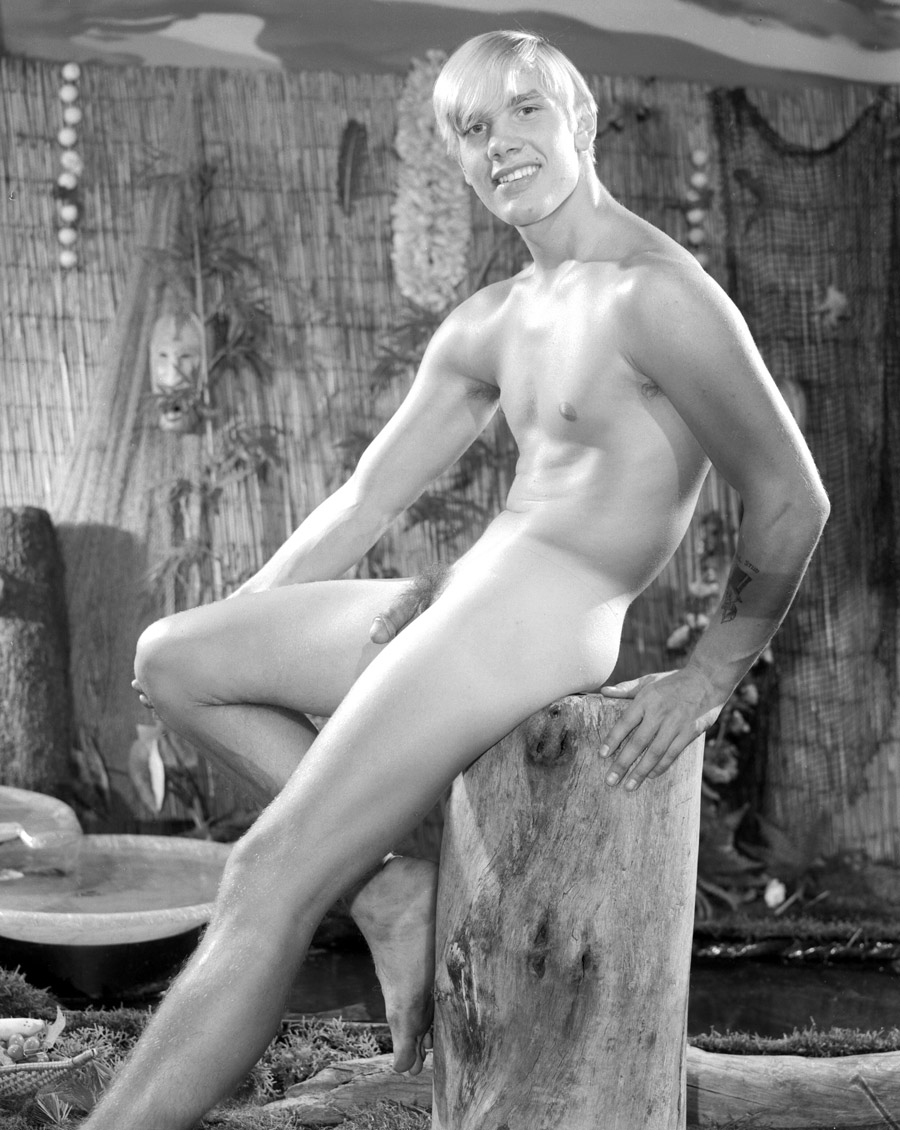
George Dureau (American, 1930-2014)
'Untitled' Nd


George Dureau (American, 1930-2014)
Untitled
Nd
Vintage silver gelatin print


Celebrations of the Human Spirit

~ Honesty

~ ~ Integrity

~ ~ ~ Dignity

~ ~ ~ ~ Vulnerability

~ ~ ~ ~ ~ Respect

~ ~ ~ ~ ~ ~ Love

~ ~ ~ ~ ~ ~ ~ Friendship

~ ~ ~ ~ ~ ~ ~ ~ Sexuality

~ ~ ~ ~ ~ ~ ~ ~ ~ Strength

~ ~ ~ ~ ~ ~ ~ ~ ~ ~ Beauty

~ ~ ~ ~ ~ ~ ~ ~ ~ ~ ~ Form

~ ~ ~ ~ ~ ~ ~ ~ ~ ~ ~ ~ Humanism

~ ~ ~ ~ ~ ~ ~ ~ ~ ~ ~ ~ ~ Identity

~ ~ ~ ~ ~ ~ ~ ~ ~ ~ ~ ~ ~ ~ Personality

~ ~ ~ ~ ~ ~ ~ ~ ~ ~ ~ ~ ~ ~ ~ Presence

~ ~ ~ ~ ~ ~ ~ ~ ~ ~ ~ ~ ~ ~ ~ ~ Intimacy

~ ~ ~ ~ ~ ~ ~ ~ ~ ~ ~ ~ ~ ~ ~ ~ ~ Nude

~ ~ ~ ~ ~ ~ ~ ~ ~ ~ ~ ~ ~ ~ ~ ~ ~ ~ Empathy

~ ~ ~ ~ ~ ~ ~ ~ ~ ~ ~ ~ ~ ~ ~ ~ ~ ~ ~ Revelation

~ ~ ~ ~ ~ ~ ~ ~ ~ ~ ~ ~ ~ ~ ~ ~ ~ ~ ~ ~ Spirit

~ ~ ~ ~ ~ ~ ~ ~ ~ ~ ~ ~ ~ ~ ~ ~ ~ ~ ~ ~ ~ Truth


I’ve been wanting to do a posting on the magnificent New Orleans photographer George Dureau’s work for a long while but because there are so few exhibitions of his photographs I have never had the opportunity – until now.

It’s a great pity that his work is not as recognised as that of his contemporaries, Peter Hujar and Robert Mapplethorpe. Indeed, you can still pick up an original Dureau in the secondhand art market for around $500 whereas Mapplethorpe’s photographs run into the many thousands.

His photographs are not romantic, certainly not sentimental. He was fascinated by the people he photographed, their truth. These are the stories he conceptualised, posed, lit and photographed, stories that emerged from his imagination, that revealed surprising things about his subjects.

Unlike the clinical formalism of Mapplethorpe, Dureau worked with a poetry that was always present. Indeed, there is something so eloquent and sincere about his photographs for in them the artist draws (Dureau was also a painter) the mysteries of the soul of his subjects.

Dureau’s response to the world and the photographs that emanate from that engagement are humanist in the best sense of the word, revealing his subjects in a direct way that emphasises an individual’s dignity, worth and capacity for self-realisation.

Thus, I feel his photographs are a celebration not just of the human form but more importantly, of the human spirit.

Dr Marcus Bunyan


Many thankx to Dennis Bell, Corbin Crable and the Bob Mizer Foundation for allowing me to publish the photographs in the posting. Please click on the photographs for a larger version of the image.


“I live a warm, involved humanist sort of life. There are lots of people passing through it. I have exciting experiences and learn things about people. They always go into my art. I cannot have an experience and it not go into my art.”

 
George Dureau


John H. Lawrence, HNOC emeritus director of museum programs and himself a fine-art photographer, said Dureau’s portraits reveal a tangible intimacy between photographer and subject.

“George respected the people he asked to sit for him,” said Lawrence. “I don’t say that from a knowledge, just from what the photographs show. The direct stare into the camera, it may have been at George’s direction. Even with the gaze directed in that fashion, you don’t get the kind of quality you see in these portraits unless there is a mutual respect between the photographer and the subject. There is a vibe there that is based on these two people having respect for each other as the photograph is made.”


John H. Lawrence quoted in Dave Walker. “The Intimate Eye of George Dureau,” on The Historic New Orleans Collection website, December 31, 2021 [Online] Cited 20/06/2025


This exhibition presents 25 evocative black-and-white portraits by George Dureau, capturing the resilience and vulnerability of his subjects – from athletes to marginalised individuals – against the vibrant cultural backdrop of New Orleans, where beauty and humanity converge in transformative ways.
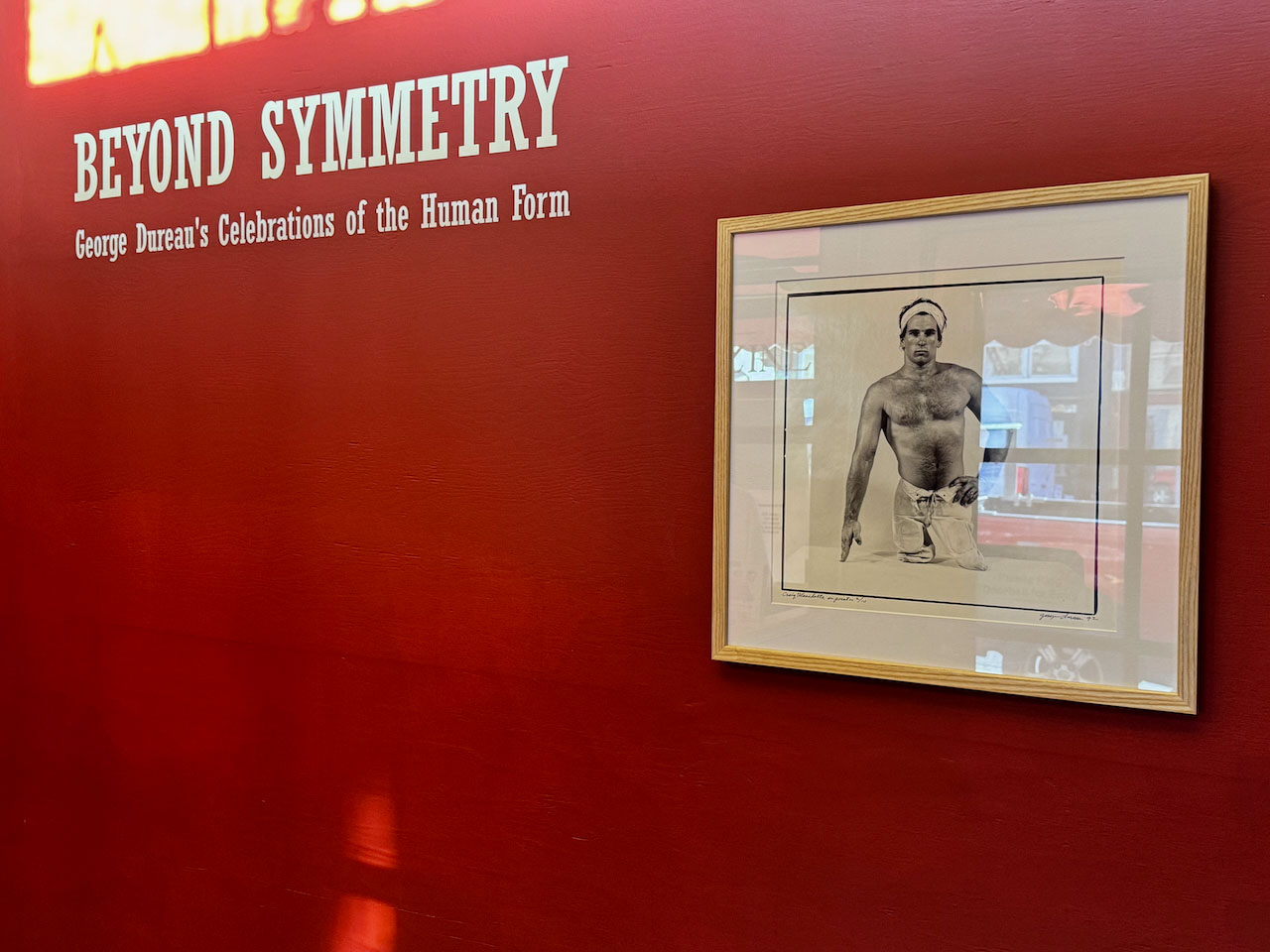
 

Installation view of the exhibition 'Beyond Symmetry: George Dureau's Celebrations of the Human Form' at the Bob Mizer Foundation, San Francisco showing Dureau's photograph 'Craig Blanchette' 1992


Installation view of the exhibition Beyond Symmetry: George Dureau’s Celebrations of the Human Form at the Bob Mizer Foundation, San Francisco showing Dureau’s photograph Craig Blanchette, 1992
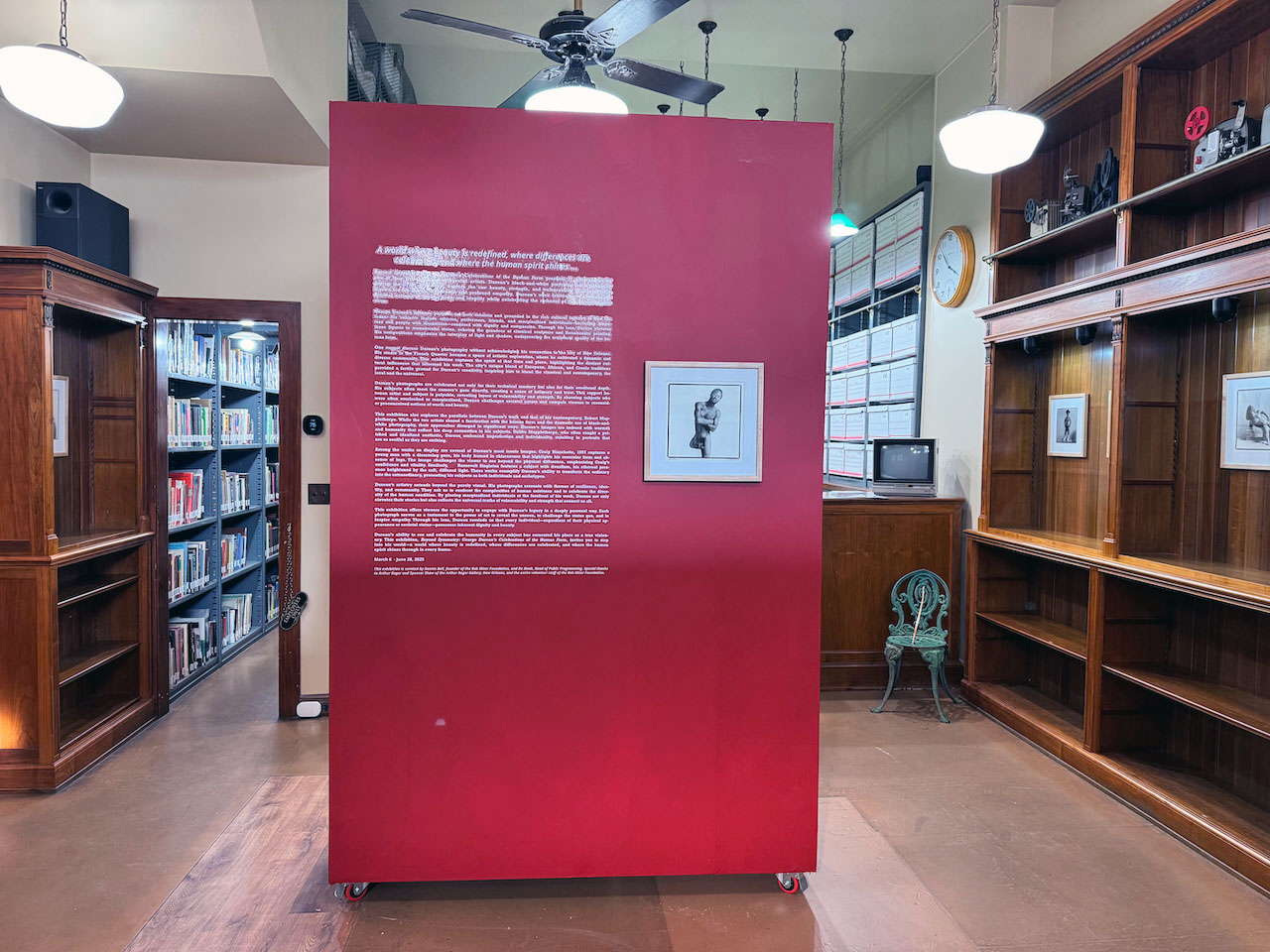
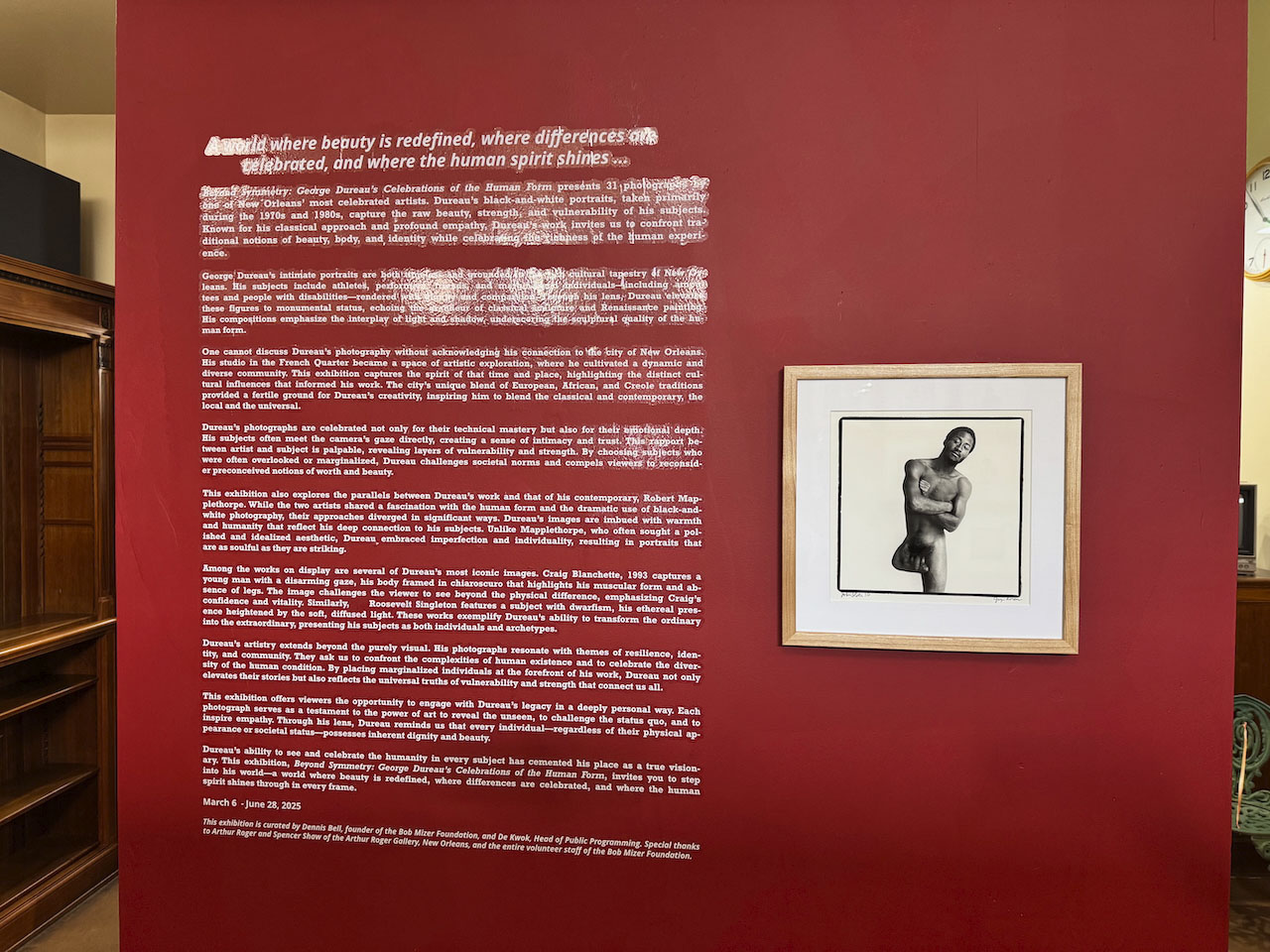
 

Installation view of the exhibition 'Beyond Symmetry: George Dureau's Celebrations of the Human Form' at the Bob Mizer Foundation, San Francisco


Installation views of the exhibition Beyond Symmetry: George Dureau’s Celebrations of the Human Form at the Bob Mizer Foundation, San Francisco showing Dureau’s photograph John Slate, Nd
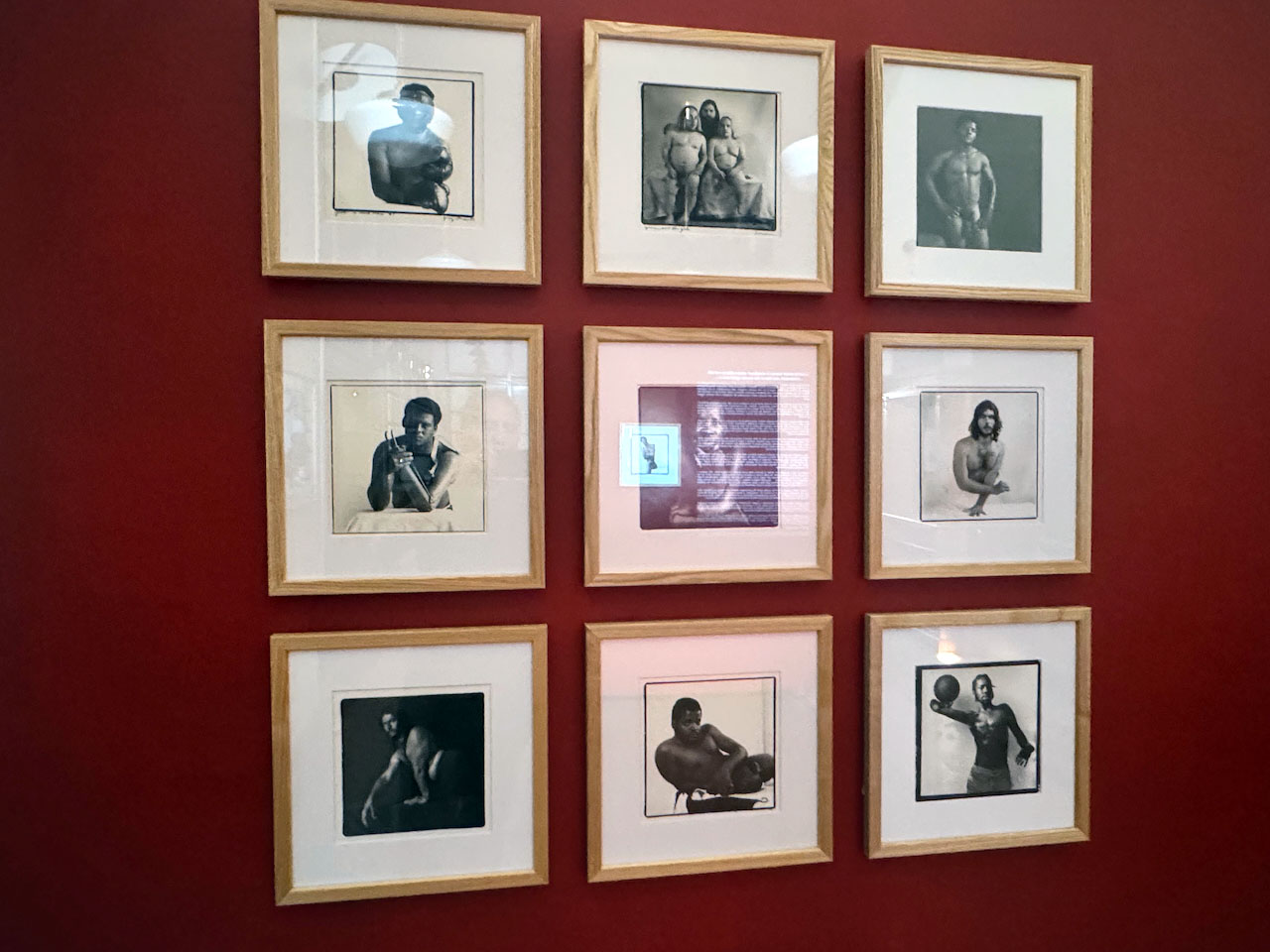
 

Installation view of the exhibition 'Beyond Symmetry: George Dureau's Celebrations of the Human Form' at the Bob Mizer Foundation, San Francisco


Installation view of the exhibition Beyond Symmetry: George Dureau’s Celebrations of the Human Form at the Bob Mizer Foundation, San Francisco
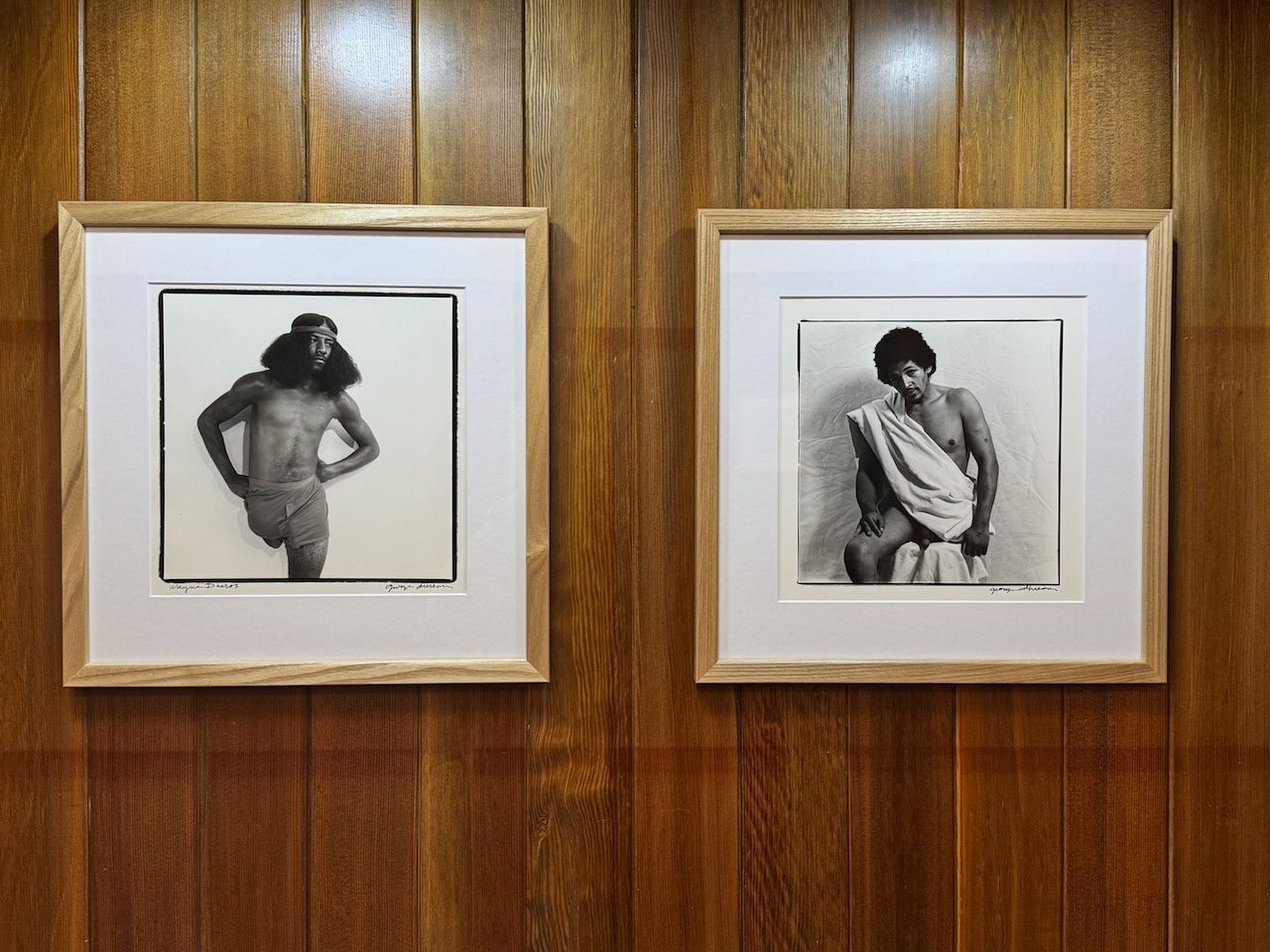
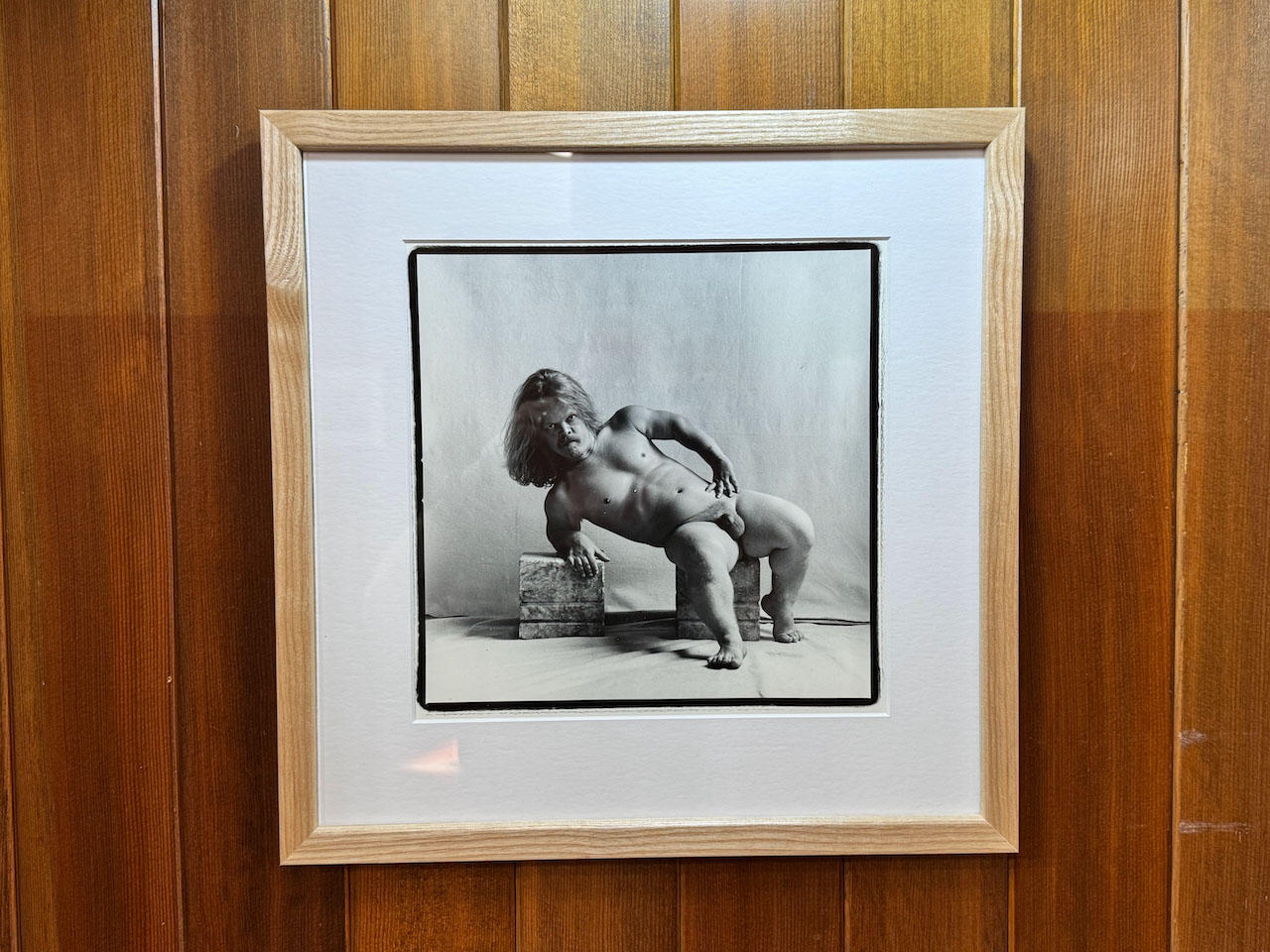
 

Installation view of the exhibition 'Beyond Symmetry: George Dureau's Celebrations of the Human Form' at the Bob Mizer Foundation, San Francisco


Installation views of the exhibition Beyond Symmetry: George Dureau’s Celebrations of the Human Form at the Bob Mizer Foundation, San Francisco


The Bob Mizer Foundation proudly presents Beyond Symmetry: George Dureau’s Celebrations of the Human Form, an exhibition showcasing 25 evocative black-and-white portraits by the acclaimed New Orleans artist George Dureau. This compelling collection captures the resilience, vulnerability, and individuality of Dureau’s subjects, spanning athletes, performers, and marginalised individuals.

Dureau’s photography transcends traditional portraiture, blending classical composition with the rich cultural spirit of New Orleans. His intimate works explore themes of identity and dignity, transforming vulnerabilities into powerful symbols of humanity’s resilience. The photographs invite viewers to reimagine beauty as inclusive, diverse, and multifaceted.

“George Dureau’s work is a testament to his unique ability to celebrate the human form while challenging societal norms,” says Den Bell, founder of the Bob Mizer Foundation. “His portraits honour the individuality of his subjects while weaving in the vibrancy of New Orleans, making his work timeless and deeply impactful.”

“Dureau photographed people with kindness and sympathy,” added Mizer Foundation’s Head of Programming, De Kwok, “It has been said that his subject matter became a member of his extended family and you can clearly see that in the way his camera lovingly captured them.”

The exhibition will be on view from March 6 to June 28, 2025, at the Bob Mizer Foundation’s Main Gallery. An opening reception will be held on March 6 from 6.00 pm – 8.30 pm, providing an opportunity to explore the works and celebrate Dureau’s extraordinary legacy.

About George Dureau

A celebrated figure in the art world, George Dureau (1930-2014) was renowned for his black-and-white photography and classical paintings. Rooted in the rich cultural heritage of New Orleans, Dureau’s art challenges conventions and highlights the resilience of the human spirit. His work has been exhibited internationally and continues to inspire audiences with its profound emotional depth and technical mastery.

Text from the Bob Mizer Foundation website
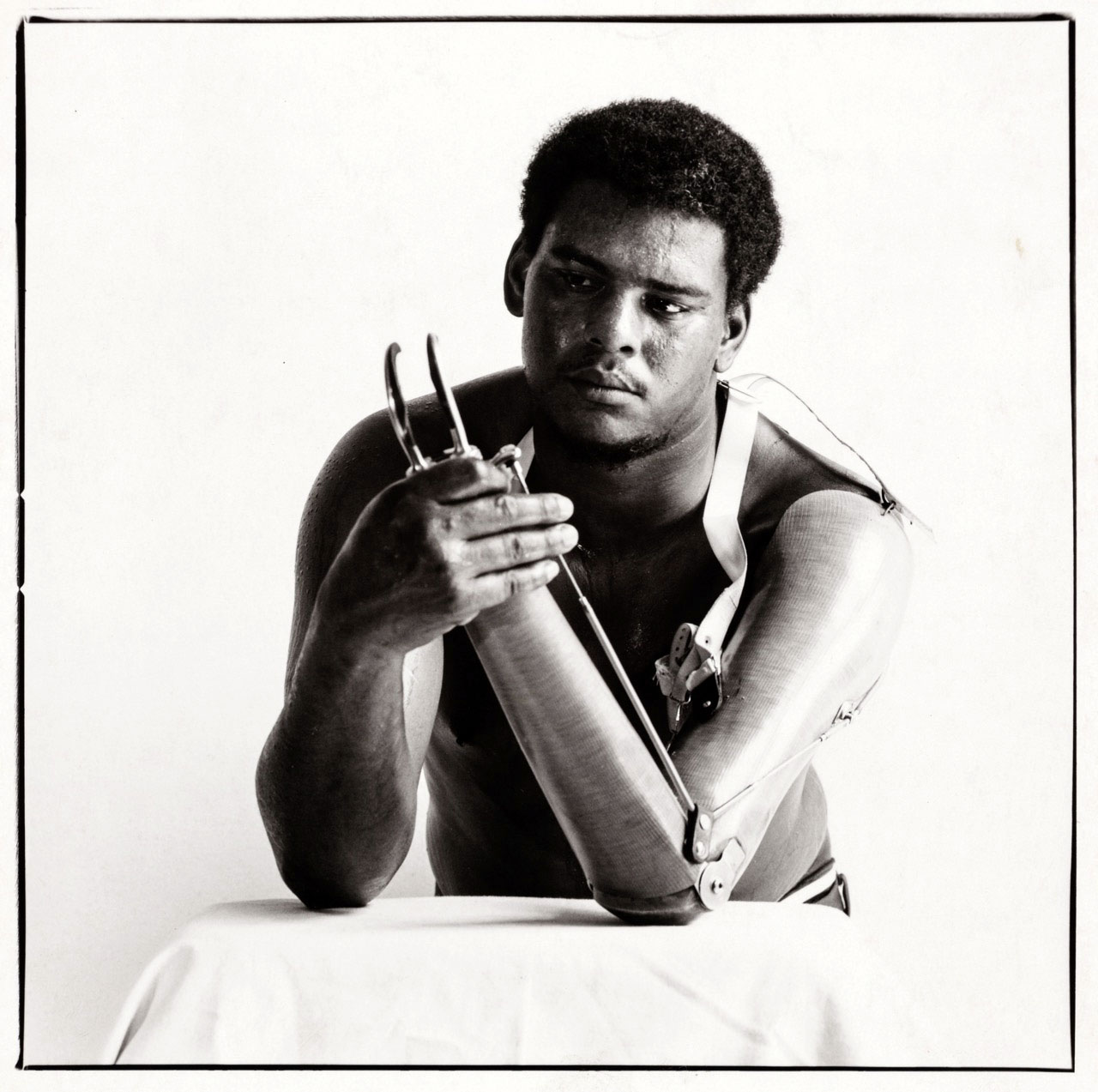
 

George Dureau (American, 1930-2014) 'Wilbert with Hook' Nd


George Dureau (American, 1930-2014)
Wilbert with Hook
Nd
Vintage silver gelatin print
20 x 16 inches


George Dureau (American, 1930-2014)
'B.J. Robinson' 1995


George Dureau (American, 1930-2014)
B.J. Robinson
1995
Vintage silver gelatin print
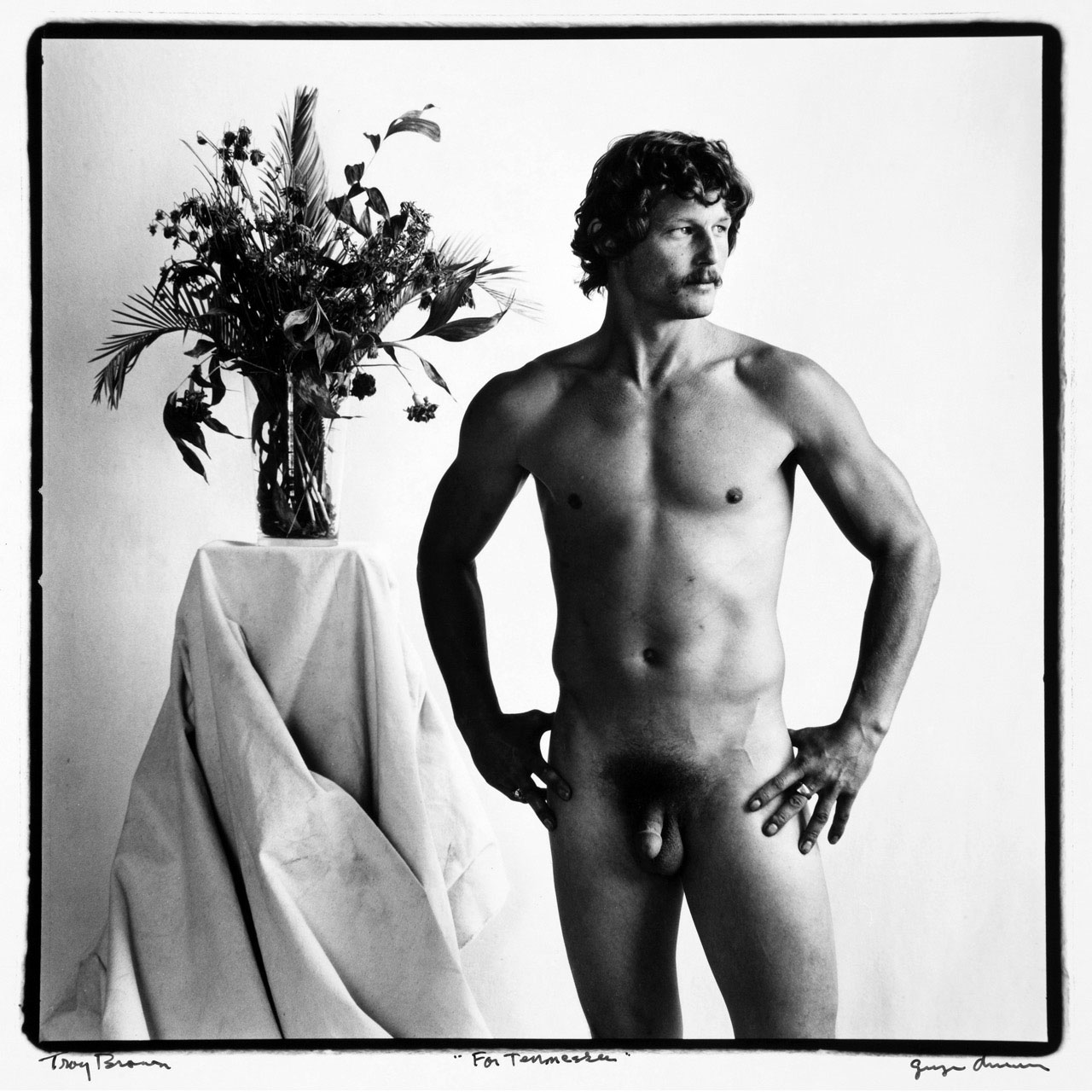
 

George Dureau (American, 1930-2014) 'Troy Brown "For Tennessee"' Nd


George Dureau (American, 1930-2014)
Troy Brown “For Tennessee”
Nd
Vintage silver gelatin print
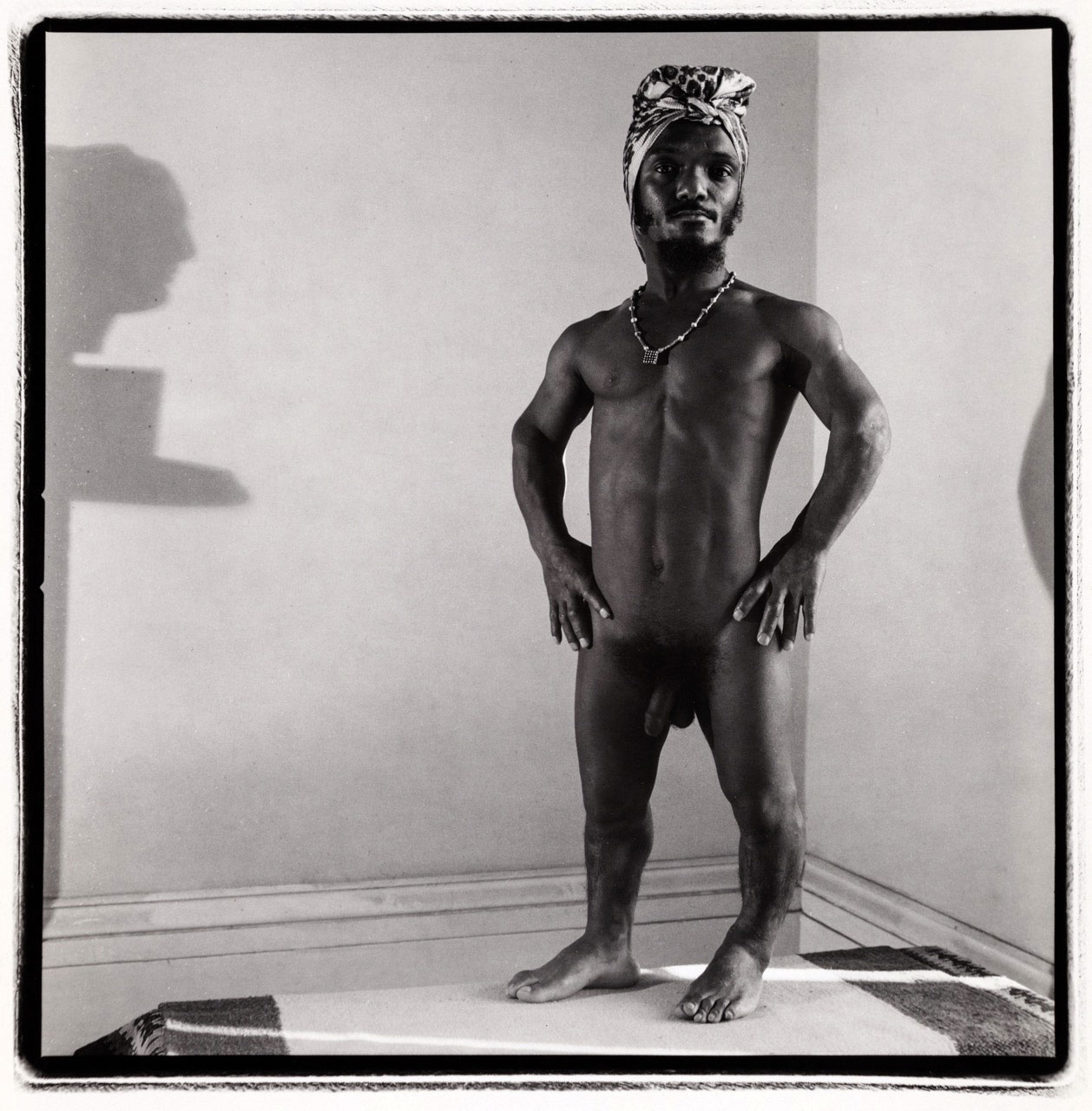
 

George Dureau (American, 1930-2014) 'Untitled (Sonny Singleton)' Nd


George Dureau (American, 1930-2014)
Untitled (Sonny Singleton)
Nd
Vintage silver gelatin print


This exhibition highlights the remarkable artistry of George Dureau through 25 compelling black-and-white portraits that showcase his unique vision. Created during the 1970s and 1980s, these photographs transcend traditional boundaries, blending classical composition with an unflinching exploration of the human experience. Dureau’s subjects – athletes, performers, friends, and individuals often marginalised by society – are elevated to iconic status through his lens.

The images reveal a profound empathy and an unshakable belief in the inherent dignity of every individual. With a studio rooted in the vibrant cultural milieu of New Orleans, Dureau captured not only the physical form but also the spirit of his subjects, transforming their vulnerabilities into striking symbols of resilience and humanity. His work redefines beauty as inclusive and multifaceted, challenging societal norms and inviting reflection on identity, strength, and community.

This exhibition Beyond Symmetry: George Dureau’s Celebrations of the Human Form presents 25 photographs by one of New Orleans’ most celebrated artists. Dureau’s black-and-white portraits, taken primarily during the 1970s and 1980s, capture the raw beauty, strength, and vulnerability of his subjects. Known for his classical approach and profound empathy, Dureau’s work invites us to confront traditional notions of beauty, body, and identity while celebrating the richness of the human experience.

George Dureau’s intimate portraits are both timeless and grounded in the rich cultural tapestry of New Orleans. His subjects include athletes, performers, friends, and marginalised individuals – including amputees and people with disabilities – rendered with dignity and compassion. Through his lens, Dureau elevates these figures to monumental status, echoing the grandeur of classical sculpture and Renaissance painting. His compositions emphasize the interplay of light and shadow, underscoring the sculptural quality of the human form.

One cannot discuss Dureau’s photography without acknowledging his connection to the city of New Orleans. His studio in the French Quarter became a space of artistic exploration, where he cultivated a dynamic and diverse community. This exhibition captures the spirit of that time and place, highlighting the distinct cultural influences that informed his work. The city’s unique blend of European, African, and Creole traditions provided a fertile ground for Dureau’s creativity, inspiring him to blend the classical and contemporary, the local and the universal.

Dureau’s photographs are celebrated not only for their technical mastery but also for their emotional depth. His subjects often meet the camera’s gaze directly, creating a sense of intimacy and trust. This rapport between artist and subject is palpable, revealing layers of vulnerability and strength. By choosing subjects who were often overlooked or marginalised, Dureau challenges societal norms and compels viewers to reconsider preconceived notions of worth and beauty.

This exhibition also explores the parallels between Dureau’s work and that of his contemporary, Robert Mapplethorpe. While the two artists shared a fascination with the human form and the dramatic use of black-and-white photography, their approaches diverged in significant ways. Dureau’s images are imbued with warmth and humanity that reflect his deep connection to his subjects. Unlike Mapplethorpe, who often sought a polished and idealised aesthetic, Dureau embraced imperfection and individuality, resulting in portraits that are as soulful as they are striking.

Among the works on display are several of Dureau’s most iconic images. Craig Blanchette, 1992 (above) captures a young man with a disarming gaze, his body framed in chiaroscuro that highlights his muscular form and absence of legs. The image challenges the viewer to see beyond the physical difference, emphasising Craig’s confidence and vitality. Similarly, Roosevelt Singleton features a subject with dwarfism, his ethereal presence heightened by the soft, diffused light. These works exemplify Dureau’s ability to transform the ordinary into the extraordinary, presenting his subjects as both individuals and archetypes.

Dureau’s artistry extends beyond the purely visual. His photographs resonate with themes of resilience, identity, and community. They ask us to confront the complexities of human existence and to celebrate the diversity of the human condition. By placing marginalised individuals at the forefront of his work, Dureau not only elevates their stories but also reflects the universal truths of vulnerability and strength that connect us all.

This exhibition offers viewers the opportunity to engage with Dureau’s legacy in a deeply personal way. Each photograph serves as a testament to the power of art to reveal the unseen, to challenge the status quo, and to inspire empathy. Through his lens, Dureau reminds us that every individual – regardless of their physical appearance or societal status – possesses inherent dignity and beauty.

The 31 photographs selected for this show represent the breadth and depth of Dureau’s oeuvre. From tender portraits of friends to bold explorations of the male nude, the images on display capture the full spectrum of his artistic vision. Each piece is a study in contrasts: light and shadow, strength and vulnerability, individuality and universality. Together, they form a cohesive narrative that celebrates the complexity of the human experience.

George Dureau’s work has left an indelible mark on the world of photography and beyond. His ability to see and celebrate the humanity in every subject has cemented his place as a true visionary. This exhibition, Beyond Symmetry: George Dureau’s Celebrations of the Human Form, invites you to step into his world – a world where beauty is redefined, where differences are celebrated, and where the human spirit shines through in every frame.

As you explore these images, consider the stories they tell and the questions they pose. How do we define beauty? What does it mean to see and be seen? And how can art challenge us to look beyond the surface and connect with the essence of another human being? In celebrating the life and work of George Dureau, we celebrate the power of art to transform, to inspire, and to unite us all.

Press release from the Bob Mizer Foundation
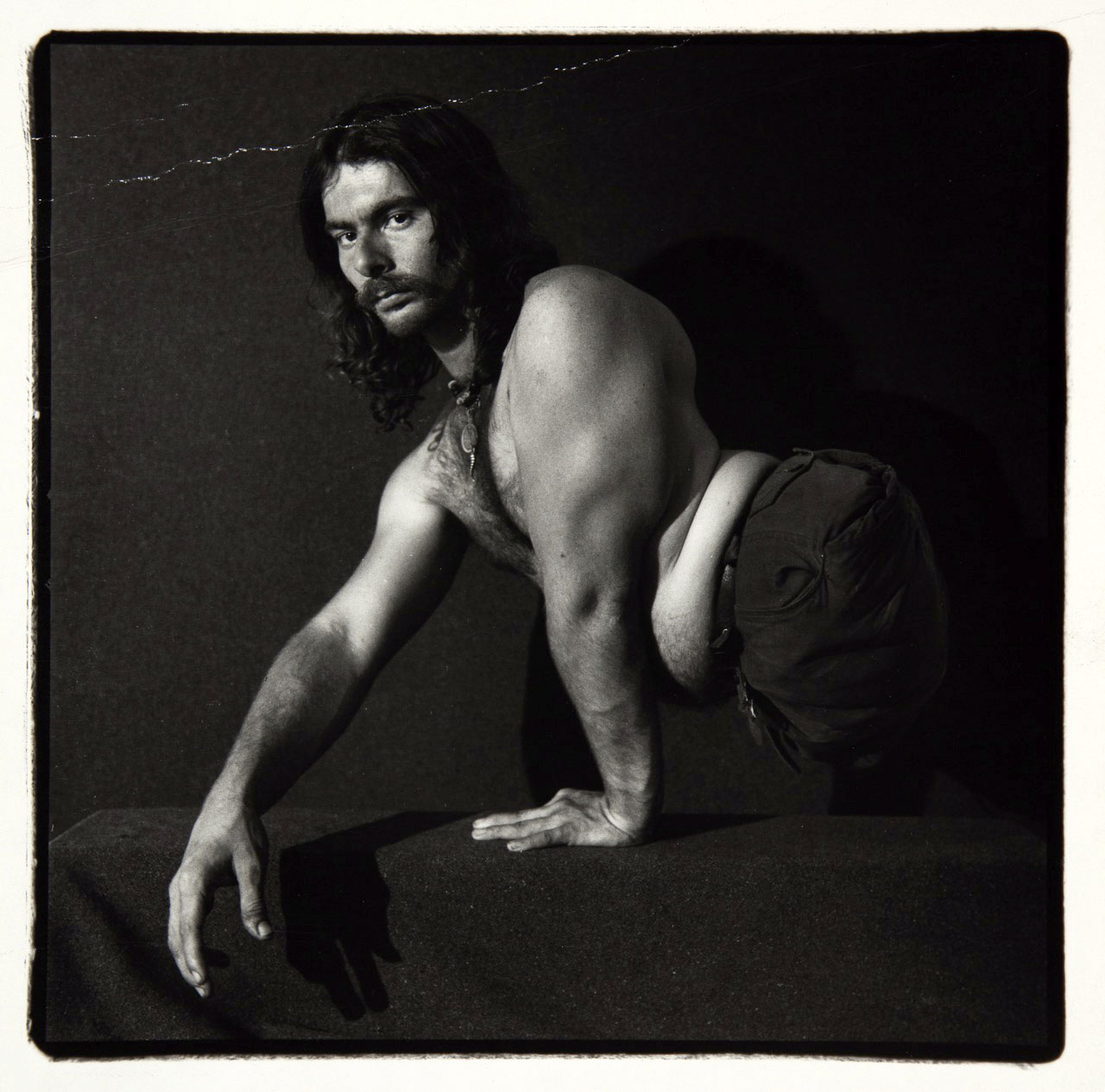
 

George Dureau (American, 1930-2014) 'B.J. Robinson' Nd


George Dureau (American, 1930-2014)
B.J. Robinson
Nd
Vintage silver gelatin print
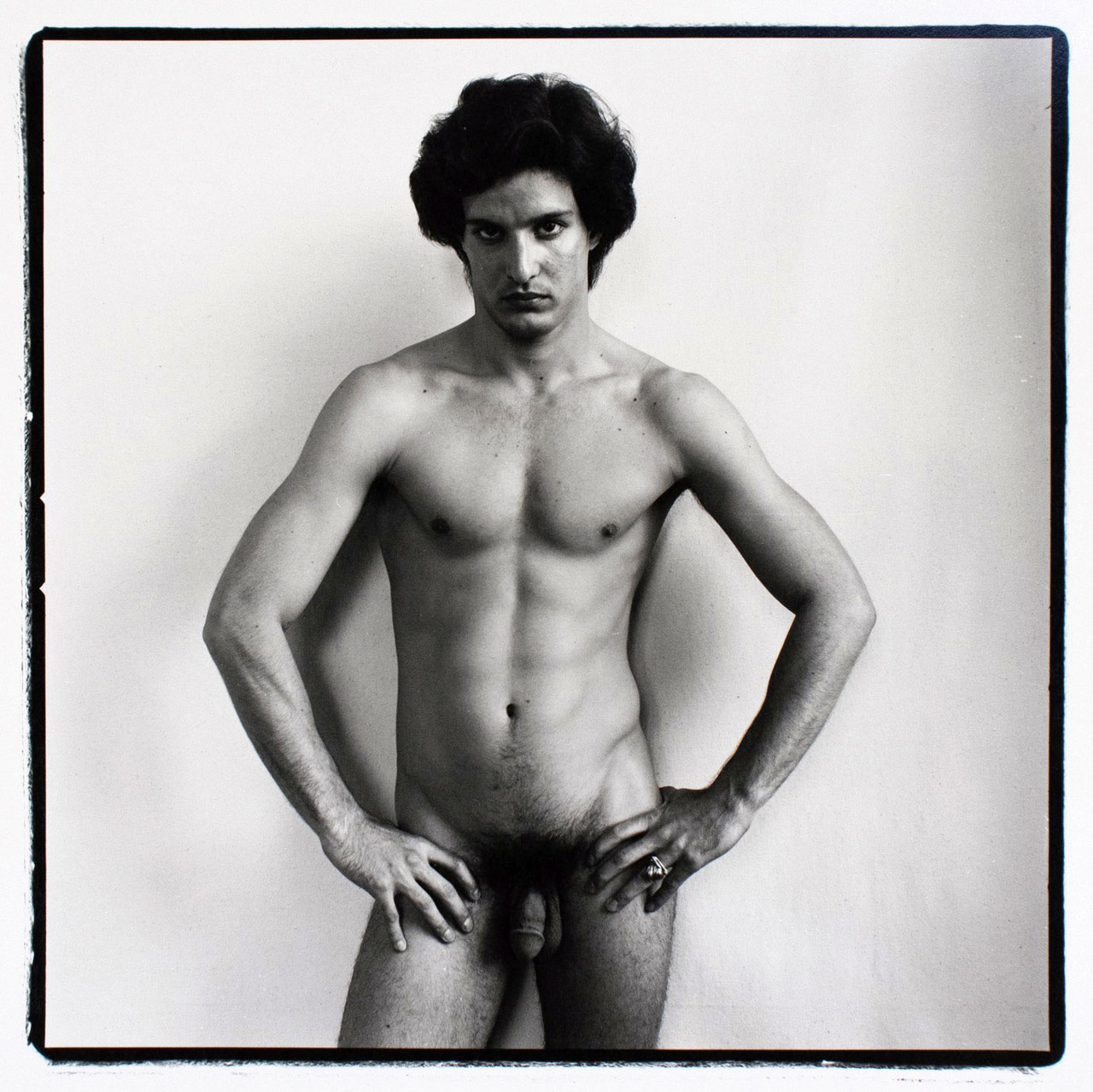
  

George Dureau (American, 1930-2014)
'Untitled' Nd


George Dureau (American, 1930-2014)
Untitled
Nd
Vintage silver gelatin print


George Dureau (American, 1930-2014)
'Untitled (Bob Lang)' Nd


George Dureau (American, 1930-2014)
Untitled (Bob Lang)
Nd
Vintage silver gelatin print


Bob Mizer Foundation
920 Larkin St., San Francisco, CA

Opening hours:
Tues – Sat 12 – 6pm

Bob Mizer Foundation website

LIKE ART BLART ON FACEBOOK

Back to top

Exhibition: ‘Bob Mizer and Tom of Finland’ at The Museum Of Contemporary Art, Los Angeles (MOCA)

Exhibition dates: 2nd November 2013 – 26th January 2014
MOCA Pacific Design Center

PLEASE NOTE: THIS POSTING CONTAINS ART WORK OF MALE NUDITY AND EROTIC IMAGES OF GAY MALE SEX – IF YOU DO NOT LIKE PLEASE DO NOT LOOK, FAIR WARNING HAS BEEN GIVEN


Bob Mizer (American, 1922-1992) 'Physique Pictorial Volume 16 Number 4, February 1968' 1968


Bob Mizer (American, 1922-1992)
Physique Pictorial Volume 16 Number 4, February 1968
1968
Publication
Printed with permission of Bob Mizer Foundation, Inc .


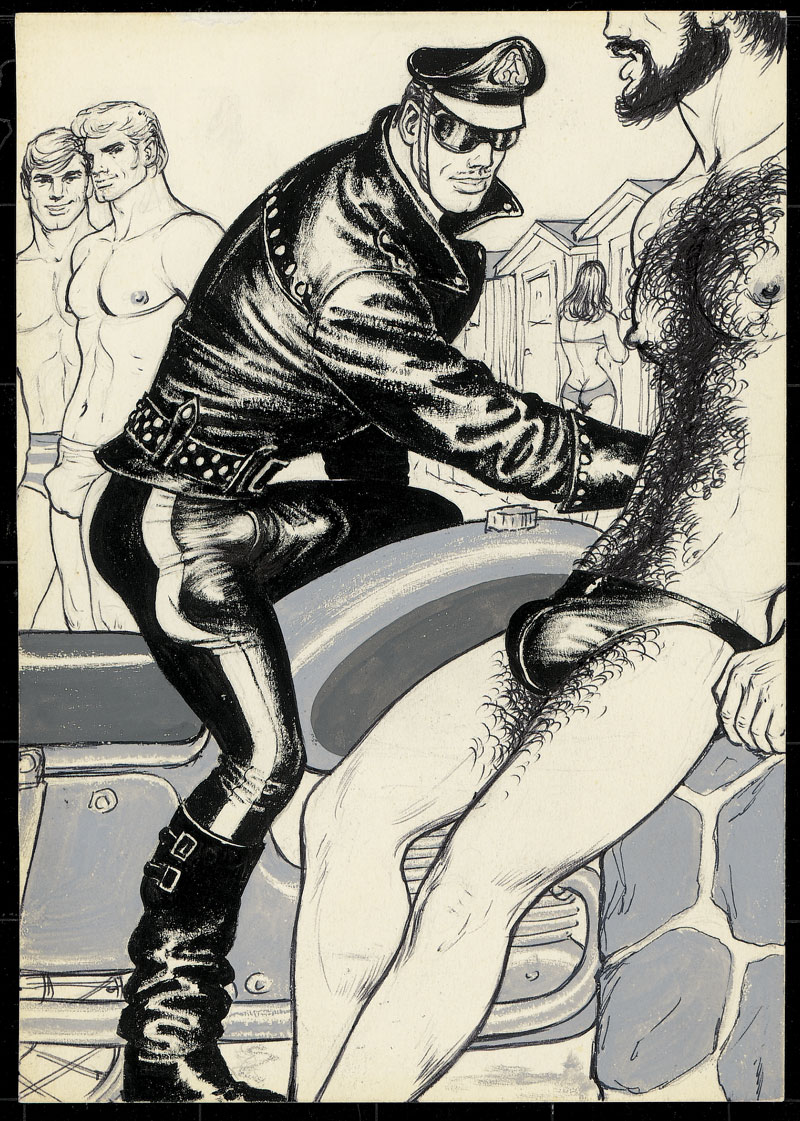
What a fantastic pairing in this exhibition and in their relationship in real life. We must remember that Tom of Finland was a ground-breaking artist, one of the very first to picture masculine gay men, “robbing straight homophobic culture of its most virile and masculine archetypes (bikers, hoodlums, lumberjacks, cops, cowboys and sailors) and recasting them – through deft skill and fantastic imagination – as unapologetic, self-aware and boastfully proud enthusiasts of gay sex.”

He would have only just been in his twenties when he started drawing men in the early 1940s, inspired by the soldiers and uniforms he saw around him from the Second World War. With no outward gay culture in Finland, let alone in America until the late 1960s, just imagine being an artist producing this kind of erotic imagery at that time. To go on to be the seminal figure in the creation of gay leather culture… what an impact this artist had on gay and popular culture. Of course, as tastes were liberalised in the era of free love, Stonewall and after, the muscles of his hunks became bigger, the size of their endowments larger and the actions portrayed became more open and transparent (as can be seen from Untitled (From Beach Boy 2 story), 1971, below).

During my PhD research I visited the One Institute/International Gay and Lesbian Archives Collection, University of Southern California, Los Angeles, to investigate the cross-over between physique magazines and early gay pornography magazines of the 1960s to early 1970s. I was interested to see whether the muscular mesomorphic bodies of the physique magazines crossed straight over into the first gay pornography magazines. To my surprise, the answer was that they did not.

After the American Supreme Court ruled on obscenity laws in the late 1960s, the first gay pornography magazines started appearing. The earliest gay porn magazine in the One Institute / IGLA collection, Action Line. No.1. San Francisco: Mark Vaughn Associates. 1969, features mostly smooth but natural bodies, not as built as in physique magazines, with nude young men with full erections lying next too each other touching. There is no sex, no sucking or fucking. Only a year later, in 1970, the story is different. In Album 1501: A Study of Sexual Activity Between Males. Los Angeles: Greyhuff Publishing, 1970 their is sexual intercourse pictured between men in an openly available publication for the first time.

Bodies in this magazine are smooth, young toned men, much as in the early photographs of George Platt Lynes (such as those of Charles ‘Tex’ Smutney, Charles ‘Buddy’ Stanley, and Bradbury Ball). They are also similar to the bodies in the photographs that Lynes submitted to the Zurich published homosexual magazine Der Kries after he found out that he had cancer, during the last years of his life (under the pseudonym Roberto Rolf late 1940s – early 1950s). The participants in Album 1501 perform sex on each other in a lounge room lit by strong lights (shadows on walls). The black and white photographs, well shot, feature in a magazine that is about 5″ wide and 10″ high, well laid out and printed. The magazine is a thin volume and features just the two models in one sex scene of them undressing each other and then having sex. One man wears a Pepsi-Cola T-shirt at first and he also has tattoos one of which says ‘Cheri’. The photographs almost have a private feel to them.

In their introduction the publishers disclaim any agreement with the content of the magazine and are only publishing it for the freedom of everybody to study the material in the privacy of their own homes. In other words male to male sex is a natural phenomenon and the publication is educational. This was a common ploy in early nudist and pornographic publications (along with classical themes) that was used to justify the content – to claim that the material was for private educational purposes only:

Introduction.

“Publishers of material dealing frankly with sexual activity have suffered greatly in the past because of society’s anxiety over the existence and propagation of such material. But the real issue is why should such material dealing with sexual activity be any less valid or acceptable than material dealing with other facets of human behaviour? …
This book was produced so that all interested adults may have an opportunity to acquire it for their own private interests in matters relating to sex …
Our publication of this book is not to be construed that we agree with, condone or encourage any of the behaviour depicted herein. However, sexual activity between males is a fact of life and interested adults should not be denied an opportunity to study this, or any other, facet of human behaviour.”


The Publishers


It is interesting to note the progression from physique magazines and models in posing pouches in 1966-68 (such as the photographs of Bob Mizer featured in this posting), then to full erection and stories of anal penetration in Action Line in 1969, to full on photographs of gay sex in this magazine in 1970. Bodies are all smooth, quite solid, toned natural physiques, not as ‘built’ as in earlier physique magazines, but still featuring younger smooth men and not older heavier set men. It was not until the development of the clone, leatherman and magazines such a Colt from Colt Studios that Tom of Finland’s muscular mesomorphic leatherman took hold in the popular gay imagination.

Even in the mid 1970’s companies such as Colt Studios, which has built a reputation for photographing hunky, very well built masculine men, used classical themes in their photography of muscular young men. Most of the early Colt magazines have photographs of naked young men that are accompanied by photographs and illustrations based on classical themes. In their early magazines quite a large proportion of the bodies were hirsute or had moustaches as was popular with the ‘clone’ image at the time. Later Colt models of the early 1980’s tend towards the buff, tanned, stereotypical muscular mesomorph in even greater numbers. Sometimes sexual acts are portrayed in Colt magazines but mainly they are not. It is the “look” of the body and the face that the viewers desiring gaze is directed towards – not the sexual act itself.

Photographers such as Bob Mizer from Athletic Model Guild produced more openly homoerotic images. In his work from the 1970’s full erections are not prevalent but semi-erect penises do feature, as do revealing “moon” shots from the rear focusing on the arsehole as a site for male libidinal desires. A less closeted, more open expression of homosexual desire can be seen in the photographs of the male body in the 1970’s.

Dr Marcus Bunyan


Many thankx to The Museum Of Contemporary Art (MOCA) for allowing me to publish the art work in the posting. Please click on the photographs for a larger version of the image.


Tom of Finland (Touko Laaksonen, Finnish, 1920-1991) 'Untitled' 1962


Tom of Finland (Touko Laaksonen, Finnish, 1920-1991)
Untitled
1962
Graphite on paper
12.00″ x 9.50″
ToFF Cat. #62.27, Collection of Volker Morlock
© 1962 Tom of Finland Foundation


Bob Mizer (American, 1922-1992) 'Physique Pictorial Volume 11 Number 4, May 1962' 1962


Bob Mizer (American, 1922-1992)
Physique Pictorial Volume 11 Number 4, May 1962
1962
Publication
Printed with permission of Bob Mizer Foundation, Inc .


Bob Mizer (American, 1922-1992) 'Physique Pictorial Volume 7 Number 1, 1957' 1957


Bob Mizer (American, 1922-1992)
Physique Pictorial Volume 7 Number 1, 1957
1957
Publication
Printed with permission of Bob Mizer Foundation, Inc .


Bob Mizer (American, 1922-1992) 'Physique Pictorial Volume 10 Number 4, April 1961' 1961


Bob Mizer (American, 1922-1992)
Physique Pictorial Volume 10 Number 4, April 1961
1961
Publication
Printed with permission of Bob Mizer Foundation, Inc .


Tom of Finland (Touko Laaksonen, Finnish, 1920-1991) 'Untitled' (1 of 4 from 'Circus Life' series) 1961


Tom of Finland (Touko Laaksonen, Finnish, 1920-1991)
Untitled (1 of 4 from Circus Life series)
1961
Graphite on paper
12.25″ x 9.75″
Bob Mizer/AMG Collection, Tom of Finland Foundation Permanent Collection #61.11
© 1961 Tom of Finland Foundation


Bob Mizer (American, 1922-1992) 'Jim Horn, Los Angeles' c. 1966


Bob Mizer (American, 1922-1992)
Jim Horn, Los Angeles
c. 1966
Vintage large-format black and white negative
Silver gelatin print
8 x 10 inches
Printed with permission of Bob Mizer Foundation, Inc .


Bob Mizer (American, 1922-1992) 'Untitled [Barry Maurer, Hand on Gun], Los Angeles' c. 1961


Bob Mizer (American, 1922-1992)
Untitled [Barry Maurer, Hand on Gun], Los Angeles
c. 1961
Vintage large-format black and white negative
Silver gelatin print
8 x 10 inches
Printed with permission of Bob Mizer Foundation, Inc .


Bob Mizer (American, 1922-1992) 'Untitled [Larry Lamb, with Tumbleweed], Los Angeles' c. 1959


Bob Mizer (American, 1922-1992)
Untitled [Larry Lamb, with Tumbleweed], Los Angeles
c. 1959
Vintage large-format black and white negative
Silver gelatin print
8 x 10 inches
Printed with permission of Bob Mizer Foundation, Inc .


Tom of Finland (Touko Laaksonen, Finnish, 1920-1991) 'Untitled' 1968


Tom of Finland (Touko Laaksonen, Finnish, 1920-1991)
Untitled
1968
Graphite on paper
12.94″ x 9.38″
ToFF Cat. #68.06, Collection of Volker Morlock
© 1968 Tom of Finland Foundation


Tom of Finland (Touko Laaksonen, Finnish, 1920-1991) 'Youthful Innocence' 1969


Tom of Finland (Touko Laaksonen, Finnish, 1920-1991)
Youthful Innocence
1969
The New Biker Stud – Bob Mizer title
Graphite on paper
11.75″ x 8.50″
ToFF Cat. #69.02, Collection of Volker Morlock
© 1969 Tom of Finland Foundation


Tom of Finland (Touko Laaksonen, Finnish, 1920-1991) 'Untitled' (No.1 from 'Cyclist and the Farm Boy' series) 1973


Tom of Finland (Touko Laaksonen, Finnish, 1920-1991)
Untitled (No.1 from Cyclist and the Farm Boy series)
1973
Graphite on paper
11″ x 8″
Bob Mizer/AMG Collection, Tom of Finland Foundation Permanent Collection #73.10
© 1973 Tom of Finland Foundation


Bob Mizer (American, 1922-1992) 'Untitled [Ray Hornsby, Motorcycle], Los Angeles' c. 1957


Bob Mizer (American, 1922-1992)
Untitled [Ray Hornsby, Motorcycle], Los Angeles
c. 1957
Vintage large-format black and white negative
Silver gelatin print
8 x 10 inches
Printed with permission of Bob Mizer Foundation, Inc .


“To my mind, there is no clearer representation of Mizer’s almost manic attempts to condense the joyful, celebratory chaos of his daily photo shoots down to their most selectively stupendous moments than his catalogue boards.” ~ artist and exhibition co-curator Richard Hawkins


The Museum of Contemporary Art, Los Angeles (MOCA), is proud to present Bob Mizer and Tom of the Finland, the first American museum exhibition devoted to the art of Bob Mizer (1922-1992) and Touko Laaksonen, aka “Tom of Finland” (1920-1991), two of the most significant figures of twentieth century erotic art and forefathers of an emergent post-war gay culture. The exhibition features a selection of Tom of Finland’s masterful drawings and collages, alongside Mizer’s rarely seen photo-collage “catalogue boards” and films, as well as a comprehensive collection of his groundbreaking magazine Physique Pictorial, where drawings by Tom were first published in 1957. Organised by MOCA Curator Bennett Simpson and guest co-curator Richard Hawkins, the exhibition is presented with the full collaboration of the Bob Mizer Foundation, El Cerrito, and the Tom of Finland Foundation, Los Angeles.

Tom of Finland is the creator of some of the most iconic and readily recognisable imagery of post-war gay culture. He produced thousands of images beginning in the 1940s, robbing straight homophobic culture of its most virile and masculine archetypes (bikers, hoodlums, lumberjacks, cops, cowboys and sailors) and recasting them – through deft skill and fantastic imagination – as unapologetic, self-aware and boastfully proud enthusiasts of gay sex. His most innovative achievement though, worked out in fastidious renderings of gear, props, settings and power relations inherent therein, was to create the depictions that would eventually become the foundation of an emerging gay leather culture. Tom imagined the leather scene by drawing it; real men were inspired by it … and suited themselves up.

Bob Mizer began photographing as early as 1942 but, unlike many of his contemporaries in the subculture of illicit physique nudes, Mizer took the Hollywood star-system approach and founded the Athletic Model Guild in 1945, a film and photo studio specialising in handsome natural-bodied (as opposed to exclusively musclebound, the norm of the day) boy-next-door talent. In his myriad satirical prison dramas, sci-fi flix, domesticated bachelor scenarios and elegantly captivating studio sessions, Mizer photographed and filmed over 10,000 models at a rough estimate of 60 photos a day, seven days a week for almost 50 years. Mizer always presented a fresh-faced and free, unashamed and gregarious, totally natural and light-hearted approach to male nudity and intimate physical contact between men. For these groundbreaking perspectives in eroticised representation alone, Mizer ranks with Alfred Kinsey at the forefront of the sexual revolution.

Though Laaksonen did not move to Los Angeles until the 1970s, he had long known of Mizer and the photographer’s work through Physique Pictorial, the house publication and sales tool for Athletic Model Guild. It was to this magazine that the artist first sent his drawings and it was Mizer, finding the artworks remarkable and seeking to promote them on the magazine’s cover, but finding the artist’s Finnish name too difficult for his clientele, who is responsible for the now famous “Tom of Finland” pseudonym.

By the time the gay liberation movement swept through the United States in the late 1960s, both Tom of Finland and Bob Mizer were already well-known and widely celebrated as veritable pioneers of gay art. Decades before Stonewall and the raid on the Black Cat these evocative and lusty representations of masculine desire and joyful, eager sex between men proliferated and were disseminated worldwide at a time when the closet was still very much the norm – there was no such thing as a gay community. If these artists were not ahead of their time, they might just have foreseen and even invented a time.

Spanning five decades, the exhibition seeks a wider appreciation for Tom of Finland and Bob Mizer’s work, considering their aesthetic influence on generations of artists, both gay and straight, among them, Kenneth Anger, Rainer Werner Fassbinder, David Hockney, G.B. Jones, Mike Kelley, Robert Mapplethorpe, Henrik Olesen, Jack Pierson, John Waters, and Andy Warhol. The exhibition also acknowledges the profound cultural and social impact both artists have made, especially in providing open, powerful imagery for a community of desires at a time when it was still very much criminal. Presenting the broader historical context and key aspects of their shared interests and working relationship, as well as more in-depth solo rooms dedicated to each artist, the exhibition establishes the art historical importance of the staggering work of these legendary figures.

In addition to approximately 75 finished and preparatory drawings by Tom of Finland spanning 1947-1991, the exhibition includes a selection of Tom’s never before exhibited scrapbook collages, and examples of his serialised graphic novels, including the legendary leatherman Kake, as well as a selection of Mizer’s “catalogue boards,” AMG films, and a complete set of Physique Pictorial magazine. An accompanying publication includes texts by the exhibition co-curators and a selection of images.

Press release from the MOCA website


Bob Mizer (American, 1922-1992) 'Untitled [Ray Hornsby, with Skull Staff], Los Angeles' c. 1957


Bob Mizer (American, 1922-1992)
Untitled [Ray Hornsby, with Skull Staff], Los Angeles
c. 1957
Vintage large-format black and white negative
Silver gelatin print
8 x 10 inches
Printed with permission of Bob Mizer Foundation, Inc .


Bob Mizer (American, 1922-1992) 'Untitled [Ernie Rabb, Pointed Pistol], Los Angeles' c. 1957


Bob Mizer (American, 1922-1992)
Untitled [Ernie Rabb, Pointed Pistol], Los Angeles
c. 1957
Vintage large-format black and white negative
Silver gelatin print
8 x 10 inches
Printed with permission of Bob Mizer Foundation, Inc .


Tom of Finland (Touko Laaksonen, Finnish, 1920-1991) 'Untitled' (From 'Beach Boy 1' story) 1971


Tom of Finland (Touko Laaksonen, Finnish, 1920-1991)
Untitled (From Beach Boy 1 story)
1971
Pen and ink, gouache on paper
8.25″ x 5.75″
COQ International Collection, Tom of Finland Foundation Permanent Collection #71.24
© 1971 Tom of Finland Foundation


Tom of Finland (Touko Laaksonen, Finnish, 1920-1991) 'Untitled' (From 'Jungle Seafood' story) 1972


Tom of Finland (Touko Laaksonen, Finnish, 1920-1991)
Untitled (From Jungle Seafood story)
1972
Pen and ink, gouache on paper
8.63″ x 6.94″
Tom of Finland Foundation Permanent Collection #72.41
© 1972 Tom of Finland Foundation


Bob Mizer (American, 1922-1992) 'Untitled [Larry Lamb, Profile with Chains], Los Angeles' c. 1959


Bob Mizer (American, 1922-1992)
Untitled [Larry Lamb, Profile with Chains], Los Angeles
c. 1959
Vintage large-format black and white negative
Silver gelatin print
8 x 10 inches
Printed with permission of Bob Mizer Foundation, Inc .


Bob Mizer (American, 1922-1992) 'Untitled [Dennis Schreffer, Wand Balance], Los Angeles' c. 1957


Bob Mizer (American, 1922-1992)
Untitled [Dennis Schreffer, Wand Balance], Los Angeles
c. 1957
Vintage large-format black and white negative
Silver gelatin print
8 x 10 inches
Printed with permission of Bob Mizer Foundation, Inc .


Bob Mizer (American, 1922-1992) 'Untitled [Dennis Schreffer with Portrait], Los Angeles' c. 1957


Bob Mizer (American, 1922-1992)
Untitled [Dennis Schreffer with Portrait], Los Angeles
c. 1957
Vintage large-format black and white negative
Silver gelatin print
8 x 10 inches
Printed with permission of Bob Mizer Foundation, Inc .


Tom of Finland (Touko Laaksonen, Finnish, 1920-1991) 'Untitled' (From 'Beach Boy 2' story) 1971


Tom of Finland (Touko Laaksonen, Finnish, 1920-1991)
Untitled (From Beach Boy 2 story)
1971
Pen and ink, gouache on paper
8.25″ x 5.25″
Tom of Finland Foundation Permanent Collection #71.45
© 1971 Tom of Finland Foundation


Tom of Finland (Touko Laaksonen, Finnish, 1920-1991) 'Untitled' (From 'Beach Boy 2' story) 197


Tom of Finland (Touko Laaksonen, Finnish, 1920-1991)
Untitled (From Beach Boy 2 story)
1971
Pen and ink, gouache on paper
8.25″ x 5.25″
Tom of Finland Foundation Permanent Collection #71.58
© 1971 Tom of Finland Foundation


Bob Mizer (American, 1922-1992) 'Athletic Model Guild Catalog Board, David Elliott. [Double-sided; This side Page 1 of SW series]' c. 1965


Bob Mizer (American, 1922-1992)
Athletic Model Guild Catalog Board, David Elliott. [Double-sided; This side Page 1 of SW series]
c. 1965
Photographs mounted to matboard and mixed media
Printed with permission of Bob Mizer Foundation, Inc .
The Museum of Contemporary Art, Los Angeles
Proposed purchase with funds provided by the Photography Committee
The Bob Mizer Foundation & INVISIBLE-EXPORTS, New York


Bob Mizer (American, 1922-1992) 'Athletic Model Guild Catalog Board, David Elliott. [Double-sided; This side Page 2 of SW series]' c. 1965


Bob Mizer (American, 1922-1992)
Athletic Model Guild Catalog Board, David Elliott. [Double-sided; This side Page 2 of SW series]
c. 1965
Photographs mounted to matboard and mixed media
Printed with permission of Bob Mizer Foundation, Inc .
The Museum of Contemporary Art, Los Angeles
Proposed purchase with funds provided by the Photography Committee
The Bob Mizer Foundation & INVISIBLE-EXPORTS, New York


Bob Mizer (American, 1922-1992) 'Athletic Model Guild Catalog Board, Ernie Rabb. [Double-sided; This side Page 57 of XT series]' c. 1957


Bob Mizer (American, 1922-1992)
Athletic Model Guild Catalog Board, Ernie Rabb. [Double-sided; This side Page 57 of XT series]
c. 1957
Photographs mounted to matboard and mixed media
Printed with permission of Bob Mizer Foundation, Inc .
The Museum of Contemporary Art, Los Angeles
Proposed purchase with funds provided by the Photography Committee
The Bob Mizer Foundation & INVISIBLE-EXPORTS, New York


Bob Mizer (American, 1922-1992) 'Athletic Model Guild Catalog Board, Ernie Rabb. [Double-sided; This side Page 58 of XT series]' c. 1957


Bob Mizer (American, 1922-1992)
Athletic Model Guild Catalog Board, Ernie Rabb. [Double-sided; This side Page 58 of XT series]
c. 1957
Photographs mounted to matboard and mixed media
Printed with permission of Bob Mizer Foundation, Inc .
The Museum of Contemporary Art, Los Angeles
Proposed purchase with funds provided by the Photography Committee
The Bob Mizer Foundation & INVISIBLE-EXPORTS, New York


Tom of Finland (Touko Laaksonen, Finnish, 1920-1991) 'Untitled' (From 'Beach Boy 2' story) 1971


Tom of Finland (Touko Laaksonen, Finnish, 1920-1991)
Untitled (From Beach Boy 2 story)
1971
Pen and ink, gouache on paper
8.25″ x 5.25″
Tom of Finland Foundation Permanent Collection #71.61
© 1971 Tom of Finland Foundation


MOCA Pacific Design Center

The design center has permanently closed.

MOCA website

LIKE ART BLART ON FACEBOOK

Back to top