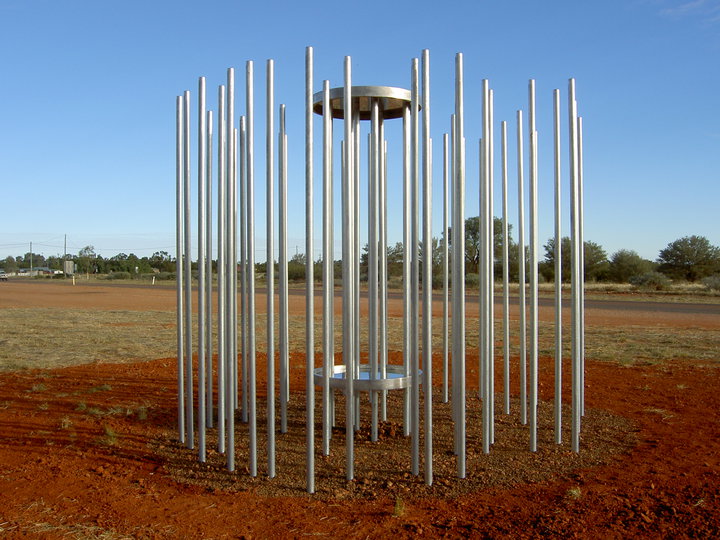
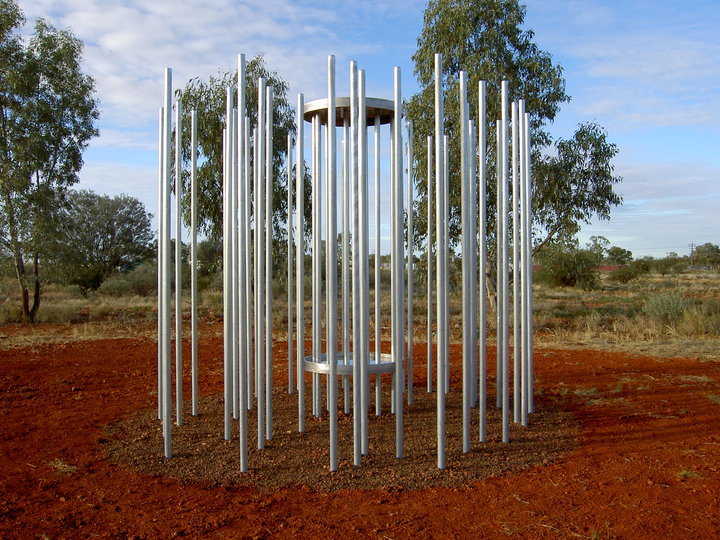
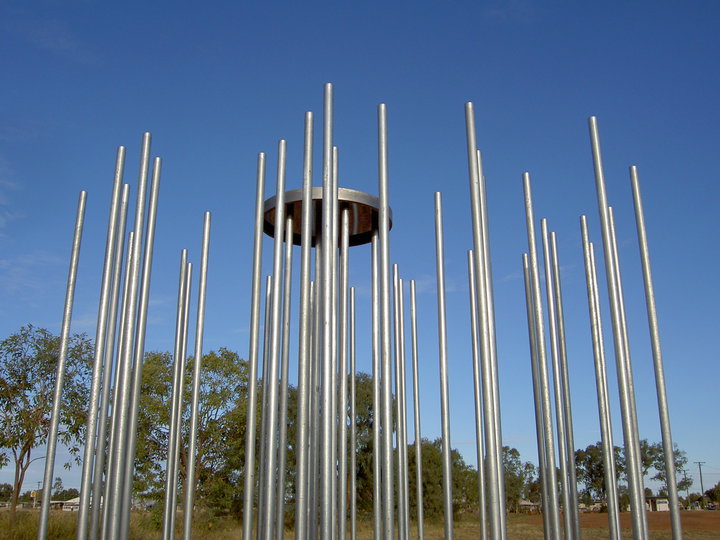
Unknown photographer Drawing Water by Frederick White 2010
Australian sculptor Fredrick White, has been commissioned to create two public sculptures in Western Queensland. The first has been completed at Thargomindah (see Google map), a town located 1014 km west of Brisbane and was commissioned by artplusplace and Thargomindah Regional Council. In a small town of 250 people this is the town’s first public sculpture.
“The town’s one claim to fame is its artesian bore. The bore, which lies 2 km out of town on the Noccundra road, was drilled in 1891 and by 1893, having drilled to a depth of 795 metres, the water came to the surface. It was then that the town successfully attempted a unique experiment. The pressure of the bore water was used drive a generator which supplied the town’s electricity. Enthusiasts have described this as Australia’s first hydro-electricity scheme. The system operated until 1951. Today the bore still provides the town’s water supply. The water reaches the surface at 84°C.”1
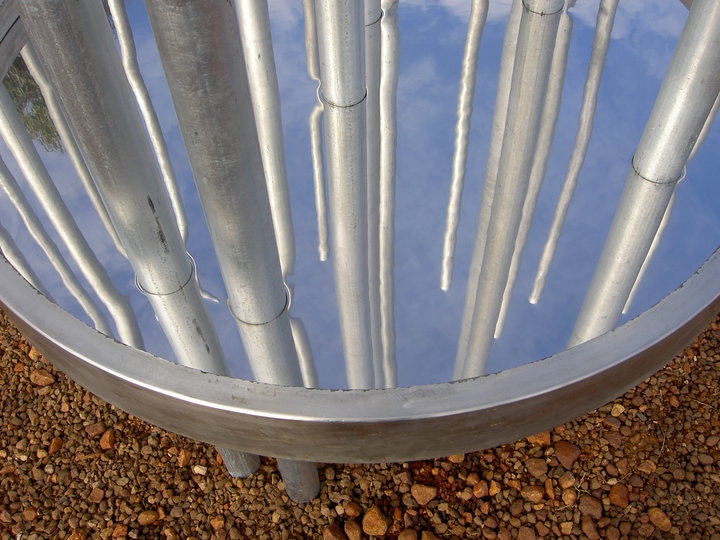
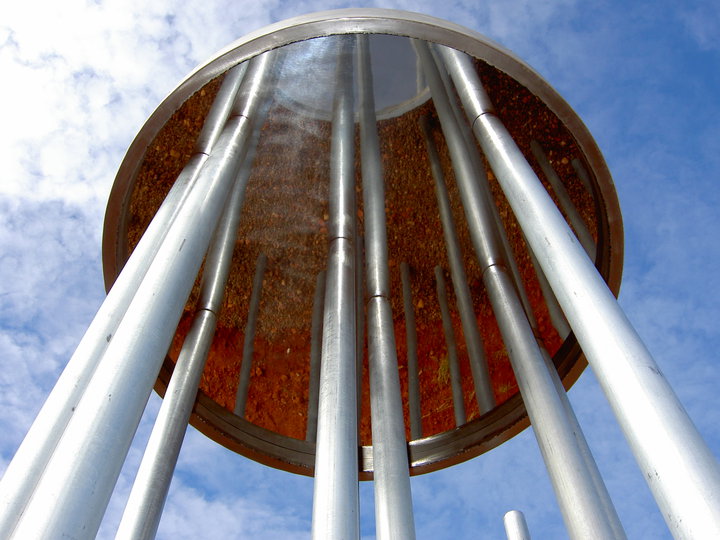
The work Drawing Water (2010) addresses the need for water in such an arid location and the numerous bores that are sunk around the town to draw water to the surface. The earth is reflected in the sky and the sky in the earth in the central polished stainless steel disks (as friend Perry observes, like a tunnel connecting earth and heaven). A forest of bore pipes surround the central platform. Of the work Fred says:
“Drawing Water speaks of our connection to the Earth, specifically the Great Artesian Basin and the bores that provide the only continuous source of water throughout much of inland Australia. The 52 galvanised poles symbolise not only our year round need for water but are also as a reminder of how extensively taped the artesian water is.”
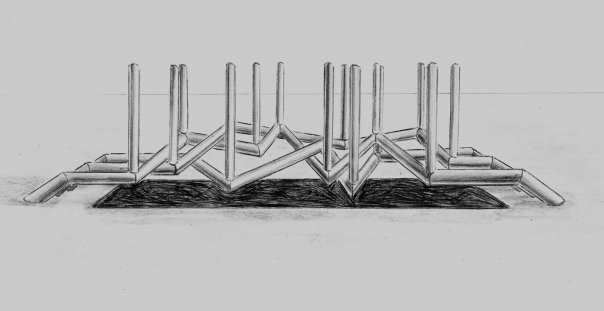
The next commission is at Blackall in Western Queensland (see Google map). A drawing of the work Lifespan (2010), which is 8 metres long, is at the bottom of the posting. Blackall already contains public sculptures by William Eicholtz (Towners Call – Edgar Towner V.C. Memorial (2009)) and Robert Bridgewater (Wool, Water and Wood (2008)).
Artists: Lionel Bawden, Penny Byrne, Nicholas Folland, Locust Jones, Rhys Lee, Rob McHaffie, Derek O’Connor, Alex Spremberg, Madonna Staunton
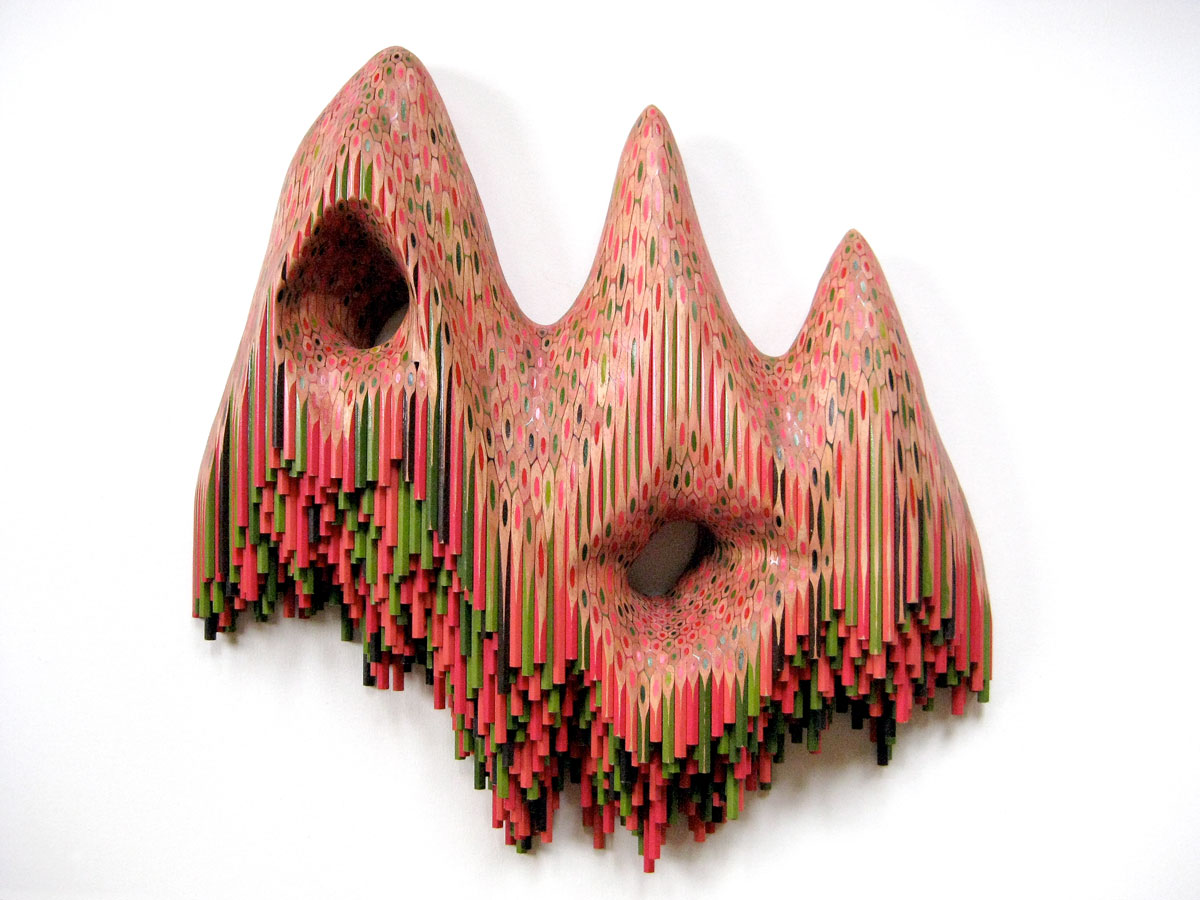
Lionel Bawden (Australian, b. 1974) formless worlds move through me 2010 Coloured Staedtler pencils, epoxy, incralac 51.0 x 51.0 x 9.5cm
Some good work in this exhibition – especially the Staedtler hexagonal coloured pencil constructions by Lionel Bawden. Beautifully crafted by hand they remind me of ghosts, the ‘millefiori’ (thousand flowers) of Italian glass and the inside of caverns with their stalactites.
Dr Marcus Bunyan
Many thankx to the Karen Woodbury Gallery for allowing me to publish the photographs in the posting. Please click on the photographs for a larger version of the image.
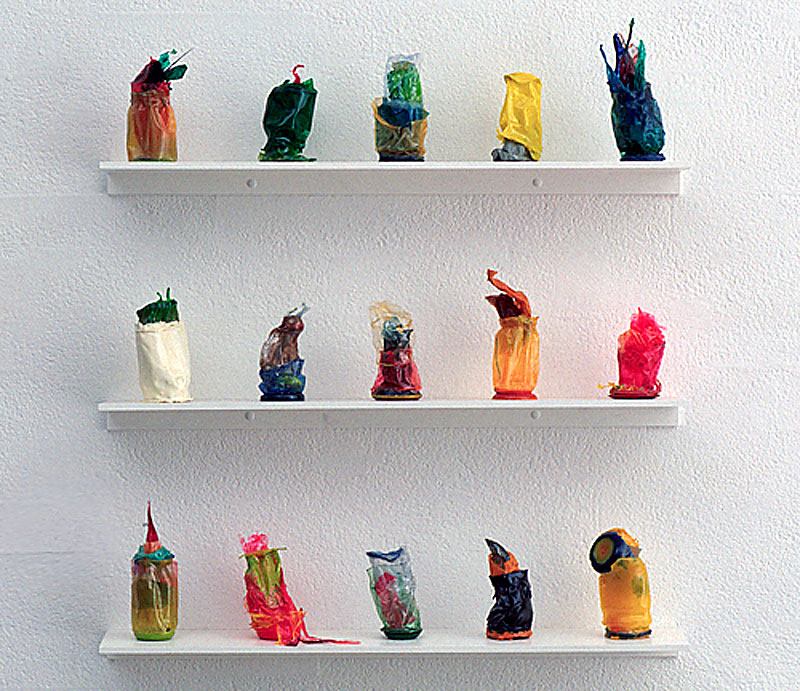
Alex Spremberg (Australian born Germany, b. 1950) Inside skins 2002
These artists have been selected for their interest in ideas of assemblage and re-use of pre-existing materials. Working across a range of media, each artist in the exhibition employs a process of manipulation to create completely different concepts and forms with their finished works. These works comprise of found objects and assembled from disparate elements, scavenged or foraged by the artists and juxtaposed in inventive ways. All works included in The Navigators take on their own form and imbue a new meaning to the original source materials.
Not originally intended as art materials, yet these artists have seen potential for a new idea in the materials; creating a new thought for the object. The original useful element of the preformed material thus comes under more aesthetic and creative significance. The impetus for such artistic practice is located in a desire by these artists to re-use, re-model, reshape and recycle within their practices. Despite an obvious interest and emphasis in the materiality of the works, the conceptual underpinning are the key motivation within these varying works and pose questions regarding the value of the objects within society. The artists included in The Navigators are continuously surveying and navigating their practice, allowing for deeper exploration in their work.
The exhibition will include various two and three-dimensional objects that interact with each other in unique ways. In the example of Lionel Bawden’s sculptures, his work exploits hexagonal coloured pencils as a sculptural material, reconfiguring and carving into amorphous shapes. Here the rich qualities of colour are explored as pencils are carved, shaped and fused together. Bawden explores themes of flux, transformation, rhythm and repetition as preconditions to our experience of the physical world. Bawden’s wall mounted works ‘the caverns of temporal suspension’ explore shapes within and outside the work as they hover ominously, melting, conjoined, growing, in transformation. These works are at the forefront of his current practice.
Penny Byrne’s work makes use of vintage porcelain sculptures that are adorned with a range of materials. Through this process, Byrne makes the base sculptures appear starkly different to that of the original, taking on new connotations that are often humorous and quirky but also convey political and social issues. In her work Mercury Rising. Hunted, Slaughtered, Eaten vintage porcelain dolphins and new plastic Manga figurines are employed to relate to the annual Japanese slaughter of tens of thousands dolphins as highlighted in the documentary ‘The Cove’. The Japanese eat the dolphins and then suffer mercury poisoning due to the high mercury levels in the dolphins flesh, leading to symptoms of madness.
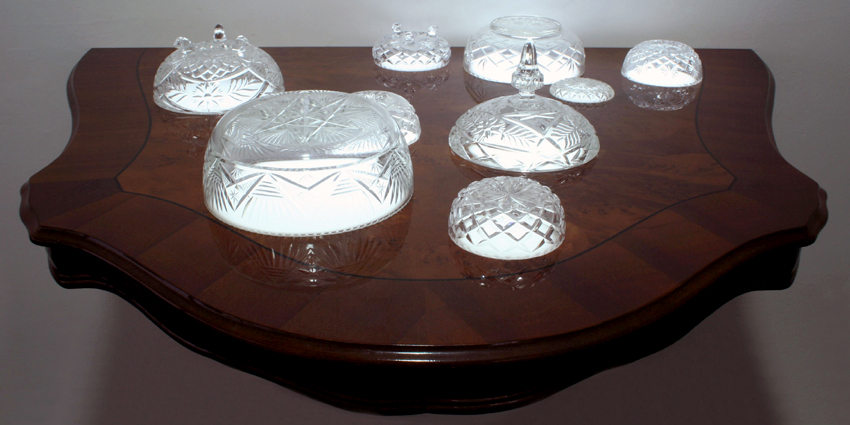
Nicholas Folland’s Navigator sculptures are indicative Folland’s continued interest in utilising, modifying and experimenting with various sourced materials. These sculptures comprise of various upturned intricately detailed crystal objects that sit above a wood panelled shelf. These glass object are lit and act as beacons or floating satellite cities. Folland personifies the intrepid creative explorer via his navigation of various found materials.
Locust Jones’ three-dimensional globes are made from papier mache and pictorially and graphically convey global issues. These works sit on the floor and allow the viewer to orient themselves around the works allowing for a detached, objective perspective on contemporary societal issues. The quickly worked surfaces reflect a stream of consciousness in process. Imagery and themes are taken from various media such as the Internet, photojournalism, film culture and nightly news broadcasts.
The two sculptures in the exhibition by Rhys Lee imbue associations of debris and deal with found objects such as a money box, a dead bird and a clowns face. These trophy-like pieces are decorated by old, worn and found vintage materials that engage with the everyday. The intimate scale of these works do not account for the potency of symbolism and accumulation of collected ideas. The blistered silver patina and bronze sculptures allude to a dark gothic sentiment that extends beyond the morphing forms. The shapes have been smashed, manipulated and stuck back together again resulting in frozen miniature icons that represent a contemporary zest for defiance.
Rob McHaffie’s works comprise a pastiche of painted anonymous unrelated objects and shapes that somehow come together to create unlikely compositions and formations. The highly skilled execution of McHaffie’s paintings attracts the viewer, who is then faced with a banality in subject matter, often of depictions of clothing, crumpled paper, plants and disfigured creatures and figures. These perfectly rendered images of everyday objects are unsettling in their clarity and realism, which are then skewed, moulded and displaced in unlikely relationships. There is a sense of a deliberate haphazard nature to McHaffie’s work that draws upon a range of elements brought together to mimic something else. Humour surfaces through this stylistic creative process.
Derek O’Connor’s re-worked painting collages resemble distorted and fragmented realities and stories via the manipulation and playful technique of alteration and re-use of book covers and record album and EP covers. O’Connor’s characteristic gestural sweeping luscious brushstrokes are employed with precision yet allow for organic spontaneity. The old material takes on new meaning and are given new life via O’Connor’s creations.
Alex Spremberg’s work Inside Skins highlights the artist’s accidental processes at work. This sculptural piece was made as an ancillary to his broader practice – working with acrylic, enamel and varnish on board and canvas. These objects where literally created via chance – an after thought that was noticed to be a finished piece in its own right. Left to dry within their containers these ‘skins’ were extracted and proved to provide aesthetic attraction and conceptual ideas of the ready-made.
The mainstay of Madonna Staunton’s practice surrounds the physicality of assemblage. Essentially she is a collage artist. The components of her two- and three-dimensional assemblages are usually drawn from old, faded and battered discards such as frames and chairs that are carefully put together in new ways and given another life. A play between precision and randomness animates her work. Her sensitivity to tonal and formal arrangement always remains acute during this process and the results are austerely and chaotically beautiful.
Press release from the Karen Woodbury Gallery website [Online] Cited 20/05/2010 no longer available online
Nicholas Folland (Australian, b. 1967) Navigators 1 2008 Glassware, table and lightbox 25.0 x 110.0 x 87.0cm
Nicholas Folland (Australian, b. 1967) Navigators 2 2008 Glassware, table and lightbox 25.0 x 110.0 x 87.0cm
Heide Museum of Modern Art has brought together nearly 100 pieces of work by the Australian artist Les Kossatz in an eclectic survey show, appropriately titled The Art of Existence. Featuring sculpture, painting and mixed media from the 1960s to the present the exhibition is appropriately titled because Kossatz’s work addresses certain archetypal themes that affect human existence:
“His life-long fascination with the natural world and desire to understand both its human and animal inhabitants; exploration of the systems of knowledge and codes of behaviour that structure individual and communal life; and his critical and playful reflections on contemporary behaviour and the mysteries of existence.”1
Strong symbolic paintings are the focus of the work in the 1960s, paintings that address the shocking brutality of war and its aftermath, when soldiers return home. To the observation that these are of the ‘pop-style’ school of painting suggested by the Heide website I feel these works are also influenced by the collage of Cubism, the boxes of Joseph Cornell and the dismembered bodies of Francis Bacon. They engage with the symbolism of war and remembrance: memory, myth, and the banality of heroism and sacrifice.
The key work in this series is the painting Diggers throne (1966). This is a powerful disturbing image, effervescent and unnerving at the same time. It features a disembodied arm on the hand of a throne, surrounded by a wonderful kaleidoscopic assemblage of pictorial planes, artefacts and memories – an English flag, the flag of St George, a crown, medals and the words RSL. The arm reminds me of the Francis Bacon painting Study after Velázquez’s Portrait of Pope Innocent X (1953) as it rests, roughly drawn in pencil on the arm of the throne, drawing the eye back up into nothingness.
The Diggers throne painting also features these prophetic words:
“throne slow to rot and twisted the memory becomes sacred. Bloody was the truth And this a chair.”
All other work in this period seems to flow through this painting – the other large paintings, the small canvases featuring individual medals and the less successful hanging banners. But it is to this work we return again and again as a viewer, trying to decipher and reconcile our inner conflicts about the painting.
As we move into the 1970s the work changes focus and direction. There emerges a concern with the desecration of the Australian landscape investigated in a series of large paintings and sculptures. In Packaged landscape 1 (1976) a steel suitcase with leather straps, slightly ajar, fulminates with artificial gum leaves trying to escape the strictures of the trap. In Caged landscape (1972) nature is again trapped behind steel wire, weighed in the balance on a set of miniature scales. The paintings feature trees that are surrounded by concrete and the rabbit becomes a powerful symbol for Kossatz – a suffering beast, strung up on fences, a plague in a pitted landscape of chopped down trees, erosion and empty holes.
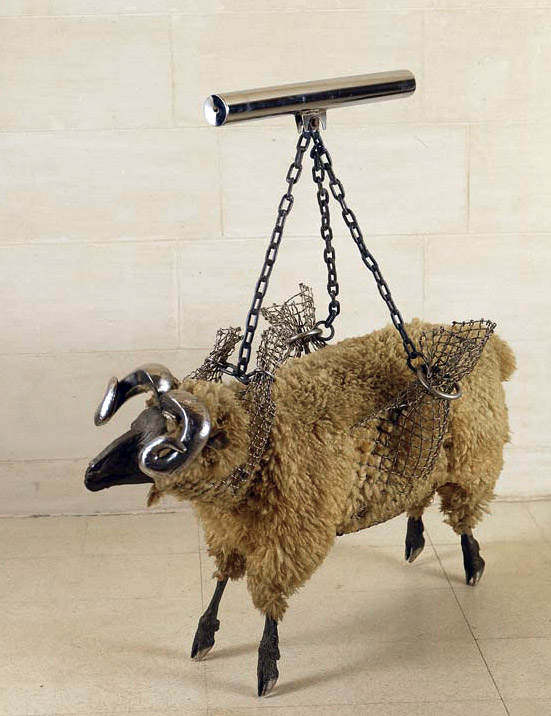
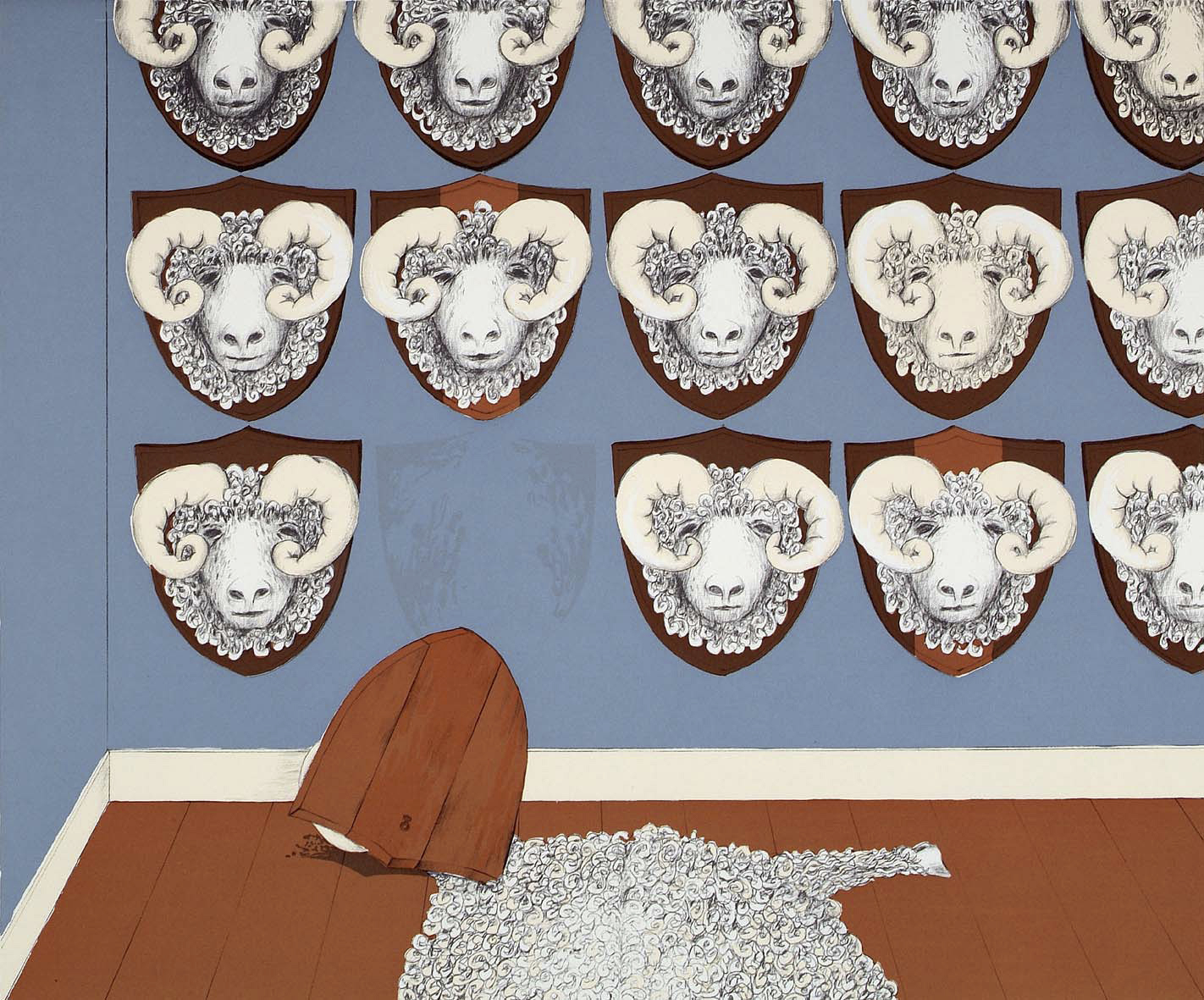
Into this vernacular emerges the key symbol of the artist’s oeuvre – the sheep. In 1972 Kossatz began a series of sculptures of sheep, “initially inspired by the experience of nursing an injured ram.” For Kossatz “the sheep represent the hardship of pioneer existence, the grazing industries prosperity, environmental concerns and the sheep act as narrative devices, potent metaphors for human behaviour.”2
The first sheep presented ‘in show’ is Ram in Sling (1973, below). In this sculpture a metal bar is suspended in mid-air and from this bar heavy wire mesh drops to support the fleecy stomach and neck of the ram almost seeming to strangle it in the process, it’s metal feet just touching the ground. Again the scales of justice seem to weigh nature in the balance.
The themes life and death, order and chaos are further developed in the work Hard slide (1980, below) where a sheep emerges mid-air from a trapdoor, two more tumble down a wooden slide end over end and another disappears into the ground through a wooden trapdoor opening. Sacrifice seems to be a consistent theme with both the earlier paintings and the metallised sheep:
“The completed life cycle, down the trapdoor, down the chute, after sacrifice by shearing.” ~ Daniel Thomas 1994
Further sculptures of sheep, both small maquettes and large sculptures follow in the next room of the exhibition. This is the artist is full flow, featuring the inventive taking of 2D things into the round, investigating the key themes of his work: the contrast between nature and artifice, or humanity.
The small maquettes of sheep feature races, gantries, sluices, pens, trapdoors and paddocks. Sheep tumble in a cataclysmic maelstrom, falling with flailing legs into the darkness of the holding pen below. These are my favourite works – small, intimate, detailed, dark bronzes of serious intensity – the sheep becoming a theatre of the absurd, suspended, weighed and balancing in the performance of ritualised acts, a cacophony of flesh at once both intricate and unsettling. Their skins lay flayed and lifeless disappearing into the ‘unearth’ of the slated wooden floor of the shearing shed. The sheep “can be viewed metaphorically as a commentary of the existential situation of the individual and collective behaviour.”3 As Kossatz himself has noted, “It is hard to bring a piece of landscape inside and give it a living animated form. The sheep somehow gives me this quality of landscape.”
But we must also remember that this strictly a white man’s view of the Australian landscape. Nowhere does this work comment on the disenfranchisement of the native people’s of this land – the destruction of native habitats that the sheep brought about, the starvation that they caused to Aboriginal people just as they bought riches to the pastoralists and the country that mined the land with this amorphous mass of flesh.
Recent work in the exhibition returns to the earlier social themes of memory, war, remembrance, religion, shrines, atomic clouds and temples but it is the work of the late 1970s-1980s that is the most cogent. As Kossatz ponders the nature of existence on this planet he does not see a definitive answer but emphasises the journey we take, not the arrival. Here is something that we should all ponder, giving time to the nature of our personal journey in this life, on this earth.
Here also is an exhibition worthy our time and attention as part of that journey. Go visit!
Dr Marcus Bunyan
Word count: 1,074
1/ From the Heide website 2/ From wall notes to the exhibition 3/ From wall notes to the exhibition
Many thankx to Heide Museum of Modern Art for allowing me to publish the photographs in the posting. Please click on the photographs for a larger version of the image.
Postscript 2018
The late Les Kossatz (1943-2011) was a well known Melbourne-based artist and academic whose work is represented in many regional and state galleries and the National Gallery of Australia. He studied art at the Melbourne Teachers’ College and the RMIT, and went on to teach at the RMIT and Monash University. Kossatz’s first significant commission was for the stained glass windows at the Monash University Chapel in Melbourne. Later commissions included works for the Australian War Memorial, the High Court, the Ian Potter Foundation at the National Gallery of Victoria and the Darling Harbour Authority, Sydney. His sculpture, Ainslie’s Sheep, commissioned by Arts ACT in 2000, is a popular national capital landmark in the centre of Civic. A major retrospective of Kossatz’s work was held in 2009 at the Heide Park and Art Gallery, Melbourne.
The art of existence is the first exhibition to review Les Kossatz’s contribution to Australian art in a career that spans the 1960s to today. Kossatz’s consistently experimental approach to media and techniques is revealed in works that display a lifelong fascination with humanity and the interaction of man and nature. His paintings, sculptures and works on paper stimulate a questioning and exploration of such concerns, which form the basis of this artist’s practice.
Les Kossatz’s early works of the 1960s draw on his training and ability to work across a diversity of media, including painting, drawing, printmaking and glass. Early paintings and etchings on the theme of the emptiness of memorials to the Australian ‘digger’ or soldiers were succeeded by images and objects offering impressions of the world around the artist – the rural domain and interior life of St Andrews in Victoria where Kossatz lived and worked. Such works demonstrated his determination to pursue a figurative practice at a time when abstract art had been imported to Australia and was considered the avant garde.
Remaining a staunchly independent artist, at the start of the 1970s Kossatz painted images of rabbits and sheep from St Andrews. In addition, the practice of working in three dimensions was to become more significant. Kossatz continued to develop familiar themes in the creation of installations and cast objects. Although he has produced drawings and prints across his career, working with sculpture has, since the early 1970s, been his primary mode of art-making. Large scale cast and assembled objects show Kossatz pursuing related themes of caged and packaged landscapes, shrines to the harvest and the still life.
The art of existence surveys Kossatz’s monumental life-sized sheep sculptures, which he began making in 1972 from casts of animal parts, and for which he is best known. These include Hard slide (1980), his prize-winning commission in the collection of the National Gallery of Victoria. Kossatz has won numerous commissions for outdoor sculptures that employ the sheep as literal and metaphorical beings. Kossatz’s work across three decades reveals a number of ongoing engagements, such as his observations of human behaviour and at times its similar manifestation in animals; the beliefs that sustain individuals and communities (such as religion, music and politics); and the forms of the landscape and our understanding of these relationships.
Introduction to the exhibition written by Zara Stanhope, Guest Curator, Heide Museum of Modern Art, 2008
Les Kossatz (Australian, 1943-2011) Hard slide 1980 Sheepskins, aluminium, Douglas-fir (Pseudotsuga sp.), leather, steel 372.0 x 100.0 x 304.0cm (installation)
Les Kossatz (Australian, 1943-2011) Guggenheim spiral 1983
Heide Museum of Modern Art 7 Templestowe Road Bulleen Victoria 3105 Australia Phone: +61 3 9850 1500
Opening hours: (Heide II and Heide III) Tuesday to Sunday and public holidays, 10am – 5pm





 Art Blart _ art and cultural memory archive
You must be logged in to post a comment.