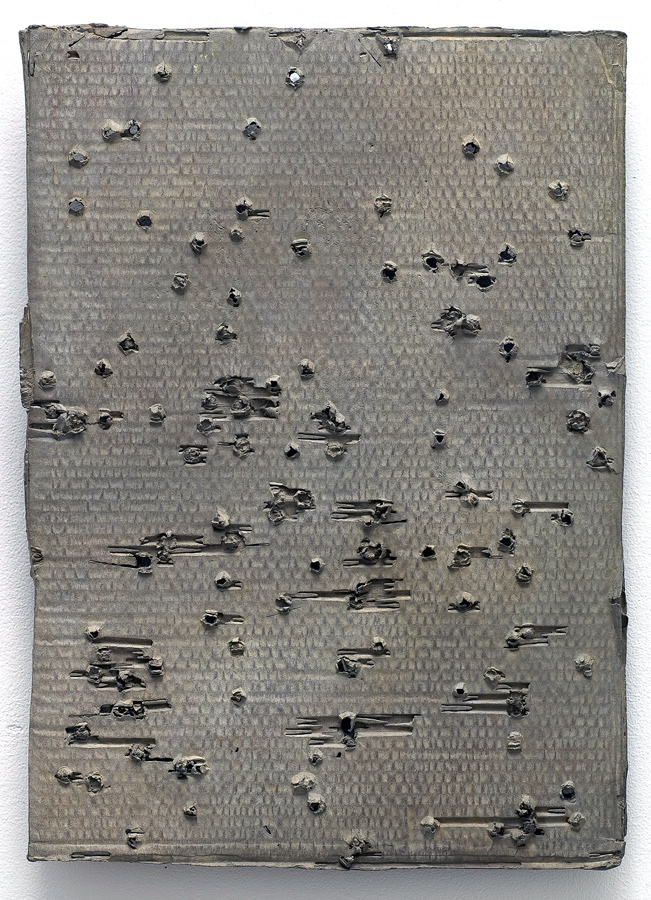
Paul Ogier (Australia born New Zealand, b. 1974) Saint Stephen 2009 Courtesy of the artist
Mark Hislop from the Monash Gallery of Art (MGA) has asked me to post details of the William and Winifred Bowness Photography Prize 2010. More than happy too. To see the standard take a look at the 2009 Finalists online. Details on how to enter are posted below. Have a go, get your entries in, you never know who will win!
Many thankx to the MGA for allowing me to publish the photographs in the posting. Please click on the photographs for a large version of the image.
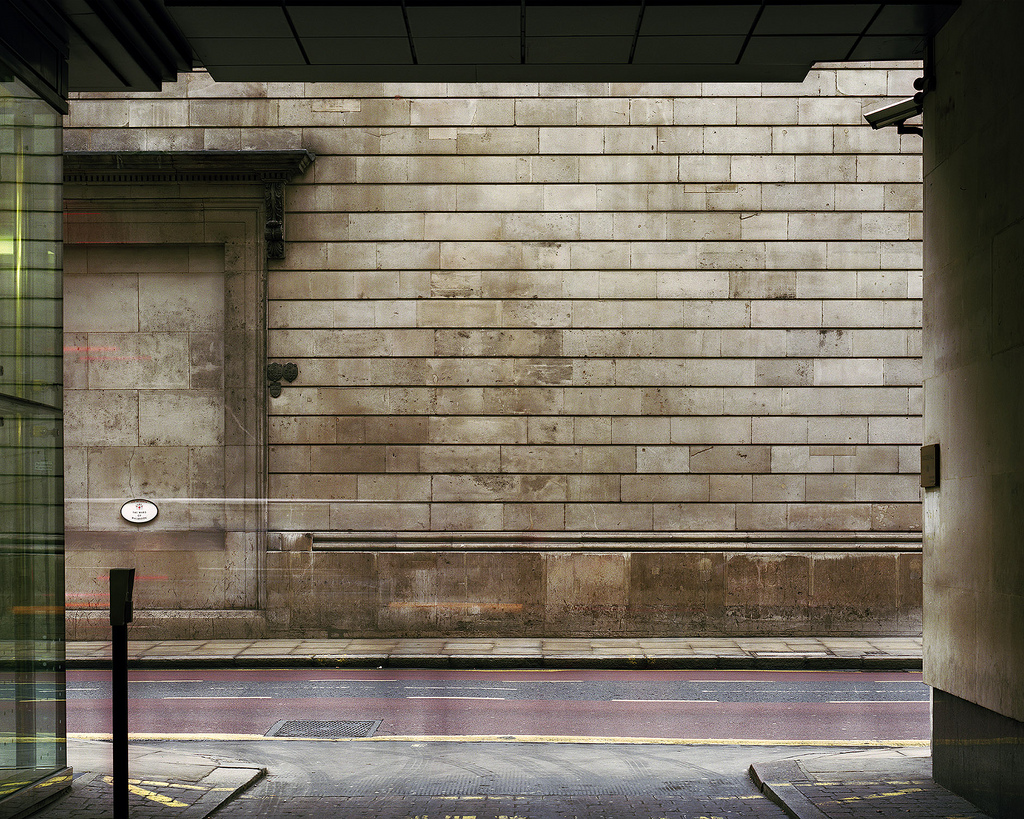
Simon Terrill (Australian, b. 1969) Bank of England 9AM 2009 Courtesy of the artist
The Monash Gallery of Art Foundation is pleased to announce the CALL FOR ENTRIES for the William and Winifred Bowness Photography Prize 2010.
The MGA Foundation will once again showcase the work of Australia’s best photographers in Australia’s most coveted photography award. Photographers from all over Australia are encouraged to submit entries to this year’s Bowness Photography Prize. Each year, finalists are drawn from the breadth of Australian photographic practice: editorial, commercial, street and fine art.
In recognition of the support shown the prize by Australian photographers, prize money for this year’s award has increased substantially. Last year, a record 459 photographers submitted entries in anticipation of the $20,000 non-acquisitive first prize. In 2010, photographers will be competing for $25,000 first prize and $1,000 People’s Choice Award.
The winner of the 2010 Bowness Photography Prize and Honourable Mentions will be announced on Thursday night 23 SEP 2010 during a cocktail party held at MGA. Winners and finalists will enjoy unprecedented visibility for their work. All finalists will be published on MGA’s flickr page and included in a substantial catalogue. The winner will receive the $25,000 first prize. And in recognition of the strength of the prize and MGA’s commitment to promoting the best of contemporary Australian photography, Honourable Mentions will have the opportunity to stage an exhibition at MGA.
This year’s entries will be judged by Gael Newton, Senior Curator of Photographs, National Gallery of Australia, Max Pam, Australian photographer, and Shaune Lakin, Director of MGA.
About the BOWNESS Photography Prize
Established in 2006 to promote excellence in photography, the annual non-acquisitive William and Winifred Bowness Photography Prize is an initiative of the MGA Foundation. The Bowness Photography Prize has quickly become Australia’s most coveted photography prize. It is also one of the country’s most open prizes for photography. In the past, finalists have included established and emerging photographers, art and commercial photographers. All film-based and digital work from amateurs and professionals is accepted. There are no thematic restrictions.
The 2009 Bowness Prize recipient was Paul Knight. Since winning the Prize, Knight has received an Australia Council for the Arts Skills and Development Grant and is currently presenting new work at the prestigious international artfair Art Cologne.
Jane Burton (Australian, b. 1966) Ivy # 3 2009 Courtesy of the artist and Karen Woodbury Gallery, Melbourne
Owen Leong (Australian, b. 1979) Justin 2009 Courtesy of the artist and Anna Pappas Gallery, Melbourne
Paul Knight (Australian, b. 1976) 14 months # 01 2008 Courtesy of the artist and Neon Parc, Melbourne Winner of the William and Winifred Bowness Photography Prize 2009
Monash Gallery of Art 860 Ferntree Gully Road Wheelers Hill Victoria 3150 Phone: +61 3 8544 0503
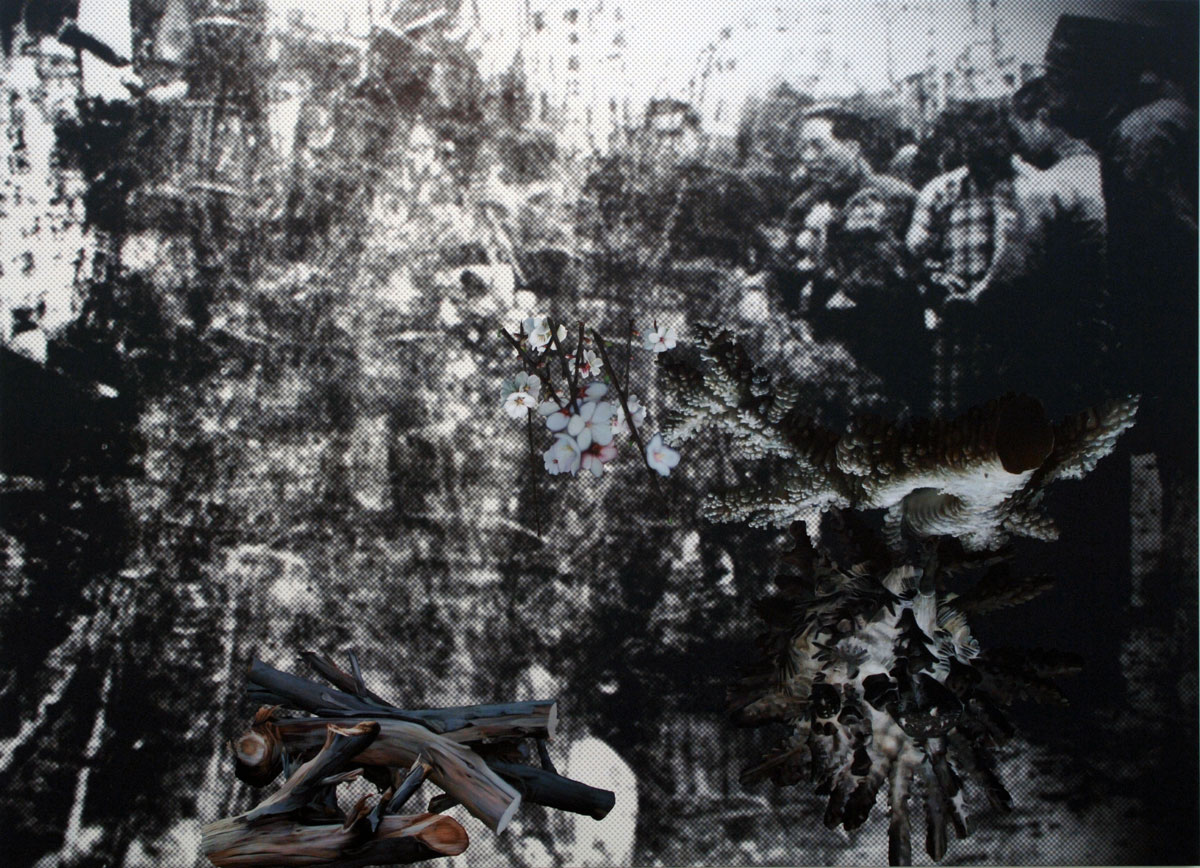
John Young (Australian born Hong Kong, b. 1956) Flower Market (Nanjing 1936) #2 2010 Digital print and oil on Belgian linen 240 x 331cm image courtesy of the artist and Anna Schwartz Gallery
What can one say about work that is so confronting, poignant and beautiful – except to say that it is almost unbearable to look at this work without being emotionally charged, to wonder at the vicissitudes of human life, of events beyond one’s control.
Simply, this is the best exhibition that I have seen in Melbourne so far this year.
The exhibition tells the story of the massacre of 300,000 people in the city of Nanjing in Jiangsu, China by Japanese troops in December, 1937 in what was to become known as the Nanjing Massacre. It also tells the story of a group of foreigners led by German businessman John Rabe and American missionary Minnie Vautrin who set up a “safety zone” to protect the lives of at least 250,000 Chinese citizens. The work is conceptually and aesthetically well resolved, the layering within the work creating a holistic narrative that engulfs and enfolds the viewer – holding them in the shock of brutality, the poignancy of poetry and the (non)sublimation of the human spirit to the will of others.
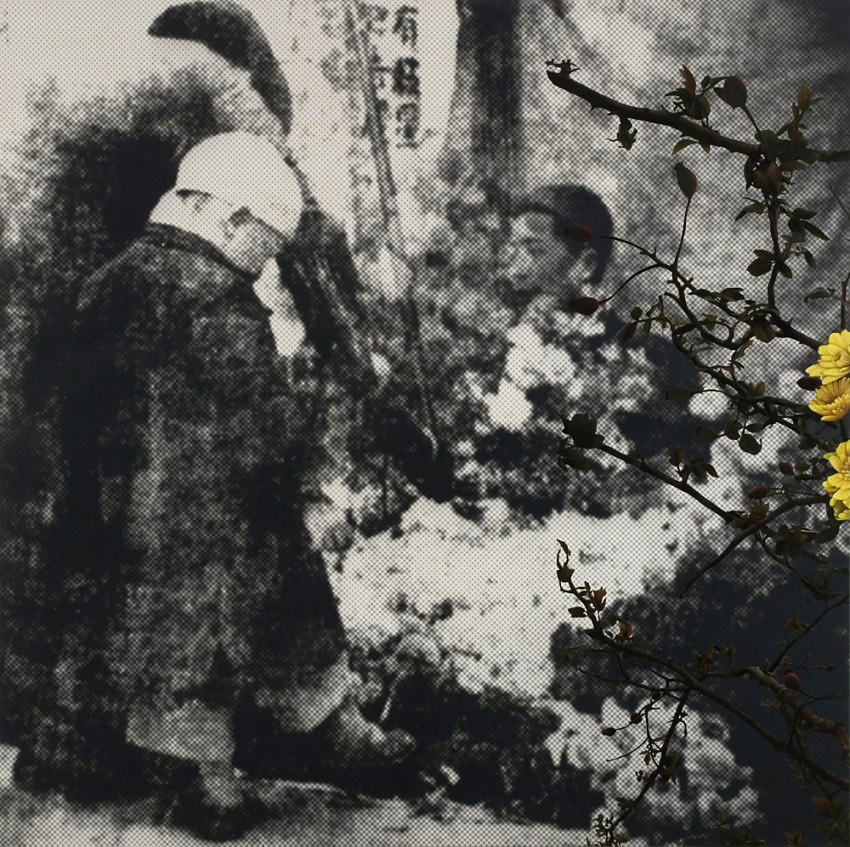
On the left wall of the gallery are three large mixed-media paintings of screen printed photographs of the Nanjing Flower Market taken the year before the massacre (see three images directly below). The printing of the press photographs at such a scale (a la Marco Fusinato) emphasises the dot structure of the photograph, the intensity of a newspaper reality ‘blown up’ to a huge scale. Unfortunately, you cannot see this deconstruction of the image very well in the examples below (clicking on the lower two images to get a larger version will give you a better idea), but believe me it most effective in creating a spatio-temporal distance between the viewer and the image. The dissolution of the image into dots is surmounted by painted cherry blossoms, bleached corals and piles of logs that overlay the photographic text. The reason-ances are sublime. The mind tries to process the distance between the death of the people and the photograph, the knowledge of what is about to happen to them, and the sensuality of the buds and flowers: new life!
To my friend and I the coral in the last painting reminded us both of the emanations of psychic phenomena at a seance, a series of radiations originating in the godhead.
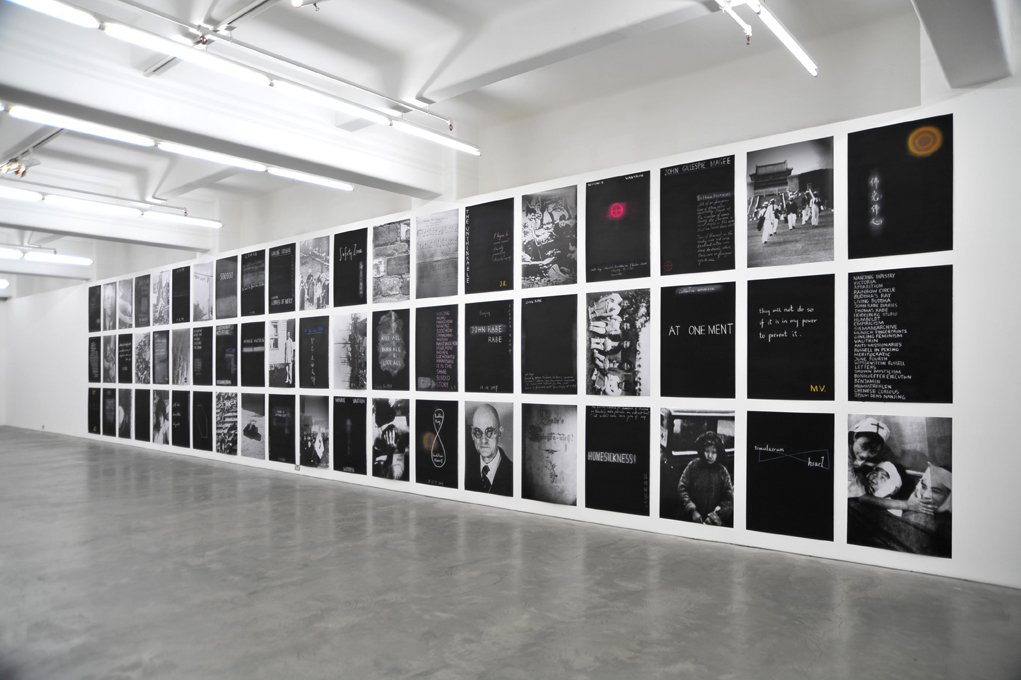
On the right wall of the gallery is a grid of three rows of twenty images that make up the work Safety Zone (2010, see bottom image). Made up of chalk drawings on black paper (a la Rudolf Steiner), writings by the Europeans including Vautrin and Rabe, statistics, gruesome photographs of the massacre and observations by the artist, this is in part both a confronting and benevolent work.
Archival photographs are printed digitally (the dot structure working to less affect here); some vertical photographs are shown horizontally. Text written in chalk is erased with a sweep of the hand. Thoughts of the Buddha, the infinity symbol linked to the Buddha’s Ray and the Buddha’s Heart are a physical presence. Two blue chalk lines intersect and cross over, so poignant and sublime amongst the destruction that surrounds. Golf clubs, beer bottles, bayonets.
‘THERE IS NOTHING LEFT’ 13.12.37 (Robert Wilson)
‘HOME SICKNESS’
‘Simulacrum > Heart’
A simply drawn coffin shape on black ground
‘I began to roam around the city preventing further atrocities myself’
‘They will not do so, if it is in my power to prevent it’ (Minnie Vautrin)
UNSPEAKABLE ACTS OF EVIL … BECOMING BANAL
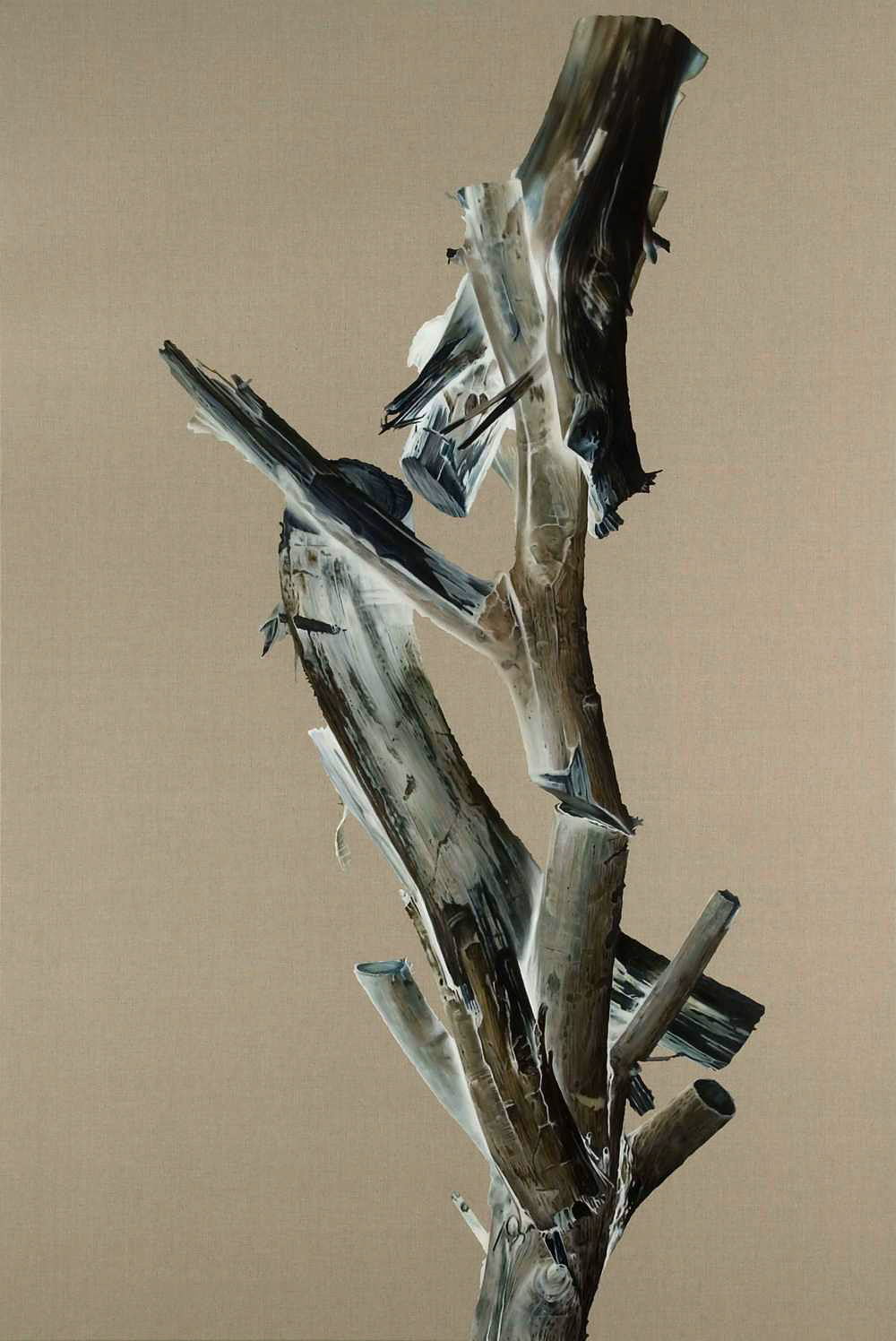
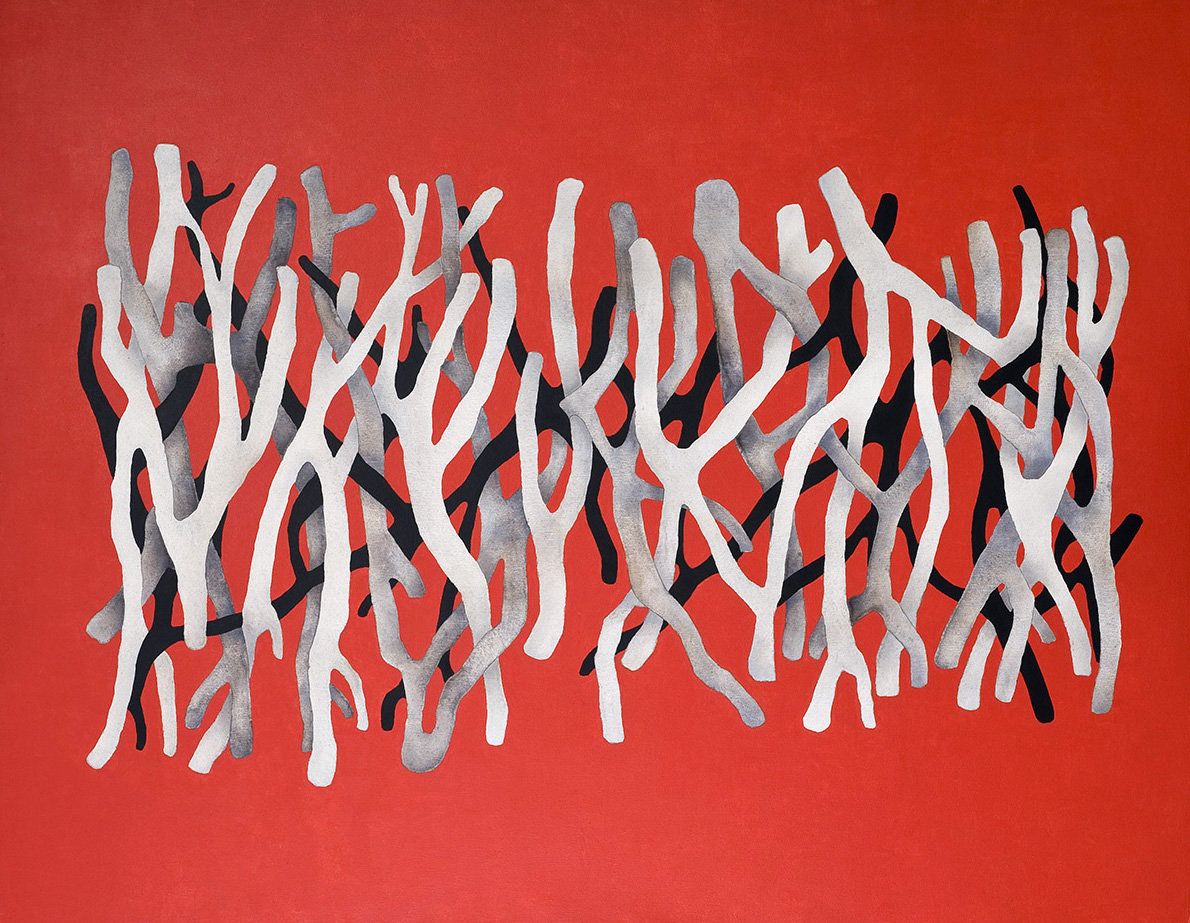
At both ends of the gallery is the last element in this play of hope, mutability and madness. Two large oil-on-linen paintings, titled The Crippled Tree #1 & #2 (see images below) “provide another register to the memory of the event. According to Young, the battered and split logs, painted in the negative, resonate and recollect the violence done to the victims of the massacre.” Unfortunately the two small images below cannot really give you an idea of the metaphorical power of these paintings. Like twisted and broken bodies larger than life size they become the glue that holds the other elements of the exhibition together. Without them there would be no transition from one side of the gallery, one element of the work to another. In their solarisation they emote an energy that flows down the length of the gallery = is this possible? Yes it is!
You feel the cracking of their branches, the amputation of their limbs but their spirit, their efflorescence (which, most appropriately considering the use of the Flower Market photographs, means “to flower out” in French) shines on. Such is the nature of the human spirit. Take the time and see this work. It is well worth the journey.
Dr Marcus Bunyan
Many thankx to the artist, Serena Bentley and Anna Schwartz Gallery for allowing me to reproduce the images in the posting. Please click on the photographs for a larger version of the image.
John Young (Australian born Hong Kong, b. 1956) Flower Market (Nanjing 1936) #3 2010 Digital print and oil on Belgian linen 240 x 331cm image courtesy of the artist and Anna Schwartz Gallery
John Young (Australian born Hong Kong, b. 1956) Flower Market (Nanjing 1936) #1 2010 digital print and oil on Belgian linen 240 x 331cm image courtesy of the artist and Anna Schwartz Gallery
Safety Zone, John Young’s latest project presents a series of intricate paintings that reassemble historical reminiscences of human survival by linking experimental contemporary art with investigative visual reports, in historical photographs and documents.
This body of work draws attention to incidents across the city of Nanjing in Jiangsu, China, just moments before the onset of the Nanjing Massacre, which followed the capture of the city by Japanese Imperial Forces on 13 December 1937. In the six weeks following the invasion, a quarter of a million Chinese citizens were killed in what the American historian Iris Chang described as the ‘forgotten holocaust of World War II’.
Through Chang’s book, The Rape of Nanking, the world was introduced to the personal memoirs of foreigners living in Nanjing who had been working on creating a ‘safety zone’ that would protect 250,000 Chinese citizens from the invading Japanese troops. Two of the twenty-one foreigners who stayed in the city to help set up the Nanjing Safety Zone were the American missionary Minnie Vautrin and the German businessman John Rabe. Their experiences have been noted by Young, who travelled to Nanjing, Berlin and Heidelberg, conducting first hand interviews and research for this compelling multi-layered project which exemplifies the transformative function of art.
The installation Safety Zone consists of three series of works which reference acts of resistance by individuals to protect fellow human beings against these atrocities that were underpinned by autocratic regimes and nationalist ideologies.
In the Flower Market (Nanjing 1936) series, carefully painted spring flowers and bleached corals are superimposed over historical photographs taken in Nanjing a year prior to the massacre. The meticulously rendered impressions of logs in The Crippled Tree #1 & #2 provide another register to the memory of the event. According to Young, the battered and split logs, painted in the negative, resonate and recollect the violence done to the victims of the massacre.
The carefully assembled bank of 60 chalk drawings and digital prints that make up the centerpiece of Safety Zone provides an intricate understanding of the humanity that lies beneath this tragic event through the revelation of extraordinary acts of self-sacrifice.
Dr Thomas J. Berghuis Department of Art History and Film, The University of Sydney
John Young (Australian born Hong Kong, b. 1956) The Crippled Tree #1 2010 Oil on linen 274 x 183cm image courtesy of the artist and Anna Schwartz Gallery
John Young (Australian born Hong Kong, b. 1956) The Crippled Tree #2 2010 Oil on linen 274 x 183cm image courtesy of the artist and Anna Schwartz Gallery
John Young (Australian born Hong Kong, b. 1956) Safety Zone (installation view) 2010 60 works, digital prints on photographic paper and chalk on blackboard-painted archival cotton paper Image courtesy of the artist and Anna Schwartz Gallery
Anna Schwartz Gallery 185 Flinders Lane Melbourne, Victoria 3000
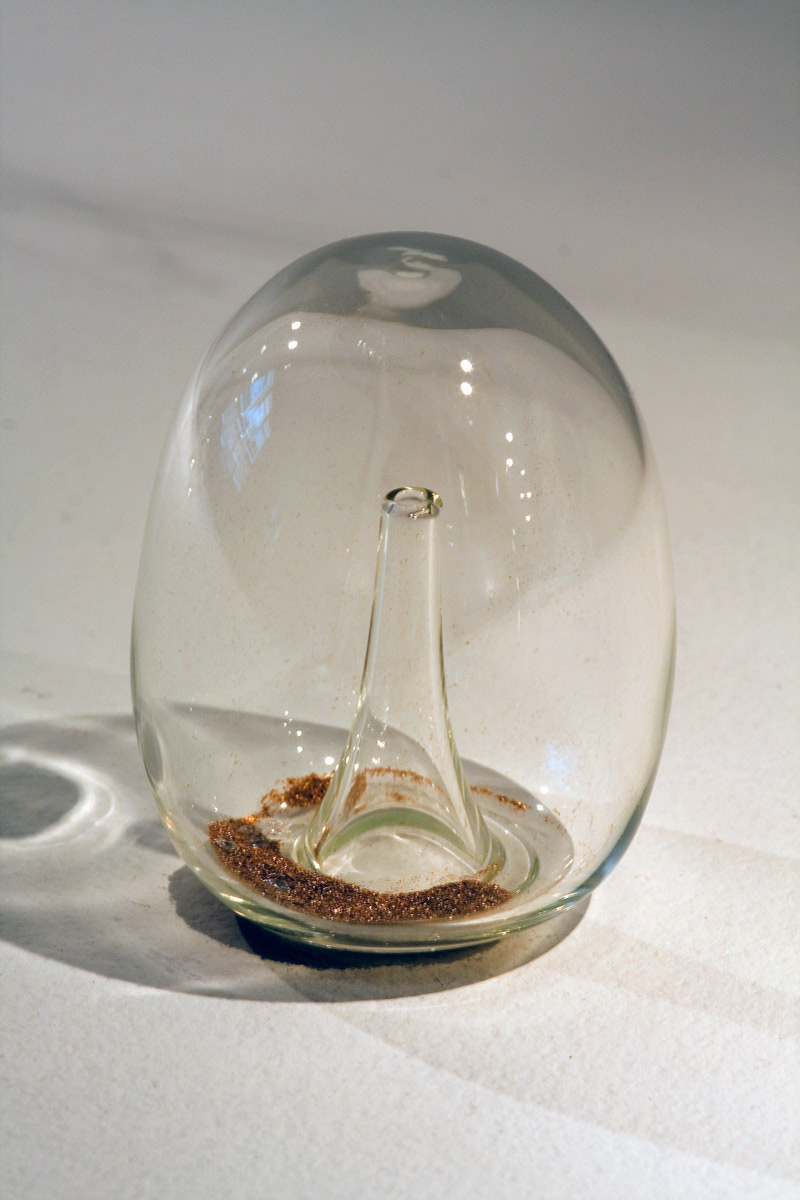
Kiko Gianocca (Swiss, b. 1974) Untitled (touch wood) multiples (installation view) 2009 Burnt wood, resin Photo: Marcus Bunyan
A beautiful exhibition of objects by Swiss/Italian artist Kiko Gianocca at Gallery Funaki, Melbourne, one full of delicate resonances and remembrances.
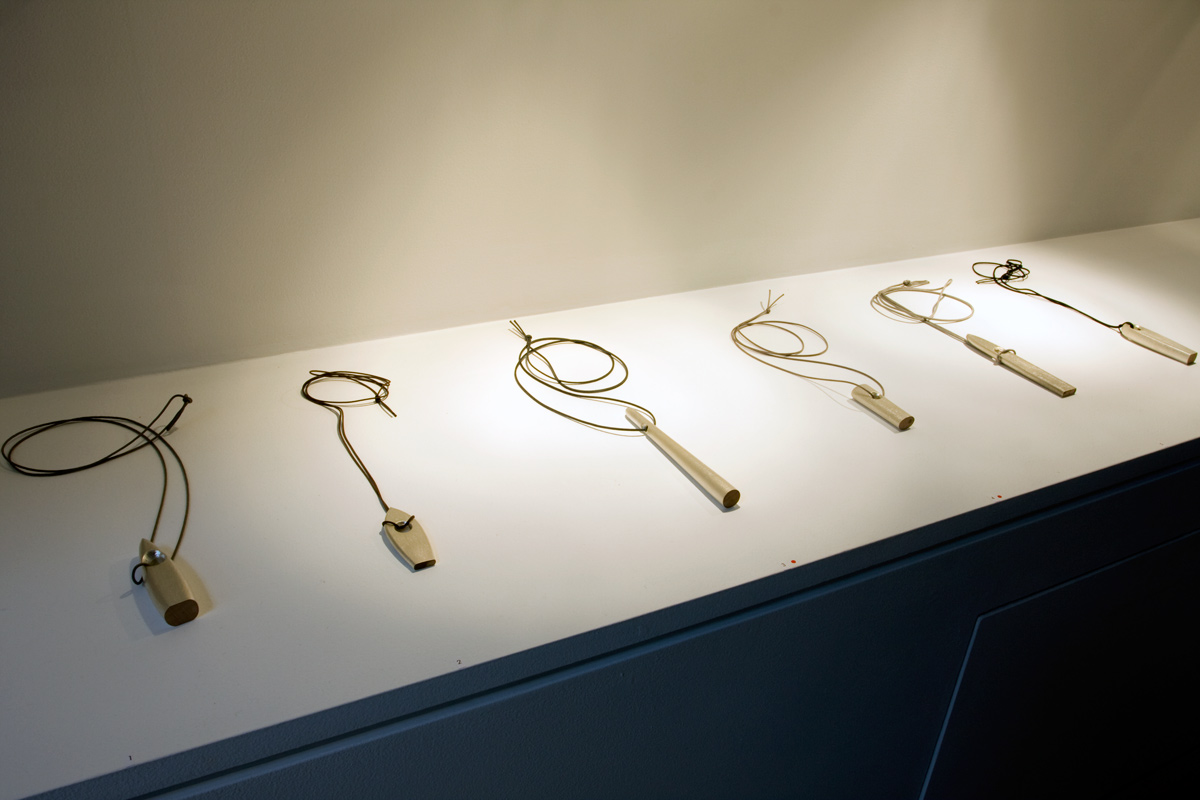
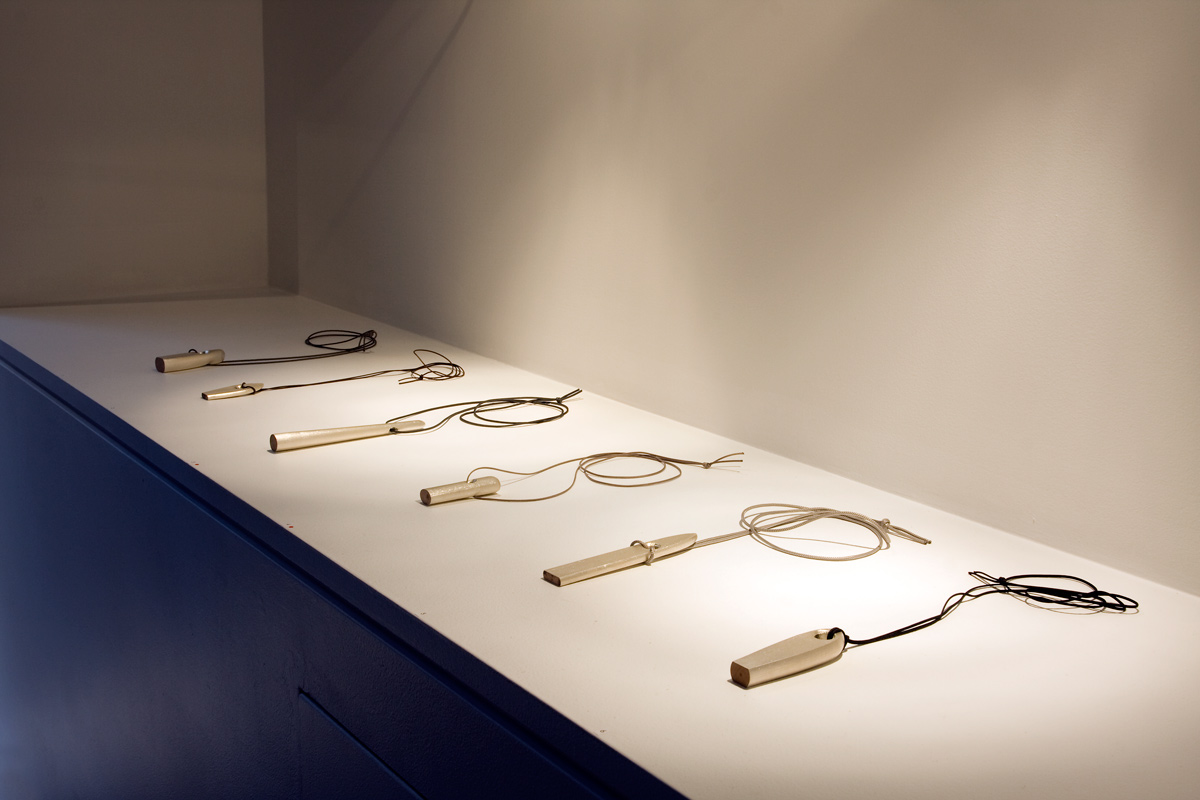
Obelisk pendants in blackened and silvered wood, Neolithic standing stones, totemic, silent; The hole through the object akin to ‘seeing’ through time. Exposed wood on base (touch wood) as grounding.
The standing stone installation an altar piece, a dark reliquary (see image above)
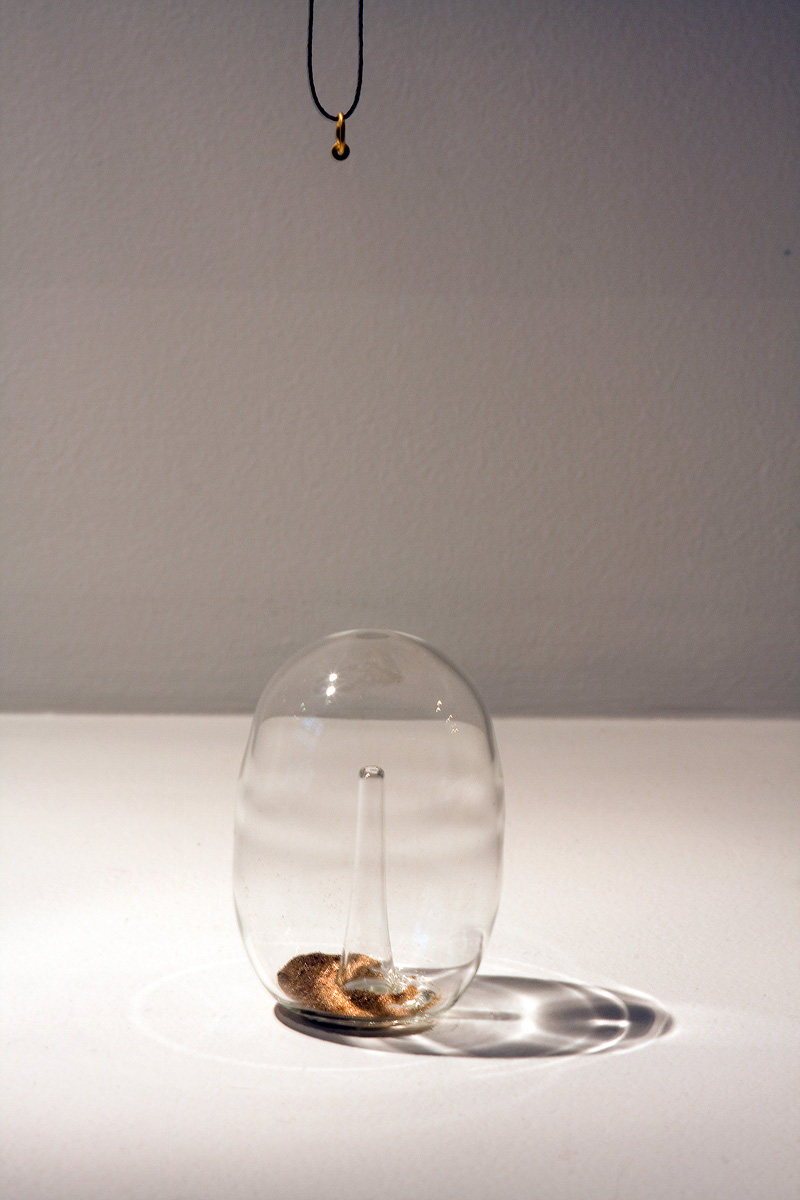
Glass vessels with internal funnels filled with the gold detritus of disassembled objects, found pendants: Horse, Anchor, Four leaf clover, Swan, Hammer & sickle (see images below)
The distance between the bail – the finding that attaches the pendant to the necklace – and the remainder/reminder of the vessel itself. What a distance!
As Sally Mann would articulate, ‘What remains’1 …
Lives previous to this incarnation; jewels embedded in dust. The captured potency of displaced objects. Personal and yet anonymous at one and the same time.
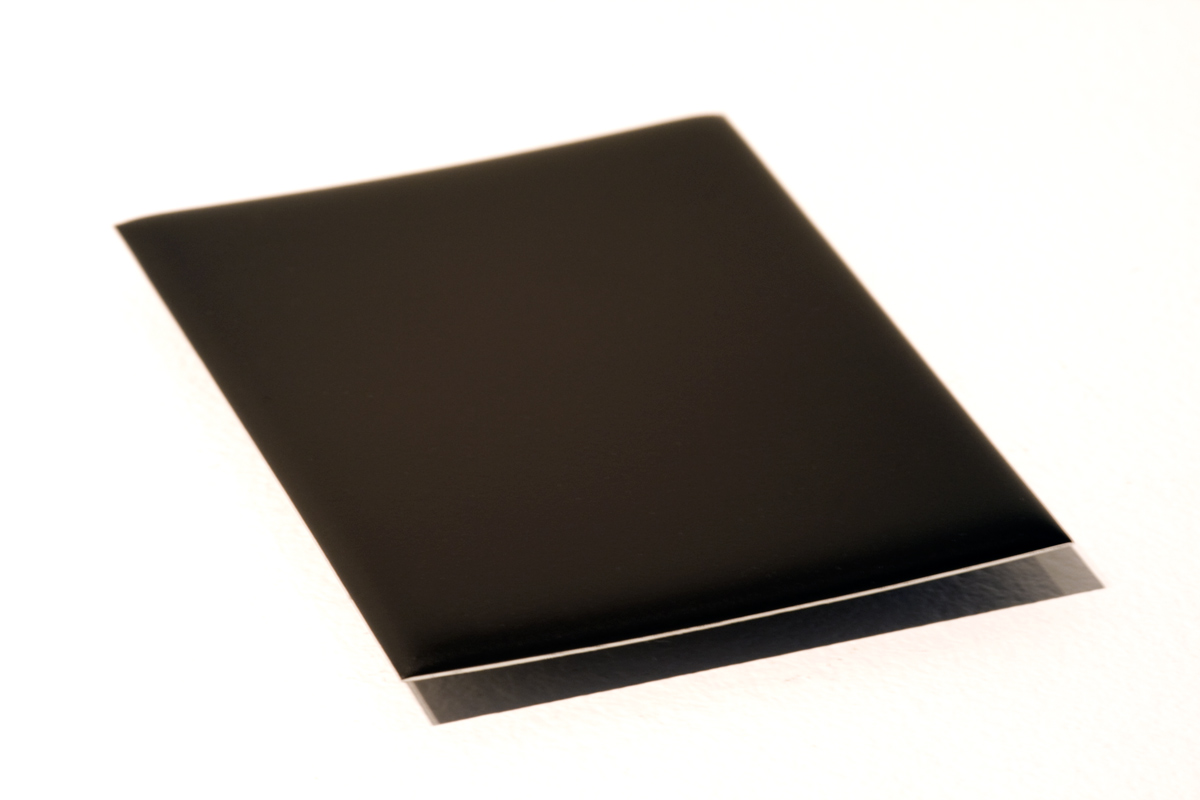
Brooches of gloss and matt black resin plates. A plastic black, almost Rembrandt-esque.
On the reverse images exposed like a photographic plate, found images solidified in resin.
The front: the depths of the universe, navigating the dazzling darkness The back: memories, forgotten, then remade, worn like a secret against the beating chest. Only the wearer knows!
Here is a territorialization, “a double movement, where something accumulates meanings (re-territorialization), but does so co-extensively with a de-territorialization where the same thing is disinvested of meanings.”2
As Kiki Gianocca asks, “I am not sure if I grasp the memories that sometimes come to mind. I start to think they hold me instead of me holding them.”
Time is the distance between objects. No objects. Space is the distance between events. No events.
Dr Marcus Bunyan
1/ “Mann’s fifth book, What Remains, published in 2003, is based on the show of the same name at the Corcoran Museum in Washington, DC and is in five parts. The first section contains photographs of the remains of Eva, her greyhound, after decomposition. The second part has the photographs of dead and decomposing bodies at a federal Forensic Anthropology Facility (known as the ‘body farm’). The third part details the site on her property where an armed escaped convict was killed. The fourth part is a study of the grounds of Antietam (the site of the bloodiest single day battle in American history during the Civil War. The last part is a study of close-ups of the faces of her children. Thus, this study of mortality, decay and death ends with hope and love.” Sally Mann. Wikipedia [Online] Cited 02/05/2010
2/ “For them (Deleuze and Guattari), assemblages are the processes by which various configurations of linked components function in an intersection with each other, a process that can be both productive and disruptive. Any such process involves a territorialization; there is a double movement where something accumulates meanings (re-territorialization), but does so co-extensively with a de-territorialization where the same thing is disinvested of meanings. The organization of a territory is characterized by such a double movement … An assemblage is an extension of this process, and can be thought of as constituted by an intensification of these processes around a particular site through a multiplicity of intersections of such territorializations.” Wood, Aylish. “Fresh Kill: Information technologies as sites of resistance ” in Munt, Sally (ed.,). Technospaces: Inside the New Media. London: Continuum, 2001, p. 166.
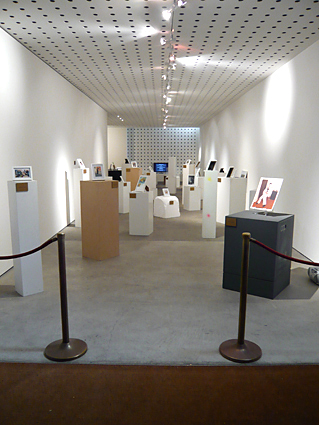
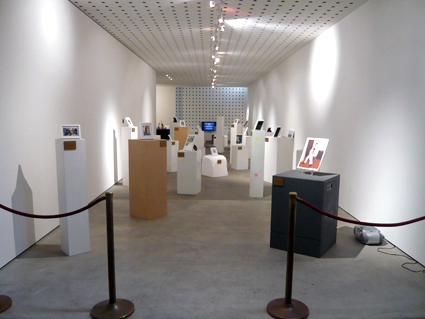
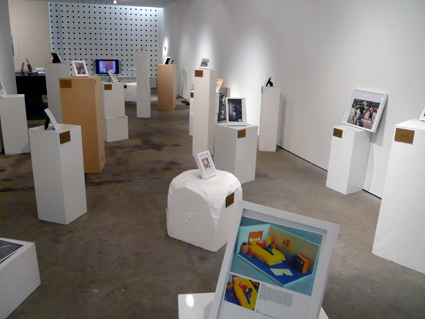
Featuring Museum Highlights: A Gallery Talk by Andrea Fraser (USA) as well as works from the collections of Hany Armanious, Liv Barrett, Polly Borland (UK), Steve Carr (NZ), Lane Cormick, Chantal Faust, Marco Fusinato, Tony Garifalakis, Matthew Griffin, Irene Hanenbergh, Christopher Hanrahan, Hotham Street Ladies, the Kingpins, Paul Knight, Andrew Liversidge, Rob McLeish, Callum Morton, Nat & Ali, Geoff Newton, Martin Parr (UK), Stuart Ringholt, David Rosetzky, Darren Sylvester, Christian Thompson, Lyndal Walker and Caroline Williams.
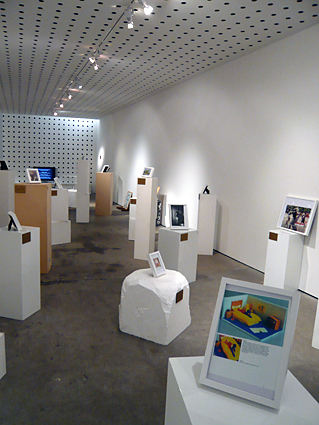
Curated by Mark Feary, this is a deliciously ironic exhibition that asks the audience to question the social and political construction of the blockbuster exhibitions regularly held by large museums around Australia; to question the role of the curator in assembling such exhibitions; and to question the cultural value of permanent collections of ‘Masterpieces’. Autumn Masterpieces displays work that is anything but permanent and undermines the process whereby museums construct frameworks for social understanding. The work, displayed in a roped off space on plinths of various heights, in cheap frames and at skew-whiff angles, seems ephemeral and transitory all the more to contradict both main tenants of the title of the exhibition: masterpiece and permanence.
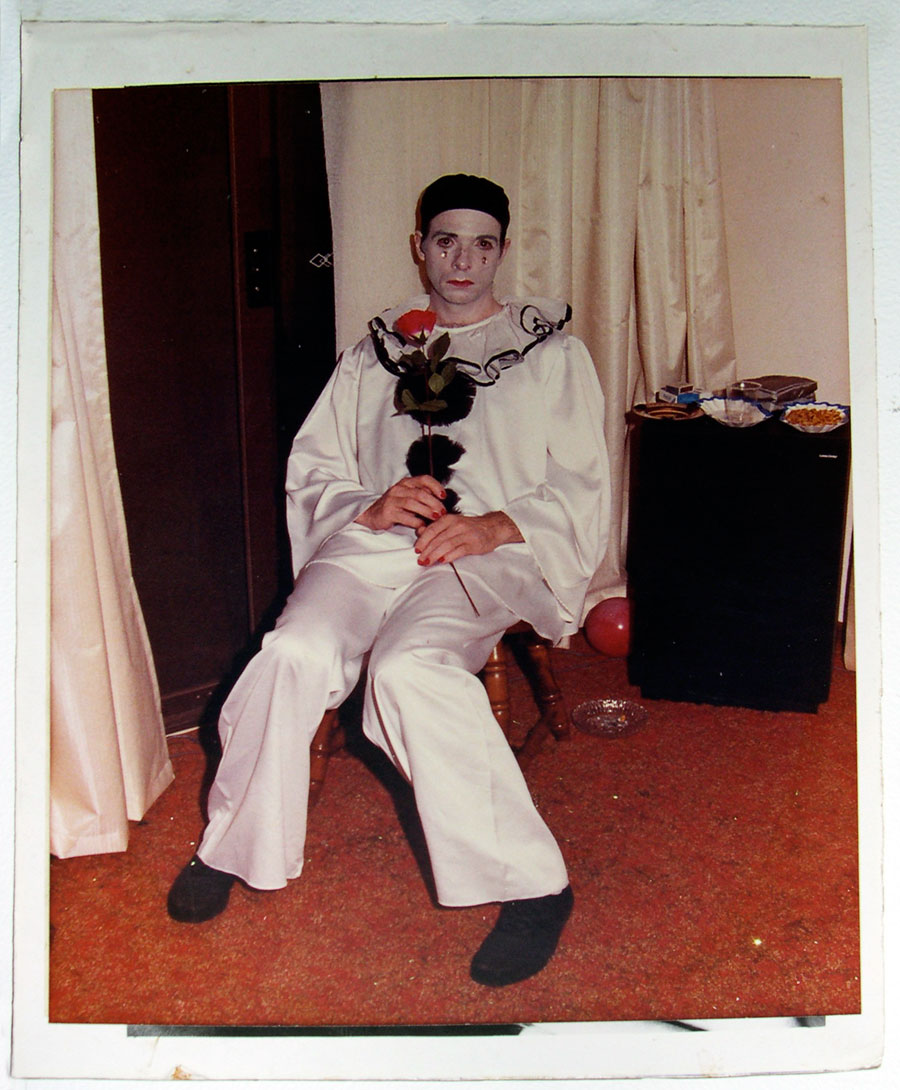
Sitting on plinths that are adorned with plastic gold name plaques emblazoned with the condition of the possibility of the works existence, “From the collection of …” , the untitled works reinforce the conceptual thrust of the exhibition. In one sense the content of the specific images seemed almost irrelevant; in another the collective dialectical argument of the images deconstructs normative interpretations of the masterpiece. ‘Instructions for the Tourist’ and ‘Rules for How to use the playground’ sit next to photographs of dejected clowns; ‘Confusion & Reversals’ sit next to ambiguous photographs of events and actions: people doing ‘normal’ things displayed though Polaroids, newspaper clippings, snapshots, photographs from albums, black and white and colour, framed and in museological glass cases.
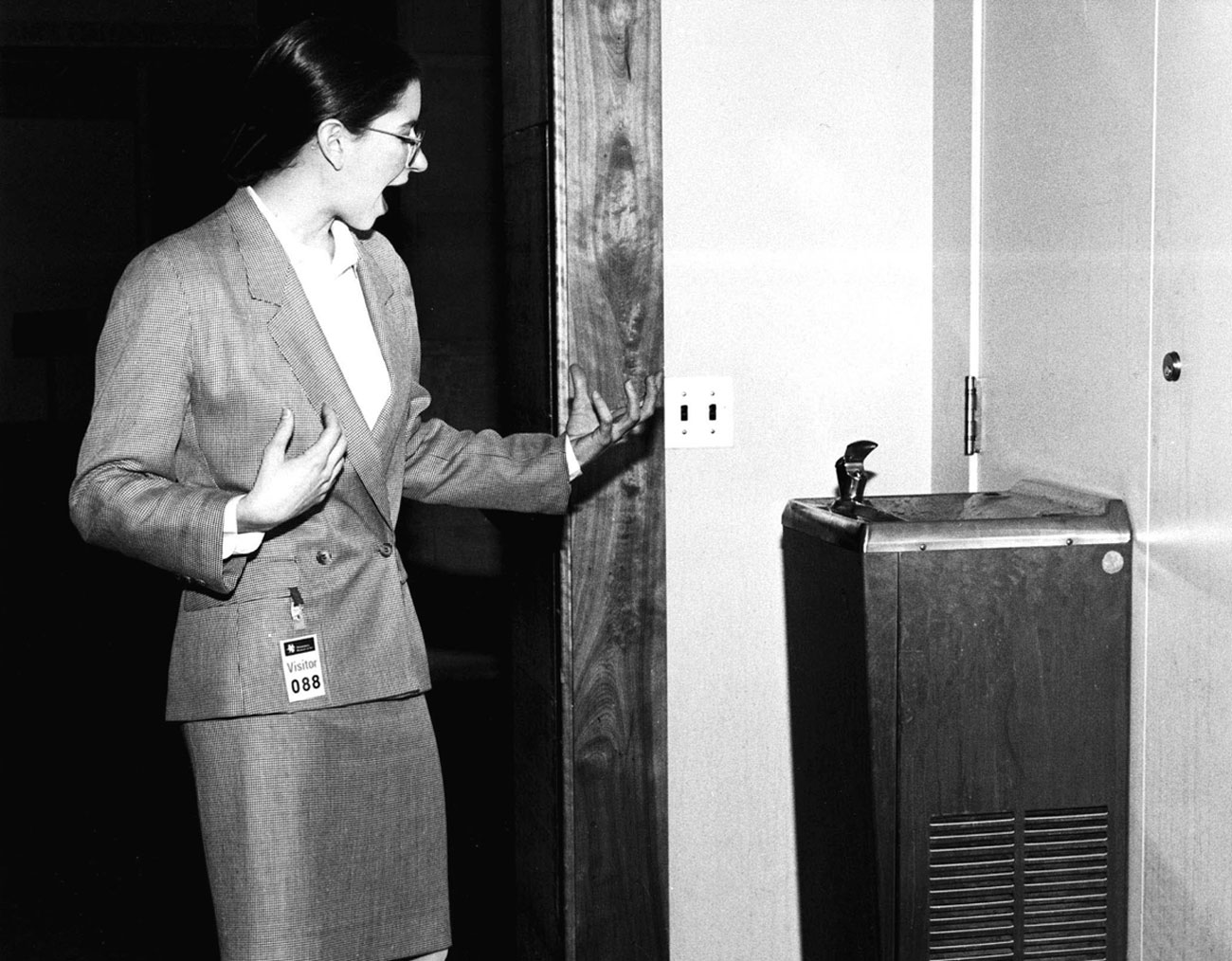
The highlight of the exhibition for me was the guffaw inducing DVD Museum Highlights: A Gallery Talk (1989) by American artist Andrea Fraser. Where Mark Feary found this post-cultural gem is beyond me but I am so glad he did! I stood transfixed as the narrator / curator takes us on a virtual tour of the Philadelphia Museum of Art, along the way pointing out the magnificence and subliminal beauty of the objects in the museum. She stresses the decorum of the institution, it’s tradition in measured, ordered, dignified arrangements that are fine and simple while addressing a water fountain. Oh the deliciousness! She continues with the exultation of the institution, that is to develop an appreciation of values – true / false, better / worse, right / wrong, what is good for you / what is good for society – standards that should be adopted by a discriminating public, while addressing a broom cupboard. The piece subverts an approach “in which visitors’ individual meanings are only validated by the extent to which they concord with the conclusions intended by exhibition-makers or to which they conform to some predetermined and fixed standard truth.”1 And so it goes in an ever so serious, side-splitting soliloquy, critiquing the functions of art, linking the aspirations of humanity with the highest privileges of wealth and leisure. Wonderful!
Dr Marcus Bunyan
1/ Hein, George E. Learning in the Museum. London: Routledge, 1998 quoted in Sandell, Richard. “Reframing conversations,” in Museums, Prejudice and the Reframing of Difference. London and New York: Routledge, p. 179.
Installation views of the exhibition Autumn Masterpieces: Highlights from the Permanent Collection at the Centre for Contemporary Photography, Melbourne Photos: Marcus Bunyan
Courtesy of the collection of Tony Garifalakis
Courtesy of the collection of Irene Hanenbergh
Courtesy of the collection of Hany Armanious
Andrea Fraser (American, b. 1965) Museum Highlights: A Gallery Talk 1989 DVD (colour video with sound. 29′) Courtesy of the artist and Friedrich Petzel Gallery, New York
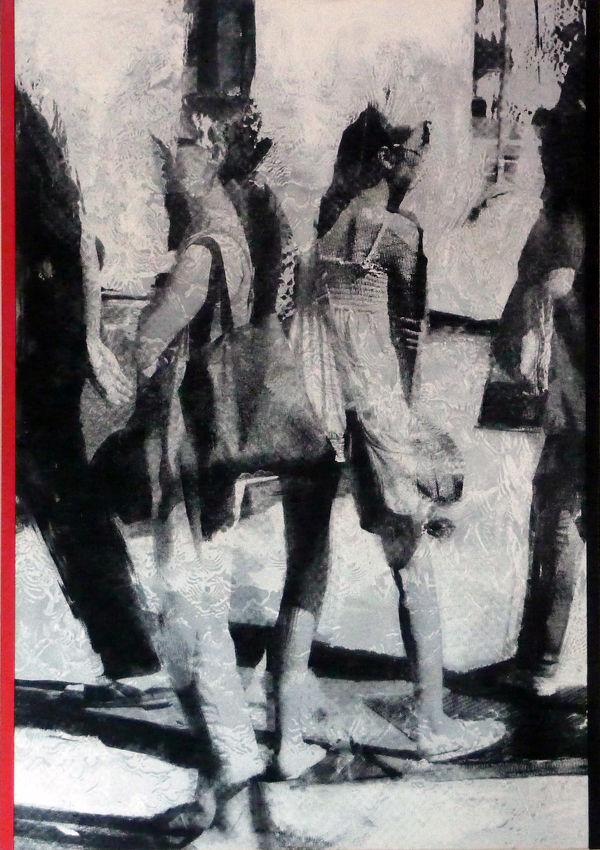
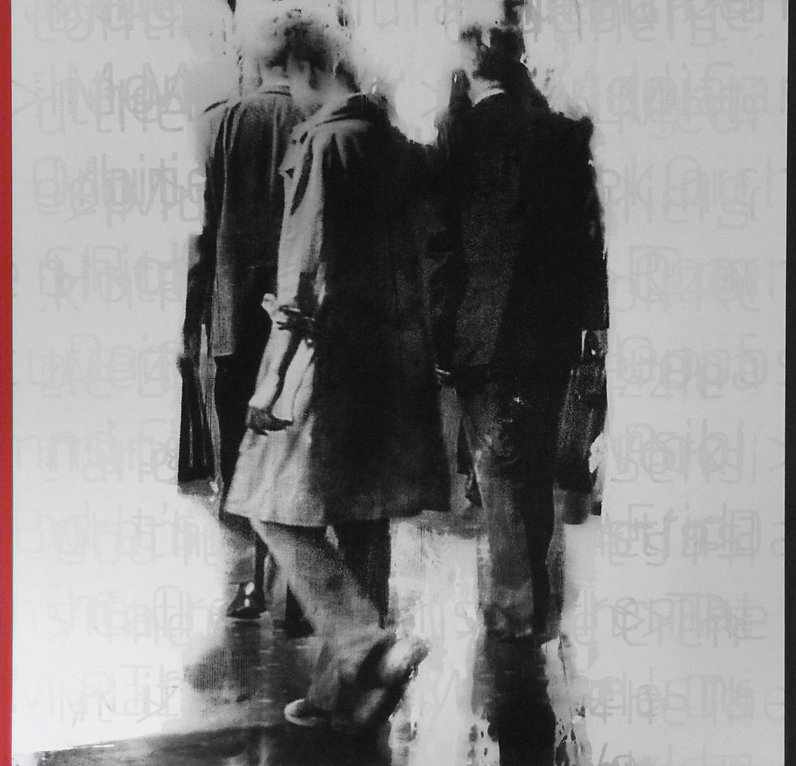
Four interesting exhibitions in Albert Street, Richmond – from the beautiful, formed leather sculptures of Pamela Rataj to the wonderfully vibrant tropical bird, chair and decorative pattern paintings of Claudia Damichi; from the intensely observed canvas environments of Steve Randall to the post-photographic silk-screen textualisations of Robert Boynes. Well worth a visit on a Saturday afternoon!
As always, many thankx to the galleries for allowing me to publish the images in this posting. Please click on the images for a larger version.
~ Pamela Rataj. The Morphology of Forgetting at Anita Traverso Gallery. 7th April – 1st May 2010
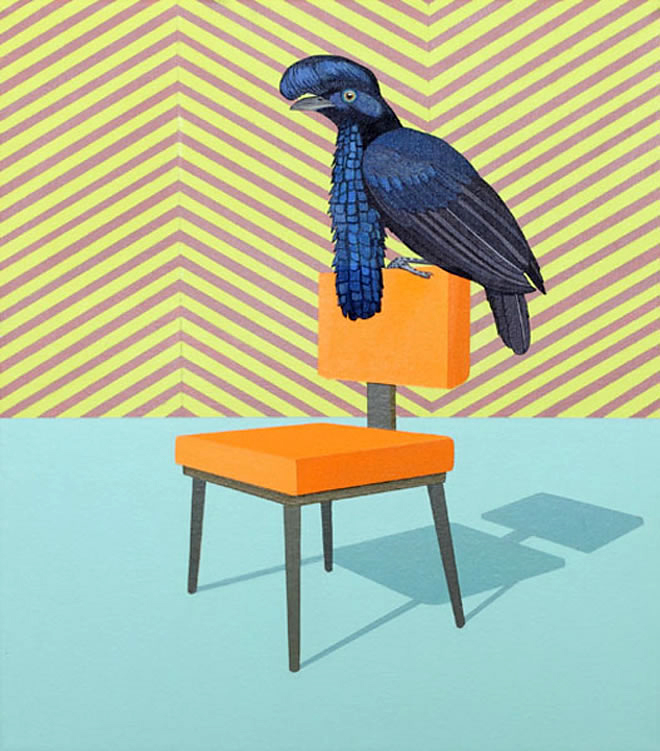
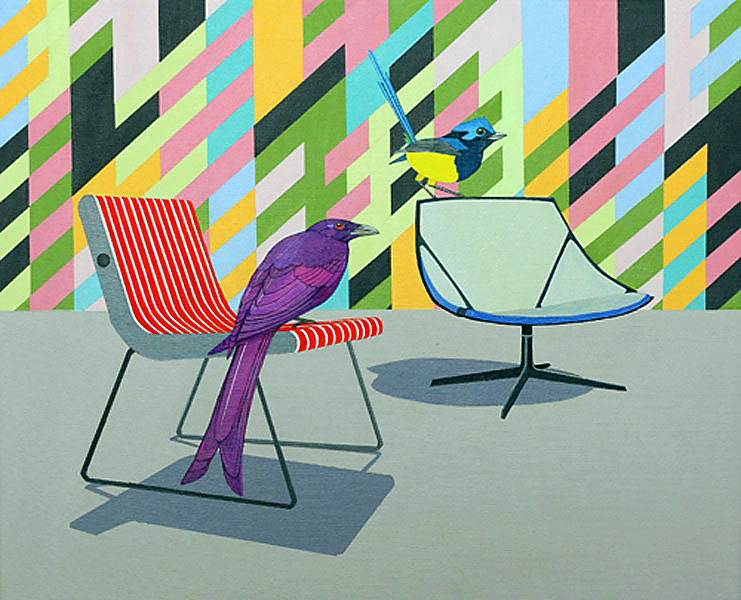
~ Claudia Damichi. The Bitter Sweet at Sophie Gannon Gallery. 30th March – 25th April 2010
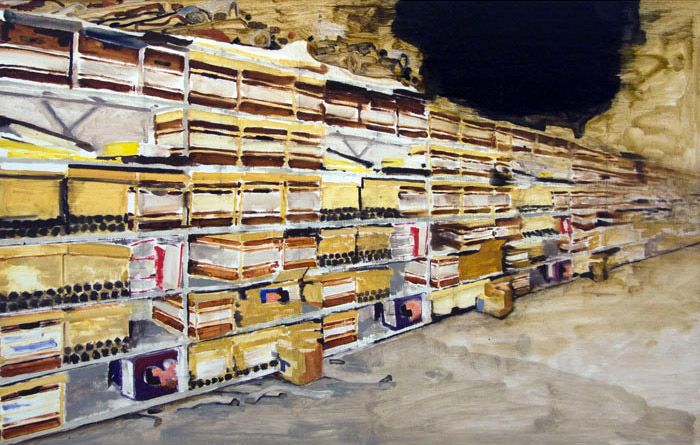
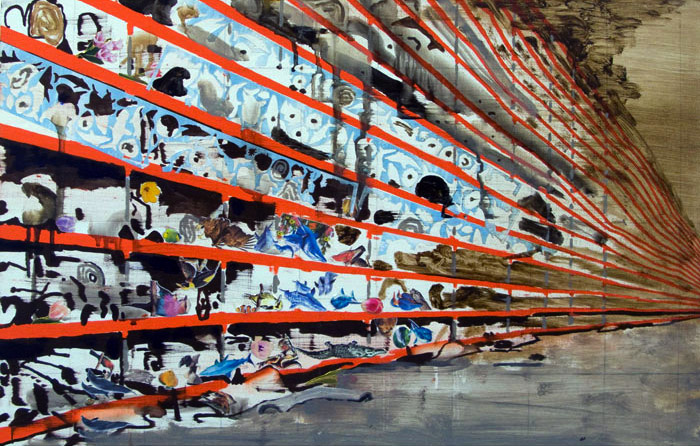
~ Steve Rendall. Security, Storage and Recreation at John Buckley Gallery. 8th April – 1st May 2010
~ Robert Boynes. Postscript at Karen Woodbury Gallery. 7th April – 1st May 2010
Pamela Rataj. The Morphology of Forgetting at Anita Traverso Gallery
7th April – 1st May 2010
Pamela Rataj (Australian) Tangent Bundle 2009
Pamela Rataj (Australian) Ravel 2009
Pamela Rataj (Australian) Kairos 2009
How to draw a boundary between self and other, past time and today?
Patterns and forms in nature often resemble one another, connecting life forms in unexpected ways. Tide lines left in the sand resemble the grains found in a piece of wood, and the veins in a leaf or those in a hand.
The age lines in the trunk of a tree form as each outer layer covers the one preceding it and echoes its shape. This makes me think of the way past experience resurfaces as memory, receding or becoming more important at different times in our lives, as each new experience envelopes our previous states of being and yet is shaped by them.
The wrapped and layered forms in The Morphology of Forgetting explore coexistence and connection.
I dedicate this exhibition to my parents, whose recent deaths have helped me appreciate memory as a way to connect through time.
Pamela Rataj 2010
Press release from the Anita Traverso Gallery website [Online] Cited 10/04/2010. No longer available online
Pamela Rataj (Australian) Faisceaux 1 2009
Pamela Rataj (Australian) Faisceaux 4 2009
Claudia Damichi. The Bitter Sweet at Sophie Gannon Gallery
30th March – 25th April 2010
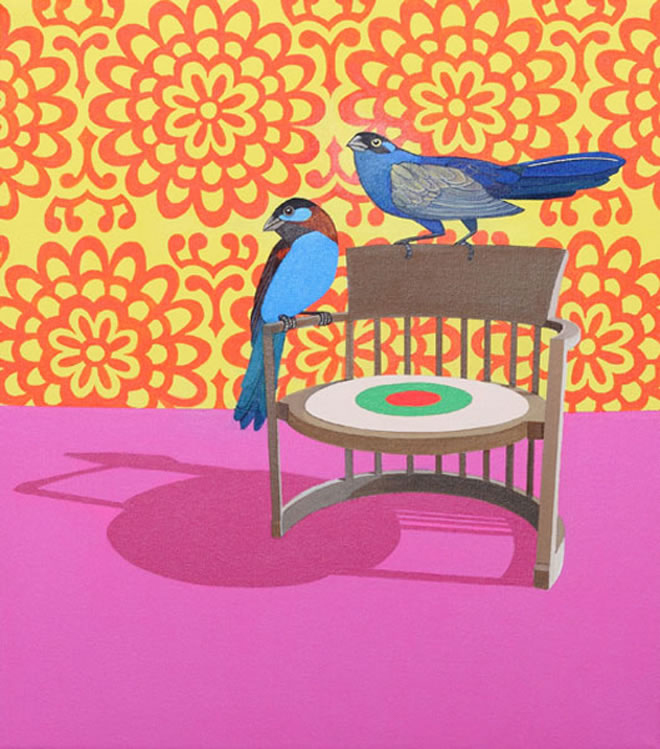
Claudia Damichi (Australian, b. 1972) Birds eye 2010 Acrylic on canvas 46 x 41cm
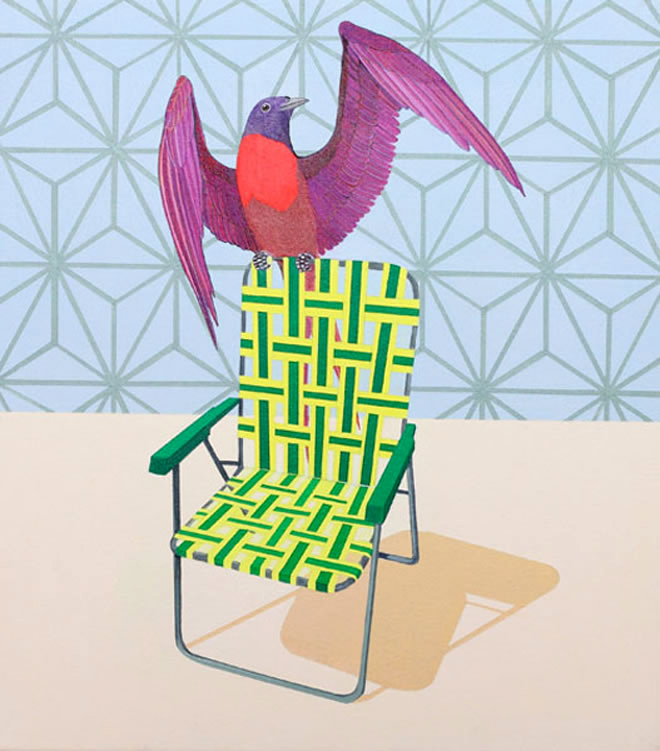
Claudia Damichi (Australian, b. 1972) Star Gazer 2009 Acrylic on canvas 46 x 41cm
Claudia Damichi (Australian, b. 1972) Gridlock 2010 Acrylic on canvas 41 x 46cm
Claudia Damichi (Australian, b. 1972) Reading between the lines 2010 Acrylic on canvas 46 x 41cm
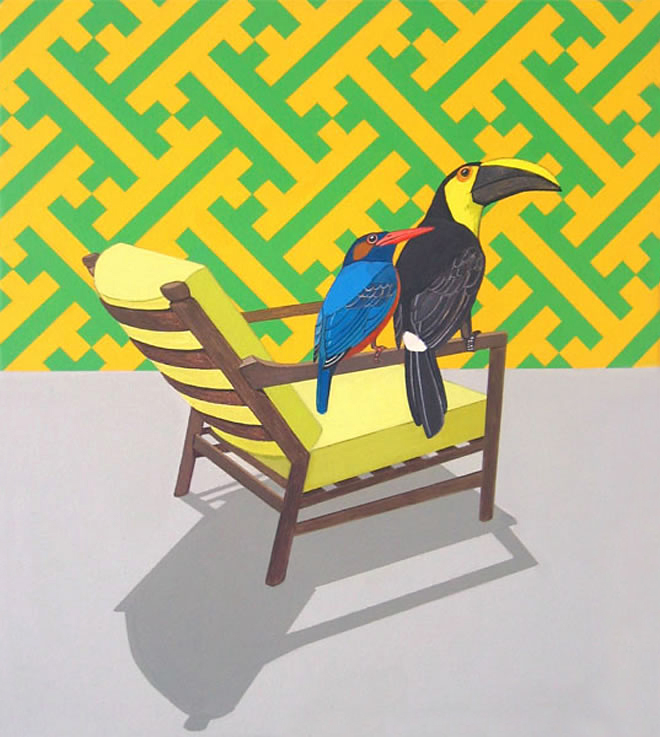
Claudia Damichi’s surrealist still life paintings are characterised by vivid colours, elaborate patterns and distorted spatial proportions. In her paintings of domestic interiors, flowers, birds and furniture, colour is inflated and scale is playfully manipulated – solitary domestic interiors are reconfigured into places of fantasy and illusion. Inspired by the enduring aesthetic of modern industrial design, her surreal and theatrically staged scenarios self-consciously conjure a sense of the absurd. Graphic patterning, high-croma colour and whimsical compositions foster worlds that are at once playful and claustrophobic, satirical and real, tapping into an ambiguous nostalgia that leaves the viewer feeling that anything is possible.
Claudia Damichi (Australian, b. 1972) Look out 2010 Acrylic on canvas 46 x 56cm
Steve Rendall. Security, Storage and Recreation at John Buckley Gallery
8th April – 1st May 2010
Steven Rendall (Australian born Britain, b. 1969; Australia from 2000) Archive 1 2010 Oil on linen
Steven Rendall (Australian born Britain, b. 1969; Australia from 2000) Archive 2 2010 Oil on linen
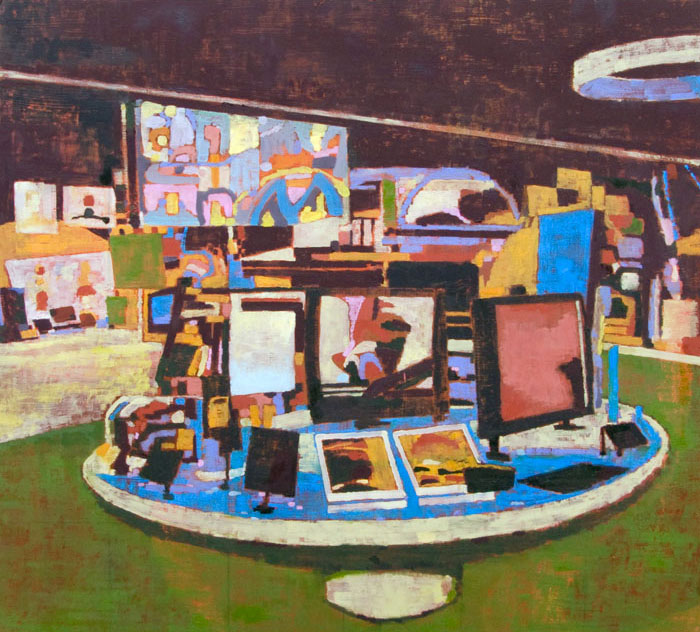
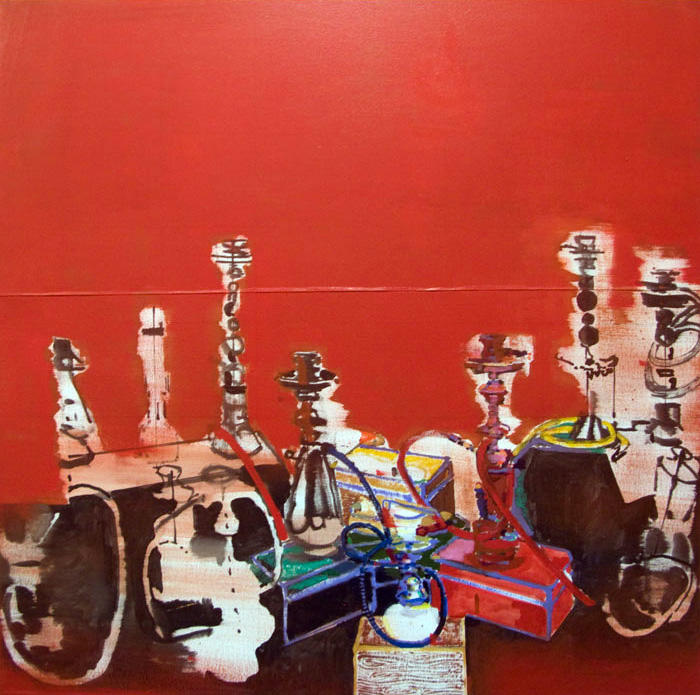
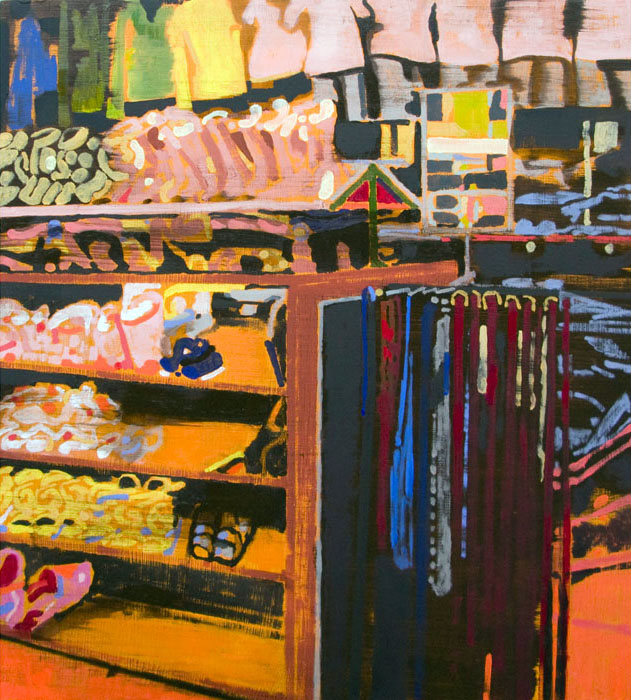
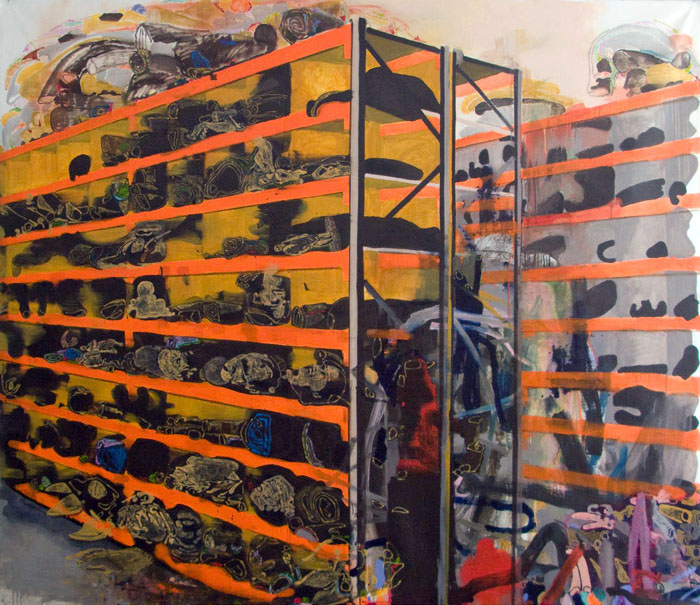
Citing the British artist Walter Sickert as an important influence on his painterly style, Rendall’s work displays a form and content that has attracted the attention of both critics and collectors. A key work in the exhibition is a large-scale painting on un-stretched linen titled Fountain (Rosemary’s Baby) that sprawls across 4.5m. Certain fountains, along with other apparently arbitrary images of television monitors, speedboats, clothing racks, shelving units and museum interiors are recurring motifs in Rendall’s paintings.
Rendall aims to ‘collect and synthesise’ images from around his home and en route to and from his Brunswick studio. Passing observations of window displays, charity shops and various light industrial warehouses are registered and recorded in conjunction with the accumulation of promotional flyers spruiking leisure activities and museum experiences. This shambolic collection of images is transcribed into an array of compositions in Rendall’s paintings. Images occasionally materialise in unlikely places, such as the spectral diver’s head that is resting on a warehouse shelf in the appropriately titled Storage.
In the exhibition Security, Storage and Recreation, you are invited to enter the image bank of Steven Rendall; a ‘wake in fright’ experience where one can become immersed and caught up in the maelstrom of the artist’s visual language – a sequence of painterly dreams each similar yet different to the last.”
Press release from the John Buckley Gallery website [Online] Cited 10/04/2010 no longer available online
Steven Rendall (Australian born Britain, b. 1969; Australia from 2000) Flat Screens (Green) 2010 Oil on linen
Steven Rendall (Australian born Britain, b. 1969; Australia from 2000) Pipes 2010 Oil on linen
Steven Rendall (Australian born Britain, b. 1969; Australia from 2000) Claustrophobia 2010 Oil on linen
Steven Rendall (Australian born Britain, b. 1969; Australia from 2000) Redacted 2 2010 Oil on linen
Robert Boynes. Postscript at Karen Woodbury Gallery
7th April – 1st May 2010
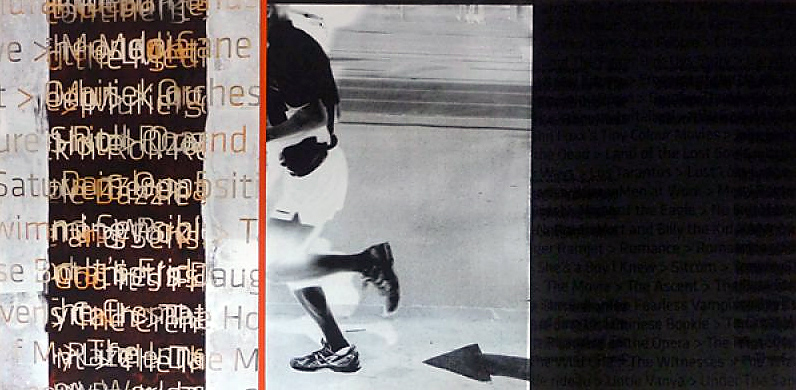
Robert Boynes (Australian, b. 1942) Street Runner 2010 Acrylic on canvas and velvet 120 x 242cm
Robert Boynes (Australian, b. 1942) Days that we forgot 2010 Acrylic on canvas
Robert Boynes (Australian, b. 1942) Signal Driver 2010 Acrylic on canvas and velvet 120 x 190cm
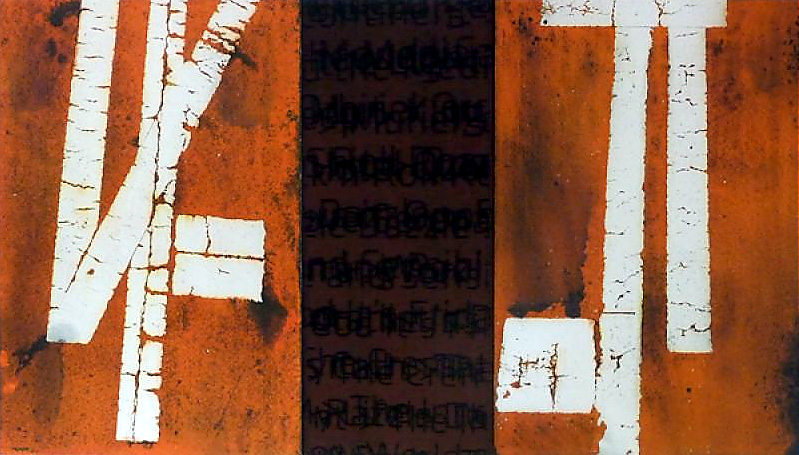
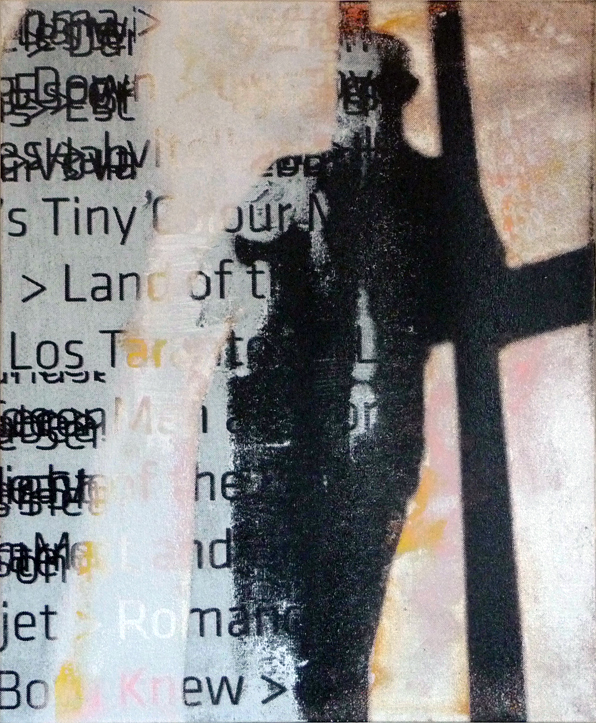
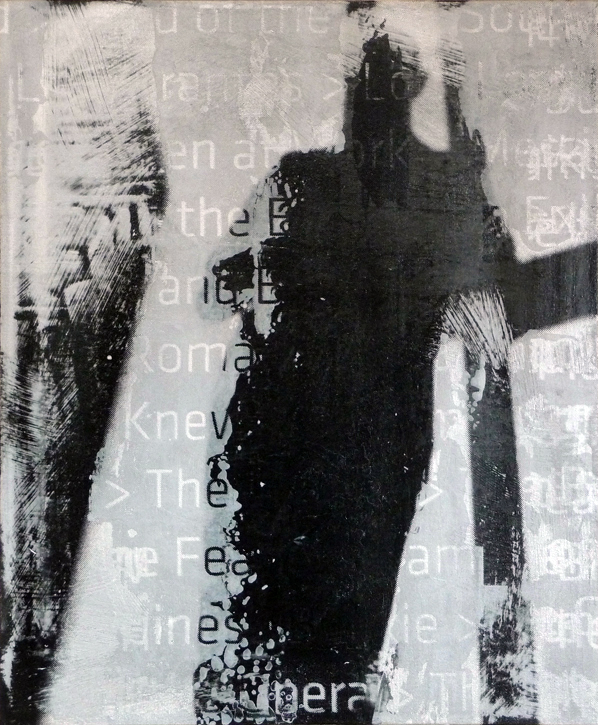
Postscript is Robert Boynes’ second solo exhibition with Karen Woodbury Gallery. This series continues with his exploration of urban themes, contemporary experience and experimentation into ways of using paint. In this most recent body of work Robert has employed the use of text in juxtaposition to various materials such as wood and velvet. The text conveys a feeling of noise and urban clatter, acting as a context and environment for the figures within the work.
His technique involves transferring photographic images to large silk screens and dragging paint through the mesh onto canvas. Robert thus has control in the manipulation of colour, density and translucency of the images. This process results in still moments that magnify and investigate everyday observable reality. The anonymous figures are juxtaposed with text and layering of saturated, contrasting colours, appearing objectified and ghostly.
These works embody a filmic quality, the multi-panelled paintings signify fragmented narratives and enquire into perceptions of time and space.
Text from the Karen Woodbury Gallery website [Online] Cited 10/04/2010 no longer available online
Robert Boynes (Australian, b. 1942) Body Type 2 2010 Acrylic on canvas
Robert Boynes (Australian, b. 1942) Body Type 3 2010 Acrylic on canvas
Robert Boynes (Australian, b. 1942) Things we leave behind 2009 Acrylic on canvas 120 x 180cm
Robert Boynes (Australian, b. 1942) The layered moment 2009 Acrylic on canvas
Robert Boynes (Australian, b. 1942) Postscript 2009 Acrylic on canvas 120 x 124cm
All galleries have closed except for Sophie Gannon Gallery, Richmond.
Sophie Gannon Gallery 2 Albert Street Richmond VIC 3121 Australia Phone: +61 3 9421 0857
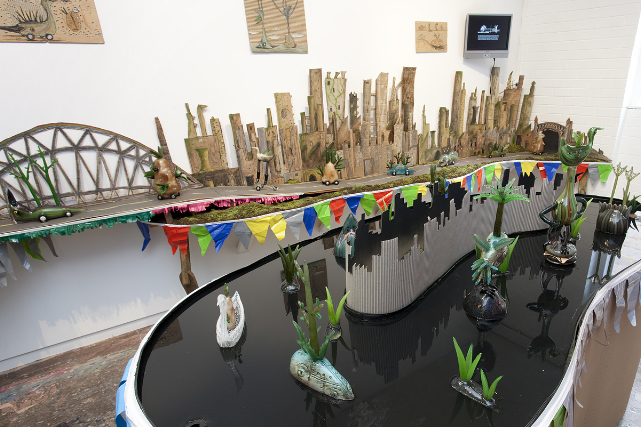
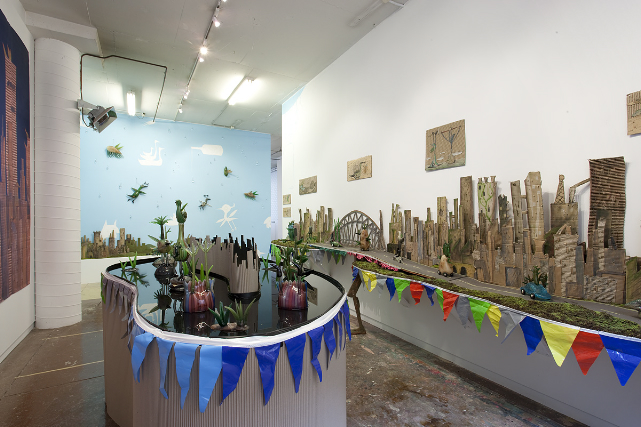
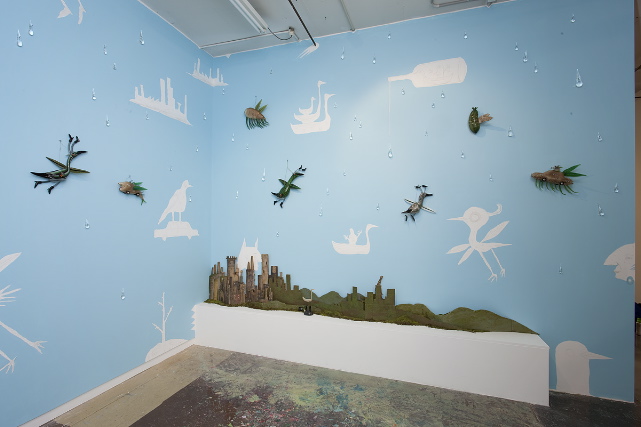
Tom Moore Pondlurking installation photographs at Helen Gory Galerie, Prahran Photo: Marcus Bunyan
My apologies to readers for the paucity of reviews of exhibitions in Melbourne recently. It is not that I haven’t been circulating around town to lots of exhibitions, far from it. The fact is that nothing has really rocked my boat, including my visit to a disappointing New 010 exhibition at ACCA, an exhibition redeemed only by the marvellous magnetic levitations of Susan Jacobs installation titled Being under no illusion (2010). Compared to the wealth of interesting work in New 09, work that still resides in my consciousness, the art in the current exhibition seems bland, the work ultimately and easily forgettable (a case of conceptual constipation?). Even though the exhibition lauds the collaboration between artists, designers, curators, architects, trades people and the kitchen sink in the production of the work, nothing substantive or lasting emerges.
No such problem exists with the exhibition Pondlurking by Tom Moore at Helen Gory Galerie in Prahran. Wow, this show is good!
It produced in me an elation, a sense of exalted happiness, a smile on my dial that was with me the rest of the day. The installation features elegantly naive cardboard cityscape dioramas teeming with wondrous, whimsical mythological animals that traverse pond and undulating road. This bestiary of animals, minerals and vegetables (bestiaries were made popular in the Middle Ages in illustrated volumes that described various animals, birds and even rocks) is totally delightful. In the text Moving Right Along the curator Julie Ewington notes connections in Moore’s work to the Garden of Earthly Delights by Hieronymus Bosch, the porcelain monkey orchestras of Miessen, parti-coloured hose of Medieval costume, the animals from Dr Suess’s books for children and Venetian glass figurines to name but a few. Another curator Geoffrey Edwards notes Moore’s accomplished technical skill in glass making, his use of lattice and trellis work in the figures themselves, namely the use of vetro a fili (broadly spaced) and vetro a retorti (twisted spiral) glass cane patterns.
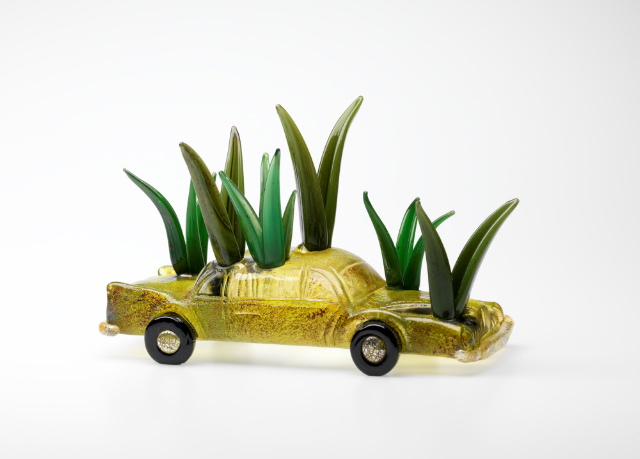
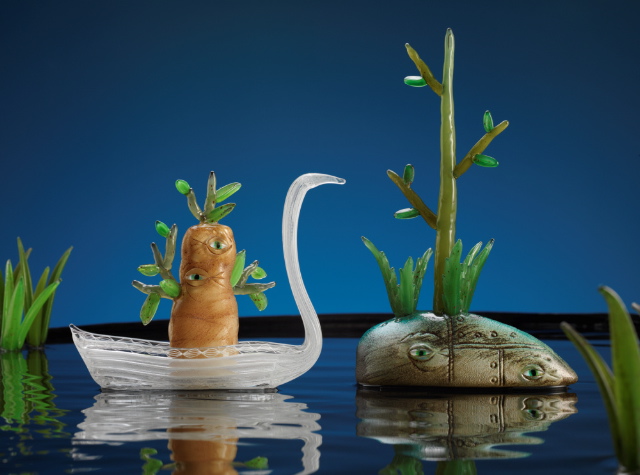
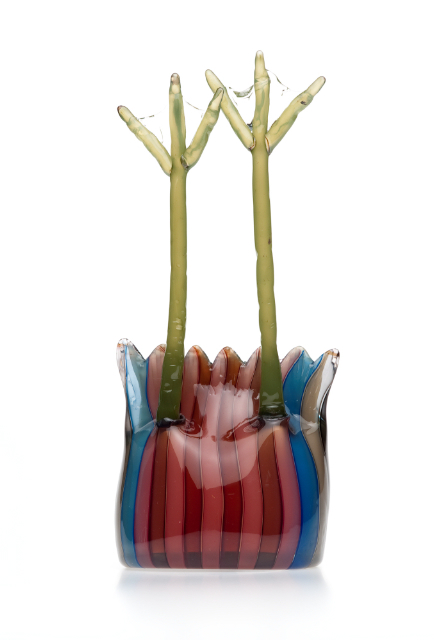
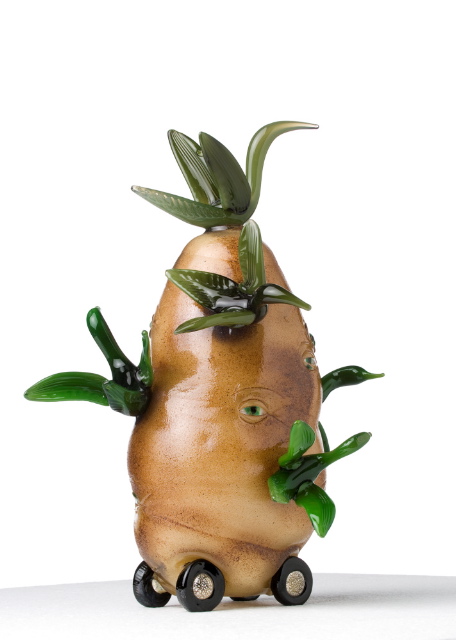
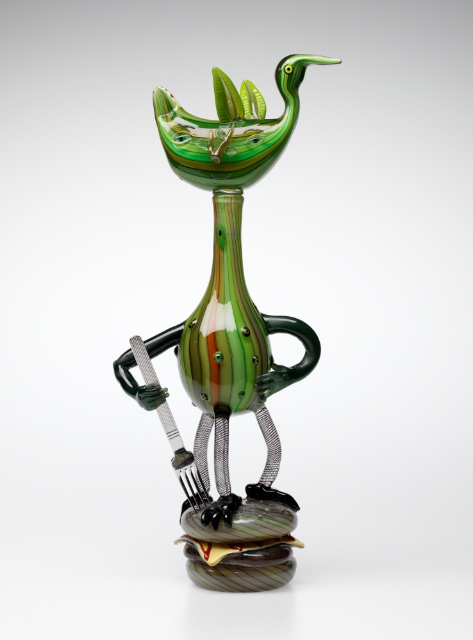
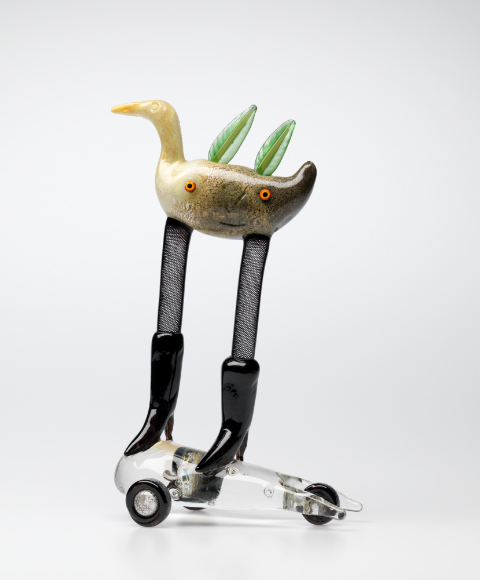
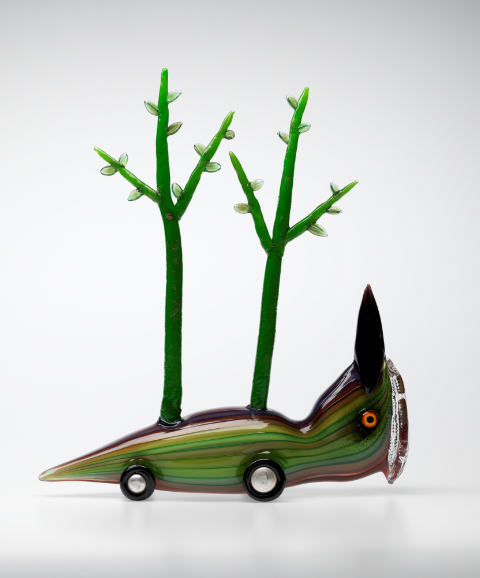
While all of this is true what really stands out is the presence of these objects, their joyousness. The technical and conceptual never get in the way of good art. The Surrealist imagining of a new world order (the destruction of traditional taxonomies) takes place while balanced on one foot (see the installation image at the top of the page). The morphogenesis of these creatures, as they build one upon another, turns the world upside down (as in Web Feet Duck Bum below). Multi-eyed potato cars, ducks with eyes wearing high heeled boots and three-legged devouring creatures segue from one state, condition, situation or element to another in a fluid condition of becoming. This morphogenesis is aided and abetted by the inherent fluidity of the glass medium itself skilfully used by Moore in the construction of his creatures. While the photographs below isolate the creatures within a contextless environment it is when the creatures are placed within the constructed environment so skilfully created by Moore that they come alive.
The interconnectedness of this fantastical world (the intertextual relationship of earth, water, air, life) seeks to break down the binaries of existence – good / bad, normal / mutation, presence / absence – until something else (e)merges. Through their metamorphosed presence in a carnivalesque world that is both weird and the wonderful, Moore’s creatures invite us to look at ourselves and our landscape more kindly, more openly and with a greater generosity of spirit.
Tom Moore Pondlurking installation photographs at Helen Gory Galerie, Prahran Photos: Marcus Bunyan
Tom Moore (Australian) Stylish Car 2008
Tom Moore (Australian) Birdboat with passenger with a vengeance (left) and Robot Island (right) 2010 and 2009
A candy striped fish pokes its head up, all lipstick-pink kissable lips as a voyaging duck sprouts tree-masts and becomes duck-ship-island captained by a lone gherkin boy. Delinquent birds rampage while a crested birdcar peacefully unfurls sweet green shoots. A cardboard city burns and there’s something odd lurking in the pond, metallic and curiously tuberous, it regards it all with a wary eye.
There’s a whole world at play here. Growing, flying and always moving, this isn’t ours turned upside down but something other, a unique universe bound together with a logic entirely its own. Tubers take to the air, birds grow wheels and everything overflows with energy, pushing out green tendrils toward each other.
Tom Moore’s gloriously appealing glass creatures spring from his own fantastical imagination and the rich seabeds of the mythical, imaginary and grotesque. From mediaeval bestiaries with their camel leopards and manticores, to misericord creatures through Lear and Seuss to Moore’s reimagining of an Colonial Australian epergne as a verdantly plumed robot bird with resplendent palm tree, his creatures reuse, recycle and recombine in their never ending metamorphoses.
There’s an irrepressible joyousness in these creatures constant flux as they burst the boundaries of animal / vegetable / mineral and do away with taxonomies and rationality, reinventing themselves in happy disregard of all humanity’s rules.
While lurking seems antithetical to all this busy-ness, to skylarking fatbirds and peripatetic potatoes, the will to knowledge at the core of all lurking is what propels this endless becoming. This insatiable urge to simply find out is the engine of this prolific universe. As duck becomes island and man becomes bird, Moore’s creatures ask an eternal ‘what if?’ and an insouciant ‘why not?’
This transformative energy inheres in the material itself, in the mutable and alchemical nature of glass, in the fusing and melding of forms as light is captured within and bounces off lustrous surfaces. As glass flows through its changeable states, like water, like rain, so do Moore’s folk transform and evolve.
It’s this continuous moving through forms that hints at other meanings. Sharing forms, being made as it were, of each other and sharing an essential nature, each creature reaches out to every other in a net of relations in an intricately connected universe. These deep bonds, seen in their loving regard for each other speak of the delicate structures and balance of ecosystems and an absolutely necessary attention to and care for the world.
For there are no humans here and it seems that it’s this carelessness, this lack of attention to the fragile connections between the world and its creatures that’s the reason. The cities burn and cars rightfully become compost.
This riotous parade has pulled the artist too into their exuberant tumble. Becoming man-bird and greeting the day with a drumming bird song he is the harbinger perhaps of a new order, one bright green and sparkling.
Jemima Kemp, 2010
Press release from the Helen Gory Galerie website [Online] 20/03/2010 no longer available online
Tom Moore (Australian) Web Feet Duck Bum 2009
Tom Moore (Australian) Tasty Eyes With Five Friends 2007
Tom Moore (Australian) Snarsenvorg the Devourer 2008
Marcus Bunyan (Australian born England, b. 1958) Missing in Action (horizontal kenosis) No.4 2010 Digital photograph
Missing in Action (horizontal kenosis)
A body of work, Missing in Action (horizontal kenosis) (2010) is now online on my website.
There are nineteen images in the series which can be viewed as a sequence, rising and falling like a piece of music.
Below are a selection of images from the series.
Marcus
Photographs are available from this series for purchase. As a guide, a digital colour 16″ x 20″ costs $1000 plus tracked and insured shipping. For more information please see my Store web page.
Kenosis
“In Christian theology, Kenosis is the concept of the ‘self-emptying’ of one’s own will and becoming entirely receptive to God and his perfect will.”
Marcus Bunyan (Australian born England, b. 1958) Missing in Action (horizontal kenosis) No.5 2010 Digital photograph
Marcus Bunyan (Australian born England, b. 1958) Missing in Action (horizontal kenosis) No.6 2010 Digital photograph
Marcus Bunyan (Australian born England, b. 1958) Missing in Action (horizontal kenosis) No.8 2010 Digital photograph
Marcus Bunyan (Australian born England, b. 1958) Missing in Action (horizontal kenosis) No.9 2010 Digital photograph
Marcus Bunyan (Australian born England, b. 1958) Missing in Action (horizontal kenosis) No.16 2010 Digital photograph
Marcus Bunyan (Australian born England, b. 1958) Missing in Action (horizontal kenosis) No.17 2010 Digital photograph
It is with sadness that I hear of the closing of Gallery 101 in March this year for the closing of a prominent city gallery hurts the whole arts community. To the director, Diana Gold, and curators Martina Copley and Cate Massola, I wish them all the best in their new endeavours, whatever they may be. I thank them for their time, conversation, insight and knowledge about the art scene in Melbourne. Au revoir!
Dr Marcus Bunyan
To friends and colleagues in the Melbourne Visual Art community, it is with regret that we write to tell you that Gallery 101 will close in March this year.
Major rejuvenation works have recently been instigated by the owners of 101 Collins Street within the main ground floor entry lobbies of the building adjacent to Gallery 101. To coincide with this renovation program, 101 Collins Street has recently decided that the space that has operated as Gallery 101 will close effective from March 13th.
Gallery 101 has operated as a unique model in a corporate building since the building’s establishment. In 1992 Dianna Gold was appointed Director/Curator to run the Gallery space on behalf of 101 Collins Street. For nearly 20 years, the owners and management have supported the Gallery which has provided a forum for emerging and established artists. The formal exhibition program began with an acquisitive art prize called ARTWORKZ, which ran for 5 years and was fully sponsored by 101 Collins Street to begin their art collection.
Gallery 101 has been identified as one of the most beautiful gallery spaces in one of the most respected corporate buildings in Australia. The Gallery has contributed to the profile of 101 Collins Street, liaised with tenants in the building and played a significant role in the arts community. Gallery 101 is a respected commercial gallery and member of the ACGA. With over thirty represented artists, Gallery 101 has showcased an ongoing program of diverse contemporary art exhibitions to a broad local and national audience.
The end of its life as a gallery marks the very significant role the artists via many exhibitions have contributed to the rich artistic cultural tapestry in the City of Melbourne.
We would like to express our sincere thanks to all those who have supported our artists and the Gallery.
Press release from Gallery 101 website [Online] Cited 03/03/2010 no longer available online
Camilla Tadich: Slabalong and Mark Hislop: Drawing at Sophie Gannon Gallery; Simon Obarzanek at Karen Woodbury Gallery; Kent Wilson Higher Breeds and Alice Wormald Wayside and Hedgerow at Shifted
Camilla Tadich: Slabalong and Mark Hislop: Drawing at Sophie Gannon Gallery, 2 Albert Street, Richmond March 2nd – March 27th 2010 Sophie Gannon Gallery website
Simon Obarzanek at Karen Woodbury Gallery, 4 Albert Street, Richmond March 3rd – March 27th 2010 This gallery is now closed
Kent Wilson Higher Breeds and Alice Wormald Wayside and Hedgerow at Shifted, Level 1, 15 Albert Street, Richmond This gallery is now closed
All photos by Marcus Bunyan
Sophie Gannon Gallery opening Photo: Marcus Bunyan
Sophie Gannon Gallery opening – Mark Hislop Drawing Photos: Marcus Bunyan
Camilla Tadich (Australian, b. 1982) Bordertown 2010 Photo: Marcus Bunyan
Sophie Gannon Gallery opening – Camila Tadich Slabalong Photo: Marcus Bunyan
Karen Woodbury Gallery opening – Simon Obarzanek Photo: Marcus Bunyan
Simon’s photographs come from observing the physical movements of people pushing through the space around them in a city. He senses a universal language through movement and is drawn to this rather than their faces, as he normally is.
He noted that the “strained movements against gravity struck me with force… When I see a person creating a shape with their body in the street I do not sense the individual but a part, a piece of a larger performance. Each individual connects with others to create a visual language. I did not want faces to interrupt this larger work.”
Simon collects the movements on his camera, as photographic sketches, then he rephotographs the movement using friends and family as models. Removed from the busy streets, dislocated, his subject is isolated and framed against a dark background. Some twist away from the camera, or stagger against an unseen wind, sheltering their face from rain that is not falling. Simon does not show their faces, which emphasises the movement and makes the figures anonymous. These photographs are theatrical and mysterious, emphasising the loneliness and alienation that can be encountered living in a big city.
“Curiosity is a vice that has been stigmatized in turn by Christianity, by philosophy and even by a certain conception of science. Curiosity, futility. I like the word however. To me it suggests something all together different: it evokes concern; it evokes the care one takes for what exists or could exist; an acute sense of the real which, however, never becomes fixed; a readiness to find our surroundings strange and singular; a certain restlessness in ridding ourselves of our familiarities and looking at things otherwise; a passion for seizing what is happening now and what is passing away; a lack of respect for traditional hierarchies of the important and the essential.”
Michel Foucault 1
“Swallow is at his best when he’s exploring ways to communicate through the innate qualities of materials … This is always going to be more affecting than glib post-modernism, but he just can’t help himself sometimes. So my deep dislike for portentous and ironic titles bristled up immediately here. ‘Salad Days’ and ‘Killing Time’ are only two of the jokey puns, the problem is that art that simply supports two meanings isn’t very smart or complex. There’s no room for subtext. Irony is not the complex and neutral form that ambiguity is. It doesn’t invite engagement or interpretation. Art ought to aspire to infinite meanings, or maybe even only one. Irony doesn’t make for good art, when irony is the defense mechanism against meaning, masking an anxiety about sincerity.”
John Matthews 2
Let’s cut through the hyperbole. This is not the best exhibition since sliced bread (“the NGV highlight of 1609, 2009 and possibly 2109 too” says Penny Modra in The Age) and while it contains a few strong individual pieces this is not even a particularly good exhibition by Ricky Swallow at NGV Australia.
Featuring bronzes, watercolours and sculptures made from 2004-2009 that are sparingly laid out in the gallery space this exhibition comes as close to the National Gallery of Victoria holding a commercial show as you will find. Using forms such as human skeletons, skulls, balloons encrusted with barnacles, dead animals and pseudo death masks that address issues of materials and memory, time and space, discontinuity and death, Swallow’s sculptures are finely made. The craftsmanship is superb, the attention to detail magnificent and there is a feeling of almost obsessional perfectionism to the pieces. This much is given – the time and care taken over the construction, the hand of the maker, the presentation of specimen as momento mori is undeniable.
After seeing the exhibition three times the standout pieces for me are a life size dead sparrow cast in bronze (with the ironic title Flying on the ground is wrong 2006) – belly up, prostrate, feet curled under – that is delicate and poignant; Caravan (2008), barnacle encrusted bronze balloons that play with the ephemerality of life and form – a sculpture that is generous of energy and spirit, quiet yet powerful; Bowman’s record (2008), found objects of paper archery targets cast in bronze, the readymade solidified, the marks on paper made ambiguous hieroglyph of non-decaying matter, paper / bronze pierced by truth = I shot this, I was here (sometime); and Fig.1 (2008), a baby’s skull encased in a paper bag made of carved wood – the delicacy of surfaces, folds, the wooden paper collapsing into the skull itself creating the wonderful haunting presence of this piece. In these sculptures the work transcends the material state to engage the viewer in a conversation with the eternal beyond.
Swallow seeks to evidence the creation of meaning through the humblest of objects where the object’s fundamental beauty relies on the passing of time for its very existence. In the above work he succeeds. In other work throughout the exhibition he fails.
There seems to be a spare, international aesthetic at work (much like the aesthetic of the Ron Mueck exhibition at NGV International on St. Kilda Road). The art is so kewl that you can’t touch it, a dude-ish ‘Californication’ having descended on Swallow’s work that puts an emotional distance between viewer and object. No chthonic nature here, no dirt under the fingernails, no blood on the hands – instead an Apollonian kewlness, all surface and show, that invites reflection on life as discontinuous condition through perfect forms that seem twee and kitsch.
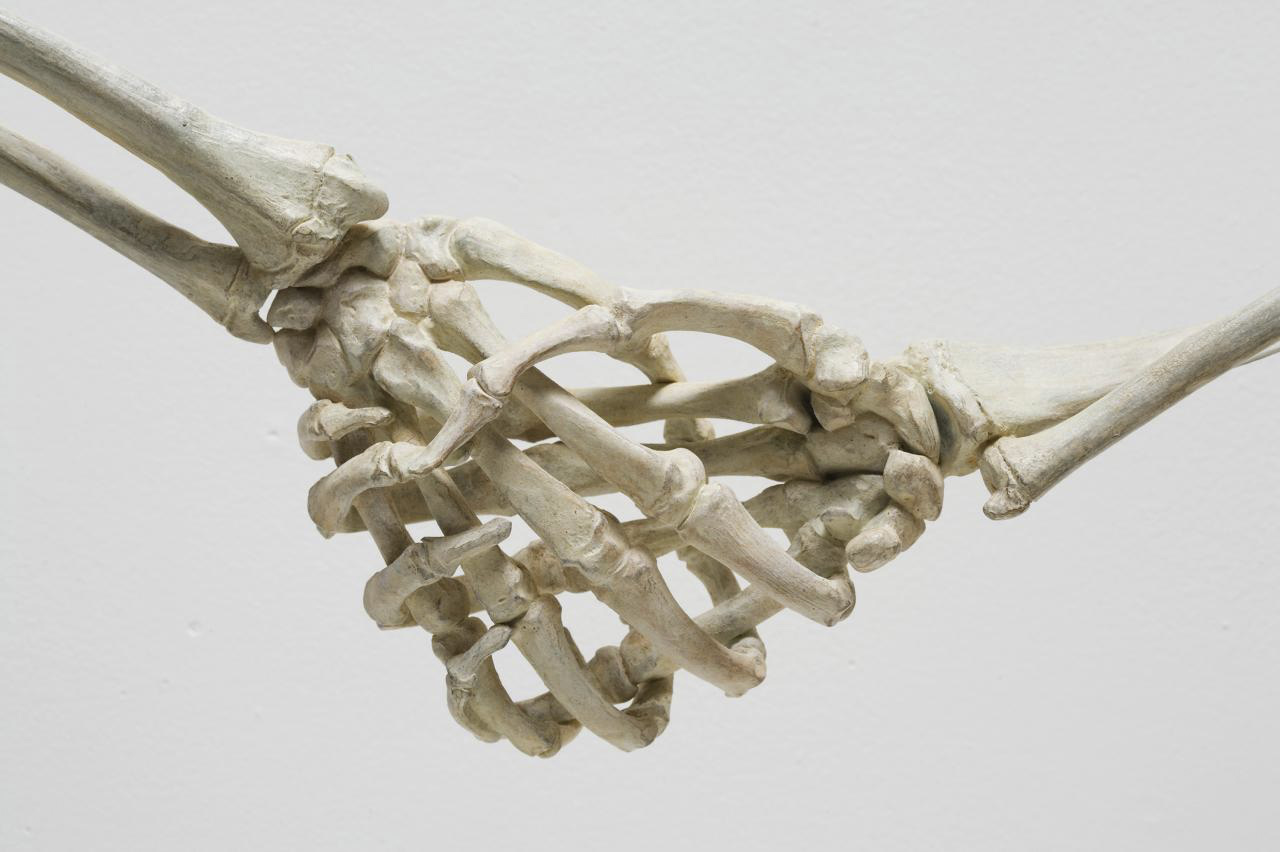
In Tusk (2007) two bronze skeletal arms hold hands in an undying bond but the sculpture simply fails to engage (the theme was brilliantly addressed by Louise Bourgeois in the first and only Melbourne Arts Biennale in 1999 with her carving in granite of two clasped hands); in History of Holding (2007) the icon of the Woodstock festival designed in 1969 is carved into a log of wood placed horizontally on the floor while a hand holding a peeled lemon (symbolising the passing of time in the still life genre) is carved from another log of wood placed vertically. One appreciates the craftmanship of the carving but the sentiments are too saccharin, the surfaces too shallow – the allegorical layering that Swallow seeks stymied by the objects iconic form. A friend of mine insightfully observed about the exhibition: “Enough of the blond wood thing – it’s so Space Furniture!”
As John Matthews opines in the above quotation from his review of the exhibition there seems to be a lack of sincerity and authenticity of feeling in much of Swallow’s work. Irony as evidenced in the two major pieces titled Salad Days (2005) and Killing Time (2003-2004) leaves little room for the layering of meaning: “Irony is not the complex and neutral form that ambiguity is. It doesn’t invite engagement or interpretation.” Well said.
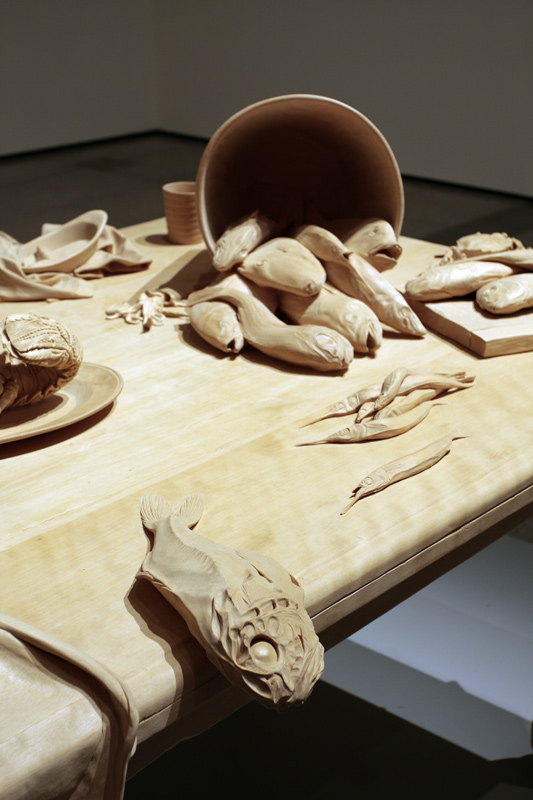
Killing Time in particular adds nothing to the vernacular of Vanitas paintings of the 17th century, adds nothing to the mother tongue of contemporary concerns about the rape of the seas, fails to update the allegories of the futility of pleasure and the inevitability of death – in fact the allegories in Swallow’s sculpture, the way he tries to twist our conception of the real, seem to have lost the power to remind us of our doom. The dead wooden fish just stare back at us with doleful, hollow eyes. The stilted iconography has no layering; it does not destroy hierarchies but builds them up.
In his early work Swallow was full of curiosity, challenging the norms of culture and creation. I always remember his wonderful series of dioramas at the Melbourne Biennale that featured old record players and animated scenes (see the photograph of Rooftop shoot out with chimpanzee (1999) below). Wow they were hot, they were fun, they made you think and challenge how you viewed the world! As Foucault notes in his excellent quotation at the top of the posting, curiosity promotes “an acute sense of the real which, however, never becomes fixed; a readiness to find our surroundings strange and singular; a certain restlessness in ridding ourselves of our familiarities and looking at things otherwise; a passion for seizing what is happening now and what is passing away; a lack of respect for traditional hierarchies of the important and the essential.”
While Swallow’s ‘diverse gestures of memorialisation’ still address the fundamental concerns of Foucault’s quotation his work seems to have become fixed in an Apollonian desire for perfection. He has forgotten how his early work challenged traditional hierarchies of existence; now, even as he twists and turns around a central axis, the conceptualisation of life, memory and death, his familiarity has become facsimile (a bricoleur is a master of nothing, a tinkerer fiddling at the edges). His lack of respect has become sublimated (“to divert the expression of (an instinctual desire or impulse) from its unacceptable form to one that is considered more socially or culturally acceptable”), his tongue in cheek has become firmly fixed, his sculptures just hanging around not looking at things otherwise.
Dr Marcus Bunyan
1/ Foucault, Michel. “The Masked Philosopher” in Politics, philosophy, culture: interviews and other writings, 1977-1984. London: Routledge, 1988, p. 328
Ricky Swallow (born Australia 1974, lived in England 2003-06, United States 2006- ) Rooftop shoot out with chimpanzee 1999 From the series Even the odd orbit Cardboard, wood, plastic model figures and portable record player 53.0 h x 33.0 w x 30.0 d cm Collection of the National Gallery of Australia Gift of Peter Fay 2001
Please note: This art work is not in the exhibition
Ricky Swallow (born Australia 1974, lived in England 2003-06, United States 2006- ) Tusk (detail) 2007 Patinated bronze, brass Edition of 3 plus 1 Artist’s Proof 50 x 105 x 6cm National Gallery of Australia, Canberra Gift of the Prescott Family Foundation, 2008
Ricky Swallow (born Australia 1974, lived in England 2003-06, United States 2006- ) The Man from Encinitas 2009 Plaster, onyx, steel
Ricky Swallow’s sculptures address fundamental issues that lie at the core of who we are. Things have lives. We are our things. We are things. When all is said and done it is our things – our material possessions – that outlive us. Anyone who has lost a family member or close friend knows this: what we have before us once that person is gone are the possessions that formed a life. Just as we are defined and represented by the things that we collect over time, we are ultimately objects ourselves. When we are dead and decomposed what remains are our bones, another type of object. And then there is social science. Archaeology, a subfield of anthropology, is entirely based on piecing together narratives of human relations based on material culture, that is, objects both whole and fragmentary. It may seem obvious but it is worth stressing here that our understanding of cultures from the distant past, those that originated before the advent of writing, is entirely based on the study of objects and skeletal remains. Swallow’s art addresses these basic yet enduring notions and reminds us of our deep symbiotic relationship to the stuff of daily life.
Like the bricoleur put into popular usage by anthropologist Claude Levi-Strauss in his seminal book The Savage Mind, Ricky Swallow creates works of art often based on objects from his immediate surroundings. His method, however, is more of a second order bricolage: his sculptures are not assemblages of found objects, but rather elegantly crafted things. Handcarved from wood or plaster or cast in bronze, these humble objects are transformed into memorials to both the quotidian and the passage of time.
Still life
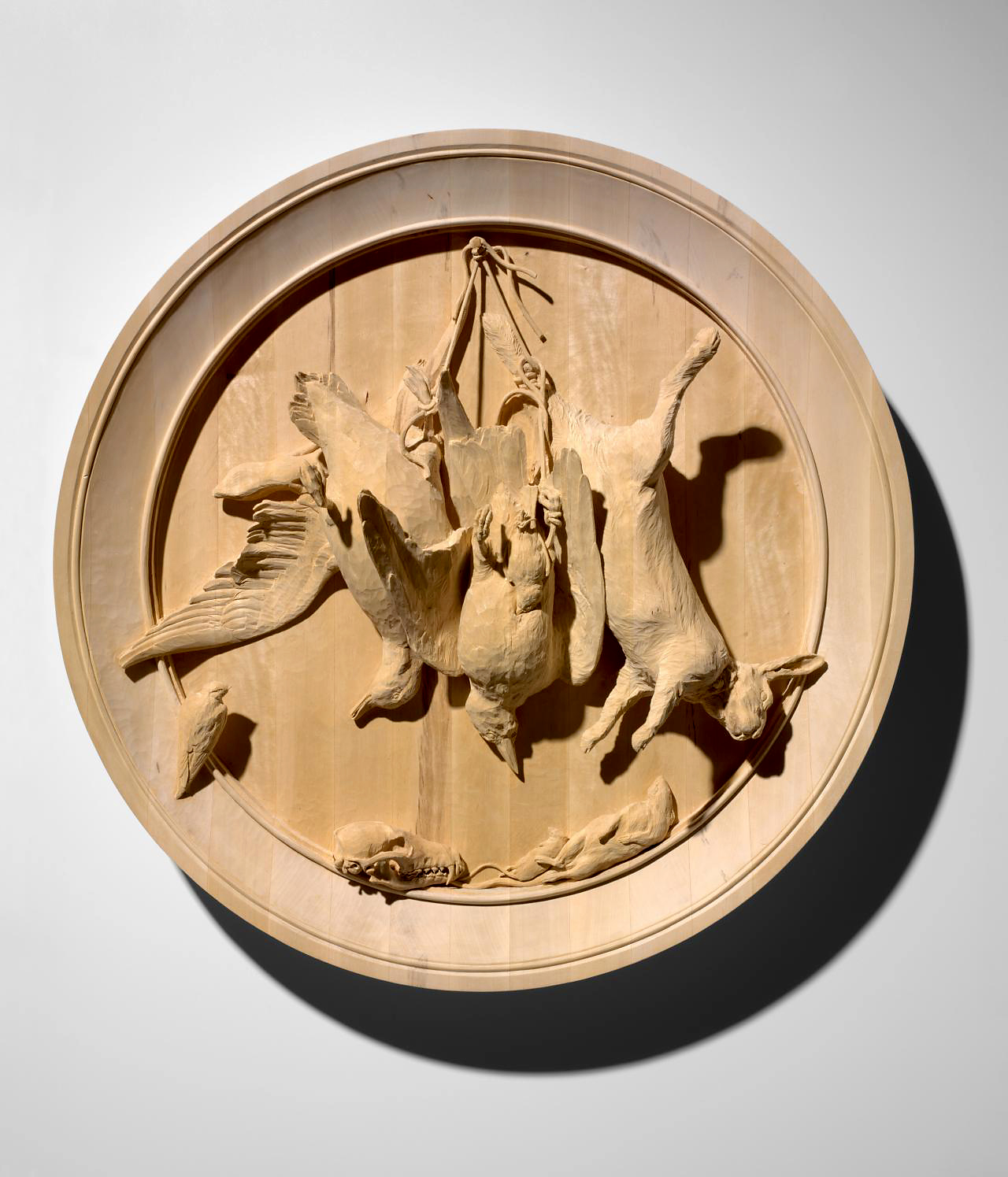
The still life has been an important touchstone throughout Swallow’s recent practice as it is an inspired vehicle for the exploration of how meaning is generated by objects. Several sculptures in the exhibition reference the still-life tradition in which Swallow updates and personalises this time-honoured genre, in particular the vanitas paintings of 17th century Holland. Vanitas still lifes, through an assortment of objects that had recognisable symbolism to a 17th-century viewer, functioned as allegories on the futility of pleasure and the inevitably of death. Swallow’s embrace of still life convention, however, is non-didactic, secular and open-ended. Swallow is not obsessed by death. On the contrary, his focus on objects is about salvaging them from the dust bin of history and honouring their continued resonance in his life. Killing time, 2003-2004, and Salad days, 2005, depict animals that Swallow and his family either found or caught when he was young and best highlight how the artist reclaims the still life genre to explore personal narrative. Killing time, which depicts a bounty of fish and crustaceans spread across a table modelled after the Swallow family kitchen table of the artist’s youth, is rife with autobiographical association. It not only references an object from Swallow’s past, but also the profession of his father, a fisherman, and the fact that Swallow was raised by the sea. Salad days is another autobiographical work depicting a range of animals such as birds, a rabbit, mice and a fox skull. Like many boys growing up in rural environments, Swallow recalls shooting magpies, encountering nesting birds in his garage or discovering dead lizards or trapping live ones in an attempt to keep them as pets.
While not an overt still life, History of holding, 2007, suggests the genre in its fragmentary depiction of a musical instrument and the appearance of a lemon with falling rind. The hand holding / presenting a peeled lemon as the rind winds around the wrist in bracelet-like fashion is based on a cast of Swallow’s own hand, insinuating himself into this antiquated tradition. It is as if Swallow is announcing to us his deep interest in the temporality of objects through the presentation of the peeled lemon, which symbolises the passing of time and also appears in Killing time. The second component of History of holding is a sculptural interpretation of the Woodstock music festival icon designed by Arthur Skolnick in 1969, which still circulates today. History of holding, then, also references music, a leitmotif in Swallow’s art that appears both within the work itself, and also through Swallow’s use of titles.
Body fragments
Tusk, 2007 among several other works in the exhibition, explores the theme of body as fragment. Much has been discussed about Swallow’s use of the skeleton as a form rich in meaning within both the traditions of art history as well as popular culture (references range from the Medieval dance macabre and the memento mori of the still life tradition to the skeleton in rock music and skateboard art iconography). Tusk represents two skeletal arms with the hands clasped together in eternal union. A poignant work, Tusk is a meditation on permanence: the permanence of the human body even after death; the permanence of the union between two people, related in the fusion of the hands into that timeless symbol of love, the heart.
Swallow calls his watercolours “atmospheric presentations,” in contradistinction to his obviously more physical sculptures, and he sees them as respites from the intensity of labour and time invested in the sculptural work. They also permit experimentation in ways that sculpture simply does not allow. One nation underground, 2007, is a collection of images based on rock / folk musicians, several who had associations to 1960s Southern California, Swallow’s current home. Most of the subjects Swallow has illustrated in this work are now deceased; several experienced wide recognition only after their deaths. Like many of his sculptures, this group of watercolours tenderly painted with an air of nostalgia has the sensibility of a memorial – or as Swallow has called it “a modest monument”. The title of the work is based on a record album by another under-heralded rock band from the 1960s, Pearls Before Swine, and is a prime example of Swallow’s belief in the importance of titles to the viewing experience as clues or layers of meaning. In this case, the title hints at the quasi-cult status of the musicians and singers depicted. The featured musicians are Chris Bell (Big Star), Karen Dalton (a folk singer), Tim Buckley (legendary singer whose style spanned several genres and father to the late Jeff Buckley), Denny Doherty (The Mamas & the Papas ), Judee Sill (folk singer), Brian Jones (Rolling Stones), Arthur Lee (Love), John Phillips (The Mamas & the Papas ), Skip Spence (Jefferson Airplane and Moby Grape) and Phil Ochs (folk singer).
Killing time, 2003-2004, and Salad days, 2005, depict animals that Swallow and his family either found or caught when he was young and best highlight how the artist reclaims the still life genre to explore personal narrative. Killing time, which depicts a bounty of fish and crustaceans spread across a table modelled after the Swallow family kitchen table of the artist’s youth, is rife with autobiographical association. It not only references an object from Swallow’s past, but also the profession of his father, a fisherman, and the fact that Swallow was raised by the sea. Salad days is another autobiographical work depicting a range of animals such as birds, a rabbit, mice and a fox skull. Like many boys growing up in rural environments, Swallow recalls shooting magpies, encountering nesting birds in his garage or discovering dead lizards or trapping live ones in an attempt to keep them as pets.
“I’ve always been interested in how an object can be remembered and how that memory can be sustained and directed sculpturally, pulling things in and out of time, passing objects through the studio as a kind of filter returning them as new forms.”
Ricky Swallow in Goth: Reality of the Departed World. Yokohama: Yokohama Museum of Art, 2007
A new exhibition featuring the work of internationally renowned Australian artist Ricky Swallow will open at The Ian Potter Centre: NGV Australia on 16 October 2009.
Ricky Swallow: The Bricoleur is the artist’s first major exhibition in Australia since 2006. This exhibition will feature several of the artist’s well‐known intricately detailed, carved wooden sculptures as well as a range of new sculptural works in wood, bronze and plaster. The exhibition will also showcase two large groups of watercolours, an aspect of Swallow’s practice that is not as well known as his trademark works.
Salad days (2005) and Killing time (2003‐2004), which were featured in the 2005 Venice Biennale and are considered Swallow icons, will strike a familiar chord with Melbourne audiences.
Sculptures completed over the past year include bronze balloons on which bronze barnacles seamlessly cling (Caravan, 2008); a series of cast bronze archery targets (Bowman’s Record, 2008) that look like desecrated minimalist paintings; and carved wooden sculpture of a human skull inside what looks like a paper bag.
A highlight of the show will be Swallow’s watercolour, One Nation Underground (2007), recently acquired by the NGV. The work presents a collection of images based on 1960s musicians including Tim Buckley, Denny Doherty, Brian Jones and John Phillips.
Alex Baker, Senior Curator, Contemporary Art, NGV said the works in this exhibition explore the themes of life and death, time and its passing, mortality and immortality.
“Swallow’s art investigates how memory is distilled within the objects of daily life. His work addresses the fundamental issues that lie at the core of who we are, reminding us of our deep symbiotic relationship to the stuff of everyday life.”
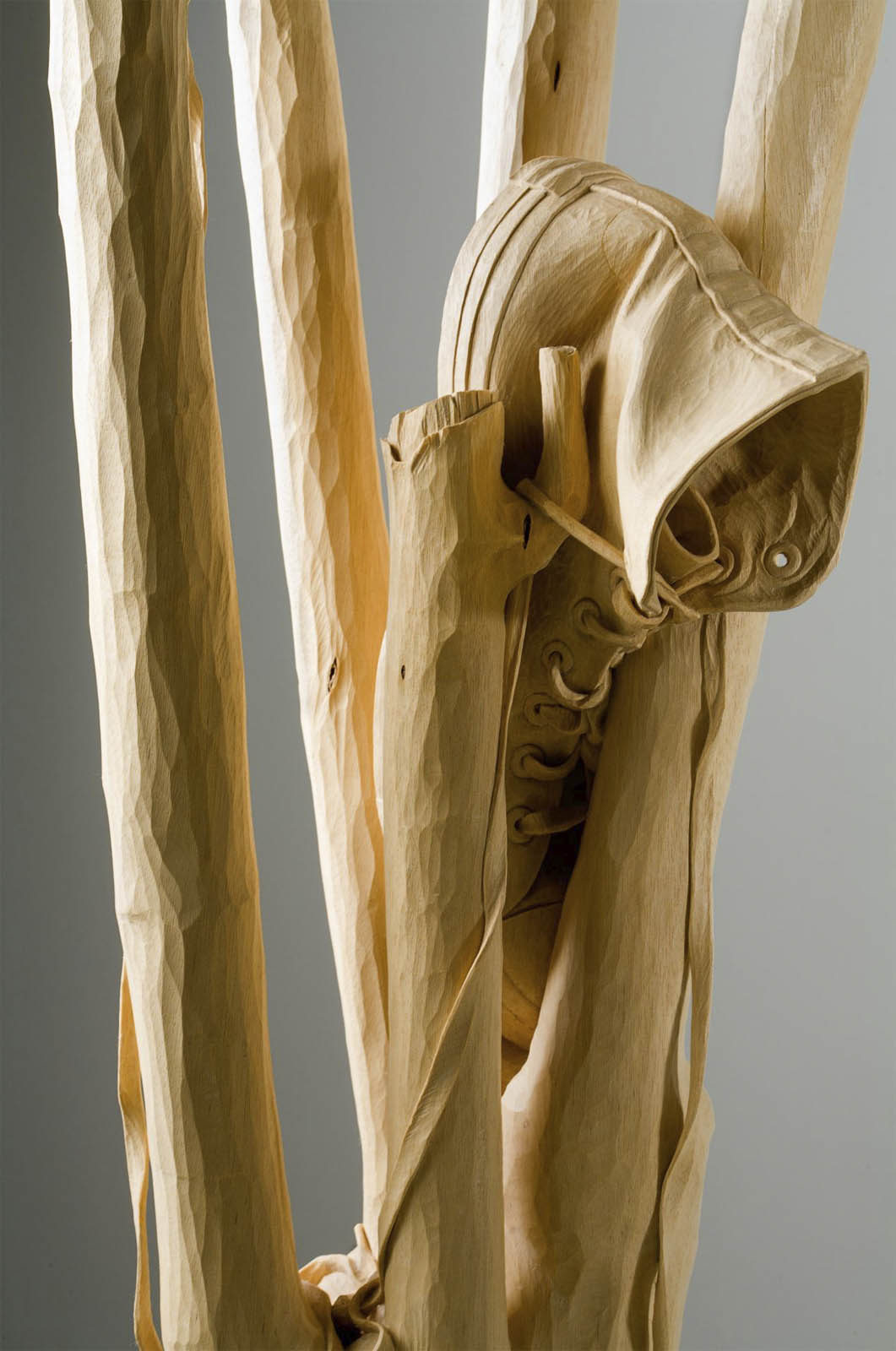
“The exhibition’s title The Bricoleur refers to the kind of activities performed by a handyman or tinkerer, someone who makes creative use of whatever might be at hand. The Bricoleur is also the title of one of the sculptures in the exhibition, which depicts a forlorn houseplant with a sneaker wedged between its branches,” said Dr Baker.
Gerard Vaughan, Director, NGV, said this exhibition reinforces the NGV’s commitment to exhibiting and collecting world‐class contemporary art.
“The NGV has enjoyed a long and successful relationship with Ricky Swallow, exhibiting and acquiring a number of his works over the years. His detailed and exquisitely crafted replicas of commonplace objects never fail to inspire visitors to the Gallery.”
Ricky Swallow was born in Victoria in 1974 and currently lives and works in Los Angeles, California. His career has enjoyed a meteoric rise since winning the NGV’s prestigious Contempora5 art prize in 1999. Since then, Swallow has exhibited in the UK, Europe and the United States, and represented Australia at the 2005 Venice Biennale.
Ricky Swallow (born Australia 1974, lived in England 2003-2006, United States 2006- ) The Bricoleur (detail) 2006 Jelutong (Dyera costulata) 122 x 25 x 25cm Private collection
The Ian Potter Centre: NGV Australia Federation Square Corner of Russell and Flinders Streets, Melbourne































You must be logged in to post a comment.