Exhibition: ‘Dragon Women: Early Chinese Photography’ at the Loewentheil Photography of China Collection, New York

Exhibition dates: 14th March – 15 May, 2024

Curator: Stacey Lambrow


John Thomson (Scottish, 1837-1921) 'Manchu Ladies' c. 1868


John Thomson (Scottish, 1837-1921)
Manchu Ladies
c. 1868
Albumen silver print
Loewentheil Photography of China Collection


This posting is personal.

After I took the portrait below of my dear friend and fellow photographer Joyce Evans OAM (Australian, 1929-2019) at Jacques Raymond’s restaurant on the occasion of my birthday – the long exposure drawing a dragon-like creature from the flames – I posted the photograph to Facebook with a comment about Joyce being a “dragon lady” …. meaning, in my mind and foregrounded by Chinese culture, that she was a powerful, strong, loyal and intelligent women. Which she most definitely was.

I was then roundly abused by someone in a vituperative comment about calling Joyce a “dragon lady” when the person obviously had no idea of the mythological and cultural importance of the dragon to Chinese society, to which I was alluding.

Thus, it is with great joy that I post about this exhibition, a presentation that challenges “the negative and shallow stereotype of the “dragon lady.” The term remains a pervasive stereotype, often used against women who are unapologetically driven or have agency and power. It is particularly pernicious as a Western stereotype of East Asian women.” (Press release)

And thought, idea, photograph and in this case exhibition that challenges the stereotype and promotes difference and acceptance of that difference … can only make the world a better, more understanding place.

All power to strong, compassionate human beings everywhere.

Dr Marcus Bunyan


Many thankx to the Loewentheil Photography of China Collection for allowing me to publish the photographs in the posting. Please click on the photographs for a larger version of the image.


Marcus Bunyan (Australian, b. 1958) 'Joyce Evans OAM (Australian, 1929-2019) at Jacques Raymond restaurant' 2016


Marcus Bunyan (Australian, b. 1958)
Joyce Evans OAM (Australian, 1929-2019) at Jacques Raymond restaurant
2016
iPhone photograph
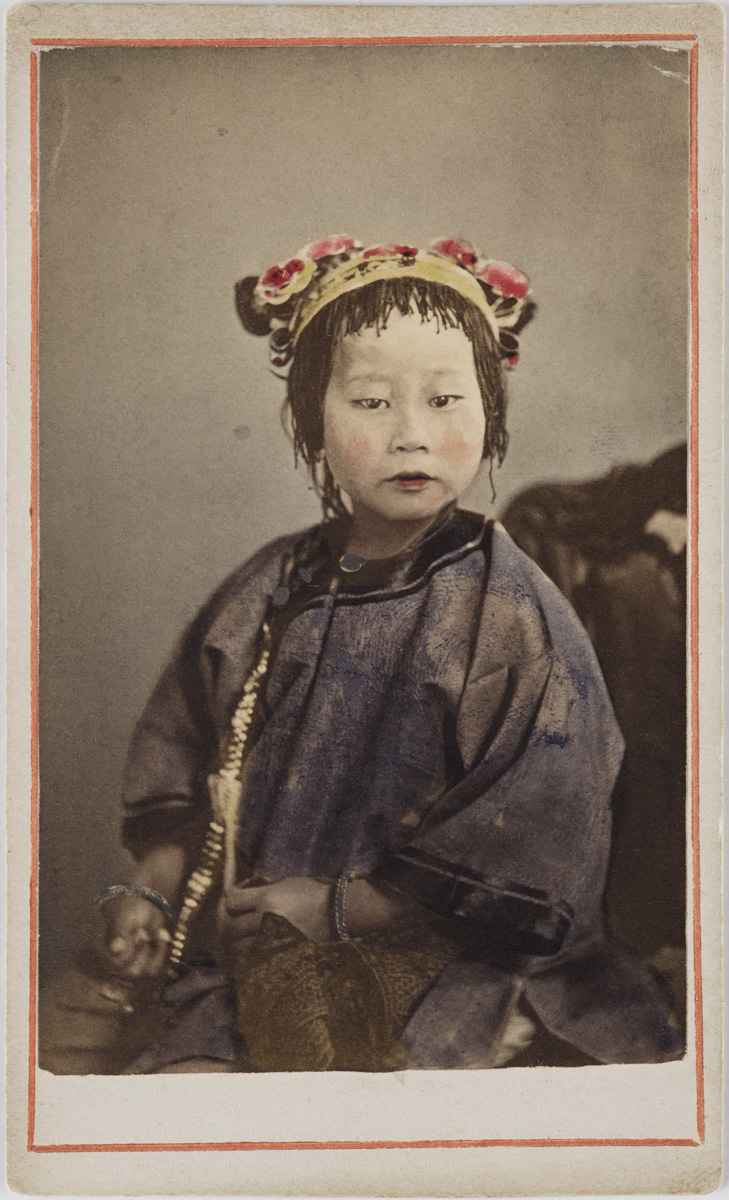
 

John Thomson (Scottish, 1837-1921) 'Portrait of a Girl' 1860s


John Thomson (Scottish, 1837-1921)
Portrait of a Girl
1860s
Hand-coloured albumen silver print
Carte de visite
Loewentheil Photography of China Collection


Women in China can achieve the highest level of education today. At the end of the Qing dynasty this was not true. In Illustrations of China and Its People, the photographer John Thomson discusses the education of Chinese girls in the 1870s. He explains that girls are strictly secluded and that “Chinese history offers few examples of women who have been distinguished for their literary attainments.” He states that in “higher orders of society ladies here and there receive an education which enables them to form some slight acquaintance with the literature of their country, and to conduct and express themselves according to the strict and formal rules of etiquette which pertain to their position as daughters, or wives of men of learning and cultivation.”

Women’s education saw some reform during the final years of the Qing dynasty. Empress Dowager Cixi endorsed private women’s schools and sought public support for women’s education. The government acknowledged that educating women was necessary for developing strong mothers. Still, the Qing government continued to defend norms of gender separation and strict restrictions on women.

Text from the Loewentheil Photography of China Collection
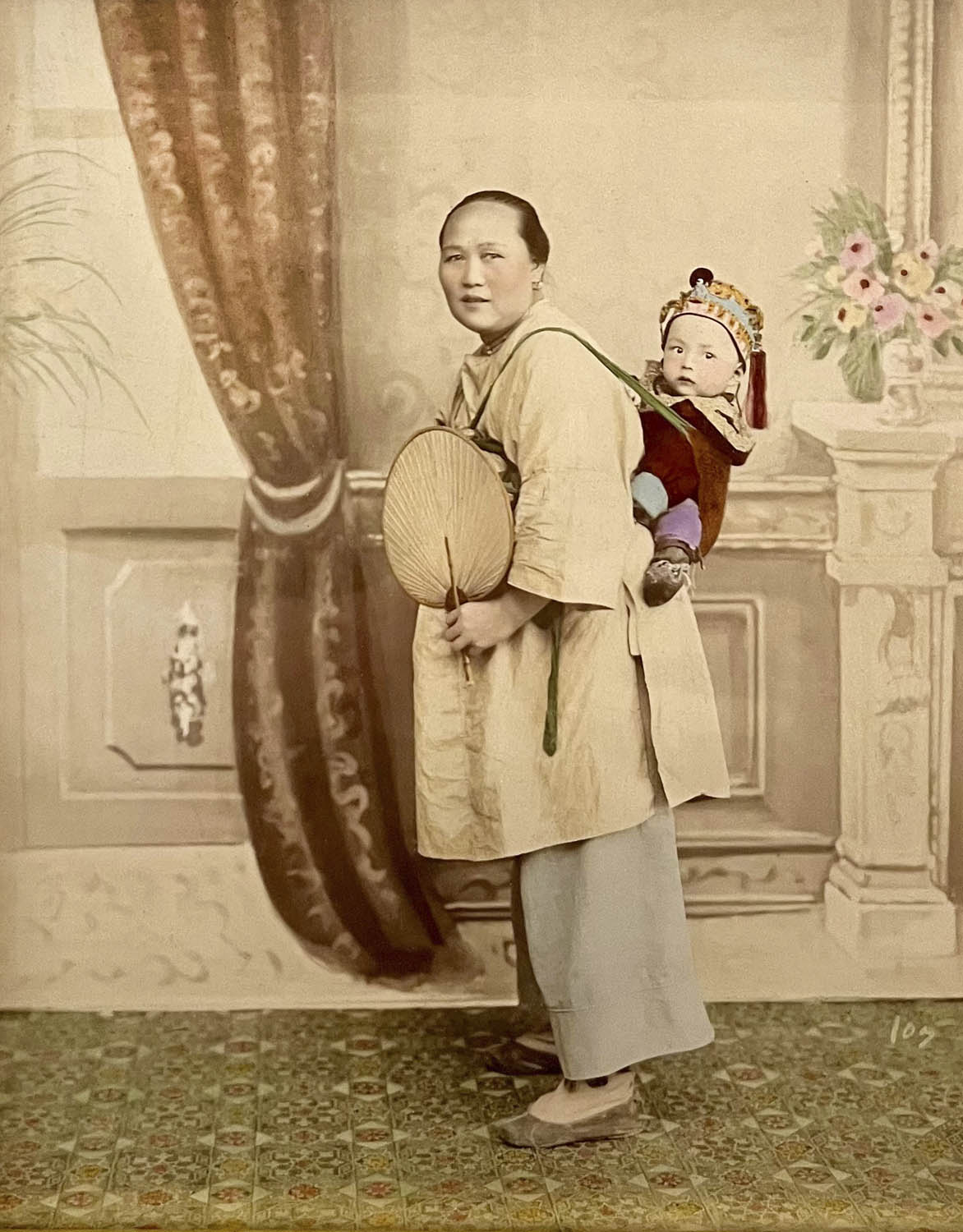
 

Unidentified Photographer in China. 'Portrait of a Woman Carrying a Child' 1860s


Unidentified Photographer in China
Portrait of a Woman Carrying a Child
1860s
Hand coloured albumen silver print
Loewentheil Photography of China Collection


Many Chinese photography studios created portraits of women carrying children on their backs. These popular portraits depict the tender bonds between the woman and the child, typically a boy.

Creating such photographs was both a technical and an interpersonal challenge. Because cameras were not yet widespread in the 1860s and 1870s, most women did not feel comfortable posing for a photographer. Skilled early photographers instilled trust allowing their subjects to feel at ease. It is likely that women were in the studio assisting female clients.

The wet plate collodion process mandated that a baby remain still for several seconds as a negative was exposed, lest the child appear blurred. Very young children routinely appear blurred in nineteenth-century photographs. The babies’ bodies were restrained by traditional Chinese baby carriers but their heads were free to move. The gaze of the child’s eyes in this portrait suggest a studio assistant, or relative, may be entertaining the children at the side of the photographer. This child is evidently content and connected with the women both physically and emotionally.

Women in China had long carried their babies on their backs, particularly in southern provinces. When an infant turned one month old, they were allowed to leave the home with their mother for the first time. At that time the maternal grandmother traditionally presented the baby with a baby carrier. During the late Qing dynasty, mothers, grandmothers, female siblings and amahs working in wealthy families would use these traditional carriers.

A baby carrier was a personal gift made of a square of dyed cloth with strips of fabric extending from the corners to provide straps. Baby carriers were often embellished with embroidered silk.

Text from the Loewentheil Photography of China Collection


Pun Lun Studio. 'Portrait of Woman and Child' 1870s


Pun Lun Studio (active circa 1864-1907)
Portrait of Woman and Child
1870s
Hand coloured albumen silver print


The Pun Lun Studio 瑱纶影相 was located at various addresses in Queen’s Road in Hong Kong. It was a successful portrait studio and opened branches in Fuzhou, Saigon and Singapore. Active c. 1864 – c. 1907.


Painting a Photograph

Tinted or hand-coloured photography was enormously popular among the prosperous individuals throughout the world. Portraits and genre studies served as status symbols for rising members of the professional and merchant classes…

Most nineteenth-century photographs of China are monochrome albumen silver prints made from collodion glass plate negatives. In the developing process, skilled photographers like the Pun Lun Studio were able to create gradation and richness of tone with great transparency and detail in shadows. The colour of the prints varied from red-violet to deep brown. Well-produced albumen silver prints were sumptuous, but coloured photographs commanded even higher prices.

Text from the Loewentheil Photography of China Collection website


William Saunders (British lived China, 1832-1892) 'Weaving' 1860s


William Saunders (British lived China, 1832-1892)
Weaving
1860s
Hand-coloured albumen silver print
No. 6 in Sketches of Chinese Life and Character series
Loewentheil Photography of China Collection


The Qing rulers adopted Confucianism from the Han Chinese culture of the conquered Ming dynasty.

In accordance with the Confucian ideal of gender labor division – “Men till, women weave.”

In this photograph Saunders presents a woman weaving on a loom. The woman is a model who appears in other roles in William Saunders photographic portfolio Sketches of Chinese Life and Character. Saunders’s depiction of the occupational roles of Chinese women follows a tradition established by painters in port cities. In this convincing pose the weaver appears to be engaged with the loom rather than the photographer. Saunders made this photograph outdoors at his studio but textiles were produced at a woman’s home. Women were secluded at home to ensure that their roles in their families was secure. Due to the nature of at-home work, women generated market income without having to reduce their investment in their families.

Text from the Loewentheil Photography of China Collection
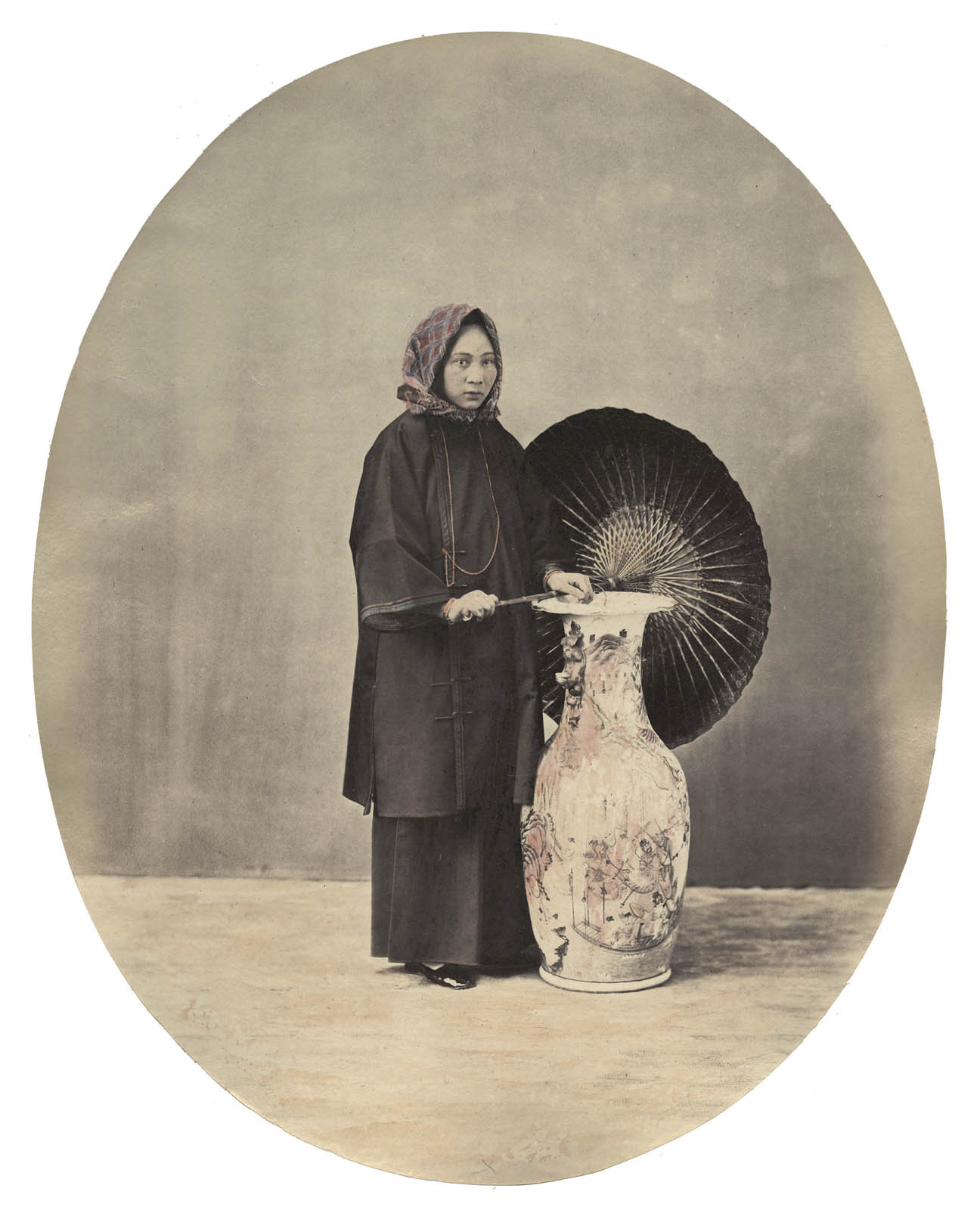
 

William Saunders (British lived China, 1832-1892) 'A Young Lady from Canton' 1860s-1870s


William Saunders (British lived China, 1832-1892)
A Young Lady from Canton
1860s-1870s
Hand-tinted albumen silver print
No. 25 in Sketches of Chinese Life and Character series
Loewentheil Photography of China Collection


Women from Guangzhou were acclaimed for their natural beauty and often appear in early photographs. The woman in this portrait, tinged with uncertainty, wears a blue and red headscarf, an attire characteristic of women from a population living and working on boats in Guangzhou.

Many people in Guangzhou and other cities in China lived and worked on boats until the 1950s. Their boats were often anchored in lines along the rivers or coasts, with a large part of the clusters being stationary, forming a unique community and island-like space on the water, close to, yet separate from, the land.

Although traditional accounts from terrestrial Chinese and Westerns present the population of women living on boats as being engaged in prostitution, this was only true of a small minority and was no more common than among the terrestrial Chinese population. Women from the boat communities were not as hidden as other women in China. In addition to being known for their beauty, these women were described as skilful and hard-working boat drivers.

Text from the Loewentheil Photography of China Collection


William Saunders (1832-1892) was born in Woolwich, London and travelled to China as an engineer in 1860. He returned to Britain, studied photography, and then went back to China with photographic equipment. He photographed in Tientsin (Tianjin) in 1861 and then opened a studio in Shanghai in 1862, one of the city’s first. Saunders was a highly successful commercial photographer, specialising in portraiture, but also photographing everyday life, events, architectural, topographical and genre scenes. In 1871, he published his Portfolio of Sketches of Chinese Life and Character. William Saunders retired in 1888 and is now recognised as one of the most important photographers in nineteenth-century China.
Source: Terry Bennett. “History of Photography in China – Western Photographers – 1861-1879”, Quaritch 2010, pp. 83-106.

Text from the Historical Photographs of China website


Born in Britain in 1832, Saunders moved to China in the 1850s and opened a photography studio in Shanghai in 1862. One of the first photographers in the city, Saunders focused primarily on portraiture but also photographed street life, local customs, current events, scenic views, and even executions. His photographs, intended for tourists and Westerners, were often based on compositions of earlier gouaches made for export. He was one of the main commercial photographers in China in the nineteenth-century. A series of fifty prints – Portfolio of Sketches of Chinese Life and Character – was published in 1871. This portfolio, in addition to his photographic contributions to Illustrated London News and other publications, disseminated information about life in China to Westerners. Saunders died in 1892.

Text from the International Center of Photography website


William Saunders (British lived China, 1832-1892) 'Shanghai Woman and Girl' 1860s-1870s


William Saunders (British lived China, 1832-1892)
Shanghai Woman and Girl
1860s-1870s
Hand-tinted albumen silver print
No. 13 in Sketches of Chinese Life and Character series


The girl in this portrait rests her hand on the hip of the young woman to balance herself as she stands before the camera on her tiny bound feet. The young woman seems to protect the girl as she holds her open parasol, an accoutrement of the nobility in ancient China, as a shield. The young woman and girl in this studio portrait are said to be from Keangsoo (Jiangsu) province, a region around Shanghai. Their gazes cross, neither looks at the camera. The photographer sought to present the diverse regional styles that converged in the international Chinese city of Shanghai. The woman and the girl were used as models for the photographer William Saunder’s portfolio Sketches of Chinese Life and Character. The photographer’s portrayal of Chinese women from different regions in China played a role in consolidating and redefining long standing preconceptions of Chinese women.

Text from the Loewentheil Photography of China Collection


Lai Fong (Chinese, c. 1839-1890), Afong Studios. 'A Mandarin's Wife' 1860s


Lai Fong (Chinese, c. 1839-1890), Afong Studios
A Mandarin’s Wife
1860s
Albumen silver print
Loewentheil Photography of China Collection


In China, a tradition of ancestral portraiture preceded the invention of photography by many centuries. Commemorative portraits, commonly referred to as ancestor portraits, were central to the ritual of family worship. Photographic portraits echoed the stylistic attributes of the ancient commemorative images. In this portrait the woman is posed frontally, so that she faces the viewer directly. No part of her body is cropped out of the frame.

In both ancestor portraits and early photographs most women are anonymous. Even distinguished women were given little attention in most family genealogies. The histories of the majority of the named women appearing in early photographs come to us from through the careers or accomplishments of their fathers, husbands, or sons.

The woman in this portrait is dressed in such a way that immediately reveals her social rank. In full regalia she wears an elaborate headdress, a long necklace, a robe, and an intricate coat or fringed vest known as a xiapei. The coat displays a rank badge, reflecting her husband’s status within the government bureaucracy.

Text from the Loewentheil Photography of China Collection


Lai Fong (Chinese, c. 1839-1890), Afong Studios. 'Portrait of Three Women from Amoy' 1870s


Lai Fong (Chinese, c. 1839-1890), Afong Studios
Portrait of Three Women from Amoy
1870s
Albumen silver print
Loewentheil Photography of China Collection


Women are usually not identified in early Chinese photographs, but their clothing, hairstyles, and other aspects of their appearances can indicate their origin and social status. The hairstyles and accoutrements of the women in this photograph by Lai Fong, including the oval painted fans they hold, are typical of women from Amoy (Xiamen). Early photographic portraits often feature props signifying the trades or social status of their subjects.

Traditionally, women of a higher social class preferred decorated circular fans, which were literati-associated objects. The fans in this photograph allude to the refined taste and intellect of the women. Fans can also represent romantic feelings and longing. The opulent clothing, jewellery, and coiffures in portraits such as this example were also used to emphasise idealised feminine beauty.

Like other Chinese and Western photography studios, Afong Studio sometimes produced genre photographs for sale to Chinese buyers and to foreign clients. The portrait may have originally been made by Lai Fong for the sitters or their associates. The photographer then generated additional profit from the negative by circulating the image around the world as a general depiction of feminine beauty in late nineteenth-century China.

Text from the Loewentheil Photography of China Collection


Lai Fong [is] arguably the most ambitious and successful photographer of nineteenth-century China. He began practicing under the name Afong in Hong Kong in the 1860s, and over the next twenty years built a towering reputation on his illustrious clientele, his impressive product range, and a catalogue of views of China “larger, choicer, and more complete… than any other in the Empire,” according to his advertisements. His photographs of Chinese cities, monuments, people, and land – however shaped by the desires of his cosmopolitan clientele – stand as records of places that have changed often beyond recognition, and of his own artistry, exuberance, and entrepreneurial brilliance. Managed by his son and daughter-in-law after his death, his studio persisted into the 1940s, an instance of remarkable longevity in a famously difficult field.

“Despite the historical fame of Lai’s studio and the reach of his photographs, which exist today in collections worldwide, Lai remains little known outside of specialist circles,” said Kate Addleman-Frankel, the Gary and Ellen Davis Curator of Photography at the Johnson Museum. “His work is understudied and rarely exhibited, the result in part of a colonial view of photography’s history that has privileged Western travel photographers over indigenous practitioners.”

Text from the exhibition Lai Fong (ca. 1839-1890): Photographer of China at the Herbert F. Johnson Museum of Art, Ithaca, NY, February – June 2020


Lai Fong (Chinese, c. 1839-1890), Afong Studios. 'Bridal Carriage' 1870s


Lai Fong (Chinese, c. 1839-1890), Afong Studios
Bridal Carriage
1870s
Albumen silver print
Loewentheil Photography of China Collection


Elaborately decorated bridal sedan chairs were a feature of Chinese weddings for centuries. Carried by four to eight porters, the chair brought the bride from her home to the groom’s family home. The journey that represented her transition from childhood to adulthood and from her family to that of her husband. Young children leading the procession symbolised the hope for children for the couple. On arrival at her new home, the bride might be helped down by a woman who had been lucky in marriage.

Lai Fong’s image has a candid aspect rare to early photographs which required a long exposure time. We see the carriage and the girls as they may have appeared on the street, without asking onlookers to pose or retreat from the frame. Curious about the photographer and the camera, several of them face the lens directly.

Chinese women in the late Qing dynasty often had no freedom regarding marriage. A woman married the man her parents chose whether she liked him or not. Often she had no way to know if she was compatible with her soon to be husband since she would not have met or set eyes on him until the wedding night. Within the family, a woman had to obey her father before marriage, her husband after marriage, and her son after the death of her husband.

Text from the Loewentheil Photography of China Collection


First Exhibition of the Earliest Photographs of Chinese Women

Rare early photographs of Chinese women from the Loewentheil Photography of China Collection will be exhibited for the first time in New York as part of Asia Week New York. Dragon Women: Early Chinese Photography curated by Stacey Lambrow runs from March 14th – May 15th 2024.

Dragon Women: Early Chinese Photography celebrates the Year of the Dragon and the representation of women in the earliest photography of China. This is the first exhibition devoted to the depiction of Chinese women in early photography. The over 50 photographs selected from the Loewentheil Collection include the first photographic portraits of Chinese women, most made in the 1860s and 1870s. Many have never before been shown. The exhibition examines women’s place in society in the late Qing dynasty and their depiction in historical photography of China. It also presents work by the few known early female photographers of China.

Highlights include a rare photograph by the first known Chinese female photographer, Mae Linda Talbot, and works by Hedda Morrison, Isabella Bird, and Eva Sandberg Xiao. Masterworks include photographs by Chinese and international artists such as Sze Yuen Ming Studio, Pun Lun Studio, A Chan Studio, Lai Fong, John Thomson, and Thomas Child. The exhibition showcases the diversity of Chinese women and their experiences during the final decades of imperial China.

Text from the Loewentheil Photography of China Collection website


Installation view of the exhibition 'Dragon Women: Early Chinese Photography' at the Loewentheil Photography of China Collection showing at top right, Unidentified Photographer in China. 'Portrait of a Woman' 1870s


Installation view of the exhibition Dragon Women: Early Chinese Photography at the Loewentheil Photography of China Collection showing at top right, Unidentified Photographer in China. Portrait of a Woman 1870s


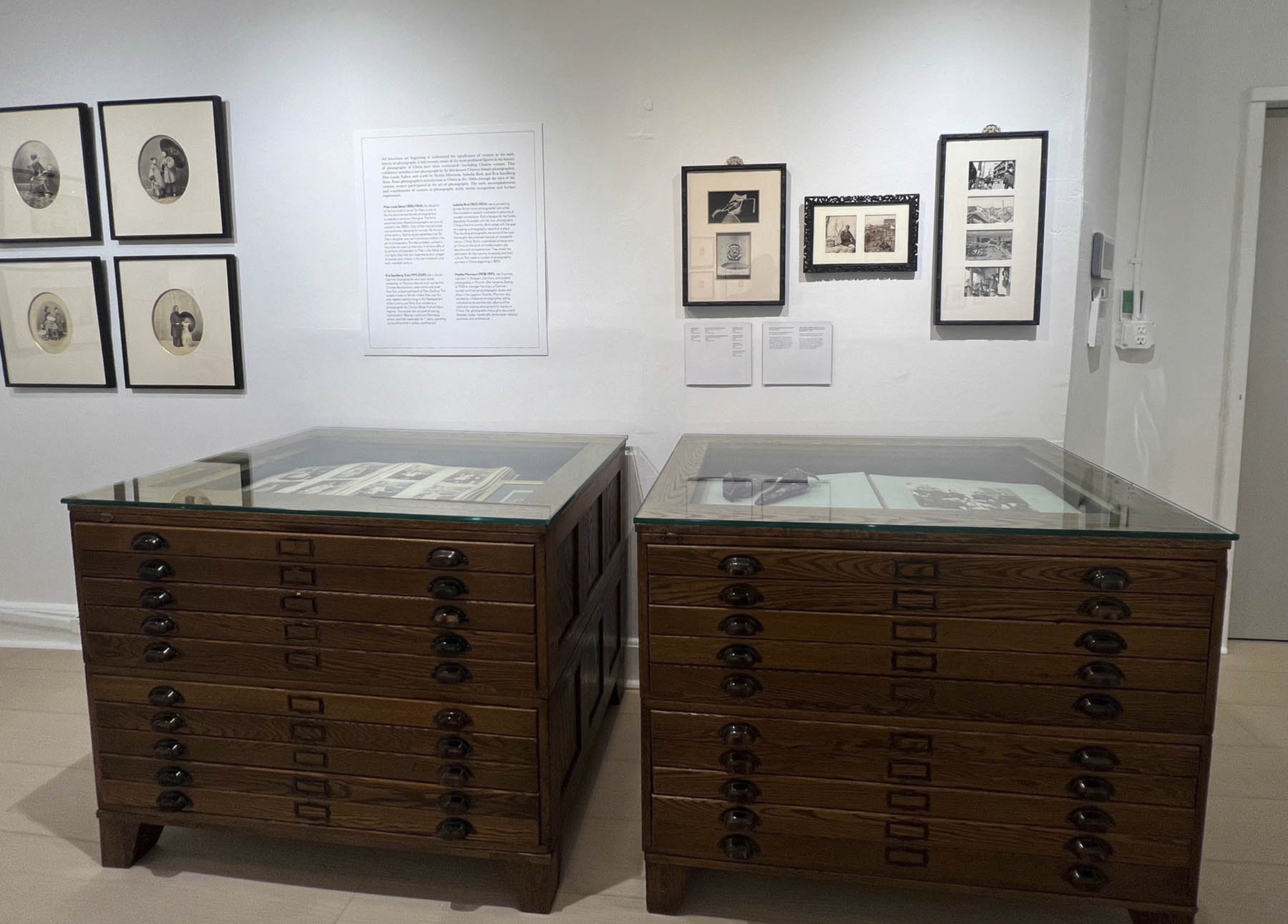
Installation view of the exhibition 'Dragon Women: Early Chinese Photography' at the Loewentheil Photography of China Collection


Installation view of the exhibition Dragon Women: Early Chinese Photography at the Loewentheil Photography of China Collection


Installation view of the exhibition 'Dragon Women: Early Chinese Photography' at the Loewentheil Photography of China Collection


Installation view of the exhibition Dragon Women: Early Chinese Photography at the Loewentheil Photography of China Collection showing at left, Portrait of a Woman Playing a Dizi (1870s, below)
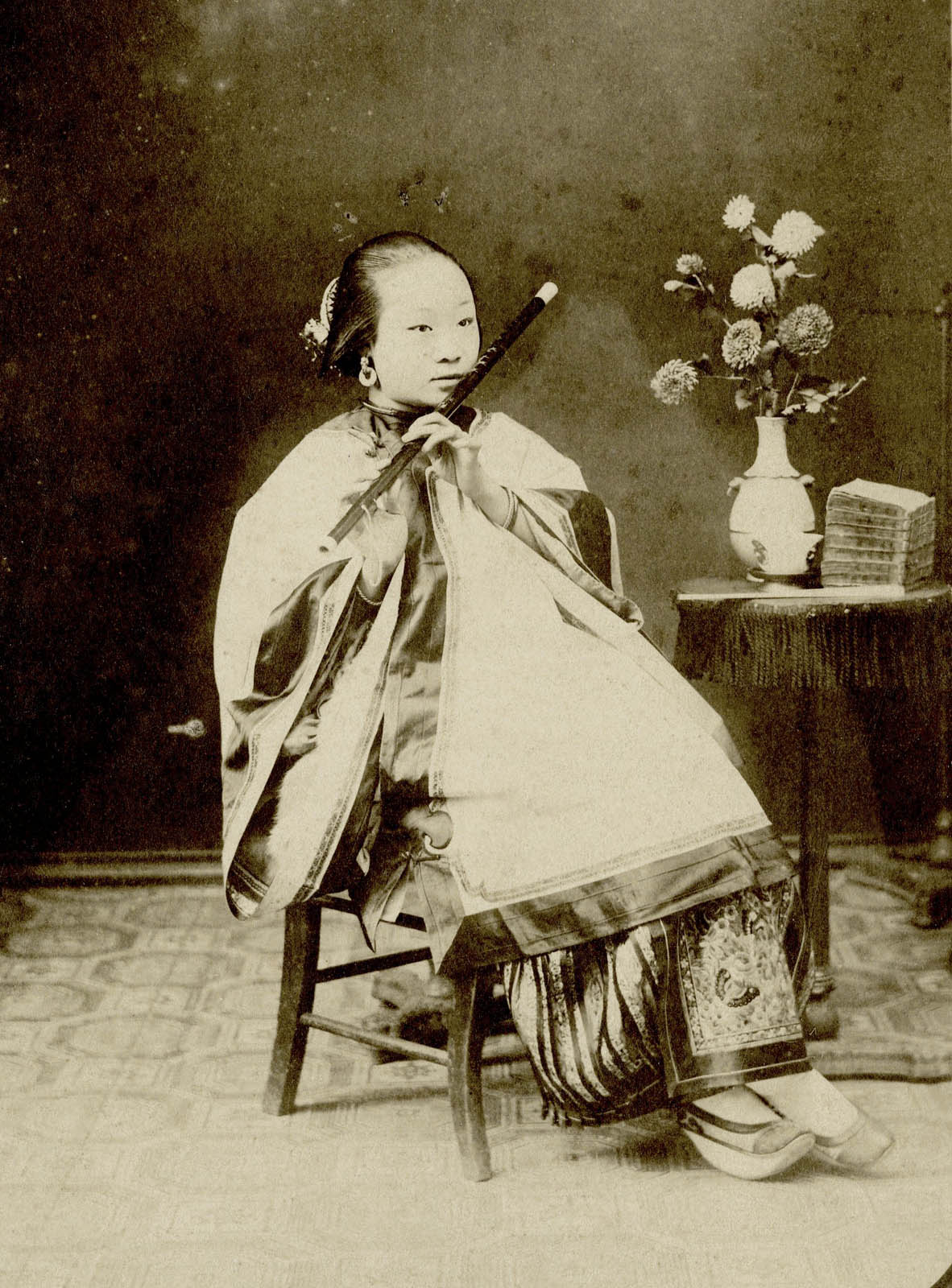
 

Unidentified Photographer in China. 'Portrait of a Woman Playing a Dizi' 1870s


Unidentified Photographer in China
Portrait of a Woman Playing a Dizi
1870s
Albumen silver print
Loewentheil Photography of China Collection


The woman in this portrait holds a dizi, a bamboo flute, as if she is playing it for the photographer. Courtesans playing the dizi and other Chinese instruments were a common subject of Chinese paintings before the theme appeared in the earliest photographs of Chinese women. In ancient China, courtesans were highly cultivated women who were rigorously trained in music, singing, dancing, and poetry. Courtesans were educated to be more than mere entertainers. Respected for their art and education in the classics, they were intellectual equals to aristocrats, scholars, and government official. Famous courtesans, such as Yang Yuhuan, were renowned for their beauty as well as their influence on politics and Chinese culture. They were hired to perform at elegant banquets for both male and female clients. They were also employed by the court.

Courtesan, such as Sai Jinhua, and others are some of the few women whose accomplishments are recognised by name in early Chinese history. Most women remained anonymous and were identified by their relationship to a father, husband, or son.

Courtesans often seem more at ease in front of the camera than other women. These women were accustomed to performing and being seen. They also recognised the value of photography for their reputations as entertainers.

During the late Qing dynasty, the status of some courtesans diminished as the concept of female performers changed. Subclass of courtesans developed. The artistic and intellectual skills of courtesans were not valued as highly as they once were and as a result some of these women became viewed as little more than objects of men’s sexual desire. They began to be regarded as prostitutes. It is evident from the props used in photography studios, such as instruments and books that artistic and literary talent continued to be associated with courtesans in the nineteenth century.

Text from the Loewentheil Photography of China Collection
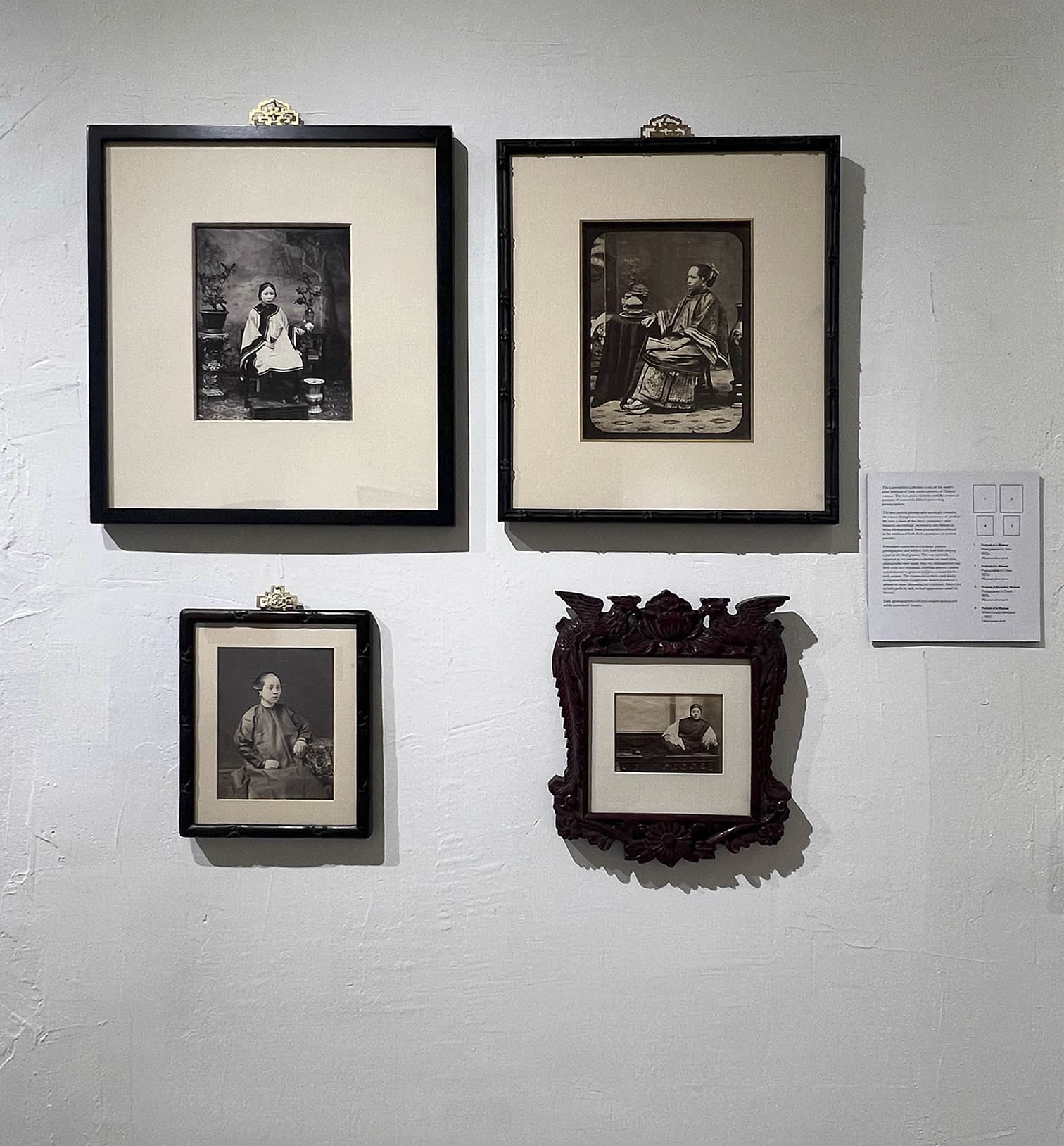
 

Installation view of the exhibition 'Dragon Women: Early Chinese Photography' at the Loewentheil Photography of China Collection


Installation view of the exhibition Dragon Women: Early Chinese Photography at the Loewentheil Photography of China Collection showing at top left, Unidentified Photographer in China Portrait of a Woman (1870s, below)


Unidentified Photographer in China. 'Portrait of a Woman' 1870s


Unidentified Photographer in China
Portrait of a Woman
1870s
Albumen silver print
Loewentheil Photography of China Collection
 

Installation view of the exhibition 'Dragon Women: Early Chinese Photography' at the Loewentheil Photography of China Collection


Installation view of the exhibition Dragon Women: Early Chinese Photography at the Loewentheil Photography of China Collection
 

Installation view of the exhibition 'Dragon Women: Early Chinese Photography' at the Loewentheil Photography of China Collection


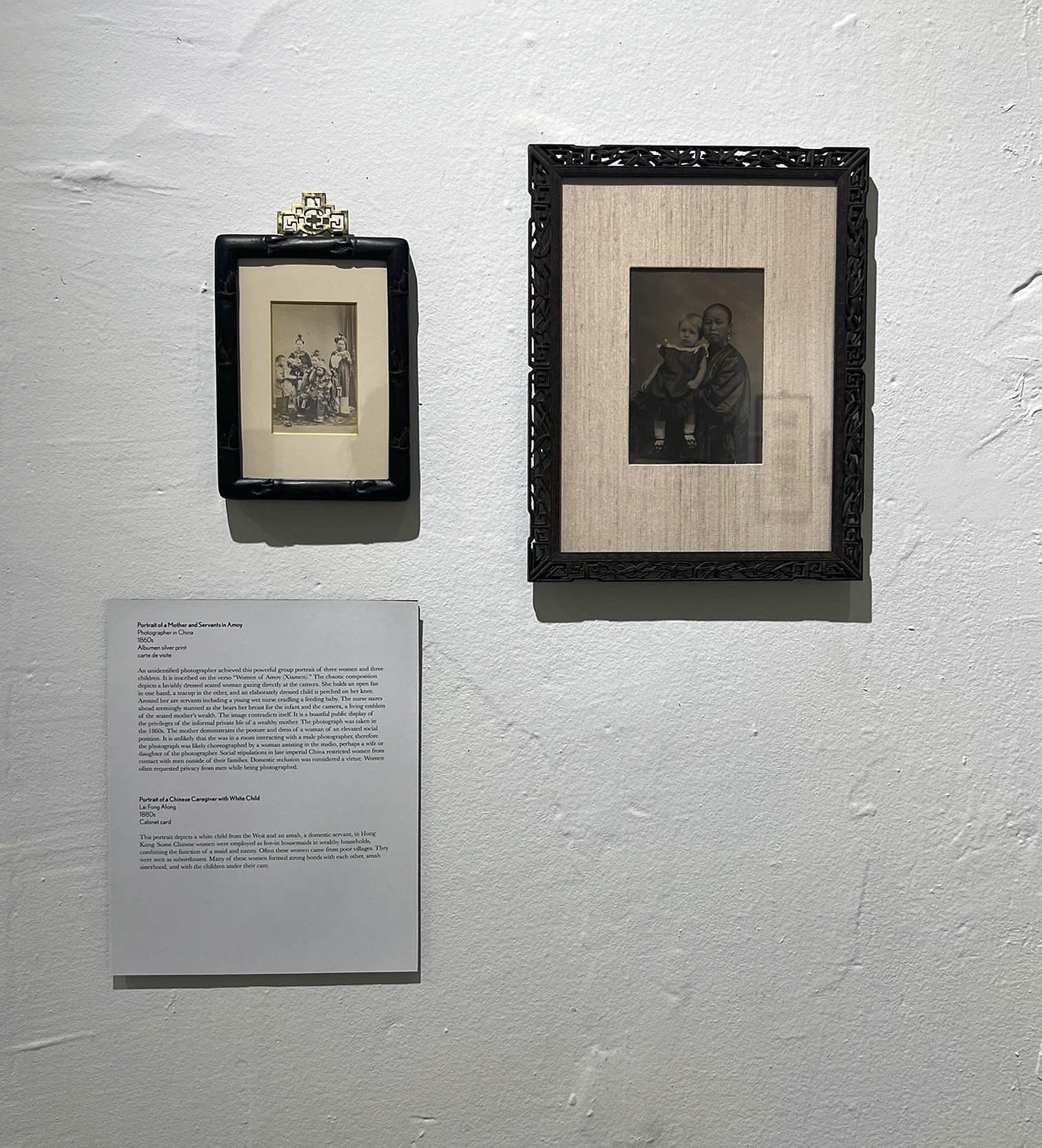
Installation view of the exhibition Dragon Women: Early Chinese Photography at the Loewentheil Photography of China Collection showing two photographs labelled below:

LEFT

Unidentified Photographer in China
Portrait of a Mother and Servants in Amoy
1860s
Albumen silver print
Carte de visite
Loewentheil Photography of China Collection


An unidentified photographer achieved this powerful group portrait of three women and three children. It is inscribed on the verso “Women of Amoy (Xiamen).” The chaotic composition depicts a lavishly dressed seated woman gazing directly at the camera. She holds an open fan in one hand, a teacup in the other, and an elaborately dressed child is perched on her knee. Around her are servants including a young wet nurse cradling a feeding baby. The nurse stares ahead seemingly stunned as she bears her breast for the infant and the camera, a living emblem of the seated mother’s wealth. The image contradicts itself. It is a boastful public display of the privileges of the informal private life of a wealthy mother. The photograph was taken in the 1860s. The mother demonstrates the posture and dress of a woman of an elevated social position. It is unlikely that she was in a room interacting wit a male photographer, therefore the photograph was likely choreographed by a women assisting in the studio, perhaps a wife or daughter of the photographer. Social stipulations in late imperial China restricted women from contact with men outside their families. Domestic seclusion was considered a virtue. Women often requested privacy from men while being photographed.

Wall text from the exhibition


RIGHT

Lai Fong (Chinese, c. 1839-1890), Afong Studios
Portrait of a Chinese Caregiver with White Child
1880s
Cabinet card
Loewentheil Photography of China Collection


This portrait depicts a white child from the West and an amah, a domestic servant, in Hong Kong. Some Chinese women were employed as live-in housemaids in wealthy households, combining the function of a maid and nanny. Often these women came from poor villages. They were seen as subordinates. Many of these women formed strong bonds with each other, amah sisterhood, and with the children under their care.

Wall text from the exhibition
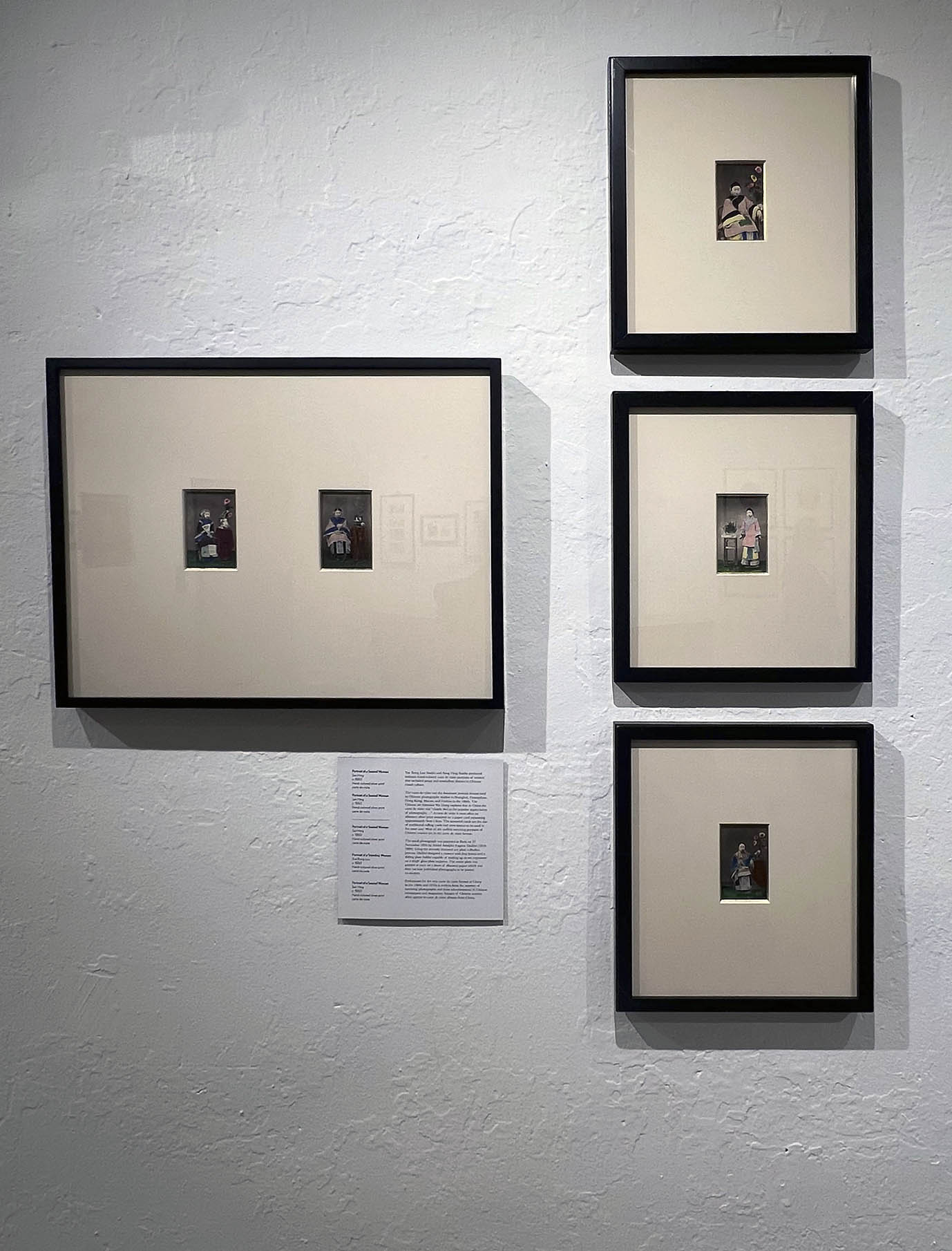
 

Installation view of the exhibition 'Dragon Women: Early Chinese Photography' at the Loewentheil Photography of China Collection showing various portraits of Chinese women on carte de visite


Installation view of the exhibition Dragon Women: Early Chinese Photography at the Loewentheil Photography of China Collection showing various portraits of Chinese women on carte de visite


Installation view of the exhibition Dragon Women: Early Chinese Photography at the Loewentheil Photography of China Collection


Installation view of the exhibition Dragon Women: Early Chinese Photography at the Loewentheil Photography of China Collection showing two photographs labelled below:

LEFT

Milligan Miller
The General’s Wife
1864
Albumen silver print

RIGHT

Lai Fong (Chinese, c. 1839-1890), Afong Studios
A Mandarin’s Wife
1860s
Albumen silver print


Rare early photographs of Chinese women from the Loewentheil Photography of China Collection will be exhibited for the first time in New York as part of Asia Week New York. Dragon Women: Early Chinese Photography curated by Stacey Lambrow runs from March 14th – May 15 2024.

Dragon Women: Early Chinese Photography celebrates the Year of the Dragon and the representation of women in the earliest photography of China. This is the first exhibition devoted to the depiction of Chinese women in early photography. The 50 photographs include the first photographic portraits of Chinese women, most made in the 1860s and 1870s. Many have never before been shown. The exhibition examines women’s place in society in the late Qing dynasty and their depiction in historical photography of China. It also presents work by the few known early female photographers of China.

Highlights include a rare photograph by the first known Chinese female photographer, Mae Linda Talbot, and works by Hedda Morrison, Isabella Bird, and Eva Sandberg Xiao. Masterworks abound including photographs by Chinese and international artists such as Sze Yuen Ming Studio, Pun Lun Studio, A Chan Studio, Lai Fong, John Thomson, and Thomas Child. The exhibition showcases the diversity of Chinese women and their experiences during the final decades of imperial China.

The dragon is an integral part of Chinese culture. The origin of dragons in Chinese mythology extends back to the earliest recorded dynasties, where male and female dragons were revered as powerful and benevolent creatures created by the gods to govern the world. Unlike the evil, fire-breathing European dragon, the Chinese dragon is an auspicious and multifaceted figure. It is both powerful and benevolent, fierce and elegant. The dragon also symbolises imperial power.

This exhibition held in the Year of the Dragon reclaims the feminine power of the dragon and honours all Chinese women. It includes iconic photographs of Empress Dowager Cixi (1835-1908) by her Court photographer Yu Xunling (c. 1880-1943). Cixi, one of the most powerful women in Chinese history, was referred to as “Dragon Lady.” Some caricatured her as a uniquely sinister, manipulative, and cold-blooded ruler. However, scholars agree that the Empress’s contribution to empowering and advancing opportunities for women is an important part of her legacy, thereby revising this one-dimensional view.

The early photographic portraits of women in Dragon Women challenge the negative and shallow stereotype of the “dragon lady.” The term remains a pervasive stereotype, often used against women who are unapologetically driven or have agency and power. It is particularly pernicious as a Western stereotype of East Asian women.

The exhibition portrays and honours women of various ages, classes, and social circumstances. The diversity of the “dragon women” in the photographs more authentically reflects the power and complexity of the dragon.

For the majority of women at the end of the Qing dynasty, being photographed was off-limits for social and financial reasons. Qing society perpetuated the conservative ideas of previous dynasties, and the majority of women were isolated in their homes. Some of the women in these images chose to be photographed, while others submitted to the photographer for other reasons. Some of the photographs were made as personal family photographs and others were produced for popular consumption to portray the women as “exotic.” Regardless, the camera immortalised their images and offer us a rare and complicated view into the lives of Chinese women during a period of modernisation in China.

Most late Qing dynasty photographs of Chinese women depict unnamed sitters and a great number of the portraits were created by photographers who at this time remain unidentified. As research into the history of photography of China advances, more of the names of the Chinese women appearing in nineteenth-century photographs will be discovered and more of China’s pioneering photographers will be identified. Certainly, more of the early photographers working in China will prove to be women.

The Loewentheil Photography of China Collection includes the largest selection of nineteenth-century photographs of Chinese women in the world. In photography’s most formative years Chinese women were involved in the art in a myriad of ways. Their presence exerted a profound influence on the development of the art of photography. Women worked alongside men in photography studios, sometimes as the wives and daughters of studio owners, or as printers, finishers, retouchers, colourists, camera operators, or studio managers. In addition, women participated as subjects of early photographs. Early photographs of Chinese women, rank among the greatest nineteenth-century photographs ever made.

About the Loewentheil Photography of China Collection

The Loewentheil Photography of China Collection, based in New York, is the finest and largest holding of historical photographs of China in private hands. It contains many thousands of photographs spanning the earliest days of paper photography from the 1850s through the 1930s. The majority date to before 1900, including the largest selection of nineteenth-century photographs of Chinese women in the world.


Lai Fong (Chinese, c. 1839-1890), Afong Studios. 'Bound Foot Exposed' [A Chinese Golden Lily Foot] 1870s


Lai Fong (Chinese, c. 1839-1890), Afong Studios
Bound Foot Exposed [A Chinese Golden Lily Foot]
1870s
Albumen silver print
Loewentheil Photography of China Collection


Foot binding (simplified Chinese: 缠足; traditional Chinese: 纏足; pinyin: chánzú), or footbinding, was the Chinese custom of breaking and tightly binding the feet of young girls to change their shape and size. Feet altered by foot binding were known as lotus feet and the shoes made for them were known as lotus shoes. In late imperial China, bound feet were considered a status symbol and a mark of feminine beauty. However, foot binding was a painful practice that limited the mobility of women and resulted in lifelong disabilities.

The prevalence and practice of foot binding varied over time and by region and social class. The practice may have originated among court dancers during the Five Dynasties and Ten Kingdoms period in 10th-century China and gradually became popular among the elite during the Song dynasty. Foot binding eventually spread to lower social classes by the Qing dynasty (1644-1912). Manchu emperors attempted to ban the practice in the 17th century but failed. In some areas, foot binding raised marriage prospects. It has been estimated that by the 19th century 40-50% of all Chinese women may have had bound feet, rising to almost 100% in upper-class Han Chinese women.

In the late 19th century, Christian missionaries and Chinese reformers challenged the practice but it was not until the early 20th century that the practice began to die out, following the efforts of anti-foot binding campaigns. Additionally, upper-class and urban women dropped the practice of foot binding sooner than poorer rural women. By 2007, only a small handful of elderly Chinese women whose feet had been bound were still alive. …

Feminist perspective

Foot binding is often seen by feminists as an oppressive practice against women who were victims of a sexist culture. It is also widely seen as a form of violence against women. Bound feet rendered women dependent on their families, particularly the men, as they became largely restricted to their homes. Thus, the practice ensured that women were much more reliant on their husbands. The early Chinese feminist Qiu Jin, who underwent the painful process of unbinding her own bound feet, attacked foot binding and other traditional practices. She argued that women, by retaining their small bound feet, made themselves subservient as it would mean women imprisoning themselves indoors. She believed that women should emancipate themselves from oppression, that girls can ensure their independence through education, and that they should develop new mental and physical qualities fitting for the new era. The ending of the practice is seen as a significant event in the process of female emancipation in China, and a major event in the history of Chinese feminism.

In the late 20th century, some feminists have pushed back against the prevailing Western critiques of foot binding, arguing that the presumption that foot binding was done solely for the sexual pleasure of men denies the agency and cultural influence of women.

Other interpretations

Some scholars such as Laurel Bossen and Hill Gates reject the notion that bound feet in China were considered more beautiful, or that it was a means of male control over women, a sign of class status, or a chance for women to marry well (in general, bound women did not improve their class position by marriage). Foot binding is believed to have spread from elite women to civilian women and there were large differences in each region. The body and labor of unmarried daughters belonged to their parents, thereby the boundaries between work and kinship for women were blurred. They argued that foot binding was an instrumental means to reserve women to handwork, and can be seen as a way by mothers to tie their daughters down, train them in handwork, and keep them close at hand. This argument has been challenged by Shepherd 2018, who shows there was no connection between handicraft industries and the proportion of women bound in Hebei.

Foot binding was common when women could do light industry, but where women were required to do heavy farm work they often did not bind their feet because it hindered physical work. These scholars argued that the coming of the mechanised industry at the end of the 19th century and the beginning of the 20th century, such as the introduction of industrial textile processes, resulted in a loss of light handwork for women, removing a reason to maintain the practice. Mechanisation resulted in women who worked at home facing a crisis. Coupled with changes in politics and people’s consciousness, the practice of foot binding disappeared in China forever after two generations. More specifically, the 1842 Treaty of Nanjing (after the first Opium War) opened five cities as treaty ports where foreigners could live and trade. This led to foreign citizens residing in the area, where many proselytised as Christian missionaries. These foreigners condemned many long-standing Chinese cultural practices like foot binding as “uncivilised” – marking the beginning of the end for the centuries-long practice.

Text from the Wikipedia website


John Thomson (Scottish, 1837-1921) 'Older Woman Carrying Child' c. 1868


John Thomson (Scottish, 1837-1921)
Older Woman Carrying Child
c. 1868
Albumen silver print
Loewentheil Photography of China Collection


Lai Fong (Chinese, c. 1839-1890), Afong Studios. 'Caregiver' Caregiver [Woman carrying child] 1870s


Lai Fong (Chinese, c. 1839-1890), Afong Studios
Caregiver [Woman carrying child]
1870s
Albumen silver print
Loewentheil Photography of China Collection
 

Depiction of Chinese Family Culture in the Loewentheil Collection

Parents had long carried their babies on their backs in China, particularly in southern provinces. When an infant turned one month old they were allowed to leave the home with their mother for the first time. At that time the maternal grandmother traditionally presented the baby with a baby carrier. During the late Qing Dynasty, female siblings and amahs working in wealthy families would also use these traditional carriers with babies and toddlers in their care.

A baby carrier was a personal gift made of a square of dyed cloth with strips of fabric extending from the corners to provide straps. Baby carriers were often embellished with embroidered silk.

Text from the Loewentheil Photography of China Collection website


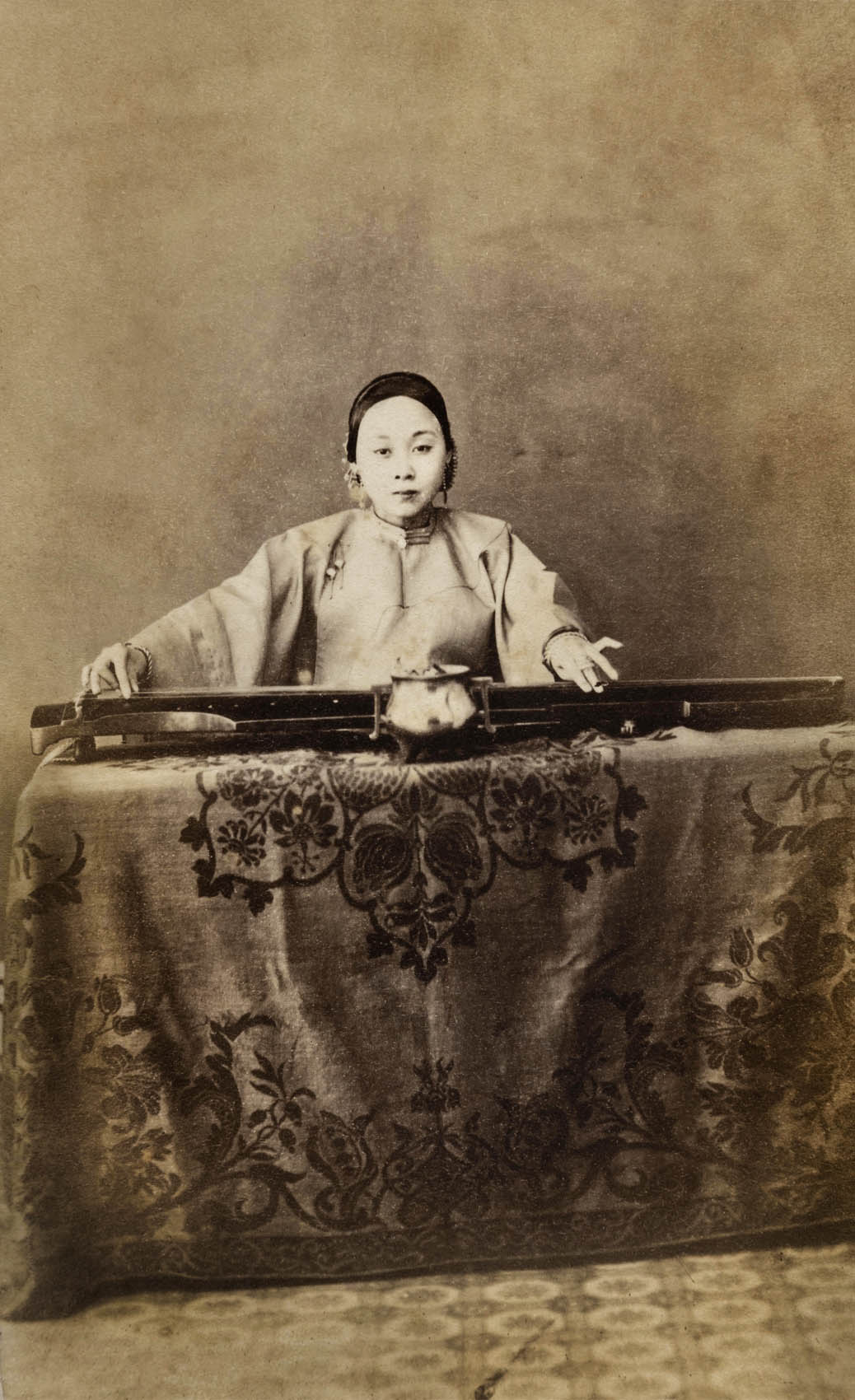
A Chan (Yazhen) 'Studio Portrait of a Female Musician' 1870s


A Chan (Yazhen) Studio
Portrait of a Female Musician
1870s
Albumen silver print
11.5 x 6.5cm
Loewentheil Photography of China Collection


Guqin music expresses the soul of the Chinese nation.


An Early Photograph including a Guqin

This rare A Chan (Yazhen) Studio photograph is one of the earliest known photographs including a guqin or qin. The instrument, the most prestigious in China, was invented more than three thousand years ago. Guqin playing developed as an elite art form practiced by scholars and noblemen. It is one of the four classic Chinese arts along with painting, an ancient form of chess, and calligraphy. The guqin is famous for being the preferred instrument of literati and sages. A Chan (Yazhen) Studio’s 1870s photographic portrait depicts a woman with a guqin, an instrument critical to Chinese intellectual history.

A Female Musician

A Chan (Yazhen) Studio posed the elegant woman directly in front of the camera. Rather than looking down towards the musical instrument, the woman’s eyes engage the viewer as she holds her pose. In accordance with tradition an incense burner is positioned on the table in front of her. The Chinese photography studio, fully cognisant of the significance of the art form, has composed a timeless photograph of the ancient instrument and the beauty of its player.

The woman’s hand gestures suggest that she was a skilled practitioner of the instrument. Her hand positions are accurate, and her left hand is pressing the strings rather than plucking them. The constraints of early photography prevented the woman from playing the instrument while posing. Long exposure times required by the wet plate collodion process would cause motion to appear as a blur in the negative. It is very likely that the photographer instructed the guqin player to exaggerate her finger positions to emphasize her gestures and give the illusion that she was playing the instrument.

Imperial-era literature strongly suggests that guqin playing was a male dominated tradition, but paintings dating back to the Tang dynasty depict female players. The female guqin players in early paintings are identified as court ladies or ladies of refinement. Contemporary scholars believe that it is a mistaken stereotype to consider guqin playing a strictly male tradition. In order to understand the prevalence and role of female guqin players, scholars are working on closer studies of women in Ming and Qing Dynasty qin schools and societies. Today there are many more female than male qin players, and all people of all walks of life play the instrument.

The Guqin

The guqin is a seven stringed instrument endowed with metaphysical and cosmological significance. The instrument, beloved by sages including Confucius, is said to have the power to communicate the deepest human feelings. Writers dating back to the Han Dynasty claim that the guqin aids in cultivating character, understanding morality, and enhancing life and learning.

Each component of the guqin relates to cosmology and is identified by a zoomorphic or anthropomorphic name. The upper round board symbolises heaven. The flat bottom board represents earth. The strings are traditionally made of twisted silk and vary in thickness. Traditionally the guqin had five strings which symbolise the five elements: metal, wood, water, fire, and earth.

Guqin playing, is much more than an auditory experience, it has an olfactory component as well. The players customarily perfumed the air by burning incense. The incense burner in A Chan (Yazhen) Studio’s portrait is placed in its usual position in front of the musician.

It is traditionally said that twenty years of training are necessary to gain proficiency on the qin. Guqin players once had a repertoire of several thousand compositions. Presently, fewer than one hundred works are still performed. Today there are fewer than one thousand well-trained guqin players and no more than fifty surviving masters. The guqin and guqin music, recognised as inseparable from Chinese intellectual history, have been added to UNESCO’s Representative List of the Intangible Cultural Heritage of Humanity.

The art form had been on the verge of extinction, but in recent times there has been a revival of guqin culture. Contemporary musicians are attracting the interest of young people in the ancient Chinese art form.

Text from the Loewentheil Photography of China Collection website
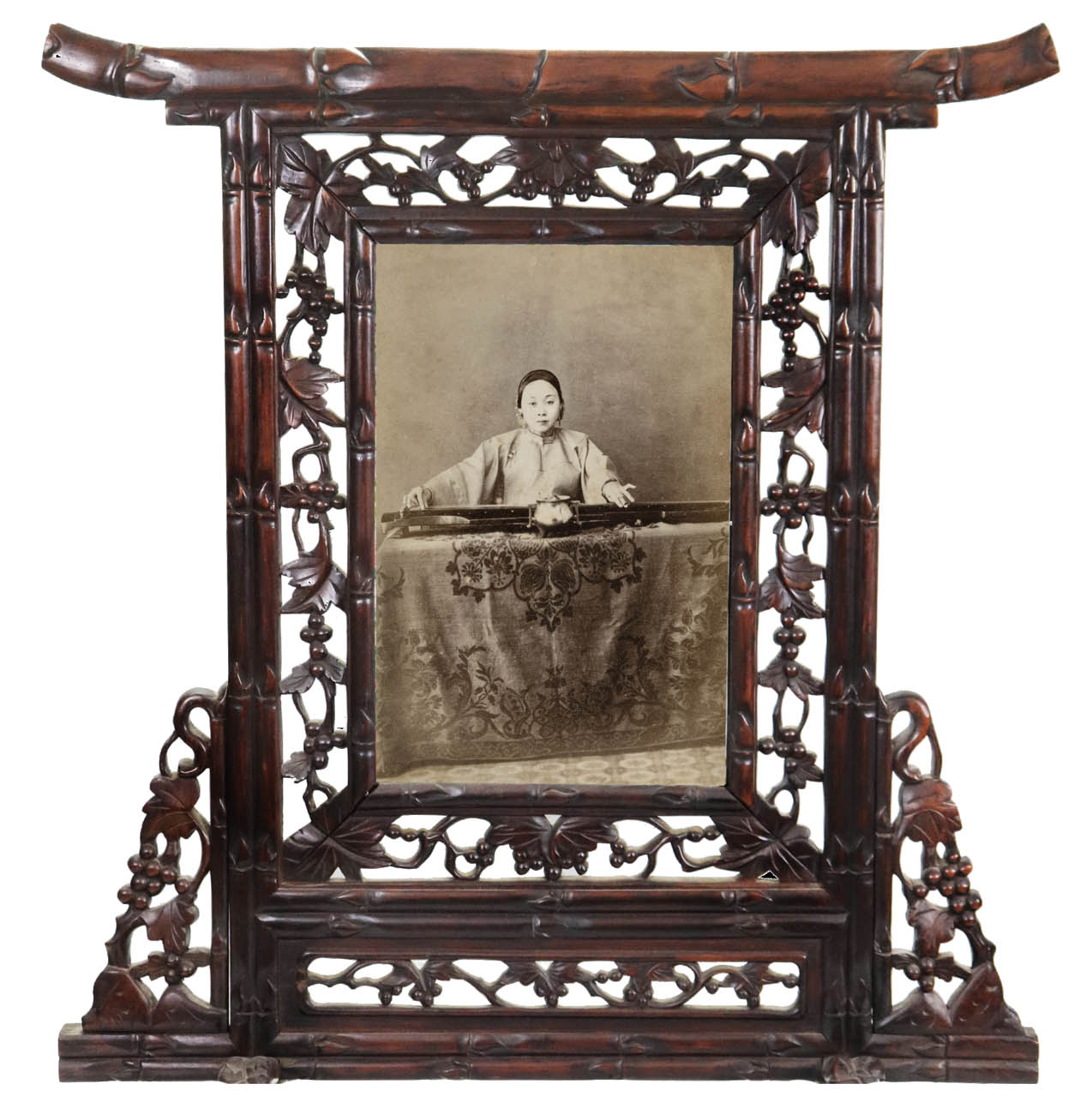
 

A Chan (Yazhen) 'Studio Portrait of a Female Musician' 1870s


A Chan (Yazhen) Studio
Portrait of a Female Musician
1870s
Albumen silver print
11.5 x 6.5cm
Loewentheil Photography of China Collection


Evening Cry of the Crow 乌夜啼
Performed by Mingmei Yip 叶明媚


Isabelle Bird (English, 1831-1904) 'Fuzhou Headdress' 1896


Isabelle Bird (English, 1831-1904)
Fuzhou Headdress
1896
Gelatin silver print
Loewentheil Photography of China Collection


Isabella Bird (1831-1904) was a pioneering female travel photographer and writer from England. She travelled to several continents in defiance of societal conventions. Bird is famous for her books beautifully illustrated with her own photographs.

China is the first country Bird visited with the goal of creating a photographic record of a place. Her photographs are some of the most thoroughly documented records of nineteenth-century China. Bird’s photographs of China on the brink of modernisation are sensitive, comprehensive, and unparalleled. They reveal her admiration for the country, its people, and their culture. After first arriving in China in 1894, she returned frequently over three years.

Bird became the first woman inducted into the Royal Geographical Society in 1892 and she was elected to membership of the Royal Photographic Society in 1897. She died in Edinburgh in 1904, just short of her 73rd birthday. Her bags were packed for another journey to China.

Text from the Loewentheil Photography of China Collection


Sanshichiro Yamamoto (Japanese, 1855-1943) 'Women in Peking Cart' c. 1900


Sanshichiro Yamamoto (Japanese, 1855-1943)
Women in Peking Cart
c. 1900
Albumen silver print
Loewentheil Photography of China Collection


Sanshichiro Yamamoto 山本讃七郎 (1855-1943) was a Japanese photographer, born in Okayama Prefecture. He had a photography studio in Shibahikage-cho (near present day Shimbashi Station) in Tokyo, Japan, from 1882 to about 1897. When news of the Boxer Uprising swept the world, he quickly went to Peking (Beijing) to photograph the historic activities of foreign troops in the capitol, including the Japanese. After photographing the aftermath in Peking (Beijing), he finally settled down in Tientsin (Tianjin) and opened his third photographic studio (Yamamoto Shōzō Kan or Yamamoto Syozo House), from where he sold photographs, souvenir photobooks and coloured post cards, taken in and around Beijing and North China. Yamamoto’s photographs were published in Views of the North China Affair, Picturesque Views of Peking and View and Custom of North China (1909).

Text from the Historical Photographs of China website
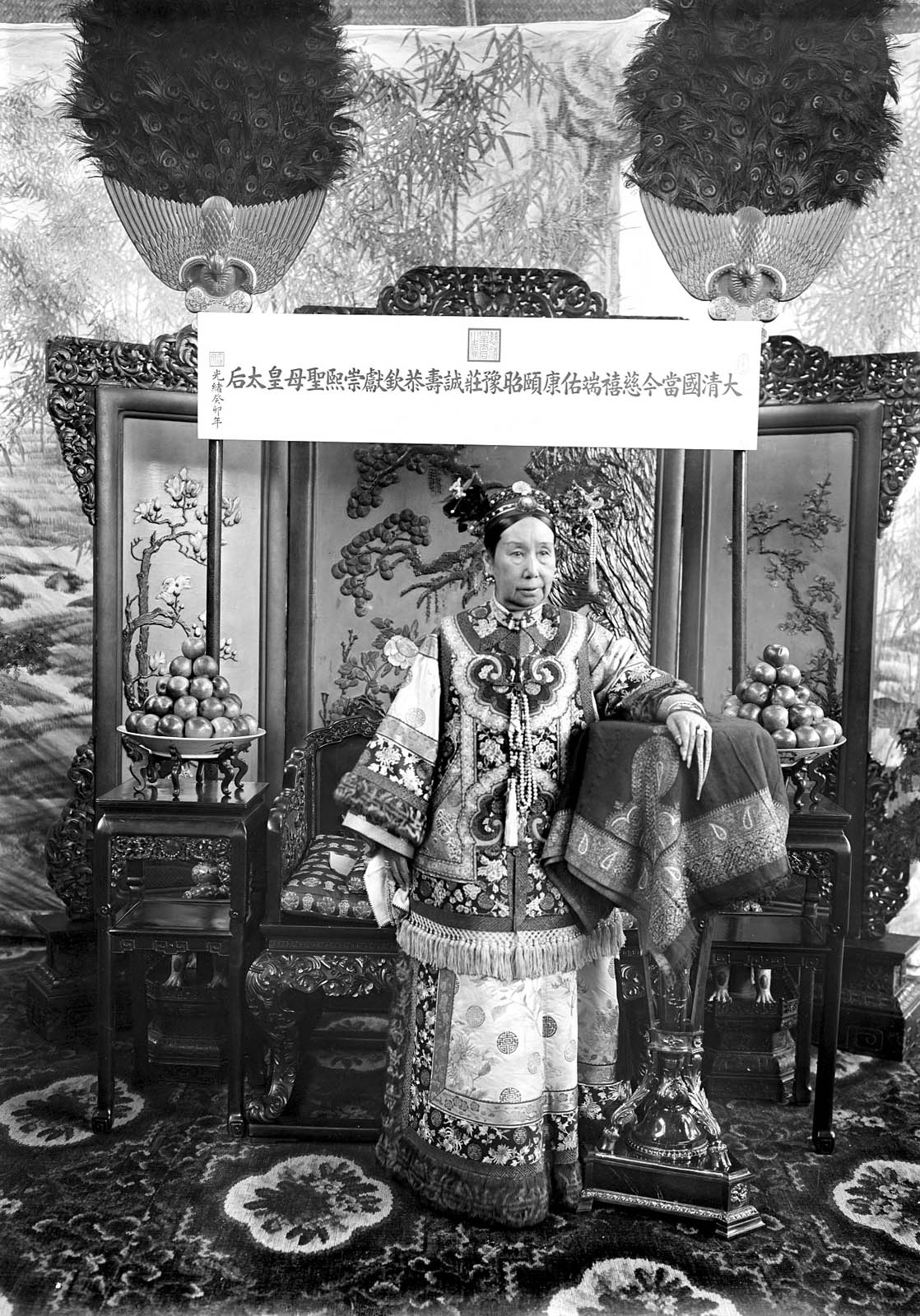
 

Yu Xunling (勋龄; c. 1880-1943) 'Empress Dowager Cixi' c. 1903


Yu Xunling (勋龄; c. 1880-1943)
Empress Dowager Cixi
c. 1903
Albumen silver print
24.1 x 17.8cm (9.5 x 7 in.)
Loewentheil Photography of China Collection


This exhibition held in the Year of the Dragon reclaims the feminine power of the dragon and honours all Chinese women. It includes iconic photographs of Empress Dowager Cixi (1835-1908) by her Court photographer Yu Xunling (c. 1880-1943). Cixi, one of the most powerful women in Chinese history, was referred to as “Dragon Lady.” Some caricatured her as a uniquely sinister, manipulative, and cold-blooded ruler [see text below]. However, scholars agree that the Empress’s contribution to empowering and advancing opportunities for women is an important part of her legacy, thereby revising this one-dimensional view.

Text from the press release from the Loewentheil Photography of China Collection


Cixi (慈禧太后), Empress Dowager of China, 1835-1908

This photograph was taken in the Hall of Happiness and Longevity (Leshou tang) in the Summer Palace, Beijing. Cixi sits at the center. Behind her is a banner that says “Long Live the Current Divine Mother Empress Dowager of the Great Qing Empire for Ten Thousand Years.” Her embroidered robe is covered with stylised longevity characters and chrysanthemums, a symbol for long life. The auspicious emblems signify the wish of longevity for herself and, by extension, for the Qing dynasty. …

Cixi is a contradictory figure in Chinese history. From the 1860s until her death in 1908, Cixi dominated the Qing court and policies. She was regent to two successive emperors. Powerful as she was, she did not have a good reputation abroad. During her reign, foreigners and some of Cixi’s countrymen considered the Qing court to be conservative, corrupt, and incompetent. Her reputation was worsened among westerners after the Yihetuan Movement of 1900 (also known as Boxer Rebellion), an anti-imperialist, anti-foreign, and anti-Christian uprising. Cixi supported the group and declared war on the foreign powers. In response, a foreign joint army was sent to Beijing and Cixi was forced to flee the capital. After she returned to Beijing in 1902, she changed course and initiated massive reforms. She also took advice from key reformers. These new policies included promoting railroads, founding modern schools, and sending students to study overseas. Cixi also attempted to improve her international image. For example, she would invite the wives of foreign diplomats to receptions at the palace…

The picture belongs to the only photographic series taken of Cixi. They were shot by a young aristocratic photographer named Xunling (c. 1880-1943) between 1903 and 1904. The photographs were meant to be used to restore Cixi’s public image. They were designed to convey imperial authority and aesthetic elegance. Some of the photographs were presented as diplomatic gifts, including one for US President Theodore Roosevelt (1858-1919).

National Museum of Asian Art, Smithsonian Institution. “Xunling, The Empress Dowager Cixi with foreign envoys’ wives,” in Smarthistory, July 6, 2021 [Online] Cited 05/04/2024


Yu Xunling (勋龄; c. 1880-1943) 'Empress Dowager Cixi' c. 1903


Yu Xunling (勋龄; c. 1880-1943)
Empress Dowager Cixi
c. 1903
Albumen silver print
Loewentheil Photography of China Collection


The Loewentheil Collection includes iconic photographs of Empress Dowager Cixi (1835-1908) by her Court photographer Yu Xunling (c. 1880-1943). Xunling’s series of photographs of Cixi commissioned in 1903 and 1904 are the only known surviving photographs of the most important political figure of the late Qing dynasty.

Cixi, one of the most powerful women in Chinese history, was referred to as “Dragon Lady.” She was caricatured, particularly in the West, as a uniquely power-hungry, tyrannical, manipulative, and cold-blooded ruler. However, scholars agree that the Empress was unfairly represented. Her strategies, attitudes, and actions as a ruler were no more cunning than those of powerful males. Cixi also contributed to empowering and advancing opportunities for women in China.

Photography offered Cixi a means to take control of her representation. Her photographic images were crafted to destroy the caricatured image of her that circulated around the world. She crafted photographs to be self-defining and to articulate her view of herself as a ruler of China.

Xunling’s series of photographs of Cixi are artistic collaborations between a photographer and an Empress. Photography fascinated Cixi, and she carefully orchestrated the concept and composition of each photograph. In addition to her official portraits, Cixi created complicated group tableaux, portrayed herself in famous roles from Peking Opera, and posed as the compassionate bodhisattva Avalokitesvara. Cixi exercised absolute authority over her photographic portraits down to minute details. Xunling served as a collaborator and master technician helping Cixi achieve her artistic goals. Some photographs of Cixi were kept private until the Empress Dowager’s death.

Xunling’s photographs of Cixi are regarded by many historians as some of China’s earliest art photographs. Photographs of the Empress are of great scholarly interest to museum curators, art historians, and academics from a range of disciplines.

Text from the Loewentheil Photography of China Collection


Hedda Morrison, née Hammer (German, 1908-1991) 'Portrait of a Man with a Bird Cage' 1930s


Hedda Morrison, née Hammer (German, 1908-1991)
Portrait of a Man with a Bird Cage
1930s
Silver gelatin print
Loewentheil Photography of China Collection


Hedda Morrison (1908 -1991) née Hammer, was born in Stuttgart, Germany and studied photography in Munich. She is one of the earliest identified female photographers of China. Morrison contracted polio as a young girl, which caused her to walk with a limp for the rest of her life. Her disadvantage increased her desire for adventure and travel. She moved to Beijing in 1933 to manage Hartung’s, a German-owned commercial photographic studio and shop in the Legation Quarter. Morrison also worked as a freelance photographer, selling individual prints and thematic albums of her work and creating photographs for books on China. Her photographs document lifestyles, trades, landscapes, religious practices, and architecture in China.

Morrison made this photograph of a man outdoors with a birdcage. In traditional Chinese culture birdcages hold cultural significance symbolizing an appreciation for art, nature, and balanced life.

Text from the Loewentheil Photography of China Collection


Loewentheil Photography of China Collection
10 West 18th Street 7th Floor

Open by appointment only: 646-838-4576 or 410-602-3002

Loewentheil Photography of China Collection website

LIKE ART BLART ON FACEBOOK

Back to top

Photographs: Marcus Bunyan. ‘Dark Light’

from the series Travelling the wonderful loneliness 2019-2024

April 2024


Marcus Bunyan (Australian, b. 1958) 'The Two Towers' from the sequence 'Dark Light' 2019-2024
The Two Towers


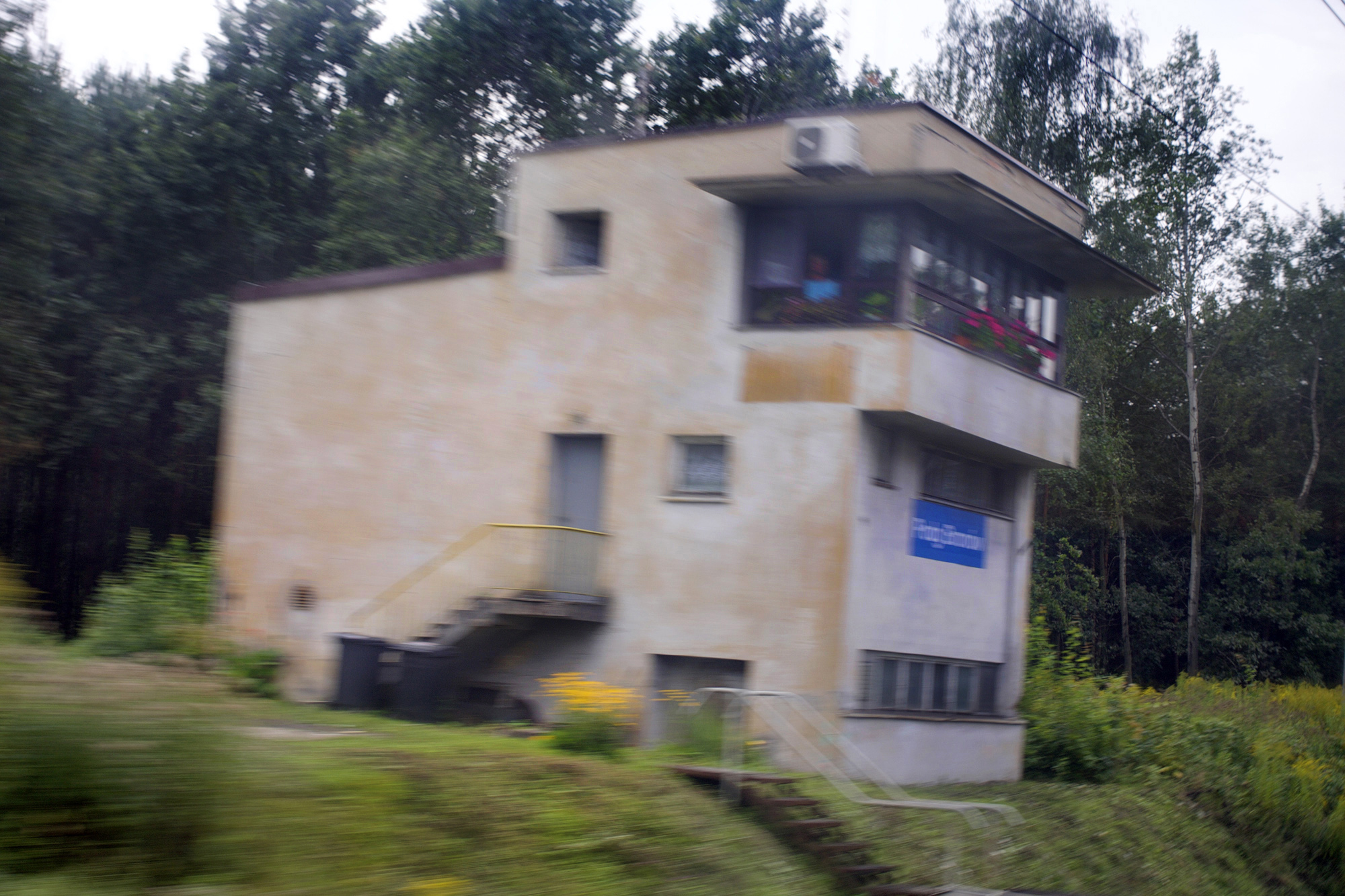
This sequence (my favourite in my latest body of work), Dark Light, is one of the four sequences in the series collectively titled Travelling the wonderful loneliness (2019-2024). Traces of order / chaos seen clearly; previsualisation was strong.

My friend and mentor Ian Lobb said:

It all works brilliantly, and they are all like that – there are subtle things that can’t be traced: i.e. are they the photographer: or are they the camera or are they just inevitable in this world? It is a type of anti-spirituality meets spirituality… and any number of other meeting points.”


My friend Elizabeth Gertsakis said:

“Spatial as well as surface tactile. Fascinated randomness. The human figure appears as a singular frozen device. Post-apocalyptic as well.”


I said:

“The spirit has left the earth, the body; something is not quite right; ambiguous forces of the (under) world are at play.”


Dr Marcus Bunyan

50 images
© Marcus Bunyan 


Please click on the photographs for a larger version of the image. Other sequences in the series include Material Witness; Tell Me Why; and (How I) Wish You Were Here (all 2019-2024).


Marcus Bunyan (Australian, b. 1958) 'The Great Wave (Gustave Le Gray)' from the sequence 'Dark Light' 2019-2024
The Great Wave (Gustave Le Gray)


Marcus Bunyan (Australian, b. 1958) 'Untitled' from the sequence 'Dark Light' 2019-2024


Marcus Bunyan (Australian, b. 1958) 'Untitled' from the sequence 'Dark Light' 2019-2024


Marcus Bunyan (Australian, b. 1958) 'Soul marker' from the sequence 'Dark Light' 2019-2024


Marcus Bunyan (Australian, b. 1958) 'Untitled' from the sequence 'Dark Light' 2019-2024


Marcus Bunyan (Australian, b. 1958) 'JCB' from the sequence 'Dark Light' 2019-2024


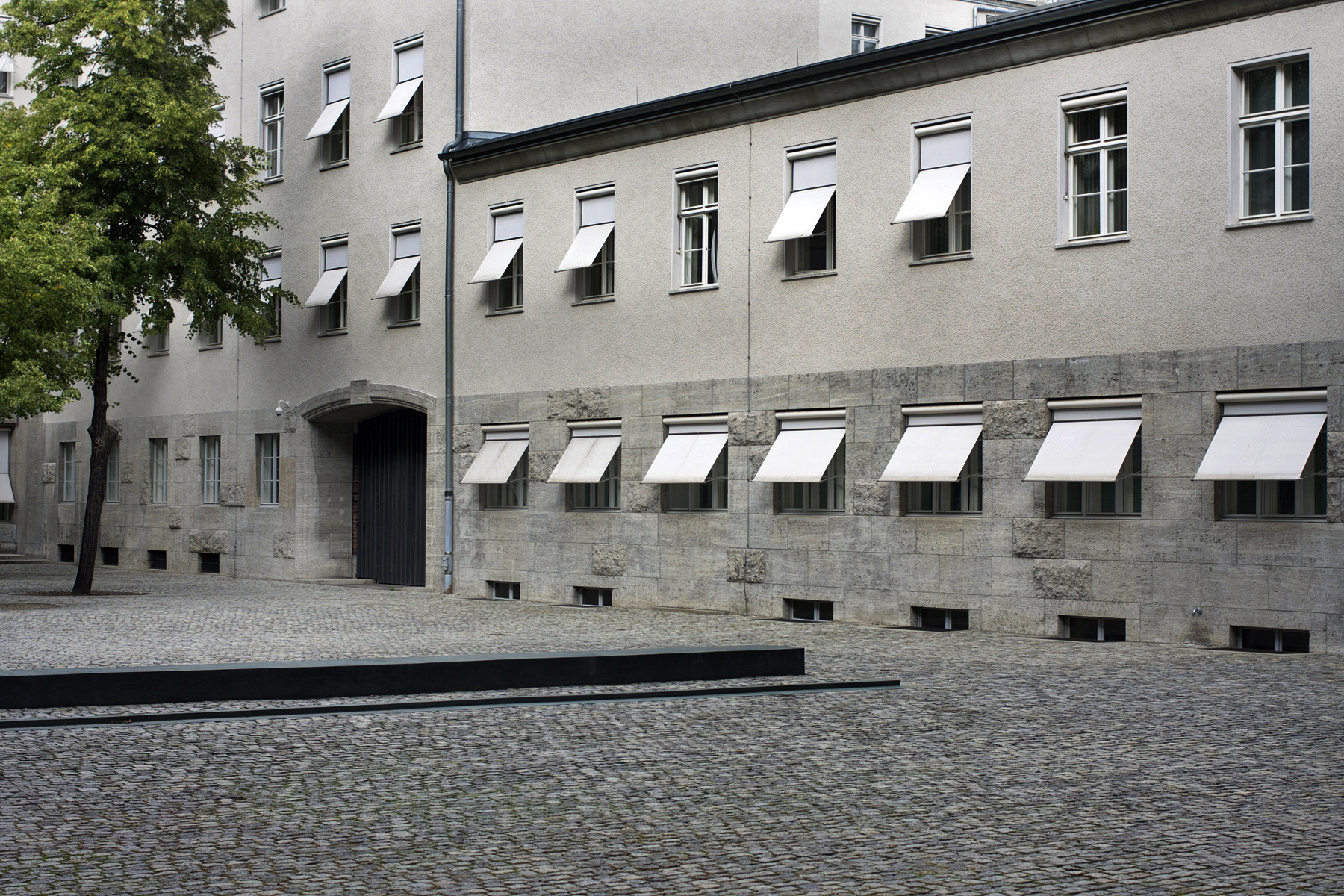
Marcus Bunyan (Australian, b. 1958) 'Sacrifice, Bendlerblock, Berlin' from the sequence 'Dark Light' 2019-2024
Sacrifice, Bendlerblock, Berlin


Marcus Bunyan (Australian, b. 1958) 'Untitled' from the sequence 'Dark Light' 2019-2024


Marcus Bunyan (Australian, b. 1958) 'Untitled' from the sequence 'Dark Light' 2019-2024


Marcus Bunyan (Australian, b. 1958) 'Dark City I' from the sequence 'Dark Light' 2019-2024


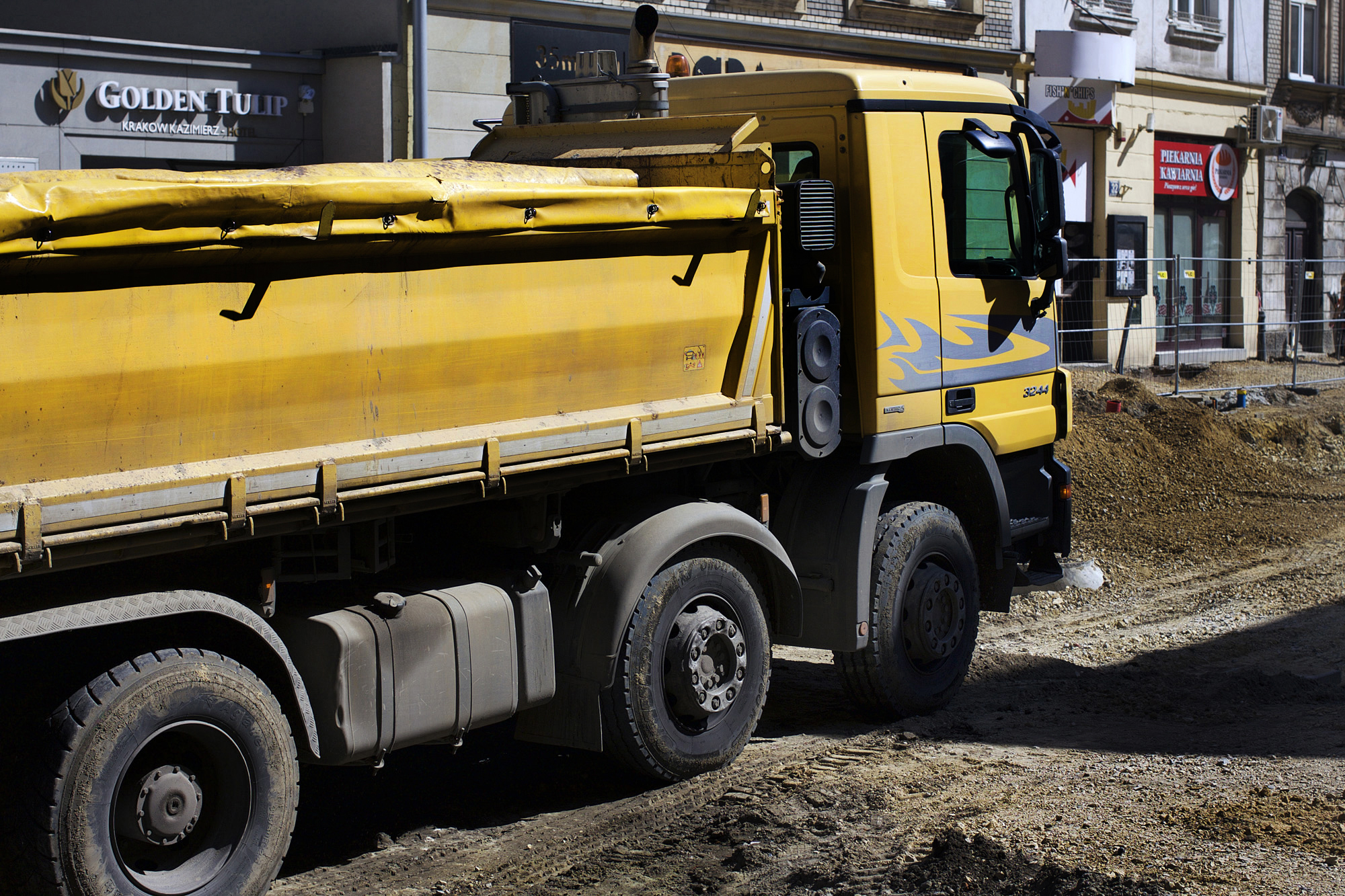
Marcus Bunyan (Australian, b. 1958) 'Golden Tulip' from the sequence 'Dark Light' 2019-2024


Marcus Bunyan (Australian, b. 1958) 'Monolith' from the sequence 'Dark Light' 2019-2024


Marcus Bunyan (Australian, b. 1958) 'Creature' from the sequence 'Dark Light' 2019-2024


Marcus Bunyan (Australian, b. 1958) 'Twenty / One' from the sequence 'Dark Light' 2019-2024


Marcus Bunyan (Australian, b. 1958) 'Tendril' from the sequence 'Dark Light' 2019-2024


Marcus Bunyan (Australian, b. 1958) 'Tribulation' from the sequence 'Dark Light' 2019-2024


Marcus Bunyan (Australian, b. 1958) 'Yellow' from the sequence 'Dark Light' 2019-2024


Marcus Bunyan (Australian, b. 1958) 'Black Star' from the sequence 'Dark Light' 2019-2024


Marcus Bunyan (Australian, b. 1958) 'Duct' from the sequence 'Dark Light' 2019-2024


Marcus Bunyan (Australian, b. 1958) 'Wraith' from the sequence 'Dark Light' 2019-2024


Marcus Bunyan (Australian, b. 1958) 'Untitled' from the sequence 'Dark Light' 2019-2024


Marcus Bunyan (Australian, b. 1958) 'Benediction' from the sequence 'Dark Light' 2019-2024


Marcus Bunyan (Australian, b. 1958) 'Untitled' from the sequence 'Dark Light' 2019-2024


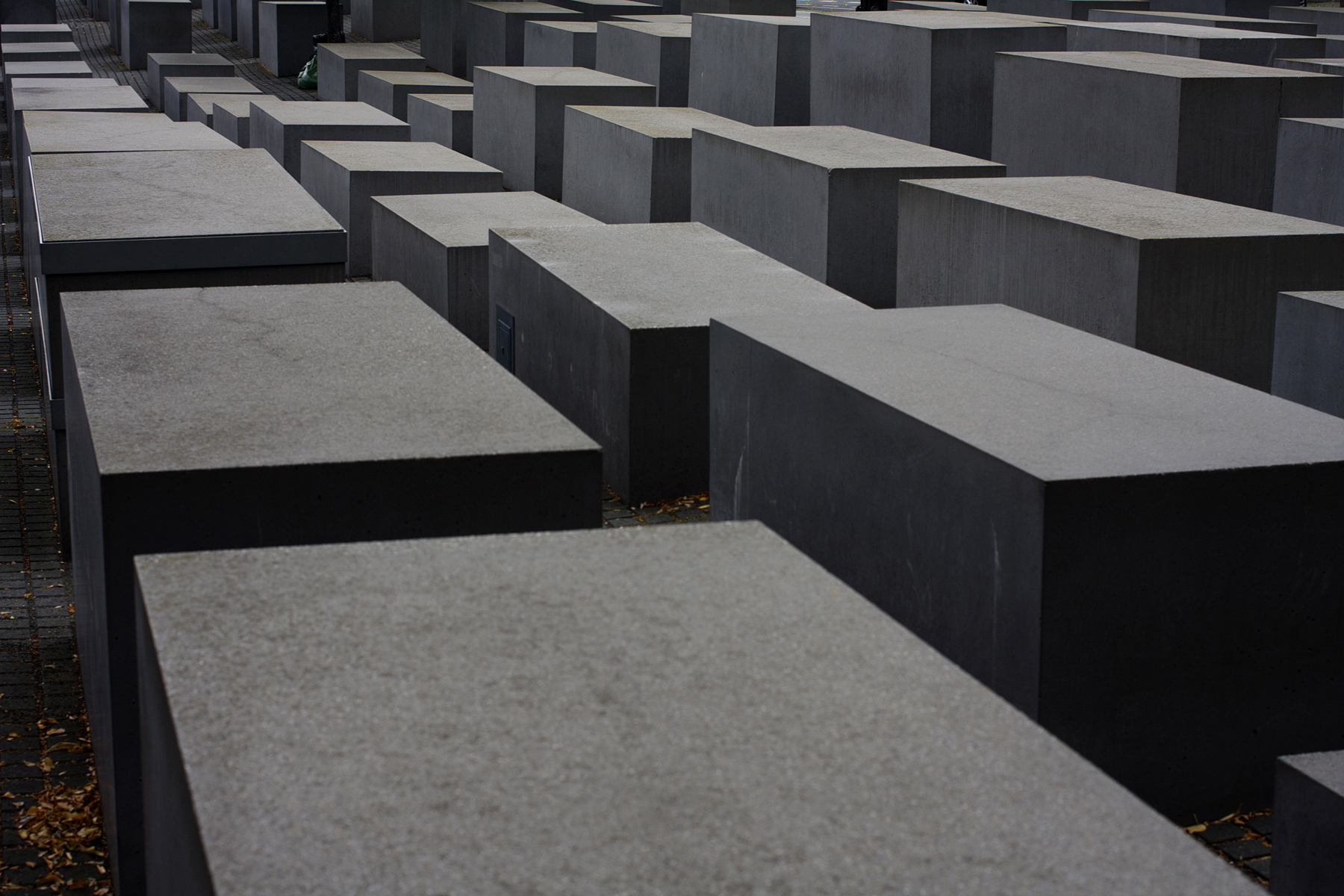
Marcus Bunyan (Australian, b. 1958) 'Memorial, Berlin' from the sequence 'Dark Light' 2019-2024


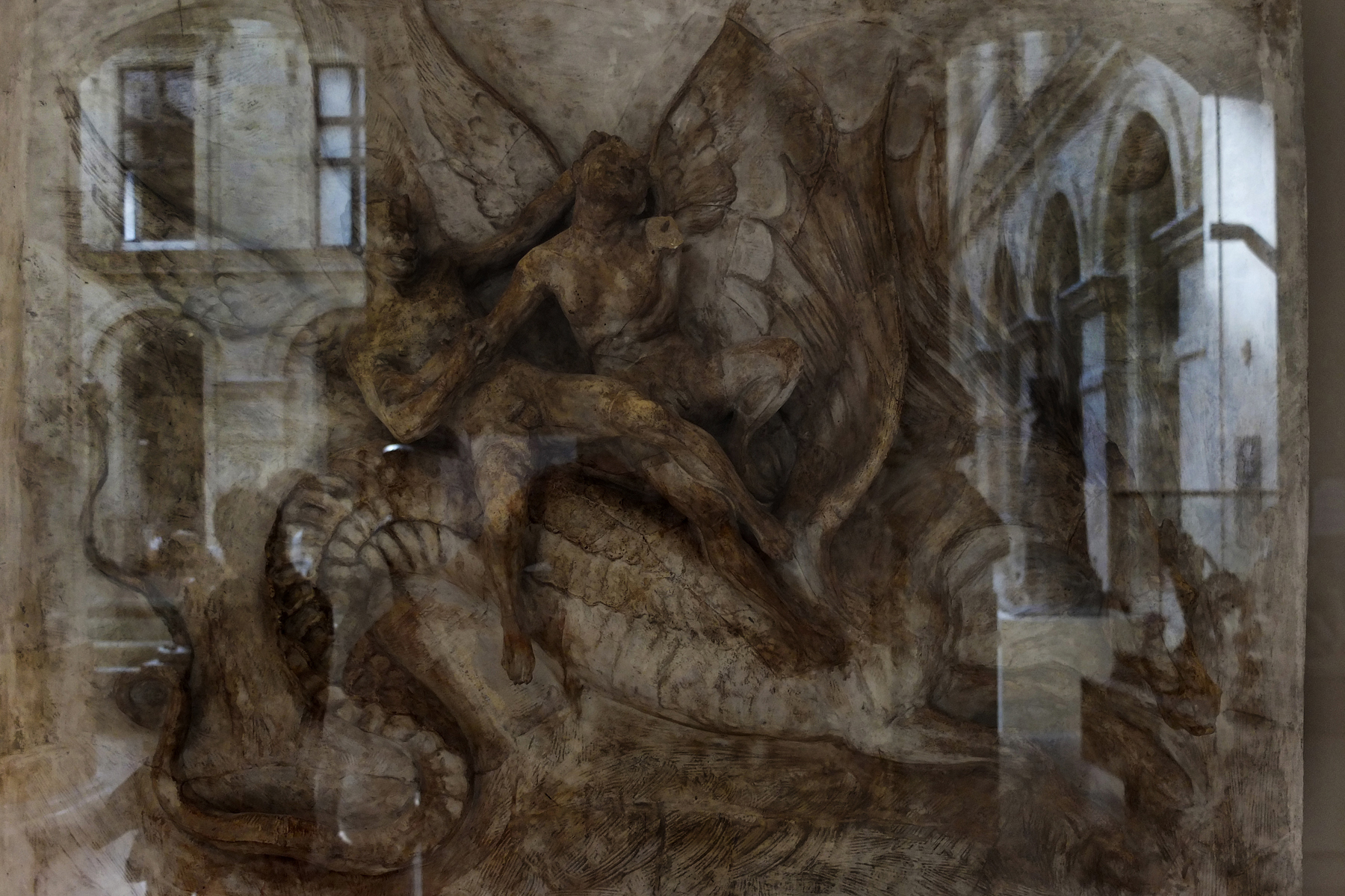
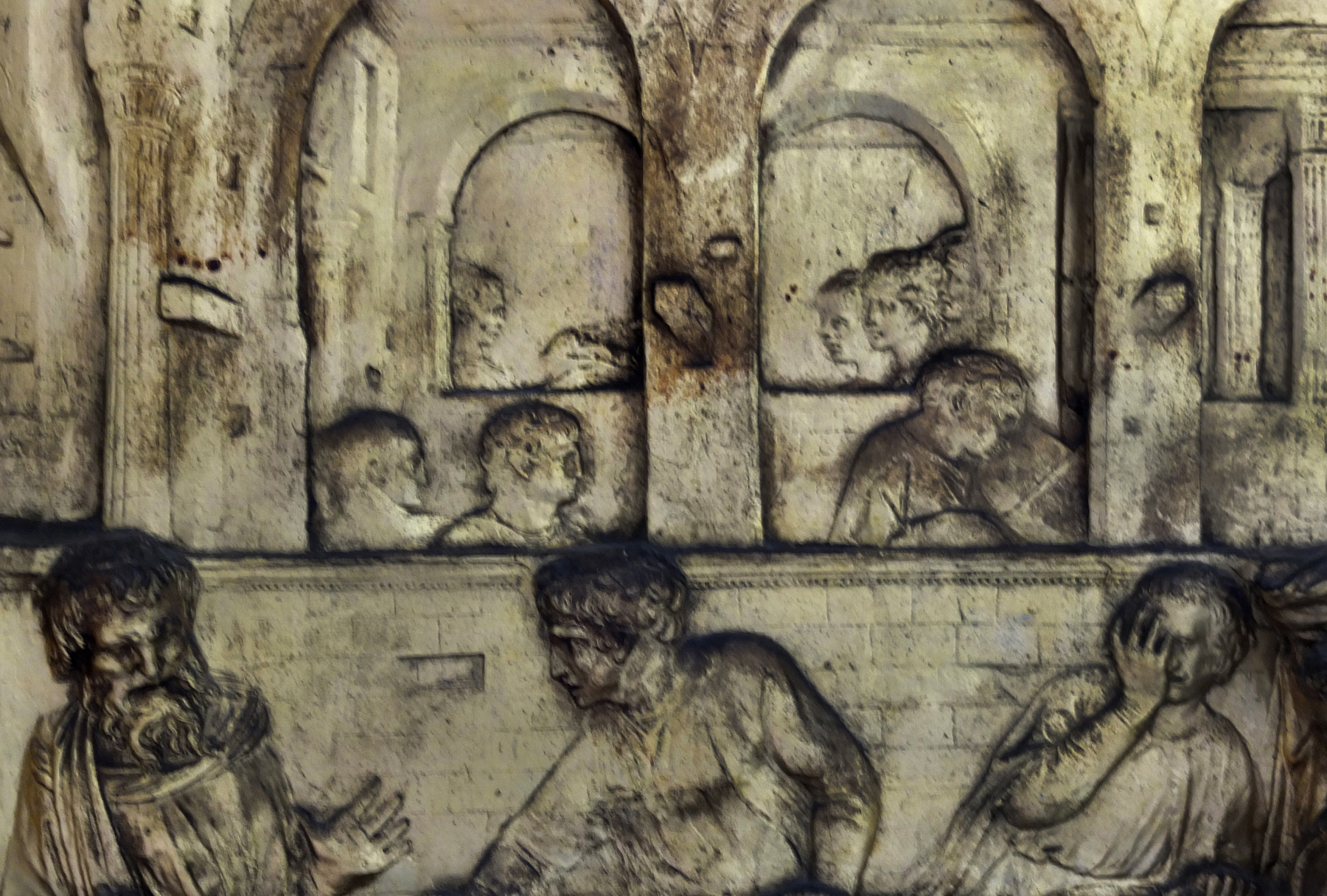
Marcus Bunyan (Australian, b. 1958) 'Medusa, Yerebatan Sarnici, Istanbul' from the sequence 'Dark Light' 2019-2024
Medusa, Yerebatan Sarnici, Istanbul


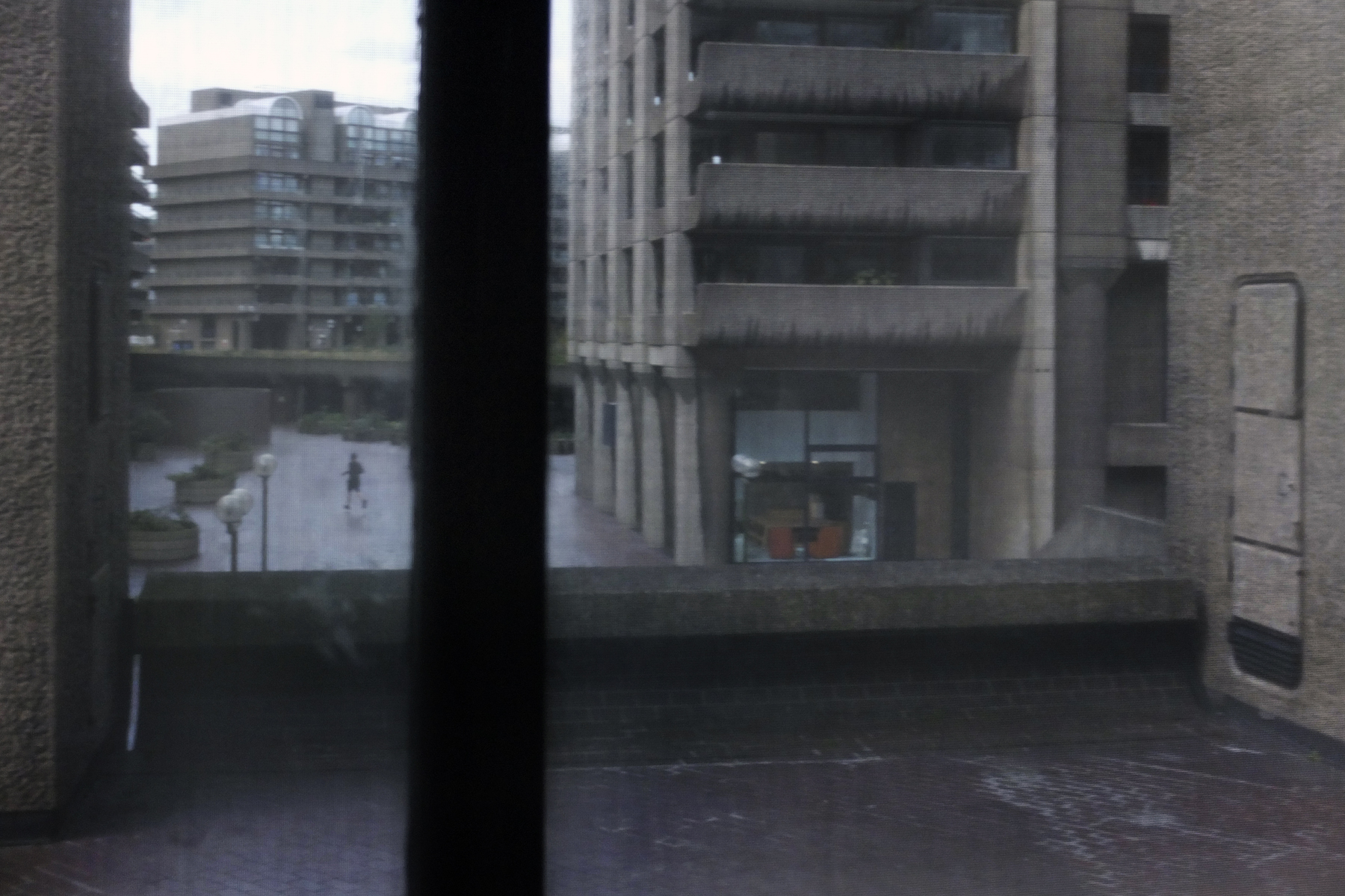
Marcus Bunyan (Australian, b. 1958) 'Running Man' from the sequence 'Dark Light' 2019-2024
Running Man


Marcus Bunyan (Australian, b. 1958) 'Untitled' from the sequence 'Dark Light' 2019-2024


Marcus Bunyan (Australian, b. 1958) 'Dark City II' from the sequence 'Dark Light' 2019-2024


Marcus Bunyan (Australian, b. 1958) 'In the darkness of forests' from the sequence 'Dark Light' 2019-2024
In the darkness of forests


Marcus Bunyan (Australian, b. 1958) 'Peeling' from the sequence 'Dark Light' 2019-2024
Peeling


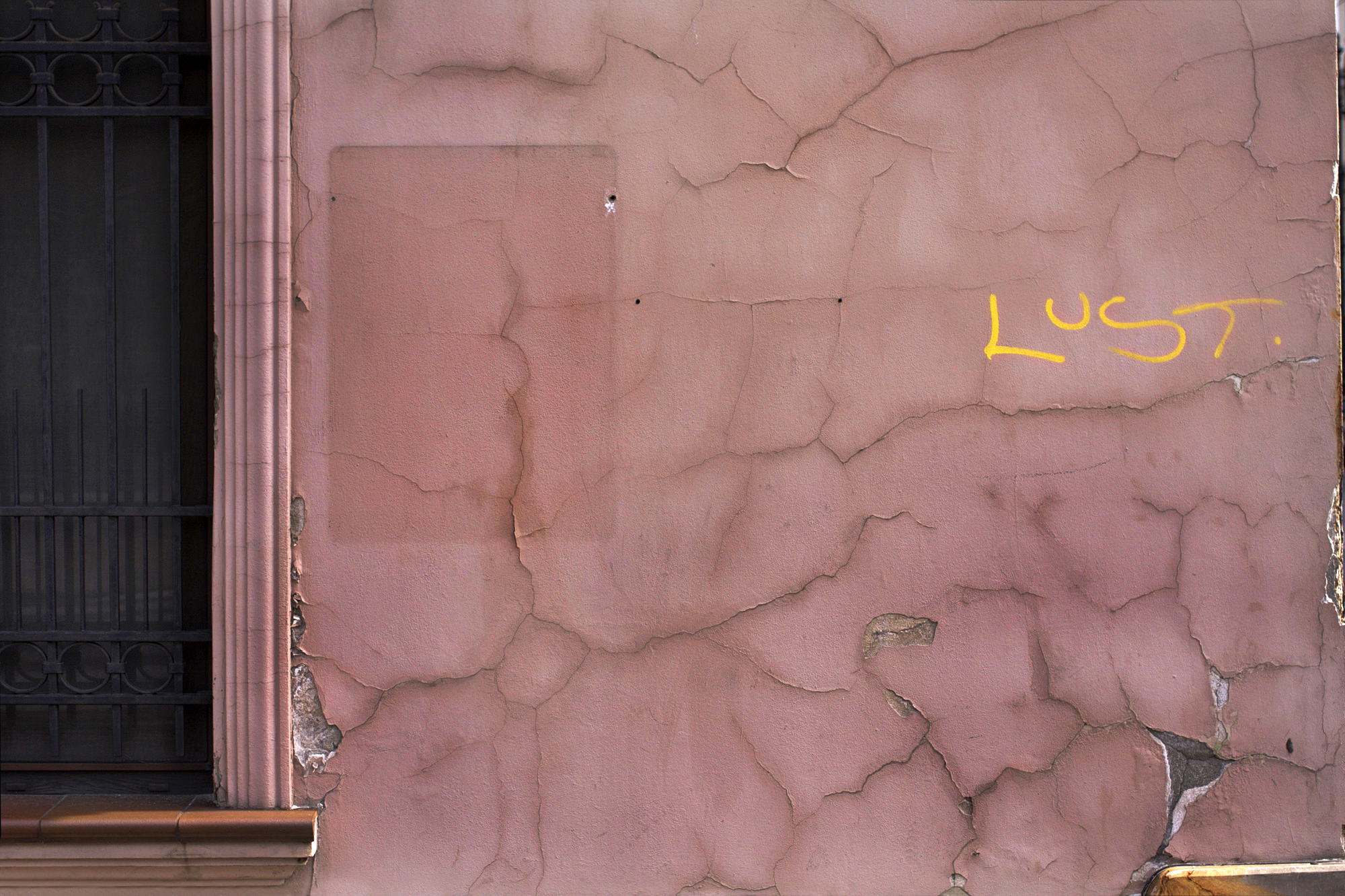
Marcus Bunyan (Australian, b. 1958) 'Lust' from the sequence 'Dark Light' 2019-2024


Marcus Bunyan (Australian, b. 1958) 'Pierce' from the sequence 'Dark Light' 2019-2024


Marcus Bunyan (Australian, b. 1958) 'Untitled' from the sequence 'Dark Light' 2019-2024


Marcus Bunyan (Australian, b. 1958) 'Conductor' from the sequence 'Dark Light' 2019-2024


Marcus Bunyan (Australian, b. 1958) 'Despair' from the sequence 'Dark Light' 2019-2024


Marcus Bunyan (Australian, b. 1958) 'Below Above' from the sequence 'Dark Light' 2019-2024


Marcus Bunyan (Australian, b. 1958) 'Parallel' from the sequence 'Dark Light' 2019-2024


Marcus Bunyan (Australian, b. 1958) 'Enclosure' from the sequence 'Dark Light' 2019-2024


Marcus Bunyan (Australian, b. 1958) 'Block' from the sequence 'Dark Light' 2019-2024


Marcus Bunyan (Australian, b. 1958) 'Old Jewish Cemetery, Prague' from the sequence 'Dark Light' 2019-2024
Old Jewish Cemetery, Prague


Marcus Bunyan (Australian, b. 1958) 'Untitled' from the sequence 'Dark Light' 2019-2024


Marcus Bunyan (Australian, b. 1958) 'Untitled' from the sequence 'Dark Light' 2019-2024


Marcus Bunyan (Australian, b. 1958) 'Untitled' from the sequence 'Dark Light' 2019-2024


Marcus Bunyan (Australian, b. 1958) 'Chaos' from the sequence 'Dark Light' 2019-2024


Marcus Bunyan (Australian, b. 1958) 'Approaching Thunderstorm' from the sequence 'Dark Light' 2019-2024
Approaching Thunderstorm


Marcus Bunyan (Australian, b. 1958) 'Entombment' from the sequence 'Dark Light' 2019-2024


Marcus Bunyan (Australian, b. 1958) 'Untitled' from the sequence 'Dark Light' 2019-2024


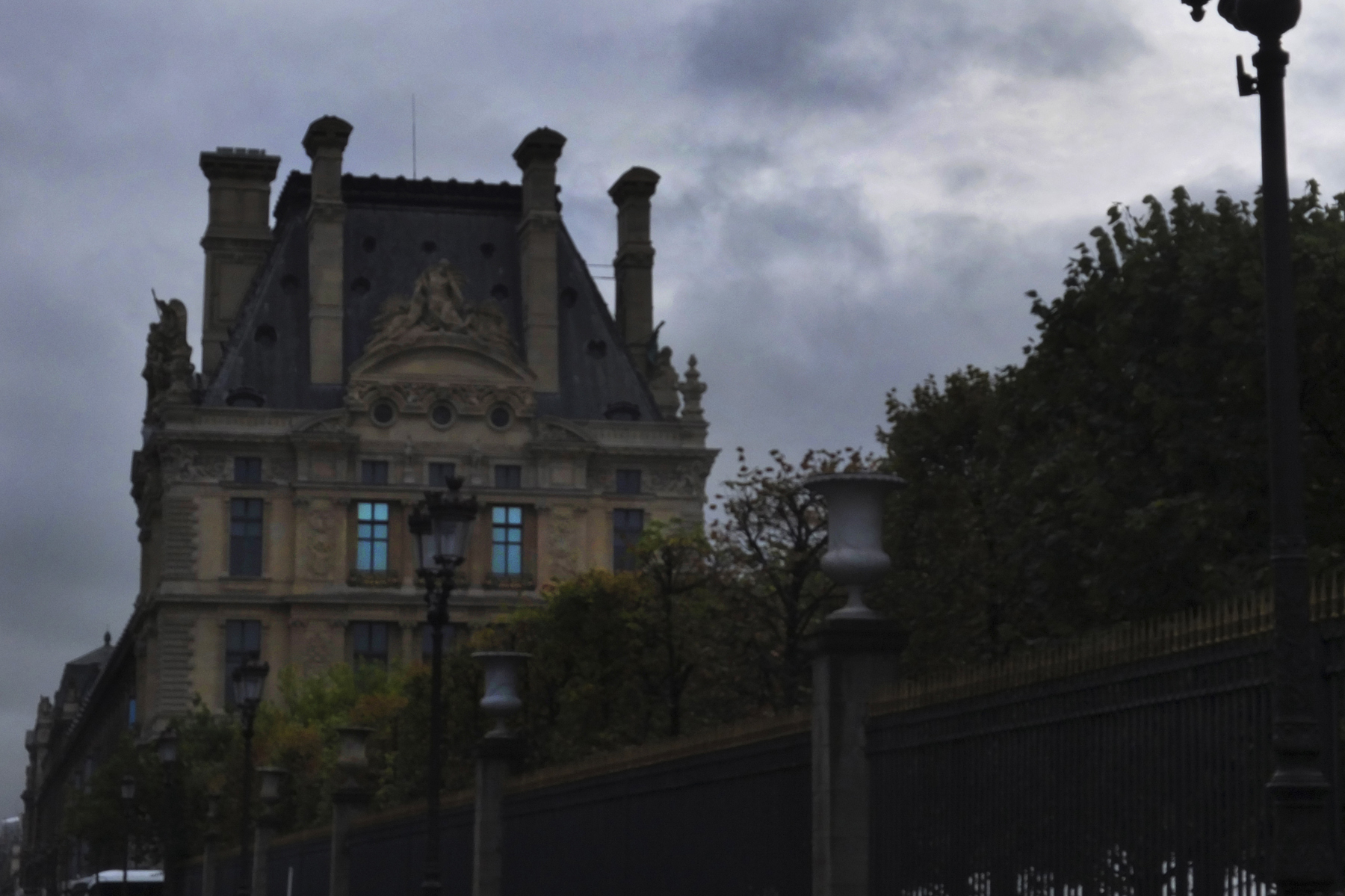
Marcus Bunyan (Australian, b. 1958) 'Dark Light, Pavillon de Marsan, Paris' from the sequence 'Dark Light' 2019-2024
Dark Light, Pavillon de Marsan, Paris


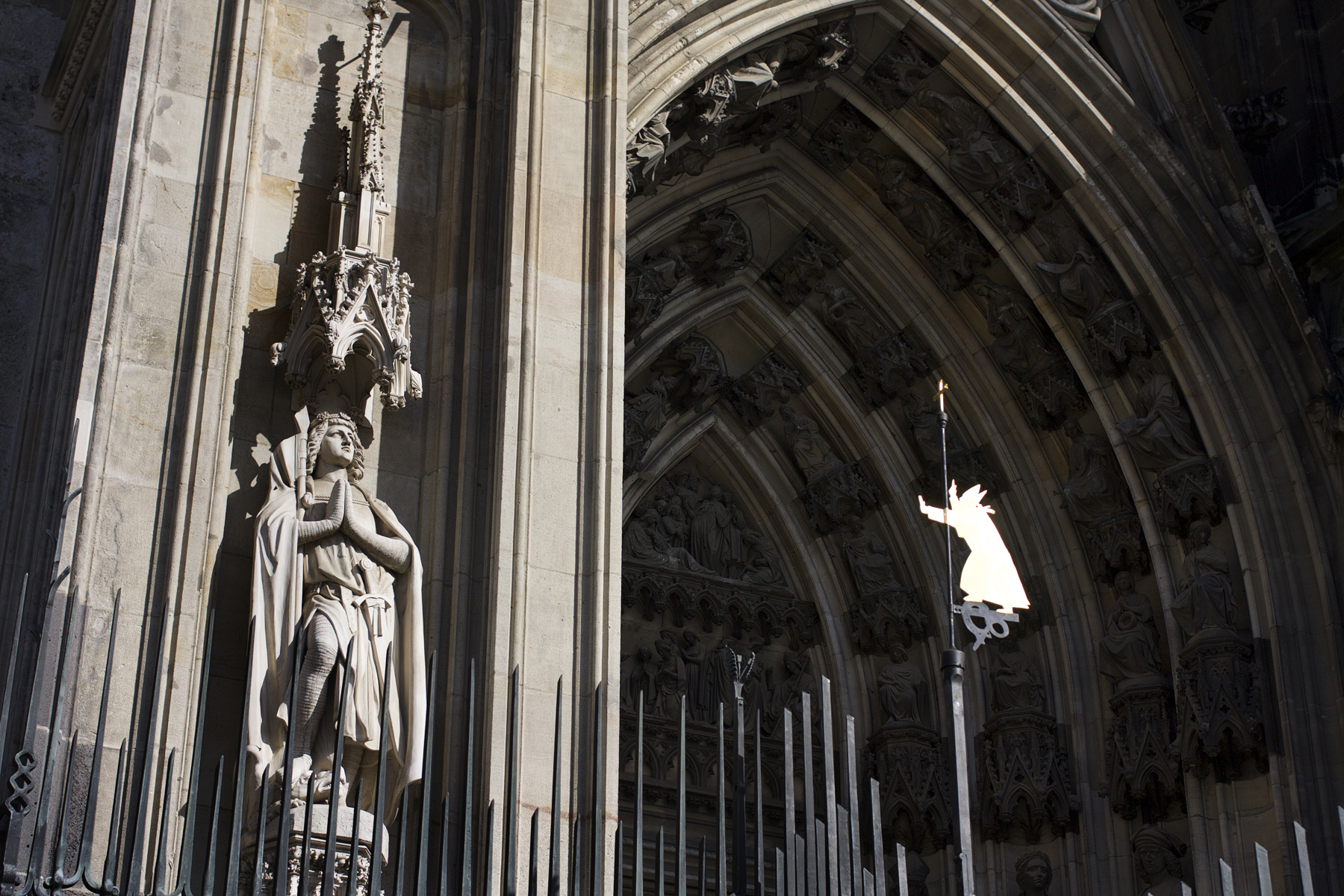
Marcus Bunyan (Australian, b. 1958) 'Fiat Lux (Let There Be Light)' from the sequence 'Dark Light' 2019-2024
Fiat Lux (Let There Be Light)


Photographs are available from this series for purchase. As a guide, a digital colour 16″ x 20″ print costs $1,000 plus tracked and insured shipping. For more information please see the Store web page.


Marcus Bunyan website

LIKE ART BLART ON FACEBOOK

Back to top

Review: ‘Wanderings About History. The Photography of Ulrich Wüst’ at the RMIT Gallery, Melbourne

Exhibition dates: 1st March – 20th April, 2024

Curator: Matthias Flügge


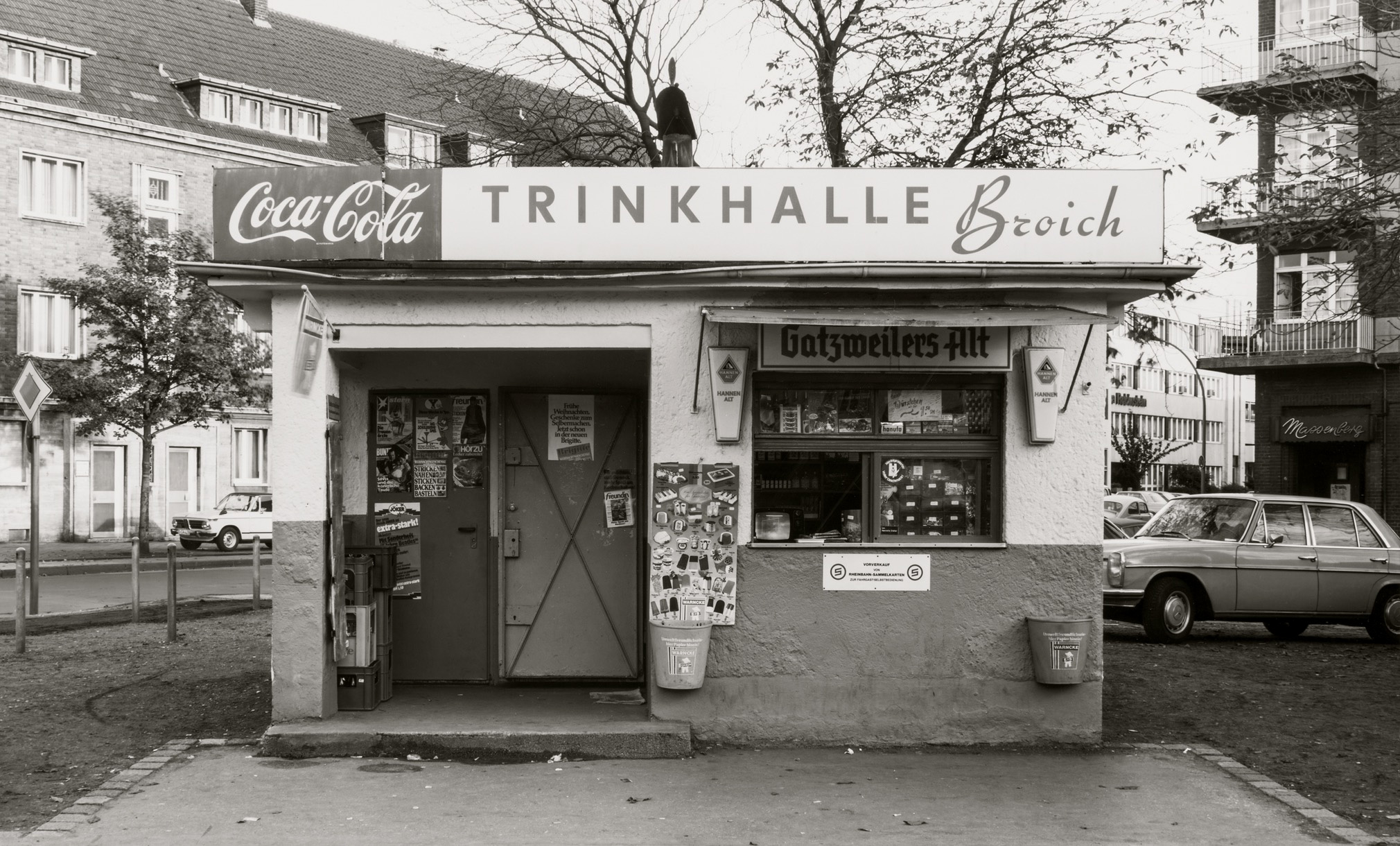
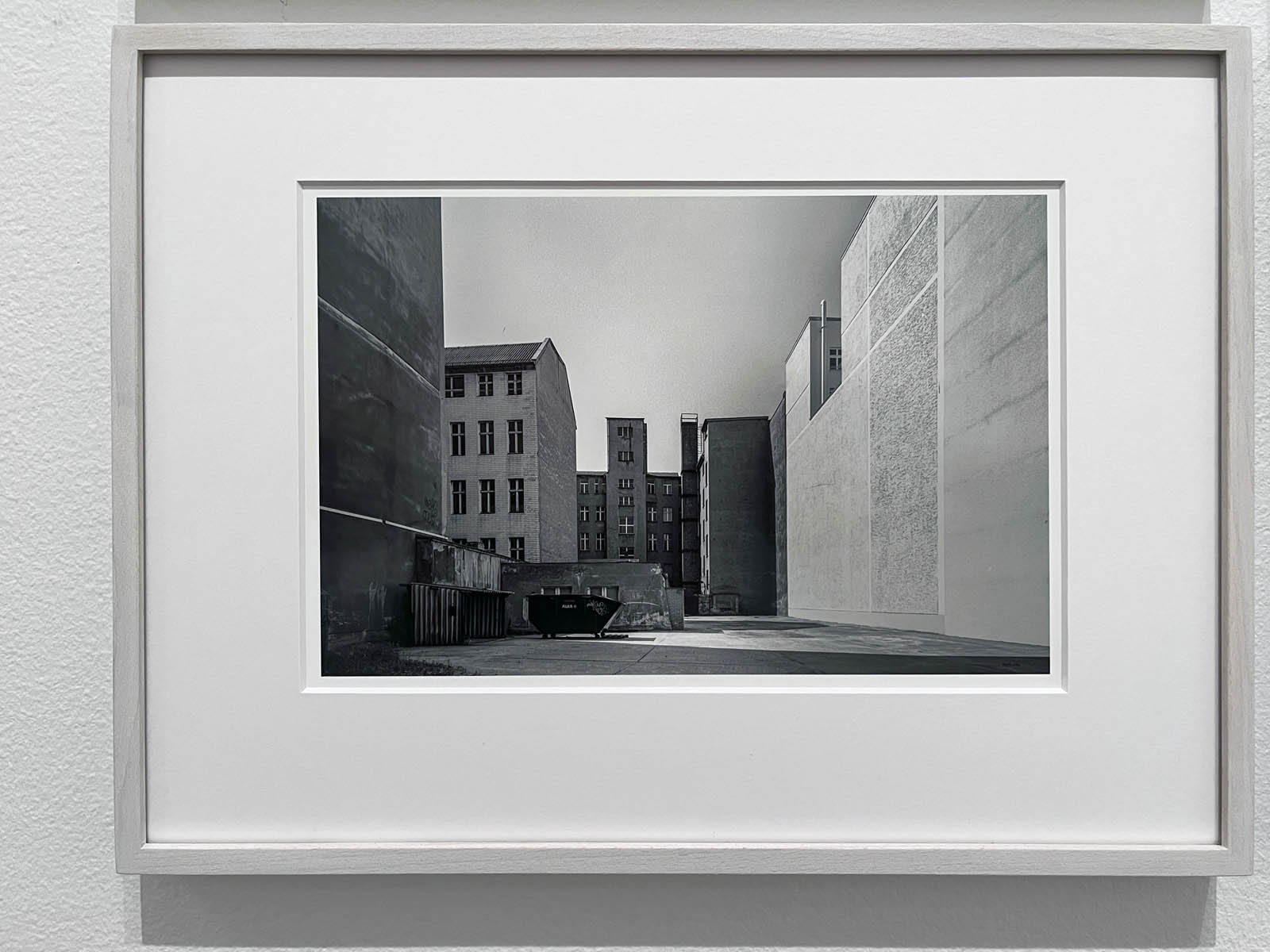
Ulrich Wüst (German, b. 1949) 'Dodendorfer Straße' 1998 From the series 'Morgenstraße. Magdeburg 1998-2000'


Ulrich Wüst (German, b. 1949)
Dodendorfer Straße
1998
Aus der Serie: Morgenstraße. Magdeburg 1998-2000
From the series: Morgenstraße. Magdeburg 1998-2000
B/w archival pigment print
18 x 27cm
© Ulrich Wüst; ifa


Wondering through history


Wonder noun. a feeling of amazement and admiration, caused by something beautiful, remarkable, or unfamiliar.


As enunciated by Jake Wilson in The Age newspaper in a review of the film La Chimera, “ultimately, the problem dramatised here is the same one faced by any modern artist: how do you retain a meaningful link to your predecessors while shaping something new?”1

Further, my mentor and friend Ian Lobb would often challenge me to define what I was adding to the artistic dialogue of photography instead of repeating the language of a previous era, and I would spar with him asking him was it really necessary to constantly reinvent the wheel, was it not enough to see and feel with clarity and humour those precious moments that surround us, and insightfully photograph them. These are the questions that enliven life: is it always necessary to shape something new, or is it enough to be attentive to the moment – of your mind, heart and vision – to create spellbinding photographs that carry your own interpretation of a certain reality.

Such is the case with the stimulating, two-room exhibition of the German photographer Ulrich Wüst at RMIT Gallery, Melbourne.

Wüst’s photography shows great affinity with the work of Bernd and Hiller Becher and the Becher and Dusseldorf Schools of photography which would have been known in East Germany by the time Wüst shot the 1980s series Stadtbilder. 1979-1985 (Cityscapes. 1979-1985) that first brought Wüst to international attention (the border was very permeable to artistic ideas from the West reaching East Germany).2 Indeed, most of Wüst’s oeuvre has direct links to the aesthetic of the Bechers (with their attention to detail and “devotion to the 1920s German tradition of Neue Sachlichkeit (New Objectivity”) and photographers such as Thomas Ruff (with their surreal enlargement of scale and “fundamentally sceptical attitude towards photography’s claim to truth and documentation”).

I believe that referencing and riffing off that aesthetic as Wüst does is no bad thing … for it forms the basis for the photographer’s further take on reality. But there are plenty of other forces at play in his photographs. I observe traces of August Sander, Berenice Abbott, Robert Frank, Michael Schmidt and Eugène Atget among others, especially with the latter in the positioning of Wüst’s camera.

As he observes, “When shooting I often find that if I move just fraction away from the more customary perspective a subtle heightening of tension with take place within the image. It’s no accident that I and my camera frequently get suspicious looks when the angle of the lens shifts away from the perspective found in souvenirs and postcards.” (Wall text from the exhibition)

And this is exactly what Atget did, he moved his camera from the “normal” point of view ever so slightly so that there immediately becomes this tension within the image plane coupled to the possibility of a magical revelation of space, an ironic comment on construction, or a grotesque play of opposites. As Wüst says, his vision, his observation, contains “plenty that is comic, grotesque, ironic” which many people do not see.


If we think about the supposedly objective work of the Bechers, which they insisted was all about documenting the object and not about any type of emotion, we fail to consider, as Julia Curl opines, “that this “objectivity” is only surface-level – that the work is deeply personal, even if its apparent uniformity claims otherwise.”3 Personally, I have never bought into the cool objectification of the Becher’s work for the photographers made defined choices as to how they depicted their constructed realities, each iteration of a water tower, gravel plant or cooling tower different from the other (fragments of a whole). This was deeply personal vision of how the world is perceived.

The same can be said of the photographs of Ulrich Wüst. His photographs are entirely personal, fragmentary excavations of history. In Wüst’s works by series, his photographs – surreal, sculptural scenes absent of people, full of elemental beauty – are not just the flawed humanity of our creation / the creation of our flawed humanity … but the creation and imagination of the human mind captured by the eye of the camera. Wüst’s photographs challenge us to look closer at the reality around us not accepting the status quo, the postcard view, not walking the city as if unaware of the vistas around us, feeling the “traces, injuries, missing and empty spaces in the image, so that things begin to speak of themselves…”4

As the art historian Matthias Flügge states, Wüst’s photographs are “images of intellectual-spatial situations,” wholly a creation, an accretion, on existing forms of photography. Not something new, which is ultimately unnecessary, but a growth in “wondering” – not wandering – achieved through the gradual accumulation of additional layers of beauty, feeling, knowledge so that we are informed and fully aware of our (un)familiar surroundings.

The photographs tell a powerful story of Germany before and after the fall of communism whilst instilling in the viewer a wondering, an accumulation and visual nourishment for the senses.

Such is the photography of Ulrich Wüst.

Dr Marcus Bunyan

PS. The only down side to this exhibition is that all the black and white photographs are modern archival ink jet prints. Call me old fashioned but these pigment prints have no real “presence”. It’s like the difference between an LP and a CD, or a movie in Technicolor or 5K. One has “atmosphere”, one has mood and aura and the other just sits there in all its perfection like a dog with a bone waiting for you to go “oooh, ahhh”. There are people that say you can’t tell the difference between the two. Rubbish. Give me gelatin silver prints any day of the week.


1/ Jake Wilson. “Lost and Found while digging up the cinematic past,” in The Age newspaper, 11 April 2024, p. 24.

2/”Huyssen reveals the complexity of artistic development on both sides of the Wall and notes that “the borders between East and West became porous during the 1970s as a result of treaties between the GDR and the FRG.” His focus in this regard, however, is on those artists who left the East for the West and made an impact there, such as Georg Baselitz and Gerhard Richter; he does not acknowledge the extent to which ideas and influences went in both directions. … While it is true that West German artists showed little interest in exhibiting in the East or in the art that was created there, East German artists tended to be well informed about Western artistic developments…” p. 598

April A. Eisman. “East German Art and the Permeability of the Berlin Wall,” in German Studies Review, Vol. 38, No. 3 (October 2015), pp. 597-616. Published by The Johns Hopkins University Press on behalf of the German Studies Association

3/ Julia Curl. “Bernd and Hilla Becher’s Misunderstood Oeuvre,” on the Hyperallergic website November 2, 2022 [Online] Cited 11/04/2024

4/ Jacek Slaski. “Ulrich Wüst – Stadtbilder 1979–1985: Zwischen Kunst und Dokumentation,” on the tipBerlin website 03/02/2022 [Online] Cited 08/04/2024. Translated from the German by Google Translate


Many thankx to the RMIT Gallery and the ifa for allowing me to publish the photographs in the posting. Please click on the photographs for a larger version of the image.

An exhibition by ifa – Institut für Auslandsbeziehungen e.V., Stuttgart – in partnership with the Goethe-Institut. This project is an official exhibition of PHOTO 2024 International Festival of Photography.


“Most viewers, unfortunately, are so dreadfully serious when they look at the pictures. I have to “hammer it home” incredibly hard before anyone will allow themselves to laugh. In my works there is simply – perhaps a bit hidden – plenty that is comic, grotesque, ironic.”


~ Ulrich Wüst, wall text from the exhibition


“I’m sure I do give those power symbols the aesthetic treatment, otherwise it’s unlikely that I would have any desire or energy to photograph them. But it would also be unfair to say that these objects do not hold their own innate aesthetic fascination. All I can do is try to describe how I am torn between spontaneous fascination and rational rejection, aiming to convey that experience and make it understandable. When shooting I often find that if I move just fraction away from the more customary perspective a subtle heightening of tension with take place within the image. It’s no accident that I and my camera frequently get suspicious looks when the angle of the lens shifts away from the perspective found in souvenirs and postcards. People are very attuned to that sort of shift.”


~ Ulrich Wüst, wall text from the exhibition


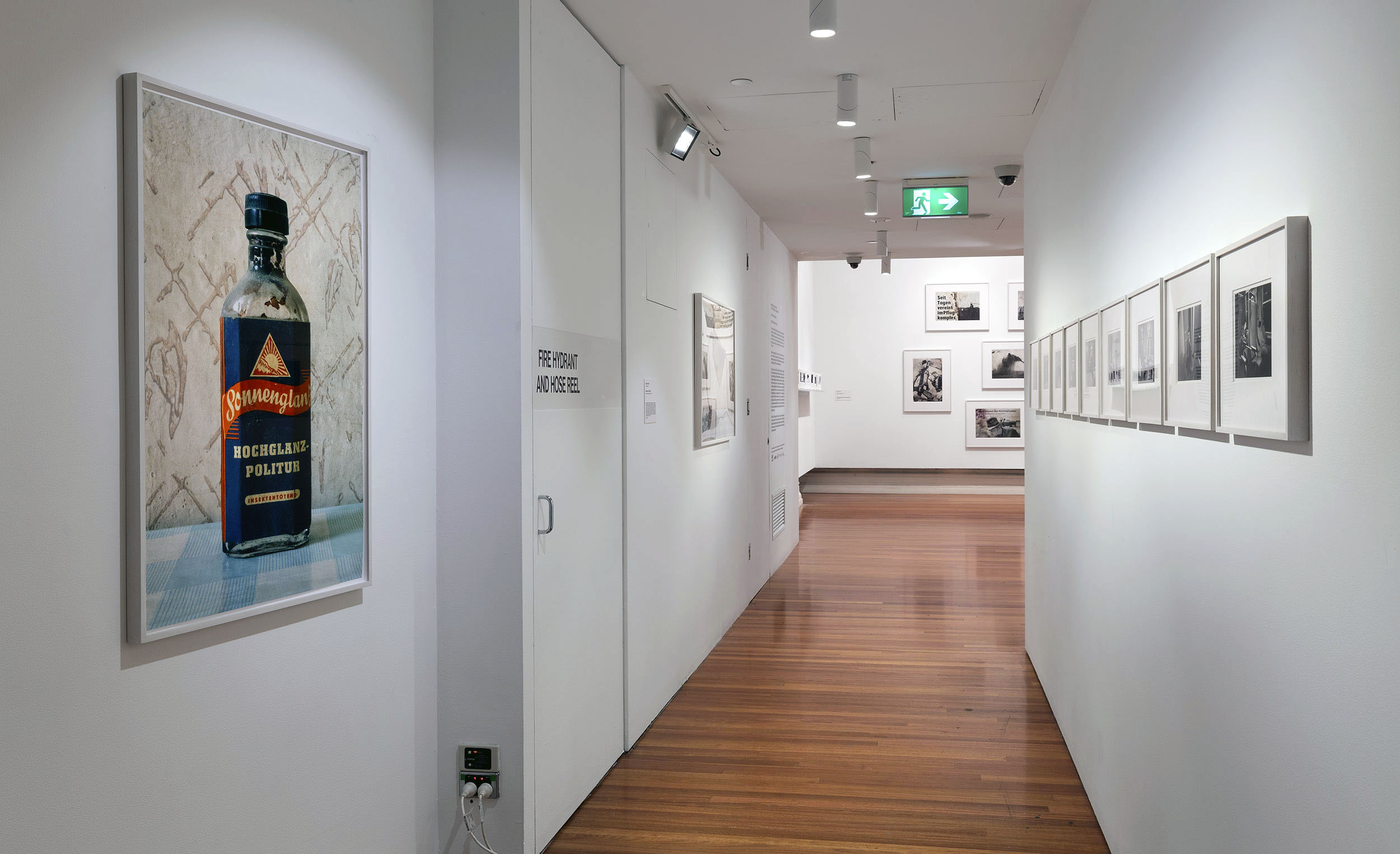
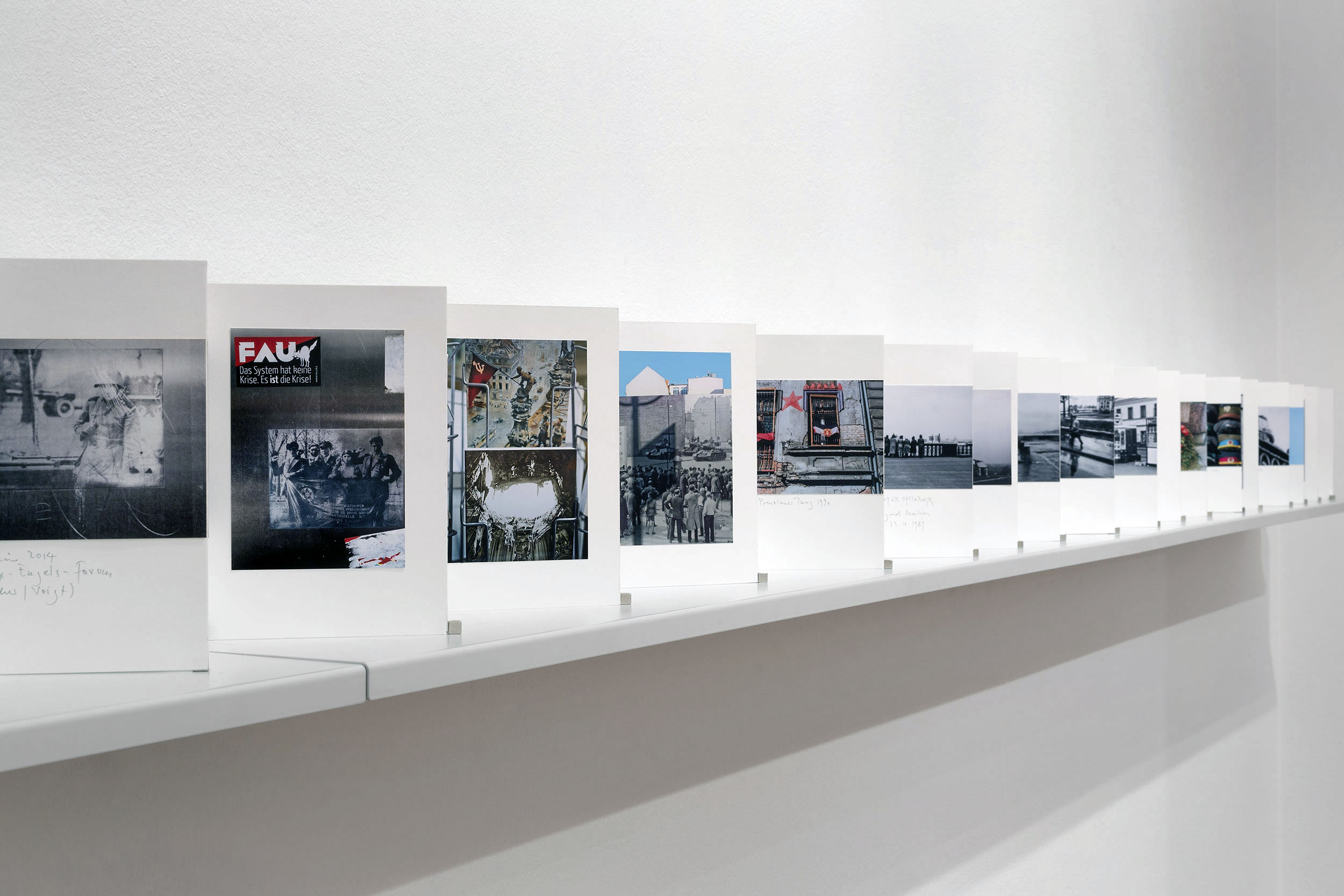
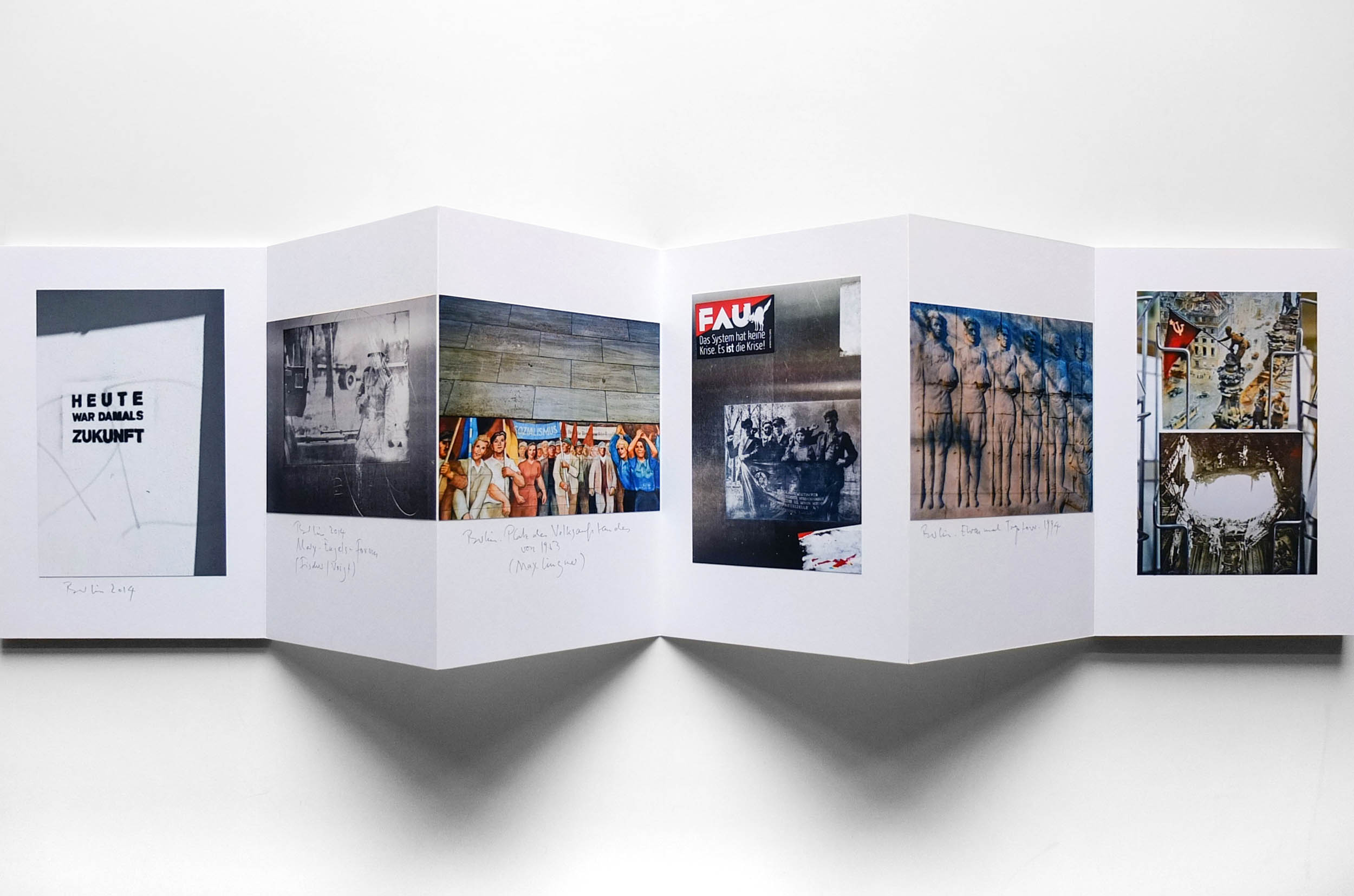
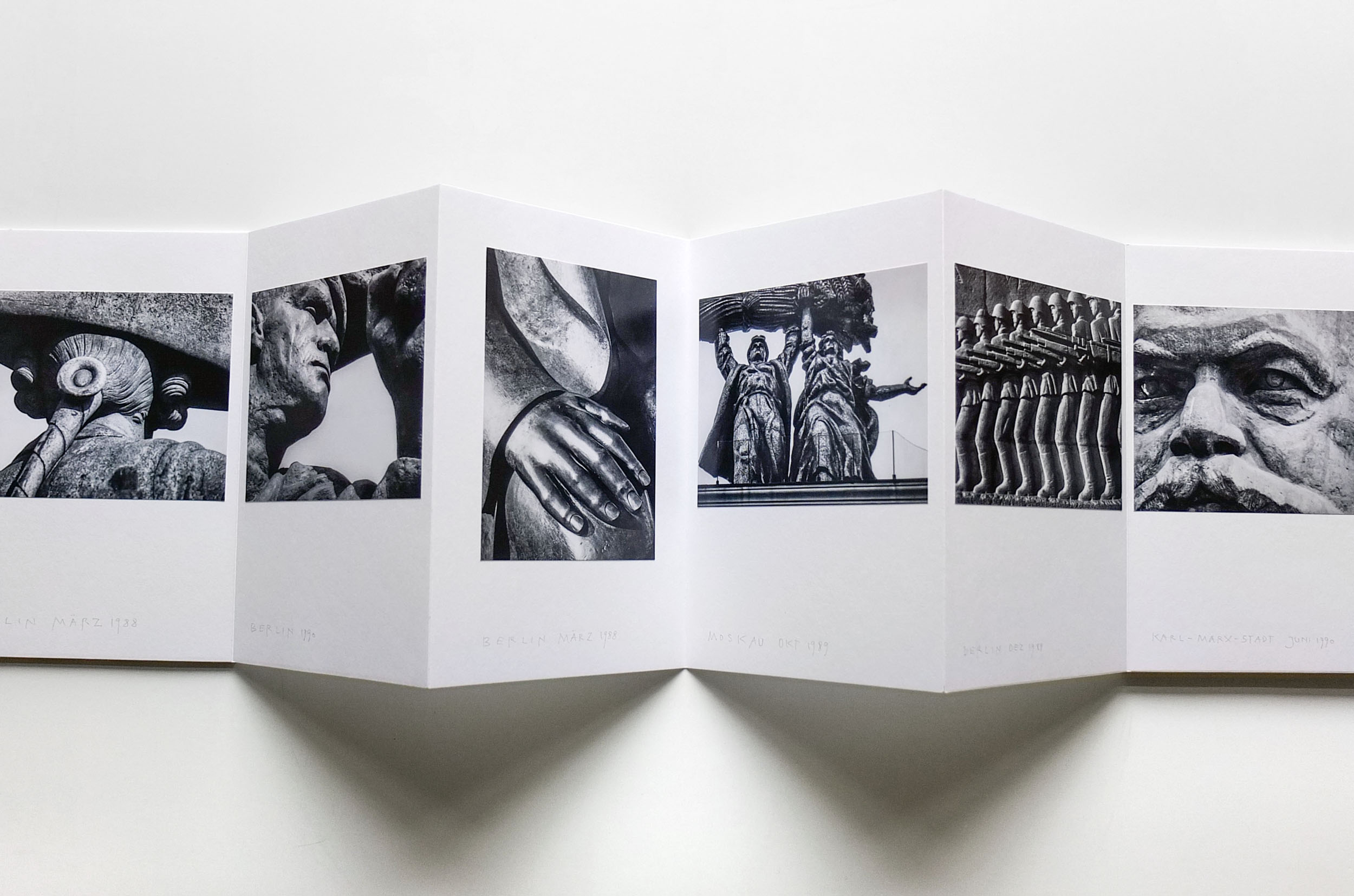
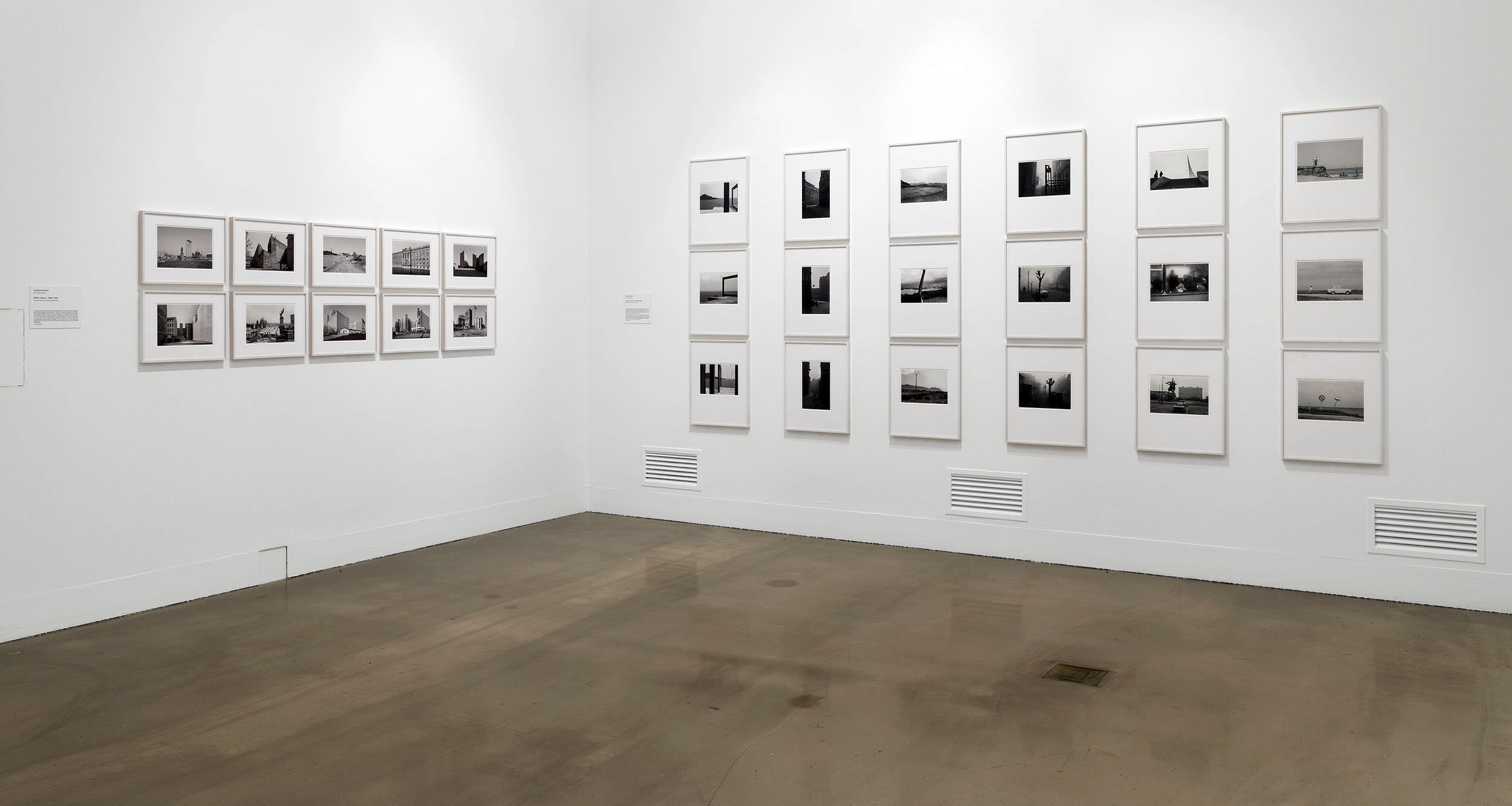
Installation view, Ulrich Wüst, 'Flatland. Schönhof', 2013 (centre), 'The Pomp of Power', 1983-1990 (left) and 'Red October', 2018 (right) from the exhibition 'Wanderings About History. The Photography of Ulrich Wüst', RMIT Gallery, Melbourne, 2024


Installation view, Ulrich Wüst, Flatland. Schönhof, 2013 (centre), The Pomp of Power, 1983-1990 (left) and Red October, 2018 (right) from the exhibition Wanderings About History. The Photography of Ulrich Wüst, RMIT Gallery, Melbourne, 2024
Photo: Christian Capurro


Ulrich Wüst’s photographic work captures his wanderings through German history, portraying the social and urban transformations from the GDR and its disintegration, through the German reunification to the present day. Wüst revives the German history in a new static way, where the past and present clash in a dynamic and ever-changing environment.

Wanderings About History. The Photography of Ulrich Wüst shows a selection of nine suites taken between 1978 and 2019. Ulrich Wüst’s photographic work can be contemplated from different perspectives. While the observations captured here are rooted in Germany’s division and its mending, at the same time they always relate to universal phenomena of social change and its material manifestations. The seemingly terse images, extremely precise in their composition, are the fruits of lengthy visual wanderings through present sites of recent history.

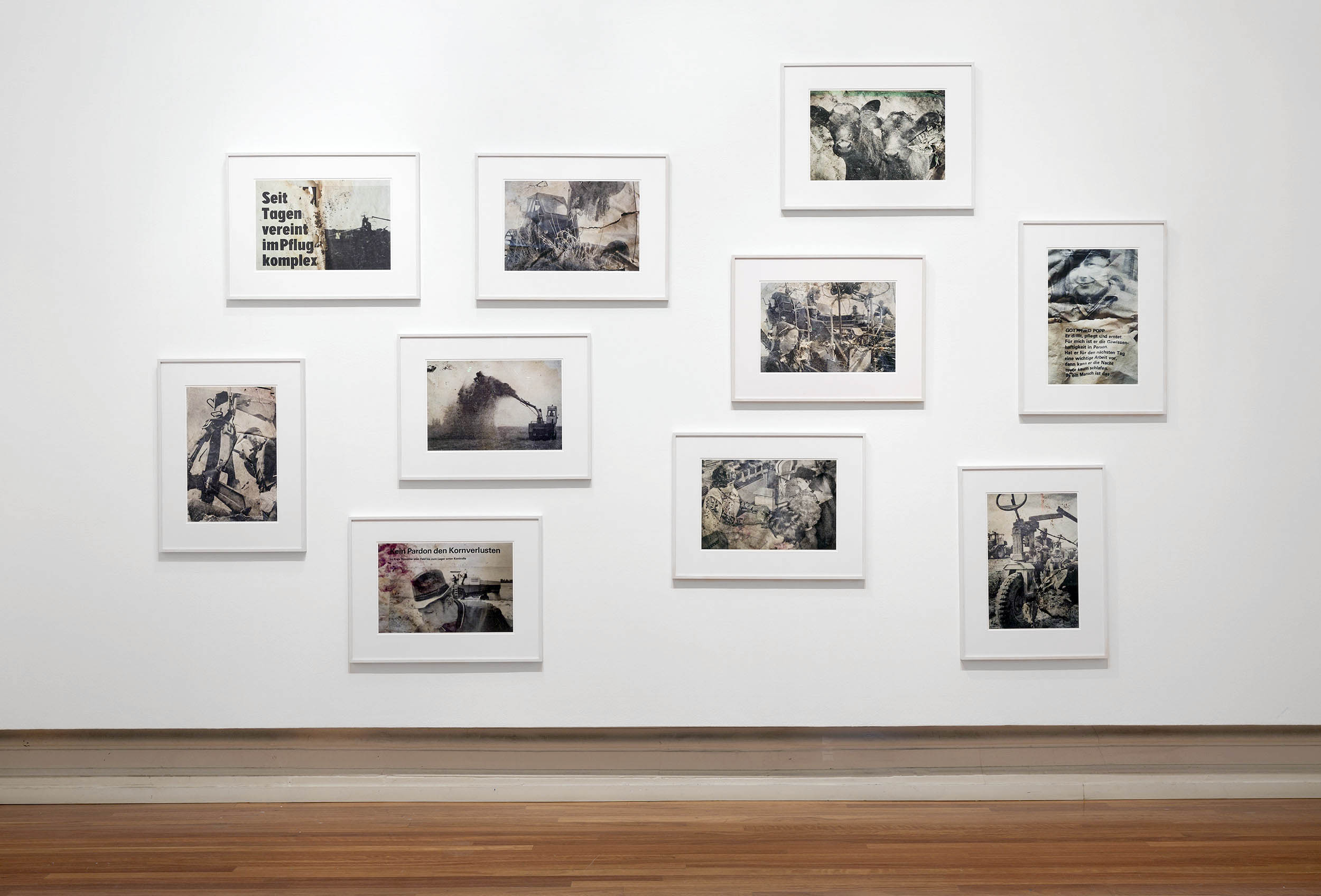
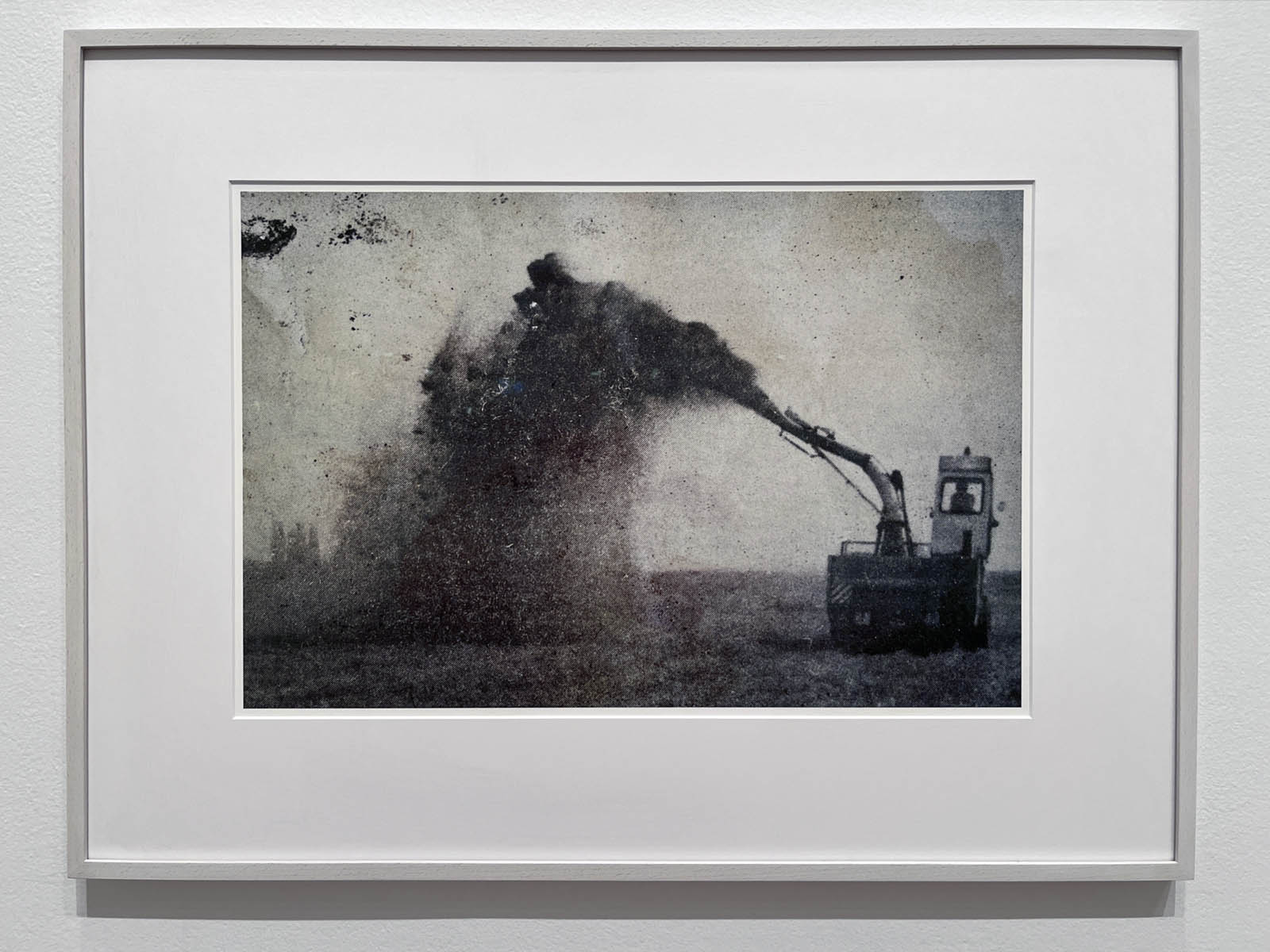
Ulrich Wüst’s photographic œuvre, which explores Eastern Germany in the broader sense, is not confined to the sunken GDR. It might be described as a pictorial archaeology of our present day. These pictures reveal the finds from his “excavations” and are at the same time tools of their conservation. Wüst has an infallible feel for the graphic quality of everyday situations, objects and materials, but also for the deeper layers of significance associated with found images. Examples are the enlarged details from East German press products that demonstrate a manipulative use of photography.

Ulrich Wüst’s photographic work can be contemplated from different perspectives. While the observations captured here are essentially rooted in Germany’s division and its mending, at the same time they always relate to universal phenomena of social change and its material manifestations. The seemingly terse images, extremely precise in their composition, are the fruits of lengthy visual wanderings through present sites of recent history.


Installation view, Ulrich Wüst, 'Flatland. Schönhof', 2013, from the exhibition 'Wanderings About History. The Photography of Ulrich Wüst', RMIT Gallery, Melbourne, 2024


Installation view, Ulrich Wüst, Flatland. Schönhof, 2013, from the exhibition Wanderings About History. The Photography of Ulrich Wüst, RMIT Gallery, Melbourne, 2024
Photo: Christian Capurro


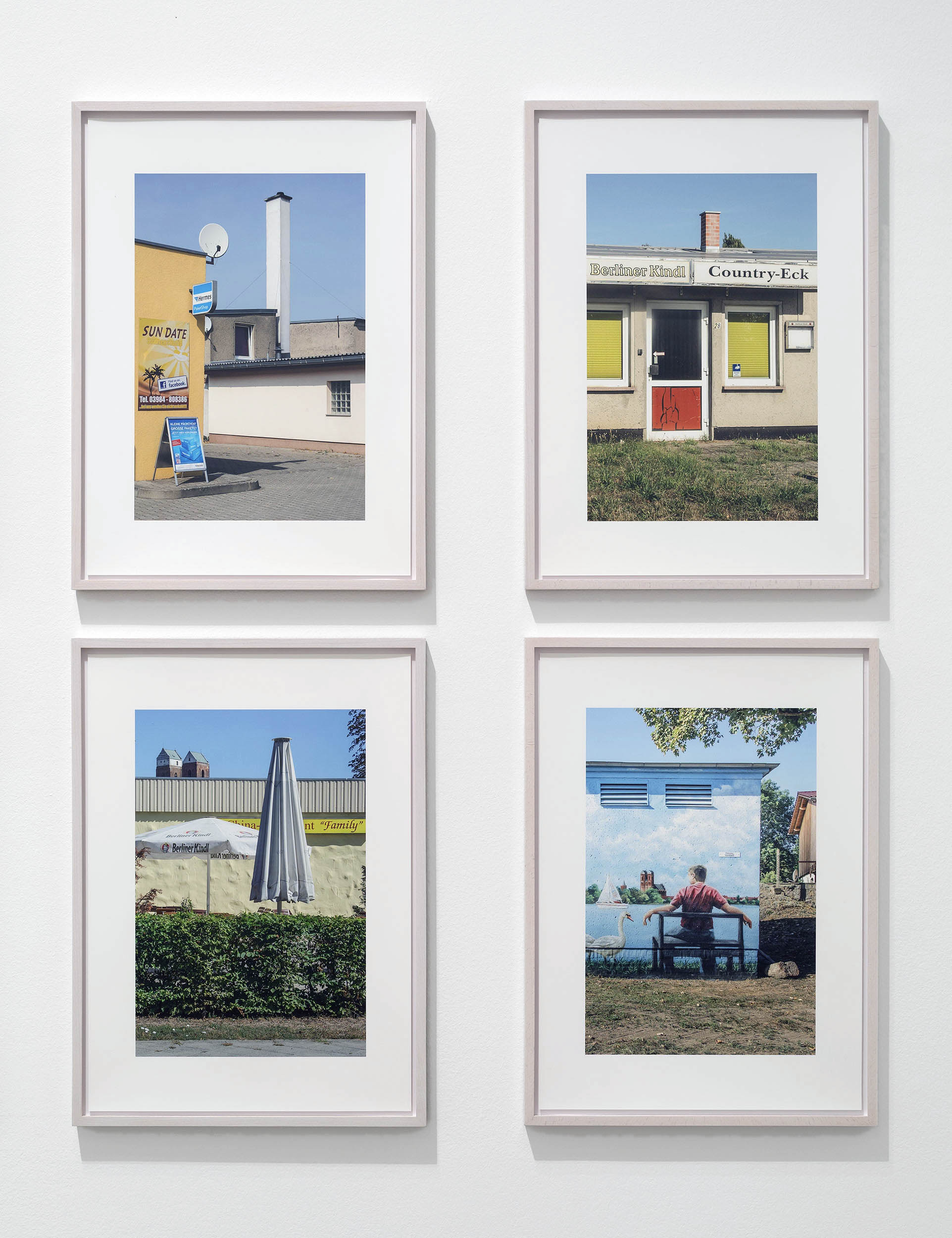
Ulrich Wüst (German, b. 1949) From the series 'Flatland. Schönhof' 2013


Ulrich Wüst (German, b. 1949)
Aus der Serie: Flatland. Schönhof
From the series: Flatland. Schönhof
2013
Colour photograph, archival pigment print
57 × 38cm
© Ulrich Wüst; ifa


Ulrich Wüst (German, b. 1949) From the series 'Flatland. Schönhof' 2013 (installation view)

Ulrich Wüst (German, b. 1949) From the series 'Flatland. Schönhof' 2013 (installation view)


Ulrich Wüst (German, b. 1949)
Aus der Serie: Flatland. Schönhof
From the series: Flatland. Schönhof (installation views)
2013
Colour photograph, archival pigment print
57 × 38cm
© Ulrich Wüst; ifa
Photos: Marcus Bunyan


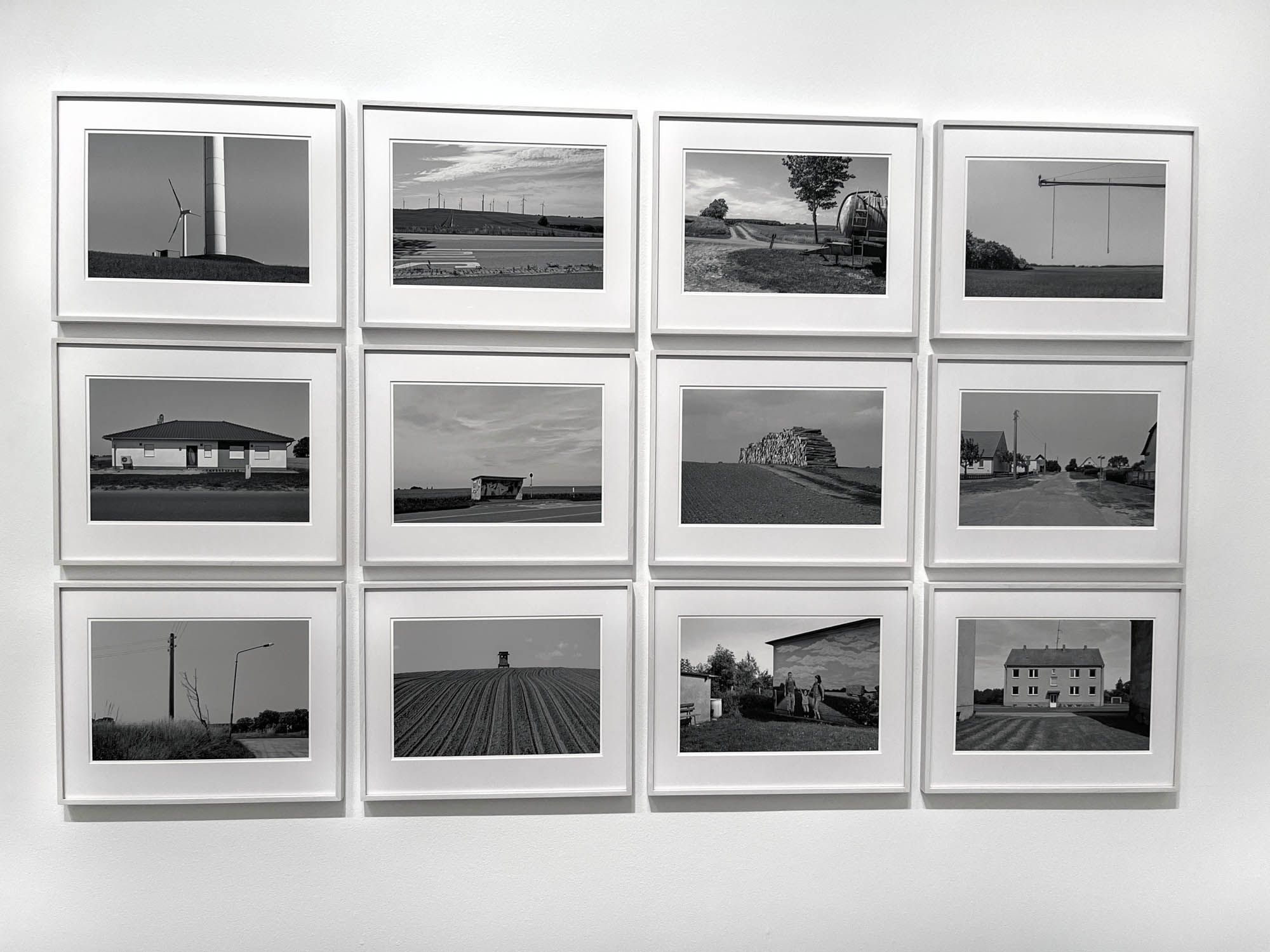
“These photographs of newspapers and magazines were taken in the countryside, things that I found within a very small radius. Previously I had always done that urban stuff but then I would go looking for contrasts, because after a while your eye becomes tired.”


~ Ulrich Wüst, wall text from the exhibition


Installation view, Ulrich Wüst, 'Cityscapes, 1979-1985' (left) and 'Wiegmann Legacy. Bülowssiege, 1991-1992' (right) from the exhibition 'Wanderings About History. The Photography of Ulrich Wüst', RMIT Gallery, Melbourne, 2024


Installation view, Ulrich Wüst, Cityscapes 1979-1985 (left) and Wiegmann Legacy. Bülowssiege 1991-1992 (right) from the exhibition Wanderings About History. The Photography of Ulrich Wüst, RMIT Gallery, Melbourne, 2024
Photo: Christian Capurro


Ulrich Wüst’s photos are “images of mental-spatial situations”

In every city there are places that have been photographed thousands of times. From tourists, amateurs and professionals. Always captured on paper or the digital matrix. Big Ben, Eiffel Tower, Alexanderplatz in the heart of Berlin. Thousands, even millions of looks at the striking symbols of a metropolis that want to capture the essence of the city. Ulrich Wüst was far away from such direct concepts. His view of Alexanderplatz is almost shy, more of a cautious approach, and yet he gets a grip on the place. But it’s not primarily about Berlin. Wüst’s city images are less studies of specific cities than “images of intellectual-spatial situations,” as the art historian and rector of the Dresden University of Fine Arts Matthias Flügge states in his insightful text for the photo book Ulrich Wüst – Stadtbilder 1979-1985 (Ulrich Wüst – City Images 1979-1985).

If you read Flügge’s text, it becomes clear once again that a picture is not just a picture and that it requires more than a fleeting observation, especially with a subject like the cityscape. Because you could easily come to the conclusion that you immediately understand the motif at hand, after all, you yourself are a city dweller and are aware of your habitat. But a photograph is also a starting point for deeper reflections. Wüst’s photographs of prefabricated buildings in East Berlin, vacancies in Magdeburg, and the central square in Karl-Marx-Stadt are not unseen motifs. Rather, they are all too well known. Such urban constellations should not be foreign to anyone who lived in the GDR in the 1970s and 1980s, or even those born later or socialised in the West. …

“Determining the status quo of the constructed, shaped, printed or otherwise produced objective world with all its traces, injuries, missing and empty spaces in the image, so that things begin to speak of themselves,” is what Wüst does, writes Flügge.

Jacek Slaski. “Ulrich Wüst – Stadtbilder 1979–1985: Zwischen Kunst und Dokumentation,” on the tipBerlin website 03/02/2022 [Online] Cited 08/04/2024. Translated from the German by Google Translate


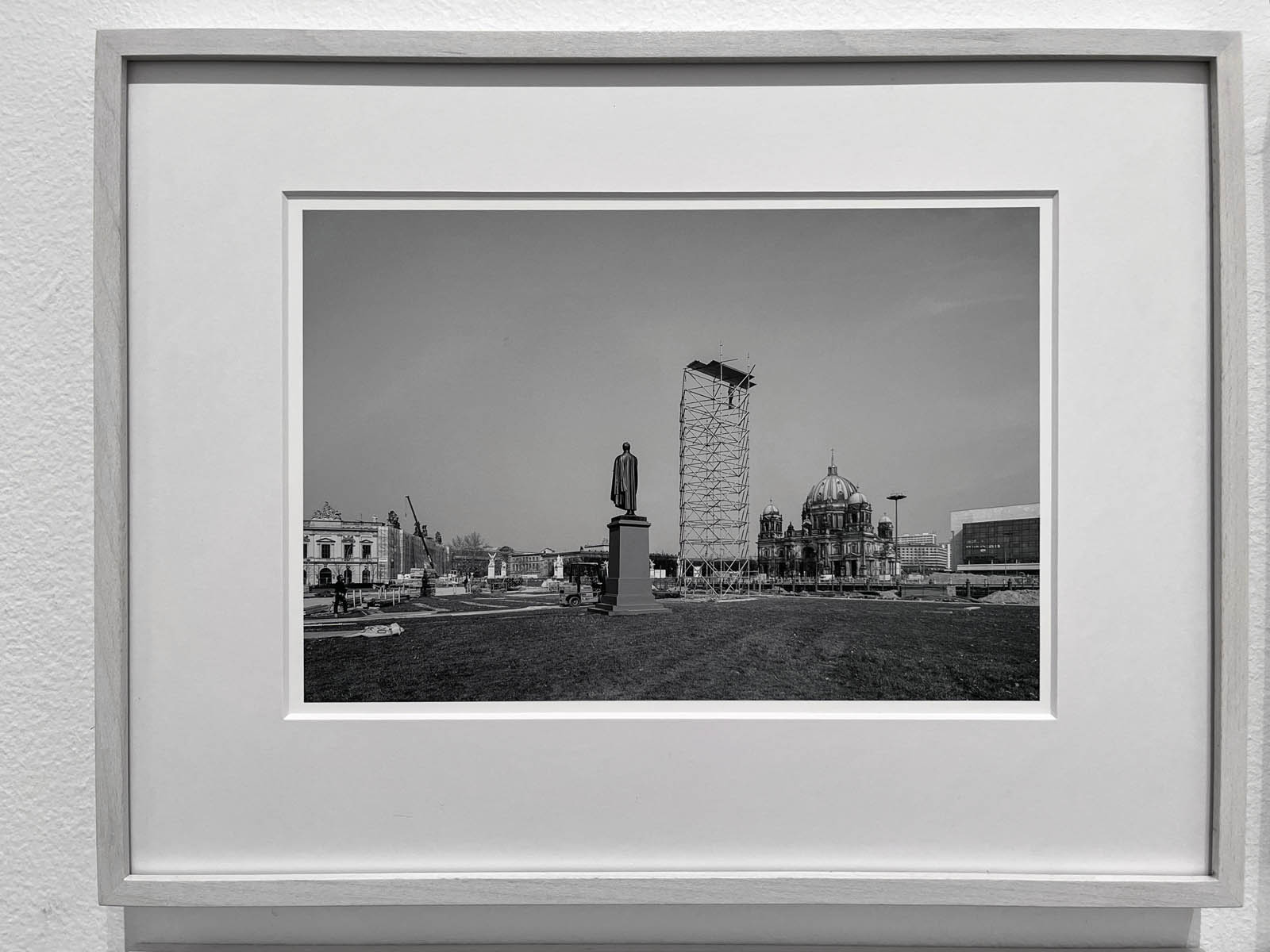
Ulrich Wüst (German, b. 1949) 'Berlin' 1982 From the series 'Cityscapes. 1979-1985'


Ulrich Wüst (German, b. 1949)
Berlin
1982
Aus der Serie: Stadtbilder. 1979-1985
From the series: Cityscapes. 1979-1985
B/w archival pigment print
16 x 24cm
© Ulrich Wüst; ifa


“For me it had always been about the built environment. […] And then I started on those rather dry Cityscapes, which always seems so objective, even though they never were and never tried to be. I wanted to take a concentrated, analytical look at the city. Back then I had a strong sense of mission; I really did want to achieve something. And the things I wanted to say about the city as space I also wanted to tell people who weren’t at all interested in photography or urban space. In some respects it was definitely intended to enlighten. Ultimately I wanted to provoke a debate about what we imagine a “city” to be and what this environment does to us.”


~ Ulrich Wüst, wall text from the exhibition


Axel Hütte (b. 1951) 'James Hammett House' 1982-1984


Axel Hütte (German, b. 1951)
James Hammett House
1982-1984
Silver gelatin print on baryte paper
66 x 80cm
Loan of the artist


Ulrich Wüst (German, b. 1949) From the series 'Cityscapes. 1979-1985' (installation view)

Ulrich Wüst (German, b. 1949) From the series 'Cityscapes. 1979-1985' (installation view)

Ulrich Wüst (German, b. 1949) From the series 'Cityscapes. 1979-1985' (installation view)


Ulrich Wüst (German, b. 1949)
Aus der Serie: Stadtbilder. 1979-1985
From the series: Cityscapes. 1979-1985 (installation views)
B/w archival pigment print
16 x 24cm
© Ulrich Wüst; ifa
Photos: Marcus Bunyan


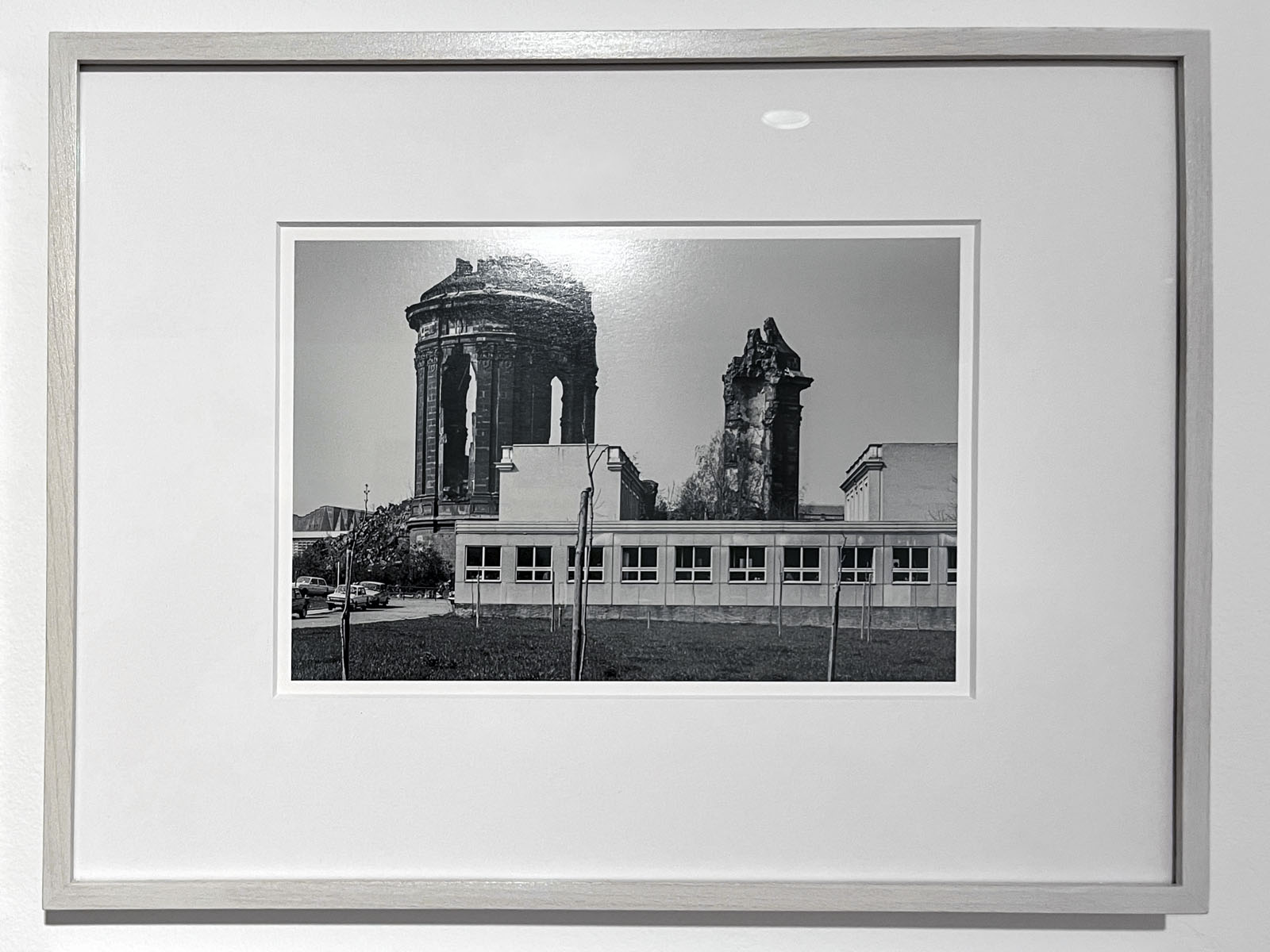
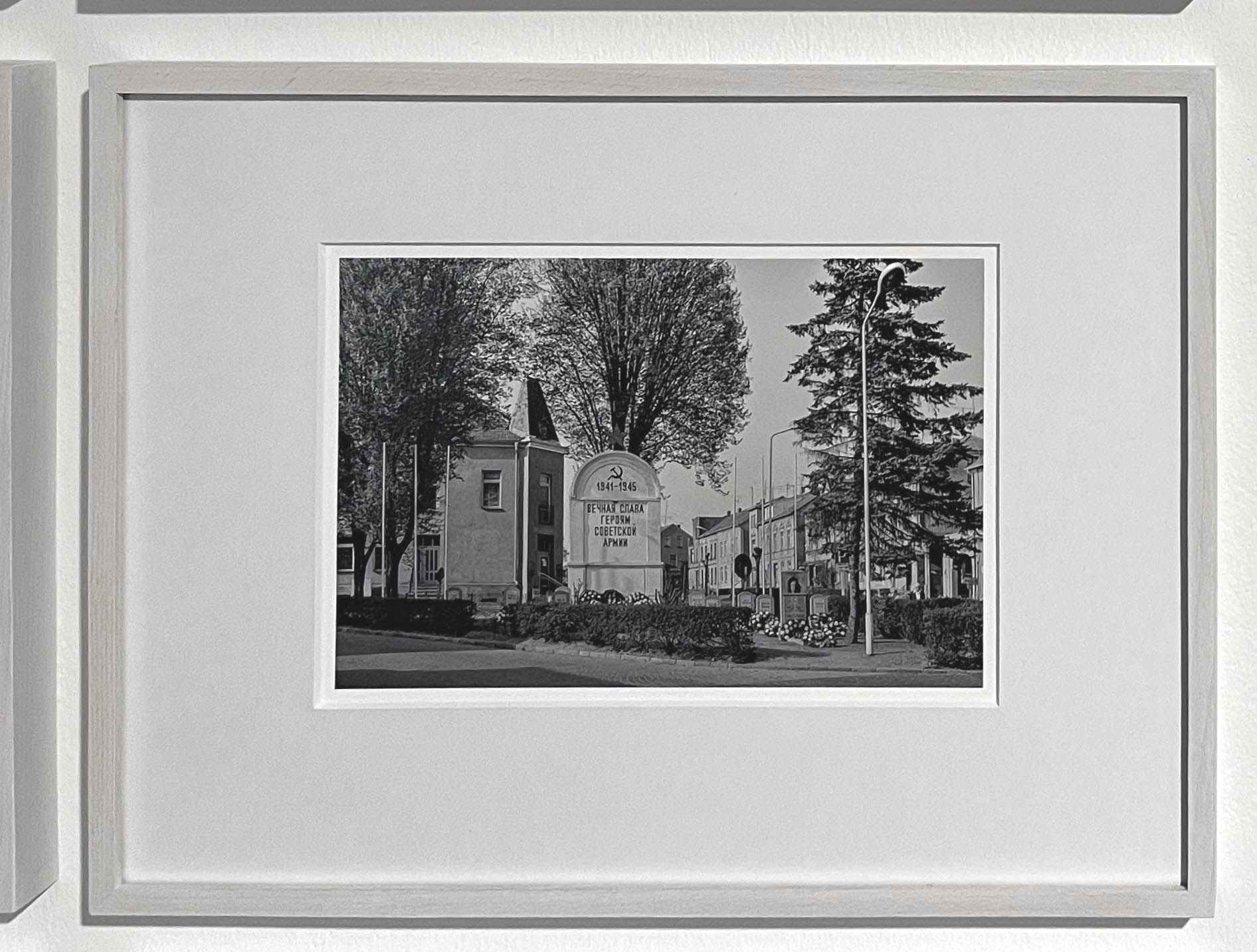
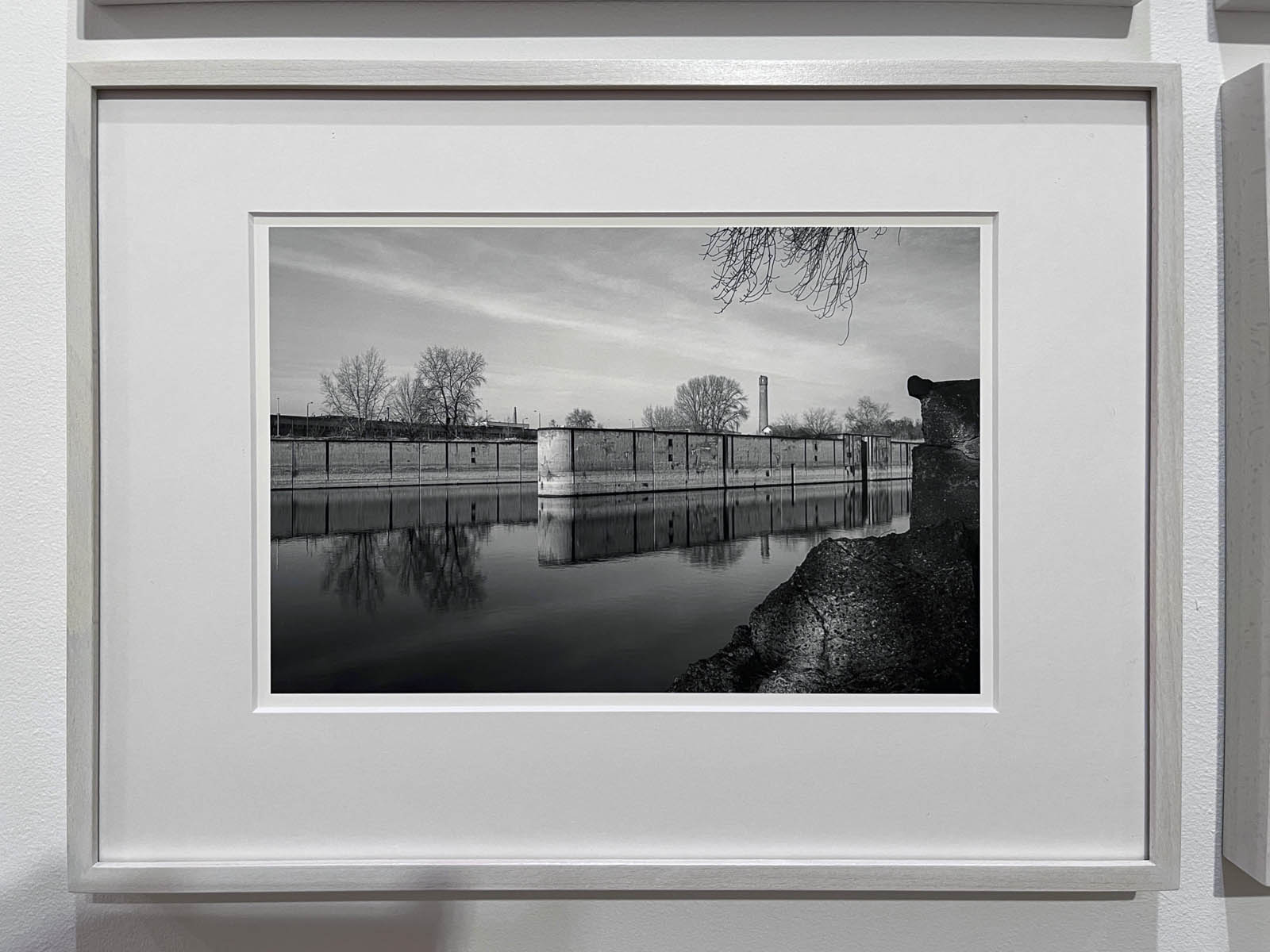
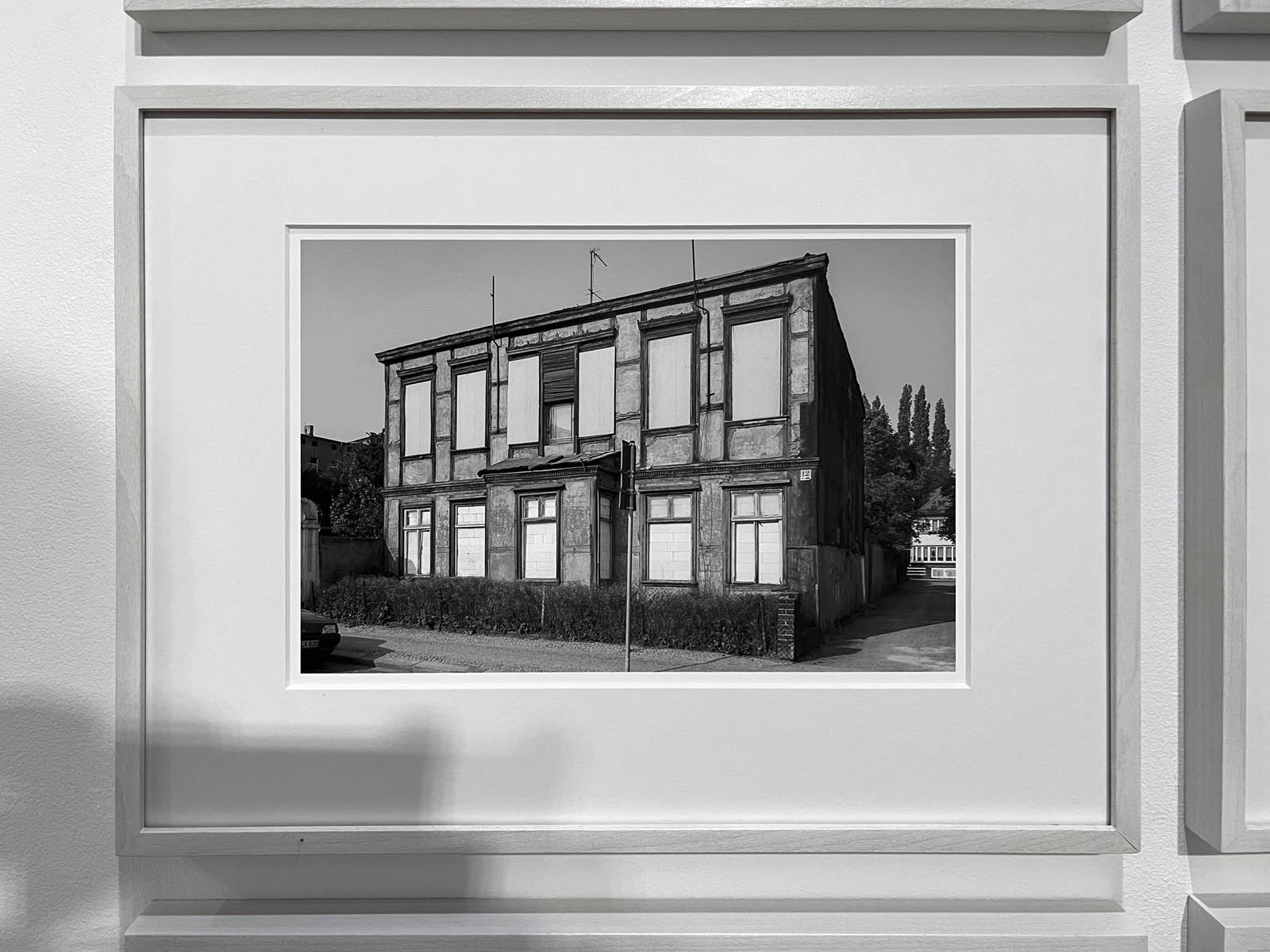
The work of Ulrich Wüst might best be described as a pictorial archaeology of recent German history. With an unsentimental precision these photographic ‘excavations’ pivot around moments of social change; those points in history when the old and the new collide, when the seemingly endless cycle of destruction and construction can so easily relegate the present to the oblivion of the past.

Initially photographing life in the former East Germany, Wüst’s oeuvre grew to include the documentation of everyday situations, objects and materials; expanding further with the addition of found images, cropped and rephotographed by Wüst to reveal alternative readings.

In his sparse black and white Cityscapes, the 1980s series that first brought Wust to international attention, we find images of East German cities and towns still carrying scars from the Second World War – an environment formed through the combination of unchecked decay and Soviet-era reconstruction. With an interest in the absurd – those visual anomalies that arrive through accident or misguided intent – Wüst has forged a unique, non-ideological representation of that time. In a similar manner but on a different scale, Wüst’s Wiegmann Legacy. Bülowssiege (1991-1992) – a photo inventory of objects left behind by the former owner of his house – engages us with the incidental nature of history. Intimate and fragile, these ordinary objects are made monumental through Wüst’s lens, yet these discarded possessions have the same precariousness as the hastily built architecture of cities in perpetual change.

Ulrich Wüst’s photographic work exists as a registry of everyday images. It could be considered akin to the personal archive of a once divided country mending itself, wandering through time, settling upon moments and fragments that also speak to the wider, universal phenomena of social change and its material manifestations.

Wall text from the exhibition


Installation view, Ulrich Wüst, 'Cityscapes, 1979-1985' (right), 'Morgenstraße. Magdeburg, 1998-2000' (second right), 'Wiegmann Legacy. Bülowssiege, 1991-1992' (third right) and 'Red October', 2018 (left) from the exhibition 'Wanderings About History. The Photography of Ulrich Wüst', RMIT Gallery, Melbourne, 2024


Installation view, Ulrich Wüst, Cityscapes, 1979-1985 (right), Morgenstraße. Magdeburg, 1998-2000 (second right), Wiegmann Legacy. Bülowssiege, 1991-1992 (third right) and Red October, 2018 (left) from the exhibition Wanderings About History. The Photography of Ulrich Wüst, RMIT Gallery, Melbourne, 2024
Photo: Christian Capurro


Installation view, Ulrich Wüst, 'Morgenstraße. Magdeburg, 1998-2000' (right), 'Wiegmann Legacy. Bülowssiege, 1991-1992' (centre left) from the exhibition 'Wanderings About History. The Photography of Ulrich Wüst', RMIT Gallery, Melbourne, 2024


Installation view, Ulrich Wüst, Morgenstraße. Magdeburg, 1998-2000 (right), Wiegmann Legacy. Bülowssiege, 1991-1992 (centre left) from the exhibition Wanderings About History. The Photography of Ulrich Wüst, RMIT Gallery, Melbourne, 2024
Photo: Christian Capurro


Ulrich Wüst (German, b. 1949) From the series 'Morgenstraße. Magdeburg' 1998-2000 (installation view)

Ulrich Wüst (German, b. 1949) From the series 'Morgenstraße. Magdeburg' 1998-2000 (installation view)


Ulrich Wüst (German, b. 1949)
Aus der Serie: Morgenstraße. Magdeburg 1998-2000
From the series: Morgenstraße. Magdeburg 1998-2000 (installation views)
B/w archival pigment print
18 x 27cm
© Ulrich Wüst; ifa
Photos: Marcus Bunyan


“As soon as we see people in pictures, we focus on those people. We seem to be fixated on that somehow and we stare at the figures depicted, however small they may be. But as I wanted to steer attention to the built environment, to what we have built for ourselves, I quite simply decided to leave the people out. If there a no people in sight in the pictures, then for one thing nobody can look at them and for another the effect is disconcerting. Disconcertion is a good opening gambit.”


~ Ulrich Wüst, wall text from the exhibition


Berenice Abbott (American, 1898-1991) 'Fifth Avenue, Nos. 4, 6, 8, Manhattan' March 20, 1936


Berenice Abbott (American, 1898-1991)
Fifth Avenue, Nos. 4, 6, 8, Manhattan
March 20, 1936
Gelatin silver print


Ulrich Wüst (German, b. 1949) 'Kaffemühle' (Coffee grinder) From the series 'Wiegmann Legacy. Bülowssiege 1991-1992'


Ulrich Wüst (German, b. 1949)
Kaffemühle (Coffee grinder) 
Aus der Serie: Nachlass Wiegmann. Bülowssiege 1991-1992
From the series: Wiegmann Legacy. Bülowssiege 1991-1992
Colour photograph, archival pigment print
105 cm x 70cm
© Ulrich Wüst; ifa


“I make a point of calling myself a photographer, because then the art question usually no longer arises. But if others still want to see me as an artist, I can (happily) live with that. Personally I don’t want to think about that question. The only thing I do want to stress is that my work is not documentary. I use documentary technique as a form, as a means, and in certain works I am also looking for documentary precision.”


~ Ulrich Wüst, wall text from the exhibition


Installation view, Ulrich Wüst, 'Wiegmann Legacy. Bülowssiege, 1991-1992' from the exhibition 'Wanderings About History. The Photography of Ulrich Wüst', RMIT Gallery, Melbourne, 2024


Installation view, Ulrich Wüst, Wiegmann Legacy. Bülowssiege, 1991-1992 from the exhibition Wanderings About History. The Photography of Ulrich Wüst, RMIT Gallery, Melbourne, 2024
Photo: Christian Capurro


Ulrich Wüst (German, b. 1949) From the series 'Wiegmann Legacy. Bülowssiege 1991-1992' (installation view)


Ulrich Wüst (German, b. 1949)
Aus der Serie: Nachlass Wiegmann. Bülowssiege 1991-1992
From the series: Wiegmann Legacy. Bülowssiege 1991-1992 (installation view)
Colour photograph, archival pigment print
105 cm x 70cm
© Ulrich Wüst; ifa
Photo: Marcus Bunyan


Installation view, Ulrich Wüst, 'Cityscapes, 1979-1985' (left) and 'Wiegmann Legacy. Bülowssiege, 1991-1992' (right) from the exhibition 'Wanderings About History. The Photography of Ulrich Wüst', RMIT Gallery, Melbourne, 2024


Installation view, Ulrich Wüst, Cityscapes, 1979-1985 (left) and Wiegmann Legacy. Bülowssiege, 1991-1992 (right) from the exhibition Wanderings About History. The Photography of Ulrich Wüst, RMIT Gallery, Melbourne, 2024
Photo: Christian Capurro


Installation view, Ulrich Wüst, 'Wiegmann Legacy. Bülowssiege, 1991-1992' (left) and 'Notations 1984-1986' (right) from the exhibition 'Wanderings About History. The Photography of Ulrich Wüst', RMIT Gallery, Melbourne, 2024


Installation view, Ulrich Wüst, Wiegmann Legacy. Bülowssiege, 1991-1992 (left) and Notations 1984-1986 (right) from the exhibition Wanderings About History. The Photography of Ulrich Wüst, RMIT Gallery, Melbourne, 2024
Photo: Christian Capurro


Ulrich Wüst (German, b. 1949) 'Berlin, Pappelallee' September 1984 From the series 'Notations. 1984-1986'


Ulrich Wüst (German, b. 1949)
Berlin, Pappelallee
September 1984
Aus der Serie: Notizen. 1984-1986
From the series: Notations. 1984-1986
B/w archival pigment print
14 x 21cm
© Ulrich Wüst; ifa


Ulrich Wüst (German, b. 1949) From the series 'Notations. 1984-1986' (installation view)

Ulrich Wüst (German, b. 1949) From the series 'Notations. 1984-1986' (installation view)

Ulrich Wüst (German, b. 1949) From the series 'Notations. 1984-1986' (installation view)


Ulrich Wüst (German, b. 1949)
Aus der Serie: Notizen. 1984-1986
From the series: Notations. 1984-1986 (installation views)
B/w archival pigment print
14 x 21cm
© Ulrich Wüst; ifa
Photos: Marcus Bunyan


“While I was still busy fine-tuning my technical skills for Cityscapes, over in West Germany very small automatic rangefinders were coming onto the market. That was in the early 1980s. […] I got hold of one of those and suddenly I could carry a camera with me all the time, take it anywhere, and I started using it like an “extended eye”. The little camera allowed me to take more intimate, more “personal” works. For me that meant talking about my own life. That was the beginning of the series Notations, as I later called it. I focused on my circle of friends and my immediate environment. And so the Notations came about and that was what I wanted to achieve, as a conscious antithesis to other series like the Cityscapes.”


~ Ulrich Wüst, wall text from the exhibition


Installation view, Ulrich Wüst, 'Red October' 2018, from the exhibition Wanderings About History – The Photography of Ulrich Wüst, RMIT Gallery, Melbourne, 2024


Installation view, Ulrich Wüst, Red October 2018, from the exhibition Wanderings About History. The Photography of Ulrich Wüst, RMIT Gallery, Melbourne, 2024
Photo: Christian Capurro


Ulrich Wüst (German, b. 1949) 'Roter Oktober' (Red October) 2018


Ulrich Wüst (German, b. 1949)
Roter Oktober (Red October)
2018
Leporello with 45 b/w and colour photographs mounted on cardboard
14.8 × 21.0 × 2.0cm
© Ulrich Wüst; ifa


Michael Schmidt (German, 1945-2014) 'Müller-Ecke Seestrasse, Berlin-Wedding' (Berlin-Wedding) 1976-1978


Michael Schmidt (German, 1945-2014)
Müller-Ecke Seestrasse, Berlin-Wedding (Berlin-Wedding)
1976-1978
© Michael Schmidt, Foundation for Photography and Media Art with the Michael Schmidt Archive


Tata Ronkholz (1940-1997) 'Dusseldorf, Sankt-Franziskusstraße 107' 1977


Tata Ronkholz (German, 1940-1997)
Dusseldorf, Sankt-Franziskusstraße 107
1977
Silver gelatin print on baryta paper
41.2 × 51.2cm
Courtesy The Photographische Sammlung / SK Stiftung Kultur, Cologne / Permanent Loan of the Sparkasse KölnBonn


Ulrich Wüst (German, b. 1949) 'Roter Oktober' (Red October) 2018 (installation view)

Ulrich Wüst (German, b. 1949) 'Roter Oktober' (Red October) 2018 (installation view)


Ulrich Wüst (German, b. 1949)
Roter Oktober (Red October) (installation views)
2018
Leporello with 45 b/w and colour photographs mounted on cardboard
14.8 × 21.0 × 2.0cm
© Ulrich Wüst; ifa
Photos: Marcus Bunyan


“Photographers love to complain about the chaos they work in and how that prevents them from keeping tabs on what they do. At some point I realised that the concertinas were a fantastic tool for tracing and recoding the progress of my work. Above all, they enabled me to locate my negatives, because I used very simple but precise captions with the place and date of the picture. I always liked the versatility of the concertina. Now, whenever I need to find a negative, I take one of these booklets of the shelf and look for the photograph. They have become a means to communicate with myself about my work and I miss them when they are being exhibition and I haven’t got them at home.”


~ Ulrich Wüst, wall text from the exhibition


Installation view, Ulrich Wüst, 'The Pomp of Power. 1983-1990' from the exhibition 'Wanderings About History. The Photography of Ulrich Wüst', RMIT Gallery, Melbourne, 2024


Installation view, Ulrich Wüst, The Pomp of Power. 1983-1990, from the exhibition Wanderings About History. The Photography of Ulrich Wüst, RMIT Gallery, Melbourne, 2024
Photo by Christian Capurro


Ulrich Wüst (German, b. 1949) 'The Pomp of Power. 1983-1990'


Ulrich Wüst (German, b. 1949)
Die Pracht der Macht. 1983-1990
The Pomp of Power. 1983-1990
Leporello with 30 b/w photographs mounted on cardboard
14.8 × 21.0 × 1.5cm
© Ulrich Wüst; ifa


Ulrich Wüst (German, b. 1949) 'The Pomp of Power. 1983-1990' (installation view)

Ulrich Wüst (German, b. 1949) 'The Pomp of Power. 1983-1990' (installation view)


Ulrich Wüst (German, b. 1949)
Die Pracht der Macht. 1983-1990
The Pomp of Power. 1983-1990 (installation views)
Concertina booklet with 30 b/w photographs mounted on cardboard
14.8 × 21.0 × 1.5cm
© Ulrich Wüst; ifa
Photos: Marcus Bunyan


Clarity and compositional elegance

It may also have been his professional disposition that led him to pay particular attention to the GDR city. After all, he was an expert. Wüst was an expert in the field of urban development; he knew exactly what he was photographing. In the midst of the “leaden times” of the GDR, an era shortly before the collapse in which hardly anything seemed to be moving. Mid-1970s to mid-1980s. Urban and housing construction has long since said goodbye to the promising ideals of a better, because socialist, promise. The reality was pragmatic and merciless. Dilapidated old building and decaying substance on one side and serial prefabricated building on the other.

Wüst’s pictures, which sometimes develop a peculiar irony in their clarity and compositional elegance, can also be understood as political statements. “They searched for clues in a way that was unusual in the GDR as a way of ascertaining the real perceived state of the present,” writes Flügge about the photographer, who knew exactly what he wanted to find and capture. Even the depiction of reality could be considered subversive in the workers’ and farmers’ state. It wasn’t appropriate to show things as they were. Rather, you should show things as they should be. …

By “limiting the image section, he forces reality to formulate its own,” summarizes Flügge.

Jacek Slaski. “Ulrich Wüst – Stadtbilder 1979–1985: Zwischen Kunst und Dokumentation,” on the tipBerlin website 03/02/2022 [Online] Cited 08/04/2024. Translated from the German by Google Translate


Installation view, Ulrich Wüst, 'Village Edge. The Municipality of Nordwestuckermark, 2014-2019' from the exhibition 'Wanderings About History. The Photography of Ulrich Wüst', RMIT Gallery, Melbourne, 2024


Installation view, Ulrich Wüst, Village Edge. The Municipality of Nordwestuckermark, 2014-2019 from the exhibition Wanderings About History. The Photography of Ulrich Wüst, RMIT Gallery, Melbourne, 2024
Photo: Christian Capurro


Installation view, Ulrich Wüst, 'Book of the Years. 1978-2008' (right) and 'Mitte. Berlin 1994-1997' (left) from the exhibition 'Wanderings About History. The Photography of Ulrich Wüst', RMIT Gallery, Melbourne, 2024


Installation view, Ulrich Wüst, Book of the Years. 1978-2008 (right) and Mitte. Berlin, 1994-1997 (left) from the exhibition Wanderings About History. The Photography of Ulrich Wüst, RMIT Gallery, Melbourne, 2024
Photo: Christian Capurro


Ulrich Wüst (German, b. 1949) 'Schützenstraße / Jerusalemer Straße' 1996 From the series: 'Mitte. Berlin 1995-1997'


Ulrich Wüst (German, b. 1949)
Schützenstraße / Jerusalemer Straße
1996
Aus der Serie: Mitte. Berlin 1995-1997
From the series: Mitte. Berlin 1995-1997
B/w archival pigment print
18 x 27cm
© Ulrich Wüst; ifa


The different historical eras come together in his pictures. Relics from the pre-war period, often ruins, alongside the proud examples of Eastern Modernism from the post-war period, and finally the cheap and quickly built architecture of the present day. These photos are still important today, and not just for architectural historians and photography connoisseurs. Wüst’s pictures of the GDR city are visual findings about the condition of its residents, even if the people in them are absent. In his text, Flügge quotes from Alexander Mitscherlich’s book Die Unwirtlichkeit unserer Städte. Anstiftung zum Unfrieden (The inhospitability of our cities. Incitement to Discord), in which the doctor, psychoanalyst and writer examined the West German city as early as 1965: “This city shape is regressively shaping the character of its residents.” In his book, Mitscherlich hoped that the city would one day become a “biotope for free people”. It didn’t quite turn out that way, but in a certain sense Mitscherlich wasn’t entirely wrong either. The GDR would soon disappear and with it the GDR city.

Jacek Slaski. “Ulrich Wüst – Stadtbilder 1979–1985: Zwischen Kunst und Dokumentation,” on the tipBerlin website 03/02/2022 [Online] Cited 08/04/2024. Translated from the German by Google Translate


Ulrich Wüst (German, b. 1949) From the series 'Mitte. Berlin 1995-1997' (installation view)

Ulrich Wüst (German, b. 1949) From the series 'Mitte. Berlin 1995-1997' (installation view)

Ulrich Wüst (German, b. 1949) From the series 'Mitte. Berlin 1995-1997' (installation view)

Ulrich Wüst (German, b. 1949) From the series 'Mitte. Berlin 1995-1997' (installation view)

Ulrich Wüst (German, b. 1949) From the series 'Mitte. Berlin 1995-1997' (installation view)


Ulrich Wüst (German, b. 1949)
Aus der Serie: Mitte. Berlin 1995-1997
From the series: Mitte. Berlin 1995-1997 (installation views)
B/w archival pigment print
18 x 27cm
© Ulrich Wüst; ifa
Photos: Marcus Bunyan


I am well aware of how ambivalent photography is. And just because photographs have a documentary air about them, I find it to some extent dubious to slap a documentary label on them. If, ten centimetres from the edge of my picture, the whole content is counteracted by something completely different, then I can no longer claim to be doing serious documentary work. Documentation as a form, in my view, is just a way to explore a theme – a means. I only want to photograph and not distort things. It’s true that there is a documentary background, but what I do with it is always something of my own and totally subjective.


Ulrich Wüst, wall text from the exhibition


Installation view, Ulrich Wüst, 'Mitte. Berlin 1994-1997' (right) and 'Prentzlow. Prenzlau', 2018 (left) from the exhibition 'Wanderings About History. The Photography of Ulrich Wüst', RMIT Gallery, Melbourne, 2024


Installation view, Ulrich Wüst, Mitte. Berlin 1994-1997 (right) and Prenzlau, 2018 (left) from the exhibition Wanderings About History. The Photography of Ulrich Wüst, RMIT Gallery, Melbourne, 2024
Photo: Christian Capurro


Installation view, Ulrich Wüst, 'Prenzlau', 2018, from the exhibition 'Wanderings About History. The Photography of Ulrich Wüst', RMIT Gallery, Melbourne, 2024


Installation view, Ulrich Wüst, Prenzlau, 2018, from the exhibition Wanderings About History. The Photography of Ulrich Wüst, RMIT Gallery, Melbourne, 2024
Photo: Christian Capurro


Ulrich Wüst (German, b. 1949) From the series ‘Prenzlau’ 2018


Ulrich Wüst (German, b. 1949)
Aus der Serie: Prenzlau
From the series: Prenzlau
2018
Colour photograph, archival pigment print
45 × 30cm
© Ulrich Wüst; ifa


Ulrich Wüst (German, b. 1949) From the series 'Prenzlau' 2018 (installation view)

Ulrich Wüst (German, b. 1949) From the series 'Prenzlau' 2018 (installation view)

Ulrich Wüst (German, b. 1949) From the series 'Prenzlau' 2018 (installation view)


Ulrich Wüst (German, b. 1949)
Aus der Serie: Prenzlau
From the series: Prenzlau (installation views)
2018
Colour photograph, archival pigment print
45 × 30cm
© Ulrich Wüst; ifa
Photos: Marcus Bunyan


Installation view, Ulrich Wüst, 'Wiegmann Legacy. Bülowssiege 1991-1992' (right) and 'Book of the Years. 1978-2008' (left), from the exhibition 'Wanderings About History. The Photography of Ulrich Wüst', RMIT Gallery, Melbourne, 2024


Installation view, Ulrich Wüst, Wiegmann Legacy. Bülowssiege, 1991-1992 (right) and Book of the Years. 1978-2008 (left), from the exhibition Wanderings About History. The Photography of Ulrich Wüst, RMIT Gallery, Melbourne, 2024
Photo: Christian Capurro


Ulrich Wüst (German, b. 1949) 'Kreta' (Crete) 1997 From the series 'Book of the Years. 1978-2008'


Ulrich Wüst (German, b. 1949)
Kreta (Crete)
1997
Aus der Serie: Jahrebuch. 1978-2008
From the series: Book of the Years. 1978-2008
B/w archival pigment print
18 x 27cm
© Ulrich Wüst; ifa


Ulrich Wüst (German, b. 1949) From the series 'Book of the Years. 1978-2008' (installation view)

Ulrich Wüst (German, b. 1949) From the series 'Book of the Years. 1978-2008' (installation view)


Ulrich Wüst (German, b. 1949)
Aus der Serie: Jahrebuch. 1978-2008
From the series: Book of the Years. 1978-2008 (installation views)
B/w archival pigment print
18 x 27cm
© Ulrich Wüst; ifa
Photos: Marcus Bunyan


Robert Frank (Swiss-American, 1924-2019) 'London' 1951


Robert Frank (Swiss-American, 1924-2019)
London
1951
Gelatin silver print


Ulrich Wüst (German, b. 1949) From the series 'Book of the Years. 1978-2008' (installation view)


Ulrich Wüst (German, b. 1949)
Aus der Serie: Jahrebuch. 1978-2008
From the series: Book of the Years. 1978-2008 (installation view)
B/w archival pigment print
18 x 27cm
© Ulrich Wüst; ifa
Photo: Marcus Bunyan


August Sander (German, 1876-1964) 'Das Siebengebirge von der unteren Terrasse hin zur Löwenburg' 1922


August Sander (German, 1876-1964)
Das Siebengebirge von der unteren Terrasse hin zur Löwenburg
The Siebengebirge from the lower terrace towards the Löwenburg castle

1922
Gelatin silver print
© Die Photographische Sammlung/SK Sitftung Kultur – August Sander Archiv, Köln; VG Bild-Kunst, Bonn, 2022


Ulrich Wüst (German, b. 1949) From the series 'Book of the Years. 1978-2008' (installation view)


Ulrich Wüst (German, b. 1949)
Aus der Serie: Jahrebuch. 1978-2008
From the series: Book of the Years. 1978-2008 (installation view)
B/w archival pigment print
18 x 27cm
© Ulrich Wüst; ifa
Photo: Marcus Bunyan


A collection/compilation. A great deal of chance and responding to mood. The urban excursions, by contrast, followed a strict pattern. There it was about the grey cityscapes, grey “Mitte” and grey “Morgenstraße”. And yet all of them were taken in bright sunlight! Without the weather forecast promising a safe sunny day, I would probably never have been brave enough to set out on wanderings that did not augur much solace.

Most of the pictures in the book of the Years, on the other hand, really were taken in grey weather. They were done over a period of thirty years, mostly without any particular intention, straight from the experience. Later I gathered them into a kind of melancholy section through times and places. The pictures say: I was here. And I was in this or that mood. They are mood! And sometimes they flirt with the mood as well. That can happen.

~ Ulrich Wüst, wall text from the exhibition


Installation view, Ulrich Wüst, 'Mitte. Berlin 1994-1997' (right), 'Village Edge. The Municipality of Nordwestuckermark, 2014-2019' (left) and 'Prentzlow. Prenzlau', 2018 (centre) from the exhibition 'Wanderings About History. The Photography of Ulrich Wüst', RMIT Gallery, Melbourne, 2024


Installation view, Ulrich Wüst, Mitte. Berlin 1994-1997 (right), Village Edge. The Municipality of Nordwestuckermark, 2014-2019 (left) and Prentzlow. Prenzlau, 2018 (centre) from the exhibition Wanderings About History. The Photography of Ulrich Wüst, RMIT Gallery, Melbourne, 2024
Photo: Christian Capurro


Ulrich Wüst’s photographic work captures his wanderings through German history, portraying the social and urban transformations from the GDR and its disintegration, through the German reunification to the present day. Wüst revives the German history in a new static way, where the past and present clash in a dynamic and ever-changing environment.

Wanderings About History. The Photography of Ulrich Wüst shows a selection of nine suites taken between 1978 and 2019. Ulrich Wüst’s photographic work can be contemplated from different perspectives. While the observations captured here are rooted in Germany’s division and its mending, at the same time they always relate to universal phenomena of social change and its material manifestations. The seemingly terse images, extremely precise in their composition, are the fruits of lengthy visual wanderings through present sites of recent history.

An exhibition by ifa – Institut für Auslandsbeziehungen e.V., Stuttgart – in partnership with the Goethe-Institut. This project is an official exhibition of PHOTO 2024 International Festival of Photography.

Text from the RMIT Gallery website


Installation view, Ulrich Wüst, 'Wiegmann Legacy. Bülowssiege, 1991-1992' (left) and 'Village Edge. The Municipality of Nordwestuckermark, 2014-2019' (right) from the exhibition 'Wanderings About History. The Photography of Ulrich Wüst', RMIT Gallery, Melbourne, 2024


Installation view, Ulrich Wüst, Wiegmann Legacy. Bülowssiege, 1991-1992 (left) and Village Edge. The Municipality of Nordwestuckermark, 2014-2019 (right) from the exhibition Wanderings About History. The Photography of Ulrich Wüst, RMIT Gallery, Melbourne, 2024
Photo: Christian Capurro


Ulrich Wüst (German, b. 1949) From the series 'Village Edge. The Municipality of Nordwestuckermark 2014-2019' (installation view)


Ulrich Wüst (German, b. 1949)
Aus der Serie: Randlage. Die Gemeinde Nordwestuckermark 2014-2019
From the series: Village Edge. The Municipality of Nordwestuckermark 2014-2019 (installation view)
B/w archival pigment print
26 x 39cm
© Ulrich Wüst; ifa
Photo: Marcus Bunyan


Ulrich Wüst (German, b. 1949) 'Parmen' 2016 From the series 'Village Edge. The Municipality of Nordwestuckermark 2014-2019'


Ulrich Wüst (German, b. 1949)
Parmen
2016
Aus der Serie: Randlage. Die Gemeinde Nordwestuckermark 2014-2019
From the series: Village Edge. The Municipality of Nordwestuckermark 2014-2019
B/w archival pigment print
26 x 39cm
© Ulrich Wüst; ifa


“In the last few years I started taking pictures in the countryside again. The idea was to have photographs of villages and landscapes that were just as “dry” as my cityscape series, like Berlin, or Magdeburg. The resulting work is far removed from any sort of rural idyll, but equally as far removed from the affection I have from these landscapes. I chose not to give too much away.”


~ Ulrich Wüst, wall text from the exhibition


Ulrich Wüst (German, b. 1949) From the series 'Village Edge. The Municipality of Nordwestuckermark 2014-2019' (installation view)

Ulrich Wüst (German, b. 1949) From the series 'Village Edge. The Municipality of Nordwestuckermark 2014-2019' (installation view)


Ulrich Wüst (German, b. 1949)
Aus der Serie: Randlage. Die Gemeinde Nordwestuckermark 2014-2019
From the series: Village Edge. The Municipality of Nordwestuckermark 2014-2019 (installation views)
B/w archival pigment print
26 x 39cm
© Ulrich Wüst; ifa
Photos: Marcus Bunyan


RMIT Gallery
344 Swanston Street, Melbourne

Opening hours:
Tuesday to Friday 11am – 5pm
Saturday 12.30pm – 5pm

RMIT Gallery website

LIKE ART BLART ON FACEBOOK

Back to top

Exhibition: ‘One Life: Frederick Douglass’ at the National Portrait Gallery, Washington

Exhibition dates: 16th June, 2023 – 21st April, 2024

Curator: John Stauffer, the Sumner R. and Marshall S. Kates Professor of English and of African and African American Studies, Harvard University


Unidentified photographer. 'Frederick Douglass' c. 1841


Unidentified photographer
Frederick Douglass
c. 1841
Sixth-plate daguerreotype
Collection of Gregory French


In this first known photographic image of Douglass, taken only one year after the first commercial daguerreotype studio opened in the United States, he appears somewhat dazed or “statue-like,” as he might have said. In 1841, the exposure time for a daguerreotype of this size could run up to fifteen seconds, depending on the time of day and the amount of available daylight in the daguerreotypist’s studio.

Text from the National Portrait Gallery website


I seem to be envisioning the nineteenth-century at the moment, which is a condition entirely more pleasurable than contemplating the dreadful state of the world at the moment with its environmental desecration, greed, killing of animal and human life and the unconscionable conduct of governments. Ego, greed, religion, power, masculinity, war, nationalism, possession. A toxic mix.

Here we have photographs of a majestic human being, a former slave, social reformer, abolitionist, orator, writer, and statesman – who fought for freedom, who fought against discrimination and racism. And still it goes on today…

“A new memorial to Emmett Till was dedicated on Saturday in Mississippi after previous historical markers were repeatedly vandalized. The new marker is bulletproof.

Till, 14, was kidnapped, beaten and killed in 1955, hours after he was accused of whistling at a white woman. His body was found in a river days later. An all-white jury in Mississippi acquitted two white men of murder charges…

This is the fourth historical marker at the site. The first was placed in 2008. Someone tossed it in the river. The second and third signs were shot at and left riddled with bullet holes. The new 500lb steel sign has a glass bulletproof front.”1

His mother, Mamie Till Mobley, held an open casket funeral in Chicago to let the world see how badly her son had been beaten and mutilated. “There was just no way I could describe what was in that box. No way. And I just wanted the world to see.”

At the end I’ll be glad when I have left this world because I am so disappointed with the human race. High hopes indeed.

Dr Marcus Bunyan


1/ Associated Press. “Emmett Till: new memorial to murdered teen is bulletproof,” on The Guardian website Sun 20 Oct 2019 [Online] 06/04/2024


Many thankx to the National Portrait Gallery for allowing me to publish the photographs in the posting. Please click on the photographs for  a larger version of the image.


The bullet-riddled historical sign for Emmett Till


The bullet-riddled historical sign for Emmett Till, the Chicago teenager whose 1955 slaying helped propel the civil rights movement

Used under fair use conditions for the purposes of education and research


Unidentified artist (formerly attributed to Elisha Livermore Hammond) 'Frederick Douglass' c. 1845


Unidentified artist (formerly attributed to Elisha Livermore Hammond)
Frederick Douglass
c. 1845
Oil on canvas
National Portrait Gallery, Smithsonian Institution


Frederick Douglass became the most influential African American of the nineteenth century by turning his life into a testimony on the evils of slavery and the redemptive power of freedom. After he escaped from bondage in 1838, Douglass quickly emerged as an outspoken advocate for equality and abolition. Aware of the power of telling one’s own story, he frequently spoke about his life, published three genre-defining autobiographies, and founded the influential newspaper, The North Star, in 1847. Douglass also posed for countless photographs, which he considered less susceptible to artists’ racial prejudices.

This painting was likely based on the engraved frontispiece of Douglass’s first autobiography, Narrative of the Life of Frederick Douglass (1845), a gripping account of his struggle for freedom. In My Bondage and My Freedom (1855), Douglass went on to address the psychology of slavery and the racism that continued to define the lives of the newly free.

Text from the National Portrait Gallery website


Southworth & Hawes (active 1843–1862) 'Frederick Douglass' c. 1845


Southworth & Hawes (active 1843–1862)
Frederick Douglass
c. 1845
Whole-plate daguerreotype
Onondaga Historical Association Museum, Syracuse, NY


Douglass likely sat for this daguerreotype in the Boston studio of Southworth & Hawes before he left for England in August 1845. The Twelfth National Anti-Slavery Bazaar, held at Faneuil Hall in December 1845, offered for sale “an excellent Daguerreotype of Frederick Douglass,” according to The Liberator (January 23, 1846). The daguerreotype was “the gift of Mr. Southworth” and “elicited much attention.” John Chester Buttre created an engraving from the daguerreotype, which appeared in Autographs for Freedom (1854), a gift book edited by Douglass’s friend Julia Griffiths to raise money for his North Star newspaper.

Text from the National Portrait Gallery website


Southworth & Hawes (active 1843–1862) 'Frederick Douglass' c. 1845 (detail)


Southworth & Hawes (active 1843–1862)
Frederick Douglass (detail)
c. 1845
Whole-plate daguerreotype
Onondaga Historical Association Museum, Syracuse, NY


Augustus Washington (American, c. 1820–1875) 'John Brown 1800-1859' c. 1846-1847


Augustus Washington (American, c. 1820–1875)
John Brown 1800-1859
c. 1846-1847
Quarter-plate daguerreotype
National Portrait Gallery, Smithsonian Institution; purchased with major acquisition funds and with funds donated by Betty Adler Schermer in honor of her great grandfather, August M. Bondi


One of the nation’s first African American daguerreotypists, Augustus Washington was also a prominent abolitionist in Hartford, Connecticut, when he made this portrait of the militant abolitionist John Brown. At the time, Brown was working to establish a “Subterranean Pass Way,” a network of armed men in the Alleghenies for conducting fugitives to freedom in Canada.

In Washington’s daguerreotype, Brown apparently holds the Pass Way flag and pledges allegiance to his scheme, which never materialised. In 1853, Washington and his family emigrated to Liberia, the former West African colony founded by the American Colonization Society, which gained independence in 1847.

Text from the National Portrait Gallery website


Frederick Douglass (1818-1895), the preeminent African American voice of the nineteenth century, is remembered as one of the nation’s greatest orators, writers, and picture makers. Born on the Eastern Shore of Maryland in 1818, Frederick Augustus Washington Bailey was the son of Harriet Bailey, an enslaved woman, and an unknown white father. He escaped bondage in 1838 and changed his surname to Douglass.

Over six decades, Douglass published three autobiographies, hundreds of essays, and a novella; delivered thousands of speeches; and edited the longest-running Black newspaper in the nineteenth century, The North Star (later Frederick Douglass’ Paper and Douglass’ Monthly). During the Civil War, he befriended and advised President Abraham Lincoln and met every subsequent president through Grover Cleveland. He was also the first African American to receive a federal appointment requiring Senate approval (U.S. Marshal of the District of Columbia).

Douglass became the most photographed American of the nineteenth century and remains a public face of the nation. As an art critic, he wrote extensively on portrait photography and understood its power. He explained how this “true art” (as opposed to pernicious caricatures) captured the essential humanity of each subject. True art was an engine of social change, he argued, and true artists were activists: “They see what ought to be by the reflection of what is, and endeavour to remove the contradiction.”

Curatorial Statement

Organised into seven sections, this exhibition highlights the long arc and significance of Frederick Douglass’s life: from slave and fugitive to internationally acclaimed abolitionist, women’s rights activist, and statesman after the Civil War. We come to recognise his influences in the Civil War and postwar eras; and the significance of his afterlife, in which his portraits and writings continue to inspire people to seek “all rights for all,” one of his mottos. The range of objects shown here reflects Douglass’s openness to new forms of media and technology to advance the cause of human rights.

John Stauffer, the Sumner R. and Marshall S. Kates Professor of English and of African and African American Studies, Harvard University

Text from the National Portrait Gallery website


Douglass’ ascension into the most preeminent African American voice in the 1800s and one of the handful of most influential and famous Americans in the nation’s history owes itself equally to his merits and good fortune.

“Douglass had an extraordinary work ethic, he was immensely curious and dedicated,” Stauffer explained. “And physically strong and tall – over six feet, a half-foot taller than the average man – which helped him survive slavery.”

Size does matter. George Washington and Abraham Lincoln were also comparative giants for their day. American presidents, on average, stand a great deal taller, literally, than the average citizen.

Douglass’ physical size and strength allowed him to outlast a sadistic “slave breaker,” Edward Covey, in a protracted fight as a teen. After suffering numerous whippings, Douglass stood up to the man. As long as he lived, he referred to the fight as the turning point in his life as a slave.

“He was also lucky to have been born and raised in the upper South and not sold into the Deep South or murdered for his rebelliousness as a slave and his constant battles against slavery and racism as a free man,” Stouffer added. “Had he been born in the Deep South, where most enslaved people lived, his chances of escaping to free soil would have been almost nil.”

Douglass’ circumstances were hardly favourable, but he did win something of a genetic and geographic lottery at birth.

He also caught a rare break, learning to read and write as a young boy, skills most slaveowners prohibited.

“In Baltimore, Douglass asked his mistress, Sophia Auld, to teach him to read, which she did, having never overseen an enslaved person before,” Stouffer said. “Her husband, Hugh Auld, found out and told her in front of Douglass, ‘if you learn him to read, he’ll want to know how to write; and this accomplished, he’ll be running away from himself.’ Hearing this, Douglass ‘understood the direct pathway to freedom,’ as he said.”

Chadd Scott. “Art, Activism And Frederick Douglass At National Portrait Gallery,” on the Forbes website Aug 22, 2023 [Online] Cited 21/04/2024


Unidentified photographer. 'Frederick Douglass' c. 1850 (after c. 1847 daguerreotype)


Unidentified photographer
Frederick Douglass
c. 1850 (after c. 1847 daguerreotype)
Sixth-plate daguerreotype
National Portrait Gallery, Smithsonian Institution


When sitting for a photograph, Douglass would pose as an artist or performer, forming part of a pas de trois with the photographer and the camera. He always dressed up and, as the activist Elizabeth Cady Stanton noted, often appeared “majestic in his wrath.”

Before the mid-1860s, Douglass typically stared into the camera lens with a dramatic look. He wanted the focus on himself. Here, he fills the frame, appearing as an accomplished, dignified activist, and projecting a visual voice of democracy. Through his images, voice, and writings, Douglass sought to “out-citizen” whites, many of whom questioned African American rights.

In the years following his escape from bondage in 1838, Frederick Douglass emerged as a powerful and persuasive spokesman for the cause of abolition. Douglass’s effectiveness as an antislavery advocate was due in large measure to his firsthand experience with the evils of slavery and his extraordinary skill as an orator whose “electrifying eloquence” astonished and enthralled his audiences. Convinced that a peaceful end to slavery was impossible, Douglass embraced the Civil War as a fight for emancipation and called for the enlistment of black troops. Throughout the decades that followed, he remained a tireless champion for civil rights.

In 1845, when the publication of his Narrative of the Life of Frederick Douglass revealed biographical details that could have led to his capture as a fugitive from slavery, Douglass left the United States for an extended stay in Great Britain. He was warmly welcomed by British abolitionists, who raised the funds to purchase his freedom, thereby enabling Douglass to return to the United States in 1847 as a free man. In this daguerreotype, believed to date from the time of his return, Douglass confronts the camera with an intensity that became the hallmark of his photographic portraits.

Text from the National Portrait Gallery website


Ezra Greenleaf Weld (American, 1801-1874) 'Fugitive Slave Law Convention, Cazenovia, New York' 1850


Ezra Greenleaf Weld (American, 1801-1874)
Fugitive Slave Law Convention, Cazenovia, New York
1850
Half-plate copy daguerreotype
Collection of Mr. and Mrs. Set Charles Momjian


On August 21, 1850, two days after the Senate passed the Fugitive Slave Act [Passed on September 18, 1850 by Congress, The Fugitive Slave Act of 1850 was part of the Compromise of 1850. The act required that slaves be returned to their owners, even if they were in a free state. The act also made the federal government responsible for finding, returning, and trying escaped slaves], about two thousand abolitionists convened near Gerrit Smith’s home. Douglass presided as president. Participants approved Smith’s “Letter to the American Slaves,” urging captives to avenge their enslavers. “You are prisoners of war in an enemy’s country,” Smith declared.

Here, Douglass sits at the edge of the table next to Theodosia Gilbert, the fiancée of William Chaplin, who was in prison for aiding fugitives. Behind Douglass stands Gerrit Smith [see photo below], in mid-speech, gesticulating. On either side of Smith, in checkered shawls and day bonnets, are Mary and Emily Edmonson, whose freedom had been orchestrated by Chaplin.

Text from the National Portrait Gallery website


Ezra Greenleaf Weld, known simply as “Greenleaf,” operated a daguerreotype studio in Cazenovia, New York, during a time of intense social and political turmoil. He opened his first studio in his home in 1845, when America began to witness the volatile events that led to the Civil War. At that time, instruction manuals on the daguerreotype process were widely available, and most small towns had at least one studio. In an 1850 advertisement in his local newspaper, Greenleaf offered “Miniatures executed in the finest style, and put in Rings, Pins, Lockets and cases, of great variety size and price.”

Greenleaf seems to have been very successful with his daguerreotype business. By 1851 he had leased new quarters on the top floor of a building, where he placed a skylight to receive northern light for his studio sessions. During the Civil War years, he made numerous pictures in and around Cazenovia.

Text from the J. Paul Getty Museum website


Southworth & Hawes (active 1843–1862) 'William Lloyd Garrison 1805-1879' c. 1851


Southworth & Hawes (active 1843–1862)
William Lloyd Garrison 1805-1879
c. 1851
Half-plate daguerreotype
National Portrait Gallery, Smithsonian Institution


After escaping enslavement, Douglass subscribed to William Lloyd Garrison’s newspaper, The Liberator, and read it as devoutly as his bible. “The paper became my meat and drink,” he recalled.

Garrison promoted Douglass’s 1845 autobiography, which made him famous and prompted him to flee to the British Isles to avoid capture and re-enslavement. British friends then purchased his freedom, and he returned to the United States in 1847, a free man. Wanting to launch his own paper, Douglass soon moved his family to Rochester, New York, a railroad and antislavery hub that lacked an abolitionist paper. The move ruptured his friendship with Garrison until after the Civil War.

Text from the National Portrait Gallery website


The Smithsonian’s National Portrait Gallery will present One Life: Frederick Douglass, an exhibition exploring the life and legacy of one of the 19th century’s most influential writers, speakers and intellectuals. Douglass was a radical activist who devoted his life to abolitionism and rights for all. This exhibition shows the intimate relationship between art and protest through prints, photographs and ephemera. One Life: Frederick Douglass is guest curated by John Stauffer, the Sumner R. and Marshall S. Kates Professor of English and African and African American Studies at Harvard University, and consulting curator Ann Shumard, the National Portrait Gallery’s senior curator of photographs.

“Frederick Douglass was the preeminent African American voice of the 19th century and among the nation’s greatest orators, writers and picture-makers,” Stauffer said. “Born into slavery, he became a leading abolitionist, civil rights activist and the most photographed American of the 19th-century, a public face of the nation. This comprehensive exhibition includes objects from all phases of his life as a way to highlight the power of his remarkable impact. It explores his friendship with President Abraham Lincoln, for example, as well as his enduring influence on artists and activists in the 20th and 21st centuries.”

Douglass was born on the Eastern shore of Maryland in 1818. Having escaped slavery in 1838, he traveled to New York, where he married Anna Murray. After the couple moved to Massachusetts, he began attending abolitionist meetings. Douglass went on to publish three autobiographies and a novella, deliver thousands of speeches and edit the longest continually running Black newspaper of the 19th century, The North Star (later Frederick Douglass’ Paper and Douglass’ Monthly). As a political insider and policy influencer during the Civil War, he befriended and advised President Abraham Lincoln. Douglass changed traditional rules of representation by explaining how “true art” could be an engine of social change.

The exhibition will showcase over 35 objects, including the ledger documenting Douglass’ birth in February 1818; a pamphlet of his “What to the Slave Is the Fourth of July?” oration; two of his three autobiographies – My Bondage and My Freedom and Narrative of the Life of Frederick Douglass, an American Slave, Written by Himself; a letter from Douglass to Lincoln; portraits of activists in Douglass’ circle, such as Harriet Tubman and Sojourner Truth; portraits by the prominent Black photographers Augustus Washington and Cornelius Marion Battey; and portraits of the Black leaders Ida B. Wells-Barnett, Booker T. Washington, W.E.B. Du Bois and Langston Hughes, all of whom carried on his legacy.

Press release from the National Portrait Gallery


Ezra Greenleaf Weld (American, 1801-1874) 'Gerrit Smith 1797-1874' c. 1854


Ezra Greenleaf Weld (American, 1801-1874)
Gerrit Smith 1797-1874
c. 1854
Two-thirds daguerreotype
National Portrait Gallery, Smithsonian Institution; gift of an anonymous donor 

Gerrit Smith, the upstate New York abolitionist and philanthropist, was a close friend of Douglass from the late 1840s to the Civil War. In 1846, Smith gave away 120,000 acres of land in the Adirondacks, known as “Timbuctoo,” to three thousand Black residents of New York State. Smith welcomed Douglass to New York with a deed for forty acres and provided crucial financial support to his newspaper. “You not only keep life in my paper but keep spirit in me,” Douglass wrote. Smith helped convert Douglass into a political abolitionist, one who interpreted the Constitution as an antislavery document.

Text from the National Portrait Gallery website


Unidentified photographer. 'John Brown 1800-1859' c. 1857 (after c. 1855 daguerreotype)


Unidentified photographer
John Brown 1800-1859
c. 1857 (after c. 1855 daguerreotype)
Salted paper print
National Portrait Gallery, Smithsonian Institution


Douglass described John Brown as someone who, “though a white gentleman, is in sympathy a black man, and as deeply interested in our cause, as though his own soul had been pierced with the iron of slavery.” They became friends, and in 1859, Brown urged Douglass to join him in raiding the federal arsenal at Harpers Ferry. Douglass, however, refused and told Brown he thought he was entering a “steel trap.” Brown and sixteen others were killed, either during the raid or after they were found guilty of treason. Douglass later credited Brown with starting the war that ended slavery.

Text from the National Portrait Gallery website


Frederick Douglass believed that Brown’s “zeal in the cause of my race was far greater than mine – it was as the burning sun to my taper light – mine was bounded by time, his stretched away to the boundless shores of eternity. I could live for the slave, but he could die for him.”

Douglass, Frederick (1881). John Brown. An Address at the Fourteenth Anniversary of Storer College, May 30, 1881. Dover, New Hampshire: Dover, N. H., Morning Star job printing house. p. 9. Retrieved March 9, 2022


Unidentified photographer. 'Frederick Douglass' c. 1860


Unidentified photographer
Frederick Douglass
c. 1860
Salted paper print
Image: 6 × 4.5cm (2 3/8 × 1 3/4″)
Sheet: 10.1 × 7.9cm (4 × 3 1/8″)
Mount: 17 × 13.6cm (6 11/16 × 5 3/8″)
Mat: 45.7 × 35.6cm (18 × 14″)
National Portrait Gallery, Smithsonian Institution


Douglass’s visual persona continually evolved, which undermined one of the key intellectual foundations of chattel slavery and racism that cast the self as fixed, unable to rise. Perhaps the most noticeable markers of Douglass’s continual evolution are his hairstyle and facial hair. In this salted paper print, he experiments with a mid-scalp part, unique among the 168 separate photographs. Five years later, in a carte de visite, he sports a ponytail, also distinct from his typical hairstyle.

Text from the National Portrait Gallery website


Douglass’ words were powerful; his image, arguably, more so.

“Douglass, along with most Americans, believed that photography was a ‘truthful’ representation and the great democratic art,” Stouffer explained. “He also recognised that the sitter had agency in the outcome of a photographic portrait. He understood his role as an artist or performer, part of a pas de trois with the photographer and the camera. He always dressed up. His photographic portraits, along with those of numerous other African Americans, starkly contrasted the racist caricatures of Blacks created by whites.”

A long American tradition of white artists caricaturing African Americans in prints and paintings influenced public perception. White painters in the antebellum era almost always cast the devil as a Black man. Monkeys and happy slaves were other tropes.

Douglass, meanwhile, always presented himself, in dress, pose, and expression, as a dignified and respectable citizen.

“Photography was a truth-telling medium he emphasised. It bore witness to African Americans, and all humans, essential humanity, and it countered the racist caricatures by whites drawing freehand,” Stouffer said. “Douglass argued that photography inspired people to eradicate the sins of their society. It led them to activism. It stemmed from the power of imagination, which allowed people to appreciate photographs as accurate representations of some greater reality. It encouraged them to realise their ideals in an imperfect world.”

As Douglass put it: “Poets, prophets, and reformers are all picture-makers – and this ability is the secret of their power and of their achievements. They see what ought to be in the reflection of what is, and endeavour to remove the contradiction.”

This is a key message of the exhibition.

“Poets, prophets, and reformers were artists and activists. Activism inspired art and vice versa. Poets, prophets, and reformers saw their community or nation as it was – with all its gross inequalities, injustices, and prejudices – and they contrasted it with what ought to be. The contradiction inspired them to remove structural inequalities, injustices, and prejudices,” Stouffer explained. “Douglass and most other abolitionists, along with many antislavery advocates, considered themselves poets, prophets, and reformers. As a group, they sat for their photographic portraits with greater frequency, distributed them more effectively, and were more taken with photography, than other groups.”

Douglass went so far as to say that “the moral and social influence of pictures” was more important than “the making of its laws.”

Chadd Scott. “Art, Activism And Frederick Douglass At National Portrait Gallery,” on the Forbes website Aug 22, 2023 [Online] Cited 21/04/2024


Johnson, Williams &. Co. (active 1860s and 1870s) 'James McCune Smith 1813-1865' c. 1860


Johnson, Williams &. Co. (active 1860s and 1870s)
James McCune Smith 1813-1865
c. 1860
Albumen silver print
Schomburg Center for Research in Black Culture, Photographs and Prints Division; The New York Public Library, Astor, Lenox and Tilden Foundations


James McCune Smith (April 18, 1813 – November 17, 1865) was an American physician, apothecary, abolitionist and author. He was the first African American to earn a medical degree. His M.D. was awarded by the University of Glasgow in Glasgow, Scotland. After his return to the United States, he also became the first African American to run a pharmacy in the nation.

In addition to practicing as a physician for nearly 20 years at the Colored Orphan Asylum in Manhattan, Smith was a public intellectual: he contributed articles to medical journals, participated in learned societies, and wrote numerous essays and articles drawing from his medical and statistical training. He used his training in medicine and statistics to refute common misconceptions about race, intelligence, medicine, and society in general. He was invited as a founding member of the New York Statistics Society in 1852, which promoted a then new science. Later he was elected as a member in 1854 of the recently founded American Geographic Society. He was never admitted to the American Medical Association or local medical associations,[1] very likely as a result of the systemic racism that Smith confronted throughout his medical career.

He has been most well known for his leadership as an abolitionist: a member of the American Anti-Slavery Society, with Frederick Douglass he helped start the National Council of Colored People in 1853, the first permanent national organisation for blacks. Douglass called Smith “the single most important influence on his life.” Smith was one of the Committee of Thirteen, who organised in 1850 in Manhattan to resist the newly passed Fugitive Slave Law by aiding refugee slaves through the Underground Railroad. Other leading abolitionist activists were among his friends and colleagues. From the 1840s, Smith lectured on race and abolitionism and wrote numerous articles to refute racist ideas about black capacities.

Both Smith and his wife were of mixed African and European descent. As he became economically successful, Smith built a house in a mostly white neighbourhood; in the 1860 census he and his family were classified as white, along with their neighbours. (In the census of 1850, while living in a predominately African-American neighbourhood, they had been classified as mulatto.) Smith served for nearly 20 years as the physician at the Colored Orphan Asylum in New York. After it was burned down in July 1863 by a mob in draft riots in Manhattan, in which nearly 100 blacks were killed, Smith moved his family and practice to Brooklyn for their safety. Many other blacks left Manhattan for Brooklyn at the same time. The parents stressed education for their children. In the 1870 census, his widow and children continued to be classified as white.

Text from the Wikipedia website


Unidentified photographer. 'Sojourner Truth c. 1797-1883' 1864


Unidentified photographer
Sojourner Truth c. 1797-1883
1864
Albumen silver print
Image/Sheet: 8.7 × 5.6cm (3 7/16 × 2 3/16″)
National Portrait Gallery, Smithsonian Institution


Sojourner Truth was possibly more famous for her carte-de-visite photographs than for her actual presence at abolition meetings. Her carefully chosen images made her a familiar figure to millions of viewers. They depicted a respectable matron. Truth’s famous maxim that she included with her portrait, “I sell the shadow to support the substance,” links her image (shadow) to her actual self (substance) and to the growing demand for photographs during the war years.

Truth’s image becomes an extension of herself and her nation. The yarn forms the contours of the eastern United States, with Florida’s panhandle and Texas clearly visible. As a representative American woman, Truth’s piety, simplicity, and abolitionism were shaping the United States.

Text from the National Portrait Gallery website


L. Schamer (active c. 1870) Louis Prang Lithography Co. (active 1856-1899) 'Representative Women' 1870


L. Schamer (active c. 1870)
Louis Prang Lithography Co. (active 1856-1899)
Representative Women
1870
Lithograph
National Portrait Gallery, Smithsonian Institution


This portrait unites seven leading female suffragists. Clockwise from the top are portraits of Lucretia Mott, Elizabeth Cady Stanton, Mary Livermore, Lydia Maria Child, Susan B. Anthony, and Sara Jane Lippincott, who surround Anna Dickinson, the most popular woman on the lecture circuit; in a sense, Douglass’s counterpart. The visual power of the image stems from its ability to reveal both the cohesiveness of the movement and the strong personalities within it.

Douglass knew these women and, as a leading male advocate for women’s rights, often collaborated with them and attended their conventions. But when Congress passed the Fifteenth Amendment in 1869, granting suffrage to Black men but not to women, their cohesion crumbled. Anthony and Stanton argued that white women should have suffrage before Black men. Douglass supported the amendment but continued to advocate for women’s suffrage.

Between 1860 and 1880, it became common for American reformers to gather on stages – then called lyceums – to promote abolition, temperance, education reform, and women’s rights. Lyceum associations allowed suffragists to speak. In their lectures, suffragists addressed men and women of diverse backgrounds – across state, racial, and economic divides – and reached wider audiences than through women’s organisations alone.

Representative Women is a combinative portrait that brings together seven women who were active on the lecture circuit. The visual power of the image stems from its ability to reveal both the cohesiveness of the movement and the strong individual personalities within it. Clockwise from the top are portraits of Lucretia Coffin Mott, Elizabeth Cady Stanton, Mary Livermore, Lydia Maria Francis Child, Susan B. Anthony, and Sara Jane Lippincott, who surround the central figure of Anna Elizabeth Dickinson. At the time, Dickinson was more popular than Mark Twain and held the distinction of being the highest paid woman on the lecture circuit.

Text from the National Portrait Gallery website


NOT IN THE EXHIBITION BUT IN THE NATIONAL PORTRAIT GALLERY COLLECTION


Unidentified photographer. 'Frederick Douglass' 1856


Unidentified photographer
Frederick Douglass
1856
Quarter-plate ambrotype
Image/Sight: 8.8 × 6.7cm (3 7/16 × 2 5/8″)
Mat (brass): 10.8 × 8.3cm (4 1/4 × 3 1/4″)
Case open: 12 × 19.2 × 1.3cm (4 3/4 × 7 9/16 × 1/2″)
Case closed: 12 × 9.5 × 1.9cm (4 3/4 × 3 3/4 × 3/4″)
National Portrait Gallery, Smithsonian Institution; acquired through the generosity of an anonymous donor


In the years following his escape from bondage in 1838, Frederick Douglass emerged as a powerful and persuasive spokesman for the cause of abolition. His effectiveness as an antislavery advocate was due in large measure to his firsthand experience with the evils of slavery and his extraordinary skill as an orator. His “glowing logic, biting irony, melting appeals, and electrifying eloquence” astonished and enthralled his audiences. As this ambrotype suggests, Douglass’s power was also rooted in the sheer impressiveness of his bearing, which abolitionist and activist Elizabeth Cady Stanton likened to that of “an African prince, majestic in his wrath.”

Text from the National Portrait Gallery website


George Francis Schreiber (American, 1803-1892) 'Frederick Douglass' 1870


George Francis Schreiber (American, 1803-1892)
Frederick Douglass
1870
Albumen silver print
Image/Sheet: 9.4 x 5.9cm (3 11/16 x 2 5/16″)
National Portrait Gallery, Smithsonian Institution; gift of Donald R. Simon


George Kendall Warren (American, 1834-1884) 'Frederick Douglass' 1876


George Kendall Warren (American, 1834-1884)
Frederick Douglass
1876
Albumen silver print
Image/Sheet: 9.7 × 5.7cm (3 13/16 × 2 1/4″)
National Portrait Gallery, Smithsonian Institution


Smithsonian National Portrait Gallery
8th and F Sts NW
Washington, DC 20001

Opening hours:
11.30am – 7.00pm daily

Smithsonian National Portrait Gallery website

LIKE ART BLART ON FACEBOOK

Back to top

Exhibition: ‘Siam: Through the Lens of John Thomson (1865-66)’ at the Russell-Cotes Art Gallery and Museum, Bournemouth, England

Exhibition dates: 21st October 2023 – 14th April 2024


John Thomson (Scottish, 1837-1921) 'A Siamese monk holding a fan' 1865


John Thomson (Scottish, 1837-1921)
A Siamese monk holding a fan
1865
Photograph from a glass photonegative, wet collodion
Public domain


A bridge between past and present

An Easter Monday posting.

Magnificent large format photographs of the landscape and people of Siam (now Thailand), just two decades after the invention of photography. The photographs give “us a glimpse into some characteristics of people and places of Siam in the 1860s.”

In the portrait photographs the engagement revealed by the photographer of the subject with the camera lens is masterful. To elicit this response from people unused to posing in front of a large, bulky camera shows how the photographer must have been empathetic to his subjects and put them at their ease with the process of having their photograph taken.

The subjects are not apprehensive of the camera. The images show them directly: composed, reserved, non-declamatory and possessing a powerful presence. The exchange between subject and photographer evidences a direct line of communication with the sitter.

The eyes of A Siamese boy (1865, below) drill into mine and I feel a profound engagement with his questioning gaze. I am pierced by his gaze … which forces me to confront my own identity, and mortality.

As a viewer of these human beings all these decades later (a bridge between past and present), it’s as if I could reach out and touch their humanity. Their soul.

Dr Marcus Bunyan


Many thankx to the Russell-Cotes Art Gallery and Museum for allowing me to publish the photographs in the posting. Please click on the photographs for a larger version of the image.


In the mid-19th century, John Thomson arrived in Siam with a fairly new invention of those days photography….

Step back in time and immerse yourself in the wonders of 19th-century Southeast Asia as seen through the lens of the intrepid adventurer and photographer, John Thomson. The Russell-Cotes Art Gallery & Museum is proud to present an enchanting new exhibition Siam: Through the Lens of John Thomson on display from 21 October 2023 to 14 April 2024, inviting visitors to embark on a captivating journey through time and space. This extraordinary showcase offers a unique glimpse into the captivating landscapes, diverse cultures, and fascinating history of Southeast Asia.

A British photographer with an exceptional eye for detail, Thomson embarked on a groundbreaking journey to Siam during the late Victorian era, with a fairly new invention in those days: photography, capturing scenes that had been scarcely witnessed before in the Western world. Throughout his remarkable career, Thomson ventured into uncharted territories and documented the exotic beauty and cultural richness of Thailand and Cambodia in stunning detail. Featuring dramatic images developed from negatives preserved in London’s Wellcome Collection, this exhibition introduces the sights and people of nineteenth-century Thailand and Cambodia as witnessed by Thomson first hand. In this new exhibition, visitors to the Russell-Cotes Art Gallery & Museum will have the privilege of witnessing many meticulously preserved photographs taken by Thomson during his travels, carefully curated to provide an insightful narrative of his exploration. Each image tells a story of its own, serving as a bridge between the past and the present, enabling visitors to forge a deeper connection with the cultures and history of Thailand and Cambodia.

Text from the Russell-Cotes Art Gallery and Museum website


Siam Through the Lens of John Thomson, 1865-66: In-Focus audio tour with Jo O’Rourke when the exhibition was at Chester Beatty

This exhibition gives us a glimpse into some characteristics of people and places of Siam in the 1860s. We are guided through a wonderful collection of images taken with great sensitivity by one of the pioneers of photojournalism John Thomson (1837-1921).


John Thomson (Scottish, 1837-1921) 'The Chao Phraya River and Rattanakosin Island from the Prang of Wat Arun' 1865

John Thomson (Scottish, 1837-1921) 'The Chao Phraya River as seen from the main spire of Wat Arun' 1855-1866

John Thomson (Scottish, 1837-1921) 'The Chao Phraya River and Rattanakosin Island from the Prang of Wat Arun' 1865


John Thomson (Scottish, 1837-1921)
The Chao Phraya River and Rattanakosin Island from the Prang of Wat Arun
1865
Panorama of three photographs from a glass photonegatives, wet collodion
Public domain


John Thomson (Scottish, 1837-1921) 'King Mongkut (King Rama IV) in the uniform of a French Field Marshall' 1865


John Thomson (Scottish, 1837-1921)
King Mongkut (King Rama IV) in the uniform of a French Field Marshall
1865
Photograph from a glass photonegative, wet collodion
Public domain


“A shrill blast of horns heralded the approach of the King and caused us hastily to descend into the court,” Thomson wrote of the occasion. “His Majesty entered through a massive gateway, and I must confess that I felt much impressed by his appearance, as I had never been in the presence of an anointed sovereign before. He stood about five feet eight inches, and his figure was erect and commanding; but an expression of severe gravity was settled on his somewhat haggard face. His dress was a robe of spotless white, which reached right down to his feet; his head was bare.

“All was prepared beneath a space in the court when, just as I was about to take the photograph, His Majesty changed his mind, and without a word to anyone, passed suddenly out of sight. We patiently waited, and at length the King reappeared, dressed this time in a sort of French Field Marshal’s uniform. The portrait was a great success, and His Majesty afterwards sat in his court robes, requesting me to place him where and how I pleased.”

In the photo of the King in the field marshal’s regalia, he wears the sash of the Legion d’honneur and the Star First Class presented to him on behalf of Emperor Napoleon III by the admiral of the French fleet in Indochina. On a side able rests a small telescope, reflecting the king’s interest in astronomy and its Western means of study.

Anonymous. “How the world first saw Siam,” on The Nation website Thursday January 22nd, 2015 [Online] Cited 14/03/2024


John Thomson (Scottish, 1837-1921) 'King Mongkut (King Rama IV) in state attire' 1865


John Thomson (Scottish, 1837-1921)
King Mongkut (King Rama IV) in state attire
1865
Photograph from a glass photonegative, wet collodion
Public domain


John Thomson (Scottish, 1837-1921) 'Prince Chulalongkorn' 1865


John Thomson (Scottish, 1837-1921)
Prince Chulalongkorn
1865
Photograph from a glass photonegative, wet collodion
Public domain


Prince Chulalongkorn, subsequently King Chulalongkorn (1853-1910), aged 12 years, wearing a top-knot, fine traditional Thai clothes and jewellery. Standing in a courtyard of the Grand Palace, Bangkok, between an ornamental table and an urn.


John Thomson (Scottish, 1837-1921) 'Royal Barge Anantanakkharat / A Royal Barge Procession marks the Buddhist Kathin festival on Oct. 14, 1865' 1865


John Thomson (Scottish, 1837-1921)
Royal Barge Anantanakkharat / A Royal Barge Procession marks the Buddhist Kathin festival on Oct. 14, 1865
1865
Photograph from a glass photonegative, wet collodion
Public domain


John Thomson (Scottish, 1837-1921) 'Offering lunch to Buddhist monks' 1865-1866


John Thomson (Scottish, 1837-1921)
Offering lunch to Buddhist monks
1865-1866
Photograph from a glass photonegative, wet collodion
Public domain


John Thomson (Scottish, 1837-1921) 'Khon and Lakhon troupe' 1865-1866


John Thomson (Scottish, 1837-1921)
Khon and Lakhon troupe
1865-1866
Photograph from a glass photonegative, wet collodion
Public domain


John Thomson (Scottish, 1837-1921) 'A white elephant belonging to King Mongkut' 1865-1866


John Thomson (Scottish, 1837-1921)
A white elephant belonging to King Mongkut
1865-1866
Photograph from a glass photonegative, wet collodion
Public domain


John Thomson (Scottish, 1837-1921) 'Siam (Thailand)' 1865


John Thomson (Scottish, 1837-1921)
Siam (Thailand)
1865
Photograph from a glass photonegative, wet collodion
Public domain


John Thomson (Scottish, 1837-1921) 'A Siamese boy' 1865


John Thomson (Scottish, 1837-1921)
A Siamese boy
1865
Photograph from a glass photonegative, wet collodion
Public domain


John Thomson (Scottish, 1837-1921) 'Portrait of a princess with her maidservant (possibly a daughter of Prince Nilarat, Prince of Alongkot Kitpreecha)' 1865


John Thomson (Scottish, 1837-1921)
Portrait of a princess with her maidservant (possibly a daughter of Prince Nilarat, Prince of Alongkot Kitpreecha)
1865
Photograph from a glass photonegative, wet collodion
Public domain


Step back in time and immerse yourself in the wonders of 19th-century Southeast Asia as seen through the lens of the intrepid adventurer and photographer, John Thomson. The Russell-Cotes Art Gallery & Museum is proud to present an enchanting new exhibition Siam: Through the Lens of John Thomson on display from 21 October 2023 to 14 April 2024, inviting visitors to embark on a captivating journey through time and space. This extraordinary showcase offers a unique glimpse into the captivating landscapes, diverse cultures, and fascinating history of Southeast Asia, as captured by the illustrious Scottish Victorian photographer, John Thomson.

A Scottish photographer with an exceptional eye for detail, Thomson embarked on a groundbreaking journey to Siam during the late Victorian era, with a fairly new invention in those days: photography, capturing scenes that had been scarcely witnessed before in the Western world. Throughout his remarkable career, Thomson ventured into uncharted territories and documented the exotic beauty and cultural richness of Thailand and Cambodia in stunning detail. His evocative photographs offer an invaluable historical record and a testament to his artistic sensibility and his photographic vision marks him out as one of history’s most important travel photographers.

The founders of the Russell-Cotes Art Gallery and Museum, Merton and Annie Russell-Cotes travelled extensively in their lifetime, bringing back crates full of ‘objets d’art’,as Merton described them in his memoirs. These were to fill almost every room of the house alongside Merton’s vast art collection and, in some cases, inspired the Russell-Cotes to alter and adapt rooms to a particular theme. As they visited almost every continent during their grand worldwide tours, it is only fitting that this exhibition works in collaboration with the vast collections from around the world on display at the Russell-Cotes Art Gallery and Museum today. Annie and Merton witnessed similar scenes to John Thomson, but chose to collect objects, rather than images.

Featuring dramatic images developed from negatives preserved in London’s Wellcome Collection, this exhibition introduces the sights and people of nineteenth-century Thailand and Cambodia as witnessed by Thomson first hand. In this new exhibition, visitors to the Russell-Cotes Art Gallery & Museum will have the privilege of witnessing many meticulously preserved photographs taken by Thomson during his travels, carefully curated to provide an insightful narrative of his exploration. Each image tells a story of its own, serving as a bridge between the past and the present, enabling visitors to forge a deeper connection with the cultures and history of Thailand and Cambodia.

The photographs on display encompass a diverse range of subjects, including awe-inspiring temples, architectural marvels, picturesque landscapes, and enchanting portraits of everyday life, ceremonies royalty, tradition, and customs. Each photograph serves as a testament to Thomson’s skill as a storyteller, highlighting the allurement of these distant lands. Thomson also received special permission to visit Angkor Wat (then under Siam’s control), becoming the first to photograph its famous ruins.

He used the wet-collodion process as his method for taking photographs, so called because an exposure was made onto a glass negative. His process had to be carried out in complete darkness, requiring a portable darkroom tent and a large amount of equipment. He travelled around Siam with many crates of glass negatives and bottles of potentially harmful chemicals, which was remarkable considering the difficult terrain and unfamiliar regions he often visited. Despite these challenges, Thomson was able to capture the natural beauty of the land as well as the daily lives of the people he encountered. His style has been described as “photo-journalistic,” a term which acknowledges his ability to capture authentic and natural moments through his photography.

In addition to the captivating photographs, the exhibition will also feature informative panels, present day photographs and an exciting calendar of insightful talks and workshops. Visitors will have the opportunity to engage with historical context of the time and gain insights into Thomson’s wet collodion photography methods and techniques to understand the cultural significance of his work in Southeast Asia and the world of photography.

Press release from Russell-Cotes Art Gallery and Museum


John Thomson (Scottish, 1837-1921) 'Phra Chom Klao Bridge, Phetchaburi River' 1865-1866


John Thomson (Scottish, 1837-1921)
Phra Chom Klao Bridge, Phetchaburi River
1865-1866


The Phra Chom Klao bridge over the Phetchaburi river.


John Thomson (Scottish, 1837-1921) 'The wife of the Prime Minister (Kralahom) of Siam' 1865


John Thomson (Scottish, 1837-1921)
The wife of the Prime Minister (Kralahom) of Siam
1865
Photograph from a glass photonegative, wet collodion
Public domain


John Thomson (Scottish, 1837-1921) 'Siamese boatman' 1865


John Thomson (Scottish, 1837-1921)
Siamese boatman
1865
Photograph from a glass photonegative, wet collodion
Public domain


John Thomson (Scottish, 1837-1921) 'Face-towers of the Bayon temple, Angkor Wat' 1866


John Thomson (Scottish, 1837-1921)
Face-towers of the Bayon temple, Angkor Wat
1866
Photograph from a glass photonegative, wet collodion
Public domain


John Thomson (Scottish, 1837-1921) 'Elephants outside Angkor Wat' 1866


John Thomson (Scottish, 1837-1921)
Elephants outside Angkor Wat
1866
Photograph from a glass photonegative, wet collodion
Public domain


John Thomson (Scottish, 1837-1921) 'The western Gopura, Angkor Wat' 1866


John Thomson (Scottish, 1837-1921)
The western Gopura, Angkor Wat
1866
Photograph from a glass photonegative, wet collodion
Public domain


'Siam: Through the Lens of John Thomson (1865-66)' poster


Siam: Through the Lens of John Thomson (1865-66) poster


Russell-Cotes Art Gallery & Museum
East Cliff Promenade, Bournemouth, BH1 3AA

Opening hours:
Tuesdays – Sundays and Bank Holiday
Mondays, 10am – 5pm

Russell-Cotes Art Gallery & Museum website

LIKE ART BLART ON FACEBOOK

Back to top