
Exhibition dates: 30th April – 17th August, 2014
Curator: Walter Moser

Arthur Evans (British, 1908-1994)
David Hemmings in “Blow Up” (directed by Michelangelo Antonioni)
1966
Film still
Courtesy Philippe Garner
© Neue Visionen Filmverleih GmbH/Turner Entertainment Co. – A Warner Bros Entertainment Company. All rights reserved.
The act of looking and the gaze through the eye of a photographer’s camera are the central motifs of Blow-Up.
“Don McCullin created the iconographic photographs that in the film are blown up by Thomas to discover something about the alleged crime. However, the blow-ups only offer ambivalent proof as they become more and more blurred and abstract by the continuous enlarging. Even photography that supposedly represents reality like no other form of media cannot help in shedding any light on the mysterious events in the park. Pictorial reality – thus Antonioni’s conclusion – is only ever constructed by the medium itself.” (Press release)
Then, look at Don Mcullin’s photograph British Butcher, East London (c. 1965, below). The Union Jack hat, the knife being sharpened and the contrast of the image. Savage. Not home grown but “Home killed”. Pictorial reality constructed by the medium but not just by the medium – but also by the aesthetic choices and the imagination of the photographer.
Dr Marcus Bunyan
Many thankx to the Albertina for allowing me to publish the photographs in the posting. Please click on the photographs for a larger version of the image.

Arthur Evans (British, 1908-1994)
David Hemmings in “Blow Up” (directed by Michelangelo Antonioni)
1966
Film still
Private collection Vienna
Courtesy: New Visions Film Distribution GmbH

Arthur Evans (British, 1908-1994)
David Hemmings in “Blow Up” (directed by Michelangelo Antonioni)
1966
Film still
Private collection Vienna
Courtesy: New Visions Film Distribution GmbH

Arthur Evans (British, 1908-1994)
David Hemmings in “Blow Up” (directed by Michelangelo Antonioni)
1966
Film still
Private collection Vienna
Courtesy: New Visions Film Distribution GmbH

Anonymous
Promotional image for “Blow-Up”
1966
Courtesy Philippe Garner
© New Visions Film Distribution GmbH / Turner Entertainment Co. – A Warner Bros. Entertainment Company. All rights reserved
The cult film Blow-Up by Michelangelo Antonioni (1966) occupies a central position in the history of film as well as that of art and photography. No other film has shown and sounded out the diverse areas of photography in such a differentiated way. Shot in London, this film, which tells the story of a fashion photographer who happens to photograph a murder in a park, has become a classic. Its relevance and the unabated fascination it evokes are partially due to the remarkable range of themes it deals with. While Antonioni’s description of the social and artistic environment of his protagonist in 1960’s London can be understood as a visual document of the Swinging Sixties, the eponymous photographic blow-ups meticulously examined by the photographer to find something out about an alleged crime prompted a theoretical discourse on the representation and ambiguity of pictures from the first showing of the film. Both themes, the historical outline as well as the media reflexions, concern the main focus of the film: photography.
For the first time the exhibition in the Albertina presents in several chapters the diverse and differentiated connections between film and photography, thus allowing a trenchant profile of the photographic trends of the 1960s.
Photography in Blow-Up
The photographic range of Blow-Up is highly diversified and ranges from fashion photography and social reportage to abstract photography. Film stills are shown next to works that can actually be seen in Blow-Up, as well as pictures that illuminate the cultural and artistic frame of the film production, London in the Swinging Sixties.
The meaning of photography for the film Blow-Up is most apparent when Antonioni uses it to characterise his main character Thomas. Played by David Hemmings, the protagonist is not only a fashion photographer, but is also working on an illustrated book with photographs of social reportage. In order to depict both the main figure and its two areas of work in an authentic way, Antonioni is guided by real photographers of the time; before starting to shoot the film he meticulously researched the work as well as environment of the British fashion (photography) scene.
In the course of his preparations Antonioni sent out questionnaires to fashion photographers and visited them in their studios. Thus the main character is modelled after various photographers like David Bailey, John Cowan and Don McCullin; some of them Antonioni asked to cooperate on his film. He also integrated their works, for example Don McCullin’s reportage photographs that the protagonist browses through in the film, or fashion photographs by John Cowan that in the film can be seen in the protagonist’s studio.
In addition Don McCullin created the iconographic photographs that in the film are blown up by Thomas to discover something about the alleged crime. However, the blow-ups only offer ambivalent proof as they become more and more blurred and abstract by the continuous enlarging. Even photography that supposedly represents reality like no other form of media cannot help in shedding any light on the mysterious events in the park. Pictorial reality – thus Antonioni’s conclusion – is only ever constructed by the medium itself.
Antonioni used the photographs seen in the film for media-theoretical reflections and thus set stills and moving pictures in a differentiated context. This complex connection between film and photography is made very clear by the film stills that were created for Blow-Up. These still photographs are based on an elaborate process whereby the photographer has certain scenes re-enacted for the photo camera thus transforming the film from moving images into something static. The manifold references of Blow-Up are once more condensed into photographs in the film stills, as the pictures reflect the real context of fashion photography in 1960’s London through the depiction of the photographer, of well-known fashion models and the use of clothes to match.
Artistic references
The photographic references in Blow-Up are also set in relation to other art forms. This contextualisation is essential for Antonioni’s understanding of photography. Antonioni was, unlike most other film directors, committed to the applied arts which he showed already in 1964 with his film Deserto Rosso, its abstract compositions based on Mark Rothko’s paintings. In Blow-Up an artistic reference of this nature becomes apparent in the character of the protagonist’s neighbour, an abstract painter named Bill, who is modelled on British artist Ian Stephenson. Also the oil paintings in the film were created by Ian Stephenson. They show abstract motifs that in the film are compared with the stylistically related ‘blow-ups’.
The Swinging Sixties
Michelangelo Antonioni filmed Blow-Up at the height of the Swinging Sixties, the social and artistic trends of which are rendered in the film. The agitation of youth culture so characteristic of this time í and not least of all initiated by the Beatles í is shown as well as its trendsetting figures. Thus a concert by the British band The Yardbirds, with Jimmy Page, the subsequent founder of Led Zeppelin, served as a filming location. The scene of the infamous Pot-Party in the film was shot in the apartment of the art and antique dealer Christopher Gibbs, who shaped the fashion look of the Swinging Sixties.
British art of the 1960s was also essential for Antonioni as it anticipated many of those abstract tendencies that set the tone for Blow-Up. There was, for instance, the pop art artist Richard Hamilton who created blow-ups from ordinary postcards, thus reducing motifs to dots. Or Nigel Henderson, a member of the Independent Group, who had already produced photos in the 1950s, in which he pointed out their material qualities by creasing them and using special procedures for the negatives.
As much as Antonioni’s work is rooted in the 1960s, it is nevertheless a timeless classic that is still relevant for today’s art. This becomes apparent in the exhibition by means of selectively chosen contemporary works that refer to Blow-Up. Particularly the filmic outline on the representation of images and their ambiguity serves as the artistic basis for the creations of various contemporary photographers. Blow-Up has lost none of its relevance for art since its creation in 1966.
Press release from the Albertina website

Don McCullin (British, b. 1935)
Thomas’ blow-ups from the Park
1966
Courtesy Philippe Garner
© New Visions Film Distribution GmbH / Turner Entertainment Co. – A Warner Bros. Entertainment Company. All rights reserved.

Don McCullin (British, b. 1935)
Thomas’ blow-ups from the Park
1966
Courtesy Philippe Garner
© New Visions Film Distribution GmbH / Turner Entertainment Co. – A Warner Bros. Entertainment Company. All rights reserved.

Patrick Hunt
David Bailey on the set of G.G. Passion
1966
Courtesy Philippe Garner

Arthur Evans (British, 1908-1994)
Veruschka von Lehndorff with David Hemmings in “Blow Up” (directed by Michelangelo Antonioni)
1966
Film still
Private collection Vienna
Courtesy: New Visions Film Distribution GmbH

David Bailey (British, b. 1938)
Brian Epstein (Box of Pin-Ups)
1965
V & A Images / Victoria and Albert Museum
© David Bailey

Shezad Dawood (British, b. 1974)
Make it big (Blow-Up)
2002/2003
Film still
Courtesy of the artist and Paradise Row, London

Richard Hamilton (British, 1922-2011)
Swinging London III
1972
Kunstmuseum Winterthur
© Swiss Institute for Art Research, Zurich, Jean-Pierre Kuhn purchase in 1997
Exhibition texts
Shot in London in 1966, Michelangelo Antonioni’s masterpiece Blow-Up confronts its audience with the manifold genres of photography and their different social references with a precision like no other feature film. The director involved some of the most interesting photographers of the day in the production of the film. The photojournalist Don McCullin was on set as were the fashion photographers John Cowan and David Montgomery as well as the paparazzo Tazio Secchiaroli. They served as models for Antonioni’s protagonist, took photographs for Blow-Up, and, not least, made their work available to the filmmaker.
Set against the social and artistic backdrop of London’s Swinging Sixties, Blow-Up tells us about a fashion photographer by the name of Thomas (David Hemmings) who secretly photographs two lovers in a park. He later enlarges these pictures and believes that he has coincidentally documented a murder. The blow-ups reveal a man lurking in the trees with a gun and, as Thomas supposes, a corpse. Fashion shootings and Thomas’s work on a book with reportage photographs featuring homeless people in London provide two further strands of reference in the film.
Presenting these contexts in five thematic sections, the exhibition in the Albertina offers a pointed cross-section of tendencies in the photography of the 1960s. The show not only explores the photo-historical circumstances under which Blow-Up was made but also presents real works of art Antonioni integrated into his film, as well as photographs he commissioned for the story. The visual translation of the film into stills constitutes another important field thematised in the exhibition. A selection of more recent works of art highlights the timelessness of Antonioni’s film.
Making film stills
Making film stills involves a complex production process in the course of which scenes of a film are specially reenacted in front of the still photographer’s camera. The difficulties the photographer is faced with result from the difference between film and photography as media. He has to transform the contents of a medium that renders movements and sequences of events in time into a photograph that freezes them in a single static moment.
Arthur Evans’s stills for Blow-Up go far beyond the genre’s traditional function of promoting a film. Evans created series of pictures which allow us to reconstruct certain sequences of movement and depict scenes not shown in the film. Hence his stills for Blow-Up are meta-pictures that shed light on the film from another perspective.
Voyeurism
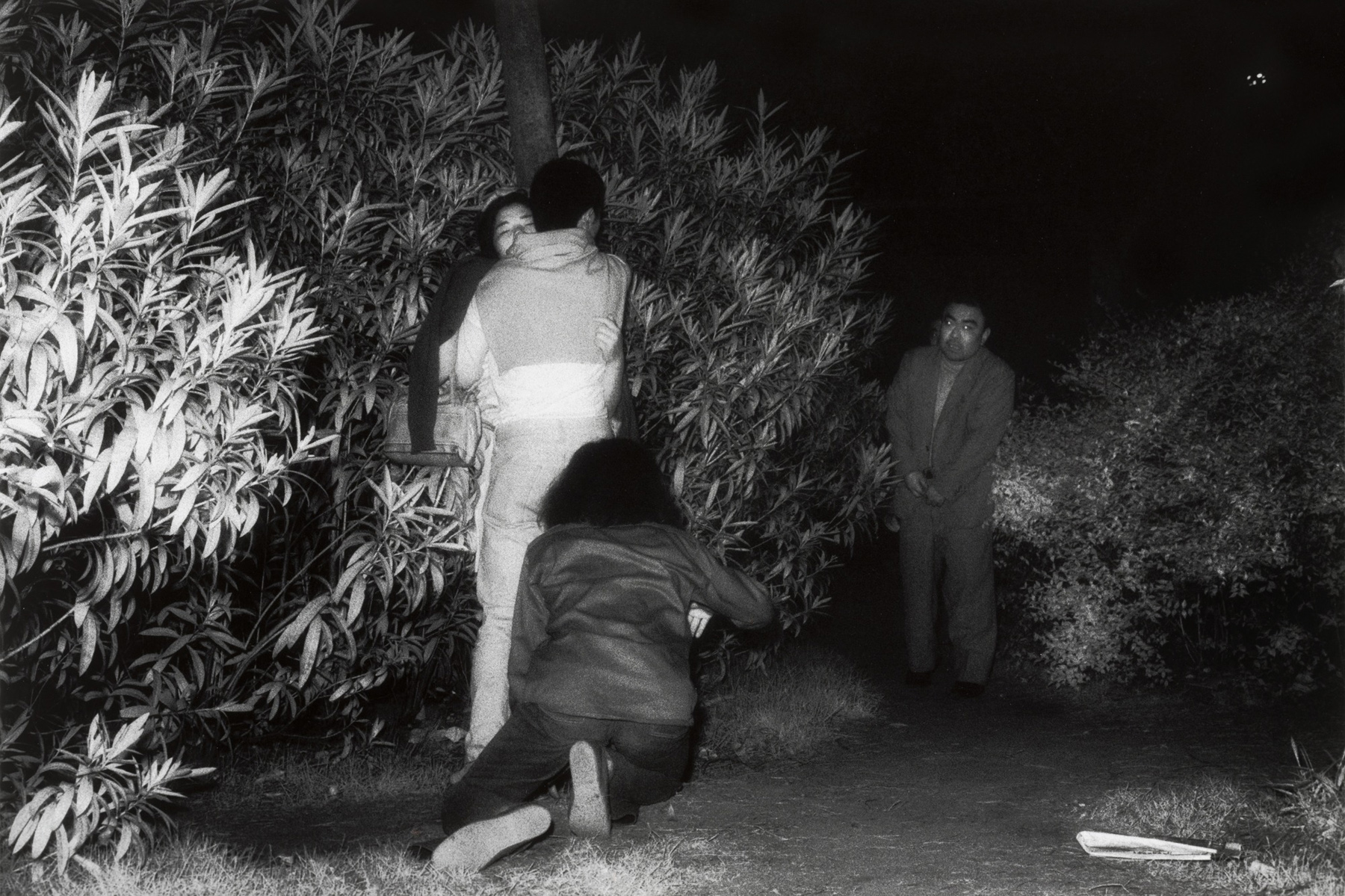
The act of looking and the gaze through the eye of a photographer’s camera are the central motifs of Blow-Up, which becomes particularly evident in the famous scene in the park. This part of the film depicts the dynamics resulting from a camera focusing on persons and capturing them in a picture. Antonioni presents his protagonist as a paparazzo and voyeur secretly photographing people in the tradition of Alfred Hitchcock’s Rear Window (1954). Hidden behind shrubs, trees, and a fence, he watches a pair of lovers. The camera serves as an instrument for peeping through the keyhole, as it were. The dialogic dimension between photographer and model is revealed when the woman (Vanessa Redgrave) spots the photographer. She defends herself against Thomas’s invasive gaze, bites his hand, and runs away. The aesthetic of Thomas’s photographs shot in the park corresponds to the situation of their taking. The pictures are imbued with the instantaneousness and spontaneity deriving from the photographers wish to wrest a single picture from a dynamic context in a fraction of a second.
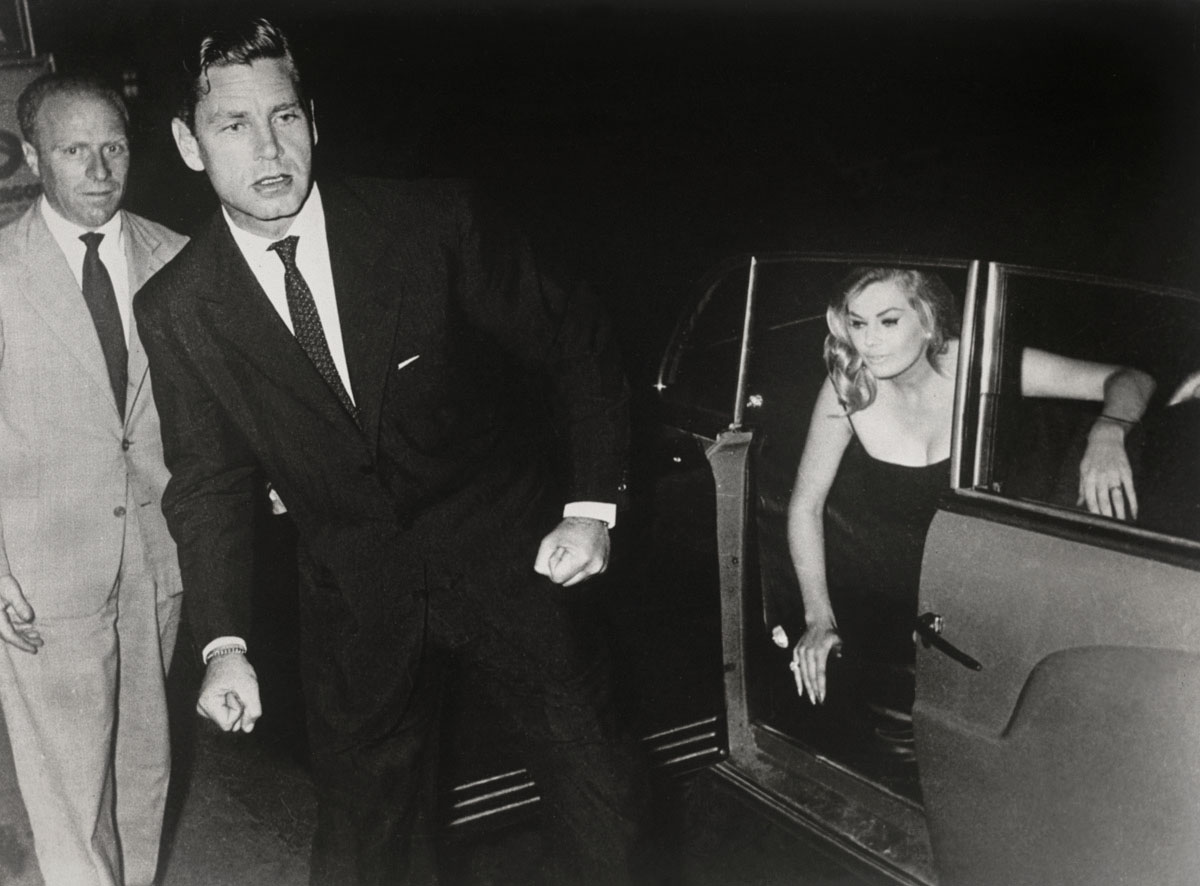
It is no coincidence that the photographer Tazio Secchiaroli was present on set in the very hours this scene was shot. Secchiaroli was an Italian paparazzo who had been after the suspects in a still unresolved murder case, the Montesi scandal, with his camera. Made against the background of this political scandal, Federico Fellini’s film La dolce vita (1960) features pushy photo reporters modelled after Secchiaroli.
Blow-Ups
The blow-ups of Thomas’s photographs shot in the park are the most famous pictures featured in Antonioni’s film. The filmmaker entrusted the renowned photojournalist Don McCullin with taking them. Following Antonioni’s instructions, McCullin had to position himself in the same places as Thomas in the film to reproduce his perspectives. He also used the same Nikon F camera the protagonist works with in Blow-Up. In order to ensure that the process of taking the pictures we see in the film corresponds with the photographer’s results, McCullin advised the actor David Hemmings on how to proceed. The actor learned how to handle the 35-mm camera correctly and was instructed about the body language connected with using it.
Fashion photography
The metropolis of London was the center of a new kind of fashion photography in the 1960s – a renown inseparably bound up with three names to this day: David Bailey, Terence Donovan, and Brian Duffy, also known as Black Trinity. Relying on 35-mm cameras, which had hitherto mainly been used for reportage photographs and ensured a supposedly spontaneous and dynamic pictorial language, these three photographers staged their models in unusual places outside their studios.
In preparing his film, Antonioni had meticulously researched the photographer’s living and working conditions by means of a several-page questionnaire in which he even inquired into their love relationships and eating habits. It was David Bailey who served as a model for the protagonist of Blow-Up. For his dynamic body language in the fashion shootings, for instance, Thomas took the cue from him. The style of clothes Thomas wears is indebted to that of the British fashion photographer John Cowan. Cowan made his studio available to Antonioni for the studio shots and acted as the filmmaker’s adviser. The photographs seen on the studio wall in Blow-Up are fashion photographs by Cowan which Antonioni chose for the film.
David Montgomery
David Montgomery is a US-American fashion photographer living in London. Before shooting his film, Antonioni visited him in his studio to watch him working with Veruschka, Jill Kennington, and Peggy Moffitt – the models he would subsequently cast for Blow-Up. David Montgomery has a cameo appearance in the beginning of the film: we see him taking pictures of the model Donyale Luna on Hoxton Market in London’s East End. When this scene was shot, he actually made the fashion photographs featuring Luna which he pretends to take in the film. Since Montgomery was no actor by his own account, he had to really take pictures in order to be able to play the scene in a convincing manner.
Arthur Evan’s fashion photographs
Arthur Evans, the still photographer, depicted the models appearing in Blow-Up in groups and in individual portraits. These pictures taken on set are very unusual for a still photographer, because they do not show scenes of the film, but are independently staged fashion photographs. The models’ costumes were designed by Jocelyn Rickards, the hats were made by James Wedge. Evans translated the linear patterns characteristic of both designers into graphic compositions in his photos.
Social reportage
Michelangelo Antonioni characterises his film’s protagonist also as a social reportage photographer who, for a book project on London he is working on, secretly takes pictures in a homeless shelter. A scene of the film has Thomas showing his publisher a dummy of the volume. The portraits in it were made by the photojournalist Don McCullin; their originals are presented in the exhibition for the very first time.
The pictures were taken in London’s East End in the early 1960s, when the area was notorious for its residents’ poverty, miserable housing conditions, and racial unrest. The photographer provides a cross-section of its inhabitants whom he mainly characterises through their occupation. The two-fold orientation of the film’s protagonist as fashion and reportage photographer is based on fact, as illustrated by both David Bailey and David Montgomery. The stylistic boundaries between the two genres blur in their works. The strategy of picturing models in urban surroundings with a 35-mm camera, for example, is clearly rooted in reportage photography.
Swinging London: Art and Life
Michelangelo Antonioni filmed Blow-Up in the heyday of London’s Swinging Sixties whose social and artistic trends are depicted in the film. He captured the youth culture and its agitation so characteristic of these years – which was not least triggered by the Beatles – as well as the protagonists of the scene. One location he chose was a concert of the Yardbirds, a British band counting Jimmy Page, who would found Led Zeppelin, among its players. The famous pot-party in Blow-Up was shot in the art and antique dealer Christopher Gibbs’ flat, who determined the fashion look of the Swinging Sixties to a remarkable degree.
The British art of the 1960s was also very important to Antonioni, as it already anticipated many of the abstract tendencies informing Blow-Up. The Pop artist Richard Hamilton, for example, used to enlarge everyday picture postcards, reducing their motifs to an abstract dot matrix. Nigel Henderson, a member of the Independent Group, had already emphasised the material qualities of his photos in the 1950s by folding his prints and employing negative techniques. Antonioni integrated works by British artists: for example a picture by Peter Sedgley, a representative of Op art, and oil paintings by Ian Stephenson into his film.
Ian Stephenson
Antonioni’s understanding of photography was informed by painting í an influence that becomes manifest in the character of the protagonist’s neighbour, in Blow-Up a painter named Bill. Antonioni compares the neighbour’s abstract paintings with the photographer’s blow-ups. When Thomas and his neighbour talk about the paintings, Bill maintains that he does not see much in them while painting them and only finds meaning in them later on. This form of reception tallies with Thomas’s attempt to determine the meaning of his similarly abstract enlargements.
The character of the painter is based on the British artist Ian Stephenson. Antonioni visited the artist in his studio before he started shooting Blow-Up. He watched the painter at work and selected the paintings he wanted to use in the film.
Blow-Up
The photographs central to Antonioniés film are the blow-ups of the pictures which the protagonist has taken in the park and which he examines meticulously. The enlargements reveal a man with a pistol lurking in the trees and a mass in the grass, which Thomas interprets as a lifeless body. To make the presumed corpse more visible Thomas enlarges the photograph again and again until it shows nothing but its grain and materiality, despite the photographs inherent relation to reality.
Antonioni uses the blow-ups to question the representation of reality by media and their specific modes of perception. He interlinks these considerations with the film. The final scene of Blow-Up shows Thomas coming upon a group of mimes playing an imaginary game of tennis. When the (invisible) ball lands behind the fence, Thomas joins in the mimes’ game, picks up the ball from the lawn and throws it back to the players. A camera pan traces the trajectory of the invisible ball. In evoking the ball without showing it, Antonioni confronts us with the most radical abstraction: the motif is not rendered as an abstract or blurry form like in the enlargements, but is altogether absent. The media-theoretical implications of Blow-Up are still the subject of conceptual photographs today. Like Antonioni, the Italian Ugo Mulas and the American Allan McCollum, for example, question photography’s relation to reality in their blow-ups.
Le montagne incantate
The nucleus for the blow-ups in the film is to be found in a series of artworks titled Le montagne incantate (The Enchanted Mountains), which Antonioni started working on in the mid-1950s. The filmmaker photographically enlarged his small-format abstract watercolours, making the material qualities of the paper and the application of the paint visible. Consequentially, Antonioni recommended the use of a magnifying glass – as used by the protagonist in Blow-Up – as the ideal instrument for viewing these pictures.
Text from the Albertina website

Brian Duffy (English, 1933-2010)
Jane Birkin
1960s
© Brian Duffy Archive

Eric Swayne (British, 1932-2007)
Grace and Telma, Italian Vogue, 1966
1966
Courtesy Tom Swayne
© Eric Swayne

Terence Donovan (English, 1936-1996)
The Secrets of an Agent
1961
© Terence Donovan Archive

Ian Stephenson (English, 1934-2000)
Still Life Abstraction D1
1957
© Kate Stephenson, widow of Ian Stephenson

Jill Kennington (British, b. 1943)
“Blow-Up”
1966
© New Visions Film Distribution GmbH / Turner Entertainment Co. – A Warner Bros. Entertainment Company. All rights reserved.
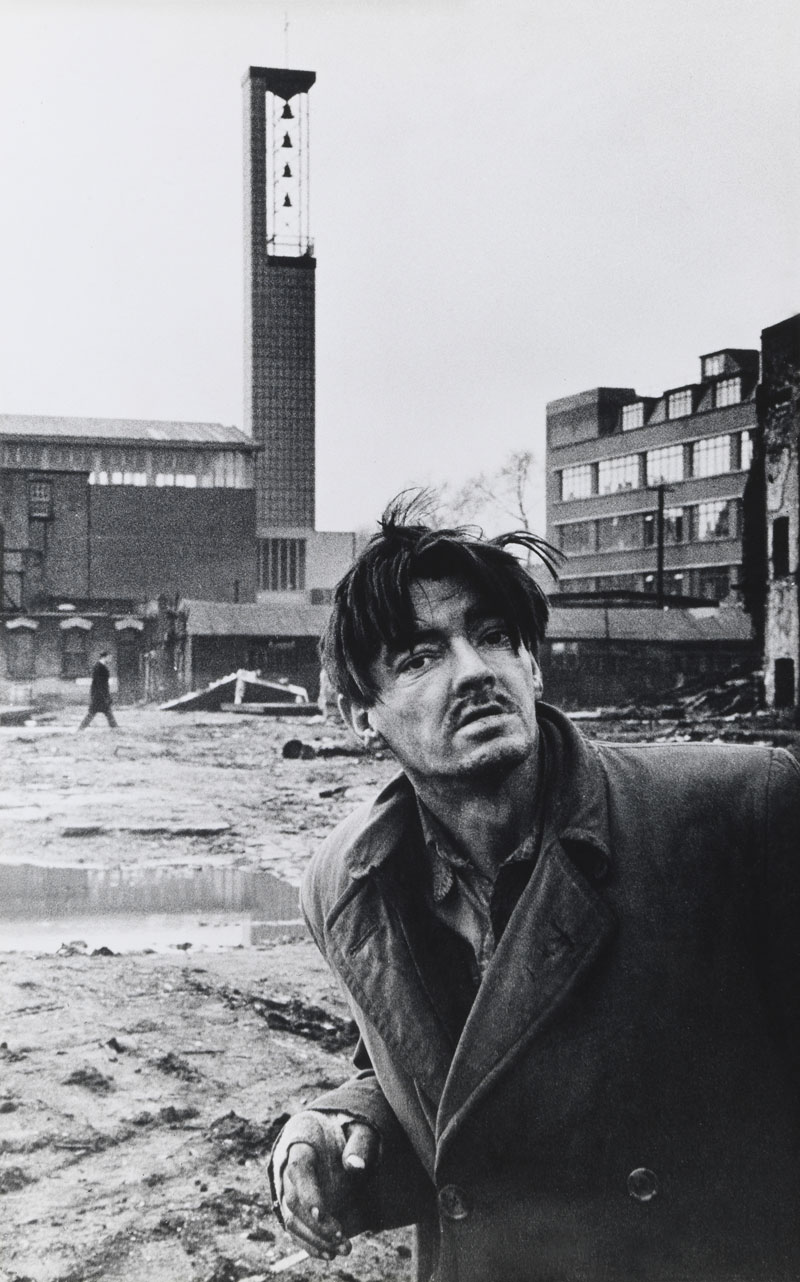
Don McCullin (British, b. 1935)
Down-and-out begging for help, Aldgate, 1963
1963
© Don McCullin, courtesy Hamiltons Gallery, London

Don McCullin (British, b. 1935)
British Butcher, East London
c. 1965
© Don McCullin Courtesy Hamiltons Gallery, London

Terry O’Neill (British, 1938-2019)
David Bailey photographing Moyra Swan
1965
© Terry O’Neill – Courtesy Philippe Garner

Tazio Secchiaroli (Italian, 1925-1998)
David Hemmings and Veruschka von Lehndorff in “Blow-Up” (directed by Michelangelo Antonioni)
1966
Filmstill
Source: BFI stills
© New Visions Film Distribution GmbH / Turner Entertainment Co. – A Warner Bros. Entertainment Company. All rights reserved.

David Montgomery (American, b. 1937)
Donyale Luna on the set of “Blow-Up”
1966
© David Montgomery
Albertina
Albertinaplatz 1
1010 Vienna, Austria
Phone: +43 (0)1 534 83-0
Opening hours:
Daily 10am – 6pm
Wednesday and Friday 10am – 9pm


![Tom Howard (American, 1894 - 1961) '[Electrocution of Ruth Snyder, Sing Sing Prison, Ossining, New York]' 1928](https://artblart.com/wp-content/uploads/2016/07/electrocution-of-ruth-snyder-web.jpg "Tom Howard (American, 1894 - 1961) '[Electrocution of Ruth Snyder, Sing Sing Prison, Ossining, New York]' 1928")


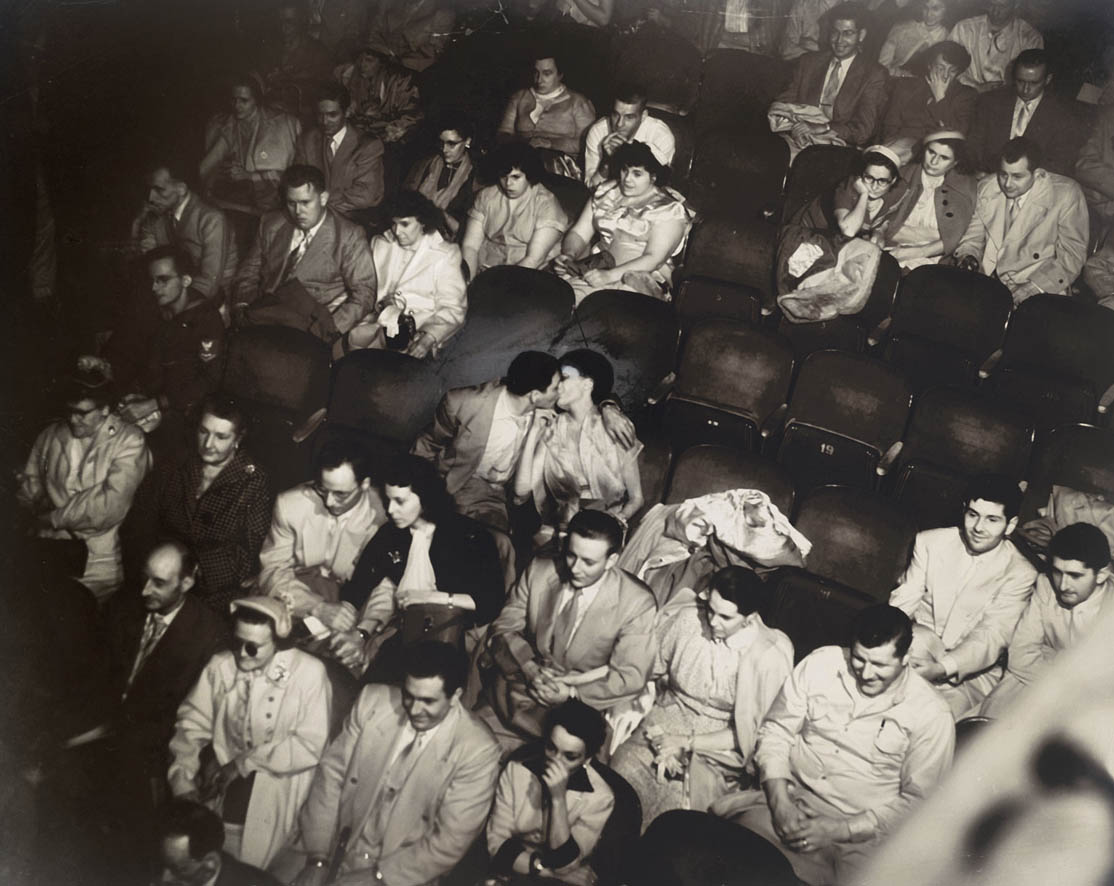
![Weegee (Arthur Fellig) (American, born Austria, 1899-1968) '[Lovers at the Movies, Times Square]' c. 1953](https://artblart.com/wp-content/uploads/2010/09/weegee-lovers-1953.jpg "Weegee (Arthur Fellig) (American, born Austria, 1899-1968) '[Lovers at the Movies, Times Square]' c. 1953")






![Weegee (Arthur H. Fellig) (American, 1899-1968) '[Marilyn Monroe]' c. 1950s](https://artblart.com/wp-content/uploads/2010/09/weegee-marilyn-monroe.jpg "Weegee (Arthur H. Fellig) (American, 1899-1968) '[Marilyn Monroe]' c. 1950s")

 Art Blart _ art and cultural memory archive
You must be logged in to post a comment.