Exhibition: ‘Robert Frank in America’ at the Cantor Arts Center, Stanford University Part 1

Exhibition dates: 10th September 2014 – 5th January 2015

Curator: Peter Galassi


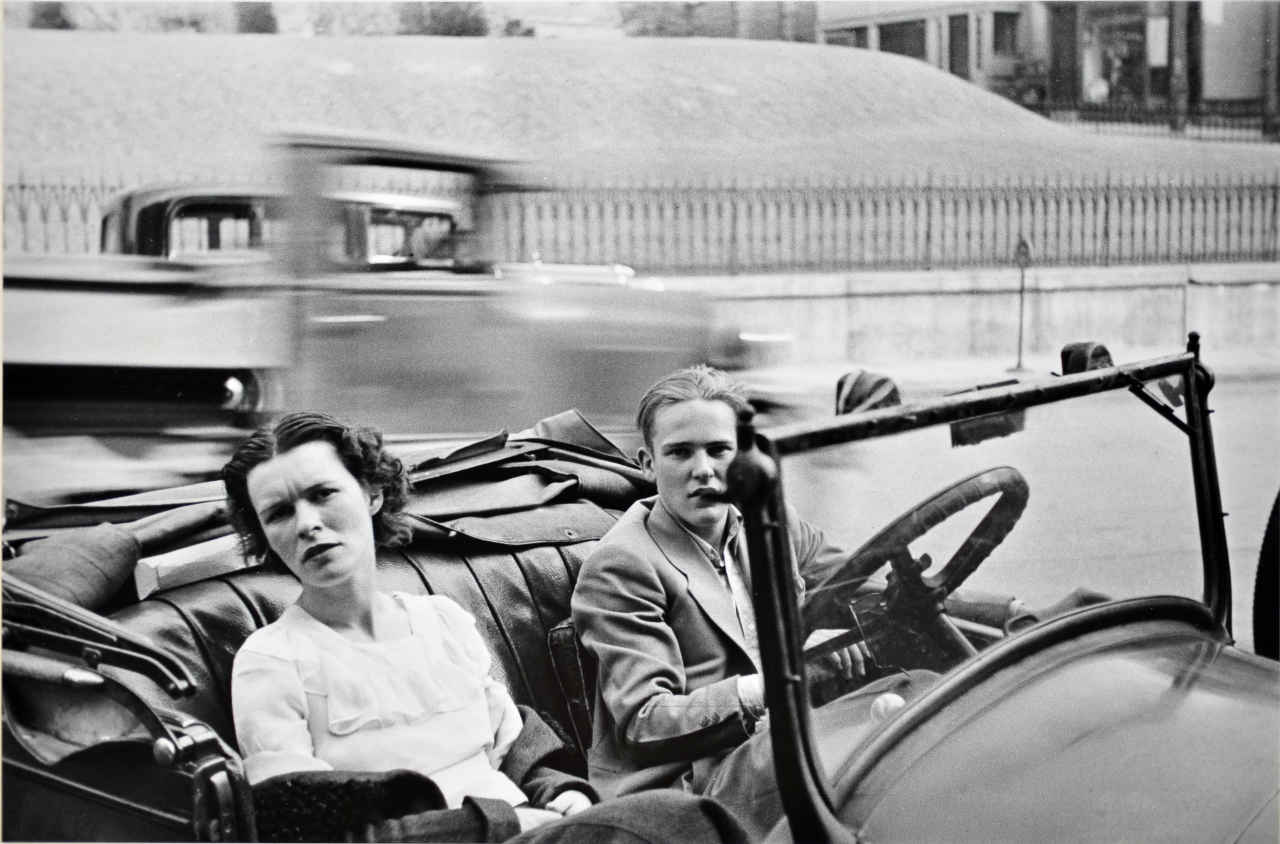
Robert Frank (American born Switzerland, 1924-2019) 'En route from New York to Washington, Club Car' 1954


Robert Frank (American born Switzerland, 1924-2019)
En route from New York to Washington, Club Car
1954
Gelatin silver print
Cantor Arts Center Collection, Gift of Raymond B. Gary


The lunatic sublime of America

This is the first part of a bumper two-part posting. View Part 2 of the posting.

Robert Frank (1924-2019) is one of the most important photographic artists of the twentieth century. He was born in Switzerland but he emigrated to American in 1947. He soon gained a job as a fashion photographer for Harper’s Bazaar. He honed his craft as a photographer in England where he took formal, classical images of British life during a trip to Europe and South America in 1947.

He became friends with Edward Steichen and Walker Evans, and it was Evans who supported him in his Guggenheim Fellowship application in 1955 which enabled him “to travel across the United States and photograph all strata of its society. Cities he visited included Detroit and Dearborn, Michigan; Savannah, Georgia; Miami Beach and St. Petersburg, Florida; New Orleans, Louisiana;Houston, Texas; Los Angeles, California; Reno, Nevada; Salt Lake City, Utah; Butte, Montana; and Chicago, Illinois. He took his family along with him for part of his series of road trips over the next two years, during which time he took 28,000 shots. 83 of these were selected by him for publication in The Americans.”1

In The Americans, Frank documents, “the tensions between the optimism of the 1950s and the realities of class and racial differences. The irony that Frank found in the gloss of American culture and wealth over this tension gave his photographs a clear contrast to those of most contemporary American photojournalists, as did his use of unusual focus, low lighting and cropping that deviated from accepted photographic techniques.2

Originally published as Les Américains in 1958 by Robert Delpire in Paris, and finally in 1959 in the United States by Grove Press, reaction in America was initially hostile. They American critics did not like Frank’s shoot from the hip style of photography, nor the mirror that was being held up to their society, especially by a Jewish foreigner. Over time The Americans came to be seen as a seminal work of American photography and social history. Like many artists, Frank only took photographs for a relatively short period of time, before moving on to become a filmmaker.

One cannot forget the era in which Frank took these photographs – that of McCarthyism and “the Second Red Scare, lasting roughly from 1950 to 1956 and characterised by heightened political repression against communists, as well as a campaign spreading fear of their influence on American institutions and of espionage by Soviet agents.”3 Americans were suspicious of foreigners, especially ones with cameras, and this was still the era of racial segregation pre the civil rights movement of the 1960s.

With regard to the structure of the photographs, their origin is based in classicism. This was Frank’s training. It was his skill as an artist, his intuitive and prescient vision of America – how he saw America like no one else before him had – that enabled him to ramp up the intensity, shoot from weird angles, low lighting, cropping, depth of field, unusual focus – and focus on the iconography of America as never seen before: jukeboxes, American flags, cars, highways, death, racial segregation – that was so revolutionary. But he could not have done that without his formal training. You only have to look at the comparison between the photographs of Robert Frank and Walker Evans. Formal and elegant in Evans Church Organ and Pews (1936) and Downtown street, New Orleans (December 1935) with lines vertical and clean… and then Frank, with hardly a straight line or neat angle to be seen. But the one does inform the other, otherwise Frank’s photographs would just become snapshots, vernacular photographs with very little meaning. Which they are not.

This is one of the most powerful, lyrical, humanist photo essays of a country that has ever been taken. Critic Sean O’Hagan, writing in The Guardian in 2014, said The Americans “changed the nature of photography, what it could say and how it could say it. […] it remains perhaps the most influential photography book of the 20th century.”4 As an artist, Frank became the great connector for he is the critical link in the chain that stretches from Lewis Hine through Walker Evans… and on to Lee Friedlander, Garry Winogrand and Joel Meyerowitz.

As an artist you marvel at his intuition and inspiration, to look at the world as no one else had done before, to push the boundaries of medium and message. To photograph people, alone and in groups; politics; religion; race; automobiles and the road; and the media and thrust them into the white, bright, happy world of 1950s consumerist America saying: this is what this country is really like, this is my “impression” of you in all your fleeting madness, “America as an often bleak and lonely place.” You only have to look at the “eye” in U.S. 91, leaving Blackfoot, Idaho (1956, below) or look at the photograph of the grave by the side of the road to know that you are in Blue Velvet territory (David Lynch, director 1986, the title is taken from The Clovers’ 1955 song of the same name).

I am not sure yet how one world pierces the other but believe me they surely do.

Dr Marcus Bunyan


Footnotes

1/ “Robert Frank” on the Wikipedia website

2/ Ibid.,

3/ “McCarthyism,” on the Wikipedia website

4/ Sean O’Hagan. “Robert Frank at 90: the photographer who revealed America won’t look back,” on The Guardian website Sat 8 Nov 2014 [Online] Cited 06/07/2021


Many thankx to the Cantor Arts Center for allowing me to publish the photographs in the posting. Please click on the photographs for a larger version of the image.


“It was the vision that emanated from the book that lead not only me, but my whole generation of photographers out into the American landscape, in a sense, the lunatic sublime of America.”


Joel Meyerowitz


“Like a boxer trains for a fight, a photographer by walking the streets, and watching and taking pictures, and coming home and going out the next day, the same thing again, taking pictures. It doesn’t matter how many he takes, or if he takes any at all, it gets you prepared to know what you should take pictures of, or what is the right thing to do and when.”


Robert Frank


Walker Evans (American, 1903-1975) 'Main St., Ossining, New York' 1932


Walker Evans (American, 1903-1975)
Main St., Ossining, New York
1932
Gelatin silver print


Robert Frank (American born Switzerland, 1924-2019) 'Detroit' 1955


Robert Frank (American born Switzerland, 1924-2019)
Detroit
1955
Gelatin silver print
Cantor Arts Center Collection, Gift of Raymond B. Gary


In 1955 and 1956, Swiss-born photographer Robert Frank (b. 1924) traveled throughout the United States on a Guggenheim Fellowship, photographing ordinary people in their everyday lives. His book The Americans – 83 photographs, mostly from those travels, published in 1959 – repudiated the bland good cheer of the magazines with an image of the country that was starkly at odds with the official optimism of postwar prosperity. The book became a landmark of photographic history; but Frank soon turned to filmmaking, and the rest of his early photographic career was largely forgotten. An important group of unknown or unfamiliar photographs in the Cantor Arts Center’s collection provides the core of the exhibition Robert Frank in America, which sheds new light on the making of The Americans and presents, for the first time, Frank’s American photographs from the 1950s as a coherent body of work.

“We are delighted that the Cantor’s collection has provided the basis for a fresh look at one of the great achievements of 20-century photography,” said Connie Wolf, John and Jill Freidenrich Director of the Cantor Arts Center. “We are also deeply grateful to Robert Frank, who has generously contributed to the project.”

The exhibition Robert Frank in America, on view September 10, 2014 through January 5, 2015, features 130 photographs drawn primarily from the Cantor’s collection as well as from other public and private collections and from Frank himself. Peter Galassi, former chief curator of photography at the Museum of Modern Art, New York, is the exhibition’s guest curator and author of the accompanying publication.

The Exhibition’s Development from the Cantor’s Collection

In the summer of 2012, Wolf invited Galassi to offer his thoughts on one of the museum’s hidden treasures: more than 150 photographs by Robert Frank given to the Cantor in the mid-1980s by Stanford alumnus Bowen H. McCoy and his colleague Raymond B. Gary. This remarkable collection spans the full range of Frank’s photographic career before he turned to filmmaking in the early 1960s. It is especially rich in Frank’s American work of the 1950s, including scores of photographs that are unknown or unfamiliar even to scholars. Wolf and Galassi saw an opportunity to share this work with Stanford students, faculty, scholars at large and the general public.

Research began at the National Gallery of Art, Washington, where more than two decades ago the artist established the archive of his photographic career prior to 1970. Studying more than 1,000 contact sheets enabled Galassi to determine the locations and dates of dozens of previously unidentified photographs in the Cantor collection. He then selected works for the exhibition so as to identify Frank’s major themes and artistic strategies. The compelling sequence of The Americans poetically weaves diverse images into a seamless whole, but Robert Frank in America groups related pictures to explore the pictorial strategies that Frank developed as he worked, and also to highlight important subjects – people, alone and in groups; politics; religion; race; automobiles and the road; and the media.

Frank repeatedly photographed isolated figures so that they seemed trapped by pictorial forces, for example. This powerful metaphor for Frank’s vision of lonely individuals imprisoned by social circumstances is announced in the first picture, The Americans, where the flag obliterates a spectator’s face (Parade – Hoboken, New Jersey, 1955). In Robert Frank in America, that photograph is juxtaposed with another that uses the identical pictorial scheme but a different subject; the interior of a bar (New York City, 1955).

“Although The Americans is famous – partly because it is famous – Robert Frank’s American work of the 1950s has never been considered as a whole,” said Galassi. “The full range of the work shows just how Frank turned the vocabulary of magazine photojournalism on its head and used it to speak in a personal, poetic voice.”

Inviting Galassi to organise the exhibition was part of the museum’s renewed commitment to collecting, studying and presenting photography, Wolf says. The Cantor has been adding to its already strong holdings, presenting innovative exhibitions of work by distinguished artists and providing a valuable opportunity for Stanford students and faculty to work directly with photographs. Leland Stanford’s commission more than a century ago for Eadweard Muybridge’s pioneering work on animal locomotion serves as a foundation for the museum’s extensive collection today.

Exhibition catalogue

The major catalogue accompanying this exhibition is published by the Cantor Arts Center in association with international publisher Steidl, with whom Frank has worked closely on most of his books. All 130 photographs in the exhibition are reproduced as full-page tritone plates. Galassi’s extensive essay traces the evolution of Frank’s work from his arrival in the United States in 1947 until he abandoned his first photographic career in the early 1960s. The text provides a thorough outline of the photographic context in which Frank at first sought success as a magazine photojournalist as well as a detailed analysis of the methods and strategies that lie behind The Americans. The essay features 24 illustrations, including an unprecedented map of Frank’s 1955-56 Guggenheim travels, which locates the sites of nearly all of the photographs in The Americans and in Robert Frank in America. The 200-page book, with a foreword by Connie Wolf, is designed by Katy Homans, New York.

Robert Frank

Robert Frank was born in 1924 in Zürich, Switzerland. The conclusion of World War II ended his vulnerability (his father was a German-born Jew) and enabled him to escape what he regarded as a narrow, antiquated culture. Soon after reaching New York in March 1947, he was hired by Harper’s Bazaar, but his distaste for photographing fashion led him to quit after six months. Over the next five or six years, in Europe and the United States, Frank aimed to establish himself as a freelance photojournalist, with limited success. A Guggenheim Fellowship, awarded in March 1955 and renewed a year later, freed him to pursue his work independently, and he soon began to travel in hopes of making a book. Les Américains was published by Robert Delpire in Paris in 1958 and, as The Americans, by Grove Press in New York in 1959. The latter included an introduction by Jack Kerouac, author of On the Road.

Film and video have formed a central aspect of Frank’s work since 1959, when he collaborated with Allen Ginsberg, Jack Kerouac and Alfred Leslie on Pull My Daisy. In 1972, however, he resumed making photographs, often using Polaroid positive-negative materials and incorporating text and multiple images. That same year he published the first of several editions of The Lines of My Hand, a book that surveyed his career in all mediums and initiated reconsiderations of his early photographic career. The first full-scale retrospective of his photographs was organised at the Museum of Fine Arts, Houston, in 1986. In 1990, a major gift by Frank established the Robert Frank Collection at the National Gallery of Art, Washington, which has since presented two major exhibitions, each accompanied by an important book: Robert Frank: Moving Out (1994) and Looking In: Robert Frank’s “The Americans” (2009).

Press release from the Cantor Arts Center


Robert Frank (American born Switzerland, 1924-2019) 'Beaufort, South Carolina' 1955


Robert Frank (American born Switzerland, 1924-2019)
Beaufort, South Carolina
1955
Gelatin silver print
Cantor Arts Center Collection, Gift of Raymond B. Gary


Guggenheim proposal summary

“To photograph freely throughout the United States, using the miniature camera exclusively. The making of a broad, voluminous picture record of things American, past and present. This project is essentially the visual study of a civilization and will include caption notes; but it is only partly documentary in nature: one of its aims is more artistic than the word documentary implies.”

The full statement

“I am applying for a Fellowship with a very simple intention: I wish to continue, develop and widen the kind of work I already do, and have been doing for some ten years, and apply it to the American nation in general. I am submitting work that will be seen to be documentation - most broadly speaking. Work of this kind is, I believe, to be found carrying its own visual impact without much work explanation. The project I have in mind is one that will shape itself as it proceeds, and is essentially elastic. The material is there: the practice will be in the photographer’s hand, the vision in his mind. One says this with some embarrassment but one cannot do less than claim vision if one is to ask for consideration.

“The photographing of America” is a large order - read at all literally, the phrase would be an absurdity. What I have in mind, then, is observation and record of what one naturalized American finds to see in the United States that signifies the kind of civilization born here and spreading elsewhere. Incidentally, it is fair to assume that when an observant American travels abroad his eye will see freshly; and that the reverse may be true when a European eye looks at the United States. I speak of the things that are there, anywhere and everywhere - easily found, not easily selected and interpreted. A small catalog comes to the mind’s eye: a town at night, a parking lot, a supermarket, a highway, the man who owns three cars and the man who owns none, the farmer and his children, a new house and a warped clapboard house, the dictation of taste, the dream of grandeur, advertising, neon lights, the faces of the leaders and the faces of the followers, gas tanks and post offices and backyards.

The uses of my project would be sociological, historical and aesthetic. My total production will be voluminous, as is usually the case when the photographer works with miniature film. I intend to classify and annotate my work on the spot, as I proceed. Ultimately the file I shall make should be deposited in a collection such as the one in the Library of Congress. A more immediate use I have in mind is both book and magazine publication.”


Robert Frank (American born Switzerland, 1924-2019) 'Florida' 1958


Robert Frank (American born Switzerland, 1924-2019)
Florida
1958
Gelatin silver print
Cantor Arts Center Collection, Gift of Raymond B. Gary


“I am grateful to the Guggenheim Foundation for their confidence and the provisions they made for me to work freely in my medium over a protracted period. When I applied for the Guggenheim Fellowship, I wrote: “To produce an authentic contemporary document, the visual impact should be such as will nullify explanation.”

With these photographs, I have attempted to show a cross-section of the American population. My effort was to express it simply and without confusion. The view is personal and, therefore, various facets of American life and society have been ignored. The photographs were taken during 1955 and 1956; for the most part in large cities such as Detroit, Chicago, Los Angeles, New York and in many other places during my Journey across the country. My book, containing these photographs, will be published in Paris by Robert Delpire, 1958.

I have been frequently accused of deliberately twisting subject matter to my point of view. Above all, I know that life for a photographer cannot be a matter of indifference. Opinion often consists of a kind of criticism. But criticism can come out of love. It is important to see what is invisible to others – perhaps the look of hope or the look of sadness. Also, it is always the instantaneous reaction to oneself that produces a photograph.

My photographs are not planned or composed in advance and I do not anticipate that the on-looker will share my viewpoint. However, I feel that if my photograph leaves an image on his mind – something has been accomplished.

It is a different state of affairs for me to be working on assignment for a magazine. It suggests to me the feeling of a hack writer or a commercial illustrator. Since I sense that my ideas, my mind and my eye are not creating the picture but that the editors’ minds and eyes will finally determine which of my pictures will be reproduced to suit the magazines’ purposes.

I have a genuine distrust and “mefiance” toward all group activities. Mass production of uninspired photojournalism and photography without thought becomes anonymous merchandise. The air becomes infected with the “smell” of photography. If the photographer wants to be an artist, his thoughts cannot be developed overnight at the corner drugstore.

I am not a pessimist, but looking at a contemporary picture magazine makes it difficult for me to speak about the advancement of photography, since photography today is accepted without question, and is also presumed to be understood by all – even children. I feel that only the integrity of the individual photographer can raise its level.

The work of two contemporary photographers, Bill Brandt of England and the American, Walker Evans, have influenced me. When I first looked at Walker Evans’ photographs, I thought of something Malraux wrote: “To transform destiny into awareness.” One is embarrassed to want so much for oneself. But, how else are you going to justify your failure and your effort?”

Robert Frank, U.S. Camera Annual, 1958, p. 115


Robert Frank (American born Switzerland, 1924-2019) 'Lusk, Wyoming' 1956


Robert Frank (American born Switzerland, 1924-2019)
Lusk, Wyoming
1956
Gelatin silver print
Cantor Arts Center Collection, Gift of Raymond B. Gary


Robert Frank (American born Switzerland, 1924-2019) 'Main Street - Savannah, Georgia' 1955


Robert Frank (American born Switzerland, 1924-2019)
Main Street – Savannah, Georgia
1955
Gelatin silver print
Cantor Arts Center Collection, Gift of Raymond B. Gary


Walker Evans (American, 1903-1975) 'Downtown street, New Orleans' December 1935


Walker Evans (American, 1903-1975)
Downtown street, New Orleans
December 1935
Gelatin silver print


Robert Frank (American born Switzerland, 1924-2019) 'New York City' 1949


Robert Frank (American born Switzerland, 1924-2019)
New York City
1949
Gelatin silver print
Lent by Peter Steil
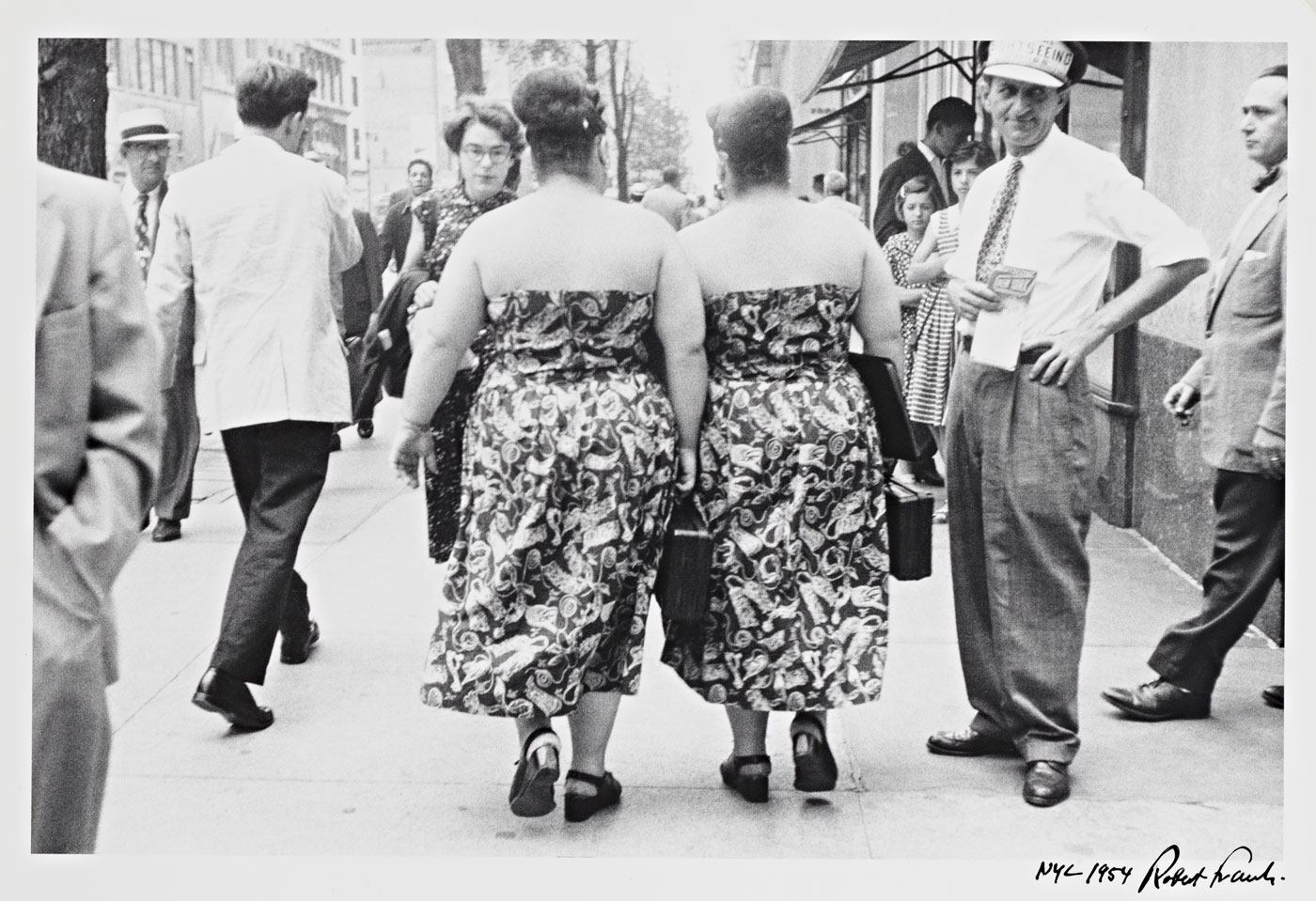
 

Robert Frank (American born Switzerland, 1924-2019) 'New York City' early 1950s


Robert Frank (American born Switzerland, 1924-2019)
New York City
early 1950s
Gelatin silver print
Cantor Arts Center Collection, Gift of Bowen H. McCoy


Cantor Arts Center at Stanford University
328 Lomita Drive at Museum Way
Stanford, CA 94305-5060
Phone: 650-723-4177

Opening hours:
Wednesday – Sunday 11am – 5pm
Closed Monday and Tuesday

Cantor Arts Center at Stanford University website

LIKE ART BLART ON FACEBOOK

Back to top

Exhibition: ‘Portraits and Power: People, Politics and Structures’ at Centro di Cultura Contemporanea Strozzina – Fondazione Palazzo Strozzi, Florence

Exhibition dates: 1st October 2010 – 23rd January, 2011


Many thankx to the Centro di Cultura Contemporanea Strozzina for allowing me to publish the photographs in the posting. All text comes from the Centro di Cultura Contemporanea Strozzina website. Please click on the photographs for a larger version of the image.


Installation view of the exhibition 'Portraits and Power: People, Politics and Structures' at Centro di Cultura Contemporanea Strozzina - Fondazione Palazzo Strozzi, Florence

Installation view of the exhibition 'Portraits and Power: People, Politics and Structures' at Centro di Cultura Contemporanea Strozzina - Fondazione Palazzo Strozzi, Florence


Installation view of the exhibition Portraits and Power: People, Politics and Structures at Centro di Cultura Contemporanea Strozzina – Fondazione Palazzo Strozzi, Florence with the work of Rineke Dijkstra at right


Portraits and Power explores portraiture and the representation of political, economical and social power in the contemporary world through the works of contemporary artists. Portraits of famous political figures, investigations into the lifestyle of the social elite, as well as inquiries into the power structures of international institutions.

The exhibition explores its theme from three main standpoints: it analyses power as an expression of the charisma of those individuals who have become icons or symbols of their age; it probes the power of institutions and social models that either represent themselves or are represented in a critical light; and it investigates the hidden mechanisms of powerful authorities.

Portraits and Power is a project of the CCC Strozzina, with the consultancy of Peter Funnell (National Portrait Gallery, London), Walter Guadagnini (“UniCredit & Art” project) and Roberta Valtorta (Museum of Contemporary Photography, Cinisello Balsamo) coordinated by Franziska Nori (CCCS, Firenze).

Text from the Centro di Cultura Contemporanea Strozzina website [Online] Cited 02/02/2020


Tina Barney (American, b. 1945) 'The Ancestor' 2001 from the exhibition 'Portraits and Power: People, Politics and Structures' at Centro di Cultura Contemporanea Strozzina - Fondazione Palazzo Strozzi, Florence


Tina Barney (American, b. 1945)
The Ancestor
2001
C-print
Courtesy the artist and Janet Borden Inc., New York


Tina Barney (American, b. 1945) 'The Brocade Walls' 2004 from the exhibition 'Portraits and Power: People, Politics and Structures' at Centro di Cultura Contemporanea Strozzina - Fondazione Palazzo Strozzi, Florence


Tina Barney (American, b. 1945)
The Brocade Walls
2004
C-print
Courtesy the artist and Janet Borden Inc., New York


Installation view of the exhibition 'Portraits and Power: People, Politics and Structures' at Centro di Cultura Contemporanea Strozzina – Fondazione Palazzo Strozzi, Florence showing the work of Tina Barney


Installation view of the exhibition Portraits and Power: People, Politics and Structures at Centro di Cultura Contemporanea Strozzina – Fondazione Palazzo Strozzi, Florence showing the work of Tina Barney


The characters Tina Barney portrays are the representatives of a social class that normally exercises careful control over the circulation of pictures of its members, whether in the form of family photographs or official portraits, which are often published on the pages of glossy magazines. She is one of the first photographers to have made artistic use of this kind of representation. Hers is not merely the gaze of an onlooker, but that of a trusted person, who has personal relationships with her subjects. What she is interested in is not so much the idea of displaying the wealth of these families, but that of analysing social and family dynamics – such as the ambivalent relationship between children and parents. Her work is conceived as a means to improve self-understanding.

The people portrayed all come from families educated in the awareness of their own social role: discipline, self-control and rigour are features to be observed in all the subjects photographed, and they share the same high level of composure. For the series entitled The Europeans, which was produced over a period of about eight years, the author was introduced by one circle of friends to another, and thus given the opportunity to portray Italian nobles, Austrian bankers and landowners, proud representatives of the wealthy Spanish bourgeoisie, and English gentlemen in their sophisticated dwellings. Neither the formal way of dressing nor the furnishings can be traced back to any particular fashion: Tina Barney seeks to produce timeless pictures that at first sight will appear closer to traditional painting than to contemporary photography. Tina Barney creates her portraits through a careful observation of people in their everyday lives; to capture transient moments she asks her subjects to repeat something in front of the camera in such a way as to fix them. Her work tool is a fixed, large-size camera; an extended time exposure and high resolution enable her to render the details of each setting in detail. The figures portrayed have a rigid and formal countenance, which makes them appear markedly detached from one another, even though it is often brothers and sisters or parents and children who are photographed together: “this is the best that we can do. This inability to show physical affection is in our heritage”.

Tina Barney’s photographs give a sense of the fleetingness of their relationships behind the mask of self-controlled bearing. The artist thus unveils the game of social roles and attitudes conducted by her subjects, a veritable Theater of Manners (to quote the title of one of her most famous series) which demands enough sensitivity on the viewers’ part for them to focus on those details in the pictures that render hidden and non-immediately obvious features visible.

Since the mid-1970s, Tina Barney has been focusing her work on the portrayal of the privileged exponents of New York and New England high society, seen either in their own homes or on certain special occasions. The style of the pictures ranges from that of tableaux vivant to that of genre paintings, drawing expressive force from the interaction between wealthy settings and the people who move about in them.


Tina Barney (American, b. 1945) 'The Granddaughter' 2004 from the exhibition 'Portraits and Power: People, Politics and Structures' at Centro di Cultura Contemporanea Strozzina - Fondazione Palazzo Strozzi, Florence


Tina Barney (American, b. 1945)
The Granddaughter
2004
C-print
Courtesy the artist and Janet Borden Inc., New York


Installation view of the exhibition 'Portraits and Power: People, Politics and Structures' at Centro di Cultura Contemporanea Strozzina - Fondazione Palazzo Strozzi, Florence showing the work of Jim Dow


Installation view of the exhibition Portraits and Power: People, Politics and Structures at Centro di Cultura Contemporanea Strozzina – Fondazione Palazzo Strozzi, Florence showing the work of Jim Dow


Jim Dow (American, b. 1942) 'Library Metropolitan Club, New York' 1999 / 2010 from the exhibition 'Portraits and Power: People, Politics and Structures' at Centro di Cultura Contemporanea Strozzina - Fondazione Palazzo Strozzi, Florence


Jim Dow (American, b. 1942)
Library Metropolitan Club, New York
1999 / 2010
Chromogenic colour print
Courtesy the artist, Janet Borden, Inc., New York


Jim Dow (American, b. 1942) 'Dining Room, Morgan Library, New York' 1999 / 2010 from the exhibition 'Portraits and Power: People, Politics and Structures' at Centro di Cultura Contemporanea Strozzina - Fondazione Palazzo Strozzi, Florence


Jim Dow (American, b. 1942)
Dining Room, Morgan Library, New York
1999 / 2010
Chromogenic colour print
Courtesy the artist, Janet Borden, Inc., New York


By taking shots that are as objective as possible and completely devoid of any human presence, Dow gives a concentrated and authentic view of the architecture, furnishings and frameworks of these backdrops of life. “My interest in photography centres on its capacity for exact description. I use photography to try to record the manifestations of human ingenuity and spirit still remaining in our country’s everyday landscape.” For one of his most recent series, Dow has been able to make his way into some of the most exclusive private circles of New York City. He selected circles that are still active and have a long and significant history behind, such as the renowned Metropolitan Club, which was founded in 1891 by John Pierpont Morgan, and once listed James Roosevelt and William K. Vanderbilt among its most illustrious members. Most of these circles require strict adherence to rules consolidated by tradition. Only those introduced to the club by one of its members can join it, a practice that contributes to keep it a kind of network; a specific commission will then consider whether the candidate is fit for acceptance. Though there are over twenty circles of this kind in New York, outsiders will rarely notice their presence. While they no longer exercise the kind of political influence they used to as seats of power and decision making bodies, these clubs are now undergoing a new renaissance. An increasing number of politicians and businessmen are choosing to meet in their secluded rooms, which public opinion often perceives as places of intrigue and the setting for secret appointments of various kinds. With his descriptive and comparative photographs, Dow is giving a face to these exclusive meeting places, inviting viewers to join him in admiring the timeless opulence of their rooms. Architecture is the “primary and most powerful form of mass-communication”; at the same time, it is a mirror for power and its strategies, for the consolidation of authority and its effects on those who exercise it. “Architecture is power. The powerful build precisely because they are powerful. Yet architecture is also an expression of the capability and resoluteness – as well as resolve – of the powerful. Politicians intentionally exploit architecture to seduce, impress, and intimidate.” (Deyan Sudjic, The Edifice Complex: How the Rich and Powerful Shape the World, 2006).

American photographer Jim Dow approaches places as meeting points bearing visible traces of people’s mutual interactions. In different photographic series, the artist has portrayed American barbecue joints, pie and mash shops in London, tango halls in Buenos Aires, the workplaces of farmers, tinsmiths and iron-smiths, and baseball stadiums from one coast of the US to the other.


Clegg & Guttmann (Michael Clegg and Martin Guttmann) 'Grand Master' 1985 from the exhibition 'Portraits and Power: People, Politics and Structures' at Centro di Cultura Contemporanea Strozzina - Fondazione Palazzo Strozzi, Florence


Clegg & Guttmann (Michael Clegg and Martin Guttmann)
Grand Master
1985
Cibachrome
Courtesy Galerie Christian Nagel, Cologne, Berlin, Antwerp


For Grand Master, part of a photographic series produced in the 1980s, Clegg & Guttmann asked an actor to display certain poses characteristic of power, presenting him as the representative of a non-specified institution. The background of the image consists in a fictional architectural scenario – one simply simulated by using photographed space – the artificial nature of which is revealed by certain incongruities in the lighting effects. What is central here, once more, is the reflection offered on the controlled and never spontaneous construction of an image of power.

The tension conveyed by Clegg & Guttmann’s works springs from the subtle gap characterising the artists’ relationship with tradition. Their classical and apparently affirmative representations of people with power should be interpreted, within the context of their career spanning several decades, as different ways of visualising an analytical and deconstructive practice engaging with the mechanisms of authority.


Installation view of the exhibition 'Portraits and Power: People, Politics and Structures' at Centro di Cultura Contemporanea Strozzina - Fondazione Palazzo Strozzi, Florence showing the work of Clegg & Guttmann


Installation view of the exhibition Portraits and Power: People, Politics and Structures at Centro di Cultura Contemporanea Strozzina – Fondazione Palazzo Strozzi, Florence showing the work of Clegg & Guttmann


The CCCS – Centro di Cultura Contemporanea Strozzina – Fondazione Palazzo Strozzi, Florence, will be staging an exhibition entitled Portraits and Power: People, Politics and Structures, from 1 October 2010 to 23 January 2011, which will run concurrently with the retrospective devoted to Bronzino, the undisputed master of the Mannerist portrait, on Palazzo Strozzi’s piano nobile.

The exhibition, based on an original project by the CCCS in consultation with Peter Funnell (curator and director of research programmes at the National Portrait Gallery in London), Walter Guadagnini (chairman of the “UniCredit & Art” project’s scientific committee) and Roberta Valtorta (director of the Cinisello Balsamo Museum of Contemporary Photography) and coordinated by Franziska Nori (director of the CCCS), will show the work of international artists and collectives such as Tina Barney, Christoph Brech, Bureau d’études, Fabio Cifariello Ciardi, Clegg & Guttmann, Nick Danziger, Rineke Dijkstra, Jim Dow, Francesco Jodice, Annie Leibovitz, Helmut Newton, Trevor Paglen, Martin Parr, Wang Qingsong, Daniela Rossell, Jules Spinatsch, Hiroshi Sugimoto, and The Yes Men – who have all proved capable of developing a critical analysis of the portrayal and depiction of political, economic and social power in the media.

The exhibition explores its theme from two main standpoints: it analyses power as an expression of the charisma of those individuals who have become icons or symbols of their age; and it probes the power of institutions and social models that either represent themselves or are represented in a critical light.

The role played by images has grown to such an extent that it has led to the predominant emergence of their value not only in terms of portrayal but also of the successful establishment of power. The works of art on display bear witness not only to the self-referential strategies of power, but also to the different approaches artists adopt in deconstructing or chipping away at the images that represent social, economic and political power in a way that can not only bolster a leadership but that can also undermine its authority.

The National Portrait Gallery in London will be contributing works by three famous international photographers that explore the image of political authority. The series devoted to Queen Elizabeth II by Annie Leibovitz evinces a celebrated contemporary artist’s dialogue with the great tradition of official portraiture, and the cycle entitled Blair at War by Nick Danziger gives an extraordinary vision of Tony Blair’s daily life in the days immediately preceding the outbreak of the war in Iraq. The portrait of Margaret Thatcher by Helmut Newton keeps alive the iconic role of one of the most influential politicians of recent decades despite the fact that her authority had waned.

Clegg & Guttmann show the photographs of three managing directors of the Deutsche Bank. These images, while based on the official portraiture genre, provide the opportunity for a conceptual reflection on the theme of the public presentation of individuals who are at the same time both subject and patron of the work. Christoph Brech portrays a modern patron of the arts in a video that dwells on a detail of the hull of his yacht, Sea Force One, a floating museum filmed from a distance in Venetian waters.

The role of the image not only as representation but also as a tool for the construction or exploration of power is analysed by artists such as Hiroshi Sugimoto, whose Portraits bring to life wax effigies of historical or contemporary political figures through the evocative power of photography, and Rineke Dijkstra whose series of images of a soldier with the French Foreign Legion prompts a reflection on what remains of the individual when he becomes the representative of a military authority. Francesco Jodice, in his video entitled Dubai Citytellers, analyses the development and the social impact of one of the new centres of global economic power.

In the photo triptych Past, Present and Future, Wang Qingsong portrays himself as a bystander, bearing witness to fighters in poses mimicking celebrative and monumental Socialist sculptures, reflecting upon the contradictory nature of the actual power of masses in contemporary China.

Tina Barney records the life and domestic environment of the beau monde, combining the spontaneous feel of a private snapshot with a sophisticated aesthetic approach strongly echoing the world of art and traditional photography. The provocative photo series Ricas y Famosas by Daniela Rossell portrays the taste and excesses of the new super wealthy social oligarchy in Mexico, while Martin Parr’s series entitled Luxury, which is devoted to fashion shows, horse-racing and art fairs in the world’s major capitals, probes the lifestyle of the upper class in a globalised Western world. The pictures of Jim Dow portray the luxurious rooms of the great private social clubs of New York City’s elite, fashionable places that are inaccessible to the general public.

A different critical approach to the theme of power is offered by the French collective Bureau d’études with its project involving mapping the links between political and economic power. The CIA’s secret missions and operations, on the other hand, provide the focus for the work of Trevor Paglen who reconstructs top secret movements and connections. Jules Spinatsch presents a new work taken from his Temporary Discomfort video-photographic series, denouncing the controversial transformation of a place such as the island of La Maddalena in Sardinia into the venue for the G8 summit that never took place. Also on view is the antagonistic activism of The Yes Men, a collective who will be presenting their spectacular media initiative that rocked the image and power of the multinational corporation responsible for the Bhopal environmental catastrophe in India.

Finally, the composer Fabio Cifariello Ciardi uses famous politicians’ public speeches as his raw material for the creation of electroacoustic music that will underline their rhetorical techniques of persuasion.

The exhibition catalogue, published in Italian and English, contains a series of essays by authors from different countries, backgrounds and disciplines, offering the visitor a chance to explore in greater depth the themes addressed by the exhibition.

Press release from the Strozzina website [Online] Cited 02/02/2020


Rineke Dijkstra (Dutch, b. 1959) 'Olivier' Quartier Vienot, Marseille, France, July 21, 2000 from the exhibition 'Portraits and Power: People, Politics and Structures' at Centro di Cultura Contemporanea Strozzina - Fondazione Palazzo Strozzi, Florence


Rineke Dijkstra (Dutch, b. 1959)
Olivier
Quartier Vienot, Marseille, France, July 21, 2000
On loan from The Bank of America Merrill Lynch Collection


Rineke Dijkstra (Dutch, b. 1959) 'Olivier' Quartier Monclar, Djibouti, July 13, 2003 from the exhibition 'Portraits and Power: People, Politics and Structures' at Centro di Cultura Contemporanea Strozzina - Fondazione Palazzo Strozzi, Florence


Rineke Dijkstra (Dutch, b. 1959)
Olivier
Quartier Monclar, Djibouti, July 13, 2003
On loan from The Bank of America Merrill Lynch Collection


A crucial feature of Dijkstra’s photography is her desire to show the true personality of her subjects, as opposed to any simulated one. Up against the contemporary mystifying quality of the Internet and digital manipulation, her images illustrate in a very convincing way how photography is still capable of transcending the surface of subjects to grasp their deeper and constantly evolving identities. Her series feature, for instance, young bullfighters immediately after a bullfight, young mothers with babies born only a few minutes before, and portraits of boys and girls from various parts of the world at the beach. Her work method, whereby subjects are given very few directions and are usually portrayed frontally, leads to the creation of bare and detached pictures in which people display an inevitably fragile and vulnerable air. The Olivier Silva project, which the artist has developed over the course of more than three years, centres on the figure of a young man who in July 2000 voluntarily enrolled in the French Foreign Legion. Dijkstra portrays crucial moments of his intense training in France and Africa – from the day of his enrolment, in Aubagne, near Marseille, to the missions he was sent to fulfil in various parts of the world (Gabon, Ivory Coast and Gibuti) in 2003. The photographs clearly illustrate the metamorphoses the young man underwent over the course of the years: the innocent looking boy becomes an energetic and professional elite soldier enlisted in one of the world’s toughest and most controversial army corps. The centrepiece of the work is the artist’s interest in Olivier as an individual whose personality evolves in the course of his training, as is clearly revealed by his attitude and the look in his eyes, as well as by the very way in which his facial features change. The training imparted in military units of this kind is aimed at annulling the recruit’s personality in order to then recreate it according to new parameters: the youngster draws closer and closer to the prototype of the soldier as we progress from one photograph to the next. Just as all new recruits of the Foreign Legion are assigned a new name and identity, after three years Olivier no longer looks (even physically) like the same person as before. Like an accelerated film sequence, this series shows the dissolution of the original identity of a man subjected to the conditions dictated by an apparatus of power. Every soldier is at the service of the country he fights for and becomes one of its official public representations, embodying its military power. The same power he now wields is that which in a few years has conditioned him – or even produced him, one may say. Through her aesthetically minimalist photographs, Rineke Dijkstra illustrates the paradox of opposition between individual values and those of the community, between identity and conformity.

Rineke Dijkstra has carried out profound research in the field of photographic portraiture. Her subjects are adolescents who are still searching for themselves and who are incapable of acting in front of a camera, as well as adults caught in decisive moments in their personal development. By portraying these subjects, the artist explores the theme of identity and its representation.


Martin Parr (British, b. 1952) 'France. Paris. Haute Couture' 2007 from the exhibition 'Portraits and Power: People, Politics and Structures' at Centro di Cultura Contemporanea Strozzina - Fondazione Palazzo Strozzi, Florence


Martin Parr (British, b. 1952)
France. Paris. Haute Couture
2007
from the series Luxury
Pigment print
© Martin Parr / Magnum Photos


Martin Parr (British, b. 1952) 'England. Epsom. The Derby' 2004 from the exhibition 'Portraits and Power: People, Politics and Structures' at Centro di Cultura Contemporanea Strozzina - Fondazione Palazzo Strozzi, Florence


Martin Parr (British, b. 1952)
England. Epsom. The Derby
2004
from the series Luxury
Pigment print
© Martin Parr / Magnum Photos


Martin Parr (British, b. 1952) 'Russia. Moscow. Fashion Week' 2004 from the exhibition 'Portraits and Power: People, Politics and Structures' at Centro di Cultura Contemporanea Strozzina - Fondazione Palazzo Strozzi, Florence


Martin Parr (British, b. 1952)
Russia. Moscow. Fashion Week
2004
From the series Luxury
Pigment print
© Martin Parr / Magnum Photos


Unlike most of his colleagues, Parr has little interest in the great themes of photographic reporting, such as the documenting of war and poverty. Working around the world, he finds his motifs in everyday life. At the beginning of his career, he focused in particular on the observation of people from lower middle class backgrounds engaged in different activities, in the context of themes such as consumption, communication and leisure. He has left it ambiguous as to whether these pictures of his are charged with critical overtones or intended to serve as a mere means of social documentation. Through this approach to his work, Parr has developed a highly distinctive and almost unmistakable style marked by dazzling colours obtained by the use of flash on top of natural light. Parr takes his camera near people and their social milieus, creating images that appear grotesque or exaggerated at first. Their motifs, which often coincide with moments of everyday life, are shot from unusual perspectives.

The feeling these pictures convey is that of being spontaneous photos, similar to snapshots. Only under closer scrutiny you understand they have been skilfully construed and arranged. While always highly charged and taking widespread social stereotypes as their starting point, Parr’s images are never banal. The perspective they convey stands out for the way in which it takes viewers by surprise and for the ironic detachment with which the photographer turns to his subjects.

According to Parr, his photographs never fail to elicit extreme emotions because they always show some truths: “We are so used to digesting pictures that are pure propaganda, that people are surprised when someone like me shows them images that are closely tied to reality. I, at least, don’t lie”. The photographer’s gaze takes the viewer into his confidence, leading him through the pictures to discover the absurdity of what we deem normal. Gathered in large series regularly published in volumes, these shots transcend the irony of individual images to concentrate on the analysis of a given social milieu.

The Luxury series portrays personages from the international jet set, photographed in different settings around the world – from the Miami Art Fair to horse races in Durban, from polo tournaments in Dubai to the Beijing Auto Show. With these images, Parr has intentionally moved away from his previous subjects to focus on the life of the upper classes: for, as he himself has noted, the main problem the world is facing is not poverty but wealth – excessive development and prosperity. These photographs offer the perspective of an external, noninvolved observer, whose gaze is drawn towards minor details that usually find no place in the common representations of these events.

The centrepieces of these photos are the superficial clichés that the people participating in the events adopt as tokens of their upper-class identity. The pictures fix moments in which this enactment reveals itself to be so fragile or so exaggerated that the people involved become extras in a comedy – one that the photographer’s eye has fallen upon, finding interest not in individuals as such, but in their belonging to a given social system with all its rules and values.

Martin Parr describes himself as a “chronicler of our times”. In his photographic series he records the behaviour of people of different social classes in different contexts, searching not so much for mutual differences as for what brings human beings together when they find themselves in certain roles.


Nick Danziger (British, b. 1958) 'Helicopter Flight from RAF Lyneham to Battersea, 3 April 2003' from the exhibition 'Portraits and Power: People, Politics and Structures' at Centro di Cultura Contemporanea Strozzina - Fondazione Palazzo Strozzi, Florence


Nick Danziger (British, b. 1958)
Helicopter Flight from RAF Lyneham to Battersea, 3 April 2003

Bromide print
Courtesy National Portrait Gallery, London
© Nick Danziger


This opportunity had arisen thanks to The Saturday Times Magazine, which had launched a project to produce a special report on the occasion of Blair’s fiftieth birthday, one based not on official photographs but on a way of perceiving and depicting power from the point of view of everyday life – the interior of private and usually inaccessible places, removed from the conventional and more distinctly representational ones. These were the very days in which Blair was facing one of the most challenging decisions of his mandate: that concerning Great Britain’s intervention in the Second Gulf War on the side of the United States.

Danziger was able to document moments and scenes that could otherwise never have been made visible, capturing apparently insignificant moments that actually express all the underlying tensions and dynamics of those crucial days in 2003. On his first day of work, 14 March, Danziger was in Blair’s so called “den” – the Prime Minister’s private workroom in Downing Street. While engaged in a telephone call with Palestinian leader Yasser Arafat, Blair is shown in a non-conventional and informal, rather than simply official, pose. A mirror here gives us a glimpse of Alastair Campbell, the Prime Minister’s ever-present spin doctor, and the person responsible for his public image. This reflection becomes a sort of picture within the picture, a reminder of the assemblage of Danziger’s photographic documents, which are never created by chance or artlessly, but always follow from a conscious decision on the photographer’s part.

Danziger seems to be providing an almost intimate depiction of power, one that catches its subjects unawares. Yet it is worth recalling that the Blair government had developed a very careful and well-thought strategy for controlling its own public identity. New Labour’s promotion of an image of its Prime Minister as a young man from next door and of its own political class as one close to ordinary people has been a central feature of its political platform – a way of making a break after the long years of Conservatism under Margaret Thatcher and John Major.

The power of Danziger’s photographs lies in their ability to suggest the moments preceding and following the one portrayed, as illustrated for instance by the pictures of the Prime Minister’s transfer by plane, or the conversation held by a group of politicians outside Blair’s cabinet as they wait for the imminent war decisions to be made. In these pictures the outside world is always cut off; still, as critic John Berger has noted, the importance of photographs lies precisely in their ability to show things they do not directly portray.

Danziger himself bears witness to this when he writes that “in some of the pictures, from where the Prime Minister is sitting, he could hear people shouting ‘stop the war’ outside”. Power censors what might damage or shed doubt upon the reassuring appearance of a politician, and always seeks to portray itself in a manner useful for its own preservation.

The work of photojournalist Nick Danziger features videos and photographs in a documentary style, which often accompany the diaries he writes during his many trips around the world – from Bosnia to Afghanistan, Great Britain to Brazil, and so on. Between March and April 2003, Danziger and journalist Peter Stothard spent thirty days in close contact with the then Prime Minister Tony Blair and his entourage.


Installation view of the exhibition 'Portraits and Power: People, Politics and Structures' at Centro di Cultura Contemporanea Strozzina - Fondazione Palazzo Strozzi, Florence showing the work of Hiroshi Sugimoto


Installation view of the exhibition Portraits and Power: People, Politics and Structures at Centro di Cultura Contemporanea Strozzina – Fondazione Palazzo Strozzi, Florence showing the work of Hiroshi Sugimoto


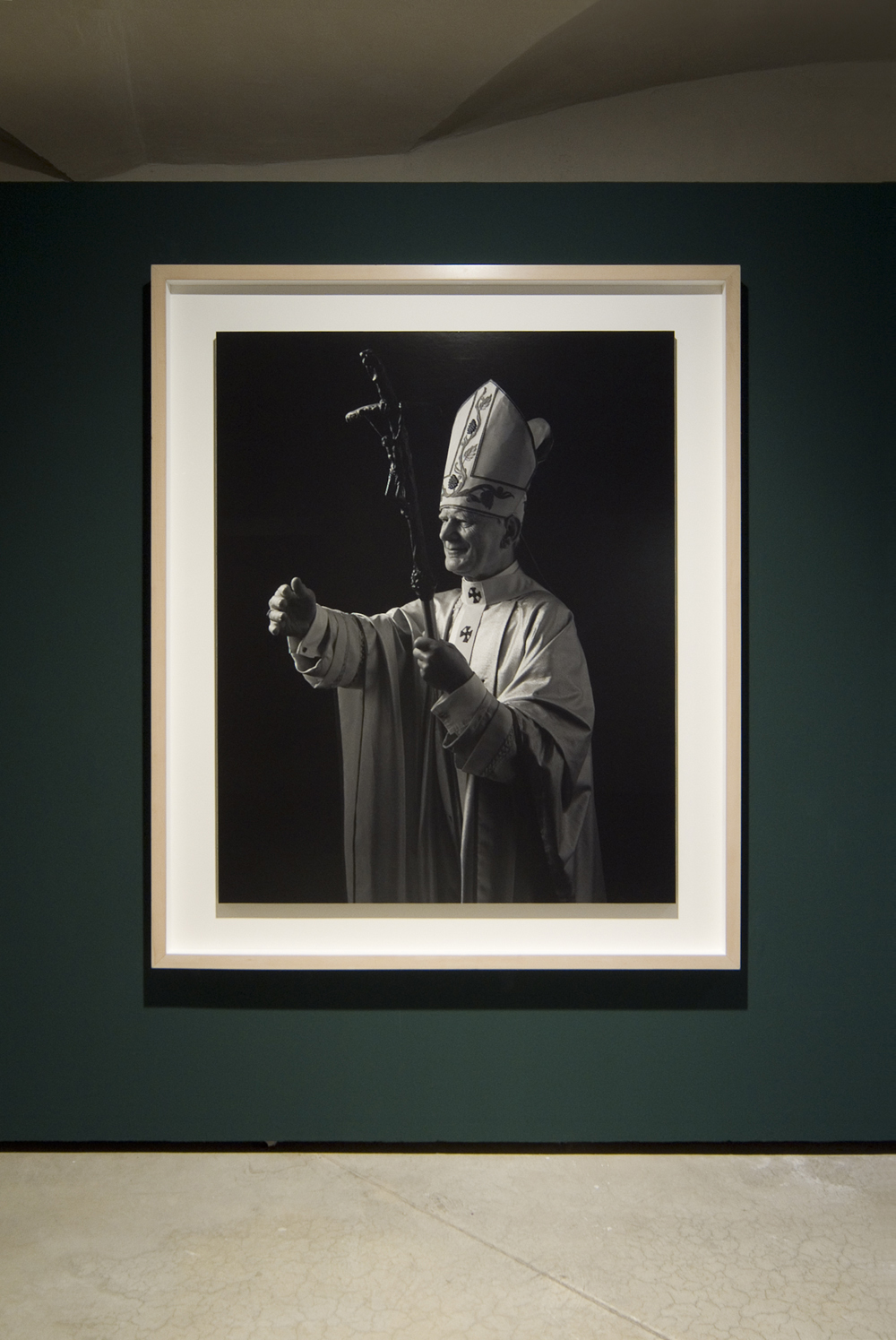
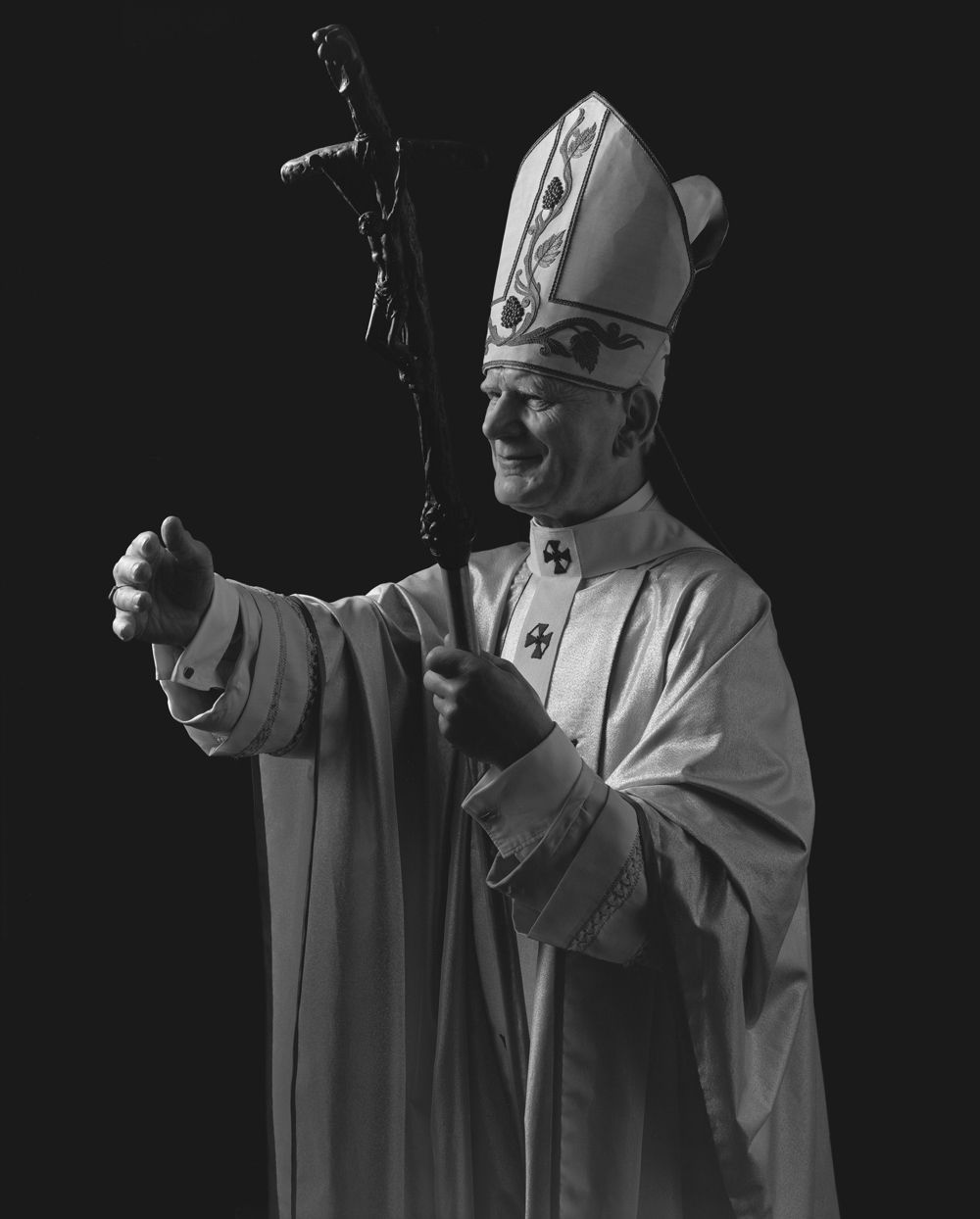
The Portraits series was first developed in 1999, starting from a portrait of King Henry VIII of England inspired by the work of Dutch painter Hans Holbein. Sugimoto’s self-professed aim was to become “the first sixteenth-century photographer.” The series then continued with different subjects, including famous contemporary figures who have entered the collective imagination, such as the Cuban lider máximo Fidel Castro and Pope John Paul II.

Sugimoto’s works are not portraits of the original subjects, but of wax sculptures reproducing them in the most hyper-realist way possible. The figures are illumined by a source of direct light and strongly stand out against a black background in an extremely theatrical way, imitating poses typical of the characters they represent, while removing them from all context and thus emphasising their nature as icons rather than human beings.

For these works Sugimoto has not made use of the 50 x 60 cm format that is typical of him. Yet, they stand in continuity with the artist’s unique reflection upon the nature of photography and its relation to history and time. Here he embarks upon a reflection on portraiture and the process whereby an image is translated using different media, emphasising the problematic “realistic effect” of photographic reproduction.

An attentive gaze will notice small disproportions in the various parts of the subjects’ bodies or strange lighting effects due to the way in which light reflects on wax as opposed to real skin. Still, these pictures invite us to look at them as we would other photographs. Thinking, that is, about the genuine subjects they portray, something that paradoxically makes them “more real” than the wax statues that constitute their actual subjects. Different levels of reproduction are at play here: from the original subject to an initial photograph that served as a model for the wax statue that Sugimoto then portrayed in his photographic work. Our gaze will strongly be drawn towards the extraordinary elegance and aesthetic refinement of these works, which reveal the uncommon technical abilities of Sugimoto, marked as they are by the endless range of white, grey and black shades typical of him. Despite all this, his works remain emotionally cold: they consist in conceptual reflections upon the very notion of portrait and its political and cultural value as an icon of the characters it represents, and explicitly forgo any realist view of the individuals they take as their subjects. The artist seems to be causing all sense of natural time to collapse – in such a way as to stress that of absolute time. He attains a balance between life and death that is characteristic of photography but also of portraiture, whereby what counts is not the reality or the life of a subject, but the latter’s value as an image in itself, beyond time and everyday life.

Hiroshi Sugimoto’s photographs convey a conceptual attitude aimed at stripping images down to their bare essence, thus emphasising the primacy of the idea over the object portrayed. His famous marine landscapes and dioramas express a view of photography as a sort of time machine – a way of preserving or constructing memories and emotions.


Hiroshi Sugimoto (Japan, b. 1948) Pope John Paul II 1999 (installation view)


Hiroshi Sugimoto (Japan, b. 1948)
Pope John Paul II (installation view)
1999
Black and white photograph
Courtesy Rosa e Gilberto Sandretto
© Hiroshi Sugimoto


Hiroshi Sugimoto (Japan, b. 1948) 'Pope John Paul II' 1999 from the exhibition 'Portraits and Power: People, Politics and Structures' at Centro di Cultura Contemporanea Strozzina - Fondazione Palazzo Strozzi, Florence


Hiroshi Sugimoto (Japan, b. 1948)
Pope John Paul II
1999
Black and white photograph
Courtesy Rosa e Gilberto Sandretto
© Hiroshi Sugimoto


Hiroshi Sugimoto (Japan, b. 1948) 'Fidel Castro' 1999 (installation view)


Hiroshi Sugimoto (Japan, b. 1948)
Fidel Castro (installation view)
1999
Black and white photograph
Courtesy Sonnabend Gallery, New York
© Hiroshi Sugimoto


Hiroshi Sugimoto (Japan, b. 1948) 'Fidel Castro' 1999 from the exhibition 'Portraits and Power: People, Politics and Structures' at Centro di Cultura Contemporanea Strozzina - Fondazione Palazzo Strozzi, Florence


Hiroshi Sugimoto (Japan, b. 1948)
Fidel Castro
1999
Black and white photograph
Courtesy Sonnabend Gallery, New York
© Hiroshi Sugimoto


Centre for Contemporary Culture Strozzina
Palazzo Strozzi, Piazza Strozzi, Firenze

Strozinna website

LIKE ART BLART ON FACEBOOK

Back to top