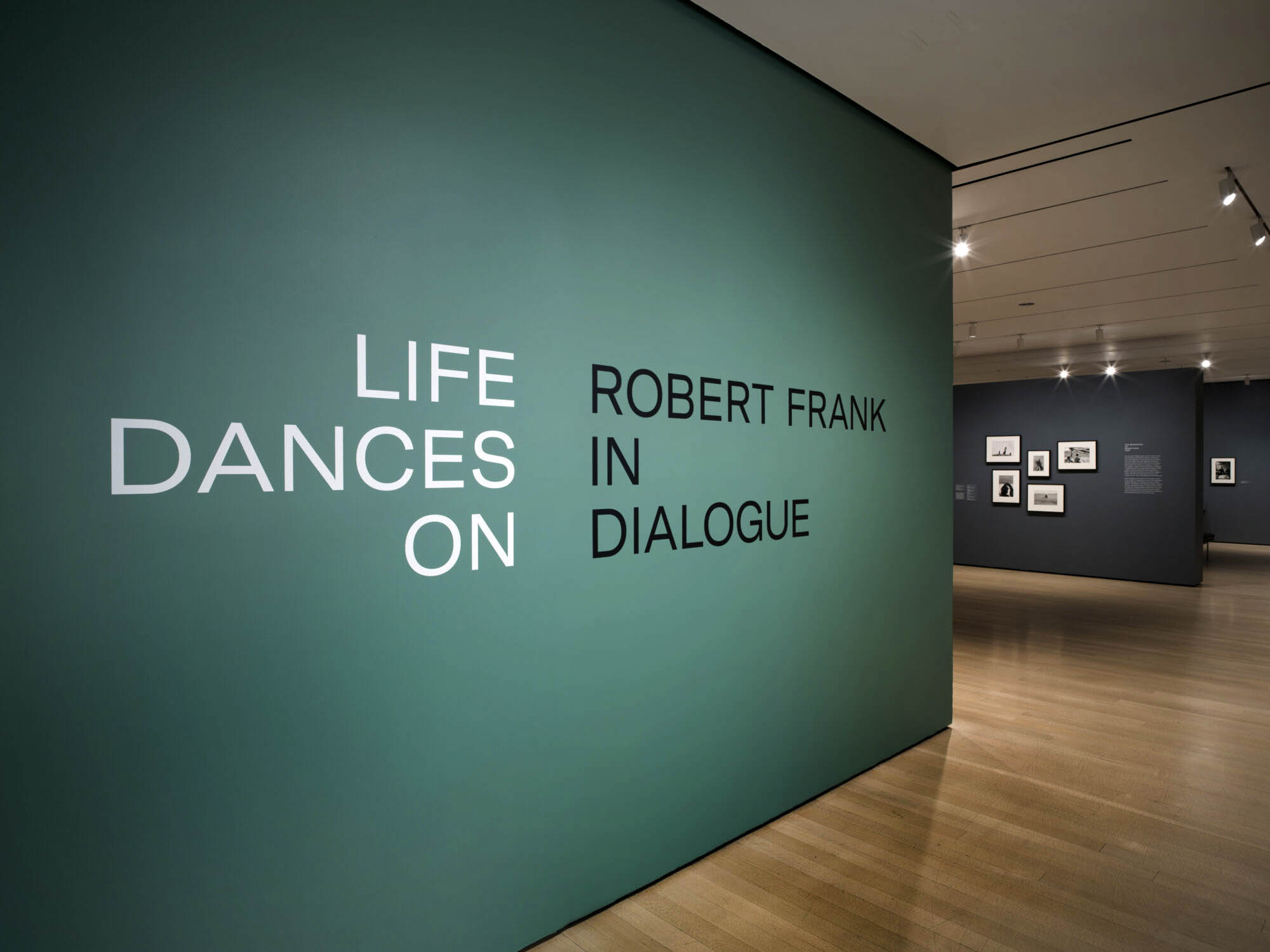
Exhibition: ‘Life Dances On: Robert Frank in Dialogue’ at the Museum of Modern Art (MoMA), New York

Exhibition dates: 15th September, 2024 – 11th January, 2025

Curator: Organised by Lucy Gallun, Curator, with Kaitlin Booher, Newhall Fellow, and Casey Li, 12 Month Intern, Department of Photography.


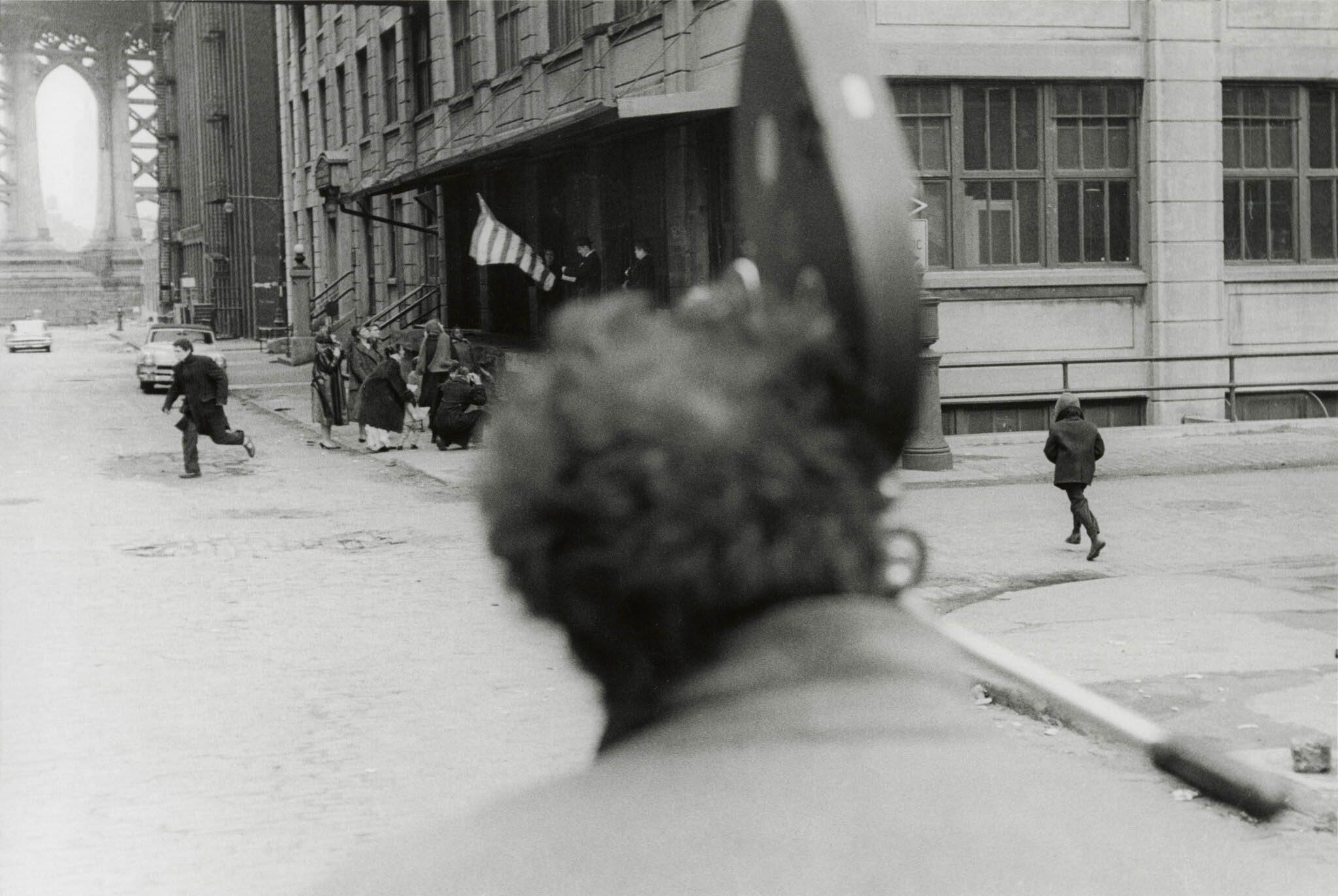
Robert Frank (Swiss-American, 1924-2019) 'From the Bus, New York' 1958 from the exhibition 'Life Dances On: Robert Frank in Dialogue' at the Museum of Modern Art (MoMA), New York


Robert Frank (Swiss-American, 1924-2019)
From the Bus, New York
1958
Gelatin silver print
13 15/16 × 13 1/4″ (35.4 × 33.7cm)
National Gallery of Art, Washington, DC.
Robert Frank Collection, Robert B. Menschel Fund
© 2024 The June Leaf and Robert Frank Foundation


The first posting on a new year…

In front of me I have the sea

While the photographs from his groundbreaking photobook The Americans (1958) have defined the artistic reputation and legacy of Swiss-American photographer Robert Frank and his influence on a later generation of documentary photographers, I am so grateful to the man for not retreating into his shell as so many artists do, finding a style which makes them famous and makes them money and then repeating the formula over and over again ad nauseam.

Frank was ever creative, always exploring new ways of filmic and photographic expression. I admire that. While “his perpetual experimentation and collaborations across various mediums” did not produce another seminal body of work – indeed Arthur Lubow has argued that if the aim of this exhibition is to reposition Frank’s reputation through showcasing six decades of later work the problem being that his genius as a photographer did not carry over into filmmaking1 – no matter!

Frank was not afraid to put himself out there as an artist, challenging himself to see differently, to develop further as an artist and as a human being. As he said, “I think of myself, standing in a world that is never standing still … I’m still in there fighting, alive because I believe in what I’m trying to do now.”

Critical to his new way of seeing after The Americans was Frank’s move beyond a single, static image into combining multiple negatives, images, text together. Recently I again delved through my copy of Frank’s 1972 photobook The Lines of My Hand, which “demonstrates Frank’s particular interest in the visual effects and meaning produced from combinations of images, either within a single photograph or formed by printing multiple negatives together to create a dense montage.” (Text from MoMA)

What’s so striking about the photobook is its tightly packed nature, its pages filled with ideas and images. Frank was using his intuition to construct a new language of photography: multiple, diverse and overlaid perspectives complicit with narratives not external to the self but an internal vision of a felt reality, visions that exist somewhere between documentary and fiction.

Here is abstraction and isolation, loneliness in the dream… the white line eternally disappearing into the distance in 34th Street (1949); tickertape floating in the air in Wall Street (1951); stiff men in bowler hats in City of London (1951) and the lines of the hand in Untitled [The Lines of the Hand] (Paris, 1949-1951, below) with the declaration ‘Sciences and Mysteries’. Sciences and mysteries, realities and abstractions, the known and unknown. The Lines of My Hand are the song lines of Frank’s life, the photographs breathing into existence his innermost thoughts and truths. Who am I? What do I believe in?

“Outside it is snowing, no waves at all. The beach is white, the fence posts are grey. I am looking back into a world gone forever. Thinking of a time that will never return. A book of photographs is looking at me. Twenty-five years of looking for the right road. Post cards from everywhere. If there are any answers I have lost them.” (Opening words from The Lines of My Hand)

“Frank felt trapped by the expectations and pigeonholing that the lionization of “The Americans” induced, and he recoiled in horror at the prospect of repeating himself. Beyond that, he gave various explanations over the years for why he abandoned the 35 mm camera that he brandished like a sorcerer’s wand. He explained that he had lost faith in the capacity of a single photograph to convey the truth. And his search had turned inward. “The truth is the way to reveal something about your life, your thoughts, where you stand,” he said.”2 This turning inwards was facilitated by his move in 1970 with his wife June Leaf to the rural town of Mabou on Cape Breton Island in Nova Scotia, Canada: “what I wanted to photograph was not really what was in front of my eyes but what was inside.”

Personally I don’t think it matters that the later photographs are not as memorable as those in The Americans. What matters is that Frank believed in what he was doing: it was his truth telling. “I am no longer the solitary observer turning away after the click of the shutter,” Frank declared. “Instead I’m trying to recapture what I saw, what I heard and what I feel. What I know!”

Finally, in the film Life Dances On (1980), his wife looks at the camera and asks Frank, “Why do you make these pictures?” In an introduction to the film’s screening, he answered: “Because I am alive.”

Because in front of him he had the sea…

Dr Marcus Bunyan


1/ Arthur Lubow. “‘The Americans’ Made the Photographer Robert Frank a Star. What Came Next?” on The New York Times website Sept. 12, 2024 [Online] Cited 15/12/2024

2/ Ibid.,


Many thanks to MoMA for allowing me to publish the photographs in the posting. Please click on the photographs for a larger version of the image.


Robert Frank (Swiss-American, 1924-2019) 'Untitled [The Lines of the Hand]' Paris, 1949-1951


Robert Frank (Swiss-American, 1924-2019)
Untitled [The Lines of the Hand]
Paris, 1949-1951
Gelatin silver print
© 2024 The June Leaf and Robert Frank Foundation

This photograph as far as I know is not in the exhibition. It is used under fair use conditions for the purposes of education and research.
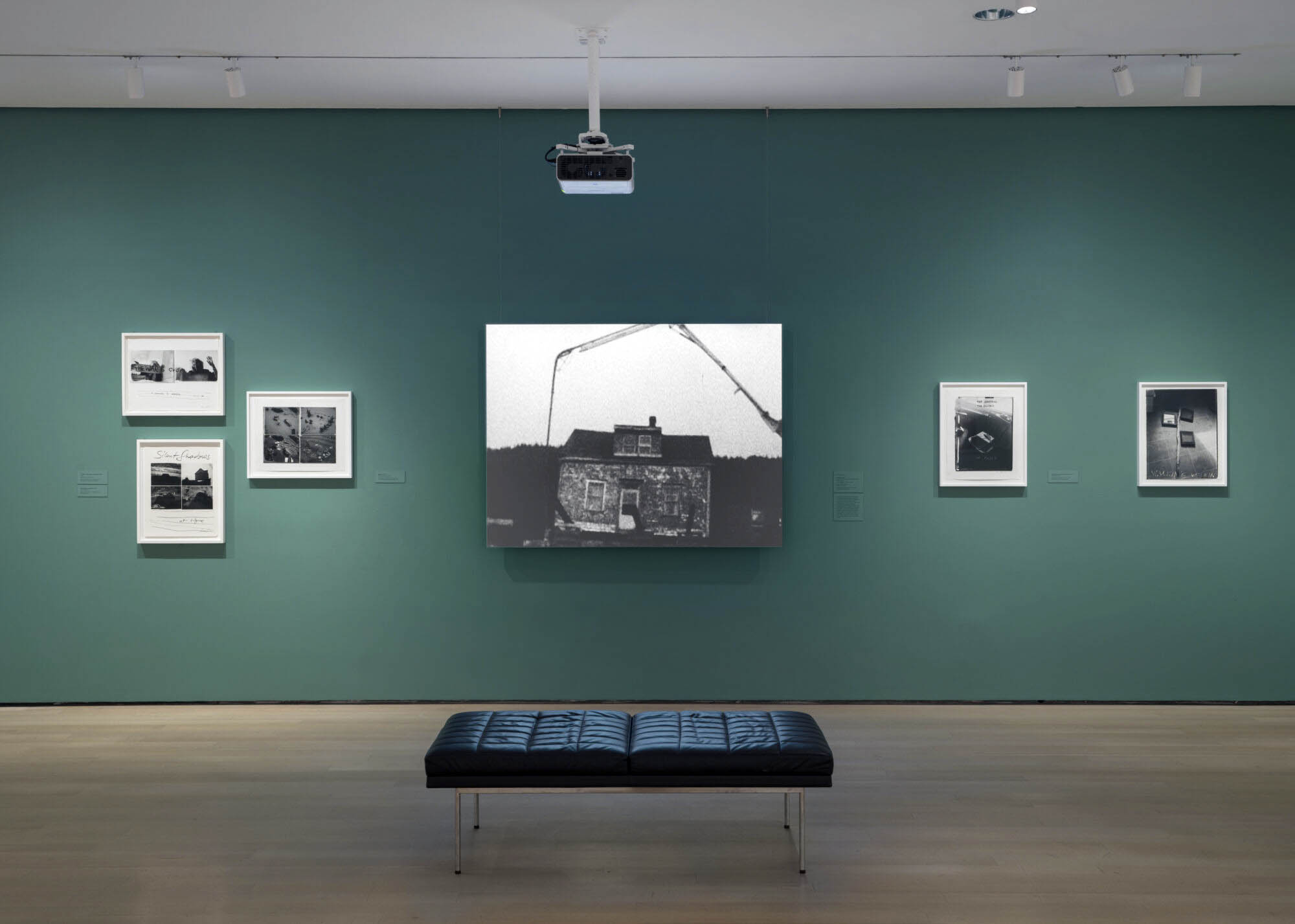
 

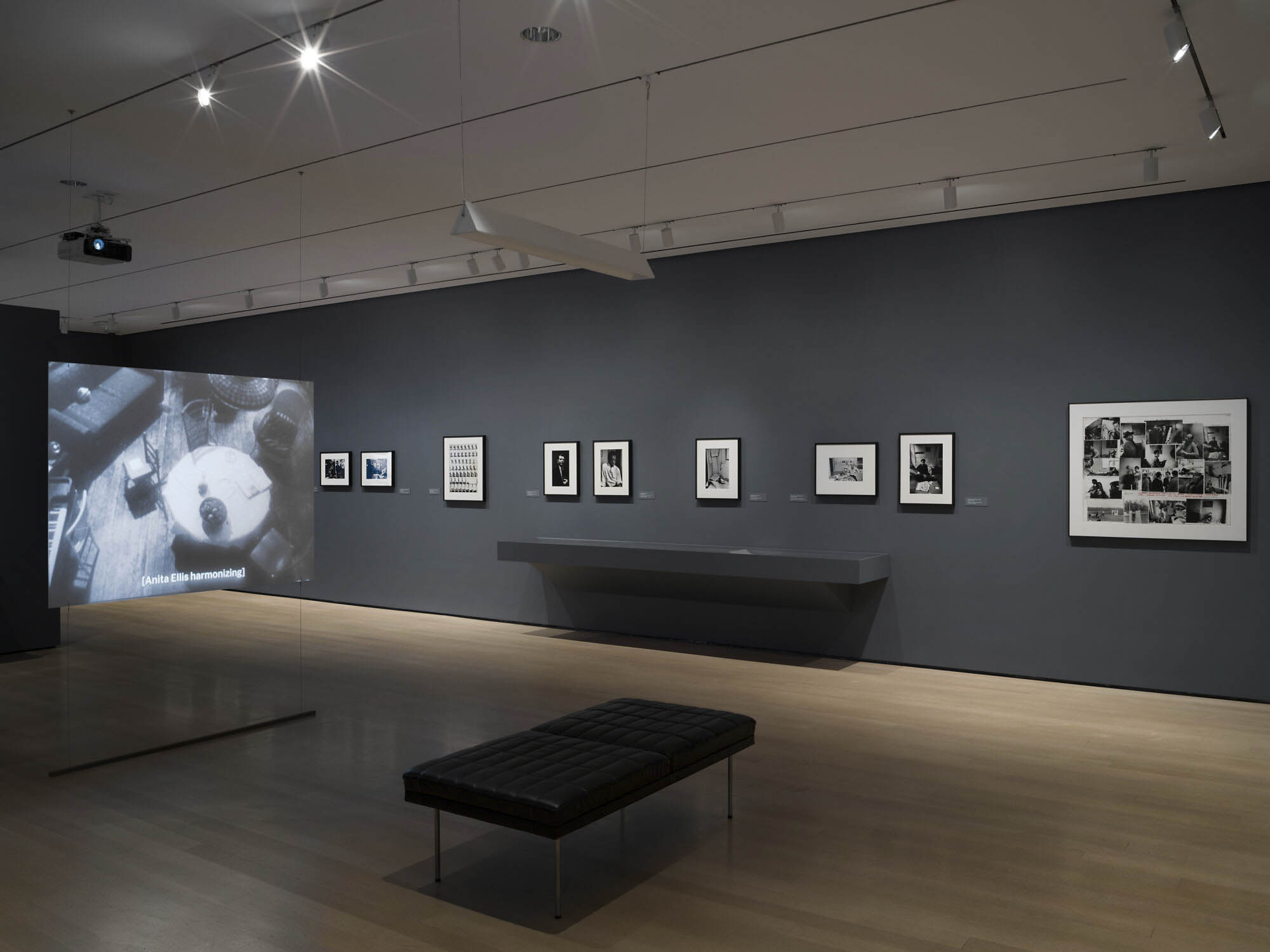
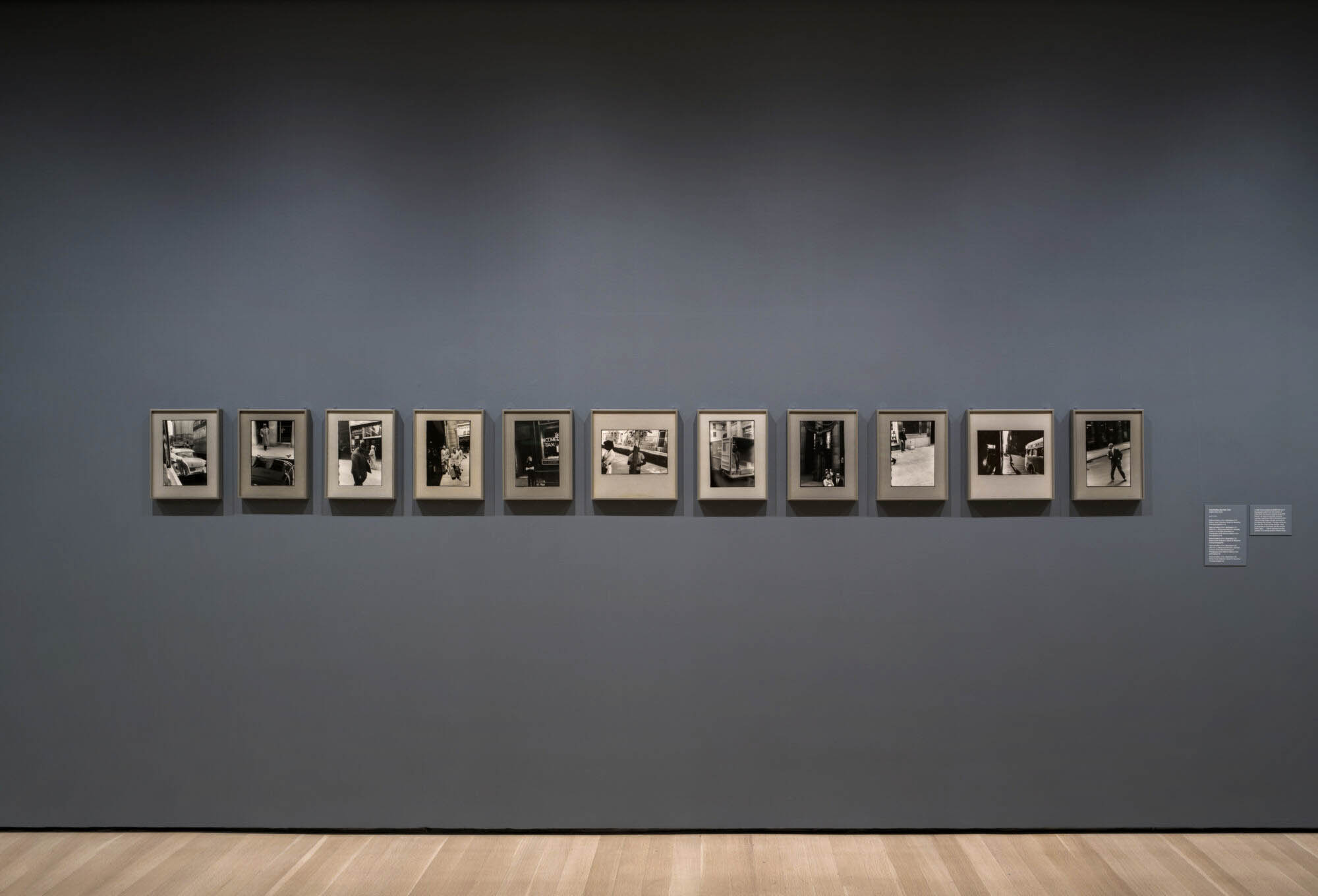
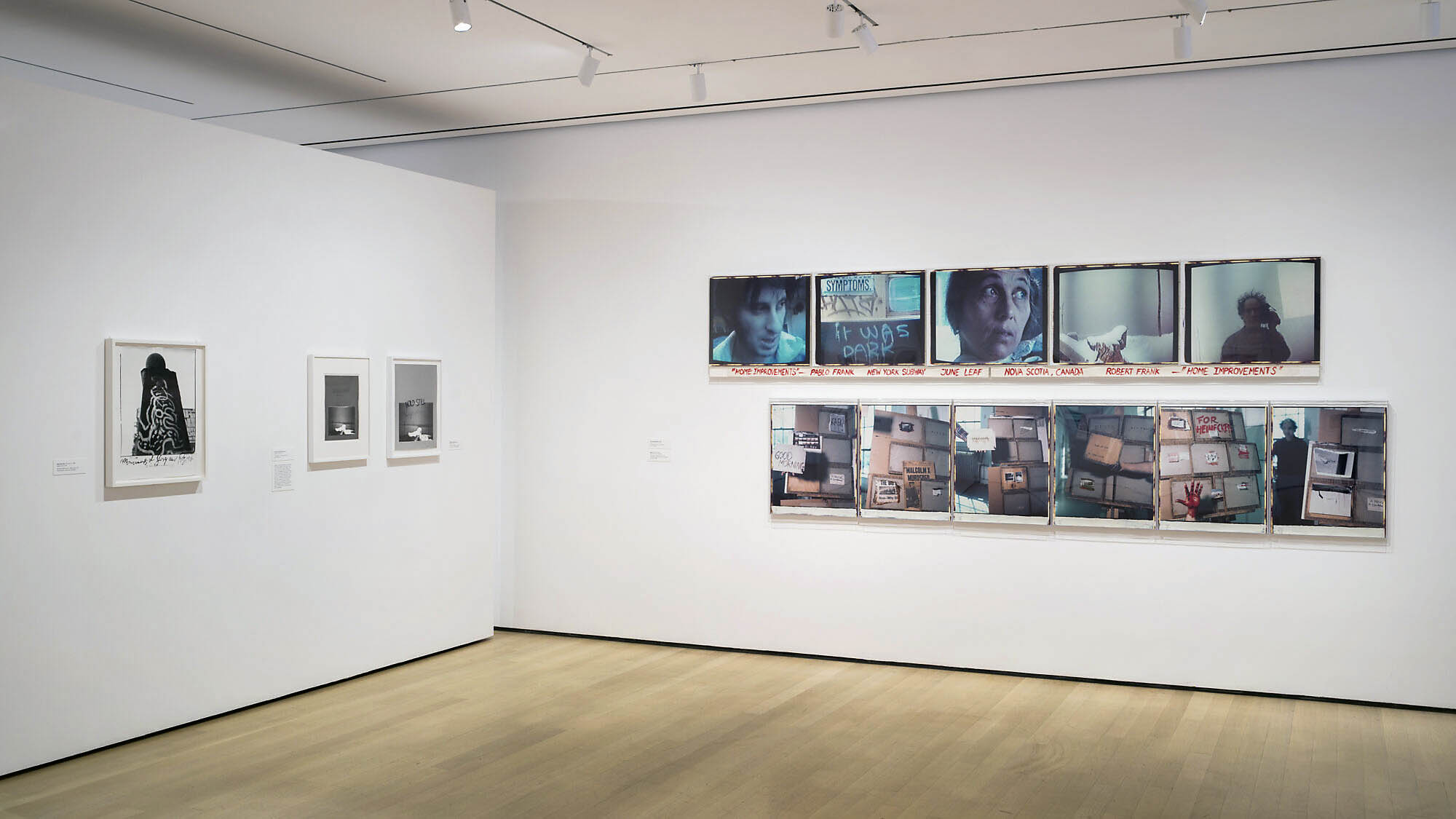
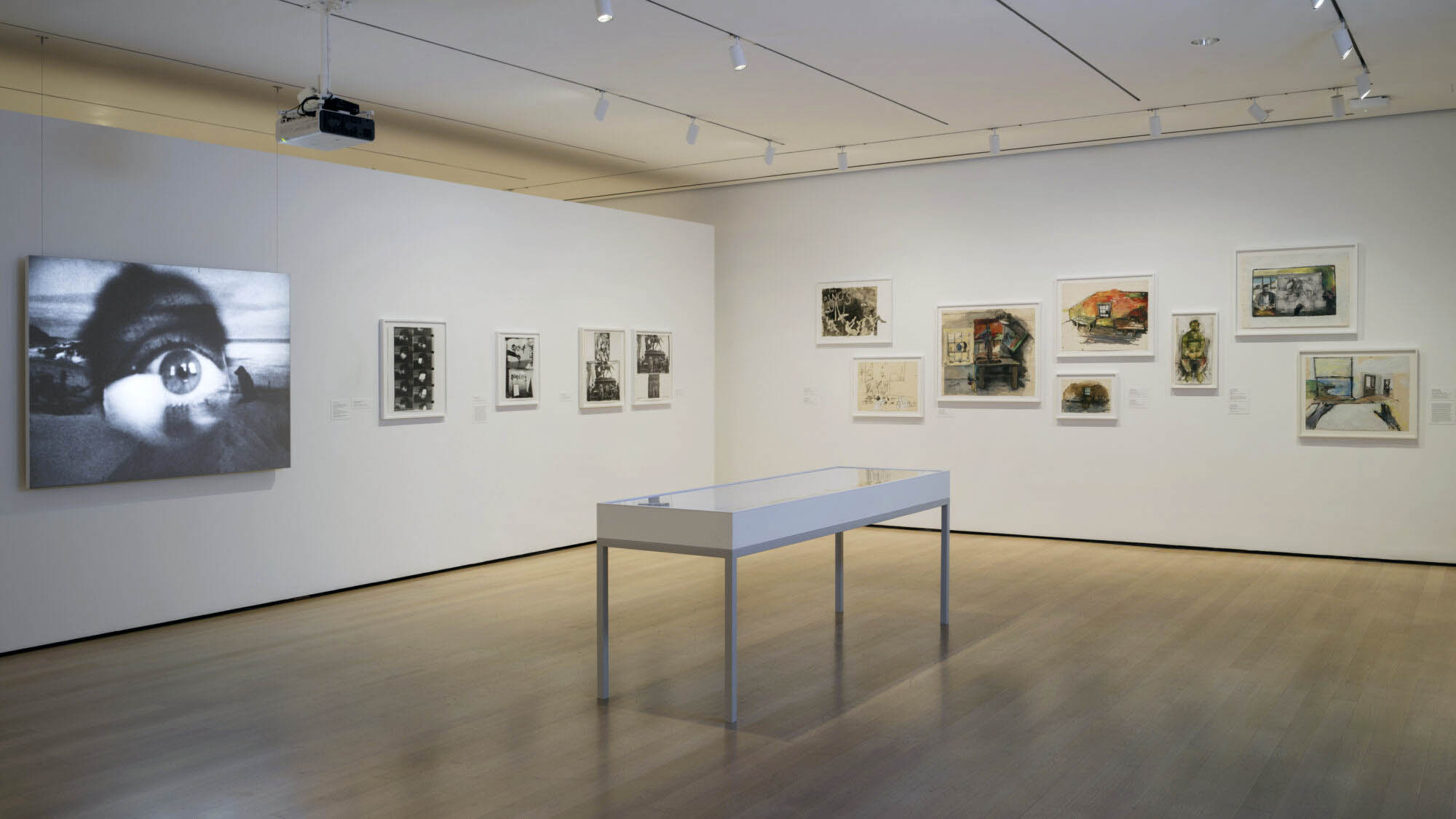
Installation view of the exhibition 'Life Dances On: Robert Frank in Dialogue' at the Museum of Modern Art (MoMA), New York

Installation view of the exhibition 'Life Dances On: Robert Frank in Dialogue' at the Museum of Modern Art (MoMA), New York

Installation view of the exhibition 'Life Dances On: Robert Frank in Dialogue' at the Museum of Modern Art (MoMA), New York

Installation view of the exhibition 'Life Dances On: Robert Frank in Dialogue' at the Museum of Modern Art (MoMA), New York

Installation view of the exhibition 'Life Dances On: Robert Frank in Dialogue' at the Museum of Modern Art (MoMA), New York

Installation view of the exhibition 'Life Dances On: Robert Frank in Dialogue' at the Museum of Modern Art (MoMA), New York


Installation views, Life Dances On: Robert Frank in Dialogue, on view at The Museum of Modern Art, New York, from September 15, 2024, through January 11, 2025
Photos: Jonathan Dorado
© 2024 The Museum of Modern Art, New York


The Museum of Modern Art announces Life Dances On: Robert Frank in Dialogue, an exhibition that will provide new insights into the interdisciplinary and lesser-known aspects of photographer and filmmaker Robert Frank’s expansive career. The exhibition will delve into the six decades that followed Frank’s landmark photobook The Americans (1958) until his death in 2019, highlighting his perpetual experimentation and collaborations across various mediums. Coinciding with the centennial of his birth and taking its name from the artist’s 1980 film, Life Dances On will explore Frank’s artistic and personal dialogues with other artists and with his communities. The exhibition will feature more than 200 objects, including photographs, films, books, and archival materials, drawn from MoMA’s extensive collection alongside significant loans.

Text from the MoMA website
 

Unknown photographer. 'Robert Frank, shown from behind, making "Pull My Daisy"' 1959


Unknown photographer
Robert Frank, shown from behind, making “Pull My Daisy”
1959
John Cohen/John Cohen Irrevocable Trust, via The Museum of Modern Art, NY


Robert Frank (Swiss-American, 1924-2019) 'Pull My Daisy' 1959


Robert Frank (Swiss-American, 1924-2019)
Pull My Daisy
1959
Robert Frank/The June Leaf and Robert Frank Foundation, via the Museum of Modern Art


Pull My Daisy incorporated improvisation by actors, artists and poets.


“I think of myself, standing in a world that is never standing still,” the artist Robert Frank once wrote. “I’m still in there fighting, alive because I believe in what I’m trying to do now.” Life Dances On: Robert Frank in Dialogue – the artist’s first solo exhibition at MoMA – provides a new perspective on his expansive body of work by exploring the six vibrant decades of Frank’s career following the 1958 publication of his landmark photobook, The Americans.

Coinciding with the centennial of Frank’s birth, the exhibition will explore his restless experimentation across mediums including photography, film, and books, as well as his dialogues with other artists and his communities. It will include some 200 works made over 60 years until the artist’s death in 2019, many drawn from MoMA’s extensive collection, as well as materials that have never before been exhibited.

The exhibition borrows its title from Frank’s poignant 1980 film, in which the artist reflects on the individuals who have shaped his outlook. Like much of his work, the film is set in New York City and Cape Breton, Nova Scotia, where he and his wife, the artist June Leaf, moved in 1970. In the film, Leaf looks at the camera and asks Frank, “Why do you make these pictures?” In an introduction to the film’s screening, he answered: “Because I am alive.”

Text from the MoMA website


Robert Frank (Swiss-American, 1924-2019) 'Jack Kerouac' 1959


Robert Frank (Swiss-American, 1924-2019)
Jack Kerouac
1959
Gelatin silver print
10 7/8 x 8 5/16 inches (27.7 x 21.1cm)
National Gallery of Art, Washington, DC.
Robert Frank Collection, Gift of Robert Frank
© 2024 The June Leaf and Robert Frank Foundation
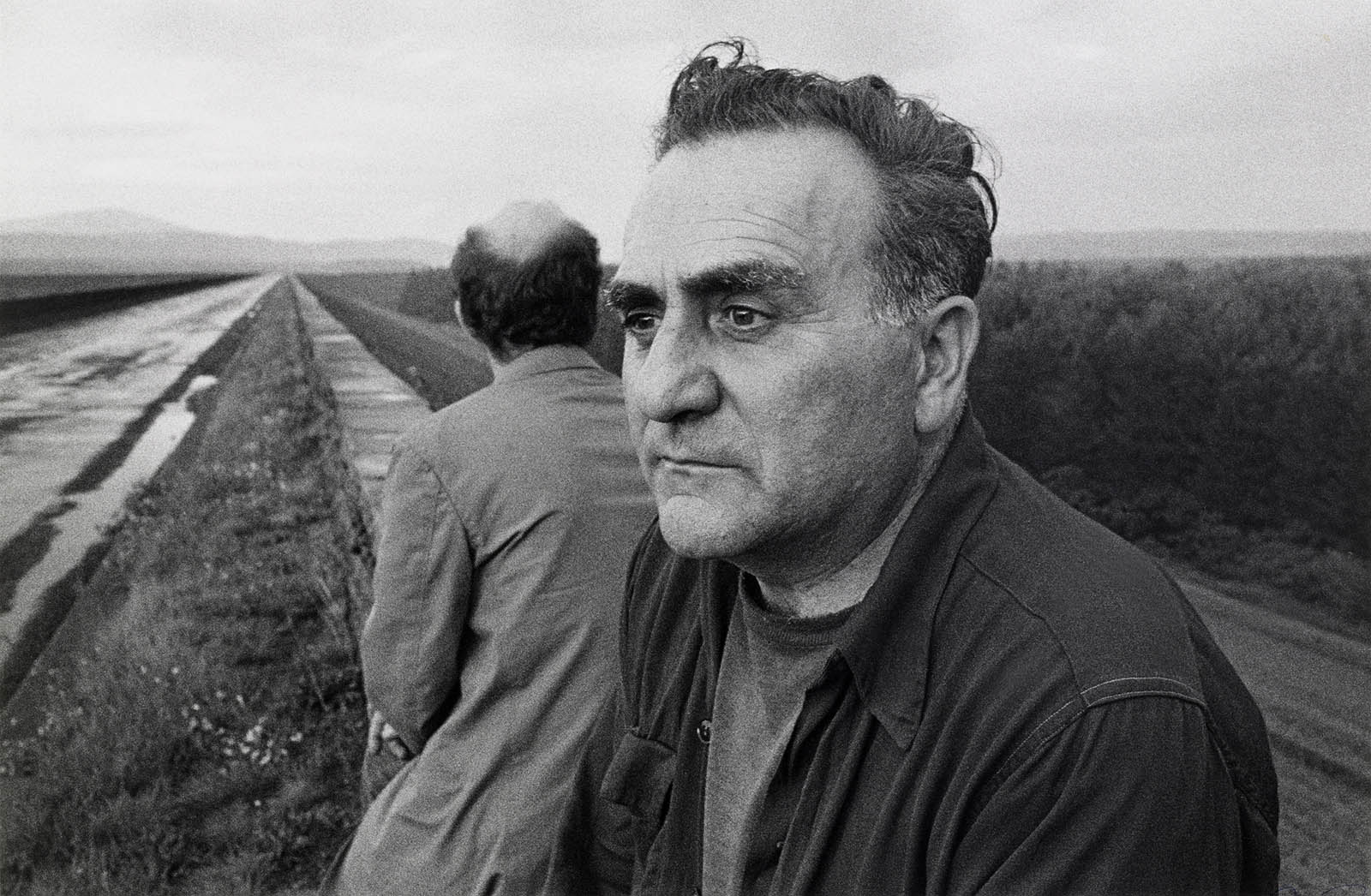
 

Robert Frank (Swiss-American, 1924-2019) 'Marvin Israel and Raoul Hague, Woodstock, New York' 1962 from the exhibition 'Life Dances On: Robert Frank in Dialogue' at the Museum of Modern Art (MoMA), New York


Robert Frank (Swiss-American, 1924-2019)
Marvin Israel and Raoul Hague, Woodstock, New York
1962
Gelatin silver print
11 1/8 × 16 7/8 inches (28.3 × 42.8cm)
The Museum of Modern Art, New York
Gift of the artist
© 2024 The June Leaf and Robert Frank Foundation
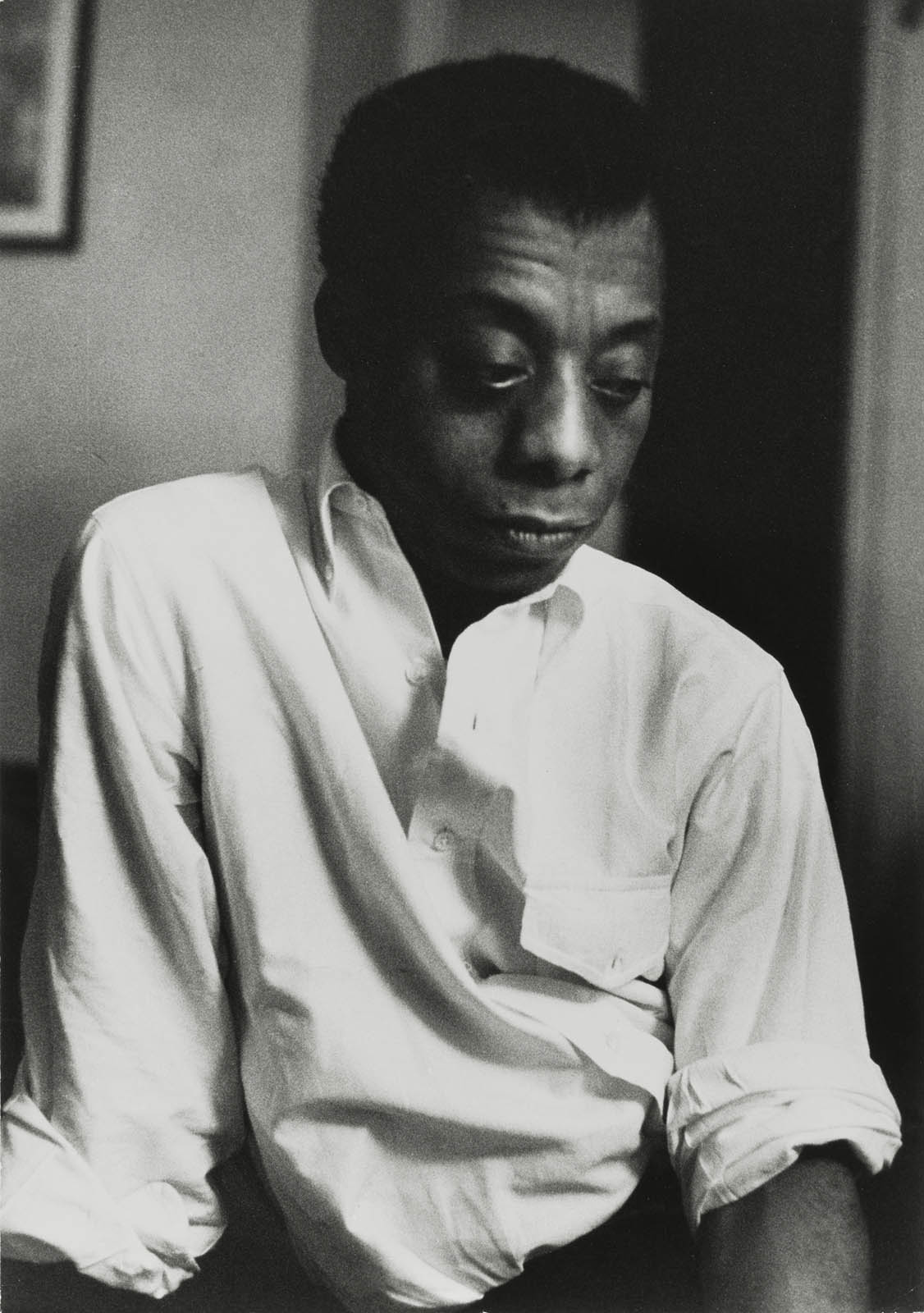
 

Robert Frank (Swiss-American, 1924-2019) 'James Baldwin' c. 1963


Robert Frank (Swiss-American, 1924-2019)
James Baldwin
c. 1963
Gelatin silver print
13 15/16 × 9 13/16 inches (35.4 × 24.9cm)
The Museum of Modern Art, New York
Gift of the artist
© 2024 The June Leaf and Robert Frank Foundation


The Museum of Modern Art presents Life Dances On: Robert Frank in Dialogue, an exhibition that provides new insights into the interdisciplinary and lesser-known aspects of photographer and filmmaker Robert Frank’s expansive career. On view from September 15, 2024, to January 11, 2025, the exhibition delves into the six decades that followed Frank’s landmark photobook The Americans (1958) until his death in 2019, highlighting his perpetual experimentation and collaborations across various mediums. Coinciding with the centennial of the artist’s birth, and taking its name from his 1980 film, Life Dances On explores Frank’s artistic and personal dialogues with other artists and with his communities. The exhibition features more than 250 objects, including photographs, films, books, and archival materials, drawn from MoMA’s extensive collection alongside significant loans. Life Dances On: Robert Frank in Dialogue is organised by Lucy Gallun, Curator, with Kaitlin Booher, Newhall Fellow, and Casey Li, 12 Month Intern, Department of Photography.

“This exhibition offers visitors a fresh perspective on this beloved and influential artist,” said Gallun. “The enormous impact of Frank’s book The Americans meant that he is often remembered as a solo photographer on a road trip, a Swiss artist making pictures of an America that he traversed as an outsider. And yet, in the six decades that followed, Frank continually forged new paths in his work, often in direct artistic conversation with others, and these contributions warrant closer attention. The pictures, films, and books he made in these years are evidence of Frank’s ceaseless creative exploration and observation of life, at once searing and tender.”

Organised loosely chronologically, Life Dances On focuses on the theme of dialogue in Frank’s work and reflects on the significance of individuals who shaped his outlook. Frank’s own words are present throughout the exhibition – in the texts he scrawled directly onto his photographic negatives, in the spoken narrative accompanying his films, and in quotes woven into the exhibition catalogue published by MoMA in conjunction with the exhibition. Also revealed throughout the exhibition is Frank’s innovation across multiple mediums, from his first forays into filmmaking alongside other Beat Generation artists, with films such as Pull My Daisy (1959), to the artist’s books he called “visual diaries,” which he produced almost yearly over the last decade of his life.

By focusing on dialogue and experimentation, the exhibition explores such enduring subjects as artistic inspiration, family, partnership, loss, and memory through the lens of Frank’s own personal traumas and life experiences. Among the works presented in the exhibition is a selection of photographs drawn from Frank’s footage for his 1980 film Life Dances On. These works reflect on the significance of individuals who shaped Frank’s own outlook – in this case, his daughter Andrea and his friend and film collaborator Danny Seymour. Like much of his work, the film finds its setting in Frank’s own communities in New York City and in Cape Breton, Nova Scotia, where he and his wife, the artist June Leaf, moved in 1970. An abundance of material was loaned to the exhibition by the June Leaf and Robert Frank Foundation, including works from the artist’s archives that are shown publicly for the first time, as well as personal artefacts, correspondence, and book maquettes. …

MoMA has been exhibiting Frank’s work since 1950, early in his career. In 1962, the Museum featured Frank’s work in a two-person exhibition alongside photographer Harry Callahan. Since then, the Museum has regularly collected and exhibited his work, and today the Museum’s collection includes over 200 of Frank’s photographs. That collection has been built through important gifts from Robert and Gayle Greenhill in 2013, and more recently, a promised gift to the Museum from Michael Jesselson, comprising a remarkable group of works, many of which are presented at MoMA for the first time in this exhibition. In 2015, the artist made an extraordinary gift of his complete film and video works, spanning the entirety of his career in filmmaking. MoMA’s Department of Film has since been engaged in a multiyear restoration project of these materials. Building upon this significant history with the Museum, Life Dances On: Robert Frank in Dialogue is the first solo exhibition of Robert Frank’s work at MoMA.

Publication

The accompanying publication, edited by Gallun, features photographs, films, books, and archival materials, layered with quotes from Frank on his influences and process. Three scholarly essays, excerpts from previously unpublished video footage, and a rich visual chronology together explore Frank’s ceaseless creative exploration and observation of life. 192 pages, 150 illustrations. Hardcover, $60. ISBN: 978-1-63345-164-3. Published by The Museum of Modern Art, New York

Press release from MoMA


Robert Frank (Swiss-American, 1924-2019) 'Beauty Contest, Chinatown' c. 1968


Robert Frank (Swiss-American, 1924-2019)
Beauty Contest, Chinatown
c. 1968
Robert Frank/The June Leaf and Robert Frank Foundation, via The Museum of Modern Art, NY


Frank collaged multiple prints of news photographers to convey a sense of the frenzy.
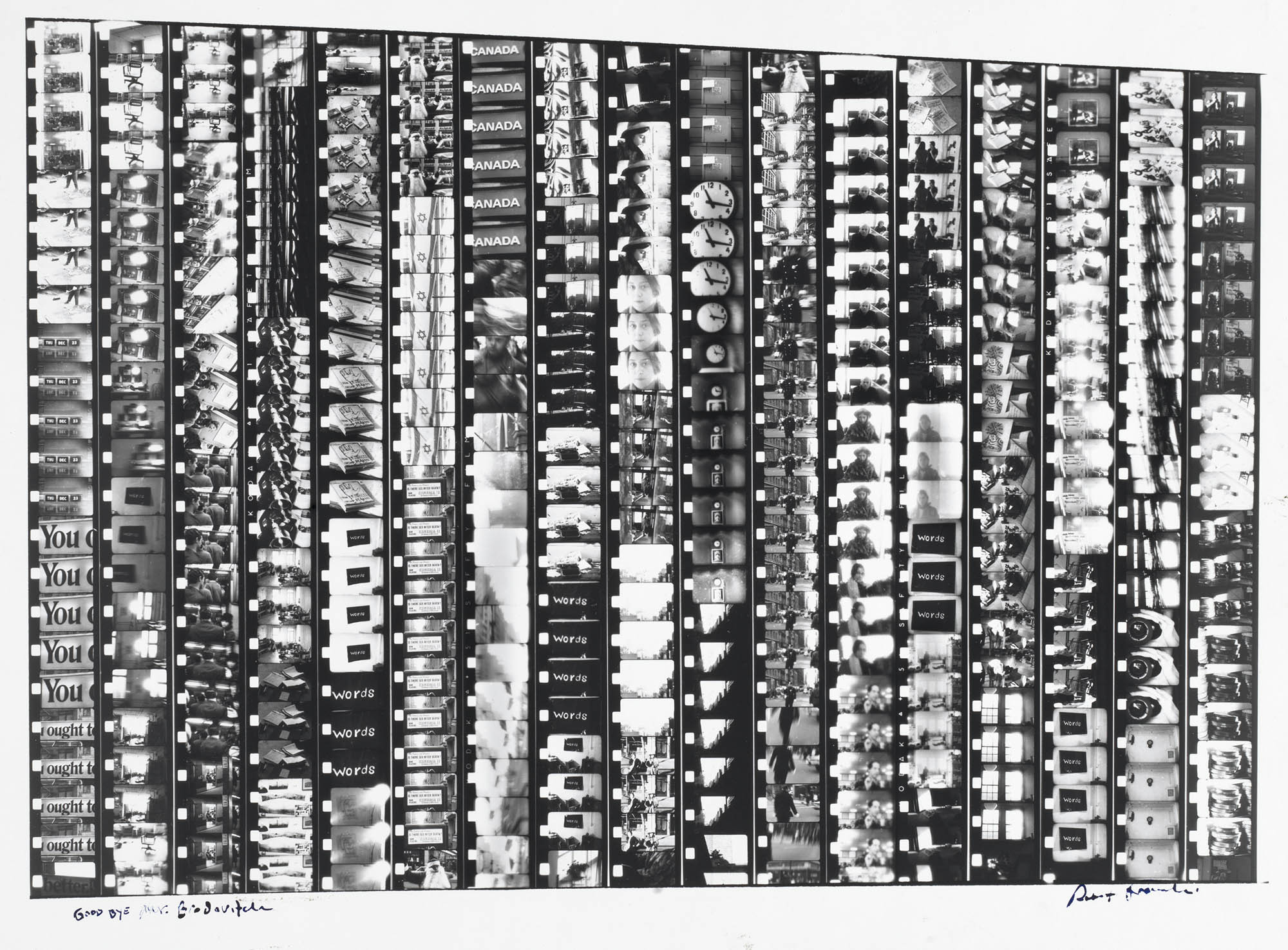
 

Robert Frank (Swiss-American, 1924-2019) 'Goodbye Mr. Brodovitch - I Am Leaving New York' 1971


Robert Frank (Swiss-American, 1924-2019)
Goodbye Mr. Brodovitch – I Am Leaving New York
1971
Gelatin silver print
15 7/8 × 19 15/16 inches (40.3 × 50.6cm)
The Museum of Modern Art, New York
Promised gift of Michael Jesselson
© 2024 The June Leaf and Robert Frank Foundation
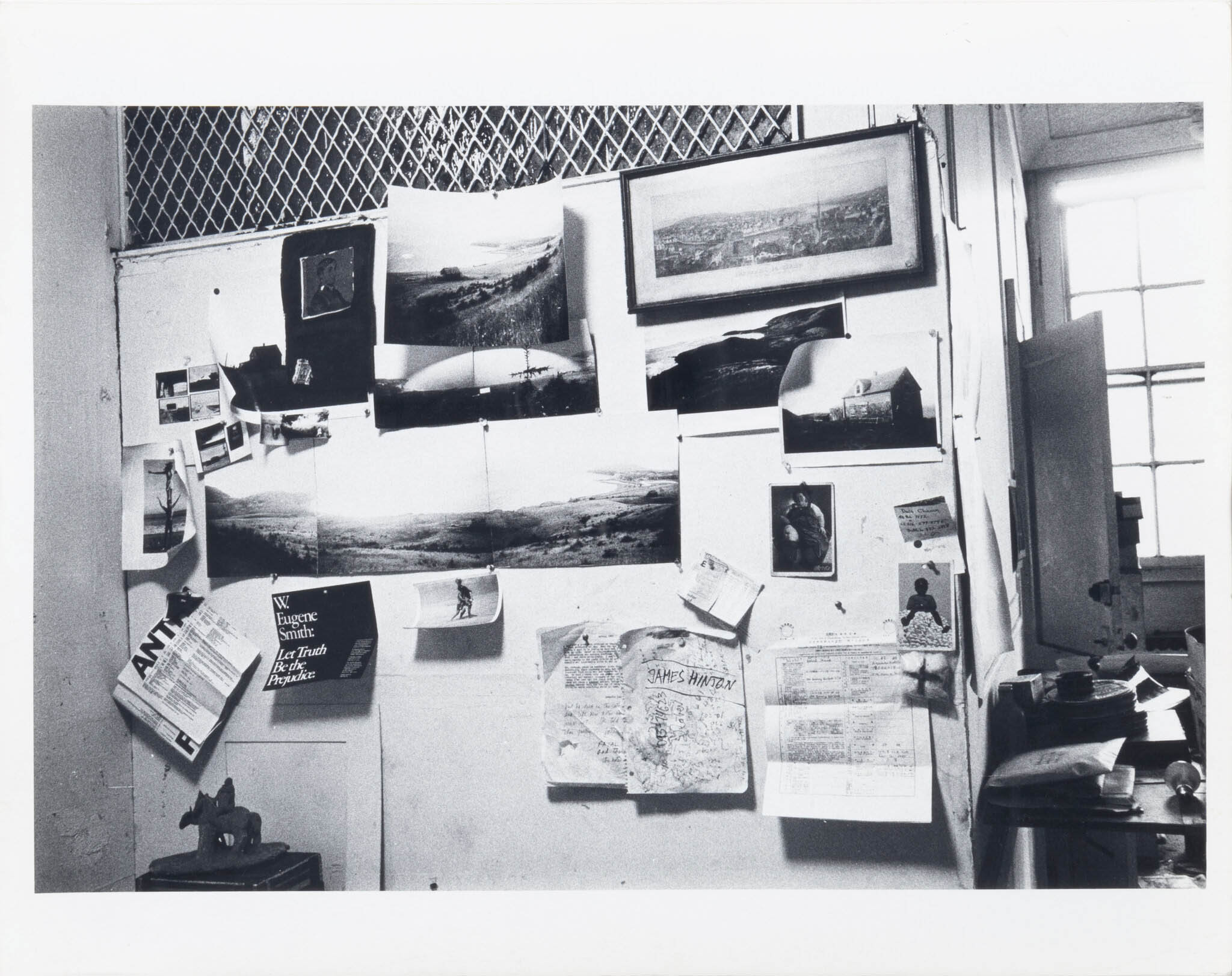
 

Robert Frank (Swiss-American, 1924-2019) 'Untitled (bulletin board)' 1971


Robert Frank (Swiss-American, 1924-2019)
Untitled (bulletin board)
1971
Gelatin silver print
8 7/8 × 13 1/8 inches (22.6 × 33.4cm)
The June Leaf and Robert Frank Foundation
© 2024 The June Leaf and Robert Frank Foundation


When Frank was moving to Nova Scotia, Frank photographed a bulletin board in his East Village loft, making one picture out of many.


The Beginning of Something New

The summer of 1958 marked a shift in Frank’s work. He had already finalised the selection of pictures that would appear in his photobook The Americans. For a new series, Frank photographed passersby from the window of a New York bus as it traversed Fifth Avenue. The pictures – a sequence of frames that appear linked by his own movement – indicated a notable moment of change beyond a single, static image. In 1972 he reflected on their significance: “When I selected the pictures and put them together I knew and I felt that I had come to the end of a chapter. And in it was the beginning of something new.”

Frank was also on the lookout for cinematic scenes. On the night of Independence Day, he photographed revelers sleeping on the beach among the holiday detritus. The stillness of the nighttime images contrasts with the daylit beach scenes he captured of his family on Cape Cod, Massachusetts, where Frank also shot his first film that same summer. Although it would remain unfinished, the film anticipated the collaborative and experimental spirit of his work to come.

The Way These Painters Lived

From his window across a courtyard, Frank could watch the painter Willem de Kooning as he paced in his studio and contemplated his canvas. “I think that the people that influenced me most were the abstractionist painters I met; and what influenced me strongly was the way these painters lived,” Frank said of his time embedded in New York City’s vibrant arts community. “They were people who really believed in what they did. So it reinforced my belief that you could really follow your intuition. … You could photograph what you felt like.”

During these years, Frank continued to earn a living by photographing artists and writers for magazine print commissions, while also embracing the creative challenges of filmmaking alongside photography. His proximity to a diverse group of painters, sculptors, writers, and poets in the late 1950s would lead to boundary-pushing explorations like his first finished film, Pull My Daisy (1959), co-directed with artist Alfred Leslie, and filmed in Leslie’s own loft.

The Truth is Somewhere Between the Documentary and the Fictional

In 1968 Frank premiered his first feature-length film, Me and My Brother, at the Venice Film Festival. Built as a film within a film, the story prompts questions about participation in traditional society and culture, and about what experiences of life are understood as valid. “The truth is somewhere between the documentary and the fictional, and that is what I try to show,” Frank explained. “What is real one moment has become imaginary the next.”

In the late 1960s and early 1970s, as Frank turned his camera toward friends and neighbours, he also captured events of the time – manifested in political protests, music, poetry, and other aspects of social change and counterculture. During this period, Frank contributed cinematography to films directed by others and also spearheaded his own projects, which featured both recognisable figures and everyday folks on the street. In Me and My Brother, one character advises another: “Don’t make a movie about making a movie. MAKE IT. … Wouldn’t it be fantastic if you didn’t even have to have a piece of celluloid between you and what you saw?”

The Lines of My Hand

Frank’s photobook The Lines of My Hand offers a retrospective view of his career up until the date of its publication, in 1972. Pairing text and image, the book begins with early photographs made in Switzerland in the 1940s and ends with montages of film strips from Frank’s films of the 1950s and ’60s. Its title, perhaps a rumination on one’s past and one’s fate, is drawn from a sign pictured in a 1949 photograph of a Paris fortuneteller’s booth, on view here. This section of the exhibition also brings together a selection of older photographs that appear in the first Lustrum edition of the book.

The Lines of My Hand demonstrates Frank’s particular interest in the visual effects and meaning produced from combinations of images, either within a single photograph or formed by printing multiple negatives together to create a dense montage. In later editions, in keeping with his practice of revisiting and rearranging his images, Frank made changes to the photographs and graphic design and updated the book with his most recent works, using photocopies and notebooks to sequence the book’s new iterations.

In Front of Me I Have the Sea

In 1970 Frank and Leaf relocated from New York City to the rural town of Mabou on Cape Breton Island in Nova Scotia, Canada. The photographer Walker Evans, Frank’s friend and mentor, came to visit them soon after at their old fisherman’s cabin overlooking the sea. Evans’s photographs capture the house’s hulking wood stove and the clothesline strung outside it, elements of the couple’s daily routine that also became material for artistic work. Living there, they “learned a completely different rhythm of life.”

In Mabou, Frank’s work shifted its focus, becoming a means of processing his feelings, including profound grief. His change of environment, he acknowledged, had been significant: “All of a sudden you are in the company of something very powerful. … [But] what I wanted to photograph was not really what was in front of my eyes but what was inside.” For Frank, the sea was a dynamic ground against which to measure his life. He reflected, “I have a lot in back of me and that’s a tremendous pull, of what has happened in my life, backward. And in front of me I have the sea.”

There Are Ways of Strengthening the Feeling

In the 1970s, Frank began regularly incorporating an instant print process, commonly known by the brand name Polaroid, into his work. He valued the immediacy of Polaroids, which enabled him to create an image instantly but then consider a work’s full composition over time. “I am no longer the solitary observer turning away after the click of the shutter,” Frank declared. “Instead I’m trying to recapture what I saw, what I heard and what I feel. What I know!”

Throughout the rest of his career, Frank experimented with images by scratching words directly into the negatives and collaborating with printers to enlarge them into bigger prints and combinations. This process became especially significant for him after the sudden death of his daughter, Andrea, late in 1974. Frank began constructing monuments out of wood and materials around him in the landscape, which then figured into photographic memorials. “The Polaroid negative allows me to add that on it if it isn’t in the picture – I can put a word in it, I can combine two pictures – there are ways of strengthening the feeling I have,” Frank described.

The Video Camera Is Like A Pencil

In the early 1980s, Frank started using a Sony Portapak, a portable video camera that allowed him to instantly play back recordings. He could then erase, edit, and add new content on the tape. On video, Frank brought together fragments that at first seem unrelated, but through the choices he made while assembling them, offer a window into his personal preoccupations. Video, he noted, is “like a pencil. You can say things that you could never say with film.”

Home Improvements (1985), Frank’s first work in video, was made between New York City and Mabou. From it, the artist made a new work in which he captured still images of the footage using a large-format Polaroid camera. The resulting photographs feature snippets of found text; portraits of family members; and – in the last image – Frank himself, captured in a reflection behind his camera. “I’m always looking outside, trying to look inside,” Frank narrates in the video. “Trying to say something that’s true. But maybe nothing is really true. Except what’s out there. And what’s out there is always different.”

Memory Helps You – Like Stones In A River Help You To Reach The Shore

In his last decades, Frank’s work centered ever more upon his own life. Instead of travelling and looking outward, he found stories and compositions by panning his camera around his homes. His camera lingered on collected objects: figurines on the windowsill, postcards pinned to the wall, the typewriter on the table, and – always – photographs from years earlier. “I want to use these souvenirs of the past as strange objects from another age,” he once wrote. “They are partly hidden and curiously resonant, bringing information, messages which may or may not be welcome, may or may not be real.”

Frank also collected memories in his “visual diaries,” small, softcover books in which he, with his assistant, the photographer A-chan, arranged new and old pictures in sequences with personal resonance. Toward the end of his life, these photobooks became his main artistic output. Looking back at the souvenirs of his life – the settings in which it had taken place and the people who populated it – was incredibly generative: “Memory helps you,” he mused. “Like stones in a river help you to reach the shore.”

Text from MoMA


Robert Frank (Swiss-American, 1924-2019) 'Cocksucker Blues' 1972


Robert Frank (Swiss-American, 1924-2019)
Cocksucker Blues
1972
Gelatin silver print
19 7/8 × 15 7/8 inches (50.5 × 40.3cm)
The June Leaf and Robert Frank Foundation
© 2024 The June Leaf and Robert Frank Foundation


Robert Frank (Swiss-American, 1924-2019) 'Untitled (from Cocksucker Blues)' 1972


Robert Frank (Swiss-American, 1924-2019)
Untitled (from Cocksucker Blues)
1972
Gelatin silver print
8 × 9 15/16 inches (20.3 × 25.2cm)
The June Leaf and Robert Frank Foundation
© 2024 The June Leaf and Robert Frank Foundation
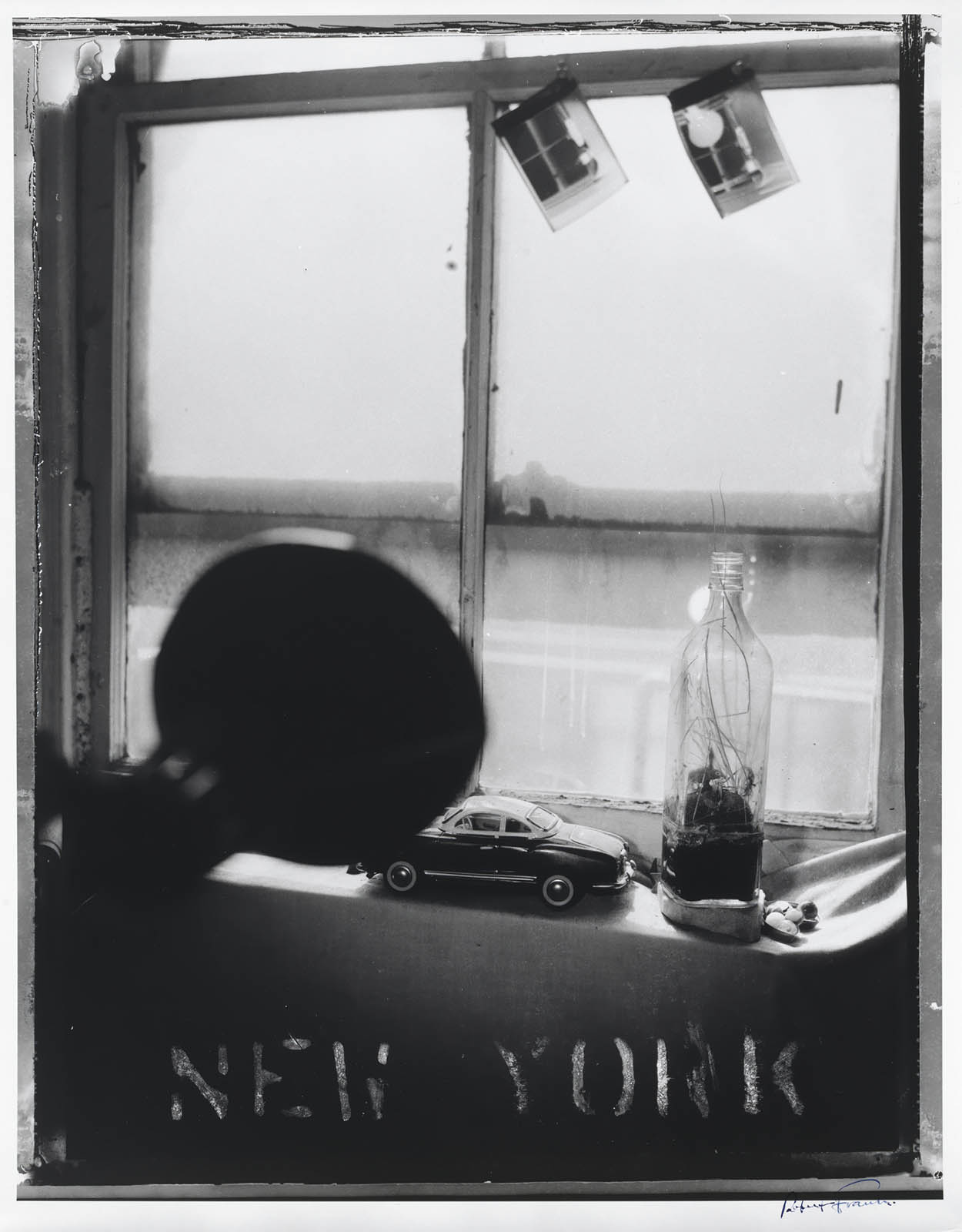
 

Robert Frank (Swiss-American, 1924-2019) 'Pablo's Bottle at Bleecker Street, New York City' 1973


Robert Frank (Swiss-American, 1924-2019)
Pablo’s Bottle at Bleecker Street, New York City
1973
Gelatin silver print
19 13/16 × 15 7/8 inches (50.3 × 40.3cm)
The Museum of Modern Art, New York
Promised gift of Michael Jesselson
© 2024 The June Leaf and Robert Frank Foundation
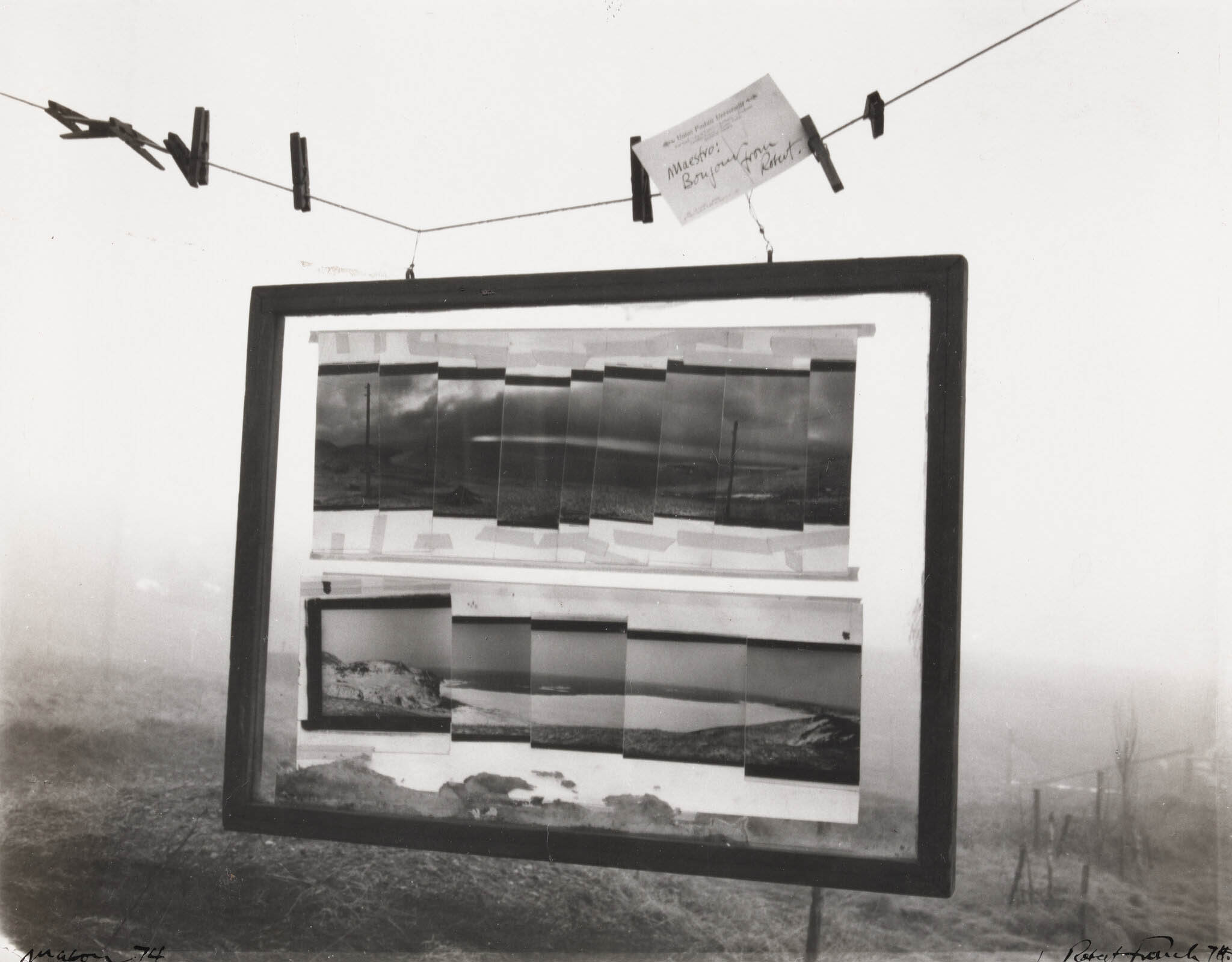
 

Robert Frank (Swiss-American, 1924-2019) 'Bonjour - Maestro, Mabou' 1974 from the exhibition 'Life Dances On: Robert Frank in Dialogue' at the Museum of Modern Art (MoMA), New York


Robert Frank (Swiss-American, 1924-2019)
Bonjour – Maestro, Mabou
1974
Robert Frank/The June Leaf and Robert Frank Foundation, via The Museum of Modern Art, NY


Frank hung an earlier landscape collage from a clothesline in a see-through frame, with the same landscape visible behind it.
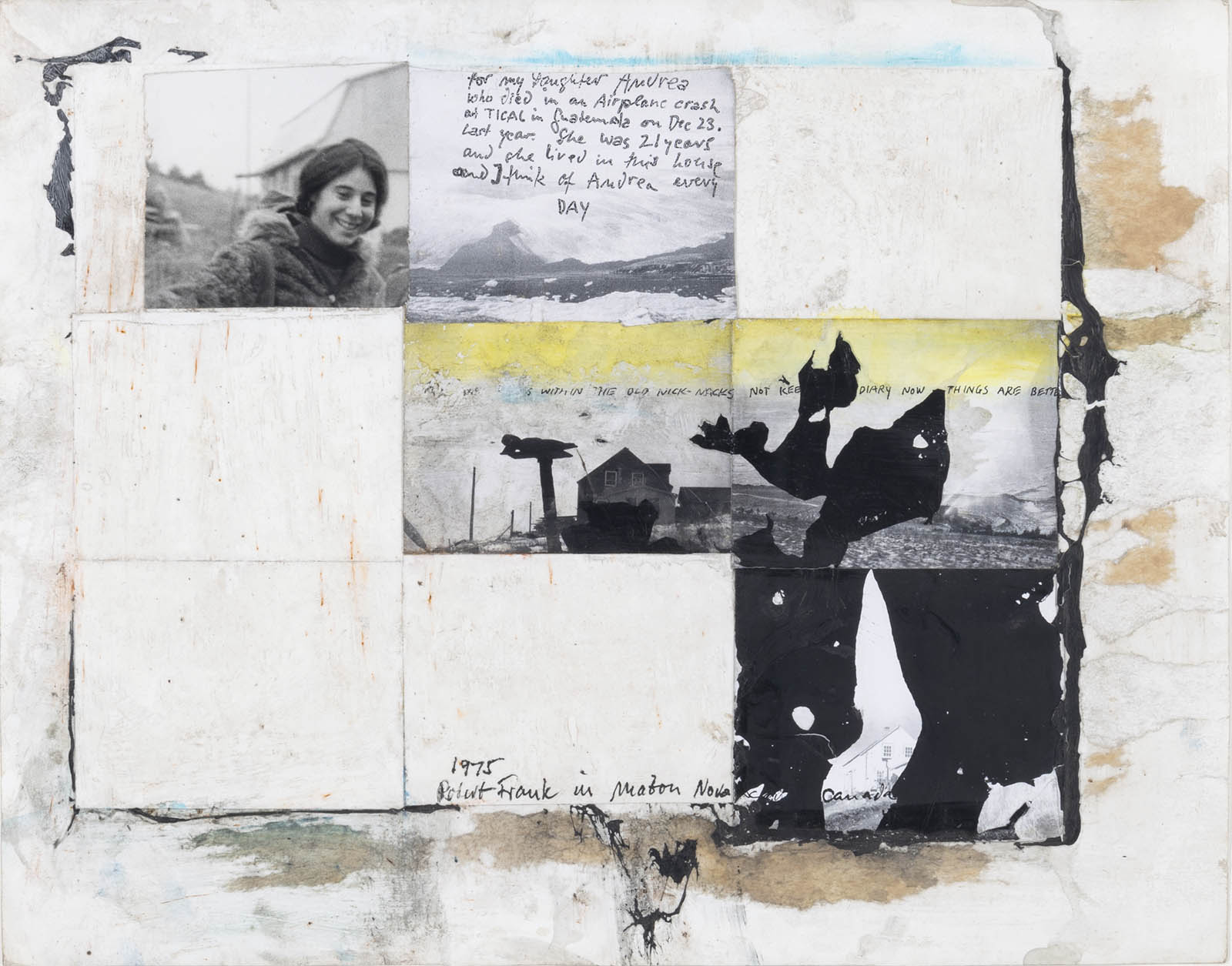
 

Robert Frank (Swiss-American, 1924-2019) 'Andrea' 1975 from the exhibition 'Life Dances On: Robert Frank in Dialogue' at the Museum of Modern Art (MoMA), New York


Robert Frank (Swiss-American, 1924-2019)
Andrea
1975
Five gelatin silver prints and ink on paper
10 15/16 × 13 7/8 inches (27.8 × 35.2cm)
The Museum of Modern Art, NY
Gift of the June Leaf and Robert Frank Foundation in honor of Clément Chéroux and Lucy Gallun
© 2024 The June Leaf and Robert Frank Foundation


After the death of Andrea Frank, his young daughter, in a plane crash, Frank memorialised her in a collage that he embellished with paint and a heartfelt, handwritten message.
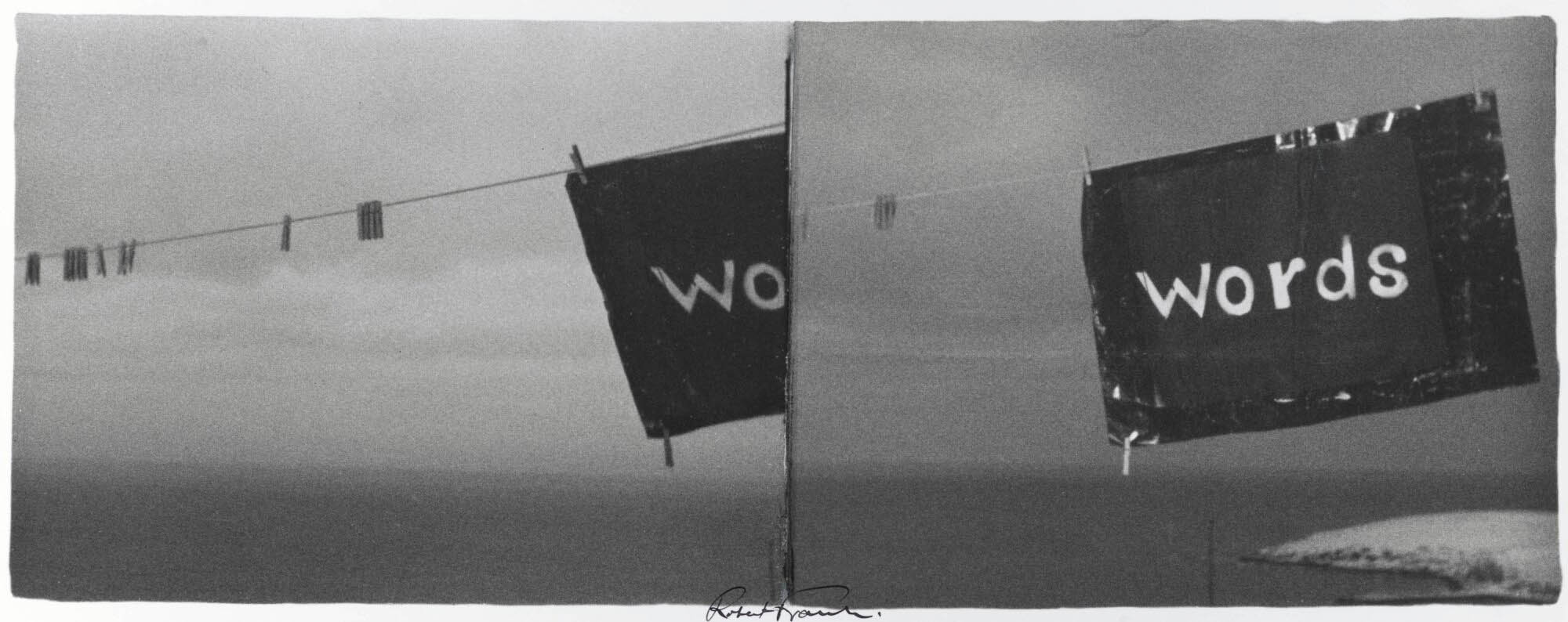
 

Robert Frank (Swiss-American, 1924-2019) 'Mabou' 1977


Robert Frank (Swiss-American, 1924-2019)
Mabou
1977
Gelatin silver print
7 5/16 × 19 5/16 inches (18.5 × 49cm)
The Museum of Modern Art, New York
Gift of Robert and Gayle Greenhill
© 2024 The June Leaf and Robert Frank Foundation


Robert Frank (Swiss-American, 1924-2019) 'Mabou Winter Footage' 1977 from the exhibition 'Life Dances On: Robert Frank in Dialogue' at the Museum of Modern Art (MoMA), New York


Robert Frank (Swiss-American, 1924-2019)
Mabou Winter Footage
1977
Gelatin silver print
23 11/16 × 14 3/4″ (60.1 × 37.5cm)
The Museum of Modern Art, New York. Purchase
© 2024 The June Leaf and Robert Frank Foundation
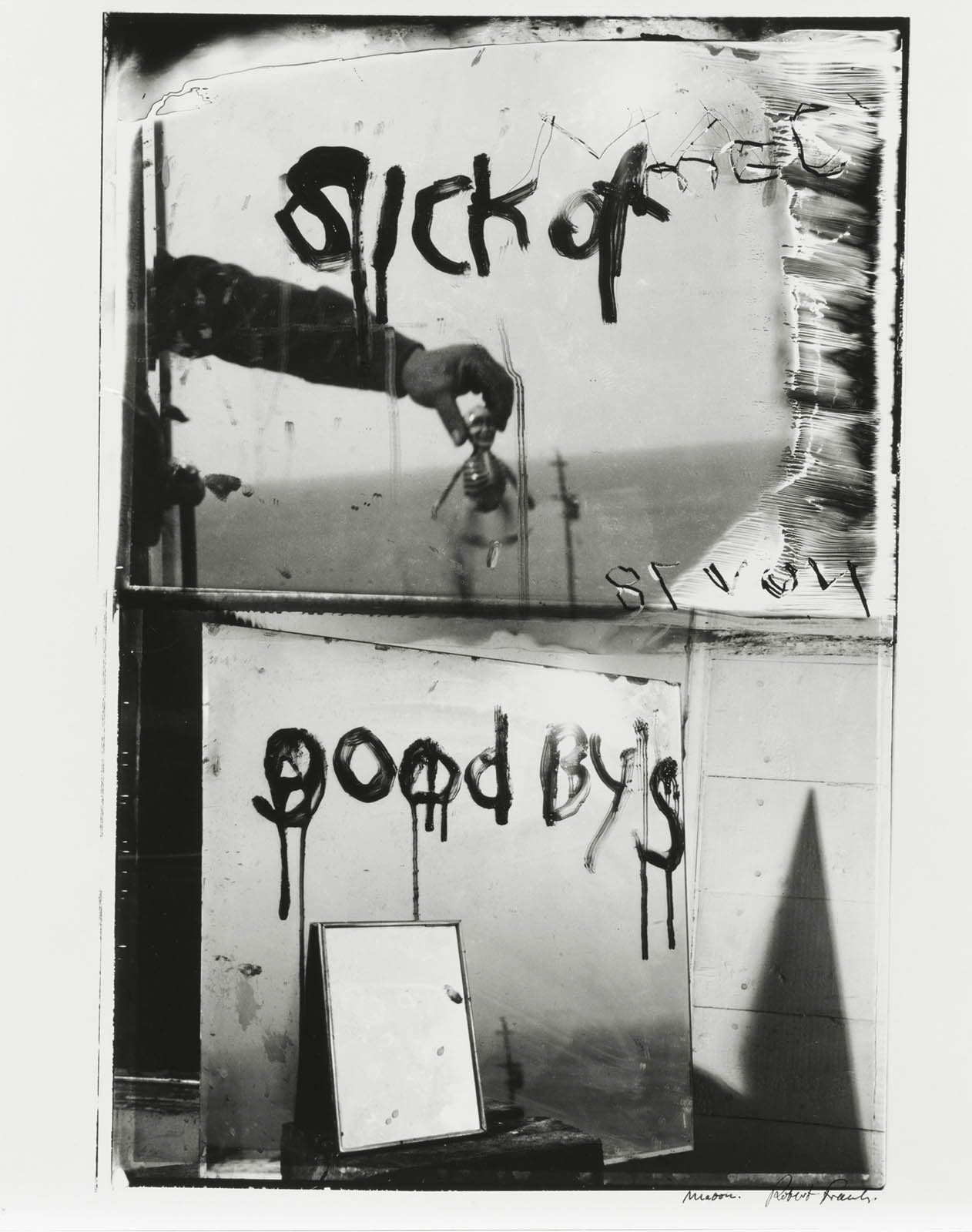
 

Robert Frank (Swiss-American, 1924-2019) 'Sick of Goodby's' 1978 from the exhibition 'Life Dances On: Robert Frank in Dialogue' at the Museum of Modern Art (MoMA), New York


Robert Frank (Swiss-American, 1924-2019)
Sick of Goodby’s
1978
Gelatin silver print
21 15/16 × 12 11/16 inches (55.8 × 32.3cm)
The Museum of Modern Art, New York
Purchase
© 2024 The June Leaf and Robert Frank Foundation
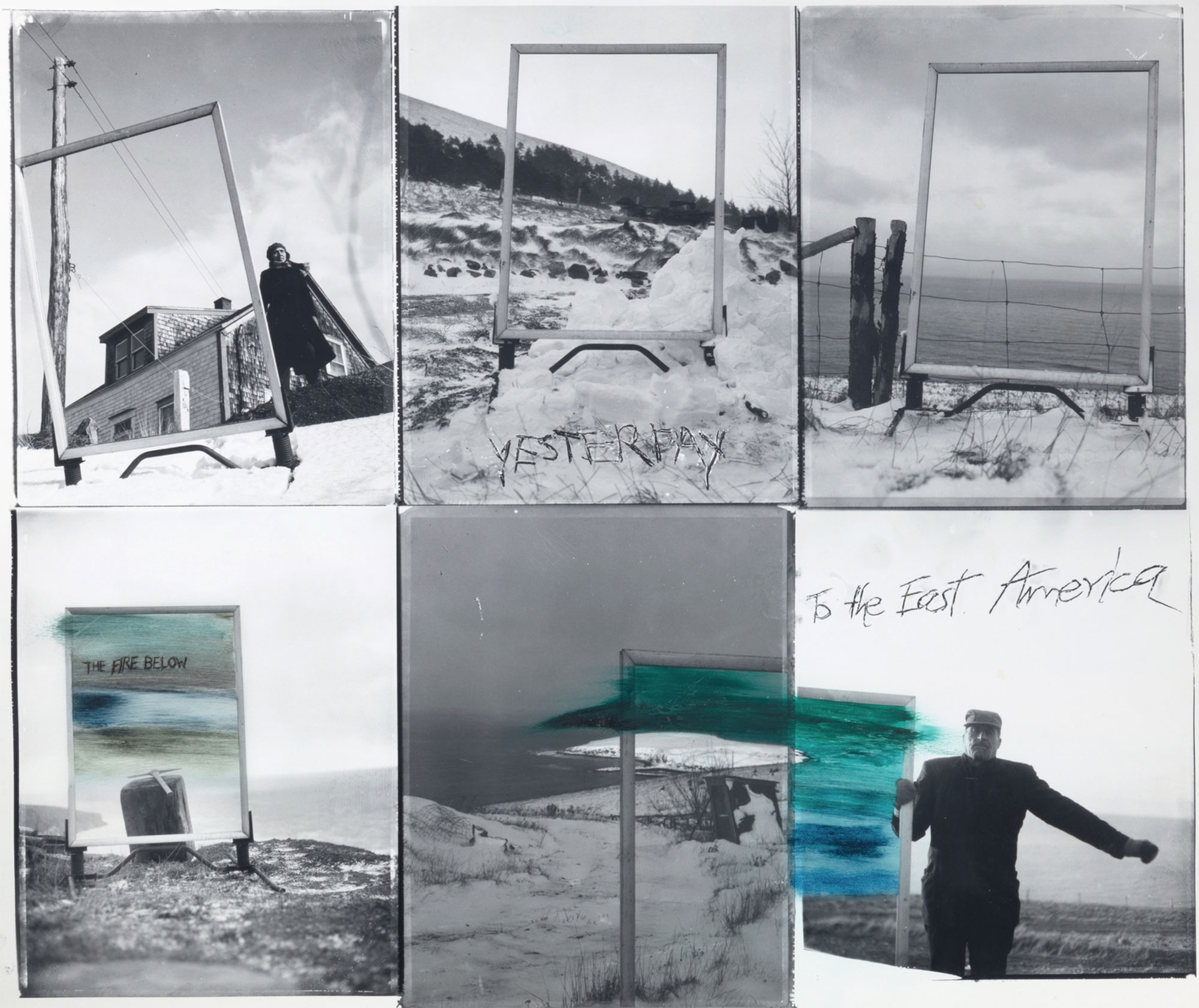
 

Robert Frank (Swiss-American, 1924-2019) 'Fire Below - to the East America, Mabou' 1979


Robert Frank (Swiss-American, 1924-2019)
Fire Below – to the East America, Mabou
1979
19 3/16 × 22 13/16 inches (48.8 × 57.9cm)
Gelatin silver print enlarged from six Polaroid negatives with paint and ink
Gift of the artist, by exchange
© 2024 The June Leaf and Robert Frank Foundation


Robert Frank (Swiss-American, 1924-2019) 'Look Out for Hope, Mabou - New York City' 1979


Robert Frank (Swiss-American, 1924-2019)
Look Out for Hope, Mabou – New York City
1979
Gelatin silver print
23 3/4 × 19 7/8 inches (60.3 × 50.5cm)
The Museum of Modern Art, New York
Promised gift of Michael Jesselson
© 2024 The June Leaf and Robert Frank Foundation


Robert Frank (Swiss-American, 1924-2019) 'Los Angeles - February 4th - I Wake Up - Turn On TV' 1979


Robert Frank (Swiss-American, 1924-2019)
Los Angeles – February 4th – I Wake Up – Turn On TV
1979
Robert Frank/The June Leaf and Robert Frank Foundation, via The Museum of Modern Art, NY


In words and pictures he expressed a forlorn mood in a hotel room.


Robert Frank never recovered from the success of “The Americans.” On its publication in the United States in 1959, the book was initially excoriated as un-American, particularly in the photography magazines, for its sour, disillusioned take on life in this country. The rich looked bored, the poor desperate, the city fathers fatuous, and the flags threadbare or soiled. What’s more, specialists in photography faulted his technique for muddiness, grain and blur.

But in a slow burn, Frank’s willful violation of the conventional rules of photography was understood to serve the purpose of personal expression, and his dissection of national alienation and social divides was deemed prophetic. The smoke blew away, and “The Americans” stood clearly as a towering monument, one of the most important and influential books in the history of photography.

Frank hated that. In the early ’60s, he renounced still photography in favor of filmmaking. When he went back in the ’70s to making photographs – “in the time left over between films or film projects,” as he put it – he eschewed the street photography that had established his reputation. Instead, he mostly made studio or landscape pictures, which he liked to splice together into montages or embellish with scratched and stenciled words.

It’s this late work – if such a rubric can be applied to the six decades of movie, video and photo production that preceded his death at 94 in 2019 – that is the focus of “Life Dances On: Robert Frank in Dialogue,” opening Sunday at the Museum of Modern Art. Curated by Lucy Gallun, the exhibition marks the centenary of Frank’s birth and is his first solo show at MoMA. Although there are some omissions (his return to documentary photography in Beirut in 1991, for example), it presents as eloquent a case as can be made for this later art, often left in the shade by what came before.

Frank felt trapped by the expectations and pigeonholing that the lionization of “The Americans” induced, and he recoiled in horror at the prospect of repeating himself. Beyond that, he gave various explanations over the years for why he abandoned the 35 mm camera that he brandished like a sorcerer’s wand. He explained that he had lost faith in the capacity of a single photograph to convey the truth. And his search had turned inward. “The truth is the way to reveal something about your life, your thoughts, where you stand,” he said. He believed film was a better way to do that.

Film (joined by video in the ’80s) allowed Frank to record his feelings directly. In addition to clips from his movies and videos, the museum is showing “Robert Frank’s Scrapbook Footage,” an assemblage of previously unseen diaristic moving images, stitched together by Frank’s longtime editor, Laura Israel, and art director Alex Bingham – most ambitiously, in a five-screen installation that jumps between shots taken in the house in Mabou, Nova Scotia, and the apartment on Bleecker Street in the East Village in New York that Frank shared with his wife, artist June Leaf, as well as visits he made to his parents in Switzerland (where he was born) and to Russia. Topping it off, MoMA, which received Frank’s entire film and video archive as a gift from the artist, will present a complete motion-picture retrospective, from Nov. 20 to Dec. 11.

The aim is to reposition Frank’s reputation by showcasing the art that occupied most of his life. The trouble is: His genius as a photographer did not carry over to filmmaking. That was evident from the outset. His first completed movie, “Pull My Daisy,” a collaboration with artist Alfred Leslie, incorporated improvisation by the actors within the framework of a rehearsed script. With a voice-over by Jack Kerouac and appearances by Allen Ginsberg, Peter Orlovsky, Gregory Corso and Larry Rivers, the film resonates as a historical document of the Beat movement. As a movie, though, its madcap bohemianism is a clunky, leaden bore. First screened publicly in 1959 on a double bill with John Cassavetes’ similarly improvised “Shadows,” it wilts, woefully dated, when viewed today alongside that other milestone of independent American cinema.

Arthur Lubow. “‘The Americans’ Made the Photographer Robert Frank a Star. What Came Next?” on The New York Times website Sept. 12, 2024 [Online] Cited 15/12/2024
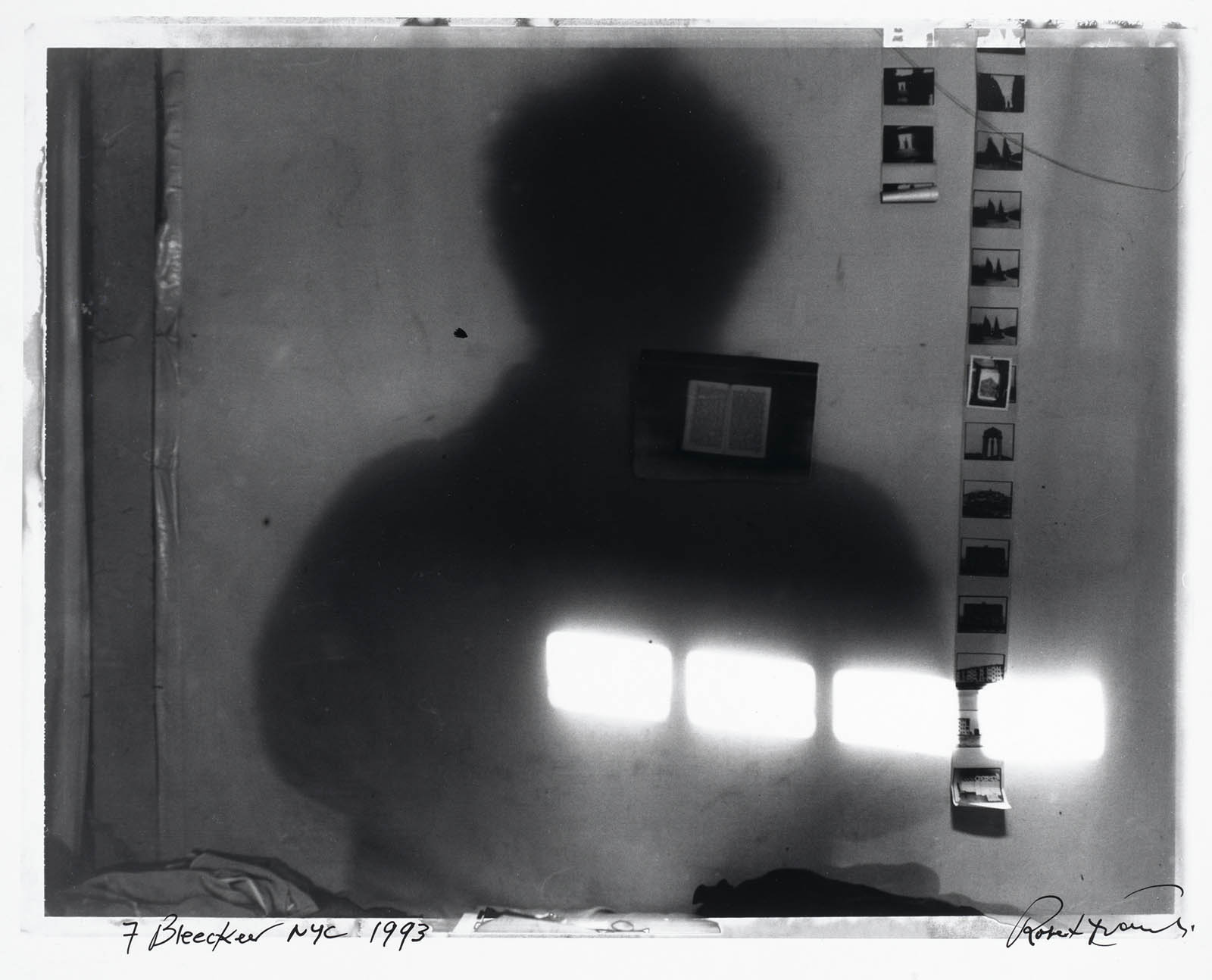
 

Robert Frank (Swiss-American, 1924-2019) 'New York City, 7 Bleecker Street' September 1993


Robert Frank (Swiss-American, 1924-2019)
New York City, 7 Bleecker Street
September 1993
Gelatin silver print
15 15/16 × 19 13/16 inches (40.5 × 50.3cm)
The Museum of Modern Art, New York
Promised gift of Michael Jesselson
© 2024 The June Leaf and Robert Frank Foundation


A self-portrait of the artist, in September 1993. Frank caught himself studying a strip of filmed images.


Robert Frank (Swiss-American, 1924-2019) 'The Suffering, the Silence of Pablo' 1995


Robert Frank (Swiss-American, 1924-2019)
The Suffering, the Silence of Pablo
1995
Robert Frank/June Leaf and Robert Frank Foundation, via Museum of Modern Art, NY


After the suicide of his son, Pablo Frank, the photographer composed this testament to his young, painful life.
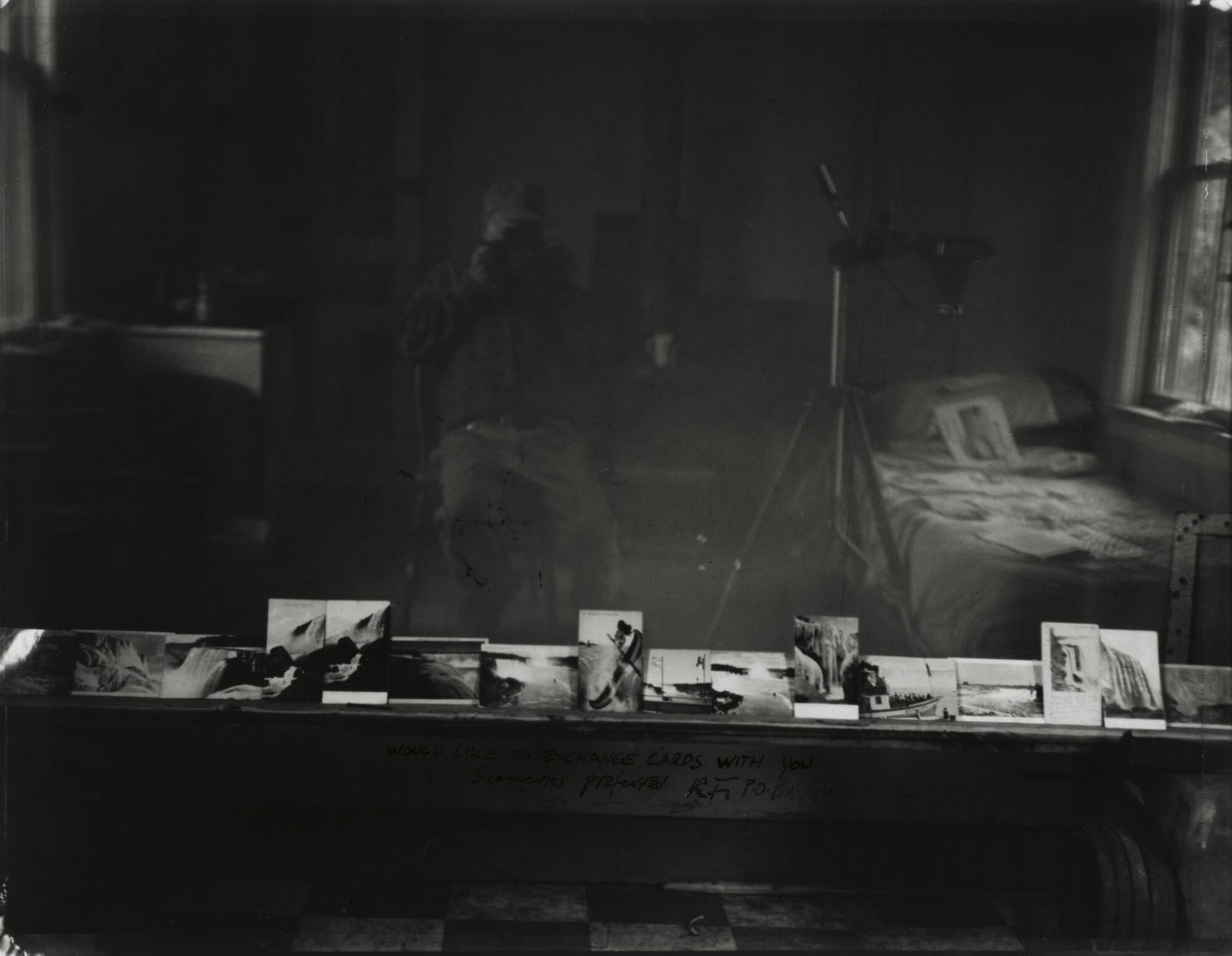
 

Robert Frank (Swiss-American, 1924-2019) 'Would Like to Exchange Cards with You, Souvenirs Preferred' 2002


Robert Frank (Swiss-American, 1924-2019)
Would Like to Exchange Cards with You, Souvenirs Preferred
2002
Gelatin silver print
10 13/16 × 13 7/8 inches (27.4 × 35.2cm)
The Museum of Modern Art, New York
Gift of the artist
© 2024 The June Leaf and Robert Frank Foundation


The Museum of Modern Art
11 West 53 Street
New York, NY 10019
Phone: (212) 708-9400

Opening hours:
10.30am – 5.30pm
Open seven days a week

MoMA website

LIKE ART BLART ON FACEBOOK

Back to top

Exhibition: ‘American Cool’ at the Smithsonian National Portrait Gallery, Washington, DC

Exhibition dates: 7th February – 7th September 2014


Bruce Davidson (American, b. 1933) 'Untitled' 1959


Bruce Davidson (American, b. 1933)
Untitled from the Brooklyn Gang series
1959
Gelatin silver print


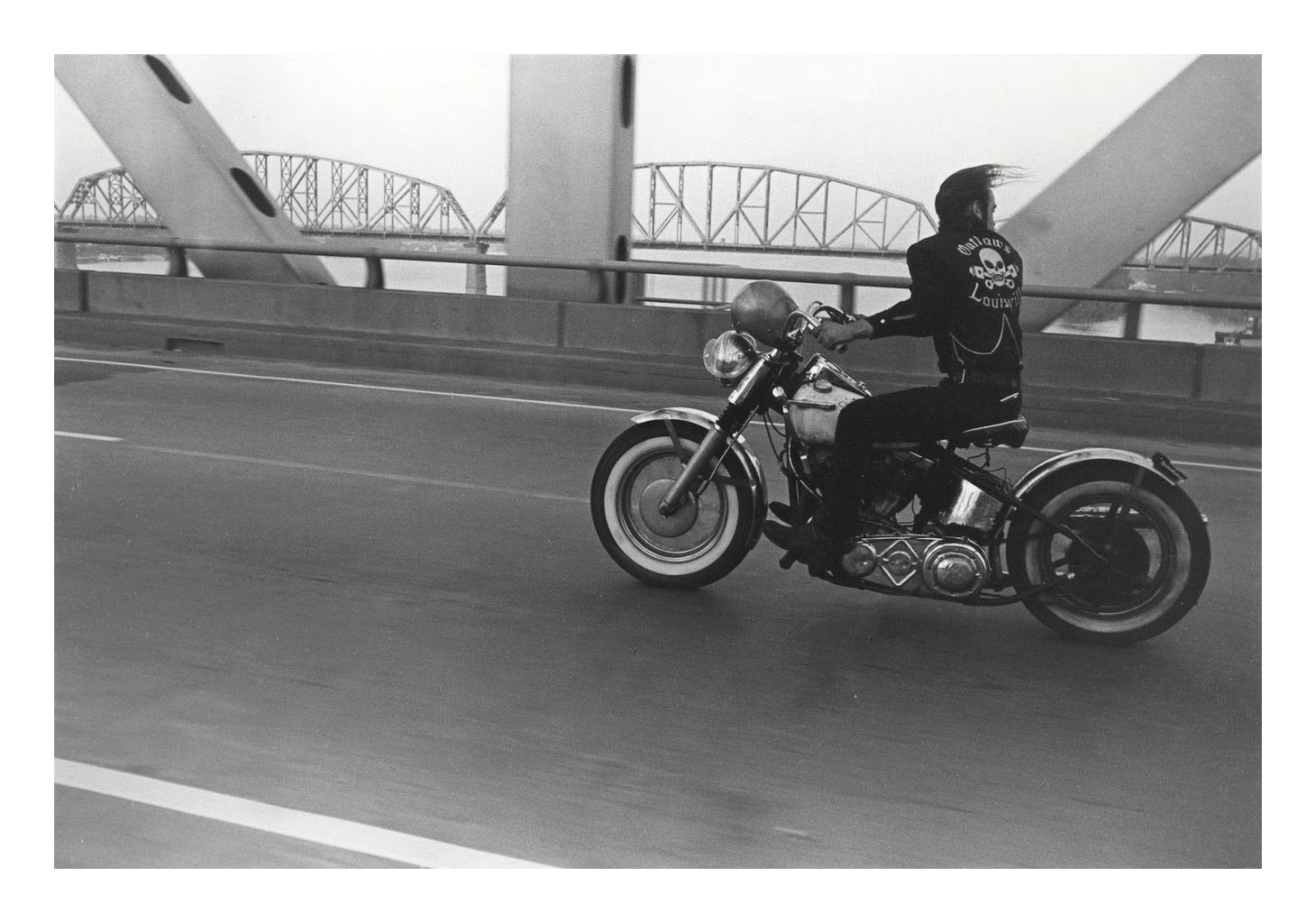
Danny Lyon (American, b. 1942) 'Crossing the Ohio River, Louisville, 1966' 1966


Danny Lyon (American, b. 1942)
Crossing the Ohio River, Louisville, 1966
1966
Silver gelatin print


This exhibition does not reflect our opinion of who’s cool. Each cool figure was considered with the following historical rubric in mind and possesses at least three elements of this singular American self-concept:

  1. an original artistic vision carried off with a signature style
  2. cultural rebellion or transgression for a given generation
  3. iconic power, or instant visual recognition
  4. a recognised cultural legacy


Every individual here created an original persona without precedent in American culture. These photographs capture the complex relationship between the real-life person, the image embraced by fans and the media, and the person’s artistic work.

What does it mean when a generation claims a certain figure as cool? What qualities does this person embody at that historical moment? American Cool explores these questions through photography, history, and popular culture. In this exhibition, cool is rendered visible, as shot by some of the finest art photographers of the past century.


Anonymous text from the ‘American Cool’ National Portrait Gallery website [Online] Cited 13/06/2021


When less – less famous, less obvious – is more

I don’t know about you, but the photographs chosen to represent American “cool” in this exhibition – 39 of which are shown in the posting out of a total of 108, but the rest are mainly of the same ilk – seem to me to be a singularly strange bunch of images to choose for such a concept. Personally, I find very few of them are “cool”, that is a mixture of a social charge of rebellious self-expression, charisma, edge and mystery with a certain self-made sense of style.

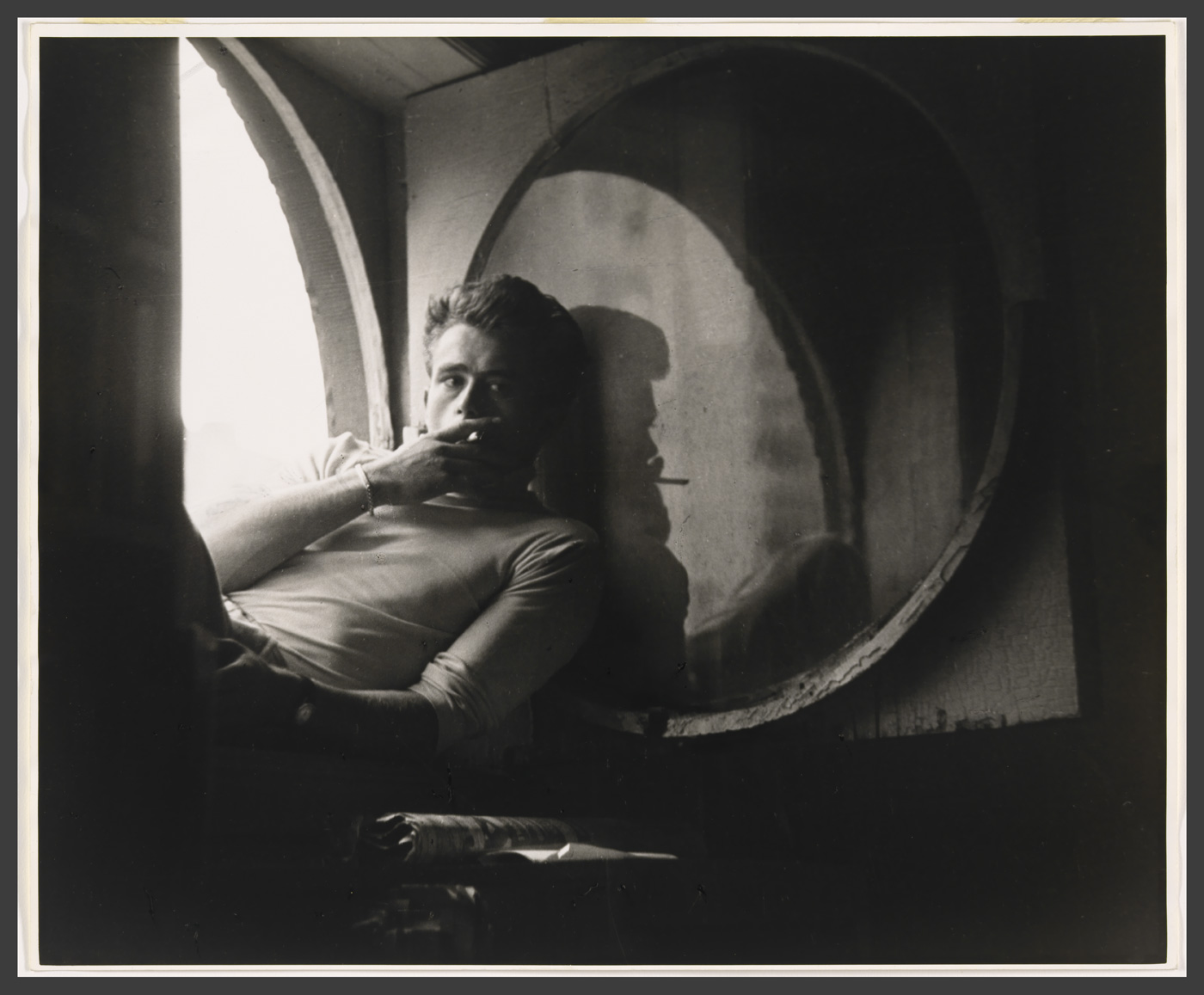
The only images that I find definitely “cool” among this bunch are, firstly Bob Dylan, closely followed by Jackson Pollock (notice the skull lurking behind him) and Susan Sontag. There is no proposition of cool in these three photographs, the people in them just are. The rest of the photographs, and there really are some atrociously plain and boring portraits among this lot (including a poor portrait of James Dean), really don’t speak to me of cool, don’t speak to me of anything much at all. How you could ever think that the portrait of Willie Nelson, 1989 (printed 2009, below) is cool is beyond me… and what is it with the reprints of the photographs, not originals but modern prints made years later? Perhaps the National Portrait Gallery needed to look beyond their own collection for a more rounded representation of American cool.

The two photographs I have included above are my top picks of American cool, and neither are in the exhibition. These iconic American images don’t feature famous people, they are not “posed” for the camera, and yet there is that ineffable something that makes the people in them absolutely, totally cool. THIS IS AMERICAN COOL: their own style, their own rebelliousness and mystery without possibly realising it = a naturalness that comes from doing their own thing, making their own way. Perhaps that is the point that this exhibition misses: you don’t have to be famous to be “cool”. A portrait is not just a mug shot. And an original persona does not have to come with fame attached.

This exhibition just doesn’t cut the mustard. The whole shebang needed a bloody good rethink, from the concept (does a generation have to “claim” someone is cool? is it necessary or desirable to portray American Cool through media images? do they have to be famous or instantly recognisable people to be “cool”) to the choice of images which could better illustrate the theme. Surely the qualities that person embodies changes from moment to moment, from photographer to photographer, from context to context (just look at the portraits of a haggard James Dean). To attempt to illustrate three elements in a single photograph – good luck with that one!

Dr Marcus Bunyan

PS I have added the videos to add a bit of spice to the proceedings… in them you can, occasionally, feel the charisma of the person.


Many thankx to the Smithsonian National Portrait Gallery for allowing me to publish the photographs in the posting. Please click on the photographs for a larger version of the image.


Bob Willoughby (American, 1927-2009) 'Billie Holiday' 1951 (printed 1991)


Bob Willoughby (American, 1927-2009)
Billie Holiday
1951 (printed 1991)
Gelatin silver print
25.2 x 35.3cm (19 15/16 x 13 15/16″)
National Portrait Gallery, Smithsonian Institution


Rare live footage of one of the first anti-racism songs.


Roger Marshutz (American, 1929-2007) 'Elvis Presley' 1956


Roger Marshutz (American, 1929-2007)
Elvis Presley
1956
Gelatin silver print
Sheet: 40.6 x 50.8cm (16 x20″)
© Estee Stanley


Elvis Presley Jailhouse Rock 1957 colour
Colourised version of the song from the film


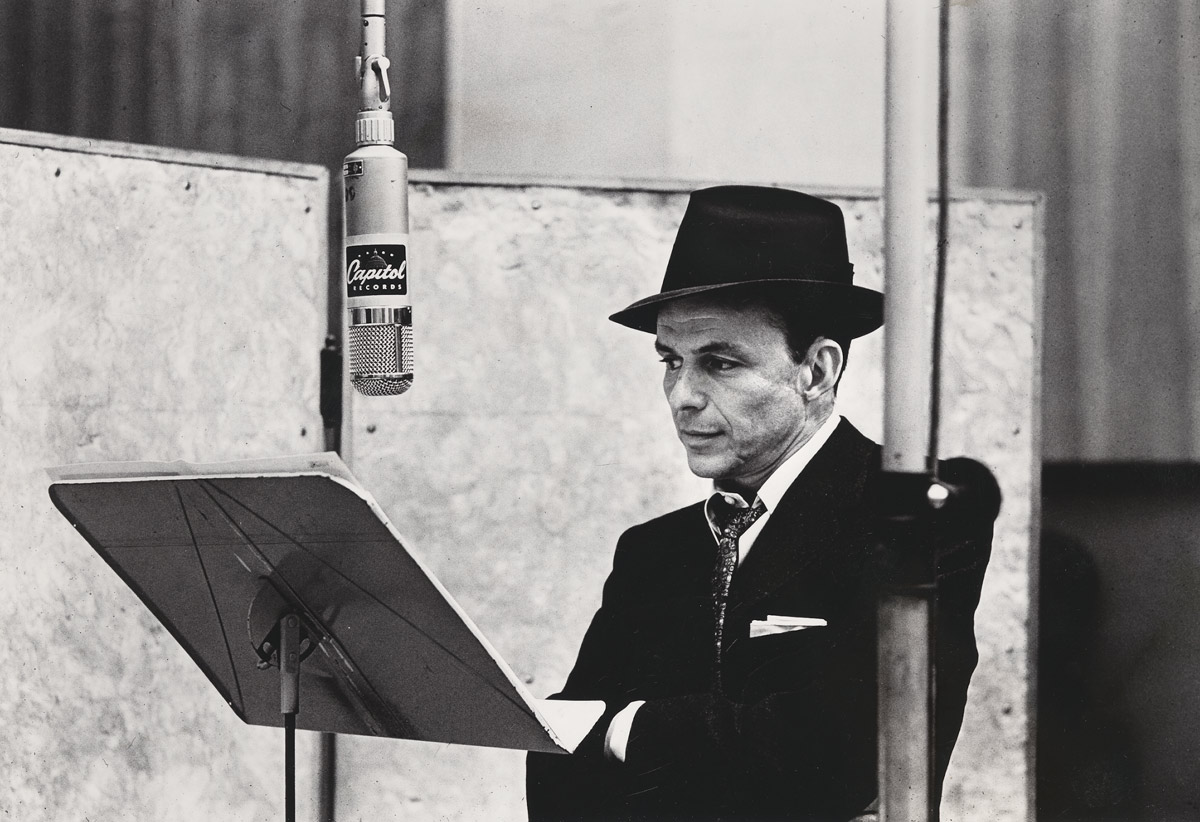
Herman Leonard (American, 1923-2010) 'Frank Sinatra' c. 1956


Herman Leonard (American, 1923-2010)
Frank Sinatra
c. 1956
Gelatin silver print
16.5 x 24.1cm (6 1/2 x 9 1/2″)
Institute of Jazz Studies at Rutgers University


Marcia Resnick (American, b. 1950) 'David Byrne' 1981


Marcia Resnick (American, b. 1950)
David Byrne
1981
Gelatin silver print
21.8 x 32.5cm (8 9/16 x 12 13/16″)
National Portrait Gallery, Smithsonian Institution


Julian Wasser (American, b. 1938) 'Joan Didion' 1970


Julian Wasser (American, b. 1938)
Joan Didion
1970
Gelatin silver print
24.3 x 34cm (9 9/16 x 13 3/8″)
National Portrait Gallery, Smithsonian Institution


Joan Didion (born December 5, 1934) is an American author best known for her novels and her literary journalism. Her novels and essays explore the disintegration of American morals and cultural chaos, where the overriding theme is individual and social fragmentation.


Roy Schatt (American, 1909-2002) 'James Dean' 1954


Roy Schatt (American, 1909-2002)
James Dean
1954
Gelatin silver print
34.7 x 42.2cm (13 11/16 x 16 5/8″)
National Portrait Gallery, Smithsonian Institution


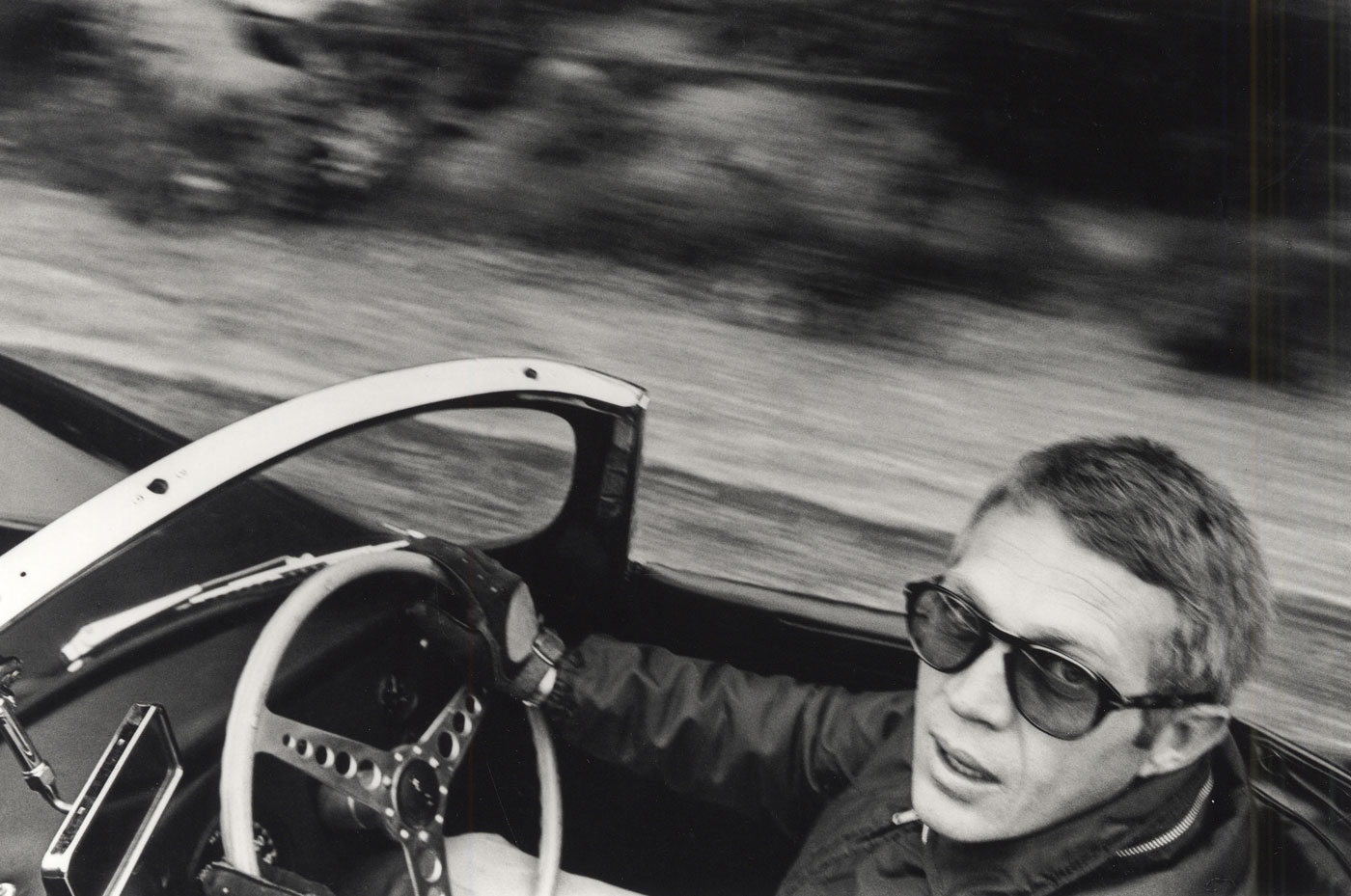
William Claxton (American, 1927-2008) 'Steve McQueen' 1962


William Claxton (American, 1927-2008)
Steve McQueen
1962
Gelatin silver print
40 x 58.7cm (15 3/4 x 23 1/8″)
Fahey Klein Gallery


Martin Schoeller (American, b. 1968) 'Tony Hawk' 1999 (printed 2010)


Martin Schoeller (American, b. 1968)
Tony Hawk
1999 (printed 2010)
Archival pigment print
58.5 x 58.6cm (23 1/16 x 23 1/16″)
National Portrait Gallery, Smithsonian Institution


What do we mean when we say someone is cool? Cool carries a social charge of rebellious self-expression, charisma, edge and mystery.

Cool is an original American sensibility and remains a global obsession. In the early 1940s, legendary jazz saxophonist Lester Young brought this central African American concept into the modern vernacular. Cool became a password in bohemian life connoting a balanced state of mind, a dynamic mode of performance, and a certain stylish stoicism. A cool person has a situation under control, and with a signature style. Cool has been embodied in jazz musicians such as Miles Davis and Billie Holiday, in actors such as Robert Mitchum, Faye Dunaway, and Johnny Depp, and in singers such as Elvis Presley, Patti Smith, and Jay-Z. American Cool is a photography and cultural studies exhibition featuring portraits of such iconic figures, each of whom has contributed an original artistic vision to American culture symbolic of a particular historical moment. They emerged from a variety of fields: art, music, film, sports, comedy, literature, and political activism. American Cool is the zeitgeist taking embodied form.

American Cool is captured by a roll call of fine-art photographers from Henri Cartier-Bresson to Annie Leibovitz, from Richard Avedon to Herman Leonard to Diane Arbus. This exhibition is accompanied by an illustrated catalogue with essays by Joel Dinerstein, the James H. Clark Endowed Chair in American Civilization and Director of the New Orleans Center for the Gulf South at Tulane University, and Frank H. Goodyear III, co-director of the Bowdoin College Museum of Art and former curator of photographs at the National Portrait Gallery.


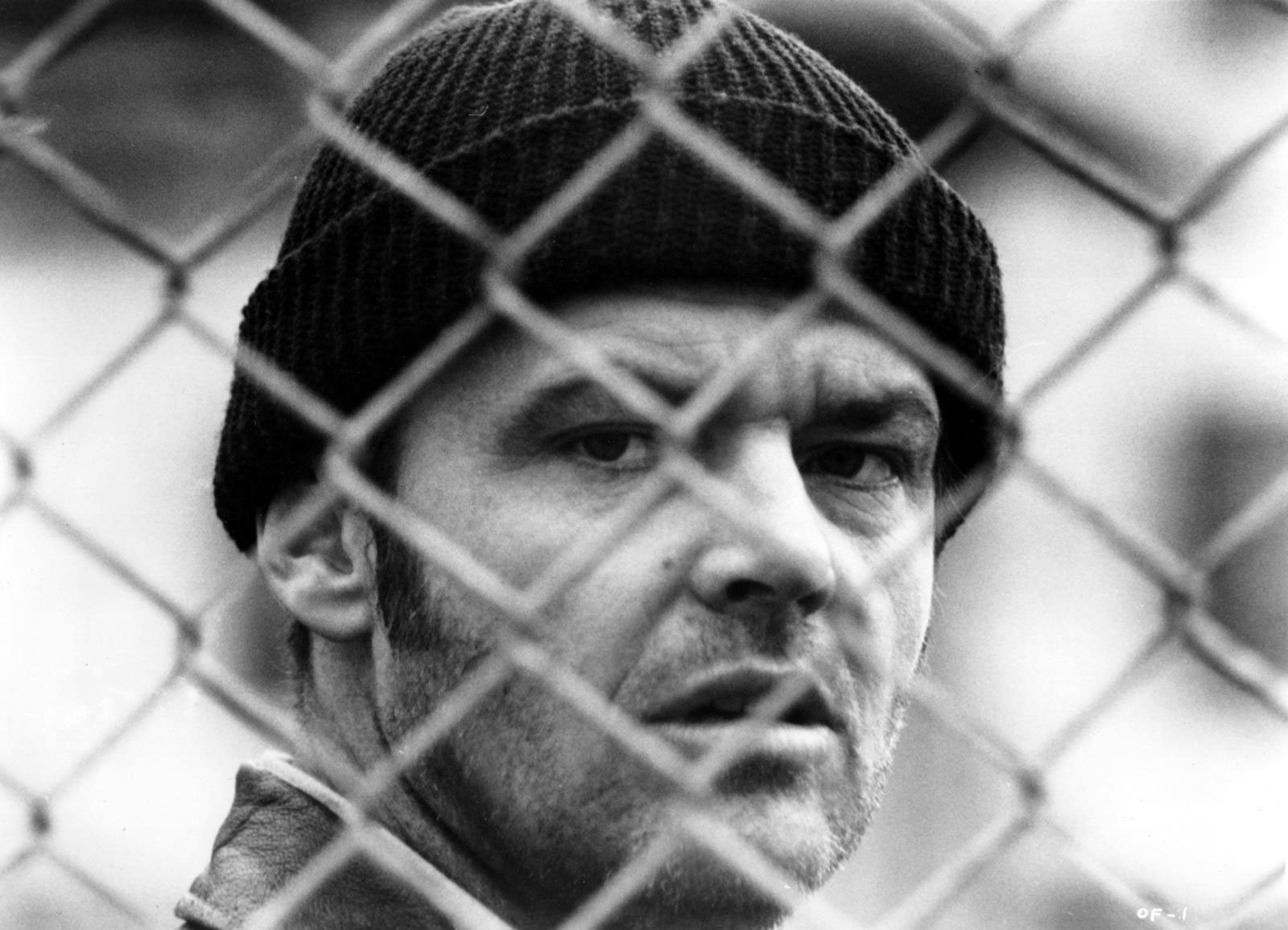
Unidentified Artist. 'Jack Nicholson in "One Flew Over the Cuckoo's Nest"' 1975


Unidentified Artist
Jack Nicholson in “One Flew Over the Cuckoo’s Nest”
1975
Gelatin silver print
17.3 x 25.1cm (6 13/16 x 9 7/8″)
The Kobal Collection


John Cohen (American, 1932-2019) 'Jack Kerouac' 1959


John Cohen (American, 1932-2019)
Jack Kerouac
1959
Gelatin silver print
Image: 15.9 x 24.1cm (6 1/4 x 9 1/2″)
Sheet: 20.2 x 25.4cm (7 15/16 x 10″)
National Portrait Gallery, Smithsonian Institution


Leo Fuchs (American, 1911-1994) 'Paul Newman' 1959 (printed 2013)


Leo Fuchs (American, 1911-1994)
Paul Newman
1959 (printed 2013)
Modern archival print
Sheet: 27.9 x 35.6cm (11 x 14″)
© Alexandre Fuchs


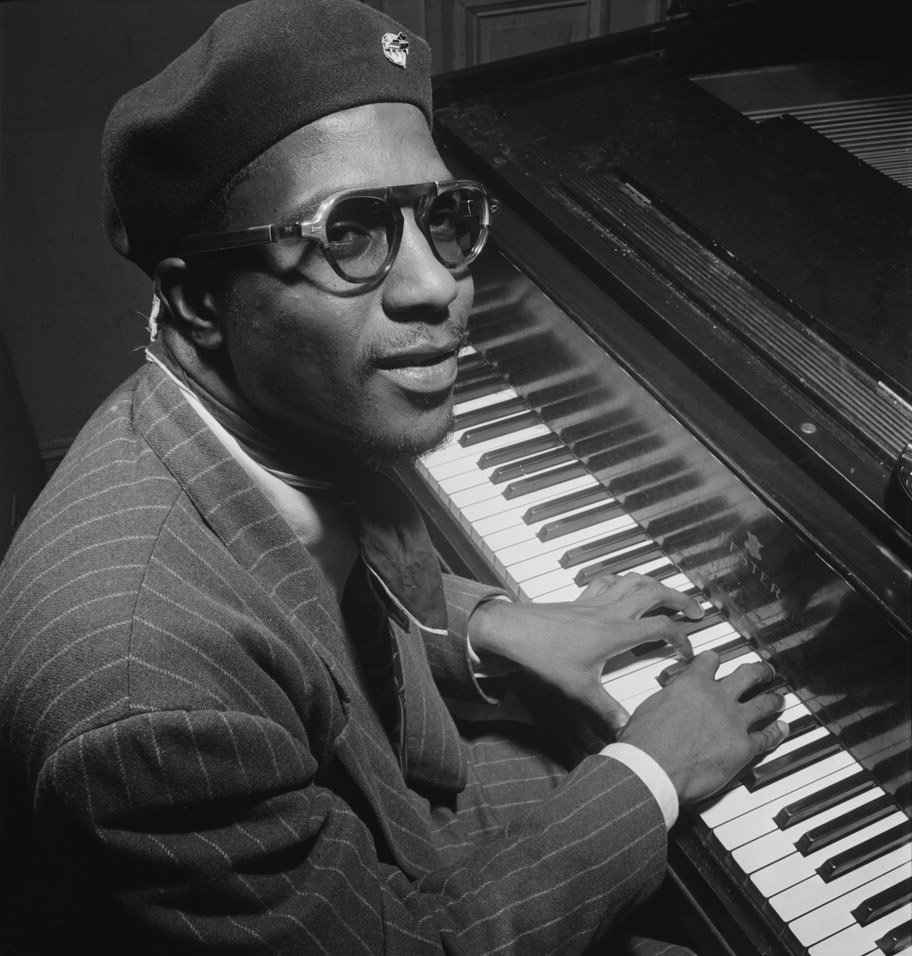
William Paul Gottlieb (American, 1917-2006) 'Thelonious Monk at Minton's Playhouse, New York City' 1947


William Paul Gottlieb (American, 1917-2006)
Thelonious Monk at Minton’s Playhouse, New York City
1947
Gelatin silver print
Sheet: 25.4 x 20.3cm (10 x 8″)
Estate of William Gottlieb


Thelonious Monk Quartet – Round Midnight
Thelonious Monk(p) Charlie Rouse(ts) Larry Gales(b) Ben Riley(ds)
Recorded in Norway 1966 dvd “LIVE in ’66”


Peter Hujar (American, 1934-1987) 'Susan Sontag' 1975


Peter Hujar (American, 1934-1987)
Susan Sontag
1975
Gelatin silver print
37.1 x 37.6cm (14 5/8 x 14 13/16″)
National Portrait Gallery, Smithsonian Institution


Michael O'Brien (American, b. 1950) 'Willie Nelson' 1989 (printed 2009)


Michael O’Brien (American, b. 1950)
Willie Nelson
1989 (printed 2009)
Chromogenic print
38.1 x 38.1cm (15 x 15″)
National Portrait Gallery, Smithsonian Institution


Introduction

What do we mean when we say someone is cool? To be cool means to exude the aura of something new and uncontainable. Cool is the opposite of innocence or virtue. Someone cool has a charismatic edge and a dark side. Cool is an earned form of individuality. Each generation has certain individuals who bring innovation and style to a field of endeavour while projecting a certain charismatic self-possession. They are the figures selected for this exhibition: the successful rebels of American culture.

The legendary jazz saxophonist Lester Young created the modern usage of “cool” in the 1940s. At first it meant being relaxed in one’s environment against oppressive social forces, but within a generation it became a password for stylish self-control. This exhibition does not reflect our opinion of who’s cool. Each cool figure was considered with the following historical rubric in mind and possesses at least three elements of this singular American self-concept:

1/ an original artistic vision carried off with a signature style
2/ cultural rebellion or transgression for a given generation
3/ iconic power, or instant visual recognition
4/ a recognised cultural legacy

Every individual here created an original persona without precedent in American culture. These photographs capture the complex relationship between the real-life person, the image embraced by fans and the media, and the person’s artistic work.

What does it mean when a generation claims a certain figure as cool? What qualities does this person embody at that historical moment? American Cool explores these questions through photography, history, and popular culture. In this exhibition, cool is rendered visible, as shot by some of the finest art photographers of the past century.

The Roots of Cool: Before 1940

The stage was set for the emergence of cool as a cultural phenomenon in the early 1940s by a series of sweeping transformations in the first decades of the twentieth century. The figures in this first section were not called cool in their day but were leading exemplars of new energies that were changing the social contours of American life. A fresh rebelliousness was revealed in the new film capital of Hollywood, in modernist literature and art, in emerging youth entertainments, and in a new music called jazz. The advent of technologies such as radio, film, and the automobile and the increasing diversity in America’s booming cities accelerated the pace of change. Though Prohibition in the 1920s sought to regulate American morality by ending the consumption of alcohol, this period saw the expression of a new independence among young people and others historically on the margins of public life. In particular, both African Americans and women sought and began to attain freedoms long denied. Cool has long denoted a person’s sense of calm and composure. Charismatic individuals such as those featured here contributed greatly to the changing mores in American society before World War II. Cool would ultimately serve as the term that would describe this new rebel.

The Birth of Cool: 1940-1959

Being cool was a response to the rapid changes of modernity: it was about maintaining a state of equipoise within swirling, dynamic social forces. The legendary jazz saxophonist Lester Young disseminated the word and concept of cool into jazz culture in the early 1940s, and it quickly crossed over as a rebel masculine sensibility. When Young said, “I’m cool,” he meant, first, that he was relaxed in the environment and, second, that he was keeping it together under social and economic pressure as well as the absurdity of life in a racist society. This mask of cool emerged as a form of American stoicism and was manifested in jazz, film noir, Beat literature, and abstract expressionism. In jazz, a generation of younger musicians rejected big-band swing entertainment to create bebop, a fast, angular, virtuosic style that moved jazz out of dance halls and into nightclubs. In Hollywood, film noir represented postwar anxiety through crime dramas shot through with working-class existentialism and the fear of women’s sexual and economic power. Among Beat writers and abstract painters, cool referred to a combination of wildness and intensity in men unconcerned with social conformity. Starting from jazz, cool was a rebel sensibility suggesting that an individual’s importance could be registered only through self-expression and the creation of a signature style. By 1960 cool was the protean password of a surging underground aesthetic.

Cool and the Counterculture: 1960-1979

In the 1960s and 1970s, to be cool was to be antiauthoritarian and open to new ideas from young cultural leaders in rock and roll, journalism, film, and African American culture. Cool was a badge of opposition to “the System,” by turns a reference to the police, the government, the military-industrial complex, or traditional morality. Using drugs such as marijuana or even LSD was an indicator of risk taking and expanding one’s consciousness; not experimenting with drugs suggested a fear of opening one’s mind or perspective, of being “uptight” or “square.” The same was true of sexual exploration, social protest, and ethnic politics. The aesthetic of stylised understatement still held power, yet cool itself morphed under the era’s social upheavals. The counterculture valued being authentic and emotionally naked: being cool meant a person was “out-front” with others and comfortable in his or her own skin. For African Americans, what had once been suppressed under the mask of cool transformed into defiant civic engagement in music, sports, and politics. “Cool” meant to communicate a set of emotions without losing control, and rock and roll was the art form (and forum) best suited for this shift, especially for women. Patti Smith, Bonnie Raitt, Deborah Harry, and Chrissie Hynde all carved out new iconic stances, styles, and voices for independent women who were sexy on their own terms. Cool became the supreme compliment for creative public figures who broke new cultural ground and maintained their personal integrity over time.

The Legacies of Cool: 1980-Present

In 1980s America, the selling of rebellion as style became ingrained in cool. From highbrow fashion to mass-culture video games, product designers, advertisers, and consumers embraced the cool aesthetic. For many during this era, selling out was no longer a curse, as youth culture increasingly embraced the pursuit of wealth. And though some might proclaim that cool was dead, the concept stayed alive and grew in many quarters. From hip-hop to Seattle grunge, from skateboarding to the Internet, from street graffiti to MTV, cool became central to many of these new cultural forms. While its popularisation tended to whiten this phenomenon, African American culture remained central to its growth. By the 1980s cool also had an easily recognisable history, and many figures from its past – like heroes from a bygone era – continued to resonate widely. Indeed, new icons of cool often built careers that owed much to these earlier exemplars. Throughout the twentieth century, cool was America’s chief cultural export. With the rapid growth of global communication and markets, it plays an even larger role both in the world’s understanding of America and in Americans’ own sense of national identity. The figures in this final section are representative of the legacies of cool as a distinct form of American expression.

Press release from the Smithsonian National Portrait Gallery website


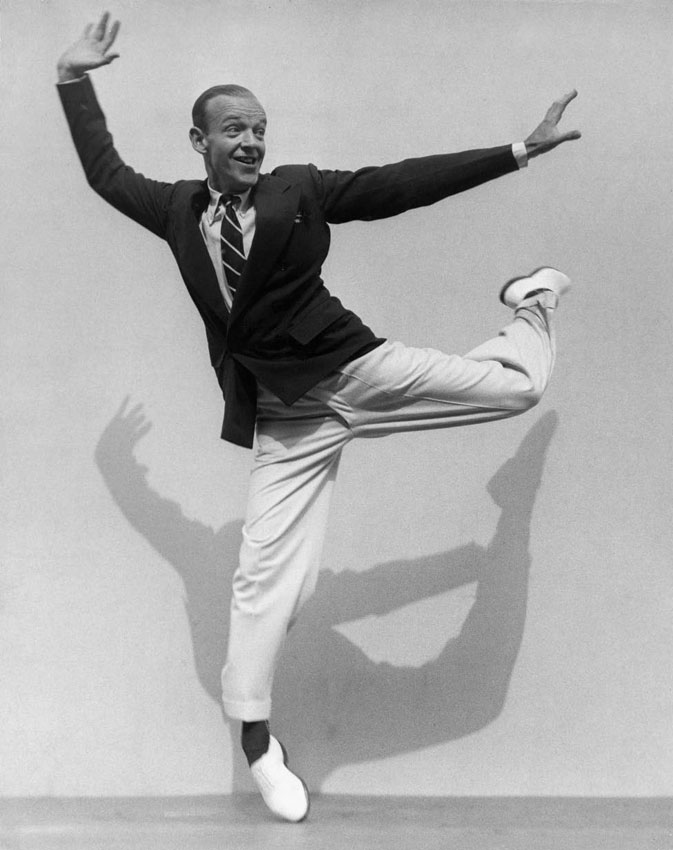
Martin Munkacsi (Hungarian, 1896-1963) 'Fred Astaire' 1936


Martin Munkacsi (Hungarian, 1896-1963)
Fred Astaire
1936
Gelatin silver print
24.1 x 19cm (9 1/2 x 7 1/2″)
National Portrait Gallery, Smithsonian Institution


Swing Time – Rogers and Astaire

In this Swing Time clip, Lucky, Astaire, saves Penny’s, Rogers, job by showing how much she has taught him.


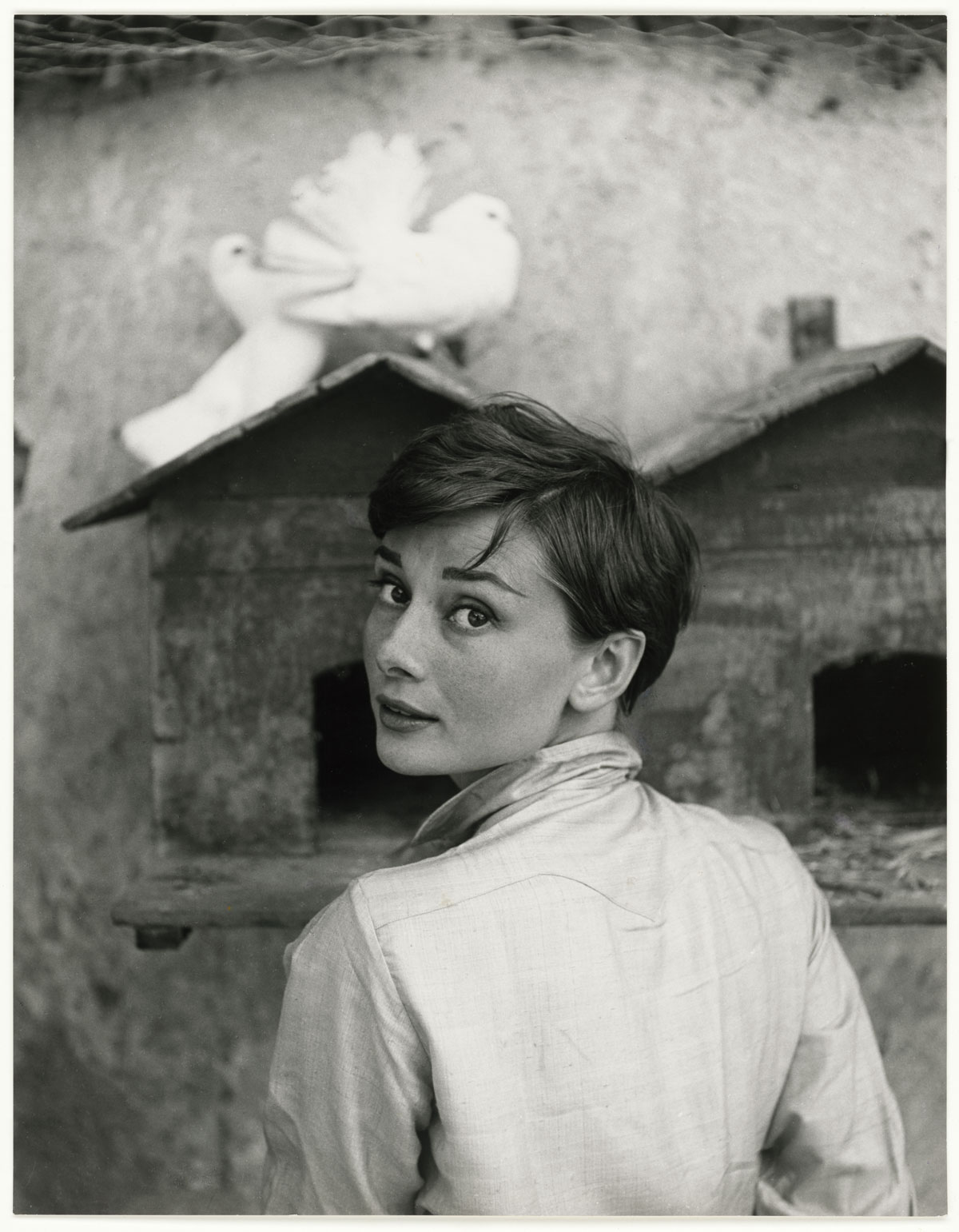
Philippe Halsman (American, 1906-1979) 'Audrey Hepburn' 1955


Philippe Halsman (American, 1906-1979)
Audrey Hepburn
1955
Gelatin silver print
Image/Sheet: 34.9 x 27cm (13 3/4 x 10 5/8″)
National Portrait Gallery, Smithsonian Institution


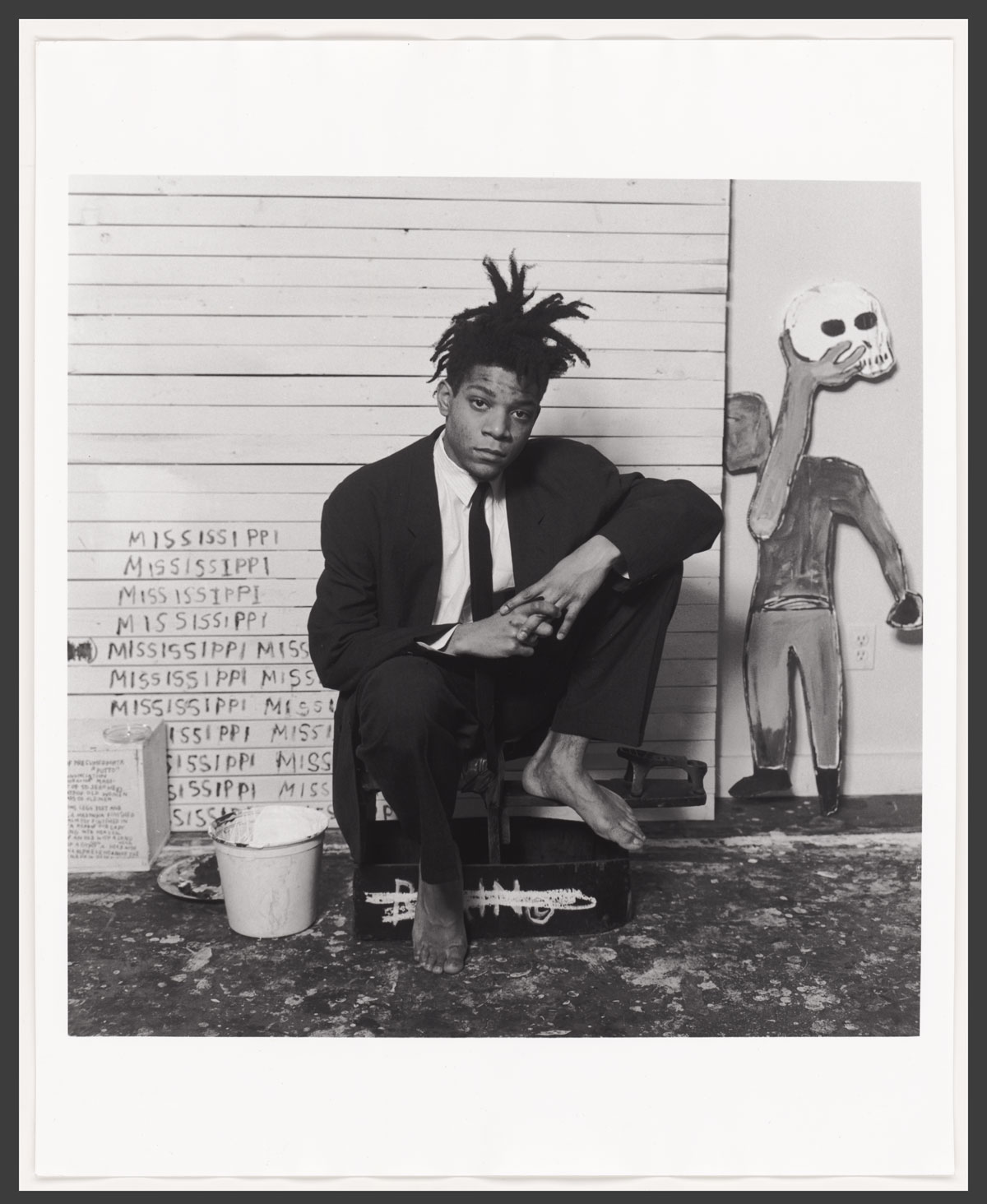
Dmitri Kasterine (British, b. 1932) 'Jean-Michel Basquait' 1986


Dmitri Kasterine (British, b. 1932)
Jean-Michel Basquait
1986
Gelatin silver print
38.3 x 37.7cm (15 1/16 x 14 13/16″)
National Portrait Gallery, Smithsonian Institution


Cass Bird (American, b. 1974) 'Benicio Del Toro' 2008 (printed 2012)


Cass Bird (American, b. 1974)
Benicio Del Toro
2008 (printed 2012)
Inkjet print
45.3 x 35.3cm (17 13/16 x 13 7/8″)
National Portrait Gallery, Smithsonian Institution


Carl Van Vechten (American, 1880-1964) 'Bessie Smith' 1936


Carl Van Vechten (American, 1880-1964)
Bessie Smith
1936
Gelatin silver print
Image/Sheet: 25.2 x 18.6cm (9 15/16 x 7 5/16″)
National Portrait Gallery, Smithsonian Institution


Bessie Smith (April 15, 1894 – September 26, 1937) was an African-American blues singer widely renowned during the Jazz Age. Nicknamed the “Empress of the Blues”, she was the most popular female blues singer of the 1930s. Inducted into the Rock and Roll Hall of Fame in 1989, she is often regarded as one of the greatest singers of her era and was a major influence on fellow blues singers, as well as jazz vocalists.

Born in Chattanooga, Tennessee, Smith was young when her parents died, and she and her six siblings survived by performing on street corners. She began touring and performed in a group that included Ma Rainey, and then went out on her own. Her successful recording career with Columbia Records began in 1923, but her performing career was cut short by a car crash that killed her at the age of 43.

Text from the Wikipedia website


ST. LOUIS BLUES. Blues Legend Bessie Smith’s only film appearance. Uncut 1929 

This is not only a landmark because it contains Bessie Smith’s only known film appearance but also for being one of the very first talkies ever made. This is the complete film co-starring Jimmy Mordecai as her gigolo boyfriend.


Robert Mapplethorpe (American, 1946-1989) 'Deborah Harry' 1978


Robert Mapplethorpe (American, 1946-1989)
Deborah Harry
1978
Gelatin silver print
Image: 34.9 x 34.9cm (13 3/4 x 13 3/4″)
Robert Mapplethorpe Foundation


Philippe Halsman (American born Latvia, 1906-1979) 'Humphrey Bogart' 1944


Philippe Halsman (American born Latvia, 1906-1979)
Humphrey Bogart
1944
Gelatin silver print
Image: 11.3 x 8.6cm (4 7/16 x 3 3/8″)
Mat: 45.7 x 35.6cm (18 x 14″)
National Portrait Gallery, Smithsonian Institution


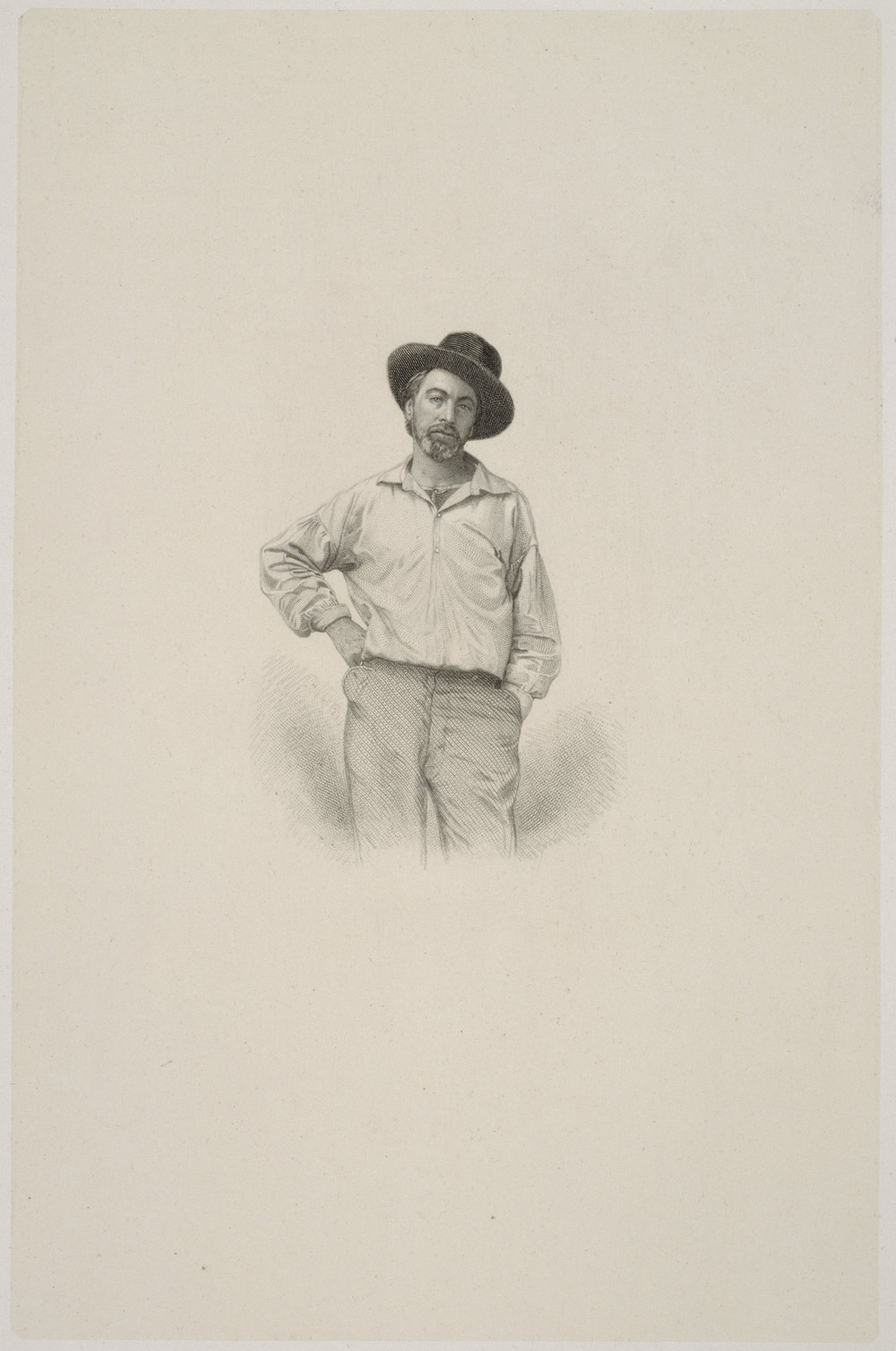
Samuel Hollyer (British, 1826-1919) 'Leaves of Grass, 1st Edition' Copy after: Gabriel Harrison 1855


Samuel Hollyer (British, 1826-1919)
Leaves of Grass, 1st Edition
Copy after: Gabriel Harrison
1855
Book (closed): 28.9 x 20.6 x 1cm (11 3/8 x 8 1/8 x 3/8″)
Private Collection


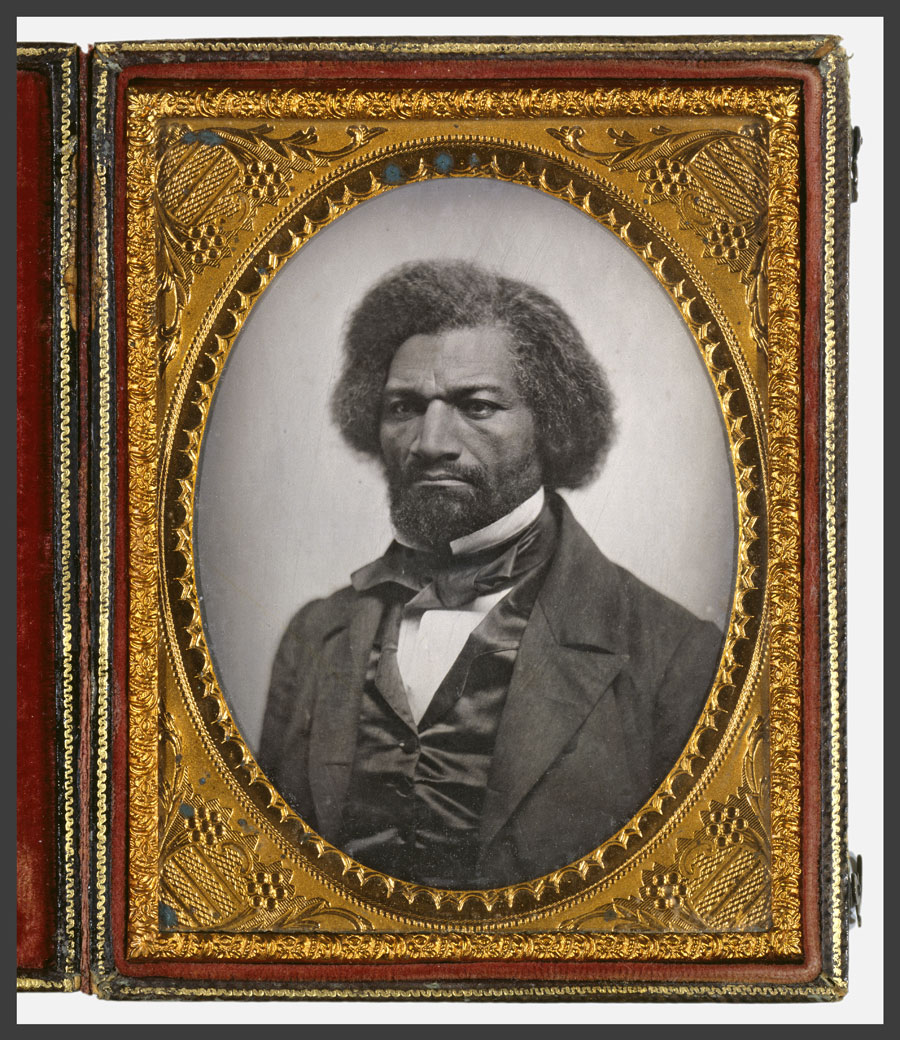
Unidentified Artist. 'Frederick Douglas' 1856


Unidentified Artist
Frederick Douglas
1856
Quarter-plate ambrotype
Image: 10.6 x 8.6cm (4 3/16 x 3 3/8″)
Case (open): 11.9 x 19.1 x 1.3cm (4 11/16 x 7 1/2 x 1/2″)
National Portrait Gallery, Smithsonian Institution


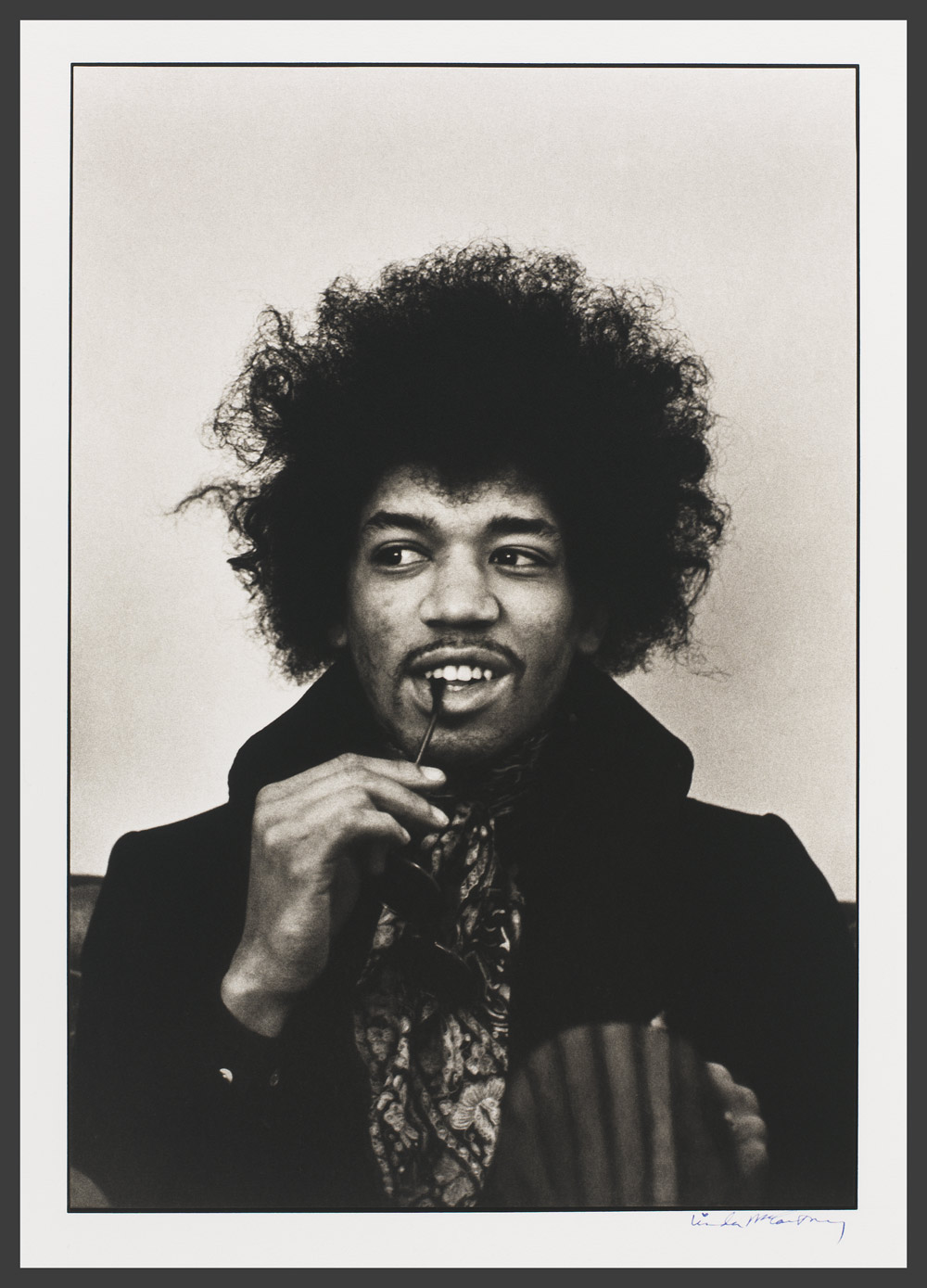
Linda McCartney (American, 1941-1998) 'Jimi Hendrix' 1967 (printed later)


Linda McCartney (American, 1941-1998)
Jimi Hendrix
1967 (printed later)
Platinum print
51.3 x 35.3 cm (20 3/16 x 13 7/8″)
National Portrait Gallery, Smithsonian Institution


The Jimi Hendrix Experience – Voodoo Child (Slight Return) (Live In Maui, 1970)

An incredible live performance of Voodoo Child (Slight Return) by Jimmy and his band in Maui, 1970.


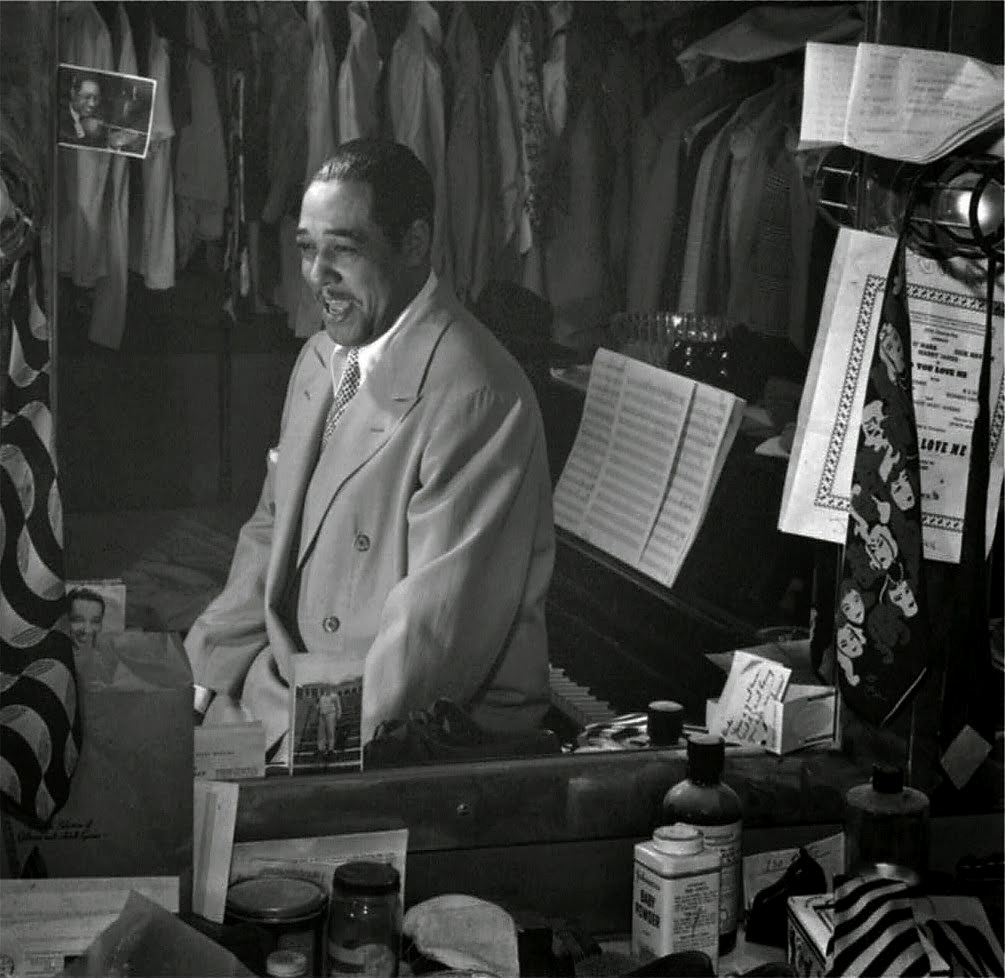
William Paul Gottlieb (American, 1917-2006) 'Duke Ellington' c. 1946 (printed 1991)


William Paul Gottlieb (American, 1917-2006)
Duke Ellington
c. 1946 (printed 1991)
Gelatin silver print
34.1 x 26.7 cm (13 7/16 x 10 1/2″)
National Portrait Gallery, Smithsonian Institution


Duke Ellington & His Orchestra live in Tivoli Garden 1969

Fantastic performance footage of one of Jazz’s greatest stars – Duke Ellington.

Duke Ellington may have turned 70 in 1969, but he was never short of energy, creativity and innovations. At the time of this Nov. 2, 1969 concert in Copenhagen, Ellington had been leading his orchestra for 44 years, but he still never really looked back in time or sought to recreate the past. Even when he performed older favorites, they were rearranged and full of surprises, and Duke’s own piano playing was modern, percussive and unpredictable. Twelve soloists are heard from during this 83-minute set including such veterans as trumpeters Cootie Williams and Cat Anderson, trombonist Lawrence Brown, altoist Harry Carney and Paul Gonsalves on tenor. Along with exciting versions of “C Jam Blues,” “Rockin’ In Rhythm” and “Take The ‘A’ Train,” the highlights include a three-song Johnny Hodges medley, a haunting “La Plus Belle Africaine,” and a tenor battle among Gonsalves, Harold Ashby and Norris Turney on “Diminuendo And Crescendo In Blue.” Filmed in colour and with close-ups that give listeners the experience of being onstage with the Duke Ellington Orchestra.


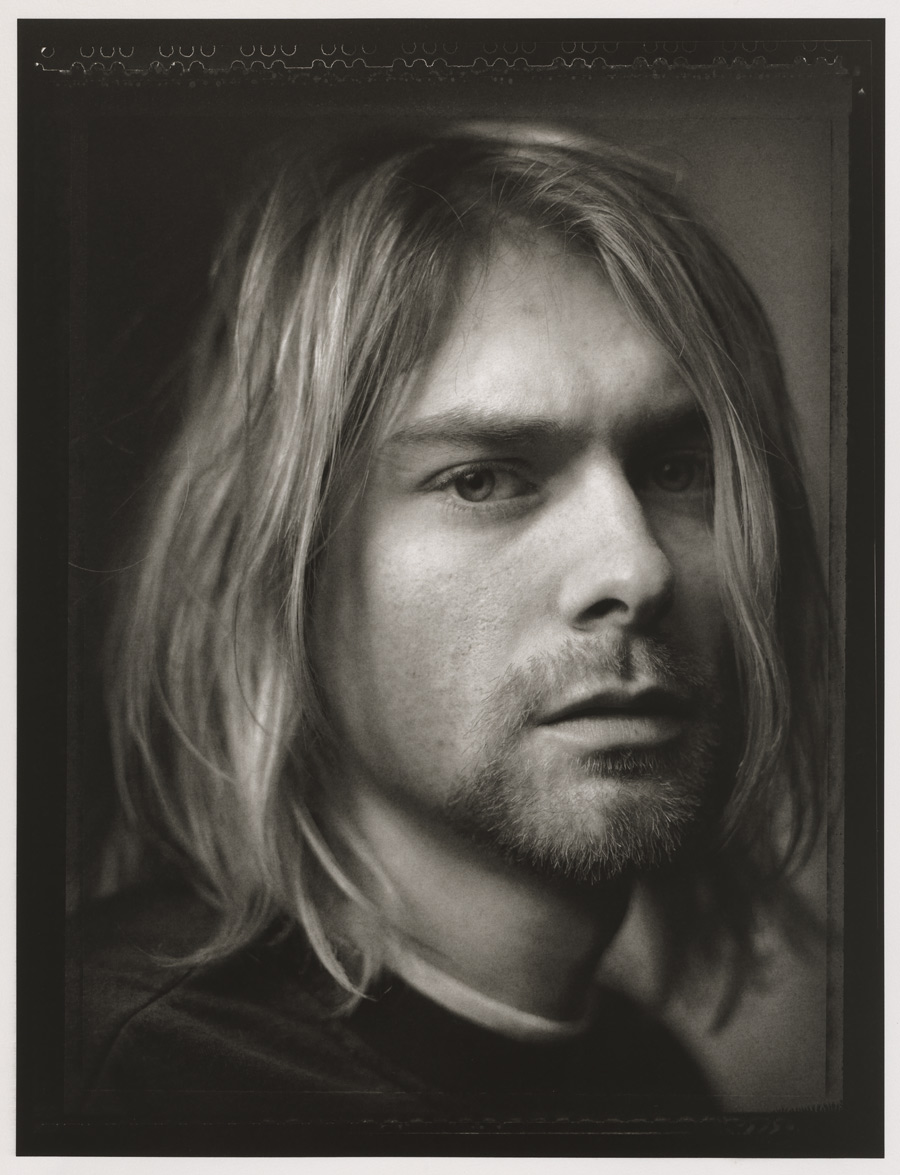
Mark Seliger (American, b. 1959) 'Kurt Cobain' 1993 (printed 2013)


Mark Seliger (American, b. 1959)
Kurt Cobain
1993 (printed 2013)
Platinum Palladium print
46.7 × 35.5cm (18 3/8 × 14″)
National Portrait Gallery, Smithsonian Institution


Nirvana – Smells Like Teen Spirit (Official Music Video)


Philippe Halsman (American, 1906-1979) 'Marlon Brando' 1950 (printed later)


Philippe Halsman (American, 1906-1979)
Marlon Brando
1950 (printed later)
Gelatin silver print
34.4 x 26.8cm (13 9/16 x 10 9/16″)
National Portrait Gallery, Smithsonian Institution


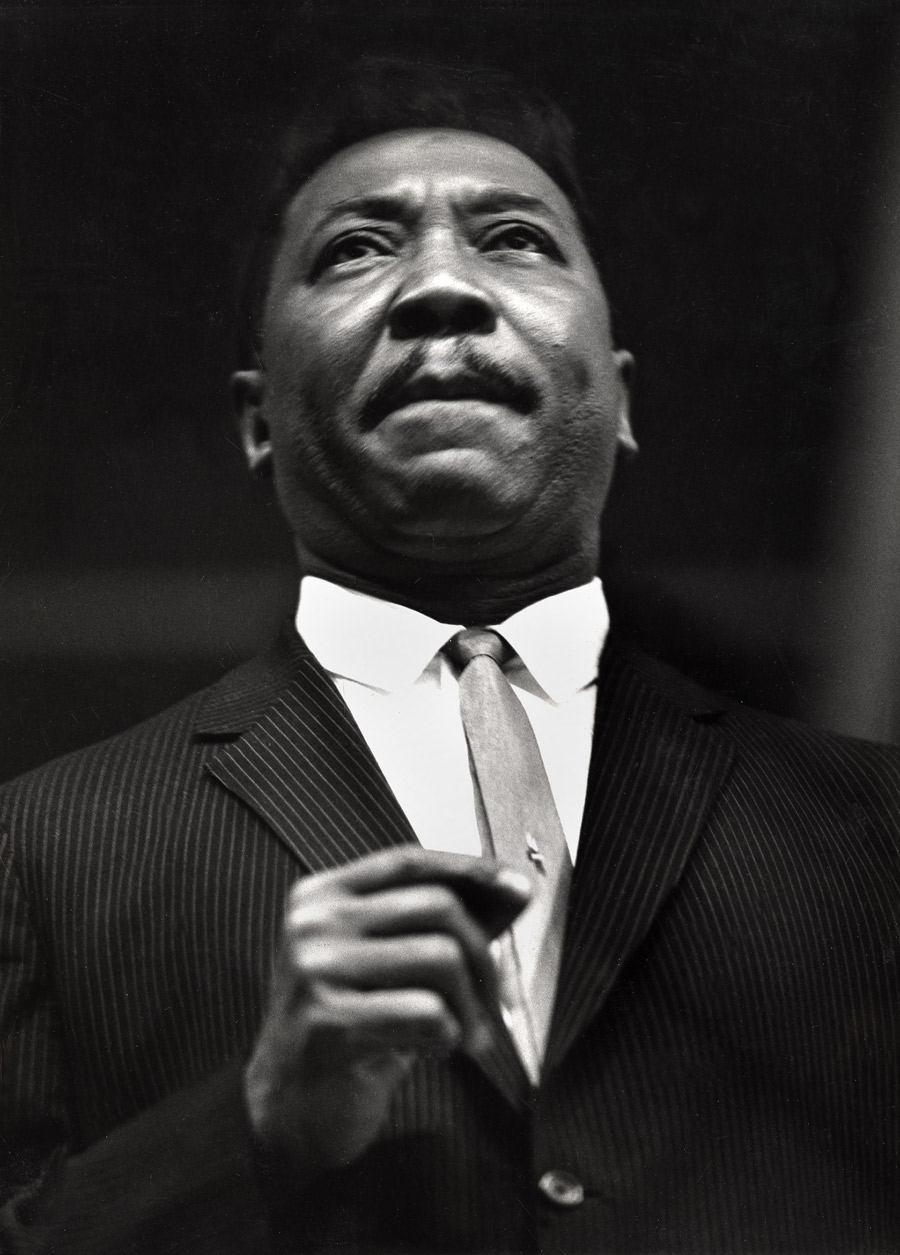
Charles H. "Chuck" Stewart (American, 1927-2017) 'Muddy Waters' c. 1960


Charles H. “Chuck” Stewart (American, 1927-2017)
Muddy Waters
c. 1960
Gelatin silver print
25.4 x 18.4cm (10 x 7 1/4″)
Institute of Jazz Studies at Rutgers University


Muddy Waters – Got My Mojo Workin’


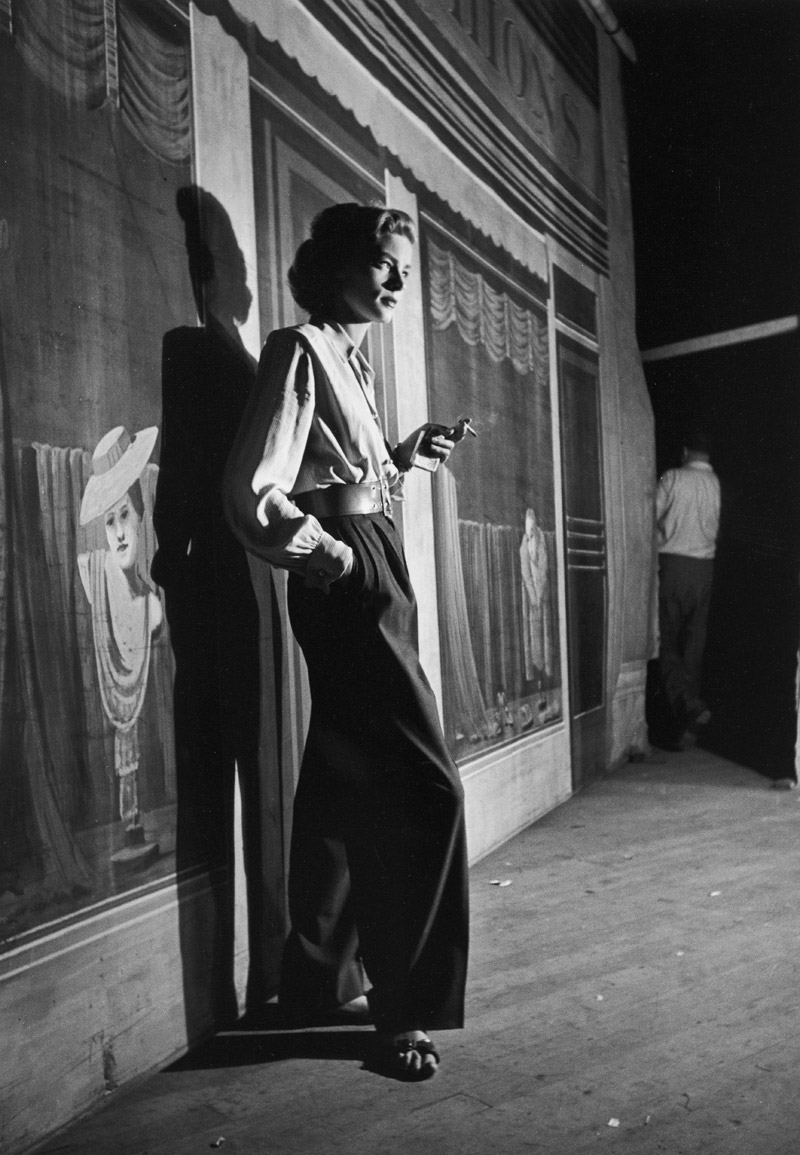
Alfred Eisenstaedt (American, 1898-1995) 'Lauren Bacall' 1949 (printed 2013)


Alfred Eisenstaedt (American, 1898-1995)
Lauren Bacall
1949 (printed 2013)
Pigmented ink jet print
40.3 x 27.9cm (15 7/8 x 11″)


Kate Simon (American, b. 1953) 'Madonna' 1983 (printed 2013)


Kate Simon (American, b. 1953)
Madonna
1983 (printed 2013)
Gelatin silver print
33.7 × 22.9cm (13 1/4 × 9″)
© Kate Simon


Madonna – Papa Don’t Preach (Official Video)


Aram Avakian (American, 1926-1987) 'Miles Davis' 1955 (printed 2012)


Aram Avakian (American, 1926-1987)
Miles Davis
1955 (printed 2012)
Modern print made from original negative
34.6 × 24.1cm (13 5/8 × 9 1/2″)


Miles Davis – So What (Official Video)


Unidentified Artist. 'Bix Beiderbecke' c. 1920


Unidentified Artist
Bix Beiderbecke
c. 1920
Gelatin silver print
19.1 x 11.4cm (7 1/2 x 4 1/2″)
Institute of Jazz Studies at Rutgers University


At the Jazz Band Ball – Bix Beiderbecke and His Gang, 1927


Royal Garden Blues – Bix Beiderbecke 1927

Leon Bismark “Bix” Beiderbecke (March 10, 1903 – August 6, 1931) was an American jazz cornetist, jazz pianist, and composer.

With Louis Armstrong and Muggsy Spanier, Beiderbecke was one of the most influential jazz soloists of the 1920s. His turns on “Singin’ the Blues” and “I’m Coming, Virginia” (both 1927), in particular, demonstrated an unusual purity of tone and a gift for improvisation. With these two recordings, especially, he helped to invent the jazz ballad style and hinted at what, in the 1950s, would become cool jazz. “In a Mist” (1927), one of a handful of his piano compositions and one of only two he recorded, mixed classical (Impressionist) influences with jazz syncopation.


Leon Bismark “Bix” Beiderbecke (March 10, 1903 – August 6, 1931) was an American jazz cornetist, jazz pianist, and composer. A native of Davenport, Iowa.

Bix Beiderbecke was one of the great jazz musicians of the 1920’s; he was also a child of the Jazz Age who drank himself to an early grave with illegal Prohibition liquor. His hard drinking and beautiful tone on the cornet made him a legend among musicians during his life. The legend of Bix grew even larger after he died. Bix never learned to read music very well, but he had an amazing ear even as a child. His parents disapproved of his playing music and sent him to a military school outside of Chicago in 1921. He was soon expelled for skipping class and became a full-time musician. In 1923 Beiderbecke joined the Wolverine Orchestra and recorded with them the following year. Bix was influenced a great deal by the Original Dixieland Jass Band, but soon surpassed their playing. In late 1924 Bix left the Wolverines to join Jean Goldkette’s Orchestra, but his inability to read music eventually resulted in him losing the job. In 1926 he spent some time with Frankie Trumbauer’s Orchestra where he recorded his solo piano masterpiece “In a Mist”. He also recorded some of his best work with Trumbauer and guitarist, Eddie Lang, under the name of Tram, Bix, and Eddie.

Bix was able to bone up on his sight-reading enough to re-join Jean Goldkette’s Orchestra briefly, before signing up as a soloist with Paul Whiteman’s Orchestra. Whiteman’s Orchestra was the most popular band of the 1920’s and Bix enjoyed the prestige and money of playing with such a successful outfit, but it didn’t stop his drinking. In 1929 Bix’s drinking began to catch up with him. He suffered from delirium tremens and he had a nervous breakdown while playing with the Paul Whiteman Orchestra, and was eventually sent back to his parents in Davenport, Iowa to recover. It should be noted that Paul Whiteman was very good to Bix during his struggles. He kept Bix on full pay long after his breakdown, and promised him that his chair was always open in the Whiteman Orchestra, but, Bix was never the same again, and never rejoined the band.

He returned to New York in 1930 and made a few more records with his friend Hoagy Carmichael and under the name of Bix Beiderbecke and his Orchestra. But mainly, he holed himself up in a rooming house in Queens, New York where he drank a lot and worked on his beautiful solo piano pieces “Candlelight”, “Flashes”, and “In The Dark” (played here by Ralph Sutton; Bix never recorded them). He died at age 28 in 1931 during an alcoholic seizure. The official cause of death was lobar pneumonia and edema of the brain.


Gerard Malanga (American, b. 1943) 'Lou Reed' 1966


Gerard Malanga (American, b. 1943)
Lou Reed
1966
Gelatin silver print
48.3 x 36.2cm (19 x 14 1/4″)
© Martin Irvine


Lou Reed – Sweet Jane – live in Paris, 1974


Arnold A. Newman (American, 1918-2006) 'Jackson Pollock' 1949


Arnold A. Newman (American, 1918-2006)
Jackson Pollock
1949
Gelatin silver print
46 x 36.7cm (18 1/8 x 14 7/16″)
National Portrait Gallery, Smithsonian Institution


Lynn Goldsmith (American, b. 1948) 'Patti Smith' 1976 (printed 2012)


Lynn Goldsmith (American, b. 1948)
Patti Smith
1976 (printed 2012)
Digital inkjet print
Image: 46.9 x 30cm (18 7/16 x 11 13/16″)
National Portrait Gallery, Smithsonian Institution


Philippe Halsman (American, 1906-1979) 'Clint Eastwood' 1971


Philippe Halsman (American, 1906-1979)
Clint Eastwood
1971
Gelatin silver print
34.3 x 27.3cm (13 1/2 x 10 3/4″)
National Portrait Gallery, Smithsonian Institution


Richard Avedon (American, 1923-2004) 'Bob Dylan, Singer, New York City, February 10, 1965' 1965


Richard Avedon (American, 1923-2004)
Bob Dylan, Singer, New York City, February 10, 1965
1965
Gelatin silver print
25.4 × 20.3cm (10 × 8″)
© Richard Avedon Foundation


Bob Dylan – Knockin’ on Heaven’s Door (Live)

From the Hard to Handle concert film. Bob Dylan, backed by Tom Petty and the Heartbreakers during their Australian tour in 1986.


Eli Reed (American, b. 1946) 'Tupac Shakur' 1992 (printed 2013)


Eli Reed (American, b. 1946)
Tupac Shakur
1992 (printed 2013)
Digitally exposed chromogenic print
34.6 x 27.3cm (13 5/8 x 10 3/4″)
National Portrait Gallery, Smithsonian Institution


William Paul Gottlieb (American, 1917-2006) 'Gene Krupa at 400 Restaurant, New York City' June 1946


William Paul Gottlieb (American, 1917-2006)
Gene Krupa at 400 Restaurant, New York City
June 1946
Gelatin silver print
Sheet: 35.6 x 27.9cm (14 x 11″)
Estate of William Gottlieb


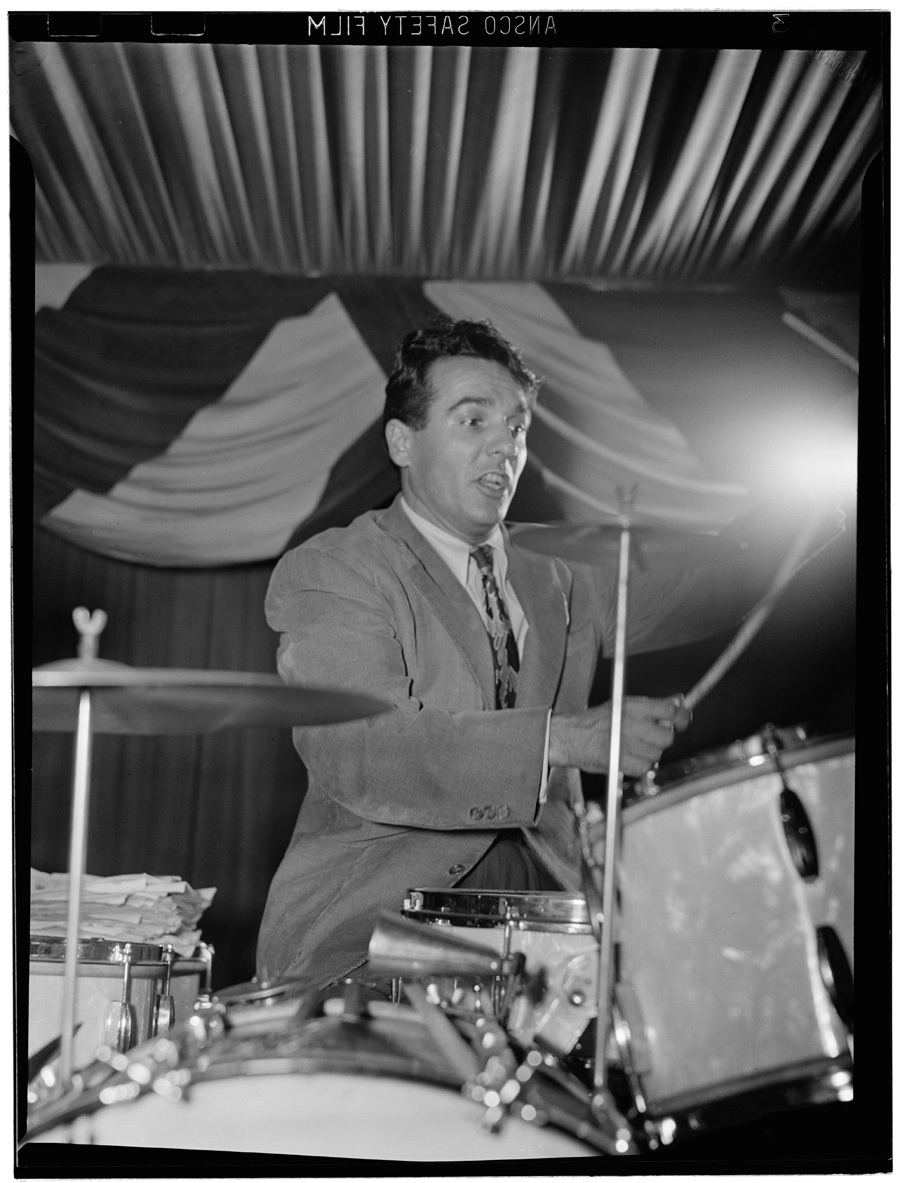
Eugene Bertram “Gene” Krupa (January 15, 1909 – October 16, 1973) was an American jazz and big band drummer, actor and composer, known for his highly energetic and flamboyant style. In the 1930s, Krupa became the first endorser of Slingerland drums. At Krupa’s urging, Slingerland developed tom-toms with tuneable top and bottom heads, which immediately became important elements of virtually every drummer’s setup. Krupa developed and popularized many of the cymbal techniques that became standards. His collaboration with Armand Zildjian of the Avedis Zildjian Company developed the modern hi-hat cymbals and standardised the names and uses of the ride cymbal, the crash cymbal, the splash cymbal, the pang cymbal and the swish cymbal. One of his bass drums, a Slingerland inscribed with Benny Goodman’s and Krupa’s initials, is preserved at the Smithsonian museum in Washington, D.C. In 1978, Krupa became the first drummer inducted into the Modern Drummer Hall of Fame.


Gene Krupa having A good time


Gene Krupa – Big Noise From Winnetka


Smithsonian National Portrait Gallery
8th and F Sts NW
Washington, DC 20001

Opening hours:
11.30am – 7.00pm daily

Smithsonian National Portrait Gallery website

LIKE ART BLART ON FACEBOOK

Back to top

Opening: ‘John Bodin: Rite of Passage’ at Anita Traverso Gallery, Richmond

Exhibition dates: 11th August – 3rd September, 2011


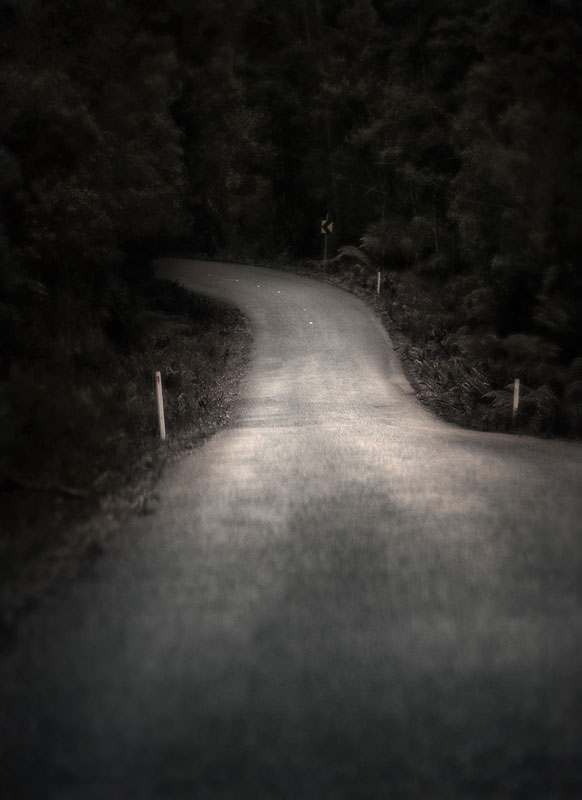
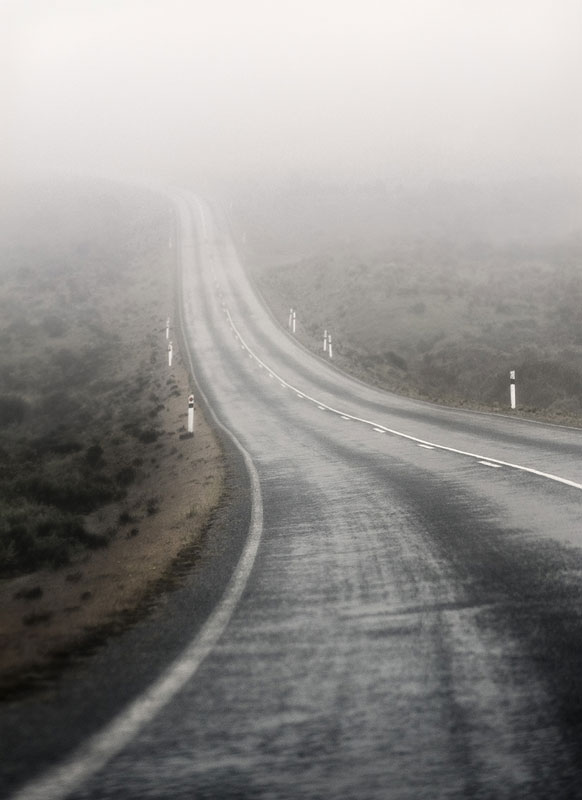
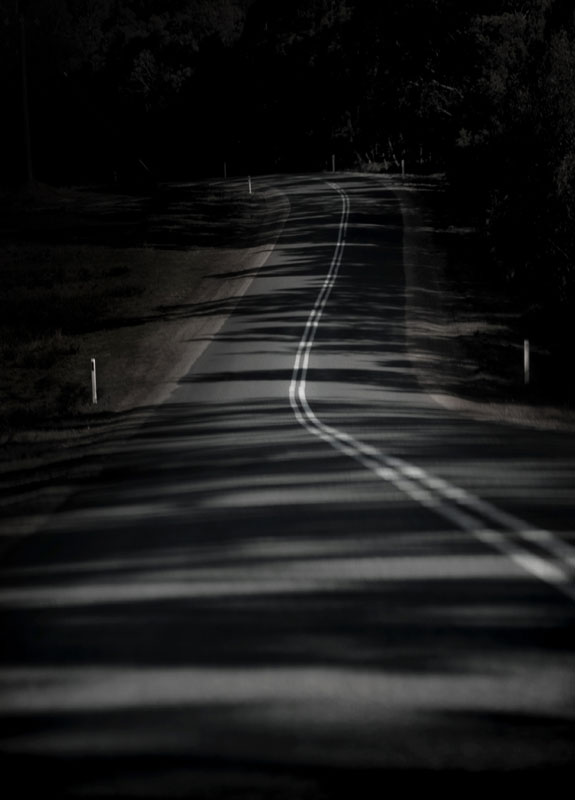
John Bodin (Australian) 'I Was Far Away From Home' 2009


John Bodin (Australian)
I Was Far Away From Home
2009
Type C print on metallic paper
80 x 110cm


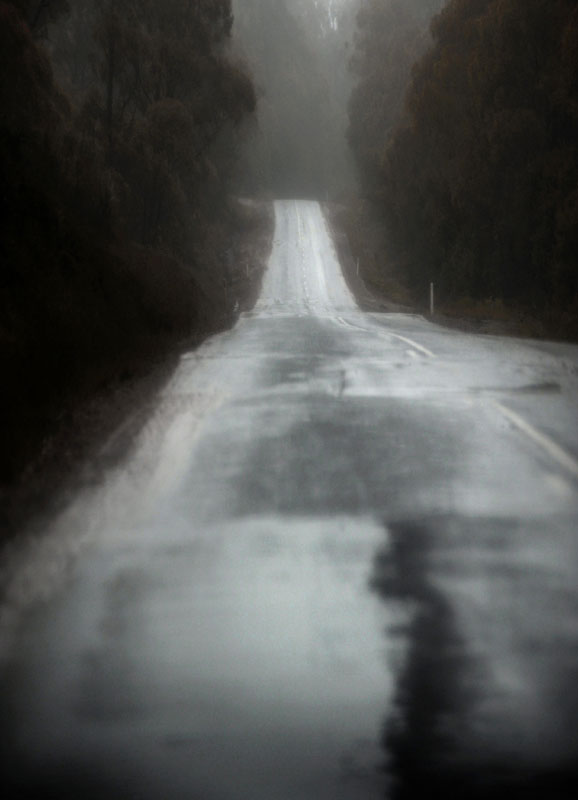
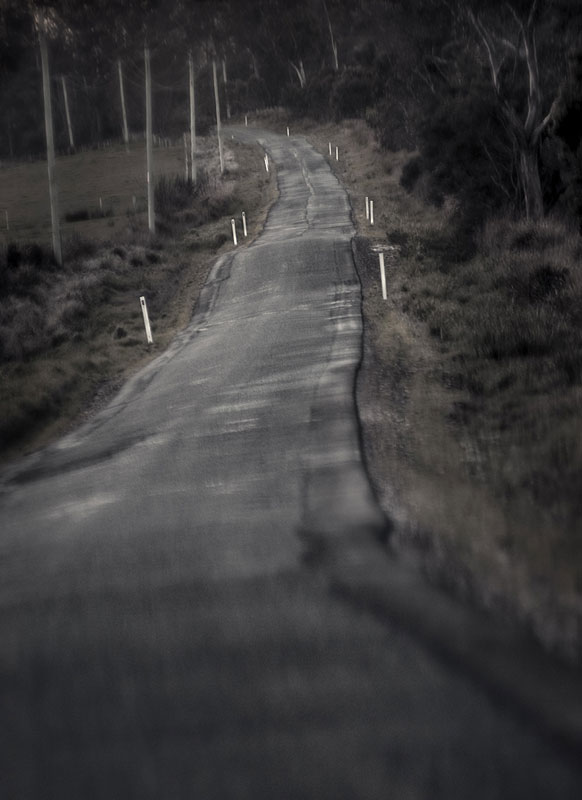
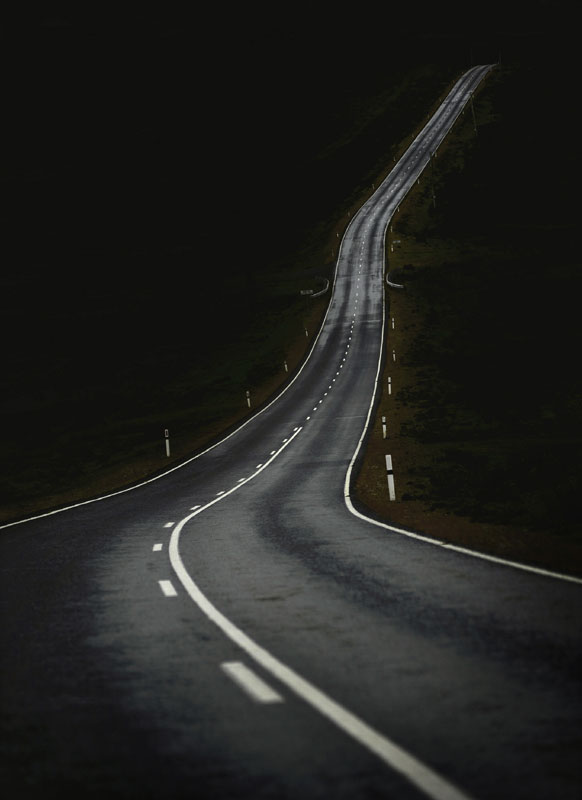
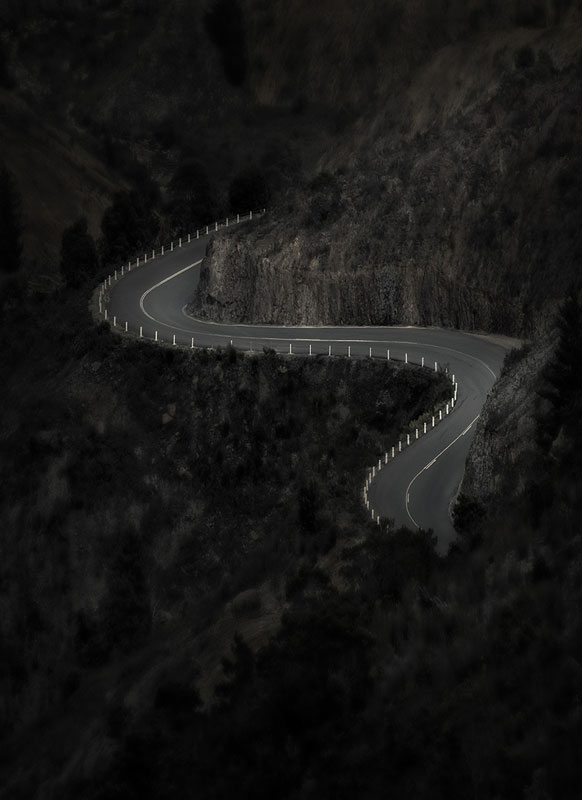
Reprinted below is the speech I gave at the opening. Beautiful work (shot mostly in Tasmania from the passenger seat of a moving car). Many thanx to Anita and John for asking me to speak at the opening – it was fun!

Opening night speech

I want to preface what I am about to say by noting that I am interested in how these photographs, as physical objects, might speak to what is not physical, what is intangible and ineffable about the spaces they display.

I saw a fantastic documentary about the pianist Artur Rubenstein recently on SBS. When he was playing in concert he believed that he recognised in the audience a person that was more attuned to the nuances of his phrasing and performance than others and he played for them – he wanted to show them something new, insightful and challenging. This made him play better, taking more risks for greater reward, for himself and for the audience. These moments have the possibility of becoming moments in eternity (or to introduce the analogy of the road, milestones). For us it is the recognition of these moments in eternity (or to keep the analogy going, a journey), the unenclosed and apparently insignificant. The material world’s strange mixture of familiarity and otherness, ‘humanness’ and non-humanness.

Where these ideas share a quality with the photographs by John is a recognition of the fluid energy flowing through these spaces, like infinite ribbons of consciousness. For me this is not an escapement nor contentment but a point of stillness within self – an awareness and balance at that moment, at that point in time, in that line of sight when the photograph was taken. A stillness within self that acknowledges the journey taken and the journey to be taken – something that is beyond language and goes to the most intimate place of our being.

The photographs become the surface of the body, stitched together with lines, markers pointing the way – they are encounters with the things that we see before us but also the things that we carry inside of us. It is the interchange between these two things, how one modulates and informs the other. It is this engagement that holds our attention: the dappled light, ambiguity, unevenness, the winding path that floats and bobs before our eyes looking back at us, as we observe and are observed by the body of these landscapes.

One of the fundamental qualities of the photographs is that they escape our attempts to rationalise them and make them part of our understanding of the world, to quantify our existence in terms of materiality. I have an intimate feeling with regard to these sites of engagement. They are both once familiar and unfamiliar to us; they possess a sense of nowhereness. A sense of groundlessness and groundedness. A collapsing of near and far, looking down, looking along, a collapsing of the constructed world.

Why here? Why this particular angle? This section of the visible, this turn in the road. Not quite knowing where we are, we are neither here nor there, within nor without. It is an experience of being between the two – a potential space, a “between” that is formed only in the simultaneous presence of the two. As Donald Winnicott has observed in the book In/different Spaces by Victor Burgin, it is “the potential space between the subjective object and the object objectively perceived” that becomes the location of cultural experience.

“Those things of which I can perceive the beginnings and the end are not my self.” Grimm says. Like the road in these photographs there is no self just an infinite time that has no beginning and no end. The time before my birth, the time after my death. We are just in the world, just being somewhere. Life is just a temporary structure on the road from order to disorder. “The road is life,” writes Jack Kerouac in On the Road.

John’s skill as a photographer is to make visible the not really seen, potential spaces that we could have not have imagined otherwise. And for that, John, I am grateful.

Dr Marcus Bunyan


John Bodin (Australian) 'Into the Mystic' 2009


John Bodin (Australian)
Into the Mystic
2009
Type C print on metallic paper
80 x 110cm


John Bodin (Australian) 'Into Timeless Shadows' 2009


John Bodin (Australian)
Into Timeless Shadows
2009
Type C print on metallic paper
80 x 110 cm


John Bodin (Australian) 'Remembrance of Some Lost Bliss' 2009


John Bodin (Australian)
Remembrance of Some Lost Bliss
2009
Type C print on metallic paper
80 x 110 cm


John Bodin (Australian) 'So Ghostly Easy' 2009


John Bodin
So Ghostly Easy
2009
Type C print on metallic paper
80 x 110 cm


John Bodin (Australian) 'Somewhere Along the Line the Pearl would be Handed to Me' 2009


John Bodin (Australian)
Somewhere Along the Line the Pearl would be Handed to Me
2009
Type C print on metallic paper
80 x 110 cm


John Bodin (Australian) 'The One Distinct Moment of My Life' 2009


John Bodin (Australian)
The One Distinct Moment of My Life
2009
Type C print on metallic paper
80 x 110 cm


Anita Traverso Gallery
PO Box 7001, Hawthorn North 3122
Phone: 0408 534 034

Anita Traverso Gallery website

LIKE ART BLART ON FACEBOOK

Back to top

Exhibition: ‘Beat Memories: The Photographs of Allen Ginsberg’ at the National Gallery of Art, Washington, D.C.

Exhibition dates: 2nd May – 6th September 2010


Many thankx to Anabeth Guthrie and the National Gallery of Art, Washington for allowing me to publish the photographs in the posting. Please click on the photographs for a larger version of the image.


Allen Ginsberg (American, 1926-1997) 'Jack Kerouac the last time he visited my apartment 704 East 5th Street, N.Y.C.… Fall 1964' 1964  from the exhibition 'Beat Memories: The Photographs of Allen Ginsberg' at the National Gallery of Art, Washington, D.C., May - Sept, 2010


Allen Ginsberg (American, 1926-1997)
Jack Kerouac the last time he visited my apartment 704 East 5th Street, N.Y.C…. Fall 1964
1964
Gelatin silver print
Image: 29.5 x 20.8cm (11 5/8 x 8 3/16 in)
Sheet: 35.5 x 27.5cm (14 x 10 13/16 in)
National Gallery of Art, Gift of Gary S. Davis
© 2010 The Allen Ginsberg LLC. All rights reserved


Allen Ginsberg (American, 1926-1997) 'Francesco Clemente looking over hand-script album with new poem I’d written out for his Blake-inspired watercolor illuminations…Manhattan, October 1984' 1984 from the exhibition 'Beat Memories: The Photographs of Allen Ginsberg' at the National Gallery of Art, Washington, D.C., May - Sept, 2010


Allen Ginsberg (American, 1926-1997)
Francesco Clemente looking over hand-script album with new poem I’d written out for his Blake-inspired watercolor illuminations… Manhattan, October 1984…
1984
Gelatin silver print
Image: 40.4 x 27cm (15 7/8 x 10 5/8 in)
Sheet: 50.5 x 40.5cm (19 7/8 x 15 15/16 in)
National Gallery of Art, Gift of Gary S. Davis
© 2010 The Allen Ginsberg LLC. All rights reserved


Allen Ginsberg (American, 1926-1997) 'Jack Kerouac, railroad brakeman's rule-book in pocket…206 East 7th Street near Tompkins Park, Manhattan, probably September 1953' 1953 from the exhibition 'Beat Memories: The Photographs of Allen Ginsberg' at the National Gallery of Art, Washington, D.C., May - Sept, 2010


Allen Ginsberg (American, 1926-1997)
Jack Kerouac, railroad brakeman’s rule-book in pocket… 206 East 7th Street near Tompkins Park, Manhattan, probably September 1953
1953
Gelatin silver print; printed 1984-1997
Image: 34.8 x 23.5cm (13 11/16 x 9 1/4 in)
Sheet: 51.7 x 40.5cm (20 3/8 x 15 15/16 in)
National Gallery of Art, Gift of Gary S. Davis
© 2010 The Allen Ginsberg LLC. All rights reserved


Some of the most compelling photographs taken by renowned 20th-century American poet Allen Ginsberg (1926-1997) of himself and his fellow Beat poets and writers – including William S. Burroughs, Neal Cassady, Gregory Corso, and Jack Kerouac – are the subject of the first scholarly exhibition and catalogue of these works. Beat Memories: The Photographs of Allen Ginsberg explores all facets of his photographs through 79 black-and-white portraits, on view at the National Gallery of Art, Washington, from May 2 through September 6, 2010.

The works are selected largely from a recent gift to the Gallery by Gary S. Davis as well as from private lenders. Davis acquired a master set of Ginsberg’s photographs from the poet’s estate, including one print of every photograph in Ginsberg’s possession at the time of his death. If more than one print existed, Ginsberg’s estate selected the one with the most compelling inscription. In 2008 and 2009 Davis donated more than 75 of these photographs to the National Gallery.

“We owe an enormous debt of gratitude to Gary Davis for his dedication to Ginsberg’s work and for his donations to the National Gallery,” said Earl A. Powell III, director, National Gallery of Art. “Joining other large and important holdings of photographs by such 20th-century artists as Harry Callahan, Walker Evans, Robert Frank, Lee Friedlander, André Kertész, Irving Penn, Alfred Stieglitz, and Paul Strand, this Ginsberg collection will allow future generations to study the evolution of the visual art of this important poet in all its rich complexity and to assess his contributions to 20th-century American photography.”

The same ideas that informed Ginsberg’s poetry – an intense observation of the world, a deep appreciation for the beauty of the vernacular, a faith in intuitive expression – also permeate his photographs.

When Ginsberg first began to take photographs in the 1950s, he – like countless other amateurs – had his film developed and printed at a local drugstore. The exhibition begins with a small selection of these “drugstore” prints.

The exhibition showcases examples of his now celebrated portraits of Beat writers such as Burroughs, Kerouac, and Ginsberg himself, starting just before they achieved fame with their publication, respectively, of Naked Lunch (1959), On the Road (1957), and Howl (1956), and continuing through the 1960s. In the photograph Bob Donlon (Rob Donnelly, Kerouac’s ‘Desolation Angels’), Neal Cassady, myself in black corduroy jacket… (1956), Ginsberg captures the tender, playful quality of his close-knit group of friends.

Photographs such as The first shopping cart street prophet I’d directly noticed… (1953) and Ginsberg’s apartment at 1010 Montgomery Street, San Francisco (1953), reveal his self-taught talents and careful attention to the world around him.

The second section of the exhibition presents Ginsberg’s later photographs, taken from the early 1980s until his death. These images were immediately embraced by the art world in the 1980s, and works such as Publisher-hero Barney Rosset whose Grove Press legal battles liberated U.S. literature & film… (1991) and Lita Hornick in her dining room… (1995) were exhibited in galleries and museums around the world. Prestigious institutions acquired Ginsberg’s photographs for their permanent collections, and two books were published on his photographic accomplishments. Ginsberg was not simply a happy bystander, witnessing these events from afar; he was one of the most active promoters of his photography. With their handwritten captions by Ginsberg himself, often reflecting on the passage of time, his photographs are both records and recollections of an era.

Allen Ginsberg (1926-1997)

Allen Ginsberg began to take photographs in 1953 when he purchased a small, secondhand Kodak camera. From then until the early 1960s, he photographed himself and his friends in New York and San Francisco, or on his travels around the world. At the same time, he was formulating his poetic voice. Ginsberg first commanded public attention in 1955 when he read his provocative and now famous poem Howl to a wildly cheering audience at the Six Gallery in San Francisco. It was published the following year by City Lights Books with an introduction by William Carlos Williams.

Together with On the Road (1957), written by Kerouac, Howl was immediately hailed as a captivating, if challenging expression of both a new voice and a new vision for American literature. Celebrating personal freedom, sexual openness, and spontaneity, Ginsberg and Kerouac came to be seen as the embodiment of a younger generation – the Beats – who were unconcerned with middle-class American values and aspirations and decried its materialism and conformity. Ginsberg abandoned photography in 1963.

In 1983, with this rich, full life largely behind him, Ginsberg became increasingly interested in ensuring and perpetuating his legacy. Inspired by the discovery of his old negatives and encouraged by photographers Berenice Abbott and Robert Frank, he reprinted much of his early photographs and made new portraits of longtime friends and other acquaintances, such as the painter Francesco Clemente and musician Bob Dylan. With his poetic voice refined, Ginsberg, also added extensive inscriptions beneath each image, describing both his relationship with the subject and his memories of their times together.

Unlike many other members of the Beat Generation whose careers were cut short, Ginsberg wrote and published deeply moving and influential poetry for the rest of his life, including Kaddish (1961), his soulful lament for his mother, and The Fall of America: Poems of These States, 1965-1971 (1972), which was awarded a National Book Award in 1974. Using his fame to advance social causes, he also continued to capture public attention as an outspoken opponent to the Vietnam War and American militarism and as a champion of free speech, gay rights, and oppressed people around the world. In the midst of this popular acclaim, Ginsberg’s photographs have not received much critical attention, especially in the years since his death in 1997.

Although Ginsberg’s photographs form one of the most revealing records of the Beat and counterculture generation from the 1950s to the 1990s, tracing their journey from youthful characters to ageing, often spent figures, his pictures are far more than historical documents. Drawing on the most common form of photography – the snapshot – he created spontaneous, uninhibited pictures of ordinary events to celebrate and preserve what he called “the sacredness of the moment.

Press release from the National Gallery of Art website [Online] Cited 01/09/2010 no longer available online


Allen Ginsberg (American, 1926-1997) 'William Burroughs, 11 pm late March 1985, being driven home to 222 Bowery…' 1985


Allen Ginsberg (American, 1926-1997)
William Burroughs, 11 pm late March 1985, being driven home to 222 Bowery…
1985
Gelatin silver print
Image: 19.7 x 18.9cm (7 3/4 x 7 7/16 in)
Sheet: 25.4 x 20.3cm (10 x 8 in)
National Gallery of Art, Gift of Gary S. Davis
© 2010 The Allen Ginsberg LLC. All rights reserved


Allen Ginsberg (American, 1926-1997) 'Myself seen by William Burroughs…our apartment roof Lower East Side between Avenues B & C…Fall 1953' 1953; printed 1984-1997


Allen Ginsberg (American, 1926-1997)
Myself seen by William Burroughs… our apartment roof Lower East Side between Avenues B & C… Fall 1953
1953; printed 1984-1997
Gelatin silver print
Image: 28.58 x 43.82cm (11 1/4 x 17 1/4 in)
Sheet: 40.5 x 50.5cm (15 15/16 x 19 7/8 in)
National Gallery of Art, Gift of Gary S. Davis
© 2010 The Allen Ginsberg LLC. All rights reserved


Allen Ginsberg (American, 1926-1997) '“Now Jack as I warned you"… William Burroughs… lecturing…Jack Kerouac…Manhattan, 206 East 7th St. Apt. 16, Fall 1953' 1953; printed 1984-1997


Allen Ginsberg (American, 1926-1997)
Now Jack as I warned you” … William Burroughs… lecturing… Jack Kerouac… Manhattan, 206 East 7th St. Apt. 16, Fall 1953
1953; printed 1984-1997
Gelatin silver print
Image: 28.3 x 44.2cm (11 1/8 x 17 3/8 in)
Sheet: 40.4 x 50.2cm (15 7/8 x 19 3/4 in)
National Gallery of Art, Gift of Gary S. Davis
© 2010 The Allen Ginsberg LLC. All rights reserved


Allen Ginsberg (American, 1926-1997) 'William S. Burroughs looking serious, sad lover's eyes, afternoon light in window…New York, Fall 1953' 1953; printed 1984-1997


Allen Ginsberg (American, 1926-1997)
William S. Burroughs looking serious, sad lover’s eyes, afternoon light in window… New York, Fall 1953
1953; printed 1984-1997
Gelatin silver print
Image: 19.2 x 29cm (7 9/16 x 11 7/16 in)
Sheet: 27.9 x 35.2cm (11 x 13 7/8 in)
National Gallery of Art, Gift of Gary S. Davis
© 2010 The Allen Ginsberg LLC. All rights reserved


Allen Ginsberg (American, 1926-1997) 'Neal Cassady and his love of that year the star-crossed Natalie Jackson…San Francisco, maybe March 1955' 1955; printed 1984-1997


Allen Ginsberg (American, 1926-1997)
Neal Cassady and his love of that year the star-crossed Natalie Jackson… San Francisco, maybe March 1955
1955; printed 1984-1997
Gelatin silver print
Image: 24.9 x 38cm (9 13/16 x 14 15/16 in)
Sheet: 40.5 x 50.5cm (15 15/16 x 19 7/8 in)
National Gallery of Art, Gift of Gary S. Davis
© 2010 The Allen Ginsberg LLC. All rights reserved


Allen Ginsberg (American, 1926-1997) 'William Burroughs' 1953


Allen Ginsberg (American, 1926-1997)
William Burroughs
1953
gelatin silver print
Image: 10.2 x 15.2cm (4 x 6 in)
Sheet: 11.3 x 16.1cm (4 7/16 x 6 5/16 in)
Howard Greenberg Gallery, New York
© 2010 The Allen Ginsberg LLC. All rights reserved


Allen Ginsberg (American, 1926-1997) 'Jack Kerouac wandering along East 7th street…' 1953


Allen Ginsberg (American, 1926-1997)
Jack Kerouac wandering along East 7th street…
1953
Gelatin silver print, printed 1984-1997
Image: 11 1/2 x 17 3/4 in.
National Gallery of Art
Gift of Gary S. Davis
© 2010 The Allen Ginsberg LLC. All rights reserved


Allen Ginsberg (American, 1926-1997) 'Allen Ginsberg' 1955


Allen Ginsberg (American, 1926-1997)
Allen Ginsberg
1955
Gelatin silver print
Image: 2 11/16 x 3 15/16 in.
Howard Greenberg Gallery, New York
© 2010 The Allen Ginsberg LLC. All rights reserved


Allen Ginsberg (American, 1926-1997) 'Peter Orlovsky at James Joyce’s grave' 1980; printed 1984-1997


Allen Ginsberg (American, 1926-1997)
Peter Orlovsky at James Joyce’s grave
1980; printed 1984-1997
gelatin silver print
Image: 19 x 28.5cm (7 1/2 x 11 1/4 in)
Sheet: 27.8 x 35.5cm (10 15/16 x 14 in)
Collection of Gary S. Davis
© 2010 The Allen Ginsberg LLC. All rights reserved


Allen Ginsberg (American, 1926-1997) 'William Burroughs at rest in the side-yard of his house... Lawrence, Kansas May 28, 1991…' 1991


Allen Ginsberg (American, 1926-1997)
William Burroughs at rest in the side-yard of his house… Lawrence, Kansas May 28, 1991…
1991
gelatin silver print
Image: 22.23 x 33.02cm (8 3/4 x 13 in)
Sheet: 27.9 x 35.4cm (11 x 13 15/16 in)
National Gallery of Art, Gift of Gary S. Davis
© 2010 The Allen Ginsberg LLC. All rights reserved


National Gallery of Art, Washington DC
The National Gallery of Art, located on the National Mall between 3rd and 7th Streets at Constitution Avenue NW

Opening hours:
Daily 10.00am – 5.00pm

National Gallery of Art website

LIKE ART BLART ON FACEBOOK

Back to top

Exhibition: ‘Daidō Moriyama: Tokyo Photographs’ at Philadelphia Museum of Art

Exhibition dates: 28th February – 31st July, 2009

Curator: Peter Barberie, Curator of Photographs


Many thankx to Philadelphia Museum of Art for allowing me to publish the photographs in the posting. Please click on the photographs for a larger version of the image.


Daido Moriyama (Japanese, b. 1938) 'Untitled' from the series 'Memory of Dog' 1982 from the exhibition 'Daidō Moriyama: Tokyo Photographs' at Philadelphia Museum of Art, Feb - July, 2009


Daidō Moriyama (Japanese, b. 1938)
Untitled from the series Memory of Dog
1982
Gelatin silver print
Image: 8 1/16 × 11 13/16 inches (20.5 × 30cm)
Purchased with funds contributed by the E. Rhodes and Leona B. Carpenter Foundation, 1990
Philadelphia Museum of Art
© Daidō Moriyama


Daidō Moriyama often calls himself a “stray dog,” a reference to one of his iconic early pictures of a roaming mongrel, but also to his preferred incidental vantage points in relation to his subjects and his beguiled yet wary stance toward modernising Japanese society. In the series Memory of Dog, he revisited photographic scenarios and motifs from his previous two decades of work, overlaying his peripheral approach with another quality that he finds crucial to photography: its relationship to memory.


Daidō Moriyama (Japanese, born 1938) 'Untitled (Rose)' 1984 from the exhibition 'Daidō Moriyama: Tokyo Photographs' at Philadelphia Museum of Art, Feb - July, 2009


Daidō Moriyama (Japanese, b. 1938)
Untitled (Rose)
1984
Gelatin silver print
© Daidō Moriyama


Daidō Moriyama (Japanese, born 1938) 'Viaduct 1, Bunkyo-ku, Tokyo' 1981


Daidō Moriyama (Japanese, b. 1938)
Viaduct 1, Bunkyo-ku, Tokyo
1981
Gelatin silver print
© Daidō Moriyama


Daidō Moriyama (Japanese, born 1938) 'Untitled (Bottle)' from the series 'Light and Shadow' 1982


Daidō Moriyama (Japanese, b. 1938)
Untitled (Bottle) from the series Light and Shadow
1982
Gelatin silver print
Image: 7 13/16 x 11 13/16 inches (19.8 x 30cm)
Purchased with funds contributed by the E. Rhodes and Leona B. Carpenter Foundation, 1990
© Daidō Moriyama


Daidō Moriyama is one of the most important and exciting Japanese photographers of our time, having made prolific, often experimental pictures of modern urban life since the 1960s. This exhibition showcases a group of approximately 45 photographs made in and around Tokyo in the 1980s, when Moriyama focused his mature aesthetic on the city with renewed intensity.

Moriyama approaches the world with an equalising eye, capturing disparate peripheral details that in themselves account for little, but together add up to a powerful diagnosis of modern experience. In 1980s Japan such details encompassed the disorienting and sometimes brutal juxtaposition of traditional culture and modernisation, most visible in the glut of consumer goods and images. But in Moriyama’s photographs these subjects appear alongside the banal elements of any streetscape: a derelict patch of pavement and wall, a car with an aggressive key scratch running its full length, even a single rose blossom.

Moriyama’s urban imagery shares some of its qualities with other great street photography of the 20th century, and he has cited the photographs of William Klein as a major influence. But his work involves strong responses to a wide range of modern art and literature, including photographs and graphic designs by many of his Japanese contemporaries, Andy Warhol’s silkscreens, and the novels of Jack Kerouac and James Baldwin. Moriyama’s mix of international and Japanese trends to represent modern Tokyo is one source of his photography’s power, and the exhibition will include a small number of works by other artists to demonstrate his visual sensibility, including prints and photographs by Warhol, Klein, Shomei Tomatsu, and Tadanori Yokoo.

Text from the Philadelphia Museum of Art website [Online] Cited 23/03/2009


Daidō Moriyama (Japanese, born 1938) 'Memory of Dog 2' 1981


Daidō Moriyama (Japanese, b. 1938)
Memory of Dog 2
1981
Gelatin silver print
© Daidō Moriyama


Daidō Moriyama (Japanese, born 1938) 'Untitled' c. 1981-1985


Daidō Moriyama (Japanese, b. 1938)
Untitled
c. 1981-1985
Gelatin silver print
Image: 8 1/4 x 11 7/8 inches (21 x 30.2cm)
Purchased with funds contributed by the E. Rhodes and Leona B. Carpenter Foundation, 1990
© Daidō Moriyama


Daidō Moriyama (Japanese, born 1938) 'Untitled' from the series 'Light and Shadow' 1982


Daidō Moriyama (Japanese, b. 1938)
Untitled from the series Light and Shadow
1982
Gelatin silver print
Image: 7 3/4 x 11 13/16 inches (19.7 x 30cm)
Purchased with funds contributed by the E. Rhodes and Leona B. Carpenter Foundation, 1990
© Daidō Moriyama


Daidō Moriyama (Japanese, b. 1938) 'Untitled (Twin Chairs)' 1986


Daidō Moriyama (Japanese, b. 1938)
Untitled (Twin Chairs)
1986
Gelatin silver print
© Daidō Moriyama


Daidō Moriyama (Japanese, born 1938) 'On the Road (Chair)' from the series 'Light and Shadow' 1981


Daidō Moriyama (Japanese, b. 1938)
On the Road (Chair) from the series Light and Shadow
1981
Gelatin silver print
Image: 7 3/4 x 11 13/16 inches (19.7 x 30cm)
Purchased with funds contributed by the E. Rhodes and Leona B. Carpenter Foundation, 1990
© Daidō Moriyama


Since the 1960s Japanese photographer Daidō Moriyama (born 1938) has been making dynamic, often experimental images of modern urban life, establishing a reputation as one of the most important and exciting photographers of our time. The Philadelphia Museum of Art will present an exhibition of approximately 45 photographs by Moriyama, made in and around Tokyo in the 1980s, when the artist focused his mature aesthetic on the city with renewed intensity. The exhibition will be on view from February 28-June 30, 2009 in the Julien Levy Gallery at the Ruth and Raymond G. Perelman Building.

Born in 1938 in Ikeda-cho (now Ikeda-shi), Osaka, Moriyama witnessed the dramatic changes that swept over Japan in the decades following World War II. After his father’s death in a train accident, he began working as a freelance graphic designer at age 20. He was intrigued by the graphic possibilities of screenprinting, the cheapest and most prolific form for printed imagery, and by international trends in contemporary art. These interests, along with attention to the various forms of visual stimuli that populate the urban landscape have been a hallmark of Moriyama’s career.

In 1960 Moriyama took up the study of photography under Takeji Iwamiya and one year later moved to Tokyo hoping to join the eminent photographers’ group VIVO, a short-lived cooperative whose members were exploring and confronting the revolution in modern Japanese society in their work. Although VIVO disbanded a week after Moriyama’s arrival in the capital, the visual and existential turmoil they explored would become one of the core subjects in Moriyama’s photographs. His gritty, black and white images of streets and highways express the conflicting realities of contemporary Japan, the disorienting and sometimes brutal juxtaposition of traditional culture and modernisation. 

“It is a pleasure to present this group of photographs from the Museum’s collection reflecting the distinctive vision of Daidō Moriyama, who is undoubtedly among the great urban photographers of the 20th century,” Curator of Photographs Peter Barberie said. These particular images focus on the visual experience of modern-day Tokyo, but through them Moriyama is documenting broader global trends of modernisation, and at the same time exploring the unique aesthetic qualities of his medium.”

His early images from the 1960s and 70s tested the notion of photographic artistry in an extreme fashion. He chose seemingly arbitrary subjects, and experimented with motion and overexposure to create blurred or nearly blank images, adopting an anti-aesthetic position. Other Japanese photographers were also working in this vein, but Moriyama’s 1972 book Bye Bye Photography became the defining statement of this particular style. The later photographs presented in this exhibition are generally sharper in focus but maintain the peripheral vantage point that Moriyama so often employed, as well as the seemingly random content. His images capture with an equalising eye the kinds of disparate peripheral details that litter the modern urban experience: shadows, cars, and abandoned corners, as well as the glut of consumer goods and commodities. 

Profoundly influenced by Japanese photographers Eikoh Hosoe and Shomei Tomatsu, Moriyama’s vision was also enriched by his acquaintance with the work of American photographers William Klein and Robert Frank. Like them he practiced a new, more action-oriented street photography. His images are often out of focus, vertiginously tilted, or invasively cropped. 

His work also involves strong responses to a wide range of modern art and literature, including photographs and graphic designs by many of his Japanese contemporaries, Andy Warhol’s silkscreens, and the novels of Jack Kerouac and James Baldwin. The exhibition will include a small number of works by other artists to demonstrate his visual sensibility, including prints and photographs by Warhol, Klein, Shomei Tomatsu, and Tadanori Yokoo.

Press release from the Philadelphia Museum of Art


Daidō Moriyama (Japanese, born 1938) 'Tunnel' 1982


Daidō Moriyama (Japanese, b. 1938)
Tunnel
1982
Gelatin silver print
Image: 7 15/16 x 11 7/8 inches (20.2 x 30.2cm)
Purchased with funds contributed by the E. Rhodes and Leona B. Carpenter Foundation, 1990
© Daidō Moriyama


Daidō Moriyama (Japanese, born 1938) 'Untitled' from the series 'Light and Shadow' 1982


Daidō Moriyama (Japanese, b. 1938)
Untitled from the series Light and Shadow
1982
Gelatin silver print
Image: 7 3/4 × 11 3/4 inches (19.7 × 29.8cm)
Purchased with funds contributed by the E. Rhodes and Leona B. Carpenter Foundation, 1990
© Daidō Moriyama


Daidō Moriyama (Japanese, b. 1938) 'Untitled' c. 1981-1985


Daidō Moriyama (Japanese, b. 1938)
Untitled
c. 1981-1985
Gelatin silver print
Image: 8 3/8 × 11 5/8 inches (21.2 × 29.6cm)
Sheet: 10 × 11 15/16 inches (25.4 × 30.4cm)
Purchased with funds contributed by the E. Rhodes and Leona B. Carpenter Foundation, 1990
© Daidō Moriyama


Daidō Moriyama (Japanese, b. 1938) 'Untitled', from the series 'Light and Shadow' 1982


Daidō Moriyama (Japanese, b. 1938)
Untitled, from the series Light and Shadow
1982
Gelatin silver print
Image: 7 3/4 x 11 13/16 inches (19.7 x 30cm)
Sheet: 10 x 12 1/8 inches (25.4 x 30.8cm)
Purchased with funds contributed by the E. Rhodes and Leona B. Carpenter Foundation, 1990
© Daidō Moriyama


Daidō Moriyama (Japanese, b. 1938) 'Setagaya-ku, Tokyo, Midnight' 1986


Daidō Moriyama (Japanese, b. 1938)
Setagaya-ku, Tokyo, Midnight
1986
Gelatin silver print
© Daidō Moriyama


Philadelphia Museum of Art
26th Street and the Benjamin Franklin Parkway
Philadelphia, PA 19130

Opening hours:
Thursday – Monday, 10.00am – 5.00pm
Closed Tuesday and Wednesday

Daido Moriyama website

Philadelphia Museum of Art website

LIKE ART BLART ON FACEBOOK

Back to top