Exhibition: ‘Smile! How the Smile Came Into Photography’ at Museum Ludwig, Cologne

Exhibition dates: 1st November, 2025 – 22nd March, 2026

Curators: Miriam Szwast with Brit Meyer
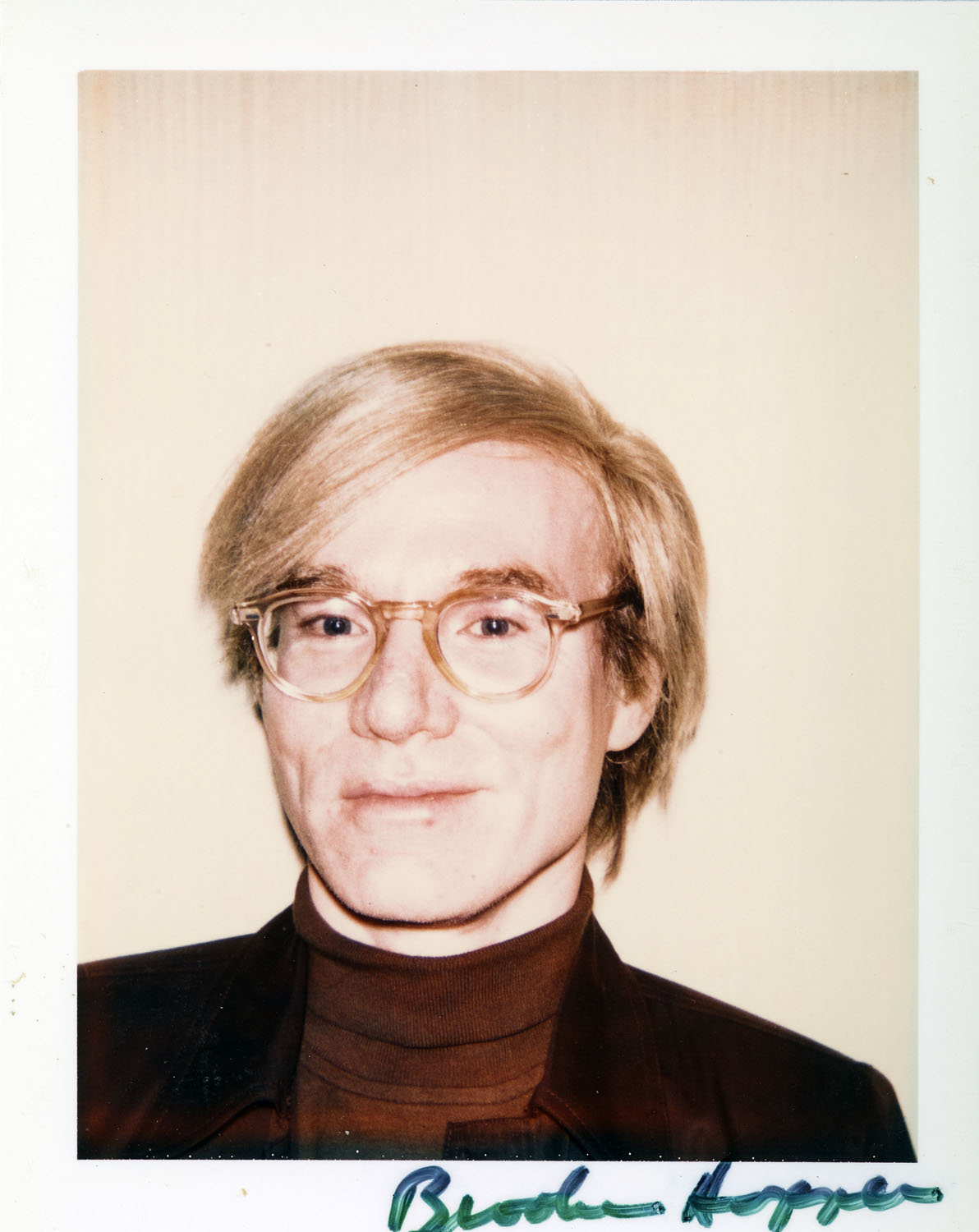
 

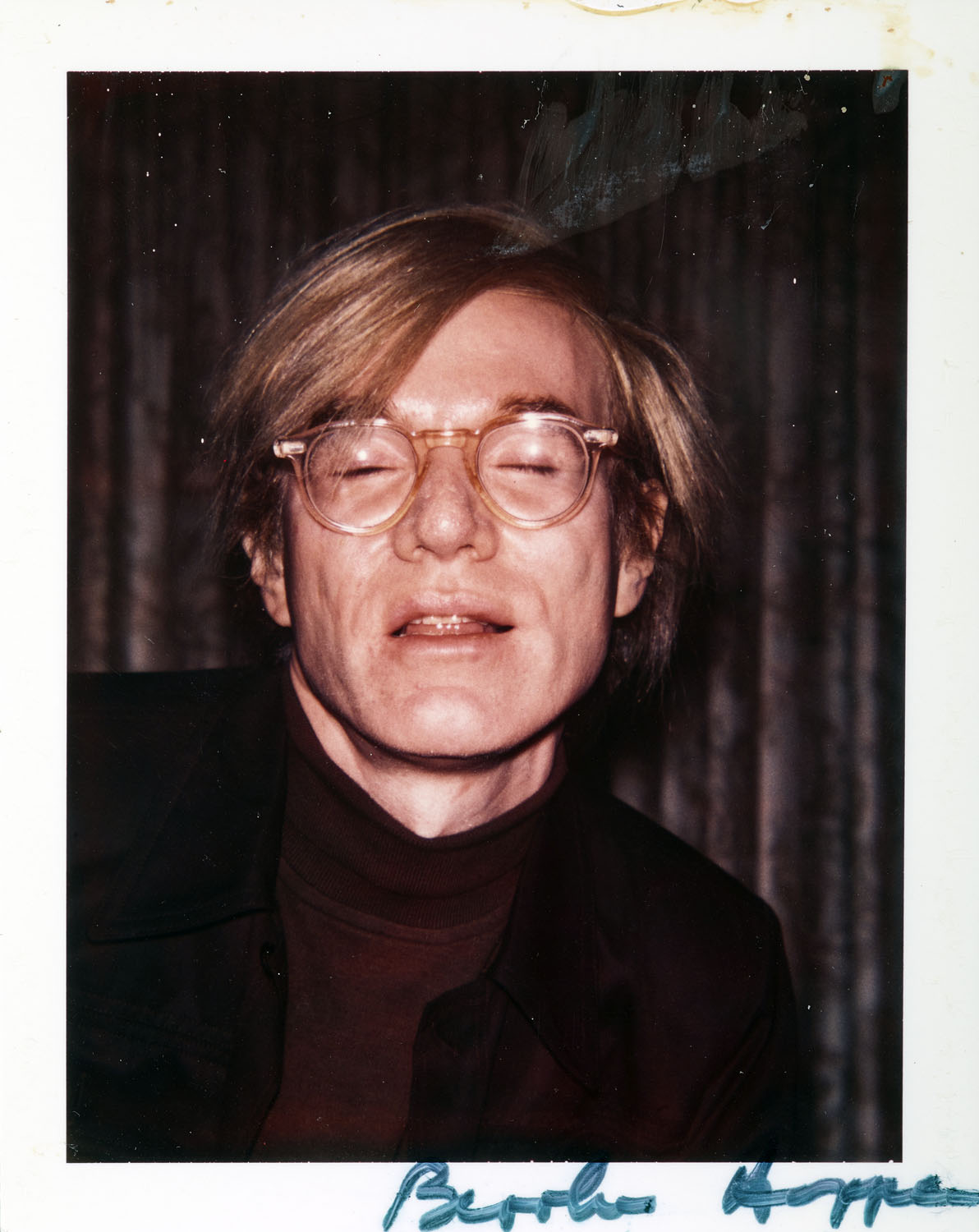
Andy Warhol (American, 1928-1987) 'Warhol, Andy' 1972


Andy Warhol (American, 1928-1987)
Warhol, Andy
1972
Polaroid
10.8 x 8.6cm
Museum Ludwig, Cologne
Repro: Historisches Archiv mit Rheinischem Bildarchiv
©2025 The Andy Warhol Foundation for the Visual Arts, Inc. / Licensed by Artists Rights Society (ARS), New York


I went for a new passport photograph yesterday and the nice person took the first photographs, looked at them, and then said “too much smile”, close your mouth more, and took them again with no teeth exposed and my mouth in a thin, rictus line.

How do our “photographic faces” differ from our everyday faces?

Does not smiling in a photograph prevent us from displaying our individual personality?

What different types of smile are there and what do they signify?

“Smiles are complex, with researchers identifying up to 19 types ranging from genuine joy to social masking, with only six occurring during positive emotions. Key types include the genuine Duchenne smile (involving eyes), polite social smiles, and non-enjoyment smiles like contempt or discomfort, signalling various emotional, social, or, in some cases, aggressive messages.”1

Smiling does not just depend on social norms but researchers have found it may actually be programmed into our DNA, creating in built reactions to certain situations.2 From the miserable smile, to the dampened smile, qualifier smile, contempt smile and fear smile, there are many ways we can interact with others and with the camera lens.

From this distance in Australia and having not see the exhibition in person I can’t tell you whether this exhibition addresses the issues of different smiles pictured in photography but it seems unlikely given the text and media images.

For more information on facial expressions please see my text Facile, Facies, Facticity (January 2014) which examines the facticity of the face, in which only through the “thrownness” of the individual rendered in the lines of the human face can we engage with the intractable conditions of human existence.

Say cheese!

Dr Marcus Bunyan


1/ Zaria Gorvett. “There are 19 types of smile but only six are for happiness,” on the BBC website, 10 April 2017 [Online] Cited 06/03/2026

2/ Ibid.,


Many thankx to Museum Ludwig for allowing me to publish the photographs in the posting. Please click on the photographs for a larger version of the image.
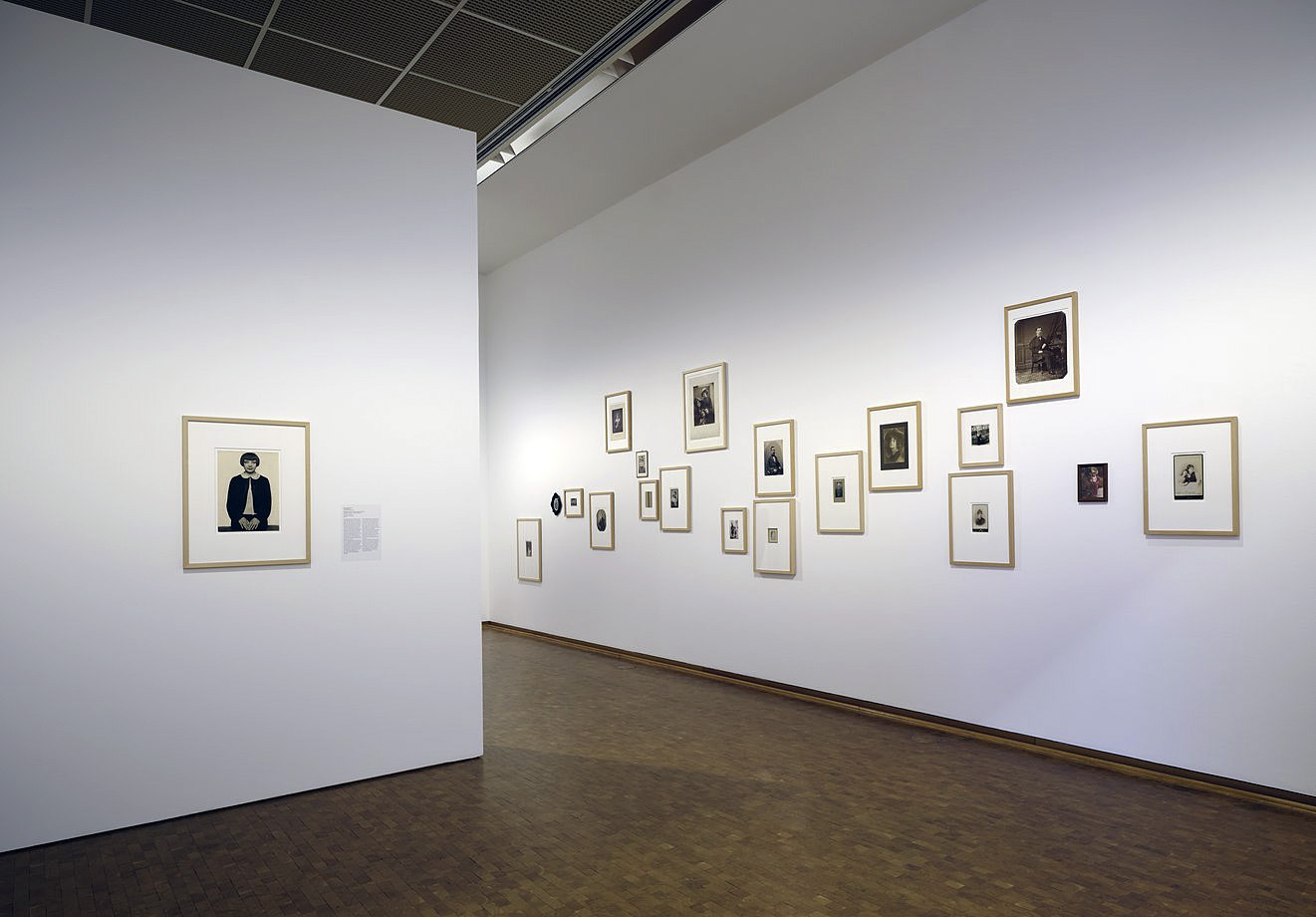


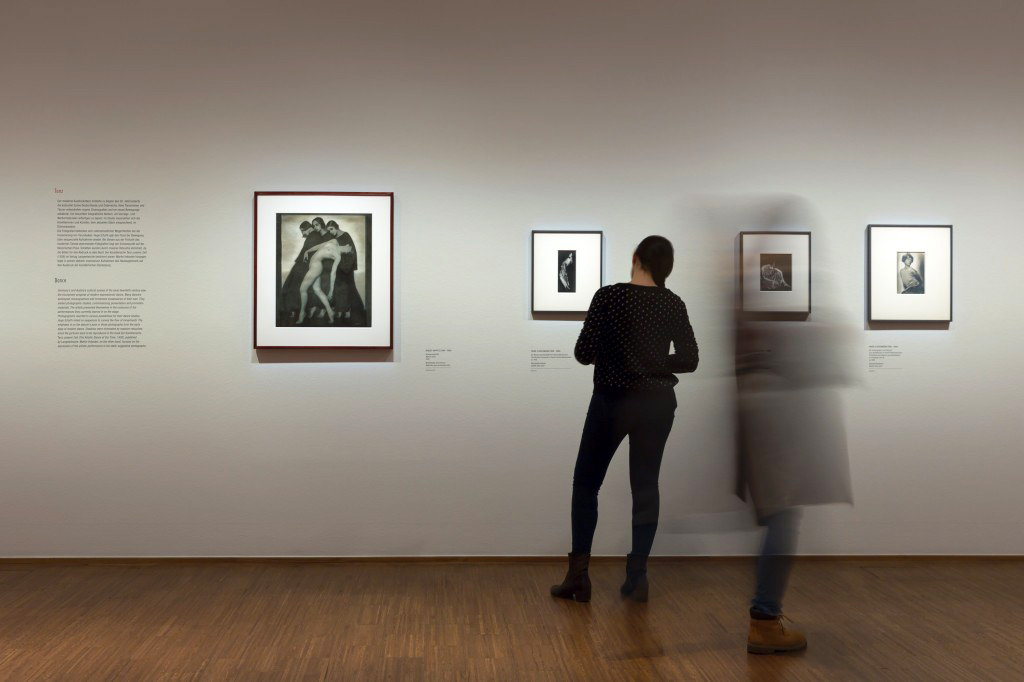
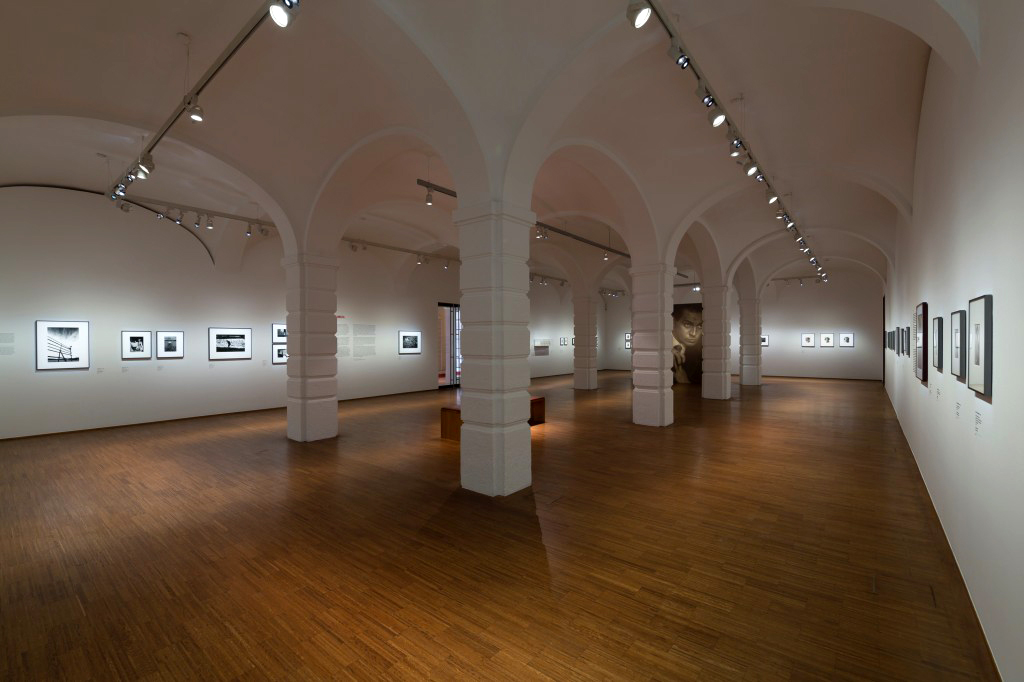
Installation view of the exhibition 'Smile! How the smile came into photography' at the Museum Ludwig, Cologne, November 15, 2025 - March 22, 2026 showing at left, Hugo Erfurth's 'Hildegard Seemann-Wechler (painter)' (1929)


Installation view of the exhibition Smile! How the smile came into photography at the Museum Ludwig, Cologne, November 15, 2025 – March 22, 2026 showing at left, Hugo Erfurth’s Hildegard Seemann-Wechler (painter), (1929, below)
Photo: Historisches Archiv mit Rheinischem Bildarchiv/ Mark Weber
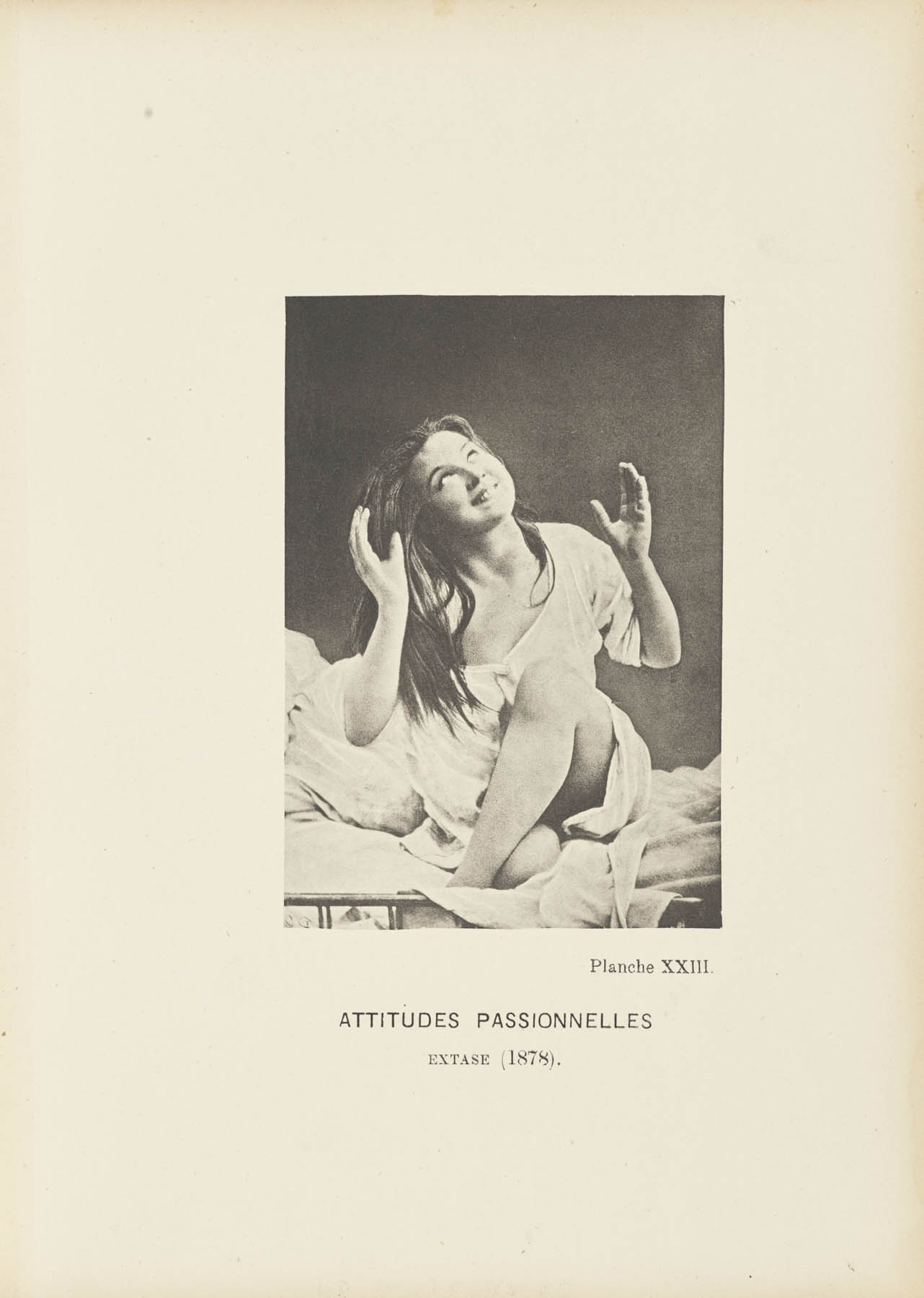
 

Paul-Marie-Léon Regnard (French, 1850-1927) 'Passionate Ecstatic Position/Expression' 1878 Part of 'Iconographie Photographique de la Salpetriere' (Service de M. Charcot)


Paul-Marie-Léon Regnard (French, 1850-1927)
Passionate Ecstatic Position/Expression
1878
Part of Iconographie Photographique de la Salpetriere (Service de M. Charcot)
Photogravure
Image: 10.3 × 7.1cm (4 1/16 × 2 13/16 in.)
The J. Paul Getty Museum, Los Angeles

NB. PHOTOGRAPH IS NOT IN THE EXHIBITION
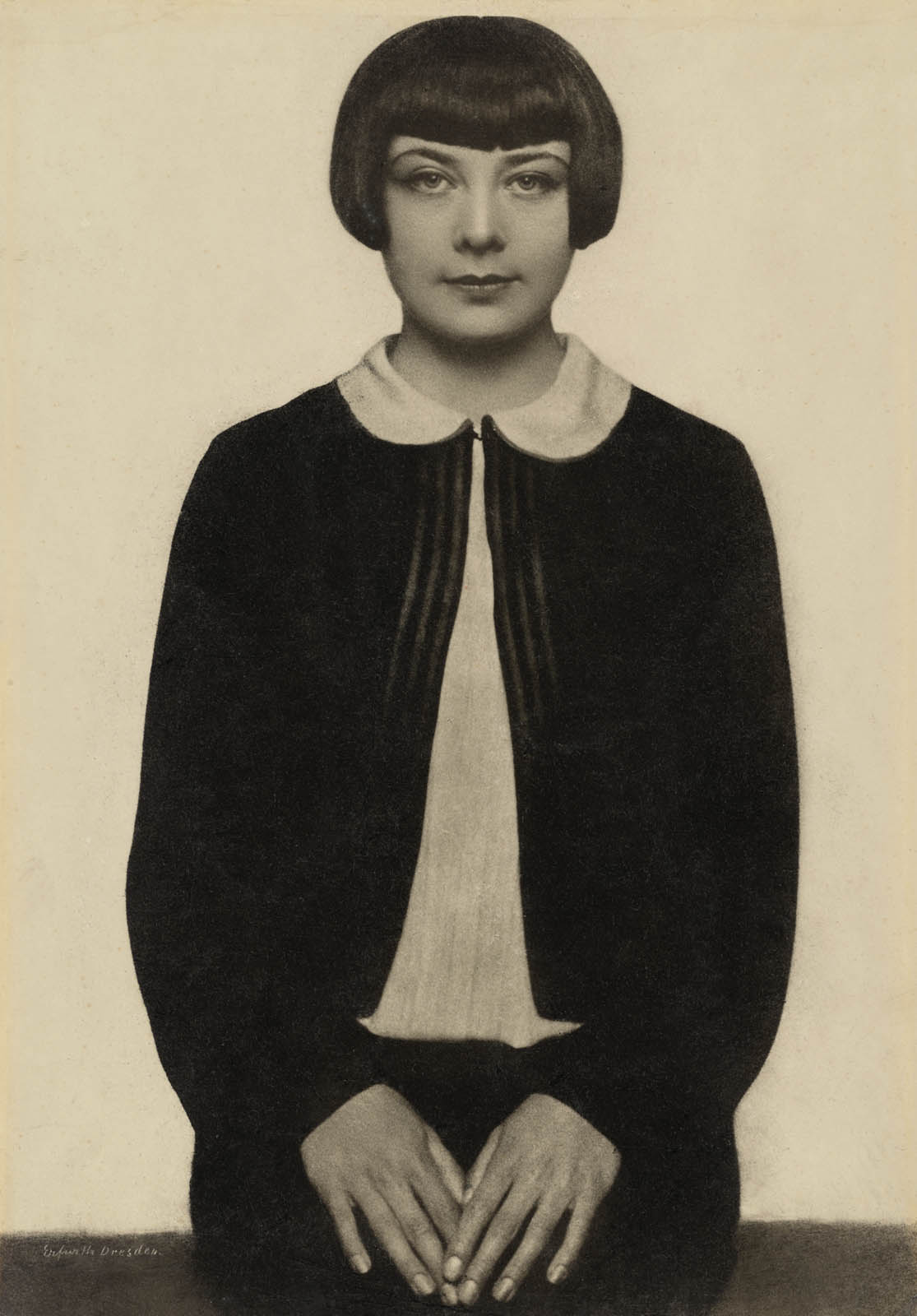
 

Hugo Erfurth (German, 1874-1948) 'Hildegard Seemann-Wechler (painter)' 1929


Hugo Erfurth (German, 1874-1948)
Hildegard Seemann-Wechler (painter)
1929
Oil pigment print on cardboard
38.3 x 26.6cm
Museum Ludwig, Cologne
Repro: Historisches Archiv mit Rheinischem Bildarchiv


When Hildegard Seemann-Wechler had her portrait taken in Hugo Erfurth’s studio in Dresden, she was studying painting with Otto Dix. The strict frontality of this picture, the neutral background, and the direct gaze into the camera are softened by the slight hint of a smile at the corners of the artist’s mouth. Hildegard Seemann-Wechler’s bob hairstyle identifies her as a New Woman who rejects conservative role models. Her portrait breaks with the tradition of serious facial expressions in the 19th century and marks the threshold between not smiling and smiling. Collection presentations like this help us to explore our own works. On the back of this picture, the name “Hilde Wächler” is written in pencil. It was only during the preparations for Smile! that we noticed the mistake and were able to assign the person portrayed to her real name. In 1940, Hilde Seemann-Wechler was murdered by the Nazis.


Hildegard Seemann-Wechler (German, 1903-1940)

Hildegard Wechler came from a bourgeois background. She began her studies at the Staatliche Akademie für Kunstgewerbe in Dresden and moved to the Dresdener Kunstakademie in 1921, where she studied with Richard Müller, Robert Sterl, Ludwig von Hofmann and from 1927 with Otto Dix, three semesters of which as an individual student. In particular, she was supported by Sterl and Dix. Since that time she was friends with Eva Schulze-Knabe and Fritz Schulze. Since Hans and Lea Grundig also studied at the academy, it can be assumed that she also had contact with them.

After her studies, Hildegard Wechler worked in Dresden as a freelance artist. In 1929 she married the painter Herbert Seemann (1900-1945). In 1931, she had the first symptoms of mental illness. The doctors diagnosed an incurable schizophrenia and referred her to the Landesheil- und Pflegeanstalt Arnsdorf. She spent eight and a half years there. She was forcibly sterilized at the State Women’s Hospital Dresden.

In 1940 she was transferred to the Landesheil- und Pflegeanstalt Leipzig-Dösen, on 18. June 1940 to the Heil- und Pflegeanstalt Großschweidnitz. On the 3rd In September 1940, a transport commando brought her to the Pirna-Sonnenstein killing center. She was murdered there shortly afterwards as part of the euthanasia “Aktion T4” as one of at least 14,751 victims of this institution, including the Dresden painters Gertrud Fleck and Elfriede Lohse-Wächtler, in the gas chamber disguised as a bathroom.

Text from the German Wikipedia website translated by Google Translate
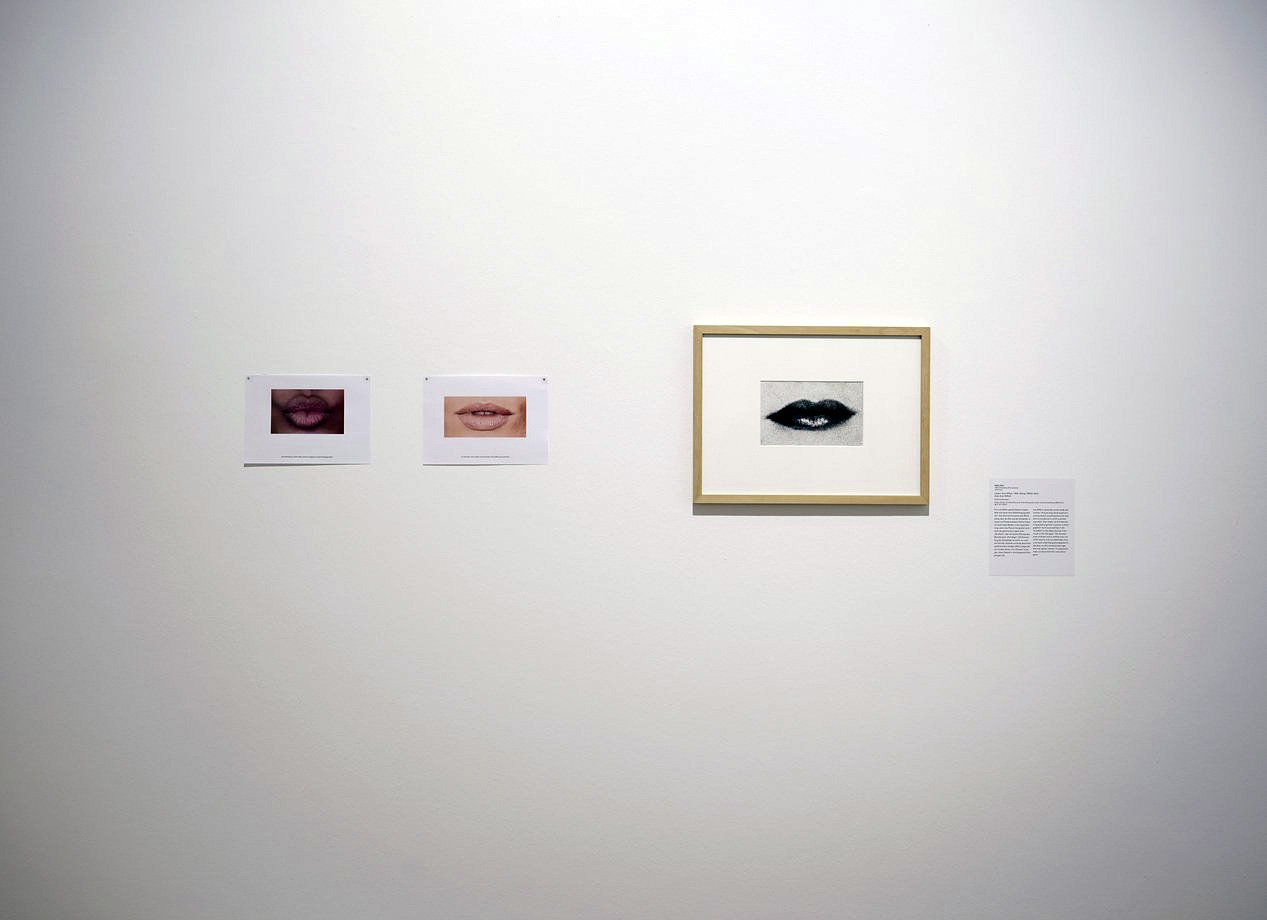
 

Installation view of the exhibition 'Smile! How the smile came into photography' at the Museum Ludwig, Cologne, November 15, 2025 - March 22, 2026 showing at right, Man Ray's 'Lips, (Lee Miller)' (1930)


Installation view of the exhibition Smile! How the smile came into photography at the Museum Ludwig, Cologne, November 15, 2025 – March 22, 2026 showing at right, Man Ray’s Lips, (Lee Miller), (1930, below)
Photo: Historisches Archiv mit Rheinischem Bildarchiv/ Mark Weber
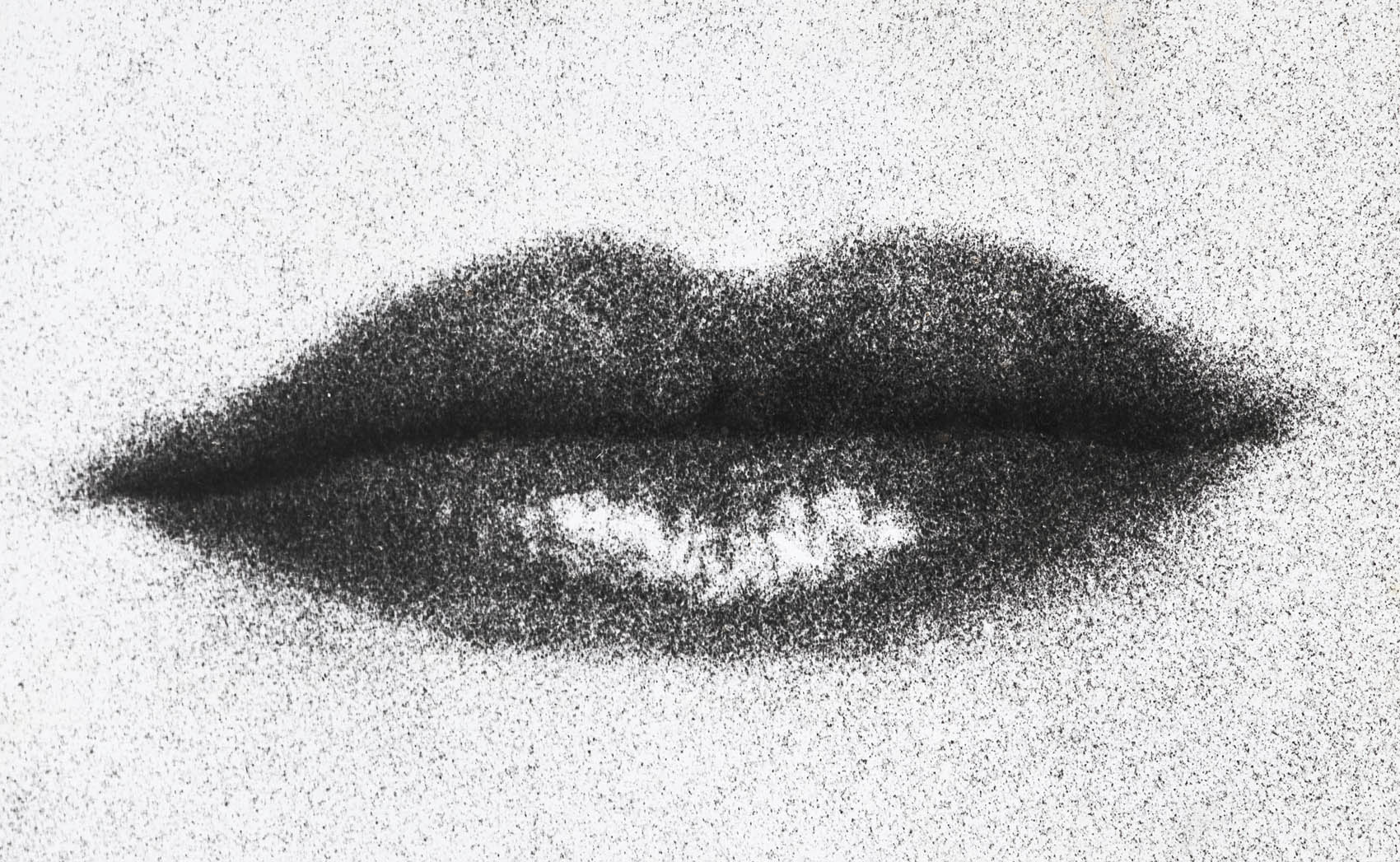
 

Man Ray (American, 1890-1976) 'Lips, (Lee Miller)' 1930


Man Ray (American, 1890-1976)
Lips, (Lee Miller)
1930
Print
21 x 25.5cm
Museum Ludwig, Cologne
Repro: Historisches Archiv mit Rheinischem B


Lee Miller’s closed lips reveal hardly any emotion. And yet every facial expression communicates something about the time and circumstances in which a portrait was taken. Even today, we find fashions in lip positioning when a person is photographed – such as pursed lips in the “duckface” or the slight opening of the mouth in the “fish gape.” The development of dental care is certainly only one of the reasons why we statistically show more teeth when being photographed today than we did a hundred years ago, and why saying “cheese” is supposed to make our faces look their most photogenic.


Smizing, squinching, duck face, fish gape, cheese, or prunes: Beauty ideals and social media have given rise to increasingly mercurial trends in portrait photography. Until the late nineteenth century, having one’s photo taken required the sitter to remain absolutely motionless in order to produce a sharp image, which more often than not resulted in a fixed and lifeless expression.

Smile! How the Smile Came Into Photography, presented in the Museum Ludwig Photography Rooms, investigates how our “photographic faces” have evolved over time. The show assembles a range of anonymous and artistic portrait photographs from the nineteenth to the twenty-first century to recount a history of the smile.

Whether or not we smile when being photographed, or whether we show our teeth, depends on social norms and the photographic technology available. In 1878, the photographer Josef Janssen observed that “the awkward situation in which a person finds themselves at the moment of having their photo taken is in itself enough to prevent them from displaying their individual personality. Motionless and with a fixed gaze, their head leaning on that dreaded, detestable head rest, they are required for a set period of time to stare at a certain point in space that generally offers the eye nothing of interest. What else could this result in but stiffness and lifelessness?”

The fact that people in the nineteenth century rarely smiled when having their picture taken in a photographic studio also reflected contemporary norms regarding how one should appear in a portrait, norms based on conventional ideas of class, gender, and context. Emotions were considered a private matter that had no place in a portrait.

The emergence of silent film played a key role in the appearance of the smile in twentieth-century portraits. Facial expressions were used to convey emotions, filling the frame in tight close-up shots. Parallel to this, headshots increasingly replaced full-body portraits. Then came advertising, where the beaming smiles of actors served to embody the allure of products. The corners of the mouth began to rise ever upward. A 2015 study of student portraits in American yearbooks revealed that smiling in photographs has consistently increased since the start of the twentieth century, with results confirming that women smile more than men. A trend toward increased facial expressiveness can be observed the world over. A look at fashion photography, however, shows that status and coolness are conveyed with barely a smile. As early as 1927, the sociologist Siegfried Kracauer noted that the world – and thus the people in it – had taken on a “photographic face.” The presentation at the Museum Ludwig aims to show that this observation still holds true today and that the smile has a history.

The show is accompanied by a publication with a text by Katharina Sykora. #PhotographyFaces #MLxPhotography

Press release from Museum Ludwig
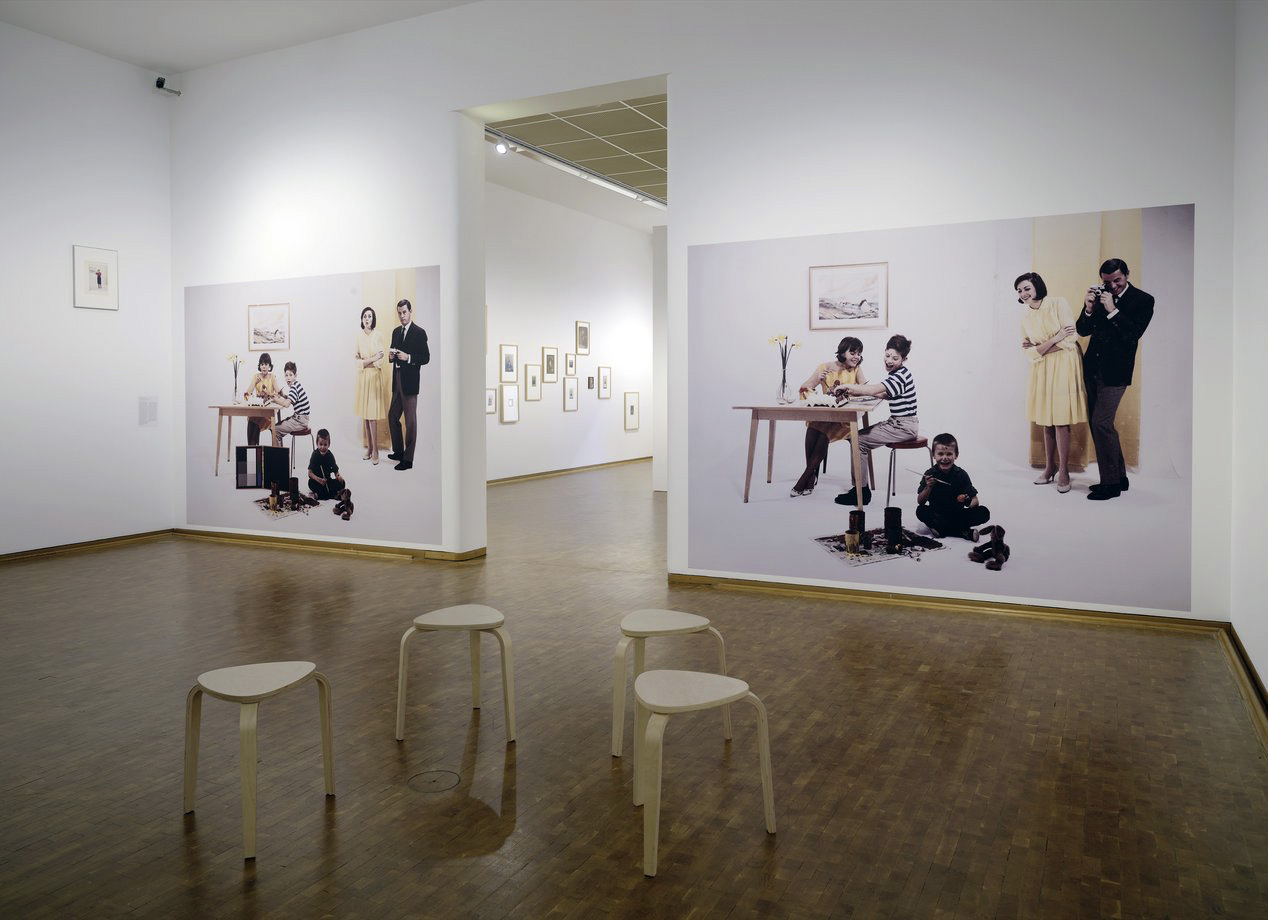
 

Installation view of the exhibition 'Smile! How the smile came into photography' at the Museum Ludwig, Cologne, November 15, 2025 - March 22, 2026 showing Agfa advertising test, around 1965


Installation view of the exhibition Smile! How the smile came into photography at the Museum Ludwig, Cologne, November 15, 2025 – March 22, 2026 showing Afga Advertising tests (around 1965, below)
Photo: Historisches Archiv mit Rheinischem Bildarchiv/ Mark Weber


These two photographs can be found in the archives of Agfa’s advertising department, which are now kept at the Museum Ludwig. While the color chart in one picture reveals that it is an informal test shot for the photographer, the other picture shows the official version of the advertisement. Only in the official version is everyone smiling – even the man holding the camera in front of his face to take a snapshot of his family. Since advertising has to communicate people’s happiness with a particular product, it contributed enormously to the spread and normalisation of smiling, laughing people in pictures. This is particularly the case with the advertisement of the photo industry. As Christina Kotchemidova writes in her article “Why we say ‘Chesse’: Producing the Smile in Snapshot Photography”: “Obviously, amateurs learned from advertisements (…). The visuals ensured that the advertising ideal was accurately replicated, thus making popular photography an extension of advertising culture.”
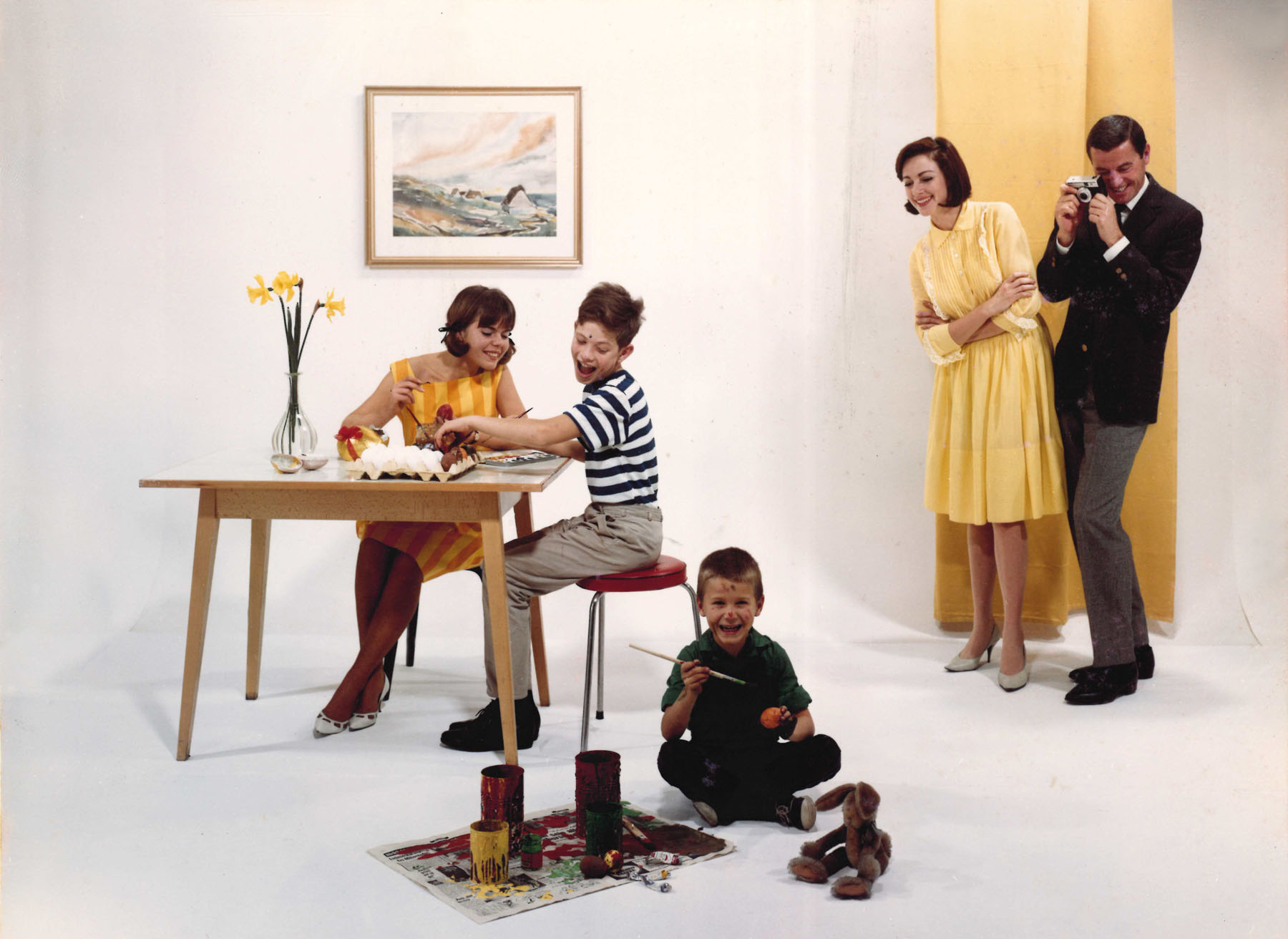
 

Unknown Photographer. 'Agfa advertising test' around 1965


Unknown Photographer
Agfa advertising test
around 1965
Color photography
Museum Ludwig, Cologne
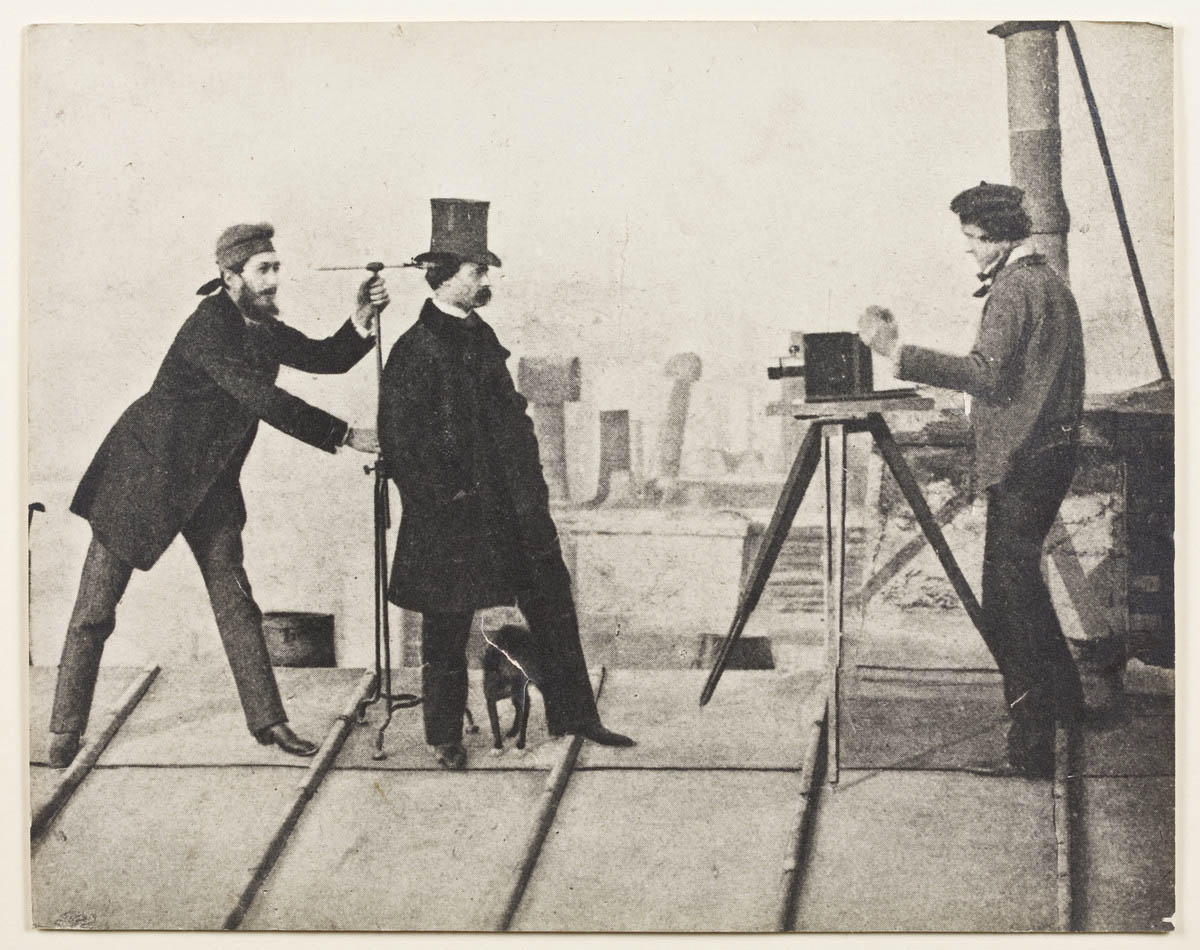
 

'Photo studio on the roof' 1845, illustration from 'Erich Stenger: Siegeszug der Photographie in Kultur, Wissenschaft, Technik' 1950


Photo studio on the roof
1845
Illustration from Erich Stenger: Siegeszug der Photographie in Kultur, Wissenschaft, Technik, 1950
Archiv Museum Ludwig, Köln


The more light there is, the shorter the exposure time when taking photographs. That is why photo studios in the 19th century were often set up in attics with large windows. In good weather, photographs were sometimes taken directly on the roof. Nevertheless, we can still see the head support that kept the person being photographed motionless for the duration of the shot and helped to ensure that the image was sharp. Such head supports were part of the necessary equipment of a photo studio and certainly did not help the subject to relax. In 1878, photographer Josef Janssen observed: “[…] the predicament in which the person finds themselves at the moment of the shot is enough to prevent them from freely expressing their individuality. Leaning against the much-hated and feared, yet indispensable head support, they are supposed to remain motionless and stare intently for a while at a certain point that usually offers nothing for the eye to look at. What else can be the result of this but rigidity and lifelessness?”
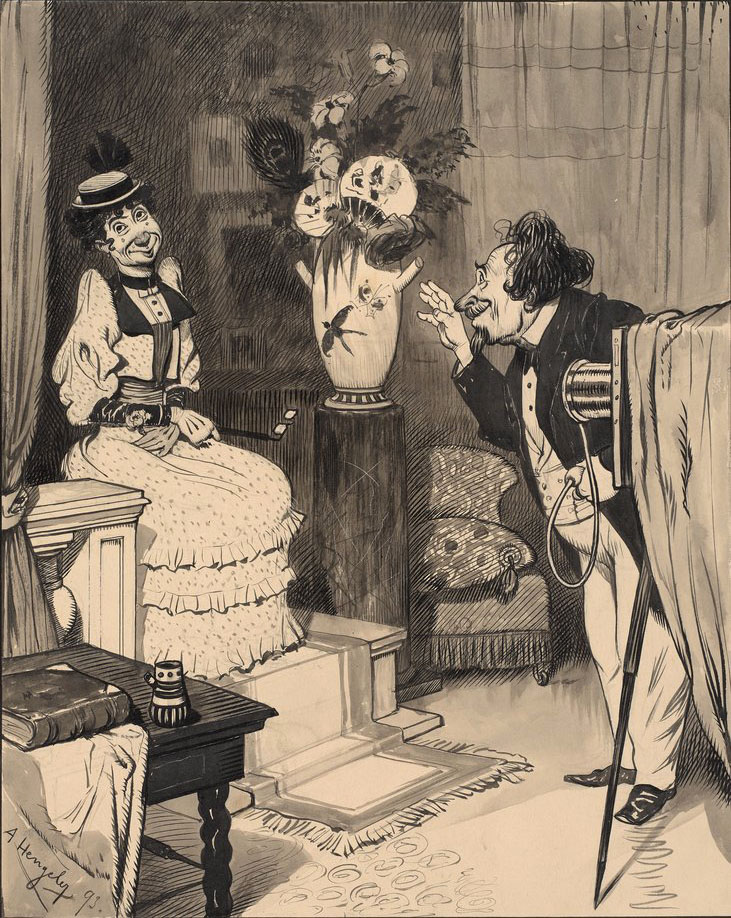
 

Adolf Hengeler (German, 1863-1927) "At the photographer's: 'Now, young lady, please smile nicely and look friendly!…One, two, three!… That's it, thank you! Now you can go back to your natural expression!'" Published in 'Fliegende Blätter' 1893


Adolf Hengeler (German, 1863-1927)
“At the photographer’s: ‘Now, young lady, please smile nicely and look friendly!…One, two, three!… That’s it, thank you! Now you can go back to your natural expression!'”
Published in Fliegende Blätter, 1893
Print
47 x 36.4cm
Museum Ludwig, Cologne
Repro: Historisches Archiv mit Rheinischem Bildarchiv


“Now, young lady, please make a nice and friendly!… One, two, three!… That’s it, thank you! Now you can go back to your natural expression!” This was the caption accompanying the caricature when it was published in the magazine Fliegende Blätter in 1893. The fact that the subject is depicted wearing a clown mask shows, on the one hand, that people were already familiar with smiling “photography faces” at the end of the 19th century and, on the other hand, that the women portrayed were supposed to appear ‘nice’ and ‘friendly’ through their smiles. The fact that there are other types of smiles was already mentioned in Grimm’s dictionary from 1885, such as happy, cheerful, mischievous, furtive, shy, malicious, bitter, scornful, mocking, and forced. In 2020, Carolita Johnson described in her article “‘I don’t have to smile if I don’t feel like it!’: Covid freed me from politeness and unwanted touching” in The Guardian how wearing face masks during the coronavirus pandemic freed her from the pressure of having to wear the mask of the friendly smiling woman.
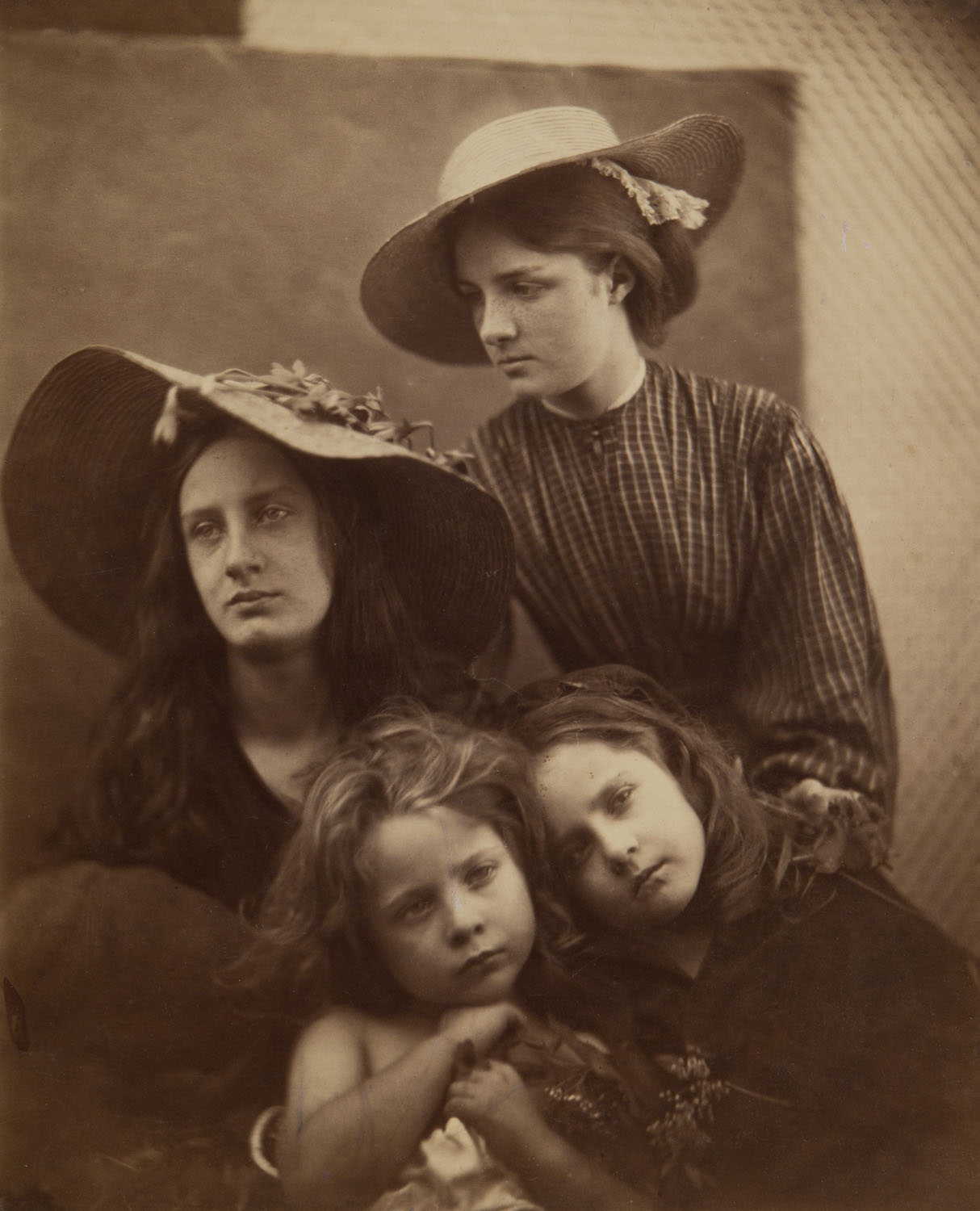
 

Julia Margaret Cameron (English born India, 1815-1879) 'Summer-days' 1866


Julia Margaret Cameron (English born India, 1815-1879)
Summer-days
1866
Albumen print on cardboard
34.0 x 27.6cm
Museum Ludwig, Cologne
Repro: Historisches Archiv mit Rheinischem Bildarchiv
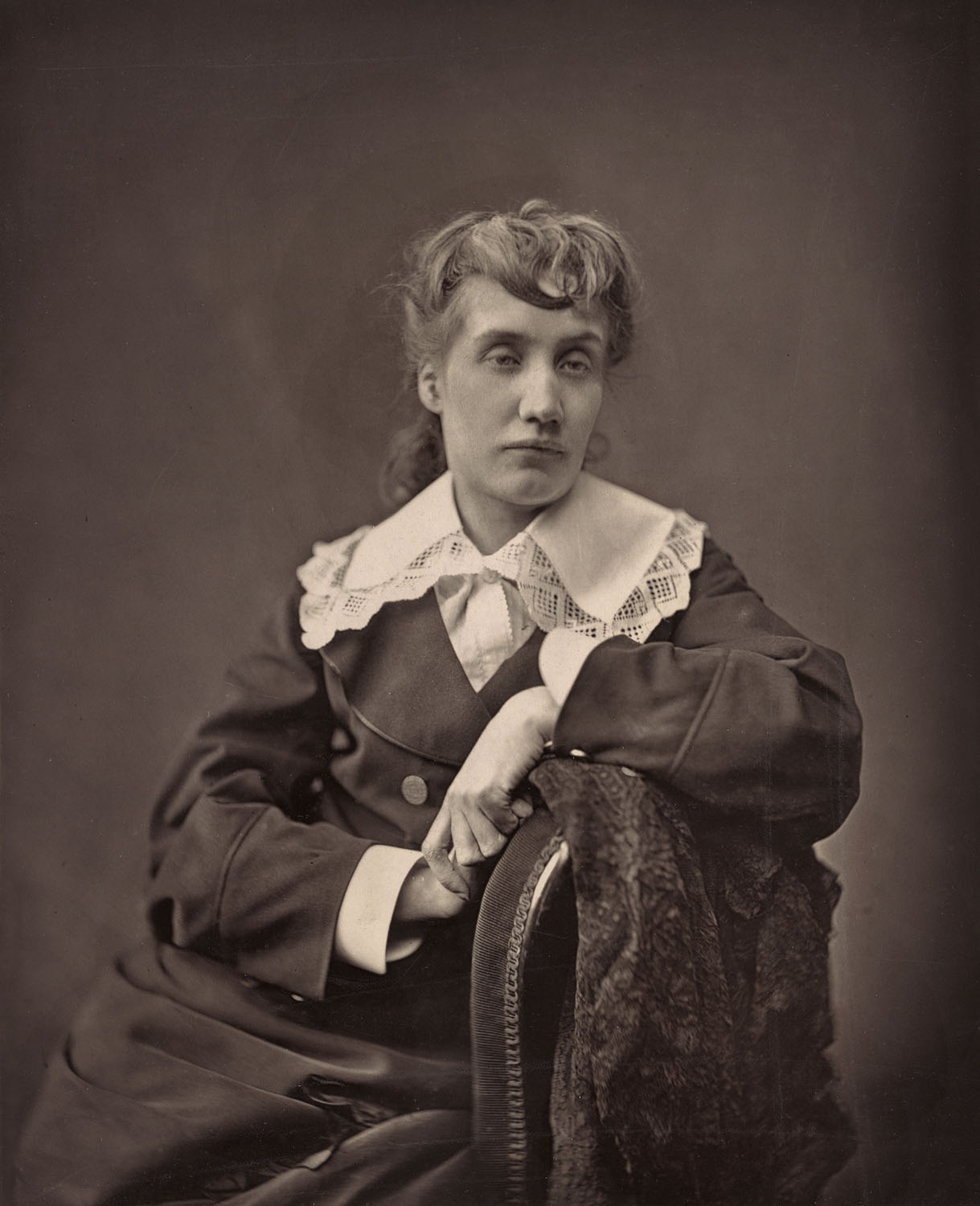
 

Nadar (Gaspard-Félix Tournachon) (French, 1820-1910) 'Portrait of Marc de Montifaut' around 1877


Nadar (Gaspard-Félix Tournachon) (French, 1820-1910)
Portrait of Marc de Montifaut
around 1877
Woodburytype on cardboard
22.9 x 18.6 cm
Museum Ludwig, Cologne
Repro: Historisches Archiv mit Rheinischem Bildarchiv


Gaspard-Félix Tournachon (French, 5 April 1820 – 20 March 1910), known by the pseudonym Nadar or Félix Nadar, was a French photographer, caricaturist, journalist, novelist and balloonist who was a proponent of heavier-than-air flight. In 1858, he became the first person to take aerial photographs. Photographic portraits by Nadar are held by many of the great national collections of photographs. His son, Paul Nadar, continued the studio after his death.


Smiling: A Photographic Balancing Act between Seriousness and Laughter

Katharina Sykora


Between spontaneity and strategy: smiling as an indicator of emotion

In everyday life, a smile immediately inspires feelings of happiness. While today we experience smiling as a spontaneous expression of affection, our understanding of smiling as a legible, socially acceptable facial gesture is the result of centuries of debate. It was oten viewed as an expression that sat midway between seriousness and laughter. Discussions around the nature of the smile gained in intensity in the nineteenth century with the invention of photography, which saw many in the aristocracy and the upwardly-mobile bourgeoisie discovering themselves anew in portrait studios. Meyers Encyclopaedia (1865) describes smiling as a weaker version of laughing because “it lacks the intermittent exhalation,”1 while in his remarks on The Expression of the Emotions in Man and Animals (1872), Charles Darwin describes laughter as “the full development of a smile or … a gentle smile as the last trace of a habit, firmly fixed during many generations, of laughing.”2 In both cases, smiling is cast not as an emotion in its own right but as a relative form derived from a strong, joyful feeling. This contrasts with the expressive range of smiles allowed for by the Brothers Grimm: “Smiling,” they write in their German Dictionary (1885) “may be friendly, happy, cheerful, affectionate, gentle, mischievous, furtive, shy, even malevolent, biter, mocking, scornful, or forced.”3

This highlights the long-standing controversy that has historically accompanied discussions around smiling and that continues today. On the one hand, a smile is evaluated based on where it is perceived to sit on a spectrum between seriousness and laughter and – depending on its proximity to either extreme – subjected to positive or negative moral, societal, or aesthetic judgements. On the other hand, because the spectrum between seriousness and laughter contains many nuances, smiling is perceived as a versatile
expression that can attest to a variety of different feelings and communicate a broad range of meanings in social interactions depending on the socio-historical context. The first perspective tends to view smiling within normative parameters, while the second situates it within a kaleidoscope of micro-sociological observations.

An important question running through historical and historiographical discussions of seriousness, smiling, and laughter asks whether these are expressions of inner emotion or learned facial gestures and behaviour patterns. In other words, whether laughing and smiling are anthropological constants common to all humans as immediate expressions of emotion, or whether they are a strategic means of communication used to one’s own advantage in specific situations.

In the mid-nineteenth century, photography played a prominent role in this debate. In his book The Mechanism of Human Facial Expression, published in 1862 and containing a hundred photographs,4 the doctor and physiologist Guillaume-Benjamin-Armand Duchenne de Boulogne presented an experiment in which he used targeted electric shocks to trigger a wide range of expressions on a test person whose facial nerves lacked sensation. One of these included a homogenous smile involving all of his features that resembled the kind of
facial expression observed in everyday settngs. But Duchenne was also able to trigger paradoxical facial expressions that could only be induced by electric shocks, such as a smiling mouth combined with eyes and forehead contorted by pain. Through such experiments, Duchenne sought a systematic “orthography of a supposedly universal language”5 of human physiognomy in order to render it more legible. Paradoxically, he disconnected inner affects from their outer manifestations while connectng them all the more strongly in terms of their
meaning, as when, by analogy with the laughing muscle, he describes the nasalis (nose) muscle as a “muscle of aggression” or the frontalis muscle (that moves the eyebrows) as a “muscle of suffering.”6

One far-reaching side effect of Duchenne’s test setup was the realization that
manifestations of human emotion can be manufactured without necessarily corresponding to a felt equivalent. By twinning electro-physical and photographic procedures, Duchenne proved in the field of science what had long been commonplace in the world of the theater – where professional actors routinely simulate emotions – and everyday life – where individuals control their expressions when interacting with others. In this way, Duchenne contributed his “theater of science”7 to the list of “production sites” for the decoupling of facial expression from emotion, where it joined the theatrical stage and milieus of social interaction.

At the same time, Duchenne’s use of electric shocks to produce expressions revealed their dual social function: Anyone could use them as a systematic means of portraying emotion detached from any corresponding internal feeling, and they could be decoded just as systematically by others as “artificial” rather than “natural” displays of sentiment. This benefited another site invested in the social coding of emotions: the increasingly numerous
photographic studios where the middle classes were now able to have portraits made of themselves, creating a specific repertoire of facial expressions as part of a class-specific pose. What these theatrical, scientific, and photographic settings all demonstrate is that seriousness, smiling, and laughter can be performed in a way that is legible. They are part of a social act that always involves two or more people.8 With Duchenne’s contribution to the
visual ordering and classification of seriousness, smiling, and laughter, photography advanced over the course of the nineteenth century to become the primary medium for the representation, communication, and standardisation of emotions. It became a platform for self-portrayal, for the negotiation of social hierarchies and values, and for the establishment and reinforcement of universal forms of emotional expression.

Looking back: a brief discursive and visual history of smiling

The history of smiling, as traced through past discourses and visual representations, reflects the shifts in society’s acceptance of the portrayal of specific emotions and the influence this has had on photographic (self-) presentations of people since the nineteenth century. What immediately becomes clear is that smiling has not always been understood as the midpoint between seriousness and laughter but situated somewhere closer to the later. Even more surprisingly from today’s perspective, laughter and especially smiling historically occupied no place at all in social behaviours and visual representations, and when they did appear, their initial connotations were largely negative.

“Before the twelfth century,” writes the art historian Monika E. Müller, “one can expect to find almost no illustrations of emotion in the form of facial expressions.”9 The reason for this was the dominance of Christian morals, which opposed the portrayal of strong emotions in general. The Greek and Roman Church Fathers shared a negative view of laughter, considering it antithetical to the ideal of a God-fearing person leading a life of humility and atonement. As a result, books of monastic precepts banned laughter as sinful behaviour.10

In the twelfth and thirteenth centuries, grinning devils increasingly appeared in
portrayals of the Apocalypse, there were chortling henchmen along Christ’s route to Calvary, and there were grotesque heads guffawing on the capitals of cathedrals or in the margins of illuminated manuscripts. These polarising counter-figures were depicted as bystanders, relegated to the edges of the sacred realm. Here, laughter was not an expression of cheerfulness but a sign of vice and evil.

In the thirteenth century, smiling made its first appearance as a positive trait in
Christian iconography but was reserved for Mary, the Christ Child, angels, and those souls resurrected into a state of heavenly bliss. Here, too, exceptions gradually emerged: In the portal of the Last Judgement at Strasbourg Cathedral, for example, we find the Prince of this World (c. 1280) flashing a mischievous grin in the direction of a Foolish Virgin with a flirtatiously simpering smile. This erotically charged tête-à-tête takes on a negative tone, however, once one notices that the Prince’s back is being devoured by snakes and vermin. Moreover, the coquette is shown to be doubly foolish – distracted by her “sinful” fleshly desire for a figure whose true nature is hidden from her, unlike the lamenting Wise Virgins, she has unwittingly dropped the oil lamp that was meant to remain lit in anticipation of Christ’s arrival. In this way, depictions of smiling joined those of laughter in Christian iconography, where their differentiation into the beatific and the seductive supported theological morals.

Once smiling began to feature in secular imagery – as in the statue of Margravine Regelinda in the west choir at Naumburg Cathedral (c. 1250) – the binary Christian model underwent a fundamental reevaluation. In the thirteenth century, a tradition of courtly politeness emerged in which smiling carried positive connotations, signalling friendly attentiveness guided by self-restraint. Books on courtly etiquete established gestural moderation as the norm. Smiling was courtly in a double sense: It bound the nobility together through a shared code of conduct while also distinguishing them from the “uncouth” populous.

As the modern age progressed, further differentiation took place. Courtiers amused each other by engaging in witty repartee. Eliciting a subtle smile that acknowledged one’s skill while remaining shielded from ridicule behind a noncommittal smile of one’s own was the basis of an amicable but increasingly competitive court culture. Smiling became an instrument with which to perpetually renegotiate one’s position within the court hierarchy. As a result, the rules governing seriousness, laughter, and smiling became ever more rigid
and complex, so that only a select few courtiers ever mastered the art of it. This in turn created gender and aesthetic norms: Young girls and high-ranking ladies were expected to wholly avoid displays of loud laughter, as they pointed to a lack of self-control in the “weaker sex,” and its distortion of the facial features was considered inappropriate for the “fairer sex.”

In the Renaissance, these norms were applied to portraits of the wealthy burghers of the urban centers. Here, the hint of a smile was considered acceptable, while open laughter was viewed as the hallmark of courtesans, marginal figures at court who, together with the fool or jester, broke with the rules of politeness through displays of untamed conduct while simultaneously affirming them.

A similarly paradoxical relationship emerged in the sixteenth and seventeenth centuries with the rise in popularity of genre paintings, which often depicted members of the lower classes boisterously laughing during exuberant scenes of eating and drinking and were often filled with erotic allusions. These paintings, mostly by Dutch artists, both challenged and affirmed the cultural conventions around laughter, often involving the viewer by establishing direct eye contact, creating a sense of complicity and shared amusement.

By contrast, in the eighteenth century, the aspiring bourgeoisie increasingly set itself apart, imposing stricter limits on exuberant laughter. With reference to the aristocratic norm of disciplined facial expressions, it adopted smiling as its hallmark. At the same time, it distanced itself from the courtly performance of smiling. Since those at court were all trying to functionalise their facial expressions and tame their emotions, it was no longer possible to trust their smiles.11 From the viewpoint of the bourgeoisie, courtly smiling was now
considered unnatural. This reflected changes in affect theory, as Johann Caspar Lavater’s physiognomy and Georg Christoph Lichtenberg’s pathognomy now postulated congruency between facial expressions and inner emotions.12 The “forced” smiles of the aristocrats at court were contrasted with the “genuine,” “heartfelt” bourgeois laughter that did not hurt anyone or assume superiority. However, such amiable laughter among equals was not part of public displays of bourgeois identity. In public and in official portraits, the bourgeoisie presented themselves with a seriousness that matched their social aspirations. The network building, convivial laughter of bourgeois men and the smiles of bourgeois women were reserved for smaller, more intimate formats such as drawings or miniatures. In other words, such displays of emotion were privatised, confined to salons and the home.

Photography and the smile: a tense relationship

At the end of the 1830s, during this transitional phase when bourgeois culture was still navigating between seriousness and smiling, photography emerged as a new medium for recording and representation. Its specific qualities allowed facial expressions to be captured with great precision while also imposing limits on the expression of emotions such as smiling and laughter.

The indexicality of photography – namely, the fact that the subject must have been present while their likeness was being transferred onto the image – meant that photographs were like a second skin. Just as it was assumed that one’s facial expression was a direct translation of one’s emotion, it was also believed that this emotion was directly imprinted onto the photograph. The indexical promise of photography thus suggested that one was looking directly – through a kind of double, transparent membrane – into the soul of the sitter. For the bourgeoisie, with its imperative of natural, uncontrived expression of emotions, photography thus served as proof of the authenticity of the emotions on display. It is all the more surprising, then, that it was well into the twentieth century before smiles began to appear on the faces of the bourgeoisie in studio photographs. For bourgeois men in particular, the expression of seriousness that prevailed in this context was a strategy that allowed them to present themselves as level-headed, stabilising members of society. The resulting contradiction remained a blind spot in their self-image: Photography as an
apparatus for capturing an indexical authentication of “genuine feelings” turned into its opposite as demonstrative seriousness became part of a bourgeois pose that was legitimated as “real” by the medium’s promise of truth.

Just as important as indexicality is another specific quality of the photographic
medium: the way it cuts through space and time. Since laughing and smiling are “fleeting signs of an emotion as expressive movement,”13 the moment in which a photograph is taken, fixing a single instant in the flow of living time, is especially precarious. While it is easy to maintain a serious expression for a long exposure time, laughter is comparatively brief and consists of a sequence of different expressions. Capturing a laugh at the peak of its crescendo requires a short exposure time, as well as technical skill and psychological foresight on the part of the photographer; they must be able to quickly intuit when to press
the shutter in order to capture the laugh on the sitter’s face, in turn underscoring the photographer’s ultimate control over the image compared to that of the subject. In temporal terms, photographs of laughter thus tend to be “stolen” images, a quality that can be compensated for by the consenting gaze of the sitter. The belated arrival of laughter as a viable photographic motif in the 1920s was, on the one hand, due to technical developments that allowed for shorter exposure times and, on the other, the result of a renegotiation of the power dynamics between the photographer and their subject.

Photographing a smile is different to capturing laughter. A smile can be maintained for considerably longer than a laugh, though not as long as a serious expression. Since smiling is a fluid movement of the mouth and the corners of the eyes, the way a photograph severs the sequence of a smile is both all the more obvious and all the more arbitrary. In the twentieth century, the request to “smile please” performed a function similar to that of “don’t move”
in the studio photography of the previous century. It directed the subject to “freeze” their smile, thus detaching it from any emotion that might have prompted it and seeing it into a pose. As a stabilised facial expression, smiling complied with the technical parameters of photography at the time. On a cultural level, however, it was precisely this compatibility that led to the smiling photo face becoming the norm – as witnessed in the monotony of smiles from family photographs after World War II to the selfies of the 2000s.

How the smiling photo face came to be

“Why do we smile in photographs?” asks the art historian André Gunthert,14 who suggests that this phenomenon may be due to the coincidence of two important developments: the evolving concept of the individual and its self-portrayal in the Western world and the emergence of visual mass media – first illustrated newspapers, then photography, and finally film. These developments influenced each other and continue to do so today: Thanks to
mass media, images are propagated at an increasingly rapid speed, reaching ever greater numbers of people, who model their behaviour on them. Photography, as a genuinely reproducible medium, has been foundational to these developments. As a result, the spread of the smile in photographs is closely linked to the medium’s technical developments and its growing accessibility. It wasn’t until the 1890s that cameras fell into the hands of amateur photographers, a transition made possible by the roll-film camera developed in 1888 by George Eastman. This was followed by ever more lightweight, user-friendly cameras, such as the first Leica made for small-format negatives, prototyped in 1913 and mass produced from 1925, or the Ermanox, designed in 1924, which played a crucial role in photojournalism,
enabling images to be taken in low-light conditions. The studios, where the standards of bourgeois seriousness were still largely upheld, now found themselves in competition with amateur photographers.

This shift altered the relationship between photographers and their subjects. The intimacy of the family or circle of friends made it possible to capture forms of coexistence that were not bound to the strict rules of public image. In such familiar settings, private “snapshots” of laughing or smiling people no longer risked being viewed as “stolen images” that would be exposed to an unpredictable public response. Instead, the pictures remained private, with viewing sessions and the exchange of prints strengthening ties among friends
and family members. As an agent of social cohesion, smiling demonstrated the sitter’s consent to being photographed and was just as important as the shared private enjoyment the resulting pictures generated. From this time, family albums began to contain more and more images of people smiling and laughing. Even in these private photographs, smiles often varied depending on the gender of the subject; bourgeois women and children of the late nineteenth and early twentieth centuries were still confined primarily to the private sphere, with smiling the “natural,” morally acceptable, and aesthetically appropriate mode of expression in this domain. A broad smile while looking directly into the camera continued to be associated more with the lower classes and those on the fringes of society, such as demimondaines, sex workers, and stage performers.

For a long time, studio photography clung to the tradition of a public image based on serious expressions and rigid poses, but it was unable to entirely prevent the new tendency toward smiling from creeping in. The studios countered this with biting satires that ridiculed smiling as improper and “false.” Spontaneous, private expressions of emotion did not make
the transition to the studios, where smiling remained a mask assumed only for the time it took to take a picture.

This changed over the course of the 1920s and 1930s. In 1932, the photographer
Gilbert de Chambertrand declared the old form of studio photography obsolete. It treated people like statues, he argued, whereas modern portrait photography focused on people influenced by outdoor pursuits, sports, and the cinema whose faces expressed lively emotions.15 Shifts in society, such as the rise of the urban middle classes (the “salaried masses”) and the emancipation of women (the “New Woman”), led to a greater variety of facial expressions in photographic portraits, and an aesthetic shaped by the motion pictures
contributed to a greater expressivity.16 With its extreme close-ups, bold cropping, and shifts in perspective, the New Vision movement was characterised by a formal dynamism that amplified the dynamism of the facial expressions it captured. And the role models multiplied, too: In studio portraits of the 1920s and 1930s, elegant women gaze out at us bearing smiles copied from photographs of famous actresses and sporty young girls laugh warmly at the person behind the camera. In extreme cases, a smile may even appear without a face, in a close-up shot of a mouth with lipstick. As its range expanded, smiling became the norm, fostered by its dissemination via the mass media of magazines and movies through which it eventually conquered the public sphere and official portrait photography.

After World War II, this development intensified, especially in the West, beginning in the United States where the commercialisation of amateur photography had opened up a huge market. An analysis of high school yearbook photographs over several decades shows the gradual trend toward smiling.17 By the 1950s at the latest, “social smiles” that marked those photographed as friendly members of the community had become mandatory.

Spontaneous smiles, which engaged the eye muscles, increasingly gave way to a mere upward curve of the mouth. In public, this more restrained smile became a compulsory sign of polite distance when encountering strangers, as an overly serious expression risked being misconstrued as aggression.18 Pervasive advertising, movies, and later television increasingly blended private and public spheres, ultimately elevating the once-private smile to the status of an omnipresent social norm.

In the United States in particular, this was accompanied by an upgrading of the kind of smile required by photographers, as “please smile” was replaced by calls to “say cheese,” prompting the sitter to smile broadly, showing their teeth. Different reasons have been given for this “cheesy grin”: the need for non-confrontational interactions in times of increasing social insecurity or the desire to display one’s wealth and radiant state of good health. (In the
past, possessing a perfect set of teeth could not be taken for granted and often involved considerable costs.) This time, the media role models were Hollywood stars,19 pin-up models, and the happy families depicted in advertisements.20 In this way, a flourishing post-war America spread its broad smile not only across its own country but across the whole of the Western world.

Since the 1990s, if not before, we have witnessed a strong counter-movement to the dominance of the smile. The concept of “coolness” categorically refuses the call to smile, demonstratively playing with the latent aggression associated with a serious expression, from which it derives the power of its image and gaze. The subject of a “cool” portrait is most often young, versed in street culture and involved in the worlds of music and fashion and their advertising campaigns. The straight face of cool has become the new photo face. Or has
it turned back into the old one? What distinguishes the serious expression of the “cool guy” from that of the bourgeois man in nineteenth-century studio photography? The underlying model of masculinity is comparable, a display of self-confidence, self-control, and defensiveness. The difference lies in the casual pose, the informal clothing, and the overt display of a fit physique, all set against an urban setting or edgy studio backdrop. But it is above all its contrast to the typical cheesy grin that makes not smiling such a surefire fashion
statement. A scene in the movie Triangle of Sadness (2022) offers a striking illustration of this: At a casting session, a number of young male models are asked to pose for the camera. To test their range of facial expressions, instead of asking for “cool” or “cheese,” the photographer alternately calls out “Balenciaga!” and “H&M!” Here, seriousness and smiling have undergone another shift in function and meaning: No longer manifestations of emotion or masks, they have become brands.


Footnotes

1/ Neues Konversations-Lexikon, ein Wörterbuch des allgemeinen Wissens, ed. Hermann J. Meyer, (Hildburgshausen: Bibliographisches Institut, 1865), 10: 474, under “Lachen,” quoted in Timm Starl, “Vom Lächeln: Erörterungen zu einer seltenen fotografischen Erscheinung des 19. Jahrhunderts,” in Fotografische Leidenschaften, ed. Katharina Sykora et al. (Marburg: Jonas, 2006), 34.
2/ Charles Darwin, The Expression of the Emotions in Man and Animals (New York: Appleton, 1872), 209.
3/ Jacob Grimm and Wilhelm Grimm, Deutsches Wörterbuch, vol. 6 (Leipzig: Hirzel, 1885; rep., Munich: dtv, 1984), 14-15, quoted in Starl, “Vom Lächeln,” 33.
4/ Guillaume-Benjamin-Armand Duchenne de Boulogne, Mécanisme de la physiognomie humaine ou analyse électrophysiologique de l’expression des passions (Paris: Asselin, 1862).
5/ Petra Löffler, Fabrikation der Affekte: Fotografien zwischen Wissenschaft und Ästhetik,” in Fotografische Leidenschaften, 43.
6/ Duchenne de Boulogne, quoted in Petra Löffler, Affektbilder: Eine Mediengeschichte der Mimik (Bielefeld: transcript, 2004), 123.
7/ Gunnar Schmidt, Das Gesicht: Eine Mediengeschichte (Munich: Fink, 2003), 51-75.
8/ See Beatrix Müller-Kampel, “Komik und das Komische: Kriterien und Kategorien,” in Lithes, Zeitschrift für Literatur- und Theatersoziologie 7 (2012): 22. See also Werner Rocke and Hans Rudolf Velten, “Einleitung,” in Lachgemeinschaften: Kulturelle Inszenierungen und soziale Wirkungen von Gelächter im Mittelalter und in der Frühen Neuzeit (Berlin: de Gruyter, 2005), 13: 22.
9/ Monika E. Müller, “Das Lachen ist dem Menschen eigen … Seine Darstellung in der Kunst des Mitelalters,” in Seliges Lächeln und höfisches Gelächter, exh. cat., Dom- und Diözesanmuseum Mainz (Regensburg: Schnell & Steiner, 2012), 71. The way strong emotions and passions were portrayed in antiquity, as in the statue of the Laocoön Group or Aristotle’s remarks on the link between affect and physical-facial expressions of emotion, only gained importance later.
10/ Müller, “Das Lachen ist dem Menschen eigen,” 72.
11/ See Adolph Freiherr von Knigge, Über den Umgang mit Menschen, 5th ed. (Hanover: Schmidtsche Buchhandlung, 1796).
12/ See Johann Caspar Lavater, Essays on Physiognomy, Designed to Promote the Knowledge and the Love of Mankind. Georg Christoph Lichtenberg, “On Physiognomy: Against the Physiognomists” (1778).
13/ Löffler, Affektbilder, 164.
14/ André Gunthert, Pourquoi sourit-on en photographie? (Lyon: 205, 2023).
15/ See Gilbert de Chambertrand, Le Portrait et l’Amateur (Paris: Paul Montel, 1937), 5, quoted in Gunthert, Pourquoi sourit-on en photographie?, 36.
16/ In the first half of the twentieth century, Expressionist and Soviet films in particular helped expand the vocabulary of facial expressions seen in modern individuals and their photographic portraits. See Gunthert, Pourquoi sourit-on en photographie?, 36-39.
17/ See Shiry Ginosar et al., “A Century of Portraits: A Visual Historical Record of American Highschool Yearbooks,” in IEEE Transactions on Computational Imaging 3, no.3 (2017): 421-31, quoted in Gunthert, Pourquoi sourit-on en photographie?, 15, fn. 7.
18/ Maria A. Arapova has shown that in the Soviet Union, in contrast to countries influenced by the United States, smiling in public was not customary, reserved instead for the private sphere. See Maria A. Arapova, “Cultural
Differences in Russian and Western Smiling,” Russian Journal of Communication 9 (2017): 34-52, quoted in Gunthert, Pourquoi sourit-on en photographie?, 47, fn. 30.
19/ See Angus Tumble, A Brief History of the Smile (New York: Basic Books, 2004), quoted in Gunthert, Pourquoi sourit-on en photographie?, 12, fn. 2.
20/ See Christina Kotchemidova, “Why We Say ‘Cheese’: Producing the Smile in Snapshot Photography,” Critical Studies in Media Communication 22, no. 1 (March 2005), quoted in Gunthert, Pourquoi sourit-on en photographie?, 14, fn. 6.
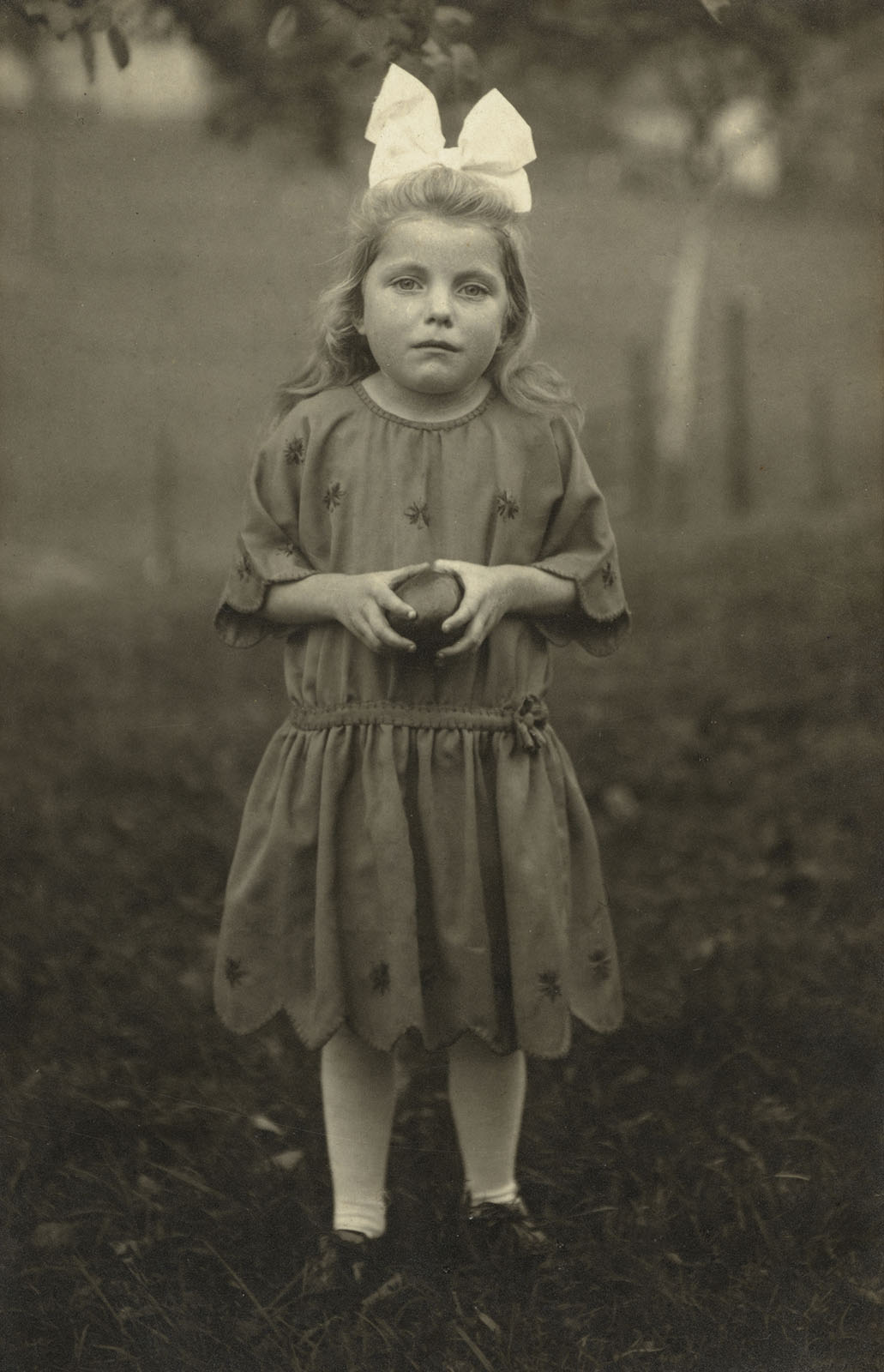
 

August Sander (German, 1876-1964) 'Girl with Ball' (Mädchen mit Ball) 1910s


August Sander (German, 1876-1964)
Girl with Ball (Mädchen mit Ball)
1910s
Gelatin silver paper
10.7 x 6.9cm
Museum Ludwig, Cologne
Repro: Historisches Archiv mit Rheinischem Bildarchiv
© Die Photographische Sammlung/SK Stiftung Kultur-August Sander Archiv, Köln / VG Bild-Kunst, Bonn 2025
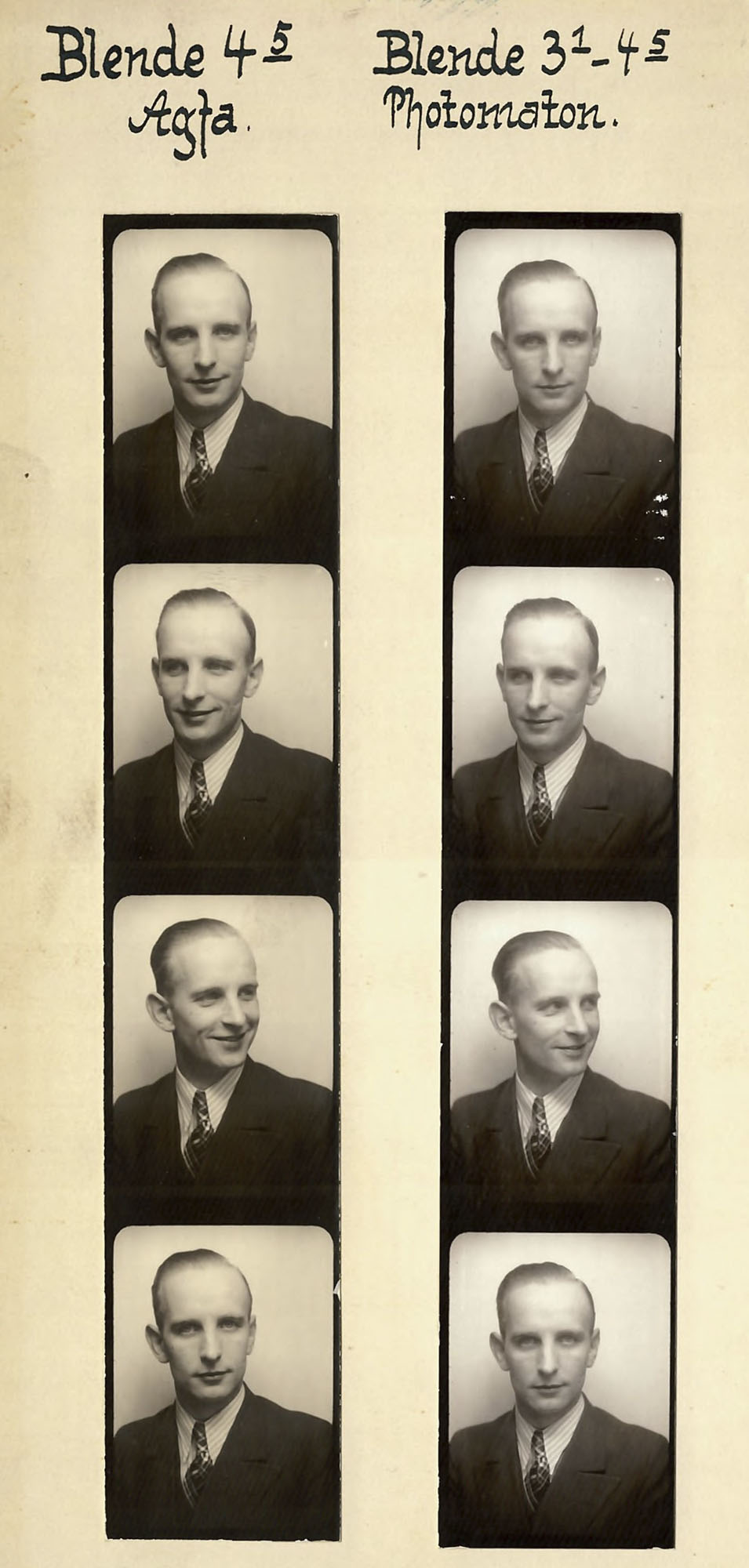
 

'Test images from the photo booth, Kaufhof, Cologne' 1920s


Test images from the photo booth, Kaufhof, Cologne
1920s
Gelatin silver paper
Archiv Museum Ludwig, Köln


The introduction of photo booths in the 1920s meant that portraits could be taken cheaply and without being observed by photographers, which encouraged people to experiment, as we can see in this test strip taken in a Cologne department store.
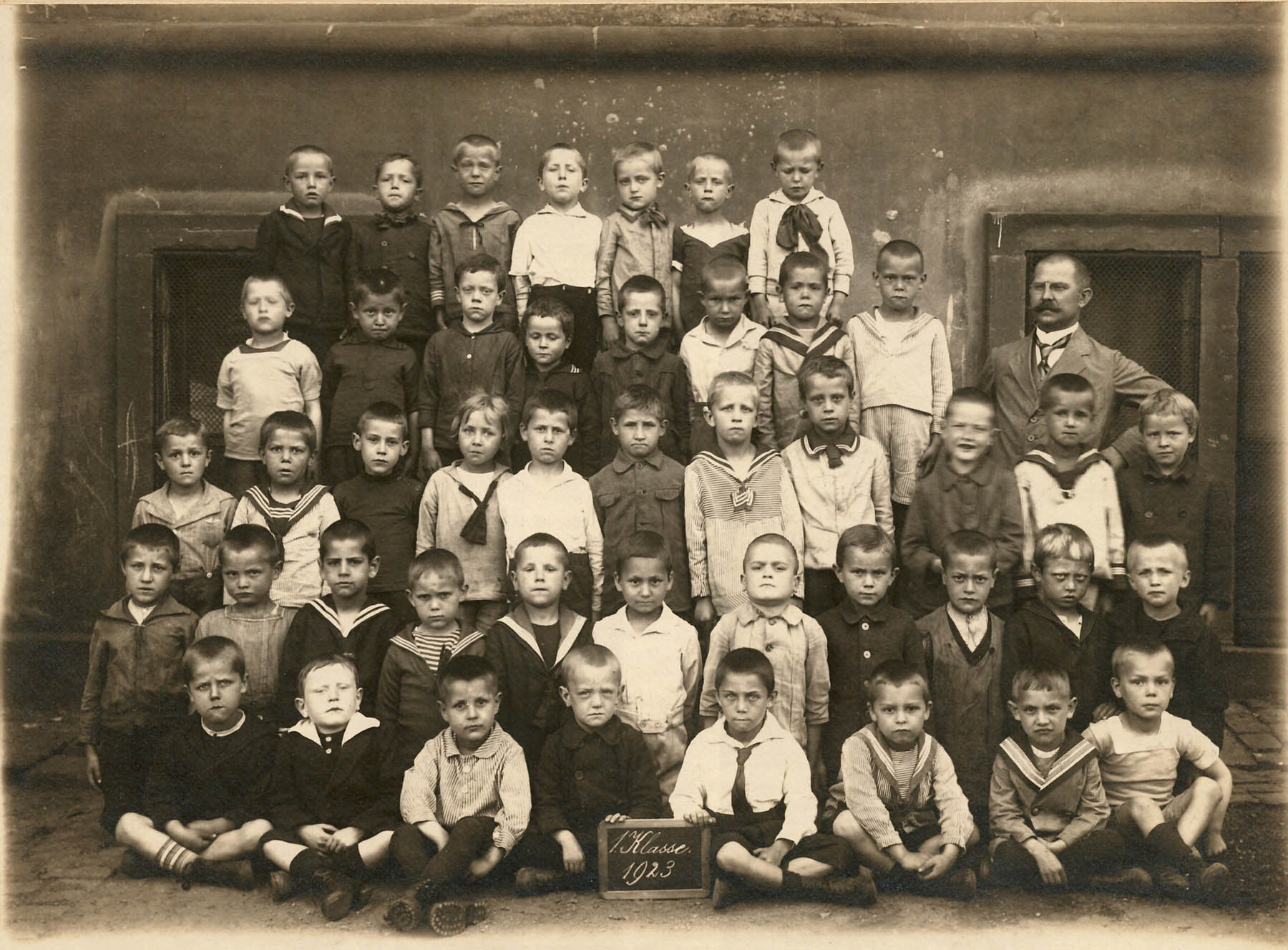
 

Unknown photographer. 'Class photo' 1923


Unknown photographer
Class photo
1923
Archive Museum Ludwig


A comparative study of school photographs in the USA showed that the corners of the mouth have been rising steadily in portraits since 1900. A comparison of two class photos from the Museum Ludwig archive, taken forty years apart, confirms this: whereas in 1923 the expressions were still serious, in 1963 there are smiling faces. However, the US study also showed that girls and women smile significantly more than boys and men. “Photography faces,” whether they smile or not, are culturally formed faces.
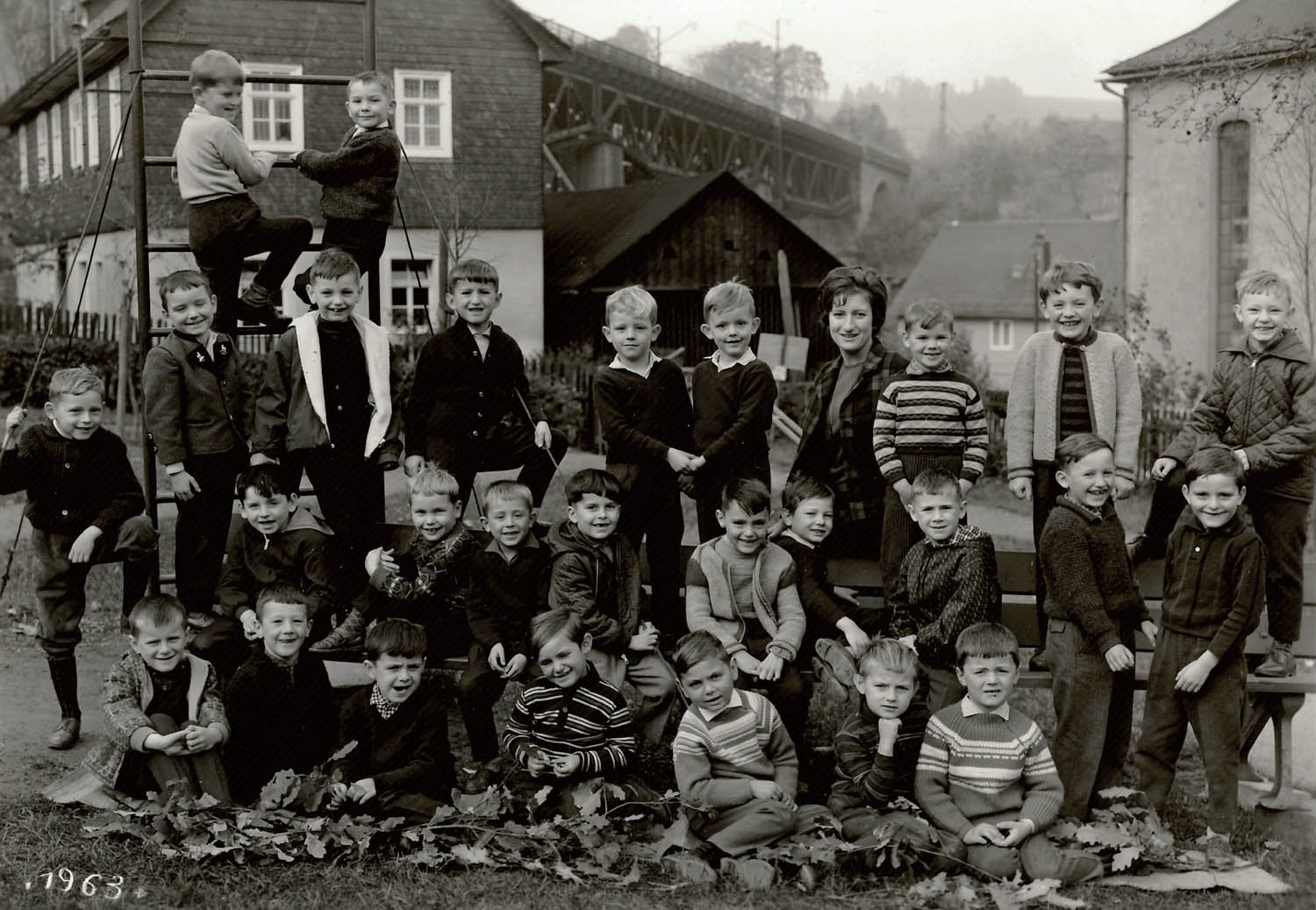
 

Unknown photographer. 'Class photo' 1963


Unknown photographer
Class photo
1963
Archive Museum Ludwig
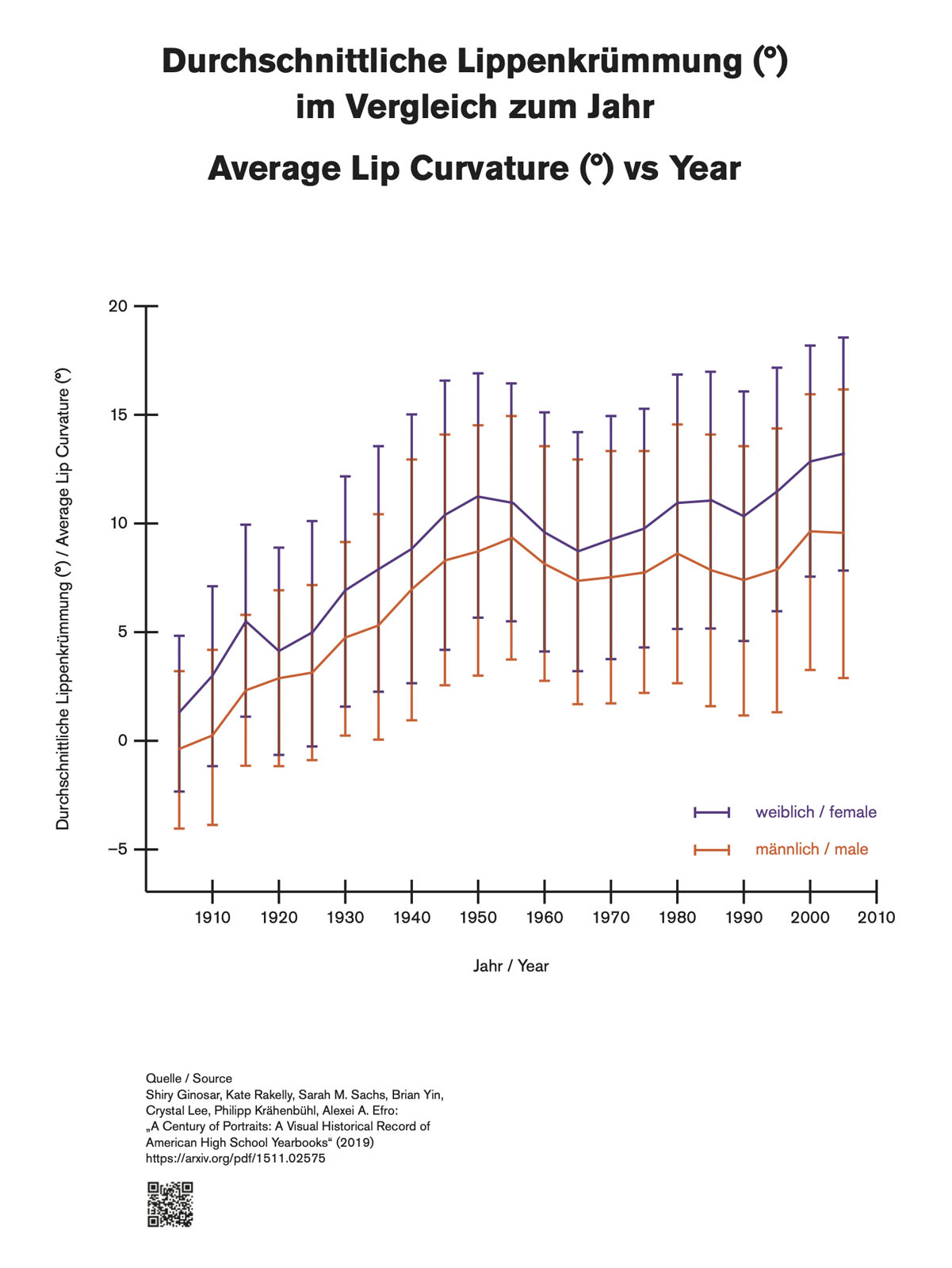
 

Average lip curvature over the 20th century


Andy Warhol (American, 1928-1987) 'Warhol, Andy' 1972


Andy Warhol (American, 1928-1987)
Warhol, Andy
1972
Polaroid
10.8 x 8.6cm
Museum Ludwig, Cologne
Repro: Historisches Archiv mit Rheinischem Bildarchiv
©2025 The Andy Warhol Foundation for the Visual Arts, Inc. / Licensed by Artists Rights Society (ARS), New York


Andy Warhol experimented early on with the Polaroid instant camera. He photographed himself as well as visitors to his studio, The Factory, in New York in the 1970s. He collected the snapshots in several photo albums. Their spontaneity is evident in the fact that they often appear flawed, whether because only the forehead is visible in the picture or because the face of the person portrayed is not yet a standard “photography face.”
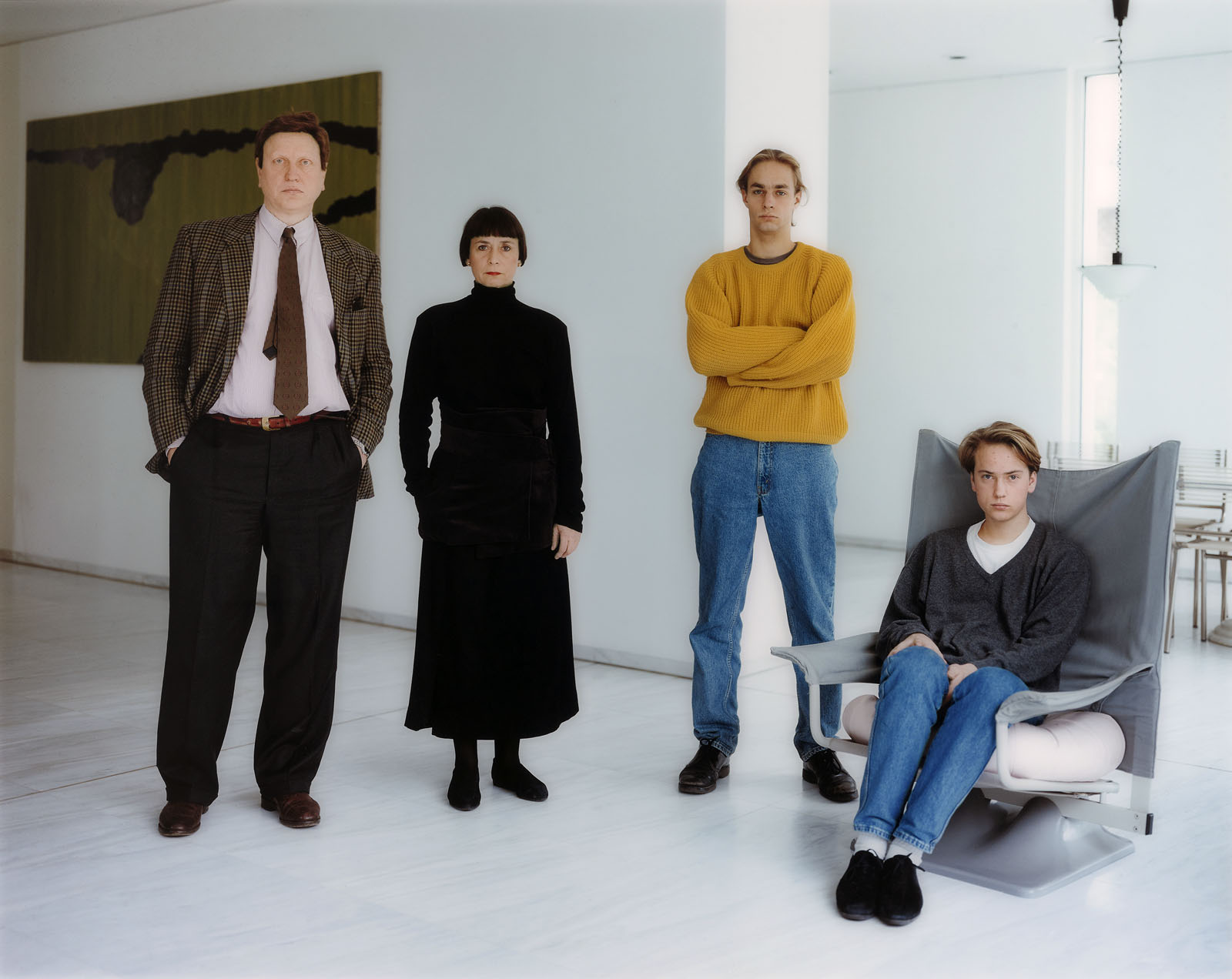
 

Thomas Struth (German, b. 1954) 'The Schäfer Family, Meerbusch 1990' 1990


Thomas Struth (German, b. 1954)
The Schäfer Family, Meerbusch 1990
1990
C-print
166 x 198cm
Museum Ludwig, Cologne
Acquisition with the support of the Peter and Irene Ludwig Foundation
Repro: Historisches Archiv mit Rheinischem Bildarchiv
© Thomas Struth


Since the 1980s, Thomas Struth has been photographing families from his circle in their familiar surroundings. While the people in his pictures choose their own clothing, gestures, and looks, he asks them not to smile for the camera. In an interview with the Süddeutsche Zeitung, the photographer explained this as follows: “It is often said that when everyone smiles, they all look the same. But they can’t all look different either. In my opinion, there are enough photos of people laughing.” Ann Katrin Harfensteller-Rufenach adds in her book Dazwischen-Sein. Familienporträts von Thomas Struth und jüngere Positionen in der Fotokunst in Deutschland (Being in Between: Family Portraits by Thomas Struth and Recent Positions in Photographic Art in Germany): “But the unusual size of the camera may also have been fascinating and encouraged an appealing facial expression.” In fact, Thomas Struth photographed this image with a large-format camera on a tripod, similar to the photographers of the 19th century.


Museum Ludwig
Heinrich-Böll-Platz, 50667 Köln, Germany

Opening hours:
Tues­­day through Sun­­day: 10am – 6pm

Museum Ludwig website

LIKE ART BLART ON FACEBOOK

Back to top

Book: Photographs from ‘Der Kunstlerische Tanz Unserer Zeit’ (The Artistic Dance of Our Time) 1928 Part 1

December 2017

Authors: Hermann and Marianne Aubel

Publisher: Karl Robert Langewiesche Vlg. Königstein, 1928. 112 pages, numerous illustrations. Pictures of Isadora Duncan, Nijinski, Anna Pavlova, Alexander Sacharoff, Clotilde von Derp-Sacharoff, Die Schwestern Wiesenthal, Tamara Karsavina, La Argentina, Ellen Petz, Niddy Impekoven, Rudolf von Laban, Mary Wigman, Palucca, Harald Kreutzberg, Javanische Tanzgruppe.
Language: German


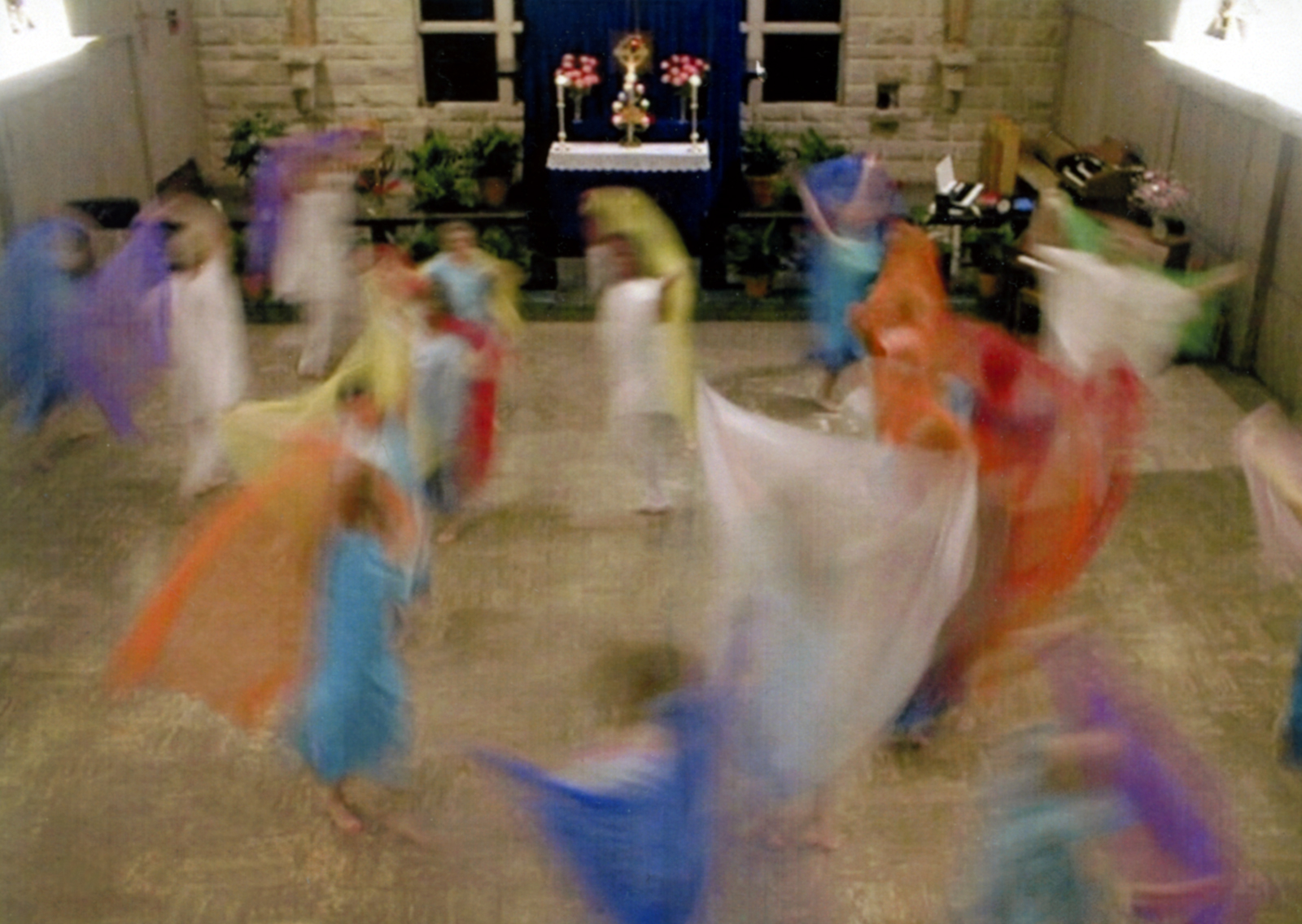
A performance by the Natural Dance Movement in silk robes c. 2000


A performance by the Natural Dance Movement in silk robes, England
c. 2000
Photograph taken by my mother


I have always loved dancing… it comes from the soul. I have danced since 1975 – pre-disco, through disco, high energy, new romantics, soul, trance, techno and more. I still go out dancing today. While this is a different kind of dance, notably free dance, all forms of dance are a connection to music, earth, cosmos. A connection to the earliest of human beings dancing round an open fire.

This is a book I bought on the Internet for $12. I have scanned the photographs and given them a digital clean. The costumes are fabulous, the poses exquisite, exotic, and joyous. The silhouettes and shapes created are just glorious. The photographs usually have low depth of field, the figures “caught” in front of contextless backgrounds. But as Grete Wiesenthal’s assistant Maria Josefa Schaffgotsch observes, the time freeze of the photograph is the antithesis of free dance:

“Grete Wiesnethal’s primary concern was to overcome as far as possible the unavoidable static element of classical dance and to dissolve everything that smacked of a pose in a never-ending stream of movement. The flowing, swinging, wavelike three-four rhythm, transforming Strauss’s waltzes into movement – that was her particular art, that was what made her world famous.”1


Many of the photographs work against the nature of the medium, and the idea of posing for the camera, to capture the fleeting expressiveness of dance. Just look at the ecstatic shape created in Hugo Erfurth’s Schwestern Wiesenthal (Wiesenthal sisters) (c. 1928, below). Indeed, the language of spiritual revelation!

My favourites are the photographs of Sent M’Ahesa and Nijinski. But honestly, they are all glorious. The photographs in this book, “The Artistic Dance of Our Time,” represent the cutting edge of dance, art, and photography in 1928. It is so nice to seem them now.

Dr Marcus Bunyan


1/ Andrea Amort. “Free Dance in Interwar Vienna,” in Deborah Holmes and Lisa Silverman (eds.,). Interwar Vienna: Culture Between Tradition and Modernity. Rochester, New York: Camden House, 2009, p. 123.


Please click on the photographs for a larger version of the image.


Hermann and Marianne Aubel (authors) Karl Robert Langewiesche (publisher) 'Der Kunstlerische Tanz Unserer Zeit [The Artistic Dance of Our Time]' 1928


Hermann and Marianne Aubel (authors)
Karl Robert Langewiesche (publisher)
Der Kunstlerische Tanz Unserer Zeit [The Artistic Dance of Our Time]
1928
Book front cover


Free dance

Free dance is a 20th-century dance form that preceded modern dance. Rebelling against the rigid constraints of classical ballet, Loie Fuller, Isadora Duncan and Ruth St. Denis (with her work in theatre) developed their own styles of free dance and laid the foundations of American modern dance with their choreography and teaching. In Europe Rudolf Laban, Emile Jaques-Dalcroze and François Delsarte developed their own theories of human movement and methods of instruction that led to the development of European modern and Expressionist dance.

Free dance was prolific in Central and Eastern Europe, where national schools were created, such as the School of Musical Movement (Heptachor), in Russia, and the Orkesztika School, in Hungary.

Text from the Wikipedia website


Elvira (Munich) 'Isadora Duncan' from Der Kunstlerische Tanz Unserer Zeit [The Artistic Dance of Our Time] p. 1 Published 1928


Elvira (Munich)
Isadora Duncan
From Der Kunstlerische Tanz Unserer Zeit [The Artistic Dance of Our Time] p. 1
Published 1928


“Wir sehen das Ziel der Tanzkunst und jeder Kunst darin, eine Sprache geistiger Offenbarung zu sein, aus der Natur heraus sich äubernd und mit ihr verbunden.”

“We see the goal of dance and every art as being a language of spiritual revelation, external to and connected with it.”


Hermann and Marianne Aubel


Vielleicht auf keinem Gebiet kunstlerischer Entfaltung haben die letzten Jahrsehute ein solches Strebennach Weiterentwicklung gebracht, wie auf dem Gebiete der Tanzkunst. Sie ist, als letztes Zile der Arbeit an der menschilchen Bewegung, mehr und mehr mit in den Mittelpunkt des allgeneinen Interesses gerückt und übt so eine gröbere Wirkung auf breitere Kreis aus, als sie es noch vor 20, ja vor 10 Jahen vermochte. Eine neue Form des bewegten Ausdrucks will sich bilden.

Perhaps in no field of artistic development, the last years have brought about such a development as in the field of dance art. It is, as the last part of the work on the human movement, more and more pushed into the centre of general interest, and thus exerts a greater effect on a wider circle than it did 20 or even 10 years ago. A new form of moving expression wants to form itself. (Introduction, V)


Rudolf Jobst (Austrian, 1872-1952) 'Schwestern Wiesenthal [Wiesenthal sisters]' c. 1928 from Der Kunstlerische Tanz Unserer Zeit [The Artistic Dance of Our Time] p. 4 Published 1928


Rudolf Jobst (Austrian, 1872-1952)
Schwestern Wiesenthal [Wiesenthal sisters]
From Der Kunstlerische Tanz Unserer Zeit [The Artistic Dance of Our Time] p. 4
Published 1928


Hugo Erfurth (German, 1874-1948) 'Schwestern Wiesenthal [Wiesenthal sisters]' c. 1928 from Der Kunstlerische Tanz Unserer Zeit [The Artistic Dance of Our Time] p. 5 Published 1928


Hugo Erfurth (German, 1874-1948)
Schwestern Wiesenthal (Wiesenthal sisters)
From Der Kunstlerische Tanz Unserer Zeit (The Artistic Dance of Our Time) p. 5
Published 1928


Hugo Erfurth (German, 1874-1948) 'Grete Wiesenthal' c. 1928 from Der Kunstlerische Tanz Unserer Zeit [The Artistic Dance of Our Time] p. 6 Published 1928


Hugo Erfurth (German, 1874-1948)
Grete Wiesenthal
From Der Kunstlerische Tanz Unserer Zeit (The Artistic Dance of Our Time) p. 6
Published 1928


Grete Wiesenthal (Austrian, 1885-1970)

Austrian dancer and choreographer. She and her sister Elsa (1887-1967) were both dancers with the Vienna Court Opera Ballet but she left in 1904 to choreograph and perform her own work, which was accompanied primarily by waltz music (Chopin and J. Strauss). She proved so popular that her sisters Elsa and Berta joined her in works that communicated a (then) revolutionarily ecstatic response to waltz rhythms. The sisters moved to Berlin where they performed together until 1910, after which Grete worked independently, choreographing and performing in vaudeville, film, and opera around Europe and the US. The Grete Wiesenthal Dance group (1945-1956) toured the world and two of its members subsequently staged her dances for the Vienna State Opera Ballet. …

The “ambassador of waltz,” began life as a dancer within the traditions of ballet; entered the corps (1901) and advanced to coryphée (1902); with sister Elsa, began choreographing new ways of movement and expression through dance and allied with Secession circle of innovators; with Elsa and sister Berta, came to prominence as the Wiesenthal sisters at Vienna’s Cabaret Fledermaus (1908); in Berlin, danced with sisters at Max Reinhardt’s Deutsches Theater; danced role of 1st elf in Reinhardt’s production of A Midsummer Night’s Dream at Munich’s Artist’s Theater (1909); with sisters, performed at London’s Hippodrome and at Théâtre du Vaudeville in Paris (1909).

Made solo debut in Berlin in pantomime Sumurùn, produced by Reinhardt (1910); made US debut at Winter Garden in NY (1912); created role of Kitchen Boy in Reinhardt’s Stuttgart production of Der Bürger als Edelmann, with music by Richard Strauss; appeared in “Grete Wiesenthal Series” of films (1913-1914): Kadra Sâfa, Erlkönigs Tochter and Die goldne Fliege; following WWI, opened dancing school (1919); returned to Vienna stage at Staatsoper (State Opera House), in lead role of her ballet Der Taugenichts in Wien (The Ne’er-Do-Well in Vienna, 1927); remained active professionally, appearing in solo dance concerts and tours, including a return to NY (1933); appointed professor of dance at Vienna’s Academy for Music and the Performing Arts (1934), then served as director of artistic dance section (1945-1952).

After WWII, her work enjoyed a renaissance in Austria, especially the dances she created for various Salzburg Festival productions; wrote autobiography, Der Aufstieg (The Way Upwards, 1919), which appeared as Die ersten Schritte (The First Steps, 1947); also published a novel, Iffi: Roman einer Tänzerin (Iffi: Novel of a Dancer, 1951); best remembered for having transformed the Viennese waltz from a monotonous one-two-three movement, performed by smiling dancers laced into corsets, into an ecstatic experience, performed by dancers with unbound hair and swinging dresses.

Text from the Gustav Mahler website Nd [Online] Cited 13/12/2017. No longer available online


Rudolf Jobst (Vienna) 'Else Wiesenthal' c. 1928 from Der Kunstlerische Tanz Unserer Zeit [The Artistic Dance of Our Time] p. 7 Published 1928


Rudolf Jobst (Austrian, 1872-1952)
Else Wiesenthal
From Der Kunstlerische Tanz Unserer Zeit (The Artistic Dance of Our Time) p. 7
Published 1928


Hanns Holdt (German, 1887-1944) 'Sent M'Ahesa' c. 1928 from Der Kunstlerische Tanz Unserer Zeit [The Artistic Dance of Our Time] p. 10 Published 1928


Hanns Holdt (German, 1887-1944)
Sent M’Ahesa
From Der Kunstlerische Tanz Unserer Zeit (The Artistic Dance of Our Time) p. 10
Published 1928


Franz Löwy (Austrian, 1883-1949) 'Sent M'Ahesa' c. 1928 from Der Kunstlerische Tanz Unserer Zeit [The Artistic Dance of Our Time] p. 11 Published 1928


Franz Löwy (Austrian, 1883-1949)
Sent M’Ahesa
From Der Kunstlerische Tanz Unserer Zeit (The Artistic Dance of Our Time) p. 11
Published 1928


Sent M’Ahesa (born August 17, 1883 in Riga as Else von Carlberg – November 19, 1970 in Stockholm ) was a expressive dancer, who worked in Germany until the 1920s. She also wrote articles for newspapers and magazines.

She was portrayed by Max Beckmann, Bernhard Hoetger, Dietz Edzard and Adolf Münzer. The Greek writer Nikos Kazantzakis saw her dance in Berlin in 1923 (“She danced only once and then returned to her Munich villa”) and wrote to his wife: “Since I saw Sent M’Ahesa dancing I do not want any other kind of dance, I saw its highest form.”

Text from the Wikipedia website


Hugo Erfurth (German, 1874-1948) 'Sent M'Ahesa' c. 1928 from Der Kunstlerische Tanz Unserer Zeit [The Artistic Dance of Our Time] p. 12 Published 1928


Hugo Erfurth (German, 1874-1948)
Sent M’Ahesa
From Der Kunstlerische Tanz Unserer Zeit (The Artistic Dance of Our Time) p. 12
Published 1928


d'Ora (Arthur Benda) (Vienna) 'Sent M'Ahesa' c. 1928 from Der Kunstlerische Tanz Unserer Zeit [The Artistic Dance of Our Time] p. 13 Published 1928


d’Ora (Arthur Benda) (Vienna)
Sent M’Ahesa
From Der Kunstlerische Tanz Unserer Zeit (The Artistic Dance of Our Time) p. 13
Published 1928


Hugo Erfurth (German, 1874-1948) 'Sent M'Ahesa' c. 1928 from Der Kunstlerische Tanz Unserer Zeit [The Artistic Dance of Our Time] p. 14 Published 1928


Hugo Erfurth (German, 1874-1948)
Sent M’Ahesa
From Der Kunstlerische Tanz Unserer Zeit (The Artistic Dance of Our Time) p. 14
Published 1928


Hanns Holdt (Munich) 'Sent M'Ahesa' c. 1928 from Der Kunstlerische Tanz Unserer Zeit [The Artistic Dance of Our Time] p. 15 Published 1928


Hanns Holdt (Munich)
Sent M’Ahesa
From Der Kunstlerische Tanz Unserer Zeit (The Artistic Dance of Our Time) p. 15
Published 1928


Hanns Holdt (German, 1887-1944) 'Sent M'Ahesa' c. 1928 from Der Kunstlerische Tanz Unserer Zeit [The Artistic Dance of Our Time] p. 16 Published 1928


Hanns Holdt (German, 1887-1944)
Sent M’Ahesa
From Der Kunstlerische Tanz Unserer Zeit (The Artistic Dance of Our Time) p. 16
Published 1928


Franz Löwy (Austrian, 1883-1949) 'Sent M'Ahesa' c. 1928 from Der Kunstlerische Tanz Unserer Zeit [The Artistic Dance of Our Time] p. 17 Published 1928


Franz Löwy (Austrian, 1883-1949)
Sent M’Ahesa
From Der Kunstlerische Tanz Unserer Zeit (The Artistic Dance of Our Time) p. 17
Published 1928


Sent M’Ahesa (Elsa von Carlberg, German 1883-1970)

“Such confusion of identity did not apply in the case of Sent M’Ahesa (Elsa von Carlberg 1883-1970), whom audiences persisted in identifying with Egyptian dances (though her dance aesthetic  included images from other ancient o exotic cultures). She performed all her dances solo. Born in Latvia, she went to Berlin in 1907 with her sister to study Egyptology but became so enchanted with ancient Egyptian art and artifacts that she decided to pursue her interest through dance rather than scholarship… Under he name of Sent M’Ahesa, she presented a program of Egyptian dances in Munich in December 1909 (Ettlinger). From then until the mid-1920s, she achieved fame for her exceptionally dramatic dances dominated by motifs from ancient Egyptian iconography. …

Her dances always functioned in relation to intricate, highly decorative costumes of her own design, so that it appeared as if she chose movements for their effect upon her costume.  In her moon goddess (or Isis) dance, she attached large, diaphanous cloth wings to her black-sleeved arms… Sent M’Ahesa often exposed her flesh below the navel, but I have yet to find a picture of her in which she exposed her hair, so keen was she on the use of wigs, helmets, caps, scarves, kerchiefs, tiaras, masks, and crowns. In her peacock dance, she attached a large fan of white feather plumes to her spine. In other dances, she draped herself with tassels, decorative aprons, double sashes, layers of jeweled necklaces, and arm, wrist, and ankle bracelets. Only in her Indian dances did she wear anything resembling pants. …

… her body was wonderfully svelte, and her face displayed a cool, chiseled beauty, I think, rather, that she sought to decontextualise female beauty and erotic feeling from archetypal images of them originating in cultures other than her own or her audience’s; she sought to dramatse a tension between a modern female body and old images of female desire and desirability. Ettlinger, in 1910, was perhaps more accurate when he remarked that

“Sent M’Ahesa’s dance has nothing to do with what one commonly understands as dance. She does not produce “beautiful,” “sensually titillating” effects. She does not represent feelings, “fear,” “horror,” “lust,” “despair,” as “lovely.” Her are requires its own style. Her movements are angular, geometrically uncircular, just as we find them in old Egyptian paintings and reliefs. Neither softness of line nor playful grace are the weapons with which she puts us under her spell. On the contrary: her body constructs hard, quite unnaturally broken lines. Arms and legs take on nearly doll-like attitudes. But precisely this deliberate limiting of gestures gives her the possibility of until now unknown, utterly minute intensities, the most exquisite of refinements of bodily expression. With a sinking of the arm of only a few millimeters, she calls forth effects which all the tricks of the ballet school cannot teach.”

Sent M’Ahesa was similar to Schrenck in one respect, even though Schrenck never performed exotic dances: both project and intensely erotic aura while moving within a very confined space. They showed persuasively that convincing signification of erotic desire or pleasure did not depend on a feeling of  freedom in space, as exemplified in the convention of ballet and modern dance, with their cliched use of runs, leaps, pirouettes, and aerial acrobatics. These dancers revealed that erotic aura intensifies in relation to an acute sense of bodily confinement, of the body imploding, turning in on itself, riddled with tensions and contradictory pressures. They adopted movements to portray the body being squeezed and twisted, drifting in to a repertoire of squirms, spasms, angular thrusts, muscular suspensions. Contortionist dancing is perhaps the most extreme expression of this aesthetic. But Sent M’Ahesa complicated the matter by doing exotic dances – that is, she confined her body within a remote cultural-historical context, as if to suggest that the ecstatic body imploded metaphorical as well as physical space.”

Karl Eric Toepfer, “Solo Dancing,” in Karl Eric Toepfer. Empire of Ecstasy: Nudity and Movement in German Body Culture, 1910-1935. University of California Press, 1997, pp. 175-179.


Hanns Holdt (German, 1887-1944) 'Sent M'Ahesa' c. 1928 from Der Kunstlerische Tanz Unserer Zeit [The Artistic Dance of Our Time] p. 18 Published 1928


Hanns Holdt (German, 1887-1944)
Sent M’Ahesa
From Der Kunstlerische Tanz Unserer Zeit (The Artistic Dance of Our Time) p. 18
Published 1928


Minya Diez-Dührkoop (German, 1873-1929) 'Clotilde von Derp-Sacharoff' c. 1928 from Der Kunstlerische Tanz Unserer Zeit [The Artistic Dance of Our Time] p. 19 Published 1928


Minya Diez-Dührkoop (German, 1873-1929)
Clotilde von Derp-Sacharoff
From Der Kunstlerische Tanz Unserer Zeit (The Artistic Dance of Our Time) p. 19
Published 1928


Hugo Erfurth (German, 1874-1948) 'Clotilde von Derp-Sacharoff' c. 1928 from Der Kunstlerische Tanz Unserer Zeit [The Artistic Dance of Our Time] p. 20 Published 1928


Hugo Erfurth (German, 1874-1948)
Clotilde von Derp-Sacharoff
From Der Kunstlerische Tanz Unserer Zeit (The Artistic Dance of Our Time) p. 20
Published 1928


Hugo Erfurth (German, 1874-1948) Clotilde von Derp-Sacharoff c. 1928 from Der Kunstlerische Tanz Unserer Zeit [The Artistic Dance of Our Time] p. 21 Published 1928


Hugo Erfurth (German, 1874-1948)
Clotilde von Derp-Sacharoff
From Der Kunstlerische Tanz Unserer Zeit (The Artistic Dance of Our Time) p. 21
Published 1928


Hugo Erfurth (German, 1874-1948) 'Clotilde von Derp-Sacharoff' c. 1928 from Der Kunstlerische Tanz Unserer Zeit [The Artistic Dance of Our Time] p. 23 Published 1928


Hugo Erfurth (German, 1874-1948)
Clotilde von Derp-Sacharoff
From Der Kunstlerische Tanz Unserer Zeit (The Artistic Dance of Our Time) p. 23
Published 1928


Clotilde von Derp-Sacharoff (German, 1892-1974)

Clotilde von Derp, stage name of Clotilde Margarete Anna Edle von der Planitz (5 November 1892 – 11 January 1974), was a German expressionist dancer, an early exponent of modern dance. Her career was spent essentially dancing together with her husband Alexander Sakharoff with whom she enjoyed a long-lasting relationship. …

As a child in Munich, Clotilde dreamt of becoming a violinist but from an early age she revealed how talented she was as a dancer. After receiving ballet lessons from Julie Bergmann and Anna Ornelli from the Munich Opera, she gave her first performance on 25 April 1910 at the Hotel Union, using the stage name Clotilde von Derp. The audience were enthralled by her striking beauty and youthful grace. Max Reinhardt presented her in the title role in his pantomime Sumurûn which proved a great success while on tour in London. A photo by Rudolf Dührkoop of her was exhibited in 1913 at the Royal Photographic Society. Clotilde was a member of the radical Blaue Reiter Circle which had been started by Wassily Kandinsky in 1911.

Among her admirers were artists such as Rainer Maria Rilke and Yvan Goll. For his Swiss dance presentations, Alexej von Jawlensky gave her make-up resembling his abstract portraits. From 1913, Clotilde appeared with the Russian dancer Alexander Sacharoff with whom she moved to Switzerland during the First World War. Both Sacharoff and Clotilde were known for their transvestite costumes. Clotilde’s femininity was said to be accentuated by the male attire. Her costumes took on an ancient Greek look which she used in Danseuse de Delphes in 1916. Her style was said to be elegant and more modern than that achieved by Isadora Duncan. Their outrageous costumes included wigs made from silver and gold coloured metal, with hats and outfits decorated with flowers and wax fruit.

They married in 1919 and, with the financial support of Edith Rockefeller, appeared at the Metropolitan Opera in New York but without any great success. They lived in Paris until the Second World War. Using the name “Les Sakharoff.” Their 1921 poster by George Barbier to advertise their work was seen as showing a “mutually complementary androgynous couple” “united in dance” joined together in an act of “artistic creation.”

They toured widely visiting China and Japan which was so successful that they returned again in 1934. They and their extravagant costumes visited both North and South America. They found themselves in Spain when France was invaded by Germany. They returned to South America making a new base in Buenos Aires until 1949. They toured Italy the following year and they took up an invitation to teach in Rome by Guido Chigi Saracini. They taught at the Accademia Musicale Chigiana in Siena for Saracini and they also opened their own dance school in Rome. She and Sakharoff stopped dancing together in 1956. They both continued to live in Rome until their deaths. Clotilde gave and sold many of their writings and costumes, that still remained, to museums and auctions. She eventually sold the iconic 1909 painting of her husband by Alexander Jawlensky. In 1997 the German Dance Archive Cologne purchased many remaining items and they have 65 costumes, hundreds of set and costume designs and 500 photographs.

Unlike her husband, Clotilde had a taste for modern music, frequently choosing melancholic music by contemporaries such as Max Reger, Florent Schmitt and Stravinsky. Her haunting eyes and delicate smiles gave the impression she took pleasure in displaying her finely-costumed voluptuous body, even when she reached her forties. She was particularly effective in interpreting Debussy’s Prélude à l’après-midi d’un faune. Hans Brandenbourg maintained her ballet technique was superior to that of Alexander although he did not consider her a virtuoso. Clotilde also moved more independently of the music, dancing to the impression it created in her mind rather than to the rhythm.

Text from the Wikipedia website


Hugo Erfurth (German, 1874-1948) 'Clotilde von Derp-Sacharoff' c. 1928 from Der Kunstlerische Tanz Unserer Zeit [The Artistic Dance of Our Time] p. 26 Published 1928


Hugo Erfurth (German, 1874-1948)
Clotilde von Derp-Sacharoff
From Der Kunstlerische Tanz Unserer Zeit (The Artistic Dance of Our Time) p. 26
Published 1928


Atelier Veritas (Munich) (Stephanie Held-Ludwig) (German born Schaulen, Russia now Lithuania, 1871-1943) 'Clotilde von Derp-Sacharoff' c. 1928 from Der Kunstlerische Tanz Unserer Zeit [The Artistic Dance of Our Time] p. 27 Published 1928


Atelier Veritas (Munich) (Stephanie Held-Ludwig) (German born Schaulen, Russia now Lithuania, 1871-1943)
Clotilde von Derp-Sacharoff
From Der Kunstlerische Tanz Unserer Zeit (The Artistic Dance of Our Time) p. 27
Published 1928


The studio name “Veritas,” Latin for “truth,” was programmatic. Stephanie Held-Ludwig’s portraits were not about impressive poses, but about capturing the true, lifelike essence of a person. Art critics praised the quality of her photographs. In 1908, Fritz von Ostini commented on Stephanie Ludwig’s photos: “The pictures are beautifully toned and possess an artistic spontaneity and fidelity to life that fully justifies the proud name of the studio – ‘Veritas’.” In 1911, the Munich Neueste Nachrichten reported: “The most striking feature of these portrait photographs is their wonderful rendering of the psychological and characteristic aspects; a number of the pictures are absolutely striking.” In the same year, Stephanie Ludwig also photographed a series for Westermann’s monthly magazine featuring dolls by Käthe Kruse, which, based on designs by the artist Max Kruse, had only been released the previous year. In 1912, the Allgemeine Zeitung reported that Held-Ludwig’s photographs were “simple portraits, but so subtle in their understanding of character and so lovingly executed that they appear as works of art in and of themselves.”

Unlike Atelier Elvira, Atelier Veritas and its owner were almost forgotten for a long time. Ulrich Pohlmann, head of the photography collection at the Munich City Museum, wrote of Stephanie Held-Ludwig that she was one of those few “emancipated women whose creativity could rival that of their established male colleagues.” …

Much biographical information about Stephanie Held-Ludwig is still missing. It is known that the Atelier Veritas moved to Leopoldstraße 44 in 1914. The photographer herself lived there from 1923 onwards. She also rented out rooms; Edgar Weil was her subtenant from 1928 to 1929. From 1932 to 1936, Held-Ludwig lived in Starnberg, followed by further moves to Josefstraße 40 in Aubing, Giselastraße 12/III, Ohmstraße 7, and Dachauer Straße 46/III. This frequent change of residence was likely related to the professional restrictions imposed on her as a Jew under the Nazi dictatorship, until she was finally forced to withdraw completely from public life.

On July 22, 1942, she was deported to the Theresienstadt concentration camp. She died there on January 16, 1943, from a “Theresienstadt disease”, which could refer to bacterial dysentery, typhus or pneumonia.

“Stephanie Held-Ludwig” from the German Wikipedia translated by Google Translate


'Nijinski' From the works "The Russian Theater", Amalthea-Verlag, Vienna c. 1928 from Der Kunstlerische Tanz Unserer Zeit [The Artistic Dance of Our Time] p. 28 Published 1928


Nijinski
Aus dem werke “Das Russische Theater”, Amalthea-Verlag, Wien (From the works “The Russian Theater”, Amalthea-Verlag, Vienna)
From Der Kunstlerische Tanz Unserer Zeit (The Artistic Dance of Our Time) p. 28
Published 1928


'Nijinski' Portrait cards Verlag Leiser, Berlin - Wilmersdorf c. 1928 from Der Kunstlerische Tanz Unserer Zeit [The Artistic Dance of Our Time] p. 29 Published 1928


Nijinski
Porträt karten verlag Leiser, Berlin – Wilmersdorf
Portrait cards Verlag Leiser, Berlin – Wilmersdorf
From Der Kunstlerische Tanz Unserer Zeit (The Artistic Dance of Our Time) p. 29
Published 1928


E. O. Hoppé (British, 1878-1972) 'Nijinski' c. 1928 from Der Kunstlerische Tanz Unserer Zeit [The Artistic Dance of Our Time] p. 30 Published 1928


E. O. Hoppé (British, 1878-1972)
Nijinski
From Der Kunstlerische Tanz Unserer Zeit (The Artistic Dance of Our Time) p. 30
Published 1928


'Nijinski' From the works "The Russian Theater", Amalthea-Verlag, Vienna c. 1928 from Der Kunstlerische Tanz Unserer Zeit [The Artistic Dance of Our Time] p. 31 Published 1928


Nijinski
Aus dem werke “Das Russische Theater”, Amalthea-Verlag, Wien (From the works “The Russian Theater”, Amalthea-Verlag, Vienna)
From Der Kunstlerische Tanz Unserer Zeit (The Artistic Dance of Our Time) p. 31
Published 1928


'Nijinski' Portrait cards Verlag Leiser, Berlin - Wilmersdorf c. 1928 from Der Kunstlerische Tanz Unserer Zeit [The Artistic Dance of Our Time] p. 32 Published 1928


Nijinski
Porträt karten verlag Leiser, Berlin – Wilmersdorf
Portrait cards Verlag Leiser, Berlin – Wilmersdorf
From Der Kunstlerische Tanz Unserer Zeit (The Artistic Dance of Our Time) p. 32
Published 1928


'Nijinski' From the works "The Russian Theater", Amalthea-Verlag, Vienna c. 1928 from Der Kunstlerische Tanz Unserer Zeit [The Artistic Dance of Our Time] p. 33 Published 1928


Nijinski
Aus dem werke “Das Russische Theater”, Amalthea-Verlag, Wien (From the works “The Russian Theater”, Amalthea-Verlag, Vienna)
From Der Kunstlerische Tanz Unserer Zeit (The Artistic Dance of Our Time) p. 33
Published 1928


'Nijinski' From the works "The Russian Theater", Amalthea-Verlag, Vienna c. 1928 from Der Kunstlerische Tanz Unserer Zeit [The Artistic Dance of Our Time] p. 35 Published 1928


Nijinski
Aus dem werke “Das Russische Theater”, Amalthea-Verlag, Wien (From the works “The Russian Theater”, Amalthea-Verlag, Vienna)
From Der Kunstlerische Tanz Unserer Zeit (The Artistic Dance of Our Time) p. 35
Published 1928


d'Ora (Arthur Benda) (Vienna) 'Anna Pavlova' c. 1928 from Der Kunstlerische Tanz Unserer Zeit [The Artistic Dance of Our Time] p. 36 Published 1928


d’Ora (Arthur Benda) (Vienna)
Anna Pavlova
From Der Kunstlerische Tanz Unserer Zeit (The Artistic Dance of Our Time) p. 36
Published 1928


Hänse Herrmann (German, 1864-1932) 'Anna Pavlova' c. 1928 from Der Kunstlerische Tanz Unserer Zeit [The Artistic Dance of Our Time] p. 37 Published 1928


Hänse Herrmann (German, 1864-1932)
Anna Pavlova
From Der Kunstlerische Tanz Unserer Zeit (The Artistic Dance of Our Time) p. 37
Published 1928


Hänse Herrmann (German, 1864-1932) 'Anna Pavlova' c. 1928 from Der Kunstlerische Tanz Unserer Zeit [The Artistic Dance of Our Time] p. 38 Published 1928


Hänse Herrmann (German, 1864-1932)
Anna Pavlova
From Der Kunstlerische Tanz Unserer Zeit (The Artistic Dance of Our Time) p. 38
Published 1928


Hänse Herrmann (German, 1864-1932) 'Anna Pavlova' c. 1928 from Der Kunstlerische Tanz Unserer Zeit [The Artistic Dance of Our Time] p. 39 Published 1928


Hänse Herrmann (German, 1864-1932)
Anna Pavlova
From Der Kunstlerische Tanz Unserer Zeit (The Artistic Dance of Our Time) p. 39
Published 1928


Hänse Herrmann (German, 1864-1932) 'Anna Pavlova' c. 1928 from Der Kunstlerische Tanz Unserer Zeit [The Artistic Dance of Our Time] p. 40 Published 1928


Hänse Herrmann (German, 1864-1932)
Anna Pavlova
From Der Kunstlerische Tanz Unserer Zeit (The Artistic Dance of Our Time) p. 40
Published 1928


Hänse Herrmann (German, 1864-1932) 'Anna Pavlova' c. 1928 from Der Kunstlerische Tanz Unserer Zeit [The Artistic Dance of Our Time] p. 41 Published 1928


Hänse Herrmann (German, 1864-1932)
Anna Pavlova
From Der Kunstlerische Tanz Unserer Zeit (The Artistic Dance of Our Time) p. 41
Published 1928


Hänse Herrmann (German, 1864-1932) 'Anna Pavlova' c. 1928 from Der Kunstlerische Tanz Unserer Zeit [The Artistic Dance of Our Time] p. 42 Published 1928


Hänse Herrmann (German, 1864-1932)
Anna Pavolva
From Der Kunstlerische Tanz Unserer Zeit (The Artistic Dance of Our Time) p. 42
Published 1928


Hänse Herrmann (German, 1864-1932) 'Anna Pavlova' c. 1928 from Der Kunstlerische Tanz Unserer Zeit [The Artistic Dance of Our Time] p. 43 Published 1928


Hänse Herrmann (German, 1864-1932)
Anna Pavlova
From Der Kunstlerische Tanz Unserer Zeit (The Artistic Dance of Our Time) p. 43
Published 1928


Ernst Schneider (German, 1881-1959) 'Anna Pavlova' c. 1928 from Der Kunstlerische Tanz Unserer Zeit [The Artistic Dance of Our Time] p. 44 Published 1928


Ernst Schneider (German, 1881-1959)
Anna Pavlova
From Der Kunstlerische Tanz Unserer Zeit (The Artistic Dance of Our Time) p. 44
Published 1928


E. O. Hoppé (British, 1878-1972) 'Anna Pavlova' c. 1928 from Der Kunstlerische Tanz Unserer Zeit [The Artistic Dance of Our Time] p. 45 Published 1928


E. O. Hoppé (British, 1878-1972)
Anna Pavlova
From Der Kunstlerische Tanz Unserer Zeit (The Artistic Dance of Our Time) p. 45
Published 1928


LIKE ART BLART ON FACEBOOK

Back to top

Exhibition: ‘Acting for the Camera’ at the Albertina, Vienna

Exhibition dates: 10th March – 5th June, 2017

Featured artists (selection): Ottomar Anschütz | Bill Brandt | Brassaï | Günter Brus | John Coplans | Hugo Erfurth | Trude Fleischmann | Seiichi Furuya | Eikoh Hosoe | Martin Imboden | Dora Kallmus | Rudolf Koppitz | Johann Victor Krämer | Heinrich Kühn | Helmar Lerski | O. Winston Link | Will McBride | Arnulf Rainer | Henry Peach Robinson | Otto Schmidt | Rudolf Schwarzkogler | Franz Xaver Setzer | Anton Josef Trčka | Erwin Wurm


Anonymous photographer. 'The Sculptor Hans Gasser and Workshop Assistants at Work' 1855-1857 from the exhibition 'Acting for the Camera' at the Albertina, Vienna, March - June, 2017


Anonymous photographer
The Sculptor Hans Gasser and Workshop Assistants at Work
1855-1857
Daguerreotype
Albertina, permanent loan of the Höhere Graphische Bundes-Lehr-und Versuchsanstalt, Vienna


I made this posting way before my operation, but have been unable to post until now because of my ongoing recuperation.

While the exhibition may have finished, I am so enamoured of the theme of the exhibition, the people and artists, that I think it’s valuable to have the posting, images and the additional research I did online. I especially like the striking work of Helmar Lerski and the “Aktionen” of Rudolf Schwarzkogler which reflect on the hurtfulness of the world, but remind me of the yet to come political art of the first wave of HIV/AIDS. What a beautiful installation as well…

Dr Marcus Bunyan


Many thankx to the Albertina for allowing me to publish the photographs in the posting. Please click on the photographs for a larger version of the image.


Ottomar Anschütz (German, 1846-1907)
Elektrischer Schnellseher
1886


Anton Josef Trčka (Czech, 1893-1940) 'Egon Schiele' 1914 from the exhibition 'Acting for the Camera' at the Albertina, Vienna, March - June, 2017


Anton Josef Trčka (Czech, 1893-1940)
Egon Schiele
1914
Gelatin silver print
Albertina, Vienna


Josef Anton Trčka, Antios (7. September 1893 Vienna – 16. March 1940), was a Czech photographer , painter, sculptor, draftsman, designer of tapestries and silver jewellery, collector of folk art Moravian, occasional antiquarian, poet and philosopher. He was a representative of Viennese Modernism, Art Movement, which influenced European culture of the 20th century…

Around 1910 the Trčka decided to study at the professional school of photography Lehr- Graphische und Versuchsanstalt in Vienna, one of the best in Europe. Coincidentally, at the school was Professor Karel Novák, in his time one of the most important personalities of the beginnings of art photography. In 1914 he got the opportunity to portray several leading personalities of Viennese Modernism. Among them was Gustav Klimt, Peter Alternberg and the 50 year old Josef Svatopluk Machar. However, the highlight for Trčka prewar contracts were the photographic series of portraits of Egon Schiele, which focused on facial expressions and hand gestures.


Franz Xaver Setzer (Austrian, 1886-1939) 'Conrad Veidt' 1919


Franz Xaver Setzer (Austrian, 1886-1939)
Conrad Veidt
1919
Gelatin Silver Print
Albertina, Vienna


Franz Xaver Setzer, actually Franz Anton Adolf (6 August 1886 in Vienna – 10 January 1939) was an Austrian photographer.

Hans Walter Conrad Veidt (22 January 1893 – 3 April 1943) was a German actor best remembered for his roles in films such as The Cabinet of Dr. Caligari (1920), The Man Who Laughs (1928), and, after being forced to migrate to Britain by the rise of Nazism in Germany, his English-speaking roles in The Thief of Bagdad (1940), and, in Hollywood, Casablanca (1942). After a successful career in German silent film, where he was one of the best-paid stars of Ufa, he left Germany in 1933 with his new Jewish wife after the Nazis came to power. They settled in Britain, where he participated in a number of films before emigrating to the United States around 1941…

He starred in a few films, such as George Cukor’s A Woman’s Face (1941) where he received billing just under Joan Crawford’s and Nazi Agent (1942), in which he had a dual role as both an aristocratic German Nazi spy and as the man’s twin brother, an anti-Nazi American. His best-known Hollywood role was as the sinister Major Heinrich Strasser in Casablanca (1942), a film which was written and began pre-production before the United States entered the war.

In 1943, at the age of fifty, he died of a massive heart attack while playing golf at the Riviera Country Club in Los Angeles. In 1998, his ashes were placed in a niche of the columbarium at the Golders Green Crematorium in north London.

Text from the Wikipedia website


Dora Kallmus (Madame d'Ora) (Austrian, 1881-1963), Arthur Benda (German, 1885-1969) 'Anita Berber and Sebastian Droste in their dance Märtyrer [Martyrs]' 1922


Dora Kallmus (Madame d’Ora) (Austrian, 1881-1963), Arthur Benda (German, 1885-1969)
Anita Berber and Sebastian Droste in their dance Märtyrer [Martyrs]
1922
Gelatin silver print
Albertina, Vienna


Dora Philippine Kallmus (20 March 1881 – 28 October 1963), also known as Madame D’Ora or Madame d’Ora, was an Austrian fashion and portrait photographer.

In 1907, she established her own studio with Arthur Benda in Vienna called the Atelier d’Ora or Madame D’Ora-Benda. The name was based on the pseudonym “Madame d’Ora”, which she used professionally. D’ora and Benda operated a summer studio from 1921 to 1926 in Karlsbad, Germany, and opened another gallery in Paris in 1925. She was represented by Schostal Photo Agency (Agentur Schostal) and it was her intervention that saved the agency’s owner after his arrest by the Nazis, enabling him to flee to Paris from Vienna.

Her subjects included Josephine Baker, Coco Chanel, Tamara de Lempicka, Alban Berg, Maurice Chevalier, Colette, and other dancers, actors, painters, and writers.

Text from the Wikipedia website


Arthur Benda (23 March 1885, in Berlin – 7 September 1969, in Vienna) was a German photographer. From 1907 to 1938 he worked in the photo studio d’Ora in Vienna, from 1921 as a partner of Dora Kallmus and from 1927 under the name d’Ora-Benda as the sole owner. …

In 1906, Arthur Benda met photographer Dora Kallmus, who also trained with Perscheid. When she opened the Atelier d’Ora on Wipplingerstrasse in Vienna in 1907, Benda became her assistant. The Atelier d’Ora specialised in portrait and fashion photography. Kallmus and Benda quickly made a name for themselves and soon supplied the most important magazines. The peak of renown was reached when Madame d’Ora photographed the present nobility in 1916 on the occasion of the coronation of Emperor Charles I as King of Hungary.

In 1921, Arthur Benda became a partner in Atelier d’Ora, which also ran a branch in Karlovy Vary during the season. In 1927 Arthur Benda took over the studio of Dora Kallmus, who had run a second studio in Paris since 1925, and continued it under the name d’Ora-Benda together with his wife Hanny Mittler. In addition to portraits, he mainly photographed nudes that made the new company name known in men’s magazines worldwide. A major order from the King of Albania Zogu I, who had himself and his family photographed in 1937 for three weeks by Arthur Benda in Tirana secured Arthur Benda financially. In 1938 he opened a new studio at the Kärntnerring in Vienna, which he continued to operate under his own name after the Second World War.

Text from the Wikipedia website


Anita Berber (10 June 1899 – 10 November 1928) was a German dancer, actress, and writer who was the subject of an Otto Dix painting. She lived during the time of the Weimar Republic. …

Her hair was cut fashionably into a short bob and was frequently bright red, as in 1925 when the German painter Otto Dix painted a portrait of her, titled “The Dancer Anita Berber”. Her dancer friend and sometime lover Sebastian Droste, who performed in the film Algol (1920), was skinny and had black hair with gelled up curls much like sideburns. Neither of them wore much more than low slung loincloths and Anita occasionally a corsage worn well below her small breasts.

Her performances broke boundaries with their androgyny and total nudity, but it was her public appearances that really challenged taboos. Berber’s overt drug addiction and bisexuality were matters of public chatter. In addition to her addiction to cocaine, opium and morphine, one of Berber’s favourites was chloroform and ether mixed in a bowl. This would be stirred with a white rose, the petals of which she would then eat.

Aside from her addiction to narcotic drugs, she was also a heavy alcoholic. In 1928, at the age of 29, she suddenly gave up alcohol completely, but died later the same year. She was said to be surrounded by empty morphine syringes.

Text from the Wikipedia website


Rudolf Koppitz (Austrian, 1884-1936) 'In the Arms of Nature' 1923


Rudolf Koppitz (Austrian, 1884-1936)
In the Arms of Nature [self-portrait]
1923
Multicolour gum bichromate print
Albertina, permanent loan of the Höhere Graphische Bundes-Lehr-und Versuchsanstalt, Vienna


Rudolf Koppitz (4 January 1884 – 8 July 1936), often credited as Viennese or Austrian, was a Photo-Secessionist whose work includes straight photography and modernist images. He was one of the leading representatives of art photography in Vienna between the world wars. Koppitz is best known for his works of the human figure including his iconic Bewegungsstudie, “Motion Study” and his use of the nude in natural settings. …

After the [First World] war, Koppitz returned to the Institute to teach photography where in 1923 he took the nude self-portrait, In the Bosom of Nature [above], in which he framed himself by tree trunks, rocks, snowy mountains, and is posed to convey a dreamlike harmony reminiscent of a symbolist painting and graphic art. In c. 1925 Koppitz created his masterpiece, Bewegungsstudie, “Motion Study” in which he photographed dancers from the Vienna State Opera; the nude dancer, credited to be the Russian Claudia Issatschenko but is more likely, her daughter, ballet dancer and choreographer, Tatyana Issatschenko Gsovsky, with her head thrown dramatically back and flanked by three dark-robed women, lends Bewegungsstudie to the highly decorative and symbolist tradition of the Viennese Jugendstil.

Text from the Wikipedia website


Rudolf Koppitz (Austrian, 1884-1936) 'Movement Study' 1925


Rudolf Koppitz (Austrian, 1884-1936)
Bewegungsstudie (Motion Study)
1926
Multicolor gum bichromate print
Albertina, permanent loan of the Höhere Graphische Bundes-Lehr-und Versuchsanstalt, Vienna


Rudolf Koppitz (4 January 1884 – 8 July 1936), often credited as Viennese or Austrian, was a Photo-Secessionist whose work includes straight photography and modernist images. He was one of the leading representatives of art photography in Vienna between the world wars. Koppitz is best known for his works of the human figure including his iconic Bewegungsstudie, “Motion Study” and his use of the nude in natural settings….

Koppitz’s work is marked by a pronounced awareness of form, line, and the surface play of light and shadow. Early in his career, Koppitz was known for staging groups of subjects in the style of the Vienna Secession, the most well known example of this being his Bewegungsstudie, “Motion Study”.

Bewegungsstudie (Motion Study) is surely the most widely published and best known image in Austrian photography from the early decades of the last century. This is for good reason, as no photograph better captures the cultural strands that characterized the Austrian avant-garde at that time. Here one can see a graphic strength and compositional clarity that reflects the modernist ambitions initiated in the fine as in the applied arts by the Secession and by the Wiener Werkstätte. But what gives the image its power is the aura of mystery, of symbolist sensuality that resonates through this enigmatic grouping of the three uniformly coiffed and draped figures and the one single naked figure.” ~ Christies

Bewegungsstudie’s languid nude, elaborately robed women and undeniable sensuality, in the context of its rigorous and artistic composition, bring to mind the sexual morbidity of Viennese artists like Gustav Klimt and Alphonse Mucha, as well as the Swiss symbolist painter Ferdinand Hodler and has made it as unforgettable then as it is today. It has become the Koppitz’s signature image, and was also his best-seller. Prints of the image were purchased by, among others, the Toledo Museum of Art; the New York Camera Club notable Joseph Bing, head of that club’s print committee; and the Englishman Stephen Tyng, who published it in a small portfolio of works from his collection.

His earliest works show evidence of influence by Gustav Klimt, Japanese art, Art Nouveau and Constructivism. During the First World War, Koppitz’s photographs took on a documentary quality when his photographs became more simple and direct in their subject matter and composition. Koppitz’s work came of age during the inter-war period when most of Austria’s photographers were supporters of art photography. Photographs from that time are full of symbolic meanings often capturing nude and clothed dancers as well as liberal use of both male and female, many of which were of Koppitz himself and female nudes placed in elements of nature and posed to give the impression of a Greek or Roman statue…

Although he did not possess a consistent style, Koppitz was a virtuoso of the dark room, seemingly determined to make the photograph as much of an art object as possible. His beautifully grainy, subtly tinted images align him with American Pictorialists like Edward Steichen and Clarence Smith. Koppitz’s work, much of it using the gum bichromate process, reflected his links with modern artists such as Gustav Klimt and Egon Schiele, and their involvement with the ‘life reform’ movement including; nudism, sun culture, and expressive dance popular in Central Europe from the early 1900s as well as agrarian romanticism. Koppitz’s extraordinary mastery of pictorial processes – pigment, carbon, gum, and bromoil process of transfer printing – gained the respect of his colleagues throughout the world and garnered mention in the Encyclopædia Britannica of 1929.

Text from the Wikipedia website


Trude Fleischmann (American born Austria, 1895-1990) 'Actress and Dancer Lucy Kieselhausen' c. 1925


Trude Fleischmann (American born Austria, 1895-1990)
Actress and Dancer Lucy Kieselhausen
c. 1925
Gelatin silver print
Albertina, Vienna


Trude Fleischmann (22 December 1895 – 21 January 1990) was an Austrian-born American photographer. After becoming a notable society photographer in Vienna in the 1920s, she re-established her business in New York in 1940. …

In 1920, at the age of 25, Fleischmann opened her own studio close to Vienna’s city hall. Her glass plates benefitted from her careful use of diffuse artificial light. Photographing music and theatre celebrities, her work was published in journals such as Die Bühne, Moderne Welt, ‘Welt und Mode and Uhu. She was represented by Schostal Photo Agency (Agentur Schostal). In addition to portraits of Karl Kraus and Adolf Loos, in 1925 she took a nude series of the dancer Claire Bauroff which the police confiscated when the images were displayed at a Berlin theatre, bringing her international fame. Fleischmann also did much to encourage other women to become professional photographers.

With the Anschluss in 1938, Fleischmann was forced to leave the country. She moved first to Paris, then to London and finally, together with her former student and companion Helen Post, in April 1939 to New York. In 1940, she opened a studio on West 56th Street next to Carnegie Hall which she ran with Frank Elmer who had also emigrated from Vienna. In addition to scenes of New York City, she photographed celebrities and notable immigrants including Albert Einstein, Eleanor Roosevelt, Oskar Kokoschka, Lotte Lehmann, Otto von Habsburg, Count Richard von Coudenhove-Kalergi and Arturo Toscanini. She also worked as a fashion photographer, contributing to magazines such as Vogue. She established a close friendship with the photographer Lisette Model.

Text from the Wikipedia website


Lucy Kieselhausen was born in 1897 in Vienna, Austria. She was an actress, known for Tausend und eine Frau. Aus dem Tagebuch eines Junggesellen (1918), Erdgeist (1923) and Die siebente Großmacht (1919). She was a student of Grete Wiesenthal and was celebrated as a successful dancer at the beginning of the 20th century who had great successes on German stages. Besides her dancing activity she also wrote the dance drama “Salambo”, which was set to music by Heinz Tiessen. She died in December 1926 in Berlin, Germany.

“Around 1915 another Viennese, Lucy Kieselhausen (1897-1927), began specializing in performing waltzes. She, too, had evolved out of ballet culture, but her embodiment of the waltz was virtually opposite that of Wiesenthal. She favoured luxuriously decorative hothouse costumes and the utmost refinement of movement. For her the waltz was not a lyrical expansion of space into the freedom of nature but an almost perfumed distillation of the stirrings within an opulent boudoir, with its scenography of exquisite privileges and voluptuous secrets. An adroit sense of irony shaded her movements with a abruptly “bizarre and jerky” rhythms; “her joyfully flashing temperament did not hover on a smooth surface but over a shadowy abyss from which issued her fool’s dance with its slumbering, half-animal rapture.” Her curious appropriation of the waltz ended suddenly when she died in a benzine explosion.”

Karl Eric Toepfer. Empire of Ecstasy: Nudity and Movement in German Body Culture, 1910-1935. University of California Press, 1997, pp. 161-162.


Hugo Erfurth (German, 1874-1948) 'Clotilde von Derp-Sacharoff' c. 1928


Hugo Erfurth (German, 1874-1948)
Clotilde von Derp-Sacharoff
c. 1928
Gelatin silver print
Albertina, Vienna – permanent loan of the Austrian Ludwig Foundation for Art and Science


Hugo Erfurth (14 October 1874 – 14 February 1948) was a German photographer known for his portraits of celebrities and cultural figures of the early twentieth century. …

During the next ten years [after 1896] he ran the Schröder studio, then established his own studio, art gallery, and home in the Palais Lüttichau. He became a member of the German Werkbund and was appointed an honorary member of the London’s Royal Photographic Society and of Munich’s Süddeutsche Photographen-Verein. He married Helene Reuther in 1898 and fathered three children over the next 6 years. He photographed for the Royal Playhouse in Dresden from 1913-1919.

During this time, Dresden was home to a cultural elite that included Otto Dix, Erich Heckel, Paul Klee, and Oskar Kokoschka. These artists and writers, who considered Erfurth their creative equal, frequented his studio to have their portraits taken. He also photographed opera and dance performers, did work in industrial photography, and experimented with photograms and photomontage.

In 1922, Erfurth opened a gallery under the name “Graphisches Kabinett Hugo Erfurth” with an exhibition of works by Oskar Kokoschka. In 1925, works by Emil Nolde were shown and the exhibition “7 Bauhaus Masters” was organised, with works by Paul Klee and Wassily Kandinsky, among others. The gallery also supported young Dresden artists such as Hans Grundig, Wilhelm Lachnit, and Kurt Schütze.

By the late 1920s, Erfurth had established himself as one of Germany’s leading portraitists and was known for a broad range of work around photography…

Text from the Wikipedia website


Clotilde von Derp, stage name of Clotilde Margarete Anna Edle von der Planitz (5 November 1892 – 11 January 1974), was a German expressionist dancer, an early exponent of modern dance. Her career was spent essentially dancing together with her husband Alexander Sakharoff with whom she enjoyed a long-lasting relationship…

Among her admirers were artists such as Rainer Maria Rilke and Yvan Goll. For his Swiss dance presentations, Alexej von Jawlensky gave her make-up resembling his abstract portraits. From 1913, Clotilde appeared with the Russian dancer Alexander Sacharoff with whom she moved to Switzerland during the First World War. Both Sacharoff and Clotilde were known for their transvestite costumes. Clotilde’s femininity was said to be accentuated by the male attire. Her costumes took on an ancient Greek look which she used in Danseuse de Delphes in 1916. Her style was said to be elegant and more modern than that achieved by Isadora Duncan. Their outrageous costumes included wigs made from silver and gold coloured metal, with hats and outfits decorated with flowers and wax fruit.

They married in 1919 and. with the financial support of Edith Rockefeller, appeared at the Metropolitan Opera in New York but without any great success. They lived in Paris until the Second World War. Using the name “Les Sakharoff”. Their 1921 poster by George Barbier to advertise their work was seen as showing a “mutually complementary androgynous couple” “united in dance” joined together in an act of “artistic creation.”

They toured widely visiting China and Japan which was so successful that they returned again in 1934. They and their extravagant costumes visited both North and South America. They found themselves in Spain when France was invaded by Germany. They returned to South America making a new base in Buenos Aires until 1949. They toured Italy the following year and they took up an invitation to teach in Rome by Guido Chigi Saracini. They taught at the Accademia Musicale Chigiana in Siena for Saracini and they also opened their own dance school in Rome. She and Sakharoff stopped dancing together in 1956. They both continued to live in Rome until their deaths. Clotilde gave and sold many of their writings and costumes, that still remained, to museums and auctions. She eventually sold the iconic 1909 painting of her husband by Alexander Jawlensky. In 1997 the German Dance Archive Cologne purchased many remaining items and they have 65 costumes, hundreds of set and costume designs and 500 photographs.

Text from the Wikipedia website


Martin Imboden (Swiss, 1893-1935) 'The Dancer Gertrud Kraus' c. 1929


Martin Imboden (Swiss, 1893-1935)
The Dancer Gertrud Kraus
c. 1929
Gelatin silver print
Albertina, Vienna


Martin Imboden (born November 10, 1893 in Stans, Nidwalden; died August 19, 1935 in Zurich ) was a Swiss photographer. …

Born into a Swiss working-class family, Imboden first trained as a cabinetmaker 1909-1912 and worked as a carpenter in Switzerland and in France 1913-1917 then in Basel and Zurich 1918-1929. It was only in 1923 that he began to take photographs.

In 1929 Imboden moved to Vienna, where he began to work as a freelance architectural photographer, at the same time undertaking courses at the Urania (opened in 1910 by Franz Joseph I of Austria as an educational facility with a public observatory and named after the Muse Urania who represents Astronomy) and at the Photosezession which had inspired Steiglitz’s 1902 American version.

Imboden had arrived in the city during the peak of Red Vienna (1918 to 1934) when the Socialist Workers’ Party of German Austria repeatedly won absolute majorities in the elections to parliament and local council. The Socialists undertook extensive multi-storey social housing projects on the back of a fiscal policy that brought bold reforms in the social, health and education policies. He photographed many of these municipal buildings.

At this time he encountered Gertrud Kraus and her New School of Arts which she had opened in 1927 in Vienna. It was a private school for rhythmic gymnastics and artistic dance. In this rare group of images he documents Kraus’s own energetic and expressionist performances.

Interest in modern, or ‘free’, dance was not uncommon, especially in the German area, but also worldwide, in the first half of the 20th century given the popularity of physical culture Körperkultur, the hygiene and care of one’s own body.

Kraus devised training particularly to improve the physical health of women. Through her program many young women, including Jula Isenburger and Mia Slavenska, ventured into and found success in a career in dance and movement. Imboden’s photography pays tribute to their strength of personality and physical presence through this series of portraits.

His approach is clearly experimental, though it is Photo-Secessionist rather than Modernist in spirit. The lighting is appropriately theatrical, intensifying the performative nature of these portraits in which the self-contained concentration of each young woman is paramount. He used bromoil and carbon printing, favourite printing techniques of the Pictorialist photographers, which enable adjustment of lights and intensification of darks through the application of a brush during development, with a painterly quality and warmth, often on hand-laid papers. There is no sense that these women are posing for a male gaze (the gaze of only one meets the lens) and in fact it is hard to find full-length photographs of these individuals by Imboden…

James McArdle. “November 10: Dance,” on the On This Date In Photography website 10/11/2016 [Online] Cited 19/12/2021


Gertrud Kraus (Hebrew: גרטרוד קראוס‎; 5 May 1901 – 13 November 1977) was an Israeli pioneer of modern dance in Israel. …

In the 1920s, Gertrud Kraus’s style was known as expressionistic dance, or German dance. In 1929 Gertrud Kraus, together with Gisa Geert, was chief assistant to Rudolf von Laban, director of a trade union parade during the “Vienna Festival” in Vienna.

In 1930, an impresario invited her to perform in Mandate Palestine. Her tour was a great success and she was invited back the following season. In 1933, her company performed her work Die Stadt wartet (“The City Waits”), presenting the modern metropolis as a fascinating but dangerous place. It was based on a short story by Maxim Gorki. On the night that Adolf Hitler was elected chancellor of Germany, Kraus’s company performed this piece on the open-air stage in the Burg-garden next to the Hofburg.

In 1933, while she was in Prague performing for the Zionist Congress, leaders of a Czech communist cell contacted her and tried to recruit her for their purposes. The next day, she went to the Palestine Office in Prague, and applied for immigration. Kraus moved to Tel Aviv in 1935, first living with friends and then renting a basement that became her studio. She formed a modern dance company affiliated with the Tel Aviv Folk Opera, which was probably the only one of its kind in the world. In 1949, she won a scholarship to travel to the United States to learn the newest trends in modern dance.

In 1950-1951, she founded the Israel Ballet Theatre, and became its artistic director. The company folded after a year due to financial difficulties. Until her death in 1977, Kraus devoted herself to teaching dance, as well as painting and sculpture.

Text from the Wikipedia website


Installation view of the exhibition 'Acting for the Camera' at the Albertina, Vienna, March - June 2017

Installation view of the exhibition 'Acting for the Camera' at the Albertina, Vienna, March - June 2017 showing at left, Rudolph Koppitz's 'Bewegungsstudie (Motion Study)' 1926

In the above image at left, Rudolph Koppitz’s Bewegungsstudie (Motion Study) 1926
Installation view of the exhibition 'Acting for the Camera' at the Albertina, Vienna, March - June 2017 showing at centre, Rudolph Koppitz's 'In the Arms of Nature [self-portrait]' 1923

In the above image at centre, Rudolph Koppitz’s In the Arms of Nature [self-portrait] 1923
Installation view of the exhibition 'Acting for the Camera' at the Albertina, Vienna, March - June 2017 showing at left and centre, the work of Jan Coplans

In the above image at left and centre, the work of Jan Coplans
Installation view of the exhibition 'Acting for the Camera' at the Albertina, Vienna, March - June 2017 showing at right, Erwin Wurm's 'One Minute Sculptures'

In the above image, Erwin Wurm’s One Minute Sculptures at right
Installation view of the exhibition 'Acting for the Camera' at the Albertina, Vienna, March - June 2017


Installation views of the exhibition Acting for the Camera at the Albertina, Vienna, March – June 2017


With circa 120 works from the Albertina’s Photographic Collection, the exhibition Acting for the Camera examines the diverse ways in which models are staged or stage themselves before the camera. The featured photographic works, created between the 1850s and the present, represent a cross-section of photographic history as well as the diversity of the Albertina’s own holdings. The present selection is divided between six thematic emphases: motion studies, models for artists, dance, picture stories, portraits of actresses and actors, and Viennese Actionist stagings of the body.

All of these photographs arose from diverse and multi-layered forms of collaboration between the model before and the photographer behind the camera lens. Some of the models are staged according to their photographers’ instructions, while other shots originated via a creative process in which model and photographer collaborated on an equal footing. And in some cases, the pictures were even taken according to highly specific instructions given by the model.

Beginnings

It was photographic studies done in the interest of scientific research that made it possible for the first time to visually analyse the processes of human locomotion in high detail. Anonymous models, such as in the photographs taken by Ottomar Anschütz beginning around 1890, made themselves available in order to render understandable processes such as spear-throwing. The individuals seen in such works act according to the exact instructions of the photographer. Series of this type were used to compare the motion patterns of “healthy” and “unhealthy” bodies as well as undergird medical theories with visual evidence.

While such motion studies occasionally doubled as working studies for artworks by other artists, there was also a category of works created specifically for this purpose such as Johann Victor Krämer’s staged studio photographs as well as Otto Schmidt’s nudes, and some of these were also sold “under the table” as pornography.

Expressive Gestures

A strong and likewise mutually influential relationship arose between photography and dance. At the beginning of the 20th century, modern expressionist dance was an avant-garde art form, and dancers would work together closely with photographers in order to document and disseminate their performances. Such partnerships made possible expressive stagings that helped define the styles of that era. The expressive gestures often seen therein were also taken up by Anton Josef Trčka, who had Egon Schiele pose with a hand position reminiscent of something one might see in dance.

Portraits of well-known actors such as a laughing Romy Schneider, along with role-portraits for film productions, were created in Viennese studios by photographers such as Trude Fleischmann and Madame d’Ora, and these iconic pictures represent yet another emphasis in this presentation.

Bodies as Photographic Material

Much like the way in which classic portraits convey the personalities of those being portrayed, photography can also stage the body in the opposite way, as something purely material. Helmar Lerski, for example, treated the human face as a landscape that could be modelled by light and shadow. John Coplans, on the other hand, explored his own naked body centimetre by centimetre, portraying himself without his head and thus questioning stagings of masculinity and social norms.

In Viennese Actionism, the artists likewise placed themselves front and centre as pictorial subjects. Rudolf Schwarzkogler, who wrapped himself like a mummy in muslin bandages during the late 1960s, as well as his Actionist colleague Günter Brus, staged performances specifically for the photographic camera. And the newest works in Acting for the Camera are as recent as Erwin Wurm’s One Minute Sculptures, for which the artist had models assume ridiculous poses with everyday objects.

Following Black & White (2015) and Landscapes & People (2016), this is the third large-scale presentation of the Albertina’s Photographic Collection. The Albertina, as a treasure trove of visual knowledge, began collecting photographs all the way back in the mid-19th century – but it was only upon the establishment of the Photographic Collection in 1999 that these fascinating works were rediscovered.

Press release from the Albertina


Helmar Lerski (Swiss, 1871-1956) 'Metamorphosis 601' (Metamorphose 601) 1936


Helmar Lerski (Swiss, 1871-1956)
Metamorphosis through Light #601 (Metamorphose 601)
1936
Gelatin silver print


Helmar Lerski (Swiss, 1871-1956) 'Metamorphosis through Light #587' 1935-1936


Helmar Lerski (Swiss, 1871-1956)
Metamorphosis through Light #587
1935-36
Gelatin silver print


Helmar Lerski: Metamorphosis

… In 1915 Lerski returned to Europe and started a career in cinematography. For over ten years, he worked as a cameraman, lighting technician and expert on special effects for numerous expressionistic silent films in Berlin, among others Fritz Lang’s “Metropolis” (1925/26). At the end of the 1920s, he turned his attention once again to portrait photography and took part in the avant-garde movement that was trying to effect radical changes in the language of the photographic image. At the legendary Werkbund exhibition “Film und Foto” (1929), at which the New Photography made its greatest appearance at first in Stuttgart and subsequently in Zurich, Lerski – who had in the meantime become the best-known portrait photographer of his time – was well represented with 15 photographs.

But Lerski’s pictures were only partly in line with the maxims of the New Photography, and they questioned the validity of pure objectivity. The distinguishing characteristics of his portraits included a theatrical-expressionistic, sometimes dramatic use of lighting inspired by the silent film. Although his close-up photographs captured the essential features of a face – eyes, nose and mouth –, his primary concern was not individual appearance or superficial likeness but the deeper inner potential: he emphasised the changeability, the different faces of an individual. Lerski, who sympathised with the political left wing, thereby infiltrated the photography of types that was practised (and not infrequently misused for racist purposes) by many of Lerski’s contemporaries.

In his book “Köpfe des Alltags” (1931), a milestone in the history of photographic books, Lerski clearly expressed his convictions: he showed portraits of anonymous people from the underclass of the Berlin society, presenting them as theatrical figures so that professional titles such as “chamber maid”, “beggar” or “textile worker” appeared as arbitrarily applied roles. Thus his photographs may be interpreted as an important opposite standpoint to the work of August Sander, who was at the same time working on his project “Menschen des 20. Jahrhunderts” – that large-scale attempt at a social localisation of various representatives of the Weimar society.

But Helmar Lerski’s attitude was at its most radical in his work entitled “Metamorphosis”. This was completed within a few months at the beginning of 1936 in Palestine, to where Lerski and his second wife Anneliese had immigrated in 1932. In “Verwandlungen durch Licht” (this is the second title for this work), Lerski carried his theatrical talent to extremes. With the help of up to 16 mirrors and filters, he directed the natural light of the sun in constant new variations and refractions onto his model, the Bernese-born, at the time out-of-work structural draughtsman and light athlete Leo Uschatz. Thus he achieved, in a series of over 140 close-ups “hundreds of different faces, including that of a hero, a prophet, a peasant, a dying soldier, an old woman and a monk from one single original face” (Siegfried Kracauer). According to Lerski, these pictures were intended to provide proof “that the lens does not have to be objective, that the photographer can, with the help of light, work freely, characterise freely, according to his inner face.” Contrary to the conventional idea of the portrait as an expression of human identity, Lerski used the human face as a projection surface for the figures of his imagination. We are only just becoming aware of the modernity of this provocative series of photographs.

Peter Pfrunder. “Helmar Lerski: Metamorphosis,” on the Fotostiftung Schweiz 2005 [Online] Cited 17/12/2021. No longer available online


Wall texts

Motion Studies

Photographs taken in the context of scientific experimental arrangements visualise the different phases of human and animal locomotion sequences. Several cameras are mounted one after another, their shutters release at short intervals while the model is moving. Shortly after Eadweard Muybridge, who makes a name for himself with motion studies of racehorses in 1877, achieves his first successes, the physician Étienne-Jules Marey and the photographers Ottomar Anschütz and Albert Londe also dedicate themselves to capturing movement sequences photographically. Londe works with Jean-Martin Charcot, a neurologist at the Pitié-Salpêtrière psychiatric hospital in Paris. Anonymous models have to perform certain movements defined by the scientists. The photographs are used to compare the movement patterns of “healthy” and”unhealthy” people and to provide visual evidence for medical theories. Artists interested in the anatomically correct representation of movements use the photographs as models.

Models for Artists

Photographs are used as a workaround in the fine arts quite early on; special collections are compiled. Photographs of models in motion, for example, come to replace preparatory drawings after nature. The expanding demand for photographic material creates a new market for professional studios. The Viennese photographer and publisher Otto Schmidt produces body and facial expression studies as well as nudes (so-called academies). Since these photographs, thanks to their erotic pictorial repertoire, enjoy great popularity not only with artists, Schmidt’s circle of customers keeps growing.

The reduction in price and the easier handling of the photographic material increases the number of artists that take up a camera themselves. The painter Johann Victor Krämer has his models pose in front of half-finished paintings to check or complete their posture and gestures. Grids drawn on the photographs sometimes help to transfer subjects to the canvas.

Dance

Germany’s and Austria’s cultural scenes of the early twentieth century see the triumphant progress of modern expressionist dance. Many dancers develop choreographies and movement vocabularies of their own. They visit photographic studios, commissioning presentation and promotion materials. The artists present themselves in the costumes of the performances they currently star in on the stage.

Photographers resort to various possibilities for their dance studies. Hugo Erfurth relies on sequences to convey the flow of movements. The emphasis is on the dancer’s pose in these photographs from the early days of modern dance. Shadows are eliminated by massive retouches, since the pictures were to be reproduced in the book Der Künstlerische Tanz unserer Zeit (The Artistic Dance of Our Time, 1928), published by Langewiesche. Martin Imboden, on the other hand, focuses on the expression of the artistic performance in his static suggestive photographs.

Picture Stories

Restaging paintings and other works of art is a favourite pastime of the upper middle classes and the aristocracy in the nineteenth century. Costumed amateur actors adopting rigid poses for a few moments present the “living pictures” at certain events. The emergence of photography makes it possible to reenact these fleeting performances in the studio and to preserve them for the long term. The theatrical group photos are sold as editions on the art market or used as models to emulate.

Henry Peach Robinson is one of those who devote themselves to staging photographs in a way that lean on the tradition of tableaux vivants. Brassaï’s and Bill Brandt’s photo reportages, which seem to document nocturnal scenes the photographers chanced upon, are actually staged for the occasion. Brandt, for example, has members of his family embody precisely conceived parts in his mysteriously toned series A Night in London. The American O. Winston Link, who shows a penchant for steam engines, plans his pictures in every detail. Relying on an elaborate flash technique and the use of spotlights, his photographs, taken in the open and by night, exhibit a filmic aesthetic.

Portraits of Actresses and Actors

In Vienna, Madame d’Ora, Franz Xaver Setzer, and Trude Fleischmann specialise in portraits of performing artists from the 1910s to the 1930s. They not only catered to the public’s great demand; focusing on the cultural scene’s clientele also ties in with the personal interest of the studios’ owners. The models collaborate with the photographers to realise the desired notions regarding their appearance and the interpretation of their look. Stars from the theatre world choose the costume, make-up, and pose they prefer for their photographic portraits. Some of the character portraits and scenic representations show sweepingly theatrical gestures. Film actresses and actors are only rarely captured in traditional character portraits in the early days of the medium. Setzer’s portrait of Conrad Veidt, who stars in The Cabinet of Dr. Caligari in 1919, is an exception. The lighting and styling as well as his facial expression and the expressive gesture of his hand mirror the film’s Expressionism.

Actionist Stagings of the Body

The Actionist art gaining momentum from the 1960s on shows itself inseparably bound up with photography. Next to film, photography is the only way to provide live documentations of performances. Some actions are specifically staged for the photo camera. From about the mid-1960s on, the Viennese Actionist artists Günter Brus and Rudolf Schwarzkogler realise constellations of bodies and objects for photographs that are intended as visual works of art.

Arnulf Rainer, whose grimaces, like the Vienna Actionists’s works, are aimed at criticising the socially standardised body, also poses for a photographer. The photographer was not supposed to pursue an artistic approach of his own but to neutrally capture the given representations of the body. After the pictures were taken, Rainer defines the final image area and overpaints the photos by relying on gestural techniques that emphasise physical and emotional moments of expression.

John Coplans combines observations on the representation of the body with reflections on the nature of media. Using a straightforward and precise exposure technique and keen on obtaining sharp pictures, he confronts the viewer with defamiliarised views of his body transforming it into sculptural fragments. The humorous and absurd poses in which models present themselves for Erwin Wurm’s One Minute Sculptures with the help of everyday objects are often based on drawn studies and are captured in factual photographs lending the ephemeral performances durability.


Will McBride (American, 1931-2015) 'Romy Schneider in Paris' 1964, printed 2001


Will McBride (American, 1931-2015)
Romy Schneider in Paris
1964, printed 2001
Gelatin Silver Print
Albertina, Vienna
© Will McBride Estate/Berlin


Rudolf Schwarzkogler (Austrian, 1940-1969) '2nd Action' 1965


Rudolf Schwarzkogler (Austrian, 1940-1969)
2nd Action
1965
Gelatin Silver Print


Rudolf Schwarzkogler (Austrian, 1940-1969) '3rd Action' 1965


Rudolf Schwarzkogler (Austrian, 1940-1969)
3rd Action
1965
Gelatin Silver Print


Rudolf Schwarzkogler (Austrian, 1940-1969) '4th Action' 1965


Rudolf Schwarzkogler (Austrian, 1940-1969)
4th Action
1965
Gelatin Silver Print


Rudolf Schwarzkogler (13 November 1940, Vienna – 20 June 1969, Vienna) was an Austrian performance artist closely associated with the Viennese Actionism group that included artists Günter Brus, Otto Mühl, and Hermann Nitsch.

He is best known today for photographs depicting his series of closely controlled “Aktionen” featuring such iconography as a dead fish, a dead chicken, bare light bulbs, coloured liquids, bound objects, and a man wrapped in gauze. The enduring themes of Schwarzkogler’s works involved experience of pain and mutilation, often in an incongruous clinical context, such as 3rd Aktion (1965) in which a patient’s head swathed in bandages is being pierced by what appears to be a corkscrew, producing a bloodstain under the bandages. They reflect a message of despair at the disappointments and hurtfulness of the world.

Schwarzkogler devoted himself entirely to free art from 1965 and quit his job. He started out with horse betting and was interested in winning systems. In 1968 he took part in film projects. In 1969, he died after falling from the window of his apartment. He was buried at the Vienna Central Cemetery.

Text from the Wikipedia website


Seiichi Furuya (Japanese, b. 1950) 'Christine Furuya Gössler' 1983; printed 1988


Seiichi Furuya (Japanese, b. 1950)
Christine Furuya Gössler
1983; printed 1988
Gelatin silver print
Albertina, Vienna


Seiichi Furuya (古屋 誠一, Furuya Seiichi, born 1950) in Izu, Shizuoka is a Japanese photographer.

As a student Furuya studied architecture and then spent two years at Tokyo College of Photography. In 1973 he left his studies and his native Japan and traveled, ending up, according to Arthur Ollman in his book, The Model Wife, “a man in exile. He wears alienation like an obligation.” In Austria where he lived since 1982 he met and married Christine Gössler. From 1984 to 1987 he lived in East Berlin and worked as translator. Christine was to become the primary subject of his photography until her suicide in 1985. His last pictures of her are of her shoes, neatly placed by the window she had just jumped out of, and her body, shot from the same window, on the ground, nine stories below.

Text from the Wikipedia website


“The other person is absent as a point of reference but present as an addressee. This strangely warped situation causes an unbearable presence: You are gone (which I lament); you are here (because I am turning to you).”

~ Roland Barthes, A Lover’s Discourse

“If you consider the taking of photographs to be in a sense a matter of fixing time and space, then this work – the documenting of the life of one human being – is exceptionally thrilling… in facing her, in photographing her, and looking at her in photographs, I also see and discover “myself.””

~ Seiichi Furuya, 1979

Seiichi Furuya and Christine Gössler would soon marry, and they would later have a child, Komyo. Throughout their seven years together, Christine would plunge in and out of depressions and psychiatric institutions. And one Sunday in October of 1985, she would jump to her death from the 9th floor of their apartment building in East Berlin. Furuya photographed her throughout, to the very end. And this faithful and macabre portrait making would become his artistic and philosophical project.

Stacey Platt. “The Art of Losing Love, pt.2: Seiichi Furuya and Christine Gössler,” on the space in between website October 28, 2004 [Online] Cited 17/12/2021. No longer available online


Erwin Wurm (Austrian, b. 1954) 'One Minute Sculpture' 1997


Erwin Wurm (Austrian, b. 1954)
One Minute Sculpture
1997
Silver dye bleach print
Albertina, Vienna


Erwin Wurm (born 1954) is an Austrian artist born in Bruck an der Mur, Styria, Austria. He lives and works in Vienna and Limberg, Austria. …

Since the late 1980s, he has developed an ongoing series of One Minute Sculptures, in which he poses himself or his models in unexpected relationships with everyday objects close at hand, prompting the viewer to question the very definition of sculpture. He seeks to use the “shortest path” in creating a sculpture – a clear and fast, sometimes humorous, form of expression. As the sculptures are fleeting and meant to be spontaneous and temporary, the images are only captured in photos or on film.

To make a One Minute Sculpture, the viewer has to part with his habits. Wurm’s instructions for his audience are written by hand in a cartoon-like style. Either Wurm himself or a volunteer follow the instructions for the sculpture, which is meant to put the body in an absurd and ridiculous-looking relationship with everyday objects. Whoever chooses to do one of Wurm’s One Minute Sculptures holds the pose for a minute, or the time it takes to capture the scene photographically. These positions are often difficult to hold; although a minute is very short, a minute for a One Minute Sculpture can feel like an eternity.

Text from the Wikipedia website


Erwin Wurm (Austrian, b. 1954) 'One Minute Sculpture' 1997


Erwin Wurm (Austrian, b. 1954)
One Minute Sculpture
1997
Silver dye bleach print
Albertina, Vienna


Albertina
Albertinaplatz 1
1010 Vienna, Austria
Phone: +43 (0)1 534 83-0

Opening hours:
Daily 10am – 6pm
Wednesday 10am – 9pm

Albertina website

LIKE ART BLART ON FACEBOOK

Back to top

Exhibition: ‘Lichtbilder. Photography at the Städel Museum from the Beginnings to 1960’ at the Städel Museum, Frankfurt

Exhibition dates: 9th July – 5th October, 2014

Curators: Felicity Grobien, curatorial assistant, Modern Art Department, Städel Museum; Dr Felix Krämer, head of the Modern Art Department at the Städel Museum


Roger Fenton (British, 1819-1869) 'London: The British Museum' 1857 from the exhibition 'Lichtbilder. Photography at the Städel Museum from the Beginnings to 1960' at the Städel Museum, Frankfurt, July - October, 2014


Roger Fenton (British, 1819-1869)
London: The British Museum
1857
Albumen print mounted on cardboard
32.2 x 43cm
Städel Museum, Frankfurt am Main
Photo: Städel Museum – ARTOTHEK


There are some absolutely stunning images in this posting. It has been a great pleasure to put the posting together, allowing me the chance to sequence Roger Fenton’s elegiac London: The British Museum (1857, below) next to Werner Mantz’s minimalist masterpiece Cologne: Bridge (c. 1927, below), followed by Carlo Naya’s serene Venice: View of the Marciana Library (c. 1875, below) and Albert Renger-Patzsch’s sublime but disturbing (because of the association of the place) Buchenwald in November (c. 1954, below). What four images to put together – where else would I get the chance to do that? And then to follow it up with the visual association of the Royal Prussian Institute of Survey Photography’s Cologne: Cathedral (1889, below) with Otto Steinert’s Luminogram (1952, below). This is the stuff that you dream of!

The more I study photography, the more I am impressed by the depth of relatively unknown Eastern European photographers from countries such as Hungary, Romania, Czechoslovakia, Poland, Bulgaria and Turkey. In this posting I have included what details I could find on the artists Václav Jíru, Václav Chochola and the well known Czech photographer František Drtikol. The reproduction of his image Crucified (before 1914, below) is the best that you will find of this image on the web.

I would love to do more specific postings on these East European photographers if any museum has collections that they would like to advertise more widely.

Dr Marcus Bunyan

PS. Lichtbilder = light images.


Many thankx to the Städel Museum for allowing me to publish the photographs in the posting. Please click on the photographs for a larger version of the image.


Installation view of the exhibition 'Lichtbilder. Photography at the Städel Museum from the Beginnings to 1960'


Installation view of the exhibition Lichtbilder. Photography at the Städel Museum from the Beginnings to 1960 at the Städel Museum, Frankfurt


Installation view of the exhibition 'Lichtbilder. Photography at the Städel Museum from the Beginnings to 1960' showing Felix Nadar's 'George Sand' 1864


Installation view of the exhibition Lichtbilder. Photography at the Städel Museum from the Beginnings to 1960 at the Städel Museum, Frankfurt showing Nadar’s George Sand (1864, below)


Nadar [Gaspard Félix Tournachon] (French, 1820-1910) 'George Sand (Amandine-Aurore-Lucile Dupin)' c. 1864 from the exhibition 'Lichtbilder. Photography at the Städel Museum from the Beginnings to 1960' at the Städel Museum, Frankfurt, July - October, 2014


Nadar [Gaspard Félix Tournachon] (French, 1820-1910)
George Sand (Amandine-Aurore-Lucile Dupin)
c. 1864


Installation view of the exhibition 'Lichtbilder. Photography at the Städel Museum from the Beginnings to 1960' showing at left, August Sander's 'Country girls' 1925; and at right, August Sander's 'Portrait of Anton Räderscheidt' 1927


Installation view of the exhibition Lichtbilder. Photography at the Städel Museum from the Beginnings to 1960 at the Städel Museum, Frankfurt showing

(left)

August Sander (German, 1876-1964)
Country girls
1925

(right)

August Sander (German, 1876-1964)
Portrait of Anton Räderscheidt
1927


August Sander (German, 1876-1964) 'Country Girls' 1925 (print 1980 von by Gunther Sander)


August Sander (German, 1876-1964)
Country Girls
1925 (print 1980 von by Gunther Sander)
Gelatin silver print
27.4 x 20cm
Städel Museum, Frankfurt am Main
Photo: Städel Museum – ARTOTHEK
© VG Bild-Kunst, Bonn 2014


August Sander (German, 1876-1964) 'Der Maler Anton Räderscheidt' (Painter Anton Räderscheidt) 1926


August Sander (German, 1876-1964)
Der Maler Anton Räderscheidt (Painter Anton Räderscheidt)
1926
Gelatin silver print
Städel Museum, Frankfurt am Main
Photo: Städel Museum – ARTOTHEK
© VG Bild-Kunst, Bonn 2014


Installation view of the exhibition 'Lichtbilder. Photography at the Städel Museum from the Beginnings to 1960' showing Dora Maar's 'Mannequin With Perm' 1925


Dora Maar (France, 1907-1997)
Mannequin With Perm (installation view)
1935


Dora Maar (French, 1907-1997) 'Mannequin With Perm' 1935


Dora Maar (French, 1907-1997)
Mannequin With Perm
1935
Gelatin silver print on baryta paper mounted on cardboard
23.4 x 17.7cm
Städel Museum, Frankfurt am Main
Photo: Städel Museum – ARTOTHEK
© VG Bild-Kunst, Bonn 2014


Installation view of the exhibition 'Lichtbilder. Photography at the Städel Museum from the Beginnings to 1960' showing Otto Steinert's 'Ein-Fuß-Gänger' 1950


Otto Steinert (1915-1978)
Ein-Fuß-Gänger (installation view)
1950


The Subjective Gaze

After the Second World War a young generation took an innovative approach to the medium of photography. Distancing themselves from the propaganda and heroic photography of the National Socialist era, they looked at the avant grade photography of the 1900s. Among those innovators were the six photographers who founded the fotoform group in 1949: Peter Keetman, Siegfried Lauterwasser, Wolfgang Reisewitz, Toni Schneiders, Otto Steinert and Ludwig Windstosser. Emphasising formal issues they focused on the artist potential of photography and a free and experimental way of working. Abstract and minimal images as well as de-familiarised and dreamlike compositions were the results.

Otto Steinert, who taught art photography initially in Saarbrücken and later in Essen, was soon perceived as the key figure of the movement. In the years to come his exhibitions and publications stood for ‘subjective photography’. He underlined the photographer’s role as artist. By arguing that the camera is inevitably handled by a subjective and calculating author, Steinert weakened the notion of photographic objectivity.

Wall text from the exhibition


Otto Steinert (German, 1915-1978) 'Ein-Fuß-Gänger' 1950


Otto Steinert (German, 1915-1978)
Ein-Fuß-Gänger
1950
Gelatin silver print
28.5 × 39cm
Städel Museum, Frankfurt am Main
Photo: Städel Museum – ARTOTHEK


Installation view of the exhibition 'Lichtbilder. Photography at the Städel Museum from the Beginnings to 1960'


Installation view of the exhibition Lichtbilder. Photography at the Städel Museum from the Beginnings to 1960 at the Städel Museum, Frankfurt


Rudolf Koppitz (Austrian, 1884-1936) 'Head of a Man with Helmet' c. 1929 (installation view)


Rudolf Koppitz (Austrian, 1884-1936)
Head of a Man with Helmet (installation view)
c. 1929
Carbon print, printed c. 1929
49.8 × 48.4cm
Städel Museum, Frankfurt a. M., donated by Annette and Rudolf Kicken 2013


Installation view of the exhibition 'Lichtbilder. Photography at the Städel Museum from the Beginnings to 1960'


Installation view of the exhibition Lichtbilder. Photography at the Städel Museum from the Beginnings to 1960 at the Städel Museum, Frankfurt showing at right, Otto Steinert’s La Comtesse de Fleury (1952, below)


Otto Steinert (1915-1978) 'La Comtesse de Fleury' 1952


Otto Steinert (German, 1915-1978)
La Comtesse de Fleury
1952
Gelatin silver print on baryta paper mounted on hardboard
39.2 x 29.1cm
Städel Museum, Frankfurt am Main
Photo: Städel Museum – ARTOTHEK
© Nachlass Otto Steinert, Museum Folkwang, Essen


In 1845, the Frankfurt Städel was the first art museum in the world to exhibit photographic works. The invention of the new medium had been announced in Paris just six years earlier, making 2014 the 175th anniversary of that momentous event. In keeping with the tradition it thus established, the Städel is now devoting a comprehensive special exhibition to European photo art – Lichtbilder. Photography at the Städel Museum from the Beginnings to 1960 – presenting the photographic holdings of the museum’s Modern Art Department, which have recently undergone significant expansion. From 9 July to 5 October 2014, in addition to such pioneers as Nadar, Gustave Le Gray, Roger Fenton and Julia Margaret Cameron, the show will feature photography heroes of the twentieth century such as August Sander, Albert Renger-Patzsch, Man Ray, Dora Maar or Otto Steinert, while moreover highlighting virtually forgotten members of the profession. While giving an overview of the Städel’s early photographic holdings and the acquisitions of the past years, the exhibition will also shed light on the history of the medium from its beginnings to 1960.

“Even if we think of the presentation of artistic photography in an art museum as something still relatively new, the Städel already began staging photo exhibitions in the mid 1840s. We take special pleasure in drawing attention to this pioneering feat and – with the Lichtbilder exhibition – now, for the first time, providing insight into our collection of early photography, which has been decisively expanded over the past years through new purchases and generous gifts,” comments Städel director Max Hollein. Felix Krämer, one of the show’s curators, explains: “With Lichtbilder we would like to stimulate a more intensive exploration of the multifaceted history of a medium which, even today, is often still underestimated.”

The first mention of a photo exhibition at the Städel Museum dates from all the way back to 1845, when the Frankfurt Intelligenz Blatt – the official city bulletin – ran an ad. This is the earliest known announcement of a photography show in an art museum worldwide. The 1845 exhibition featured portraits by the photographer Sigismund Gerothwohl of Frankfurt, the proprietor of one of the city’s first photo studios who has meanwhile all but fallen into oblivion. Like many other institutions at the time, the Städel Museum had a study collection which also included photographs: then Städel director Johann David Passavant began collecting photos for the museum in the 1850s. In addition to reproductions of artworks, the photographic holdings comprised genre scenes, landscapes and cityscapes by such well-known pioneers in the medium as Maxime Du Camp, Wilhelm Hammerschmidt, Carl Friedrich Mylius or Giorgio Sommer. An 1852 exhibition showcasing views of Venice launched a tradition of presentations of photographic works from the Städel’s own collection.

Whereas the photos exhibited in the Städel in the nineteenth century were contemporary works, the show Lichtbilder will focus on the development of artistic photography. The point of departure will be the museum’s own photographic holdings, which were significantly expanded through major acquisitions from the collections of Uta and Wilfried Wiegand in 2011 and Annette and Rudolf Kicken in 2013, and which continue to grow today through new purchases. The exhibition’s nine chronologically ordered sections will span the history of the medium from the beginnings of paper photography in the 1840s to the photographic experiments of the fotoform Group in the 1950s.

In the entrance area to the show, the visitor will be greeted by a selection of Raphael reproductions presented by the Städel in exhibitions in 1859 and 1860. They feature full views and details of the cartoons executed by Raphael to serve as reference images for the Sistine Chapel tapestries. The art admirer was no longer compelled to travel to London to marvel at the Raphael cartoons at Hampton Court, but could now examine these masterworks in large-scale photographs right at the Städel. The following exhibition room is devoted to the pioneers of photography of the 1840s to ’60s. No sooner had the invention of the new medium been announced in 1839 than enthusiasts set about conquering the world with the photographic image. The aspiration of the bourgeoisie for self-representation in accordance with aristocratic conventions soon rendered photographic portraiture a lucrative business; to keep up with the growing demand, the number of photo studios in the European metropolises steadily increased. Works of architecture and historical monuments, art treasures and celebrities were all recorded on film and made available to the public. Quite a few photographers – for example Édouard Baldus, the Bisson brothers, Frances Frith, Wilhelm Hammerschmidt and Charles Marville – set out on travels to take pictures of the cultural-historical sites of Europe and the Near East, and thus to capture these testimonies to the past on film.

Among the most successful exponents of this genre was Georg Sommer, a native of Frankfurt who emigrated to Italy in 1856 and made a name for himself there as Giorgio Sommer. The second section of the show will revolve around the image of Italy as a kind of paradise on Earth characterised by the Mediterranean landscape and the legacy of antiquity. That image, however, would not be complete without views of the simple life of the Italian population. These genre scenes – often posed – were popular as souvenirs because they fulfilled the travellers’ expectations of encountering a preindustrial, and thus unspoiled, way of life south of the Alps. Faced with the challenges presented by the climate, the long exposure times and the complex photographic development process, photographers were constantly in search of technical improvements – as illustrated in the third section of the presentation. Léon Vidal and Carlo Naya, for example, experimented with colour photography, Eadweard Muybridge with capturing sequences of movement, and the Royal Prussian Photogrammetric Institute with large-scale “mammoth photographs.”

While the pictorial language of professional photography hardly advanced, increasing emphasis was placed over the years on its technical aspects. The section of the show on artistic photography demonstrates how, at the end of the nineteenth century, enthusiastic amateur photographs worked to develop the medium with regard to aesthetics as well. Whereas until that time, professional photographers had given priority to genre scenes and other motifs popular in painting, the so-called Pictorialists set out to strengthen photography’s value as an artistic medium in its own right. Atmospheric landscapes, fairy-tale scenes and stylised still lifes were captured as subjective impressions. While Julia Margaret Cameron very effectively staged dialogues between sharp and soft focus, Heinrich Kühn employed the gum bichromate and bromoil techniques to create painterly effects.

After World War I, a new generation of photographers emerged who questioned the standards established by the Pictorialists. Their works are highlighted in the following room. Rather than intervening in the photographic development process, the adherents to this new current – who pursued interests analogous to those of the New Objectivity painters – devoted themselves to austere pictorial design and sought to establish a “new way of seeing.” The gaze was no longer to wander yearningly into the distance, but be confronted directly and immediately with the realities of society. The prosaic and rigorous images of August Sander and Hugo Erfurth satisfy the demands of this artistic creed. The exhibition moreover directs its attention to early photojournalism and the development of the mass media. Apart from documentary photographs by the autodidact Erich Salomon, Heinrich Hoffmann’s portraits of Adolf Hitler – purchased for the Städel collection in 2013 – will also be on view. Although it was Hitler himself who had commissioned them, he later prohibited the portraits’ reproduction. For in actuality, Hoffmann’s images expose the hollowness of the dictator’s demeanour. The show devotes a separate room to the work of Albert Renger-Patzsch, whose formally rigorous scenes are distinguished by uncompromising objectiveness in the depiction of nature and technology.

The photographers inspired by Surrealism pursued interests of a wholly different nature, as did the representatives of the Czech photo avant-garde – the focusses of the following two exhibition rooms. In the section on Surrealist photography, the works oscillate between fiction and reality, and photographic experiments unveil the world’s bizarre sides. Employing strange effects or unexpected motif combinations, artists such Brassaï, André Kertész, Dora Maar, Paul Outerbridge and Man Ray sought the unusual in the familiar. The Czech photographers of the interwar period, for their part, explored the possibilities of abstract and constructivist photography. Their works, many of which exhibit a symbolist tendency, are concerned with the aestheticisation of the world.

The final section of the show is dedicated to Otto Steinert and the fotoform Group. It sheds light on how Steinert and the members of the artists’ group took their cues from the experiments of the photographic vanguard of the 1920s, while at the same time dissociating themselves from the propagandistic and heroising use of photography during the National Socialist era. The six photographers who joined to found the fotoform Group in 1949 – Peter Keetman, Siegfried Lauterwasser, Wolfgang Reisewitz, Toni Schneiders, Otto Steinert and Ludwig Windstosser – coined the term “subjective photography” and emphasised the photographer’s individual perspective.

The show augments the joint presentation of photography, painting and sculpture practised at the Städel Museum since its reopening in 2011 and also to be continued during and after Lichtbilder. The aim of this exhibition mode is to convey the decisive role played by photography in art-historical pictorial tradition since the medium’s very beginnings. The presentation is being accompanied by a catalogue which – like the exhibition architecture – foregrounds the specific “palette” of photography as a medium conducted in black and white. The subtle tones of grey are mirrored not only in the works’ reproductions, but also in the colour design of the individual catalogue sections. When the visitor enters the exhibition space, he is surrounded by an architecture that is grey to the core, while at the same time making clear that no one shade of grey is like another. In the words of curator Felicity Grobien: “The exhibition reveals how multi-coloured the prints are, for in them – contrary to what we expect from black-and-white photography – we discover a vast range of subtle colour nuances that emphasise the prints; distinctiveness.

Press release from the Städel Museum


Édouard Baldus (French, 1813-1889) 'Orange: The Wall of the Théâtre antique' 1858


Édouard Baldus (French, 1813-1889)
Orange: The Wall of the Théâtre antique
1858
Albumen print mounted on cardboard
43.4 x 33.4cm
Städel Museum, Frankfurt am Main
Photo: Städel Museum – ARTOTHEK


Werner Mantz (German, 1901-1983) 'Cologne: Bridge' c. 1927


Werner Mantz (German, 1901-1983)
Cologne: Bridge
c. 1927
Gelatin silver print on baryta paper
16.7 x 22.5cm
Städel Museum, Frankfurt am Main
Photo: Städel Museum – ARTOTHEK
© VG Bild-Kunst, Bonn 2014


Werner Mantz began his career as a portrait and advertising photographer, later becoming known for his architectural photographs of the modernist housing projects in Cologne during the 1920s. This portfolio of photographs was selected by the artist towards the end of his life as representative of his finest work. These rare prints reveal Mantz’s mastery in still-life and architecture photography, and are considered some of the most influential works created in the period.

Text from the Tate website


Carlo Naya (Italian, 1816-1882) 'Venice: View of the Marciana Library, the Campanile and the Ducal Palace' c. 1875


Carlo Naya (Italian, 1816-1882)
Venice: View of the Marciana Library, the Campanile and the Ducal Palace
c. 1875
Albumen print mounted on cardboard
41.3 x 54.1cm
Städel Museum, Frankfurt am Main
Photo: Städel Museum – ARTOTHEK


Carlo Naya (1816, Tronzano Vercellese – 1882, Venice) was an Italian photographer known for his pictures of Venice including its works of art and views of the city for a collaborative volume in 1866. He also documented the restoration of Giotto’s frescoes at the Scrovegni Chapel in Padua. Naya was born in Tronzano di Vercelli in 1816 and took law at the University of Pisa. An inheritance allowed him to travel to major cities in Europe, Asia, and northern Africa. He was advertising his services as portrait photographer in Istanbul in 1845, and opened his studio in Venice in 1857. He sold his work through photographer and optician Carlo Ponti. Following Naya’s death in 1882, his studio was run by his wife, then by her second husband. In 1918 it was closed and publisher Osvaldo Böhm bought most of Naya’s archive.

Text from Wikipedia website


Albert Renger-Patzsch (German, 1897-1966) 'Buchenwald in November' c. 1954


Albert Renger-Patzsch (German, 1897-1966)
Buchenwald in November
c. 1954
Gelatin silver print
16.5 x 22.4cm
Städel Museum, Frankfurt am Main
Photo: Städel Museum – ARTOTHEK
© VG Bild-Kunst, Bonn 2014


Royal Prussian Institute of Survey Photography (est. 1885) 'Cologne: Cathedral' 1889


Royal Prussian Institute of Survey Photography (est. 1885)
Cologne: Cathedral
1889
Gelatin silver prints mounted on cardboard
79.8 x 64.5cm
Städel Museum, Frankfurt am Main
Photo: Städel Museum – ARTOTHEK


Otto Steinert (German, 1915-1978) 'Luminogram' 1952


Otto Steinert (German, 1915-1978)
Luminogram
1952
Gelatin silver print on baryta paper mounted on cardboard
41.5 x 59.5cm
Städel Museum, Frankfurt am Main
Photo: Städel Museum – ARTOTHEK
© Nachlass Otto Steinert, Museum Folkwang, Essen


Paul Outerbridge (American, 1896-1958) 'Egg on Block' 1923


Paul Outerbridge (American, 1896-1958)
Egg on Block
1923
Platinum print
11.9 x 9.4cm
Städel Museum, Frankfurt am Main
Photo: Städel Museum – ARTOTHEK
© Paul Outerbridge, Jr., © 2014 G. Ray Hawkins Gallery, Beverly Hills, CA


Albert Renger-Patzsch (German, 1897-1966) 'Untitled (Close-up of a Zip Fastener)' 1928-1933


Albert Renger-Patzsch (German, 1897-1966)
Untitled (Close-up of a Zip Fastener)
1928-1933
Gelatin silver print
23 x 16.9cm
Städel Museum, Frankfurt am Main
Photo: Städel Museum – ARTOTHEK
© VG Bild-Kunst, Bonn 2014


Julia Margaret Cameron (British born India, 1815-1879) 'Mrs Herbert Duckworth' 1867


Julia Margaret Cameron (British born India, 1815-1879)
Mrs Herbert Duckworth
1867
Albumen print mounted on cardboard
35 x 27.1cm
Städel Museum, Frankfurt am Main
Photo: Städel Museum – ARTOTHEK


Giorgio Sommer (European, 1834-1914) 'Naples: Delousing' c. 1870


Giorgio Sommer (European, 1834-1914)
Naples: Delousing
c. 1870
Albumen print mounted on cardboard
25.5 x 20.6cm
Städel Museum, Frankfurt am Main
Photo: Städel Museum – ARTOTHEK


Lewis Carroll (English, 1832-1898) 'Alexandra "Xie" Kitchin as Chinese "Tea-Merchant" (on Duty)' 1873


Lewis Carroll (English, 1832-1898)
Alexandra “Xie” Kitchin as Chinese “Tea-Merchant” (on Duty)
1873
Albumen print
19.8 x 15.2cm
Städel Museum, Frankfurt am Main
Photo: Städel Museum – ARTOTHEK


Additional images


Albert Renger-Patzsch (German, 1897-1966) 'Tropical Orchis, cattleya labiata' c. 1930


Albert Renger-Patzsch (German, 1897-1966)
Tropical Orchis, cattleya labiata
c. 1930
Gelatin silver print, printed c. 1930
Städel Museum, Frankfurt am Main
Photo: Städel Museum – ARTOTHEK


Man Ray (American, 1890-1976) 'Schwarz und Weiß' 1926


Man Ray (American, 1890-1976)
Schwarz und Weiß (Black and white)
1926 (printed 1993 by Pierre Gassmann)
Silver gelatin print
24.8 x 35.3cm
Städel Museum, Frankfurt am Main
Photo: Städel Museum – ARTOTHEK
© VG Bild-Kunst, Bonn 2014


Man Ray (American, 1890-1976) 'Retour à la Raison' 1923


Man Ray (American, 1890-1976)
Retour à la Raison (Return to Reason)
1923 (printed c. 1979 from Pierre Gassmann)
Gelatin silver print
Städel Museum, Frankfurt am Main
Acquired in 2013 as a gift from Annette and Rudolf Kicken
© VG Bild-Kunst, Bonn 2013


Václav Jíru (Czech, 1910-1980) 'Untitled (Sunbath)' 1930s


Václav Jíru (Czech, 1910-1980)
Untitled (Sunbath)
1930s
Gelatin silver print
Städel Museum, Frankfurt am Main
Acquired in 2013 as a gift from Annette and Rudolf Kicken


Jíru started to shoot as an amateur photographer, and since 1926 published photos and articles. He first exhibited in 1933 and collaborated with the Theatre Vlasta Burian, photographed in the Liberated Theatre, was devoted to advertising photography, and became well known in the international press (London News, London Life, Picture Post, Sie und Er, Zeit im Bild).

In 1940 he was arrested by the Gestapo for resistance activities, and sentenced to life in prison by the end of the war. In the book Six Spring, where there are pictures taken shortly after liberation, he described his experience of prison and concentration camps. After the war he became a member of the Union of Czechoslovak Journalists and in 1948 a member of the Association of Czechoslovak Artists. He continued shooting, but also looking for new talented photographers. In 1957, he founded and led four languages ​​photographic Revue Photography. By the end of his life he organised a photographic exhibition and served on the juries of photographic competitions.

The photographs of Václav Jírů, especially in the pre-war stage, was very wide: sports photography, theatrical portrait, landscape, nude, social issues, report. After the war he concentrated on the cycles of nature, landscapes and cities. A frequent theme of his photographs was Prague, which unlike many other photographers he photographed in its unsentimental everyday life (Prague mirrors, walls Poetry Prague, Prague ghosts).

Text translated from Czech Wikipedia website


Werner Mantz (German, 1901-1983) 'Förderturm – Im Auftrag der Staatsmijnen Heerlen/Niederlande' 1937


Werner Mantz (German, 1901-1983)
Förderturm – Im Auftrag der Staatsmijnen Heerlen/Niederlande (Headframe – On behalf of the States Mine Heerlen / Netherlands)
1937
Gelatin silver bromide print
22.6 x 16.7cm
Städel Museum, Frankfurt am Main
© VG Bild-Kunst, Bonn 2013


Václav Chochola (Czech, 1923-2005) 'Kolotoc-Konieci' (merry-go-round horse) c. 1958


Václav Chochola (Czech, 1923-2005)
Kolotoc-Konieci (merry-go-round horse)
c. 1958
Gelatin silver print
Städel Museum, Frankfurt am Main
Acquired in 2013 as a gift from Annette and Rudolf Kicken


Chochola (January 31, 1923 in Prague – August 27, 2005) was a Czech photographer, known for classic Czech art and portrait photography. He began photography while studying at grammar school in Prague-Karlin. After leaving the photographer taught and studied at the School of Graphic Arts. He was a freelance photographer, photographed at the National Theatre and has collaborated with many other scenes. Chochol created a series of images using non-traditional techniques, creating photograms, photomontage and roláže.

In his extensive work Chochol was devoted to candid photographs, portraits of celebrities (famous for his portrait of Salvador Dali), acts or sports photography. His documentary images from the Prague uprising in May 1945 are invaluable. In 1970 Chochol spent a month in custody for photographing the grave of Jan Palach. He died after a brief serious illness in Motol Hospital in Prague.

Text translated from Czech Wikipedia website


Jde užasle světem, o kterém jako kluk na předměstí snil a od něhož byl vždy oddělen červenou šňůrou, a do něhož má najednou přístup. Skutečnost, že v tomto světě nikdy nebyl úplně doma, dokázal proměnit v nepřehlédnutelnou přednost: zbystřilo mu to oko a zahlédl detaily, které my oslněni jinými cíli ani nevidíme.

He walks in amazement through the world he dreamed of as a boy in the suburbs, and from which he was always separated by a red cord, and to which he suddenly has access. He was able to turn the fact that he was never quite at home in this world into an unmissable advantage: it sharpened his eye and he saw details that we, dazzled by other goals, don’t even see.


Frantisek Drtikol (Czech, 1883-1961) 'Crucified' before 1914


Frantisek Drtikol (Czech, 1883-1961)
Crucified
before 1914 (printed before 1914)
Gelatin silver print
22.7 x 17.3cm
Städel Museum, Frankfurt am Main
Acquired in 2013 as a gift from Annette and Rudolf Kicken
© VG Bild-Kunst, Bonn 2013


František Drtikol (3 March 1883, Příbram – 13 January 1961, Prague) was a Czech photographer of international renown. He is especially known for his characteristically epic photographs, often nudes and portraits.

From 1907 to 1910 he had his own studio, until 1935 he operated an important portrait photostudio in Prague on the fourth floor of one of Prague’s remarkable buildings, a Baroque corner house at 9 Vodičkova, now demolished. Jaroslav Rössler, an important avant-garde photographer, was one of his pupils. Drtikol made many portraits of very important people and nudes which show development from pictorialism and symbolism to modern composite pictures of the nude body with geometric decorations and thrown shadows, where it is possible to find a number of parallels with the avant-garde works of the period. These are reminiscent of Cubism, and at the same time his nudes suggest the kind of movement that was characteristic of the futurism aesthetic.

He began using paper cut-outs in a period he called “photopurism”. These photographs resembled silhouettes of the human form. Later he gave up photography and concentrated on painting. After the studio was sold Drtikol focused mainly on painting, Buddhist religious and philosophical systems. In the final stage of his photographic work Drtikol created compositions of little carved figures, with elongated shapes, symbolically expressing various themes from Buddhism. In the 1920s and 1930s, he received significant awards at international photo salons.

Text from Wikipedia website


Städel Museum
Schaumainkai 63
60596 Frankfurt

Opening hours:
Tuesday – Sunday 10.00am – 6.00pm
Thursday 10.00am – 9.00pm
Closed Mondays

Städel Museum website

LIKE ART BLART ON FACEBOOK

Back to top