Exhibition: ‘Bernd & Hilla Becher – History of a Method’ at Die Photographische Sammlung/SK Stiftung Kultur, Cologne

Exhibition dates: 5th September, 2025 – 1st February, 2026

An exhibition by Die Photographische Sammlung/SK Stiftung Kultur in cooperation with the Bernd & Hilla Becher Studio, Düsseldorf
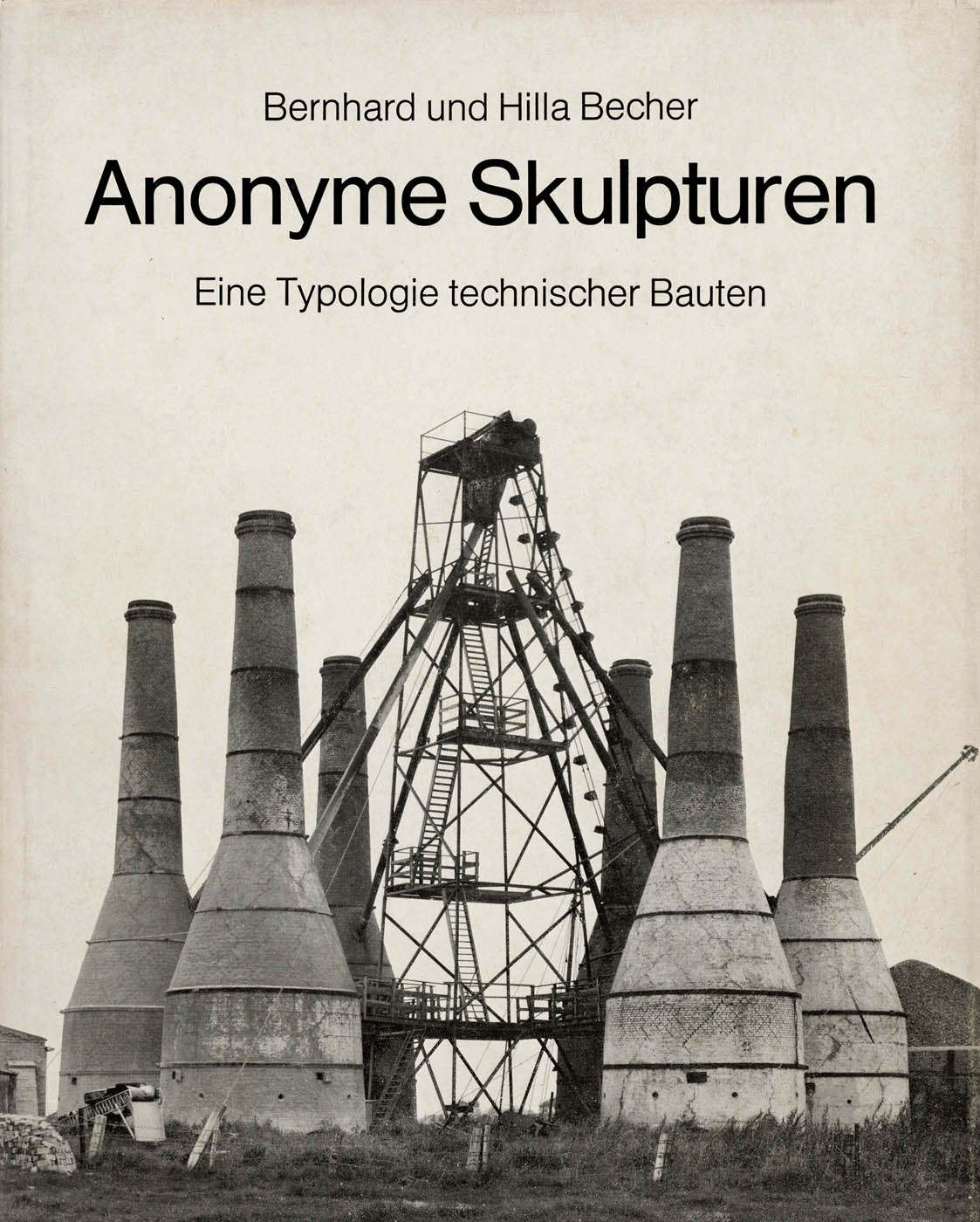
 

'Anonyme Skulpturen. Eine Typologie technischer Bauten, Düsseldorf: Art-Press' (Anonymous Sculptures: A Typology of Technical Buildings) Düsseldorf: Art-Press 1970 (Buchcover)


Anonyme Skulpturen. Eine Typologie technischer Bauten, Düsseldorf: Art-Press
Anonymous Sculptures: A Typology of Technical Buildings, Düsseldorf: Art-Press
1970 (Buchcover)
Courtesy Die Photographische Sammlung/SK Stiftung Kultur, Köln


When we think about the most influential photographers of the first five decades of the 20th century we conjure up names such as Eugène Atget, Alfred Stieglitz, Paul Strand, Walker Evans, László Moholy-Nagy, Dorothea Lange, and Berenice Abbott, to name just a few – and by influential, I mean those photographers that altered the intensification of the medium – the conceptualisation, creation, veracity, meaning and reception of the image.

In the last 50 years of the 20th century there are less of these medium-shifting artists that have really made a difference. Diane Arbus and Lee Friedlander are the two that readily spring to mind. And then there are the Bechers, Bernd & Hilla Becher. These German photographers changed the course of contemporary photographic practice, their conceptual art / objective photographic raison d’être still embedded at the heart of fine art photography today.

But, as I have argued elsewhere, their typologies and grids, their topographic state, their same same photographs and perspectives of industrial sculptures and landscapes are anything but objective. Their pictorial grammar, underlaid by a conceptual approach to subject matter, continuously reflected in the systematics of capture and display (the juxtaposition of works together), is constantly undermined by the ghost in the machine – those viral codes of mutation and difference which cannot be controlled.

While they professed to “eschew entirely entirely the aspects of beauty, emotion and opinion,” every photograph they took involves a subjective point of view, an element of uniqueness and beauty that can never be repeated.

“Despite protestations to the contrary (appeals to the objectivity of the image, eschewing entirely the aspects of beauty, emotion and opinion; the rigorous frontality of the individual images giving them the simplicity of diagrams, while their density of detail offers encyclopaedic richness) these are subjective images for all their objective desire. The paradox is the more a photographer strives for objectivity, the more ego drops away, the more the work becomes their own: subjective, beautiful, emotive.

Even though the Bechers’ demonstrate great photographic restraint with regard to documenting the object, the documentary gaze is always corrupted / mutated / distorted by personal interpretation: where to position the camera, what to include or exclude, how to interpret the context of place, how to crop or print the image, and how to display the image, in grids, sequences or singularly. In other words there are always multiple (con)texts to which artists conform or transgress. What makes great photographers, such as Eugène Atget, Walker Evans, August Sander and the Bechers, is the idiosyncratic “nature” of their vision: how Atget places his large view camera – at that particular height and angle to the subject – leaves an indelible feeling that only he could have made that image, to reveal the magic of that space in a photograph. It is their personal, unique thumbprint, recognisable in an instant. So it is with the Bechers.”1

For a deeper dive into the work of the Bechers, please see my text “Ghosts in the machine,” on the exhibition Bernd and Hilla Becher at the Metropolitan Museum of Art, New York, July – November, 2022.

Dr Marcus Bunyan


1/ Marcus Bunyan text on the exhibition Bernd and Hilla Becher: Mines and Mills – Industrial Landscapes at Fotomuseum Winterthur, Zurich, November 2011 – February 2012 [Online] Cited 05/12/2025


Many thankx to Die Photographische Sammlung/SK Stiftung Kultur, Cologne for allowing me to publish the photographs in the posting. Please click on the photographs for a larger version of the image.
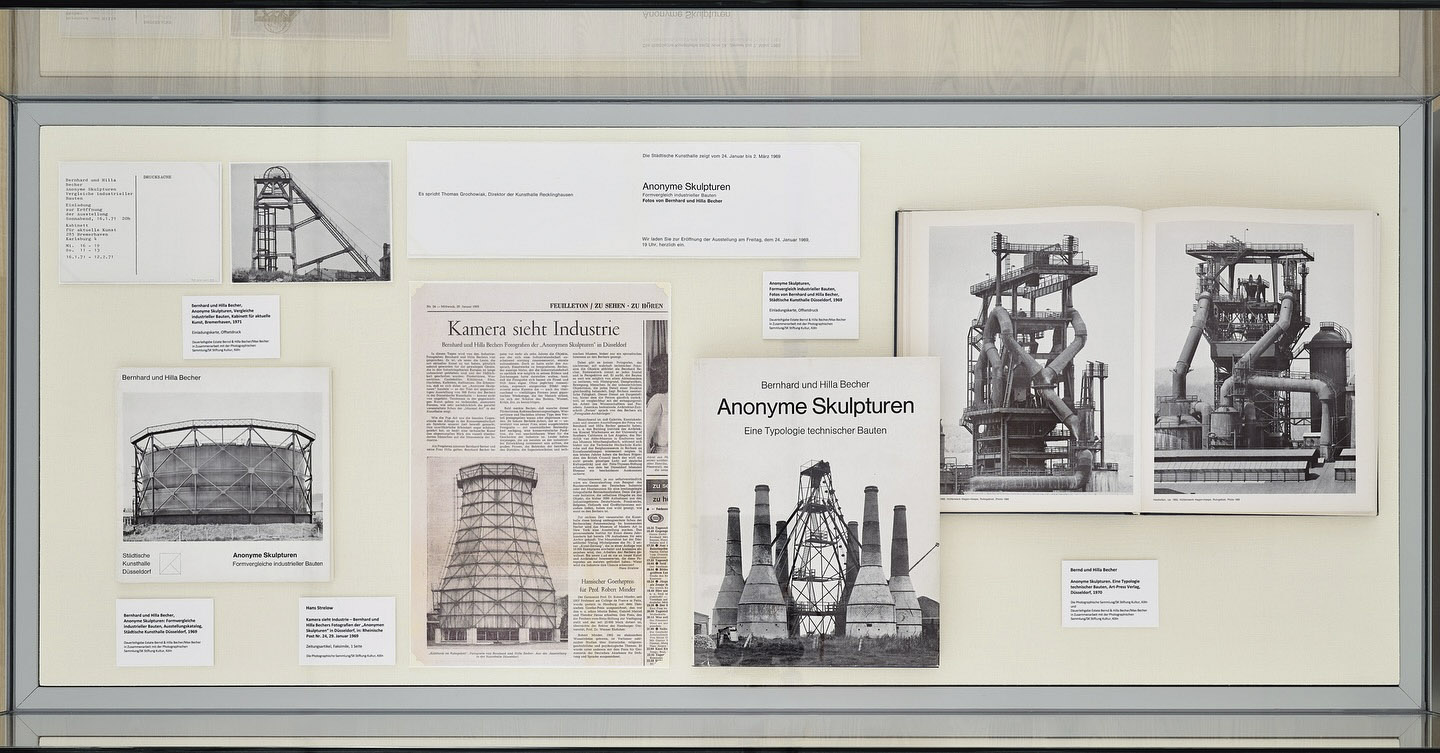


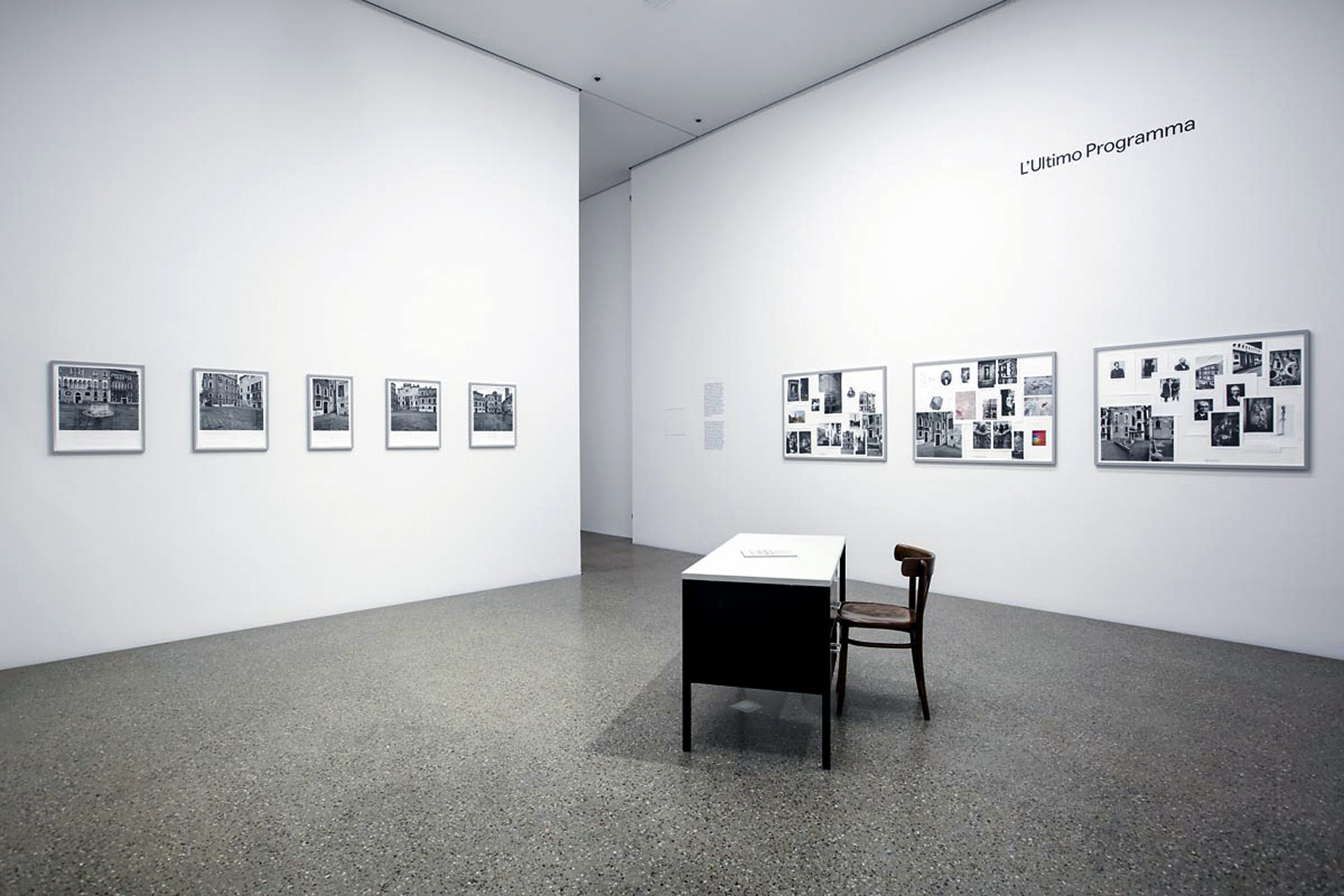
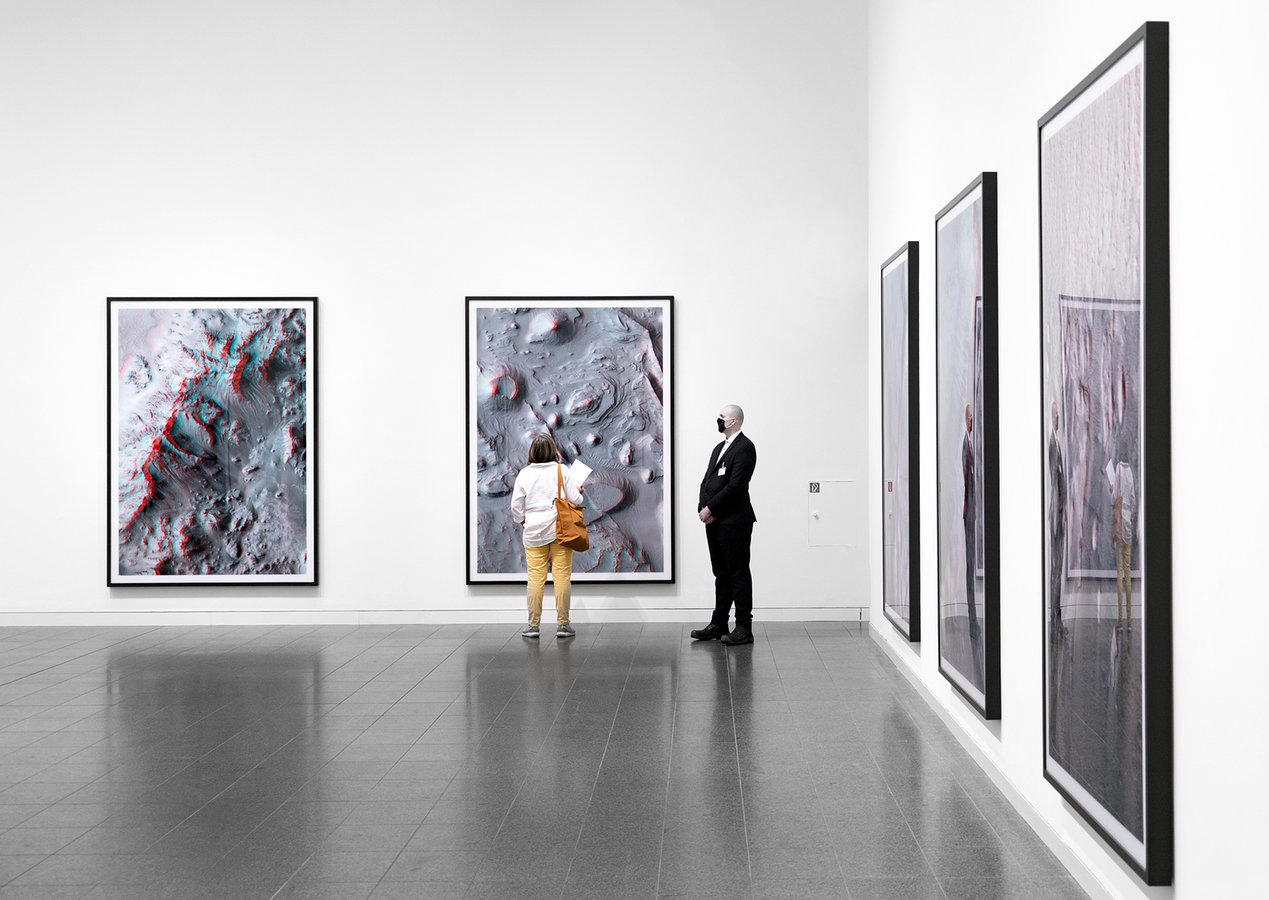
Installation view of the exhibition 'Bernd & Hilla Becher – History of a Method' at Die Photographische Sammlung/SK Stiftung Kultur, Cologne September, 2025 – February, 2026


Installation view of the exhibition Bernd & Hilla Becher – History of a Method at Die Photographische Sammlung/SK Stiftung Kultur, Cologne
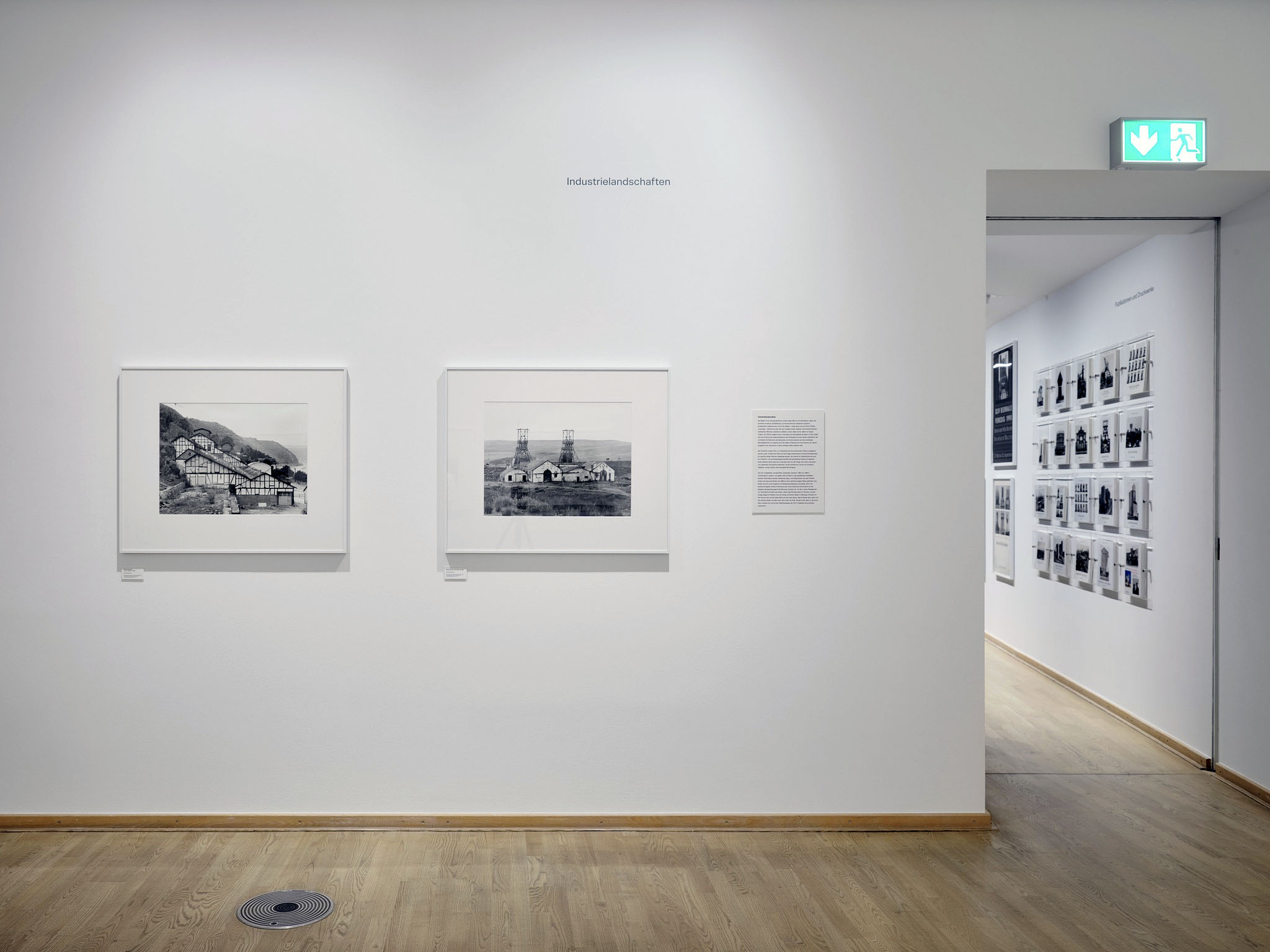
 

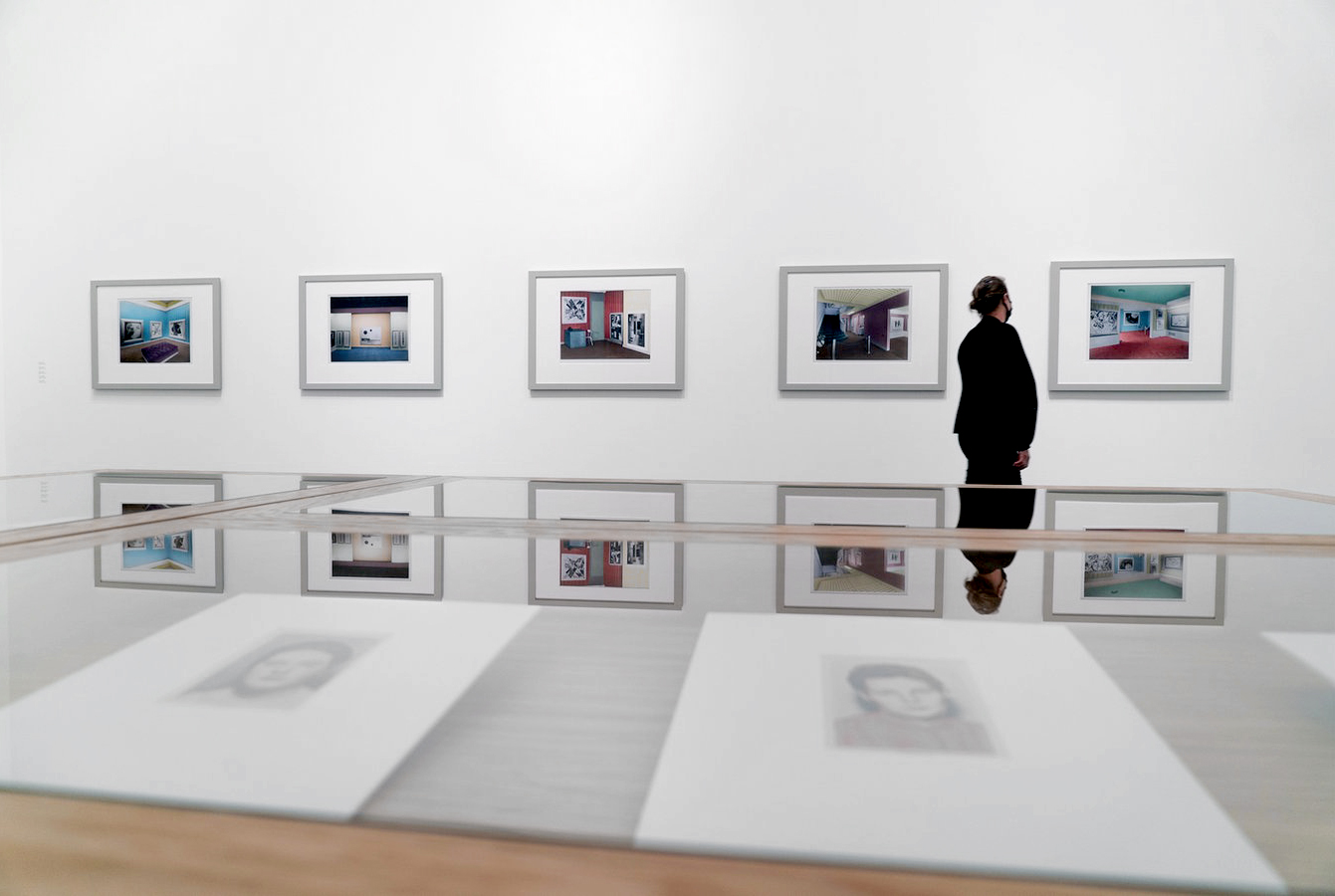
Installation view of the exhibition 'Bernd & Hilla Becher – History of a Method' at Die Photographische Sammlung/SK Stiftung Kultur, Cologne September, 2025 – February, 2026


Installation view of the exhibition Bernd & Hilla Becher – History of a Method at Die Photographische Sammlung/SK Stiftung Kultur, Cologne
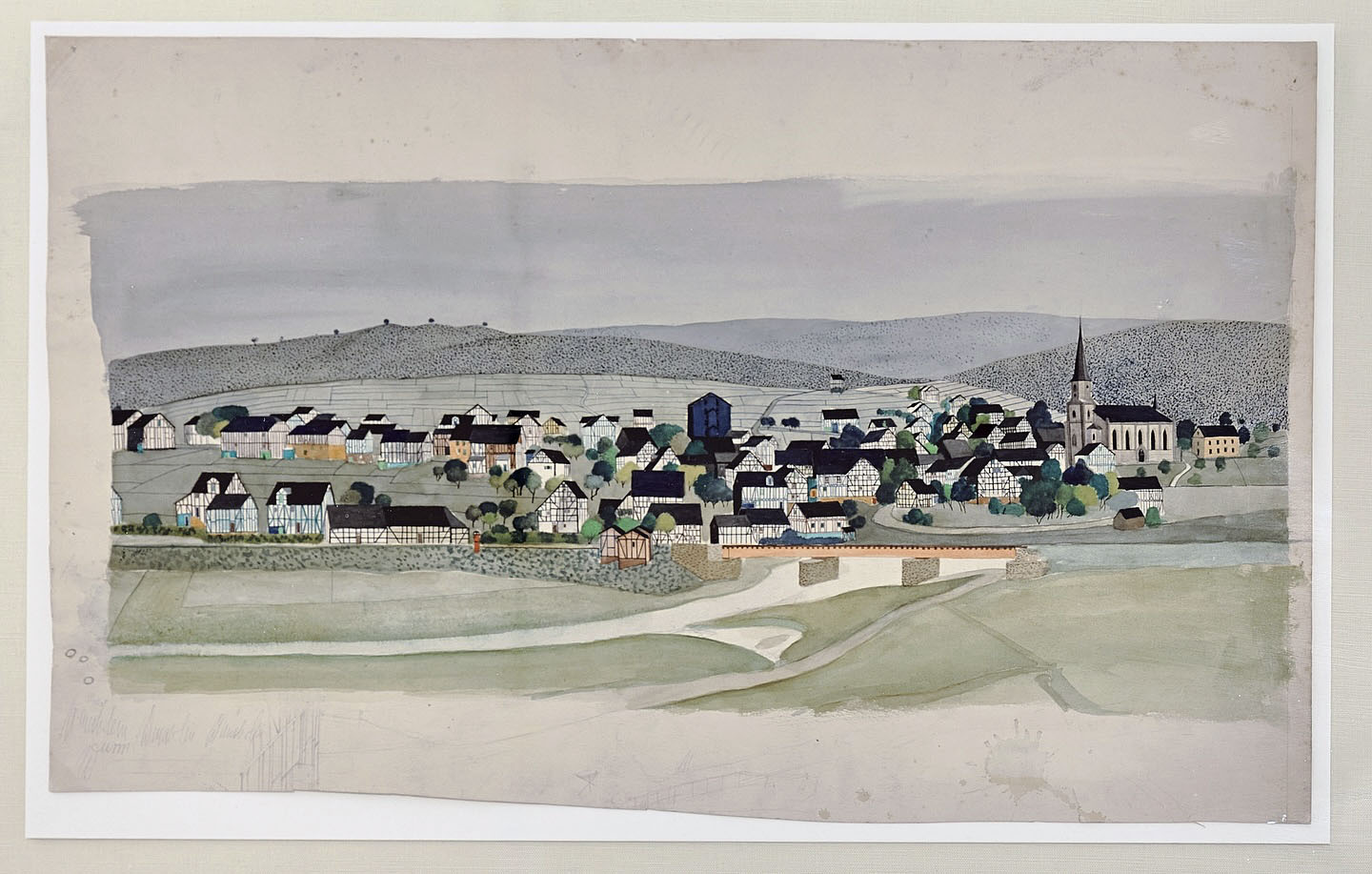
 

Bernd Becher (German, 1931-2007) 'Mudersbach' 1950s


Bernd Becher (German, 1931-2007)
Mudersbach
1950s
Watercolour
35.5 x 59.9cm
© Estate Bernd & Hilla Becher, vertreten durch Max Becher
Courtesy Die Photographische Sammlung/SK Stiftung Kultur – Bernd und Hilla Becher Archiv, Köln
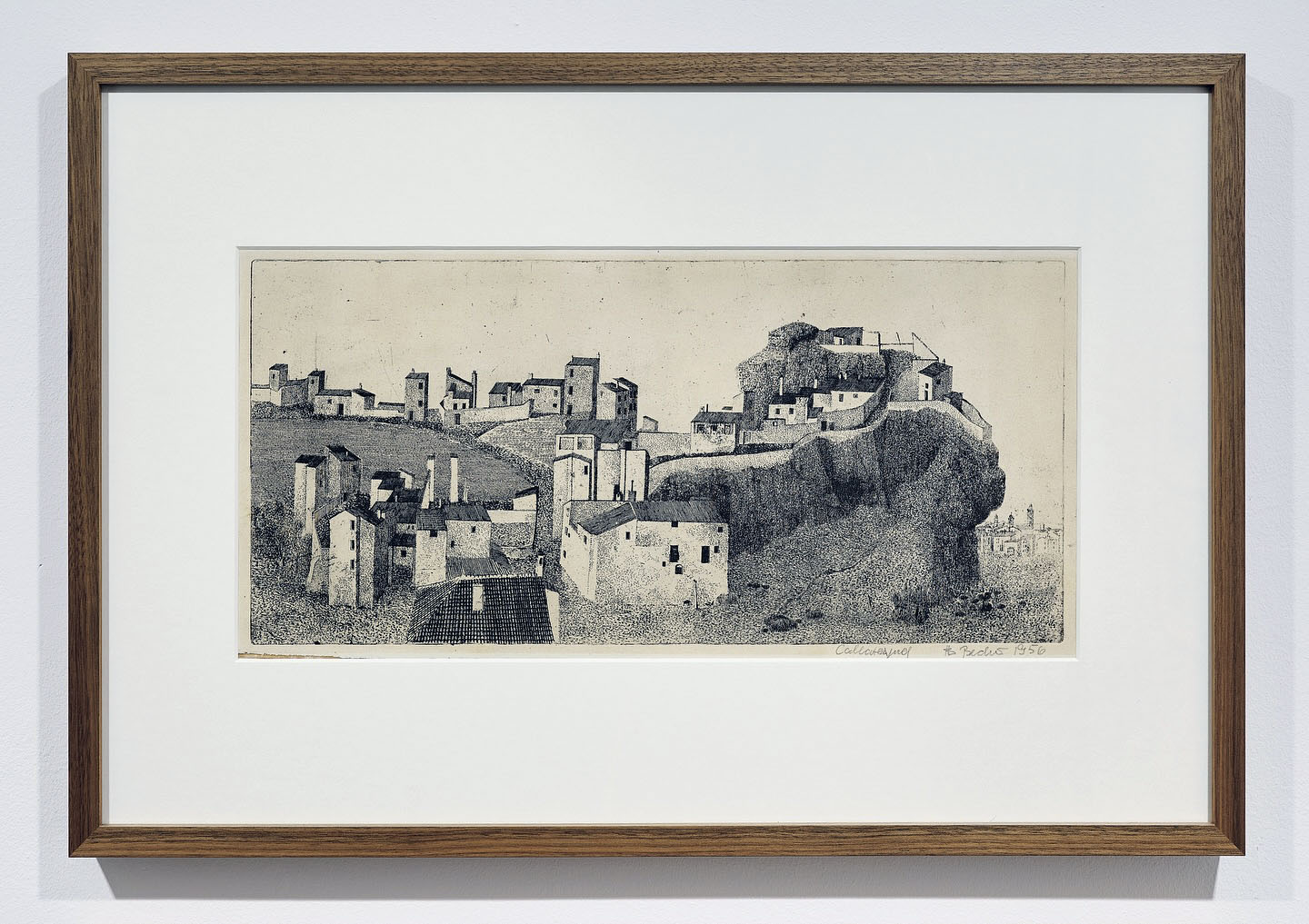
 

Installation view of the exhibition 'Bernd & Hilla Becher – History of a Method' at Die Photographische Sammlung/SK Stiftung Kultur, Cologne September, 2025 – February, 2026 showing Bernd Becher's 'Calatayud' 1956


Installation view of the exhibition Bernd & Hilla Becher – History of a Method at Die Photographische Sammlung/SK Stiftung Kultur, Cologne showing Bernd Becher’s Calatayud 1956 (below)
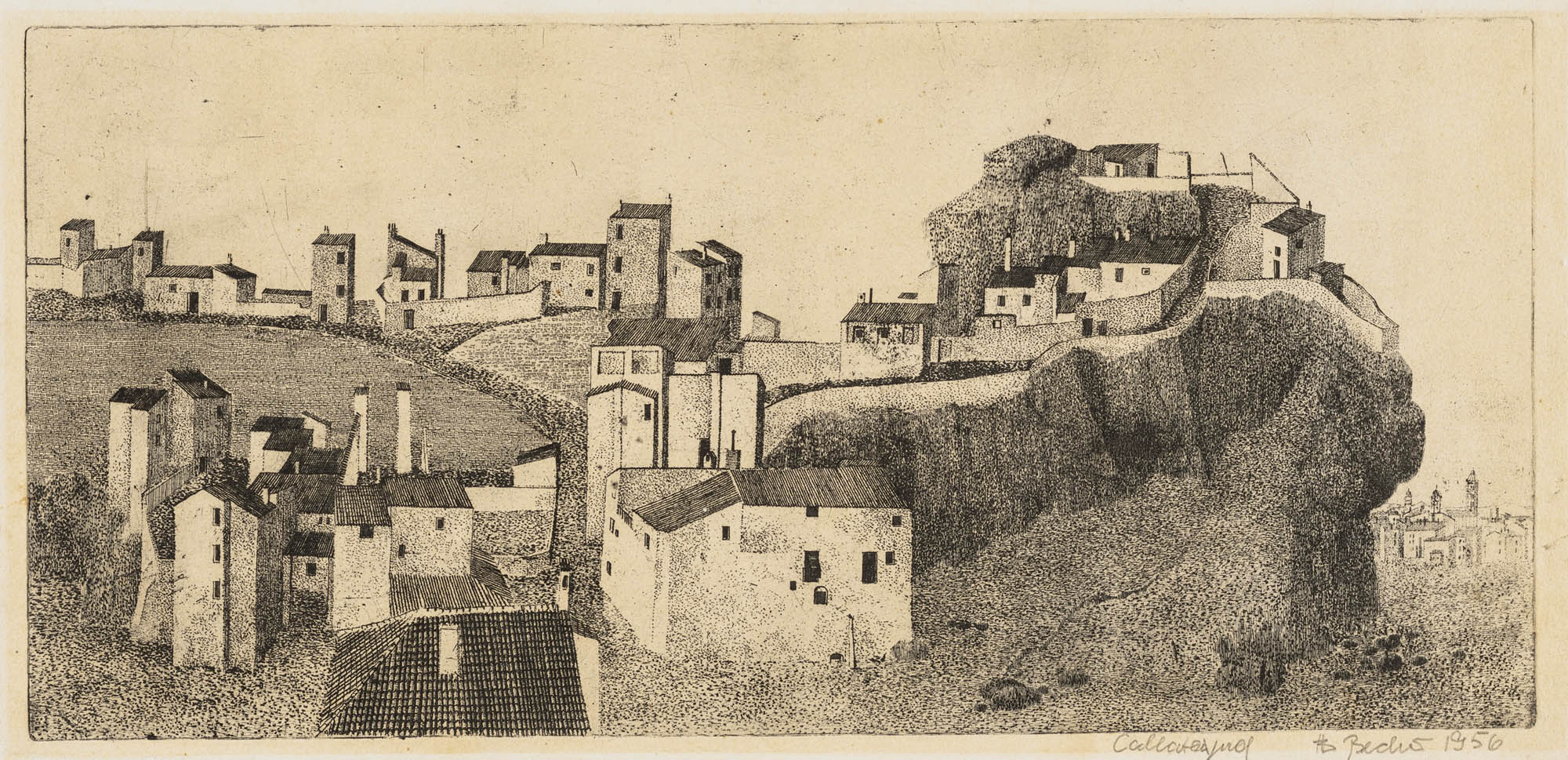
 

Bernd Becher (German, 1931-2007) 'Calatayud' 1956


Bernd Becher (German, 1931-2007)
Calatayud
1956
Aquatint on laid paper
20.8 x 44.0cm
© Estate Bernd & Hilla Becher, vertreten durch Max Becher
Courtesy Die Photographische Sammlung/SK Stiftung Kultur – Bernd und Hilla Becher Archiv, Köln
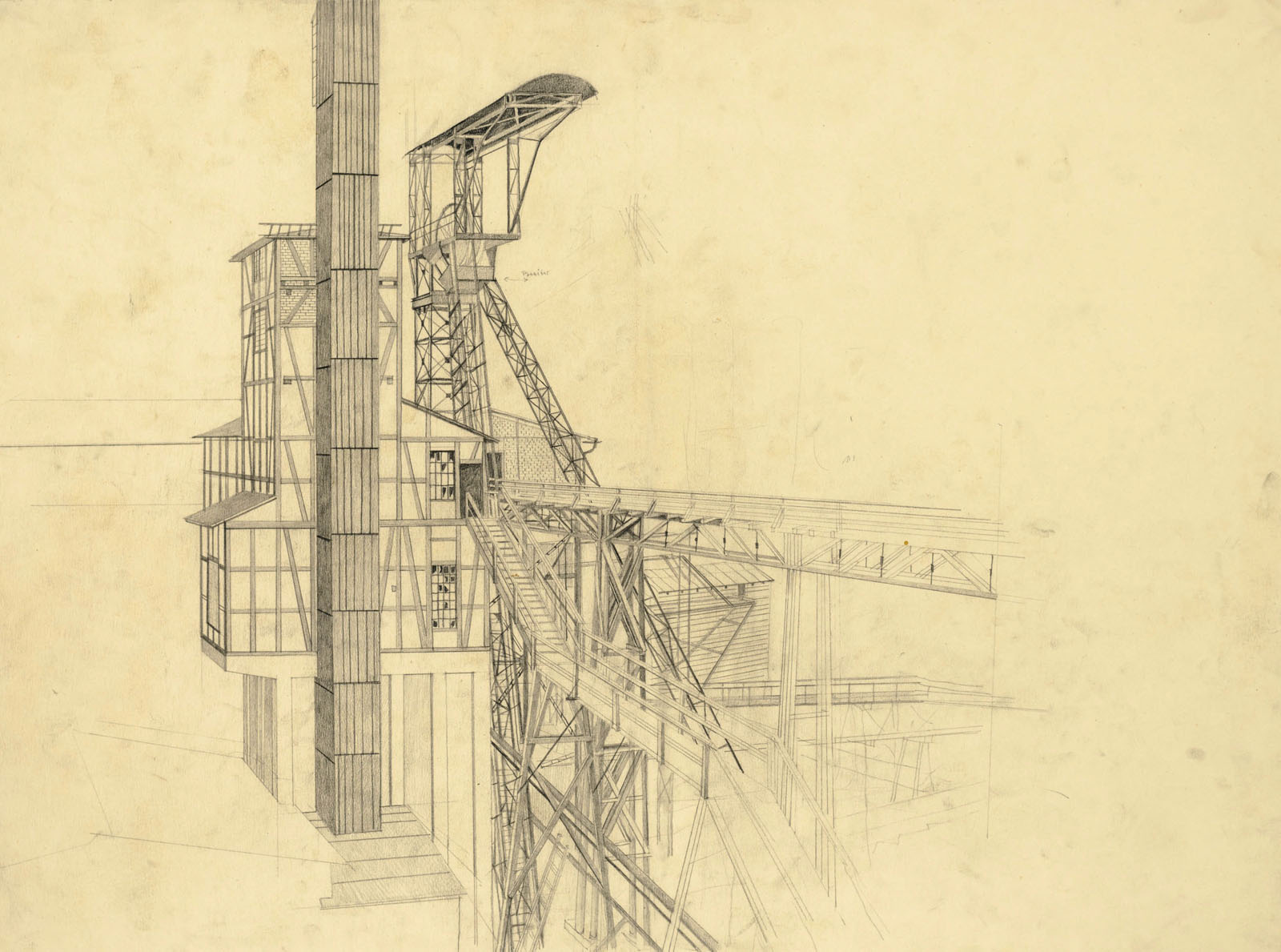
 

Bernd Becher (German, 1931-2007) 'Grube Eisernhardter Tiefbau, Eisern, D' (Eisernhardter Tiefbau mine, Eisern, Germany) 1955/56


Bernd Becher (German, 1931-2007)
Grube Eisernhardter Tiefbau, Eisern, D (Eisernhardter Tiefbau mine, Eisern, Germany)
1955/56
Pencil on paper
42.0 x 56.5cm
© Estate Bernd & Hilla Becher, vertreten durch Max Becher
Courtesy Die Photographische Sammlung/SK Stiftung Kultur – Bernd und Hilla Becher Archiv, Köln
 

Installation view of the exhibition 'Bernd & Hilla Becher – History of a Method' at Die Photographische Sammlung/SK Stiftung Kultur, Cologne September, 2025 – February, 2026


Installation view of the exhibition Bernd & Hilla Becher – History of a Method at Die Photographische Sammlung/SK Stiftung Kultur, Cologne
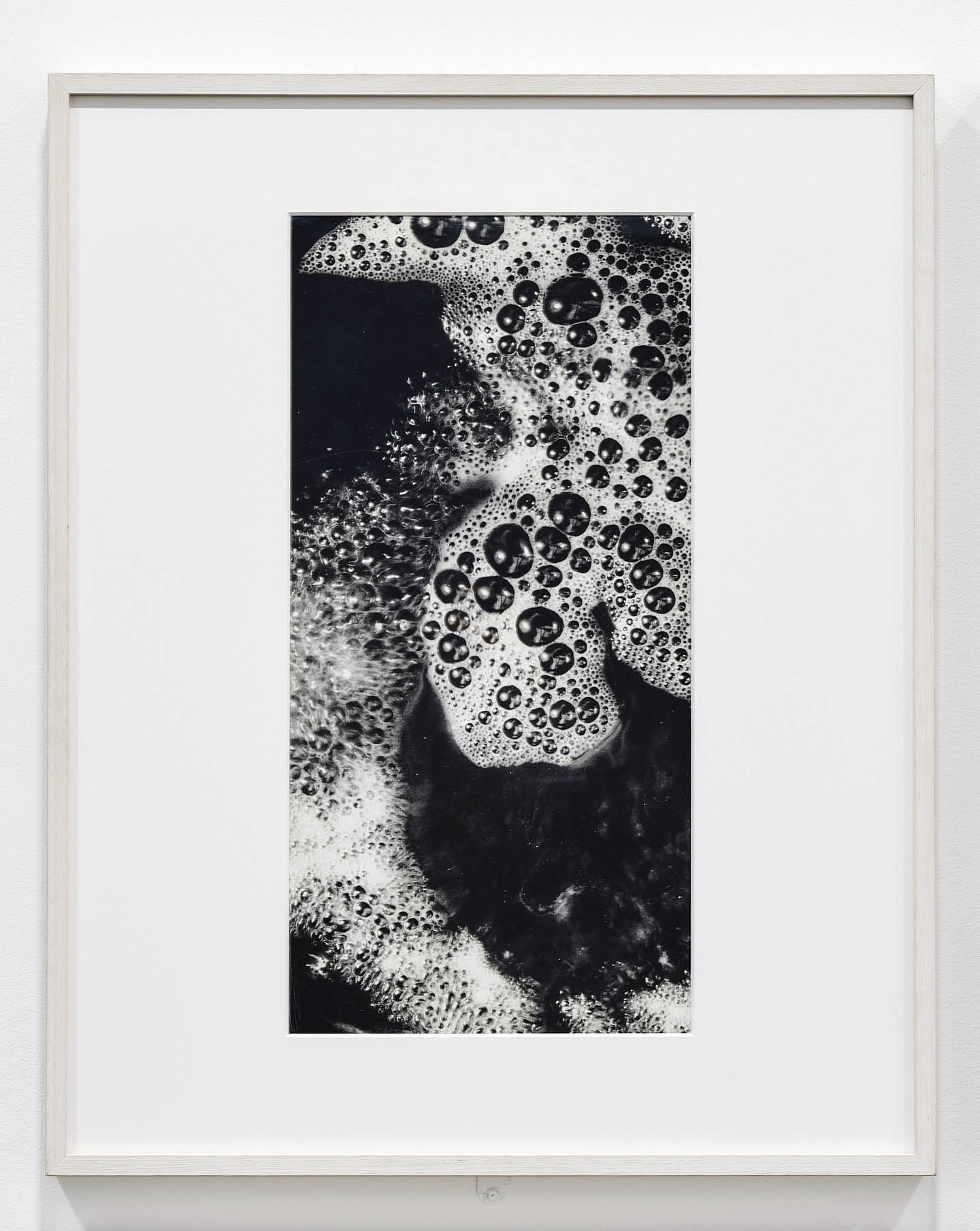
 

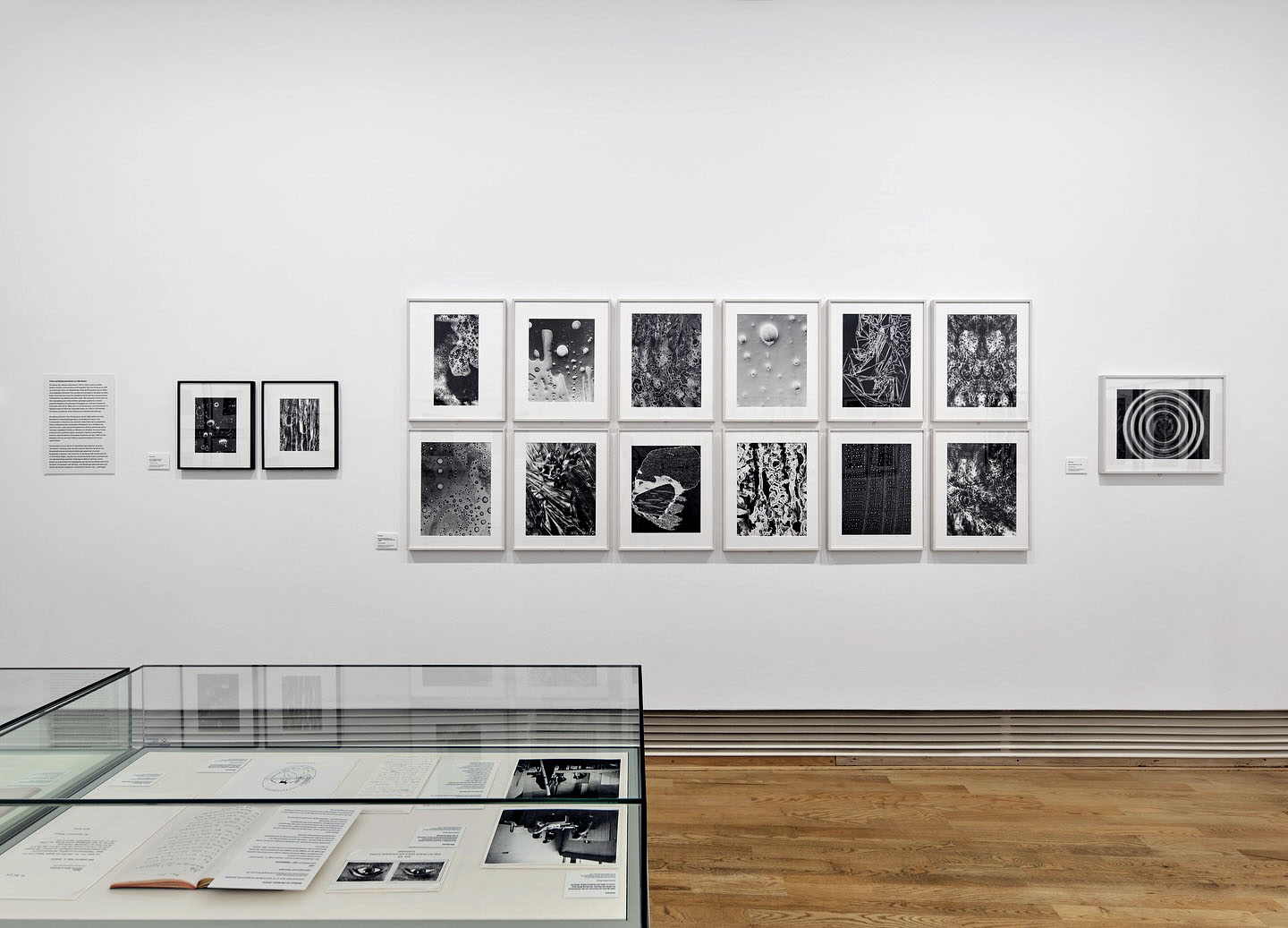
Installation view of the exhibition 'Bernd & Hilla Becher – History of a Method' at Die Photographische Sammlung/SK Stiftung Kultur, Cologne September, 2025 – February, 2026 showing Hilla Becher's 'Untitled (Makroaufnahme von Schaum)' (Macro shot of foam) c. 1960


Installation view of the exhibition Bernd & Hilla Becher – History of a Method at Die Photographische Sammlung/SK Stiftung Kultur, Cologne showing Hilla Becher’s Untitled (Makroaufnahme von Schaum) (Macro shot of foam) c. 1960
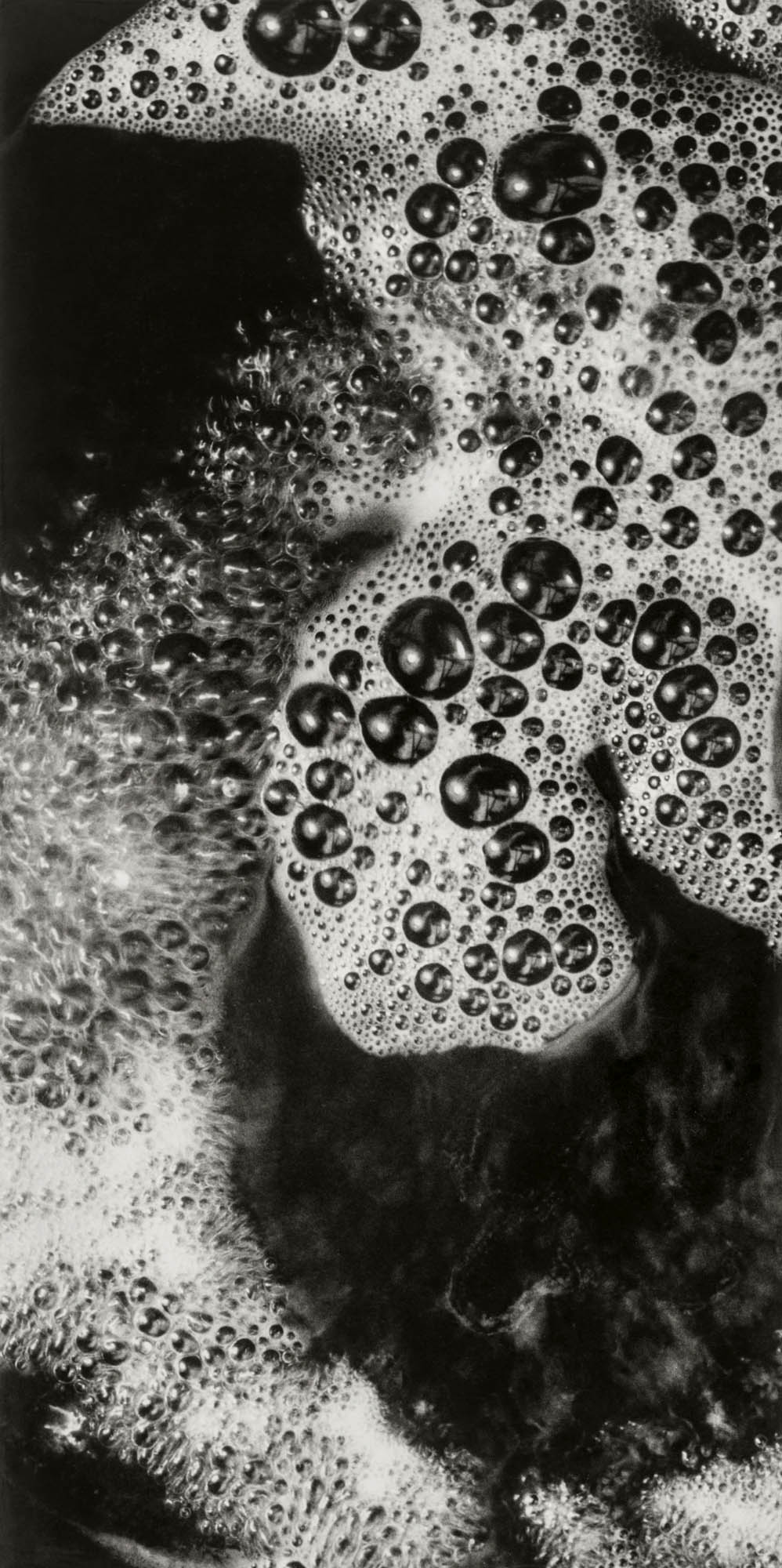
 

Hilla Becher (German, 1934-2015) 'Untitled (Makroaufnahme von Schaum)' (Macro shot of foam) c. 1960


Hilla Becher (German, 1934-2015)
Untitled (Makroaufnahme von Schaum) (Macro shot of foam)
c. 1960
Gelatin silver print
38.9 x 19.4cm
© Estate Bernd & Hilla Becher, vertreten durch Max Becher
Courtesy Die Photographische Sammlung/SK Stiftung Kultur – Bernd und Hilla Becher Archiv, Köln


Hilla Becher (née Wobeser) discovered photography as a teenager. Her mother had trained as a photographer at the Lette Verein in Berlin and supported her daughter’s interest. Accordingly, from 1951 to 1953, Hilla completed an apprenticeship as a photographer at the Walter Eichgrün studio in her hometown of Potsdam. In 1953, the family fled East Germany, and Hilla continued her career in West Germany. For example, in 1957 she worked at the Troost advertising agency in Düsseldorf, where she also met Bernd Becher.

The photograph shown above belongs to a series of surface and structural studies from around 1960. Nothing is known about the exact context of the photographs; however, their stylistic affinity to the “Subjective Photography” movement, which gained influence from the early 1950s onward, is interesting. Distortion techniques were an important tool in “Subjective Photography,” and Hilla Becher’s macro photographs utilise extreme proximity to the subject as a means of creating a sense of alienation.

Text from the SK Stiftung Kultur Die Photographische Sammlung Instagram page
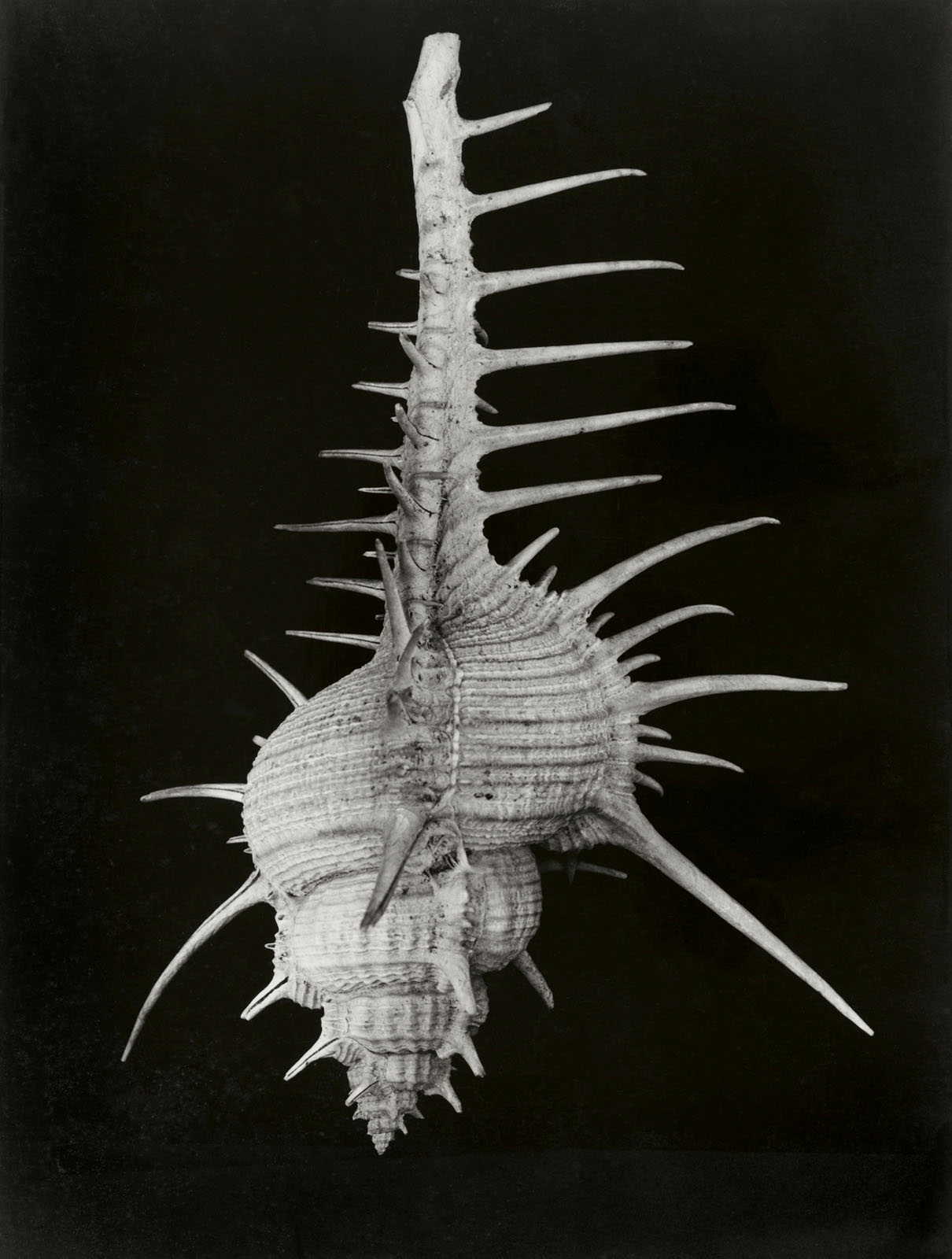
 

Hilla Becher (German, 1934-2015) 'Meeresschnecke (Venuskamm)' (Sea snail (Venus comb)) 1960s


Hilla Becher (German, 1934-2015)
Meeresschnecke (Venuskamm) (Sea snail (Venus comb))
1960s
Gelatin silver print
39.6 x 30cm
© Estate Bernd & Hilla Becher, vertreten durch Max Becher
Courtesy Die Photographische Sammlung/SK Stiftung Kultur – Bernd und Hilla Becher Archiv, Köln
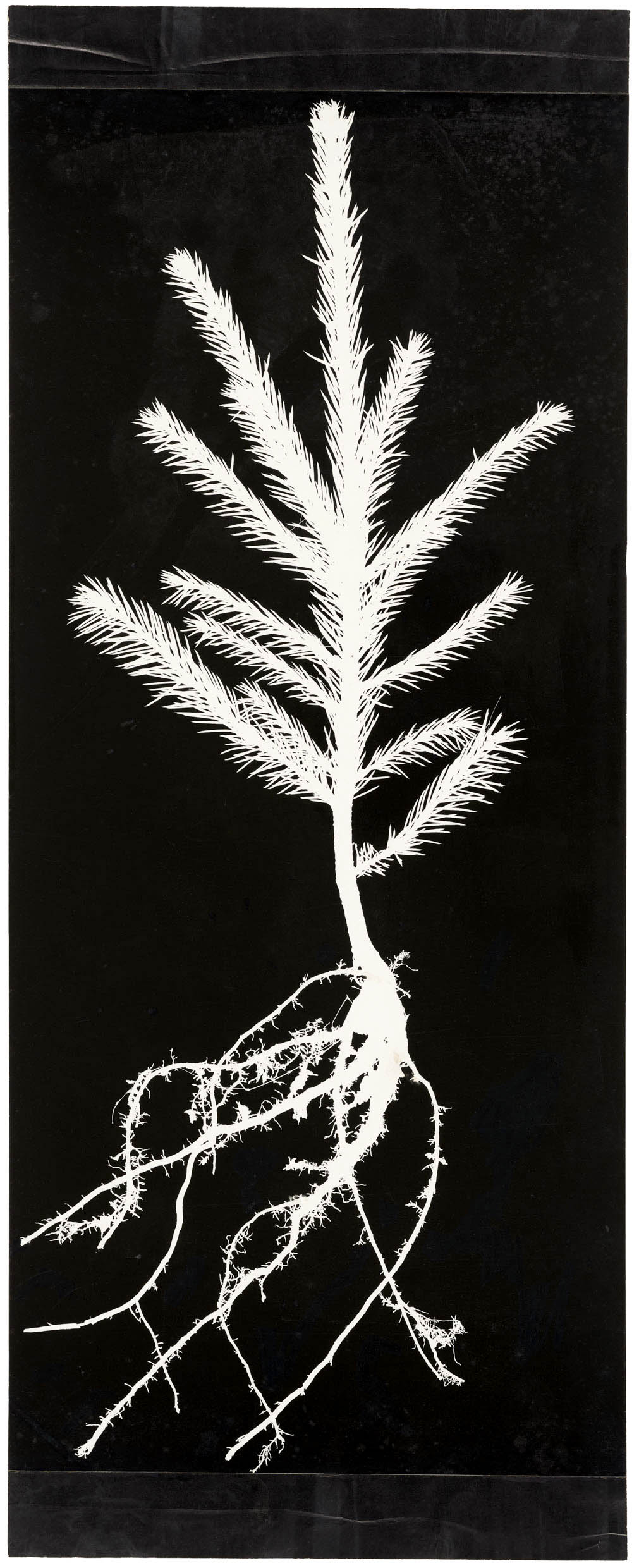
 

Hilla Becher (German, 1934-2015) 'Pflanzenstudie, Photogramme' (Plant study, photograms) 1960s


Hilla Becher (German, 1934-2015)
Pflanzenstudie, Photogramme (Plant study, photograms)
1960s
© Estate Bernd & Hilla Becher, vertreten durch Max Becher
Courtesy Die Photographische Sammlung/SK Stiftung Kultur – Bernd und Hilla Becher Archiv, Köln
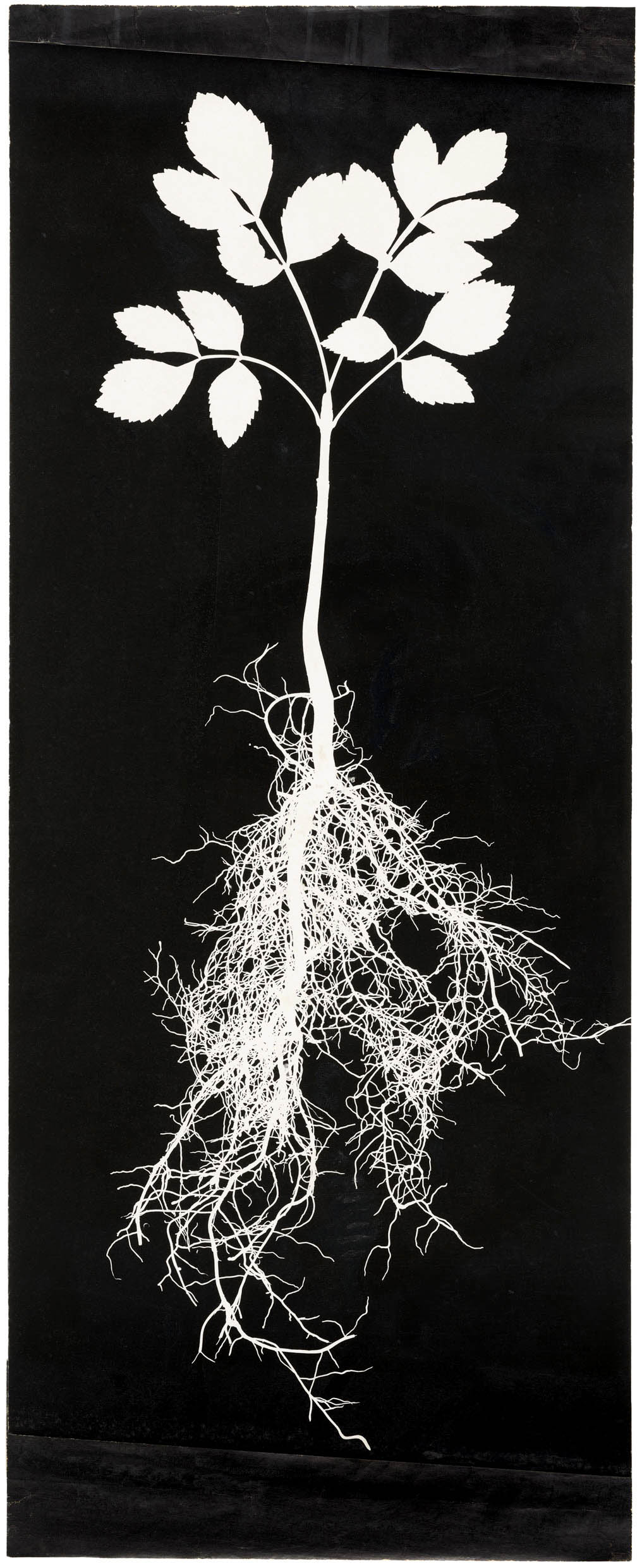
 

Hilla Becher (German, 1934-2015) 'Pflanzenstudie, Photogramme' (Plant study, photograms) 1960s


Hilla Becher (German, 1934-2015)
Pflanzenstudie, Photogramme (Plant study, photograms)
1960s
© Estate Bernd & Hilla Becher, vertreten durch Max Becher
Courtesy Die Photographische Sammlung/SK Stiftung Kultur – Bernd und Hilla Becher Archiv, Köln


An exhibition of Die Photographische Sammlung/SK Stiftung Kultur in cooperation with the Bernd & Hilla Becher Studio, Düsseldorf

The artist couple Bernd and Hilla Becher (1931-2007/1934-2015) has written photographic history. With their joint work, which they developed from 1959 until the 2000s on the basis of an almost uninterrupted photographic activity in the industrial regions of Germany, the Benelux countries, Great Britain, France, Italy, the USA and Canada, they created a new artistically motivated documentary style.

For the first time in Europe, this exhibition will present the methodological and thematic range of their oeuvre in great detail with over 300 original black and white photographs and other exhibits by the artist couple. In the individual sections, almost all of Becher’s found subjects can be located in a compilation and sequencing largely determined by themselves. Photographs of landscapes, winding towers, blast furnaces, cooling towers, gas tanks or even views of entire collieries etc. are considered her trademark. The juxtaposition of the groups of works authentically conveys the pictorial grammar developed by Bernd and Hilla Becher and their continuously reflected systematics and conceptual approach.

The exhibits come from the Bernd and Hilla Becher Archive in Die Photographische Sammlung/SK Stiftung Kultur and the Bernd & Hilla Becher Studio, Düsseldorf, in collaboration with Max Becher under the supervision of the Bernd & Hilla Becher Estate. There are also loans from Sprüth Magers and the LVR-Landesmuseum Bonn.

The publication accompanying the exhibition will be published by Schirmer / Mosel Verlag, with texts by Max Becher, Gabriele Conrath-Scholl, Marianne Kapfer and Urs Stahel.

Text from the Die Photographische Sammlung/SK Stiftung Kultur, Cologne website
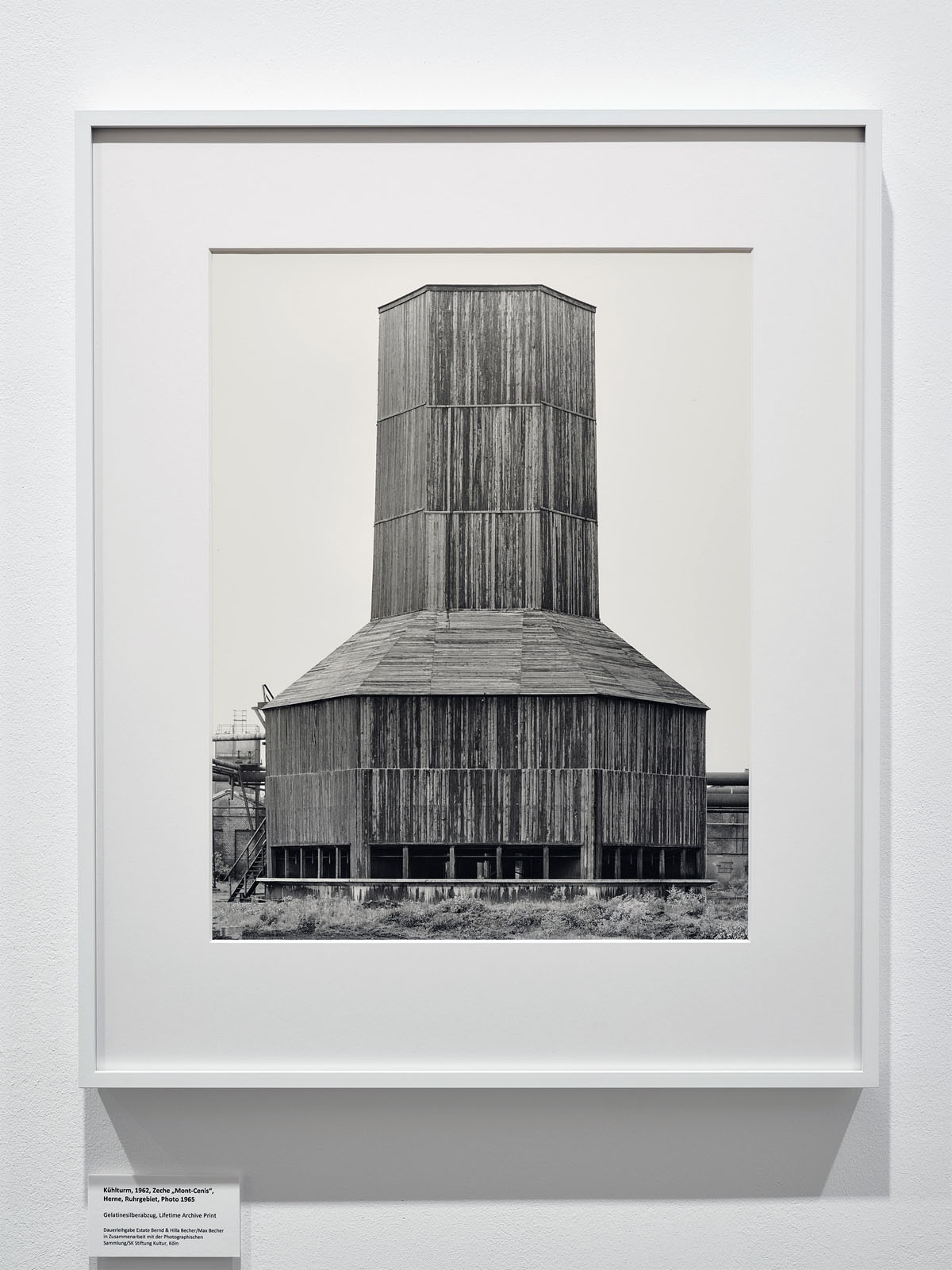
 

Installation view of the exhibition 'Bernd & Hilla Becher – History of a Method' at Die Photographische Sammlung/SK Stiftung Kultur, Cologne September, 2025 – February, 2026 showing Bernd and Hilla Becher's photograph 'Kühlturm (Cooling tower) 1962, "Mont-Cenis" mine, Herne, Ruhr area' 1965


Installation view of the exhibition Bernd & Hilla Becher – History of a Method at Die Photographische Sammlung/SK Stiftung Kultur, Cologne showing Bernd and Hilla Becher’s photograph Kühlturm (Cooling tower) 1962, “Mont-Cenis” mine, Herne, Ruhr area 1965 (below)
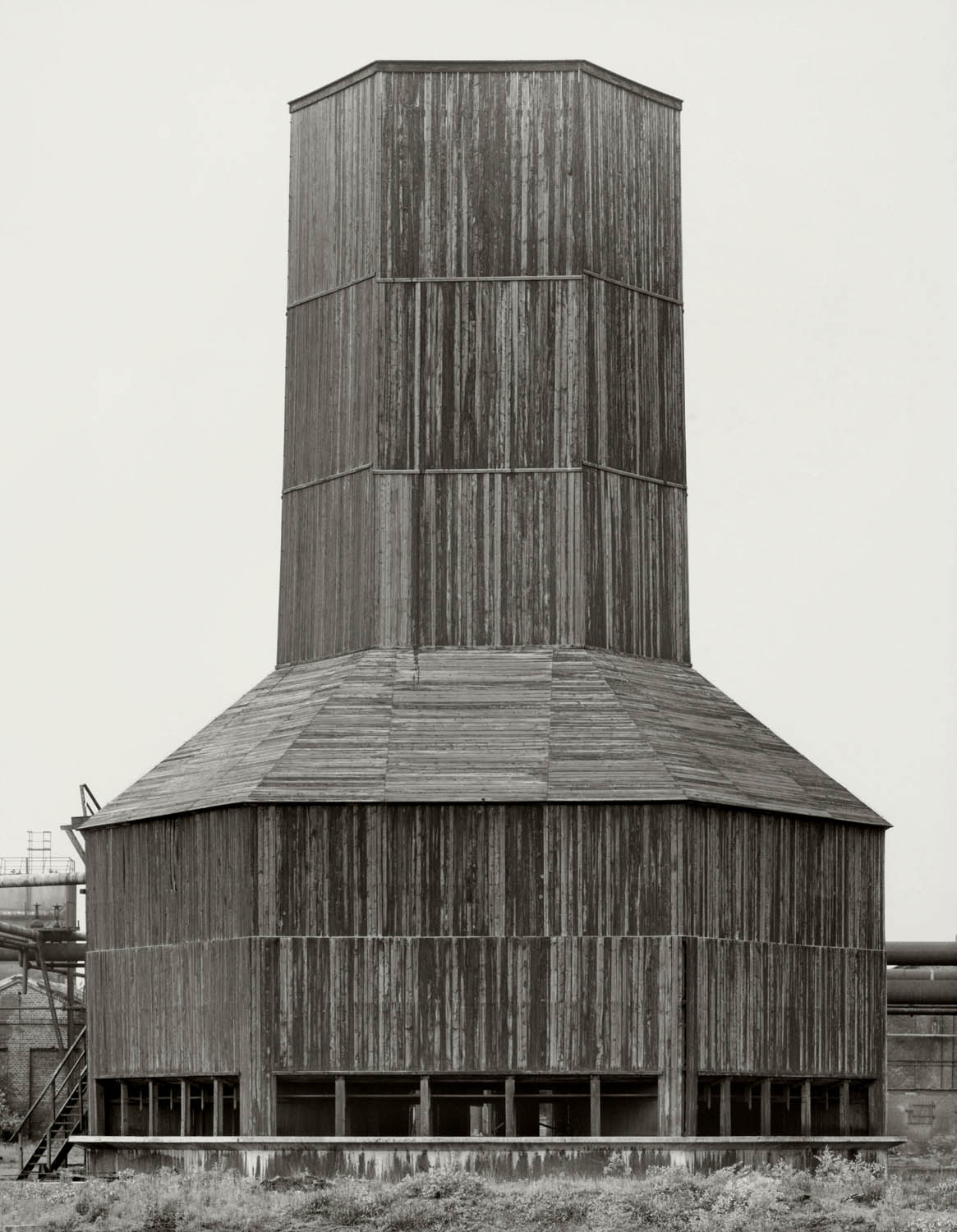
 

Bernd and Hilla Becher (German, 1931-2007/1934-2015) 'Kühlturm (Cooling tower) 1962, "Mont-Cenis" mine, Herne, Ruhr area' 1965


Bernd and Hilla Becher (German, 1931-2007/1934-2015)
Kühlturm (Cooling tower) 1962, “Mont-Cenis” mine, Herne, Ruhr area
1965
Gelatin silver print
40.3 x 31.5cm
© Estate Bernd & Hilla Becher, vertreten durch Max Becher
Courtesy Die Photographische Sammlung/SK Stiftung Kultur – Bernd und Hilla Becher Archiv, Köln


We have dedicated an entire room of our current exhibition to the group of “Anonymous Sculptures.” With this series of images, Bernd and Hilla Becher defined the building types that were important to them, such as cooling towers. The fundamental principle of the comparability of the motifs was introduced, and the work on publications, so crucial to Bernd and Hilla Becher’s artistic output, was also initiated.

You can trace the artists’ approach using 41 photographs that exemplify the building types presented in seven chapters of the 1970 publication “Anonymous Sculptures: A Typology of Technical Structures.” An exhibition at the Düsseldorf Municipal Art Gallery preceded the book in 1969 [see the book cover at the top of the posting].

The term “Anonymous Sculptures” establishes a link to conceptual art. This connection between Bernd and Hilla Becher’s work and the visual arts was important for their subsequent work and its presentation in museums and galleries.

Text from the SK Stiftung Kultur Die Photographische Sammlung Instagram page
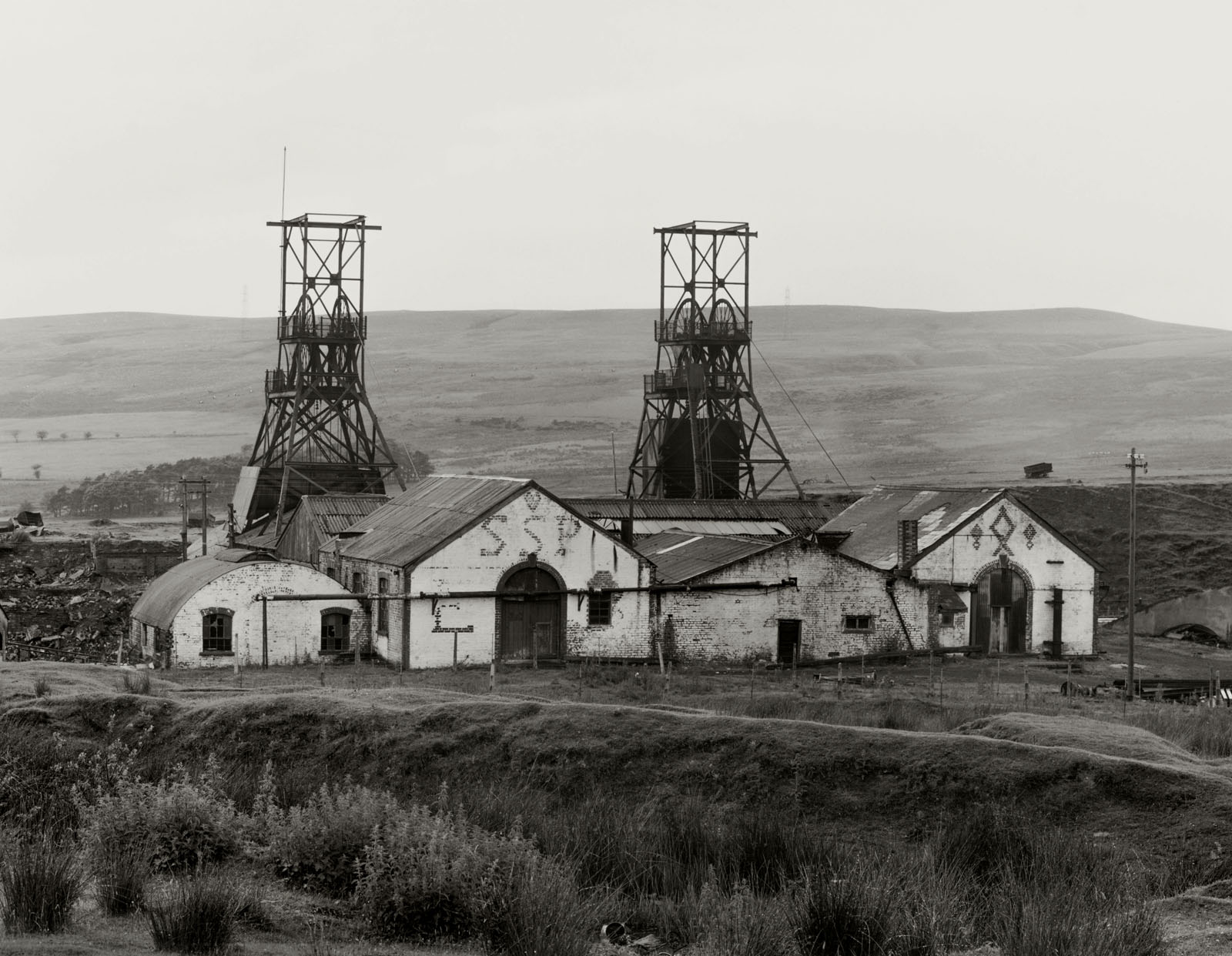
 

Bernd and Hilla Becher (German, 1931-2007/1934-2015) 'Seven Sisters Pit, South Wales, GB' 1966


Bernd and Hilla Becher (German, 1931-2007/1934-2015)
Seven Sisters Pit, South Wales, GB
1966
Gelatin silver print
© Estate Bernd & Hilla Becher, vertreten durch Max Becher
Courtesy Die Photographische Sammlung/SK Stiftung Kultur – Bernd und Hilla Becher Archiv, Köln, 2025
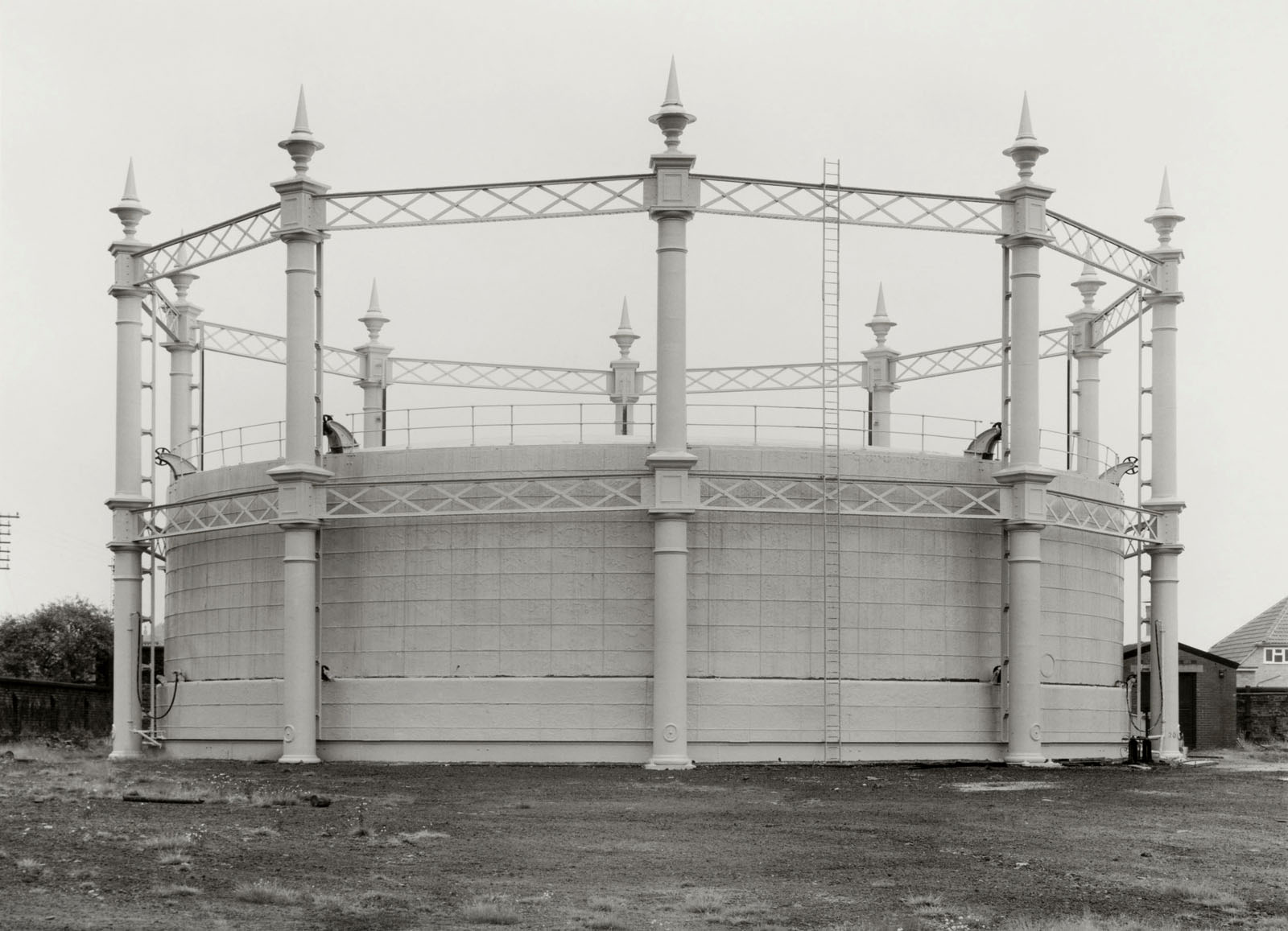
 

Bernd and Hilla Becher (German, 1931-2007/1934-2015) 'Gasbehälter (Gas container) 1886 Tyldesley near Manchester, UK' 1966


Bernd and Hilla Becher (German, 1931-2007/1934-2015)
Gasbehälter (Gas container) 1886 Tyldesley near Manchester, UK
1966
Gelatin silver print
30.4 x 41.5cm
© Estate Bernd & Hilla Becher, vertreten durch Max Becher
Courtesy Die Photographische Sammlung/SK Stiftung Kultur – Bernd und Hilla Becher Archiv, Köln
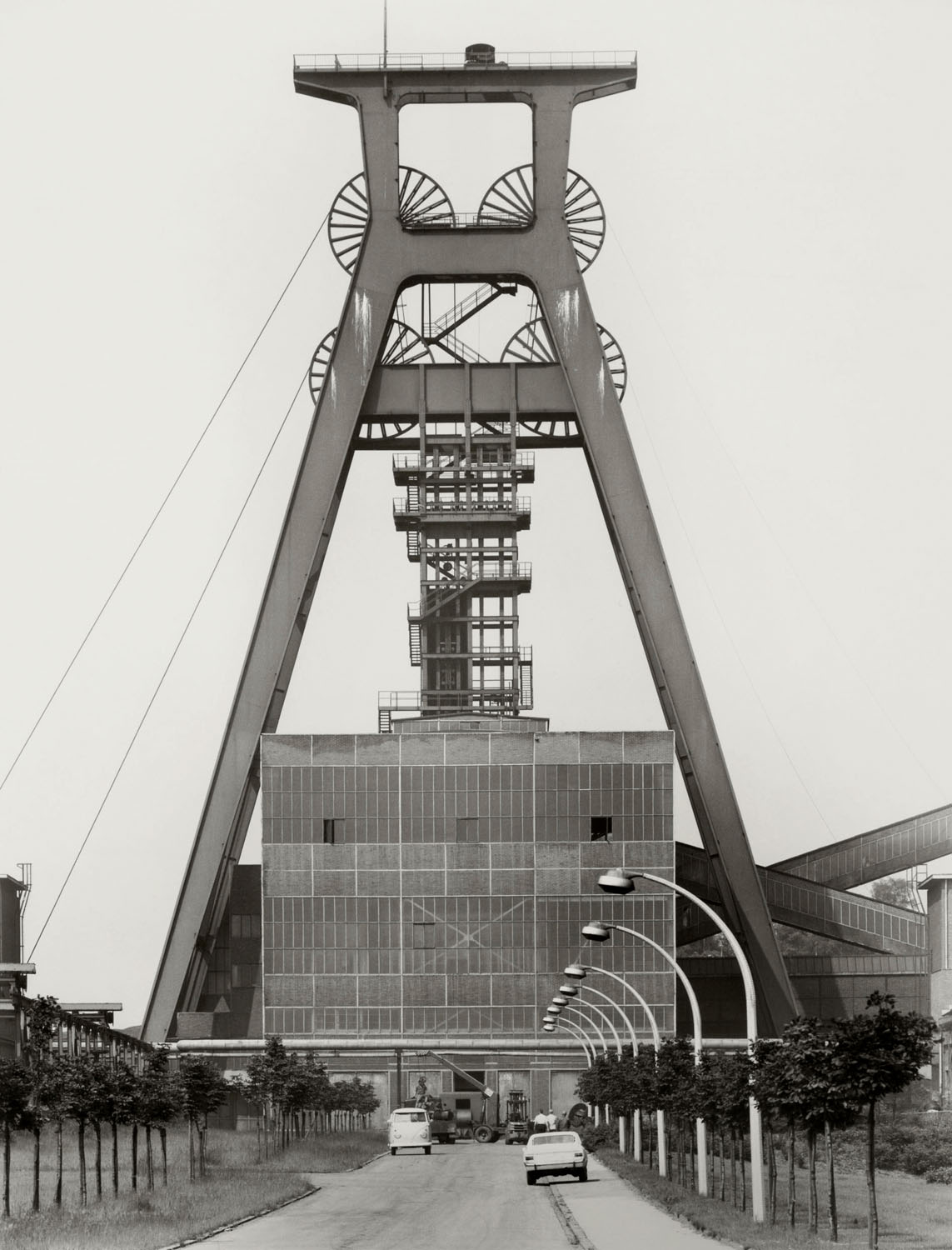
 

Bernd and Hilla Becher (German, 1931-2007/1934-2015) 'Förderturm (Conveyor tower) 1958 "Graf Bismarck" mine, Gelsenkirchen, Ruhr area' 1967


Bernd and Hilla Becher (German, 1931-2007/1934-2015)
Förderturm (Conveyor tower) 1958 “Graf Bismarck” mine, Gelsenkirchen, Ruhr area
1967
Gelatin silver print
40.3 x 31.1cm
© Estate Bernd & Hilla Becher, vertreten durch Max Becher
Courtesy Die Photographische Sammlung/SK Stiftung Kultur – Bernd und Hilla Becher Archiv, Köln


Bernd and Hilla Becher (German, 1931-2007/1934-2015) 'Hochofen (Blast furnace) c. 1930, Blast furnace plant, Esch, Luxembourg' 1969


Bernd and Hilla Becher (German, 1931-2007/1934-2015)
Hochofen (Blast furnace) c. 1930, Blast furnace plant, Esch, Luxembourg
1969
Gelatin silver print
40.4 x 31.5 cm
© Estate Bernd & Hilla Becher, vertreten durch Max Becher
Courtesy Die Photographische Sammlung/SK Stiftung Kultur – Bernd und Hilla Becher Archiv, Köln
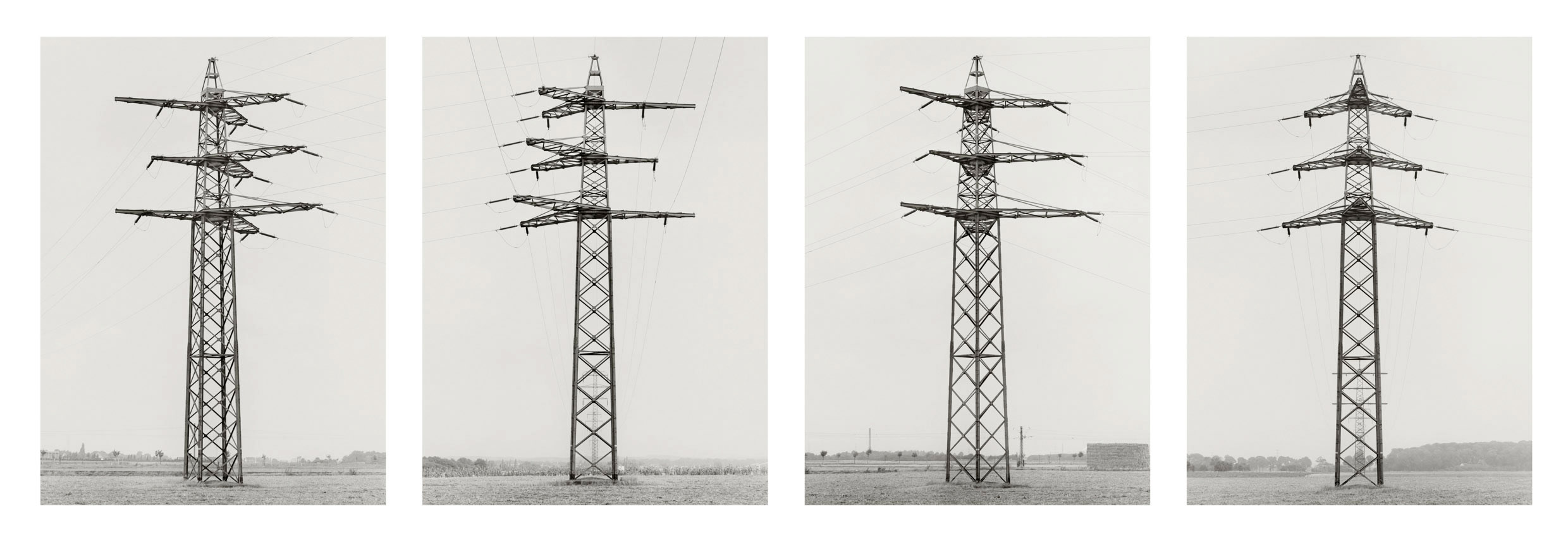
 

Bernd and Hilla Becher (German, 1931-2007/1934-2015) 'Hochspannungsmast, Düsseldorf, D' (High-voltage pylon, Düsseldorf, Germany) 1969


Bernd and Hilla Becher (German, 1931-2007/1934-2015)
Hochspannungsmast, Düsseldorf, D (High-voltage pylon, Düsseldorf, Germany)
1969
4 gelatin silver prints
Each approx. 41.3 x 30.4cm
© Estate Bernd & Hilla Becher, vertreten durch Max Becher
Courtesy Die Photographische Sammlung/SK Stiftung Kultur – Bernd und Hilla Becher Archiv, Köln
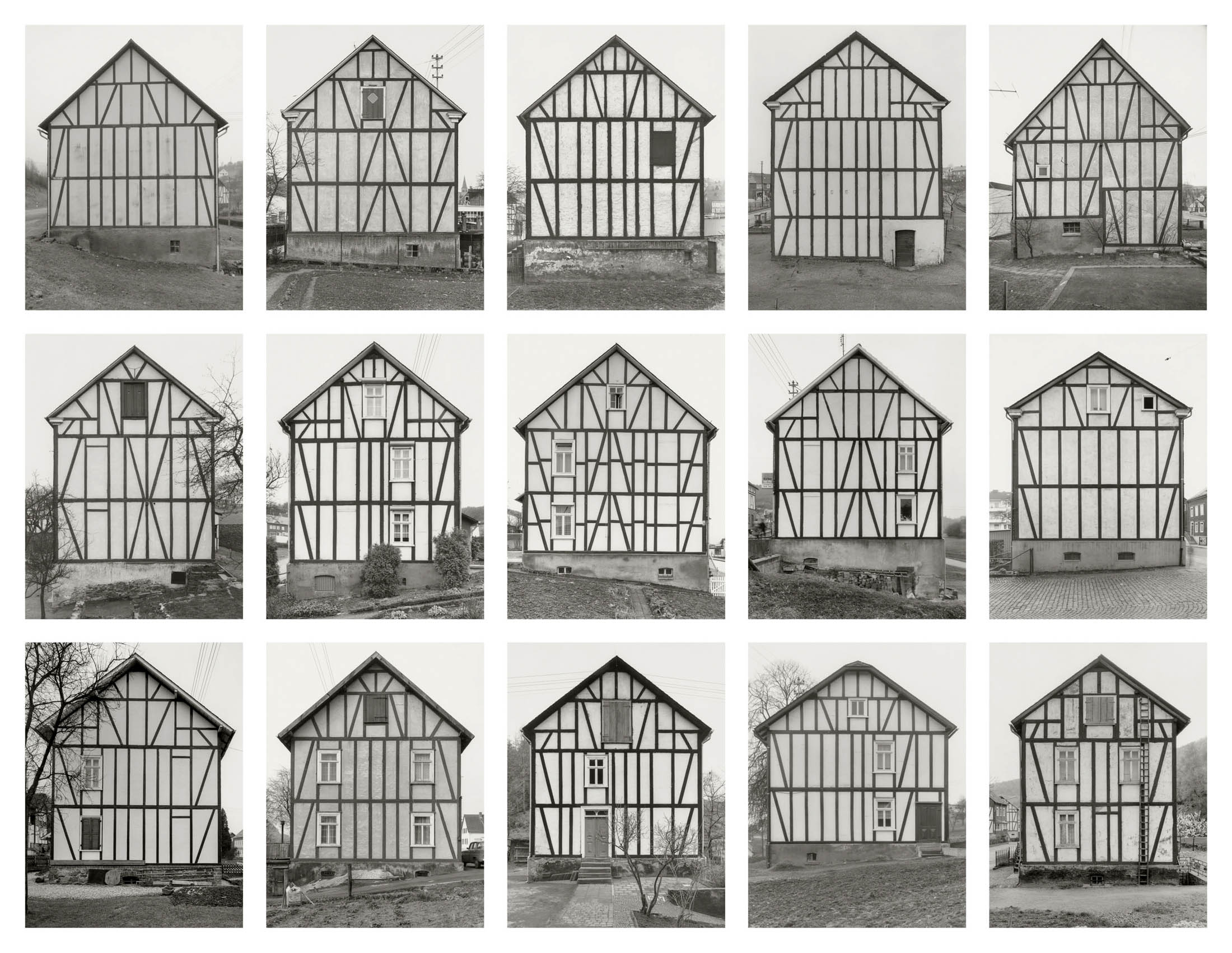
 

Bernd and Hilla Becher (German, 1931-2007/1934-2015) 'Giebelseiten Fachwerk, Siegerland D' (Gable sides half-timbered, Siegerland D) 1959-1973


Bernd and Hilla Becher (German, 1931-2007/1934-2015)
Giebelseiten Fachwerk, Siegerland D (Gable sides half-timbered, Siegerland D)
1959-1973
15 gelatin silver prints
Each approx. 40 x 31cm
© Estate Bernd & Hilla Becher, vertreten durch Max Becher
Courtesy Museum für Gegenwartskunst Siegen und Die Photographische Sammlung/SK Stiftung Kultur, Köln

The first subjects Bernd and Hilla Becher photographed on their nearly fifty-year journey to documenting industrial buildings were half-timbered houses in the Siegerland region. For Bernd Becher, it was natural to photograph these “poor people’s houses,” as Hilla called them, from his childhood and youth. For the film “The Photographers Bernd and Hilla Becher,” we attempted to identify the Bechers’ subjects using the book “Siegerland Half-Timbered Houses” by Schirmer/Mosel. We asked locals and showed them the book. Although the Bechers provided the exact address of each house, they were often unrecognisable. Many, being drafty and cold, had been clad with asbestos cement, thus obscuring their exposed timber framing. Their original appearance is preserved only in the Bechers’ photographs.

Text from the Text from the SK Stiftung Kultur Facebook page
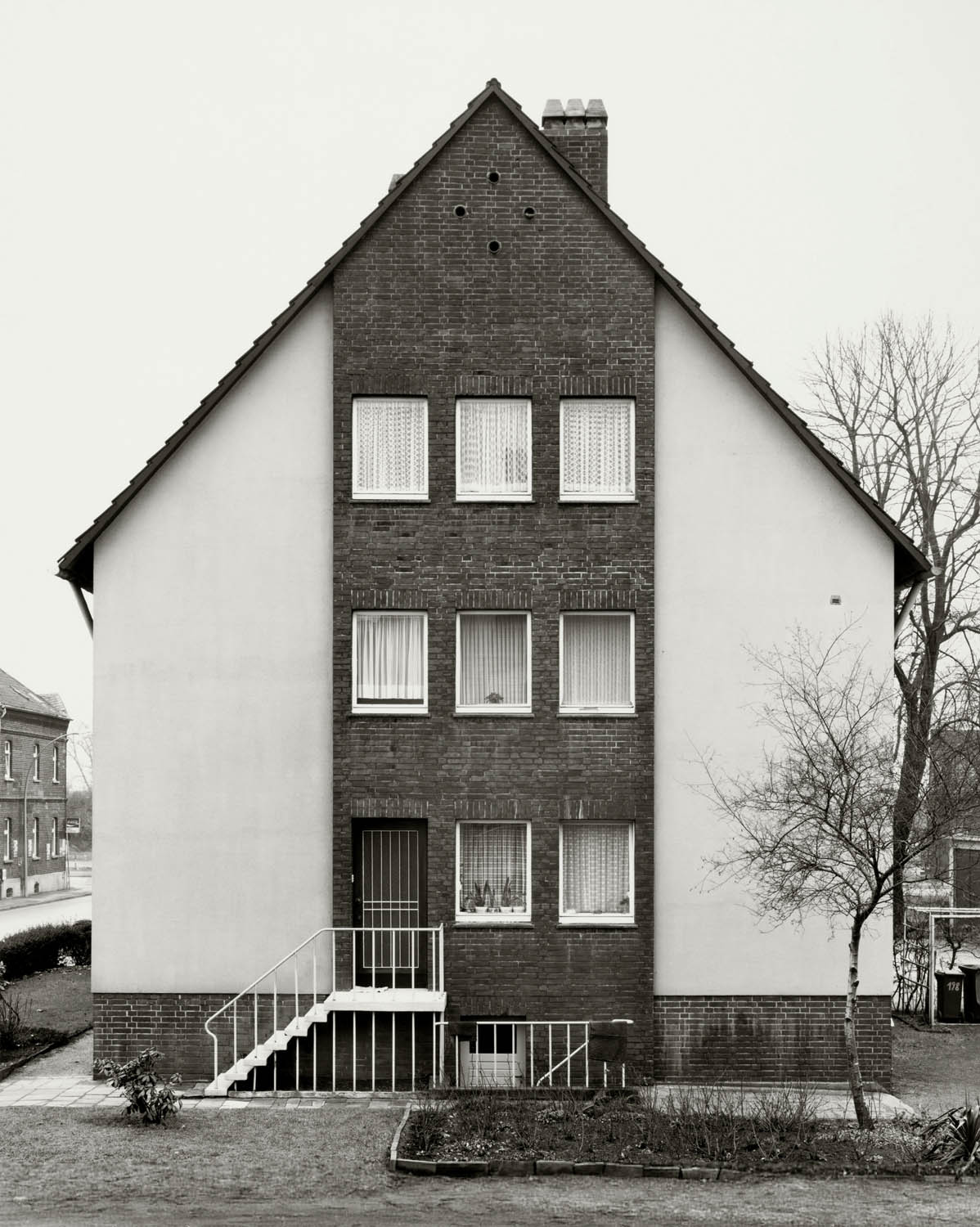
 

Bernd and Hilla Becher (German, 1931-2007/1934-2015) 'Bottrop, D' 1976


Bernd and Hilla Becher (German, 1931-2007/1934-2015)
Bottrop, D
1976
© Estate Bernd & Hilla Becher, vertreten durch Max Becher
Courtesy Die Photographische Sammlung/SK Stiftung Kultur – Bernd und Hilla Becher Archiv, Köln, 2025
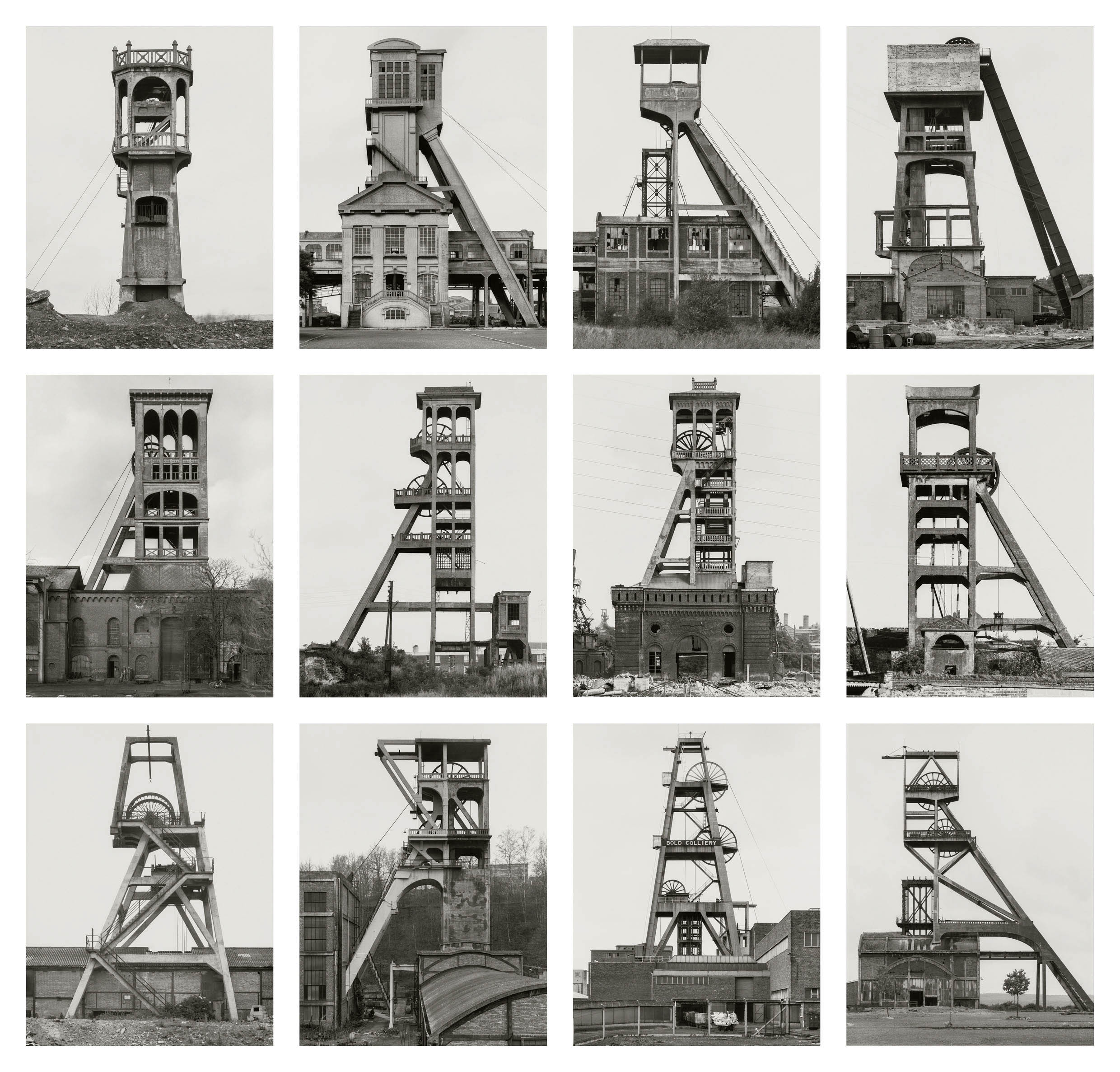
 

Bernd and Hilla Becher (German, 1931-2007/1934-2015) 'Fördertürme' (Winding towers) 1966-1979


Bernd and Hilla Becher (German, 1931-2007/1934-2015)
Fördertürme (Winding towers)
1966-1979
12 gelatin silver print
Each approx. 41 x 31cm
© Estate Bernd & Hilla Becher, vertreten durch Max Becher
Courtesy Die Photographische Sammlung/SK Stiftung Kultur – Bernd und Hilla Becher Archiv, Köln
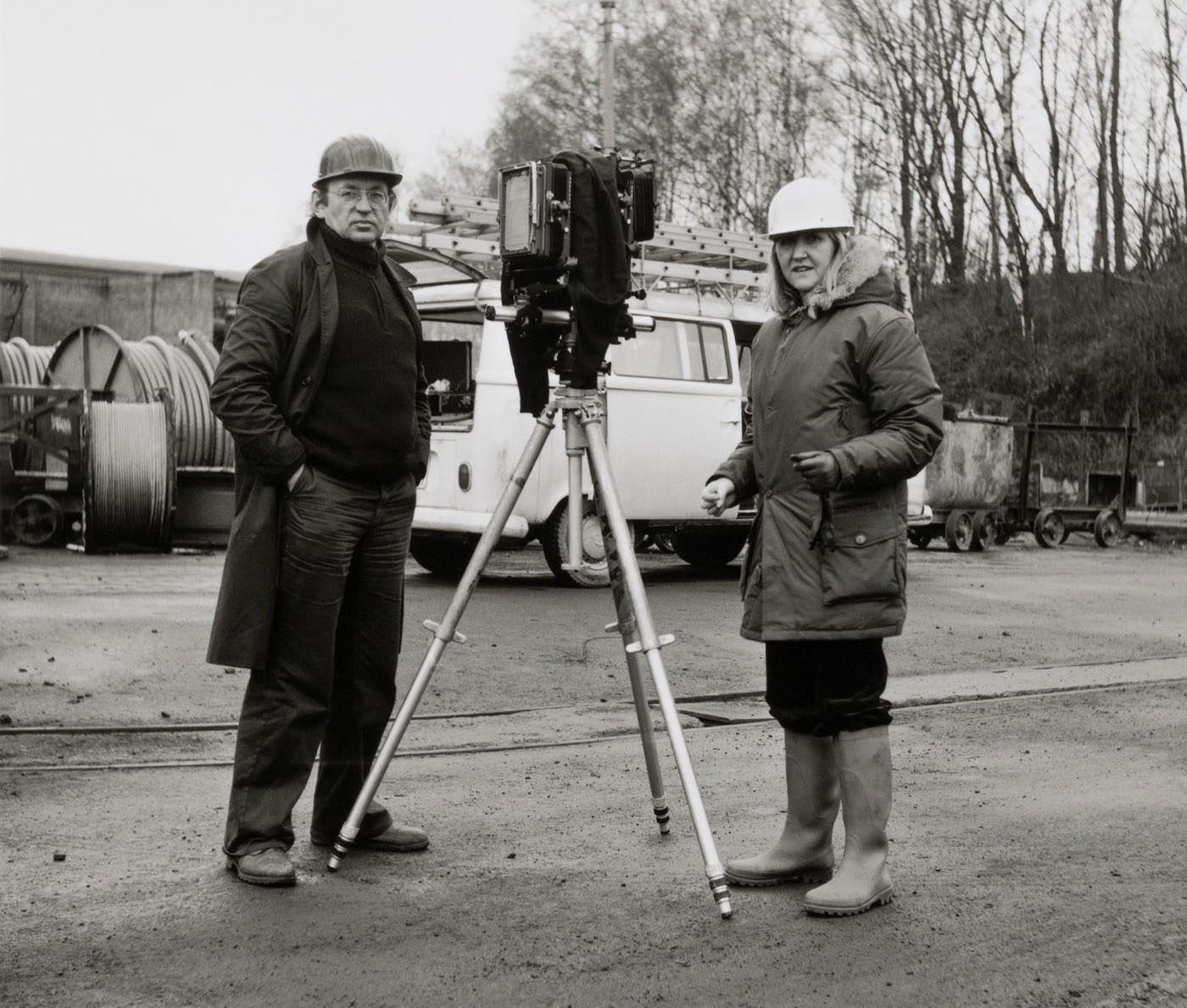
 

Bernd and Hilla Becher (German, 1931-2007/1934-2015) 'auf der Grube Ensdorf, Saarland' (at the Ensdorf mine, Saarland) 1979


Bernd and Hilla Becher (German, 1931-2007/1934-2015)
auf der Grube Ensdorf, Saarland (at the Ensdorf mine, Saarland)
1979
Gelatin silver print
12 x 14.1cm
© Estate Bernd & Hilla Becher, vertreten durch Max Becher
Courtesy Die Photographische Sammlung/SK Stiftung Kultur – Bernd und Hilla Becher Archiv, Köln


The artist couple Bernd and Hilla Becher (1931-2007/1934-2015) set a benchmark in the history of photography with their work. Beginning in 1959, they collaborated almost continuously for decades on a joint oeuvre, developed across Germany, the Benelux countries, the United Kingdom, France, Italy, the United States, and Canada. Their artistic style, characterised by a precise, documentary visual language and methodical systematisation, resonated significantly with movements such as Minimal Art and Conceptual Art. Against the backdrop of New Objectivity and inspired by 19th-century documentary photography, they created a visual grammar whose influence remains palpable in contemporary photography.

For the first time in Europe, Die Photographische Sammlung/SK Stiftung Kultur presents an extensive retrospective featuring over 300 original black-and-white photographs and complementary exhibits, showcasing the formal and thematic breadth and depth of Bernd and Hilla Becher’s work. The exhibition centers on the themes and methods developed by the Bechers: consistent methodical approaches to the photographic motif that evolved and were variably applied over decades. The exhibition explores how these methods emerged, how they developed, and how they reflected the Bechers’ perspective on the different shapes, functions, and integration of industrial buildings into the landscape.

Rare early works from both artists – created between the 1950s and 1970s – are on view, many for the first time. These pieces provide insight into the evolution of their shared aesthetic.

Room 2 is dedicated to the book Anonyme Skulpturen. Eine Typologie technischer Bauten (Anonymous Sculptures. A Typology of Technical Constructions), 1970, considered the foundation of their work. This publication systematically catalogued industrial structures and remains a key reference point. Quoted texts on the function of the objects and original prints illuminate its significance within their oeuvre.

Industrial Landscapes and photographs of entire sites form another focus and demonstrate that the Bechers did not merely document isolated buildings, but also functional and spatial relationships. Featured works include views of the Zollern 2 coal mine in Dortmund (published 1977) and the Ewald Fortsetzung mine in Recklinghausen (1982-1985).

The exhibition also includes “portraits” of residential and settlement houses from the Ruhr region – especially from the post-war era – reflecting the everyday life and environment of industrial workers. A framework house from the Siegerland region is used to show how a single subject can take on different meanings depending on presentation and context.

“Sequences” or “unfoldings” are illustrated using various building groups, presenting structures from multiple perspectives, so that a sculptural image of the motifs is created.

Lastly, the exhibition presents typologies – photographic series of coal bunkers, grain silos, winding and water towers, blast furnaces, and cooling towers. These highlight how the Bechers used specific representational strategies, systematic arrangement, and variation to achieve artistic expression. Created between the 1960s and early 2000s across different countries, the works powerfully demonstrate the visual grammar developed by the Bechers.

A kind of “cinematic epilogue” is provided by a video created by Max Becher, who accompanied his parents on a work trip to Ohio in 1987, offering an evocative glimpse into their working process.

The works are drawn from the Bernd and Hilla Becher Archive at Die Photographische Sammlung/SK Stiftung Kultur and the Bernd & Hilla Becher Studio in Düsseldorf, directed by Max Becher. Additional loans are provided by Sprüth Magers and the LVR-Landesmuseum Bonn.

A catalogue will accompany the exhibition, published by Schirmer/Mosel Verlag, Munich, with texts by Max Becher, Gabriele Conrath-Scholl, Marianne Kapfer, and Urs Stahel. (Will be released in early November.)

Press release from Die Photographische Sammlung/SK Stiftung Kultur
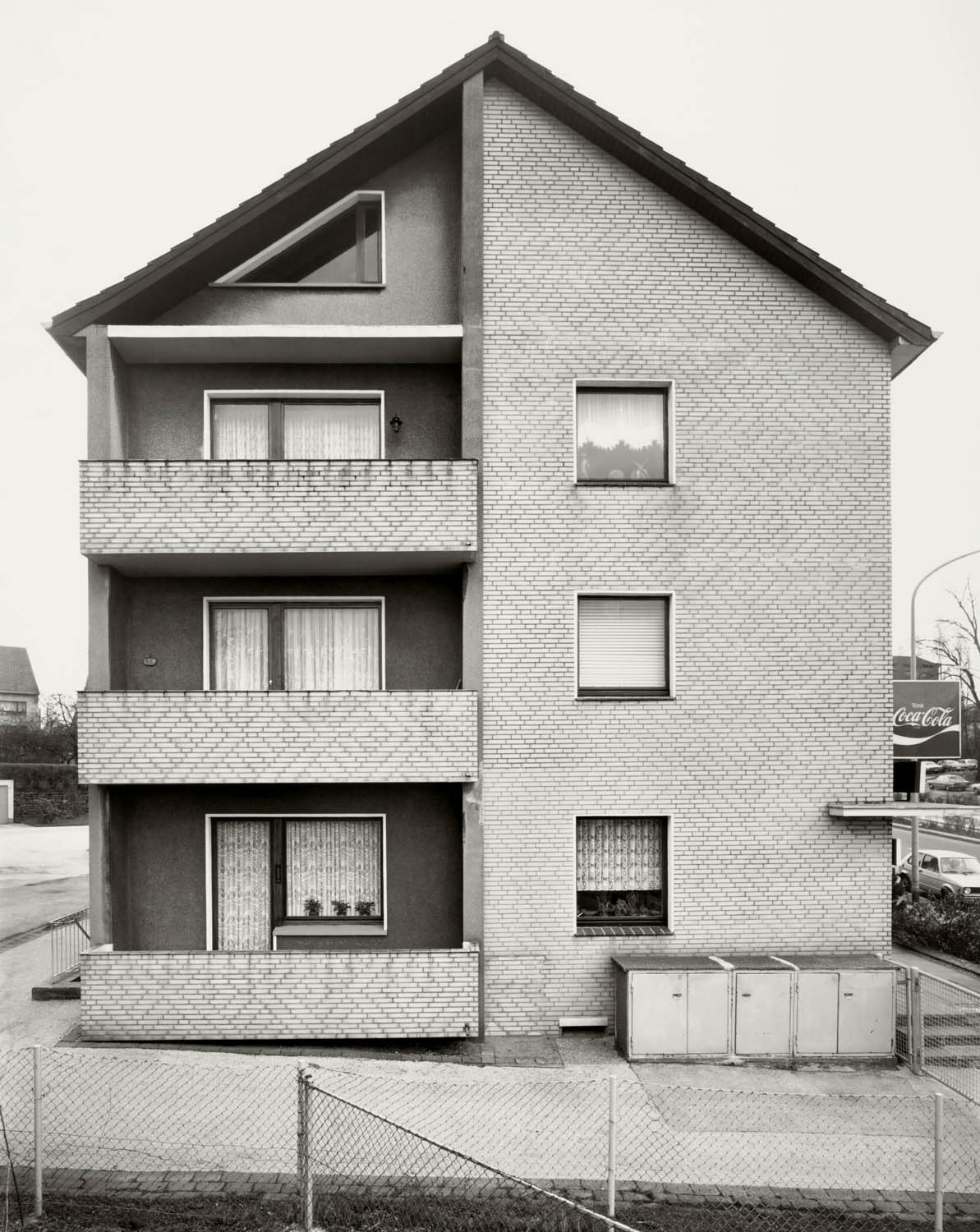
 

Bernd and Hilla Becher (German, 1931-2007/1934-2015) 'Essen-Schönebeck, D' 1981


Bernd and Hilla Becher (German, 1931-2007/1934-2015)
Essen-Schönebeck, D
1981
© Estate Bernd & Hilla Becher, vertreten durch Max Becher
Courtesy Die Photographische Sammlung/SK Stiftung Kultur – Bernd und Hilla Becher Archiv, Köln
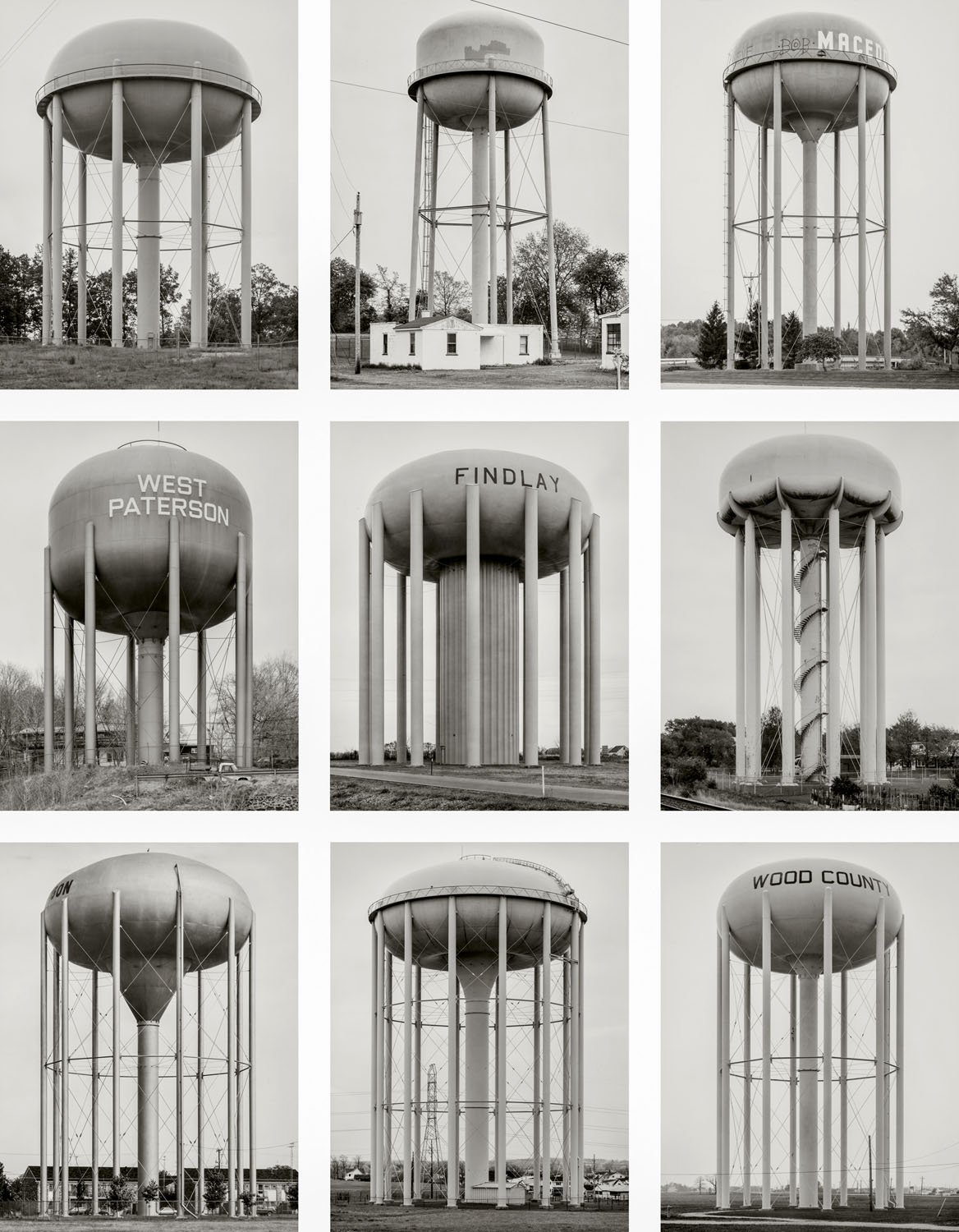
 

Bernd and Hilla Becher (German, 1931-2007/1934-2015) 'Wassertürme, USA' (Water towers, USA) 1974-1983


Bernd and Hilla Becher (German, 1931-2007/1934-2015)
Wassertürme, USA (Water towers, USA)
1974-1983
Gelatin silver prints
© Estate Bernd & Hilla Becher, vertreten durch Max Becher
Courtesy Die Photographische Sammlung/SK Stiftung Kultur – Bernd und Hilla Becher Archiv, Köln, 2025
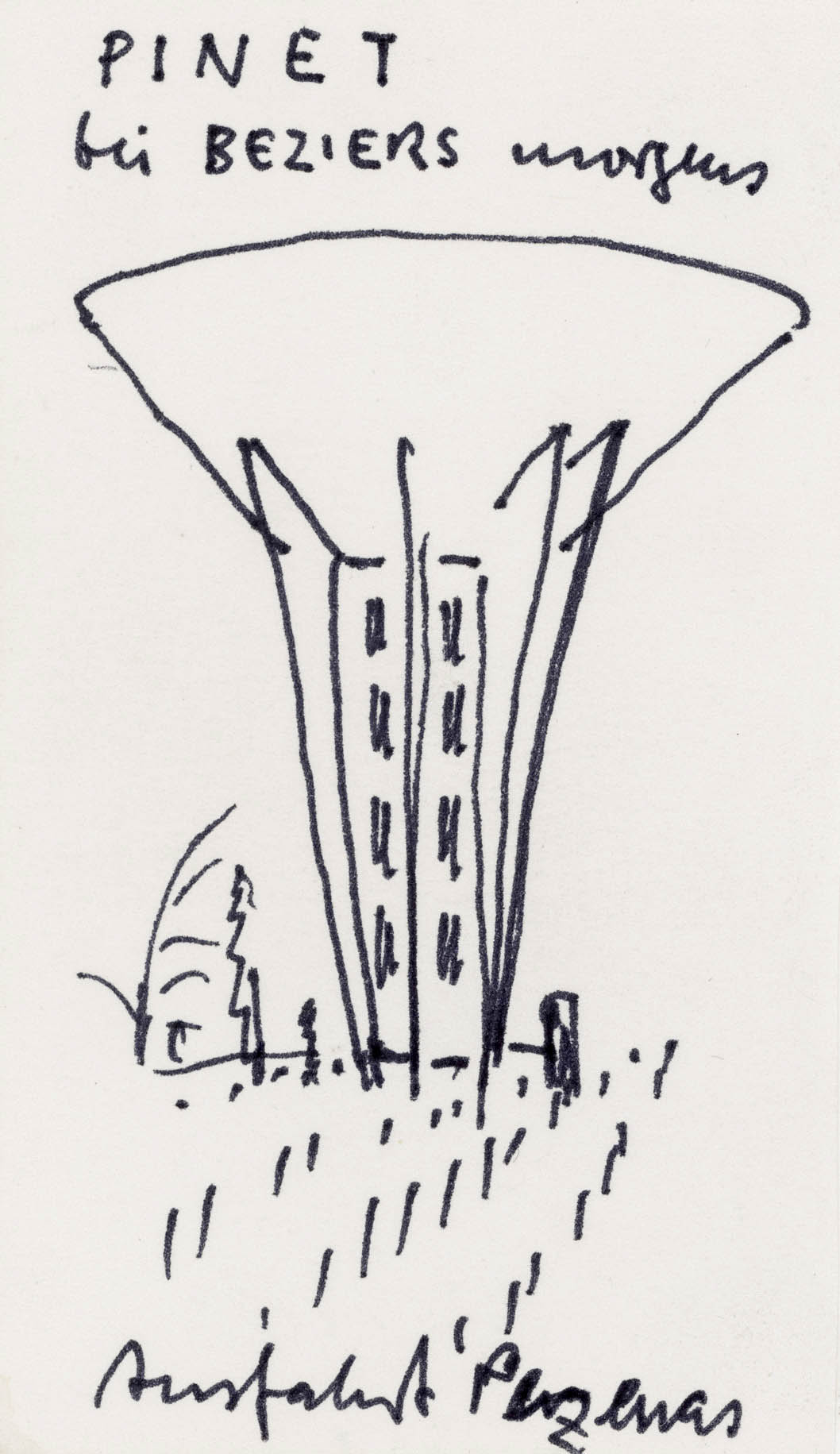
 

Bernd Becher (German, 1931-2007) 'Untitled (Water tower, Béziers, Hérault, F)' c. 1984


Bernd Becher (German, 1931-2007)
Untitled (Water tower, Béziers, Hérault, F)
c. 1984
Ink on paper
9 x 5.1cm
© Estate Bernd & Hilla Becher, vertreten durch Max Becher
Courtesy Die Photographische Sammlung/SK Stiftung Kultur – Bernd und Hilla Becher Archiv, Köln, 20255
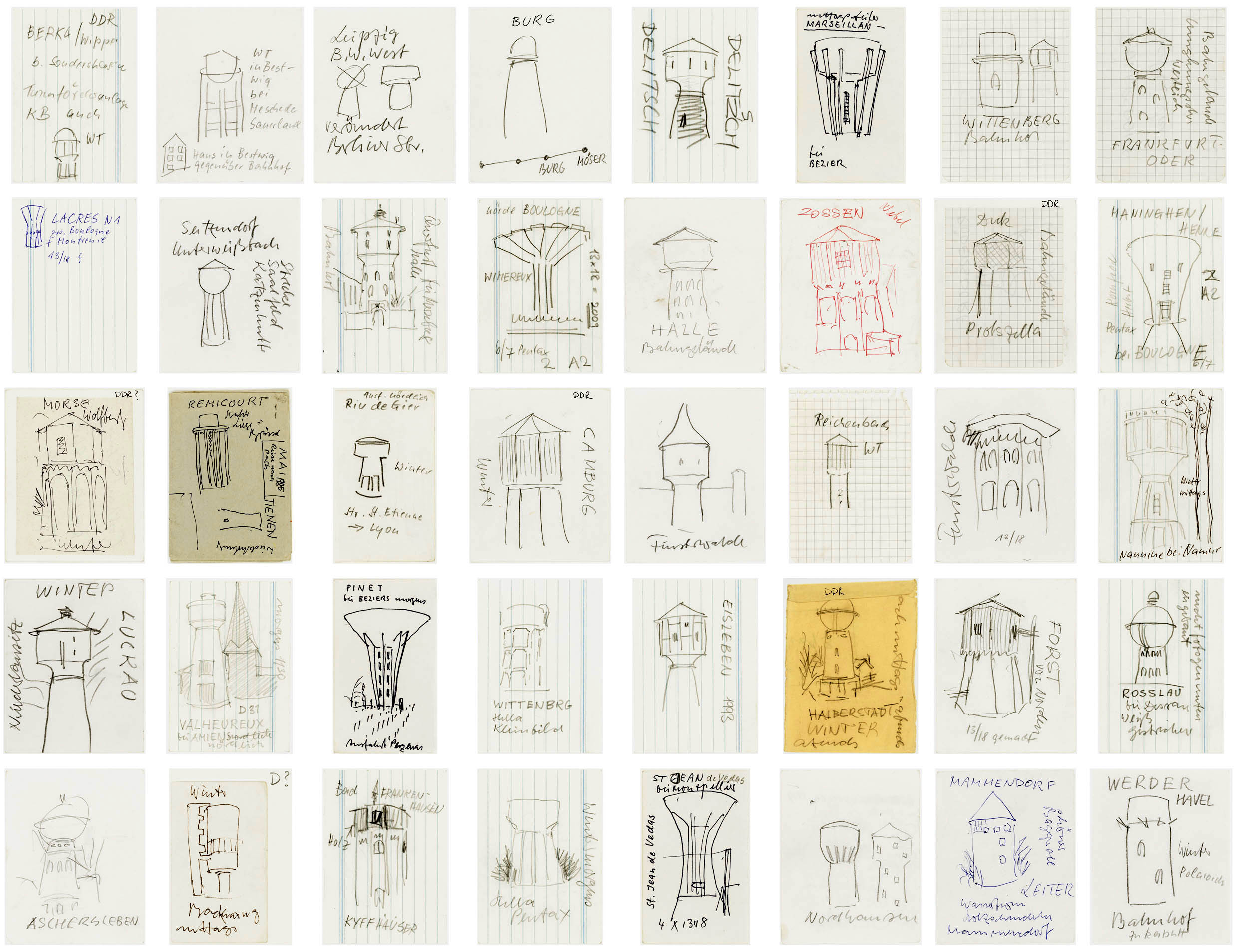
 

Bernd and Hilla Becher (German, 1931-2007/1934-2015) 'Wassertürme' (Water tower) 1960s-1980s


Bernd and Hilla Becher (German, 1931-2007/1934-2015)
Wassertürme (Water tower)
1960s-1980s
Drawings with felt-tip pen, pencil, ballpoint pen on cardboard, paper, index cards
Various sizes around 10.5 x 8.5cm
© Estate Bernd & Hilla Becher, vertreten durch Max Becher
Courtesy Die Photographische Sammlung/SK Stiftung Kultur – Bernd und Hilla Becher Archiv, Köln


Walker Evans (United States of America 1903 - 1975) 'Graveyard and steel mill, Bethlehem, Pennsylvania' 1935


Walker Evans (United States of America 1903-1975)
Graveyard and steel mill, Bethlehem, Pennsylvania
1935
Gelatin silver print
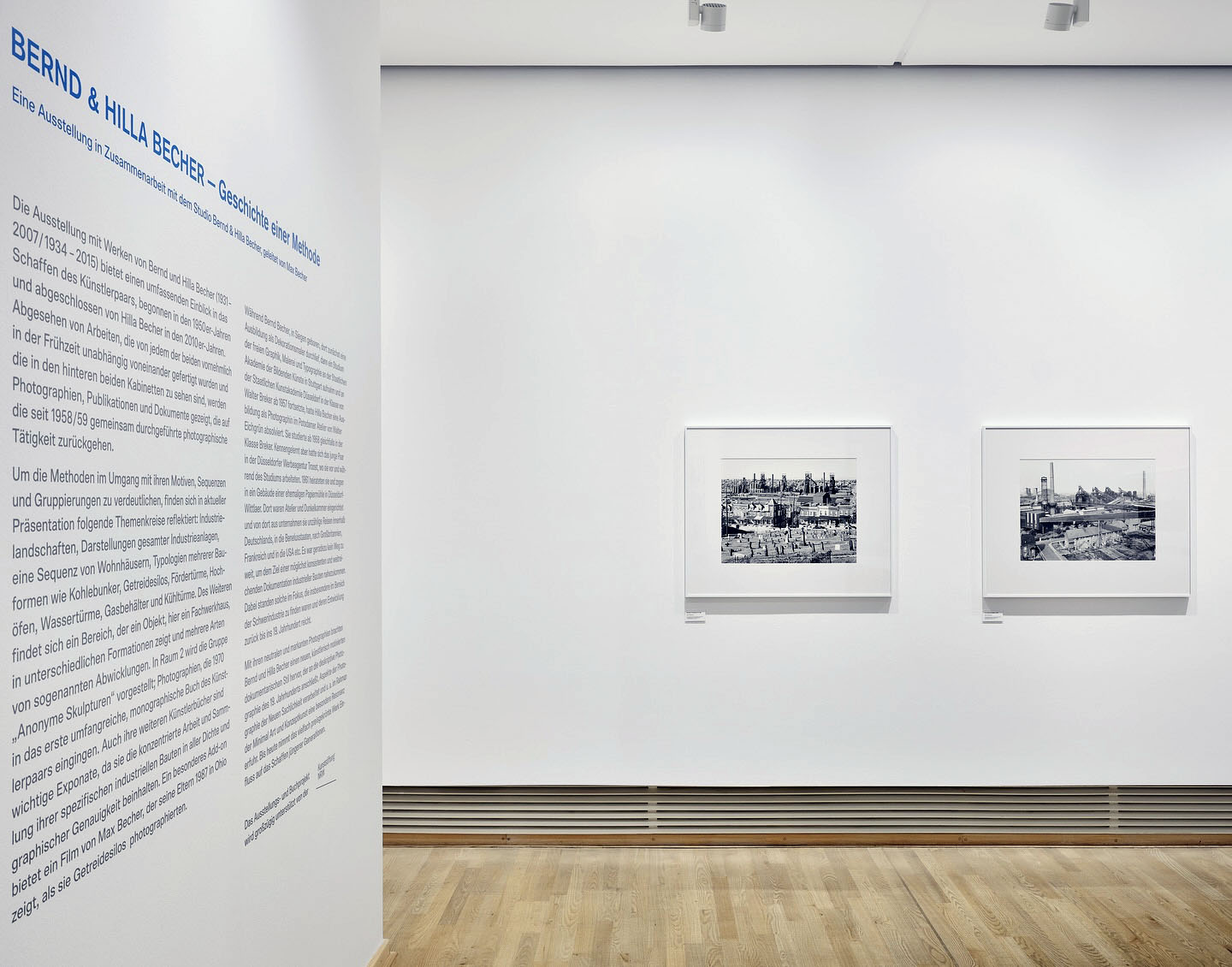
 

Installation view of the exhibition 'Bernd & Hilla Becher – History of a Method' at Die Photographische Sammlung/SK Stiftung Kultur, Cologne September, 2025 – February, 2026 showing at left Bernd and Hilla Becher's photograph 'Bethlehem, Pennsylvania, USA' 1986


Installation view of the exhibition Bernd & Hilla Becher – History of a Method at Die Photographische Sammlung/SK Stiftung Kultur, Cologne showing at left Bernd and Hilla Becher’s photograph Bethlehem, Pennsylvania, USA 1986 (below)
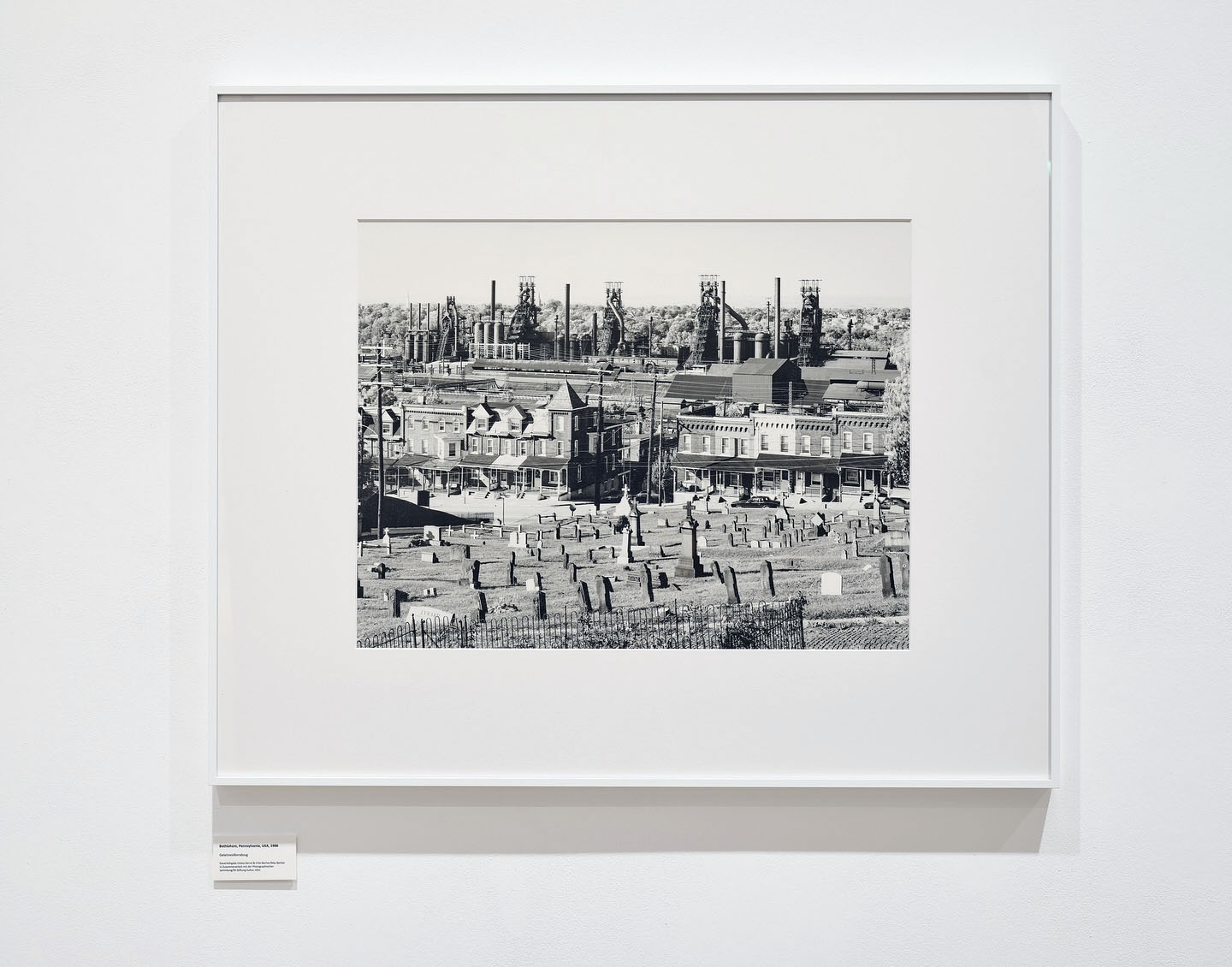
 

Installation view of the exhibition 'Bernd & Hilla Becher – History of a Method' at Die Photographische Sammlung/SK Stiftung Kultur, Cologne September, 2025 – February, 2026 showing Bernd and Hilla Becher's photograph 'Bethlehem, Pennsylvania, USA' 1986


Installation view of the exhibition Bernd & Hilla Becher – History of a Method at Die Photographische Sammlung/SK Stiftung Kultur, Cologne showing Bernd and Hilla Becher’s photograph Bethlehem, Pennsylvania, USA 1986 (below)
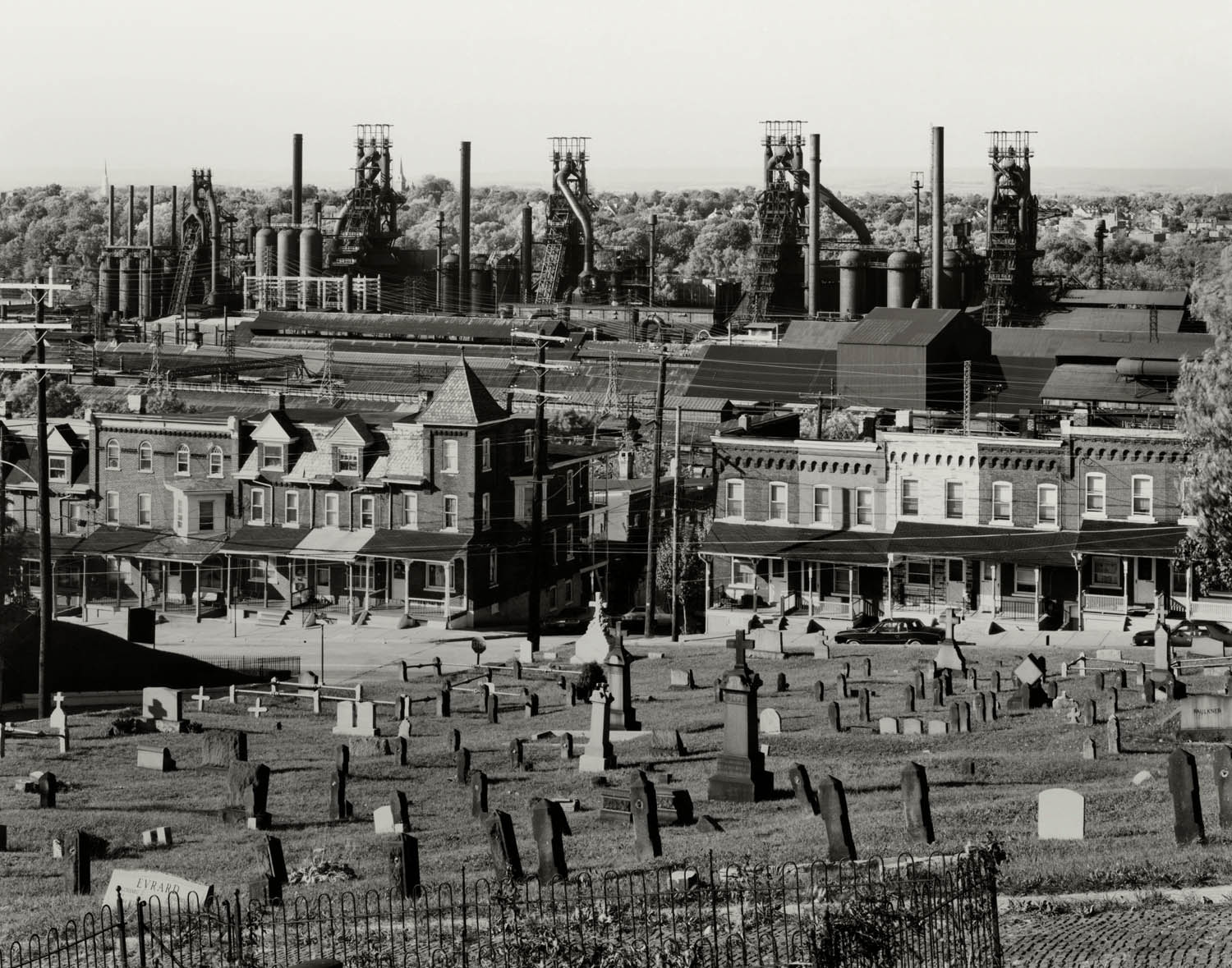
 

Bernd and Hilla Becher (German, 1931-2007/1934-2015) 'Bethlehem, Pennsylvania, USA' 1986


Bernd and Hilla Becher (German, 1931-2007/1934-2015)
Bethlehem, Pennsylvania, USA
1986
Gelatin silver print
46.7 x 60cm
© Estate Bernd & Hilla Becher, vertreten durch Max Becher
Courtesy Die Photographische Sammlung/SK Stiftung Kultur – Bernd und Hilla Becher Archiv, Köln


With their blast furnaces, chimneys, pipes, and conveyor belts, steelworks are less buildings than gigantic machines. They are among the most imposing industrial structures that Bernd and Hilla Becher have photographed since the late 1950s. Anatomically speaking, blast furnaces are like a body without skin, the artist couple wrote in 1990: excessively high temperatures, too much pressure, too many gases make cladding the steel shell impossible; they are nothing but function. In Bethlehem, Pennsylvania, the enormous work practically hangs over the town. Photographed from an elevated vantage point (similar to the one Walker Evans had chosen in 1935), the blast furnaces, houses, and the cemetery – work, life, death – are compressed into an inescapable proximity. Space compressed, time compressed.

Dr. Maria Müller-Schareck, art historian and member of the PS/SK management team

Text from the SK Stiftung Kultur Die Photographische Sammlung Instagram page
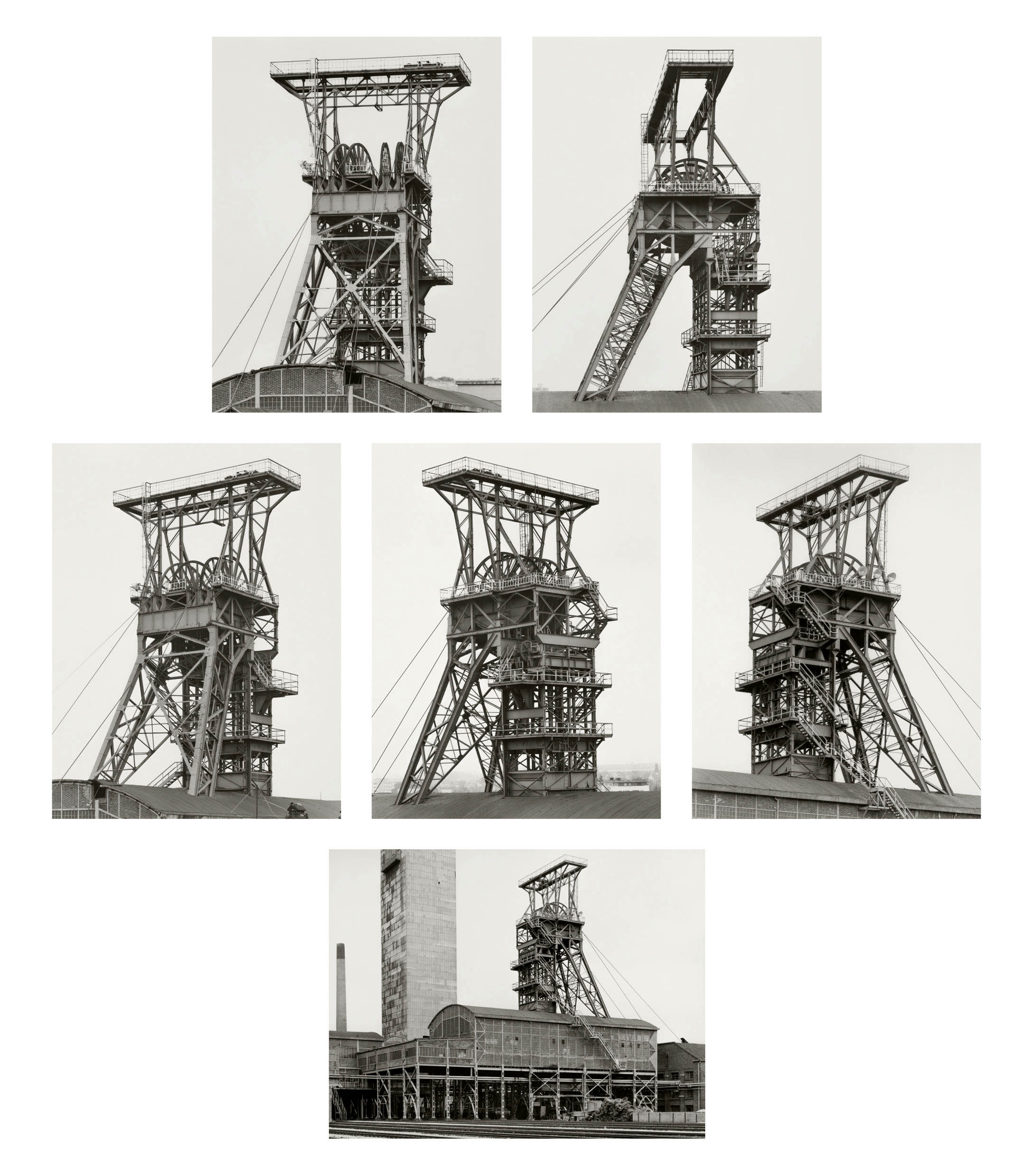
 

Bernd and Hilla Becher (German, 1931-2007/1934-2015) 'Förderturm, Schacht 2' (Winding tower, shaft 2) 1982


Bernd and Hilla Becher (German, 1931-2007/1934-2015)
Förderturm, Schacht 2 (Winding tower, shaft 2)
1982
6 gelatin silver prints,
Each approx. 40 x 31cm
© Estate Bernd & Hilla Becher, vertreten durch Max Becher
Courtesy Die Photographische Sammlung/SK Stiftung Kultur – Bernd und Hilla Becher Archiv, Köln
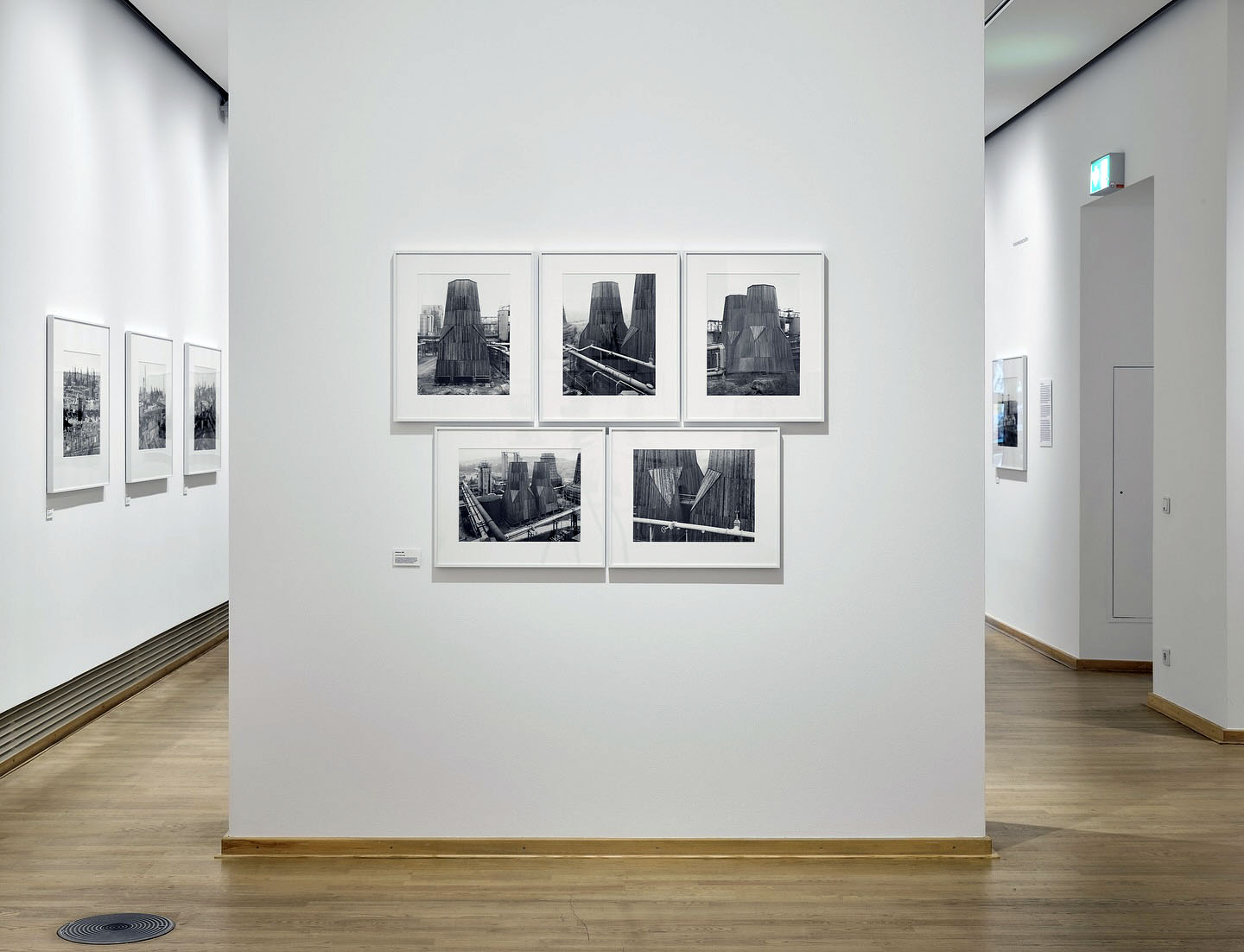
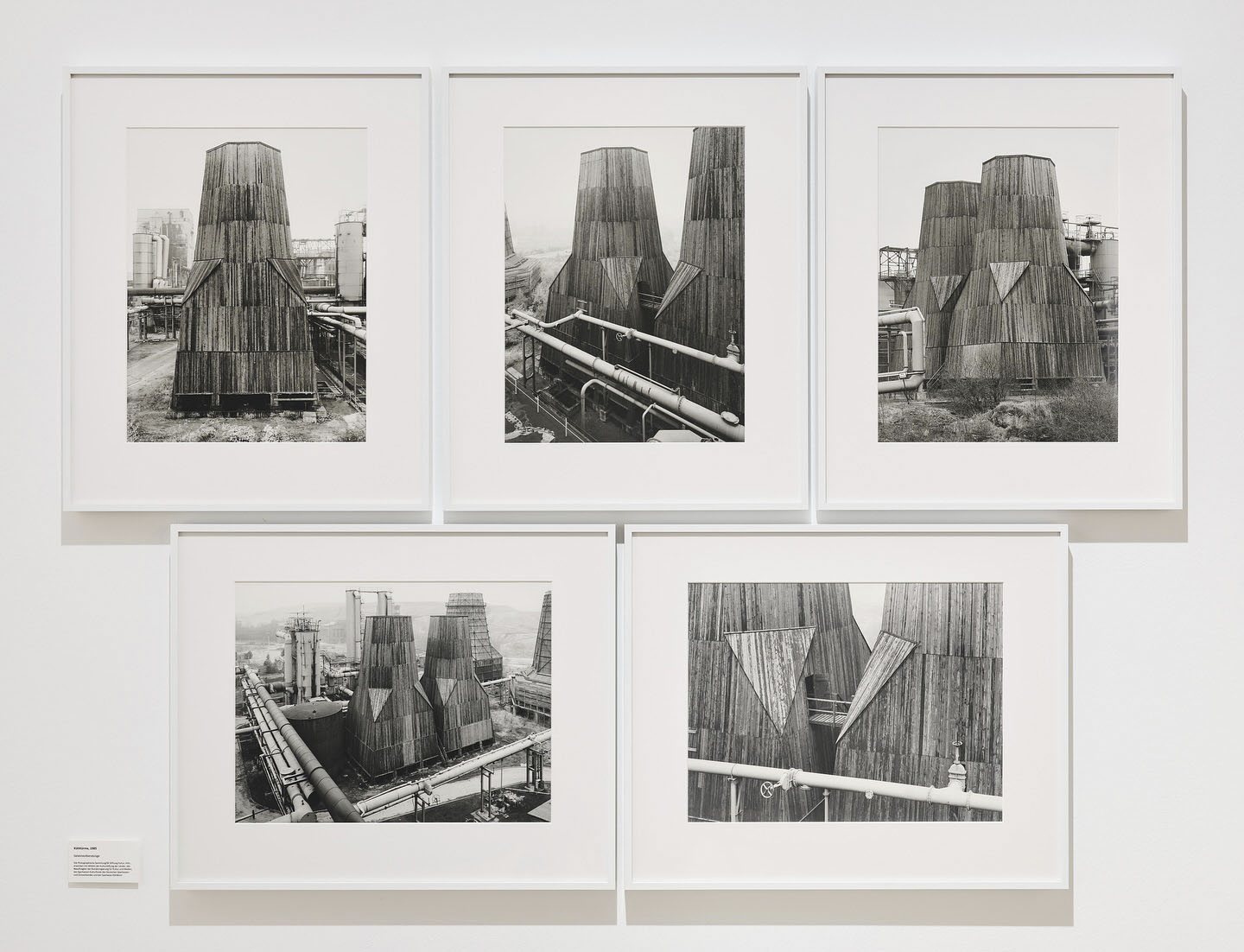
 

Installation view of the exhibition 'Bernd & Hilla Becher – History of a Method' at Die Photographische Sammlung/SK Stiftung Kultur, Cologne September, 2025 – February, 2026 showing Bernd and Hilla Becher's 'Zeche Ewald Fortsetzung, Kühlturm/-türme' (Ewald mine continuation, cooling tower(s)) 1985


Installation views of the exhibition Bernd & Hilla Becher – History of a Method at Die Photographische Sammlung/SK Stiftung Kultur, Cologne showing Bernd and Hilla Becher’s Zeche Ewald Fortsetzung, Kühlturm/-türme (Ewald mine continuation, cooling tower(s)) 1985 (below)


Bernd and Hilla Becher (German, 1931-2007/1934-2015) 'Zeche Ewald Fortsetzung, Kühlturm/-türme' (Ewald mine continuation, cooling tower(s)) 1985


Bernd and Hilla Becher (German, 1931-2007/1934-2015)
Zeche Ewald Fortsetzung, Kühlturm/-türme (Ewald mine continuation, cooling tower(s))
1985
5 gelatin silver prints
Each approx. 40.0 x 31.0cm
© Estate Bernd & Hilla Becher, vertreten durch Max Becher
Courtesy Die Photographische Sammlung/SK Stiftung Kultur – Bernd und Hilla Becher Archiv, Köln


Over the course of their artistic career, Bernd and Hilla Becher documented approximately 200 industrial sites, including the Ewald Fortsetzung coal mine in Recklinghausen, which we are featuring in our exhibition.

These documentations are based on systematic walks through the industrial sites and surrounding areas. A panoramic photograph, often central to each site, provides an overview of the grounds and allows the individual buildings to be located and understood in relation to one another.

The subsequent photographs portray the individual building types, in this case, two cooling towers. The five images in this group clearly demonstrate how Bernd and Hilla Becher approach their subject, photographing the building from different sides and perspectives, and highlighting a specific detail. The aim of this approach was to depict the industrial buildings in a way that is both technically clear and aesthetically pleasing.

Text from the SK Stiftung Kultur Die Photographische Sammlung Instagram page
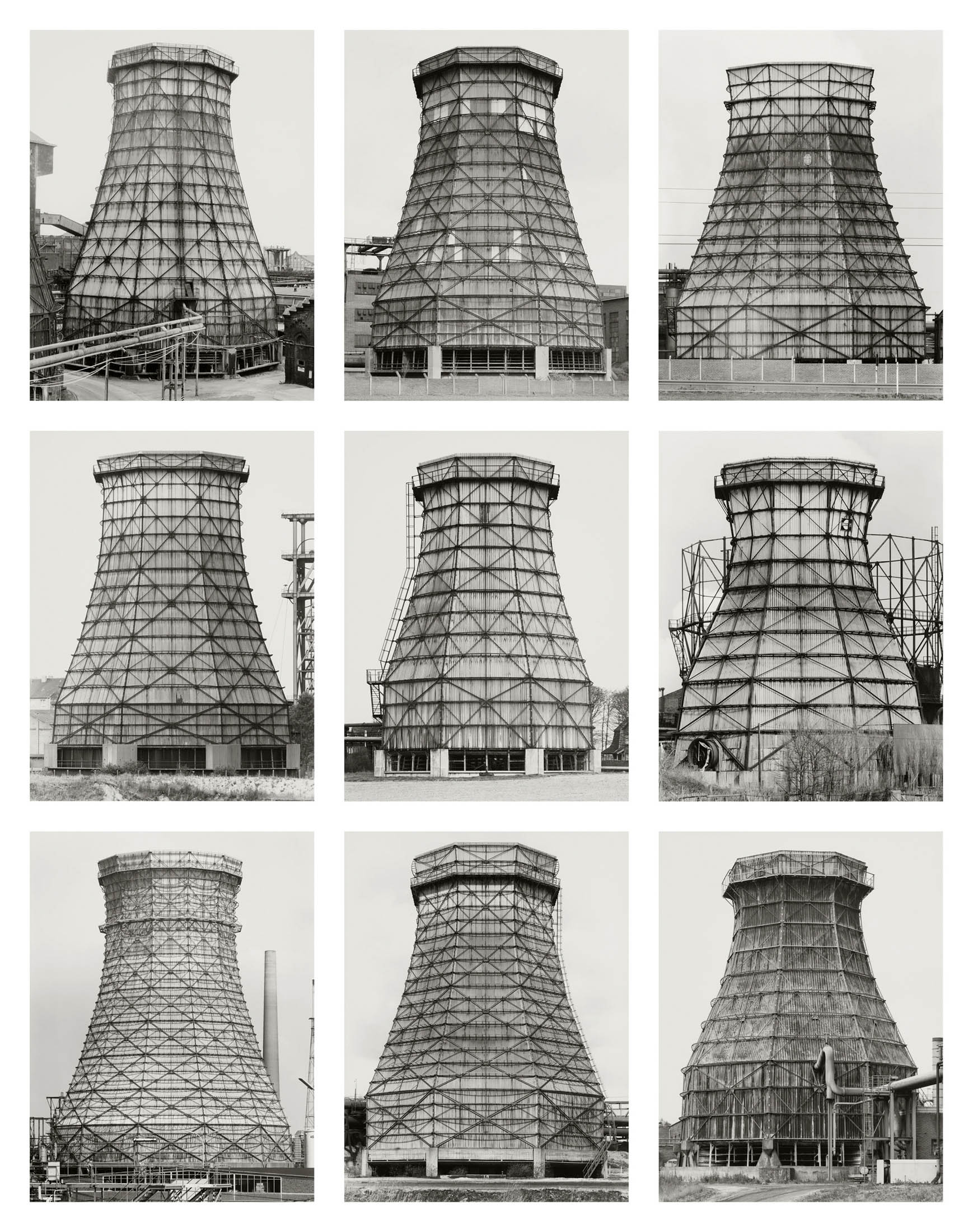
 

Bernd and Hilla Becher (German, 1931-2007/1934-2015) 'Kühltürme' (Cooling towers) 1964-1993


Bernd and Hilla Becher (German, 1931-2007/1934-2015)
Kühltürme (Cooling towers)
1964-1993
9 gelatin silver prints
Each approx. 41 x 31cm
© Estate Bernd & Hilla Becher, vertreten durch Max Becher
Courtesy Die Photographische Sammlung/SK Stiftung Kultur – Bernd und Hilla Becher Archiv, Köln
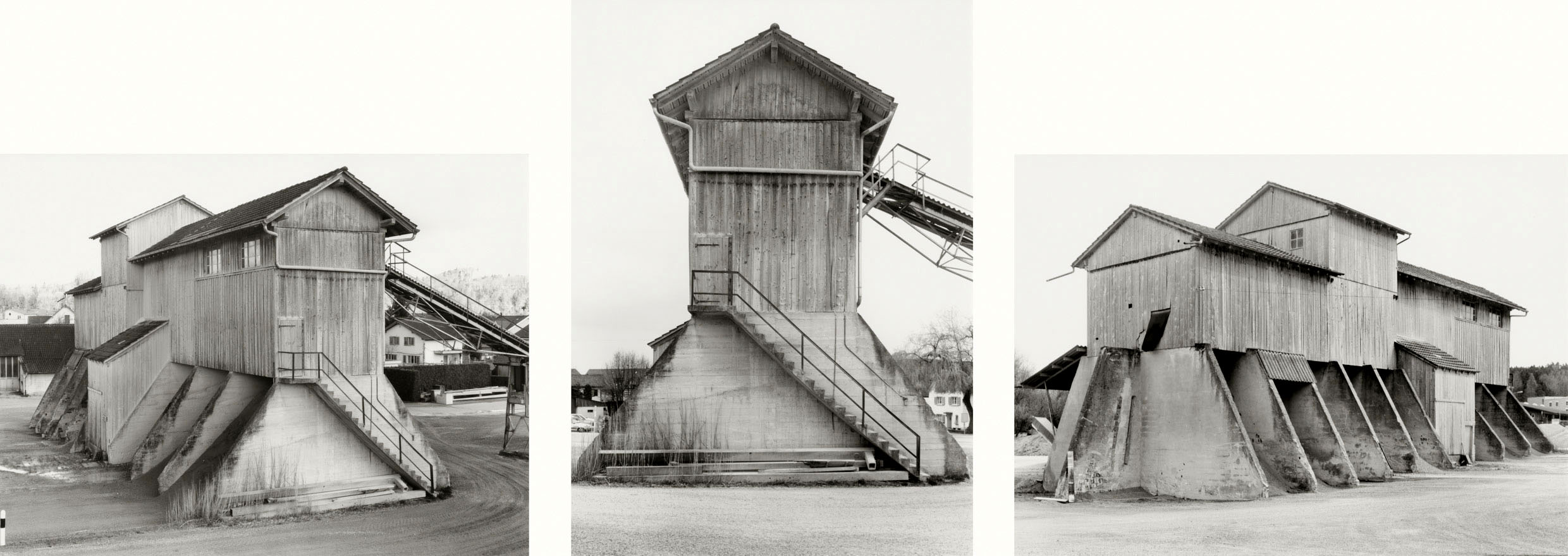
 

Bernd and Hilla Becher (German, 1931-2007/1934-2015) 'Kies- und Schotterwerk, Oberbüren/St. Gallen, CH' (Gravel and crushed stone works, Oberbüren/St. Gallen, CH) 2001


Bernd and Hilla Becher (German, 1931-2007/1934-2015)
Kies- und Schotterwerk, Oberbüren/St. Gallen, CH (Gravel and crushed stone works, Oberbüren/St. Gallen, CH)
2001
3 gelatin silver print
Each approx. 30 x 40cm
© Estate Bernd & Hilla Becher, vertreten durch Max Becher
Courtesy Sprüth Magers
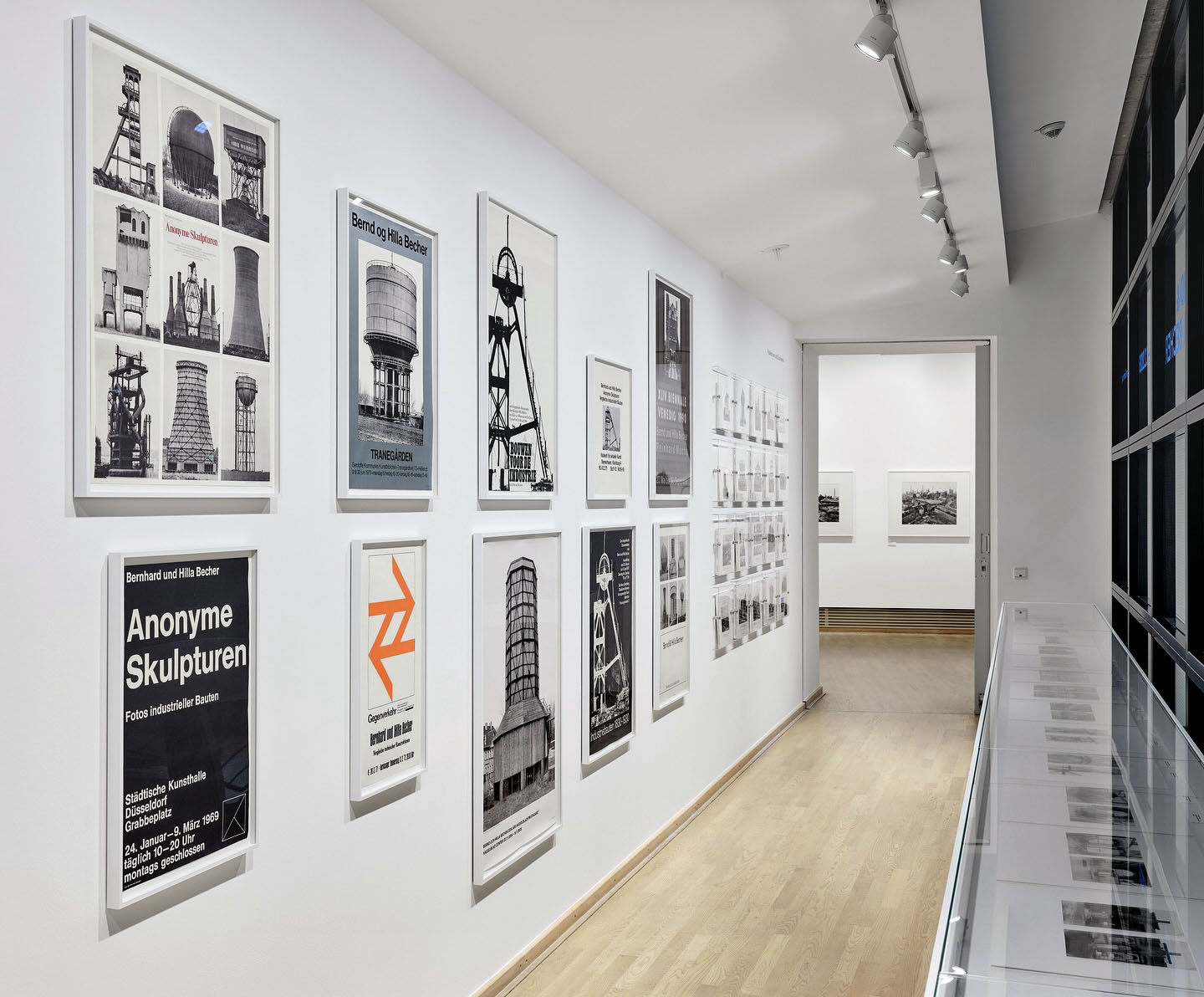
 

Installation view of the exhibition 'Bernd & Hilla Becher – History of a Method' at Die Photographische Sammlung/SK Stiftung Kultur, Cologne September, 2025 – February, 2026


Installation view of the exhibition Bernd & Hilla Becher – History of a Method at Die Photographische Sammlung/SK Stiftung Kultur, Cologne September, 2025 – February, 2026


'Bernd & Hilla Becher – History of a Method' book cover


Bernd & Hilla Becher – History of a Method book cover


Die Photographische Sammlung/SK Stiftung Kultur
Im Mediapark 7, 50670 Cologne
Phone: +49 221/888 95 300

Opening hours: Daily (except Wednesdays): 2pm – 7pm

Die Photographische Sammlung/SK Stiftung Kultur website

LIKE ART BLART ON FACEBOOK

Back to top

Review: ‘Wanderings About History. The Photography of Ulrich Wüst’ at the RMIT Gallery, Melbourne

Exhibition dates: 1st March – 20th April, 2024

Curator: Matthias Flügge


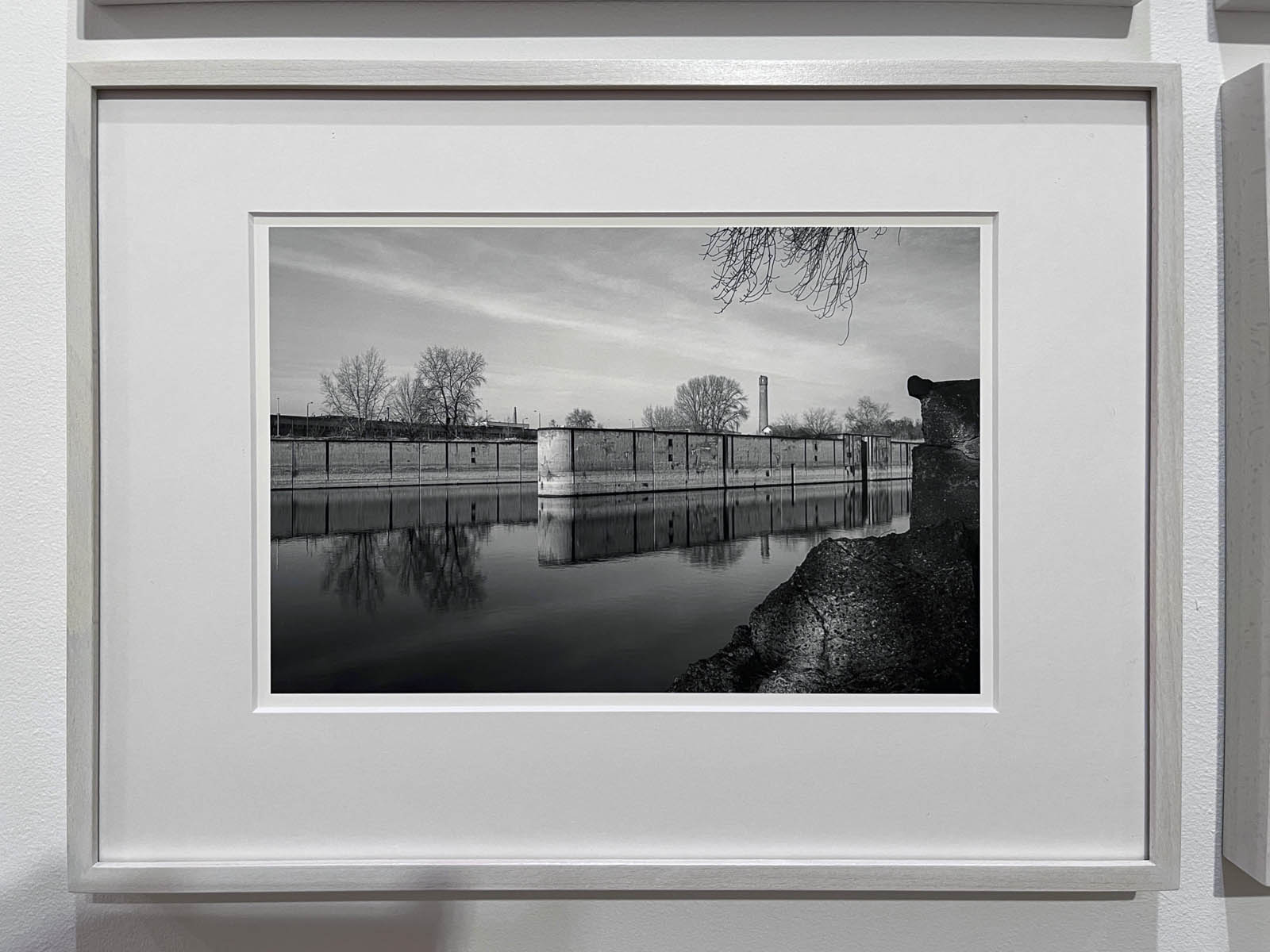
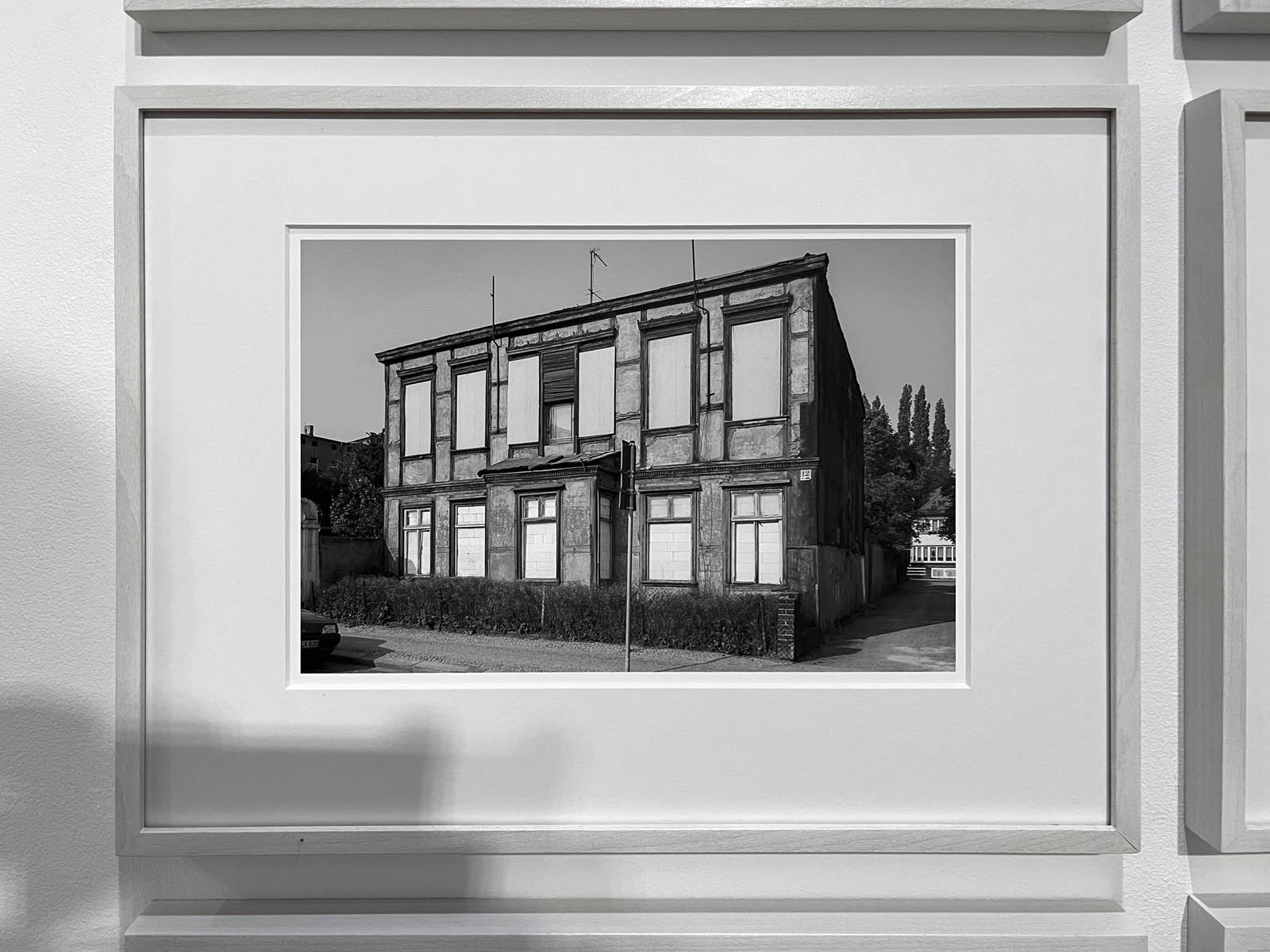
Ulrich Wüst (German, b. 1949) 'Dodendorfer Straße' 1998 From the series 'Morgenstraße. Magdeburg 1998-2000'


Ulrich Wüst (German, b. 1949)
Dodendorfer Straße
1998
Aus der Serie: Morgenstraße. Magdeburg 1998-2000
From the series: Morgenstraße. Magdeburg 1998-2000
B/w archival pigment print
18 x 27cm
© Ulrich Wüst; ifa


Wondering through history


Wonder noun. a feeling of amazement and admiration, caused by something beautiful, remarkable, or unfamiliar.


As enunciated by Jake Wilson in The Age newspaper in a review of the film La Chimera, “ultimately, the problem dramatised here is the same one faced by any modern artist: how do you retain a meaningful link to your predecessors while shaping something new?”1

Further, my mentor and friend Ian Lobb would often challenge me to define what I was adding to the artistic dialogue of photography instead of repeating the language of a previous era, and I would spar with him asking him was it really necessary to constantly reinvent the wheel, was it not enough to see and feel with clarity and humour those precious moments that surround us, and insightfully photograph them. These are the questions that enliven life: is it always necessary to shape something new, or is it enough to be attentive to the moment – of your mind, heart and vision – to create spellbinding photographs that carry your own interpretation of a certain reality.

Such is the case with the stimulating, two-room exhibition of the German photographer Ulrich Wüst at RMIT Gallery, Melbourne.

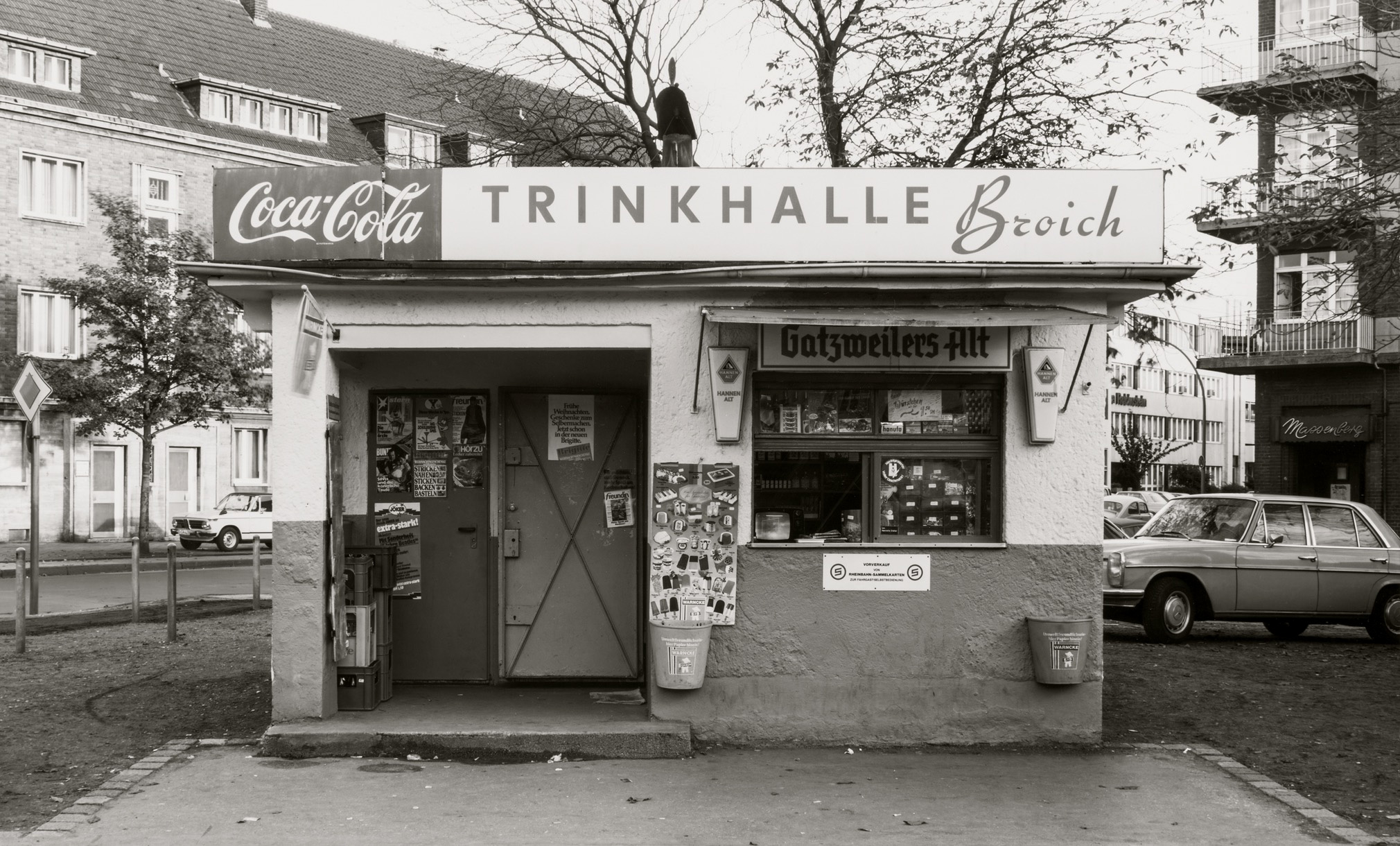
Wüst’s photography shows great affinity with the work of Bernd and Hiller Becher and the Becher and Dusseldorf Schools of photography which would have been known in East Germany by the time Wüst shot the 1980s series Stadtbilder. 1979-1985 (Cityscapes. 1979-1985) that first brought Wüst to international attention (the border was very permeable to artistic ideas from the West reaching East Germany).2 Indeed, most of Wüst’s oeuvre has direct links to the aesthetic of the Bechers (with their attention to detail and “devotion to the 1920s German tradition of Neue Sachlichkeit (New Objectivity”) and photographers such as Thomas Ruff (with their surreal enlargement of scale and “fundamentally sceptical attitude towards photography’s claim to truth and documentation”).

I believe that referencing and riffing off that aesthetic as Wüst does is no bad thing … for it forms the basis for the photographer’s further take on reality. But there are plenty of other forces at play in his photographs. I observe traces of August Sander, Berenice Abbott, Robert Frank, Michael Schmidt and Eugène Atget among others, especially with the latter in the positioning of Wüst’s camera.

As he observes, “When shooting I often find that if I move just fraction away from the more customary perspective a subtle heightening of tension with take place within the image. It’s no accident that I and my camera frequently get suspicious looks when the angle of the lens shifts away from the perspective found in souvenirs and postcards.” (Wall text from the exhibition)

And this is exactly what Atget did, he moved his camera from the “normal” point of view ever so slightly so that there immediately becomes this tension within the image plane coupled to the possibility of a magical revelation of space, an ironic comment on construction, or a grotesque play of opposites. As Wüst says, his vision, his observation, contains “plenty that is comic, grotesque, ironic” which many people do not see.


If we think about the supposedly objective work of the Bechers, which they insisted was all about documenting the object and not about any type of emotion, we fail to consider, as Julia Curl opines, “that this “objectivity” is only surface-level – that the work is deeply personal, even if its apparent uniformity claims otherwise.”3 Personally, I have never bought into the cool objectification of the Becher’s work for the photographers made defined choices as to how they depicted their constructed realities, each iteration of a water tower, gravel plant or cooling tower different from the other (fragments of a whole). This was deeply personal vision of how the world is perceived.

The same can be said of the photographs of Ulrich Wüst. His photographs are entirely personal, fragmentary excavations of history. In Wüst’s works by series, his photographs – surreal, sculptural scenes absent of people, full of elemental beauty – are not just the flawed humanity of our creation / the creation of our flawed humanity … but the creation and imagination of the human mind captured by the eye of the camera. Wüst’s photographs challenge us to look closer at the reality around us not accepting the status quo, the postcard view, not walking the city as if unaware of the vistas around us, feeling the “traces, injuries, missing and empty spaces in the image, so that things begin to speak of themselves…”4

As the art historian Matthias Flügge states, Wüst’s photographs are “images of intellectual-spatial situations,” wholly a creation, an accretion, on existing forms of photography. Not something new, which is ultimately unnecessary, but a growth in “wondering” – not wandering – achieved through the gradual accumulation of additional layers of beauty, feeling, knowledge so that we are informed and fully aware of our (un)familiar surroundings.

The photographs tell a powerful story of Germany before and after the fall of communism whilst instilling in the viewer a wondering, an accumulation and visual nourishment for the senses.

Such is the photography of Ulrich Wüst.

Dr Marcus Bunyan

PS. The only down side to this exhibition is that all the black and white photographs are modern archival ink jet prints. Call me old fashioned but these pigment prints have no real “presence”. It’s like the difference between an LP and a CD, or a movie in Technicolor or 5K. One has “atmosphere”, one has mood and aura and the other just sits there in all its perfection like a dog with a bone waiting for you to go “oooh, ahhh”. There are people that say you can’t tell the difference between the two. Rubbish. Give me gelatin silver prints any day of the week.


1/ Jake Wilson. “Lost and Found while digging up the cinematic past,” in The Age newspaper, 11 April 2024, p. 24.

2/”Huyssen reveals the complexity of artistic development on both sides of the Wall and notes that “the borders between East and West became porous during the 1970s as a result of treaties between the GDR and the FRG.” His focus in this regard, however, is on those artists who left the East for the West and made an impact there, such as Georg Baselitz and Gerhard Richter; he does not acknowledge the extent to which ideas and influences went in both directions. … While it is true that West German artists showed little interest in exhibiting in the East or in the art that was created there, East German artists tended to be well informed about Western artistic developments…” p. 598

April A. Eisman. “East German Art and the Permeability of the Berlin Wall,” in German Studies Review, Vol. 38, No. 3 (October 2015), pp. 597-616. Published by The Johns Hopkins University Press on behalf of the German Studies Association

3/ Julia Curl. “Bernd and Hilla Becher’s Misunderstood Oeuvre,” on the Hyperallergic website November 2, 2022 [Online] Cited 11/04/2024

4/ Jacek Slaski. “Ulrich Wüst – Stadtbilder 1979–1985: Zwischen Kunst und Dokumentation,” on the tipBerlin website 03/02/2022 [Online] Cited 08/04/2024. Translated from the German by Google Translate


Many thankx to the RMIT Gallery and the ifa for allowing me to publish the photographs in the posting. Please click on the photographs for a larger version of the image.

An exhibition by ifa – Institut für Auslandsbeziehungen e.V., Stuttgart – in partnership with the Goethe-Institut. This project is an official exhibition of PHOTO 2024 International Festival of Photography.


“Most viewers, unfortunately, are so dreadfully serious when they look at the pictures. I have to “hammer it home” incredibly hard before anyone will allow themselves to laugh. In my works there is simply – perhaps a bit hidden – plenty that is comic, grotesque, ironic.”


~ Ulrich Wüst, wall text from the exhibition


“I’m sure I do give those power symbols the aesthetic treatment, otherwise it’s unlikely that I would have any desire or energy to photograph them. But it would also be unfair to say that these objects do not hold their own innate aesthetic fascination. All I can do is try to describe how I am torn between spontaneous fascination and rational rejection, aiming to convey that experience and make it understandable. When shooting I often find that if I move just fraction away from the more customary perspective a subtle heightening of tension with take place within the image. It’s no accident that I and my camera frequently get suspicious looks when the angle of the lens shifts away from the perspective found in souvenirs and postcards. People are very attuned to that sort of shift.”


~ Ulrich Wüst, wall text from the exhibition


Installation view, Ulrich Wüst, 'Flatland. Schönhof', 2013 (centre), 'The Pomp of Power', 1983-1990 (left) and 'Red October', 2018 (right) from the exhibition 'Wanderings About History. The Photography of Ulrich Wüst', RMIT Gallery, Melbourne, 2024


Installation view, Ulrich Wüst, Flatland. Schönhof, 2013 (centre), The Pomp of Power, 1983-1990 (left) and Red October, 2018 (right) from the exhibition Wanderings About History. The Photography of Ulrich Wüst, RMIT Gallery, Melbourne, 2024
Photo: Christian Capurro


Ulrich Wüst’s photographic work captures his wanderings through German history, portraying the social and urban transformations from the GDR and its disintegration, through the German reunification to the present day. Wüst revives the German history in a new static way, where the past and present clash in a dynamic and ever-changing environment.

Wanderings About History. The Photography of Ulrich Wüst shows a selection of nine suites taken between 1978 and 2019. Ulrich Wüst’s photographic work can be contemplated from different perspectives. While the observations captured here are rooted in Germany’s division and its mending, at the same time they always relate to universal phenomena of social change and its material manifestations. The seemingly terse images, extremely precise in their composition, are the fruits of lengthy visual wanderings through present sites of recent history.

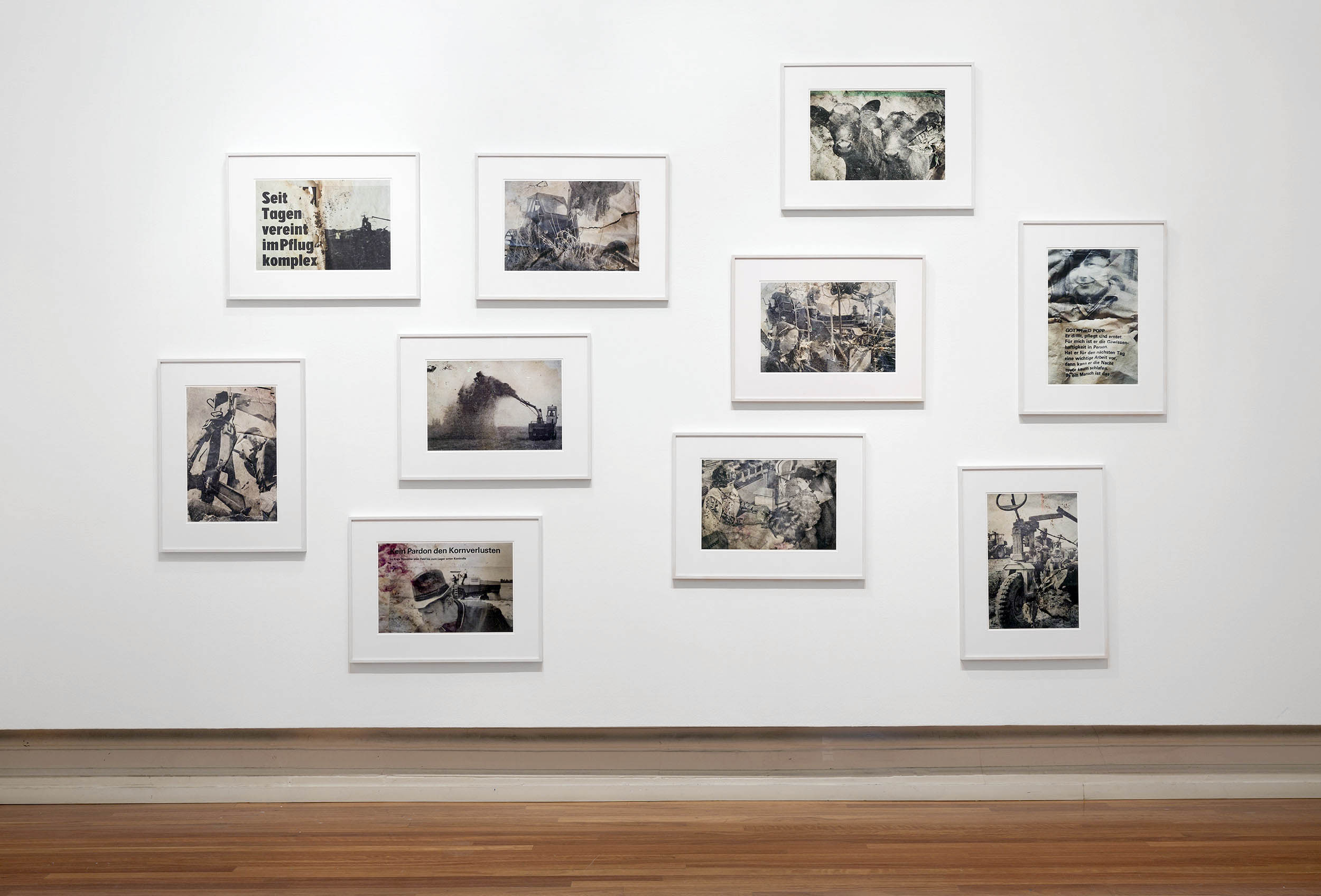
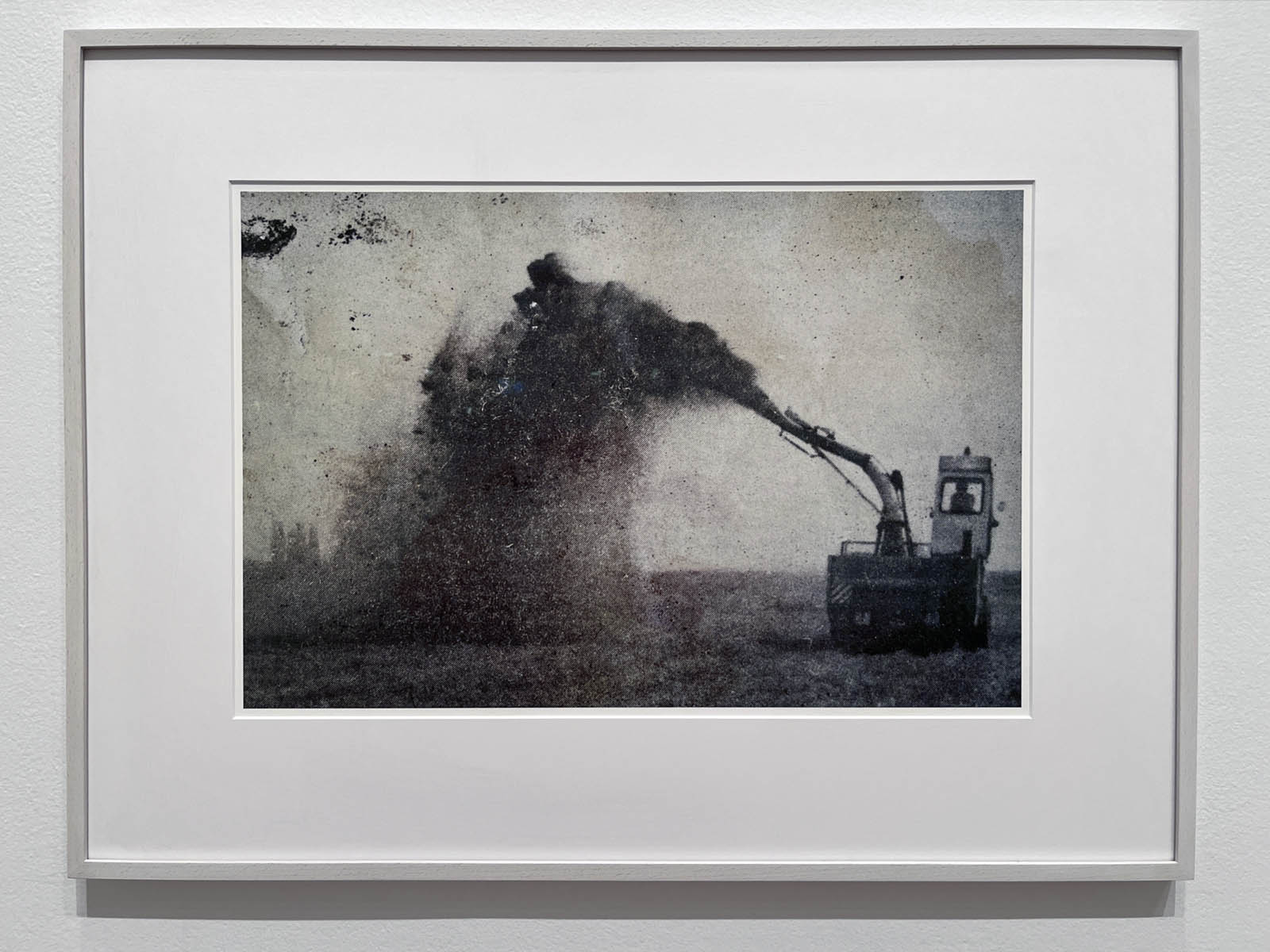
Ulrich Wüst’s photographic œuvre, which explores Eastern Germany in the broader sense, is not confined to the sunken GDR. It might be described as a pictorial archaeology of our present day. These pictures reveal the finds from his “excavations” and are at the same time tools of their conservation. Wüst has an infallible feel for the graphic quality of everyday situations, objects and materials, but also for the deeper layers of significance associated with found images. Examples are the enlarged details from East German press products that demonstrate a manipulative use of photography.

Ulrich Wüst’s photographic work can be contemplated from different perspectives. While the observations captured here are essentially rooted in Germany’s division and its mending, at the same time they always relate to universal phenomena of social change and its material manifestations. The seemingly terse images, extremely precise in their composition, are the fruits of lengthy visual wanderings through present sites of recent history.


Installation view, Ulrich Wüst, 'Flatland. Schönhof', 2013, from the exhibition 'Wanderings About History. The Photography of Ulrich Wüst', RMIT Gallery, Melbourne, 2024


Installation view, Ulrich Wüst, Flatland. Schönhof, 2013, from the exhibition Wanderings About History. The Photography of Ulrich Wüst, RMIT Gallery, Melbourne, 2024
Photo: Christian Capurro


Ulrich Wüst (German, b. 1949) From the series 'Flatland. Schönhof' 2013


Ulrich Wüst (German, b. 1949)
Aus der Serie: Flatland. Schönhof
From the series: Flatland. Schönhof
2013
Colour photograph, archival pigment print
57 × 38cm
© Ulrich Wüst; ifa


Ulrich Wüst (German, b. 1949) From the series 'Flatland. Schönhof' 2013 (installation view)

Ulrich Wüst (German, b. 1949) From the series 'Flatland. Schönhof' 2013 (installation view)


Ulrich Wüst (German, b. 1949)
Aus der Serie: Flatland. Schönhof
From the series: Flatland. Schönhof (installation views)
2013
Colour photograph, archival pigment print
57 × 38cm
© Ulrich Wüst; ifa
Photos: Marcus Bunyan


“These photographs of newspapers and magazines were taken in the countryside, things that I found within a very small radius. Previously I had always done that urban stuff but then I would go looking for contrasts, because after a while your eye becomes tired.”


~ Ulrich Wüst, wall text from the exhibition


Installation view, Ulrich Wüst, 'Cityscapes, 1979-1985' (left) and 'Wiegmann Legacy. Bülowssiege, 1991-1992' (right) from the exhibition 'Wanderings About History. The Photography of Ulrich Wüst', RMIT Gallery, Melbourne, 2024


Installation view, Ulrich Wüst, Cityscapes 1979-1985 (left) and Wiegmann Legacy. Bülowssiege 1991-1992 (right) from the exhibition Wanderings About History. The Photography of Ulrich Wüst, RMIT Gallery, Melbourne, 2024
Photo: Christian Capurro


Ulrich Wüst’s photos are “images of mental-spatial situations”

In every city there are places that have been photographed thousands of times. From tourists, amateurs and professionals. Always captured on paper or the digital matrix. Big Ben, Eiffel Tower, Alexanderplatz in the heart of Berlin. Thousands, even millions of looks at the striking symbols of a metropolis that want to capture the essence of the city. Ulrich Wüst was far away from such direct concepts. His view of Alexanderplatz is almost shy, more of a cautious approach, and yet he gets a grip on the place. But it’s not primarily about Berlin. Wüst’s city images are less studies of specific cities than “images of intellectual-spatial situations,” as the art historian and rector of the Dresden University of Fine Arts Matthias Flügge states in his insightful text for the photo book Ulrich Wüst – Stadtbilder 1979-1985 (Ulrich Wüst – City Images 1979-1985).

If you read Flügge’s text, it becomes clear once again that a picture is not just a picture and that it requires more than a fleeting observation, especially with a subject like the cityscape. Because you could easily come to the conclusion that you immediately understand the motif at hand, after all, you yourself are a city dweller and are aware of your habitat. But a photograph is also a starting point for deeper reflections. Wüst’s photographs of prefabricated buildings in East Berlin, vacancies in Magdeburg, and the central square in Karl-Marx-Stadt are not unseen motifs. Rather, they are all too well known. Such urban constellations should not be foreign to anyone who lived in the GDR in the 1970s and 1980s, or even those born later or socialised in the West. …

“Determining the status quo of the constructed, shaped, printed or otherwise produced objective world with all its traces, injuries, missing and empty spaces in the image, so that things begin to speak of themselves,” is what Wüst does, writes Flügge.

Jacek Slaski. “Ulrich Wüst – Stadtbilder 1979–1985: Zwischen Kunst und Dokumentation,” on the tipBerlin website 03/02/2022 [Online] Cited 08/04/2024. Translated from the German by Google Translate


Ulrich Wüst (German, b. 1949) 'Berlin' 1982 From the series 'Cityscapes. 1979-1985'


Ulrich Wüst (German, b. 1949)
Berlin
1982
Aus der Serie: Stadtbilder. 1979-1985
From the series: Cityscapes. 1979-1985
B/w archival pigment print
16 x 24cm
© Ulrich Wüst; ifa


“For me it had always been about the built environment. […] And then I started on those rather dry Cityscapes, which always seems so objective, even though they never were and never tried to be. I wanted to take a concentrated, analytical look at the city. Back then I had a strong sense of mission; I really did want to achieve something. And the things I wanted to say about the city as space I also wanted to tell people who weren’t at all interested in photography or urban space. In some respects it was definitely intended to enlighten. Ultimately I wanted to provoke a debate about what we imagine a “city” to be and what this environment does to us.”


~ Ulrich Wüst, wall text from the exhibition


Axel Hütte (b. 1951) 'James Hammett House' 1982-1984


Axel Hütte (German, b. 1951)
James Hammett House
1982-1984
Silver gelatin print on baryte paper
66 x 80cm
Loan of the artist


Ulrich Wüst (German, b. 1949) From the series 'Cityscapes. 1979-1985' (installation view)

Ulrich Wüst (German, b. 1949) From the series 'Cityscapes. 1979-1985' (installation view)

Ulrich Wüst (German, b. 1949) From the series 'Cityscapes. 1979-1985' (installation view)


Ulrich Wüst (German, b. 1949)
Aus der Serie: Stadtbilder. 1979-1985
From the series: Cityscapes. 1979-1985 (installation views)
B/w archival pigment print
16 x 24cm
© Ulrich Wüst; ifa
Photos: Marcus Bunyan


The work of Ulrich Wüst might best be described as a pictorial archaeology of recent German history. With an unsentimental precision these photographic ‘excavations’ pivot around moments of social change; those points in history when the old and the new collide, when the seemingly endless cycle of destruction and construction can so easily relegate the present to the oblivion of the past.

Initially photographing life in the former East Germany, Wüst’s oeuvre grew to include the documentation of everyday situations, objects and materials; expanding further with the addition of found images, cropped and rephotographed by Wüst to reveal alternative readings.

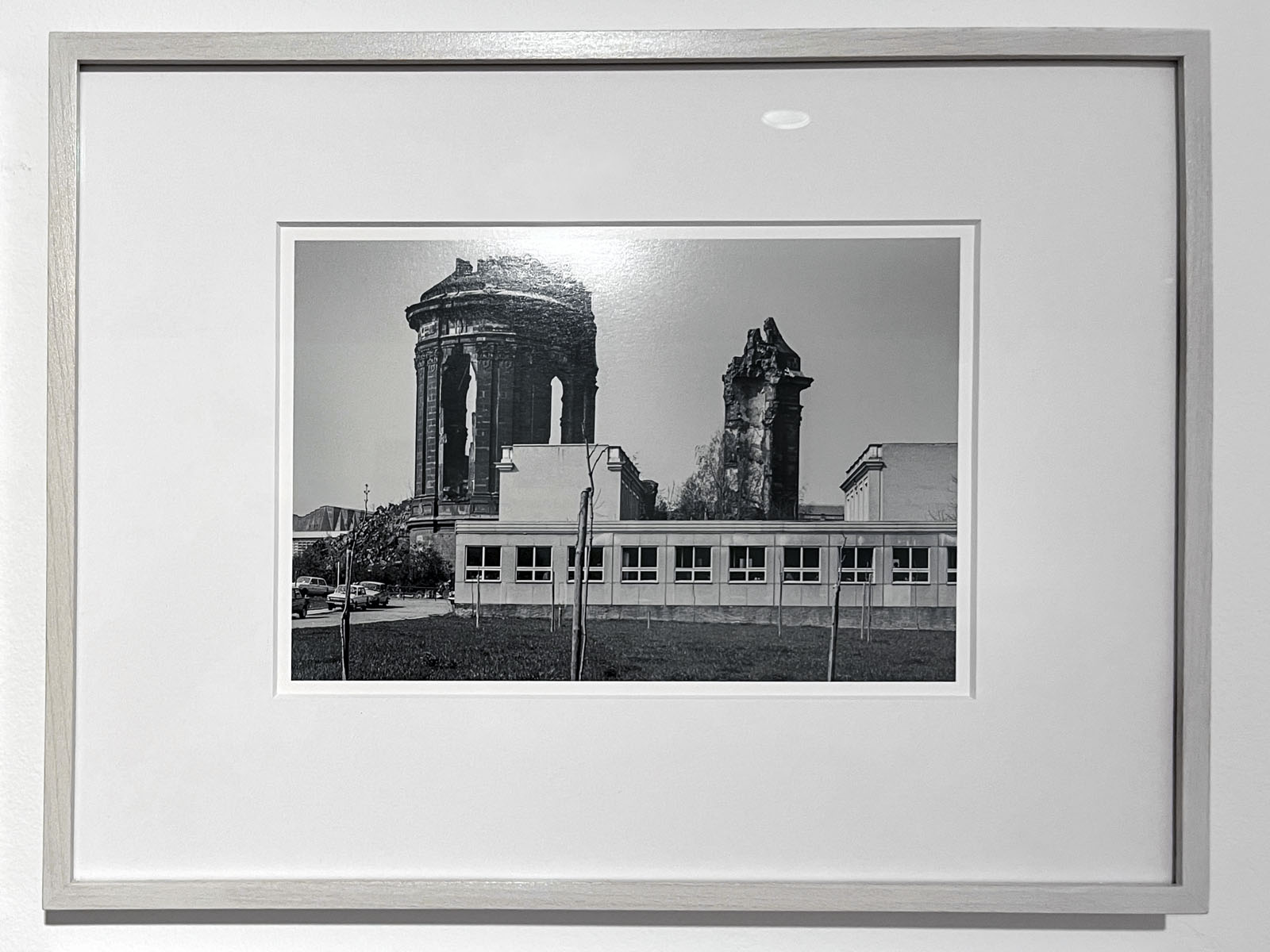
In his sparse black and white Cityscapes, the 1980s series that first brought Wust to international attention, we find images of East German cities and towns still carrying scars from the Second World War – an environment formed through the combination of unchecked decay and Soviet-era reconstruction. With an interest in the absurd – those visual anomalies that arrive through accident or misguided intent – Wüst has forged a unique, non-ideological representation of that time. In a similar manner but on a different scale, Wüst’s Wiegmann Legacy. Bülowssiege (1991-1992) – a photo inventory of objects left behind by the former owner of his house – engages us with the incidental nature of history. Intimate and fragile, these ordinary objects are made monumental through Wüst’s lens, yet these discarded possessions have the same precariousness as the hastily built architecture of cities in perpetual change.

Ulrich Wüst’s photographic work exists as a registry of everyday images. It could be considered akin to the personal archive of a once divided country mending itself, wandering through time, settling upon moments and fragments that also speak to the wider, universal phenomena of social change and its material manifestations.

Wall text from the exhibition


Installation view, Ulrich Wüst, 'Cityscapes, 1979-1985' (right), 'Morgenstraße. Magdeburg, 1998-2000' (second right), 'Wiegmann Legacy. Bülowssiege, 1991-1992' (third right) and 'Red October', 2018 (left) from the exhibition 'Wanderings About History. The Photography of Ulrich Wüst', RMIT Gallery, Melbourne, 2024


Installation view, Ulrich Wüst, Cityscapes, 1979-1985 (right), Morgenstraße. Magdeburg, 1998-2000 (second right), Wiegmann Legacy. Bülowssiege, 1991-1992 (third right) and Red October, 2018 (left) from the exhibition Wanderings About History. The Photography of Ulrich Wüst, RMIT Gallery, Melbourne, 2024
Photo: Christian Capurro


Installation view, Ulrich Wüst, 'Morgenstraße. Magdeburg, 1998-2000' (right), 'Wiegmann Legacy. Bülowssiege, 1991-1992' (centre left) from the exhibition 'Wanderings About History. The Photography of Ulrich Wüst', RMIT Gallery, Melbourne, 2024


Installation view, Ulrich Wüst, Morgenstraße. Magdeburg, 1998-2000 (right), Wiegmann Legacy. Bülowssiege, 1991-1992 (centre left) from the exhibition Wanderings About History. The Photography of Ulrich Wüst, RMIT Gallery, Melbourne, 2024
Photo: Christian Capurro


Ulrich Wüst (German, b. 1949) From the series 'Morgenstraße. Magdeburg' 1998-2000 (installation view)

Ulrich Wüst (German, b. 1949) From the series 'Morgenstraße. Magdeburg' 1998-2000 (installation view)


Ulrich Wüst (German, b. 1949)
Aus der Serie: Morgenstraße. Magdeburg 1998-2000
From the series: Morgenstraße. Magdeburg 1998-2000 (installation views)
B/w archival pigment print
18 x 27cm
© Ulrich Wüst; ifa
Photos: Marcus Bunyan


“As soon as we see people in pictures, we focus on those people. We seem to be fixated on that somehow and we stare at the figures depicted, however small they may be. But as I wanted to steer attention to the built environment, to what we have built for ourselves, I quite simply decided to leave the people out. If there a no people in sight in the pictures, then for one thing nobody can look at them and for another the effect is disconcerting. Disconcertion is a good opening gambit.”


~ Ulrich Wüst, wall text from the exhibition


Berenice Abbott (American, 1898-1991) 'Fifth Avenue, Nos. 4, 6, 8, Manhattan' March 20, 1936


Berenice Abbott (American, 1898-1991)
Fifth Avenue, Nos. 4, 6, 8, Manhattan
March 20, 1936
Gelatin silver print


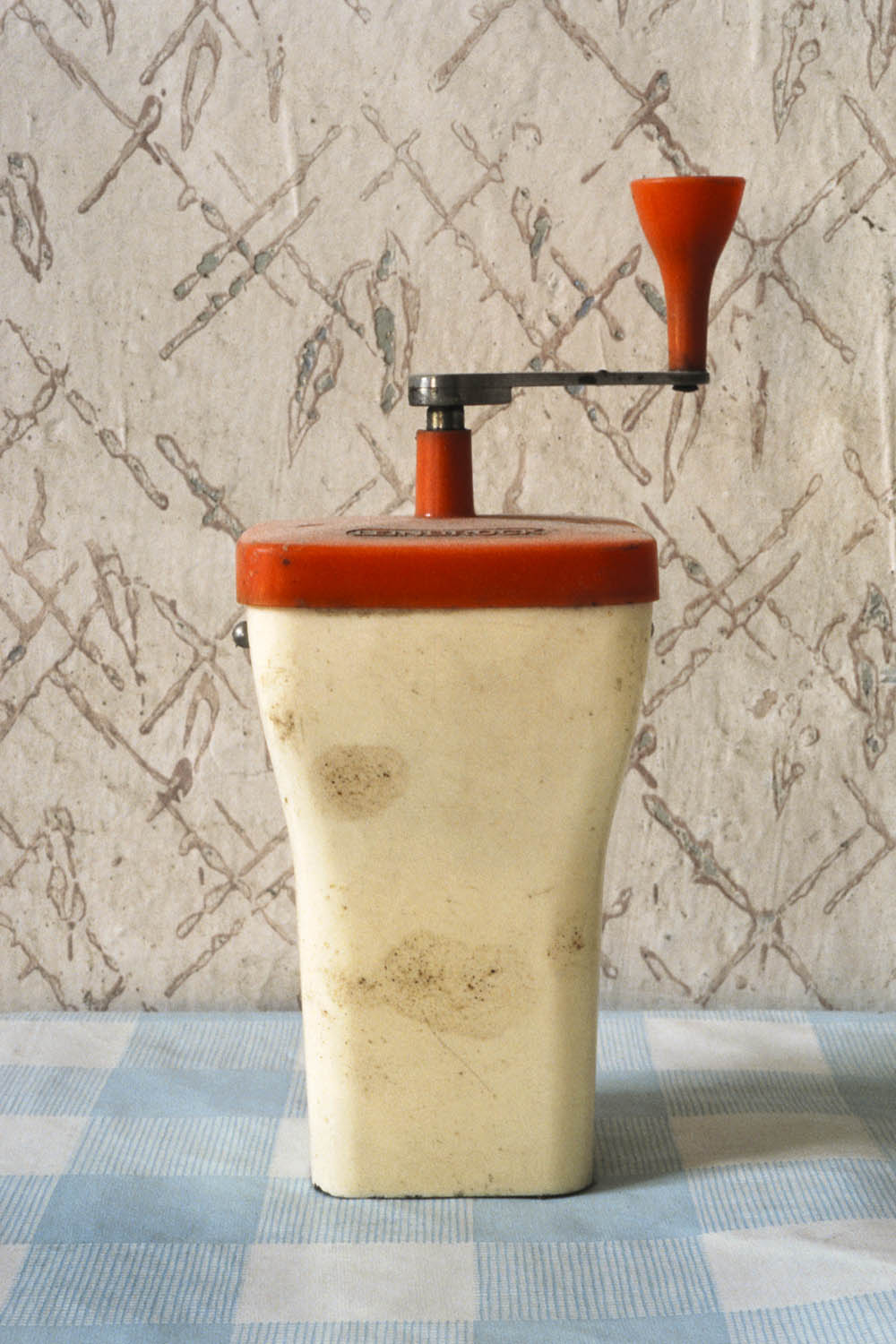
Ulrich Wüst (German, b. 1949) 'Kaffemühle' (Coffee grinder) From the series 'Wiegmann Legacy. Bülowssiege 1991-1992'


Ulrich Wüst (German, b. 1949)
Kaffemühle (Coffee grinder) 
Aus der Serie: Nachlass Wiegmann. Bülowssiege 1991-1992
From the series: Wiegmann Legacy. Bülowssiege 1991-1992
Colour photograph, archival pigment print
105 cm x 70cm
© Ulrich Wüst; ifa


“I make a point of calling myself a photographer, because then the art question usually no longer arises. But if others still want to see me as an artist, I can (happily) live with that. Personally I don’t want to think about that question. The only thing I do want to stress is that my work is not documentary. I use documentary technique as a form, as a means, and in certain works I am also looking for documentary precision.”


~ Ulrich Wüst, wall text from the exhibition


Installation view, Ulrich Wüst, 'Wiegmann Legacy. Bülowssiege, 1991-1992' from the exhibition 'Wanderings About History. The Photography of Ulrich Wüst', RMIT Gallery, Melbourne, 2024


Installation view, Ulrich Wüst, Wiegmann Legacy. Bülowssiege, 1991-1992 from the exhibition Wanderings About History. The Photography of Ulrich Wüst, RMIT Gallery, Melbourne, 2024
Photo: Christian Capurro


Ulrich Wüst (German, b. 1949) From the series 'Wiegmann Legacy. Bülowssiege 1991-1992' (installation view)


Ulrich Wüst (German, b. 1949)
Aus der Serie: Nachlass Wiegmann. Bülowssiege 1991-1992
From the series: Wiegmann Legacy. Bülowssiege 1991-1992 (installation view)
Colour photograph, archival pigment print
105 cm x 70cm
© Ulrich Wüst; ifa
Photo: Marcus Bunyan


Installation view, Ulrich Wüst, 'Cityscapes, 1979-1985' (left) and 'Wiegmann Legacy. Bülowssiege, 1991-1992' (right) from the exhibition 'Wanderings About History. The Photography of Ulrich Wüst', RMIT Gallery, Melbourne, 2024


Installation view, Ulrich Wüst, Cityscapes, 1979-1985 (left) and Wiegmann Legacy. Bülowssiege, 1991-1992 (right) from the exhibition Wanderings About History. The Photography of Ulrich Wüst, RMIT Gallery, Melbourne, 2024
Photo: Christian Capurro


Installation view, Ulrich Wüst, 'Wiegmann Legacy. Bülowssiege, 1991-1992' (left) and 'Notations 1984-1986' (right) from the exhibition 'Wanderings About History. The Photography of Ulrich Wüst', RMIT Gallery, Melbourne, 2024


Installation view, Ulrich Wüst, Wiegmann Legacy. Bülowssiege, 1991-1992 (left) and Notations 1984-1986 (right) from the exhibition Wanderings About History. The Photography of Ulrich Wüst, RMIT Gallery, Melbourne, 2024
Photo: Christian Capurro


Ulrich Wüst (German, b. 1949) 'Berlin, Pappelallee' September 1984 From the series 'Notations. 1984-1986'


Ulrich Wüst (German, b. 1949)
Berlin, Pappelallee
September 1984
Aus der Serie: Notizen. 1984-1986
From the series: Notations. 1984-1986
B/w archival pigment print
14 x 21cm
© Ulrich Wüst; ifa


Ulrich Wüst (German, b. 1949) From the series 'Notations. 1984-1986' (installation view)

Ulrich Wüst (German, b. 1949) From the series 'Notations. 1984-1986' (installation view)

Ulrich Wüst (German, b. 1949) From the series 'Notations. 1984-1986' (installation view)


Ulrich Wüst (German, b. 1949)
Aus der Serie: Notizen. 1984-1986
From the series: Notations. 1984-1986 (installation views)
B/w archival pigment print
14 x 21cm
© Ulrich Wüst; ifa
Photos: Marcus Bunyan


“While I was still busy fine-tuning my technical skills for Cityscapes, over in West Germany very small automatic rangefinders were coming onto the market. That was in the early 1980s. […] I got hold of one of those and suddenly I could carry a camera with me all the time, take it anywhere, and I started using it like an “extended eye”. The little camera allowed me to take more intimate, more “personal” works. For me that meant talking about my own life. That was the beginning of the series Notations, as I later called it. I focused on my circle of friends and my immediate environment. And so the Notations came about and that was what I wanted to achieve, as a conscious antithesis to other series like the Cityscapes.”


~ Ulrich Wüst, wall text from the exhibition


Installation view, Ulrich Wüst, 'Red October' 2018, from the exhibition Wanderings About History – The Photography of Ulrich Wüst, RMIT Gallery, Melbourne, 2024


Installation view, Ulrich Wüst, Red October 2018, from the exhibition Wanderings About History. The Photography of Ulrich Wüst, RMIT Gallery, Melbourne, 2024
Photo: Christian Capurro


Ulrich Wüst (German, b. 1949) 'Roter Oktober' (Red October) 2018


Ulrich Wüst (German, b. 1949)
Roter Oktober (Red October)
2018
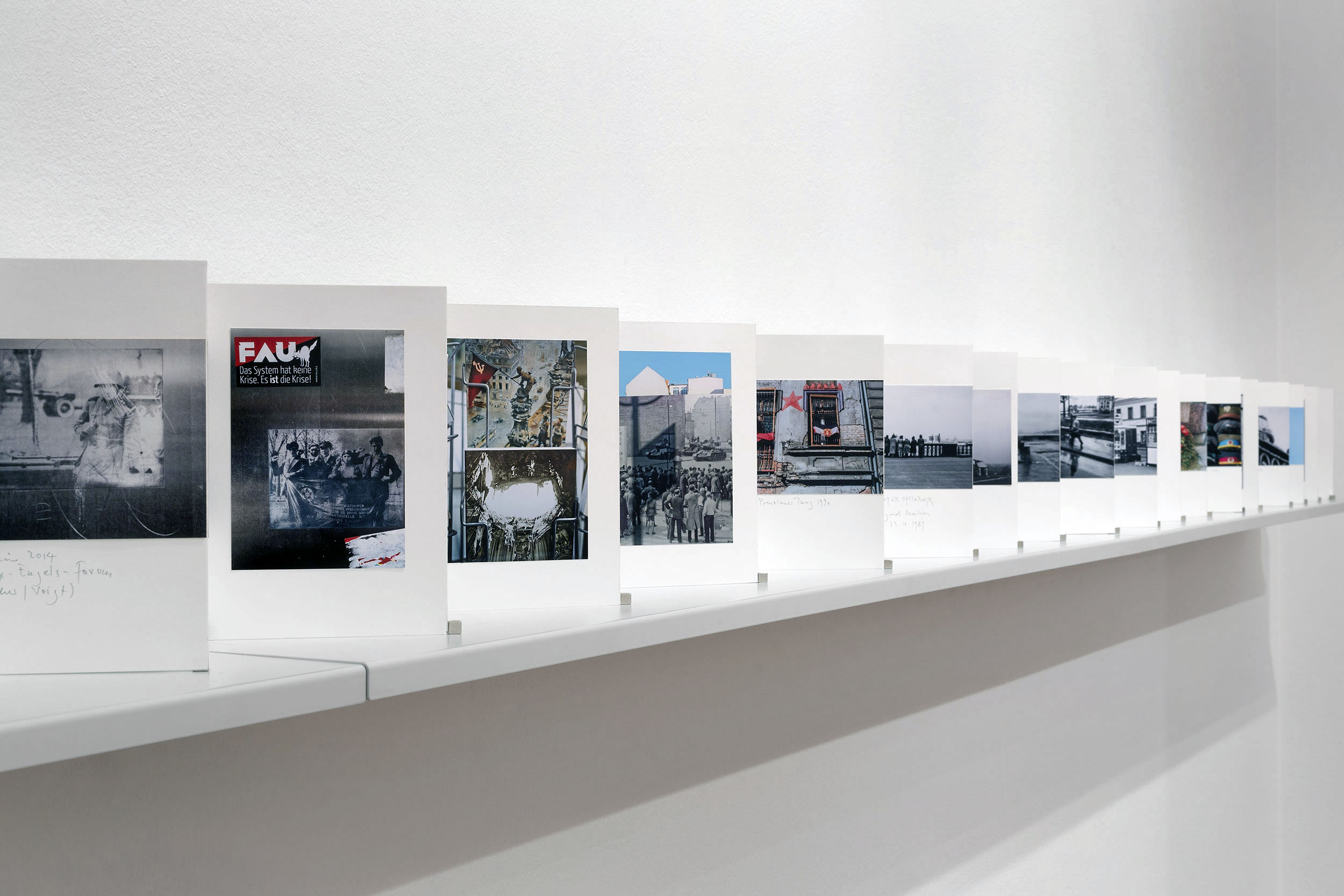
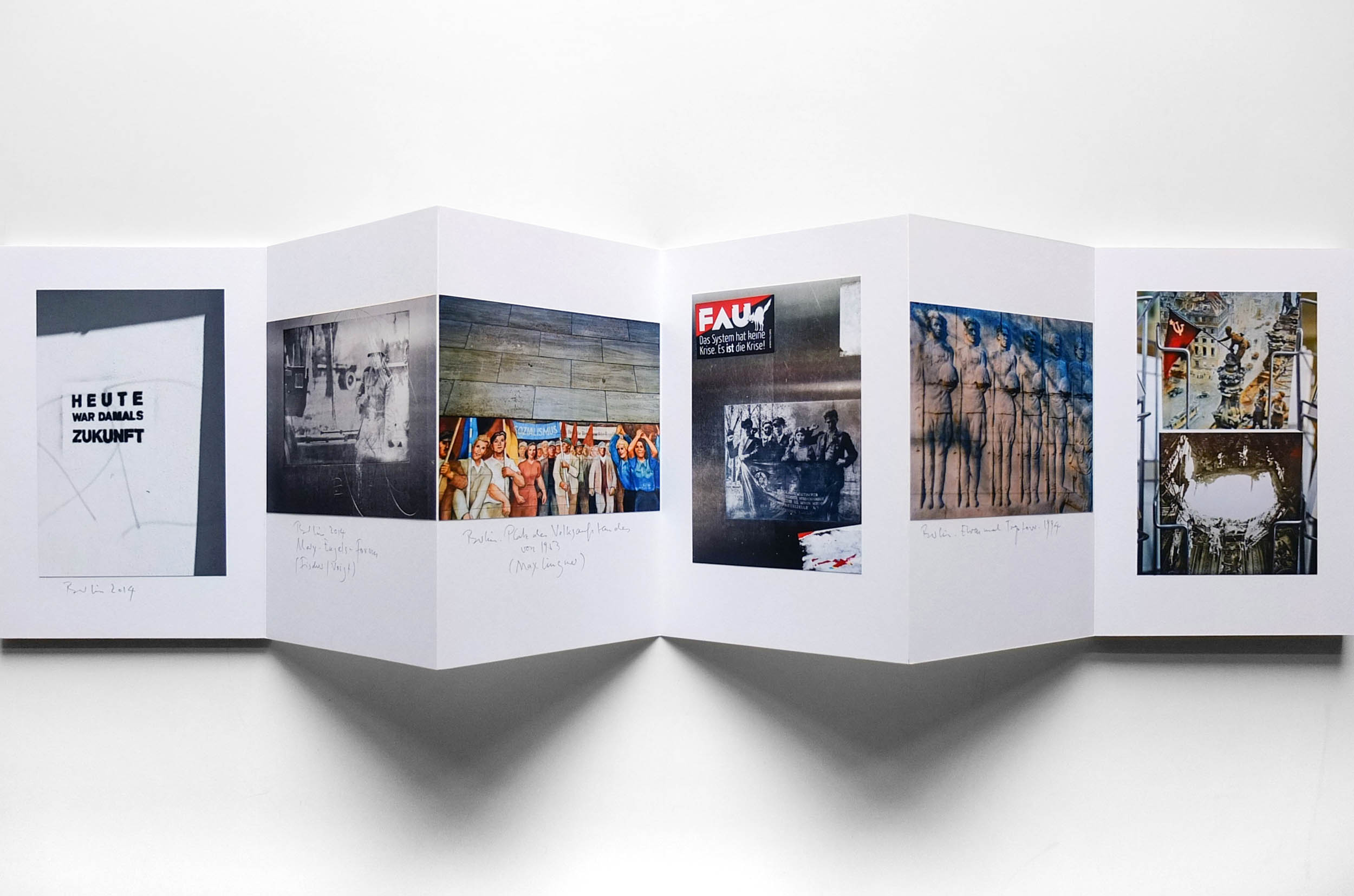
Leporello with 45 b/w and colour photographs mounted on cardboard
14.8 × 21.0 × 2.0cm
© Ulrich Wüst; ifa


Michael Schmidt (German, 1945-2014) 'Müller-Ecke Seestrasse, Berlin-Wedding' (Berlin-Wedding) 1976-1978


Michael Schmidt (German, 1945-2014)
Müller-Ecke Seestrasse, Berlin-Wedding (Berlin-Wedding)
1976-1978
© Michael Schmidt, Foundation for Photography and Media Art with the Michael Schmidt Archive


Tata Ronkholz (1940-1997) 'Dusseldorf, Sankt-Franziskusstraße 107' 1977


Tata Ronkholz (German, 1940-1997)
Dusseldorf, Sankt-Franziskusstraße 107
1977
Silver gelatin print on baryta paper
41.2 × 51.2cm
Courtesy The Photographische Sammlung / SK Stiftung Kultur, Cologne / Permanent Loan of the Sparkasse KölnBonn


Ulrich Wüst (German, b. 1949) 'Roter Oktober' (Red October) 2018 (installation view)

Ulrich Wüst (German, b. 1949) 'Roter Oktober' (Red October) 2018 (installation view)


Ulrich Wüst (German, b. 1949)
Roter Oktober (Red October) (installation views)
2018
Leporello with 45 b/w and colour photographs mounted on cardboard
14.8 × 21.0 × 2.0cm
© Ulrich Wüst; ifa
Photos: Marcus Bunyan


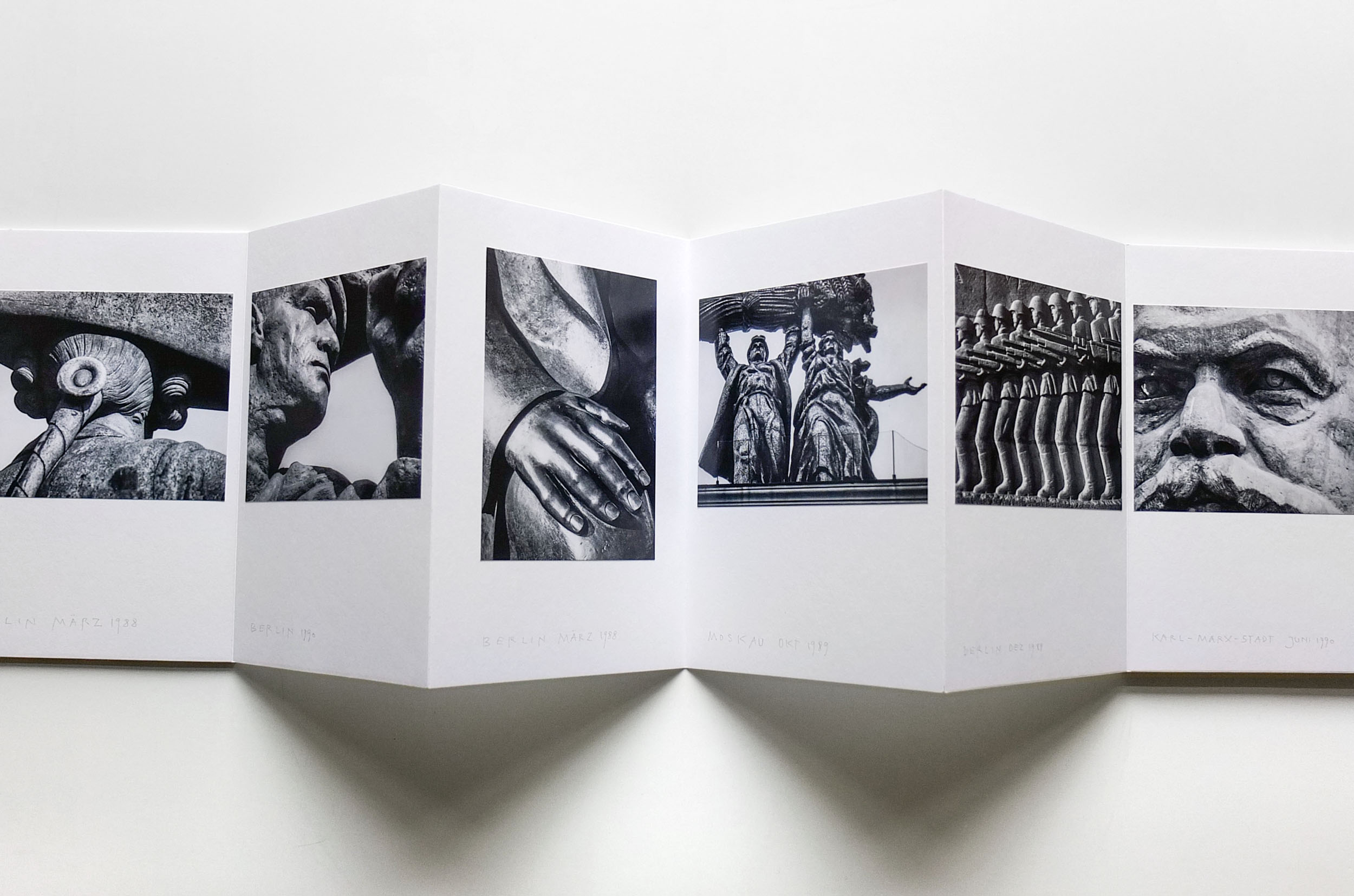
“Photographers love to complain about the chaos they work in and how that prevents them from keeping tabs on what they do. At some point I realised that the concertinas were a fantastic tool for tracing and recoding the progress of my work. Above all, they enabled me to locate my negatives, because I used very simple but precise captions with the place and date of the picture. I always liked the versatility of the concertina. Now, whenever I need to find a negative, I take one of these booklets of the shelf and look for the photograph. They have become a means to communicate with myself about my work and I miss them when they are being exhibition and I haven’t got them at home.”


~ Ulrich Wüst, wall text from the exhibition


Installation view, Ulrich Wüst, 'The Pomp of Power. 1983-1990' from the exhibition 'Wanderings About History. The Photography of Ulrich Wüst', RMIT Gallery, Melbourne, 2024


Installation view, Ulrich Wüst, The Pomp of Power. 1983-1990, from the exhibition Wanderings About History. The Photography of Ulrich Wüst, RMIT Gallery, Melbourne, 2024
Photo by Christian Capurro


Ulrich Wüst (German, b. 1949) 'The Pomp of Power. 1983-1990'


Ulrich Wüst (German, b. 1949)
Die Pracht der Macht. 1983-1990
The Pomp of Power. 1983-1990
Leporello with 30 b/w photographs mounted on cardboard
14.8 × 21.0 × 1.5cm
© Ulrich Wüst; ifa


Ulrich Wüst (German, b. 1949) 'The Pomp of Power. 1983-1990' (installation view)

Ulrich Wüst (German, b. 1949) 'The Pomp of Power. 1983-1990' (installation view)


Ulrich Wüst (German, b. 1949)
Die Pracht der Macht. 1983-1990
The Pomp of Power. 1983-1990 (installation views)
Concertina booklet with 30 b/w photographs mounted on cardboard
14.8 × 21.0 × 1.5cm
© Ulrich Wüst; ifa
Photos: Marcus Bunyan


Clarity and compositional elegance

It may also have been his professional disposition that led him to pay particular attention to the GDR city. After all, he was an expert. Wüst was an expert in the field of urban development; he knew exactly what he was photographing. In the midst of the “leaden times” of the GDR, an era shortly before the collapse in which hardly anything seemed to be moving. Mid-1970s to mid-1980s. Urban and housing construction has long since said goodbye to the promising ideals of a better, because socialist, promise. The reality was pragmatic and merciless. Dilapidated old building and decaying substance on one side and serial prefabricated building on the other.

Wüst’s pictures, which sometimes develop a peculiar irony in their clarity and compositional elegance, can also be understood as political statements. “They searched for clues in a way that was unusual in the GDR as a way of ascertaining the real perceived state of the present,” writes Flügge about the photographer, who knew exactly what he wanted to find and capture. Even the depiction of reality could be considered subversive in the workers’ and farmers’ state. It wasn’t appropriate to show things as they were. Rather, you should show things as they should be. …

By “limiting the image section, he forces reality to formulate its own,” summarizes Flügge.

Jacek Slaski. “Ulrich Wüst – Stadtbilder 1979–1985: Zwischen Kunst und Dokumentation,” on the tipBerlin website 03/02/2022 [Online] Cited 08/04/2024. Translated from the German by Google Translate


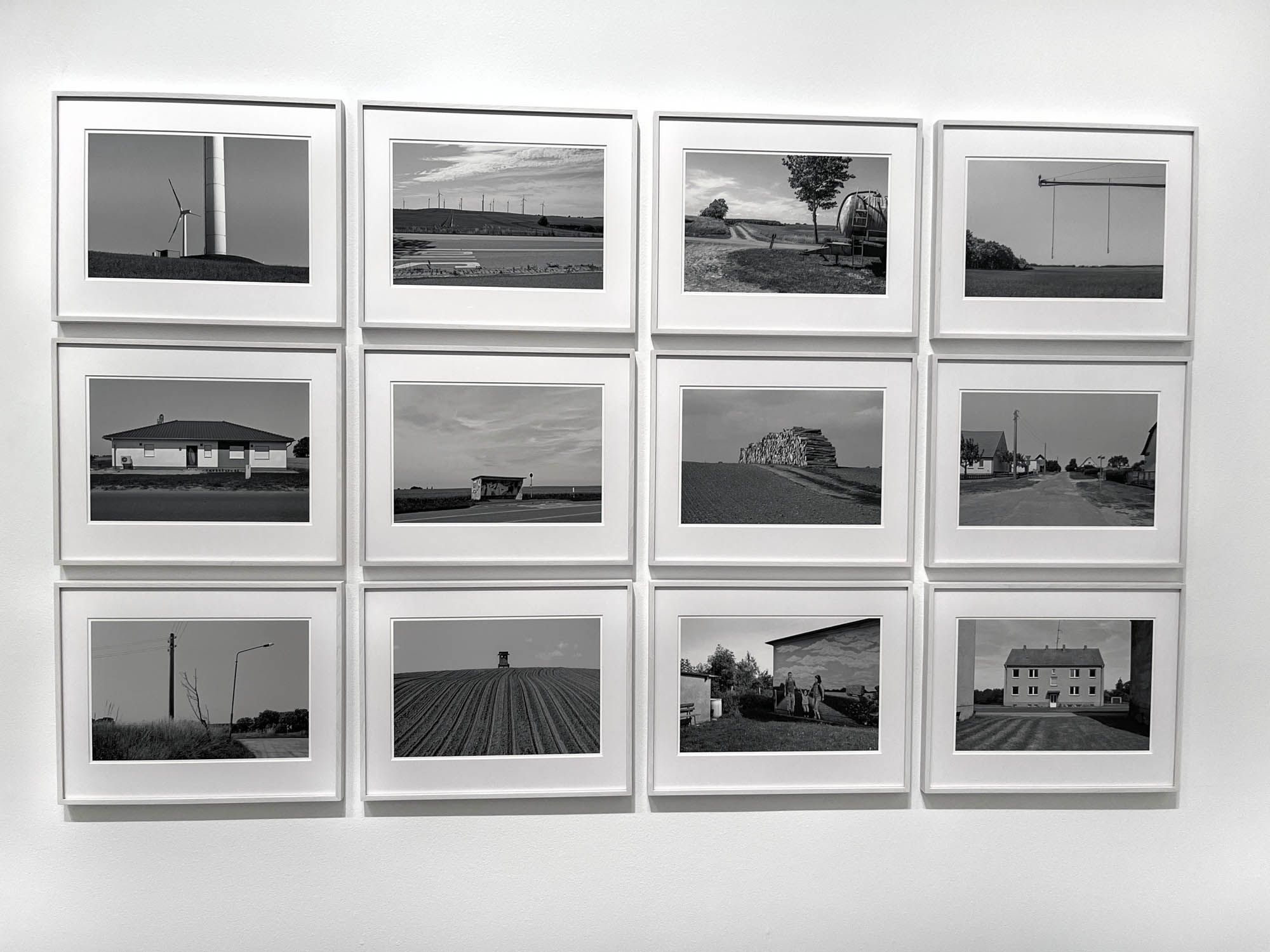
Installation view, Ulrich Wüst, 'Village Edge. The Municipality of Nordwestuckermark, 2014-2019' from the exhibition 'Wanderings About History. The Photography of Ulrich Wüst', RMIT Gallery, Melbourne, 2024


Installation view, Ulrich Wüst, Village Edge. The Municipality of Nordwestuckermark, 2014-2019 from the exhibition Wanderings About History. The Photography of Ulrich Wüst, RMIT Gallery, Melbourne, 2024
Photo: Christian Capurro


Installation view, Ulrich Wüst, 'Book of the Years. 1978-2008' (right) and 'Mitte. Berlin 1994-1997' (left) from the exhibition 'Wanderings About History. The Photography of Ulrich Wüst', RMIT Gallery, Melbourne, 2024


Installation view, Ulrich Wüst, Book of the Years. 1978-2008 (right) and Mitte. Berlin, 1994-1997 (left) from the exhibition Wanderings About History. The Photography of Ulrich Wüst, RMIT Gallery, Melbourne, 2024
Photo: Christian Capurro


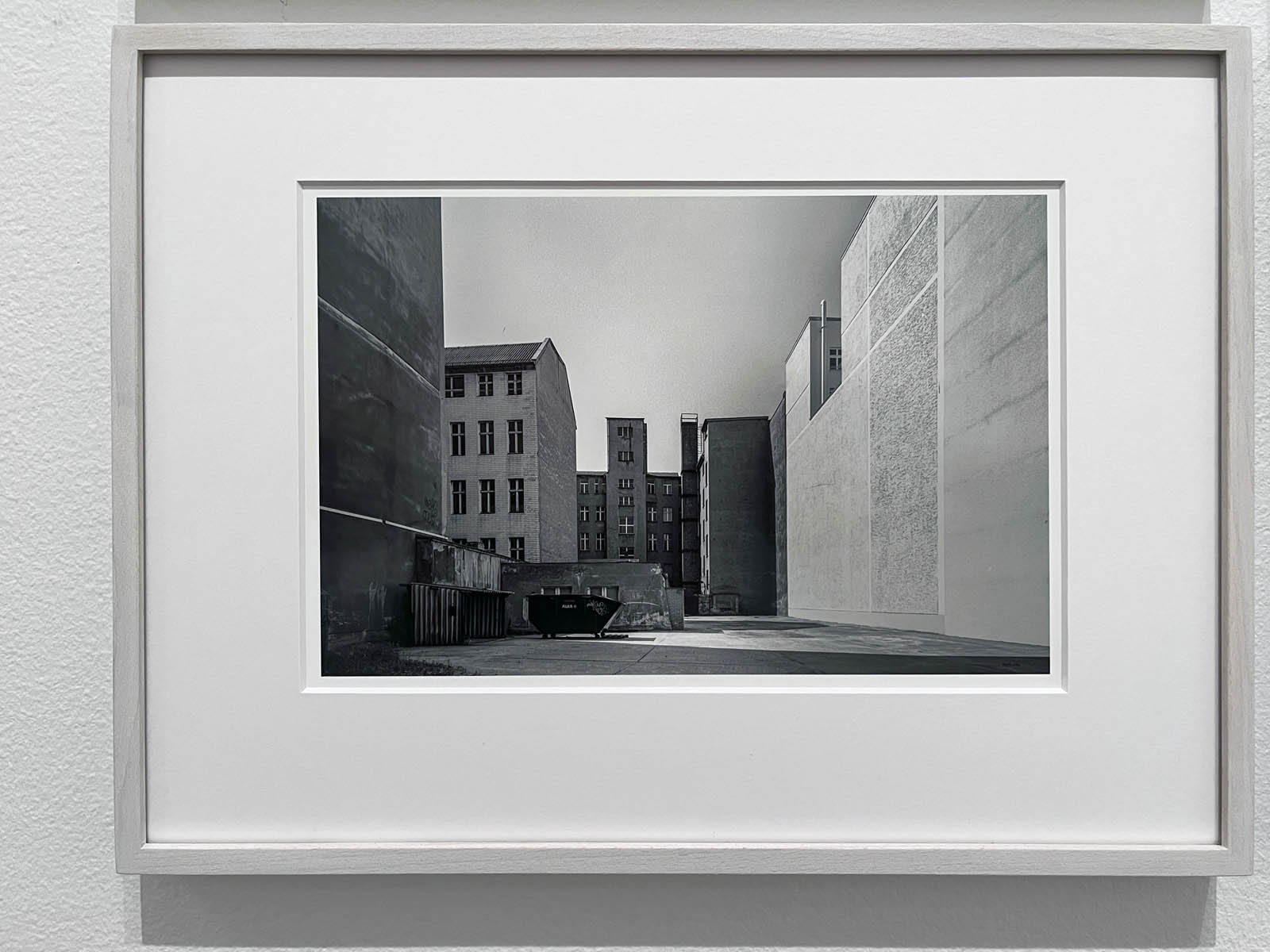
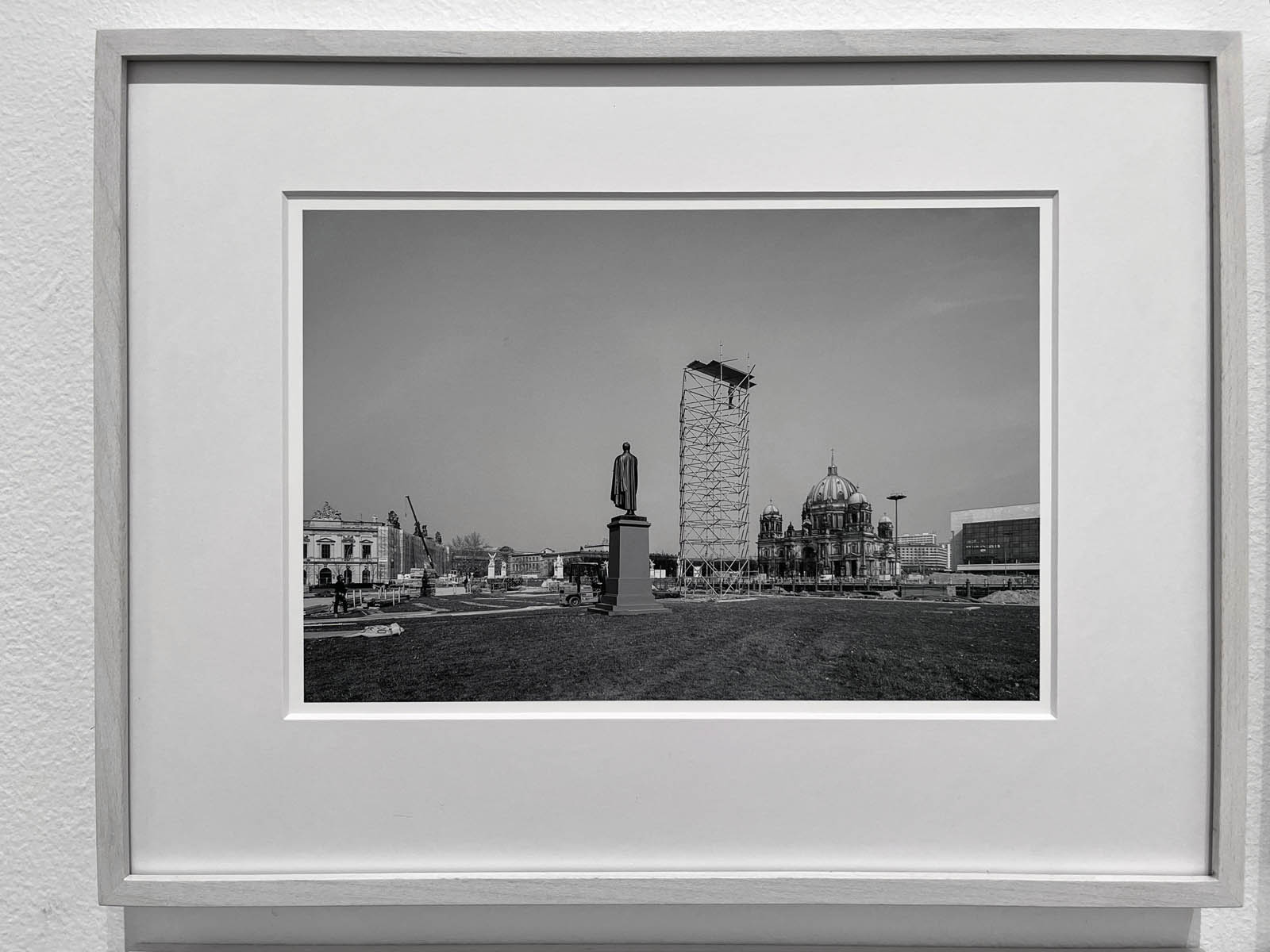
Ulrich Wüst (German, b. 1949) 'Schützenstraße / Jerusalemer Straße' 1996 From the series: 'Mitte. Berlin 1995-1997'


Ulrich Wüst (German, b. 1949)
Schützenstraße / Jerusalemer Straße
1996
Aus der Serie: Mitte. Berlin 1995-1997
From the series: Mitte. Berlin 1995-1997
B/w archival pigment print
18 x 27cm
© Ulrich Wüst; ifa


The different historical eras come together in his pictures. Relics from the pre-war period, often ruins, alongside the proud examples of Eastern Modernism from the post-war period, and finally the cheap and quickly built architecture of the present day. These photos are still important today, and not just for architectural historians and photography connoisseurs. Wüst’s pictures of the GDR city are visual findings about the condition of its residents, even if the people in them are absent. In his text, Flügge quotes from Alexander Mitscherlich’s book Die Unwirtlichkeit unserer Städte. Anstiftung zum Unfrieden (The inhospitability of our cities. Incitement to Discord), in which the doctor, psychoanalyst and writer examined the West German city as early as 1965: “This city shape is regressively shaping the character of its residents.” In his book, Mitscherlich hoped that the city would one day become a “biotope for free people”. It didn’t quite turn out that way, but in a certain sense Mitscherlich wasn’t entirely wrong either. The GDR would soon disappear and with it the GDR city.

Jacek Slaski. “Ulrich Wüst – Stadtbilder 1979–1985: Zwischen Kunst und Dokumentation,” on the tipBerlin website 03/02/2022 [Online] Cited 08/04/2024. Translated from the German by Google Translate


Ulrich Wüst (German, b. 1949) From the series 'Mitte. Berlin 1995-1997' (installation view)

Ulrich Wüst (German, b. 1949) From the series 'Mitte. Berlin 1995-1997' (installation view)

Ulrich Wüst (German, b. 1949) From the series 'Mitte. Berlin 1995-1997' (installation view)

Ulrich Wüst (German, b. 1949) From the series 'Mitte. Berlin 1995-1997' (installation view)

Ulrich Wüst (German, b. 1949) From the series 'Mitte. Berlin 1995-1997' (installation view)


Ulrich Wüst (German, b. 1949)
Aus der Serie: Mitte. Berlin 1995-1997
From the series: Mitte. Berlin 1995-1997 (installation views)
B/w archival pigment print
18 x 27cm
© Ulrich Wüst; ifa
Photos: Marcus Bunyan


I am well aware of how ambivalent photography is. And just because photographs have a documentary air about them, I find it to some extent dubious to slap a documentary label on them. If, ten centimetres from the edge of my picture, the whole content is counteracted by something completely different, then I can no longer claim to be doing serious documentary work. Documentation as a form, in my view, is just a way to explore a theme – a means. I only want to photograph and not distort things. It’s true that there is a documentary background, but what I do with it is always something of my own and totally subjective.


Ulrich Wüst, wall text from the exhibition


Installation view, Ulrich Wüst, 'Mitte. Berlin 1994-1997' (right) and 'Prentzlow. Prenzlau', 2018 (left) from the exhibition 'Wanderings About History. The Photography of Ulrich Wüst', RMIT Gallery, Melbourne, 2024


Installation view, Ulrich Wüst, Mitte. Berlin 1994-1997 (right) and Prenzlau, 2018 (left) from the exhibition Wanderings About History. The Photography of Ulrich Wüst, RMIT Gallery, Melbourne, 2024
Photo: Christian Capurro


Installation view, Ulrich Wüst, 'Prenzlau', 2018, from the exhibition 'Wanderings About History. The Photography of Ulrich Wüst', RMIT Gallery, Melbourne, 2024


Installation view, Ulrich Wüst, Prenzlau, 2018, from the exhibition Wanderings About History. The Photography of Ulrich Wüst, RMIT Gallery, Melbourne, 2024
Photo: Christian Capurro


Ulrich Wüst (German, b. 1949) From the series ‘Prenzlau’ 2018


Ulrich Wüst (German, b. 1949)
Aus der Serie: Prenzlau
From the series: Prenzlau
2018
Colour photograph, archival pigment print
45 × 30cm
© Ulrich Wüst; ifa


Ulrich Wüst (German, b. 1949) From the series 'Prenzlau' 2018 (installation view)

Ulrich Wüst (German, b. 1949) From the series 'Prenzlau' 2018 (installation view)

Ulrich Wüst (German, b. 1949) From the series 'Prenzlau' 2018 (installation view)


Ulrich Wüst (German, b. 1949)
Aus der Serie: Prenzlau
From the series: Prenzlau (installation views)
2018
Colour photograph, archival pigment print
45 × 30cm
© Ulrich Wüst; ifa
Photos: Marcus Bunyan


Installation view, Ulrich Wüst, 'Wiegmann Legacy. Bülowssiege 1991-1992' (right) and 'Book of the Years. 1978-2008' (left), from the exhibition 'Wanderings About History. The Photography of Ulrich Wüst', RMIT Gallery, Melbourne, 2024


Installation view, Ulrich Wüst, Wiegmann Legacy. Bülowssiege, 1991-1992 (right) and Book of the Years. 1978-2008 (left), from the exhibition Wanderings About History. The Photography of Ulrich Wüst, RMIT Gallery, Melbourne, 2024
Photo: Christian Capurro


Ulrich Wüst (German, b. 1949) 'Kreta' (Crete) 1997 From the series 'Book of the Years. 1978-2008'


Ulrich Wüst (German, b. 1949)
Kreta (Crete)
1997
Aus der Serie: Jahrebuch. 1978-2008
From the series: Book of the Years. 1978-2008
B/w archival pigment print
18 x 27cm
© Ulrich Wüst; ifa


Ulrich Wüst (German, b. 1949) From the series 'Book of the Years. 1978-2008' (installation view)

Ulrich Wüst (German, b. 1949) From the series 'Book of the Years. 1978-2008' (installation view)


Ulrich Wüst (German, b. 1949)
Aus der Serie: Jahrebuch. 1978-2008
From the series: Book of the Years. 1978-2008 (installation views)
B/w archival pigment print
18 x 27cm
© Ulrich Wüst; ifa
Photos: Marcus Bunyan


Robert Frank (Swiss-American, 1924-2019) 'London' 1951


Robert Frank (Swiss-American, 1924-2019)
London
1951
Gelatin silver print


Ulrich Wüst (German, b. 1949) From the series 'Book of the Years. 1978-2008' (installation view)


Ulrich Wüst (German, b. 1949)
Aus der Serie: Jahrebuch. 1978-2008
From the series: Book of the Years. 1978-2008 (installation view)
B/w archival pigment print
18 x 27cm
© Ulrich Wüst; ifa
Photo: Marcus Bunyan


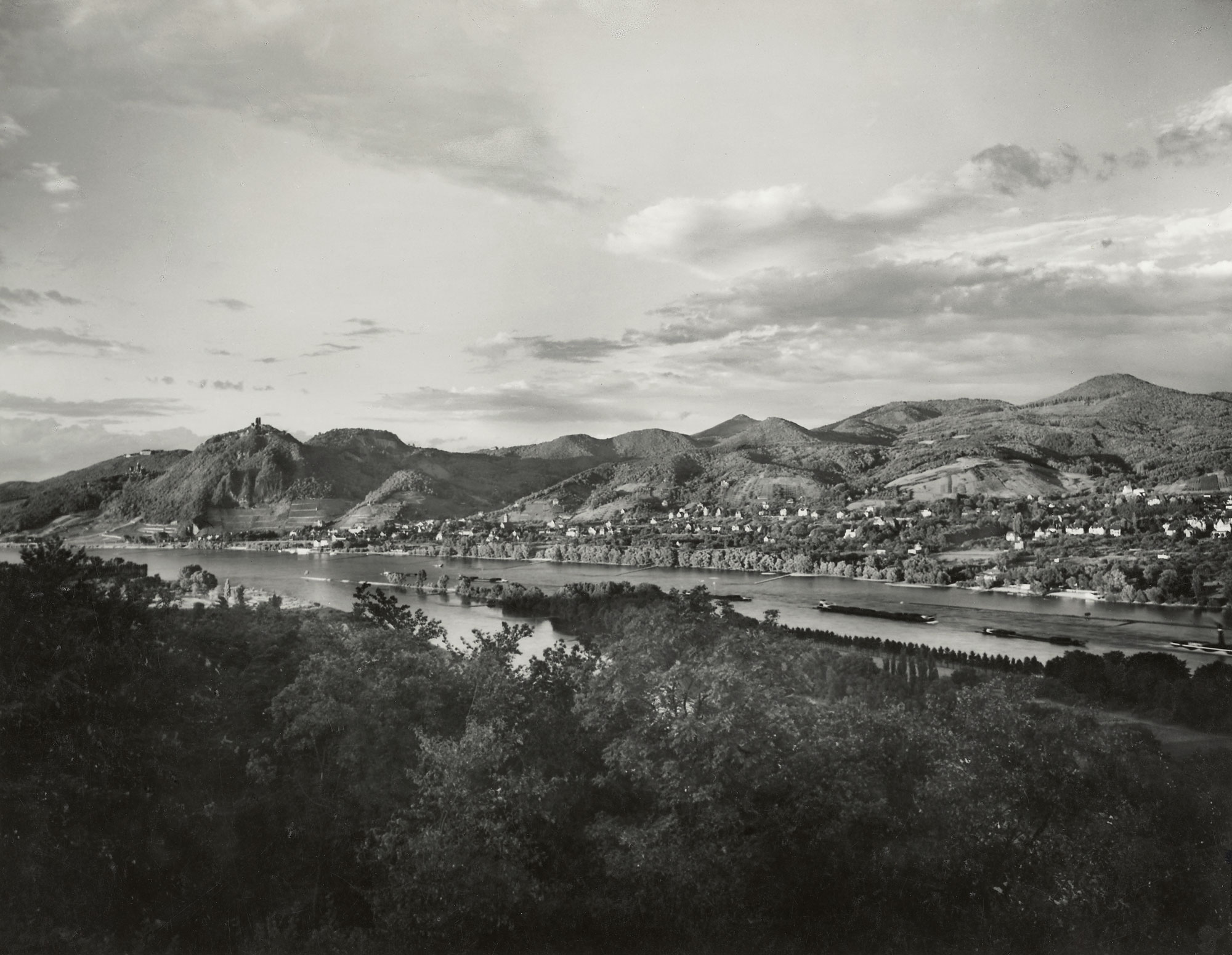
August Sander (German, 1876-1964) 'Das Siebengebirge von der unteren Terrasse hin zur Löwenburg' 1922


August Sander (German, 1876-1964)
Das Siebengebirge von der unteren Terrasse hin zur Löwenburg
The Siebengebirge from the lower terrace towards the Löwenburg castle

1922
Gelatin silver print
© Die Photographische Sammlung/SK Sitftung Kultur – August Sander Archiv, Köln; VG Bild-Kunst, Bonn, 2022


Ulrich Wüst (German, b. 1949) From the series 'Book of the Years. 1978-2008' (installation view)


Ulrich Wüst (German, b. 1949)
Aus der Serie: Jahrebuch. 1978-2008
From the series: Book of the Years. 1978-2008 (installation view)
B/w archival pigment print
18 x 27cm
© Ulrich Wüst; ifa
Photo: Marcus Bunyan


A collection/compilation. A great deal of chance and responding to mood. The urban excursions, by contrast, followed a strict pattern. There it was about the grey cityscapes, grey “Mitte” and grey “Morgenstraße”. And yet all of them were taken in bright sunlight! Without the weather forecast promising a safe sunny day, I would probably never have been brave enough to set out on wanderings that did not augur much solace.

Most of the pictures in the book of the Years, on the other hand, really were taken in grey weather. They were done over a period of thirty years, mostly without any particular intention, straight from the experience. Later I gathered them into a kind of melancholy section through times and places. The pictures say: I was here. And I was in this or that mood. They are mood! And sometimes they flirt with the mood as well. That can happen.

~ Ulrich Wüst, wall text from the exhibition


Installation view, Ulrich Wüst, 'Mitte. Berlin 1994-1997' (right), 'Village Edge. The Municipality of Nordwestuckermark, 2014-2019' (left) and 'Prentzlow. Prenzlau', 2018 (centre) from the exhibition 'Wanderings About History. The Photography of Ulrich Wüst', RMIT Gallery, Melbourne, 2024


Installation view, Ulrich Wüst, Mitte. Berlin 1994-1997 (right), Village Edge. The Municipality of Nordwestuckermark, 2014-2019 (left) and Prentzlow. Prenzlau, 2018 (centre) from the exhibition Wanderings About History. The Photography of Ulrich Wüst, RMIT Gallery, Melbourne, 2024
Photo: Christian Capurro


Ulrich Wüst’s photographic work captures his wanderings through German history, portraying the social and urban transformations from the GDR and its disintegration, through the German reunification to the present day. Wüst revives the German history in a new static way, where the past and present clash in a dynamic and ever-changing environment.

Wanderings About History. The Photography of Ulrich Wüst shows a selection of nine suites taken between 1978 and 2019. Ulrich Wüst’s photographic work can be contemplated from different perspectives. While the observations captured here are rooted in Germany’s division and its mending, at the same time they always relate to universal phenomena of social change and its material manifestations. The seemingly terse images, extremely precise in their composition, are the fruits of lengthy visual wanderings through present sites of recent history.

An exhibition by ifa – Institut für Auslandsbeziehungen e.V., Stuttgart – in partnership with the Goethe-Institut. This project is an official exhibition of PHOTO 2024 International Festival of Photography.

Text from the RMIT Gallery website


Installation view, Ulrich Wüst, 'Wiegmann Legacy. Bülowssiege, 1991-1992' (left) and 'Village Edge. The Municipality of Nordwestuckermark, 2014-2019' (right) from the exhibition 'Wanderings About History. The Photography of Ulrich Wüst', RMIT Gallery, Melbourne, 2024


Installation view, Ulrich Wüst, Wiegmann Legacy. Bülowssiege, 1991-1992 (left) and Village Edge. The Municipality of Nordwestuckermark, 2014-2019 (right) from the exhibition Wanderings About History. The Photography of Ulrich Wüst, RMIT Gallery, Melbourne, 2024
Photo: Christian Capurro


Ulrich Wüst (German, b. 1949) From the series 'Village Edge. The Municipality of Nordwestuckermark 2014-2019' (installation view)


Ulrich Wüst (German, b. 1949)
Aus der Serie: Randlage. Die Gemeinde Nordwestuckermark 2014-2019
From the series: Village Edge. The Municipality of Nordwestuckermark 2014-2019 (installation view)
B/w archival pigment print
26 x 39cm
© Ulrich Wüst; ifa
Photo: Marcus Bunyan


Ulrich Wüst (German, b. 1949) 'Parmen' 2016 From the series 'Village Edge. The Municipality of Nordwestuckermark 2014-2019'


Ulrich Wüst (German, b. 1949)
Parmen
2016
Aus der Serie: Randlage. Die Gemeinde Nordwestuckermark 2014-2019
From the series: Village Edge. The Municipality of Nordwestuckermark 2014-2019
B/w archival pigment print
26 x 39cm
© Ulrich Wüst; ifa


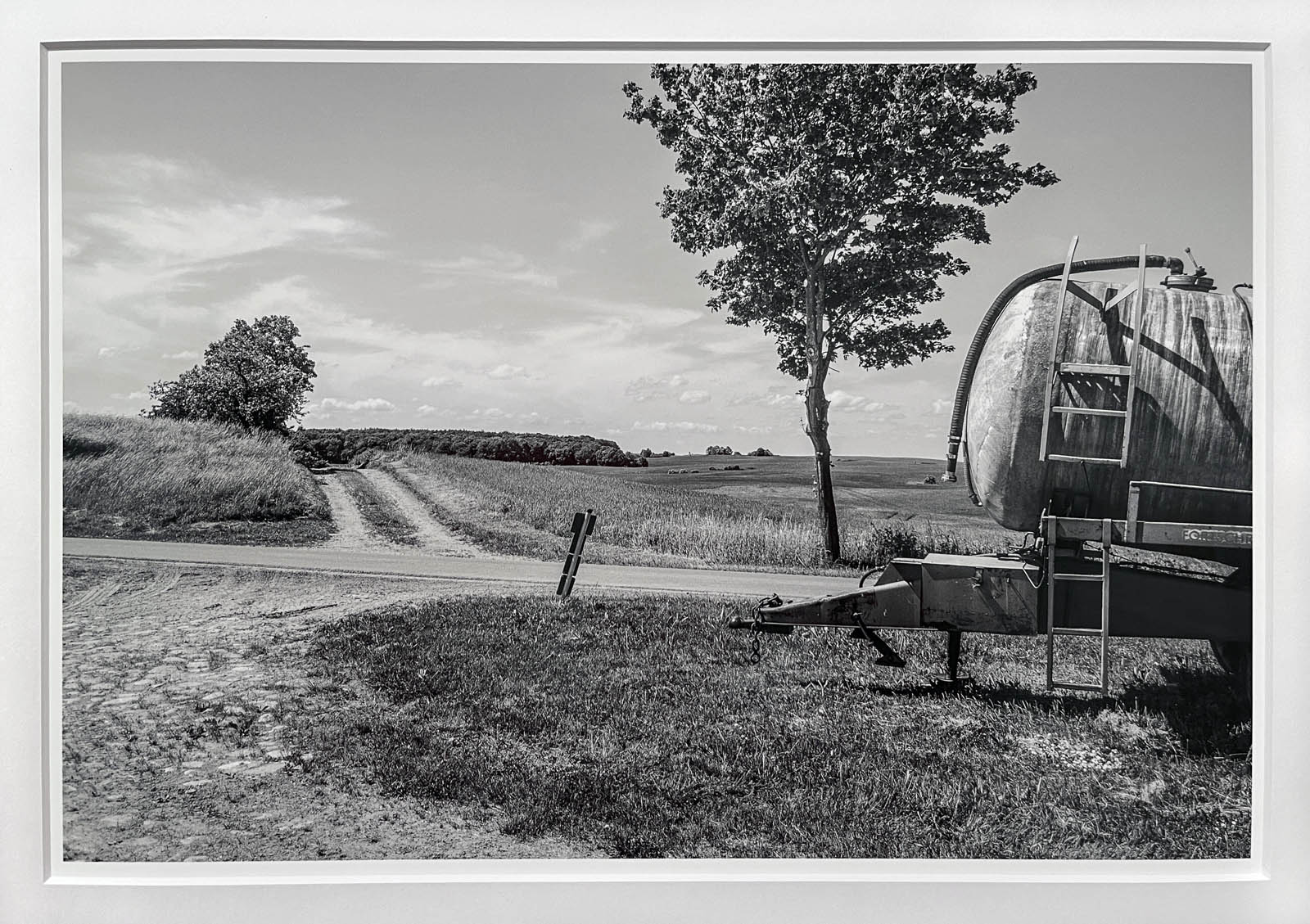
“In the last few years I started taking pictures in the countryside again. The idea was to have photographs of villages and landscapes that were just as “dry” as my cityscape series, like Berlin, or Magdeburg. The resulting work is far removed from any sort of rural idyll, but equally as far removed from the affection I have from these landscapes. I chose not to give too much away.”


~ Ulrich Wüst, wall text from the exhibition


Ulrich Wüst (German, b. 1949) From the series 'Village Edge. The Municipality of Nordwestuckermark 2014-2019' (installation view)

Ulrich Wüst (German, b. 1949) From the series 'Village Edge. The Municipality of Nordwestuckermark 2014-2019' (installation view)


Ulrich Wüst (German, b. 1949)
Aus der Serie: Randlage. Die Gemeinde Nordwestuckermark 2014-2019
From the series: Village Edge. The Municipality of Nordwestuckermark 2014-2019 (installation views)
B/w archival pigment print
26 x 39cm
© Ulrich Wüst; ifa
Photos: Marcus Bunyan


RMIT Gallery
344 Swanston Street, Melbourne

Opening hours:
Tuesday to Friday 11am – 5pm
Saturday 12.30pm – 5pm

RMIT Gallery website

LIKE ART BLART ON FACEBOOK

Back to top

Exhibition: ‘Uta Barth: Peripheral Vision’ at the J. Paul Getty Museum, Los Angeles

Exhibition dates: 15th November, 2022 – 19th February, 2023


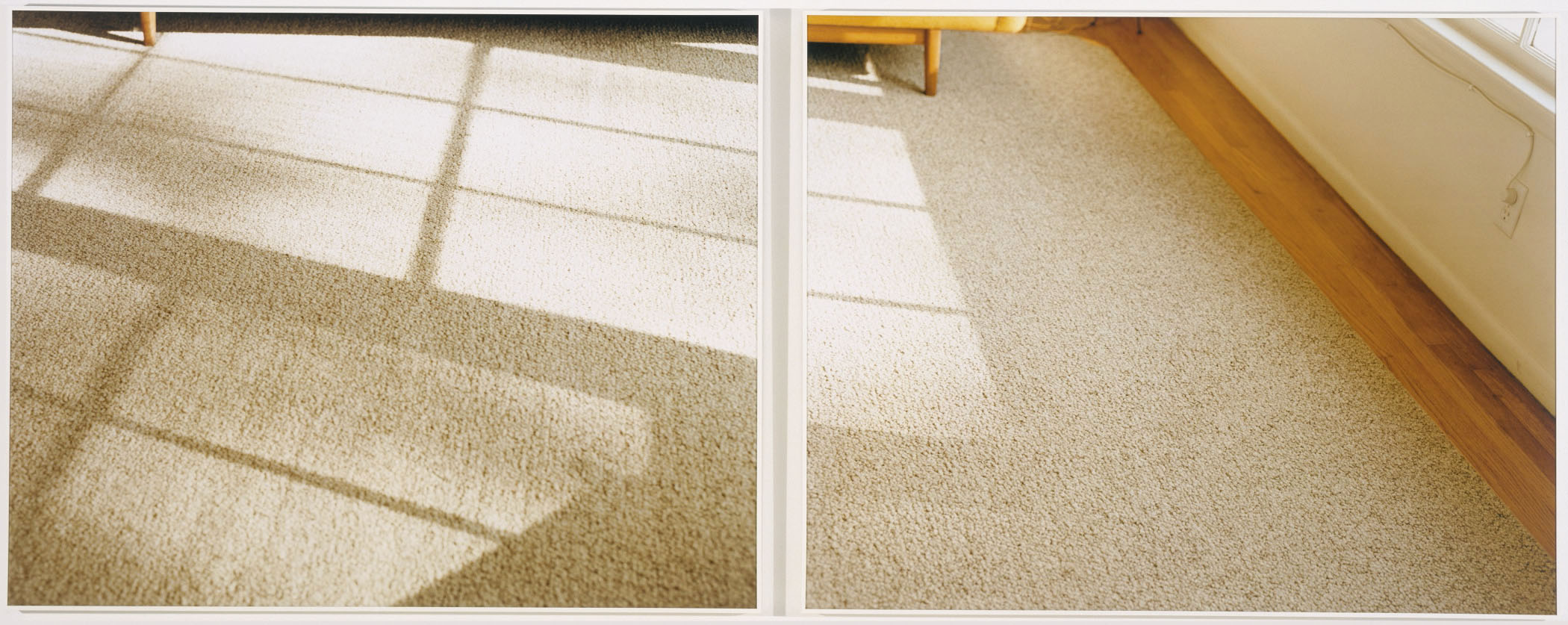
Uta Barth (German, b. 1958) 'Sundial (07.4)' 2007 from the exhibition 'Uta Barth: Peripheral Vision' at the J. Paul Getty Museum, Los Angeles, Nov 2022 - Feb 2023


Uta Barth (German, b. 1958)
Sundial (07.4)
2007
Chromogenic prints
Image (each): 76.2 x 71.7cm
Snite Museum of Art, University of Notre Dame, Humana Foundation Endowment for American Art
© Uta Barth


“Look beyond the facts
and you may discover,
there are new facts, that upon
careful examination
are not facts but assumptions.
The human eye is prejudiced.”

Drager Meurtant


Many thankx to the J. Paul Getty Museum for allowing me to publish the photographs in the posting. Please click on the photographs for a larger version of the image.


“To photograph in my home is a matter of convenience but it’s a way of saying that vision happens everywhere. Working with what’s around me all the time is to drive home that point and to get people to think about what is around them all the time, what is in the immediate environment.”


Uta Barth


“I consider the framing and mounting and display of the work to be a continuation of the work itself,” Barth says. “I look at the gallery space as a sculptural problem to solve. The space between pieces matters as much as the pieces themselves. Artwork, architecture and light – I want to give equal strength to all of those elements. From the beginning, I had to tell everyone [at the museum] this is not a collection of pictures. It’s an installation.” …

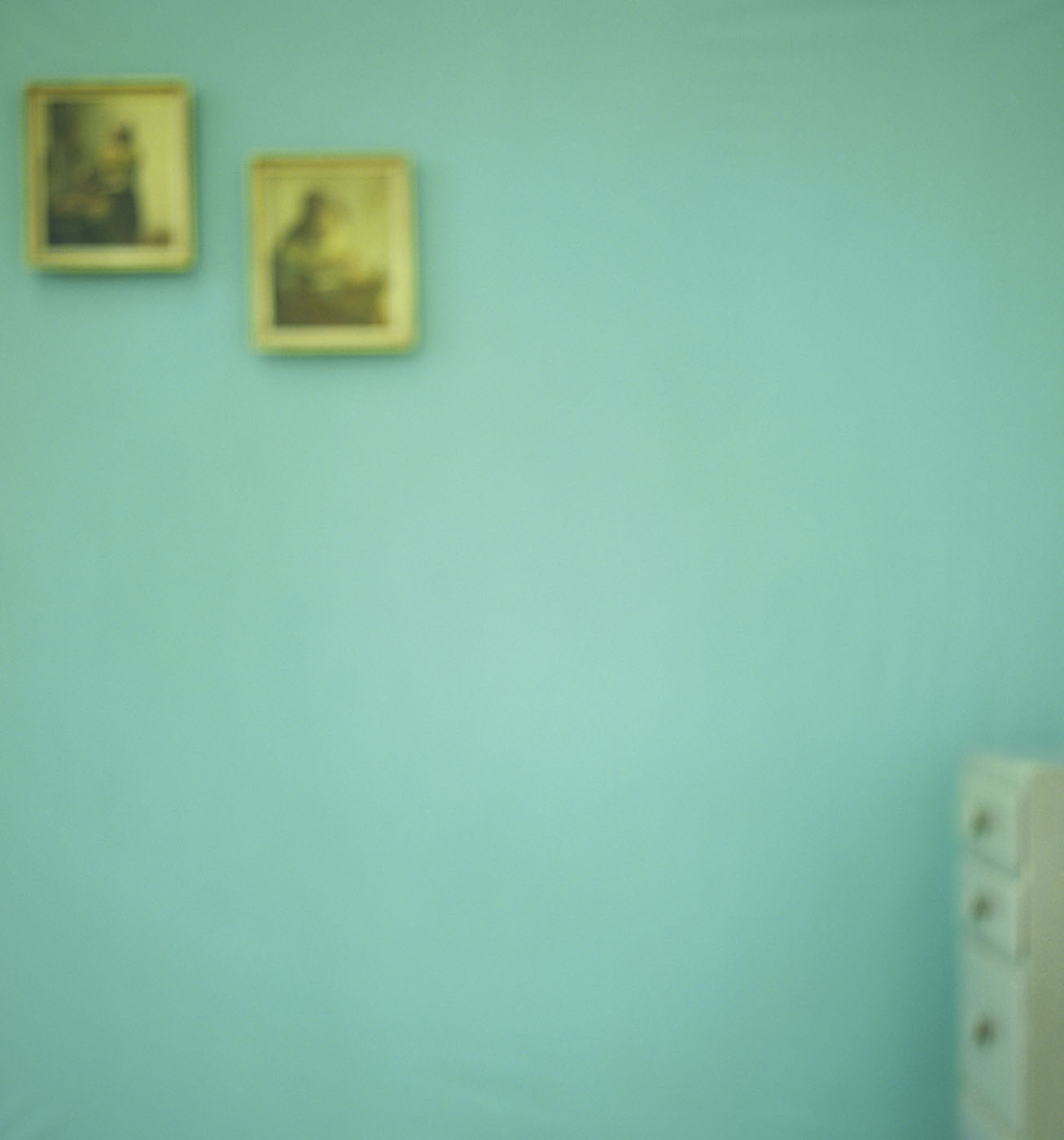
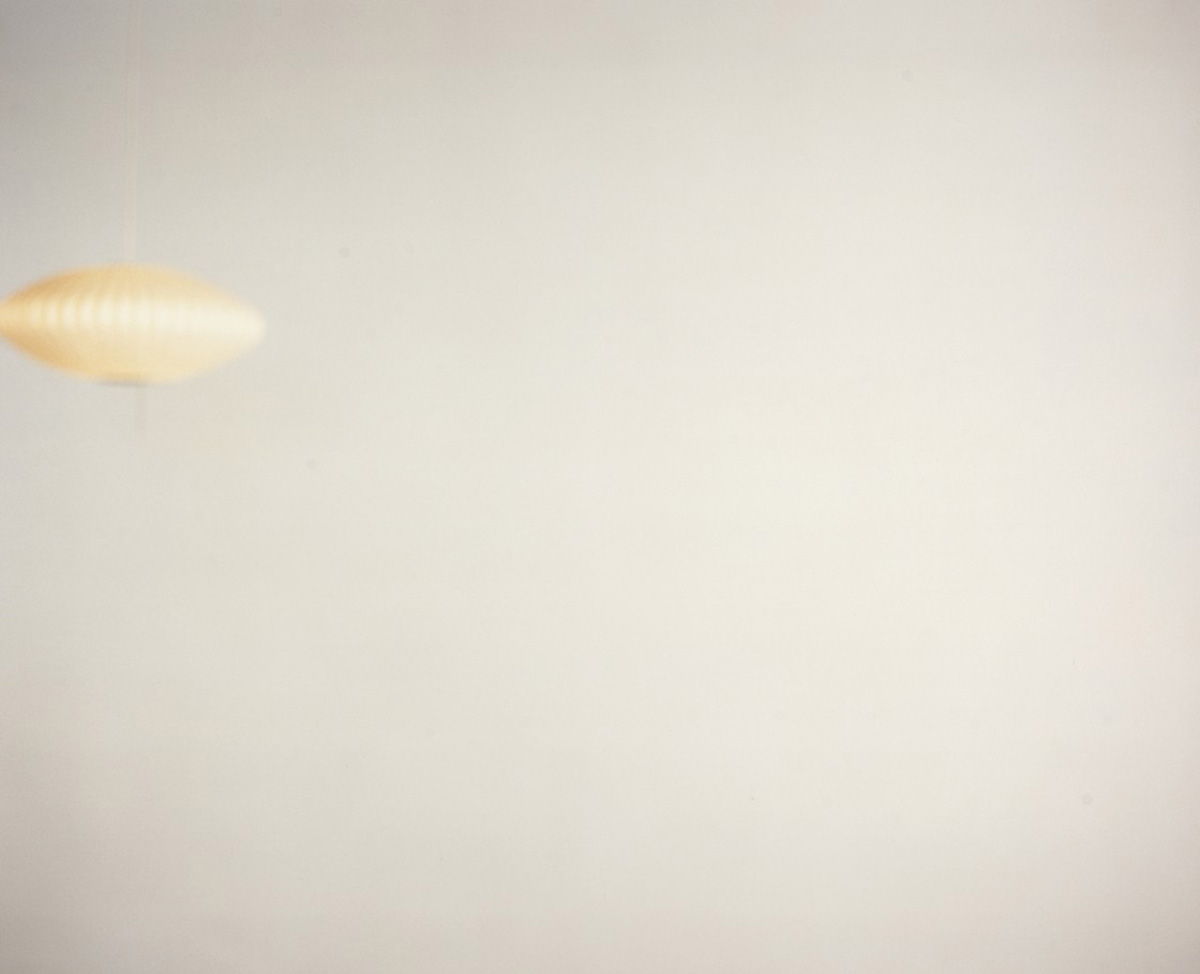
Barth unsettles the figure/ground relationship by assuming but omitting a clearly focused figure. What remains, and what Barth champions as plenty, is the ground. What conventionally would register as secondary becomes primary; the peripheral becomes all. These pictures aren’t out of focus, she has explained now for decades; rather, they are focused on the point unoccupied by that absent figure.


Utah Barth quoted in Leah Ollman. “For artist Uta Barth, learning to photograph is a way of learning to see,” on the Los Angeles Times website Dec 28, 2022 [Online] Cited 27/01/2023


Installation view of the exhibition 'Uta Barth: Peripheral Vision' at the J. Paul Getty Museum, Los Angeles showing from left to right, 'In the Light and Shadow of Morandi (17.12)', 2017; 'In the Light and Shadow of Morandi (17.03)', 2017; 'In the Light and Shadow of Morandi (17.06)'; 'Thinking about... In the Light and Shadow of Morandi', 2018; 'Untitled (17.01)', 2017


Installation view of the exhibition Uta Barth: Peripheral Vision at the J. Paul Getty Museum, Los Angeles

Left to right: In the Light and Shadow of Morandi (17.12), 2017. JPMorgan Chase Art Collection; In the Light and Shadow of Morandi (17.03), 2017. Courtesy of the artist; In the Light and Shadow of Morandi (17.06). Courtesy of the artist; 1301PE, Los Angeles; and Tanya Bonakdar Gallery, New York / Los Angeles; Thinking about… In the Light and Shadow of Morandi, 2018. Getty Museum; Untitled (17.01), 2017. Courtesy of the artist; 1301PE, Los Angeles; and Tanya Bonakdar Gallery, New York / Los Angeles. All works by and © Uta Barth


For more than forty years, Los Angeles-based artist Uta Barth (born in West Germany, 1958) has made photographs that investigate the act of looking. In her multipart works, she explores the ephemeral qualities of light and its ability to overwhelm and entirely destabilise human vision. In certain series, the repetition of motifs – including aspects of her home – creates a rhythm that suggests movement, carrying viewers from one image to the next. Barth also highlights photography’s abiding connection to the passage of time with her sequential images captured at intervals over a particular period.

This exhibition traces Barth’s career from her early experimentations as a student to later studies of the eye’s capabilities and the camera’s role in helping an artist translate visual information into a photograph. Barth’s most recent work is displayed here for the first time: a project commissioned in celebration of the Getty Center’s twentieth anniversary.


“Dated 1979-82 (2010), these small, square-format black and white prints are hung individually and in groups of up to sixteen sequenced images. They offer interesting and in some cases revelatory connections to aspects of Barth’s mature work, specifically her preoccupation with compositional framing and the behaviour of light, her depiction of everyday environments, and her use of the anonymous figure. For example, in the eleven-panel piece One Day, the artist documented a day’s progression of the shadow of an unnamed figure cast from light passing through a sliding glass door onto a vinyl floor. And, in the diptych Untitled #1, a figure stands adjacent to, then enters, a rectangle of shadow cast upon a white wall. While elements of the student work are echoed in to walk, they appear more overtly in other recent projects, such as Sundial (2007), which records the passage of light on an interior space as a temporally ambiguous series of perceptual shifts.”


Audrey Mandelbaum. “Uta Barth: …to walk without destination and see only to see,” X_TRA Winter 2010 Volume 13 Number 2 on the X_TRA website [Online] Cited 29/01/2023


Early Work

1978-1990

Works from the start of Barth’s career are multifaceted and experimental. They exemplify the fits and starts of a young artist trying to translate complex ideas into physical prints. At the University of California, Los Angeles (UCLA), where she earned her master’s degree in fine arts (1985), Barth was strongly influenced by theories of the “gaze,” or how the perceptions of individuals define power relations within social dynamics.

The artist’s body plays a central role in many of her works from the 1980s. In their exploration of the physical experience of being looked at or being blinded by light, some photographs are inherently confrontational. Others display words written directly on her skin that provoke questions or form the connective tissue of a sentence. By isolating these small elements of language, Barth rejected the possibility of creating a specific narrative, leaving us with an inscrutable fragmentary text. Devoid of greater context, the photographs appear to embrace the potential for ambiguity in both images and language.


Uta Barth (German, b. 1958) 'One Day' 1979, printed 2010
 from the exhibition 'Uta Barth: Peripheral Vision' at the J. Paul Getty Museum, Los Angeles, Nov 2022 - Feb 2023


Uta Barth (German, b. 1958)
One Day
1979, printed 2010
Pigment prints
Image (each): 26.7 x 21.6cm
Courtesy of the artist; 1301PE, Los Angeles; and Tanya Bonakdar Gallery, New York/Los Angeles
© Uta Barth


Uta Barth (German, b. 1958) 'Untitled #3' 1979-1982; printed 2010 from the exhibition 'Uta Barth: Peripheral Vision' at the J. Paul Getty Museum, Los Angeles, Nov 2022 - Feb 2023


Uta Barth (German, b. 1958)
Untitled #3
1979-1982; printed 2010
Pigment print
26.7 x 21.6cm
Courtesy of the artist; 1301PE, Los Angeles; and Tanya Bonakdar Gallery, New York/Los Angeles
© Uta Barth


Uta Barth (German, b. 1958) 'Untitled #5' 1979-1982; printed 2010


Uta Barth (German, b. 1958)
Untitled #5
1979-1982; printed 2010
Pigment print
26.7 x 21.6cm
Courtesy of the artist; 1301PE, Los Angeles; and Tanya Bonakdar Gallery, New York/Los Angeles
© Uta Barth


Uta Barth (German, b. 1958) 'Untitled' about 1990


Uta Barth (German, b. 1958)
Untitled
About 1990
Gelatin silver print
Courtesy of the artist; 1301PE, Los Angeles; and Tanya Bonakdar Gallery, New York/Los Angeles
© Uta Barth


“The principal reveal is that Barth belongs to a category all her own – one that begs definition but is cued by recalling that “camera” means “room”. Through a disciplined technique developed over years of training and teaching, Bart manipulates light and space to create rooms within rooms and, most interestingly, the illusion of a camera recording itself. Using for the most part her home as the world, with subjects extending from scattered or grouped household objects to clouds, branches and rooftops seen through a window, Barth has invented a new visual language – one that exercises an almost atrophied muscle, grown lazy by habit, which separately powers the eye and the brain to reveal how, not what the eye sees, and how the brain processes what is seen.

Her focus is neither on self (as with a portrait) nor on the object (as in a painting) but rather on how forms are perceived if the focus is shifted from the object to the surround. To achieve this skewed way of seeing – which the show titles (wrongly, I think) “peripheral vision” – Barth might focus her lens on an object placed where the viewer would stand, then remove it before shooting. The resulting blurry image doesn’t present as blurred (as do those of Gerhard Richter, William Klein and Rolf Sachs), but rather as the visual echo of a partially registered scene.” …

Random domestic items and studio ephemera slip out of the frame while registering what’s in it; the surround overtakes the centre; spaces are left for the viewer to complete; and although Barth’s serial works sequence from one image to the next, unlike film they resist narrative. The Getty’s photography curator Arpad Kovacs’s brilliant staging heeds her injunction to mount the work as an installation rather than a photography show to encourage the eye to focus separately on each image, and even the modestly scaled works to command their space. …

Such is the rigour of Barth’s technique, now fully adept at portraying the ground behind the subject, and adapted to the self-imposed limitations of portraying virtually nothing outside her living and workspace, that even the few literal images of domestic objects tweak perception, and even the longer series, though unavoidably filmic, are so charged with atmosphere as to resist narrative.

Most magical are the rhythmic forms seemingly sculpted with light into both waves and still-lives. In this sense, at her core, Barth is an environmentalist, creating a charged electrical field from light, shadow and her deceptive take on focus. …

The biggest takeaway is the revelation of what, in the hands of a master, the camera can do: namely, break the frame or create an artificial one; create the optical effect of an after-image left after looking into headlights; position the viewer both in front of and inside the scene, choreograph a lit surface to create rhythm, and, most radically, manipulate light to brain-shift perception. Realising Barth’s career goal of “how to get someone to think about thinking, not about what they’re looking at”, the blurred or serial images achieved with subtle interventions of light, camera angles and removing the focused-on object create palimpsests of the absent to produce a truly new way of seeing.

Jill Spalding. “Uta Barth: Peripheral Vision,” on the Studio International website 9th January 2023 [Online] Cited 27/01/2023


Perceptual Shift: Thoughts on the Photographs of Uta Barth

Los Angeles-based photographer Uta Barth has spent her career exploring subtle changes of light as it illuminates various surfaces, documenting the passage of time, and investigating the differences between how the human eye and the camera perceive the world. In this conversation, curators and critics Russell Ferguson and Jan Tumlir discuss major themes and motifs in Barth’s work and delve into the ways she approaches her artistic practice. Moderated by Getty curator Arpad Kovacs, the conversation also explores her most significant sources of inspiration and her years as an educator in Southern California.

Speakers

Russell Ferguson is a curator and a writer. Formerly a curator at the Museum of Contemporary Art, Los Angeles; chief curator at the Hammer Museum, Los Angeles; and a professor at the University of California, Los Angeles, he has organized many solo and group exhibitions.

Arpad Kovacs (moderator) is an assistant curator in the Department of Photographs at the Getty Museum. His exhibitions focus on 20th-century and contemporary photography, with a specific interest in conceptual practices.

Jan Tumlir is an art writer, teacher, and curator who lives in Los Angeles. He is a founding editor of the local art journal X-TRA and a regular contributor to Artforum.


Uta Barth’s Atmospheric Photographs

“The camera sort of teaches you to see in a really different way and to experience your environment in a different way, and to pay attention to the act of looking.”

Photographer Uta Barth’s photographs focus on the act of looking. She has long been interested in creating images in which there is no discernable subject, but rather the image or light itself is the subject. Barth’s conceptual photographs examine how we see and how we define foreground and background. Her series are often long-term engagements; she photographs the same place over many months, or even years, to understand how light changes a space over time. She recently completed a series at the Getty Center taken over the course of a year and comprising over 60,000 images. Barth has received fellowships from the National Endowment for the Arts, the Guggenheim Memorial Foundation, and the MacArthur Foundation.

In this episode, Barth discusses her approach to making images through several of her bodies of work including Ground, Figure, and her new Getty series. Her career will be the subject of a retrospective at the Getty Center in fall 2022.


Uta Barth

Modern Art Notes Podcast


Ground

1994-1997

In this series, Barth focused on an unoccupied plane in space, resulting in photographs that appear blurry and make ordinary places and objects appear elusive and ultimately hard to discern. Slivers of architectural details and furnishings are occasionally evident in the images of interior spaces from 1994, but these prints yield little narrative information.

A single photograph in the gallery, Ground #52, presents the central subject, the top of a sofa, in clear focus. Displayed amid prints that make use of blur, this work suggests that crisp detail invites quick glances, while images that are more difficult to understand slow the viewer down. By removing the traditional subject, the artist creates photographs that are more atmospheric than descriptive, encouraging us to consider the very act of looking.


Uta Barth (German, b. 1958) 'Ground #30' 1994


Uta Barth (German, b. 1958)
Ground #30
1994
Chromogenic print
55.7 x 45.6cm
Collection Lannan Foundation
© Uta Barth


Uta Barth (German, b. 1958) 'Ground #41' 1994


Uta Barth (German, b. 1958)
Ground #41
1994
Chromogenic print
Mount: 28.6 x 26.7 x 4.8cm
Burt and Jane Berman
© Uta Barth


Uta Barth (German, b. 1958) 'Ground #42' 1994


Uta Barth (German, b. 1958)
Ground #42
1994
Chromogenic print
Mount: 28.6 x 26.7 x 4.8cm
The Eileen Harris Norton Collection
© Uta Barth


“For an in-depth discussion of the phenomenological aspects of Barth’s work, see Pamela M. Lee’s “Uta Barth and the Medium of Perception,” in Pamela lee, Matthew Higgs, and Jeremy Gilbert-Rolfe, eds., Uta Barth (London: Phaidon Press, 2004), 36-97.”

Audrey Mandelbaum. “Uta Barth: …to walk without destination and see only to see,” on the X_TRA website Winter 2010 Volume 13 Number 2


phenomenological meaning:

relating to the science of phenomena as distinct from that of the nature of being.

denoting or relating to an approach that concentrates on the study of consciousness and the objects of direct experience.


Uta Barth (German, b. 1958) 'Ground #44' 1994


Uta Barth (German, b. 1958)
Ground #44
1994
Chromogenic print
99.7 x 121.9cm
The Museum of Contemporary Art, Los Angeles
Purchase with funds provided by Nancy Escher, Nowell J. Karten, Tom Peters, Pieter Jan Brugge and Anna Boorstin, Janice Miyahira and Duff Murphy, Joe Rosenberg, Bernard and Peggy Lewak, Patricia Marshall and an anonymous donor
© Uta Barth


Uta Barth (German, b. 1958) 'Ground #58' 1994


Uta Barth (German, b. 1958)
Ground #58
1994
Pigment print
24.1 x 30.5 x 4.4cm
The J. Paul Getty Museum, Los Angeles
© Uta Barth


Field

1995-1996

In the 1990s Barth deliberately blurred the focus of her camera to create images that destabilise the viewer’s expectation of a photograph.

The atmospheric urban scenes depicted in the Field series relate to film production stills like those used in storyboards. Barth has likened the works to location scouting, an activity closely associated with Los Angeles and the film industry. Rather than literal descriptions of specific places, these photographs are suggestive of a mood.


Uta Barth (German, b. 1958) 'Field #8' 1995


Uta Barth (German, b. 1958)
Field #8
1995
Chromogenic print
58.5 x 73cm
Magasin III Museum for Contemporary Art, Stockholm
© Uta Barth


Uta Barth (German, b. 1958) 'Field #9' 1995


Uta Barth (German, b. 1958)
Field #9
1995
Chromogenic print
58.4 x 73cm
The Museum of Contemporary Art, Los Angeles
Gift of Councilman Joel Wachs
© Uta Barth


Uta Barth (German, b. 1958) 'Field #19' 1996


Uta Barth (German, b. 1958)
Field #19
1996
Chromogenic print
58.5 x 73cm
Magasin III Museum for Contemporary Art, Stockholm
© Uta Barth


……………………in passing.”,

1995-1997

In the mid-1990s Barth made ……………………in passing.”, a portfolio of images torn from magazines that she cropped to isolate out-of-focus backgrounds, thereby pushing the figures to the edges of the frame. The results highlight backgrounds containing little discernible information, emphasising the importance of details along the periphery.


Uta Barth (German, b. 1958) '........................in passing.”,' 1995-1997


Uta Barth (German, b. 1958)
……………………in passing.”,
1995-1997
Lithographs
Sheet (each): 32.4 x 28.6cm
Collection UCLA Grunwald Center for the Graphic Arts, Hammer Museum
Gift of Randall and Jennifer Green
© Uta Barth


Uta Barth (German, b. 1958) '...............................in passing."' 1995-1997


Uta Barth (German, b. 1958)
………………………….in passing.”,
1995-1997
Lithograph
Sheet (each): 32.4 x 28.6cm
Collection UCLA Grunwald Center for the Graphic Arts, Hammer Museum
Gift of Randall and Jennifer Green
© Uta Barth


Uta Barth (German, b. 1958) '...............................in passing."' 1995-1997


Uta Barth (German, b. 1958)
………………………….in passing.”,
1995-1997
Lithograph
Sheet (each): 32.4 x 28.6cm
Collection UCLA Grunwald Center for the Graphic Arts, Hammer Museum
Gift of Randall and Jennifer Green
© Uta Barth


Uta Barth (German, b. 1958) '...............................in passing."' 1995-1997


Uta Barth (German, b. 1958)
………………………….in passing.”,
1995-1997
Lithograph
Sheet (each): 32.4 x 28.6cm
Collection UCLA Grunwald Center for the Graphic Arts, Hammer Museum
Gift of Randall and Jennifer Green
© Uta Barth


Untitled

1998

The untitled diptychs present an almost stereoscopic view of outdoor spaces. In this series Barth sought for the first time to render a delayed visual reaction through sequential images. The works represent the moment when we passively perceive the world and catch sight of a detail that briefly holds our interest, compelling us to look again. Barth’s second image, made minutes or even hours later, is never the same as the first.


Uta Barth (German, b. 1958) 'Untitled (98.2)' 1998


Uta Barth (German, b. 1958)
Untitled (98.2)
1998
Chromogenic prints
Image each: 114.3 x 144.8cm
Lent by The Metropolitan Museum of Art
Purchase, The Horace W. Goldsmith Foundation Gift, through Joyce and Robert Menschel
© Uta Barth


…and of time

2000

In 2000 the Getty Museum invited eleven artists to create works in response to art in the collection. Barth found inspiration in Claude Monet’s Wheatstacks, Snow Effect, Morning, 1891, a painting that demonstrates the role of light in altering the perception and appreciation of a subject. In a series of multipart photographs, she examined the daylight streaming through her living room window, producing variations on the scene of a sparsely appointed interior bathed in warm, soft light. The series underscores how prolonged observation, especially of our immediate surroundings, prompts a nuanced understanding of the mundane.


Uta Barth (German, b. 1958) '...and of time (aot 2)' 2000


Uta Barth (German, b. 1958)
…and of time (aot 2)
2000
Chromogenic prints
Image (each): 89.5 x 112.4cm
Collection Buffalo AKG Art Museum
Norman E. Boasberg Art Fund, 2001
© Uta Barth

Uta Barth (German, b. 1958) '...and of time (aot 4)' 2000


Uta Barth (German, b. 1958)
…and of time (aot 4)
2000
Chromogenic prints
Image (each): 88.9 x 114.3cm
J. Paul Getty Museum, Los Angeles
© Uta Barth


Uta Barth (German, b. 1958) '...and of time (aot 5)' 2000


Uta Barth (German, b. 1958)
…and of time (aot 5)
2000
Chromogenic prints
Image (each): 88.9 x 111.8cm
Yale University Art Gallery
Purchase with the Kanet and Simeon Braguin Fund and with a gift from The Walsh Charitable Fund of the Ayco Charitable Foundation
© Uta Barth


“A key point made in much writing about Barth’s work, including her own reflections, is the relative unimportance of the actual objects before her camera. In the suite white blind (bright red) (2002), for example, an image of tree branches against sky outside of Barth’s house is repeated multiple times. Each iteration represents a shift in perception that might occur over the course of a prolonged stare.”


Audrey Mandelbaum. “Uta Barth: …to walk without destination and see only to see,” X_TRA Winter 2010 Volume 13 Number 2 on the X_TRA website [Online] Cited 29/01/2023


white blind (bright red)

2002

During a period of bed rest following an illness, Barth found herself looking out the window at power lines and gnarled tree branches visible against a clear blue sky. The experience of prolonged staring at this dense network of interconnected lines resulted in optical fatigue. When she closed her eyes, the lingering afterimages captured her imagination.

Inspired by this experience, Barth rendered the subjects in a highly schematic manner, occasionally reducing individual limbs to thin linear forms. These photographs oscillate between faithful description and an intentionally distorted view that suggests the deterioration of vision.

By interspersing certain frames with planes of nearly solid colour and images in which tonalities are digitally inverted, Barth created a dreamlike state in which crisp details and bursts of colour are equally disorienting.


Uta Barth (German, b. 1958) 'white blind (bright red) (02.2)' 2002


Uta Barth (German, b. 1958)
white blind (bright red) (02.2)
2002
Chromogenic prints
Image (each): 54.2 x 66.4cm
Courtesy of the artist; 1301PE, Los Angeles; and Tanya Bonakdar Gallery, New York / Los Angeles
© Uta Barth


Uta Barth (German, b. 1958) 'white blind (bright red) (02.10)' 2002; printed 2006


Uta Barth (German, b. 1958)
white blind (bright red) (02.10)
2002; printed 2006
Pigment prints
Image (each): 54.2 x 67.3cm
Hans Nefkens H + F Collection
© Uta Barth


Uta Barth (German, b. 1958) 'white blind (bright red) (02.12)' 2002


Uta Barth (German, b. 1958)
white blind (bright red) (02.12)
2002
Chromogenic prints
Image (each): 54 x 66.4cm
Courtesy of the artist; 1301PE, Los Angeles; and Tanya Bonakdar Gallery, New York / Los Angeles
© Uta Barth


Uta Barth (German, b. 1958) 'white blind (bright red) (02.13)' 2002


Uta Barth (German, b. 1958)
white blind (bright red) (02.13)
2002
Chromogenic prints
Image (each): 54 x 67.3cm
Magasin III Museum for Contemporary Art, Stockholm
© Uta Barth


Sundial

2007

Observing the movement of shadows is a long-standing, universal method of tracking the sun’s progress across the sky. It is also an important way of situating oneself temporally and spatially. Exploring the passage of time in her immediate environment by photographing shadows has been a primary concern of Barth’s for over twenty years.

The photographs in Barth’s Sundial series were most often made at dusk, sometimes minutes apart. They capture the various qualities of fading light as it streamed through the windows of Barth’s home, bathing the interior in a warm glow. The palette alternates between soft, alluring colours and jarring inversions of hues. The transformed scenes suggest moments of visual disengagement and the afterimages that appear when we close our eyes yet continue to see a version of what we have just witnessed.


Uta Barth (German, b. 1958) 'Sundial (07.6)' 2007


Uta Barth (German, b. 1958)
Sundial (07.6)
2007
Chromogenic prints
Image (each): 76.2 x 95.3cm
Los Angeles County Museum of Art
Gift of John Baldessari with additional support provided by the Ralph M. Parsons Fund
© Uta Barth


…and to draw a bright white line with light

2011

In this series, Barth manipulated light to “draw” lines that she then photographed. After noticing a horizontal sliver of light on the diaphanous curtains in her bedroom, she began to manoeuvre the fabric, altering the shape of the beam, which grew in width in the waning hours of the day. By sequencing the panels to show ever-widening bands of light, she made the passage of time palpable.

The presence of Barth’s hand in one panel reintroduces the artist’s body into her work, after it had been largely absent for over twenty years


Uta Barth (German, b. 1958) '...and to draw a bright white line with light (11.2)' 2011; printed 2021


Uta Barth (German, b. 1958)
…and to draw a bright white line with light (11.2) (details)
2011; printed 2021
Pigment prints
Image (each): 96.5 x 143.5cm
J. Paul Getty Museum, Los Angeles
© Uta Barth


Uta Barth (German, b. 1958) '...and to draw a bright white line with light (11.2)' (detail) 2011; printed 2021


Uta Barth (German, b. 1958)
…and to draw a bright white line with light (11.2) (detail)
2011; printed 2021
Pigment prints
Image (each): 96.5 x 143.5cm
The J. Paul Getty Museum, Los Angeles
© Uta Barth


Compositions of Light on White

2011

In her home, Barth observed rectilinear shapes of light cast on a set of closet doors. She strategically opened and closed the window shades to manipulate blocks of light and shadow, organising them into a pictorial composition.

Over the last decade, Barth has repeatedly drawn inspiration from twentieth-century painters, with a specific interest in artists who continually returned to a motif or method of creation. This series shows the influence of geometric abstraction as developed by the Modernist Dutch painter Piet Mondrian (1872-1944).


Uta Barth (German, b. 1958) 'Compositions of Light on White (Composition #9)' 2011


Uta Barth (German, b. 1958)
Compositions of Light on White (Composition #9)
2011
Pigment print
Framed: 96.8 x 99.2cm
Courtesy of the artist; 1301PE, Los Angeles; and Tanya Bonakdar Gallery, New York / Los Angeles
© Uta Barth


Uta Barth (German, b. 1958) 'Compositions of Light on White (Composition #12)' 2011


Uta Barth (German, b. 1958)
Compositions of Light on White (Composition #12)
2011
Pigment print
45.4 x 52.1cm
Sharyn and Bruce Chamas
© Uta Barth


Untitled

2017

Each composition in this series is divided into three parts. At the top is a long, narrow band of windows, often reflecting fragments of tree branches or a cloudless sky. Along the bottom is a thin band of gravel. An expansive white surface in the centre reveals the uneven texture of the rough-hewn plaster wall of Barth’s studio, illuminated by Southern California’s peculiarly bright sunlight. The imperfections in this area chart the wall’s retention of moisture over an extended period of dry heat. The surfaces bring to mind the Minimalist canvases of the American painter Robert Ryman (1930-2019), whose career was dedicated primarily to exploring the sheer diversity of tone that could be achieved with white paint.


Uta Barth (German, b. 1958) 'Untitled (17.05)' 2017


Uta Barth (German, b. 1958)
Untitled (17.05)
2017
Pigment print
Framed: 192.4 x 164.8cm
Courtesy of the artist; 1301PE, Los Angeles; and Tanya Bonakdar Gallery, New York / Los Angeles
© Uta Barth


In the Light and Shadow of Morandi

2017

The prints in this series are awash with colourful refractions and stark shadows of glass vessels. As the title suggests, this body of work is an homage to the canvases of the Italian painter Giorgio Morandi (1890-1964), whose still lifes often feature humble domestic containers rendered in a manner that emphasises their sculptural forms.

To capture the shadow of the vessels without including her own silhouette in the frame, Barth positioned the camera at an extreme angle and later digitally corrected the distortion. The unconventional shape of these works is the result of parallax, which occurs when an object’s position appears to change depending on the vantage point of the viewer.


Uta Barth (German, b. 1958) 'In the Light and Shadow of Morandi (17.12)' 2017


Uta Barth (German, b. 1958)
In the Light and Shadow of Morandi (17.12)
2017
Pigment print
Framed: 123.8 x 134 x 5.1cm
JP Morgan Chase Art Collection
© Uta Barth


UB
This spring I will do a solo show with Galeria Elvira González in Madrid. Aside from that I have started on a project titled In the light and shadow of Morandi. I am fascinated by his work, by his relentless repetition of the same subject matter, in order to talk about composition and painting itself. I share this fascination and this use of repetition in much of my own work. So I am playing around with these repetitive still lifes, but I am only photographing the shadows they cast. I want the image to be deferred, and as in the recent projects, I want to draw with light, the refraction of light as it moves through glass and liquids, to draw with shadow, and again, to use light as the subject in and of itself.

SM
That makes me think of the series called From My Window by André Kertész … do you look at him at all?

UB
I think more about a Robert Frank photograph I love. It is part of The Americans and is a view from a window onto the rooftops of the town [View from hotel window – Butte, Montana, 1956 below]. He moved the camera back to include the curtains of the window he is looking out of and thereby moved the attention to himself as the onlooker, rather than just the scene itself. It is a small move, yet it totally changes the reading of the image. I have used that same move in much of my work.

Sabine Mirlesse. “Light, Looking: Uta Barth by Sabine Mirlesse,” on the BOMB website Mar 22, 2012 [Online] Cited 29/01/2023


Robert Frank (Swiss, 1924-2019) 'View from hotel window – Butte, Montana' 1956


Robert Frank (Swiss, 1924-2019)
View from hotel window – Butte, Montana
1956
Gelatin silver print


Uta Barth (German, b. 1958) 'In the Light and Shadow of Morandi (17.03)' 2017


Uta Barth (German, b. 1958)
In the Light and Shadow of Morandi (17.03)
2017
Pigment print
Framed: 123.8 x 134cm
Courtesy of the artist
© Uta Barth


Uta Barth (German, b. 1958) 'Thinking about... In the Light and Shadow of Morandi,' 2018


Uta Barth (German, b. 1958)
Thinking about… In the Light and Shadow of Morandi,
2018
Pigment print
Framed: 78.7 x 78.7cm
The J. Paul Getty Museum, Los Angeles
© Uta Barth


…from dawn to dusk.

2022

Commissioned to make a work in celebration of the Getty Center’s twentieth anniversary, Barth created a multi-panel project responding to the architect Richard Meier’s complex structure. Her tightly formed, gridded installation references the square panels that adorn the Center’s facade, while individual images capture the architecture’s way of amplifying light and casting shadows, which animates parts of the campus as the sun moves across the sky.

Twice a month for a year, the artist set up her camera to make exposures every five minutes from dawn until dusk. Alternating between clear representations of a specific location – an entrance to the Harold M. Williams Auditorium – and atmospheric renderings characterised by soft focus and inverted colours, the work reacts to the sense of overwhelming brightness reflected by the travertine and painted-aluminium surfaces of the site. Barth has described the intensity of this light, enhanced by the architect’s choice of materials, as “viscerally disorienting.” Prints with inverted colours evoke the experience of afterimages, the optical phenomenon of continuing to see a version of what you just witnessed after closing your eyes.

Press release from the J. Paul Getty Museum website


Uta Barth (German, b. 1958) '...from dawn to dusk (December)' 2022


Uta Barth (German, b. 1958)
…from dawn to dusk (December)
2022
Pigment print
Dimensions variable
Courtesy of the artist; 1301PE, Los Angeles; and Tanya Bonakdar Gallery, New York/Los Angeles
© Uta Barth


The J. Paul Getty Museum
1200 Getty Center Drive
Los Angeles, California 90049

Opening hours:
Daily 10am – 5pm

The J. Paul Getty Museum website

LIKE ART BLACK ON FACEBOOK

Back to top

Exhibition: ‘Timm Rautert and the Lives of Photography’ at Museum Folkwang, Essen

Exhibition dates: 19th February – 16th May, 2021


Timm Rautert (German, b. 1941) 'Tokaido Express, Tokyo' 1970 from the exhibition 'Timm Rautert and the Lives of Photography' at Museum Folkwang, Essen, Feb - May, 2021


Timm Rautert (German, b. 1941)
Tokaido Express, Tokyo
1970
Gelatine silver print
45.5 x 59cm
Museum Folkwang
© Timm Rautert


What an admirable artist.

Unfortunately with a limited number of media images available one cannot cover in any depth the many bodies of work of this fine artist. I would have liked to have seen more photographs from Rautert’s series The Amish and The Hutterites, and some photographs from his series on Thalidomide victims (none are available anywhere online). Very few of his portraits (only two are included here) or homeless series are available as well.

Particularly intriguing is work from the series Image-Analytical Photography in which Rautert explores “the fundamental conditions of photographic work – from the photographic act and the development of photographic images under an enlarger in the lab to the various possibilities of presentation”, using “black-and-white photographs, passport photos, lab experiments, combinations of selected photo prints with their negatives … but also non-photographic material such as a grey card (used for measuring light mainly in photo studios), postcards and graphic manuals” in order to understand “what photography means as a medium, what is expected from it, and how it has shaped the perception of the world.” Very few of these investigative images can be found online and only two are included in this posting. The second is a cracker.

Through the simple expedient of turning the camera upside down and photographing himself doing it coupled with the photographic outcome of the resulting picture we – the viewer, the looker, the seeker (of “truth”) – are so eloquently made aware that the camera is a machine, that it has a monocular perspective, and that every photo the camera takes is a construct. As Rautert asks in the quote below, “what is photography? what is light? what is time? what is space? how does one tell great stories? what means what?”

An excellent example of this enquiry is the series Gehäuse des Unsichtbaren (Houses of the Invisible) which depicts “working environments in the automobile and computer industries, creating a long-term chronicle of the transformation of the workplace in the wake of industrial automation.” In these conceptual but documentary, applied but artistic photographs, the human is masked, occluded and / or dwarfed by the humungous complexity and size of the machine – becoming an invisible attendant (a small cog in the wheel) of the mighty mechanism (think Metropolis, 1927). A solid story with a social and conceptual form.

There seems to be a strong eye and a whip sharp mind at work here: inquiring and questioning, ethical and creative, telling great stories through the lives of photography. An admirable artist indeed.

Dr Marcus Bunyan


Many thankx to Museum Folkwang Essen for allowing me to publish the photographs in the posting. Please click on the photographs for a larger version of the image.


“I thought to myself: what is photography actually? What is it really?
I decided to develop a kind of grammar for photography:
What is light? What is time? What is space?
How does one tell great stories?
What means what?”


Timm Rautert


“Timm Rautert’s work forges links between applied and artistic photography. It reflects man in his time as much as the worlds created by man: the factories and machines, cultural highlights and the social fringe, heaven and hell of modern society. For many years Rautert has worked as a socially critical photographer and engaged himself in different long term projects.”


Till May 16, 2021, Museum Folkwang presents a comprehensive retrospective of photographer Timm Rautert’s oeuvre. The exhibition Timm Rautert and the Lives of Photography spans five decades of his artistic production: beginning with Rautert’s experimental early work as a student of Otto Steinert, it shows his famous portrait series such as “Deutsche in Uniform (Germans in Uniform)” or “Eigenes Leben (Own Life),” as well as his artwork collages and his 2015 photographic installation work L’Ultimo Programma. The nearly 400 works illustrate not only the thematic and methodological versatility of Rautert’s oeuvre, but can also be read as documents of photography’s long journey into the museum and the art canon.


Installation view of the exhibition 'Timm Rautert and the Lives of Photography' at Museum Folkwang, Essen

Installation view of the exhibition 'Timm Rautert and the Lives of Photography' at Museum Folkwang, Essen

Installation view of the exhibition 'Timm Rautert and the Lives of Photography' at Museum Folkwang, Essen showing at left, photographs from The Final Program, Campo S. Angelo, Venezia (2014)


Installation views of the exhibition Timm Rautert and the Lives of Photography at Museum Folkwang, Essen showing at bottom left, photographs from The Final Program, Campo S. Angelo, Venezia (2014)
Fotos: Jens Nober


Timm Rautert (German, b. 1941) 'The Final Program, Campo S. Angelo, Venezia' 2014 from the exhibition 'Timm Rautert and the Lives of Photography' at Museum Folkwang, Essen, Feb - May, 2021


Timm Rautert (German, b. 1941)
The Final Program, Campo S. Angelo, Venezia
2014
Black and white photograph, bromide silver gelatine
Sheet size 50.8 x 40.5cm


Timm Rautert (German, b. 1941) 'The Final Program, Campo S. Angelo, Venezia' 2014


Timm Rautert (German, b. 1941)
The Final Program, Campo S. Angelo, Venezia
2014
Black and white photograph, bromide silver gelatine
Sheet size 50.8 x 40.5cm


To mark the 80th birthday of the photographer Timm Rautert, Museum Folkwang is organising a comprehensive retrospective covering half a century of his artistic work.

Timm Rautert (born in 1941 in Tuchola, then West Prussia) is considered one of Germany’s preeminent contemporary photographers. Over the decades he has succeeded not only in anticipating the most important trends in photography, but has also played a major role in shaping them: as a studio photographer for galleries, as a photojournalist, as a chronicler of changing work environments and, finally, as a university lecturer, he has influenced ensuing generations.

As a student under Otto Steinert at what was then the Folkwangschule in Essen-Werden, Rautert quickly developed solid foundations for a committed, social-documentary photography. Alongside this, he explored the fundamentals of photography and developed his “image-analysis photography”, which has methodically permeated his artistic work to this day. For Rautert, alternating between applied and artistic elements is not a contradiction, but an expression of resolute photographic authorship.

In 1970, Rautert travelled to the USA and photographed figures such as Franz Erhard Walther, Andy Warhol and Walter de Maria. In Osaka, he documented the World’s Fair and the deeply traditional Japanese society of the time. From the mid-1970s, Rautert worked together with the journalist Michael Holzach on joint reportages for ZEITMagazin. For over a decade he produced social documentary reportages on migrant workers, the homeless, or previously inaccessible communities like The Hutterites (1978) and The Amish (1974).

In the 1980s, Rautert turned to documenting working environments in the automobile and computer industries, creating a long-term chronicle of the transformation of the workplace in the wake of industrial automation. Around 70 photographs from the series Gehäuse des Unsichtbaren (Houses of the Invisible) with photographs of research and manufacturing sites such as the Max Planck Institute (1988) or Siemens AG (1989) are being presented for the first time in a digital double projection, which Rautert developed specially for the exhibition at Museum Folkwang.

Artist portraits have been a recurring theme in Rautert’s work; his first was that of the Czech photographer Josef Sudek made for an exhibition of work by Otto Steinert and his students. It was followed by portraits of Otl Aicher, Pina Bausch, André Heller, Jasper Morrison and Éric Rohmer. Rautert focused not only on the subject, but also on their surroundings and actions; capturing their sphere of influence as part of their identity.

After being appointed professor of photography at the Hochschule für Grafik und Buchkunst Leipzig (1993-2008), Rautert dedicated himself to his own work. His focus is on re-examining, restructuring and reshooting past projects. His students include Viktoria Binschtok, Falk Haberkorn, Harry (Grit) Hachmeister, Margret Hoppe, Sven Johne, Ricarda Roggan, Adrian Sauer, Sebastian Stumpf and Tobias Zielony.

In 2008, Timm Rautert was the first photographer to receive the Lovis Corinth Prize for his life’s work.

Text from the Museum Folkwang website [Online] Cited 18/04/2021


Installation view of the exhibition 'Timm Rautert and the Lives of Photography' at Museum Folkwang, Essen showing photographs from 'Deutsche in Uniform' (1974)


Installation view of the exhibition Timm Rautert and the Lives of Photography at Museum Folkwang, Essen showing photographs from Deutsche in Uniform (1974)
Fotos: Jens Nober


Timm Rautert (German, b. 1941) 'Liane Schneider, 33, Ground Hostess, Deutsche Lufthansa' 1974


Timm Rautert (German, b. 1941)
Liane Schneider, 33, Ground Hostess, Deutsche Lufthansa
1974
From Germans in Uniform
C-Print
28.7 x 22cm
Courtesy of the Artist
© Timm Rautert


Timm Rautert (German, b. 1941) 'Otto Koniezny, 39 Jahre, Bundesbahnschaffner' (Federal Railroad conductor) From the series 'Deutsche in Uniform' 1974


Timm Rautert (German, b. 1941)
Otto Koniezny, 39 Jahre, Bundesbahnschaffner (Federal Railroad conductor)
From the series Deutsche in Uniform
1974
© Timm Rautert


Timm Rautert (German, b. 1941) 'Fräulein Monika Powileit, 33 Jahre, Diakonieschwester' (deaconry sister) From the series 'Deutsche in Uniform' 1974


Timm Rautert (German, b. 1941)
Fräulein Monika Powileit, 33 Jahre, Diakonieschwester (deaconry sister)
From the series Deutsche in Uniform
1974
© Timm Rautert


Timm Rautert (German, b. 1941) 'Herr Konrad Benden, 61 Jahre, Tambourmajor im Stadttambourchor, St. Maximilian 04, Düsseldorf' (drum major in the city drum choir, St. Maximilian 04, Düsseldorf) From the series 'Deutsche in Uniform' 1974


Timm Rautert (German, b. 1941)
Herr Konrad Benden, 61 Jahre, Tambourmajor im Stadttambourchor, St. Maximilian 04, Düsseldorf (drum major in the city drum choir, St. Maximilian 04, Düsseldorf)
From the series Deutsche in Uniform
1974
© Timm Rautert


Timm Rautert (German, b. 1941) 'Herr Werner Kudszus, 47 Jahre, Oberstleutnant, Kommandeur eines Feldjägerbataillons' (Lieutenant Colonel, commander of a military police battalion) From the series 'Deutsche in Uniform' 1974


Timm Rautert (German, b. 1941)
Herr Werner Kudszus, 47 Jahre, Oberstleutnant, Kommandeur eines Feldjägerbataillons (Lieutenant Colonel, commander of a military police battalion)
From the series Deutsche in Uniform
1974
© Timm Rautert


Timm Rautert (German, b. 1941) 'Herr Peter Müller, 22 Jahre, Oberwachtsmeister im Bundesgrenzschutz Bonn' (chief sergeant in the Federal Border Police in Bonn) From the series 'Deutsche in Uniform' 1974


Timm Rautert (German, b. 1941)
Herr Peter Müller, 22 Jahre, Oberwachtsmeister im Bundesgrenzschutz Bonn (chief sergeant in the Federal Border Police in Bonn)
From the series Deutsche in Uniform
1974
© Timm Rautert


Timm Rautert (German, b. 1941) 'Claudia Krüll, 17, German Red Cross Helper' 1974


Timm Rautert (German, b. 1941)
Claudia Krüll, 17, German Red Cross Helper
From the series Deutsche in Uniform
1974
© Timm Rautert


Timm Rautert (German, b. 1941) 'Herr Wolfgang Markgraf, 28 Jahre, Pfarrer, Evangelische Friedens-Kirchengemeinde' (pastor, Evangelical Peace Church Congregation) From the series 'Deutsche in Uniform' 1974


Timm Rautert (German, b. 1941)
Herr Wolfgang Markgraf, 28 Jahre, Pfarrer, Evangelische Friedens-Kirchengemeinde (pastor, Evangelical Peace Church Congregation)
From the series Deutsche in Uniform
1974
© Timm Rautert


Timm Rautert (German, b. 1941) 'Herr Jürgen Lobert, Frau Marlene Lobert, 30 und 31 Jahre, Schützen regiments könig und Königin' (rifle regiment king and queen) From the series 'Deutsche in Uniform' 1974


Timm Rautert (German, b. 1941)
Herr Jürgen Lobert, Frau Marlene Lobert, 30 und 31 Jahre, Schützen regiments könig und Königin (rifle regiment king and queen)
From the series Deutsche in Uniform
1974
© Timm Rautert


Timm Rautert’s 1974 series “Germans in Uniform”, presenting a range of Germans in their professional attire in both a sociological and ironic manner, was first published in German by Steidl in 2006, and is now available in English in this expanded version.

For his project Rautert invited a range of public servants and officials to his Düsseldorf studio, where he photographed them in their work clothes – from a pastor, monk, Red Cross helper and hotel valet, to a more flamboyant drum major, forest warden and even a Santa Claus. Rautert depicts his subjects before the same neutral backdrop with similar framing and perspective, thus emphasising how they reveal their characters beyond their uniforms. Below each photo are the subject’s name, age and profession; at times personal quotes from conversations with Rautert during the shoot are also included. The result today is at once a complex portrait of post-war Germany, a nostalgic historical document, and an expression of the interplay between uniformity and personality that continues to shape society. In contrast to today’s professional clothing … the uniforms photographed by Rautert reflect a time of social upheaval. This documentary project was followed by the 1976 series entitled Die Letzten ihrer Zunft (The Last of this Profession) about the extinction of certain trades and professions.

Anonymous text from the Steidl website [Online] Cited 18/04/2021


In shooting these landmark 1974 portraits of Deutsche in Uniform, Timm Rautert met his subjects in their own territories, but then set them against a neutral background, separating them from their work aesthetics. This portable studio setting gives special significance to the moment of representation, when the subject is captured as a symbol of the state or an occupational group. By using not only names and job titles but also quotes from interviews, Rautert also prompts observers to focus on the subject or the connection between the individual’s gestures and his official work clothes. In contrast to today’s professional clothing, which is transformed into outfits by logos, the uniforms he photographed reflect a time of social upheaval.

Anonymous text from the Amazon website [Online] Cited 18/04/2021


Timm Rautert (German, b. 1941) 'Swiss Pavilion' 1970


Timm Rautert (German, b. 1941)
Swiss Pavilion
1970
From: Expo ’70 – Osaka
Gelatine silver print
50 x 56cm
Museum Folkwang
© Timm Rautert


Timm Rautert (German, b. 1941) From the series 'The Amish' 1974


Timm Rautert (German, b. 1941)
From the series The Amish
1974
Gelatine silver print
17.4 x 26.8cm
Courtesy of the Artist
© Timm Rautert


In 1974 the young Timm Rautert travelled to Pennsylvania to photograph those who normally don’t allow themselves to be photographed: the Amish, a group of Anabaptist Protestant communities. Four years later Rautert returned to America, this time to the Hutterites who live so stringently by the Ten Commandments and the bible’s restrictions on images that they have their identity cards issued without photographs. Both these two series were influential on Rautert’s later work…


Timm Rautert (German, b. 1941) photographs from the book 'No Photographing' (Steidl, Hardcover, 2011)

Timm Rautert (German, b. 1941) photographs from the book 'No Photographing' (Steidl, Hardcover, 2011)

Timm Rautert (German, b. 1941) photographs from the book 'No Photographing' (Steidl, Hardcover, 2011)

Timm Rautert (German, b. 1941) photographs from the book 'No Photographing' (Steidl, Hardcover, 2011)

Timm Rautert (German, b. 1941) photographs from the book 'No Photographing' (Steidl, Hardcover, 2011)

Timm Rautert (German, b. 1941) photographs from the book 'No Photographing' (Steidl, Hardcover, 2011)

Timm Rautert (German, b. 1941) photographs from the book 'No Photographing' (Steidl, Hardcover, 2011)


Timm Rautert (German, b. 1941) photographs from the book No Photographing (Steidl, Hardcover, 2011)


Timm Rautert (German, b. 1941) 'Homeless II' 1973


Timm Rautert (German, b. 1941)
Homeless II
from the series In Germany’s Homeless Shelters
1973
Gelatine silver print
47.8 x 32cm
Courtesy of the Artist
© Timm Rautert


Timm Rautert. 'Homeless due to housing shortage' 1973


Timm Rautert (German, b. 1941)
Homeless due to housing shortage
from the series In Germany’s Homeless Shelters
1973
Gelatine silver print
Courtesy of the Artist
© Timm Rautert


Timm Rautert. 'Socio-educational scheme, Cologne' 1974


Timm Rautert (German, b. 1941)
Socio-educational scheme, Cologne
1974
Gelatine silver print
Courtesy of the Artist
© Timm Rautert


Timm Rautert. 'Social work in Cologne' 1977


Timm Rautert (German, b. 1941)
Social work in Cologne
1977
Gelatine silver print
Courtesy of the Artist
© Timm Rautert


Timm Rautert (German, b. 1941) 'Otto Steinert, Essen' 1968


Timm Rautert (German, b. 1941)
Otto Steinert, Essen
1968
Gelatine silver print
39.8 x 27.1cm
Courtesy of the Artist
© Timm Rautert


The Powerlessness of Photographs

When television moved into people’s living rooms in the 1950s, many predicted the moving picture would spell the end of still photography. Yet it is not films but photographs with their capacity to eternalise individual moments, freeze them in time and, by bringing things to a halt, compel viewers to look at them and think, that continue to define our collective memory today. Buzz Aldrin on the moon, children fleeing a napalm attack in Vietnam, the student in front of the army tanks in Tiananmen Square, victims of torture at Abu Ghraib – these are the images that are said to have changed the world.

Timm Rautert began his career as a photojournalist. Inspired by the belief that photography could change the world, he addressed social issues on behalf of major magazines and newspapers. His work took him to Japan, Russia and the USA, and led him to the homeless, the jobless and to Thalidomide victims. He wanted to use his camera to get to the heart of things, and draw the viewer’s attention to injustice in the long term through his haunting series of images. But it turned out that the power of these images and their influence on society was limited: “My images haven’t change a thing,” was Timm Rautert’s sobering realisation some years later.

His interest in social and moral issues continued unabated. But his photographic style changed, becoming more conscious and more reflective. Increasingly, Timm Rautert straddled the boundary between applied and artistic photography. But he still put the message of his images above their aesthetic quality: “Photography is an important medium to understanding the world; it is such a waste to use it only as art.” Nevertheless, he combined form and content in the knowledge that his work could only ever show his personal perspective on things.

His teacher, Otto Steinert, had a profound influence on this approach. The founder of subjective photography claimed it was impossible to depict reality objectively. The mere presence of the camera distorted the situation for everyone involved and therefore the image – including the photographer himself. Timm Rautert, too, sees the camera as standing between himself and reality – biasing his view of life.

Text from the Deutsche Börse Photography Foundation website [Online] Cited 18/04/2021


Timm Rautert (German, b. 1941) 'Mensch in einem Photoautomaten' (Human in a photo booth) New York, 1969


Timm Rautert (German, b. 1941)
Mensch in einem Photoautomaten (Human in a photo booth)
New York, 1969
From the series New York
© Timm Rautert


Timm Rautert (German, b. 1941) 'Gotham City NY' New York, 1969


Timm Rautert (German, b. 1941)
Gotham City NY
New York, 1969
From the series New York
© Timm Rautert


Timm Rautert (German, b. 1941) 'New York (Wellington Hotel)' 1969


Timm Rautert (German, b. 1941)
New York (Wellington Hotel)
1969
From the series New York
© Timm Rautert


Timm Rautert. 'New York' 1969


Timm Rautert (German, b. 1941)
New York
1969
From the series New York
© Timm Rautert


Timm Rautert. 'New York' 1969


Timm Rautert (German, b. 1941)
New York
1969
From the series New York
© Timm Rautert


Timm Rautert (German, b. 1941) 'Self with Camera Turned (by. 0° 180°)' 1972


Timm Rautert (German, b. 1941)
Self with Camera Turned (by. 0° 180°)
1972
From Image-Analytical Photography
Gelatine silver print
20.4 x 26.9cm
Staatliche Kunstsammlung, Dresden
© Timm Rautert


Timm Rautert (German, b. 1941) 'Self with Camera Turned (by. 0° 180°)' 1972


Timm Rautert (German, b. 1941)
Self with Camera Turned (by. 0° 180°)
1972
From Image-Analytical Photography
Negative mounting, on cardboard
Staatliche Kunstsammlung, Dresden
© Timm Rautert/SKD
Foto: Herbert Boswank


‘I Started as a Scientist and Finished as an Artist’ | Interview with Timm Rautert

“I thought to myself: what is photography actually? What is it really?
I decided to develop a kind of grammar for photography: What is light? What is time? What is space? How does one tell great stories? What means what?”


Timm Rautert’s Bildanalytische Photographie (Image-Analytical Photography), from 1968 to 1974, highlights the fundamental conditions of photographic work – from the photographic act and the development of photographic images under an enlarger in the lab to the various possibilities of presentation. A systematically elaborated ensemble of analogue black-and-white and colour photographs, of image-text compilations, and of manuals and photographic material provokes elementary questions about what photography means as a medium, what is expected from it, and how it has shaped the perception of the world. Scenic black-and-white photographs, passport photos, lab experiments, combinations of selected photo prints with their negatives are found here among Rautert’s 56 works, but also non-photographic material such as a grey card (used for measuring light mainly in photo studios), postcards and graphic manuals. Each work becomes an element of “analysis” showing the numerous potential scenarios of photography.


Timm Rautert (German, b. 1941) from 'Variation' 1967


Timm Rautert (German, b. 1941)
from Variation
1967
C-Print
39.3 x 29.7cm
Courtesy of the Artist
© Timm Rautert


Installation view of the exhibition 'Timm Rautert and the Lives of Photography' at Museum Folkwang, Essen


Installation view of the exhibition Timm Rautert and the Lives of Photography at Museum Folkwang, Essen showing work from the series Houses of the Invisible
Foto: Jens Nober


Timm Rautert (German, b. 1941) 'Siemens AG, Munich' 1989


Timm Rautert (German, b. 1941)
Siemens AG, Munich
1989
From Houses of the Invisible
Digital projection, variable size
Courtesy of the Artist
© Timm Rautert


Timm Rautert (German, b. 1941) 'Messerschmitt-Bölkow-Blohm GmbH, Ottobrunn' 1989


Timm Rautert (German, b. 1941)
Messerschmitt-Bölkow-Blohm GmbH, Ottobrunn
1989
From Houses of the Invisible
Digital projection, variable size
Courtesy of the Artist
© Timm Rautert


Timm Rautert (German, b. 1941) 'Fraunhofer Institut für Mikroelektronik, Duisburg' 1986


Timm Rautert (German, b. 1941)
Fraunhofer Institut für Mikroelektronik, Duisburg
1986
From Gehäuse des Unsichtbaren (Houses of the Invisible)
Digital projection, variable size
Courtesy of the Artist
© Timm Rautert


Timm Rautert (German, b. 1941) 'Rolf Deininghaus & Maxmillian Oesterling, Dortmund' 1994


Timm Rautert (German, b. 1941)
Rolf Deininghaus & Maxmillian Oesterling, Dortmund
1994
From A life of one’s own
Gelatine silver print
57 x 44.2cm
Courtesy the Artist
© Timm Rautert


Timm Rautert (German, b. 1941) 'Mona Lisa' 2010


Timm Rautert (German, b. 1941)
Mona Lisa
2010
Mixed Media Farbcollage, Offsetdruck, Tonpapier
80.5 x 63cm
Courtesy of the Artist
© Timm Rautert


Museum Folkwang
Museumsplatz 1, 45128 Essen

Opening hours:
Tuesday – Sunday 10am – 6pm
Thursday – Friday 10am – 8pm

Museum Folkwang website

LIKE ART BLART ON FACEBOOK

Back to top

Exhibition: ‘Thomas Ruff’ at Kunstsammlung Nordrhein-Westfalen, Düsseldorf

Exhibition dates: 12th September, 2020 – 7th February, 2021


Thomas Ruff (German, b. 1958) 'press++01.38' 2015 from the exhibition 'Thomas Ruff' at Kunstsammlung Nordrhein-Westfalen, Düsseldorf, Sept 2020 - Feb 2021


Thomas Ruff (German, b. 1958)
press++01.38
2015
C-Print
© VG Bild-Kunst, Bonn 2020


Thomas Ruff is the true Renaissance man of contemporary photography. No greater compliment can be given.

His career in photography, as evidenced through the numerous bodies of work seen in this posting, has been an inquiry into the conceptualisation, status, presence, presentation, and representation of photographs in different contexts and media, through different technologies. A meditation on, and mediation into, the origins and purposes of photography and the interventions human beings enact to affect their outcomes.

His work “explores the most diverse genres and historical varieties of photography…”. For example, in the series press he combines front and back of an image, disrupting the reading of the image with contemporary hieroglyphs. In Zeitungsfotos he investigates the power of press photos and their deconstruction through the dot structure of the image. In Tableaux chinois he examines the use of photographs in political propaganda and looks at the artistic stylisation of the image. In one of my favourite series, jpeg, Ruff focuses on the pixellation and deconstruction of the image in compressed JPEG format photographs where, at a distance, the whole is more than the sum of the parts. This reminds me of the technique I witnessed when visiting Monet’s huge canvases of waterlilies at the Musée de l’Orangerie in Paris – how when you got up close to the canvases, there were huge daubs and mounds of paint accreted on the surface of the paintings which made no sense at close range. It was only when you stepped back that it all made sense.

In essence this is what grounds the work of Thomas Ruff: that he digs and unearths the hidden strands, the interweaving, that lies beneath the surface of photographies. He intervenes in the negative, the print, the newspaper photograph, the light, the camera and the physicality of the print. He turns these literally hidden connections into lateral images – side views of the familiar that touch the human and the machine from different points of view.

To think of all these ideas, concepts, and then to develop them and bring them together in holistic bodies of work that the viewer remembers – and there is the rub, for so much contemporary photography is unremarkable, mortal – lifts Ruff’s photographs beyond the realm of time and space. In their distortions, their sublime beauty, their critical thinking, they become i/mortal. They become the complexity that is us.

Dr Marcus Bunyan


Many thankx to the Kunstsammlung Nordrhein-Westfalen for allowing me to publish the photographs in the posting. Please click on the photographs for a larger version of the image.


“To understand how a pictorial genre actually works, I have to produce a series; I want to uncover the secret behind image generation.”


Thomas Ruff


Thomas Ruff (b. 1958) is one of the internationally most important artists of his generation. Already as a student in the class of the photographers Bernd and Hilla Becher at the Düsseldorf Academy of Art in the early 1980s, he chose a conceptual approach to photography, which continues to determine his handling of the most diverse pictorial genres and historical possibilities of photography to this day.

Thomas Ruff’s contribution to contemporary photography thus consists in a special way in the development of a form of photography created without a camera: He uses images that have already been taken and that have already been distributed and optimised for specific purposes in other, largely non-artistic contexts. Ruff’s image sources for these series range from photographic experiments of the nineteenth century to photographs taken by space probes. He examined the archive processes of large image agencies and the pictorial politics of the People’s Republic of China. But also pornographic and catastrophic images from the Internet form starting points for his own series of works created over the past twenty years that have increasingly been developed on the computer.

They originate from newspapers, magazines, books, archives, and collections or were simply accessible to everyone on the Internet. In each series, Ruff explores the technical conditions of photography in the confrontation with these different pictorial worlds. At the same time, he focuses on the afterlife of images in publications, archives, databases, and on the Internet.

Short Biography Thomas Ruff

Thomas Ruff was born in Zell am Harmersbach in 1958 and studied with Bernd and Hilla Becher at the Düsseldorf Academy of Art from 1977 to 1985. From 2000 to 2005, he was himself Professor of Photography there. He first received international attention in 1987 with his series of larger-than-life portraits of friends and acquaintances who, as in passport photographs, gazed apathetically into the camera. In 1995, he represented Germany at the 46th Venice Biennale, together with Katharina Fritsch and Martin Honert. His works are collected internationally and are represented in numerous institutional collections.

Press release from the Kunstsammlung Nordrhein-Westfalen


Camera-less Photography

Thomas Ruff (b. 1958) is one of the internationally most important artists of his generation. Already as a student of the photographers Bernd and Hilla Becher at the Düsseldorf Academy of Art in the early 1980s, he chose a conceptual approach to photography. His work, which explores the most diverse genres and historical varieties of photography, represents one of the most versatile and surprising positions within contemporary art. The comprehensive exhibition at K20 focuses on series of pictures from two decades in which the artist hardly ever used a camera himself. Instead, he appropriated existing photographic material from a wide variety of sources for his often large-format pictures.


Thomas Ruff (German, b. 1958) 'Zeitungsfoto 014' 1990 from the exhibition 'Thomas Ruff' at Kunstsammlung Nordrhein-Westfalen, Düsseldorf, Sept 2020 - Feb 2021


Thomas Ruff (German, b. 1958)
Zeitungsfoto 014
1990
C-Print
16.8 x 42.4cm
© VG Bild-Kunst, Bonn 2020


The Power of Press Photos

Where do we use photos? What happens when photos are printed? How do aesthetics and statements change?

The artist explores these questions in various series, in which he draws on image material from other photographers, processes this, and thematises contexts. For his series Zeitungsfotos, the artist collected and processed newspaper photos to test the familiarity with the motifs and their reliability as carriers of information. In the series press++, he reveals the work traces of newspaper staff in conflict with the photos that were taken especially for use in the newspaper. In his new series, Tableaux chinois, he examines the use of photographs in political propaganda and reveals the artistic stylisation of the photos with reference to the feasibility and time-related aesthetics of the printed products.


Thomas Ruff (German, b. 1958) 'Zeitungsfoto 060' 1990


Thomas Ruff (German, b. 1958)
Zeitungsfoto 060
1990
C-Print
17.3 x 13.4cm
© VG Bild-Kunst, Bonn 2020


Zeitungsfotos

The works in the series Zeitungsfotos (Newspaper Photos) were created between 1990 and 1991 as colour prints framed with passe-partouts. They are based on a collection of images which the artist cut out of German-language daily and weekly newspapers between 1981 and 1991. The selected motifs from politics, business, sports, culture, science, technology, history, or contemporary events reflect in their entirety the collective pictorial world of a particular generation. The artist had the selected images reproduced without the explanatory captions and printed in double column width. In this way, he questions the informational value of the photographs and directs our attention to the rasterisation of newspaper print.


Thomas Ruff (German, b. 1958) 'press++21.11' 2016


Thomas Ruff (German, b. 1958)
press++21.11
2016
C-Print, Edition 02/04
260 x 185cm
© VG Bild-Kunst, Bonn 2020


press++

Black-and-white press photographs from the 1930s to the 1980s, which were taken primarily from American newspaper and magazine archives, are the source material for the press++ series. Thomas Ruff has been working on this series since 2015, scanning the front and back sides of the archive images and combining the two sides so that the partially edited photograph of the front side is fused with all the texts, remarks, and traces of use on the back side. When printed in large format, the often disrespectful handling of this type of photography becomes visible.


Thomas Ruff (German, b. 1958) Kunstsammlung NRW, Düsseldorf 2020 showing photographs from Ruff's series 'press++' (installation view)


Thomas Ruff (German, b. 1958)
Kunstsammlung NRW, Düsseldorf 2020 showing photographs from Ruff’s series press++ (installation view)
WG Bildkunst 2020
Photo: WDR / Thomas Köster


Thomas Ruff (German, b. 1958) 'press++ 60.10' 2017


Thomas Ruff (German, b. 1958)
press++ 60.10
2017
C-Print
225 x 185cm
© VG Bild-Kunst, Bonn 2020


Going Digital

How are pictures made today? How do photos printed on paper differ from photos viewed on the Internet? Where are photos stored?

The investigation into the various pictorial genres leads to the archives and image stores of the past and present. The Internet offers seemingly inexhaustible sources of images by providing fast access to digitised, originally analog image material from older times and digitally created photographic material. As a researching artist, Thomas Ruff also finds here material for his studies, image production, and reflection.

His large-format photos of the series nudes draw on motifs and forms of presentation of thumb nail galleries (compilations of small images as previews) with pornographic images as they can be found on the Internet. By making the coarse pixel structure of the Internet images of the turn of the millennium into a pictorial principle, he thematises the technical conditions of the photographic images in his works. With the series jpeg, he continued these investigations and connected his selection of media images with the question of a collective memory for images and contemporary history. In his latest series of Tableaux chinois, pixel structures create visual tension and irritation alongside the offset screens of the digitised printed products of Chinese propaganda of the Mao era – and suggest the question of the technical conditions of images at the time they were created.


Thomas Ruff (German, b. 1958) 'nudes pea10' 1999


Thomas Ruff (German, b. 1958)
nudes pea10
1999
C-Print, Edition 1/2AP
102 x 129cm
© VG Bild-Kunst, Bonn 2020


nudes

An Internet research into the genre of nudes drew Thomas Ruff’s attention to the field of pornography and the images that were freely available on the World Wide Web at the turn of the millennium. The motifs and the special formal features that characterised the state of the art at that time became the starting points for new works. The found pictures had a rough pixel structure, which had already aroused the artist’s interest before. Thomas Ruff processed the found pictures in such a way that their pixel structure was just barely visible in print. By using motion blur and soft focus, by varying the colours and removing details, he gave the “obscene” pictures a painterly appearance and directed the eye to the pictorial structure and composition. The artist selected his source images according to compositional aspects. The choice of motifs shows a broad spectrum of sexual fantasies and practices.

The Internet 20 years ago

Thomas Ruff began working on the series nudes in 1999. In the 1990s and early 2000s, the transmission rates of the World Wide Web were still relatively low. Although dial-up modems had been around since the 1970s, devices with a speed of 56 kBit/s did not come onto the market until 1998. Even dial-up via ISDN, which was available at much higher prices from 1989 onwards, only allowed 64 kBit/s. It was not until July 1999 that Deutsche Telekom switched on the first ADSL connections, enabling transmission rates of up to 768 kBit/s. Although two million households were already connected by the end of 2001, slow Internet remained the general rule, above all outside the metropolitan regions. Until well into the 2000s, website operators thus relied on the offering of highly compressed images.

As a result, photographic images found wide and rapid distribution, but always initially in a highly compressed, reduced form. Thomas Ruff was one of the first to deal artistically with the question of the status of photography in the age of the Internet, with the series nudes from 1999 onwards and the series jpeg from 2004 onwards.


Thomas Ruff (German, b. 1958) Kunstsammlung NRW, Düsseldorf 2020 showing work from Ruff's 'nudes' (installation view)


Thomas Ruff (German, b. 1958)
Kunstsammlung NRW, Düsseldorf 2020 showing work from Ruff’s nudes (installation view)
WG Bildkunst 2020
Photo: WDR / Thomas Köster


Thomas Ruff (German, b. 1958) 'jpeg ny01' 2004


Thomas Ruff (German, b. 1958)
jpeg ny01
2004
C-Print, Edition 1/1AP
256 x 188 cm
© VG Bild-Kunst, Bonn 2020


Thomas Ruff. 'jpeg msh01' 2004


Thomas Ruff (German, b. 1958)
jpeg msh01
2004
C-Print
© VG Bild-Kunst, Bonn 2020


jpeg

Images distributed worldwide through the Internet, as well as scanned postcards and illustrations from photobooks, are the visual starting point of the jpeg series, on which Thomas Ruff has been working since 2004. In it, he focuses attention on a feature that determines all images compressed in JPEG format and becomes visible at high magnification. By intensifying the pixel structure and simultaneously enlarging the overall image, he creates a new image that resembles a geometric colour pattern when viewed closely but becomes a photographic image when viewed from a greater distance. Here, Ruff uses ideas from the painting of late Impressionism and combines these with the digital possibilities of the twenty-first century. By using the entire range of images published globally and simultaneously discussed in recent decades, he allows the series to become almost a visual lexicon of media imagery and a reflection of its characteristics determined by the medium.


Thomas Ruff (German, b. 1958) Installation view K20, Kunstsammlung Nordrhein-Westfalen showing work from Ruff's 'jpeg' series


Thomas Ruff (German, b. 1958)
Installation view K20, Kunstsammlung Nordrhein-Westfalen showing work from Ruff’s jpeg series
Photo: Achim Kukulies
© VG Bild-Kunst, Bonn 2020


Propaganda Images

What are photos used for? Which reality do photos depict? How do photos affect reality?

In addition to the motifs and the formal as well as technical possibilities of photography, Thomas Ruff examines the possible uses of photos. With his adaptations of images from Chinese propaganda material, he makes the ideological appropriation and manipulative character of the images his theme.


Thomas Ruff (German, b. 1958) Installation view K20, Kunstsammlung Nordrhein-Westfalen showing work from Ruff's 'tableaux chinois' series


Thomas Ruff (German, b. 1958)
Installation view K20, Kunstsammlung Nordrhein-Westfalen showing work from Ruff’s tableaux chinois series
Photo: Achim Kukulies
© VG Bild-Kunst, Bonn 2020


Thomas Ruff (German, b. 1958) 'tableau chinois_03' 2019


Thomas Ruff (German, b. 1958)
tableau chinois_03
2019
C-Print, Edition 01/04
240 x 185cm
© VG Bild-Kunst, Bonn 2020


Thomas Ruff (German, b. 1958) 'tableau chinois_01' 2019


Thomas Ruff (German, b. 1958)
tableau chinois_01
2019
C-Print
240 x 185cm
© VG Bild-Kunst, Bonn 2020


Tableaux chinois

For many years, Thomas Ruff has been preoccupied with the subject of propaganda imagery. For Tableaux chinois, the artist scanned images from books on Mao published in China, as well as from the magazine‚ La Chine, published and distributed worldwide by the Chinese Communist Party. He stored them in such a way that the offset raster screen was preserved. He then duplicated the images and converted the offset raster of the duplicates into a large pixel structure. As a result of a long editing process on the computer, a composition is created which brings together the characteristics of the various time-related media and exposes the propaganda image as manipulated.


Thomas Ruff (German, b. 1958) Installation view K20, Kunstsammlung Nordrhein-Westfalen showing work from Ruff's 'tableaux chinois' series


Thomas Ruff (German, b. 1958)
Installation view K20, Kunstsammlung Nordrhein-Westfalen showing work from Ruff’s tableaux chinois series
Photo: Achim Kukulies
© VG Bild-Kunst, Bonn 2020


Thomas Ruff (German, b. 1958) 'r.phg.07_II' 2013


Thomas Ruff (German, b. 1958)
r.phg.07_II
2013
C-Print
© VG Bild-Kunst, Bonn 2020


On Par with the Pioneers

What is a negative? How have photographic techniques changed in the course of history? Does a digital image look different from an analog photo?

The transition from analog to digital photography took place in the 1990s, at a time when Thomas Ruff was already successful on an international level. In addition to the characteristics of digitally processed and circulated photos, he examined the special features of the production and processing of analog photography. The exhibited photo series reveal Ruff’s engagement with nearly 170 years of photographic history and technology.

The series Negative pays tribute to the function and particular aesthetics of the negative, which recorded the image information in the light-sensitive coating of a transparent plate and had to be exposed again on prepared paper. The works in the series Tripe focus on the specific possibilities of working with the variant of paper negatives. Ruff reconstructs and explores the effect of pseudo-solarisation – as the great image magicians and experimenters of the 1920s and 1930s explored and used this – with analog and digital means in the series flower.s.


Thomas Ruff (German, b. 1958) 'r.phg.08_II' 2015


Thomas Ruff (German, b. 1958)
r.phg.08_II
2015
C-Print
185 x 281cm
© VG Bild-Kunst, Bonn 2020


Thomas Ruff. Installation view K20, Kunstsammlung Nordrhein-Westfalen showing work from Ruff's 'photograms' series


Thomas Ruff (German, b. 1958)
Installation view K20, Kunstsammlung Nordrhein-Westfalen showing work from Ruff’s photograms series
Photo: Achim Kukulies
© VG Bild-Kunst, Bonn 2020


Thomas Ruff. Kunstsammlung NRW, Düsseldorf 2020 (installation view) WG Bildkunst 2020


Thomas Ruff (German, b. 1958)
Installation view K20, Kunstsammlung Nordrhein-Westfalen showing at right a work from Ruff’s photograms series
WG Bildkunst 2020
Photo: WDR / Thomas Köster


Fotogramme

Fascinated by photograms of the 1920s, Thomas Ruff decided to explore the genre and develop a contemporary version of these camera-less photographs. Beyond the limitations of analog photograms, the artist has been developing his versions of photograms since 2012, using a virtual darkroom to simulate a direct exposure of objects on photosensitive paper.

With this, he was able to place objects (lenses, rods, spirals, paper strips, spheres, and other objects) generated with the help of a 3D program on or over a digital paper, correct their position, and in some cases expose them to coloured light. He could thus control the projection of the objects on the background in virtual space and print the image calculated by the computer in the size he wanted. In this way, he succeeded in capturing the concepts and aesthetics of the pioneers of “kameralosen Fotografie” in the 1910s and 1920s, generating images with light and transporting them into the twenty-first century using a technique appropriate to his own time.

Digital photograms with many different coloured light sources and transparent objects could not be produced with the equipment available to Thomas Ruff in 2014. The computing process required such high capacities that Ruff’s computers would have needed over a year for each image. In 2014, he was given the opportunity to have photograms calculated by a mainframe computer at the Supercomputing Centre of the Forschungszentrum Jülich. This required roughly eighteen terabytes of data for each image.


Thomas Ruff. Installation view K20, Kunstsammlung Nordrhein-Westfalen showing at left a work from Ruff's 'photograms' series


Thomas Ruff (German, b. 1958)
Installation view K20, Kunstsammlung Nordrhein-Westfalen showing at left a work from Ruff’s photograms series
WG Bildkunst 2020
Photo: WDR / Thomas Köster


Thomas Ruff. 'neg◊lapresmidi_01' 2016


Thomas Ruff (German, b. 1958)
neg◊lapresmidi_01
2016
C-Print
23.4 x 31.4cm
© VG Bild-Kunst, Bonn 2020


Negative

In 2014, Thomas Ruff began to work more intensively on the visual appearance of the source material of analog photography, the “negative”. In order to make its photographic reality and pictorial quality visible, he transformed historical photographs into “digital negatives” In the process, not only the light-dark distribution in the image changed; the brownish hue of the photographs printed on albumin paper also became a cool, artificial blue tone.

The aim of the processing was to highlight the photographic “negative”, which, in analog photography, was never the object of observation, but always a means to an end. In this series, it is treated as an “original” worth viewing, from which a photographic print is made, and which is in danger of disappearing completely due to digital photography.

The series covers the entire spectrum of historical black-and-white photography and is divided into different subgroups. On display are the series neg◊lapresmidi and neg◊marey.

L’Après-midi d’un faune

For more than ten years, Stephane Mallarmé worked on his poem‚ L’Après-midi d’un faune (The Afternoon of a Faun), which was published in 1876. This complex Symbolist poem tells of the encounter of a faun with a group of nymphs. In the end, the nymphs disappear. What remains is their shadow in the form of writing: the poem itself.

The work inspired the composer Claude Debussy to write his radical symphonic poem‚ Prélude à l’Après-midi d’un faune in 1894. Debussy did not want to illustrate the poem, but rather to evoke an enraptured mood that corresponds to the drowsiness of Mallarmé’s faun. At the same time, he referred structurally to the 110-line poem: Debussy’s‚ Prélude also has 110 bars.

1912 saw the premiere of‚ L’Après-midi d’un faune, the first scandalous choreography by the ballet dancer Vaslav Nijinsky. The dancers moved to Debussy’s music almost continuously in profile and along particular planes. The movements were consciously intended to be reminiscent of the linear concept of Greek vase painting.

For the series neg◊lapresmidi, Thomas Ruff used photographs taken by Adolphe de Meyer during a performance of the ballet in 1912. In a sense, three turning points of the avant-garde culminate in Adolphe de Meyer’s photographs: the Symbolist poetry of Mallarmé, on which the ballet was based, the music of Debussy, and the choreography of Nijinski. Ruff’s inversions of Adolphe de Meyer’s photographs enrapture and alienate this moment and at the same time allow it to shine with particular intensity.

Capturing time

The series neg◊marey focuses on photographs taken by the physician Étienne-Jules Marey in the 1870s. At the time, he tried to take pictures of moving people and animals in order to better understand their movements. Almost simultaneously, the British-American photographer Eadweard Muybridge was working on similar experiments. While Muybridge devised elaborate constructions with which he captured individual moments of movement with several cameras connected in series, Marey developed a process in which movements from a single camera with interrupted exposure could be brought onto a single plate. By placing reflective dots on the test subject or animal, the movements could be captured precisely and in the same proportion as the interrupted exposure. This approach was reminiscent of the graphic method previously invented by Marey, which allowed the first continuous recordings of the pulse and the assignment of individual sections of the pulse curve to the respective heart activities.


Thomas Ruff. 'neg◊marey_02' 2016


Thomas Ruff (German, b. 1958)
neg◊marey_02
2016
C-Print
22.4 x 31.4cm
© VG Bild-Kunst, Bonn 2020


Thomas Ruff. Installation view K20, Kunstsammlung Nordrhein-Westfalen showing 'flower.s_10' from Ruff's series 'flower.s'


Thomas Ruff (German, b. 1958)
Installation view K20, Kunstsammlung Nordrhein-Westfalen showing flower.s_10 from Ruff’s flower.s series
Photo: Achim Kukulies
© VG Bild-Kunst, Bonn 2020


“Actually from time to time I try to take a photograph of a flower or several flowers but it just looks boring, it doesn’t work, so it seems that I cannot take photographs of flowers.”


Thomas Ruff


flower.s

Flower photograms by Lou Landauer (1897-1991), which Thomas Ruff had acquired, as well as the work on the photograms, gave him the idea of working with another photographic technique that has been used since the mid-nineteenth century: pseudo-solarisation (also called the Sabattier effect). This is a technique discovered by chance, in which the negative / positive is subjected to a diffuse second exposure during exposure in the darkroom, resulting in a partial reversal of light and shadow areas in the photographic image. For his series flower.s, which he has been working on since 2018, Ruff first photographs flowers or leaves with a digital camera, which he had arranged on a light table. During the subsequent processing on the computer, he applies the Sabattier effect.


Thomas Ruff. 'flower.s_10' 2019


Thomas Ruff (German, b. 1958)
flower.s_10
2019
C-Print
139 x 119cm
© VG Bild-Kunst, Bonn 2020


Thomas Ruff. 'tripe_12 Seeringham. Munduppum inside gateway' 2018


Thomas Ruff (German, b. 1958)
tripe_12 Seeringham. Munduppum inside gateway
2018
C-Print, Edition 02/06
123.5 x 159.5cm
© VG Bild-Kunst, Bonn 2020


Tripe

Paper negatives, which Captain Linnaeus Tripe (1822-1902) had produced on behalf of the British government in Burma and Madras between 1856 and 1862 and that are now in the archives of the Victoria & Albert Museum in London, were the starting point for the series Tripe.

Thomas Ruff was able to view the existing negatives and selected several of these for his own work. All of them showed clear signs of ageing or damage. Ruff had the negatives digitally reproduced and then converted them into a positive, inverting the brownish hue of the negative into cyan blue.

He duplicated these positives and altered the coloration of the duplicate to the brown tone of the negative. He superimposed the two positive images as digital layers and removed parts of the layer of the brownish image, so that the coloration of the bluish image partially shines through. In a second step, he enlarged the images so that the texture of the paper, as well as all edits, damages, and changes become visible.


Thomas Ruff (German, b. 1958) Installation view K20, Kunstsammlung Nordrhein-Westfalen showing the work 'tripe_15 Madura. The Blackburn Testimonial' (2018) from the 'tripe' series


Thomas Ruff (German, b. 1958)
Installation view K20, Kunstsammlung Nordrhein-Westfalen showing the work tripe_15 Madura. The Blackburn Testimonial (2018) from the tripe series
Photo: Achim Kukulies
© VG Bild-Kunst, Bonn 2020


Thomas Ruff (German, b. 1958) 'tripe_15 Madura. The Blackburn Testimonial' 2018


Thomas Ruff (German, b. 1958)
tripe_15 Madura. The Blackburn Testimonial
2018
C-Print
123.5 x 159.5 cm
© VG Bild-Kunst, Bonn 2020


Thomas Ruff (German, b. 1958) '3D_m.a.r.s 16' 2013


Thomas Ruff (German, b. 1958)
3D_m.a.r.s 16
2013
C-Print
255 x 185cm
© VG Bild-Kunst, Bonn 2020


A Different Dimension

How do scientists use photographs? Does the tradition of travel photography still exist? Who invents new pictorial landscapes?

Photographs are used in many different areas. In space research, satellite photos are a basis for scientific knowledge about places that were previously inaccessible to humans. In the processing by the artist Thomas Ruff, these photographs become images of never-seen worlds and studies of the imagination, feasibility, and credibility of images.


Thomas Ruff (German, b. 1958) Installation view K20, Kunstsammlung Nordrhein-Westfalen showing work from Ruff's 'ma.r.s' series


Thomas Ruff (German, b. 1958)
Installation view K20, Kunstsammlung Nordrhein-Westfalen showing work from Ruff’s ma.r.s series
Photo: Achim Kukulies
© VG Bild-Kunst, Bonn 2020


ma.r.s.

During his research on photographs from outer space, Thomas Ruff came across photographs of Mars. These were taken by a camera within a probe sent into outer space by NASA in August 2005 and has been sending detailed images of the surface of the planet Mars to Earth since March 2006. The images are intended to enable scientists to obtain more precise knowledge of the surface, atmosphere, and water distribution of Mars.

For his series, created between 2010 and 2014, the artist processed these very naturalistic yet strange images in several steps; among other things, he transformed the black-and-white transmitted images, which were photographed vertically top-down, into an oblique view and then coloured them so that the surface of the distant planet appears accessible and almost familiar. The works of the subgroup “3D-ma.r.s.” illustrated here are photographs of the surface of Mars which were produced using the so-called anaglyph process. When viewed with red-green glasses, a spatial, three-dimensional image is created in the brain.

The raw material for Thomas Ruff’s series ma.r.s. is derived from HiRISE (High Resolution Imaging Science Experiment), a high-performance camera on board the Mars Reconnaissance Orbiter, a probe that has been transmitting images from the surface of Mars to Earth since 2006.


Thomas Ruff (German, b. 1958) Installation view K20, Kunstsammlung Nordrhein-Westfalen showing work from Ruff's 'ma.r.s' series


Thomas Ruff (German, b. 1958)
Installation view K20, Kunstsammlung Nordrhein-Westfalen showing work from Ruff’s ma.r.s series
WG Bildkunst 2020
Photo: WDR / Thomas Köster


Thomas Ruff (German, b. 1958) 'Retusche 01-09' 1995


Thomas Ruff (German, b. 1958)
Retusche 01-09
1995
C-Print
14.7 x 10cm
© VG Bild-Kunst, Bonn 2020


Retouching and Colour

How do photos become colourful? Why did photographers in the nineteenth century retouch their photos?

Since the early days of photography, monochrome and multicolour retouching has been used or images have been coloured. Thomas Ruff explores one possibility in his series Retusche (Retouching) as a form of embellishment and an approach to an ideal. His machines are heightened and isolated by colouring the motifs with typical colours of industrial production. For the work groups m.n.o.p. and w.g.l., the artist partially coloured photos of exhibition situations in order to highlight forms of presentation in museums and design intentions in exhibition practice.


Thomas Ruff (German, b. 1958) 'Retusche 03' 1995


Thomas Ruff (German, b. 1958)
Retusche 03
1995
C-Print, handkoloriert mit pigmentfreier Retuschierfarbe, Edition 01/01
14.7 x 10cm
© VG Bild-Kunst, Bonn 2020


Retusche (Retouching)

A colour photograph of Sophia Loren, which Thomas Ruff had seen at an exhibition in Venice in 1995, drew his attention to a practice of representation as old as photography itself: the colouring of photographs. Whereas in the photograph of Sophia Loren, a star was “embellished”, by the additional colour, Ruff decided in 1995 to apply this practice to ten portraits he had seen in the medical textbook‚ Das Gesicht des Herzkranken (The Face of the Cardiac Patient) by Jörgen Schmidt-Voigt from the 1950s. He applied “make up” to the faces with a brush and protein glaze paint, applying eye shadow, rouge, and lipstick.


Thomas Ruff (German, b. 1958) '0946' 2003


Thomas Ruff (German, b. 1958)
0946
2003
C-Print
150 x 195cm
© VG Bild-Kunst, Bonn 2020


Maschinen (Machinery)

Around 2000, Thomas Ruff acquired roughly 2,000 photographs on glass negatives from the 1930s. These comprise the image archive of the former Rohde & Dörrenberg company from Düsseldorf-Oberkassel, which produced machines and machine parts. The photographs were originally taken for the production of the company catalog and reflect the company’s entire product range. To facilitate the manual cropping of the illustrated object at that time, the respective products were often photographed individually against a white background; the print was then retouched and further processed for final printing. Ruff emphasised this extremely elaborate preparation and image processing – the analog counterpart of digital processing by Photoshop – by colouring individual areas of the digitised images by means of deliberately set colours, similar to retouching, for the works in his series created between 2003 and 2005.

Catalog Illustrations

In the 1930s, the Rohde & Dörrenberg company from Düsseldorf Oberkassel published a catalog of its drills and milling machines. It also offered machines with which the customer could service the tools, such as sharpening apparatus, grinding machines, and the tip-tapering machine illustrated here. The images in the product catalog are hardly recognisable as photographs. The processing steps of cropping, retouching, and re-photographing resulted in an image that is more reminiscent of a technical drawing than a photograph of a machine in a workshop. Thomas Ruff’s series of pictures of machines thematise this elaborate path from photography to illustration in the product catalog and draws attention to the possibilities of staging and stylising objects in photography.


Thomas Ruff (German, b. 1958) Installation view at Kunstsammlung NRW, Düsseldorf 2020 showing work from Ruff's 'Maschinen' (Machinery) series including at right, '0946' (2003)


Thomas Ruff (German, b. 1958)
Installation view at Kunstsammlung NRW, Düsseldorf 2020 showing work from Ruff’s Maschinen (Machinery) series including at right, 0946 (2003)
WG Bildkunst 2020
Photo: WDR / Thomas Köster


Thomas Ruff (German, b. 1958) 'm.n.o.p.01' 2013


Thomas Ruff (German, b. 1958)
m.n.o.p.01
2013
C-Print, Edition 01/06
47.3 x 60cm
© VG Bild-Kunst, Bonn 2020


m.n.o.p.
w.g.l.

Two series by Thomas Ruff are based on black-and-white photographs from famous museum presentations of the 1940s and 1950s in New York and London. Thomas Ruff partially coloured the installation photographs digitally with a colour scheme reminiscent of the 1950s and enlarged them. While the artworks were left untouched – out of respect for the artists and their works – he coloured the carpets, the walls covered with fabric, and the ceilings. Through this treatment, he underscored the exhibition aesthetic of the 1940s to the 1960s and, with the resulting abstract coloured surface compositions, emphasised the design work of the exhibition organisers.

All of this emphasises the contrast to today’s widespread notion of the exhibition space as a “white cube”. m.n.o.p. (2013) presents processed installation views of the presentation of the Museum of Non-Objective Painting in New York (now the Solomon R. Guggenheim Museum) with works by Wassily Kandinsky, Rudolf Bauer, and other artists from the collection, which took place in the first museum building on 24 East 54th Street in 1948. The motifs from w.g.l. (2017) were taken from the exhibition‚ Jackson Pollock 1912-1956, one of the most important exhibitions in terms of the mediation of contemporary art, which was presented at the Whitechapel Gallery in London in 1958.


Thomas Ruff (German, b. 1958) Kunstsammlung NRW, Düsseldorf 2020 (installation view) WG Bildkunst 2020


Thomas Ruff (German, b. 1958)
Kunstsammlung NRW, Düsseldorf 2020 (installation view)
WG Bildkunst 2020
Photo: WDR / Thomas Köster


With the exhibition Thomas Ruff, the Kunstsammlung Nordrhein-Westfalen presents a comprehensive overview of one of the most important representatives of the Düsseldorf School of Photography. The exhibition ranges from series from the 1990s, which document Ruff’s unique conceptual approach to photography, to a new series that is now being shown for the first time at K20: For Tableaux chinois, Ruff drew on Chinese propaganda photographs. Parallel to Thomas Ruff’s exhibition, the Kunstsammlung Nordrhein-Westfalen is also presenting highlights from the collection at K20 under the title Technology Transformation. Photography and Video in the Kunstsammlung, which also deals with artistic photography and technical imaging processes in art.

“With his manipulations of photographs from many different sources, Thomas Ruff comments in an incredibly clever way on how we see images in a digitalised world. Through his virtuoso handling of digital image processing, he confronts us with a critical examination of the image material he uses and its historical, political, and epistemological significance. Some of his most important series are represented in our collection, and we are very proud to dedicate a large-scale exhibition at K20 to this prominent representative of the Düsseldorf School of Photography,” states Susanne Gaensheimer, Director of the Kunstsammlung Nordrhein-Westfalen.

Thomas Ruff (b. 1958) is one of the internationally most important artists of his generation. Already as a student in the class of the photographers Bernd and Hilla Becher at the Düsseldorf Academy of Art in the early 1980s, he chose a conceptual approach to photography which is evident in all the workgroups within his multifaceted oeuvre and determines his approach to the most diverse pictorial genres and historical possibilities of photography. In order not to tie his investigations in the field of photography to the individual image found by chance, but rather to examine these in terms of image types and genres, Thomas Ruff works in series: “A photograph,” Ruff explains, “is not only a photograph, but an assertion. In order to verify the correctness of this assertion, one photo is not enough; I have to verify it on several photos.” The exhibition at K20 focuses on series of pictures from two decades in which the artist hardly ever used a camera himself. Instead, he appropriated existing photographic material from a wide variety of sources for his often large-format pictures.

Thomas Ruff’s contribution to contemporary photography thus consists in a special way in the development of a form of photography created without a camera. He uses images that have already been taken and that have already been disseminated in other, largely non-artistic contexts and optimised for specific purposes. The modus operandi and the origin of the material first became the subject of Ruff’s own work in the series of newspaper photographs, which were produced as early as 1990. The exhibition focuses precisely on this central aspect of his work. The pictorial sources that Ruff has tapped for these series range from photographic experiments of the nineteenth century to photo taken by space probes. He has questioned the archive processes of large picture agencies and the pictorial politics of the People’s Republic of China. Documentations of museum exhibitions, as well as pornographic and catastrophic images from the Internet, are starting points for his own series of works, as are the product photographs of a Düsseldorf-based machine factory from the 1930s. They originate from newspapers, magazines, books, archives, and collections or were simply available to everyone on the Internet. In each series, Ruff explores the technical conditions of photography in the confrontation with these different pictorial worlds: the negative, digital image compression, and even rasterisation in offset printing. At the same time, he also takes a look at the afterlife of images in publications, archives, databases, and on the Internet.

For Tableaux chinois, the latest series, which is being shown for the first time at K20, Ruff drew on Chinese propaganda photographs: products of the Mao era driven to perfection, which he digitally processed. In his artistic treatment of this historical material, the analog and digital spheres overlap; and in this visible overlap, Ruff combines the image of today’s highly digitalised China with the Chinese understanding of the state in the 1960s and its manipulative pictorial politics.

From the ma.r.s. series created between 2010 and 2014, there are eight works on view that have never been shown before, for which Ruff used images of a NASA Mars probe. Viewed through 3D glasses, the rugged surface of the red planet folds into the space in front of and behind the surface of the large-format images. Moving through the exhibition space and comprehending how the illusion is broken and tilted, one is introduced to Ruff’s concern to understand photography as a construction of reality that first and foremost represents a surface – a surface that is, however, set in a historical framework of technology, processing, optimisation, transmission, and distribution.

His hitherto oldest image sources are the paper negatives of Captain Linnaeus Tripe. When Tripe began taking photographs in South India and Burma, today’s Myanmar, for the British East India Company in 1854, he provided the first images of a world that was, for the British public, both far away and unknown. Since then, the world has become a world that has always been photographed. It is this already photographed world that interests the artist Thomas Ruff and for which he has also been called a ‘historian of the photographic’ (Herta Wolf). The exhibition therefore not only provides an overview of Ruff’s work over the past decades, but also highlights nearly 170 years of photographic history. In each series, Ruff formulates highly complex perspectives on the photographic medium and the world that has always been photographed.

Further series in the exhibition are the two groups of works referring to press photography, Zeitungsfotos (1990/91) and press++ (since 2015), the series nudes (since 1999) and jpeg (since 2004), which refer to the distribution of photographs on the Internet, as well as Fotogramme (since 2012), Negatives (since 2014), Flower.s (since 2019), Maschinen (2003/04), m.n.o.p. (2013), and w.g.l. (2017) – and, with Retouching (1995), a rarely shown series of unique pieces.

Text from the press kit from the Kunstsammlung Nordrhein-Westfalen


Thomas Ruff (German, b. 1958) 'm.n.o.p.08' 2013


Thomas Ruff (German, b. 1958)
m.n.o.p.08
2013
C-Print
47.3 x 60cm
© VG Bild-Kunst, Bonn 2020


Thomas Ruff (German, b. 1958) 'w.g.l.01' 2017


Thomas Ruff (German, b. 1958)
w.g.l.01
2017
C-Print
42.6 x 60cm
© VG Bild-Kunst, Bonn 2020


Kunstsammlung Nordrhein-Westfalen
K20, Grabbeplatz 5
40213 Düsseldorf

Opening hours:
Tuesday – Friday 10am – 6pm
Saturday, Sunday, public holiday 11am – 6pm
The Kunstsammlung Nordrhein-Westfalen is closed on December 24, 25 and 31

Kunstsammlung Nordrhein-Westfalen website

LIKE ART BLART ON FACEBOOK

Back to top

Review: ‘presentation/representation: photography from Germany’ at the Monash Gallery of Art, Wheelers Hill, Melbourne

Exhibition dates: 3rd July – 30th August, 2009

Curator: Thomas Weski

Artists: Laurenz Berges, Albrecht Fuchs, Karin Geiger, Claus Goedicke, Uschi Huber, Matthias Koch, Wiebke Loeper, Nicola Meitzner, Peter Piller, Heidi Specker.

An exhibition of the Institut für Auslandsbeziehungen e. V. (ifa/Institute for Foreign Cultural Relations), Stuttgart, Germany and presented in cooperation with the Goethe-Institut Australien.


Matthias Koch (German, b. 1967) 'Submarine Laboe near Kiel, built 1944' 2006 from the exhibition 'presentation/representation: photography from Germany' at the Monash Gallery of Art, Melbourne, July - August, 2009


Matthias Koch (German, b. 1967)
Submarine Laboe near Kiel, built 1944
2006
© Matthias Koch


I was looking forward to this exhibition and so on a cold and very windy winter’s day I ventured out on the drive to the Monash Gallery of Art in Wheelers Hill expecting to be challenged by a new generation of German photographers. I was to be sorely disappointed. This show, with the exception of excellent work by Andreas Koch and good work by Laurenz Berges, epitomises all that I find woeful about contemporary photography.

There is a lack of life and vigour to the work, no sense of enjoyment in taking photographs of the world. The narratives are shallow and vacuous inducing a deep somnambulism in the viewer that is compounded by the silent, deeply carpeted gallery making the experience one of entering a mausoleum (this is a great space that needs to be a contemporary space!). How many times have I seen photographs of empty spaces that supposedly impart some deep inner meaning? See how a great artist like Tacita Dean achieves the same end to startling effect with her film Darmstädter Werkblock (2007). How many times do I need to see ‘dead pan’ portrait photographs that are again supposed to impart rich psychological meaning? I have seen too many already.

Conceptually the work is barren. Technically the proficiency of some of the work is almost non-existent. If this standard of work was put up for assessment in a university course it would fail miserably. For example in Nicola Meitzner’s work Forward Motion (2006), vertical portraits (of the same person in different poses) and streetscapes of Tokyo are poor quality prints mounted in unattractive silver aluminium frames. They are forgettable. If an artist were to study the work of, say, Manuel Alvarez Bravo, then one might gain some insight into how to photograph the city and the people that live in it in a way that elicits a response from the viewer to the photo-poetry that is placed before them.

Uschi Huber’s photographs of boarded up shop fronts, while a nice conceptual idea, are again lacking in technical proficiency and are nothing we haven’t seen many times before while Peter Piller’s ten print-media type pigment prints of girls at a shooting range with rifles do not bare comment on both a conceptual and technical level. Similarly, Wiebke Loeper’s colour photographs of the city of Wismar – houses, roads, water, oat fields, people peering into shop windows – sent to friends living in Melbourne to show them the desolation and rebuilding of the city are seriously year 12 work.

The two redeeming artists are Laurenz Berges and Andreas Koch.

Berges four large type C colour photographs of an empty house and the surrounds as seen through a window are intimately detailed visions of human absence from the built environment: the huts, piles of wood chips, barren trees, the feathers on the floor of one print, the cigarette butts on the floor of another, the marks on the wall in blue and red add to a sense of abandonment and alienation from the environment – traces of human experience, identity and memory etched into the photographic medium.

As the text on the Institut für Auslandsbeziehungen (IFA) website observes,

“Laurenz Berges is a chronicler of absence. His minimalist photographs point to the earlier use of spaces, only fragments of which are shown, whose inhabitants have put them to other, new uses. Berges depicts the traces of this change in austere images that, due to their reduction, tell their stories indirectly and almost involuntarily. These are stories about the existential significance certain spaces have for our identity, and also about their transitoriness and their loss.”1


The star of the show was the work of Matthias Koch. His five large aqua-mounted type C prints from the series Sites of German History (2006) are both technically and conceptually superb, full of delicious ironies and humour. Using an aerial aesthetic (apparently by climbing the ladder of a fire engine that he owns) Koch looks down on the landscape and through his images formulates new ways of seeing national symbols (even though many of them are not in Germany). His re-presentation of spatial inter-relations and objects embedded in their rural and urban surroundings are both simple yet layered and complex.

Unfortunately I have only two photographs (above and below) to show you of his work. None other was available but the images gives you an idea of his raison d’être. The specimen of U-995, built in Kiel in 1944, is presented as a trapped and mounted animal, preserved for our delectation and inspection with gangways and stairs to view the innards. Little hobby craft lie on a beach behind while people paddle in the shallows, a ship barely seen in the distance out at sea. The fact that this U-boat was once used to destroy such a ship, the irony of the proposition, is not lost on the viewer.

Other images in the series include a photograph of the derelict runway of the Heinkel factory as seen from above, the overgrown concrete slabs cracked and lifting, the edges filled with grass, the distant view dissolving into mist and nothingness. The photograph Harbour, Allied landing near Normandy, 1944 (2006, below) shows an American jeep and half-track of the period on the beach of the Allied landing in Normandy, tyre tracks swirling in the sand while in the distance the concrete block remains of the Mulberry harbour used in 1944 still litter the coastline. How many men, both German and American, died on this beach all those years ago? In another tour de force Atlantic Defence Wall near Cherbourg. Bunker construction built 1940 (2006) concrete bunkers dot the landscape with the beach and sea beyond as people sunbathe on the grass amongst the ruined bunkers, probably oblivious to the context of their surroundings. Koch is a master of the re-presentation of the context of memory, history and place.

Overall this exhibition is a great disappointment. I find it hard to believe that the exhibition has been curated by the same man who curated the recent Andreas Gursky exhibition at the National Gallery of Victoria. The choice of work and the presentation of technically poor prints is not up to standard. I also find it difficult to reconcile some of the reviews I have read of this exhibition with the actual work itself. Thank goodness for the photographs of Matthias Koch for he alone made the journey into outer Melbourne a worthwhile journey into the memory of the soul.

Dr Marcus Bunyan


1/ Anonymous. “Presentation/representation: Laurenz Berges,” on the Institut für Auslandsbeziehungen (IFA) website [Online] Cited 08/08/2009 no longer available online


    Many thankx to Monash Gallery of Art for allowing me to publish the photographs in the posting. Please click on the photographs for a larger version of the image.


    Matthias Koch (German, b. 1967) 'Harbour, Allied landing near Normandy, 1944' 2006 from the exhibition 'presentation/representation: photography from Germany' at the Monash Gallery of Art, Melbourne, July - August, 2009


    Matthias Koch (German, b. 1967)
    Harbour, Allied landing near Normandy, 1944
    2006
    © Matthias Koch


    Laurenz Berges (German, b. 1966) 'Garzweiler' [surface mine] 2003 from the exhibition 'presentation/representation: photography from Germany' at the Monash Gallery of Art, Melbourne, July - August, 2009


    Laurenz Berges (German, b. 1966)
    Garzweiler [surface mine]
    2003
    C print
    130 x 171cm (51.2 x 67.3 in.)
    © Courtesy Galerie Wilma Tolksdorf, Frankfurt/Berlin


    This international touring exhibition was developed by the Institut für Auslandsbeziehungen (ifa) in Germany and is presented in cooperation with the Goethe-Institut Australien.

    MGA is hosting the important international exhibition ‘presentation / representation: photography from Germany’, which brings to Melbourne the work of ten of Germany’s best contemporary photographers.

    presentation/representation is curated by Thomas Weski (curator of Andreas Gursky recently seen at the National Gallery of Victoria), and covers the work of the generation of German photographers that has followed the now-legendary Kunstakademie Düsseldorf generation of Gursky, Thomas Ruff, Thomas Struth and Candida Höfer. For the artists in presentation/representation, including Matthias Koch, Laurenz Berges and Heidi Specker, photography is a medium that has its own language and characteristics, and their work collectively explores the limits of the medium.

    Shaune Lakin, Director of the MGA states “MGA is thrilled to present ‘presentation / representation’ and to bring to the people of Melbourne such an important survey of contemporary German photography. As well as providing a comprehensive survey of German practice, the exhibition will complement the experience of those who saw Weski’s wonderful Gursky exhibition at NGV. We are also delighted to host participating artist Matthias Koch.”

    Koch will be presenting a series of public programs including an artist talk, student tutorial and a field trip exploring the industrial suburban sites close to the gallery. “With his critical interest in landscape, architecture and history, Koch will provide some wonderful insights into our local landscape for participants in these programs,” notes Dr Lakin.

    MGA’s Education and public programs coordinator Stephanie Richter says: “This is a great opportunity for students and Melbourne audiences to meet one of Germany’s most celebrated contemporary photographers and to participate in the busy schedule of talks, tutorials and field trips with Matthias.”

    Press release from Monash Gallery of Art website [Online] Cited 05/08/2019 no longer available online


    Heidi Specker (German, b. 1962) 'D'Elsi - Elsi' 12007


    Heidi Specker (German, b. 1962)
    D’Elsi – Elsi 1
    2007
    Digital Fine Art Print
    Courtesy Fiedler Contemporary, Köln
    Galerie Barbara Thumm, Berlin
    © VG Bild-Kunst, Bonn, Germany, 2007


    Claus Goedicke (German, b. 1966) 'Trip to the Moon' 2006


    Claus Goedicke (German, b. 1966)
    Trip to the Moon
    2006
    Pigment print on wallpaper
    © Claus Goedicke


    Nicola Meitzner (German, b. 1969) 'Forward motion' 2006


    Nicola Meitzner (German, b. 1969)
    Forward motion
    2006
    From the tableau Forward motion
    Pigment print
    © Nicola Meitzner


    Wiebke Loeper (German, b. 1972) 'To the sisters of Carl Möglin' 2005


    Wiebke Loeper (German, b. 1972)
    To the sisters of Carl Möglin
    2005
    From the series To the sisters of Carl Möglin
    © VG Bild-Kunst, Bonn, Germany, 2007


    Uschi Huber (German, b. 1966) 'Fronten' 2006


    Uschi Huber (German, b. 1966)
    Fronten
    2006
    From the series Fronten 2006
    © Uschi Huber


    Albrecht Fuchs (German, b. 1964) 'Daniel Richter, Berlin' 2004


    Albrecht Fuchs (German, b. 1964)
    Daniel Richter, Berlin
    2004
    C print
    © Courtesy Frehking Wiesehöfer, Köln


    Monash Gallery of Art
    860 Ferntree Gully Road
    Wheelers Hill, Victoria 3150

    Opening hours:
    Tuesday – Friday: 10am – 5pm
    Saturday – Sunday: 10pm – 4pm
    Monday and Public Holidays: closed

    Monash Gallery of Art website

    LIKE ART BLART ON FACEBOOK

    Back to top

    Exhibition: ‘Thomas Ruff. Surfaces, Depths’ at Kunsthalle Wien, Vienna

    Exhibition dates: 21st May – 13th September, 2009


    Thomas Ruff (German, b. 1958) 'Interieur 2D (Tegernsee)' 1982 from the exhibition 'Thomas Ruff. Surfaces, Depths' at Kunsthalle Wien, Vienna, May - Sept, 2009


    Thomas Ruff (German, b. 1958)
    Interieur 2D (Tegernsee)
    1982
    Chromogenic print
    Courtesy der Künstler / the artist
    © VBK, Wien 2009


    An exhibition of the work of the renowned photographer Thomas Ruff that concentrates on his new Cassini and Zycles series. His clinical photographs with their catatonic rigidity promote stupor in the viewer. The viewer becomes complicit in a platonic relationship (of forms) with the non-reality presented by the camera, directed by Ruff’s ironic, surgical gaze. Ruff corrupts and disturbs traditional binaries of presence / absence, truth / reality, surfaces / depths to challenge the very basis of seeing, the very basis of photography’s link to indexicality and presence in a contemporary digital world, something that William Eggleston seems to have lost the art of doing (please see the previous post).

    As Maurice Blanchot has observed,

    “The image has nothing to do with signification, meaning, as implied by the existence of the world, the effort of truth, the law and the brightness of the day. Not only is the image of an object not the meaning of that object and of no help in comprehending it, but it tends to withdraw it from its meaning by maintaining it in the immobility of a resemblance that it has nothing to resemble.”1


    There is no single truth; there are only competing narratives and interpretations of a world that cannot be wholly, accurately described.2 In the splitting apart of image and meaning there is a crisis in control: it becomes illusory and is marked by doubt.

    In Ruff’s photographs the relationship between image and context, between cause and effect becomes further layered until the very act of seeing is no longer framed or presupposed through relations of distance or perspective.3 Ruff’s photographs become a struggle of and for positionality in the physical, mental and emotional conflicts evidenced in the viewer as we look, askance? with a paradoxical intent? at these unemotional images.

    Dr Marcus Bunyan


    1/ Blanchot, Maurice. The Gaze of Orpheus. New York: Barrytown, 1981, p. 85

    2/ Townsend, Chris. Vile Bodies: Photography and the Crisis of Looking. Munich: Prestel, 1998, p. 10

    3/ Burnett, Ron. Cultures of Vision: Images, Media, & the Imaginary. Bloomington: Indiana University Press, 1995, pp. 137-138


    Many thankx to Kunsthalle Wien for allowing me to publish the photographs in the posting. Please click on the photographs for a larger version of the image.


    Thomas Ruff (German, b. 1958) 'Zycles 3048' 2008 from the exhibition 'Thomas Ruff. Surfaces, Depths' at Kunsthalle Wien, Vienna, May - Sept, 2009


    Thomas Ruff (German, b. 1958)
    Zycles 3048
    2008
    Chromogenic print
    Courtesy der Künstler / the artist
    © VBK Wien, 2009


    Thomas Ruff (German, b. 1958) 'Zycles 3045' 2008


    Thomas Ruff (German, b. 1958)
    Zycles 3045
    2008
    Chromogenic print
    Courtesy der Künstler / the artist
    © VBK Wien, 2009


    Thomas Ruff (German, b. 1958) 'Cassini 01' 2008


    Thomas Ruff (German, b. 1958)
    Cassini 01
    2008
    Chromogenic print
    Courtesy der Künstler / the artist and Mai 36 Galerie, Zürich
    © Thomas Ruff


    Thomas Ruff (German, b. 1958) 'Cassini 06' 2008


    Thomas Ruff (German, b. 1958)
    Cassini 06
    2008
    Chromogenic print
    Courtesy der Künstler / the artist and Mai 36 Galerie, Zürich
    © Thomas Ruff


    Thomas Ruff (German, b. 1958) 'Cassini 08' 2008


    Thomas Ruff (German, b. 1958)
    Cassini 08
    2008
    Chromogenic print
    Courtesy der Künstler / the artist and Mai 36 Galerie, Zürich
    © Thomas Ruff


    Thomas Ruff (German, b. 1958) 'Cassini 03' 2008


    Thomas Ruff (German, b. 1958)
    Cassini 03
    2008
    Chromogenic print
    Courtesy der Künstler / the artist and Mai 36 Galerie, Zürich
    © Thomas Ruff


    Yet Ruff has always treated the medium of photography with skepticism: for him, the photographic surface is a thin foil which tricks the viewer with its illusion of extreme realism and at the same time reveals the fundamental impossibility of experiencing the world in our digital age. Ruff’s images seem emphatically to deny photography’s main attribute – that is, the offer of a reliable record of reality. Instead, through his mute images devoid of all emotion, Ruff presents us with a contemporary subjectivity defined by amnesia.

    Text from the Castello di Rivoli website [Online] Cited 24/05/2009. No longer available online


    Thomas Ruff (German, b. 1958) 'Portrait (A. Siekmann)' 1987


    Thomas Ruff (German, b. 1958)
    Portrait (A. Siekmann)
    1987
    Chromogenic print
    210 x 165cm (82 11/16 x 64 15/16 in.)
    Courtesy der Künstler / the artist
    © VBK, Wien 2009


    During the late 1980s Ruff photographed his fellow students at the Düsseldorf Academy of Art, combining the typological mode of his teacher Bernd Becher with the serial progressions and primary structures of Minimalism. The large scale and technical perfection of Ruff’s portraits refer to both the museum and the street – to billboards and heroic painting – while elevating the anonymous sitter to the stature and visibility of a public figure. Instead of presuming to depict the transcendent, individual essence of the sitter, however, Ruff’s portraits deliberately assume the neutrality of the mug shot, physiognomic study, and identity card, and, by extension, the entire brightly lit world of surveillance in which his subjects were raised. The age and milieu of his sitters are crucial to the pictures’ meaning: these young media-savvy people are not threatened by the camera eye but adjust themselves comfortably yet firmly to its probing vision. The results are both seductive and subtly disquieting, like studying a human specimen whose every pore and hair is available for careful study, yet whose thoughts and feelings are always just out of reach.

    Text from the Metropolitan Museum of Art website


    Thomas Ruff (German, b. 1958) 'Portrait (A. Kachold)' 1987


    Thomas Ruff (German, b. 1958)
    Portrait (A. Kachold)
    1987
    Chromogenic print
    Courtesy der Künstler / the artist
    © VBK, Wien 2009


    Thomas Ruff (German, b. 1958) 'Portrait (S. Weirauch)' 1988


    Thomas Ruff (German, b. 1958)
    Portrait (S. Weirauch)
    1988
    Chromogenic print
    Courtesy der Künstler / the artist
    © VBK, Wien 2009


    “The reality in front of the camera is reality of the first degree, the representation of the reality in front of the camera is reality of the second degree, and then come any number of possible gradations and distortions.”

    “The difference between my predecessors and me is that they believed to have captured reality and I believe to have created a picture. We all lost, bit by bit, the belief in this so-called objective capturing of real reality.”


    Thomas Ruff


    “To try to see more and better is not a matter of whim or curiosity or self-indulgence. To see or to perish is the very condition laid upon everything that makes up the universe, by reason of the mysterious gift of existence.”


    Teilhard de Chardin, “Seeing” 1947


    The work of Thomas Ruff, who numbers among today’s most important photographers, focuses our attention on such diverse everyday subjects as people, architecture, the universe, and the Internet. With its extensive solo presentation with a total of about 150 exhibits from 11 groups of works, Kunsthalle Wien offers a first comprehensive survey of the artist’s manifold oeuvre in Austria.

    Thomas Ruff studied at the Dusseldorf Academy of Arts, graduating as a student of Bernd and Hilla Becher besides Andreas Gursky, Candida Höfer, Axel Hütte, and Thomas Struth, all of them celebrating an international career these days. The photographer strikes us as a sharp and concentrated observer of his motifs. To him, objectivity is nothing neutral though, but has to be redefined with each new photograph. The series of large-scale portraits which Ruff started working on in 1986 and for which he became known internationally, for example, fascinates us because of the determined detachment with which he captured his models that were mostly acquainted with him. This approach makes for a hyper-precise, chirurgic gaze reproducing everything down to the last detail as equivalent. It also demonstrates the degree of the artist’s interest in the history of photography, how critically he considers its subject, and the skeptical attitude he sometimes adopts toward the medium.

    From his stereoscopic views of the urban development myth of Brasilia and his apparently anti-essayistic architectural photographs of buildings by Herzog & de Meuron, which are based on instructions, to his digital processing of images of the planet Saturn available free of charge on the NASA website, the artist explores the concepts of the exemplary, of objectivity, of reality, and of zeitgeist. Based on half of his about twenty thematic groups of works created so far, the exhibition examines the concept pair surface / depth, which seems to be quite simple at first sight, but reveals itself as strongly discursive on closer inspection, and focuses the attention on formal aspects one comes upon again and again in his entire oeuvre.

    Right in time for the International Year of Astronomy 2009, Thomas Ruff presents works from his most recent series Cassini – subtly manipulated pictures of Saturn and its moons taken by the Cassini spacecraft. It was the Italian astronomer Galileo Galilei who opened a window to the skies with his telescope 400 years ago. He thus revolutionised man’s image of himself in regard to the universe, but also his understanding of and his way of dealing with the concepts of nearness and distance, surface and depth.

    Thomas Ruff. Surfaces, Depths conveys what these concepts, translated into pictures, do to the viewer on a phenomenological level and how they challenge him. The curves of Ruff’s zycles, distorted into the three-dimensional sphere, unfold the sensory experience of roaming virtual depths only reserved to the human eye. Yet, gazing at the represented motifs also elucidates the artist’s contextual objective of providing a critical comment on the various possibilities of the photographic apparatus to depict and manipulate reality.

    Press release from the Kunsthalle Wien website [Online] Cited 24/05/2009. No longer available online


    Thomas Ruff numbers among today’s most important photographers, his oeuvre encompassing such diverse subject areas as people, architecture, the universe, and the Internet. With its extensive solo exhibition presenting a total of about 150 works, the Kunsthalle Wien offers the first comprehensive survey of the artist’s manifold production in Austria.

    Thomas Ruff strikes us as a sharp and concentrated observer rendering his motifs with a hyper-precise, chirurgic gaze. To him, the objective representation of reality is no neutral process, but something questioned with each new photograph. Running through the exhibition like a thread is the apparent pair of opposites of surface and depth and its highly variable manifestations. Next to his series of large-format portraits from the 1980s, for which Ruff received international acclaim, and his architectural photographs of buildings by Herzog & de Meuron, which are based on instructions, the show focuses on his most recent cassini and zycles series. Digitally processing images of the planet Saturn and its moons from the NASA website, the artist explores the notions of the exemplary, of reality, and of zeitgeist. Also depicting the pair of concepts surfaces/depths, the seemingly three-dimensional curves of Ruff’s zycles unfold the sensory experience of roaming virtual depths reserved to the human eye alone.

    Text from the Kunsthalle Wien website


    Thomas Ruff (German, b. 1958) 'Herzog & de Meuron, Ricola Mulhouse' 1994


    Thomas Ruff (German, b. 1958)
    Herzog & de Meuron, Ricola Mulhouse
    1994
    Chromogenic print
    Courtesy der Künstler / the artist
    © Thomas Ruff


    Thomas Ruff (German, b. 1958) 'House Nr. 11 III' 1990


    Thomas Ruff (German, b. 1958)
    House Nr. 11 III
    1990
    Chromogenic print
    Courtesy der Künstler / the artist
    © VBK, Wien 2009


    Thomas Ruff first became known through his portraits of houses and factory buildings, as well as the night sky, portrayed in a natural and objective manner. Ruff photographed the buildings either in strict frontality or at right angles to one another, always paying attention to regular sharpness and neutral lighting, and from the same standpoint. With his controversially discussed nudes of erotic, sometimes pornographic scenes from the Internet, which he projected onto unsharp large formats, he expanded the borders of photography in 1999. Since then, his Internet blow-ups with clearly emphasised pixel structures have been regarded as his ‘trademark’. Thomas Ruff started concerning himself with the medium of the image at the very beginning of his artistic career. In addition to self-produced analogue and digital photographs, he worked from the basis of existing pictures. He liked working with unspectacular, historically typical motifs and elaborated the images on the computer, whereby he was particularly interested in the technical side of photography. Often, a new group of works would start with the choice of a specific technique, for example, the night sky pictures from 1992 to 1995 which were made with the help of a camera and a night vision enhancer. Since the night vision enhancer is a visual instrument developed for the Gulf War, this series is a subliminal play on the medial dimension created by this war.

    After digitally creating the Substrat series of 2002 abstract, psychedelic colour images from Manga comics, he began his latest zycles series, in which he worked with far more complexly abstract dimensions. These consisted of large-format inkjet prints on canvas that already created a furore at this year’s Art Unlimited in Basel. It is hard to believe that these compositions, which consisted of curved lines and were spread all over the image, originated in mathematics, or more precisely, in antiquated 19th century books on electro-magnetism that portrayed magnetic fields on copperplates. Thomas Ruff was particularly interested in translating these drawings into three-dimensional space. For this he used a 3D computer programme that translated mathematic formulas into complex, three-dimensional linear structures. Ruff recorded different detailed views from these virtually produced linear structures. The weave of lines developed in front of an open space of unspecified depth, sometimes filigree, sometimes accentuated. Their dynamics are reminiscent of the lines of magnetic fields, but also of informal line drawings. Either way, they invite the viewers to play with their own perceptions.

    Text by Dominique von Burg; translation: Maureen Oberli-Turner from the Mai 36 Galerie website [Online] Cited 24/05/2009. No longer available online


    Thomas Ruff (German, b. 1958) 'Jpeg icbm05' 2007


    Thomas Ruff (German, b. 1958)
    Jpeg icbm05
    2007
    Chromogenic print


    Kramer has argued that appropriating images helps Ruff draw attention to the materiality of pictures, writing in his introduction to his book that doing so accentuates “the conceptual knowledge gain, since it is not the ‘artistic’ picture, but the structures and characteristics of the medium itself that come into focus.” Ruff, for his part, says appropriating images allows him to investigate contemporary photographic practice, in an era where images are more numerous, and more easily shared, than ever before. He started his nudes in 1999, for example, just as the internet was coming into more widespread usage, bringing online pornography into the mainstream.

    “What I always want to do is comment on the state of where photography is right now,” he says. “So if the structure of photography changes from grain to pixel, yes I will make a research on the structure of the image. But if you have the pixel as the smallest element the construction of a picture, you also have [the fact that] if you compress the image you can send it easily out into the world via email. So we have the distribution too. We not only have the structure of the image, there are several issues to pull out. That’s one of the things I want to make obvious or visible.”

    Diane Smyth. “From the BJP Archive: Thomas Ruff,” originally published April 2012 on the British Journal of Photography website 27th September, 2017 [Online] Cited 14/07/2025


    Thomas Ruff (German, b. 1958) 'Jpeg rl104' 2007


    Thomas Ruff (German, b. 1958)
    Jpeg rl104
    2007
    Chromogenic print


    Kunsthalle Wien
    Museumsplatz 1
    A-1070 Vienna

    Opening hours:
    Tuesday – Sunday 11am – 7pm
    Thursdays 11am – 9pm
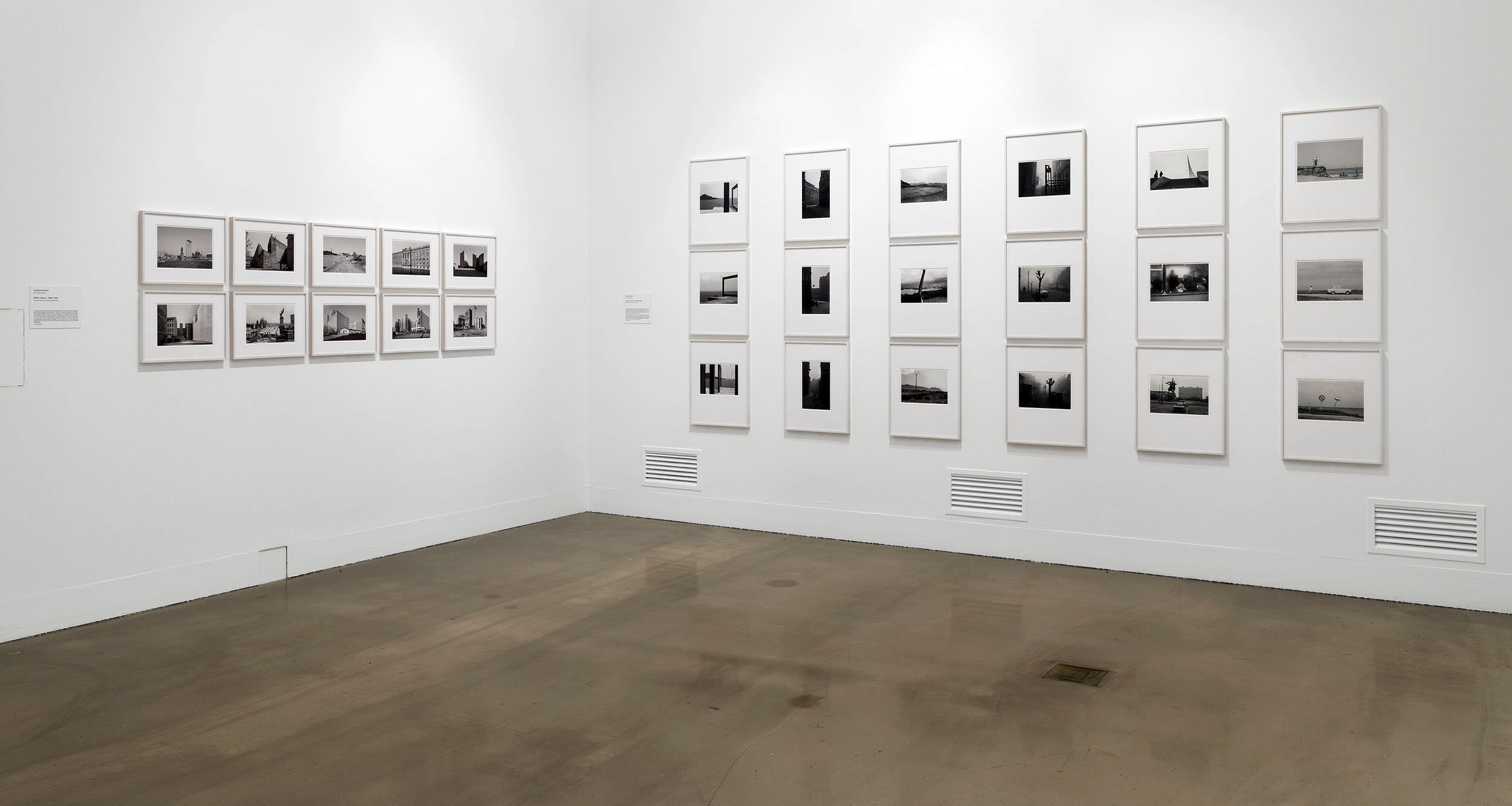
    Mai 36 Galerie, Zurich website

    Kunsthalle Wien website

    LIKE ART BLART ON FACEBOOK

    Back to top