Exhibition: ‘Felipe Romero Beltrán. Bravo’ at Fundación MAPFRE, Barcelona

Exhibition dates: 15th February – 18th May, 2025

Curator: Victoria del Val


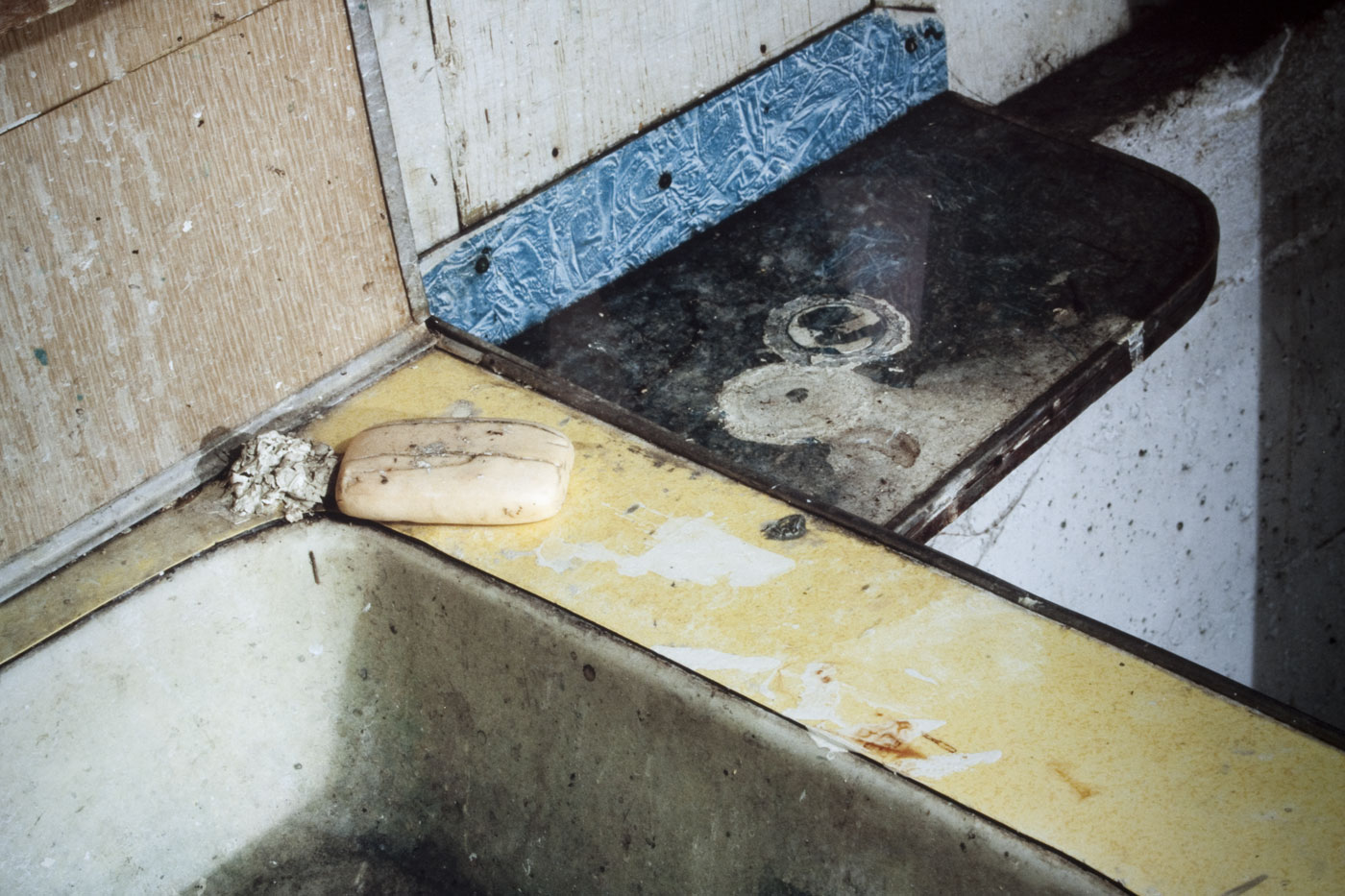
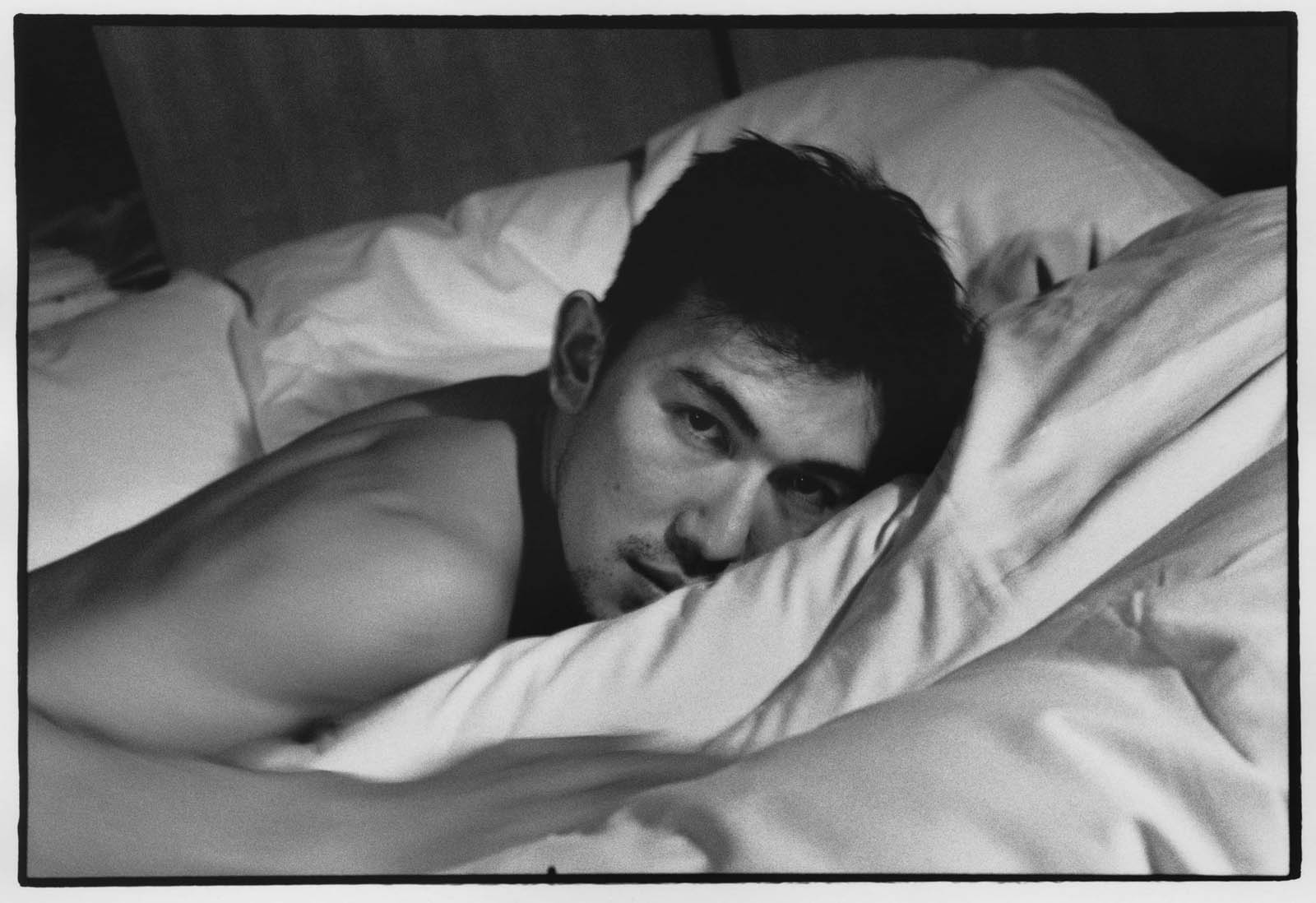
Felipe Romero Beltrán (Colombian, b. 1992) 'Breach #1' 2021-2024


Felipe Romero Beltrán (Colombian, b. 1992)
Breach #1
2021-2024
40 x 50cm
Lambda print


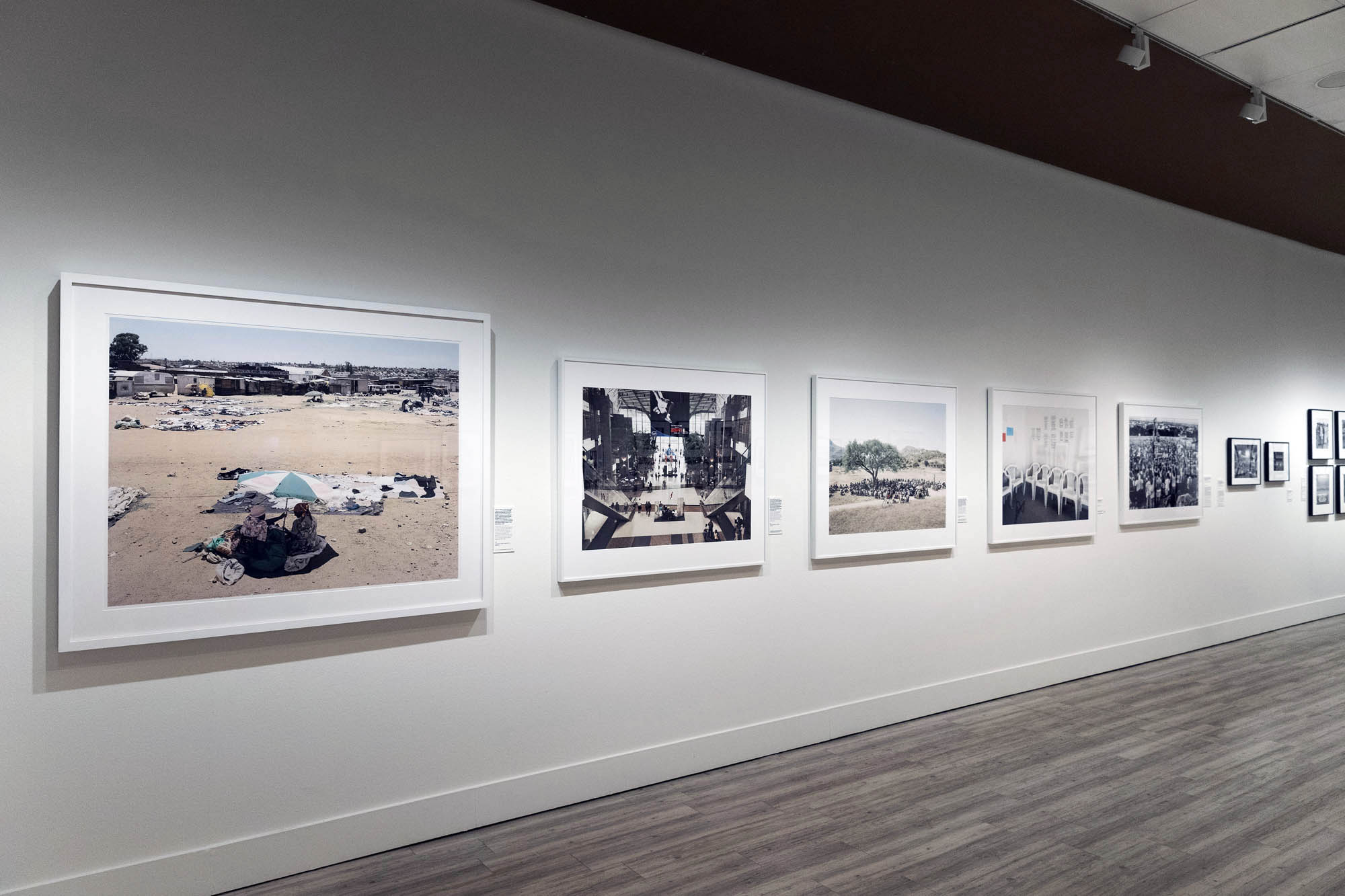
At their best there are some wonderfully spare and tensioned photographs of “crossing points” in this posting which examine the space between one state and another, one land and another, one country and another.

Other photographs go the usual performative “dead pan” route, some more successfully than others, and documentary observations of seemingly unremarkable spaces, derivative of the work of the Canadian photographer Jeff Wall who did the same thing more effectively way back in 1993 (see Diagonal Composition below).

Dr Marcus Bunyan


Many thankx to Fundación MAPFRE for allowing me to publish the photographs in the posting. Please click on the photographs for a larger version of the image.


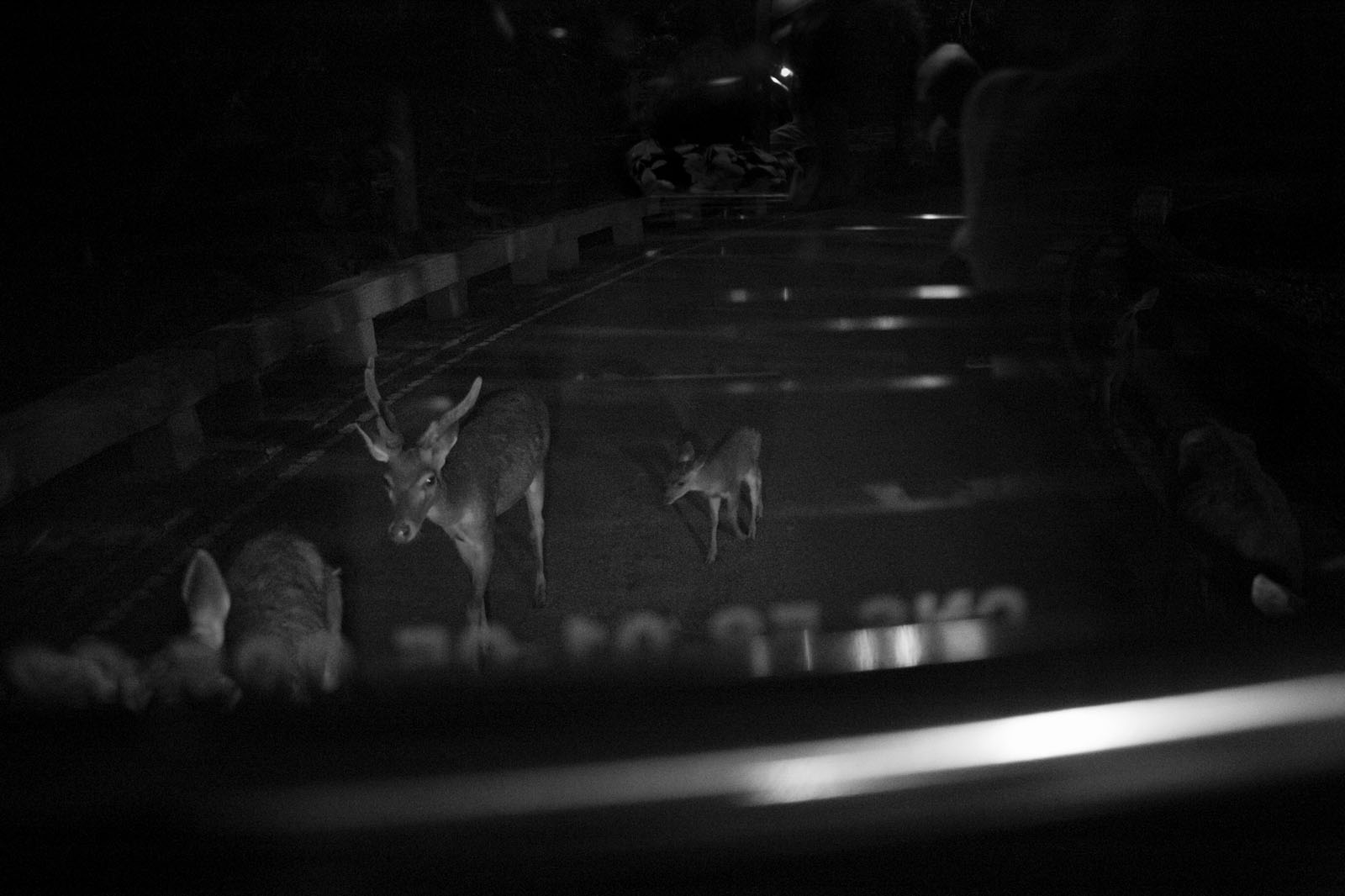
Felipe Romero Beltrán (Colombian, b. 1992) 'Breach #18' 2021-2024


Felipe Romero Beltrán (Colombian, b. 1992)
Breach #18
2021-2024
40 x 50cm
Lambda print


After earning a degree in Visual Arts in Buenos Aires, Felipe Romero Beltrán (Bogotá, Colombia, 1992) traveled to Jerusalem on a scholarship, where he developed photographic projects in the Middle East. In 2016, he moved to Madrid to further his studies in photography.

Throughout his work, Felipe Romero has been drawn to territories that have been or continue to be sites of tension, conflict and visual reflection.

In the Bravo project, he focuses on the more than 1,000 kilometers of the Río Bravo (known as the Rio Grande in the United States) that form the border between the United States and Mexico. His images place the viewer in a specific section of the Mexican side. People from Colombia, Honduras, El Salvador and Guatemala arrive, reaching the final stage of a long and arduous journey. In this setting, the river dictates everything, ultimately shaping the identity and way of life of those who encounter it.

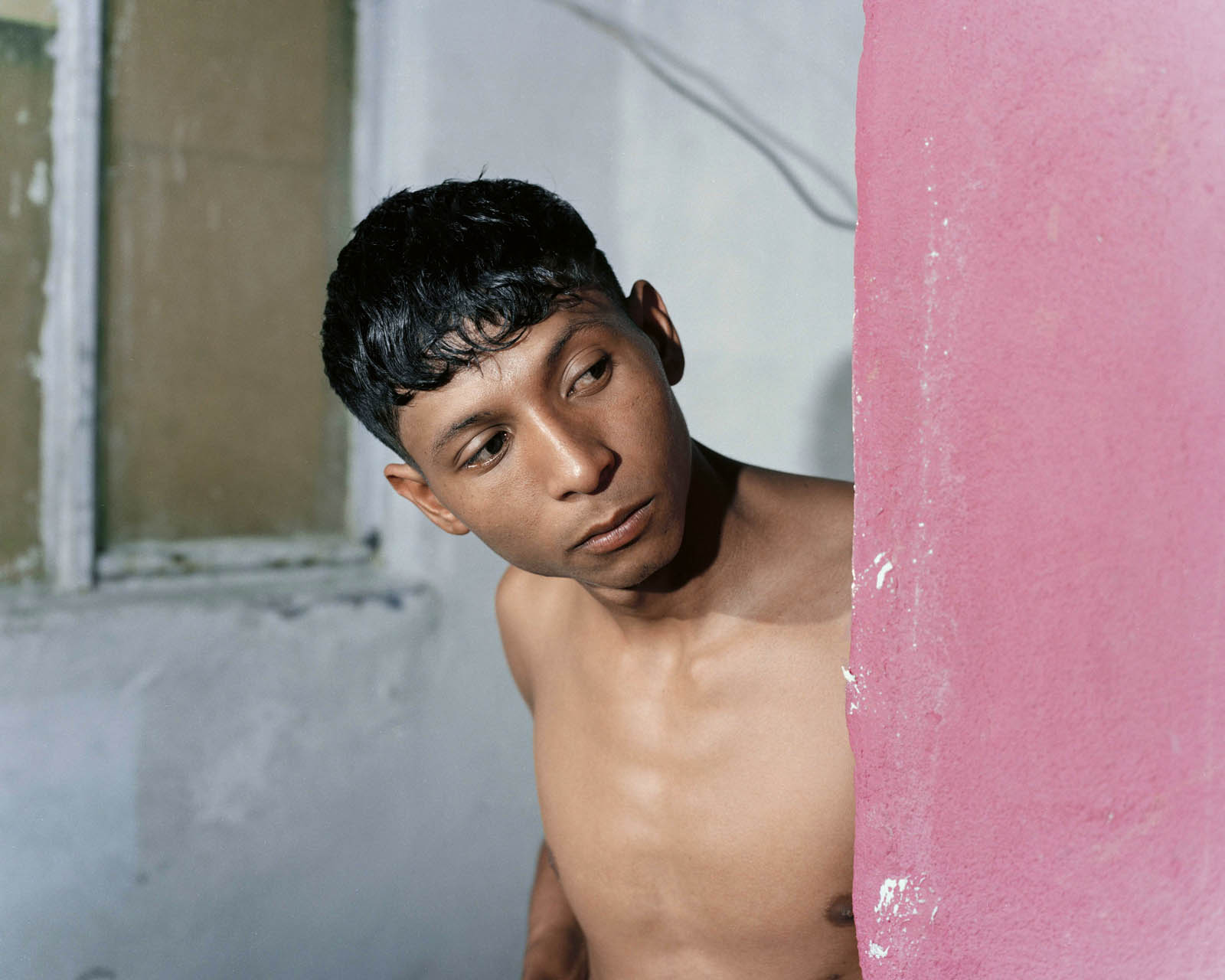
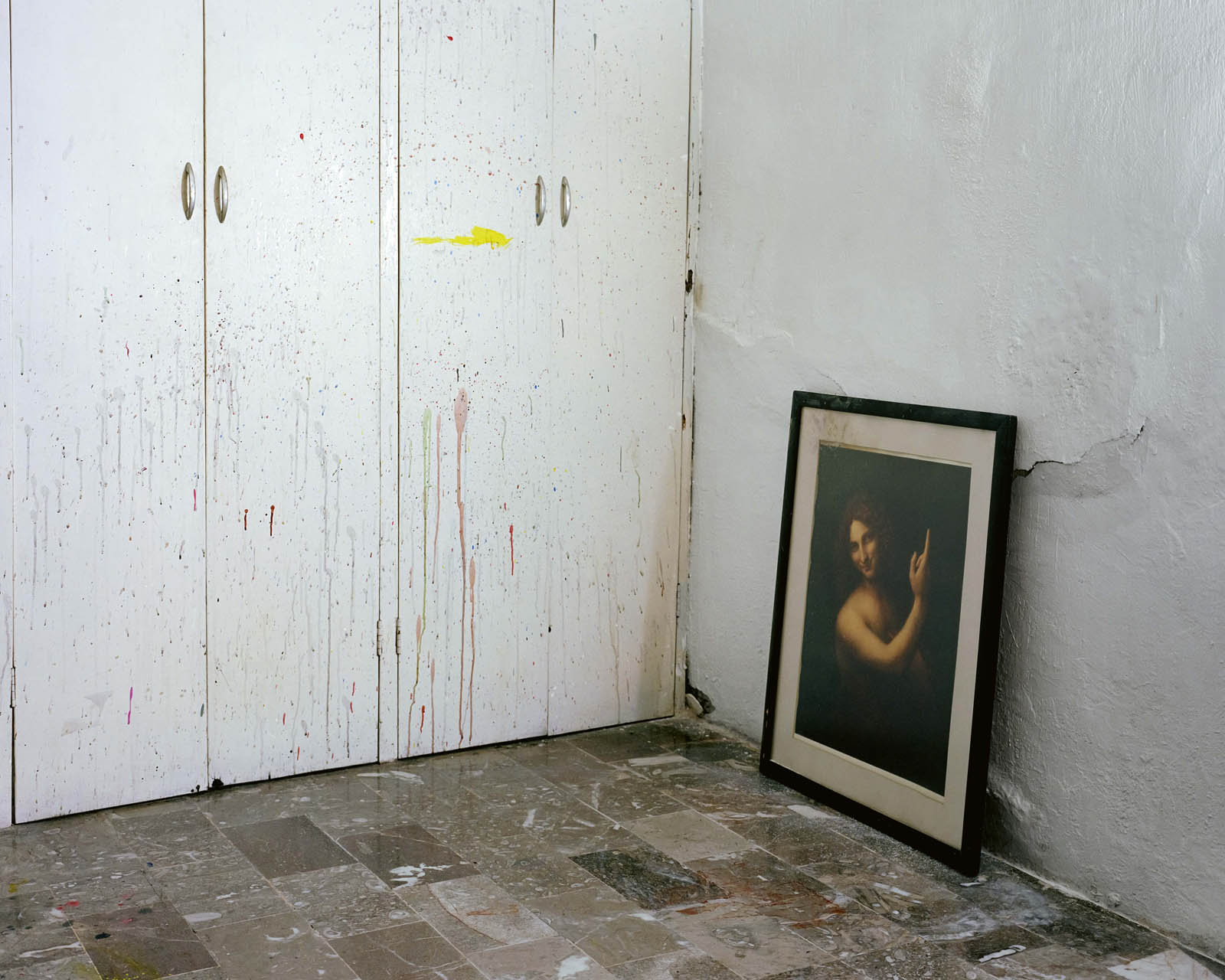
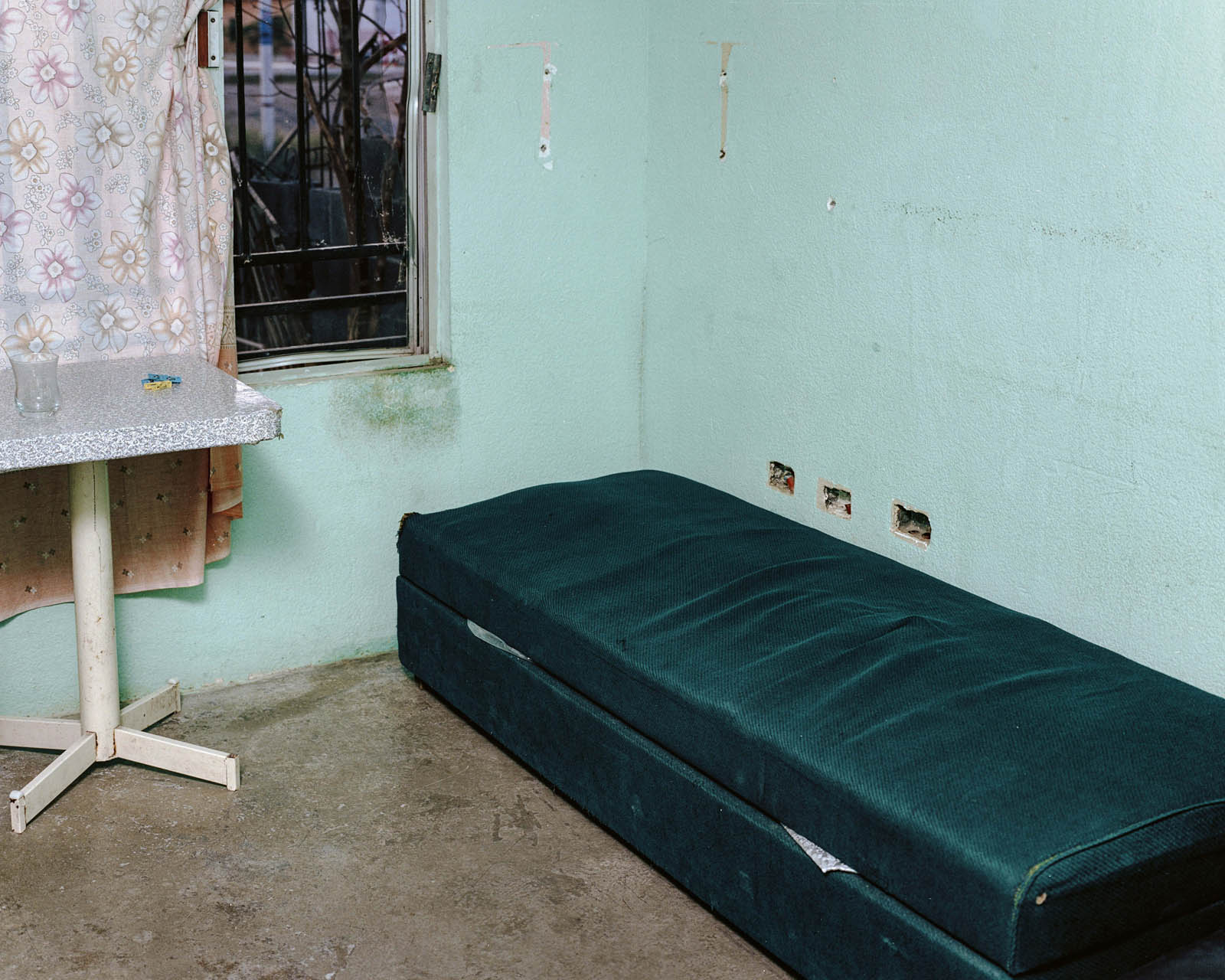
Bravo is conceived as a photographic essay composed of fifty-two images that explore this reality through a series of photographs of architecture, people and landscapes: closures, bodies and breaches. Almost bare interiors, walls and surfaces where textures, colors and portraits of individuals the artist has encountered during his travels to the region stand out. Ultimately: a poignant visual essay, both stark and poetic, on the themes of waiting and border identity.

Text from the Fundación MAPFRE website


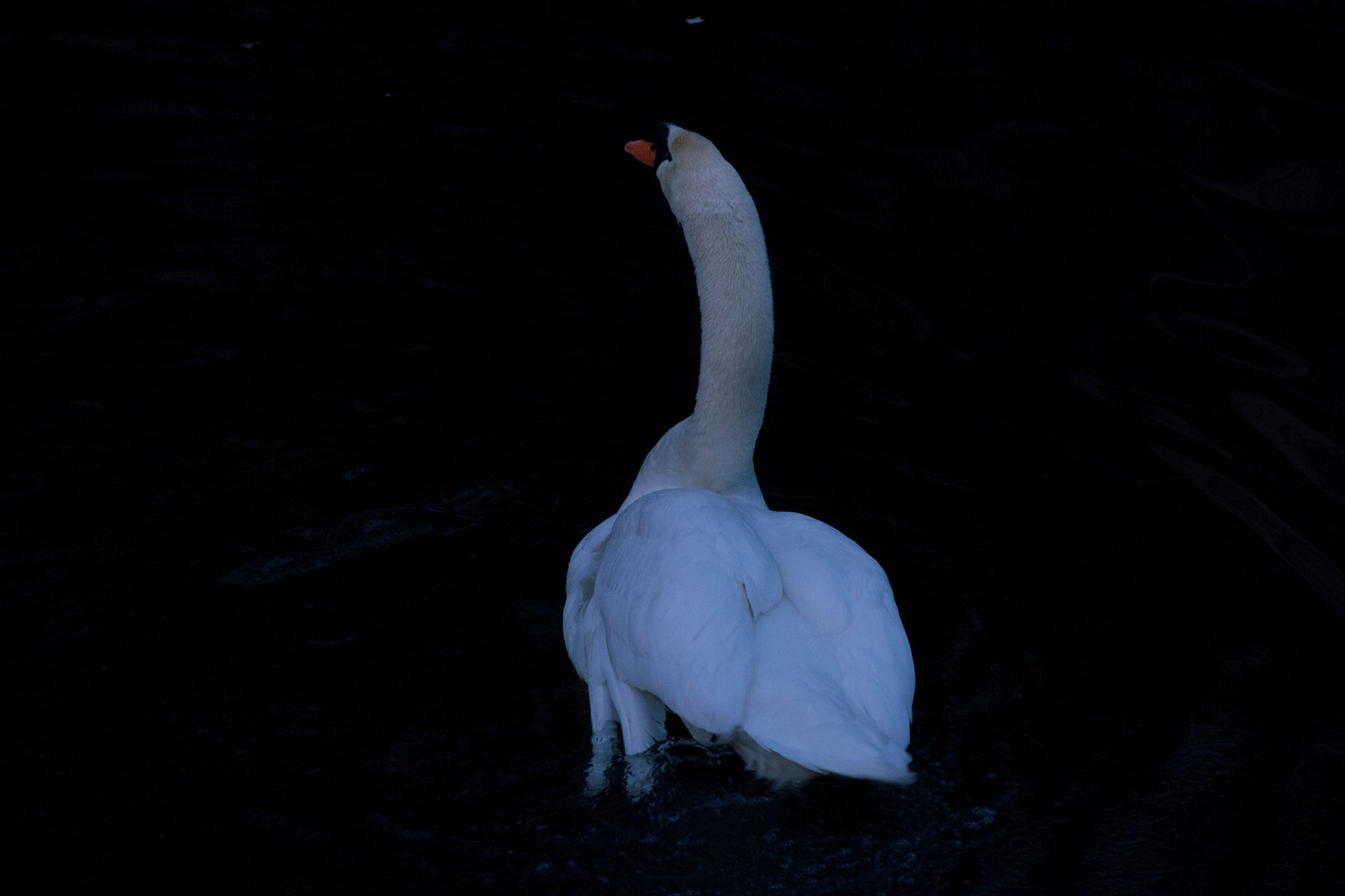
Felipe Romero Beltrán (Colombian, b. 1992) 'Breach #33' 2021-2024


Felipe Romero Beltrán (Colombian, b. 1992)
Breach #33
2021-2024
40 x 50cm
Lambda print


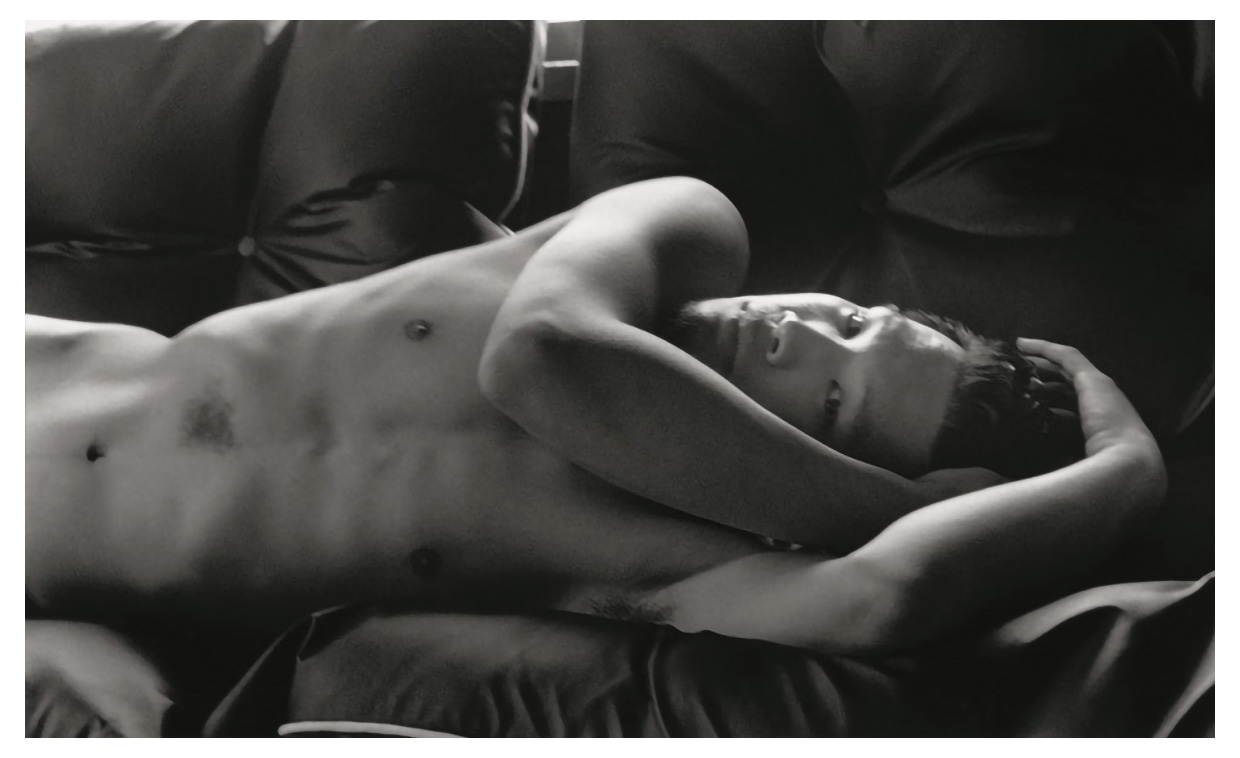
Felipe Romero Beltrán (Colombian, b. 1992) 'Breach #57' 2021-2024


Felipe Romero Beltrán (Colombian, b. 1992)
Breach #57
2021-2024
40 x 50cm
Lambda print


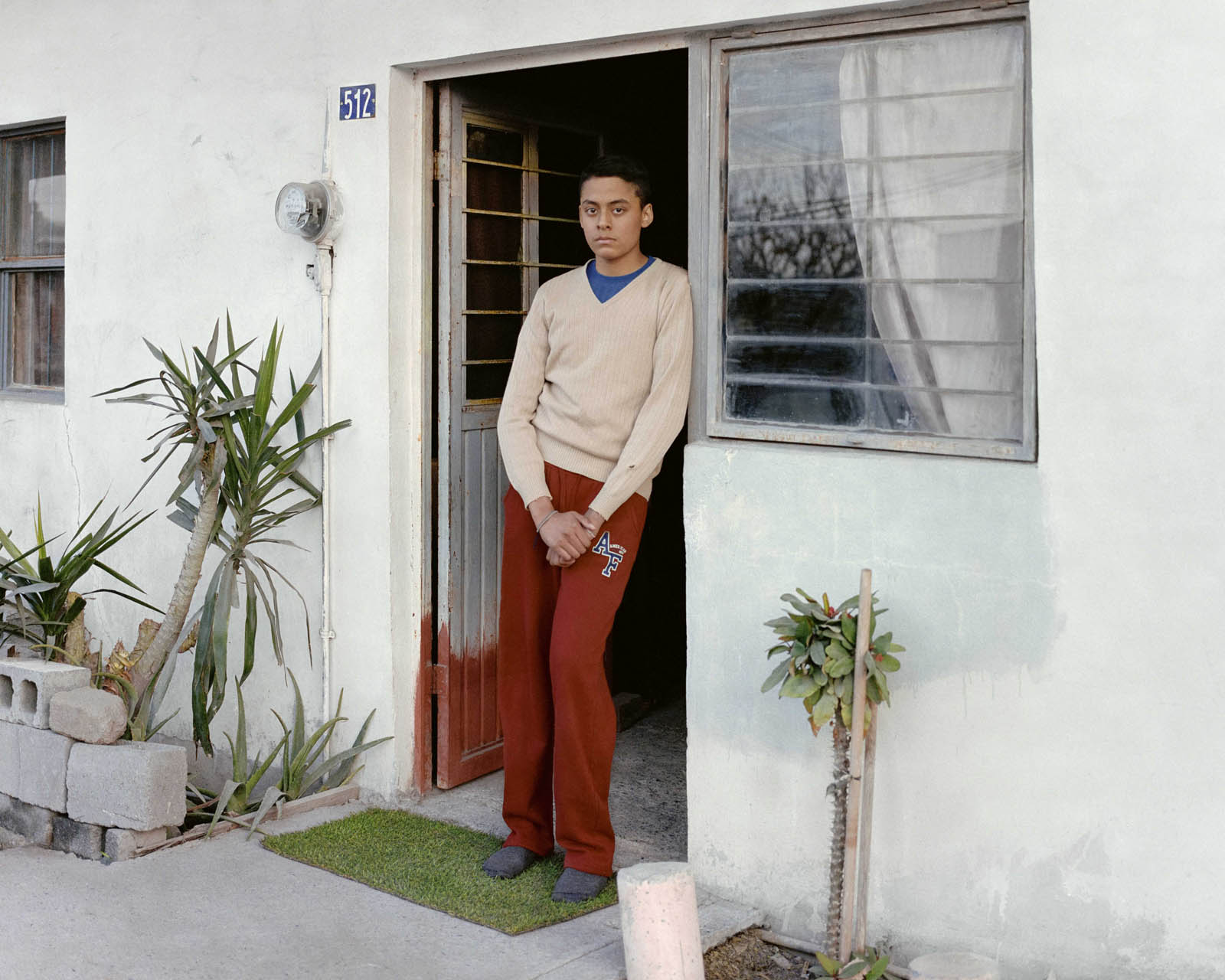
Felipe Romero Beltrán (Colombian, b. 1992) 'El Friki's friend and pink wall'
2021-2024


Felipe Romero Beltrán (Colombian, b. 1992)
El Friki’s friend and pink wall
2021-2024
120 x 150cm
Lambda print


Felipe Romero Beltrán (Colombian, b. 1992) 'Sound system' 2021-2024


Felipe Romero Beltrán (Colombian, b. 1992)
Sound system
2021-2024
120 x 150cm
Lambda print


Felipe Romero Beltrán (Colombian, b. 1992) 'San Juan Bautista. Nina's visit'
2021-2024


Felipe Romero Beltrán (Colombian, b. 1992)
San Juan Bautista. Nina’s visit
2021-2024
120 x 150cm
Lambda print


Felipe Romero Beltrán (Colombian, b. 1992)
'Sofa and table. Rebeca's house' 2021-2024


Felipe Romero Beltrán (Colombian, b. 1992)
Sofa and table. Rebeca’s house
2021-2024
120 x 150cm
Lambda print


Introduction

In 2021, Fundación MAPFRE launched its first KBr Photo Award, a prize created with the aim of reaffirming the institution’s commitment to emerging artistic creation, offering the winner of the contest significant visibility in both the national and international art scenes. In keeping with the biennial nature of this award, the second edition took place in 2023, with Colombian artist Felipe Romero Beltrán as the winner.

The artist

Felipe Romero Beltrán was born in 1992 in Bogota , Colombia. After studying visual arts in Buenos Aires, he traveled to Jerusalem on a scholarship to work on photographic projects in the Middle East. In 2016, he moved to Madrid to continue his training in photography and in 2024, he received his PhD from the Faculty of Information Sciences of the Complutense University with a thesis on the documentary image. Romero Beltrán’s photographic practice lies at the edge of documentary photography, using typical elements of this genre – direct recordings of everyday life, documentation of specific historical realities, etc. – and placing them in dialogue with other artistic, pictorial, and performative elements. The result consists of images that transcend the purely photographic realm to encompass the entire field of visual representation.

Throughout his career, Romero Beltrán has always been interested in territories that are or have been marked by tension, conflict and visual reflection.

The first project that brought him recognition was Magdalena, one of Colombia’s most important rivers and a witness to the armed struggle that began in 1960 between the guerrilla organisation Revolutionary Armed Forces of Colombia (FARC) and the country’s government, one of the bloodiest events in history, which ended with a peace agreement in late 2016. For more than fifty years, the river became a graveyard where the bodies of those killed were hidden. Many of these bodies, either intact or dismembered, were later swept away by the Magdalena’s powerful currents.

Later, in Dialecto/Dialect, the author explored the situation of the Strait of Gibraltar – a crossing point for immigrants entering Europe through Spain – through a group of migrant minors who, once at their destination – a center in Seville – find themselves in legal limbo under the guardianship of the Spanish State. This second work, which was accompanied by a series of performative audiovisual pieces, Recital (2020), Instrucción/Instruction (2022) and Esta es tu ley/This is Your Law, a reference to immigration law, marked a turning póint in his career, as he began to gain international recognition as an artist and photographer and his work was exhibited at the Fotografiemuseum in Amsterdam (FOAM) in January 2024.

Bravo

Bravo, the winning project of this second edition of the KBr Photo Award, is once again structured around a border as its leitmotif. The Bravo River has a dual identity: it is both a river and a border between the United States and Mexico. Its geography carries a heavy political burden that has accumulated conflicts and tensions since the nineteenth century, reaching an unsustainable situation in recent years. In this case, Romero Beltrán places the viewer in a specific stretch of this river, more than three thousand kilometers long. It is an area near the Mexican city of Monterrey, where both the river and the flow of people attempting to cross it shape the identity and way of life of the local population. This movement of people affects not only Mexican citizens, but extends to all of Central and South America. Migrants also come from Colombia, Honduras, El Salvador and Guatemala; for them, crossing the river is the last stage of a long and arduous journey. The border acts as a magnet, drawing people in despite the risks involved in crossing it and the fact that it has almost become a militarized zone. The author considers the river as a political actor, as a border, although throughout the photographs it only appears as a supporting character. As Romero Beltrán himself points out: “The Bravo River, rather than being the central axis that structures the project, functions as its limit, that is to say, it is an exercise in exhaustion until one reaches the river, without the possibility of crossing it. In this sense, the river exists as its visual negation, focusing interest on what comes after it: the entrance to the United States.”

Bravo was conceived as a photographic essay of fifty-two photographs that explore this reality through a series of images of architecture, people and landscapes: endings, bodies and breaches. Almost bare interiors, walls and surfaces where textures and colors stand out; fragments and remains of roads and buildings that show the traces of the passage of migrants; and portraits of people that the artist encountered during his visits to the area where he carried out the project.

The audiovisual work El cruce (The Crossing), which accompanies the exhibition, was created by the artist before the photographs. Romero Beltran thus expands the visual reflection on the river, showing us scenes that challenge its condition as a border, revealing other uses and situations linked to its dual geographical and political character: a Protestant baptism in the river itself; a fishing competition between the United States and Mexico at La Amistad dam, built in the 20th century to control the waters of the Bravo River; a series of interviews between the author and some migrants focused on linguistic changes; the testimonies of Guadalupe, a man who grew up on the Mexican side of the river and regularly swims in it with no intention of crossing it, and Luis, who frequently crosses the river to collect the wet clothes that migrants leave behind in the illegal breaches after crossing, so that he can sell them once he brings them back to Mexico.

Catalogue

The catalog accompanying the exhibition contains reproductions of all the works on display, as well as an essay by the curator, Victoria del Val, and an interview with Felipe Romero Beltrán himself. The publication also includes texts by Albert Corbí , who writes an essay on the very nature of the photographic medium in the context of migration; by artist Alejandra Aragon, on what it means to be a border person; and by Dominick Bermudez, a migrant of Salvadoran origin who describes how, after a long journey, he arrived in Monterrey, where he currently lives. Finally, the catalog features illustrations from the diary of Thom Díaz, Romero Beltrán’s “traveling companion”.

The catalog is published in Spanish by Fundación MAPFRE. The English version is co-published with Loose Joint Publishing.

Text from Fundación MAPFRE


Felipe Romero Beltrán (Colombian, b. 1992) 'Grecia Evangelina. Thom's house' 2021-2024


Felipe Romero Beltrán (Colombian, b. 1992)
Grecia Evangelina. Thom’s house
2021-2024
120 x 150cm
Lambda print


Jeff Wall (Canadian, b. 1946) 'Diagonal Composition' 1993


Jeff Wall (Canadian, b. 1946)
Diagonal Composition
1993
Transparency in light box, AP
40 x 46cm
Collection of the artist
© Jeff Wall


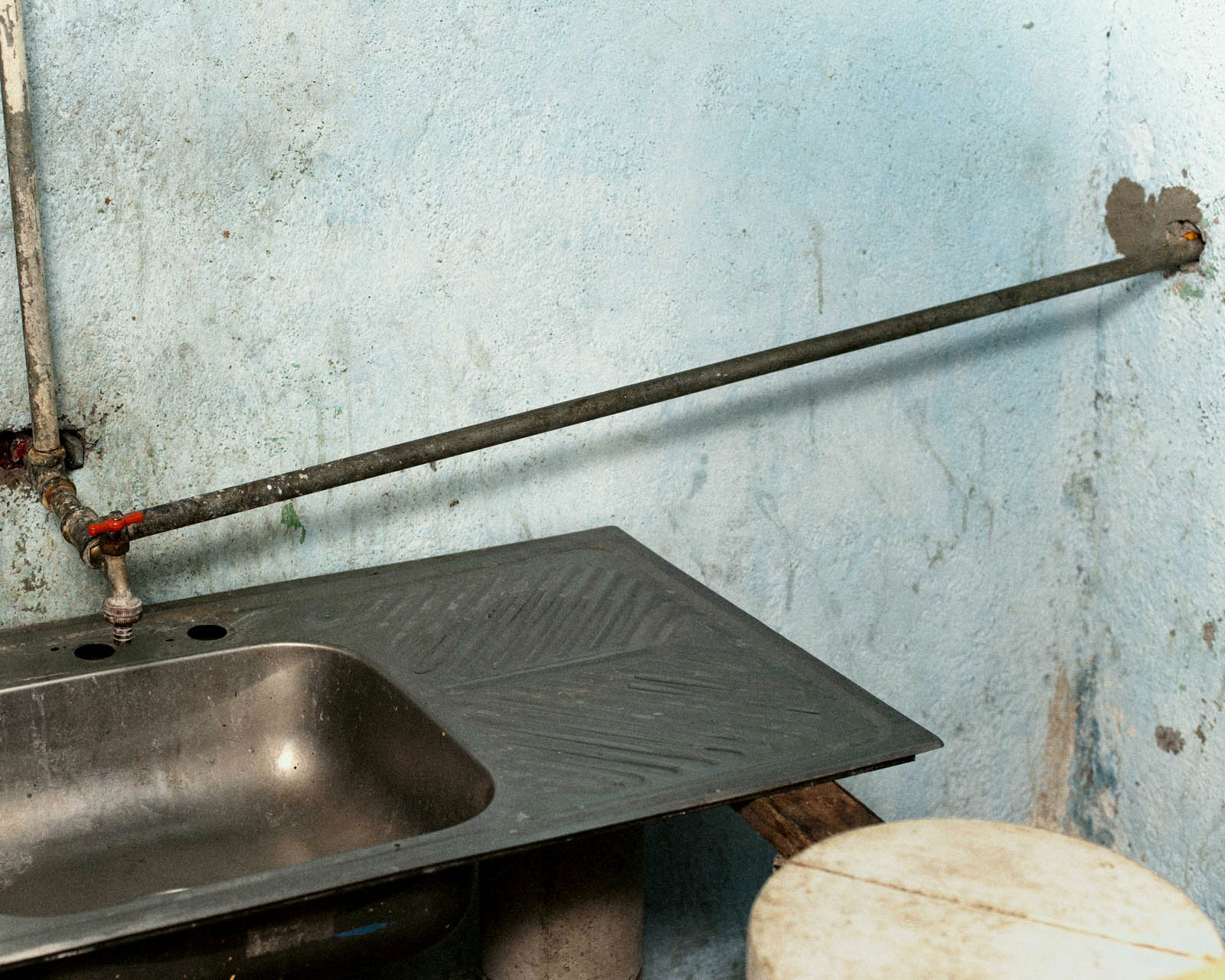
Felipe Romero Beltrán (Colombian, b. 1992) 'Piping. Dominick's house'
2021-2024


Felipe Romero Beltrán (Colombian, b. 1992)
Piping. Dominick’s house
2021-2024
40 x 50cm
Lambda print


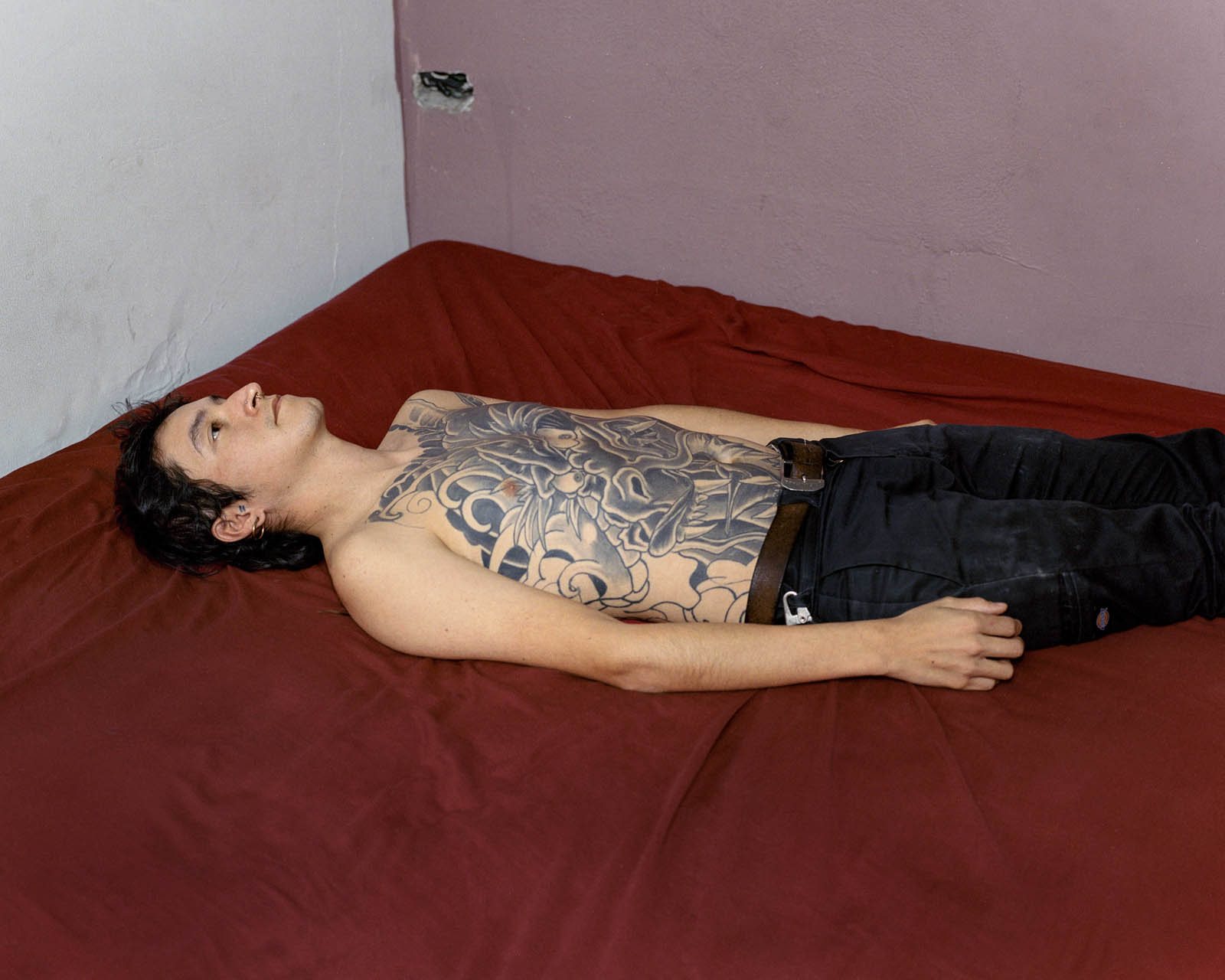
Felipe Romero Beltrán (Colombian, b. 1992)
'Marco. Rafa's room'
2021-2024


Felipe Romero Beltrán (Colombian, b. 1992)
Marco. Rafa’s room
2021-2024
40 x 50cm
Lambda print


Felipe Romero Beltrán (Colombian, b. 1992) 'Martel'
2021-2024


Felipe Romero Beltrán (Colombian, b. 1992)
Martel
2021-2024
40 x 50cm
Lambda print


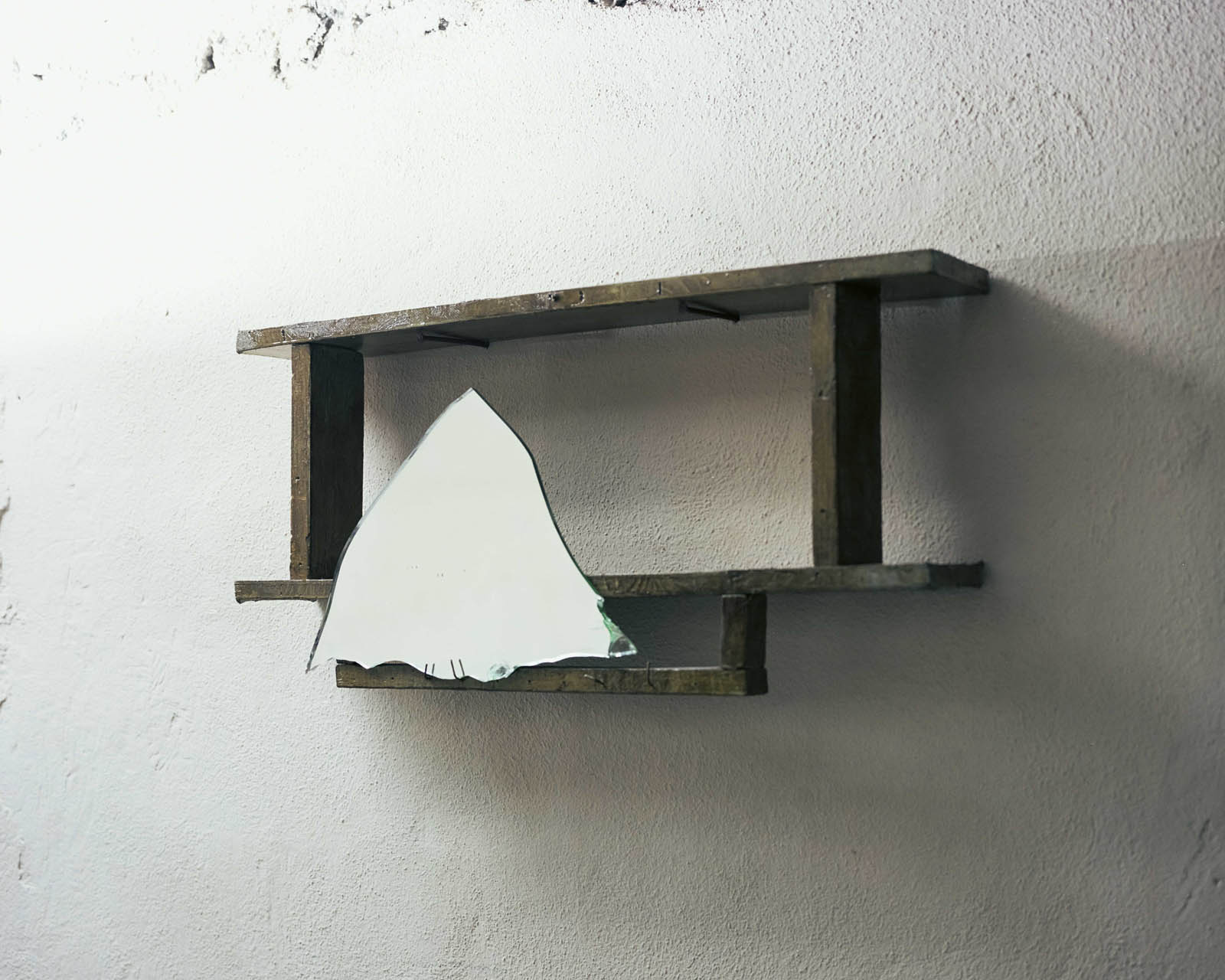
Felipe Romero Beltrán (Colombian, b. 1992) 'Mirror. El Sower's house'
2021-2024


Felipe Romero Beltrán (Colombian, b. 1992)
Mirror. El Sower’s house
2021-2024
40 x 50cm
Lambda print


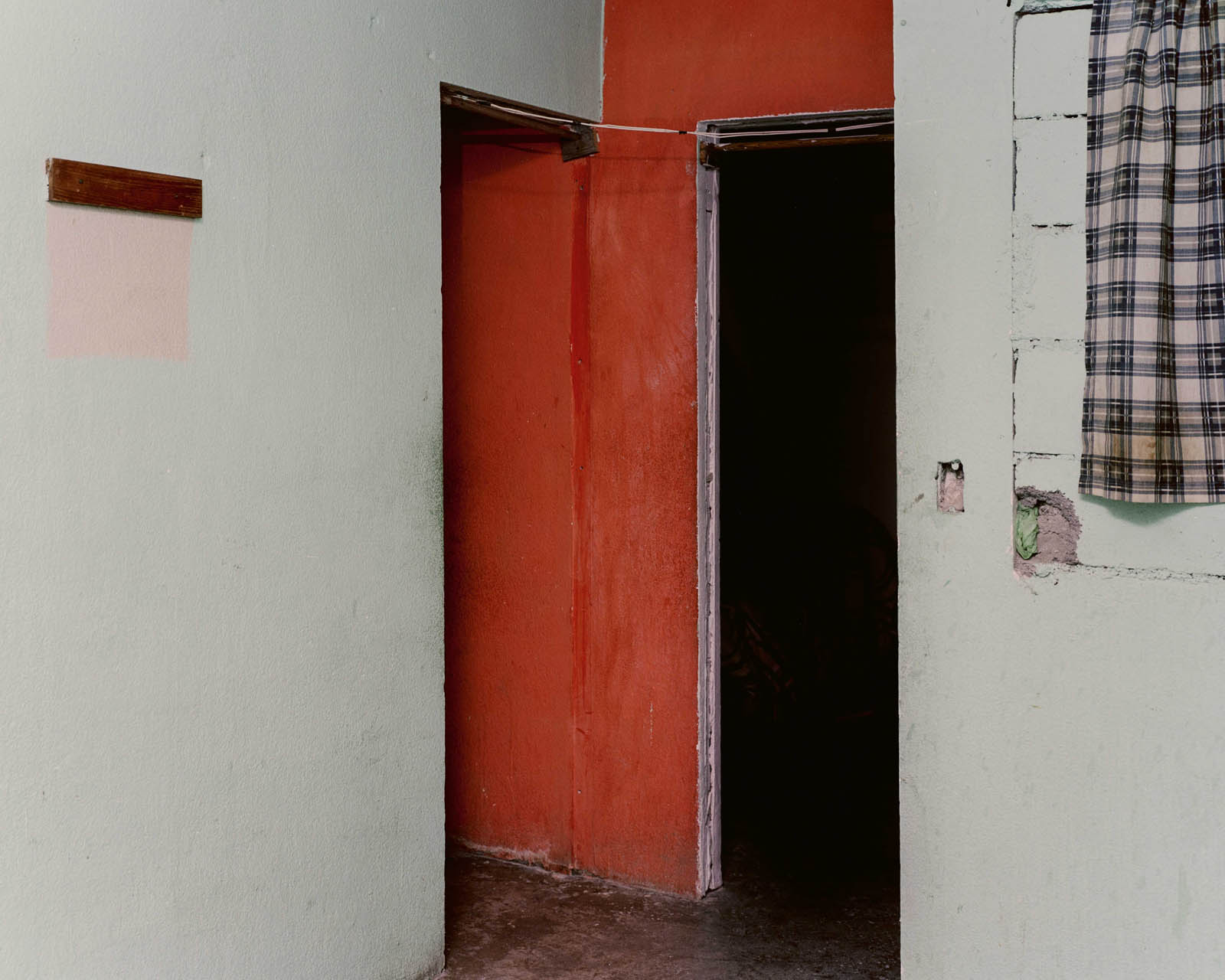
Felipe Romero Beltrán (Colombian, b. 1992)
'Wall and two doors. Rebeca's house'
2021-2024


Felipe Romero Beltrán (Colombian, b. 1992)
Wall and two doors. Rebeca’s house
2021-2024
120 x 150cm
Lambda print


KBr Fundación MAPFRE
Av. del Litoral, 30 08005 Barcelona
Phone: +34 932 723 180

Opening hours:
Tuesdays – Sundays (and public holidays) 11am – 8pm

Fundación MAPFRE website

LIKE ART BLART ON FACEBOOK

Back to top

Exhibition: ’31 Women. An Exhibition by Peggy Guggenheim’ at Fundación MAPFRE, Madrid

Exhibition dates: 19th September, 2024 – 5th January, 2025

Curator: Patricia Mayayo

Artists: Djuna Barnes / Xenia Cage / Leonora Carrington / Leonor Fini / Suzy Frelinghuysen / Elsa von Freytag-Loringhoven / Meraud Guinness Guevara / Anne Harvey / Valentine Hugo / Buffie Johnson / Frida Kahlo / Jacqueline Lamba / Eyre de Lanux / Gypsy Rose Lee / Hazel McKinley / Aline Meyer Liebman / Louise Nevelson / Meret Oppenheim / Milena Pavlovic-Barilli / Barbara Poe-Levee Reis / Irene Rice Pereira / Kay Sage / Gretchen Schoeninger / Sonja Sekula / Esphyr Slobodkina / Hedda Sterne / Sophie Taeuber-Arp / Dorothea Tanning / Julia Thecla / Pegeen Vail Guggenheim / Maria Helena Vieira da Silva


Aline Meyer Liebman (American, 1879-1966) 'Gray Day (Sand Dunes)' c. 1929 from the exhibition '31 Women. An Exhibition by Peggy Guggenheim' at Fundación MAPFRE, Madrid, Sept 2024 - Jan 2025


Aline Meyer Liebman (American, 1879-1966)
Gray Day (Sand Dunes)
c. 1929
Gouache on board
35.5 x 48cm
The 31 Women Collection
© 2022-2024 JPS Artworks LLC


Short biography: Aline Meyer Liebman (1879-1966). Born in Los Angeles, Aline Meyer Liebman studied at the Art Students League in New York and received the support of Georgia O’Keeffe and Alfred Stieglitz. By the 1930s she had already become a consolidated artist and was the subject of a solo show at Walker Galleries in 1936. Meyer Liebman was also known for her work as a collector of art and photography. She acquired works by O’Keeffe, Stieglitz, Edward Weston, and Max Ernst, among others. Liebman kept a broad circle of relationships with key people in the New York art world, such as Peggy Guggenheim, who included her work Painted Dream (1935) in Exhibition by 31 Women. Other notable facets include her political and philanthropic work: aside from supporting President Roosevelt, she became a member of the New York League of Women Voters and designed a poster for the organization in 1944.


While it is fantastic to see this “recreation” (many of the original art works are unknown or missing and others have been substituted by the same artist in their place) of Peggy Guggenheim’s 1943 Exhibition by 31 Women “organised in her New York gallery ‘Art of This Century’, one of the first exhibitions in the United States to showcase works exclusively by European and American women,” I am conflicted by this exhibition. Conflicted, conflicted, conflicted.

Wealthy white women uses influence and money to promote women artists when no one else would, a patron reinforcing female participation introducing “well-established figures within the artistic landscape as well as emerging talent.” But I have a feeling that this group of female artists was part of an elite cohort – a privileged, internalist, internationalist, undoubtedly incestuous (in terms of knowing each other) clique of humans that knew the right people, especially through their connections with male artists.

As ever with the art world, it’s not what you know it’s who you know. Which artist has the ear of which curator; which artist is “fashionable” at the moment; and which artist is supported by which patron and gallery. It’s all about connections, and these women, whether emerging or established, had those connections. They were part of an educated elite that was at one and the same time, both exclusive and excluding (no Black American or Asian artists here… think of the times!)

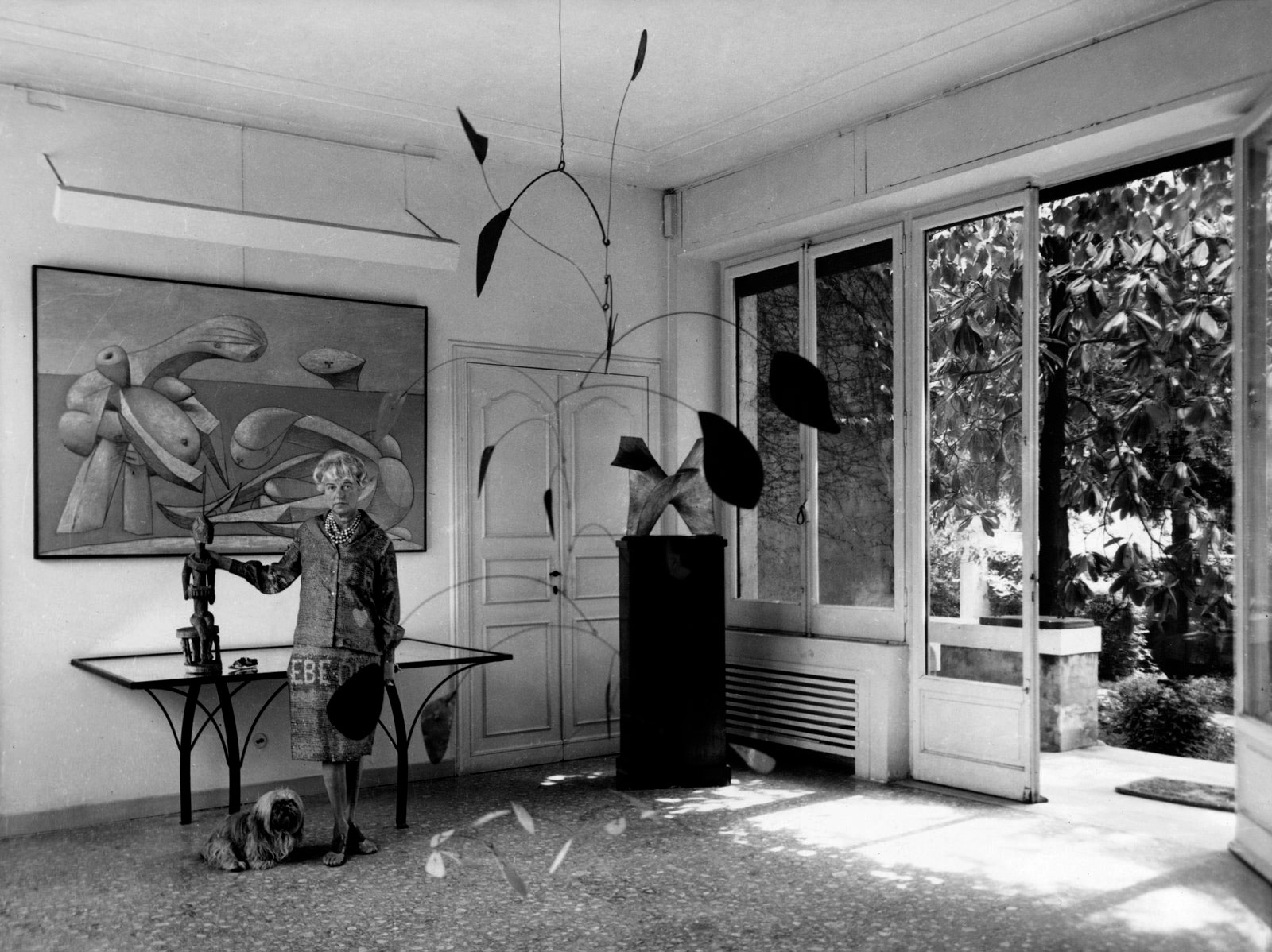
And while the relationship between art and bourgeois life central to an earlier ideal of culture (the artist and their patron) has changed since the Second World War and the playing field has become much more egalitarian, my cynicism and socialism still rails at those with power and how they withhold their largesse. You only have to look at the photograph of Peggy Guggenheim in the entrance hall of her eighteenth century Venetian palace or the naming of so many galleries in art museums after wealthy patrons to understand what I mean.

What did it mean for these women artists, at what level was it a recognition of their undoubted skill as artists, when so many largely vanished without trace?

Dr Marcus Bunyan


Many thankx to Fundación MAPFRE for allowing me to publish the photographs in the posting. Please click on the photographs for a larger version of the image.


The idea of the artist as central member of a spiritual elite embodying an alternative to Philistine commercialism, or even pointing the way to humankind’s salvation, has powered a variety of movements as different as Aestheticism, Realism, Dada, De Stijl, and Russian Constructivism. This was the conception of culture that crystallized in the notion of the avant-garde, whose “function” – in Clement Greenberg’s classic formulation of 1939 – was “to find a path along which it would be possible to keep culture moving in the midst of ideological confusion and violence.”[1]

Greenberg’s text touchingly reveals the double sense of the idea of culture, as both redeeming force of the existing system and as a sort of critique by enactment of an alternative set of values. In this conception, the essence of art, incarnated in the avant-garde, is its alienation from the norms of bourgeois society (hence, in the case of modernist abstraction, its abandonment of going systems of representation). On the other hand, Greenberg acknowledged that “No culture can develop without a social basis, without a source of stable income” and even that “in the case of the avant-garde, this was provided by an elite among the ruling class of that society from which it assumed itself to be cut off, but to which it has always remained attached by an umbilical cord of gold. The paradox is real.”[2]

This paradox is nothing but the place of culture in capitalist society, in its most concentrated form. Given the distinctive social character of art objects, as handmade luxury goods in a world dominated by mechanized mass production, they offer both their producers and their consumers an experience outside the “everyday life” of the market. Expressive, in its very freedom from monetary considerations, of the power of money and of the access to free time made possible by money, art is a token and a perk of social distinction for those who own and even for those who merely appreciate it. The artist, as producer of this token, shares in the distinction, though (for the most part) not in the wealth that supports the social practice of art as a whole. It was the very separation of the world of cultural production from the norm of capitalist investment and production that made it potentially so valuable. By means of critique, culture cleanses modern society of the sin of commercialism, allowing its dominating classes to see themselves as worthy inheritors of the position of the aristocracy they displaced.

The picture I have sketched here, hardly a novel one, evidently owes a great deal to Pierre Bourdieu’s analysis of what he calls “the field of cultural production.” That analysis reveals in particular the close relation between, on the one hand, the social antagonism between the producers of culture and the upper-class consumers from whom they are separated by style of life and self-conception as well as degree of social power, and, on the other, the fact that “the cult of art and the artist… is one of the necessary components of the bourgeois ‘art of living,’ to which it brings a ‘supplément d’âme,’ its spiritualistic point of honor.”[3] This cultural system, evolved during the nineteenth century, survived until well into the twentieth. But the last twenty years have seen the acceleration of a process of change, whose origin is traceable to the end of the Second World War.[4] What changed was not the centrality of the “cult of art” to the bourgeois “art of living” but the felt antipathy between art and bourgeois life central to the earlier ideal of culture.


Paul Mattick. “After the Gold Rush,” on the American Society for Aesthetics website 2010 [Online] Cited 12/12/2024


1/ C. Greenberg, “Avant-garde and Kitsch,” in idem, Art and Culture (Boston: Beacon Press, 1961), p. 5.
2/ Ibid., p. 8
3/ P. Bourdieu, The Field of Cultural Production (New York: Columbia University Press, 1993), p. 44.
4/ For an in-depth discussion, see Katy Siegel, Since ’45: American Art in the Age of Extremes (London: Reaktion, 2016)


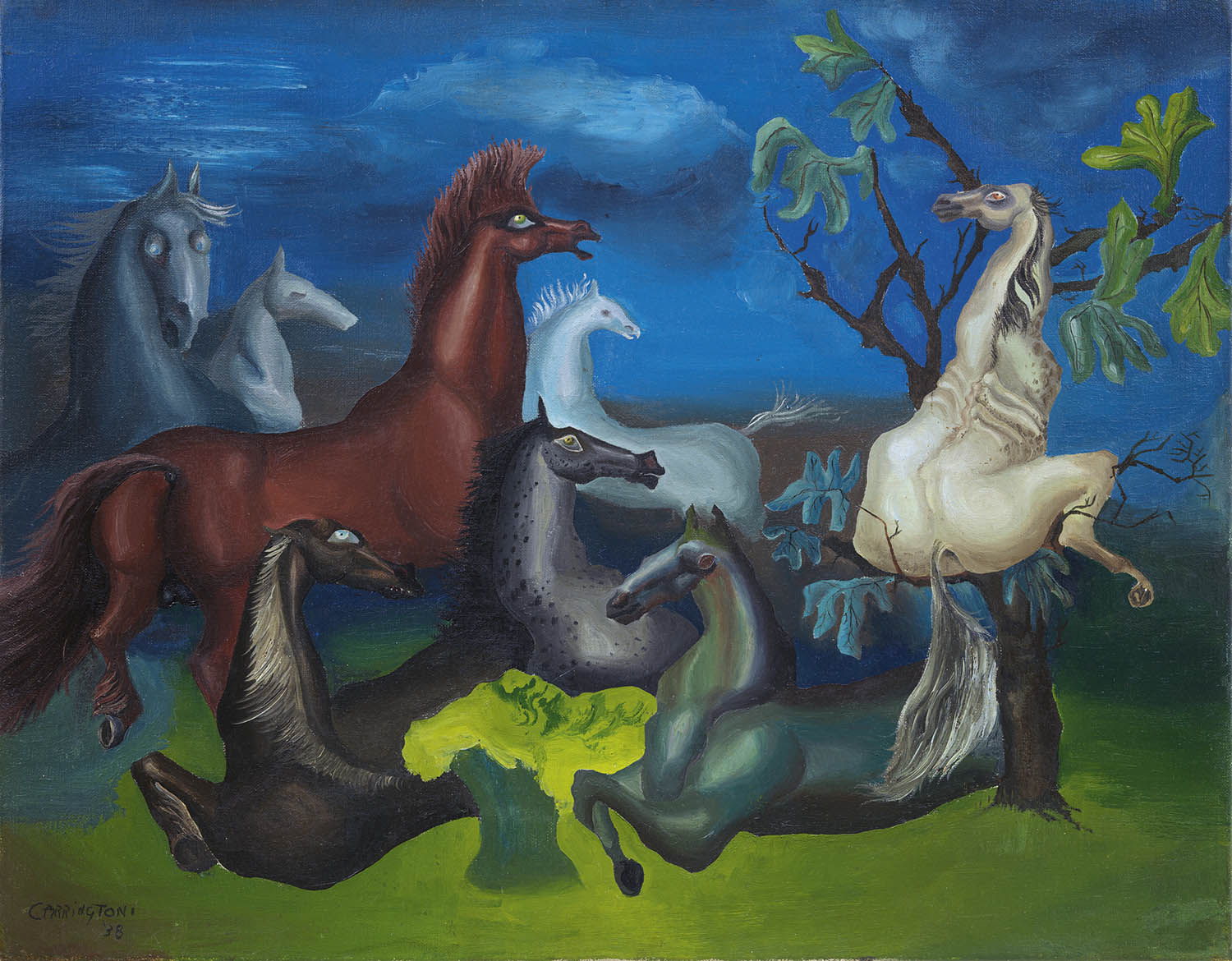
Installation view of the exhibition '31 Women. An Exhibition by Peggy Guggenheim' at Fundación MAPFRE showing at left, Milena Pavlovic-Barilli's 'Juno and Vulcan' (1936); at second left, Leonora Carrington's 'The Horses of Lord Candlestick' (1938); and at right, Buffie Johnson's 'The Middle Way / The Great Mother Rules the Sky (Astor Mural)' (1949-1959)


Installation view of the exhibition 31 Women. An Exhibition by Peggy Guggenheim at Fundación MAPFRE showing at left, Milena Pavlovic-Barilli’s Juno and Vulcan (1936, below); at second left, Leonora Carrington’s The Horses of Lord Candlestick (1938, below); and at right, Buffie Johnson’s The Middle Way / The Great Mother Rules the Sky (Astor Mural) (1949-1959, below)


In 1943, the renowned art collector Peggy Guggenheim organised in her New York gallery ‘Art of This Century’, one of the first exhibitions in the United States to showcase works exclusively by European and American women, titled Exhibition by 31 Women. The show was conceived by Guggenheim in collaboration with Marcel Duchamp, and the artists were selected by a jury whose members included André Breton, Max Ernst and Duchamp himself. Guggenheim, as the sole woman on the jury, was in a privileged position to provide a female perspective in the selection process.

These women, many of whom were associated with Surrealism or abstraction, maintained an ambiguous position within both trends. Often, they employed these styles to reformulate and challenge them, preserving their independence and shedding light on the patriarchal assumptions underlying these artistic movements.

31 Women. An Exhibition by Peggy Guggenheim presents a curated selection and reinterpretation of that initiative, including all the artists featured in the original show. With this exhibition, the Foundation aims not only to honor Peggy Guggenheim’s significant role as one of the foremost patrons and collectors of the 20th century, but also shift the narrative away from viewing these women primarily through their connections with male artists. Instead, it highlights the networks of collaboration, solidarity, and friendship they established among themselves.

Text from the Fundación MAPFRE website


Sonja Sekula (American, 1918-1963) 'Waiting for Foam' 1944 from the exhibition '31 Women. An Exhibition by Peggy Guggenheim' at Fundación MAPFRE, Madrid, Sept 2024 - Jan 2025


Sonja Sekula (American, 1918-1963)
Waiting for Foam
1944
Oil on canvas
40.3 x 49.8cm
The 31 Women Collection
© Estate of Sonja Sekula
© 2022-2024 JPS Artworks LLC


Short biography: Sonja Sekula (1918-1963). Born in Lucerne from a Hungarian father and a Swiss mother, Sonja Sekula emigrated to New York in 1936, where her father had moved their family business. In 1938 she attempted suicide for the first time and from that point onward began suffering from mental health issues. Through her well-connected family, Sekula was able to meet André Breton and other European Surrealists in the early 1940s. In mid-decade, she travelled to Mexico and came into contact with Frida Kahlo and Leonora Carrington. Later, she traversed the northeastern United States, discovering the imagery of Native American people. The primitivist symbols in her canvases are interwoven with decorative patterns, intense colours, and a juxtaposition of viewpoints. At the time, Sekula’s work was well received by critics, some suggesting that there was a hidden symbolism related to her homosexuality. Aside from including her painting Composition at Exhibition by 31 Women, Peggy Guggenheim dedicated a solo exhibition to Sekula’s work in 1946. Two years later Sonja Sekula joined the Betty Parsons Gallery, which would host five solo exhibitions between 1948 and 1957. In 1951, a day after the opening of her third exhibition, she suffered a nervous breakdown. The artist spent the following years coming in and out of mental health clinics in the United States and Switzerland. In 1963 she committed suicide in her Zurich studio.


Louise Nevelson (American, 1899-1988) 'Untitled' 1933 from the exhibition '31 Women. An Exhibition by Peggy Guggenheim' at Fundación MAPFRE, Madrid, Sept 2024 - Jan 2025


Louise Nevelson (American, 1899-1988)
Untitled
1933
Black painted terracotta
The 31 Women Collection
© Louise Nevelson, VEGAP, Madrid, 2024
© 2022-2024 JPS Artworks LLC


Short biography: Louise Nevelson (1899-1988). Born in Ukraine, Louise Nevelson emigrated to the United States with her family at the age of six. After studying in Germany under Hans Hofmann, she settled in New York, where she met Frida Kahlo and Diego Rivera. Nevelson collaborated on one of Rivera’s murals while receiving lessons from George Grosz and Chaim Gross. Her first terracotta works – painted in black and often subject to the application of a form of engraving – reveal the influence of Central American art that she had come to know through Kahlo and Rivera. Furthermore, Louise Nevelson participated in the association American Abstract Artists (AAA) and was often in the company of Frederick Kiesler and Peggy Guggenheim, who selected her work Column for Exhibition by 31 Women. In the 1950s she began to accumulate a large collection of wooden fragments, which would give rise to her most characteristic working method. First, she painted each piece black, white, or gold. Later, she piled and stored the fragments. Finally, she assembled the pieces in large abstract constructions. In 1956 she began to use milk cartons and wood to produce small embedded reliefs, combining them to create increasingly large ensembles. Her work received much critical acclaim after her participation in the Moon Garden Plus exhibition in New York, in 1958.


Highlight

Fundación MAPFRE presents 31 Women. An Exhibition by Peggy Guggenheim, featuring works by thirty-one artists who participated in Exhibition by 31 Women, a show organised in 1943 by Peggy Guggenheim at her Art of This Century gallery in New York. Most of these creators, who came from Europe and the United States, were linked to the Surrealist movement or to abstraction, and included both well-established figures within the artistic landscape as well as emerging talent.

The exhibition highlights Peggy Guggenheim’s important role as a patron, addressing the context in which the artists she became associated with at her New York gallery developed their work, as well as the networks of collaboration that were established between them.

KEYS

Art Also Belongs to Women

In her famous article of 1971, “Why Have There Been No Great Women Artists”, Linda Nochlin stated: “In the field of art history, the white Western male viewpoint, has been unconsciously accepted as the viewpoint of the art historian.” This text finally advocated the role played by many women who had been dismissed on the basis of their gender throughout the history of art and have only recently begun to occupy the place they deserve – along with writers, mathematicians, philosophers, etc. The artists featured in 31 Women. An Exhibition by Peggy Guggenheim, such as Frida Kahlo, Maria Helena Vieira da Silva, Valentine Hugo, and Dorothea Taning, could easily figure in Nochlin’s list, which included figures such as Artemisia Gentileschi, Angelica Kauffmann, Safo, Jane Austen, Virginia Woolf, Gertrude Stein, and Emily Dickinson.

Surrealism

Surrealism, a term coined by Guillaume Apollinaire in 1917, refers to the movement led by André Breton, who defined it as “Psychic automatism in its pure state, by which one proposes to express – verbally, by means of the written word, or in any other manner – the actual functioning of thought.” Rooted in Dadaism and Sigmund Freud’s theories of psychoanalysis, Surrealists expressed themselves through writing, photography, performance, painting, collage, and music. Although Surrealism in principle advocated gender equality and supported the work of women artists, in practice women were considered almost as objects, rather than creative subjects.

Peggy Guggenheim

Patron and art lover, Peggy Guggenheim (New York, 1898 – Padova, 1979) was one of the most important collectors and promoters of avant-garde art of the 20th century. The daughter of Benjamin Guggenheim and Florette Seligman, and niece of Solomon R. Guggenheim, founder of the Guggenheim Museum in New York, she decided to move to Europe in 1921. In Paris she established relationships with Marcel Duchamp, Constantin Brancusi, and Djuna Barnes, among others. Later, she settled in London, where she opened her first gallery in 1938. Under the name Guggenheim Jeune, the gallery featured works by Vasili Kandinsky and Yves Tanguy. Prior to the Nazi occupation of France, Guggenheim returned to Paris and acquired some of the most important works in her collection, which she managed to take with her when she fled to the United States.

In 1942, once she had settled in New York, Guggenheim opened the Art of This Century Gallery on West 57th street. Aside from displaying her own collection, the space became a platform for young artists, among which were the women who took part in Exhibition by 31 Women.

THE EXHIBITION

In 1943 the renowned collector Peggy Guggenheim organised one of the first exhibitions dedicated exclusively to the work of European and North American women artists at her New York gallery Art of This Century. Titled Exhibition by 31 Women, the show was conceived by Guggenheim in collaboration with Marcel Duchamp. The selection of artists was carried out by a jury whose members included André Breton, Max Ernst, and Duchamp himself. As the only woman in the jury, Guggenheim was able to contribute a female perspective to the process. In the press release, the gallerist herself presented the exhibition as a “testimony to the fact that the creative ability of women is by no means restricted to the decorative vein, as could be deduced from the history of art by women throughout the ages.” Her objective was to present the work of these creators as independent artists, distancing them from the traditional roles they had been given as muses or models.

The list of works published for the exhibition did not contain photographs, only titles, which were often quite unspecific, such as “still life” or “composition”. With the exception of a few cases, it is difficult to ascertain which works were on display at 31 Women.

31 Women. An Exhibition by Peggy Guggenheim presents a selection and a reinterpretation of The 31 Women Collection repository; a collection created by the North American producer and collector Jenna Segal in 2020, featuring works by the same artists who participated in the historic exhibition of 1943.

Through this exhibition, Fundación MAPFRE aims to disseminate the work and vision conceived by Peggy Guggenheim at her New York Gallery, further breaking with the narrative that has often valued the contributions of women artists in terms of their relationships with male artists, while focusing more specifically on the networks of collaboration, solidarity, and friendship that were established between them. Associated mostly with Surrealism or abstraction, these women used said languages in an effort to reformulate and question them, maintaining their independence and highlighting the patriarchal precepts such movements were based on.

All of the works on display – close to forty – belong to The 31 Women Collection. Likewise, the exhibition also features photographs, publications, and other pieces; contextualising and complementing the show’s approximation to the scene of North American women artists of the time. Along with the exceptional loan from The 31 Women Collection, the exhibition is also supported by the Vitra Design Museum, the Lafuente Archive, and the Museo Nacional Centro de Arte Reina Sofía Documentation Center.

The exhibition discourse is articulated in different sections, the first of which introduces the viewer to the work carried out by Peggy Guggenheim at her Art of This Century gallery, and in particular her support of women artists of the time. The following sections pose an approximation to some of the main thematic axes and strategies explored by the creators featured in Exhibition by 31 Women, who sought to assert their independence and avoid clichés associated with the label “female artist” that were commonplace in the world of art at the time.

Art of This Century

In 1942 Peggy Guggenheim opened the Art of This Century gallery on the top floor of a building on West 57th Street in New York. Determined to create a space that would generate expectation, she hired the Austrian architect Frederick Kiesler, who designed custom furniture – one piece being featured in this exhibition – and projected a groundbreaking exhibition device to stimulate interactions between viewers and artworks.

The space had a profound impact on the artistic scene through a program of solo exhibitions that Guggenheim dedicated to numerous artists who would later become some of the most renowned creators of their time. The gallery also became an essential meeting point for European and North American avant-gardes. Among the most important initiatives developed by Guggenheim at her gallery were her support and promotion of the work of women artists, not only through group exhibitions, such as Exhibition by 31 Women and later The Women (1945), but also through the solo shows dedicated to some of the participants in said exhibitions, such as Sonja Sekula or Irene Rice Pereira.

The “Self” as Art

The role played by self-representation in the work of these artists was fundamental in their claim for independence and in their efforts to assert their identity versus traditional art historiography, in which women – when mentioned – appeared as secondary figures relegated to the roles of muses, wives, or companions of their male counterparts. Furthermore, in order to construct identities that were different to those assigned to them and escape from the gender roles imposed by the patriarchal society of the time, they adopted a number of languages that included autobiographical components, costumes, performances, and self-portraiture. This can be observed in works such as Woman in Armor I, by Leonor Fini, or Untitled (Self-Portrait), by Dorothea Tanning, for example.

In their quest to escape from social expectations and gender roles, self-representation became one of the creative strategies most widely adopted by women artists in the first half of the 20th century. Through elaborate costumes and extravagant make-up, which they wore in their daily lives or during improvised performances, Elsa von Freytag-Loringhoven and Leonor Fini constructed alternate identities that allowed them to elude the rigid female behavioral models determined by bourgeois ideology. Likewise, Hedda Sterne, Dorothea Tanning, and Meret Oppenheim spoke of their interest in blurring the boundaries of conventionally constructed identities through doubling, masquerades, and the confusion of reality against its reflection, which can be observed in their self-portraits. Similarly, Gypsy Rose Lee reinvented the genre of striptease – traditionally linked to popular culture – by challenging the contemporary understanding of the pose and of female nudes.

Elsa von Freytag-Loringhoven, Gypsy Rose Lee, and Leonora Carrington completed their self-creation work with the writing of their autobiographies, which seamlessly combined reality and invention. Writing novels about themselves allowed these artists to reflect on aspects of their past that might have been considered lurid – for instance, becoming the victim of rape by a group of men in Madrid as Carrington recounted in Down Below – or imagining alternative narratives of their lives. In similar fashion, Leonor Fini frequently took photographs of herself posing in black feather wigs and other props through which she fabricated imaginary personalities. Both Elsa von Freytag-Loringhoven and Gypsy Rose Lee, who had worked as dancers and strippers in burlesque shows and as professional models in art schools, were very aware of the need to take control of their own image, subverting the passive role that muses and female models still played within the avant-garde.


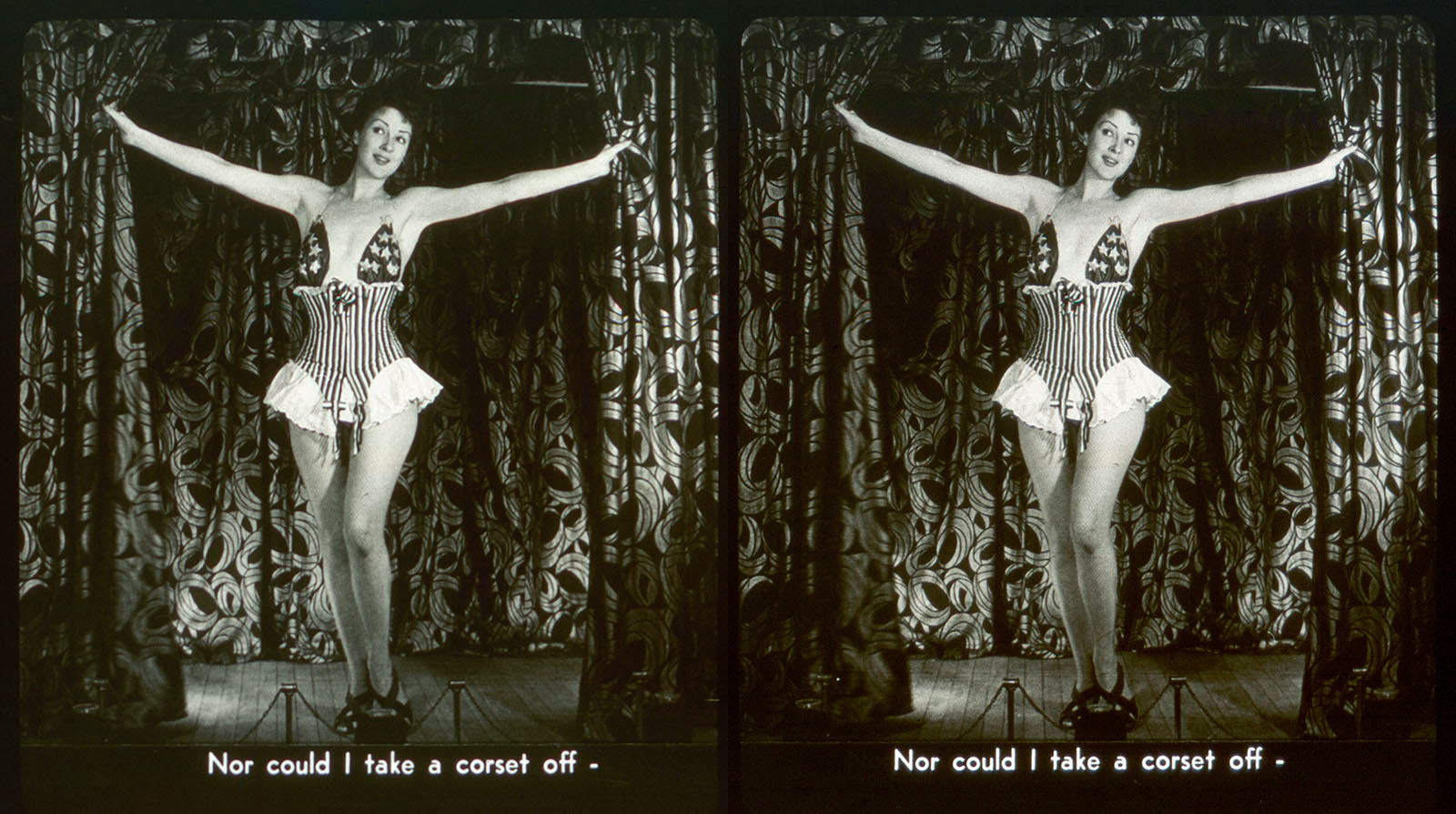
Gypsy Rose Lee (American, 1911-1970) 'Gypsy Rose Lee images for Tru-Vue stereoscope film: Striptease Stereoview #1306 Burlesque' 1933 (detail)


Gypsy Rose Lee (American, 1911-1970)
Gypsy Rose Lee images for Tru-Vue stereoscope film: Striptease Stereoview #1306 Burlesque (detail)
1933
Vintage Tru-Vue 16 pictures in film (13 of Gypsy Rose Lee)
The 31 Women Collection


Gypsy Rose Lee began performing as a stripper in burlesque shows and went on to appear in Broadway theaters. Her stripteases were greatly successful, allowing her to transform the genre. The fact that she talked while striping was truly groundbreaking and enabled her to draw attention away from the mere act of stripping, while presenting herself as a modern and entertaining woman. Likewise, her enunciation was unlike street slang: she recited with an outlandish high-class accent and incorporated phrases in French.

Short biography: Gypsy Rose Lee (1911-1970). Born under the name Rose Luise Hovick into a working-class family that performed in vaudeville theaters in Seattle, Washington, Gypsy Rose Lee began to work as a stripper in burlesque shows at the age of sixteen and went on to perform at important Broadway theaters. Her acts were enormously popular at the time, granting the genre respect and transforming it into something beyond the act of stripping. She began to collect works of art in the 1940s. Among such purchases were works by Max Ernst. This opened the doors to meetings with Peggy Guggenheim, who at that time was married to the German painter and would host the encounters at her house. In Exhibition by 31 Women, she exhibited a collage titled Self-Portrait. In 1957 Gypsy Rose Lee published her autobiography, culminating the life-long self-promotion and self-invention work that drove her entire career.


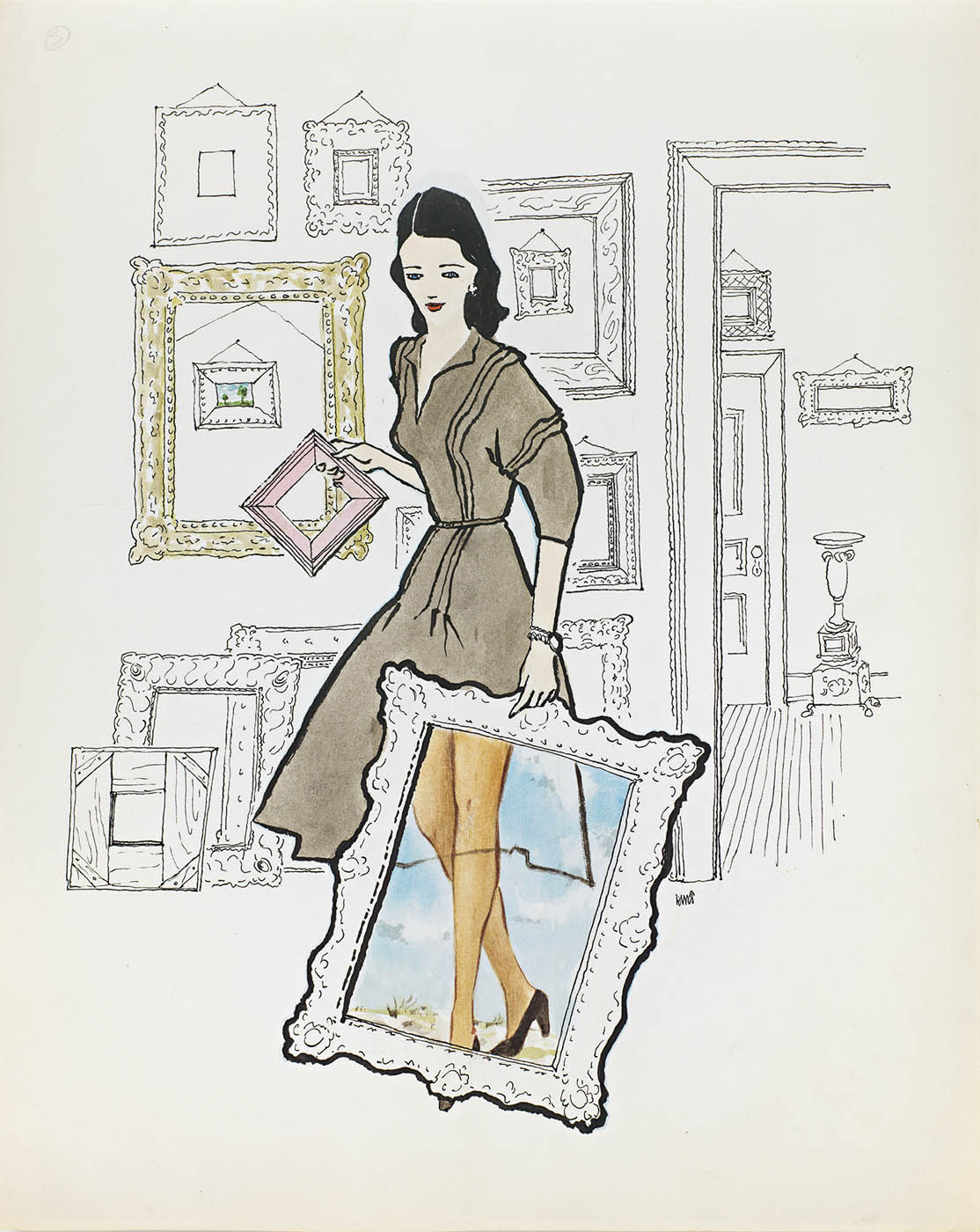
Dorothea Tanning (American, 1910-2012) 'Untitled (Self-Portrait)' c. 1940


Dorothea Tanning (American, 1910-2012)
Untitled (Self-Portrait)
c. 1940
Watercolour, ink and crayon on paper
36.5 x 29.2cm
The 31 Women Collection
© The estate of Dorothea Tanning, VEGAP, Madrid, 2024
© 2022-2024 JPS Artworks LLC


In this self-portrait from the early 1940s, Dorothea Tanning experimented with the limits of reality and representation. In a style akin to fashion figurines that often appeared in women’s magazines of the time, the artist portrayed herself in a room full of empty canvases. Her naked legs are reflected onto a framed glass that is pointed at the viewer, creating an impossible interplay of mirrors and altering the relationship between reality and reflection; inside and out.

Short biography: Dorothea Tanning (1910-2012). Born in a small town in Illinois, where she lived a solitary childhood, Dorothea Tanning developed an interest in dreams and fantasy since she was a child. After visiting Fantastic Art, Dada, Surrealism (1936) at MoMA, she felt attracted to Surrealism and travelled to Paris three years later with the objective of coming into contact with said group. Although she was forced to cut her stay short due to the outbreak of the war, the paintings she created upon her return to New York are proof of her strong Surrealist bias. In 1942, following the advice of gallerist Julien Levy, Max Ernst visited her studio and selected the works Birthday and Children’s Game for Exhibition by 31 Women. The visit also signified the beginning of a relationship between Tanning and Ernst, who separated from Peggy Guggenheim and married the artist in 1946. From the 1930s to the late 90s Tanning developed a prolific career. Her paintings, ballet designs, soft sculptures, and literary works reflect some of her recurring obsessions: the subversion of the bourgeoise domestic space, metamorphosis, the power of imagination, the gothic novel, and non-conventional images of girls and feminine figures.


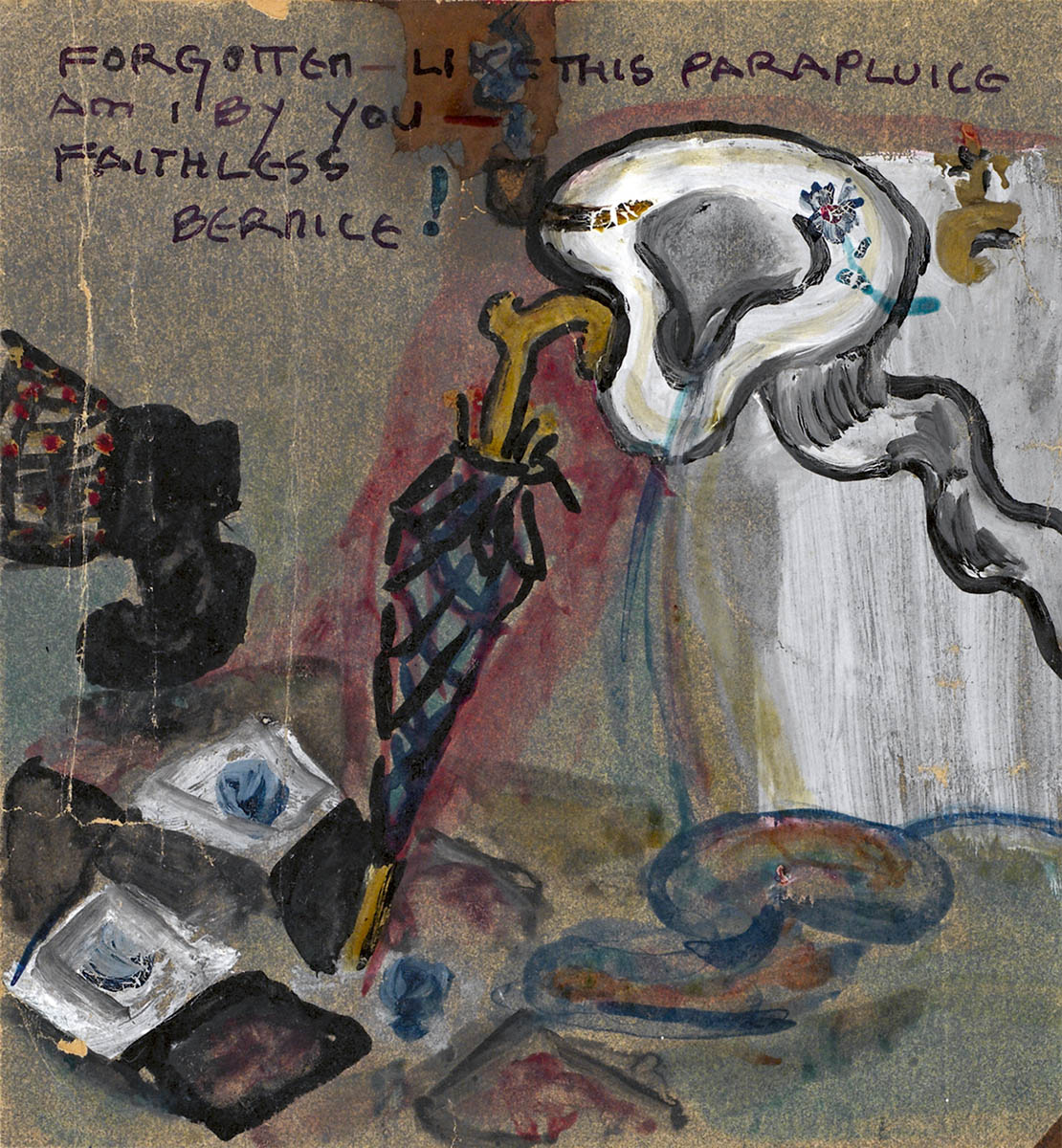
Elsa von Freytag-Loringhoven (German, 1874-1927) 'Forggtten Like This Parapluie Am I By You - Faithless Bernice!' 1923-1924


Elsa von Freytag-Loringhoven (German, 1874-1927)
Forggtten Like This Parapluie Am I By You – Faithless Bernice!
1923-1924
Gouache on foil
13 x 12cm
The 31 Women Collection
© 2022-2024 JPS Artworks LLC


The autobiographical component of this work has been linked to the closed umbrella, which lies uselessly at the center of the image and represents the loneliness felt by Elsa von Freytag-Loringhoven at a point when she had been abandoned by those who supported her both emotionally and financially. The treading foot that appears on the left of the composition symbolizes the passing of the years. The title of the work also expands on this notion, which is a direct interpellation to her friend and patron Berenice Abbott. On the other hand, the silhouette of the urinal alludes to the famous readymade by Marcel Duchamp, a work that a number of recent studies have attributed to Freytag-Loringhoven.

Short biography: Elsa von Freytag-Loringhoven (1874-1927). Born in Germany under the name Else Plötz, she became known as Else Endell, Else Greve, and finally Elsa von Freytag-Loringhoven through her numerous marriages over the course of several decades; evidence of her early interest in constructing herself as a character. At the age of eighteen she settled in Berlin, where she began to study art and worked as a variety artist and model. In 1913 she emigrated to New York and joined the Dadaist circle that gathered around the collectors Louise and Walter Arensberg. Elsa von Freytag’s work spanned several genres: poetry, autobiography, art, and artistic self-representation. Aside from producing sculptures with found elements, she used materials rescued from the streets and objects stolen from department stores to create costumes that she wore at Greenwich Village balls and during her walks through New York, combining them with striking make-up, extravagant hairdos, and other decorations. One of the objects she created with fragments from plumbing materials was on display at Exhibition by 31 Women. In 1923 she returned to Berlin and shortly after settled in Paris, where she scraped a living with the help of friends like Berenice Abbott and Djuna Barnes. She died under uncertain circumstances in 1927. Very few of her performances where documented and her work remained invisible to a great extent until the early 21st century. Some research suggests that she was the author of the famous readymade Fountain, considered one of Marcel Duchamp’s key works.


Strangely Familiar

In 1919 Freud coined the term unheimlich – which roughly translates into English as “ominous” or “uncanny”, and into French as “unsettling strangeness”. This aesthetic category, which is verging on beautiful, was adopted by the Surrealist movement and generally alludes to things that are familiar and attractive, but simultaneously produce a sense of unease and rejection. This is the underlying feeling in Gray Day (Sand Dunes), by Aline Meyer Liebman, or in the still lives by Meraud Guinness Guevara and Meret Oppenheim, which portray decontextualised familiar objects, provoking a sense of unease that is hard to explain. This sensation is accentuated in Spanish Customs by Dorothea Tanning and in Kay Sage’s The Fourteen Daggers, in which two mysterious figures covered in fabric seem to ascend a staircase to the sky.

Hence, Aline Meyer Liebman’s yellowish dunes are striking for their anthropomorphic forms, the Connecticut night sky appears as a fantastic explosion of flowers and stars in Jacqueline Lamba’s painting, and the viewer is unsettled by the incongruent characters and scenes that disrupt the peacefulness in Hazel McKinley and Pegeen Vail’s colourful landscapes. Furthermore, familiar objects seem to have lost their usual meaning in the puzzling dreamlike still lives by Meraud Guinness Guevara, Anne Harvey, Meret Oppenheim, and Gypsy Rose Lee, while Eyre de Lanux and Evelyn Wild’s rug designs combine primitivist and avant-garde elements that question the ideals of purity associated with modern domestic interiors. Kay Sage and Dorothea Tanning’s paintings are particularly unnerving as they transform the bourgeois house into a strange territory inhabited by ghostly figures and elongated shadows.


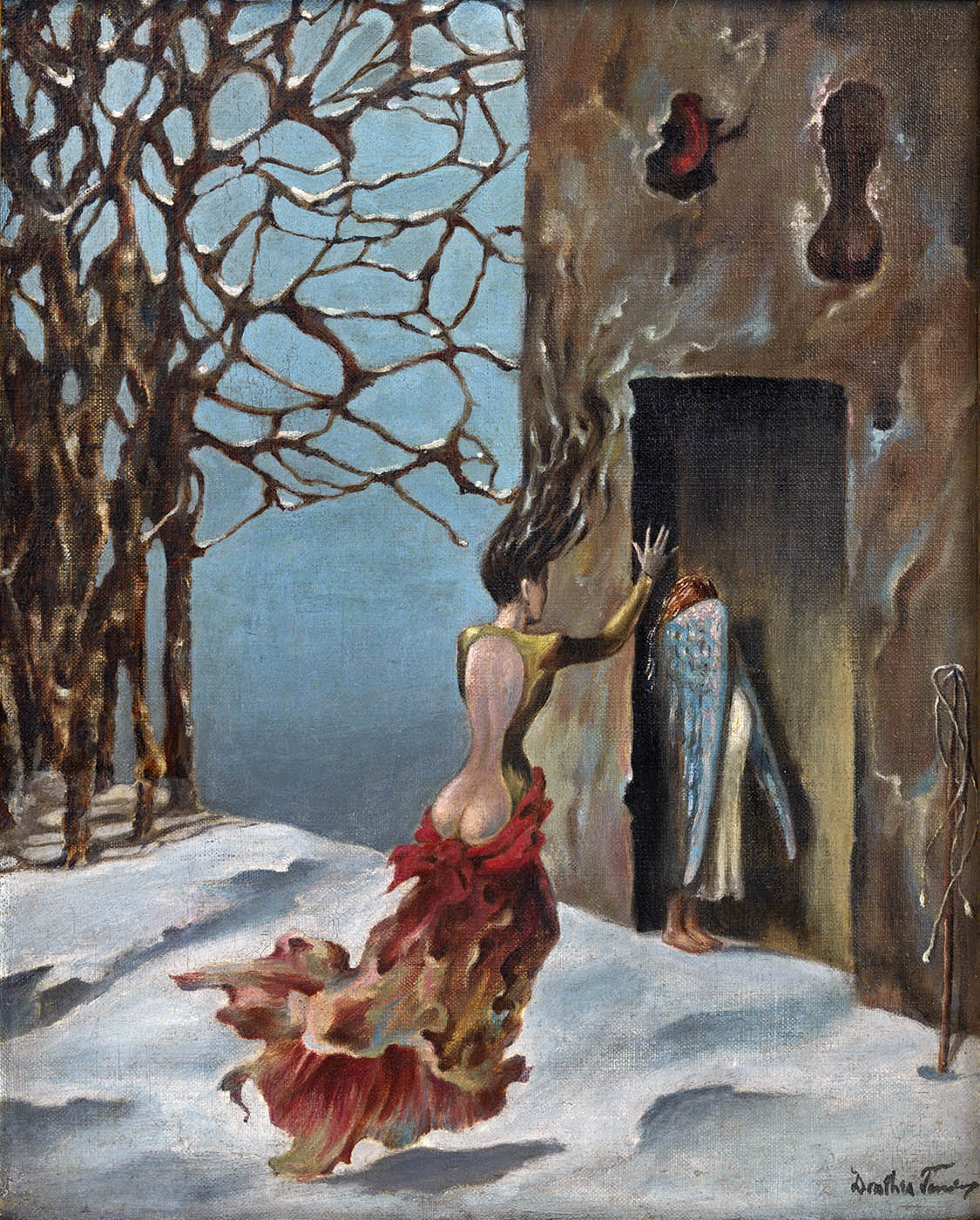
Dorothea Tanning (American, 1910-2012) 'Spanish Customs' 1943


Dorothea Tanning (American, 1910-2012)
Spanish Customs
1943
Oil on canvas
25.4 x 20.3cm
The 31 Women Collection
© The estate of Dorothéa Tanning, VEGAP, Madrid, 2024
© 2022-2024 JPS Artworks LLC


Meret Oppenheim (Swiss born Germany, 1913-1985) 'Souvenir of the Lunch in fur' 1936 / 1972


Meret Oppenheim (Swiss born Germany, 1913-1985)
Souvenir of the Lunch in fur
1936 / 1972
Fabric, paper, artificial fur and artificial flowers encased under glass
16.7 × 19.8cm
The 31 Women Collection
© Meret Oppenheim / VEGAP, Madrid, 2024
© 2022-2024 JPS Artworks LLC


Produced in 1972, this piece is a reinterpretation of one of Meret Oppenheim’s most renowned works, Déjeuner en Fourrure, which was on display for the first time in 1936 – the year it was produced – at an exhibition dedicated to Surrealist objects. The work garnered much recognition and was selected by Peggy Guggenheim for Exhibition by 31 Women. Dipleased by always seeing her name associated with this work, the artist wanted to make an ironic version of her infamous mug, recreating it with cheap materials: a perfect kitsch souvenir of the iconic work.

Short biography: Meret Oppenheim (1913-1985). Born in Berlin into a family of the liberal bourgeoisie, Meret Oppenheim studied at Rudolf Steiner’s school in Basel. Between 1932 and 1937 she spent much of her time in Paris, where she became close to the Surrealist movement. The photographs in which she posed for Man Ray and the enormous success of her objects – in particular Déjeuner en Fourrure [Breakfast with Furs] from 1936, acquired by MoMA and also on display at Exhibition by 31 Women – make her a Surrealist muse of sorts. Later, she expressed her irritation at seeing her name associated solely to that work and to Surrealism. In 1937 Oppenheim returned to Basel, where she battled depression and produced very little until 1954, when she resumed her artistic work with great impetus. Myths, dreams, literary sources, Jung’s psychoanalysis, gender roles, and social stereotyping were interwoven within her work, which also incorporated magical objects, poems, photographs, theatre costumes, and textile designs.


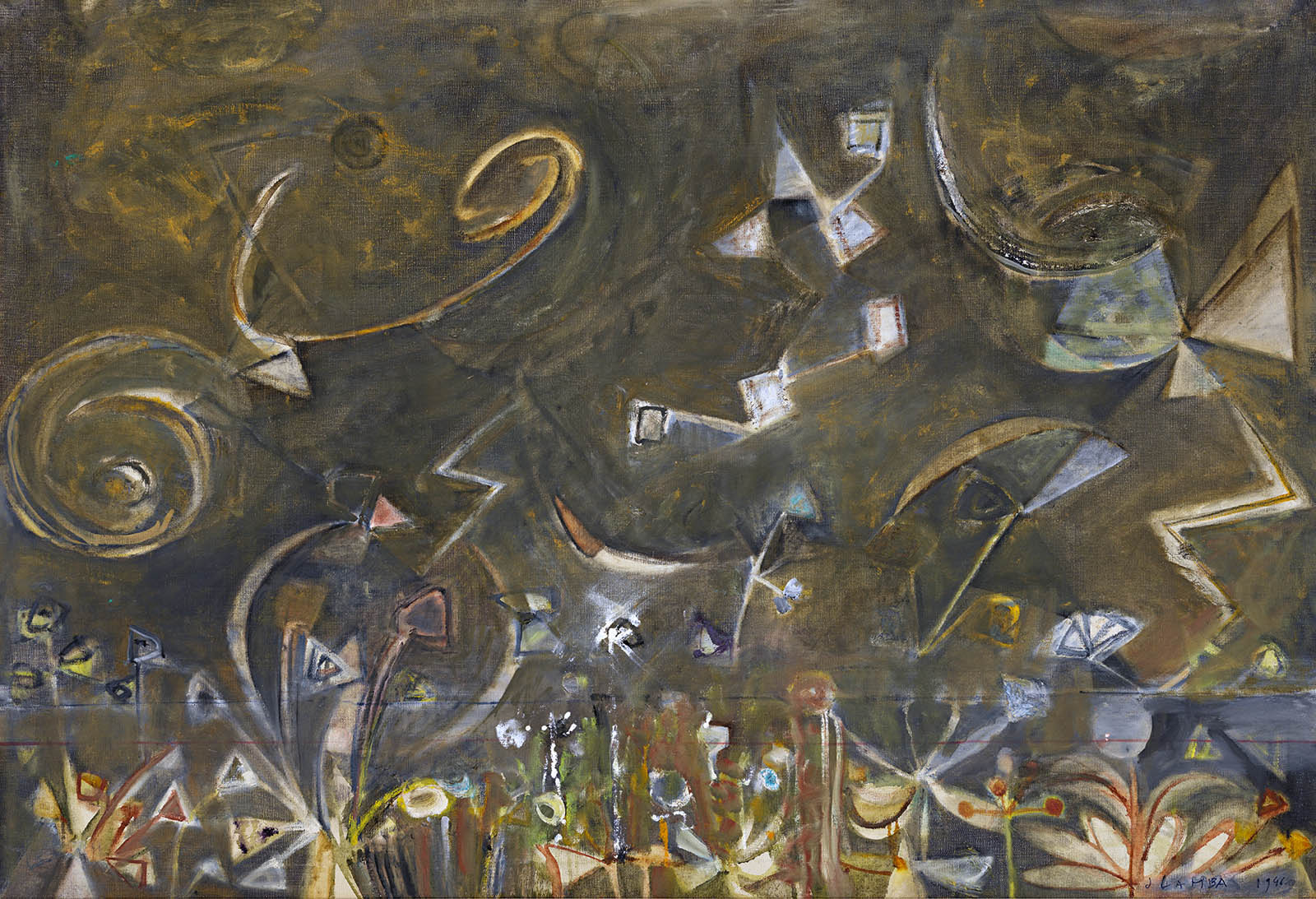
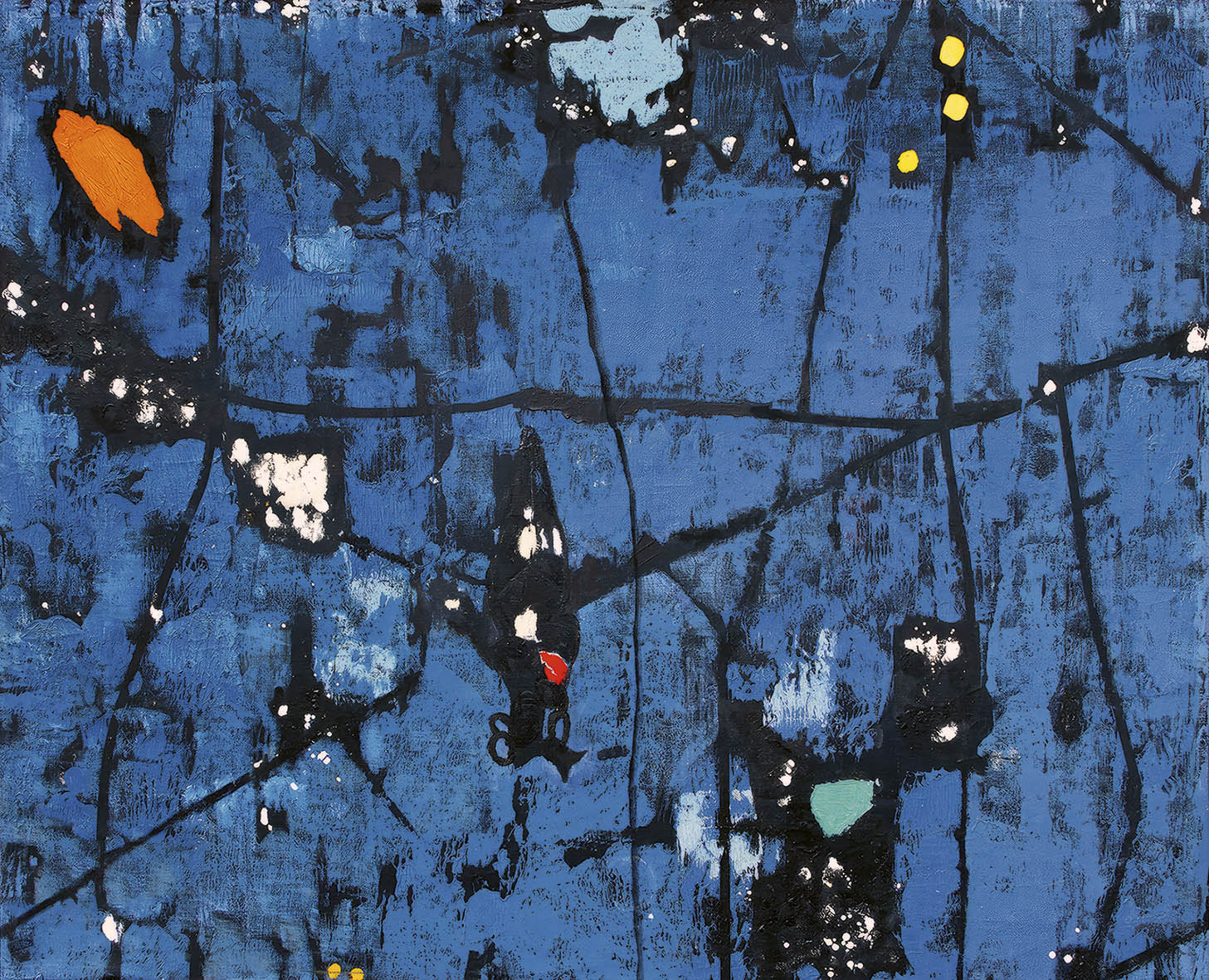
Jacqueline Lamba (French, 1910-1993) 'Roxbury, stars' 1946


Jacqueline Lamba (French, 1910-1993)
Roxbury, stars
1946
Oil on canvas
The 31 Women Collection
© Jacqueline Lamba, VEGAP, Madrid, 2024
© 2022-2024 JPS Artworks LLC


In the mid-1940s, Jacqueline Lamba and the North American Surrealist artist David Hare took a trip together through the western United States, where they came into contact with the cosmology and art of the indigenous peoples of North America. The typical brown colours of Amerindian fabrics dominate the palette of this canvas, in which Lamba portrayed the surroundings of her house in Roxbury and captured the unexpected reality that lies hidden behind a seemingly mundane landscape.

Short biography: Jacqueline Lamba (1910-1993). Born in France, Jacqueline Lamba spent her early years in Egypt, where her father – an engineer – passed away in a car accident in 1914. She returned to Paris with her mother and attended the École de l’Union Centrale des Arts Décoratifs. After the passing of her mother in 1927 Lamba survived with the meager wages she earned from her design work. Fascinated by André Breton’s Communicating Vessels, she began an intense and difficult romantic relationship with him. The couple married shortly after and had a daughter named Aube. Jacqueline Lamba always lamented being more recognised as Breton’s muse than for her collages, cadavre exquis, objects, and paintings, which would soon be on display at Surrealist exhibitions. In 1938 she travelled to Mexico with her husband. The couple was hosted by Diego Rivera and Frida Kahlo, whom she established a profound relationship with. Thanks to the patronage of Peggy Guggenheim, Lamba and Breton settled in New York in 1941 as they fled from the Nazis. Lamba exhibited her work at the inaugural show of the Art of This Century Gallery and participated in Exhibition by 31 Women. In 1944 she divorced Breton and began a relationship with David Hare. They settled in Connecticut in 1948 and had a son. Lamba lost interest in Surrealism and veered toward abstraction, focusing on the mythologies of indigenous populations from Mexico and the United Sates. In 1954, after separating from Hare, she returned to Paris and destroyed much of her prior work. She later confessed that she had first tried to please Breton and then Hare with her paintings, ensuring that she would only paint to please herself from that point onward. In 1967 the most comprehensive exhibition dedicated to her work in her lifetime was hosted at the Musée Picasso in Antibes.


Kay Sage (American, 1898-1963) 'The Fourteen Daggers' 1942


Kay Sage (American, 1898-1963)
The Fourteen Daggers
1942
Oil on canvas
40.6 × 33.3cm
The 31 Women Collection
© 2024 Estate of Kay Sage / VEGAP
© 2022-2024 JPS Artworks LLC


The conversion of domestic space into unusual territory reached its pinnacle in works such as this one. Sage imagined a bizarre interior space that opens up to a door behind which lies a staircase leading to the sky. The scene is inhabited by two ghostly figures covered in fabric that cast elongated shadows on the ground and accentuate the air of mystery. The motif of the open door reappears in Dorothea Tanning’s oil painting Spanish Customs, also on display in this room.

Short biography: Kay Sage (1898-1963). Born under the name Katherine Linn Sage into a wealth family from Albany, Kay Sage spent most of her childhood travelling through Europe with her mother, who had divorced her father in 1908. Although she never received a formal education, she went on to study at the Corcoran School of Art in Washington D. C. and at the British Academy in Rome, where she settled in 1920. Aside from coming into contact with the local artistic scene, Sage met Prince Ranieri di San Faustino, whom she married in 1925. During their ten years as a married couple, Sage dedicated little time to art. In 1937 she moved to Paris, where she came into contact with the members of the Surrealist group and began a romantic relationship with the painter Yves Tanguy, whom she married in 1941. With the outbreak of World War II, the couple migrated to Connecticut, where they would reside for the following years. During that period Sage developed her own style: uninhabited landscapes intersected by austere architectural forms, shadows, and floating fabrics that are simultaneously recognisable and enigmatic. Peggy Guggenheim selected her painting from 1942 At the Appointed Time – today preserved at the Newark Museum of Art – for Exhibition by 31 Women. In 1955 Tanguy died suddenly. This event led Sage into depression. Coupled with eyesight problems, she drifted away from painting. In the late 1950s she began to produce collages and write poetry. However, in January of 1963 Sage took her own life.


Bestiaries

Many of the artists featured in this exhibition – particularly those whose works are more closely linked with Surrealism – experimented with multiple personalities, which led them to identify themselves with animals that became their alter egos. As noted by Patricia Mayayo, curator of the show, “the animals embodied the search for other mythical or imaginary worlds where they could finally be free”. Hence, the female body is transformed into an eagle, a crow, or a deer in the works of Barbara Poe-Levee Reis, Milena Pavlovic-Barilli, Julia Thecla, and Frida Kahlo, while in Leonora Carrington’s The Horses of Lord Candlestick, the horse simultaneously embodies the dreaded paternal figure and the artist herself.

Women artists close to Surrealism granted particular importance to the representation of animals. Such is the case with works by Barbara Poe-Levee Reis and Milena Pavlovic-Barilli, in which animals often inhabited fictional landscapes or mythical worlds where women could imagine themselves freed from patriarchal norms. Likewise, in works by Julia Thecla, Frida Kahlo, and Leonor Fini, the depiction of women’s bodies being transformed into crows, deer, and cats refers to an alternate reality in which humans and animals are hybridized. Djuna Barnes imagined a collection of grotesque women with animal-like traits that challenged normative understandings of the feminine in an illustrated book of poems published in 1915. Valentine Hugo was inspired by the animals of the zodiac when designing costumes for a theatrical performance that took place at the Théâtre Champs-Elysées in Paris. Lastly, in Leonora Carrington’s painting, the horse appears as a more ambivalent figure that simultaneously embodies patriarchal authority and the liberation of women.

Since the 1930s, women had a growing presence in Surrealist initiatives. For example, in 1936 Leonor Fini, Valentine Hugo, Meret Oppenheim, and Sophie Taeuber-Arp participated in the exhibition Art, Dada, Surrealism hosted at MoMA. Six years later, Leonora Carrington and Kay Sage exhibited their work at First Papers of Surrealism, organised by André Breton and Marcel Duchamp in New York . Women also collaborated on the movement’s publications, either as authors or as illustrators; an example of which includes the series of eighteen drawings that Hugo produced in 1951 for Paul Éluard’s book of poems Le Phénix. Peggy Guggenheim’s work as a patron undoubtedly helped to reinforce female participation. Many of the artists included in the exhibition of 1943 had attended the meetings between North Americans and exiled Europeans organised by the collector at her house in New York. Some of the works on display at 31 Women were reproduced in the double issue of the Surrealist magazine VVV in 1943; an acknowledgement that most likely contributed to the show’s repercussion.


Valentine Hugo (French, 1887-1968) 'Fish. Costume project for the Théâtre des Champs-Elysées, Paris' 1950


Valentine Hugo (French, 1887-1968)
Fish. Costume project for the Théâtre des Champs-Elysées, Paris
1950
Pastel sobre papel negro
28.5 × 16cm
The 31 Women Collection
© Valentine Hugo, VEGAP, Madrid, 2024
© 2022-2024 JPS Artworks LLC


Short biography: Valentine Hugo (1887-1968). Born in Boulogne-sur-Mer under the name Valentine Gross, Valentine Hugo possessed a natural talent for drawing since her childhood. She studied at the École des Beaux-Arts in Paris, produced illustrations for fashion magazines, and frequently attended Diaghilev’s Ballets Russes. Inspired by the subject of dance, her drawings and paintings were on display at the Thèatre des Champs-Elysées in 1913. A friend of Erik Satie and Jean Cocteau, she also collaborated she also collaborated on thaeatrical sets and designs with Jean Hugo, her husband at the time. In 1926 she met André Breton – whom she would establish a short-lived romantic relationship with – and joined the circle of Surrealists. She participated in the exhibition Fantastic Art, Dada, Surrealism (MoMA, 1936), in the development of numerous cadavre exquis, and the illustration of Surrealist books. The influence of Surrealism can be perceived in her constructions, which are based on the unexpected encounter with objects and materials, as well as in the importance she grants to motifs such as dreams, night-time atmospheres, the marvelous, and ghostly apparitions. The drawing that was featured at Exhibition by 31 Women – which has since been lost – was poignantly titled Dream of 17/1/34. Hugo remained in France during the war, after which she focused on illustration, writing books of poems, and the production of theater costumes and sets.


Leonor Fini (Argentine-Italian, 1907-1996) 'Woman in Armor I' 1938


Leonor Fini (Argentine-Italian, 1907-1996)
Woman in Armor I
1938
Oil on canvas
37 x 27cm
The 31 Women Collection
© Leonor Fini, VEGAP, Madrid, 2024
© 2022-2024 JPS Artworks LLC


Short biography: Leonor Fini (1907-1996). Born in Argentina into a family marked by a dominant father, Leonor Fini fled with her mother to Trieste, Italy, when she was still a young girl. Fini taught herself art. At the age of seventeen she left the family home and moved to Milan and later to Paris, where her interest in the world of dreams and the unconscious led her to come into contact with the Surrealists. Although she was not officially part of the group, she participated in important Surrealist exhibitions such as Fantastic Art, Dada, Surrealism at MoMA in 1936. Hybrid figures such as the sphynx dominate her paintings, a motif she also explored through costumes and self-representation. The painting that was on display at Exhibition by 31 Women was in fact titled The Shepherdess of the Sphinxes. During the war she remained in Europe. Between 1944 and 1972, aside from continuing to paint, she focused intensely on the design of theatrical costumes and sets.


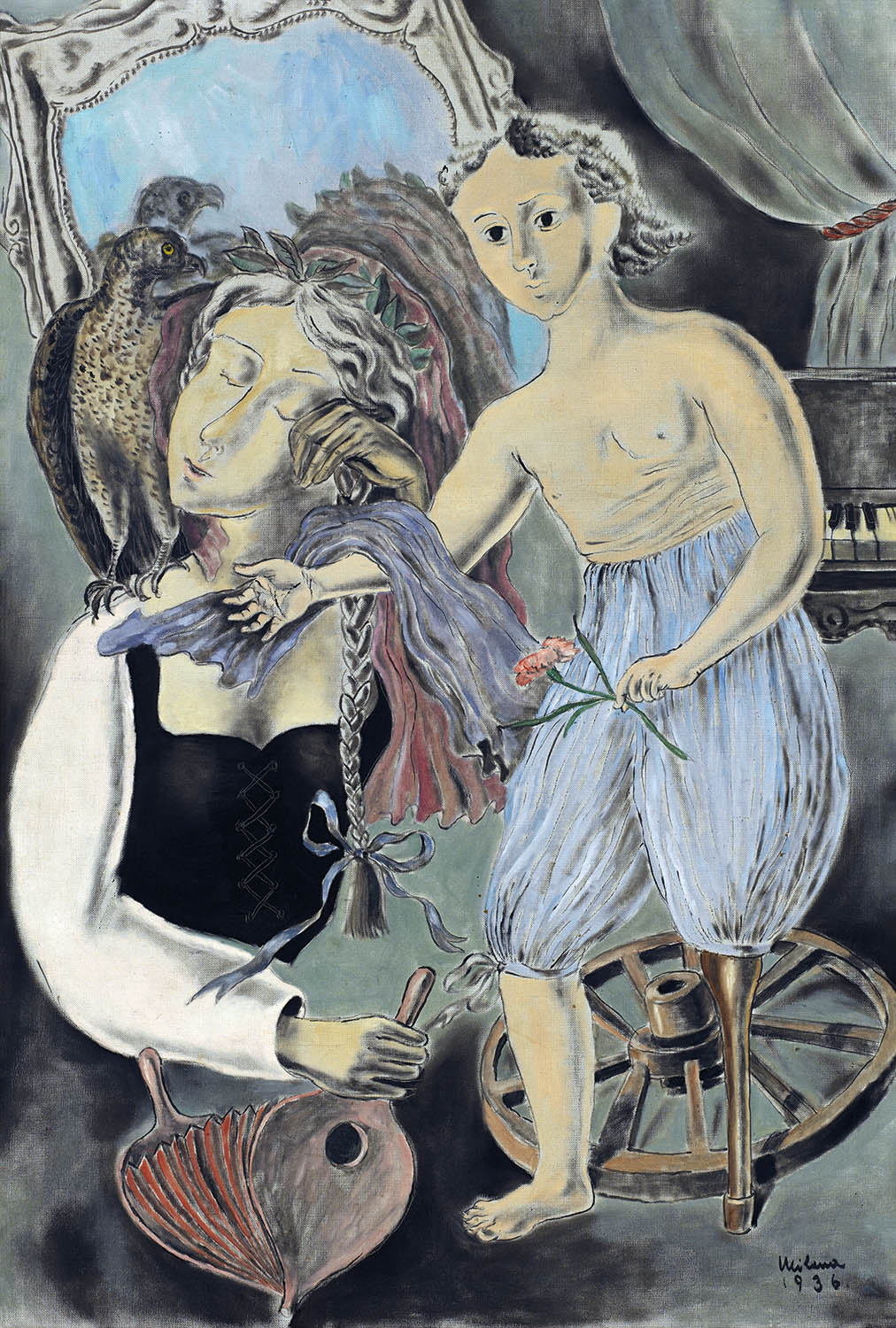
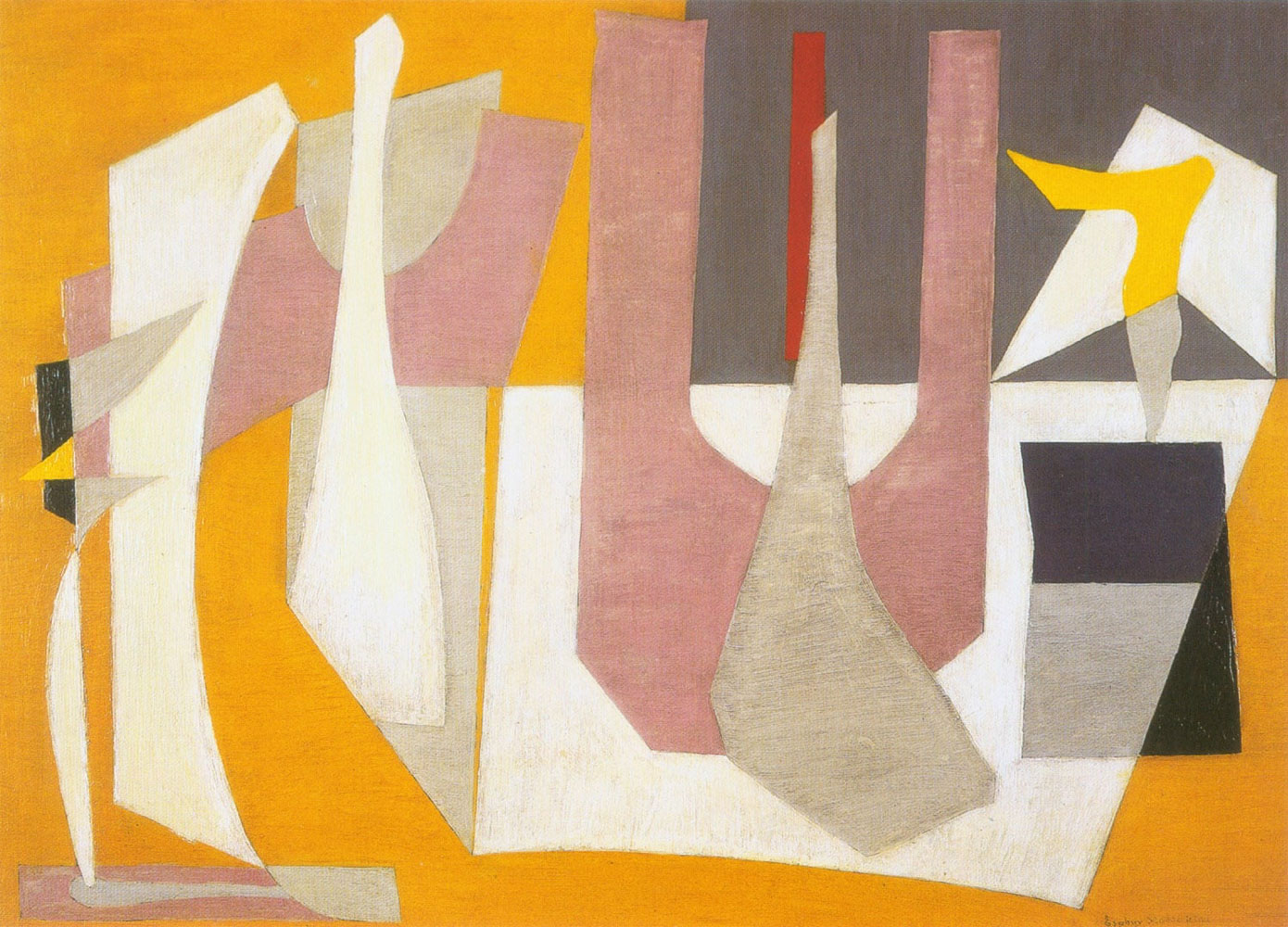
Milena Pavlovic-Barilli (Serbian, 1909-1945) 'Juno and Vulcan' 1936


Milena Pavlovic-Barilli (Serbian, 1909-1945)
Juno and Vulcan
1936
Oil on canvas
95.3 × 64.8cm
The 31 Women Collection
© 2022-2024 JPS Artworks LLC


The painting by Pavlovic draws from various sources: Mannerist art from the 16th century, Magical Realism, and Surrealism. It also incorporates motifs and mythical figures from classical antiquity, such as the Roman goddess Juno and her son Vulcan, protagonists of this canvas. The use of diluted colours, the impression that the characters are floating in space, and the apparently incongruent combination of a wide range of elements (the eagle, the piano, the wheel, the drapery, the bouquet of flowers, and the mirror) grant this painting a dreamlike and mysterious atmosphere.

Short biography: Milena Pavlovic-Barilli (1909-1945). Born in Serbia into a family with artistic inclinations, Milena Pavlovic-Barilli studied art in Munich between 1926 and 1928. There she was introduced to painting, fashion illustration, and drawing, creating an iconography based on stylised figures and wavy lines in which the influence of Art Nouveau is combined with echoes of orient. In 1931 she settled in Paris, where she came into contact with figures of Surrealism, such as André Breton, Jean Cocteau, and Paul Valéry. Regardless, her work drifted into a style that critics considered closer to Magical Realism. Everyday life was fused with fantasy in her paintings, while space was filled with enigmatic symbols: ancient columns that levitate, veiled faces of women, winged youths painted in pale hues, all of which grants her work a supernatural feel. She lived in New York between 1939 and 1945, where she focused on fashion illustration and costume and set designs for the theater. Her paintings, populated with elongated figures in architectural environments that seem rooted in the Renaissance, reflect her admiration for Mannerism. In 1940 she exhibited her work at the Julien Levy Gallery and established ties with the group of Surrealist immigrants. Her work Insomnia (1942) – which has since been lost – was on display at Exhibition by 31 Women. Her premature death in an accident in 1945 cut her career shot. In 1962 the Milena Pavlovic-Barilli Museum opened its doors at the house where she was born. The museum includes a broad selection of her paintings, drawings, letters, and personal objects.


Leonora Carrington (Mexican born United Kingdom, 1917-2011) 'The Horses of Lord Candlestick' 1938


Leonora Carrington (Mexican born United Kingdom, 1917-2011)
The Horses of Lord Candlestick
1938
Oil on canvas
35.5 ×46cm
The 31 Women Collection
© 2024 Estate of Leonora Carrington / VEGAP
© 2022-2024 JPS Artworks LLC


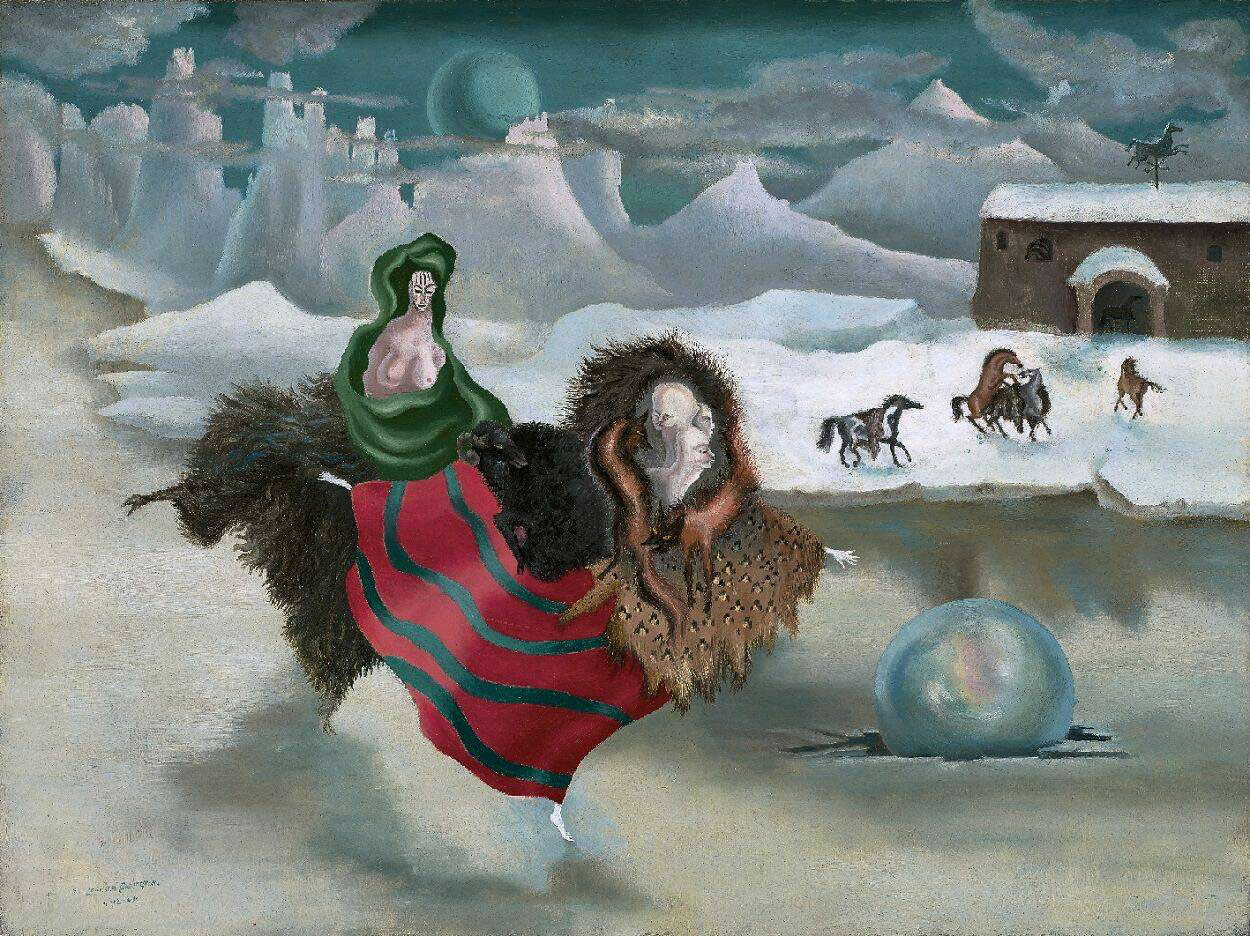
Short biography: Leonora Carrington (1917-2011). Born into a wealthy English family, Leonora Carrington was fascinated by fairy tales and fantasy literature since she was a young girl. She studied art in Florence, Paris, and London under the guidance of Amédée Ozenfant. Her first works recreate legendary worlds populated by hybrid animal species and powerful female figures. In 1936 she discovered Surrealism during a visit to the International Surrealist Exhibition. Two years later she settled in the south of France with Max Ernst – whom she had established a relationship with – in an old house that the couple transformed into a work of total art. Carrington began to publish her first books containing short stories. In 1940, after the outbreak of the war and the arrest of Max Ernst, she fled to Madrid, where she became the victim of rape and was subsequently admitted to a psychiatric hospital in Santander; she would recount this experience in her book Down Below. After managing to migrate to New York in 1941 she participated in a number of initiatives promoted by exiled Surrealists, such as the exhibition First Papers of Surrealism and the magazine VVV. Peggy Guggenheim included two of her works The Horses of Lord Candlestick (1938, above) and the Joy of Skating (1941, below) in Exhibition by 31 Women. In 1943 Carrington settled in Mexico, where she would live until her death. She integrated into the community of exiled artists along with Kati Horna, Remedios Varo, and Benjamin Péret. Her paintings re-elaborated old themes and she delved into new ones: fantasy literature, female divinities, alchemy, magic, and Mexican mythologies.


Leonora Carrington (Mexican born United Kingdom, 1917-2011) 'Joy of Skating' 1941


Leonora Carrington (Mexican born United Kingdom, 1917-2011)
Joy of Skating
1941
Oil on canvas
© 2024 Estate of Leonora Carrington / VEGAP


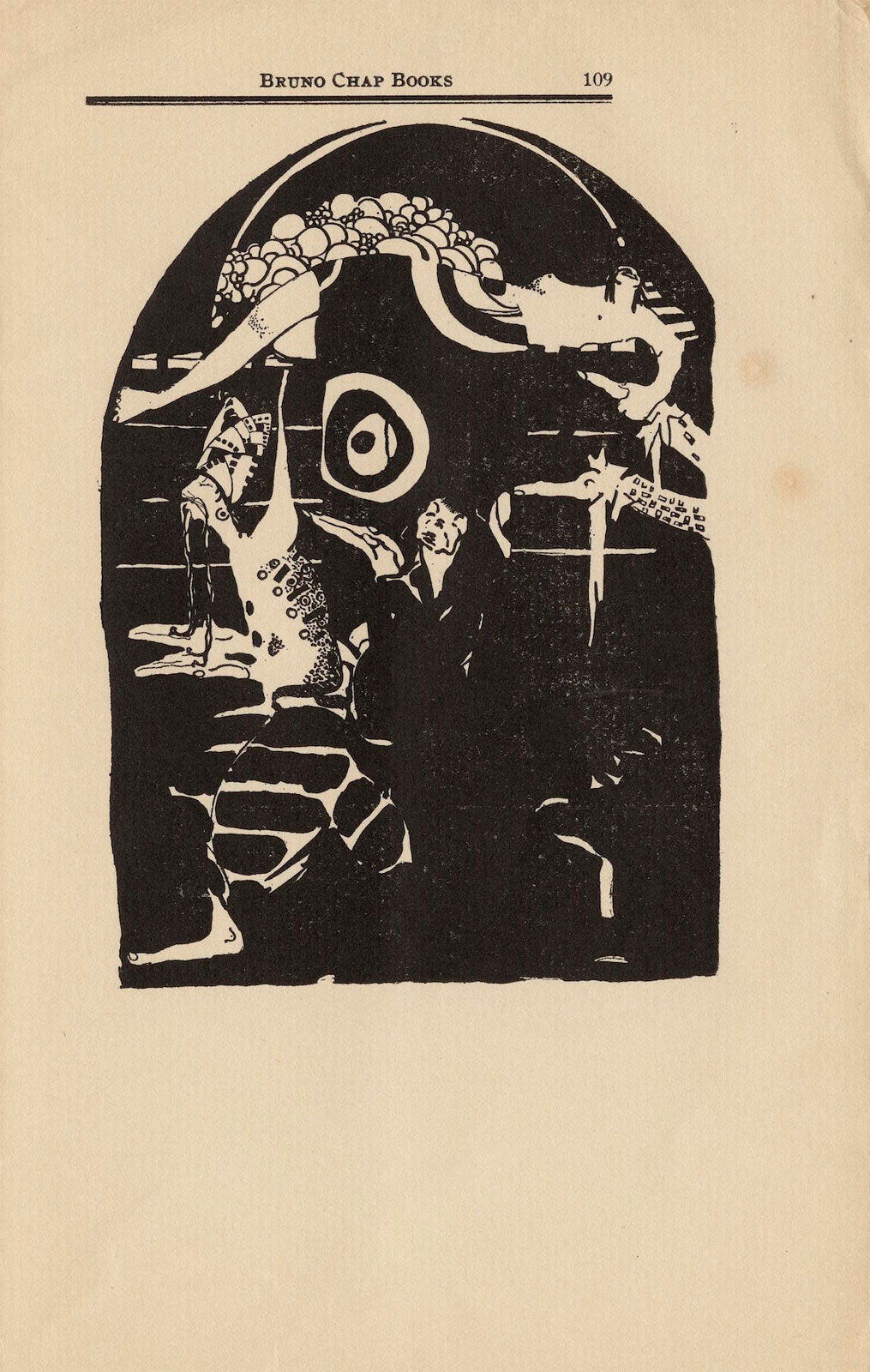
Djuna Barnes (American, 1892-1982) 'The Book of Repulsive Women, 4th image in the 1st edition' 1915


Djuna Barnes (American, 1892-1982)
The Book of Repulsive Women, 4th image in the 1st edition
1915
The 31 Women Collection


In the modern age of Taylorism and Fordism, women played a vital role in the functioning of the American system by efficiently arranging domestic life with a precision similar to that of the nation’s industry. In contrast with this mechanical monotony, Barnes imagined the “repulsive women” that appear in her poems and drawings as the antithesis of the model housewife. Some of these figures, such as the woman with donkey ears and animal-like features that can be observed in one of her illustrations, manage to question the very the boundaries of humanity.

Short biography: Djuna Barnes (1892-1982). Born in a colony of artists north of New York, Djuna Barnes studied art at the Pratt Institute and at the Art Students League. In 1915 she settled in the bohemian neighborhood of Greenwich Village, where she began her career as an artist and a writer. That same year she published The Book of Repulsive Women, a collection of poems that included her own illustrations, and began to work as a journalist. Best known for her experimental novel from 1936, Nightwood, Barnes cultivated all genres: narrative, poetry, theater, and journalism. In 1921 she moved to Paris, where she began a romantic relationship with the sculptor Thelma Wood and began to frequent the avant-garde circles of the Rive Gauche, establishing friendships with Gertrude Stein, Berenice Abbott, Natalie Clifford Barney, Elsa von Freytag-Loringhoven, and Peggy Guggenheim herself. With the outbreak of World War II, she moved back to New York, where her work Portrait of Alice was put on display at Exhibition by 31 Women. 


The Middle Way: Languages of Abstraction

Although many of the artists who participated in 31 Women fell within the sphere of influence of Surrealism, some of them were more inclined toward abstract languages. In the 1930s the North American art scene was dominated by social realism and regionalism. In an effort to promote abstraction, the association American Abstract Artists (AAA) was founded, an association which included members such as Suzy Frelinghuysen, Louise Nevelson, Irene Rice Pereira, and Esphyr Slobodkina. Abstraction began to progressively dominate the artistic landscape of North America and was configured in a way that highlighted the ideal of masculinity, whose epitome was Jackson Pollock. In the face of a discourse that hailed the language of expressionism as a reflection of the North American male, many of these artists opted to explore a “middle way” that could account for all of the possibilities afforded by abstraction. A great example of this can be found in The Middle Way / The Great Mother Rules the Sky (Astor Mural) by Buffie Johnson.

The association American Abstract Artists (AAA) was founded in 1936 with the objective of fostering the development of abstraction in the United States. It included members such as Suzy Frelinghuysen, Louise Nevelson, Irene Rice Pereira, and Esphyr Slobodkina. It is no coincidence that Slobodkina was one of the artists included by Ad Reinhardt in his vignette “How to Look at Modern Art in America” (1946), in which he traced the family tree of North American modern art. Other creators participated in key initiatives for the renovation of abstract practice in the United States, such as Gretchen Schoeninger, who attended the experimental art school New Bauhaus, founded by László Moholy-Nagy – a former professor at the historic German Bauhaus – in Chicago in 1947. Regardless, few artists who took part in 31 Women occupy an important place in the dominant narratives of North American abstract art. As Xenia Cage jokingly suggested in a collage produced from one of Jackson Pollock’s action paintings, perhaps the value of these artist’s works is compromised by the strong exaltation of masculinity, which at the time was characteristic of discourse. Buffie Johnson became aware of the marginalisation suffered by women in Abstract Expressionist circles early on. In the 1940s, determined to give value to female legacies, she undertook a research project on the imagery of the goddess mothers of antiquity, culminating in a book published in 1988.

The exhibition concludes with a relationship map detailing the connections established between the thirty-one artists who participated in the exhibition and Peggy Guggenheim. By highlighting the network of professional and personal links they constructed, the chart depicts the important role these artists played as agents in the art scene of the time beyond traditional conceptions of women artists as supporting characters.


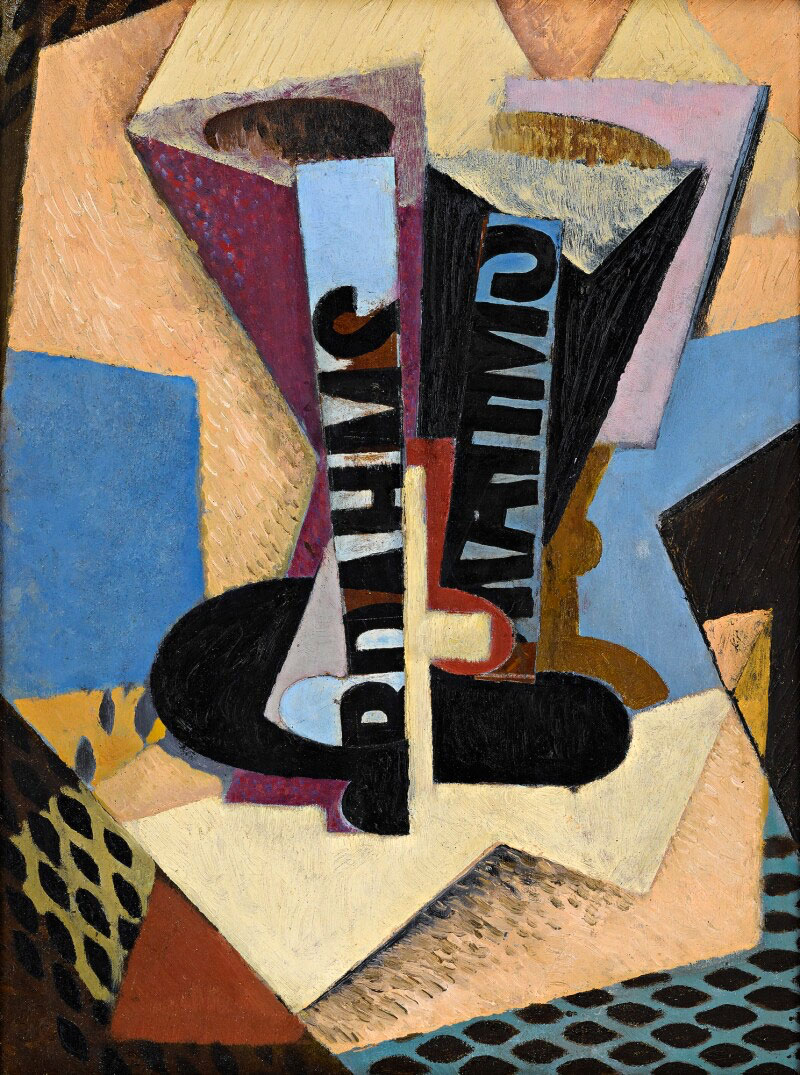
Suzy Frelinghuysen (American, 1911-1988) 'Untitled (Brahms Abstract)' 1945


Suzy Frelinghuysen (American, 1911-1988)
Untitled (Brahms Abstract)
1945
Oil and collage on Masonite


Suzy Frelinghuysen was part of the group of artists known as The Park Avenue Cubists, who proposed a reinterpretation of European Cubist heritage from a North American perspective. In her works, Frelinghuysen combined the influence of Synthetic Cubism, which she expanded on through the use of blue, lavender, and rusty hues, with constant references to the world of music; a field in which the artist also excelled as an opera singer.

Short biography: Suzy Frelinghuysen (1911-1988). Born into a wealthy family from Newark, New Jersey, Suzy Frelinghuysen was part of the group of artists knowns as The Park Avenue Cubists, along with Albert Eugene Gallatin, Charles G. Shaw, and George L. K. Morris – whom she married in 1935 – who advocated for a reinterpretation of European Cubist heritage from a North American perspective. In 1937 Frelinghuysen joined the association American Abstract Artists (AAA), founded in an effort to promote the development of abstract art in the United States, whose members included Louise Nevelson, Irene Rice Pereira, and Esphyr Slobodkina. After the war she temporarily quit art to focus on music, becoming a renowned opera singer. In her work, which was included in important group shows such as Exhibition by 31 Women, the influence of Synthetic Cubism was combined with constant references to the world of music.


Esphyr Slobodkina (American born Russia, 1908-2002) 'Peacock Garden' 1938


Esphyr Slobodkina (American born Russia, 1908-2002)
Peacock Garden
1938
Oil on board


From the late 1930s, Slobodkina developed a style of her own based on the poetic combination of curved forms painted in lyrical hues. Along with the influence of Cubism and the technique of collage, the artist also demonstrated her interest in sewing and working with scraps, which she learned from her mother, a professional seamstress. One of the defining traits of her work was its interdisciplinary nature: aside from painting, Slobodkina created assemblages, produced murals, illustrated children’s books, and designed costumes and jewellery.

Short biography: Esphyr Slobodkina (1908-2002). Originally from Siberia, Esphyr Slobodkina moved to Manchuria with her family in order to escape from the Soviet Revolution. Since she was a child, she studied in the fields of art and music. In 1928 she moved to New York on her own, where she continued her studies at the National Academy of Design. From the late 1930s she developed her own style based on a combination of wavy forms in lyrical tones that, along with the influence of Cubism and collage, reflect her interest in the tradition of decorative arts from her native country. Her work stands out for its interdisciplinary nature: aside from painting, Slobodkina focused on assemblage, murals, the illustration of children’s books, and on jewelry and costume design. As one of the founders of the association American Abstract Artists (AAA), which she presided – also acting as treasurer and secretary – Slobodkina played an important role in the promotion of abstraction in the United States. Alfred H. Barr, director of MoMA, recommended her work to Peggy Guggenheim, who decided to include Memories (1942) – which has since been lost – in Exhibition by 31 Women.


Buffie Johnson (American, 1912-2006) 'The Middle Way / The Great Mother Rules the Sky (Astor Mural)' 1949-1959


Buffie Johnson (American, 1912-2006)
The Middle Way / The Great Mother Rules the Sky (Astor Mural)
1949-1959
Oil on canvas
124.5 × 152.4cm
The 31 Women Collection
© Estate of Buffie Johnson


Between 1949 and 1959, Buffie Johnson produced what is considered one of her most important works: a great mural intended to decorate the Astor Theater in New York. This project was a true challenge for all those who negated women’s ability to create large format paintings. Thanks to the recovery of the mural by part of the Women’s Caucus prior to the theater’s demolition in 1982, some fragments, such as the one on display in this exhibition, are today part of public and private collections.

Short biography: Buffie Johnson (1912-2006). Born in New York, Buffie Johnson studied art at the University of Los Angeles. She later spent two years in Paris, where she established a friendship with Sonia Delaunay and other painters of the Parisian avant-garde. After completing her studies at the Académie Julian, she settled in New York in 1939. Johnson began to frequent several artistic circles, such as Peggy Guggenheim’s, who invited her to participate in Exhibition by 31 Women with the painting Déjeuner sur mer (1942). Outraged by the response of a Time Magazine critic who refused to review the exhibition arguing that he had never heard of outstanding women creators, Johnson attempted to publish an article on women artists that was rejected by several art magazines. This experience entailed the first awakening of her feminist consciousness. During the 1950s her work pivoted toward Abstract Expressionism. In parallel to her artistic career, she received a grant to study the imagery of the goddess mothers of antiquity, a work she would publish in 1988. Johnson’s early interest in the matriarchal tradition, which would also be reflected in many of her paintings, was embraced by second wave feminism in the late 1960s; a movement the artist would be actively involved in.


Sophie Taeuber-Arp (Swiss, 1889-1943) and Jean (Hans) Arp (German-French, 1886-1966) 'Vertical-Horizontal Composition [Conceived by Sophie Taeuber-Arp and executed in relief by Jean Arp]' 1927-1928 / 1943-1956


Sophie Taeuber-Arp (Swiss, 1889-1943) and Jean (Hans) Arp (German-French, 1886-1966)
Vertical-Horizontal Composition [Conceived by Sophie Taeuber-Arp and executed in relief by Jean Arp]
1927-1928 / 1943-1956
Oil on wood relief mounted on pavatex
The 31 Women Collection
© Arp Jean / Hans Arp, VEGAP, Madrid, 2024
© 2022-2024 JPS Artworks LLC


Sophie Taeuber-Arp produced works that were marked by the dissolution of artistic hierarchies and were very much her own. She experimented with painting, dance, sculpture, tapestry design, and puppet making. Vertical-Horizontal Composition might be related to the designs that the artist produced for the Café Aubette in Strasbourg. Taeuber-Arp’s protagonism in this work of total art, conceived on the basis of a dialogue between different artistic disciplines, has nevertheless been overshadowed by Jean Arp and Theo Van Doesburg’s participation in the project.

Short biography: Sophie Taeuber-Arp (1889-1943). Born in the Alpine city of Davos, Sophie Taeuber-Arp studied in Munich and Hamburg, where she absorbed the ideals of artistic fusion from the Arts and Crafts movement. She moved to Zurich during the outbreak of World War I and became involved in the Dada movement along with her future husband Hans Arp. She taught arts and crafts at the Zurich School of Commerce – a job that would support the couple for the following years – while attending expressive dance classes under Rudolf von Laban. She developed a style of work very much of her own, marked by the dissolution of artistic hierarchies. Taeuber-Arp experimented with painting, dance, furniture design, tapestries, interior design, and the construction of puppets and assemblages. In 1929 she quit teaching and moved to a house on the outskirts of Paris with her husband. Like other creators linked to non-objective art, she reacted to the push of Surrealism by becoming involved in associations such as Cercle et Carré and Abstraction-Création. In 1941 the couple left Paris fleeing from the arrival of the Nazis. They stayed at Peggy Guggenheim’s house in Veyrier for a few days before heading to the south of France. They decided not to leave Europe and sought refuge in Zurich. In 1943 Taeuber-Arp died in Zurich due to accidental poisoning from a heater.


Catalogue

Along with the reproduction of works on display and other materials within the exhibition, the catalogue includes an essay by Patricia Mayayo, curator of the show and professor of Art History at the Universidad Autónoma in Madrid, and a text by Lekha Hileman Waitoller, curator at the Guggenheim Museum in Bilbao. The publication also includes a succinct biography of each artist and a relationship map depicting the connections between Peggy Guggenheim and the artists featured in Exhibition by 31 Women.


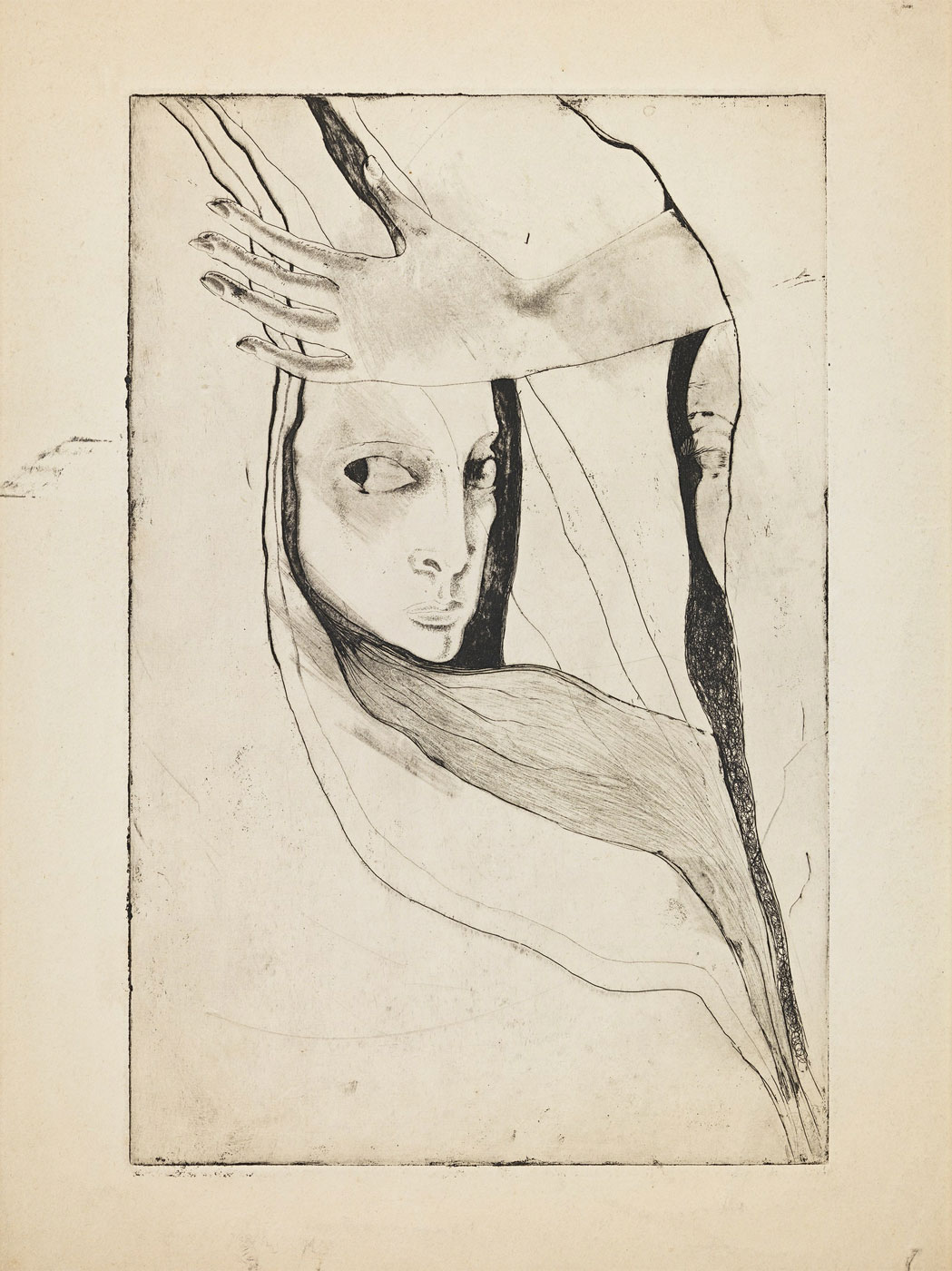
Meret Oppenheim (Swiss born Germany, 1913-1985) 'Untitled (Helene Mayer)' 1936


Meret Oppenheim (Swiss born Germany, 1913-1985)
Untitled (Helene Mayer)
1936
The 31 Women Collection


Helene Julie Mayer (1910-1953) was a German-born fencer who won the gold medal at the 1928 Olympics in Amsterdam, and the silver medal at the 1936 Olympics in Berlin. She competed for Nazi Germany in Berlin, despite having been forced to leave Germany in 1935 and resettle in the United States because she was of Jewish descent.


Hedda Sterne (American born Romania, 1910-2011) 'Self Portrait' 1936-1939


Hedda Sterne (American born Romania, 1910-2011)
Self Portrait
1936-1939
The 31 Women Collection


Short biography: Hedda Sterne (1910-2011). Born in Bucharest, Romania, under the name Hedwig Lindenberg, Hedda Sterne came into contact with her city’s Dada and Constructivist scenes from a young age. In 1928 she moved to Vienna and later to Paris, where she continued her studies attending the Académie de la Grande Chaumière and the studios of Fernand Léger and André Lhote. The following year she began to study philosophy and art history at the University of Bucharest. In 1932 she married her classmate Frederick Stern, whom she separated from a few years later. She came into contact with Parisian Surrealism through Romanian Surrealist Victor Brauner, which would greatly influence her early work. Thanks to recommendations by Brauner and Jean Arp, Peggy Guggenheim included several of Sterne’s collages in a group exhibition at her Guggenheim Jeune gallery in London. In 1941 she settled in New York, in an apartment close to Guggenheim’s mansion, who invited her to participate in her meetings of “exiled Surrealists” and included her work in Exhibition by 31 Women and The Women. Sterne also participated in important Surrealist exhibitions such as First Papers of Surrealism (1942). After the war she joined the Betty Parsons gallery, taking part in the circles of Abstract Expressionism. She was the only woman present in the famous image of the North American abstraction group “The Irascibles”, published in Life Magazine in 1951. Sterne would later express her discomfort in being more famous for her presence in said photograph than for her extensive career.


Peggy Guggenheim (1898-1979) in the entrance hall of her eighteenth century Venetian palace


Peggy Guggenheim (1898-1979) in the entrance hall of her eighteenth century Venetian palace. Hanging from the ceiling is a 1941 Alexander Calder mobile and behind her is a 1937 painting by Picasso titled On The Beach.
The 31 Women Collection
Photo: Keystone Features/Getty Images


Berenice Abbott (American, 1898-1991) 'Peggy Guggenheim' 1926


Berenice Abbott (American, 1898-1991)
Peggy Guggenheim
1926
Gelatin Silver Print
The 31 Women Collection
© 2024 Estate of Berenice Abbott


Berenice Abbott (American, 1898-1991) [attributed to] 'Peggy Guggenheim poses at her Art of This Century Gallery in New York, October 22, 1942'


Berenice Abbott (American, 1898-1991) [attributed to]
Peggy Guggenheim poses at her Art of This Century Gallery in New York, October 22, 1942
© AP Photo / Tom Fitzsimmons
© 2024 Estate of Berenice Abbott


Fundación MAPFRE
Recoletos Exhibition Hall
Paseo Recoletos 23, 28004 Madrid

Opening hours:
Mondays (except holidays): 2pm – 8pm
Tuesday to Saturday: 11am – 8pm
Sunday and holidays: 11am – 7pm

Fundación MAPFRE website

LIKE ART BLART ON FACEBOOK

Back to top

Exhibition: ‘Weegee. Autopsy of the Spectacle’ at Fundación MAPFRE, Madrid

Exhibition dates: 19th September, 2024 – 5th January, 2025

Curator: Exhibition curated by Clément Chéroux, director of the Fondation Henri Cartier-Bresson.


Weegee (Arthur Fellig) (American born Ukraine, 1899-1968) 'Self-Portrait with Speed Graphic Camera' October 13th 1950 from the exhibition 'Weegee. Autopsy of the Spectacle' at Fundacion Mapfre, Madrid Sept 2024 - January 2025


Weegee (Arthur Fellig) (American, 1899-1968)
Self-Portrait with Speed Graphic Camera
October 13th 1950
Gelatin-silver print
© International Center of Photography. Collection Friedsam


Self Seen

I’ve posted on this exhibition once before when it was shown at the Foundation Henri Cartier-Bresson, Paris. While there some photographs that are the same in both postings there are new photographs to admire here. So, let’s have some fun with the text!

I started playing around with ideas in my head… and instead of the “autopsy of the spectacle” – an examination to discover the cause of the spectacle – I inverted that statement to make it the “spectacle of the autopsy”.

What immediately came to mind when I did this was the spectacle, the spectacular, painting that is Rembrandt’s early masterpiece The Anatomy Lesson of Dr. Nicolaes Tulp (1632, below), that tableau – French, late 17th century (in the sense ‘picture’, figuratively ‘picturesque description’) – of figures, spectators, gathered around the corpse of the “criminal Aris Kindt (alias of Adriaan Adriaanszoon), who was convicted for armed robbery and sentenced to death by hanging.”1

Fast forward a few centuries to the “Murder is my business” photographs of Arthur Fellig (alias Weegee) and I again observe spectators gathered around the body of a corpse, either physically examining it or wilfully ignoring it (Drowning victim, Coney Island c. 1940, below), where the men “examine” the drowning victim surrounded by men that stare and the women who smiles for the camera. With the crowd behind, all are physically and metaphorically drawn in to the spectacle of the autopsy and the presence of the camera. “”Spectacle is Capital to such a degree of accumulation that it becomes an image,” explained Guy Debord in 1967. Weegee understood this well.”

In other photographs such as Body of Andrew Izzo, killed by off-duty policeman Elegio Sarro (1942, below) and Body of Dominic Didato (1936, below) Weegee’s camera becomes the spectator, standing in for us as we crane our necks to get a better view of the action. Together, the camera and the viewer, perform what could be seen as a form of “necropsy” – from the Greek words nekros (meaning “corpse”) and opsis (meaning “to view”), and together they mean “to look at the dead body with naked eyes” – that is, a macroscopic examination of a dead body.

Witness, and we do stand witness in Weegee’s photographs looking at dead bodies with naked eyes, the perspectival viewpoint of the bodies of both Andrew Izzo and Dominic Didato similar to the elongated perspective in the painting by Rembrandt, the shading of the face in that painting – the umbra mortis (shadow of death) – now supplanted by the reversed body, head shaded / covered in blood, surmounted with out flung gun and boater.

While these photographs fail “to give shape to feelings of compassion, grief, horror (as if the pictorial repetition of events were a way of understanding these events, being able to live with them)”2 finally, in the derivation of the word “autopsy” – and in the spectacular images of Weegee – we may begin to understand that these photographs are as much about us, the spectator and viewer, and our discontinuous nature (we die) as they are about the pictured bodies. For the meaning of the word autopsy – early 17th century (in the sense ‘personal observation’): from modern Latin autopsia, from Greek, from autoptos ‘self-revealed’, from autos ‘self’ + optos ‘seen’ – reveals as much about ourselves as it does the object of our attention.

Looking at mortality with naked eyes, our self-revealed, our self seen, reflected back to us in the photographs of Weegee.

Dr Marcus Bunyan


1/ Anonymous. “The Anatomy Lesson of Dr. Nicolaes Tulp,” on the Wikipedia website Nd [Online] Cited 05/12/2024

2/ Leah Dickerman. “Gerhard Richter’s Enigmatic Cycle in The Long Run,” on the MoMA website March 1, 2019 [Online] Cited 05/12/2024


Many thankx to Fundación MAPFRE for allowing me to publish the photographs in the posting. Please click on the photographs for a larger version of the image.


“Weegee knew the power of imagery to speak to larger truths about human nature and society. He captured New York as it truly was: gritty, raw, and filled with contrasts. His work turned the everyday violence and chaos of the city into art, making the mundane extraordinary. In Weegee’s own words, “I picked a story that meant something.” He had an instinct for identifying moments that held deeper significance, even if they were just snapshots of daily life in a chaotic metropolis.”


Danny Dutch. “Weegee: The Lens Behind New York’s Darkest Hours,” on the Danny Dutch website Nd [Online] Cited 12/11/2024


Rembrandt Harmenszoon van Rijn (Dutch, 1606-1669) 'The Anatomy Lesson of Dr. Nicolaes Tulp' 1632


Rembrandt Harmenszoon van Rijn (Dutch, 1606-1669)
The Anatomy Lesson of Dr. Nicolaes Tulp
1632
Oil on canvas
216.5cm × 169.5cm (85.2 in × 66.7 in)
Mauritshuis, The Hague


Weegee (American, 1899-1968) 'Drowning victim, Coney Island' c. 1940


Weegee (American, 1899-1968)
Drowning victim, Coney Island
c. 1940
Gelatin silver print
© Weegee Archive / International Center of Photography, New York / Collection Galerie Berinson, Berlin


Installation view of the exhibition Weegee. 'Autopsy of the Spectacle' at Fundacion Mapfre, Madrid showing at right Weegee's 'Self-portrait, Distortion' (1955)


Installation view of the exhibition Weegee. Autopsy of the Spectacle at Fundación MAPFRE, Madrid showing at right Weegee’s Self-portrait, Distortion (1955, below)


Weegee (Arthur Fellig) (American born Ukraine, 1899-1968) 'Self-portrait, Distortion' 1955


Weegee (Arthur Fellig) (American born Ukraine, 1899-1968)
Self-portrait, Distortion
1955
Gelatin silver print
© International Center of Photography


Installation view of the exhibition Weegee. 'Autopsy of the Spectacle' at Fundacion Mapfre, Madrid 


Installation view of the exhibition Weegee. Autopsy of the Spectacle at Fundacion Mapfre, Madrid showing at left Weegee’s Body of Andrew Izzo, killed by off-duty policeman Elegio Sarro (1942, below); at second left, [Outline of a Murder Victim] (1942);  and at right, Body of Dominic Didato, (1936, below)


Weegee (Arthur Fellig) (American born Ukraine, 1899-1968) 'Body of Andrew Izzo, killed by off-duty policeman Elegio Sarro' 1942 from the exhibition 'Weegee. Autopsy of the Spectacle' at Fundacion Mapfre, Madrid Sept 2024 - January 2025


Weegee (Arthur Fellig) (American born Ukraine, 1899-1968)
Body of Andrew Izzo, killed by off-duty policeman Elegio Sarro
1942
Gelatin silver print
© International Center of Photography


Weegee (Arthur Fellig) (American born Ukraine, 1899-1968) 'Body of Dominic Didato' 1936 from the exhibition 'Weegee. Autopsy of the Spectacle' at Fundacion Mapfre, Madrid Sept 2024 - January 2025


Weegee (Arthur Fellig) (American born Ukraine, 1899-1968)
Body of Dominic Didato
1936
Gelatin silver print
© International Center of Photography


Dominick Didato, aka Terry Burns, who you see above in a photo made by Arthur Fellig, aka Weegee, lies dead on a New York City street where he was gunned down today in 1936. He was killed for interfering with rackets run by Lucky Luciano. It was a low percentage play. Luciano was literally the most powerful mobster in the U.S. at the time, and as the saying goes, you come at the king, you best not miss.

Anonymous. “Urban Decay,” on the Pulp International website August 22, 2024 [Online] Cited 11/11/2024


The work of Arthur H. Fellig, known as Weegee (Zolochiv, Ukraine, 1899 – New York, 1968), is, in a sense, an enigma that this exhibition seeks to unravel. His photographs of the underworld and the fringe circles of New York nightlife in the 1930s and 1940s quickly gained wide international recognition. However, the same cannot be said for the photographs he took after settling in Hollywood in 1948: images of Californian high society and the social life of major film celebrities, whom he often portrayed in a markedly ironic or satirical manner, sometimes (as in the case of the “photocaricatures”) as a result of his later work in the laboratory. At the time, critics emphasised the radical opposition between the two periods, openly praising the former and dismissing the latter. In these photographs of his Californian experience (1948-1951), Weegee expressed his critical vision of society and culture from a perspective that anticipated the well-known cultural and social analyses of ‘the society of the spectacle’ (Guy Debord).

Weegee. Autopsy of the Spectacle aims to show the profound coherence that, beyond their stylistic and thematic differences, links these two stages, as well as to highlight the relevance of the critical perspective from which Weegee’s images expose the features and mechanisms of our time as a ‘society of the spectacle’.

Exhibition organised by the Fondation Henri Cartier-Bresson in collaboration with Fundación MAPFRE.

Text from the Fundación MAPFRE website


Weegee (Arthur Fellig) (American born Ukraine, 1899-1968) 'Police and onlookers with body of Joseph "Little Joe" La Cava, killed during the feast of San Gennaro' 1939


Weegee (Arthur Fellig) (American born Ukraine, 1899-1968)
Police and onlookers with body of Joseph “Little Joe” La Cava, killed during the feast of San Gennaro
1939
Gelatin silver print
© International Center of Photography


The above photo shows the murder scene of a mid-level gangster named Joseph “Little Joe” La Cava, and occurred in New York City on Mulberry Street at the Feast of San Gennaro today in 1939. We’ll go out on a limb and say the festive atmosphere took a fatal hit too. Luckily, the celebration usually went for a week, so we suppose it was salvaged. La Cava was gunned down along with Rocco “Chickee” Fagio… Also interesting, cops being cops, the flatfoot closest to La Cava looks incongruously jocular as he chats with a higher-up. If this wasn’t the most unforgettable Feast of San Gennaro in Little Italy’s history it had to be close.

Anonymous. “Urban Decay,” on the Pulp International website August 22, 2024 [Online] Cited 11/11/2024


Weegee (Arthur Fellig) (American born Ukraine, 1899-1968) 'Nurse Irma Twiss Epstein, accused of killing a baby' 1942


Weegee (Arthur Fellig) (American born Ukraine, 1899-1968)
Nurse Irma Twiss Epstein, accused of killing a baby
1942
Gelatin silver print
© International Center of Photography


“Distraught and pale with grief, Irma Twiss Epstein, 32-year-old nurse, whose own baby died 18 months ago, is booked on a homicide charge in the death of a baby whose crying, she said, ‘drove me crazy.’ Miss Epstein, Bronx Maternity Hospital nurse, is accused of giving a powerful drug to the 20 hour-old daughter of Mr. and Mrs. Castro Vallee, whose only other child died after birth 11 years ago. Another infant, 4 days old, was revived by nurses and doctors after Miss Epstein was found in a hallway hysterically sobbing: ‘eyedropper, baby.’ Hospital records showed she entered service there in 1940 and after nine months took a leave of absence to have a baby. Police said she had been in Bellevue’s psychopathic ward two years ago for observation after tasking an overdose of sleeping tablets. She told police at Morrisania Station she expected to be married soon.”

PM Daily, December 23, 1940 quoted on the International Center of Photography website


Weegee (Arthur Fellig) (American born Ukraine, 1899-1968) 'Harry Maxwell shot in a car' 1941


Weegee (Arthur Fellig) (American born Ukraine, 1899-1968)
Harry Maxwell shot in a car
1941
Gelatin silver print
© International Center of Photography


A pivotal figure of American photography in the first half of the twentieth century, Arthur H. Fellig, known by his pseudonym Weegee (Zolochiv, 1899 – New York, 1968) was an immensely popular artist thanks to the news photographs he took in New York in the 1930s and 1940s. This new exhibition aims to reveal a lesser-known facet of his career: the work he did between 1948 and 1951 in Hollywood, where he focused on the “society of the spectacle”.

Key themes

High-impact photographs

Some of Weegee’s photographs were veritable “visual punches”. This is true of the pictures he took of murders, corpses, fires and prisoners during the years spent covering crimes and accidents in New York, as well as of his later work, like the series showing circus artist Egle Zacchini being fired from a cannon at a speed of 100 metres per second, or his photo-caricatures of Marilyn Monroe, President Kennedy and other prominent personalities. His images almost always had a powerful impact on viewers, making them think not only about the scene they were contemplating but also about how they were looking at it.

The society of the spectacle

First published in 1967, Society of the Spectacle is one of the most important books by the philosopher Guy Debord, founding member of the Situationist International. It paints an incisive portrait of contemporary society, presumably replaced by its represented image. Throughout the work, Debord critically exposes the theory and practice of the spectacle, explaining how it governs our experience of time, history, goods, territory and happiness. In the twenty-first century, when immediacy reigns supreme, Debord’s ideas resound as the severest, most lucid assessment of the meanness and bondage of a society – the society of the spectacle – in which we all live.

Critique of the society of the spectacle

Class consciousness and empathy for the disadvantaged permeate Weegee’s work, as he never forgot his humble beginnings. Yet his most famous images are snapshots of accidents, fires and murders, in which he underscores the idea that bystanders are also spectators of the tragedies they contemplate, watching a scene in much the same way as cinema-goers watch Hollywood films (which are not all that different to the events captured by Weegee’s camera). He also used trick photography to critique the image of actors, singers, broadcasters, politicians and other public figures.

Weegee’s “satires”, as he called them, were visionary, appearing several years before the Situationist International first posited its theories. As Clement Che roux, curator of the exhibition, has pointed out, during his first period in New York, Weegee proved that the tabloids were selling news as a spectacle, and after 1945 he exposed how the media system radically spectacularised celebrities.

Biography

Weegee was born Usher Felig on 12 June 1899 to a Jewish family in Zolochiv, now in western Ukraine. At the age of ten he travelled to the United States to be reunited with his father, and immigration officers on Ellis Island registered him as Arthur Fellig. At 14, having settled into New York’s Lower East Side, a poor neighbourhood at the time, he left school and started working to help support his family. After trying several jobs, he became an itinerant photographer. He subsequently worked for the photographers Duckett & Adler and later in the ACME Newspictures agency laboratories. In 1935, he went into business for himself as a freelance photojournalist. He began using the pseudonym Weegee around 1937, and in 1941, the year he joined the Photo League (a group of freelance photographers who firmly believed in the emancipating power of images and fought for social justice), he started signing his prints as “Weegee the Famous”. In 1943, his work was included in a group exhibition at New York’s Museum of Modern Art (MoMA).

In 1945 he compiled his best photos in a book titled Naked City, which was a huge critical and commercial success. In the spring of 1948 Weegee moved to Hollywood, where he worked in cinema as a technical consultant and occasionally as an actor. In addition to photographing parties, he devised several trick photography techniques and used them to caricature celebrities. After four years on the West Coast, in December 1951 he returned to New York, although he did not resume his former practice. From that moment until his death on 26 December 1968, Weegee mainly capitalised on his fame to publish more books, do lecture tours, and widely circulate his photo-caricatures in the press.

The exhibition

There is a mystery in Weegee’s work which the exhibition now on view at Fundacio n MAPFRE aims to unravel. From very early on, the artist was internationally renowned for his photographs taken in the 1930s and 1940s and printed in the New York tabloids: corpses, fires, detainees in police wagons, etc. But Weegee had another group of works which, at first glance, might seem diametrically opposed to his reportage: the photo-caricatures of public figures created in Hollywood between 1948 and 1951. Critics highlighted the opposition between these two periods, praising the former and rejecting the latter. Weegee: Autopsy of the Spectacle attempts to reconcile both bodies of work by showing that, stylistic differences aside, they are fundamentally consistent in their portrayal of the “society of the spectacle” which was taking shape in the United States at that time.

In his early years, the artist photographed lurid, violent subjects, but those shots were often deeply ironic and exposed the “spectacular” nature of the depicted events. His images were printed in newspapers, and Weegee often included spectators or fellow photographers – individuals gawking at a traffic accident or murder scene – in the fore or background of his compositions. In a consistent manner, during the second part of his career the artist mocked the Hollywood spectacle: the short-lived fame, the adoring crowds who flocked to see “celebrities”, and the banal society scene. Weegee personally edited and altered these ironic, satirical images in the lab, anticipating the theories of the Situationist International and the critique of the society of the spectacle and its commodification, and always acted in consonance with his own political convictions.

The exhibition curated by Clement Che roux, director of Fondation Henri Cartier-Bresson, features over one hundred photographs and a variety of documentary material. With a new perspective on Weegee’s oeuvre, the itinerary is divided into three sections and offers a sweeping overview of his work.

The spectacle of news reportage

In 1935, Weegee went into business for himself as a freelance photojournalist. Thanks to a radio tuned to the police frequency which he installed in his car – basically a mobile office where he kept everything he needed to take photos – Weegee was always one of the first to arrive at the scene of a crime, fire or traffic accident. It was the Prohibition era, and gang violence was rampant in New York. Every night for ten years, Weegee covered the city’s accidents and crimes with flash photographs and, starting in 1940, did the same for the NP Daily, a newspaper with Marxist leanings. As the artist himself confessed, “Murder is my business.”

In addition to fires and crimes, during this period Weegee also took highly expressive portraits of the individuals who emerged from police wagons after a raid. At a time when it was considered criminal for a man to wear women’s clothes, some of those detainees tried to hide their faces while others basked in the attention, exiting the vehicle as if making a stage entrance. With these images, the artist emphasised the idea that social relations and the world in general were becoming pure spectacle.

At the same time, Weegee never forgot his roots as the son of poor Jewish immigrants and was keenly aware of the living conditions of the most destitute. For this reason, he also captured homeless people and acts of racial and everyday discrimination against the underprivileged, making his photographs “genuine social documents”.

The society of spectators

“The Curious Ones” is the title of a chapter in Naked City, the compilation of Weegee’s best photographs that he published in 1945. Thanks to that book, which was a huge critical and commercial success, he began to attend New York’s important society events much more frequently, photographing them exactly as he would a crime or accident scene. This is illustrated by two images taken in New York on 22 November 1943, The Critic and In the Lobby at the Metropolitan Opera, Opening Night. The artist was particularly interested in representing human emotions and tried to prevent his subjects from altering their expressions to pose for the camera. Little by little, he began to portray the witnesses to events that happened after dark in New York City, attempting to reflect the entire range of possible human reactions to a tragedy, from astonishment to nervous laughter or tears. Other photographers who came to the same scenes also caught his interest, prompting him to reflect on the very act of taking photos.

With all this repertoire, Weegee showed how ordinary individuals became voyeurs by treating the scene of the crime as a theatrical stage. Recalling the moment in 1939 when he took the photograph Balcony Seats at a Murder, he explained, “The detectives are all over […]. To me this was drama. This was like a backdrop. I stepped back about a hundred feet. I used flash powder and I got this whole scene. The people on the fire escapes, the body, everything!”

The comedy of the spectacular

In 1967, Guy Debord wrote that “the spectacle is capital to such a degree of accumulation that it becomes an image” in his book Society of the Spectacle. Weegee, who understood this very well, photographed every sight that struck him as out of the ordinary. Fascinated by the makeup of crowds, he portrayed them enjoying a peaceable Sunday afternoon at the beach on Coney Island or celebrating the end of World War II in Chinatown; but he was also drawn to carnival and circus attractions and to cinemas, where he photographed movie-goers in the dark, engrossed in the film on screen.

Tired of murders and crime scenes, in 1948 Weegee moved to Hollywood and traded the direct, documentary-style photography he had practised in New York for manipulated images that required hours in the lab. During his stint in California, he turned his lens upon actors, singers, broadcasters and society figures. His vision of these individuals was not usually very flattering, photographing them from behind or in awkward situations. In some cases he would later distort the images using a kaleidoscope, photomontage or multiple exposure. Weegee created what he called “photo-caricatures”, a tradition that started among amateur photographers in the late nineteenth century and was originally known as “photographic amusements”, although he stated in his autobiography that his photo-caricatures had never been done before. Though a celebrity himself, the artist used photography to criticise the star system.

Catalogue

The exhibition, organised by Fondation Henri Cartier-Bresson in partnership with Fundacion MAPFRE, is accompanied by a publication titled Weegee. Autopsia del espectáculo, in which the majority of the images on display are reproduced. The catalogue contains a text by Clement Che roux, the show’s curator and director of Fondation Henri Cartier-Bresson, and two more essays by Cynthia Young, a curator specialised in photojournalism, and Isabelle Bonnet, a lecturer at the Sorbonne and photography expert. The writer, curator and photography lecturer David Campany has also made an important contribution to the volume, in which he compares Weegee and Stanley Kubrick based on their collaboration on Dr. Strangelove or: How I Learned to Stop Worrying and Love the Bomb.

The original edition in French was published by Éditions Textuel with Fondation Henri Cartier-Bresson, and the Spanish-language edition has been co-published with Fundación MAPFRE.

Text from the Fundación MAPFRE


Weegee (Arthur Fellig) (American born Ukraine, 1899-1968) 'Man Arrested for Cross-Dressing, New York' c. 1939


Weegee (Arthur Fellig) (American born Ukraine, 1899-1968)
Man Arrested for Cross-Dressing, New York
c. 1939
Gelatin-silver print
© International Center of Photography. Louis Stettner Archives, Paris


Weegee (Arthur Fellig) (American born Ukraine, 1899-1968) 'Holiday Accident in the Bronx' July 30th 1941


Weegee (Arthur Fellig) (American born Ukraine, 1899-1968)
Holiday Accident in the Bronx
July 30th 1941
Gelatin-silver print
© International Center of Photography


Weegee (Arthur Fellig) (American born Ukraine, 1899-1968) 'Charles Sodokoff and Arthur Webber Use Their Top Hats to Hide Their Faces, New York' January 26th 1942


Weegee (Arthur Fellig) (American born Ukraine, 1899-1968)
Charles Sodokoff and Arthur Webber Use Their Top Hats to Hide Their Faces, New York
January 26th 1942
Gelatin silver print
© International Center of Photography. Louis Stettner Archives, Paris


Weegee (Arthur Fellig) (American born Ukraine, 1899-1968) 'Balcony Seats at a Murder' 1939


Weegee (Arthur Fellig) (American born Ukraine, 1899-1968)
Balcony Seats at a Murder
1939
Gelatin silver print
© International Center of Photography


Weegee (Arthur Fellig) (American born Ukraine, 1899-1968) 'Arrests made during a gambling raid in lower Manhattan’s Liberty Street' October 1942


Weegee (Arthur Fellig) (American born Ukraine, 1899-1968)
Arrests made during a gambling raid in lower Manhattan’s Liberty Street
October 1942
Gelatin silver print
© International Center of Photography


Weegee (Arthur Fellig) (American born Ukraine, 1899-1968) 'Simply adding boiling water' 1943


Weegee (Arthur Fellig) (American born Ukraine, 1899-1968)
Simply adding boiling water
1943
Gelatin silver print
© International Center of Photography


Weegee (Arthur Fellig) (American born Ukraine, 1899-1968) 'Untitled [Fire in loft building, New York]' 1947


Weegee (Arthur Fellig) (American born Ukraine, 1899-1968)
Untitled [Fire in loft building, New York]
1947
Gelatin silver print
© International Center of Photography


There’s still a mystery to Weegee. The American photographer’s career seems to be split in two. First are his stories for the New York press from 1935-1945. Then, photo-caricatures of public personalities developed during his Hollywood period, between 1948 and 1951, which he continued to produce for the rest of his career. How can these diametrically opposed bodies of work coexist? Critics have enjoyed highlighting the opposition between the two periods, praising the former and disparaging the latter. This project seeks to reconcile the two parts of Weegee by showing that, beyond formal differences, the photographer’s approach is critically coherent.

The spectacle is omnipresent in Weegee’s work. In the first part of his career, coinciding with the rise of the tabloid press, he was an active participant in transforming news into spectacle. To show this, he often included spectators or other photographers in the foreground of his images. In the second half of his career, Weegee mocked the Hollywood spectacular: its ephemeral glory, adoring crowds, and social scenes. Some years before the Situationist International, his photography presented an incisive critique of the Society of the Spectacle.

The News Spectacle

“News photography is my meat.” After many years as a printer for press agencies, Weegee started his own business as a photojournalist in 1935. In order to be the first to arrive at the site of a murder, fire, or traffic accident, he set up a radio in his car, tuned to the police frequency. For a decade, using a flash, he took photographs of news in New York every night.

Weegee Himself

“I have always been a doer and not a thinker.” Weegee enjoyed putting himself in front of the camera, re-enacting circumstances he was confronted with in his daily work. In the name of pedagogy, and probably a little out of narcissism and self-advertisement, he took pictures of himself writing captions for his photographs in the back of his car, in police wagons and behind bars, never without his camera.

Murder Is My Business

“I used to be an expert on murder.” From 1935 to 1945, Weegee spent his nights roaming the city looking for shocking images. Even after Prohibition, New Yorkers’ dreams were punctuated by explosion sounds caused by rival gangs settling scores. The photographer learned to create expressive images which the booming tabloids were particularly fond of.

Off Road

“Sudden death for one…, sudden shock for the other.” American culture is fascinated by twisted metal. In the 19th century, a railroad company staged public collisions between locomotives destined for the junkyard. Weegee photographed many traffic accidents, introducing the “car crash” genre, later adopted by other figures, such as Andy Warhol, J. G. Ballard, David Cronenberg, etc.

The Tragedy of Fire

“Murders and fires (my two best sellers, my bread and butter).” In the darkness of the city, like a moth to a flame, Weegee took photographs of fires. The urban landscape of New York, with its many substandard buildings, provided him with many such opportunities. The combination of fire, smoke and gushing water offered a particularly photogenic spectacle that the press adored.

On The Spot

“The Parade never ceases as the ‘pie’ Wagons unload.” When he wasn’t in the field, Weegee waited at the entrance of the police station for the prison wagon to return with its load of offenders arrested in the night. At a time when it was a criminal act for a man to dress as a woman, some tried to hide their faces, while others took the opportunity to step out of the wagon as if onto a stage.

In Flagrante Delicto

“When criminals tried to cover their faces, it was a challenge to me. I literally uncovered not only their faces, but their black souls as well.” Faced with Weegee’s scrutinising lens, defendants often tried to conceal their identities. In his autobiography, the photographer recounts the many stratagems he developed to oblige them to reveal themselves. Clearly, they didn’t always work.

Social Documents

“The people in these photographs are real.” Coming from a Jewish family who emigrated to the United States from Ukraine at the beginning of the 20th century, experiencing extreme poverty upon their arrival, Weegee was quite aware of standards of living among the underprivileged. He took photographs of ordinary forms of discrimination, people with small trades, and the homeless. His photographs can be seen, in his own words, as “veritable social documents.”

Society of the Spectators

“The Curious ones” is a chapter title from Weegee’s best-seller: Naked City. The photographer takes an interest in people who, like himself, indulge unreservedly in the act of looking. He often includes them in the scenes he photographs, framing them in close-up to create veritable portraits of on-lookers. His work is a particularly striking testimony to the society of spectators developing in the United States at the time.

Meta Photo Co.

“I have no time for messages in my pictures.” Yet Weegee often included other photographers in his compositions as if, through this mise en abyme, he was inciting people to reflect on what it meant to take a photograph. An image from 1942, published in PM’s Weekly, is a good example. Three reporters and the words “Meta Photo Co.” on a window in the background of the photograph indicate there is something to be learned here about photography itself.

The Critic

“‘What is the best picture you ever took?’ Without hesitation I answer, ‘A picture I took at the opening of the Metropolitan Opera House. I consider this to be my masterpiece.'” The circumstances were contrived. Weegee went to a working-class neighbourhood to pick the woman up, then brought her to the entrance of this gala. The image illustrates the widening gap between the rich and the poor under American capitalism. It also reflects the critical power of a simple look.

Looking at Death

“I stepped back far enough to take in the whole scene: the puzzled detectives examining the body, the people on the fire escape, watching… it was like a stage setting.” Balcony seat at a murder: by including spectators in many of his images, Weegee imagines crime scenes as theatrical scenes, underscoring how American society transforms news into spectacle.

Spectators

“When I take a picture of a fire, I forget all about the burning building and I go out to the human element.” After years of tirelessly documenting events of the New York night, Weegee began taking photographs of the individuals who witnessed them. He was thus able to take portraits of groups expressing the full range of human reactions to tragedy, from surprise and tears to nervous laughter.

Out of Frame

“The curious […] ones always rushing by […] but always finding time to stop and look at.” On July 28, 1945, at 9:40 a.m., as a thick fog enveloped New York, a small plane crashed into the 79th floor of the Empire State Building. Weegee photographed spectators trying to catch a glimpse of it. People discovering his photographs in newspapers found themselves in the same position as these observers, a voyeuristic one.

Seeing in the Dark

“It’s hard to photograph people and get natural expressions. The minute they see the camera, they ‘freeze’ up on you.” Weegee was especially interested in depicting emotions on the faces of observers. Concerned that his presence would change their reaction, he had the ingenious idea of taking their photographs in the darkness of a theatre using infrared film. The result is a series of stunning portraits of wide-eyed spectators.

She Gestures of Art

“I used the same technique […] whether it was a murder, a pickpocket, or a society ball.” Following the success of his book Naked City, Weegee was routinely invited to high society events in New York, which he took pleasure in photographing as news items. In October 1945, at the opening of an exhibition by painter Stuart Davis at the MoMA, he captured the strange gestures of the art world.

The Theatre of the Spectacular

“Spectacle is Capital to such a degree of accumulation that it becomes an image,” explained Guy Debord in 1967. Weegee understood this well. He took photographs of all that was visually uncommon: crowds at Coney Island, fairground attractions, stars, acrobats, clowns… and finally, himself. A few years before the Situationist International, he pioneered a visual form of critique of the Society of the Spectacle.

In the Company of Crowds

“And this is Coney Island on a quiet Sunday afternoon […]. A crowd of over a MILLION is usual and attracts no attention.” On a Brooklyn beach, in Times Square or in Chinatown celebrating victory over Nazi power, Weegee never missed the opportunity to photograph crowds. Beyond “mass ornament,” theorised a few years earlier by Siegfried Kracauer, he was fascinated by the ways in which the people constitute themselves as images.

The Cannonball Woman

“Punch in Pictures.” That’s how one magazine described an article on Weegee. The scoop-hunter knows better than anyone else how to produce hard-hitting images. In 1943, Weegee photographed circus performer Egle Zacchini, nicknamed Miss Victory, or The Cannonball Woman, shot out of a cannon at 360 feet per second. As war was raging in Europe, it was a strange metaphor for the role of women in the conflict.

A Circus Community

“Someday they, too, will be stars.” Weegee especially enjoyed hanging around behind the scenes of fairgrounds in the suburbs. He photographed the way a performer at Sammy’s Bar placed her money in her stocking. Elsewhere, a dwarf with a forced smile, a melancholy clown slumped in his dressing room, what remains of the parade after the crowd passes by. Many of his photographs display the ambiance of a sad party.

Photo-caricatures

“I was tired of gangsters lying dead with their guts spewed in the gutter, of women crying at tenement-house fires, of automobile accidents […]. I was off to Hollywood.” In the City of Angels, Weegee not only photographs the celebrities he meets, he delights in making caricatures of them with what he calls his “elastic lens,” now mocking the star system.

The Spyglass

“I have used the camera to provoke good old-fashioned belly laughs.” In 1963, Weegee was invited to the set of Stanley Kubrick’s Doctor Strangelove. The director was a great fan of Weegee, and had begun his own career as a press photographer. On set, Weegee applied a new technique for the tubular distortion of faces, as if one were looking through the small end of a spyglass.

Trick Inventory

“Their originality was such that they sold like hot cakes.” This is how Weegee described his photo-caricatures, the first of which appeared in papers in 1947. For 20 years and up until his death in 1968, he would regularly publish these works. Around fifty of the publications are known today. There are most likely many more. In his daily work, the photo-caricature came to definitively replace the news item.

Weegee, Ouija

“I’m called Weegee which comes from Ouija.” The pseudonym Weegee refers to the name of a board used in seances to decipher messages from the beyond. Weegee liked to describe himself as a “psychic photographer”, able to predict in advance where a story will take place. On the scene, he said he photographed using his “third eye.” Whether clairvoyant or voyeur, Weegee was able to see, better than anyone else, transformations in American society.

Text from the Fundación MAPFRE


Weegee (Arthur Fellig) (American born Ukraine, 1899-1968) 'Afternoon Crowd at Coney Island' July 21st 1940


Weegee (Arthur Fellig) (American born Ukraine, 1899-1968)
Afternoon Crowd at Coney Island
July 21st 1940
Gelatin-silver print
© International Center of Photography. Courtesy Galerie Berinson, Berlin


Weegee (Arthur Fellig) (American born Ukraine, 1899-1968) 'Anthony Esposito, Booked on Suspicion of Killing a Policeman, New York' January 16th 1941


Weegee (Arthur Fellig) (American born Ukraine, 1899-1968)
Anthony Esposito, Booked on Suspicion of Killing a Policeman, New York
January 16th 1941
Gelatin silver print
© International Center of Photography. Louis Stettner Archives, Paris


Weegee (Arthur Fellig) (American born Ukraine, 1899-1968) '[Black Buick with dead passenger pulled out of the Harlem River, New York]' February 23, 1942


Weegee (Arthur Fellig) (American born Ukraine, 1899-1968)
[Black Buick with dead passenger pulled out of the Harlem River, New York]
February 23, 1942
Gelatin silver print
© Weegee Archive/International Center of Photography


Weegee (Arthur Fellig) (American born Ukraine, 1899-1968) 'Sleeping at the Circus, Madison Square Garden, New York' June 28th 1943


Weegee (Arthur Fellig) (American born Ukraine, 1899-1968)
Sleeping at the Circus, Madison Square Garden, New York
June 28th 1943
Gelatin-silver print
© International Center of Photography


Weegee (Arthur Fellig) (American born Ukraine, 1899-1968) 'The Critic, New York' November 22nd 1943


Weegee (Arthur Fellig) (American born Ukraine, 1899-1968)
The Critic, New York
November 22nd 1943
Gelatin silver print
© International Center of Photography. Collection Friedsam


Weegee (Arthur Fellig) (American born Ukraine, 1899-1968) '[After the opera, Sammy's on the Bowery, New York]' 1943-1945


Weegee (Arthur Fellig) (American born Ukraine, 1899-1968)
[After the opera, Sammy’s on the Bowery, New York]
1943-1945
© Weegee Archive/International Center of Photography


Weegee (Arthur Fellig) (American born Ukraine, 1899-1968) 'Charlie Chaplin, Distortion' c. 1950


Weegee (Arthur Fellig) (American born Ukraine, 1899-1968)
Charlie Chaplin, Distortion
c. 1950
Gelatin silver print
© International Center of Photography


Weegee (Arthur Fellig) (American born Ukraine, 1899-1968) 'Charles de Gaulle, Distortion' 1959


Weegee (Arthur Fellig) (American born Ukraine, 1899-1968)
Charles de Gaulle, Distortion
1959
Gelatin silver print
© International Center of Photography


"Il Fotografo cattivo", Epoca, vol. XIII, No. 636, December 1962


“Il Fotografo cattivo”, Epoca, vol. XIII, No. 636, December 1962
© International Center of Photography. Collection privée Paris


Weegee (Arthur Fellig) (American born Ukraine, 1899-1968) 'Self-Portrait' c. 1963 from the exhibition 'Weegee. Autopsy of the Spectacle' at Fundacion Mapfre, Madrid Sept 2024 - January 2025


Weegee (Arthur Fellig) (American born Ukraine, 1899-1968)
Self-Portrait
c. 1963
Gelatin silver print
© International Center of Photography


Fundación MAPFRE
Recoletos Exhibition Hall
Paseo Recoletos 23, 28004 Madrid

Opening hours:
Mondays (except holidays): 2pm – 8pm
Tuesday to Saturday: 11am – 8pm
Sunday and holidays: 11am – 7pm

Fundación MAPFRE website

LIKE ART BLART ON FACEBOOK

Back to top

Exhibition: ‘David Goldblatt: No Ulterior Motive’ at Fundación MAPFRE, Madrid

Exhibition dates: 30th May – 25th August 2024

Curators: Judy Ditner, Leslie M. Wilson and Matthew S. Witkovsky


David Goldblatt (South African, 1930-2018) 'Yaksha Modi, the daughter of Chagan Modi, in her father's shop before its destruction under the Group Areas Act, 17th Street, Fietas, Johannesburg' 1976


David Goldblatt (South African, 1930-2018)
Yaksha Modi, the daughter of Chagan Modi, in her father’s shop before its destruction under the Group Areas Act, 17th Street, Fietas, Johannesburg
1976
From the series Fietas
Gelatin silver print
The Art Institute of Chicago, promised donation of Cecily Cameron and Derek Schrier
© The David Goldblatt Legacy Trust


David Goldblatt writing history

To keep this archive relevant I am constantly refreshing the postings to make sure all the links work, all the videos are still available, and all the bibliographic information about the photographers is up to date.

With the switch to the new template I am having to refresh every page that I have published since 2008 which is a mammoth task. Every time I search the Internet for an artist and their dates I say a little “thank you” when I find an artist is still living… for their creativity and energy is still present in the world. Unfortunately what I have found is that so many photographers have passed away since I started Art Blart in 2008, many within the last 8-10 years.

This is not surprising, people die! But we seem to be loosing that generation of photographers who were born in the 1920s-1940s who actually made a difference to the world and how we live in it. How they viewed the world in their own unique way and used photography to advocate for a fairer world free from war, discrimination and injustice. Photographs making a difference. As Lewis Hine observed, “Photography can light up darkness and expose ignorance.”

I find it very sad that every time a creative person dies you can no longer have a conservation with that person about their passion, their vision, their understanding of the world around them and how they photographed it. All we have left are their photographs, their lived consciousness if you like, as to what was important for them to photograph during their lifetime: family, friends, people, environment, spirit, protest, war, whatever … and what values they held fast to in order to picture the “improvised realities of everyday life.”

We are loosing a generation of photographers.

We are loosing a generation of photographers that captured an image of human existence as a reflection of reality, a truth lived in the world (rather than postmodern fragmentation, posthuman or AI).

At a time when the last fighter pilot who fought in the Battle of Britain in 1940 just turned 105 in July 2024 (Group Captain John Allman Hemingway, DFC, AE – one of the few that saved Britain), a large proportion of the artists listed below were born before or in the shadow of the cultural and ideological conflict that was the global conflagration of the Second World War. The grew up suffering the vicissitudes of war, bombing, death, rationing, deprivations, genocide and mass migration. They grew up knowing of the threat to their freedom and survival. They grew up with a heightened sense of the value of human life and the need to record that humanity. As my friend and photographer Joyce Evans (Australian, 1929-2019) eloquently said:

“We believed we had an obligation, neither social nor political, to make a difference. We were brought up as children to believe that we had an obligation to make that difference.

If we can find out what we are… that is the artist. This goes to the core element of your being, and the core element of your enquiry remains the same.

If the core part of your life is the search for the truth then that becomes a core part of your identity for the rest of your life. It becomes embedded in your soul.”1


I suggest that David Goldblatt was one such artist who was brought up to believe that he had a obligation to make a difference. And it was through the truth of his photographs that he made that difference.

Goldblatt was “the grandson of Lithuanian-Jewish migrants, who left Europe for South Africa in the 1890s to escape religious persecution. Goldblatt was born in the small gold-mining town of Randfontein in 1930 and later lived and worked in Johannesburg.”2

“In 1910 Chinese indentured labourers were repatriated and replaced by migrant black labour, many recruited from neighbouring territories. In 1921-1922 The Rand Rebellion/ Revolt saw white mine workers protest the industry’s attempt to replace semi-skilled white men with cheap black labour leaving about 200 people dead, more than 1,000 injured, 15,000 men out of work and a slump in gold production. The government came under pressure to protect skilled white workers in mining and three Acts were passed that gave employment opportunities to whites and introduced a plan for African segregation. In 1948 apartheid was legislated.”3

During the Second World War, “South Africa made significant contributions to the Allied war effort. Some 135,000 white South Africans fought in the East and North African and Italian campaigns, and 70,000 Blacks and Coloureds served as labourers and transport drivers… The war proved to be an economic stimulant for South Africa, although wartime inflation and lagging wages contributed to social protests and strikes after the end of the war. Driven by reduced imports, the manufacturing and service industries expanded rapidly, and the flow of Blacks to the towns became a flood. By the war’s end, more Blacks than whites lived in the towns. They set up vast squatter camps on the outskirts of the cities and improvised shelters from whatever materials they could find. They also began to flex their political muscles. Blacks boycotted a Witwatersrand bus company that tried to raise fares, they formed trade unions, and in 1946 more than 60,000 Black gold miners went on strike for higher wages and improved living conditions.”4

Goldblatt was a first generation migrant who grew up surrounded by the oppression of blacks in a small gold-mining town. He lived through the Second World War and as a human being and a Jew would know of the atrocities of the concentration camps. He started taking photographs when he was a teenager in the late 1940s after the war ended and just after the beginning of apartheid. All of these events – black oppression, Jewish genocide, and apartheid – would have affected his outlook on life and his values. He is quoted as saying, “Apartheid became very much the central area of my work, but my real preoccupation was with our values … how did we get to be the way we are?”5

How does any human being believe that their values are “right” and more valuable than those of another culture? that then leads them into conflict with other people who have different values? or to a belief that they are superior to another race? Such is the case with white supremacy and apartheid, a word used to describe a racist program of tightened segregation and discrimination.

Early in his career, to get subjects for his photographs, David Goldblatt posted “classified advertisements in local newspapers requesting sitters for his portraits. Goldblatt’s ads for his personal work often included a note of reassurance, one of which gave [this] exhibition its title: “I would like to photograph people in their homes in Johannesburg, Randburg and Sandton. There will be no charge and one free print will be supplied. Further copies at cost price. There is no catch and no ulterior motive.””6

The phrase “no ulterior motive” is part misnomer.

Leslie Wilson and Yechen Zhao have observed that while “Goldblatt’s use of “no ulterior motive” was supposed to allay concerns that he was trying to take advantage of his sitters,” Goldblatt was also fully aware of the use he wanted to put his photographs. “Even as he positioned himself as a photographer without an ulterior motive, Goldblatt certainly had an intention for the resulting photographs: to use them in service of understanding and representing South African social relations.”7

Goldblatt was fully aware, fully attentive and informed about the history his country – “the history of South Africa’s mining industry, white middle class, forced segregation of black and Asian communities into townships under the Group Areas Act” – and he used his photographs to objectively document social conditions in South Africa, photographs which were then published in magazines and books for wider distribution.

Unlike the more overtly activist photographs of the legendary Ernest Cole (which led to Cole fleeing South Africa after the publication of his book House of Bondage in 1967), Goldblatt’s photographs are quieter and more insidious in their criticism of the structures of the apartheid system. Through the quietness of everyday photographs, through the dignity of his subjects and through the elision of violence, Goldblatt subtly chisels away at the foundations of oppression and injustice in South African society. As Susan Aurinko observes, “One might argue that in his own silent way, he was an activist, using his camera to expose things that should never have been allowed to happen.”8

With the waning of a generation of social documentary photographers around the world who wrote history through their photographs, we leave ourselves open and vulnerable to the duplicity and misinformation of current media trends (including the viral promulgation of images).9 Photographs of truth and substance can still make a difference. I repeat the quote from Lewis Hine earlier in this text: “Photography can light up darkness and expose ignorance.”

With the rise of the far right around the contemporary world, the forces of darkness must be opposed; truth and justice must, can and will be upheld. Ignorance is not strength.

Dr Marcus Bunyan


Here are some of the artists that I have had to update their details:

Abbas (Iranian, 1944-2018)
John Baldessari (American, 1931-2020)
Hilla Becher (German, 1934-2015)
Richard Benson (American, 1943-2017)
James Bidgood (American, 1933-2022)
Geta Brâtescu (Romanian, 1926-2018)
Anna Blume (German, 1937-2020)
Jimmy Caruso (Canadian, 1926-2021)
Christo
 (Bulgaria, 1935-2020)
John Cohen (American, 1932-2019)
Joan Colom (Spanish, 1921-2017)
Marie Cosindas (American, 1923-2017)
Barbara Crane (American, 1928-2019)
Bill Cunningham (American, 1929-2016)
Destiny Deacon (Australian, Kuku/Erub/Mer, 1957-2024)
Maggie Diaz (American Australian, 1925-2016)
Elliott Erwitt (American, 1928-2023)
Joyce Evans (Australian, 1929-2019)
Larry Fink (American, 1941-2023)
Robert Frank 
(Swiss, 1924-2019)
Vittorio Garatti (Italian, 1927-2023)
David Goldblatt (South African, 1930-2018)
Arlene Gottfried (American, 1950-2017)
F. C. Gundlach (German, 1926-2021)
Károly Halász (Hungarian, 1946-2016)
Dave Heath (American, 1931-2016)
Fred Herzog (Canadian born Germany, 1930-2019)
Ken Heyman (American, 1930-2019)
Thomas Hoepker (German, 1936-2024)
Frank Horvat (Italian, 1928-2020)
Hillert Ibbeken (German, 1935-2021)
Vo Anh Khanh (Vietnamese, 1936-2023)
Jean Mohr (Swiss, 1925-2018)
Sigrid Neubert (German, 1927-2018)
Floris Neusüss (German, 1937-2020)
Ranjith Kally (South African, 1925-2017)
Sy Kattelson (American, 1923-2018)
Chris Killip (British, 1946-2020)
William Klein (French born America, 1926-2022)
Karl Lagerfeld (German, 1933-2019)
Rosemary Laing (Australian, 1959-2024)
Ian Lobb (Australian, 1948-2023)
Ulrich Mack (German, 1934-2024)
Mary Ellen Mark (American, 1940-2015)
Elfriede Mejchar (Austrian, 1924-2020)
Sonia Handelman Meyer (American, 1920-2022)
Santu Mofokeng (South African, 1956-2020)
Floris Neusüss (German, 1937-2020)
Marvin E. Newman (American, 1927-2023)
Terry O’Neill (British, 1938-2019)
Polixeni Papapetrou (Australian, 1960-2018)
Marlo Pascual (American, 1972-2020)
Peter Peryer (New Zealand, 1941-2018)
Marc Riboud (French, 1923-2016)
Robert Rooney (Australian, 1937-2017)
Lucas Samaras (American born Greece, 1936-2024)
Jurgen Schadeberg (South African born Germany, 1931-2020)
Michael Schmidt (German, 1945-2014)
Malick Sidibé (Malian, 1935-2016)
Michael Snow (Canadian, 1928-2023)
Frank Stella (American, 1936-2024)
Louis Stettner (American, 1922-2016)
Charles H. “Chuck” Stewart (American, 1927-2017)
Jerry N. Uelsmann (American, 1934-2022)
Bill Viola (American, 1951-2024)
John F Williams (Australian, 1933-2016)
Michael Wolf (German, 1954-2019)
Ida Wyman (American, 1926-2019)
George S. Zimbel (American-Canadian, 1929-2023)

Footnotes

1/ Joyce Evans in conversation with Marcus Bunyan 2019

2/ Anonymous. “David Goldblatt,” on the MCA website October 2018 [Online] Cited 06/08/2024

3/ Anonymous. “Brief History of Gold Mining in South Africa,” on the Mining for Schools website 2022 [Online] Cited 06/08/2024

4/ Alan S. Mabin and Julian R.D. Cobbing. “World War II in South Africa,” on the Britannica website last updated Aug 5, 2024 [Online] Cited 06/08/2024

5/ David Goldblatt quoted in Anonymous. “David Goldblatt,” on the MCA website October 2018 [Online] Cited 06/08/2024

6/ Leslie Wilson and Yechen Zhao. “In the Room with David Goldblatt,” on the Art Institute of Chicago website December 19, 2023 [Online] Cited 11/07/2024

7/ Ibid.,

8/ Susan Aurinko. “Painful Truths: A Review of David Goldblatt at the Art Institute of Chicago,” on the New City Art website December 22, 2023 [Online] Cited 07/07/2024

9/ “… the French philosopher and critic, Paul Virilio, speaking of contemporary images, described them as ‘viral’. He suggests that they communicate by contamination, by infection. In our ‘media’ or ‘information’ society we now have a ‘pure seeing’; a seeing without knowing.”

Paul Virilio. “The Work of Art in the Electronic Age,” in Block No. 14, Autumn, 1988, pp. 4-7 quoted in Roberta McGrath. “Medical Police”,  in Ten.8 No. 14, 1984 quoted in Simon Watney and Sunil Gupta. “The Rhetoric of AIDS,” in Tessa Boffin and Sunil Gupta (eds.,). Ecstatic Antibodies: Resisting the AIDS Mythology. London: Rivers Osram Press, 1990, p. 143.


Many thankx to Fundación MAPFRE for allowing me to publish the photographs in the posting. Please click on the photographs for a larger version of the image.


“… the kind of photography that I am interested in is much closer to writing than to painting. Because making a photograph is rather like writing a paragraph or a short piece, and putting together a whole string of photographs is like producing a piece of writing in many ways. There is the possibility of making coherent statements in an interesting, subtle, complex way.”


David Goldblatt


“Apartheid became very much the central area of my work, but my real preoccupation was with our values … how did we get to be the way we are?”


David Goldblatt


“While Goldblatt’s style and method vary from one series to the next, the constant impartiality and benevolence of his gaze are perhaps what best describe his unique approach to social documentary photography at the crossroads with fine art. He never judges his subjects, but seeks to expose the most insidious dynamics of discrimination in the everyday – that is, in the simple ways people and their surroundings present themselves before his eyes. His work is all the more subtle in that it doesn’t always engage head-on with politics, or at least at first glance.”


Violaine Boutet de Monvel. “David Goldblatt and the Legacy of Apartheid,” on the Aperture website March 2018 [Online] Cited 30/04/2024


One of Goldblatt’s early methods for accessing such intimate spaces, in addition to word of mouth and fortuitous encounters, was to post classified advertisements in local newspapers requesting sitters for his portraits. Goldblatt’s ads for his personal work often included a note of reassurance, one of which gave our exhibition its title: “I would like to photograph people in their homes in Johannesburg, Randburg and Sandton. There will be no charge and one free print will be supplied. Further copies at cost price. There is no catch and no ulterior motive.”

In the most practical sense, Goldblatt’s use of “no ulterior motive” was supposed to allay concerns that he was trying to take advantage of his sitters. But this message also conveys the promise of a transparent and straightforward photographic encounter, a working method that cuts across his body of work. …

Even as he positioned himself as a photographer without an ulterior motive, Goldblatt certainly had an intention for the resulting photographs: to use them in service of understanding and representing South African social relations. He applied his analysis, captions, and sequencing to the pictures and presented them to a broad public audience. At first, much of Goldblatt’s work appeared in magazines and journals, but he labored to publish his photographs in books, finding them the ideal format to crystallize his perspective on South African people, history, and land.


Leslie Wilson and Yechen Zhao. “In the Room with David Goldblatt,” on the Art Institute of Chicago website December 19, 2023 [Online] Cited 11/07/2024


The renowned South African photographer David Goldblatt (Randfontein, Union of South Africa, British Empire 1930 – Johannesburg, 2018, South Africa) dedicated his life to documenting his country and its people. His photography focused on capturing issues related to South African society and politics, subjects that are essential today for a visual understanding of one of history’s most painful processes: apartheid.

David Goldblatt: No Ulterior Motive, organised in collaboration with the Art Institute of Chicago and the Yale University Art Gallery, is the first exhibition to delve into the connections and dialogues Goldblatt established with other photographers from different geographical and generational backgrounds who, like him, focused on representing the social and environmental changes taking place in their respective countries. Moreover, this ambitious project abounds in rare, old or unpublished material, and is exceptional in that it presents some series in their entirety. For all these reasons, the exhibition is intended as a fitting tribute to David Goldblatt, as well as the beginning of a new chapter in the study of his work.

Exhibition co-organised by The Art Institute of Chicago and the Yale University Art Gallery, New Haven, in collaboration with Fundación MAPFRE, Madrid.

Text from the Fundación MAPFRE
 

Installation view of the exhibition 'David Goldblatt: No Ulterior Motive' at Fundación MAPFRE, Madrid 

Installation view of the exhibition 'David Goldblatt: No Ulterior Motive' at Fundación MAPFRE, Madrid 


Installation views of the exhibition David Goldblatt: No Ulterior Motive at Fundación MAPFRE, Madrid
 

David Goldblatt (South African, 1930-2018) 'Children on the border between Fietas and Mayfair, Johannesburg' 1949, printed later


David Goldblatt (South African, 1930-2018)
Children on the border between Fietas and Mayfair, Johannesburg
1949, printed later
Gelatin silver print
Yale University Art Gallery, New haven, Connecticut, purchased with a gift from Jane P. Watkins, M.P.H. 1979; with the Leonard C. Hanna, Jr., Class of 1913, Fund; and with support from the Reinecke Rare Book and Manuscript Library
© The David Goldblatt Legacy Trust


Goldblatt caught this raucous scene during his initial foray into photography just after high school. The spontaneous interaction of children of different races on a city street clashed with the country’s emerging politics at mid-century. The year before Goldblatt made this image, a white nationalist movement fomented by Afrikaners – an ethnic group descended predominantly from Dutch settlers – had come to political power as the National Party. In 1949 the government passed legislation to authorise new racial classifications and urban racial segregation. They subsequently allocated the neighbourhoods of Fietas (known officially as Pageview) and Mayfair as areas for white residents only, enforcing segregation by fines and compulsory resettlement.

Wall text from the exhibition
 

David Goldblatt (South African, 1930-2018) 'A plot-holder, his wife, and their eldest son at lunch, Wheatlands, Randfontein' 1962, printed later


David Goldblatt (South African, 1930-2018)
A plot-holder, his wife, and their eldest son at lunch, Wheatlands, Randfontein
1962, printed later
Gelatin silver print
Yale University Art Gallery, New haven, Connecticut, purchased with a gift from Jane P. Watkins, M.P.H. 1979; with the Leonard C. Hanna, Jr., Class of 1913, Fund; and with support from the Reinecke Rare Book and Manuscript Library
© The David Goldblatt Legacy Trust


The artistic career of South African artist David Goldblatt (1930, Randfontein – 2018, Johannesburg) embraced both a wide geographical spread of his country and a wide variety of human situations portraying the day-to-day life of his fellow citizens during and after apartheid. From his beginnings in 1950, his work – which he has progressively reflected in numerous books – has gone hand in hand with the historical, political, social and economic evolution of South Africa. From 1999 onwards, Goldblatt adopted colour for his work, which focused on the harsh living conditions of the post-apartheid period.

Goldblatt photographed with great objectivity the “watchmen”, dissidents, settlers and victims of that regime, the cities they lived in, their buildings, the inside of their homes… His images provide an extensive and touching visual record of the racist apartheid regime, a record that never explicitly shows its violence but clearly reveals all that it represented, as he himself pointed out: […] I avoid violence. And I wouldn’t know how to handle it as a photographer if I found myself caught up in a violent scene […] But then I’ve long since realised – it took me a few years to realise – that events in themselves are not so interesting to me as the conditions that led to the events. These conditions are often quite commonplace, and yet full of what is imminent. Immanent and imminent.

David Goldblatt. No ulterior motive gathers together nearly 150 works that show the continuity and strength of his work and also offers, for the first time, connections to other South African photographers from one to three generations later who acknowledge their debt to Goldblatt as a mentor who believed deeply in the value of exchange and debate, as well as in the importance of expressing one’s own opinions.

Text from the Fundación MAPFRE website


David Goldblatt (South African, 1930-2018) 'A plot holder with the daughter of his servant, Wheatlands, Randfontein' 1962


David Goldblatt (South African, 1930-2018)
A plot holder with the daughter of his servant, Wheatlands, Randfontein
1962
Gelatin silver print
The Art Institute of Chicago, promised donation of Cecily Cameron and Derek Schrier
© The David Goldblatt Legacy Trust
 

David Goldblatt (South African, 1930-2018) 'The son of an ostrich farmer waits with a labourer for the day's work to begin, near Oudtshoorn, Cape Province (Western Cape)' [El hijo de un criador de avestruces espera junto a un jornalero a que comience la jornada de trabajo, cerca de Oudtshoorn, Provincia del Cabo Occidental] 1966


David Goldblatt (South African, 1930-2018)
The son of an ostrich farmer waits with a labourer for the day’s work to begin, near Oudtshoorn, Cape Province (Western Cape) [El hijo de un criador de avestruces espera junto a un jornalero a que comience la jornada de trabajo, cerca de Oudtshoorn, Provincia del Cabo Occidental]
1966
Gelatin silver print
The Art Institute of Chicago, promised donation of Cecily Cameron and Derek Schrier
© The David Goldblatt Legacy Trust


David Goldblatt (South African, 1930-2018) 'Joe Maloney, boiler-hose attendant, City Deep Gold Mine' 1966


David Goldblatt (South African, 1930-2018)
Joe Maloney, boiler-hose attendant, City Deep Gold Mine
1966
Gelatin silver print
The Art Institute of Chicago, promised donation of Cecily Cameron and Derek Schrier
© The David Goldblatt Legacy Trust


David Goldblatt (South African, 1930-2018) '"Boss Boy" detail, Battery Reef, Randfontein Estates Gold Mine' 1966, printed later


David Goldblatt (South African, 1930-2018)
“Boss Boy” detail, Battery Reef, Randfontein Estates Gold Mine
1966, printed later
Platinum print
Yale University Art Gallery, New haven, Connecticut, purchased with a gift from Jane P. Watkins, M.P.H. 1979; with the Leonard C. Hanna, Jr., Class of 1913, Fund; and with support from the Reinecke Rare Book and Manuscript Library
© The David Goldblatt Legacy Trust


European settlement began at the Cape in 1652. The oldest modern structure still in existence is, appropriately, the Castle in Cape Town erected between 1666 and 1679 as a fortress to consolidate that settlement against growing opposition by indigenous people. The core of the history of this land in the 333 years since 1666 is its domination by white people, the subjection to them by force and institutionalised economic dependence of black people, and of sporadic and latterly of massively growing opposition by blacks and disaffected whites to the system of domination.

White hegemony approached its ultimate expression in the past thirty-nine years with the emergence of Afrikaner nationalism as the overwhelmingly ascendant social force in this society. The apotheosis of that force is the ideology of apartheid. There is hardly any part of life in this country that has not been profoundly affected by the quest for power, the determination to hold onto it, and the expression of that power through apartheid of the Afrikaner Nationalists and of their supporters and fellow travellers of other origins.

Innumerable structures of every imaginable kind and not a few ruins bear witness to the huge thrust of these movements across our land.

Now, Afrikaner nationalism, though by no means spent, is in decline. Change, probably convulsive, to something as yet unclear has begun. The first structures based in countervailing forces and ideology have made their tentative appearance.

David Goldblatt from the book “Structures,” 1987, p. 42


The fabric of this society permeates everything I do. I don’t know if this is the case with other photographers. I would dearly love to be a lyrical photographer. Every so often I try to branch out and rid myself of these concerns, but it rarely happens. You take your first breath of fresh air and you have compromised.

Recently I became very aware of the people thrown into detention. There is the elementary fact that is lost sight of in this country, that they are put in detention without trial, without recourse to the courts. Has become necessary here to remind ourselves of this fact. I have catalogued the faces fo some fo the people who have been in detention with something of their life and what happened to them in detention. I have also me with some who have been abused in detention. The photographs might in some small way, through their publication, act as a deterrent to further abuse or even to detention without trial itself. As the struggle for the survival of the apartheid system becomes more acute, so the system becomes more restrictive, especially with regard to the flow of information. We are going into a period of long darkness when the restrictions with become more severe. I am aware of photographing things that are disappearing and need to be documented, but in another sense I have a private mission to document what is happening in this country to form a record. There are many other photographers engaged in this. I regard this aspect of our work as very important, so that in the future, when the time comes, people will know what happened here, what transpired.

David Goldblatt from the book “Structures,” 1987, p. 68


David Goldblatt (South African, 1930-2018) 'Gang on surface work, Rustenberg Platinum Mine, Rustenburg, North-West Province' [Cuadrilla en trabajos de superficie, mina de platino de Rustenberg, Provincia del Noroeste] 1971


David Goldblatt (South African, 1930-2018)
Gang on surface work, Rustenberg Platinum Mine, Rustenburg, North-West Province [Cuadrilla en trabajos de superficie, mina de platino de Rustenberg, Provincia del Noroeste]
1971
Carbon ink print
Yale University Art Gallery, New haven, Connecticut, purchased with a gift from Jane P. Watkins, M.P.H. 1979; with the Leonard C. Hanna, Jr., Class of 1913, Fund; and with support from the Reinecke Rare Book and Manuscript Library
© The David Goldblatt Legacy Trust
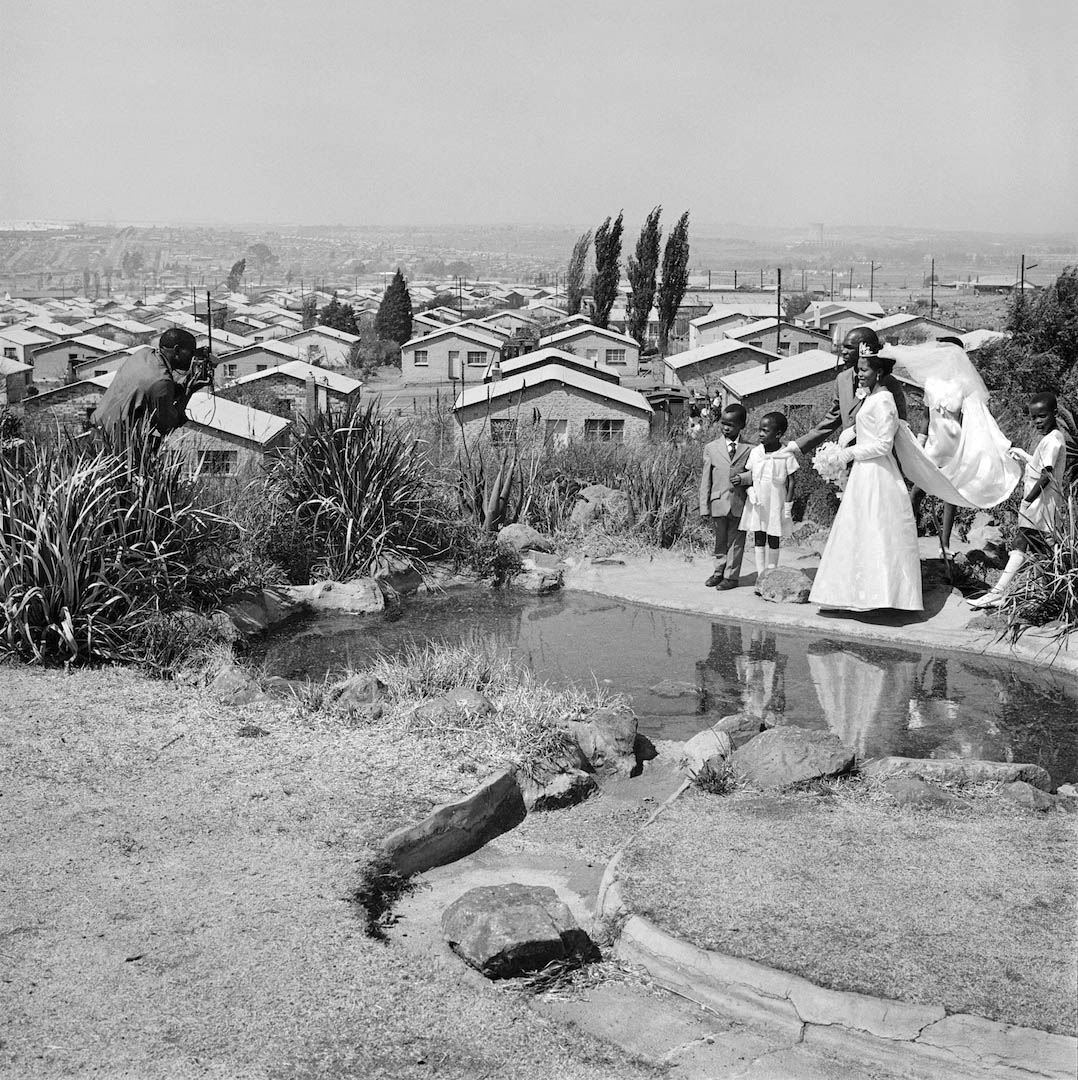
 

David Goldblatt (South African, 1930-2018) 'Young men with dompas (an identity document that every African had to carry), White City, Jabavu, Soweto' 1972


David Goldblatt (South African, 1930-2018)
Young men with dompas (an identity document that every African had to carry), White City, Jabavu, Soweto
1972
Gelatin silver print
Yale University Art Gallery, New haven, Connecticut, purchased with a gift from Jane P. Watkins, M.P.H. 1979; with the Leonard C. Hanna, Jr., Class of 1913, Fund; and with support from the Reinecke Rare Book and Manuscript Library
© The David Goldblatt Legacy Trust


Two men lean against one another tenderly as one holds up an identification document called a passbook. under the Pass Laws Act of 1952, all Black South Africans over the age of 16 were required to carry such identification at all times. Passbooks were also known as dompas, a term deriving from the phrase “dumb pass,” used to openly mock this hated tool for enforcing apartheid. Anyone stopped by police without a passbook or official permission to be in a given area could be penalised with arrest or fines. Policies that restricted the movement of Black people throughout the country have a long history in South Africa and were a key target of resistance movements.

Wall text from the exhibition


David Goldblatt (South African, 1930-2018) 'In the office of the funeral parlour, Orlando West, Soweto' [En la oficina de la funeraria, Orlando West, Soweto] 1972


David Goldblatt (South African, 1930-2018)
In the office of the funeral parlour, Orlando West, Soweto [En la oficina de la funeraria, Orlando West, Soweto]
1972
Gelatin silver print
The Art Institute of Chicago, promised donation of Cecily Cameron and Derek Schrier
© The David Goldblatt Legacy Trust


In his photographs of office and office workers, Goldblatt often teased out the continuities between professional and private identities. The two women in this photograph are dressed for winter on Earth, but the art on the walls hearkens to a journey to outer space. At this moment in 1972, apartheid was so firmly in place that, for many, change was almost unthinkable – perhaps akin to landing on the moon. The artwork brings the prospect of liberty and the sheer thrill of adventure into an otherwise ordinary setting. Of course, the art might not have been their choice at all, but the photograph holds open the possibility that these women have a stake in missions long thought impossible.

Wall text from the exhibition


David Goldblatt (South African, 1930-2018) 'Lulu Gebashe and Solomon Mlutshana, who both worked in a record shop in the city, Mofolo Park' [Lulu Gebashe y Solomon Mlutshana, que trabajaban en una tienda de discos de la ciudad, Mofolo Park] 1972


David Goldblatt (South African, 1930-2018)
Lulu Gebashe and Solomon Mlutshana, who both worked in a record shop in the city, Mofolo Park [Lulu Gebashe y Solomon Mlutshana, que trabajaban en una tienda de discos de la ciudad, Mofolo Park]
1972
Carbon ink print
Yale University Art Gallery, New haven, Connecticut, purchased with a gift from Jane P. Watkins, M.P.H. 1979; with the Leonard C. Hanna, Jr., Class of 1913, Fund; and with support from the Reinecke Rare Book and Manuscript Library
© The David Goldblatt Legacy Trust


David Goldblatt (South African, 1930-2018) 'Miriam Diale, 5357 Orlando East, Soweto, 18 October 1972' [Miriam Diale, Orlando East n.º 5357, Soweto, 18 de octubre de 1972] 1972


David Goldblatt (South African, 1930-2018)
Miriam Diale, 5357 Orlando East, Soweto, 18 October 1972 [Miriam Diale, Orlando East n.º 5357, Soweto, 18 de octubre de 1972]
1972
Carbon ink print
Yale University Art Gallery, New haven, Connecticut, purchased with a gift from Jane P. Watkins, M.P.H. 1979; with the Leonard C. Hanna, Jr., Class of 1913, Fund; and with support from the Reinecke Rare Book and Manuscript Library
© The David Goldblatt Legacy Trust


David Goldblatt (South African, 1930-2018) 'Wedding photography at the Oppenheimer Memorial, Jabavu, Soweto' 1972, printed later


David Goldblatt (South African, 1930-2018)
Wedding photography at the Oppenheimer Memorial, Jabavu, Soweto
1972, printed later
Carbon ink print
Yale University Art Gallery, New haven, Connecticut, purchased with a gift from Jane P. Watkins, M.P.H. 1979; with the Leonard C. Hanna, Jr., Class of 1913, Fund; and with support from the Reinecke Rare Book and Manuscript Library
© The David Goldblatt Legacy Trust


The grandson of Lithuanian refugees, David Goldblatt was born in Randfontein in 1930 and spent most of his life in Johannesburg. From a very young age he showed an interest in photography and took his first images when he was only eighteen. After the death of his father, in 1963 he decided to become a professional photographer.

David Goldblatt scrupulously examined the history and politics of South Africa, where he witnessed the rise of apartheid, its brutal segregationist policies and its eventual disappearance. His sensitive photographs offer a vision of daily life under this regime and in the complex period that followed, when he moved from black and white to colour in his work.

Employing great objectivity, Goldblatt photographed dissidents, settlers and victims of apartheid, the cities where they lived, their buildings, the interior of their homes, etc. His images configure a wide-ranging and moving visual record of this racist regime, a record which, while never explicitly showing its violence, clearly reveals everything it represented, as the artist himself pointed out: “I avoid violence. And I wouldn’t know how to handle it as a photographer if I found myself caught up in a violent scene […] But then I’ve long since realised – it took me a few years to realise – that events in themselves are not so interesting to me as the conditions that led to the events. These conditions are often quite commonplace, and yet full of what is imminent. Immanent and imminent.

In 1998 David Goldblatt was the first South African to be the subject of a solo exhibition at the Museum of Modern Art (MoMA) in New York. His work has been recognised with the Hasselblad (2006) and Henri Cartier-Bresson (2009) prizes and the International Center of Photography award (2013). In 2016 he was made a knight of the Order of Arts and Letters by the French government. He died in Johannesburg in 2018 at the age of eighty-eight.

David Goldblatt: No Ulterior Motive brings together around 150 works from several of the artist’s series with the aim of revealing the continuity of his work while also and for the first time establishing a dialogue with the work of other South African photographers of between one and three generations subsequent to Goldblatt, such as Lebohang Kganye, Ruth Seopedi Motau and Jo Ractliffe. Also on display are three mock-ups of books by Goldblatt, an aspect of his work to which he gave great importance.

The works on display are from the collections of The Art Institute of Chicago and Yale University Art Gallery and include important recent acquisitions of photographs by Goldblatt. Having been shown at The Art Institute of Chicago between December 2023 and March 2024, Fundación MAPFRE is now presenting the exhibition at its venue on Paseo de Recoletos, Madrid, until August this year. It will then be seen next year at Yale University Art Gallery, New Haven (Connecticut).

David Goldblatt: No Ulterior Motive is curated by Judy Ditner (Yale University Art Gallery, New Haven), Leslie M. Wilson and Matthew S. Witkovsky (The Art Institute of Chicago).


Key themes in the exhibition

Apparent tranquility

Throughout his career Goldblatt avoided the most difficult and shocking incidents that were a daily reality under apartheid. Rather, he considered that depicting everyday life, “the quiet and commonplace where nothing ‘happened'”, allowed the viewer to draw their own conclusions. The content was implicit in the apparent tranquility and in the very precise captions that accompany these images, which show ongoing, daily expressions of racism and the economic, social and political exploitation of the Black population under white rule.

Goldblatt, No Ulterior Motive

Goldblatt’s status as a white man allowed him greater freedom of movement and he took advantage of that privilege to document life in South Africa in the most honest and direct way possible. In the early 1970s he published a classified ad which read: “I would like to photograph people in their homes […]. No ulterior motive.” Nonetheless, this impartiality concealed a critical perspective towards his country’s people, history and geography.

Apartheid

In 1948 the National Party, one of the most visible entities representing Afrikaners (a European, colonising ethnic group mainly comprising descendants of the Dutch, North Germans and French), came to power in South Africa. This minority of European origin then proceeded to institute apartheid as a State policy while promoting the ideology that people of different racial origins could not live together in equality and harmony. Successive governments reinforced the legacy of racist oppression against non-white peoples (indigenous Africans, people of Asian origin and those of mixed race), who made up more than 80% of the population. In 1990 segregation laws began to be eliminated, the activity of the African National Congress was legalised and its most important leader, Nelson Mandela, who was elected president of South Africa in 1993, was released from prison.

Press release from Fundación MAPFRE


David Goldblatt (South African, 1930-2018) ;Sylvia Gibbert in her apartment, Melrose, Johannesburg; [Sylvia Gibbert en su apartamento, Melrose, Johannesburgo] 1974


David Goldblatt (South African, 1930-2018)
Sylvia Gibbert in her apartment, Melrose, Johannesburg [Sylvia Gibbert en su apartamento, Melrose, Johannesburgo]
1974
Gelatin silver print
The Art Institute of Chicago, promised donation of Cecily Cameron and Derek Schrier
© The David Goldblatt Legacy Trust


David Goldblatt (South African, 1930-2018) 'Ozzie Docrat with his daughter Nassima in his shop before its destruction under the Group Areas Act, Fietas, Johannesburg' [Ozzie Docrat con su hija Nassima en su tienda antes de ser destruida en virtud de la Ley de Agrupación por Áreas, Fietas, Johannesburgo] 1977


David Goldblatt (South African, 1930-2018)
Ozzie Docrat with his daughter Nassima in his shop before its destruction under the Group Areas Act, Fietas, Johannesburg [Ozzie Docrat con su hija Nassima en su tienda antes de ser destruida en virtud de la Ley de Agrupación por Áreas, Fietas, Johannesburgo]
1977
From the series Fietas
Carbon ink print
Yale University Art Gallery, New haven, Connecticut, purchased with a gift from Jane P. Watkins, M.P.H. 1979; with the Leonard C. Hanna, Jr., Class of 1913, Fund; and with support from the Reinecke Rare Book and Manuscript Library
© The David Goldblatt Legacy Trust


“I feel as though my teeth are being pulled out one by one. I run by tongue over the spaces and I try to remember the shape of what was there.” These words, spoken to Goldblatt by shop owner Ozzie Docrat, express what many residents must have experienced during their forced removal from the Johannesburg suburb of Fietas in the 1970s. Throughout the mid-20th century, Fietas was exceptional for the endurance of it multiracial, interfaith community of working- and middle-class people in the face of encroaching segregationist housing policies. In 1977, however, the government forced out Indian families like the Docrats, along with other people of color, to make this area exclusive to whites.

Wall text from the exhibition


David Goldblatt (South African, 1930-2018) 'Sunday morning: A not-White family living illegally in the "White" group area of Hillbrow, Johannesburg' [Domingo por la mañana: una familia no blanca viviendo ilegalmente en la zona "blanca" de Hillbrow, Johannesburgo] 1978


David Goldblatt (South African, 1930-2018)
Sunday morning: A not-White family living illegally in the “White” group area of Hillbrow, Johannesburg [Domingo por la mañana: una familia no blanca viviendo ilegalmente en la zona “blanca” de Hillbrow, Johannesburgo]
1978
Pigmented inkjet print
Yale University Art Gallery, New haven, Connecticut, purchased with a gift from Jane P. Watkins, M.P.H. 1979; with the Leonard C. Hanna, Jr., Class of 1913, Fund; and with support from the Reinecke Rare Book and Manuscript Library
© The David Goldblatt Legacy Trust


“Over the course of a career that spanned more than six decades, Goldblatt went looking for scenes like this one – quiet and tender, while also deeply revealing of the structures and values that constituted South African society. Though the family appears to be right at home, Goldblatt’s title shares that they were living illegally in the Johannesburg neighborhood of Hillbrow, violating laws that, under the system of segregation known as apartheid, dictated where different racial groups were permitted to reside. The cozy scene is therefore profoundly fragile because the family faced the persistent threat of removal.

This image powerfully presents the tensions that were central to what Goldblatt pursued through photography: soft furnishings and brutal laws, proximity and distance, access and exclusion, and informality and formality.”

Leslie Wilson and Yechen Zhao. “In the Room with David Goldblatt,” on the Art Institute of Chicago website December 19, 2023 [Online] Cited 11/07/2024
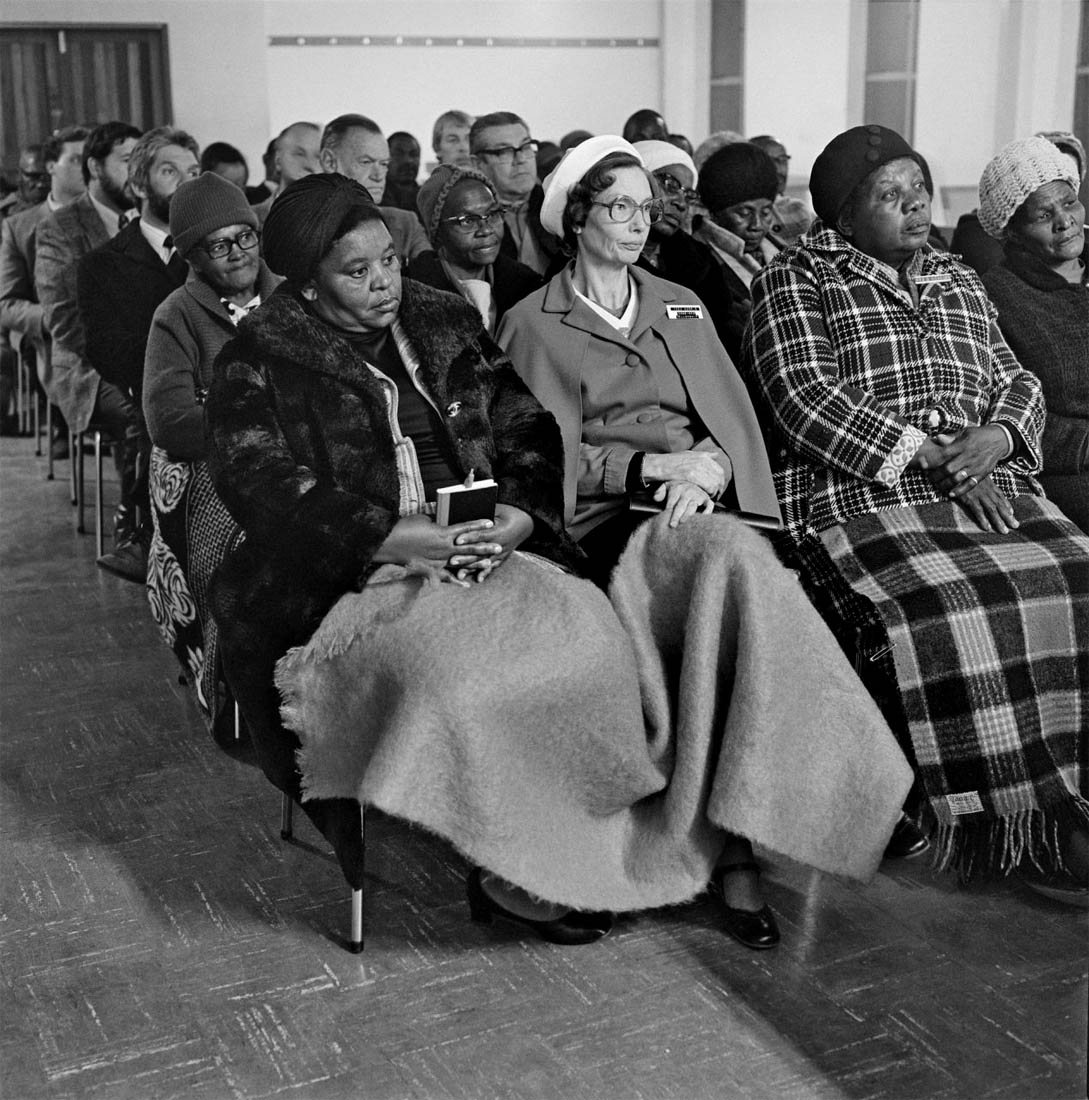
 

David Goldblatt (South African, 1930-2018) 'Methodists meet to find ways of reducing the racial, cultural, and class barriers that divide them, 3 July 1980' 1980, printed later


David Goldblatt (South African, 1930-2018)
Methodists meet to find ways of reducing the racial, cultural, and class barriers that divide them, 3 July 1980
1980, printed later
Gelatin silver print
Yale University Art Gallery, New haven, Connecticut, purchased with a gift from Jane P. Watkins, M.P.H. 1979; with the Leonard C. Hanna, Jr., Class of 1913, Fund; and with support from the Reinecke Rare Book and Manuscript Library
© The David Goldblatt Legacy Trust
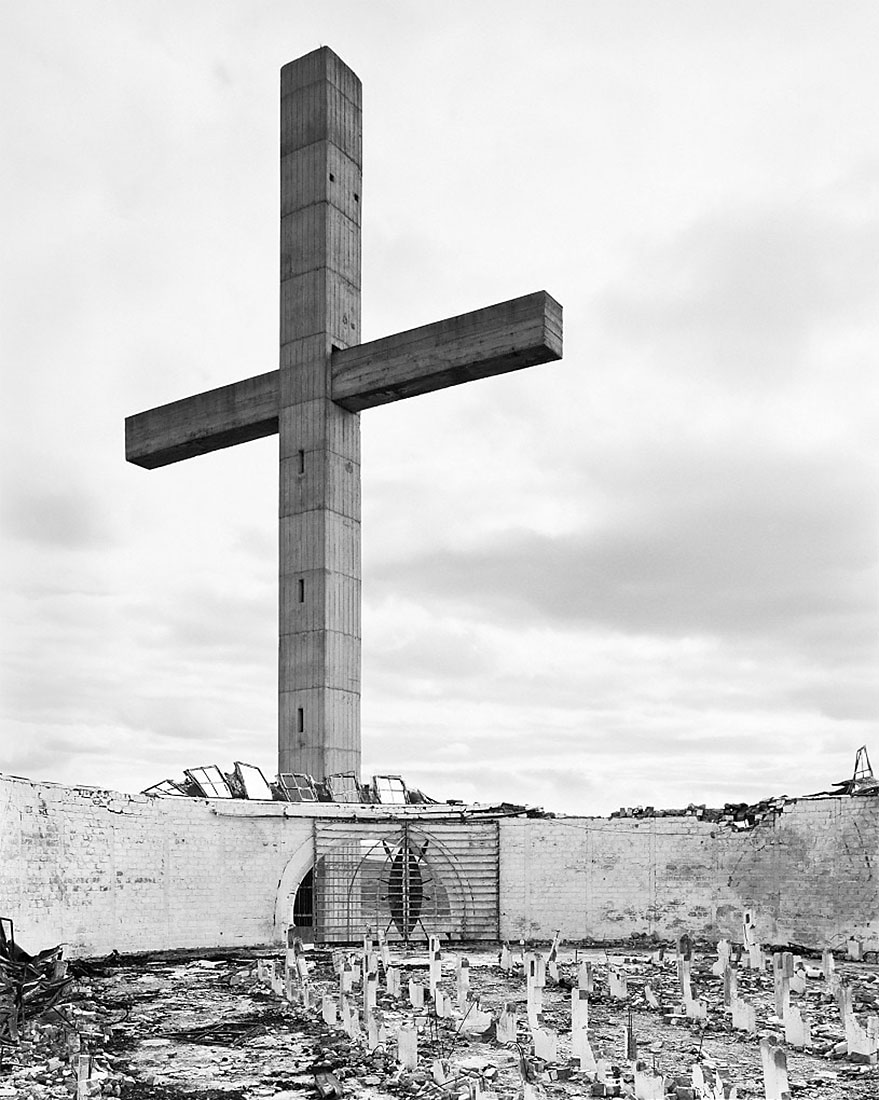
 

Throughout South Africa and even across the continent, religion bears a complicated history embroiled in legacies of colonisation, oppression, and apartheid. Religion holds power. It was through the cross and the bullet that the continent was dissected by European powers. It was through the pages of the Bible that apartheid was theologically justified, and it was through the Dutch Reformed Church of white Afrikaners that “the races” were declared separate as mandated by God. Yet, it was also through the World Alliance of Reformed Churches that apartheid was acknowledged as heresy. It was through the Christian ethos and through ubuntu that Archbishop Desmond Tutu guided the post-apartheid Truth and Reconciliation Commission through ways of healing in a society bifurcated into “European” and “Non-White;” “have” and “have-not;” “believer” and “unbeliever.” Religion has the power to both destroy and heal a nation.

In a discussion about life under apartheid, my South African friend designated as “Coloured” – a category in between “White” and “Black African” – revealed that his parents were once denied communion on Sunday morning due to their sin of attending a “white church” while being of color. Whiteness meant purity and closeness with God; anything less than was deemed as “separate,” “other,” “unworthy” – “impure.” The sharing of bread and wine in the Christian tradition is meant to signify connection between people and between the divine. The denial of such connection, of saying that one was unworthy to drink from the same chalice because of one’s race or ethnicity, is an ultimate denial of humanity. It is an affront to the very word “communion” and an insult to fellowship. Religion was co-opted to subjugate and enforce a system of racial hierarchy. Sunday morning saw no race-mixing amongst God’s children.

Trevor O’Connor. “Religion in South Africa: The Power to Destroy and Heal a Nation,” on the Berkley Center for Religion, Peace & World Affairs website November 16, 2018 [Online] Cited 11/07/2024


David Goldblatt (South African, 1930-2018) 'Saturday morning at the hypermarket: Semifinal of the Miss Lovely Legs Competition, 28 June 1980' [Sábado por la mañana en el hipermercado: semifinal del concurso Miss Piernas Bonitas, 28 de junio de 1980] 1980


David Goldblatt (South African, 1930-2018)
Saturday morning at the hypermarket: Semifinal of the Miss Lovely Legs Competition, 28 June 1980 [Sábado por la mañana en el hipermercado: semifinal del concurso Miss Piernas Bonitas, 28 de junio de 1980]
1980
Carbon ink print
Yale University Art Gallery, New haven, Connecticut, purchased with a gift from Jane P. Watkins, M.P.H. 1979; with the Leonard C. Hanna, Jr., Class of 1913, Fund; and with support from the Reinecke Rare Book and Manuscript Library
© The David Goldblatt Legacy Trust


David Goldblatt (South African, 1930-2018) 'Apostolic Faith Mission (AGS), Birchleigh, Kempton Park, 28 December 1983' [Misión de la Fe Apostólica (AGS, en afrikáans), Birchleigh, Kempton Park, 28 de diciembre de 1983] 1983


David Goldblatt (South African, 1930-2018)
Apostolic Faith Mission (AGS), Birchleigh, Kempton Park, 28 December 1983 [Misión de la Fe Apostólica (AGS, en afrikáans), Birchleigh, Kempton Park, 28 de diciembre de 1983]
1983
Gelatin silver print
The Art Institute of Chicago, promised donation of Cecily Cameron and Derek Schrier
© The David Goldblatt Legacy Trust


Goldblatt’s photographs of churches were so beautiful. They were wonderful architectural images, but they were deep with meaning capturing the issues of a missionary religion in a nonnative land. They symbolise the conflicts within the country which mirrored issues throughout other parts of the world. When I thought about South Africa it was about apartheid and relationships between blacks and whites, I had not considered the impact of western religion on the indigenous population (I should have because it is an issue still in our country today), nor did I know about the issues with the Muslim population in the country. In researching the issue of religion further, it appears the conflicts and violence in South Africa related to it appear to be ongoing to this day.

William Carl Valentine. “David Goldblatt: No Ulterior Motive,” on the William Carl Valentine website June 15, 2024 [Online] Cited 06/07/2024


David Goldblatt (South African, 1930-2018) 'Thirteen kilometres of this coastline were a White Group Area, Bloubergstrand, Cape Town, 9 January 1986' [Trece kilómetros de esta costa eran una zona reservada para blancos, Bloubergstrand, Ciudad del Cabo, 9 de enero de 1986] 1986


David Goldblatt (South African, 1930-2018)
Thirteen kilometres of this coastline were a White Group Area, Bloubergstrand, Cape Town, 9 January 1986 [Trece kilómetros de esta costa eran una zona reservada para blancos, Bloubergstrand, Ciudad del Cabo, 9 de enero de 1986]
1986
Carbon ink print
Yale University Art Gallery, New haven, Connecticut, purchased with a gift from Jane P. Watkins, M.P.H. 1979; with the Leonard C. Hanna, Jr., Class of 1913, Fund; and with support from the Reinecke Rare Book and Manuscript Library
© The David Goldblatt Legacy Trust


David Goldblatt (South African, 1930-2018) 'Assegais, shield, and 23-metre-high cross of the Nederduitse Gereformeerde Kerk in Afrika, (Dutch Reformed Mission Church to Africans), which stands above Dingane's destroyed capital, uMgungundlovu. The church was burnt down in 1985; Dinganestad, Natal' 1989, printed later


David Goldblatt (South African, 1930-2018)
Assegais, shield, and 23-metre-high cross of the Nederduitse Gereformeerde Kerk in Afrika, (Dutch Reformed Mission Church to Africans), which stands above Dingane’s destroyed capital, uMgungundlovu. The church was burnt down in 1985; Dinganestad, Natal
1989, printed later
Carbon ink print
Yale University Art Gallery, New haven, Connecticut, purchased with a gift from Jane P. Watkins, M.P.H. 1979; with the Leonard C. Hanna, Jr., Class of 1913, Fund; and with support from the Reinecke Rare Book and Manuscript Library
© The David Goldblatt Legacy Trust


David Goldblatt (1930-2018) scrupulously examined the history and politics of South Africa, where he witnessed the rise of apartheid, its divisive and brutal policies, and its eventual demise. His sensitive photographs offer a view of daily life under the apartheid system and its complex aftermath. Goldblatt was drawn, in his own words, “to the quiet and commonplace where nothing ‘happened’ and yet all was contained and immanent.” Accompanied by precise captions, his images expose everyday manifestations of racism and point to Black dispossession – economic, social, and political – under white rule.

The grandson of Lithuanian Jews who had fled Europe in the 1890s, Goldblatt spent most of his life in Johannesburg. Although not part of the ascendant Dutch Protestant community, his position as a white man allowed him greater freedom of movement and he leveraged this privilege to document life in South Africa as honestly and straightforwardly as possible. In the early 1970s, he placed a classified ad: “I would like to photograph people in their homes […]. No ulterior motive.” Yet this professed impartiality masked a critical perspective toward South Africa’s people, history, and geography.

Goldblatt first took up the camera in 1948, the year the apartheid system was introduced, and over the next seven decades he assiduously photographed South Africa’s people, landscape, and built environment. Recognising the layered connections in his oeuvre, this exhibition proceeds thematically rather than chronologically: here, black-and-white photographs taken during the period of institutionalised segregation are interwoven with his work in colour from the 1990s on. Six thematic sections explore Goldblatt’s engagement with apartheid, its contradictions, and its multifaceted legacy.
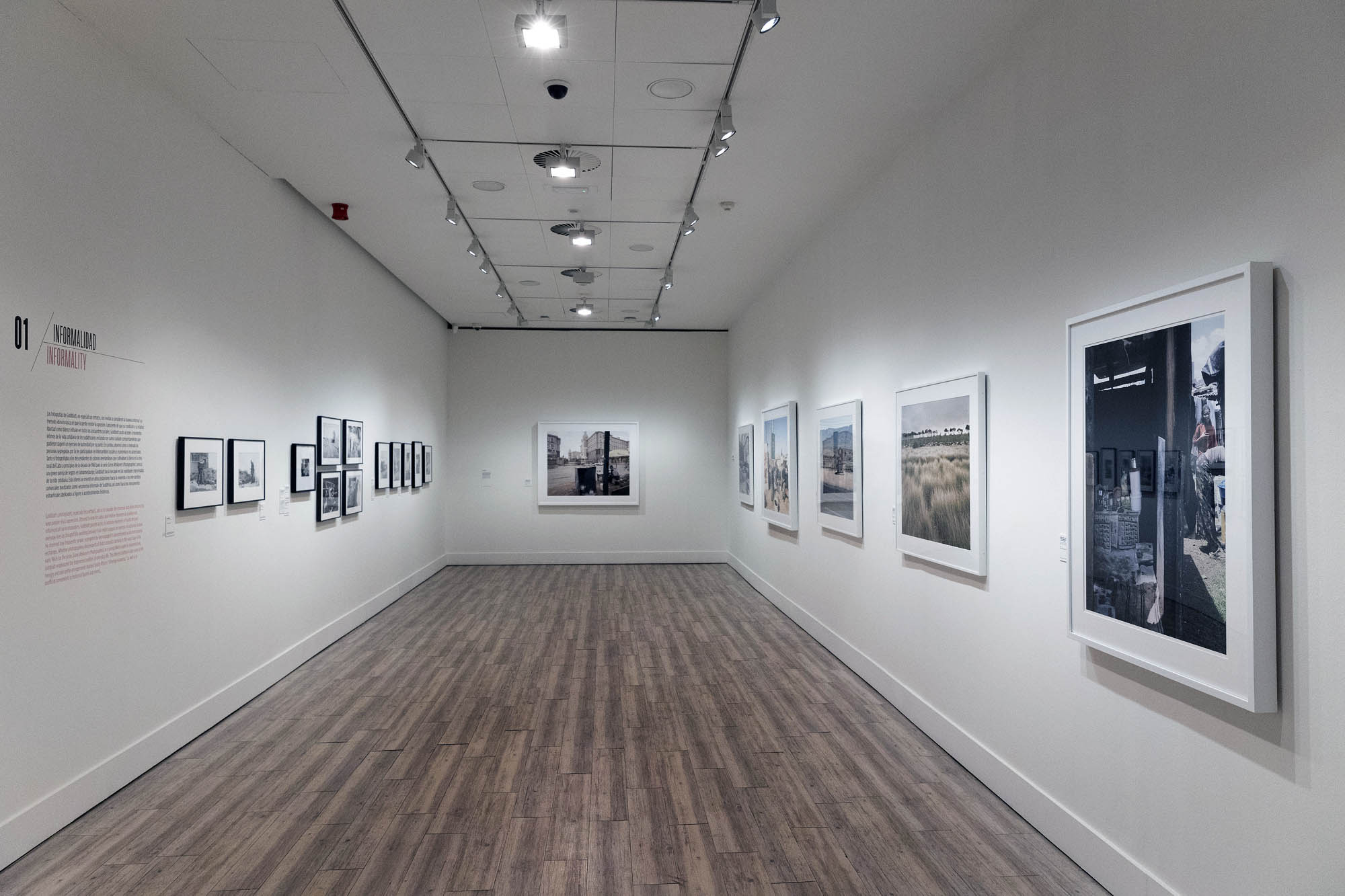
 

Installation view of the exhibition 'David Goldblatt: No Ulterior Motive' at Fundación MAPFRE, Madrid showing at left, wall text from the section 'Informality'


Installation view of the exhibition David Goldblatt: No Ulterior Motive at Fundación MAPFRE, Madrid showing at left, wall text from the section ‘Informality’ (see below)


1/ Informality

Goldblatt’s photographs, especially his portraits, ask us to consider the informal and often idiosyncratic ways people resist oppression. Attuned to how his status and relative freedom as a white man influenced all social encounters, Goldblatt gained access to intimate moments of South Africans’ everyday lives by thoughtfully avoiding behaviour that might suggest an exercise of authority. Instead, he observed how frequently people segregated by law engaged in unsanctioned social and economic exchanges. Whether photographing descendants of Dutch colonists farming in the rural Cape in the early 1960s for the series Some Afrikaners Photographed, or a young Black couple in Johannesburg, Goldblatt emphasised the improvised realities of everyday life. This interest shifted in later years to the housing and mercantile arrangements dubbed South Africa’s “informal economy,” as well as to unofficial monuments to historical figures and events.

2/ Working people

Even as the architects of apartheid sought to separate South Africans, the system functioned through an economic structure that placed people into tense proximity on a daily basis. White families hired Black workers to raise their children and clean their homes; mines owned and managed by whites depended on people of color to perform the most dangerous labor. Government-dictated racial categories profoundly shaped the jobs that people could hold, creating strict hierarchies in workplaces. Goldblatt highlighted these inequalities with pictures like one of a domestic worker rushing to meet her employer. At the same time, he attended to how people retained a sense of self and dignity in their labor, as in his portraits of mineworkers who chose to pose for his camera in their traditional clothing.

3/ Extraction

Born in the mining town of Randfontein, Goldblatt began his career by looking at the extractive economy built by colonial ventures to exploit its natural resources. Goldblatt created his earliest series, On the Mines (1964–73), while working as a photographer for the country’s biggest mining corporations. The series showed how a predominantly Black migrant labor force performed the most dangerous work in gold and platinum mines, work that primarily enriched their white bosses. Decades later, the photographer found similar manifestations of inequality while recording the toxic legacy of asbestos mining and its disproportionate impact on Black communities.

4/ Near/Far

The white supremacist National Party, led by Afrikaners (descendants of predominantly Dutch settlers) and English-speaking whites, attempted to impose distance between people of different racial categories in South Africa. Goldblatt looked at how the National Party government pulled people from their homes to realise its vision of racial segregation, dispossessing and dispersing Black and Indian residents to make room for new white neighbourhoods.

However, the exclusive urban centres the party sought to create could not function without a daily influx of labourers and domestic workers from the country’s diverse population. Goldblatt was interested in the ways closeness continued to manifest even when distance was dictated by law, a status quo that also affected his relationship with the people he photographed. These images wryly register the constant collision of segregated groups in public and private spaces throughout the country.

5/ Disbelief

The illogic of apartheid led to widespread skepticism and practices of self-delusion among those who actively perpetuated the system. The photographs in this section capture the sense of disbelief with the labyrinthine, endlessly rewritten laws intended to legitimise a morally bankrupt system of abuse and oppression. Goldblatt rendered this state of affairs in brilliant deadpan, giving visual form to the incredulity that all but the most cynical and opportunistic beneficiaries of apartheid must have felt. Fortress-like churches of the Dutch Reformed Protestant faith mix with absurd scenes of suburban leisure in whites-only areas, while stony or stoic gazes meet moments of sudden demolition. Even after the official end of apartheid, Goldblatt continued to photograph sites that inspired feelings of disbelief as seen in his photographs of incomplete housing developments.

6/ Assembly

How do people come together in a country divided by segregation? In everything, from the bench they could sit on to where they could live, South Africans were physically separated by race. In the 1950s, protests against these new policies were common, but in the decades that followed, the government introduced increasingly brutal tactics to repress dissent and severely curtailed the right to assemble.

Goldblatt avoided straightforward depictions of open rebellion, seeing his country’s political struggles as clearly in the routine occasions that brought people together by choice or necessity. In later decades, he engaged more with overtly political subjects, turning his camera to newly elected lawmakers and young South Africans openly protesting colonial legacies in their post-apartheid society.

7/ Connections

Beyond his own work, Goldblatt was committed to aiding future generations of South African photographers. He helped found the Market Photo Workshop in 1989 to offer instruction and support to emerging, socially engaged photographers, hoping the school would be “a small counter to the ethnic surgery that had so successfully separated South Africans under apartheid.” Today, it remains a centre of education and community for photography in Johannesburg. Lebohang Kganye, Sabelo Mlangeni, Ruth Seopedi Motau, and Zanele Muholi are alumni with close ties to Goldblatt, who was a friend and mentor. All have explored themes of belonging, loss, memory, migration, and representation while uncovering original, often deeply personal ways to examine South Africa’s people, places, and policies.

Like Goldblatt, the artists in this gallery – Ernest Cole, Santu Mofokeng, and Jo Ractliffe – use the camera to reflect critically on their country’s society and politics. Cole used his camera to confront sweeping social, political, and environmental change from the 1950s to the 1980s. Mofokeng was a member of the Afrapix collective of South African documentary photographers throughout the 1980s. A former student of Goldblatt, he received his first long-term position in photography in part through Goldblatt’s recommendation. Ractliffe’s landscape photographs address issues of displacement and conflict, capturing the traces of often violent histories. She knew Goldblatt as a friend and colleague and has taught at the Market Photo Workshop, a vitally important school for photography in Johannesburg whose alumni are featured in gallery 3.

Text from the exhibition


David Goldblatt (South African, 1930-2018) 'Victoria Cobokana, housekeeper, in her employer's dining room with her son Sifiso and daughter Onica, Johannesburg, June 1999. Victoria died of AIDS on 13 December 1999, Sifiso dies of AIDS on 12 January 2000, Onica died of AIDS in May 2000, June 1999' 1999


David Goldblatt (South African, 1930-2018)
Victoria Cobokana, housekeeper, in her employer’s dining room with her son Sifiso and daughter Onica, Johannesburg, June 1999. Victoria died of AIDS on 13 December 1999, Sifiso dies of AIDS on 12 January 2000, Onica died of AIDS in May 2000, June 1999
1999
Pigmented inkjet print
The Art Institute of Chicago, Promised gift of Cecily Cameron and Derek Schrier
© The David Goldblatt Legacy Trust
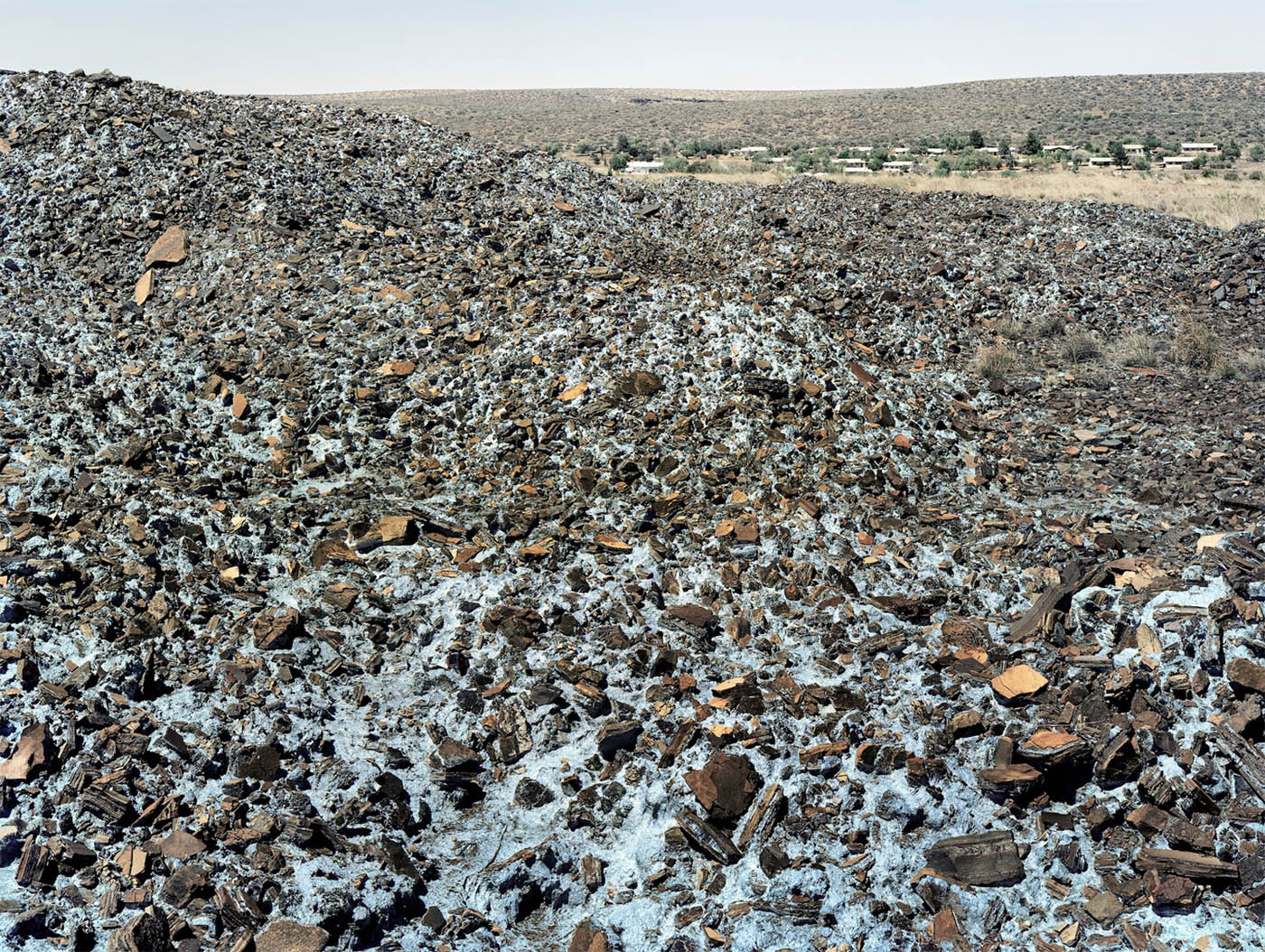
 

One might argue that in his own silent way, he was an activist, using his camera to expose things that should never have been allowed to happen. A single color image seems to define the show – in it, a housekeeper sits in her employer’s dining room with her two children on her lap. Behind her a round window forms a halo around her wrapped head, Madonna-like. The didactic tells us that all three of them died of AIDS within months. Such is the inequity of South Africa, quietly portrayed by David Goldblatt over seven decades.

Susan Aurinko. “Painful Truths: A Review of David Goldblatt at the Art Institute of Chicago,” on the New City Art website December 22, 2023 [Online] Cited 07/07/2024


David Goldblatt (South African, 1930-2018) 'Swerwers, nomadic sheep shearers and farmworkers descended from the San hunter-gatherers and Khoi pastoralists. Without work for four months they lived in the gang, the corridor between farms, fences and roads, hunting, fishing when they could, and eating roadkill, near Nuwe Rooiberg, Northern Cape, 18 September 2002' [Swerwers, esquiladores de ovejas y trabajadores agrícolas nómadas, descendientes de los cazadores-recolectores san y de los pastores khoi. Sin trabajo durante cuatro meses, vivían en el paso, el corredor que hay entre las vallas de las granjas y las carreteras, cazando, pescando cuando podían y comiendo animales atropellados, cerca de Nuwe Rooiberg, Cabo Septentrional, 18 de septiembre de 2002] 2002, printed 2005


David Goldblatt (South African, 1930-2018)
Swerwers, nomadic sheep shearers and farmworkers descended from the San hunter-gatherers and Khoi pastoralists. Without work for four months they lived in the gang, the corridor between farms, fences and roads, hunting, fishing when they could, and eating roadkill, near Nuwe Rooiberg, Northern Cape, 18 September 2002 [Swerwers, esquiladores de ovejas y trabajadores agrícolas nómadas, descendientes de los cazadores-recolectores san y de los pastores khoi. Sin trabajo durante cuatro meses, vivían en el paso, el corredor que hay entre las vallas de las granjas y las carreteras, cazando, pescando cuando podían y comiendo animales atropellados, cerca de Nuwe Rooiberg, Cabo Septentrional, 18 de septiembre de 2002]
2002, printed 2005
Pigmented inkjet print
The Art Institute of Chicago, Promised gift of Cecily Cameron and Derek Schrier
© The David Goldblatt Legacy Trust


David Goldblatt (South African, 1930-2018) 'Highly carcinogenic blue asbestos waste on the Owendale Asbestos Mine tailings dump, near Postmasburg, Northern Cape. The prevailing wind was in the direction of the mine officials' houses at right. 21 December, 2002' 2002, printed 2005


David Goldblatt (South African, 1930-2018)
Highly carcinogenic blue asbestos waste on the Owendale Asbestos Mine tailings dump, near Postmasburg, Northern Cape. The prevailing wind was in the direction of the mine officials’ houses at right. 21 December, 2002
2002, printed 2005
Pigmented inkjet print
© The David Goldblatt Legacy Trust
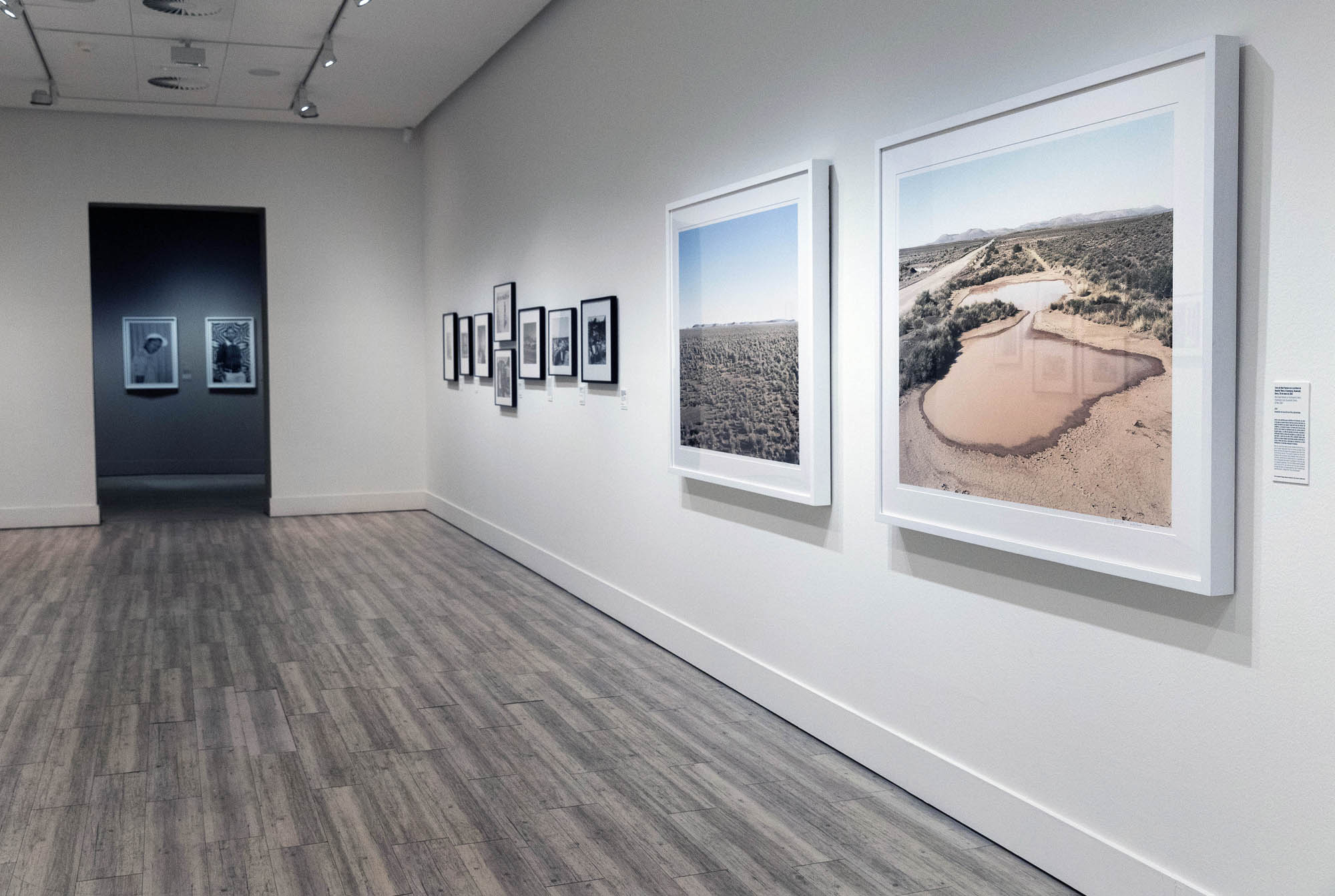
 

Installation view of the exhibition David Goldblatt: No Ulterior Motive at Fundación MAPFRE, Madrid showing at right, Goldblatt's 'Near Brak Pannen on the Beaufort West-Fraserburg road, Nuweveld, Karoo, 30 May 2004'


Installation view of the exhibition David Goldblatt: No Ulterior Motive at Fundación MAPFRE, Madrid showing at right, Goldblatt’s Near Brak Pannen on the Beaufort West-Fraserburg road, Nuweveld, Karoo, 30 May 2004 (2004, below)
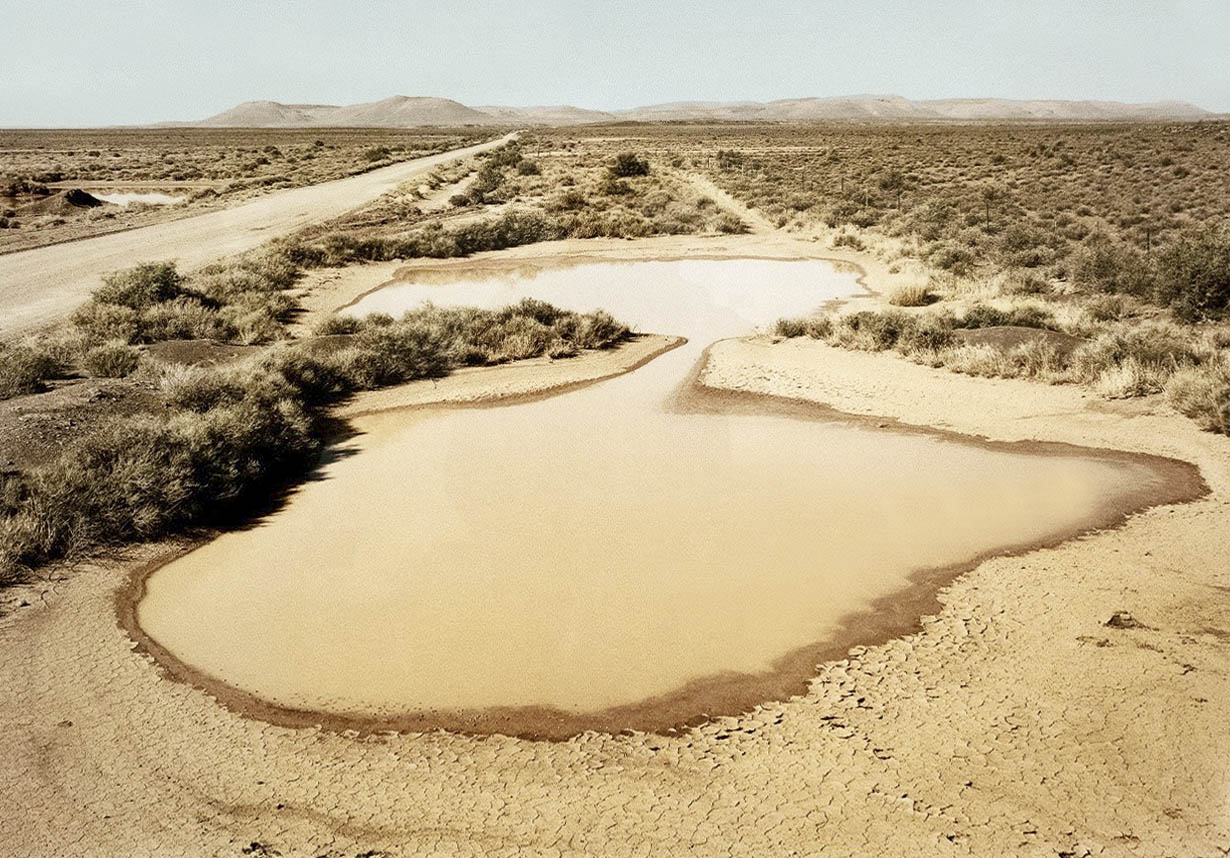
 

David Goldblatt (South African, 1930-2018) 'Near Brak Pannen on the Beaufort West-Fraserburg road, Nuweveld, Karoo, 30 May 2004' 2004


David Goldblatt (South African, 1930-2018)
Near Brak Pannen on the Beaufort West-Fraserburg road, Nuweveld, Karoo, 30 May 2004
2004
Pigmented inkjet print
The Art Institute of Chicago, promised gift of Cecily Cameron and Derek Schrier


Next to a road that shoots arrow-straight to the horizon, a pool of water evaporates from the intense sunlight of the Karoo, the semi-arid region that separates Cape Town from South Africa’s interior. The scarcity of water and the harsh climate in this enormous area impeded white settlers from centuries, an the lack of grand natural or manmade features confounded their desire to assimilate it into their idea of a beautiful landscape. From the 2000s onward Goldblatt made much of his new work by driving great distances through the Karoo. He appreciated the way it resisted easy aestheticisation, calling it the “fuck-all landscape.”

Wall text from the exhibition


David Goldblatt (South African, 1930-2018) 'Incomplete houses, part of a stalled municipal development of 1,000 houses. The funding allocation was made in 1998, building started in 2003. Officials and a politician gave various reasons for the stalling of the scheme: Shortage of water, theft of materials, problems with sewage disposal, problems caused by the high clay content of the soil, and shortage of funds. By August 2006, 420 houses had been completed, Lady Grey, Eastern Cape, 5 August 2006' [Casas sin terminar, parte de una promoción municipal de 1.000 viviendas paralizada. La financiación se consignó en 1998 y la construcción empezó en 2003. Los funcionarios y un político dieron varias razones para la paralización del proyecto: escasez de agua, robo de materiales, problemas con la evacuación de aguas residuales, problemas causados por el alto contenido de arcilla del suelo y escasez de fondos. En agosto de 2006 se habían terminado 420 viviendas, Lady Grey, Cabo Oriental, 5 de agosto de 2006] 2006


David Goldblatt (South African, 1930-2018)
Incomplete houses, part of a stalled municipal development of 1,000 houses. The funding allocation was made in 1998, building started in 2003. Officials and a politician gave various reasons for the stalling of the scheme: Shortage of water, theft of materials, problems with sewage disposal, problems caused by the high clay content of the soil, and shortage of funds. By August 2006, 420 houses had been completed, Lady Grey, Eastern Cape, 5 August 2006 [Casas sin terminar, parte de una promoción municipal de 1.000 viviendas paralizada. La financiación se consignó en 1998 y la construcción empezó en 2003. Los funcionarios y un político dieron varias razones para la paralización del proyecto: escasez de agua, robo de materiales, problemas con la evacuación de aguas residuales, problemas causados por el alto contenido de arcilla del suelo y escasez de fondos. En agosto de 2006 se habían terminado 420 viviendas, Lady Grey, Cabo Oriental, 5 de agosto de 2006]
2006
Pigmented inkjet print
Yale University Art Gallery, New haven, Connecticut, purchased with a gift from Jane P. Watkins, M.P.H. 1979; with the Leonard C. Hanna, Jr., Class of 1913, Fund; and with support from the Reinecke Rare Book and Manuscript Library
© The David Goldblatt Legacy Trust
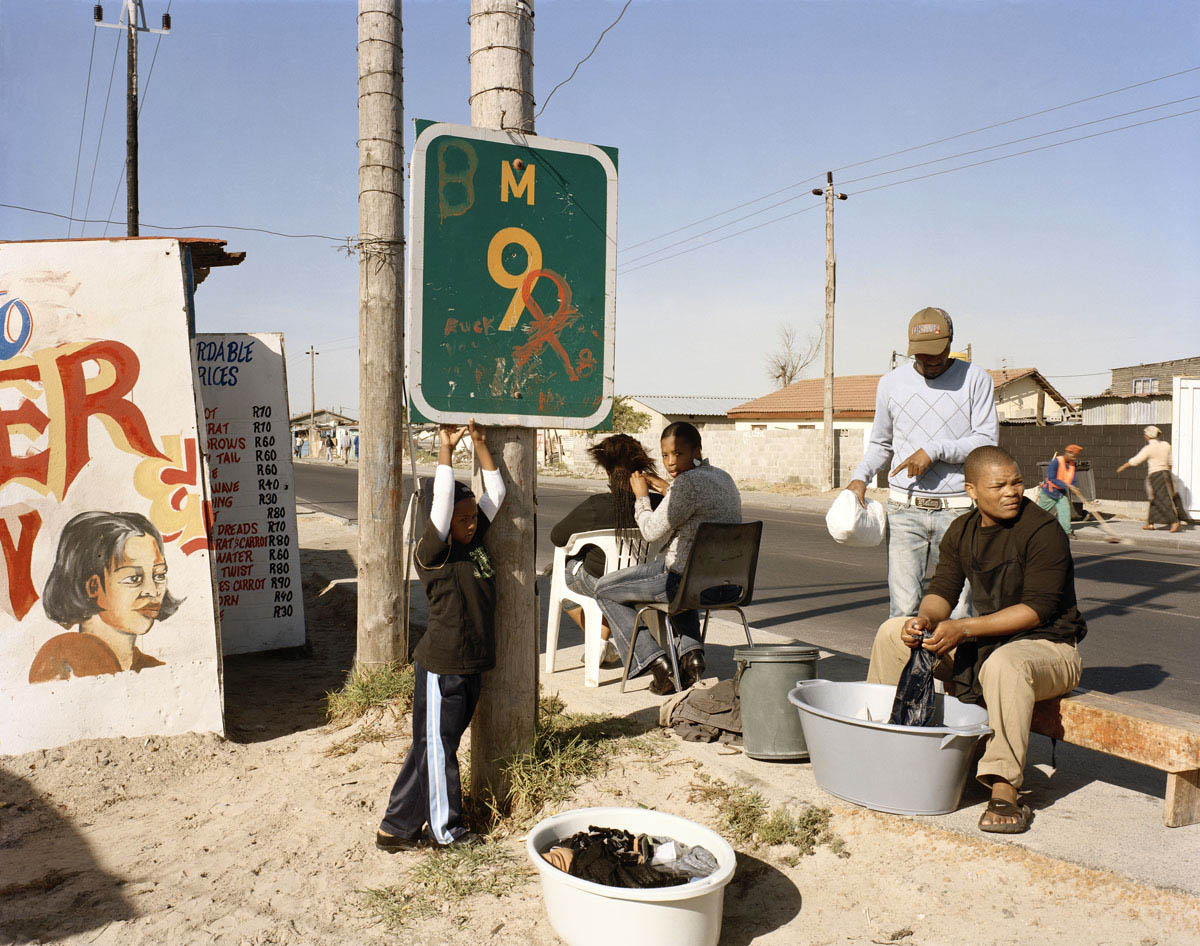
 

David Goldblatt (South African, 1930-2018) 'At Kewin Kwaneles Takwaito Barber, Landsdowne Road, Cape Town in the time of AIDS, 16 May 2007' 2007


David Goldblatt (South African, 1930-2018)
At Kewin Kwaneles Takwaito Barber, Landsdowne Road, Cape Town in the time of AIDS, 16 May 2007
2007
Pigmented inkjet print
The Art Institute of Chicago, promised gift of Cecily Cameron and Derek Schrier


David Goldblatt (South African, 1930-2018) 'The dethroning of Cecil John Rhodes, after the throwing of human feces on the statue and the agreement of the university to the demands of students for its removal, the University of Cape Town, 9 April 2015' [El derrocamiento de Cecil John Rhodes después de arrojar heces humanas contra la estatua y de que la universidad accediera a las demandas de los estudiantes para su retirada, Universidad de Ciudad del Cabo, 9 de abril de 2015] 2015


David Goldblatt (South African, 1930-2018)
The dethroning of Cecil John Rhodes, after the throwing of human feces on the statue and the agreement of the university to the demands of students for its removal, the University of Cape Town, 9 April 2015 [El derrocamiento de Cecil John Rhodes después de arrojar heces humanas contra la estatua y de que la universidad accediera a las demandas de los estudiantes para su retirada, Universidad de Ciudad del Cabo, 9 de abril de 2015]
2015
Carbon ink print
Yale University Art Gallery, New haven, Connecticut, purchased with a gift from Jane P. Watkins, M.P.H. 1979; with the Leonard C. Hanna, Jr., Class of 1913, Fund; and with support from the Reinecke Rare Book and Manuscript Library
© The David Goldblatt Legacy Trust


Here, Goldblatt joined a mass of onlookers recording the removal of the statue of 19th-century British mining magnate Cecil John Rhodes at the University of Cape Town (UCT). Rhodes vastly expanded European colonial rule on the African continent and exploited local labour to amass immense wealth. Disgusted by what they viewed as a symbol of white supremacy, student activists successfully campaigned to take down the statue honouring Rhodes.

UCT responded to this and related student protests by forming a committee to evaluate art on campus, intending to remove or hide problematic works from view. While Goldblatt had promised his archive to the university, he became concerned that this committee might censor art ad free speech. He ultimately withdrew his offer in 2017, bequeathing his archive to Yale University instead. In response to this decision, scholar Njabulo S. Ndebele has asked. “Was Goldblatt worried that the photographs would not survive the tests of freedom, even after they had survived those of oppression?”

Wall text from the exhibition


Fundación MAPFRE
Recoletos Exhibition Hall
Paseo Recoletos 23, 28004 Madrid

Opening hours:
Mondays (except holidays): 2pm – 8pm
Tuesday to Saturday: 11am – 8pm
Sunday and holidays: 11am – 7pm

Fundación MAPFRE website

LIKE ART BLART ON FACEBOOK

Back to top

Exhibition: ‘Consuelo Kanaga. Catch the Spirit’ at the KBr Photography Center KBr Fundación MAPFRE, Barcelona

Exhibition dates: 15th February – 12th May, 2024

Curator: Drew Sawyer


Consuelo Kanaga (American, 1894-1978) 'Self-portrait' Nd


Consuelo Kanaga (American, 1894-1978)
Self-portrait
Nd
Gelatin silver print
20 1/16 × 15 1/16 × 1 1/2 in. (51 × 38.3 × 3.8cm) framed
Brooklyn Museum, Gift of Wallace B. Putnam from the Estate of Consuelo Kanaga
© Brooklyn Museum
Photo: Brooklyn Museum


What have you got to say?

We must acknowledge the importance of the Consuelo Kanaga, a strong, compassionate human being, an under recognised photographer. What a trailblazer for future female and male photographers such as Dorothea Lange, Imogen Cunningham, Berenice Abbott and Milton Rogovin.

Kanaga is a story teller. Her photographs are strongly modernist, realist compositions. The portraits are direct and revealing, no external flourishes necessary in capturing the essence of the person; her landscapes, dark and brooding atmospheric iterations of land and spirit.

Consuelo Kanaga:

~ one of the pioneers of modern American photography

~ one of the first women photojournalists on staff at a newspaper (1918)

~ a great supporter and a confidant for Imogen Cunningham, Louise Dahl-Wolfe, Dorothea Lange, Alma Lavenson, Tina Modotti, and Eiko Yamazawa, among many others

~ passionate about social justice … social marginalisation, poverty, racial harassment, inequality… especially in relation to the African-American population in the United States.

~ maintained a close relationship with avant-garde circles, in San Francisco with the f.64 Group and in New York with the Photo League

~ focused on marginal day to day and political motifs, including workers, African Americans, objects, and buildings that were often in a state of disrepair

~ interested in worker’s rights and the worker movement

~ became very active in civil rights and took part in and photographed many demonstrations and marches in the 1960s


Whatever type of photograph Kanaga took (and there are many) her photographs are always perceptive = having or showing sensitive insight.

The sensitivity of Hands (1930, below); the tired eyes and clasped hands of the Widow Watson (1922-1924 below) contrasting with the mannerist hands of the boy staring off camera; the stoicism of the mother in Tree of Life (1950, below) with her children’s faces in deep shadow coupled with the subconscious symbology of the unyielding, white brick wall behind; and the dark mesa of Landscape Near Taos, New Mexico (Nd, below) hello Georgia O’Keeffe … all reflect Kanaga’s superb handling of shadow and light, of energy and spirit.

“Her body of work, though comparatively small, is consistently exceptional.”1

Dr Marcus Bunyan

1/ Barbara Head Millstein. “A Pioneer of Realism,” in The New York Times October 9, 1993 on the New York Times website [Online] Cited 04/05/2024


Many thankx to the Fundación MAPFRE for allowing me to publish the photographs in the posting. Please click on the photographs for a larger version of the image.


“One of America’s most transcendent yet, surprisingly, least-known photographers.”


Barbara Head Millstein and Sarah M. Lowe (1992). Consuelo Kanaga, An American Photographer. Seattle: University of Washington Press. pp. 21-40.


“I could have done lots more, put in much more work and developed more pictures, but I had also a desire to say what I felt about life. Simple things like a little picture in the window or the corner of the studio or an old stove in the kitchen have always been fascinating to me. They are very much alive, these flowers and grasses with the dew on them. Stieglitz always said, “What have you got to say?” I think in a few small cases I’ve said a few things, expressed how I felt, trying to show the horror of poverty or the beauty of black people. I think that in photography what you’ve done is what you’ve had to say. In everything this has been the message of my life. A simple supper, being with someone you love, seeing a deer come around to eat or drink at the barn – I like things like that. If I could make one true, quiet photograph, I would much prefer it to having a lot of answers.”


Margaretta K. Mitchell (1979). Recollections: Ten Women of Photography. NY: Viking Press. pp. 158–160.


Consuelo Kanaga: Catch the Spirit is the first exhibition in Europe to present a comprehensive retrospective of the entire career of the American Consuelo Kanaga (Astoria, Oregon, 1894 – Yorktown Heights, New York, 1978). The exhibition covers six decades of her professional dedication to photography.

Passionate about social justice, Kanaga was more interested in people and their problems than in photography: social marginalisation, poverty, racial harassment, inequality…, especially in relation to the African-American population in the United States.

Consuelo Kanaga was one of the few women who became a professional photojournalist, and as early as the 1910s in the United States. She was also one of the few who maintained a close relationship with avant-garde circles, both in San Francisco and in New York, and whose friendship and professional support opened the way for important women photographers such as Imogen Cunningham and Dorothea Lange, among others.

Despite the fame she achieved during her lifetime, her work is still surprisingly little known. This exhibition aims to make a conclusive contribution to the recognition that Kanaga’s work undoubtedly deserves.

Exhibition organised by the Brooklyn Museum in New York in collaboration with Fundación MAPFRE and the San Francisco Museum of Modern Art.

Text from the Fundación MAPFRE website


Consuelo Kanaga (American, 1894-1978) 'Fire, New York' 1922


Consuelo Kanaga (American, 1894-1978)
Fire, New York
1922
Gelatin silver print
20 1/16 × 15 1/16 × 1 1/2 in. (51 × 38.3 × 3.8cm) framed
Brooklyn Museum, Gift of Wallace B. Putnam from the Estate of Consuelo Kanaga
© Brooklyn Museum
Photo: Brooklyn Museum


Consuelo Kanaga (American, 1894-1978) 'Untitled (Downtown New York)' 1922-1924


Consuelo Kanaga (American, 1894-1978)
Untitled (Downtown New York)
1922-1924
Gelatin silver print
20 1/16 × 15 1/16 × 1 1/2 in. (51 × 38.3 × 3.8cm) framed
Brooklyn Museum, Gift of Wallace B. Putnam from the Estate of Consuelo Kanaga
© Brooklyn Museum
Photo: Brooklyn Museum


Consuelo Kanaga (American, 1894-1978) 'Untitled' 1920s


Consuelo Kanaga (American, 1894-1978)
Untitled
1920s
Gelatin silver print
20 1/16 × 15 1/16 × 1 1/2 in. (51 × 38.3 × 3.8cm) framed
Brooklyn Museum, Gift of Wallace B. Putnam from the Estate of Consuelo Kanaga
© Brooklyn Museum
Photo: Brooklyn Museum


Consuelo Kanaga (American, 1894-1978) 'Untitled' c. 1925


Consuelo Kanaga (American, 1894-1978)
Untitled
c. 1925
Toned gelatin silver print with graphite
20 1/16 × 15 1/16 × 1 1/2 in. (51 × 38.3 × 3.8cm) framed
Brooklyn Museum, Gift of Wallace B. Putnam from the Estate of Consuelo Kanaga
© Brooklyn Museum
Photo: Brooklyn Museum


Consuelo Kanaga (American, 1894-1978) 'Louise Dahl-Wolfe' c. 1928


Consuelo Kanaga (American, 1894-1978)
Louise Dahl-Wolfe
c. 1928
Gelatin silver print, printed 2023
4 × 5 in. (10.2 × 12.7cm)
Brooklyn Museum, Gift of Wallace B. Putnam from the Estate of Consuelo Kanaga
© Brooklyn Museum
Photo: Brooklyn Museum


Louise Emma Augusta Dahl-Wolfe (November 19, 1895 – December 11, 1989) was an American photographer. She is known primarily for her work for Harper’s Bazaar, in association with fashion editor Diana Vreeland. At Harper’s Bazaar she pioneered a new standard in colour photography. …

Among the celebrated fashion photographers of the 20th century, Louise Dahl-Wolfe was an innovator and influencer who significantly contributed to the fashion world. She was most widely known for her work with Harper’s Bazaar. Dahl-Wolfe was considered a pioneer of the ‘female gaze’ in the fashion industry and credited for creating a new image of strong, independent American women during World War II.

From 1943, Dahl-Wolfe introduced the “New American Look” to fashion photography, which Vicki Goldberg describes as “all clean hair, glowing skin and a figure both lithe and strong”. Dahl-Wolfe was known for taking photographs outdoors, with natural light in distant locations from South America to Africa in what became known as “environmental” fashion photography. The outdoor settings helped to evoke “a mood of freedom and optimism” associated with women’s liberation. Her photographs brought a new naturalism to fashion photography which had previously been dominated by a stiff and haughty “European” or “Germanic” studio style. Dahl-Wolfe described it as “that heavy, heavy look, with everybody looking very clumsy”. Her methodology in using natural sunlight and shooting outdoors became the industry standard even now.

Her models appear to pose candidly, almost as if Dahl-Wolfe had just walked in on them. In fact the poses are highly, constructed with an “almost abstract formal perfection” which she credited partly to the influence of Diaghilev’s Ballets Russes. Dahl-Wolfe innovatively used colour in photography and mainly concerned with the qualities of natural lighting, composition, and balance. Compared to other photographers at the time who were using red undertones, Dahl-Wolfe opted for cooler hues and also corrected her own proofs, with one example of her pulling proofs repeatedly to change a sofa’s colour from green to a dark magenta.

Text from the Wikipedia website


Consuelo Kanaga (American, 1894-1978) 'House Plant' 1930


Consuelo Kanaga (American, 1894-1978)
House Plant
1930
Bromide print
20 1/16 × 15 1/16 × 1 1/2 in. (51 × 38.3 × 3.8cm) framed
Brooklyn Museum, Gift of Wallace B. Putnam from the Estate of Consuelo Kanaga
© Brooklyn Museum
Photo: Brooklyn Museum


Consuelo Kanaga (American, 1894-1978) 'Kenneth Spencer' 1933


Consuelo Kanaga (American, 1894-1978)
Kenneth Spencer
1933
Gelatin silver print
20 1/16 × 15 1/16 × 1 1/2 in. (51 × 38.3 × 3.8cm) framed
Brooklyn Museum, Gift of Wallace B. Putnam from the Estate of Consuelo Kanaga
© Brooklyn Museum
Photo: Brooklyn Museum


Kenneth Spencer (25 April 1913 – 25 February 1964), was an American operatic singer and actor. Spencer starred in a few Broadway musicals and musical films in the United States during the 1940s. Frustrated with the racial prejudice he experienced in the United States as a black man, Spencer moved to West Germany in 1950 where he had a successful singing career. He also appeared in a number of German films. His career was cut short when he died in the crash of Eastern Air Lines Flight 304.

Text from the Wikipedia website


Consuelo Kanaga (American, 1894-1978) 'Clapboard Schoolhouse' 1930s


Consuelo Kanaga (American, 1894-1978)
Clapboard Schoolhouse
1930s
Gelatin silver print
20 1/16 × 15 1/16 × 1 1/2 in. (51 × 38.3 × 3.8cm) framed
Brooklyn Museum, Gift of Wallace B. Putnam from the Estate of Consuelo Kanaga
© Brooklyn Museum
Photo: Brooklyn Museum


A Pioneer of Realism

Consuelo Kanaga (1894-1978) was one of America’s most important photographers. Yet largely because she disdained wealth, fame and self-promotion, her transcendent images have never received the acclaim they deserve. The photographs on this page appear in the first major retrospective of her work, “Consuelo Kanaga: An American Photographer,” which will open Friday at the Brooklyn Museum.

Born in Astoria, Ore., Kanaga was hired in 1915 as a reporter at The San Francisco Chronicle but quickly became more interested in the work of the paper’s photographers. She took a job in the darkroom and was eventually named a staff photographer.

Inspired by the images in Alfred Stieglitz’s magazine, Camera Work, she left the newspaper and moved to New York in 1922. She soon became closely associated with such photographers as Edward Weston, Imogen Cunningham, Dorothea Lange and Louise Dahl. In 1932, Miss Kanaga was represented in the landmark “f.64” exhibition in San Francisco, the first major photography show that stressed realism over romanticism.

Her talent was rooted in an almost mystical belief that photography was a sacred trust — she felt obligated to capture the true essence of her subject. Her drive to fulfill this trust helped Kanaga, who was white, to understand the lives of blacks and to produce some of the most moving works ever done in African-American portraiture. She was equally talented in still-life and landscape photography, and her feeling for urban architecture was stimulated by her involvement with the socially committed New York Photo League during the 1930’s.

She continued to work into her 70’s, despite suffering from emphysema and cancer, which were probably caused by the chemicals used in creating her prints. Her body of work, though comparatively small, is consistently exceptional. Consuelo Kanaga died virtually unknown in 1978, but her talent endures.

Barbara Head Millstein. “A Pioneer of Realism,” in The New York Times October 9, 1993 on the New York Times website [Online] Cited 04/05/2024


Consuelo Kanaga (American, 1894-1978) 'Sargent Johnson' 1934


Consuelo Kanaga (American, 1894-1978)
Sargent Johnson
1934
Gelatin silver print
20 1/16 × 15 1/16 × 1 1/2 in. (51 × 38.3 × 3.8cm) framed
Brooklyn Museum, Gift of Wallace B. Putnam from the Estate of Consuelo Kanaga
© Brooklyn Museum
Photo: Brooklyn Museum


Sargent Claude Johnson (November 7, 1888 – October 10, 1967) was one of the first African-American artists working in California to achieve a national reputation. He was known for Abstract Figurative and Early Modern styles. He was a painter, potter, ceramicist, printmaker, graphic artist, sculptor, and carver. He worked with a variety of media, including ceramics, clay, oil, stone, terra-cotta, watercolour, and wood.

Text from the Wikipedia website


Consuelo Kanaga (American, 1894-1978) 'Untitled' 1930s


Consuelo Kanaga (American, 1894-1978)
Untitled
1930s
Toned gelatin silver print
20 1/16 × 15 1/16 × 1 1/2 in. (51 × 38.3 × 3.8cm) framed
Brooklyn Museum, Gift of Wallace B. Putnam from the Estate of Consuelo Kanaga
© Brooklyn Museum
Photo: Brooklyn Museum


Consuelo Kanaga (American, 1894-1978) 'Horse's Eye' 1930s


Consuelo Kanaga (American, 1894-1978)
Horse’s Eye
1930s
Gelatin silver print
4 × 3 1/2 in. (10.2 × 8.9cm)
Brooklyn Museum, Gift of Wallace B. Putnam from the Estate of Consuelo Kanaga
© Brooklyn Museum
Photo: Brooklyn Museum


Consuelo Kanaga (American, 1894-1978) 'The Bowery' 1935


Consuelo Kanaga (American, 1894-1978)
The Bowery
1935
Toned gelatin silver print
22 13/16 × 16 13/16 × 1 1/2 in. (57.9 × 42.7 × 3.8cm) framed
Brooklyn Museum, Gift of Wallace B. Putnam from the Estate of Consuelo Kanaga
© Brooklyn Museum
Photo: Brooklyn Museum


Consuelo Kanaga (American, 1894-1978) 'Angelo Herndon' 1936


Consuelo Kanaga (American, 1894-1978)
Angelo Herndon
1936
Gelatin silver print
20 1/16 × 15 1/16 × 1 1/2 in. (51 × 38.3 × 3.8cm) framed
Brooklyn Museum, Gift of Wallace B. Putnam from the Estate of Consuelo Kanaga
© Brooklyn Museum
Photo: Brooklyn Museum


Angelo Braxton Herndon (May 6, 1913 – December 9, 1997) was an African-American labor organiser arrested and convicted of insurrection after attempting to organise black and white industrial workers in 1932 in Atlanta, Georgia. The prosecution case rested heavily on Herndon’s possession of “communist literature”, which police found in his hotel room.

Herndon was defended by the International Labor Defense, the legal arm of the Communist Party of America, which hired two young local attorneys, Benjamin J. Davis Jr. and John H. Geer, and provided guidance. Davis later became prominent in leftist circles. Over a five-year period, Herndon’s case twice reached the United States Supreme Court, which ruled that Georgia’s insurrection law was unconstitutional, as it violated First Amendment rights of free speech and assembly. Herndon became nationally prominent because of his case, and Southern justice was under review. By the end of the 1940s he left the Communist Party, moved to the Midwest, and lived there quietly.

Text from the Wikipedia website


Consuelo Kanaga (American, 1894-1978) 'Untitled' 1936


Consuelo Kanaga (American, 1894-1978)
Untitled
1936
Gelatin silver print, printed 2023
4 × 5 in. (10.2 × 12.7cm)
Brooklyn Museum, Gift of Wallace B. Putnam from the Estate of Consuelo Kanaga
© Brooklyn Museum
Photo: Brooklyn Museum


Consuelo Kanaga (American, 1894-1978) 'Two Women, Harlem' c. 1938


Consuelo Kanaga (American, 1894-1978)
Two Women, Harlem
c. 1938
Toned gelatin silver print
22 13/16 × 16 13/16 × 1 1/2 in. (57.9 × 42.7 × 3.8cm) framed
Brooklyn Museum, Gift of Wallace B. Putnam from the Estate of Consuelo Kanaga
© Brooklyn Museum
Photo: Brooklyn Museum


Consuelo Kanaga (American, 1894-1978) 'Untitled (New York)' c. 1940


Consuelo Kanaga (American, 1894-1978)
Untitled (New York)
c. 1940
Gelatin silver print
20 1/16 × 15 1/16 × 1 1/2 in. (51 × 38.3 × 3.8cm) framed
Brooklyn Museum, Gift of Wallace B. Putnam from the Estate of Consuelo Kanaga
© Brooklyn Museum
Photo: Brooklyn Museum


For the first time in Spain and Europe, Consuelo Kanaga. Catch the Spirit features the work of this North American photographer spanning her entire career. Kanaga (1894-1978) is considered today a key figure in the history of contemporary photography, both for her contribution toward the recognition of women in this field and for the intensity with which her images confront the spectator with the great social issues of our time, particularly the conditions of African Americans in the United States.

The exhibition

Consuelo Kanaga. Catch the Spirit features six decades of work by this key figure in the history of modern Photography. With this new project, Fundación MAPFRE renews its commitment to promote the work of women photographers. On this occasion, despite having garnered much notoriety in life, the artist’s work is today surprisingly little known. This exhibition aims to contribute conclusively toward the recognition that Kanaga’s oeuvre undoubtedly deserves.

Consuelo Kanaga (Astoria, Oregon, 1894 – Yorktown Heights, New York, 1978) was truly passionate about social justice. She was most interested in people and issues such as marginalisation, poverty, racial harassment, and inequality, particularly in relation to African Americans in the United States. These were some of the fundamental matters she addressed through her work. Likewise, she also defended the formal and poetic possibilities of photography as an art form.

An unconventional figure, Kanaga was able to become a professional photojournalist in the United States as early as the 1910s. She was also one of the few women involved in the avant-garde circles both in San Francisco with the f.64 Group and in New York with the Photo League, whose friendship and professional support paved the way for other important women photographers. However, gender inequalities and social conventions limited her ability to dedicate herself completely to her artistic work. Kanaga worked full time jobs during many years and was only able to practice her art on weekends. She repeatedly put her career on hold for her partners; these are but a few reasons why her work is not more recognised today.

Organised around the Brooklyn Museum’s collection – the institution that has preserved the artist’s archive – the exhibition features nearly 180 photographs and a wide range of documentary material; contextualising Consuelo Kanaga’s work while focusing on some of her most iconic images and her portrayal of African American life in the 1930s through her photography.

Exhibition organised by the Brooklyn Museum in New York in collaboration with Fundación MAPFRE and the San Francisco Museum of Modern Art. Curated by Drew Sawyer, former Phillip Leonian and Edith Rosenbaum Curator of Photography, Brooklyn Museum.

Keys

New Negro Movement: From the late 19th century, magazines and novels published by black men and women began to emerge as a response to the prevailing racism in cities such as San Francisco, Washington, and New York. This literary explosion was the precedent of what became known as the New Negro Movement, which developed in Harlem, New York, between 1920 and 1930; a movement that also lent its name to the most comprehensive anthology dedicated to said cultural renaissance, written by Alain Locke and considered at the time as “the fundaments of the black canon”. Not only did black artists flourish during this time, white artists were also encouraged to join this movement in defence of the freedom, rights, and equality of African Americans through culture.

Kanaga Photojournalist: In 1915, when she was only 21 years old, Consuelo Kanaga began to write for the San Francisco Chronicle, where she learned photography in order to illustrate her assignments: “For my articles requiring photographs, I went with the photographer to help make the pictures more interesting,” she later recalled. “The editor liked the results and encouraged me to learn photography, ‘from scratch’.” In 1918 she began to work as a photographer for the newspaper and was also hired by the Daily News the following year. Kanaga was undoubtedly one of the first women photojournalists on staff at a newspaper; as her friend Dorothea Lange remarked: “she was the first newspaper photographer I’d ever met. She was a person way ahead of her time.”

Kanaga and Women Photographers: Kanaga’s career was interwoven with a solid and broad circle of women photographers who she cultivated special relationships with over the course of five decades. She was a great supporter and a confidant for Imogen Cunningham, Louise Dahl-Wolfe, Dorothea Lange, Alma Lavenson, Tina Modotti, and Eiko Yamazawa, among many others, who she advised and shared her company and connections in the art world with. These women inspired her and likewise she was an inspiration for them. Despite the fact her accomplishments were as relevant as those of her colleagues, her oeuvre received much less attention. Kanaga spent little time self-promoting since she was always more interested in cultivating the affective bonds with the people closest to her.

Biography

Consuelo Delesseps Kanaga was born on May 15th, 1894, in Astoria, Oregon. The daughter of a lawyer who was interested in agriculture and of the writer Mathilda Carolina Hartwing, she helped her parents with tasks related to editing from a very young age, eventually leading her to study journalism. In 1915 she began writing for the San Francisco Chronicle. Three years later, she became staff photographer. Kanaga met Imogen Cunningham, Edward Weston, and Dorothea Lange at the California Camera Club and became interested in artistic photography thanks to Alfred Stieglitz’s Camera Work. Between 1927 and 1928 she travelled through Europe and northern Africa. Throughout her adult life, she lived both in San Francisco and New York, was married three times, and established her first portrait studio in San Francisco in 1932. She also participated in the f.64 Group and her images were exhibited for the first time at the M.H. de Young Memorial Museum in San Francisco in 1932. Kanaga participated in West Coast liberal politics. After returning from New York in 1935, she became associated with the Photo League in 1938. Edward Steichen defended her photography and included her work in the renowned exhibition The Family of Man in 1955. In 1974 Kanaga held a solo exhibition at the Lerner-Heller gallery in New York and in 1976 she produced a small yet relevant retrospective at the Brooklyn Museum. In 1977 she exhibited her work at Wave Hill in Riverdale, New York. She passed away at her Yorktown Heights (New York) home in 1978. One year later, Kanaga’s work was included in the exhibition Recollections: Ten Women of Photography at the ICP and was the subject of a retrospective at the Brooklyn Museum of Art in 1992, where most of her work is currently preserved.

Press release from the Fundación MAPFRE


Consuelo Kanaga (American, 1894-1978) 'After Years of Hard Work (Tennessee)' 1948


Consuelo Kanaga (American, 1894-1978)
After Years of Hard Work (Tennessee)
1948
Toned gelatin silver print
20 1/16 × 15 1/16 × 1 1/2 in. (51 × 38.3 × 3.8cm) framed
Brooklyn Museum, Gift of Wallace B. Putnam from the Estate of Consuelo Kanaga
© Brooklyn Museum
Photo: Brooklyn Museum


Consuelo Kanaga (American, 1894-1978) 'Young Girl in Profile' 1948


Consuelo Kanaga (American, 1894-1978)
Young Girl in Profile
1948
Toned gelatin silver print
22 13/16 × 16 13/16 × 1 1/2 in. (57.9 × 42.7 × 3.8cm) framed
Brooklyn Museum, Gift of Wallace B. Putnam from the Estate of Consuelo Kanaga
© Brooklyn Museum
Photo: Brooklyn Museum


Consuelo Kanaga (American, 1894-1978) 'Tennessee' 1950


Consuelo Kanaga (American, 1894-1978)
Tennessee
1950
Gelatin silver print
20 1/16 × 15 1/16 × 1 1/2 in. (51 × 38.3 × 3.8cm) framed
Brooklyn Museum, Gift of Wallace B. Putnam from the Estate of Consuelo Kanaga
© Brooklyn Museum
Photo: Brooklyn Museum


Consuelo Kanaga (American, 1894-1978) 'Barbara Deming' c. 1964


Consuelo Kanaga (American, 1894-1978)
Barbara Deming
c. 1964
Gelatin silver print
20 1/16 × 15 1/16 × 1 1/2 in. (51 × 38.3 × 3.8cm) framed
Brooklyn Museum, Gift of Wallace B. Putnam from the Estate of Consuelo Kanaga
© Brooklyn Museum
Photo: Brooklyn Museum


Barbara Deming (1917-1984) was one of the most dearly loved civil rights and feminist activists of her time. Born in New York City in 1917 and educated there at the Friends Meeting House Quaker School, she later studied literature and drama at Bennington College and earned a master’s degree in drama from Case Western Reserve University in 1941.

Deming began her career as a poet, professional writer, and film critic, and turned to political writing and human rights activism in the middle of her life. …

In the 1960s Deming joined demonstrations against Polaris submarines, took part in the 1962 San Francisco-to-Moscow walk for peace, and attended the International Peace Brigade in Europe. Protesting nuclear-weapons testing at the Atomic Energy Commission led to her first experience with being jailed for civil disobedience, this time at the Women’s House of Detention in New York City.

Acting on her belief that the struggles for racial equality and for peace were one effort, Deming marched in the bi-racial Nashville-to-DC walk for peace alongside SNCC members. In 1963 she joined black activists protesting segregation in Alabama and Georgia as well as attended the House Un-American Activities Committee hearings. In 1964 she participated in the 2800-mile Quebec-Guantanamo walk for peace and freedom, a racially integrated protest over US actions in Cuba. During this march, she was arrested and jailed in Albany, Georgia, an experience she describes in her book Prison Notes.

Deming participated in political actions whenever and wherever individual rights and human dignity were being threatened. In 1965-1967 Deming traveled to North and South Vietnam to protest the war. In the 1970s she demonstrated for gay rights and feminist causes. In 1983 she was arrested on the march through Seneca Falls, organised by the Women’s Peace Encampment to protest the deployment of cruise missiles in Europe. Despite failing health, she was once again jailed.

Anonymous. “Barbara Deming,” on the Barbara Deming Memorial Fund website Nd [Online] Cited 03/04/2024


Photojournalism and the City

After having opted for journalism, influenced perhaps by her parents, Kanaga began to write for the San Francisco Chronicle in 1915, where she learned to produce photographs for her articles encouraged by the newspaper editor. In 1918 she became staff photographer, and the following year was hired by the Daily News, another San Francisco newspaper.

Between 1920 and 1950 she worked for newspapers and magazines in Denver and New York, capturing scenes of urban life and images of economic and racial inequality; as in The Widow Watson (1922-1924 below), which was taken while she was working for the newspaper New York American and depicts a woman suffering from tuberculosis next to her son.

Photojournalism led Kanaga to become aware of photography’s potential as an art form. Around 1918 she joined the California Camera Club in San Francisco. Not only did she gain access to a dark room and photographic equipment, but also books and magazines on the medium. The publication Camera Work by Alfred Stieglitz and the works of New York and San Francisco photographers, such as Arnold Genthe, who portrayed street scenes and urban architecture in their images, influenced her greatly.


Consuelo Kanaga (American, 1894-1978) 'The Widow Watson' 1922-1924


Consuelo Kanaga (American, 1894-1978)
The Widow Watson
1922-1924
Gelatin silver print
20 1/16 × 15 1/16 × 1 1/2 in. (51 × 38.3 × 3.8cm) framed
Brooklyn Museum, Gift of Wallace B. Putnam from the Estate of Consuelo Kanaga
© Brooklyn Museum
Photo: Brooklyn Museum


Portrait Gallery

Kanaga began to produce portraits for additional income as a complement to her journalistic work, initially in San Francisco and later in New York. She opened her first studio in the early 1920s and was able to support herself and her partners financially for the rest of her life by taking photographs of wealthy clients and friends who were part of the avant-garde movements in San Francisco and New York. Thus, the portrait became the main focus of Kanaga’s creative production. It is also important to note that while most of her work as a photojournalist was lost, her portraits remain well represented among the negatives and prints that have been preserved.

Influenced by Stieglitz, in her portraits Kanaga experimented with poses, cropping, lighting, and printing in order to highlight the expressive capabilities of her images. Aside from flash, she used dark room techniques such as over-and underexposure, manipulating exposure times in specific parts of a photographic print to accentuate the contrast between light and shade, which generated a theatrical effect. The artist also frequently toned her prints with metals such as gold, adding pencil or graphite to highlight certain features.


Consuelo Kanaga (American, 1894-1978) 'Portrait of a Woman' c. 1925


Consuelo Kanaga (American, 1894-1978)
Portrait of a Woman
c. 1925
Gelatin silver print
20 1/16 × 15 1/16 × 1 1/2 in. (51 × 38.3 × 3.8cm)
Brooklyn Museum, Gift of Wallace B. Putnam from the Estate of Consuelo Kanaga
© Brooklyn Museum
Photo: Brooklyn Museum


North Americans Abroad

One of the fundamental experiences in Kanaga’s formative development was her time in Europe and northern Africa between 1927 and 1928, made possible through the financial support of the patron Albert M. Bender. Kanaga spent close to a year travelling through France, Germany, Italy, Hungary, and Tunisia, taking photographs and visiting museums, monuments, and churches. The artist also sought opportunities to learn modern photographic techniques. In Kairouan (Tunisia) she came into contact with a community of ex-pat artists and produced three photo albums portraying the city and its people, consolidating her interest in portraiture.

Consuelo Kanaga began to express her opinions on racism in the United States during these trips. A subject she would explore in more depth through photography during the 1930s. “I am sick of seeing colored men and women abused by stupid white people.”

Photography and the American Scene

Beyond portraiture, Kanaga practiced numerous genres and styles throughout her career. Like other North American artists, she was attracted to what she encountered in the “American Scene”; naturalist and descriptive representations of national and regional heritage and everyday life. Kanaga mostly focused on marginal day to day and political motifs, including workers, African Americans, objects, and buildings that were often in a state of disrepair.

Her first portraits of African Americans were aligned with the New Negro Movement that arose in the 1920s and 30s. Black intellectuals and artists tried to redefine and celebrate African American identities through cultural self-expression, economic independence, and progressive policies. Likewise, they advocated for the creation of inspiring images of their community and of negritude at a time when lynchings and racial terror were some of the most pressing legal and ethical issues. Within this context, Kanaga’s photographs can be considered a true statement of intent: Hands (1930 below) is the first preserved photograph that captures her anti-racist ideals. She also portrayed the singer Kenneth Spencer, the poet Langston Hughes, and the painter and ceramist Sargent Johnson, among others.

Along with her interest in African American communities, Kanaga became interested in worker’s rights and the worker movement that emerged in the Soviet Union and Germany during the 1920s. After moving to New York in 1935, she took photographs for leftist publications and became involved with the Photo League. At a time marked by the will to promote solidarity among workers beyond race and gender, Kanaga focused on the experiences of African Americans and Workers in particular.


Consuelo Kanaga (American, 1894-1978) 'Hands' 1930


Consuelo Kanaga (American, 1894-1978)
Hands
1930
Gelatin silver print
23 1/16 × 29 1/16 × 1 1/2 in. (58.6 × 73.8 × 3.8cm) framed
Brooklyn Museum, Gift of Wallace B. Putnam from the Estate of Consuelo Kanaga
© Brooklyn Museum
Photo: Brooklyn Museum


Portraits of Artists

Throughout the 1930s and 40s, Kanaga produced portraits of artists, writers, actors, and musicians. She met many of them thanks to her relationship with several photography clubs and collectives, as well as during her trips through the United States and Europe. Her images include portraits of the photographers Alfred Stieglitz and W. Eugene Smith, the painters Milton Avery and Mark Rothko, and of designers such as Wharton Esherick.

Conversely, Kanaga’s career was especially linked to a solid and broad circle of women photographers whose relationships she cultivated throughout her time as an artist. She was a great supporter and confidant for a series of photographers who often photographed each other, such as Berenice Abbott, Imogen Cunningham, Louse Dahl-Wolfe, Dorothea Lange, Alma Lavenson, Tina Modotti, and Eiko Yamazawa.


Consuelo Kanaga (American, 1894-1978) 'Wharton Esherick' 1940


Consuelo Kanaga (American, 1894-1978)
Wharton Esherick
1940
Bromide print
20 1/16 × 15 1/16 × 1 1/2 in. (51 × 38.3 × 3.8cm) framed
Brooklyn Museum, Gift of Wallace B. Putnam from the Estate of Consuelo Kanaga
© Brooklyn Museum
Photo: Brooklyn Museum


Wharton Esherick (July 15, 1887 – May 6, 1970) was an American sculptor who worked primarily in wood, especially applying the principles of sculpture to common utilitarian objects. Consequently, he is best known for his sculptural furniture and furnishings. Esherick was recognised in his lifetime by his peers as the “dean of American craftsmen” for his leadership in developing nontraditional designs and for encouraging and inspiring artists and artisans by example. Esherick’s influence is evident in the work of contemporary artisans, particularly in the Studio Craft Movement. His home and studio in Malvern, Pennsylvania, are part of the Wharton Esherick Museum, which has been listed as a National Historic Landmark since 1993.

Text from the Wikipedia website


Trips to the Southern United States

Between the late 1940s and early 60s, Kanaga went on numerous trips through the southern United States where she continued to photograph black children and workers. While in Florida, she produced a series of photographs dedicated to black families and farmhands working in recovered swamp lands known as mucklands. During those trips, she took one of her most renowned photographs titled She is a Tree of Life (1950 below), which depicts a stoic mother with her son and daughter on either side. In 1950 she also photographed self-taught black artist William Edmondson next to his carved stone sculptures.

In 1964, amidst the struggle for freedom of Black Americans in the United States, the activist and writer Barbara Deming invited Kanaga to photograph the Quebec-Washington-Guantanamo Walk for Peace in protest of United States actions against Cuba. During the march, Deming and other activists were arrested for demanding that all demonstrators be allowed to walk together on a “white only” sidewalk. The book Prison Notes, published by Deming in 1966, includes photographs by Kanaga.


Consuelo Kanaga (American, 1894-1978) 'She is a Tree of Life' 1950


Consuelo Kanaga (American, 1894-1978)
She is a Tree of Life
1950
Gelatin silver print
22 13/16 × 16 13/16 × 1 1/2 in. (57.9 × 42.7 × 3.8cm) framed
Brooklyn Museum, Gift of Wallace B. Putnam from the Estate of Consuelo Kanaga
© Brooklyn Museum
Photo: Brooklyn Museum


Studies of Nature

In 1940 Kanaga and her husband, the painter Wallace Putnam, purchased a house outside the city, in Yorktown Heights, seventy kilometres north of Manhattan. They moved there permanently in 1950. Meanwhile, Kanaga continued taking photographs for household magazines in order to support herself and her husband financially. Perhaps this is one of the reasons why, after having her work exhibited in important exhibitions during the 1940s, Kanaga’s artistic output decreased during the following two decades. Nevertheless, she photographed the natural environment surrounding her house and in 1948 one of the pictures she took of the pond in their back yard was included in the exhibition In and Out of Focus: A Survey of Today’s Photography, held at the Museum of Modern Art in New York.

Catalogue

The catalogue that accompanies this exhibition has been published in English, Spanish, and Catalan by Fundación MAPFRE and the Brooklyn Museum. It features an essay by the show’s curator Drew Sawyer and texts by Shalon Parker, Ellen Macfarlane, and Shana Lopes. The publication includes a complete overview of the artist’s life and work.

Press release from the Fundación MAPFRE


Consuelo Kanaga (American, 1894-1978) '[Untitled] (Landscape Near Taos, New Mexico)' Nd


Consuelo Kanaga (American, 1894-1978)
[Untitled] (Landscape Near Taos, New Mexico)
Nd
Gelatin silver print
4 3/4 x 7 3/4 in. (12.1 x 19.7cm)
Brooklyn Museum, Gift of Wallace B. Putnam from the Estate of Consuelo Kanaga
© Brooklyn Museum
Photo: Brooklyn Museum


Consuelo Kanaga (American, 1894-1978) '[Untitled] (Landscape with Farmhouse)' Nd


Consuelo Kanaga (American, 1894-1978)
[Untitled] (Landscape with Farmhouse)
Nd
Gelatin silver print
3 5/8 x 4 3/4 in. (9.2 x 12.1cm)
Brooklyn Museum, Gift of Wallace B. Putnam from the Estate of Consuelo Kanaga
© Brooklyn Museum
Photo: Brooklyn Museum


KBr Photography Center
Avenida Litoral, 30 – 08005 Barcelona
Phone: +34 93 272 31 80

(Attention only during the opening hours of the exhibition hall)

Opening hours:
Mondays (except holidays): Closed
Tuesday to Sundays (and holidays): 11am – 8pm

Fundación MAPFRE website

LIKE ART BLART ON FACEBOOK

Back to top

Exhibition: ‘Tina Modotti’ at Fundación MAPFRE Photography Center (Barcelona)

Exhibition dates: 8th June – 3rd September 2023

Curator: Isabel Tejeda


Johan Hagemeyer (Dutch, 1884-1962) 'Tina Modotti in the role of María de la Guarda in the film 'The Tiger's Coat', Hollywood' 1920 from the exhibition 'Tina Modotti' at Fundación MAPFRE Photography Center (Barcelona), June - Sept 2023


Johan Hagemeyer (Dutch, 1884-1962)
Tina Modotti in the role of María de la Guarda in the film The Tiger’s Coat, Hollywood
1920
Gelatin silver print
© Johan Hagemeyer
Courtesy: Galerie Bilderwelt, Reinhard Schultz


Tina Modotti’s first contact with the performing arts came upon her arrival in San Francisco in 1913, at just 16 years old.

After performing theatre works, in 1920 she will participate in three films: The Tiger’s Coat (1920) by Roy Clements, in which she interpreted the role of the Mexican Jean Ogilvie; Riding with Death (1921) by Jacques Jaccard, in the personage of Rosa Carilla; and I Can Explain (1922) by George D. Baker, with Carmencita Gárdez.


The I of the world

Strong fierce compassionate women! Intelligent, class-conscious human beings who embrace social and political change, with photography being the agent for that change. I would embrace Tina Modotti as this type of artist – her photography a “reflection of her way of seeing life, social sensitivity and revolutionary fervour.”

She was a surrealist/feminist artist who represented the lives and “conditions of workers, women and their role within the community” through both the forms and symbols of working class emancipation and through “honest photography” – eloquent photographs of everyday Mexican life that have a biting directness linked to a surreal reality. Surrealism does not always involve the strange and absurd.

Much as Eugène Atget’s photography “which focussed on seemingly ordinary sights on the streets of Paris – a door knocker, a mannequin, a window rail – is seen as a forerunner of Surrealist and modern approaches to photography…”1 so both Atget and Modotti’s rejection of artistic self-consciousness and “artistic effects” in favour of in Atget’s case, “simple documents”, and in Modotti’s case, “honest photography”, lead to photographs that examine the fleeting nature of material objects and reality itself.

Modotti inserts her/self into these honest photographs through an embodiment of spirit. She brings to her photography how she feels about the world, what she feels passionately about in that world, what she cares deeply about… and in the process of “capturing time, light and memory shapes new states of beings and opens possibilities where by the improbable and the impossible are envisioned as an embodiment of the photographers past, present and future imaginings.”

Through a melding of the artist’s political, social, and aesthetic ideals and through her sur/reality, she becomes the I of the world.

Dr Marcus Bunyan


1/ “Surrealism did not always involve the strange and absurd. For example, the photography of Eugène Atget (1857-1927), which focussed on seemingly ordinary sights on the streets of Paris – a door knocker, a mannequin, a window rail – is seen as a forerunner of Surrealist and modern approaches to photography… Only a year before his death, in 1926, Atget was approached by Man Ray for approval to use his photograph, L’Eclipse – Avril 1912 for the front cover of the publication La Révolution Surréaliste. Despite protestations that, “these are simply documents I make,” Atget’s rejection of artistic self-consciousness combined with his pictures of an old, often hauntingly deserted Paris, appealed to Surrealists.”

Anonymous. “Surrealist photography,” on the V&A website [Online] Cited 07/08/2020


Many thankx to Fundación MAPFRE for allowing me to publish the photographs in the posting. Please click on the photographs for a larger version of the image.


“In reality, what I try to produce is not art, but honest photography, without tricks or manipulations, while most photographers still look for “artistic effects” or the imitation of other means of graphic expression, which results a hybrid product and one that fails to impart to the work that they produce the most valuable trait that it should have: PHOTOGRAPHIC QUALITY.”


Tina Modotti quoted in “On Photography,” Mexican Folkways, Vol. 5, No. 4, 1929, reprinted in Robert Miller, Tina Modotti, and Spencer Throckmorton, Tina Modotti : Photographs (New York: Robert Miller Gallery, 1997)


Pure your gentle name, pure your fragile life,
bees, shadows, fire, snow, silence and foam,
combined with steel and wire and
pollen to make up your firm
and delicate being.


Part of the epitaph for Tina Modotti on her tomb by Chilean poet Pablo Neruda


The life of Tina Modotti (Udine, Italy, 1896 – Mexico City, 1942) was marked by some of the most important historical events of the 1920s and 1930s. Born in northern Italy, she soon emigrated to the United States, where she met Edward Weston in 1923, who will significantly influence her career. In that same year they moved together to Mexico where she developed photographic work for almost a decade that started from modernist aesthetics to immediately give way to a very personal look, a reflection of her way of seeing life. Her social sensitivity developed in parallel to her political militancy and her activism within the Communist Party, within which she will treat David Alfaro Siqueiros, Diego Rivera or Frida Kahlo. With her desire to awaken consciences, Modotti made images that denounce injustices and honour the dispossessed. Some of them, with a strong propaganda sense, were made for periodicals and magazines.

After intense research work due to the limited production of the photographer, this exhibition will bring together around 200 photographs, mostly vintage copies, and relevant documentary material. The show will also include works by photographers around her, such as Edward Weston, and one of the films that Modotti starred in in Hollywood.

Text from the Fundación MAPFRE website


'The Tiger's Coat' movie poster 1920 from the exhibition 'Tina Modotti' at Fundación MAPFRE Photography Center (Barcelona), June - Sept 2023


The Tiger’s Coat movie poster
1920
From The Moving Picture World 1920


The Tiger’s Coat is a 1920 American silent drama film directed by Roy Clements and starring Lawson Butt, Tina Modotti and Myrtle Stedman.


Tina Modotti (Udine, 1896 – Mexico City, 1942) lived in the eye of the storm throughout her life. Her interesting life and artistic career were framed by some of the most important historical events of the 1920s and 1930s and by her constant double commitment: artist-photographer and revolutionary-anti-fascist militant.

Born into a working-class family in Udine, in northern Italy, she emigrated and grew up in the United States, where she became a film actress in Hollywood in the 1920s and met Edward Weston, who introduced her to photography and with whom she moved to Mexico in 1923.

Almost all his photographic work was produced between that date and 1930. During these Mexican years, and following her apprenticeship with Weston, Modotti evolved from an interest in abstract forms to a gaze centred on the human being and on denouncing inequality and injustice. The precarious conditions of workers, urban poverty, and the role of women in the community became, among other similar issues, the main themes of a photography conceived as political propaganda.

This exhibition, Tina Modotti’s most extensive to date, is the result of extensive research, which has made it possible to bring together many vintage prints by Modotti. In addition to the nearly 250 photographs on display, grouped chronologically into four sections, the exhibition includes documentary material, one of the films that Modotti starred in in Hollywood and some works by Edward Weston.

Text from the Fundación MAPFRE website


Tina Modotti

Tina Modotti’s life was marked by some of the most important historical events of the 1920s and 1930s. The nomadic life she led and the turbulent political militancy caused Modotti to suddenly leave many of the countries where she lived, which, as the curator of the exhibition, Isabel Tejeda points out, “decontextualizes and disarranges her production from the start, so that it is impossible to accurately date many of her images”, although it can be stated that almost all of his photographic work was produced between 1923 and 1930.

During these Mexican years, and after his apprenticeship with Weston, the artist evolved from the perfection of formalism to a different and personal perspective conditioned by his way of seeing life, as an emigrant, woman and political activist in which his attraction to the human being and social injustices stands out.

He then portrayed the precarious conditions of workers, inequalities and misery in urban areas. It also focused on women and their role within the community, and on the forms and symbols of the emancipation of the working class. In his desire to raise awareness, Modotti made images that denounce injustices and honour the dispossessed, some of which were for propaganda purposes and intended to be printed in magazines and other publications.

The exhibition presented by Fundación MAPFRE is made up of approximately 240 photographs, mostly period copies, which are grouped into four sections: Early years: from Udine to Los Angeles, Mexico on the other side of the camera, Photography and political commitment and The move to political action: Spain at war.

In addition to emphasising her relationship with Spain, the exhibition reconstructs the figure of Modotti, both as an artist / photographer and as a revolutionary / anti-fascist militant. In addition, there is an extensive amount of documentary material and one of the films that Modotti starred in in Hollywood. The tour is completed with works by photographers from his immediate surroundings, such as Edward Weston.

Text from the Fundación MAPFRE website


Tina Modotti (Italian, 1896-1942) 'Circus tent' Mexico, 1924 from the exhibition 'Tina Modotti' at Fundación MAPFRE Photography Center (Barcelona), June - Sept 2023


Tina Modotti (Italian, 1896-1942)
Circus tent
Mexico, 1924
Platinotype
Collection Center for Creative Photography, University of Arizona
Acquisition


Tina Modotti (Italian, 1896-1942) 'Roses' Mexico, 1924


Tina Modotti (Italian, 1896-1942)
Roses
Mexico, 1924
Paladiotype, period or vintage impression
Fundación Televisa Collection and Archive, Mexico City


Roses, Mexico, is an extreme close-up of four roses. Cropped to fill the frame from edge to edge, this is not a traditional still-life photograph of roses arranged in a vase. Here, the roses lay prone and slightly wilted, just beyond their prime, thus reflecting the passage of time and the ephemerality of delicate blooms. Much like a traditional vanitas still life that asked the viewer to contemplate mortality by reflecting on the fleeting nature of material objects, Roses brings this subject to modern photography. As photography historian Carol Armstrong notes, Roses “calls on the line of figural abstraction identified, not with [Alfred] Stieglitz, [Paul] Strand and the ‘straight’ photograph, but with Georgia O’Keeffe and her blown-up genital flowers, which like [Edward] Weston’s single-object photographs reduced the flora still-life that had been the traditional purview of the female painter to one (or two or four) item(s), expanded to fill the entire field of the image.”

The theme of the still-life preoccupied Modotti throughout much of her brief photography career. A relative newcomer to photography, she made use of the still-life photograph as a means to work through various formal issues including composition, framing, light, pattern, and tone. At this time, she was working with a large-format camera, which was unwieldy, not easy to transport, and forced the photographer to carefully compose the image, rather than creating images on the move with a handheld camera. The still-life, which was easy to set up and did not alter, was the perfect vehicle for mastering the myriad technical complexities of a photograph.

Karen Barber. “Tina Modotti Artist Overview and Analysis,” on The Art Story website 12 Nov 2018 updated 2023 [Online] Cited 06/08/2023


Edward Weston (1886-1958) 'Portrait of Tina Modotti' 1924


Edward Weston (1886-1958)
Portrait of Tina Modotti
1924
Gelatin silver print
Fundación Televisa Collection and Archive, Mexico City


Tina Modotti (Italian, 1896-1942) 'Elisa' 1924


Tina Modotti (Italian, 1896-1942)
Elisa
1924
Palladium print
The Museum of Modern Art, New York
Donation of Edward Weston


Tina Modotti (Italian, 1896-1942) 'Telegraph cables' c. 1924-1925


Tina Modotti (Italian, 1896-1942)
Telegraph cables
c. 1924-1925
Gelatin silver print
Fundación Televisa Collection and Archive, Mexico City


Tina Modotti (Italian, 1896-1942) 'Post with Cables' Mexico City, c. 1925


Tina Modotti (Italian, 1896-1942)
Post with Cables
Mexico City, c. 1925
Gelatin silver print
Fundación Televisa Collection and Archive, Mexico City


In this 1925 photograph of isolated telephone wires, Modotti shifts the perspective, removing any reference to the ground that holds the telephone poles in place. Instead, the carefully composed image focuses on the angles and patterns produced by the wires and clouds, to create a work that mingles modernism and social concerns. During this period Mexico was undergoing increased modernization and industrialization, which Modotti symbolizes in her photograph of telephone wires. Modotti thus presents an optimistic view of Mexico’s modernization and the promise of instant communication brought about by the installation of telephone systems that seemed to open up Mexico to the rest of the world.

Lauded by the Mexican avant-garde group, Estridentistas, who aligned their work with the Mexican Revolution and sought to modernize Mexico, Modotti’s photograph was included in their journal Horizonte because it represented dynamism, technology, and progress. The photograph’s framing and its use of oblique angles and unusual perspective, brought it into alignment with other modernist painters and photographers, including Paul Strand, Charles Sheeler, and Charles Demuth, but also with European avant-garde photographers like László Moholy-Nagy, Man Ray, and Albert Renger-Patzsch. Although the tendency to focus on the subject / object was characteristic of her former mentor Edward Weston’s work, Diego Rivera praised Modotti’s work as “more abstract, more ethereal, and even more intellectual” than Weston’s.

Karen Barber. “Tina Modotti Artist Overview and Analysis,” on The Art Story website 12 Nov 2018 updated 2023 [Online] Cited 06/08/2023


Tina Modotti (Italian, 1896-1942) 'Zapotec peasant woman with a jug on her shoulder' 1926


Tina Modotti (Italian, 1896-1942)
Zapotec peasant woman with a jug on her shoulder
1926
Platinotype
Fundación Televisa Collection and Archive, Mexico City


Tina Modotti (Italian, 1896-1942) 'Untitled (Indians carrying loads of corn husks for the making of "tamales")' 1926-1929


Tina Modotti (Italian, 1896-1942)
Untitled (Indians carrying loads of corn husks for the making of “tamales”)
1926-1929
Gelatin silver print
San Francisco Museum of Modern Art, San Francisco
Art Supporting Foundation donation, John “Launny” Steffens, Sandra Lloyd, Shawn and Brook Byers, Mr. and Mrs. George F. Jewett, Jr., and anonymous donors


Tina Modotti (Italian, 1896-1942) 'Untitled' c. 1926-1929


Tina Modotti (Italian, 1896-1942)
Untitled
c. 1926-1929
Gelatin silver print
San Francisco Museum of Modern Art, San Francisco
Art Supporting Foundation donation, John “Launny” Steffens, Sandra Lloyd, Shawn and Brook Byers, Mr. and Mrs. George F. Jewett, Jr., and anonymous donors


Tina Modotti (Italian, 1896-1942) 'Tank Nr. 1' 1927


Tina Modotti (Italian, 1896-1942)
Tank Nr. 1
1927
Gelatin silver print


Tina Modotti. 'Campesinos (Workers' Parade)' 1926


Tina Modotti (Italian, 1896-1942)
Workers’ Parade
1926
Gelatin silver print
Fundación Televisa Collection and Archive, Mexico City


Workers Parade

A closely cropped image of a sea of sombreros, Workers Parade, much like her earlier photograph Roses, focuses in on the subject by eliminating all extraneous information. The politically charged subject matter, along with the unusual camera angle, attention to light and dark, and the texture and pattern produced by photographing the scene from above recalls the slightly later work of Alexander Rodchenko, and in particular, his Gathering for a Demonstration (1928). The ubiquitous sombrero would have been immediately recognizable to the Mexican viewer for its connection to the campesinos and trabajadores, the Mexican workers, who were gathered for the annual May Day parade in Mexico City. May Day, traditionally celebrated on the first of May, commemorates International Workers’ Day, often with large parades and gatherings as a demonstration of solidarity among workers. This was a calendar event that Modotti had been familiar with since childhood due to her father’s involvement in these very same parades.

Among Modotti’s earliest politically motivated photographs, Workers Parade brings together her formal concerns with her interest in using art to express her political beliefs and her desire to make her photography socially relevant. On a symbolic level, as noted by Sarah Lowe, Workers Parade conveys the power of unity by “suggesting that the source of power to make political changes lies with the peasants.” This photograph signaled a turning point in Modotti’s work toward a new modern form of photography that addressed contemporary issues and events in order to instigate and effect change.

Karen Barber. “Tina Modotti Artist Overview and Analysis,” on The Art Story website 12 Nov 2018 updated 2023 [Online] Cited 06/08/2023


Tina Modotti (Italian, 1896-1942) 'Men reading "El Machete"' c. 1927


Tina Modotti (Italian, 1896-1942)
Men reading “El Machete”
c. 1927
Gelatin silver print
Fundación Televisa Collection and Archive, Mexico City


In this photograph of a peasant reading El Machete, the newspaper of the Mexican Communist Party, Modotti brings her careful attention surrounding composition, cropping, light and dark, and texture, to a subject with great social and political significance. Modotti had joined the Communist Party of Mexico this same year after learning that Italy had fallen to fascism. She brought her revolutionary zeal to her photographs of the late 1920s, many of which she published in Communist newspaper El Machete, a newspaper for workers and peasants. Whilst many photographers of this period, including Edward Weston and Paul Strand, were focused on a romanticized view of a timeless Mexico, Modotti turned to her camera to its people and to the real effects of its ongoing changes. She often collaborated with workers to produce photographs that were intended to raise class-consciousness and depict their daily lives.

At a moment when new governmental education reforms sought to educate the lower and working classes in Mexico, a seemingly straightforward image of a man reading a newspaper also had subversive undertones, particularly to the middle class. As Sarah Lowe notes: “The young obrero reading El Machete is a reminder that the Revolution’s promise of universal literacy would only be fulfilled by the activism of the people.” Although she viewed photography through the lens of modernism, she also believed that photography was a form of mass communication and an important means of enhancing visual literacy.

Karen Barber. “Tina Modotti Artist Overview and Analysis,” on The Art Story website 12 Nov 2018 updated 2023 [Online] Cited 06/08/2023


Tina Modotti (Italian, 1896-1942) 'Bandolier, Corn, Sickle' 1927


Tina Modotti (Italian, 1896-1942)
Bandolier, Corn, Sickle
1927
Gelatin silver print
Fundación Televisa Collection and Archive, Mexico City


A carefully composed photograph of a bandolier, an ear of corn, and a sickle, married Modotti’s interest in the photographic still life with objects symbolic of Mexico and the revolution – the sickle, a popular Communist symbol, corn, a symbol of Mexico and its rural farmers, and the bandolier (a pocketed belt for holding ammunition), the symbol of the Mexican Revolution. Politically active after 1925, Modotti joined the Communist Party of Mexico (CPM) in 1927. Due to her Communist-inflected worldview, her photographs from the late 1920s took a decided turn toward Communist symbolism, in lieu of overt propaganda.

As Sarah Lowe has stated, “her eloquent arrangements – founded on a stringent formal control – relocates the commonplace into the realm of the symbolic. They become potent revolutionary icons, offering a metaphorical union of artista [artist], campesino [farm laborer], and soldado [soldier], thus functioning as both formal still life and propaganda.” Lowe further suggests that in so doing, Modotti created a new kind of political picture. In this respect, Modotti’s relationship with Frida Kahlo becomes more than a shared friendship, and also incorporates shared artistic practice. Kahlo also infused still-lives with political objects and slogans, and as such transforms a seemingly domestic process of making art into a highly charged political statement.

Karen Barber. “Tina Modotti Artist Overview and Analysis,” on The Art Story website 12 Nov 2018 updated 2023 [Online] Cited 06/08/2023


Tina Modotti (Italian, 1896-1942) 'Canana, sickle and guitar' 1927


Tina Modotti (Italian, 1896-1942)
Canana, sickle and guitar
1927
Gelatin silver print
Fundación Televisa Collection and Archive, Mexico City


Tina Modotti (Italian, 1896-1942) 'Hat, hammer and sickle México' 1927


Tina Modotti (Italian, 1896-1942)
Hat, hammer and sickle
México 1927
Gelatin silver print
Fundación Televisa Collection and Archive, Mexico City


Tina Modotti (Italian, 1896-1942) 'Committee of the Organisation of the Pioneers of the Communist Party of Mexico' Mexico City, 1928


Tina Modotti (Italian, 1896-1942)
Committee of the Organisation of the Pioneers of the Communist Party of Mexico
Mexico City, 1928
Gelatin silver print


Tina Modotti (Italian, 1896-1942) 'Woman with flag' México City, c. 1928


Tina Modotti (Italian, 1896-1942)
Woman with flag
México City, c. 1928
Gelatin silver print
Fundación Televisa Collection and Archive, Mexico City


The life of Tina Modotti (Udine, August 16th 1896 – Mexico City, January 5th 1942) was influenced by some of the most important historical events of the 1920s and 30s. A citizen of the world – as many have considered her – Modotti’s work and her life have been surrounded by uncertainties that have only been resolved after in depth study, although some gaps still remain.

Modotti lived in several countries, among them Spain, which coupled with her agitated political militancy led to the dispersion of her work. Consequently, as pointed out by the show’s curator Isabel Tejeda, this “decontextualizes and disorients her production, making it impossible to date many of her images with precision.” Nevertheless, one could argue that most of her photographic work was produced between 1923 and 1930 while she was in Mexico. During those years, after her apprenticeship with Edward Weston, Modotti evolved from the perfection of abstract forms to a different and more personal gaze that was conditioned by her outlook on life and her notable attraction to human beings and social injustice. She went on to portray the precarious conditions of workers, inequalities, and misery in urban areas. Likewise, she focused on women and their role within the community as well as the forms and symbols of working class emancipation. In her eagerness to promote awareness, Modotti produced images denouncing injustice, while honouring the dispossessed; some had propagandistic purposes and were intended for publications and magazines.

The exhibition being presented at Fundación MAPFRE is the most comprehensive show dedicated to Tina Modotti to date. Thanks to the work of Isabel Tejeda, we are able to contemplate a large number of the artist’s originals that have been assembled through the curator’s research. Nearly 200 photographs (predominantly vintage prints) have been grouped chronologically into four sections. Furthermore, a wide range of documentary materials will be on display along with the projection of one of the Hollywood films Modotti featured in. The exhibition is completed with works by photographers that were closely related to her, such as Edward Weston. This exhibition reconstructs Modotti’s figure without fissures for the first time, both in terms of her facets as an artist / photographer and as a revolutionary / antifascist militant.

KEYS

Tina Modotti and film

Tina Modotti’s first contact with the performing arts took place in San Francisco, in 1913, when she was only 16 years old. In 1920, after participating in a few plays, she made her way into the world of film. At the time, actresses were sought out to embody heroines, adventurers, or femme fatales. With her dark hair and complexion, Tina seemed to fit the prototype of an exotic woman; a cliché that she would try to distance herself from shortly after. Modotti was cast in three films: Tiger’s Coat (1920) by Roy Clemens, in the role of Jean Ogilvie; Riding with Death (1921) by Jacques Jaccard, as Rosa Carilla; and I Can Explain (1922) by George D. Baker, as Carmencita Gárdez.

Ideal of beauty, social ideal, political ideal

After her instruction with Edward Weston (it should be noted that she did not receive a formal education in photography) Tina Modotti’s work developed within the group that dominated artistic life in Mexico in the 1920s. Between 1926 and 1929 Modotti dissected popular Mexican life; not only were individuals worthy of her attention, but also water tanks, houses, the corn peasants ate and the hats they wore, sickles symbolising communism, machetes, or the woman (appearing like a sculpture) who carried a flag and personified the commitment to the revolutionary struggle. All of her images possess great clarity and substance. They leave no room for rhetoric, while allowing for the artist’s political, social, and aesthetic ideals to fuse into one.

Mexican social landscape

Some authors have pointed to Tina Modotti’s proletariat origins as the basis for her way of confronting social motifs and human figures. If some have defined this part of her work as “reportage photography”, one must point out that the artist’s curiosity and will to capture a person’s life in one image separates her from simple illustrative intent. One could argue that her portrayals of indigenous Mexican people, women, babies, and children are ethnographic photographs, albeit produced in a spontaneous way without an anthropological purpose. Therefore, despite being her point of departure, Modotti distances herself from the travellers who ventured into Mexican lands with a manner of curiosity that lay between science and romanticism.

International Red Aid

The Spanish section of the MOPR (International Red Aid) was established clandestinely in 1923 with the objective of disseminating political propaganda amid the climate of Primo de Rivera’s (1923-1930) dictatorship and had as another of its objectives to defend the Spanish Republic and its anti-fascist ideals. The MOPR spread throughout the entire world after its founding in the Soviet Union in 1922. Politically, the organisation had to follow the directives of the Communist Party, but in its facet dedicated to solidarity it played a key role in humanitarian aid. In Spain, after the October Revolution in Asturias in 1934, it became the main organisation dedicated to helping and aiding political detainees and their families. However, during the Spanish Civil War, the MOPR would constitute the true basis for the medical system of the Republican military.

The exhibition

Tina Modotti’s life was marked by some of the most important historical events decades of the 1920s and 1930s. Citizen of the world, as many have considered her, both her life like her work are surrounded by gaps that only after an in-depth study have could be completed, although not entirely.

The nomadic life that she led and the agitated political militancy caused Modotti to leave with  sudden departure from many of the countries where she lived, which, as the curator of the exhibition points out, Isabel Tejeda, “decontextualizes and messes up her production from the start, so it is impossible to accurately date many of her images”, although it can be said that almost all her photographic work was produced between 1923 and 1930. During these Mexican years, and after her apprenticeship with Weston, the artist evolved from the perfection of the abstract forms to a different and personal perspective conditioned by her way of
seeing life, in which her attraction to human beings and social injustices stand out. She then portrayed the precarious conditions of workers, inequalities and misery in urban areas. She also focused on women and their role within the community, and on forms and symbols of the emancipation of the working class. In her eagerness to raise awareness, Modotti goes on to make images that denounce injustices and honour the dispossessed, some of which have a propaganda purpose and are intended to be printed in magazines and other publications.

The exhibition that Fundación MAPFRE is presenting is the most extensive that has been made of Tina Modotti until today. Thanks to the work of Isabel Tejeda, today we can see in our exhibition halls a great number of period prints (vintage copies) by the author, gathered after a deep work of research. There are about two hundred and forty photographs that are grouped together chronologically in four sections. In addition, an extensive amount of documentary material is shown and one of the films Modotti starred in in Hollywood. The selection is completed with works by photographers from her immediate environment, such as Edward Weston.

Text from Fundación MAPFRE


Tina Modotti (Italian, 1896-1942) 'Man with log' 1928


Tina Modotti (Italian, 1896-1942)
Man with log
1928
Gelatin silver print
Fundación Televisa Collection and Archive, Mexico City


Tina Modotti (Italian, 1896-1942) 'Woman's hands washing clothes' 1928


Tina Modotti (Italian, 1896-1942)
Woman’s hands washing clothes
1928
Gelatin silver print. Later print, printed by Manuel Álvarez Bravo
Fundación Televisa Collection and Archive, Mexico City


Tina Modotti (Italian, 1896-1942) 'Baby Nursing' 1926-1927


Tina Modotti (Italian, 1896-1942)
Baby Nursing
1926-1927
Gelatin silver print
Fundación Televisa Collection and Archive, Mexico City


Tina Modotti (Italian, 1896-1942) 'Mujer con Jicara en la cabeza' (Woman with Jicara on her head) Juchitán, Oaxaca, 1929


Tina Modotti (Italian, 1896-1942)
Mujer con Jicara en la cabeza (Woman with Jicara on her head)
Juchitán, Oaxaca, 1929
Gelatin silver print
Fundación Televisa Collection and Archive, Mexico City


In this iconic black and white photograph, a woman dominates the picture frame. Standing with arm raised holding a large gourd on her head, she gazes off to the right, somewhere out of the picture frame. She wears a circular pendant and earrings, and a traditional Tehuana dress with geometric patterns, the costume that has been so well made visible by the work of Modotti’s friend, Frida Kahlo. The careful framing, cropping, and pose emphasize the image’s angular forms. Shot from below to emphasize the woman’s noble and heroic stature, the photograph was taken during a trip to Tehuantepec in Southern Mexico. Unlike Modotti’s earlier photographs, the photographs taken in Tehuantepec were largely unposed, typically street photographs that captured the daily lives of the women that lived there.

Like other artists and writers in Mexico, Modotti was influenced by Mexicanidad, which embraced native cultures and indigenous subjects as part of the larger renewal in Mexican art and culture in the 1920s. This interest is evident in Woman from Tehuantepec. One of Modotti’s most iconic images, it became a potent symbol of Mexicanidad and an exercise in photographic modernism. As Sarah Lowe has noted, “the image function[s] like still life, precisely because Modotti chose not just any woman, but a well-known Mexican type – the Tehuana – to photograph. As pictured by Modotti, these women of Tehuantepec were an ideal subject, and provided her with an already-given meaning since Tehuantepec is a matriarchal society, there women have a significant voice in the running of the local economy and politics. Modotti uses the Tehuana to make a powerful political point: that women were capable of independent political action.”

Karen Barber. “Tina Modotti Artist Overview and Analysis,” on The Art Story website 12 Nov 2018 updated 2023 [Online] Cited 06/08/2023


Tina Modotti (Italian, 1896-1942) 'Tehuantepec woman with jicalpextle' 1929


Tina Modotti (Italian, 1896-1942)
Tehuantepec woman with jicalpextle
1929
Gelatin silver print
Fundación Televisa Collection and Archive, Mexico City


Tina Modotti (Udine, 1896 – Mexico City, 1942) took part in some of the most relevant historical events of the first half of the 20th century, such as the economic migration of Europeans to America at the turn of the century, the birth of silent film in the West Coast of the United States, post-revolutionary agrarianism in Mexico, political muralism, the vindication of indigenous Mexican culture, the incorporation of women into the public sphere, the battle between Stalinists and Trotskyists after the revolution of 1917, International Red Aid, and the Spanish Civil War. To some degree, despite the abundance of biographies written about her, certain biographical gaps still exist that are slowly being filled. She was one of the pioneers of women’s photography during the 1920s and although nearly 400 images can be attributed to Modotti today, the number continues to rise with each new discovery; this exhibition being one example. Likewise, Tina Modotti exerted a great influence on later Mexican photography, from Manuel Álvarez Bravo to Graciela Iturbide.

Modotti took up photography through Edward Weston, although she exceeded the North American artist’s formalist teachings through the immediate construction of her own autonomous compositions that possess a unique and personal vision.

Modotti arrived in Mexico after spending her teenage years in San Francisco and Los Angeles and was part of the “Mexican Renaissance”; a time of post-revolutionary cultural splendour. Integrated within the circle of Mexican artists and muralists, her work incorporated a type of embodied photography into Weston’s formalism. Her gaze was influenced by her modest upbringing, being an economic immigrant and a woman, and by her sensibility toward social injustice. A member of the Mexican Communist Party since 1927, she denounced the situation of dispossessed people with her camera, focusing on the construction of a new imaginary for Mexican women.

After being expelled from Mexico in 1930 for being a communist, her photographic militancy soon became full-fledged activism. Apparently, Modotti abandoned photography in the 1930s to dedicate herself to political militancy. Mid-way through the decade, she was sent to Spain by the Communist Party where she would have a key role throughout the Civil War. Taking on the coordination of International Red Aid (MOPR), she organised the escape from Spain of the so-called “children of the war”, coordinated the management of military hospitals – where she also worked as a nurse – and carried out propagandistic and political tasks. At the end of the conflict she crossed the Pyrenees along with thousands of political exiles.

She died in Mexico City in 1942.

Early Years: From Udine to Los Angeles

Tina Modotti was born in 1896 into a modest family from Udine. In 1906 her father migrated to the United States in hopes of reuniting the family later. She arrived to San Francisco on her own in 1913, a city that was home to nearly twenty thousand Italians at the time. She worked in the textile industry, but also took part in the amateur theatre scene. In 1915 she met Roubaix de l’Abrie Richey (Robo) who she moved to Los Angeles with. There she met Edward Weston, modelling for him from 1920 onward. She also wrote and published her first poems and tried her luck in film, taking part in three movies. In The Tiger’s Coat, Modotti played the role of a Mexican Woman. Her physical appearance, dark hair, and Mediterranean skin typecast her into the stereotypical roles U.S. audiences associated with the exotic, romantic, and wicked myth of Latina women. Likewise, as can be observed in her family albums, she played with her ability to shift identities through clothing and costume (she posed dressed up as a ballerina in a pair of pants symbolising the empowerment of modern women and as a character from the Arabian Nights).

Mexico: On the Other Side of the Camera

In 1923 Tina Modotti moved to Mexico City with Edward Weston where they opened a portrait studio. The pair explored and took photographs of the country; this can be observed in Convent of Tepotzotlán and in Zuno’s house, the courtyard (whose exact authorship is unknown, as is the case with other photographs in this exhibition). At the time, the nation was experiencing what became known as the “Mexican Renaissance”. Modotti allowed herself to be influenced by this cultural splendour, soon becoming one of its prominent figures and transforming Mexican photography.

Her work evolved rapidly in Mexico. Modotti incorporated a personal gaze into the formalist perfection she learned from Weston that was influenced by her outlook on life and her attraction to human beings and the denouncement of social injustice (for example, in this section one can compare the photographers’ different approaches when depicting the circus tent or portraying the anthropologist Anita Brenner and the champion of the Náhuatl language Luz Jiménez).

During these early years Modotti worked on several still lives composed mainly of flowers, such as lilies, geraniums, roses, and cacti. Nevertheless, the artist also produced portraits in which she captured the powerful bond between a mother and her daughter (An aztec baby or Luz and baby) that went beyond the mere commodification of female bodies. Some of these images were later used in illustrated magazines of the time as examples of a Mexican identity whose origin was grounded in indigenous culture.

She also documented the work of Mexican muralists, such as Diego Rivera and José Clemente Orozco, among others. Modotti’s photographs were featured in some of the most important publications of the time, including Idols Behind Altars by Anita Brenner and the monograph by Ernestine Evans on muralism in Mexican Folkways magazine.

In late 1926 Weston returned to the United States. Earlier that year Modotti had acquired a new Graflex camera in San Francisco that was lighter than the Corona she previously used. With renewed energy, she set off to photograph Mexico, which for her was embodied in its people.

Photography and Political Commitment. Mexico Is Its People

After becoming affiliated to the Communist Party in 1927, Modotti’s political commitment became more accentuated. She was part of International Red Aid and also collaborated as a translator and a photographer with the newspaper El Machete, whose audience was mainly peasants. Similarly, she attended and photographed demonstrations and participated in political associations such as Manos Fuera de Nicaragua (Hands Off Nicaragua).

She avoided poses and portrayed individuals in real situations, both in the city and in countryside villages; a line of citizens at Monte de Piedad Nacional to pawn their belongings, peasants at agrarian schools, tortilla, cabbage, and hat sellers, corn porters, washerwomen, mothers carrying their children, children at Colonia de la Bolsa living in poverty, popular festivities, etc. Some of them were published in newspapers, such as El Machete, and subsequently in foreign magazines, such as AIZ, Der Arbeiter-fotograf, New Masses, and Put’ Mopr.

Modotti contemplated the dilemma of representation. How to find a visual language that was accessible to the people without betraying her aesthetic principles? She found a formula in symbolic photography. For example, Woman with flag is not merely an image about communism; instead, it expresses the ability of human beings to become empowered through willpower and political ideals. Modotti also produced still lives whose juxtaposed elements represent basic abstract concepts that speak of the people as an emancipated entity and of a communist vision of the future born from the land itself (Sickle, canana and corn cob and Guitar neck, canana and corn cob). In her photographic manifesto of 1929, coinciding with her solo exhibition at the Biblioteca Nacional, Modotti declared that she did not consider herself an “artist”, but rather a “photographer”; a trade she conceived as any other, in consonance with her proletariat ideas.

Toward Political Action: Spain at War

In 1930 Tina Modotti was expelled from Mexico and returned to Europe after having been falsely accused of taking part in an attack against Mexican president Pascual Ortiz Rubio. She spent a short time in Berlin, trying to continue her photographic pursuit unsuccessfully. However, Modotti would soon move to the Soviet Union where she focused on her activities as a member of International Red Aid (MOPR).

The Communist Party sent Modotti to Spain during the Spanish Republic. When the Civil War broke out, she coordinated MOPR under different aliases, reorganizing the Cuatro Caminos Worker’s Hospital (whose purpose was tending to injured militants), supervising, reporting, and writing articles under the names María, Carmen Ruiz, and Vera Martini for MOPR’s newspaper Ayuda. Semanario de la solidaridad [Help. Weekly of Solidarity], and supervising propaganda (in other words, the dissemination of the organisation’s activities). Politically dependent on the Communist Party, MOPR played a major role in humanitarian aid during the war, becoming the main organisation geared toward helping and aiding political detainees and their families, as well as being an important part of the Republican military health system.

In 1937 Modotti participated in the organisation of the Second International Congress for the Defense of Culture in Madrid, Valencia, and Barcelona. Among the participants were André Malraux, Anna Seghers, Ernest Hemingway, Aleksey Tolstoy, Octavio Paz, Elena Garro, Rafael Alberti, María Teresa León, Robert Capa, and Gerda Taro.

There is no trace of the photographs Modotti produced in Spain, although some authors suspect that three of the 17 images found in Viento del pueblo, poesía en la guerra [Wind of the People, Poetry in War] by Miguel Hernández might be hers. What seems to be clear is that the publication of the book of poems as a photobook was Modotti’s idea.

She returned to Mexico with Vittorio Vidali, her partner at the time, and died prematurely in 1942 due to a heart attack. After Modotti’s passing, her Mexican friends and Spanish republican exiles honoured her in Mexico City. The last photograph she produced, which will be on display for the first time in this exhibition, was of her dog Suzi.

Her work was progressively forgotten until the 1970s when it began to be exhibited and studied.

Text from Fundación MAPFRE


Anonymous photographer. 'Italian photographer, actress and political activist Tina Modotti (1896-1942) at an exhibition of her work at the National Library in Mexico City in December 1929'


Anonymous photographer
Italian photographer, actress and political activist Tina Modotti (1896-1942) at an exhibition of her work at the National Library in Mexico City in December 1929
1929
Gelatin silver print


Tina Modotti (Italian, 1896-1942) 'Portrait of a Pregnant Woman' Berlin, Germany, 1930


Tina Modotti (Italian, 1896-1942)
Portrait of a Pregnant Woman
Berlin, Germany, 1930
Gelatin silver print
Fundación Televisa Collection and Archive, Mexico City


Her extensive political activism and bohemian lifestyle earned her enemies. When on January 10, 1929, Julio Antonio Mella was assassinated, and shortly thereafter an assassination attempt was made on Mexican President Pascual Ortiz Rubio, the press suspected Modotti as the perpetrator. Called “the fierce and bloody Tina Modotti,” she was expelled from the country in 1930.

First, she moved to Weimar Berlin, then, after the rise to power of Hitler, she moved to Moscow, Warsaw, Paris, and Madrid, always finding friends in Communist circles. From 1936 she participated in the Spanish Civil War using the pseudonym Maria. She stayed in Spain until the collapse of the Republican government in 1939 when she returned to Mexico. In 1942 she died in a taxi from heart failure which many described as suspicious. Diego Rivera believed that it was her lover Vittorio Vidali who orchestrated her death because Tina Modotti “knew too much.”

Magda Michalska. “Tina Modotti: Photographer Made Revolutionary,” on the Daily Art website 2 October 2022 [Online] Cited 06/08/2023


'Tina Modotti' exhibition at Fundación MAPFRE catalogue cover


Tina Modotti exhibition at Fundación MAPFRE catalogue cover


The Legacy of Tina Modotti

Her work was largely unknown until the 1990s, when a cache of her remarkable photographs was discovered in an Oregon farmhouse. Long overshadowed by her extraordinary life and her relationship with Edward Weston, she was viewed as his muse, rather than as a gifted photographer in her right. Despite a remarkably short career in photography – just seven years – she created a body of iconic images that confirmed her place in history. By fusing rigorous formalism with a desire to effect social change, she reconceived revolutionary photography through the language of modernism. Her work is now a touchstone in the history of photography, reflecting equally the tenets of modernist photography and the experience of post-revolutionary Mexico. Modotti’s photographs continue to inspire many, including many women and activists interested in making a socially and politically relevant art.

In the realms of Straight Photography, Modotti’s work is interesting to consider in comparison to that of Dorothea Lange and Imogen Cunningham, three women known to have had a dialogue in 1925 when Modotti returned to San Francisco for a short while. Like Cunningham and Lange, Modotti excelled in formal technique and as such influenced the next generation of highly skilled photographers. In subject matter and energy however, there is also a strong Surrealist and feminist edge to the work of Modotti extending her field of influence even wider. She is one of many European artists, including Leonora Carrington and Leonor Fini, who found freedom of expression in Mexico City; in this respect Modotti’s oeuvre adds to the history of a place as cultural and artistic capital for a time.

Karen Barber. “Tina Modotti Artist Overview and Analysis,” on The Art Story website 12 Nov 2018 updated 2023 [Online] Cited 06/08/2023


KBr Fundación MAPFRE
Av. del Litoral, 30 08005 Barcelona
Phone: +34 932 723 180

Opening hours:
Tuesdays – Sundays (and public holidays) 11am – 8pm

Fundación MAPFRE website

LIKE ART BLART ON FACEBOOK

Back to top

Exhibition: ‘The Catalonia of Jules Ainaud (1871-1872)’ at Fundación MAPFRE Photography Center (Barcelona)

Exhibition dates: 8th June – 3rd September 2023

Curator: Jep Martí


Jules Ainaud (French, 1837-1900) 'Montserrat (Barcelona). The Devil's Rock' September 1871


Jules Ainaud (French, 1837-1900)
Montserrat (Barcelona). The Devil’s Rock
September 1871
Arxiu Fotogràfic de Barcelona


I’ve assembled five photography exhibitions before they all finish around the 3rd of September, so let’s have a posting on a Monday!

After the recent Louis Stettner posting, this is the second of three fine photography exhibitions at Fundación MAPFRE.

The third of the trio, an exhibition on the revolutionary (in more ways than one) Italian photographer Tina Modotti, will be posted this weekend – to be followed in quick succession by the exhibitions Conditions of Living (photographs of the housing in the East End of London), Images of Italy (19th century views of Italy) and Berenice Abbott’s New York Album.

As usual, an eclectic mix if ever there was one.

As also with this exhibition which “brings to light” the Spanish views of the Levante peninsula and Catolonia by the long forgotten photographer Jules Ainaud, acknowledging his place in photographic history.

Dr Marcus Bunyan


Many thankx to Fundación MAPFRE for allowing me to publish the photographs in the posting. Please click on the photographs for a larger version of the image.


Jules Ainaud (French, 1837-1900) 'Barcelona. The Main Theater' 1872


Jules Ainaud (French, 1837-1900)
Barcelona. The Main Theater
1872
Arxiu Fotogràfic of Barcelona


Jules Ainaud has been a practically unknown photographer, until his work is now exhibited today one hundred and fifty years after it was first seen in Barcelona. ​​Ainaud always worked for Jean Laurent, whose studio was, as is well known, was one of the great centres for the production of photographs in Spain in the middle decades of the 19th century and up to 1885.

Ainaud was one of the photographers that Laurent “commissioned” to obtain images of some provinces and thus complete his catalogue. In his case, the Levante peninsula and a large part of Catalonia, in an activity that as a whole lasted between 1870 and 1872. The exhibition recovers practically all the images corresponding to Catalonia, in an exhibition that wants to give Ainaud his proper place in photographic history.

Text from the Fundación MAPFRE website


Jules Ainaud (French, 1837-1900) 'Barcelona. The Provincial Council' 1872


Jules Ainaud (French, 1837-1900)
Barcelona. The Provincial Council
1872
Arxiu Fotogràfic de Barcelona


Jules Ainaud’s Catalonia (1871-1872)

This exhibition, which continues the line of exhibition programming started by Fundación MAPFRE with the desire to deepen the knowledge of photographic archives and funds, presents the photographic work that Jules Ainaud made during his trip through Catalonia between 1871 and 1872. The exhibition restores the legitimate authorship of this photographer and makes his work known.

It has been more than 150 years since the set of photographs that Jules Ainaud took in Catalonia between 1871 and 1872 on behalf of the J. Laurent house were exhibited at the Ateneu Barcelonès for the first and only time. Like the photographs of the Levant area that this house marketed, for a long time these images had been considered to be the work of Jean Laurent himself. “today (…) with the documentary evidence on the table, it can be affirmed that Jules Ainaud was the effective author of these shots taken in this area that the J. Laurent house used for marketing between 1872 and 1879”, says the curator of the exhibition, Jep Martí Baiget.

The firm J. Laurent, for which Ainaud worked, was founded in Madrid in 1856 by the Frenchman Jean Laurent, and represents the main example in Spain of the emergence and development, since the middle of the 19th century, of companies destined to satisfy the increasingly intense demand for photographic images, for private portraits, but also for reproductions of works of art, landscapes and views of cities and monuments.

The exhibition presents one hundred vintage copies on albumen paper from wet collodion glass negatives. In addition, it includes fourteen stereoscopic views and thirteen reproductions of the glass plate negatives of these views, which allow one to appreciate the richness of image detail compared to works on paper. All these photographs were part of the catalogs that the Laurent company used for marketing between 1872 and 1879. The tour is completed with an oil portrait of Ainaud, the only one that is preserved, documentation and four letters that talk about the author’s trip to Catalonia in 1871 and 1872.

Text from the Fundación MAPFRE website


Jules Ainaud (French, 1837-1900) 'Barcelona. Private house of the 17th century' 1872


Jules Ainaud (French, 1837-1900)
Barcelona. Private house of the 17th century
1872
Arxiu Fotogràfic de Barcelona


Jules Ainaud (French, 1837-1900) 'Barcelona. Panoramic view of Barcelona, from Montjuïc' 1872


Jules Ainaud (French, 1837-1900)
Barcelona. Panoramic view of Barcelona, from Montjuïc
1872
Arxiu Fotogràfic de Barcelona


Jules Ainaud (French, 1837-1900) 'Barcelona. Panoramic view of Barcelona, from Montjuïc 1872' Arxiu Fotogràfic de Barcelona


Jules Ainaud (French, 1837-1900)
Barcelona. Panoramic view of Barcelona, from Montjuïc
1872
Arxiu Fotogràfic de Barcelona


Jules Ainaud (French, 1837-1900) 'Poblet (Tarragona). Royal Gate of the convent' September 1871


Jules Ainaud (French, 1837-1900)
Poblet (Tarragona). Royal Gate of the convent
September 1871
National Library of Spain, Madrid


Jules Ainaud (French, 1837-1900) 'Tarragona. The Cyclopean Wall' 1871-1872


Jules Ainaud (French, 1837-1900)
Tarragona. The Cyclopean Wall
1871-1872
National Library of Spain, Madrid


Jules Ainaud (French, 1837-1900) 'Tarragona. View of the port from the city' 1871-1872


Jules Ainaud (French, 1837-1900)
Tarragona. View of the port from the city
1871-1872
National Library of Spain, Madrid


It is now over one hundred and fifty years since the set of photographs Jules Ainaud took in Catalonia between 1871 and 1872, commissioned by the Laurent house, were exhibited for the first and only time to date at the Ateneo Barcelonés. Like the pictures of the Levante area marketed by that firm, this interesting set of images was long considered to be the work of Jean Laurent himself.

Jules Ainaud’s Catalonia (1871-1872) is the first public presentation that restores his legitimate authorship and highlights his contribution to the history of our photography.

The firm “J. Laurent & Cía.” for which Ainaud worked had been founded in Madrid in 1856 by the Frenchman Juan Laurent and represents the main example in Spain of the appearance and development, from the mid-19th century onwards, of companies aimed at satisfying the increasingly intense demand for photographic images, initially of private portraits, but soon also of reproductions of works of art, landscapes and views of cities and monuments.

This exhibition brings together around a hundred period prints on albumen paper from wet collodion glass negatives and is completed by fourteen stereoscopic views and thirteen reproductions of the glass plate negatives of these views, which allow the richness of the image details to be appreciated in comparison with the works on paper. All the prints were included in the catalogues that the Laurent company used to market them between 1872 and 1879.

Text from the Fundación MAPFRE website


Jules Ainaud (French, 1837-1900) 'Barcelona. The castle of Montjuïc' 1872


Jules Ainaud (French, 1837-1900)
Barcelona. The castle of Montjuïc
1872
National Library of Spain, Madrid


Jules Ainaud (French, 1837-1900) 'Barcelona. Plaza del Comercio, before the Palace' June 4, 1872


Jules Ainaud (French, 1837-1900)
Barcelona. Plaza del Comercio, before the Palace
June 4, 1872
National Library of Spain, Madrid


Jules Ainaud (French, 1837-1900) 'Tarragona. General view of Tarragona' 1871-1872


Jules Ainaud (French, 1837-1900)
Tarragona. General view of Tarragona
1871-1872
National Library of Spain, Madrid


Jules Ainaud (French, 1837-1900) 'Tarragona. Quarries of Tarragona' February 8, 1872


Jules Ainaud (French, 1837-1900)
Tarragona. Quarries of Tarragona
February 8, 1872
National Archaeological Museum of Tarragona


Antoni Caba (Spanish, 1838-1907) 'Portrait of Jules Ainaud Escande' 1872


Antoni Caba (Spanish, 1838-1907)
Portrait of Jules Ainaud Escande
1872
Oil on canvas
National Museum of Art of Catalonia, Barcelona
Donated by the relatives of Carmen de Lasarte, 1965
© National Museum of Art of Catalonia, Barcelona


'The Catalonia of Jules Ainaud (1871-1872)'


‘The Catalonia of Jules Ainaud (1871-1872)’


KBr Fundación MAPFRE
Av. del Litoral, 30 08005 Barcelona
Phone: +34 932 723 180

Opening hours:
Tuesdays – Sundays (and public holidays) 11am – 8pm

Fundación MAPFRE website

LIKE ART BLART ON FACEBOOK

Back to top

Exhibition: ‘Louis Stettner’ at Fundación MAPFRE Recoletos Room (Madrid)

Exhibition dates: 1st June – 27th August 2023

Curator: Sally Martin Katz


Louis Stettner (American, 1922-2016) 'Boulevard de Clichy, Paris' [Boulevard de Clichy, París] 1951 from the exhibition 'Louis Stettner' at Fundación MAPFRE Recoletos Room (Madrid), June - August, 2023


Louis Stettner (American, 1922-2016)
Boulevard de Clichy, Paris [Boulevard de Clichy, París]
1951
Gelatin silver image
29.7 × 44.8cm
Courtesy Louis Stettner Archive, Paris
© Louis Stettner Estate


The (in)significant moment

Some thoughts by others on the work of Louis Stettner gleaned from curating this posting:

1/ The elegance of absolute solitude.

2/ The greatest beauty is often found in the quiet moments, in a face, a composition, a living detail.

3/ Stettner preferred to picture solitary individuals, picking them out from their social settings with his camera’s framing and timing.

4/ Stettner called his photography humanist realism.

5/ Spontaneous, of the moment, impassioned and to be thought about later

6/ Gestural skill, compositional skill, fragmented bodies, isolated.

7/ To photograph workers was an act of resistance and also homage.

8/ “His visual sensibility was so varied, so protean that it overlapped with just about every other photographer of his era who worked as he did, in the mode of lyric observation of daily life.  One could make an exhibition pairing his pictures with similar works by a wide range of great figures, among them Roy DeCarava, Willy Ronis, Louis Draper, Aaron Siskind, Walker Evans, Lisette Model, Morris Engel, Edouard Boubat, Shawn Walker, Jerome Liebling, André Kertész, W. Eugene Smith, Dorothea Lange, Beuford Smith, Robert Frank, Robert Doisneau, Sid Grossman, Henri Cartier-Bresson, Brassaï, Bill Brandt, Izis, Louis Faurer, William Klein, Weegee, and Ruth Orkin. There is something of Stettner’s work in theirs, and theirs in his.  My list is long, but it could be much longer. If we were to draw a Venn diagram of the styles of the great observational photographers of the last century, we would find Stettner at the point where they all intersect.”

David Company. “To Value What is in Front of Us. The Photography of Louis Stettner,” on the David Company website Nd [Online] Cited 18/08/2023


The question is, how can we do this underrated artist’s work “justice”. Justice means giving each person what he or she deserves or, in more traditional terms, giving each person his or her due. And by justice in Stettner’s case I mean, how can we value and cherish his photographs then, now and in the future… without them being seen as derivative of others but valued in and of themselves.

In this regard I believe David Campany has hit the nail on the head in his article “To Value What is in Front of Us. The Photography of Louis Stettner” which I heartily recommend you read. He observes, “Humanist realism is not a style, and not even a world view or a disposition. It is more like a reminder to value what is in front of us; to hold it, to appreciate it, to think about it, and to come back to it.”

To value what is in front of us.

Much as I asked you in the last posting about Jewish photographers in the ghettos during the Second World War to look at their photographs with an open and clear mind, to pay attention to the details, to unlearn the familiar and look afresh at the connections and tensions within and between images… then here again we must not become imbued to the familiarity of Stettner’s images because they look like a Robert Frank or a Walker Evans, but we must fully appreciate the value of what is in front of us.

While Stettner was more interested in the significant moment (rather than the decisive moment), focusing on individuals, individual / details (but then we know nothing of subject’s life other than this, perhaps significant, perhaps insignificant, moment) it is the photographers clear seeing – his awareness of the serendipity of that moment – that makes these photographs of value to him and to us. Look at those faces, look at those spaces! What do they reveal to us over time?

Stettner knew the value of what a creative photographer could achieve when taking a photograph : “The photographer gives us a record of what happened at the instant of exposure, but the creative photographer unveils for us what we did not see or could not understand.” The photographs become a revelation of what is normally hidden from view.

For me what is revealed in these photographs is the ever changing nature of the human condition over which we are charged to exercise stewardship. They make me aware of fleeting, flickering time, they make me aware of individual lives and hard work sucked in the great maul of industry, and they make me aware that we are not doing a very good job of our guardianship nor are we being a good custodian to our legacy.

Of the best photographs that he took, Louis Stettner said: “When things work out, it’s like a miracle.”

We need that miracle now for things to work out for the human race.

Dr Marcus Bunyan


Many thankx to the Fundación MAPFRE for allowing me to publish the photographs in the posting. Please click on the photographs for a larger version of the image.


With a career spanning almost eighty years, the work of Louis Stettner (New York, 1922 – Paris, 2016) incorporates, in a very personal style, the tradition of American street photography and French humanist photography. He trained at the Photo League School in New York before moving to Paris in 1947, where he developed a close relationship with Brassaï, who became his friend and mentor.

Also very directly influenced by the poetry of Walt Whitman and the social concerns of Marxism, his photographs of New York and Paris reflect the celebration of life and exaltation of the modern city so characteristic of the author of Leaves of Grass, while his images of workers in the performance of their trades propose an explicit dignification of the proletariat. With more than 180 works, this exhibition is one of the largest organised to date in Spain, offering a comprehensive thematic exploration of his extensive career.

Text from the Fundación MAPFRE website


“A photograph should always have the last word. Surrounded by silence, it should by it presence dominate all those who look at it. Even the photographer should keep quiet. The picture taken, their work done.”


Louis Stettner. “The Case for the Indestructible Image,” in British Photography, 1952


“An image is capable of being like life at its very best – moving us deeply without our knowing fully why.”

“In the midst of noise, dirt, smoke and the risk of accidents, they seemed to me very sensitive people, of innate humanity and with a wonderful ability of organisation and perception of immediate reality. They always made me feel welcome and comfortable […] my stay in the factories was one of the most meaningful experiences of my life…”

“I work on intuition … If something strikes me as significant, I don’t censor what’s around me. I don’t come with any ideas to impose on reality; I let reality speak to me.”

“Time is the best proof of how valuable a photograph is, or how profound the content is … The fact these photographs get more exciting with time is a good sign.”

“The photographer must recognise order and sense in the turmoil of people and places and the thousand and one things which surround them. What he selects as important depends on his own personality and his attitude to life.”

“The photographer gives us a record of what happened at the instant of exposure, but the creative photographer unveils for us what we did not see or could not understand.”


Louis Stettner


“Stettner has always been fully conscious that the role of the photographer is not to turn away from all reference to reality, but on the contrary to express a profound experience with it.”


Brassaï, in his introduction to Early Joys, Photographs from 1947-1972, 1987


Louis Stettner: el fotógrafo desconocido más conocido del mundo

Te presentamos la mayor retrospectiva que se ha realizado hasta la fecha del fotógrafo estadounidense Louis Stettner (1922-2016). Con una visión general como hilo conductor, su obra abarca multitud de temas, desde entornos urbanos casi vacíos hasta bulliciosas escenas del metro de Nueva York, la rutina de trabajadores y obreros o los paisajes montañosos del macizo francés de los Alpilles.


Louis Stettner (American, 1922-2016) 'Aubervilliers, France' [Aubervilliers, Francia] 1947 from the exhibition 'Louis Stettner' at Fundación MAPFRE Recoletos Room (Madrid), June - August, 2023


Louis Stettner (American, 1922-2016)
Aubervilliers, France [Aubervilliers, Francia]
1947
Gelatin silver image
29.3 × 23cm
Courtesy Louis Stettner Archive, Paris
© Louis Stettner Estate


Louis Stettner was born in Brooklyn, New York in 1922 of immigrant Austrian parents. His photographic career spanned 70 years, and started at the age of thirteen with the gift of a box camera from his father and the discovery of an article by American photographer Paul Outerbridge Jr., describing the great potential of photography for interpreting the world. Throughout his teenage years, Stettner immersed himself in photography by frequenting the gallery of Alfred Stieglitz and the print room of the Metropolitan Museum of Art where he methodically worked his way through the complete history of American photography by studying original prints and back issues of the photographic journal Camera Work. After having enlisted in the army (1940-1941) and serving as a combat photographer with the US Infantry in the Pacific (1942-1945) during the Second World War, Stettner left his homeland in 1947 on a three-week trip to Paris which extended into five years. Here Stettner became an active and valued member of the local post-war photography scene, photographing the city constantly. During this time he worked as a freelance photographer for various magazines in Europe and the US and studied Photography and Cinema at the Institut des Hautes Études Cinématographiques (IDHEC) (1947-1949). In 1952 Stettner returned to the US, where he found a night job at a security company, roaming the streets by day with his camera. To supplement his income, he photographed for magazines and advertising agencies.

Anonymous text. “Louis Stettner,” on the Fifty One Gallery website Nd [Online] Cited 30/07/2023


Louis Stettner (American, 1922-2016) 'Concentric Circles, Construction Site, New York' [Círculos concéntricos, obra, Nueva York] 1952 from the exhibition 'Louis Stettner' at Fundación MAPFRE Recoletos Room (Madrid), June - August, 2023


Louis Stettner (American, 1922-2016)
Concentric Circles, Construction Site, New York [Círculos concéntricos, obra, Nueva York]
1952
Gelatin silver image
23 × 34.5 cm
Courtesy Louis Stettner Archive, Paris
© Louis Stettner Estate


Louis Stettner (American, 1922-2016) 'Manhole, Times Square, New York' [Tapa de alcantarilla, Times Square, Nueva York] 1954 from the exhibition 'Louis Stettner' at Fundación MAPFRE Recoletos Room (Madrid), June - August, 2023


Louis Stettner (American, 1922-2016)
Manhole, Times Square, New York [Tapa de alcantarilla, Times Square, Nueva York]
1954
Gelatin silver image
46.3 × 32.3cm
Courtesy Louis Stettner Archive, Paris
© Louis Stettner Estate


Louis Stettner (American, 1922-2016) 'Brooklyn Promenade, Brooklyn, New York' [Brooklyn Promenade, Brooklyn, Nueva York] 1954


Louis Stettner (American, 1922-2016)
Brooklyn Promenade, Brooklyn, New York [Brooklyn Promenade, Brooklyn, Nueva York]
1954
Gelatin silver image
29.8 × 44.8 cm
Courtesy Louis Stettner Archive, Paris
© Louis Stettner Estate


Louis Stettner (American, 1922-2016) 'Nancy Listening to Jazz, Greenwich Village, New York' [Nancy escuchando jazz, Greenwich Village, Nueva York] 1958


Louis Stettner (American, 1922-2016)
Nancy Listening to Jazz, Greenwich Village, New York [Nancy escuchando jazz, Greenwich Village, Nueva York]
1958
Gelatin silver image
28.6 × 20.8cm
Courtesy Louis Stettner Archive, Paris
© Louis Stettner Estate


This exhibition is the largest retrospective to date on American photographer Louis Stettner (1922-2016), whose work has not been given the recognition it undoubtedly deserves. Organised chronologically, it showcases more than one hundred and ninety photographs spanning his entire career, including some previously unpublished images and some of his hitherto almost unknown colour work.

His experience as a photographer in World War II profoundly conditioned his understanding of life, so present in all his photography: a firm belief in the human being. Also influenced by his literary and philosophical readings (Plato, Karl Marx and Walt Whitman, fundamentally) and by his relationship, through the Photo League, with photographers such as Sid Grossman and Weegee, who conveyed to him the importance of photography as an instrument of social change, Stettner’s work offers us, in short, a vibrant celebration of life, of man’s courage to embrace the adversities and blessings of existence to the fullest.

With this overarching vision as a common thread, Stettner’s work encompasses a multitude of subjects, from almost empty urban environments to bustling scenes of the New York subway, the routines of workers and labourers, and the mountainous landscapes of the French Alpilles massif in his later years. Throughout his career he returned frequently to many of them, especially those connected to his social commitment and his concern for the underprivileged.

Text from the Fundación MAPFRE website


The Project

Louis Stettner (New York, 1922 – Paris, 2016) trained at the Photo League school in New York where he studied with Sid Grossman and coincided with Weegee, who became a close friend. In Paris he met Brassaï, who became his mentor. Despite being fully immersed in the debate on historic photography for much of the 20th century, Stettner’s work never received the recognition it deserved, possibly because he was not associated with a particular style. The exhibition now presented by Fundación MAPFRE, comprising more than 190 photographs which span the artist’s entire career, aims to remedy that forgotten status and introduce Stettner to the general public, while also celebrating the work of a photographer whose images captured the poetry of everyday life.

Summary

1/ Living between New York and Paris but without ever attaching himself to one city to the detriment of the other, Stettner remained rooted in these two worlds at a time when most photographers were only affiliated with one of them. In this sense, his work involves elements of both the aesthetic of New York street photography and the lyrical humanism of the French tradition.

2/ Stettner’s work encompasses a wide range of different themes, from almost deserted urban views to bustling scenes of the New York subway, the routine of office workers’ lives, labourers engaged in their daily activities, and the mountainous landscapes of the Alpilles, France in his final period.

3/ Stettner drew on numerous sources of inspiration for his work, both artistic and literary (essentially Plato, Karl Marx and Walt Whitman). Combined with his interest in philosophy and in the social and political issues of his day which he undoubtedly reflected in his work, this makes him a remarkable and unique artist.

Biographical note

Louis Stettner (New York, 1922 – Paris, 2016) was given his first camera at the age of thirteen. Shortly after that he began to make regular visits to the Metropolitan Museum of Art where he became acquainted with the magazine Camera Work. That publication introduced him to the work of photographers such as Alfred Stieglitz, Clarence H. White and Paul Strand, who made a profound impression on him. He soon began to move in Stieglitz’s circle and it was through the Photo League that he encountered the work of Weegee, Sid Grossman, Edward Weston and Lewis Hine.

Aged eighteen, Stettner joined the army as a war photographer in the Pacific, then returned to New York where he continued working with the Photo League. In 1947 he went to Paris where he lived for the next five years, organising the first retrospective of French photography in New York, held at the Photo League Gallery in 1948. During that project he met Brassaï whom he came to consider his master and with whom he established a long-lasting friendship.

In the 1950s Stettner returned to New York where he started to work with various magazines including Life, Time, Fortune and Paris-Match, as well as to write on photography, which became a regular practice from this date onwards. In the late 1960s he started teaching at Brooklyn College, part of Long Island University. Stettner’s life-long political commitment led him to take part in anti-Vietnam War protests and he spent five weeks taking photographs in the Soviet Union at a time when this was uncommon.

Stettner gave up teaching and writing in the early 1980s and focused on a reassessment of his own work. In 1990 he returned to France where he took up painting and sculpture. In 2001 he was made a Knight of the Order of Arts and Letters by the French government and during this period embarked on one of his series in colour, entitled “Manhattan Pastoral”, which he created during his summers in New York. This was also the period of a project with a large-format camera undertaken in the Alpilles mountain range in Provence (France). Stettner died in Paris on 13 October 2016 after the closure of his exhibition Ici ailleurs at the Centre Pompidou.

KEY THEMES

The Photo League

The Photo League (1936-1951) was a New York photographers’ collective which had its origins in the German association known as the Workers Camera League. It met regularly to discuss the connections between photography and politics – without ever adopting a programmatic stance although it was technically Left wing – and to promote photography as a tool of social critique. It was in this context that Stettner met photographers such as Sid Grossman and Weegee and at the age of just twenty-two he accepted a position as the association’s youngest teacher.

A photographer-writer

The 1950s and 1960s were characterised by a certain mistrust of photographers who wrote, possibly because they appeared to be located in a position mid-way between the two disciplines. Stettner always engaged in literary activity as well as photography, writing not just about himself but also about many of his artist friends and colleagues and not only those whose work he admired. His texts were to some degree comparable to his photographs: abrupt, spontaneous and impetuous. In the 1970s he wrote a monthly column in the magazine Camera 35 published by the Photo League, initially with the title “Speaking Out” and subsequently “A Humanist View”. Although he was a prolific writer it was not until the late date of 1979 that he published one of his photographic series in the book Sur le tas, depicting men and women at work.

Walt Whitman

One of the key figures for Stettner’s work was Walt Whitman, with whom he shared the belief that it was possible to find the beauty of the world in everyday, commonplace things. Leaves of Grass almost became his Bible and he carried a copy with him at all times. In his own words: “Whitman’s faith in his fellow human beings, his grasp of the entire life cycle and death, and his cosmic vision has been contagious to me. […] celebrates men and women and is not afraid, which is perhaps one of the reasons why I have never stopped photographing in the streets, wherever human beings are.”

Workers and labourers

Stettner’s social commitment and his concern for the underprivileged led him to regularly photograph workers and labourers with the aim of showing them as authentic, dignified individuals regardless of the precarious nature of their working conditions. In his own words: “I found them amidst a grinding noise, dirt, fumes and danger of accidents, to be very sensitive, innately human with a wonderful grasp of organisation and immediate reality. They have always made me feel welcome and at ease … my time in the factories was one of the most meaningful experiences in my life.” Stettner’s workers often appear strong and proud, frequently absorbed in their thoughts and dominating the image in which they appear. They transcend the context of their activities and reveal themselves as autonomous individuals who refuse to be bowed by the harshness of their daily activities.

The exhibition

The exhibition presented by Fundación MAPFRE is the most extensive retrospective to date on the American photographer Louis Stettner (1922-2016) and is also the first on his work to be organised in Spain. Structured chronologically, it features more than 180 photographs which span the artist’s entire career, among them previously unseen images as well as part of his output in colour, which is little known at the present time.

Stettner’s experience as a photographer in World War II had a marked influence on his vision of life, which is so present in his photographic oeuvre, namely his unshakable faith in humanity. He was also influenced by his reading of literary and philosophical texts (essentially Plato, Karl Marx and Walt Whitman) and by his relationship via the Photo League with photographers such as Sid Grossman and Weegee, from whom he assimilated the importance of photography as a tool for social change. In its totality Stettner’s output represents a vibrant celebration of life, the courage of individuals when facing adversity, and the blessings of our existence.

With this vision as its guiding thread, Stettner’s photographic corpus encompasses a wide variety of themes, from almost deserted urban views to bustling scenes of the New York subway, the routine of workers’ lives, labourers engaged in their daily activities, and the mountainous landscapes of the Alpilles, France, in his final period. Over the course of his career the artist frequently returned to these subjects, particularly those associated with his social commitment and his concern for the underprivileged.


Louis Stettner (American, 1922-2016) 'Woman Holding Newspaper, New York' [Mujer sujetando un periódico, Nueva York] 1946


Louis Stettner (American, 1922-2016)
Woman Holding Newspaper, New York [Mujer sujetando un periódico, Nueva York]
1946
Gelatin silver image
34.2 × 34.6cm
Courtesy Louis Stettner Archive, Paris
© Louis Stettner Estate


Early New York, 1936-1946, and Post-War Paris , 1947-1952

New York Beginnings / The Subway Series / Post-War Paris: The Empty City

Louis Stettner started to take photographs as a teenager. His earliest images include people chatting or customers in New York cafés. In 1946, following the end of World War II, he produced a series on the city’s subway which in which he photographed men and women engaged in their daily routine, going to work or returning home. Using a Rolleiflex camera, Stettner pretended to be adjusting it when he was in fact taking shots.

In July 1947 he moved to Paris with the aim of taking a course on film for a few weeks but he in fact remained for some years. His work of this period is defined by images often taken in the early hours of the morning, showing an empty city attempting to move on from the recent Nazi occupation. These photographs, taken with a large-format camera, convey a melancholy that is remote from the bustling Paris seen in the work of other photographers of the time such as Robert Doisneau. During this period Stettner met Brassaï, becoming a close friend, and was impressed by the work of Henri Cartier-Bresson. He wrote about both photographers in the magazine Camera 35 in his monthly column in which he expressed his ideas on the principal social, political and artistic ideas of the day while also using it to establish links between the European and American cultural scenes.

Brassaï on Stettner:

“Sterner has always been fully conscious that the role of the photographer is not to turn away from all reference to reality, but on the contrary to express a profound experience with it. He sees the photographer not only aware of the richness and beauty of the world but also responding to the diverse aspects of the society in which we live … No matter how passionately Louis may become involved with what is most immediate and commonplace around us, he does not allow himself to be seduced by the picturesque. Settler’s stimulant, his reestablished theme, is our natural environment, which he reveals with the utmost accuracy and the simplicity of great art. As for the people, they often move up centre stage to the social milieu around them … Often, there is pathos, sometimes anger and social comment; always they are made bigger rather smaller than life. This empathy for the most positive aspects in people pervades all his work … Perhaps the touchstone to all his photography is this magic amalgam of humanism and deep-rooted realism.”

Brassaï, introduction to Louis Sterner, Early Joys: Photographs from 1847-1972, New York, Janet Iffland, 1987.


Louis Stettner (American, 1922-2016) 'Subway, New York' 1946


Louis Stettner (American, 1922-2016)
Subway, New York
1946
Gelatin silver image
34.2 × 34.6cm
Courtesy Louis Stettner Archive, Paris
© Louis Stettner Estate


Louis Stettner (American, 1922-2016) 'Subway, New York' 1946


Louis Stettner (American, 1922-2016)
Subway, New York
1946
Gelatin silver image
34.2 × 34.6cm
Courtesy Louis Stettner Archive, Paris
© Louis Stettner Estate


Louis Stettner (American, 1922-2016) 'Subway, New York' 1946


Louis Stettner (American, 1922-2016)
Subway, New York
1946
Gelatin silver image
34.2 × 34.6cm
Courtesy Louis Stettner Archive, Paris
© Louis Stettner Estate


Louis Stettner (American, 1922-2016) 'Train Station Near Málaga, Spain' [Estación de tren cerca de Málaga, España] 1951


Louis Stettner (American, 1922-2016)
Train Station Near Málaga, Spain [Estación de tren cerca de Málaga, España]
1951
Gelatin silver image
30.4 × 20cm
Courtesy Louis Stettner Archive, Paris
© Louis Stettner Estate


Louis Stettner (American, 1922-2016) 'Rue d'Alésia, Paris' 1949


Louis Stettner (American, 1922-2016)
Rue d’Alésia, Paris
1949
Gelatin silver image
Courtesy Louis Stettner Archive, Paris
© Louis Stettner Estate


Louis Stettner (American, 1922-2016) 'Paris' 1949


Louis Stettner (American, 1922-2016)
Paris
1949
Gelatin silver image
Courtesy Louis Stettner Archive, Paris
© Louis Stettner Estate


On land or Sea: Spain, Europe, and the USA, 1949-1969

Pepe and Tony: Spanish Fishermen / Beaches and Country

Together with urban photography, Stettner was often attracted to natural locations and their inhabitants. In his travels around Europe he portrayed families relaxing on the beach, children playing in city squares and local people walking along the sunny streets of Malaga and Torremolinos. In 1956 he accompanied two Ibizan fishermen, Pepe and Tony, on their working days. These images use framings that fragment the men’s bodies, emphasising the sensation of proximity between the photographer and his subjects on the small boat. The men are summarised by a single gesture or action, giving rise to a celebration of strength and vitality. In Stettner’s photographs of activities of this type the emphasis is always on human dignity, heightened by the truncation of the framing, as is also the case with his images of agricultural labourers and city dwellers. The artist’s interest in workers and his desire to present them as authentic individuals characterises his photography and arises from his experience of observing people at work, regardless of the precarious nature of their working conditions.


Louis Stettner (American, 1922-2016) 'Tony, "Pepe and Tony, Spanish Fishermen", Ibiza, Spain' [Tony, "Pepe y Tony, pescadores españoles", Ibiza, España] 1956


Louis Stettner (American, 1922-2016)
Tony, “Pepe and Tony, Spanish Fishermen”, Ibiza, Spain [Tony, “Pepe y Tony, pescadores españoles”, Ibiza, España]
1956
Gelatin silver image
23.5 × 15.5cm
Courtesy Louis Stettner Archive, Paris
© Louis Stettner Estate


Louis Stettner (American, 1922-2016) 'Commuters, Evening Train, Penn Station, New York' [Volviendo del trabajo en el tren de la tarde, Penn Station, Nueva York] 1958


Louis Stettner (American, 1922-2016)
Commuters, Evening Train, Penn Station, New York [Volviendo del trabajo en el tren de la tarde, Penn Station, Nueva York]
1958
Gelatin silver image
44.5 × 29.8cm
Courtesy Louis Stettner Archive, Paris
© Louis Stettner Estate


Post-War New York, 1952-1969

Penn Station / City Streets / Nancy, the Beat Generation

In the 1950s Stettner returned to New York from Paris and took photographs of the city and other parts of New York State. In his series on Penn Station (1958) he portrayed passengers on trains but on this occasion from outside the carriages, in contrast to his series on the subway of 1946 when he was located inside. He captured private, tranquil moments of solitary self-absorption amidst the public spaces of the station and the train carriages. These images reveal Stettner’s ability to focus on individuals and convey their personality and emotions. As he himself wrote, he placed great emphasis on “showing what can’t easily be seen, capturing what’s most important, enriching our perception of life.” This may explain his interest in portraying individuals engaged in different activities but alone within the urban environment: a man leaning against a lamppost who seems to be looking straight into the lens, a young girl running along the pavement, or a solitary man walking in the shadowy dusk. In order to create his series “Nancy, the Beat generation” Stettner followed a beatnik called Nancy in Greenwich Village for five days, a subject who represented a new force of energy that implied a complete cultural shift in New York of the late 1950s.

“A city is a real city when it’s for the people that live and work there … When it becomes built for tourists, it loses its soul.”

~ Louis Stettner


Louis Stettner (American, 1922-2016) 'Coming to America' 1951


Louis Stettner (American, 1922-2016)
Coming to America
1951
Gelatin silver image
Courtesy Louis Stettner Archive, Paris
© Louis Stettner Estate


Louis Stettner (American, 1922-2016) 'Christmas Eve' 1950-1951


Louis Stettner (American, 1922-2016)
Christmas Eve
1950-1951
Gelatin silver image
Courtesy Louis Stettner Archive, Paris
© Louis Stettner Estate


Louis Stettner (American, 1922-2016) 'Little Girl Running, Lower East Side' 1952


Louis Stettner (American, 1922-2016)
Little Girl Running, Lower East Side
1952
Gelatin silver image
Courtesy Louis Stettner Archive, Paris
© Louis Stettner Estate


Louis Stettner (American, 1922-2016) 'Odd Man Out, Penn Station, New York' (El bit raro, Penn Station, Nueva York) 1958


Louis Stettner (American, 1922-2016)
Odd Man Out, Penn Station, New York (El bit raro, Penn Station, Nueva York)
1958
Gelatin silver image
Courtesy Louis Stettner Archive, Paris
© Louis Stettner Estate


Louis Stettner (American, 1922-2016) 'Odd Man In, Penn Station, New York' (El intruso, Penn Station, Nueva New York) 1958


Louis Stettner (American, 1922-2016)
Odd Man In, Penn Station, New York (El intruso, Penn Station, Nueva New York)
1958
Gelatin silver image
Courtesy Louis Stettner Archive, Paris
© Louis Stettner Estate


Louis Stettner (American, 1922-2016) 'Woman with White Glove, Penn Station, New York' [Mujer con guante blanco, Penn Station, Nueva York] 1958


Louis Stettner (American, 1922-2016)
Woman with White Glove, Penn Station, New York [Mujer con guante blanco, Penn Station, Nueva York]
1958
Gelatin silver image
24.8 × 23.2cm
Courtesy Louis Stettner Archive, Paris
© Louis Stettner Estate


Louis Stettner (American, 1922-2016) 'Legs-Up, Penn Station, New York' (Piernas arriba, Penn Station, Nueva New York) 1958


Louis Stettner (American, 1922-2016)
Legs-Up, Penn Station, New York (Piernas arriba, Penn Station, Nueva New York)
1958
Gelatin silver image
Courtesy Louis Stettner Archive, Paris
© Louis Stettner Estate


Louis Stettner (American, 1922-2016) 'Malaga, Spain' 1963


Louis Stettner (American, 1922-2016)
Malaga, Spain
1963
Gelatin silver image
Courtesy Louis Stettner Archive, Paris
© Louis Stettner Estate


Louis Stettner (American, 1922-2016) 'Dutch Farmers, Holland' 1962


Louis Stettner (American, 1922-2016)
Dutch Farmers, Holland
1962
From the series Workers
Gelatin silver image
Courtesy Louis Stettner Archive, Paris
© Louis Stettner Estate


Louis Stettner (American, 1922-2016) 'Aluminum Foundry, Soviet Union' [Fundición de aluminio, Unión Soviética] 1975


Louis Stettner (American, 1922-2016)
Aluminum Foundry, Soviet Union [Fundición de aluminio, Unión Soviética]
1975
Gelatin silver image
33.8 × 22.5cm
Courtesy Louis Stettner Archive, Paris
© Louis Stettner Estate


The 1970s

Workers / Demonstrations / Spirit of the City

Marxist by political inclination and committed to the working class from a young age, in the 1970s Stettner’s political activism became more intense. He opposed the Vietnam War and supported the Black Panther movement. During those years he visited various factories around the world (the USA, France, the UK and the Soviet Union) to photograph workers. These are images in which once again he celebrates humanity and dignifies individuals who normally pass unnoticed. Stettner’s aim was not, however, to glorify them, nor did he focus on the machinery alongside them. He used his camera in a manner that extracts each individual in order to remove them from their industrial context, as he did in his photographs of anti-war demonstrations, although always making clear the context in which each individual moves.

Stettner was profoundly attracted to the beauty of the urban landscape and the life force of its inhabitants. This is evident in his photographs of ordinary people: couples chatting while they wait for the subway train, women sunbathing on a type of terrace while cars go past underneath them, or a mother and her son on the bus going somewhere.

Sterner was lifelong Marxist, dedicated to the cause of the proletariat and consistent in his opposition to capitalism. The 1970s saw his activism intensify: he was a supporter of the Black Panther movement, committed to racial and economic justice, and vehemently objected to the war in Vietnam. From 1971 to 1979 he wrote a monthly column in Camera 35 titled “Speaking Out,” offering his personal vision and critique of contemporary photography. Throughout the 1970s he toured factories in the United States, France, England, and the Soviet Union, photographing workers at work. Stettner avowed a “lifetime commitment” to the topic of work, producing images inextricably linked to his political engagement. His photographs do not aim to elicit pity or portray the plight of workers, nor do the attempt to glorify them. Instead, he uses his camera to depict workers in a dignified way, perhaps as they themselves would like to be seen. He celebrates their strength, individuality, and humanity. In particular, his use of tight framing extracts the workers from their industrial environment to focus on the human rather than the machine, while retaining sufficient information to provide context for his images. Likewise, his photographs of protestors and ordinary citizens of the 1970s contain a similar thread of humanism, capturing a range of raw emotions that reflect their strength and separations. For Sterner, the common people were a consistent focus of his photographic art, and he saw within them an almost heroic beauty.

Stettner on his photographs of workers:

“I was in a garment factory in New Jersey, quietly but stubbornly taking photographs of a seamstress at her machine. She was buxom, red-haired woman who had first been suspicious, then reassured, as I explained to her that I was working on a book of photographs about workers. She was working so fast, she was hardly able to look up as I spoke. Finally she was flattered and pleased by my picture-taking, and mumbled herself, “it’s about time.” Then in a tone of voice I shall never forget, full of bitterness and haunting torment of the years, she stopped her machine, stared into a dark shadowy corner of the workshop and almost shouted, “Nobody knows we’re alive!”

For the last two years I have been photographing in factories and construction sites, a study of workers at work. The subject is so immense that I did not intend to cover all aspects of the lives of the workers. Their social life and struggles are for a later project. I wanted to show not only the dignity and importance of workers and their work, but also to deal with the joys and anguish attached to productive labor. I hope that whatever I may have accomplished is seen as testimony to the fact that workers are very much alive.”

Louis Sterner, “Workers; From a Portfolio by Louis Sterner,” in World Magazine, November 23, 1974.


Louis Stettner (American, 1922-2016) 'Bingo Factory, Long Island City' 1972-1974


Louis Stettner (American, 1922-2016)
Bingo Factory, Long Island City
1972-1974
Gelatin silver image
Courtesy Louis Stettner Archive, Paris
© Louis Stettner Estate


Louis Stettner (American, 1922-2016) 'Garment Worker, New Jersey' Nd


Louis Stettner (American, 1922-2016)
Garment Worker, New Jersey
Nd
Gelatin silver image
Courtesy Louis Stettner Archive, Paris
© Louis Stettner Estate


Louis Stettner (American, 1922-2016) 'Attaching Fender, Chrysler Automobile Assembly Plant, Delaware' 1972-1974


Louis Stettner (American, 1922-2016)
Attaching Fender, Chrysler Automobile Assembly Plant, Delaware
1972-1974
Gelatin silver image
Courtesy Louis Stettner Archive, Paris
© Louis Stettner Estate


Louis Stettner (American, 1922-2016) 'Worker, Bingo Factory, Long Island City' 1972-1974


Louis Stettner (American, 1922-2016)
Worker, Bingo Factory, Long Island City
1972-1974
Gelatin silver image
Courtesy Louis Stettner Archive, Paris
© Louis Stettner Estate


Louis Stettner (American, 1922-2016) 'Furniture Worker, Long Island City' 1972-1974


Louis Stettner (American, 1922-2016)
Furniture Worker, Long Island City
1972-1974
Gelatin silver image
Courtesy Louis Stettner Archive, Paris
© Louis Stettner Estate


Louis Stettner (American, 1922-2016) 'Assembly Line Worker, Long Island City, New York' [Trabajadora en cadena de montaje, Nueva York] 1972-1974


Louis Stettner (American, 1922-2016)
Assembly Line Worker, Long Island City, New York [Trabajadora en cadena de montaje, Nueva York]
1972-1974
Gelatin silver image
31.2 × 21.1cm
Courtesy Louis Stettner Archive, Paris
© Louis Stettner Estate


“In 1974, I started going into factories to photograph workers. I was moved to do this series because people spend most of their time at work, but very few artists follow them there. I also wanted to contribute to the great American tradition of photographing labor done before me by Jacob Reiss and Lewis Hine. I also felt very strongly about working people. They produce everything around us: clothing, food, shelter, yet they were at the bottom of the ladder. Politically they had little power. Economically, they were underpaid if not exploited. It seemed as if there was very little social justice as far as workers were concerned…Yes, my Workers series is my paean of praise, a long heroic poem in homage to working and salaried people everywhere. It was as if I wanted the lyricism of Michelangelo’s Sistine Chapel brought down to earth, finding it in the everyday factory.”

Louis Stettner quoted on the Louis Stettner Estate website Nd [Online] Cited 01/08/2023


Louis Stettner (American, 1922-2016) 'Demonstrators on March in Support of United Farm Workers, New York' [Manifestantes en una marcha de apoyo a la Unión de Campesinos, Nueva York] 1975-1976


Louis Stettner (American, 1922-2016)
Demonstrators on March in Support of United Farm Workers, New York [Manifestantes en una marcha de apoyo a la Unión de Campesinos, Nueva York]
1975-1976
Gelatin silver image
33.1 × 22.2cm
Courtesy Louis Stettner Archive, Paris
© Louis Stettner Estate


Louis Stettner (American, 1922-2016) 'Self-Portrait, Santiago, Chile' [Autorretrato, Santiago de Chile] 2000-2001


Louis Stettner (American, 1922-2016)
Self-Portrait, Santiago, Chile [Autorretrato, Santiago de Chile]
2000-2001
Gelatin silver image
33.7 × 33.5cm
Cortesía Archivo Louis Stettner, París
© Louis Stettner Estate


From the 1980s to New Millennium

Bowery Series Portraits / Reflections of the City

Among the unique characteristics of Stettner as a photographer is the influence of literature on him and his work, particularly Walt Whitman’s Leaves of Grass which he first read aged twelve. He shared Whitman’s humanism and the belief that it is possible to find beauty in the everyday and the commonplace. As he himself acknowledged, “I started to read him when I was twelve or thirteen, and have continued to read him all my life, carrying his Leaves of Grass with me in my camera bag when photographing in the streets.” Despite living in Paris for much of his life Stettner was devoted to his native New York and regularly returned there. One the areas that most appealed to him was the Bowery, which he would walk around and where he started to photograph homeless people in the 1980s. Many of the images from this period and those he took in the 1990s in both Paris and New York are characterised in terms of composition by reflections, shadows and off-centre framings, while at the same time the artist aimed to celebrate city life in all its aspects. Stettner’s work can be seen in both poetic and photographic terms; an ode to humanity that reflects his profound empathy and generosity of spirit.

Stettner was attracted in particular to New York City’s disappearing Bowery neighbourhood, where he befriended and photographed the individuals who made up its homeless population. He saw in their faces our contemporary society “waiting to be deciphered” and a “map of humanity” to lead us forward into the future. Many of his photographs from this period are characterised compositionally by reflections, shadows, and off-kilter framing, as he sought to celebrate city life in all its aspects. Sterner embraced Whitman’s faith in his fellow human beings and his belief that “all truths wait in all things,” a conviction that drew him constantly to the streets in search of the fundamental humanity of common people. Stettner’s Whitmanesque view of the world and his profound respect and admiration for its people unifies his diverse body of work and lies at the heart of his artistic vision. His entire oeuvre can be understood in poetic as well as photographic terms, an ode to humanity that reflects his deep empathy and generosity of spirit.

New York Colour: The 2000s

While continuing to work in black and white, in the 1990s Stettner began to experiment with colour photography, both in New York and Paris, moving to the latter city permanently and living there until his death. His use of colour captures the sensory overload of the scenes while the sensation of chaos is evoked through the frequent use of an off-centre composition. In many respects Stettner returned to the same compositional strategies that he had employed in previous series. He photographed workers and ordinary people while his solitary figures particularly evoke the loneliness and alienation of city life.

Les Alpilles, France, 2013-2016

One of Stettner’s final projects centred again on a natural setting. In order to create this work, between 2013 and 2016 he made thirteen trips to the Alpilles in Provence (France) with a large-format camera. For the artist it was a “magical place” and a uniquely photogenic one due to its combination of light and shadow. As he himself said, there is “no other place where nature expresses its imagination better”. In relation to all the other natural settings that he photographed, it was only with the images of the Alpilles that Stettner achieved what he termed the “humanisation of the landscape”. In an exemplary manner these images convey the strength of the trees, twisted and contorted to resist the wind, and the intimate space of the forest’s interior. Aged ninety and no longer able to walk around the city with his camera, Stettner travelled to these mountains with his family during the summer and captured the natural world in all its beauty and splendour, qualities that reflect his state of mind and philosophical reflections at the end of his life.

The catalogue

The catalogue that accompanies the exhibition includes reproductions of all the works on display. It also features texts by the curator, Sally Martin Katz, curator of photography at the SFMOMA, by the writer, curator and university academic David Campany, and by the university professors and writers Karl Orend and James Iffland. Finally, the publication includes a selection of articles by Louis Stettner himself which were published in the American magazine Camera 35.

Text from the Fundación MAPFRE website


Photographs, particularly those of the kind made by Louis Stettner, show what they cannot explain. The world’s appearance – captured and organised as a picture– is preserved, factual yet poetic and elusive. Faces encountered by chance on the subway. Hats on heads thinking thoughts we shall never know, and which the photographer could not have known either. A street corner with memory longer than ours, and much more obscure. In a window display from 1951, a black cat looking mysterious and quite contemporary, as black cats in photographs always seem to do. Café tables, awaiting or recovering from coffees and conversations. A worker’s arm, taut and purposeful. Newspapers brimming with old urgencies. Figures standing, walking or running between the life before and the life after. A ray of light. A crashing wave. We can marvel at Stettner’s spontaneous and empathetic artistry, making pictures out of the almost nothing of everyday life, turning non-moments into something momentous. But photographs have a way of covering their tracks, of cutting themselves free from the life stories from which they came, but which we will never really know: the stories of those people and things photographed, and the photographer’s own story too. Story, or narrative, is what is sacrificed in the making of a still photograph. It is not a loss. What we gain is our own occasion to respond, to fill in the missing pieces for ourselves, or to enjoy what is missing. …

It is clear that across the decades, Stettner preferred to picture solitary individuals, picking them out from their social settings with his camera framing and timing. When there are two or more figures, each seems to be somewhat alone. Even protesters striking against working conditions are isolated by Stettner from the collective crowd. Not always, but often. It is not uncommon for photographers to choose subjects and to photograph them in ways that mirror or express their own internal sense of themselves and their place in the world. Indeed, it is very difficult to avoid this. Stettner was certainly no doctrinaire Marxist, and neither was he some bourgeois flâneur of the urban scene, but there is a tension in his work between the two, as there is for most left-leaning photographers. What is politically committed photography? There are no clear-cut answers, and the question is made more sensitive because the kinds of people that are attracted to becoming photographers are often empathetic outsiders, loners, even social misfits resistant to putting their camera and observation at the service of collective action. For them, the camera is both a passport to the world and a psychological shield from it. The lens and viewfinder are portals of connection but also protecting screens.

Extract from David Campany, “To Value What is in Front of Us. The Photography of Louis Sterner.” Essay commissioned for the catalogue of the retrospective exhibition Louis Stettner, Fundación MAPFRE, Spain, 2023. In Spanish and Catalan. This English version from the David Campany website [Online] Cited 01/08/2023


Louis Stettner (American, 1922-2016) 'Women from Texas, Fifth Avenue, New York' [Mujeres de Texas, Fifth Avenue, Nueva York] 1975


Louis Stettner (American, 1922-2016)
Women from Texas, Fifth Avenue, New York [Mujeres de Texas, Fifth Avenue, Nueva York]
1975
Gelatin silver image
45.1 × 30.6cm
Cortesía Archivo Louis Stettner, París
© Louis Stettner Estate


Louis Stettner (American, 1922-2016) 'Man out of the Shadow, New York' (Hombre fur de la sombra, Nueva York) 1980-1981


Louis Stettner (American, 1922-2016)
Man out of the Shadow, New York (Hombre fur de la sombra, Nueva York)
1980-1981
Gelatin silver image
Cortesía Archivo Louis Stettner, París
© Louis Stettner Estate


Louis Stettner (American, 1922-2016) 'Jardin du Luxembourg, Paris' [Jardin du Luxembourg, París] 1997


Louis Stettner (American, 1922-2016)
Jardin du Luxembourg, Paris [Jardin du Luxembourg, París]
1997
Gelatin silver image
25.2 × 25.2cm
Cortesía Archivo Louis Stettner, París
© Louis Stettner Estate


Louis Stettner (American, 1922-2016) 'Self-portrait' Nd


Louis Stettner (American, 1922-2016)
Self-portrait
Nd
Gelatin silver image
Cortesía Archivo Louis Stettner, París
© Louis Stettner Estate


Fundación MAPFRE – Instituto de Cultura
Paseo de Recoletos, 23
28004 Madrid, Spain
Phone: +34 915 81 61 00

Opening hours:
Mondays (except holidays): 2pm – 8pm
Tuesday to Saturday: 11am – 8pm
Sunday and holidays: 11am – 7pm

Fundación MAPFRE website

LIKE ART BLART ON FACEBOOK

Back to top
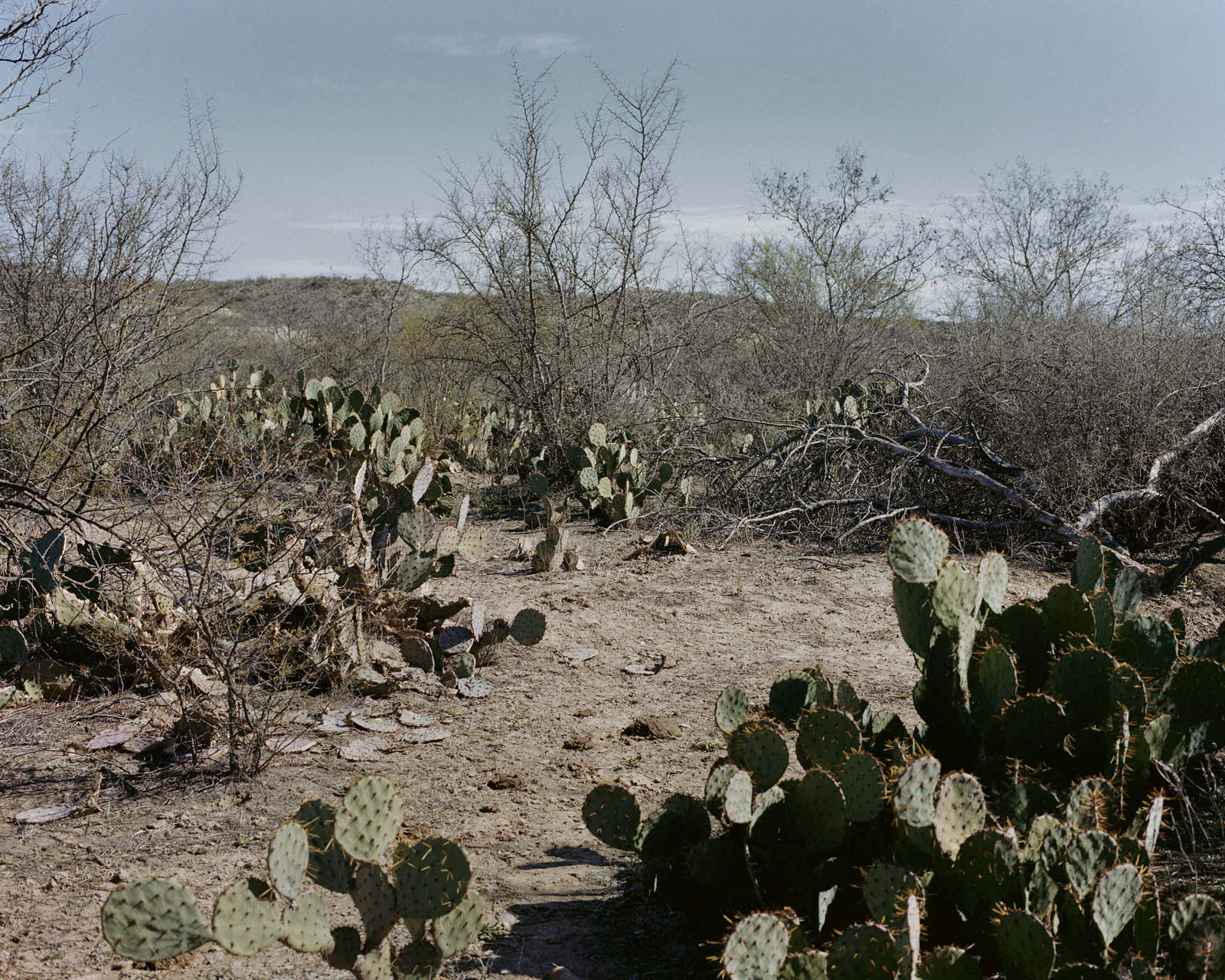
Exhibition: ‘Paul Strand: The Balance of Forces’ at Fondation Henri Cartier-Bresson, Paris

Exhibition dates: 14th February – 23rd April, 2023


Paul Strand (American, 1890-1976) 'Parmesan, Luzzara
' 1953 from the exhibition 'Paul Strand: The Balance of Forces' at Fondation Henri Cartier-Bresson, Paris, February - April, 2023


Paul Strand (American, 1890-1976)
Parmesan, Luzzara

1953
Gelatin silver print
© Aperture Foundation Inc., Paul Strand Archive. Fundación MAPFRE Collections


Balance of forces

Look at the “colour” of the Parmesan cheese in Strand’s photograph Parmesan, Luzzara
 (1953, above). If we think of Ansel Adam’s ‘Zone System’ (the 11 zones in the system from 0-10) where pure black is Zone 0, mid grey (the colour of a Kodak Grey Card) is Zone 5 and pure white is Zone 10… then in “real life” the colour of the wheel of Parmesan would fall in about Zone 5. But what does Strand do? He places the “colour” of the Parmesan wheel in Zone 2-3, much darker than in real life.

In Strand’s “continuous search for a photographic formalism” – that is, the most important aspect of the photograph being its form, the way it is made and its purely visual aspects rather than its narrative content or its relationship to the visible world – then we would ignore Strand’s moving zones, his dark, brooding cheese.

I think not.

Strand’s formalism does not stand alone, for his photographs breathe the subject he is photographing. They are not just surfaces (which is what formalism is), for the viewer is invited to imbibe (absorb or assimilate (ideas or knowledge)) of the intensity and feeling of the culture and people from which these photographs emerge. Feel the intensity of the gaze of Young Boy, Gondeville, Charente, France (1951, below). Imagine placing yourself in the ethereal space of Tir a’Mhurain, Isle of South Uist, Outer Hebrides (1954, below). Dark cheese.

Strand’s photographs are formal and yet they contain a luminiferous ether/real – transmitting light, but also acting as a medium for the transmission and propagation of spirit.

Dr Marcus Bunyan


Many thankx to the Fondation Henri Cartier-Bresson for allowing me to publish the photographs in the posting. Please click on the photographs for a larger version of the image.


Through each trip, Paul Strand tries to tell the real life of people: humble people, affected by wars, bad weather, diseases, oppressive regimes… The artist highlights those who fight for their freedom, for their happiness. Touching stories, which give all their power to these photographs.

Art and documentary research, social and political involvement and the desire to remain objective: these ambivalences bring great strength to Paul Strand’s work. It is these opposing imperatives that make his photographs so interesting, so exciting for us as viewers.


Cécile D. “Exhibition Paul Strand Or The Balance of Forces, A Journey in Photos at the HCB Foundation,” on the Sotir Paris website February 13, 2023 [Online] Cited 19/03/2023


The Fondation HCB offers a new perspective on the work of American photographer Paul Strand (1890-1976) from the collections of the Fundación MAPFRE, Madrid. While Strand is often celebrated as a pioneer of straight photography, this exhibition also addresses the deeply political dimension of his work.


Interview de Clément Chéroux sur l’exposition Paul Strand ou l’équilibre des forces


Martine Franck (British-Belgian, 1938-2012) 'Paul Strand Photographing the Orgeval Garden' 1974 from the exhibition 'Paul Strand: The Balance of Forces' at Fondation Henri Cartier-Bresson, Paris, February - April, 2023


Martine Franck (British-Belgian, 1938-2012)
Photographer Paul Strand in his garden, Orgeval
1972
© Martine Franck / Magnum Photos


Paul Strand (American, 1890-1976) 'Wall Street, New York' 1915 (negative); 1915 (print) from the exhibition 'Paul Strand: The Balance of Forces' at Fondation Henri Cartier-Bresson, Paris, February - April, 2023


Paul Strand (American, 1890-1976)
Wall Street, New York
1915
Platinum/palladium Print
© Aperture Foundation Inc., Paul Strand Archive. Fundación MAPFRE Collections


Paul Strand (American, 1890-1976) 'Sandwich Man, New York' 1916


Paul Strand (American, 1890-1976)
Sandwich Man, New York
1916
© Aperture Foundation Inc., Paul Strand Archive. Fundación MAPFRE Collections


Paul Strand (American, 1890-1976) 'Blind Woman, New York' 1916 (negative); 1945 (print)


Paul Strand (American, 1890-1976)
Blind Woman, New York
1916
Gelatin silver print
© Aperture Foundation Inc., Paul Strand Archive. Fundación MAPFRE Collections


In the mid 1910s Paul Strand produced a series of images of New York portraying a truly genuine perspective of the city. Strand, a young photographer at the time, connected with modern art and incorporated some of its tendencies into a series of unprecedented views of the metropolis. Anticipating Straight Photography, he made images that distanced themselves from the precepts of Pictorialism through a direct portrayal of reality.

His photographs rapidly found favourable reception within the pages of Camera Work, the legendary magazine directed by Alfred Stieglitz who dedicated the last two issues of the publication to Strand’s compositions. Almost half of the images that appeared were close-up portraits shot with a rudimentary system that allowed Strand to photograph his subjects without them noticing. These surprising shots offered a lively perspective of the city and focused on some of its figures, who were marginal albeit ubiquitous, and seldom represented. With this attention to the periphery of urban life, Strand manifested his commitment to reality rooted in the example of his mentor Lewis Hine.

Blind Woman is one of the most iconic images in the history of North American photography. Published in 1917 by Stieglitz it combines the compositional strength and sharp clarity characteristic of Strand’s work.

Text from the Fundación MAPFRE Collections website


Paul Strand (American, 1890-1976) 'Abstraction Bowls, Twin Lakes, Connecticut' 1916


Paul Strand (American, 1890-1976)
Abstraction, Bowls, Twin Lakes, Connecticut
1916
Gelatin silver print
22.5 × 16.5cm
© Aperture Foundation Inc., Paul Strand Archive. Fundación MAPFRE Collections


Paul Strand (American, 1890-1976) 'Abstraction, Porch Shadows' 1916


Paul Strand (American, 1890-1976)
Abstraction, Porch Shadows
1916
Silver gelatin print
© Aperture Foundation Inc., Paul Strand Archive. Fundación MAPFRE Collections


Paul Strand (American, 1890-1976) 'Portrait, Washington Square Park, New York' 1916 (negative); 1917 (photogravure)


Paul Strand (American, 1890-1976)
Portrait, Washington Square Park, New York
1916 (negative); 1917 (photogravure)
© Aperture Foundation Inc., Paul Strand Archive. Fundación MAPFRE Collections


The Fondation HCB offers a new perspective on the work of American photographer Paul Strand (1890-1976) from the collections of the Fundación MAPFRE, Madrid. While Strand is often celebrated as a pioneer of straight photography, this exhibition also addresses the deeply political dimension of his work.

“Opposites are cured by opposites,” goes the saying. American photographer Paul Strand (1890-1976) was heir to two great traditions in photography, often presented as opposed. He had a formalist approach that sought to prove photography an art, and a social approach, which saw photography as more of a documentary instrument serving political ends. Perhaps this is explained by the fact that Alfred Stieglitz and Lewis Hine, who occupy the two poles in photography history, were both Strand’s mentors in his formative years.

While in the mid-1910s Strand photographed faces of the people on the streets of New York, the first period of his work is especially marked by formalism. In 1917, when Stieglitz dedicated the latest issue of his famous magazine Camera Work to Strand, it was above all to show that photography had its own artistic language. Starting with a journey to Mexico City (1932-1934), then Moscow (1935), his approach became more political. He joined the American Labor Party and worked with more than twenty organisations classified “anti-American” during the McCarthy era, leading to his departure from the United States for France. Many of Strand’s choices were deliberated through this political conscience: his choice of subject, places he photographed, writers he worked with, the book as main vector for distributing his work.

In the past few decades, numerous exhibitions have been held on Strand focusing on his formalism. By no means minimising this perspective, the current project seeks to recontextualise Strand, emphasising the importance of his political commitments. Between formalist pursuits and social concerns, the two forces at work in his art are brought into balance here. If Strand often stands among the 20th century’s major photographers, it is precisely because he knew how to offer just equilibrium between the two poles.

The exhibition presents almost 120 prints from the collections of the Fundación MAPFRE, Madrid, the film Manhatta made by Paul Strand and Charles Sheeler in 1921 as well as several prints lent by the Centre Pompidou.

Biography

Born in 1890 in New York, Paul Strand entered the New York Ethical Culture School (ECS) in 1907 where he studied under Lewis Hine, who introduced him to the Photo Secession gallery, founded by Alfred Stieglitz at 291 Fifth Avenue. Stieglitz had an important influence on Paul Strand’s work from the beginning. In 1916, his work was published for the first time in Stieglitz’s magazine, Camera Work, of which he was an avid reader, and then exhibited at 291 in the exhibition Photographs from New York and Other Places. During the war, Paul Strand worked as a hospital radiographer and, after his close-ups of machines, began to take an interest in surgical technique. In 1919 he travelled to Nova Scotia in Canada where he photographed his first landscapes and rock piles.

In 1921, Paul Strand made the film Manhatta with the photographer and painter Charles Sheeler. Between 1925 and 1932, various exhibitions of his work were shown in New York galleries. He travelled to Mexico from 1932 to 1934, during which time he had a solo exhibition at the Sala de Arte in Mexico City, was appointed Head of Film and Photography at the Mexican Secretariat of Education, and directed the film The Revolts of Alvarado (Redes) for the Mexican government.

Paul Strand travelled to the USSR in 1935, where he met Sergei Eisenstein. He then joined the Nykino group, around Leo Hurwitz, Ralph Steiner and Lionel Berman. Two years later, he became president of Frontier Film, a non-profit educational film production company, with former Nykino members.

In 1943, Paul Strand returned to photography after more than ten years in the film industry. In 1945, MoMA gave him a solo exhibition. From 1949 to 1957, the photographer undertook several trips to Europe, from which several books were written, and began an exile outside the United States, which coincided with the period of McCarthyism. He settled in Orgeval, France, where he remained until his death in 1976.

Press release from the Fondation HCB


Manhatta (1921) | Paul Strand – Charles Sheeler

In 1920 Paul Strand and artist Charles Sheeler collaborated on Manhatta, a short silent film that presents a day in the life of lower Manhattan. Inspired by Walt Whitman’s book “Leaves of Grass,” the film includes multiple segments that express the character of New York. The sequences display a similar approach to the still photography of both artists. Attracted by the cityscape and its visual design, Strand and Sheeler favoured extreme camera angles to capture New York’s dynamic qualities. Although influenced by Romanticism in its view of the urban environment, Manhatta is considered the first American avant-garde film.


Paul Strand (American, 1890-1976) 'St. Francis Church, Ranchos de Taos, New Mexico' 1931


Paul Strand (American, 1890-1976)
St. Francis Church, Ranchos de Taos, New Mexico
1931
Platinum/palladium Print
17.1 × 21.8cm
© Aperture Foundation Inc., Paul Strand Archive. Fundación MAPFRE Collections


Paul Strand (American, 1890-1976) 'Men of Santa Ana, Lake Pátzcuaro, Michoacán' (Hombres de Santa Ana, Lake Pátzcuaro, Michoacá) 1933


Paul Strand (American, 1890-1976)
Men of Santa Ana, Lake Pátzcuaro, Michoacán
1933
Gelatin silver print
© Aperture Foundation Inc., Paul Strand Archive. Fundación MAPFRE Collections


Paul Strand (American, 1890-1976) 'Man with Hoe - Los Remedios' 1933


Paul Strand (American, 1890-1976)
Man with Hoe – Los Remedios
1933
Gelatin silver print
© Aperture Foundation Inc., Paul Strand Archive. Fundación MAPFRE Collections


Paul Strand (American, 1890-1976) 'Cristo with Thorns - Huexotla' 1933


Paul Strand (American, 1890-1976)
Cristo with Thorns – Huexotla
1933
Silver gelatin print
© Aperture Foundation Inc., Paul Strand Archive. Fundación MAPFRE Collections


Paul Strand (American, 1890-1976) 'Mr. Bolster, Weston, Vermont' 1943


Paul Strand (American, 1890-1976)
Mr. Bolster, Weston, Vermont
1943
Silver gelatin print
© Aperture Foundation Inc., Paul Strand Archive. Fundación MAPFRE Collections


Paul Strand (American, 1890-1976) 'Mr. Bennett, West River Valley, Vermont' 1944


Paul Strand (American, 1890-1976)
Mr. Bennett, West River Valley, Vermont
1944
Gelatin silver print
© Aperture Foundation Inc., Paul Strand Archive. Fundación MAPFRE Collections


In 1945 a major exhibition dedicated to the work of Paul Strand took place at the Museum of Modern Art in New York that included 172 photographs, becoming the greatest retrospective devoted to a photographer to date. The project was conceived by Nancy Newhall, Head of the Department of Photography at the institution, who during the show’s preparation proposed to collaborate with Strand on a book about New England, a region located in the northeastern United States.

For a little over a month and a half Strand travelled with his camera throughout the region. His previous experience in Mexico had provided him with an attentive eye for capturing the social and cultural reality of the territory; in this instance through photographs of landscapes, diverse forms of architecture, and through his characteristic portraits. Resulting from this process his first photobook, Time in New England, was published in 1950, with texts by Nancy Newhall. The project’s outcome and his successful collaboration with Newhall inspired Strand to initiate a series of publications that coincided with a growing demand for travel books.

Text from the Fundación MAPFRE Collections website


Paul Strand (American, 1890-1976) 'Café Planchon, France' 1950


Paul Strand (American, 1890-1976)
Café Planchon, France
1950
Gelatin silver print on baryta paper
24.4 × 19.4cm
© Aperture Foundation Inc., Paul Strand Archive. Fundación MAPFRE Collections


In 1950 Paul Strand left the United States due in great measure to the increasingly hostile social and political environment generated by the “witch hunt” of McCarthyism. Together with Hazel Kingsbury, who would become his third wife, Strand arrived in France. After their wedding that following year, they traveled the country together. Resulting from this journey and following the format of joining image and text that was established in his book Time in New England, the artist produced La France de Profil [France in Profile] in 1952.  The book was published by renowned Swiss publisher Guilde du Livre, with texts by the writer and poet Claude Roy, whose points of view on the social reality and the ethical commitment of artists coincided with Strand’s.

In Café Planchon Paul Strand presents a rhetoric characteristic of the avant-garde, one of texts that belie the visual reality they attempt to portray, which grants them an inevitable and warm ironical distance. The image also contains a sense of artistic joy that is not merely related to the formal composition but is manifested in the proliferation of the vegetation, in the tactility of textures, and in the charming gradation of light that is finally enveloped by shadow. The richness of the image arises as a result of the photographer’s attention to this particular reality, which is celebrated in the book, as well as his technical prowess and the dedication he poured into the prints made in the darkroom.

Text from the Fundación MAPFRE Collections website


Paul Strand (American, 1890-1976) 'Fisherman, Banyuls, Pyrénées-Orientales, France' 1950-1951


Paul Strand (American, 1890-1976)
Fisherman, Banyuls, Pyrénées-Orientales, France
1950-1951
Silver gelatin print
16.1 × 12.5cm
© Aperture Foundation Inc., Paul Strand Archive. Fundación MAPFRE Collections


Paul Strand (American, 1890-1976) 'Young Boy, Gondeville, Charente, France' 1951


Paul Strand (American, 1890-1976)
Young Boy, Gondeville, Charente, France
1951
Gelatin silver print
© Aperture Foundation Inc., Paul Strand Archive. Fundación MAPFRE Collections


In 1952 Paul Strand published La France de profil [France in Profile] which included the photographs he took during his trip throughout the country. With texts by Claude Roy, the book was published by Swiss publisher Guilde du Livre, which had been producing a collection of travel books since the 1940s containing texts by well known writers such as Paul Éluard and Jacques Prévert, and photographs by artists such as Robert Doisneau and Michel Huet.

In a similar fashion to how he had articulated a unique perspective far from the hegemonic exoticising of Mexico during the 1930s, Strand portrayed France in a way that did not settle on its most picturesque features. As inferred by the title, the series is an oblique perspective on the territory materialised through an assortment of images that are arranged in a singular style. Towns, landscapes, examples of vernacular architecture, and faces of elderly people and fishermen appear next to photographs detailing small objects that – beyond their documentary value – join the artistic language of images while simultaneously evoking the time that is inscribed within them.

Young Boy captures the characteristic intensity of the gamut of black and white hues in Strand’s work. The beauty hidden within the heroic ruggedness of the boy’s face, emphasised by the artist’s treatment of light, exemplifies the way in which Strand’s attention to the artistic values he upholds effectuates his political commitment.

Text from the Fundación MAPFRE Collections website


Paul Strand (American, 1890-1976) 'Anna Attinga Frafra, Accra, Ghana' 1964


Paul Strand (American, 1890-1976)
Anna Attinga Frafra, Accra, Ghana
1951
Gelatin silver print
© Aperture Foundation Inc., Paul Strand Archive. Fundación MAPFRE Collections


Throughout the 1960s, during the Cold War, Paul Strand continued his documentary work traveling to different socialist countries such as Romania, Egypt, and Ghana. As evidenced by the series of photobooks that he published, Strand’s perspective on these realities is translated into portraits, landscapes, and images of the communities’ daily life and their objects. Nevertheless, although direct references to political issues are eloquently scarce in his photographs, some elements can be observed that subtly point to the positive aspects of the revolutionary processes occurring in these countries.

Such is the case of the portrait of Anna Attinga Frafra – included in Ghana: An African Portrait (New York, Aperture, 1976) – in which the simplicity of the composition points to one dissonant element: the books balanced on the girl’s head. The symbolic character of the image serves as a reference to the literacy and education campaigns planned for the Ghanaian populations, which included women, and has an undoubtedly, albeit subtle, propagandistic nature. Nevertheless, the photograph makes sense and coexists seamlessly with the other images that make up the series. As a whole, they offer a vision that is an alternative from ethnographic typology, incorporating the reality of the aspirations, efforts, and hopes of the community without becoming crude propaganda.

Text from the Fundación MAPFRE Collections website


Paul Strand (American, 1890-1976) 'The Lusetti Family, Luzzara, Italy' 1953


Paul Strand (American, 1890-1976)
The Lusetti Family, Luzzara, Italy
1953
Gelatin silver print
16.9 × 21.3cm
© Aperture Foundation Inc., Paul Strand Archive. Fundación MAPFRE Collections


Paul Strand (American, 1890-1976) 'Luzzara'
 1953


Paul Strand (American, 1890-1976)
Luzzara
1953
Gelatin silver print
© Aperture Foundation Inc., Paul Strand Archive. Fundación MAPFRE Collections


Paul Strand (American, 1890-1976) 'Postmistress and Daughter, Luzzara, Italy' 1953


Paul Strand (American, 1890-1976)
Postmistress and Daughter, Luzzara, Italy
1953
Silver gelatin print
33.3 × 26.4cm
© Aperture Foundation Inc., Paul Strand Archive. Fundación MAPFRE Collections


Paul Strand (American, 1890-1976) 'House, Benbecula, Isle of South Uist, Outer Hebrides' 1954


Paul Strand (American, 1890-1976)
House, Benbecula, Isle of South Uist, Outer Hebrides
1954
Silver gelatin print
14.9 × 11.7cm
© Aperture Foundation Inc., Paul Strand Archive. Fundación MAPFRE Collections


Paul Strand (American, 1890 - 1976) 'Milly, John and Jean MacLellan, South Uist, Hebrides' 1954


Paul Strand (American, 1890-1976)
Milly, John and Jean MacLellan, South Uist, Hebrides
1954
Silver gelatin print
© Aperture Foundation Inc., Paul Strand Archive. Fundación MAPFRE Collections


Paul Strand (American, 1890-1976) 'Agnes MacDonald, Morag and Ewen MacLellan, Isle of South Uist, Outer Hebrides' 1954


Paul Strand (American, 1890-1976)
Agnes MacDonald, Morag and Ewen MacLellan, Isle of South Uist, Outer Hebrides
1954
Silver gelatin print
© Aperture Foundation Inc., Paul Strand Archive. Fundación MAPFRE Collections


Paul Strand (American, 1890-1976) 'Tir a'Mhurain, Isle of South Uist, Outer Hebrides' 1954


Paul Strand (American, 1890-1976)
Tir a’Mhurain, Isle of South Uist, Outer Hebrides
1954
Silver gelatin print
14.8 × 12.4cm
© Aperture Foundation Inc., Paul Strand Archive. Fundación MAPFRE Collections


Paul Strand (American, 1890-1976) 'Un paese' 1955


Paul Strand (American, 1890-1976)
Un paese
1955
Silver gelatin print
© Aperture Foundation Inc., Paul Strand Archive. Fundación MAPFRE Collections


300,000 lire, 10 sheets, 10 pillowcases, 10 towels, 10 parures and the bedroom are not enough to marry me, you can’t do less. He has to go into the army, otherwise we’d get married right away even if there’s little work. This year he has done less than a thousand hours of work.

Text by Zavattini, photographs by Paul Strand, Turin, Einaudi, 1955, p. 73


Paul Strand (American, 1890-1976) 'Iordache Ciaocata, Bicaz, Romania' 1960


Paul Strand (American, 1890-1976)
Iordache Ciaocata, Bicaz, Romania
1960
Silver gelatin print
33.2 × 35.7cm
© Aperture Foundation Inc., Paul Strand Archive. Fundación MAPFRE Collections


Paul Strand book covers


Paul Strand book covers


Fondation Henri Cartier-Bresson
79 rue des Archives
75003 Paris

Opening hours:
Tuesday – Sunday 11am – 7pm
Closed on Mondays

Fondation Henri Cartier-Bresson website

LIKE ART BLART ON FACEBOOK

Back to top
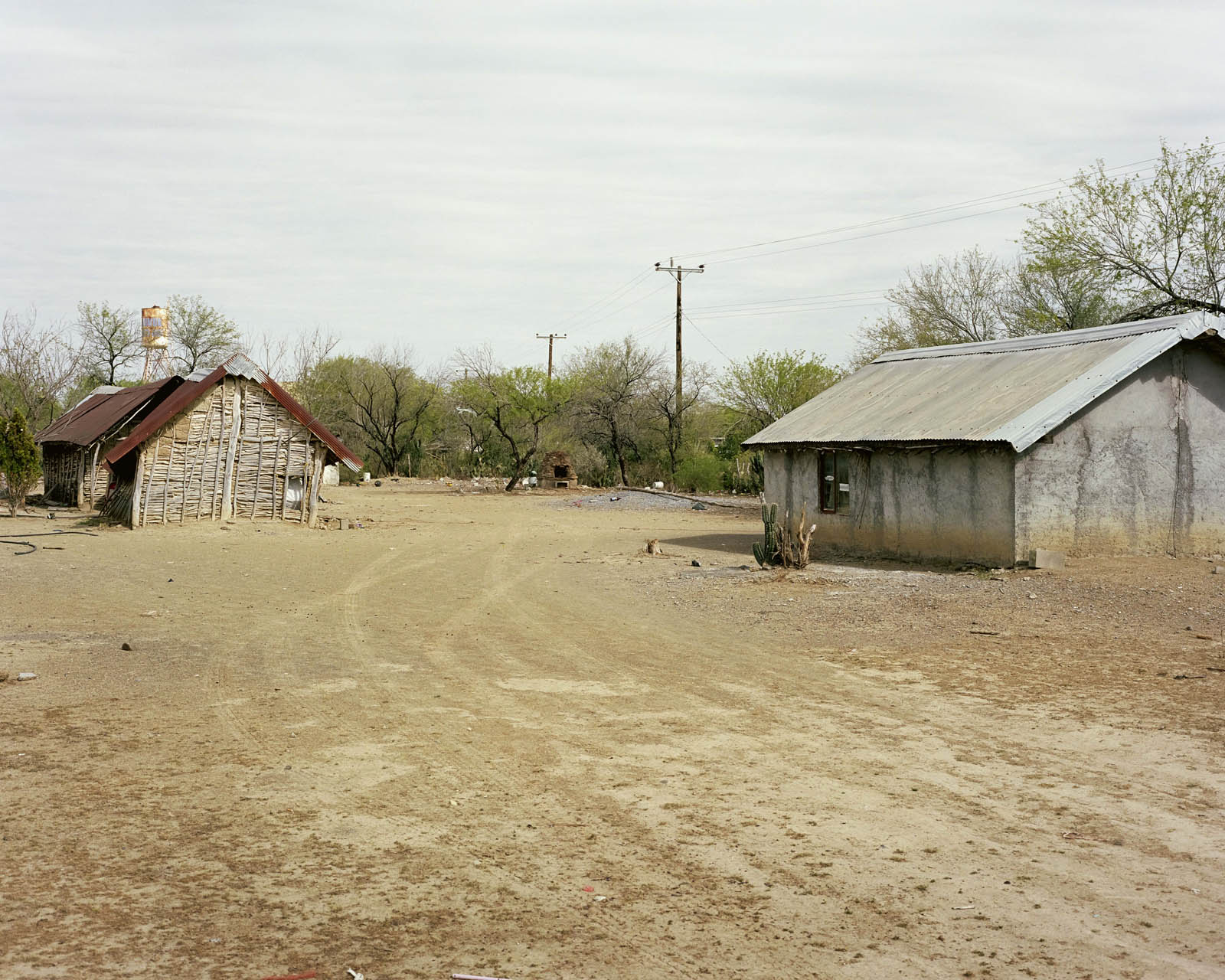
Exhibition: ‘Ilse Bing’ at Fundación MAPFRE, Madrid

Exhibition dates: 23rd September 2022 – 8th January 2023

Curator: Juan Vicente Aliaga


Ilse Bing (American born Germany, 1899-1998) 'Scandale' 1947 from the exhibition 'Ilse Bing' at Fundación MAPFRE, Madrid, Sept, 2022 - Jan, 2023


Ilse Bing (American born Germany, 1899-1998)
Scandale
1947
Gelatin silver print
Victoria and Albert Museum, London
© Estate of Ilse Bing / Victoria and Albert Museum, London


The first exhibition for Art Blart in 2023!

The Art Blart archive has been going since November 2008. This is the first time I have posted on the avant-garde artist Isle Bing and her documentary humanism. Elements of Modernism, movement, New Vision, Bahuas, Surrealism, abstraction, form, geometry are all spontaneously and intuitively, precisely and poetically expressed in the artist’s work. Manipulation, solarisation, enlargement of fragments and cropping in the darkroom enhance the original negative.

“In addition to numerous portraits, Ilse Bing was primarily interested in urban motifs. They were fascinated by architectural elements and structures as well as urban hustle and bustle. Her way of working repeatedly explores the tracing of symmetry and rhythm in the experience of everyday situations.”1

“In Paris, Ilse Bing forged her style [using a Leica], combining poetry and realism, dreamlike enchantment and the clarity of modernity. She sought contrasts and original juxtapositions that transformed the banal reality of daily life into a new idea.”2

“Ilse Bing was once amongst the very first few women photographers to influentially master the avant-garde handheld Leica 35mm camera in the 1930s. She was also amongst the first to use solarisation, electronic flash and night photography, and established her own distinctive photographic style adoring romanticism, symbolism and dream imagery of surrealism.”3

“It was a time of exploration and discovery. … We wanted to show what the camera could do that no brush could do, and we broke every rule. We photographed into the light – even photographed the light, used distorted perspective, and showed movement as a blur. What we photographed was new, too – torn paper, dead leaves, puddles in the street – people thought it was garbage! But going against the rules opened the doors to new possibilities.” ~ Ilse Bing

Magnificent. Enjoy!

Dr Marcus Bunyan

PS. Many more works can be viewed on the MoMA website.


1/ Anonymous. “Ilse Bing,” on the Wikipedia website [Online] Cited 02/01/2023

2/ Anonymous. “Ilse Bing. Photographs 1928-1935,” on the Galerie Karsten Greve website [Online] Cited 02/01/2023

3/ Anonymous. “Ilse Bing: Paris and Beyond,” on the Exibart street website [Online] Cited 02/01/2023


Many thankx to Fundación MAPFRE for allowing me to publish the photographs in the posting. Please click on the photographs for a larger version of the image.


“I felt the camera grow as an extension of my eyes and move with me.”


Ilse Bing


Ilse Bing (American born Germany, 1899-1998) 'Dead Leaf and Tramway Ticket On Sidewalk, Frankfurt' 1929 from the exhibition 'Ilse Bing' at Fundación MAPFRE, Madrid, Sept, 2022 - Jan, 2023


Ilse Bing (American born Germany, 1899-1998)
Dead Leaf and Tramway Ticket On Sidewalk, Frankfurt
1929
Gelatin silver print
17.1 x 22.9cm
Galerie Karsten Greve, Saint Moritz / París / Colonia
© Estate of Ilse Bing


Ilse Bing (American born Germany, 1899-1998) 'Budgeheim' 1930 from the exhibition 'Ilse Bing' at Fundación MAPFRE, Madrid, Sept, 2022 - Jan, 2023


Ilse Bing (American born Germany, 1899-1998)
Budgeheim
1930
Gelatin silver print
27.9 x 21.9cm
Galerie Karsten Greve, Saint Moritz / París / Colonia
© Estate of Ilse Bing


Ilse Bing (Frankfurt, 1899 – New York, 1998) was born into a well-off Jewish family. Having discovered her true vocation while preparing the illustrations for her academic thesis, in 1929 she abandoned her university studies in order to focus entirely on photography. The medium would be her chosen form of expression for the following thirty years of her fascinating life and career.

In 1930 Bing moved to Paris where she combined photojournalism with her own more personal work, soon becoming one of the principal representatives of the modernising trends in photography which emerged in the cultural melting pot of Paris during those years. With the advance of the Nazi forces, in 1941 she and her husband, the pianist Konrad Wolff, went into exile in New York. Two decades later the sixty-year-old Bing gave up her photographic activities in order to channel her creativity into the visual arts and poetry until her death in 1998.

Bing’s work cannot be ascribed to any of the movements or tendencies that influenced her. She worked in almost all the artistic genres, from architectural photography to portraiture, self-portraits, images of everyday objects and landscapes. The diversity of styles which she employed reflect her significant and notably individual interpretation of the different cultural trends that she assimilated, from the German Bauhaus and New Objectivity to Parisian Surrealism and the ceaseless dynamism of New York.

Text from the Fundación MAPFRE website


Ilse Bing (American born Germany, 1899-1998) 'Laban Dance School, Frankfurt' 1929


Ilse Bing (American born Germany, 1899-1998)
Laban Dance School, Frankfurt
1929
Gelatin silver print
9.7 x 16.6cm
Edwynn Houk Gallery, New York
© Estate of Ilse Bing, courtesy Edwynn Houk Gallery, New York
Photograph: Jeffrey Sturges


Ilse Bing (American born Germany, 1899-1998) 'Orchestra Pit, Théâtre des Champs-Élysées, Paris' 1933


Ilse Bing (American born Germany, 1899-1998)
Orchestra Pit, Théâtre des Champs-Élysées, Paris
1933
27.9 × 35.6cm
Gelatin silver print
International Center of Photography, New York
Donation of Ilse Bing, 1991
© Estate of Ilse Bing


Ilse Bing (American born Germany, 1899-1998) 'Pommery Champagne Bottles' 1933


Ilse Bing (American born Germany, 1899-1998)
Pommery Champagne Bottles
1933
Gelatin silver print
27.9 × 19.7cm
Galerie Karsten Greve, Saint Moritz / París / Colonia
© Estate of Ilse Bing


Ilse Bing (American born Germany, 1899-1998) 'French Can-Can Dancer' 1931, printed 1941


Ilse Bing (American born Germany, 1899-1998)
French Can-Can Dancer
1931, printed 1941
Gelatin silver print
35.6 x 27.9cm
Galerie Karsten Greve, Saint Moritz / París / Colonia
© Estate of Ilse Bing


Ilse Bing (American born Germany, 1899-1998) 'Dancer Gerard Willem van Loon' 1932


Ilse Bing (American born Germany, 1899-1998)
Dancer Gerard Willem van Loon
1932
Gelatin silver print
49.2 x 34.6cm
Galerie Karsten Greve, Saint Moritz / París / Colonia
© Estate of Ilse Bing


Ilse Bing (American born Germany, 1899-1998) '"It was so Windy on the Eiffel Tower", Paris' 1931


Ilse Bing (American born Germany, 1899-1998)
“It was so Windy on the Eiffel Tower”, Paris
1931
Gelatin silver print
22.2 x 28.2cm
The Art Institute of Chicago, Julien Levy Collection
Donation of Jean and Julien Levy 1977
© Estate of Ilse Bing
© 2022 The Art Institute of Chicago / Art Resource, NY/ Scala, Florence


Ilse Bing’s photographic oeuvre, created between 1929 and the late 1950s, was influenced by the different cities where she lived and worked: Frankfurt prior to the 1930s, Paris in that decade and post-war New York where above all she experienced the situation of an enforced emigré. Her work cannot, however, be easily located within the photographic and cultural trends that she encountered, although it was certainly enriched by all of them. Bing’s output was influenced by Moholy-Nagy’s Das Neue Sehen (The New Vision) and the Weimar Bauhaus, by André Kertész and by the Surrealism of Man Ray, which she encountered when she moved to Paris in 1930. At the time of her arrival the French capital was a melting pot of artistic and intellectual trends and the setting for the emergence of a number of movements that would be crucial for the evolution of the avant-gardes. Surrealist echoes are evident in Bing’s photographs of objects and in her approach to the framing of her shots of chairs, streets and public spaces, images that transmit a sense of strangeness and almost of alienation.

The Bauhaus was an extremely important influence on Bing’s work via both El Lissitzky’s theories and those of Moholy-Nagy’s New Vision, which promoted the fusion of architecture and photography and the autonomy of photography as a medium in relation to painting. New Vision offered infinite possibilities and Bing took full advantage of them, employing some of them in her work, such as abstraction, close-ups, plunging viewpoints, di sotto in sù, photomontages and overprinting, all to be seen in the images on display in the exhibition.

Ilse Bing belonged to a generation of women photographers who achieved unprecedented visibility. It was not the norm that women should be artists in a field habitually occupied by men, who regarded their presence as active agents in the social and cultural realm with disdain and even hostility. Like many of her contemporaries – Germaine Krull, Florence Henri, Laure Albin-Guillot, Madame d’Ora, Berenice Abbott, Nora Dumas and Gisèle Freund – Bing’s camera became an essential tool of self determination and a means to confirm her own identity.

Ilse Bing was born in Frankfurt on 23 March 1899 to a middle-class Jewish family. She took her first photographs at the age of fourteen. Self-taught in this field, she realised that this would become her principal activity when she began photographing in order to illustrate her doctoral thesis. She studied mathematics and physics before opting for art history. In 1929 she gave up her university studies and, armed with her inseparable Leica, devoted herself to photography for the next thirty years. In 1930 she moved to Paris, where she continued active as a photojournalist while also producing her own more creative work, gradually becoming one of the leading representatives of modern French photography. In 1941 and with the advance of National Socialism, Bing moved to New York with her husband, the pianist Konrad Wolff. Two decades later, at the age of 60, she ceased taking photographs and focused her attention on making collages, abstract works, drawings and also poetry writing. Ilse Bing died in New York in 1998.

Text from the Fundación MAPFRE exhibition brochure


Ilse Bing (American born Germany, 1899-1998) 'Champ de Mars from the Eiffel Tower' 1931


Ilse Bing (American born Germany, 1899-1998)
Champ de Mars from the Eiffel Tower
1931
Gelatin silver print
19.3 x 28.2cm
Collection of Michael Mattis and Judith Hochberg, New York
© Estate of Ilse Bing
Photograph: Jeffrey Sturges


Ilse Bing. 'Eiffel Tower, Paris, 1931' 1931


Ilse Bing (American born Germany, 1899-1998)
Eiffel Tower, Paris
1931
Gelatin silver print
© Estate of Ilse Bing


Ilse Bing (American born Germany, 1899-1998) 'Poverty in Paris' 1931


Ilse Bing (American born Germany, 1899-1998)
Poverty in Paris
1931
Gelatin silver print
27.8 x 35.3cm
Galerie Berinson, Berlín
© Estate of Ilse Bing


Ilse Bing (American born Germany, 1899-1998) 'Three Men Sitting on the Steps by the Seine' 1931


Ilse Bing (American born Germany, 1899-1998)
Three Men Sitting on the Steps by the Seine
1931
Gelatin silver print
27.9 × 35.6 cm
International Center of Photography, Nueva York
Donation of Ilse Bing, 1991
© Estate of Ilse Bing


Ilse Bing (German, 1899-1998) 'French Can Can Dancers, Moulin Rouge' 1931


Ilse Bing (American born Germany, 1899-1998)
French Can Can Dancers, Moulin Rouge
1931
Gelatin silver print
6 1/4 × 9 in. (15.9 × 22.9cm)
Collection of Michael Mattis and Judith Hochberg
Courtesy Edwynn Houk Gallery, New York
© Estate of Ilse Bing


Ilse Bing (American born Germany, 1899-1998) 'Greta Garbo Poster, Paris' 1932


Ilse Bing (American born Germany, 1899-1998)
Greta Garbo Poster, Paris
1932
Gelatin silver print
22.3 × 30.5 cm
The Art Institute of Chicago
Donation of David C. and Sarajean Ruttenberg 1991
© Estate of Ilse Bing
© 2022 The Art Institute of Chicago / Art Resource, NY/ Scala, Florence


Overview

Ilse Bing (Frankfurt, 1899 – New York, 1998) was born into a well-off Jewish family. Having discovered her true vocation while preparing the illustrations for her academic thesis, in 1929 she abandoned her university studies in order to focus entirely on photography. The medium would be her chosen form of expression for the following thirty years of her fascinating life and career.

In 1930 Bing moved to Paris where she combined photojournalism with her own more personal work, soon becoming one of the principal representatives of the modernising trends in photography which emerged in the cultural melting pot of Paris during those years. With the advance of the Nazi forces, in 1941 she and her husband, the pianist Konrad Wolff, went into exile in New York. Two decades later the sixty-year-old Bing gave up her photographic activities in order to channel her creativity into the visual arts and poetry until her death in 1998.

Bing’s work cannot be ascribed to any of the movements or tendencies that influenced her. She worked in almost all the artistic genres, from architectural photography to portraiture, self-portraits, images of everyday objects and landscapes. The diversity of styles which she employed reflect her significant and notably individual interpretation of the different cultural trends that she assimilated, from the German Bauhaus and New Objectivity to Parisian Surrealism and the ceaseless dynamism of New York.

The exhibition

Featuring around 200 photographs and a range of documentary material, the exhibition presents a chronological and thematic survey of Ilse Bing’s career, divided into ten sections: “Discovering the world through a camera: the beginnings”, “The life of still lifes”, “The dancing body and its circumstances”, “Lights and shadows of modern architecture”, “The hustle and bustle of the street: the French years”, “The seduction of fashion”, “The United States in two phases”, “Self-image revelations”, “Portrait of time”, and “Live nature”.

Four keys

The Bauhaus. From 1910 onwards Frankfurt became the prototype of modern urban design thanks to the architect Ernst May, and the city’s medieval layout was gradually modified in a transformation based on its different societal requirements. This new architecture soon began to echo the ideas of El Lissitzky’s Constructivism, partly via the Dutch architect Mart Stam, a friend of Ilse Bing. Stam and the theories of the Bauhaus had a major influence on her works. László Moholy-Nagy, who taught at the Bauhaus, had promoted the union of architecture and photography as well as the independence of the latter in relation to painting. The possibilities of Das Neue Sehen (The New Vision) seemed endless and Bing applied some of its concepts and devices to her work: abstraction, immediate close-ups, plunging and di sotto in sù viewpoints, photo-montage and overprinting.

Surrealism, the spirit of an era. When Ilse Bing moved to Paris in 1930 the city was a melting pot of artistic and intellectual trends and the setting for the emergence of some of the key movements in the evolution of the avant-gardes. One of them – Surrealism – had a particular influence on her and its echoes are clearly discernible in her photographs of accessories taken for fashion magazines which reflect Surrealist theories on fetishism. It is also evident in the framing she chose for her images of chairs, streets and public spaces, which transmit a sense of strangeness and almost of alienation. Finally, this influence also arose from Bing’s relationship with prominent figures associated with the movement, such as Elsa Schiaparelli.

Movement. Despite her fascination with abstraction and pure compositions, evident in many of her photographs of architecture and her still lifes, Ilse Bing was also captivated by the dynamism and movement of life and changing reality. She expressed this in her photographs of the Moulin Rouge and its surrounding area and in her investigation of dance. Bing captured the dynamism of the dancers twirling their skirts but also the expressivity of their bodies as they moved, jumping into the air or doing the splits.

Woman photographer. Ilse Bing belonged to a generation of women photographers who achieved unprecedented visibility. It was not the norm that women should be artists in a field habitually occupied by men, who regarded their presence as active agents in the social and cultural realm with disdain and even hostility. Like many of her contemporaries – Germaine Krull, Florence Henri, Laure Albin-Guillot, Madame d’Ora, Berenice Abbott, Nora Dumas and Gisèle Freund – Bing’s camera became an essential tool of self-determination and a means to confirm her own identity.

Text from the Fundación MAPFRE website


Ilse Bing (American born Germany, 1899-1998) 'Prostitutes, Amsterdam' 1931


Ilse Bing (American born Germany, 1899-1998)
Prostitutes, Amsterdam
1931
Gelatin silver print
25.5 x 34cm
Collection of Michael Mattis and Judith Hochberg, New York
© Estate of Ilse Bing
Photograph: Jeffrey Sturges


Ilse Bing (American born Germany, 1899-1998) 'Self-portrait with Leica' 1931


Ilse Bing (American born Germany, 1899-1998)
Self-portrait with Leica
1931
Gelatin silver print
26.5 × 30.7cm
Collection of Michael Mattis and Judith Hochberg, New York
© Estate of Ilse Bing
Photograph: Jeffrey Sturges


Ilse Bing (American born Germany, 1899-1998) 'Pantaloons for Sale, Amsterdam' 1931


Ilse Bing (American born Germany, 1899-1998)
Pantaloons for Sale, Amsterdam
1931
Gelatin silver print
28 x 22cm
The Art Institute of Chicago, Julien Levy Collection
Donation of Jean and Julien Levy 1977
© Estate of Ilse Bing
© 2022 The Art Institute of Chicago / Art Resource, NY/ Scala, Florence


Ilse Bing (American born Germany, 1899-1998) 'Street Fair, Paris' 1933


Ilse Bing (American born Germany, 1899-1998)
Street Fair, Paris
1933
Gelatin silver print
28.2 × 22.3cm
National Gallery of Art, Washington D. C.
Donation of Ilse Bing Wolff
© Estate of Ilse Bing


Ilse Bing (American born Germany, 1899-1998) 'Equine butcher shop' 1933


Ilse Bing (American born Germany, 1899-1998)
Equine butcher shop
1933
Gelatin silver print
19.2 × 28.2cm
Galerie Berinson, Berlín
© Estate of Ilse Bing


Ilse Bing (American born Germany, 1899-1998) 'The Honorable Daisy Fellowes, Gloves by Dent in London for Harper's Bazaar' 1933


Ilse Bing (American born Germany, 1899-1998)
The Honorable Daisy Fellowes, Gloves by Dent in London for Harper’s Bazaar
1933
Gelatin silver print
27.9 × 35.6cm
International Center of Photography, New York
Donation of Ilse Bing 1991
© Estate of Ilse Bing


Ilse Bing (American born Germany, 1899-1998) 'Self-portrait' 1934


Ilse Bing (American born Germany, 1899-1998)
Self-portrait
1934
Gelatin silver print
27.9 × 21.6cm
Galerie Karsten Greve, Saint Moritz / París / Colonia
© Estate of Ilse Bing


Ilse Bing (German, 1899-1998) 'Study for "Salut de Schiaparelli" (Lily Perfume), Paris' 1934


Ilse Bing (American born Germany, 1899-1998)
Study for “Salut de Schiaparelli” (Lily Perfume), Paris
1934
Gelatin silver print
Overall: 28.2 x 22.3cm (11 1/8 x 8 3/4 in.)
Frame: 50.8 x 40.64cm (20 x 16 in.)
Frame (outer): 53.34 x 43.18cm (21 x 17 in.)
National Gallery of Art, Washington
Gift of Ilse Bing Wolff
© Estate of Ilse Bing


Ilse Bing (American born Germany, 1899-1998) 'Gold Lamé Evening Shoes' 1935


Ilse Bing (American born Germany, 1899-1998)
Gold Lamé Evening Shoes
1935
Gelatin silver print
22.2 × 27.9cm
Galerie Karsten Greve, Saint Moritz / París / Colonia
© Estate of Ilse Bing


Ilse Bing (American born Germany, 1899-1998) 'Between France and the USA (Seascapes)' 1936


Ilse Bing (American born Germany, 1899-1998)
Between France and the USA (Seascapes)
1936
Gelatin silver print
21 × 28.3 cm
Whitney Museum of American Art, New York
Legacy of Ilse Bing Wolff 2001
© Estate of Ilse Bing
© 2022 Digital image Whitney Museum of American Art / Licensed by Scala


Ilse Bing (American born Germany, 1899-1998) 'New York, the Elevated, and Me' 1936


Ilse Bing (American born Germany, 1899-1998)
New York, the Elevated, and Me
1936
Gelatin silver print
Galerie Le Minotaure, Paris
© Estate of Ilse Bing


Ilse Bing (American born Germany, 1899-1998) 'New York' 1936


Ilse Bing (American born Germany, 1899-1998)
New York
1936
Gelatin silver print
19.8 x 22.2cm
Galerie Berinson, Berlín
© Estate of Ilse Bing


The artistic career of Ilse Bing (Frankfurt, 1899-New York, 1998) can be located within a particularly complex temporal and socio-cultural context. This German photographer principally lived and worked in three places: in Frankfurt prior to the 1930s, in Paris in that decade and in post-war New York where she above all experienced the status of enforced emigré. Bing also visited other places, including Switzerland, Italy and Holland, but they never became decisive spaces that significantly influenced her way of working with regard to photography.

Analysed with the distance and perspective offered by the passing of time, Ilse Bing’s artistic corpus cannot easily be located within the various photographic trends she encountered during her lifetime, particularly in her initial German phase and the decade in Paris. While her work is charged with elements associated with both Das Neue Sehen (The New Vision) and the Bauhaus, which emerged during the Weimar Republic, as well as with the Surrealism she assimilated during her years in France, Bing’s position evades any strict norm or visual orthodoxy. In this sense it could be said that hers is a notably unique photographic gaze and approach in which modernity and formal innovation are indissolubly linked to a humanist approach involving a social conscience.

It is also important to emphasise that Ilse Bing’s career within the context of relatively difficult times was marked by a resolute determination to make her way in a world which viewed the presence of women as active agents in the social and thus the cultural realm with disdain or even hostility. Bing belonged to a generation of female photographers that achieved a previously unattainable visibility. The camera became for an essential tool of self-determination for numerous women artists, including figures such as Germaine Krull, Florence Henri, Laure Albin-Guillot, Madame d’Ora, Berenice Abbott, Nora Dumas and Gisèle Freund.

Juan Vicente Aliaga
Curator


Discovering the World Through A Camera: The Beginnings

With the exception of a few photographs of an amateur type, nothing indicated that Ilse Bing, who was born into a prosperous Jewish family in Frankfurt, would dedicate much of her life to the practice of photography. After an initial focus on scientific subjects and a period studying art history, Bing decided to illustrate her doctoral thesis with images taken in different museums. From that moment onwards and following a study trip to Switzerland when she discovered the work of Vincent van Gogh, she took the decision to focus her attention on photography. While she initially made use of a Voigtländer plate camera, she soon acquired a Leica which she would continue to use for much of her career. This was the camera she employed for the commissions she received from newspapers such as the Frankfurter Zeitung, work that gave her a degree of financial independence during the turbulent years of the Weimar Republic.
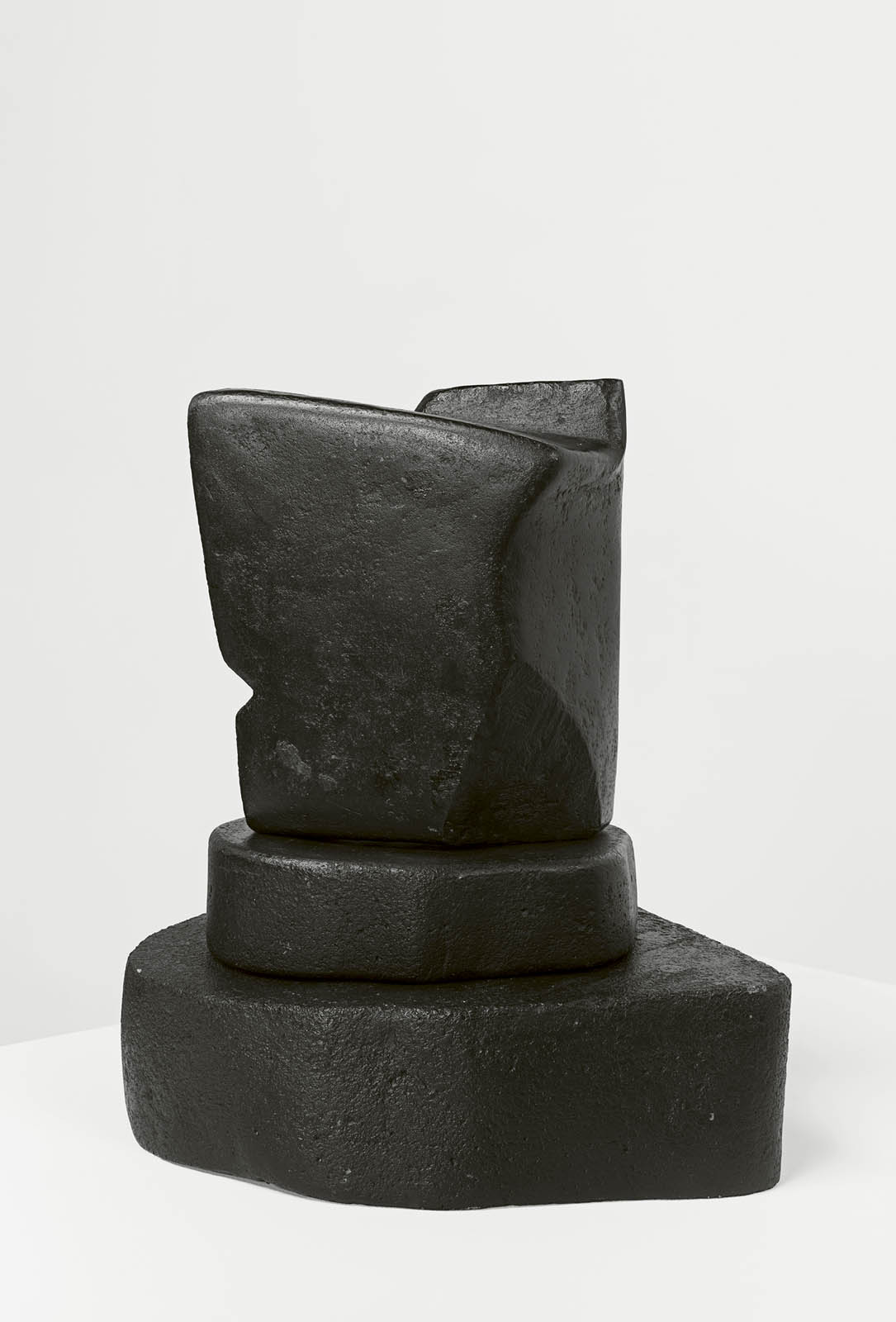
At the outset Bing covered a range of subjects, doing so with ease and formal audacity. Everything seemed to attract her attention: men at work, the spatial simplicity of a gallery, the organic lines of a roof, the leg and arm movements of the ballerinas of the Rudolf von Laban company, the modern architecture which she had discovered through her friend the Dutch architect Mart Stam, and more. Bing’s gaze sought out unusual angles, it looked upwards and downwards, at times encountering normally overlooked elements of no monetary value and ones brought together by chance, as in Dead Leaf and Tramway Ticket on Sidewalk, Frankfurt (1929).

The Life of Still Lifes

Objects from daily life are frequently present in modern art: a bottle, a newspaper, a letter, a collage-like fragment of a label, a jug, etc. Surrealism marked a revolution with regard to the representation of the object, which is never literal but rather filled with hidden aspects. The insertion of external objects into the visual space combined with other ones favours the emergence of the imaginary. By the time Ilse Bing arrived in Paris in 1930 she was already captivated by the chance encounter of often humble elements. Her French period served to accentuate her interest in a wide range of cast-off possessions and objects that seemed to allude to a universe in flux. Bing’s gaze always came to rest on real elements. The chairs she photographed existed but the framing she employed, the closeness or distance of the shot, the fact that the chairs are unoccupied and that the floor on which they stand has the silvery darkness of rain are all the result of her choices, adding an air of melancholy to the image.

Over the course of her career Bing used a range of different techniques in parallel while remaining constantly fascinated by inanimate objects. During her Paris years and despite financial difficulties her work is generally characterised by a poetic gaze in which the imagination moves towards undefined, almost dream-like realms. In contrast, in the period of exile in the United States a degree of coolness emerges, with the appearance of formal and symbolic traits such as a closing-in or enclosing of the depicted scene.

The Dancing Body and Its Circumstances

During her initial phase, in 1929 Ilse Bing established contacts with the dance and gymnastics school founded by Rudolf von Laban. She was struck by the way in which he aimed to draw a parallel between geometry and human movements and gestures.

Soon after arriving in Paris, Bing was commissioned to photograph the Moulin Rouge waxworks museum. The old Parisian dance hall where La Goulue and Toulouse-Lautrec had been leading attractions had lost much of its splendour. Bing spent time there and was attracted by numerous aspects of the place: its daily life on and off stage, including the couples who enjoyed a drink there, the boxing matches taking place, a dancer cheering up a weary boxer, the interesting nature of the clients, and the boredom of the doorman at the entrance to the cabaret. Aside from these aspects, what really caught the attention of the Paris photography world were Bing’s images of dancers in movement. Her restless eye was able to represent the vibration of the circular twists and turns, the complex, effortful open leg movements of a dancer captured in action, the troupe of dancers energetically waving their skirts, and more.

Another group of images of the troupe centres around the dancer Gerard Willem van Loon.

The third and last series of images focusing on dance was commissioned in relation to the ballet L’Errante, choreographed by the American George Balanchine and with set designs and libretto by the Russian painter Pavel Tchelitchew. Bing demonstrated her skill at capturing movement without making it seem frozen or trapped in time. Her eye translated the weightlessness of dreamlike fantasies to her images through the dynamic way in which she captured shadows.

Lights and Shadows of Modern Architecture

The architecture of Paris is generally reflected in Bing’s photography through images of middle- or working-class houses or walls and façades of dilapidated buildings. There was one notable exception, namely the Eiffel Tower. This emblematic work, constructed for the Universal Exhibition of 1889, was nothing less than a revelation for Bing. The Tower’s imposing metal structure had been captured by various photographers, including László Moholy-Nagy in 1925, followed by Erwin Blumenfeld, André Kertész, François Kollar and Germaine Krull.

Bing chose to locate herself inside the structure and take shots at different heights, the majority looking downwards. Using this method, the reality of the space occupied by passers-by becomes perfectly visible. In other words, the intention is not to emphasise the abstract core, pure geometry and beauty of the forms, girders, mainstays, braces and other constructional elements but rather to show that this architectural marvel was also located in a specific place, in this case the gardens of the Champ de Mars.

At a later date, New York’s modern architecture astonished Bing for its display of power expressed as imposing constructions. She translated her amazement into a group of images primarily characterised by a distanced and simultaneously critical gaze on the architectural spectacle before her eyes. Her position was not simply an uncritical and admiring one, as evident in various photographs of skyscrapers abutting on poor areas of the city. The thrust of the symbolic power of vertical architecture is called into question by being juxtaposed with humble spaces and buildings, as we see with Chrysler Building (1936).

The Hustle and Bustle of the Street: The French Years

When Ilse Bing arrived in Paris in late November 1930 the city’s cultural context was particularly favourable in terms of the number of illustrated publications that made use of images taken by a large group of male and female photographers. These publications included Vu, Voilà, Marianne, Regards, L’Art Vivant, Arts et Métiers Graphiques and Urbanisme.

One of the commissions that Bing received allowed her to delve into an evident reality: the existence of poverty in certain parts of a major capital such as Paris. She focused her work on portraying the soup kitchens where large numbers of destitute people gathered.

The artist revealed her abilities in Paris, rue de Valois (1932), an image that allows for a questioning of the supposedly objective truth habitually associated with photography. On an inner city street Bing’s gaze focuses on a puddle in which the roofs of an adjacent building are reflected. She shows us the paradox of something that is located above and high up appearing below, on the ground.

While Bing’s Parisian photography has a melancholy, even sombre tone to it, it also looked at areas of human activity characterised by lively bustle and social interaction, such as her images of a gingerbread fair.

These years in France provided the setting for a veritable laboratory of ideas in which the influence of Bing’s Frankfurt years is still evident. It was also a time when the emergence of Surrealism was occupying the Parisian cultural scene, with its exploration of the unconscious and of hidden desires. It can be detected in the ghostly feel of the solarised photographs that Bing took on the Place de la Concorde.

In this context, and thanks to an invitation from the Dutch-born Hendrick Willem van Loon, Bing discovered the Netherlands, visiting places such as Veere and Amsterdam and capturing different moments of daily life. The country’s nature as a terrain regained from the sea also led the artist to reflect this geographical reality in a number of snapshots.

The Seduction of Fashion

During her Paris years Bing experienced financial difficulties, a recurrent problem for her over the years, for which reason in November 1933 she began to contribute to the fashion magazine Harper’s Bazaar, an American publication noted for its modern style. She secured this work with a recommendation from the editor of the French edition, Daisy Fellowes, a fashion-world figure brought up in aristocratic circles. Some of Bing’s photographs are in fact of accessories that belonged to Fellowes, including the grey felt hat and an elegant pair of gloves. In these and other images Bing applied a highly innovative approach in which she brought out the texture of the objects and the sheen of the surfaces by cropping the frame in such a way that the various garments acquired a sensual touch as well as suggesting the attractiveness of a coveted object.

During these years Bing also met Elsa Schiaparelli, the celebrated Italian fashion designer with links to Surrealism. Bing took photographs as advertisements for perfumes such as Salut and Soucis, both of 1934. The aim of these images was to encourage the viewer to desire the product with all its sensual resonances without renouncing a modern aesthetic.

The United States in Two Stages

Bing’s experiences in New York can be divided into two quite distinct phases. The first was a visit in 1936 while the second came in 1941 with her forced departure from France following the Nazi occupation. She continued to live there until her death in 1998, although she brought her photographic activity to an end forty years earlier.

The first American trip lasted from April to June 1936. Bing was impressed by the colossal dimensions of the city’s architecture while her restless gaze also focused on other aspects of the metropolis: the harsh life of down-and-outs (Variation on Dead End), the dirtiness of the streets, a circus show with acrobats and animals, and more.

In these difficult circumstances and experiencing isolation, Bing transferred her sense of solitude to the reality that surrounded her, observing it attentively. The result is a number of desolate images in which her own feelings are transmuted into melancholy landscapes and objects: scrawny, leafless tree branches, picket fences enclosing plots, and a fire hydrant in a snowy landscape next to a fallen tree.

From 1941 onwards, still suffering from the effects of exile and in need of earning a living in a hostile environment, Bing turned her activities to various different jobs, taking passport photographs for immigrants, portrait photographs on commission and even working as a dog groomer, among other things. The illustrated magazine world clearly turned its back on her at this period.

Self-Image Revelations

In 1913 the teenage Bing took what she considered to be her first self-portrait. She poses in her bedroom in the family home in Frankfurt, sitting sideways at a desk and resting her feet on a chair. What we see in reality is her reflection in a cupboard mirror, which shows the young Ilse with her long hair. In front of a background of paintings, she looks out attentively and places her hand on the camera – a Kodak box model. She was unaware at the time that this device (albeit not this make) would become her principal working tool.
Throughout her life as an artist Bing repeated the exercise of portraying herself (usually indoors) with the aim of leaving a record of a specific moment of her existence. Through these self-portraits she forged her own identity as an emancipated and independent woman in times of enormous patriarchal pressure.

During her first visit to New York Bing conceived an image that is a clear indication of the sense of estrangement and alienation she felt at seeing herself so small before the immensity of the mecca of skyscrapers, as in New York, the Elevated, and Me (1936).

Bing would later make the representation of shadow a stark extension of her life and personality, frequently using it throughout her American years.

During the course of her lifetime Ilse Bing explored the transitory states of her own identity, sometimes presenting herself as firm and decided, at times as vulnerable and anxious and on other occasions as a fleeting shadow cast on a wall.

Portrait of Time

In addition to seeking out the intricacies of her subjectivity in her own image, from almost the outset Bing engaged in an intensive photographic activity in which she combined commissions for portraits, especially of children, with the desire to explore the human psyche.

With regard to childhood, Bing saw children as complete beings on the same level as adults, with their own internal struggles and issues. During her own childhood the prevailing view was that they were not fully formed but Bing was uncomfortable with this perception and over time she learned to see adulthood and childhood as two phases of life that had much more in common than was generally thought.

Similarly, she did not share the view that women should be conceived on the male model as if they were a mere accompaniment to their tune. She considered that “the human being can be represented and symbolised by women”, albeit without aiming to idealise them. These concepts, which clearly reflect an underlying feminist attitude, seem to allude to a holistic vision of existence devoid of hierarchies or fixed categories.

Bing went beyond merely capturing the moment, the temporal space in which her models pose. Rather, with both her child sitters and adults she aimed to show them engaged in an activity, extracting aspects of their character and personality from them.

Live Nature

Any assessment of Ilse Bing’s work must necessarily emphasise the impact on her career of her urban experiences in Frankfurt, Paris and New York. While this assertion seems indisputable, an analysis of her corpus would be diminished without a consideration of the close relationship she maintained with nature, both the untamed natural world and nature designed and organised by human hand, as in the case of the gardens of Versailles.

The natural world was also the locus in which Bing’s emotions and feelings took hold. The photographs taken on the banks of the Loire, for example, generally exude an air of calm and balance comparable to that which she felt in her own life at the time, contrasting strongly with the landscapes of wild and rugged places such as those she captured in the mountains of Colorado at a period of greater personal tension.

In 1959 Ilse Bing gave up photography for good. After three decades as a photographer and long before her work started to be recognised in museums in the United States, France and Germany, with exhibitions and publications of her work in Paris, New Orleans, Aachen and New York, the artist, who had proved herself able to represent the vibration of life, considered that she no longer had anything new to say or contribute in this medium.

Fundación MAPFRE exhibition texts


Ilse Bing (American born Germany, 1899-1998) 'Street Cleaner, Paris' 1947


Ilse Bing (American born Germany, 1899-1998)
Street Cleaner, Paris
1947
Gelatin silver print
© Estate of Ilse Bing


Ilse Bing (American born Germany, 1899-1998) 'Antigone with Teacher' 1950


Ilse Bing (American born Germany, 1899-1998)
Antigone with Teacher
1950
Gelatin silver print
33.7 × 26.7cm
International Center of Photography
Donation of Ilse Bing, 1991
© Estate of Ilse Bing


Ilse Bing (American born Germany, 1899-1998) 'Nancy Harris' 1951


Ilse Bing (American born Germany, 1899-1998)
Nancy Harris
1951
Gelatin silver print
50.3 × 40.3cm
National Gallery of Art, Washington D. C.
The Marvin Breckinridge Patterson Fund for Photography 2000
© Estate of Ilse Bing


Ilse Bing (American born Germany, 1899-1998) 'All of Paris in a Box' 1952


Ilse Bing (American born Germany, 1899-1998)
All of Paris in a Box
1952
Gelatin silver print
40.1 x 48.4cm
James Hyman Gallery, London
© Estate of Ilse Bing


Ilse Bing (American born Germany, 1899-1998) 'Picket Fence' 1953


Ilse Bing (American born Germany, 1899-1998)
Picket Fence
1953
Gelatin silver print
50.5 × 40.6cm
International Center of Photography, New York
Donation of Steven Schwartz 2013
© Estate of Ilse Bing


Ilse Bing (American born Germany, 1899-1998) 'Without Illusion, Flea Market, Paris' 1957


Ilse Bing (American born Germany, 1899-1998)
Without Illusion, Flea Market, Paris
1957
Gelatin silver print
49.5 x 40cm
Collection of Michael Mattis and Judith Hochberg, New York
© Estate of Ilse Bing
Photograph: Jeffrey Sturges


Fundación MAPFRE – Instituto de Cultura
Paseo de Recoletos, 23
28004 Madrid, Spain
Phone: +34 915 81 61 00

Opening hours:
Mondays (except holidays): 2 pm – 8 pm
Tuesday to Saturday: 11 am – 8 pm
Sunday and holidays: 11 am – 7 pm

Fundación MAPFRE website

LIKE ART BLART ON FACEBOOK

Back to top