Opening 1: Review: ‘Continuous Moment: Bad Infinity’ by Damiano Bertoli at The Narrows, Melbourne

Exhibition dates: 5th March – 28th March, 2009

Opening: Thursday 5th March, 2009


Damiano Bertoli (Australian, 1969-2021) 'Continuous Moment: Bad Infinity' 2009 video still

Damiano Bertoli (Australian, 1969-2021) 'Continuous Moment: Bad Infinity' 2009 video still


Damiano Bertoli (Australian, 1969-2021)
Continuous Moment: Bad Infinity
2009
Video stills


In a busy night of openings in Melbourne we arrive to watch, to be a spectator and voyeur at Damiano Bertoli’s new twin video installation at The Narrows on Flinders Lane, ensconced in the darkness of the gallery space. The looped installation features on the left scenes from the original Miami Vice TV series and on the right approximate scenes from the 2006 feature film of the same name. The synchronicity of the two splices of time moving in and out of register is uncanny. We have memories of these appearances, flickering signifiers embedded in our psyche which are called to presence in the space between screen and viewer as we add our own layer of temporal distortion to the unfolding events.

In an erudite catalogue note Bertoli expounds on the nature of the performative and the question of authorship by analysing Glenn Gould’s two recordings of J. S. Bach’s Goldberg Variations, one recorded at the beginning of his career and one in the final year of his life. Bertoli posits that Gould used counterpoint “as a formal construct for its capacity to produce ‘an explosion of simultaneous idea’s’ … as a solution for his dissatisfaction with singularity and linear definition.”

He notes that, “As an interpreter of others work, Gould occupied a position of equivalence – we are aware that we are listening to Bach and Gould – simultaneously … These co-existing yet distinct voices move in and out of synchronicity, as does the listener’s experience of Gould’s interpretation (actually an interpretation of an interpretation) as the latter version iterates and embodies the version which precedes it. We are constantly comparing the two, as is Gould.”

This is quite true but I do not think the metaphor can be so literally applied to the video installation Bertoli has constructed. Firstly Gould’s interpretations and our recognition of them requires knowledge of the authoritative voice of the author as composer and the author as performer: Bach and Gould. Conversely in the videos the directors are unknown by most and the actors anonymous except by those with specific memory of appearances. There is no contrapuntal fugue like working of the sound or images in search of the purity of musical ideas – the dialogue talks over each other and splice cuts jump the scene from one location to another – forming a fractured hypertextual narrative driven by the spectacular gaze of the viewer, a simularcrum of the ‘real’. The simultaneity of being in three worlds at once is the world of simulacra not of equivalence.

As Ron Burnett has observed

“Video creates what I will describe as a logic of the present while simultaneously producing an image-event in the past. This generates a somewhat different temporal context than we are normally accustomed to – a mixture of present and past that is both, and neither, simultaneously. The disjuncture that results is part of the attraction but also part of what makes the electronic image so puzzling. It suggests that history has already been made while one continues to make it. It is this suppleness that allowed broadcasters for example to repeat the Rodney King beating in Los Angeles over and over again, as if each showing would somehow reconstitute the event, as if to prove that this was not a dramatisation, not a fiction. In order to gain control over the many disjunctures, repetition was used … But this only validates the contradictions, proposing that the disjunctures in time and place can be controlled, that there is some way of gaining authority over the impact of the event as image.”1


I would argue that what Bertoli’s installation does offer is a release from inert rationalist geometries, a deterritorialization and reterritorialization of temporal time in a heterotopic space, juxtaposing in a single real place several spaces, several sites that are in themselves incompatible. These are layered images of hyper-performativity and hypermediacy, where the fragmented images become a process and a performance, where the spectator becomes the screen not the author.

As Baudrillard has said, “Today we live in the imaginary world of the screen, of the interface and the reduplication of contiguity and networks. All our machines are screens. We too have become screens, and the interactivity of men has become the interactivity of screens. Nothing that appears on the screen is meant to be deciphered in depth, but actually to be explored instantaneously, in an abreaction immediate to meaning.”2

Here is the immediacy of continuous time – the removal of psychological depth, the reduction of life to a series continuous presents and surface phenomena that repeat over and over again. Is this bad infinity? We will never know… as we can never have knowledge of infinity. It is a noumenal concept, an event known only to the imagination, independent of the senses.

This is an interesting and fun installation. Well worth a visit.

Dr Marcus Bunyan


1/ Burnett, Ron. Cultures of Vision: Images, Media, & the Imaginary. Bloomington: Indiana University Press, 1995, p. 249

2/ Baudrillard, Jean. Xerox and Infinity (trans. Agitac). Paris: Touchepas, 1988, p. 7


Many thankx to The Narrows gallery for allowing me to publish the photographs in the posting. Please click on the photographs for a larger version of the image.


    Damiano Bertoli Continuous Moment: Bad Infinity (2009)


    Damiano Bertoli (Australian, 1969-2021) 'Continuous Moment: Bad Infinity' 2009 video still

    Damiano Bertoli (Australian, 1969-2021) 'Continuous Moment: Bad Infinity' 2009 video still

    Damiano Bertoli (Australian, 1969-2021) 'Continuous Moment: Bad Infinity' 2009 video still


    Damiano Bertoli (Australian, 1969-2021)
    Continuous Moment: Bad Infinity
    2009
    video stills


    Vale Damiano Bertoli (1969-2021)

    In September, artist Damiano Bertoli passed away unexpectedly at the age of 52. Bertoli was a staple in the Melbourne art community. He could be relied upon to regularly attend openings and see most exhibitions. Along the way, he would dish out wit, sarcasm and charm. Seeing him across a crowded room, he would go cross-eyed as a form of greeting, breaking the ice with humour. Bertoli had a rich and expansive artistic practice, spanning collage, film, sculpture, installation, even theatre, but he was equally known for his large personality. In preparation for this piece, I spoke to several of Bertoli’s closest friends who had many things to say about him, but some underlying themes proved unanimous. He possessed a great sense of curiosity and generosity; he loved sharing knowledge; he built rich relationships with others through engagement with art; and that he has left behind a massive legacy – albeit one that could have been much, much bigger.

    Read more about Damiano Bertoli’s legacy.  Amelia Winata. “Damiano Bertoli 1969-2021,” on the MeMO website 13 Oct 2021 [Online] Cited 12/06/2022


    Damiano Bertoli (Australian, 1969-2021) 'Continuous Moment: Bad Infinity' 2009 video still

    Damiano Bertoli. 'Continuous Moment: Bad Infinity' 2009 video still


    Damiano Bertoli (Australian, 1969-2021)
    Continuous Moment: Bad Infinity
    2009
    video stills


    The Narrows

    This gallery is now closed.

    LIKE ART BLART ON FACEBOOK

    Back to top

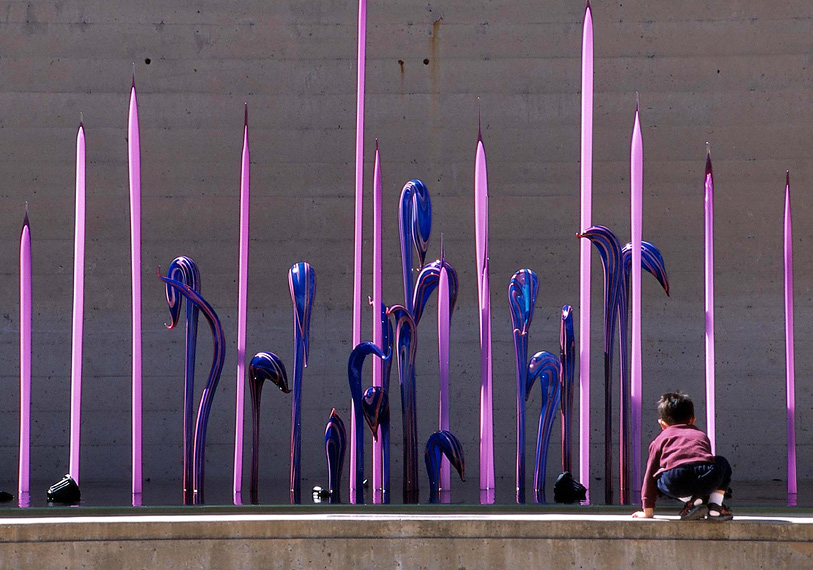
    The wonderful world of artist Dale Chihuly

    March 2009


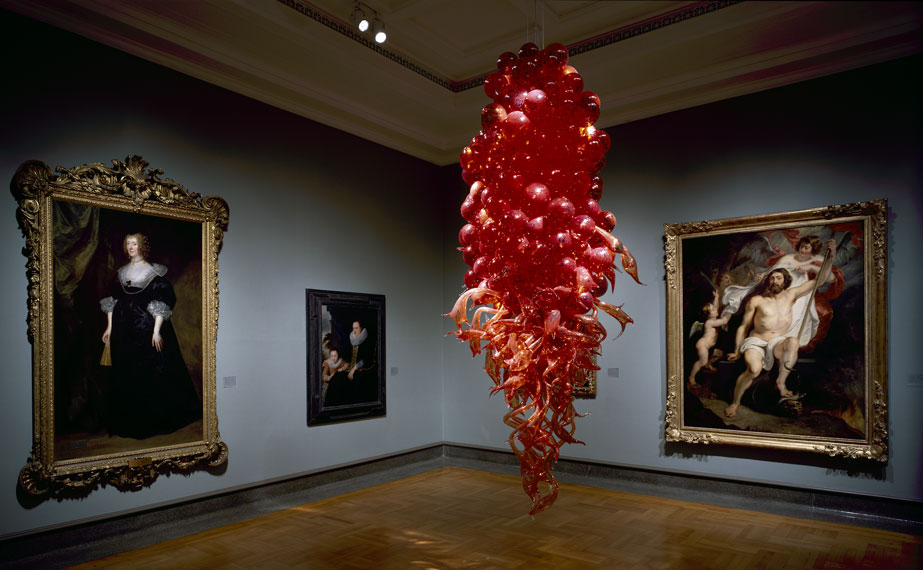
    Dale Chihuly (American, b. 1941) 'Palazzo Ducale Chandelier' 1998


    Dale Chihuly (American, b. 1941)
    Palazzo Ducale Chandelier
    1998


    Visit the Dale Chihuly website and click on the “Work” link to see a truly remarkable artist at work!

    Marcus


    Please click on the photographs for a larger version of the image.


    Dale Chihuly (American, b. 1941) 'Chiostro di Sant'apollonia Chandelier' 1996


    Dale Chihuly (American, b. 1941)
    Chiostro di Sant’apollonia Chandelier
    1996


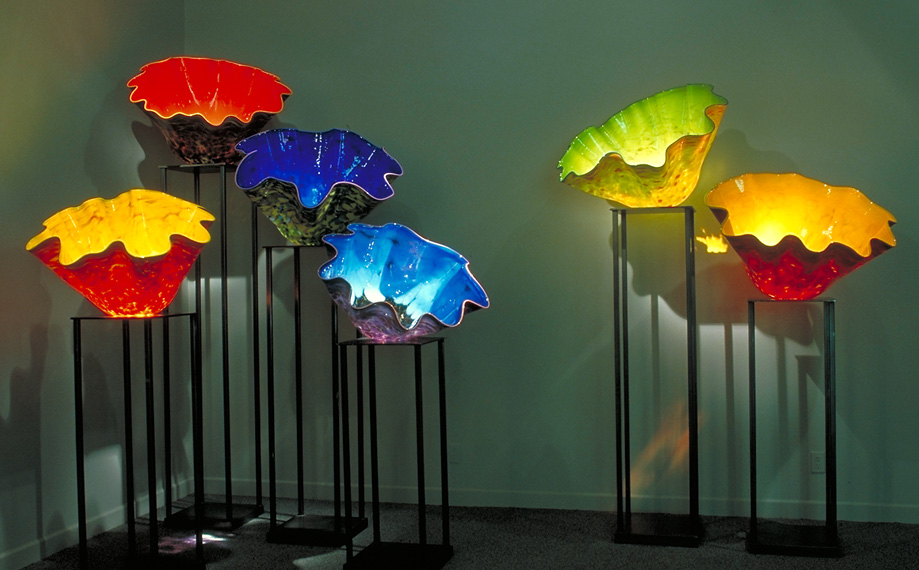
    Dale Chihuly is most frequently lauded for revolutionising the Studio Glass movement by expanding its original premise of the solitary artist working in a studio environment to encompass the notion of collaborative teams and a division of labor within the creative process.  However, Chihuly’s contribution extends well beyond the boundaries both of this movement and even the field of glass: his achievements have influenced contemporary art in general. Chihuly’s practice of using teams has led to the development of complex, multipart sculptures of dramatic beauty that place him in the leadership role of moving blown glass out of the confines of the small, precious object and into the realm of large-scale contemporary sculpture. In fact, Chihuly deserves credit for establishing the blown glass form as an accepted vehicle for installation and environmental art beginning in the late twentieth century and continuing today.

    Stylistically over the past forty years, Chihuly’s sculptures in glass have explored colour, line, and assemblage. Although his work ranges from the single vessel to indoor/outdoor site-specific installations, he is best known for his multipart blown compositions. These works fall into the categories of mini-environments designed for the tabletop as well as large, often serialised forms that are innovatively displayed in groupings on a wide variety of surfaces ranging from pedestals to bodies of natural water. Masses of these blown forms also have been affixed to specially engineered structures that dominate large exterior or interior spaces.

    Over the years Chihuly and his teams have created a wide vocabulary of blown forms, revisiting and refining earlier shapes while at the same time creating exciting new elements, such as his Fiori, all of which demonstrate mastery and understanding of glassblowing techniques.  Earlier forms, such as the Baskets, Seaforms, Ikebana, Venetians, and Chandeliers, from the late 1970s through the 1990s have been augmented since the early to mid-1990s with new blown elements. Chihuly and his teams primarily developed these while working in glass factories in France, Finland, Ireland, and Mexico. The resulting Reeds, Saguaros, Herons, Belugas, Seal Pups, and other forms are now juxtaposed with the earlier series, including Macchia, Niijima Floats, and Persians in lively new contexts.

    “Since the early 1980s, all of Chihuly’s work has been marked by intense, vibrant colour and by subtle linear decoration. At first he achieved patterns by fusing into the surface of his vessels “drawings” composed of prearranged glass threads; he then had his forms blown in optic moulds, which created ribbed motifs. He also explored in the Macchia series bold, colourful lip wraps that contrasted sharply with the brilliant colours of his vessels. Finally, beginning with the Venetians of the early 1990s, elongated, linear blown forms, a product of the glassblowing process, have become part of his vocabulary, resulting in highly baroque, writhing elements. In recent years Chihuly has experimented with Polyvitro to create new interpretations of some of his glass forms.

    Davira S. Taragin on the Dale Chihuly website


    Dale Chihuly (American, b. 1941) 'Chiostro di Sant'apollonia Chandelier' 1996 (detail)


    Dale Chihuly (American, b. 1941)
    The artist with his Chiostro di Sant’apollonia Chandelier (detail)
    1996


    Dale Chihuly (American, b. 1941). 'Colorado Springs Fountain' installation 2005


    Dale Chihuly (American, b. 1941)
    Colorado Springs Fountain
    installation 2005


    Dale Chihuly (American, b. 1941) 'Basket Forest' 2005


    Dale Chihuly (American, b. 1941)
    Basket Forest
    2005


    Dale Chihuly (American, b. 1941) 'Macchia Forest' 2004


    Dale Chihuly (American, b. 1941)
    Macchia Forest
    2004


    Dale Chihuly (American, b. 1941) 'Ponti Duodo e Barbarigo Chandelier' 1998


    Dale Chihuly (American, b. 1941)
    Ponti Duodo e Barbarigo Chandelier
    1998


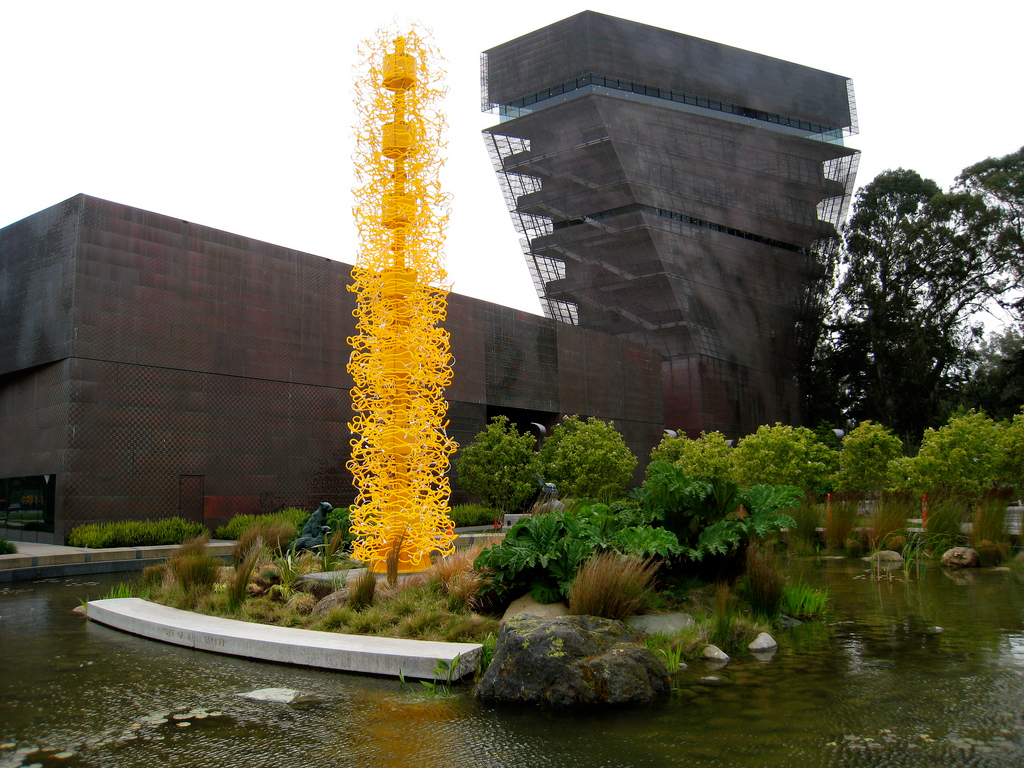
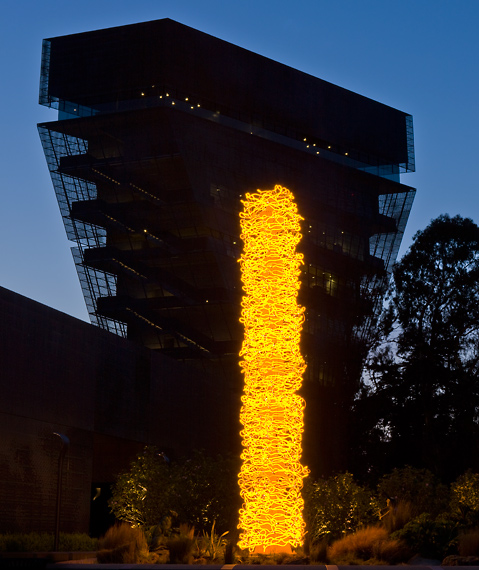
    Dale Chihuly (American, b. 1941) 'Saffron Tower' 2008


    Dale Chihuly (American, b. 1941)
    Saffron Tower
    2008


    Dale Chihuly (American, b. 1941) 'Saffron Tower' 2008


    Dale Chihuly (American, b. 1941)
    Saffron Tower
    2008


    Dale Chihuly website

    LIKE ART BLART ON FACEBOOK

    Back to top

    Sculpture: ‘Entropa’ by David Cerny on view at the European Council building in Brussels, Belgium

    Date: 16th January 2009


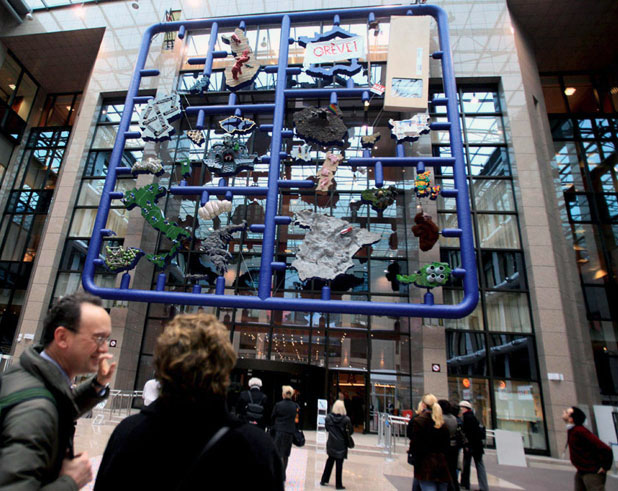
    David Cerný (Czech, b. 1967) 'Entropa' 2009


    David Cerný (Czech, b. 1967)
    Entropa
    2009


    The idea was simple but good. So effective that he convinced the presidency of the European Council, which this semester is headed by the Czech Republic, to give its blessing and the 500,000 Euros needed to finance it. Czech artist David Cerný promised the following: a collaboration between 27 artists from the European Community who would put forth their vision from their own countries. France was portrayed as a labor strike, Spain as a slab of concrete and Italy into a soccer field … Belgium appears as a chocolate box, Denmark constructed with Lego and the map of Sweden below a box that looks like the ones Ikea uses.

    The only problem is that behind this work of art, which has caused great controversy reducing Greece to a huge fire, Romania into a Dracula castle, there is only one creative mind, that of David Cerný. Cerný, who also invented 26 false names of European artists that had supposedly collaborated with him, recognises that he knew the truth would come out and says that economic restrictions and lack of time motivated him to do the whole work by himself.

    Czech Deputy Prime Minister, Alexandr Vondra, has confessed feeling “surprisingly sorry” after discovering that the only author of Entropa is Cerný and not 27 artists, as had been stipulated in the contract with the artist.

    “David Cerný is the only person responsible for not fulfilling his commitment”, said Vondra, who added that the Czech presidency is analysing what to do with the installation, which has already been placed at the Justus Lipsius building of the EU Council building and which was supposed to be inaugurated on Thursday.

    Meanwhile, Cerný, known for his sculptures such as Freud hanging in the middle of the streets in Prague or for painting a rose on a Soviet tank, has laughed all along and said that he wanted to prove “that Europe could laugh at itself”.

    Cerný, who also invented 26 false names of European artists that had supposedly collaborated with him, recognises that he knew the truth would come out and says that economic restrictions and lack of time motivated him to do the whole work by himself.

    Text from the ArtDaily.org website


    The installation consists of a giant jigsaw map – or a kind of plastic frame which keeps the elements of a miniature model in place – with a “cliché and stereotype” of each one of the EU’s 27 member states. Each country was announced to be sculptured by a different national artist.

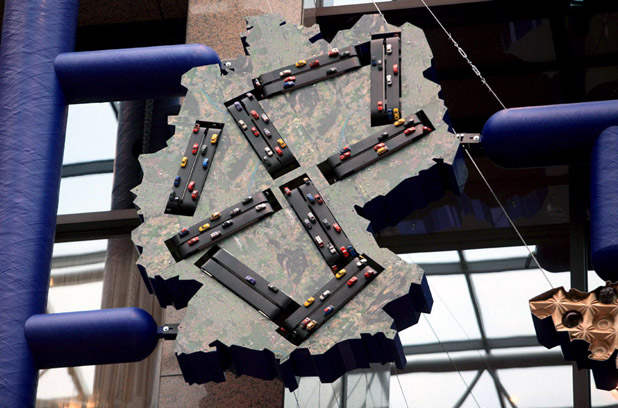
    You you can see Polish priests lifting the flag of the gay movement, a clear reference to the iconic image of the American soldiers planting the Stars and Stripes on Iwo Jima. France is pointedly represented by a map of France covered with the inscription “Strike!” The Netherlands have sunk beneath the sea with only minarets of mosques appearing above the surface…

    When the EU officials saw the work and felt offended, Czech Deputy Prime Minister Vonda firstly defended the project as a way of confronting prejudice and “a space for the free expression of artists from 27 countries.” At least, this was his reaction before they found out it is all one big hoax of Czech art David Czerny, who made the sculpture entirely on his own.”

    Text from the Servaas in Shanghai blog [Online] Cited 15/01/2009


    David Cerný (Czech, b. 1967) 'Entropa' 2009 (detail)


    David Cerný (Czech, b. 1967)
    Entropa (detail)
    2009


    Europe is unified by its history, culture and, in recent years, also by a jointly created political structure. More or less diverse countries are intertwined by a network of multi-dimensional relationships that, in effect, results in an intricate whole. From within, we tend to focus on the differences between the individual European countries. These differences include thousands of important and unimportant things ranging from geographical situation to gastronomy and everyday habits.

    The EU puzzle is both a metaphor and a celebration of this diversity. It comprises the building blocks oft he political, economic and cultural relationships with which we ‘toy’ but which will be passed on to our children. The task of today is to create building blocks with the best possible characteristics.

    Self-reflection, critical thinking and the capacity to perceive oneself as well as the outside world with a sense of immunity are the hallmarks of European thinking. This art project that originated on the occasion of Czech Presidency of the Council of the European Union attempts to present Europe as a whole from the perspectives of 27 artists from the individual EU Member States. Their projects share the playful analysis of national stereotypes as well as original characteristics of the individual cultural identities.

    That much is stated in an official booklet of the Czech Ministry of Foreign Affairs. However Entropa is not a real pan-European work by artists-provocateurs, but a mystification. At first glance, it looks like a project to decorate official space, which has degenerated to an unhindered display of national traumas and complexes. Individual states in the European Union puzzle are presented by non-existent artists. They have their names, artificially created identities, and some have their own Web sites. Each of them is the author of a text explaining their motivation to take part in the common project. That all was created by David Cerny, Kristof Kintera and Tomas Pospiszyl, with the help of a large team of colleagues from the Czech Republic and abroad.

    The original intention was indeed to ask 27 European artists for participation. But it became apparent that this plan cannot be realised, due to time, production, and financial constraints. The team therefore, without the knowledge of the Ministry of Foreign Affairs, decided to create fictitious artists who would represent various European national and artistic stereotypes. We apologise to Prime Minister Mirek Topolanek, Deputy Prime Minister Alexandr Vondra, Minister Karel Schwarzenberg and their departments that we did not inform them of the true state of affairs and thus misguided them. We did not want them to bear the responsibility for this kind of politically incorrect satire. We knew the truth would come out. But before that we wanted to find out if Europe is able to laugh at itself.

    At the beginning stood the question: What do we really know about Europe? We have information about some states, we only know various tourist clichés about others. We know basically nothing about several of them. The art works, by artificially constructed artists from the 27 EU countries, show how difficult and fragmented Europe as a whole can seem from the perspective of the Czech Republic. We do not want to insult anybody, just point at the difficulty of communication without having the ability of being ironic.

    Grotesque hyperbole and mystification belongs among the trademarks of Czech culture and creating false identities is one of the strategies of contemporary art. The images of individual parts of Entropa use artistic techniques often characterised by provocation. The piece thus also lampoons the socially activist art that balances on  the verge between would-be controversial attacks on national character and undisturbing decoration of an official space. We believe that the environment of Brussels is capable of  ironic self-reflection, we believe in the sense of humour of European nations and their representatives.

    Text from the David Cerny website. No longer available online


    LIKE ART BLART ON FACEBOOK

    Back to top