
Exhibition dates: 13th April – 5th July, 2026
El universo del artista ante la cámara / The artist’s universe before the camera
Curator: Beatriz Sánchez Torija, department of Prints, Drawings and Photographies
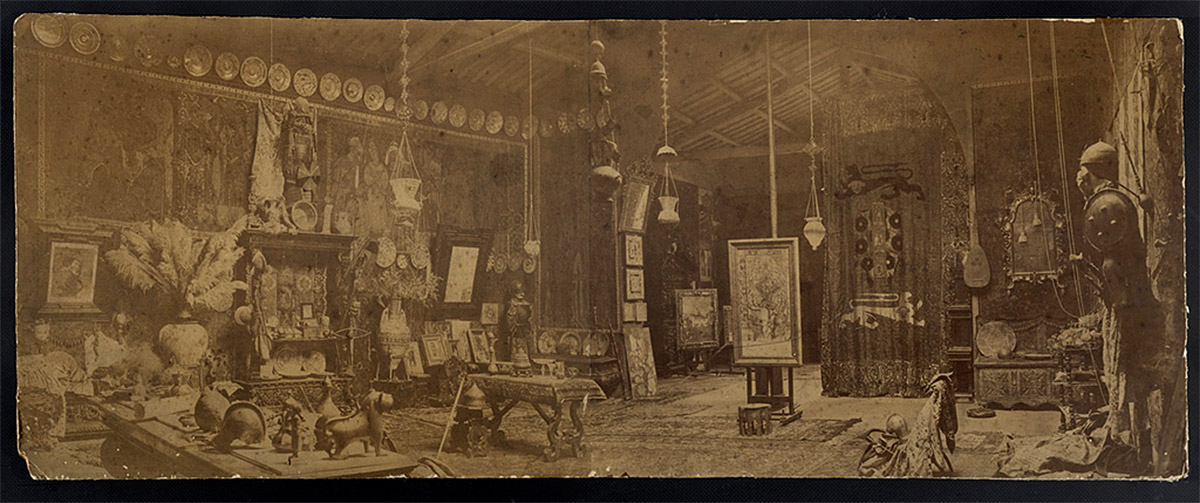
Unknown photographer
Mariano Fortuny’s studio in Rome
1873-1874
Albumen on paper
Madrid, Museo Nacional del Prado
© Museo Nacional del Prado
Mariano Fortuny y Marsal (Catalan: Marià Fortuny i Marsal, pronounced [məɾi a fuɾˈtuɲ i məɾ’sal]; June 11, 1838 – November 21, 1874) was a Spanish painter known for works focusing on Romantic fascination with Orientalist themes, historicist genre painting, and military painting of Spanish imperial expansion.
On the music of artists
What a fascinating group of photographs that picture how (mainly male) Spanish artists liked to see themselves in the 19th century and early 20th century.
“From the photographic corpus preserved in the Museum’s collections, a visual narrative of the artist in their personal and professional life is constructed, thus highlighting the importance of photography as an instrument of visibility, permanence, and legitimacy.” (Museo Nacional Del Prado)
Not only do we have the photographic corpus but we have the corpus, the body, of the artist, resplendent in all their finery, positioned and posed in their workspaces, “carefully constructed environments for the viewer’s gaze”, historic tableaux vivant which emphasise their social standing, their power and prestige.
While the photographs “depict alternative scenarios of creation and social interaction, broadening the traditional notion of the studio and recalling the diverse contexts in which artistic activity developed” (Museo Nacional Del Prado), they capture in a visual language the formal social rituals which accompanied the production of art, status, and self-representation.
“Portraiture, in particular, became a powerful tool. Carefully staged poses, symbolic objects, and profession-specific clothing allowed artists to shape how they were perceived. These were not casual snapshots – they were deliberate constructions of identity.” (Press release from the Museo Nacional del Prado)
This is the image they chose to portray to the world, many surrounded by the fruits of their creativity, antiques, objets d’art, and the trappings of wealth and prosperity.
Two things strike me.
The first is the visual feast that was the artist’s studio compared to today’s minimalist “white cube” galleries and studios, especially in photographs such as Federico de Madrazo’s studio in Madrid (1893, below) and Luis de Madrazo’s studio in Madrid (1885-1895, below) both by unknown photographers. The artist’s inhabit the space, it is their “habitas” – in Spanish and Portuguese, habitas is the second-person singular present indicative of the verbs habitar (Spanish) and habitar (Portuguese), which also translates to “you live” or “you inhabit.” And so in these photographs the artist inhabits the constructed space, and all these years later we observe this habitation, this creative habitation. You live / you inhabit.
Of particular interest are the two spheres hitched to a pulley system in both photographs. These classic plaster spheres (sometimes called a form sphere or sight-size sphere) – of which I had no previous knowledge – were vital in 19th-century academic painting, which heavily emphasised chiaroscuro, and served as a painter’s ‘dynamic light meter’. As the illumination from the studio skylight constantly shifted with the time and weather, the sphere offered the purest representation of the three-dimensional ‘five tonal values’ – such as highlights and the terminator line (the boundary that separates the directly illuminated side of a 3D object from the side in shadow). It allowed painters to easily reference and calibrate real-time lighting ratios at any moment, ensuring that the lighting logic across the entire painting remained precise and perfectly consistent. Through the pulley and counterweight system clearly visible in the images, painters could adjust the height of the sphere at any time to align it perfectly with models in various poses or specific objects. This allowed them to simulate specific light angles in real-time and from all angles, providing a precise reference for light and shadow. (Various sources)
I find this so fascinating, the correlation between “dynamic light meter” in painting – using the sphere – and the “dynamic light meter” in photography using the mirror of the camera, f stops and shutter speeds (depth of field), in camera metering or hand held spot meters.
We can also posit a correlation from the “five tonal values” in painting (highlight, light/halftone, terminator (core shadow), reflected light, cast shadow) to the innate understanding of the modulation of light and use of chiaroscuro by 19th century photographers (who were often painters transferring their talents to a different medium) through the apparatus of the camera – which eventually led to the development of Ansel Adams Zone system: zone 1 (black) through zone 5 (Kodak mid-grey) to zone 10 (white).
The second thing that strikes me about the exhibition which may just be a small point, but it’s important to me, because words matter.
The English version of the title for this exhibition on the Museo Nacional del Prado website is The artist’s world through the camera. The Spanish title for the exhibition is El universo del artista ante la cámara which means, literally, The Artist’s Universe Before the Camera, and indeed the press release titles the exhibition thus in English.
In the English title (on the website) the artist’s lives in a self-contained world (an entire realm created within a subject), and this world view is “seen” through the camera, is captured by the camera in its entirety from one point of view. In the Spanish title on the other hand, the artist’s universe – as the sum of, the totality of, their life, experiences, and thoughts, the interaction of the physical with the spiritual and thought with reality – is laid bare before the camera.
There is a great difference between a self-contained world, constrained and captured by the camera from one point of view, and a fluid, gestational engagement between the energy of the artist, his universal spirit, his habitation and the camera.
A small point but so very vital to our understanding of these photographs.
I have added bibliographic information for the artists where possible.
Dr Marcus Bunyan
Many thankx to the Museo Nacional del Prado for allowing me to publish the photographs in the posting. Please click on the photographs for a larger version of the image.
“The artist’s universe before the camera”, by Beatriz Sánchez Torija
Lecture “The Artist’s Universe Before the Camera” given by Beatriz Sánchez Torija (Department of Conservation of Drawings, Prints and Photographs, Museo Nacional del Prado) on May 12, 2026.
In Spanish (use subtitles to translate to English)
The arrival of photography in the 19th century gave rise to an unprecedented and extraordinarily effective way of representing reality. Artists quickly grasped the potential of this new discipline and used it as a tool to capture their image, record their work environment, and document both the creative processes and the final results of their works. From the photographic corpus preserved in the Museum’s collections, a visual narrative of the artist in their personal and professional life is constructed, thus highlighting the importance of photography as an instrument of visibility, permanence, and legitimacy.
Portraiture was one of the first genres adopted by the photographic medium. Through carefully studied poses, specific clothing, or attributes inherent to their profession, artists codified a public image that defined both their individuality and their membership in a professional collective. The camera captured painters, sculptors, and creators from various disciplines, both individually and in groups, highlighting the bonds of sociability, learning, and mutual recognition that structured the artistic world of the time. The presence of women artists in this collection also allows us to see their gradual entry into the professional sphere and their active participation in these processes of self-representation.
Creative spaces constitute another major focus of the discourse, understood not only as physical environments but also as symbolic extensions of artistic practice. Studios, workshops, and other workspaces appear photographed as settings for experimentation, reflection, and production, but also as carefully constructed environments for the viewer’s gaze. In them, the viewer accesses a universe where the works – in different stages of execution – coexist with the props, materials, and visual references characteristic of these spaces.
The images also depict alternative scenarios of creation and social interaction, broadening the traditional notion of the studio and recalling the diverse contexts in which artistic activity developed between the 19th and early 20th centuries.
Text from the Museo Nacional del Prado YouTube website
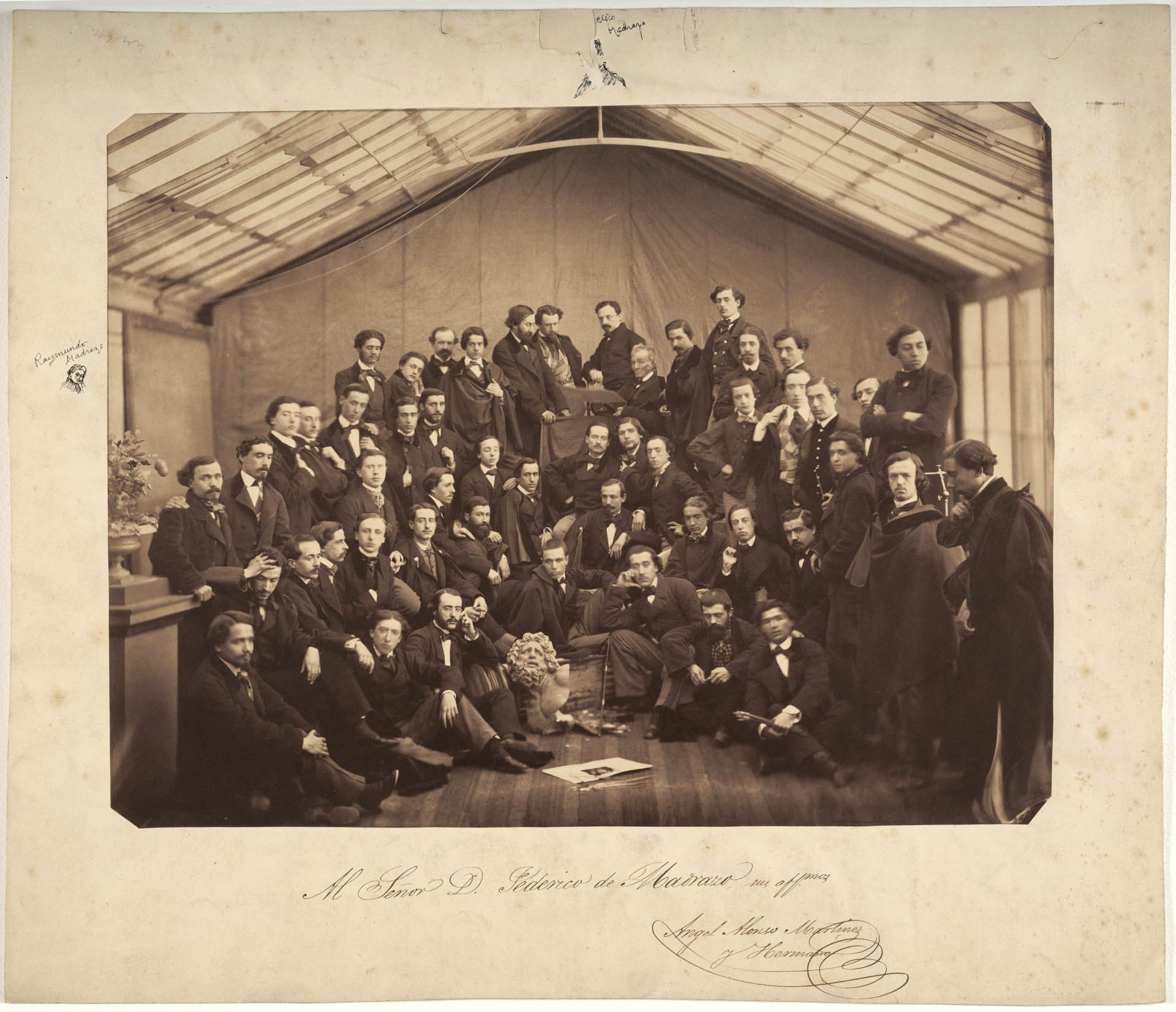
Alonso Martínez y hermano (active 1857-1869)
Artists in the photographer’s studio
1857-1858
Albumen on paper
Madrid, Museo Nacional del Prado
Acquired in 2012
© Museo Nacional del Prado
The setting is a rooftop space – sometimes referred to in contemporary texts as a ‘glass hut’ – in which a gallery of portraits has been arranged to make best use of the light. The group’s devotion to the fine arts is emphasised by a sculpture and several paintbrushes visible in the foreground.
Initially Mr. Martínez, who is none other than Ángel Alonso Martínez (1825-1868), and later under the name of Alonso Martínez and his brother (other sources say that his brother-in-law), the studio maintained an important commercial activity specialized in the realization of high quality portraits, whose objective clientele was formed by the highest layers of society.
Marcus: There is a little cartoon drawing two thirds of the way up on the left hand side of Raimundo de Madrazo. He can be seen seventh from the left in the top row.
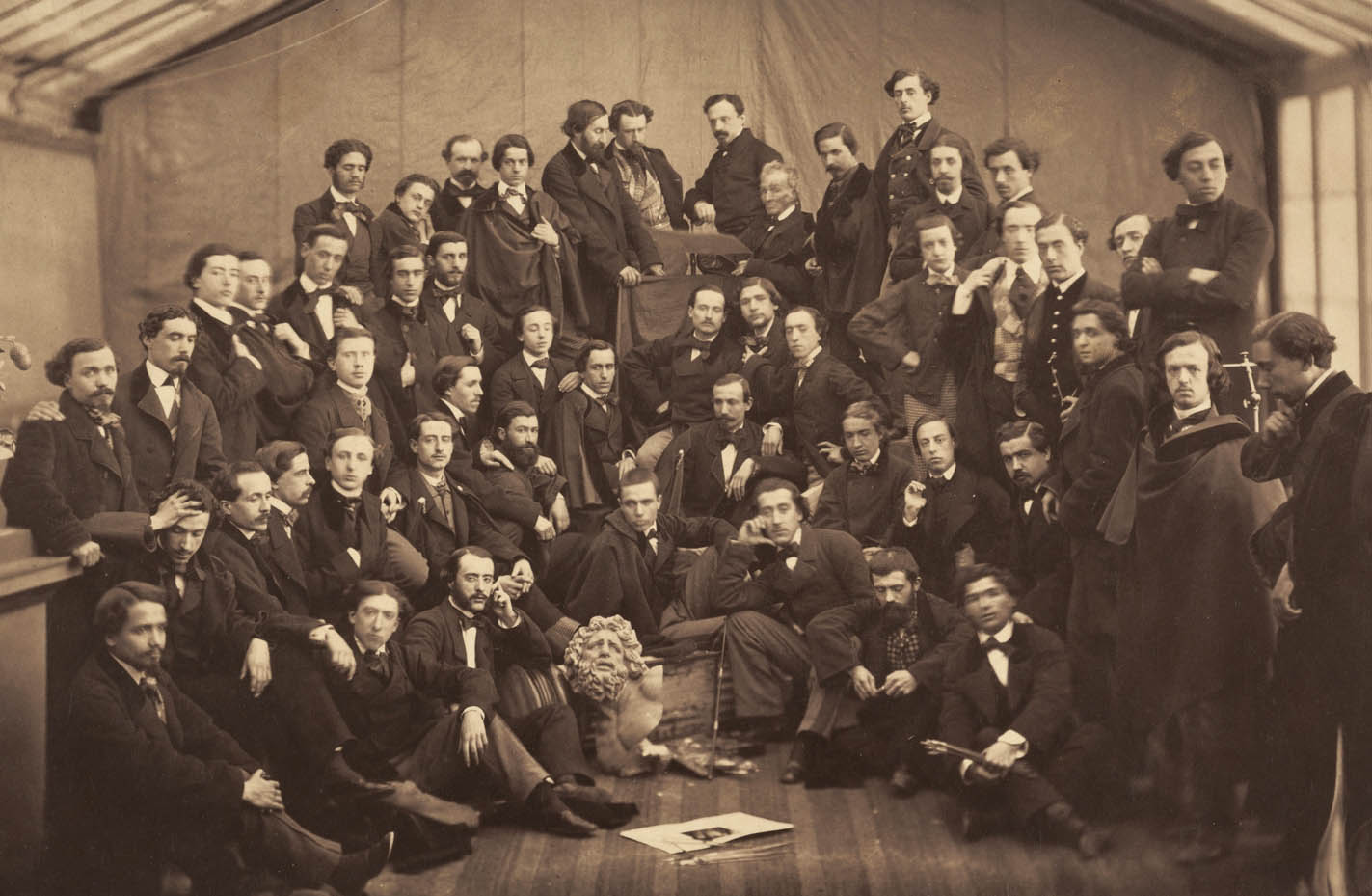
Alonso Martínez y hermano (active 1857-1869)
Artists in the photographer’s studio (detail)
1857-1858
Albumen on paper
Madrid, Museo Nacional del Prado
Acquired in 2012
© Museo Nacional del Prado
The advent of photography in the 19th century marked the birth of a new artistic discipline and paved the way for an unprecedented and remarkably effective method of representing reality. Artists rapidly grasped the scope of this transformation: they portrayed themselves (alone or with colleagues), documented their work spaces, and made the effort to graphically record both their creative processes and the final materialisation of their works.
Based on the holdings of the Museo del Prado, specifically the archives of Luis and Federico de Madrazo, Dióscoro Puebla, Rafael Rocafull, Cecilio Pla, Agustín Querol, Miguel Blay, Fernanda Francés and Manuel González Santos, the exhibition brings together photographs by renowned professionals alongside other anonymous and possibly amateur creations. Created using a range of techniques and formats, taken as a whole this group of images makes it possible to trace a visual map of the presence of artists in their domestic contexts, studios and various spaces of social interaction and learning, as well as in alternative creative settings, such as the evocative Patio de las Doncellas in the Real Alcázar in Seville.
The exhibition is intended as a tribute to the male and female creators who were active in the 19th and early 20th centuries, with a particular acknowledgement of those who understood photography as a privileged medium for ensuring the preservation of their image and artistic practice over time.
Text from the Museo del Prado website
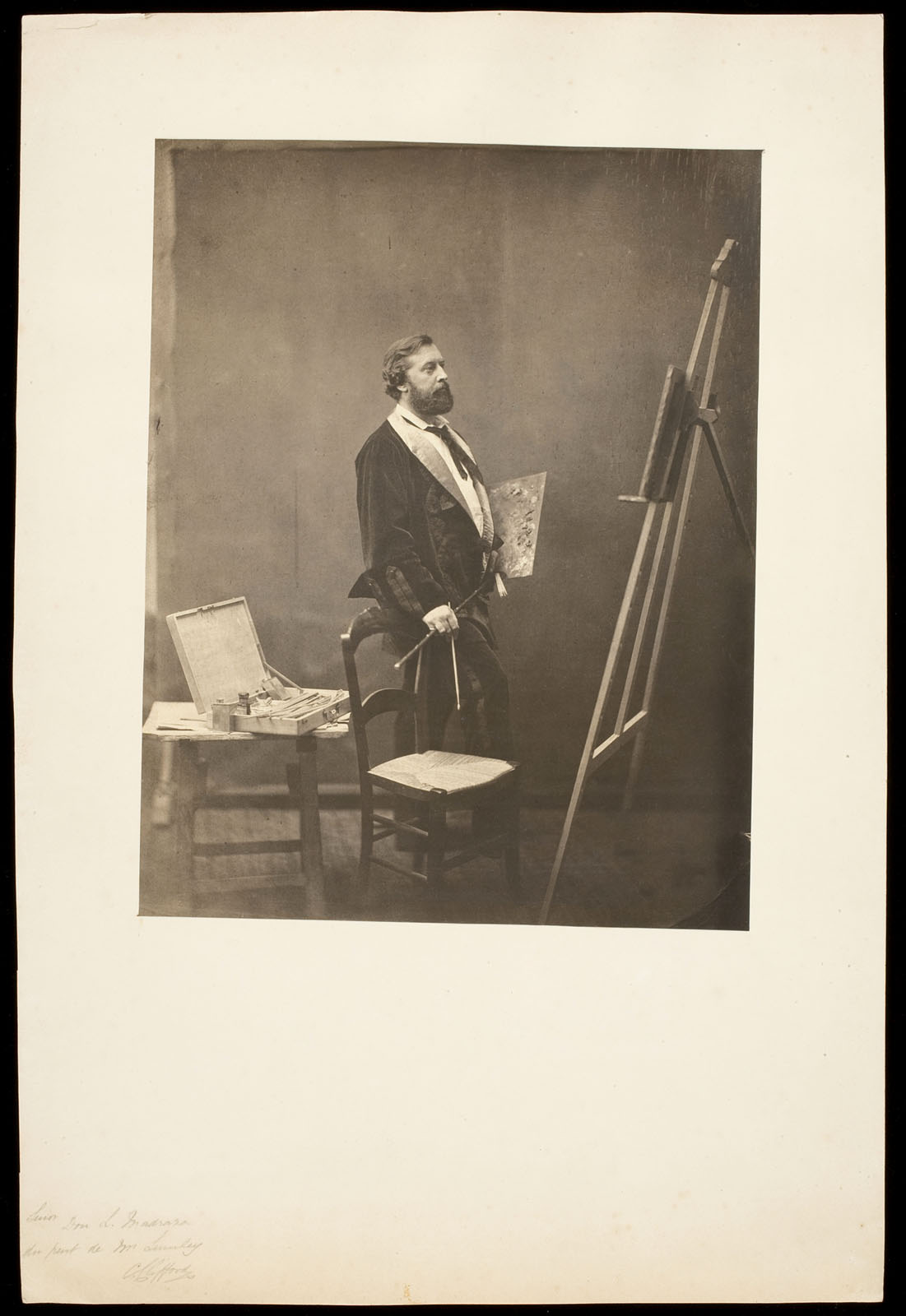
Georges Penabert (French, 1825-1903)
John Savile Lumley
1859
Albumen paper mounted on cardboard
Madrid, Museo Nacional del Prado
Acquired in 2006
© Museo Nacional del Prado
During his stay in Madrid, between 1858 and 1860, the English diplomat John Savile Lumley (1818-1896) spent time with Valentín Carderera, Federico and Luis de Madrazo, and purchased a number of works by Goya and Velázquez. A keen amateur painter himself, he is shown in this studio portrait with the characteristic tools of the trade: palette, paintbrushes and a mahlstick.
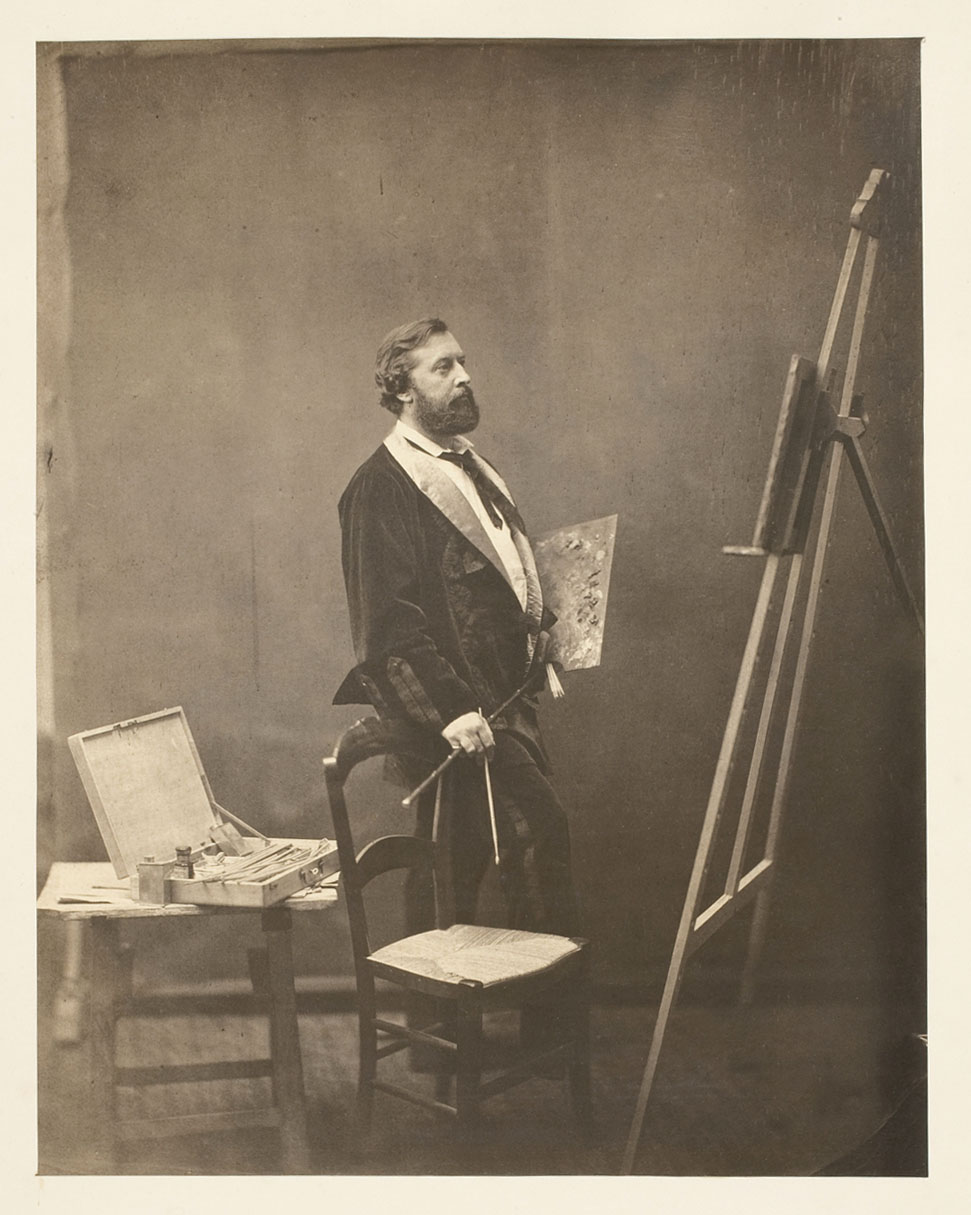
Georges Penabert (French, 1825-1903)
John Savile Lumley (detail)
1859
Albumen paper mounted on cardboard
Madrid, Museo Nacional del Prado
Acquired in 2006
© Museo Nacional del Prado
Georges Jean Penabert (1825-1903) was a French photographer. He lived in 1869 at 31 Passage du Havre in the 9th arrondissement in Paris. His declared profession for that year was a trader (photographer). Penabert began ihis activity in 1858 in Paris, under the name Penabert et Cie; he practiced at various addresses: 46 rue Basse du Rempart, 31 passage of Le Havre around 1864, 36/38 passage of Le Havre in 1875. He opened two branches, 587 Broadway in New York and 108 Calle de la Havana in Cuba. He became associated with Charles DeForest Fredricks (1823-1894) and his work was awarded a Silver Medal at the Paris World Fair in 1889. Georges Penabert died in Paris in the 11th district on December 27, 1903, at age 78.
Text from the Wikipedia website
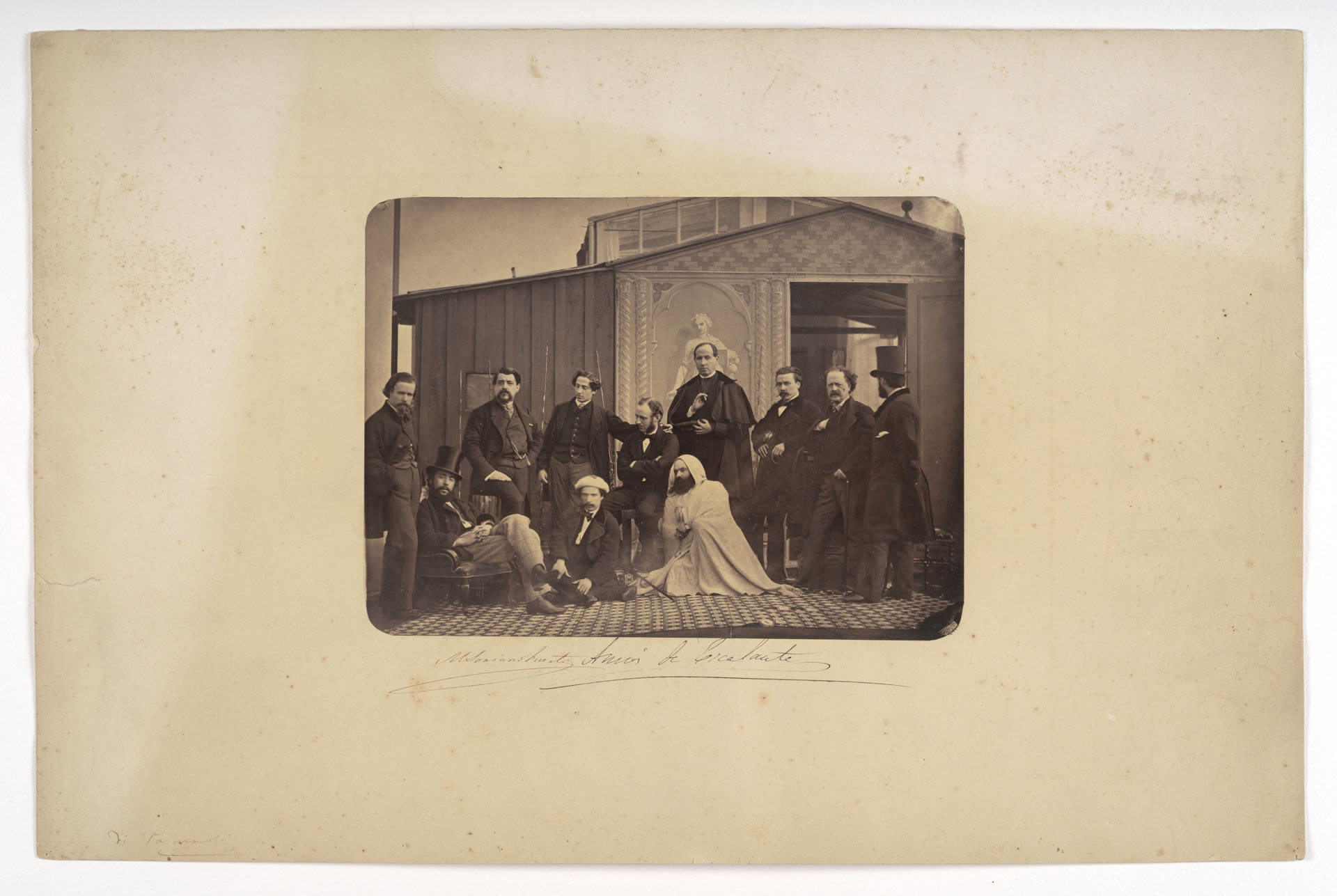
Study of Altobelli and Molins
Spanish Artists in Rome
1861
Prado National Museum
The study of Altobelli and Molins centres on the influential 19th-century Italian photography studio founded by Gioacchino Altobelli and Pompeo Molins. Operating in Rome between approximately 1858 and 1865, the duo is highly regarded for pioneering the wet-collodion process to capture architectural views, landscapes, and daily life in Italy.
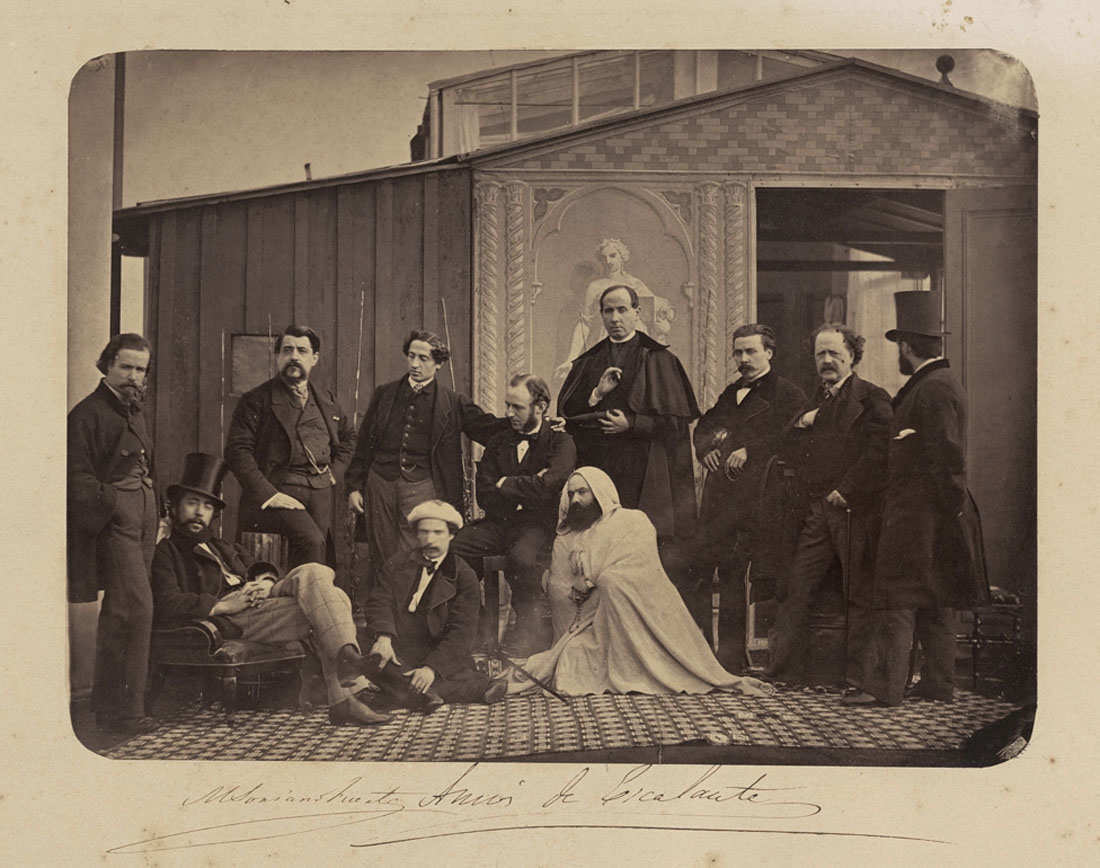
Study of Altobelli and Molins
Spanish Artists in Rome (detail)
1861
Prado National Museum
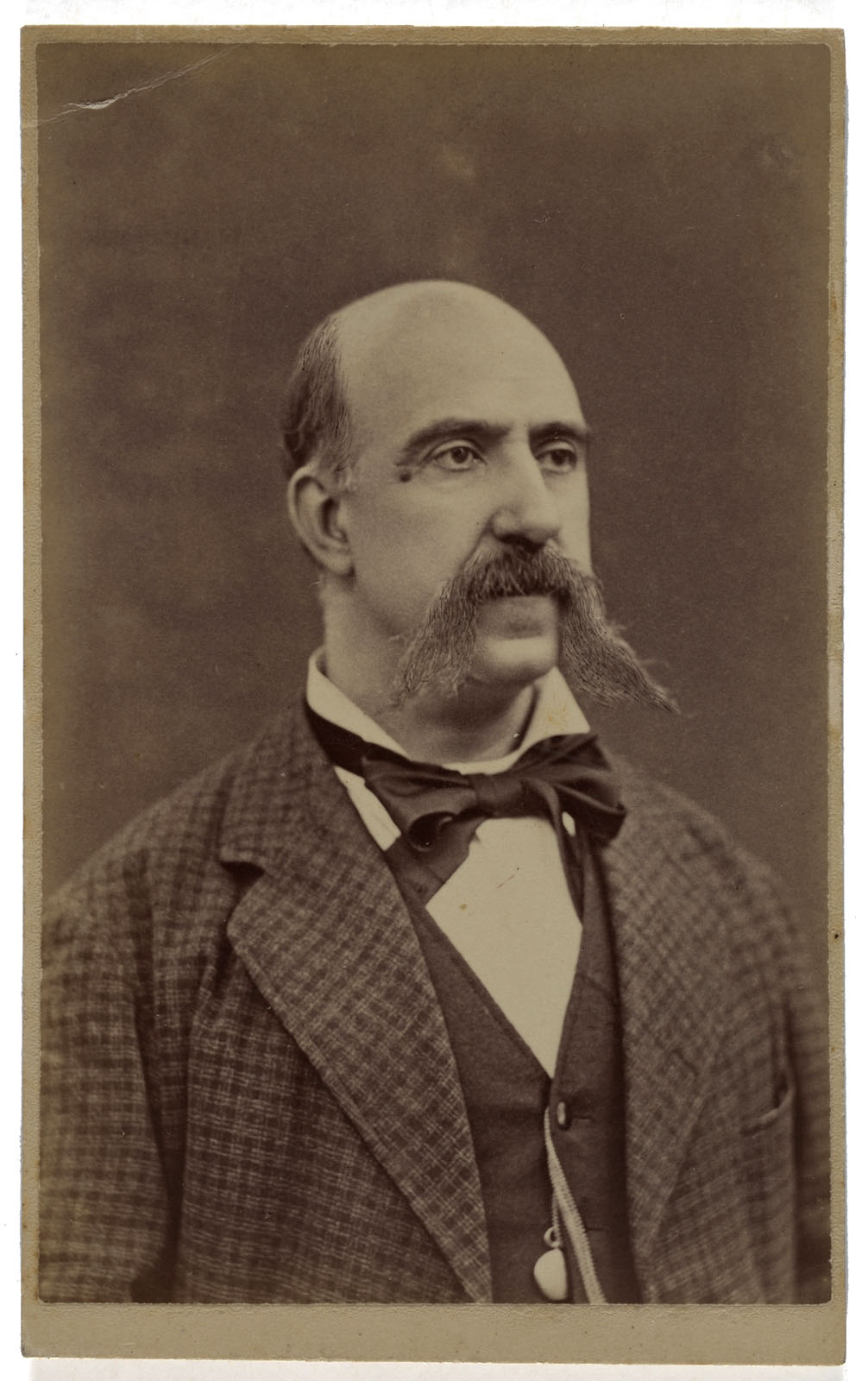
Rafael Rocafull (Spanish, 1824-1903)
The photographer Rafael Rocafull
1870
Carte de visite
Albumen on paper
Madrid, Museo Nacional del Prado
Purchased at Juan Naranjo, 2023
© Museo Nacional del Prado
Rafael Rocafull y Monfort (Cádiz, 1825 – h. 1903) was a Spanish photographer and painter.
He began his artistic training at the School of Fine Arts of Cadiz and made different pictorial works of costume themes throughout his life, although he also practiced portraiture and landscape. He participated in the fine arts exhibition that was held in the city of Cadiz in 1854, obtaining a silver medal, and in which it took place in Jerez de la Frontera in 1858. Some of his canvases are: Sacra familia, San Antonio, Ángel de la Guarda, El Prisisinero de la Bastille, Cuatro cuadros sobre Cuatro Stations and Una aldeana.
He was also one of the pioneers of photography in Spain, he made numerous portraits, including the series Academics, dedicated to members of the Academy of Fine Arts of Cadiz of which he was a member. He also published albums with collections of photographs dedicated to several Spanish cities, such as Córdoba and Seville. His shots of the city of Cadiz are fundamental to know the evolution of the city’s image In the second half of the 19th century.
He served as director of the Museum of Painting of Cadiz and was even interested in political issues, being appointed on two occasions councilor of the City of Cadiz. It is believed that he moved out of his hometown in 1902, at the age of 77, ignoring the exact date and place where his death took place. Many of his pictorial works currently belong to private collections, such as the one entitled Aldeanos en una taberna (Bellver Collection of Seville).
Text from the Wikipedia website translated from the Spanish by Google Translate
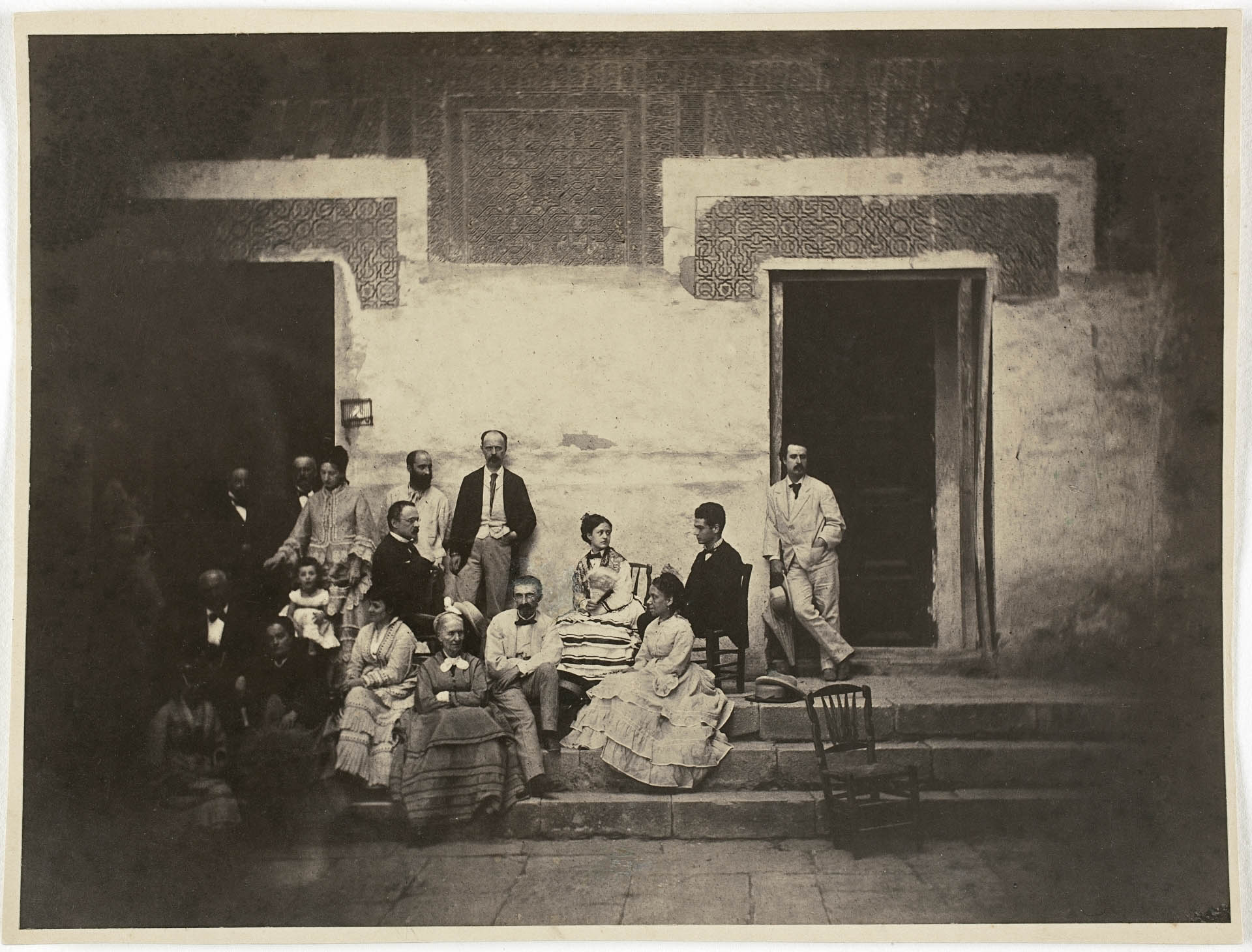
Charles Mauzaisse (Spanish born France, 1823-1885)
The Madrazo family in the Patio of the Gilded Room at the Alhambra
1871
Albumen on paper
Madrid, Museo Nacional del Prado
Collection of the Madrazo family; Elena Madrazo Balderrábano, 2012
© Museo Nacional del Prado
In 1870, Mariano Fortuny and Cecilia de Madrazo took up residence in Granada, where their son Mariano was born the following year. To celebrate the recent birth, several friends and family members visited the couple in the summer of 1871, a gathering immortalised in this photograph, taken in the Alhambra.
Background and Context
In the summer of 1871, the painter Mariano Fortuny and his wife Cecilia de Madrazo were living in Granada, having taken up residence there the previous year. To celebrate the recent birth of their son, Mariano Fortuny and Madrazo, several family members and friends traveled south to visit the couple. This monumental photograph immortalizes the occasion, showcasing the distinguished figures posed in the serene and highly ornamented courtyard.
Key Figures in the Photograph
The gathering features several prominent figures of 19th-century Spanish art, including:
~ Federico de Madrazo y Kuntz: The patriarch of the family and renowned portraitist, who traveled from Madrid to visit his daughter and meet his new grandson.
~ Mariano Fortuny y Marsal: The celebrated Catalan painter and son-in-law to Federico.
~ Cecilia de Madrazo y Garreta: Mariano’s wife.Isabel de Madrazo y Garreta: Cecilia’s sister.
~ Martín Rico Ortega: A close family friend and notable landscape painter.
~ María Luisa Fortuny y Madrazo: The young daughter of Mariano and Cecilia.
Text from the Museo del Prado website
Charles Mauzaisse was a French painter and the son of a painter. He emigrated to Spain in 1857 and signed the visitors’ log at the Alhambra on the 29th of January. After a peripatetic period traveling through southern Spain, he settled in Granada permanently, becoming one of the city’s few foreigners to become a local professional photographer. As a portrait photographer, he offered his clientele their likenesses on oilcloth, paper, glass, and ivory. He soon expanded his repertoire to views of the city and its architectural monuments, especially the Alhambra, catering to foreign visitors’ whims and custom requests and the booming tourist trade. In 1862, he returned from a visit to France with the latest advances in the photographic field.
From this date to the beginning of the 1880s, he made many photographs. However, their dispersal has left scant remnants in public collections. The Royal Palace in Madrid owns an album with 40 of Mauzaisse’s photos. He dedicated it to María de las Mercedes de Orleans y Bórbon on her marriage in 1878 to King Alfonso XII of Spain. Mauzaisse’s photography conjoined with his activity as a painter. Art deeply entered him as the son of Jean-Baptiste Mauzaisse (1784-1844), a prolific if minor French artist. By 1870, Charles established himself as a painter as well as a photographer in the Alhambra. He reportedly maintained close contact with French artists like Henry Regnault (1843-1871), whom he entertained on his way to Morocco. Recent research has shown that Gustave Doré used photos by Mauzaisse as the basis for his engraved illustrations in several publications.
In July 1871, Mauzaisse photographed the Fortuny-Madrazo family in the Alhambra when they gathered in Granada to celebrate the birth of Fortuny’s son, Mariano Fortuny y Madrazo. Unfortunately, Charles Mauzaisse may have died in the cholera epidemic that swept through Andalucía in 1885.
Text from the National Gallery of Art Library
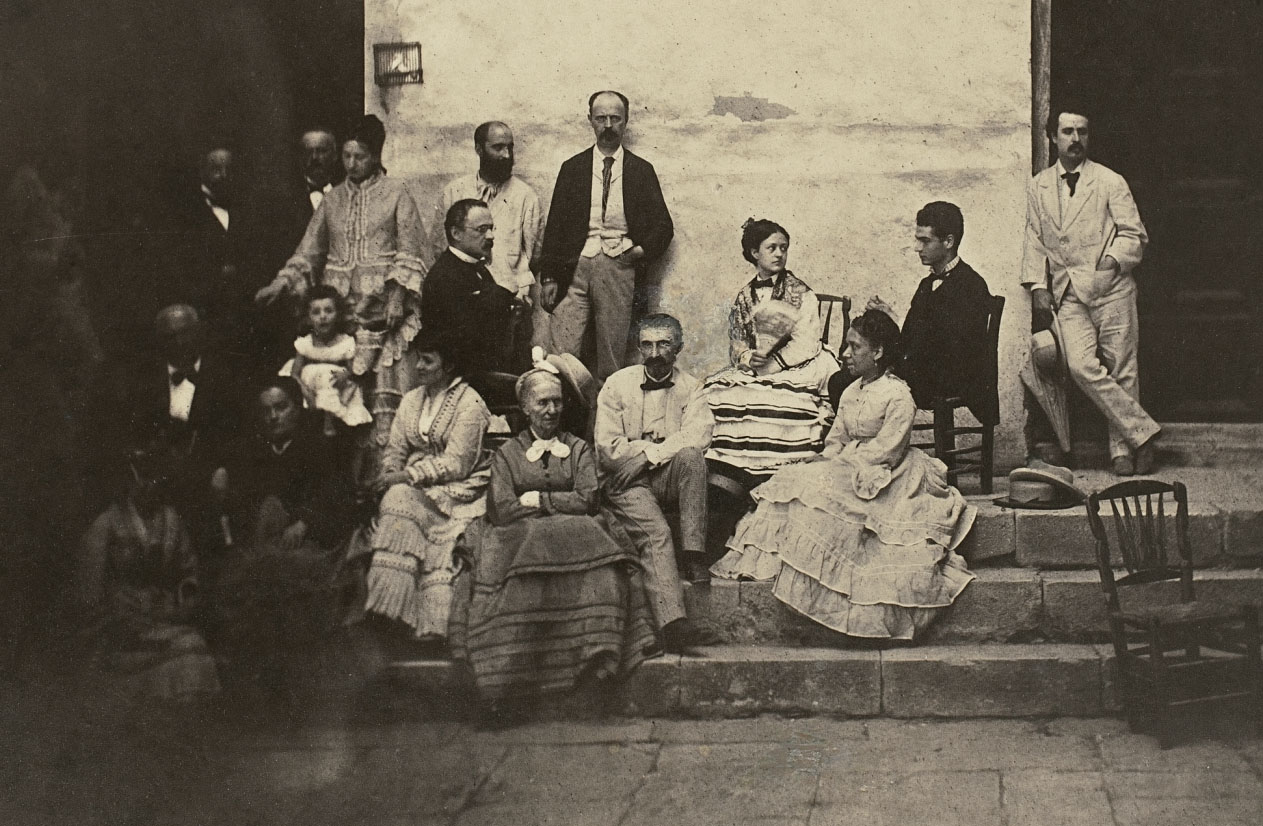
Charles Mauzaisse (Spanish born France, 1823-1885)
The Madrazo family in the Patio of the Gilded Room at the Alhambra
1871
Albumen on paper
Madrid, Museo Nacional del Prado
Collection of the Madrazo family; Elena Madrazo Balderrábano, 2012
© Museo Nacional del Prado
The Museo del Prado has opened a new exhibition that turns the lens toward artists themselves, revealing how photography transformed not only how they were seen, but how they chose to present their world.
Titled “The artist’s universe through the camera,” the exhibition offers a compelling journey through the second half of the 19th century and the early decades of the 20th century – an era when photography was rapidly reshaping artistic identity.
Rather than focusing solely on finished artworks, the show brings visitors behind the scenes. Through portraits, studio views, and process images, it reveals artists at work, at rest, and in moments of self-reflection – capturing a more intimate and human side of artistic creation.
Photography enters the studio
When photography emerged in the 19th century, it offered something entirely new: the ability to capture reality with striking precision. Artists quickly embraced it.
They posed for portraits – alone or alongside peers – documented their studios, and even recorded the step-by-step evolution of their works. What had once been invisible or fleeting became permanent.
Portraiture, in particular, became a powerful tool. Carefully staged poses, symbolic objects, and profession-specific clothing allowed artists to shape how they were perceived. These were not casual snapshots – they were deliberate constructions of identity.
A social ritual and a visual language
By the late 1800s, visiting a photography studio had become a social event. These spaces – often located on upper floors with large windows to capture natural light – were as much about performance as documentation.
New formats such as:
~ Carte de visite
~ Promenade cards
~ Paris cards
made portrait photography more accessible and widely circulated. Meanwhile, larger formats were used for group portraits, celebrating artistic circles, collaborations, and milestones.
The exhibition shows how these images became a shared visual language – one that blended art, status, and self-presentation.
Inside the artist’s world
At the heart of the exhibition is the artist’s studio – not just as a workspace, but as a symbol.
Studios were places where:
~ Ideas took shape
~ Teaching and collaboration happened
~ Collections of objects, artworks, and memories accumulated
In many cases, they resembled cabinets of curiosities, filled with both finished works and sources of inspiration.
The exhibition takes visitors into these spaces, from the refined studios of Madrid and Paris to evocative settings like the Royal Alcázar of Seville.
From masters to lesser-known voices
Drawing from the Prado’s own archives, the exhibition brings together photographs linked to artists such as Federico de Madrazo, Miguel Blay, Cecilio Pla, and others – alongside anonymous and possibly amateur images.
This mix gives the show a refreshing depth. It doesn’t just highlight well-known figures; it captures a broader artistic ecosystem, including students, collaborators, and everyday moments in creative life.
One of the most compelling aspects is the attention given to women artists and students, whose presence in studios became increasingly visible during this period. Their inclusion adds an important layer to the narrative of artistic modernity.
Capturing the creative process
Beyond portraits and studio scenes, the exhibition also documents the making of art itself.
Visitors can follow the evolution of certain works step by step – most notably in the case of sculptor Miguel Blay, whose monument to Mariano Moreno is traced through various stages of creation.
These images reveal something rarely seen: the labour, experimentation, and transformation behind finished masterpieces.
A story of technique and transformation
The exhibition also highlights the evolution of photographic processes, from early albumen prints to more advanced techniques like platinum printing, autochrome, and gelatin prints.
Each method reflects not only technological innovation but also changing artistic sensibilities. Together, they tell a story of how photography and art developed side by side, influencing one another.
A lasting legacy
Ultimately, “The artist’s universe through the camera” is more than a historical survey – it’s a reminder of how artists adapted to a new medium that would forever change their relationship with the public.
Photography allowed them to control their image, document their work, and preserve their legacy in ways that had never been possible before.
And today, those images offer us a rare and intimate glimpse into their world.
Press release from the Museo Nacional del Prado
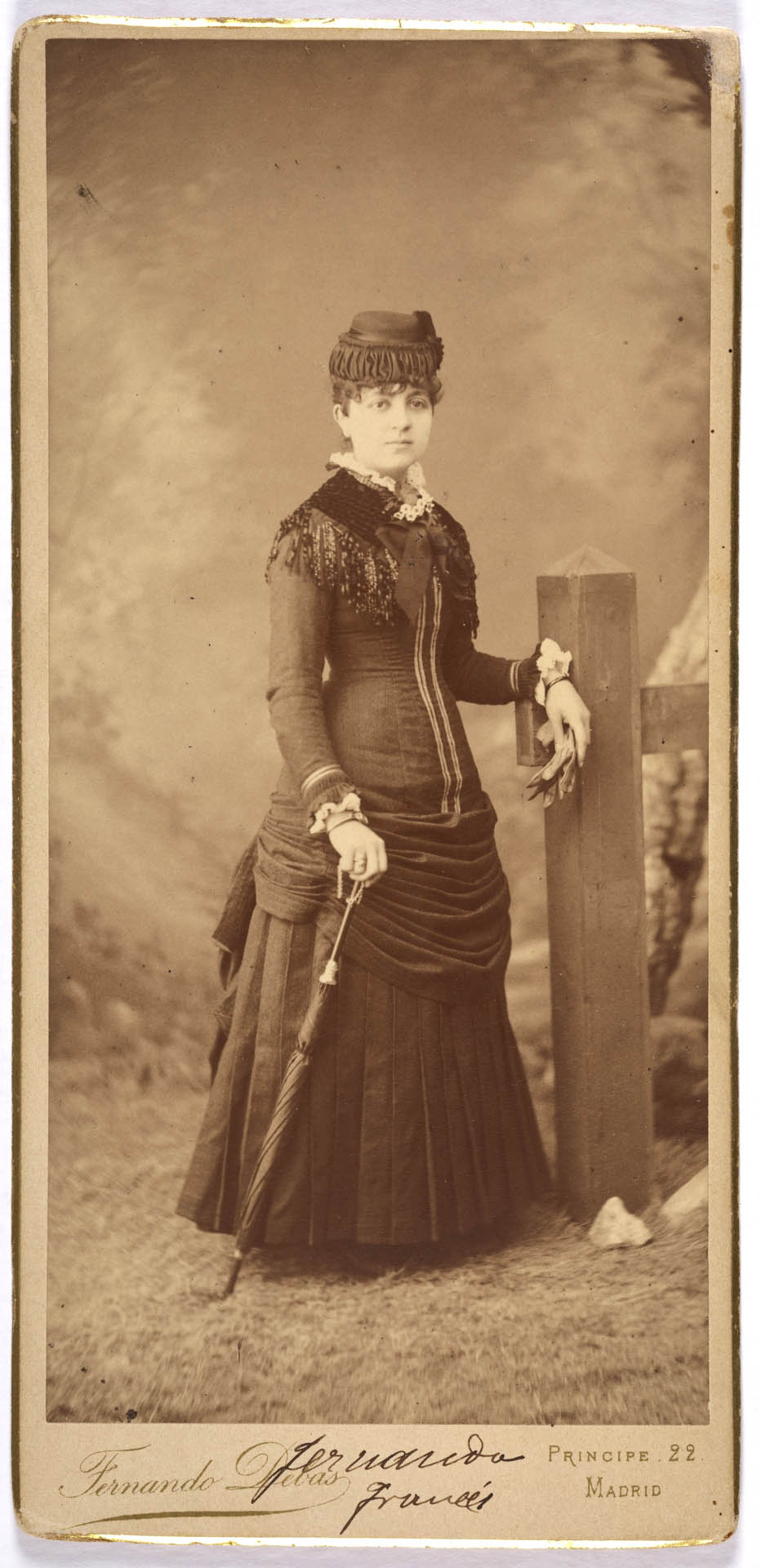
Fernando Debas (Spanish born France, 1842-1914)
The painter Fernanda Francés
1875-1883
Promenade card
Albumen on paper
Madrid, Museo Nacional del Prado
Gift from the Fundación Amigos del Museo del Prado, Comisión Siglo XIX, 2025
© Museo Nacional del Prado
Debas settled in Spain in the 1870s, and started his professional career in Madrid with his brother Edgardo Debas, also a photographer by profession. They set up a studio at 22, Calle del Príncipe, under the trade name of Fotografía Parisiense Debas Hermanos. After several years of working together, they went their separate ways. On 30th March 1875, King Alfonso XII granted Fernando the title of chamber photographer, as well as permission to use the royal coat of arms on his establishment’s displays and invoices. From that date onwards, and in the same studio, he styled himself as “First Photographer to His Majesty the King and the Princess of Asturias”. In 1877 he collaborated with two other renowned professional photographers, Jean Laurent and Alfredo Esperón, to create the album of photographs of the National Wine Exhibition held in Madrid the same year.
In 1878, he opened a branch in Valladolid with great commercial success. From 1883 onwards, he styled himself at his new gallery at 31, Calle de Alcalá as “Photographer to Their Majesties, and Their Royal Highnesses, the Princess of Asturias and the Infantas.” Debas’ studio had become one of the most famous of its generation, frequented by numerous politicians, military officers, intellectuals and other personalities of the time. The painter from Seville and founding member of the Free Academy of Fine Arts of Seville, Enrique Rumoroso, collaborated with Fernando Debas as an illuminator. His works include the album of photographs of the masked ball held on 25th February 1884 at the palace of the Duke and Duchess of Fernán Núñez. From 1884 onwards, he also worked for the magazine La Ilustración and, from 1896, for Nuevo Mundo.
The enormous prestige enjoyed by Debas’ establishment made him one of the most favourite photographers of the Royal Family; he held a virtual monopoly on palace photography during the Restoration and the Regency of Maria Christina. The documents in the Palace Archive attest to Debas’ connections with the Royal Household from 1875 until 1900, having taken the official portraits of Alfonso XII and of the early years of Alfonso XIII, as well as of each member of the family, their travels, leisure and entertainment.
Debas became the first photographer to show this new side of the royal family, previously unknown due to the limitations of photography. His first portraits still follow the fin-de-siècle photography formats, in response to the card-making fever of the times, and are arranged formally as required by studio portraiture back then, often with palace furnishings and accessory furniture, essential to create the most appropriate settings. Patrimonio Nacional holds nearly three hundred photographs by him, some of them bound in exquisite albums by Schropp.
Anonymous text from the Real Academia de la Historia website found in English as “Debas, Fernando,” on the Galeria de las Colecciones Reales website Nd [Online] Cited 30/06/2026. Used under fair use conditions for the purposes of education and research
Fernanda Frances Arribas (1862−1939) was a Spanish painter. She is known for still lifes and flower paintings. She taught at the Escuela de Artes y Oficinos in Madrid, and at the Escuela del Hogar in Madrid.
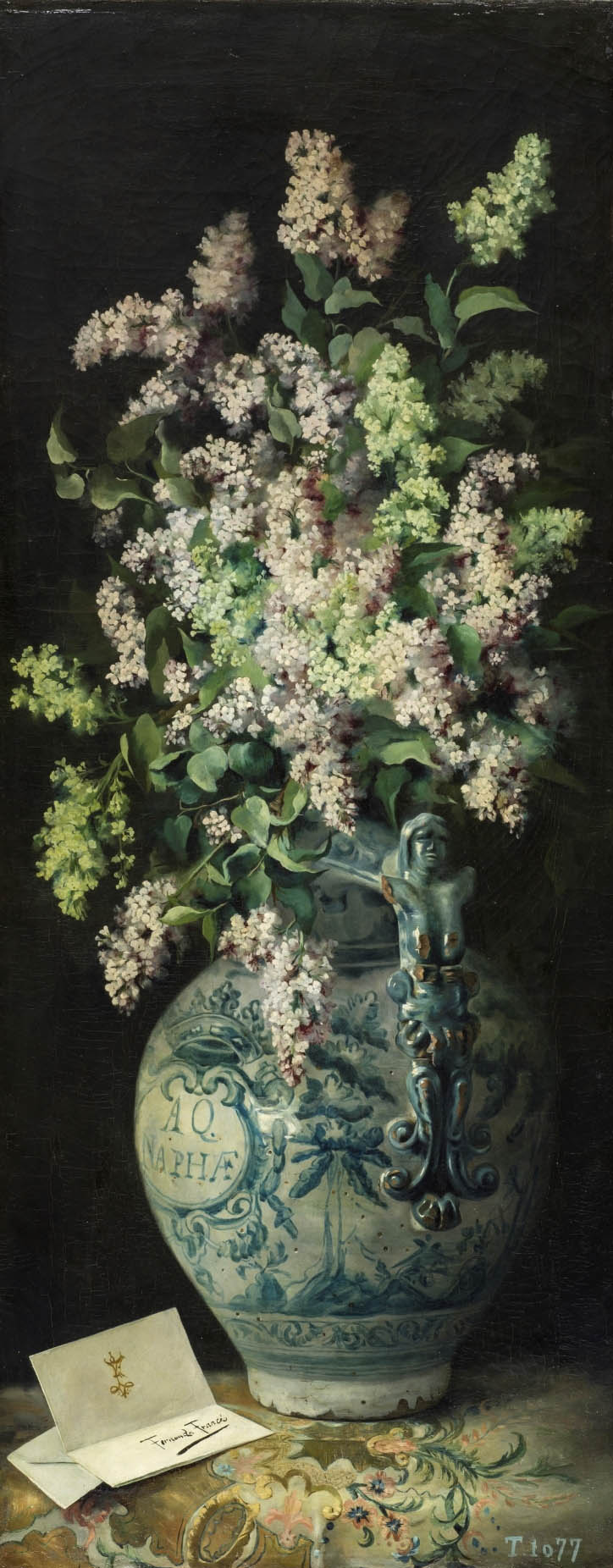
Fernanda Frances Arribas (Spanish, 1862−1939)
Vase of Lilacs
c. 1890
Oil on canvas
Height: 118.8 cm
Width: 47 cm
Madrid, Museo Nacional del Prado
Acquired by the State for the Museo Nacional de Pintura y Escultura (Museo del Prado), 1890; Museo de Arte Moderno, 1896-1971
A painter and teacher, Fernanda Francés enjoyed success and public recognition in the Spain of the Restoration. Specialising in flower painting and still lifes, and supported by clear critical acclaim, she won a second-class medal for this work at the 1890 National Exhibition. The profound realism of her art attracted a broad private clientele who kept her works in demand for several decades.
G. Navarro, Carlos, Invitadas. Fragmentos sobre mujeres, ideología y artes plásticas en España (1833-1931), Madrid, Museo Nacional del Prado, 2020, p.332 No. 92 on the Museo Nacional Del Prado website
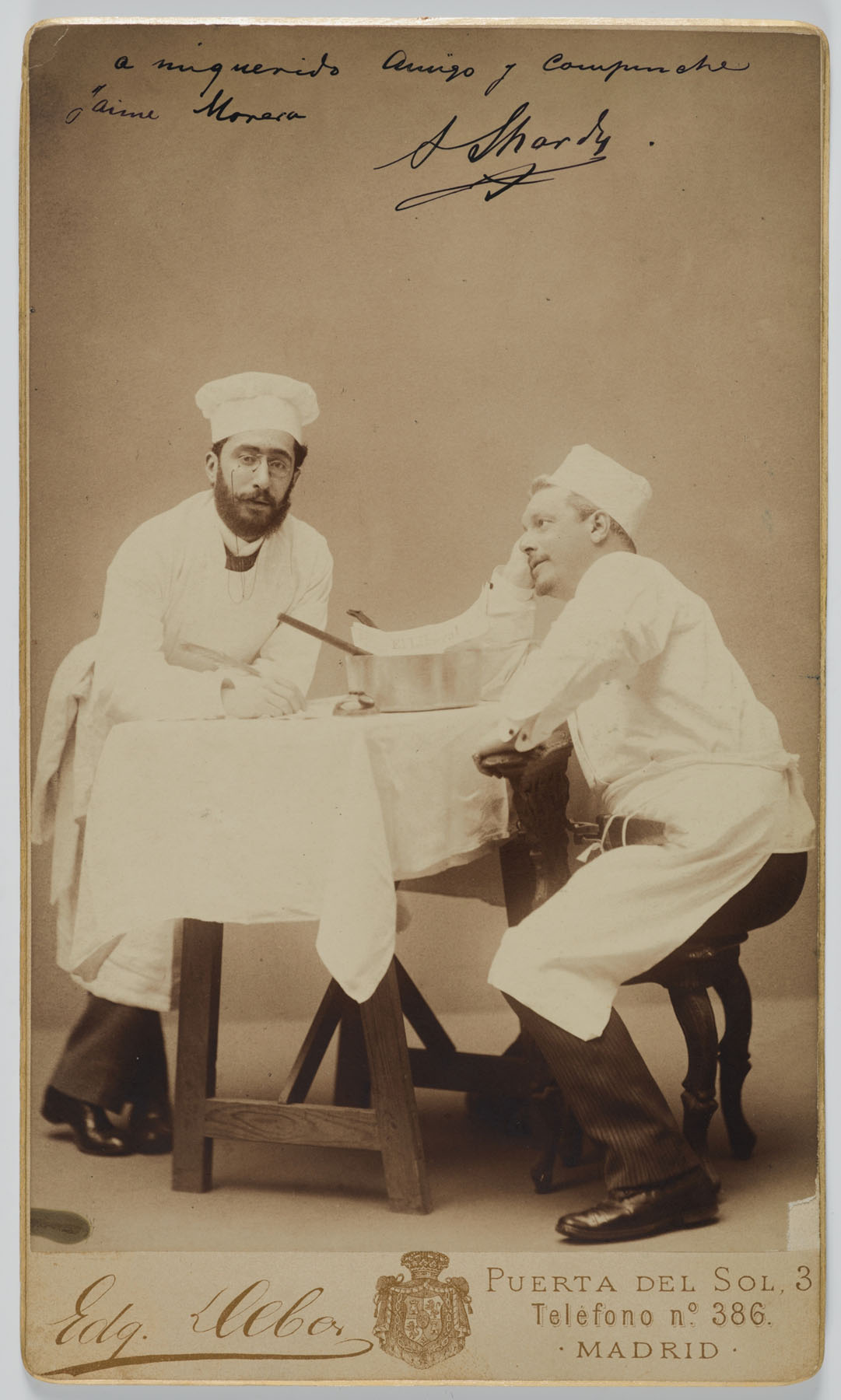
Edgardo Debas (Spanish, 1845-1891)
The painters Jaime Morera and Agustín Lhardy as chefs
c. 1880
Paris card
Albumen print
Madrid, Museo Nacional del Prado
Gift from Mario Fernández Albarés, 2024
© Museo Nacional del Prado
Pedro Edgardo Debas (Moulins, France, May 23, 1845 – Madrid, December 28, 1891). He was a photographer whose professional life took place in Madrid, where he began with his brother Fernando Debas. He specialised in portraits as well as collaborating with the illustrated press of the late nineteenth century, such as the Spanish and American Enlightenment and the nobles of the time. He settled in Madrid’s Puerta del Sol and had his apogee period between the eighties and nineties of the nineteenth century. He died on December 28, 1891. His widow Antonia Coronado took charge of the studio for at least the next ten years until in 1902 the photographer Pedro Calvet kept the studio and its entire photographic collection.
Text from the Wikipedia website translated from the Spanish by Google Translate
Jaume Morera i Galícia (Spanish, 1854-1927) was a Catalan landscape painter.
Agustín Lhardy Garrigues (Spanish, 1848-1918) Disciple of Carlos de Haes and student of the Special School of Painting, Sculpture and Engraving. For his pictorial work he won some awards at the national exhibitions of Fine Arts. An emaling copy of a landscape of his master earned him the second engraving medal at the National Exhibition of 1904, an example that connects him with the French reproduction engraving of the last quarter of the s. XIX, dedicated to interpreting contemporary painting. The first engraving medal was not obtained until the 1912 Exhibition for a set of prints engraved with etching. Lhardy was the disciple who most directly followed Haes’ line, both in the theme and in the practice of the technique, although he frequently used resins, gining his compositions a great pictorial effect. He worked copper sheets larger than Haes
Vega, J.: Estampas Catalog, Prado Museum, 1992 on the Museo Nacional Del Prado website
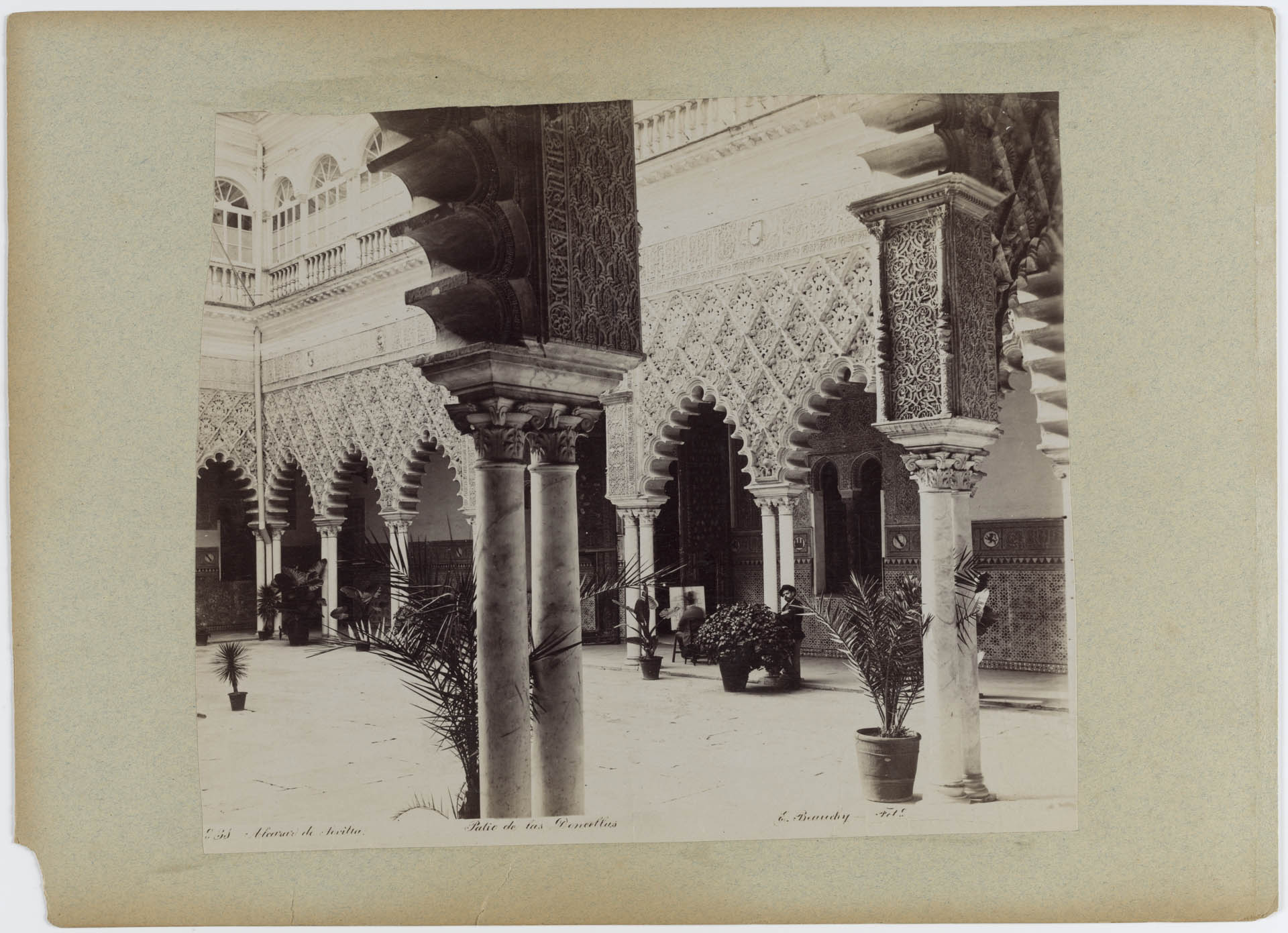
Emilio Beauchy (Spanish, 1849-1931)
A painter in the Patio de las Doncellas at the Alcázar in Seville
c. 1880
Albumen on paper
Madrid, Museo Nacional del Prado
Gift from Mario Fernández Albarés, 2024
© Museo Nacional del Prado
In the latter half of the 19th century, artistic practice moved beyond the traditional confines of the studio and expanded into new creative realms. Photography documented these outdoor forays, capturing the artist at work; at the same time, the setting itself – monument, city or landscape – gradually assumed greater prominence.
The photographer was Emilio Beauchy Cano (1849-1931), active in Seville between active 1881 and 1908.
Emilio Beauchy Cano (Seville, September 20, 1849 – Seville, January 15, 1931) was a Spanish photographer. Belonging to a family of photographers, he developed his work in Andalusia, and especially in Seville. He is considered one of the first Spanish photojournalists. His photographs, many of them marketed in albums, spread the image of Andalusia from the end of the 19th century.
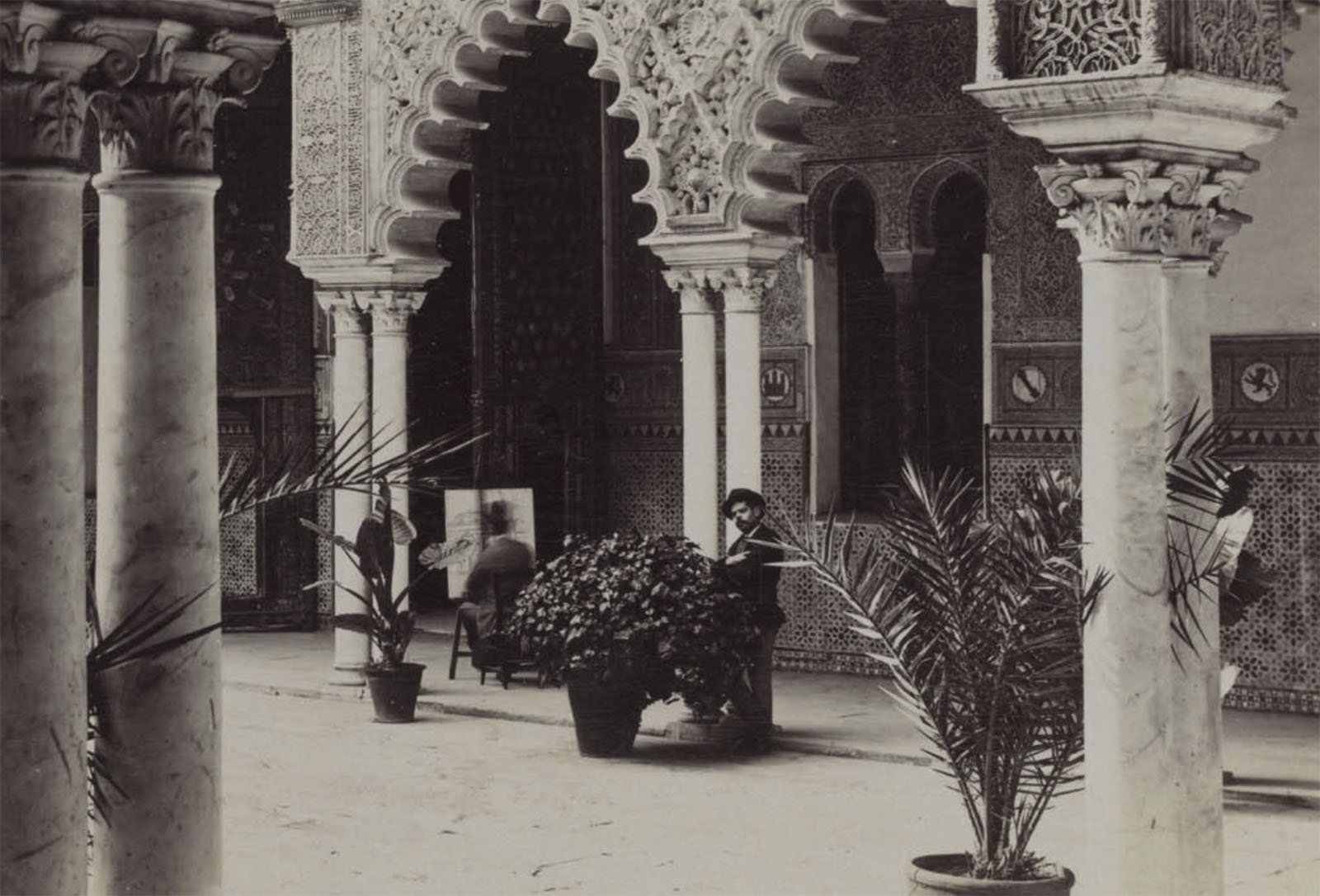
Emilio Beauchy (Spanish, 1849-1931)
A painter in the Patio de las Doncellas at the Alcázar in Seville
c. 1880
Albumen on paper
Madrid, Museo Nacional del Prado
Gift from Mario Fernández Albarés, 2024
© Museo Nacional del Prado
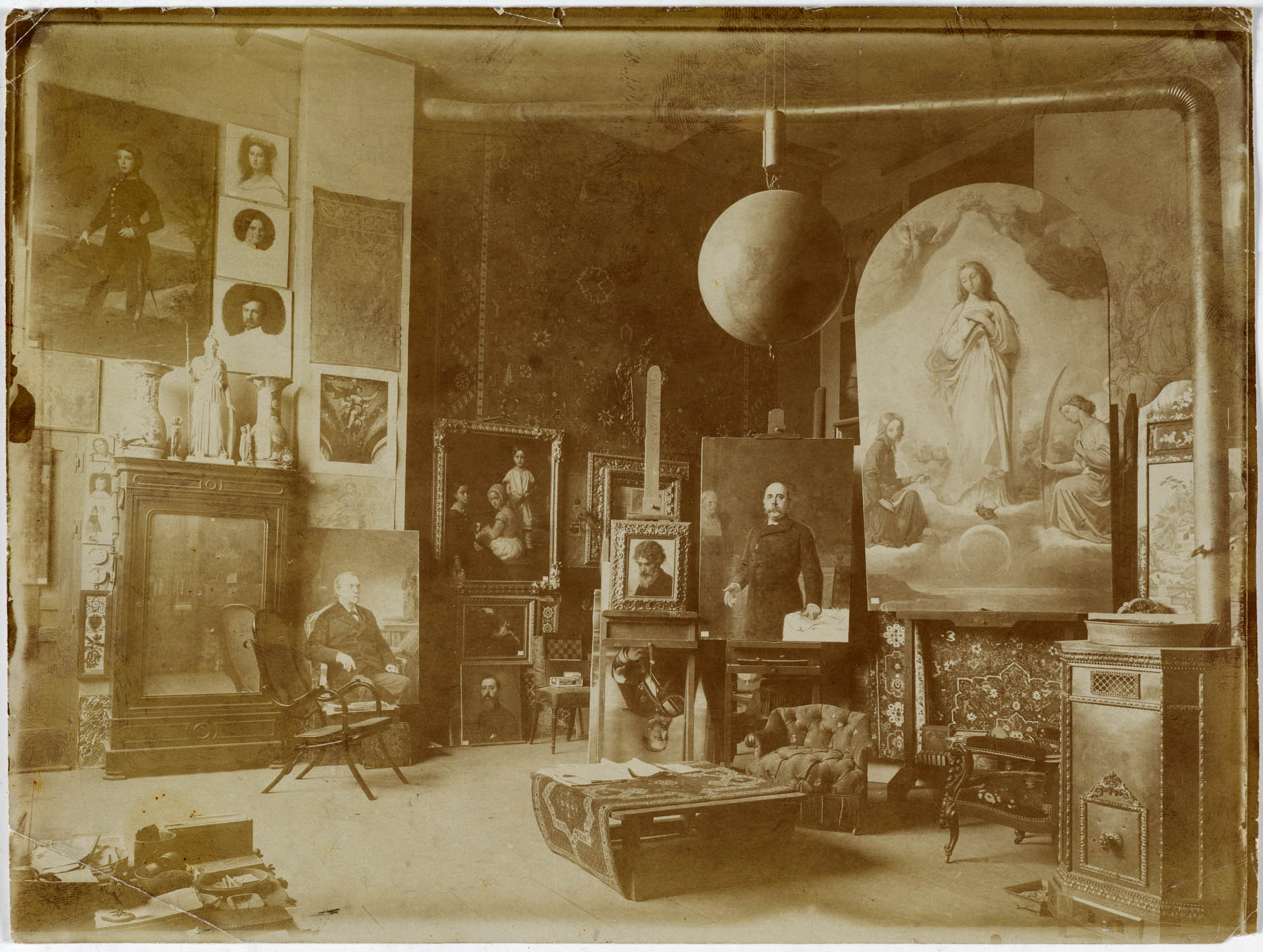
Unknown photographer
Federico de Madrazo’s studio in Madrid
1893
Gelatin/Collodion on paper
Height: 180 mm
Width: 240 mm
Madrid, Museo Nacional del Prado
Collection of the Madrazo family (José de Madrazo and his sons Federico, Luis and Juan de Madrazo y Kuntz); by inheritance to María Teresa Madrazo y Madrazo, 1897; Mario Daza Campos, 1940; Daza Juliá sisters, 1943; purchased from Juan José Daza del Castillo, 2006
© Museo Nacional del Prado
Federico de Madrazo (1815-1894) lived and worked in the former Calle de la Greda, now named Calle de Los Madrazo. The photograph shows the interior of his studio, with its furniture, stove and imposing globe; visible artworks include an unfinished portrait of Cánovas del Castillo, which the artist kept until his death, and now belongs to the Museo del Prado (P007063).
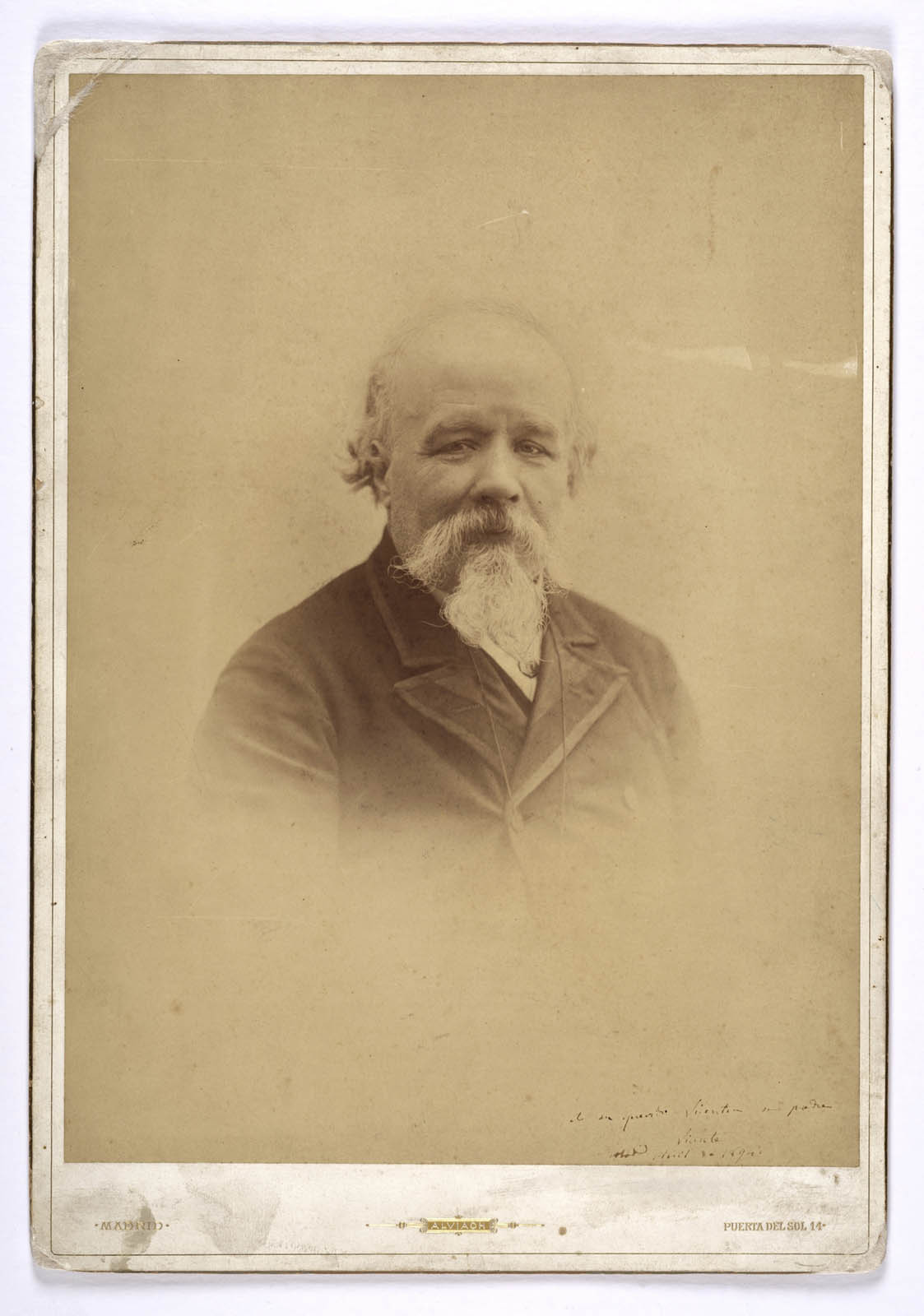
Manuel Alviach (Caspe (Zaragoza), 1845 – Madrid, 1924)
Vicente Palmaroli
c. 1894
Albumen on paper
Madrid, Museo Nacional del Prado
Carlota Rosales, 1958; her heirs, the Armiñán Santonja family, 2022; donated by the Fundación Amigos del Museo del Prado, through the Comisión Siglo XIX, 2022
© Museo Nacional del Prado
The painter Vicente Palmaroli (1834-1896) directed the Spanish Academy in Rome between 1883 and 1891, and the Museo del Prado from 1894 until his death. For this portrait by Manuel Alviach, he opted for a large-format photograph, designed to be framed or displayed, rather than a painted likeness.
This portrait of Vicente Palmaroli made by the photographer Manuel Alviach (1846-1924) is a large albumen copy, mounted on a second cardboard support, which has a dedicatory inscription in the handwriting of the sitter: “to my dear Vicentín his father / Vicente. Madrid April 1894.” In the year in which the photograph is dated, the artist began his career as director of the Prado Museum and was photographed by one of the most famous professionals of the time, who had his studio in Madrid’s Puerta del Sol. Upon losing her father so prematurely, Carlota Rosales lived protected and educated by Vicente Palmaroli, who raised her as if she were his own daughter. He only had one son – Vicente Palmaroli Reboulet – who, upon his death, left all his assets to Carlota, whom he considered his sister, and this is the reason why the photograph of Vicente (father) dedicated to Vicentín (son) was in the possession of the descendants of Rosales’ daughter.
Sánchez Torija, Beatriz, ‘Varios autores. Dibujos y fotografías que pertenecieron a Carlota Rosales, segunda mitad del siglo XIX’. En: Memoria de Actividades 2022, Ministerio de Cultura y Deporte, 2023, p.154-157 on the Museo del Prado website translated from the Spanish by Google Translate
Manuel Alviach (Caspe (Zaragoza), 1845 – Madrid, 1924) Photographer. One of the best-known portrait photographers in late 19th-century Madrid. He worked as an assistant in Napoleon’s studio – specifically as a “portrait photographer’s assistant” – in Barcelona in 1862, and is later documented in Girona as well. In the 1870s, he settled in Madrid and, in 1872, opened a studio at Puerta del Sol 14, which he kept in operation until at least 1900. Alviach was part of the editorial board of the photographic magazine “Daguerre. Society of Established Photographers,” which also featured contributions from other important photographers of that era.
Information taken from the Census-Guide of Archives of Spain and Latin America of the Ministry of Culture and the Clifford Directory. Portal of 19th-Century Photographers in Spain.
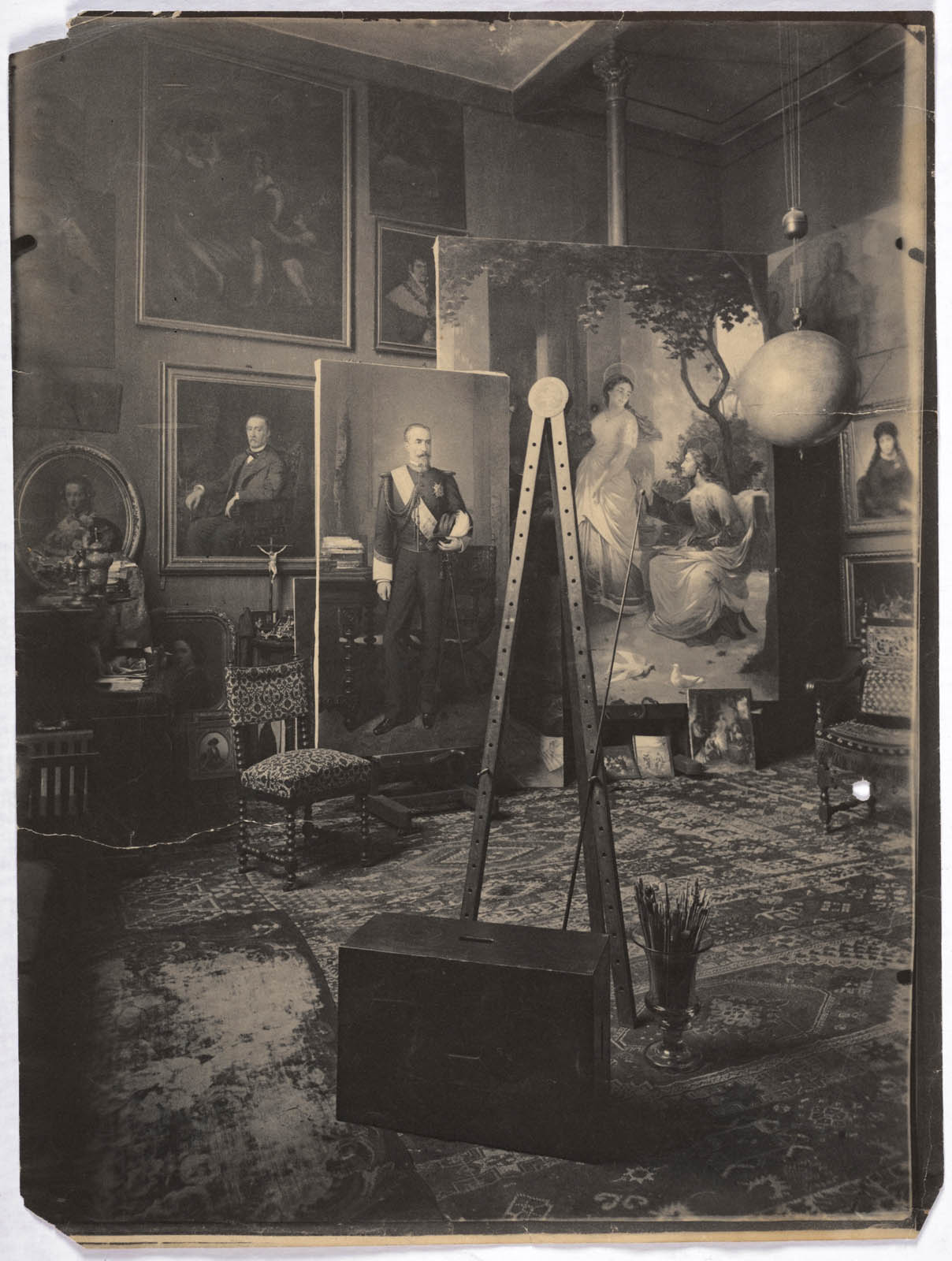
Unknown photographer
Luis de Madrazo’s studio in Madrid
1885-1895
Platinotype on paper
Height: 238 mm
Width: 179 mm
Madrid, Museo Nacional del Prado
Collection of the Madrazo family (José de Madrazo and his sons Federico, Luis and Juan de Madrazo y Kuntz); by inheritance to María Teresa Madrazo y Madrazo, 1897; Mario Daza Campos, 1940; Daza Juliá sisters, 1943; purchased from Juan José Daza del Castillo, 2006
© Museo Nacional del Prado
This is one of a set of photographs – part of the Prado’s collection – showing the interior of the studio set up by Luis de Madrazo (1825-1897) at his home in Calle Caballero de Gracia, in Madrid. The painter’s tools are placed in the foreground, while the rear wall is taken by a number of paintings. Chief among these – due to its large format – is Jesus appears to the Holy Women; a preparatory sketch for the picture leans against the wall beneath the painting.
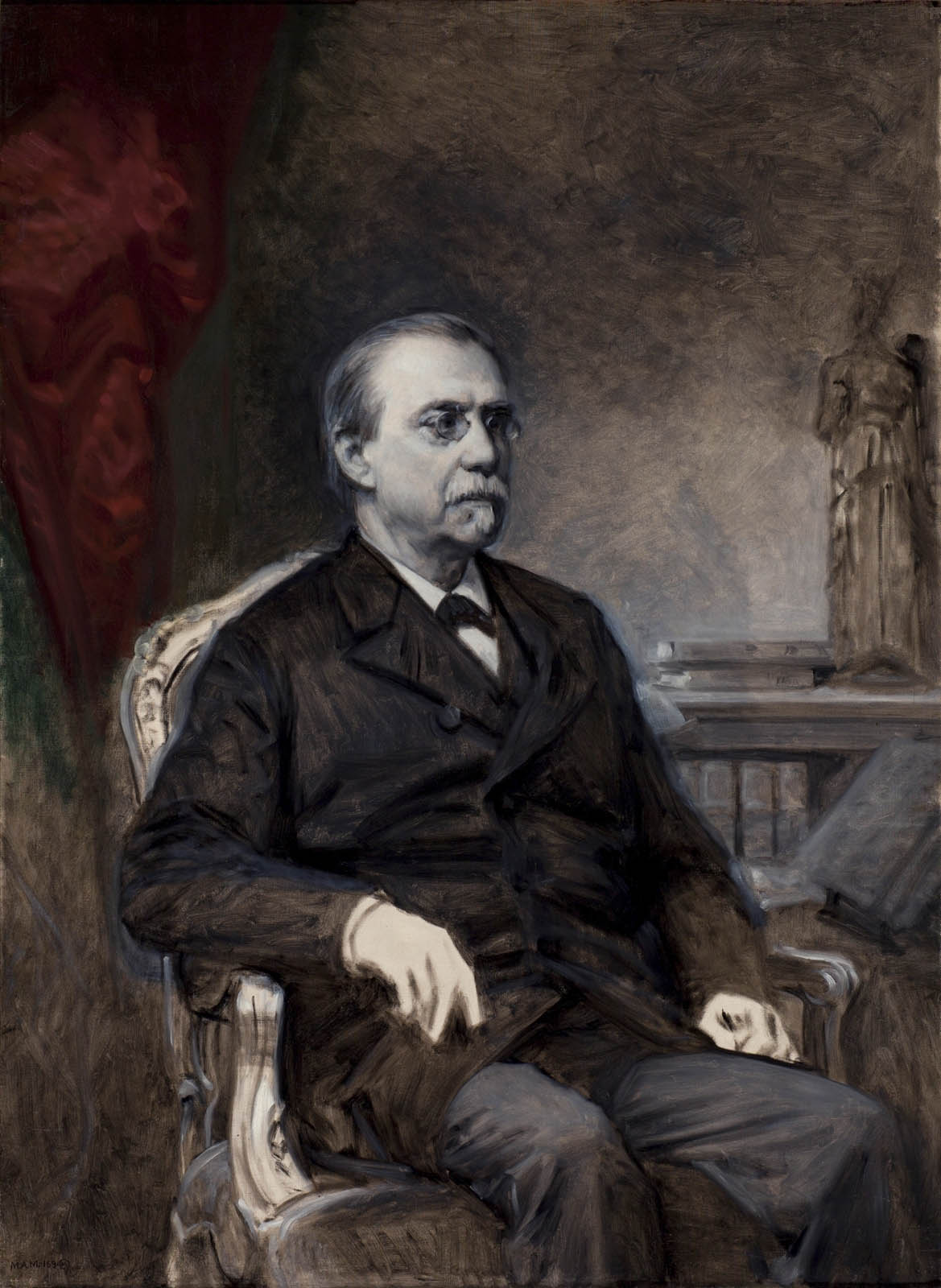
Federico de Madrazo y Kuntz (Rome (Italy), 1815 – Madrid (Spain), 1894)
Antonio Cánovas del Castillo
1889
Oil on canvas
Madrid, Museo Nacional del Prado
© Museo Nacional del Prado
Federico de Madrazo y Kuntz (9 February 1815 – 10 June 1894) was a Spanish painter. …
While decorating the palace of Vista Alegre he took up portraiture. In 1832 he went to Paris, where he studied under Franz Winterhalter, and painted portraits of Baron Taylor and Ingres. In 1837 he was commissioned to produce a picture for the gallery at Versailles, and painted “Godfrey de Bouillon proclaimed King of Jerusalem”. The artist then returned to Rome, where he worked at various subjects, sacred and profane. Then he painted Maria Christina in the Dress of a Nun by the Bedside of Ferdinand III (1843), Queen Isabella, The Duchess of Medinaceli, and The Countess de Vilches (1845-47), besides a number of portraits of the Spanish aristocracy, some of which were sent to the exhibition of 1855.
He received the Legion of Honour in 1846. He was made a corresponding member of the Académie des Beaux-Arts on 10 December 1853, and in 1873, on the death of Schnorr, the painter, he was chosen foreign member. Three years after his father left office, he also became Director of the Museo del Prado and president of the Academy of San Fernando. He originated in Spain the production of art reviews and journals, such as El Artista, El Renacimiento, and El Semanario pintoresco. He died in Madrid.
His brother, Luis de Madrazo, was also known as a painter, chiefly by his Burial of Saint Cecilia (1855). Federico’s best-known pupils were his sons, Raimundo and Ricardo.
Text from the Wikipedia website
Antonio Cánovas del Castillo (Málaga, 1828 – Mondragón, Guipúzcoa, 1897) was an historian and politician. He is depicted three-quarter length and seated and is framed by a curtain on the left and, possibly, a statue of Pallas Athena on the right. As it is unfinished, the painter’s work method can be appreciated. He applied the colours over a generalised layer of grey, which provides it with the warm tonality of most of his portraits.
Since 2009, Room 60 at the Museo del Prado – relabelled “Open Warehouse” in 2026 – has been designed as a space for displaying the museum’s 19th century holdings as part of the permanent collection.
It has hosted small-scale exhibition projects spanning a range of perspectives: monographic shows highlighting artists such as Aureliano de Beruete, Miguel Blay, Rogelio de Egusquiza, Antonio María Esquivel, Federico de Madrazo, Jenaro Pérez Villaamil, Francisco Pradilla, Eduardo Rosales, Joaquín Sorolla and José de Madrazo (drawings); displays addressing specific techniques, including watercolours and Japanese prints; presentations linked to donations, such as the Rudolf Gerstenmaier bequest; and surveys dealing with particular themes, for example religious painting and child portraits.
Photography, while playing a part in some of these projects and recently taking centre stage in The Prado multiplied: Photography as shared Memory, again provides the core focus for The Artist’s World through the Camera, an exhibition devoted to the artists’ images and their creative spaces.
The advent of the new art of photography in the 19th century paved the way for an unprecedented and extraordinarily effective means of representing reality. Artists were quick to grasp the potential of this transformation: they photographed themselves both alone and in company, documented their workspaces and kept a careful visual record both of the creative process and of the completed oeuvre.
One of the earliest genres favoured by photography was the portrait, regarded not just as a record of identity and an affirmation of one’s own image but also as proof of the sitter’s social status. Through carefully considered poses, and using attributes intended to define the subject, as well as appropriate professional attire, the photographers – and the sitters themselves – constructed a visual language that enabled them to project the desired image.
In the latter half of the 19th century, visiting a photographer’s studio to have one’s portrait taken was a social event. Portrait studios – sometimes referred to as “glass cabins” in contemporary texts – were generally situated on the upper floors of buildings, and featured large windows to ensure plenty of natural light. They soon proliferated in cities, where they prompted growing competition, leading to the emergence of various kinds of specialist studios and a gradual fall in prices.
Smaller photograph formats – the carte de visite, the promenade card and the Paris card – were mainly intended for individual portraits, while larger formats provided the ideal solution for group compositions.
The group portraits in this exhibition focus on membership of a professional body or on the celebration of a particularly important event. The careful composition of the pictures – as well as press advertisements and notes on the back of the cardboard supports – indicate that some of the photographers showcased here had trained in the fine arts; this undoubtedly facilitated their dealings with other professional artists.
Drawing on the Museo del Prado’s holdings, including the archives of numerous artists – among them Luis and Federico de Madrazo, Dióscoro Puebla, Rafael Rocafull, Cecilio Pla, Agustín Querol, Miguel Blay, Fernanda Francés and Manuel González Santos – this exhibition brings together photographs both by leading professionals and by anonymous, possibly amateur photographers. This collection of prints, produced using a whole range of techniques and formats, allows us to visually chart the artist’s presence in his studio, in various social and educational spaces and in alternative creative settings, such as the evocative Patio de las Doncellas at the Real Alcázar in Seville.
Artists’ studios are spaces fraught with symbolic significance, where inspiration, careful observation and creation converge within a single creative process. The venues pictured here provided the setting not just for the production of art but also for social gatherings, for tuition and even – at times –for a veritable cabinet of curiosities, in which works of art were displayed alongside antiques and collectors’ items, as in Mariano Fortuny’s famous atelier in Rome.
Studios tended to be spacious rooms, designed to house significant collections of works – particularly bulky in the case of sculptures – as well as furniture, an area set aside for the models and their props, and the tools of the artist’s trade. Added to all this was an assortment of the artist’s personal keepsakes, mementoes of his life and career, which helped to heighten his prestige.
In this context, the portraits of painters such as Raimundo de Madrazo in his Paris studio or Luis Sainz at the Casa de los Estudios in Madrid, and of sculptors like Aniceto Marinas accompanied by his models, Mariano Benlliure with the writer Federico García Sanchiz and Agustín Querol proudly posing beside a detail from his allegory of the Arts for the pediment of the National Library, offer a glimpse into the creative world of their studios.
Special mention should be made of the portrait of María Luisa de la Riva in her Paris studio, which, together with pictures of some female students in classes taught by Cecilio Pla – including Carolina del Castillo – and by Manuel González Santos, testifies to the increasingly common presence of women in these creative spaces.
The selected photographs also chart the various stages in the creation of a single work of art, particularly well documented in cases such as the sculpture for the monument to Mariano Moreno, by Miguel Blay, commissioned in 1909 by the National Commission for the Centenary of Argentine Independence.
The exhibition The Artist’s World through the Camera pays tribute to the creative careers of those men and women who, in the 19th and early 20th centuries, recognised photography as the ideal medium for ensuring a lasting record of their image and their artistic practice.
Exhibition brochure text
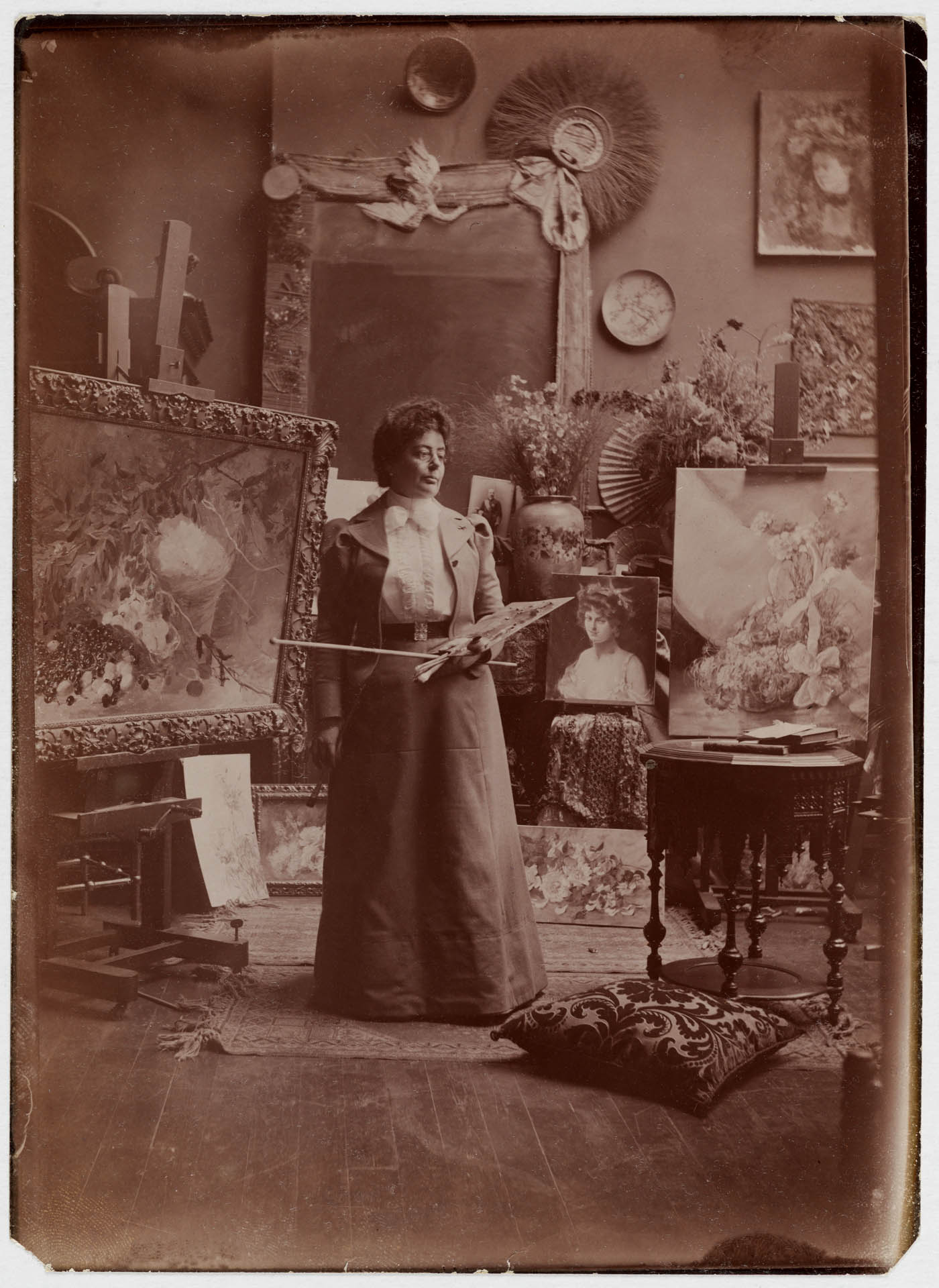
Unknown photographer
María Luisa de la Riva in her Paris studio
c. 1900
Gelatin/Collodion on paper
Height: 178 mm
Width: 129 mm
Madrid, Museo Nacional del Prado
Collection of Lidia Ortiz Maqueda; Barcelona, Juan Naranjo Auctions. Art & Documents Gallery, May 30, 2024, lot 91; Acquired by the Museo del Prado, 2024
© Museo Nacional del Prado
Rather than “a distinguished amateur painter,” as she was described by the writer Manuel Ossorio y Bernard in 1883, María Luisa de la Riva was – as she herself stated in some of her letters – a “professional painter who works for a living,” with a long and successful career. She is pictured here, at the age of 41, in her studio, surrounded by her works and the props used in some of her compositions.
Luisa de la Riva was a Spanish painter specialising in still life and flower paintings. She was an honorary member of the Sociedad de Amigos del País in Santiago de Compostela and a member of the Society of Artists in Berlin and Vienna. She was awarded the Palm of the French Academy and the Order of the Nischam Yfttikai of Tunisia. She studied with sculptor Mariano Bellver and painter Antonio Pérez Rubio.
She participated in numerous exhibitions and contests, receiving an honorable mention at the National Exhibitions of Fine Arts in 1887 and 1895. She won third medals in the 1897 and 1901 exhibitions for her paintings titled “Uvas de España” and “Frutas de verano,” and a second medal in the 1920 edition for “Uvas y granadas.” Additionally, she was awarded a third medal at the Exposition Universelle in Paris in 1889 and at the Universal Exposition in Barcelona in 1898
Balbás Ibañez, Mª S. in Enciclopedia del Museo Nacional del Prado, 2006, vol. V, p. 1880 on the Museum del Prado website
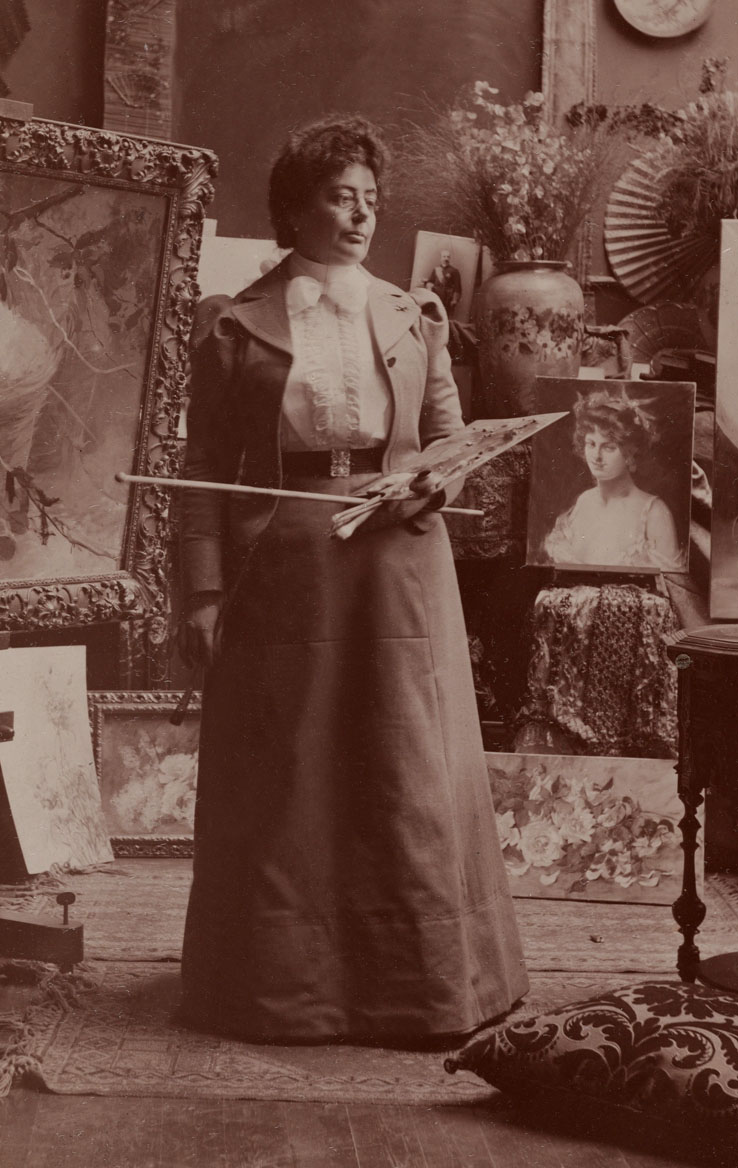
Unknown photographer
María Luisa de la Riva in her Paris studio (detail)
c. 1900
Gelatin/Collodion on paper
Height: 178 mm
Width: 129 mm
Madrid, Museo Nacional del Prado
Collection of Lidia Ortiz Maqueda; Barcelona, Juan Naranjo Auctions. Art & Documents Gallery, May 30, 2024, lot 91; Acquired by the Museo del Prado, 2024
© Museo Nacional del Prado
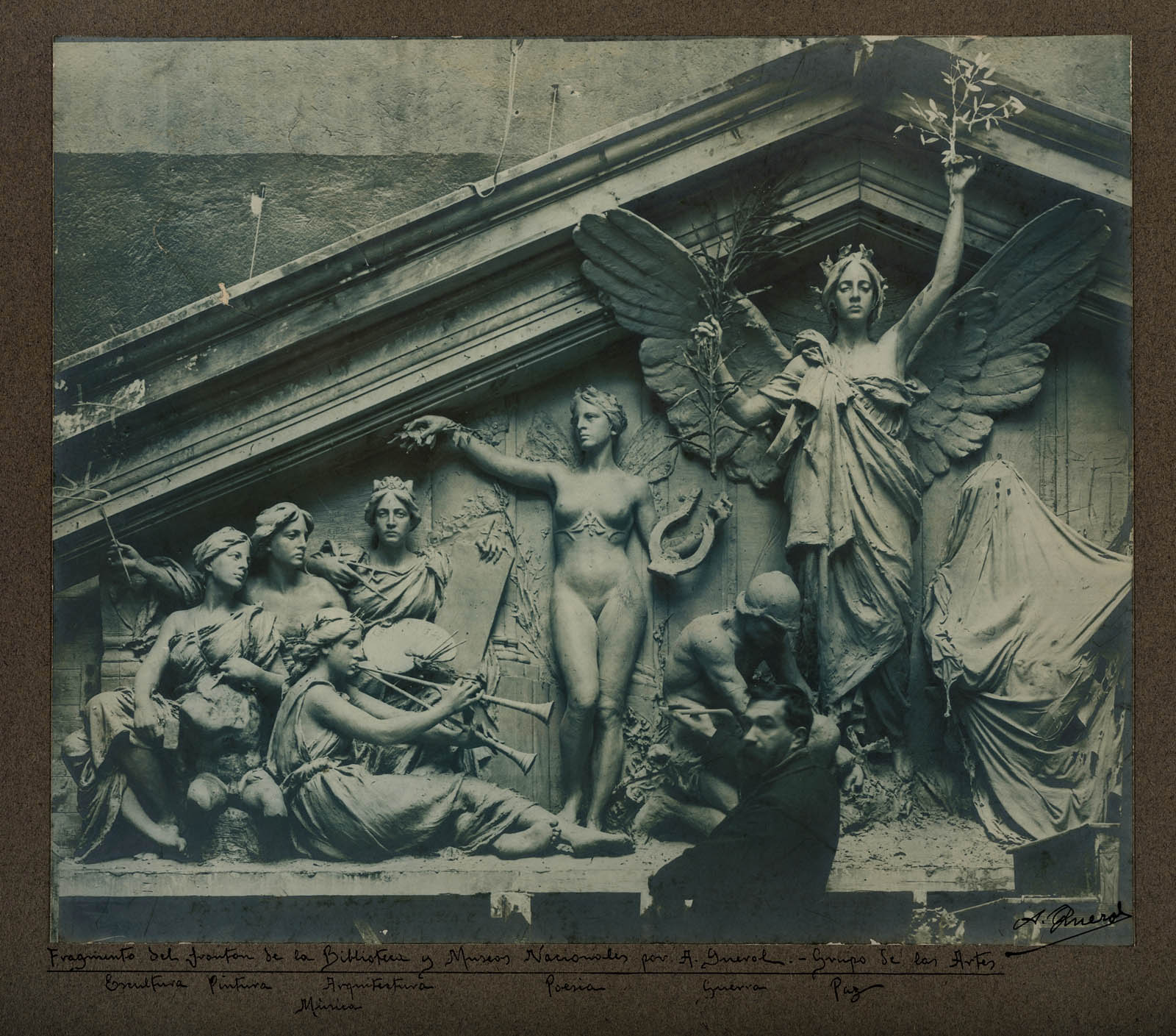
Attr. to the Count of Polentinos (Spanish, 1873-1947)
(Conde de Polentinos, historically Francisco Colmenares or Aurelio de Colmenares y Orgaz)
Agustín Querol modelling the pediment for the National Library
1902
Gelatin/Collodion on paper
Madrid, Museo Nacional del Prado
Gift from Mario Fernández Albarés, 2022
© Museo Nacional del Prado
“These pieces, which are at last leaving my studio, form the pediment for the National Library and Museum, a commission I won in the ’92 competition. I think it may be put up in a few days’ time.” With these words, published in the magazine Vida Galante in 1902, Agustín Querol announced the completion of one of his landmark works, beside which he proudly posed.
Conde de Polentinos typically refers to Aurelio de Colmenares y Orgaz (1873–1947), a Spanish aristocrat, historian, and renowned pioneer of stereoscopic photography (3D photography). He extensively documented Spanish heritage, landscapes, and society in the early 20th century.
He shot nearly 10,000 glass plate photographs between 1894 and 1931, which capture everything from architectural heritage to daily social customs and landscapes.
Text from the Instituto del Patrimonio Cultura de Espana website
Agustí Querol Subirats (Agustín Querol) (Spanish, 1860-1909) was a Spanish sculptor, born in Tortosa, Catalonia, Spain. Born to a poor family, the son of a baker, Querol was educated under Ramon Cerveto Bestraten (1829–1906). At the age of 18, he left his job at his father’s bakery and moved to Barcelona, where he worked as an apprentice at the studios of Domingo Talarn and of the Vallmitjana Brothers. He also attended sculpture classes at the Escola Provincial de Belles Arts (called colloquially “la Llotja”). He studied dissection and anatomy at the Hospital de la Santa Creu in Barcelona, then won a scholarship to study in Rome.
Based in Madrid from 1890, he was responsible for many monuments, sculptures, and project proposals through much of the Spanish-speaking world. Querol’s work is characterised by the same romantic style, fluid modelling, wealth of detail and technical skill as his French fin de siècle contemporaries like Jules Dalou, but Querol’s work is even more dynamic and profuse. The pediment for the Biblioteca Nacional de España, for instance, is crowded with 19 separate figures. All of his major designs are equally busy.
Text from the Wikipedia website
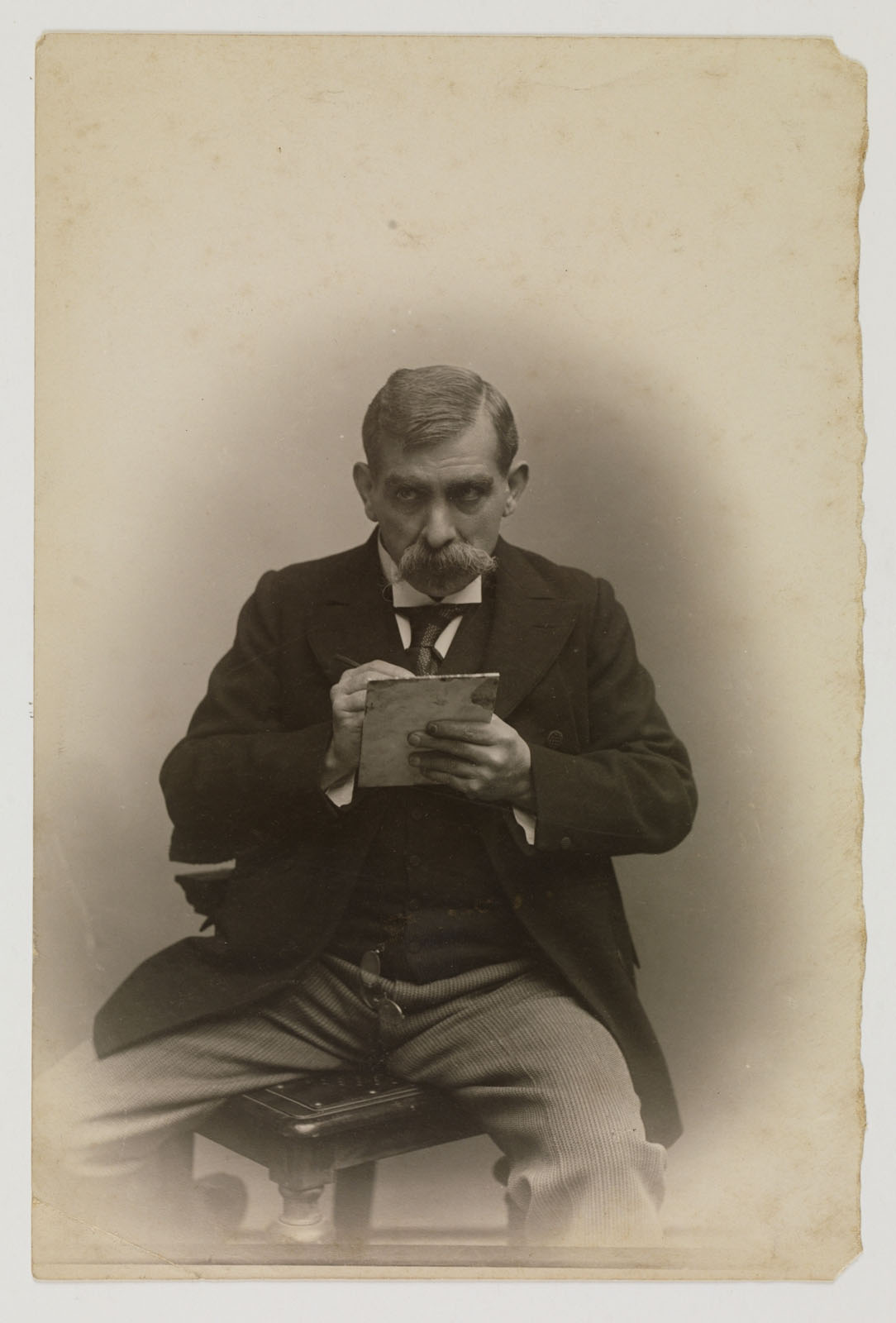
Unknown photographer
The painter Emilio Sala, drawing
1904-1910
Gelatin/Collodion on photographic paper
Height: 176 mm
Width: 118 mm
Madrid, Museo Nacional del Prado
Gift from the Ellacuria Delgado family, 2018
© Museo Nacional del Prado
Emilio Sala y Francés (20 January 1850 – 14 April 1910) was a Spanish painter, primarily of female portraits.
He was born in Alcoy to a family of merchants. His first studies were at the Real Academia de Bellas Artes de San Carlos de Valencia with Plácido Francés y Pascual, his cousin. In 1871, he had his first public showing at the National Exhibition of Fine Arts and won First Prize there in 1878. He also opened a studio in Madrid and took part in decorating the Anglada and Mazarredo palaces, the ceilings of the Café de Fornos (now gone), and the Cantina Americana.
In 1885, after failing to receive a Professorship at the “School of Arts and Crafts”, he applied for and received a fellowship to study at the Spanish Academy in Rome but, two years later, was granted leave to study in Paris instead. At the Exposition Universelle (1889) he presented his now-famous painting Expulsion of the Jews from Spain, only to discover that the French public apparently no longer appreciated historical works, so he presented it in Spain, where it was better received. In 1890, perhaps as a result of this experience, he abandoned that subject in favor of genre scenes, landscapes, and illustrating.
In 1896, he returned to Spain, where he married and reopened his studio. Many of his works appeared in the magazine Blanco y Negro. He also illustrated some of the Episodios Nacionales of Benito Pérez Galdós. and created decorations for the palace of the Infanta Isabella, which were highly praised. Overall, however, his portraits stand out.
In 1906, he once again applied for an academic position, this time at the Escuela de Bellas Artes de San Fernando, and was rejected in favour of Ramón Menéndez Pidal. As compensation, the school created a chair in the “Theory and Esthetics of Color” especially for him. He held that post until his death, from heart failure, in 1910 in Madrid. Among his many honors are the Grand Cross of the Order of Isabel the Catholic and the Cross of the Order of St. Michael (Bavaria), presented at an exhibition in Munich in 1885.
Text from the Wikipedia website
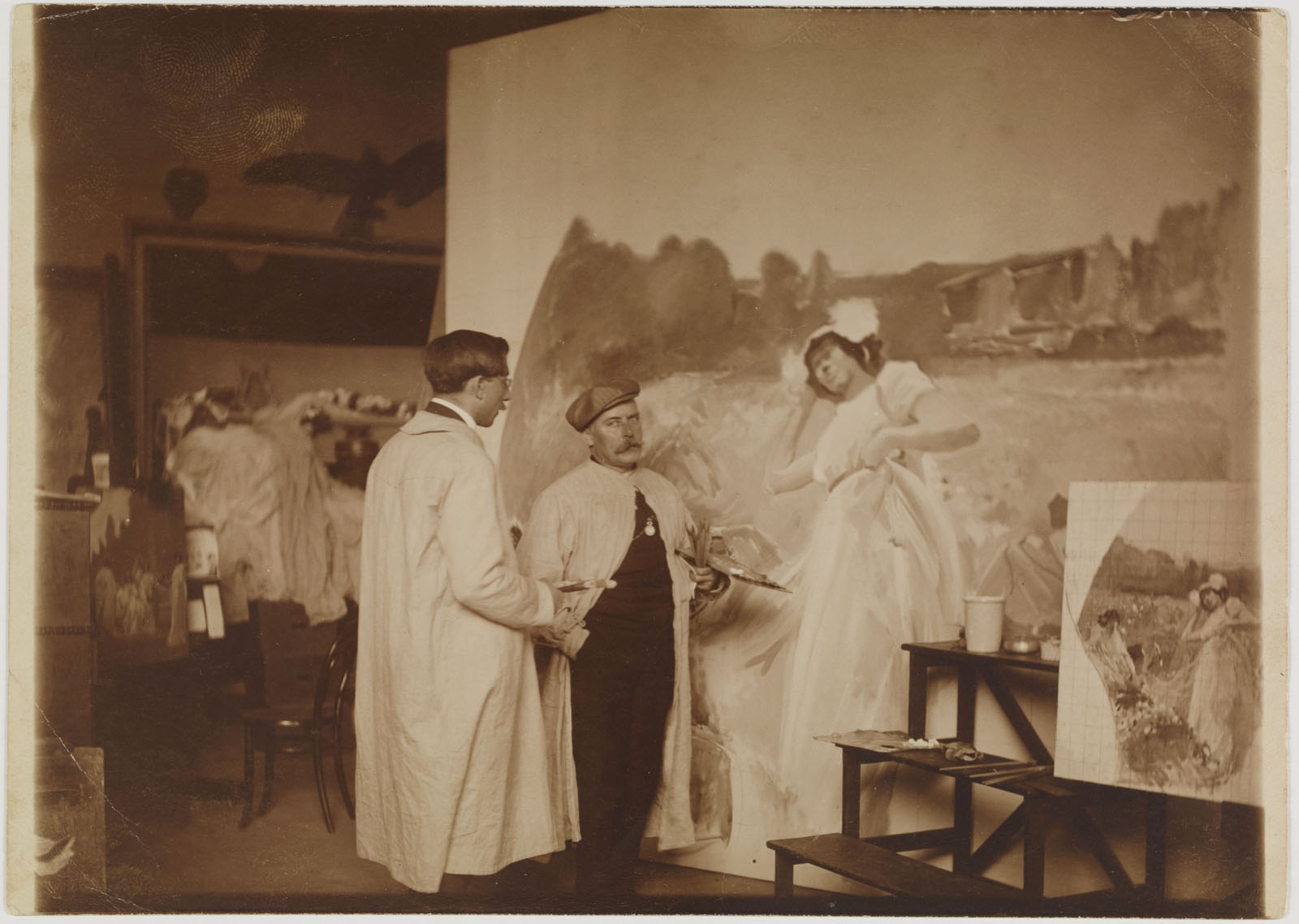
Unknown photographer (Author of the original work: Cecilio Plá y Gallardo)
Cecilio Plá in his studio with Mariano Miguel, beside one of the canvases destined for the Casino de Madrid
1910
Gelatin/Collodion on photographic paper
Height: 128 mm
Width: 179 mm
Madrid, Museo Nacional del Prado
Gift from the Ellacuria Delgado family, 2018
© Museo Nacional del Prado
Cecilio Plá is depicted in his studio on Calle Carranza, surrounded by his work tools. He is accompanied by Mariano Miguel González (1885-1954), one of his pupils who also helped him as an assistant teacher. Both are portrayed next to one of the canvases intended for the Royal Hall of the Casino de Madrid, a work in which Cecilio Plá was assisted by his pupil, who was the artistic director of the Madrid-produced magazine Por esos mundos. On the lower right-hand side Cecilio Plá’s sketch is discernible, with the grid still visible and from which the painter made the large composition for the Casino. The latter occupies most of the photograph.
In January 1909, Emilio Sala was commissioned to produce these paintings. Sala developed a complete iconographic plan for the ceiling of the Royal Hall. However, he was unable to complete it, as he died suddenly on 14 April 1910. Plá, who must have been very familiar with the project, continued with the commission using some sketches left by his mentor. All of the panels are canvases attached to the wall and, although they were completed by two different artists, upon entering the Royal Hall the viewer perceives an entirely coherent decorative programme.
Cecilio Plá y Gallardo (22 November 1860 – 4 August 1934) was a Spanish painter and illustrator.
Cecilio Plá was born in Valencia. As a child, he studied music at the Escuela de Artesanos de Valencia [es], in accordance with the wishes of his father, who was the bandleader and arranger for the Teatro Principal. Later, he followed his own desires to be an artist and continued his studies at the Instituto San Pablo and the Real Academia de Bellas Artes de San Carlos. After winning a silver medal at the Exposición de Valencia in 1879, he moved to Madrid with a friend, where he entered the Real Academia de Bellas Artes de San Fernando, becoming a student of Emilio Sala.
The following year, after travelling through Portugal, France and Italy, he settled in Rome. From there, he sent home numerous works, mostly in the Costumbrismo genre, which showed the influence of Marià Fortuny. Some were shown at the National Exhibition of Fine Arts, winning medals in 1884 and 1887 for paintings on Italian subjects. He received many more medals over the next two decades, including a Medal of Honor at the Exposition Universelle (1900). From 1893 to 1910, he drew illustrations for several periodicals, including La Ilustración Española y Americana, and Blanco y Negro.
In 1910, he began his career as a teacher at the Academy of San Fernando, succeeding Sala in the Chair of “Color Aesthetics and Painting Procedures”, which he held until his retirement in 1931. He was named an Academician in 1924. His dedication to teaching drastically reduced his artistic output. Juan Gris was, perhaps, his best-known student. He also published a “Pictorial Art Primer”.
In addition to his paintings and drawings, he worked on many public projects, completing the work begun by Sala at the Casino de Madrid and providing decorations for the Círculo de Bellas Artes. He died in Madrid, aged 73.
Text from the Wikipedia website
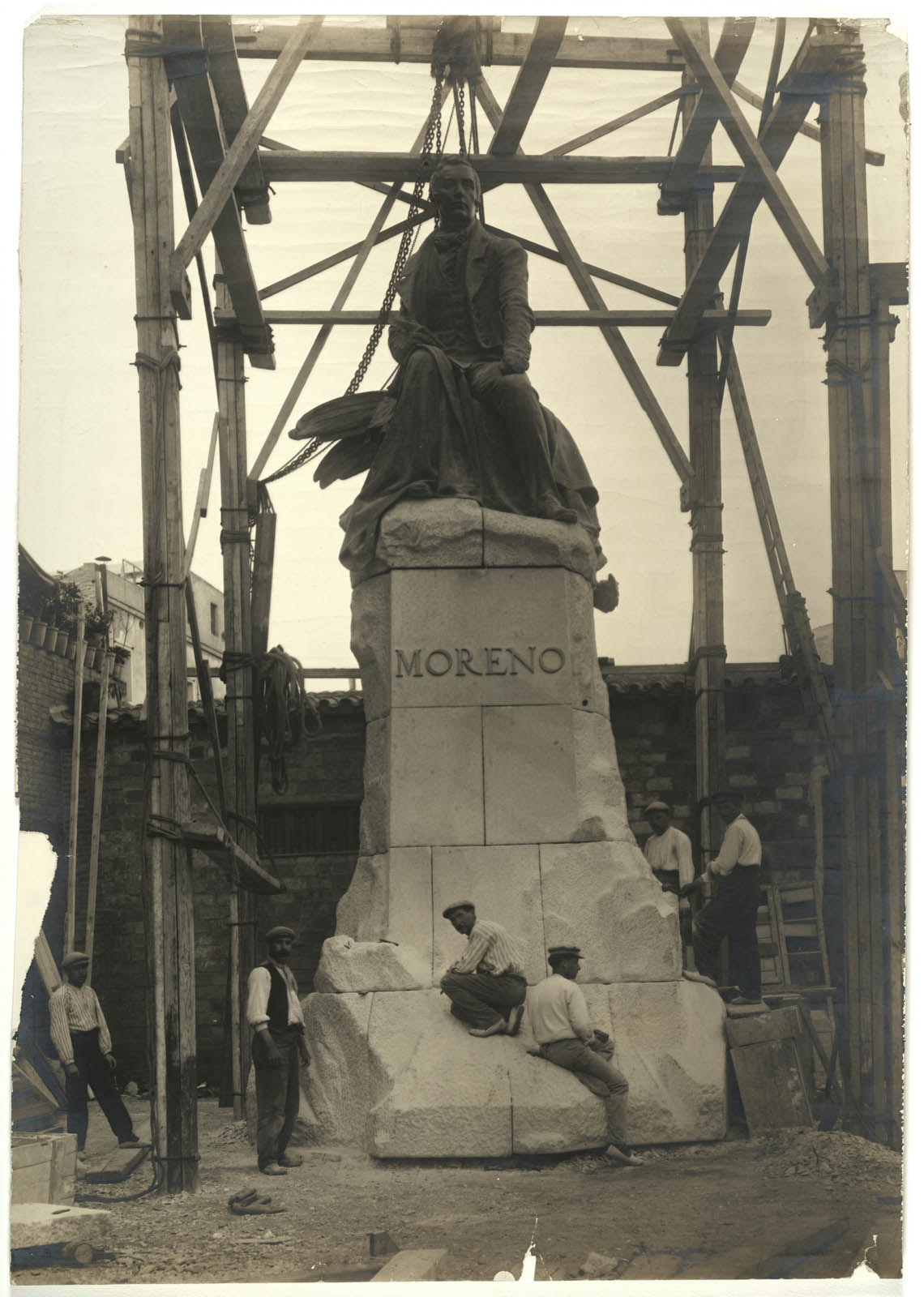
Unknown photographer / Attr. to José Padró (Spanish, 1881-1931) (Author of the original work: Miguel Blay y Fábrega (Olot, Gerona (Spain), 04.10.1866 – Madrid (Spain), 22.01.1936)
Fitting the pedestal for Miguel Blay’s monument to Mariano Moreno, prior to sending it to Buenos Aires
1910
Gelatin/Collodion on photographic paper
Height: 595 mm
Width: 420 mm
Madrid, Museo Nacional del Prado
Miguel Blay Collection; Sisters Margarita and Berta Blay Pichard; Gift from Mario Fernández Albarés, 2020
© Museo Nacional del Prado
The Barcelona workshop headed by Manuel Morales was responsible for casting Mariano Moreno’s sculpture in bronze, while Federico Bechini’s workshop – also in Barcelona – was entrusted with the stone carving and assembly of the pedestal. The photograph shows the various pieces being worked and fitted prior to packing for dispatch to Argentina.
Miguel Blay y Fàbregas (in Catalan, Miquel Blay i Fàbregas) (8 October 1866, Olot – 22 January 1936, Madrid) was a Spanish sculptor.
Museo Nacional Del Prado
Paseo del Prado, s/n,
28014 Madrid, Spain
Opening hours:
Monday – Saturday 10am – 8pm
Sunday 10am – 7pm


You must be logged in to post a comment.