Exhibition: ‘Joel Sternfeld: Colour photographs since 1970’ at Albertina, Vienna

Exhibition dates: 27th June – 7th October 2012


Many thankx to the Albertina for allowing me to publish the photographs in the posting. Please click on the photographs for a larger version of the image.


Joel Sternfeld (American, b. 1944) 'A Railroad Artifact, 30th Street, May 2000' 2000


Joel Sternfeld (American, b. 1944)
A Railroad Artifact, 30th Street, May 2000
2000
© Courtesy of the artist, Luhring Augustine, New York and The Friends of the High Line, New York


Joel Sternfeld (American, b. 1944) 'Ken Robson's Christmas Tree, January 2001' 2001


Joel Sternfeld (American, b. 1944)
Ken Robson’s Christmas Tree, January 2001
2001
© Courtesy of the artist, Luhring Augustine, New York and The Friends of the High Line, New York


Joel Sternfeld (American, b. 1944) 'After A Flash Flood, Rancho Mirage, California 1979' 1979


Joel Sternfeld (American, b. 1944)
After A Flash Flood, Rancho Mirage, California 1979
1979
© Courtesy of the artist and Luhring Augustine, New York, 2012


Joel Sternfeld (American, b. 1944) 'Wet 'n Wild Aquatic Theme Park, Orlando, Florida, September 1980' 1980


Joel Sternfeld (American, b. 1944)
Wet ‘n Wild Aquatic Theme Park, Orlando, Florida, September 1980
1980
© Courtesy of the artist and Luhring Augustine, New York, 2012


Joel Sternfeld (American, b. 1944) 'The Space Shuttle Columbia Lands at Kelly Lackland Air Force Base, San Antonio, Texas, March 1979' 1979


Joel Sternfeld (American, b. 1944)
The Space Shuttle Columbia Lands at Kelly Lackland Air Force Base, San Antonio, Texas, March 1979
1979
© Courtesy Buchmann Galerie Berlin, Luhring Augustine, New York and  the artist


Joel Sternfeld (American, b. 1944) 'McLean, Virginia, December 1978' 1978


Joel Sternfeld (American, b. 1944)
McLean, Virginia, December 1978
1978
© Courtesy of the artist and Luhring Augustine, New York, 2012


This exhibition offers the first survey of the US artist Joel Sternfeld’s work in Austria. The Albertina shows eleven series by the photographer dating from between the early 1970s and 2007. Influenced by William Eggleston, but also by the colour theories of the Bauhaus, Joel Sternfeld, who was born in New York in 1944, began to experiment with colour photography in the 1970s and soon developed his own style. He brought colour to bear on a subject that had a long photographic tradition in the United States: the American social landscape. A critical observer, Sternfeld travelled across the USA for years, capturing the country and its inhabitants in all their peculiarities and contradictions. Most of his pictures explore political and social issues by representing their subjects’ relationship to nature or the landscape around them. Sternfeld’s photographs combine a documentary objective with an artist’s view. Their visual language has its predecessors in Walker Evans and Robert Frank, who were advocates of black-and-white photography, though. Seen against this background, Sternfeld’s photographs are to be understood not only as a chronicle of the last forty years’ American history, but also evidence a development process in the course of which colour came to bring forth an entirely specific visual language.

Nags Head

Next to William Eggleston and Stephen Shore, Joel Sternfeld ranks among the most important representatives of New Color Photography, a quite heterogeneous group of photographers who have relied on colour as a stylistic device for artistic photography since the 1970s. A perfectly natural means of expression today, colour was frowned upon in artistic photography in those days. While colour was used in popular photography, like in the fields of advertising and fashion, traditional artistic photographs were black-and-white. William Eggleston’s exhibition in the Museum of Modern Art New York in 1976, which was regarded as scandalous when it opened, proved to be a landmark event for the recognition of colour photography. Dating from 1975, Joel Sternfeld’s series Nags Head clearly testifies to the role of colour as a means of artistic expression. Precise colour areas are as important for the pictures’ composition as the motifs the photographer encountered on the beach of the town Nags Head in North Carolina.

First Pictures

Next to Nags Head, two series of colour photographs from the 1970s, Happy Anniversary Sweetie Face! and Rush Hour, stand for Joel Sternfeld’s early work. Following in the tradition of street photography, these series explore various scenes of American everyday culture in a humorous vein, capturing them in a seemingly spontaneous and random visual language. Supposed exposure mistakes and blurs as well as angles fragmentising the subjects suggest an intuitive and dynamic view of the world. The instantaneous character of the photographs manifests itself in the Rush Hour series in a particularly striking manner. Using a manual flash lighting up the faces of the passers-by for his compositions, Sternfeld emphasises the fleeting moment a photograph snatches from the continuum of time.

Colour proves to be key for the composition. Rich and full colour areas not only rhythmise and structure the arrangement, but represent pictorial values in their own right, which are not integrated in a homogeneous whole. This kind of photography which connects everyday motifs with the autonomy of colour has been influenced not least by William Eggleston, whom Sternfeld got to know in Harvard in 1976.

American Prospects

Sternfeld shot the series American Prospects while travelling through the United States in a Volkswagen bus for some years. Dating from between 1978 and 1987, the pictures explore people’s relationship to the American landscape as formed and informed by them. The microcosm of often bizarre everyday events that becomes visible here does more than just illustrate man’s problematic use and transformation of the landscape: it also offers a possibility for drawing conclusions on contemporary political and social conditions in the United States.

In American Prospects, Sternfeld frequently renders critical contents by relying on the sovereign use of sublime, vivid colour values and contrasts that seem to contradict the depicted serious circumstances. Colour, format, and static composition are grounded in Sternfeld’s use of a large-format camera. While he photographed his early series with a small-format camera, which allowed flexible movements and, thus, a spontaneous visual language, the more complicated handling of a large-format camera slows down the picture-taking process. Sternfeld selected his motifs very carefully and precisely planned his pictures’ composition in advance. Both the composition and the general motif of people in a landscape were essentially inspired by solutions of traditional painting like Pieter Bruegel the Elder’s and Jacob van Ruisdael’s.

Stranger Passing

Photographed within a period of fourteen years starting in 1987, Joel Sternfeld’s series Stranger Passing makes the human portrait its crucial issue. Depicted in situ, the subjects are characterised through their outward appearance, their clothes and poses, and the environs in which they present themselves. The pictures show a wide variety of social groups and milieus and centre on different life styles. Maintaining a reserved and detached view throughout, Sternfeld keeps a visible distance from his motifs and does not express a judgment – an artistic strategy already pursued by August Sander in his famous photographic project Menschen des 20. Jahrhunderts (People of the 20th Century) in the 1920s. But whereas Sander subsumed his models under their professional functions, Sternfeld focuses on representing the portrayed people’s individuality. Their often bizarre (self-) representation visualises comprehensive social contexts which, in total, offer a manifold and differentiated portrait of American society.

On This Site

Between 1993 and 1996, Joel Sternfeld photographed crime scenes hidden behind apparently everyday places. By depicting such places of destiny, Sternfeld has retrieved suppressed, concealed, or deliberately buried events for the collective memory and thus dismantled patriotic self-presentations of the US. The pictures reveal a conceptual approach to documentary photography. The comparatively neutral and detached shots show “only” the crime scenes and do not offer any details on the sequence of events. The particulars of the crime are to be found in a text which is part of the work. Image and text provide different contents, which the viewer is asked to put together.

Oxbow Archive

In Oxbow Archive (2005-2007), Sternfeld has made the scenery his sole subject by photographing an area near Northampton in Massachusetts through the changing seasons. The work explores the tradition of cultural norms and phenomena of US culture: the representation of landscapes in pictures has always been an essential dimension of American identity and cultural self-understanding. Wilderness and pristine nature are frequently depicted in stunning, idealised views – for which Ansel Adams and Edward Weston may be cited as examples. A famous painting by the American artist Thomas Cole from 1836 renders the region shown in Oxbow Archive as a heroic landscape in dramatic weather conditions seen from an elevated point of view. Sternfeld clearly rejects this visual language: he documents the uniqueness of the seasons’ changes beyond the sublime and picturesque of traditional landscape pictures from a low point of view and confronts the viewer with the clearly visible effects of man’s intervention in nature.

When it changed

After Sternfeld’s early series had already been informed by a socio-critical attitude, the projection When it changed unmistakably shows the photographer to be a documentarist with great political engagement. When it changed comprises fifty-three portraits of participants in a United Nations conference on climate change in Montreal in 2005. A text with prognoses and statements on climate change by scientists from the last twenty years provides a comment on the persons’ often serious and pessimistic faces.

Treading on Kings

For his project Treading on Kings Joel Sternfeld photographed the protests during the G8 summit in Genoa in 2001. During this meeting of the eight most powerful industrial nations in the world, which was accompanied by severe clashes between the demonstrators and the police, numerous protesters were wounded and one of the activists, Carlo Giuliani, was killed. Sternfeld’s thirty-three photographs portray the scenes of the confrontation as well as the protesters themselves. Accompanying texts offer statements by various participants of the demonstrations and explain the reasons for their engagement.

Walking the High Line

Walking the High Line (2000-2001) examines landscape as an indicator of ecologic and social transformations from a new perspective. The High Line is an abandoned railroad track in Manhattan, New York, a little over two kilometres long, which the photographer describes as a motific contrast between apparently untouched nature and urban development. While Sternfeld’s earlier series visualise the colonisation of nature by man, the relationship is reverted here. Nature has reconquered an urban space, the only sporadically visible rails hinting at the once busy traffic. In the case of Walking the High Line, the socio-political dimension characteristic of all of Sternfeld’s works has produced concrete results: the disused track was transformed into a public park in 2009 not least because of Sternfeld’s successful photographs.

Sweet Earth

The series Sweet Earth from 2006 shows Joel Sternfeld pursuing his photographic investigation of the American social landscape. Informed by the atmosphere of the 1990s, of the period immediately following the collapse of the Communist states, the photographs confront us with models of alternative communities. Texts provide us with information on the social experiments and their political, ecological, or religious reasons. By visualising historical and contemporary utopias, the artist offers a historical survey spanning from nineteenth-century communities to the counterculture of the 1960s and today’s new forms of living together. By confronting the viewer with heterogeneous life plans, Sternfeld not only fathoms the different values of present-day American society, but also questions the background and development of social norms and conventions.

Press release from the Albertina website


Joel Sternfeld (American, b. 1944) 'Washington D.C., August 1974' 1974


Joel Sternfeld (American, b. 1944)
Washington D.C., August 1974
1974
© Courtesy of the artist and Luhring Augustine, New York, 2012


Joel Sternfeld (American, b. 1944) 'Summer Interns Having Lunch, Wall Street, New York, August 1987' 1987


Joel Sternfeld (American, b. 1944)
Summer Interns Having Lunch, Wall Street, New York, August 1987
1987
© Courtesy of the artist and Luhring Augustine, New York, 2012


Joel Sternfeld (American, b. 1944) 'New York City (#1)' 1976


Joel Sternfeld (American, b. 1944)
New York City (#1)
1976
© Courtesy of the artist and Luhring Augustine, New York, 2012


Joel Sternfeld (American, b. 1944) 'Young Man Gathering Shopping Carts, Huntington, New York, July 1993' 1993


Joel Sternfeld (American, b. 1944)
Young Man Gathering Shopping Carts, Huntington, New York, July 1993
1993
© Courtesy of the artist and Luhring Augustine, New York, 2012


Joel Sternfeld (American, b. 1944) 'A Woman at Home in Malibu After Exercising, California, August 1988' 1988


Joel Sternfeld (American, b. 1944)
A Woman at Home in Malibu After Exercising, California, August 1988
1988
© Courtesy of the artist and Luhring Augustine, New York, 2012


Joel Sternfeld (American, b. 1944) 'A Woman Out Shopping with Her Pet Rabbit, Santa Monica, California, August 1988' 1988


Joel Sternfeld (American, b. 1944)
A Woman Out Shopping with Her Pet Rabbit, Santa Monica, California, August 1988
1988
© Courtesy of the artist and Luhring Augustine, New York, 2012


Albertina
Albertinaplatz 1
1010 Vienna, Austria
Phone: +43 (0)1 534 83-0

Opening hours:
Daily 10am – 6pm
Albertina website

LIKE ART BLART ON FACEBOOK

Back to top

Review: ‘Exotic Queensland: Recent Painting’ by Anne Marie Graham at Gallery 101, Melbourne

Exhibition dates: 6th May – 30th May, 2009


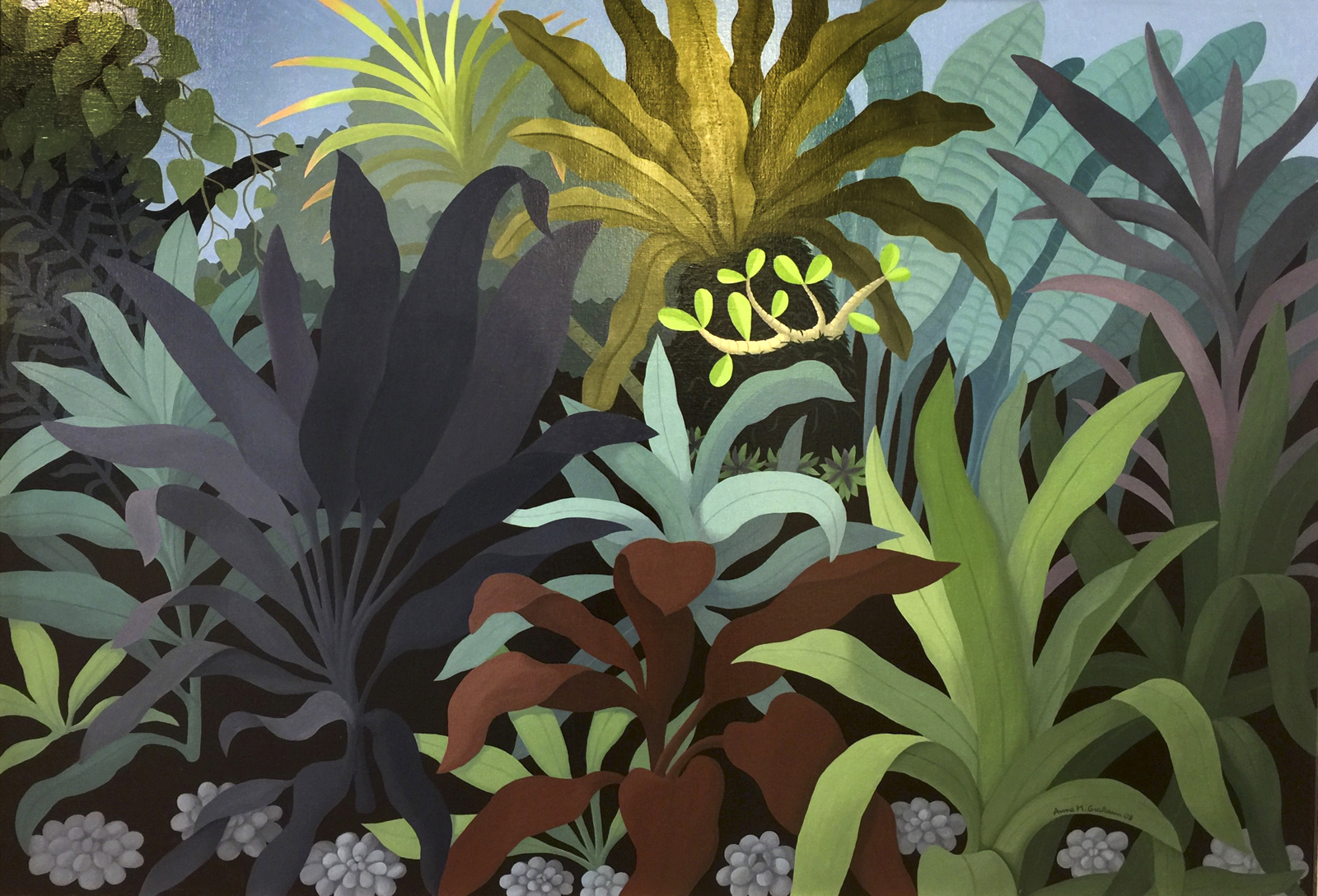
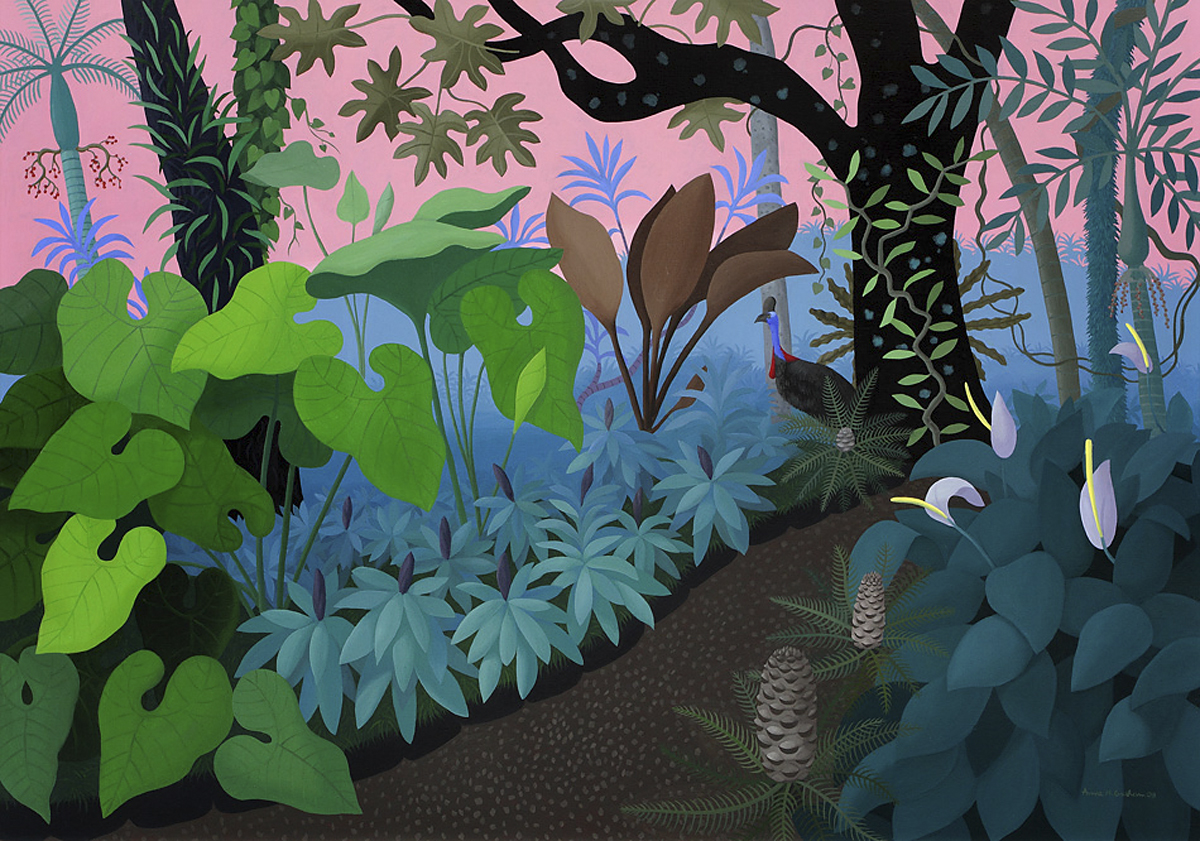
Anne Marie Graham (Australian born Austria, b. 1925) 'Jungle with Cassowary' 2008


Anne Marie Graham (Australian born Austria, b. 1925)
Jungle with Cassowary
2008
Oil on Linen
106 x 150cm
National Museum for Women in Arts, Washington


I was walking around Anne Marie Graham’s new exhibition of painting at Gallery 101, Melbourne having read a review of her work on the gallery wall where the reviewer compared the structure of the work to the essentialness of the paintings of Giotto. A lady approached me and said, “You don’t want to believe everything that you read.”

And I said, “I don’t. I make up my own mind.”

This was the artist Anne Marie Graham.

We had a wonderful conversation about her work talking about space, colour and form. This is what Graham’s work is about. No conceptual arguments are needed. The work addresses the landscape in a magical way, drawing the viewer into the compositions like a piece of music. The viewer finds entrances and passageways, spaces through the images which open up a dialogue with the landscape.

Using repeated patterns and layered construction, from bottom to top, from front to back, the images subtly push and pull the viewer: space quietly recedes and comes towards the viewer. Complimentary bands of colours are muted except for stunning highlight colours – the red of flowers, the blue of leaves or the unexpected pink or yellow of a background. The forms and textures delight. Dr Sheridan Palmer is correct, these paintings have an almost hypnotic effect, meditative and peaceful. They make you feel good!

Their presence is undeniable. For such complex paintings, which on the surface seem very simple (a difficult task to accomplish); for such essential representations that address the heart of the matter… their affect is powerful.

Graham’s refined aesthetic allows the viewer to engage with the poetic spaces she creates, allowing them to appreciate the colour fields, plants and landscapes she orchestrates and to be subsumed into their fold. Here we come to understand the diverse empathy of an artist who lays it all ‘on the line’ and knows how to do so in a brilliant way.

A talented artist and a nice lady as well – what more can you ask for!

Dr Marcus Bunyan


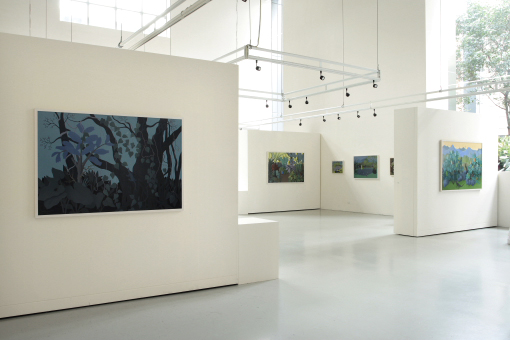
Installation view of Anne Marie Graham's exhibition 'Exotic Queensland: Recent Painting' at Gallery 101, Melbourne

Installation view of Anne Marie Graham's exhibition 'Exotic Queensland: Recent Painting' at Gallery 101, Melbourne


Exotic Queensland: Recent Painting installation views at Gallery 101, Melbourne


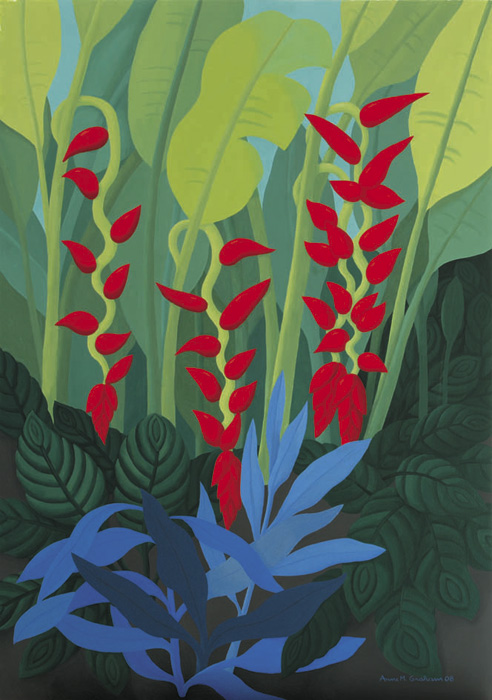
These landscapes are inspired by the areas around Noosa, the Glasshouse Mountains and the Botanic Gardens in Cairns. Look at the bromeliads, those cousins of the pineapple that store pools of water in their depths. And the helliconias – they’re also called lobster-claw plants and you can see why! Look at the massive scarlet tassels set against tropical green – and not just the one green but the subtlest of shades and tones in combination.

‘If there’s a God, it must be there’, says Anne of the Cairns Botanical Gardens. ‘The inventiveness and colours, the lushness and tropical exuberance and shapes. I still can’t overcome this enthusiasm’. There is an analogy with Eugene von Guérard here. Like Ann, he was born in Vienna and was also a precisely scientific observer of nature, ever mindful that the world is a thing far greater than us: that the hand of God (for want of a better word) can be found in very leaf and every grain of sand.

How much further in both place and mood could Anne possibly have travelled from the order and long humanist traditions of her childhood home in Austria? In these Queensland paintings you’ll discover cockatoos, a water dragon, a fat goanna, ibises in the lotus pond, and the shy endangered cassowary almost hidden in the jungle. And look at the sky in that painting – the rosiest pink of a twilight had tells us tomorrow will be a perfect day.

Jane Clark
Senior Research Curator, Museum of Old and New Art, Hobart

Extract from speech given at the opening of the exhibition Exotic Queensland, Gallery 101 Melbourne May 2009


Anne Marie Graham (Australian born Austria, b. 1925) 'Water Dragon with Banksias' 2008


Anne Marie Graham (Australian born Austria, b. 1925)
Water Dragon with Banksias
2008


Anne Marie Graham (Australian born Austria, b. 1925) 'Heliconia No. 1' 2008


Anne Marie Graham (Australian born Austria, b. 1925)
Heliconia No. 1
2008
Oil on Linen
106 x 150cm


Anne Marie Graham (Australian born Austria, b. 1925) 'Variations in Green and Mauve' 2008


Anne Marie Graham (Australian born Austria, b. 1925)
Variations in Green and Mauve
2008
Oil on linen
106 x 150cm


“Anne Marie Graham’s painting career now spans more than six decades. Observed with a penetrating and affectionate gaze, her images are beautiful records of Australia’s vast landscape. Each work is an engagingly optimistic view, evoking the mystery and fragility of Australia’s rich environment. This survey of recent paintings concentrates on the tropical Queensland landscapes around Noosa and the Cairns Botanic Gardens.

As she casts he vision over mountains, rain forests and panoramic vistas or as she leads us into an intimate world of gardens, winding pathways and potted plants, we find ourselves amongst large succulents, variegated foliage, ferns and brilliant flowers, visually engaging at a Lilliputian level in her richly orchestrated fields and forests. In these locations she constructs marvellous labyrinthine worlds that reveal layers of muted colours, folding forms and textures that induce a most extraordinary hypnotic spell.”

Dr Sheridan Palmer, Art Curator, from the catalogue essay


Anne Marie Graham (Australian born Austria, b. 1925) 'Heliconia No. 2' 2008


Anne Marie Graham (Australian born Austria, b. 1925)
Heliconia No. 2
2008


GALLERY 101

This gallery has now closed.

LIKE ART BLART ON FACEBOOK

Back to top

Opening 3: Review: ‘Show Court 3’ and ‘Mood Bomb’ by Louise Paramor at Nellie Castan Gallery, Melbourne

Exhibition dates: 5th March – 28th March, 2009

Opening: Thursday 5th March, 2009


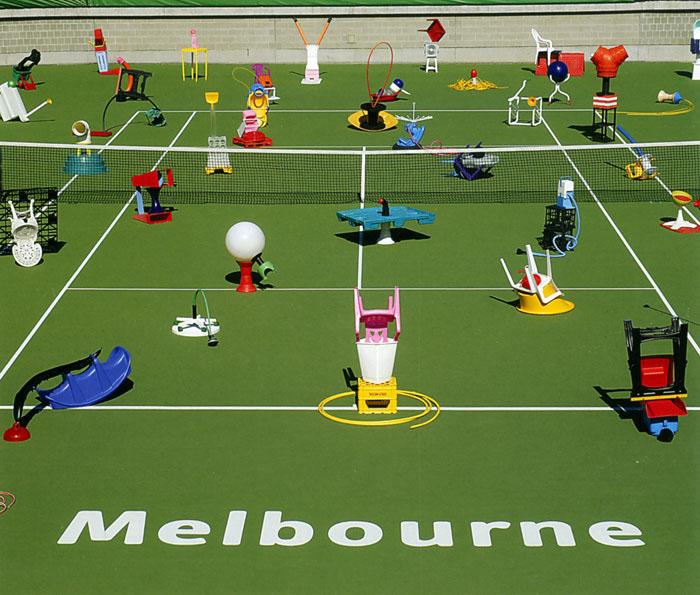
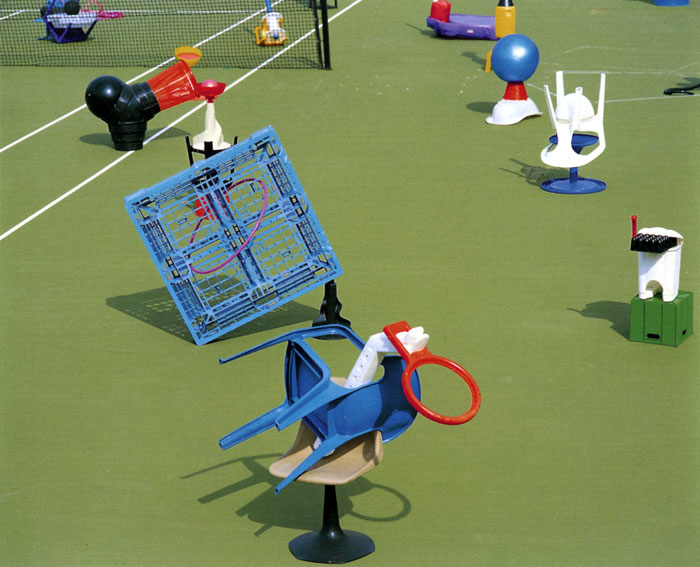
Louise Paramor (Australian, b. 1964) 'Show Court 3 (II)' 2009


Louise Paramor (Australian, b. 1964)
Show Court 3 (II)
2009


Boarding a train at Flinders Street we emerge at South Yarra station to stroll down to River Street for our third opening of the night at Nellie Castan Gallery. We are greeted by the ever gracious Nellie Castan who has just returned from an overseas trip to Europe where she was soaking up the wonders of Rome amongst other places. For the latest exhibition in the gallery Louise Paramor is presenting two bodies of work: Show Court 3 and Mood Bomb (both 2009). Lets look at Show Court 3 first as this work has older origins.

Originally exhibited in 2006 at Nellie Castan under the title Jam Session the sculptures from this exhibition and many more beside (75 in all) were then installed in 2007 on show court 3 at Melbourne & Olympic Parks, hence the title of the installation. In the smaller gallery in 2009 we have six Lambda photographic prints that are records of this installation plus a video of the installation and de-installation of the work.

While interesting as documentary evidence of the installation these photographs are thrice removed from the actual sculptures – the sculptures themselves, the installation of the sculptures on court and then the photographs of the installation of the sculptures. The photographs lose something in this process – the presence or link back to the referentiality of the object itself. There is no tactile suggestiveness here, no fresh visual connections to be made with the materials, no human interaction. The intertextual nature of the objects, the jamming together of found pieces of bright plastic to make seductive anthropomorphic creatures that ‘play’ off of each other has been lost.

What has been reinforced in the photographs is a phenomena that was observed in the actual installation.

“The sculptures created a jarring visual disruption when placed in a location normally associated with play and movement. The stadium seating surrounding the tennis court incited an expectation of entertainment; a number of viewers sat looking at the sculptures, as though waiting for them to spin and jump around. But mostly, the exhibition reversed the usual role of visitors to place where one sits and watches others move; here the objects on the tennis court were static and the spectators moved around.” (2007)1

In the photographs of these objects and in the installation itself what occurs is an inversion of perception, a concept noted by the urbanist Paul Virilio.2 Here the objects perceive us instead of us perceiving the object: they stare back with an oculocentric ‘suggestiveness’ which is advertising’s raison d’être (note the eye sculpture above). In particular this is what the photographs suggest – a high gloss surface, an advertising image that grabs our attention and forces us to look but is no longer a powerful image.

In the main gallery was the most interesting work of the whole night – experiments of abstraction in colour “inspired by the very substance of paint itself.” Made by pouring paint onto glass and then exhibiting the smooth reverse side, these paintings are not so much about the texture of the surface (as is Dale Frank’s work below) but a more ephemeral thing: the dreamscapes of the mind that they promote in the viewer, the imaginative connections that ask the viewer to make. Simpler and perhaps more refined than Frank’s work (because of the smooth surface, the lack of the physicality of the layering technique? because of the pooling of amoebic shapes produced, not the varnish that accumulates and recedes?) paint oozes, bleeds, swirls, drips upwards and blooms with a sensuality of intense love. They are dream states that allow the viewer to create their own narrative with the title of the works offering gentle guides along the way: Girl with Flowers, Lovers, Mood Bomb, Emerald God, Mama, and Animal Dreaming to name just a few. To me they also had connotations of melted plastic, almost as if the sculptures of Show Court 3 had dissolved into the glassy surface of a transparent tennis court.

These are wonderfully evocative paintings. I really enjoyed spending time with them.

Dr Marcus Bunyan


1/ O’Neill, Jane. Louise Paramor: Show Court 3. Melbourne: Nellie Castan Gallery, 2009

2/ Virilio, Paul. The Vision Machine. (trans. Julie Rose). Bloomington: Indiana University Press, 1994, pp. 62-63


Many thankx to Nellie Castan Gallery for allowing me to publish the photographs in the posting. Please click on the photographs for a larger version of the image.


Louise Paramor (Australian, b. 1964) 'Show Court 3 (VI)' 2009


Louise Paramor (Australian, b. 1964)
Show Court 3 (VI)
2009


Louise Paramor (Australian, b. 1964) 'Show Court 3' 2009 (detail)


Louise Paramor (Australian, b. 1964)
Show Court 3 (detail)
2009


Louise Paramor (Australian, b. 1964) 'Show Court 3' 2009 (detail)


Louise Paramor (Australian, b. 1964)
Show Court 3 (detail)
2009


Louise Paramor (Australian, b. 1964) Opening night crowd in front of 'Sky Pilot' (left) and 'Mama' (right) 2009


Louise Paramor (Australian, b. 1964)
Opening night crowd in front of Sky Pilot (left) and Mama (right)
2009
Paint on glass


Louise Paramor (Australian, b. 1964) Opening night crowd in front of 'Green Eyed Monster' (right) and 'Sky Pilot' (right) 2009


Louise Paramor (Australian, b. 1964)
Opening night crowd in front of Green Eyed Monster (right) and Sky Pilot (right)
2009
Paint on glass


Louise Paramor (Australian, b. 1964) Opening night crowd in front of 'Pineapple Express' 2009


Louise Paramor (Australian, b. 1964)
Opening night crowd in front of Pineapple Express
2009
Paint on glass


Louise Paramor (Australian, b. 1964) 'A Dog and His Master' 2009 (detail)


Louise Paramor (Australian, b. 1964)
A Dog and His Master (detail)
2009
Paint on glass


Louise Paramor (Australian, b. 1964) 'Lovers' 2009


Louise Paramor (Australian, b. 1964)
Lovers
2009
Paint on glass


Dale Frank (Australian, b. 1959) '2. One conversation gambit you hear these days: 'Do you rotate?' An interesting change of tack? No suck luck. 'Do you rotate?' simply fishes for information about the extent of your collection. Do you have enough paintings to hang a different one in your dining room every month?' 2005


Dale Frank (Australian, b. 1959)
2. One conversation gambit you hear these days: ‘Do you rotate?’ An interesting change of tack? No suck luck. ‘Do you rotate?’ simply fishes for information about the extent of your collection. Do you have enough paintings to hang a different one in your dining room every month?
2005


Louise Paramor (Australian, b. 1964) 'Mood Bomb' 2009


Louise Paramor (Australian, b. 1964)
Mood Bomb
2009
Paint on glass


Louise Paramor (Australian, b. 1964) 'Slippery Slope' 2009 (detail)


Louise Paramor (Australian, b. 1964)
Slippery Slope (detail)
2009
Paint on glass


Louise Paramor (Australian, b. 1964) 'Green Eyed Monster' 2009 (detail)


Louise Paramor (Australian, b. 1964)
Green Eyed Monster (detail)
2009
Paint on glass


Nellie Castan Gallery, Melbourne

This gallery closed in December 2013

LIKE ART BLART ON FACEBOOK

Back to top