
July 2016

Blackwood’s Panorama of Sydney & Harbour from Government House 1858 front cover
We can only imagine the impact viewing this immense panorama (over 3m long) of eleven imperial size, wet plate photographs had on the populace of Sydney. They would have seen little like it before, and of such clarity and quality.
I have included text, additional photographs and paintings to help the viewer and researcher position the panorama historically within the context of time and place.
For example, note how illustriously and romantically the artist captures every detail in a painting such as Conrad Martens Campbell’s Wharf (1857, below), then notice how rough and ready the sections of this photographic panorama are even as they pertain to the veracity of the occasion. The length of each exposure can be estimated by the movement of the large sailing ship in the centre of section 7 of the panorama – at a guess probably just under a minute.
While larger individual images of the panorama can be found on the State Library of New South Wales website, the whole panorama photograph on that site is very small and gives little idea of how the individual sections concertina out. Some of the images also seem denuded, drained of their colour, probably due to the poor condition of the images (notably sections 2, 8, 9 and 11) .
Hopefully these images – which can be reproduced without getting permission from institutions – more fully reflect the beauty and sensitivity of the panorama.
It was a great pleasure to meet collector Dennis Joachim, the owner of this panorama, up at Mossgreen in Armadale, Victoria recently. What a remarkable man and such great energy!
Dr Marcus Bunyan
Please click on the long small image below to see the full panorama. Click again to enlarge and scroll from left to right.

William Blackwood (Australian, 1824-1897)
Panorama of Sydney & Harbour from Government House
1858
12 albumen photoprints (comprising 1 panorama in 11 sections – 1 photoprint) in a leather and gold embossed album
Images 19 x 29cm
Panorama length 324.5cm
Olaf William Blackwood, also known as William Blackwood, was a portrait painter of Swedish and Scottish descent. It was, however as a professional photographer of panoramic Sydney views that he achieved the greatest success. By 1858, he had established a photographic studio in Woolloomooloo and began photographing surrounding street scenes, using the collodion wet-plate process. He took eleven imperial size, wet plate photographs from the roof of Government House which he then combined to form a large scale Panorama of Sydney Harbour, the first and largest produced in the colony. His panoramic views were met with critical acclaim, and were praised by The Sydney Morning Herald as ‘faultless’, ‘super-excellent’ and the ‘largest yet seen’1
By August, his 180 degree panorama of Sydney Harbour was again praised as ‘superior to anything of the kind we have seen. Nothing dim or smoky appears … no muddled trees – no hazy outlines – no hard sheets of glaring white for water’2 This was the most sophisticated and extensive panorama photography ever produced in Australia. Blackwood published another album that same year consisting of some of the earliest Australian architectural studies, and photographs of Sydney’s nine banks. From a technical point of view, Blackwood’s albums were an extraordinary achievement.
Large format views required extreme skill on the part of the photographer, and he coated his plates and processed them while still wet. In the early 1860s Blackwood worked in partnership with Henry Goodes and they created eight photographic views which were submitted to the New South Wales section of the 1862 London International Exhibition. Between 1862 and 1864, Blackwood worked with James Walker at Walker’s Pitt Street studio. Despite his early, energetic and entrepreneurial projects, little is known of Blackwood’s output after 1859 and he seems to have left photography after 1864.
1/ Sydney Morning Herald, 26 March 1858
2/ Sydney Morning Herald, 4 August 1858
Text from the Mossgreen website [Online] Cited 01/07/2016. No longer available online
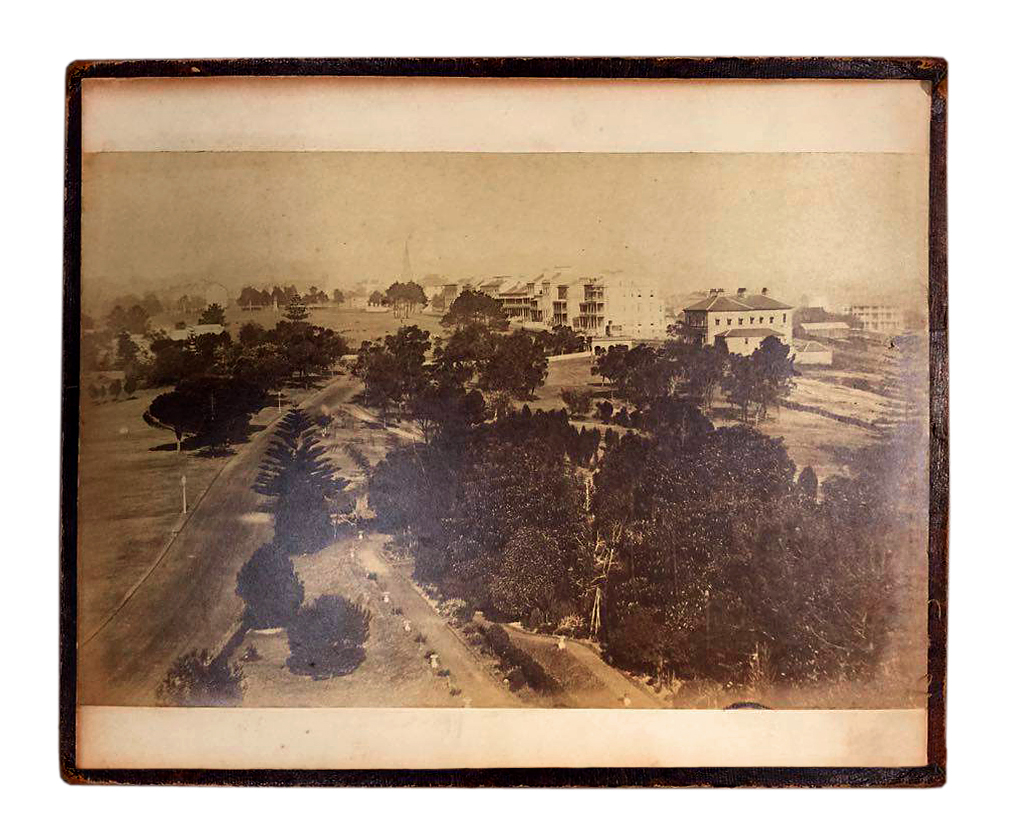
Blackwood’s Panorama of Sydney & Harbour from Government House 1858 section 1
Entrance to Government House, Macquarie Street, city view including Customs House, Sydney Cove

Blackwood’s Panorama of Sydney & Harbour from Government House 1858 section 2
Entrance to Government House, Macquarie Street, city view including Customs House, Sydney Cove.
(The Customs House is horizontally left of the tall ship’s mast with the row of double windows)

Customs House
The Customs House is an historic Sydney landmark located in the city’s Circular Quay area. Constructed initially in 1844-1845, the building served as the headquarters of the Customs Service until 1990. The driving force behind the construction of the original sandstone edifice on Circular Quay was Colonel John George Nathaniel Gibbes, the Collector of Customs for New South Wales for a record term of 25 years from 1834 to 1859. Colonel Gibbes persuaded the Governor of New South Wales, Sir George Gipps, to begin construction of the Customs House in 1844 in response to Sydney’s growing volume of maritime trade. The building project also doubled as an unemployment relief measure for stonemasons and labourers during an economic depression which was afflicting the colony at the time.
The two-storey Georgian structure was designed by Mortimer Lewis and featured 13 large and expensive windows in the facade to afford a clear view of shipping activity in Sydney Cove. Colonel Gibbes, who dwelt opposite Circular Quay on Kirribilli Point, was able to watch progress on the Customs House’s construction from the verandah of his private residence, Wotonga House (now Admiralty House). The Customs House opened for business in 1845 and replaced cramped premises at The Rocks. It was partially dismantled and expanded to three levels under the supervision of the then Colonial Architect, James Barnet, in 1887. Various additions were made over the next century, particularly during the period of the First World War, but some significant vestiges of the original Gibbes-Lewis building remain.
Text from the Wikipedia website

Blackwood’s Panorama of Sydney & Harbour from Government House 1858 section 3
City view, Sydney Cove, The Rocks, Campbell’s Wharf and Dawes Point

Conrad Martens (England 1801 – Australia 1878; Australia from 1835)
Campbell’s Wharf
1857
Watercolour with highlights in gum arabic
Image: 46 x 66cm
National Gallery of Australia
Campbell’s Wharf
From his arrival in 1835 until his death in 1878, Conrad Martens was the most celebrated artist in Sydney. Although a skilled painter in oils, his greatest works were executed in watercolour, and Campbell’s Wharf is among his most ambitious compositions. Commissioned by John Campbell in 1857, the work portrays the income source of the Campbell family, whose eighteenth and nineteenth century business interests encompassed wharfing, storing and merchant shipping.
On the right is Campbell’s Wharf and warehouses that stretched along the west side of Sydney Cove. To their left are the old Campbell residence and the new Mariners Church. In the centre of the painting rises the four-storied Miles Building, and to its left juts the Cumberland Place buildings along the skyline. All this is viewed through a jumble of trading vessels, the source of the Campbell family wealth. The painting is, however, more than a depiction of maritime industry and family property. Martens was well acquainted with the work of the British painter JMW Turner, whose romantic landscapes are suffused with delicate evocations of light. Silhouetted against a soft pink sky, Martens transforms an industrial setting into a picturesque landscape awash with luminous colour.
Text © National Gallery of Australia, Canberra 2014

Blackwood’s Panorama of Sydney & Harbour from Government House 1858 section 4
City view, Sydney Cove, The Rocks, Campbell’s Wharf & Dawes Point
Dawes Point, New South Wales
By the 1840s the people of Dawes Point and Millers Point were a maritime community in which rich and poor mixed more than elsewhere in Sydney. Wharf owners and traders lived and worked beside those who worked on the wharves and bond stores, as well as those who arrived and left on ships. Only two of the merchant houses, built by and for the early wharf owners, survive. One is Walker’s 50-foot wide villa built around 1825 and now part of Milton Terrace at 7-9 Lower Fort Street; the other is the home and offices of Edwards and Hunter, built in 1833 above their wharves which is where the Wharf Theatre now stands.
The fortunes of Dawes Point and Millers Point fluctuated more than elsewhere in Sydney. Mostly prosperous in its early years, the area was less desirable by the 1890s, and in 1900 there was a catastrophic event that led to a complete reshaping of Millers Point. At the beginning of the 20th century the government compulsorily acquired all private wharves, homes and commercial properties in the Rocks, Dawes Point and Millers Point. Modern and efficient wharves with dual level access were built, as well as new accommodation for workers, such as the Workers Flats of Lower Fort Street designed by Government Architect Vernon.
Most people still believe this redevelopment can be attributed entirely to an outbreak of plague in 1900, with the government acting benevolently as it demolished homes as well as wharves, and not for the last time decimated a community, while presenting their actions as ‘slum clearance’. In the 1960s and ’70s the government tried again to clear the area and build high-rise offices, but this was thwarted by the Green Bans, supported community and unions. In 2016, the NSW Government is again ‘relocating’ the long-term community of Dawes Point, Millers Point and The Rocks, and only a handful of these residents remain, while the majority of houses and flats along Lower Fort Street and Trinity Avenue are vacant.
Text from the Wikipedia website

Blackwood’s Panorama of Sydney & Harbour from Government House 1858 section 5
Sydney Harbour, Fort Macquarie, views to the North Shore
North Shore
Before British settlement, the Lower North Shore was home to the Gorualgal (Mosman and southern Willoughby) and Cammeraygal (North Sydney and Eastern Lane Cove). After the establishment of Sydney in 1788, settlement of the North Shore of the harbour was quite limited. One of the first settlers was James Milson who lived in the vicinity of Jeffrey Street in Kirribilli, directly opposite Sydney Cove. The north shore was more rugged than the southern shore and western areas of the harbour and had limited agricultural potential. The early activities in the area included tree felling, boatbuilding and some orchard farming in the limited areas of good soil. The North Shore railway line was built in the 1890s. Access to the Sydney CBD, located on the southern shore of the harbour remained difficult until the completion of the Sydney Harbour Bridge in 1932. This led to commencement the development of suburbs on the North Shore.
Text from the Wikipedia website

Blackwood’s Panorama of Sydney & Harbour from Government House 1858 section 6
Sydney Harbour, Fort Macquarie (Bennelong Point/Opera House), views to the North Shore
Fort Macquarie (Bennelong Point/Opera House)
Fort Macquarie was a square castellated battlement fort built at Bennelong Point, Sydney, New South Wales, Australia, where the Sydney Opera House now stands. A half moon battery on the east point of Bennelong Point was constructed in May 1798 when the ship HMS Supply was withdrawn from service, Lieutenant William Kent and crew were assigned to man the battery. The battery consisted of some of the guns taken from HMS Supply.
Governor Lachlan Macquarie directed that a fort be built between December 1817 to February 1821 under the direction of Francis Greenway. The fort was named after Governor Lachlan Macquarie. It was a square fort with circular bastions at each corner and a castellated square tower. The battery consisted of fifteen pieces of ordnance: ten 24-pounders and five 6-pounders. Three sides of the fort abutted Sydney Harbour. The two-storey tower in the middle of the fort, housed a guardroom and storehouse. The tower was 27.4 m (90 ft) in circumference. A powder magazine capable of storing 350 barrels of gunpowder was constructed underneath and the tower could provide accommodation for a small military detachment of 1 officer and 18 men, with stores for the battery. A drawbridge, on the landward side, over a small channel leading to a gate beneath the tower provided entry to the fort.
Fort Macquarie was demolished in 1901 to make way for new electric tramway sheds named Fort Macquarie Tram Depot.
Text from the Wikipedia website
Bennelong Point
The point was originally a small tidal island, Bennelong Island, that largely consisted of rocks with a small beach on the western side. The island was located on the tip of the eastern arm of Sydney Cove and was apparently separated from the mainland at high tide. For a brief period in 1788, this relatively isolated protrusion into Port Jackson (Sydney’s natural harbour) was called Cattle Point as it was used to confine the few cattle and horses that had been brought from Cape Town by Governor Phillip with the First Fleet.
The area at that time was also strewn with discarded oyster shells from many long years of gathering by the local aboriginal women. Those shells were regathered by the newly arrived convict women and burnt to make lime for cement mortar. The point was called Limeburners’ Point for that reason, though those shells only furnished enough lime to make a single building, the two-storey government house. In the early 1790s, the Aborigine Bennelong – employed as a cultural interlocutor by the British – persuaded New South Wales Governor Arthur Phillip to build a brick hut for him on the point, giving it its name.
In the period from 1818 to 1821, the tidal area between Bennelong Island and the mainland was filled with rocks excavated from the Bennelong Point peninsula. The entire area was levelled to create a low platform and to provide suitable stone for the construction of Fort Macquarie. While the fort was being built, a large portion of the rocky escarpment at Bennelong Point was also cut away to allow a road to be built around the point from Sydney Cove to Farm Cove. This was known as Tarpeian Way. The existence of the original tidal island and its rubble fill were largely forgotten until the late 1950s when both were rediscovered during the excavations related to the construction of the Sydney Opera House. Prior to the Opera House’s construction, Bennelong Point had housed Fort Macquarie Tram Depot.
Text from the Wikipedia website

Kerry & Co.
Fort Macquarie
1870
Albumen photograph
From the collections of the Mitchell Library, State Library of New South Wales
Fort Macquarie was built on the end of Bennelong Point, where the Sydney Opera House now stands. Completed by convict labour in 1821 using stone from the Domain, the fort had 15 guns and housed a small garrison. The powder magazine beneath the tower was capable of storing 350 barrels of gunpowder. The fort was demolished in 1901 to make way for the tramway sheds that occupied the site until the construction of the Utzon masterpiece

Kerry & Co.
Fort Macquarie
1870
Albumen photograph
From the collections of the Mitchell Library, State Library of New South Wales

Anonymous photographer
The tram shed at Bennelong Point before the Sydney Opera House was built
1952

Blackwood’s Panorama of Sydney & Harbour from Government House 1858 section 7
Sydney Harbour view, sailing ships, Fort Denison (to the far right in the distance), Garden Island, Lady Macquarie’s Chair

Anonymous photographer
SS Nieuw Holland passing Fort Denison, Sydney Harbour
c. 1930
Australian National Maritime Museum collection
Fort Denison was built on an island that was known to Indigenous people in the area as Muddawahnyuh, meaning ‘rocky island’. After European settlement in 1788 the island was called Pinchgut by convicts who were marooned there with meagre rations of bread and water as punishment for serious breaches of the peace. The island was originally a 15 metre sandstone rock, but during the 1800s it was excavated to provide sandstone to build Circular Quay, at that time the centre of shipping in Sydney.
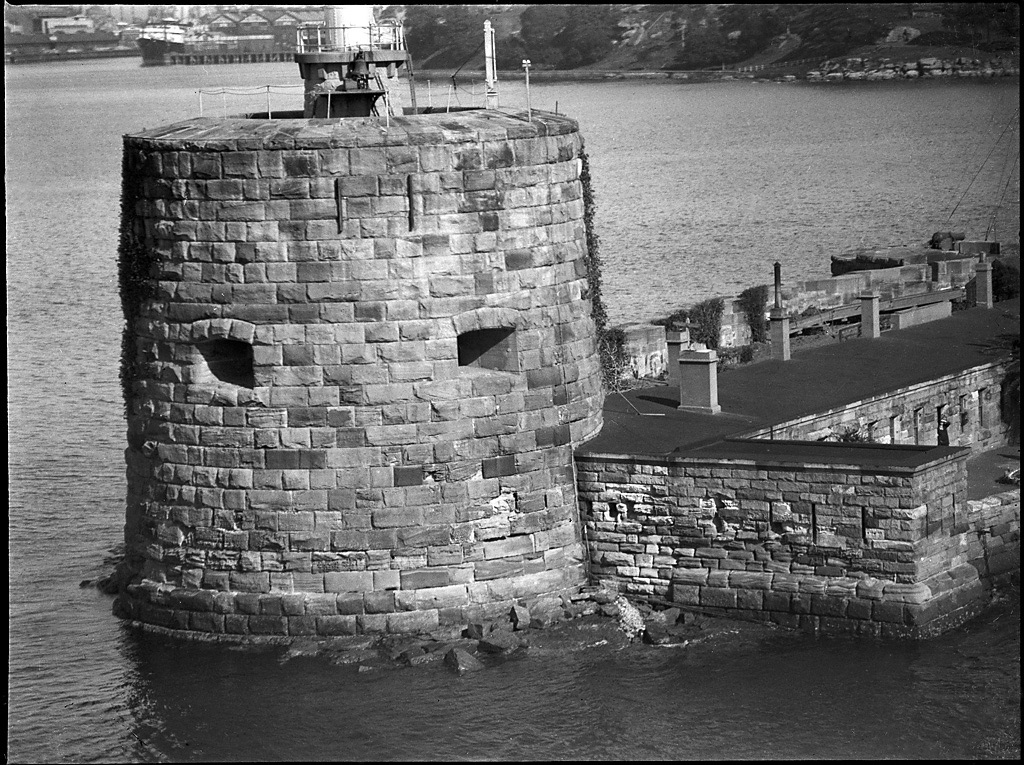
Anonymous photographer
Fort Denison
c. 1930
Glass negative, quarter plate
Tom Lennon Photographic Collection from the Powerhouse Museum
Fort Denison
In 1839, two American warships entered the harbour at night and circled Pinchgut Island. Concern with the threat of foreign attack caused the government to review the harbour’s inner defences. Barney, who had earlier reported that Sydney’s defences were inadequate, recommended that the government establish a fort on Pinchgut Island to help protect Sydney Harbour from attack by foreign vessels. Fortification of the island began in 1841 but was not completed. Construction resumed in 1855 because of fear of a Russian naval attack during the Crimean War, and was completed on 14 November 1857. The newly built fort then took its current name from Sir William Thomas Denison, the Governor of New South Wales from 1855 to 1861.
The fortress features a distinctive Martello tower, the only one ever built in Australia and the last one ever constructed in the British Empire. It was constructed using 8,000 tonnes (7,900 long tons) of sandstone from nearby Kurraba Point, Neutral Bay. The tower’s walls are between 3.3-6.7 metres (11-22 ft) thick at the base and 2.7 metres (8 ft 10 in) thick at the top. However, developments in artillery rendered the fort largely obsolete by the time it was completed. The tower itself had quarters for a garrison of 24 soldiers and one officer. Fort Denison’s armament included three 8-inch (200 mm) muzzle loaders in the tower, two 10-inch (250 mm) guns, one on a 360-degree traverse on the top of the tower and one in a bastion at the other end of the island, and twelve 32-pound (15 kg) cannons in a battery between the base of the tower and the flanking bastion. Eventually all the guns were removed, except for the three 8-inch (200 mm) muzzle-loading cannons in the gun room in the tower, which were installed before construction was complete.
Text from the Wikipedia website
![George Roberts (Australian born United Kingdom, c. 1800-1865) '[Mrs Macquarie's chair]' c. 1843-1865](https://artblart.com/wp-content/uploads/2016/07/mrs-macquaries-chair-web.jpg "George Roberts (Australian born United Kingdom, c. 1800-1865) '[Mrs Macquarie's chair]' c. 1843-1865")
George Roberts (Australian born United Kingdom, c. 1800-1865)
[Mrs Macquarie’s chair]
c. 1843-1865
Watercolour
Mitchell Library, State Library of New South Wales

American & Australasian Photographic Company
Mrs Macquarie’s Chair, Sydney (B. O. Holtermann seated at centre)
c. 1870-1875
State Library of New South Wales
Bernhardt Otto Holtermann (Australian born Germany, 1838-1885)
Bernhardt Otto Holtermann (29 April 1838 – 29 April 1885) was a successful gold miner, businessman, sponsor of photography for the encouragement of immigration and member of parliament. Perhaps his greatest claim to fame is his association with the Holtermann Nugget, the largest gold specimen ever found, 1.5 meters (59 inches) long, weighing 286 kg (630 pounds), in Hill End, near Bathurst, and with an estimated gold content of 3000 troy ounces (93 kg).
Holtermann financed and possibly participated in photographer Beaufoy Merlin’s project to photograph New South Wales and exhibit the results abroad to encourage immigration. The work was taken up after Merlin’s death in 1873 by his assistant, Charles Bayliss. In 1875, Holtermann and Bayliss produced the Holtermann panorama, a series of “23 albumen silver photographs which join together to form a continuous 978-centimetre view of Sydney Harbour and its suburbs.” Some of the photographs, including the panorama, were displayed at the Philadelphia Centennial Exhibition, where they won a bronze medal. The panorama was also displayed at the 1878 Exposition Universelle Internationale in Paris.
Almost seventy years after Holtermann’s death, more than 3,000 of the glass negatives created by Merlin and Bayliss were retrieved from a garden shed in the Sydney suburb of Chatswood. The UNESCO-listed collection of negatives, known as The Holtermann Collection, is housed in the State Library of New South Wales.
Text from the Wikipedia website
Mrs Macquarie’s Chair
Mrs Macquarie’s Chair (also known as Lady Macquarie’s Chair) is an exposed sandstone rock cut into the shape of a bench, on a peninsula in Sydney Harbour, hand carved by convicts from sandstone in 1810 for Governor Macquarie’s wife Elizabeth. The peninsula itself is named Mrs Macquarie’s Point, and is part of the The Domain, near the Royal Botanic Gardens. Mrs Macquarie was the wife of Major-General Lachlan Macquarie, Governor of New South Wales from 1810 to 1821. Folklore has it that she used to sit on the rock and watch for ships from Great Britain sailing into the harbour. She was known to visit the area and sit enjoying the panoramic views of the harbour.
Above the chair is a stone inscription referring to Mrs Macquarie’s Road. That road was built between 1813 and 1818, and ran from the original Government House (now the Museum of Sydney) to Mrs Macquarie’s Point. It was built on the instruction of Governor Macquarie for the benefit of his wife. There is no remaining evidence of the original road, other than a culvert over which the road ran.
Text from the Wikipedia website

Blackwood’s Panorama of Sydney & Harbour from Government House 1858 section 8
Sydney Harbour view, sailing ships, Fort Denison, Garden Island, Lady Macquarie’s Chair
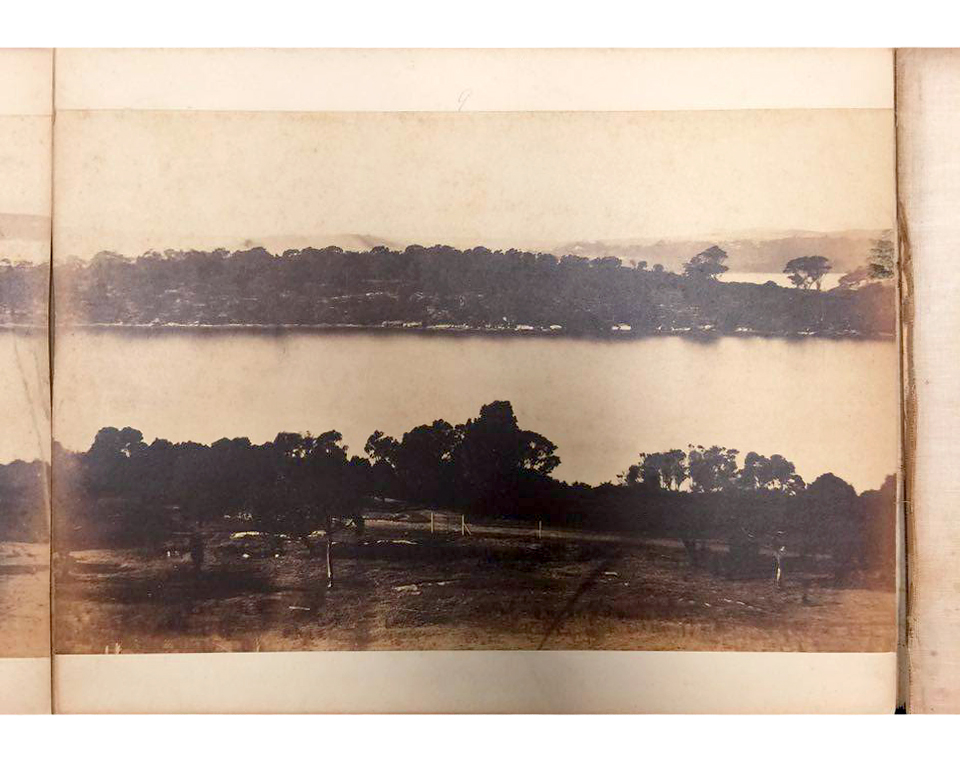
Blackwood’s Panorama of Sydney & Harbour from Government House 1858 section 9
Farm Cove, views to Potts Point and Darlinghurst

Blackwood’s Panorama of Sydney & Harbour from Government House 1858 section 10
Farm Cove, views to Potts Point and Darlinghurst
Potts Point
Potts Point is named for Joseph Hyde Potts, who was employed by the Bank of New South Wales. He purchased six-and-a-half acres of harbourside land in an area then known as Woolloomooloo Hill – which he renamed Potts Point. Much of the area that today comprises Potts Point and the adjacent suburb of Elizabeth Bay, originally constituted part of a land grant to Alexander Macleay, who was the New South Wales Colonial Secretary from 1826 to 1837, and for whom Macleay Street is named. NSW Judge Advocate, John Wylde (for whom Wylde Street is named) was another 19th-century public servant who owned land in the area.

Blackwood’s Panorama of Sydney & Harbour from Government House 1858 section 11
The Government Domain, Government House Stables
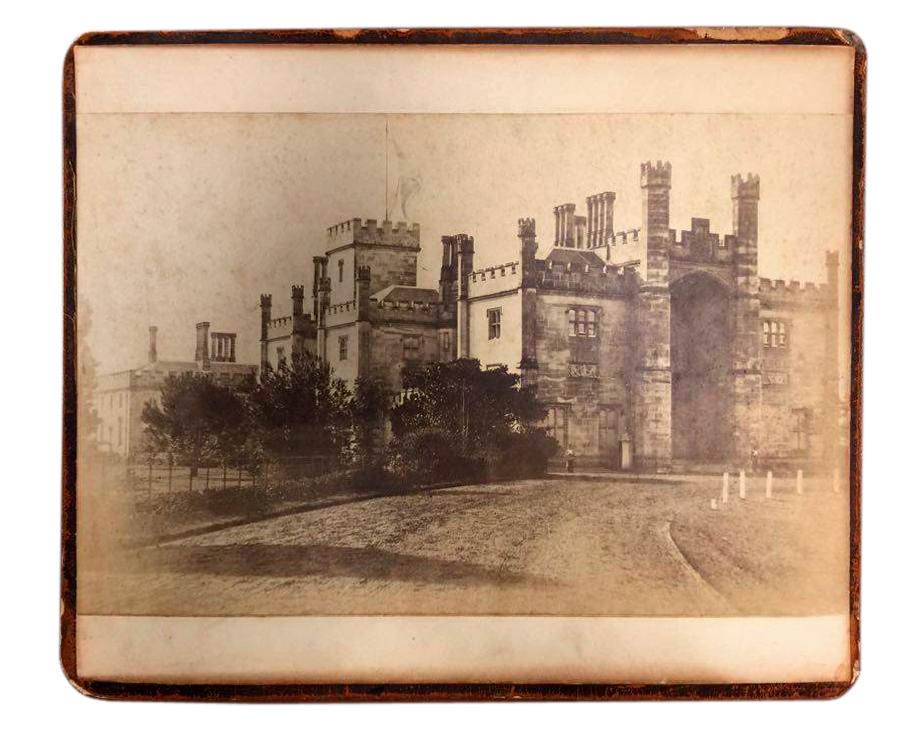
Blackwood’s Panorama of Sydney & Harbour from Government House 1858
Government House with porte cochère
Government House
In 1845 the British government agreed that a new Government House in Sydney had become a necessity, and the royal architect, Edward Blore, was instructed to draw up plans. Construction commenced in 1837 and was supervised by colonial architect Mortimer Lewis and Colonel Barney of the Royal Engineers. Stone, cedar, and marble for the construction were obtained from various areas of New South Wales. A ball in honour of the birthday of Queen Victoria was held in the new building in 1843, although construction was not complete. The first resident, Governor George Gipps, did not move in until 1845.
Government House, with its setting on Sydney Harbour, has a garden area of 5 hectares and is located south of the Sydney Opera House, overlooking Farm Cove. It was designed in a romantic Gothic revival style – castellated, crenellated, turreted and is decorated with oil portraits and the coats of arms of its successive occupants. Additions have included a front portico in 1873, an eastern verandah in 1879 and extensions to the ballroom and governor’s study in 1900-01.
Text from Wikipedia website
Definition of porte cochère. 1: a passageway through a building or screen wall designed to let vehicles pass from the street to an interior courtyard. 2: a roofed structure extending from the entrance of a building over an adjacent driveway and sheltering those getting in or out of vehicles.

John Paine (Australian born England, 1833-1908)
The entrance gates of Government House, Sydney
c. 1878
Albumen print
15 x 20.4cm
Caroline Simpson Library & Research Collection
The Government House entrance gates and guardhouse, completed in 1848, are shown here in their original location on Macquarie Street. The elaborate iron gates were supported by six sandstone piers: in the centre was the ceremonial entrance, marked by metalwork lanterns complete with crowns, and this was flanked by two carriage gates and a pair of pedestrian gates. The design of the gates and guardhouse is attributed to the Colonial Architect Mortimer Lewis, the gatehouse being identical to the ‘Forest Gate Keeper’s Lodge’ illustrated in H B Zeigler’s ‘The Royal Lodges in Windsor Great Park’ (1839) The Gothic Revival guardhouse consisted of four rooms to accommodate the guard, with open verandahs on two sides, and it was to also serve the Treasury, completed on the opposite side of Macquarie Street c. 1850 (also designed by Lewis). The entrance gates and guardhouse, as a Gothic style entrance lodge, were consistent with Picturesque ideals for the entrance to a large estate and formed an appropriately imposing entrance to the vice regal residence.

Blackwood’s Panorama of Sydney & Harbour from Government House 1858 back cover






 Art Blart _ art and cultural memory archive
You must be logged in to post a comment.