
Visited September 2019 posted November 2020
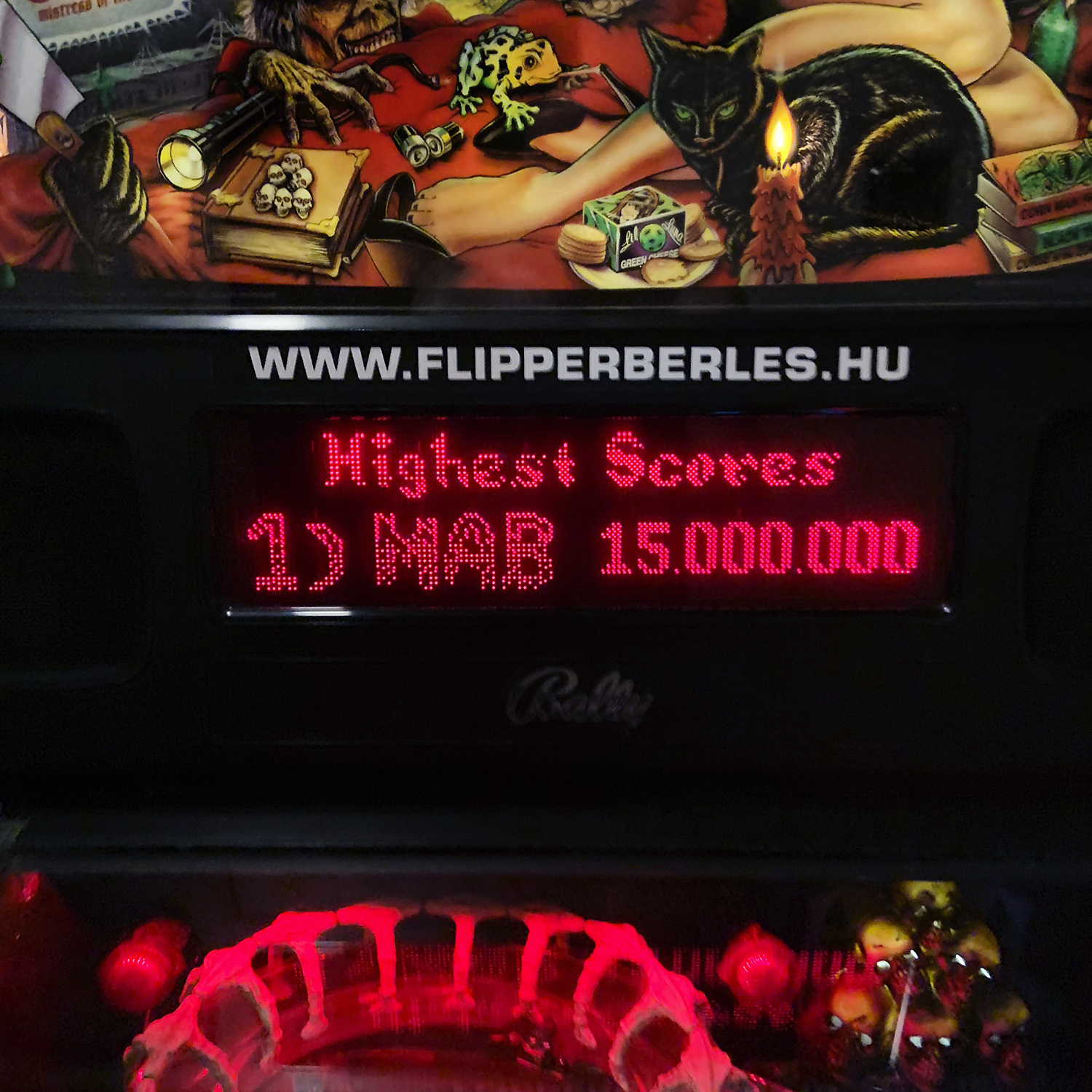
Bally Manufacturing Corporation (1931-1983)
Scared Stiff (detail)
1996
Photo: Marcus Bunyan
Pinball Wizard
Thanks to playing pinball, I’ve had my name up in lights as “highest scorer” in New York, Paris and London – just like the perfume bottles – and also Melbourne, Mentone (a suburb of the city), Adelaide and various other places around the world. As luck and skill would have it, on my recent trip around Europe, I scored highest score on Scared Stiff (1996, above and below) in a gay sauna – where else you might ask! – in Budapest. A surreal experience.
Along with my friends Jeff and Woody, I have been an addicted pinball playing wizard for many years. I love the sounds, the colour, the movement; the frenzy of the multiball (during which the flashing lights and noise serve to distract the player from the position of the balls), the exultation of the knocker when you score a replay; and the ultimate elation of becoming the highest scorer on the machine. Good fun is to be had, a test of skill and concentration in order to beat the machine and score a replay.
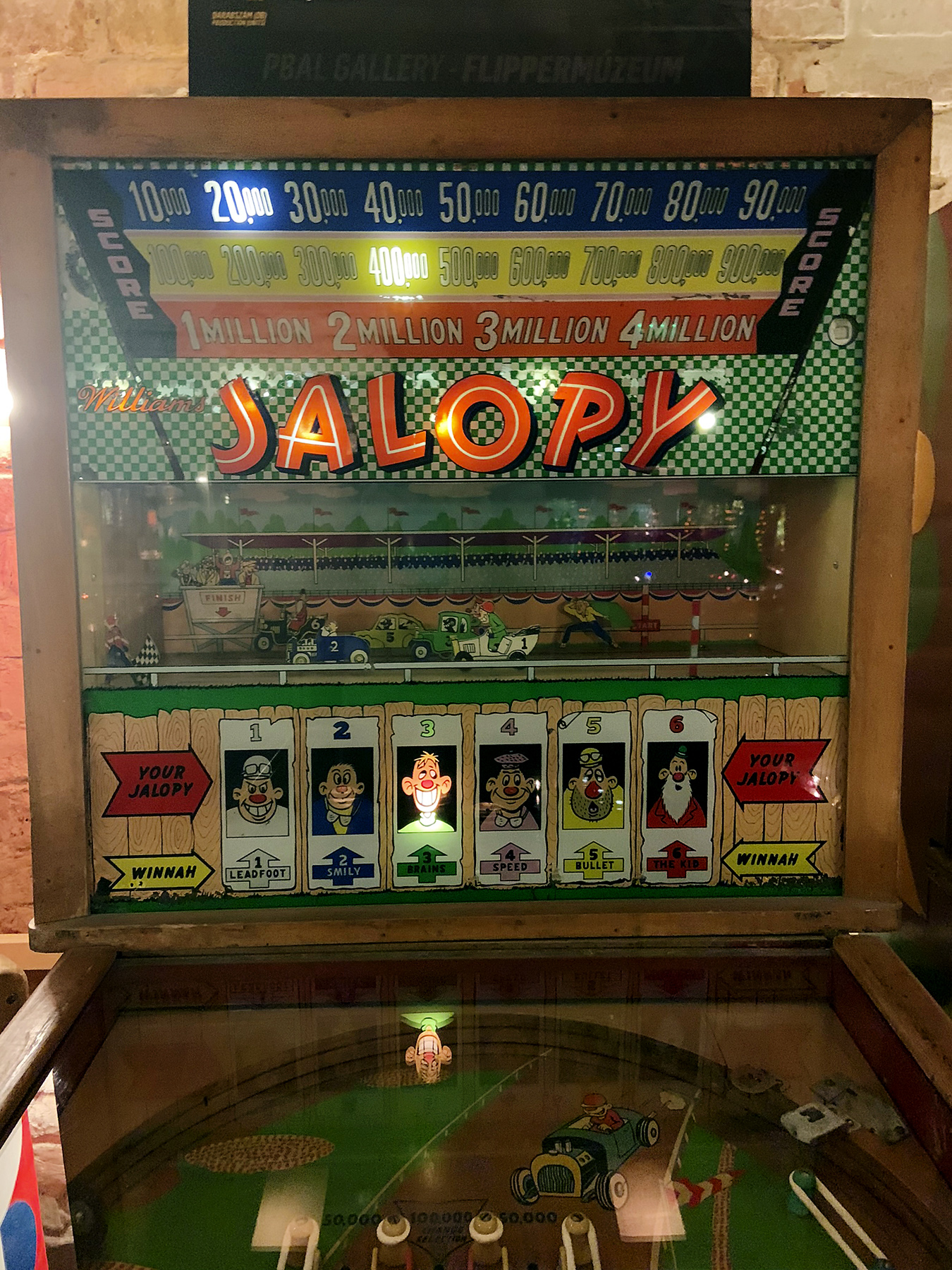
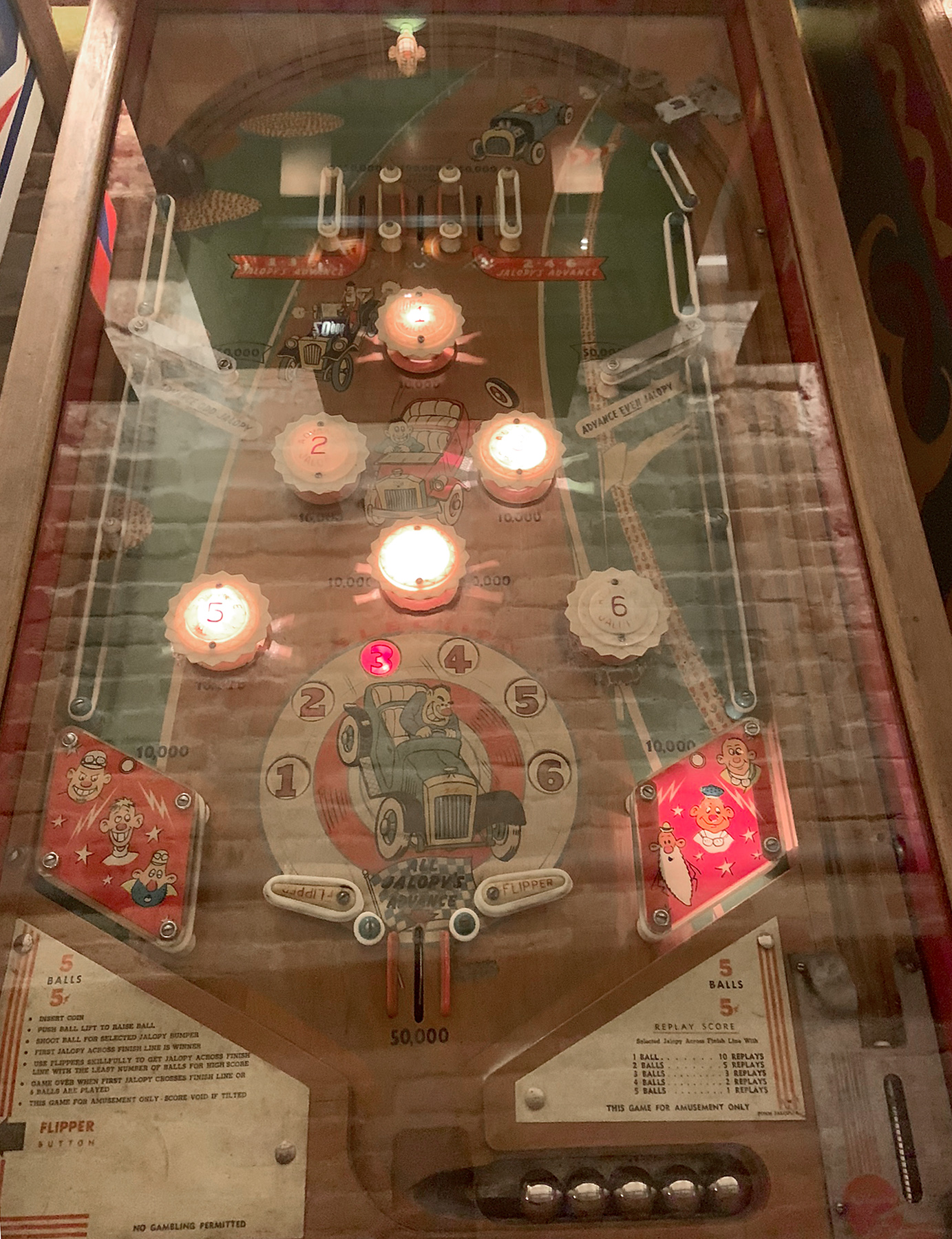
To say that I was in my element at the Flippermúzeum, Budapest is an understatement. Situated in a suitably dark underground cavern, and after paying the entry fee, you can play all the pinballs for free for as long as you want. There are “more than 140 machines, making the venue one of the biggest ongoing pinball collections in Europe… Some of the exhibition’s older pieces qualify as truly unique antiques, like the first pinball machines ever made with flippers, dating back to 1947.” Photographs of this pinball made by D. Gottlieb & Co. named Humpty Dumpty can be seen in the posting below. This is the oldest pinball I have ever played. Note that the flippers are not at the bottom of the machine, but in three pairs at the side of the machine. I found it very difficult to play, as the ball was easily lost between the large gap at the bottom, once the ball had made its way past the side mounted flippers. Other early idiosyncrasies were the outward facing flippers on Williams’ Jalopy (1951, below), and the fact that you got 5 balls for your money on the early machines, whereas today you only get 3.
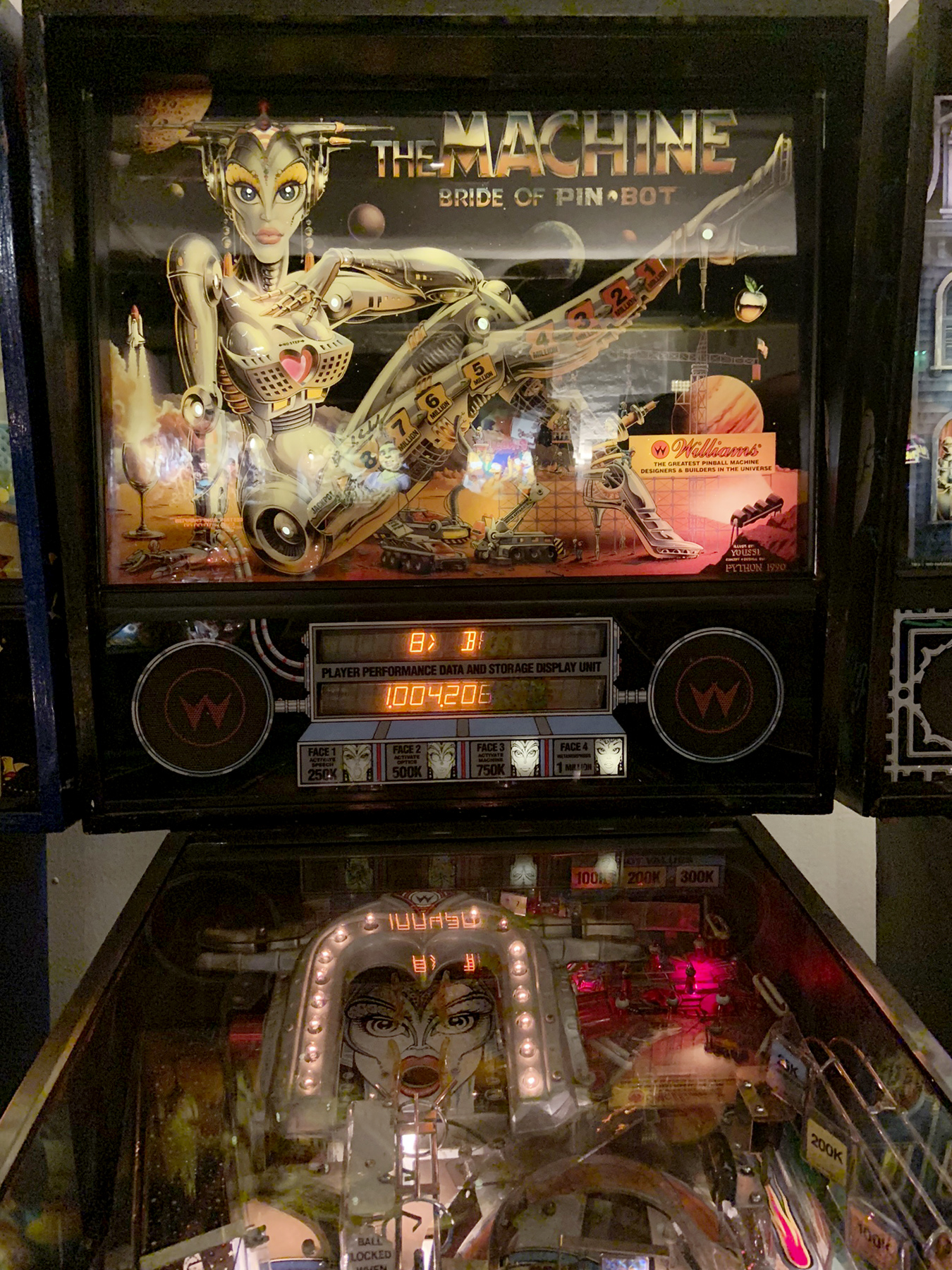
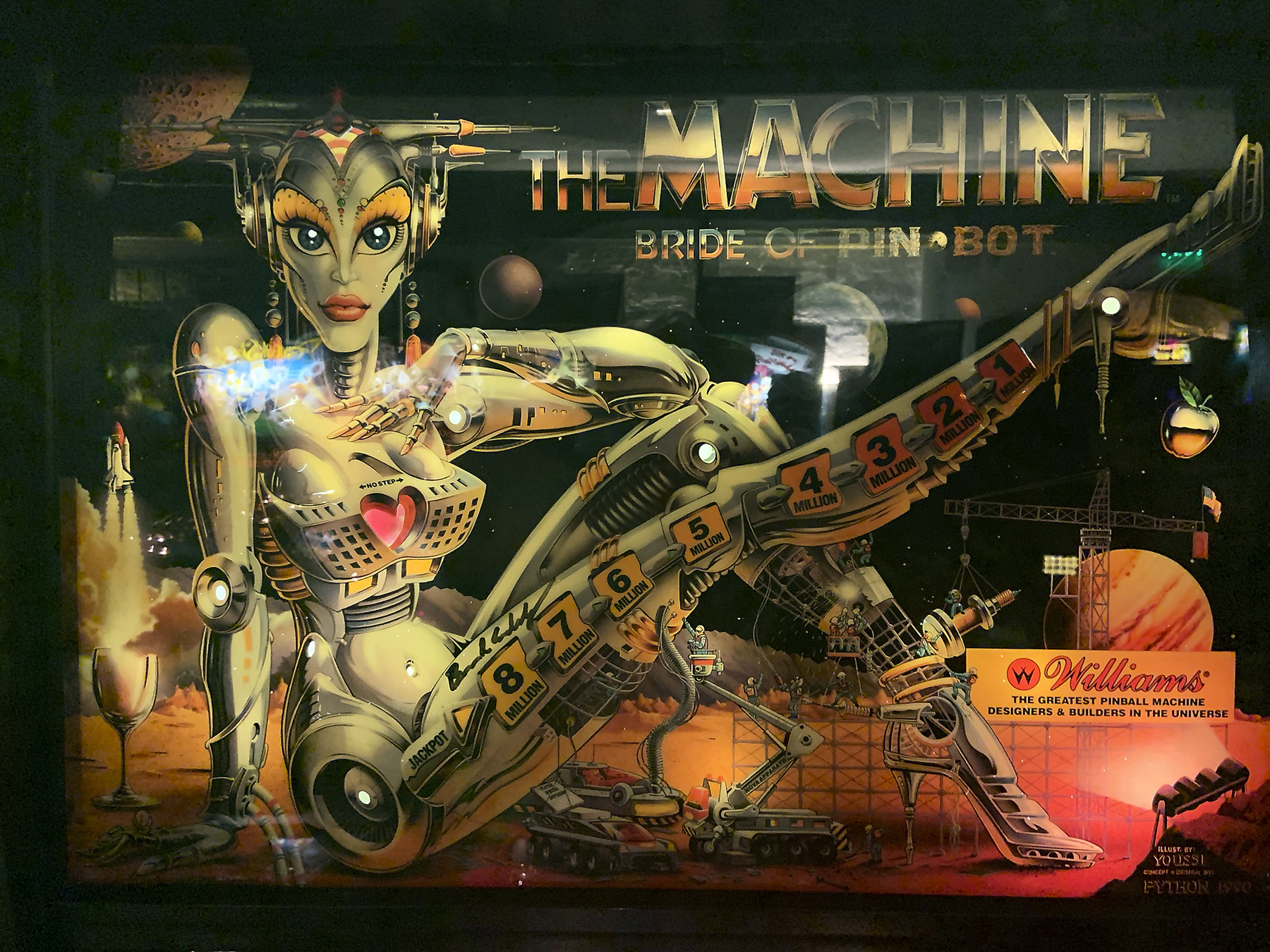
The graphic art of the backglass and cabinet art add immeasurably to the playing experience. The art is linked to the theme of the particular machine and is often film, sci-fi, circus or mythically based – innovative, funny and sometimes lascivious – totally un-PC. In games up to the 1980s the eye-catching graphics would often objectify women, depicting them as playthings to be won (Genco’s Triple Action 1948, with graphic roots in the nose art of Second World War bombers), or portray them as available, large-breasted women in skimpy clothing (see Bally’s Wizard 1975; Bally’s Elvira and the Party Monsters 1989; and Bally’s Dr. Dude And His Excellent Ray 1990). In house jokes abound, such as the drum kit being named “The Bootles” in Williams’ Beat Time (1967) and “Gravestone Pizza Dig it!” in Bally’s Elvira and the Party Monsters 1989. My particular favourite graphic in this selection is Williams’ The Machine: Bride of Pinbot (1991) where humans work to repair the Metropolis-like robot, her leg lighting up in millions the closer you reach the jackpot. Completely sexist, completely over the top but fantastic, fantasy art nevertheless.
Ultimately for me, playing pinball is a complete melding between human and machine, a space where you loose yourself in the moment and movement of the ball(s), and the sights and sounds of the machine. On a good day when I am playing I become one with the machine, lost in time and space. Your concentration is so intense that nothing else matters. I remember playing a pinball up in Circular Quay in Sydney, and I was going so well that I had people two deep watching me play. What a blast!
Dr Marcus Bunyan
All iPhone images Dr Marcus Bunyan. Please click on the photographs for a larger version of the image.
“Two kind of people in this world; pinball people and video game people. You, Freddy, you’re pinball people.”
Gary Figgis (Ray Liotta) in the movie Cop Land (1997)
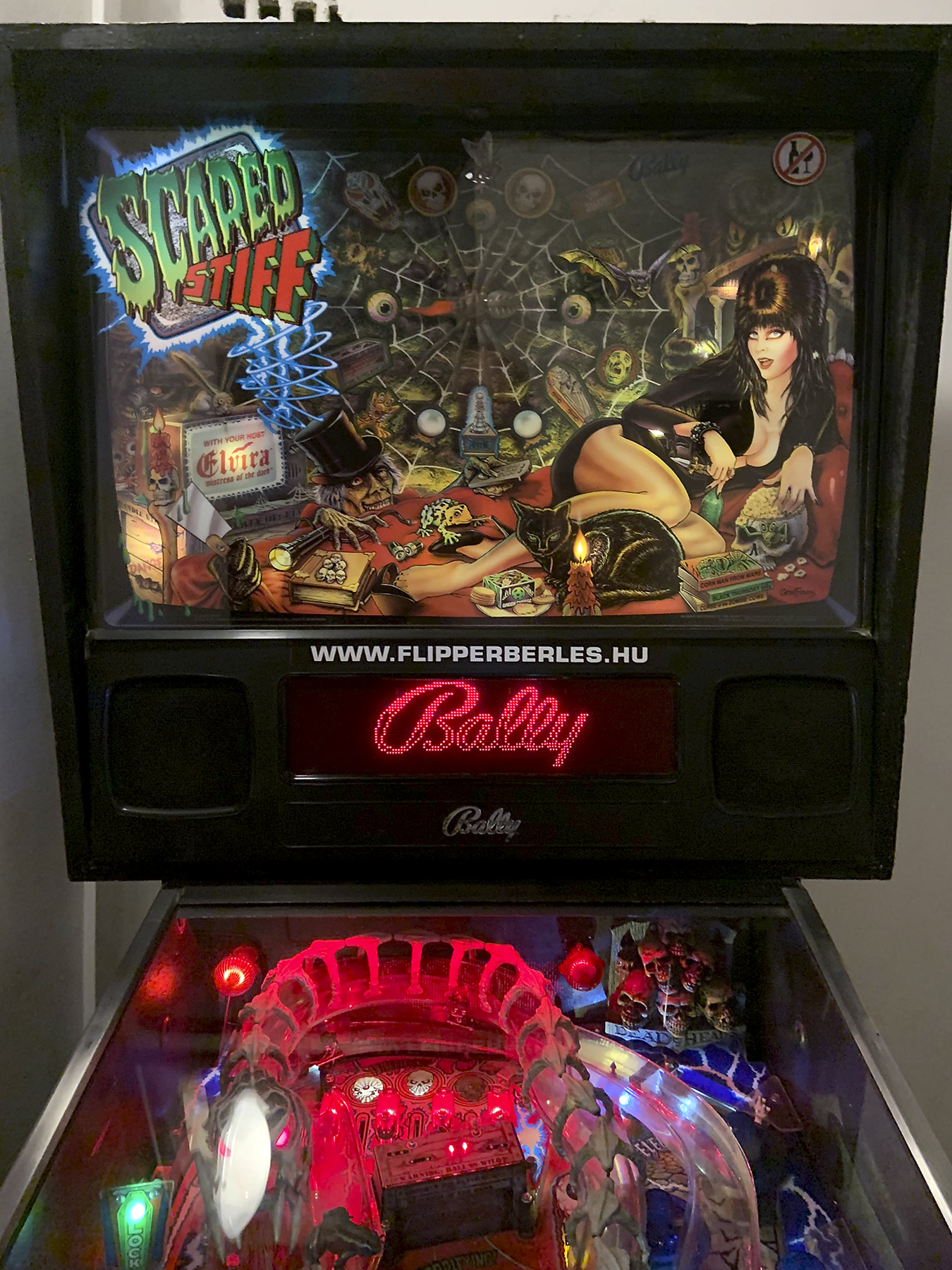
Bally Manufacturing Corporation (1931-1983)
Scared Stiff (detail)
1996
Photo: Marcus Bunyan
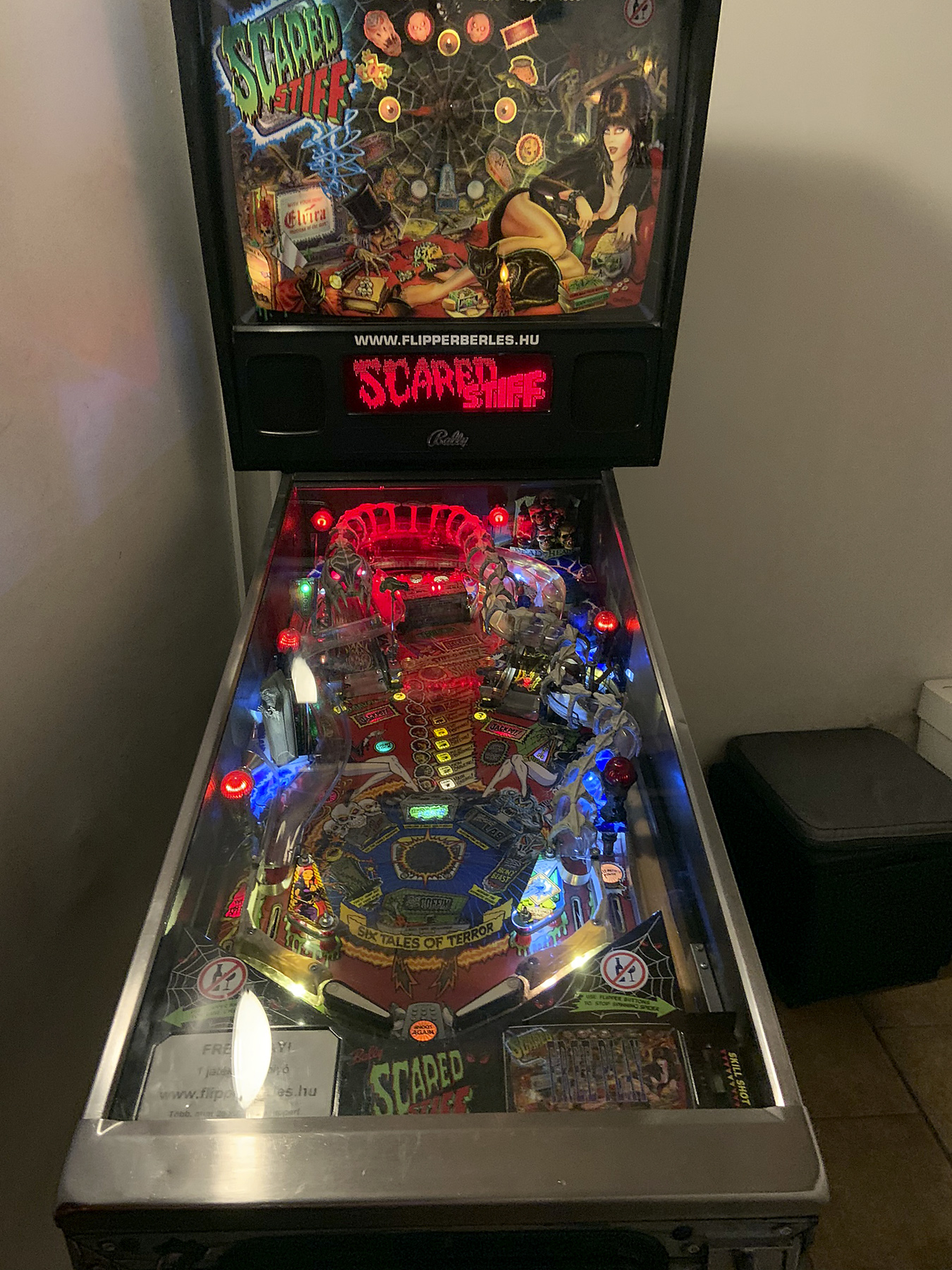
Bally Manufacturing Corporation (1931-1983)
Scared Stiff (detail)
1996
Photo: Marcus Bunyan
“So fun, It’s Scary!”
“Elvira has the features that turn players on.”
Special scores
High score lists: If a player attains one of the highest scores ever (or the highest score on a given day), they are invited to add their initials to a displayed list of high-scorers on that particular machine. “Bragging rights” associated with being on the high-score list are a powerful incentive for experienced players to master a new machine.
Pinball designers also entice players with the chance to win an extra game or replay. Ways to get a replay might include the following:
Replay Score: An extra game is rewarded if the player exceeds a specified score. Some machines allow the operator to set this score to increase with each consecutive game in which the replay score is achieved, in order to prevent a skilled player from gaining virtually unlimited play on one credit by simply achieving the same replay score in every game.
Special: A mechanism to get an extra game during play is usually called a “special.” Typically, some hard-to-reach feature of the game will light the outlanes (the areas to the extreme left and right of the flippers) for special. Since the outlanes always lose the ball, having “special” there makes it worth shooting for them (and is usually the only time, if this is the case).
Match: At the end of the game, if a set digit of the player’s score matches a random digit, an extra game is rewarded. In earlier machines, the set digit was usually the ones place; after a phenomenon often referred to as score inflation had happened (causing almost all scores to end in 0), the set digit was usually the tens place. The chances of a match appear to be 1 in 10, but the operator can alter this probability – the default is usually 7% in all modern Williams and Bally games for example. Other non-numeric methods are sometimes used to award a match.
High Score: Most machines award 1-3 bonus games if a player gets on the high score list. Typically, one or two credits are awarded for a 1st – 4th place listing, and three for the Grand Champion.
When an extra game is won, the machine typically makes a single loud bang, most often with a solenoid that strikes a piece of metal, or the side of the cabinet, with a rod, known as a knocker, or less commonly with loudspeakers. “Knocking” is the act of winning an extra game when the knocker makes the loud and distinctive noise.
Text from the Wikipedia website
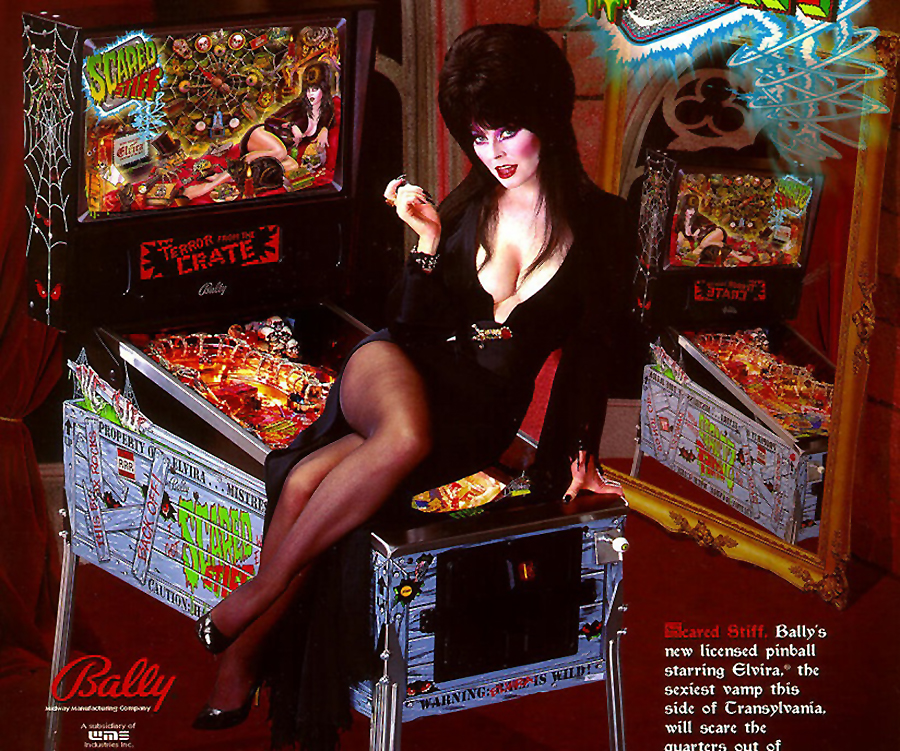
Bally flyer for the Scared Stiff pinball (1996)
“The Sexiest Vampire this side of Transylvania”
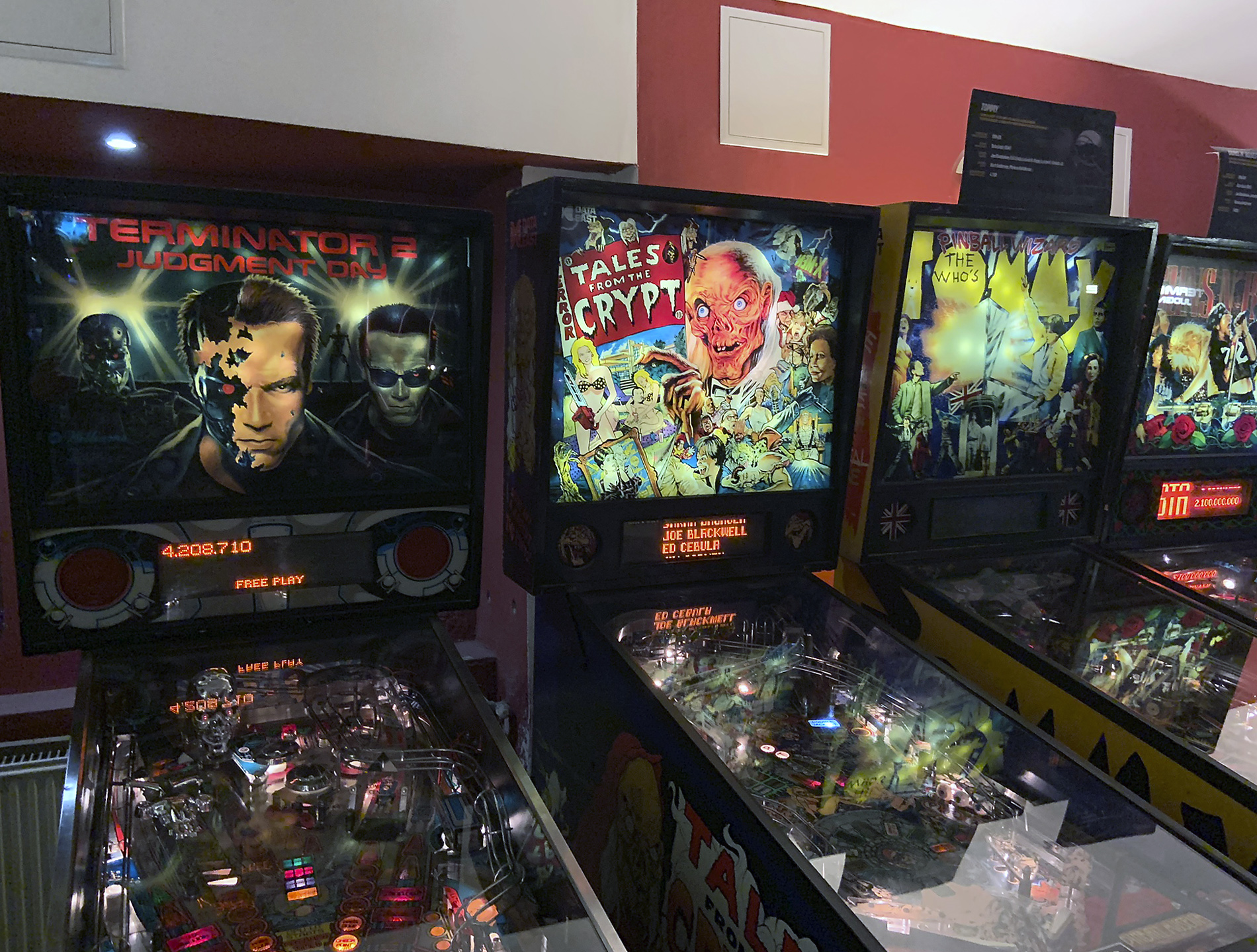
Installation view of the exhibition of pinball art at the Flippermúzeum, Budapest showing from left to right, Williams Terminator 2: Judgment Day (1991); Data East USA, Inc. Tales from the Crypt (1993); Data East USA, Inc. The Who’s Tommy Pinball Wizard (1994)
Photo: Marcus Bunyan
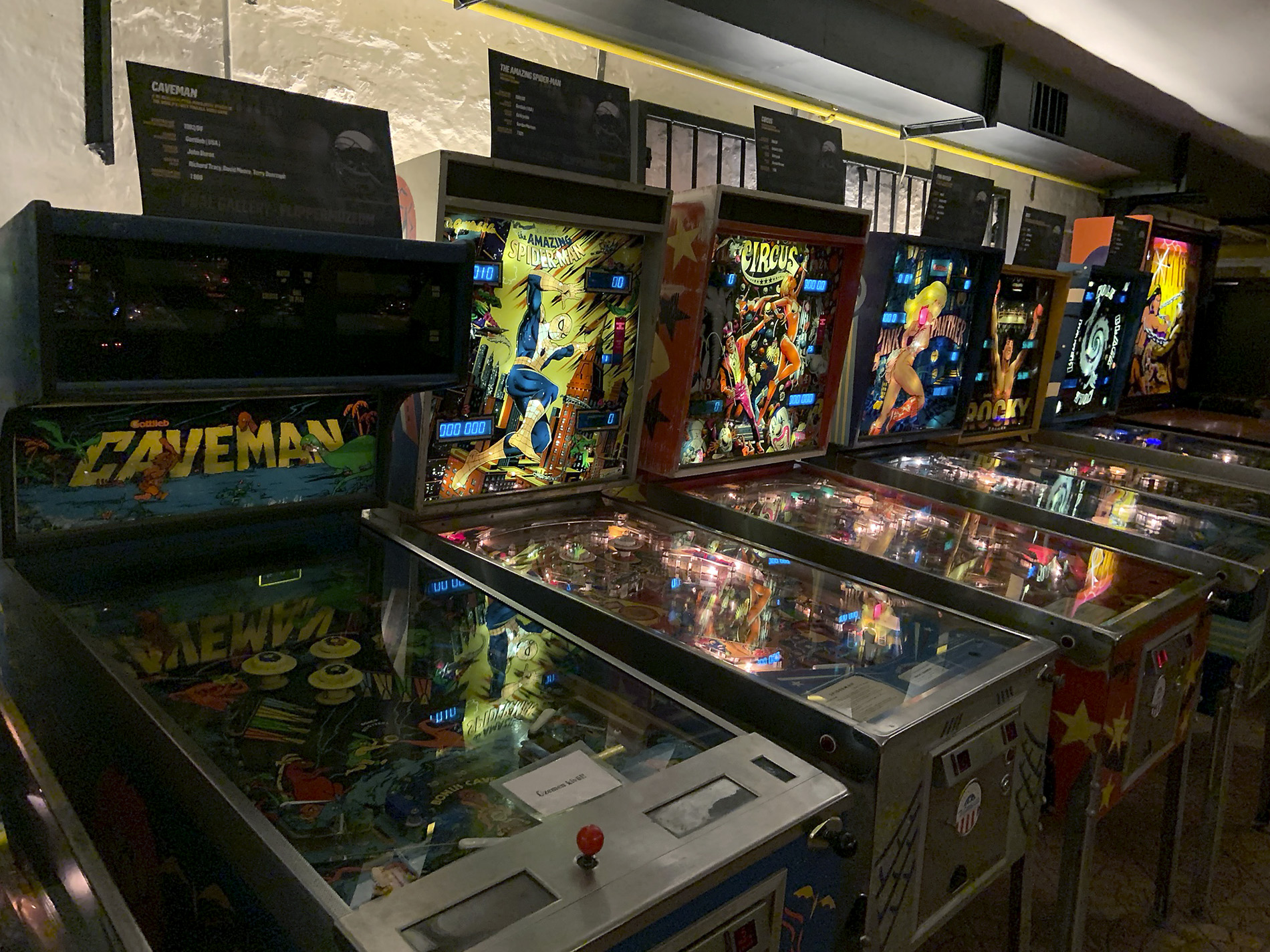
Installation view of the exhibition of pinball art at the Flippermúzeum, Budapest showing from left to right, Gottlieb’s Caveman (1982); Gottlieb’s the Amazing Spiderman (1980); Gottlieb’s Circus (1980); Gottlieb’s Pink Panther (1981); and Gottlieb’s Rocky (1982)
Photo: Marcus Bunyan
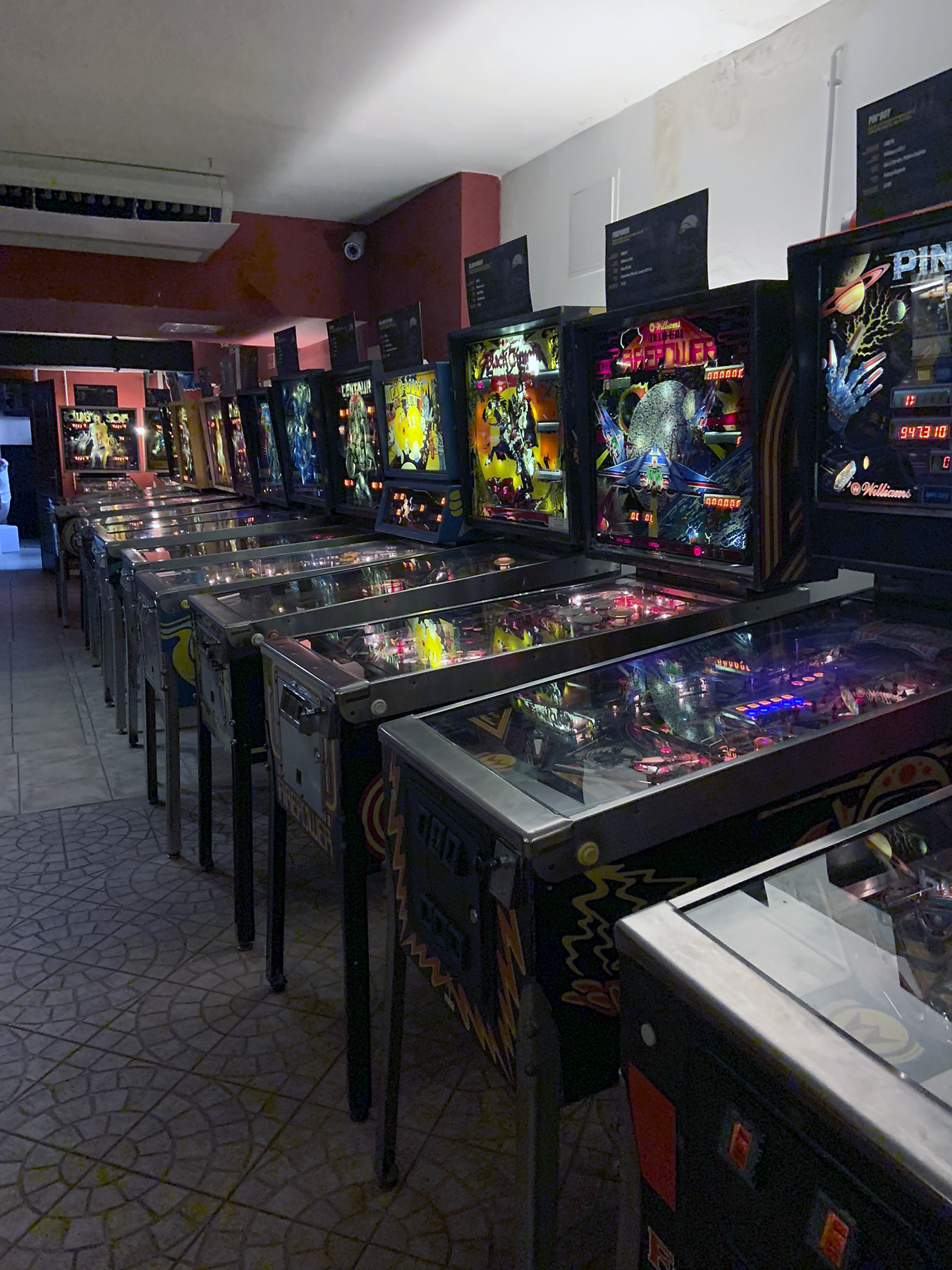
Installation view of the exhibition of pinball art at the Flippermúzeum, Budapest
Photo: Marcus Bunyan
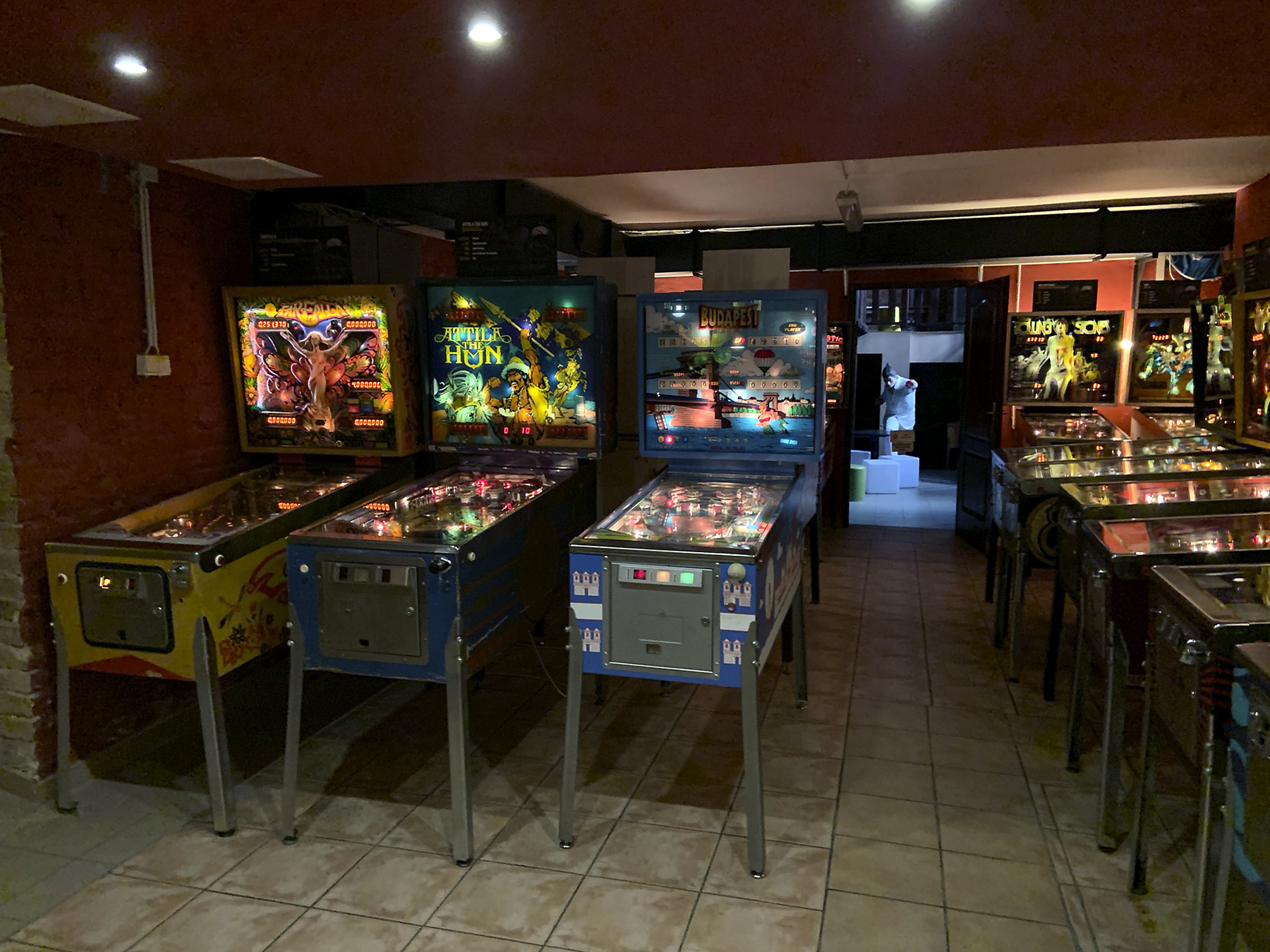
Installation view of the exhibition of pinball art at the Flippermúzeum, Budapest showing at left, Zaccaria’s FarFalla (1983); at second left, Game Plan, Inc. Attila the Hun (1984); and at right back, Bally’s Rolling Stones (1980)
Photo: Marcus Bunyan
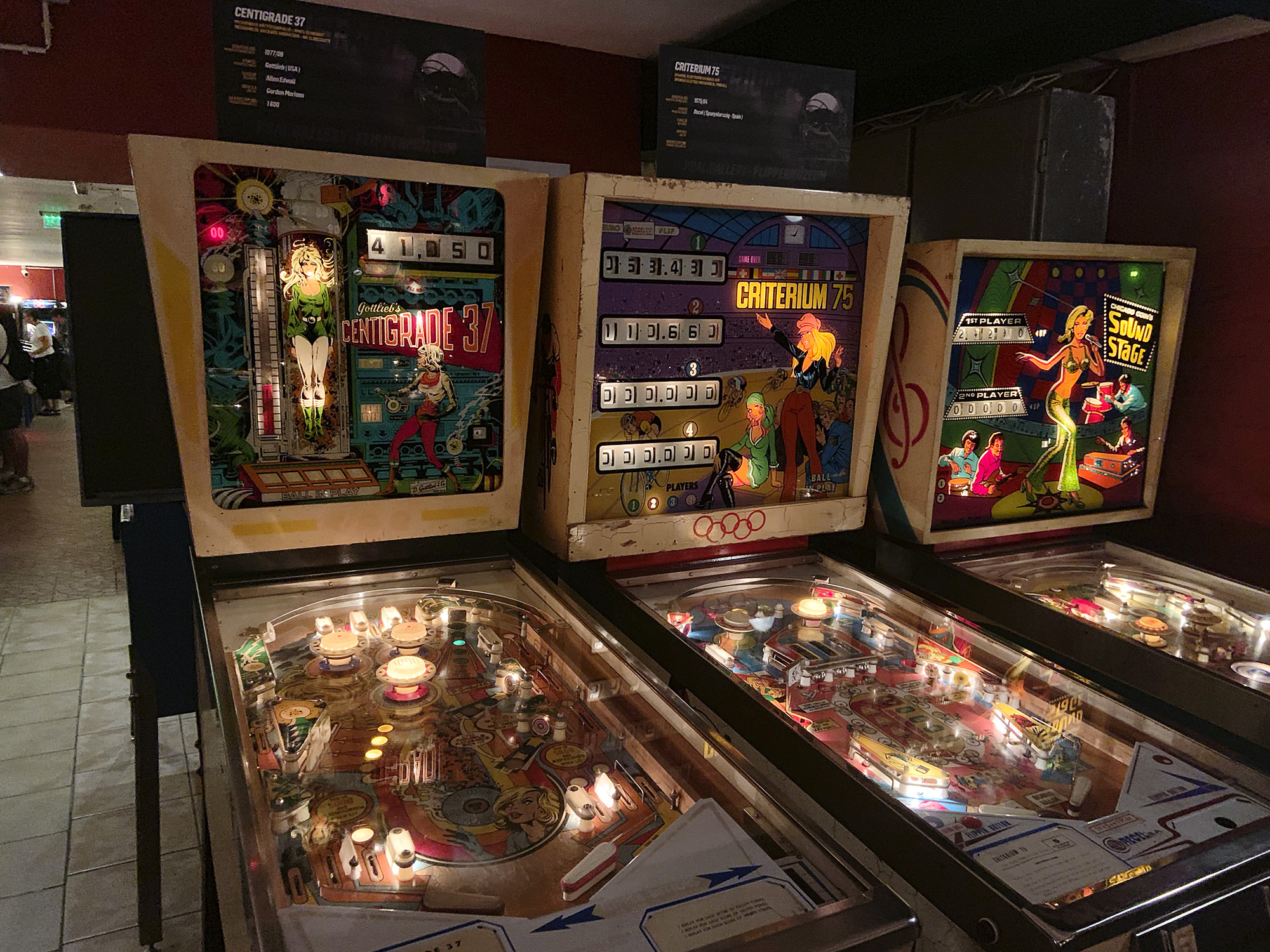
Installation view of the exhibition of pinball art at the Flippermúzeum, Budapest showing from left to right, Gottlieb’s Centigrade 37 (1977); Recel S. A. Criterium 75 (1978); Chicago Coin Machine Mfg. Co. Sound Stage (1976)
Photo: Marcus Bunyan
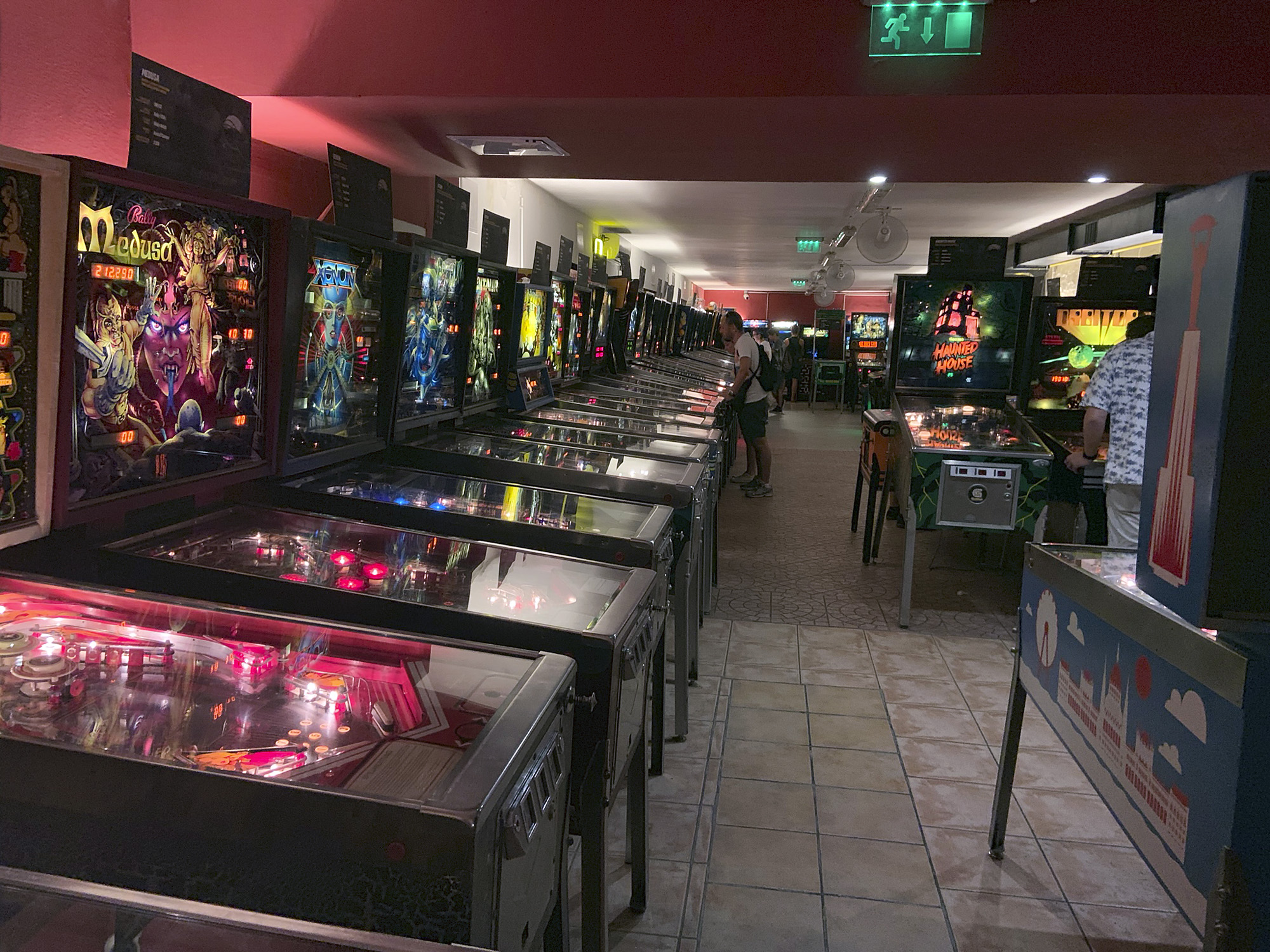
Installation view of the exhibition of pinball art at the Flippermúzeum, Budapest showing at left, Bally’s Medusa (1981); and at second left, Bally’s Xenon (1980); and at right, Gottlieb’s Haunted House (1982)
Photo: Marcus Bunyan
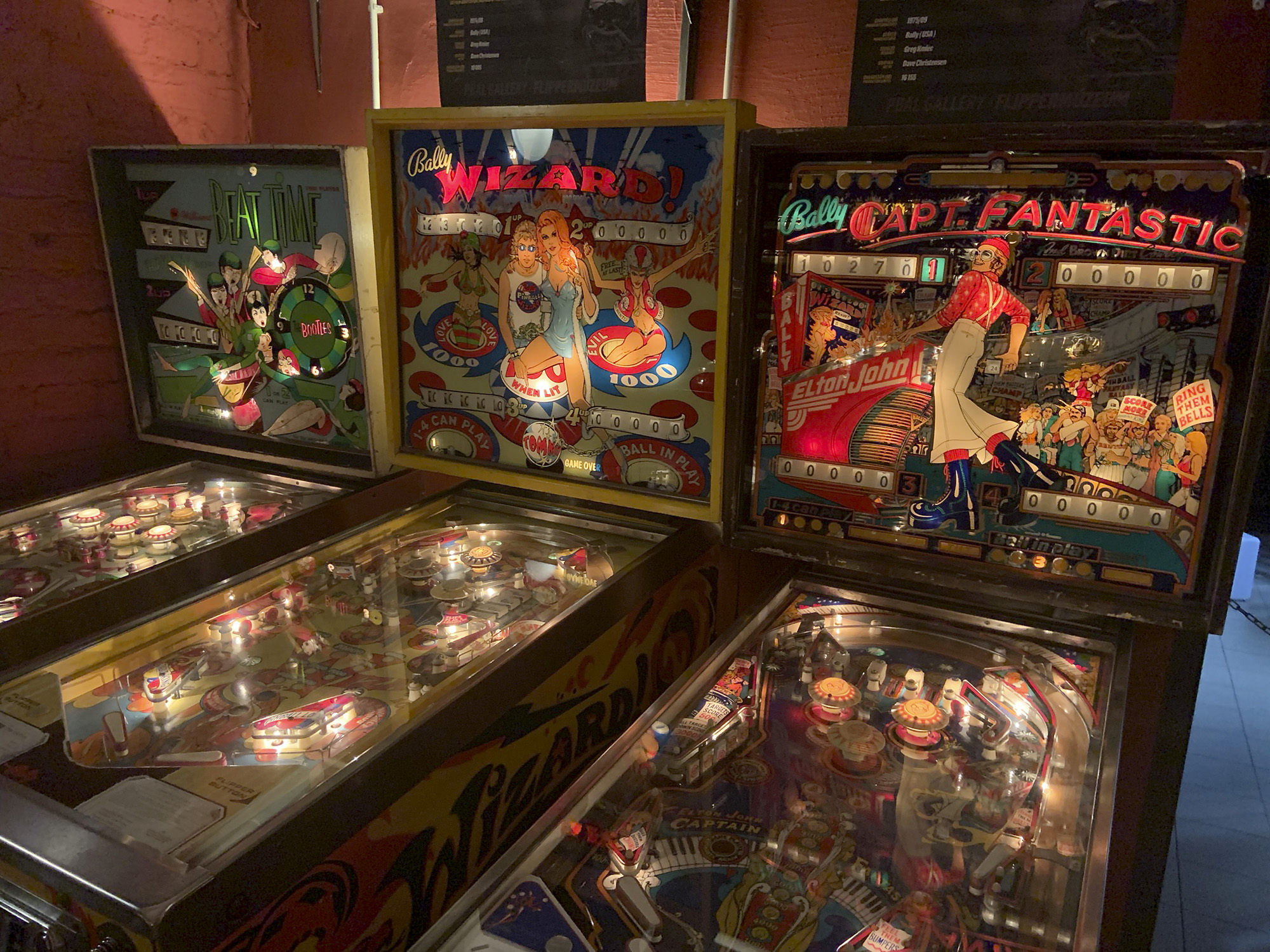
Installation view of the exhibition of pinball art at the Flippermúzeum, Budapest showing from left to right, Williams Beat Time (1967); Bally’s Wizard! featuring Ann Margret and Roger Daltrey (1975); and Bally’s Capt. Fantastic and the Dirt Brown Cowboy featuring Elton John (1976)
Photo: Marcus Bunyan

Budapest Pinball Museum magnet
Budapest Pinball Museum
Budapest Pinball Museum deploys more than 140 machines (pinball, arcade video cabinets and other games), making the venue one of the biggest ongoing pinball collections in Europe. All of our games are set to free play. Some of the exhibition’s older pieces qualify as truly unique antiques, like the first pinball machines ever made with flippers, dating back to 1947. Some of pinball’s predecessors are also on display, such as the unique bagatelles from the 1880s. It is the most popular museum in Hungary, usually in the top 10 out of some 600 Budapest tourist attractions on Tripadvisor.
Pinballs are time machines
It might as well be the occasion of an anniversary. It was a quarter of a century ago that legendary Data East marketed a pinball called the Time Machine. This name has got a symbolic meaning ever since. Today all pinballs have transformed into a time machine, remnants of an old age. Their natural environment, the arcade has been outdated since then, yet we can find an ever increasing number of pinballs at collectors.
The moment that dwells in our memories will never pass, never fade away: the moment as we were standing in front of the machines or waiting our turn at the arcade. Beyond the lights, colours and sounds of pinballs, a mystical children’s dreamworld is still shaping for us. A dreamworld that is still alive in us adults, even as we read this.
This dreamworld, these lights, these colours and sounds will be reawaken by our ‘time machines’, at our carefully selected exhibition. Our inner Child is inviting us for an encounter we will never forget.
It was the 70’s: that’s where my love for pinball has really started, by the way. I have encountered first with these tinkling machines at camp sites and arcades of my childhood. Pinballs have been thrilling me ever since: anytime the opportunity arises, I try new ones out. I have met many people during the last four years who share my passion for pinball. This also encouraged me to set up an ‘institute’, with pinballs playing the main role, offering however, experiences also for those interested in the history of technology and for the pinball rookie.
In April 2013 I have finally succeeded in my endeavours: I was granted license to open the museum / exhibition. Pbal Gallery opened at last to the public on April 10th, 2014.
You’re welcome to join an unforgettable time travel at the gallery!
Balázs Pálfi (owner)
Text from the Flippermúzeum, Budapest [Online] Cited 03/11/2020
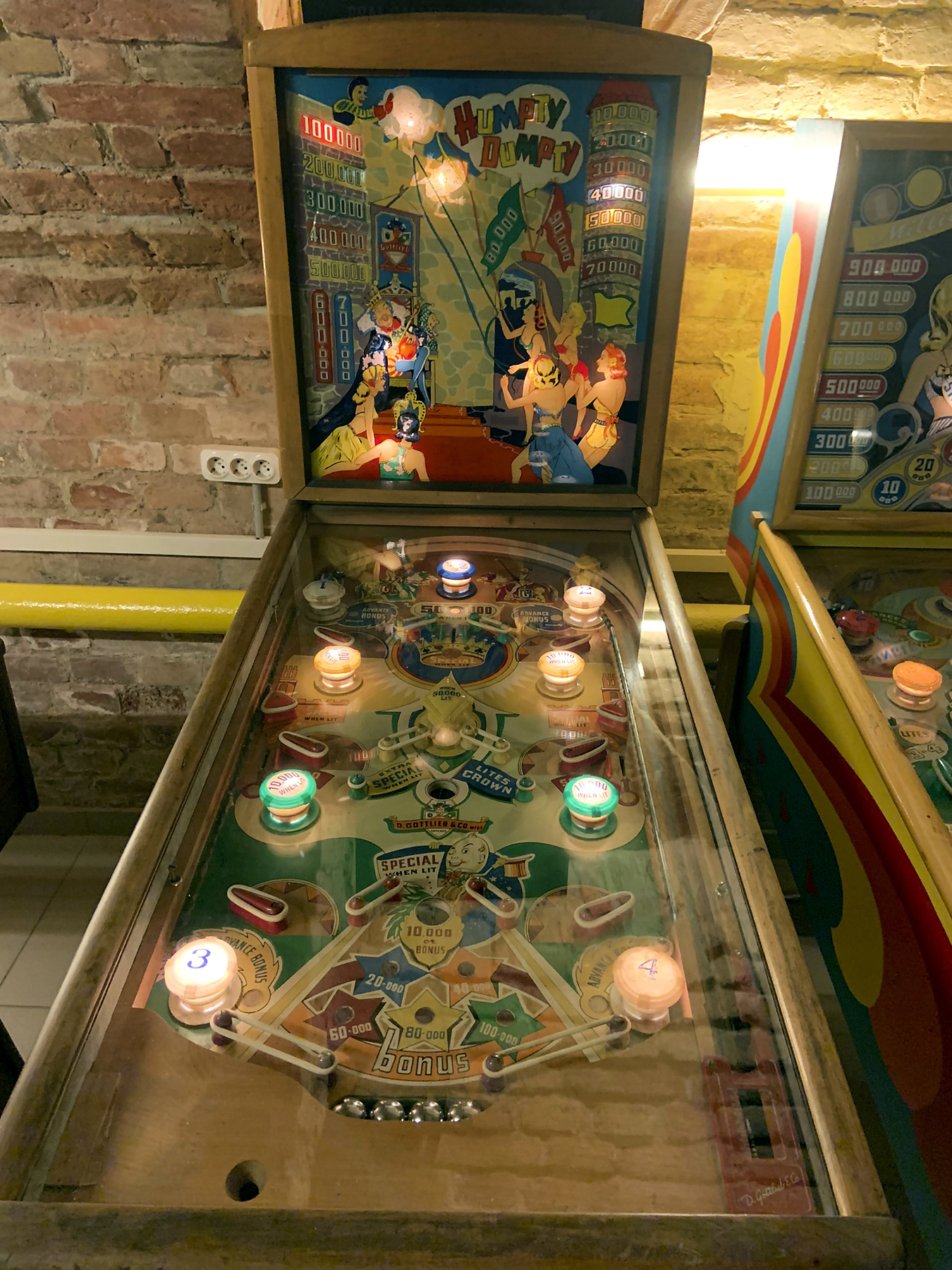
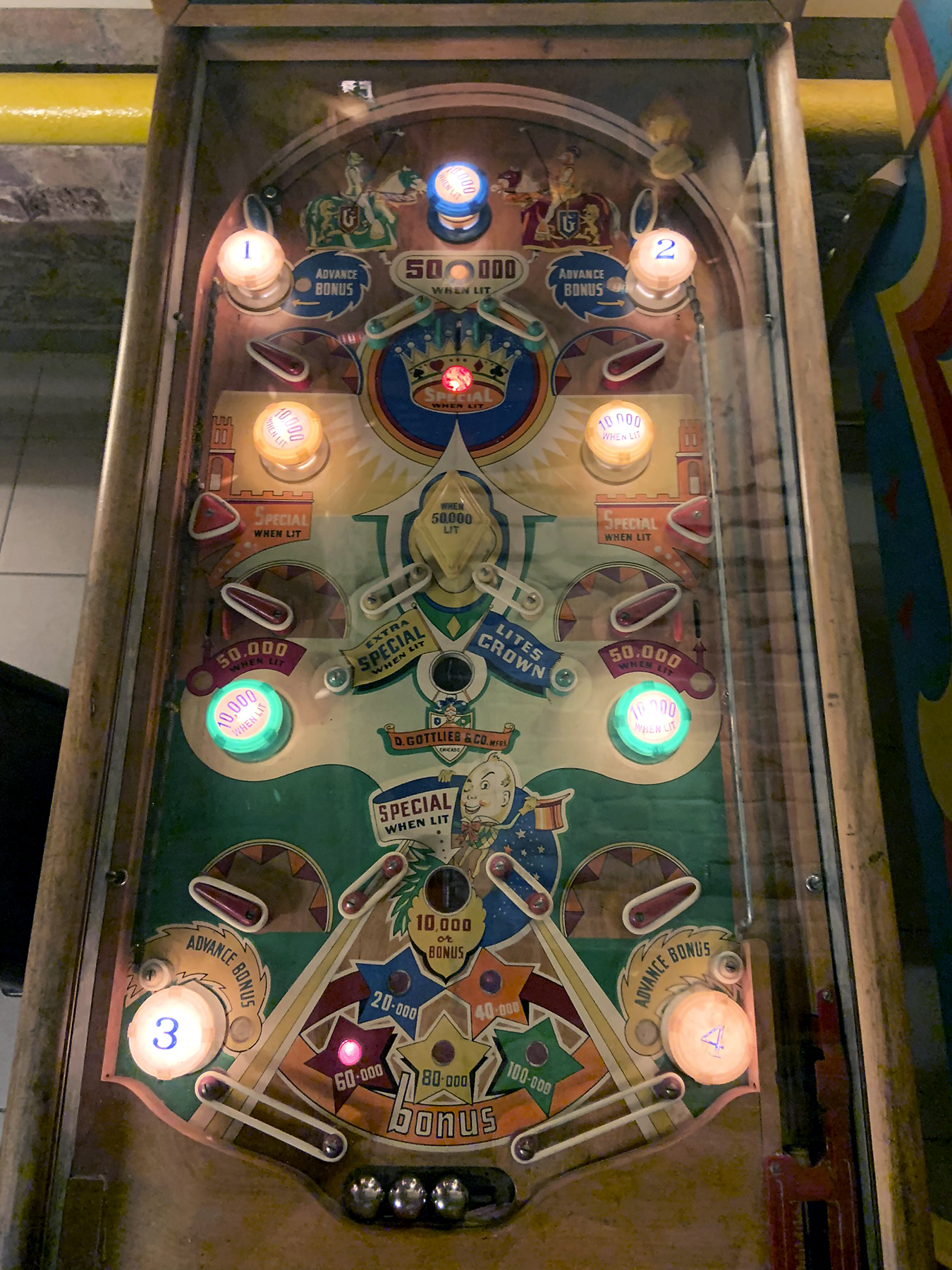
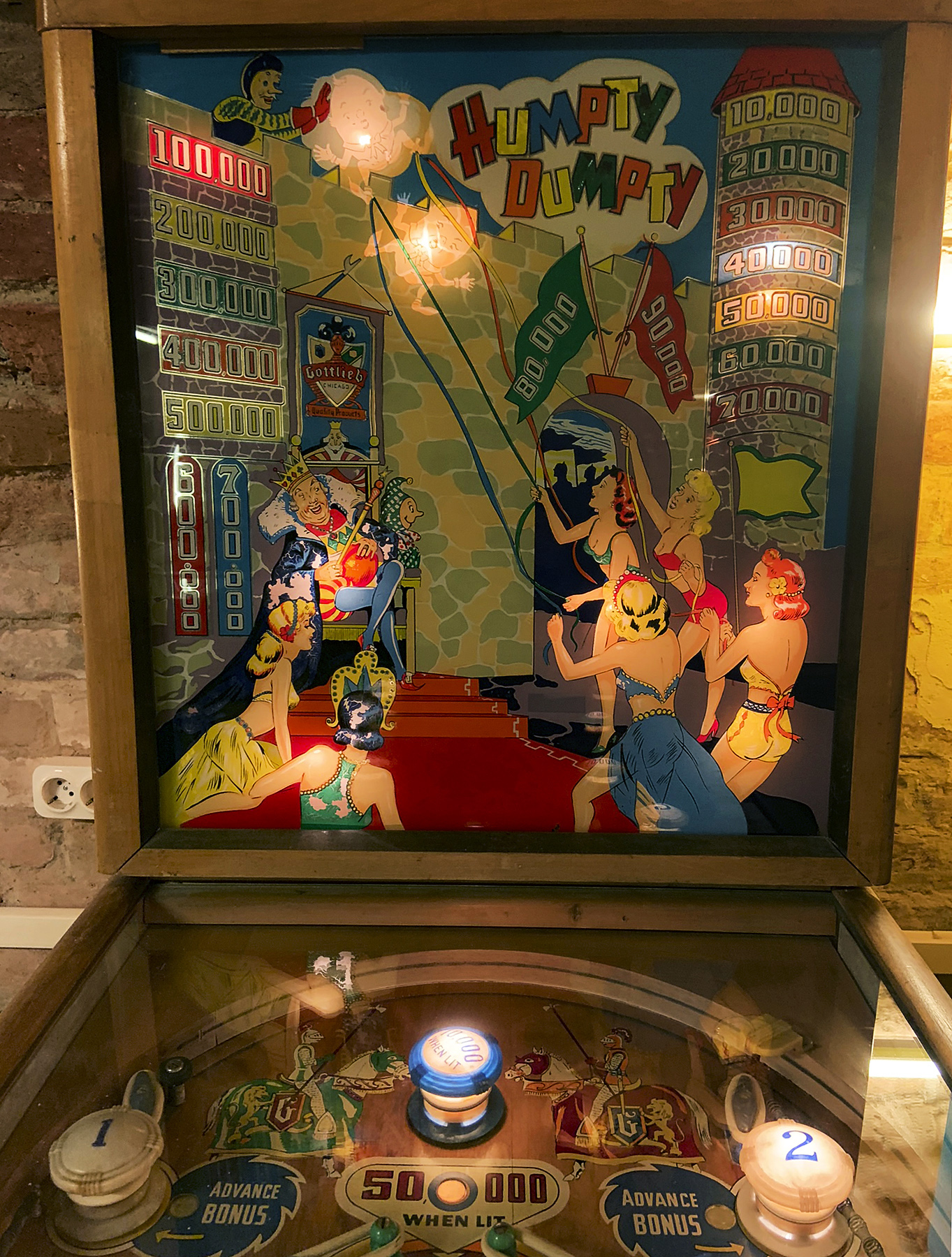
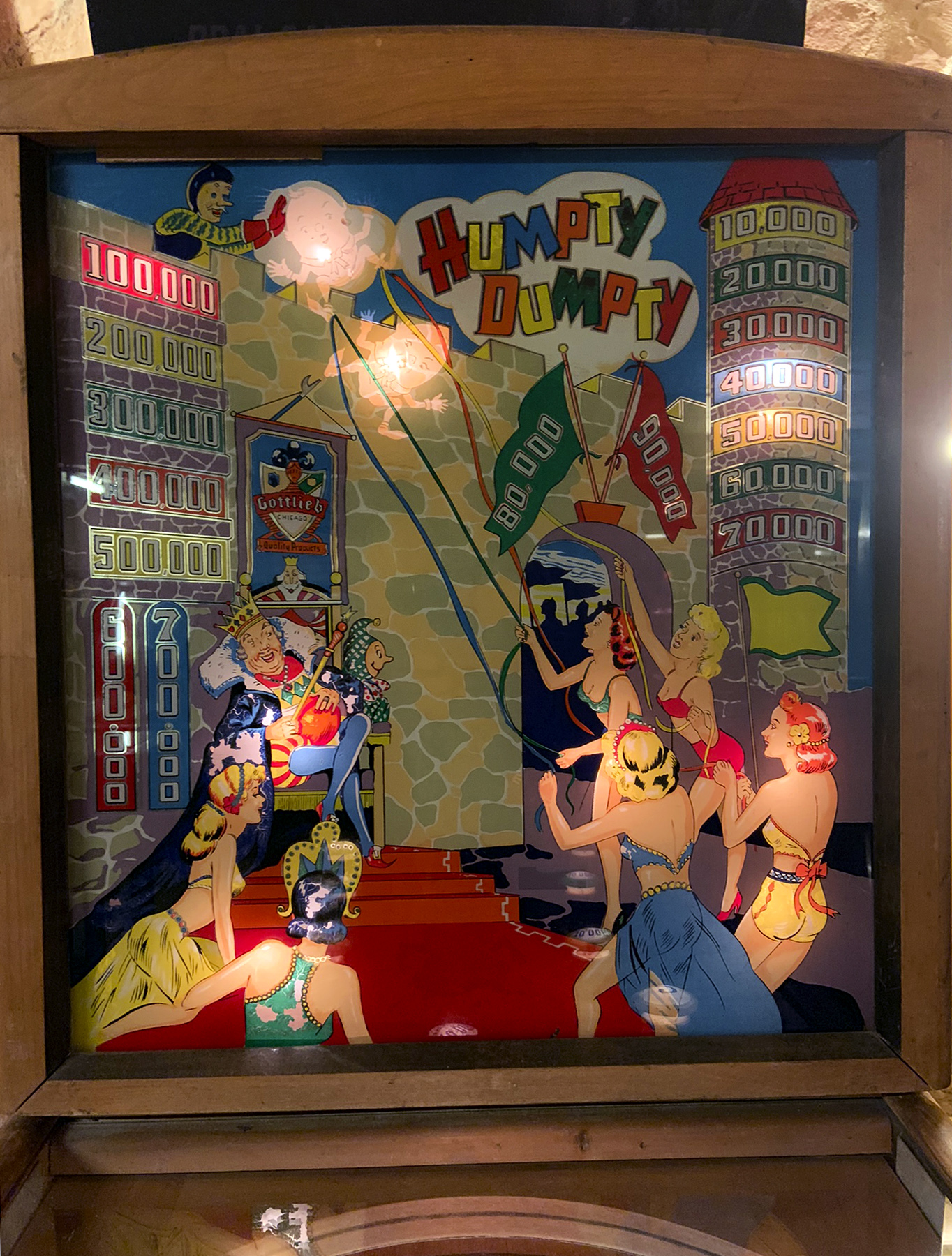
D. Gottlieb & Co. (1931-1977)
Humpty Dumpty
1947
6,500 produced
Photos: Marcus Bunyan
“Announcing… The Greatest Triumph in Pin Game History – Sensationally New Player Controlled Flipper Bumpers..The player will Laugh! The Spectator will Roar! The operator will be Thrilled!”
The very first FLIPPER Game. Harry Mabs invented the Flipper with this machine.
This is the oldest pinball I have ever played. Note that the flippers are not at the bottom of the machine, but in three pairs at the side of the machine. I found it very difficult to play, as the ball was easily lost between the large gap.
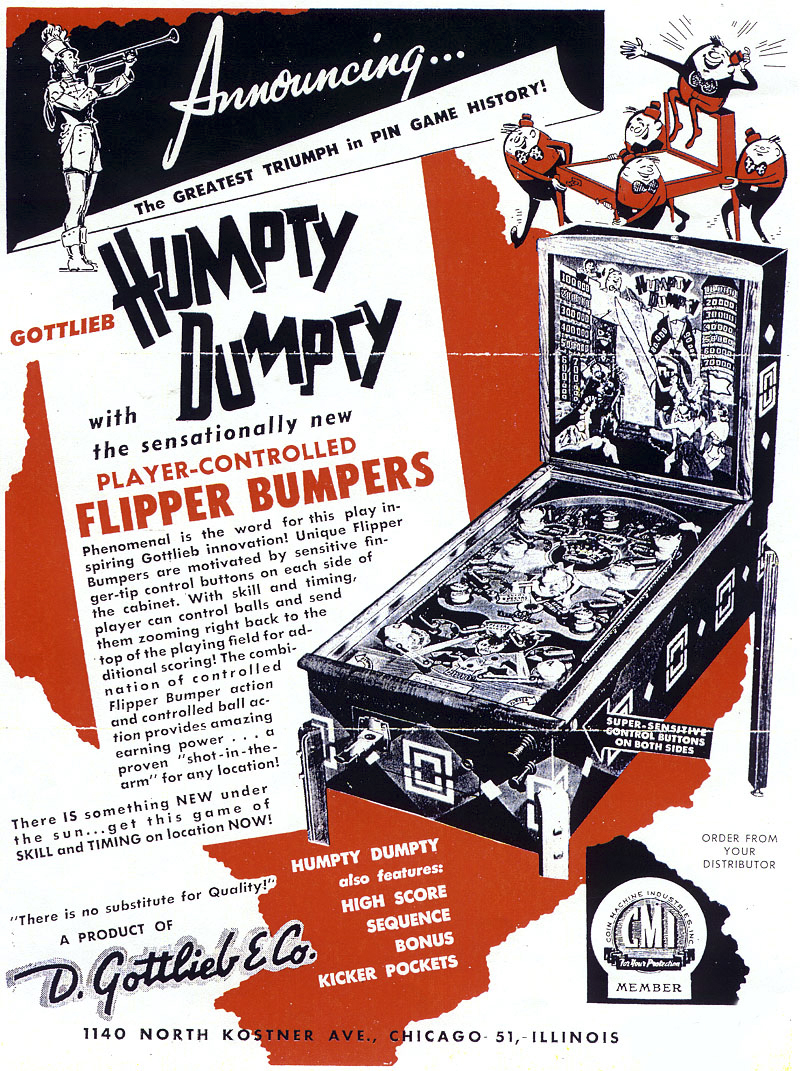
Humpty Dumpty flyer
Williams Electronic Games, Inc. (1967-1985)
Jalopy
1951
Photos: Marcus Bunyan
Note the outward facing flippers, and the non-central exit lanes. Also, this is a five ball game, whereas later games are only 3 ball games. If you get a replay in 1 ball, you get 10 free replays. YOUR JALOPY is a WINNAH!
D. Gottlieb & Co. (1931-1977)
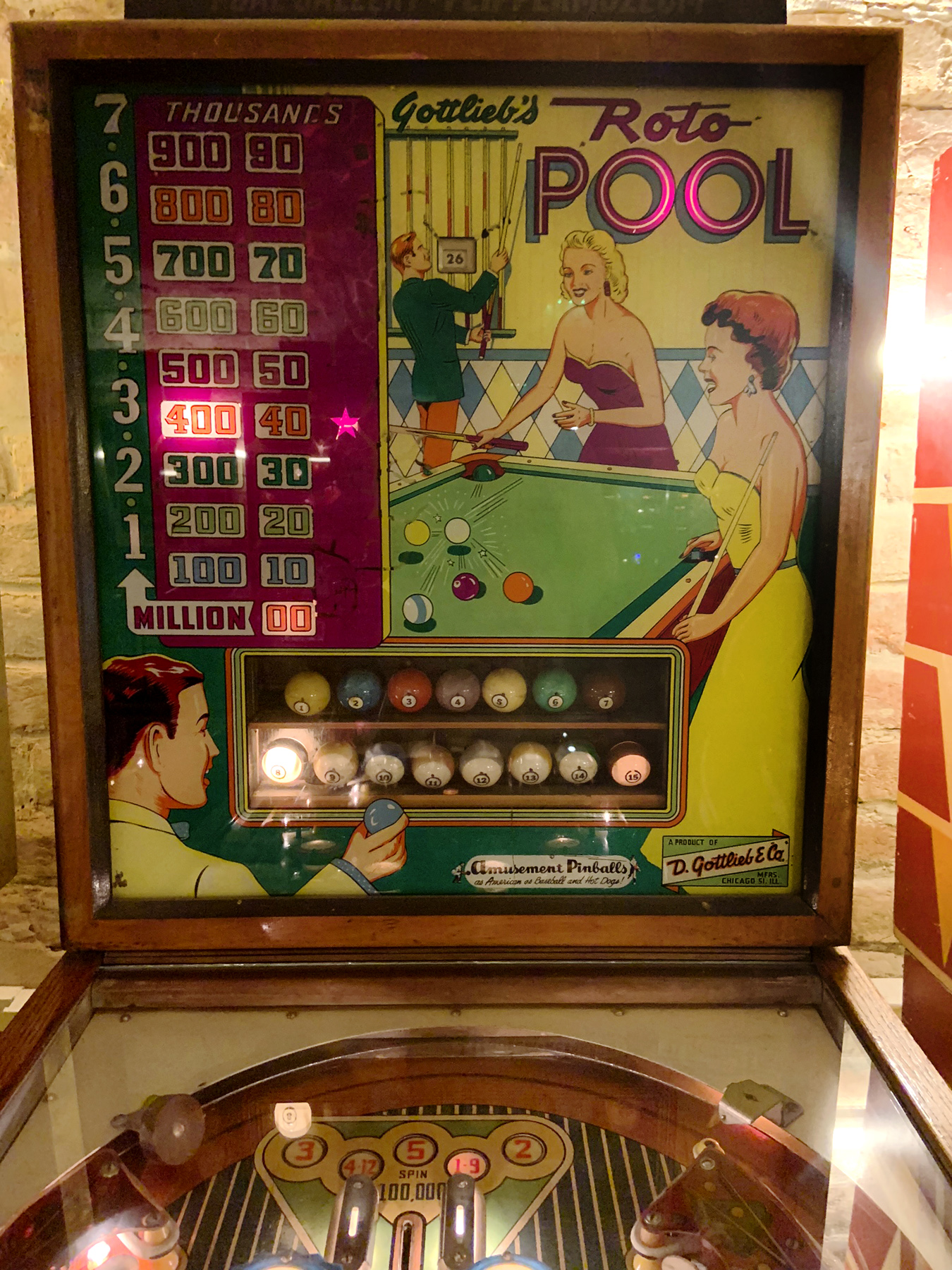
Roto Pool (detail)
1958
Photo: Marcus Bunyan
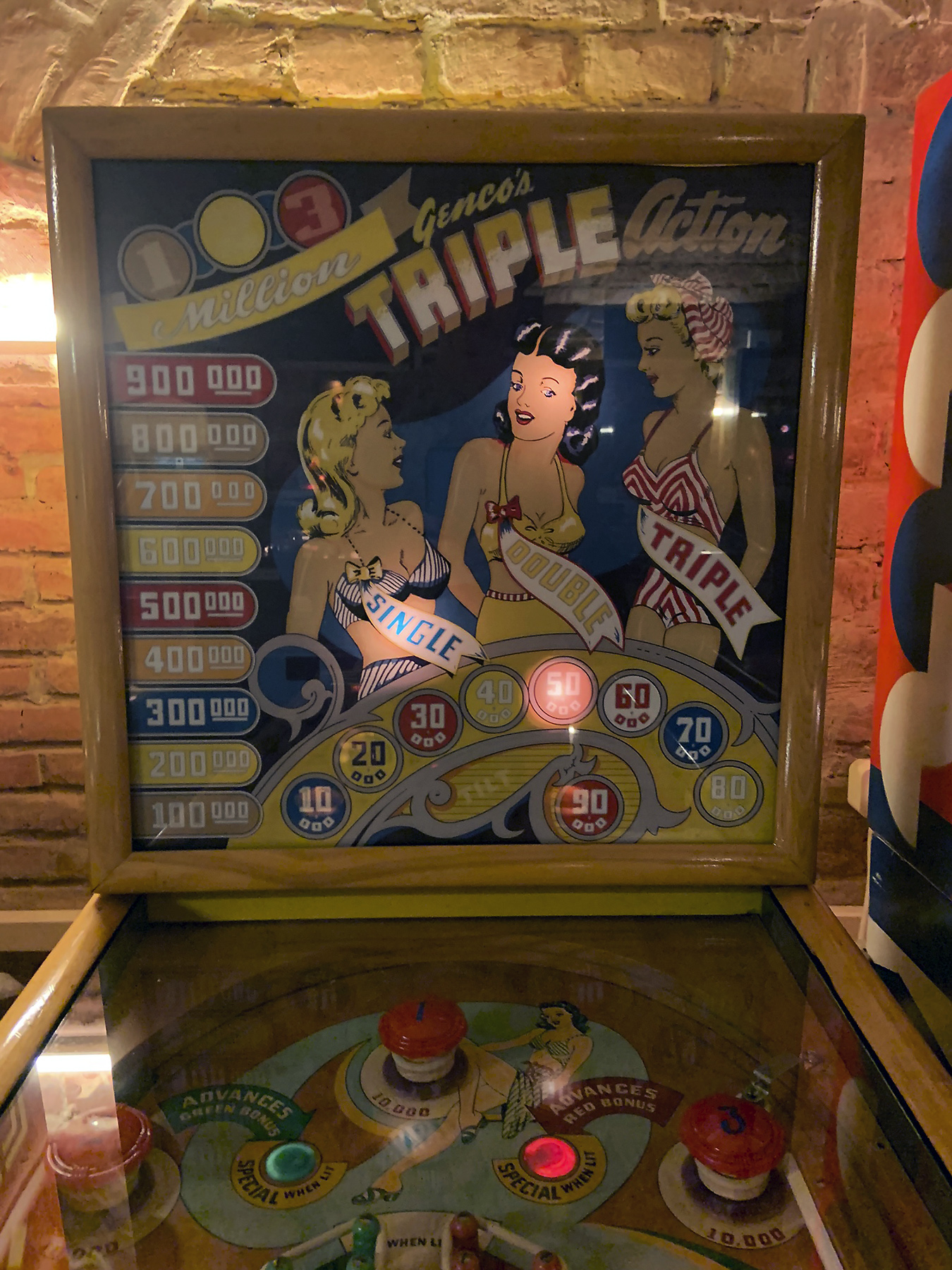
Genco Manufacturing Company (Chicago, Illinois, USA, 1931-1958)
Triple Action
1948
Photo: Marcus Bunyan
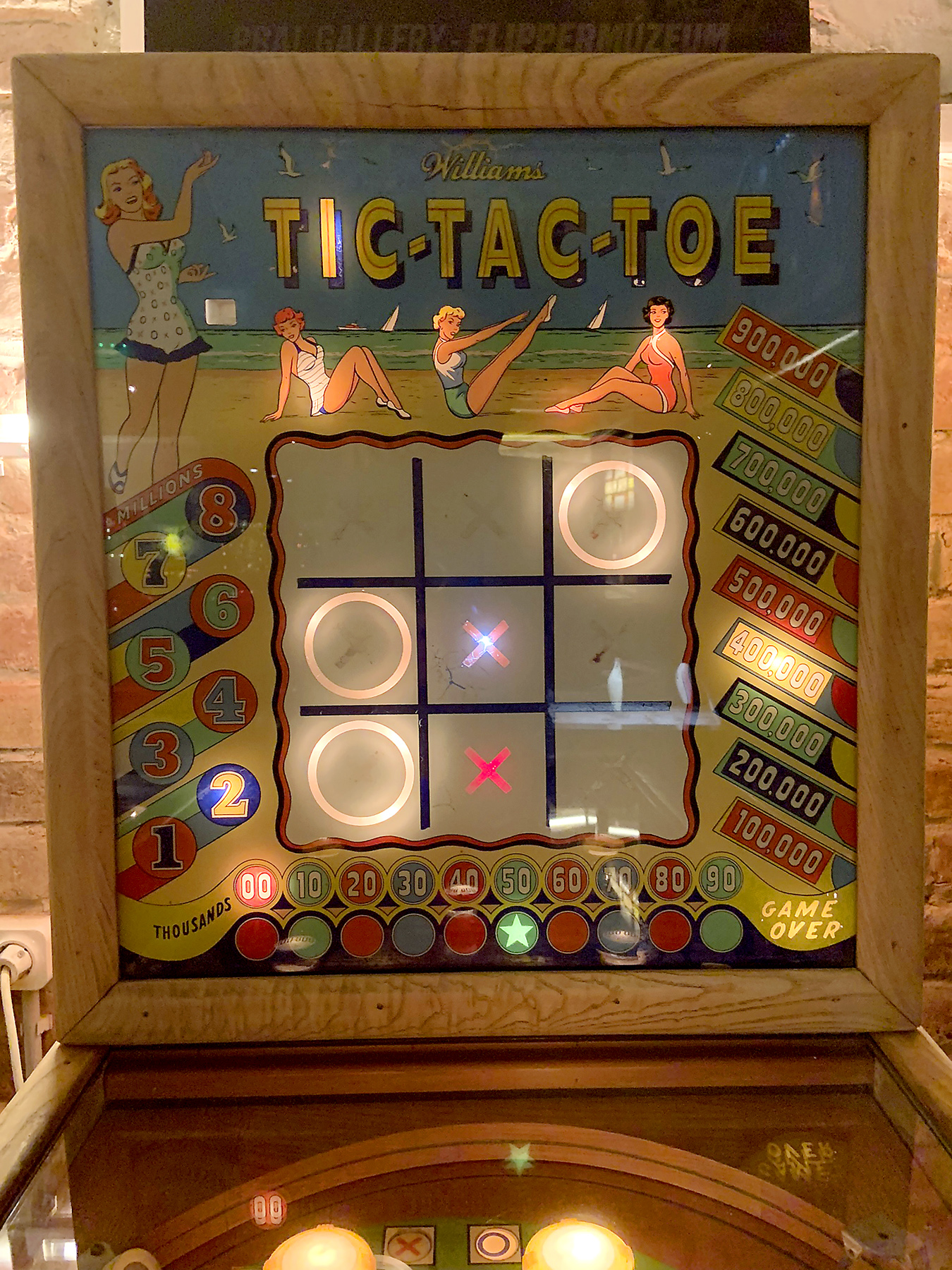
Williams Electronic Games, Inc. (1967-1985)
Tic-Tac-Toe (detail)
1959
Photo: Marcus Bunyan
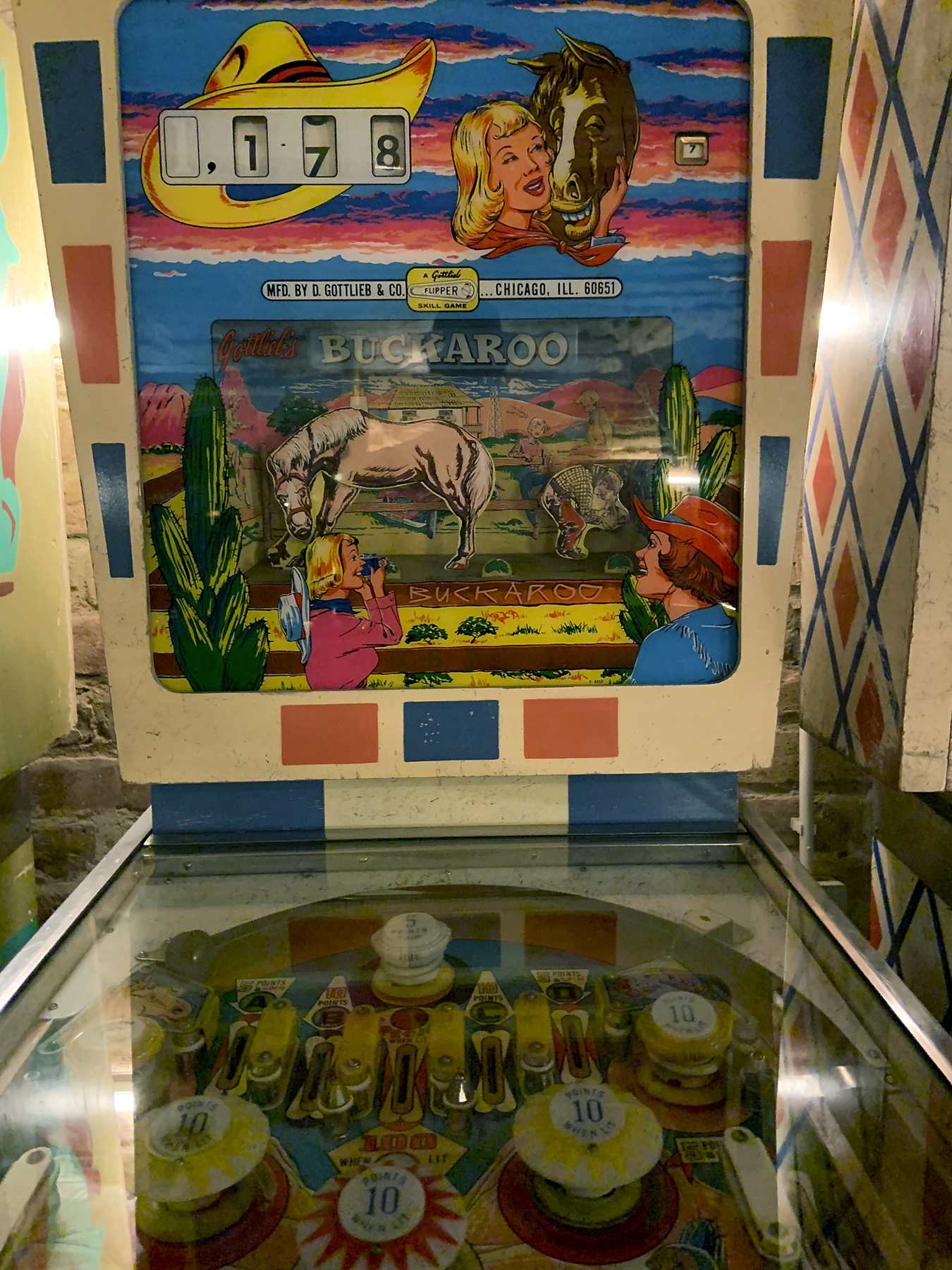
D. Gottlieb & Co. (1931-1977)
Buckaroo (detail)
1965
2,600 produced
Photo: Marcus Bunyan
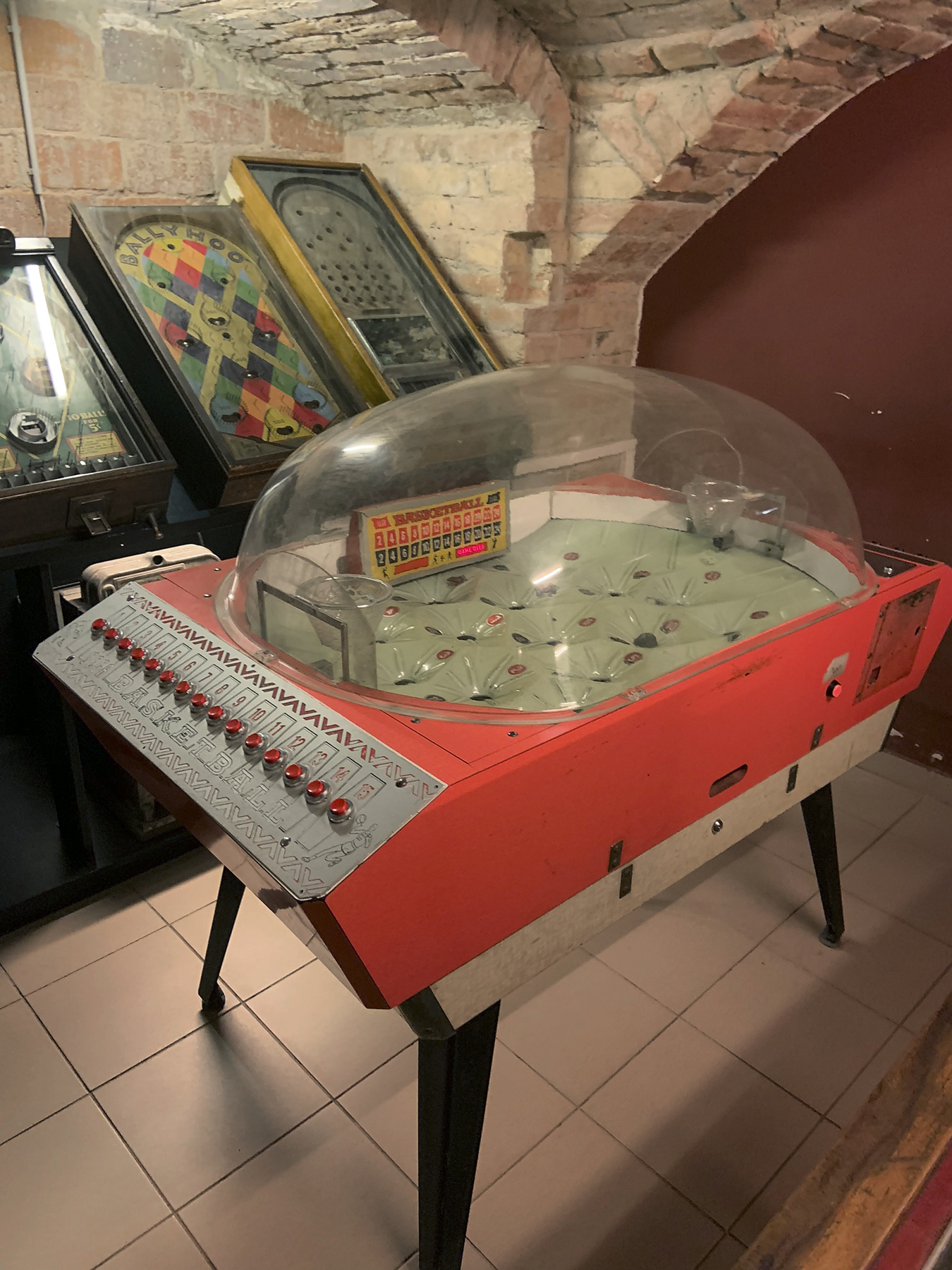
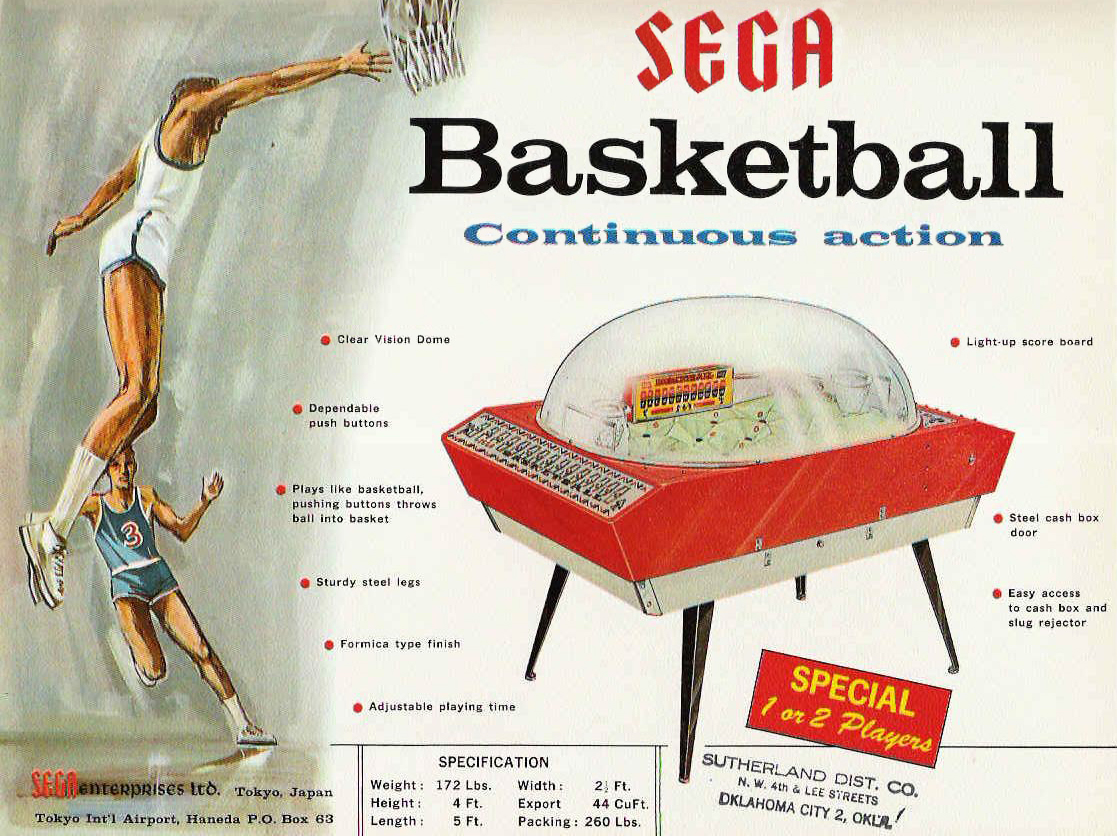
Sega
Basketball
1966
Photo: Marcus Bunyan
Sega Basketball flyer
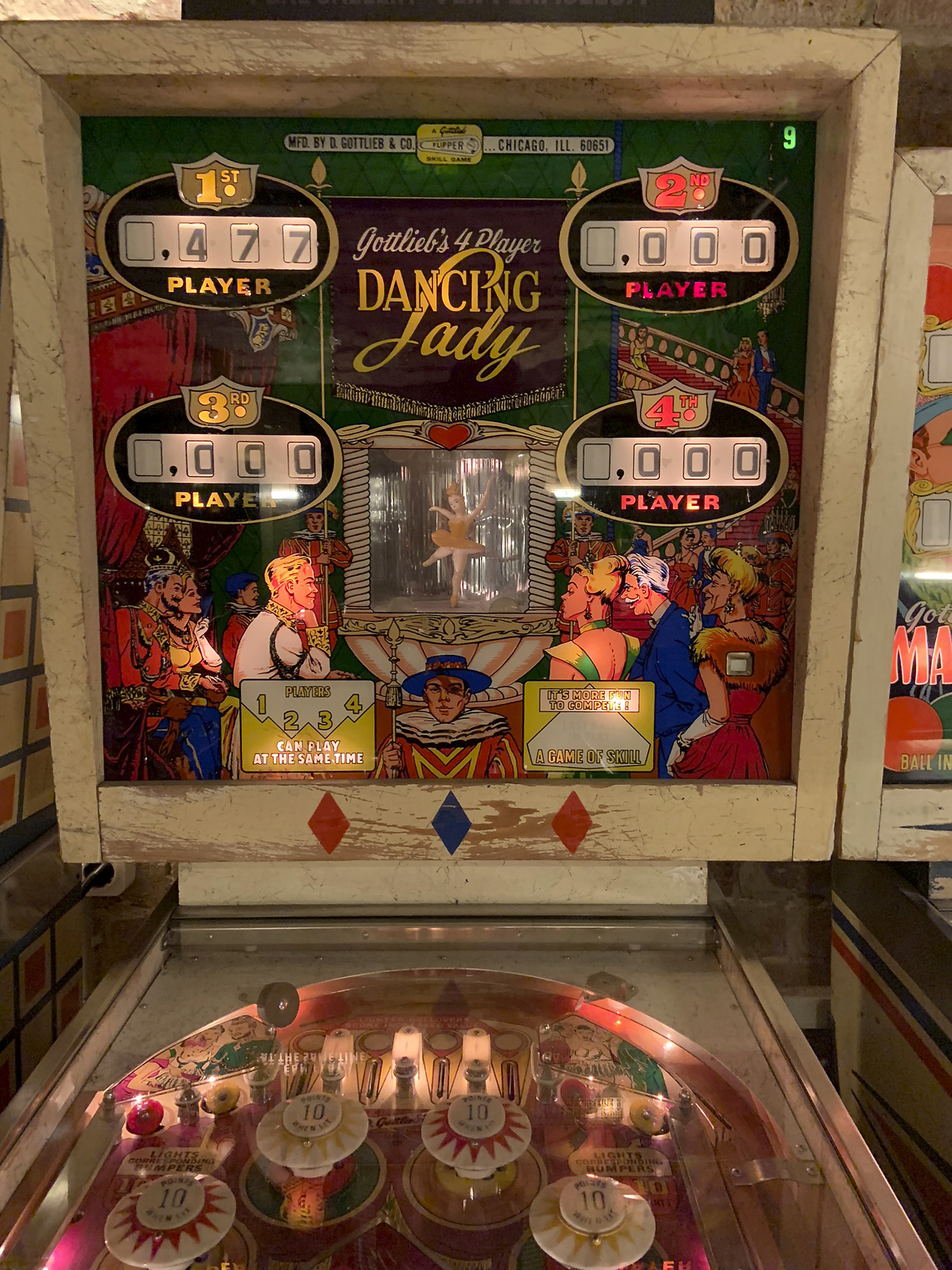
D. Gottlieb & Co. (1931-1977)
Dancing Lady
1966
2,675 produced
Photo: Marcus Bunyan
Dancing Lady exists in 2 versions – the Serial-Run had a new, larger Top with a completely new designed Glass in different colours (above). Test-Samples (approximately 100 to 150 Machines) from Summer / Autumn 1966 had slightly different Art on the lower Playboard and a complete different, more colourful and smaller Backglass, because the Serial-Run from December 1966 used the new and much higher Backbox. This new sort of Backbox was used for the Four-Players until 1977 while the Two-Players still used the smaller Backbox.
Text from the Pinside website [Online] Cited 04/11/2020
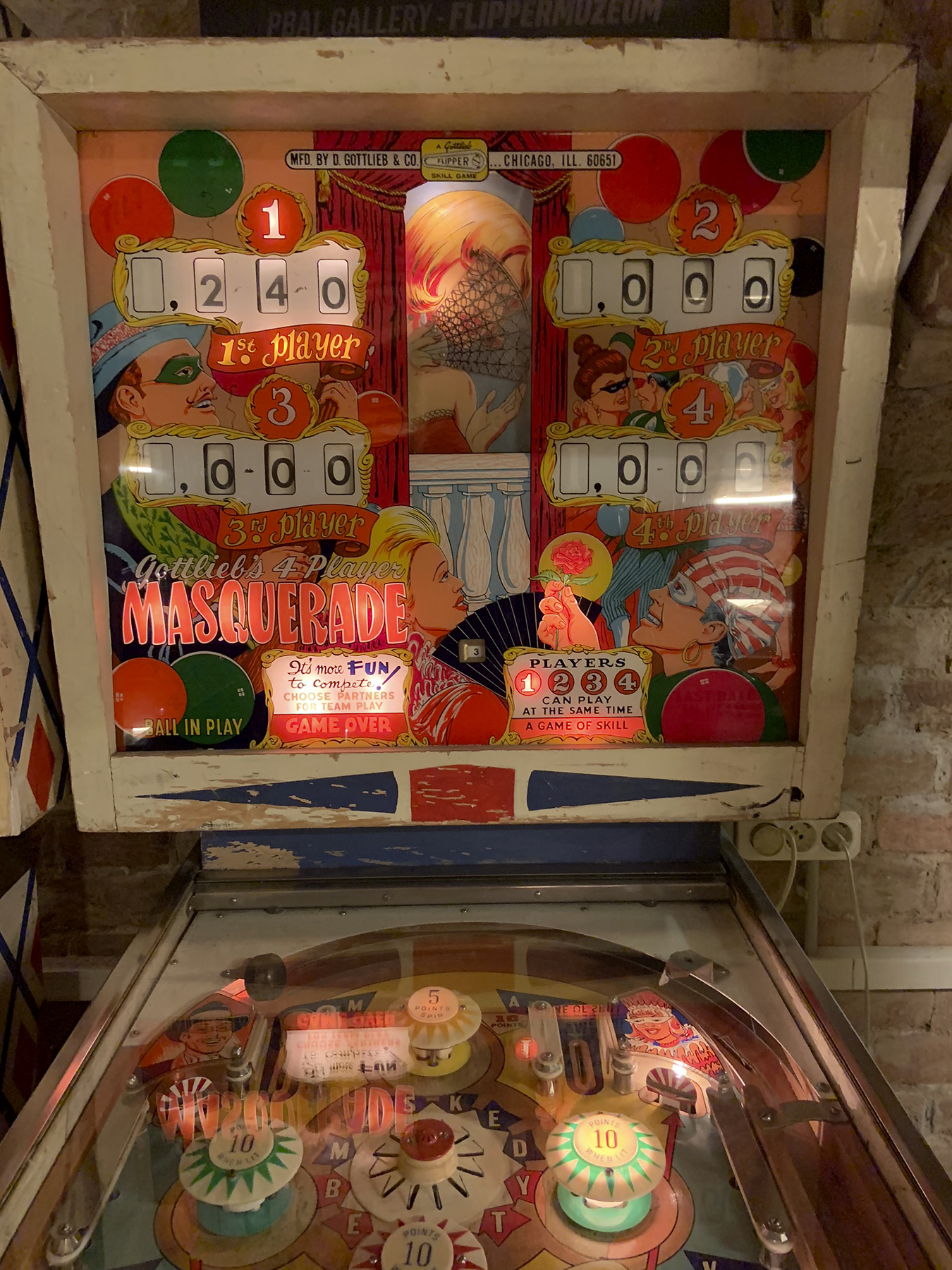
D. Gottlieb & Co. (1931-1977)
Masquerade (detail)
1966
3,662 produced
Photo: Marcus Bunyan
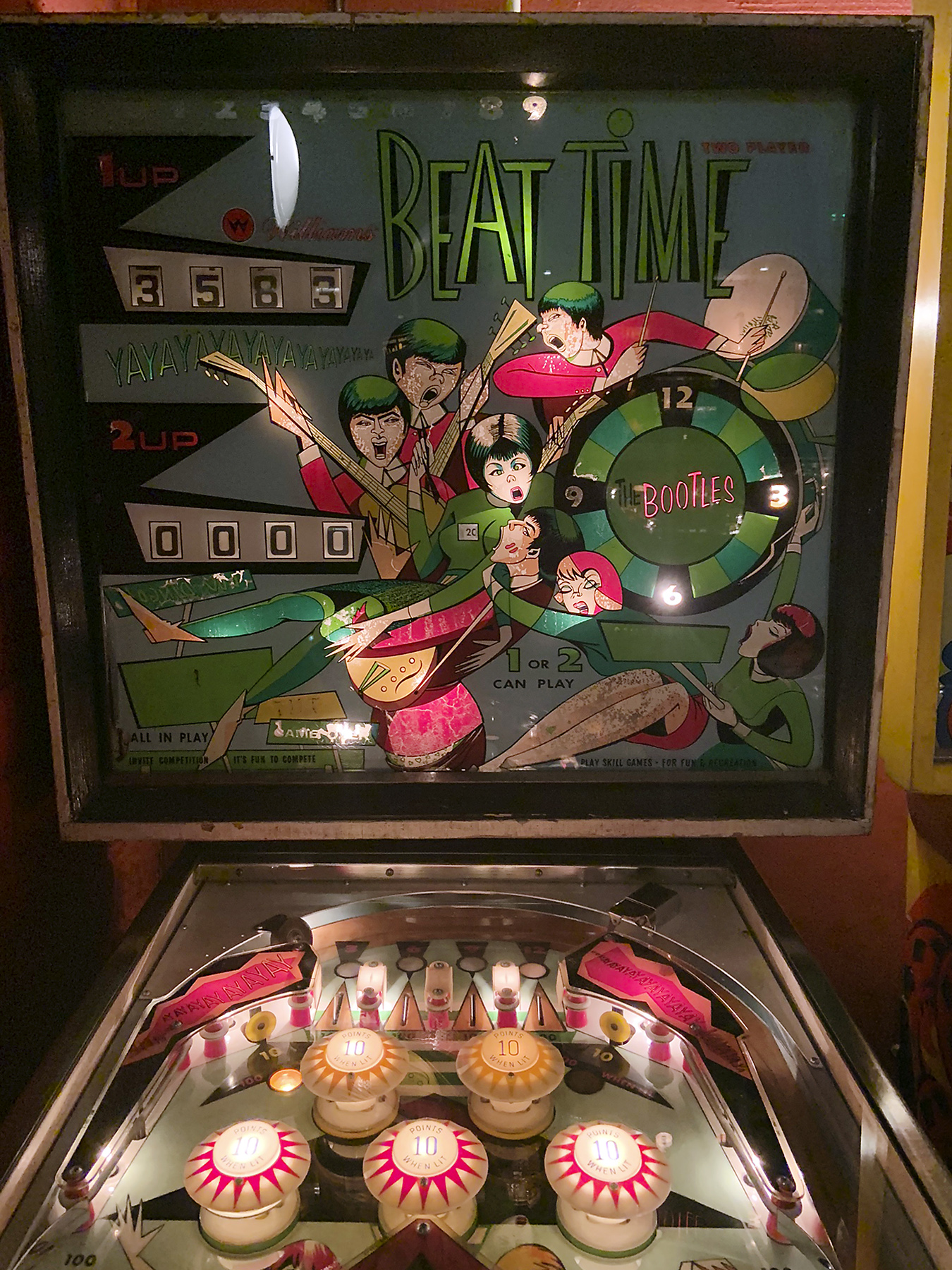
Williams Electronic Games, Inc. (1967-1985)
Beat Time (detail)
1967
2,802 produced
Photo: Marcus Bunyan
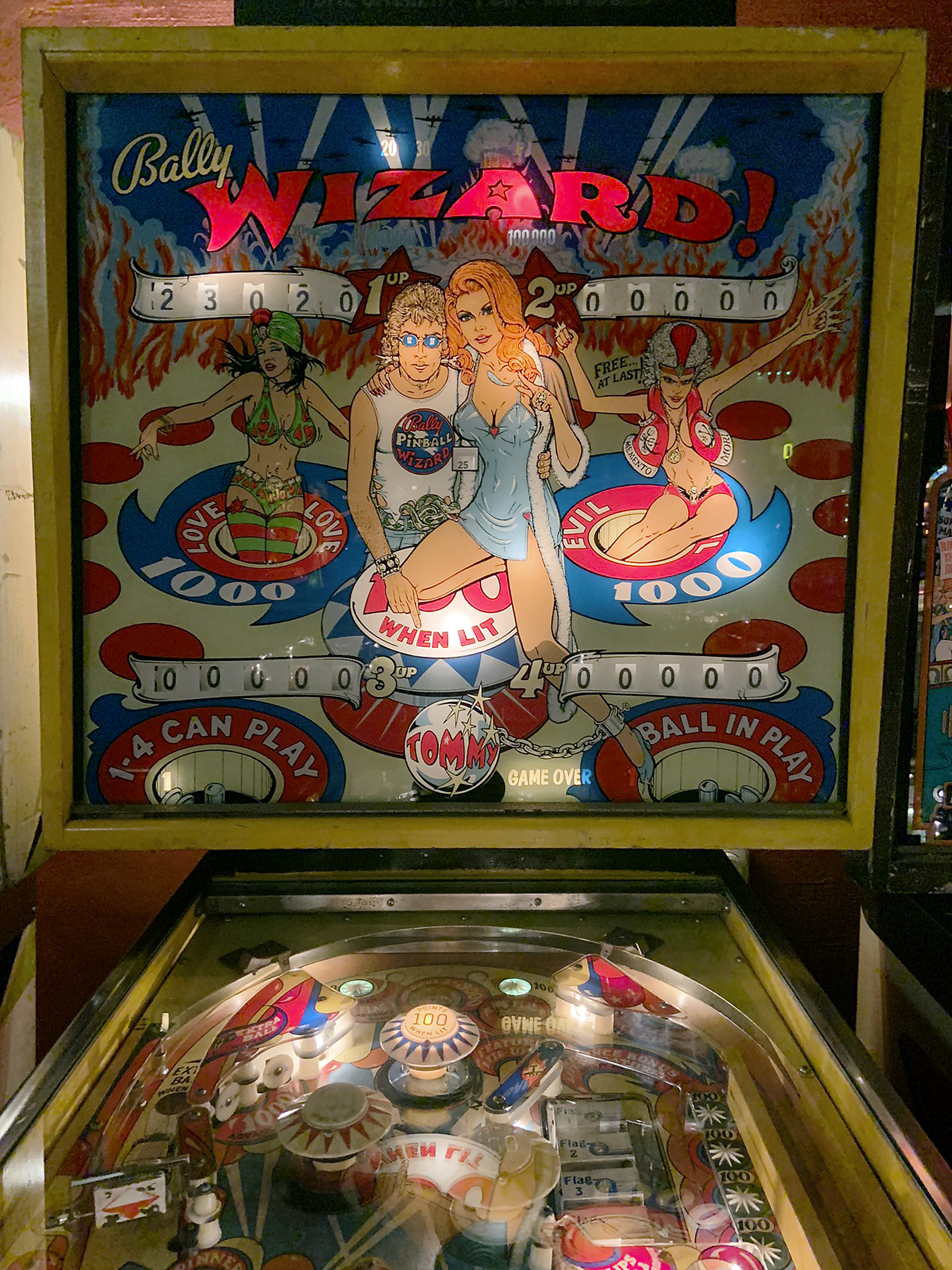
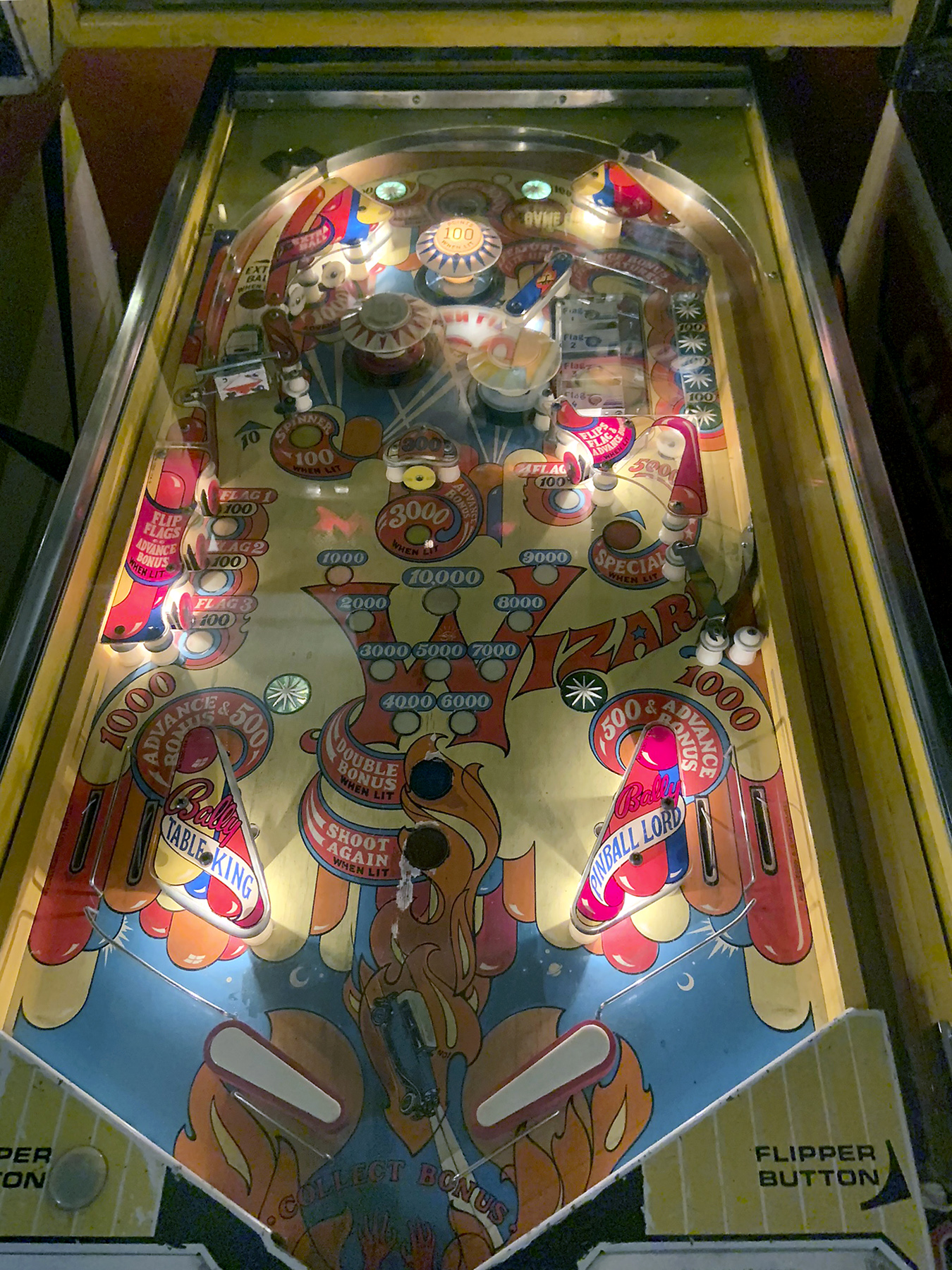
Bally Manufacturing Corporation (1931-1983)
Wizard! (details)
1975
10,005 produced
Photos: Marcus Bunyan
Wizard!, released in May 1975, was Bally’s highest production flipper game to that date with over 10,000 units produced. The game comes at the tail end of Bally’s electromechanical production schedule, and sets the stage for the company’s solid state success in the years to follow. Widely regarded as one of the first proper licensed games in pinball history, Wizard! features the likenesses of Ann Margret and Roger Daltrey, stars of the 1976 Ken Russell film Tommy (a screen adaptation of the Who’s rock opera of the same name). Other than its classic theme, Wizard! is notable as being the first game to showcase playfield “flip flags”, a feature used on only a handful of other Bally games.
Text from the Pinside website [Online] Cited 04/11/2020
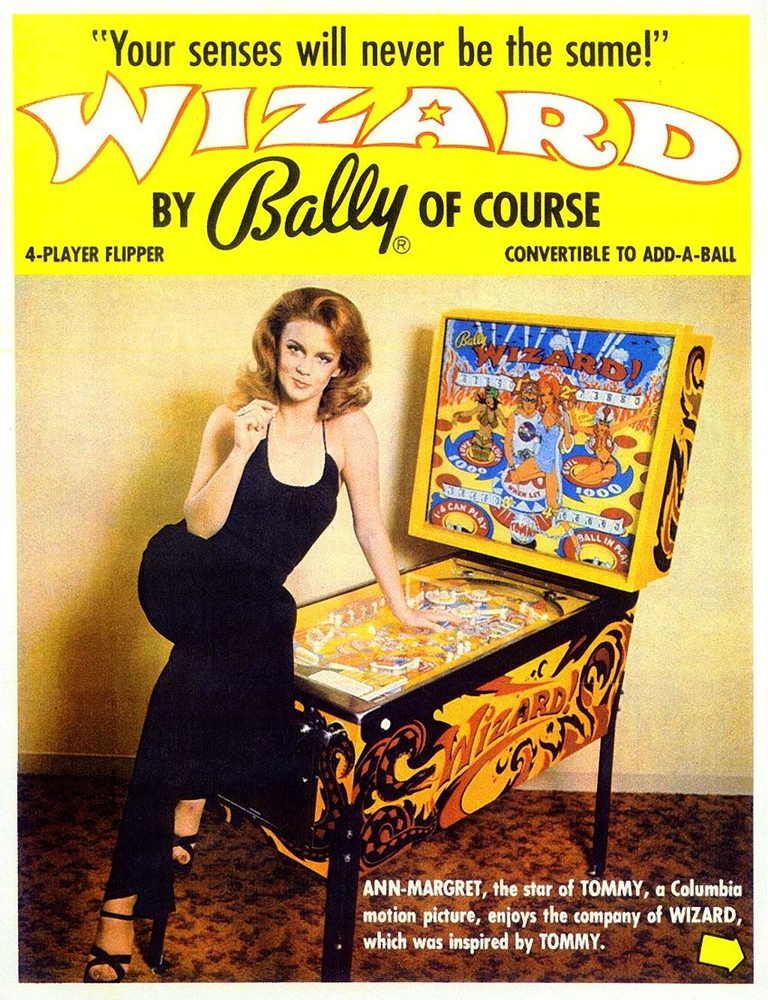
Wizard! flyer
Pinball
Pinball is a type of arcade game, in which points are scored by a player manipulating one or more metallic balls on a play field inside a glass-covered cabinet called a pinball machine. The primary objective of the game is to score as many points as possible. Many modern pinball machines include a “storyline” where the player must complete certain objectives in a certain fashion to complete the story, usually earning high scores for different methods of completing the game. Different numbers of points are earned when the ball strikes different targets on the play field. A drain is situated at the bottom of the play field, partially protected by player-controlled paddles called flippers. A game ends after all the balls fall into the drain a certain number of times. Secondary objectives are to maximise the time spent playing (by earning “extra balls” and keeping the ball in play as long as possible), and to earn bonus credits by achieving a high enough score or through other means.
Backglass
The backglass is a vertical graphic panel mounted on the front of the backbox, which is the upright box at the top back of the machine. The backglass contains the name of the machine and eye-catching graphics; in games up to the 1980s the artwork would often portray large-breasted women in skimpy clothing. The score displays (lights, mechanical wheels, an LED display, or a dot-matrix display depending on the era) would be on the backglass, and sometimes also a mechanical device tied to game play, for example, elevator doors that opened on an image or a woman swatting a cat with a broom such as on Williams’ 1989 “Bad Cats”. For older games, the backglass image is screen printed in layers on the reverse side of a piece of glass; in more recent games, the image is imprinted into a translucent piece of plastic-like material called a translite which is mounted behind a piece of glass and which is easily removable. The earliest games did not have backglasses or backboxes and were little more than playfields in boxes. Games are generally built around a particular theme, such as a sport or character and the backglass art reflects this theme to attract the attention of players. Recent machines are typically tied into other enterprises such as a popular film series, toy, or brand name. The entire machine is designed to be as eye-catching as possible to attract players and their money; every possible space is filled with colourful graphics, blinking lights, and themed objects, and the backglass is usually the first artwork the players see from a distance. Since the artistic value of the backglass may be quite impressive, it is not uncommon for enthusiasts to use a deep frame around a backglass (lighted from behind) and hang it as art after the remainder of the game is discarded.
Text from the Wikipedia website
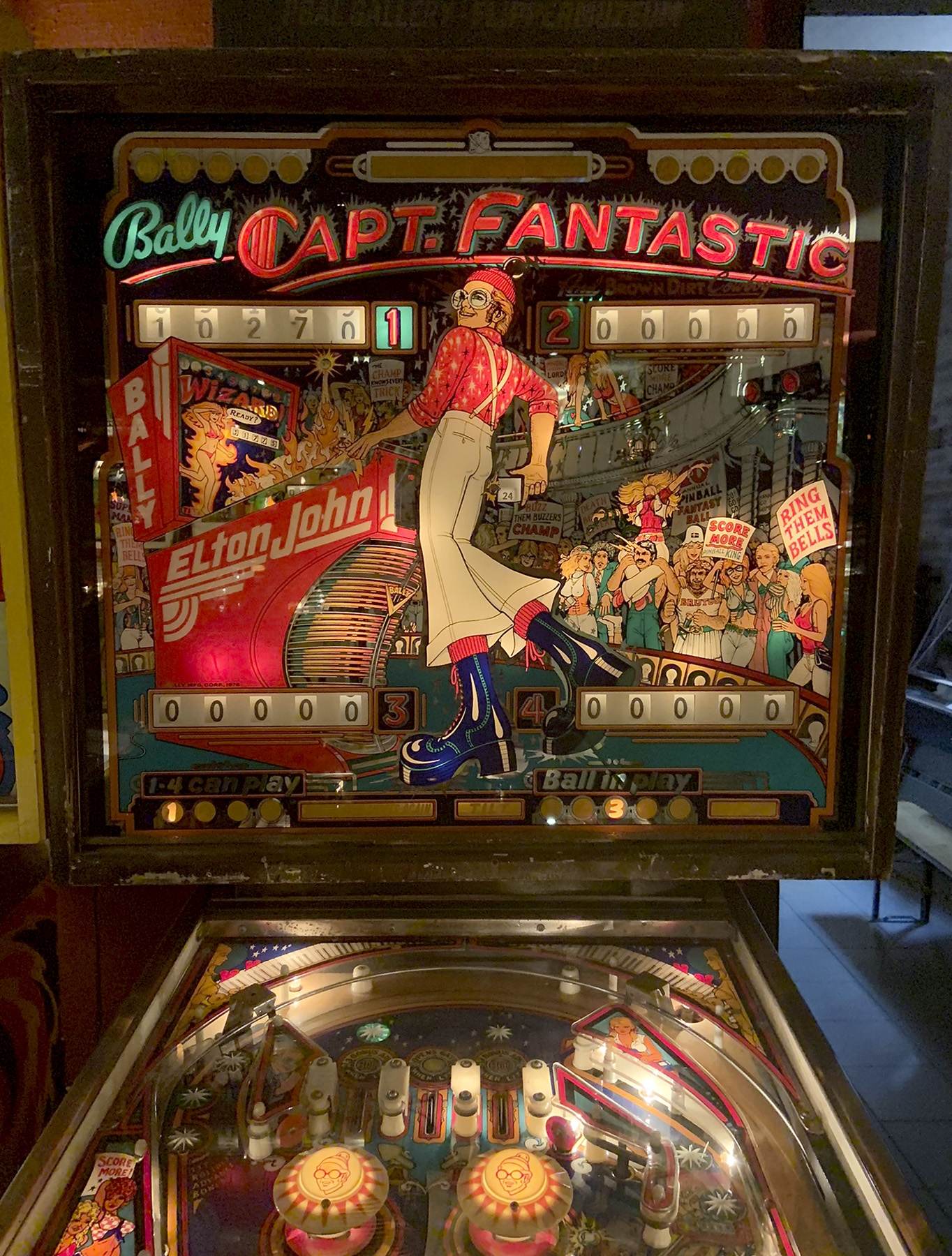
Bally Manufacturing Corporation (1931-1983)
Capt. Fantastic and the Dirt Brown Cowboy (detail)
1976
16,155 produced
Photo: Marcus Bunyan
‘Capt. Fantastic’ was inspired by the movie ‘Tommy’ and includes a representation of Elton John, as his character from the movie, playing pinball on the backglass. The game name, however, is the title of Elton John’s 1975 autobiographical song and album where “Captain Fantastic” was Elton and “The Brown Dirt Cowboy” was his then-lyricist Bernie Taupin. Included in the song lyrics are the words “From the end of the world to your town” which appear at the very top center of the backglass.
Text from the The Internet Pinball Machine Database website [Online] Cited 04/11/2020

Bally Manufacturing Corporation (1931-1983)
Space Invaders (detail)
1980
11,400 produced
Photo: Marcus Bunyan
The alien depicted on the backglass was deemed an unlicensed use of the one used in the 1979 Hollywood movie Alien. Some playfield art elements and game sounds were borrowed from the 1978 ‘Space Invaders’ video game which was still popular at the time that this pinball machine came out.
Text from the The Internet Pinball Machine Database website [Online] Cited 04/11/2020
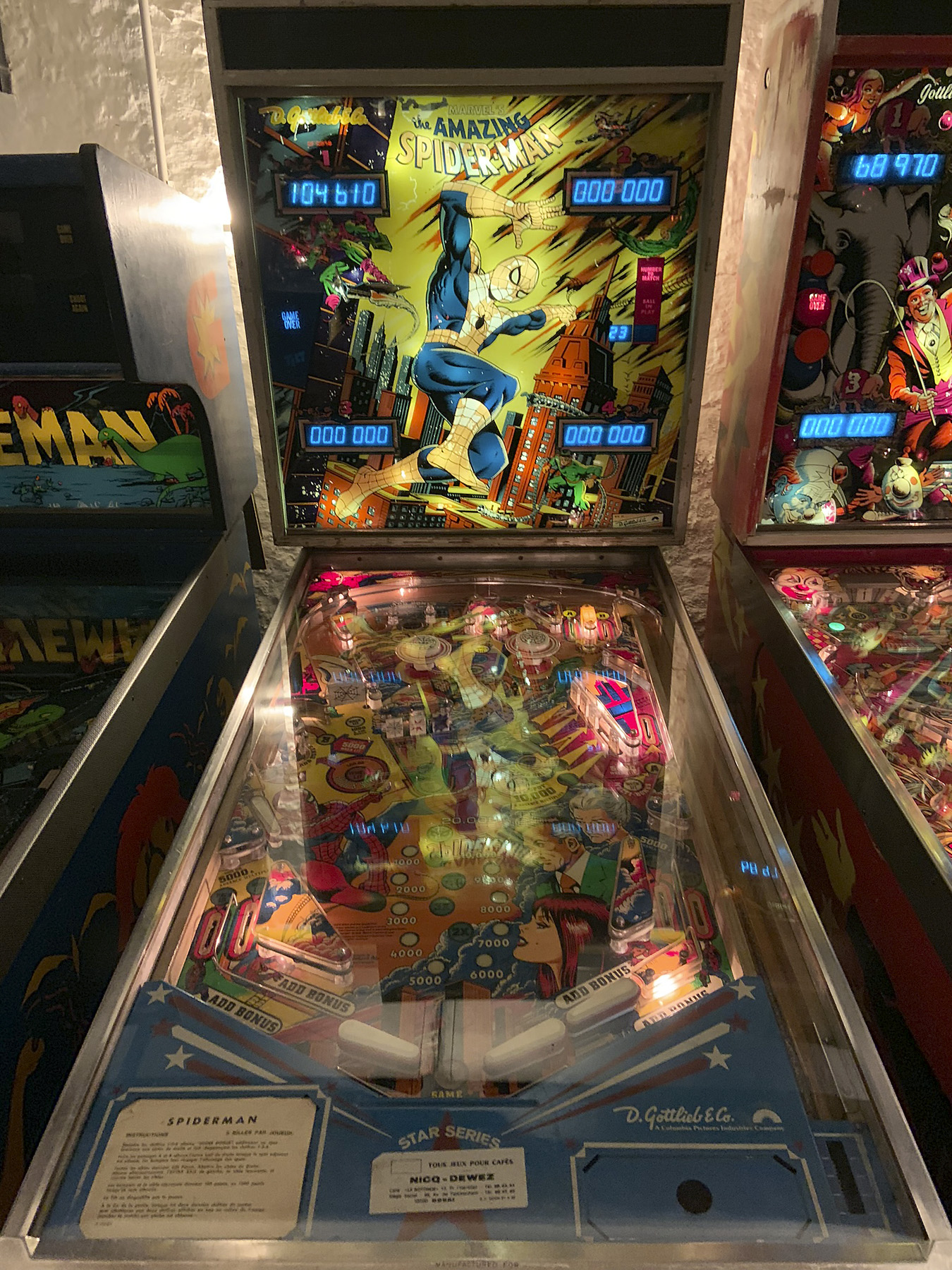
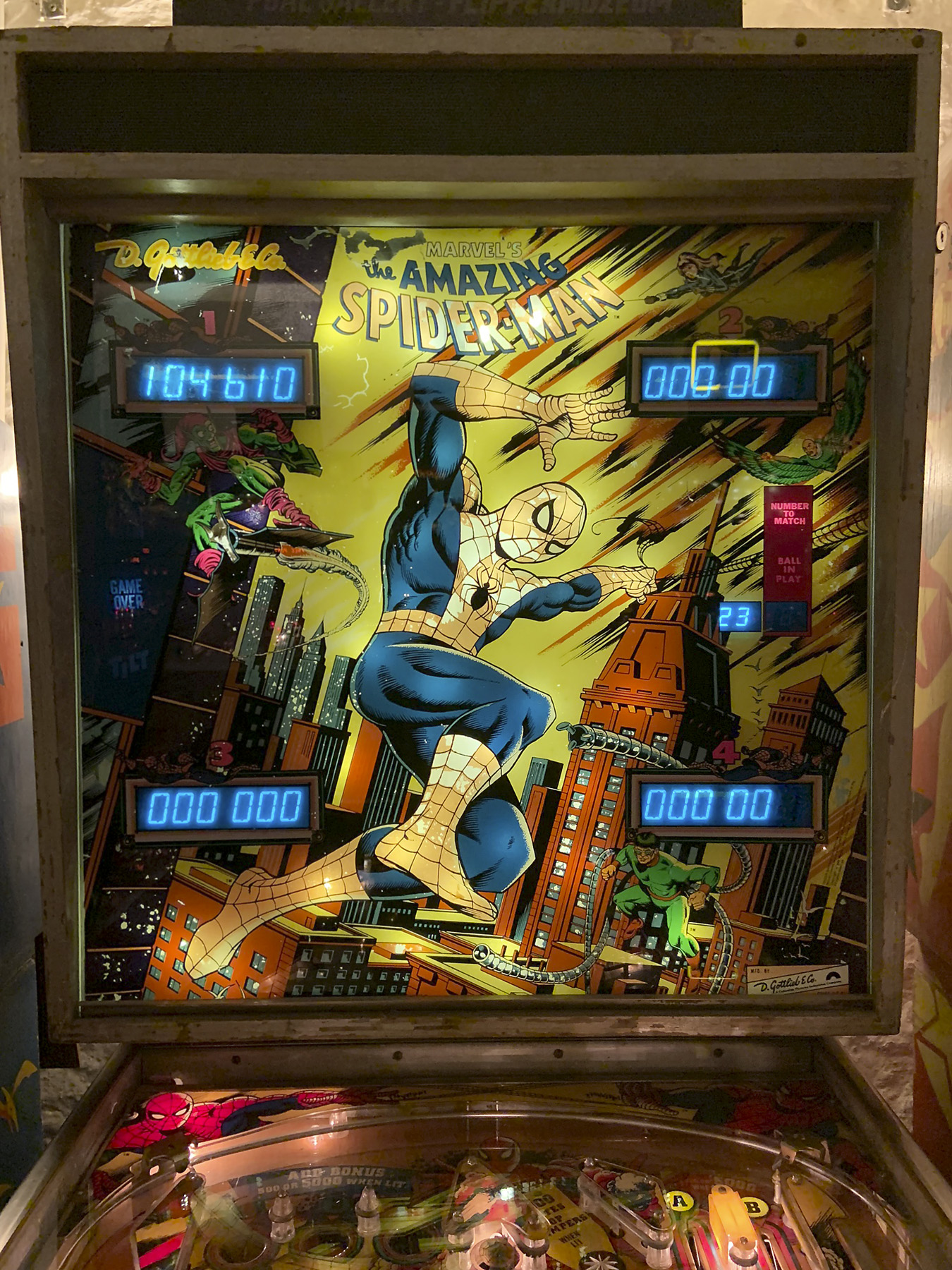
D. Gottlieb & Company, a Columbia Pictures Industries Company (1977-1983)
The Amazing Spider-Man (details)
1980
7,625 produced
Photos: Marcus Bunyan
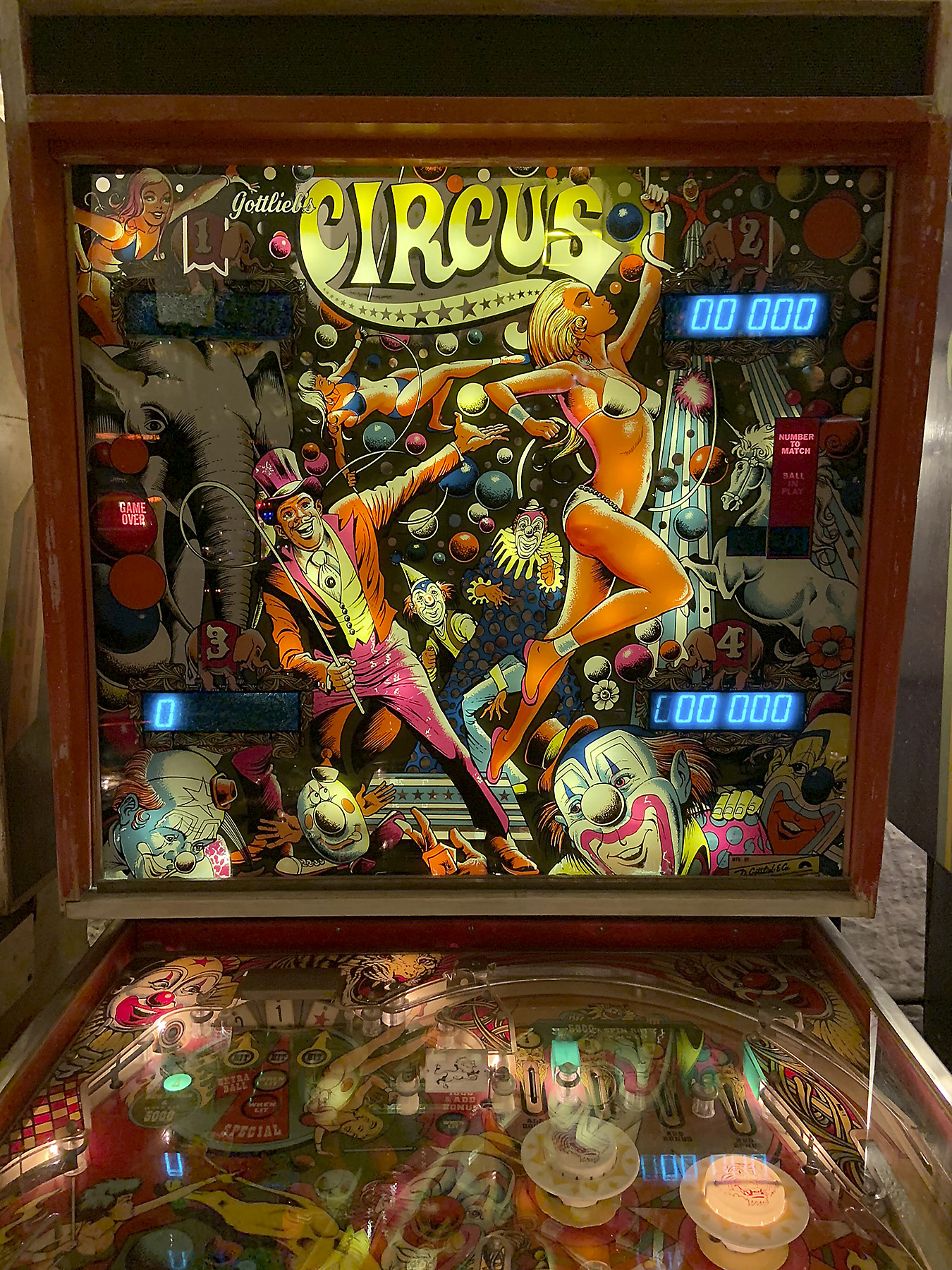
D. Gottlieb & Company, a Columbia Pictures Industries Company (1977-1983)
Circus (detail)
1980
1,700 produced
Photo: Marcus Bunyan
“The Greatest Pinball On Earth!”
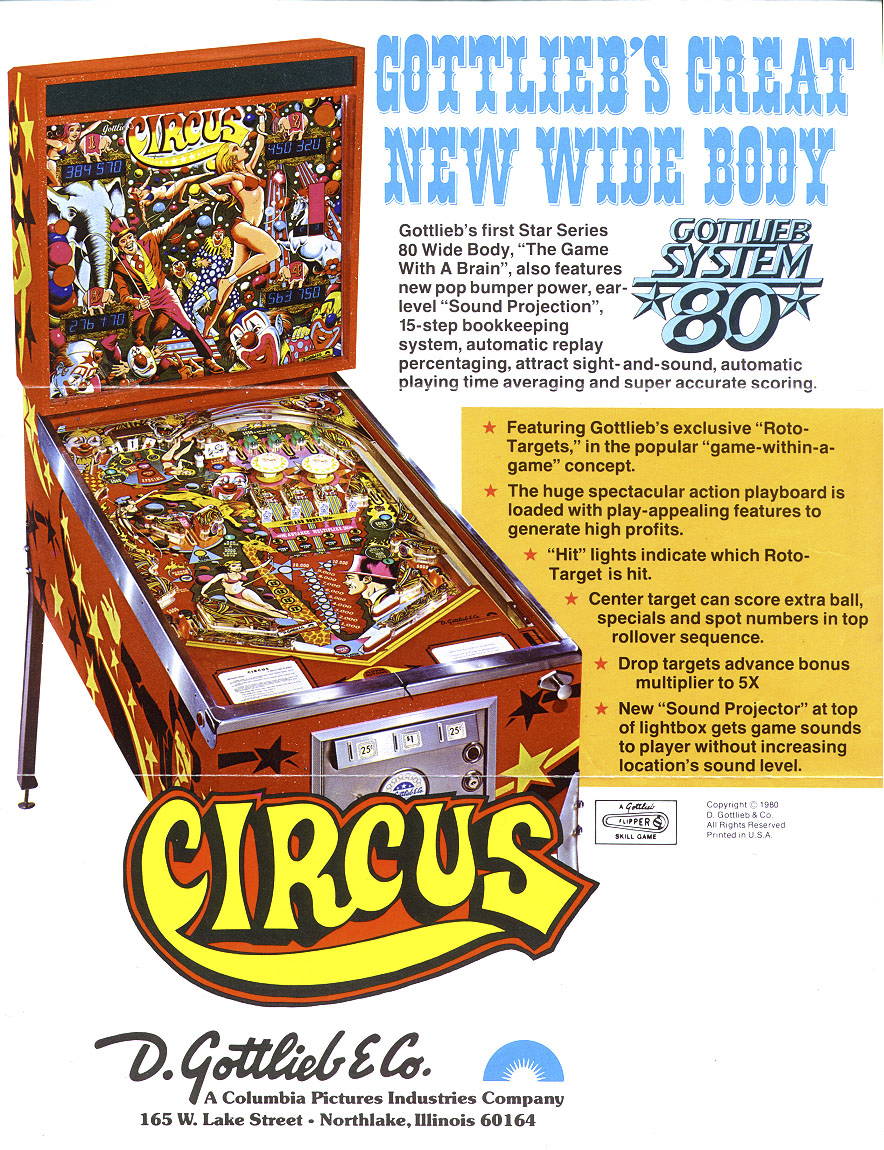
Circus pinball flyer
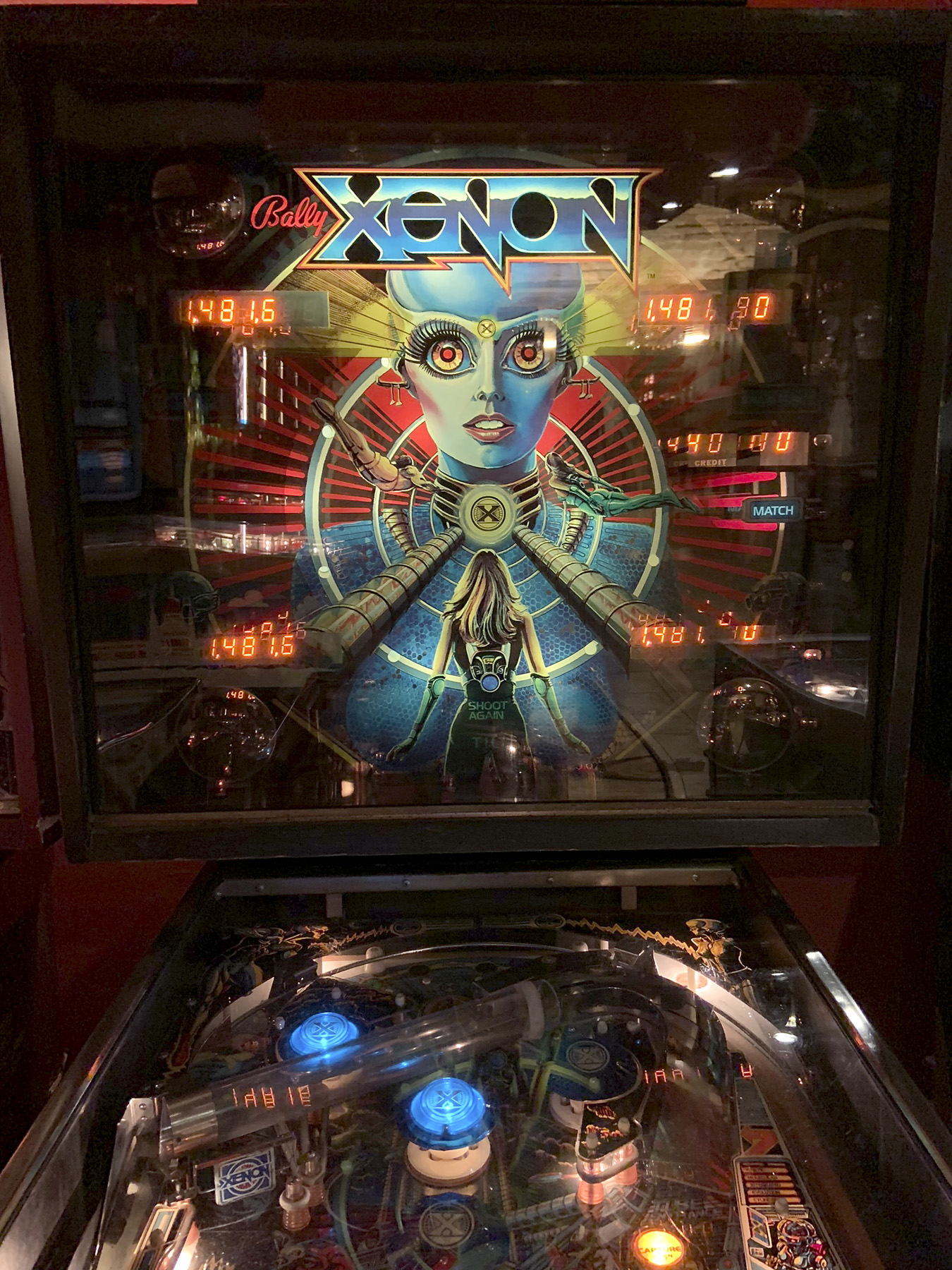
Bally Manufacturing Corporation (1931-1983)
Xenon
1980
11,000 produced
Photo: Marcus Bunyan
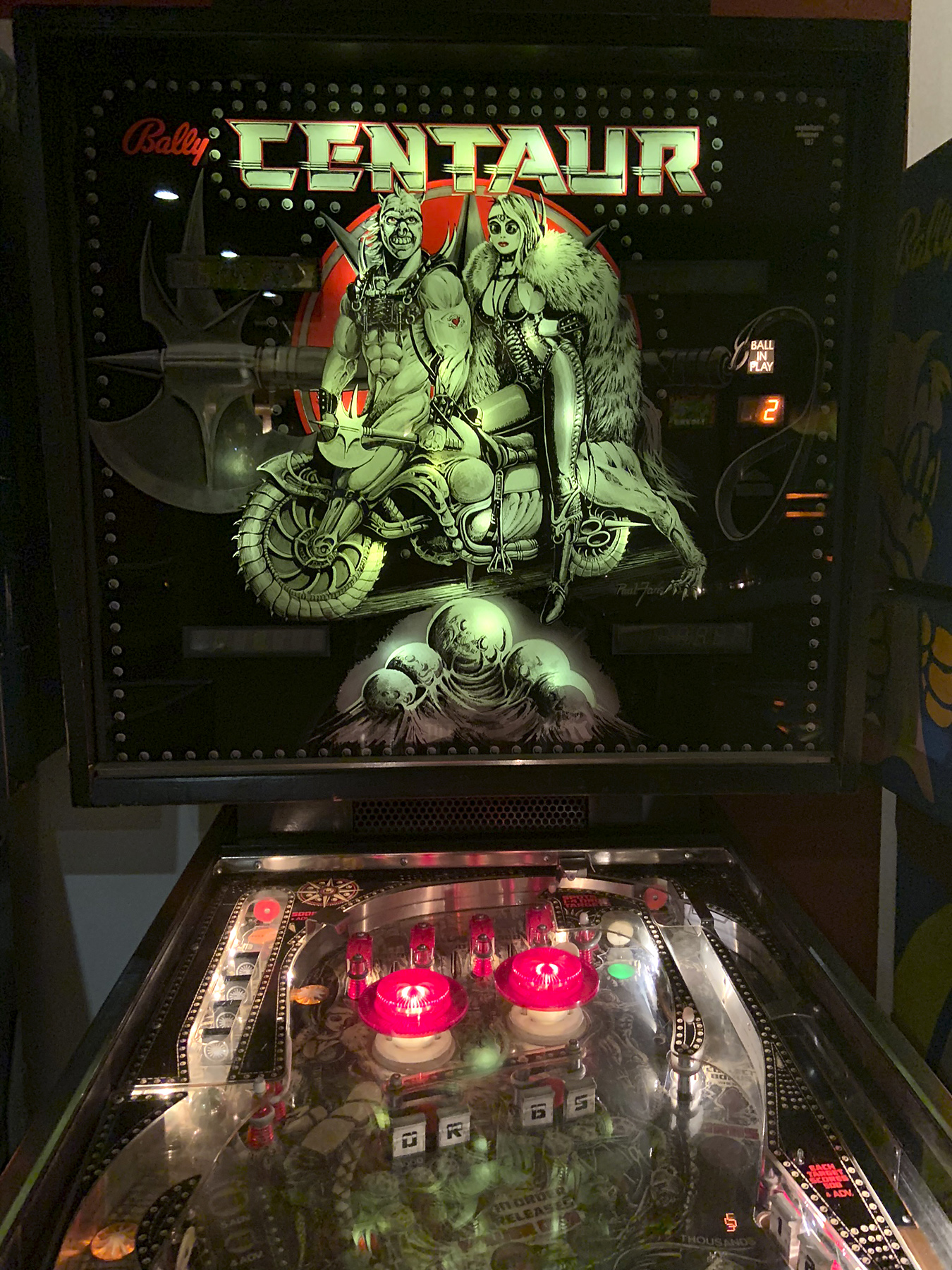
Bally Manufacturing Corporation (1931-1983)
Centaur (detail)
1981
3,700 produced
Photo: Marcus Bunyan
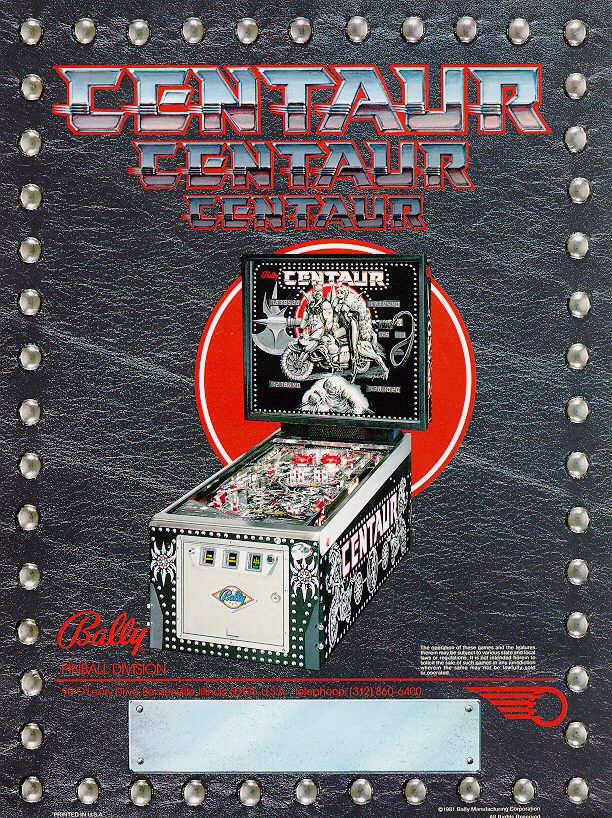
Centaur pinball flyer
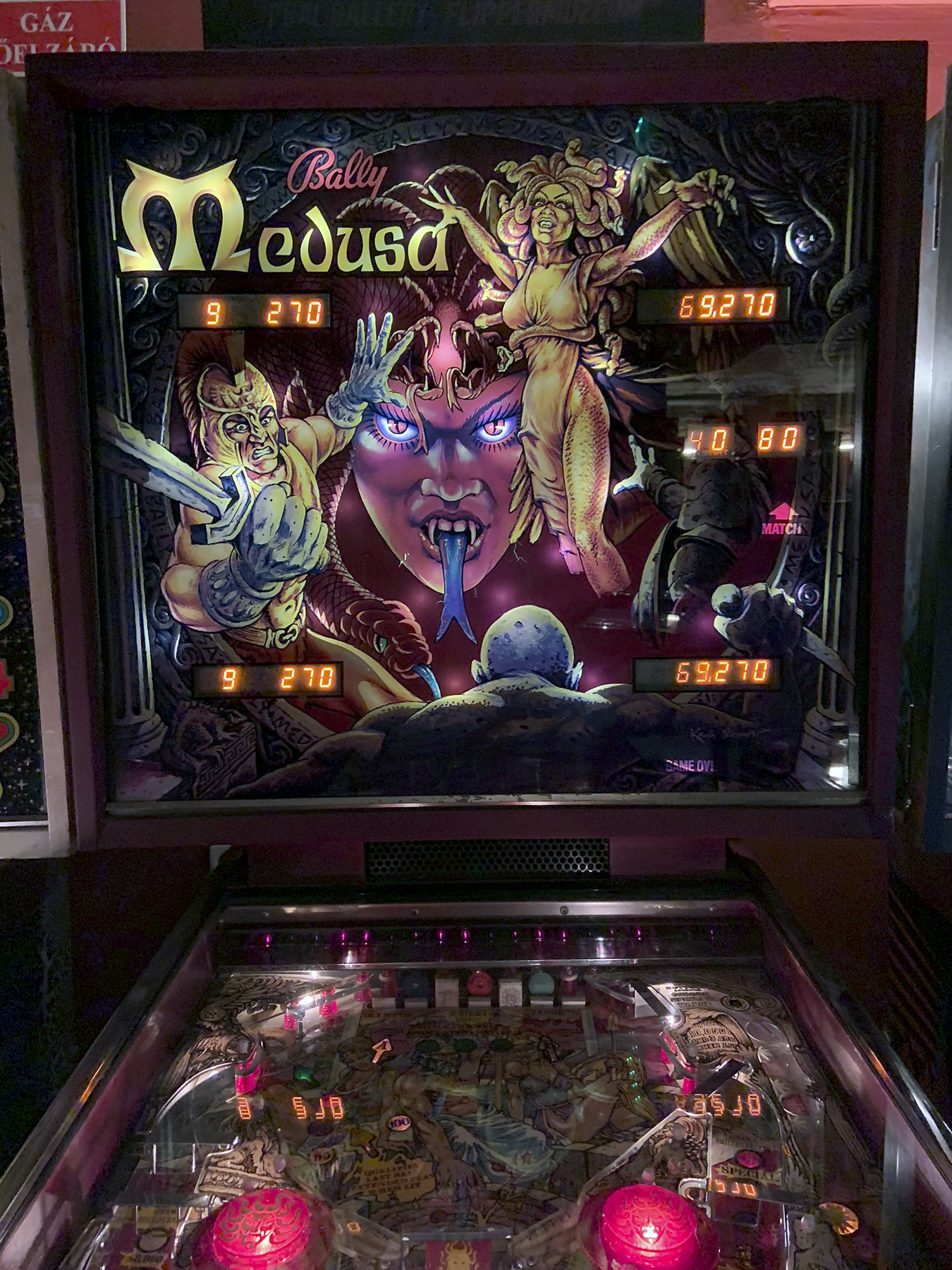
Bally Manufacturing Corporation (1931-1983)
Medusa (detail)
1981
3,250 produced
Photo: Marcus Bunyan
“Bally MEDUSA… A Legend of Features”
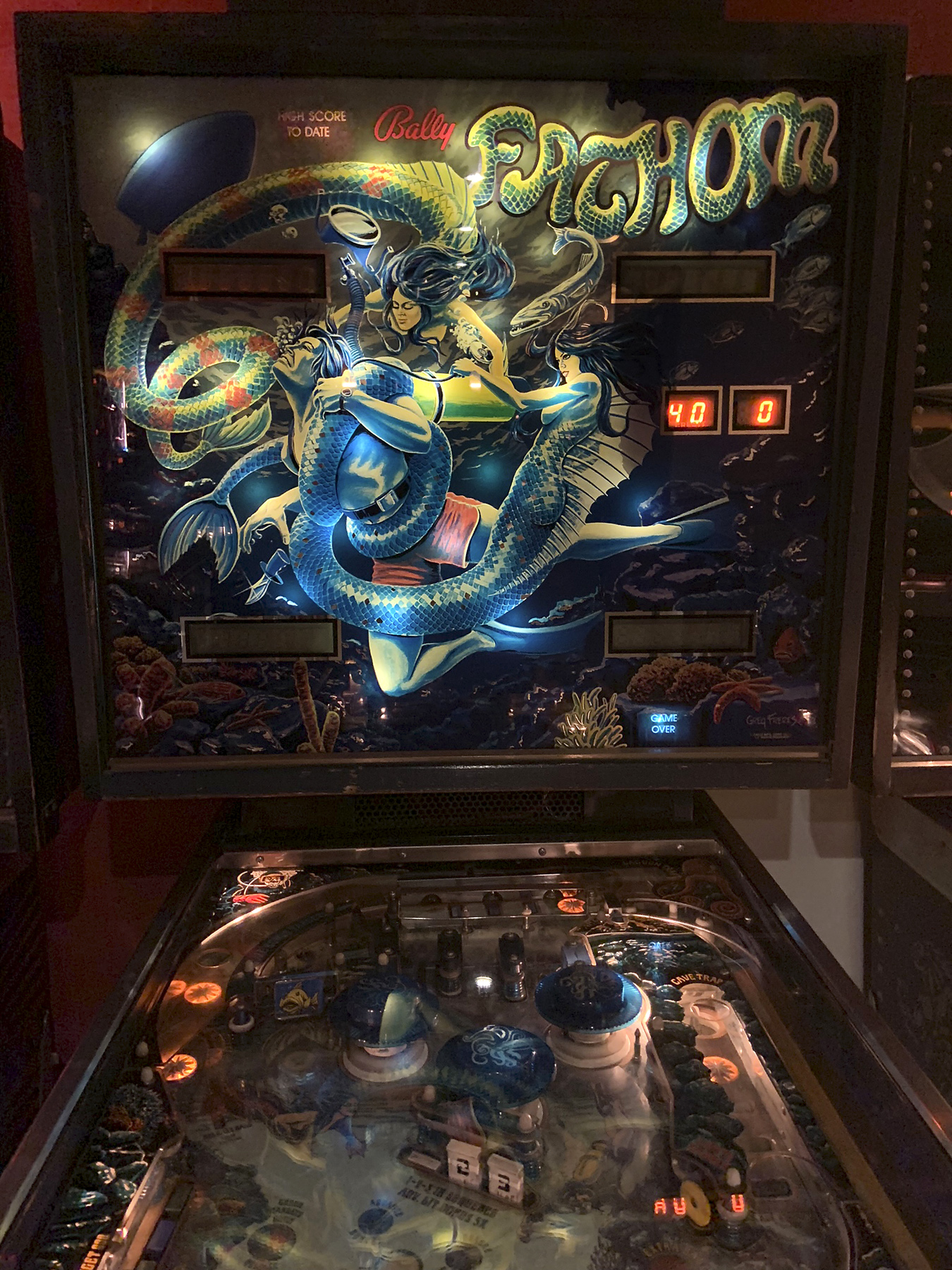
Bally Manufacturing Corporation (1931-1983)
Fathom
1981
3,500 produced
Photo: Marcus Bunyan
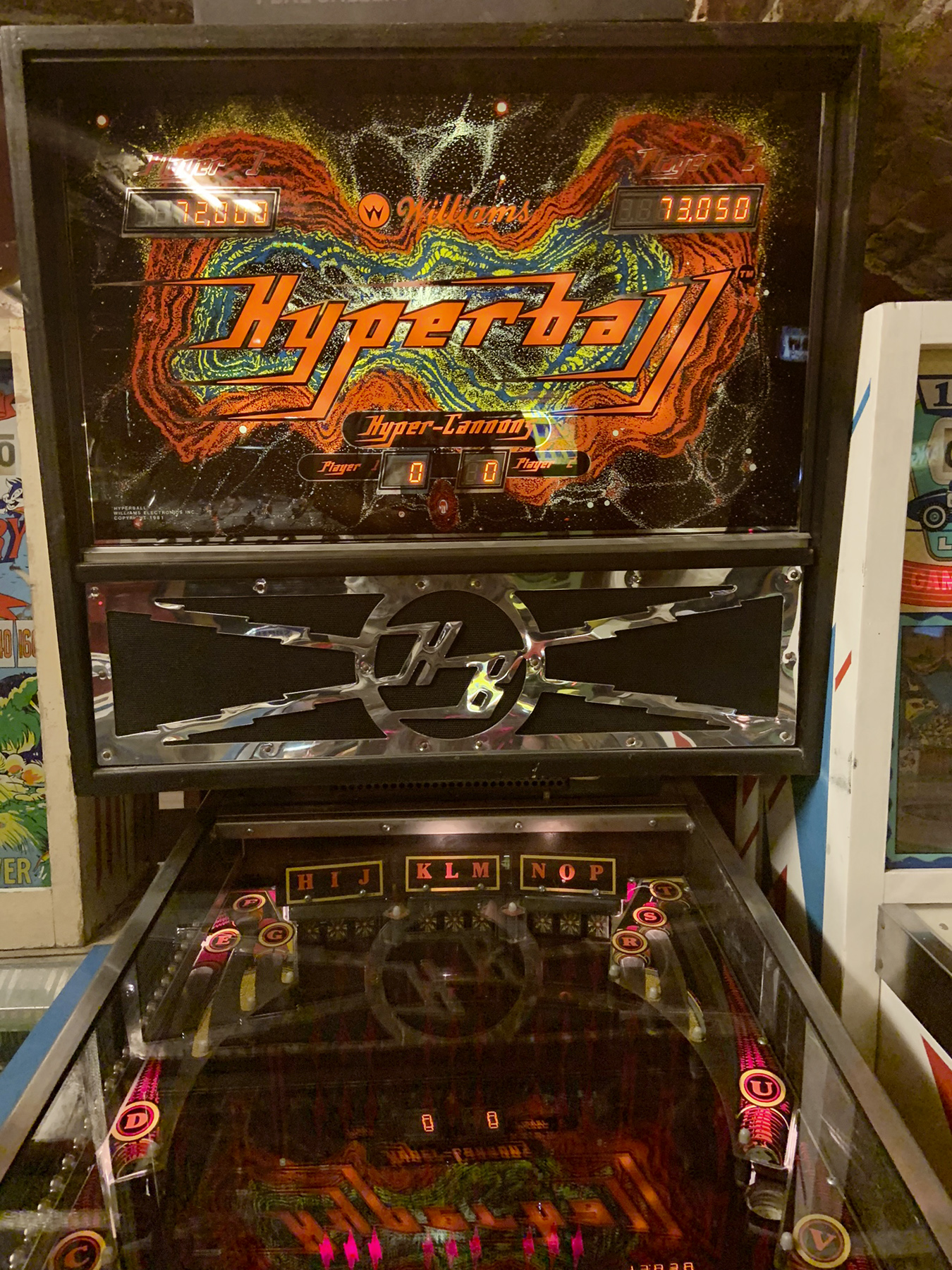
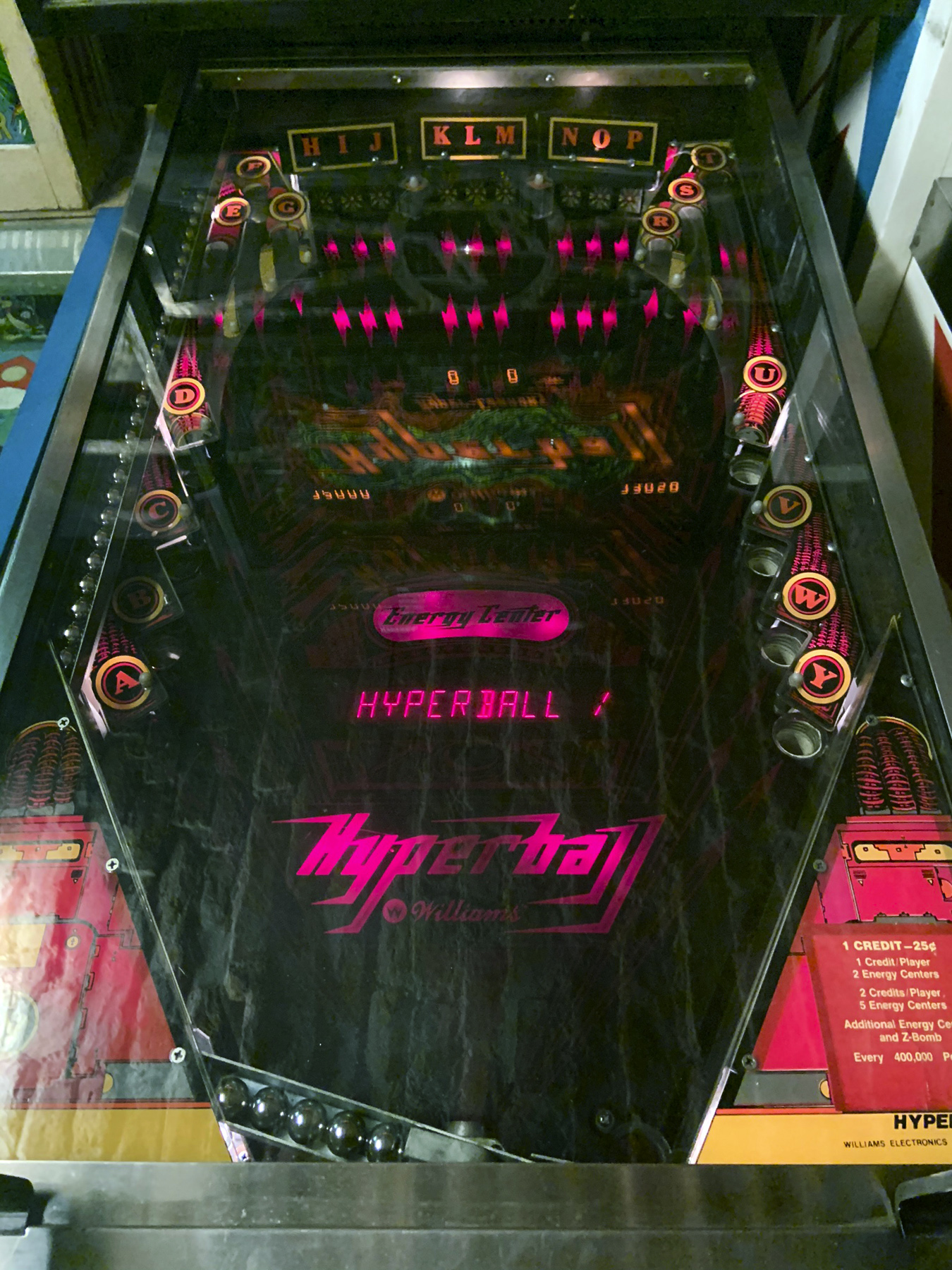
Williams Electronics Incorporated (1967-1985)
Hyperball (details)
1981
5,000 produced
Photos: Marcus Bunyan
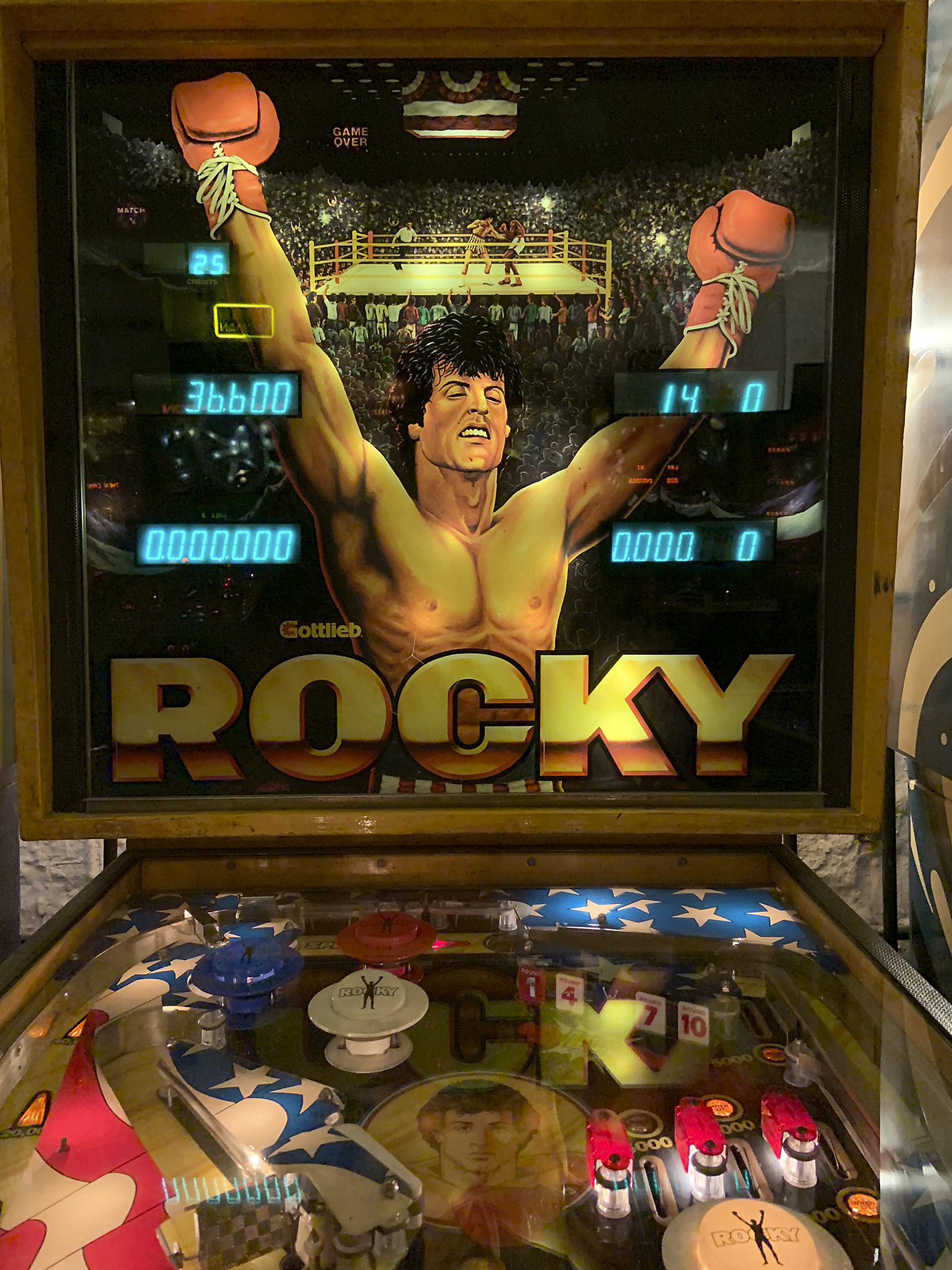
D. Gottlieb & Company, a Columbia Pictures Industries Company (1977-1983)
Rocky (detail)
1982
1,504 produced
Photo: Marcus Bunyan
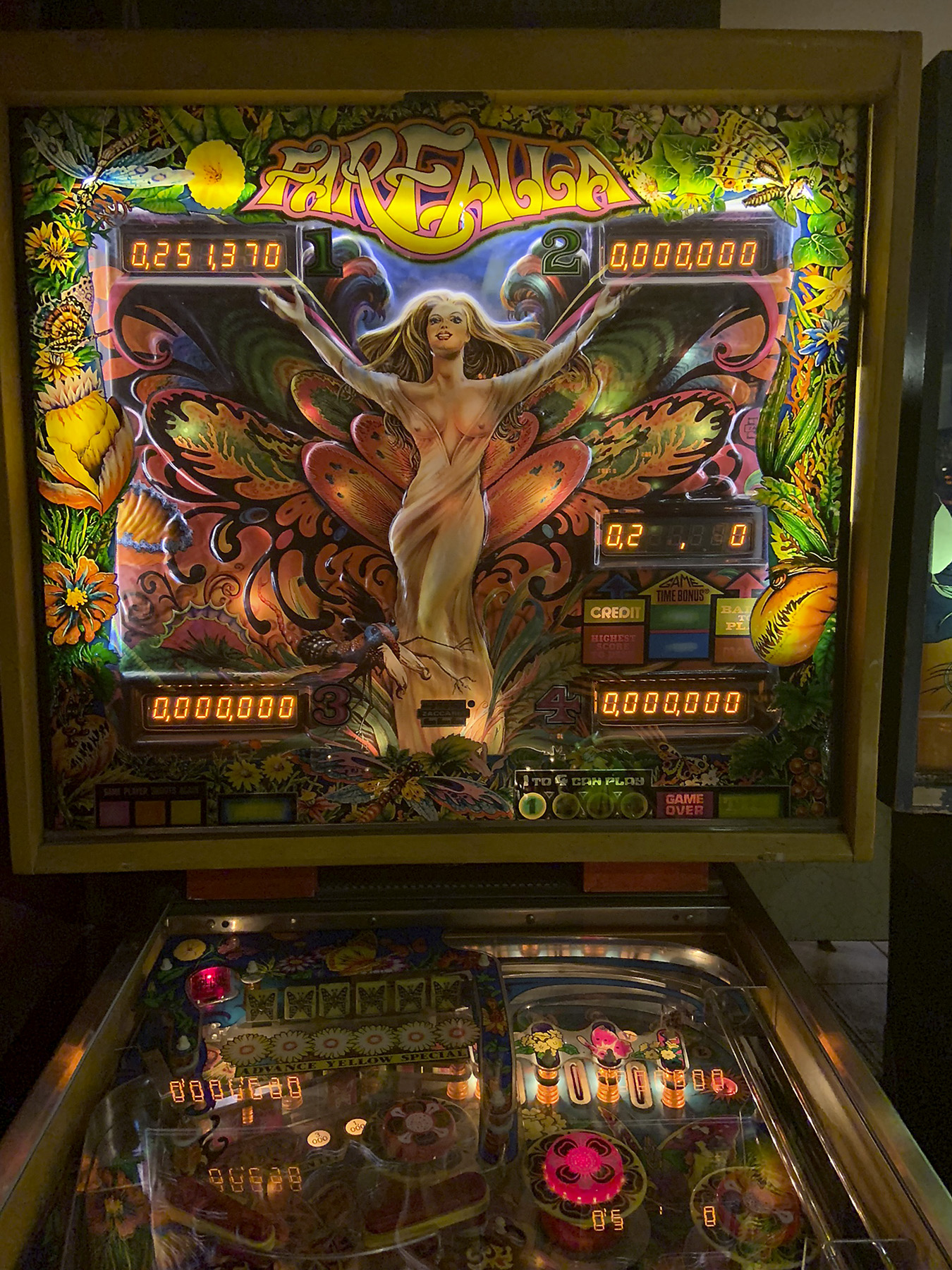
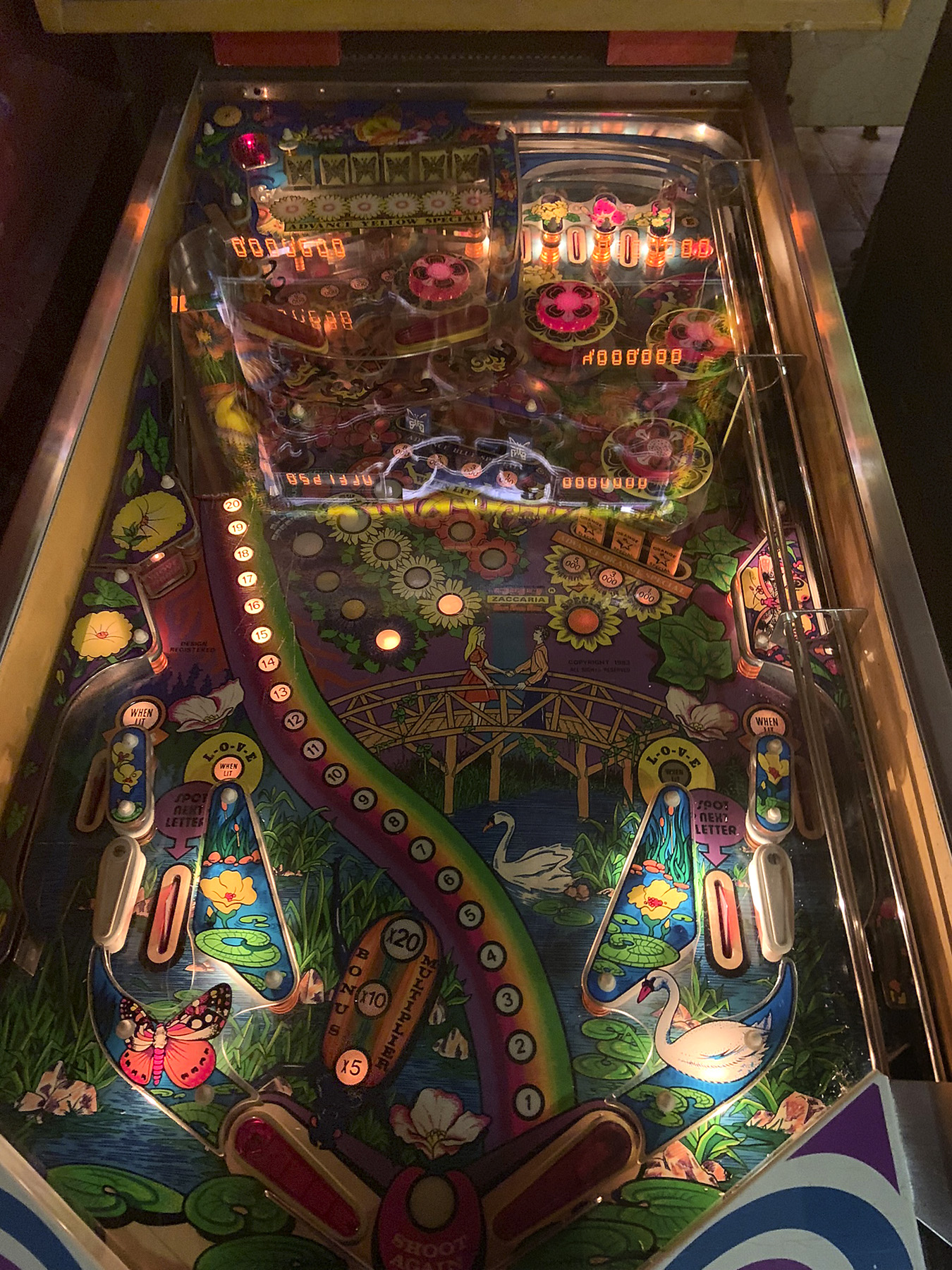
Zaccaria (Bologna, Italy, 1974-1987)
Farfalla
1983
Photos: Marcus Bunyan
Farfalla is Italian for “butterfly”
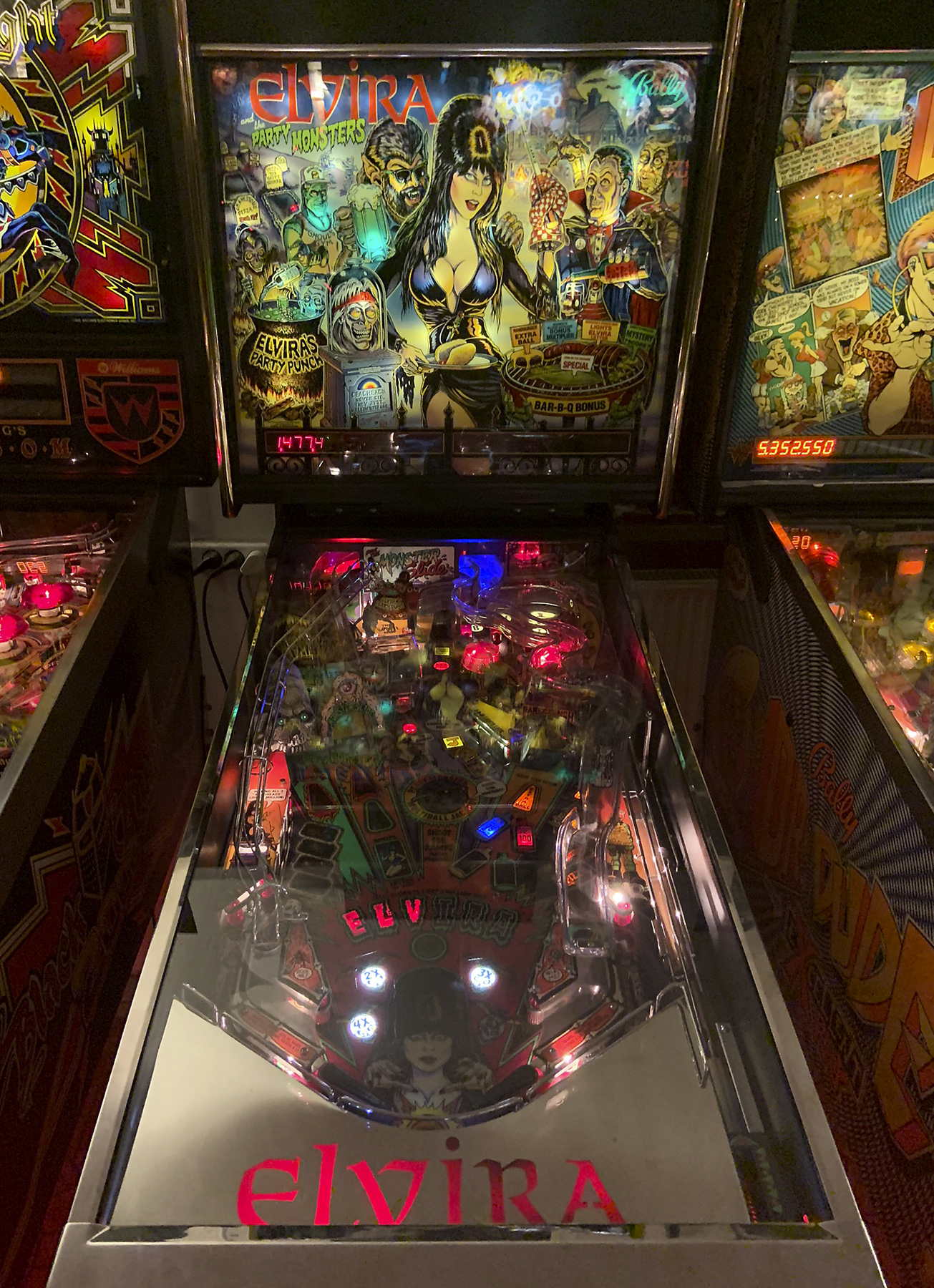
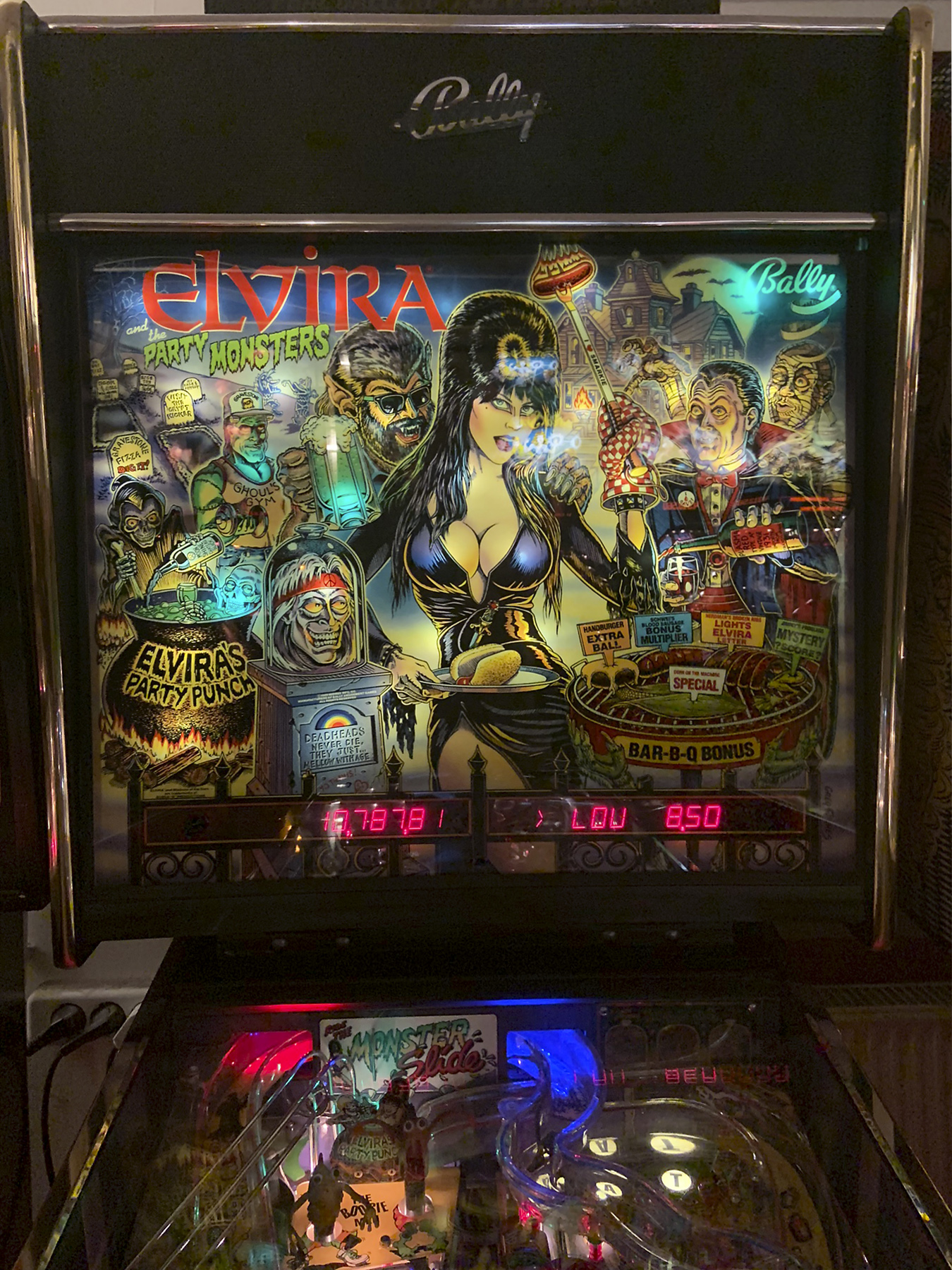
Bally (Midway Manufacturing Company) (Chicago, 1988-1999)
Elvira and the Party Monsters (details)
1989
4,000 produced
Photos: Marcus Bunyan
“Monstrous Pinball”
“You’re Gonna Have a Ball!”
“When They Named a Game After Me, It Had to be Built!”
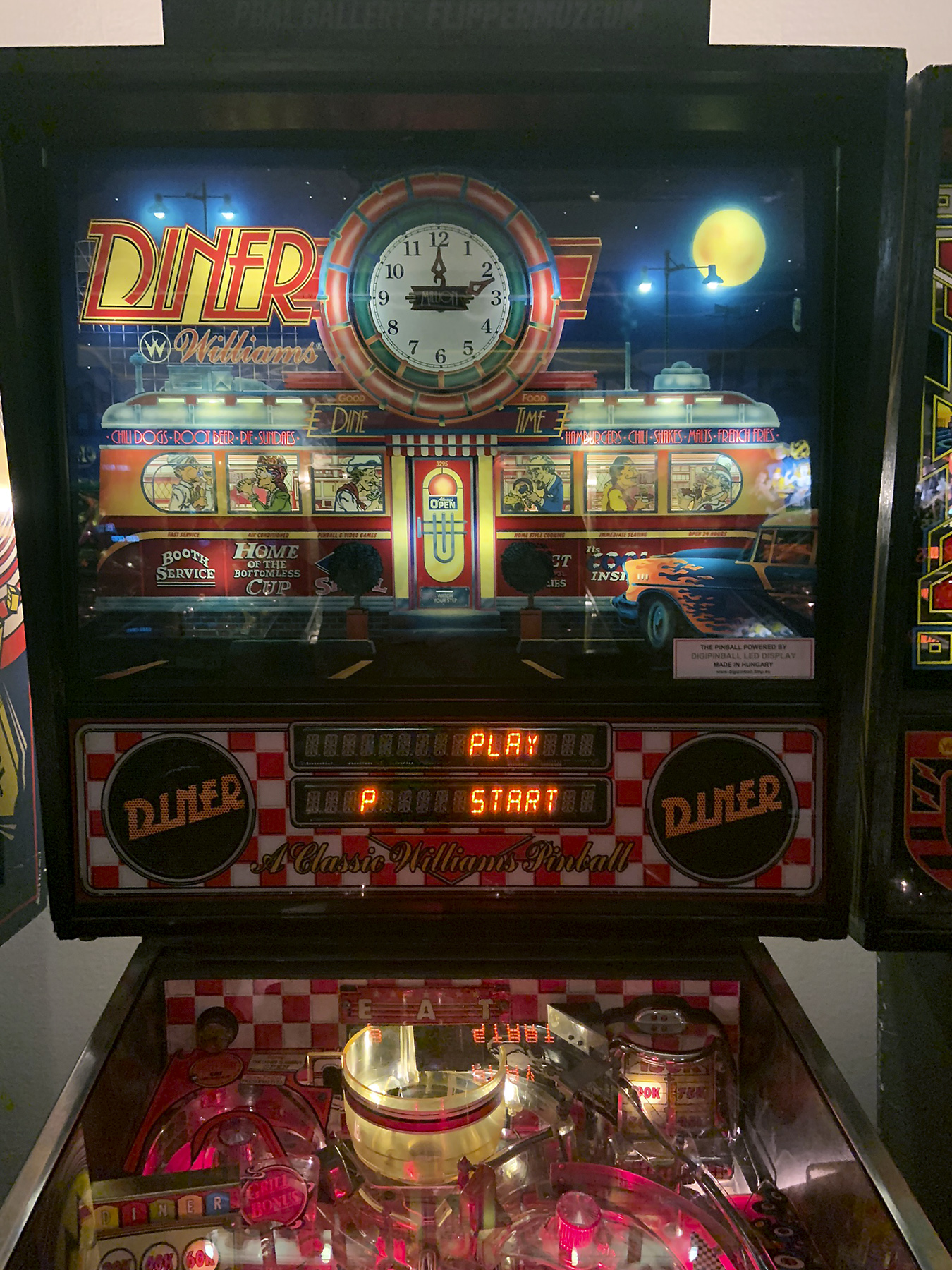
Williams Electronic Games (1985-1999)
Diner (detail)
1990
3,552 produced
Photo: Marcus Bunyan
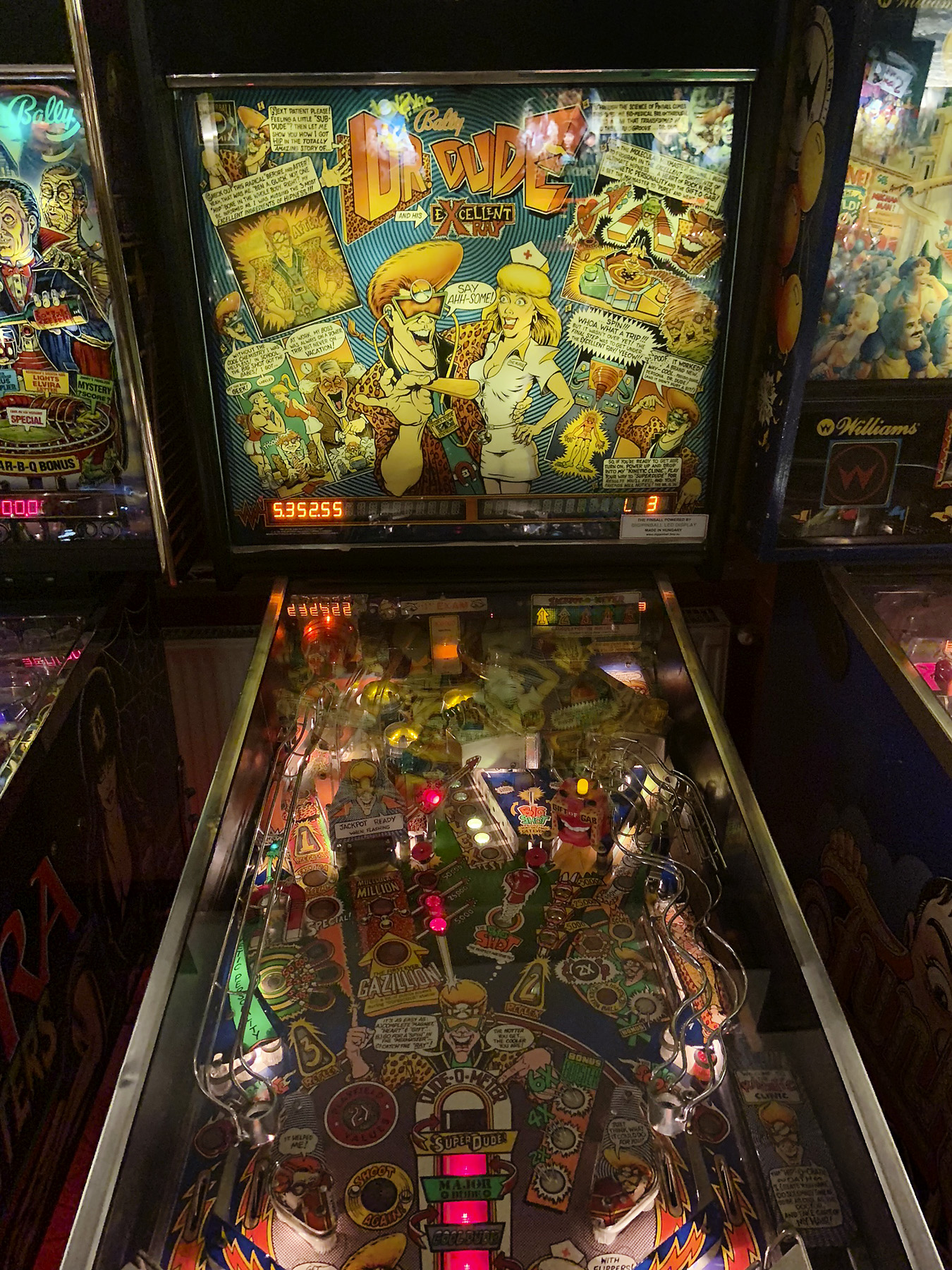
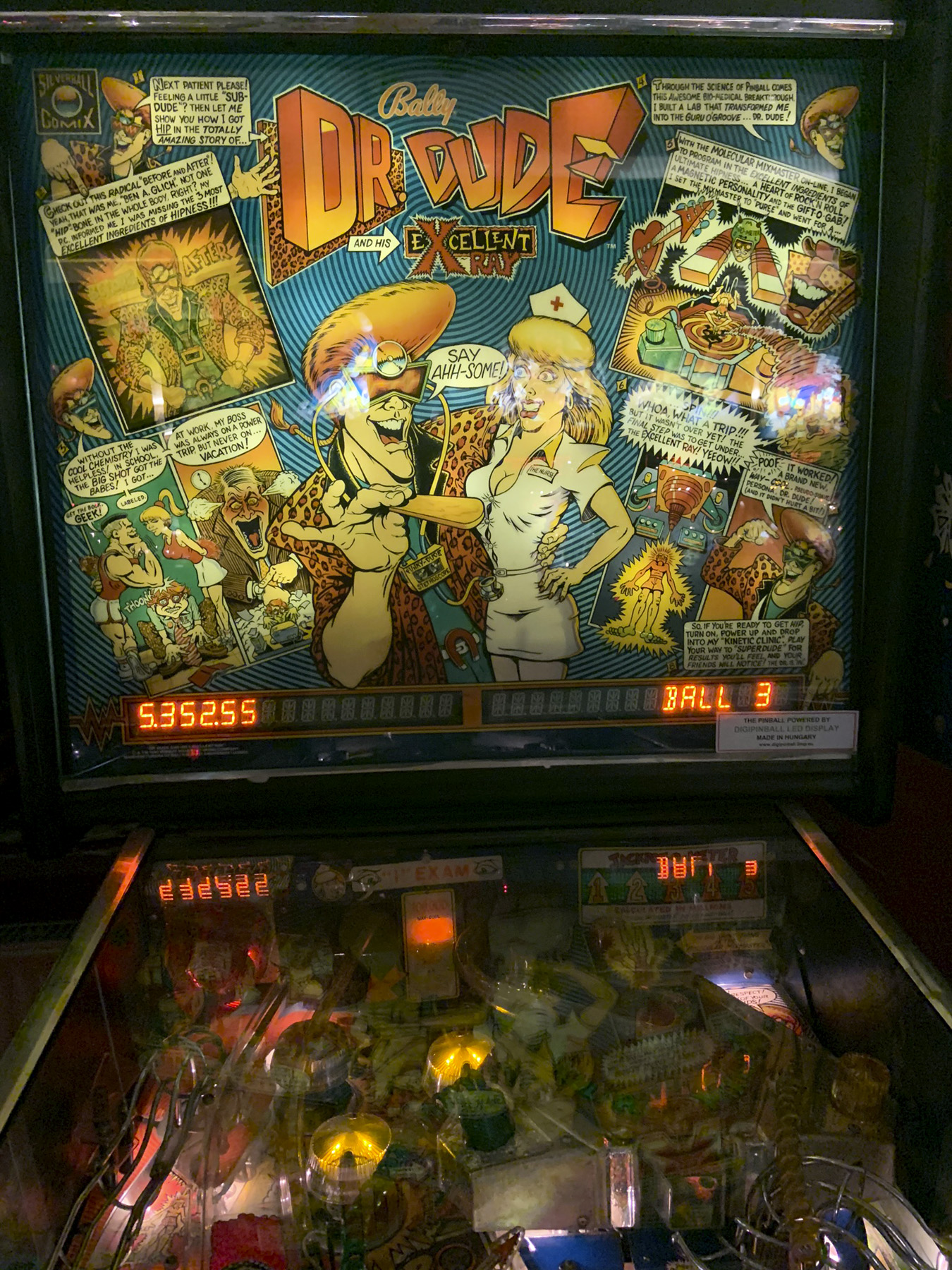
Bally (Midway Manufacturing Company) (Chicago, 1988-1999)
Dr. Dude And His Excellent Ray (details)
1990
4,000 produced
Photos: Marcus Bunyan
“Get Hip! Earn Respect! Be the Envy of your Friends!”
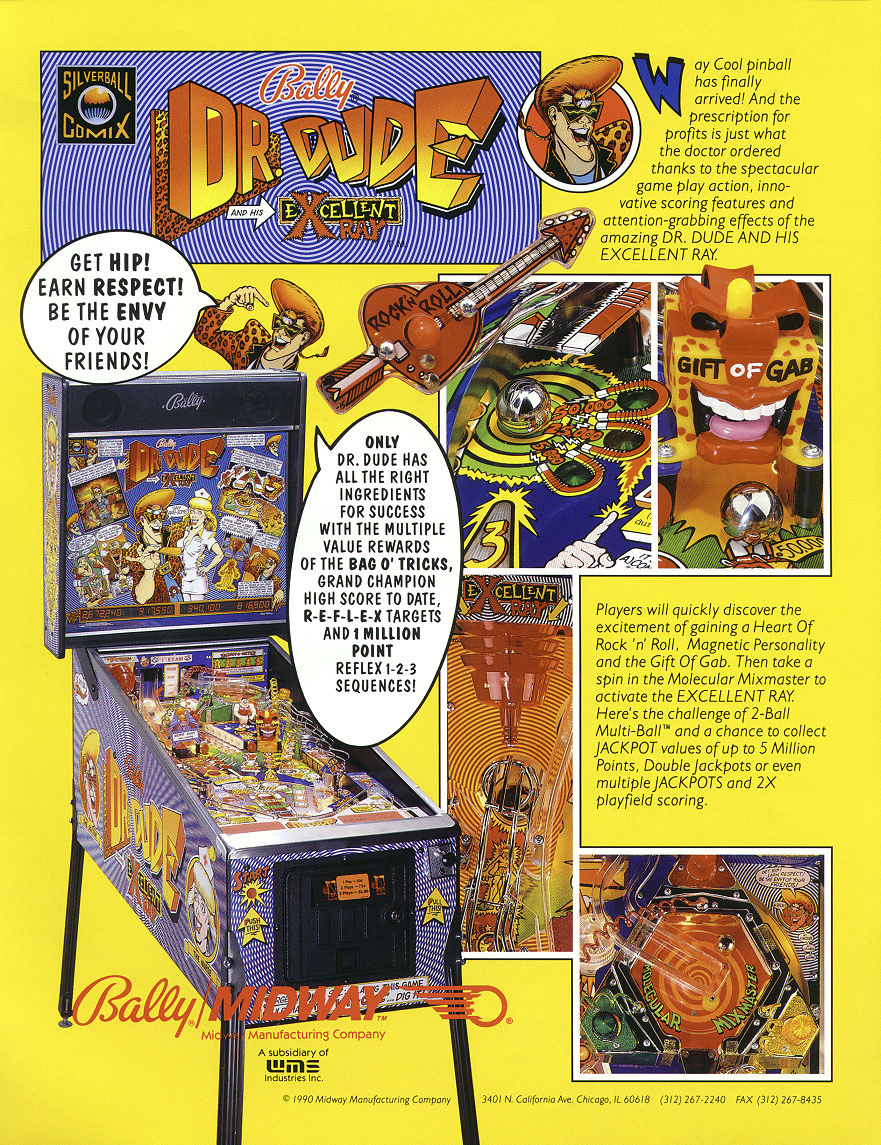
Dr. Dude And His Excellent Ray flyer
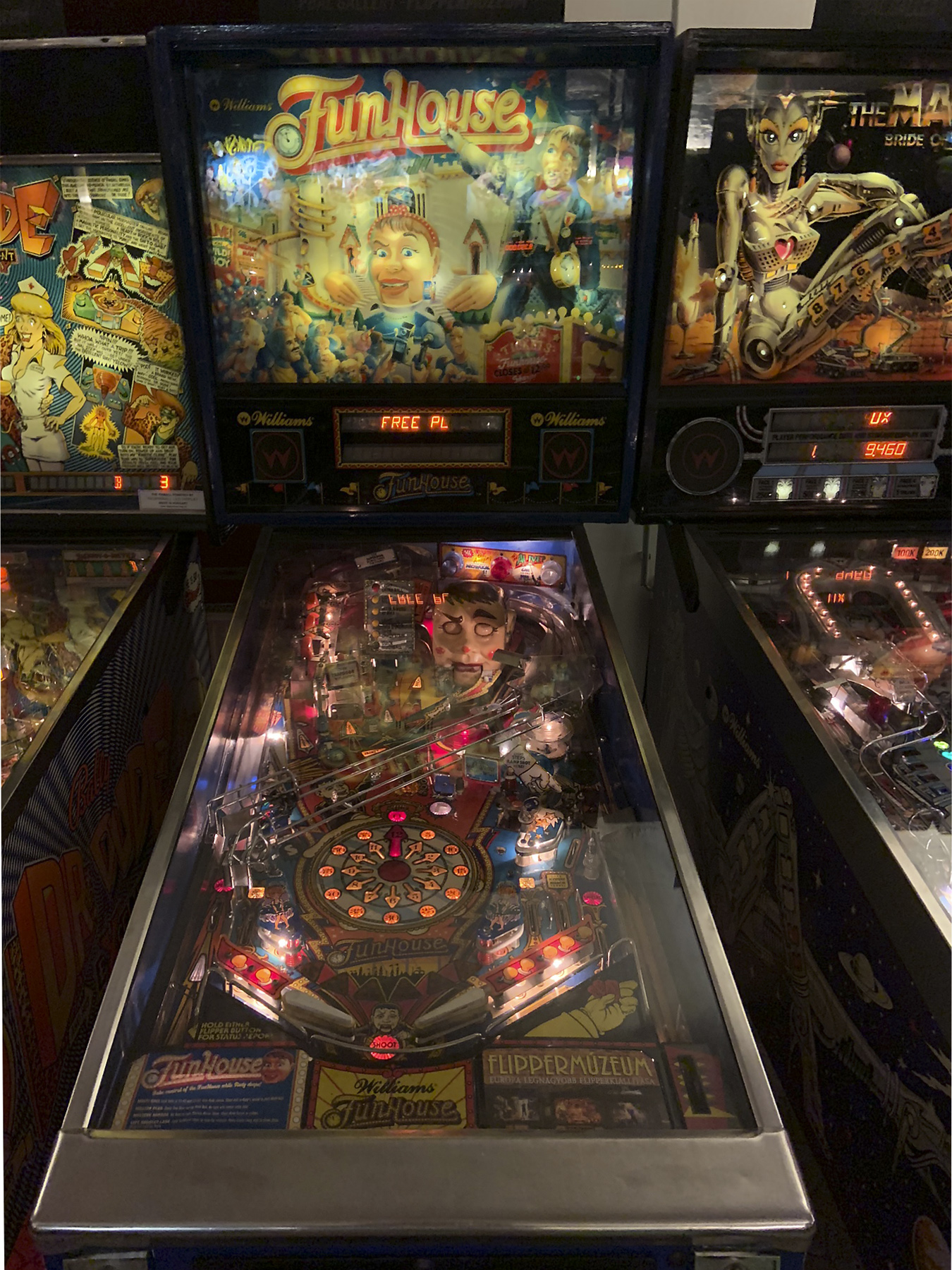
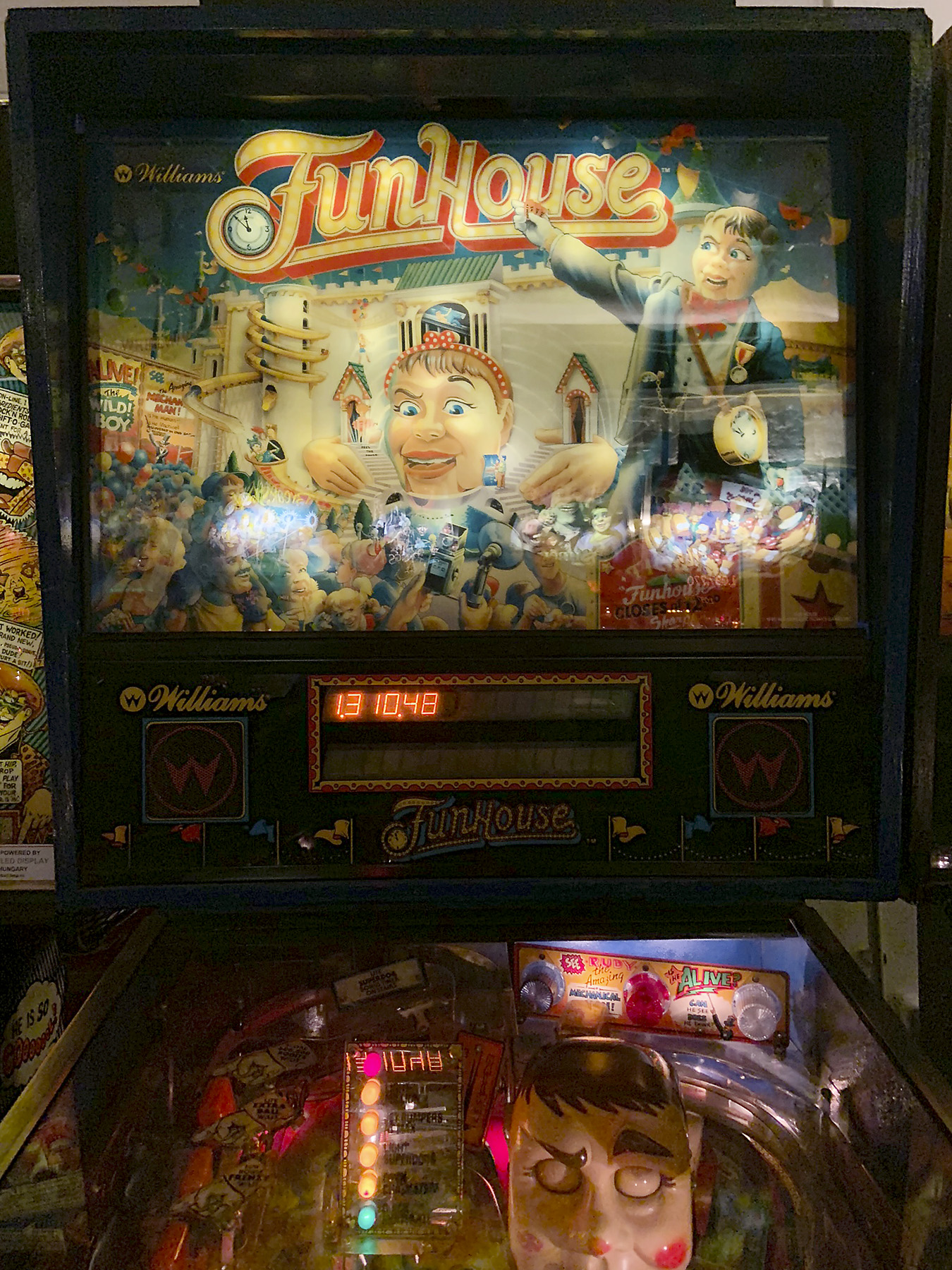
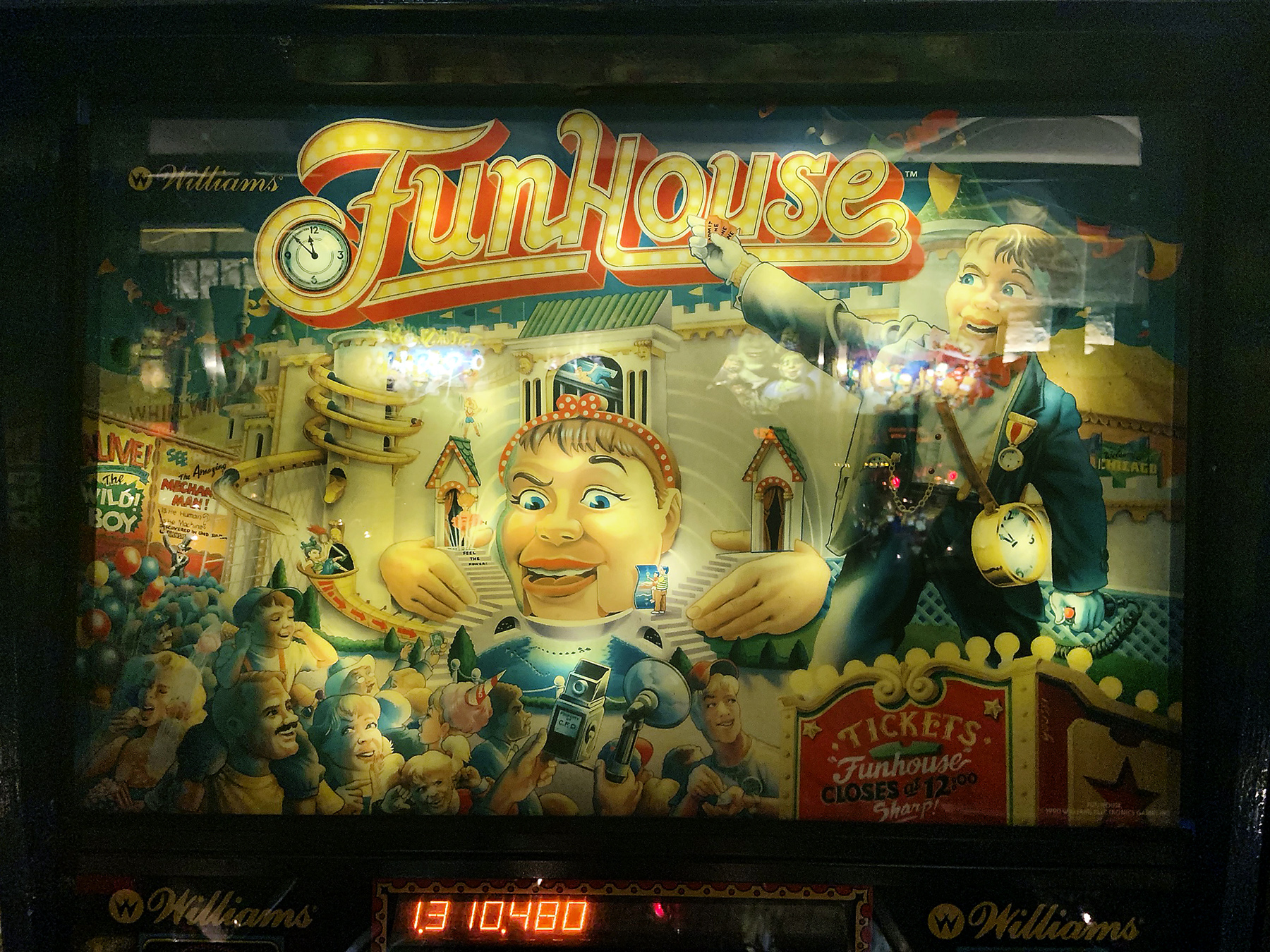
Williams Electronic Games (1985-1999)
FunHouse (details)
1990
10,750 produced
Photos: Marcus Bunyan
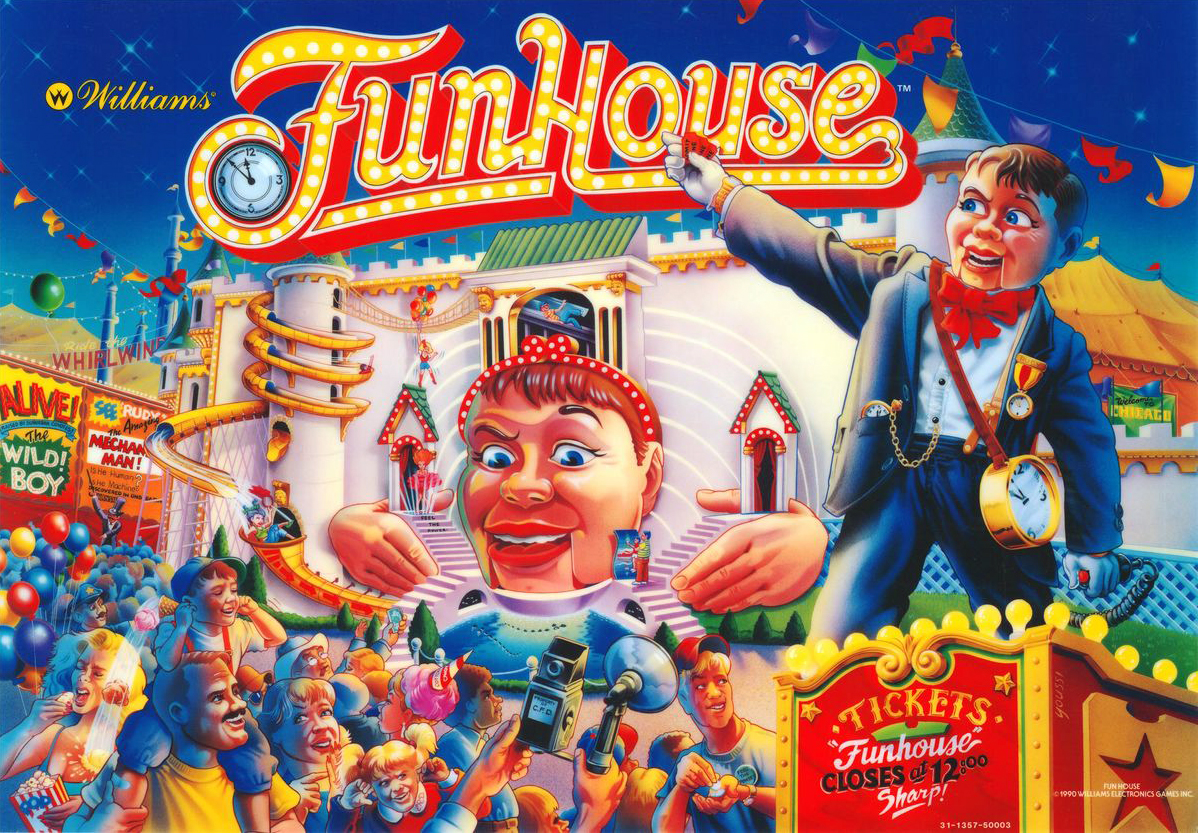
FunHouse backglass
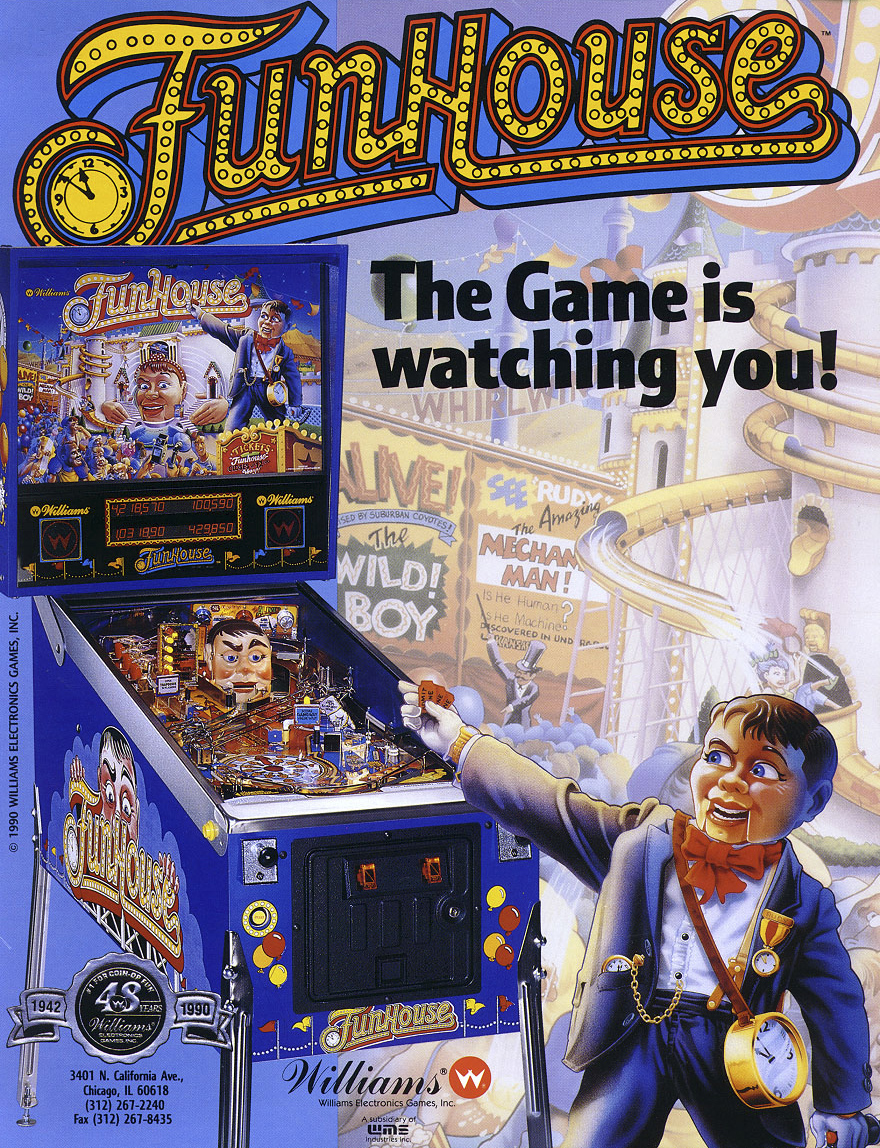
FunHouse pinball flyer
Williams Electronic Games (1985-1999)
The Machine: Bride of Pinbot (details)
1991
8,100 produced
Photos: Marcus Bunyan
“Here Comes the Bride!”
“Watch Her Turn Heads!”
Artist John Youssi provided us the following information:
“I painted the backglass based on a rough sketch Python [Anghelo] gave me. I re-sketched the whole thing, adding detail while tightening it up. Python was the artist for the cabinet while Kevin O’Connor inked only. I remember Python doing all the art except for the backglass. Plus it all looks like his style.”
Text from the The Internet Pinball Machine Database website [Online] Cited 04/11/2020
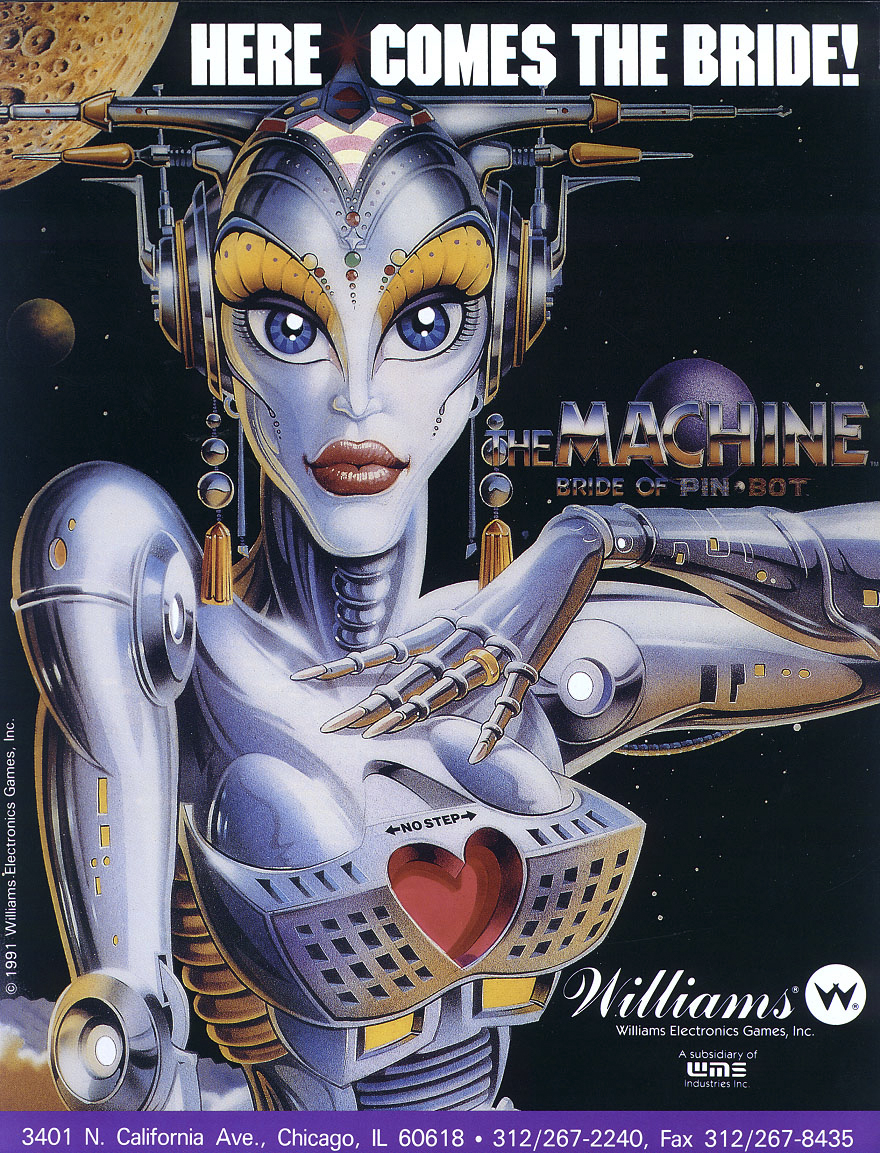
The Machine: Bride of Pinbot flyer
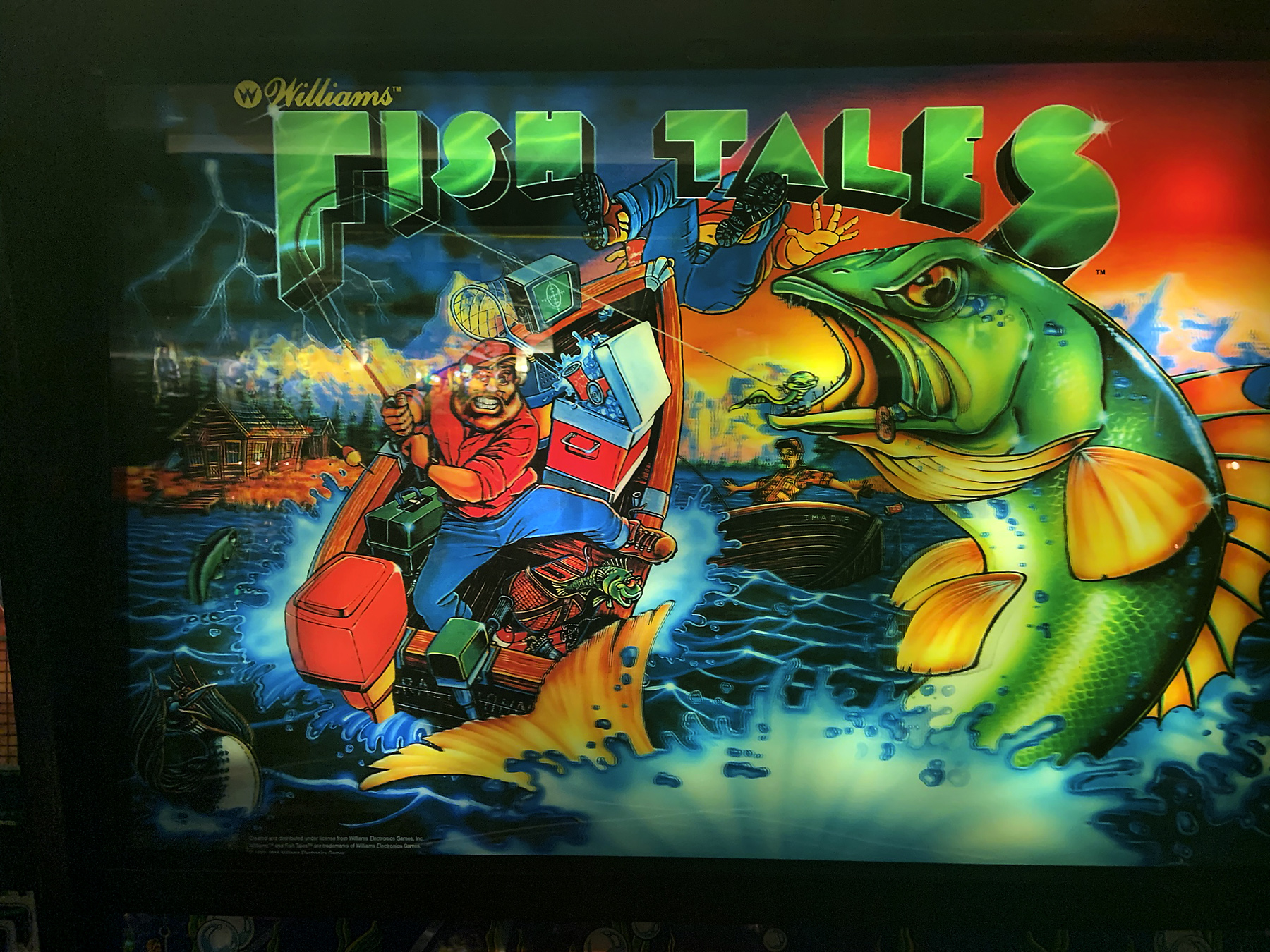
Williams Electronic Games (1985-1999)
Fish Tales (detail)
1992
13,640 produced
Photo: Marcus Bunyan
“Catch Em All – Hook Line and Sinker”
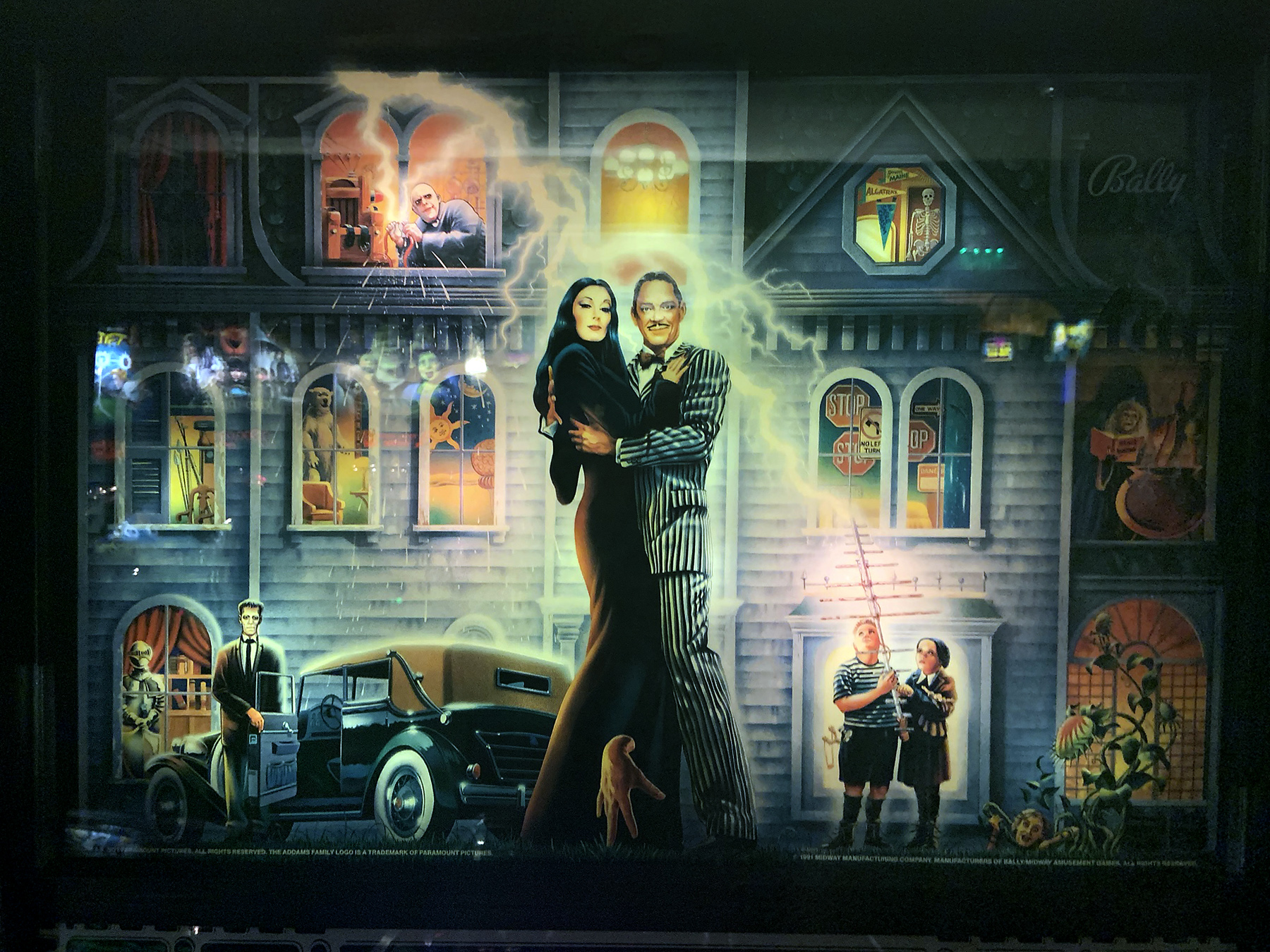
Bally (Midway Manufacturing Company) (Chicago, 1988-1999)
The Addams Family (detail)
1992
20,270 produced
Photo: Marcus Bunyan
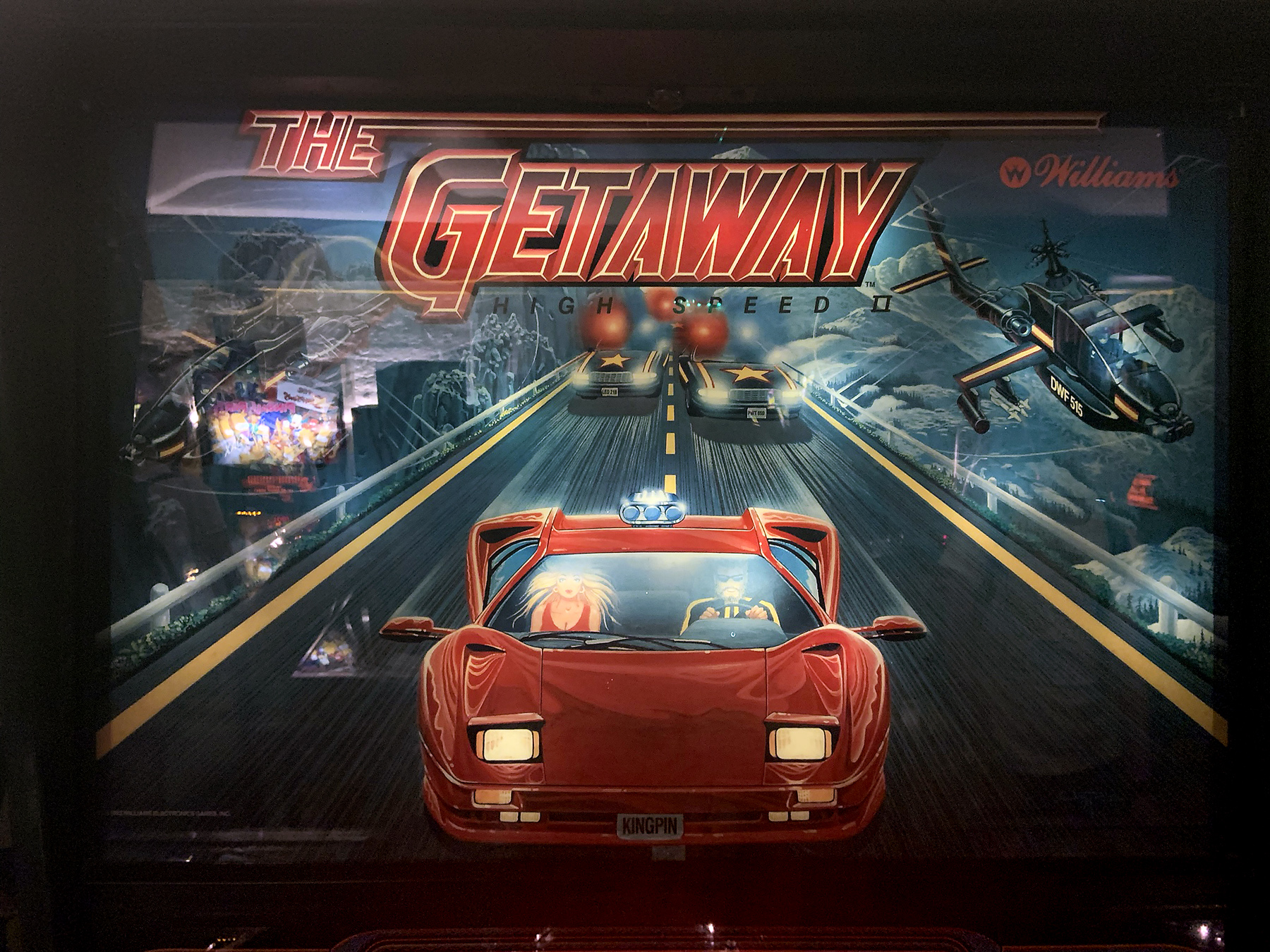
Williams Electronic Games (1985-1999)
The Getaway: High Speed II (detail)
1992
13,259 produced
Photo: Marcus Bunyan
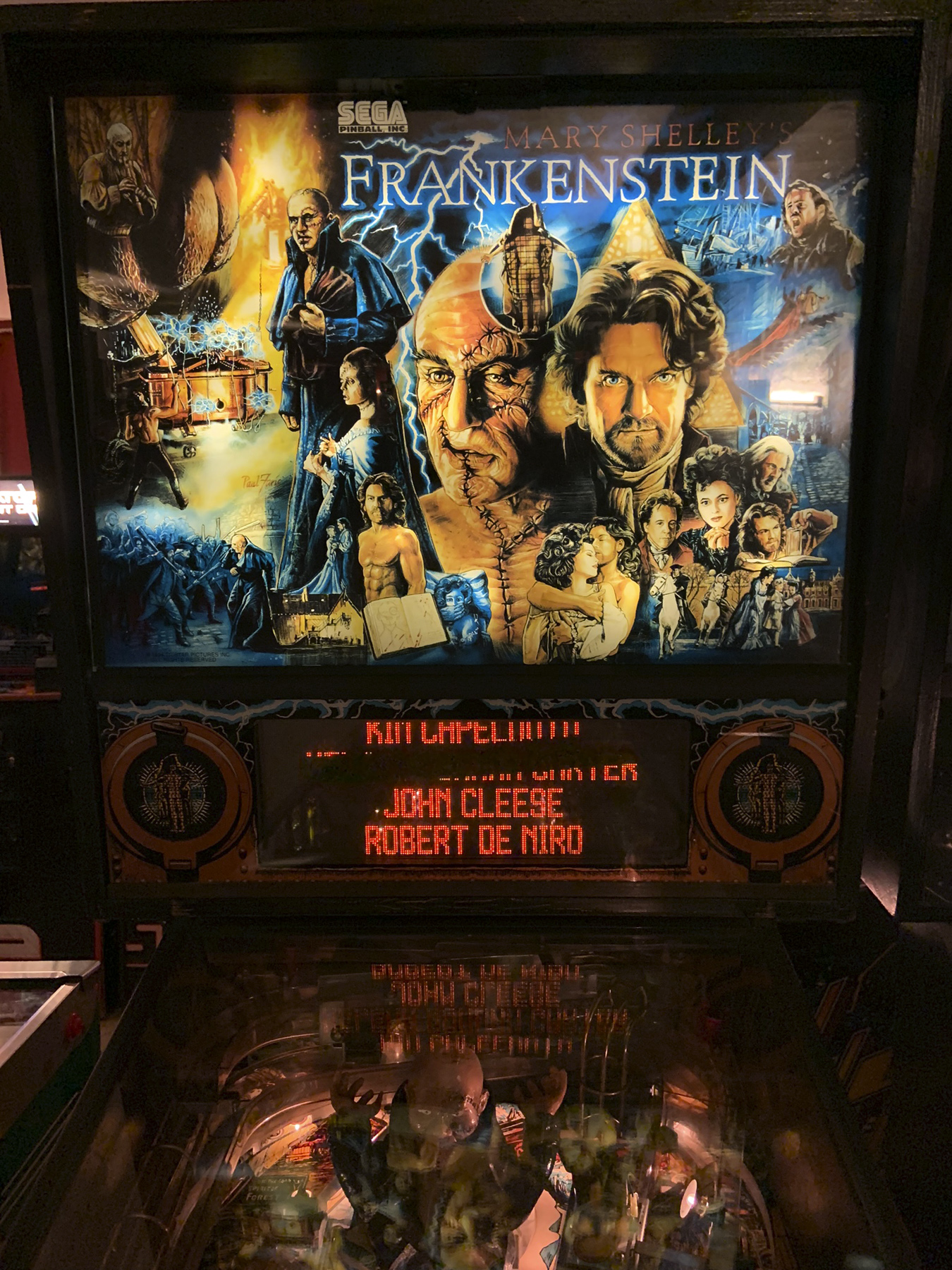
Sega Pinball Incorporated (Chicago, Illinois, USA, 1994-1999)
Mary Shelley’s Frankenstein
1995
3,000 produced
Photo: Marcus Bunyan
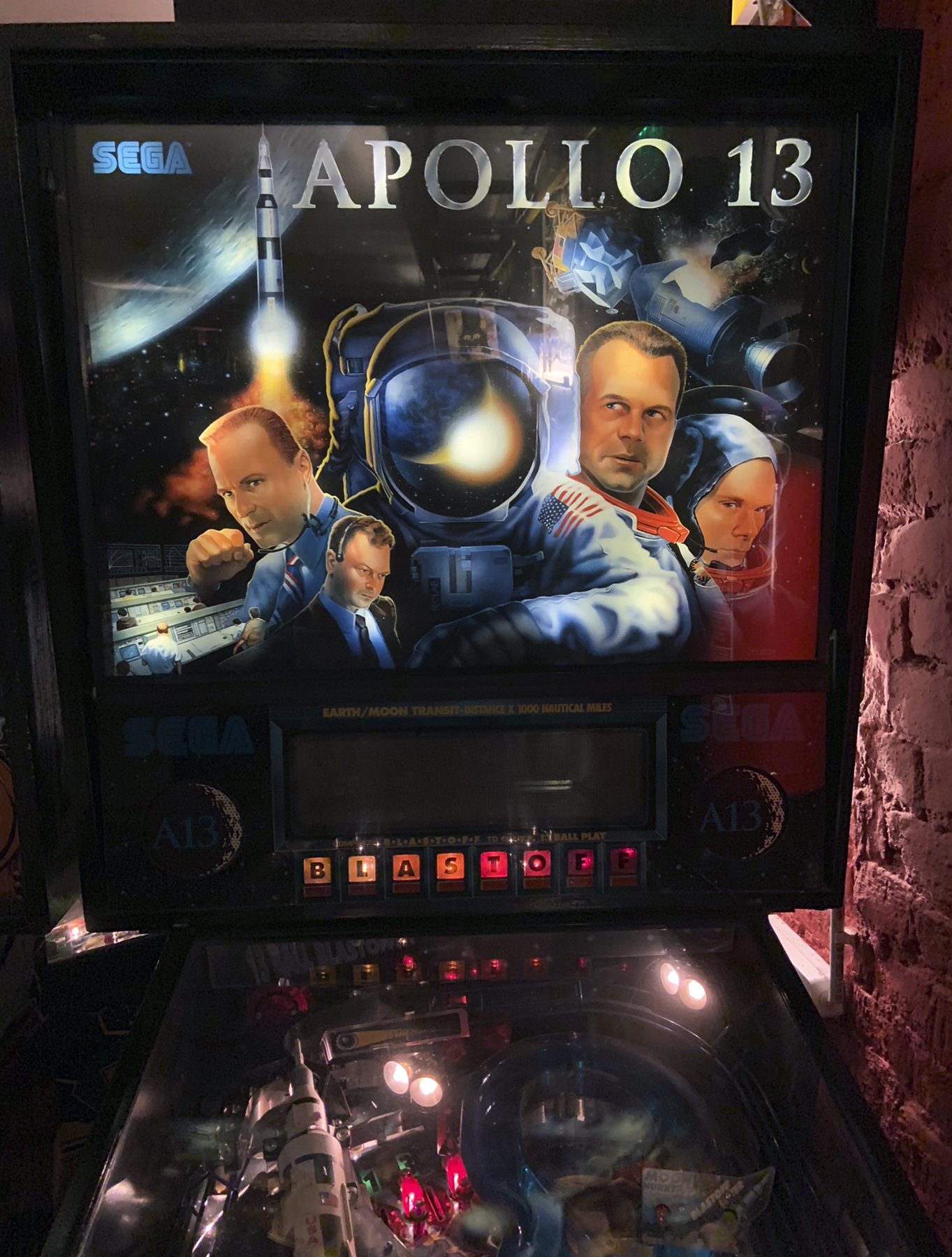
Sega Pinball Incorporated (Chicago, Illinois, USA, 1994-1999)
Apollo 13
1995
2,000 produced
Photo: Marcus Bunyan
“I Believe this will be Our Finest Hour.”
“‘Apollo 13 the Pinball’ is on the Launch Pad with All Systems Go!”
“The First Game in the Universe with 13 Ball Multiball!”
Flippermúzeum
Radnóti Miklós utca 18.
1137, Budapest, Hungary
Opening hours:
Wednesday – Friday 16.00 – 24.00
Saturday 14.00 – 24.00
Sunday 10.00 – 22.00
Monday/Tuesday: CLOSED
 Art Blart _ art and cultural memory archive
You must be logged in to post a comment.