Exhibition: ‘Cecil Beaton at Wilton’ at Wilton House, Wiltshire and ‘Cecil Beaton at Home: Ashcombe & Reddish’, at The Salisbury Museum

Exhibition dates: Cecil Beaton at Wilton: 3rd May – 14th September 2014
Cecil Beaton at Home: Ashcombe & Reddish: 23rd May – 19th September 2014

Bright Young Things, Costume Balls And Country House Parties
From The Roaring ’20s To The Swinging ’60s
An Exhibition Of Cecil Beaton Photographs
Designed And Curated By Jasper Conran


'Cecil Beaton at Wilton House' installation view


Cecil Beaton at Wilton installation view
© The Cecil Beaton Studio Archive


What a gay old time!

Frippery and finery taken by that dandy doyen of chic Cecil Beaton, partying in a highly structured class society that is seemingly oblivious to the approaching horrors of the Second World War (which only adds to the photographs air of insouciance). It must have been so much fun.

The thing is, Beaton was a talented artist who captured it all with total aplomb. To go from the haughty, stylish Georgia Sitwell, Renishaw (1930, below) to the Arcadian beauty of Rex Whistler (1927, below); from the formal organisation of The 15th Earl and Countess of Pembroke dressed for the coronation of George VI (1937, below) to the classic beauty of Princess Natasha Paley (1930s, below); or the structure and stillness of Alice von Hofmannsthal (1937, below) to the vivaciousness and movement of Lady Plunket (Dorothé) and Mr Maurice (1937, below) – takes a consistency of vision and an understanding of craft that few photographers possess.

The photograph of Lady Plunket is particularly astonishing… to see this composition in the twinkling of an eye: the movement, the joy, the flower in the hair, the women with the crossed legs in the background, and just the sheer grace of the couple, he suspended on one foot, she flying through the air. Unforgettable.

Dr Marcus Bunyan


Many thankx to Sotheby’s, Wilton House and The Salisbury Museum for allowing me to publish the photographs in the posting. Please click on the photographs for a larger version of the image.


East Front of Wilton House


East Front of Wilton House
© Wilton House Trust


Cecil Beaton (British, 1904-1980) 'Edith Olivier, Mayor of Wilton, as Queen Elizabeth I for a pageant at Wilton' 1932


Cecil Beaton (British, 1904-1980)
Edith Olivier, Mayor of Wilton, as Queen Elizabeth I for a pageant at Wilton
1932
© Cecil Beaton Archive, Sotheby’s


Edith Maud Olivier

Edith Maud Olivier MBE (31 December 1872 – 10 May 1948) was an English writer, also noted for acting as hostess to a circle of well-known writers, artists, and composers in her native Wiltshire… Olivier had lived with her father and younger sister Mildred, and it was after Mildred died in 1927 that she started to engage a broader social circle. She formed a profound friendship with Rex Whistler and acted as a frequent hostess to an elite, artistic, and largely homosexual, social set which included Cecil Beaton, Siegfried Sassoon, William Walton, and Osbert Sitwell.

Her first novel, The Love Child was published in 1927, and was followed by further novels, biographies, including one of Alexander Cruden, and the autobiographical Without Knowing Mr Walkley.

Text from Wikipedia website


Cecil Beaton (British, 1904-1980) 'Georgia Sitwell, Renishaw' 1930


Cecil Beaton (British, 1904-1980)
Georgia Sitwell, Renishaw
1930
© Cecil Beaton Archive, Sotheby’s


Georgia Doble

Georgia Doble, the Canadian-born wife of Sacheverell Sitwell, was born in 1906 to a banker of Cornish descent. She met Sitwell at a party in 1924 while participating in the social gaiety of the London season. Georgia was familiar with Sitwell’s Southern Baroque Art and enjoyed his company, but she waited almost a year before accepting his marriage proposals. They were married in Paris on October 12, 1925. Their first son, Reresby, was born in 1927 and his younger brother, Francis, in 1935.

Georgia found it difficult to blend in with the Sitwell family, which had more than the usual share of dynamics. She did her best to play the self-assigned role of muse, but Sitwell was not a social man and Georgia missed the busy whirl of London. She attended many social events without him, which led to a great deal of friction between them. They both had affairs over the years, but remained deeply attached to one another throughout their lives. Georgia died in 1980.


Cecil Beaton (British, 1904-1980) 'Lady Plunket (Dorothé) and Mr Maurice' 1937


Cecil Beaton (British, 1904-1980)
Lady Plunket (Dorothé) and Mr Maurice
1937
© Cecil Beaton Archive, Sotheby’s
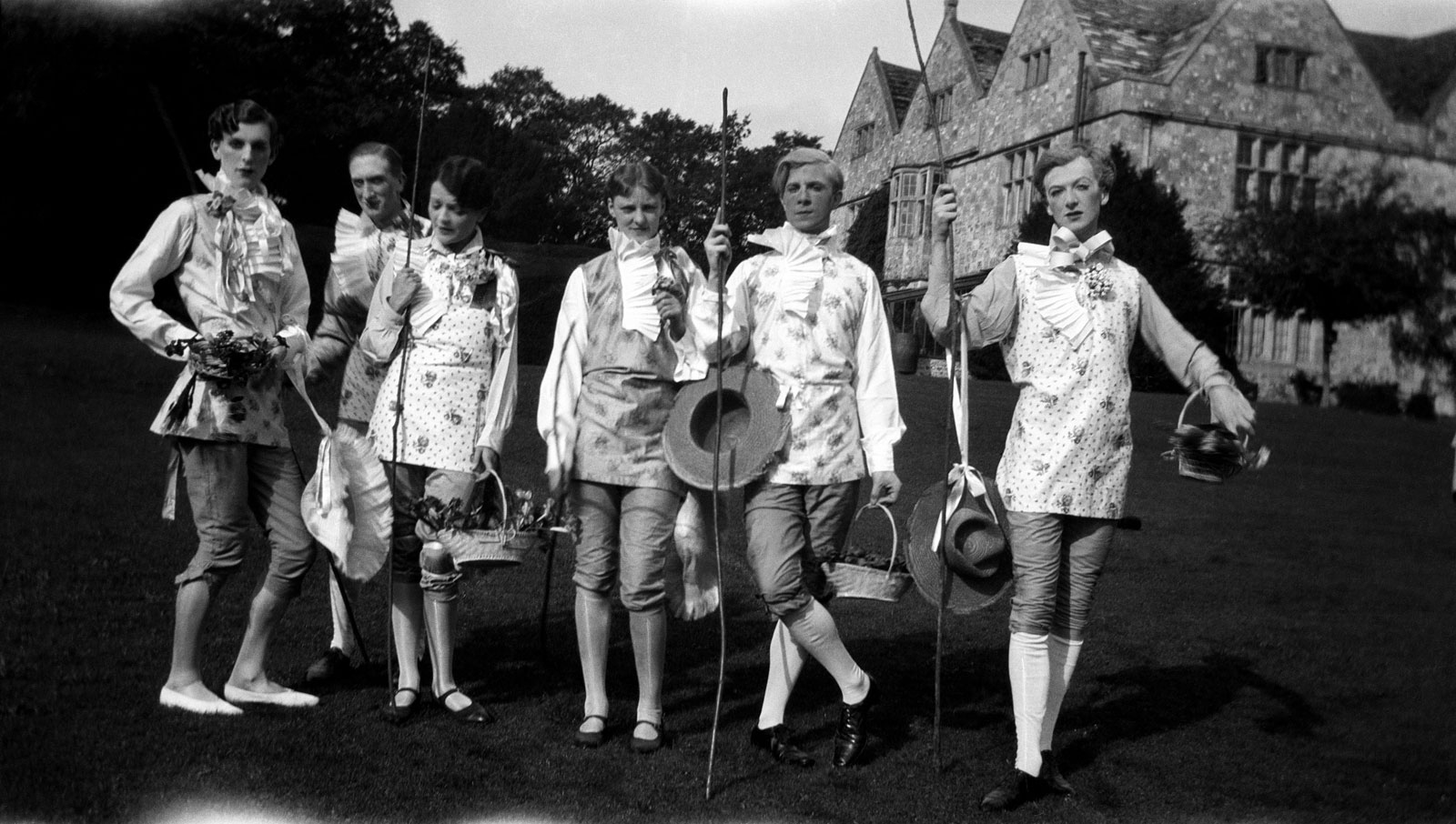
 

Cecil Beaton (British, 1904-1980) 'Stephen Tennant (1906-1987), William Walton (1902-1983), Georgia Sitwell (1905-1980), Zita Jungman (1903-2006), Rex Whistler (1905-1944) and Cecil Beaton (1904-1980), Wilsford, 1927' 1927


Cecil Beaton (British, 1904-1980)
Stephen Tennant (1906-1987), William Walton (1902-1983), Georgia Sitwell (1905-1980), Zita Jungman (1903-2006), Rex Whistler (1905-1944) and Cecil Beaton (1904-1980), Wilsford, 1927
1927
© Cecil Beaton Archive, Sotheby’s


Stephen James Napier Tennant (21 April 1906 – 28 February 1987) was a British aristocrat known for his decadent lifestyle. During the 20s and 30s, Tennant was an important member – the “Brightest”, it is said – of the “Bright Young People.” His friends included Rex Whistler, Cecil Beaton, the Sitwells, Lady Diana Manners and the Mitford girls. He is widely considered to be the model for Cedric Hampton in Nancy Mitford’s novel Love in a Cold Climate; one of the inspirations for Lord Sebastian Flyte in Evelyn Waugh’s Brideshead Revisited, and a model for Hon. Miles Malpractice in some of his other novels.

Sir William Turner Walton OM (29 March 1902 – 8 March 1983) was an English composer. During a sixty-year career, he wrote music in several classical genres and styles, from film scores to opera. His best-known works include Façade, the cantata Belshazzar’s Feast, the Viola Concerto, and the First Symphony.

Zita Jungman‘s accounts of her fellow bright young things of the 1920s stress their high vocal pitch and decibel level – “shrieking”, “screaming”, “howling with laughter”. So it is significant that when, in 1926, Cecil Beaton met Zita, who has died aged 102, in the Gargoyle Club, Soho, he responded to her quietness and understanding. She was, he wrote, a “thoroughly unflashy” original… The antics of the bright young things were relatively innocent: bottle parties, fancy dress balls and pageants, with cocktails and fast cars. The Jungman girls, along with clever Alannah Harper, Eleanor Smith and Loelia Ponsonby, staged treasure hunts, using their connections to arrange a fake edition of the Evening Standard or Hovis loaves baked to order with clues inside. 

Enter aspirant photographer Beaton. He had spotted the sisters at a performance of Edith Sitwell’s Facade, and met Zita again in Venice rehearsing for a ball. Alannah Harper modelled for him; Zita followed. He was financially thrilled. “They certainly would get into the papers … so very saleable.” She spent hours before the lens in the Beaton house: “She loved doing her hair in various exotic ways and looked quite beautiful and quite extraordinarily funny. She is a perfect young lady.”

Beaton described the sisters as “a pair of decadent 18th-century angels made of wax” and wrote of Zita: “With her smooth fringes, and rather flat head, like a silky coconut, like a medieval page, and with her swinging gait, she looks very gallant, very princely. But she can, if she wishes, easily become a snake-like beauty, with a mysterious smile and a cold glint in her upward slanting eyes.” Her reaction to the pictures was to “lay back in a chair looking at them for ages, never speaking, just occasionally grunting a grunt of satisfaction”.

Veronica Horwell. “Zita Jungman,” on the Guardian website Friday 3 March 2006 [Online] Cited 07/11/2022


Cecil Beaton (British, 1904-1980) 'Rex Whistler' 1927


Cecil Beaton (British, 1904-1980)
Rex Whistler
1927
© Cecil Beaton Archive, Sotheby’s


Reginald John “Rex” Whistler

Reginald John “Rex” Whistler (24 June 1905 – 18 July 1944) was a British artist, designer and illustrator.

Reginald John Whistler was born in Britain on 24 June 1905, at Eltham, Kent, the son of Harry and Helen Frances Mary Whistler. In May 1919 he was sent to boarding school at Haileybury, where he showed a precocious talent for art, providing set designs for play productions and giving away sketches to prefects in lieu of “dates” (a punishment at Haileybury, similar to “lines” whereby offenders are required to write out set lists of historical dates).

After Haileybury the young Whistler was accepted at the Royal Academy, but disliked the regime there and was “sacked for incompetence”. He then proceeded to study at the Slade School of Art, where he met Stephen Tennant, soon to become one of his best friends and a model for some of the figures in his works. Through Tennant, he later met the poet Siegfried Sassoon and his wife Hester, to both of whom Whistler became close.

Upon leaving the Slade he burst into a dazzling career as a professional artist. His work encompassed all areas of art and design – from the West End theatre to book illustration (including works by Evelyn Waugh and Walter de la Mare, and perhaps most notably, for Gulliver’s Travels) and mural and trompe-l’oeil painting. Paintings at Port Lympne Mansion (within Port Lympne Wild Animal Park), Plas Newydd, Mottisfont Abbey and Dorneywood among others, show his outstanding talent in this genre. During his time at Plas Newydd he may well have become the lover of the daughter of the 6th Marquess of Anglesey, the owner of the house, who had commissioned him to undertake the decorative scheme. Whistler and Lady Caroline Paget are known to have become very close friends and he painted numerous portraits of her, including a startling nude. Whether this painting was actually posed for or whether it was how Whistler imagined her naked is a matter of debate.

His most noted work during the early part of his career was for the café at the Tate Gallery, completed in 1927 when he was only 22. He was commissioned to produce posters and illustrations for Shell Petroleum and the Radio Times. He also created designs for Wedgwood china based on drawings he made of the Devon village of Clovelly. Whistler’s elegance and wit ensured his success as a portrait artist among the fashionable; he painted many members of London society, including Edith Sitwell,Cecil Beaton and other members of the set to which he belonged that became known as the “Bright Young Things”. His murals for Edwina Mountbatten’s 30-room luxury flat in Brook House, Park Lane, London were later installed by the Mountbattens’ son-in-law, decorator David Hicks, in his own houses.

Whistler’s activities also extended to ballet design. He designed the scenery and costumes for Ninette de Valois and Gavin Gordon’s Hogarth-inspired 1935 ballet The Rake’s Progress.

When war broke out, although he was 35, Whistler was eager to join the army. He was commissioned into the Welsh Guards as Lieutenant 131651. His artistic talent, far from being a stumbling block to his military career, was greatly appreciated and he was able to find time to continue some of his work, including a notable self-portrait in uniform now in the National Army Museum. In 1944 he was sent to France following the D-Day landings.

In July he was with the Guards Armoured Division in Normandy as the invasion force was poised to break out of the salient east of Caen. On the hot and stuffy 18 July his tank, after crossing a railway line, drove over some felled telegraph wires beside the railway, which became entangled in its tracks. He and the crew got out to free the tank from the wire when a German machine gunner opened fire on them, preventing them from getting back into their tank. Whistler dashed across an open space of 60 yards to another tank to instruct its commander, a Sergeant Lewis Sherlock, to return the fire. As he climbed down from Sherlock’s tank a mortar bomb exploded beside him and killed him instantly, throwing him into the air. He was the first fatality suffered by the battalion in the Normandy campaign.

Text from the Wikipedia website


Palladian Bridge at Wilton House


Palladian Bridge at Wilton House
© Wilton House Trust


Sotheby’s and Wilton House will pay tribute to the life and work of the photographer, writer and Oscar-winning designer Cecil Beaton (1904-1980) with a new exhibition of photographs from Sotheby’s Cecil Beaton Studio Archive, designed and curated by Jasper Conran. Capturing the spirit of country house parties and costume balls, the exhibition will showcase previously unseen images from one of Britain’s most celebrated photographers, giving a fascinating glimpse into his life and a vivid portrait of a charmed age.

Staged at Wilton House in Wiltshire where Beaton was entertained by his friends the Pembroke family at grand parties and pageants for over 50 years, the exhibition will run between 18th- 21st April and 3rd May – 14th September 2014.

Described as “a worldly Peter Pan” who never aged1, Cecil Beaton – the acclaimed photographer for Vogue and Vanity Fair – was at the forefront of the fashion for costume and pageantry which swept through British society in the 1920s. Immortalised in the Noël Coward song ‘I’ve been to a marvellous party’, “Dear Cecil arrived wearing armour / Some shells and a black feather boa…,” Beaton was renowned for his flair for fancy dress and costumery, later winning Oscars, Academy and Tony awards for his designs. He invited friends from all over the world to legendary parties at his Wiltshire home Ashcombe, where guests arrived “in the knowledge that they were to exchange reality for a complete escape into the realms of fantasy.”2

As fancy dress became a popular feature of country house parties, and costume balls a highlight of the social calendar, Beaton seamlessly integrated his high-society personal life with his professional artistic quest to experiment with photography and fashion. Using the settings of Britain’s grandest country houses as the perfect backdrop, Beaton persuaded his friends to sit for him in their exotic costumes, often designed by him, for these most unconventional of photographs.

This fascinating collection of photographs will be displayed in a new exhibition space, especially renovated for the event at Wilton House. Situated just a few miles from Beaton’s country houses Ashcombe and Reddish, Wilton was the location for costume balls and theatrical events enjoyed and photographed by Beaton for over 50 years. Despite being pushed into a river at the first Ball he attended there in 1927, Beaton later became great friends with the Earls of Pembroke. Over time he photographed and chronicled the lives of three generations of the family in the surroundings of the house which he described as “perhaps the most wonderful piece in all Wiltshire’s heritage of domestic architecture… at every time of year, in all weathers, unfailing in its beauty.”3 On 14th January 1980, just three days before his death, Beaton celebrated his 76th birthday with a lunch party hosted by the family.

The Cecil Beaton Studio Archive

Sotheby’s is the privileged guardian of the Cecil Beaton Studio Archive, a matchless repository of over 100,000 negatives, 9,000 vintage prints and 42 scrapbooks from the celebrated photographer’s personal collection. Cecil Beaton negotiated the transfer of his private archive to Sotheby’s in 1977 in order to preserve its role for future generations. Today, the collection – some of which is still stored in Beaton’s original filing cabinets – is available for use as a picture library, lending images to be reproduced on the printed page and for exhibition worldwide.

Further photographs from the Cecil Beaton Studio Archive will be displayed at Salisbury Museum’s exhibition Cecil Beaton at Home: Ashcombe & Reddish between 23rd May – 19th September 2014. This exhibition will bring together original photographs, artworks and possessions from Cecil Beaton’s two Wiltshire homes, Ashcombe and Reddish which served as retreats, inspirations, and stages for impressive entertaining, to present a fascinating picture of Beaton’s extraordinary life.”

1/ Hugo Vickers, Cecil Beaton: The Authorised Biography, Introduction, p. xxiii
2/ Cecil Beaton, Ashcombe: The Story of a Fifteen-year Lease, p. 33
3/ Cecil Beaton, Ashcombe: The Story of a Fifteen-year Lease, p. 35

Press release from Sotheby’s


Cecil Beaton (British, 1904-1980) 'Cecil Beaton on the Palladian bridge at Wilton House, September 1968' 1968 (detail)


Cecil Beaton (British, 1904-1980)
Cecil Beaton on the Palladian bridge at Wilton House, September 1968 (detail)
1968
© Cecil Beaton Archive, Sotheby’s


Cecil Beaton (British, 1904-1980) 'Alice von Hofmannsthal, Ashcombe, 1937, in her Costume for "The Gardener’s Daughter" for "The Anti Dud Ball" at the Dorchester Hotel, 13 July 1937' 1937


Cecil Beaton (British, 1904-1980)
Alice von Hofmannsthal, Ashcombe, 1937, in her Costume for “The Gardener’s Daughter” for “The Anti Dud Ball” at the Dorchester Hotel, 13 July 1937
1937
© Cecil Beaton Archive, Sotheby’s


Cecil Beaton (British, 1904-1980) 'Princess Natasha Paley' 1930s


Cecil Beaton (British, 1904-1980)
Princess Natasha Paley
1930s
© Cecil Beaton Archive, Sotheby’s


Princess Natalia Pavlovna Paley

Princess Natalia Pavlovna Paley (Наталья Павловна Палей), Countess de Hohenfelsen (December 5, 1905 – December 27, 1981) was a member of the Romanov family. A daughter of Grand Duke Paul Alexandrovich of Russia, she was a first cousin of the last Russian emperor, Nicholas II. After the Russian revolution she emigrated first to France and later to the United States. She became a fashion model, socialite, vendeuse, and briefly pursued a career as a film actress…

Ethereal and glamorous, Princess Natalia would not follow any fashion trend, but would dictate her own. Hats and gloves were her signature. With deep-set gray eyes and pale blond hair, she became a sought after model establishing an image for herself in the Parisian elite becoming a well known socialite. As a model, she appeared in many magazines including Vogue. She was a favourite model for the great photographers of her time: Edward Steichen, Cecil Beaton, Horst P. Horst, Andre Durst and George Hoyningen-Huene.

Text from Wikipedia website


Cecil Beaton (British, 1904-1980) 'The Countess of Pembroke acting in Beaton's musical "Heil Cinderella"' 1939


Cecil Beaton (British, 1904-1980)
The Countess of Pembroke acting in Beaton’s musical “Heil Cinderella”
1939
© Cecil Beaton Archive, Sotheby’s


Cecil Beaton (British, 1904-1980) 'The 15th Earl and Countess of Pembroke dressed for the coronation of George VI' 1937


Cecil Beaton (British, 1904-1980)
The 15th Earl and Countess of Pembroke dressed for the coronation of George VI
1937
© Cecil Beaton Archive, Sotheby’s


Cecil Beaton (British, 1904-1980) 'The Countess of Pembroke in her Robes for the Coronation of George VI' 1937


Cecil Beaton (British, 1904-1980)
The Countess of Pembroke in her Robes for the Coronation of George VI
1937
© Cecil Beaton Archive, Sotheby’s


Cecil Beaton (British, 1904-1980) 'Cecil Beaton in "All the Vogue", Cambridge' 1925


Cecil Beaton (British, 1904-1980)
Cecil Beaton in “All the Vogue”, Cambridge
1925
© Cecil Beaton Archive, Sotheby’s


Beauty, decadence and a damned good party: Cecil Beaton at Salisbury Museum

The not so private world of Cecil Beaton – photographer to the Royals, painter, designer of interiors, stage and costume and secret diarist – seems to have been as opulent as his professional career was varied. If we are to believe his candid diaries, it was a world of decadent parties and languid weekend soirees full of bright young things who caroused at his Wiltshire homes against a backdrop of sumptuous interiors and fabulous gardens.

The first of these private pleasure houses was Ashcombe, which he rented for £50 a year between 1930-1945. It was followed by Reddish, which Beaton purchased in 1945 and lived in until his death in 1980. By all accounts both were splendid residences, and the stream of celebrities and society people who came and went were photographed by Beaton or captured in his notoriously frank scrapbooks and diaries.

And it is these extravagant worlds that can be glimpsed at Salisbury Museum who, with the help of the vast Cecil Beaton Archive at Sotheby’s, are teasing them back to life. A tantalising glimpse into the photographer’s more hidden moments and the celebrity in-crowd of friends and acquaintances he lavishly entertained, the exhibition brings together 183 unique photographs (including 35 vintage prints) exhibited with some of his artworks and personal possessions within recreations of the interiors.

But it’s the cast of players that grabs the attention; bohemian aristocrats, socialites and some of the biggest stars of the stage, screen, fashion and art world form a procession of decadence that stretched across five decades from 1930-1980. Famous faces include Truman Capote, Leslie Caron, David Hockney, Bianca Jagger and Ivor Novello interspersed here with private snaps of his great loves – the Hollywood icon Greta Garbo, with whom he had an affair, and millionaire art collector Peter Watson, with whom (we are told) he didn’t.

But as well as the society faces the exhibition includes images of the photographer’s inspired garden designs at Reddish and his theatrically-styled home interiors at Ashcombe, which he created so he could ‘live in scenery’, inspired by his visit to Hollywood in 1929. Work in progress shots show the making of Beaton’s fantastical ‘Circus Bedroom’ in 1932 with freshly painted murals of a circus clown, a girl on a merry-go-round horse and a jolly fat lady.

The bedroom was apparently created “on a rainy weekend in 1932” by a typically decadent gang of dazzling society types that included artists Rex Whistler, ‘Jack’ von Bismarck, Oliver Messel, Lord Berners, Edith Olivier, Jorg von Reppert Bismarck and of course Beaton himself. Whistler also designed Beaton’s theatrical four-poster ‘carousel’ bed with gilded unicorns, stripey circus-top canopy and barley twist bedposts. Beaton is pictured with Watson amidst this baroque creation. And visitors can experience it for themselves courtesy of a full-scale recreation reconstructed for the very first time since it was broken up in 1945. A fascinating glance into a decadent disappeared world.

Richard Moss. “Beauty, decadence and a damned good party: Cecil Beaton at Salisbury Museum,” on the Culture 24 website 28 May 2014 [Online] Cited 16/06/2021. No longer available online


Rex Whistler (British, 1905-1944) 'Ashcombe House' 1930s


Rex Whistler (British, 1905-1944)
Ashcombe House
1930s
© Private Collection


Cecil Beaton (British, 1904-1980) 'Frontispiece montage for Cecil Beaton’s Scrapbook, 1937, Ashcombe' 1937


Cecil Beaton (British, 1904-1980)
Frontispiece montage for Cecil Beaton’s Scrapbook, 1937, Ashcombe
1937
© Private Collection


Cecil Beaton (British, 1904-1980) 'Cecil Beaton on the front steps of Reddish House, Broad Chalke, June 1947, Reddish' 1947


Cecil Beaton (British, 1904-1980)
Cecil Beaton on the front steps of Reddish House, Broad Chalke, June 1947, Reddish
1947
© Cecil Beaton Archive, Sotheby’s


Cecil Beaton (British, 1904-1980) 'Cecil Beaton in his first costume of the night for the Fete Champetre, in his Circus bedroom, 10 July 1937, Ashcombe' 1937


Cecil Beaton (British, 1904-1980)
Cecil Beaton in his first costume of the night (the famous ‘Rabbit’ outfit) for the Fete Champetre, in his Circus bedroom, 10 July 1937, Ashcombe
1937
© Getty Images/ Time Life
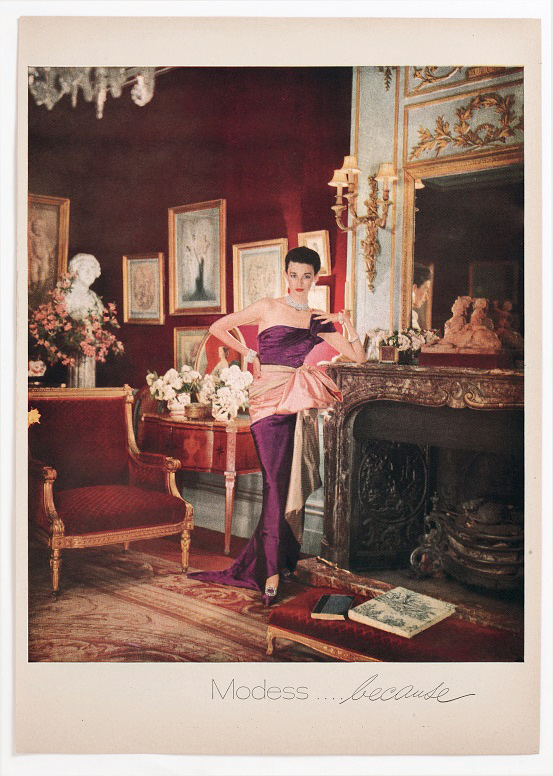
 

Cecil Beaton (British, 1904-1980) 'Dorian Leigh photographed for 'Modess… because' campaign, Reddish House, Broad Chalke, 1950s, Reddish' 1950s


Cecil Beaton (British, 1904-1980)
Dorian Leigh photographed for ‘Modess… because’ campaign, Reddish House, Broad Chalke, 1950s, Reddish
1950s
© Johnson & Johnson


Dorian Leigh (April 23, 1917 – July 7, 2008), born Dorian Elizabeth Leigh Parker, was an American model and one of the earliest modelling icons of the fashion industry. She is considered one of the first supermodels and was well known in the United States and Europe.
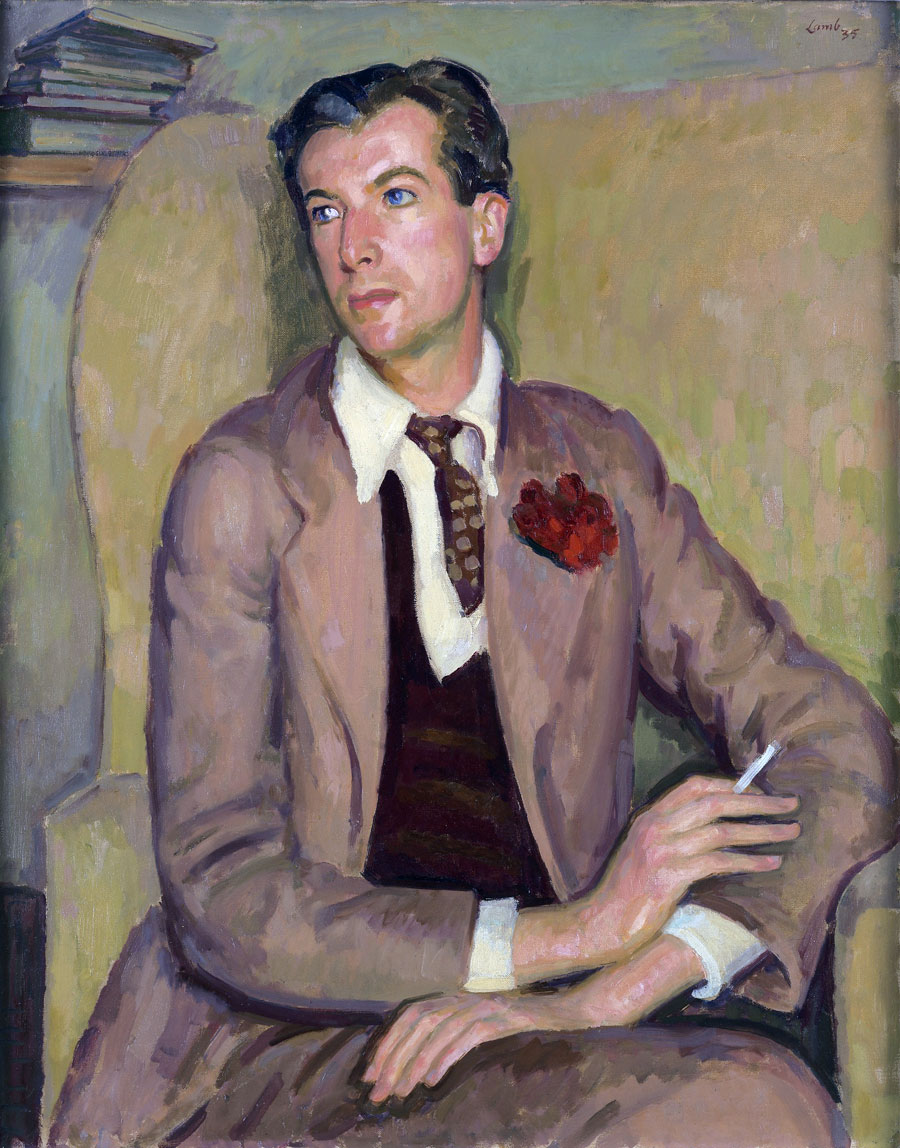
 

Henry Lamb (British, born Australia 1883-1960) 'Portrait of Cecil Beaton' 1935


Henry Lamb (British, born Australia 1883-1960)
Portrait of Cecil Beaton
1935
© Private Collection


Henry Taylor Lamb

Henry Taylor Lamb MC RA (Adelaide 21 June 1883 – 8 October 1960 Salisbury) was an Australian-born British painter. A follower of Augustus John, Lamb was a founder member of the Camden Town Groupin 1911 and of the London Group in 1913.

Lamb is noted for his unusual portraits, as exemplified by his well-known picture of an elongated Lytton Strachey. He was elected an Associate of the Royal Academy in 1940 and was made a full Member in 1949. He was a Trustee of the National Portrait Gallery from 1942 and of the Tate Gallery from 1944 to 1951. His auction record was set at Christie’s in London in June 2006 when his 1910 Breton Boy oil on panel fetched £60,000. As well as the Imperial War Museum, works by Lamb are held in regional museums throughout Britain, in the British Government Art Collection and in the National Gallery of Canada, which received the majority of Lambs portraits of Canadian troops at the end of World War Two.


Wilton House
Wilton, Salisbury
SP2 0BJ, United Kingdom
+44 1722 746714

Opening hours:
Currently closed

The Salisbury Museum
The King’s House,
65 The Close, Salisbury
SP1 2EN
Phone: 01722 332151

Opening hours:
Daily 10am – 5pm
Wilton House website

The Salisbury Museum website

LIKE ART BLART ON FACEBOOK

Back to top

Exhibition: ‘Francis Bacon & Henry Moore: Terror and Beauty’ at the Art Gallery of Ontario (AGO), Toronto

Exhibition dates: 5th April – 20th July 2014


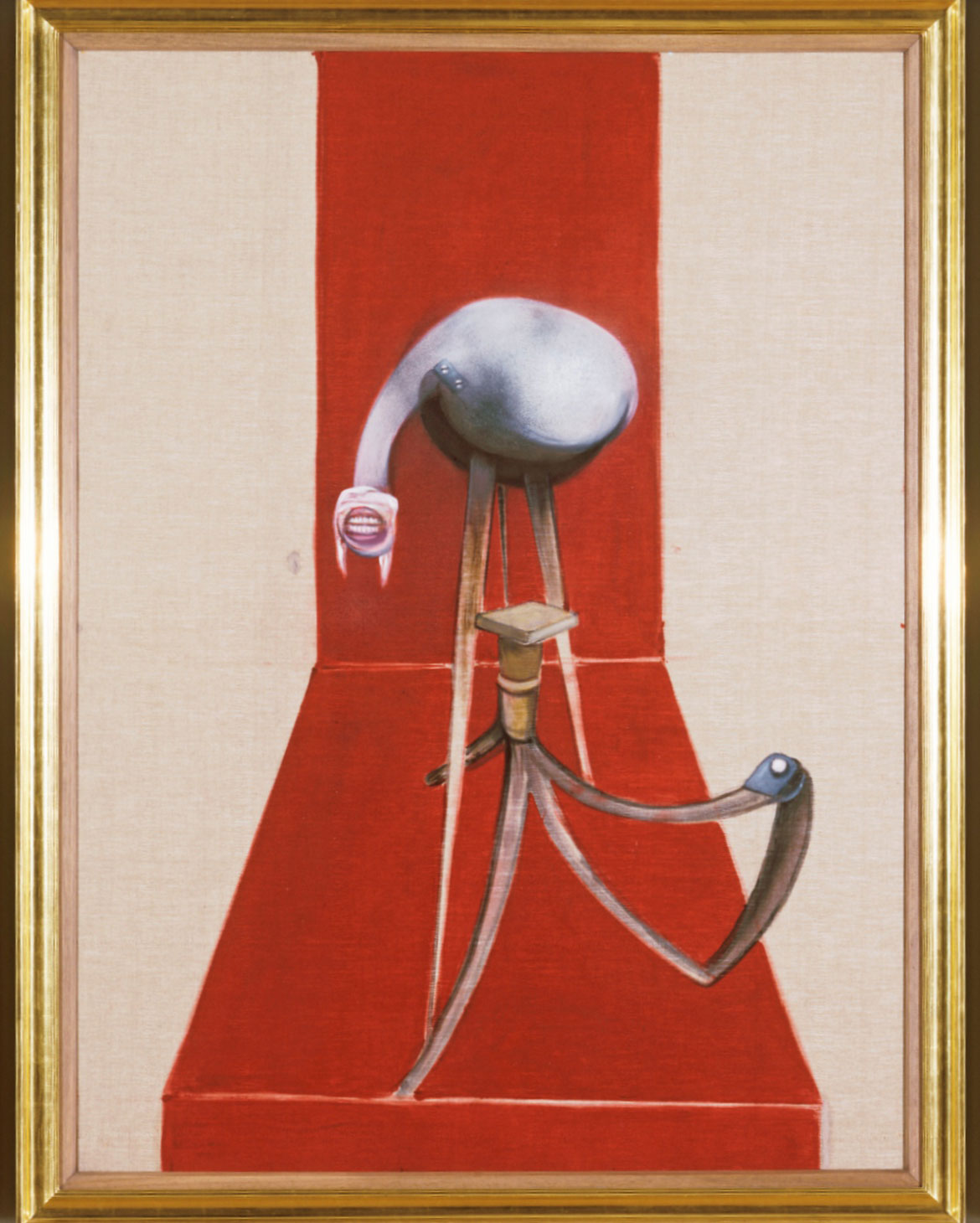
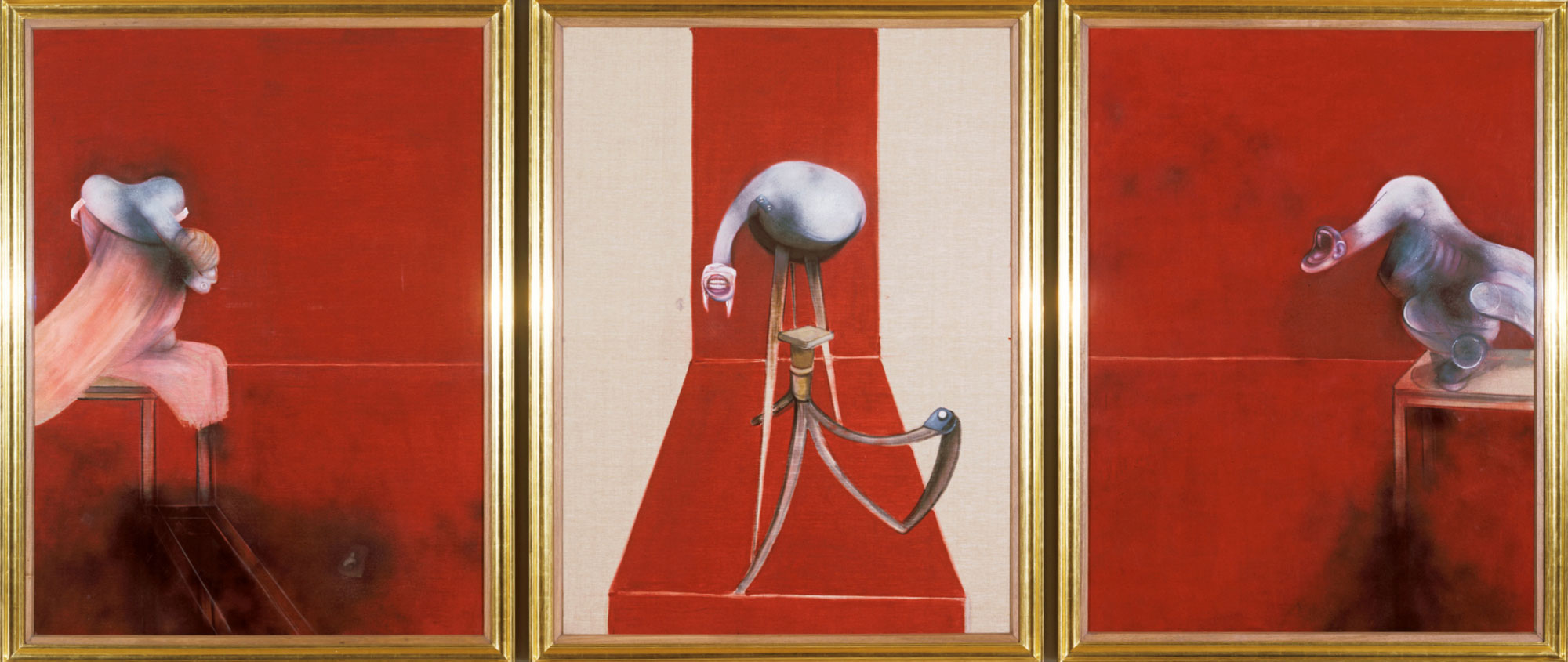
Francis Bacon (British, 1909-1992) 'Second Version of Triptych 1944' 1988


Francis Bacon (British, 1909-1992)
Second Version of Triptych 1944
1988
Oil and alkyds on canvas
Each panel 198 x 147.5cm (each panel)
Tate Modern, London
© Estate of Francis Bacon / SODRAC (2013)


Like the my earlier posting on the exhibition ‘Caravaggio – Bacon’ at Gallery Borghese, Rome, what an inspired curatorial decision this is. I would have never have thought to have brought Bacon and Moore together, but the synergy between the two artists work is undeniable.

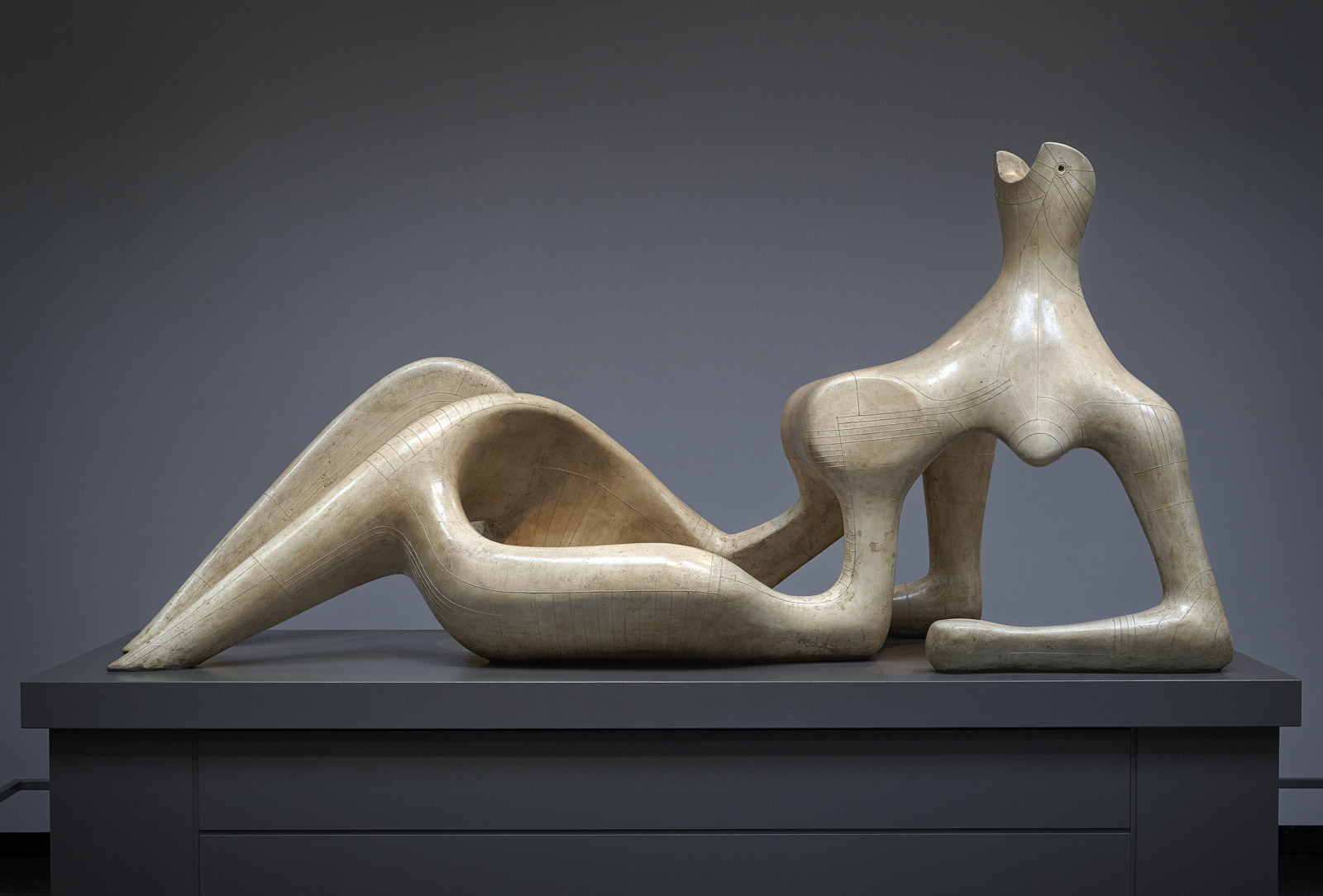
Personally, I don’t think that Moore is as immobile and measurable as Radoslaw Kudlinski states in the quotation below: while rooted in anthropological concerns his anthropomorphic “nightmares” have a heft and gravitas that move you, not physically, but in the pit of your stomach. Look at the open mouth of Reclining Figure (1951, below) and tell me you are not drawn down into the bowls of the soul through the pointed tit of mother earth. Tactile, yes. Immobile and measurable, NO!

Moore moves you from within. His roots are from an ancient and emotional landscape, one of decay, time and change. His works are like embryonic sacs, pushing out at you from different points. The holes in his work are like looking into a black hole. The spaces he creates with his sculptures DENY a perfect formal economy, for they are really awkward images that impinge on a space. Never stationary, his sculptures move you from within in the most powerful way. A perfect counterbalance to the external, cinematic rambunctiousness of Bacon.

Dr Marcus Bunyan


Many thankx to the Art Gallery of Ontario for allowing me to publish the photographs in the posting. Please click on the photographs for a larger version of the image.


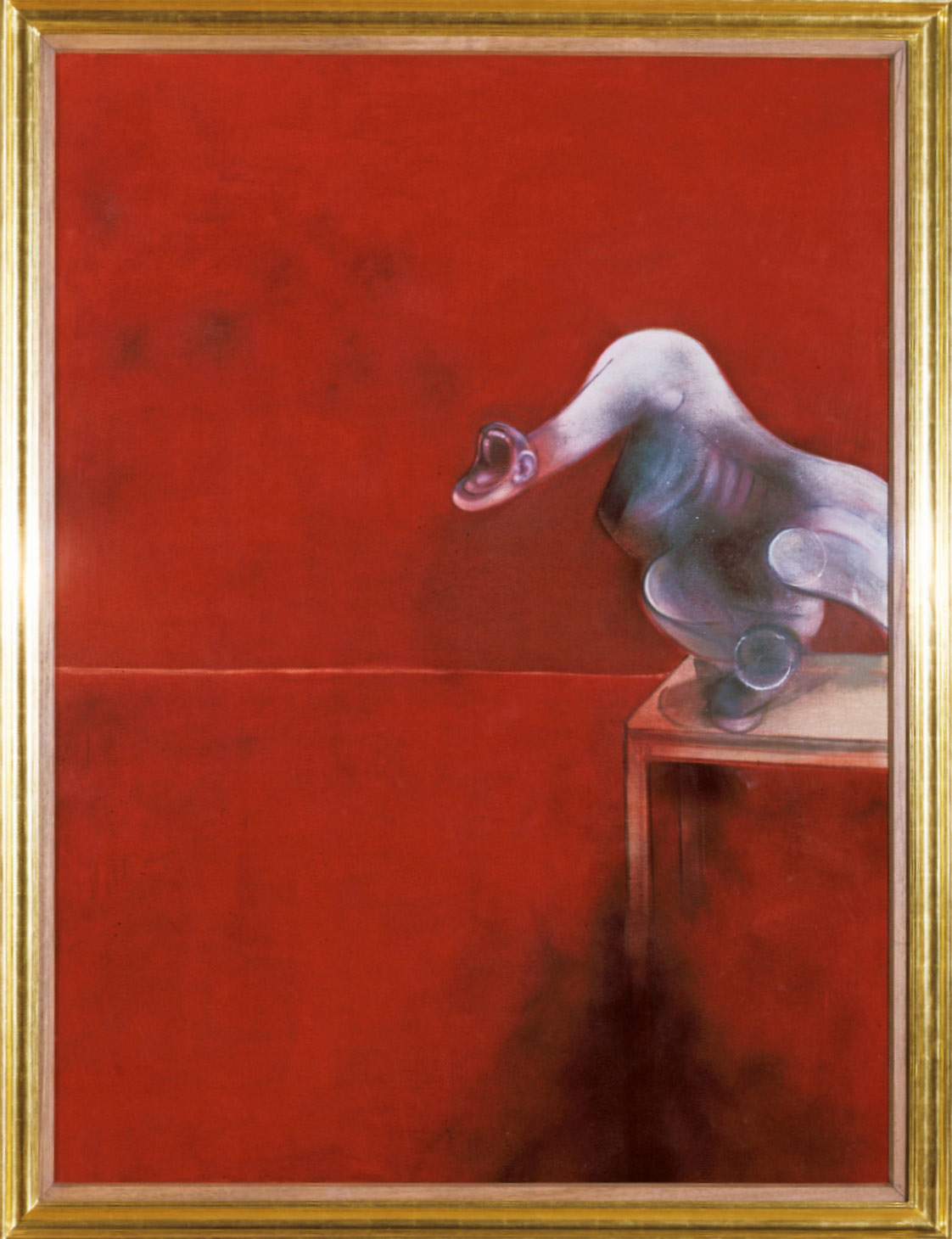
Francis Bacon (British, 1909-1992) 'Second Version of Triptych 1944' 1988 (detail)


Francis Bacon (British, 1909-1992)
Second Version of Triptych 1944 (detail)
1988
Oil and alkyds on canvas
Each panel 198 x 147.5cm (each panel)
Tate Modern, London
© Estate of Francis Bacon / SODRAC (2013)


Francis Bacon (British, 1909-1992) 'Second Version of Triptych 1944' 1988 (detail)


Francis Bacon (British, 1909-1992)
Second Version of Triptych 1944 (detail)
1988
Oil and alkyds on canvas
Each panel 198 x 147.5cm (each panel)
Tate Modern, London
© Estate of Francis Bacon / SODRAC (2013)


“While Moore’s figures are sustaining themselves entirely from within, Bacon’s are disengaged fugitives from history. Bacon is already “after” when Moore is still “before.”

And while Moore’s nightmares are still rooted in anthropological concerns – corporeal and measurable – Bacon’s subject is a phantom without a name, without a past, because a collectivised subject is only and always an abstract fragment of a person.

But we need Moore’s confrontation with Bacon. Moore is a guardian of our sanity. His forms are stationary – despite the refined movement of all their structural lines, and their impeccable pronunciation of architectural tempo, as well as their perfect formal economy, they are going nowhere.

And because of Moore’s immobility, tactility and measurability, I welcome his presence with relief. He defends us from Bacon’s radical, cinematic mobility, forever escaping our grasp.

Bacon’s state of convulsive stasis is an illusion, because looking at his canvas you have an impression that between the two or three takes, there are more frames, as in a movie, trapped in the same space. There is also a sense that this trapping of multiplicity is not a conscious choice, but the consequence of there being nowhere else to go.

Bacon is the scandal of the flesh, the existential strip-tease – even a post-flesh, post-body concept of a person. He is a fugitive, and his natural state is motion, appearance and disappearance. He belongs to non-materiality, to cyberspace – and this is his paradox, because together with the sensuality of his pictorial matter, the materiality of subject is gone. That’s why Bacon is so relevant today.”

Radoslaw Kudlinski. “Serious Scary: Francis Bacon and Henry Moore in Toronto,” on the Canadian Art website, May 7, 2014 [Online] Cited 05/07/2014. No longer available online


Bill Brandt (German-British, 1904-1983) 'Francis Bacon' Nd


Bill Brandt (German-British, 1904-1983)
Francis Bacon
Nd
Gelatin silver print
20.9 x 18.7cm
© The Bill Brandt Archive, London / Courtesy Edwynn Houk Gallery, New York / Zürich


Francis Bacon (British, 1909-1992) 'Study for Portrait VI' 1953


Francis Bacon (British, 1909-1992)
Study for Portrait VI
1953 
Oil on canvas
152 x 117cm
The Minneapolis Institute of Arts,
The Miscellaneous Works of Art Purchase Fund © Estate of Francis Bacon / SODRAC (2013)


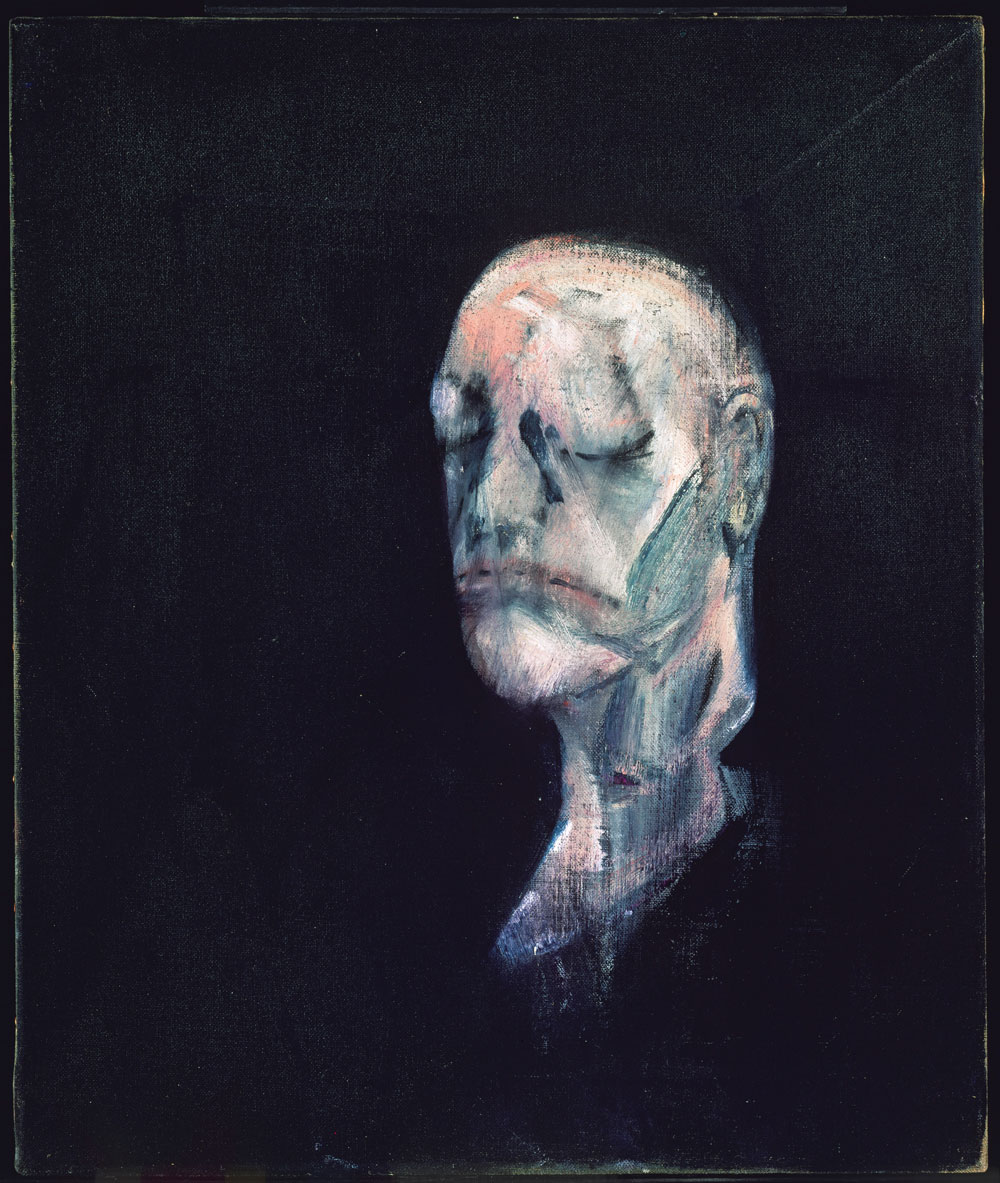
Francis Bacon (British, 1909-1992) 'Study for Portrait II (After the life mask of William Blake)' 1955


Francis Bacon (British, 1909-1992)
Study for Portrait II (After the life mask of William Blake)
1955
Oil on canvas
61 x 51cm
Tate Modern, London © Estate of Francis Bacon / SODRAC (2013)


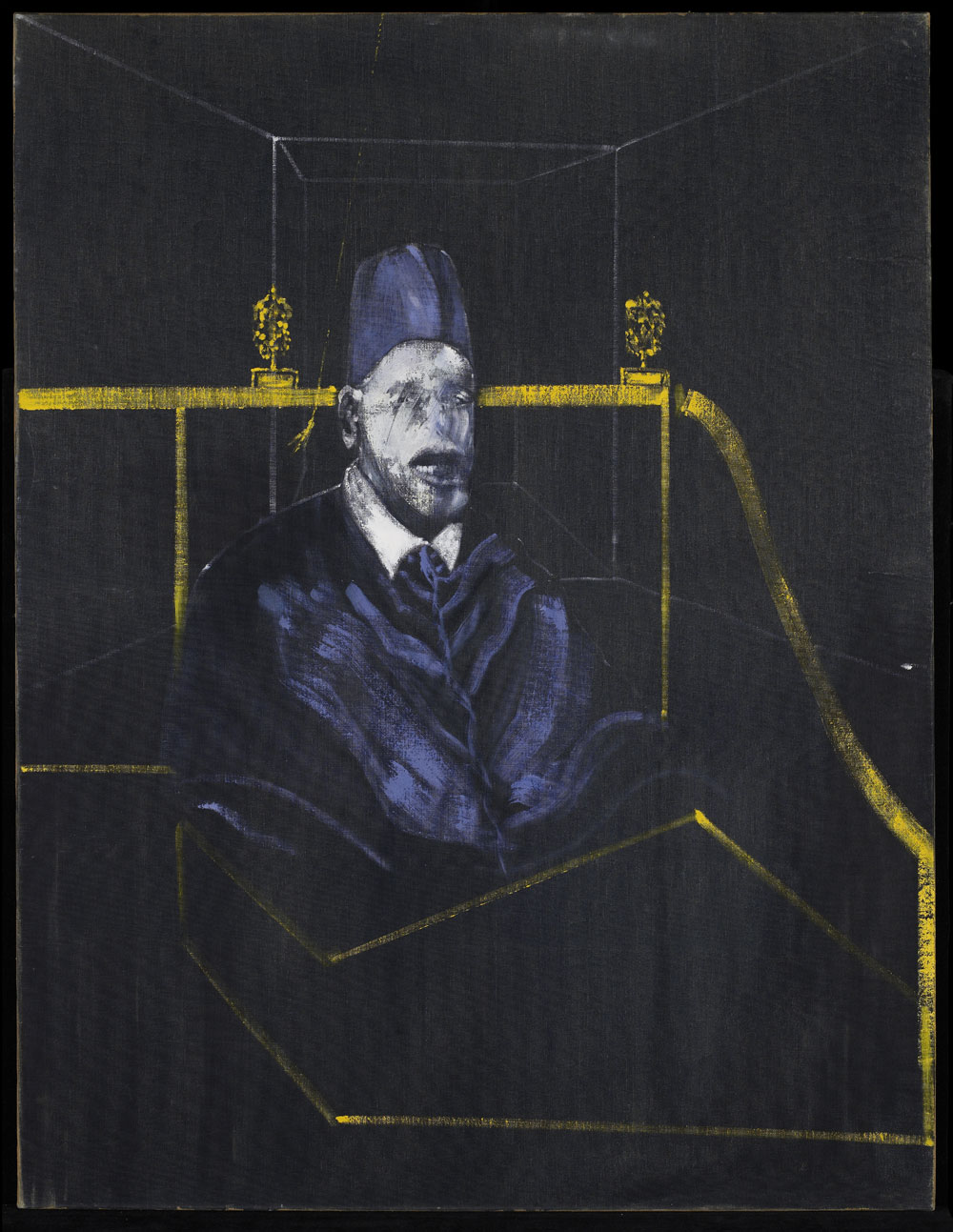
Francis Bacon (British, 1909-1992) 'Two Figures in a Room' 1959


Francis Bacon (British, 1909-1992)
Two Figures in a Room 
1959
Oil on canvas
198 x 140.5cm
Robert & Lisa Sainsbury Collection, Sainsbury Centre for Visual Arts, University of East Anglia, UK
© Estate of Francis Bacon / SODRAC (2013)


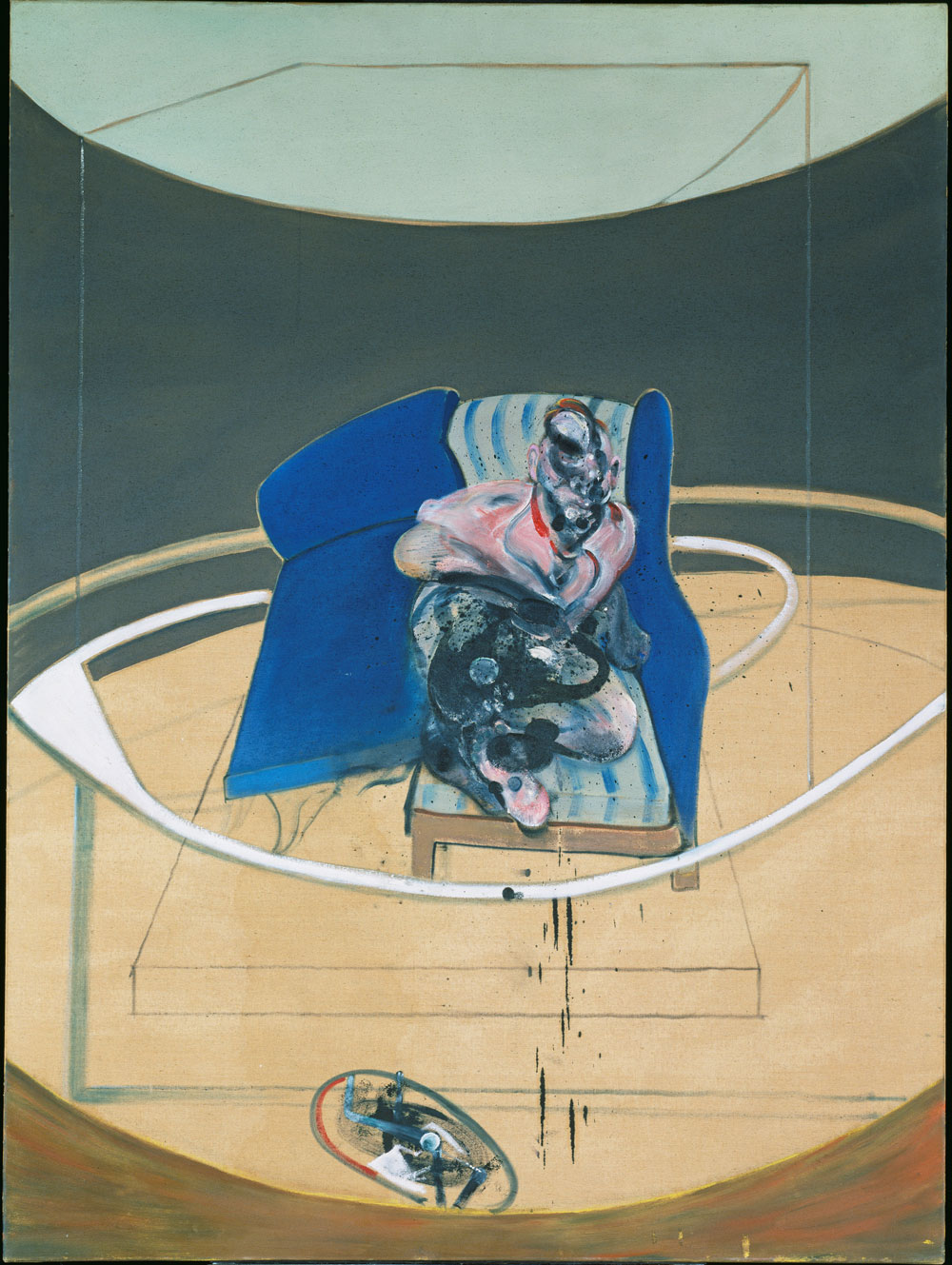
Francis Bacon (British, 1909-1992) 'Study for Portrait on Folding Bed' 1963


Francis Bacon (British, 1909-1992)
Study for Portrait on Folding Bed
1963
Oil on canvas
198.1 x 147.3cm
Tate Britain, London
© Estate of Francis Bacon / SODRAC (2013)


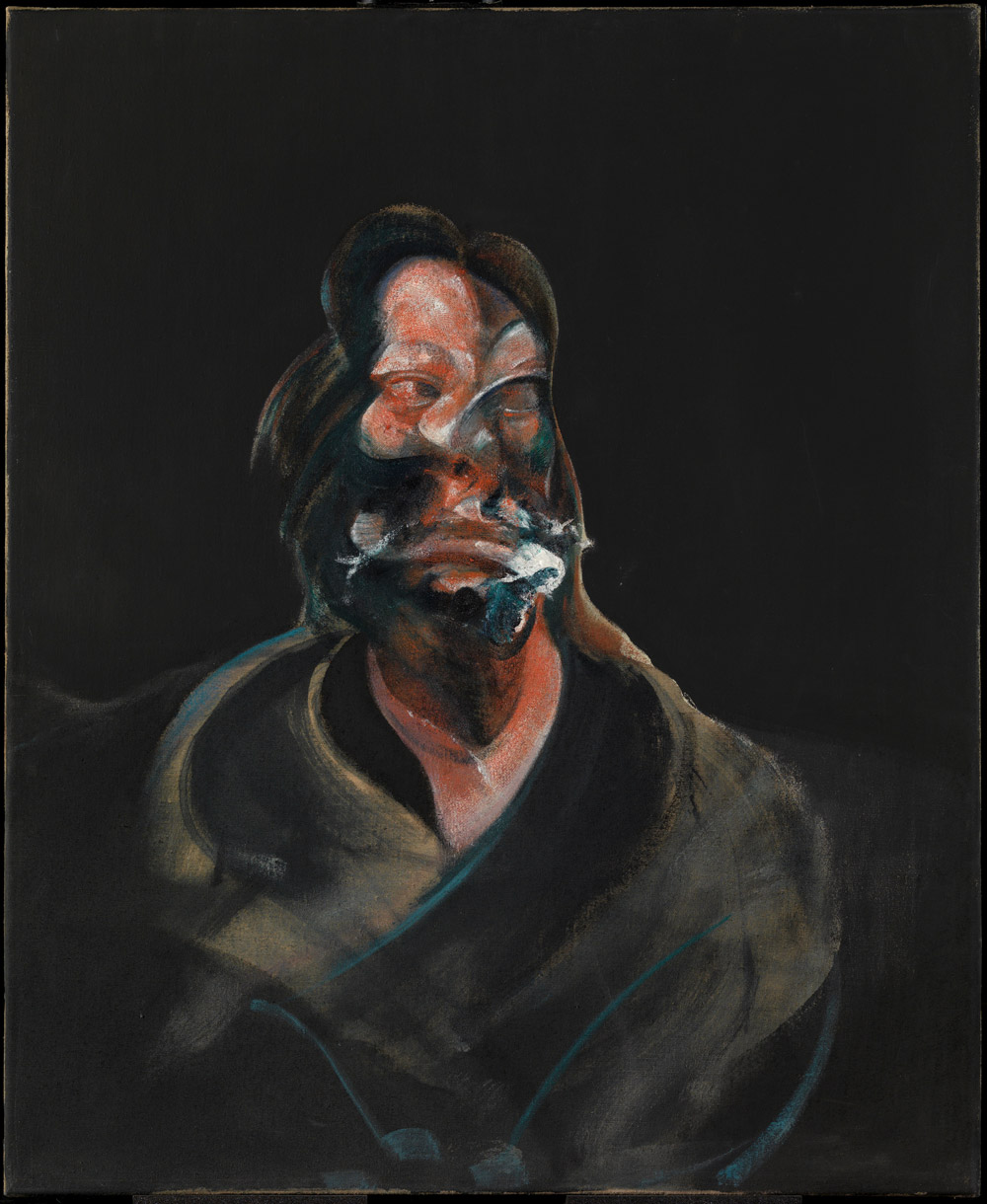
Francis Bacon (British, 1909-1992) 'Portrait of Isabel Rawsthorne' 1966


Francis Bacon (British, 1909-1992)
Portrait of Isabel Rawsthorne
1966
Oil on canvas
81 x 69cm
Tate Modern, London
© Estate of Francis Bacon / SODRAC (2013)


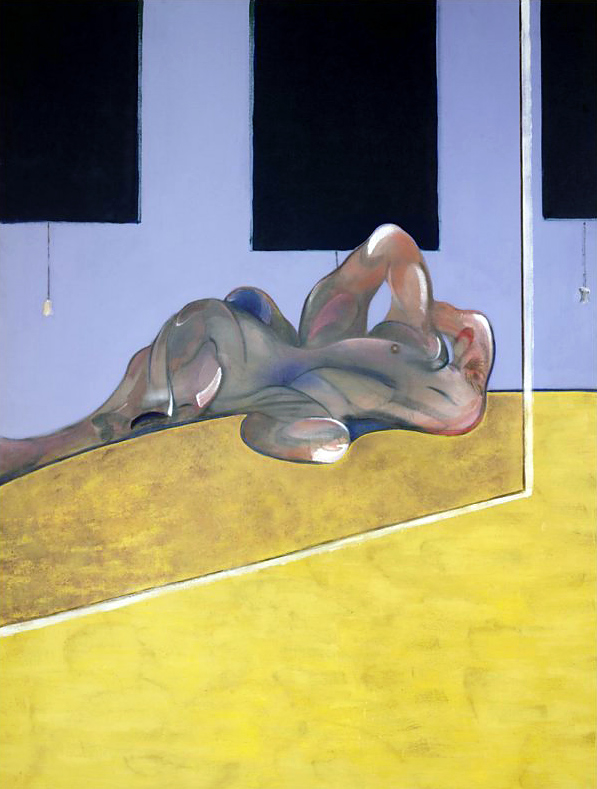
Francis Bacon (British, 1909-1992) 'Lying Figure in a Mirror' 1971


Francis Bacon (British, 1909-1992)
Lying Figure in a Mirror
1971
Oil on canvas
198.5 x 147.5cm
Museo de Bellas Artes Bilbao
© Estate of Francis Bacon / SODRAC (2013)


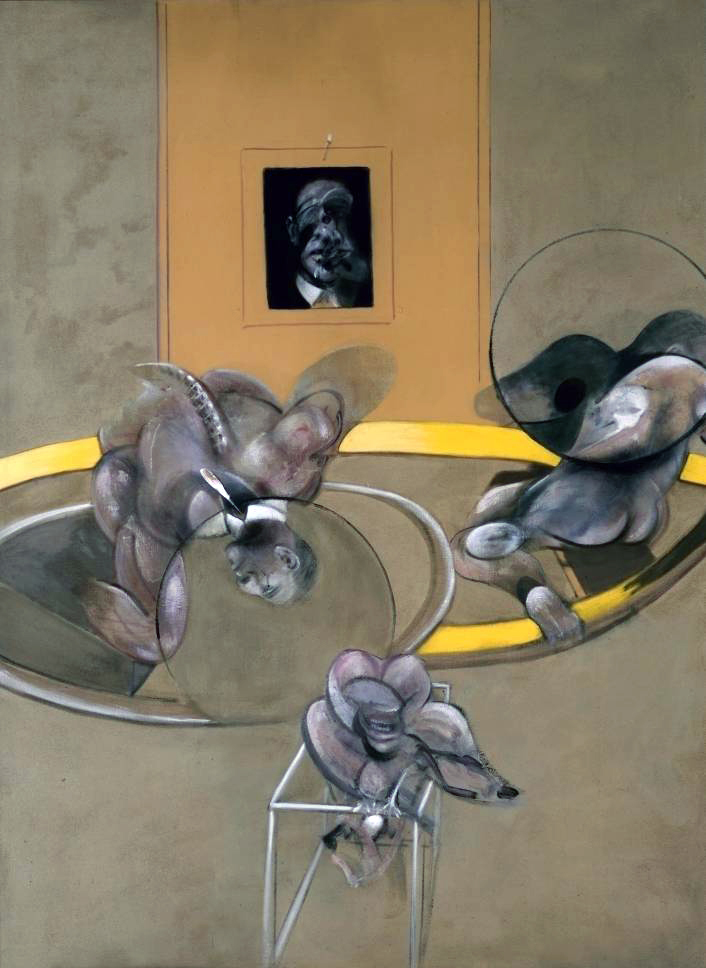
Francis Bacon (British, 1909-1992) 'Three Figures and a Portrait, 1975' 1975


Francis Bacon (British, 1909-1992)
Three Figures and a Portrait, 1975
1975
Oil and acrylic on canvas
198.1 x 147.3cm
Tate Britain, London
© Estate of Francis Bacon / SODRAC (2013)


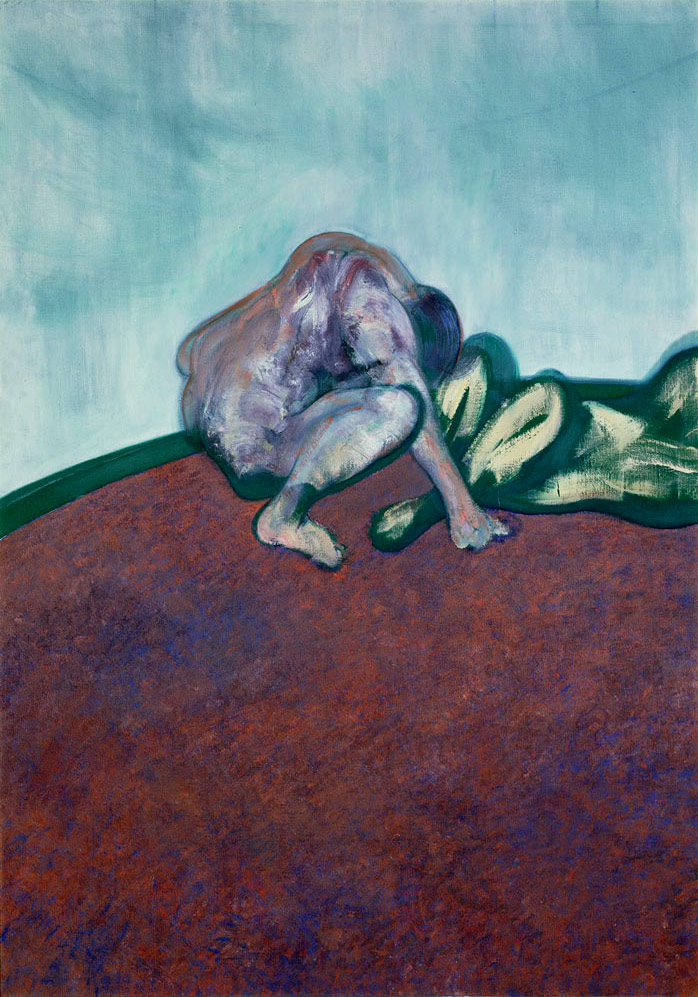
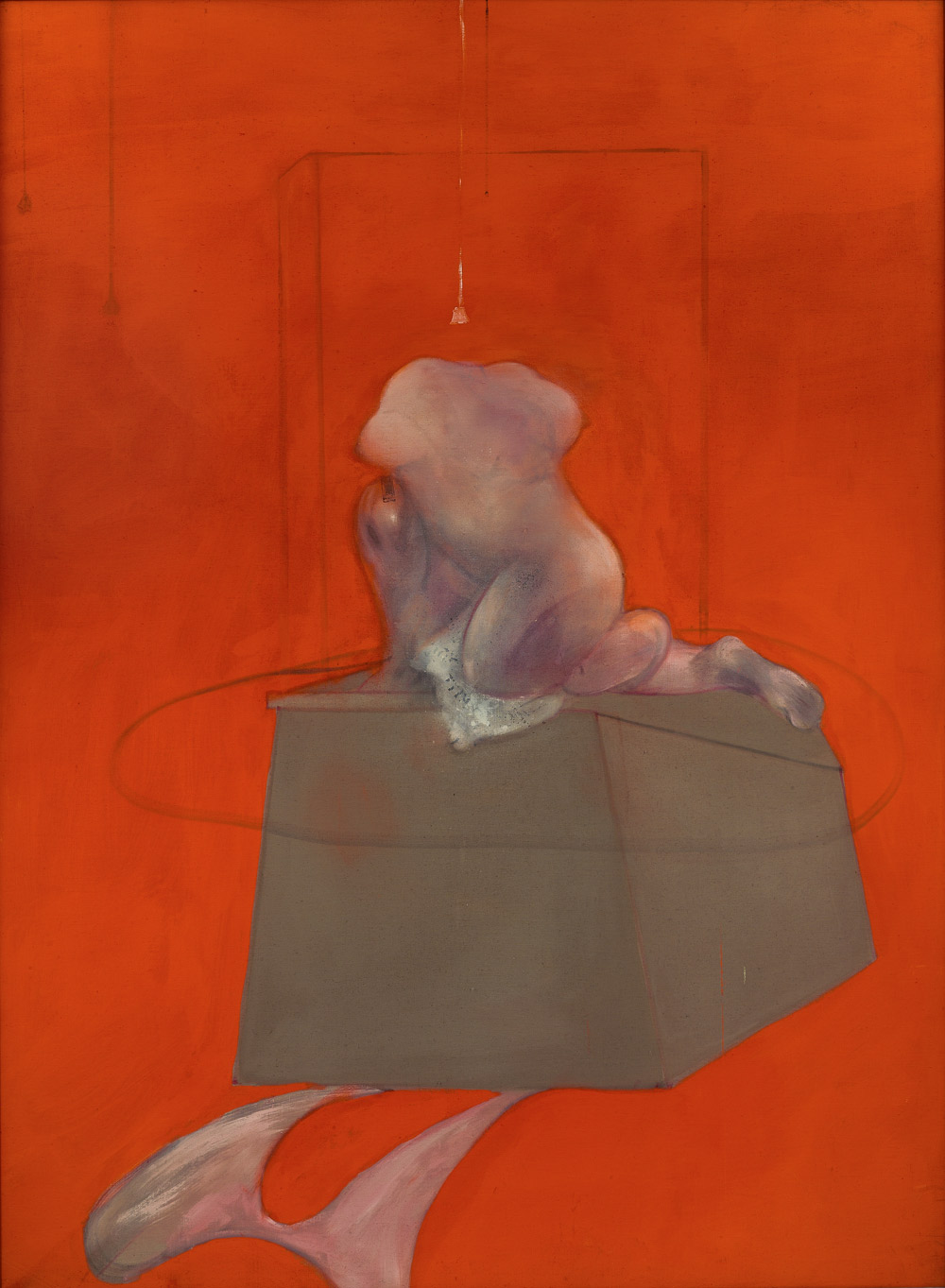
Francis Bacon (British, 1909-1992) 'Untitled (Kneeling Figure)' 1982


Francis Bacon (British, 1909-1992)
Untitled (Kneeling Figure)
1982
Oil on canvas
212 x 161cm
The Estate of Francis Bacon
© Estate of Francis Bacon / SODRAC (2013)


The tortured British painter Francis Bacon, whose triptych recently set a new record for the most expensive artwork ever sold at auction, makes his Canadian debut this spring at the Art Gallery of Ontario (AGO) alongside rarely-seen works by the British sculptor Henry Moore in the exhibition Francis Bacon & Henry Moore: Terror and Beauty. Featuring more than 130 artworks, including paintings, sculptures, drawings, photographs and archival materials, the exhibition explores the two artists’ shared fascination with the human form in relation to the violence of the Second World War and other key events of the 20th century.

Although they were neither friends nor collaborators, Bacon (b. 1909) and Moore (b. 1898) were contemporaries who shared an obsession with expressing themes of violence, trauma and conflict, both social and personal. Drawing on the artists’ personal experiences during the London Blitz and other conflicts, the exhibition examines how confinement and angst fostered their extraordinary creativity and unique visions. Bacon, whose dark depictions of human torment have inspired several characters in popular culture, including the appearance of Heath Ledger’s Joker in The Dark Knight, was a sado-masochist who sought to process the trials of humanity through his canvases. Moore, a British war artist, was one of the most renowned sculptors of his time. His works evoke endurance and stability, but when considered in light of his wartime experience, they read as an effort to rebuild and redeem the fragile human psyche and body.

Curated for the AGO by Dan Adler, associate professor of art history at York University, Francis Bacon and Henry Moore: Terror and Beauty is the first Canadian exhibition of Bacon’s work and includes rarely seen Moore pieces, from both the AGO collection and elsewhere. Moore’s works are a cornerstone of the AGO collection, and pairing them with those by Francis Bacon sets them in a new light. The exhibition also presents more than 30 archival photographs by acclaimed German-born British photographer Bill Brandt. Loans for the exhibition have also been secured from several institutions, including MoMA, Tate Britain and the Museum of Contemporary Art, Chicago.

Press release from the AGO website


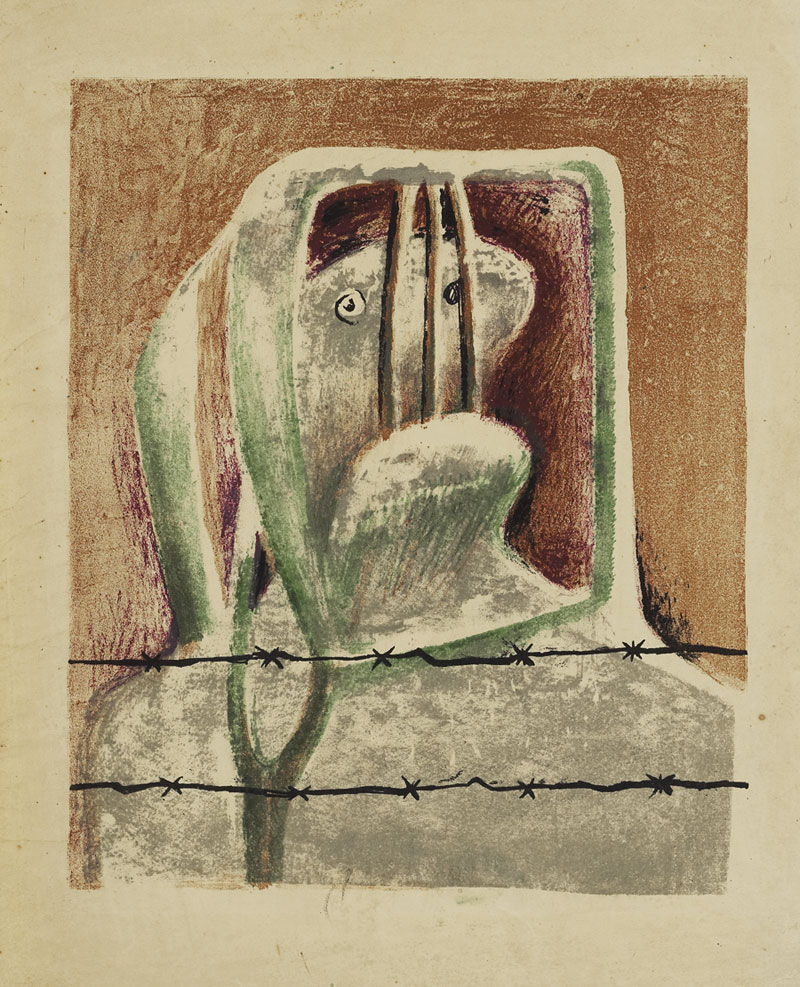
Henry Moore (English, 1898-1986) 'Spanish Prisoner' 1939


Henry Moore (English, 1898-1986)
Spanish Prisoner
1939
Lithograph on paper
36.5 x 30.5cm
Art Gallery of Ontario, Toronto
© The Henry Moore Foundation. All Rights Reserved, DACS / SODRAC (2013)


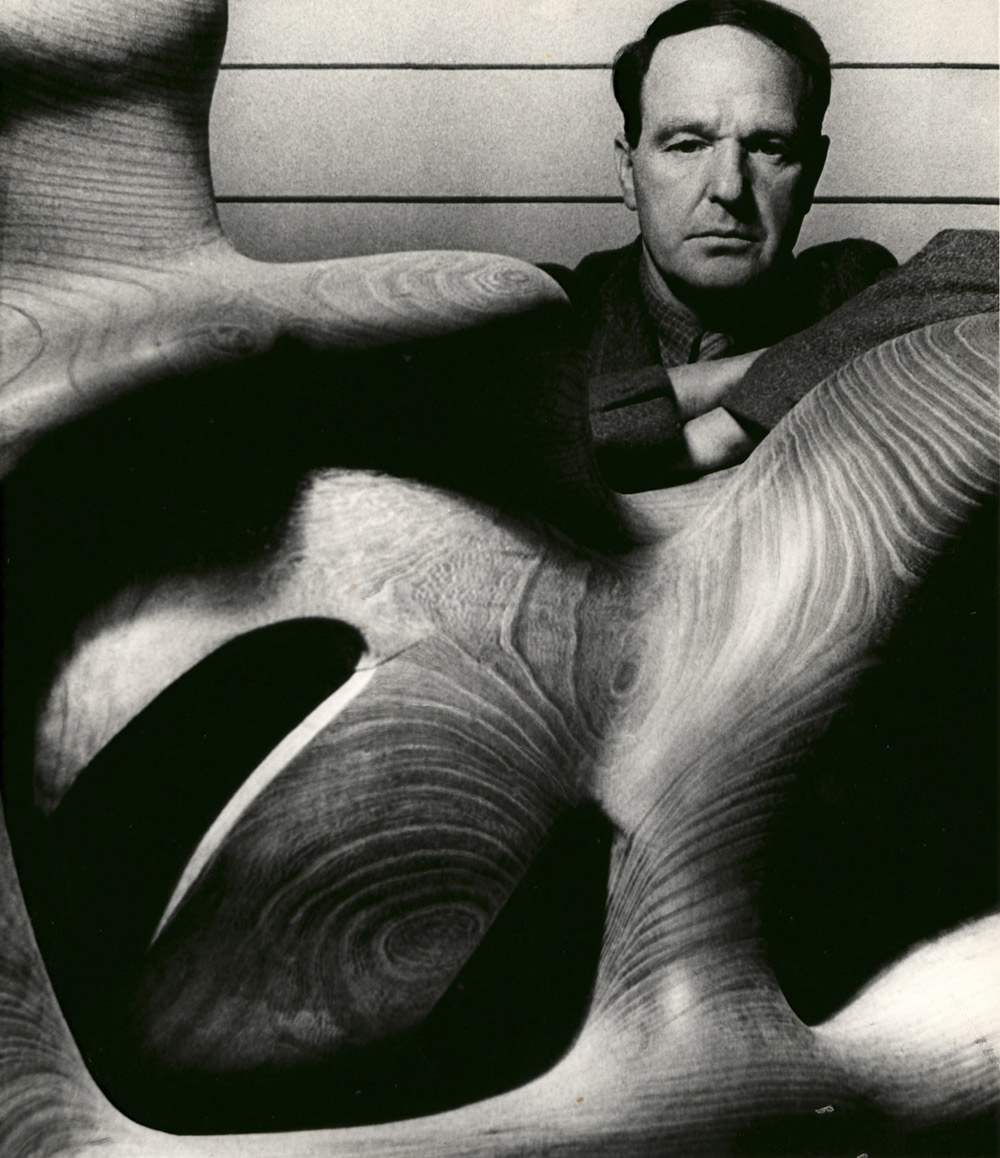
Bill Brandt (German-British, 1904-1983) 'Henry Moore in his Studio at Much Hadham, Hertfordshire' 1940


Bill Brandt (German-British, 1904-1983)
Henry Moore in his Studio at Much Hadham, Hertfordshire
1940
Gelatin silver print
22.8 x 19.6cm
© The Bill Brandt Archive, London / Courtesy Edwynn Houk Gallery, New York / Zürich


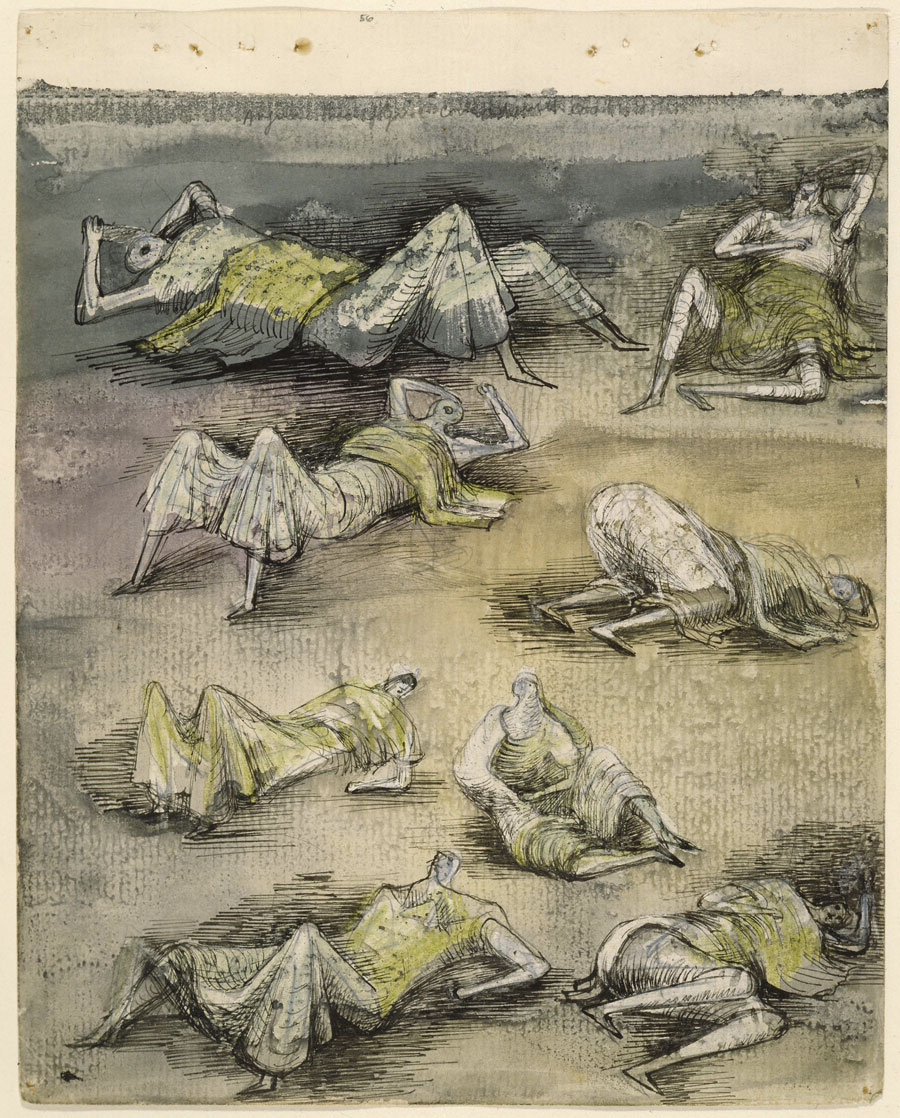
Henry Moore (English, 1898-1986) 'Sleeping Positions' 1940-1941


Henry Moore (English, 1898-1986)
Sleeping Positions
1940-1941
Mixed media on wove paper
20.4 x 16.5cm
The Henry Moore Foundation
© The Henry Moore Foundation. All Rights Reserved, DACS / SODRAC (2013)


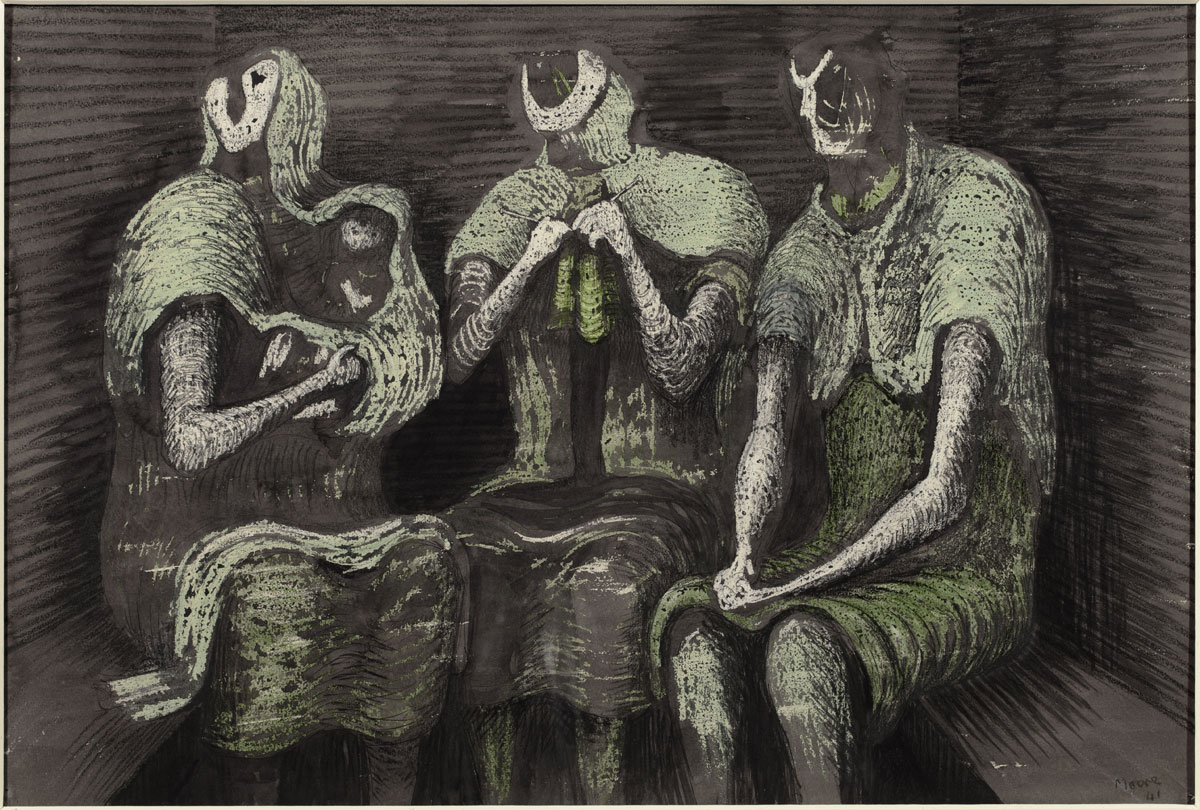
Henry Moore (English, 1898-1986) 'Three Fates' 1941


Henry Moore (English, 1898-1986)
Three Fates
1941
Watercolour
29.7 x 19.9cm
Royal Pavilion and Museums, Brighton & Hove
© The Henry Moore Foundation. All Rights Reserved, DACS / SODRAC (2013)


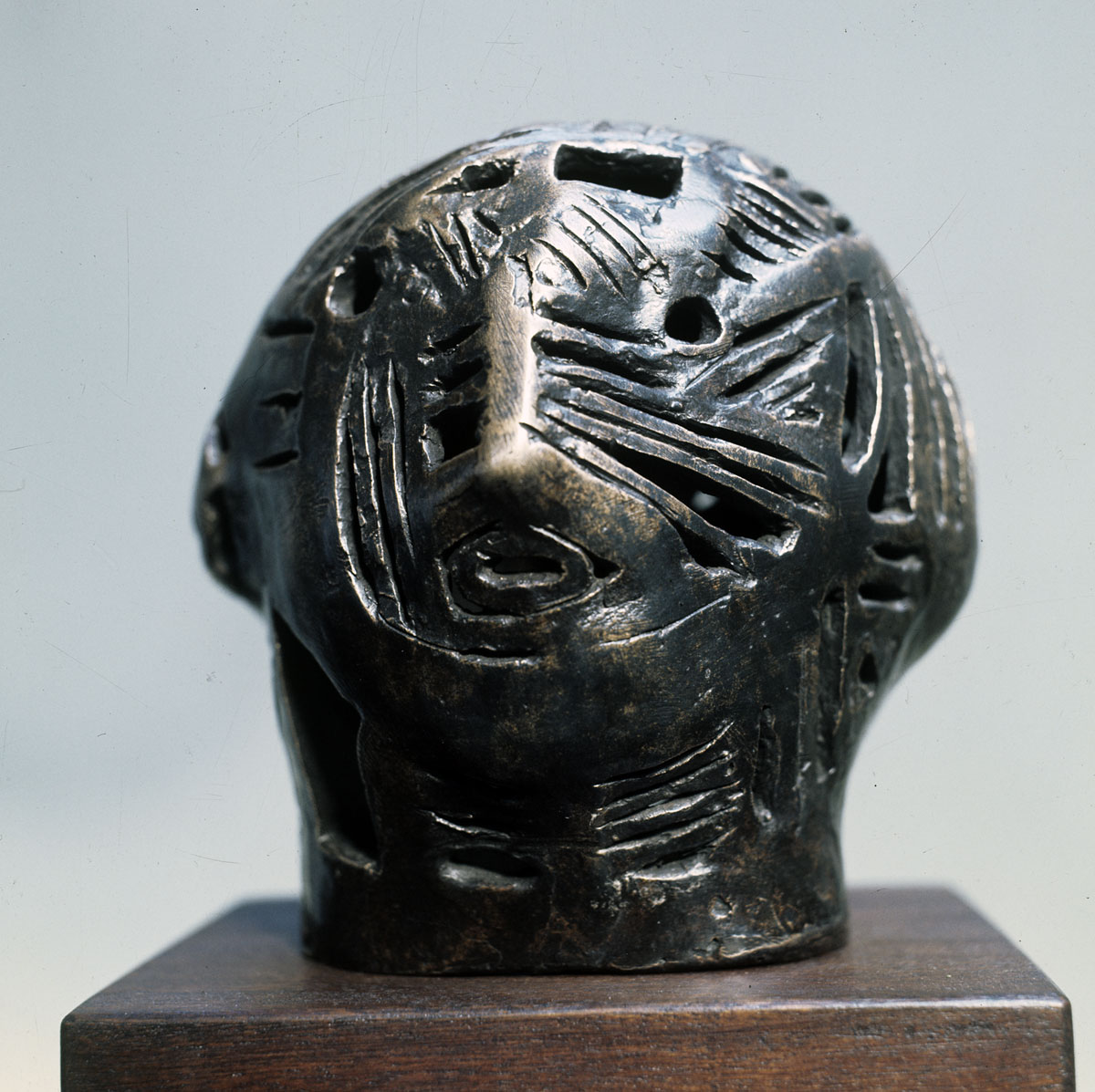
Henry Moore (English, 1898-1986) 'Maquette for Strapwork Head' 1950


Henry Moore (English, 1898-1986)
Maquette for Strapwork Head
1950
Bronze edition of 9
10cm high (excluding base)
The Henry Moore Foundation
© The Henry Moore Foundation. All Rights Reserved, DACS / SODRAC (2013)


Henry Moore (English, 1898-1986) 'Reclining Figure' 1951


Henry Moore (English, 1898-1986)
Reclining Figure
1951
Plaster cast
Length: 228.5cm
Art Gallery of Ontario, Toronto
Courtesy Craig Boyko, AGO
© The Henry Moore Foundation. All Rights Reserved, DACS / SODRAC (2013)


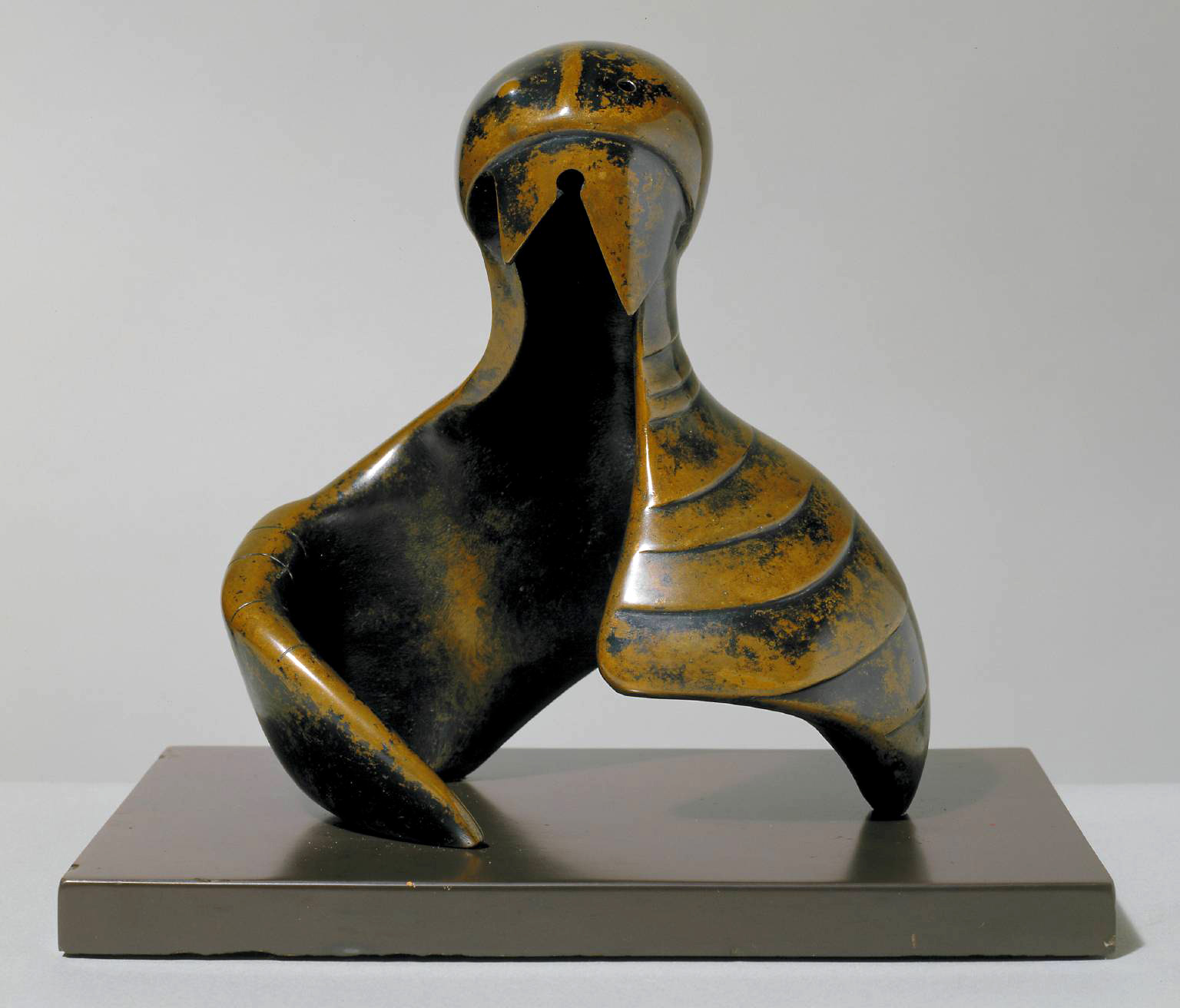
Henry Moore (English, 1898-1986) 'Helmet Head and Shoulders' 1952


Henry Moore (English, 1898-1986)
Helmet Head and Shoulders
1952 
Bronze
19 x 20.5 x 15cm
Tate Modern, London
© The Henry Moore Foundation. All Rights Reserved, DACS / SODRAC (2013)


Henry Moore (English, 1898-1986) 'Mother and Child' 1953


Henry Moore (English, 1898-1986)
Mother and Child
1953
Plaster
Art Gallery of Ontario, Toronto
© The Henry Moore Foundation. All Rights Reserved, DACS / SODRAC (2013)


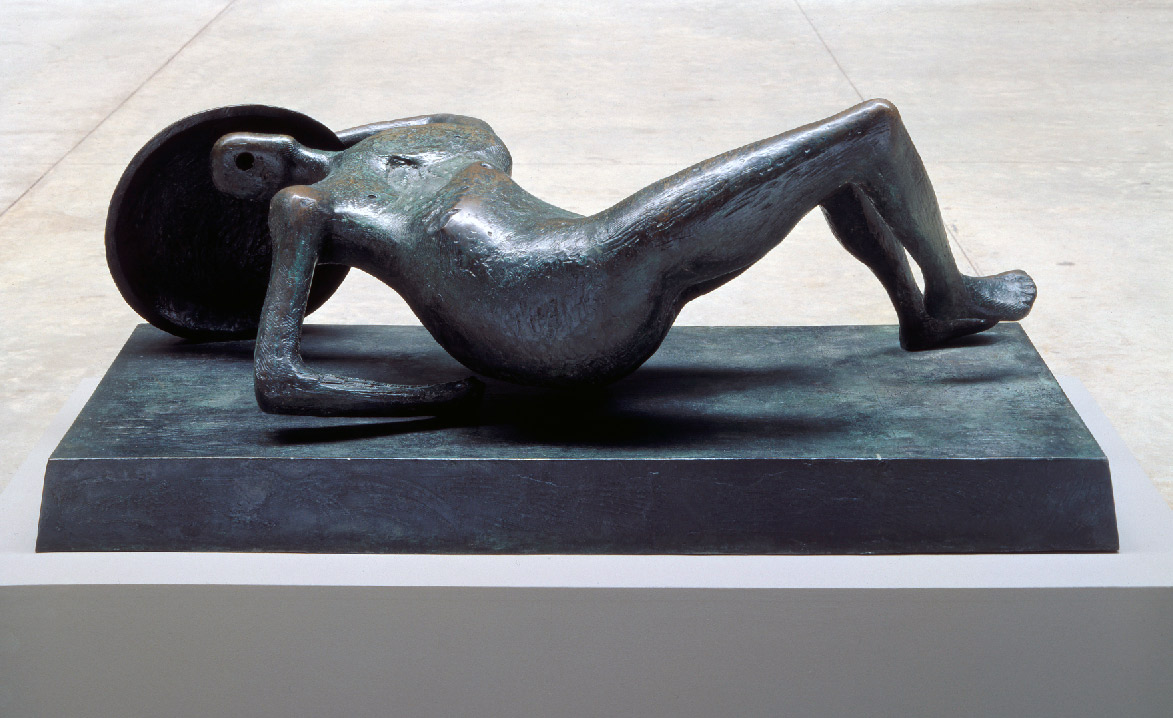
Henry Moore (English, 1898-1986) 'Falling Warrior' 1956-1957


Henry Moore (English, 1898-1986)
Falling Warrior
1956-1957
Bronze
65 x 154 x 85cm
Tate Modern, London
© The Henry Moore Foundation. All Rights Reserved, DACS / SODRAC (2013)


Art Gallery of Ontario
Musée des beaux-arts de l’Ontario

317 Dundas Street West
Toronto Ontario Canada M5T 1G4

Opening hours:
Tuesday – Sunday 10.30am – 5.30pm
Closed Mondays

Art Gallery of Ontario website

LIKE ART BLART ON FACEBOOK

Back to top

Exhibition: ‘A Ballad of Love and Death: Pre-Raphaelite Photography in Great Britain, 1848-1875’ at the Musée d’Orsay, Paris

Exhibition dates: 8th March – 29th May 2011


Julia Margaret Cameron – you are one of my heroes!


Many thankx to the Musée d’Orsay for allowing me to publish the photographs in the posting. Please click on the photographs for a larger version of the image.


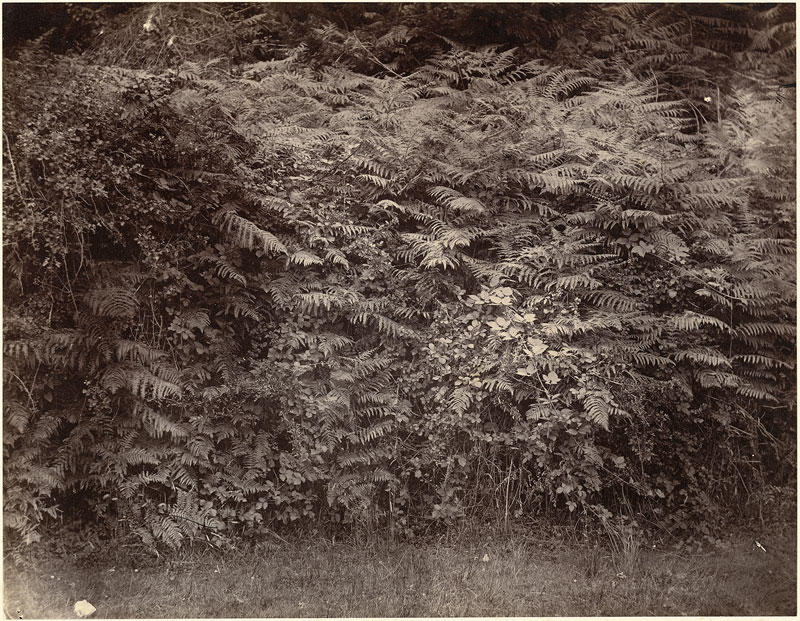
Henry White (British, 1819-1903) 'Ferns and brambles' 1856


Henry White (British, 1819-1903)
Fougères et ronces (Ferns and brambles)
1856
Albumen print
19.1 x 24.1cm
Collection particulière
© Droits réservés


John Ruskin (English, 1819-1900) 'Fribourg' 1859


John Ruskin (English, 1819-1900)
Fribourg
1859
Pencil, ink, watercolour and gouache on paper
22.5 x 28.7cm
London, The British Museum
© The Trustees of The British Museum. All rights reserved


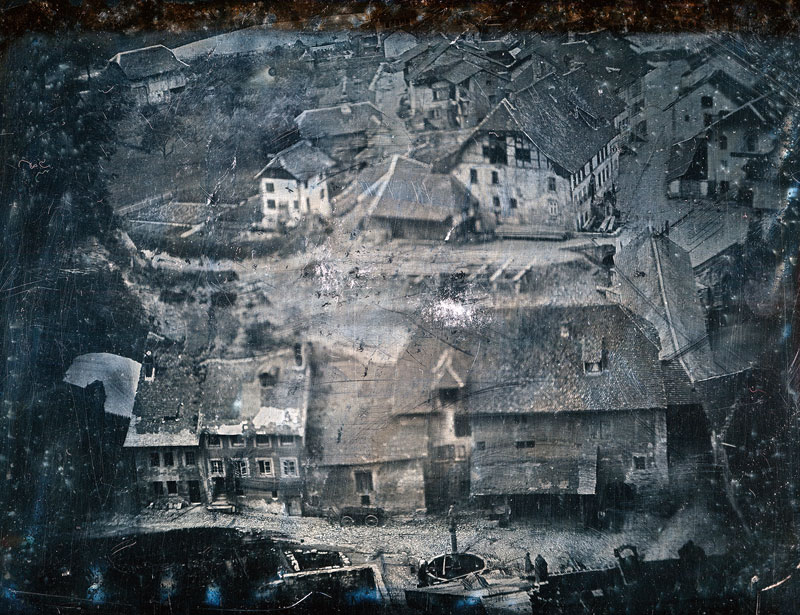
Frederick Crawley, under the direction of John Ruskin (English, 1819-1900) 'Fribourg, Switzerland, Palm Street and Berne Bridge' about 1854 or 1856


Frederick Crawley, under the direction of John Ruskin (English, 1819-1900)
Fribourg, Suisse, Rue de la Palme et Pont de Berne (Fribourg, Switzerland, Palm Street and Berne Bridge)
about 1854 or 1856
Daguerréotype
11.5 x 15.1cm
Angleterre, Courtesy K. and J. Jacobson
© Droits réservés


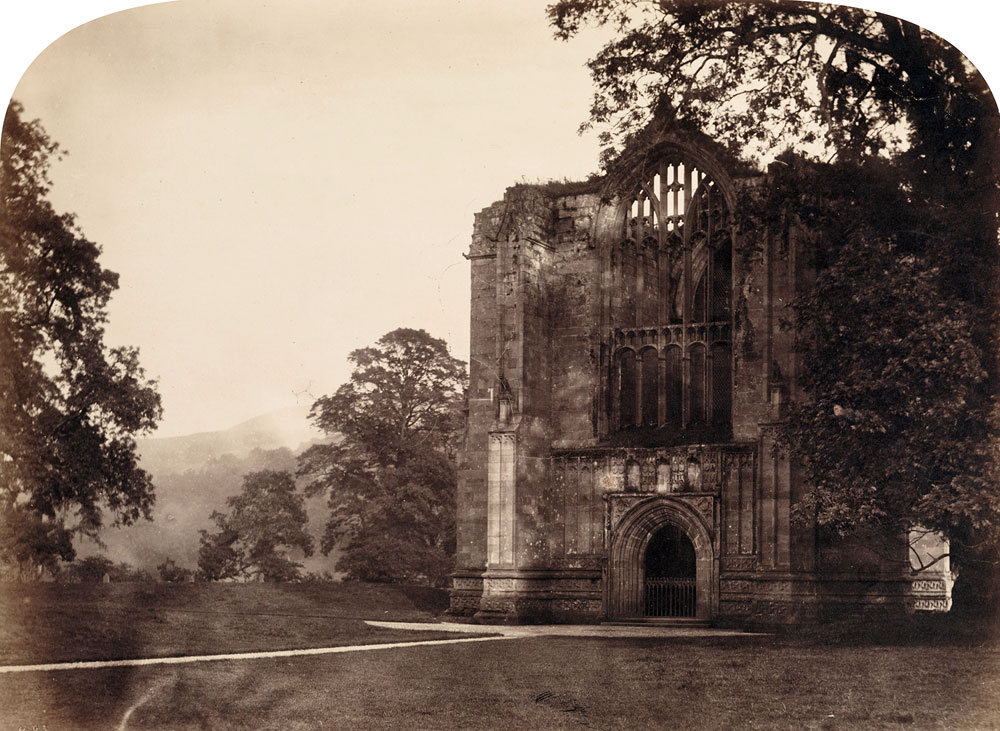
Roger Fenton (British, 1819-1869) 'Bolton Abbey' 1854


Roger Fenton (British, 1819-1869)
Bolton Abbey, West window
1854
Albumen print
25.1 x 34.5cm
Bradford, National Media Museum
© National Media Museum, Bradford/Science & Society Picture Library


John William Inchbold (English, 1830-1888) 'La Chapelle de Bolton Abbey' 1853


John William Inchbold (English, 1830-1888)
La Chapelle de Bolton Abbey (The Vault of Bolton Abbey)
1853
Oil on canvas
50 x 68.4cm
Northampton, Museum and Art Gallery
© Northampton, Museum and Art Gallery


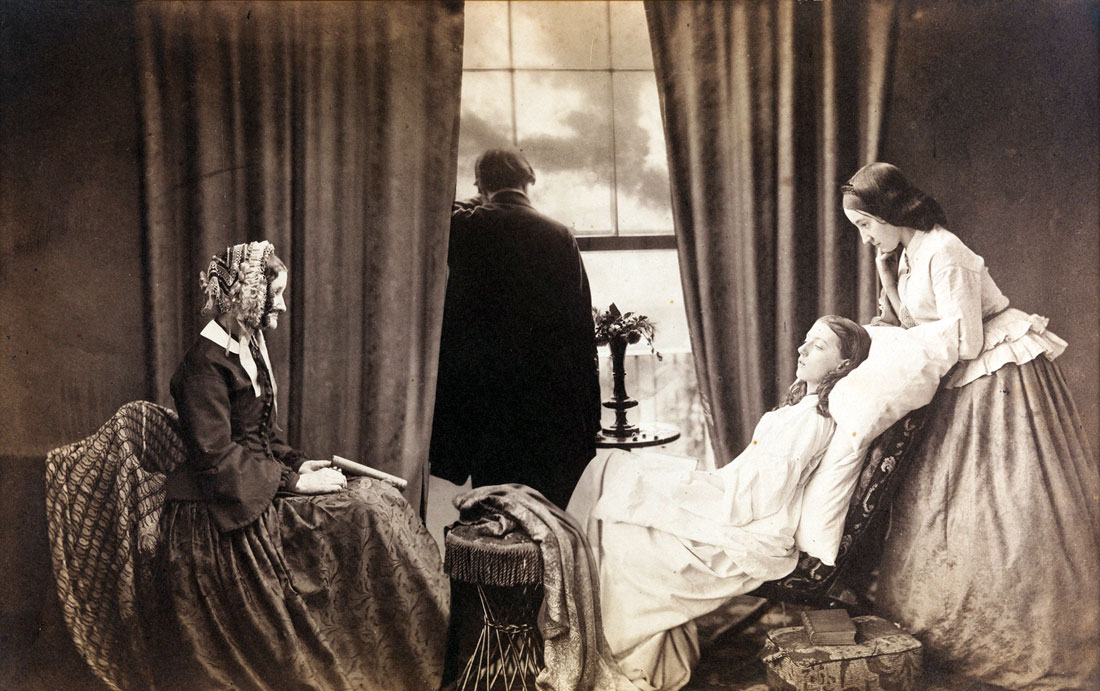
Henry Peach Robinson (English, 1830-1901) 'Fading Away' 1858


Henry Peach Robinson (English, 1830-1901)
Fading Away
1858
Albumen print
28.8 x 52.1cm
Bradford, The Royal Photographic Society Collection au National Media Museum.
© National Media Museum, Bradford/Science & Society Picture Library


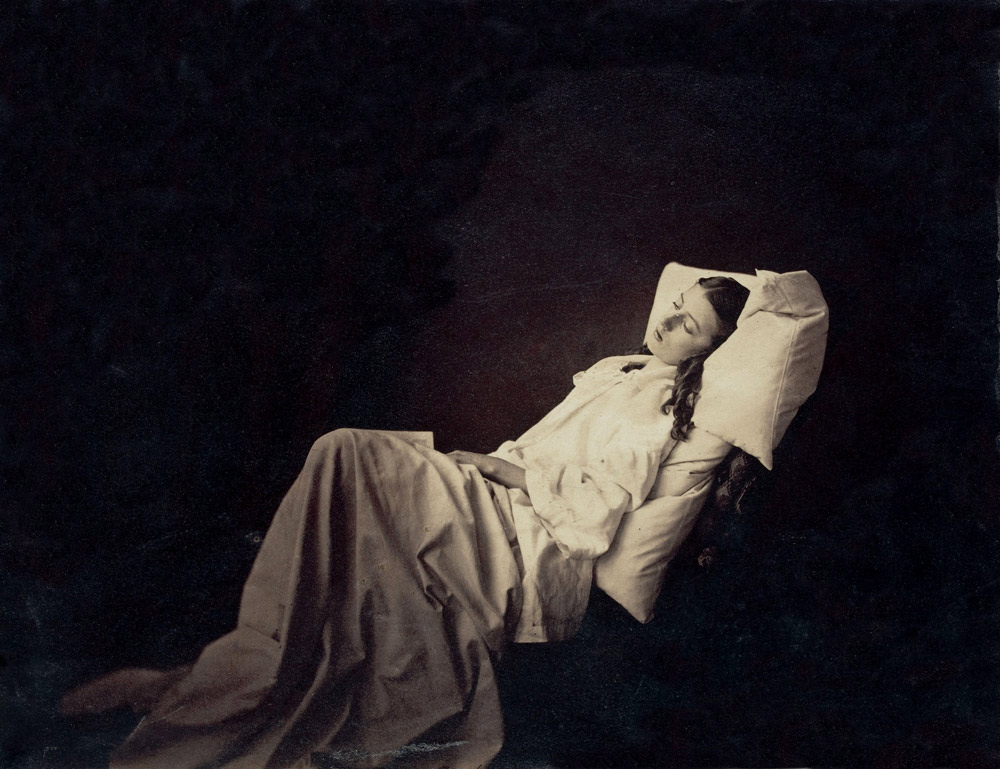
Henry Peach Robinson (English, 1830-1901) 'She Never Told her Love' 1857


Henry Peach Robinson (English, 1830-1901)
She Never Told her Love
1857
Albumen print
18.6 x 23.3cm
Paris, musée d’Orsay
© Musée d’Orsay (dist. RMN)/Patrice Schmidt


Consumed by the passion of unrequited love, a young woman lies suspended in the dark space of her unrealised dreams in Henry Peach Robinson’s illustration of the Shakespearean verse “She never told her love,/ But let concealment, like a worm i’ the bud,/ Feed on her damask cheek” (Twelfth Night II,iv,111-13). Although this picture was exhibited by Robinson as a discrete work, it also served as a study for the central figure in his most famous photograph, Fading Away, of 1858.

Purportedly showing a young consumptive surrounded by family in her final moments, Fading Away was hotly debated for years. On the one hand, Robinson was criticised for the presumed indelicacy of having invaded the death chamber at the most private of moments. On the other, those who recognised the scene as having been staged and who understood that Robinson had created the picture through combination printing (a technique that utilised several negatives to create a single printed image) accused him of dishonestly using a medium whose chief virtue was its truthfulness.

While addressing the moral and literary themes that Robinson believed crucial if photography were to aspire to high art, this picture makes only restrained use of the cloying sentimentality and showy technical artifice that often characterise this artist’s major exhibition pictures. Perhaps intended to facilitate the process of combination printing, the unnaturally black background serves also to envelop the figure in palpable melancholia.

Text from the Metropolitan Museum of Art website [Online] Cited 27/01/2020


Frederick Pickersgill (English, 1820-1900) 'Sunshine and Shade' 1859


Frederick Pickersgill (English, 1820-1900)
Sunshine and Shade
1859
Albumen print
16.4 x 19.4cm
The Royal Photographic Society Collection at the National Media Museum.
© National Media Museum, Bradford/Science & Society Picture Library


The historian and art critic, John Ruskin, had a great influence in Great Britain not only on the Pre-Raphaelite movement created in 1848, but on the development of early photography in the 1850s. The leading Pre-Raphaelite painters, John Everett Millais, Dante Gabriel Rossetti, Holman Hunt and Ford Madox Brown and their followers, wished to change the pictorial conventions laid down by the Royal Academy, and in order to demonstrate the transformations in modern life, invented a radically new idiom marked by bright colours and clarity of detail.

Pre-Raphaelite painters and photographers frequently made similar choices of subjects, and the photographers, particularly Julia Margaret Cameron, David Wilkie Wynfield and Lewis Carroll, were often had close links with the painters.

When painting landscapes, the Pre-Raphaelite artists answered Ruskin’s call, meticulously observing nature in order to capture every nuance of detail. For their part, photographers, such as Roger Fenton, Henry White, William J. Stillman and Colonel Henry Stuart Wortley, experimented with the new process of wet plate collodion negatives that allowed much greater image detail, and achieved similar effects. Although highly impressed at first by the daguerreotype, which enabled the eye to see tiny, overlooked details, Ruskin was nonetheless still very critical of landscape photography, which could not reproduce the colours of nature and in particular of the sky. This failing also gave rise to a major debate amongst photography critics.

In portraiture, there were clear links between the painted portraits of Watts and Cameron’s photographic portraits. By using special lenses and photographing her models in close-up, Cameron, achieved, with a glass negative, exactly the opposite effect to the clear image advocated by Ruskin, and her work was distinctive for the breadth of relief and contour, as well as the compositions evoking Raphael’s paintings, also a source of inspiration for Watts.

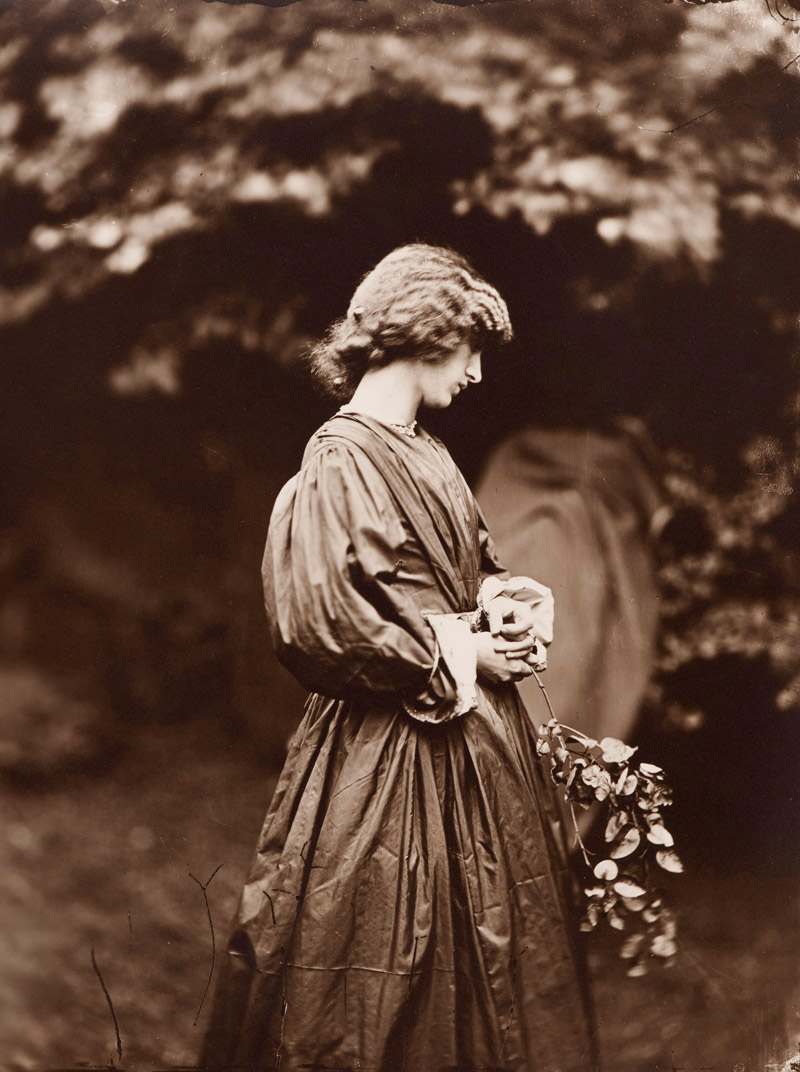
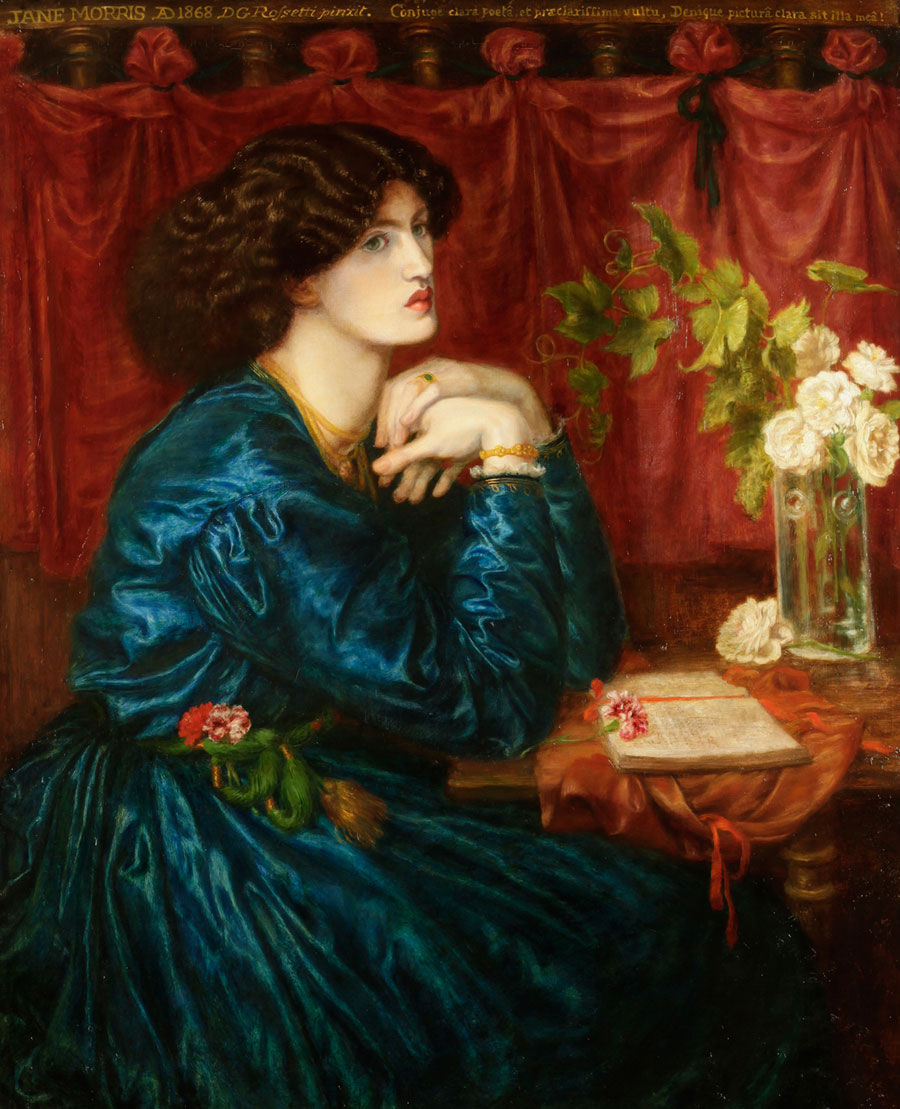
The painter Dante Gabriel Rossetti repeatedly drew and painted Jane Morris, a model with whom he was infatuated, and he asked Robert Parsons to produce a series of photographs, under his personal direction, which captured the fascinating presence of the young woman as effectively as his own paintings.

Just like the Pre-Raphaelite painters, Victorian photographers would turn to religious or historical subjects, finding a shared inspiration in the poems of Dante, Shakespeare and possibly Byron, and above all in the Arthurian legend made popular once more by Lord Tennyson, the poet laureate. From a formal point of view, Millais’ Ophelia, one of his most successful paintings, was a source for Henry Peach Robinson’s photograph, The Lady of Shalott, even though it had a different theme.

Finally, Pre-Raphaelite painters and Victorian photographers both liked to present scenes from modern life with a moralising undertone: hence She Never Told Her Love, a photograph by Robinson that was very successful when exhibited at the Crystal Palace in 1858, William Holman Hunt’s painting, Awakening of Conscience, and Rossetti’s Found, a painting depicting a countryman who comes across his former sweetheart, now a prostitute in the city.

In the 1880s, Pre-Raphaelite painting would be transformed, with artists and writers like William Morris, Burne-Jones, Whistler and Oscar Wilde, into a very different movement concerned only with the cult of beauty and rejecting Ruskin’s concept of art as something moral or useful. British photographers, however, inspired by the Pre-Raphaelites would inspire the Pictorialist movement that flourished in the 1890s, encouraged by the writings of Henry Peach Robinson and Peter Henry Emerson, extolling artistic photography.

Press release from the Musée d’Orsay website


James Sinclair 14th Earl of Caithness (Scottish, 1821-1881) 'Weston Avenue, Warwickshire' c. 1860


James Sinclair 14th Earl of Caithness (Scottish, 1821-1881)
Avenue à Weston, Warwickshire (Weston Avenue, Warwickshire)
c. 1860
Albumen print
23 x 18.3cm
New York, Courtesy George Eastman House Rochester
© Courtesy of George Eastman House, International Museum of Photography and Film


Julia Margaret Cameron (British, 1815-1879) 'The sunflower' 1866-1870


Julia Margaret Cameron (British, 1815-1879)
Le tournesol (The sunflower)
1866-1870
Albumen print
35.2 x 24.3cm
Washington, National Gallery of Art, Fond Paul Mellon
© National Gallery of Art, Washington


John Robert Parsons (Irish, 1826-1909), under the direction of Dante Gabriel Rossetti (English, 1828-1882) 'Jane Morris posing in the house of Rossetti' summer 1865


John Robert Parsons (Irish, 1826-1909), under the direction of Dante Gabriel Rossetti (English, 1828-1882)
Jane Morris posant dans la maison de Rossetti (Jane Morris posing in the house of Rossetti)
Summer 1865
Modern print
22.6 x 17.5cm
London, Victoria and Albert Museum
© V&A Images / Victoria and Albert Museum, London


John Robert Parsons (Irish, 1826-1909) 'Jane Morris posing in the garden of the house of Rossetti' summer 1865


John Robert Parsons (Irish, 1826-1909)
Jane Morris posant dans le jardin de la maison de Rossetti (Jane Morris posing in the garden of the house of Rossetti)
Summer 1865
Albumen print
Private collection
© Tim Hurst Photography


Dante Gabriel Rossetti (English, 1828-1882) 'Jane Morris, the blue silk dress' 1868


Dante Gabriel Rossetti (English, 1828-1882)
Jane Morris, the blue silk dress
1868
Oil on canvas
110.5 x 90.2cm
Londres, The Society of Antiquaries
© Kelmscott Manor Collection, by Permission of the Society of Antiquaries of London


Charles Lutwidge Dodgson (Lewis Caroll) (English, 1832-1898) 'Amy Hughes' 1863


Charles Lutwidge Dodgson (Lewis Caroll) (English, 1832-1898)
Amy Hughes
1863
Austin, The University of Texas, Harry Ransom Center, Gernsheim Collection
© Droits réservés


Julia Margaret Cameron (British, 1815-1879) 'Maud' 1875


Julia Margaret Cameron (British, 1815-1879)
Maud
1875
Charcoal print
30 x 25cm
Paris, musée d’Orsay
© Musée d’Orsay (dist. RMN)/Patrice Schmidt


Sir John Everett Millais (British, 1829-1896) 'A Huguenot, on St. Bartholomew's Day Refusing to Shield Himself from Danger by Wearing the Roman Catholic Badge' 1851-1852


Sir John Everett Millais (British, 1829-1896)
A Huguenot, on St. Bartholomew’s Day Refusing to Shield Himself from Danger by Wearing the Roman Catholic Badge
1851-1852
Oil on canvas
91.4 x 62.2cm
Collection Makins
© The Makins Collection/The Bridgeman Art Library


Sir Edward Burne-Jones (British, 1833-1898) 'Princess Sabra (The King's Daughter)' 1865-1866


Sir Edward Burne-Jones (British, 1833-1898)
Princess Sabra (The King’s Daughter)
1865-1866
Oil on canvas
105 x 61cm
Paris, Musée d’Orsay
© Musée d’Orsay (dist. RMN)/Patrice Schmidt


Julia Margaret Cameron  (British, 1815-1879) 'And Enid Sang' 1874


Julia Margaret Cameron  (British, 1815-1879)
And Enid Sang
1874
Print on albumen paper, collodion glass negative, laminated on cardboard
35 x 28cm
Paris, Musée d’Orsay
© Musée d’Orsay (dist. RMN)


Musée d’Orsay
62, rue de Lille
75343 Paris Cedex 07
France

Opening hours:
Tuesday – Sunday 9.30am – 6pm
Thursdays 9.30am – 9.45pm
Closed on Mondays

Musée d’Orsay website

LIKE ART BLART ON FACEBOOK

Back to top