Exhibition: ‘Stephen Shore: Vehicular & Vernacular’ at the Fondation Henri-Cartier Bresson, Paris

Exhibition dates: 1st June – 15th September, 2024

Curator: Clément Chéroux Director, Fondation Henri Cartier-Bresson


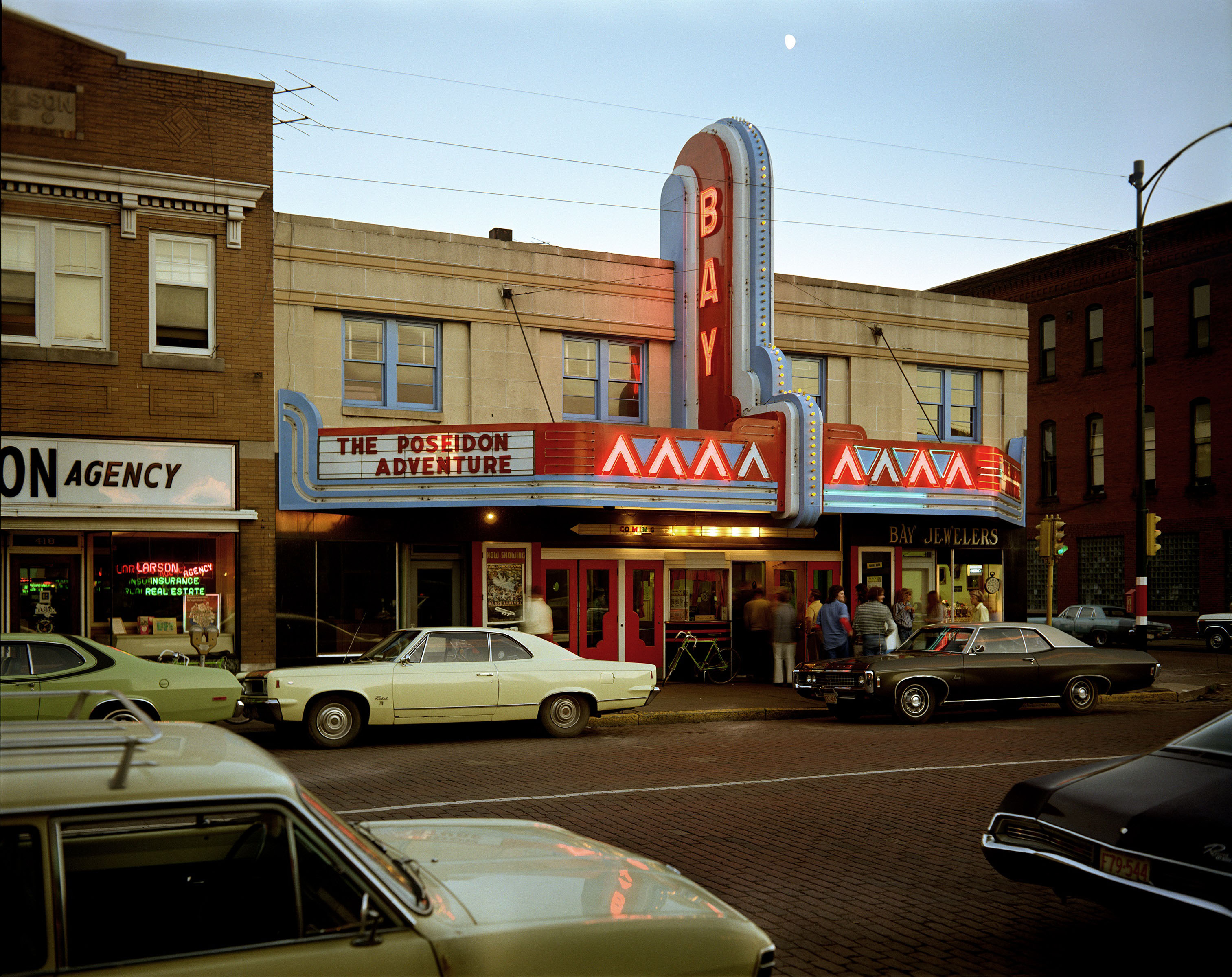
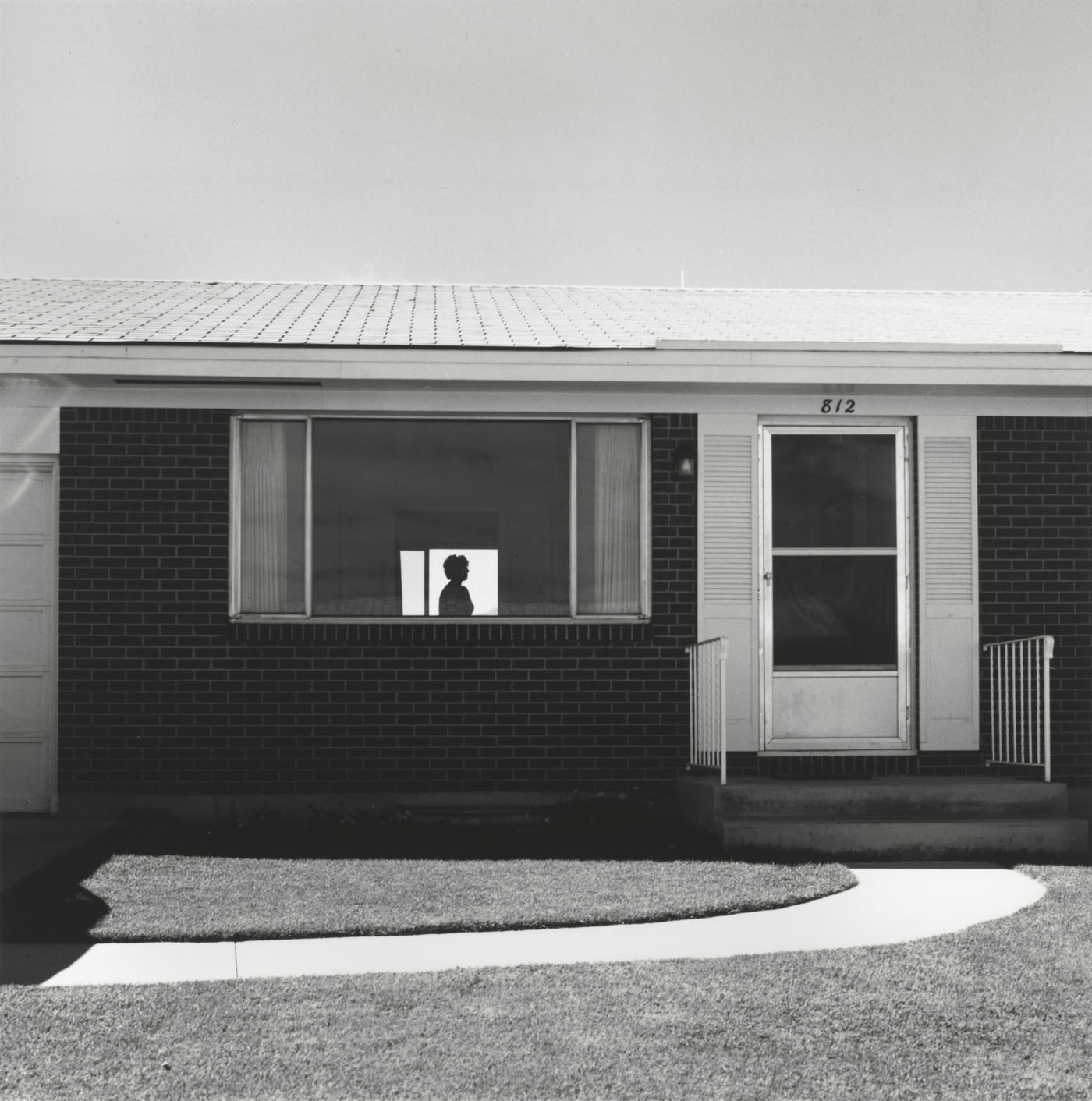
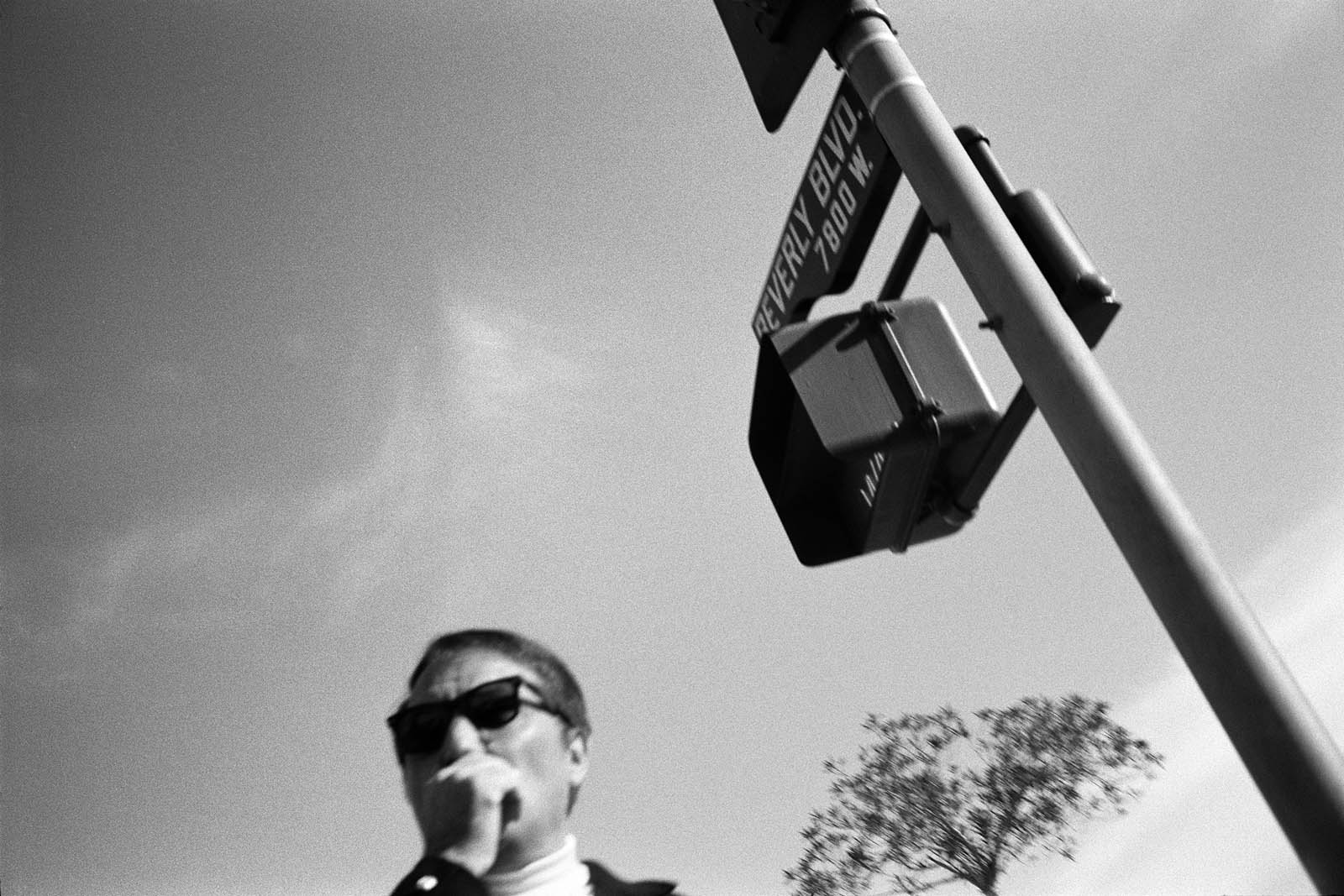
Stephen Shore (American, b. 1947) 'Beverly Boulevard and La Brea Avenue, Los Angeles, California, June 21, 1975' From the series 'Uncommon Places', 1973-1986


Stephen Shore (American, b. 1947)
Beverly Boulevard and La Brea Avenue, Los Angeles, California, June 21, 1975
From the series Uncommon Places, 1973-1986
© Stephen Shore. Courtesy 303 Gallery, New York and Sprüth Magers


The art of seeing

Since Art Blart started in November 2008 there has been only one posting on the glorious and groundbreaking work of American photographer Stephen Shore, way back in 2018 at MoMA. Shore’s photographs picture “the threadbare banality of the American scene, the jerry-rigged down-at-heels seediness of our rural landscapes and the spatial looseness of our towns.”1

I was so happy that I was going to be able to do another posting on this artist’s work only to be totally let down by the 10 media images provided by the Fondation Henri Cartier-Bresson. The installation photographs of the exhibition are great but the actual images only provide a meagre insight into the singular style and pictorial depth of the photographer.

When I saw two of his original photographs, probably the only time I have ever seen originals in the flesh, at the exhibition American Dreams: 20th century photography from George Eastman House at Bendigo Art Gallery in 2011, I commented:

“Two Stephen Shore chromogenic colour prints from 1976 where the colours are still true and have not faded. This was incredible – seeing vintage prints from one of the early masters of colour photography; noticing that they are not full of contrast like a lot of today’s colour photographs – more like a subtle Panavision or Technicolor film from the early 1960s. Rich, subtle, beautiful hues with the photograph having this amazing presence, projected through the construction of the image and the physicality of the print.”

I said in my comment on the MoMA exhibition in 2018, “Shore was showing the world in a different light… and he was using an aesthetic based on the straight forward use of colour. Colour is just there, part of the form of the image. Of course there are insightful subjective judgements about what to photograph in American surburbia, but this subjectivity and the use of colour within it is subsumed into the song that Shore was composing. It all comes back to music. Here’s a Mozart tune, this is his aesthetic, for eternity.”

Dr Marcus Bunyan


1/ See Stephen Shore, Modern Instances: The Craft of Photography (London: Mack Books, 2022), 172. These lines from Venturi are cited on the back cover of Uncommon Places quoted in Hugh Campbell. “The poorest details of the world resurfaced,” on the Places Journal website, August 2023 [Online] Cited 26/08/2024


Many thankx to the Fondation Henri-Cartier Bresson for allowing me to publish the photographs in the posting. Please click on the photographs for a larger version of the image.


Stephen Shore’s photographs of the American vernacular have influenced not only generations of photographers but the medium at large. Shore was among the first artists to take color beyond the domain of advertising and fashion photography, and his large-format color work on the American landscape stands at the root of what has become a vital photographic tradition over the past forty years.


Text from the Aperture Instagram web page


“[F]or attention is of the essence of our powers; it is that which draws other things toward us, it is that which, if we have lived with it, brings the experiences of our lives ready to our hand. If things but make impression enough on you, you will not forget them; and thus, as you go through life, your store of experiences becomes greater, richer, more and more available. But to this end you must cultivate attention – the art of seeing, the art of listening …. To pay attention is to live, and to live is to pay attention.”


Louis Sullivan. Kindergarten Chats (1918) from the epigraph of Stephen Shore’s Uncommon Places (1973-1986)


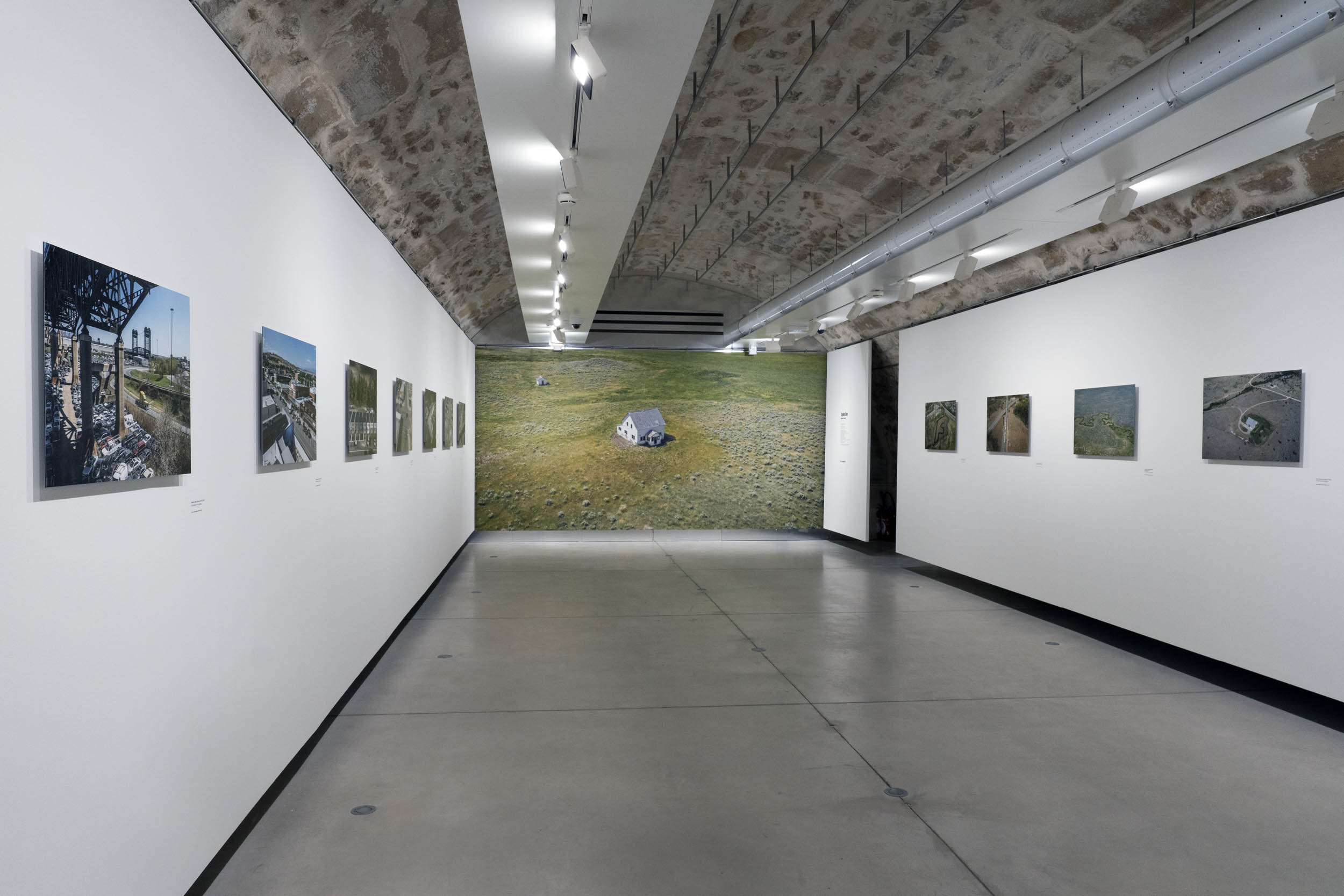
With over a hundred images shot between 1969 and 2021 across the United States, Vehicular & Vernacular is the first retrospective of Stephen Shore’s work in Paris in nineteen years. On view at the Fondation Henri Cartier-Bresson until September 15, the exhibition shows the photographer’s renowned series – Uncommon Places and American Surfaces – alongside lesser-known projects never shown in France.

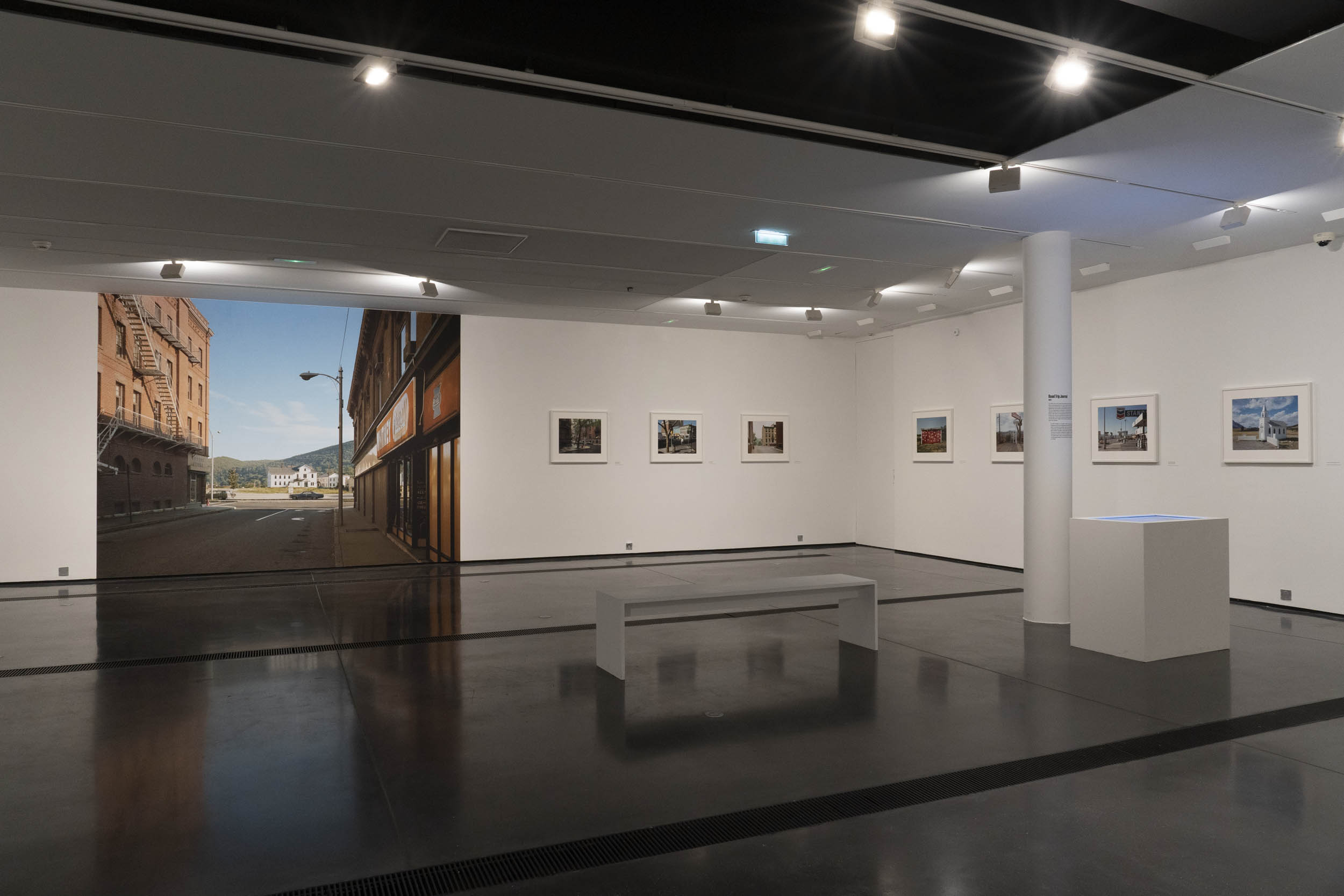
 

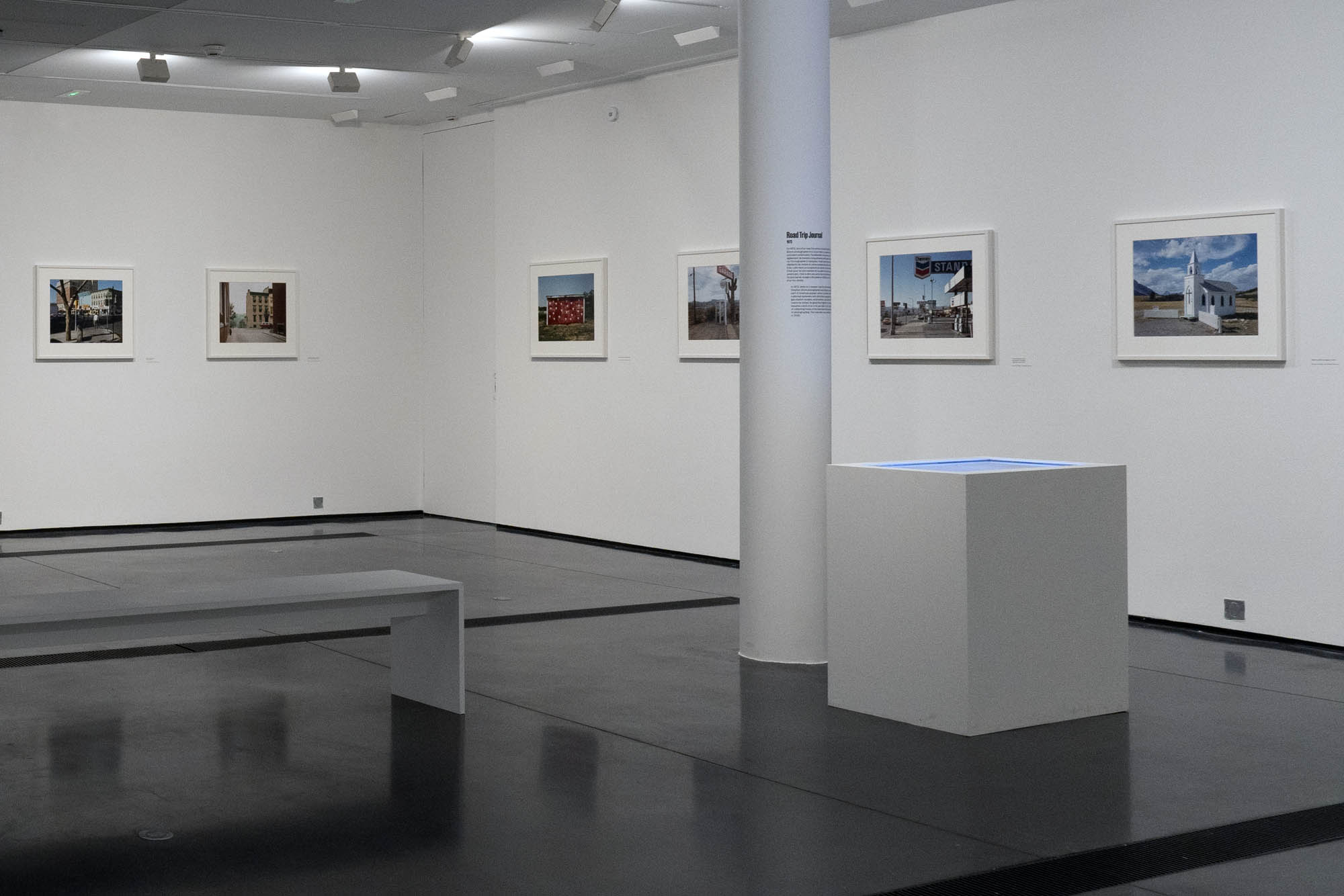
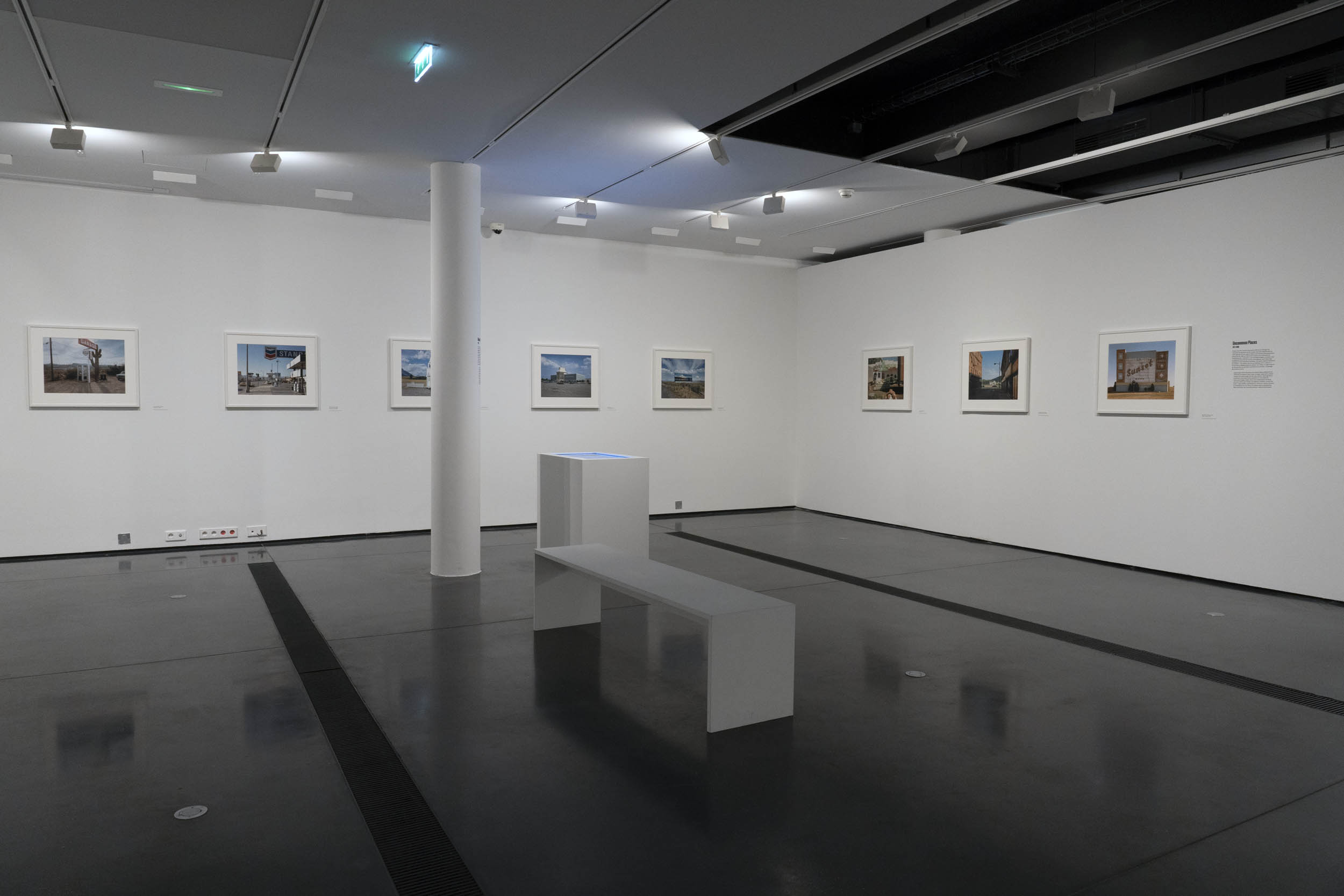
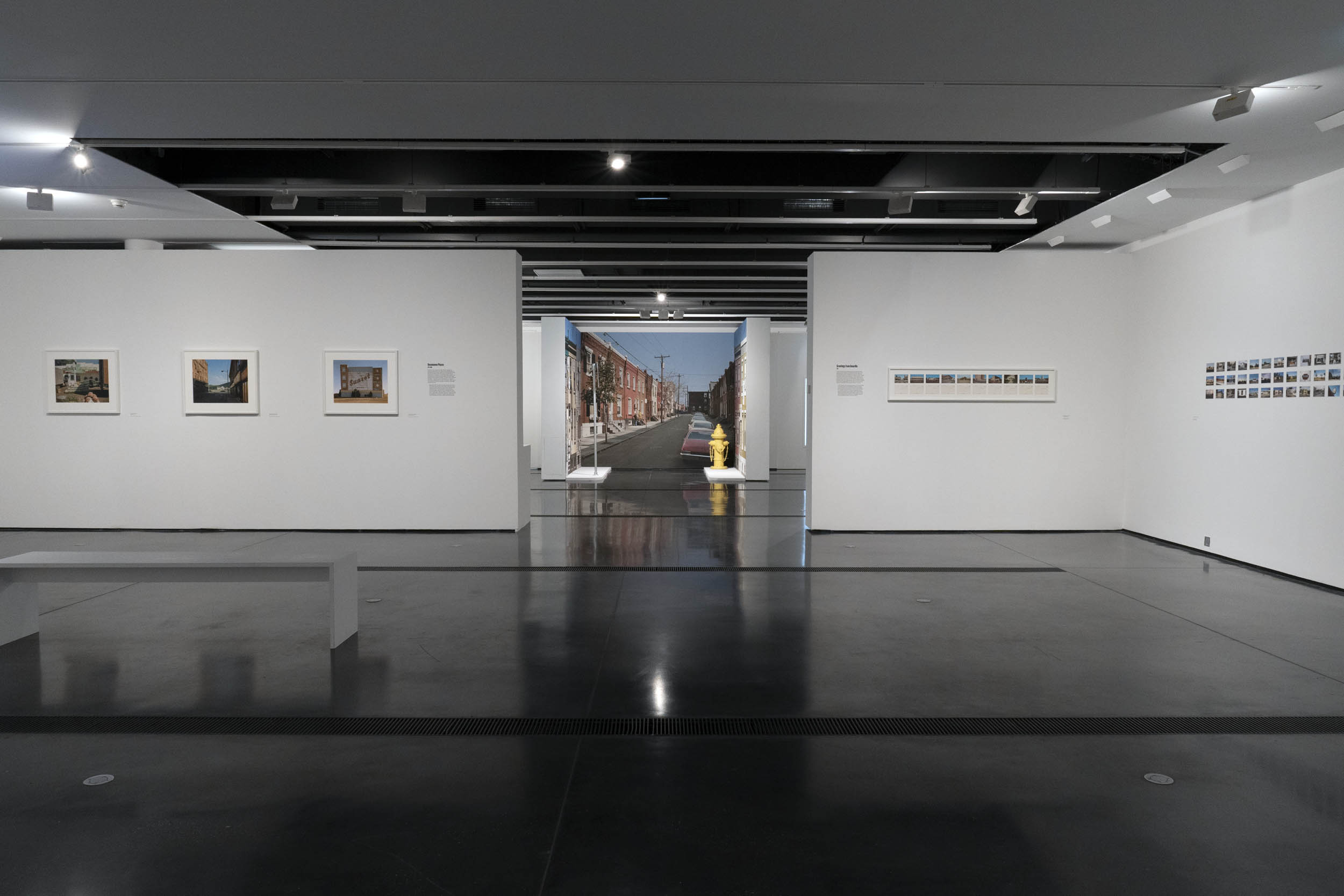
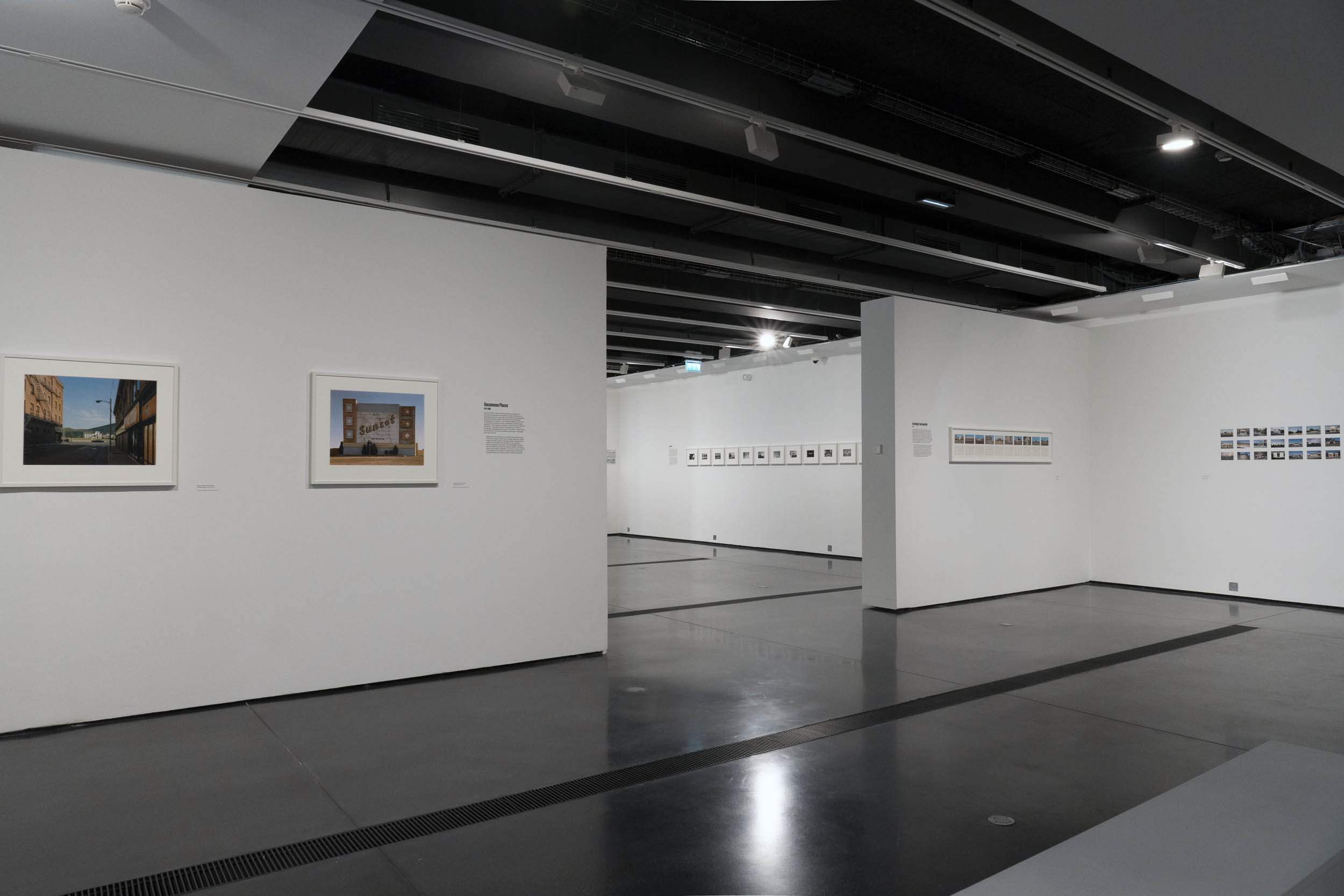
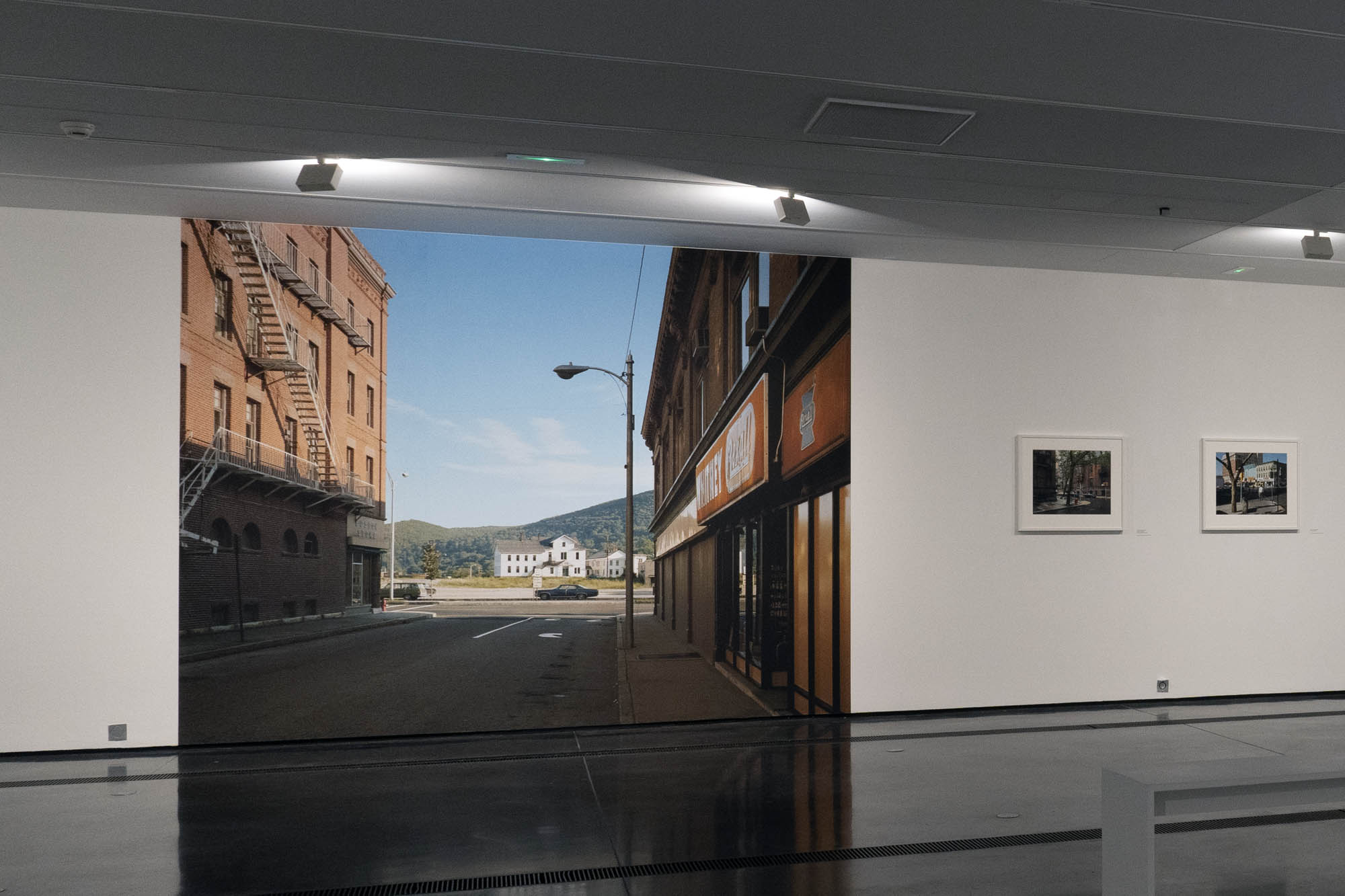
Installation view of the exhibition 'Stephen Shore: Vehicular & Vernacular' at the Fondation Henri-Cartier Bresson, Paris

Installation view of the exhibition 'Stephen Shore: Vehicular & Vernacular' at the Fondation Henri-Cartier Bresson, Paris

Installation view of the exhibition 'Stephen Shore: Vehicular & Vernacular' at the Fondation Henri-Cartier Bresson, Paris

Installation view of the exhibition 'Stephen Shore: Vehicular & Vernacular' at the Fondation Henri-Cartier Bresson, Paris

Installation view of the exhibition 'Stephen Shore: Vehicular & Vernacular' at the Fondation Henri-Cartier Bresson, Paris

Installation view of the exhibition 'Stephen Shore: Vehicular & Vernacular' at the Fondation Henri-Cartier Bresson, Paris

Installation view of the exhibition 'Stephen Shore: Vehicular & Vernacular' at the Fondation Henri-Cartier Bresson, Paris

Installation view of the exhibition 'Stephen Shore: Vehicular & Vernacular' at the Fondation Henri-Cartier Bresson, Paris

Installation view of the exhibition 'Stephen Shore: Vehicular & Vernacular' at the Fondation Henri-Cartier Bresson, Paris

Installation view of the exhibition 'Stephen Shore: Vehicular & Vernacular' at the Fondation Henri-Cartier Bresson, Paris

Installation view of the exhibition 'Stephen Shore: Vehicular & Vernacular' at the Fondation Henri-Cartier Bresson, Paris

Installation view of the exhibition 'Stephen Shore: Vehicular & Vernacular' at the Fondation Henri-Cartier Bresson, Paris


Installation views of the exhibition Stephen Shore: Vehicular & Vernacular at the Fondation Henri-Cartier Bresson, Paris


Since the 1960’s, mobility has been central to Stephen Shore’s practice. In 1969, while on a trip to Los Angeles with his father, he took photographs from the car window. During the 1970s and 1980s, he went on several road trips across the United States, resulting in his two most famous series: American Surfaces and Uncommon Places. As the new millennium began, he resumed photographing from different means of transportation: from car windows, trains and planes. For his most recent project, which began in 2020, he used a camera-equipped drone to photograph changes in the American landscape. For over half a century, he developed a form of “vehicular photography”.

The vernacular has been an ever-present interest in North American photography: the culture of the useful, the local and the popular, so typical of the United States. Shore’s work is permeated by multiple aesthetic and cultural issues. The vernacular is one of them. Shore’s mobility allows him to multiply perspectives and encounters with this “Americanness”. In the works selected for this exhibition, the vehicular is, in fact, placed at the service of the vernacular.

Exhibition

With over a hundred images shot between 1969 and 2021 across the United States, Vehicular & Vernacular is the first retrospective of Stephen Shore’s work in Paris in nineteen years. On view at the Fondation Henri Cartier-Bresson until September 15, the exhibition shows the photographer’s renowned series – Uncommon Places and American Surfaces – alongside lesser-known projects never shown in France. A fragment of the Signs of Life exhibition in which Shore participated in 1976 is exceptionally recreated for the occasion. Finally, the photographer’s most recent series, shot using drones, is exhibited for the first time in Europe.
Biography

Born in New York in 1947, Stephen Shore began photographing at the age of nine. At the age of fourteen, Edward Steichen bought him three photographs for the MoMA collections. In 1971, he became the first living photographer to have his work exhibited at the Metropolitan Museum. Shore was one of eight photographers included in the legendary 1975 New Topographics exhibition at Rochester’s George Eastman House, which redefined the American approach to landscape. He is part of the generation that led to the recognition of colour photography as an art form. Rich, diverse and complex, his work transforms everyday scenes into opportunities for meditation.

Press release from the Fondation Henri-Cartier Bresson
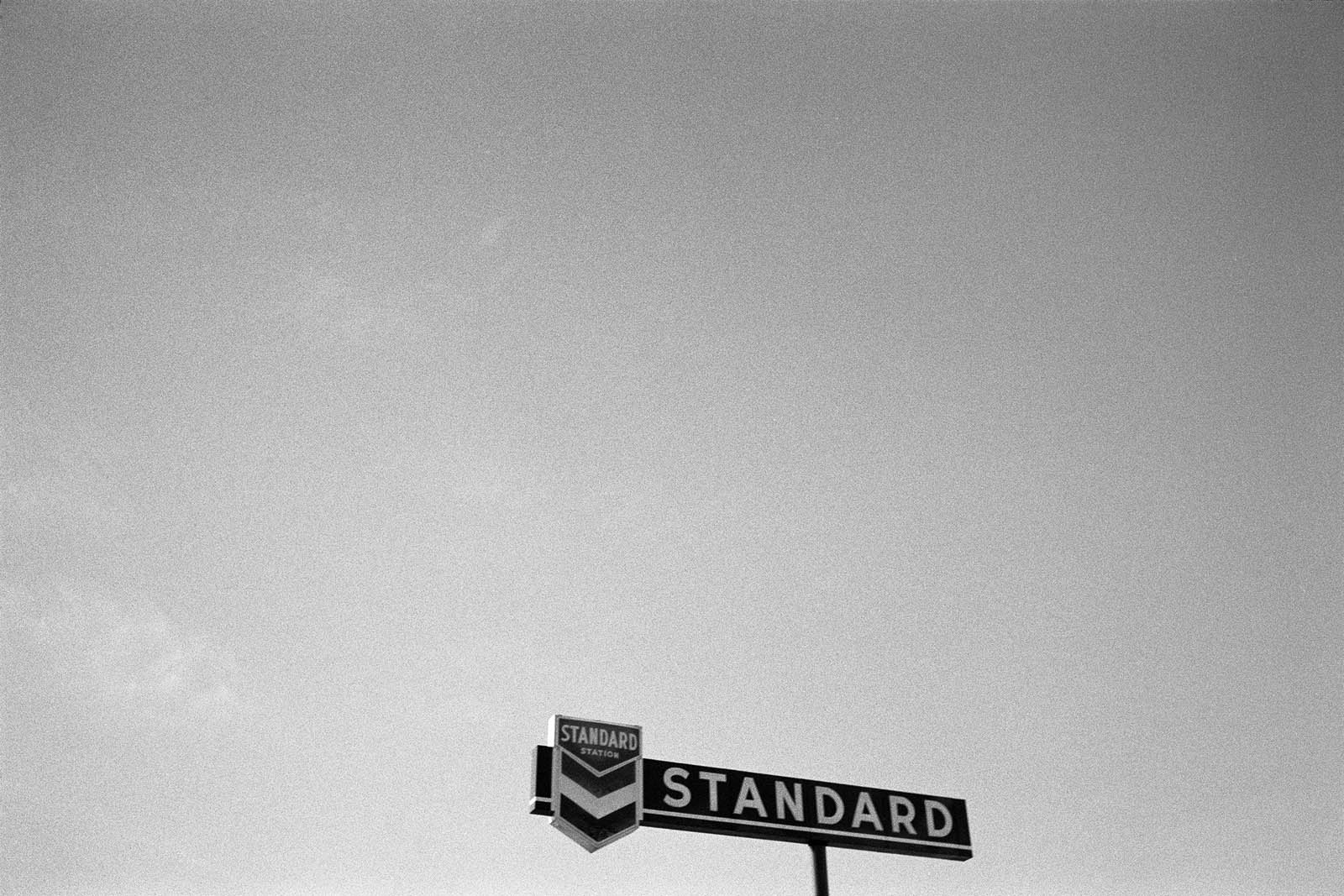
 

Stephen Shore (American, b. 1947) 'Los Angeles, California, February 4, 1969' From the series 'Los Angeles', 1969


Stephen Shore (American, b. 1947)
Los Angeles, California, February 4, 1969
From the series Los Angeles, 1969
© Stephen Shore. Courtesy 303 Gallery, New York and Sprüth Magers
 

Stephen Shore (American, b. 1947) 'Los Angeles, California, February 4, 1969' From the series 'Los Angeles', 1969


Stephen Shore (American, b. 1947)
Los Angeles, California, February 4, 1969
From the series Los Angeles, 1969
© Stephen Shore. Courtesy 303 Gallery, New York and Sprüth Magers


Stephen Shore (American, b. 1947) 'Polk Street' 1971 From the series 'Greetings from Amarillo, "Tall in Texas",' 1971


Stephen Shore (American, b. 1947)
Polk Street
1971
From the series Greetings from Amarillo, “Tall in Texas”, 1971
Postcard
© Stephen Shore. Courtesy 303 Gallery, New York and Sprüth Magers
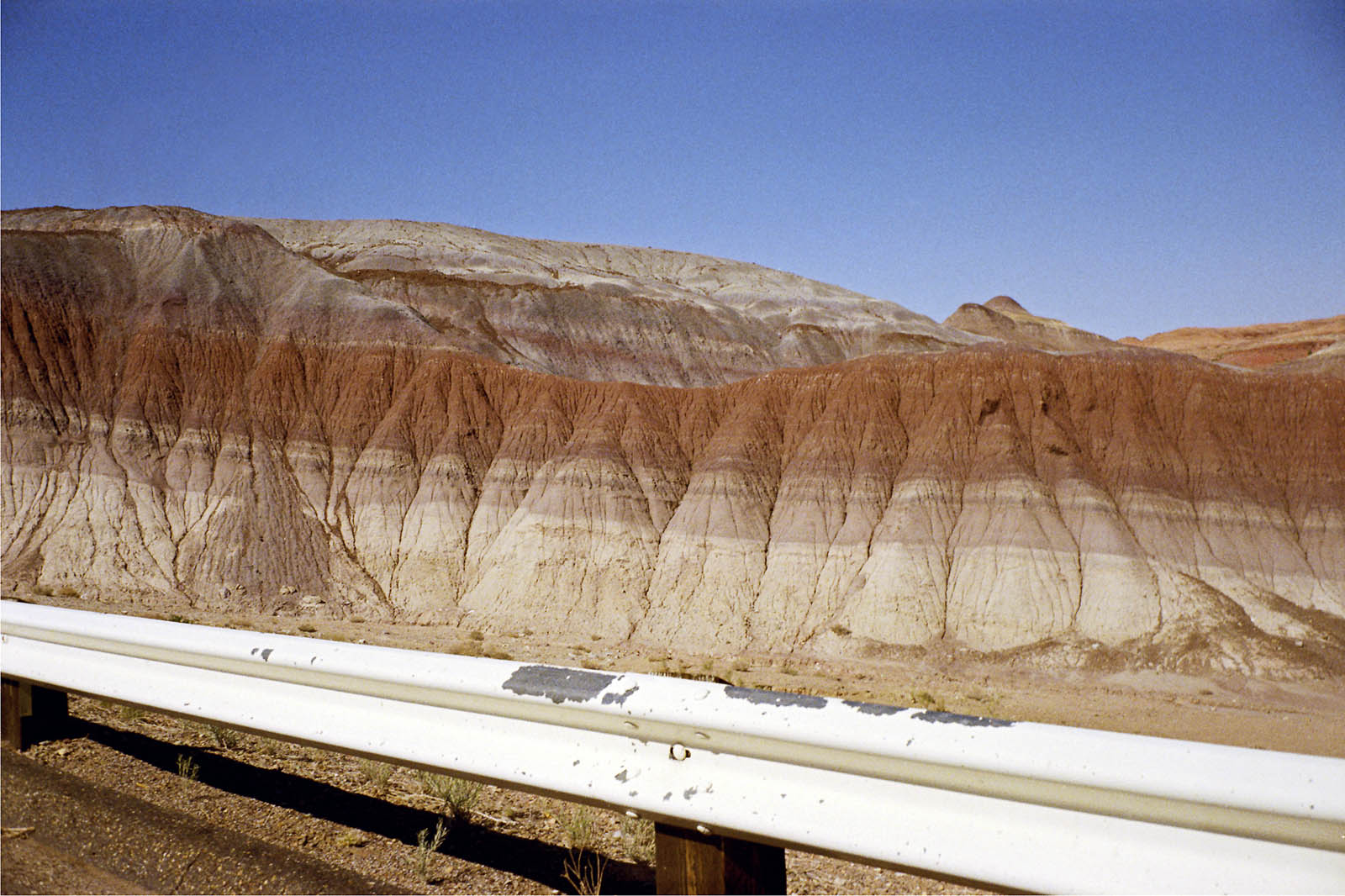
 

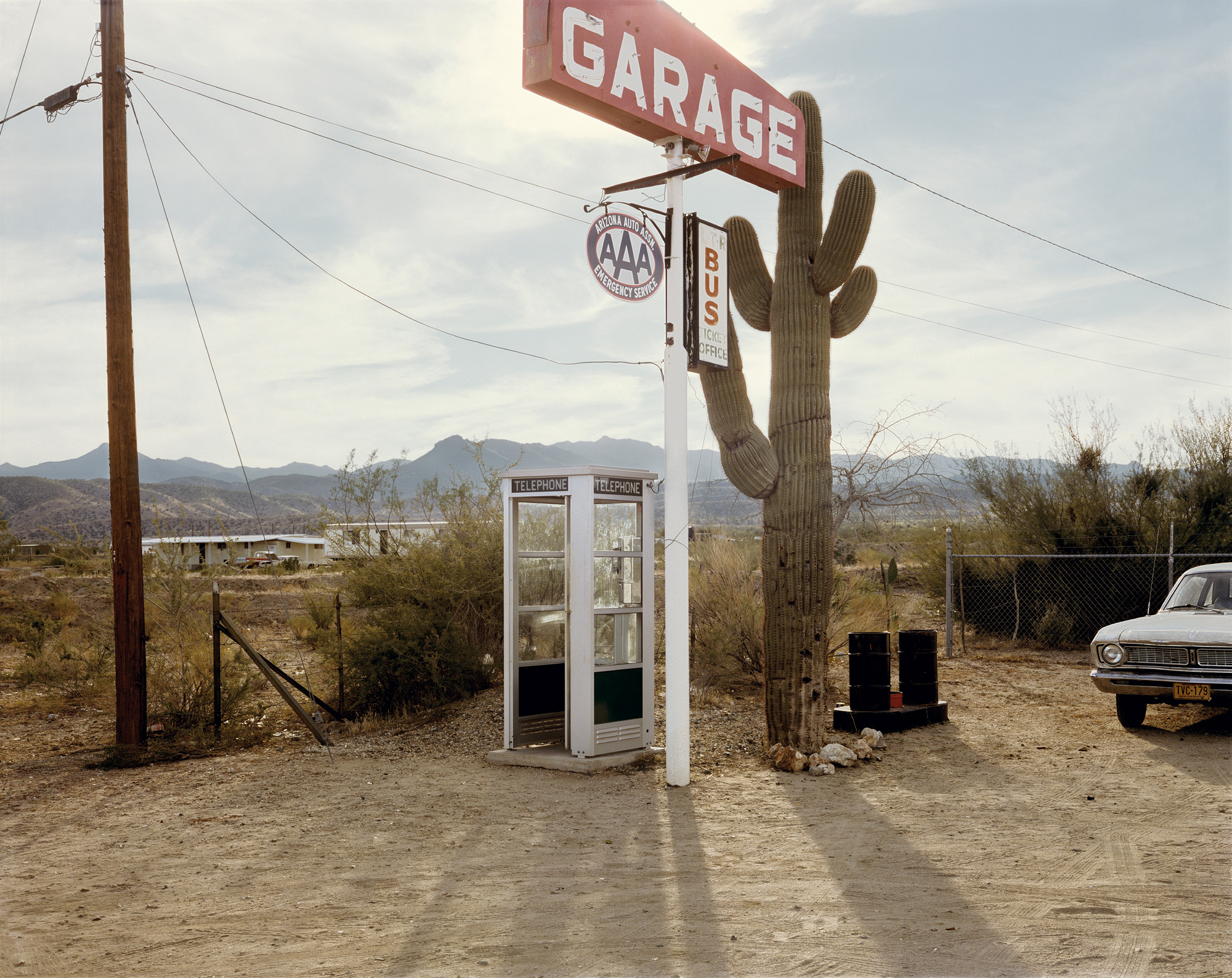
Stephen Shore (American, b. 1947) 'U.S 89, Arizona, June 1972' From the series 'American Surfaces' 1972-1973


Stephen Shore (American, b. 1947)
U.S 89, Arizona, June 1972
From the series American Surfaces, 1972-1973
© Stephen Shore. Courtesy 303 Gallery, New York and Sprüth Magers


Stephen Shore (American, b. 1947) 'Amarillo, Texas, July 1972' From the series 'American Surfaces', 1972-1973


Stephen Shore (American, b. 1947)
Amarillo, Texas, July 1972
From the series American Surfaces, 1972-1973
© Stephen Shore. Courtesy 303 Gallery, New York and Sprüth Magers


Stephen Shore (American, b. 1947) 'Second Street, Ashland, Wisconsin, July 9, 1973' From the series 'Uncommon Places', 1973-1986


Stephen Shore (American, b. 1947)
Second Street, Ashland, Wisconsin, July 9, 1973
From the series Uncommon Places, 1973-1986
© Stephen Shore. Courtesy 303 Gallery, New York and Sprüth Magers


For the epigraph of Uncommon Places, Shore used lines from Louis Sullivan’s Kindergarten Chats (1918):

“[F]or attention is of the essence of our powers; it is that which draws other things toward us, it is that which, if we have lived with it, brings the experiences of our lives ready to our hand. If things but make impression enough on you, you will not forget them; and thus, as you go through life, your store of experiences becomes greater, richer, more and more available. But to this end you must cultivate attention – the art of seeing, the art of listening …. To pay attention is to live, and to live is to pay attention.” 10

The surfeit of seeing the Uncommon Places images offer means that, even as they seem to make available to view every detail of a highly particularised location, they achieve an archetypal or universal character; they are arguments not so much for the value of specific places as for a more general attentiveness to inhabited environments. In a conversation with Lynne Tillman, Shore discusses the “inherent architecture” of his scenes – the formal and spatial relationships produced through his deliberate technique. He notes how the view camera’s descriptive power “allowed [him] to move back farther and take pictures that were more packed with information, more layered.” This layered distance “allows for lots of different points of interest to exist in the same picture.”11 …

Shore has always been attracted to such scenes of visual coherence won out of incoherence, be it social, economic, or architectural. Back in the 1970s, when Robert Venturi and Denise Scott Brown commissioned him to make photographs for a number of exhibitions (notably Signs of Life: Symbols in the American City, mounted at the Smithsonian in 1976), the architects were interested in how to capture “the threadbare banality of the American scene, the jerry-rigged down-at-heels seediness of our rural landscapes and the spatial looseness of our towns.”14

Hugh Campbell. “The poorest details of the world resurfaced,” on the Places Journal website, August 2023 [Online] Cited 26/08/2024

10/ Sullivan’s autobiography, The Autobiography of an Idea (1924), notes key episodes of “paying attention” – to a tree, a building, etc. – and the resulting “ideas” as formative in his intellectual and spiritual development.
11/ Shore, Uncommon Places, 182.
14/ See Stephen Shore, Modern Instances: The Craft of Photography (London: Mack Books, 2022), 172. These lines from Venturi are cited on the back cover of Uncommon Places.


Stephen Shore (American, b. 1947) 'South of Klamath Falls, U.S. 97, Oregon, July 21, 1973' From the series 'Uncommon Places', 1973-1986


Stephen Shore (American, b. 1947)
South of Klamath Falls, U.S. 97, Oregon, July 21, 1973
From the series Uncommon Places, 1973-1986
© Stephen Shore. Courtesy 303 Gallery, New York and Sprüth Magers
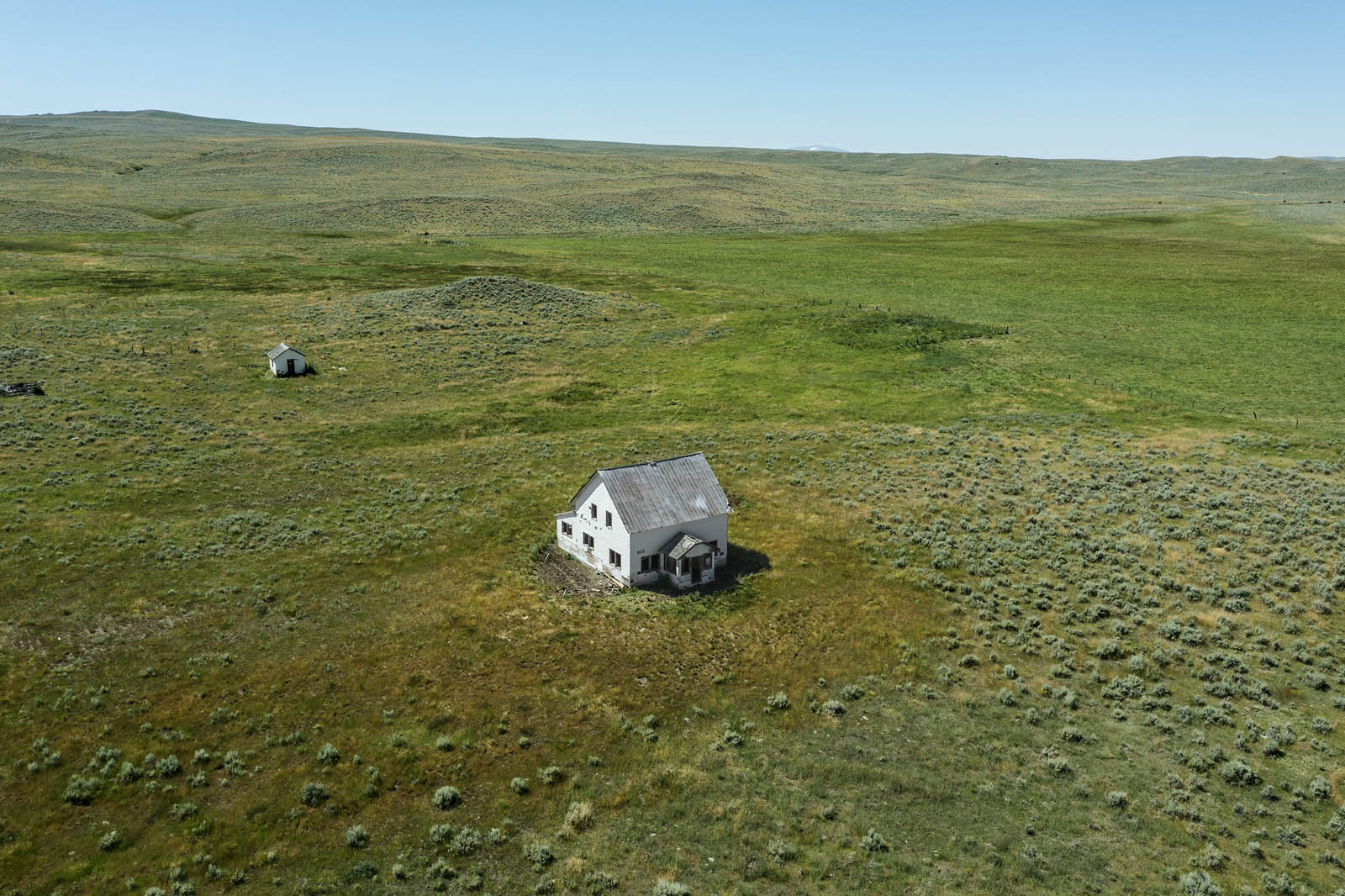
 

Stephen Shore (American, b. 1947) 'Ravena, New York, May 1, 2021 42°29.4804217N 73°49.3777683W' From the series 'Topographies', 2020-2021


Stephen Shore (American, b. 1947)
Ravena, New York, May 1, 2021 42°29.4804217N 73°49.3777683W
From the series Topographies, 2020-2021
© Stephen Shore. Courtesy 303 Gallery, New York and Sprüth Magers
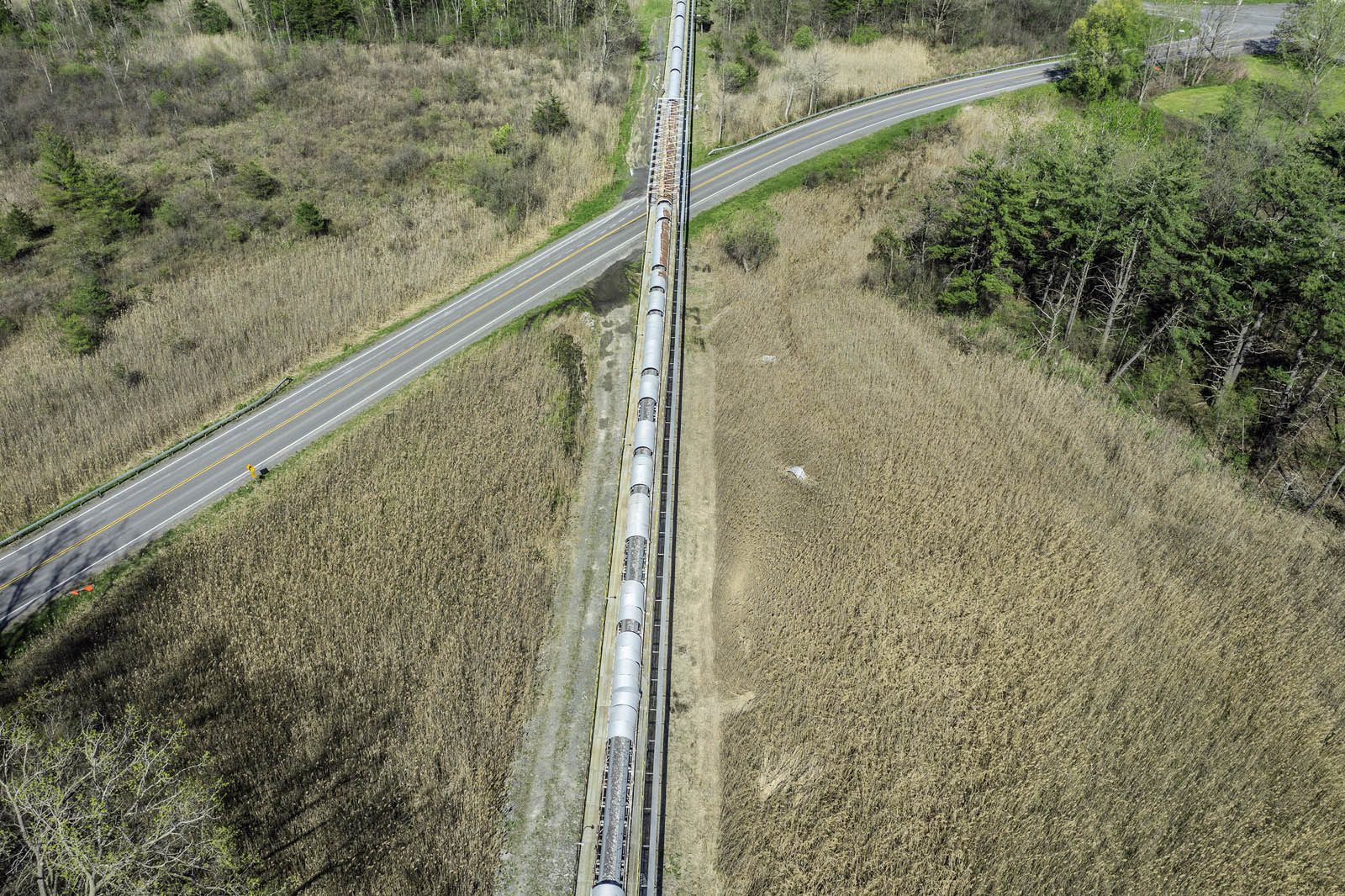
 

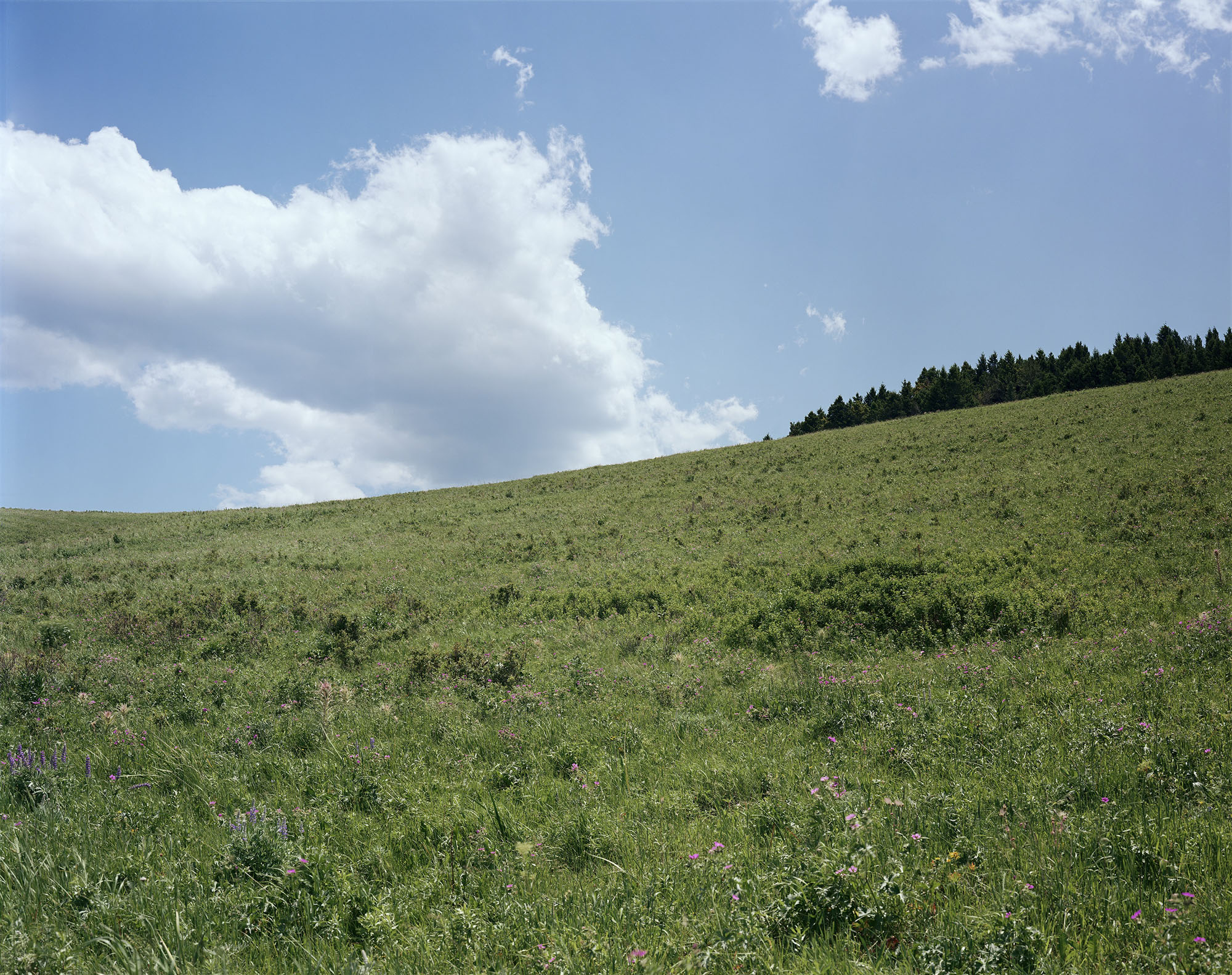
Stephen Shore (American, b. 1947) 'Meagher County, Montana, July 26, 2020 46°11.409946N 110°44.018901W' From the series 'Topographies', 2020-2021


Stephen Shore (American, b. 1947)
Meagher County, Montana, July 26, 2020 46°11.409946N 110°44.018901W
From the series Topographies, 2020-2021
© Stephen Shore. Courtesy 303 Gallery, New York and Sprüth Magers


Fondation Henri Cartier-Bresson
79 rue des Archives
75003 Paris

Opening hours:
Tuesday – Sunday 11am – 7pm
Closed on Mondays
Fondation Henri Cartier-Bresson website

LIKE ART BLART ON FACEBOOK

Back to top

Exhibition: ‘Stephen Shore’ at The Museum of Modern Art (MoMA), New York

Exhibition dates: 19th November, 2017 – 28th May, 2018

Stephen Shore is organised by Quentin Bajac, The Joel and Anne Ehrenkranz Chief Curator of Photography, with Kristen Gaylord, Beaumont and Nancy Newhall Curatorial Fellow, Department of Photography, MoMA.


Stephen Shore (American, b. 1947) 'West 9th Avenue, Amarillo, Texas, October 2, 1974' from the exhibition 'Stephen Shore' at The Museum of Modern Art (MoMA), New York, Nov 2017 - May 2018


Stephen Shore (American, b. 1947)
West 9th Avenue, Amarillo, Texas, October 2, 1974
1974, printed 2013
Chromogenic colour print
17 × 21 3/4 in. (43.2 × 55.2cm)
The Museum of Modern Art, New York
Acquired through the generosity of an anonymous donor
© 2017 Stephen Shore


The truth in the detail of day-to-day life

1970s colour photography is the key period in the work of Stephen Shore. These classical, formal colour photographs capture “mundane aspects of American popular culture in straightforward, unglamorous images.” They are what made him famous. They are, historically, conceptually and emotionally, his most effective means of communication as an artist.

American Surfaces and Uncommon Places made Shore “one of the most prominent figures of the American New Color movement,” showing colour just as colour.

I know that is a strange thing to say, but Shore was showing the world in a different light… and he was using an aesthetic based on the straight forward use of colour. Colour is just there, part of the form of the image. Of course there are insightful subjective judgements about what to photograph in American surburbia, but this subjectivity and the use of colour within it is subsumed into the song that Shore was composing. It all comes back to music. Here’s a Mozart tune, this is his aesthetic, for eternity.

I remember seeing two vintage Stephen Shore chromogenic colour prints from 1976 where the colours were still true and had not faded in the exhibition American Dreams: 20th century photography from George Eastman House at Bendigo Art Gallery. This was incredible experience – seeing vintage prints from one of the masters of colour photography; noticing that they are not full of contrast like a lot of today’s colour photographs – more like a subtle Panavision or Technicolor film from the early 1960s. Rich, subtle, beautiful hues with the photograph containing this amazing presence, projected through the construction of the image and the physicality of the print.

Shore has a fantastic eye and his colour photographs are beautifully resolved. The subjectivity is not pushed, because his song was in tune, and he just sang it. Like his contemporaries, Wiliam EgglestonRichard Misrach and Joel Meyerwitz, there are some artists who just know how to play the tune.

Dr Marcus Bunyan


Many thankx to MoMA for allowing me to publish the photographs in posting. Please click on the photographs for a larger version of the image.


Stephen Shore encompasses the entirety of the artist’s work of the last five decades, during which he has conducted a continual, restless interrogation of image making, from the gelatin silver prints he made as a teenager to his current engagement with digital platforms. One of the most significant photographers of our time, Stephen Shore (American, b. 1947) has often been considered alongside other artists who rose to prominence in the 1970s by capturing the mundane aspects of American popular culture in straightforward, unglamorous images. But Shore has worked with many forms of photography, switching from cheap automatic cameras to large-format cameras in the 1970s, pioneering the use of colour before returning to black and white in the 1990s, and in the 2000s taking up the opportunities of digital photography, digital printing, and social media.

The artist’s first survey in New York to include his entire career, this exhibition will both allow for a fuller understanding of Shore’s work, and demonstrate his singular vision – defined by an interest in daily life, a taste for serial and often systematic approaches, a strong intellectual underpinning, a restrained style, sly humour, and visual casualness – and uncompromising pursuit of photography’s possibilities.


Stephen Shore | MoMA LIVE

Join us for a conversation with MoMA Chief Curator of Photography Quentin Bajac and artist Stephen Shore on the opening of the exhibition, “Stephen Shore,” moderated by MoMA Senior Deputy Director of Curatorial Affairs, Peter Reed.

One of the most significant photographers of our time, Stephen Shore has often been considered alongside other artists who rose to prominence in the 1970s by capturing the mundane aspects of American popular culture in straightforward, unglamorous images. But Shore has worked with many forms of photography, and this exhibition encompasses the entirety of the artist’s work of the last five decades, during which he has conducted a continual, restless interrogation of image making, from the gelatin silver prints he made as a teenager to his current engagement with digital platforms.


Stephen Shore (American, b. 1947) 'New York, New York' 1964 from the exhibition 'Stephen Shore' at The Museum of Modern Art (MoMA), New York, Nov 2017 - May 2018


Stephen Shore (American, b. 1947)
New York, New York
1964
Gelatin silver print
9 1/8 × 13 1/2 in. (23.2 × 34.3cm)
Courtesy the artist
© 2017 Stephen Shore


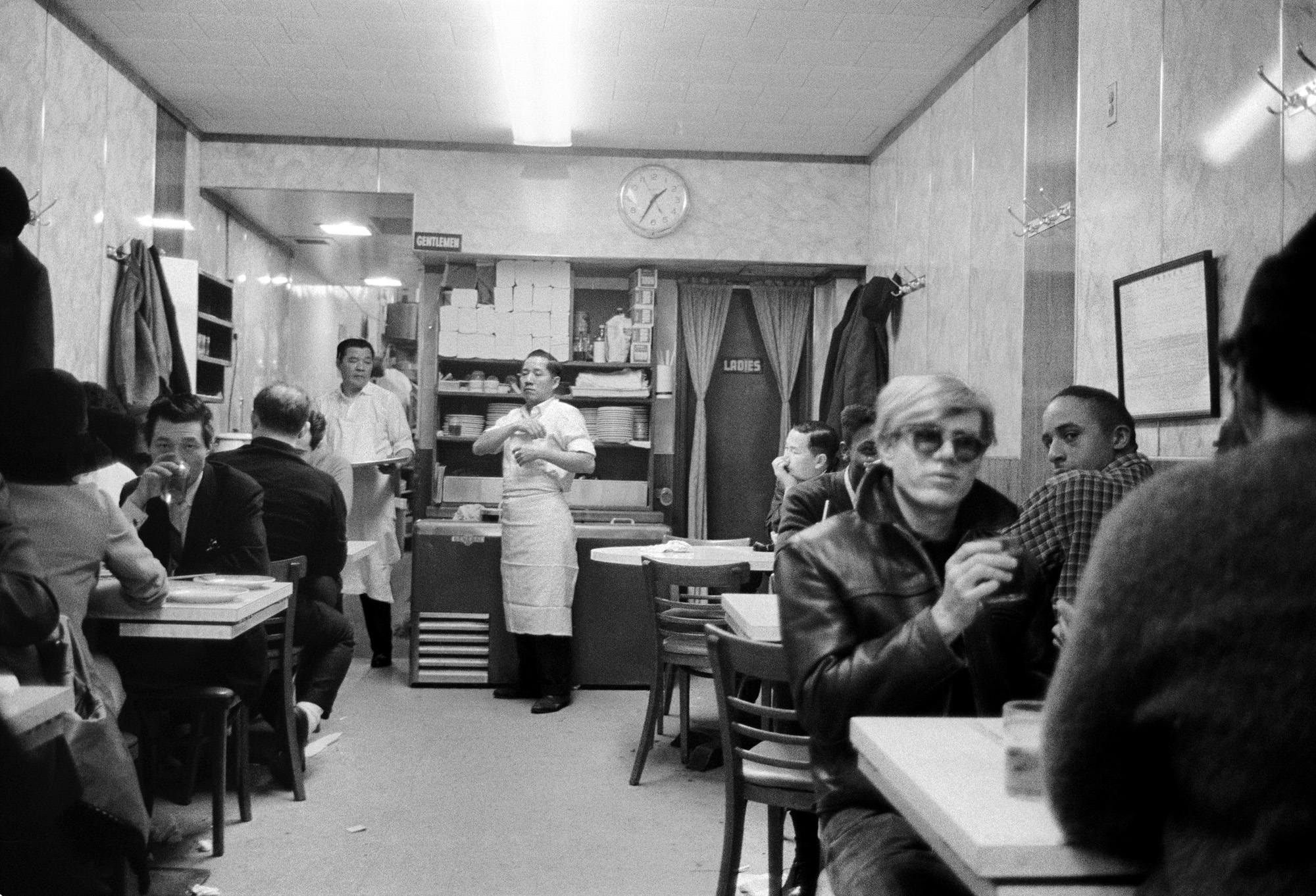
Stephen Shore (American, b. 1947) '1:35 a.m., in Chinatown Restaurant, New York, New York' 1965-1967


Stephen Shore (American, b. 1947)
1:35 a.m., in Chinatown Restaurant, New York, New York
1965-1967, printed c. 1995
Gelatin silver print
9 × 13 1/2 in. (22.9 × 34.3cm)
Courtesy the artist
© 2017 Stephen Shore


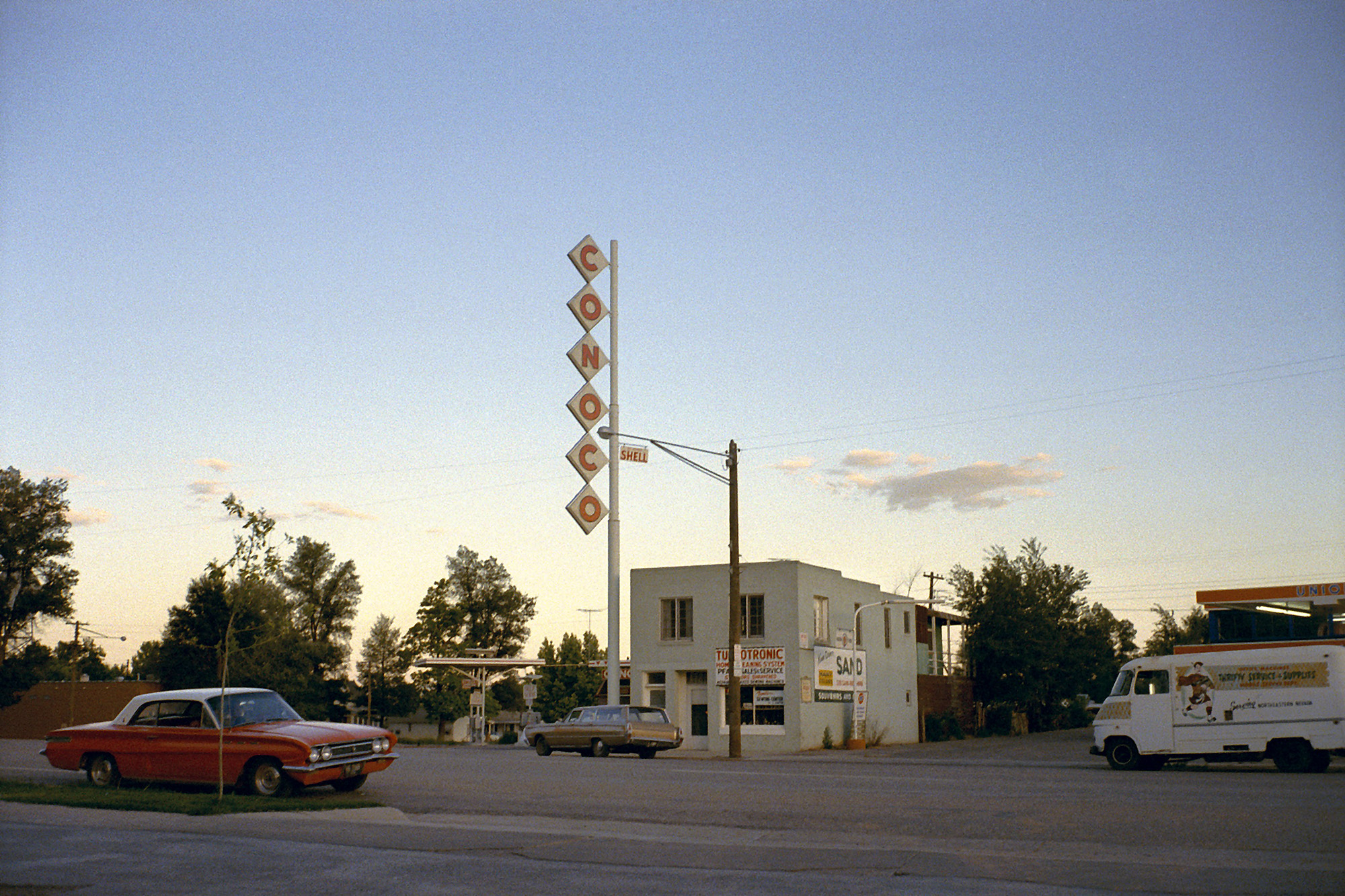
Stephen Shore (American, b. 1947) 'Kanab, Utah, June 1972'


Stephen Shore (American, b. 1947)
Kanab, Utah, June 1972
1972, printed 2017
Chromogenic colour print
3 1/16 × 4 5/8 in. (7.8 × 11.7cm)
Courtesy the artist
© 2017 Stephen Shore


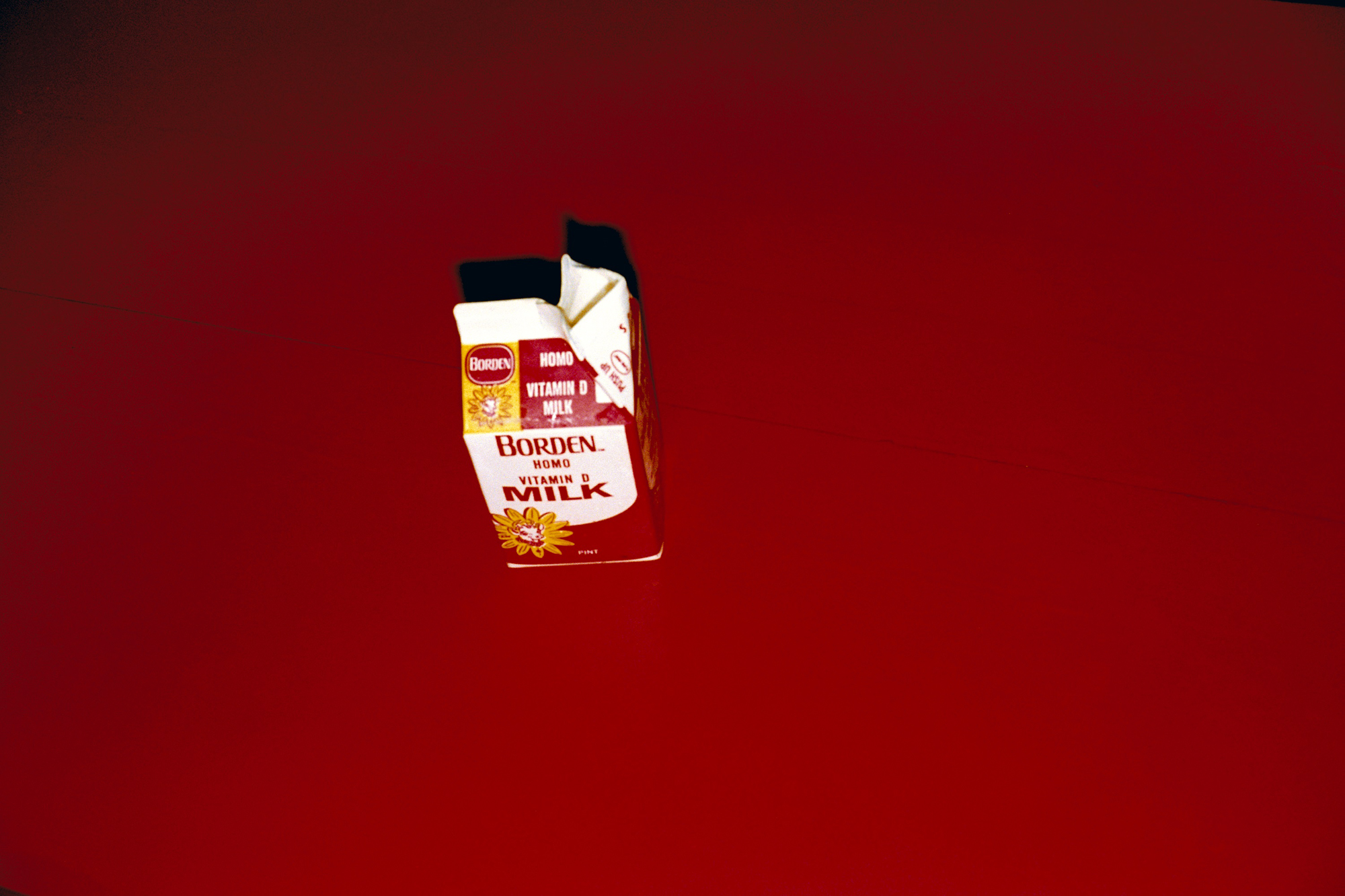
Stephen Shore (American, b. 1947) 'Amarillo, Texas, July 1972'


Stephen Shore (American, b. 1947)
Amarillo, Texas, July 1972
1972, printed 2017
Chromogenic colour print
3 1/16 × 4 5/8 in. (7.8 × 11.7cm)
Courtesy the artist
© 2017 Stephen Shore


Stephen Shore (American, b. 1947) 'Washington, D.C., November 1972'


Stephen Shore (American, b. 1947)
Washington, D.C., November 1972
1972, printed 2017
Chromogenic colour print
3 1/16 × 4 5/8 in. (7.8 × 11.7cm)
Courtesy the artist
© 2017 Stephen Shore


Stephen Shore (American, b. 1947) 'Second Street, Ashland, Wisconsin, July 9, 1973'


Stephen Shore (American, b. 1947)
Second Street, Ashland, Wisconsin, July 9, 1973
1973, printed 2017
Chromogenic colour print
17 × 21 3/4 in. (43.2 × 55.2cm)
Courtesy the artist
© 2017 Stephen Shore


Stephen Shore (American, b. 1947) 'U.S. 97, South of Klamath Falls, Oregon, July 21, 1973'


Stephen Shore (American, b. 1947)
U.S. 97, South of Klamath Falls, Oregon, July 21, 1973
1973, printed 2002
Chromogenic colour print
17 3/4 x 21 15/16 in. (45.1 x 55.7cm)
The Museum of Modern Art, New York. The Photography Council Fund
© 2017 Stephen Shore


Stephen Shore (American, b. 1947) 'Breakfast, Trail's End Restaurant, Kanab, Utah, August 10, 1973'


Stephen Shore (American, b. 1947)
Breakfast, Trail’s End Restaurant, Kanab, Utah, August 10, 1973
1973
Chromogenic colour print
16 7/8 × 21 1/4 in. (42.8 × 54cm)
The Museum of Modern Art, New York. Purchase
© 2017 Stephen Shore


Stephen Shore (American, b. 1947) 'West Third Street, Parkersburg, West Virginia, May 16, 1974'


Stephen Shore (American, b. 1947)
West Third Street, Parkersburg, West Virginia, May 16, 1974
1974
Chromogenic colour print
8 × 10 1/2 in. (20.3 × 26.7cm)
Courtesy the artist
© 2017 Stephen Shore


Stephen Shore (American, b. 1947) 'Lookout Hotel, Ogunquit, Maine, July 16, 1974'


Stephen Shore (American, b. 1947)
Lookout Hotel, Ogunquit, Maine, July 16, 1974
1974, printed 2013
Chromogenic colour print
17 × 21 3/4 in. (43.2 × 55.2cm)
The Museum of Modern Art, New York
Acquired through the generosity of an anonymous donor
© 2017 Stephen Shore


The Museum of Modern Art presents the most comprehensive exhibition ever organised of photographer Stephen Shore’s work, on view from November 19, 2017, until May 28, 2018. The exhibition tracks the artist’s work chronologically, from the gelatin silver prints he made as a teenager to his current work with digital platforms. Stephen Shore establishes the artist’s full oeuvre in the context of his time – from his days at Andy Warhol’s Factory through the rise of American colour photography and the transition to large-scale digital photography – and argues for his singular vision and uncompromising pursuit of photography’s possibilities. The exhibition will include hundreds of photographic works along with additional materials including books, ephemera, and objects. Stephen Shore is organised by Quentin Bajac, The Joel and Anne Ehrenkranz Chief Curator of Photography, with Kristen Gaylord, Beaumont and Nancy Newhall Curatorial Fellow, Department of Photography, MoMA.
Born in 1947, Shore spearheaded the New Color Photography movement in the United States in the 1970s, and became a major catalyst in the renewal of documentary photography in the late 1990s, both in the US and Europe, blending the tradition of American photographers such as Walker Evans with influences from various artistic movements, including Pop, Conceptualism, and even Photo-Realism. Shore’s images seem to achieve perfect neutrality, in both subject matter and approach. His approach cannot be reduced to a style but is best summed up with a few principles from which he has seldom deviated: the search for maximum clarity, the absence of retouching and reframing, and respect for natural light. Above all, he exercises discipline, limiting his shots as much as possible – one shot of a subject, and very little editing afterward.

Shore started developing negatives from his parents when he was only six, received his first camera when he was nine, and sold prints to Edward Steichen, then director of MoMA’s Department of Photography, at the age of 14. In the early 1960s Shore became interested in film, both narrative and experimental, and he showed his short film Elevator in 1965 at the Film-Makers’ Cinematheque, where he first met Andy Warhol. That spring, he dropped out of high school and started photographing at Warhol’s studio, The Factory, initially on an almost daily basis, then more sporadically, until 1967. Elevator has been restored by conservators and will be screened in the exhibition for the first time since the 1960s.

In 1969, Shore used serial black-and-white projects to deconstruct the medium and rebuild it on a more detached, intellectual foundation. In these works, many shot in Amarillo, Texas, with his friend Michael Marsh as his main model, Shore was striving to free himself from certain photographic conventions: the concept of photography as the art of creating isolated and “significant” images, and the related cult of the “decisive moment”; perfect framing; and the expressive subjectivity of the photographer. The principle of multiplicity prevails in Shore’s work of that period – series, suites, and sequences that resist all narrative temptation. In their attempt to eliminate subjectivity, these series are related to a number of Conceptual photographic works by other artists of the same period.

In November 1971 Shore curated an exhibition called All the Meat You Can Eat at the 98 Greene Street Loft. Embracing a century of photography, the show was composed largely of found images collected by Shore and two friends, Weston Naef, then a curator at The Metropolitan Museum of Art, and Michael Marsh. It also included images by Shore, such as shots taken with a Mick-a-Matic camera and colour photos that would serve as the basis for the postcards in his series Greetings from Amarillo, “Tall in Texas.” Stephen Shore will include a reconstructed version of this display, using material from Shore’s archives – some that was originally in the exhibition and some that has been selected by Shore for this installation.

In the early 1970s Shore turned to colour photography, a format that at that time was still largely overlooked by art photographers. In March 1972, he started taking snapshots of his daily life, embarking in June and July of the same year on a road trip to the southern US. For two months he photographed his everyday life in an almost systematic way – unremarkable buildings, main streets, highway intersections, hotel rooms, television screens, people’s faces, toilet seats, unmade beds, a variety of ornamental details, plates of food, shop windows, inscriptions, and commercial signs. In September and October 1972, images from the series were shown at Light Gallery in New York under the title American Surfaces. The MoMA display of this work echoes that initial presentation, in which the small Kodacolor prints were attached directly to the wall, unframed, in a grid of three rows.

Begun in 1973 and completed almost 10 years later, Shore’s next project, Uncommon Places, inhabits the same world and deals with the same themes as American Surfaces. Yet because of Shore’s move from a handheld 35mm camera to a large-format one, Uncommon Places features fewer details and close-ups and a more detached approach. Appearing in the context of accelerated change in the national landscape, especially in areas of suburban sprawl, it betrays a more contemplative reading of individual images. Before being published as a book in 1982, the series was exhibited both in the US and abroad, especially in Germany, making Shore one of the most prominent figures of the American New Color movement. Though he is best known for his large-format work of this period, Shore was at the same time experimenting with other photographic formats. The exhibition will include a selection of stereo images he made in 1974 that were never published, and have not been exhibited since 1975.

While working on what would become Uncommon Places, Shore began to accept photographic commissions, not only for editorial work but also for institutions and companies. If some of these commissions seem quite distant from Uncommon Places, most of them still show some affinity with the series in their attention to architecture and exploration of “Americanness.” He took photographs focusing on contemporary vernacular architecture that the architects Robert Venturi and Denise Scott Brown used in their 1976 exhibition Signs of Life: Symbols in the American City. This exhibition will feature some of the original, gridded transparencies from Signs of Life that incorporate images by Shore and other photographers, not seen since 1976. Finally, some commissions he did for magazines alternate between urban landscapes, portraits, and architectural details in a direct extension of Uncommon Places. Shore would include a number of commissioned photographs in his personal body of work, showing how porous the borders were between the two groups of images, and Stephen Shore will include examples both of the photographs in context in books and periodicals, and of others that were not subsequently published.

Starting in the late 1970s, Shore gradually abandoned urban and suburban areas and turned to the natural landscape, a subject he would concentrate on almost exclusively during the next decade. These included the landscapes of Montana (1982-1983), where he settled with his wife in 1980, Texas (1983-1988), and the Hudson Valley (1984-1986), where he moved in 1982, but also more international locations: the Highlands of Scotland (1988); Yucatán, in Mexico (1990); and finally the Po Valley, with a series in Luzzara, Italy (1993). This period corresponds also to a reduced public visibility of his photographic work, marked by fewer exhibitions, publications, and commissions.

In the early 2000s Shore began experimenting with digital tools and technologies that had only recently become available. Between 2003 and 2010, he made dozens of print-on-demand books, which were each printed in limited editions of 20 copies, making them similar to artist’s books. But the ease of production, speed of execution, democratic nature of the technique used, and modesty of the finished product are in direct line with the snapshots of American Surfaces and the immediacy of Polaroid images. In the choice of subjects and approaches, the series of books seems both literally and figuratively to be a mini-version of Shore’s entire oeuvre, blending and reworking the themes that have always been important to him – an exhaustive exploration of a particular subject or place, a penchant for the vernacular, an interest in sequence, a tendency toward autobiography, a search for a kind of immediacy, and a dry sense of humour – while still retaining its autonomy and specificity. A few years later he created Winslow, Arizona in a single day in 2013. The precise temporal duration of the series – one day from sunrise to sunset – links it to some of Shore’s print-on-demand books, but it takes on a new performance-based dimension. Over 180 of the pictures Shore took that day were presented, unedited and in the order in which they were shot, in a slide show, projected on a drive-in screen in Barstow, California, a few days after he took them.
In 1996 and 1997 Shore, who had always been fascinated by archaeology, undertook photographic projects around excavation sites in Israel and Italy, shooting solely in black and white. Within the archaeological remains of these vanished cities, Shore was especially interested in the human dimension, both domestic and secular, seen in bones, pottery, and vestiges of dwellings and shops. Then, between September of 2009 and the spring of 2011, Shore returned to the region five times, photographing throughout the entire territory from north to south, or From Galilee to the Negev, as he titled the book he published of a selection of his photographs in Israel and the West Bank. As indicated by the title and structure of the book, with chapters organised geographically, the project was guided by a topographical exploration. It mixes various temporalities – which are echoed by the diversity of the images – bringing together the “short term” of people and events with and the “long term” of the landscape and planet.

The photographs Shore took in Ukraine in the summer of 2012 and the fall of 2013 have as their subject the country’s Jewish community, specifically survivors of the Holocaust who are assisted today by the Survivor Mitzvah Project. Following three years of photographing primarily in Israel, the series provided Shore with the opportunity to continue working with subjects related to his Jewish roots. In a break from his norm, Shore structured the Ukraine series around the human figure. Survivors in Ukraine, the book of photographs he published in 2015, provides accounts of 22 survivors, all more than 80 years old, through a wide range of images: close-ups, busts, and full-length portraits; fragmentary portraits of hands, arms, and legs; views of dwellings and interiors; and still-life details of meals, belongings, and memorials to departed family members.

In the summer of 2014 Shore decided to devote most of his photographic activity to Instagram, where he posts images almost every day. While he continues to take on commissions, the bulk of his personal production over the past three years has been through the social networking app; he considers this output his current “work.” With Instagram Shore has reestablished a rapid, instantaneous practice, one that requires him to be on constant alert. It also presents a new, dual aesthetic challenge for Shore in the square format and the small size of the image. These constraints encourage a simplification of the picture, making it more a “notation” than a constructed image. Tablets will be stationed within a gallery of the exhibition, allowing viewers to scroll through Shore’s Instagram feed, which will feature new images as Shore continues to post them.

Press release from MoMA


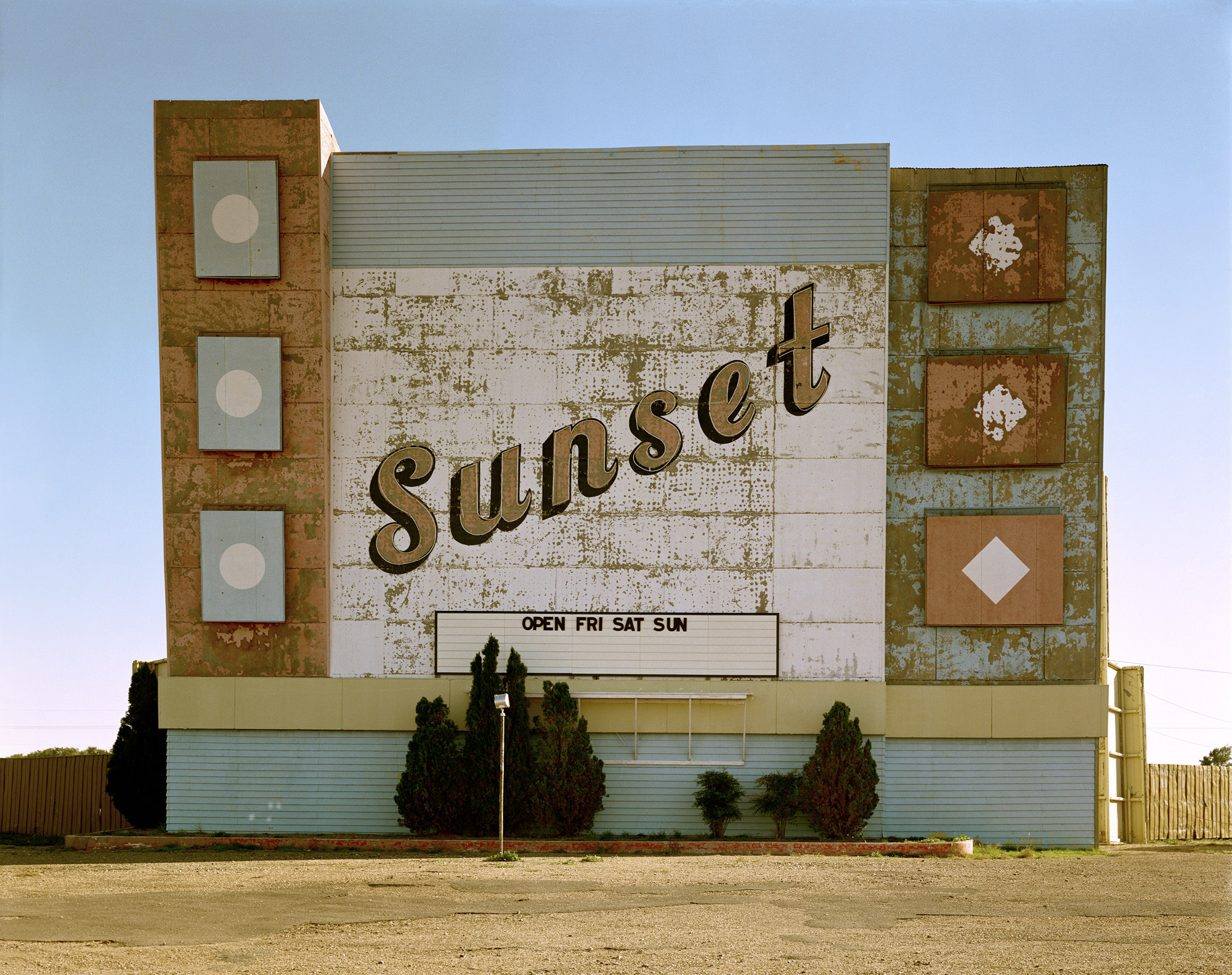
Stephen Shore (American, b. 1947) 'Beverly Boulevard and La Brea Avenue, Los Angeles, California, June 21, 1975'


Stephen Shore (American, b. 1947)
Beverly Boulevard and La Brea Avenue, Los Angeles, California, June 21, 1975
1975, printed 2013
Chromogenic colour print
17 × 21 3/4 in. (43.2 × 55.2cm)
The Museum of Modern Art, New York
Acquired through the generosity of Thomas and Susan Dunn
© 2017 Stephen Shore


Stephen Shore (American, b. 1947) 'U.S. 93, Wikieup, Arizona, December 14, 1976'


Stephen Shore (American, b. 1947)
U.S. 93, Wikieup, Arizona, December 14, 1976
1976, printed 2013
Chromogenic colour print
17 × 21 3/4 in. (43.2 × 55.2cm)
The Museum of Modern Art, New York
Acquired through the generosity of Thomas and Susan Dunn
© 2017 Stephen Shore


Stephen Shore (American, b. 1947) 'Giverny, France, 1977'


Stephen Shore (American, b. 1947)
Giverny, France, 1977
1977
Chromogenic colour print
7 11/16 x 9 5/8 in. (19.5 x 24.5cm)
The Museum of Modern Art, New York
Gift of the Estate of Lila Acheson Wallace
© 2017 Stephen Shore


Stephen Shore (American, b. 1947) 'Graig Nettles, Fort Lauderdale, Florida, March 1, 1978'


Stephen Shore (American, b. 1947)
Graig Nettles, Fort Lauderdale, Florida, March 1, 1978
1978
Chromogenic colour print
7 11/16 x 9 11/16 in. (19.5 x 24.6cm)
The Museum of Modern Art, New York
Acquired with matching funds from Blanchette Hooker Rockefeller and the National Endowment for the Arts, 1978
© 2017 Stephen Shore


Stephen Shore (American, b. 1947) 'Merced River, Yosemite National Park, California, August 13, 1979'


Stephen Shore (American, b. 1947)
Merced River, Yosemite National Park, California, August 13, 1979
1979, printed 2013
Chromogenic colour print
35 7/8 x 44 15/16 in. (91.2 x 114.2cm)
The Museum of Modern Art, New York. Gift of the artist
© 2017 Stephen Shore


Stephen Shore (American, b. 1947) 'Gallatin County, Montana, August 2, 1983'


Stephen Shore (American, b. 1947)
Gallatin County, Montana, August 2, 1983
1983, printed 2017
Chromogenic colour print
36 × 45 in. (91.4 × 114.3cm)
Courtesy the artist
© 2017 Stephen Shore


Stephen Shore (American, b. 1947) 'County of Sutherland, Scotland, 1988'


Stephen Shore (American, b. 1947)
County of Sutherland, Scotland, 1988
1988
Chromogenic colour print
35 1/2 × 45 1/2 in. (90.2 × 115.6cm)
The Museum of Modern Art, New York
Gift of Susan and Arthur Fleischer, Jr.
© 2017 Stephen Shore


Stephen Shore (American, b. 1947) 'Sderot, Israel, September 14, 2009'


Stephen Shore (American, b. 1947)
Sderot, Israel, September 14, 2009
2009
Chromogenic colour print
17 × 21 3/4 in. (43.2 × 55.2cm)
The Museum of Modern Art, New York
Gift of the artist
© 2017 Stephen Shore


Stephen Shore (American, b. 1947) 'Peqi'in, Israel, September 22, 2009'


Stephen Shore (American, b. 1947)
Peqi’in, Israel, September 22, 2009
2009
Chromogenic colour print
17 × 21 3/4 in. (43.2 × 55.2cm)
The Museum of Modern Art, New York
Gift of the artist
© 2017 Stephen Shore


Stephen Shore (American, b. 1947) 'Uman, Cherkaska Province, Ukraine, July 22, 2012'


Stephen Shore (American, b. 1947)
Uman, Cherkaska Province, Ukraine, July 22, 2012
2012, printed 2017
Chromogenic colour print
16 × 20 in. (40.6 × 50.8cm)
Courtesy the artist
© 2017 Stephen Shore


The Museum of Modern Art
11 West 53 Street
New York, NY 10019
Phone: (212) 708-9400

Opening hours:
10.30am – 5.30pm
Open seven days a week

MoMA website

LIKE ART BLART ON FACEBOOK

Back to top

Exhibition: ‘Into the Sunset: Photography’s Image of the American West’ at The Museum of Modern Art (MoMA), New York

Exhibition dates: 29th March – 8th June, 2009

Curator: Eva Respini, Associate Curator, Department of Photography, The Museum of Modern Art


Carelton Watkins (American, 1829-1916) 'View from the Sentinel Dome, Yosemite' 1865-1866 from the exhibition 'Into the Sunset: Photography's Image of the American West' at The Museum of Modern Art (MoMA), New York, March - June, 2009

Carelton Watkins (American, 1829-1916) 'View from the Sentinel Dome, Yosemite' 1865-1866

Carelton Watkins (American, 1829-1916) 'View from the Sentinel Dome, Yosemite' 1865-1866


Carelton Watkins (American, 1829-1916)
Views from the Sentinel Dome, Yosemite
1865-1866
Albumen silver prints from glass negatives
Museum of Modern Art, New York


The Museum of Modern Art presents Into the Sunset: Photography’s Image of the American West, a survey of 138 photographic works dating from 1850 to 2008 that chart the West’s complex, rich, and often compelling mythology via photography. The exploration of a large part of the American West in the mid-nineteenth century by European Americans coincided with the advent of photography, and photography and the West came of age together. The region’s seemingly infinite bounty and endless potential symbolised America as a whole, and photography, with its ability to construct persuasive and seductive images, was the perfect medium with which to forge a national identity. This relationship has resulted in a complex association that shapes the perception of the West’s social and physical landscape to this day. With political, cultural, and social attitudes constantly shifting in the region over the last 150 years, Into the Sunset further examines the way photographers have responded to these changes. The exhibition is organised by Eva Respini, Associate Curator, Department of Photography, The Museum of Modern Art, and is on view in the Special Exhibitions Gallery on the third floor from March 29 to June 8, 2009.

Organised thematically rather than chronologically, Into the Sunset brings together the work of over 70 photographers, including Robert Adams, John Baldessari, Dorothea Lange, Timothy O’Sullivan, Cindy Sherman, Joel Sternfeld, Carleton E. Watkins, and Edward Weston, among others. The exhibition draws extensively from MoMA’s collection, along with private and public collections in the United States, and features new acquisitions from Adam Bartos, Katy Grannan, and Dennis Hopper, with each work also on view for the first time at the Museum.

Ms. Respini states: “Ranging from grand depictions of paradise to industrial development, from pictures taken on the road to prosaic suburban scenes, the photographs included in Into the Sunset do not all picture the West from the same point of view, or even perhaps, picture the same West. Rather, each is one part in a continually shifting and evolving composite image of a region that has itself been growing and changing since the opening of the frontier.”

Into the Sunset begins with the birth of photography and the American West. In the mid-nineteenth century, the region’s seemingly infinite bounty and endless potential symbolised America as a whole, and Carleton E. Watkins (American, 1829-1916) captured the grand depictions of an American paradise in his photographs of Yosemite Valley in California. Arguably the world’s first renowned landscape photographer, Watkins made his first photographs there in 1861 – large sized prints made with an 18-by-22-inch mammoth plate camera, well suited to the grandeur of the land. Included are the three contiguous photographs that make up his extraordinarily detailed View from the Sentinel Dome (1865-1866).

The exhibition balances the early work of landscape photographers with the twentieth century focus on the failure of the West’s promised bounty. In Joel Sternfeld’s (American, b. 1944) After a Flash Flood, Rancho Mirage, California (1979), the photographer documents the impact of a natural disaster, specifically a landslide, shot with neutral tones softly camouflaging the extent of flash flood on this suburban neighbourhood. And in Karin Apollonia Müller’s (German, b. 1963) Civitas (1997), the photographer shows a very different view of California than that of Watkins, with Müller revealing a contemporary Los Angeles as a littered wasteland of freeways and anonymous glass towers.

As highways and interstate travel became more prevalent, the automobile and the open road became synonymous with the region, with Edward Weston (American, 1886-1958) as the first great photographer of these open roads. Included is Weston’s iconic Hot Coffee, Mojave Desert (1937), a humorous black-and-white photograph of a road sign revealing a greater thematic shift to the highway and its signage as an inescapable element in picturing the West in the twentieth century.

Once the West became more populated, photographers began to showcase humans’ effects on the land, including images of industrial development. In the 1950s William Garnett (American, 1916-2006) was hired by a real estate company to record the efficiency of mass-produced housing. For this series, Lakewood, California (1950), Garnett took photographs of the neighbourhood from an airplane, resulting in images that are completely devoid of people and focus on the progress of mass-produced construction. However, the series subsequently came to represent all that was wrong with such development and the massive sprawl of the West in the eyes of its critics.

Photographs of the people of the West represent a diversity of archetypes: gold miners and loggers, Native Americans, cowboys, suburbanites, city dwellers, starlets, dreamers, and drifters. Into the Sunset explores these archetypes, and their mutability into the twenty-first century. Included is Half Indian / Half Mexican (1991), from the photographer James Luna (Native American, Pooyukitchum / Luiseno, b. 1950), an artist of Native American ancestry. This tongue-in-cheek self-portrait captures in profile both an identity photograph and a mug shot, and works as a counterpoint to the tokenised portrayals of Native Americans from the past 150 years.

A similar reevaluation of past archetypes occurs in Richard Prince’s (American, b. 1949) Cowboy series from 1980, with one work from the series included in the exhibition. For that series Prince famously photographed Marlboro advertisements, cutting out the text, cropping the images, and enlarging them, highlighting the artifice of the virile image of the cowboy and its potency as a deeply ingrained figure in American mythology.

The suburbs and their inhabitants have been a rich subject for photographers of the West, and included are Larry Sultan’s (American, b. 1946) Film Stills from the Sultan Family Home Movies (1943-1972), in which Sultan chose individual frames from his family’s home movies and enlarged them. Although the images feature the activities that epitomise suburban life, a sense of unease lurks beneath the surface of these images; cropped and grainy, they resemble surveillance or evidence photographs.

Into the Sunset concludes with the theme of the failed promise of Western migration. Dorothea Lange’s well-known 1936 photograph Migrant Mother, Nipomo, California, photographed when Lange was employed by the Farm Security Administration, is included and documents the conditions of the West in rural areas during the Great Depression. Her photographs had a humanist purpose and resulted in putting a face on the hardships of that era.

This tradition of capturing the downtrodden of the West continues into this century with Katy Grannan (American, b. 1969), a photographer who recently completed a series of new pioneers, individuals struggling to define themselves in the West of today. In Nicole, Crissy Field Parking Lot (I) (2006), a woman, “Nicole,” poses seductively on a gravel parking lot, with her makeup-streaked face and harsh light alluding to her perilous existence on the fringe of society.”

Text from the MoMA website [Online] Cited 12/04/2009. No longer available online


Many thankx to MoMA for allowing me to publish the photographs in the posting. Please click on the photographs for a larger version of the image.


Installation view of the exhibition 'Into the Sunset: Photography's Image of the American West' at The Museum of Modern Art (MoMA), New York showing Ed Ruscha's 'Every Building on the Sunset Strip' 1966


Installation view of the exhibition Into the Sunset: Photography’s Image of the American West at The Museum of Modern Art (MoMA), New York showing Ed Ruscha’s Every Building on the Sunset Strip 1966


Joel Sternfeld (American, b. 1944) 'After a Flash Flood, Rancho Mirage, California' 1979 from the exhibition 'Into the Sunset: Photography's Image of the American West' at The Museum of Modern Art (MoMA), New York, March - June, 2009


Joel Sternfeld (American, b. 1944)
After a Flash Flood, Rancho Mirage, California
1979
Chromogenic colour print, printed 1987
15 15/16 x 20″ (40.5 x 50.8cm)
Museum of Modern Art, New York
Gift of Beth Goldberg Nash and Joshua Nash


During the 1970s, Joel Sternfeld’s work reflected a trend towards a newly dispassionate, less idealised approach to nature and culture. His photographs have a seductive beauty, even though they often focus on those places where the natural and man-made worlds come together in uncomfortable ways. Working with a large-format camera and luminous colour to create images that are frequently ironic or even humorous, his compositions appear simple but in fact are surprisingly complex and often unsettling. In this photograph of a suburban California neighbourhood in the aftermath of a flash flood, the lovely monochrome tones trick us into not immediately seeing the car that has toppled into the gaping sinkhole or realising that the buildings above could be on the verge of falling, too.

Text from the Museum of Fine Arts Boston website


Apollonia Müller (German, b. 1963) 'Civitas' 1997


Apollonia Müller (German, b. 1963)
Civitas
1997
From Angels in Fall
Chromogenic colour print
19 3/4 x 24 1/2″ (50.1 x 62.2cm)
Gift of Howard Stein
Museum of Modern Art, New York
© 2018 Karin Apollonia Müller


William A. Garnett (American, 1916-2006) 'Foundations and Slabs, Lakewood, California' 1950


William A. Garnett (American, 1916-2006)
Foundations and Slabs, Lakewood, California
1950
Gelatin silver print
18.9 × 23.8cm (7 7/16 × 9 3/8 in.)
© J. Paul Getty Museum


William A. Garnett (American, 1916-2006) 'Grading, Lakewood, California' 1950


William A. Garnett (American, 1916-2006)
Grading, Lakewood, California
1950
Gelatin silver print
18.9 × 24cm (7 7/16 × 9 7/16 in.)
© J. Paul Getty Museum


William A. Garnett (American, 1916-2006) 'Trenching, Lakewood, California' 1950


William A. Garnett (American, 1916-2006)
Trenching, Lakewood, California
1950
Gelatin silver print
7 5/16 x 9 7/16 in.
© J. Paul Getty Museum


“I was hired commercially to illustrate the growth of that housing project. I didn’t approve of what they were doing. Seventeen thousand houses with five floor plans, and they all looked alike, and there was not a tree in sight when they got through.”

“I was discharged and heard you could hitchhike on the transport taking GIs home. The airplane was full, but the captain let me sit in the navigator’s seat so I had a command view. I was amazed at the variety and beauty of these United States. I had never seen anything like that – in a book, in school, or since then. So I changed my career.”


William A. Garnett


Lakewood, located on the outskirts of Los Angeles, was the location for the second major postwar housing development built in the United States. Some 17,500 tract houses were constructed assembly-line style on 3,500 acres of cleared farmland. Mass production made the houses affordable, so a greater number of people could take part in the American dream of home ownership. The developers hired William Garnett to document different phases of the subdivision’s construction from his Cessna airplane. He often photographed his subjects early in the day, so the angled light would emphasise their otherwise flat-looking forms. The photographs serve a utilitarian purpose but also demonstrate Garnett’s impeccable sense of design. In Trenching Lakewood, California, stacked lumber appears for the foundations, utility poles are installed, and the main roads are carved out. …

William Garnett took his first cross-country flight after serving as a United States Army Signal Corps cameraman during World War II. What he saw below inspired him to learn how to pilot a plane so he could photograph the American landscape. Garnett’s aerial photographs resemble abstract expressionist paintings or views through a microscope. As landscapes, they do not have the conventional grounding of a horizon line. All reveal astonishing patterns that are not seen from the ground. Garnett honed his elegant design sensibility well before earning a pilot’s license. Before the war, he attended Art Center College of Design in Los Angeles. Later, he headed the Pasadena Police Department’s photography lab. In the 1940s and 1950s, he began to rack up flying hours around Los Angeles, speaking out about the area’s increasing air pollution. He illustrated Nathaniel Owings’s American Aesthetic, a book about land-use practices. During ten thousand hours of flying, Garnett simultaneously piloted a plane while photographing out the window – traveling above every state and many parts of the world. His light 1956 Cessna plane allowed him to fly to just the right location to capture subjects with precision. At first, he experimented with a variety of camera formats and films but found that two 35mm cameras (one loaded with black-and-white film, the other with colour film) best suited his needs. Garnett’s work defies the stereotype of aerial photography as purely scientific and devoid of artistry. He became the first aerial photographer to earn a prestigious Guggenheim fellowship.

Anonymous. “Historical Witness, Social Messaging,” from the J. Paul Getty Museum Education Department [Online] Cited 13/01/2019


William A. Garnett (American, 1916-2006) 'Framing, Lakewood, California' 1950


William A. Garnett (American, 1916-2006)
Framing, Lakewood, California
1950
Gelatin silver print
18.4 × 24.1cm (7 1/4 × 9 1/2 in.)
© J. Paul Getty Museum


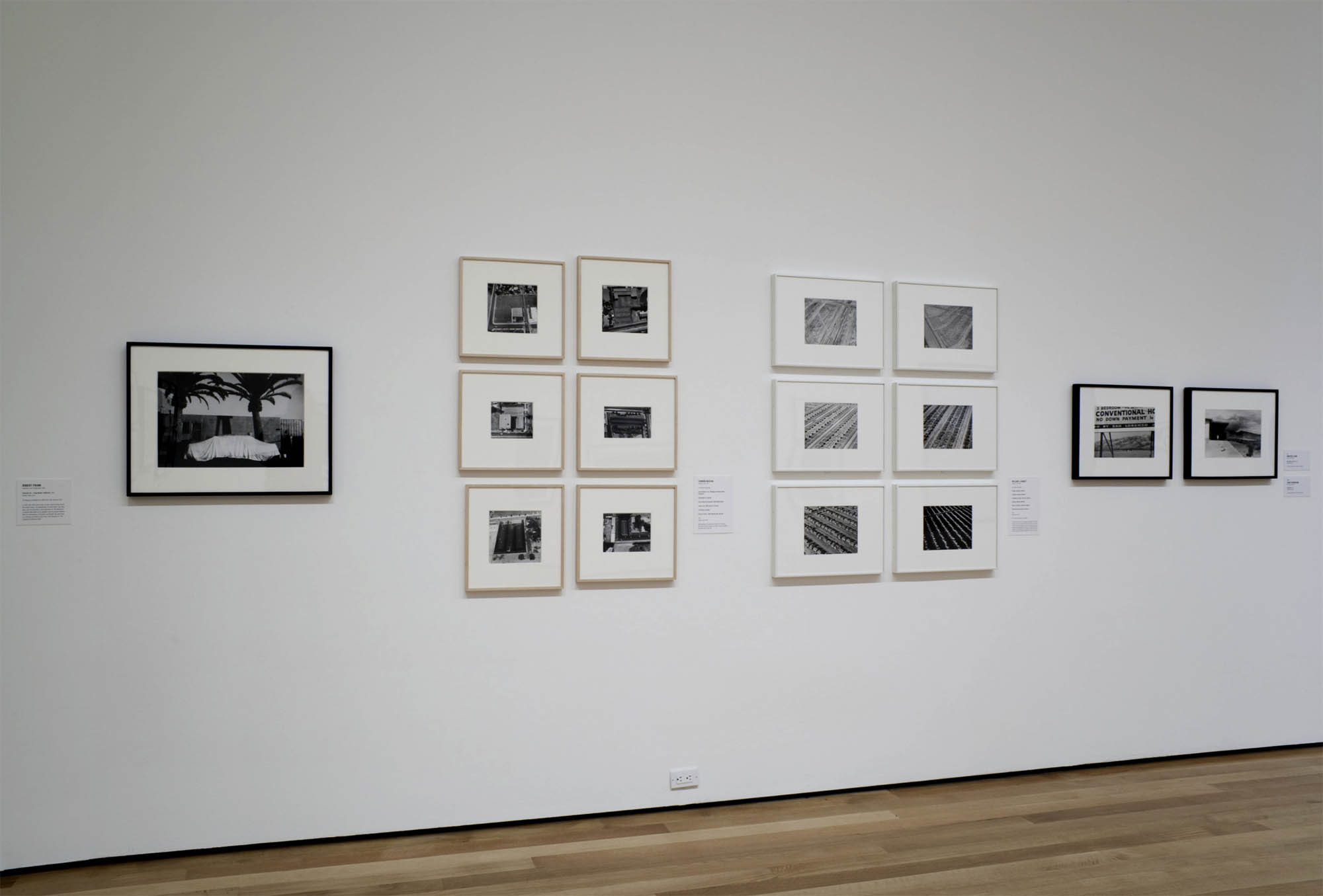
Installation view of the exhibition 'Into the Sunset: Photography's Image of the American West' at The Museum of Modern Art (MoMA), New York showing at left, Robert Frank's 'Covered Car - Long Beach, California' (1956); and at centre right, photographs by William A. Garnett


Installation view of the exhibition Into the Sunset: Photography’s Image of the American West at The Museum of Modern Art (MoMA), New York showing at left, Robert Frank’s Covered Car – Long Beach, California (1956, below); and at centre right, photographs by William A. Garnett (above)


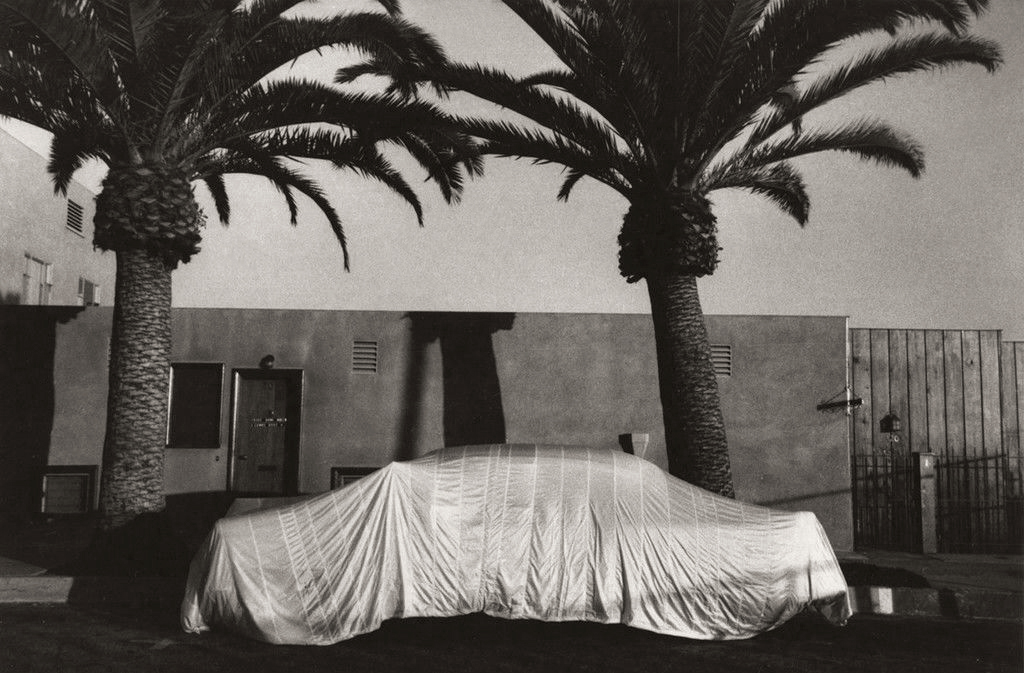
Robert Frank (American, 1924-2019) 'Covered Car - Long Beach, California' 1956


Robert Frank (American, 1924-2019)
Covered Car – Long Beach, California
1956
From The Americans (1955-1956)
Gelatin silver print
Museum of Modern Art, New York


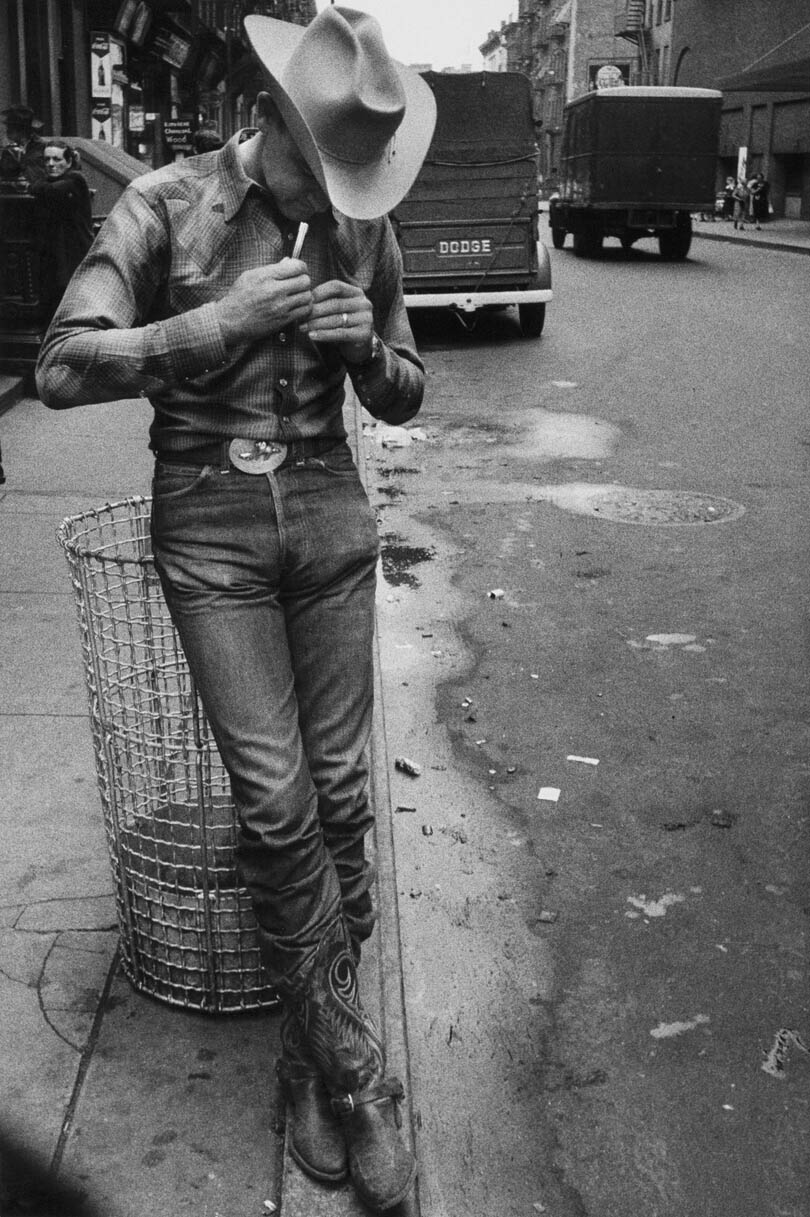
Robert Frank (American, 1924-2019) 'Rodeo - New York City' 1954


Robert Frank (American, 1924-2019)
Rodeo – New York City
1954
From The Americans (1955-1956)
Gelatin silver print
Museum of Modern Art, New York


Dorothea Lange (American, 1895-1965) 'Migrant Mother, Nipomo, California' 1936


Dorothea Lange (American, 1895-1965)
Migrant Mother, Nipomo, California
1936
Gelatin silver print
11 1/8 x 8 9/16″ (28.3 x 21.8cm)
Museum of Modern Art, New York


Dorothea Lange took this photograph on assignment for the U.S. government’s Farm Security Administration (FSA) program, formed during the Great Depression to provide aid to impoverished farmers. FSA photographers documented the conditions that Americans faced throughout the course of the Great Depression, a period of economic crisis. Lange’s photograph suggests the impact of these harsh conditions on a 32-year-old mother of seven. She took a number of pictures of the mother with her children and chose this image as the most effective. Her keen sense of composition and attentiveness to the power of historical images of the Madonna and Child have helped this photograph transcend its original documentary function and become an iconic work of art.

Text from the MoMA website


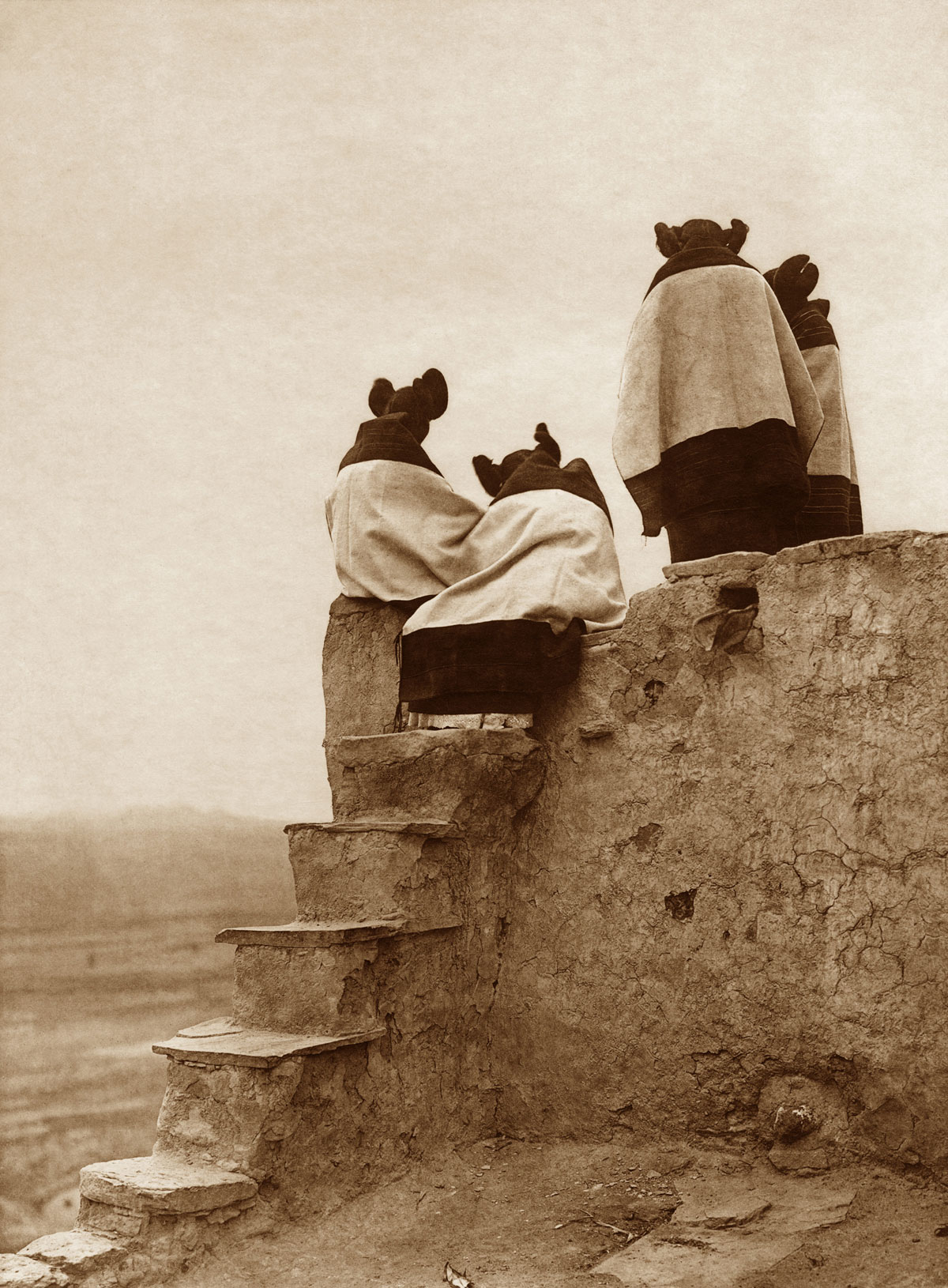
Edward S. Curtis (1868 - 1952) 'Watching the Dancers' 1906


Edward S. Curtis (American, 1868-1952)
Watching the Dancers
1906
Photogravure
Museum of Modern Art, New York


James Luna (American, 1950-2018) 'Half Indian/Half Mexican' 1991


James Luna (American, 1950-2018)
Half Indian/Half Mexican (installation view)
1991
Gelatin silver print


James Luna (February 9, 1950 – March 4, 2018) was a Payómkawichum, Ipi, and Mexican-American performance artist, photographer and multimedia installation artist. His work is best known for challenging the ways in which conventional museum exhibitions depict Native Americans. With recurring themes of multiculturalism, alcoholism, and colonialism, his work was often comedic and theatrical in nature. In 2017 he was awarded a Guggenheim Fellowship.


Richard Prince (American, b. 1949) 'Untitled (Cowboy)' 1989


Richard Prince (American, b. 1949)
Untitled (Cowboy)
1989
Chromogenic print
127 x 177.8cm (50 x 70in.)
The Metropolitan Museum of Art
Purchase, The Horace W. Goldsmith Foundation Gift, through Joyce and Robert Menschel, and Jennifer and Joseph Duke Gift, 2000
© Richard Prince


In the mid-1970s Prince was an aspiring painter who earned a living by clipping articles from magazines for staff writers at Time-Life Inc. What remained at the end of the day were the advertisements, featuring gleaming luxury goods and impossibly perfect models; both fascinated and repulsed by these ubiquitous images, the artist began rephotographing them, using a repertoire of strategies (such as blurring, cropping, and enlarging) to intensify their original artifice. In so doing, Prince undermined the seeming naturalness and inevitability of the images, revealing them as hallucinatory fictions of society’s desires.

“Untitled (Cowboy)” is a high point of the artist’s ongoing deconstruction of an American archetype as old as the first trailblazers and as timely as then-outgoing president Ronald Reagan. Prince’s picture is a copy (the photograph) of a copy (the advertisement) of a myth (the cowboy). Perpetually disappearing into the sunset, this lone ranger is also a convincing stand-in for the artist himself, endlessly chasing the meaning behind surfaces. Created in the fade-out of a decade devoted to materialism and illusion, “Untitled (Cowboy)” is, in the largest sense, a meditation on an entire culture’s continuing attraction to spectacle over lived experience.

Text from the Metropolitan Museum of Art website


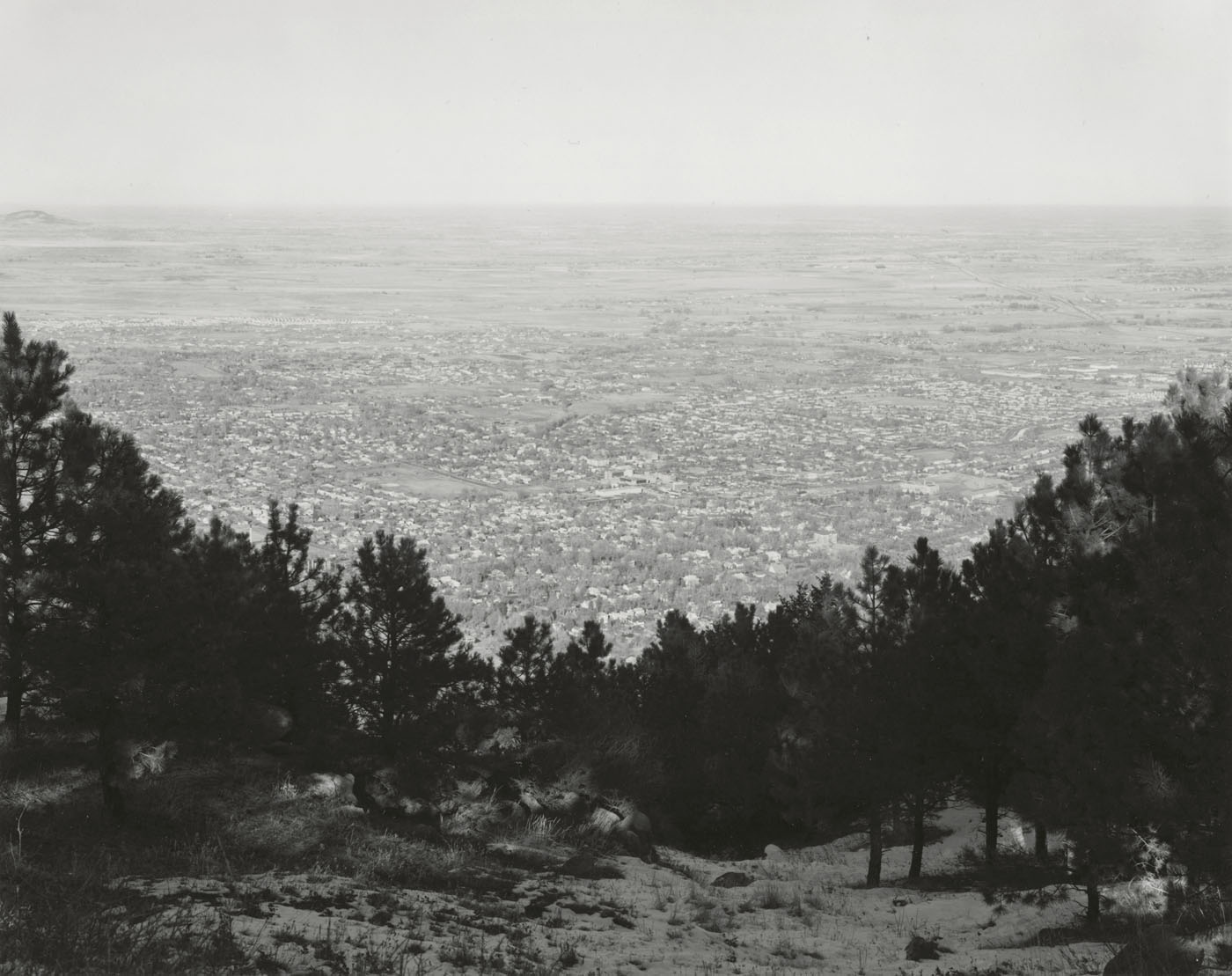
Robert Adams (American, b. 1937) 'East from Flagstaff Mountain, Boulder County, Colorado' 1975


Robert Adams (American, b. 1937)
East from Flagstaff Mountain, Boulder County, Colorado
1975
Gelatin silver print
Museum of Modern Art, New York


Robert Adams (American, b. 1937) 'Colorado Springs' 1968


Robert Adams (American, b. 1937)
Colorado Springs
1968
Gelatin silver print
Museum of Modern Art, New York


Robert Adams (American, b. 1937)
'Burning oil sludge, north of Denver, Colorado' 1973-1974


Robert Adams (American, b. 1937)
Burning oil sludge, north of Denver, Colorado
1973-1974
Gelatin silver print
Museum of Modern Art, New York


Stephen Shore (American, b. 1947) 'Beverly Boulevard and La Brea Avenue, Los Angeles, California, June 21, 1975' From the series 'Uncommon Places', 1973-1986


Stephen Shore (American, b. 1947)
Beverly Boulevard and La Brea Avenue, Los Angeles, California, June 21, 1975
1975
From the series Uncommon Places, 1973-1986
Museum of Modern Art, New York


Katy Grannan (American, b. 1969) 'Nicole, Crissy Field Parking Lot (I)' 2006


Katy Grannan (American, b. 1969)
Nicole, Crissy Field Parking Lot (I)
2006
Pigmented inkjet print
40 x 50″ (101.6 x 127cm)
Cornelius N. Bliss Memorial Fund
Museum of Modern Art, New York
© Katy Grannan


Cindy Sherman (American, b. 1954) 'Untitled Film Still #43' 1979


Cindy Sherman (American, b. 1954)
Untitled Film Still #43
1979
Gelatin silver print
7 9/16 x 9 7/16″ (19.2 x 24cm)
Acquired through the generosity of Sid R. Bass
Museum of Modern Art, New York


Cindy Sherman’s Untitled Film Stills is a suite of seventy black-and-white photographs in which the artist posed in the guises of various generic female film characters, among them, ingénue, working girl, vamp, and lonely housewife. Staged to resemble scenes from 1950s and ’60s Hollywood, film noir, B movies, and European art-house films, the printed images mimic in format, scale, and quality the often-staged “stills” used to promote films. By photographing herself in such roles, Sherman inserts herself into a dialogue about stereotypical portrayals of women. Whether she was the one to release the camera’s shutter or not, she is considered the author of the photographs. However, the works in Untitled Film Stills are not considered self-portraits.

Text from the MoMA website


Bill Owens (American, b. 1938) 'We're really happy. Our kids are healthy, we eat good food, and we have a really nice home' 1972


Bill Owens (American, b. 1938)
We’re really happy. Our kids are healthy, we eat good food, and we have a really nice home
1972
Gelatin silver print
8 1/16 x 9 15/16″ (20.4 x 25.3cm)
Gift of the photographer
Museum of Modern Art, New York
© Bill Owens


Richard Avedon (American, 1923-2004) 'Carl Hoefert, unemployed blackjack dealer, Reno, Nevada', from the series 'In the American West' August 30, 1983


Richard Avedon (American, 1923-2004)
Carl Hoefert, unemployed blackjack dealer, Reno, Nevada
August 30, 1983
From the series In the American West
Gelatin silver print
Museum of Modern Art, New York


The Museum of Modern Art
11 West 53 Street
New York, NY 10019
Phone: (212) 708-9400

Opening hours:
Sun – Fri 10.30am – 5.30pm
Sat 10.30am – 7.00pm

Monday mornings from 10.30am to 1.00pm are reserved exclusively for members and their guests.

MoMA website

LIKE ART BLART ON FACEBOOK

Back to top