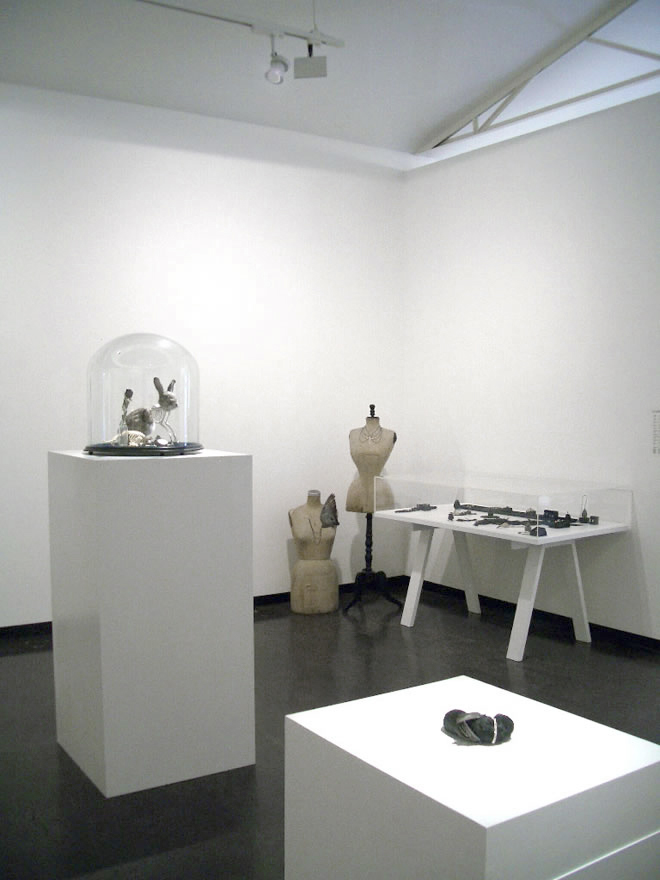
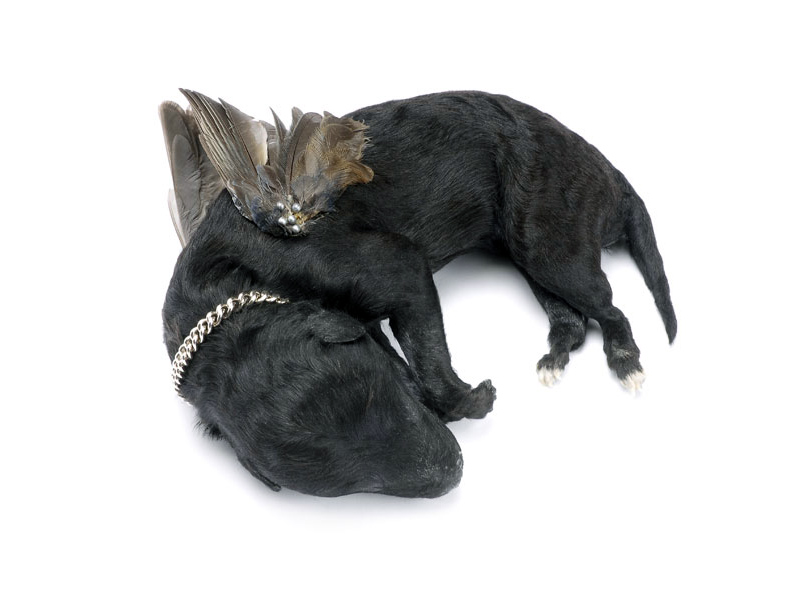
Review: ‘Ricky Swallow: The Bricoleur’ at The Ian Potter Centre, NGV Australia, Melbourne

Exhibition dates: 16th October, 2009 – 28th February, 2010
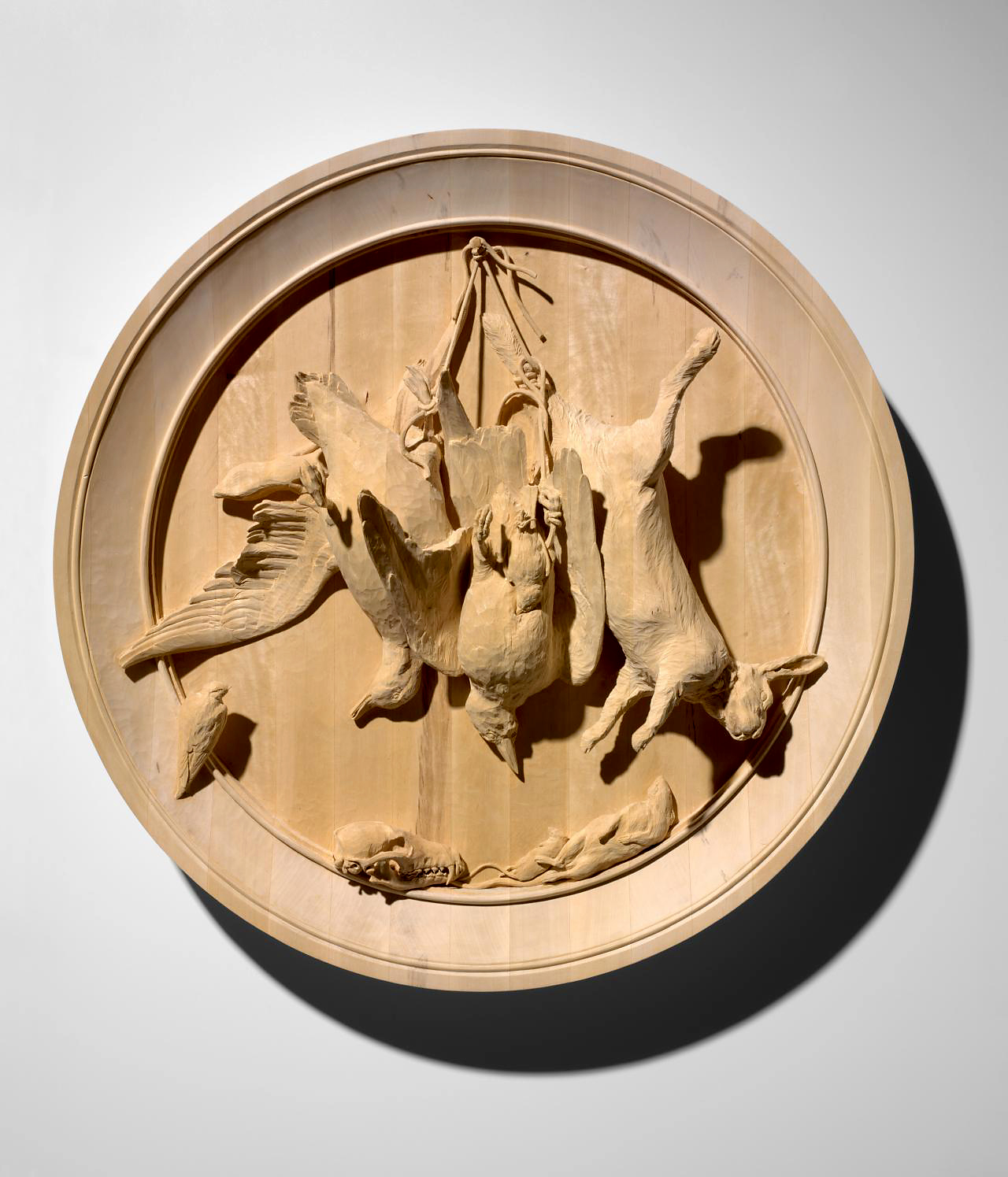
 

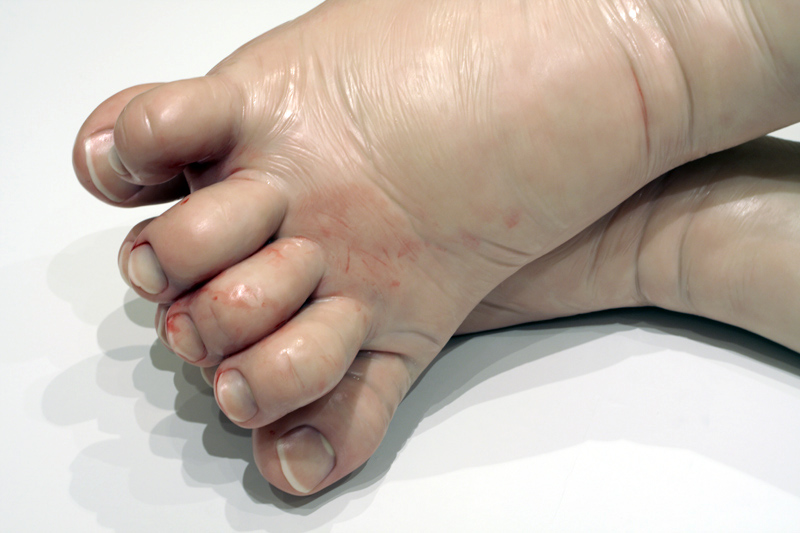
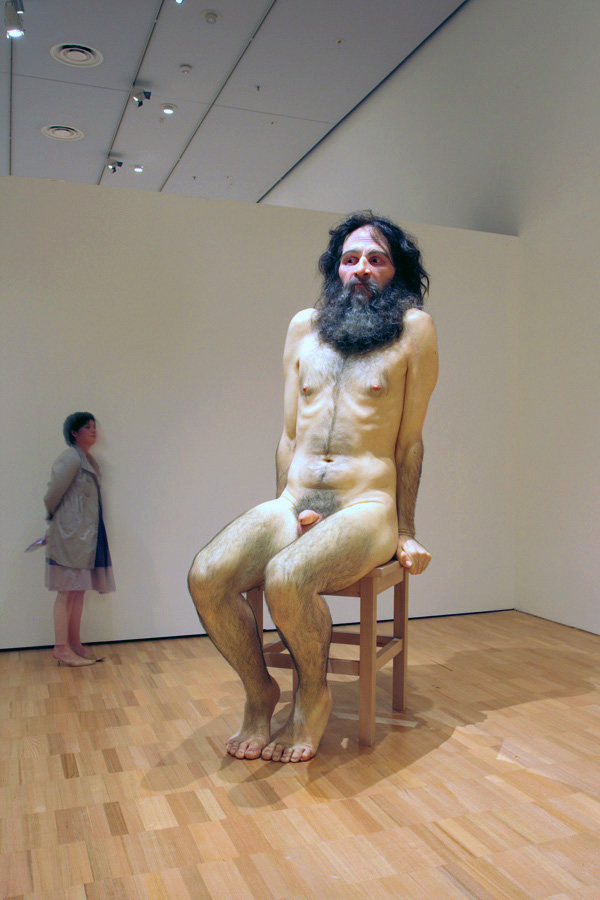
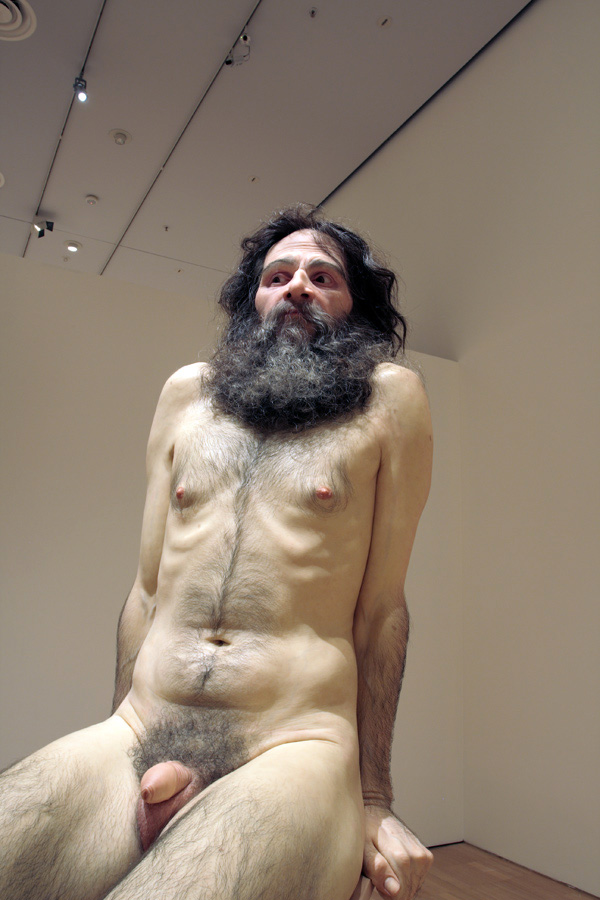
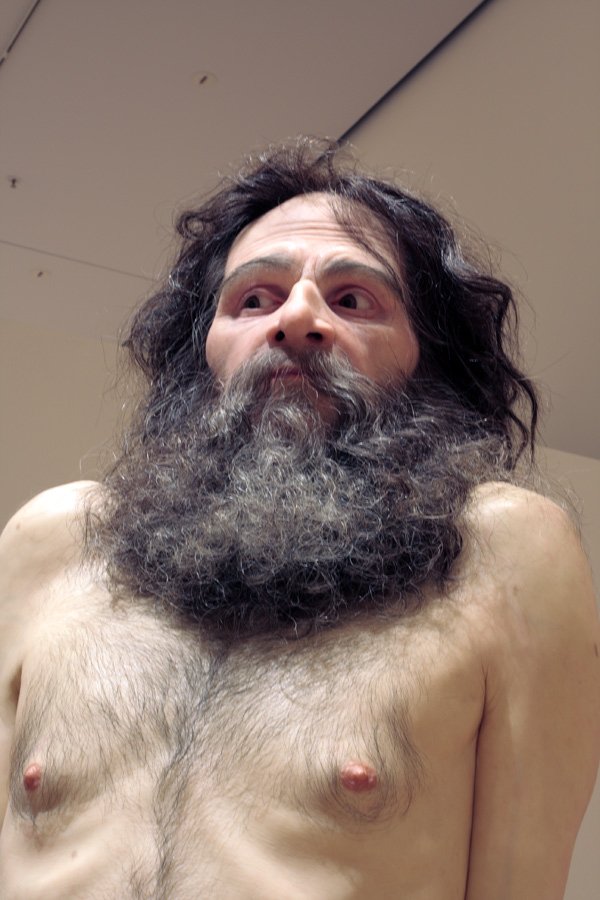
Ricky Swallow (born Australia 1974, lived in England 2003-06, United States 2006- ) 'Salad days' c. 2005 from the exhibition Review: 'Ricky Swallow: The Bricoleur' at The Ian Potter Centre, NGV Australia, Melbourne, October, 2009 - February, 2010


Ricky Swallow (born Australia 1974, lived in England 2003-2006, United States 2006- )
Salad days
c. 2005
Jelutong (Dyera costulata), maple (Acer sp.)
102.0 x 102.0 x 23.8cm
National Gallery of Victoria, Melbourne
Purchased with funds from the Victorian Foundation for Living Australian Artists, 2005
© Ricky Swallow
Photo: Andy Keate courtesy Darren Knight Gallery, Sydney


“Curiosity is a vice that has been stigmatized in turn by Christianity, by philosophy and even by a certain conception of science. Curiosity, futility. I like the word however. To me it suggests something all together different: it evokes concern; it evokes the care one takes for what exists or could exist; an acute sense of the real which, however, never becomes fixed; a readiness to find our surroundings strange and singular; a certain restlessness in ridding ourselves of our familiarities and looking at things otherwise; a passion for seizing what is happening now and what is passing away; a lack of respect for traditional hierarchies of the important and the essential.”


Michel Foucault 1


“Swallow is at his best when he’s exploring ways to communicate through the innate qualities of materials … This is always going to be more affecting than glib post-modernism, but he just can’t help himself sometimes. So my deep dislike for portentous and ironic titles bristled up immediately here. ‘Salad Days’ and ‘Killing Time’ are only two of the jokey puns, the problem is that art that simply supports two meanings isn’t very smart or complex. There’s no room for subtext. Irony is not the complex and neutral form that ambiguity is. It doesn’t invite engagement or interpretation. Art ought to aspire to infinite meanings, or maybe even only one. Irony doesn’t make for good art, when irony is the defense mechanism against meaning, masking an anxiety about sincerity.”


John Matthews 2


Let’s cut through the hyperbole. This is not the best exhibition since sliced bread (“the NGV highlight of 1609, 2009 and possibly 2109 too” says Penny Modra in The Age) and while it contains a few strong individual pieces this is not even a particularly good exhibition by Ricky Swallow at NGV Australia.

Featuring bronzes, watercolours and sculptures made from 2004-2009 that are sparingly laid out in the gallery space this exhibition comes as close to the National Gallery of Victoria holding a commercial show as you will find. Using forms such as human skeletons, skulls, balloons encrusted with barnacles, dead animals and pseudo death masks that address issues of materials and memory, time and space, discontinuity and death, Swallow’s sculptures are finely made. The craftsmanship is superb, the attention to detail magnificent and there is a feeling of almost obsessional perfectionism to the pieces. This much is given – the time and care taken over the construction, the hand of the maker, the presentation of specimen as momento mori is undeniable.

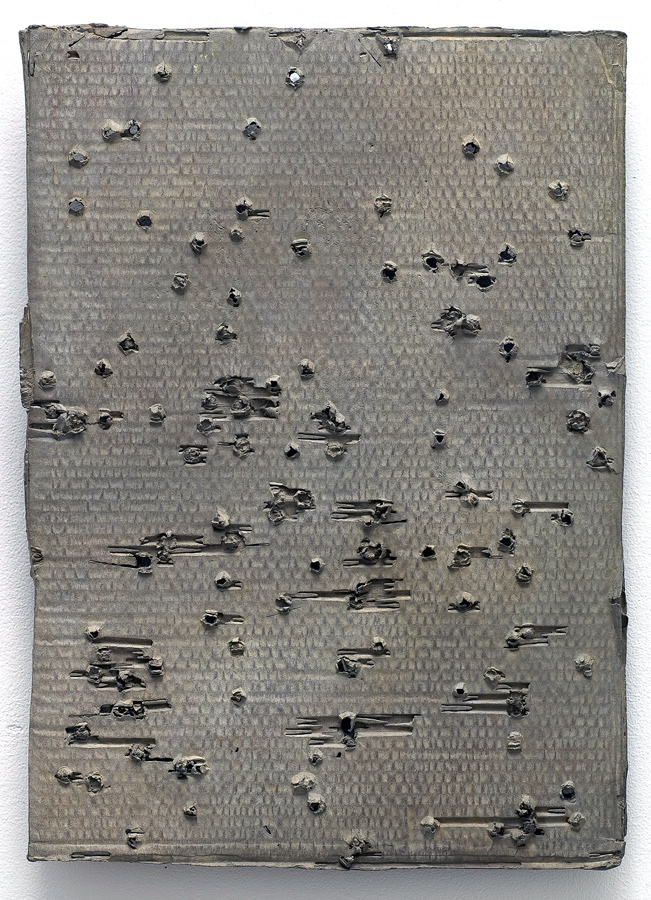
After seeing the exhibition three times the standout pieces for me are a life size dead sparrow cast in bronze (with the ironic title Flying on the ground is wrong 2006) – belly up, prostrate, feet curled under – that is delicate and poignant; Caravan (2008), barnacle encrusted bronze balloons that play with the ephemerality of life and form – a sculpture that is generous of energy and spirit, quiet yet powerful; Bowman’s record (2008), found objects of paper archery targets cast in bronze, the readymade solidified, the marks on paper made ambiguous hieroglyph of non-decaying matter, paper / bronze pierced by truth = I shot this, I was here (sometime); and Fig.1 (2008), a baby’s skull encased in a paper bag made of carved wood – the delicacy of surfaces, folds, the wooden paper collapsing into the skull itself creating the wonderful haunting presence of this piece. In these sculptures the work transcends the material state to engage the viewer in a conversation with the eternal beyond.

Swallow seeks to evidence the creation of meaning through the humblest of objects where the object’s fundamental beauty relies on the passing of time for its very existence. In the above work he succeeds. In other work throughout the exhibition he fails.

There seems to be a spare, international aesthetic at work (much like the aesthetic of the Ron Mueck exhibition at NGV International on St. Kilda Road). The art is so kewl that you can’t touch it, a dude-ish ‘Californication’ having descended on Swallow’s work that puts an emotional distance between viewer and object. No chthonic nature here, no dirt under the fingernails, no blood on the hands – instead an Apollonian kewlness, all surface and show, that invites reflection on life as discontinuous condition through perfect forms that seem twee and kitsch.

In Tusk (2007) two bronze skeletal arms hold hands in an undying bond but the sculpture simply fails to engage (the theme was brilliantly addressed by Louise Bourgeois in the first and only Melbourne Arts Biennale in 1999 with her carving in granite of two clasped hands); in History of Holding (2007) the icon of the Woodstock festival designed in 1969 is carved into a log of wood placed horizontally on the floor while  a hand holding a peeled lemon (symbolising the passing of time in the still life genre) is carved from another log of wood placed vertically. One appreciates the craftmanship of the carving but the sentiments are too saccharin, the surfaces too shallow – the allegorical layering that Swallow seeks stymied by the objects iconic form. A friend of mine insightfully observed about the exhibition: “Enough of the blond wood thing – it’s so Space Furniture!”

As John Matthews opines in the above quotation from his review of the exhibition there seems to be a lack of sincerity and authenticity of feeling in much of Swallow’s work. Irony as evidenced in the two major pieces titled Salad Days (2005) and Killing Time (2003-2004) leaves little room for the layering of meaning: “Irony is not the complex and neutral form that ambiguity is. It doesn’t invite engagement or interpretation.” Well said.

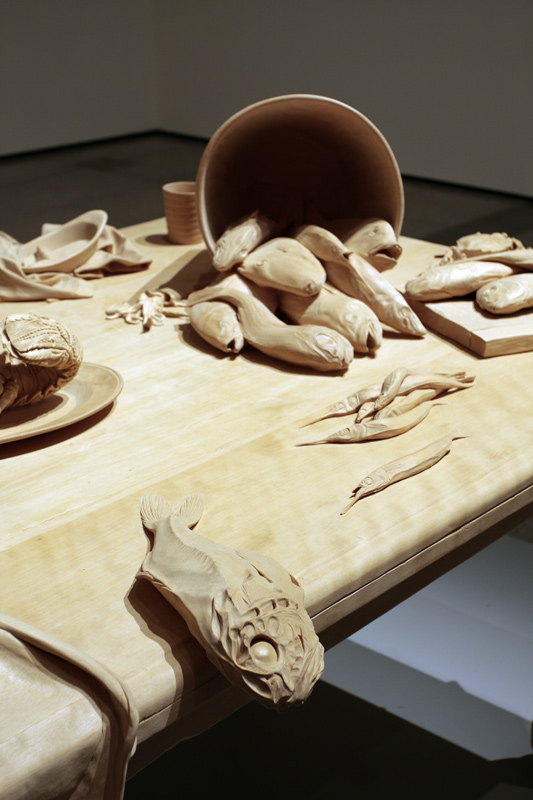
Killing Time in particular adds nothing to the vernacular of Vanitas paintings of the 17th century, adds nothing to the mother tongue of contemporary concerns about the rape of the seas, fails to update the allegories of the futility of pleasure and the inevitability of death – in fact the allegories in Swallow’s sculpture, the way he tries to twist our conception of the real, seem to have lost the power to remind us of our doom. The dead wooden fish just stare back at us with doleful, hollow eyes. The stilted iconography has no layering; it does not destroy hierarchies but builds them up.

In his early work Swallow was full of curiosity, challenging the norms of culture and creation. I always remember his wonderful series of dioramas at the Melbourne Biennale that featured old record players and animated scenes (see the photograph of Rooftop shoot out with chimpanzee (1999) below). Wow they were hot, they were fun, they made you think and challenge how you viewed the world! As Foucault notes in his excellent quotation at the top of the posting, curiosity promotes “an acute sense of the real which, however, never becomes fixed; a readiness to find our surroundings strange and singular; a certain restlessness in ridding ourselves of our familiarities and looking at things otherwise; a passion for seizing what is happening now and what is passing away; a lack of respect for traditional hierarchies of the important and the essential.”

While Swallow’s ‘diverse gestures of memorialisation’ still address the fundamental concerns of Foucault’s quotation his work seems to have become fixed in an Apollonian desire for perfection. He has forgotten how his early work challenged traditional hierarchies of existence; now, even as he twists and turns around a central axis, the conceptualisation of life, memory and death, his familiarity has become facsimile (a bricoleur is a master of nothing, a tinkerer fiddling at the edges). His lack of respect has become sublimated (“to divert the expression of (an instinctual desire or impulse) from its unacceptable form to one that is considered more socially or culturally acceptable”), his tongue in cheek has become firmly fixed, his sculptures just hanging around not looking at things otherwise.

Dr Marcus Bunyan


1/ Foucault, Michel. “The Masked Philosopher” in Politics, philosophy, culture: interviews and other writings, 1977-1984. London: Routledge, 1988, p. 328

2/ Matthews, John. “On Ricky Swallow @ NGV” on ArtKritique [Online] Cited 02/02/2010


    Ricky Swallow (born Australia 1974, lived in England 2003-06, United States 2006- ) 'Rooftop shoot out with chimpanzee' 1999


    Ricky Swallow (born Australia 1974, lived in England 2003-06, United States 2006- )
    Rooftop shoot out with chimpanzee
    1999
    From the series Even the odd orbit
    Cardboard, wood, plastic model figures and portable record player
    53.0 h x 33.0 w x 30.0 d cm
    Collection of the National Gallery of Australia
    Gift of Peter Fay 2001

    Please note: This art work is not in the exhibition
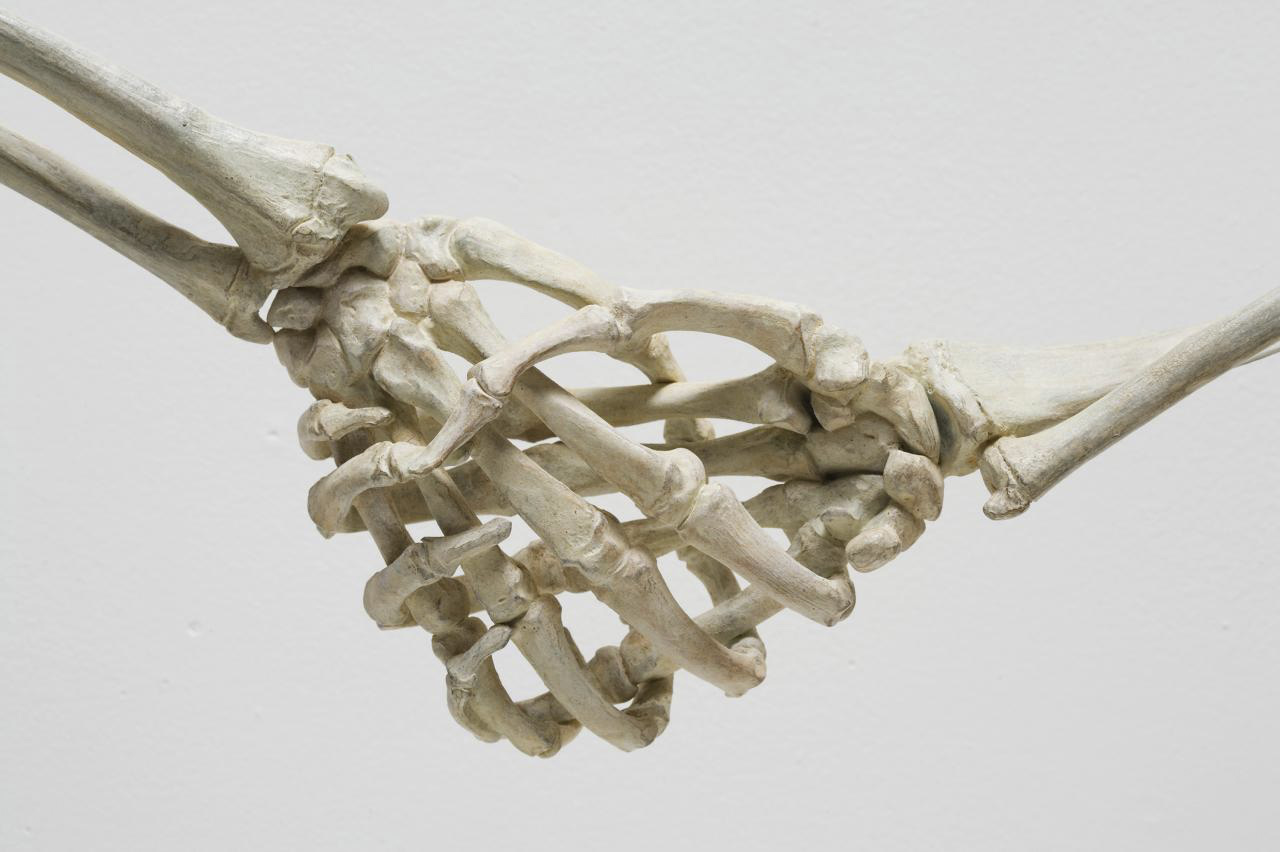
     

    Ricky Swallow (born Australia 1974, lived in England 2003-06, United States 2006- ) 'Tusk' 2007 (detail) from the exhibition Review: 'Ricky Swallow: The Bricoleur' at The Ian Potter Centre, NGV Australia, Melbourne, October, 2009 - February, 2010


    Ricky Swallow (born Australia 1974, lived in England 2003-06, United States 2006- )
    Tusk (detail)
    2007
    Patinated bronze, brass
    Edition of 3 plus 1 Artist’s Proof
    50 x 105 x 6cm
    National Gallery of Australia, Canberra Gift of the Prescott Family Foundation, 2008


    Ricky Swallow (born Australia 1974, lived in England 2003-06, United States 2006- ) 'The Man from Encinitas' 2009 from the exhibition Review: 'Ricky Swallow: The Bricoleur' at The Ian Potter Centre, NGV Australia, Melbourne, October, 2009 - February, 2010


    Ricky Swallow (born Australia 1974, lived in England 2003-06, United States 2006- )
    The Man from Encinitas
    2009
    Plaster, onyx, steel


    Ricky Swallow’s sculptures address fundamental issues that lie at the core of who we are. Things have lives. We are our things. We are things. When all is said and done it is our things – our material possessions – that outlive us. Anyone who has lost a family member or close friend knows this: what we have before us once that person is gone are the possessions that formed a life. Just as we are defined and represented by the things that we collect over time, we are ultimately objects ourselves. When we are dead and decomposed what remains are our bones, another type of object. And then there is social science. Archaeology, a subfield of anthropology, is entirely based on piecing together narratives of human relations based on material culture, that is, objects both whole and fragmentary. It may seem obvious but it is worth stressing here that our understanding of cultures from the distant past, those that originated before the advent of writing, is entirely based on the study of objects and skeletal remains. Swallow’s art addresses these basic yet enduring notions and reminds us of our deep symbiotic relationship to the stuff of daily life.

    Like the bricoleur put into popular usage by anthropologist Claude Levi-Strauss in his seminal book The Savage Mind, Ricky Swallow creates works of art often based on objects from his immediate surroundings. His method, however, is more of a second order bricolage: his sculptures are not assemblages of found objects, but rather elegantly crafted things. Handcarved from wood or plaster or cast in bronze, these humble objects are transformed into memorials to both the quotidian and the passage of time.

    Still life

    The still life has been an important touchstone throughout Swallow’s recent practice as it is an inspired vehicle for the exploration of how meaning is generated by objects. Several sculptures in the exhibition reference the still-life tradition in which Swallow updates and personalises this time-honoured genre, in particular the vanitas paintings of 17th century Holland. Vanitas still lifes, through an assortment of objects that had recognisable symbolism to a 17th-century viewer, functioned as allegories on the futility of pleasure and the inevitably of death. Swallow’s embrace of still life convention, however, is non-didactic, secular and open-ended. Swallow is not obsessed by death. On the contrary, his focus on objects is about salvaging them from the dust bin of history and honouring their continued resonance in his life.

    Killing time
    , 2003-2004, and Salad days, 2005, depict animals that Swallow and his family either found or caught when he was young and best highlight how the artist reclaims the still life genre to explore personal narrative. Killing time, which depicts a bounty of fish and crustaceans spread across a table modelled after the Swallow family kitchen table of the artist’s youth, is rife with autobiographical association. It not only references an object from Swallow’s past, but also the profession of his father, a fisherman, and the fact that Swallow was raised by the sea. Salad days is another autobiographical work depicting a range of animals such as birds, a rabbit, mice and a fox skull. Like many boys growing up in rural environments, Swallow recalls shooting magpies, encountering nesting birds in his garage or discovering dead lizards or trapping live ones in an attempt to keep them as pets.

    While not an overt still life, History of holding, 2007, suggests the genre in its fragmentary depiction of a musical instrument and the appearance of a lemon with falling rind. The hand holding / presenting a peeled lemon as the rind winds around the wrist in bracelet-like fashion is based on a cast of Swallow’s own hand, insinuating himself into this antiquated tradition. It is as if Swallow is announcing to us his deep interest in the temporality of objects through the presentation of the peeled lemon, which symbolises the passing of time and also appears in Killing time. The second component of History of holding is a sculptural interpretation of the Woodstock music festival icon designed by Arthur Skolnick in 1969, which still circulates today. History of holding, then, also references music, a leitmotif in Swallow’s art that appears both within the work itself, and also through Swallow’s use of titles.

    Body fragments

    Tusk, 2007 among several other works in the exhibition, explores the theme of body as fragment. Much has been discussed about Swallow’s use of the skeleton as a form rich in meaning within both the traditions of art history as well as popular culture (references range from the Medieval dance macabre and the memento mori of the still life tradition to the skeleton in rock music and skateboard art iconography). Tusk represents two skeletal arms with the hands clasped together in eternal union. A poignant work, Tusk is a meditation on permanence: the permanence of the human body even after death; the permanence of the union between two people, related in the fusion of the hands into that timeless symbol of love, the heart.

    Watercolours: atmospheric presentations, mummies, music, homage

    Swallow calls his watercolours “atmospheric presentations,” in contradistinction to his obviously more physical sculptures, and he sees them as respites from the intensity of labour and time invested in the sculptural work. They also permit experimentation in ways that sculpture simply does not allow. One nation underground, 2007, is a collection of images based on rock / folk musicians, several who had associations to 1960s Southern California, Swallow’s current home. Most of the subjects Swallow has illustrated in this work are now deceased; several experienced wide recognition only after their deaths. Like many of his sculptures, this group of watercolours tenderly painted with an air of nostalgia has the sensibility of a memorial – or as Swallow has called it “a modest monument”. The title of the work is based on a record album by another under-heralded rock band from the 1960s, Pearls Before Swine, and is a prime example of Swallow’s belief in the importance of titles to the viewing experience as clues or layers of meaning. In this case, the title hints at the quasi-cult status of the musicians and singers depicted. The featured musicians are Chris Bell (Big Star), Karen Dalton (a folk singer), Tim Buckley (legendary singer whose style spanned several genres and father to the late Jeff Buckley), Denny Doherty (The Mamas & the Papas ), Judee Sill (folk singer), Brian Jones (Rolling Stones), Arthur Lee (Love), John Phillips (The Mamas & the Papas ), Skip Spence (Jefferson Airplane and Moby Grape) and Phil Ochs (folk singer).

    Text from the NGV website


    Ricky Swallow (born Australia 1974, lived in England 2003-06, United States 2006- ) 'Killing Time' 2003-2004 from the exhibition Review: 'Ricky Swallow: The Bricoleur' at The Ian Potter Centre, NGV Australia, Melbourne, October, 2009 - February, 2010


    Ricky Swallow (born Australia 1974, lived in England 2003-2006, United States 2006- )
    Killing Time
    2003-04
    Laminated Jelutong, maple
    108.0 x 184.0 x 118.0cm (irreg.)
    Art Gallery of New South Wales
    Rudy Komon Memorial Fund and the Contemporary Collection Benefactors 2004
    © Ricky Swallow. Courtesy Darren Knight Gallery, Sydney


    Killing time, 2003-2004, and Salad days, 2005, depict animals that Swallow and his family either found or caught when he was young and best highlight how the artist reclaims the still life genre to explore personal narrative. Killing time, which depicts a bounty of fish and crustaceans spread across a table modelled after the Swallow family kitchen table of the artist’s youth, is rife with autobiographical association. It not only references an object from Swallow’s past, but also the profession of his father, a fisherman, and the fact that Swallow was raised by the sea. Salad days is another autobiographical work depicting a range of animals such as birds, a rabbit, mice and a fox skull. Like many boys growing up in rural environments, Swallow recalls shooting magpies, encountering nesting birds in his garage or discovering dead lizards or trapping live ones in an attempt to keep them as pets.

    Text from the National Gallery of Victoria
     

    Ricky Swallow (born Australia 1974, lived in England 2003-06, United States 2006- ) 'Killing Time' 2003-2004 (detail) from the exhibition Review: 'Ricky Swallow: The Bricoleur' at The Ian Potter Centre, NGV Australia, Melbourne, October, 2009 - February, 2010


    Ricky Swallow (born Australia 1974, lived in England 2003-2006, United States 2006- )
    Killing Time (detail)
    2003-04
    Laminated Jelutong, maple
    108.0 x 184.0 x 118.0cm (irreg.)
    Art Gallery of New South Wales
    Rudy Komon Memorial Fund and the Contemporary Collection Benefactors 2004
    © Ricky Swallow. Courtesy Darren Knight Gallery, Sydney


    “I’ve always been interested in how an object can be remembered and how that memory can be sustained and directed sculpturally, pulling things in and out of time, passing objects through the studio as a kind of filter returning them as new forms.”

    Ricky Swallow in Goth: Reality of the Departed World. Yokohama: Yokohama Museum of Art, 2007


    A new exhibition featuring the work of internationally renowned Australian artist Ricky Swallow will open at The Ian Potter Centre: NGV Australia on 16 October 2009.

    Ricky Swallow: The Bricoleur is the artist’s first major exhibition in Australia since 2006. This exhibition will feature several of the artist’s well‐known intricately detailed, carved wooden sculptures as well as a range of new sculptural works in wood, bronze and plaster. The exhibition will also showcase two large groups of watercolours, an aspect of Swallow’s practice that is not as well known as his trademark works.

    Salad days (2005) and Killing time (2003‐2004), which were featured in the 2005 Venice Biennale and are considered Swallow icons, will strike a familiar chord with Melbourne audiences.

    Sculptures completed over the past year include bronze balloons on which bronze barnacles seamlessly cling (Caravan, 2008); a series of cast bronze archery targets (Bowman’s Record, 2008) that look like desecrated minimalist paintings; and carved wooden sculpture of a human skull inside what looks like a paper bag.

    A highlight of the show will be Swallow’s watercolour, One Nation Underground (2007), recently acquired by the NGV. The work presents a collection of images based on 1960s musicians including Tim Buckley, Denny Doherty, Brian Jones and John Phillips.

    Alex Baker, Senior Curator, Contemporary Art, NGV said the works in this exhibition explore the themes of life and death, time and its passing, mortality and immortality.

    “Swallow’s art investigates how memory is distilled within the objects of daily life. His work addresses the fundamental issues that lie at the core of who we are, reminding us of our deep symbiotic relationship to the stuff of everyday life.”

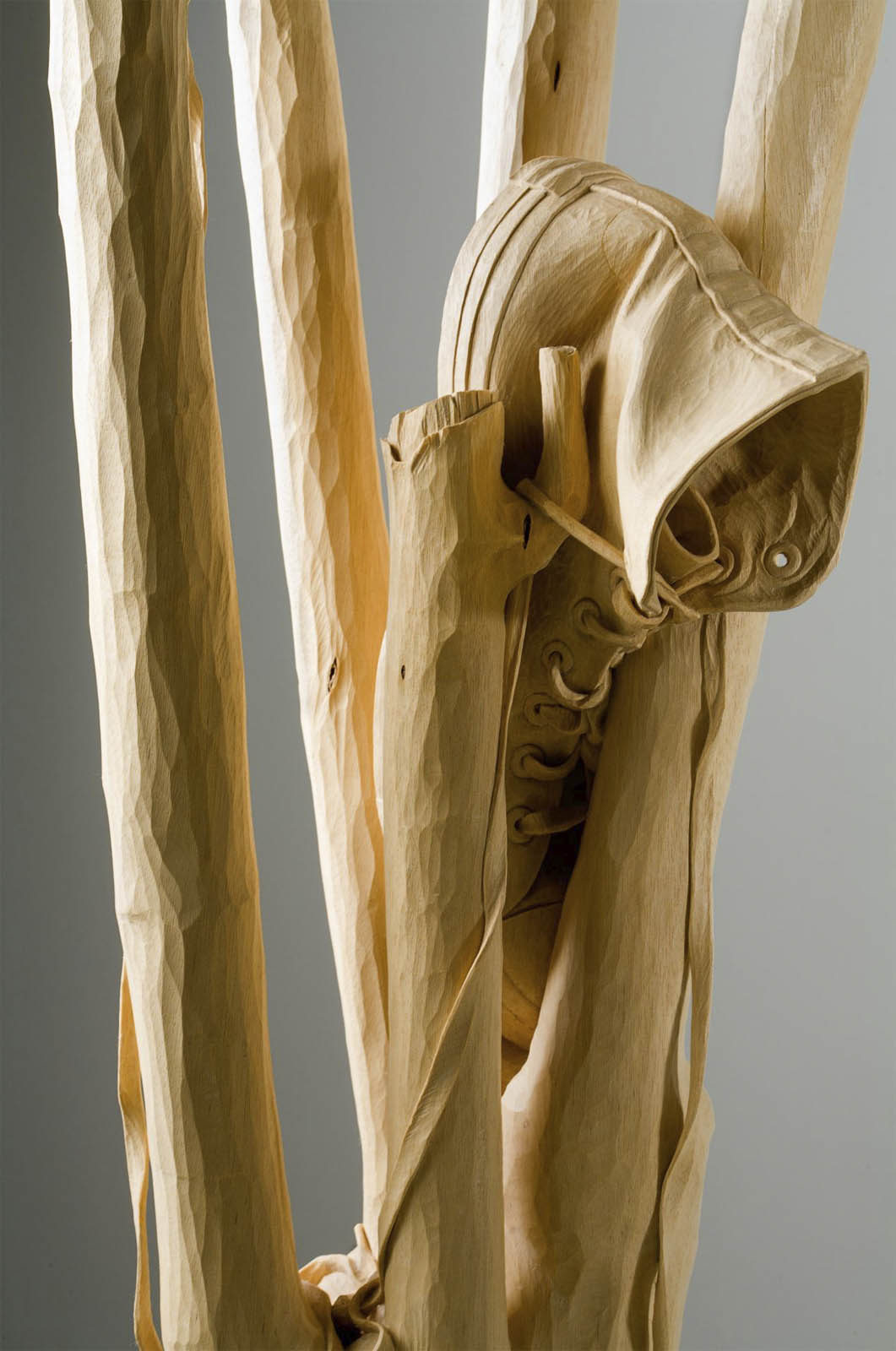
    “The exhibition’s title The Bricoleur refers to the kind of activities performed by a handyman or tinkerer, someone who makes creative use of whatever might be at hand. The Bricoleur is also the title of one of the sculptures in the exhibition, which depicts a forlorn houseplant with a sneaker wedged between its branches,” said Dr Baker.

    Gerard Vaughan, Director, NGV, said this exhibition reinforces the NGV’s commitment to exhibiting and collecting world‐class contemporary art.

    “The NGV has enjoyed a long and successful relationship with Ricky Swallow, exhibiting and acquiring a number of his works over the years. His detailed and exquisitely crafted replicas of commonplace objects never fail to inspire visitors to the Gallery.”

    Ricky Swallow was born in Victoria in 1974 and currently lives and works in Los Angeles, California. His career has enjoyed a meteoric rise since winning the NGV’s prestigious Contempora5 art prize in 1999. Since then, Swallow has exhibited in the UK, Europe and the United States, and represented Australia at
    the 2005 Venice Biennale.

    Press release from the NGV


    Ricky Swallow (born Australia 1974, lived in England 2003-2006, United States 2006- ) 'A sad but very discreet recollection of beloved things and beloved beings' 2005 (detail)


    Ricky Swallow (born Australia 1974, lived in England 2003-2006, United States 2006- )
    A sad but very discreet recollection of beloved things and beloved beings (detail)
    2005
    Watercolour
    (1-10) 35.0 x 28.0cm (each)
    Private collection
    © Ricky Swallow
    Photo: courtesy Stuart Shave/Modern Art, London
     

    Ricky Swallow (born Australia 1974, lived in England 2003-06, United States 2006- ) 'Bowman’s record' 2008 (detail)


    Ricky Swallow (born Australia 1974, lived in England 2003-2006, United States 2006- )
    Bowman’s record (detail)
    2008
    Bronze
    46.0 x 33.0 x 2.5cm
    Collection of the artist, Los Angeles
    © Ricky Swallow
    Photo: Robert Wedemeyer courtesy Stuart Shave/Modern Art, London
     

    Ricky Swallow (born Australia 1974, lived in England 2003-2006, United States 2006- ) 'The Bricoleur' 2006 (detail)


    Ricky Swallow (born Australia 1974, lived in England 2003-2006, United States 2006- )
    The Bricoleur (detail)
    2006
    Jelutong (Dyera costulata)
    122 x 25 x 25cm
    Private collection


    The Ian Potter Centre: NGV Australia Federation Square
    Corner of Russell and 
Flinders Streets, Melbourne

    Opening hours:
    Open daily 10am-5pm
    National Gallery of Victoria website

    LIKE ART BLART ON FACEBOOK

    Back to top

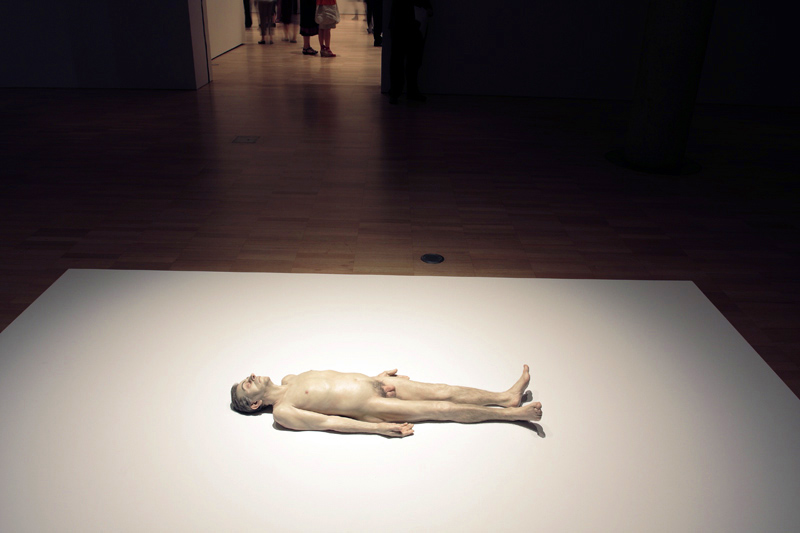
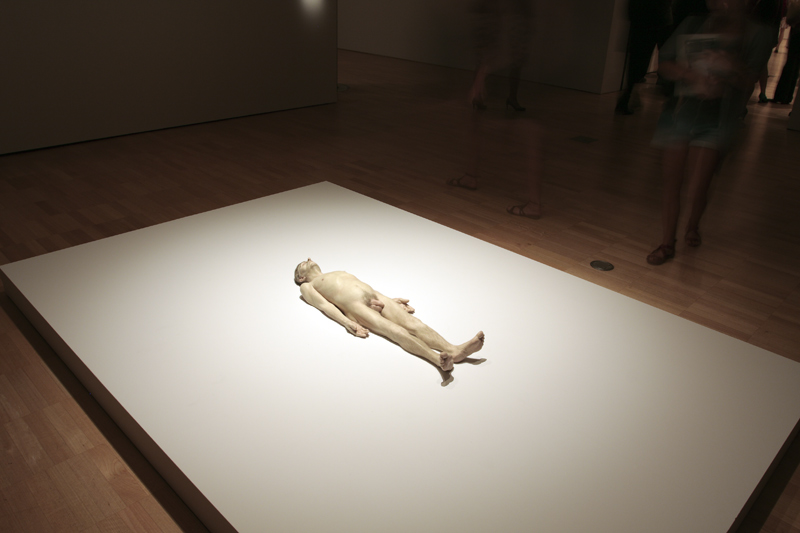
    Opening: ‘Ron Mueck’ at the National Gallery of Victoria International, Melbourne

    Exhibition dates: 22nd January – 18th April, 2010


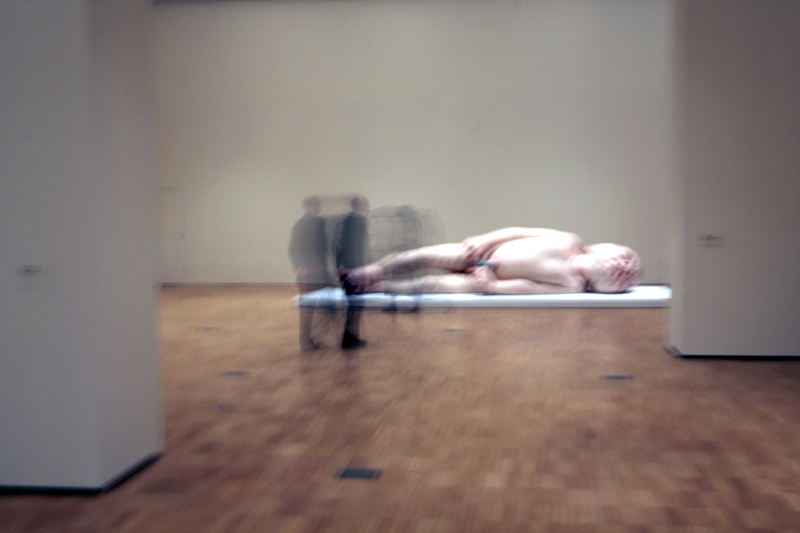
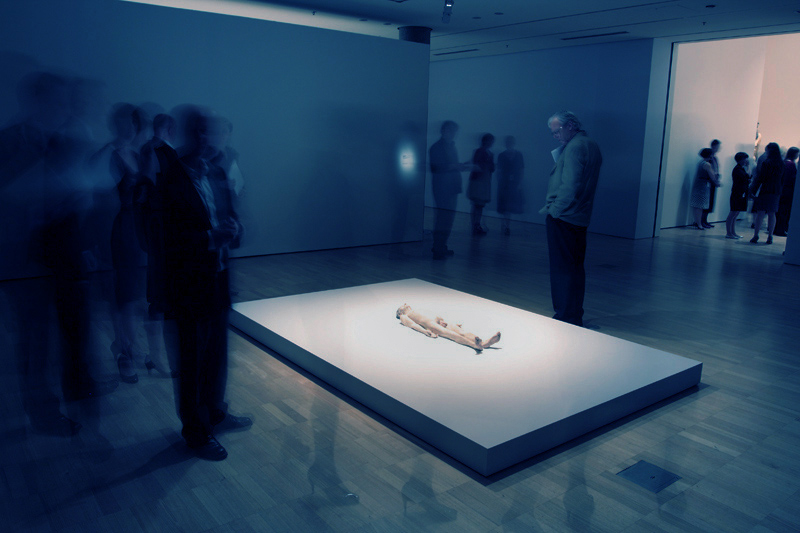
    Ron Mueck (Australian b. 1958) 'Dead Dad' 1996-1997 (installation view) from the exhibition 'Ron Mueck' at the National Gallery of Victoria International, Melbourne, January - April, 2010


    Ron Mueck (Australian, b. 1958)
    Dead Dad (installation view)
    1996-1997
    Silicone, polyurethane, styrene, synthetic hair
    Ed. 1/1
    20 x 38 x 102cm
    Stefan T. Edlis Collection, Chicago
    © Ron Mueck courtesy Anthony d’Offay, London
    Photo: © Marcus Bunyan and the National Gallery of Victoria


    You saw it first on Art Blart.

    Many thankx to Sue, Erin, Alison and all the crew at the National Gallery of Victoria for inviting me to the media opening (and for doing such a splendid job!) and to David Hurlston, Curator of Australian Art at the NGV, for allowing me to interview him.

    The photographs of the exhibition proceed in chronological order. There are a couple of lovely photographs using long exposure (especially the very last photograph one of my favourites). Enjoy!

    Dr Marcus Bunyan


    Photos: © Marcus Bunyan and the National Gallery of Victoria. Please click on the photograph for a larger version of the image.


    Ron Mueck (Australian b. 1958) 'Dead Dad' 1996-1997 (installation view) from the exhibition 'Ron Mueck' at the National Gallery of Victoria International, Melbourne, January - April, 2010

    Ron Mueck (Australian b. 1958) 'Dead Dad' 1996-1997 (installation view)

    Ron Mueck (Australian b. 1958) 'Dead Dad' 1996-1997 (installation view)

    Ron Mueck (Australian b. 1958) 'Dead Dad' 1996-1997 (installation view)


    Ron Mueck (Australian, b. 1958)
    Dead Dad (installation views)
    1996-1997
    Silicone, polyurethane, styrene, synthetic hair
    Ed. 1/1
    20 x 38 x 102cm
    Stefan T. Edlis Collection, Chicago
    © Ron Mueck courtesy Anthony d’Offay, London
    Photos: © Marcus Bunyan and the National Gallery of Victoria


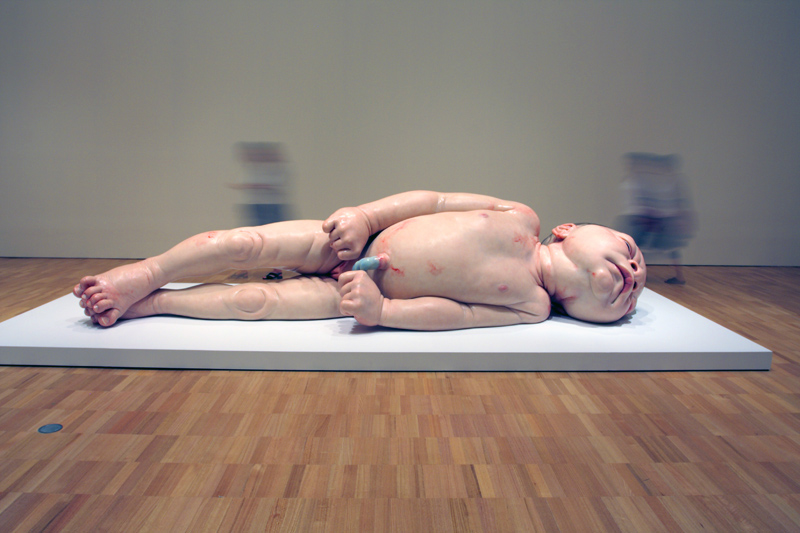
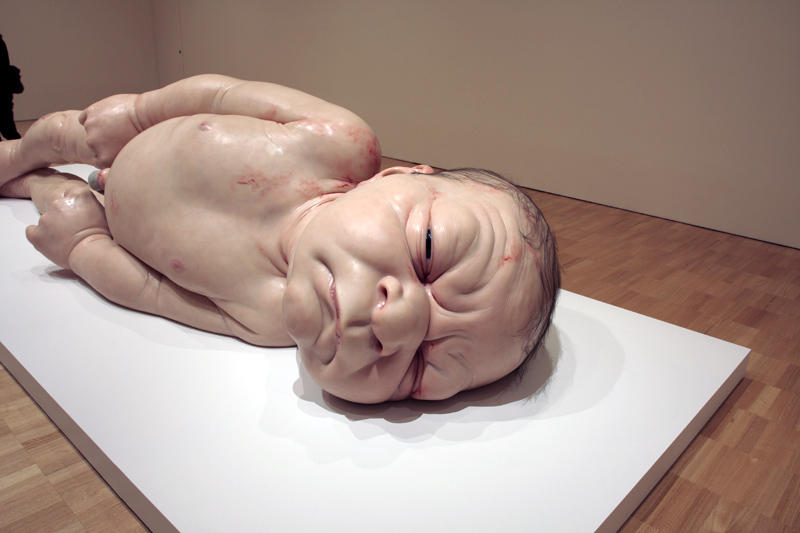
    Ron Mueck (Australian, b. 1958) 'A girl' 2006 (installation view) from the exhibition 'Ron Mueck' at the National Gallery of Victoria International, Melbourne, January - April, 2010

    Ron Mueck (Australian, b. 1958) 'A girl' 2006 (installation view)

    Ron Mueck (Australian, b. 1958) 'A girl' 2006 (installation view)

    Ron Mueck (Australian, b. 1958) 'A girl' 2006 (installation view)

    Ron Mueck (Australian, b. 1958) 'A girl' 2006 (installation view)


    Ron Mueck (Australian, b. 1958)
    A girl (installation views)
    2006
    Polyester resin, fibreglass, silicone, synthetic hair, synthetic polymer paint
    Second edition, artist’s proof
    110 x 501 x 134.5cm
    Scottish National Gallery of Modern Art, Edinburgh Purchased with assistance from The Art Fund, 2007
    © Ron Mueck
    Photos: © Marcus Bunyan and the National Gallery of Victoria


    Ron Mueck (Australian, b. 1958) 'Wild Man' 2005 (installation view)

    Ron Mueck (Australian, b. 1958) 'Wild Man' 2005 (installation view detail)

    Ron Mueck (Australian, b. 1958) 'Wild Man' 2005 (installation view detail)


    Ron Mueck (Australian, b. 1958)
    Wild Man (installation views)
    2005
    Polyester resin, fibreglass, silicone, aluminium, wood and synthetic hair
    2850 x 1619 x 1080 mm
    Scottish National Gallery of Modern Art, Edinburgh Purchased with assistance from The Art Fund, 2008
    © Ron Mueck
    Photos: © Marcus Bunyan and the National Gallery of Victoria


    Mueck initially planned to make a figure who appeared confined, as if backed into a corner, but decided to make Wild Man after seeing an illustration of the colossal stone sculpture Appennino 1579-1580 (Villa di Pratolino, Vaglia, Italy) by the late Renaissance artist Giambologna. Appennino depicts a crouching hirsute river god, which inspired the oversized hairy ‘wild man’ of Mueck’s sculpture. The critic Anne Cranny-Francis notes that a wild man tends to be a reclusive individual afraid of human society and that this ‘might explain why [Mueck’s] large male figure – in one sense, the very image of the powerful white male – grips his chair, body rigid with tension, and stares over the heads of viewers in a paroxysm of fear’ (Cranny-Francis 2013, p. 6). The man’s nakedness adds to this sense of vulnerability, making him both physically and emotionally exposed.

    Extract from Susan McAteer. “Ron Mueck: Wild Man,” on the Tate website February 2015 [Online] Cited 23/05/2019


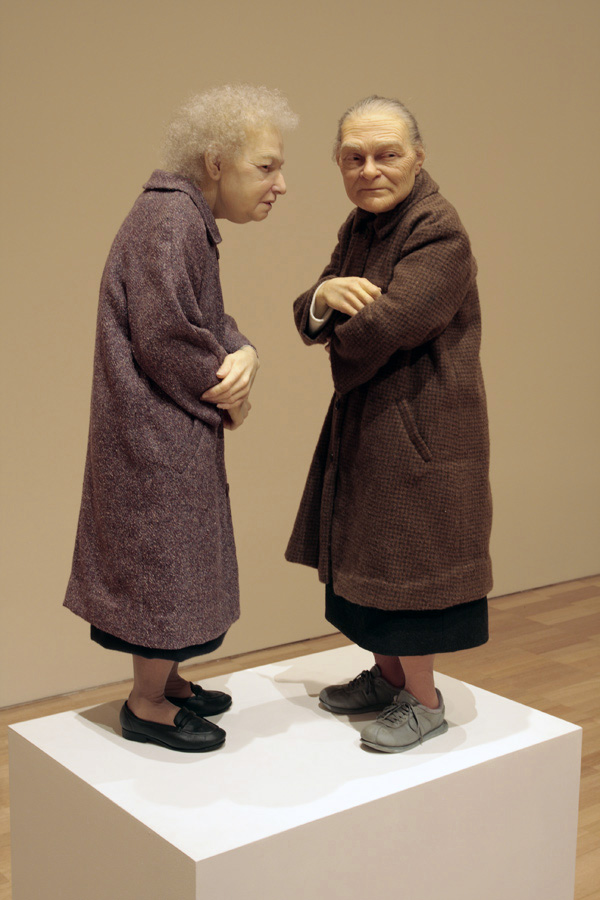
    Ron Mueck (Australian, b. 1958) 'Two Women' 2005 (installation view)

    Ron Mueck (Australian, b. 1958) 'Two Women' 2005 (installation view)

    Ron Mueck (Australian, b. 1958) 'Two Women' 2005 (installation view detail)

    Ron Mueck (Australian, b. 1958) 'Two Women' 2005 (installation view detail)


    Ron Mueck (Australian, b. 1958)
    Two Women (installation views)
    2005
    Polyester resin, fibreglass, silicone, polyurethane, aluminium wire, steel, wool, cotton, nylon, synthetic hair, plastic, metal
    Ed. 1/1
    82.6 x 48.7 x 41.5cm (variable)
    National Gallery of Victoria, Melbourne
    Purchased, Victorian Foundation for Living Australian Artists, 2007
    © Ron Mueck
    Photos: © Marcus Bunyan and the National Gallery of Victoria


    Ron Mueck’s Two women is an uncanny sculptural representation of two elderly female figures. The disarming realism of the work invites close scrutiny from which the viewer discovers Mueck’s virtuoso skill in rendering human features, costume details and the idiosyncratic attributes that form personality. Huddled close together, as if gently bracing themselves from the cold, the women peer outward with expressions that suggest both suspicion and vulnerability.

    A strong component of fantasy exists in Mueck’s work as he deliberately subverts conventional paradigms of scale. Much like the characters of Gulliver’s Travels, Mueck’s figures are monumentally increased or dramatically reduced in size. Mueck has explained, ‘I never made life-size figures because it never seemed to be interesting. We meet life-size people every day’ (S. Tanguy, ‘The progress of Big man: A conversation with Ron Mueck’, Sculpture, vol. 22, no. 6, 2003). The effect, as in the case of Two women, intensifies the physical and emotional aura of his figures. The minute stature of the women creates a tension between artifice and reality that elicits a viscerally empathetic response from the viewer. His creations appear seemingly trapped in introverted emotional states as their physical poses, gestures and facial expressions reflect the inner world of private feelings and thoughts. Mueck’s figurative sculptures often explore the timeless themes of birth, ageing and death.

    The craftsmanship with which Mueck constructs his sculptures adds significant impact to our viewing experience. This is very much apparent in Two women where each strand of hair is individually inserted into the characters’ heads; the clothes are specifically tailored to fit their anatomically proportioned, yet miniature bodies. Mueck has carefully fabricated the eyes of the women creating a transparent lens over a coloured iris and deep black pupil to astounding effect.

    Extract from Alex Baker. “Ron Mueck’s Two women,” in Art Bulletin of Victoria 48, 29 January 2014 [Online] Cited 25/05/2019


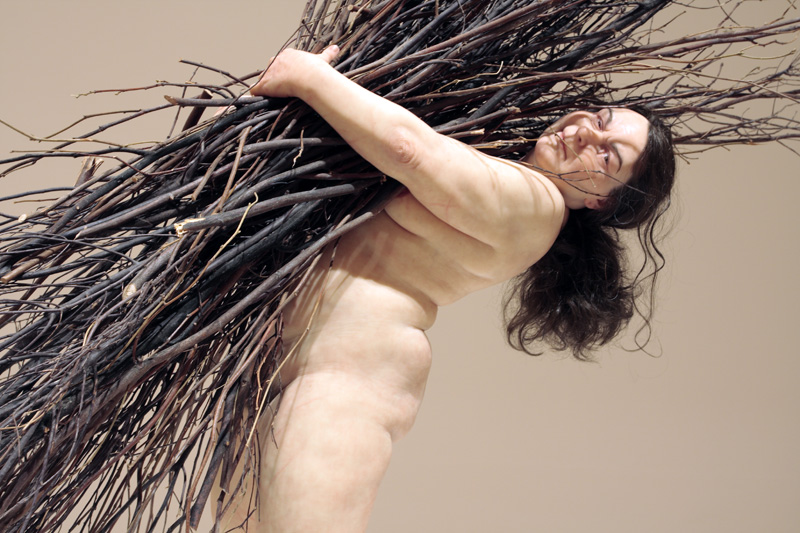
    Ron Mueck (Australian, b. 1958) 'Woman with Sticks' 2008 (installation view detail)

    Ron Mueck (Australian, b. 1958) 'Woman with Sticks' 2008 (installation view detail)

    Ron Mueck (Australian, b. 1958) 'Woman with Sticks' 2008 (installation view detail)


    Ron Mueck (Australian, b. 1958)
    Woman with Sticks (installation views)
    2008
    Mixed media
    170 x 183 x 120cm
    Fondation Cartier pour l’art Contemporain, Paris
    © Ron Mueck
    Photos: © Marcus Bunyan and the National Gallery of Victoria


    In January 2010, the National Gallery of Victoria will present a major exhibition of the work of internationally renowned sculptor Ron Mueck.

    Known for his extraordinarily life-like creations, this exhibition will feature twelve sculptures by Mueck including four new works.

    This will be the largest and most comprehensive Mueck exhibition ever to be held in Australia.

    Frances Lindsay, NGV Deputy Director, said: “Since his dramatic entry onto the international art stage, Mueck has continued to astound audiences with his realistic, figurative sculptures and now occupies a unique and important place in the field of international contemporary art.”

    David Hurlston, Curator Australian Art, said Ron Mueck’s poignant sculptures illustrate timeless human conditions from birth to demise.

    “Mueck’s sculptures range from puckish portrayals of childhood innocence to acute observations of stages of life; from birth to adolescence, middle and old age, and even death. Many are solitary figures, psychological portraits of emotional intensity and of isolation,” said Mr Hurlston.

    The exhibition will draw from Australian and international collections, highlights include: Mask II 2001/02, Man in a boat (2002), Old woman in bed (2000/02), Wild man (2005), Two women (2005), In bed (2005), and through the generosity of a private collector from the United States, the iconic work Dead Dad (1996/97).

    In addition to these there will be a number of new works created specifically for this exhibition which will be unveiled for the first time in Melbourne.

    In his early career Melbourne-born Mueck worked as a puppet maker, however since 1997 he has been entirely devoted to making sculpture. In 1996, he was ‘discovered’ by British advertising guru Charles Saatchi, who included Mueck’s Dead Dad as part of the history making Sensation exhibition the following year.

    Mueck went on to represent Australia at the 2001 Venice Biennale, capturing worldwide attention for his 4.5 metre sculpture, Crouching Boy.  Since then, he has become one of the most significant figures in the contemporary art world.

    Ron Mueck will be on display at NGV International on St Kilda Road from 22 January until 18 April 2010.

    Press release from the National Gallery of Victoria website [Online] Cited 20/01/2010. No longer available online


    Ron Mueck (Australian, b. 1958) 'Man in a boat' 2002 (installation view detail)

    Ron Mueck (Australian, b. 1958) 'Man in a boat' 2002 (installation view detail)


    Ron Mueck (Australian, b. 1958)
    Man in a boat (installation view details)
    2002
    Mixed media
    159 x 138 x 425.5cm
    © Ron Mueck
    Photos: © Marcus Bunyan and the National Gallery of Victoria


    Ron Mueck (Australian, b. 1958) 'Youth' 2009 (installation view)


    Ron Mueck (Australian b. 1958)
    Youth (installation view)
    2009
    Mixed media
    65 x 28 x 16cm
    Private collection
    © Ron Mueck
    Photos: © Marcus Bunyan and the National Gallery of Victoria


    Installation photograph of Ron Mueck's 'Youth' (2009) with 'Still life' (2009) in the background

    Installation photogtaph of Ron Mueck's 'Youth' (2009) with 'Still life' (2009) in the background


    Installation photographs of Ron Mueck’s Youth (2009) with Still life (2009) in the background
    Photos: © Marcus Bunyan and the National Gallery of Victoria


    Ron Mueck (Australian, b. 1958) 'Still life' 2009 (installation view)

    Ron Mueck (Australian, b. 1958) 'Still life' 2009 (installation view detail)


    Ron Mueck (Australian, b. 1958)
    Still life (installation views)
    2009
    Fondation Cartier pour l’art contemporain
    © Ron Mueck
    Photos: © Marcus Bunyan and the National Gallery of Victoria


    Ron Mueck (Australian, b. 1958) 'Old Woman in bed' 2002 (installation view)

    Ron Mueck (Australian, b. 1958) 'Old Woman in bed' 2002 (installation view detail)


    Ron Mueck (Australian, b. 1958)
    Old Woman in bed (installation views)
    2002
    Polyester resin, fibreglass, silicone, polyurethane, synthetic hair, cotton, polyester, second edition, artist’s proof
    25.4 x 94.0 x 53.9cm
    Art Gallery of New South Wales, Sydney, purchased 2003
    © Ron Mueck
    Photos: © Marcus Bunyan and the National Gallery of Victoria


    Ron Mueck (Australian, b. 1958) 'Drift' 2009 (installation view)

    Ron Mueck (Australian, b. 1958) 'Drift' 2009 (installation view)


    Ron Mueck (Australian, b. 1958)
    Drift (installation views)
    2009
    Mixed media
    118 x 96 x 21cm
    Private collection
    © Ron Mueck
    Photos: © Marcus Bunyan and the National Gallery of Victoria


    Installation photograph of the 'Ron Mueck' exhibition at the National Gallery of Victoria showing at left Woman with 'Sticks' (2005) and at right 'Two Woman' (2005) with 'A girl' (2006) in the distance


    Installation photograph of the Ron Mueck exhibition at the National Gallery of Victoria showing at left Woman with Sticks (2005) and at right Two Woman (2005) with A girl (2006) in the distance
    Photo: © Marcus Bunyan and the National Gallery of Victoria


    Installation photograph of the 'Ron Mueck' exhibition at the National Gallery of Victoria showing 'A girl' (2006)


    Installation photograph of the Ron Mueck exhibition at the National Gallery of Victoria showing A girl (2006)
    Photo: © Marcus Bunyan and the National Gallery of Victoria

    My favourite pic of the day!


    NGV International
    180 St Kilda Road

    Opening hours
    Daily 10am – 5pm

    National Gallery of Victoria website

    LIKE ART BLART ON FACEBOOK

    Back to top

    Review: ‘Unforced Intimacies’ by Patricia Piccinini at Tolarno Galleries, Melbourne

    Exhibition dates: 22nd October – 21st November 2009


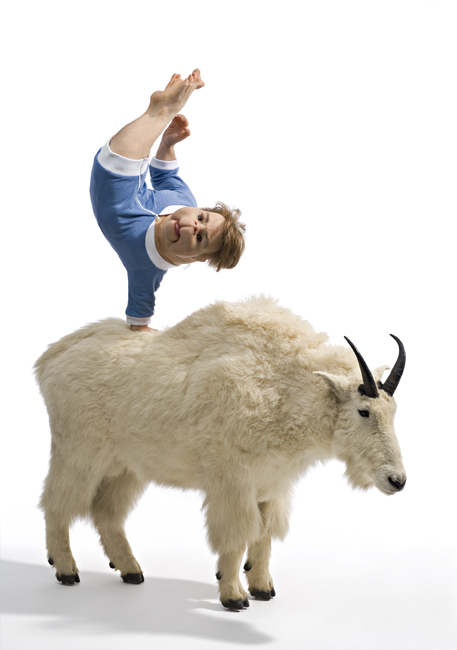
    Patricia Piccinini (Australian, b. 1965) 'The Strength of one Hand (With Canadian Mountain Goat)' 2009 from the exhibition 'Unforced Intimacies' by Patricia Piccinini at Tolarno Galleries, Melbourne, Oct - Nov, 2009


    Patricia Piccinini (Australian, b. 1965)
    The Strength of one Hand (With Canadian Mountain Goat)
    2009
    Silicone, fibreglass, human hair, clothing, Canadian Mountain Goat


    We are the clouds that veil the midnight moon;
    How restlessly they speed, and gleam, and quiver,
    Streaking the darkness radiantly! – yet soon
    Night closes round, and they are lost forever:

    Or like forgotten lyres, whose dissonant strings
    Give various response to each varying blast,
    To whose frail frame no second motion brings
    One mood or modulation like the last.

    We rest. – A dream has power to poison sleep;
    We rise. – One wandering thought pollutes the day;
    We feel, conceive or reason, laugh or weep;
    Embrace fond foe, or cast our cares away:

    It is the same! – For, be it joy or sorrow,
    The path of its departure still is free:
    Man’s yesterday may ne’er be like his morrow;
    Nought may endure but Mutability.

    Mutability by Percy Bysshe Shelley


    When human imagination takes flight, as it does in this exhibition, the results are superlative. Piccinini is at the height of her powers as an artist, in full control of the conceptual ideas, their presentation and the effect that they have on the viewer. Witty, funny, thought-provoking and at times a little scary Piccinini’s exhibition (paradoxically entitled Unforced Intimacies) is an act of revelatio: the pulling aside of the genetic curtain to see what lies beneath.

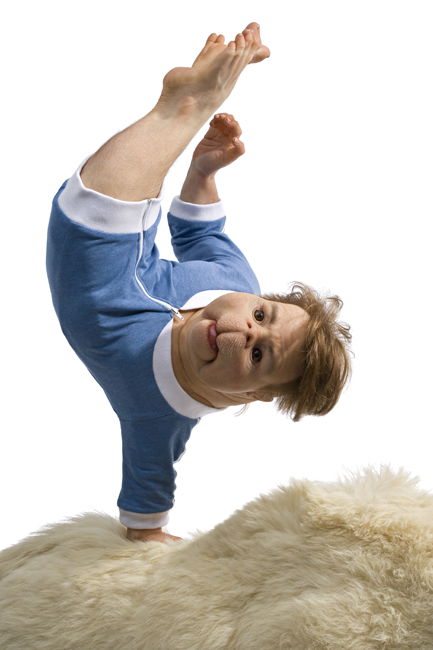
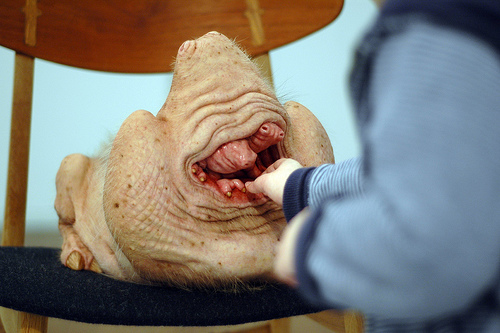
    Featuring hyperrealist genetically modified creatures and human child figures Piccinini’s sculptures, drawings and video seem passionately alive in their verisimilitude (unlike Ricky Swallow’s resplendently dead relics at the NGV). In The Strength of one Hand (With Canadian Mountain Goat), the title perhaps a play on the traditional Zen koan The Sound of One Hand Clapping, a meditation on the nature of inner compassion, a walrus-child balances on one hand on the back of a Canadian Mountain Goat. The walrus-child has extended eyes, a voluminous lower lip with whiskers under the nose; the hyperreality of the hand on the back of the goat makes it seem like the hand will come alive! A mane of hair flows down the walrus-child’s back to feet that are conjoined – like an articulated merman – ending not in flippers but in toes complete with dirty, cracked and broken nails. Here the natural athleticism of the mountain goat, now dead and stuffed, is surmounted by the mutated walrus-child’s natural athleticism, poignantly suspended like an exclamation mark above the in-animate pommel horse.

    In Balasana (The Child’s Pose) a child reposes in the yoga position on a tribal rug. Balanced on top of the child is a stuffed Red-necked Wallaby that perfectly inverts the concave of the child’s back, it’s front feet curled over while it’s rear feet are splayed. The luminosity of the skin of the child is incredible – such a technical feat to achieve this realism – that you are drawn to intimately examine the child’s face and hands. The purpose of The Child’s Pose in yoga is that it literally reminds us of our time as an infant and revives in us rather vivid memories of lying in this position. It also reminds us to cultivate our inner innocence so that we in turn may see the world without judgement or criticism. The paradoxes of the ‘unforced’ intimacy between the child and the wallaby can be read with this conceptualisation ‘in mind’.

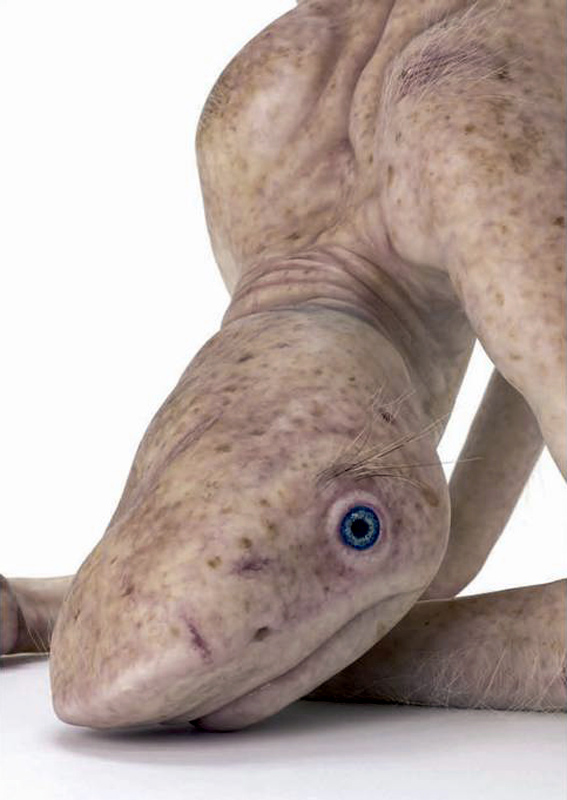
    With The Bottom Feeder (2009) Piccinini’s imagination soars to new heights. With the shoulders of a human, the legs and forearms of what seems like a marsupial, the lowered head of a newt with intense staring blue eye (see photograph above), luminescent freckled skin covered in hair and a rear end that consists of both male and female genitalia that forms a ‘face’, the hermaphroditic bottom feeder is a frighteningly surreal visage. Inevitably the viewer is drawn to the exposed rump through a seemingly unforced interactivity, examining the folds and flaps of the labia and the hanging scrotum of this succulent feeder. Here Piccinini draws on psychoanalysis and Lacan’s theory of the mirror stage in a child’s development – where the child wants to merge with the mother to erase the self / other split by fulfilling the mother’s desire by having sex with her – thus erasing the mother’s lack, the idea of lack represented by the lack of a penis.1

    As Jean Baudrillard notes of the mass of bodies on Brazil’s Copacabana beach, “Thousands of bodies everywhere. In fact, just one body, a single immense ramified mass of flesh, all sexes merged. A single, shameless expanded human polyp, a single organism, in which all collude like the sperm in seminal fluid … The sexual act is permanent, but not in the sense of Nordic eroticism: it is the epidermal promiscuity, the confusion of bodies, lips, buttocks, hips – a single fractal entity disseminated beneath the membrane of the sun.”2

    An so it is here, all sexes merged within the anthropomorphised body of The Bottom Feeder, a body that challenges and subverts human perceptions of the form and sexuality of animals (including ourselves) that inhabit the world.

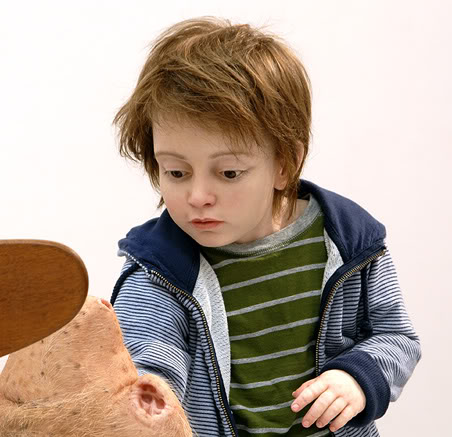
    In Doubting Thomas (2008), my favourite piece in the exhibition, a skeptical child with pale and luminous skin is about to put his hand inside the mouth of a genetically modified mole like creature that has reared it’s hairy snout to reveal a luscious, fluid-filled mouth replete with suckers and teeth. You want to shout ‘No, don’t go there!’ as the child’s absent mother has probably already warned him – to no avail. Children only learn through experience, I suspect in this case a nasty one.


    The terrains the Piccinini interrogates (nature and artifice, biogenetics, cloning, stem cell research, consumer culture) are a rematerialisation of the actual world through morphological ‘mapping’ onto the genomes of the future. Morphogenetic fields3 seem to surround the work with an intense aura; surrounded by this aura the animals and children become more spiritual in their silence. Experiencing this new world promotes an evolution in the way in which we conceive the future possibilities of life on this earth, this brave but mutably surreal new world.

    This is truly one of the best exhibitions of the year in Melbourne.

    Dr Marcus Bunyan


    1/ Klages, M. Jacques Lacan. Boulder: University of Colorado, 2001 [Online] Cited 09/10/2009 no longer available online

    2/ Baudrillard, Jean. Fragments: Cool Memories III, 1990-1995. London: Verso, 1997, p. 74

    3/ “A morphogenetic field is a group of cells able to respond to discrete, localised biochemical signals leading to the development of specific morphological structures or organs.” Morphogenetic field definition on Wikipedia [Online] Cited 05/05/2019


      Patricia Piccinini (Australian, b. 1965) 'The Strength of one Hand (With Canadian Mountain Goat)' 2009 from the exhibition 'Unforced Intimacies' by Patricia Piccinini at Tolarno Galleries, Melbourne, Oct - Nov, 2009


      Patricia Piccinini (Australian, b. 1965)
      The Strength of one Hand (With Canadian Mountain Goat)
      2009
      Silicone, fibreglass, human hair, clothing, Canadian Mountain Goat


      Patricia Piccinini (Australian, b. 1965) 'The Strength of one Hand (With Canadian Mountain Goat)' 2009 (detail) from the exhibition 'Unforced Intimacies' by Patricia Piccinini at Tolarno Galleries, Melbourne, Oct - Nov, 2009


      Patricia Piccinini (Australian, b. 1965)
      The Strength of one Hand (With Canadian Mountain Goat) (detail)
      2009
      Silicone, fibreglass, human hair, clothing, Canadian Mountain Goat


      Patricia Piccinini (Australian, b. 1965) 'The Bottom Feeder' 2009

      Patricia Piccinini (Australian, b. 1965) 'The Bottom Feeder' 2009


      Patricia Piccinini (Australian, b. 1965)
      The Bottom Feeder
      2009
      Silicone, fibreglass, steel, fox fur


      Patricia Piccinini (Australian, b. 1965) 'The Bottom Feeder' 2009 (detail)


      Patricia Piccinini (Australian, b. 1965)
      The Bottom Feeder (detail)
      2009
      Silicone, fibreglass, steel, fox fur


      Exploring concepts of what is “natural” in the digital age, Patricia Piccinini brings a deeply personal perspective to her work.

      Rachel Kent notes: “Since the early 1990s, Piccinini has pursued an interest in the human form and its potential for manipulation and enhancement through bio-technical intervention. From the mapping of the human genome to the growth of human tissue and organs from stem cells, Piccinini’s art charts a terrain in which scientific progress and ethical questions are intertwined.”

      Text from the Tolarno Galleries website [Online] Cited 05/05/2019 no longer available online


      Patricia Piccinini (Australian, b. 1965) 'Doubting Thomas' 2008


      Patricia Piccinini (Australian, b. 1965)
      Doubting Thomas
      2008
      Silicone, fibreglass, human hair, clothing, chair


      Patricia Piccinini (Australian, b. 1965) 'Doubting Thomas' 2008 (detail)


      Patricia Piccinini (Australian, b. 1965)
      Doubting Thomas (detail)
      2008


      Patricia Piccinini (Australian, b. 1965) 'Doubting Thomas' 2008 (detail)

      Patricia Piccinini (Australian, b. 1965) 'Doubting Thomas' 2008 (detail)


      Patricia Piccinini (Australian, b. 1965)
      Doubting Thomas (detail)
      2008


      “Time and again my work returns to children, and their ambiguous relationships with the (only just) imaginary animals that I create. Children embody a number of the key issues in my work. Obviously they directly express the idea of genetics – both natural and artificial – but beyond that they also imply the responsibilities that a creator has to their creations. The innocence and vulnerability of children is powerfully emotive and evokes empathy – their presence softens the hardness of some of the more difficult ideas, but it can also elevate the anxiety level.”


      Patricia Piccinini quoted on the Kaldor Public Art Projects website [Online] Cited 05/11/2009 no longer available online


      “I am interested in the way that contemporary biotechnology and even philosophy erode the traditional boundaries between the artificial and the natural, as well as between species and even the basic distinctions between animal and human.”


      Patricia Piccinini quoted in Sarah Hetherington. “Patricia Piccinini: Related Individuals,” on the Artlink website [Online] Cited 05/05/2019. No longer available online


      Patricia Piccinini (Australian, b. 1965) 'Balasana' 2009 (detail)


      Patricia Piccinini (Australian, b. 1965)
      Balasana
      Silicone, fibreglass, human hair, clothing, Red-necked Wallaby, rug
      2009


      Tolarno Galleries
      Level 4, 104 Exhibition Street,
      Melbourne, Vic, 3000
      Phone: +61 3 9654 6000

      Opening hours:
      Tuesday – Friday 10am – 5pm
      Saturday 1 – 5pm
      Tolarno Galleries website

      LIKE ART BLART ON FACEBOOK

      Back to top

      Review: ‘Nocturnalians and Shadow Eaters’ by Vera Möller at Sophie Gannon Gallery, Richmond, Melbourne

      Exhibition dates: 20th October – 14th November 2009


      Vera Möller (Australian, b. 1955 Germany arrived Australia 1986) 'Rabinova' 2009 from the exhibition 'Nocturnalians and Shadow Eaters' by Vera Möller at Sophie Gannon Gallery, Richmond, Melbourne, Oct - Nov, 2009


      Vera Möller (Australian, b. 1955 Germany arrived Australia 1986)
      Rabinova
      2009
      Oil on linen
      82 x 76cm


      “I am interested in this border between the real and the imagined, the constructed and the natural.”


      Vera Möller quoted in “Artist earns her stripes” on The Age newspaper website May 28, 2005 [Online] Cited 23/06/2022


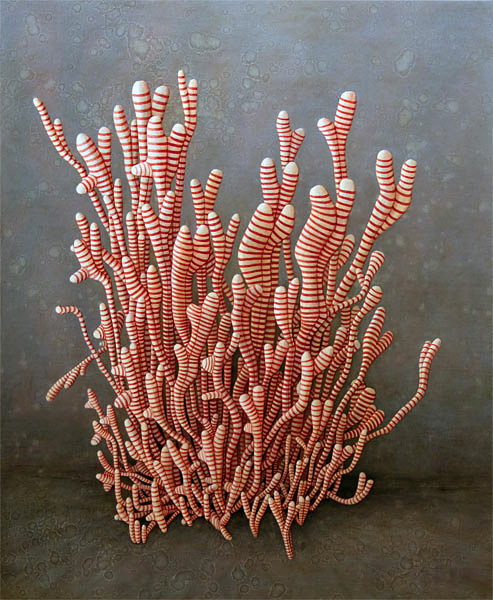
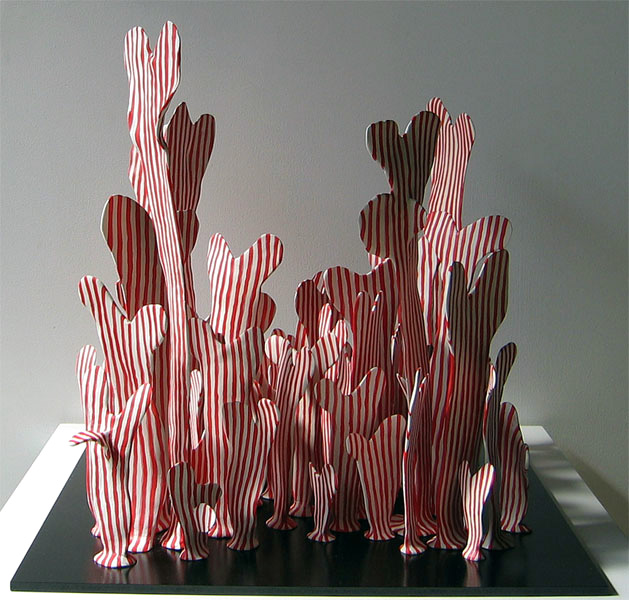
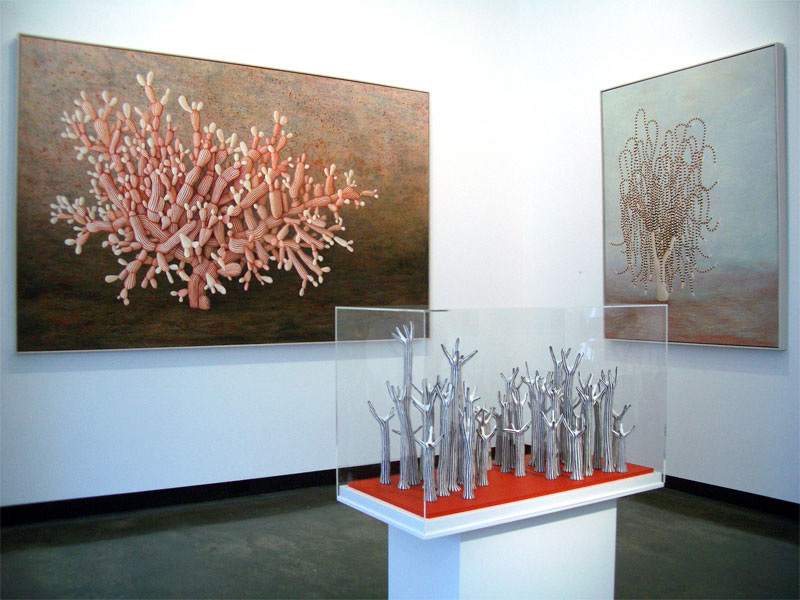
      There is a lot of mutability floating around current exhibitions in Melbourne at the moment. At the National Gallery of Victoria we have the deathly, eloquent freeze frame mutability of Ricky Swallow; at Tolarno Galleries we have the genetic hyper-realist mutability of Patricia Piccinini; and at Sophie Gannon Gallery we have the surreal, spatial mutability of Vera Möller.

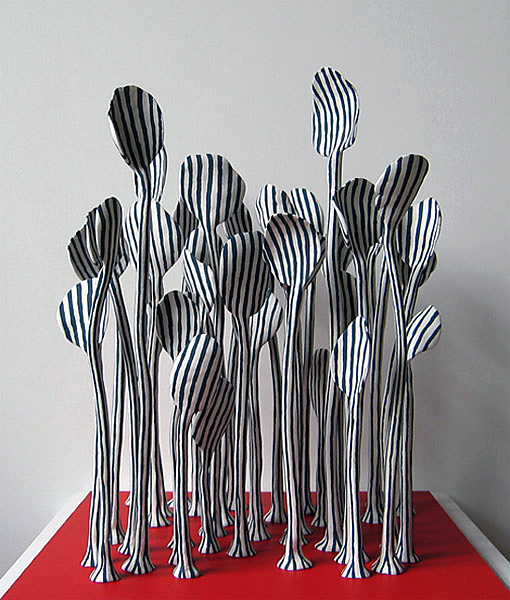
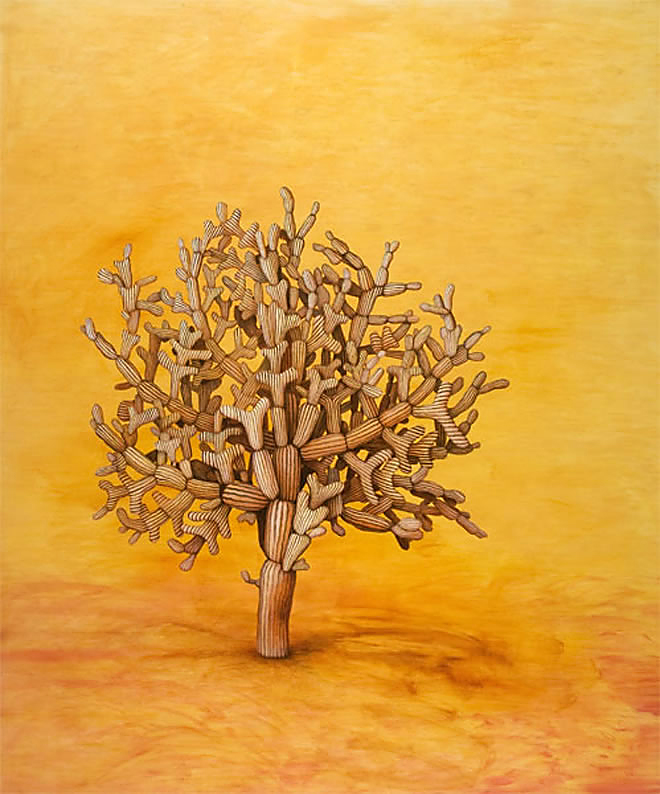
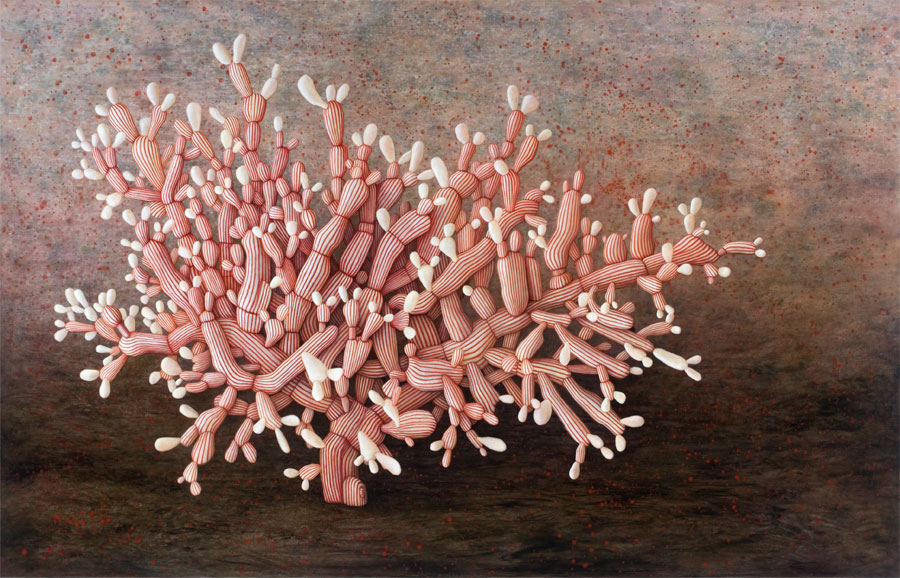
      In this exhibition the real meets the imagined and the constructed encounters the natural in delicate sculptures and beautiful paintings. Coral snake and mutated striped hydras float above Phillip Huntersque backgrounds, looking oh so innocent until one remembers that hydras are predatory animals: the stripes, like the strips of a prisoners uniform not so innocent after all.

      These ‘portraits’ (for that is what they strike me as) emerge from the recesses of the subconscious, rising up like some absurd alien fish from the deep. The sculptural forests of mutated specimens waft on the breeze of the ocean current. This detritus of biotechnology, living in the dark and the shadow, emerges into the light and space of the gallery – genetic recombinations in which a strands of genetic material are broken and then joined to another DNA molecule. In Möller’s work this chromosomal crossover has led to offspring (called ‘recombinants’) that dance to a surrealist tune: genetic algorithms that use mutation to maintain genetic diversity from one generation of chromosomes to the next.1

      Spatially there is a lightness of touch and a beauty to their representation that brings the work alive within the gallery space. However, Möller’s recombinants are as deadly as they are beautiful. I really liked these creatures narcoleptic shadow dances.

      Dr Marcus Bunyan


      1/ Definition of mutation (genetic algorithm) in Wikipedia.


        Many thankx to Sophie Gannon Gallery for allowing me to publish the art work in the posting. Please click on the photographs for a larger version of the image.


        Vera Möller (Australian, b. 1955 Germany arrived Australia 1986) 'Martinette' 2009 (installation view)


        Vera Möller (Australian, b. 1955 Germany arrived Australia 1986)
        Martinette (installation view)
        2009
        Modelling material, acrylic and enamel paint, MDF, perspex cove


        Vera Möller (Australian, b. 1955 Germany arrived Australia 1986) 'Veronium' 2007 from the exhibition 'Nocturnalians and Shadow Eaters' by Vera Möller at Sophie Gannon Gallery, Richmond, Melbourne, Oct - Nov, 2009


        Vera Möller (Australian, b. 1955 Germany arrived Australia 1986)
        Veronium
        2007
        Oil on canvas
        167 x 199cm


        Vera Möller (Australian, b. 1955 Germany arrived Australia 1986) 'Shapinette' 2009 from the exhibition 'Nocturnalians and Shadow Eaters' by Vera Möller at Sophie Gannon Gallery, Richmond, Melbourne, Oct - Nov, 2009


        Vera Möller (Australian, b. 1955 Germany arrived Australia 1986)
        Shapinette
        2009
        Oil on linen
        101 x 101cm


        Vera Möller (Australian, b. 1955 Germany arrived Australia 1986) 'Telenium' 2009


        Vera Möller (Australian, b. 1955 Germany arrived Australia 1986)
        Telenium
        2009
        Oil on linen
        165 x 135cm


        Vera Möller (Australian, b. 1955 Germany arrived Australia 1986) 'Rubella' 2008-2009


        Vera Möller (Australian, b. 1955 Germany arrived Australia 1986)
        Rubella
        2008-2009


        Vera Möller (Australian, b. 1955 Germany arrived Australia 1986) 'Bureniana' 2008 (installation view)


        Vera Möller (Australian, b. 1955 Germany arrived Australia 1986)
        Bureniana (installation view)
        2008
        Modelling material, acrylic and enamel paint, MDF, perspex cover
        60 x 61 x 61cm


        Installation photo of 'Nocturnalians and Shadow Eaters' by Vera Moller at Sophie Gannon Gallery, Melbourne

        Installation photo of 'Nocturnalians and Shadow Eaters' by Vera Moller at Sophie Gannon Gallery, Melbourne


        Installation photographs of Nocturnalians and Shadow Eaters by Vera Möller at Sophie Gannon Gallery, Melbourne
        Photos: Marcus Bunyan


        Interested in the boundaries between the real and the imagined, Vera Möller creates paintings and sculptures by placing fictional hybrid plants in existing terrains. Bright colours and patterns, coral-like and succulent-plant forms and toadstool shapes describe her depictions of dreamt-up specimens that evoke the natural world. Möller’s ‘fantasy specimens’ demonstrate the way in which her science background and art practice have steadily converged.

        After training as a biologist in Germany, Möller migrated to Australia in 1986. She later completed a Bachelor of Fine Art at the Victorian College of the Arts and a PhD at Monash University. Her work has been exhibited in the USA, Japan, Finland, France, Germany and the UK, as well as throughout Australia.

        Text from the Sophie Gannon Gallery website [Online] Cited 03/05/2019


        Vera Möller (Australian, b. 1955 Germany arrived Australia 1986) 'Benthinium' 2008-2009


        Vera Möller (Australian, b. 1955 Germany arrived Australia 1986)
        Benthinium
        2008-2009
        Oil on linen
        140 x 220cm


        Vera Möller (Australian, b. 1955 Germany arrived Australia 1986) 'Tokyana' 2009


        Vera Möller (Australian, b. 1955 Germany arrived Australia 1986)
        Tokyana
        2009
        Oil on linen
        137 x 107cm


        Sophie Gannon Gallery
        2, Albert Street, Richmond, Melbourne

        Opening hours:
        Tuesday – Saturday 11am – 5pm
        Sophie Gannon Gallery website

        LIKE ART BLART ON FACEBOOK

        Back to top

        Exhibition: ‘Ricky Swallow: The Bricoleur’ at The Ian Potter Centre, NGV Australia, Melbourne

        Exhibition dates: 16th October, 2009 – 28th February, 2010


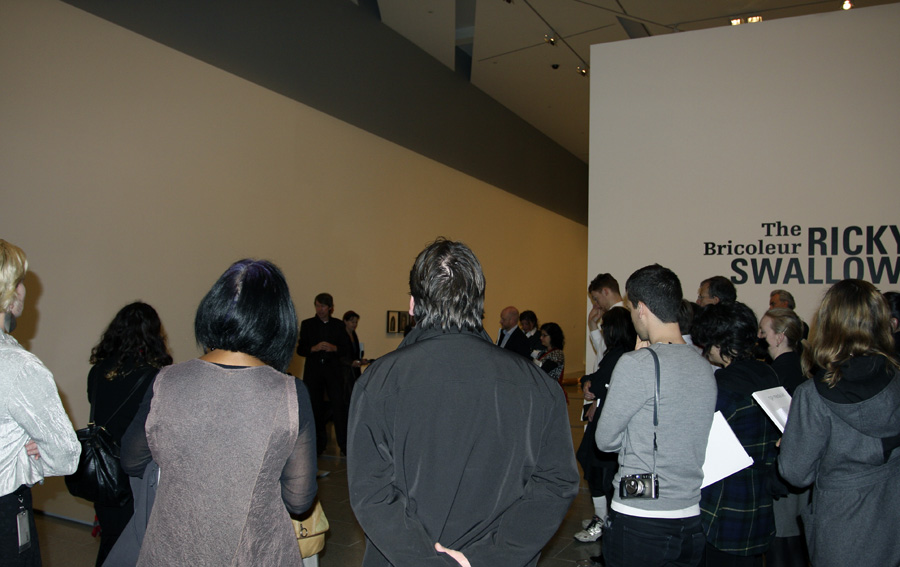
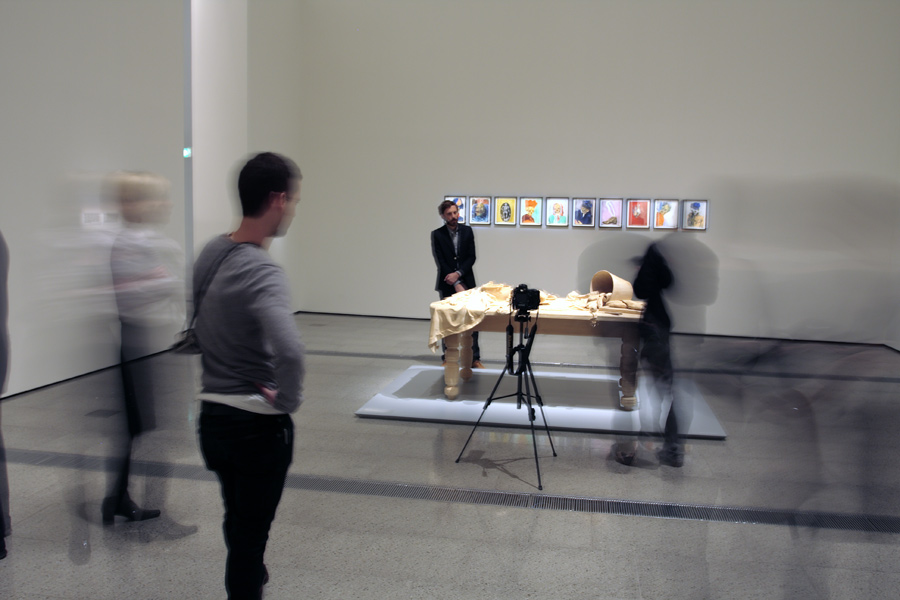
        Media crowd at the Ricky Swallow exhibition 'The Bricoleur' at NGV Australia


        Media crowd at the Ricky Swallow exhibition The Bricoleur at NGV Australia with Alex Baker, Senior Curator, Contemporary Art, NGV fourth from left with clasped hands.
        Photo: Marcus Bunyan


        Hot off the press straight to you here at Art Blart!

        Photographs of the exhibition Ricky Swallow: The Bricoleur at the National Gallery of Victoria Australia, Federation Square. The photographs are in the chronological order that I took them, walking through the three spaces of the exhibition. A spare, visually minimalist aesthetic to the show, where every vanitas, every mark (in)forms the work as transcendent momenti mori. Review to follow.

        Many thankx to Sue, Alison, Jemma and the team for the usual excellent job and for allowing me to document the exhibition. Please click on the photographs for a larger version of the image. All photographs © Marcus Bunyan


        “I’ve always been interested in how an object can be remembered and how that memory can be sustained and directed sculpturally, pulling things in and out of time, passing objects through the studio as a kind of filter returning them as new forms.”


        Ricky Swallow


        Ricky Swallow (Australian, b. 1974) 'The Bricoleur' 2006 from the exhibition 'Ricky Swallow: The Bricoleur' at The Ian Potter Centre, NGV Australia, Melbourne, Oct 2009 - Feb 2010


        Ricky Swallow (Australian, b. 1974)
        The Bricoleur
        2006
        Jelutong
        48 x 9.75 x 9.75 inches
        Photo: Marcus Bunyan


        Ricky Swallow (Australian, b. 1974) 'Unbroken Ways (for Derek Bailey)' 2006 from the exhibition 'Ricky Swallow: The Bricoleur' at The Ian Potter Centre, NGV Australia, Melbourne, Oct 2009 - Feb 2010


        Ricky Swallow (Australian, b. 1974)
        Unbroken Ways (for Derek Bailey)
        2006
        English Limewood
        5 x 30 x 7 inches
        Photo: Marcus Bunyan


        Ricky Swallow (Australian, b. 1974) 'One Nation Underground' 2007


        Ricky Swallow (Australian, b. 1974)
        One Nation Underground
        2007
        Photo: Marcus Bunyan


        Ricky Swallow (Australian, b. 1974) 'One Nation Underground' 2007  (detail)


        Ricky Swallow (Australian, b. 1974)
        One Nation Underground (detail)
        2007
        Photo: Marcus Bunyan


        Ricky Swallow (Australian, b. 1974) 'Tusk' 2007


        Ricky Swallow (Australian, b. 1974)
        Tusk
        2007
        Bronze with white patina, brass fixtures
        19.75 x 41.25 x 2.25 inches
        Photo: Marcus Bunyan


        Ricky Swallow (Australian, b. 1974) 'Tusk' 2007 (detail)


        Ricky Swallow (Australian, b. 1974)
        Tusk (detail)
        2007
        Bronze with white patina, brass fixtures
        19.75 x 41.25 x 2.25 inches
        Photo: Marcus Bunyan


        Ricky Swallow (Australian, b. 1974) 'Rehearsal for Retirement' 2008 (detail)


        Ricky Swallow (Australian, b. 1974)
        Rehearsal for Retirement (detail)
        2008
        English Lime Wood, Poplar
        Photo: Marcus Bunyan


        Ricky Swallow (Australian, b. 1974) 'Rehearsal for Retirement' 2008 (detail)


        Ricky Swallow (Australian, b. 1974)
        Rehearsal for Retirement (detail)
        2008
        English Lime Wood, Poplar
        Photo: Marcus Bunyan


        Ricky Swallow (Australian, b. 1974) 'Bowman’s record' 2008 (detail)


        Ricky Swallow (Australian, b. 1974)
        Bowman’s record (detail)
        2008
        Bronze
        Photo: Marcus Bunyan


        Ricky Swallow (Australian, b. 1974) 'Bowman’s record' 2008 (detail)


        Ricky Swallow (Australian, b. 1974)
        Bowman’s record (detail)
        2008
        Bronze
        Photo: Marcus Bunyan


        Ricky Swallow’s sculptures address fundamental issues that lie at the core of who we are. Things have lives. We are our things. We are things. When all is said and done it is our things – our material possessions – that outlive us. Anyone who has lost a family member or close friend knows this: what we have before us once that person is gone are the possessions that formed a life. Just as we are defined and represented by the things that we collect over time, we are ultimately objects ourselves. When we are dead and decomposed what remains are our bones, another type of object. And then there is social science. Archaeology, a subfield of anthropology, is entirely based on piecing together narratives of human relations based on material culture, that is, objects both whole and fragmentary. It may seem obvious but it is worth stressing here that our understanding of cultures from the distant past, those that originated before the advent of writing, is entirely based on the study of objects and skeletal remains. Swallow’s art addresses these basic yet enduring notions and reminds us of our deep symbiotic relationship to the stuff of daily life.

        Like the bricoleur put into popular usage by anthropologist Claude Levi-Strauss in his seminal book The Savage Mind, Ricky Swallow creates works of art often based on objects from his immediate surroundings. His method, however, is more of a second order bricolage: his sculptures are not assemblages of found objects, but rather elegantly crafted things. Hand carved from wood or plaster or cast in bronze, these humble objects are transformed into memorials to both the quotidian and the passage of time.

        Still life

        The still life has been an important touchstone throughout Swallow’s recent practice as it is an inspired vehicle for the exploration of how meaning is generated by objects. Several sculptures in the exhibition reference the still-life tradition in which Swallow updates and personalises this time-honoured genre, in particular the vanitas paintings of 17th century Holland. Vanitas still lifes, through an assortment of objects that had recognisable symbolism to a 17th-century viewer, functioned as allegories on the futility of pleasure and the inevitably of death. Swallow’s embrace of still life convention, however, is non-didactic, secular and open-ended. Swallow is not obsessed by death. On the contrary, his focus on objects is about salvaging them from the dust bin of history and honouring their continued resonance in his life.

        Killing time, 2003-2004, and Salad days, 2005, depict animals that Swallow and his family either found or caught when he was young and best highlight how the artist reclaims the still life genre to explore personal narrative. Killing time, which depicts a bounty of fish and crustaceans spread across a table modelled after the Swallow family kitchen table of the artist’s youth, is rife with autobiographical association. It not only references an object from Swallow’s past, but also the profession of his father, a fisherman, and the fact that Swallow was raised by the sea. Salad days is another autobiographical work depicting a range of animals such as birds, a rabbit, mice and a fox skull. Like many boys growing up in rural environments, Swallow recalls shooting magpies, encountering nesting birds in his garage or discovering dead lizards or trapping live ones in an attempt to keep them as pets.

        While not an overt still life, History of holding, 2007, suggests the genre in its fragmentary depiction of a musical instrument and the appearance of a lemon with falling rind. The hand holding / presenting a peeled lemon as the rind winds around the wrist in bracelet-like fashion is based on a cast of Swallow’s own hand, insinuating himself into this antiquated tradition. It is as if Swallow is announcing to us his deep interest in the temporality of objects through the presentation of the peeled lemon, which symbolises the passing of time and also appears in Killing time. The second component of History of holding is a sculptural interpretation of the Woodstock music festival icon designed by Arthur Skolnick in 1969, which still circulates today. History of holding, then, also references music, a leitmotif in Swallow’s art that appears both within the work itself, and also through Swallow’s use of titles.

        Body fragments

        Tusk, 2007 among several other works in the exhibition, explores the theme of body as fragment. Much has been discussed about Swallow’s use of the skeleton as a form rich in meaning within both the traditions of art history as well as popular culture (references range from the Medieval dance macabre and the memento mori of the still life tradition to the skeleton in rock music and skateboard art iconography). Tusk represents two skeletal arms with the hands clasped together in eternal union. A poignant work, Tusk is a meditation on permanence: the permanence of the human body even after death; the permanence of the union between two people, related in the fusion of the hands into that timeless symbol of love, the heart.

        Watercolours: atmospheric presentations, mummies, music, homage

        Swallow calls his watercolours “atmospheric presentations”, in contradistinction to his obviously more physical sculptures, and he sees them as respites from the intensity of labour and time invested in the sculptural work. They also permit experimentation in ways that sculpture simply does not allow. One nation underground, 2007, is a collection of images based on rock / folk musicians, several who had associations to 1960s Southern California, Swallow’s current home. Most of the subjects Swallow has illustrated in this work are now deceased; several experienced wide recognition only after their deaths. Like many of his sculptures, this group of watercolours tenderly painted with an air of nostalgia has the sensibility of a memorial – or as Swallow has called it “a modest monument”. The title of the work is based on a record album by another under-heralded rock band from the 1960s, Pearls Before Swine, and is a prime example of Swallow’s belief in the importance of titles to the viewing experience as clues or layers of meaning. In this case, the title hints at the quasi-cult status of the musicians and singers depicted. The featured musicians are Chris Bell (Big Star), Karen Dalton (a folk singer), Tim Buckley (legendary singer whose style spanned several genres and father to the late Jeff Buckley), Denny Doherty (The Mamas & the Papas ), Judee Sill (folk singer), Brian Jones (Rolling Stones), Arthur Lee (Love), John Phillips (The Mamas & the Papas ), Skip Spence (Jefferson Airplane and Moby Grape) and Phil Ochs (folk singer).

        Text from the National Gallery of Victoria website [Online] Cited 15/10/2010


        Installation view of 'Ricky Swallow: The Bricoleur' second room at NGV Australia

        Installation view of 'Ricky Swallow: The Bricoleur' second room at NGV Australia


        Installation views of Ricky Swallow: The Bricoleur second space at NGV Australia
        Photos: Marcus Bunyan


        Ricky Swallow (Australian, b. 1974) 'Caravan' 2008 (detail)


        Ricky Swallow (Australian, b. 1974)
        Caravan (detail)
        2008
        Bronze
        Photo: Marcus Bunyan


        Ricky Swallow (Australian, b. 1974) 'Salad days' c. 2005


        Ricky Swallow (Australian, b. 1974)
        Salad days
        c. 2005
        Photo: Marcus Bunyan


        Ricky Swallow (Australian, b. 1974) 'Killing time' 2003-2004


        Ricky Swallow (Australian, b. 1974)
        Killing time
        2003-2004
        Photo: Marcus Bunyan


        Ricky Swallow (Australian, b. 1974) 'Killing time' 2003-2004 (detail)


        Ricky Swallow (Australian, b. 1974)
        Killing time (detail)
        2003-2004
        Photo: Marcus Bunyan


        Ricky Swallow (Australian, b. 1974) 'Killing time' 2003-2004


        Ricky Swallow (Australian, b. 1974)
        Killing time
        2003-2004
        Photo: Marcus Bunyan


        Ricky Swallow (Australian, b. 1974) 'Killing time' 2003-2004 (detail)


        Ricky Swallow (Australian, b. 1974)
        Killing time (detail)
        2003-2004
        Photo: Marcus Bunyan


        A new exhibition featuring the work of internationally renowned Australian artist Ricky Swallow will open at The Ian Potter Centre: NGV Australia on 16 October 2009.

        Ricky Swallow: The Bricoleur is the artist’s first major exhibition in Australia since 2006. This exhibition will feature several of the artist’s well‐known intricately detailed, carved wooden sculptures as well as a range of new sculptural works in wood, bronze and plaster. The exhibition will also showcase two large groups of watercolours, an aspect of Swallow’s practice that is not as well known as his trademark works.

        Salad days (2005) and Killing time (2003-2004), which were featured in the 2005 Venice Biennale and are considered Swallow icons, will strike a familiar chord with Melbourne audiences.

        Sculptures completed over the past year include bronze balloons on which bronze barnacles seamlessly cling (Caravan, 2008); a series of cast bronze archery targets (Bowman’s Record, 2008) that look like desecrated minimalist paintings; and carved wooden sculpture of a human skull inside what looks like a paper bag (Fig 1, 2008).

        A highlight of the show will be Swallow’s watercolour, One Nation Underground (2007), recently acquired by the NGV. The work presents a collection of images based on 1960s musicians including Tim Buckley, Denny Doherty, Brian Jones and John Phillips.

        Alex Baker, Senior Curator, Contemporary Art, NGV said the works in this exhibition explore the themes of life and death, time and its passing, mortality and immortality.

        “Swallow’s art investigates how memory is distilled within the objects of daily life. His work addresses the fundamental issues that lie at the core of who we are, reminding us of our deep symbiotic relationship to the stuff of everyday life.”

        “The exhibition’s title The Bricoleur refers to the kind of activities performed by a handyman or tinkerer, someone who makes creative use of whatever might be at hand. The Bricoleur is also the title of one of the sculptures in the exhibition, which depicts a forlorn houseplant with a sneaker wedged between its branches,” said Mr Baker.

        Gerard Vaughan, Director, NGV, said this exhibition reinforces the NGV’s commitment to exhibiting and collecting world‐class contemporary art.

        “The NGV has enjoyed a long and successful relationship with Ricky Swallow, exhibiting and acquiring a number of his works over the years. His detailed and exquisitely crafted replicas of commonplace objects never fail to inspire visitors to the Gallery.”

        Ricky Swallow was born in Victoria in 1974 and currently lives and works in Los Angeles, California. His career has enjoyed a meteoric rise since winning the NGV’s prestigious Contempora5 art prize in 1999. Since then, Swallow has exhibited in the UK, Europe and the United States, and represented Australia at the 2005 Venice Biennale.”

        Press release from the NGV website [Online] Cited 10/10/2009. No longer available online


        Ricky Swallow facing the media behind his work 'Killing time' (2003-2004)

        Ricky Swallow facing the media behind his work 'Killing time' (2003-2004)


        Ricky Swallow facing the media behind his work Killing time (2003-2004)
        Photos: Marcus Bunyan


        The Ian Potter Centre: NGV Australia Federation Square
        Corner of Russell and 
Flinders Streets, Melbourne

        Opening hours:
        Open daily 10am – 5pm
        National Gallery of Victoria website

        LIKE ART BLART ON FACEBOOK

        Back to top

        Review: ‘All the Little Pieces’ by Lyndal Hargrave at Anita Traverso Gallery, Richmond, Melbourne

        Exhibition dates: 3rd September – 3rd October, 2009


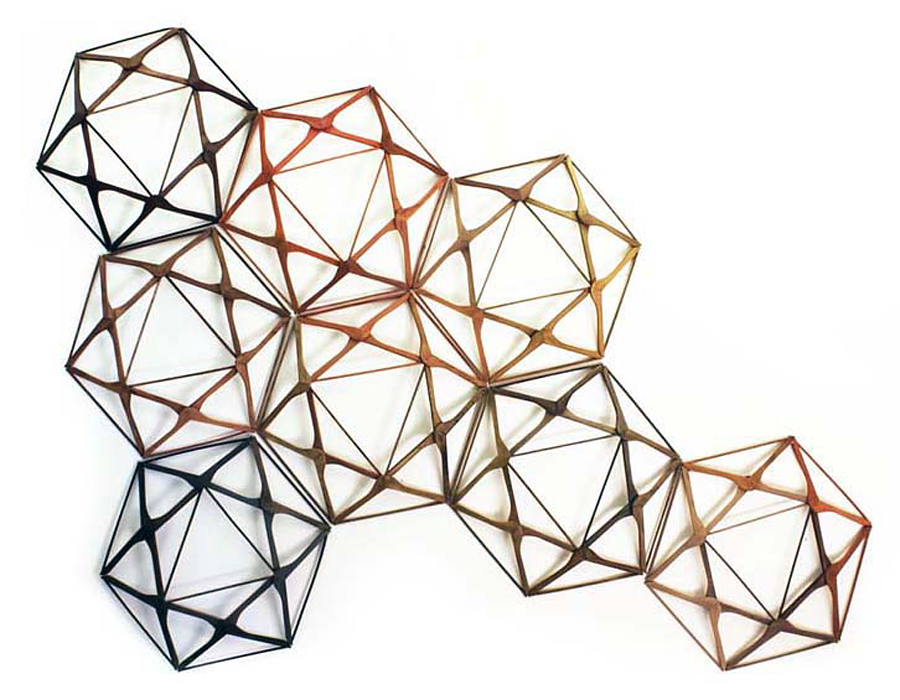
        Lyndal Hargrave (Australia, b. 1959) 'Sacred Geometry' 2009 from the exhibition 'All the Little Pieces' by Lyndal Hargrave at Anita Traverso Gallery, Richmond, Melbourne, Sept - Oct, 2009
         

        Lyndal Hargrave (Australia, b. 1959)
        Sacred Geometry
        2009
        Acrylic painted timber coat hangers, screws, staples
        180 x 170cm
        Photo: Marcus Bunyan


        This is a mixed bag of an exhibition by Lyndal Hargrave at Anita Traverso Gallery in Richmond, Melbourne.

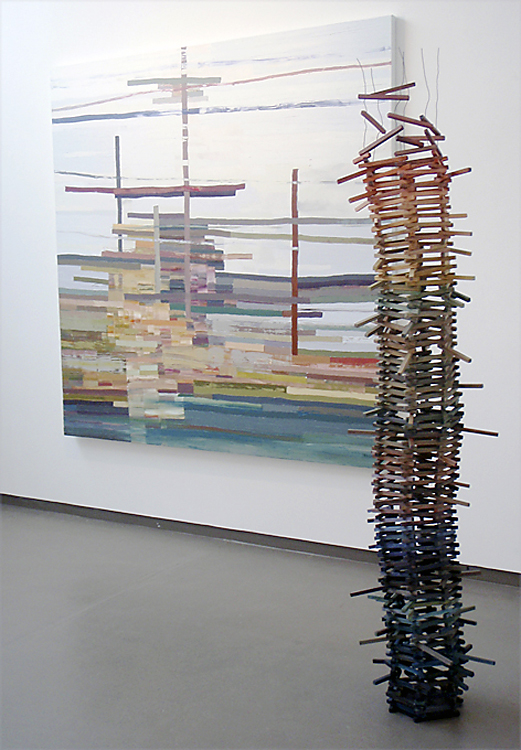
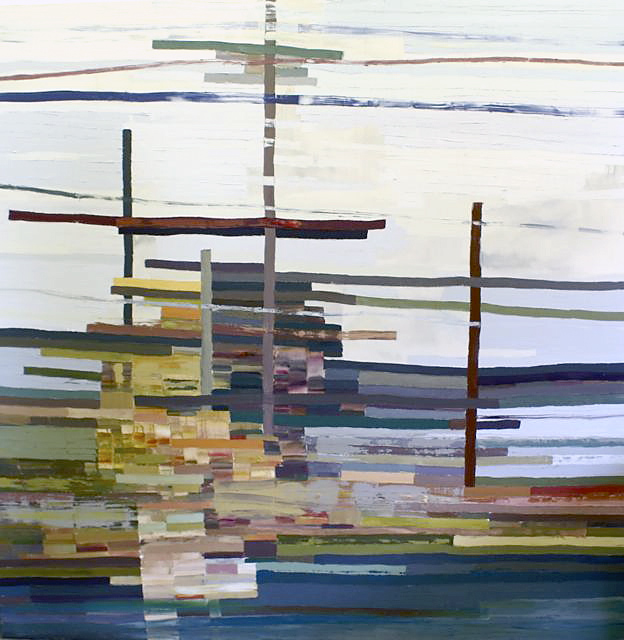
        Despite one outstanding painting Breathing Space (2009, see below), the view from the back of the artist’s house onto a jetty with attendant wooden posts and sky, the other paintings are the weakest elements of the exhibition, lacking the strength and resonance of the sculptural work.

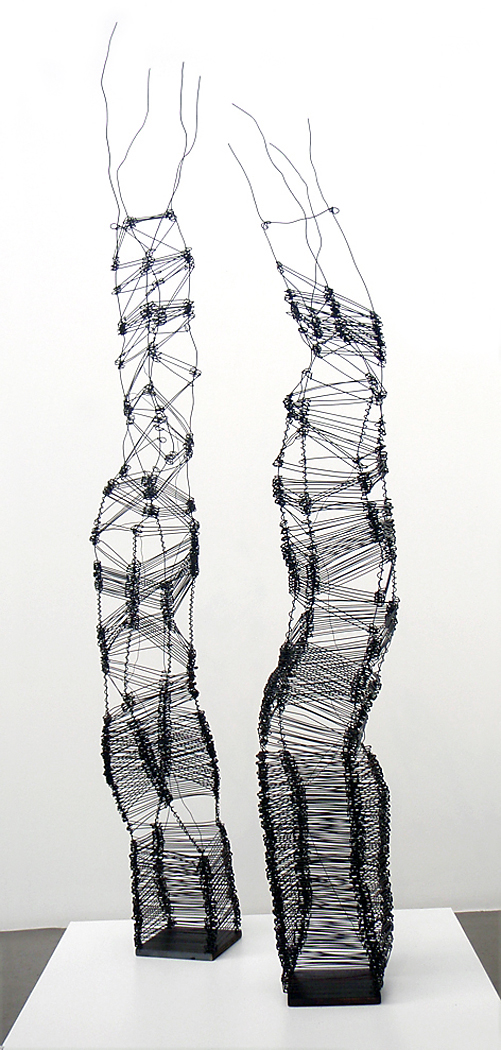
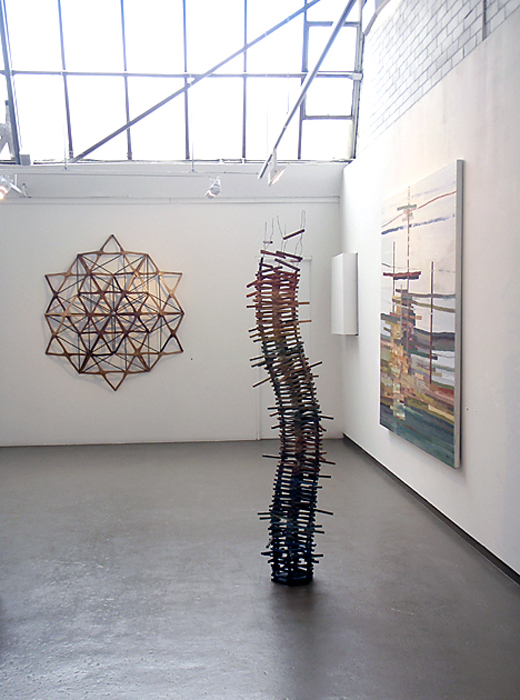
        The two standing towers, Hairpin Dragons I & II and Jacob’s Ladder (both 2009, see below) are stronger work, Jacobs Ladder imitating the form of the painting Breathing Space in three-dimensional Cuisenaire-type coloured rods (see the installation photograph of the two pieces below).

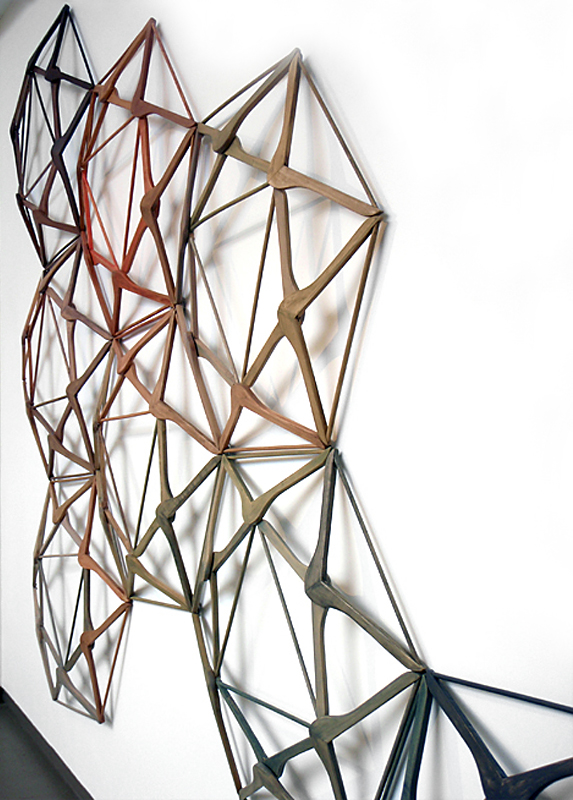
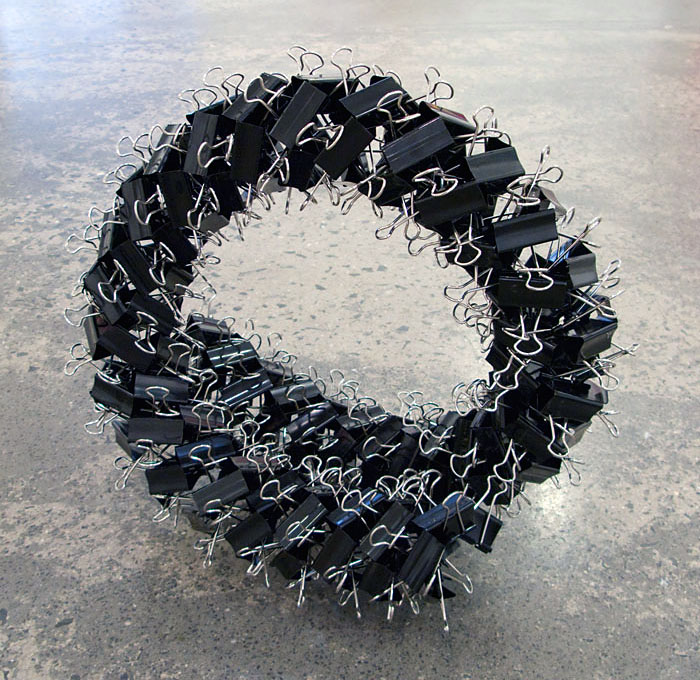
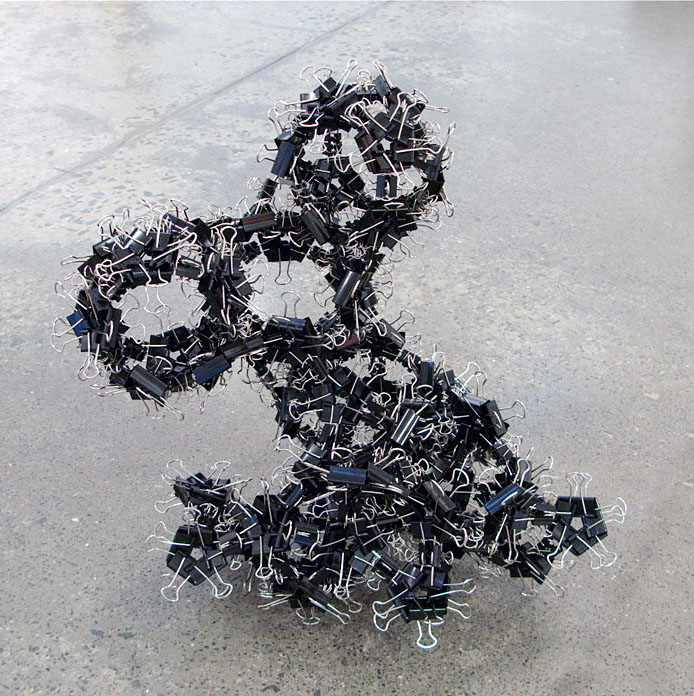
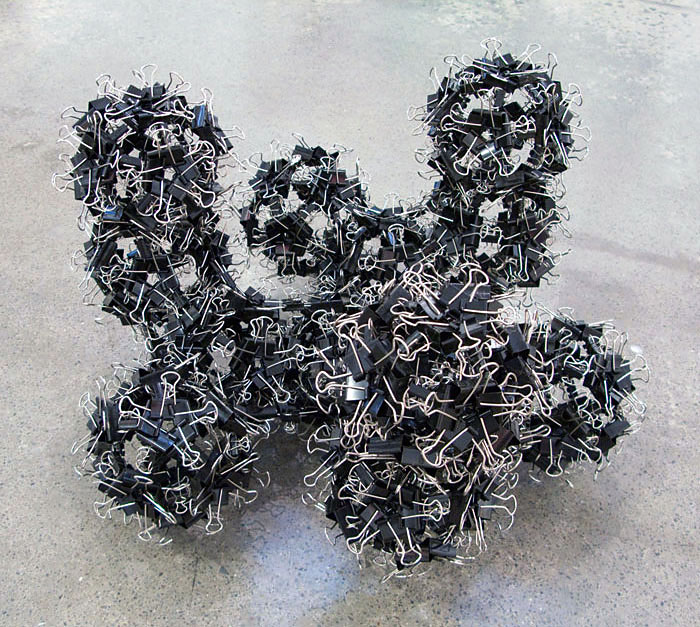
        The best pieces in the exhibition are the wall mounted geometric, mandala-like sculptures made of wooden coat hangers. Delicately shifting patterns take the micro cellular form and make it macro, their patterns of construction offering a pleasing visual balance that is both complex, layered and innovative at one and the same time. As explorations of the notion of the universal structure, the golden ratio, they reward repeated viewing.

        As the exhibition stands there are too many little pieces to make a holistic whole. Perhaps an exhibition solely of the towers or geometric pieces would have been stronger. I look forward to seeing how the geometric pieces (d)evolve in future work. Will the structures break down and reassemble in other marvellous incantations? I hope so!

        Dr Marcus Bunyan


        Many thankx to Anita Traverso Gallery for allowing me to publish the art work in the posting. Please click on some of the photographs for a larger version of the image.


        Lyndal Hargrave (Australia, b. 1959) 'Arabesque' 2009 from the exhibition 'All the Little Pieces' by Lyndal Hargrave at Anita Traverso Gallery, Richmond, Melbourne, Sept - Oct, 2009


        Lyndal Hargrave (Australia, b. 1959)
        Arabesque
        2009
        Acrylic painted timber coat hangers, screws, staples
        200 x 360cm
        Photo: Marcus Bunyan


        Lyndal Hargrave (Australia, b. 1959) 'Arabesque' 2009 (detail)


        Lyndal Hargrave (Australia, b. 1959)
        Arabesque (detail)
        2009
        Acrylic painted timber coat hangers, screws, staples
        200 x 360cm
        Photo: Marcus Bunyan


        Lyndal Hargrave (Australia, b. 1959) 'Hairpin Dragons I & II' 2009


        Lyndal Hargrave (Australia, b. 1959)
        Hairpin Dragons I & II
        2009
        Wire, formply
        170 x 15cm (varying)
        Photo: Marcus Bunyan


        “It is a constant idea of mine that behind the cotton wool (of daily reality) is hidden a pattern, that we – I mean all human beings – are connected with this: that the whole world is a work of art; that we are parts of the work of art.”

        ~ Virginia Woolf


        For as long as I can remember, my art practice has served as a filter between the outside world and my inside world. I realise now that the act of making the artwork informs my ideas rather than the other way round. Working intuitively results in a continuous stream of surprises that in retrospect mirror the pressing issues surrounding me at that time.

        In All the Little Pieces my fascination with patterns of construction from micro to macro and natural to man-made continues. My work explores the gap between order and chaos and helps me to understand the meaning of balance.

        Using mundane found objects, my sculptures probe the possibility of re-invention through the way the componentry of human habitation can be re-configured to offer us a new way of seeing and experiencing our world.

        It is this process of metamorphosis that is at the centre of my investigation: how life forms make the transition from one state to another – tree to timber to tower or talisman; why some systems remain strong and others crumble.

        Overarching my work is the notion of universal structure and the geometry that has informed our evolution from molecule to macro-system.”

        Lyndal Hargrave 2009

        Text from the Anita Traverso Gallery website


        Lyndal Hargrave (Australia, b. 1959) 'Whirlpool Galaxy' (2009) and 'The Samarian Star' (2009)


        Lyndal Hargrave (Australia, b. 1959)
        Whirlpool Galaxy and The Samarian Star
        2009
        Acrylic painted timber coat hangers, screws, staples
        Photo: Marcus Bunyan


        Installation view of Lyndal Hargrave exhibition at Anita Traverso Gallery, Melbourne


        Installation view of the Lyndal Hargrave exhibition at Anita Traverso Gallery
        Photo: Marcus Bunyan


        Photograph showing the relationship of form between the work 'Jacob’s Ladder' (2009) and the painting 'Breathing Space' (2009)


        Photograph showing the relationship of form and colour between the work Jacob’s Ladder (2009) and the painting Breathing Space (2009)
        Photo: Marcus Bunyan


        Lyndal Hargrave (Australia, b. 1959) 'Breathing Space' 2009


        Lyndal Hargrave (Australia, b. 1959)
        Breathing Space
        2009
        Oil on canvas
        200 x 200cm


        Anita Traverso Gallery

        The physical gallery has now closed.

        PO Box 7001, Hawthorn North 3122
        Phone: 0408 534 034
        Email: art@anitatraversogallery.com.au

        Anita Traverso Gallery website

        LIKE ART BLART ON FACEBOOK

        Back to top

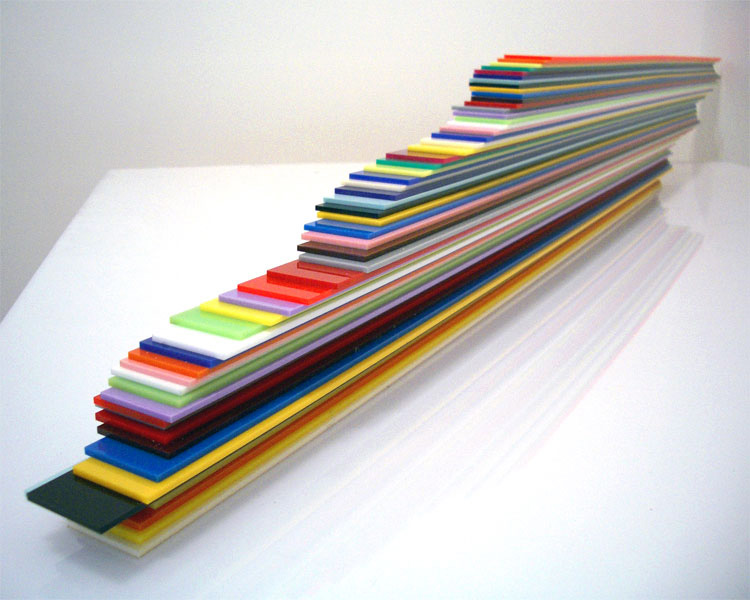
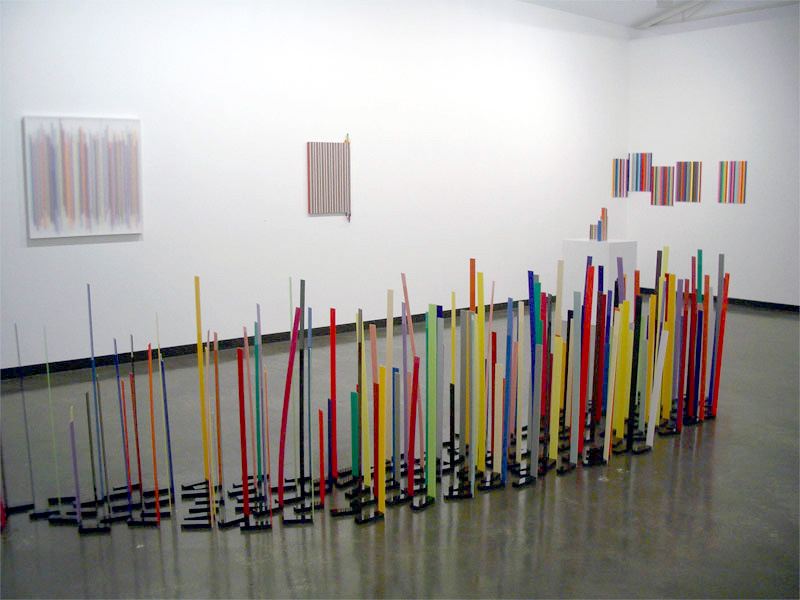
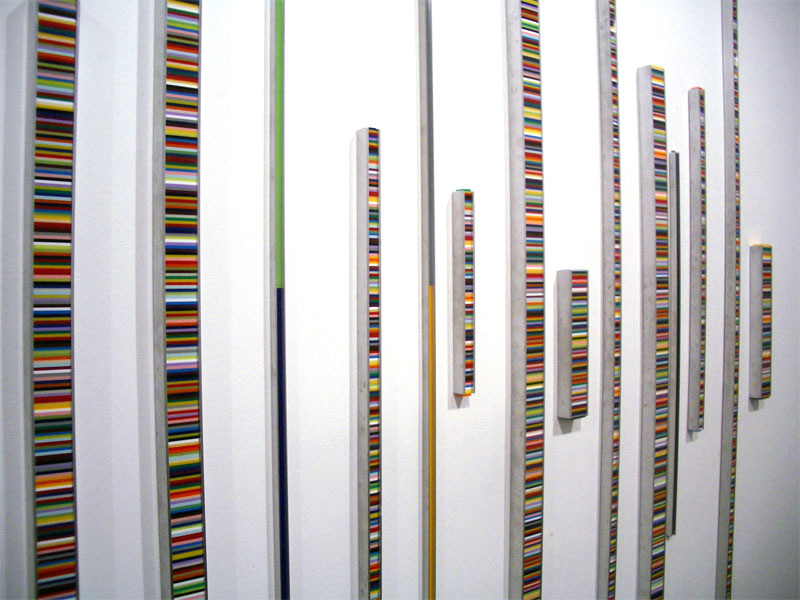
        Review: ‘Connection is Solid’ by John Nicholson at Sophie Gannon Gallery, Richmond, Melbourne

        Exhibition dates: 25th August – 19th September, 2009


        John Nicholson (Australian, b. 1970) 'Untitled' 2009 from the exhibition 'Connection is Solid' by John Nicholson at Sophie Gannon Gallery, Richmond, Melbourne, Aug - Sept, 2009


        John Nicholson (Australian, b. 1970)
        Aerial Navigation
        2009


        You could say that the essence of the cosmos is not matter, it is consciousness.

        It is not the external world that is real – it is “maya”, an illusion, for the real world lies within.

        These works, with their striations, strata and suspension are emanations of that spirit – projections of the inner reality.

        In terms of the ancient Chinese philosophy Lao Tzu we dream the butterfly and the butterfly is us. If you don’t ‘get’ these works, let go all pretensions and feel their colour as sound, as vibrations of energy.

        Submerge yourself in their shape and form. Like DNA structure, a heart beat or the record of a seismic shock these works are music as art, the length of harmony quivering and slipping in our minds, before our eyes.

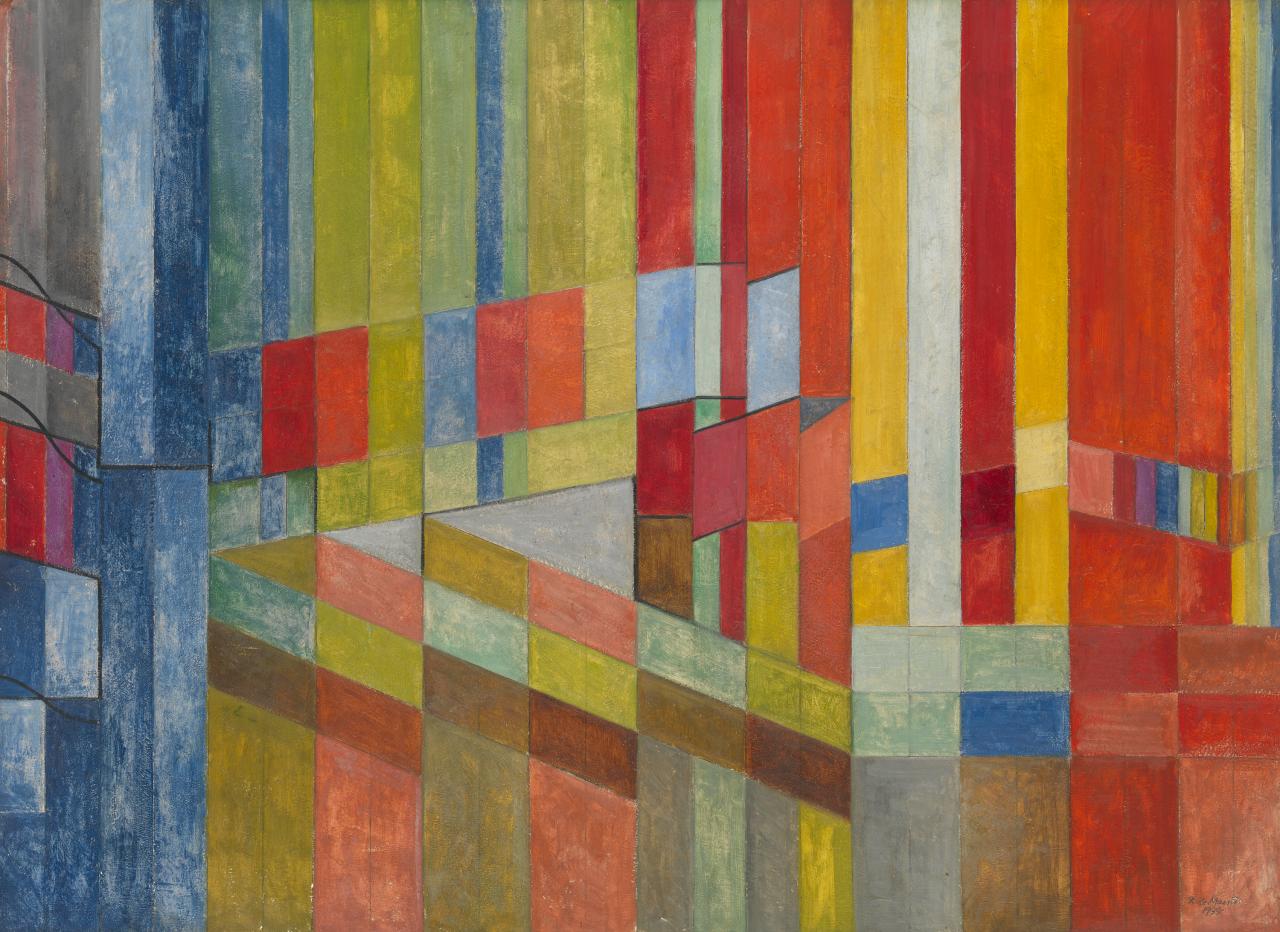
        This is the colour music of Roy De Maistre’s paintings of the 1930’s updated to the 21st century. They are fugues of sound made physical entities, intertwining, coming and going. Here lines, tones and colours are organised in a parallel way – tone after tone, line after line. They are wavelengths of the interior made visible. The connection is solid and fluid at one and the same time; there are many connections to be discovered, many journeys to be made.

        I hear them, I like them.

        Dr Marcus Bunyan


        Many thankx to Sophie Gannon Gallery for allowing me to publish the photographs in the posting. Please click on the photographs for a larger version of the image.


        John Nicholson (Australian, b. 1970) 'Under the radar' 2009 from the exhibition 'Connection is Solid' by John Nicholson at Sophie Gannon Gallery, Richmond, Melbourne, Aug - Sept, 2009


        John Nicholson (Australian, b. 1970)
        Under the radar
        2009
        Photo: Marcus Bunyan


        Installation view of 'Connection is Solid' by John Nicholson at Sophie Gannon Gallery, Melbourne

        Installation view of 'Connection is Solid' by John Nicholson at Sophie Gannon Gallery, Melbourne


        Installation views of Connection is Solid by John Nicholson at Sophie Gannon Gallery
        Photos: Marcus Bunyan


        John Nicholson (Australian, b. 1970) 'Thrill seeker' 2009 (detail)


        John Nicholson (Australian, b. 1970)
        Thrill seeker (detail)
        2009
        Photo: Marcus Bunyan


        Roy de Maistre (Australian, 1894-1968) 'Arrested Movement from a Trio' 1934


        Roy de Maistre (Australian, 1894-1968)
        Arrested Movement from a Trio
        1934
        Oil and pencil on composition board
        72.3 × 98.8cm


        John Nicholson (Australian, b. 1970) 'Slip' 2009


        John Nicholson (Australian, b. 1970)
        Slip
        2009


        John Nicholson (Australian, b. 1970) 'The wire might sense' 2009


        John Nicholson (Australian, b. 1970)
        The wire might sense
        2009


        John Nicholson (Australian, b. 1970) 'Swoop' 2009


        John Nicholson (Australian, b. 1970)
        Swoop
        2009
        Photo: Marcus Bunyan


        Installation view of 'Connection is Solid' by John Nicholson with on the wall 'Satellite Graffitti' (2009) and on the floor 'Cascade' (2009) and 'Swoop' (2009)


        Installation view of Connection is Solid by John Nicholson with on the wall Satellite Graffitti (2009) and on the floor Cascade (2009) and Swoop (2009)
        Photo: Marcus Bunyan


        Sophie Gannon Gallery
        2, Albert Street, Richmond, Melbourne

        Opening hours:
        Tuesday – Saturday 11am – 5pm

        Sophie Gannon Gallery website

        LIKE ART BLART ON FACEBOOK

        Back to top

        Review: ‘Symmetrical Spirit Guides and Fractal Alchemy’ by Carl Scrase at John Buckley Gallery, Richmond, Melbourne

        Exhibition dates: 19th August – 5th September, 2009


        Carl Scrase 'Fractal Alchemy' installation view 2009


        Carl Scrase (Australian, b. 1983)
        Fractal Alchemy installation view
        2009


        This is a slight exhibition of collages and constructions by Carl Scrase at John Buckley Gallery, Melbourne. Ironically, given the nature of the catalogue essay by Tai Snaith (see below) that waxes lyrical about the mystery and magic of symmetry, synchronicity and spirit, this exhibition lacks the depth of purpose needed to address spiritual elements that are the very basis of human existence.

        The biomorphic forms that go to make up the work Fractal Alchemy (2009) fair better in this regard, the various size bull dog clips offering non-representational patterns that resemble living organisms and genetic structures in shape and appearance. At their best these elemental shapes start to transcend form and function to become something else: an instinctive and intuitive connection to the inherent fold in the universe, like the embedded pattern, the DNA template in a blank piece of paper before the folding of the origami model. Unfortunately the wonder of this piece is short-lived. Unlike the ever magical repetition of fractal geometry with its inherent iteration of forms that constantly a/maze, here the shapes are not stretched far enough, the exposition not grounded in broken or fractured forms that invite alchemical awareness in the viewer.

        The collages are less successful in this mystery project. Made from cut-up images from magazines these symmetrical constructions lack spiritual presence. Like the aspired to symmetrical beauty of a human face it is, paradoxically, the irregularities of the human face that are their most attractive feature – our individuality. In the photographic stereoscopes of Victorian landscapes it is the difference between the left and right image that adds three-dimensional depth in the eye of the viewer, that transports them to other places, other worlds. In the collages of  Picasso it is the irregularities that also transport the viewer into a hypertextural, hypertextual world of wonder. Scrase’s collages on the other hand, are flat, rigidly symmetrical life-less things that belie their stated aim – to be kaleidoscopic spirit guides in search of a pattern for inner peace. Although some of their forms are attractive their is no wonder, no my-story to be gleaned here.

        Overall the work lacks the gravitas and sense of fun in and through the act of creation that the concepts require: to see things clearly and to ground this visualisation in objects that transcend ‘now’ and extend spirit into the eternal. These constructions do not stand as ‘equivalents’ for other states of consciousness, of being-in-the-world, nor do they offer a re-velatio where they open up ‘poetic spaces’ in which the alienation and opposition of inside and outside, of objectivity and subjectivity are seen to be disconnected. The Japanese ‘ma’, the interval which gives substance to the whole, is missing.

        To express deep inner emotions and connection to spirit requires utmost focus on their expression-in-the-world, a releasement from ego and a layering of materials and form that transport the object and viewer into an’other’ plane of existence. Unfortunately this work falls short of this state of no-desire.

        Dr Marcus Bunyan


        Many thankx to John Buckley Gallery for allowing me to publish the photographs in the posting.


        Carl Scrase (Australian, b. 1983) 'Fractal Alchemy' 2009 from the exhibition Review: 'Symmetrical Spirit Guides and Fractal Alchemy' by Carl Scrase at John Buckley Gallery, Richmond, Melbourne, Aug - Sept, 2009


        Carl Scrase (Australian, b. 1983)
        Fractal Alchemy installation view
        2009


        Carl Scrase (Australian, b. 1983) 'Fractal Alchemy' 2009 (detail)


        Carl Scrase (Australian, b. 1983)
        Fractal Alchemy (detail)
        2009


        Carl Scrase (Australian, b. 1983) 'Fractal Alchemy' 2009 (detail)


        Carl Scrase (Australian, b. 1983)
        Fractal Alchemy (detail)
        2009


        Carl Scrase (Australian, b. 1983) 'Fractal Alchemy' 2009 (detail)


        Carl Scrase (Australian, b. 1983)
        Fractal Alchemy (detail)
        2009


        Carl Scrase (Australian, b. 1983) 'Fractal Alchemy' 2009 (detail)


        Carl Scrase (Australian, b. 1983)
        Fractal Alchemy (detail)
        2009


        Carl Scrase (Australian, b. 1983) 'Fractal Alchemy' 2009 (detail)


        Carl Scrase (Australian, b. 1983)
        Fractal Alchemy (detail)
        2009


        Carl Scrase is a perfect example of an artist marking the turn of a tide. At this distinct ebb of the ravenous, rampant seas of consumption and production we’ve been surfing for the past couple of hundred years and with the onset of the new flow, towards the riptide of Mayan prophesies of fast approaching 2012, Carl is on it, or should I say in it. And he’s splashing around.

        This new generation of creative humans (to which Carl belongs) are not really concerned with how much money, time or status something is worth, or what kind of flashy object the human next to them owns. They seem to be more interested in what kind of wisdom can be procured, how many friends can be found and how a thing can be recycled or was born from something else. It is all about a search for the spirit, the feeling. Moreover, what it means. We are getting sick of the bland smog of consumerism, the stench of blatant big business and seem to be looking for escape pointers, for enlightenment, for answers and for CHANGE.

        Carl’s work suggests his role as an artist is almost akin to a kind of medium slash alchemist – a self-proclaimed, new-age, anonymous shaman of sorts. Big boots to fill indeed, but don’t worry, its not like Carl is about to declare himself a Secret Chief and start welcoming in the new Golden Dawn or reading your tarot at openings. Nor is he concerned with the alchemical properties and behaviour of inorganic compounds or scientific explanations or measurements of the planets. His interest lies in noticing the sparkling mist of questions surrounding these things. The mystery and magic of how these marvels, such as symmetry and synchronicity occur in nature and how we can possibly learn from them and experience them in our day-to-day lives.

        A true spiritualist in an atheist age, Carl uses his work as a kind of cipher for sorting his beliefs via a material creative process. His collages begin with found images from magazines, chosen relatively arbitrarily. His sculptures begin in a similar fashion with found objects, usually of the mundane or mass produced variety. It may be that they are all parts of images of human faces or just a complete add for a pair of Crocs or a hundred boxes of bull dog clips. Starting with the colour and then cutting the shape, or with the objects and then finding their natural function- almost as if listening to an instinctive, visual Ouija board somewhere in his subconscious. Carl then arranges the pieces through play. Similar to the way that you need to relax your eyes to receive the effects of a Magic Eye picture (remember them?), Carl relaxes his mind in order to let his collages find their final composition. This allows a kind of subconscious code to come forward, thus acting as both a reflection of his thoughts but also a kind of guide or suggestion for other’s thoughts, and perhaps something deeper that we don’t understand just yet.

        I remember as a child I found an empty plastic tubular casing of a biro pen whilst walking along the beach one day. It had been washed and scratched by the ocean and gave the pale blue, semi-translucent plastic a soft almost sparkly effect. I picked it up and instinctively looked through the tiny tunnel at the sun. The way the sunlight refracted through the plastic before reaching my retina made me think of a magical kaleidoscope and I immediately classified it as having ‘special powers’, granting it prime position in my pocket for months. It became a type of personal talisman or spirit guide.

        Traditionally, in animist belief systems (such as Shinto and certain parts of Hinduism) sprits need either an object or a medium (ie, thunder, lightening, wind, animals, plants, etc) to be experienced or seen by humans. They need something else to exist in order to communicate with us. Carl’s images and objects seem to suggest or demonstrate this kind of medium as well as subtly questioning the message. In the same way that a child finds wonder in the changing symmetry of a Kaleidoscope before they even understand the science of the mirror involved, there is a wonder in these images and objects as soon as we encounter them. A wonder in creation, in ritual, in synchronicity and light. A wonder in life.

        For Carl, the practice of Alchemy (and in this instance one might just as comfortably read Alchemy as Art) is ‘not the search for some magic potion’ but rather the ‘awareness that all life is eternal and the inner peace that comes from that realisation’. Just as we recognise similar patterns within nature, like the spiral formation of a shell or the layering of petals on a flower or the direction of the hair growing on a man’s scalp, we can notice these patterns on a spiritual and philosophical plane also. It doesn’t take a genius to recognise a similar search for meaning and self-realisation being revisited amongst some of the most interesting artists of our time, but let’s just hope that the search continues to prove that the process of making art itself is both the question and the answer.

        Tai Snaith
 2009

        Text from the John Buckley website [Online] Cited 20/08/2009 no longer available online


        Carl Scrase (Australian, b. 1983) 'Spiritguide 090501' 2009 from the exhibition Review: 'Symmetrical Spirit Guides and Fractal Alchemy' by Carl Scrase at John Buckley Gallery, Richmond, Melbourne, Aug - Sept, 2009


        Carl Scrase (Australian, b. 1983)
        Spiritguide 090501
        2009


        Carl Scrase (Australian, b. 1983) 'Spiritguide 090624' 2009 from the exhibition Review: 'Symmetrical Spirit Guides and Fractal Alchemy' by Carl Scrase at John Buckley Gallery, Richmond, Melbourne, Aug - Sept, 2009


        Carl Scrase (Australian, b. 1983)
        Spiritguide 090624
        2009


        Carl Scrase (Australian, b. 1983) 'Spiritguide 090504' 2009


        Carl Scrase (Australian, b. 1983)
        Spiritguide 090504
        2009


        Carl Scrase (Australian, b. 1983) 'Spiritguide 090509' 2009


        Carl Scrase (Australian, b. 1983)
        Spiritguide 090509
        2009


        Carl Scrase (Australian, b. 1983) 'Spiritguide 090520' 2009


        Carl Scrase (Australian, b. 1983)
        Spiritguide 090520
        2009


        Carl Scrase (Australian, b. 1983) 'Spiritguide 090601' 2009


        Carl Scrase (Australian, b. 1983)
        Spiritguide 090601
        2009


        Carl Scrase (Australian, b. 1983) 'Spiritguide 090617' 2009


        Carl Scrase (Australian, b. 1983)
        Spiritguide 090617
        2009


        John Buckley Gallery

        This gallery is now closed.

        LIKE ART BLART ON FACEBOOK

        Back to top

        Opening: ‘Little Treasures’ and ‘Clay Cameras’ at Helen Gory Galerie, Melbourne

        Exhibition dates: 20th August – 5th September, 2009

        Little Treasures Toby Richardson, Will Nolan, CJ Taylor and Steve Wilson

        Clay Cameras Alan Constable


        Alan Constable (Australian, b. 1956) 'Not titled (ALE SLR)' 2008. from the exhibition 'Clay Cameras' at Helen Gory Galerie, Melbourne, Aug - Sept, 2009


        Alan Constable (Australian, b. 1956)
        Not titled (ALE SLR)
        2008
        Ceramic
        Photo: Marcus Bunyan


        A small crowd was in attendance for the opening of two new exhibitions at Helen Gory Galerie (due to two auctions, one at Sotheby’s and the other at Deutscher-Menzies). Despite this the crowd was appreciative of the beautifully printed and well presented work. In the main exhibition Little Treasures four photographers show various bodies of work. Toby Richardson’s stained pillows (Portrait of the artist) from the years 1986-2003 were effective in their muted tones and ‘thickened’ spatio-temporal identity. CJ Taylor’s winged detritus from the taxidermist were haunting in their mutilated beauty. Steve Wilson’s sometimes legless flies were startling in their precision, attitude/altitude and, as someone noted, they looked like jet fighters! Finally my favourite of this quartet were the recyco-pop iridescent bottle tops of Will Nolan – “these objects remain enigmatic, resonating with a sense of mystery, hidden thoughts and unknown histories.” (Lauren Tomczak, catalogue text).

        Some good work then in this take on found, then lost and found again treasure trove, work that retrieves and sustains traces of life, history and memory in the arcana of discarded and dissected objects.

        The hit of the night for me was the work of Alan Constable, his “objects that see”. I found his clay cameras intoxicating – I wanted to own one (always a good sign). I loved the exaggerated form and colours, the playfulness of the creativity on display. Being a photographer I went around trying to work out the different makes of these scratched and highly glazed cameras without looking at the exhibition handout. For a very reasonable price you could own one of these seductive (is that the right word, I think it is) viewfinders and they were selling like hot cakes!

        Dr Marcus Bunyan


        Many thankx to Helen Gory Galerie for allowing me to publish the photographs in the posting. Please click on the photographs for a larger version of the image.


        Little Treasures

        “Wings, pillows, flies and bottle tops are blown up vastly in stunning large scale prints that take the viewer through the looking glass into another universe, their brilliant colour and rich detail revealing unexpected beauty and delight in these forgotten things. Unmanipulated and finely printed, these images are the product of each artist’s technical mastery and inquisitive eye finding beauty in the cast off and delight in the ignored.” (Jemima Kemp, 2009)


        Installation view of 'Little Treasures' showing the work of Toby Richardson 'Portrait of the Artist' series at Helen Gory Galerie, Melbourne


        Installation view of Little Treasures showing Toby Richardson’s Portrait of the Artist series (2009, left)
        Photo: Marcus Bunyan


        Opening night crowd at 'Little Treasures'

        Installation view of 'Little Treasures' showing the work of CJ Taylor (left) and Will Nolan 'Bottle Top' series (2009, right) series at Helen Gory Galerie, Melbourne


        Installation view of Little Treasures showing the work of CJ Taylor (2009, left) and Will Nolan’s Bottle Top series (2009, right)
        Photos: Marcus Bunyan


        Installation view of 'Little Treasures' showing the work of CJ Taylor (2009)


        Installation view of Little Treasures showing the work of CJ Taylor (2009)
        Photo: Marcus Bunyan


        CJ Taylor (Australian, b. 1951) 'Blue, turquoise yellow green' 2009 from the exhibition 'Little Treasures' at Helen Gory Galerie, Melbourne, Aug - Sept, 2009


        CJ Taylor (Australian, b. 1951)
        Blue, turquoise yellow green
        2009
        Acrylic glass pigment print
        110 x 79cm


        CJ Taylor (Australian, b. 1951) 'Blue, Blue, Grey' 2009 from the exhibition 'Little Treasures' at Helen Gory Galerie, Melbourne, Aug - Sept, 2009


        CJ Taylor (Australian, b. 1951)
        Blue, Blue, Grey
        2009
        Acrylic glass pigment print
        110 x 79cm


        Installation view of 'Little Treasures' showing the work of Will Nolan 'Bottle Top' series (2009) at Helen Gory Galerie, Melbourne


        Installation view of Little Treasures showing Will Nolan’s Bottle Top series (2009)
        Photo: Marcus Bunyan


        Will Nolan (Australian) 'Bottle top #10' 2009


        Will Nolan (Australian)
        Bottle top #10
        2009


        Will Nolan (Australian) 'Bottle top #1' 2009


        Will Nolan (Australian)
        Bottle top #1
        2009


        Installation view of 'Little Treasures' showing the work of Steve Wilson 'Fly' series (2009) at Helen Gory Galerie, Melbourne


        Installation view of Little Treasures showing Steve Wilson’s Fly series (2009)
        Photo: Marcus Bunyan


        Clay Cameras

        “From the box brownie to disposables, VHS to SLR, these works explore Alan Constable’s fascination with cameras. Unlike the streamlined design of the originals, Constable’s cameras appear soft, organic and malleable.”


        Alan Constable (Australian, b. 1956) 'Not titled (pearlescent gold/black Leica)' 2008


        Alan Constable (Australian, b. 1956)
        Not titled (pearlescent gold/black Leica)
        2008
        Ceramic
        Photo: Marcus Bunyan


        Installation view of 'Clay Cameras' at Helen Gory Galerie, Melbourne


        Installation view of Clay Cameras by Alan Constable
        Photo: Marcus Bunyan


        Alan Constable (Australian, b. 1956) 'Not titled (Hasselblad)' 2008


        Alan Constable (Australian, b. 1956)
        Not titled (Hasselblad)
        2008
        Ceramic
        Photo: Marcus Bunyan


        Alan Constable (Australian, b. 1956) 'Not titled (Digital with zoom lens)' 2009


        Alan Constable (Australian, b. 1956)
        Not titled (Digital with zoom lens)
        2009
        Ceramic
        Photo: Marcus Bunyan


        Helen Gory Galerie

        This gallery is now closed.

        LIKE ART BLART ON FACEBOOK

        Back to top

        Review: ‘Cineraria’ by Julia deVille at Sophie Gannon Gallery, Richmond, Melbourne

        Exhibition dates: 28th July – 22nd August, 2009


        Julia deVille (New Zealand, b. 1982) 'Ruby Heart Starling' 2008 from the exhibition 'Cineraria' by Julia deVille at Sophie Gannon Gallery, Richmond, Melbourne, July - Aug, 2009


        Julia deVille (New Zealand, b. 1982)
        Ruby Heart Starling
        2008
        Starling, sterling silver, black rhodium & gold plate, rubies, antique frame
        30 x 35 x 18cm


        This is an itsy-bitsy show by Julia deVille at Sophie Gannon Gallery in Richmond, Melbourne. Offering a menagerie of macabre stuffed animals and conceptual ideas the exhibition fails to coalesce into a satisfying vision. It features many ideas that are not fully investigated and incorporated into the corporeal body of the work.

        We have, variously, The Funerary Urn/Cinerarium, The Ossuary, Skeletons, Black, Victorian Funerary Customs, Feathers, Taxidermy, Time, Eggs and Religion. We also have stuffed animals, cigar boxes, lace and silver, pelts and columns, jet necklaces and Victorian glass domes, glass eyes and ruby hearts to name but a few. The viewer is overwhelmed by ideas and materials.

        When individual pieces excel the work is magical: the delicate and disturbing Stillborn Angel (2009, below) curled in a foetal position with appended sparrows wings is a knockout. The large suspended raven of Night’s Plutonian Shore (2009, above) effectively evinces the feeling of the shores of the underworld that the title, taken from an Edgar Allan Poe poem, reflects on.

        Other pieces only half succeed. Piglet (2009, below) is a nice idea with its lace snout and beaded wings sitting on a bed of feathers awaiting judgement but somehow the elements don’t click into place. Further work are just one shot ideas that really lead nowhere. For example Cat Rug (2008, below) features black crystals in the mouth of a taxidermied cat that lies splayed on a plinth on the gallery floor. And, so … Silver Rook (2008, below) is a rook whose bones have been cast in silver, with another ruby heart, suspended in mid-air in the gallery space. Again an interesting idea that really doesn’t translate into any dialogue that is substantial or interesting.

        Another problem with the work is the technical proficiency of some of the pieces. The cast silver front legs and ribs of The Anatomy of a Rabbit (2008, below) are of poor quality and detract from what should have been the delicacy of the skeletal bones of the work. The bronze lion cartouche on the egg shaped Lion Urn (2009) fails to fit the curved shape of the egg – it is just attached at the top most point and sits proud of the egg shape beneath. Surely someone with an eye for detail and a sense of context, perfection and pride in the work they make would know that the cartouche should have been made to fit the shape underneath.

        Despite its fashionable position hovering between craft, jewellery and installation this is ‘art’ in need of a good reappraisal. My suggestion would be to take one idea, only one, and investigate it fully in a range of work that is thematically linked and beautifully made. Instead of multiplying the ideas and materials that are used, simplify the conceptual theme and at the same time layer the work so it has more complexity, so that it reveals itself over time. You only have to look at the work of Mari Funaki in the previous post or the simple but conceptually complex photographs of Matthias Koch in the German photography review to understand that LESS IS MORE!

        There are positive signs here and I look forward to seeing the development of the artist over the next few years.

        Dr Marcus Bunyan


        Many thankx to Sophie Gannon Gallery for allowing me to publish the photographs in the posting. Please click on the photographs for a larger version of the image.


        Julia deVille (New Zealand, b. 1982) 'Night's Plutonian Shore' 2009 from the exhibition 'Cineraria' by Julia deVille at Sophie Gannon Gallery, Richmond, Melbourne, July - Aug, 2009


        Julia deVille (New Zealand, b. 1982)
        Night’s Plutonian Shore
        2009
        Tasmanian Forest Raven, black garnets, cotton, sterling silver, amethyst


        Julia deVille (New Zealand, b. 1982) 'L'enfant (Infant Funerary Urn)' 2009 from the exhibition 'Cineraria' by Julia deVille at Sophie Gannon Gallery, Richmond, Melbourne, July - Aug, 2009


        Julia deVille (New Zealand, b. 1982)
        L’enfant (Infant Funerary Urn)
        2009
        Ostrich egg, sterling silver, ostrich plumes and black garnet
        35 x 12 x 12cm


        Julia de Ville 'Cineraria' installation view at Sophie Gannon Gallery, Melbourne

        Julia de Ville 'Cineraria' installation view at Sophie Gannon Gallery, Melbourne


        Julia deVille Cineraria installation views at Sophie Gannon Gallery, Melbourne
        Photos: Marcus Bunyan


        Julia deVille (New Zealand, b. 1982) 'Piglet' 2009


        Julia deVille (New Zealand, b. 1982)
        Piglet
        2009
        Piglet, antique lace, pins and feathers
        25 x 23 x 13cm


        Julia deVille (New Zealand, b. 1982) 'Cat Rug' 2008


        Julia deVille (New Zealand, b. 1982)
        Cat Rug
        2008
        Cat, glitter and fibreglass
        100 x 60 x 8cm


        Julia deVille (New Zealand, b. 1982) 'Sympathy' 2008


        Julia deVille (New Zealand, b. 1982)
        Sympathy
        2008


        Julia deVille (New Zealand, b. 1982) 'Silver Rook' 2008


        Julia deVille (New Zealand, b. 1982)
        Silver Rook
        2008
        Sterling silver, rubies
        30 x 25 x 35cm


        Cinerarium

        n. pl. Cineraria
        A place for keeping the ashes of a cremated body.

        Cineraria
        n. any of several horticultural varieties of a composite plant, Senecio hybridus, of the Canary Islands, having clusters of flowers with
        white, blue, purple, red, or variegated rays.

        Origin: 1590-1600; < NL, fem. of cinerarius ashen, equiv. to L ciner- (s. of cinis ashes) + -rius -ary; so named from ash-coloured down on leaves.

        CINERARIA is a study of the ritual and sentiment behind funerary customs from various cultures and eras.


        Notes on inspirations

        The Funerary Urn/Cinerarium: Funerary Urns have been used since the times of the ancient Greeks and are still used today. After death, the body is cremated and the ashes are collected in the urn.

        The Ossuary: An ossuary is a chest, building, well, or site made to serve as the final resting place of human skeletal remains. They are frequently used where burial space is scarce. A body is first buried in a temporary grave, then after some years the skeletal remains are removed and placed in an ossuary. The greatly reduced space taken up by an ossuary means that it is possible to store the remains of many more people in a single tomb than if the original coffins were left as is. This was a common practice in post plague Europe in the 14th-16th Centuries.

        Skeletons: Human skeletons and sometimes non-human animal skeletons and skulls are often used as blunt images of death. The skull and crossbones (Death’s Head) motif has been used among Europeans as a symbol of piracy, poison and most commonly, human mortality.

        Black: In the West, the colour used for death and mourning is black. Black is associated with the underworld and evil. Kali, the Hindu god of destruction, is depicted as black.

        Victorian Funerary Customs:

        ~ A wreath of laurel, yew or boxwood tied with crape or black ribbons would be hung on the front door to alert passers by that a death had occurred

        ~ The use of flowers and candles helped to mask unpleasant odours in the room before embalming became common

        ~ White was a popular colour for the funeral of a child. White gloves, ostrich plumes and a white coffin were the standard

        Feathers: In Egyptian culture a recently deceased persons soul had to be as light as a feather to pass the judgment of Ma’at. Ma’at (Maet, Mayet) is the Egyptian goddess of truth, justice and the underworld. She is often portrayed as wearing a feather, a symbol of truth, on her head. She passed judgment over the souls of the dead in the Judgment Hall of Osiris. She also weighted up the soul against a feather. The “Law of Ma’at” was the basis of civil laws in ancient Egypt. If it failed, the soul was sent into the underworld. Ma’at’s symbol, an ostrich feather, stands for order and truth.

        Taxidermy: Taxidermy to me is a modern form of preservation, a way for life to continue on after death, in a symbolic visual form.

        The Raven: In many cultures for thousands of years, the Raven has been seen symbol of death. This is largely due to the Raven feeding on carrion. Edgar Allan Poe has used this symbolism in his poem, “The Raven”.

        Time: Less blunt symbols of death frequently allude to the passage of time and the fragility of life. Clocks, hourglasses, sundials, and other timepieces call to mind that time is passing. Similarly, a candle both marks the passage of time, and bears witness that it will eventually burn itself out. These sorts of symbols were often incorporated into vanitas paintings, a variety of early still life.

        Eggs: The egg has been a symbol of the start of new life for over 2,500 years, dating back to the ancient Persians. I have chosen egg shapes and even one Ostrich egg to represent the cycle of life, the beginning and the end.

        Religion: Religion has played a large part in many funerary customs and beliefs. I am particularly interested in the Memento Mori period of the 16th-18th centuries. In a Calvinistic Europe, when the plague was a not too distant memory, a constant preoccupation with death became a fashionable devotional trend.

        Julia deVille


        Julia deVille (New Zealand, b. 1982) 'Stillborn Angel' 2009


        Julia deVille (New Zealand, b. 1982)
        Stillborn Angel
        2009
        Stillborn puppy, sparrow wings and sterling silver
        13 x 10 x 5cm


        Julia deVille (New Zealand, b. 1982) 'The Anatomy of a Rabbit' 2008


        Julia deVille (New Zealand, b. 1982)
        The Anatomy of a Rabbit
        2008
        Rabbit, sterling silver, rubies, glitter and mahogany
        30 x 30 x 30cm


        Julia de Ville 'Cineraria' installation views at Sophie Gannon Gallery, Melbourne


        Julia deVille Cineraria installation view at Sophie Gannon Gallery, Melbourne
        Photo: Marcus Bunyan


        Sophie Gannon Gallery
        2, Albert Street, Richmond, Melbourne

        Opening hours:
        Tuesday – Saturday 11am – 5pm

        Sophie Gannon Gallery website

        LIKE ART BLART ON FACEBOOK

        Back to top