Exhibition: ‘The Poetry of the Everyday. Photographs by Elfriede Mejchar’ at Museum der Moderne Salzburg

Exhibition dates: 26th April – 15th September 2024

Altstadt (Rupertinum)

Curator: Katharina Ehrl
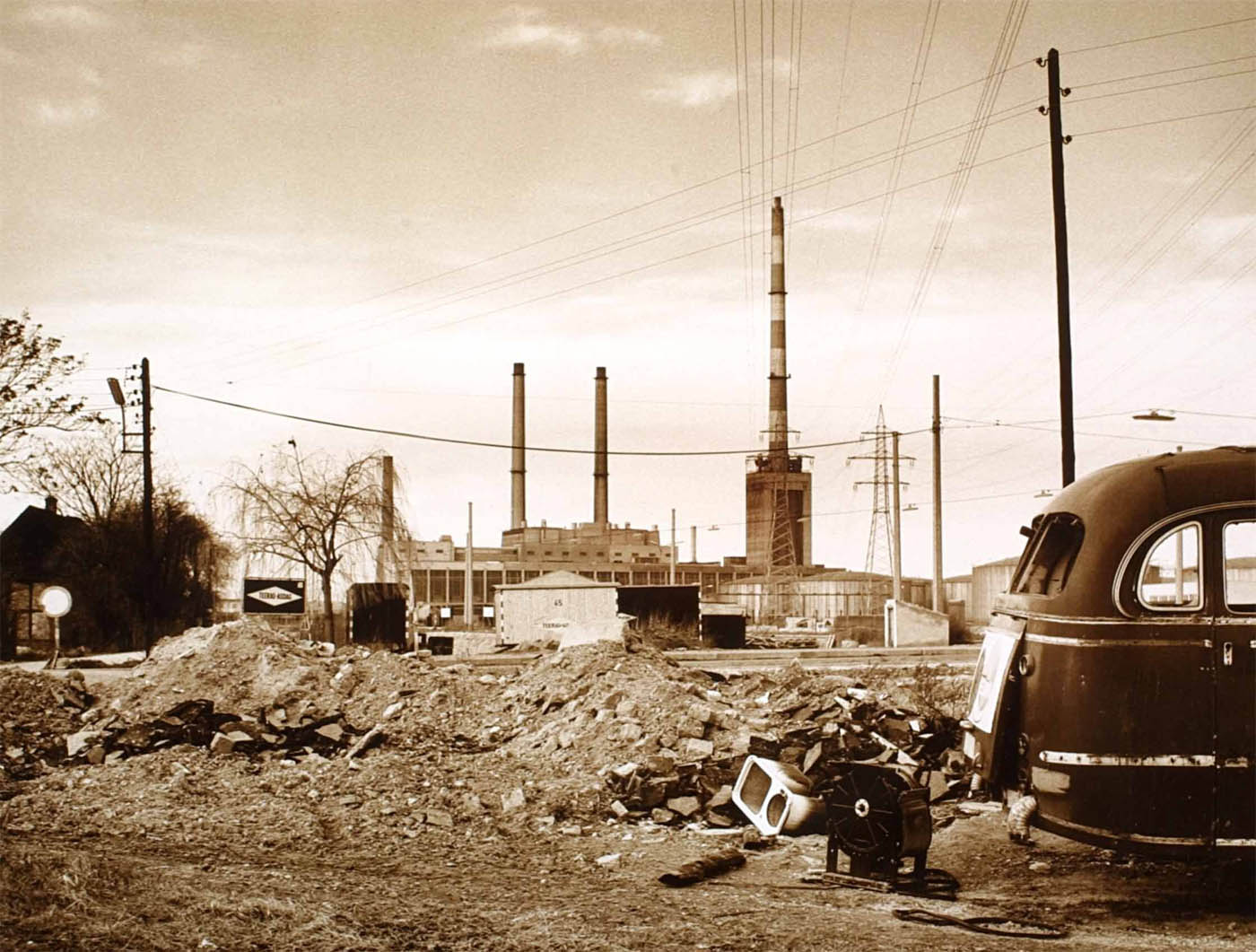
 

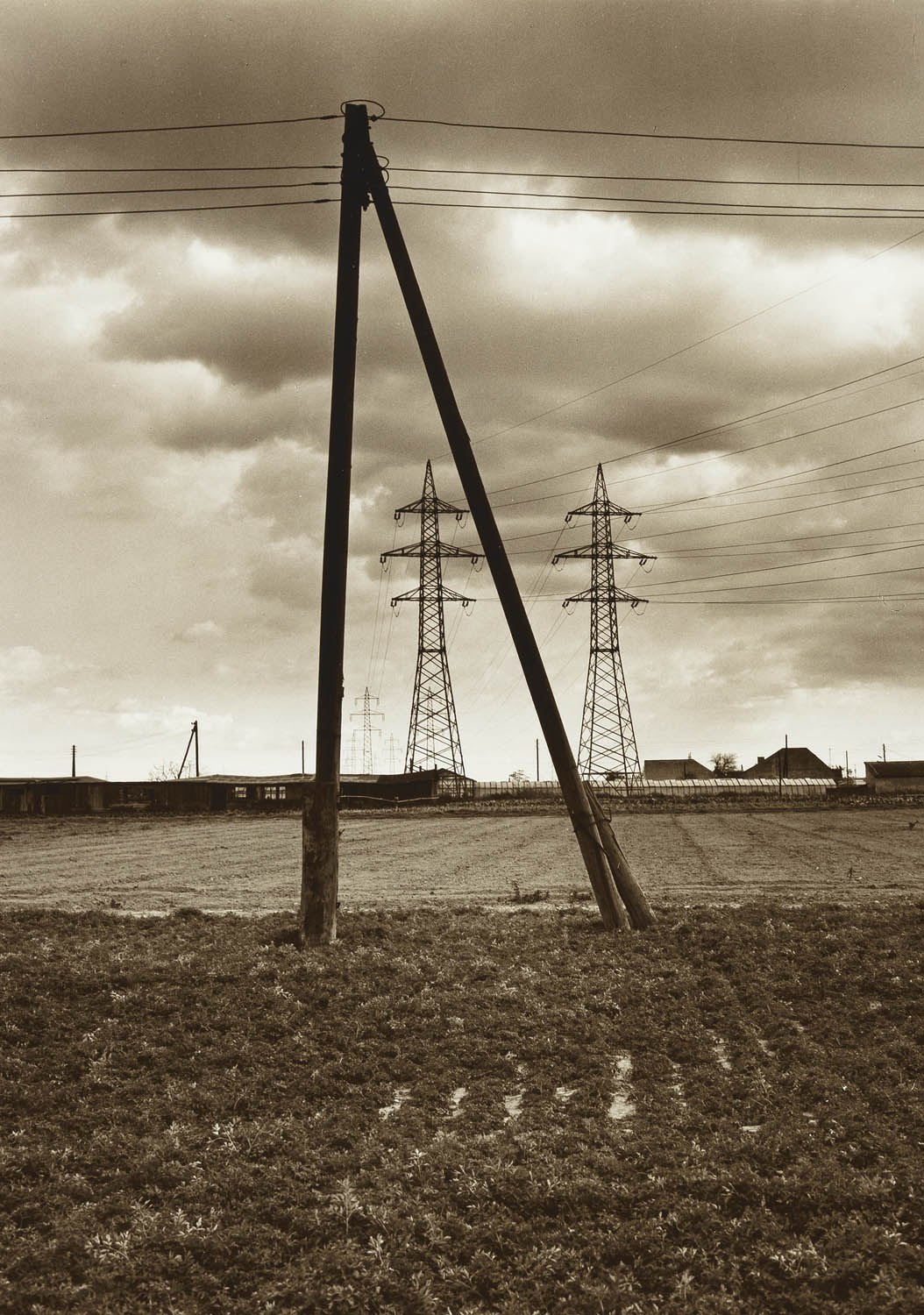
Elfriede Mejchar (Austrian, 1924-2020) From the series 'Simmeringer Heide und Erdberger Mais', 1967-1976


Elfriede Mejchar (Austrian, 1924-2020)
From the series Simmeringer Heide und Erdberger Mais, 1967-1976
Silver gelatine print on baryta paper, brown toned
Museum der Moderne Salzburg
© Bildrecht, Vienna 2024


Deriving pleasure from the dérive

In recent weeks Art Blart has posted on social documentary photographers of the urbanscape: David Goldblatt documenting social conditions in South Africa under apartheid and Roger Mayne with his “mixture of reality and unreality” photographs of the communities of Southam Road and surrounds, London.

One could argue that both could be seen as a focused urban male flâneur (or flâneuse in the case of a female), who saunters around the city observing society – the serendipitous Mayne more so than the working in series focused Goldblatt. And here we have another photographer of the urbanscape until recently unknown to me, that of the magnificent Austrian photographer Elfriede Mejchar (1924-2020) who – according to the exhibition text – is another flâneur, “her flaneur-like practice underlying her earlier bodies of work.”

But Mejchar’s was a very concentrated photographic practice, one in which the photographer again and again “explored Vienna’s peripheral zones on the southeast edge of the city” to create photographic series often created over several years. Therefore, rather than being a wandering dilettante photographer, I believe that Mejchar was a focused conceptual artist who used Guy Debord’s “Theory of the Dérive” (1956)1 (or “drift”) to ground her photographic practice.

With its focused flow of acts, its gestures, its strolls, its encounters, one of the goals of the dérive includes studying the terrain of the city (psychogeography), the exploration of urban environments that emphasises interpersonal connections to places. The pyschogeography of the urbanscape.2

A quotation by Grant W. Ray is instructive in this regard:

“Debord’s Dérive is not simple a walk through the streets of the city, of chance encounters. Instead one must move rapidly and decisively through the urban space, with intention… They should be aware of their surroundings, of the “… ecological analysis of the absolute or relative character of fissures in the urban network, of the role of microclimates, of distinct neighborhoods with no relation to administrative boundaries, and above all of the dominating action of centers of attraction…” Thus the most talented photographers who’s oeuvre includes the investigation of the urbanscape. The walk itself, the interaction of operator, camera, and site breaks down the normal relationship we have with public urban spaces. Their activity alone is the Dérive.”3


Working decisively and with intention, at the edge of the city, in spaces with no boundaries, where there were few people, or using different typologies of the city such as hotel rooms in which she stayed during her everyday job, Mejchar focused on the pyschogeography of the urbanscape through her reflective, non-decisive moment photographs, capturing “the complexity of this desolate and yet, in her eyes, beautiful landscape” and the changes that were happening to the urbanscape.

“Elfriede Mejchar consciously broke away from the photographic mainstream and the reportage style that was popular at the time. Rather than searching for the so-called “decisive moment,” she approached her subjects in a strongly conceptual and serial manner. She focused not on the extraordinary but on the unspectacular and the commonplace, the everyday and the banal, repeatedly addressing these in new ways in her photographic series.” (Text from the Wien Museum website)

Working with the periphery, the borders between urban and rural spaces, the non-decisive moment, landscapes subjected to human interventions and photographs in series, Mejchar’s photographs are more than mere representation of these sites: they challenge the viewer to “instigate more than just chance encounters for the viewer looking at the photographs,” through an understanding of the “subtle variations of the daily social realities created and maintained through public works and layout.”4 “The photographers activity of finding these sites is the dérive, the photograph itself is the pyschogeography, the questioning.”4

With her training as a classical photographer in the manner of Sudek, Brassaï or Tudor-Hart (see the first two photographs in the posting On Her Own. The photographer Elfriede Mejchar) grounding her later objective conceptual photographs, Mejchar’s point of departure is the pleasure she derives from the focused dérive and the results of her activity (through the objective and precise eye of a topographer a la Bernd and Hiller Becher) – the questioning photographs – brought to the attention of the viewer.

Mejchar investigates “traces of civilisation that humans leave in nature or along the edges of the urban fabric” and in so doing brings peripheral things (and her ideas about them) to the centre of our attention, making them psychologically valuable for all of us. The artist derives pleasure from her measured dérive and investigation of the evanescent, posing important questions about seemingly mundane things before they pass out of sight, memory, and existence.

And in her pleasure, is ours.

Dr Marcus Bunyan

See another posting about the artist’s work: On Her Own. The photographer Elfriede Mejchar at Wien Museum MUSA, Vienna, 18th April – 1st September, 2024


1/ “Psychogeography describes the effect of a geographical location on the emotions and behaviour of individuals.

How do different places make us feel and behave? The term psychogeography was invented by the Marxist theorist Guy Debord in 1955 in order to explore this. Inspired by the French nineteenth century poet and writer Charles Baudelaire’s concept of the flâneur – an urban wanderer – Debord suggested playful and inventive ways of navigating the urban environment in order to examine its architecture and spaces.”

Anonymous. “Psychogeography,” on the Tate website Nd [Online] Cited 13/09/2024

2/ Guy Debord (November 1956). “Theory of the Dérive”. Les Lèvres Nues (9). Translated by Ken Knabb.

3/ Guy Debord, “Theory of the Dérive,” 1958 on the Bureau of Public Secrets website Nd quoted in Grant W. Ray. “Dérive,” on the Silverpoetics website 13 July 2009 [Online] Cited 20/08/2024

4/ Ibid.,


Many thankx to the Museum der Moderne Salzburg for allowing me to publish the photographs in the posting. Please click on the photographs for a larger version of the image.


Poesie des Alltäglichen. Fotografien von Elfriede Mejchar / The poetry of the everyday

To mark the centenary of her birth, in 2024 three museums in Austria host exhibitions of works by the photographer Elfriede Mejchar (1924-2020, Vienna, AT). The Museum der Moderne Salzburg presents the artist as a portraitist. Curator Katharina Ehrl guides you through the exhibition in this short film.


In 2024, three museums host exhibitions of works by the Austrian photographer Elfriede Mejchar (1924-2020, Vienna, AT). The Museum der Moderne Salzburg is collaborating with the Landesgalerie Niederösterreich and the Wien Museum to honor the artist’s work at three different locations on the occasion of her 100th birthday, with each location offering a different focus.

Salzburg’s contribution to this collaborative project will present the artist’s portraits. With her series of works entitled “Artists at work” (1954-1961), for example, Mejchar demonstrates impressively how she engages with the artistic personalities of Christa Hauer, Friedensreich Hundertwasser, Josef Mikl and Arnulf Rainer by mapping their working situation in their studios. But she also demonstrated the same precision of perception when encountering the inanimate objects in her surroundings, thereby giving landscapes, flowers and discarded furniture the appearance of animated portraits.

The photo collections at the Museum der Moderne Salzburg hold a total of 665 photographs by Mejchar. Otto Breicha, the first director of the Museum’s predecessor institution, was a long-time colleague of Mejchar who recognised the artistic value of her photographic work and helped to promote it. As early as 1982, one year before the official opening of the Rupertinum, a comprehensive collection of her work was added to the photographic collection that later grew through further purchases and donations and today constitutes a focal point of the Museum’s photographic holdings.

Text from the Museum der Moderne Salzburg website
 

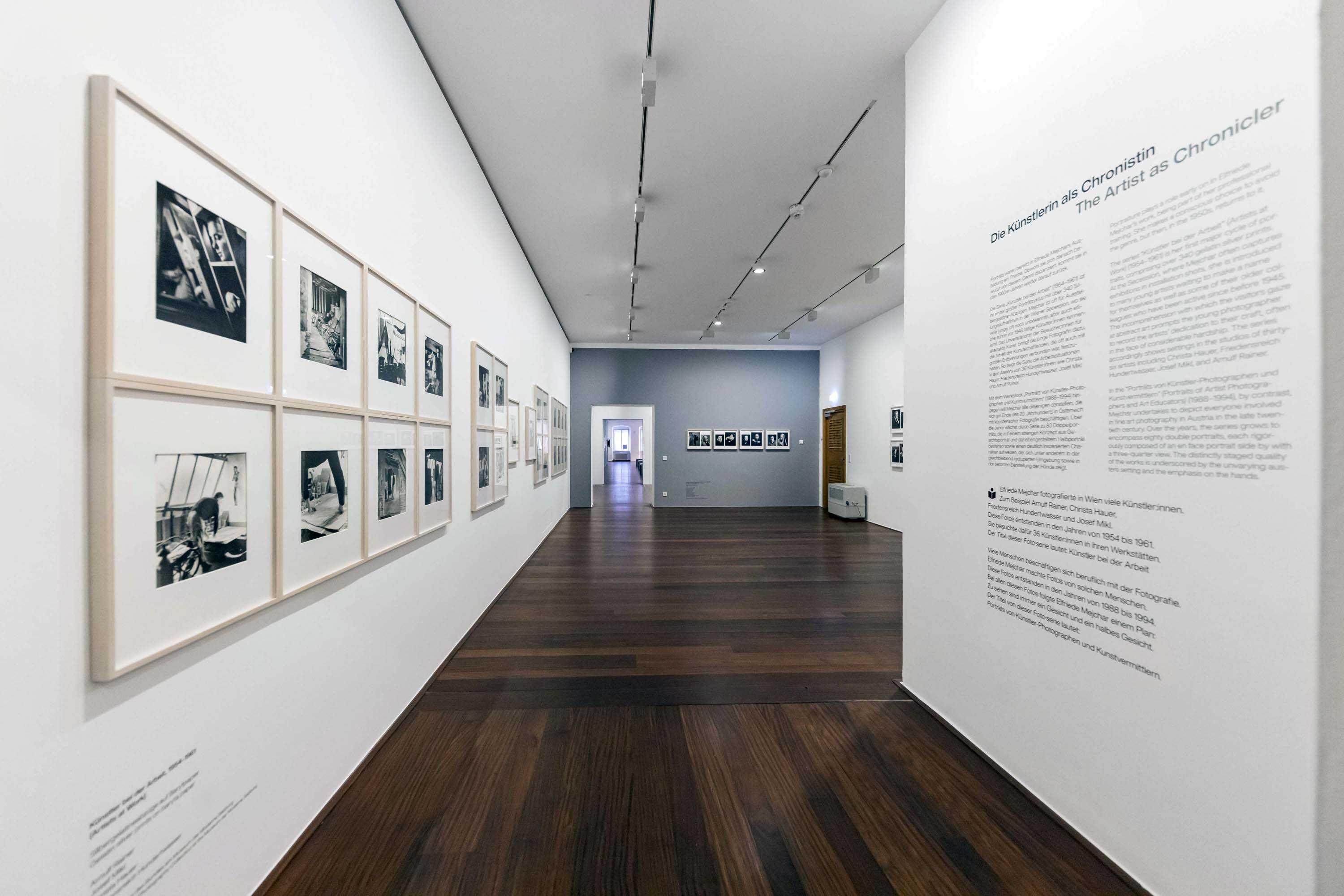
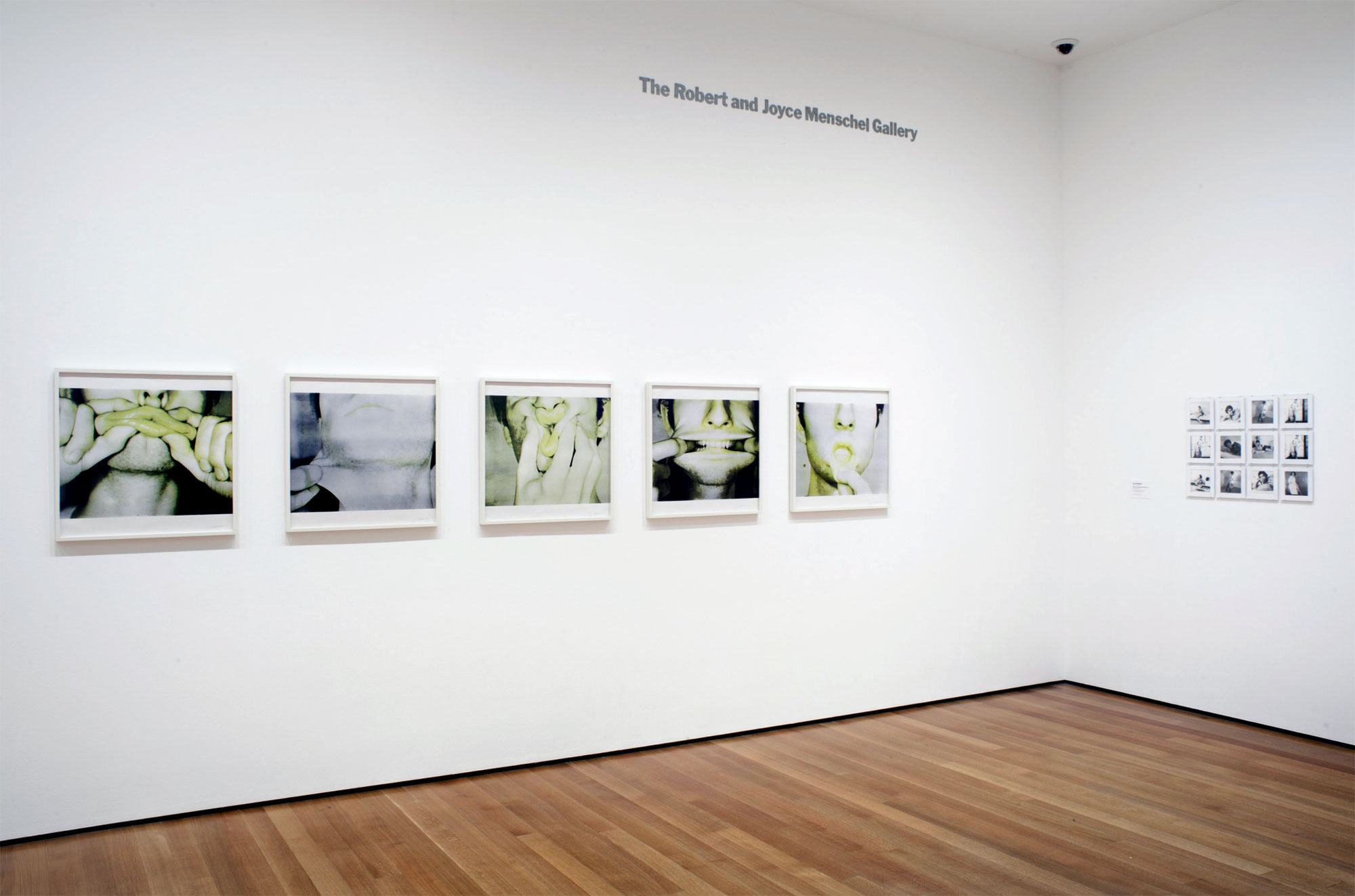
Installation view of the exhibition 'The Poetry of the Everyday. Photographs by Elfriede Mejchar', Museum der Moderne Salzburg 2024


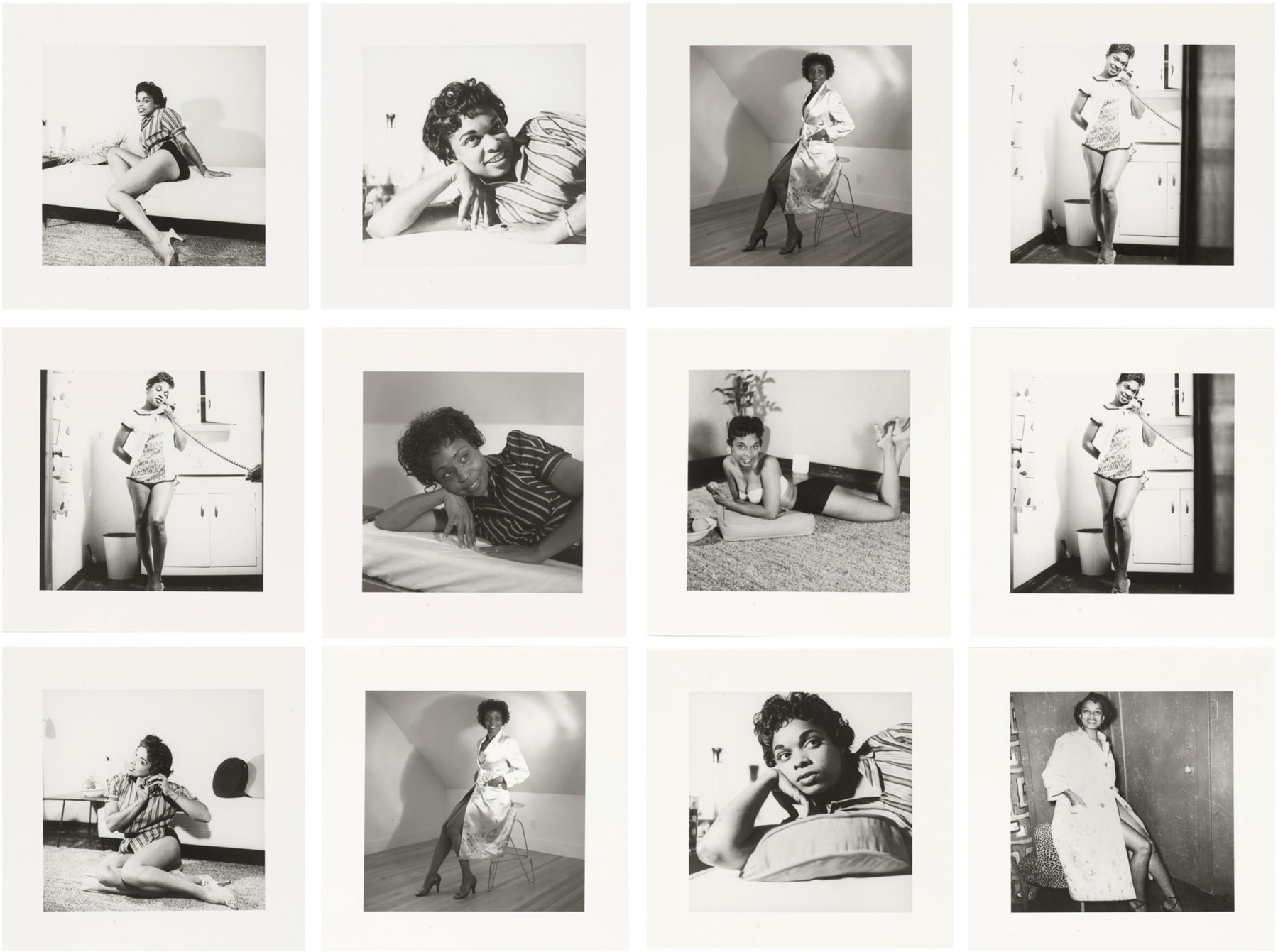
Installation view of the exhibition The Poetry of the Everyday. Photographs by Elfriede Mejchar, Museum der Moderne Salzburg 2024 showing at left, work from Mejchar’s series Eine Kostümierung der geliehenen Identität (A Masquerade of Borrowed Identity) (below); and at right, photographs from the series Nobody is Perfect (below)
© Museum der Moderne Salzburg
Photo: wildbild/Günter Freund
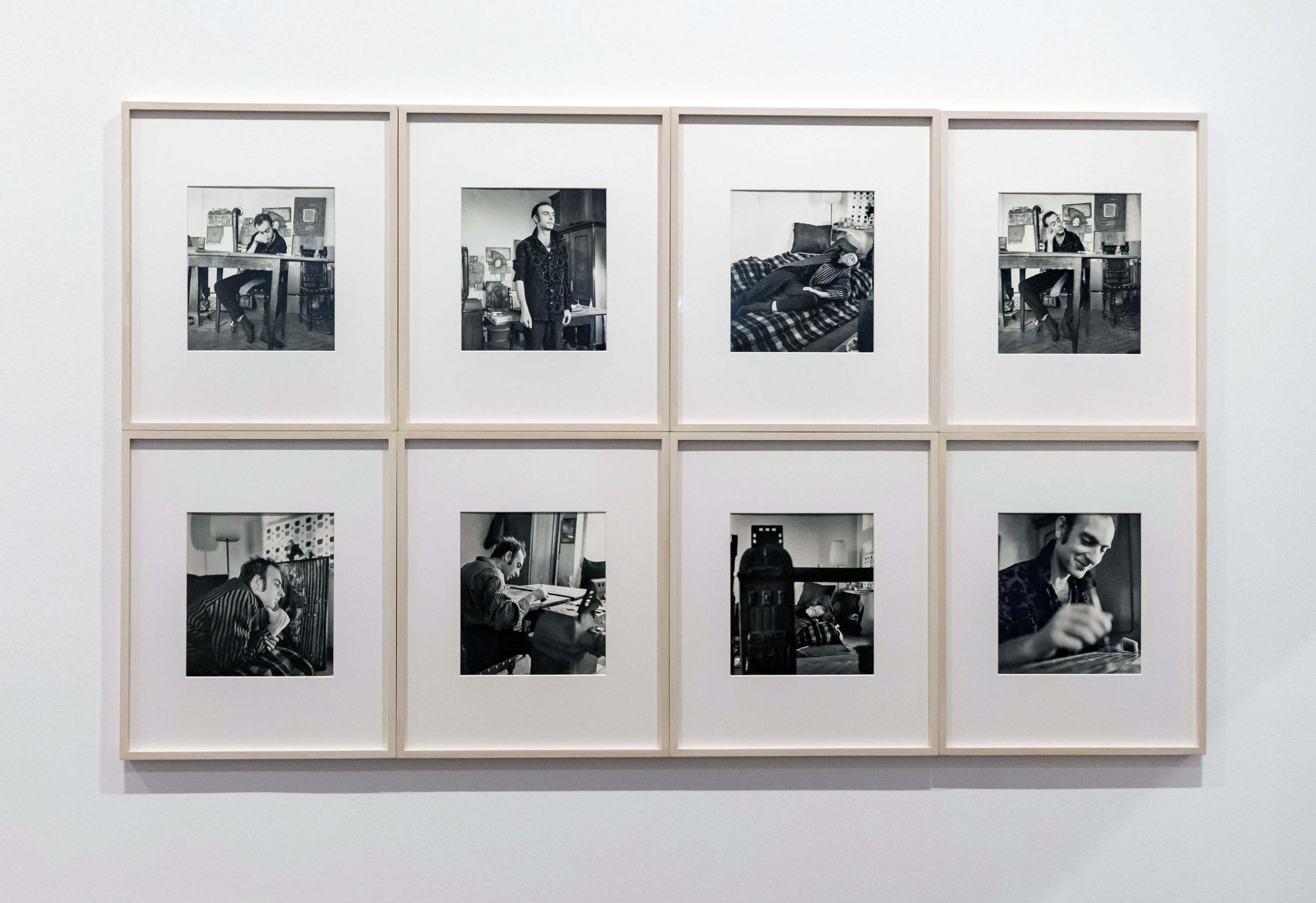
 

Installation view of the exhibition 'The Poetry of the Everyday. Photographs by Elfriede Mejchar', Museum der Moderne Salzburg 2024 showing work from Mejchar's series 'Künstler bei der Arbeit, 1954-1961' (Artists at work, 1954–1961)


Installation view of the exhibition The Poetry of the Everyday. Photographs by Elfriede Mejchar, Museum der Moderne Salzburg 2024 showing work from Mejchar’s series Künstler bei der Arbeit, 1954-1961 (Artists at work, 1954-1961) (below)
© Museum der Moderne Salzburg
Photo: wildbild/Günter Freund


Elfriede Mejchar (Austrian, 1924-2020) 'Arnulf Rainer' 1954-1961


Elfriede Mejchar (Austrian, 1924-2020)
Arnulf Rainer
1954-1961
From the series Künstler bei der Arbeit, 1954-1961 (Artists at work, 1954-1961)
Silver gelatin print on baryta paper
Federal Photography Collection at the Museum der Moderne Salzburg


Arnulf Rainer (Austrian, b. 1929)

Arnulf Rainer (born 8 December 1929) is an Austrian painter noted for his abstract informal art.

Rainer was born in Baden, Austria. During his early years, Rainer was influenced by Surrealism. In 1950, he founded the Hundsgruppe (dog group) together with Ernst Fuchs, Arik Brauer, and Josef Mikl. After 1954, Rainer’s style evolved towards Destruction of Forms, with blackenings, overpaintings, and maskings of illustrations and photographs dominating his later work. He was close to the Vienna Actionism, featuring body art and painting under the influence of drugs. He painted extensively on the subject of Hiroshima such as it relates to the nuclear bombing of the Japanese city and the inherent political and physical fallout.

Text from the Wikipedia website 
 

Elfriede Mejchar (Austrian, 1924-2020) 'Christa Hauer' 1954-1961


Elfriede Mejchar (Austrian, 1924-2020)
Christa Hauer
1954-1961
From the series Künstler bei der Arbeit, 1954-1961 (Artists at work, 1954–1961)
Silver gelatin print on baryta paper
Federal Photography Collection at the Museum der Moderne Salzburg


Christa Hauer-Fruhmann (Austrian, 1925-2013)

Christa Hauer-Fruhmann (b. March 13, 1925 in Vienna; d. March 21, 2013 in St. Pölten) was an Austrian painter. …

She was initially under the artistic influence of her father and created representational works such as landscapes, portraits and nude drawings. At the end of her stay in the USA, around 1960, she turned to abstract painting, particularly action painting, color field painting and informal art. Later, cosmic forms and a turn to nature determined her works.

Text from the German Wikipedia website translated by Google Translate
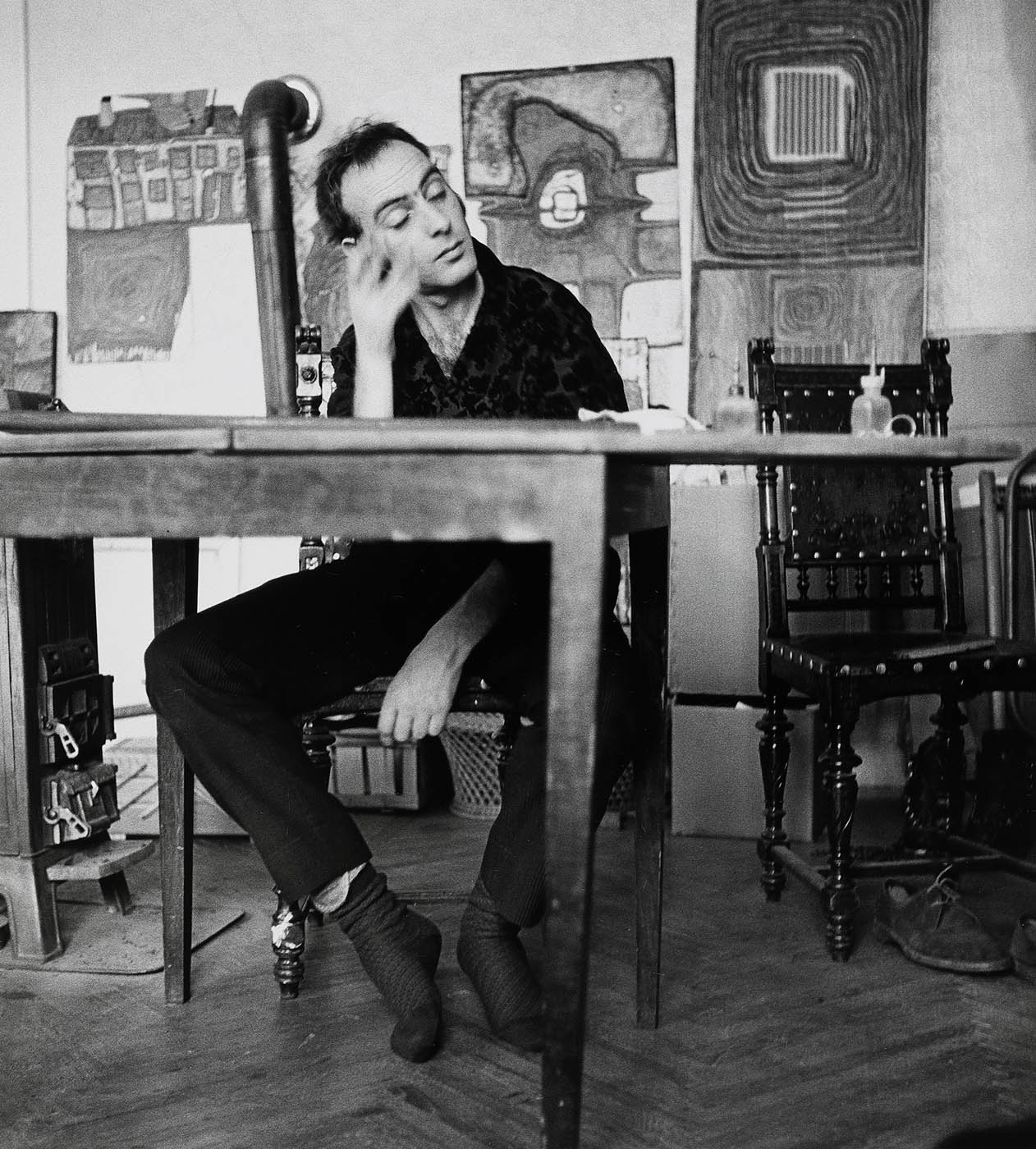
 

Elfriede Mejchar (Austrian, 1924-2020) 'Friedensreich Hundertwasser' 1954-1961


Elfriede Mejchar (Austrian, 1924-2020)
Friedensreich Hundertwasser
1954-1961
From the series Künstler bei der Arbeit, 1954-1961 (Artists at work, 1954-1961)
Silver gelatin print on baryta paper
Federal Photography Collection at the Museum der Moderne Salzburg


Friedensreich Hundertwasser (Austrian, 1928-2000)

Friedensreich Hundertwasser Regentag Dunkelbunt (born Friedrich Stowasser, born December 15, 1928 in Vienna; died February 19, 2000 on board the Queen Elizabeth 2 off Brisbane) was an Austrian artist, who worked primarily as a painter, but also in the fields of architecture and environmental protection. …

Artistically, he was an opponent of the “straight line” and any kind of standardisation throughout his life. This is particularly evident in his work in the field of building design, which is characterised by imaginative liveliness and individuality, but above all by the inclusion of nature in architecture.

Text from the German Wikipedia website translated by Google Translate


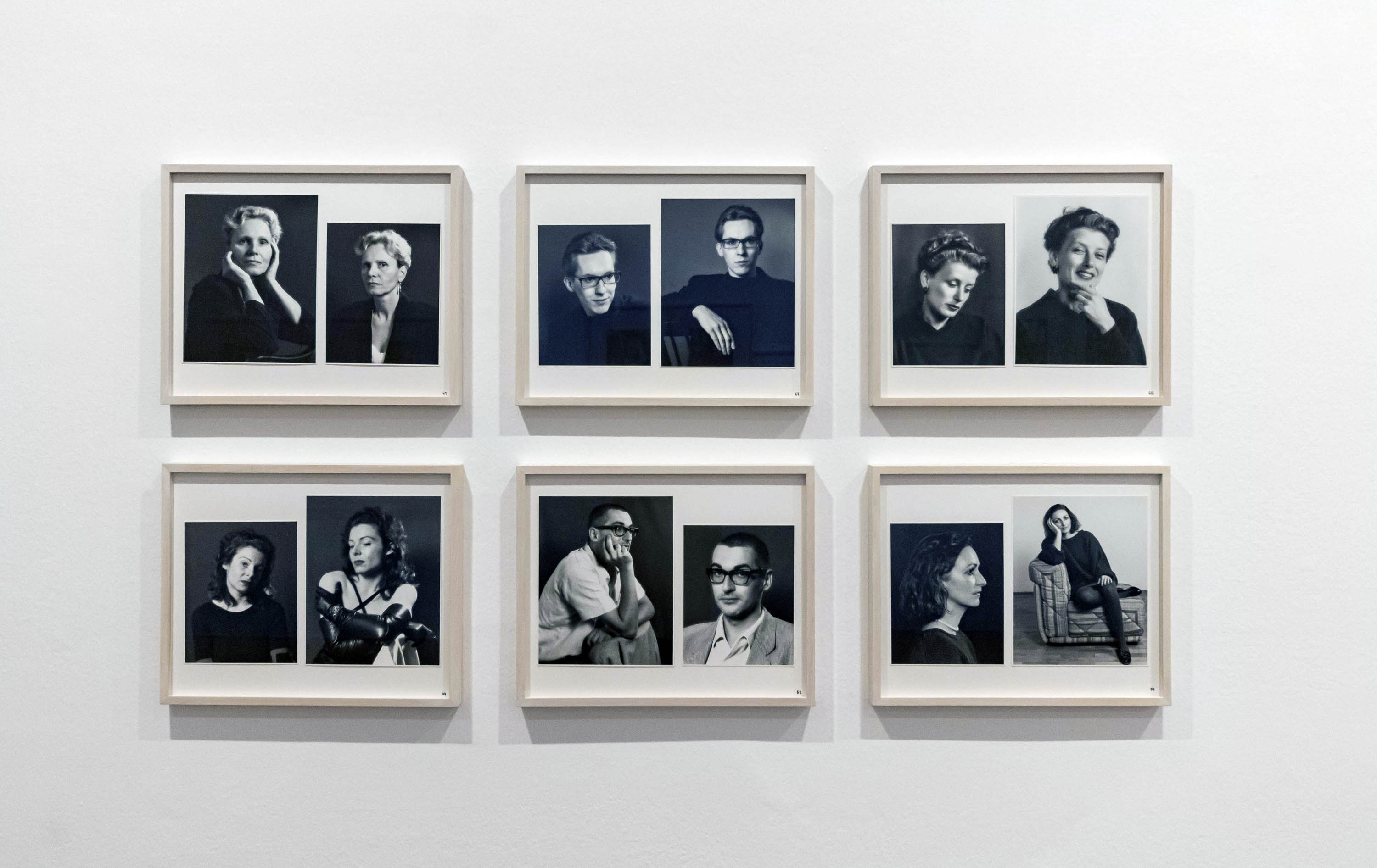
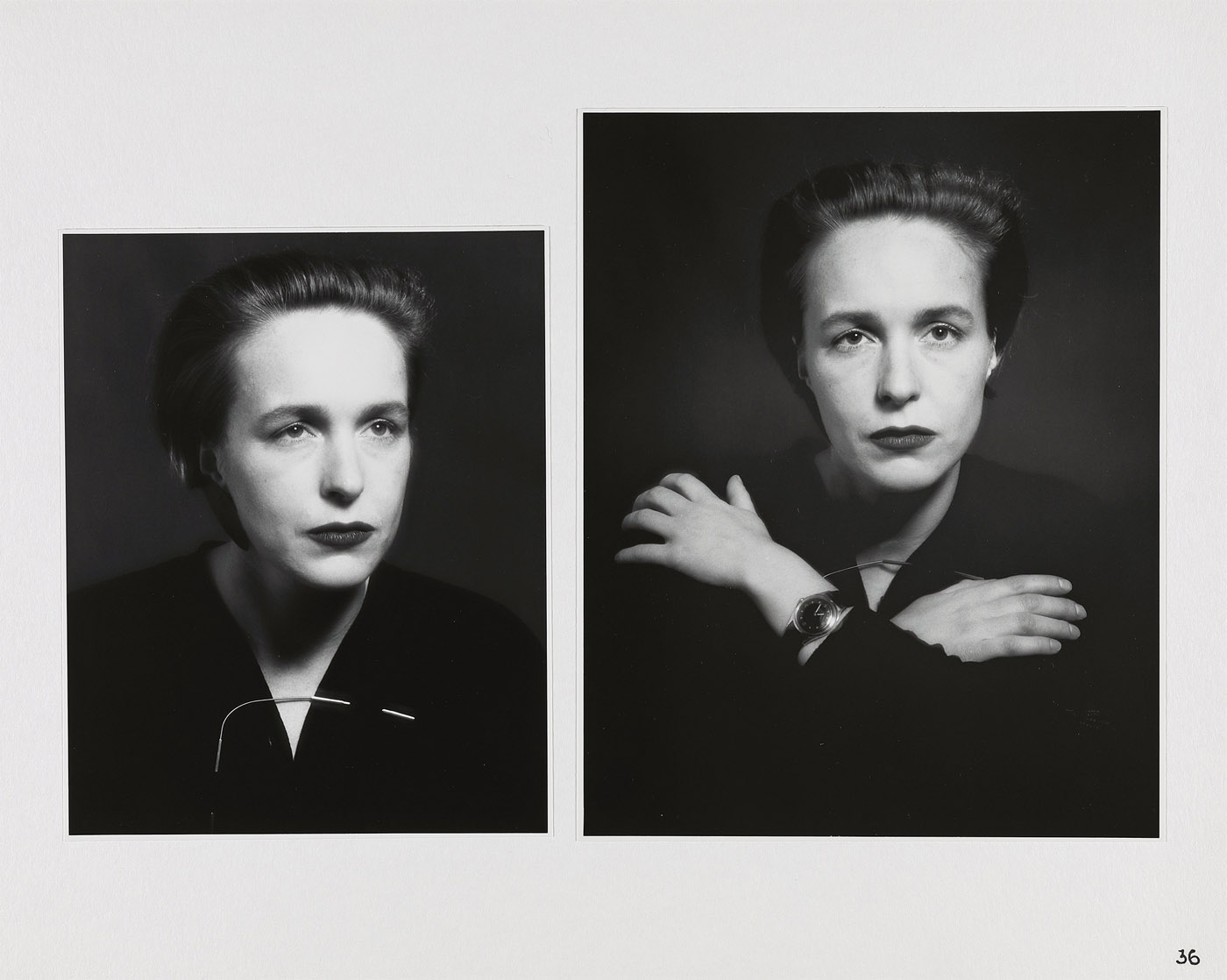
Installation view of the exhibition 'The Poetry of the Everyday. Photographs by Elfriede Mejchar', Museum der Moderne Salzburg 2024 showing photographs from Mejchar's series 'Porträts von Künstler-Photographen und Kunstvermittlern' (Portraits of Artist Photographers and Art Educators)

Installation view of the exhibition 'The Poetry of the Everyday. Photographs by Elfriede Mejchar', Museum der Moderne Salzburg 2024 showing photographs from Mejchar's series 'Porträts von Künstler-Photographen und Kunstvermittlern' (Portraits of Artist Photographers and Art Educators)


Installation view of the exhibition The Poetry of the Everyday. Photographs by Elfriede Mejchar, Museum der Moderne Salzburg 2024 showing photographs from Mejchar’s series Porträts von Künstler-Photographen und Kunstvermittlern (Portraits of Artist Photographers and Art Educators) (below)
© Museum der Moderne Salzburg, photo: wildbild/Günter Freund


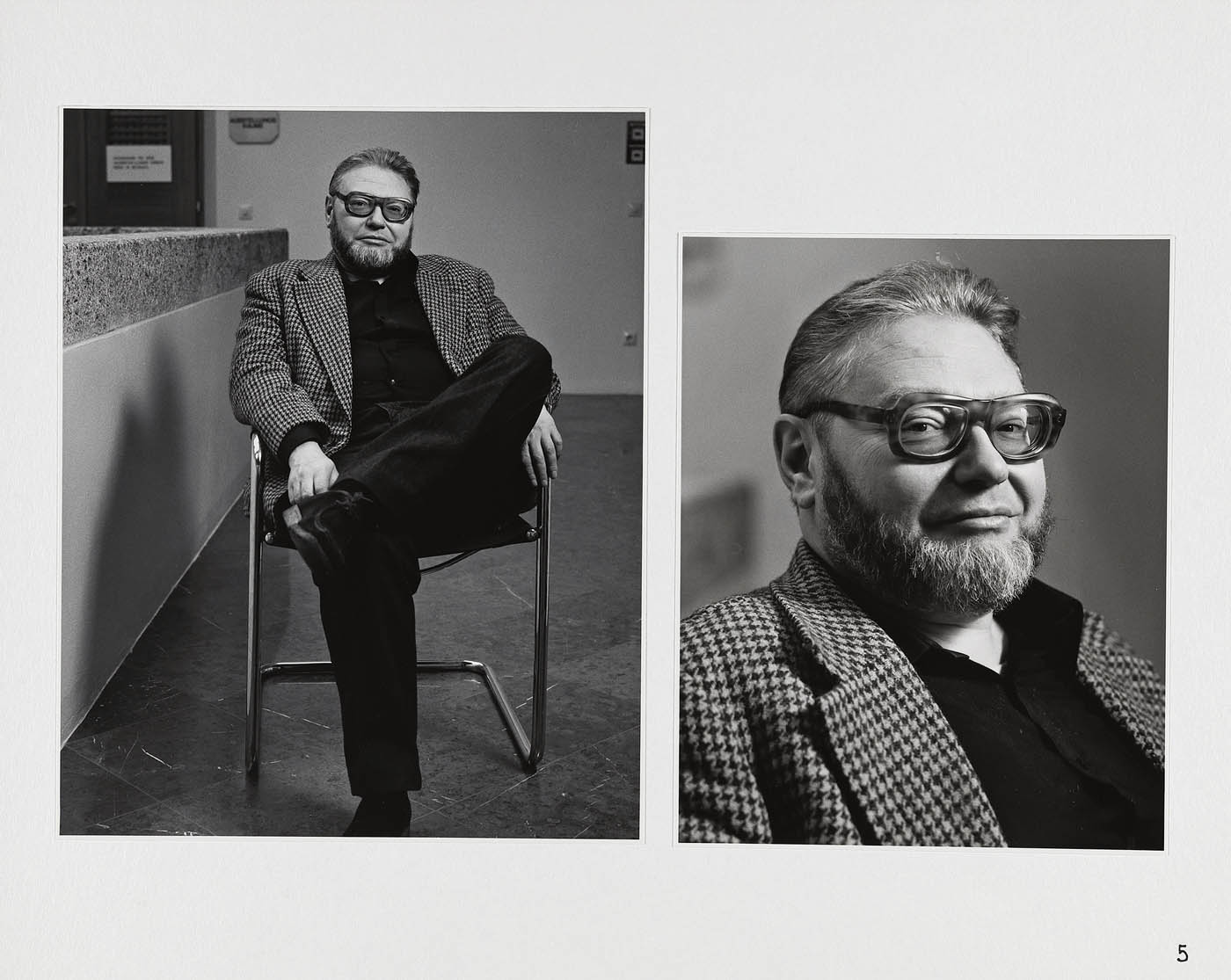
Elfriede Mejchar (Austrian, 1924-2020) 'Aglaia Konrad' 1988


Elfriede Mejchar (Austrian, 1924-2020)
Aglaia Konrad
1988
From the series Porträts von Künstler-Photographen und Kunstvermittlern (Portraits of Artist Photographers and Art Educators)
Silver gelatin print on baryta paper
Federal Photography Collection at the Museum der Moderne Salzburg


Aglaia Konrad (Austrian, b. 1960)

Aglaia Konrad (born 1960) is an Austrian photographer and educator living in Brussels. …

Konrad’s photographs explore urban space in large cities. Konrad’s work has been to known to be distinctly international in that it highlights urban elements independent of cultural markers. Her work highlights the ubiquitous elements of urban life through methods like filming a city from the perspective of a moving car or compiling a series of aerial views of skyscrapers.

Text from the Wikipedia website


Elfriede Mejchar (Austrian, 1924-2020) 'Prof. Dr. Otto Breicha' 1988


Elfriede Mejchar (Austrian, 1924-2020)
Prof. Dr. Otto Breicha
1988
From the series Porträts von Künstler-Photographen und Kunstvermittlern (Portraits of Artist Photographers and Art Educators)
Silver gelatin print on baryta paper
Federal Photography Collection at the Museum der Moderne Salzburg


Otto Breicha (Austrian, 1932-2003)

Otto Breicha (b. 26 July 1932 in Vienna; d, 28 December 2003 in Vienna) was an Austrian art historian, publicist and museum director. …

Breicha is considered an important integration figure in the Austrian art and literature scene of the 1960s. As director of the Rupertinum he collected works by Kurt Moldovan, Günter Brus, Fritz Wotruba and Gotthard Muhr, among others. He edited portfolios by Karl Anton Fleck, Gotthard Muhr, Peter Pongratz, Alois Riedl, Karl Rössing, Johannes Wanke, Max Weiler and many others.

Breicha built up an important photo collection in the Rupertinum. He also took photos of authors himself, especially during his time at the Austrian Society for Literature from 1962 to 1972.

Text from the German Wikipedia website translated by Google Translate
 

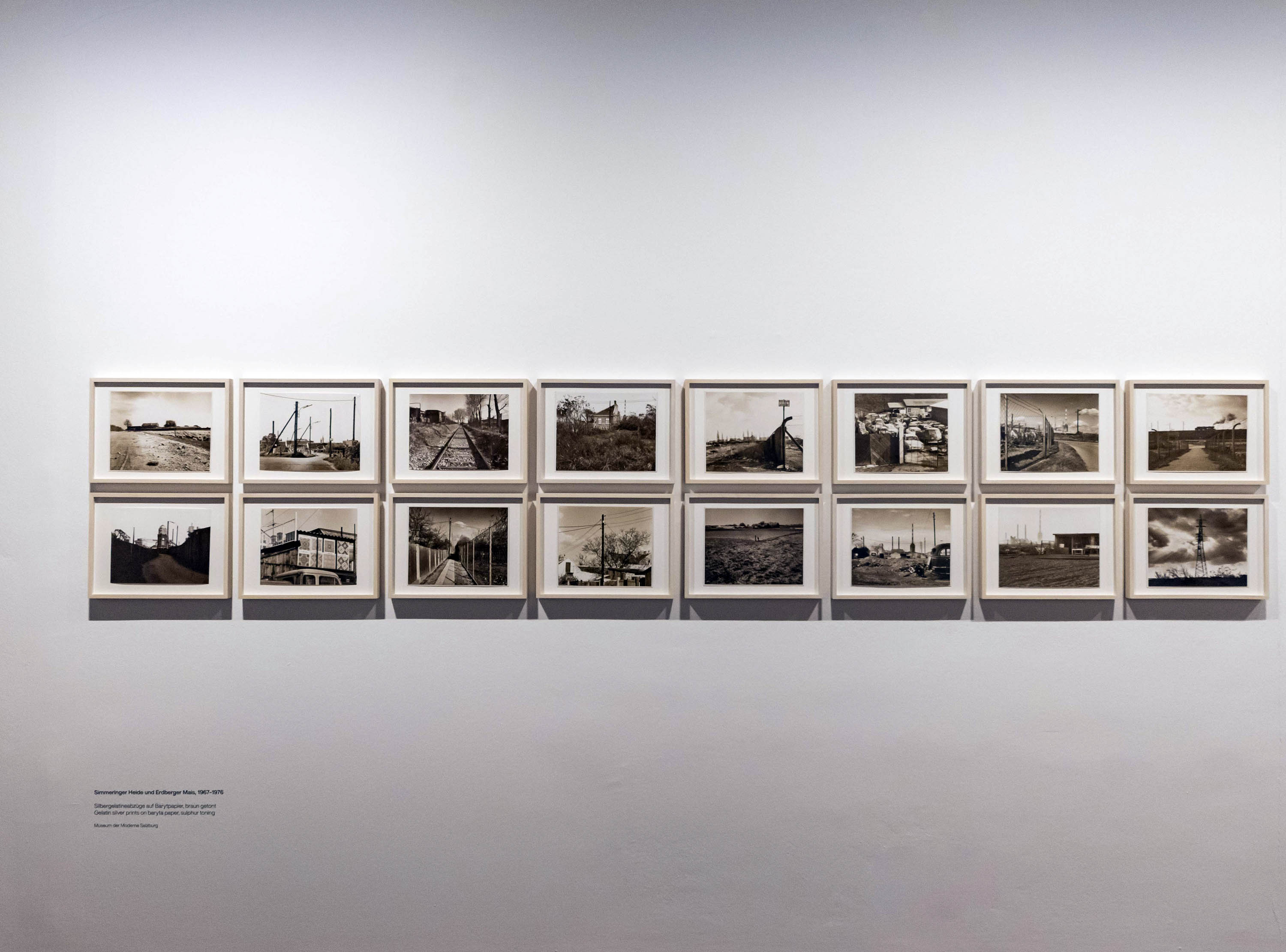
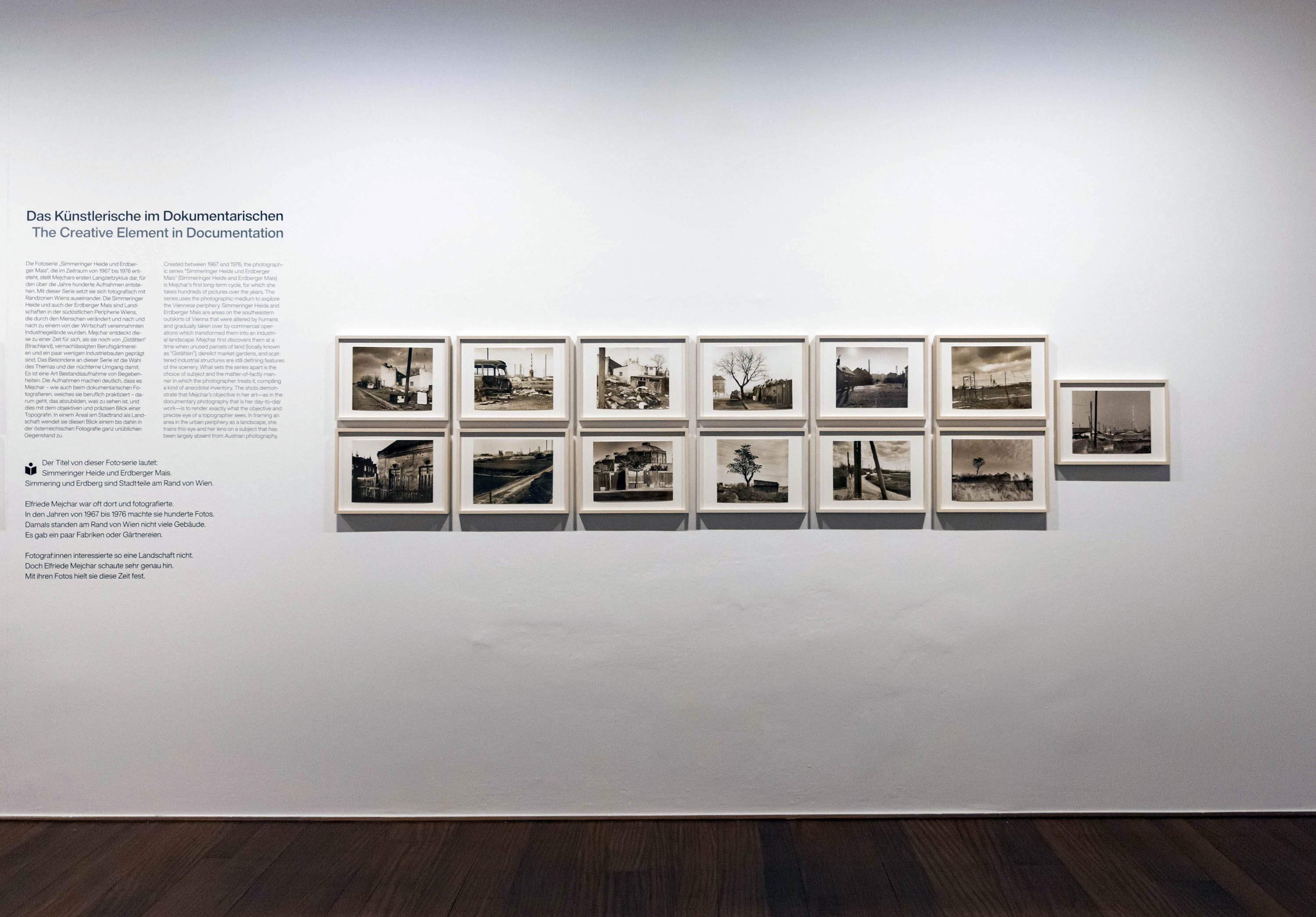
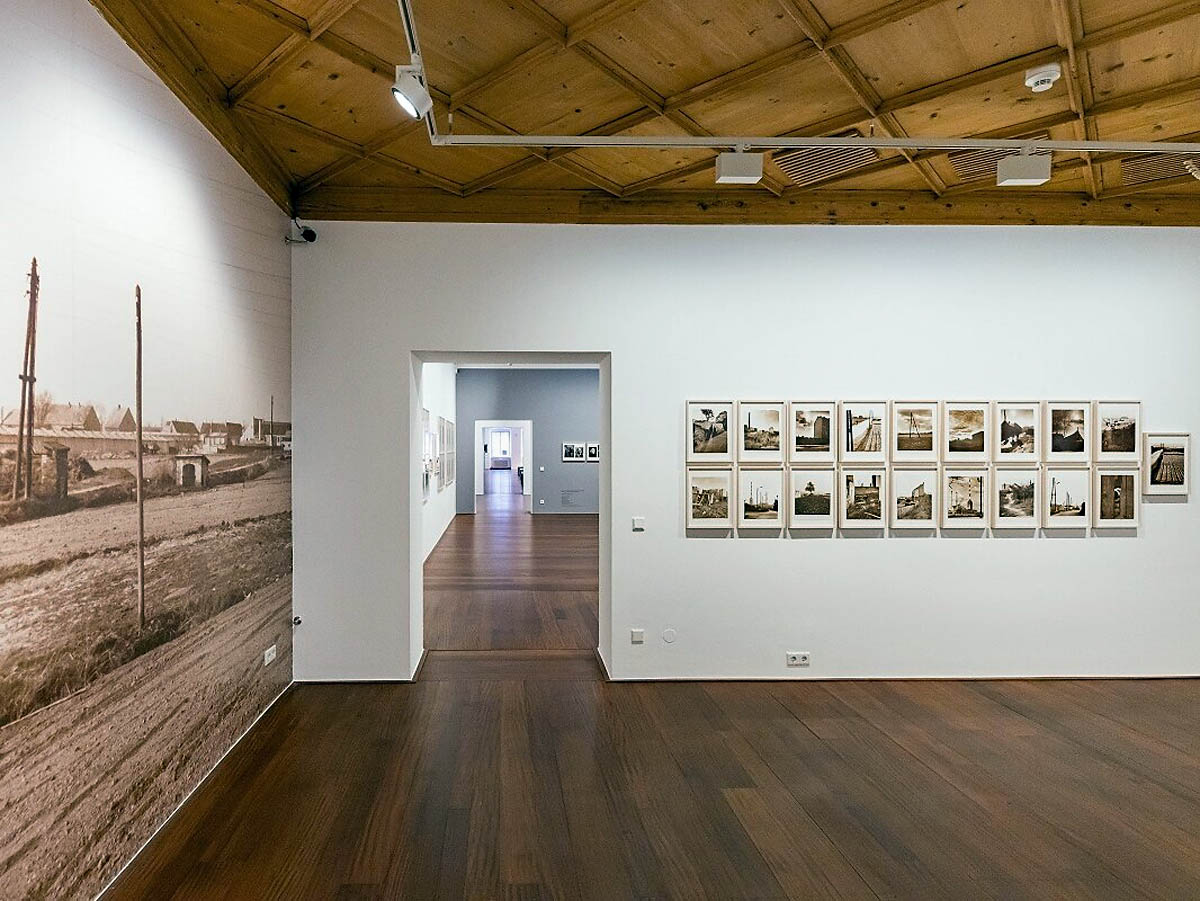
Installation view of the exhibition 'The Poetry of the Everyday. Photographs by Elfriede Mejchar', Museum der Moderne Salzburg 2024 showing photographs from Mejchar's series 'Simmeringer Heide und Erdberger Mais, 1967-1976'

Installation view of the exhibition 'The Poetry of the Everyday. Photographs by Elfriede Mejchar', Museum der Moderne Salzburg 2024 showing photographs from Mejchar's series 'Simmeringer Heide und Erdberger Mais, 1967-1976'

Installation view of the exhibition 'The Poetry of the Everyday. Photographs by Elfriede Mejchar', Museum der Moderne Salzburg 2024 showing photographs from Mejchar's series 'Simmeringer Heide und Erdberger Mais, 1967-1976'

Installation view of the exhibition 'The Poetry of the Everyday. Photographs by Elfriede Mejchar', Museum der Moderne Salzburg 2024 showing photographs from Mejchar's series 'Simmeringer Heide und Erdberger Mais, 1967-1976'


Installation view of the exhibition The Poetry of the Everyday. Photographs by Elfriede Mejchar, Museum der Moderne Salzburg 2024 showing photographs from Mejchar’s series Simmeringer Heide und Erdberger Mais, 1967-1976 (below)
© Museum der Moderne Salzburg, photo: wildbild/Günter Freund
 

Elfriede Mejchar (Austrian, 1924-2020) From the series 'Simmeringer Heide und Erdberger Mais', 1967-1976


Elfriede Mejchar (Austrian, 1924-2020)
From the series Simmeringer Heide und Erdberger Mais, 1967-1976
Silver gelatine print on baryta paper, brown toned
Museum der Moderne Salzburg
© Bildrecht, Vienna 2024


Elfriede Mejchar (Austrian, 1924-2020) From the series 'Simmeringer Heide und Erdberger Mais, 1967-1976'


Elfriede Mejchar (Austrian, 1924-2020)
From the series Simmeringer Heide und Erdberger Mais, 1967-1976
Silver gelatine print on baryta paper, brown toned
Museum der Moderne Salzburg
© Bildrecht, Vienna 2024


The Creative Element in Documentation

Created between 1967 and 1976, the photographic series “Simmeringer Heide und Erdberger Mais” (Simmeringer Heide and Erdberger Mais) is Mejchar’s first long-term cycle, for which she takes hundreds of pictures over the years. The series uses the photographic medium to explore the Viennese periphery. Simmeringer Heide and Erdberger Mais are areas on the southeastern outskirts of Vienna that were altered by humans and gradually taken over by commercial operations which transformed them into an industrial landscape. Mekchav first discovers them at a time when unused parcels of land (locally known as “Gstatten”), derelict market gardens, and scattered industrial structures are still defining features of the scenery. What sets the series apart is the choice of subject and the matter-of-fact manner in which the photographer treats it, compiling a kind of anecdotal inventory. The shots demonstrate that Mejchar’s objective in there art – as in the documentary photography that is her day-to-day work – is to render exactly what the objective and precise eye of a topographer sees. In framing an area in the urban periphery as a landscape, she trains this eye and her lens on a subject that has been largely absent from Austrian photography.

Wall text from the exhibition


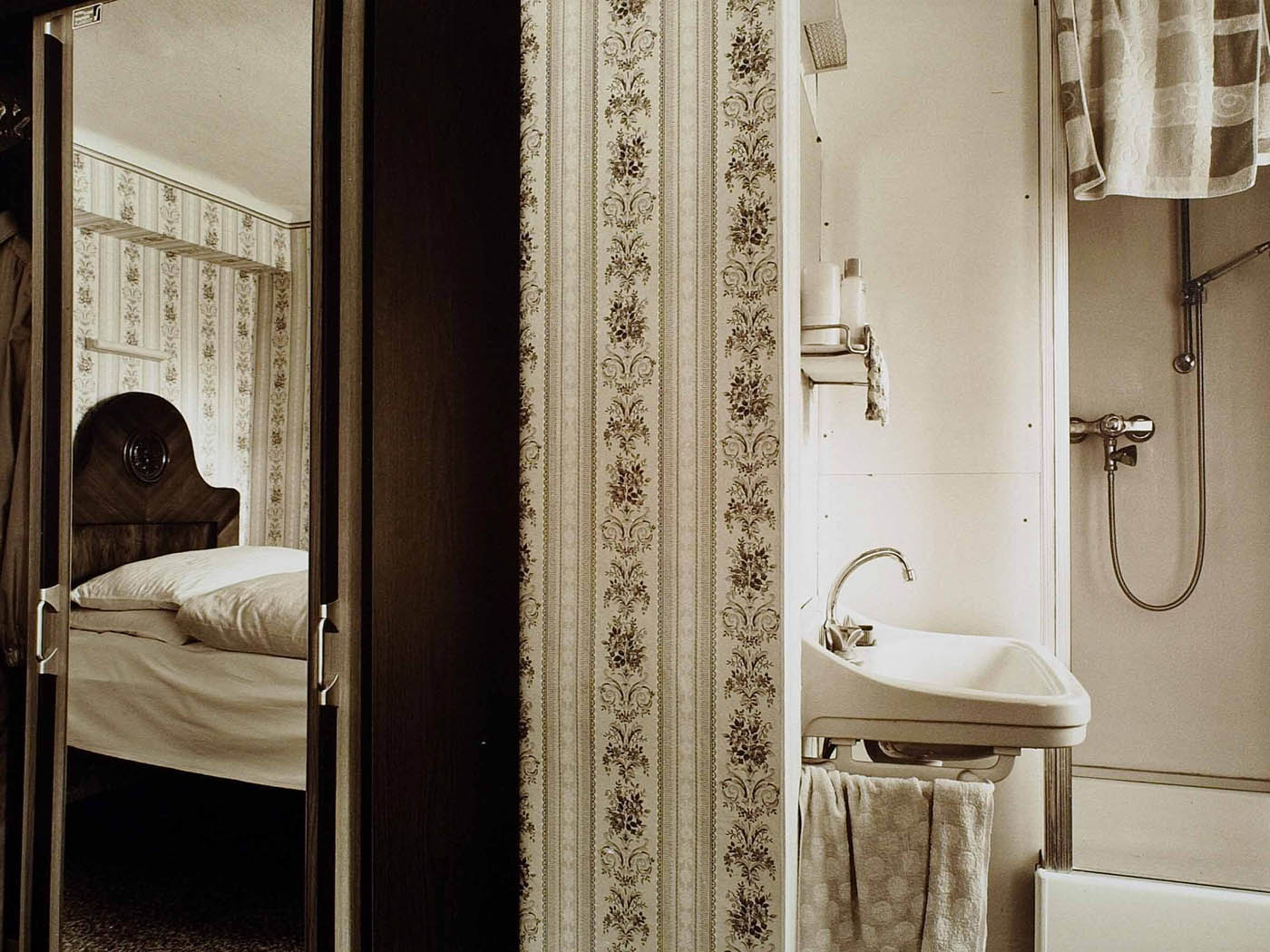
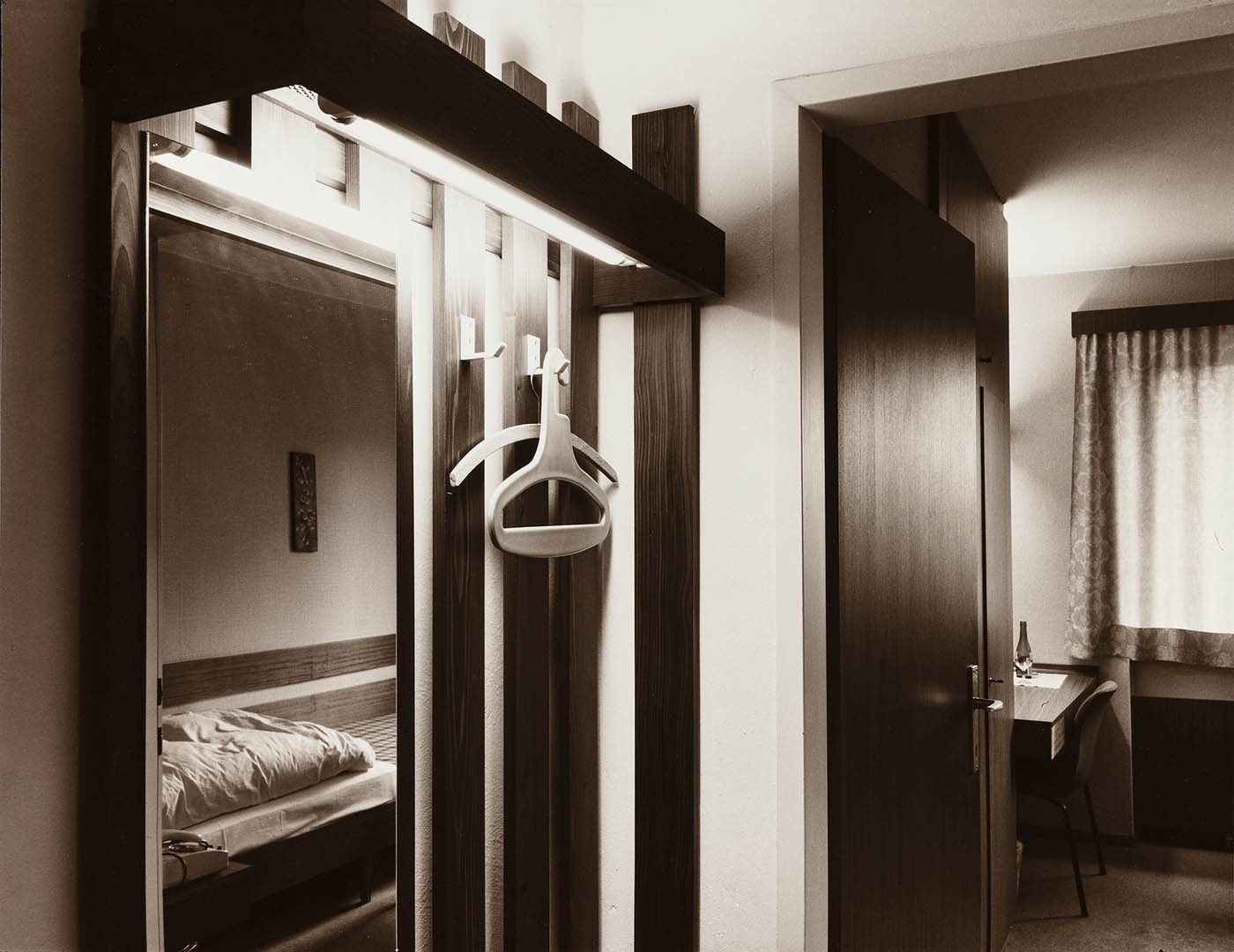
Installation view of the exhibition 'The Poetry of the Everyday. Photographs by Elfriede Mejchar', Museum der Moderne Salzburg 2024 showing work from Mejchar's series 'Hotel (Fremdenzimmer), 1970-1986' (Hotel (Guest Room), 1970-1986)


Installation view of the exhibition The Poetry of the Everyday. Photographs by Elfriede Mejchar, Museum der Moderne Salzburg 2024 showing work from Mejchar’s series Hotel (Fremdenzimmer), 1970-1986 (Hotel (Guest Room), 1970-1986) (below)
© Museum der Moderne Salzburg, photo: wildbild/Günter Freund


Elfriede Mejchar (Austrian, 1924-2020) From the series 'Hotel (Fremdenzimmer)', 1970-1986 (Hotel (Guest Room), 1970-1986)


Elfriede Mejchar (Austrian, 1924-2020)
From the series Hotel (Fremdenzimmer), 1970-1986 (Hotel (Guest Room), 1970-1986)
Silver gelatin print on baryta paper, brown tones
Federal Photography Collection at the Museum der Moderne Salzburg


Elfriede Mejchar (Austrian, 1924-2020) From the series 'Hotel (Fremdenzimmer)', 1970-1986 (Hotel (Guest Room), 1970-1986)


Elfriede Mejchar (Austrian, 1924-2020)
From the series Hotel (Fremdenzimmer), 1970-1986 (Hotel (Guest Room), 1970-1986)
Silver gelatin print on baryta paper, brown tones
Federal Photography Collection at the Museum der Moderne Salzburg
© Bildrecht, Vienna, 2024
Photo: Andrew Phelps


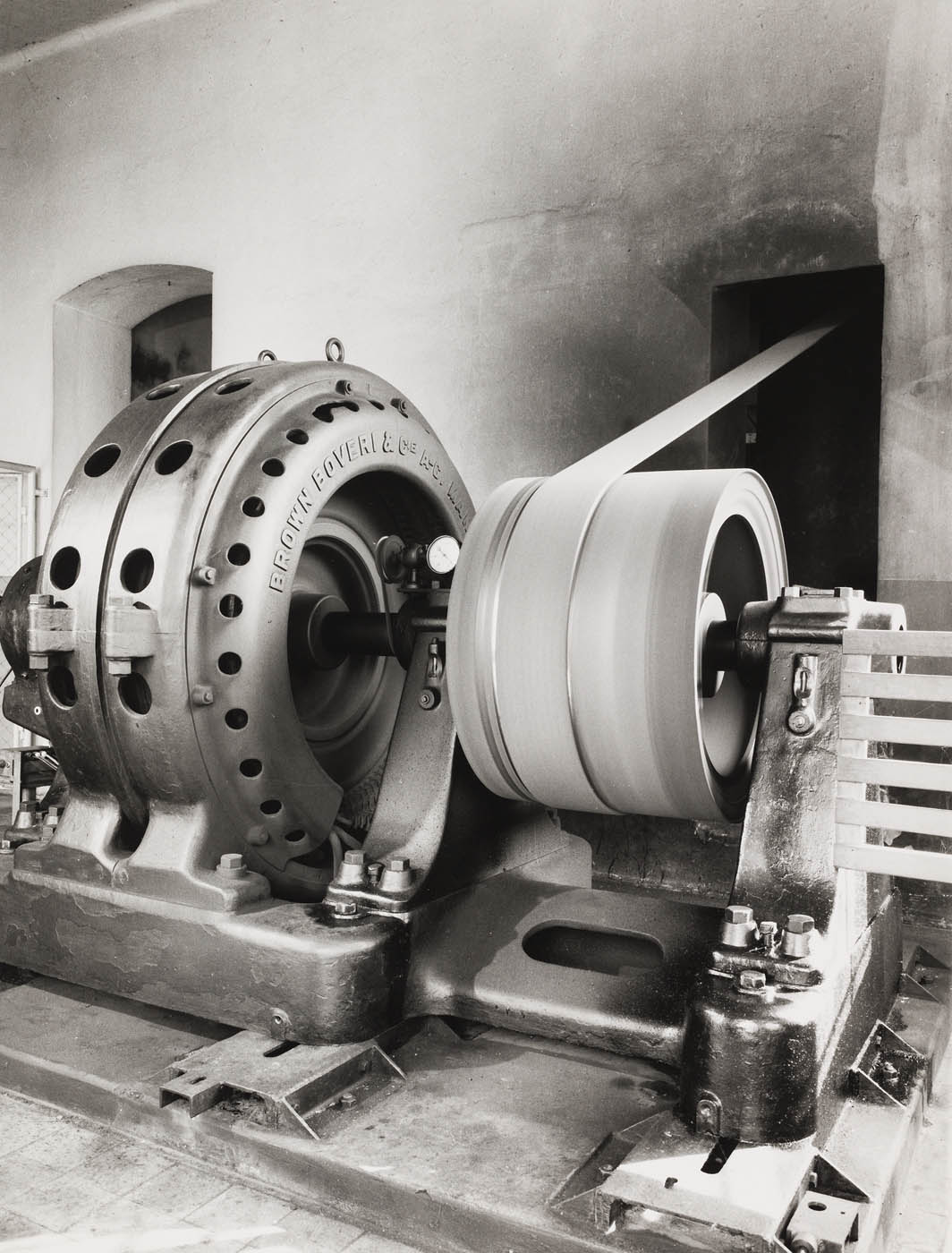
Elfriede Mejchar (Austrian, 1924-2020) 'Flachsspinnerei in Stadl-Paura' (Flax spinning mill in Stadl-Paura) 1986


Elfriede Mejchar (Austrian, 1924-2020)
Flachsspinnerei in Stadl-Paura (Flax spinning mill in Stadl-Paura)
1986
© Elfriede Mejchar/Landessammlungen NÖ


Installation view of the exhibition 'The Poetry of the Everyday. Photographs by Elfriede Mejchar', Museum der Moderne Salzburg 2024 showing work from Mejchar's series 'Die Monatssesseln, 1986-1988' (The Armchairs of the Month, 1986-1988)

Installation view of the exhibition 'The Poetry of the Everyday. Photographs by Elfriede Mejchar', Museum der Moderne Salzburg 2024 showing work from Mejchar's series 'Die Monatssesseln, 1986-1988' (The Armchairs of the Month, 1986-1988)


Installation view of the exhibition The Poetry of the Everyday. Photographs by Elfriede Mejchar, Museum der Moderne Salzburg 2024 showing work from Mejchar’s series Die Monatssesseln, 1986-1988 (The Armchairs of the Month, 1986-1988) (below)
© Museum der Moderne Salzburg, photo: wildbild/Günter Freund
 

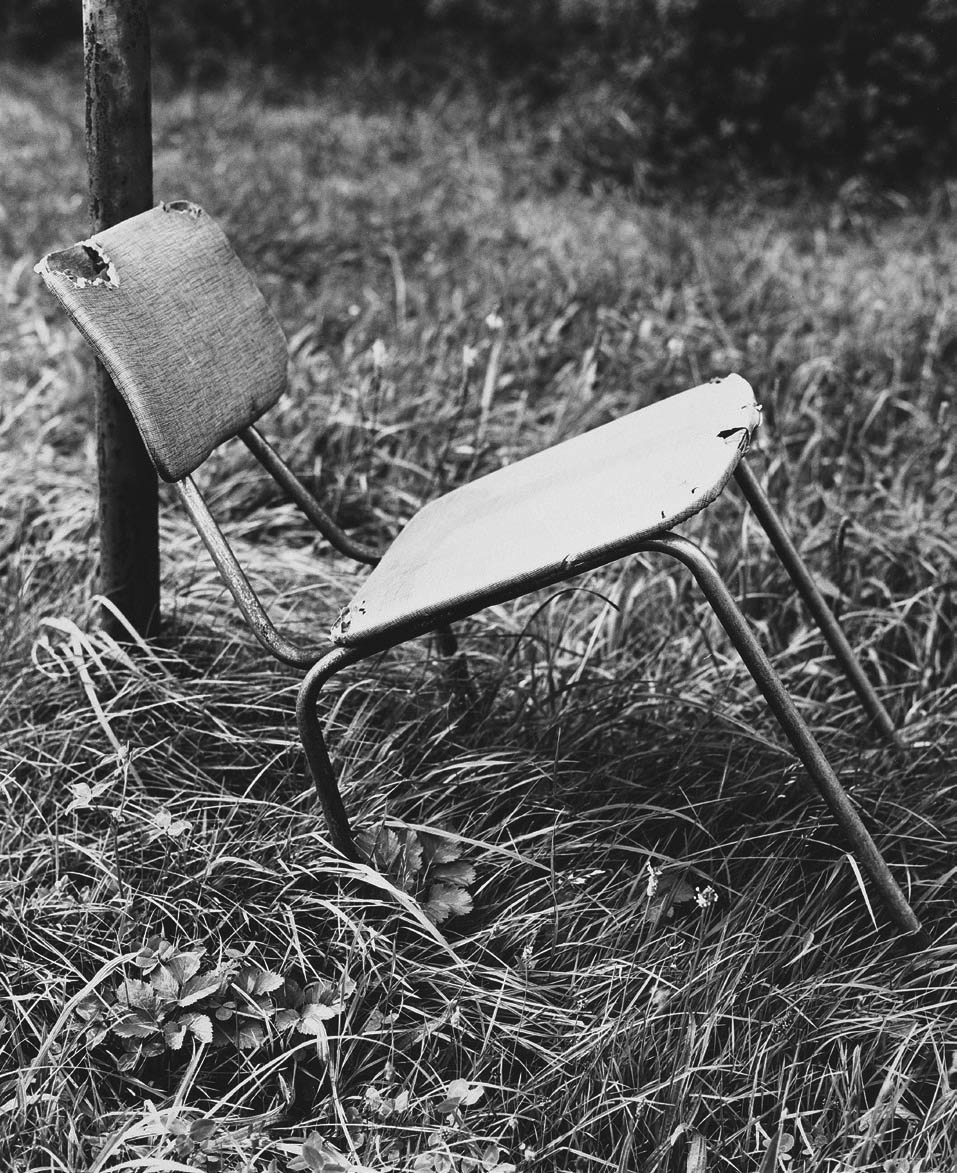
Elfriede Mejchar (Austrian, 1924-2020) From the series 'Die Monatssesseln, 1986-1988' (The Armchairs of the Month, 1986-1988)


Elfriede Mejchar (Austrian, 1924-2020)
From the series Die Monatssesseln, 1986-1988 (The Armchairs of the Month, 1986-1988)
Federal Photography Collection at the Museum der Moderne Salzburg
 

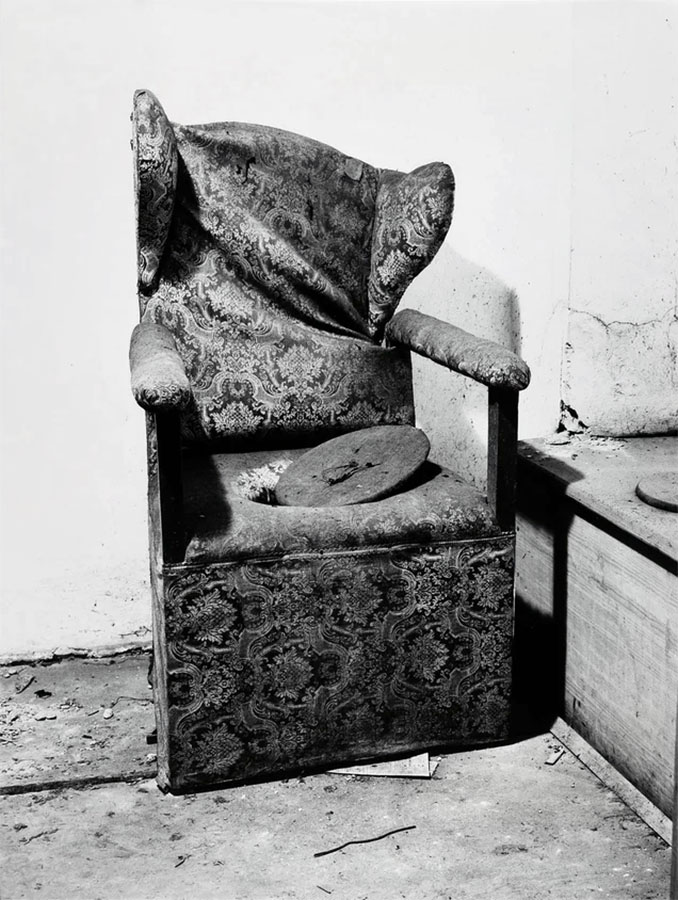
Elfriede Mejchar (Austrian, 1924-2020) From the series 'Die Monatssesseln, 1986-1988' (The Armchairs of the Month, 1986-1988)


Elfriede Mejchar (Austrian, 1924-2020)
From the series Die Monatssesseln, 1986-1988 (The Armchairs of the Month, 1986-1988)
Federal Photography Collection at the Museum der Moderne Salzburg


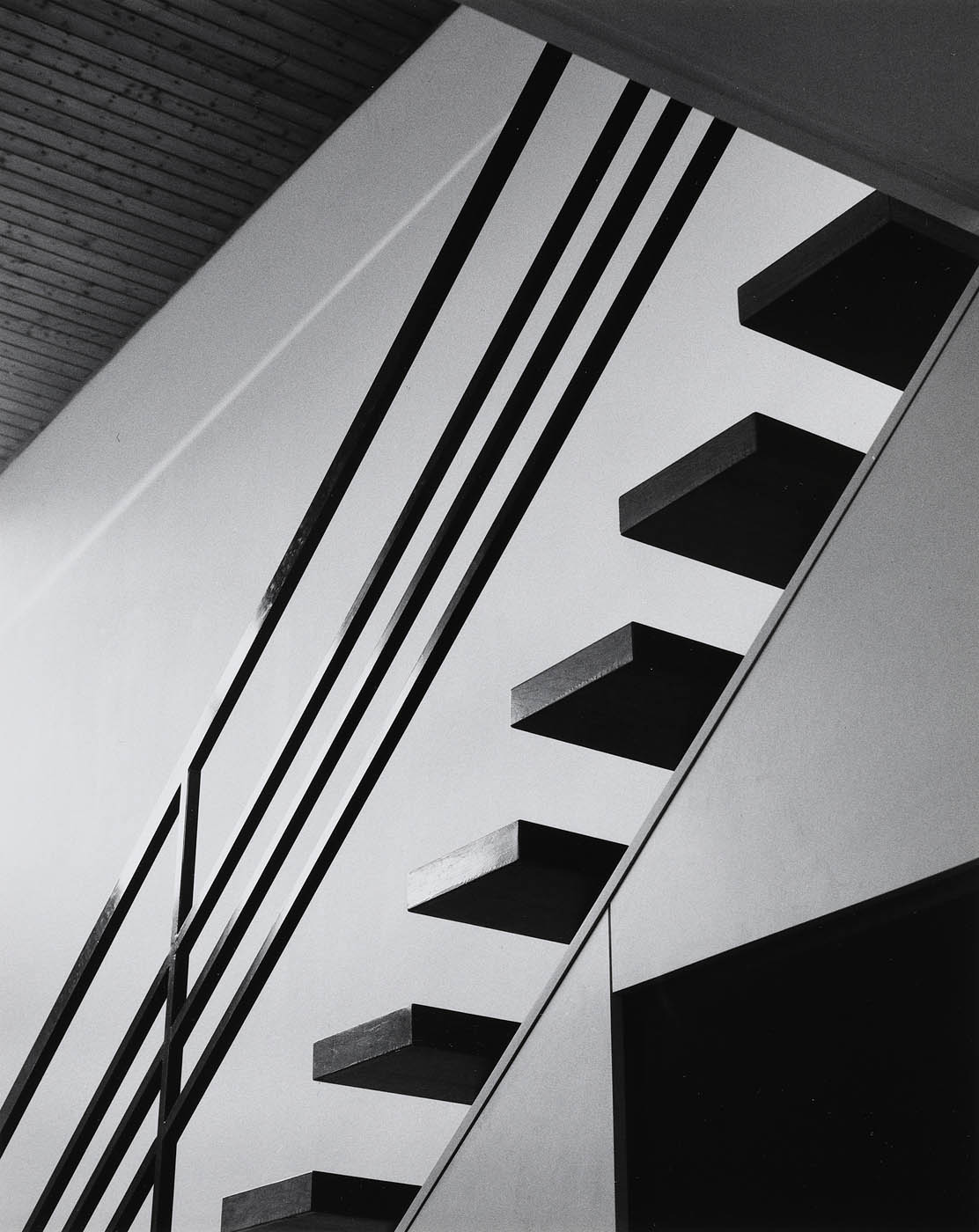
Elfriede Mejchar (Austrian, 1924-2020) From the series 'Oscillation (Salzburger Landesatelier)' (Oscillation (Salzburg State Studio)) 1988


Elfriede Mejchar (Austrian, 1924-2020)
From the series Oscillation (Salzburger Landesatelier) (Oscillation (Salzburg State Studio))
1988
Silver gelatin print on baryta paper
Federal Photography Collection at the Museum der Moderne Salzburg


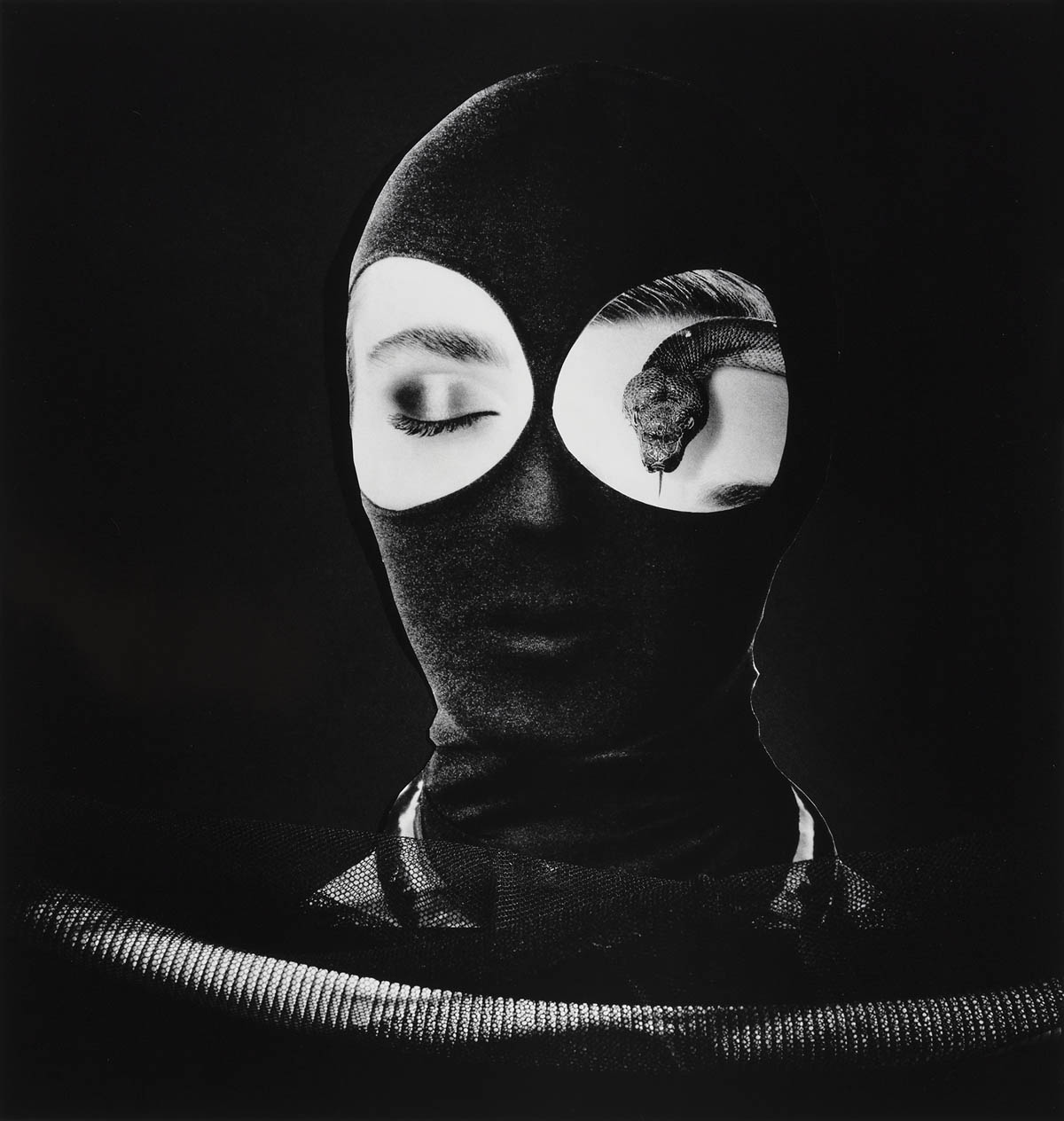
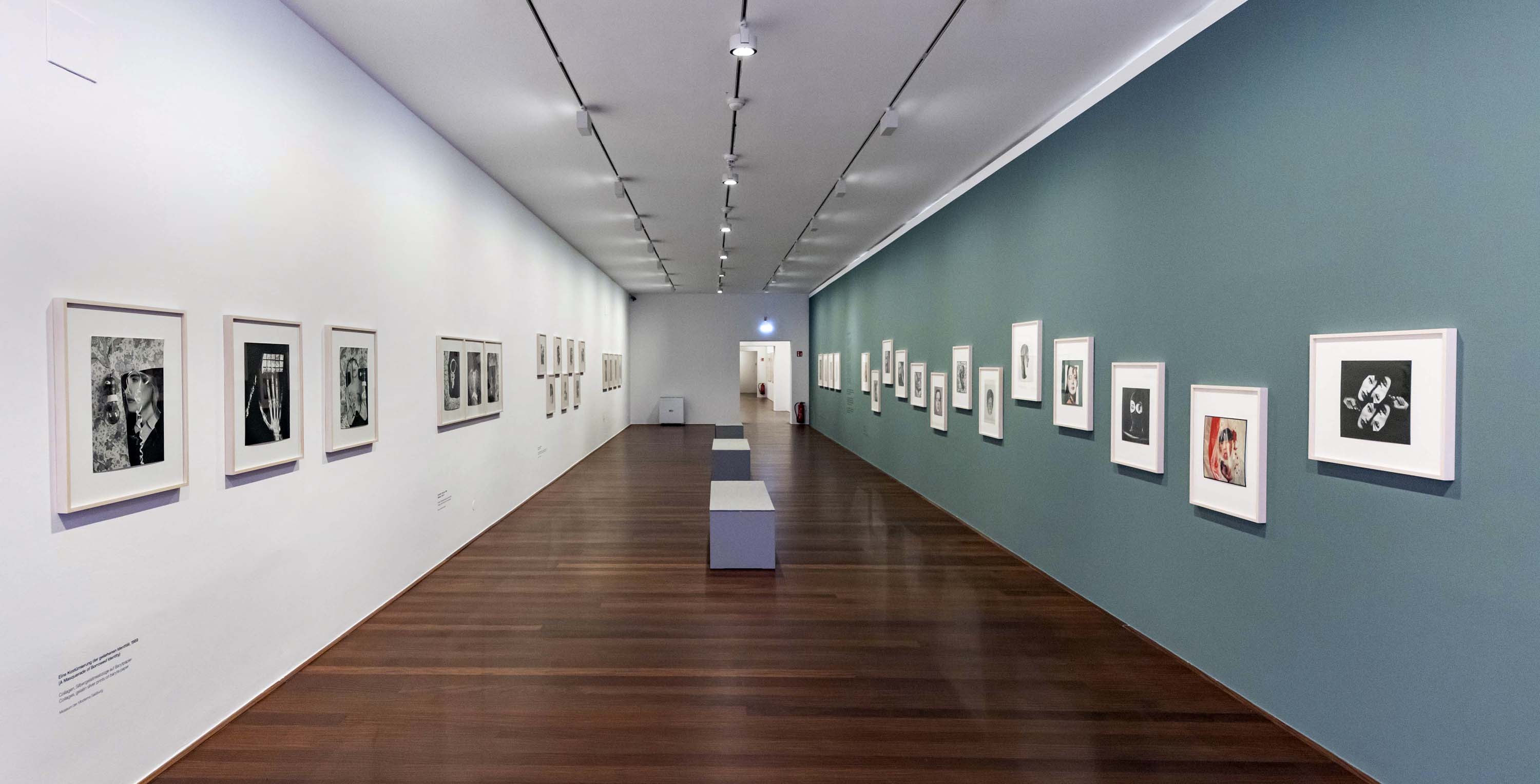
Installation view of the exhibition 'The Poetry of the Everyday. Photographs by Elfriede Mejchar', Museum der Moderne Salzburg 2024 showing work from the Mejchar's series 'Eine Kostümierung der geliehenen Identität' (A Masquerade of Borrowed Identity)


Installation view of the exhibition The Poetry of the Everyday. Photographs by Elfriede Mejchar, Museum der Moderne Salzburg 2024 showing work from the Mejchar’s series Eine Kostümierung der geliehenen Identität (A Masquerade of Borrowed Identity) (below)
© Museum der Moderne Salzburg, photo: wildbild/Günter Freund


Elfriede Mejchar (Austrian, 1924-2020) From the series 'Eine Kostümierung der geliehenen Identität' (A Masquerade of Borrowed Identity) 1989


Elfriede Mejchar (Austrian, 1924-2020)
From the series Eine Kostümierung der geliehenen Identität (A Masquerade of Borrowed Identity)
1989
Gelatin silver print on baryta paper
Museum der Moderne Salzburg
© Bildrecht, Vienna, 2024
Photo: Andrew Phelps


Introduction

Elfriede Mejchar (1924-2020 Vienna, AT), the grande dame of Austrian photography, was in the employ of the Federal Monuments Office for almost forty years. Meanwhile, she also began her groundbreaking work on the outskirts of Vienna. Harnessing the photographic series as a documentary and investigative medium, she limned an imposing portrait of the urban landscape. Her work, which had a lasting influence on the evolution of photography in Austria, now also stands as an important documentary record of the country in the postwar period.

As a professional photographer, Mejchar traveled to various regions throughout Austria, including in Lower and Upper Austria and Styria, to capture buildings and cultural assets of art-historical significance in photographs. Yet she also used her official trips and her scant free time to pursue her own photographic interests, which focused on the small and seemingly trivial and the traces of civilisation that humans leave in nature or along the edges of the urban fabric and that receive little if any attention. It may seem that the documentary dimension is less important in the resulting works, that it is eclipsed by the narrative element. In fact, Mejchar fuses both, scrutinising her motifs with an attentive eye that picks up on the singular or peculiar and registers it without manipulation.

Elfriede Mejchar was not interested in the so-called “pivotal moment” and did not care for the conventional photojournalistic style of her time. Her work began when people had left, and she approached her themes from a very conceptual angle. Both the documentary series she created under the open sky and the object photographs, still lifes, and collages she made in her studio reflect this approach. She photographed the “evanescent before it evanesces”, in urban and rural landscapes and everyday scenes, capturing the changes that affected the particular scenery and its distinctive atmosphere.

The Creative Element in Documentation

Produced between 1967 and 1976, the photographic series “Simmeringer Heide and Erdberger Mais” is Mejchar’s first long-term cycle, for which she takes hundreds of pictures over the years. The series uses the photographic medium to explore the Viennese periphery. Simmeringer Heide and Erdberger Mais are areas on the southeastern outskirts of Vienna that were altered by humans and gradually taken over by commercial operations which transformed them into an industrial landscape. Mejchar first discovers them at a time when unused parcels of land (locally known as “Gstätten”), derelict market gardens, and scattered industrial structures are still defining features of the scenery. What sets the series apart is the choice of subject and the matter-of-factly manner in which the photographer treats it, compiling a kind of anecdotal inventory – empty lots, paths and roads, utility poles and a select few close-ups. The shots demonstrate that Mejchar’s objective in her art – as in the documentary photography that is her day-to-day work – is to render exactly what the objective and precise eye of a topographer sees. In framing an area in the urban periphery as a landscape, she trains this eye and her lens on a subject that has been largely absent from Austrian photography.

The use of a sulfur-based solution to tone the photographs – which is the cause of the brownish tinge – reflects a recurring concern in Mejchar’s photographs: existence in time and impermanence. In this instance, the technique’s purpose is not to alter the colour, but rather to make it more durable.


Installation view of the exhibition 'The Poetry of the Everyday. Photographs by Elfriede Mejchar', Museum der Moderne Salzburg 2024 showing at left, work from Mejchar's series 'Künstler bei der Arbeit, 1954-1961' (Artists at work, 1954-1961); and at right, the wall text 'The Artist as Chronicler'


Installation view of the exhibition The Poetry of the Everyday. Photographs by Elfriede Mejchar, Museum der Moderne Salzburg 2024 showing at left, work from Mejchar’s series Künstler bei der Arbeit, 1954-1961 (Artists at work, 1954-1961); and at right, the wall text ‘The Artist as Chronicler’
© Museum der Moderne Salzburg, photo: wildbild/Günter Freund


The Artist as Chronicler

Portraiture plays a role early on in Elfriede Mejchar’s work; she receives her professional training in a portrait studio. She subsequently makes a conscious choice to avoid the genre, but then, in the 1950s, returns to it.

“Künstler bei der Arbeit”, 1954-1961 (Artists at Work)

The series “Künstler bei der Arbeit” (Artists at Work) is her first major cycle of portraits, comprising over 340 gelatin silver prints. Mejchar is often brought in to capture exhibitions in installation shots, especially at the Vienna Secession, where she is introduced to many young artists waiting to make a name for themselves as well as some of their older colleagues who have been active since before 1945. The incomprehension with which the visitors gaze at abstract art that does not represent anything with any accuracy prompts the young photographer to record the intensity and seriousness with which the artists dedicate themselves to their craft, often braving considerable hardship. The series accordingly focuses on visualising the real studio and workplace settings of thirty-six artists, including Christa Hauer, Friedensreich Hundertwasser, Josef Mikl, and Arnulf Rainer.

“Porträts von Künstler-Photographen und Kunstvermittlern”, 1988-1994 (Portraits of Artist Photographers and Art Educators)

In the body of work “Porträts von Künstler-Photographen und Kunstvermittlern” (Portraits of Artist Photographers and Art Educators), by contrast, Mejchar undertakes to depict everyone involved in fine art photography in Austria in the late twentieth century. Over the years, the series grows to comprise eighty double portraits, each composed, in accordance with a rigorous conception, of an en face portrait side by with a three-quarter view. The works have a distinctly staged quality, underscored by the unvarying austere setting and the emphasis on the hands, among other aspects. In this respect they recall Mejchar’s final examination, in which she had to realise a portrait both in profile and en face to demonstrate her command of photographic lighting designing and the handling of human sitters.

With these two projects, Mejchar becomes an important chronicler of the Austrian arts scene.


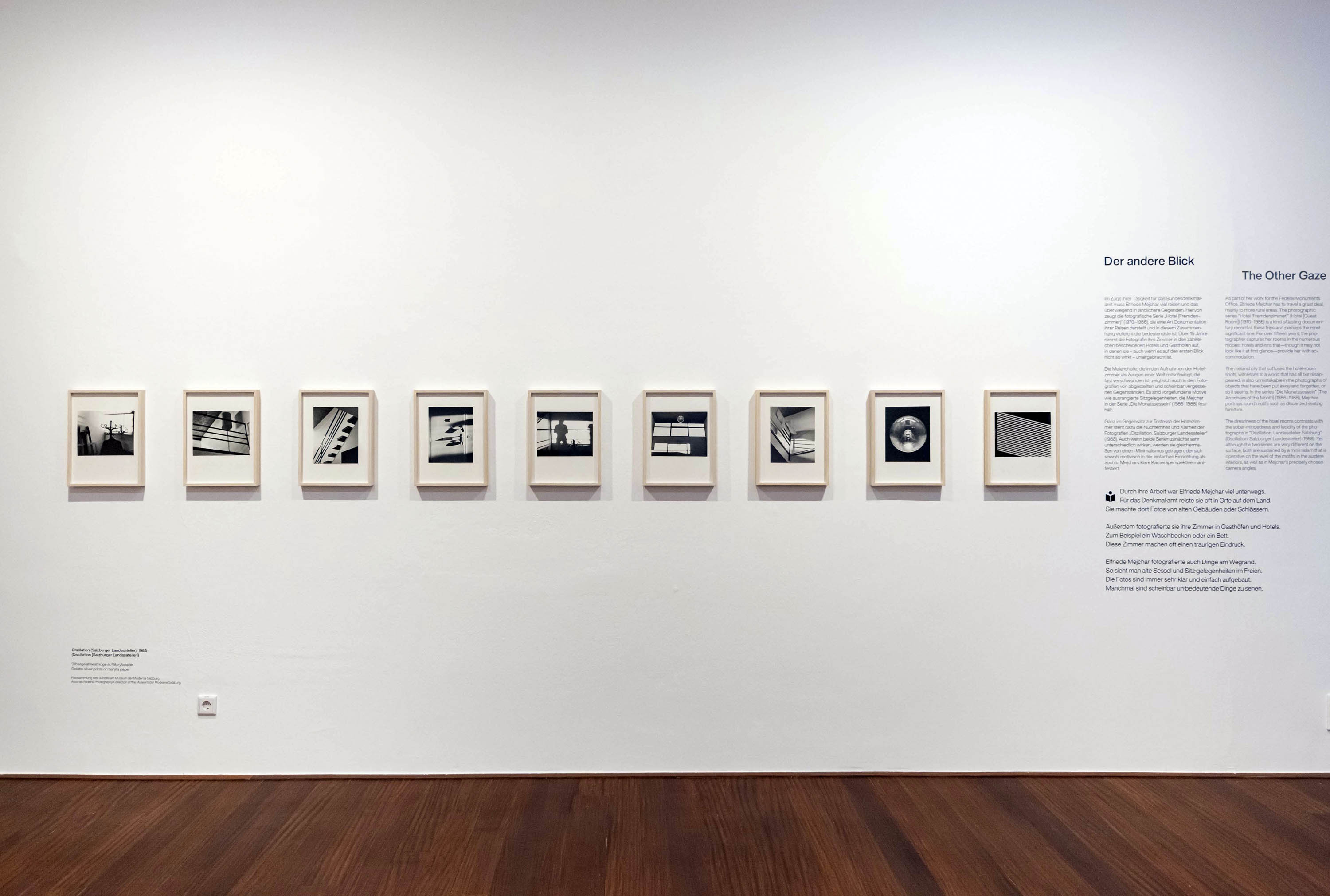
Installation view of the exhibition 'The Poetry of the Everyday. Photographs by Elfriede Mejchar', Museum der Moderne Salzburg 2024 showing at left, work from Mejchar's series 'Oscillation (Salzburger Landesatelier)' (Oscillation (Salzburg State Studio)) (above); and at right, the wall text 'The Other Gaze' (below)


Installation view of the exhibition The Poetry of the Everyday. Photographs by Elfriede Mejchar, Museum der Moderne Salzburg 2024 showing at left, work from Mejchar’s series Oscillation (Salzburger Landesatelier) (Oscillation (Salzburg State Studio)) (above); and at right, the wall text ‘The Other Gaze’ (below)
© Museum der Moderne Salzburg, photo: wildbild/Günter Freund


The Other Gaze

“Hotel (Fremdenzimmer)”, 1970-1986 (Hotel (Guest Room))

As part of her work for the Federal Monuments Office, Elfriede Mejchar has to travel a great deal, mainly to more rural areas. The photographic series “Hotel (Fremdenzimmer)” (Hotel (Guest Room)) is a kind of lasting documentary record of these trips and perhaps the most significant one. Bed, table, chair, mirror, wardrobe, patterned wallpaper, and sometimes a washbasin: for over fifteen years, the photographer captures her rooms with their often spartan furnishings in the numerous modest hotels and inns that – though it may not look like it at first glance – provide her with accommodation. Here and there one does espy a toothbrush, a pair of shoes, a ruffled bedcover, all traces that reveal the ostensibly absent photographer’s presence. A certain melancholy suffuses these shots of hotel rooms as witnesses to a world that has all but disappeared

“Die Monatssesseln”, 1986-1988 (The Armchairs of the Month)

The same melancholy is also unmistakable in the photographs of objects that have outlived their usefulness and been discarded and, it seems, forgotten. In the series “Die Monatssesseln” (The Armchairs of the Month) Mejchar portrays found motifs such as discarded seating furniture. The series shows a wide variety of such items, from kitchen chairs to living-room armchairs and even car seats, that have become part of the natural or other scene where they were dumped. No less diverse than the pieces of furniture and their environments are the feelings they elicit; as Mejchar puts it, “a mess can be beautiful in its own way.”

“Oszillation (Salzburger Landesatelier)”, 1988

The dreariness of the hotel rooms contrasts with the sober-mindedness and lucidity of the photographs in “Oszillation (Salzburger Landesatelier)” (Oscillation (Salzburger Landesatelier)). Yet although the two series are very different on the surface, both are sustained by a minimalism that is operative on the level of the motifs, in the austere interiors, as well as in Mejchar’s precisely chosen camera angles. These photographs capture the rooms of the State of Salzburg’s studio residence for visiting artists, located, like the Salzburger Kunstverein, in the historic Künstlerhaus. Mejchar herself lives there for a while in 1988, a change of working environment that is reflected in her output from the period.

Nobody Is Perfect

In the late 1980s, Elfriede Mejchar branches out in a fresh creative direction. She has been retired for some years and feels free to take on new challenges. Setting aside the flaneur-like practice underlying her earlier bodies of work, she starts photographing in the studio.

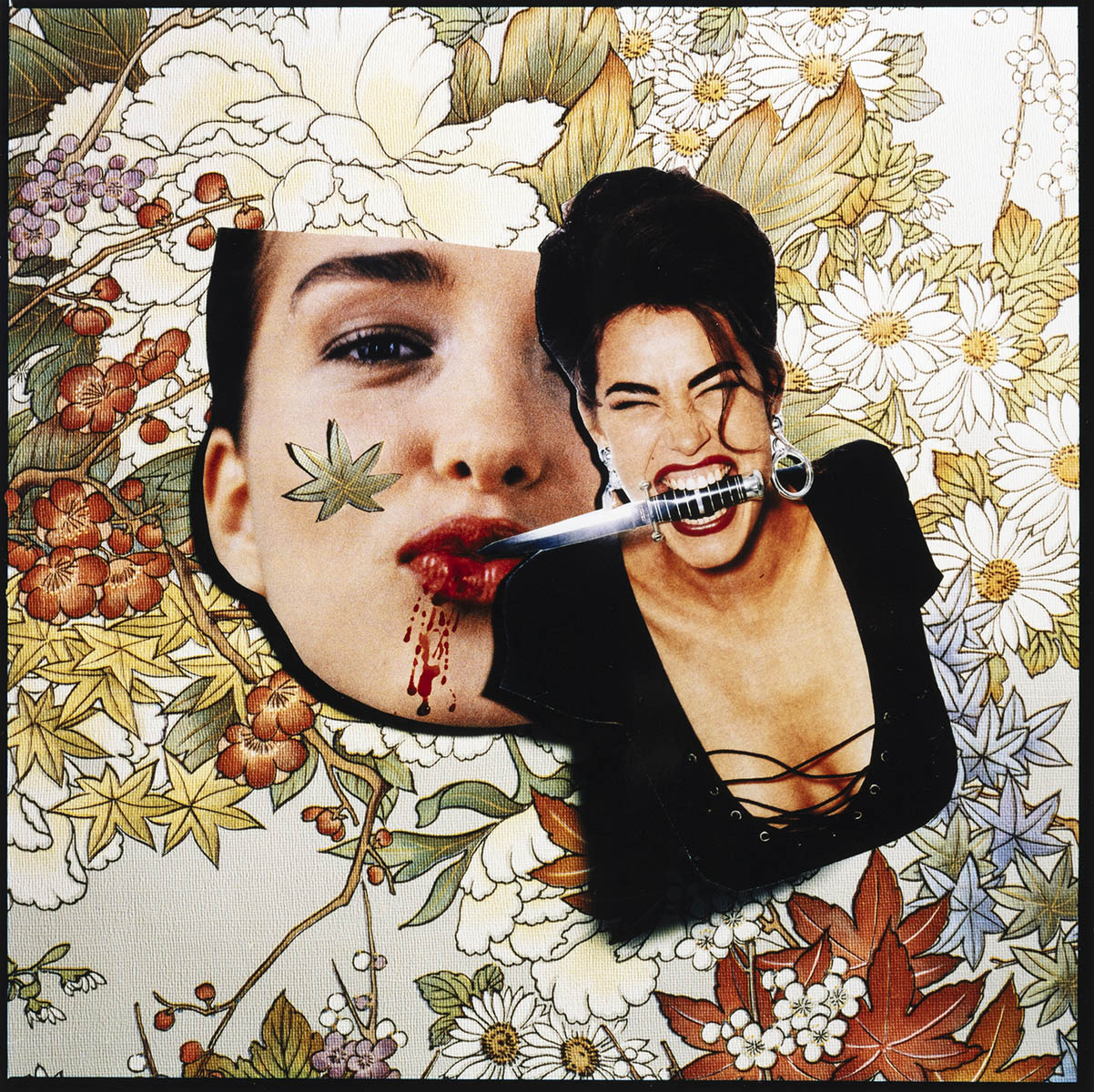
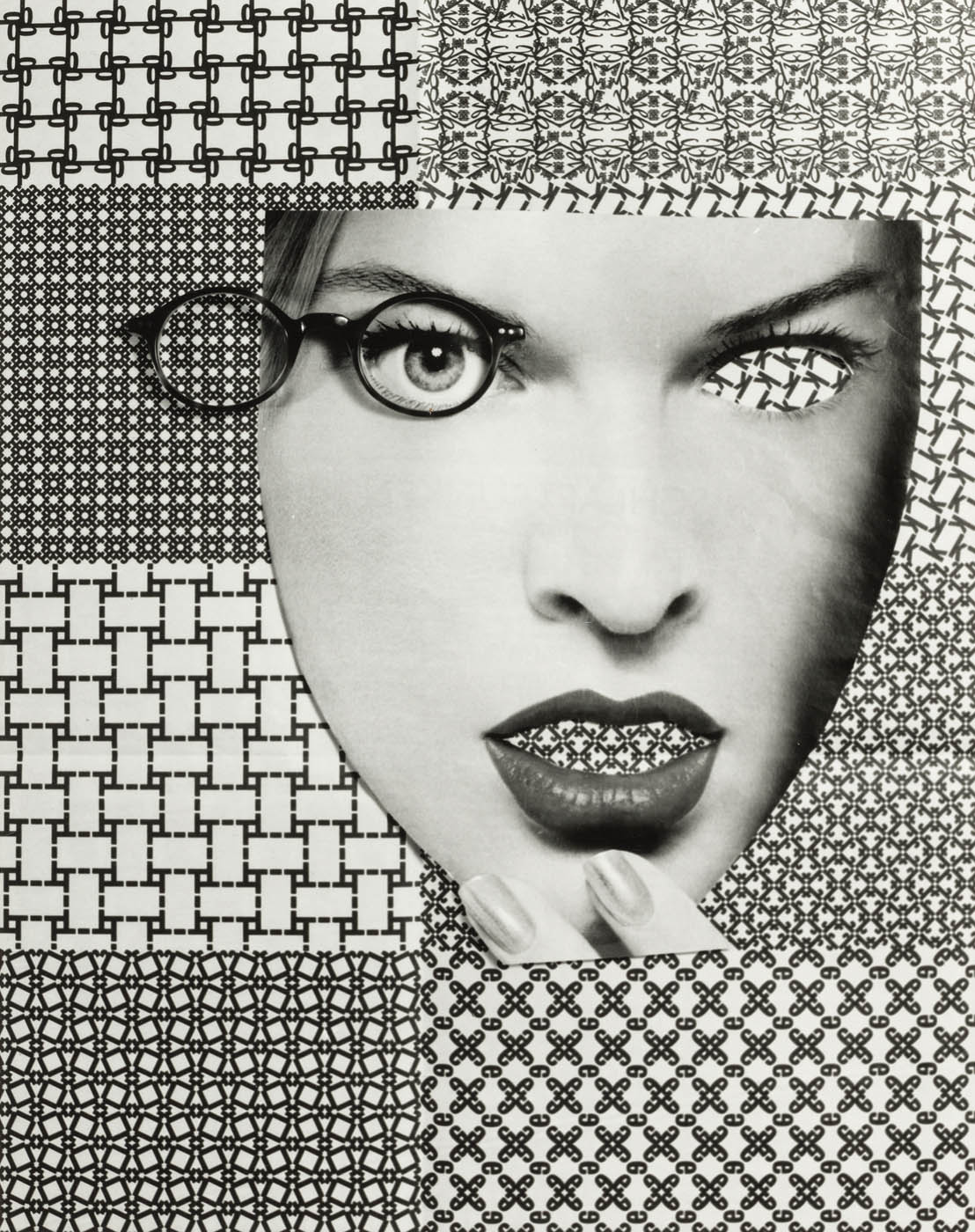
Tapetenbild. Triptychon, 1988 (Wallcover Picture. Tryptic) “Eine Kostümierung der geliehenen Identität”, 1989 (A Costume for the borrowed Identity) “Tagebuch Jänner 1988”, 1988 (Diary January 1988) “Nobody Is Perfect”, 1996

Faces change shapes, snakes coil around heads, open and closed eyes alternate. For the collages in “Tagebücher Jänner 1988,” Mejchar reuses her own photographs; in other series, by contrast, she works with found images such as shots of female models from print advertisements or fuses figural representations with fabric and wallpaper patterns. The works are rapidly composed out of visual fragments that she often only loosely places side by side or in overlapping arrangements, dispelling their aura of perfection. “I build pictures for myself on the wall, from materials that are at hand in the public sphere, that are on public display, but I strip away the ideal of flawless beauty that is constantly rubbed in our faces by dismembering it or covering it up.” It is the temporary and easily mutable that fascinates Mejchar, qualities that had had no place in her professional work.

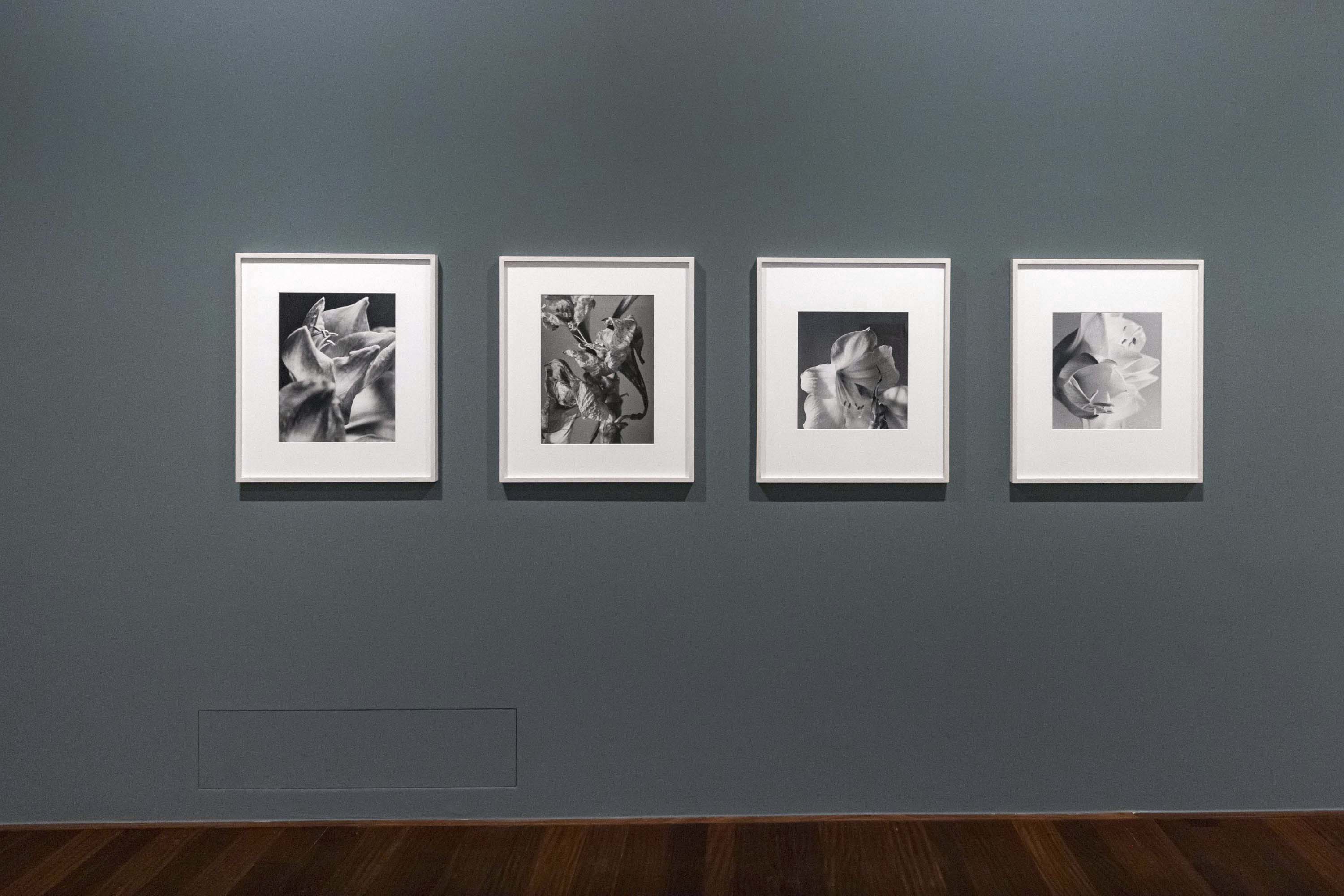
“Amaryllis”, 1994-1997

Pictures of flowers in fine art, whether painted or photographed, inevitably have a clichéd dimension. Mejchar photographs only a special selection of flowers such as amaryllises, lilies, and tulips that she grows in her own garden. In the studio, rather than recording the flowers with a romantic gesture, she captures their gradual transformations – full blossoms, some full of delicate life, some already wilting and recognisably perishable. Showing them between florescence and decay, in a kind of liminal instant, she revisits a theme that surfaces throughout her oeuvre: the capturing of a state of affairs at a defined point in time.


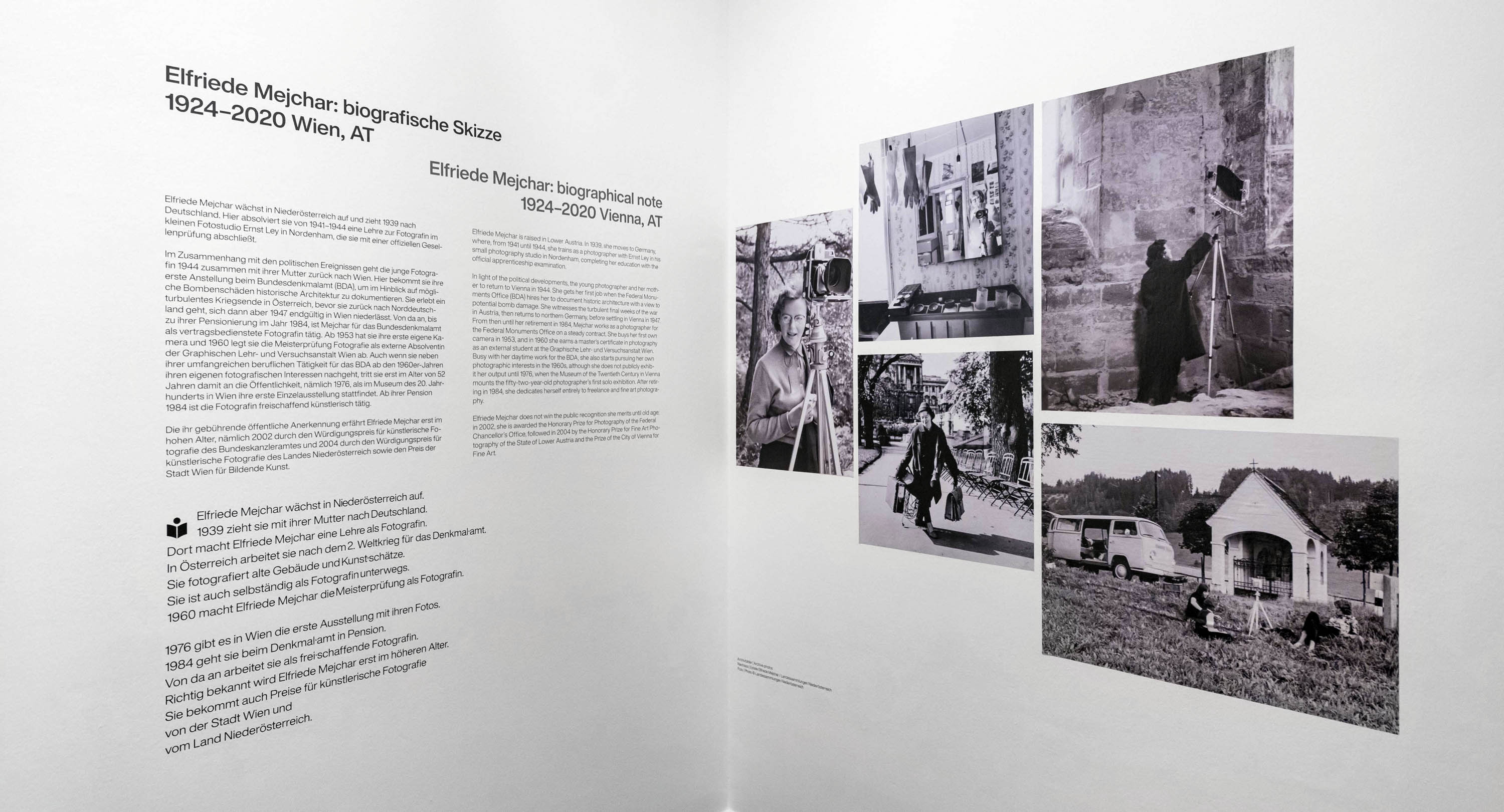
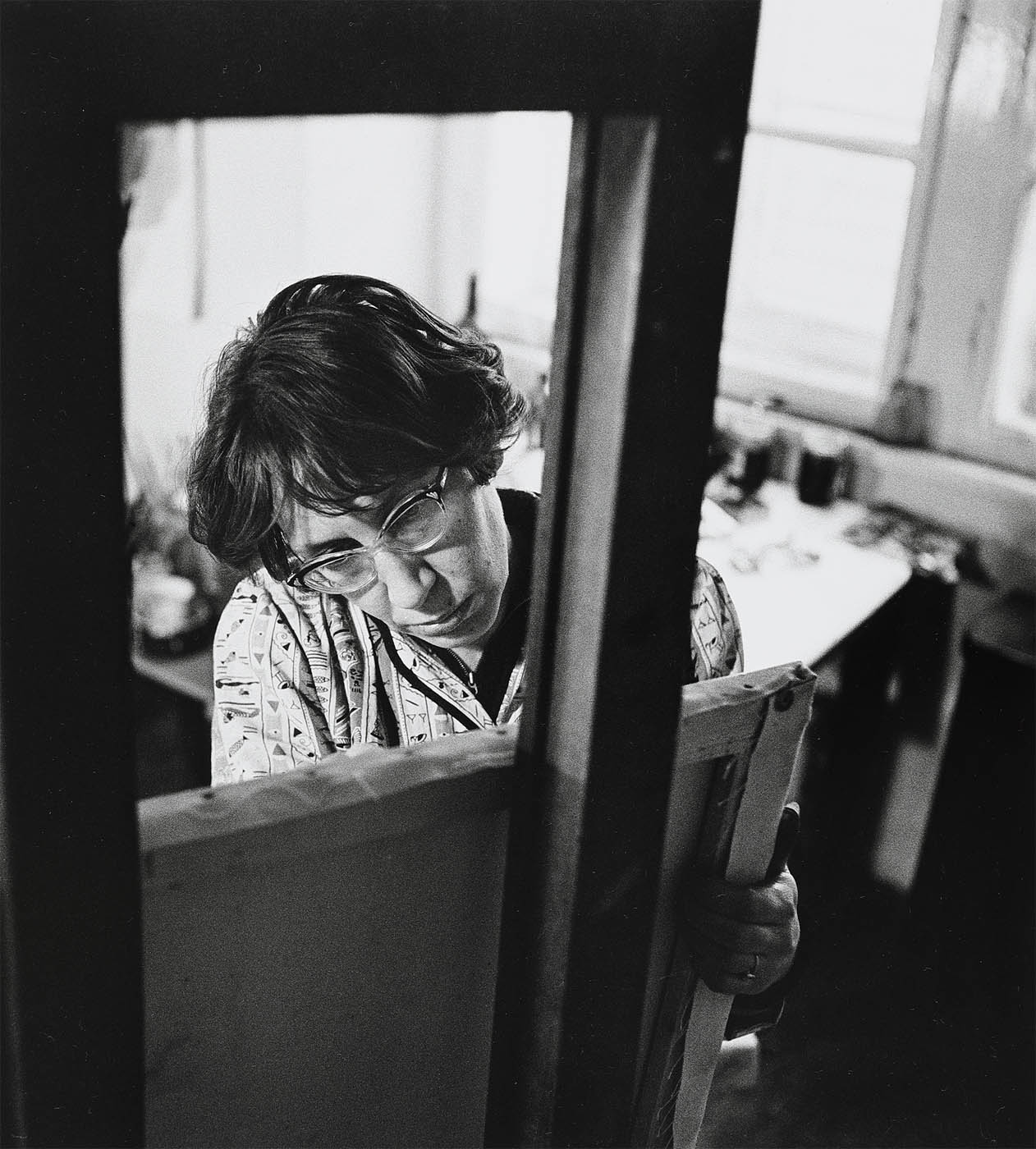
Installation view of the exhibition 'The Poetry of the Everyday. Photographs by Elfriede Mejchar', Museum der Moderne Salzburg 2024 showing the wall text 'Elfriede Mejchar: biographical note 1924-2020 Vienna, AT'; and some photographs of Elfriede Mejchar working


Installation view of the exhibition The Poetry of the Everyday. Photographs by Elfriede Mejchar, Museum der Moderne Salzburg 2024 showing the wall text Elfriede Mejchar: biographical note 1924-2020 Vienna, AT; and some photographs of Elfriede Mejchar working
© Museum der Moderne Salzburg, photo: wildbild/Günter Freund


Elfriede Mejchar: biographical note 1924-2020 Vienna, AT

Elfriede Mejchar is raised in Lower Austria. In 1939, she moves to Germany, where, from 1941 until 1944, she trains as a photographer with Ernst Ley in his small photography studio in Nordenham, completing her education with the official apprenticeship examination.

In light of the political developments, the young photographer and her mother to return to Vienna in 1944. She gets her first job when the Federal Monuments Office (BDA) hires her to document historic architecture with a view to potential bomb damage. She witnesses the turbulent final weeks of the war in Austria, then returns to northern Germany, before settling in Vienna in 1947. From then until her retirement in 1984, Mejchar works as a photographer for the Federal Monuments Office on a steady contract. She buys her first own camera in 1953, and in 1960 she earns a master’s certificate in photography as an external student at the Graphische Lehr- und Versuchsanstalt Wien. Busy with her daytime work for the BDA, she also starts pursuing her own photographic interests in the 1960s, although she does not publicly exhibit her output until 1976, when the Museum of the Twentieth Century in Vienna mounts the fifty-two-year-old photographer’s first solo exhibition. After retiring in 1984, she dedicates herself entirely to freelance and fine art photography.

Elfriede Mejchar does not win the public recognition she merits until old age; in 2002, she is awarded the Honorary Prize for Photography of the Federal Chancellor’s Office, followed in 2004 by the Honorary Prize for Fine Art Photography of the State of Lower Austria and the Prize of the City of Vienna for Fine Art.

Text from the exhibition


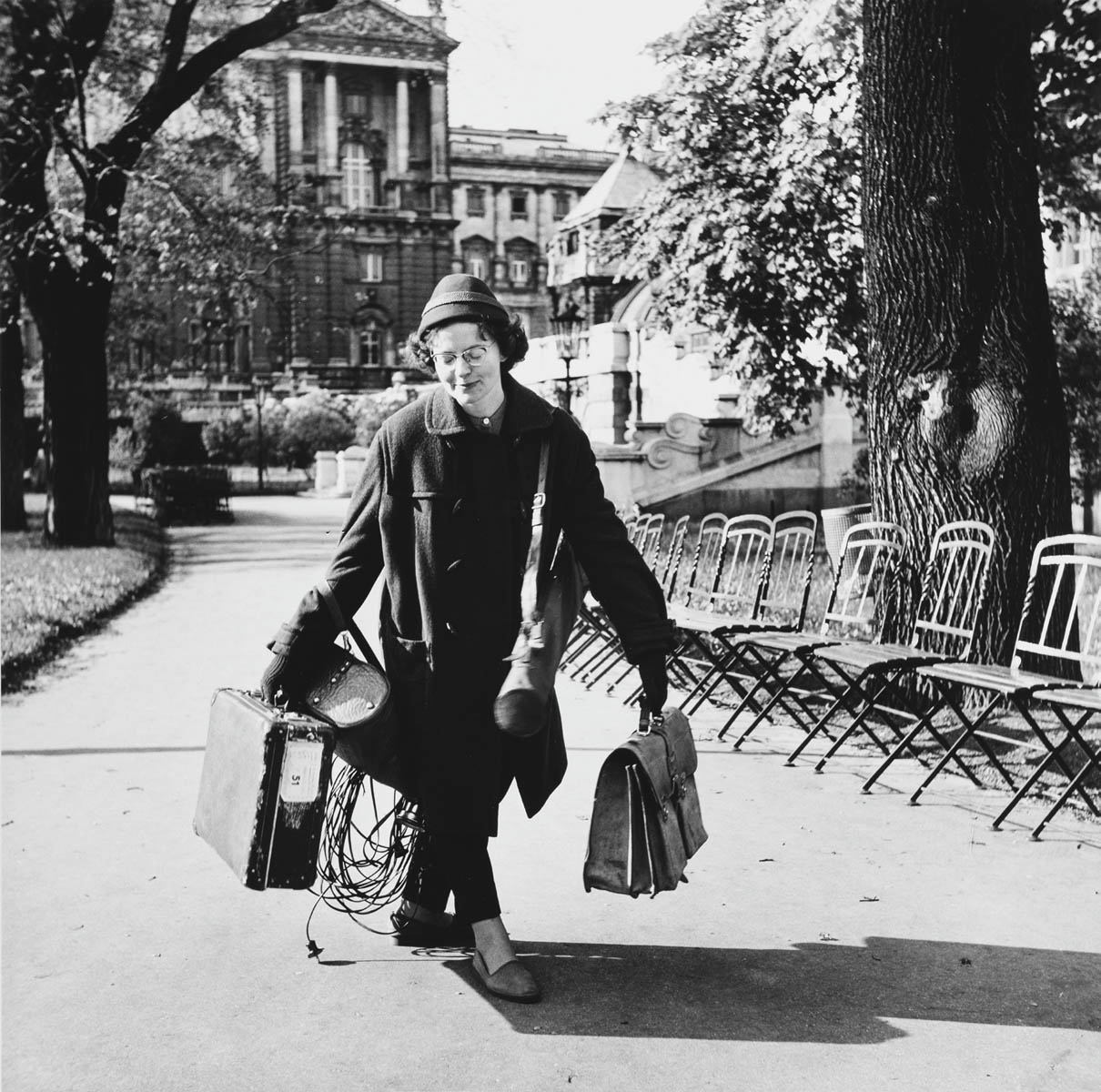
Anonymous photographer. 'Elfriede Mejchar' Nd


Anonymous photographer
Elfriede Mejchar
Nd
Gelatin silver print


Installation view of the exhibition 'The Poetry of the Everyday. Photographs by Elfriede Mejchar', Museum der Moderne Salzburg 2024 showing photographs of Mejchar's flower series


Installation view of the exhibition The Poetry of the Everyday. Photographs by Elfriede Mejchar, Museum der Moderne Salzburg 2024 showing photographs of Mejchar’s flower series


Elfriede Mejchar (Austrian, 1924-2020) 'Amaryllis' 1997


Elfriede Mejchar (Austrian, 1924-2020)
Amaryllis
1997
© Elfriede Mejchar/Landessammlungen NÖ


Elfriede Mejchar (Austrian, 1924-2020) From the series 'Nobody is perfect' 1996


Elfriede Mejchar (Austrian, 1924-2020)
From the series Nobody is perfect
1996
Chromogenic print
Federal Photography Collection at the Museum der Moderne Salzburg
© Bildrecht, Vienna, 2024
Photo: Andrew Phelps
 

Elfriede Mejchar (Austrian, 1924-2020) From the series 'Nobody is perfect' 1996


Elfriede Mejchar (Austrian, 1924-2020)
From the series Nobody is perfect
1996
Chromogenic print
Federal Photography Collection at the Museum der Moderne Salzburg
© Bildrecht, Vienna, 2024
Photo: Andrew Phelps


Elfriede Mejchar (Austrian, 1924-2020) From the series 'Nobody is perfect' 2003


Elfriede Mejchar (Austrian, 1924-2020)
From the series Nobody is perfect
2003
© Elfriede Mejchar/Landessammlungen NÖ


Museum der Moderne Salzburg
Altstadt (Rupertinum)

Wiener-Philharmoniker-Gasse 9
5020 Salzburg
Austria

Opening hours:
Daily 10am – 6pm

Museum der Moderne Salzburg website

LIKE ART BLART ON FACEBOOK

Back to top

Exhibition: ‘From Becher to Blume – Photographs from the Garnatz Collection and Die Photographische Sammlung/SK Stiftung Kultur in Dialogue’ at Die Photographische Sammlung/SK Stiftung Kultur, Cologne

Exhibition dates: 12th March – 8th August, 2021

Artists: Bernd and Hilla Becher, Boris Becker, Anna and Bernhard Blume, Chargesheimer, Jim Dine, Frank Dömer, Gina Lee Felber, Candida Höfer, Benjamin Katz, Jürgen Klauke, Astrid Klein, Werner Mantz, Augustina von Nagel, Floris Neusüss, Sigmar Polke, Arnulf Rainer, Albert Renger-Patzsch, Tata Ronkholz, Thomas Ruff, Hugo Schmölz, Wilhelm Schürmann, and Thomas Struth.


Werner Mantz (German, 1901-1983) 'Waldecker Str., Cologne-Buchforst (formerly Kalker Feld)' 1928 from the exhibition Exhibition: 'From Becher to Blume – Photographs from the Garnatz Collection and Die Photographische Sammlung/SK Stiftung Kultur in Dialogue' at Die Photographische Sammlung/SK Stiftung Kultur, Cologne, March - August, 2021


Werner Mantz (German, 1901-1983)
Waldecker Str., Köln-Buchforst (ehemals Kalker Feld)
Waldecker Str., Cologne-Buchforst (formerly Kalker Feld)
1928
© VG Bild-Kunst, Bonn 2020


A Kodak Brownie camera launched Werner Mantz‘s photographic career. As an adolescent, he photographed Cologne and the surrounding landscape and later studied photography at the Bavarian State Academy in Munich. He returned to Cologne, set up a studio and began a freelance career. Mantz soon distinguished himself as an architectural photographer, receiving numerous commissions. In 1932 he moved to Maastricht, in the Netherlands near the German border. He opened a second studio there and closed the Cologne studio in 1938. Mantz received public and private commissions throughout his career and retired in 1971.

Text from the Getty website [Online] Cited 19/03/2021


Werner Mantz‘s (German, 1901-1983) youthful passion for taking pictures inspired him to study photography at the Bayerische Lehr-und Versuchsanstalt in Munich in 1920-1921. After that he opened a portrait photography studio in Cologne and joined the artists group Kölner Progressive. Around 1926, encouraged by architect Wilhelm Ripahn, Mantz became one of the leading contemporary photographers of modern architecture in the Rhineland. He worked for architects such as Bruno Paul and Hans Schumacher and was under exclusive contract with the architects Ripahn & Grod. In 1932 he relocated to Maastricht in the Netherlands close to the German border. He opened a second studio there and closed the Cologne studio in 1938. In addition to his architectural work he devoted himself to photographing children.

Text from the Kicken Berlin website [Online] Cited 19/03/2021


The Renger-Patzsch is a cracker.

Further information about the Dusseldorf School artists and their successors can be found at ‘Photographs Become Pictures. The Becher Class’ at the Städel Museum, Frankfurt, April – August 2017.

Marcus


Many thankx to the Die Photographische Sammlung / SK Stiftung Kultur for allowing me to publish the photographs in the posting. Please click on the photographs for a larger version of the image.


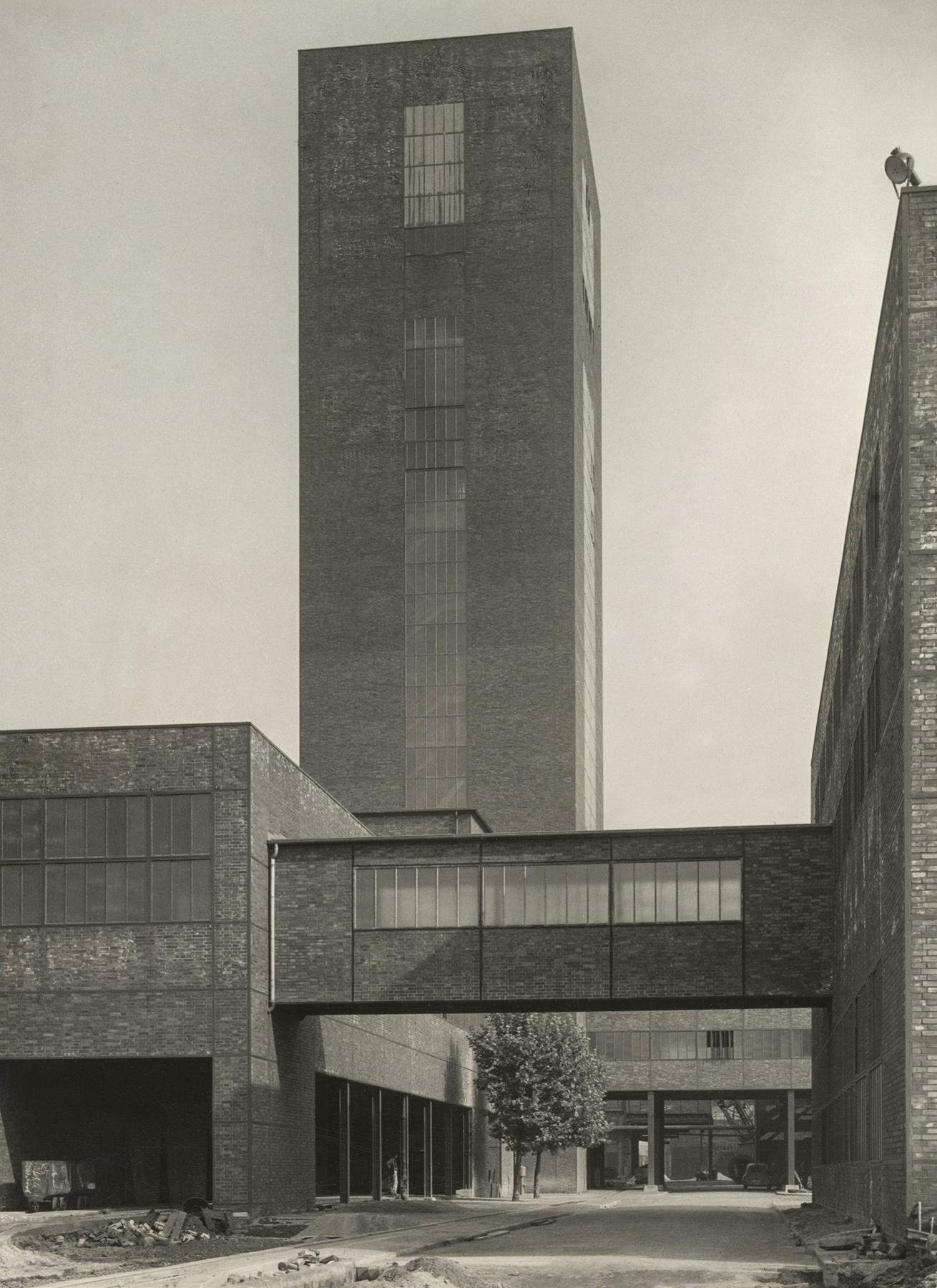
Albert Renger-Patzsch (German, 1897-1966) 'Untitled (Grimberg colliery, Bergkamen)' 1951-1952 from the exhibition Exhibition: 'From Becher to Blume – Photographs from the Garnatz Collection and Die Photographische Sammlung/SK Stiftung Kultur in Dialogue' at Die Photographische Sammlung/SK Stiftung Kultur, Cologne, March - August, 2021


Albert Renger-Patzsch (German, 1897-1966)
Ohne Titel (Zeche Grimberg, Bergkamen)
Untitled (Grimberg colliery, Bergkamen)
1951-1952
© 2020 Albert Renger-Patzsch / Archiv Ann und Jurgen Wilde, Zulpich / VG Bild-Kunst, Bonn


Tata Ronkholz (German, 1940-1977) 'Trinkhalle, Sankt-Franziskusstraße 107' 1977


Tata Ronkholz (German, 1940-1977)
Trinkhalle (Refreshment Stand), Sankt-Franziskusstraße 107
1977
© VAN HAM Art Estate: Tata Ronkholz


Along with Thomas Ruff, Candida Höfer, and Thomas Struth, Tata Ronkholz (German, 1940-1997) was among the first students of Bernd Becher at the Kunstakademie Düsseldorf. Ronkholz is perhaps best known for her most extensive series Trinkhallen: kiosks and small shops around the corner that are witnesses of social neighbourhoods and vernacular cultures. In her work, Tata Ronkholz shows elements of urban architecture, which due to their transient nature turn the photographs into valuable historical documents. Ronkholz found her characteristic subjects in Cologne, Düsseldorf, Bochum, and parts of the Rhineland. Together with Thomas Struth, Tata Ronkholz documented a part of the port of Düsseldorf between 1978 and 1980, shortly before it was torn down. Struth and Ronkholz created a unique historical document, which also received great recognition from the city of Düsseldorf. In 1979 Ronkholz took part in the seminal exhibition In Deutschland (In Germany) at the Rheinisches Landesmuseum in Bonn.

Text from the Kicken Berlin website [Online] Cited 19/03/2021


Cigarette and gumball machines are fixed to exterior walls. Advertising posters overlap. Beverages, magazines and sweets are visibly lined up behind glass. It is Tata Ronkholz’ serial presentation that enables the comparison of the kiosks and their study as a social phenomenon in urban contexts.

Kiosks are everyday meeting points and the setting for social life. At the same time their role fundamentally changed in the past decades. Ronkholz photographs kiosks as socially grown places. She positions them centrally in their architectural environment – people are absent. This is what the photos have in common with Becher-photographs. Like her teachers, Ronkholz is committed to the conservation and archiving of a changing urban culture.

More information about the work of Tata Ronkholz: ‘Photographs Become Pictures. The Becher Class’ at the Städel Museum, Frankfurt


Tata Ronkholz (German, 1940-1977) Thomas Struth (German, b. 1954) 'Rheinhafen, Düsseldorf' 1979-1980


Tata Ronkholz (German, 1940-1977)
Thomas Struth (German, b. 1954)
Rheinhafen, Düsseldorf
1979-1980
© VAN HAM Art Estate: Tata Ronkholz
© Thomas Struth


Tata Ronkholz was born in 1940 in Krefeld under the female name Roswitha Tolle. She studied architecture and interior design at the School of Applied Arts in Krefeld. Thereafter, she completed a one-year apprenticeship at the Schroer Furniture Store in Krefeld. She subsequently began work as a freelance product designer. Tata Ronkholz first encountered photography through her husband, Coco Ronkholz, who managed the production of a catalogue for Bernd Becher. In 1977, she enrolled in the State Art Academy in Düsseldorf and studied photography shortly thereafter with Prof. Becher. Along with Volker Döhne, Andreas Gursky, Candida Höfer, Axel Hütte, Thomas Ruff, and Thomas Struth, Ronkholz counts among Becher’s earliest (and later legendary) students at the Academy. In 1985, she gave up photography and worked for photography agency in Cologne from 1985-95 to support herself. In 1997, Ronkholz died at Burg Kendenich near Cologne. Her photographs of refreshment stands, of which few remain, were arguably her most substantial works. In 1978, she also began to collaborate with Thomas Struth on documenting the Rhine harbor. Ronkholz called her final group of photographs Schaufenster (Display Windows).

Text from the Van Ham Art Estate website [Online] Cited 19/03/2021


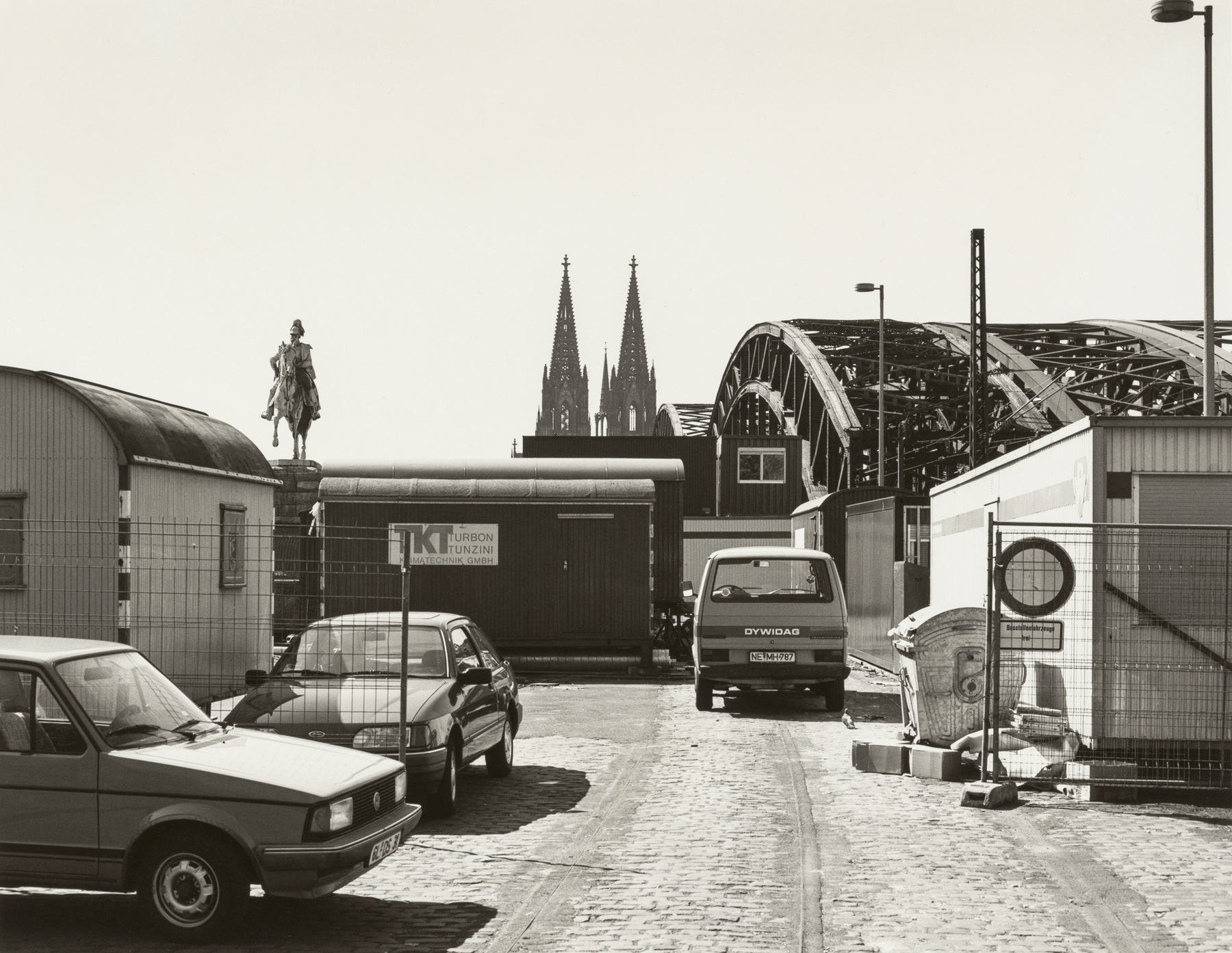
Wilhelm Schürmann (German, b. 1946) 'Untitled (construction trailer and view of Cologne Cathedral)' 1988


Wilhelm Schürmann (German, b. 1946)
Ohne Titel (Bauwagen und Blick auf Kölner Dom)
Untitled (construction trailer and view of Cologne Cathedral)
1988
© Wilhelm Schürmann


Bernd and Hilla Becher. 'Charleroi-Montigny, B' 1984


Bernd (German, 1931-2007) and Hilla (German, 1934-2015) Becher
Charleroi-Montigny, B
1984
© Estate Bernd & Hilla Becher, vertreten durch Max Becher, courtesy Die Photographische Sammlung / SK Stiftung Kultur – Bernd und Hilla Becher Archiv, Köln, 2020


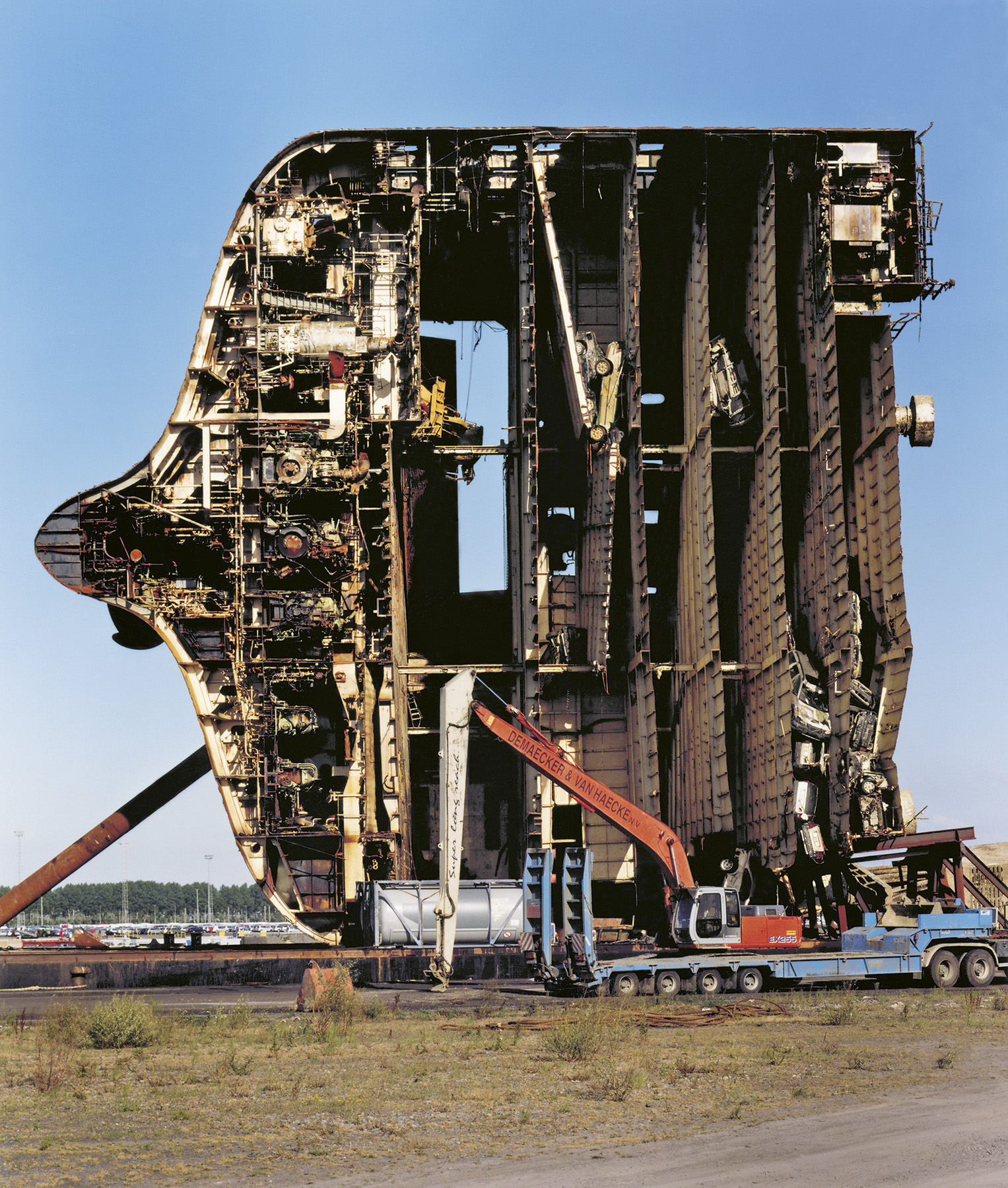
Boris Becker (German, b. 1961) 'Zeebrugge' 2003


Boris Becker (German, b. 1961)
Zeebrugge
2003
© VG Bild-Kunst, Bonn 2020


“The great charm of Boris Becker’s photographs is due to the fact that through the consequent isolation of his objects they appear mysterious and alienated which makes us curious to look closer with greater attention and to see things in a different way.”

Rupert Pfab, Exhibition catalogue: “Boris Becker”, published by Städtisches Museum Zwickau, 1995, p. 15.


Frank Dömer (German, b. 1961) 'Äbnet' 2002


Frank Dömer (German, b. 1961)
Äbnet
2002
© Frank Dömer


Anna and Bernhard Blume. 'Telekinetisch hysterische Szene' (Telekinetically hysterical scene) 1986-1987


Anna (German, 1936-2020) and Bernhard (German, 1937-2011) Blume
Telekinetisch hysterische Szene (Telekinetically hysterical scene)
1986-87
From the series Trautes Heim (Sweet home)
© VG Bild-Kunst, Bonn 2020


Anna and Bernhard Blume were a collaborative duo of German artists, best known for their large-scale, monochromatic photographs. Throughout their practice, they captured themselves dynamically engaging with Minimalist sculpture, resulting in humorous investigations into space, art history, and contemporary life. Anna was born Anna Helming in Bork, Germany and Bernhard was born in Dortmond, Germany, both in 1937. They went on to study at the Staatliche Kunstakademie in Düsseldorf from 1960 to 1965, where they met and were married in 1966. Notably, their work is entirely self-produced, from conceptualisation to finished product, with total mastery of technical components. “We paint with our camera,” Anna Blume explained, “and this painterly work continues in the lab, too.”

Anna and Bernhard Blume’s work has been widely acclaimed, resulting in such exhibitions as at the Museum Ludwig in Cologne in 2005, The Museum of Modern Art in New York in 1989, and documenta 6 in Kassel in 1977. Bernhard Blume died in Cologne, Germany on September 1, 2011. Anna Blume passed away on June 18, 2020 at the age of 84 after a long illness.

Text from the Artnet website [Online] Cited 19/03/2021


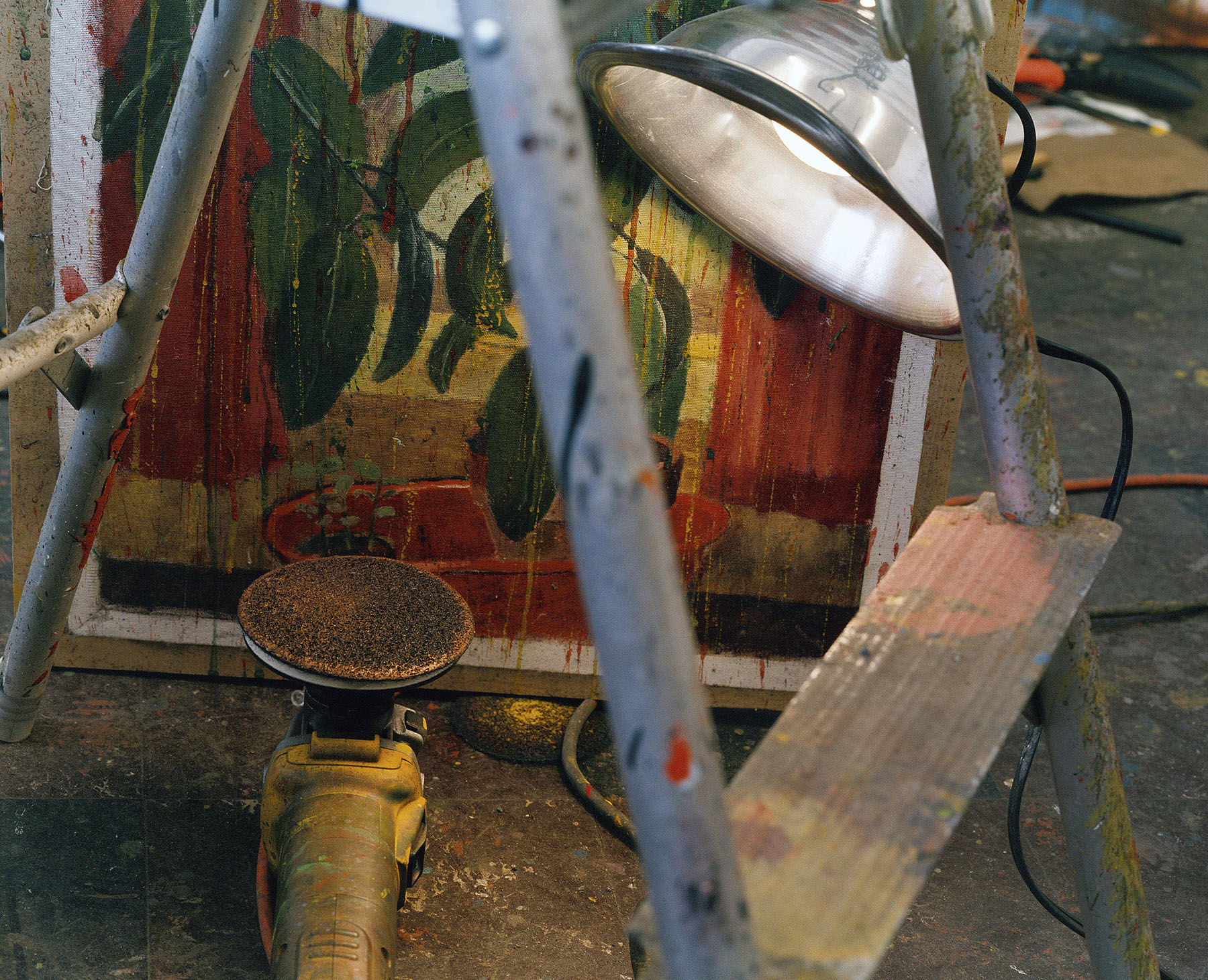
Jim Dine. 'Leaves Painted in the Eastern Part of the State' 2010


Jim Dine (American, b. 1935)
Leaves Painted in the Eastern Part of the State
2010
© VG Bild-Kunst, Bonn 2020


Candida Höfer. 'Kunsthalle Karlsruhe V' 1999


Candida Höfer (German, b. 1944)
Kunsthalle Karlsruhe V
1999
© VG Bild-Kunst, Bonn 2020


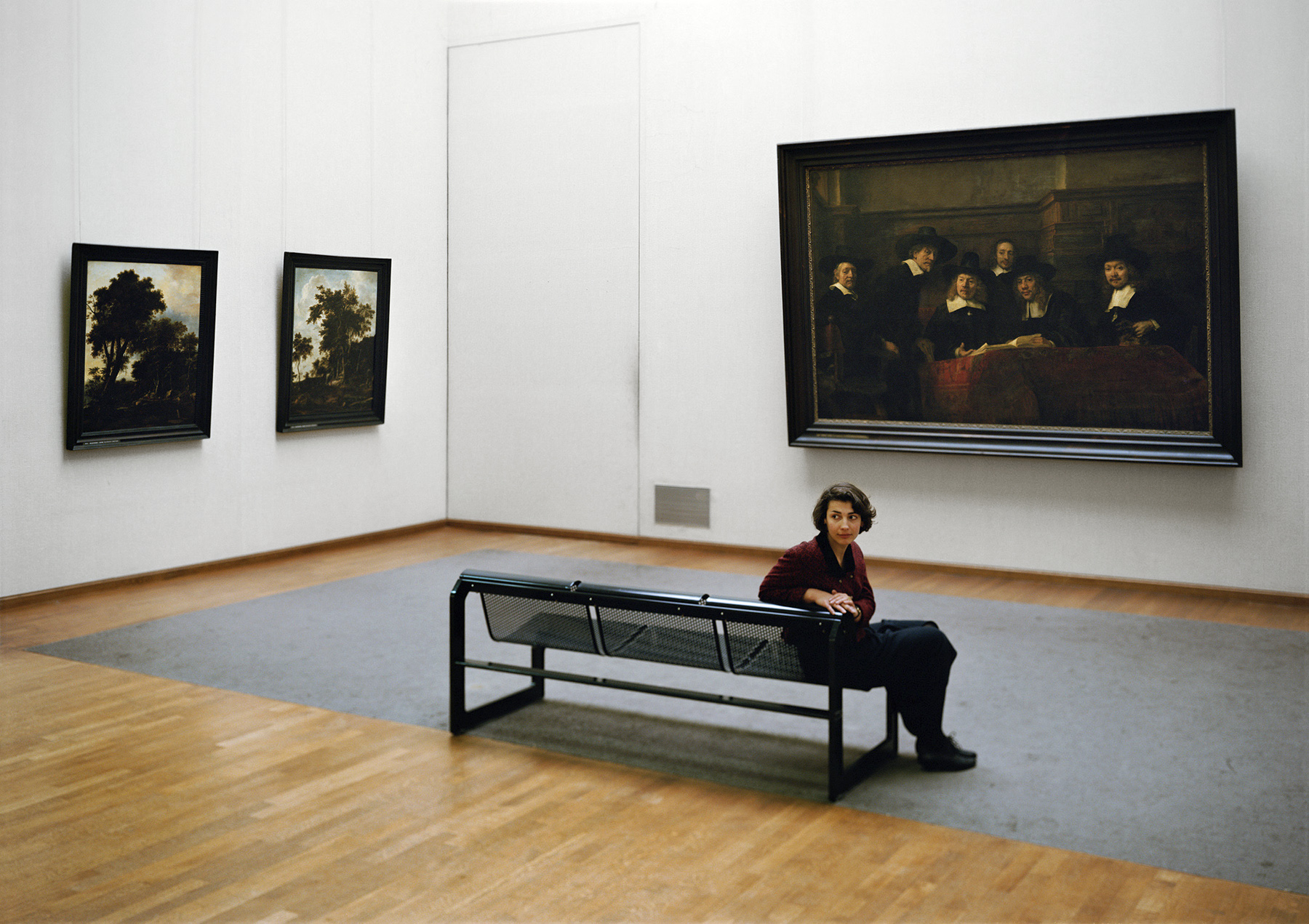
Thomas Struth (German, b. 1954) 'Rijksmuseum Amsterdam 1' 1990


Thomas Struth (German, b. 1954)
Rijksmuseum Amsterdam 1
1990
© Thomas Struth


The exhibition From Becher to Blume provides in-depth insights in particular into the influential photography of the 1980s and 90s, a period that produced a number of innovative bodies of work and concepts. A central role is played by the Rhineland, home to numerous artists, museums, and galleries. The collector couple Ute and Eberhard Garnatz were part of this extremely lively scene, and began as early as the 1970s to pursue their collecting activities with great dedication. In addition to amassing a large number of paintings, sculptures, and prints, they also built a distinctive and remarkably diverse collection of photographs, some of them dating back to the 1950s but for the most part produced during the 1980s to the 2000s. During that decade, photography was more and more becoming part of the fine arts cosmos. The medium resolutely carved out a place for itself with and alongside the traditional genres. And the collectors followed this development with an alert eye. Keeping pace with the times, they began to focus on artists who used the photographic image as basis for their work and for whom the camera was hence a matter-of-fact technical tool in their artistic practice. Some of these artists chose the documentary image as their springboard, while others were far less interested in the medium’s ability to faithfully reproduce reality and instead ventured into experimental realms. There were also those who attempted to confound the world of objects in their photos, or who staged or made use of the chemical nature of the photographic process to arrive at pictorial works in a more painterly idiom.

Showcasing the Garnatz Collection offers Die Photographische Sammlung / SK Stiftung Kultur the opportunity to arrange photographs from both collections in a productive dialogue. A common denominator can be found in particular in the works of Bernd and Hilla Becher, while photographers including Boris Becker, Candida Höfer, Thomas Ruff, and Thomas Struth are likewise represented in both collections. The exhibition furthermore places rare staged and experimental works in context. These are juxtaposed with other works that straddle the genres of photography and painting. As much as the medium of photography claims to reproduce reality, the range of possibilities it offers equally inspires artists to create works verging on the abstract or lyrical.

From Becher to Blume thus unfurls a broad and extremely varied spectrum of photographic approaches, which come together here in a refreshingly informal way to reveal their many contrasts and contradictions. On display are over 150 exhibits, including extensive serial works, by a total of 22 artists who have been instrumental in shaping recent German photography through their innovative contributions and continue to exert a major influence on the artistic medium.

A catalogue has been published by Snoeck Verlag to accompany the exhibition.

Press release from Die Photographische Sammlung/SK Stiftung Kultur


Chargesheimer (Karl-Heinz Hargesheimer) (German, 1924-1972) 'Untitled (girl scattering confetti)' c. 1956-1957


Chargesheimer (Karl-Heinz Hargesheimer) (German, 1924-1972)
Ohne Titel (Konfetti streuendes Mädchen)
Untitled (girl scattering confetti)
c. 1956-1957
© Museum Ludwig Köln


Chargesheimer (Karl Heinz Hargesheimer) belongs among the most outstanding artists of his generation – as photographer, sculptor, stage designer and director. The press called Chargesheimer a “restlessly proliferative creative spirit” and an artist “who loves to provoke.”

He was during his entire life an individual who never compromised. “Chargesheimer was insatiable, a person for whom nothing was ever enough, who consumed himself, a malcontent with an entirely crazy life (…). He made life for himself and his peers as difficult as possible.” (Georg Ramseger)

Chargesheimer began his career in 1947 as an independent photographer for various theaters in Germany. Towards the end of the 1940s he was in contact with the photographic group “fotoform.” In 1950 he participated in the “photo-kino” exhibition in Cologne and also in the legendary exhibitions of “Subjective Photography” in 1952 and 1954. At the core of Chargesheimer’s photographic oeuvre, alongside portraiture and experimental photography, stands his Street Photography, depictions of street life in Cologne and other cities of post-war Germany. These works were as a rule put by Chargesheimer into different series, and from 1957 to 1970 published in book form.

In 1958 he published concurrently two photography books, Unter Krahnenbäumen (the name of a tiny and notorious street behind the train station in Cologne) and Im Ruhrgebiet (In the Ruhr Valley), with texts from the Nobel Prizewinner for Literature Heinrich Böll. In these works Chargesheimer portrays the everyday life of ordinary people from a radical subjective perspective without a trace of sentimentality. In close succession are found all the basic human emotions and behaviours: love and sadness, cares and conflicts, reflectiveness and high spirits, the dignity of age and the exuberance of youth…

Text from the Priska Pasquer website [Online] Cited 19/03/2021


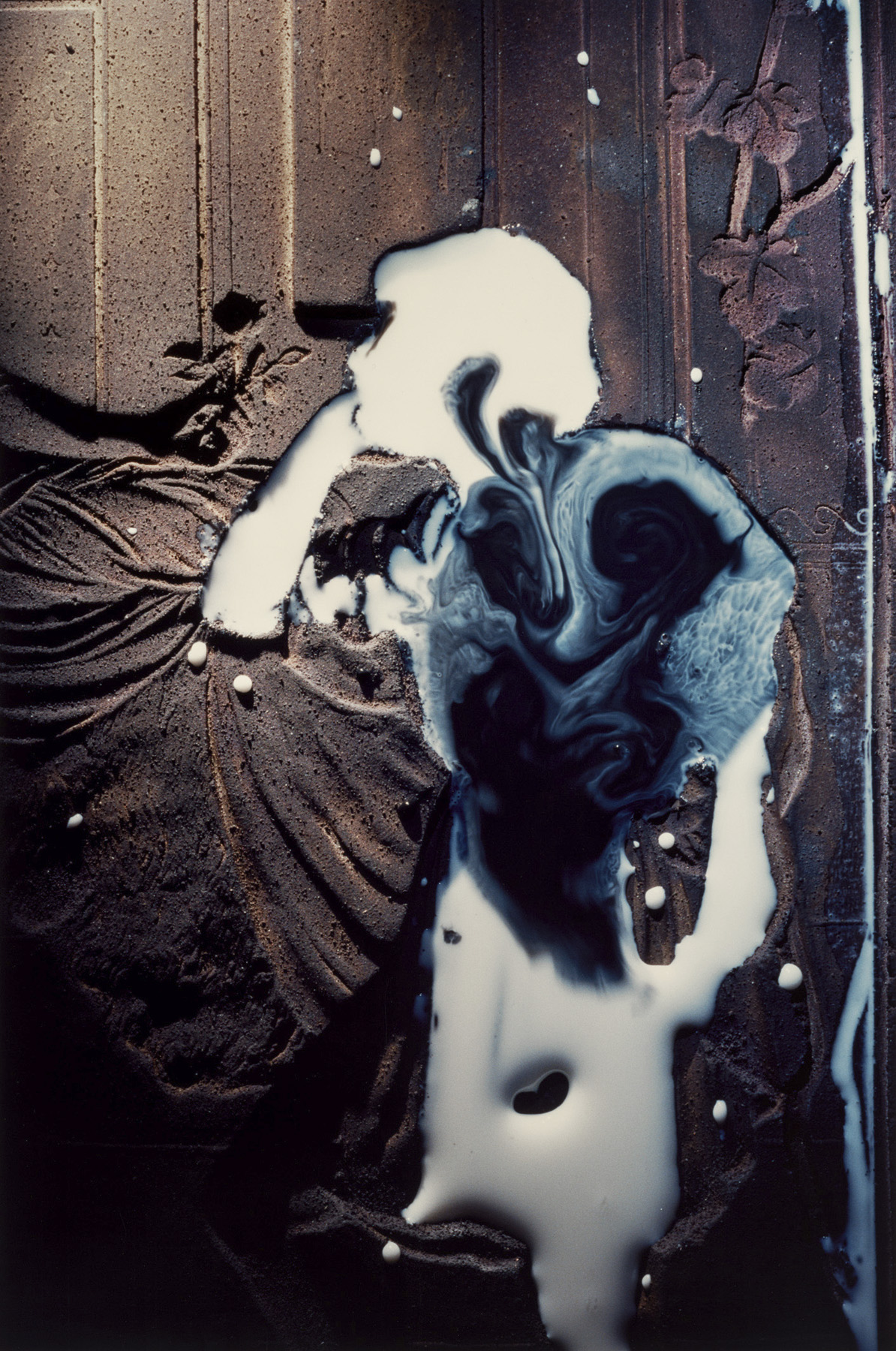
Floris Neusüss (German, 1937-2020) 'Neusüss leaves the shadows, Kassel' 1976


Floris Neusüss (German, 1937-2020)
Neusüss verlässt den Schatten, Kassel
Neusüss leaves the shadows, Kassel
1976
© Floris Neusüss


Floris Neusüss was born in Lennep, Germany, on 3 March 1937. He began as a painter the took up photography which he studied at the Wuppertal School of Arts and Crafts in North Rhine-Westphalia, before continuing at the Bavarian State Institute of Photography in Munich. He trained alongside photographer Heinz Hajek-Halke at the Berlin University of the Arts. In 1957, he began making photograms and photomontages.

His series Körperbilder (whole-body photograms) set him in the 1960s on a lifelong exploration of conceptual, technical and artistic possibilities of camera-less photography. From 1964 he has also experimented with chemical painting on photograms. Neusüss brought the photogram out of the darkroom and out of the studio to the objects recording motifs not with a camera but rather a folder with photo paper, on which he exposed subjects such as plants or windows, as in the photo series Dream Images. Continuing into the 1970s are his nudograms; silhouettes of nude figures; and also life-size portraits, including several using his friend and frequent collaborator, Robert Heinecken as the subject; and shadowy reproductions of museum sculptures, such as those of Greek statues from the Glypothek in Munich For Neusüss, the photographic medium was not an impression, but a contact image. According to this interpretation, the original object touched the image;

“It is true that the subject resting on the photo-sensitive paper presents its reverse side to be recorded, the side that is in shadow, the shadow cast by the object itself. This intimate physical connection inscribes into the paper, and this, if you are open to it, is the real fascination of photograms: the tension between the hidden and the revealed.”

Text from the Wikipedia website


Floris Neusüss is a contemporary experimental German photographer known for his use of camera-less photography (photograms). His most famous works are the Nudogramms from the late 1960s, in which he exposed a nude figure directly onto photographic paper “Photograms don’t show us what’s beyond the visible, but they give us a hint of it,” Neusüss has said. “It is true that the subject resting on the photo-sensitive paper presents its reverse side to be recorded, the side that is in shadow, the shadow cast by the object itself. This intimate physical connection inscribes into the paper, and this, if you are open to it, is the real fascination of photograms: the tension between the hidden and the revealed.” Born on March 3, 1937 in Remscheid Lennep, Germany, he studied at a number of schools throughout Germany before completing his education at the School of Art in Berlin, where he studied under the revered photographer Heinz Hajek-Halke. Graduating in 1960, Neusüss went on to teach at the Academy of Fine Arts in Kassel while beginning to experiment with photograms. The artist continues to live and work in Kassel, Germany. Today, his works are held in the collections of the Victoria and Albert Museum in London, the San Francisco Museum of Modern Art, and the Art Institute of Chicago, among others.

Text from the Artnet website [Online] Cited 19/03/2021


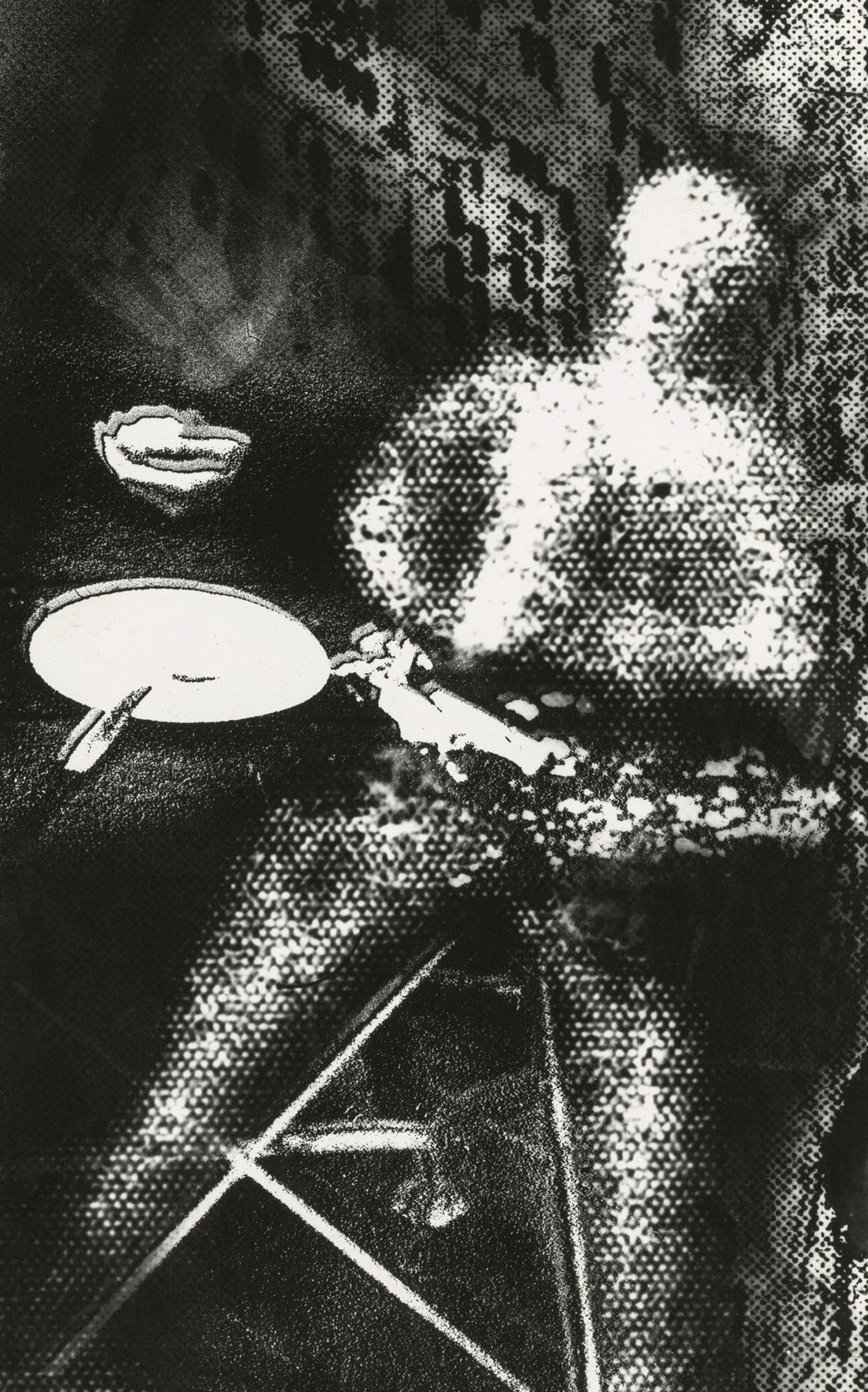
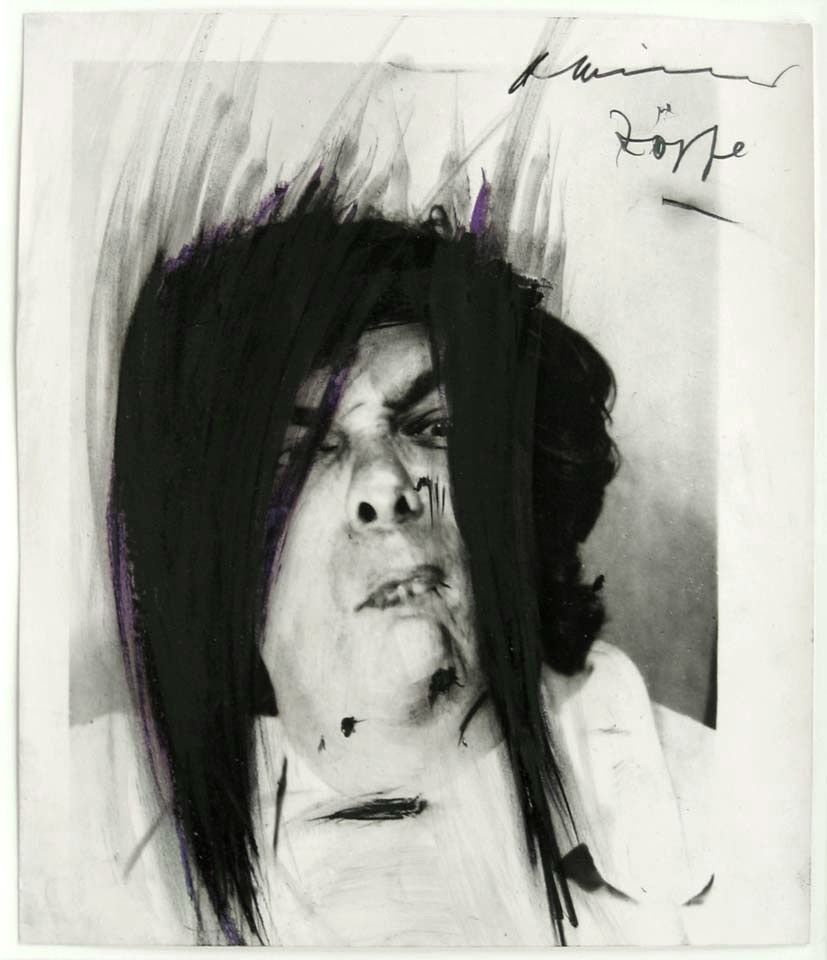
Arnulf Rainer (Austrian, b. 1929) 'Selbst mit Ei (Self with an egg)' c. 1969-1971


Arnulf Rainer (Austrian, b. 1929)
Selbst mit Ei (Self with an egg)
c. 1969-1971
© Arnulf Rainer


Arnulf Rainer (born 8 December 1929) is an Austrian painter noted for his abstract informal art.

Rainer was born in Baden, Austria. During his early years, Rainer was influenced by Surrealism. In 1950, he founded the Hundsgruppe (dog group) together with Ernst Fuchs, Arik Brauer, and Josef Mikl. After 1954, Rainer’s style evolved towards Destruction of Forms, with blackenings, overpaintings, and maskings of illustrations and photographs dominating his later work. He was close to the Vienna Actionism, featuring body art and painting under the influence of drugs. He painted extensively on the subject of Hiroshima such as it relates to the nuclear bombing of the Japanese city and the inherent political and physical fallout.

In 1978, he received the Grand Austrian State Prize. In the same year, and in 1980, he became the Austrian representative at the Venice Biennale. From 1981 to 1995, Rainer held a professorship at the Academy of Fine Arts in Vienna – the same place where he aborted his own studies after three days, unsatisfied.

Text from the Wikipedia website


Sigmar Polke (German, 1941-2010) 'Untitled (Oberkassel Bridge)' 1971-1983


Sigmar Polke (German, 1941-2010)
Ohne Titel (Oberkasseler Brücke)
Untitled (Oberkassel Bridge)
1971-83
© The Estate of Sigmar Polke, Cologne / VG Bild-Kunst, Bonn 2020


Sigmar Polke (13 February 1941 – 10 June 2010) was a German painter and photographer.

Polke experimented with a wide range of styles, subject matters and materials. In the 1970s, he concentrated on photography, returning to paint in the 1980s, when he produced abstract works created by chance through chemical reactions between paint and other products. In the last 20 years of his life, he produced paintings focused on historical events and perceptions of them…

Work

In 1963, Polke founded the painting movement “Kapitalistischer Realismus” (“Capitalist realism”) with Gerhard Richter and Konrad Fischer (alias Konrad Lueg as artist). It is an anti-style of art, appropriating the pictorial shorthand of advertising. This title also referred to the realist style of art known as “Socialist Realism”, then the official art doctrine of the Soviet Union and its satellites (from one which he had fled with his family), but it also commented upon the consumer-driven art “doctrine” of western capitalism. He also participated in “Demonstrative Ausstellung”, a store-front exhibition in Düsseldorf with Manfred Kuttner, Lueg, and Richter. Essentially a self-taught photographer, Polke spent the next three years painting, experimenting with filmmaking and performance art.

Photography

In 1966-1968, during his most conceptual period, Polke used a Rollei camera to capture ephemeral arrangements of objects in his home and studio.[6] In 1968, the year after he left the art academy, Polke published these images as a portfolio of 14 photographs of small sculptures he had made from odds and ends – buttons, balloons, a glove. From 1968 to 1971, he completed several films and took thousands of photographs, most of which he could not afford to print.

During the 1970s, Polke slowed his art production in favour of travel to Afghanistan, Brazil, France, Pakistan, and the U.S., where he shot photographs (using a handheld 35mm Leica camera) and film footage that he would incorporate in his subsequent works during the 1980s. In 1973 he visited the U.S. with artist James Lee Byars in search of the “other” America; the fruit of that journey was a series of manipulated images of homeless alcoholics living on New York’s Bowery. He produced an additional series of photographic suites based on his journeys to Paris (1971), Afghanistan and Pakistan (1974) and São Paulo (1975), often treating the original image as raw material to be manipulated in the dark room, or in the artist’s studio. Beginning with his 1971 Paris photographs printed using chemical staining to create works full of strange presences while under the influence of LSD, Polke exploited the photographic process as a means to alter “reality.” He combined both negatives and positives with images that had both vertical and horizontal orientations. The resulting collage-like compositions take advantage of under- and overexposure and negative and positive printing to create enigmatic narratives. With the negative in his enlarger, the artist developed large sheets selectively, pouring on photographic solutions and repeatedly creasing and folding the wet paper.

Completed in 1995 in collaboration with his later wife Augustina von Nagel, a suite of 35 prints entitled “Aachener Strasse” combine street photography with images from Polke’s paintings, developed using techniques of multiple exposures and multiple negatives.

Text from the Wikipedia website


Benjamin Katz (Belgium, b. 1939) 'Sigmar Polke in Düsseldorf' 1984


Benjamin Katz (Belgium, b. 1939)
Sigmar Polke in Düsseldorf
1984
© VG Bild-Kunst, Bonn 2020


More information about and images from the artist: ‘Benjamin Katz Berlin Havelhöhe, 1960/61’ at Museum Ludwig, Cologne


Astrid Klein (German, b. 1951) 'Zwischenbereich (Intermediate area)' 1986


Astrid Klein (German, b. 1951)
Zwischenbereich (Intermediate area)
1986
© Astrid Klein / Courtesy Sprüth Magers


Astrid Klein (b. 1951) is one of Germany’s most distinguished conceptual artists. Collage constitutes the main formal and artistic principal of her work. Her large-scale wall pieces often combine found images with her own text or quotes from philosophy, theory or science to illuminate suppressed aspects of the collective unconscious and to question conventional power structures and modes of representation. Her oeuvre – comprising photographic work but also neon and mirror sculptures, installations, painting and drawing – oscillates between poetry and criticism, skepticism and longing.

Photoworks

Klein began working with photography in 1978. Her early works were based on themes of human tragedy and often combined texts with images.

Klein produces photographic images on a large scale to make what she refers to as ‘photoworks’, distinguishing them from straightforward photographs. Starting with images drawn from newspapers and magazines, Klein transforms them with a variety of processing and printing techniques in the darkroom, often verging on abstraction. The resulting works question assumptions about photography as an accurate documentary medium.

Text from the Wikipedia website


Gina Lee Felber (German, b. 1957) 'Tacet (Silent)' 1988


Gina Lee Felber (German, b. 1957)
Tacet (Silent)
1988
© Gina Lee Felber


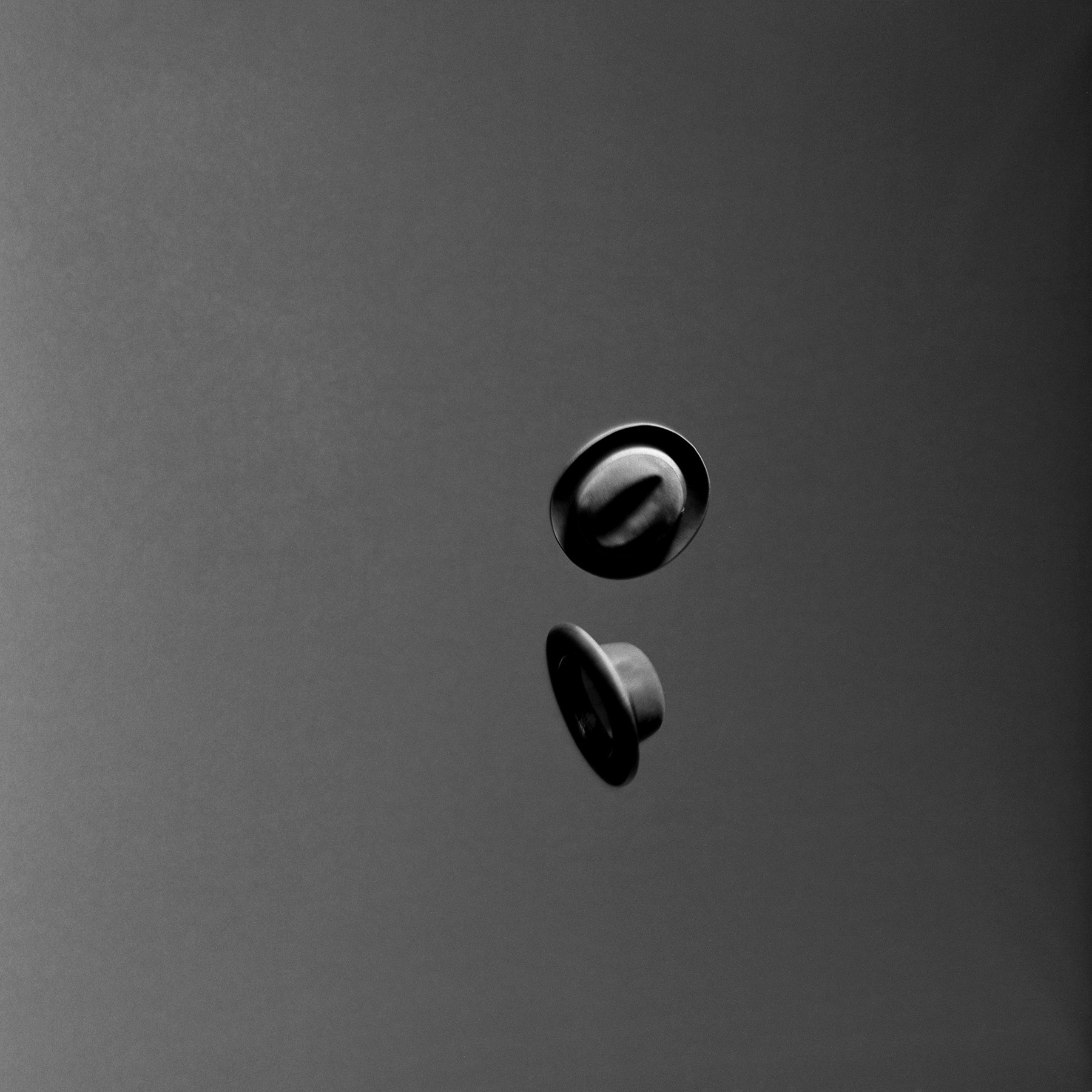
Jürgen Klauke (German, b. 1943) 'Untitled (Flying Hats)' 1990-1992


Jürgen Klauke (German, b. 1943)
Ohne Titel (Fliegende Hüte)
Untitled (Flying Hats)
1990-92
From the series Sonntagsneurosen (Sunday Neuroses)
© Jürgen Klauke


Jürgen Klauke (born 6 September 1943) is a German artist. Beginning in the 1960s, he used his own body as a subject of his photographs. He also experimented with minimalism and surrealism. The ZKM in Karlsruhe exhibits his work. Since 1968 he lives and works in Cologne.


Augustina von Nagel (German, b. 1952) 'Der Denker (The Thinker)' 1997


Augustina von Nagel (German, b. 1952)
Der Denker (The Thinker)
1997
© Augustina von Nagel


Married to Sigmar Polke.


Die Photographische Sammlung/SK Stiftung Kultur
Im Mediapark 7
50670 Cologne
Phone: 0049-(0)221-88895 300

Opening hours:
Open daily 14 – 19hrs
Closed Wednesdays

Die Photographische Sammlung/SK Stiftung Kultur website

LIKE ART BLART ON FACEBOOK

Back to top

Exhibition: ‘Behind the Curtain – The Aesthetics of the Photobooth’ at the Musée de l’Elysée, Lausanne

Exhibition dates: February – 20th May 2012

Artists:
 Jean-Michel Alberola, Louis Aragon, Marie-Berthe Aurenche, Richard Avedon, Alain Baczynsky, Jared Bark, Marc Bellini, Jacques-André Boiffard, André Breton, Hansjürg Buchmeier, Anita Cruz-Eberhard, Sabine Delafon, Anne Deleporte, Paul Eluard, Max Ernst, Michael Fent, Michel Folco, Valentine Fournier, Lee Friedlander, Näkki Goranin, Jeff Grostern, Susan Hiller, Dick Jewell , Svetlana Khachaturova, Jürgen Klauke, Jacques-Henri Lartigue, Naomi Leibowitz, Leon Levinstein, Annette Messager, Willy Michel, Daniel Minnick, Suzanne Muzard, Raynal Pellicer, Mathieu Pernot, Steven Pippin, Jacques Prévert, Raymond Queneau, Arnulf Rainer, Timm Rautert, Bruno Richard, Gerhard Richter, Thomas Ruff, Michel Salsmann, Tomoko Sawada, Joachim Schmid, Cindy Sherman, Lorna Simpson, Dimitri Soulas, Yves Tanguy, Amanda Tetrault, Roland Topor, Franco Vaccari, Andy Warhol, Gillian Wearing, Jan Wenzel, David Wojnarowicz and the group Fluxus.


Franco Vaccari. '(Exhibition in real time: leave a photographic sign of your passage on these walls)' 1972 (detail)


Franco Vaccari (Italian, b. 1936)
Esposizione in tempo reale num. 4: Lascia su queste pareti una traccia fotografica del tuo passaggio (Exhibition in real time: leave a photographic sign of your passage on these walls) (detail)
1972
Collage of photobooths mounted on cardboard, gelatin silver prints
45.5 x 58.5cm
© Franco Vaccari, property of the Artist


This is one exhibition I wish I could really see in person. Such a fascinating subject!

The images are timeless, contextless and quite beguiling. The exhibition questions the aesthetics of the photobooth through six major themes: The Booth, Automatism, The Strip, Who Am I?, Who Are You?, Who Are We?. In Melbourne there are still two black and white photobooths outside the Elizabeth Street exit of Flinders Street railway station, standing there like silent sentinels of a bygone age. I remember when I was younger queueing to have my photograph taken, for student cards and for my first passport. You needed two nearly identical black and white shoulder up portraits, no smiling, no glasses on. Now you just go to the chemist for your colour renditions. The magic and the fun has gone.

The whole performance has the illusion of the cinematic. You queue to get in, drawing back the curtain and closing it behind you, as they close the doors of the cinema. The privacy of the booth, not in darkness but behind a curtain that shields your face from prying eyes but leaves the lower half of your body exposed. Behind where you will be sitting another curtain – drawn or open? What background do you want? You adjust the seat up and down so that your face is at the correct level with the mark on the screen, enter your money and wait. The red light comes on, you (com)pose yourself and a couple of seconds later: flash! Your eyes try to recover in time for the next red light: flash!

Time seems to slow down and almost stop between the flashes of light. The experience of your performance before the screen possesses such a visceral, tense, gut feel but also a disembodied feeling. I never know how I am going to look on the cinematic film strip, not at 24 frames a second, but at 4 frames per minute. What happens to the time in between? Standing outside the booth waiting for a strip of paper with your impression on it, not knowing what the images are going to be like, whether the development of the image in such a short space of time has worked correctly – and the smell of the chemicals on the paper as you handle the still wet strip. Magic…

Dr Marcus Bunyan


Many thankx to the Musée de l’Elysée for allowing me to publish the photographs in the posting. Please click on the photographs for a larger version of the image.


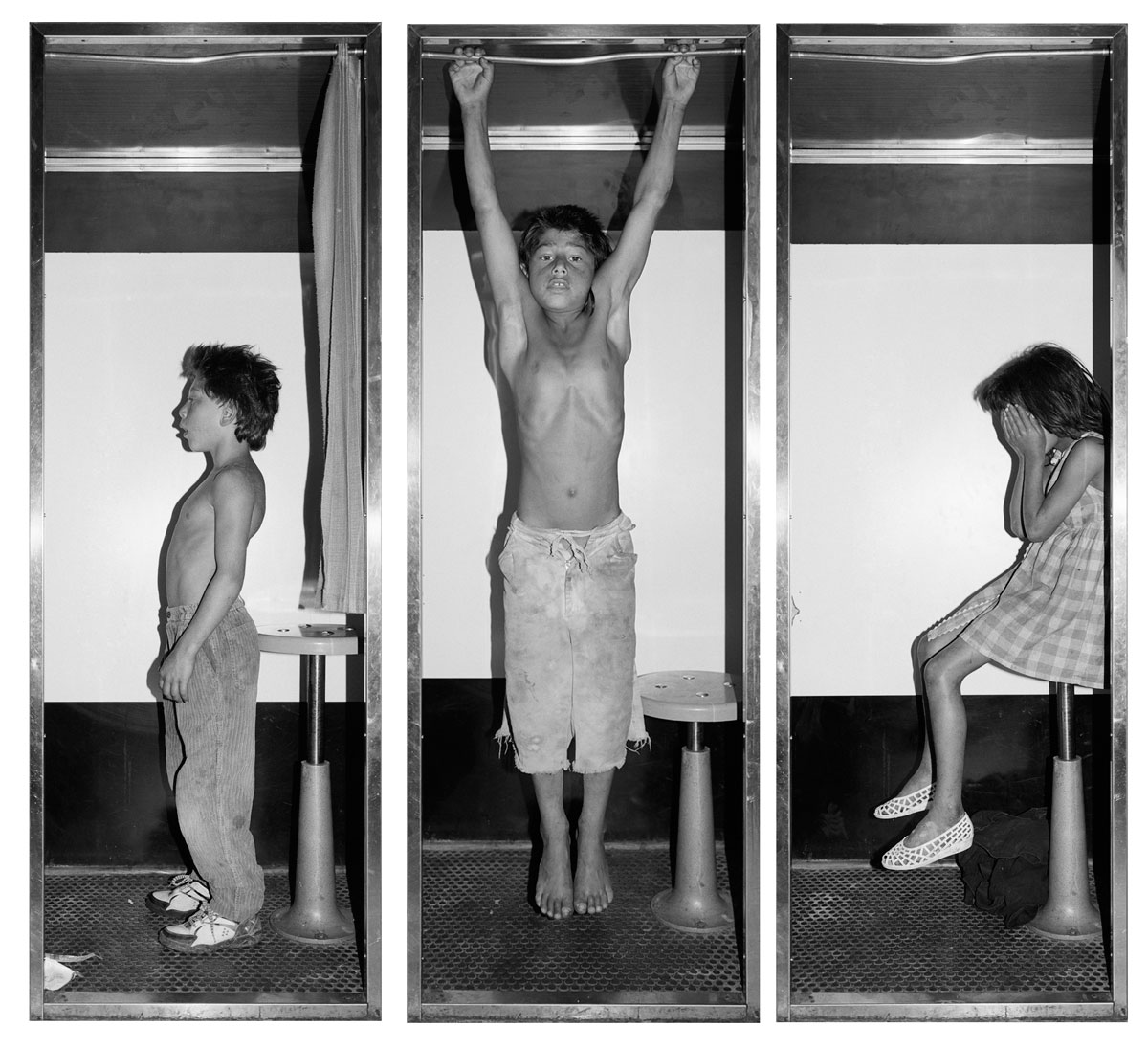
Mathieu Pernot (French, b. 1970) 'Jonathan, Mickael, Priscilla, Photobooth' 1996


Mathieu Pernot (French, b. 1970)
Jonathan, Mickael, Priscilla, cabine du photomaton (Jonathan, Mickael, Priscilla, Photobooth)
1996
Three gelatin silver prints
540 x 195cm
© Mathieu Pernot / collection Musée de l’Élysée, Lausanne


Cindy Sherman (American, b. 1954) 'Untitled' 1975


Cindy Sherman (American, b. 1954)
Untitled
1975
Gelatin silver print
30.5 x 20.4cm
© Courtesy of the Artist, Metro Pictures, collection Musée de l’Elysée, Lausanne


Gillian Wearing (English, b. 1963) 'Self Portrait at 17 Years Old' 2003


Gillian Wearing (English, b. 1963)
Self Portrait at 17 Years Old
2003
Framed C-type print
115.5 x 92cm
Collection of Contemporary Art Fundació ‘La Caixa’, Barcelone
© Gillian Wearing, courtesy Maureen Paley, London


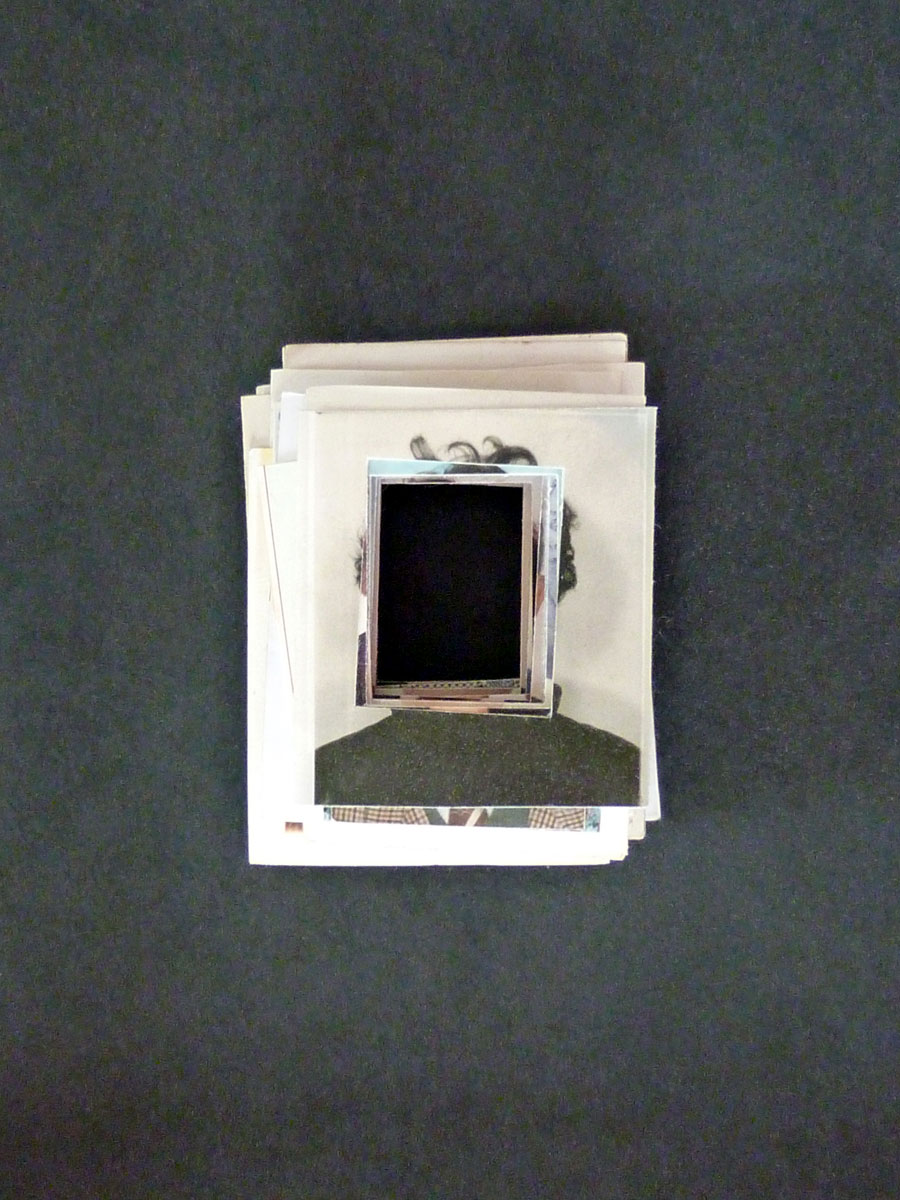
Anne Deleporte (French, b. 1960) 'I.D. Stack #6' 1992


Anne Deleporte (French, b. 1960)
I.D. Stack #6
1992
Stack of photobooth portraits, gelatin silver and chromogenic prints
6 x 5 x 3cm
© Anne Deleporte


When the first photobooths were set up in Paris in 1928, the Surrealists used them heavily and compulsively. In a few minutes, and for a small price, the machine offered them, through a portrait, an experience similar to automatic writing. Since then, generations of artists have been fascinated by the concept of the photobooth. From Andy Warhol to Arnulf Rainer, Thomas Ruff, Cindy Sherman and Gillian Wearing, many used it to play with their identity, tell stories, or simply create worlds.

Behind the Curtain – the Aesthetics of the Photobooth, an exhibition created by the Musée de l’Elysée, is the first to focus on the aesthetics of the photobooth. It is divided into six major themes: the booth, the automated process, the strip, who am I ?, who are you?, who are we? Provider of standardised legal portraits, it is the ideal tool for introspection and reflection on others, whether individually or in groups. By bringing together over 600 pieces made on different media (photographs, paintings, lithographs and videos ) from sixty international artists, the exhibition reveals the influence of the photobooth within the artistic community, from its inception to the present day.

The exhibition questions the aesthetics of the photobooth through six major themes.

The Booth

An isolated space, closed in as if it were some sort of modern confessional, the photobooth is an invitation to the most intimate revelations. Generally located in public spaces-subway station, department store or train station-it also offers an extraordinary observation point onto the urban hustle and bustle. It is a world in between the intimate and the public, the inside and the outside, the debarred and the open.

Automatism

From the Surrealists to the most contemporary artists, all have been fascinated by the automatism of the photobooth. The machine does the work. The author vanishes behind the almighty technology. Malfunction can occur at times. The result is a form of poetry of the automatism made visible in its faults, failures or blunders.

The Strip

As a series of juxtaposed images, the strip recreates spatial or temporal continuities. It reconstructs improbable spaces: a closer look shows that, in fact, the adjacent image is the following image. Through this succession of images, the photobooth holds, as if folded into it, the principle of the cinema. Putting images side by side is already telling a story.

Who am I?

Identity is embodied within the space of the photobooth. It is a space for self-staging, where social, ethnic, sexual, community or any other identity can be strengthened or undone. One can pretend to ascertain one’s naked identity through the mirror of the photobooth, or on the contrary, by pulling faces or in disguise, to establish metamorphoses of the self. The photobooth is the ideal introspective tool.

Who are you?

The photobooth is not only a place suitable for self-reflection, it is also a place in which the other can be questioned, in particular through the legal identification system that delivers what is commonly referred to as ‘ID’. In devoting oneself to the compulsive and bulimic collecting of photobooth strips, one can also get lost in the faces of others.

Who are we?

While it allows us to reflect upon our own identity, or other people’s, the photobooth is also an opportunity to ponder about the nature of the couple, or the group. Inside the booth, some build their image through the mirror of the other, or of others; they pose in pairs or more, thus asserting their affiliation to a social entity. The photobooth reinforces our gregarious instinct; it embodies collective identity.

With works by Jacques-Henri Lartigue, Willy Michel, Lorna Simpson, Amanda Tetrault and the collection of albums of purikuras (see photograph below: in Japan, the name purikuras refers to a photo sticker booth or the product of such a photo booth. The name is a shortened form of the registered trademark Purinto Kurabu (プリント倶楽部). The term derives from the English print club. Jointly developed by Atlus and Sega, the first purikura machines were sold in July 1995).

Press release from the Musée de l’Elysée website


Anonymous. 'Collection of albums of purikuras' 1995-2010


Anonymous
Collection of albums of purikuras
1995-2010
Collection of digital images printed on stickers mounted in booklets
Various sizes from 9 x 12.8cm to 11.9 x 14.5cm
© Kenji Hirasawa (art collector)


Andy Warhol (American, 1928-1987) 'Frances Lewis' 1966


Andy Warhol (American, 1928-1987)
Frances Lewis
1966
Acrylic and silkscreen on linen, 12 panels
162.5 x 167.6cm
© Collection The Sydney and Frances Lewis Foundation / 2011
The Andy Warhol Foundation for the Visual Arts, Inc. / Artists Rights Society ( ARS ), New York


Jan Wenzel (German, b. 1972) 'Vohang (Curtain)' 2009


Jan Wenzel (German, b. 1972)
Vohang (Curtain)
2009
From the series Instant History
Montage of four photobooth prints, chromogenic prints
41.7 x 31.7cm
© Jan Wenzel / Kleinschmidt Fine Photographs


Yves Tanguy (French, 1900-1955) 'Selfportrait in a Photobooth' c. 1929


Yves Tanguy (French, 1900-1955)
Selfportrait in a Photobooth
c. 1929
Gelatin silver print
20.5 x 3.8cm
© Collection Musée de l’Elysée, Lausanne / 2011, ProLitteris, Zurich


Anonymous. 'Walter and I at the BIG SLIDE' c. 1970


Anonymous
Walter and I at the BIG SLIDE
c. 1970
Gelatin silver print
c. 20.5 x 3.8cm
© Collection Näkki Goranin


Arnulf Rainer (Austrian, b. 1929) 'No title (Automatenportraits)' August 1969

Arnulf Rainer (Austrian, b. 1929) 'No title (Automatenportraits)' August 1969

Arnulf Rainer (Austrian, b. 1929) 'No title (Automatenportraits)' August 1969


Arnulf Rainer (Austrian, b. 1929)
No title (Automatenportraits)
August 1969
Courtesy Galerie m Bochum
© Arnulf Rainer


Alain Baczynsky (Belgian, b. 1953) 'Regardez, il va peut-être se passer quelque chose …' 1979-1981


Alain Baczynsky (Belgian, b. 1953)
Regardez, il va peut-être se passer quelque chose… (Look, maybe it will be something going on…)
1979-1981
© Collection Centre Pompidou, dist. RMN


Susan Hiller (American-born artist who lived in London, 1940-2019) 'Midnight, Euston' 1983


Susan Hiller (American-born artist who lived in London, 1940-2019)
Midnight, Euston
1983
© Susann Hiller; Arts Council Collection, Southbank Centre, London


Jan Wenzel (German, b. 1972) 'Bastler II' 2000


Jan Wenzel (German, b. 1972)
Bastler II
2000
© Jan Wenzel & Kleinschmidt Fine Photographs


Musée de l’Elysée
18, avenue de l’Elysée CH
1014 Lausanne
Phone: + 41 21 316 99 11

Opening hours
Wednesday – Monday 10am – 6pm
Closed Tuesdays

Musée de l’Elysée website

LIKE ART BLART ON FACEBOOK

Back to top

Exhibition: ‘Staging Action: Performance in Photography Since 1960’ at The Museum of Modern Art (MoMA), New York

Exhibition dates: 26th January – 9th May 2011

Curators: Roxana Marcoci, Curator, and Eva Respini, Associate Curator, Department of Photography, The Museum of Modern Art


Many thank to The Museum of Modern Art, New York for allowing me to publish the photographs in the posting. Please click on the photographs for a larger version of the image.


William Wegman (American, b. 1943) 'Foamy Aftershave (L-Foamy; R-Aftershave)' 1982


William Wegman (American, b. 1943)
Foamy Aftershave (L-Foamy; R-Aftershave)
1982
28 1/2 x 22″ (72.4 x 55.9cm) each
The Museum of Modern Art, New York
Gift of Robert and Gayle Greenhill
© 2010 William Wegman


Laurel Nakadate (American, b. 1975) 'Lucky Tiger #151' 2009


Laurel Nakadate (American, b. 1975)
Lucky Tiger #151
2009
Chromogenic colour print with ink fingerprints
4 x 6″ (10.2 x 15.2cm)
The Museum of Modern Art, New York
Acquired through the generosity of the Peter Norton Family Foundation
© 2010 Laurel Nakadate


Laurel Nakadate (American, b. 1975) 'Lucky Tiger #181' 2009


Laurel Nakadate (American, b. 1975)
Lucky Tiger #181
2009
Chromogenic colour print with ink fingerprints
4 x 6″ (10.2 x 15.2cm)
The Museum of Modern Art, New York
Acquired through the generosity of the Peter Norton Family Foundation
© 2010 Laurel Nakadate


Gilbert & George (British) 'The Red Sculpture' 1975


Gilbert & George (British)
The Red Sculpture
1975
Chromogenic colour print with text
9 1/8 x 13 7/8″ (23.2 x 35.2cm)
The Museum of Modern Art, New York
Art & Project/Depot VBVR Gift
© 2010 Gilbert & George


Matthew Barney (American, b. 1967) 'Drawing Restraint 9: Shimenawa' 2005


Matthew Barney (American, b. 1967)
Drawing Restraint 9: Shimenawa
2005
Chromogenic colour print in self-lubricating plastic frame
The Museum of Modern Art, New York
Gift of Barbara Gladstone
© 2010 Matthew Barney


Installation view of the exhibition 'Staging Action: Performance in Photography Since 1960' at The Museum of Modern Art (MoMA)


Installation view of the exhibition Staging Action: Performance in Photography Since 1960 at The Museum of Modern Art (MoMA), New York showing at right, George Maciunas Performing for Self-Exposing Camera, New York 1966


George Maciunas (American, born Lithuania, 1931-1978) 'George Maciunas Performing for Self-Exposing Camera, New York' 1966


George Maciunas (American born Lithuania, 1931-1978)
George Maciunas Performing for Self-Exposing Camera, New York
1966
Gelatin silver print


Focusing on a wide range of images of performances that were expressly made for the artist’s camera, Staging Action: Performance in Photography Since 1960 draws together approximately 50 works from the Museum’s collection, and is on view from January 28 to May 9, 2011. Though performances are often intended to be experienced live, in real time, with photography playing an ancillary function in recording them, these works function as independent, expressive pictures, often staged in the absence of a public audience. At the center of these pictures is a performer (often the artist), posing or enacting an action conceived for the photographic lens. Among the works on view, approximately half are recent acquisitions by MoMA, including pieces by Laurel Nakadate, Rong Rong, Ai Weiwei, Huang Yan, and La Monte Young. Staging Action is organised by Roxana Marcoci, Curator, and Eva Respini, Associate Curator, Department of Photography, The Museum of Modern Art.

Beginning with Fluxus artists in the 1960s, Staging Action includes the work of George Maciunas, an artist who engaged the production of the self as positional rather than fixed and often played with transvestism. According to personal reminiscences of the American poet Emmett Williams, a friend, Maciunas’s closets were full of prom dresses that he scavenged from the Salvation Army. In his 1966 cross-dressing striptease, George Maciunas Performing for Self-Exposing Camera, New York, he reinforced the active construction of identity through gender indeterminacy. The participation of the camera as accomplice to the artist’s actions was also a constant theme in Vito Acconci’s work of the early 1970s. In Conversions I: Light, Reflections, Self-Control (1970-1971), Acconci tried to feminize his male body by plucking hair from his chest and navel area, pushing his pectorals together to mimic breasts, and hiding his genitals between his legs. Performances that explored gender play were soon embraced by other artists. A few years later, Richard Prince and Cindy Sherman collaborated on a photo shoot in which they sported identical suits and red-haired wigs, each playing androgynous double to the other.

Staging Action continues with artists who experimented with the camera to test the physical and psychological limits of the body. Reacting against the post-World War II repressive sexual and political atmosphere of Austrian society, the group known as the Vienna Actionists – including Günter Brus, Otto Muehl, Herman Nitsch, and Rudolf Schwarzkogler – staged highly provocative actions that were mostly ritualistic, incorporating elements such as wine and animal blood from Dionysian rites and Christian ceremonies in an attempt to free human instincts that had been repressed by society. In the early 1990s, numerous artists living in Beijing’s East Village artist community actively engaged in endurance-based performances. On view is East Village, Beijing No. 22 (1994) by Rong Rong, an iconic picture of the now seminal performance known as 12 Square Meters, which takes its title from the size of the public urinal where the action took place. The artist Zhang Huan covered himself in fish guts and honey and sat motionless for an hour in the heat of a summer day as flies gathered on his body, while the photographer Rong Rong captured the gritty performance.

The face as a site for alteration and extreme expression is of particular interest to several artists in the exhibition. In his five-part work, Studies for Holograms (1970), Bruce Nauman poked, pulled, pinched, and kneaded his mouth, neck, and cheeks in extreme and cartoonish ways. For her 1972 work (Untitled) Facial Cosmetic Variations, Ana Mendieta used tape and make-up to mould and manipulate her face to create, at turns, disturbing and humorous results that reference the cosmetic changes women inflict upon themselves in the name of beauty. Lucas Samaras’s transformations in a series of self-portrait Polaroids from 1969-1971 suggest the plasticity or mutability of identity itself. For these works, the artist utilised an array of wigs, pancake make-up, and props to transform himself into grotesque characters for the camera.

Other performances required a sustained, emotional engagement on the part of the artist. Bas Jan Ader’s particular brand of existential-based Conceptualism is crystallised in I’m too sad to tell you (1970), in which the artist cried in front of the camera. In 1971, Adrian Piper performed a time-lapse piece titled Food for Spirit. Inspired by an assignment to write a text on Immanuel Kant’s Critique of Pure Reason, Piper began fasting in order to isolate herself into a state of self-transcendence, and took pictures of herself in front of a mirror to insure reconnaissance of her own body. The ability of the camera to both freeze and extend a moment in time was also instrumental to the Japanese artist Mieko Shiomi. In Disappearing Music for Face (1966), Shiomi sequenced a series of film stills focusing on the mouth of Yoko Ono as her smile intermittently faded into a neutral facial expression. In Laurel Nakadate’s pictures from the Lucky Tiger series that she conceived of in 2009 during a road trip through the American West, the artist is seen riding a horse in a cropped T-shirt, doing a backbend in cowboy boots by the Grand Canyon, and striking a Playboy pose in her “lucky tiger” bikinis, rehashing photographic conventions inspired by 1950s-style “cheesecake” and camera-club pictures. Lorna Simpson’s multi-part work, May, June, July, August ’57 / ’09 (2009) also responds to the photographic conventions of posing for the camera. Simpson turned to the photographic archive as source material, combining found photographs of a young African-American woman who posed for hundreds of pin-up pictures in 1957 in Los Angeles with her own performative self-portraits, in which she replicates every outfit, pose, and setting of the original photographs. Through juxtaposition, repetition, and de-contextualization, a historical fiction arises, whereby the two women, despite the many differences that separate them, seem to be joined through a shared identity.

The exhibition includes both off-the-cuff and staged performative gestures of political dissent. Ai Weiwei’s photographic series Study of Perspective (1995-2003) reveals a spirited irreverence toward national monuments. Traveling to various landmarks – from the Eiffel Tower to Tiananmen Square to the White House – the artist photographed his own arm extended in front of the camera’s lens as he gave each marker the middle finger. Robin Rhode’s pictures, presented sequentially in storyboard format, record situations in which the artist interacts with a set of objects that he has drawn, erased and redrawn in black charcoal on dilapidated walls. Untitled, (Dream House) (2005) comprises a sequence of 28 colour photographs in which Rhode mimics the act of struggling to catch a television set, a chair, and a car that appear to have been thrown at him from above. In reality, these items are drawn in cartoonish lines on an exterior wall. Referencing the South African New Year custom of tossing out old objects, the artist identifies society’s two opposing poles: consumerism and dispossession. Rhode’s pictures, like those of the other artists in Staging Action, attest to the myriad ways in which photography constitutes – not just documents – performance as a conceptual exercise.

Press release from the MoMA website


Installation view of the exhibition 'Staging Action: Performance in Photography Since 1960' at The Museum of Modern Art (MoMA)


Installation view of the exhibition Staging Action: Performance in Photography Since 1960 at The Museum of Modern Art (MoMA), New York showing at right, Rong Rong’s East Village, Beijing, No. 81 1994


Rong Rong (Chinese, b. 1968) 'East Village, Beijing, No. 81' 1994


Rong Rong (Chinese, b. 1968)
East Village, Beijing, No. 81
1994
Gelatin silver print
The Museum of Modern Art, New York
Acquired through the generosity of Peter and Susan MacGill
© 2010 Rong Rong


Rong Rong (Chinese, b. 1968) 'East Village, Beijing, No. 22' 1994


Rong Rong (Chinese, b. 1968)
East Village, Beijing, No. 22
1994
Gelatin silver print
21 7/16 x 14 5/8″ (54.5 x 37.2cm)
The Museum of Modern Art, New York
The Family of Man Fund
© 2010 Rong Rong


Robert Gober (American, b. 1954) 'Untitled' 1992-1993


Robert Gober (American, b. 1954)
Untitled
1992-1993
Gelatin silver print
16 3/4 x 12 5/8″ (42.5 x 32.1cm)
The Museum of Modern Art, New York
Gift of Werner and Elaine Dannheisser
© 2010 Robert Gober


Günter Brus (Austrian, 1938-2024) 'Self-Painting 1' 1964


Günter Brus (Austrian, 1938-2024)
Self-Painting 1
1964
Gelatin silver print
15 7/8 x 11 15/16″ (40.4 x 30.4cm)
The Museum of Modern Art
Gift of Steven Johnson and Walter Sudol
© 2010 Günter Brus


Arnulf Rainer (Austrian, b. 1929) 'Braids' 1966


Arnulf Rainer (Austrian, b. 1929)
Braids
1966
Photograph, oil stick, crayon, and pencil on paper
11 1/2 x 10″ (29.2 x 25.1cm)
Gift of The Cosmopolitan Arts Foundation
© 2010 Arnulf Rainer


Installation view of the exhibition 'Staging Action: Performance in Photography Since 1960' at The Museum of Modern Art (MoMA)


Installation view of the exhibition Staging Action: Performance in Photography Since 1960 at The Museum of Modern Art (MoMA), New York showing at left, Ana Mendieta’s Facial Cosmetic Variations 1972; at centre, the work of Rudolf Schwarzkogler; and at right, VALIE EXPORT with Peter Hassmann’s Action Pants: Genital Panic (1969, below)


VALIE EXPORT (Austrian, b. 1941) with Peter Hassmann (photographer) 'Action Pants: Genital Panic' 1969 (detail)


VALIE EXPORT (Austrian, b. 1941) with Peter Hassmann (photographer)
Action Pants: Genital Panic (detail)
1969
Screenprints
Each 26 3/8 × 19 5/8″ (67 × 49.8cm)
Museum of Modern Art, New York
The Modern Women’s Fund
© 2025 VALIE EXPORT / Artists Rights Society (ARS), New York / VBK, Austria


This series of screenprints relates to a performance in which EXPORT reportedly walked into an experimental art-film house in Munich wearing crotchless trousers and a tight leather jacket, with her hair teased wildly, and roamed through the rows of seated spectators, her exposed genitalia level with their faces. Challenging the public to engage with a “real woman” instead of with images on a screen, she illustrated her notion of “expanded cinema,” in which the artist’s body activates the live context of watching. EXPORT’s defiant feminist action was memorialised in a picture taken the following year by the photographer Peter Hassmann in Vienna. EXPORT had the image, in which she holds a machine gun, screenprinted in a large edition and fly-posted it in public squares and on the street.

Gallery label from From the Collection: 1960-69, March 26, 2016 – March 12, 2017

Text from the MoMA website


Ana Mendieta (American born Cuba, 1948-1985) 'Untitled (Facial Cosmetic Variations)' January-February, 1972


Ana Mendieta (American born Cuba, 1948-1985)
Untitled (Facial Cosmetic Variations) (detail)
January – February, 1972
Four chromogenic color prints, printed 1997
Each 19 1/4 x 12 3/4″ (48.9 x 32.4cm)
Acquired through the generosity of The Contemporary Arts
Council of The Museum of Modern Art, in honour of Barbara Foshay
© The Estate of Ana Mendieta Collection Courtesy Galerie Lelong, New York


Bas Jan Ader (Dutch, 1942-1975) 'I'm Too Sad to Tell You' 1970


Bas Jan Ader (Dutch, 1942-1975)
I’m Too Sad to Tell You
1970
Gelatin silver print
Art & Project/Depot VBVR Gift
© 2019 The Estate of Bas Jan Ader


Lee Friedlander (American, b. 1934) 'California' 1997


Lee Friedlander (American, b. 1934)
California
1997
Gelatin silver print
14 15/16 x 14 13/16″ (37.7 x 37.2cm)
The Museum of Modern Art, New York
Robert and Joyce Menschel Fund
© 2010 Lee Friedlander


Installation view of the exhibition 'Staging Action: Performance in Photography Since 1960' at The Museum of Modern Art (MoMA), New York showing at left, Bruce Nauman's 'Studies for Holograms' (1970); and at right, Lorna Simpson's 'May, June, July, August '57/'09 #8' (2009)


Installation view of the exhibition Staging Action: Performance in Photography Since 1960 at The Museum of Modern Art (MoMA), New York showing at left, Bruce Nauman’s Studies for Holograms (1970); and at right, Lorna Simpson’s May, June, July, August ’57/’09 #8 (2009, below)


Lorna Simpson (American, b. 1960)
'May, June, July, August '57/'09 #8'
2009


Lorna Simpson (American, b. 1960)
May, June, July, August ’57/’09 #8
2009
Twelve gelatin silver prints
Each 5 × 5″ (12.7 × 12.7cm)
Museum of Modern Art, New York
Acquired through the generosity of The Contemporary Arts Council of The Museum of Modern Art
© 2025 Lorna Simpson


Lorna Simpson describes 1957-2009 as “a project that happened kind of by accident.” Since she often works with vintage photographs, advertisements, and magazines, she was on eBay in search of material, when she came across a couple of black-and-white photographs of a young black woman posing alluringly. As it turned out, these were part of a much larger album of photographs, featuring this woman, and, occasionally, a young black man, in attractively staged poses. The sellers offered the entire album to Simpson. Struck by the images, though not yet sure what to do with them, she bought it.

When the album arrived, she hung the photographs in her studio, where they remained for months. Taken in 1957, in modest domestic and outdoor settings, most of them appeared to be inspired by the pin-up, mass-produced images of seductively posed actresses and models, widely circulated in the 1940s and 50s. But the identities of the photographer, the woman, and the man were unknown. Ultimately, Simpson decided to restage these images. Using herself as her model, she mimicked the settings, clothing, hairstyles, and poses of both the woman and the man and photographed herself using black-and-white film. She then paired her own photographs with the originals (for a total of 307 individually framed images) and has displayed them together in various arrangements.

As with much of her work, it is up to viewers to draw their own conclusions about the identities of the subjects of 1957-2009. A feminist and an African American woman, Simpson has been concerned with black female identity since the beginning of her career. By providing little or no information about the people who appear in her images, she poses challenging questions about how we perceive and make assumptions about others based upon their appearance – and upon stereotypes associated with aspects of identity like skin colour, hair, gender, and clothing.

Text from the MoMA website


The Museum of Modern Art
11 West 53rd Street
New York, NY 10019
(212) 708-9400

Opening hours:
Sun – Fri 10.30am – 5.30pm
Sat 10.30am – 7.00pm

The Museum of Modern Art website

LIKE ART BLART ON FACEBOOK

Back to top