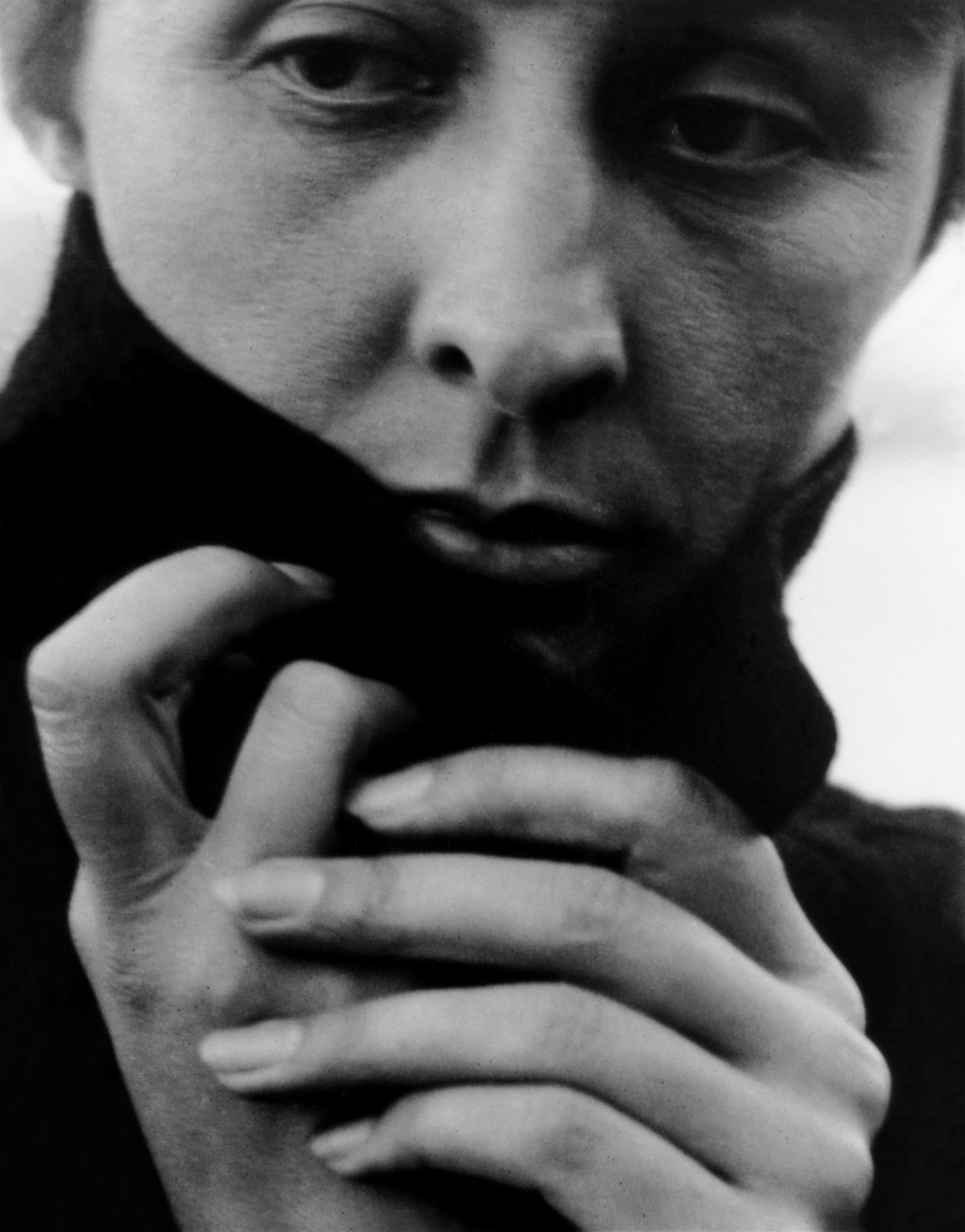
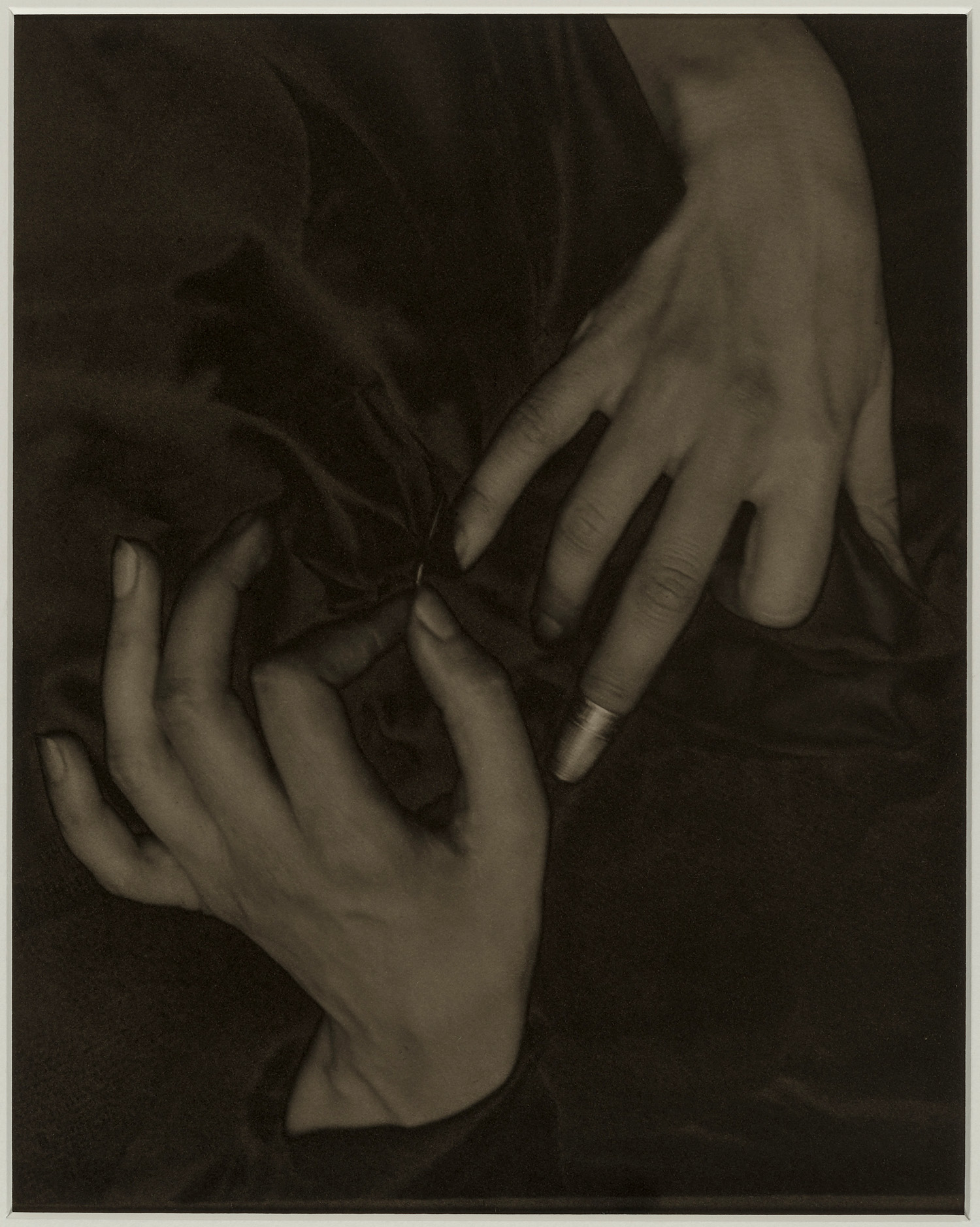
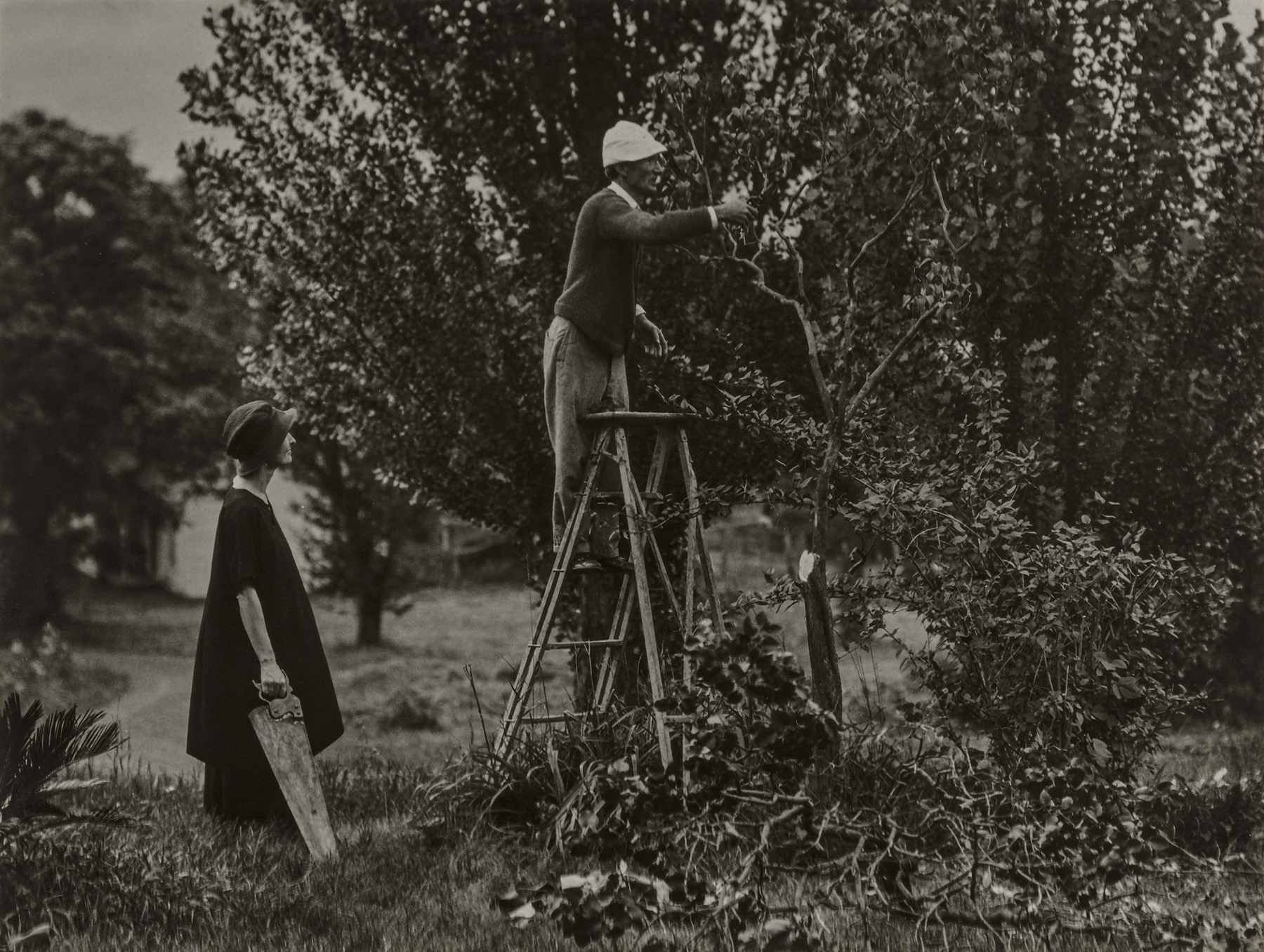
Look at the tonality and sensuality in Georgia O’Keeffe: A Portrait (8) (1919, below) and Dancing Trees (1922, below). No one would ever think of printing a photograph like that today!
Dr Marcus Bunyan
Many thankx to the Museum of Fine Arts Boston for allowing me to publish the photographs in the posting. Please click on the photographs for a larger version of the image.
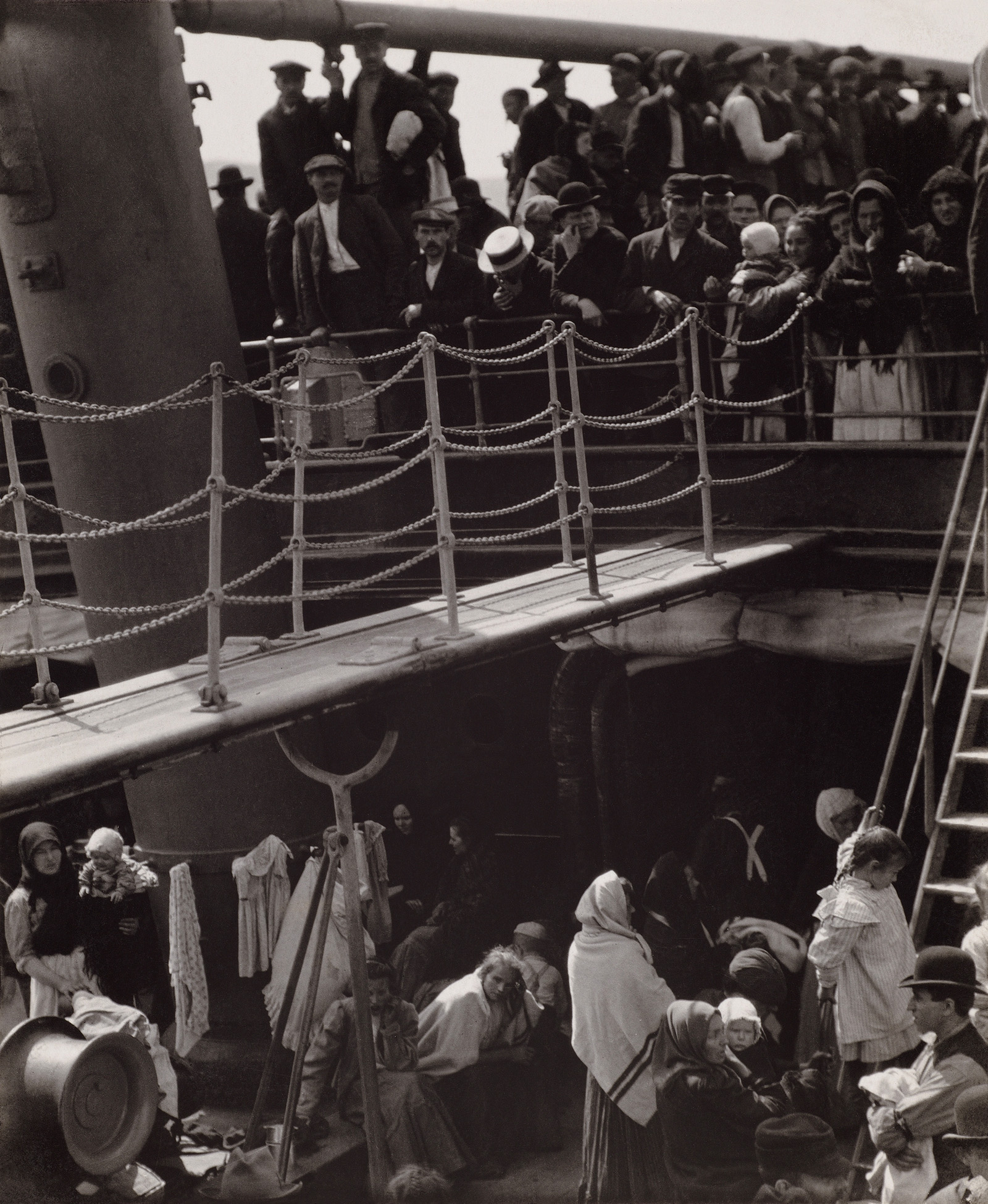
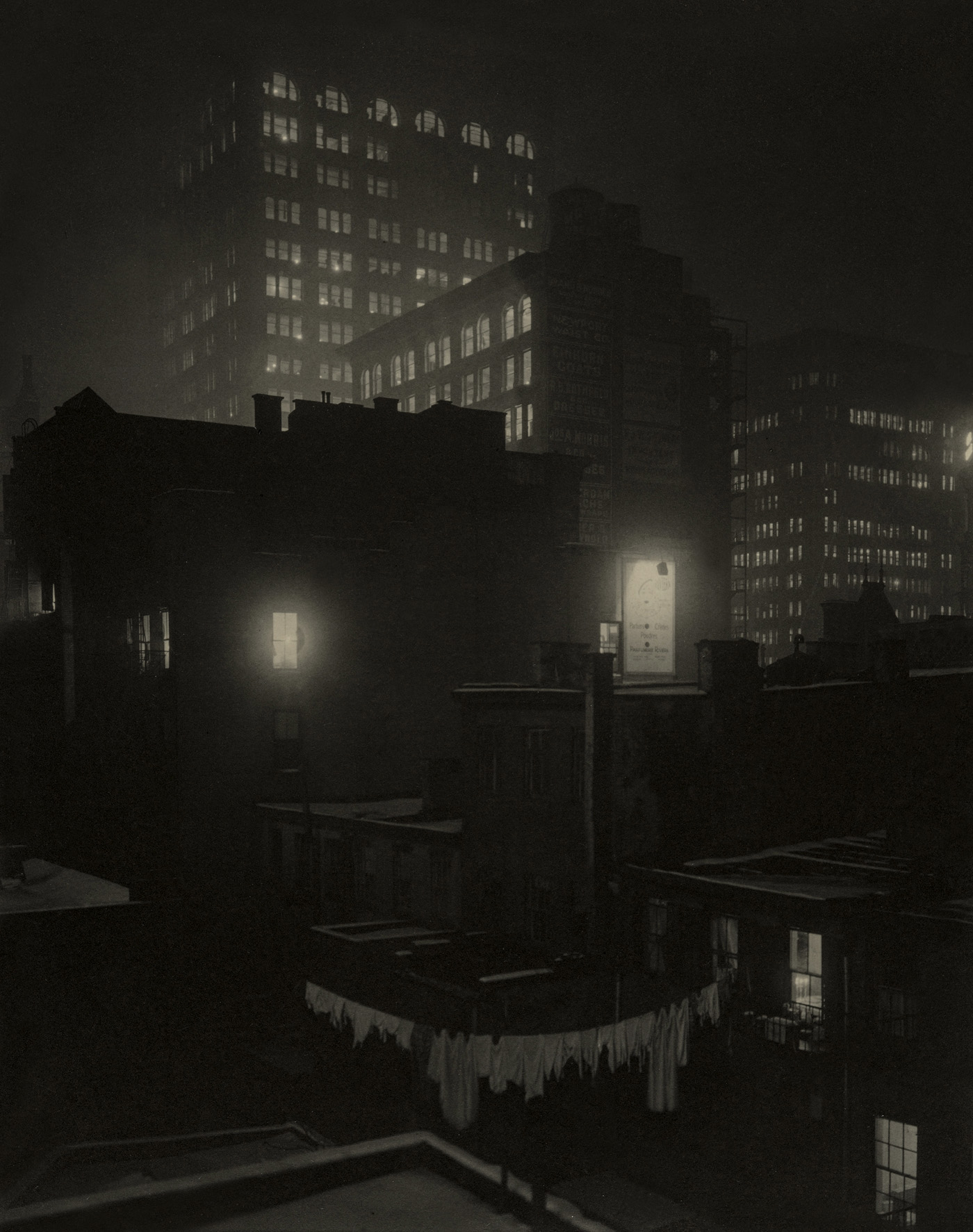
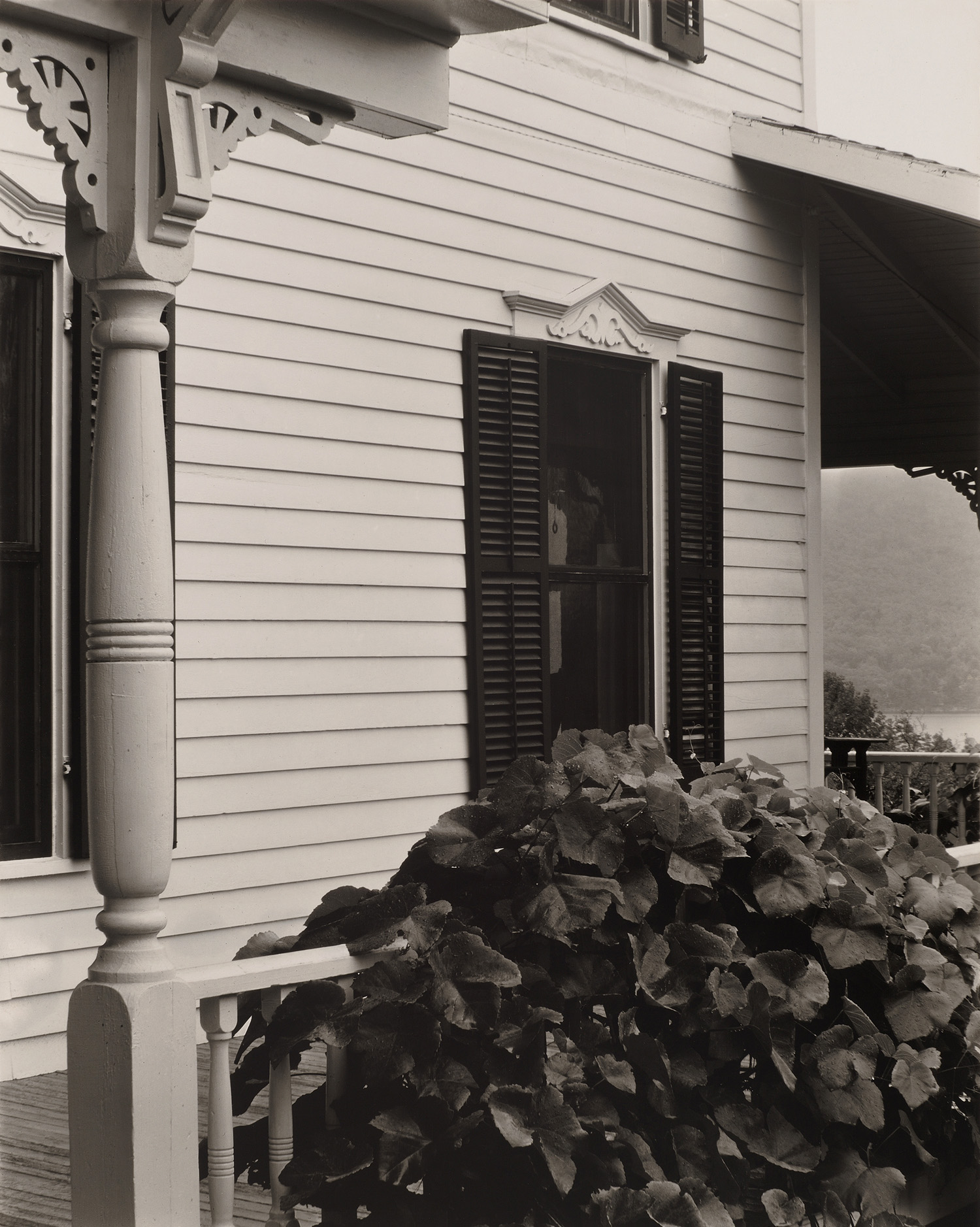
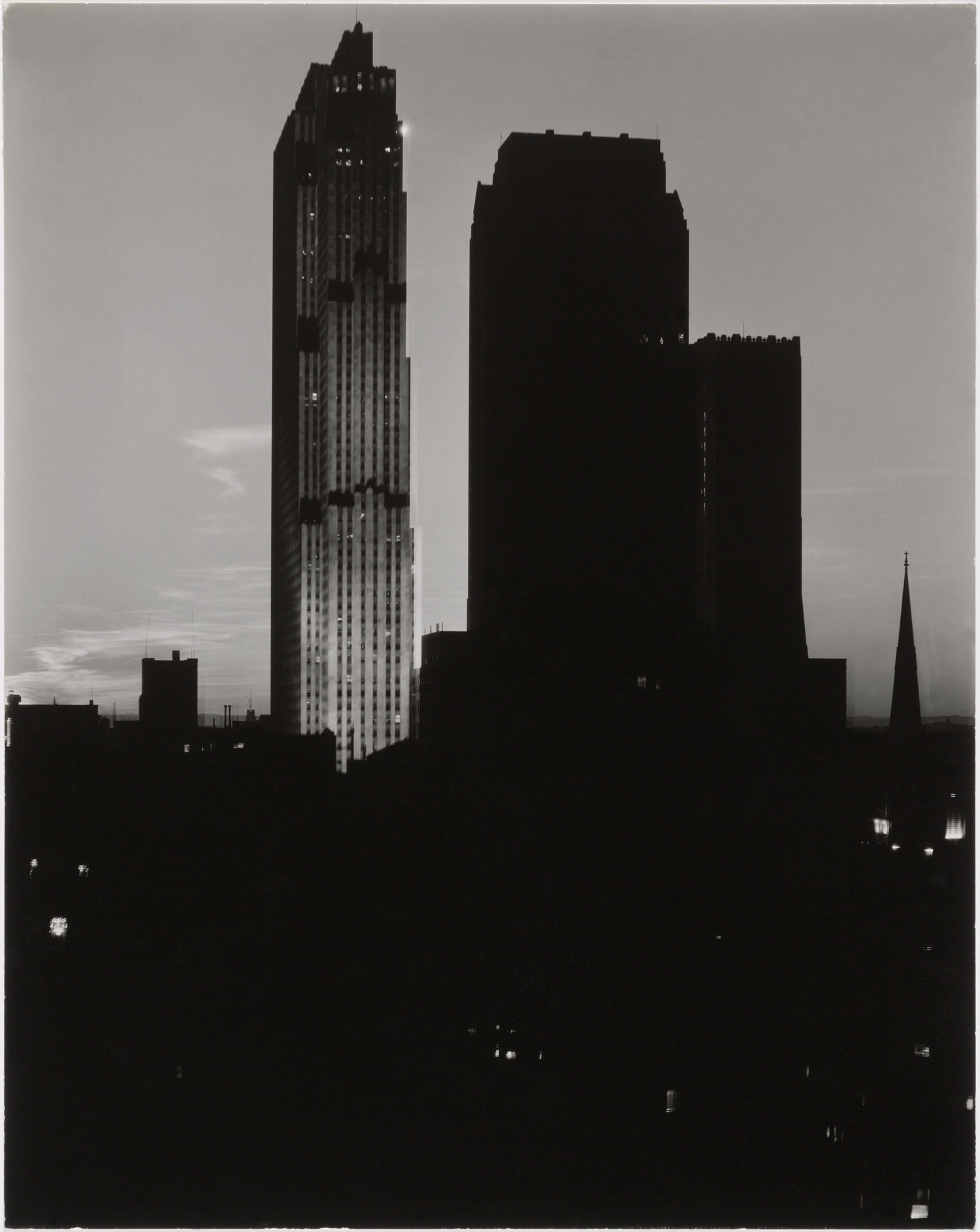
This exhibition presents a selection of the MFA’s exceptional holdings of works by Alfred Stieglitz (1864-1946), the great American impresario of photography at the turn of the 20th century. Featuring 36 photographs, the exhibition showcases fine examples of his New York views, portraits and photographs that Stieglitz took at his family’s country home at Lake George. The New York views reveal the artist’s lifelong interest in the city, from his early explorations of the picturesque effects of rain, snow and nightfall to later ones that focus on the inherent geometry of modernity’s rising architectural structures. The portraits include 10 images from Stieglitz’s magnificent extended series of images of his wife, the celebrated painter Georgia O’Keeffe – a “portrait in time” that reflects his ideals of modern womanhood and is evocative of their close relationship. These portraits are accompanied by additional images of members of his family and friends.
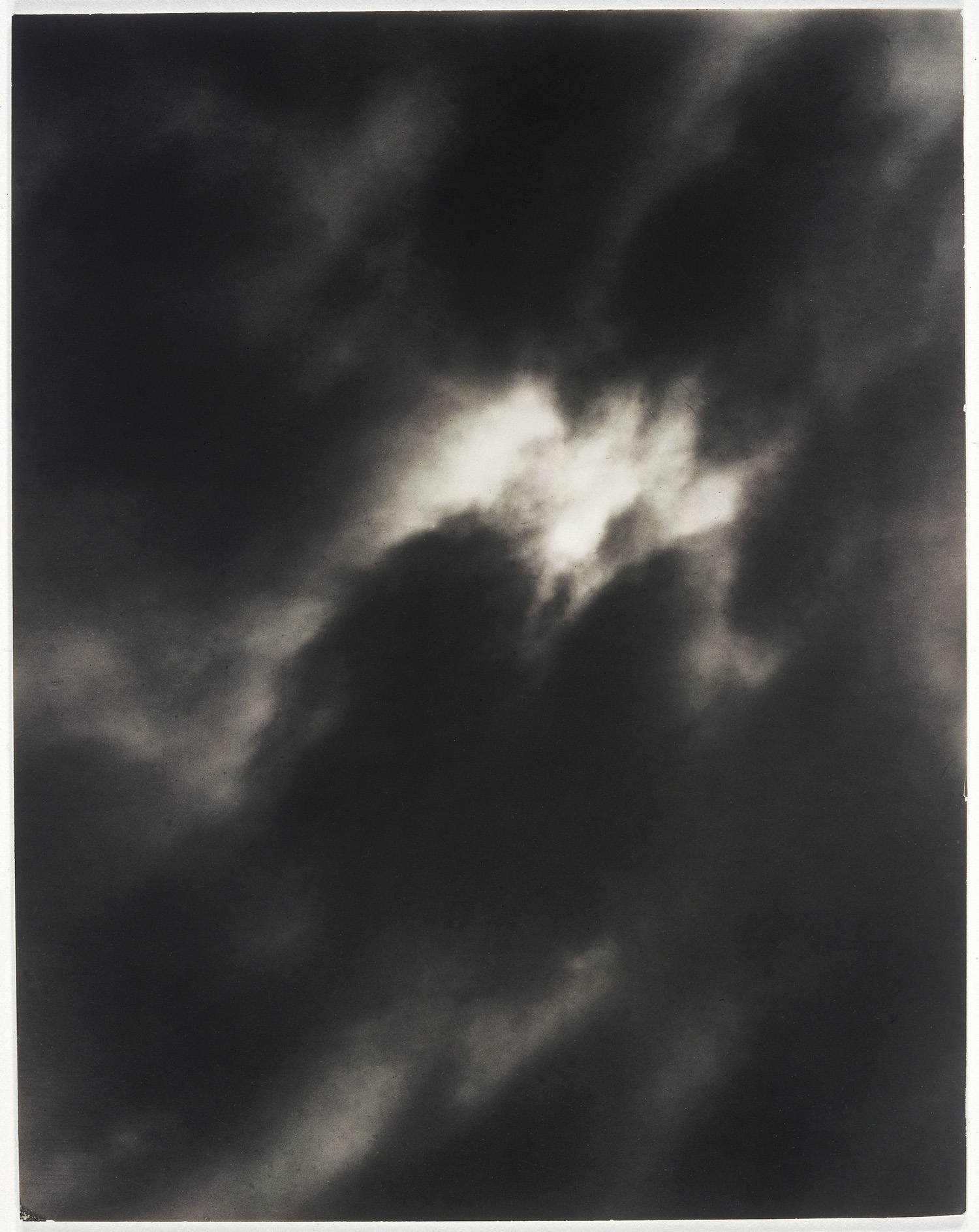
The Lake George photographs include, in addition to views of the family property, a sequence of the mystical cloud studies that Stieglitz called “equivalents,” which explore the interpretation of inner states of being. Many of the photographs on view were donated by Stieglitz to the MFA in 1924 – making it one of the first museums in the US to collect photography as fine art. Enhanced by an additional gift from O’Keeffe in 1950, the MFA’s Stieglitz holdings form an outstanding survey of the photographer’s career, as well as the cornerstone of the Museum’s photography collection.
291 is the commonly known name for an internationally famous art gallery that was located in Midtown Manhattan at 291 Fifth Avenue in New York City from 1905 to 1917. Originally known as the “Little Galleries of the Photo-Secession“, the gallery was created and managed by photographer Alfred Stieglitz.
The gallery is famous for two reasons. First, the exhibitions there helped bring art photography to the same stature in America as painting and sculpture. Pioneering artistic photographers such as Stieglitz, Edward Steichen, Alvin Langdon Coburn, Gertrude Käsebier and Clarence H. White all gained critical recognition through exhibitions at 291. Equally important, Stieglitz used this space to introduce to the United States some of the most avant-garde European artists of the time, including Henri Matisse, Auguste Rodin, Henri Rousseau, Paul Cézanne, Pablo Picasso, Constantin Brâncuși, and the Dadaists Francis Picabia and Marcel Duchamp.
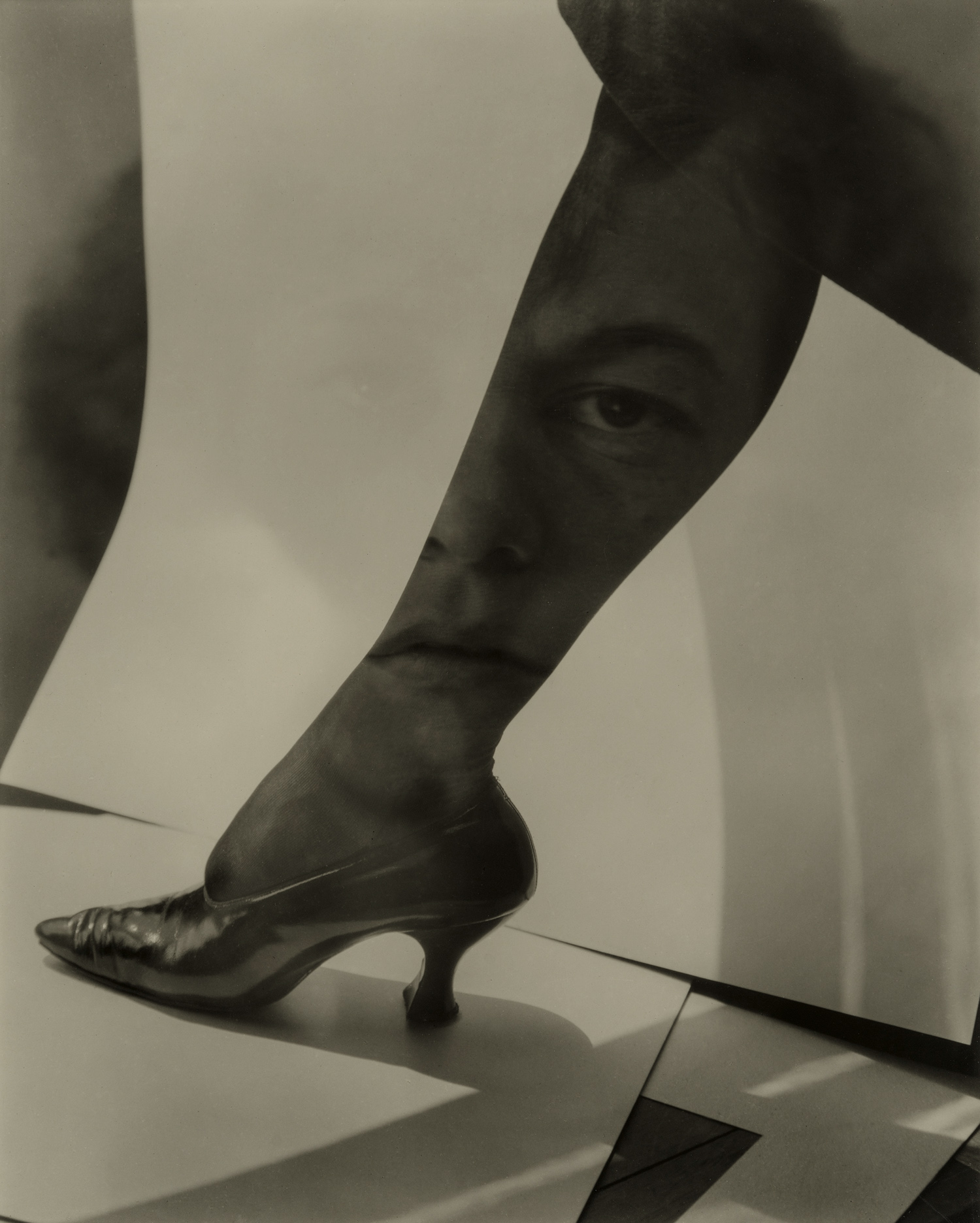
First published in 1921 with the caption “Watch your step!” in the single issue of Marcel Duchamp and Man Ray’s magazine New York Dada, Stieglitz’s surreal portrait was a happy accident. Attempting to capture the modern character of Dorothy True, a friend of Georgia O’Keeffe, Stieglitz made two exposures: a conventional, full-face portrait and a view of one artfully posed leg. Stieglitz was thrilled with the fortuitous superimposition of the images, believing that together they captured the spirit of the postwar American female. While the equation of short hair and skirts with women’s liberation might seem trite today, Stieglitz made the portrait in 1919, the year that Congress extended suffrage to women. In 1926, he exhibited it with the title American Girl.
This double exposure of the face and leg of Dorothy True constitutes an unusual portrait. Her somewhat somber face, very faint, is not immediately apparent, but slowly a mouth, nose, and eye begin to reveal themselves in the black-stockinged ankle and calf. Alone, the image of the leg is an interesting one; her foot appears veritably stuffed into her stylish, patent leather pump. Her instep bulges out of the top of the shoe, and the leather ripples from the pressure at the toe, making the foot an almost sculptural form.
True appears to step down upon overturned prints or mats. A chair casts a graphic shadow across the floor, and a vertical paper backdrop echoes the black shadow at the upper left, uncovered by the sagging paper. The neat triangle of True’s skirt lends additional geometric balance.
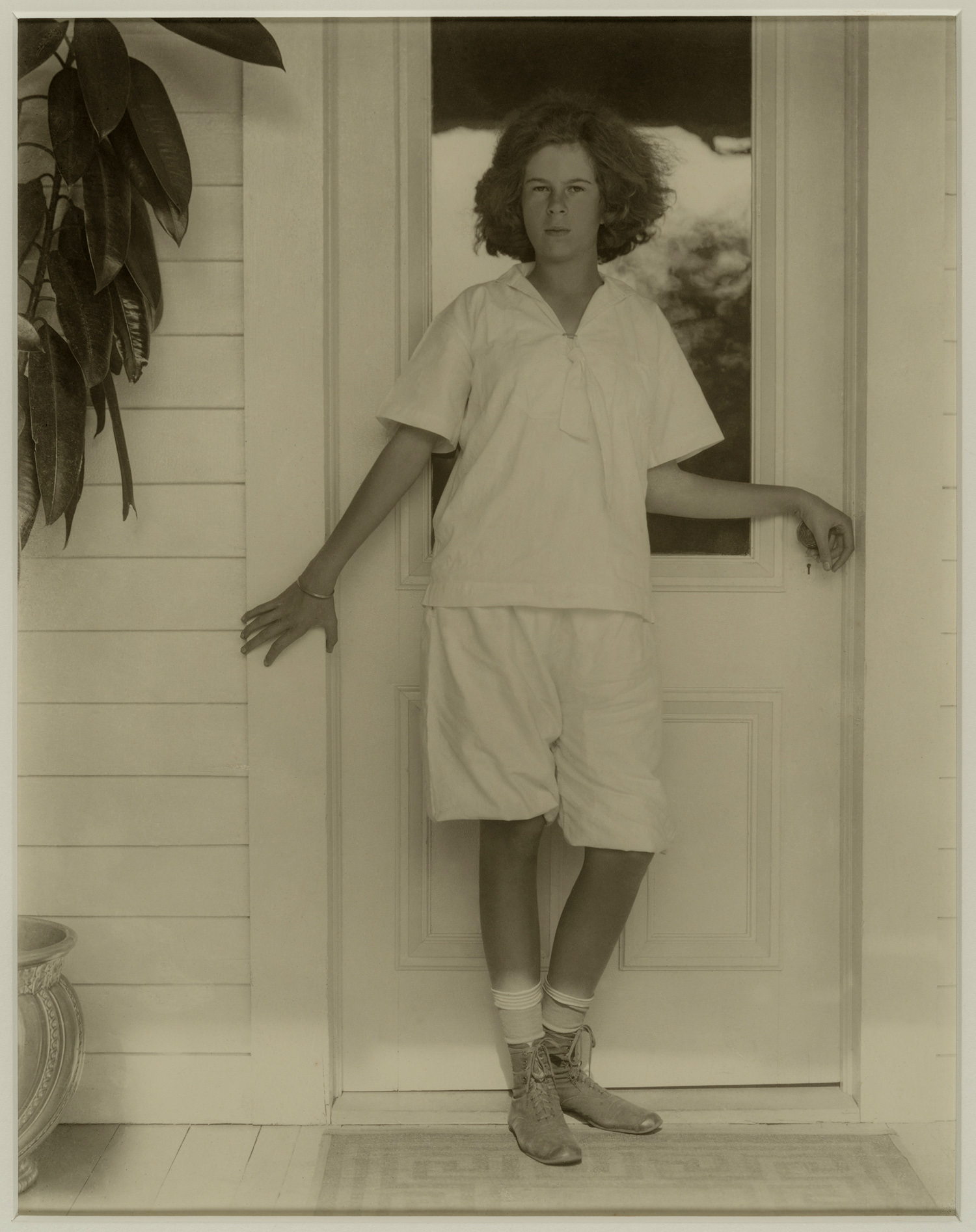
Georgia Engelhard was the first child of George Engelhard and Agnes Stieglitz. It is as the niece of Alfred Stieglitz, modernism’s most successful early booster in the United States, that Engelhard’s artistic career was encouraged. From the age of 12 to 22 she corresponded regularly with Stieglitz who serve as a confidant to the young woman. Engelhard occasionally posed for Stieglitz and the uncle honoured her with an exhibition at his famous gallery, 291, when she was only ten years old. (Stieglitz’s motivation to show his niece’s work was more than likely a response to Wassily Kandinsky’s proposition that there was a fundamental spirituality to be found in true art and that children’s art had the ability to convey this “inner truth.”)
It is under the tutelage of Stieglitz’s wife, Georgia O’Keeffe, that Engelhard matured as a painter. In biographies Engelhard is repeatedly mentioned as O’Keeffe’s friend and companion. Georgia minor, as Engelhard was called, served as comic release for the older artist who often found Stieglitz and his family oppressive. The two artists frequently painted together at Stiegltiz’s summer house on Lake George and occasionally took excursions together. Engelhard’s paintings reflect O’Keeffe’s influence – flat areas of pure colour and sensuous curves are used to define the landscape. …
Despite a paralysing fear of heights, Engelhard became a premier mountain climber at the age of 20 and was the first female climber to ascend many of the peaks in the Canadian Rockies. Engelhard’s determination to overcome this specific fear evolved into a passion for the mountains that lasted throughout her lifetime…
Engelhard was also a writer and an accomplished photographer. In 1938 when she began living with Eaton Cromwell she stopped painting and together the couple pursued photography. While living in Switzerland they sold a number of their pictures to postcard companies. Few of Georgia Engelhard’s paintings are in existence today and when one does appear there is often a dispute about whether the canvas comes from O’Keefe’s hands or Engelhard’s.
Anonymous text. “Georgia Engelhard,” on the JWL Collection website [Online] Cited 05/01/2022. No longer available online
Curator of Coney Island exhibition: Dr Robin Jaffee Frank
Samuel S. Carr (American, 1837-1908) Beach Scene c. 1879 Oil on canvas 12 x 20 in. (30.5 x 50.8cm) Smith College Museum of Art, Northampton, Massachusetts; Bequest of Annie Swan Coburn (Mrs. Lewis Larned Coburn)
The first posting of 2016, and it is a doozy – a multimedia extravaganza of sight and sound showcasing exhibitions that focus on that eclectic playground, Coney Island.
Featuring images supplied by the gallery – plus videos, other art work featured in the exhibitions and texts that I sourced myself – this posting documents “the luridness of the sideshow acts, the drunk sailors, the amorous couples and the scantily dressed bathers who were so much a part of the allure and menace of Coney Island.” I spent many hours scouring the internet, undertaking research and cleaning poor quality images to bring this selection to you.
The exhibition is divided into five sections, and I have attempted to keep the posting in this chronological order.
~ Down at Coney Isle, 1861-1894 ~ The World’s Greatest Playground, 1895-1929 ~ The Nickel Empire, 1930-1939 ~ A Coney Island of the Mind, 1940-1961 ~ Requiem for a Dream, 1962-2008
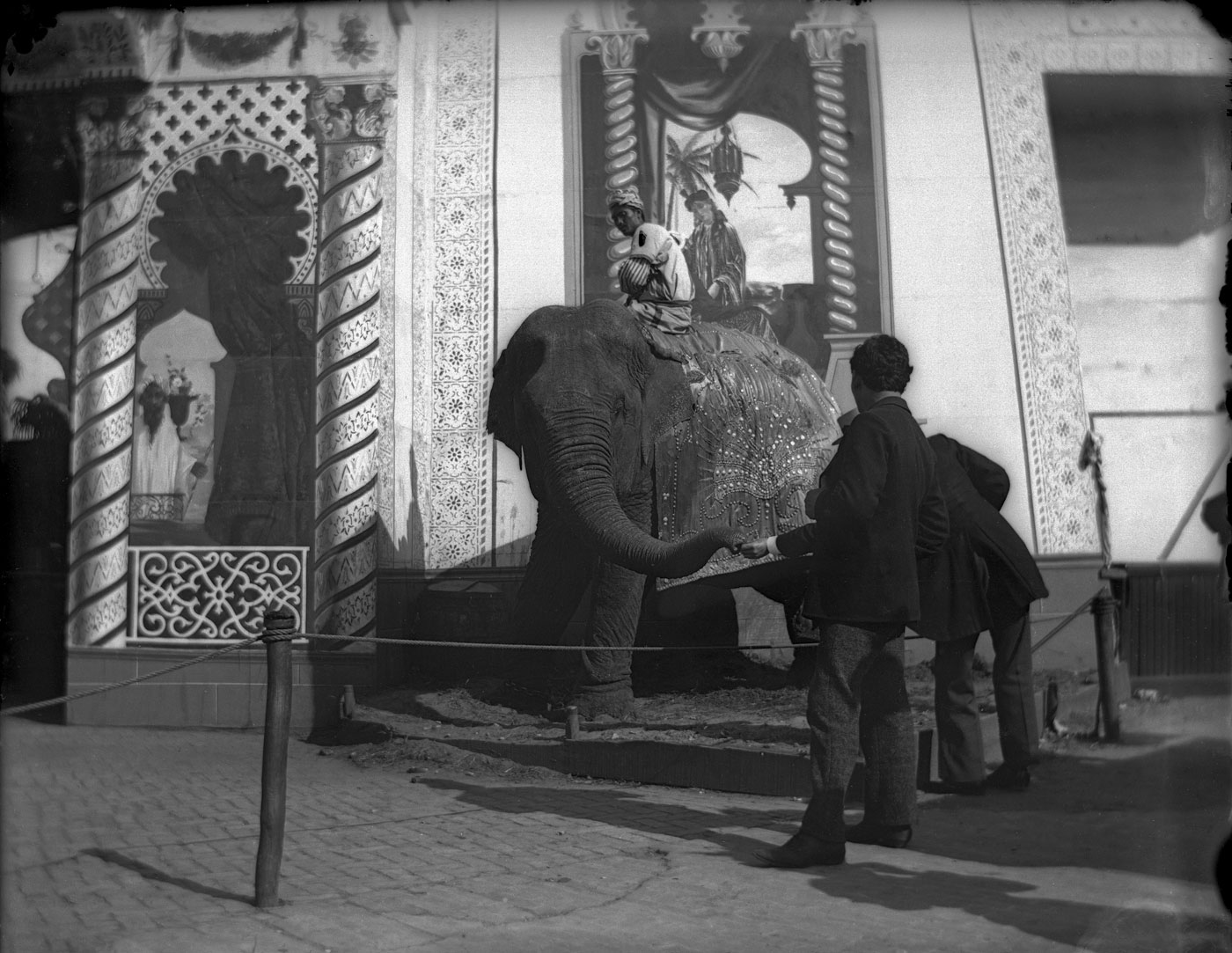
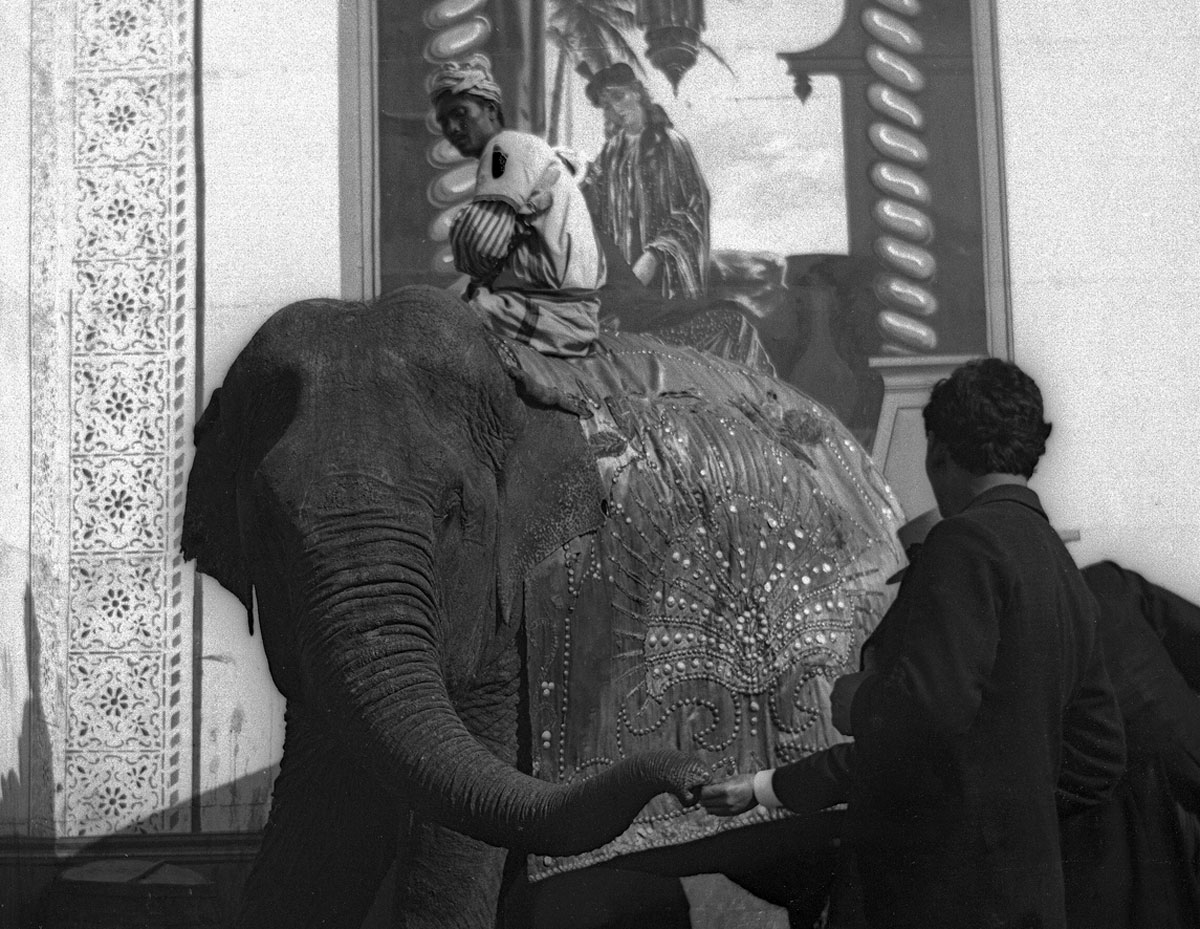
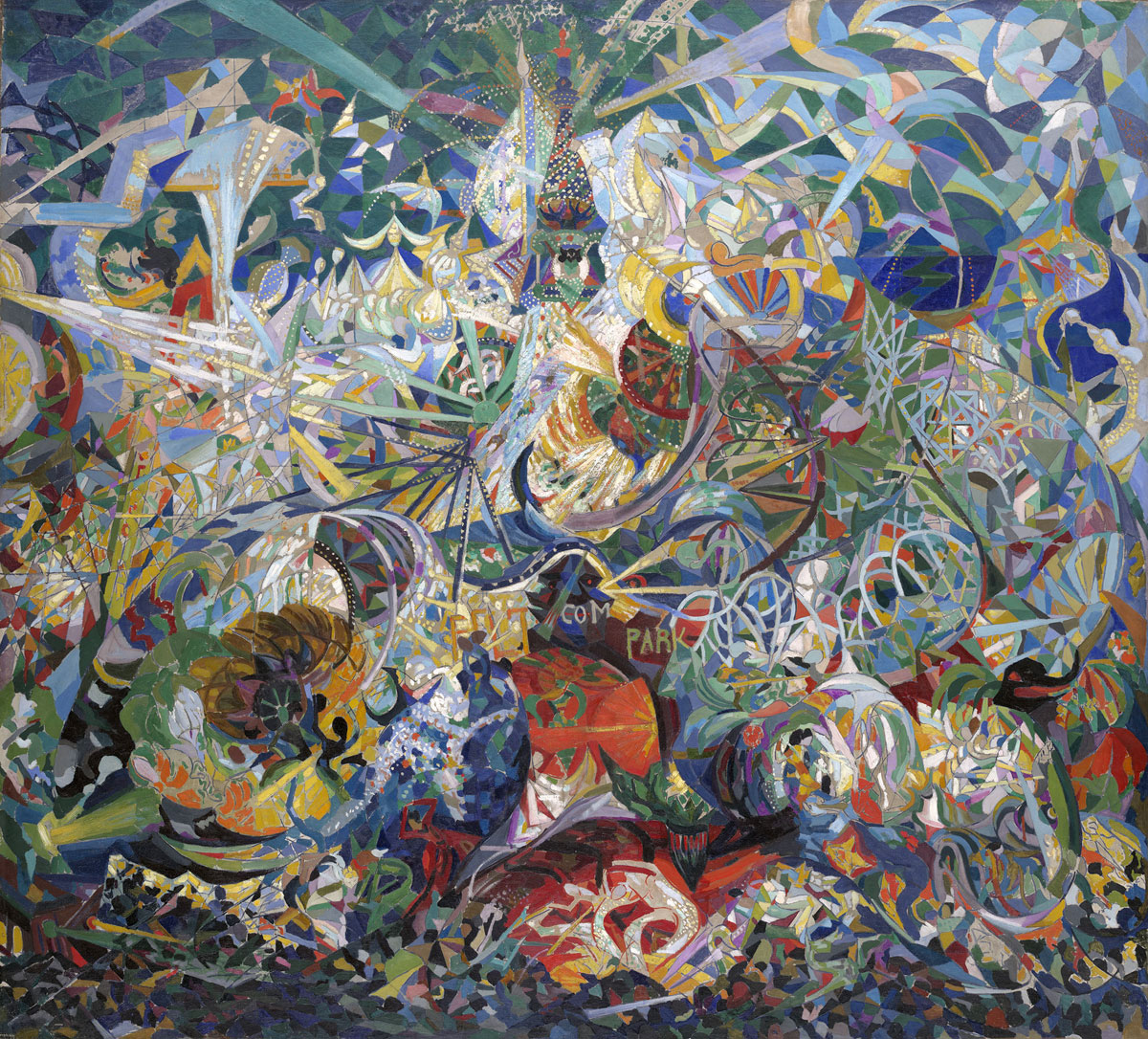
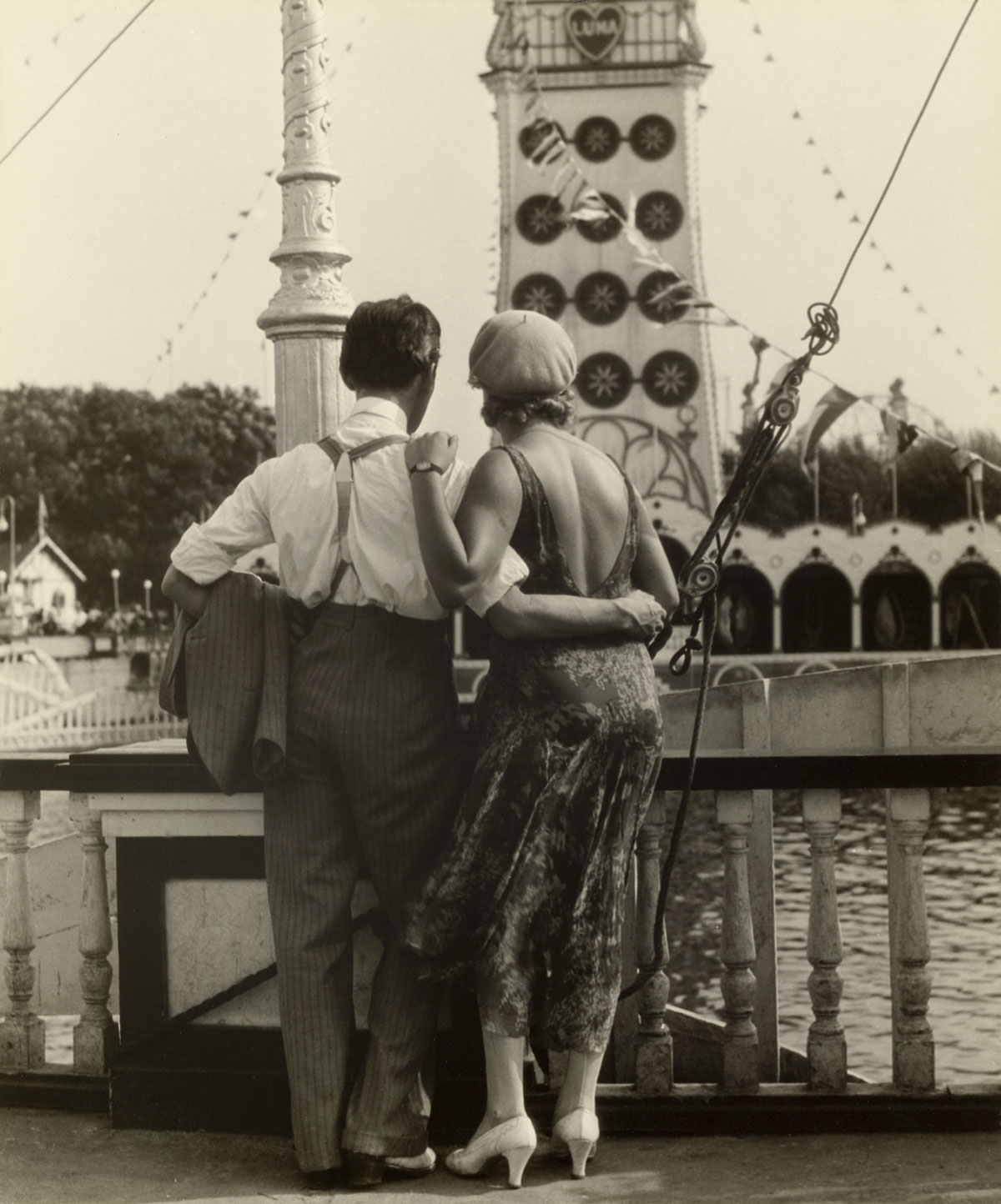
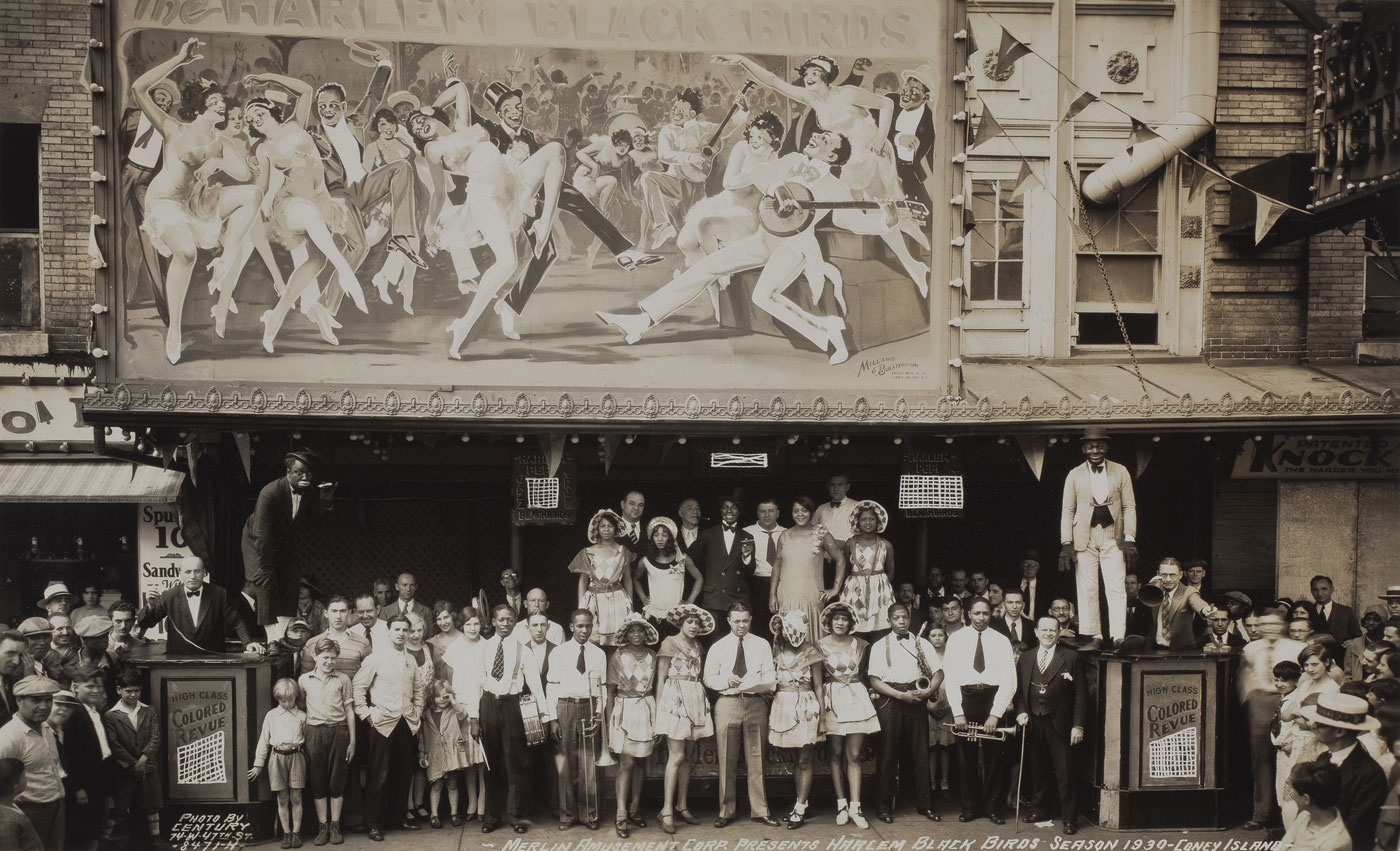
There are some interesting art works in both exhibitions. The correspondence between elephant / handler and mural is delightful in Edgar S. Thomson’s Coney Island (1897, below), while Joseph Stella’s Battle of Lights, Coney Island, Mardi Gras (1913-1914, below) is a revelation to me, considering the date of production and the portrayal of contemporary life which is akin to our own. Walker Evans’ Couple at Coney Island, New York (1928, below) seems staged and confused in its pictorial construction, not one of his better photographs, while Edward J. Kelty’s photographs of sideshow revues including a “coloured revue” are interesting for their social context and formalism.
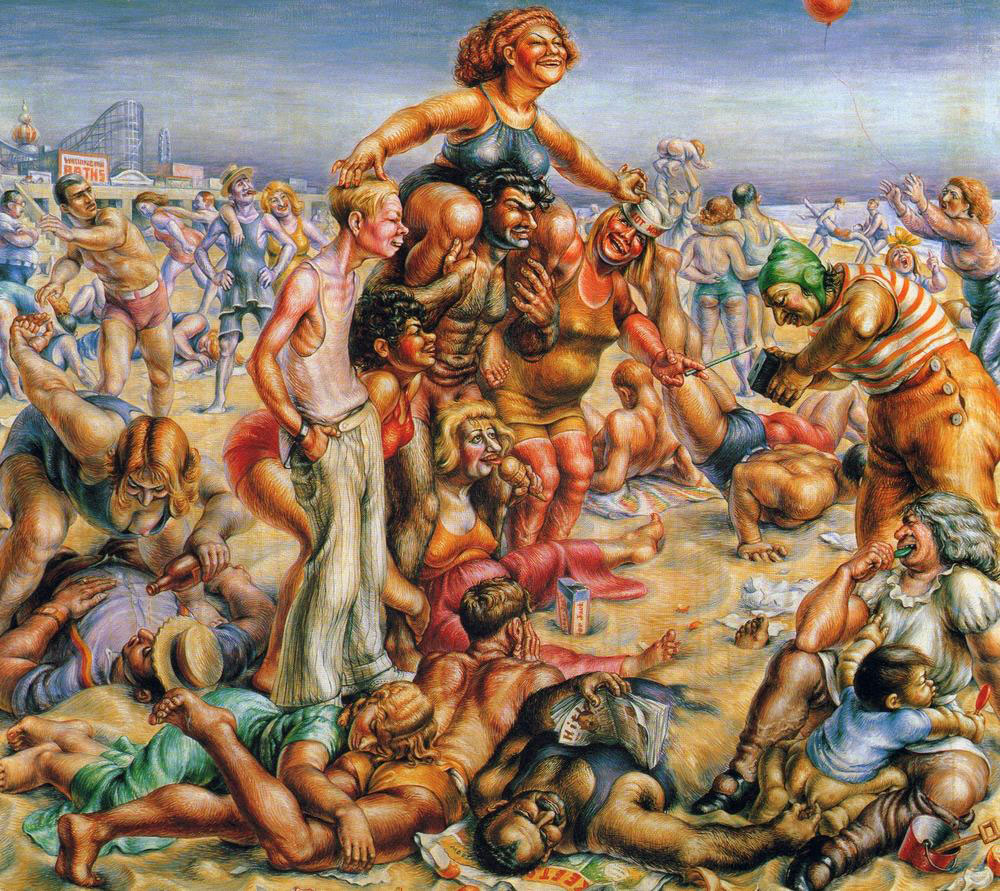
Paul Cadmus’ satirical view of American vacationers Coney Island (1934, below) is a riot of colour, movement and social commentary, including references to homosexuality and Hitler, while his friend Reginald Marsh’s effusive Coney Island paintings play with “reimagined bathers and sideshow audiences in poses derived from Michelangelo and Rubens” packed into compressed, collage like spaces. Particular favourites are photographs by Garry Winograd, Bruce Davidson, Diane Arbus and Robert Frank. Surprise of the posting are the black and white photographs of Morris Engel.
Dr Marcus Bunyan
Many thankx to the Brooklyn Museum for allowing me to publish the photographs in the posting. Please click on the photographs for a larger version of the image.
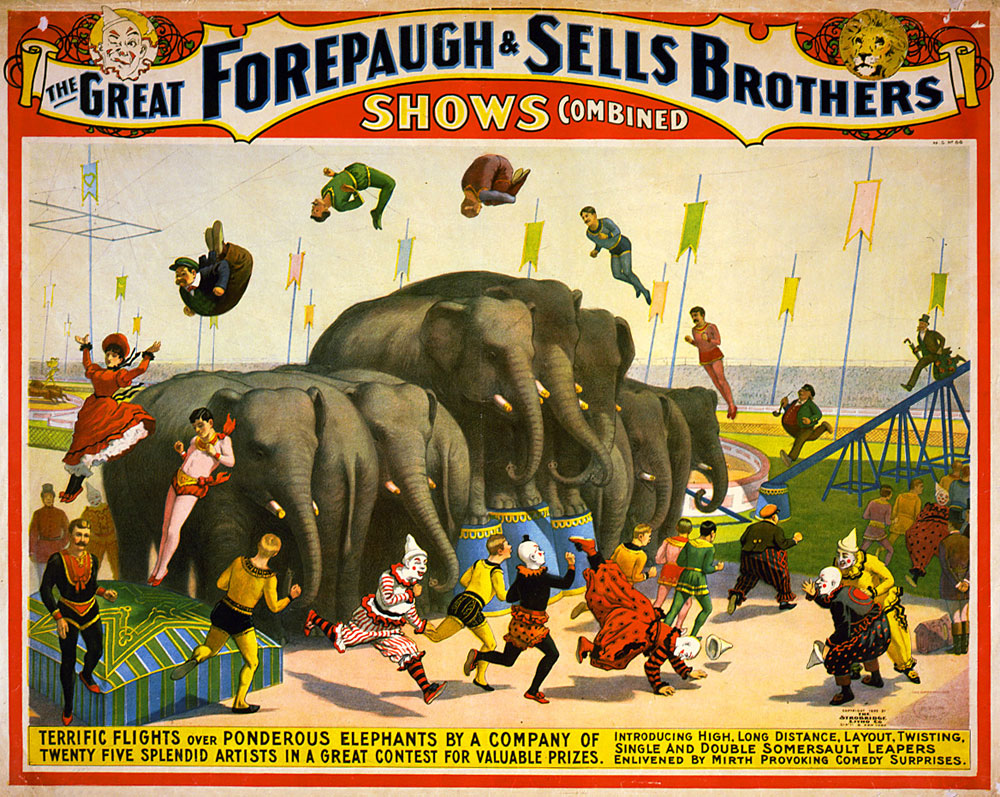
Strobridge Lithographing Company The great Forepaugh & Sells Brothers shows combined. Terrific flights over ponderous elephants by a company of twenty five splendid artists in a great contest for valuable prizes, introducing high, long distance, layout, twisting, single and double somersault leapers, enlivened by mirth provoking comedy surprises. c. 1899 Promotional poster for Forepaugh & Sells Brothers circus Colour lithograph poster
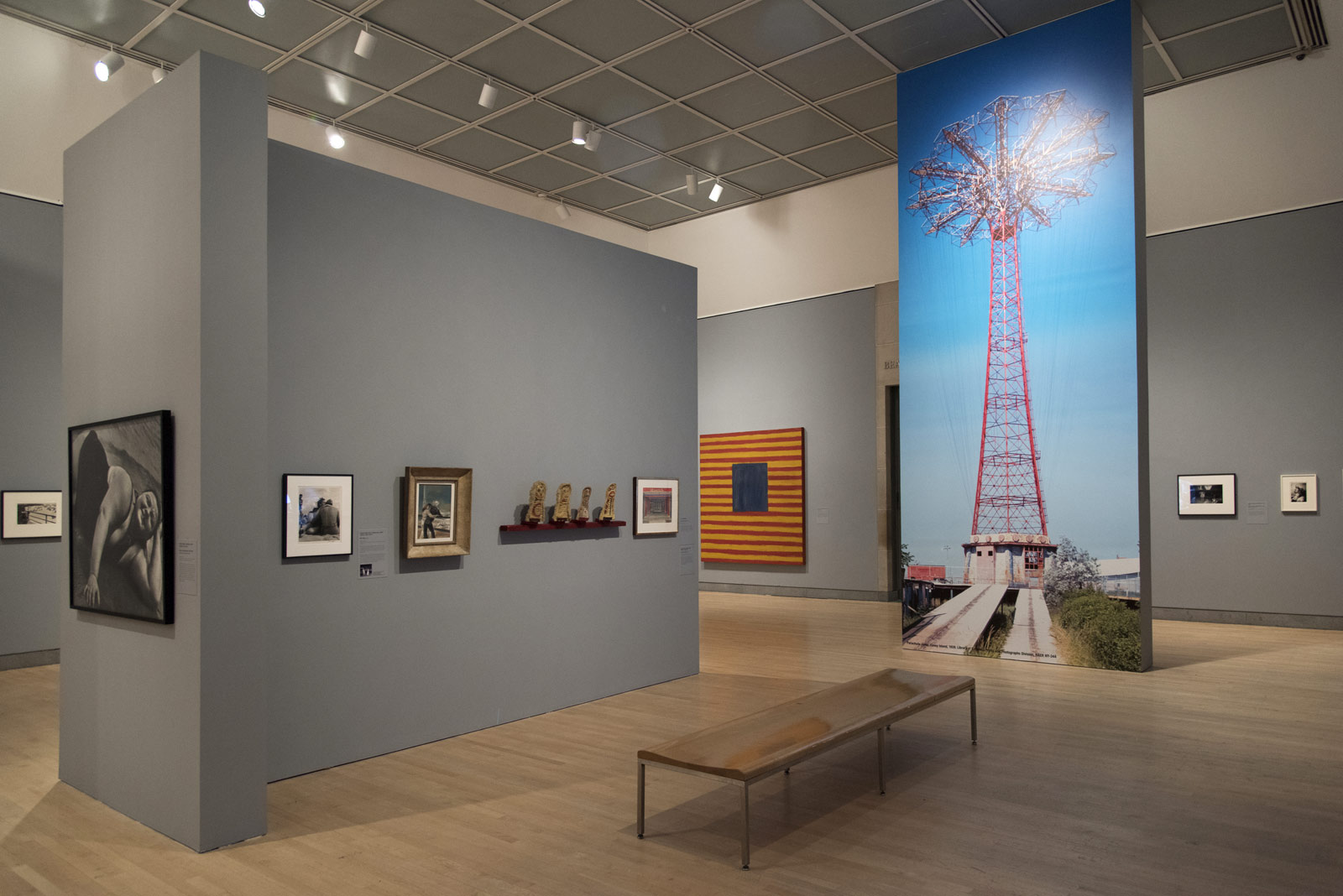
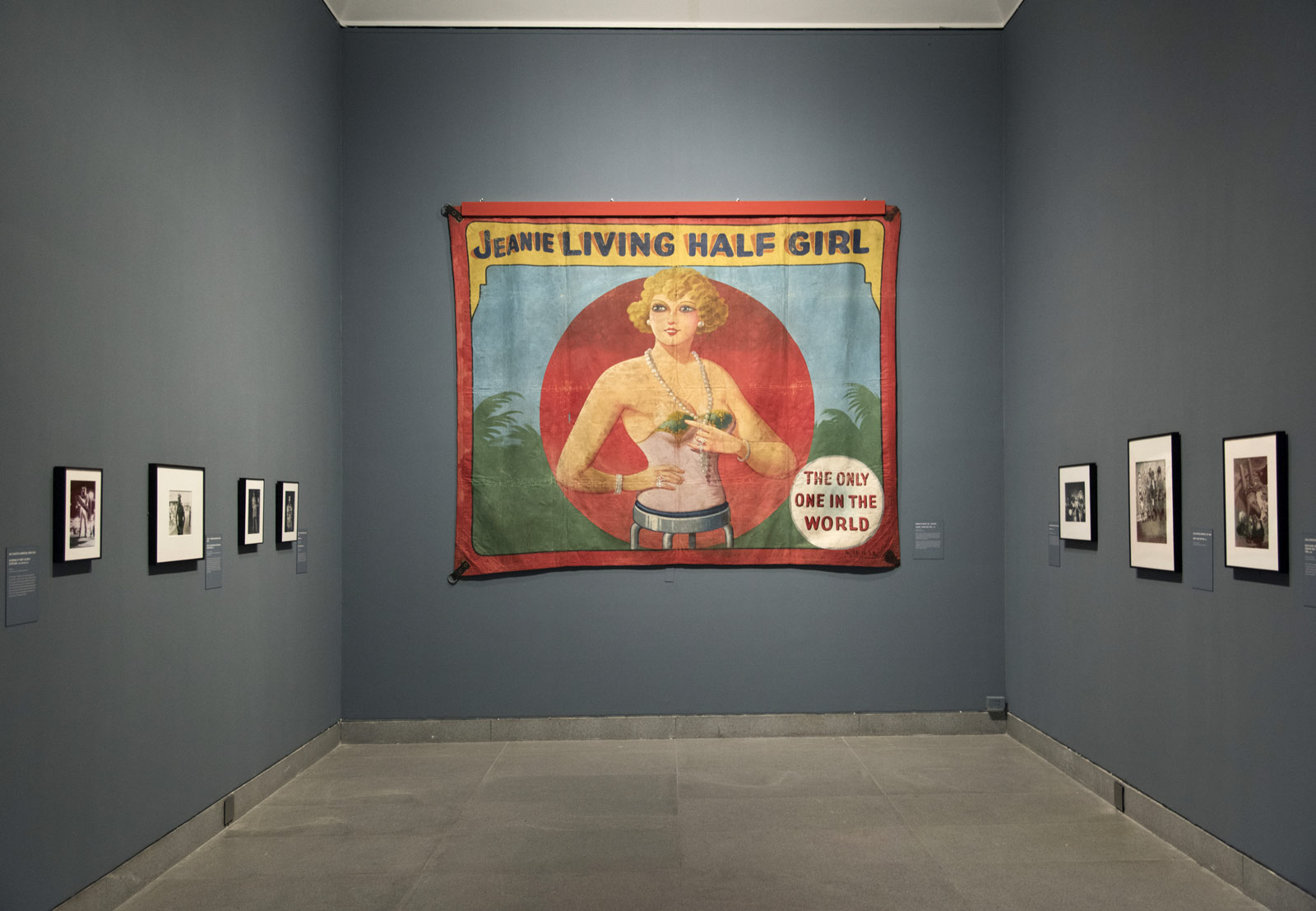
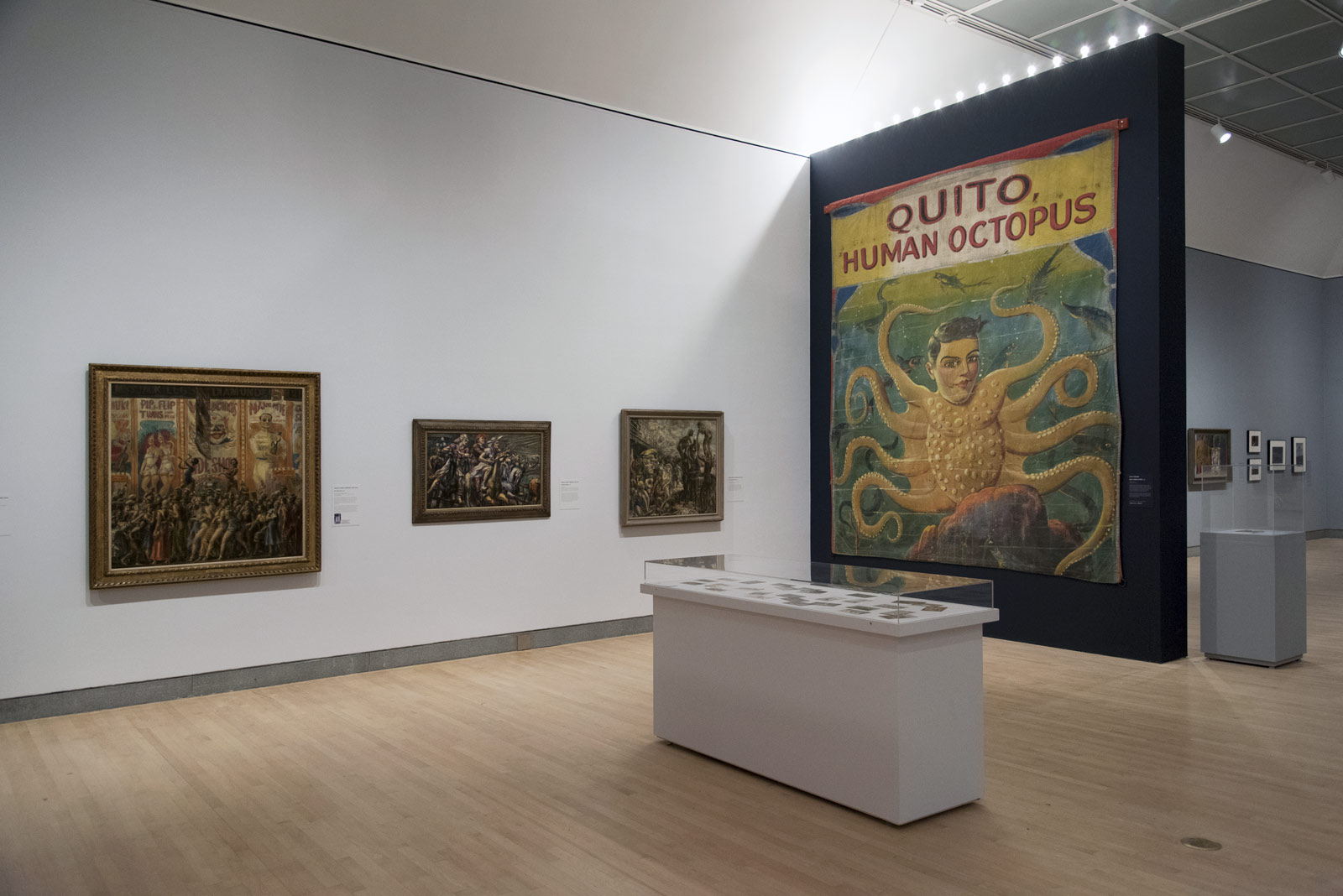
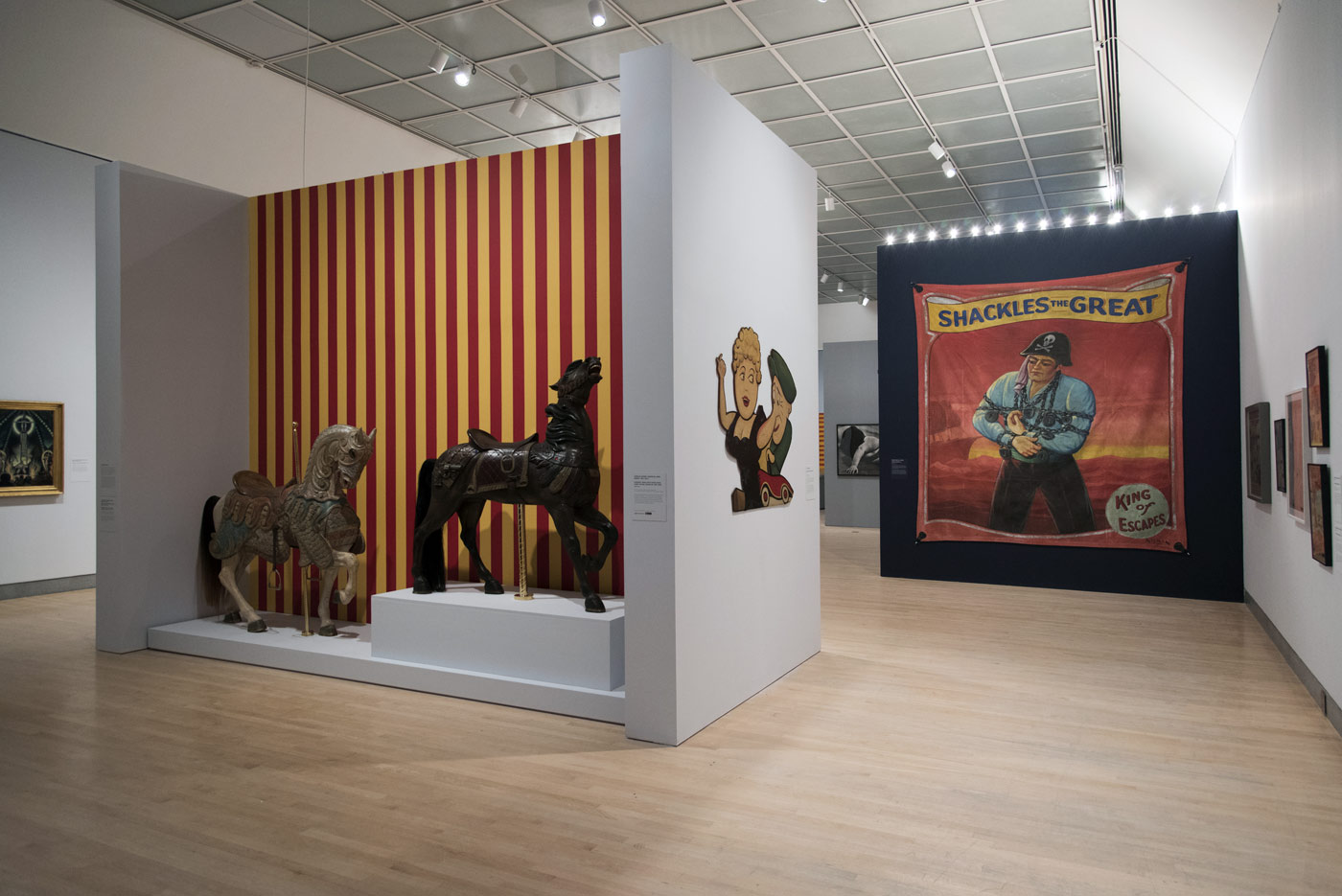
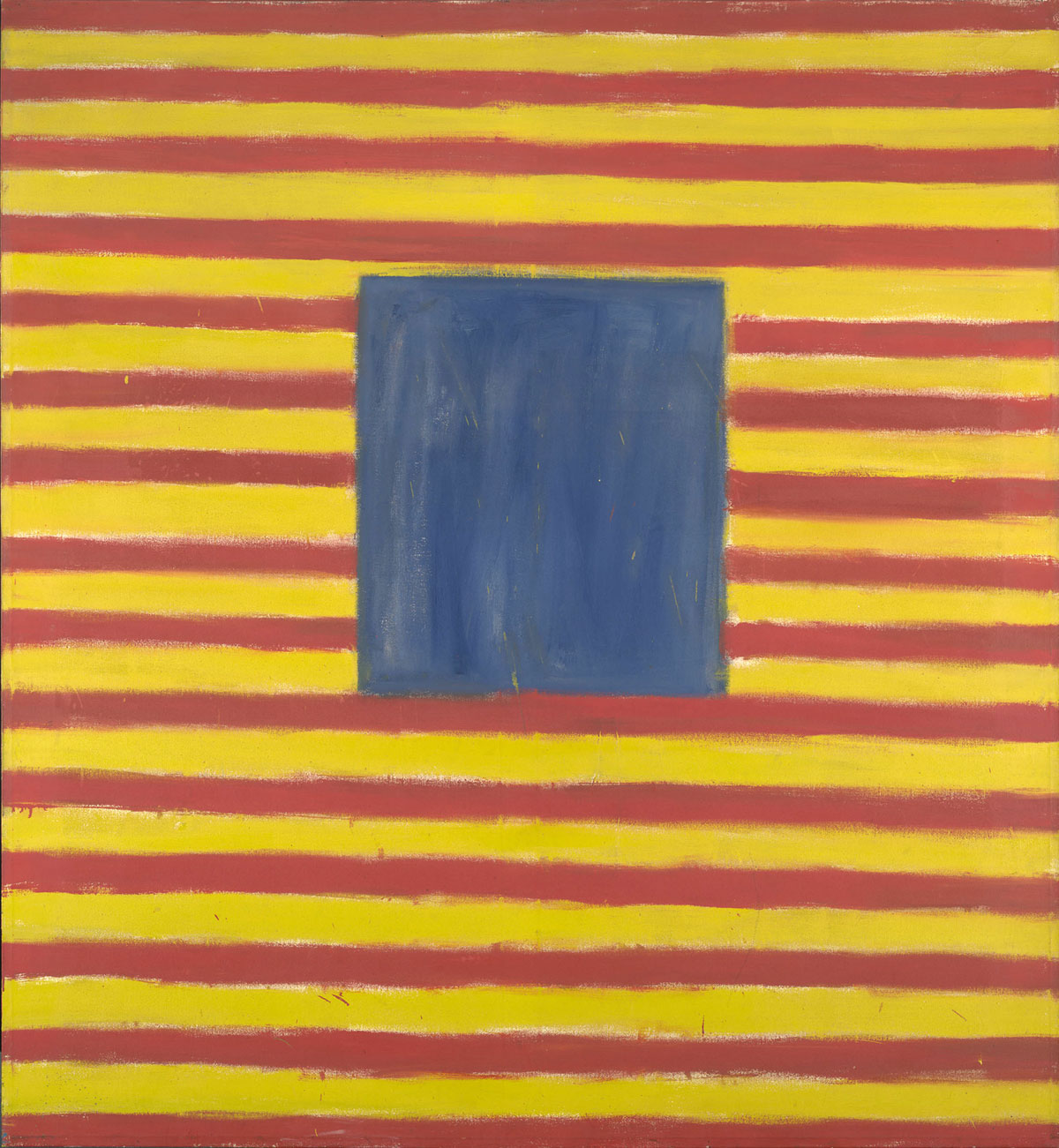
“The mixed-media exhibit captures Coney Island’s campy, trippy aesthetic with a hodgepodge of photographs by the likes of Walker Evans, Weegee, Bruce Davidson, and Diane Arbus (since Coney Island was basically tailor-made for a Diane Arbus photo shoot). Also on view are pastoral seascapes from the 1800s; sideshow posters galore; a turn-of-the-century gambling wheel and carousel animals presented like sculpture; film stills from Woody Allen’s Annie Hall and Darren Aronofsky’s Requiem for a Dream; and a modernist abstract composition by Frank Stella. With red and yellow stripes around a blue square, Stella distills the sand and sea and sun into a primary-colored flag for Brooklyn’s most famous destination.
In these pictures, Coney Island serves as a microcosm of American mass culture as a whole, and the chronology of 140 art objects here chart major societal shifts, from the dawn of the Great Depression to desegregation. “The modern American mass-culture industry was born at Coney Island, and the constant novelty of the resort made it a seductively liberating subject for artists,” Dr Robin Jaffee Frank, curator of the exhibit, which Wadsworth Athenaeum helped organize, said in a statement. “What these artists saw from 1861 to 2008 at Coney Island, and the varied ways in which they chose to portray it, mirrored the aspirations and disappointments of the era and the country. Taken together, these tableaux of wonder and menace, hope and despair, dreams and nightmares become metaphors for the collective soul of a nation.”
Strobridge Lithographing Company The Barnum & Bailey Greatest Show on Earth /The Great Coney Island Water Carnival /Remarkable Head-Foremost Dives from Enormous Heights into Shallow Depths of Water 1898 Colour lithograph poster 30 1/6 x 38 3/4 in. (76.6 x 98.4 cm) Cincinnati Art Museum; Gift of the Strobridge Lithographing Company
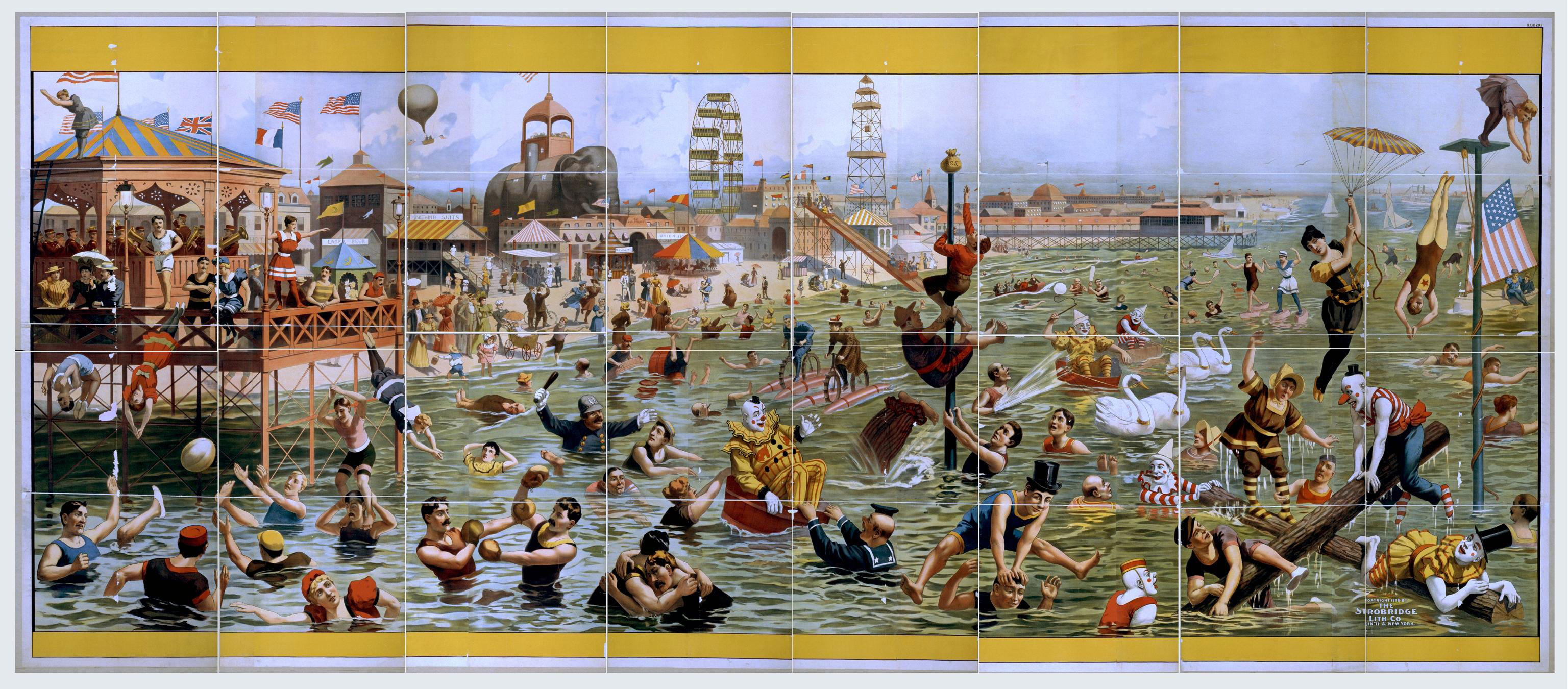
Strobridge Lithographing Company Beach and boardwalk scenes, Coney Island c. 1898 Colour lithograph foldout poster approx. 21 feet long
George Bradford Brainerd (American, 1845-1887) Bathers, Steel Pier, Coney Island c. 1880-1885, printed 1940s Gelatin silver photograph 7 5/8 x 12 in. (19.4 x 30.5cm) Brooklyn Museum, Brooklyn Museum Collection Photo: Sarah DeSantis, Brooklyn Museum
Edgar S. Thomson (American, active 1890s-1900s) Coney Island 1897 Gelatin dry glass plate negative 4 x 5 in. (10.2 x 12.7cm) Brooklyn Museum, Brooklyn Museum/Brooklyn Public Library, Brooklyn Collection Photo: Althea Morin, Brooklyn Museum
Edgar S. Thomson (American, active 1890s-1900s) Coney Island (detail) 1897 Gelatin dry glass plate negative 4 x 5 in. (10.2 x 12.7cm) Brooklyn Museum, Brooklyn Museum/Brooklyn Public Library, Brooklyn Collection Photo: Althea Morin, Brooklyn Museum
William Merritt Chase (American, 1849-1916) Landscape, near Coney Island c. 1886 Oil on panel 8 1/8 x 12 5/8 in. (20.6 x 32cm) The Hyde Collection, Glens Falls, New York; Gift of Mary H. Beeman to the Pruyn Family Collection
Joseph Stella (American born Italy, 1877-1946) Battle of Lights, Coney Island, Mardi Gras 1913-1914 Oil on canvas 77 by 84 3/4 inches Yale University Art Gallery, New Haven, Conn.
“In 1913, to celebrate Mardi Gras, Joseph Stella took a bus ride to Coney Island that changed his life. The Italian immigrant painter remembered that up until this point he had been “struggling … working along the lines of the old masters, seeking to portray a civilization long since dead.” He continued:
“Arriving at the Island I was instantly struck by the dazzling array of lights. It seemed as if they were in conflict. I was struck with the thought that here was what I had been unconsciously seeking for so many years… On the spot was born the idea for my first truly great picture.” (Joseph Stella, “I Knew Him When (1924),” in Barbara Haskell, ed., Joseph Stella, New York, Whitney Museum of American Art, distributed by Harry N. Abrams, 1994, p. 206)
The result of Stella’s revelation, the enormous oil painting Battle of Lights, Coney Island, Mardi Gras (1913-1914), was the inspiration for the traveling exhibition Coney Island: Visions of an American Dreamland, 1861-2008…
If the broken planes and neon coloring of Stella’s painting suggest the exhilaration of contemporary life, they also express dislocation and alienation. Stella himself spoke of the “dangerous pleasures” of Coney Island, implying that its unleashing of desires could provoke anxiety (Joseph Stella, “Autobiographical Notes (1946),” in Barbara Haskell, ed., Joseph Stella, p. 213). And yet for all of the dynamism of Stella’s aesthetic, his painting’s sweeping arabesques are checked by the rectangle of the picture plane, and its decorative unity distances the disruptive power of its discordant subjects. The contained anarchy of Stella’s painting is the perfect metaphor for Coney Island’s manipulation and control of the unruly masses, who, at the end of the day, go back to their homes and their ordered existence.
Looking closely at Battle of Lights we might be able to make out fragments of actual rides and even shapes that suggest people, but Stella’s abstraction obscures the luridness of the sideshow acts, the drunk sailors, the amorous couples and the scantily dressed bathers who were so much a part of the allure and menace of Coney Island.”
Text from Jonathan Weinberg “Coney Island Forever,” on the Art in America website, October 1st 2015 [Online] Cited 14/12/2015.
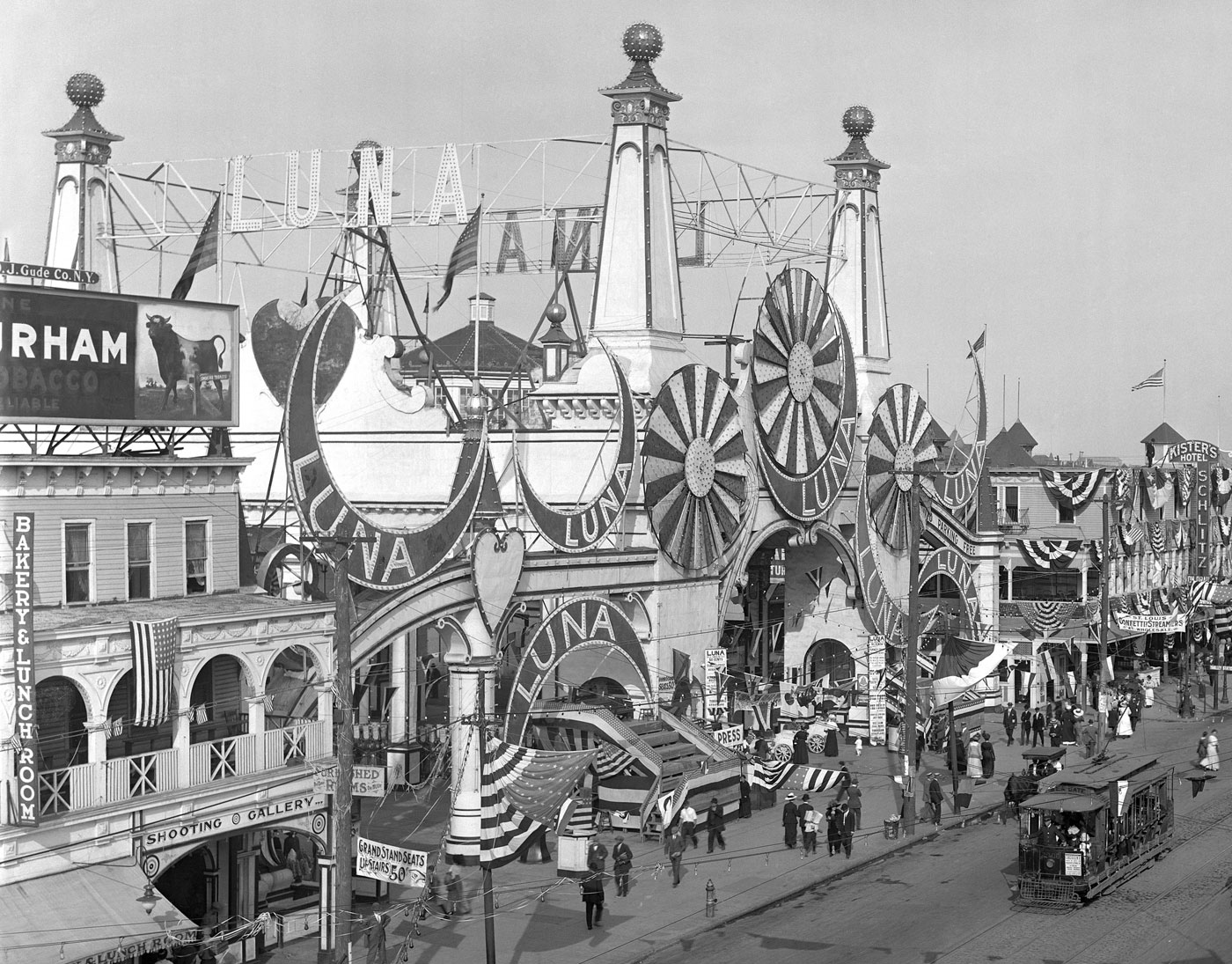
Irving Underhill (American, 1872-1960) Luna Park and Surf Avenue, Coney Island 1912 Gelatin dry glass plate negative Brooklyn Museum, Brooklyn Museum/Brooklyn Public Library, Brooklyn Collection Photo: Althea Morin, Brooklyn Museum
Irving Underhill (American, 1872-1960) Luna Park and Surf Avenue, Coney Island (detail) 1912 Gelatin dry glass plate negative Brooklyn Museum, Brooklyn Museum/Brooklyn Public Library, Brooklyn Collection Photo: Althea Morin, Brooklyn Museum
Roscoe Fatty Arbuckle (director) Fatty Arbuckle and Buster Keaton (actors) Coney Island 1917 25 mins – short, comedy
The 5th film starring the duo of Buster Keaton & Fatty Arbuckle, who also directed. Taking place at the Coney Island amusement park of New York City, it’s notable as the only film where Buster Keaton is seen laughing as this is before he developed his “Great Stoneface” persona.
Gambling Wheel 1900-1920 Wood, glass, metal 65 x 14 in. (165.1 x 35.6cm) Collection of The New-York Historical Society; Purchase
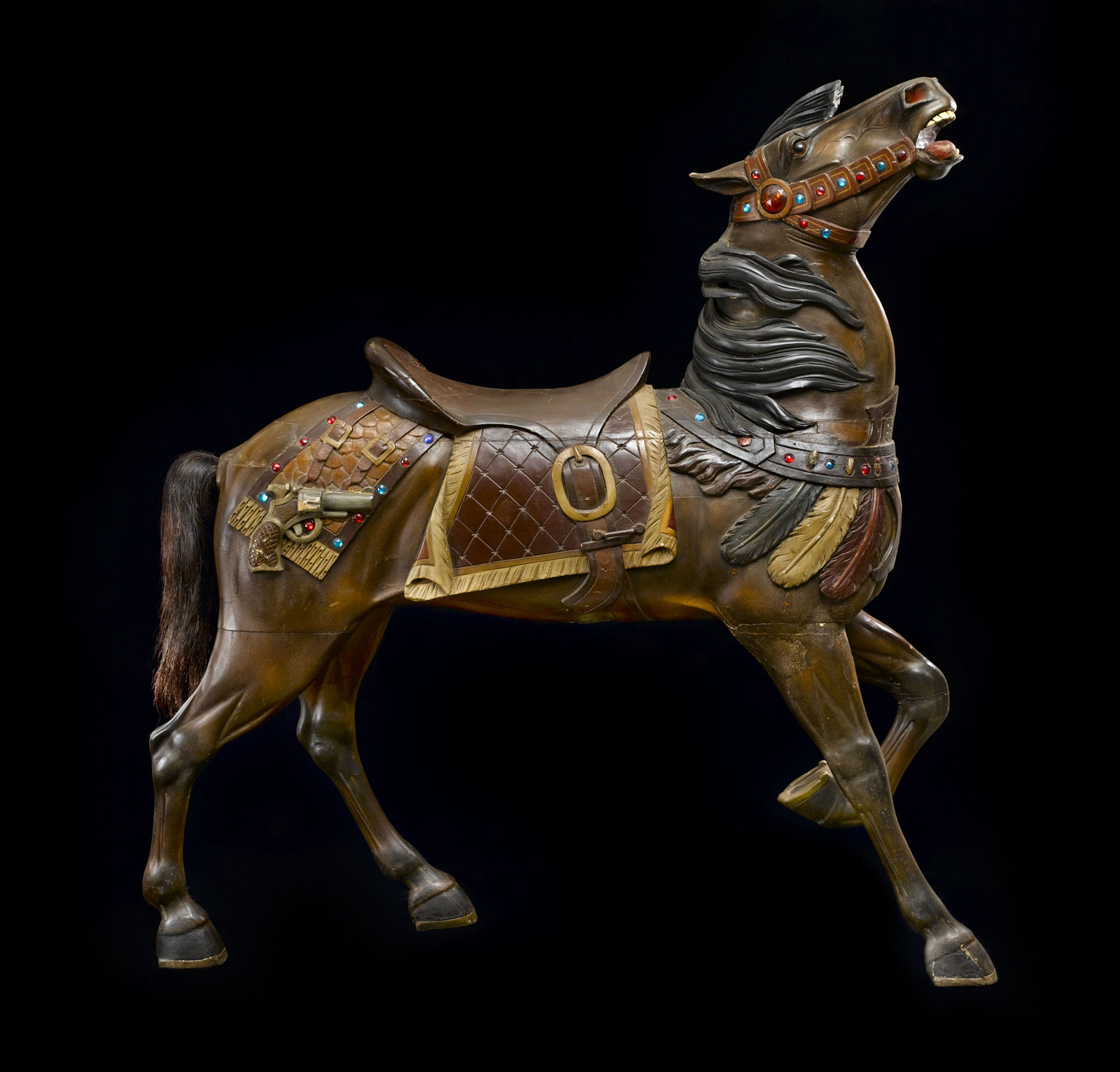
Charles Carmel (American born Russia, 1865-1931) Carousel Horse with Raised Head, Coney Island, Brooklyn, New York c. 1914 Paint on wood, jewels, glass eyes, horsehair tail 62 x 58 x 14 in. (157.5 x 147.3 x 36.6cm) Collection of American Folk Art Museum, New York; Gift of Laura Harding
Born in Russia in 1865, Charles Carmel and his young bride immigrated to the U.S. in 1883 and lived in Brooklyn for most of their lives. Charles was a perfectionist in his work and a disciplinarian with his family. Their home was located close to Prospect Park and its stable of riding horses, which served as a source of inspiration for Charles’ carousel horse carving work. It is generally accepted that Charles Carmel carved carousel horses from 1905 to 1920, and sold his work to all of the major carousel manufacturers of the time including Dolle, Borelli, Murphy, and Mangels.
In 1911 Charles invested most of his money in a newly constructed carousel that he intended to operate on Coney Island. The day before the park was to open, a fire totally destroyed the amusement park along with the uninsured carousel. This was a devastating financial blow to the Carmel family. Later his health deteriorated due to diabetes and arthritis until Charles closed his shop and carved a few hours a day at home, filling orders. Charles died in 1933 of cancer, but his legacy lives on with the exquisite carousel animals that he produced throughout his life.
Text from the Gesa Carousel of Dreams website [Online] Cited 01/01/2016. No longer available online
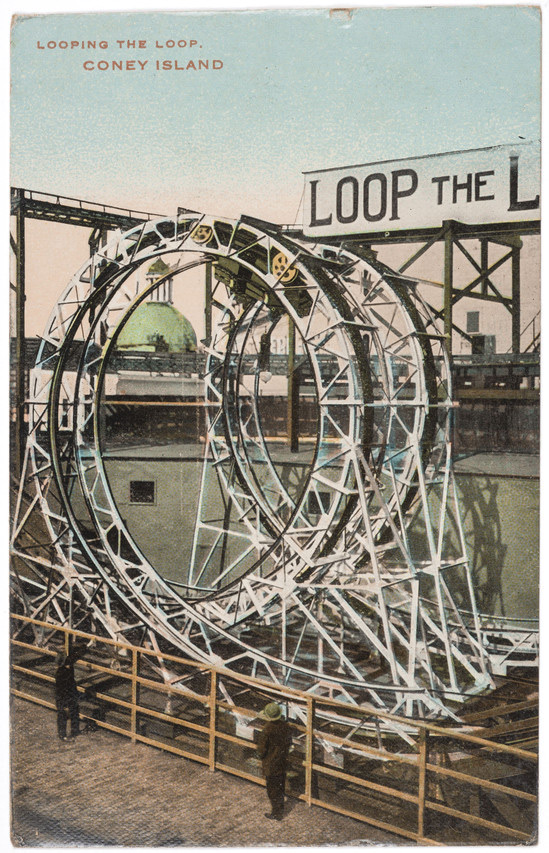
Anonymous artist Looping the Loop, Coney Island 1901-1910 Postcard Private Collection
Walker Evans (American, 1903-1975) Couple at Coney Island, New York 1928 Gelatin silver print 8 x 5 13/16 inches The Metropolitan Museum of Art, New York, Ford Motor Company Collection. Gift of Ford Motor Company and John C. Waddell, 1987
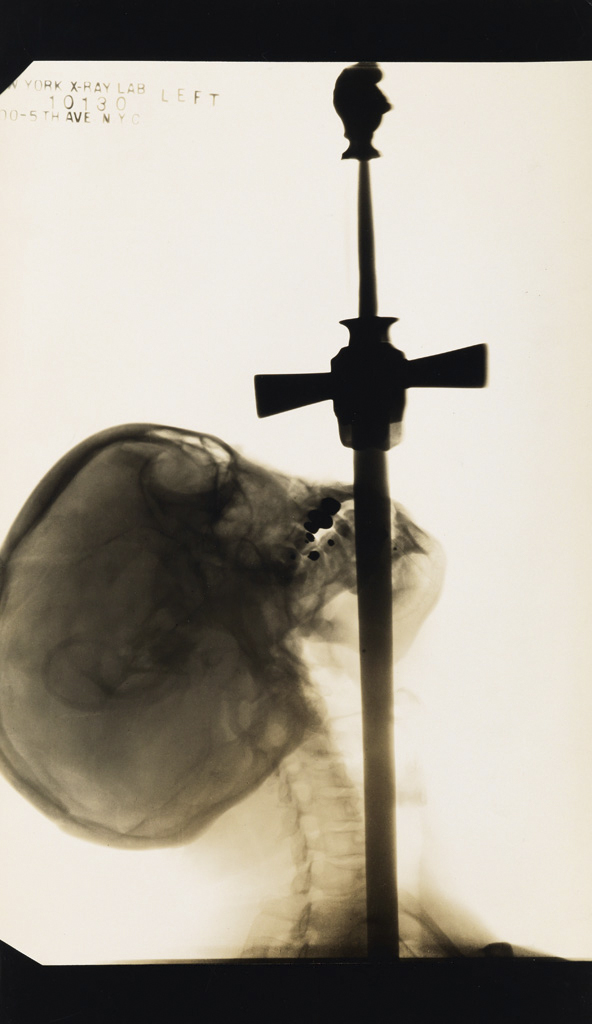
Edward J. Kelty (American, 1888-1967) X-ray of Ajax, “The Sword Swallower” 1928 20 x 20 inches Collection of Ken Harck
Paul Cadmus (American, 1904-1999) Coney Island 1934 Oil on canvas 32 7/16 x 36 5/16 inches Los Angeles County Museum of Art. Gift of Peter Paanakker
Paul Cadmus’s “Coney Island” takes a satirical view of American vacationers. The fleshy members of the human pyramid seem carefree and frivolous in light of the ominous rise to power of the Nazi Party in Germany (Hitler’s face can be seen printed on the magazine resting on the sleeping man’s chest at the bottom of the painting).
“… Paul Cadmus, who shared Marsh’s use of old-master forms and techniques but not his heterosexuality, filled his beach painting with purposely ugly women and mostly beautiful men. The main action in Cadmus’s Coney Island (1934) is the human pyramid of men and women at its center. And yet the Adonis who lies on his stomach in the foreground has no interest in this heterosexual game. Instead, he looks off at another muscular youth farther down the beach. For Marsh, Cadmus and their fellow Coney Island artists, the chance to gaze unabashedly at the body of a stranger was one of the great pleasures of the milieu.
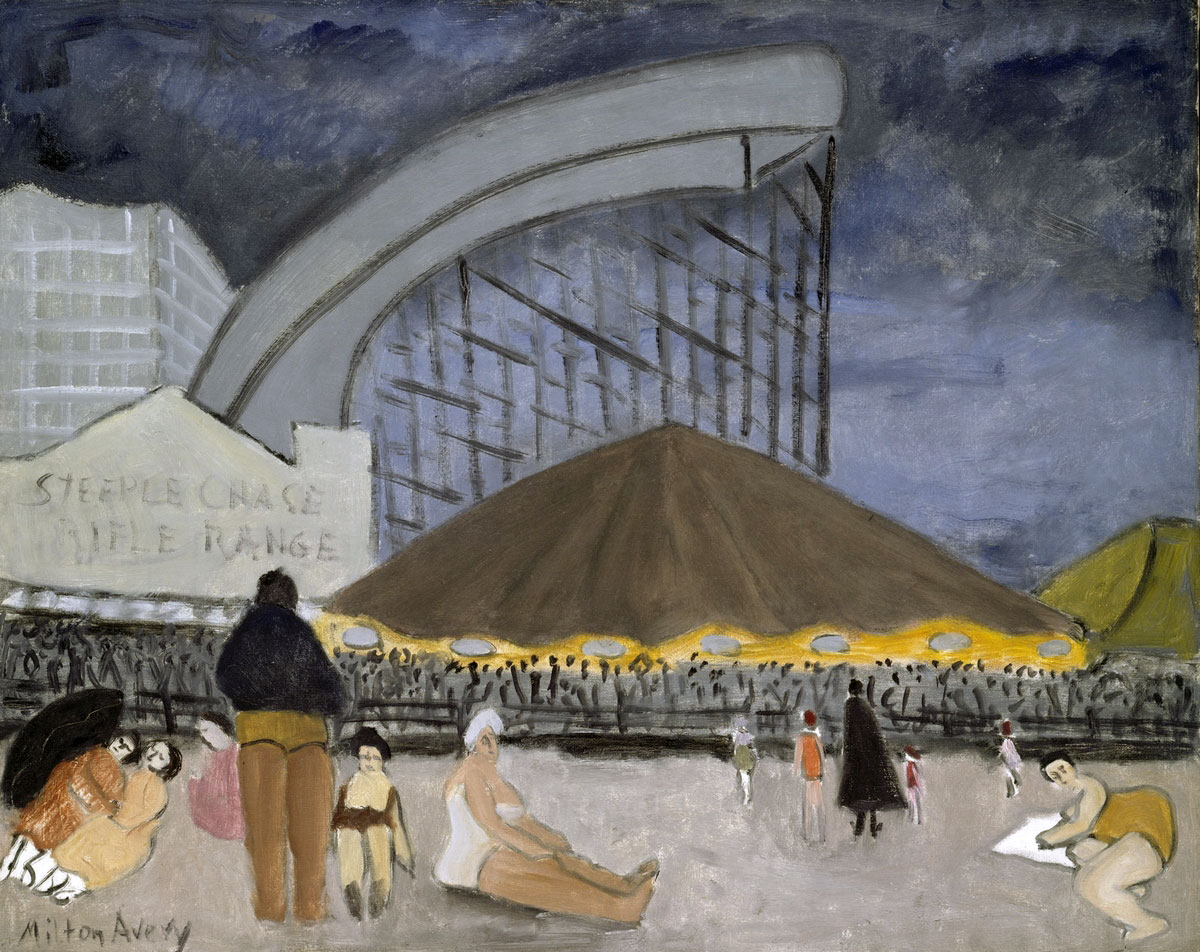
… traditional figuration, like that of Cadmus and Marsh, is so dominant that the exhibition arguably offers an alternate history of American art – one in which the modernist painting of Milton Avery or Frank Stella seems like a sideshow. Breaking out of the canon of modernism, “Coney Island” puts new focus on neglected realist painters like Harry Roseland, Robert Riggs, George Tooker and a particular favorite of mine, Henry Koerner.”
Text from Jonathan Weinberg “Coney Island Forever,” on the Art in America website, October 1st 2015 [Online] Cited 14/12/2015.
Curator notes
Coney Island was the first painting Cadmus made after he ceased working for the federally sponsored Public Works of Art Project. It is typical of his paintings of the period in both theme and form. Cadmus viewed the prosaic activity of bathing on a beach in devastatingly satirical terms. Poking fun at the bathers’ carefree pleasures, Cadmus accumulated an odd assortment of bulging, burnt bodies. The bathers are oblivious to their ridiculous appearance and uncouth behaviour. Swarming the beach, their bodies are strangely intertwined, their faces smiling inanely. Everything is exaggerated, the color verging on the garish to intensify their grossness. In the 1930s Cadmus used oil paint almost as if it were a graphic medium, consequently Coney Island looks more like a tinted drawing than a painting. His small, exacting brushstrokes impart a flickering quality to the surface, which intensifies the impression that the figures are in constant motion. Cadmus actually began to sketch the scene on Martha’s Vineyard, before he visited Coney Island. He was attracted to the Brooklyn beach because it offered him the opportunity to delineate the human figure with as little clothing as possible. Moreover, he considered the beach scene to be a classical subject. His treatment, however, is rather baroque.
As was his friend Reginald Marsh, Cadmus was attracted to the elaborate compositions of old master paintings. Coney Island, with its seminude figures arranged in complex groupings, their bodies twisted and in constant motion, was for Cadmus the twentieth-century version of a baroque allegorical composition. Cadmus claimed that his intent was not to be sensational, but when the painting was exhibited in the Whitney Museum of American Art’s second biennial, it suffered the same hostile reception as did his earlier The Fleet’s In!. The Coney Island Showmen’s League, a local trade group, denounced the painting as offensive and inaccurate and threatened a libel suit if the painting was not removed from the exhibition. According to the artist’s incomplete records, it seems that the painting was rejected from several annual exhibitions to which it was submitted soon after it was shown at the Whitney biennial, probably because of the controversy it stirred. In 1935 Cadmus produced an etching from a photograph of the painting in the hope that it would reach a larger public. In the etching the image is reversed but otherwise differs only in a few minor details.
Exhibition Label, 1997
Cadmus was one of the most controversial American artists of the 1930s. His satirical perspective made people uncomfortable, and consequently reviewers sometimes questioned the decency of his rollicking scenes of New York City life. Coney Island, with its amusement park and beach on the south shore of Brooklyn, was a favourite destination of working-class people. Rather than glamorise labourers enjoying their day off, Cadmus poked fun at these beachgoers and their bulging, entangled bodies. They seem oblivious to their sunburnt flesh and the silliness of their activities. Coney Island met a particularly hostile reception when it was first exhibited. A businessman organisation associated with the amusement park denounced the painting as offensive, resulting in its rejection from subsequent exhibitions. Cadmus’s meticulous painting technique – pigments applied with thin, pencil like strokes – enabled him to delineate minute detail. For example, the viewer can read the headline about Hitler in the newspaper held by the reclining man in the foreground. This subtle reference to the horrifying political developments abroad underscores the inanities of the beachgoers. Carved in wood, this simple frame was rubbed with pigment rather than gilded, a treatment that came into fashion during World War I, as gold became scarce.
Text from the LACMA website [Online] Cited 01/01/2016.
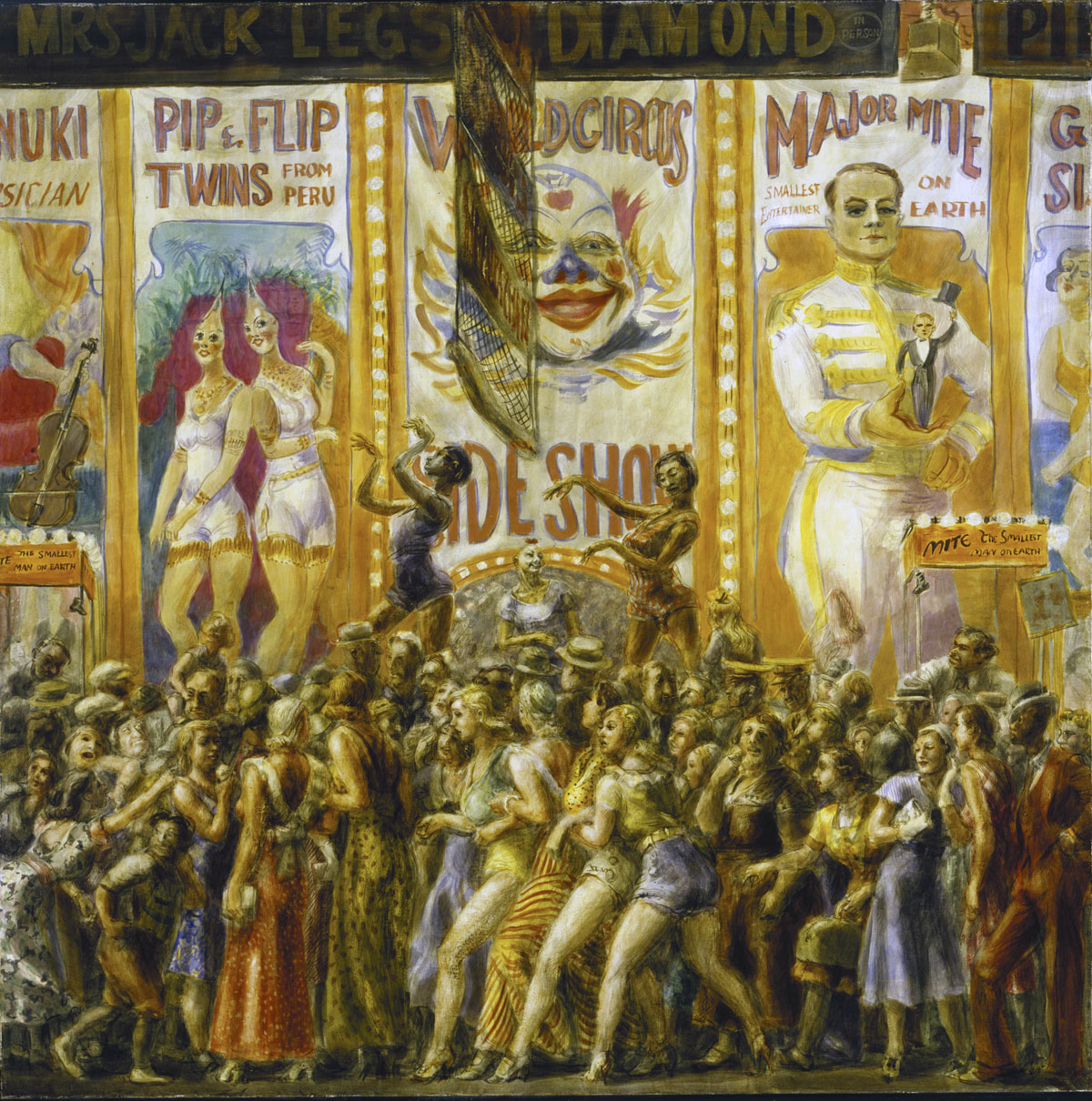
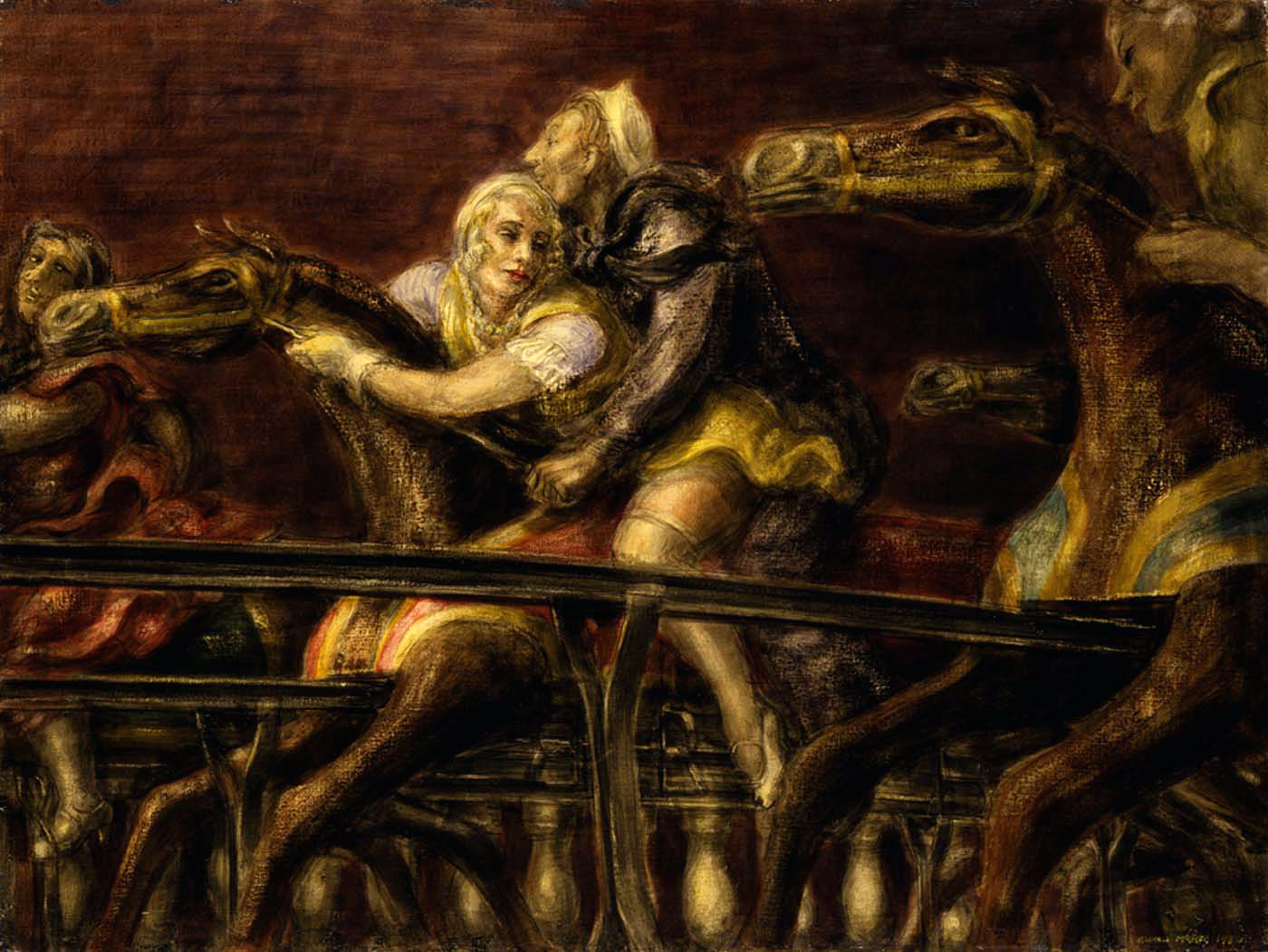
Reginald Marsh (American, 1898-1954) Pip and Flip 1932 Tempera on paper mounted on canvas 48 1/4 x 48 1/4 in. Terra Foundation for American Art, Chicago Daniel J. Terra Collection
“Such bodies were the great subjects of Reginald Marsh. Instead of Stella’s spirals of lights abstracted and seen from a distance, Marsh’s George C. Tilyou’s Steeplechase Park (1936) gives us a close-up view of the Human Roulette Wheel where young women are spun into all kinds of unladylike postures. For the Yale-educated Marsh, Coney Island was a chance to go “slumming,” to mingle with the lower classes on the beach and in the amusement parks. Hostile to modernism and abstract art, he reimagined bathers and sideshow audiences in poses derived from Michelangelo and Rubens. And yet, like Stella, Marsh overpacked his Coney Island paintings so that every inch is activated and in motion like a carnival ride. The highly compressed space of a Marsh painting like Pip and Flip (1932, above), with its collage-like play of rectangular billboards advertising human-oddity sideshows, would be unthinkable without the precedent of Cubism that he supposedly detested.”
Text from Jonathan Weinberg “Coney Island Forever,” on the Art in America website, October 1st 2015 [Online] Cited 14/12/2015.
Human Roulette Wheel at Steeplechase Park, Coney Island, early 1900s
Reginald Marsh (American, 1898-1954) George Tilyou’s Steeplechase Park 1936 Oil and egg tempera on linen mounted on fiberboard 30 1/8 x 40 1/8 in. (76.5 x 101.8cm) Smithsonian American Art Museum Gift of the Sara Roby Foundation
Steeplechase Mechanical Horse Ride at Steeplechase Park, Coney Island, early 1900s
The spirit of Coney Island comes alive with Coney Island: Visions of an American Dreamland, 1861-2008 on view at the Brooklyn Museum. The exhibition traces the evolution of the Coney Island phenomenon from tourist destination during the Civil War to the World’s Greatest Playground to a site of nostalgia. Covering a period of 150 years, the exhibition features 140 objects, including paintings, drawings, photographs, prints, posters, artefacts, carousel animals, ephemera, and film clips. Also on view is Forever Coney, 42 photographs from the Brooklyn Museum collection.
An extraordinary array of artists have viewed Coney Island as a microcosm of the American experience and used their works to investigate the area as both a place and an idea. Coney Island: Visions of an American Dreamland offers up early depictions of “the people’s beach” by Impressionists William Merritt Chase and John Henry Twachtman; modernist depictions of the amusement park by Joseph Stella; Depression-era scenes of cheap thrills by Reginald Marsh; photographs by Walker Evans, Diane Arbus, Weegee, and Bruce Davidson; and contemporary works by Daze and Swoon.
“The modern American mass-culture industry was born at Coney Island, and the constant novelty of the resort made it a seductively liberating subject for artists,” said Dr Robin Jaffee Frank, exhibition curator. “What these artists saw from 1861 to 2008 at Coney Island, and the varied ways in which they chose to portray it, mirrored the aspirations and disappointments of the era and the country. Taken together, these tableaux of wonder and menace, hope and despair, dreams and nightmares become metaphors for the collective soul of a nation.”
Coney Island: Visions of an American Dreamland, 1861-2008 is organised by the Wadsworth Atheneum Museum of Art, Hartford, Connecticut. The Brooklyn presentation is organised by Connie H. Choi, Assistant Curator, Arts of the Americas and Europe, Brooklyn Museum. A fully illustrated 304-page catalogue, co-published by Yale University Press and the Wadsworth Athenaeum, incorporates the first continuous visual analysis of great works of art about Coney Island by Dr Frank as well as essays by distinguished cultural historians.
Forever Coney
As one of America’s first seaside resorts, Coney Island has attracted adventurous visitors and undergone multiple transformations, inspiring photographers since the mid-nineteenth century. Forever Coney: Photographs from the Brooklyn Museum Collection features forty-two images that celebrate the people and places that make up Coney Island. The earliest works, taken by photographers such as George Bradford Brainerd and Irving Underhill, document the resort from the post-Civil War period through the turn of the twentieth century. Later artists such as Harry Lapow and Stephen Salmieri have photographed the many personalities that have passed through the site.
The photographers included in this exhibition are George Bradford Brainerd, Lynn Hyman Butler, Anita Chernewski, Victor Friedman, Kim Iacono, Sidney Kerner, Harry Lapow, Nathan Lerner, Jack Lessinger, H.S. Lewis, John L. Murphy, Ben Ross, Stephen Salmieri, Edgar S. Thomson, Arthur Tress, Irving Underhill, Breading G. Way, Eugene Wemlinger, and Harvey R. Zipkin. Forever Coney: Photographs from the Brooklyn Museum Collection is organized by Connie H. Choi, Assistant Curator of American Art, Brooklyn Museum. It is presented in conjunction with the exhibition Coney Island: Visions of an American Dreamland, 1861-2008.
Morris Engel (American, 1918-2005) Mother with Children 1938 Gelatin silver print 8 x 10 inches Orkin/Engel Film and Photo Archive, New York
Nieman Studios, Inc., Chicago Shackles the Great 1940 Sideshow banner 118 x 108 inches Collection of Ken Harck
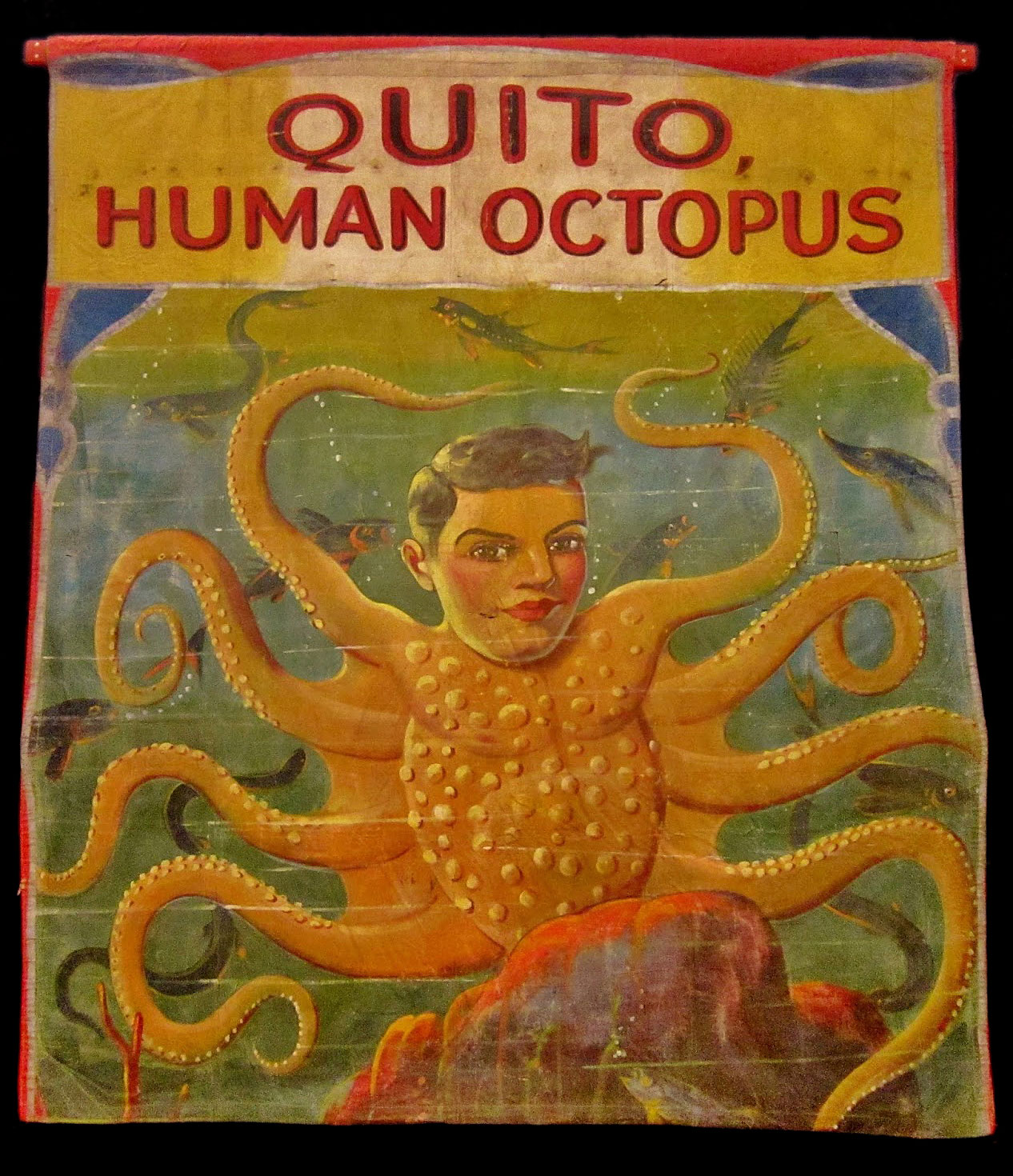
Quito, Human Octopus 1940 Sideshow banner 140 x 117 inches Collection of Ken Harck
Steeplechase Funny Face Nd Painted metal 23 inches Collection of Ken Harck
Henry Koerner (American born Austria, 1915-1991) The Barker’s Booth 1948-1949 Oil on Masonite 26 x 40 1/2 in. (66 x 102.9cm) Collection of Alice A. Grossman
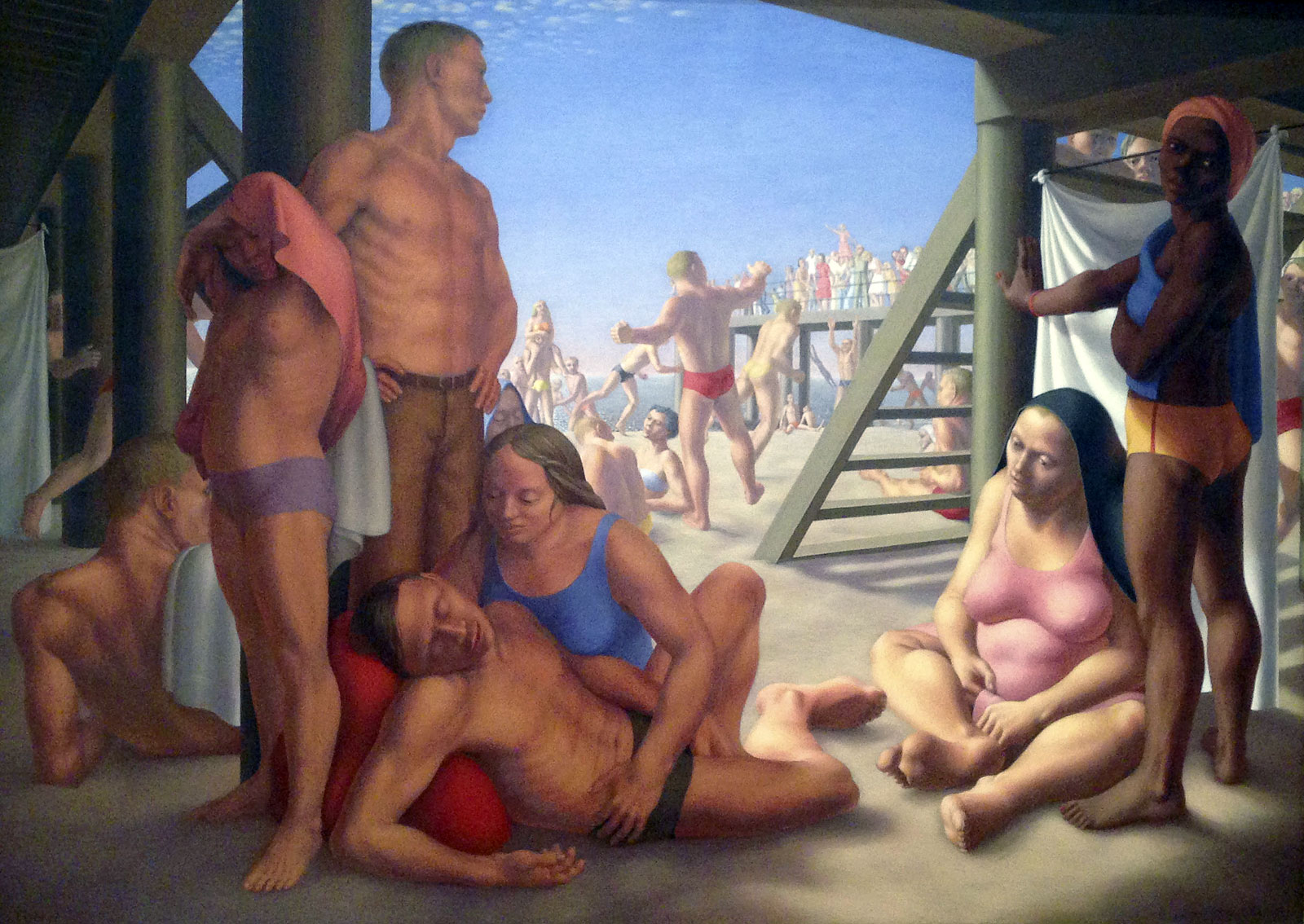
George Tooker (American, 1920-2011) Coney Island 1948 Egg tempera on gesso panel 19 1/4 x 26 1/4 inches Curtis Galleries, Minneapolis
George Tooker’s thought-provoking “Coney Island” places traditional beach goers in a Pietà tableau.
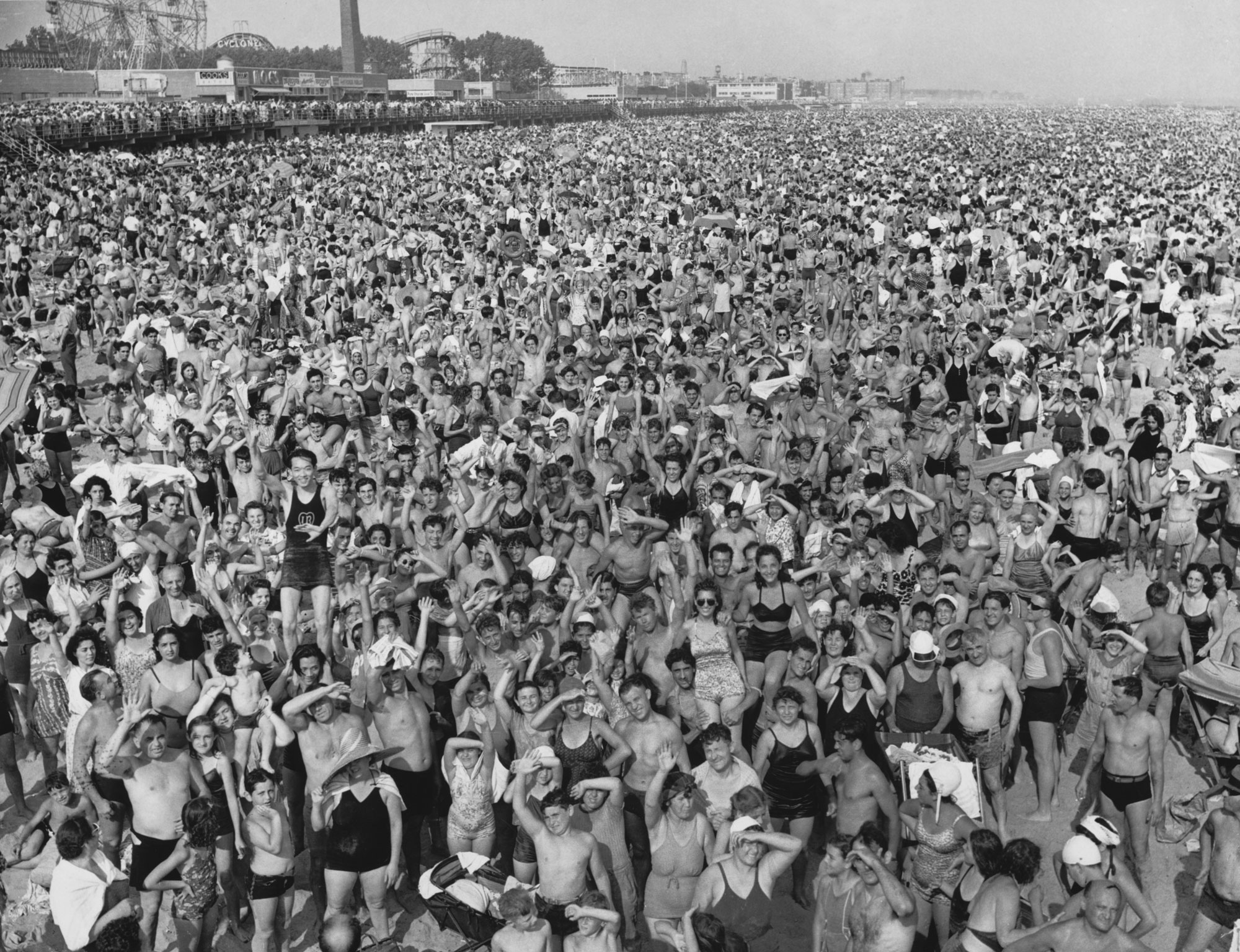
Weegee (Arthur Fellig) (American, 1899-1968) Coney Island Beach 1940 Gelatin silver print 8 1/8 x 10 inches The Metropolitan Museum of Art, New York. Ford Motor Company Collection, Gift of Ford Motor Company and John C. Waddell, 1987
Looking at Weegee’s photograph, it is easy to be carried away with longing for what seems like a simpler and happier time. Undoubtedly, the picture’s sense of naïve jubilation was part of its appeal for Red Grooms, who essentially copied the image in paint for Weegee 1940 (1998-1999). And yet, like much at Coney Island, Weegee’s photograph is an illusion. Taken when Europe was already at war and the Depression had not yet ended, its merriment was only a momentary respite.
Text from Jonathan Weinberg “Coney Island Forever,” on the Art in America website, October 1st 2015 [Online] Cited 14/12/2015.
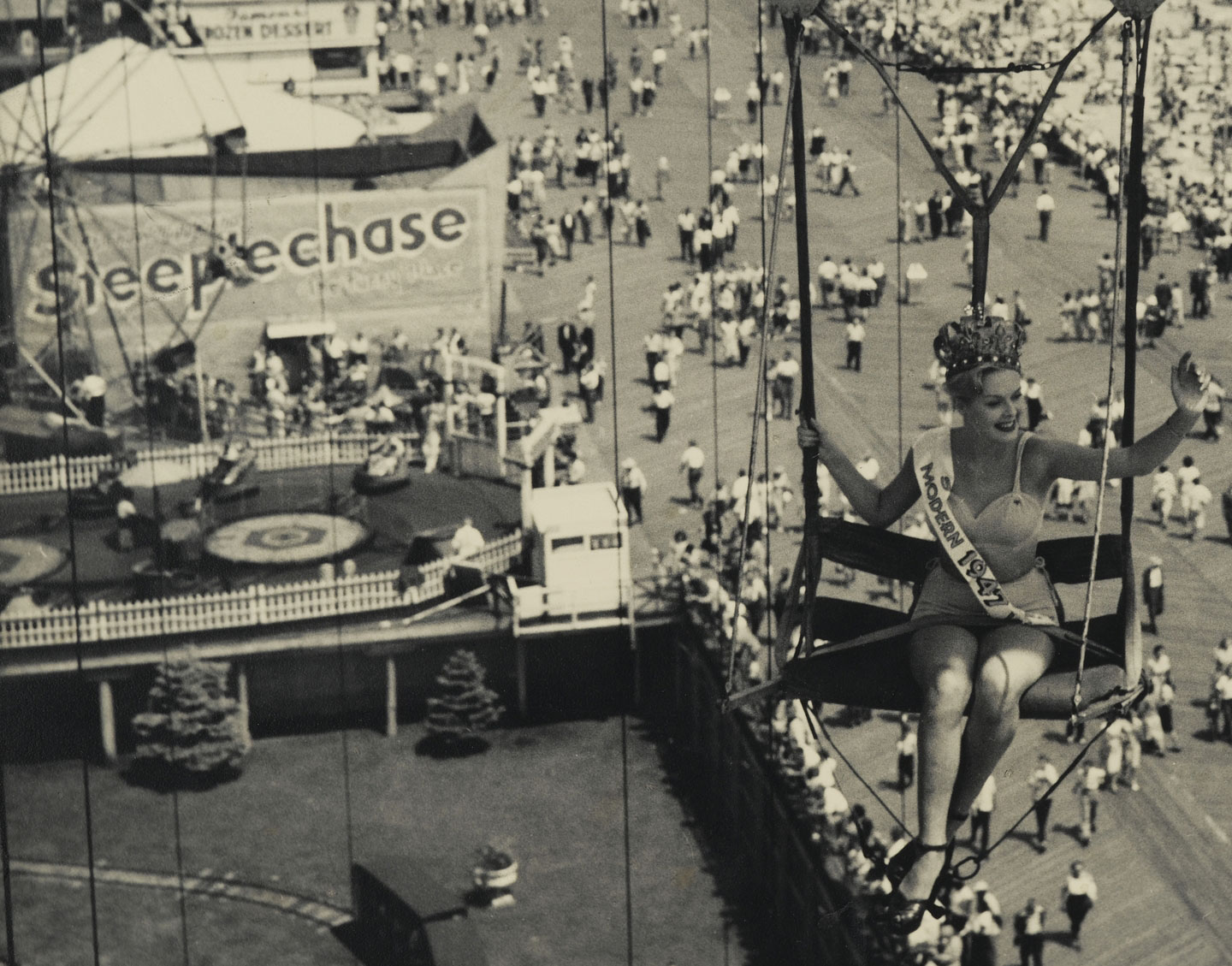
Unknown artist Modern Venus of 1947 Coney Island, 1947 Gelatin silver photograph 10 3/4 x 13 7/8 in. (27.3 x 35.2cm) Brooklyn Museum, Brooklyn Museum Collection Photo: Christine Gant, Brooklyn Museum
Unknown artist Modern Venus of 1947 (detail) Coney Island, 1947 Gelatin silver photograph 10 3/4 x 13 7/8 in. (27.3 x 35.2cm) Brooklyn Museum, Brooklyn Museum Collection Photo: Christine Gant, Brooklyn Museum
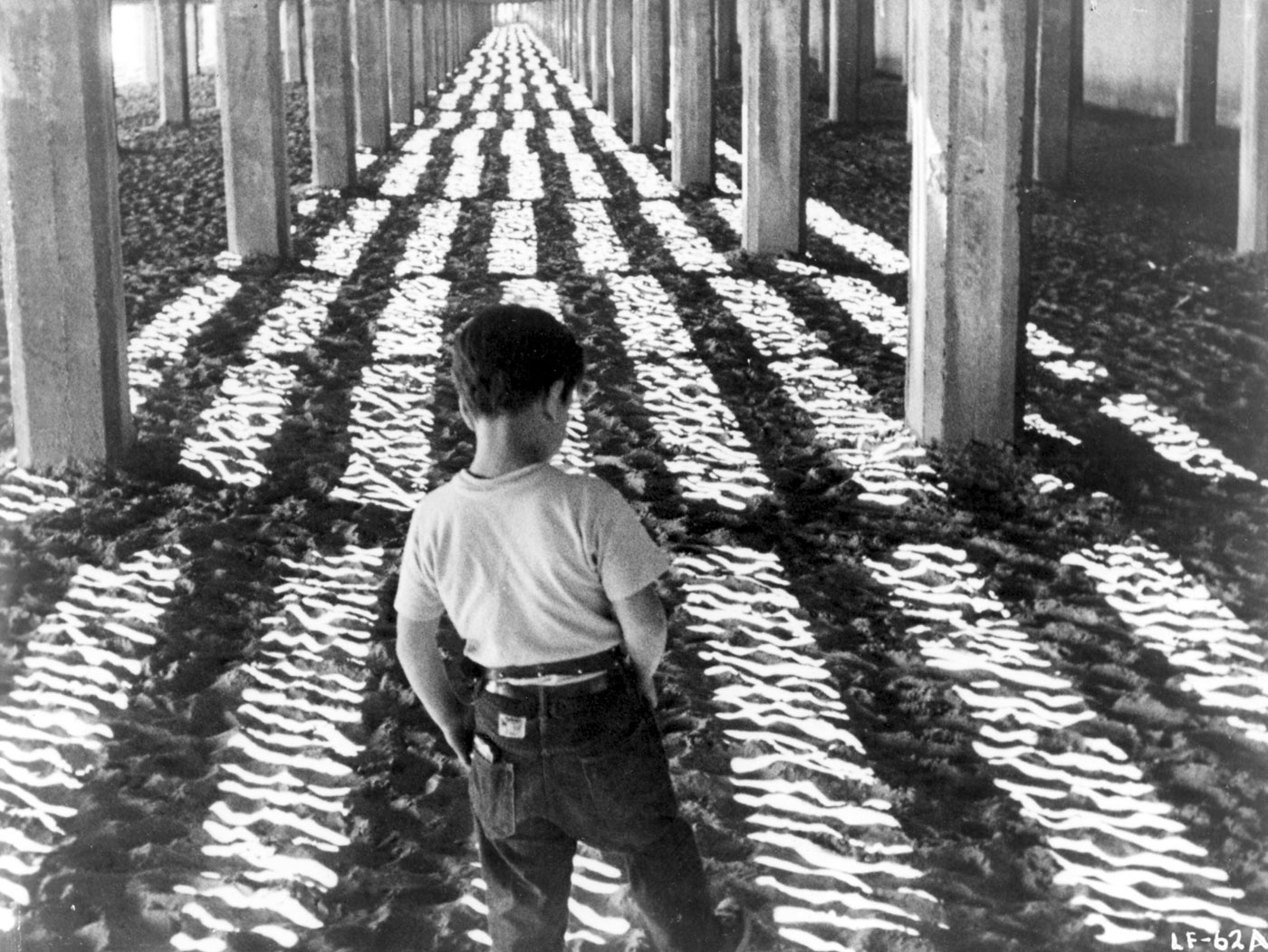
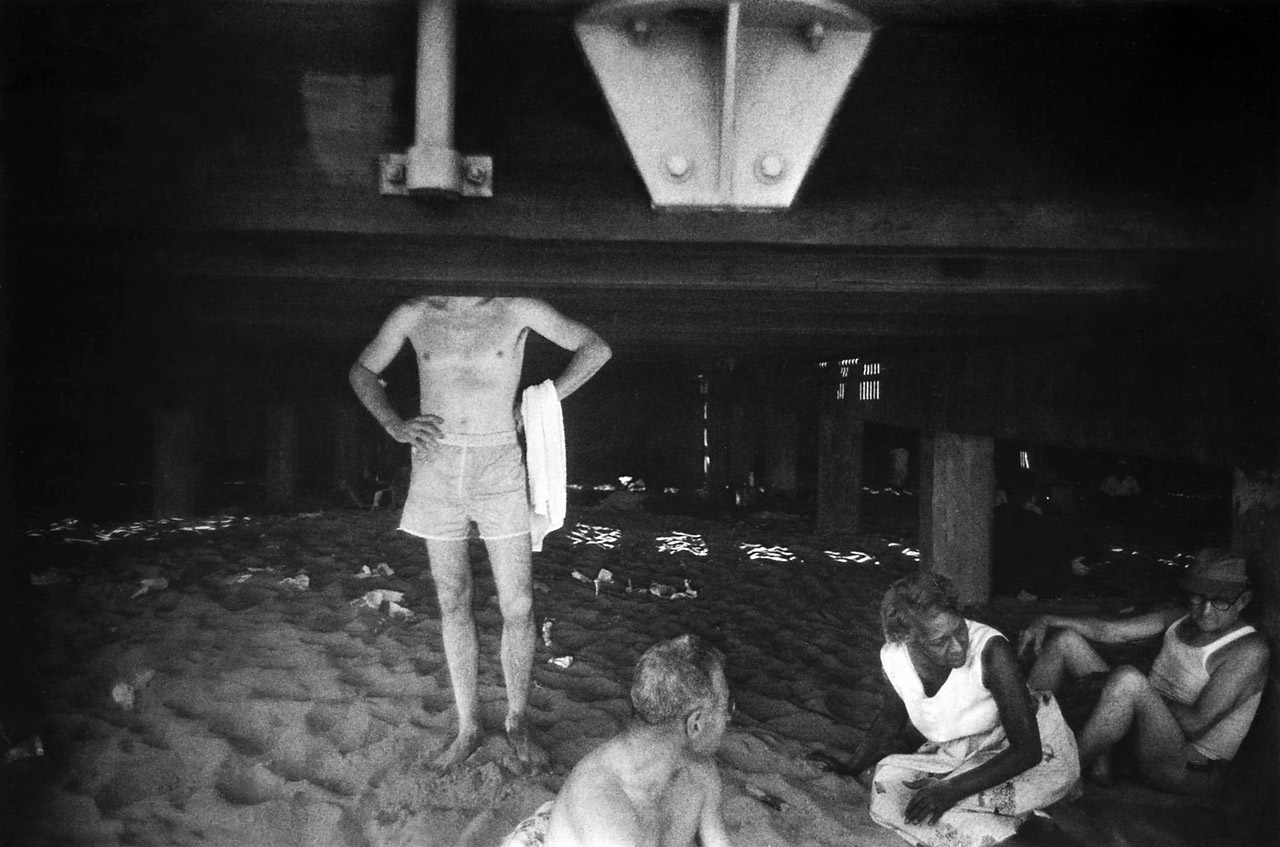
Morris Engel (American, 1918-2005) Under the Boardwalk, Coney Island [Production still from Little Fugitive] 1953 Gelatin silver print 8 x 10 inches Orkin/Engel Film and Photo Archive, New York
Raymond Abrashkin (as “Ray Ashley”), Morris Engel and Ruth Orkin (directors) Little Fugitive 1953
Joey, a young boy, runs away to Coney Island after he is tricked into believing he has killed his older brother. Joey collects glass bottles and turns them into money, which he uses to ride the rides.
“Little Fugitive (1953), one of the most beautiful films featured in the exhibition, conveys the feeling of moving through the enormous crowds in Weegee’s photograph. The creation of two master still photographers, Morris Engel and Ruth Orkin, and writer Ray Ashley, the film tells the story of Joey, a seven-year-old boy who runs away to Coney Island. But if Joey initially exalts in the freedom of being lost in the crowd, he feels abandoned when the amusement park closes down. Robert Frank’s photograph from the same year of a man asleep on a deserted beach with the Parachute Tower at his back [see below] echoes the film’s invocation of the resort’s fleeting joys. When Coney Island empties out it reveals the superficiality and pathos of the fantasies it evokes. In 1894, even before the big amusement parks were built, Stephen Crane mused about how in winter the “mammoth” hotels became “gaunt and hollow, impassively and stolidly suffering from an enormous hunger for the public.” (Stephen Crane, “Coney Island’s Failing Days,” in A Coney Island Reader, p. 69).”
Text from Jonathan Weinberg “Coney Island Forever,” on the Art in America website, October 1st 2015 [Online] Cited 14/12/2015.
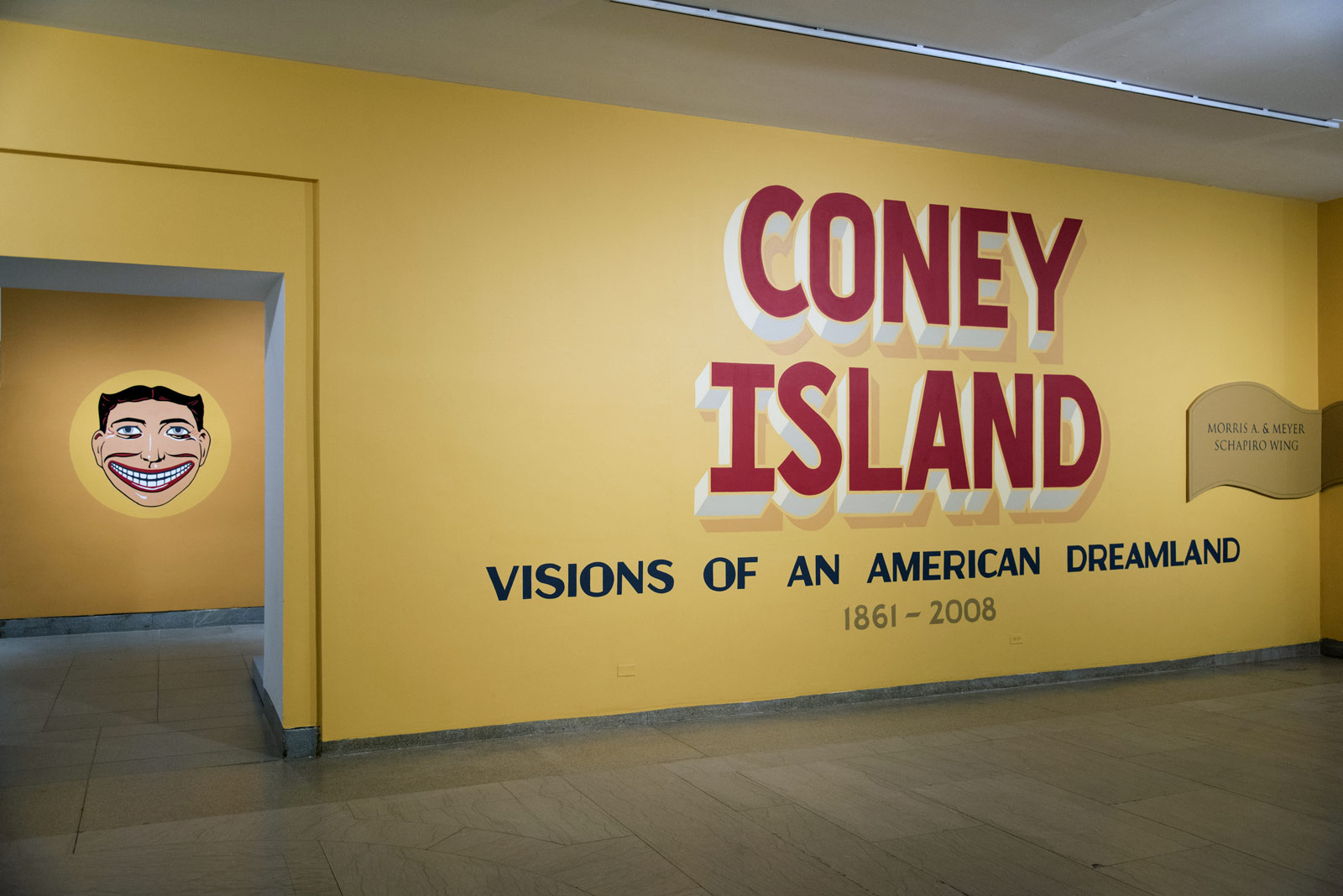
Installation of views of the exhibition Coney Island: Visions of an American Dreamland, 1861-2008 at the Brooklyn Museum, New York
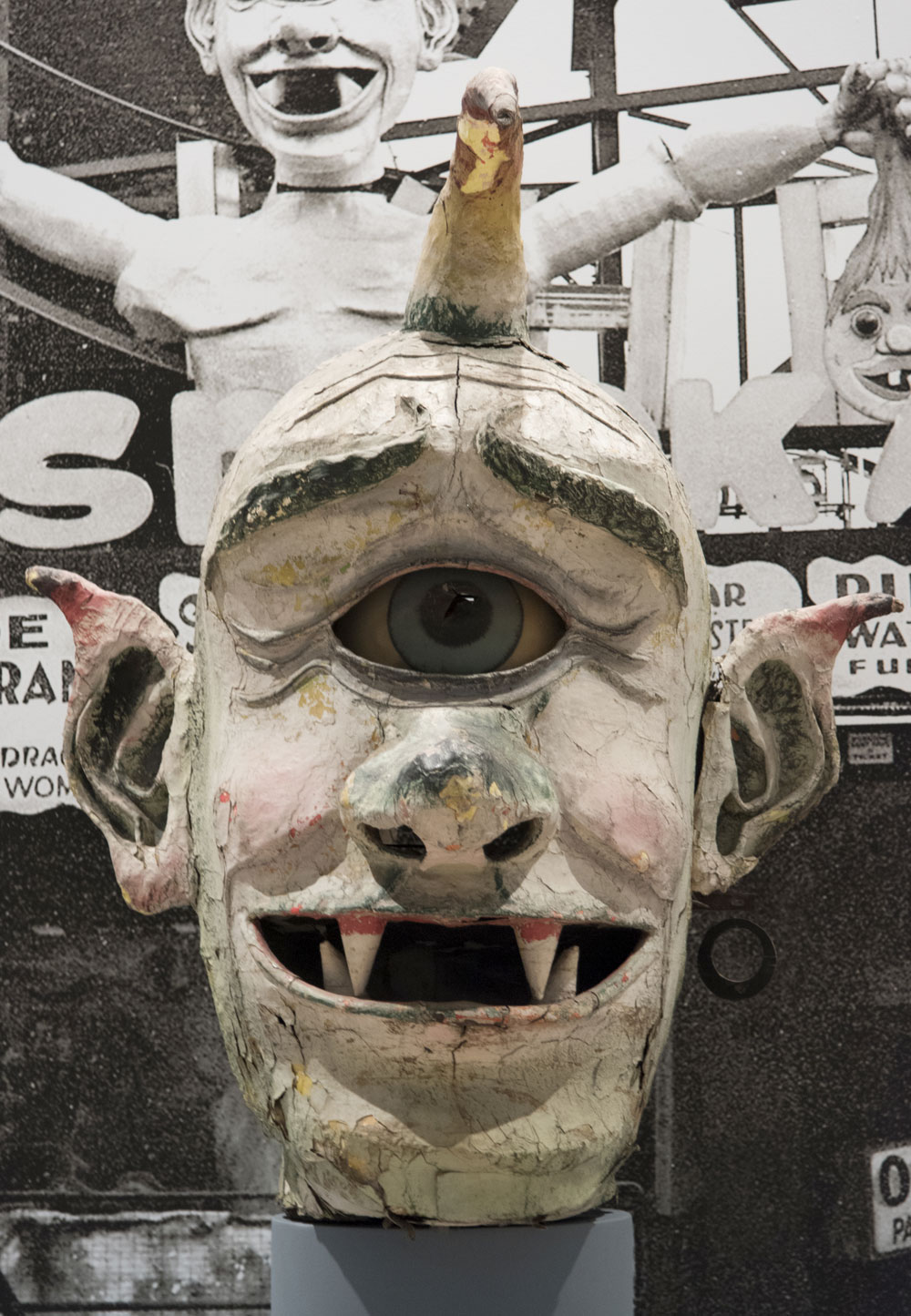
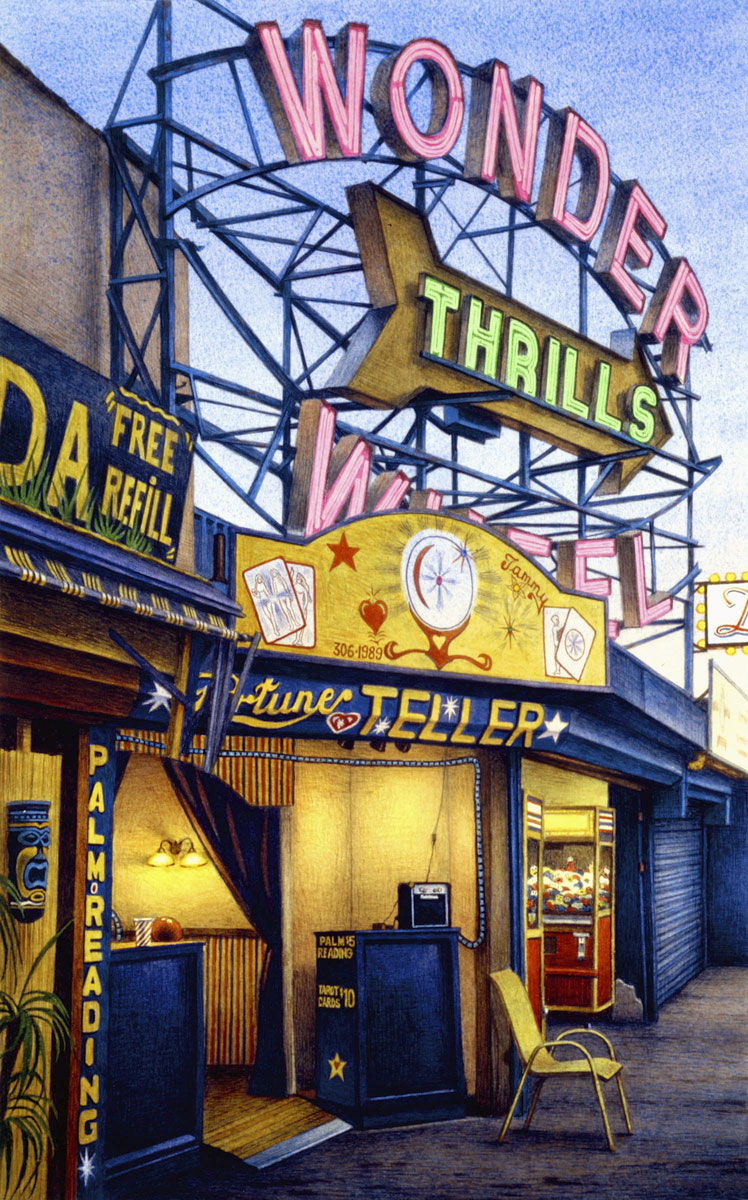
Cyclops Head from Spook-A-Rama c. 1955 Mixed media 60 x 47 x 42 inches The Vourderis Family. Deno’s Wonder Wheel
Garry Winogrand (American, 1928-1984) Coney Island, New York City, N.Y., 1952 Silver bromide 8 1/2 x 13 inches Yale University Art Gallery, New Haven, Conn. Gift of Barbara and James L. Melcher
Bruce Davidson (American, b. 1933) Untitled (Cathy and Cigarette Machine), from the series Brooklyn Gang 1959, printed later Gelatin silver print Image: 8 3/8 x 12 5/8 Sheet: 11 x 14 inches Yale University Art Gallery, New Haven, Conn. The Heinz Family Fund
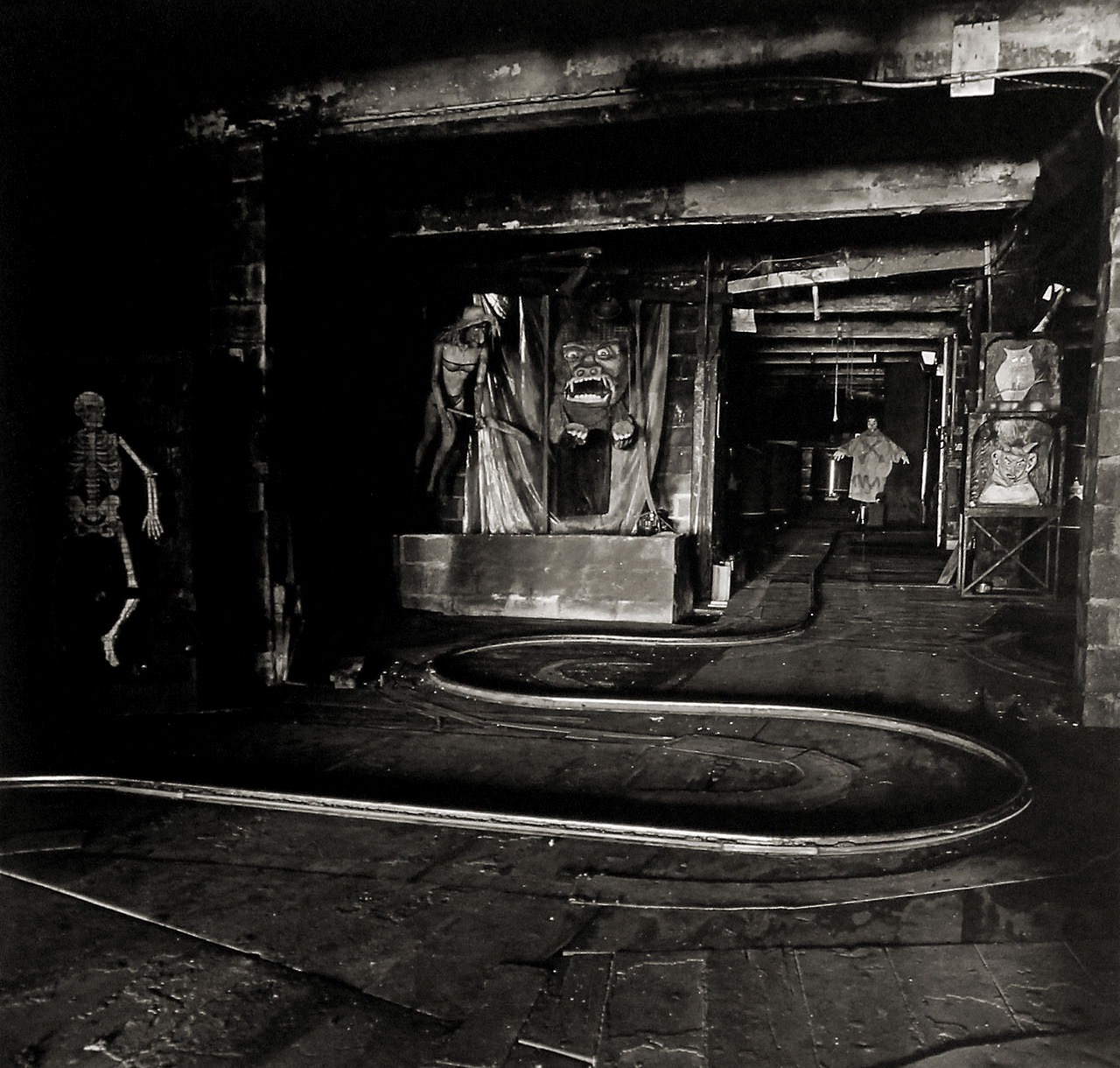
Diane Arbus (American, 1923-1971) The House of Horrors 1961 Gelatin silver print 14 1/2 x 14 inches Fraenkel Gallery, San Francisco
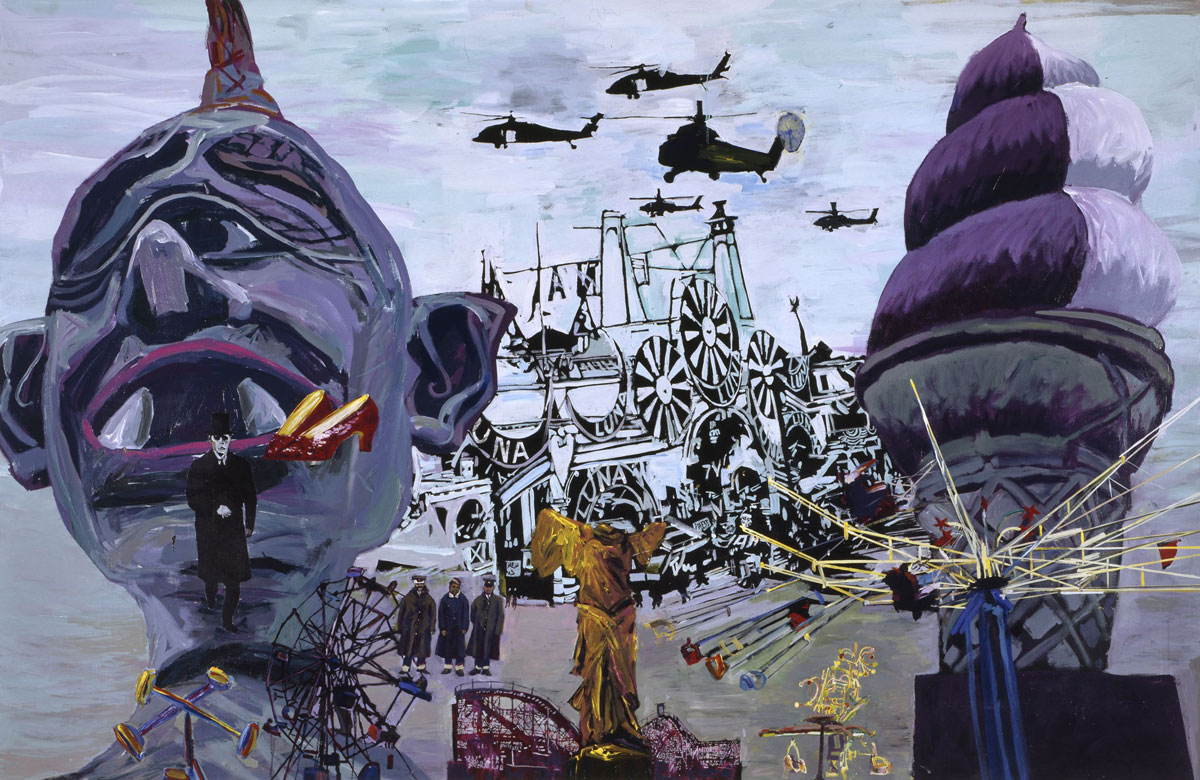
“As its carnival rides and sideshows became increasingly dated in the 1960s, Coney Island was unable to maintain even the phony thrills that Miller derided in the 1930s. In Diane Arbus’s The House of Horrors (1961), the fake skeleton and the cartoon ape mask aren’t as scary as the ride’s sorry state and the impression that something terrible has driven all the people away. (The 1970 low-budget slasher film Carnival of Blood, not included in the exhibition, brilliantly uses this seediness to create a sense of uncanny doom.) In Arnold Mesches’s painting Anomie 1991: Winged Victory (1991), the creaky rides mingle with images of war, turning dreamland into an apocalyptic nightmare.”
Text from Jonathan Weinberg “Coney Island Forever,” on the Art in America website, October 1st 2015 [Online] Cited 14/12/2015.
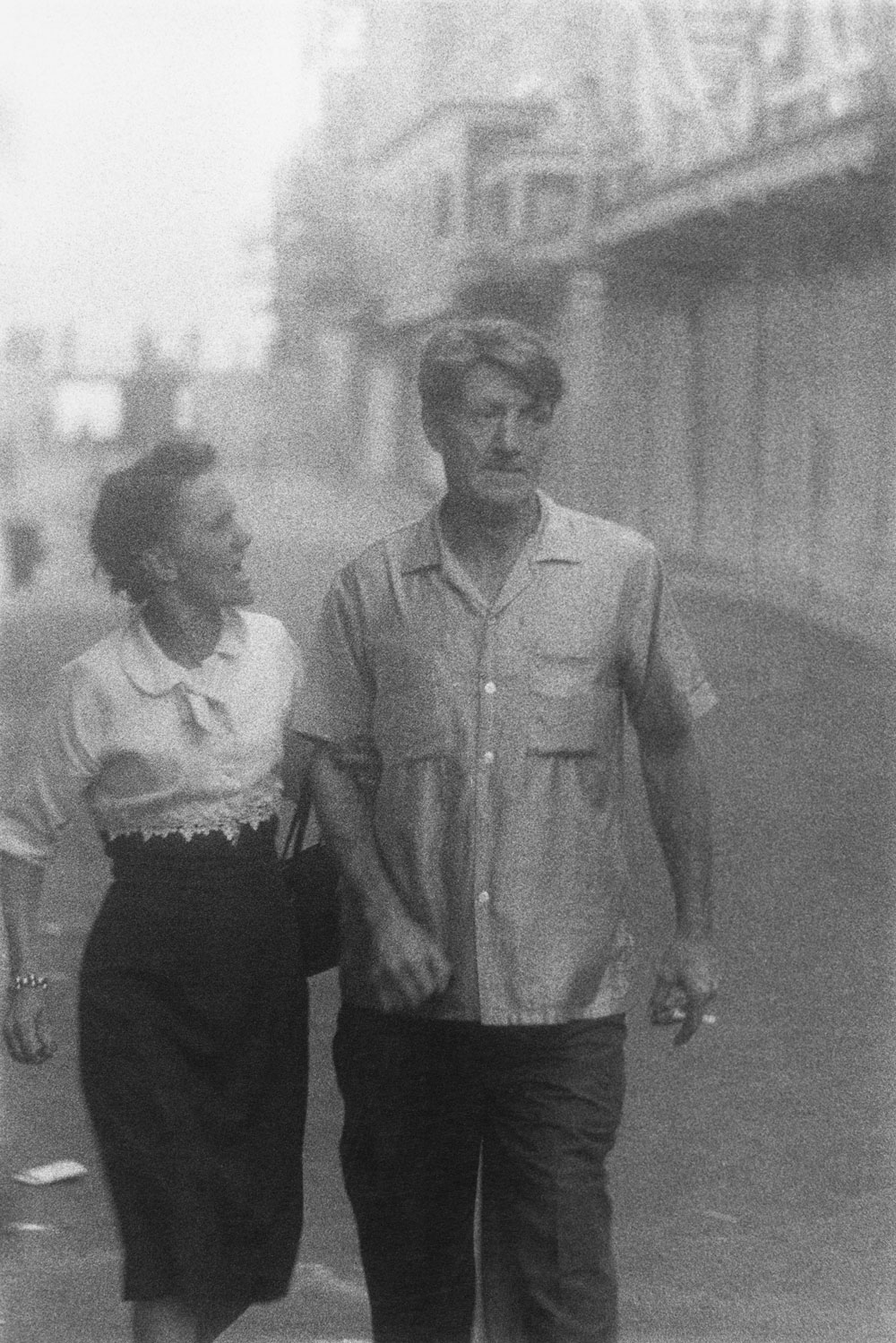
Diane Arbus (American, 1923-1971) Couple Arguing, Coney Island, N.Y., 1960 Vintage gelatin silver print Image: 8 1/2 x 6 5/8 inches Sheet: 14 x 11 inches Collection Thomas H. Lee and Ann Tenenbaum
Robert Frank (American, 1924-2019) Coney Island July 4, 1958 15 5/8 x 11 9/16 inches Gelatin silver print National Gallery of Art, Washington, D.C., Robert Frank Collection. Gift of the Richard Florsheim Art Fund and an Anonymous Donor
Frank Stella (American, b. 1936) Coney Island 1958 Oil on canvas 85 1/4 x 78 3/4 inches Yale University Art Gallery, New Haven, Conn. Gift of Larom B. Munson, B.A. 1951
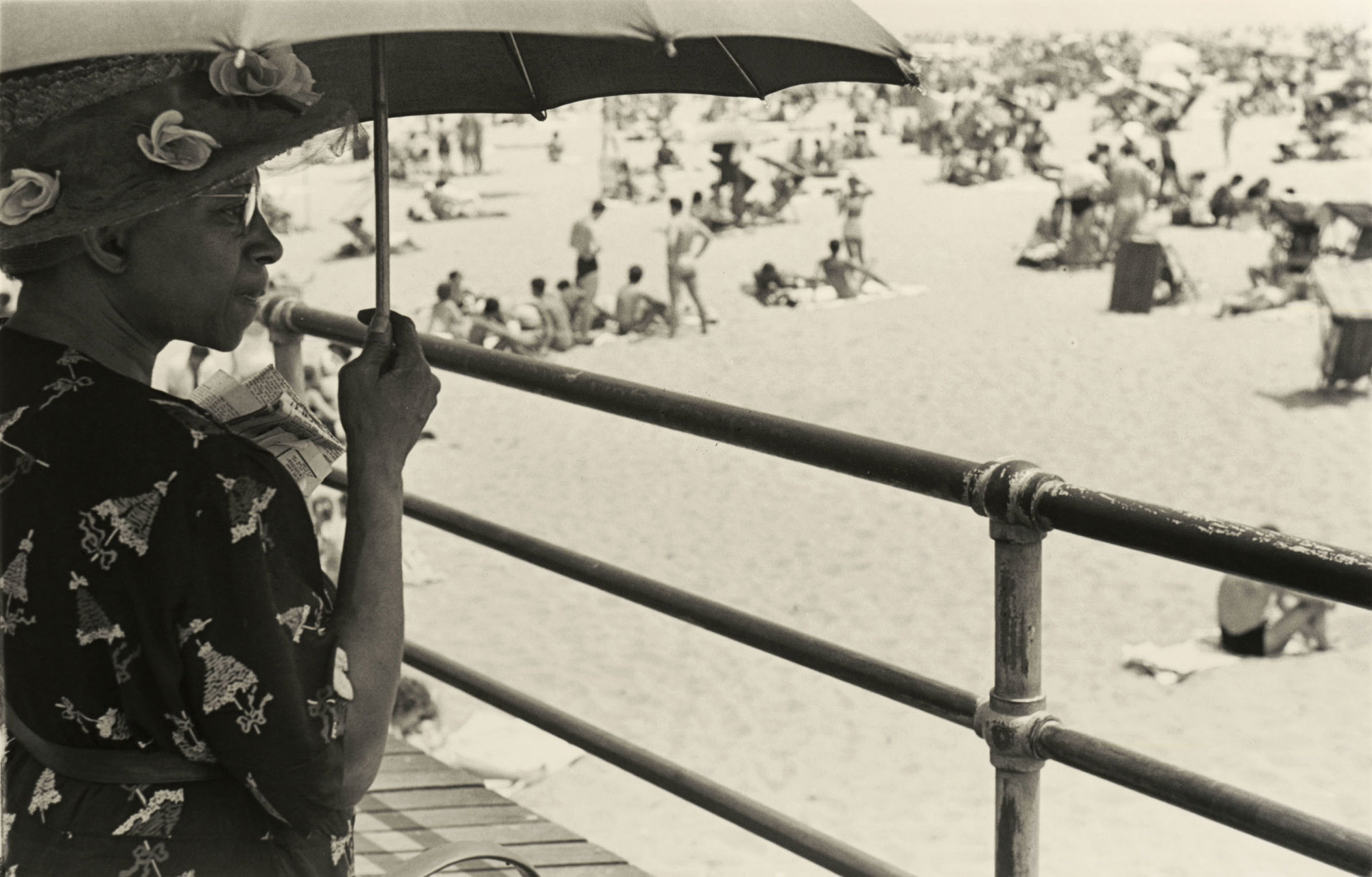
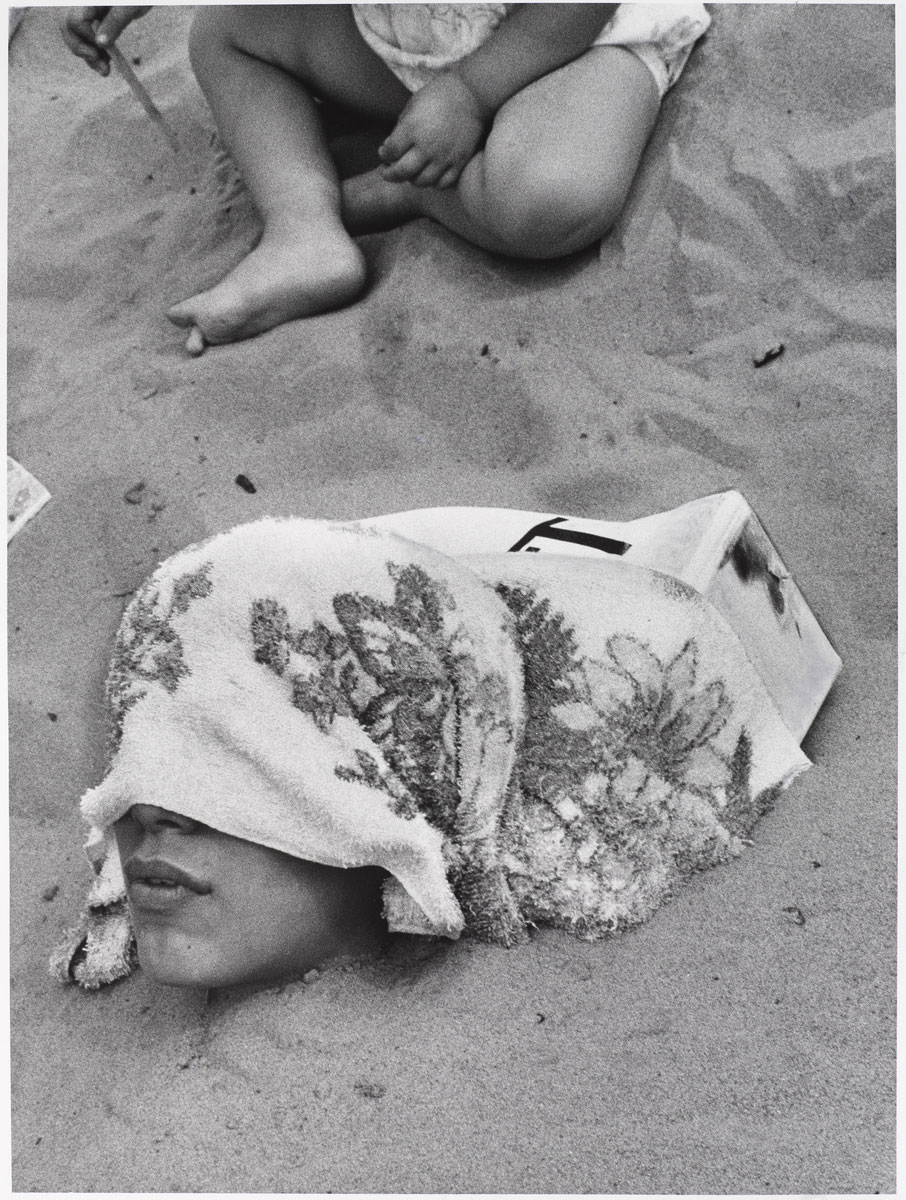
Harry Lapow began frequenting Coney Island to capture quirks of the beach and boardwalk after receiving a Ciroflex camera on his forty-third birthday. He was intrigued by the camera’s ability to isolate details and fleeting moments of everyday life. Here, a toddler’s crossed legs appear above the head of a buried woman whose eyes are covered by a floral towel. In cropping this beach sighting, Lapow crafts a surprising juxtaposition, forming an unlikely dynamic between the lively child and the masked adult.
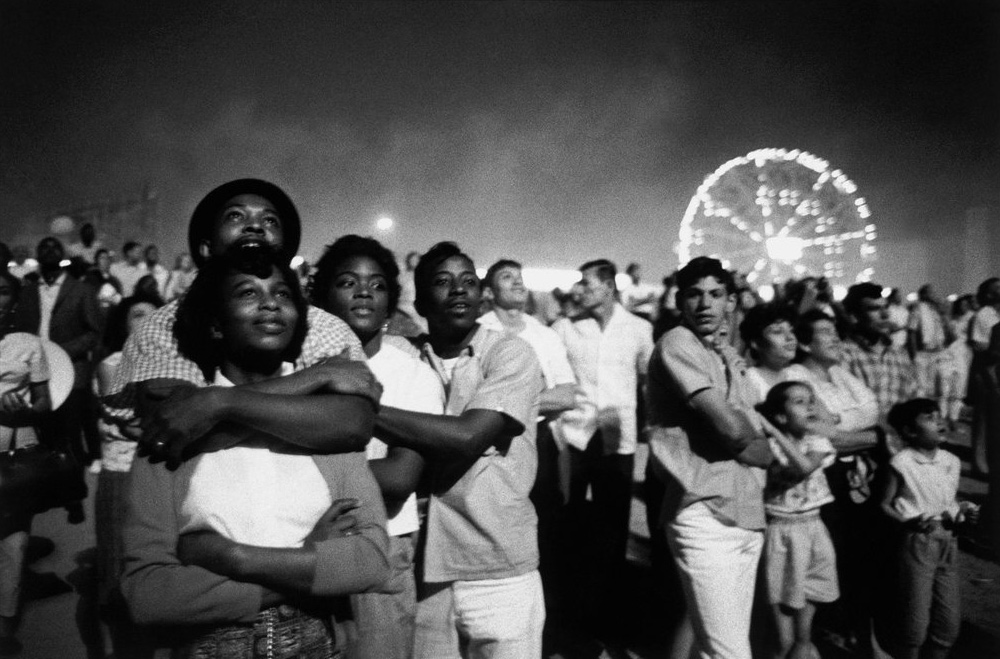
Bruce Davidson (American, b. 1933) Untitled July 4, 1962 Gelatin silver print 11 x 14 inches Howard Greenberg Gallery, New York
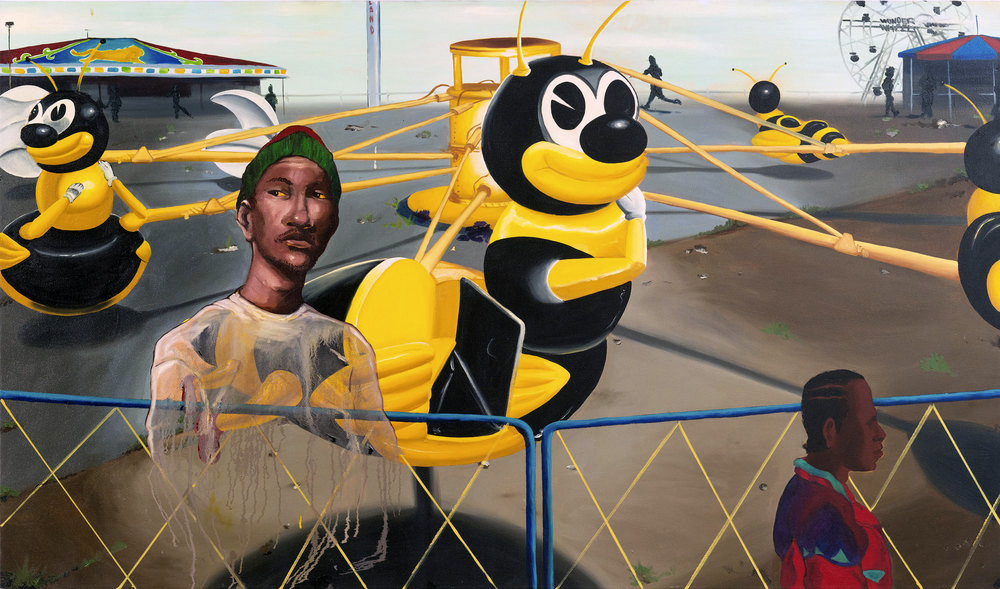
Daze (American, b. 1962) Coney Island Pier 1995 Oil on canvas 60 x 80 in. (152.4 x 203.2cm) Collection of the artist
Daze (American, b. 1962) Kiddyland Spirits 1995 Oil on canvas 42 x 71 inches Collection of the artist
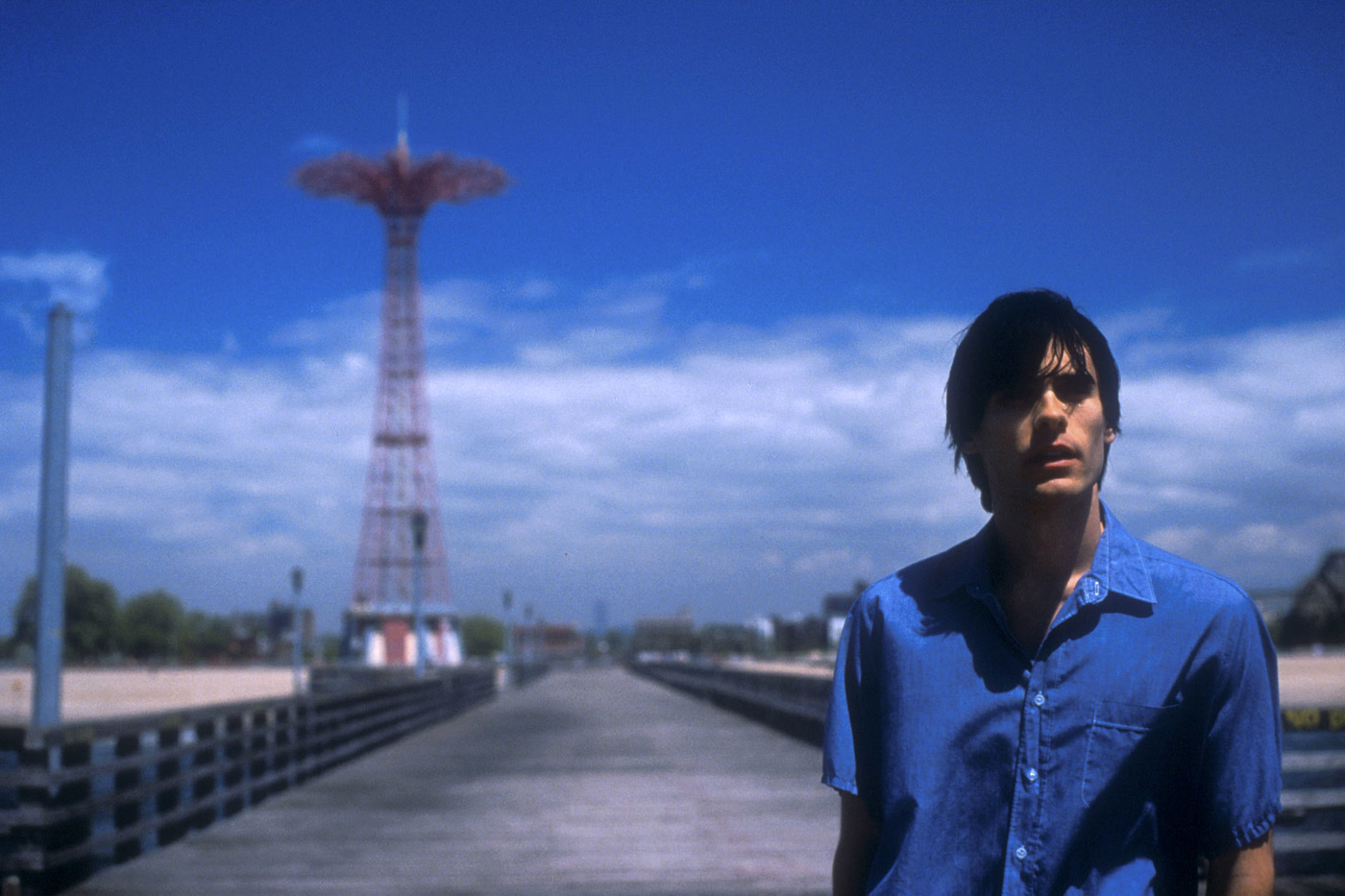
Requiem for a Dream, production still, directed by Darren Aronofsky, 2000
Marie Roberts (American, b. 1954) A Congress of Curious Peoples 2005 Acrylic on unstretched canvas 84 x 120 in. (213.4 x 304.8cm) Collection of Liz and Marc Hartzman
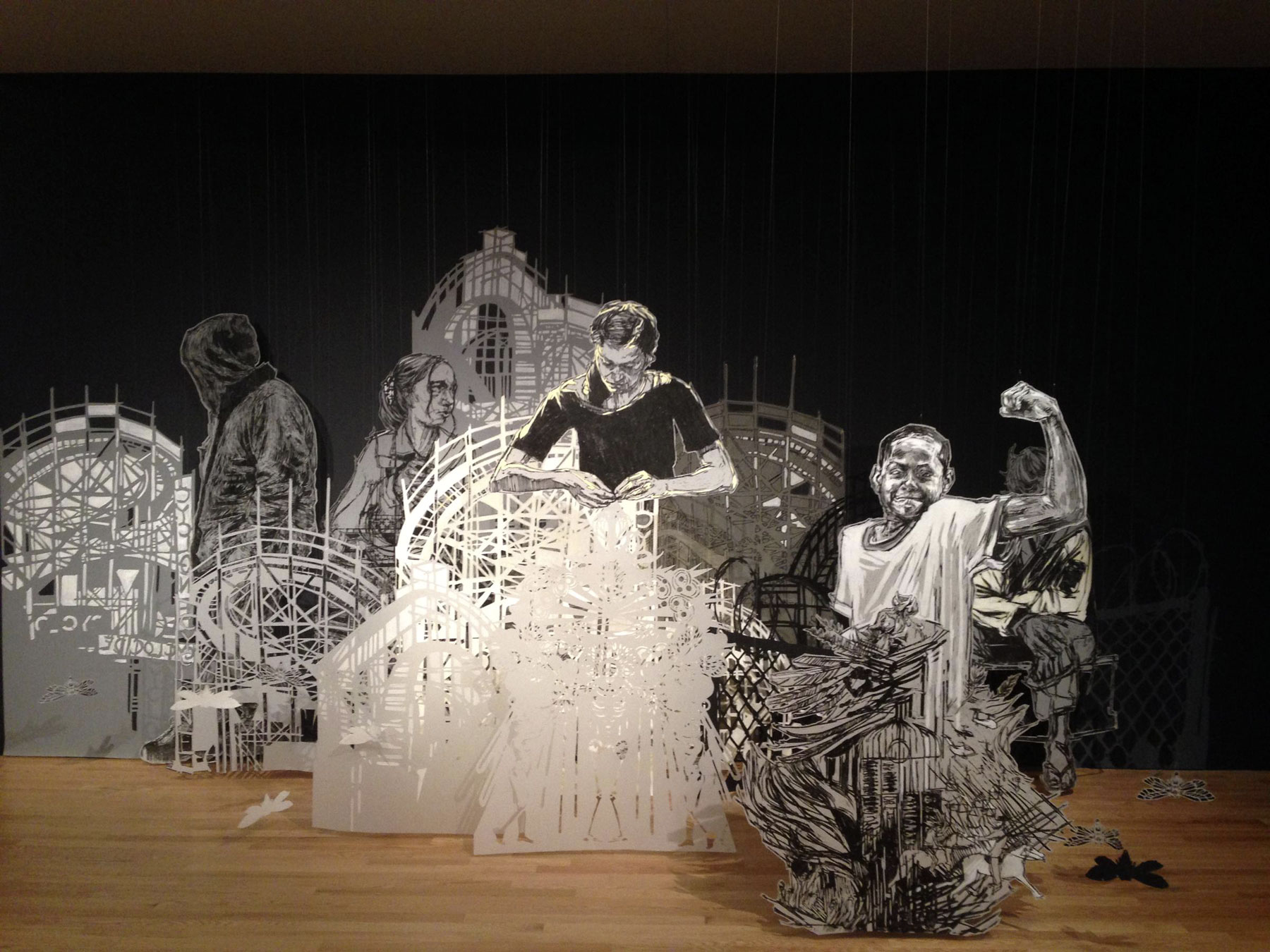
Swoon Coney, Early Evening 2005 Linoleum print on Mylar Variable; overall: 213 x 39 x 113 inches Brooklyn Museum. Healy Purchase Fund B, Emily Winthrop Miles Fund, and Designated Purchase Fund
Swoon’s “Coney, Early Evening” suspends youthful figures intertwined throughout the iconic tracks of a Coney Island roller coaster.

























 Art Blart _ art and cultural memory archive
You must be logged in to post a comment.