Exhibition: ‘In Focus: Sound’ at the J. Paul Getty Museum, Los Angeles

Exhibition dates: 28th June – 2nd October, 2022

Curator: Karen Hellman, assistant curator in the Department of Photographs.


Maker unknown (American) 'Phonograph Demonstration' about 1900-1905 from the exhibition 'In Focus: Sound' at the J. Paul Getty Museum, Los Angeles, June-  Oct, 2022


Maker unknown (American)
Phonograph Demonstration
about 1900-1905
Gelatin silver print
27 × 37.1cm (10 5/8 × 14 5/8 in)
Getty Museum


“Sometimes theory leads to an over determination. Something is gained but at a price. Finding images that evoke a sound can only be saved by paying the higher price of remembering how images look when their sound is removed.”

~ Ian Lobb


From my knowledge of photography, I have added further images that I can hear … but not in the exhibition that I know of. You may like to recall other photographs that you could include in the exhibition.

Dr Marcus Bunyan


Many thankx to the J. Paul Getty Museum for allowing me to publish the photographs in the posting. Please click on the photographs for a larger version of the image.


Though photographs are silent, photographers have long conjured sound in their images. Whether depicting crowded urban spaces, musicians performing, people engaged in conversations, or even more abstract depictions of sound, the pictures in this exhibition show photography’s power to communicate beyond the visual. The images date from the 19th century to the recent past, and in each, the audible plays as much of a role as the visual. As you look at these photographs, you are invited to imagine what you might “hear” as well.

Text from the J. Paul Getty Museum website


Florence Henri (American, 1893-1982) 'Columbia Records' 1931 from the exhibition 'In Focus: Sound' at the J. Paul Getty Museum, Los Angeles, June-  Oct, 2022


Florence Henri (American, 1893-1982)
Columbia Records
1931
Gelatin silver print
24.8 × 39.1cm (9 3/4 × 15 3/8 in)
Getty Museum
© Martini & Ronchetti, courtesy Archives Florence Henri


Gjon Mili (American born Albania, 1904-1984) 'Tap Dancer, September 29, 1949' 1949 from the exhibition 'In Focus: Sound' at the J. Paul Getty Museum, Los Angeles, June-  Oct, 2022


Gjon Mili (American born Albania, 1904-1984)
Tap Dancer, September 29, 1949
1949
Gelatin silver print
33.8 × 26cm (13 5/16 × 10 1/4 in)
Getty Museum
© Gjon Mili / The LIFE Picture Collection / Shutterstock


Photographs may be silent, but photographers have long conjured sound in their images.

Whether depicting crowded urban spaces, musicians performing, or people engaged in conversation, the pictures in this exhibition prove photography’s power to communicate beyond the visual.

Drawn from Getty’s permanent collection, In Focus: Sound, on view June 28 through September 2, 2022, unites two sensory perceptions – sight and sound – in photographs that record the visual while also imitating the audible.

“Photography and sound have more in common than one might expect,” says Karen Hellman, curator of the exhibition. “Photographs can evoke a sensory perception that they cannot actually depict. Looking at photographs while thinking about sound could provide a new way of viewing and appreciating photography.”

The 19th century saw a keen scientific and philosophical interest in reproducing ephemeral phenomena. This led to the development of the photograph as well as the phonograph. This interlinked history perhaps explains photography’s connection to sound and why photographers, even subconsciously, have endeavoured to picture it. In each image in this exhibition, which date from the 19th century to the recent past, the audible plays as much of a role as the visual.

This exhibition includes works by known and lesser-known makers from the 19th century to the recent past, including Julia Margaret Cameron, Walker Evans, Man Ray, Graciela Iturbide, Marco Breuer, Naoya Hatakeyama, and Christian Marclay.

In Focus: Sound will be on view June 28 through September 2, 2022, at the Getty Center.

Text from the J. Paul Getty Museum website


Naoya Hatakeyama (Japanese, b. 1958) 'Blast #0608' 1995


Naoya Hatakeyama (Japanese, b. 1958)
Blast #0608
1995
Chromogenic print
Getty Museum
Gift of James N. and Susan A. Phillips
© Naoya Hatakeyama
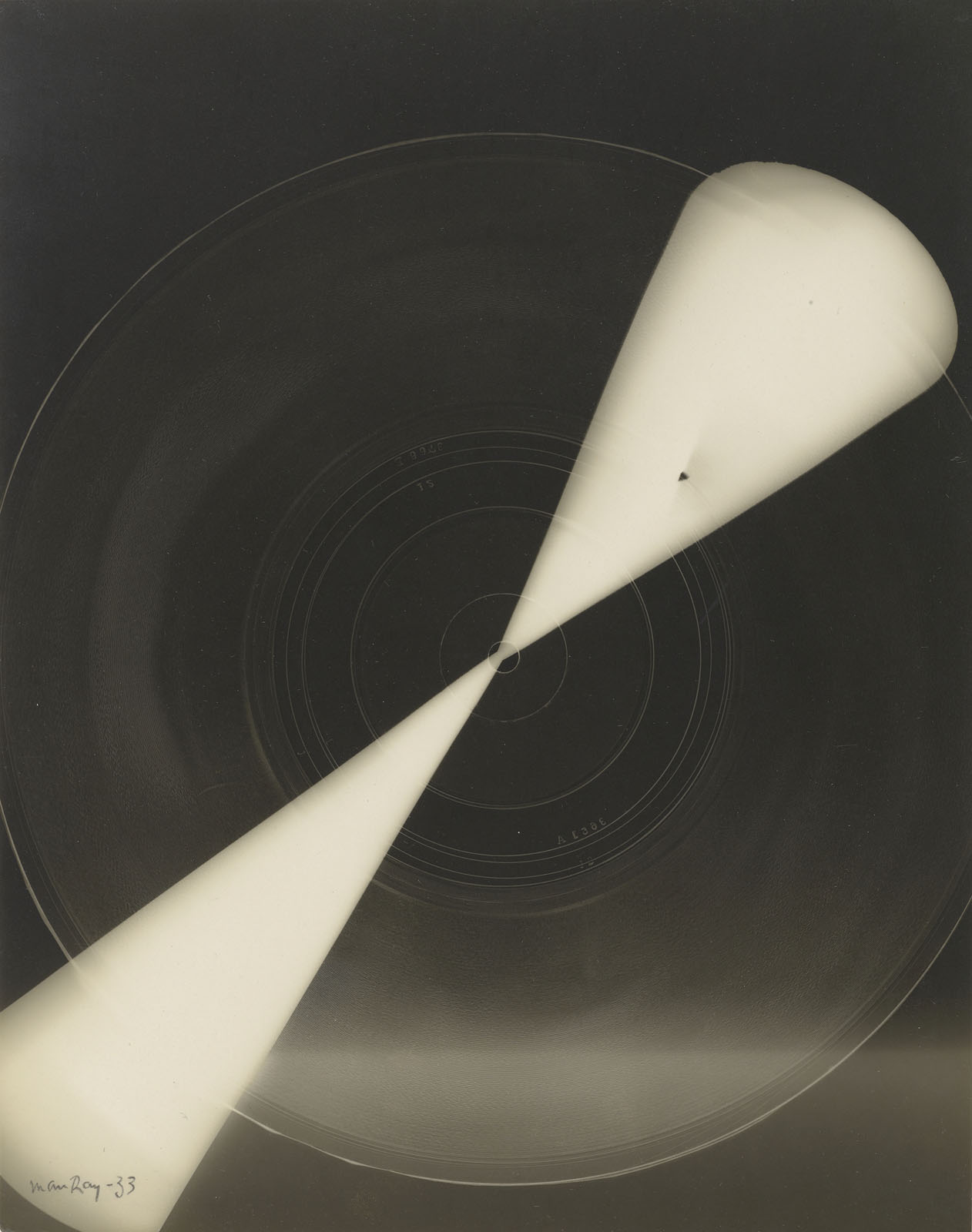
 

Man Ray (American, 1890-1976) 'Record' 1933


Man Ray (American, 1890-1976)
Record
1933
Gelatin silver print
28.9 × 22.5cm (11 3/8 × 8 7/8 in)
Getty Museum
© Man Ray Trust ARS-ADAGP


Albert Harlingue (French, 1879-1963) 'Abbot Rousselot's Collection of Tuning Forks' about 1924


Albert Harlingue (French, 1879-1963)
Abbot Rousselot’s Collection of Tuning Forks
about 1924
Gelatin silver print
17.9 × 12.7cm (7 1/16 × 5 in)
Getty Museum


Julia Margaret Cameron (British born India, 1815-1879) 'The Echo' 1868


Julia Margaret Cameron (British born India, 1815-1879)
The Echo
1868
Albumen silver print
27.1 × 22.7cm (10 11/16 × 8 15/16 in)
Getty Museum


Milton Rogovin (American, 1909-2011) 'Storefront Churches' 1958-1961


Milton Rogovin (American, 1909-2011)
Storefront Churches
1958-1961
Gelatin silver print
12.5 × 12cm (4 15/16 × 4 3/4 in.)
Getty Museum
Gift of Dr. John V. and Laura M. Knaus
© Milton Rogovin


Carrie Mae Weems (American, b. 1953) 'Untitled (Musical Score of "God Bless the Child")' 1995


Carrie Mae Weems (American, b. 1953)
Untitled (Musical Score of “God Bless the Child”)
1995
From the series From Here I Saw What Happened and I Cried
Chromogenic print with sandblasted musical notations on frame glass
45.6 × 45.6cm (17 15/16 × 17 15/16 in)
Getty Museum
Gift of Mary and Dan Solomon in honour of Weston Naef
© Carrie Mae Weems


Will Connell (American, 1898-1961) 'Sound' 1936


Will Connell (American, 1898-1961)
Sound
1936
Gelatin silver print
34.2 × 26.7cm (13 7/16 × 10 1/2 in)
Getty Museum
Gift of Trish and Jan de Bont
© Will Connell


Lisette Model (American born Austria, 1901-1983) '[Singer, Sammy's Bar, New York]' about 1940-1944


Lisette Model (American born Austria, 1901-1983)
[Singer, Sammy’s Bar, New York]
about 1940-1944
Gelatin silver print
Getty Museum
© Estate of Lisette Model, courtesy of Baudoin Lebon/Keitelman


“Bowery old-timers claim her voice has had no match for power and ferocity since Maggie Cline used to stun with “Knock ‘Em Down McCloskey”.”

The uncredited text, referring to this photograph of the bar singer known as “Tillie,” accompanied a group of Lisette Model’s photographs made at Sammy’s Bar that were reproduced in the September 1994 Harper’s Bazaar magazine. Taken from below and at a slight diagonal angle, the image captures the vitality and vibrancy of the performer belting it out on the stage at Sammy’s, a local favourite in the Bowery district of New York, also visited by photographers Weegee and Diane Arbus. The angle from which the photograph was made also emphasises the gleaming microphone, which seem to rise up to meet the challenge of projecting Tillie’s already powerful voice.

Text from the J. Paul Getty app


Ralph Eugene Meatyard (American, 1925-1972) 'Untitled ("Motion-Sound" Landscape)' Negative 1969


Ralph Eugene Meatyard (American, 1925-1972)
Untitled (“Motion-Sound” Landscape)
Negative 1969, printed 1974
Gelatin silver print
Gift of Weston J. and Mary M. Naef
©  Estate of Ralph Eugene Meatyard


Christian Marclay (American-Swiss, b. 1955) 'Untitled (Death)' 2020


Christian Marclay (American-Swiss, b. 1955)
Untitled (Death)
2020
Chromogenic print
Courtesy of the artist, and Fraenkel Gallery, San Francisco
© Christian Marclay


Further images that I can hear … but not in the exhibition that I know of (from Marcus)


Tracey Moffatt (Australian, b. 1960) 'The Movie Star (David Gulpilil)' 1985


Tracey Moffatt (Australian, b. 1960)
The Movie Star (David Gulpilil)
1985
Type C photograph on paper
Image: 50.7 x 77.3cm
Frame: 74.5 x 99.0cm
Gift of the artist 1998. Donated through the Australian Government’s Cultural Gifts Program
Courtesy of the artist and Roslyn Oxley9 Gallery, Sydney
© Tracey Moffatt


Marion Kalter (Austrian, b. 1951) 'John Cage chez Dorothea Tanning, Paris' 1979


Marion Kalter (Austrian, b. 1951)
John Cage chez Dorothea Tanning, Paris


Larry Fink (American, 1941-2023) 'Studio 54' 1977


Larry Fink (American, 1941-2023)
Studio 54, New York City
May 1977
Silver gelatin print


Alfred Stieglitz (American, 1864-1946) 'Songs of the Sky' 1924


Alfred Stieglitz (American, 1864-1946)
Songs of the Sky
1924
Gelatin silver print


Alfred Stieglitz (American, 1864-1946) 'Songs of the Sky' 1924


Alfred Stieglitz (American, 1864-1946)
Songs of the Sky
1924
Gelatin silver print


Eva Besnyö (Dutch, 1910-2003) 'Boy With Cello, Balaton, Hungary' 1931


Eva Besnyö (Dutch, 1910-2003)
Boy With Cello, Balaton, Hungary
1931
Gelatin silver print
42.5 x 39.2cm (16.7 x 15.4 in)


Arnold Newman (American, 1918-2006) 'Igor Stravinsky' 1945


Arnold Newman (American, 1918-2006)
Igor Stravinsky
1945
Gelatin silver contact sheet
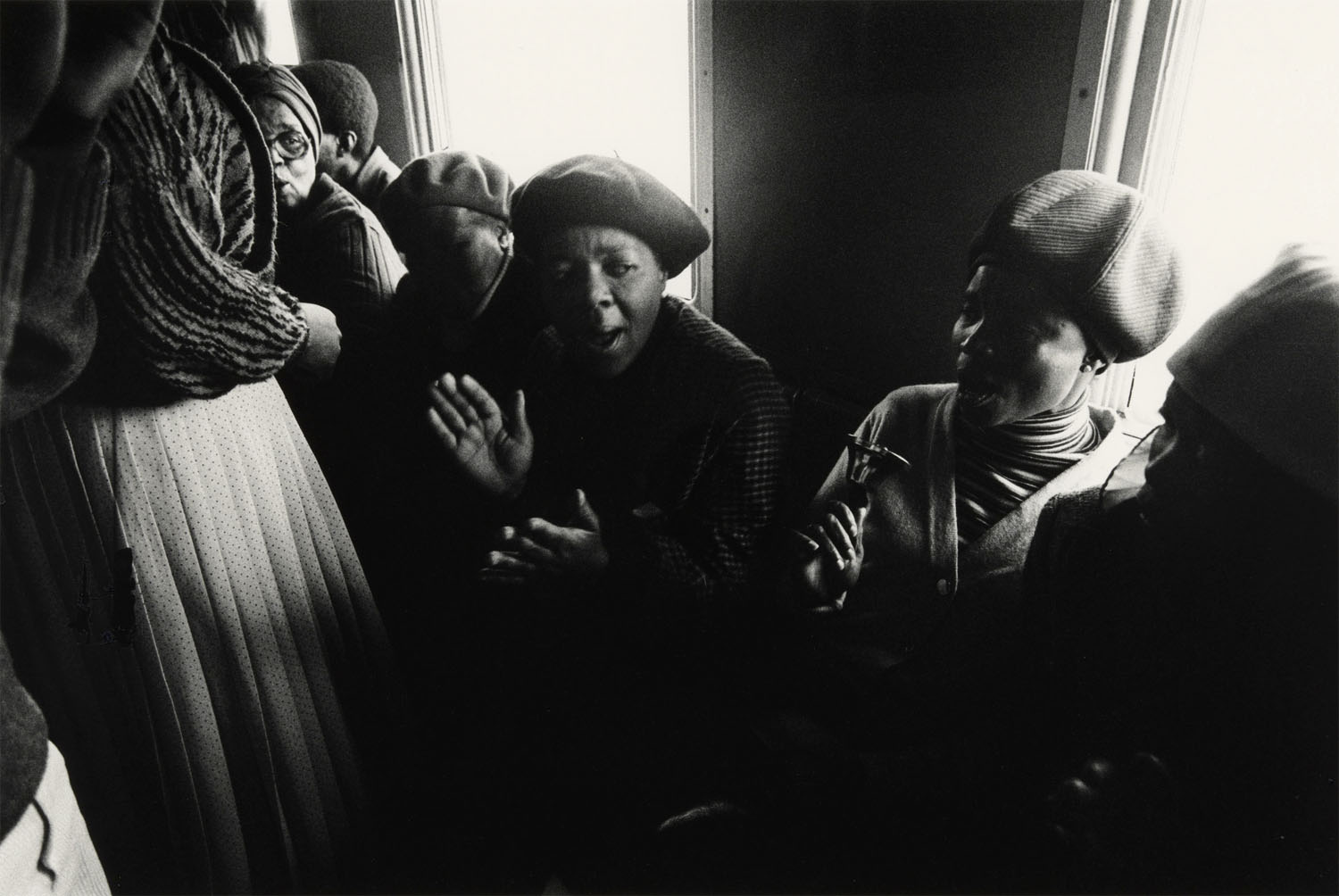
 

Santu Mofokeng (South African, b. 1956) 'Opening Song, Hand Clapping and Bells' 1986


Santu Mofokeng (South African, b. 1956)
Opening Song, Hand Clapping and Bells
1986
From the series Train Church
Gelatin silver print
Image: 19 x 28.5cm


Minor White (American, 1908-1976) 'The Sound of One Hand Clapping, Pultneyville, New York' 1957


Minor White (American, 1908-1976)
The Sound of One Hand Clapping, Pultneyville, New York
1957
Gelatin silver print
24.4 x 25.1cm (9 5/8 x 9 7/8 in.)
Purchased in part with funds provided by Daniel Greenberg, Susan Steinhauser, and the Greenberg Foundation
Reproduced with permission of the Minor White Archive, Princeton University Art Museum
© Trustees of Princeton University


Eugène Atget (French, 1857-1927) 'Street diversions (or B organ)' 1898-1899


Eugène Atget (French, 1857-1927)
Street diversions (or B organ)
1898-1899
Albumen print


Walker Evans. 'Church Organ and Pews' 1936


Walker Evans (Walker Evans, 1903-1975)
Church Organ and Pews
1936
Gelatin silver print


Robert Frank. 'Bar, Las Vegas' 1955-1956


Robert Frank (Swiss-American, 1924-2019)
Bar, Las Vegas
1955-1956
Gelatin silver print


Robert Frank (Swiss-American, 1924-2019) 'Political Rally, Chicago' 1956


Robert Frank (Swiss-American, 1924-2019)
Political Rally, Chicago
1956
Gelatin silver print
35.1 x 23.7cm (13 13/16 x 9 5/16 in)


André Kertész (Hungarian, 1894-1985) 'Cellist' 1916


André Kertész (Hungarian, 1894-1985)
Cellist
1916
Gelatin silver print


André Kertész (Hungarian, 1894-1985) 'Violoniste ambulant, Abony' (Traveling violinist, Abony) 1921


André Kertész (Hungarian, 1894-1985)
Violoniste ambulant, Abony
Traveling violinist, Abony
1921
Gelatin silver print


André Kertész (Hungarian, 1894-1985) 'Eiffel Tower, Summer Storm' 1927


André Kertész (Hungarian, 1894-1985)
Eiffel Tower, Summer Storm
1927
Gelatin silver print


Platt D Babbitt. 'Niagara Falls from the American side' whole plate daguerreotype c.1855


Platt D Babbitt (American, 1822-1879)
Niagara Falls from the American side
c. 1855
Whole plate daguerreotype


Platt D. Babbitt. '[Scene at Niagara Falls]' c. 1855


Platt D Babbitt (American, 1822-1879)
[Scene at Niagara Falls]
c. 1855
Daguerreotype
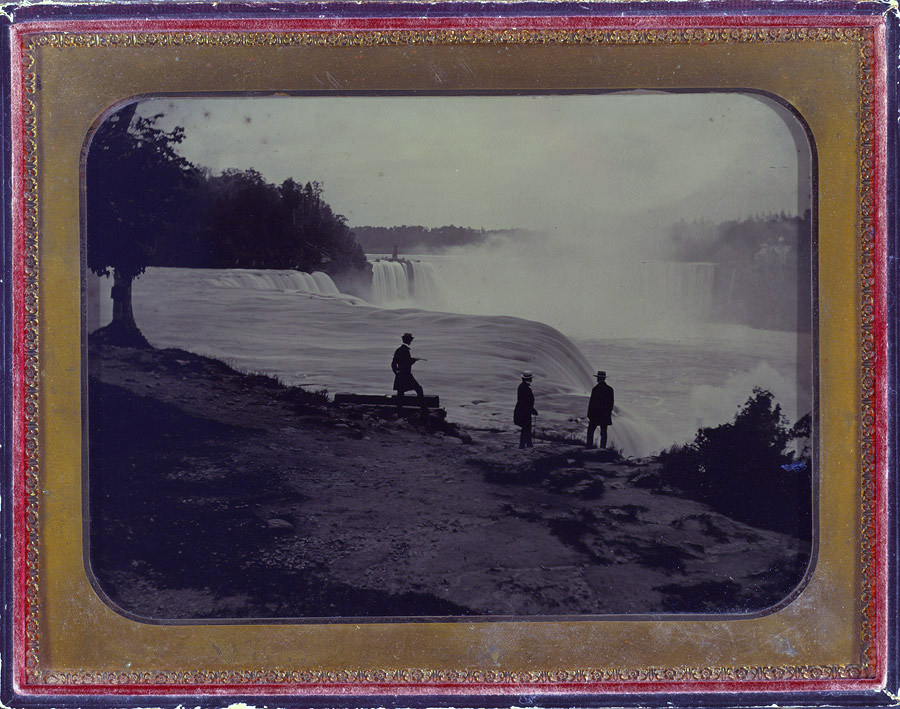
 

Platt D. Babbitt. 'Niagara Falls', c. 1860


Platt D Babbitt (American, 1822-1879)
Niagara Falls
c. 1860
Daguerreotype


Henri Huet (French, 1927-1971)/AP ''Life' magazine photographer Larry Burrows (far left) struggles through elephant grass and the rotor wash of an American evacuation helicopter as he helps GIs carry a wounded soldier on a stretcher from the jungle to the chopper in Mimot, Cambodia' 4 May 1970


Henri Huet (French, 1927-1971)/AP
‘Life’ magazine photographer Larry Burrows (far left) struggles through elephant grass and the rotor wash of an American evacuation helicopter as he helps GIs carry a wounded soldier on a stretcher from the jungle to the chopper in Mimot, Cambodia
4 May 1970
Gelatin silver print


Henri Huet, French (1927-1971) 'The body of an American paratrooper killed in action in the jungle near the Cambodian border is raised up to an evacuation helicopter, Vietnam' 1966


Henri Huet (French, 1927-1971)
The body of an American paratrooper killed in action in the jungle near the Cambodian border is raised up to an evacuation helicopter, Vietnam
1966
Gelatin silver print


James Barnor (Ghanian, b. 1929) 'E. K. Nyame, the legendary Ghanaian musician, photographed for a record cover, Accra' c. 1975


James Barnor (Ghanian, b. 1929)
E. K. Nyame, the legendary Ghanaian musician, photographed for a record cover, Accra
c. 1975
Gelatin silver print


Roger Scott (Australian, b. 1944) 'Ghost train' 1972


Roger Scott (Australian, b. 1944)
Ghost train
1972
Gelatin silver print
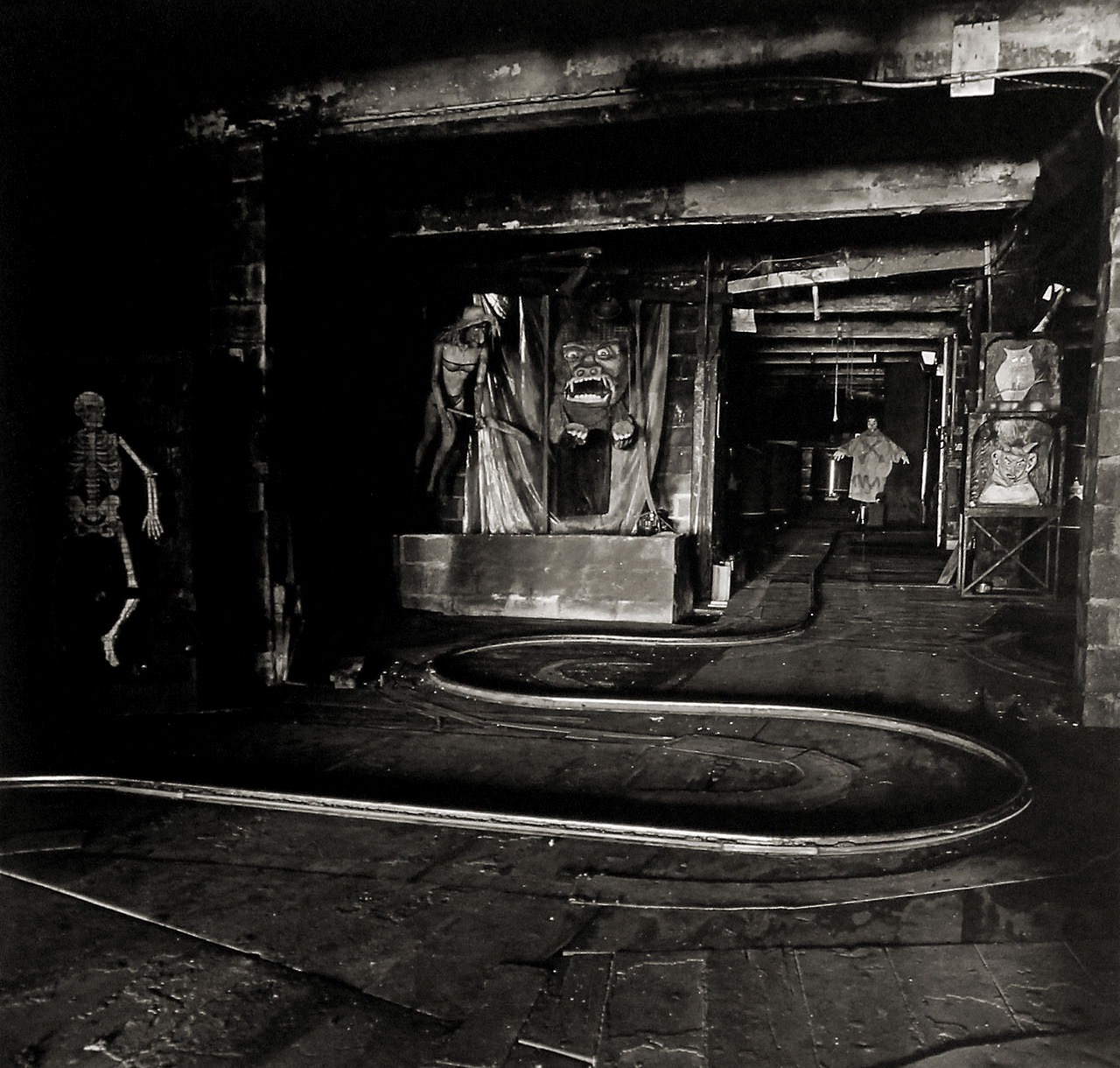
 

Diane Arbus. ‘The House of Horrors’ 1961


Diane Arbus (American, 1923-1971)
The House of Horrors
1961
Gelatin silver print


Diane Arbus (American, 1923-1971) 'A child crying, N.J.' 1967


Diane Arbus (American, 1923-1971)
A child crying, N.J.
1967
Gelatin silver print


Stephen Shore (American, b. 1947) 'Lookout Hotel, Ogunquit, Maine, July 16, 1974'


Stephen Shore (American, b. 1947)
Lookout Hotel, Ogunquit, Maine, July 16, 1974
1974
Chromogenic colour print, printed 2013
17 × 21 3/4 in. (43.2 × 55.2cm)
The Museum of Modern Art, New York
Acquired through the generosity of an anonymous donor
© 2017 Stephen Shore


Gordon Parks (American, 1912-2006) 'Shooting Victim in Cook County Morgue, Chicago, Illinois' 1957


Gordon Parks (American, 1912-2006)
Shooting Victim in Cook County Morgue, Chicago, Illinois
1957
Pigmented inkjet print, printed 2019
11 7/8 × 17 15/16″ (30.1 × 45.6cm)
The Museum of Modern Art, New York
The Family of Man Fund
© 2021 Gordon Parks Foundation
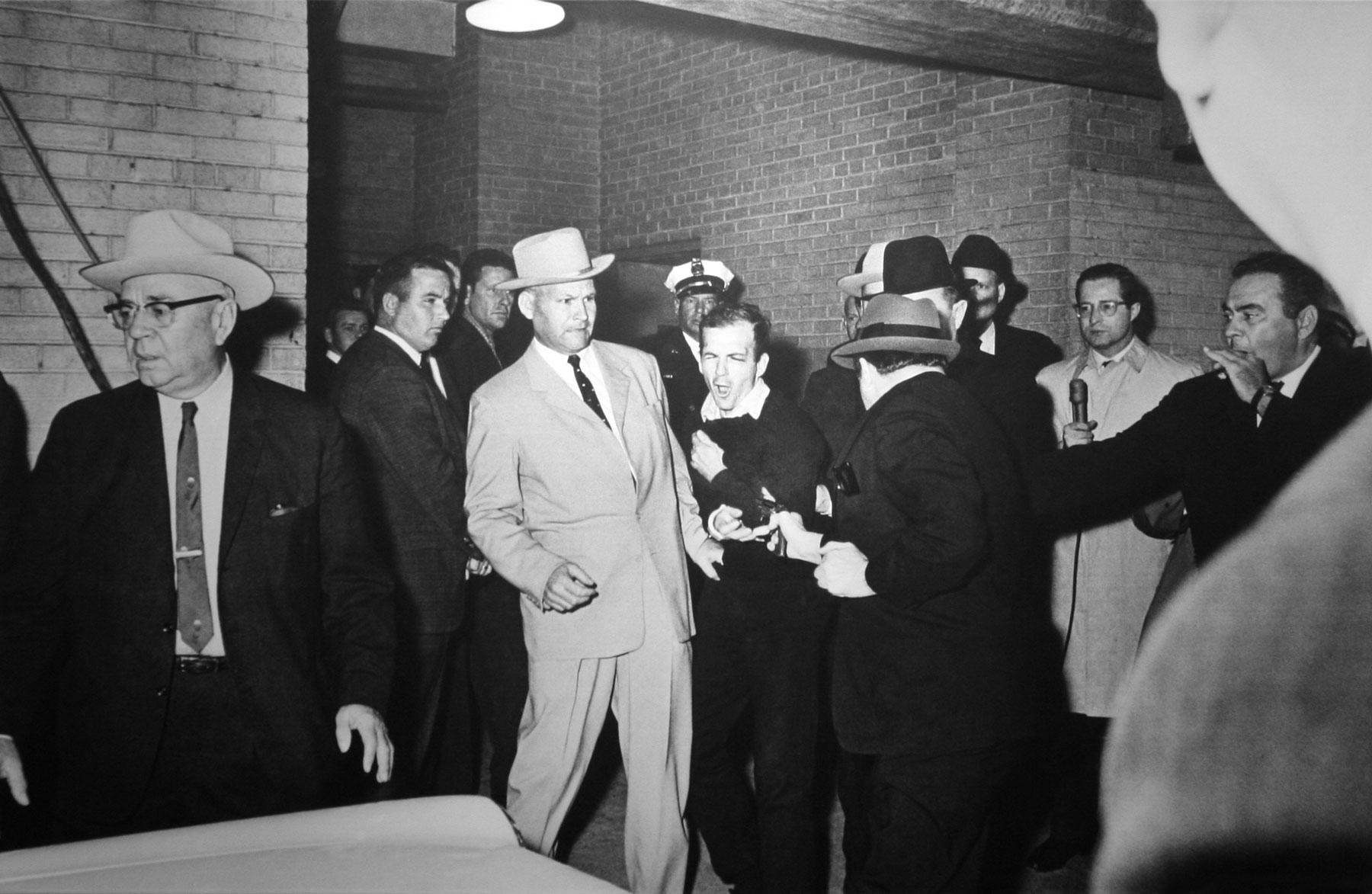
 

Robert H. Jackson (American, b. 1934) 'FATAL BULLET HITS OSWALD. Jack Ruby fires bullet point blank into the body of Lee Harvey Oswald at Dallas Police Station. Oswald grimaces in agony' November 24, 1963


Robert H. Jackson (American, b. 1934)
FATAL BULLET HITS OSWALD. Jack Ruby fires bullet point blank into the body of Lee Harvey Oswald at Dallas Police Station. Oswald grimaces in agony
November 24, 1963
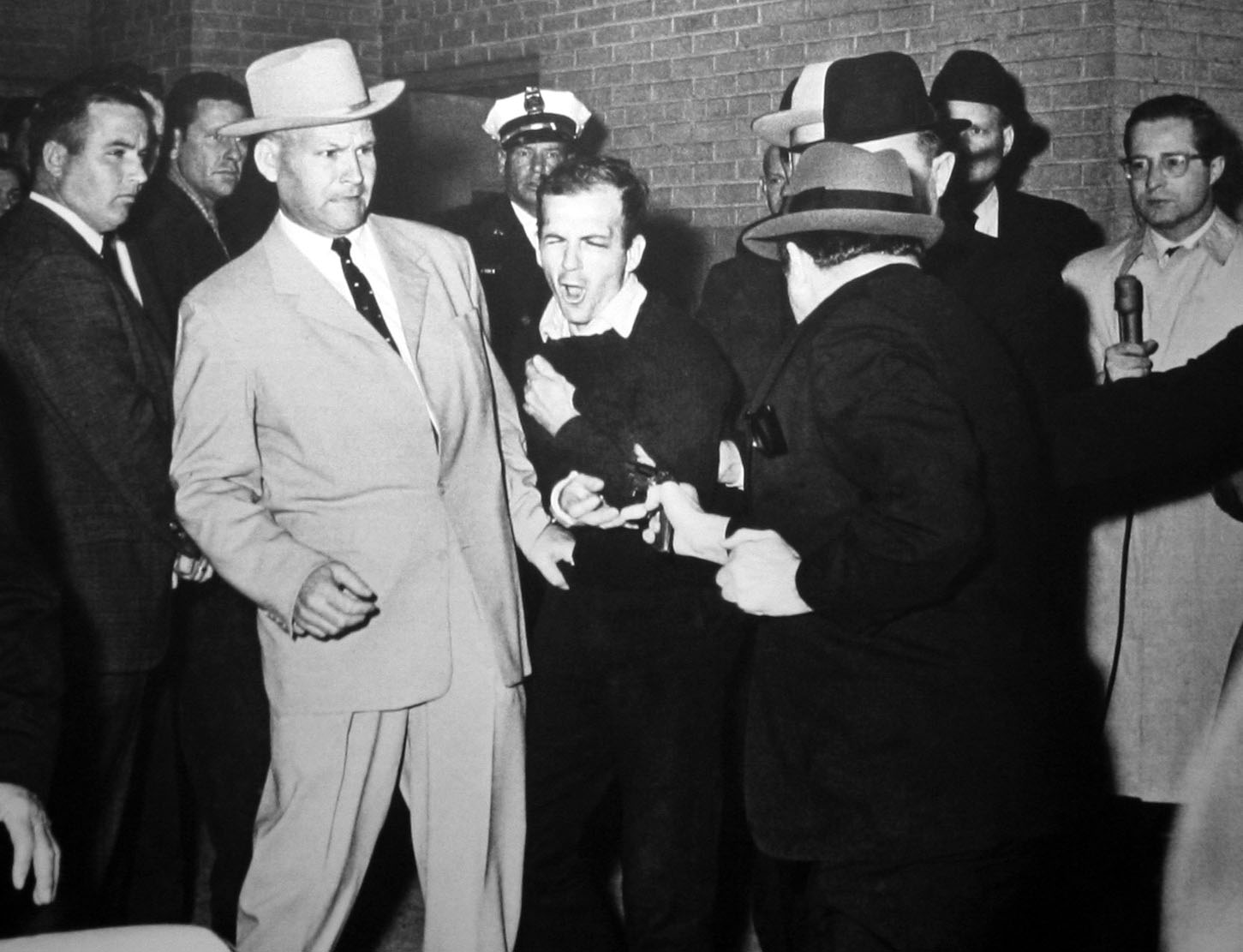
 

Robert H. Jackson (American, b. 1934) 'Jack Ruby (52) shoots Lee Harvey Oswald (24) 24 November 1963' 1963


Robert H. Jackson (American, b. 1934)
Jack Ruby (52) shoots Lee Harvey Oswald (24)
24 November 1963


Originally published in the Dallas Times Herald, November 25, 1963. Cropped from the source image to the portion that was published in 1963. Winner of the 1964 Pulitzer Prize for Photography.
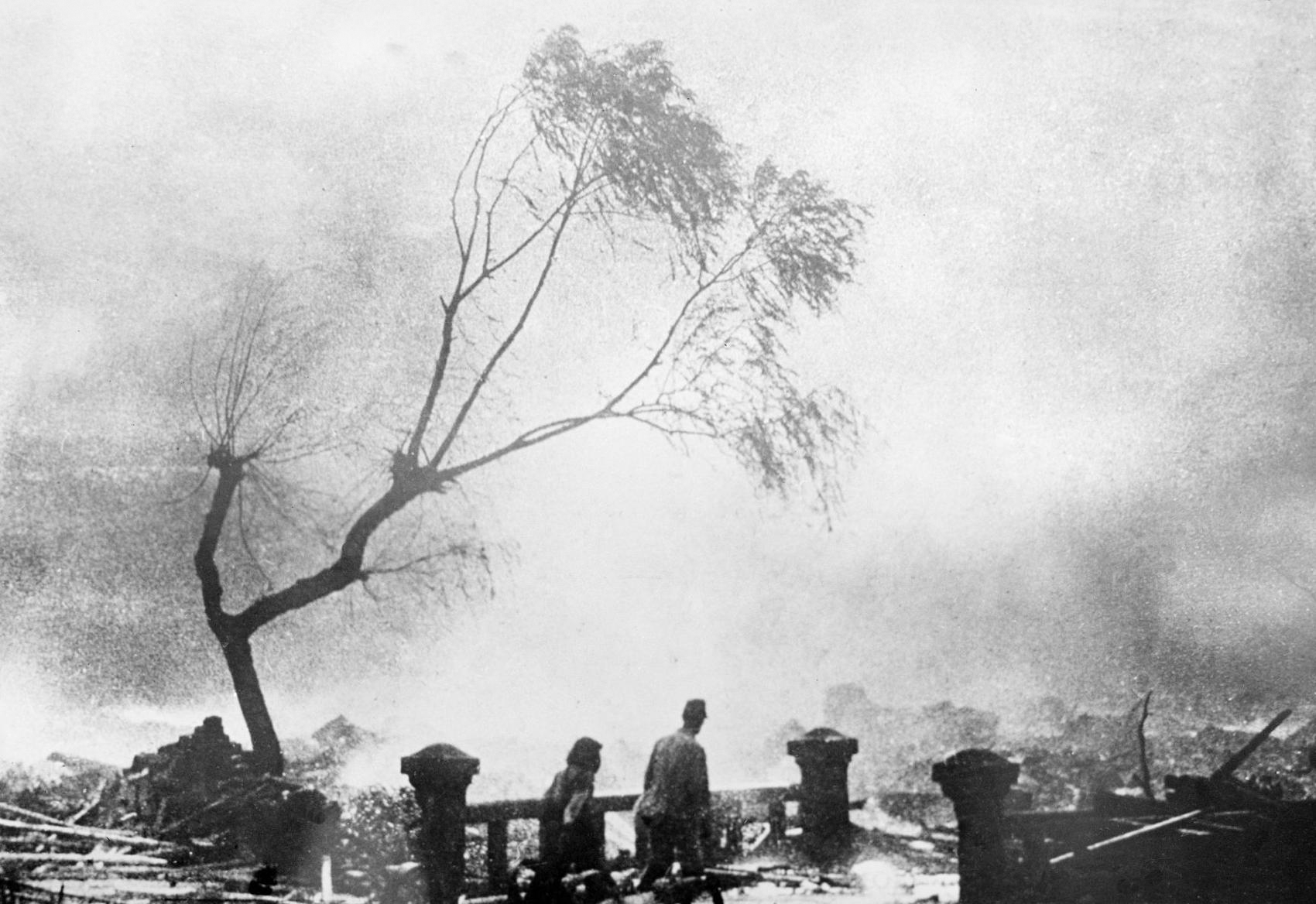
 

Unknown photographer. 'Survivors of the atomic bomb attack of Nagasaki walk through the destruction as fire rages in the background Aug. 9 1945'


Unknown photographer
Survivors of the atomic bomb attack of Nagasaki walk through the destruction as fire rages in the background Aug. 9 1945
1945


John Williams (1933- 2016) 'Open Air Shower, Bronte Beach' 1964


John Williams (Australian, 1933-2016)
Open Air Shower, Bronte Beach
1964
Gelatin silver print


Dorothea Lange (American, 1895-1965) 'Man Stepping from Cable Car, San Francisco' 1956


Dorothea Lange (American, 1895-1965)
Man Stepping from Cable Car, San Francisco
1956
Gelatin silver print
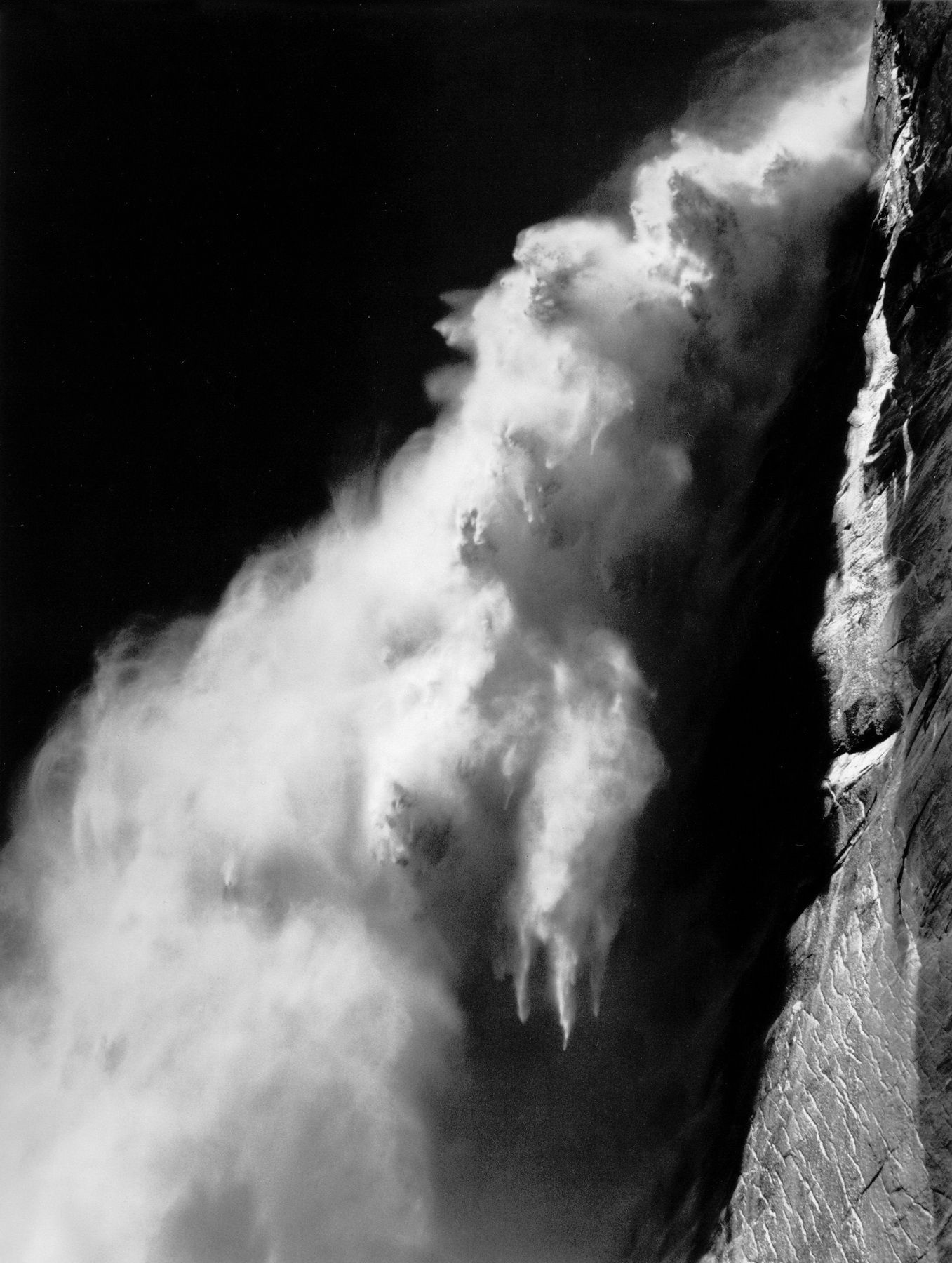
 

Ansel Adams (American, 1902-1984) 'Upper Yosemite Fall' 1946


Ansel Adams (American, 1902-1984)
Upper Yosemite Fall
1946
Gelatin silver print


Ansel Adams (American, 1902-1984) 'Nevada Fall Profile' 1946


Ansel Adams (American, 1902-1984)
Nevada Fall Profile
1946
Gelatin silver print


Kaho Yu (Australian) 'Untitled' from the series 'Infinitesimal Residual Vibration of An Unknown Sound' 2009-2011


Kaho Yu (Australian)
Untitled from the series Infinitesimal Residual Vibration of An Unknown Sound
2009-2011
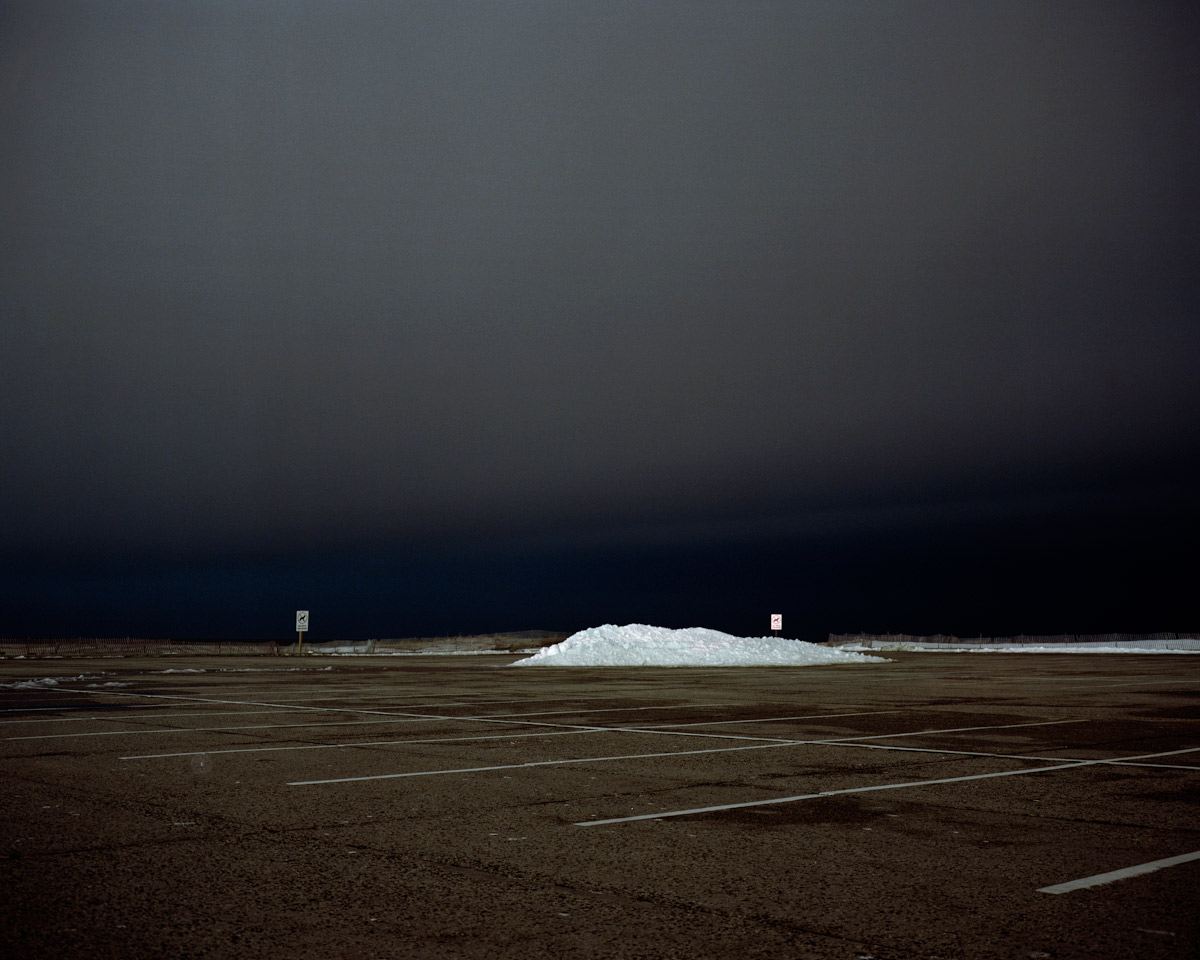
 

Kaho Yu (Australian) 'Untitled' from the series 'Infinitesimal Residual Vibration of An Unknown Sound' 2009-2011


Kaho Yu (Australian)
Untitled from the series Infinitesimal Residual Vibration of An Unknown Sound
2009-2011


The photographs in this series were taken during a period when I was feeling existentially bored. Instead of distracting myself with activities and accumulating new sensations, I decided to “look” at boredom, to study, and perhaps to understand it. The most natural strategy was to observe the immediate environments where my daily activities take place – train stations, cubicles, copy machines room, etc. I carried a medium format camera on a tripod and spent the odd hours wandering alone through those familiar spaces.

My “study” did not lead me to any revelation or answer. Instead, I found myself spending a lot of time waiting in a long silence, between the opening and the closing of the camera shutter.

Charles Babbage, a scientist in 1837, postulated that every voice and sound, once imparted on the air particles, does not dissipate but remains in the diffused movements of all the particles in the atmosphere. Thus, there might one day come a person equipped with the right mathematical knowledge of these motions who will be able to capture the infinitesimal vibrations and to trace back to their ultimate source.

Taking a long exposure, letting the light slowly accumulate an image on the celluloid surface, to me, is not unlike a sound seeker searching in the air particles, for the tiny residual movements that have been conveyed through the history of mankind, from the beginning of time.

Kaho Yu artist statement


… i listen to the wind that obliterates my traces


… i listen to the wind that obliterates my traces brings together a collection of early photographs related to music, a group of 78rpm recordings, and short excerpts from various literary sources that are contemporary with the sound and images. It is a somewhat intuitive gathering, culled from artist Steve Roden’s collection of thousands of vernacular photographs related to music, sound, and listening. The subjects range from the PT Barnum-esque Professor McRea – “Ontario’s Musical Wonder” (pictured with his complex sculptural one man band contraption) – to anonymous African-American guitar players and images of early phonographs. The images range from professional portraits to ethereal, accidental, double exposures – and include a range of photographic print processes, such as tintypes, ambrotypes, cdvs, cabinet cards, real photo postcards, albumen prints, and turn-of-the-century snapshots.

The two CDs display a variety of recordings, including one-off amateur recordings, regular commercial releases, and early sound effects records. there is no narrative structure to the book, but the collision of literary quotes (Hamsun, Lagarkvist, Wordsworth, Nabokov, etc.). Recordings and images conspire towards a consistent mood that is anchored by the book’s title, which binds such disparate things as an early recording of an American cowboy ballad, a poem by a Swedish Nobel laureate, a recording of crickets created artificially, and an image of an itinerant anonymous woman sitting in a field, playing a guitar. The book also contains an essay by Roden.

Text from the Dust to Digital website Nd [Online] Cited 23/07/2022. Published by Dust-to-Digital, 2011. The book is out of stock but available on Abe.com website.


'... i listen to the wind that obliterates my traces' book cover (2011)


… i listen to the wind that obliterates my traces book cover (2011)


The J. Paul Getty Museum
1200 Getty Center Drive
Los Angeles, California 90049

Opening hours:
Daily 10am – 5pm

The J. Paul Getty Museum website

LIKE ART BLACK ON FACEBOOK

Back to top

Exhibition: ‘Diane Arbus’ at Jeu de Paume, Paris

Exhibition dates: 18th October 18 2011 – 5th February 2012


Diane Arbus, 'Child with a toy hand grenade in Central Park, N.Y.C. 1962' 1962


Diane Arbus (American, 1923-1971)
Child with a toy hand grenade in Central Park, N.Y.C. 1962
1962
Gelatin silver print
© The Estate of Diane Arbus


“There are and have been and will be an infinite number of things on earth. Individuals all different, all wanting different things, all knowing different things, all loving different things, all looking different. Everything that has been on earth has been different from any other thing. That is what I love: the differentness, the uniqueness of all things and the importance of life… I see something that seems wonderful; I see the divineness in ordinary things.”


Diane Arbus. Paper on Plato, senior English seminar, Fieldston School, November 28, 1939


“I want to photograph the considerable ceremonies of our present because we tend while living here and now to perceive only what is random and barren and formless about it. While we regret that the present is not like the past and despair of its ever becoming the future, its innumerable inscrutable habits lie in wait for their meaning. I want to gather them, like somebody’s grandmother putting up preserves, because they will have been so beautiful.

There are the Ceremonies of Celebration (the Pageants, the Festivals, the Feasts, the Conventions) and the Ceremonies of Competition (Contests, Games, Sports), the Ceremonies of Buying and Selling, of Gambling, of the Law and the Show; the Ceremonies of Fame in which the Winners Win and the Lucky are Chosen or Family Ceremonies or Gatherings (the Schools, the Clubs, the Meetings). Then they are Ceremonial Places (The Beauty Parlor, The Funeral Parlor or, simply The Parlor) and Ceremonial Costumes (what waitresses wear, or Wrestlers), Ceremonies of the Rich, like the Dog Show, and of the Middle Class, like the Bridge Game. Or, for example: the Dancing Lesson, the Graduation, the Testimonial Dinner, the Séance, the Gymnasium and the Picnic, and perhaps the Waiting Room, the Factory, the Masquerade, the Rehearsal, the Initiation, the Hotel Lobby and the Birthday Party. The etcetera.

I will write whatever is necessary for the further description and elucidation of these Rites and I will go wherever I can to find them.

These are our symptoms and our monuments. I want simply to save them, for what is ceremonious and curious and commonplace will be legendary.”


Diane Arbus. “American Rites, Manners and Customs,” Plan for a Photographic Project, Guggenheim proposal


A fabulous posting, with memorable thoughts and photographs! These archetypal images have become deeply embedded in the collective conscience where conscience is pre-eminently the organ of sentiments and representations. The snap, snap, snap of the shutter evinces the flaws of human nature, reveals the presence of a quality or feeling to which we can all relate. As Arbus states, the subject of the picture is always more important than the picture. And more complicated. This is why these photographs always capture our attention because we become, we inhabit, we are the subject. They are the flaw in us all. They are legend.

Dr Marcus Bunyan


Many thankx to Jeu de Paume for allowing me to publish the photographs in the posting. Please click on the photographs for a larger version of the image.


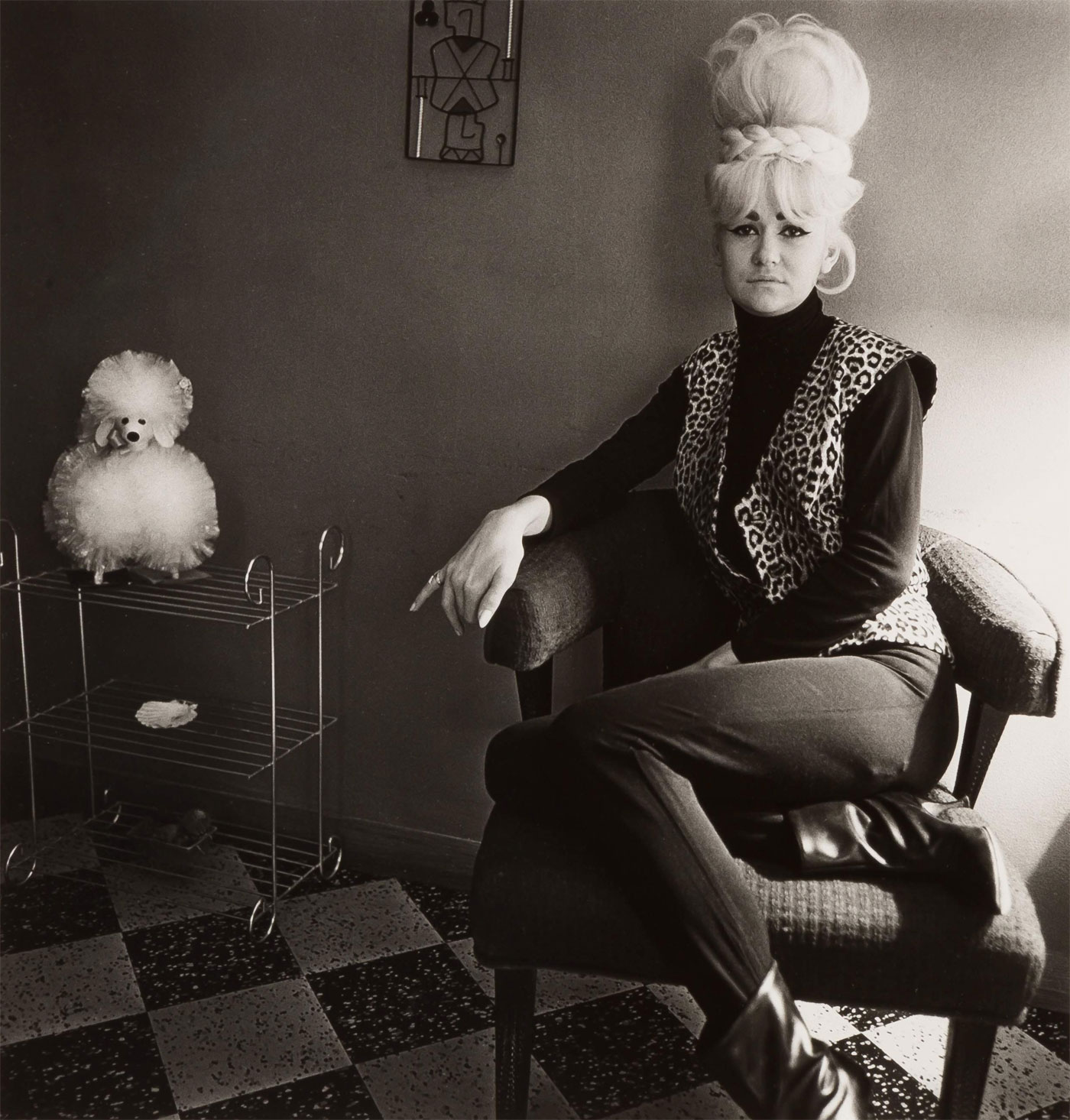
Diane Arbus (American, 1923-1971) 'Lady Bartender at Home with a Souvenir Dog, New Orleans, La.' 1964


Diane Arbus (American, 1923-1971)
Lady Bartender at Home with a Souvenir Dog, New Orleans, La.
1964
Gelatin silver print
© The Estate of Diane Arbus


Diane Arbus (American, 1923-1971) 'A young Brooklyn family going for a Sunday outing, NYC., 1966' 1966


Diane Arbus (American, 1923-1971)
A young Brooklyn family going for a Sunday outing, NYC., 1966
1966
Gelatin silver print
© The Estate of Diane Arbus


Diane Arbus (American, 1923-1971) 'Two Ladies at the Automat, New York City' 1966


Diane Arbus (American, 1923-1971)
Two Ladies at the Automat, New York City
1966
Gelatin silver print
© The Estate of Diane Arbus


Diane Arbus. 'Identical twins, Roselle, N.J. 1967' 1967


Diane Arbus (American, 1923-1971)
Identical twins, Roselle, N.J. 1967
1967
Gelatin silver print
© The Estate of Diane Arbus


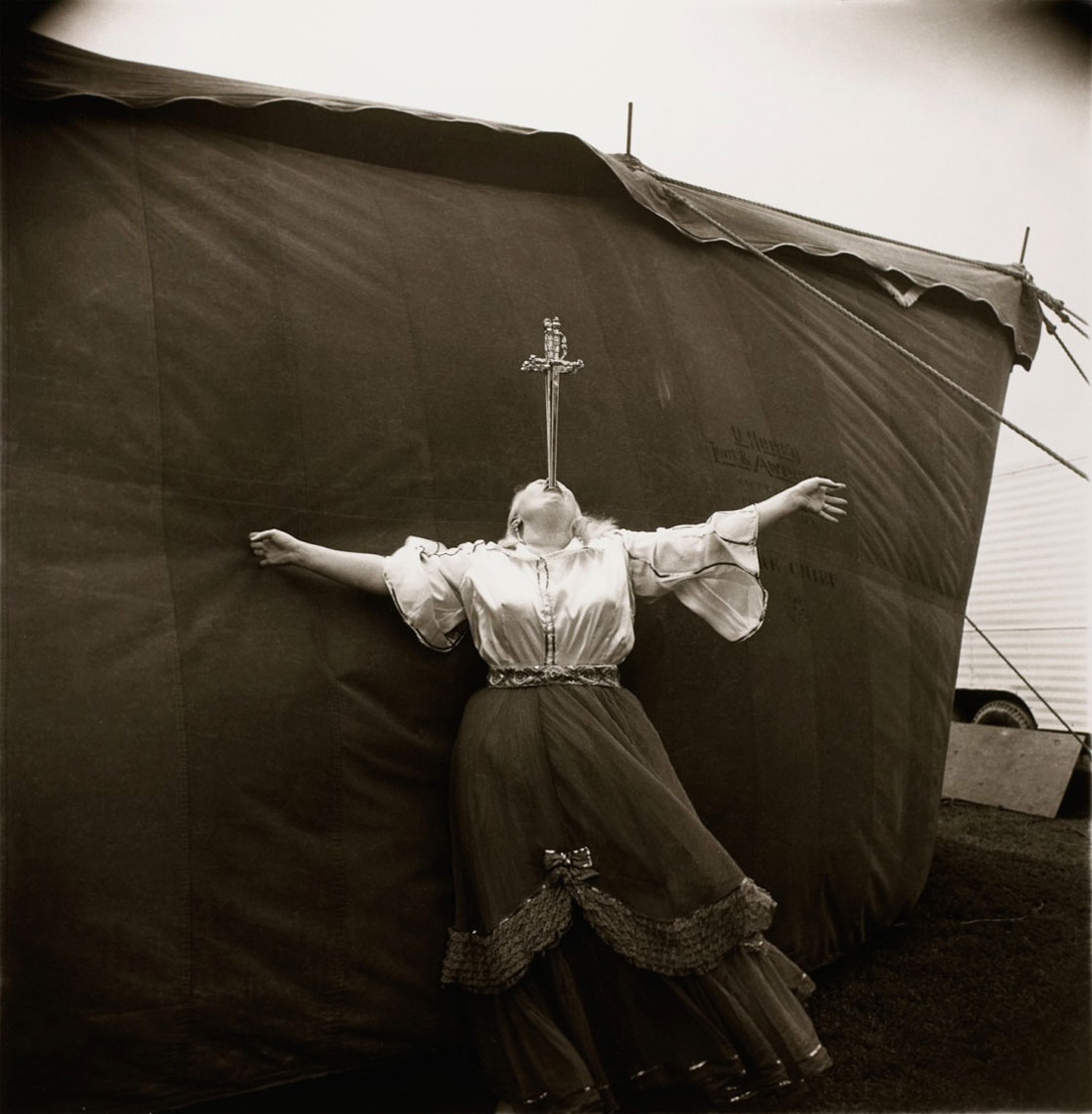
Diane Arbus (American, 1923-1971) 'Albino sword swallower at a carnival, Md' 1970


Diane Arbus (American, 1923-1971)
Albino sword swallower at a carnival, Md
1970
Gelatin silver print
© The Estate of Diane Arbus


On Photographs

“They are the proof that something was there and no longer is. Like a stain. And the stillness of them is boggling. You can turn away but when you come back they’ll still be there looking at you.”


Diane Arbus in response to request for a brief statement about photographs, March 15, 1971


Diane Arbus (New York, 1923-1971) revolutionised the art she practiced. Her bold subject matter and photographic approach produced a body of work that is often shocking in its purity, in its steadfast celebration of things as they are. Her gift for rendering strange those things we consider most familiar, and for uncovering the familiar within the exotic, enlarges our understanding of ourselves.

Arbus found most of her subjects in New York City, a place that she explored as both a known geography and as a foreign land, photographing people she discovered during the 1950s and 1960s. She was committed to photography as a medium that tangles with the facts. Her contemporary anthropology – portraits of couples, children, carnival performers, nudists, middle-class families, transvestites, zealots, eccentrics, and celebrities – stands as an allegory of the human experience, an exploration of the relationship between appearance and identity, illusion and belief, theatre and reality.

In this first major retrospective in France, Jeu de Paume presents a selection of two hundred photographs that affords an opportunity to explore the origins, scope, and aspirations of a wholly original force in photography. It includes all of the artist’s iconic photographs as well as many that have never been publicly exhibited. Even the earliest examples of her work demonstrate Arbus’s distinctive sensibility through the expression on a face, someone’s posture, the character of the light, and the personal implications of objects in a room or landscape. These elements, animated by the singular relationship between the photographer and her subject, conspire to implicate the viewer with the force of a personal encounter.

Biography

Diane Arbus was born in New York City on March 14, 1923, and attended the Ethical Culture and Fieldston Schools. At the age of eighteen she married Allan Arbus. Although she first started taking pictures in the early 1940s and studied photography with Alexey Brodovitch in 1954, it was not until 1955-1957, while enrolled in courses taught by Lisette Model, that she began to seriously pursue the work for which she has come to be known.

Her first published photographs appeared in Esquire in 1960 under the title The Vertical Journey. From that point on she continued to work intermittently as a free-lance photographer for Esquire, Harper’s Bazaar, Show, The London Sunday Times, and a number of other magazines, doing portraits on assignment as well as photographic essays, for several of which she wrote accompanying articles.

During the 1950s, like most of her contemporaries, she had been using a 35mm camera, but in 1962 she began working with a 6×6 Rolleiflex. She once said, in accounting for the shift, that she had grown impatient with the grain and wanted to be able to decipher in her pictures the actual texture of things. The 6×6 format contributed to the refinement of a deceptively simple, formal, classical style that has since been recognised as one of the distinctive features of her work.

She received Guggenheim Fellowships in 1963 and 1966 for projects on “American Rites, Manners and Customs” and spent several summers during that period traveling across the United States, photographing contests, festivals, public and private gatherings, people in the costumes of their professions or avocations, the hotel lobbies, dressing rooms and living rooms she had described as part of “the considerable ceremonies of our present.” “These are our symptoms and our monuments,” she wrote in her original application. “I want simply to save them, for what is ceremonious and curious and commonplace will be legendary.”

The photographs she produced in those years attracted a great deal of attention when a selected group of them were exhibited, along with the work of two other photographers, in the 1967 “New Documents” show at the Museum of Modern Art. Nonetheless, although several institutions subsequently purchased examples of her work for their permanent collections, her photographs appeared in only two other major exhibitions during her lifetime, both of them group shows.

In the late 1960s she taught photography courses at Parsons School of Design, the Rhode Island School of Design and Cooper Union and in 1971 gave a master class at Westbeth, the artists cooperative in New York City where she then lived. During the same period she initiated the concept and did the basic research for the Museum of Modern Art’s 1973 exhibition on news photography, “From the Picture Press.”

She made a portfolio of ten photographs in 1970, printed, signed and annotated by her, which was to be the first of a series of limited editions of her work. She committed suicide on July 26, 1971 at the age of forty-eight. The following year the ten photographs in her portfolio became the first work of an American photographer to be exhibited at the Venice Biennale.

In the course of a career that may be said to have lasted little more than fifteen years, she produced a body of work whose style and content have secured her a place as one of the most significant and influential photographers of our time. The major retrospective mounted by the Museum of Modern Art in 1972 was attended by more than a quarter of a million people in New York before it began its tour of the United States and Canada. The Aperture monograph Diane Arbus, published in conjunction with the show has sold over 300,000 copies. Beginning in 2003, Diane Arbus Revelations, an international retrospective organised by The San Francisco Museum of Modern Art travelled to museums throughout the United States and Europe between 2003 and 2006. Major exhibitions devoted exclusively to her work have toured much of the world including, Australia, Germany, Italy, Japan, the Netherlands, New Zealand, Spain, and the United Kingdom.

Press release from the Jeu de Paume website


Diane Arbus (American, 1923-1971) 'Retired man and his wife at home in a nudist camp one morning, N.J.' 1963


Diane Arbus (American, 1923-1971)
Retired man and his wife at home in a nudist camp one morning, N.J.
1963
Gelatin silver print
© The Estate of Diane Arbus


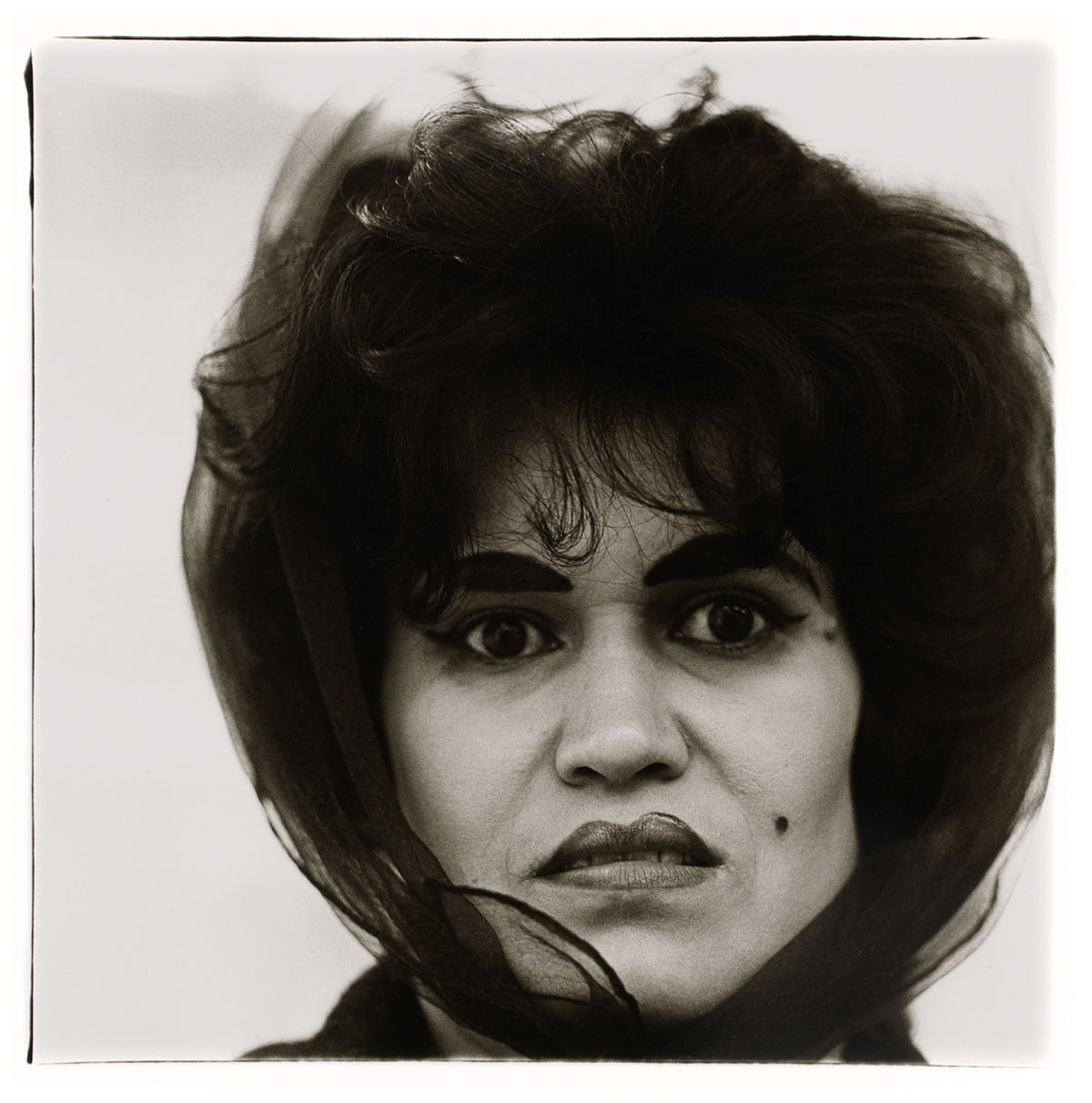
Diane Arbus (American, 1923-1971) 'Puerto Rican Woman with a Beauty Mark' 1965


Diane Arbus (American, 1923-1971)
Puerto Rican Woman with a Beauty Mark
1965
Gelatin silver print
© The Estate of Diane Arbus


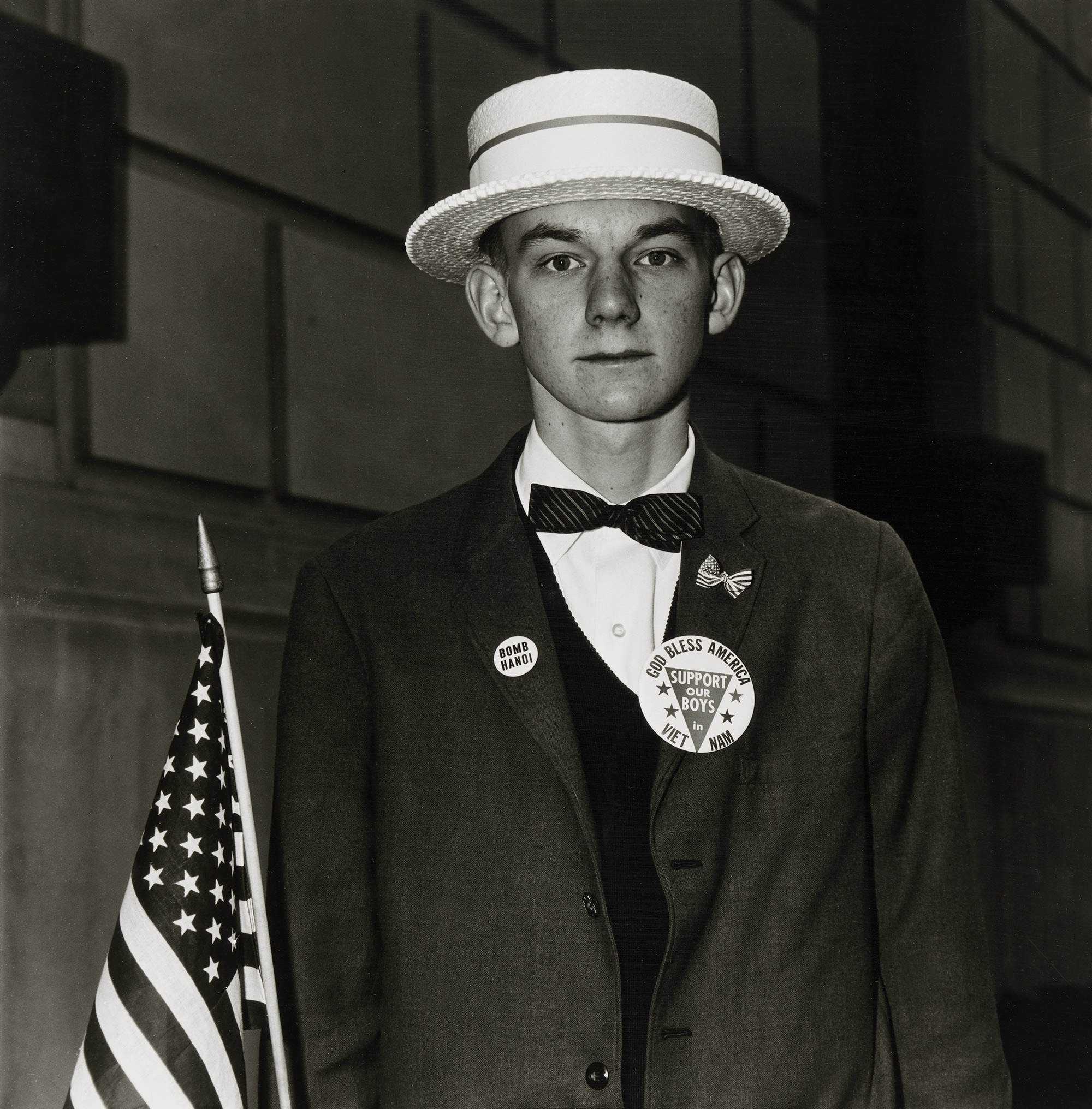
Diane Arbus. 'Boy with a straw hat waiting to march in a pro-war parade, N.Y.C. 1967' 1967


Diane Arbus (American, 1923-1971)
Boy with a straw hat waiting to march in a pro-war parade, N.Y.C. 1967
1967
Gelatin silver print
© The Estate of Diane Arbus


Diane Arbus (American, 1923-1971) 'A child crying, N.J.' 1967


Diane Arbus (American, 1923-1971)
A child crying, N.J.
1967
Gelatin silver print
© The Estate of Diane Arbus


Diane Arbus (American, 1923-1971) 'A Jewish giant at home with his parents in the Bronx, N.Y., 1970' 1970


Diane Arbus (American, 1923-1971)
A Jewish giant at home with his parents in the Bronx, N.Y., 1970
1970
Gelatin silver print
© The Estate of Diane Arbus


Diane Arbus. 'Untitled (6) 1970-71'


Diane Arbus (American, 1923-1971)
Untitled (6) 1970-71
1970-1971
Gelatin silver print
© The Estate of Diane Arbus


On Freaks

“There’s a quality of legend about freaks. Like a person in a fairy tale who stops you and demands that you answer a riddle. Most people go through life dreading they’ll go through a traumatic experience. Freaks were born with their trauma. They’ve already passed their test in life. They’re aristocrats.”

“If you’ve ever talked to somebody with two heads you know they know something you don’t.”

The Gap between Attention and Affect

“You see someone on the street and essentially what you notice about them is the flaw. It’s just extraordinary that we should have been given these peculiarities. And, not content with what we were given, we create a whole other set. Our whole guise is like giving a sign to the world to think of us in a certain way but there’s a point between what you want people to know about you and what you can’t help people knowing about you. And that has to do with what I’ve always called the gap between intention and effect. I mean if you scrutinise reality closely enough, if in some way you really, really get to it, it becomes fantastic.”

Other Thoughts

“The thing that’s important to know is that you never know. You’re always sort of feeling your way.”

“Nothing is ever the same as they said it was. It’s what I’ve never seen before that I recognise.”

“A photograph is a secret about a secret. The more it tells you the less you know.”

“For me the subject of the picture is always more important than the picture. And more complicated. I do have a feeling for the print but I don’t have a holy feeling for it. I really think what it is, is what it’s about. I mean it has to be of something. And what it’s of it always more remarkable than what it is.”

“I really believe there are things which nobody would see unless I photographed them.”


Diane Arbus


Diane Arbus (American, 1923-1971) 'Teenage couple on Hudson Street, N.Y.C. 1963' 1963


Diane Arbus (American, 1923-1971)
Teenage couple on Hudson Street, N.Y.C. 1963
1963
Gelatin silver print
© The Estate of Diane Arbus


Diane Arbus (American, 1923-1971) 'Xmas tree in a living room in Levittown, L.I. 1963' 1963


Diane Arbus (American, 1923-1971)
Xmas tree in a living room in Levittown, L.I. 1963
1963
Gelatin silver print
© The Estate of Diane Arbus


Diane Arbus (American, 1923-1971) 'A young man in curlers at home on West 20th Street, N.Y.C. 1966' 1966


Diane Arbus (American, 1923-1971)
A young man in curlers at home on West 20th Street, N.Y.C. 1966
1966
Gelatin silver print
© The Estate of Diane Arbus


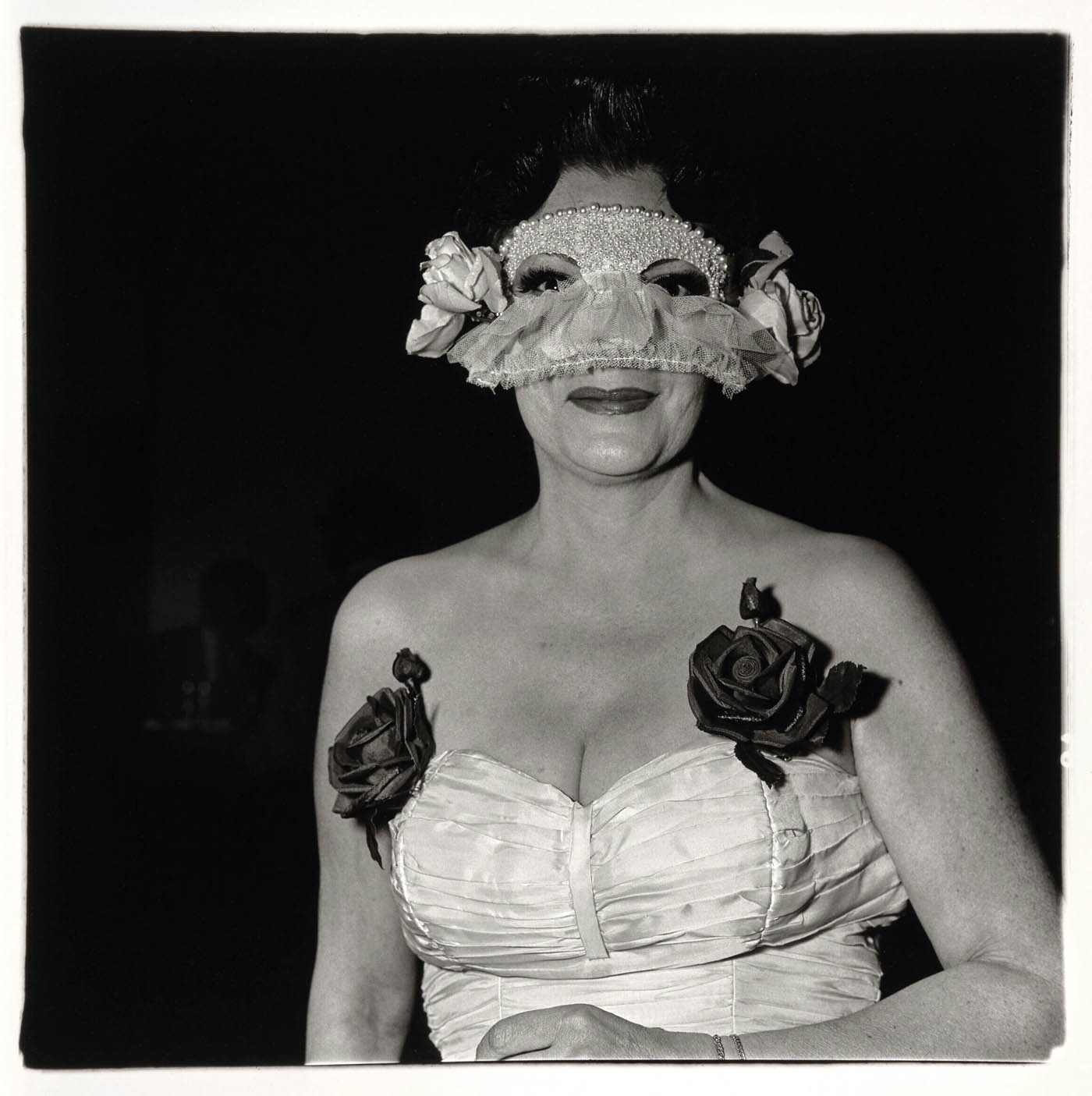
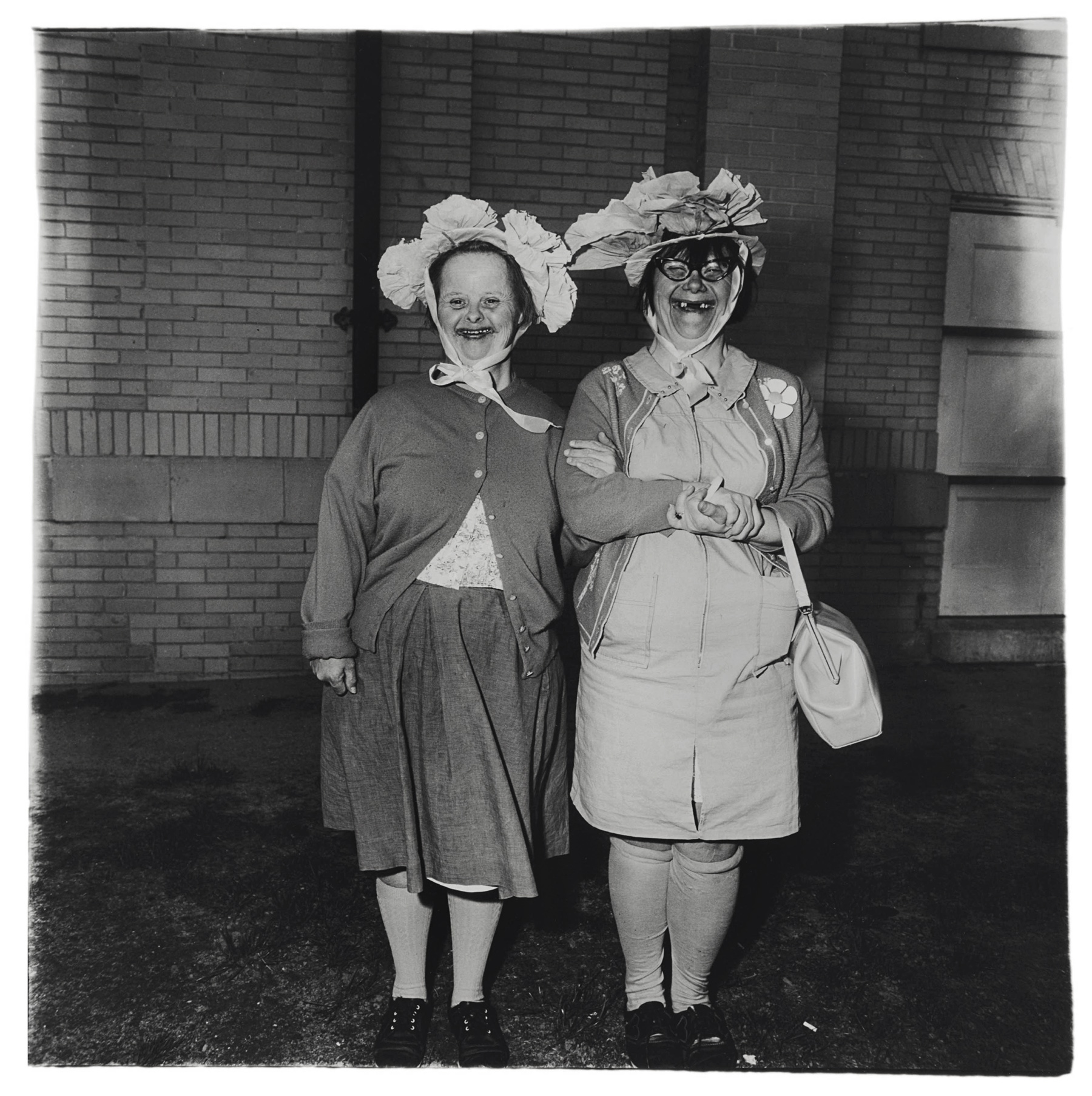
Diane Arbus (American, 1923-1971) 'Lady at a Masked Ball with Two Roses on Her Dress, NYC' 1967


Diane Arbus (American, 1923-1971)
Lady at a Masked Ball with Two Roses on Her Dress, NYC
1967
Gelatin silver print
© The Estate of Diane Arbus


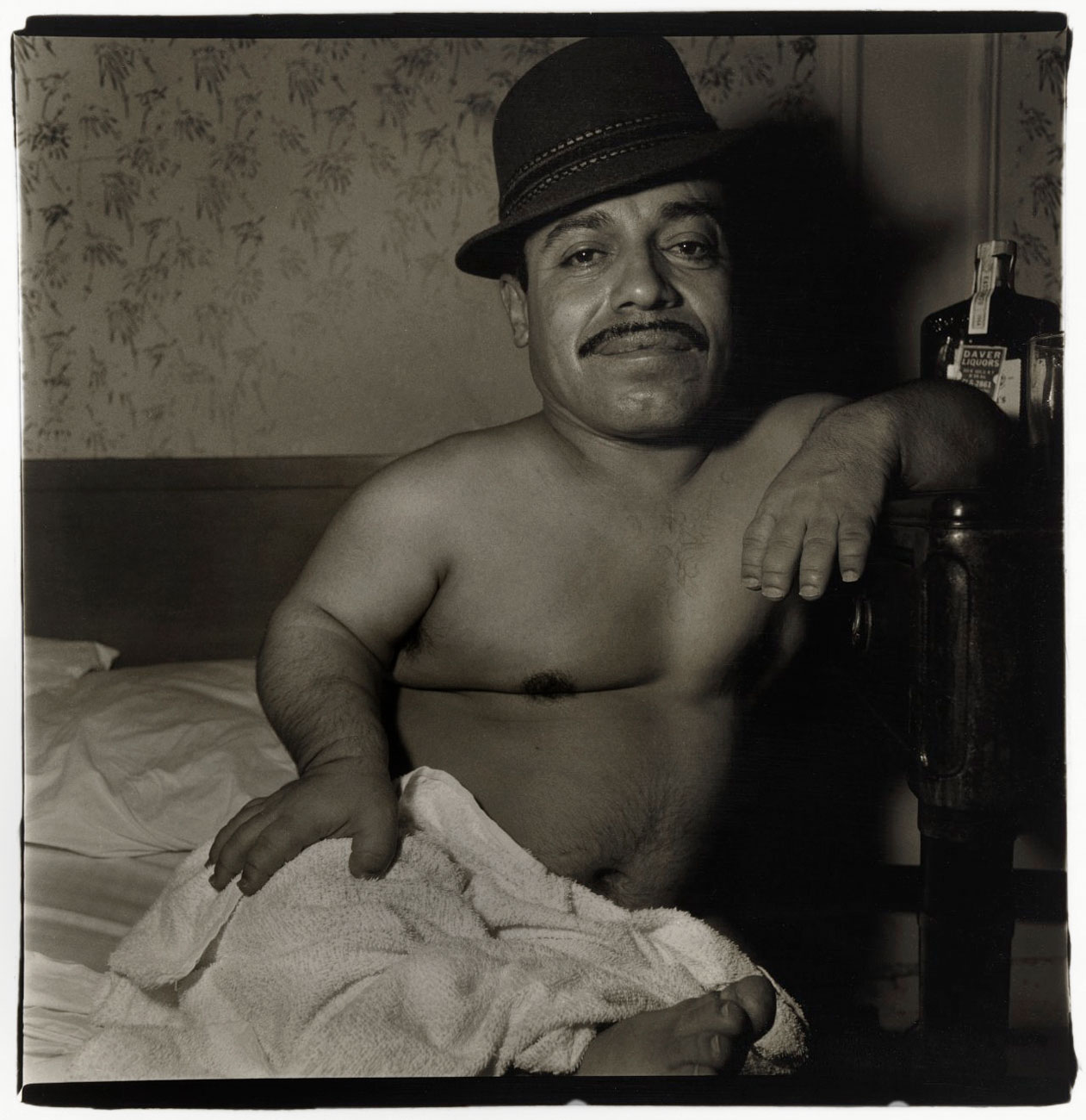
Diane Arbus (American, 1923-1971) 'Mexican Dwarf in his hotel room, NYC' 1970


Diane Arbus (American, 1923-1971)
Mexican Dwarf in his hotel room, NYC
1970
Gelatin silver print
© The Estate of Diane Arbus


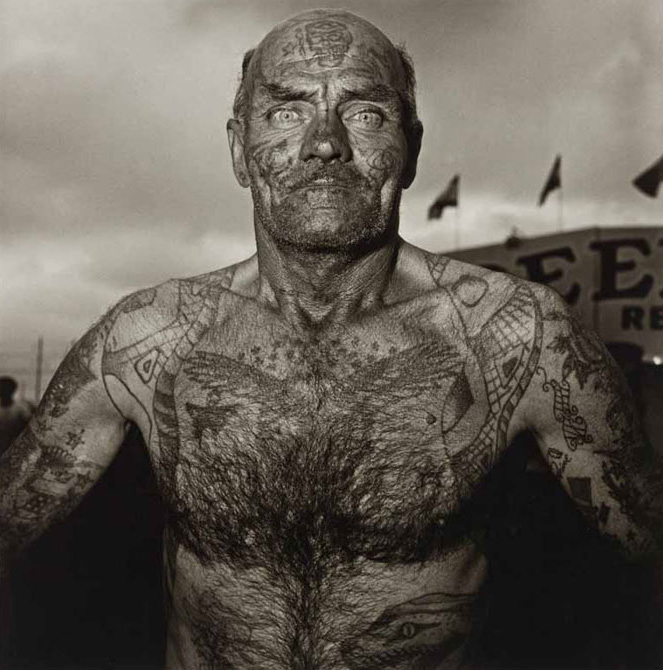
Diane Arbus (American, 1923-1971) 'Tattooed Man at a Carnival, Md.' 1970


Diane Arbus (American, 1923-1971)
Tattooed Man at a Carnival, Md.
1970
Gelatin silver print
© The Estate of Diane Arbus


Jeu de Paume
1, place de la Concorde
75008 Paris
métro Concorde
Phone: 01 47 03 12 50

Opening hours:
Tuesday – Friday 12am – 8pm
Saturday and Sunday 11am – 7pm
Closed Monday

Jeu de Paume website

LIKE ART BLART ON FACEBOOK

Back to top

Exhibition: ‘Diane Arbus’ at the National Museum of Wales, Cardiff

Exhibition dates: 9th May – 31st August, 2009


Diane Arbus (American, 1923-1971) 'Tattooed Man at a Carnival, Md.' 1970 from the exhibition 'Diane Arbus' at the National Museum of Wales, Cardiff, may-  Aug, 2009


Diane Arbus (American, 1923-1971)
Tattooed Man at a Carnival, Md.
1970
Gelatin silver print
15 x 14 5/8 in. (38.3 x 37.3 cm)


Diane Arbus is one of my favourite photographs – how I would love to see this exhibition!

I have posted some photographs from the exhibition, including all ten images from the Box of Ten 1971 that features in the show.

Dr Marcus Bunyan


Many thankx to the National Museum of Wales for allowing me to publish the photographs in the posting. Please click on the photographs for a larger version of the image.


“A photograph is a secret about a secret. The more it tells you, the less you know.”


Diane Arbus


Diane Arbus (American, 1923-1971) 'A young man in curlers at home on West 20th St., N.Y.C. 1966' 1966 from the exhibition 'Diane Arbus' at the National Museum of Wales, Cardiff, may-  Aug, 2009


Diane Arbus (American, 1923-1971)
A young man with curlers at home on West 20th Street, N.Y.C.
1966
Gelatin silver print


One of National Museum Cardiff’s main art exhibitions in 2009 reveals the work of legendary New York photographer Diane Arbus (1923 -1971), who transformed the art of photography. Diane Arbus, which comprises 69 black and white photographs including the rare and important portfolio of ten vintage prints: Box of Ten, 1971, is one of the best collections of Arbus’s work in existence. A large selection of these images will be on display at the Museum from 9 May until 31 August 2009.

Capturing 1950s and 1960s America, Arbus is renowned for portraits of people who were then classed on the outskirts of society nudists, transvestites, circus performers and zealots. In one of her most famous works, Identical Twins, Roselle, NJ of 1967, the twins are photographed as if joined at the shoulder and hip with only three arms between them.

Her powerful, sometimes controversial, images often frame the familiar as strange and the strange or exotic as familiar. This singular vision and her ability to engage in such an uncompromising way with her subjects has made Arbus one of the most important and influential photographers of the twentieth century.

This singular vision and her ability to engage in such an uncompromising way with her subjects has made Arbus one of the most important and influential photographers of the twentieth century.

Text from the National Museum of Cardiff website [Online] Cited 18/05/2009. No longer available online


Diane Arbus (American, 1923-1971) 'A Jewish Giant at home with his parents in the Bronx' 1967


Diane Arbus (American, 1923-1971)
A Jewish Giant at home with his parents in the Bronx
1967
Gelatin silver print


From 1969 to 1971 Arbus was absorbed in the creation of a limited edition portfolio, A box of ten photographs. The portfolio was intended to present her work as an artist in the manner of the special print editions offered by new artists’ presses such as Crown Point and Universal Limited Art Editions (ULAE). This group of pictures and its presentation was a very conscious statement of what she stood for, and how she regarded her own photography. The pictures range from the relatively early ones of the Nudists in their summer home and Xmas tree in a living room in Levittown, L.I., both of 1963; through the now iconic Identical twins, Roselle, N.J., 1967 and Westchester Couple sunning themselves on their lawn, to the later pictures of the Jewish giant, the Mexican Dwarf in his hotel room, N.Y.C. and the King and Queen of a senior citizens’ dance, N.Y.C., all of 1970. There is clearly an attempt to be representative of the general idea, the larger plan behind her work. There is also a significant stylistic range, from the graceful daylight in the picture of the older couple in the nudist camp, to the later picture of the elderly king and queen, whom she photographed with sharp flash. She included Xmas tree, a work without human subjects. The prints for this portfolio were selected three years after the New Documents exhibition, before there was thought of another show. But the pictures constituted a kind of exhibition in and of themselves, to be examined one at a time, rather than all at once. From her letters, we know that the idea of a clear box was very important; it was to serve as both a container and a display case allowing the owner to reorder and display the pictures easily. Just as she had wanted the black border of the print to show in the New Documents exhibition, here she wished to exhibit the entire print as it appeared on the photographic paper …

Most of the pictures in the portfolio either depict families or refer to the family. Even the corner of the cellophane-looking room in Levittown is made by peering over the two outstretched arms of a family armchair, posed like the trousered knees of the empty chair in the picture of the Jewish giant. The idea of the family album was a private but expressive metaphor for her. As in a family album, each member is part of the larger group; they are related, perhaps even tolerated, and harmony may be rare and perhaps even uninteresting. But they are all considered with the same intelligent and human regard. She photographed the Jewish giant as a mythic figure, enclosed in a modest Bronx living room, an unconventional member of an otherwise conventional family: ‘I know a Jewish giant who lives in Washington Heights or the Bronx with his little parents. He is tragic with a curious bitter somewhat stupid wit. The parents are orthodox and repressive and classic and disapprove of his carnival career…They are truly a metaphorical family. When he stands with his arms around each he looks like he would gladly crush them. They fight terribly in an utterly typical fashion which seems only exaggerated by their tragedy… Arrogant, anguished, even silly.’

Sandra S. Phillips, senior curator of photography at the San Francisco Museum of Modern Art from the book Diane Arbus Revelations.1

1/ Phillips, Sandra. “The Question of Belief,” in Diane Arbus Revelations. London: Random House, 2003, pp. 66-67.


Diane Arbus (American, 1923-1971) 'Mexican dwarf in his hotel room N.Y.C. 1970' 1970


Diane Arbus (American, 1923-1971)
Mexican Dwarf in his hotel room, N.Y.C.
1970
Gelatin silver print


Diane Arbus (American, 1923-1971) 'Xmas tree in a living room in Levittown, L.I. 1963' 1963


Diane Arbus (American, 1923-1971)
Xmas tree in a living room in Levittown, L.I.
1963
Gelatin silver print


Diane Arbus (American, 1923-1971) 'Identical twins, Roselle, N.J., 1966' 1966


Diane Arbus (American, 1923-1971)
Identical twins, Roselle, N.J.
1967
Gelatin silver print


Diane Arbus (American, 1923-1971) 'King and Queen of a senior citizens' dance, N.Y.C.' 1970


Diane Arbus (American, 1923-1971)
King and Queen of a senior citizens’ dance, N.Y.C.
1970
Gelatin silver print


Diane Arbus (American, 1923-1971) 'A family on their lawn one Sunday in Westchester, N.Y.,' 1968


Diane Arbus (American, 1923-1971)
A family on their lawn one Sunday in Westchester, N.Y., 1968
1968
Gelatin silver print


Diane Arbus (American, 1923-1971) 'Retired man and his wife at home in a nudist camp one morning, N.J.' 1963


Diane Arbus (American, 1923-1971)
Retired man and his wife at home in a nudist camp one morning, N.J.
1963
Gelatin silver print


Diane Arbus (American, 1923-1971) 'Boy with a straw hat waiting to march in a pro-war parade, N.Y.C., 1967' 1967


Diane Arbus (American, 1923-1971)
Boy with a straw hat waiting to march in a pro-war parade, N.Y.C., 1967
1967
Gelatin silver print


Diane Arbus (American, 1923-1971) 'A young Brooklyn family going for a Sunday outing, NYC., 1966' 1966


Diane Arbus (American, 1923-1971)
A young Brooklyn family going for a Sunday outing, NYC., 1966
1966
Gelatin silver print


Diane Arbus (American, 1923-1971) 'A child crying, N.J.' 1967


Diane Arbus (American, 1923-1971)
A child crying, N.J.
1967
Gelatin silver print


Diane Arbus (American, 1923-1971) 'A young man and his pregnant wife in Washington Square Park, N.Y.C., 1965' 1965


Diane Arbus (American, 1923-1971)
A young man and his pregnant wife in Washington Square Park, N.Y.C., 1965
1965
Gelatin silver print


Diane Arbus (American, 1923-1971) 'Untitled (1)' 1970-1971


Diane Arbus (American, 1923-1971)
Untitled (1)
1970-1971
Gelatin silver print


Diane Arbus (American, 1923-1971) 'Untitled (1)' 1970-1971


Diane Arbus (American, 1923-1971)
Untitled
1970-1971
Gelatin silver print


National Museum of Wales, Cardiff
Cathays Park, Cardiff CF10 3NP

Opening hours:
Tuesday – Sunday, 10 – 5pm

National Museum of Wales website

LIKE ART BLART ON FACEBOOK

Back to top