Searching for identity like mould spore taking root
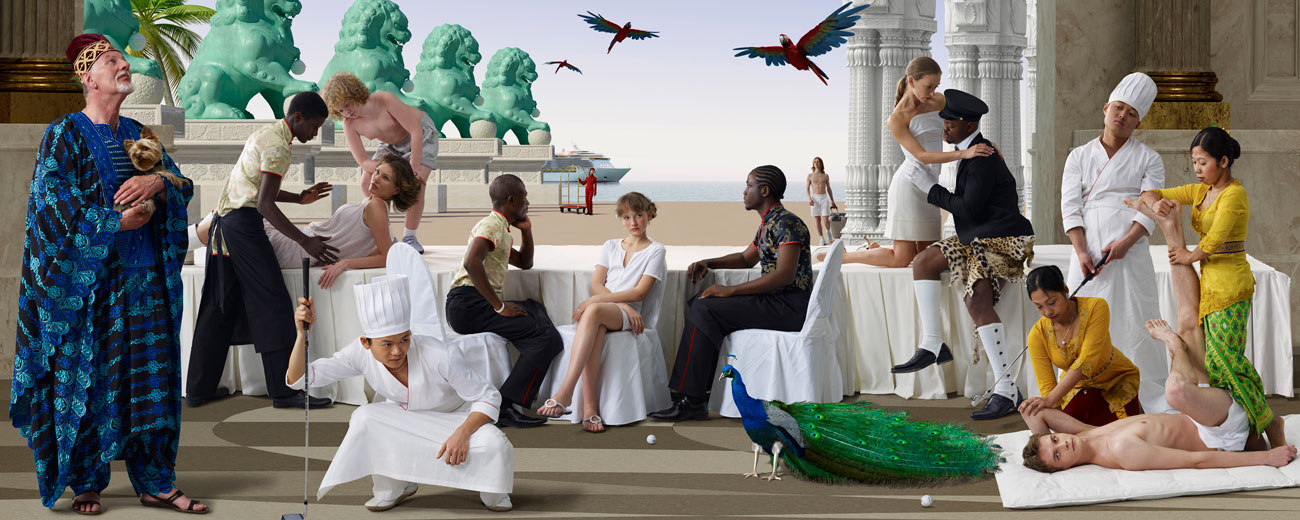
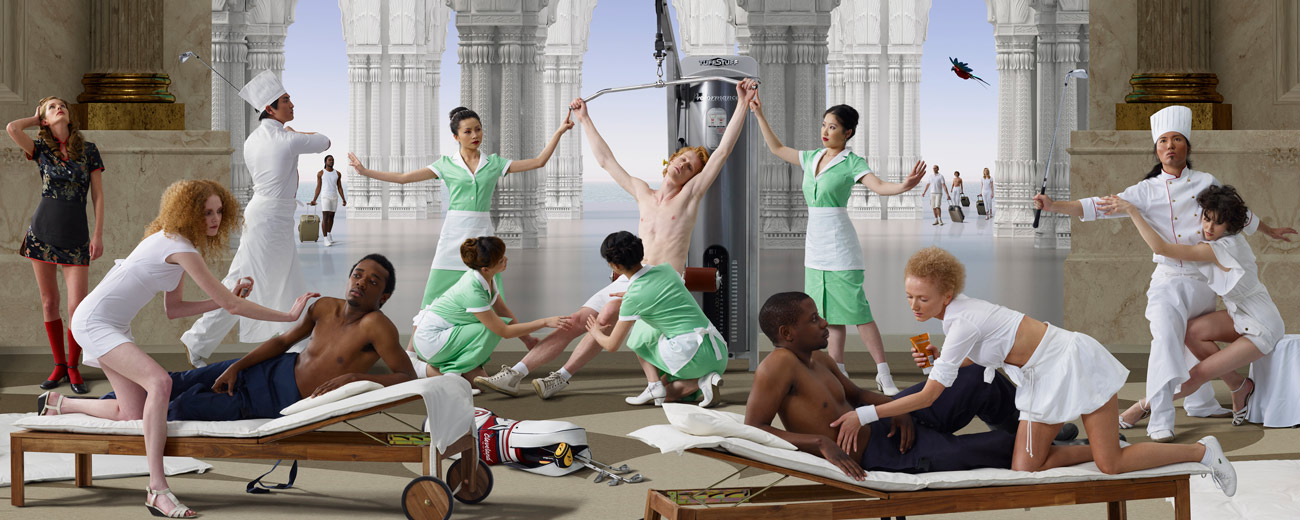
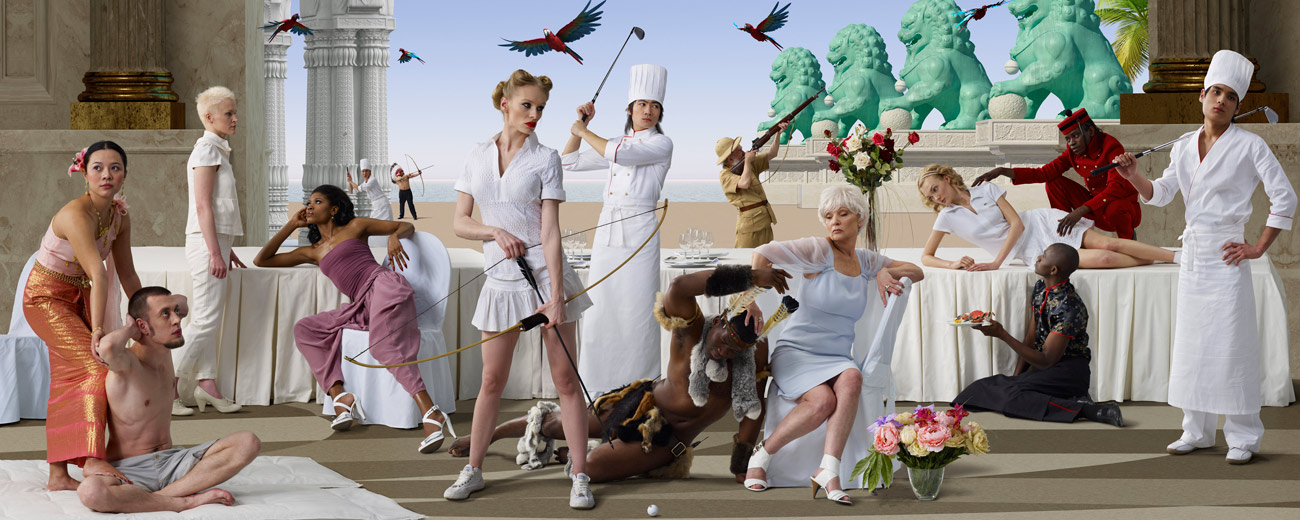
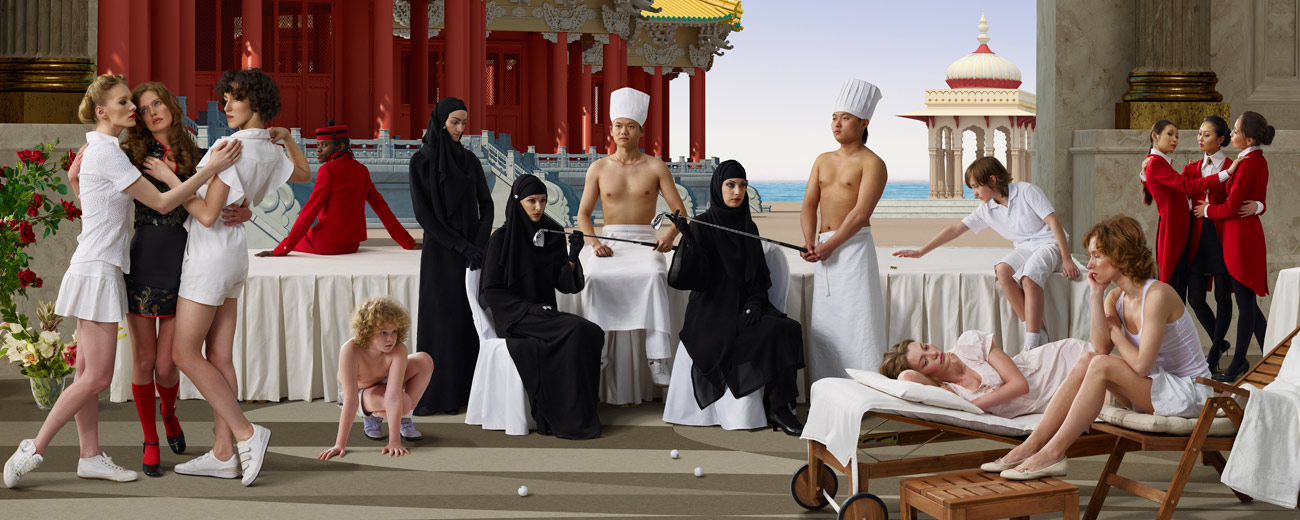
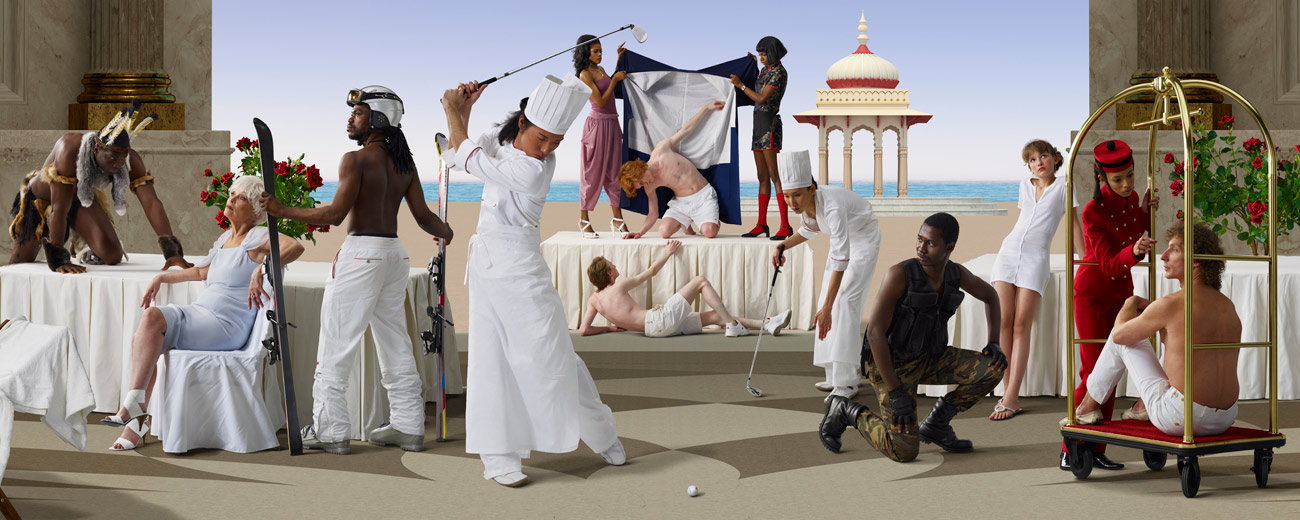
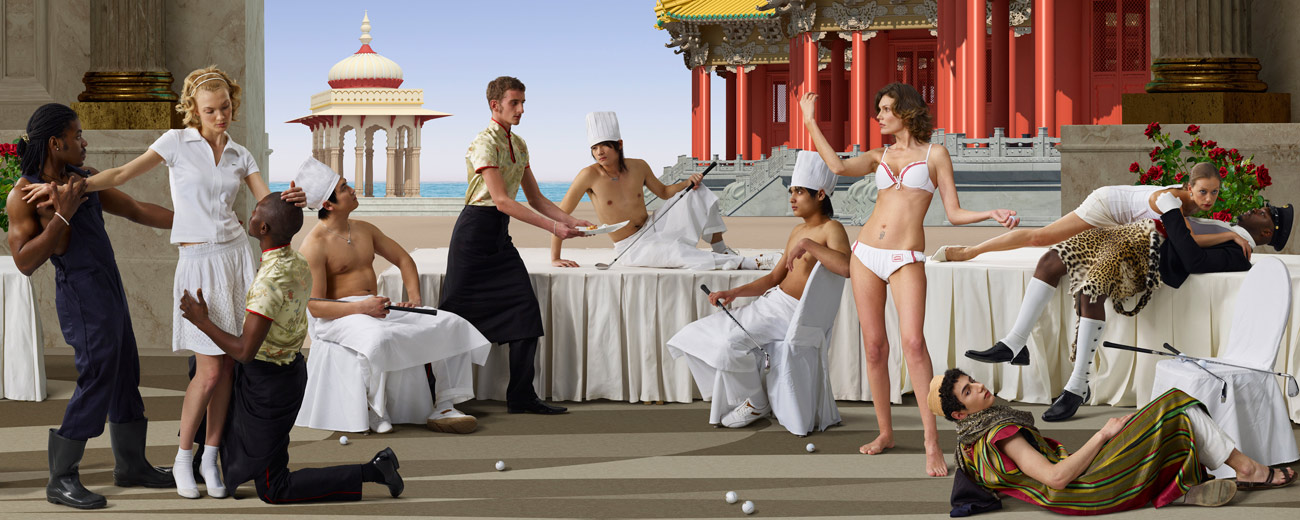
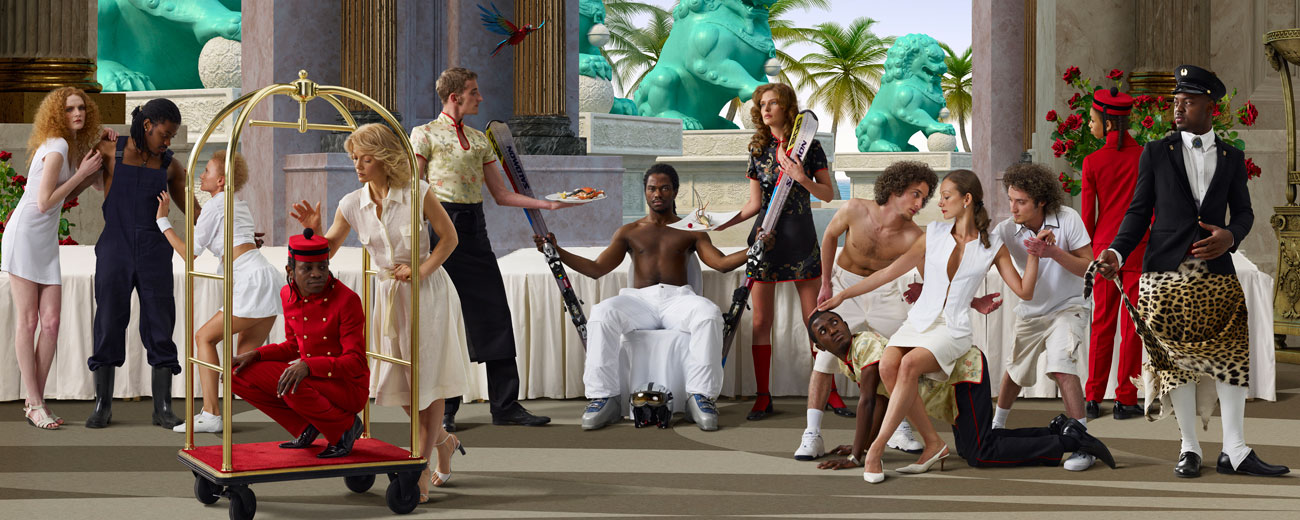
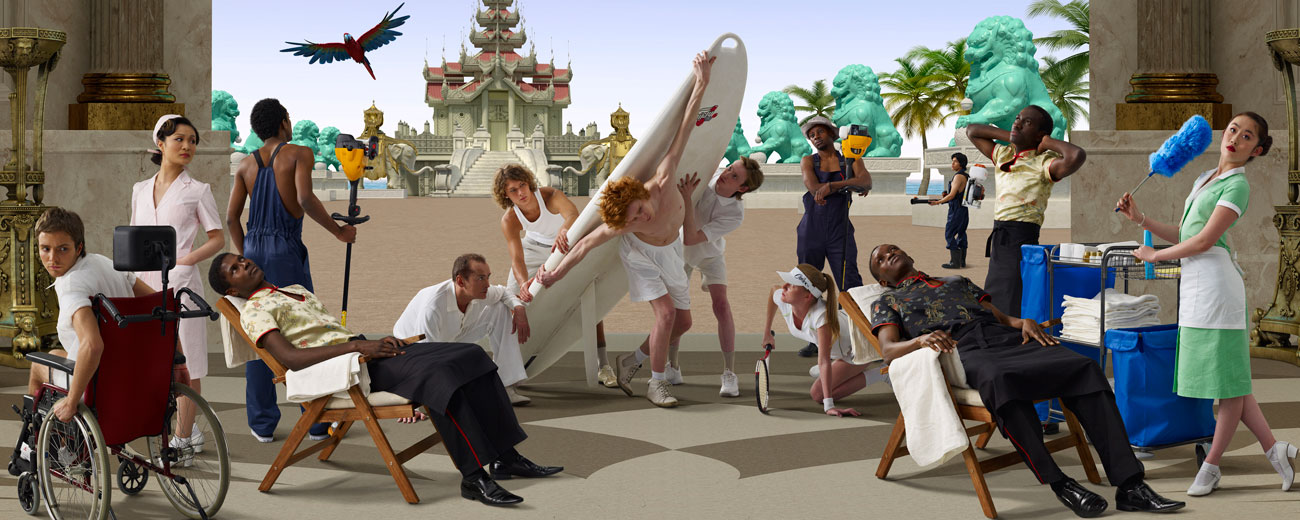
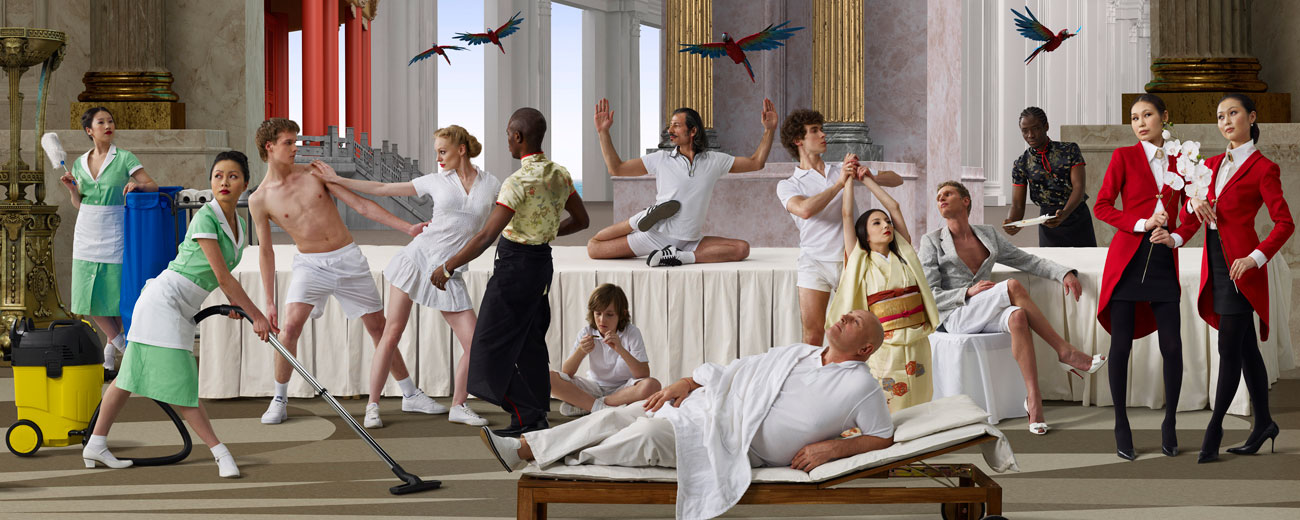
In one sense these large panoramic, digitally constructed mis en scene photographs by Russian collective AES+F at Anna Schwartz Gallery, (taken from the “celebrated” video of the same name which debuted at the Venice Biennale in 2009) are mere echoes of the lyrical, dance and fugue-like structures of the moving work.
In another sense they work well as still photographs. The balance inherent within the picture frame is exemplary, the use of colour and the feeling of rhythm and flow of the figures in pictorial space, wonderful. This rhythm can be called the physiognomy of the work, its style.1 In these photographs style is hard to miss and the photographs fulfil what Susan Sontag saw as one of the main prerequisites for good art: that of emotional distance from lived reality, that allows us to the look at the work dispassionately before bringing those observations back into the real world:
“All works of art are founded on a certain distance from the lived reality which is represented. This “distance” is, by definition, inhuman or impersonal to a certain degree; for in order to appear to us as art, the work must restrict sentimental intervention and emotional participation, which are functions of “closeness.” It is the degree and manipulating of this distance, the conventions of distance, which constitute the style of the work … But the notion of distance (and of dehumanisation, as well) is misleading, unless one adds that the movement is not just away from but toward the world.”2
. In these photographs we have a pastiche of cultural attitudes and mores that allows us to reflect on the foibles, paradoxes, consumerism and stereotypes of identity formation of the contemporary world, mixed with a healthy serving of voyeurism. As Javier Panera notes, “AES+F’s work is nurtured from moral and cultural paradoxes: seduction and threat; hyperrealism and artificiality; classicism and contemporaneity; spirituality and sensuality; historicism and the end of history,”3 and they construct a new oligarchy within a dystopic, Arcadian world. Variously, we have masters and servants, oriental and neoclassical architecture, haute couture, lesbianism, adoration, a youth dressed in white falling out of a priests robes (or is a kimono?) onto an altar-like table, savages and beasts, homoerotic encounters and many more besides – all constructed in an imagined world of a temporary hotel performing rituals of leisure and pleasure, an orgiastic but chaste imagining in this world, looking back at lived reality.
And for me there is the problem. While the photographs offer this vision of temptation and delight in the end they just reinforce the basis of belief in the status quo, the power of cultural hegemony. Subversion as an act, a decorative performance imbued with titillation. As Marco Fusinato observed, using a quotation from an anarchist website in a work in his latest exhibition at Anna Schwartz Gallery (and the irony does not escape me, far from it!):
“The artist is also the mainstay of a whole social milieu – called a “scene” – which allows him to exist and which he keeps alive. A very special ecosystem: agents, press attachés, art directors, marketing agents, critics, collectors, patrons, art gallery managers, cultural mediators, consumers… birds of prey sponge off artists in the joyous horror of showbiz. A scene with its codes, norms, outcasts, favourites, ministry, exploiters and exploited, profiteers and admirers. A scene which has the monopoly on good taste, exerting aesthetic terrorism upon all that which is not profitable, or upon all that which doesn’t come from a very specific mentality within which subversion must only be superficial, of course at the risk of subverting.”4
. The subversion of these images is superficial, a surface appearance of insurrection.
Despite protestations to the contrary (an appeal on the AES+F website to the idea of the Roman saturnalia, see text below) – where the masters serve the slaves at a dinner once a year, this reversal was only ever superficial at best: “the reversal of the social order was mostly superficial; the banquet, for example, would often be prepared by the slaves, and they would prepare their masters’ dinner as well. It was license within careful boundaries; it reversed the social order without subverting it.”5
It was a license within careful boundaries. It reversed the social order without subverting
The same can be said of these wonderful, colourful, rhythmic, chaste, trite, in vogue, pale imitations of subversion. The images come from a very specific mentality within which subversion must only be superficial because they are, after all, images that are searching for an identity in order to access and survive in the Western art world.
ex nihilo nihil fit (Nothing comes of nothing) and please, don’t bite the hand that feeds you.
Dr Marcus Bunyan
1/ Sontag, Susan. “On Style,” in Against Interpretation and Other Essays. New York: Delta Book, 1966, pp. 30-31
2/ Ibid.,
3/ Panera, Panera. “AES+F’s The Feast of Trimalchio,” on FlashArtonline.com [Online] Cited 17/10/2010. No longer available online
4/ Anon. “Escapism has its price The artist has his income,” on Non Fides website Wednesday 17 September 2008 [Online] Cited 28/12/2019. No longer available online
5/ Anon. “Saturnalia,” on Wikipedia website [Online] Cited 28/12/2019
Many thankx to The Melbourne International Arts Festival and Anna Schwartz Gallery for allowing me to publish the photographs in the posting.
Viewers: please click on the photographs for a larger version of the image as it is essential to see the freeze frame action, what is actually going on within the images. All images courtesy the artists and Anna Schwartz Gallery, Melbourne & Sydney.
AES+F The Feast of Trimalchio – part 1, 2 and 3
AES+F The Feast of Trimalchio Panorama #2 2009
AES+F The Feast of Trimalchio Panorama #3 2009
AES+F The Feast of Trimalchio Panorama #4 2009
AES+F The Feast of Trimalchio Panorama #5 2009
In the Satyricon, the work of the great wit and melancholic lyric poet of Nero’s reign, Gaius Petronius Arbiter, the best preserved part is The Feast of Trimalchio (Cena Trimalchionis). Thanks to Petronius’s fantasy, Trimalchio’s name became synonymous with wealth and luxury, with gluttony and with unbridled pleasure in contrast to the brevity of human existence.
We searched for an analogue in the third millennium and Trimalchio, the former slave, the nouveau riche host of feasts lasting several days, appeared to us not so much as an individual as a collective image of a luxurious hotel, a temporary paradise which one has to pay to enter.
The hotel guests, the ‘masters’, are from the land of the Golden Billion. They’re keen to spend their time, regardless of the season, as guests of the present-day Trimalchio, who has created the most exotic and luxurious hotel possible. The hotel miraculously combines a tropical coastline with a ski resort. The ‘masters’ wear white which calls to mind the uniform of the righteous in the Garden of Eden, or traditional colonial dress, or a summer fashion collection. The ‘masters’ possess all of the characteristics of the human race – they are all ages and types and from all social backgrounds. Here is the university professor, the broker, the society beauty, the intellectual. Trimalchio’s ‘servants’ are young, attractive representatives of all continents who work in the vast hospitality industry as housekeeping staff, waiters, chefs, gardeners, security guards and masseurs. They are dressed in traditional uniforms with an ethnic twist. The ‘servants’ resemble the brightly-coloured angels of a Garden of Eden to which the ‘masters’ are only temporarily admitted.
On one hand the atmosphere of The Feast of Trimalchio can be seen as bringing together the hotel rituals of leisure and pleasure (massage and golf, the pool and surfing). On the other hand the ‘servants’ are more than attentive service-providers. They are participants in an orgy, bringing to life any fantasy of the ‘masters’, from gastronomic to erotic. At times the ‘masters’ unexpectedly end up in the role of ‘servants’. Both become participants in an orgiastic gala reception, a dinner in the style of Roman saturnalia when slaves, dressed as patricians, reclined at table and their masters, dressed in slaves’ tunics, served them.
Every so often the delights of The Feast of Trimalchio are spoiled by catastrophes which encroach on the Global Paradise…
AES+F, 2009 Translated by Ruth Addison
Text from the AES+F website [Online] Cited 28/12/2019
AES+F The Feast of Trimalchio Panorama #6 2009
AES+F The Feast of Trimalchio Panorama #7 2009
Russian collective AES+F work with photography, video, sculpture and mixed media. Since 1987, they have interwoven imagery relating to modern technology, Hollywood cinema, fashion photography, advertising, death, religion, the British Royal Family, mass media, popular culture and youth obsession throughout their work.
The Feast of Trimalchio is an interpretation of the witty but melancholy fiction Satyricon by the Roman poet Petronius. In the ancient version Trimalchio’s feast was portrayed as the ideal celebration that Trimalchio imagined for his own funeral. In the AES+F 21st Century version, an orgy of consumerism reflects on the contemporary state of Russia and indeed the world. Created from over 75,000 photographs, the complete work is a nine-channel panoramic media that made its celebrated debut at the 2009 Venice Biennale. For the Festival, Anna Schwartz Gallery features a set of three expansive photographic tableaux. These captivating images of a temporary hotel paradise portray opulence and excess overshadowed by a dark uneasiness.
Text from the Melbourne International Arts Festival website
AES+F The Feast of Trimalchio Panorama #8 2009
AES+F The Feast of Trimalchio Panorama #9 2009
Anna Schwartz Gallery 185 Flinders Lane Melbourne, Victoria 3000
Installation dates: 8th October – 23rd October 2010
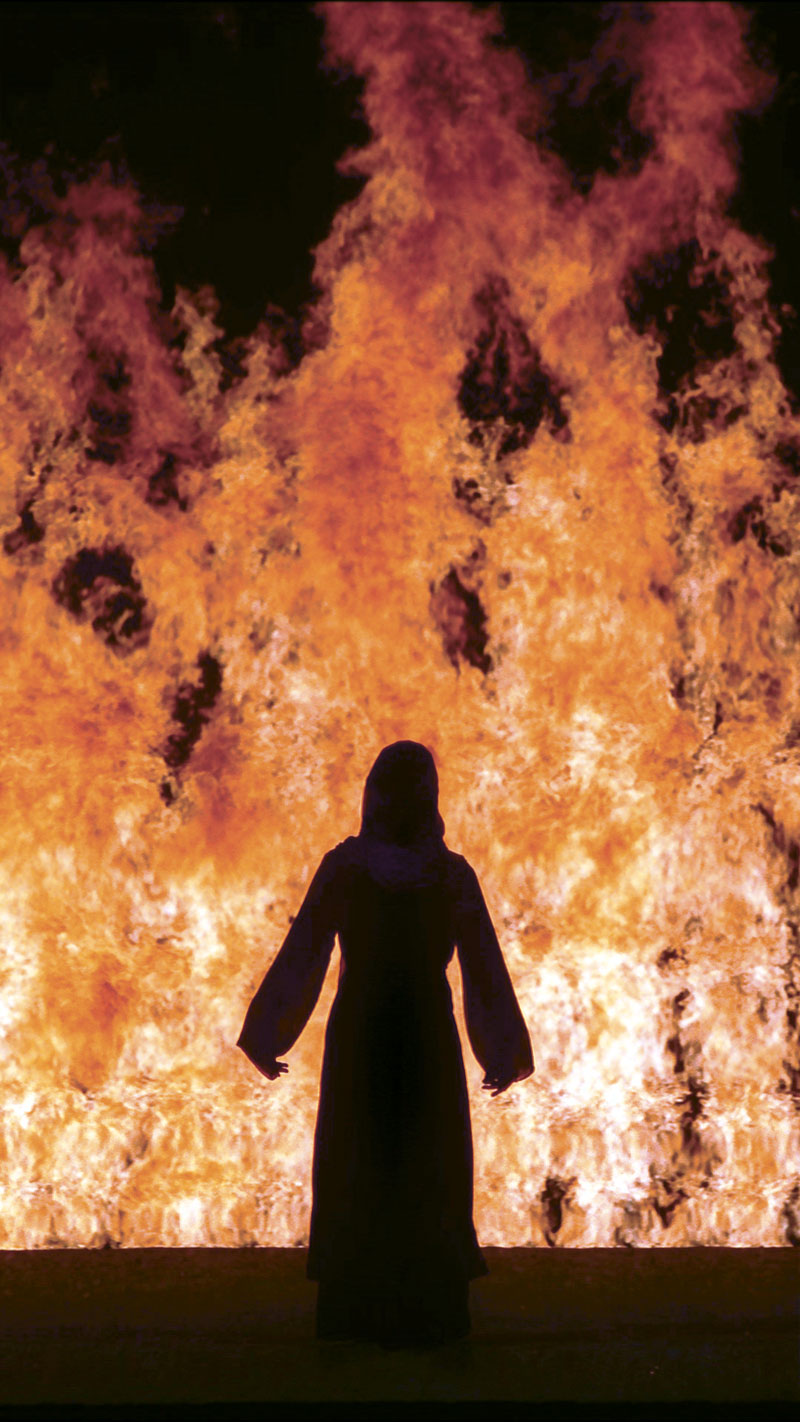
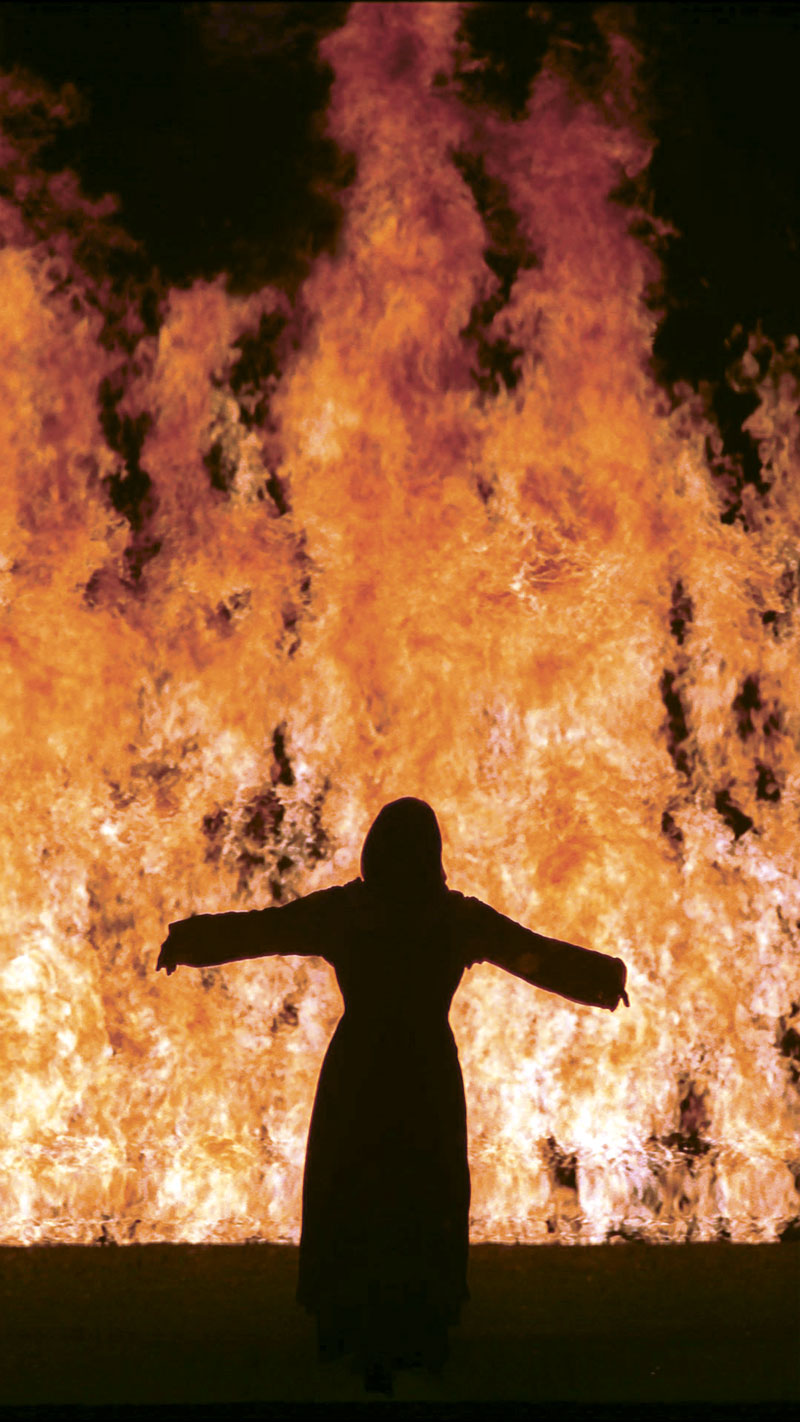
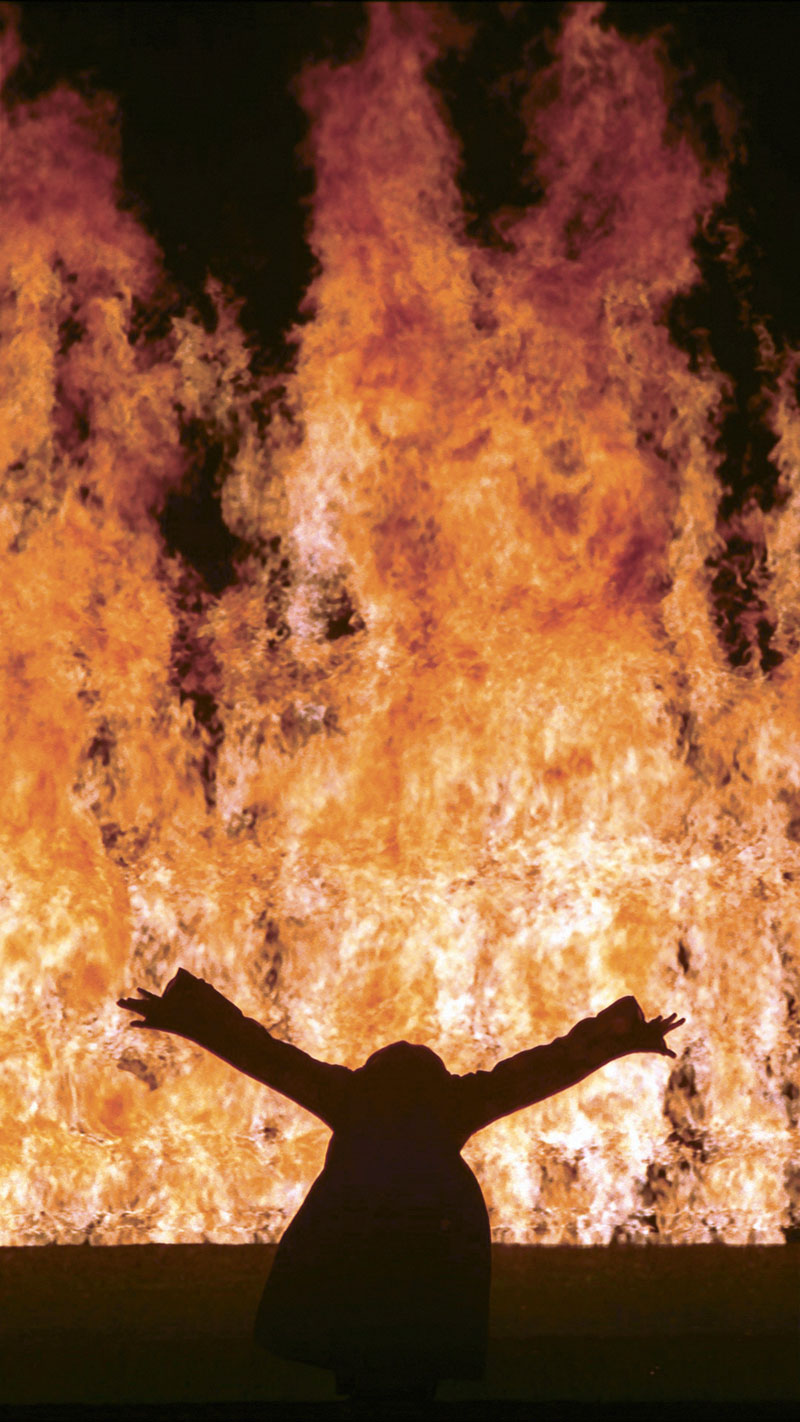
Bill Viola (American, 1951-2024) Fire Woman (still) 2005 Video/sound installation Performer: Robin Bonaccorsi Photos: Kira Perov Courtesy Bill Viola Studio and Kaldor Public Art Projects
Anybody who reads this archive regularly will know my love of the work of Bill Viola. This installation of two immersive video and sound works at St. Carthage’s church in Parkville is no exception. What an experience. I came out of the church after an aural and visual bombardment and moments of reflection so excited by the visceral experience that I phoned a friend a babbled for a few minutes about the works and how I felt. They made me feel so exhilarated and alive!
After watching the videos through first time around I made the notes below the second time of viewing – a kind of mental sketch of what I seeing and feeling. Go see!
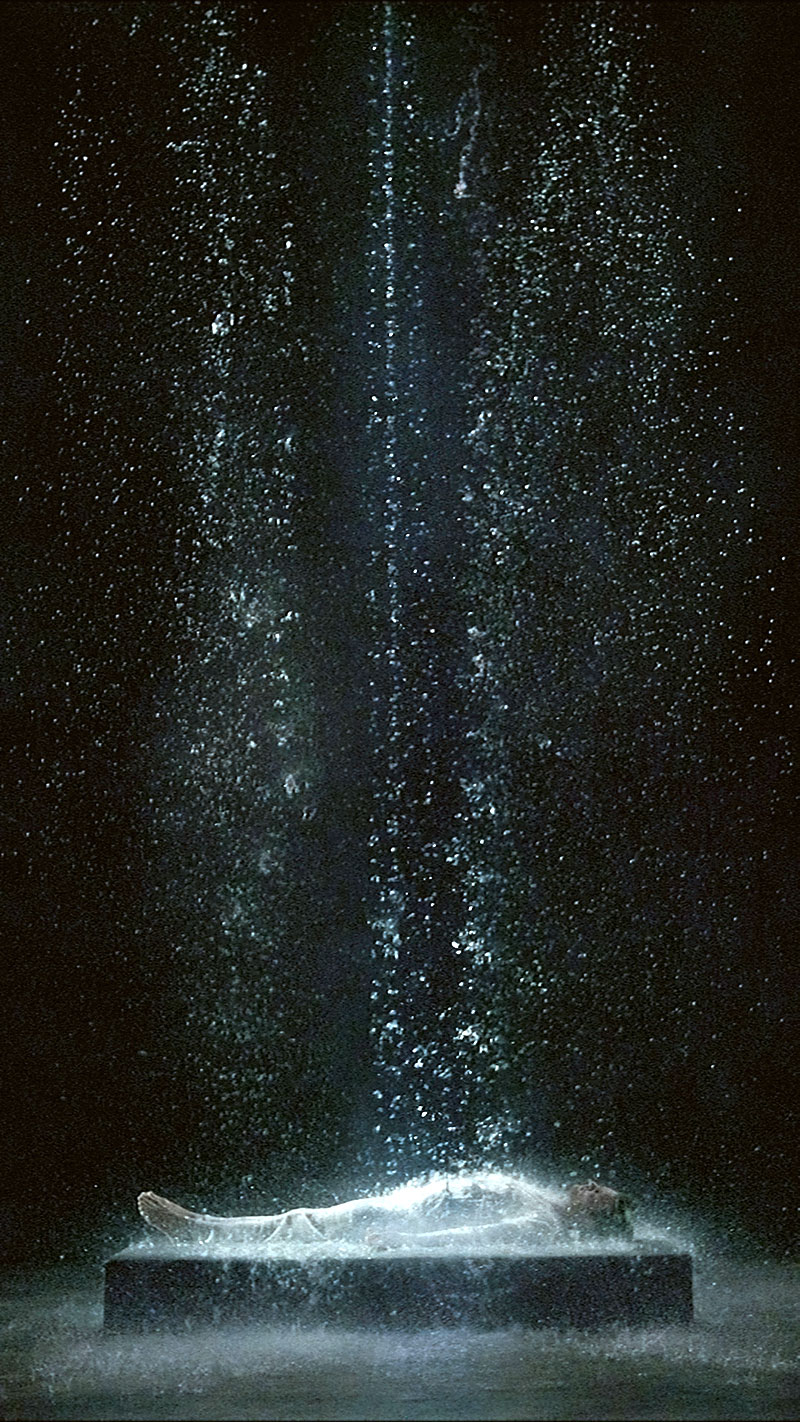
Stone
cold
man pure white
rumble, subterranean underwater sounds
small drops – float upwards
water flowing backwards, heavier, hovering like a sword of Damocles, heavier, heavier
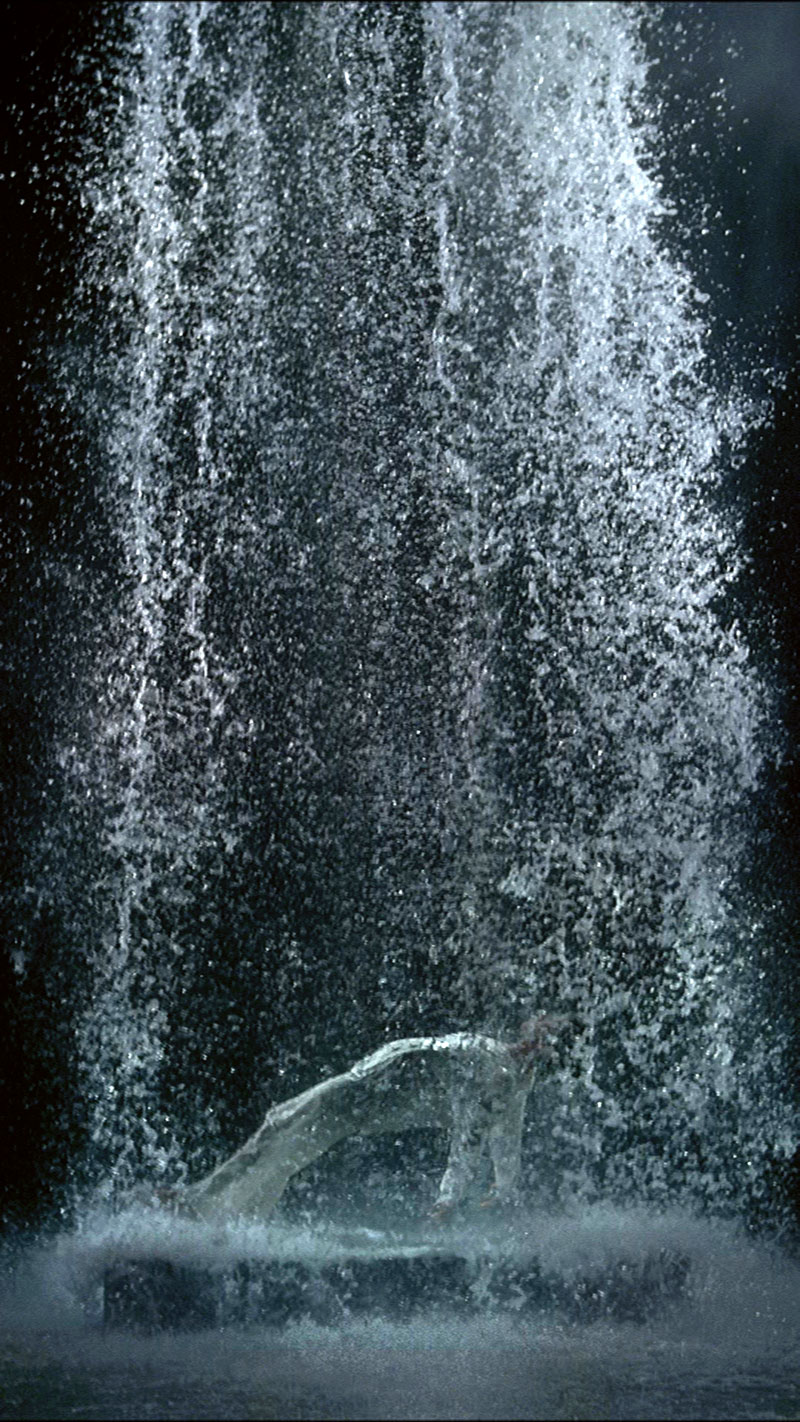
Torrent, elemental, body arches, thrown around – TEMPEST! SOUND!
White light, raging waters, body levitating and ascending, Christ-like …. disappears
Water slows, stops to quietness, sound on a corrugated roof
empty stone, reflection
drips
splashes
drops of ascending water like stars twinkling in the night sky
……………………o
….o……………………………….o
……………………..o
…………..o………………o
….o……………………o
………..o……….o……………..0
………………………o
………..o
………………………….o
Fire [ROAR]
dark angel, walks forward, camera changes angles
WALL of fire ||||||||||||||||
hell, the sun, conflagration of the apocalypse
Opens arms, falls backwards into a pool of water —— CRASH – SHOCK – SOUND ASSAULTS YOU!
Disappears
Ripples of water/fire: camera closes in, distorting fire
Sounds becomes muffled
Yellow reflections……………….. almost nuclear, atomic, abstract (like a wonderful Richter!)
————————–
gurgling sound of water, slow ripples reflecting fire and oil, fire dying out
intense blue/black, like tadpoles in a stream or the embers of darkness
Beauty
Contemplation
feeling: of life, of place in the world, of mortality … of the ineffable.
Dr Marcus Bunyan
Many thankx to the Melbourne International Arts Festival for allowing me to publish the photographs in the posting. Please click on the photographs for a larger version of the image.
Bill Viola (American, 1951-2024) Tristan’s Ascension (The Sound of a Mountain Under a Waterfall), 2005 (excerpt)
Bill Viola (American, 1951-2024) Tristan’s Ascension (The Sound of a Mountain Under a Waterfall) (stills) 2005 Video/sound installation Performer: John Hay Photos: Kira Perov Courtesy Bill Viola Studio and Kaldor Public Art Projects
Pioneering American artist Bill Viola has been instrumental in the establishment of video as a vital form of contemporary art. For over 35 years he has created videotapes, architectural video installations, sound environments, electronic music performances, flat panel video pieces and works for television broadcast. His video installations – total environments that envelop the viewer in image and sound – employ state-of-the-art technologies and are distinguished by their precision and direct simplicity. His next major commission is the creation of two permanent altar pieces for St. Paul’s Cathedral in London.
For the 2010 Melbourne Festival, in partnership with Kaldor Public Art Projects, St Carthage’s Catholic Church in Parkville is turned into a video art shrine complete with the latest technology, surround sound and enveloping operatic narrative. Shown in a continuous loop, the two works, Fire Woman and Tristan’s Ascension, combine for a 20 minute visual and aural experience that extends Viola’s lifelong engagement with the human condition into ancient themes of life, love and death.
These two immersive installations are derived from Viola’s creation for Richard Wagner’s Tristan and Isolde directed by Peter Sellars. Now separated from the opera, the stunning installations feature mythical and mystical apparitions set to their own new soundtrack, and can be experienced in all their glory in the sacred surrounds of St Carthage’s.
Bill Viola (1951-2024) is internationally recognised as one of today’s leading artists. He has been instrumental in the establishment of video as a vital form of contemporary art, and in so doing has helped to greatly expand its scope in terms of technology, content, and historical reach. For over 35 years he has created videotapes, architectural video installations, sound environments, electronic music performances, flat panel video pieces, and works for television broadcast. Viola’s video installations – total environments that envelop the viewer in image and sound – employ state-of-the-art technologies and are distinguished by their precision and direct simplicity. They are shown in museums and galleries worldwide and are found in many distinguished collections. His single channel videotapes have been widely broadcast and presented cinematically, while his writings have been extensively published, and translated for international readers. Viola uses video to explore the phenomena of sense perception as an avenue to self-knowledge. His works focus on universal human experiences – birth, death, the unfolding of consciousness – and have roots in both Eastern and Western art as well as spiritual traditions, including Zen Buddhism, Islamic Sufism, and Christian mysticism. Using the inner language of subjective thoughts and collective memories, his videos communicate to a wide audience, allowing viewers to experience the work directly, and in their own personal way.
Text from the Melbourne International Arts Festival website
Bill Viola (American, 1951-2024) – Fire Woman (2005)
Bill Viola is without doubt the most celebrated exponent of video art. For the first time, the Grand Palais will present a wide-ranging group of his works, including moving paintings and monumental installations from 1977 to today. Focusing on both intimate and universal experiences, the artist expresses his emotional and spiritual journey through great metaphysical themes – life, death and transfiguration…
Bill Viola (American, 1951-2024) Fire Woman, 2005 Video/sound installation
Bill Viola (American, 1951-2024) Fire Woman (stills) 2005 Video/sound installation Performer: Robin Bonaccorsi Photos: Kira Perov Courtesy Bill Viola Studio and Kaldor Public Art Projects
St Carthages, Parkville 123 Royal Parade Parkville 3052
Exhibition dates: 26th March – 6th September, 2010
Looks like a great exhibition – wish I was there to see it!
Many thankx to Claire Laporte and the Solomon R. Guggenheim Museum for allowing me to publish the photographs in the posting. Please click on the photographs for a larger version of the image.
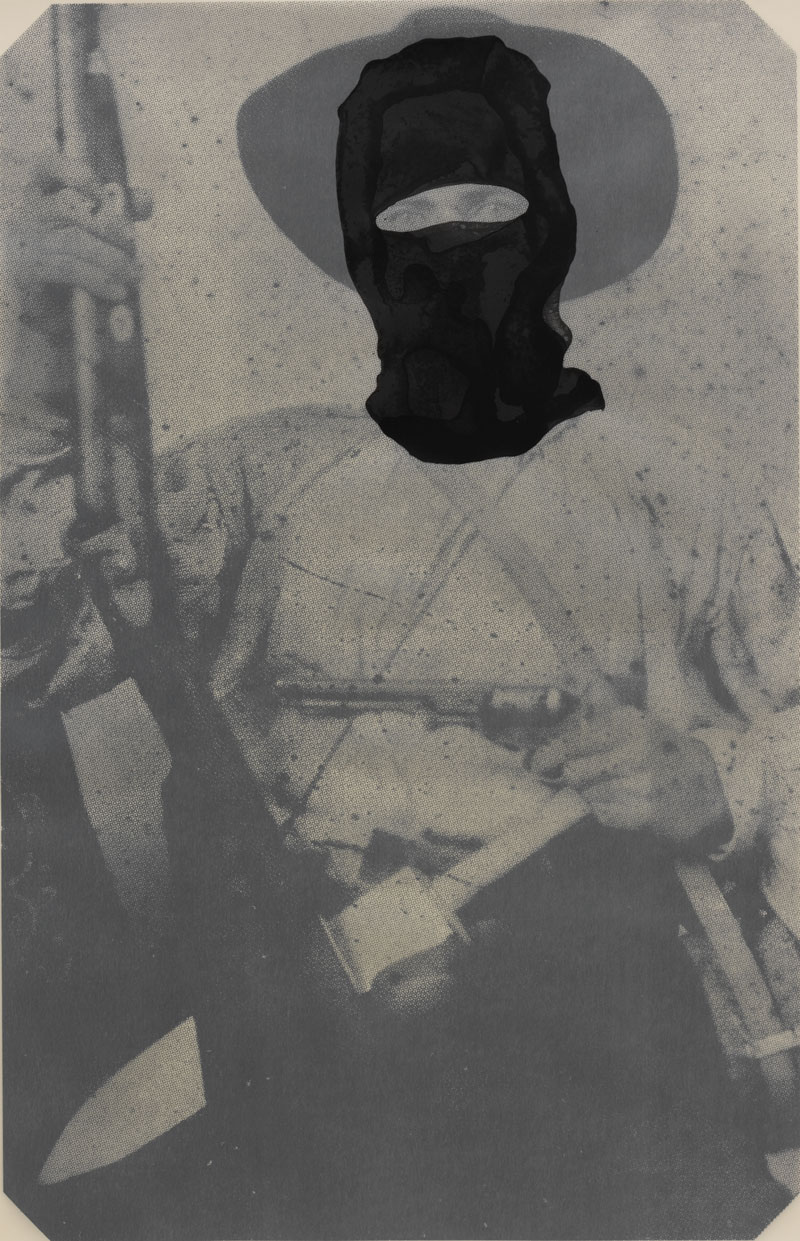
Adam Helms (American, b. 1974) Untitled Portrait (Santa Fe Trail) 2007 Double-sided screenprint on paper vellum edition 2/2 101.3 x 65.7cm Solomon R. Guggenheim Museum, New York, Purchased with funds contributed by the Photography Committee 2007.131
Idris Khan (British, b. 1978) Homage to Bernd Becher 2007 Bromide print edition 1/6 49.8 x 39.7cm Solomon R. Guggenheim Museum, New York, Purchased with funds contributed by the Photography Committee
Bernd Becher (German, 1931-2007) and Hilla Becher (German, 1934-2015) Water Towers 1980 Nine gelatin silver prints 155.6 x 125.1cm Solomon R. Guggenheim Museum, New York, Purchased with funds contributed by Mr. and Mrs. Donald Jonas
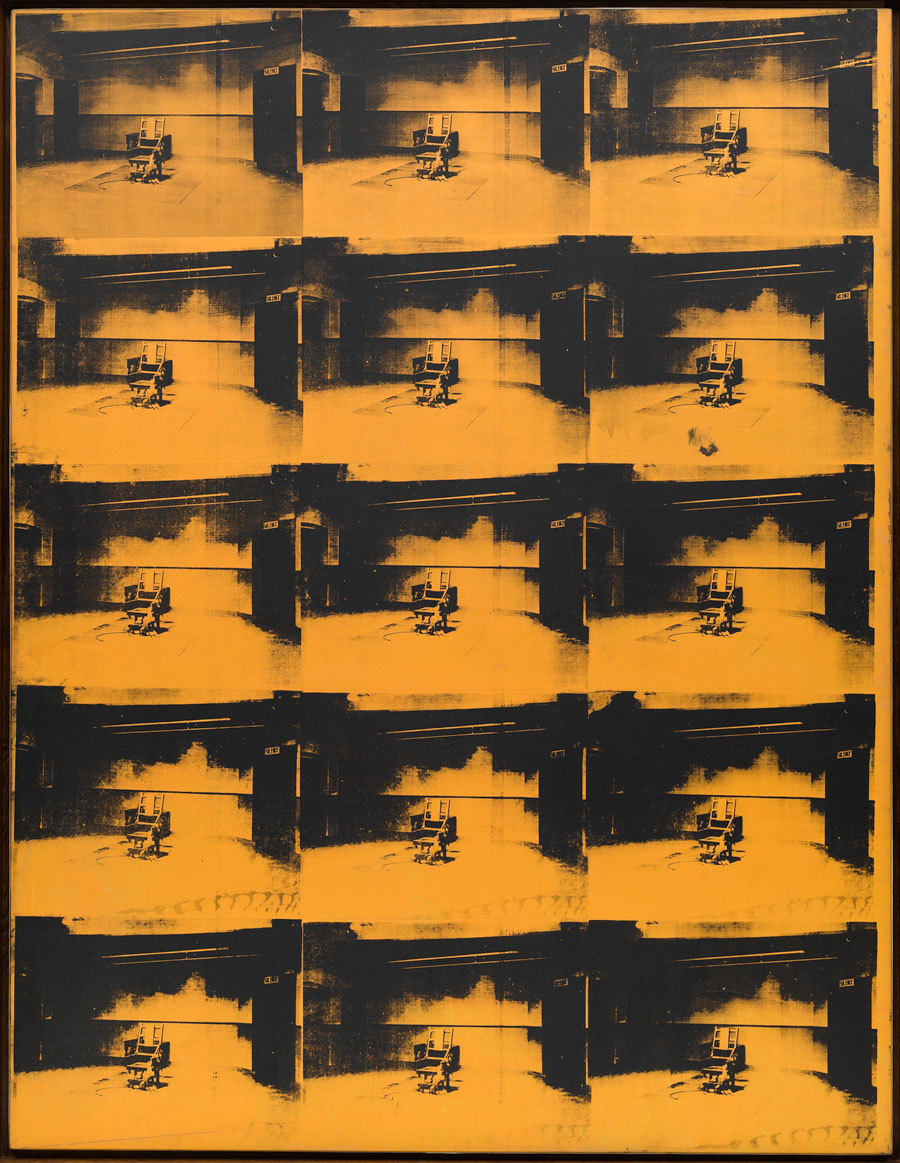
Andy Warhol (American, 1928-1987) Orange Disaster #5 1963 Acrylic and silkscreen enamel on canvas 269.2 x 207cm Solomon R. Guggenheim Museum, New York, Gift, Harry N. Abrams Family Collection 74.2118
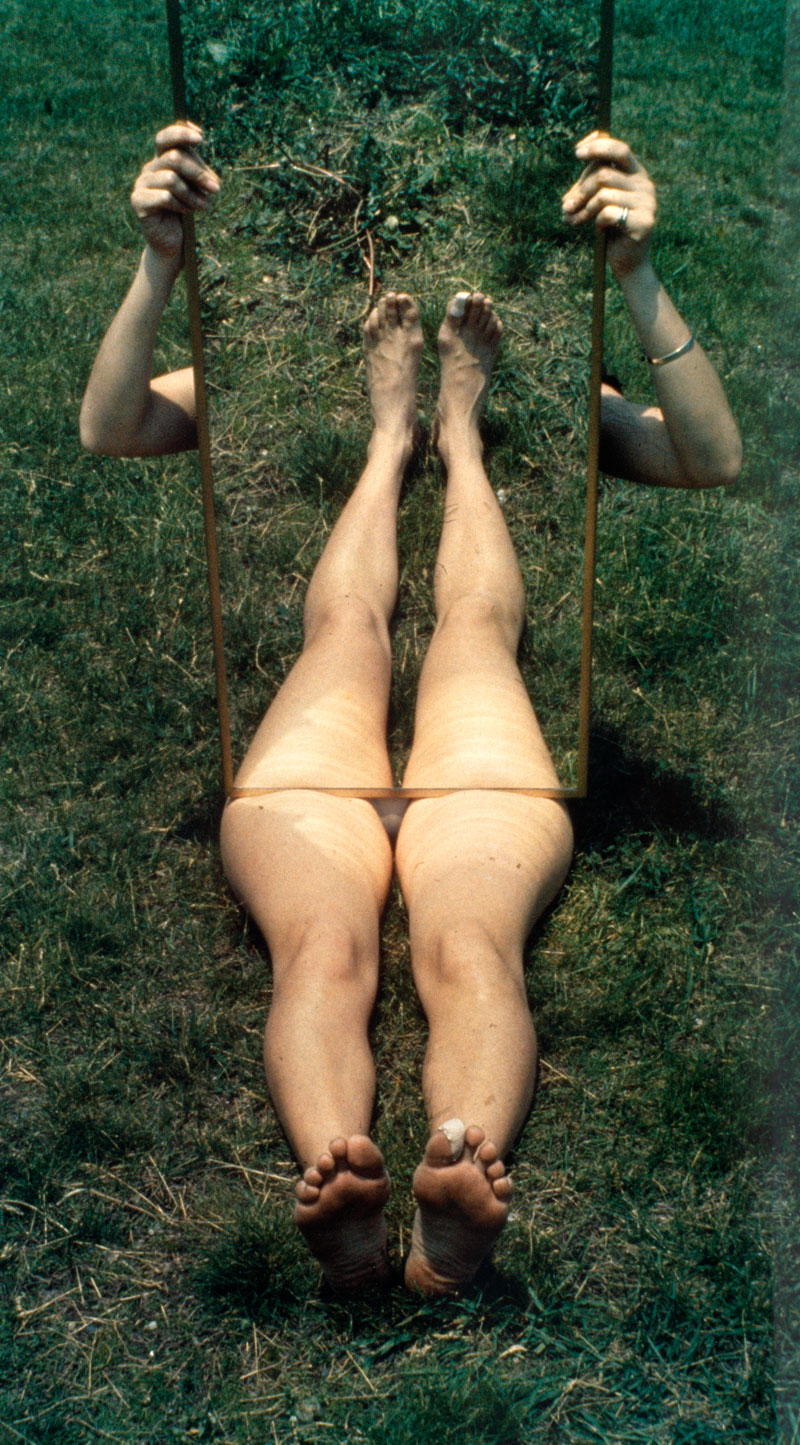
Joan Jonas (American, b. 1936) Mirror Piece I 1969 Chromogenic print 101 x 55.6cm Solomon R. Guggenheim Museum, New York, Purchased with funds contributed by the Photography Committee
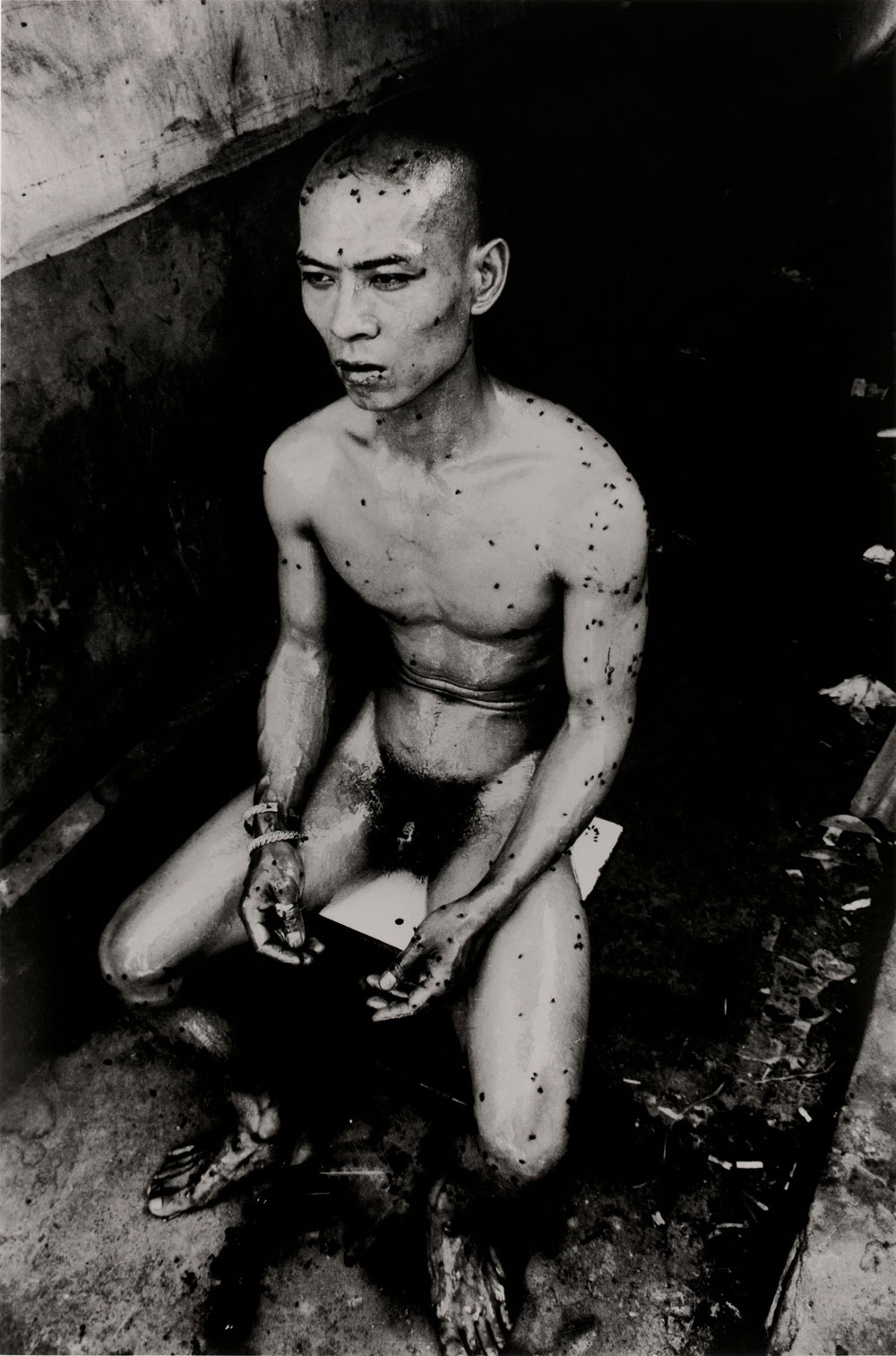
Zhang Huan (Chinese, b. 1965) 12 Square Meters 1994 Chromogenic print A.P. 3/5, edition of 15 149.9 x 99.7cm Solomon R. Guggenheim Museum, New York, Purchased with funds contributed by Manuel de Santaren and Jennifer and David Stockman
Much of contemporary photography and video seems haunted by the past, by the history of art, by apparitions that are reanimated in reproductive mediums, live performance, and the virtual world. By using dated, passé, or quasi-extinct stylistic devices, subject matter, and technologies, such art embodies a longing for an otherwise unrecuperable past.
From March 26 to September 6, 2010, the Solomon R. Guggenheim Museum presents Haunted: Contemporary Photography / Video / Performance, an exhibition that documents this obsession, examining myriad ways photographic imagery is incorporated into recent practice. Drawn largely from the Guggenheim’s extensive photography and video collections, Haunted features some 100 works by nearly 60 artists, including many recent acquisitions that will be on view at the museum for the first time. The exhibition is installed throughout the rotunda and its spiralling ramps, with two additional galleries on view from June 4 to September 1, featuring works by two pairs of artists to complete Haunted’s presentation.
The works in Haunted: Contemporary Photography / Video / Performance range from individual photographs and photographic series to sculptures and paintings that incorporate photographic elements; projected videos; films; performances; and site-specific installations, including a new sound work created by Susan Philips for the museum’s rotunda. While the show traces the extensive incorporation of photography into contemporary art since the 1960s, a significant part of the exhibition will be dedicated to work created since 2001 by younger artists.
Haunted is organised around a series of formal and conceptual threads that weave themselves through the artworks on view:
Appropriation and the Archive
In the early 1960s, Robert Rauschenberg and Andy Warhol began to incorporate photographic images into their paintings, establishing a new mode of visual production that relied not on the then-dominant tradition of gestural abstraction but rather on mechanical processes such as screenprinting. In so doing, they challenged the notion of art as the expression of a singular, heroic author, recasting their works as repositories for autobiographical, cultural, and historical information. This archival impulse revolutionised art production over the ensuing decades, paving the way for a conceptually driven use of photography as a means of absorbing the world at large into a new aesthetic realm. Since then, a number of artists, including Bernd and Hilla Becher, Sarah Charlesworth, Douglas Gordon, Luis Jacob, Sherrie Levine, Richard Prince, Cindy Sherman, and Sara VanDerBeek, have pursued this archival impulse, amassing fragments of reality either by creating new photographs or by appropriating existing ones.
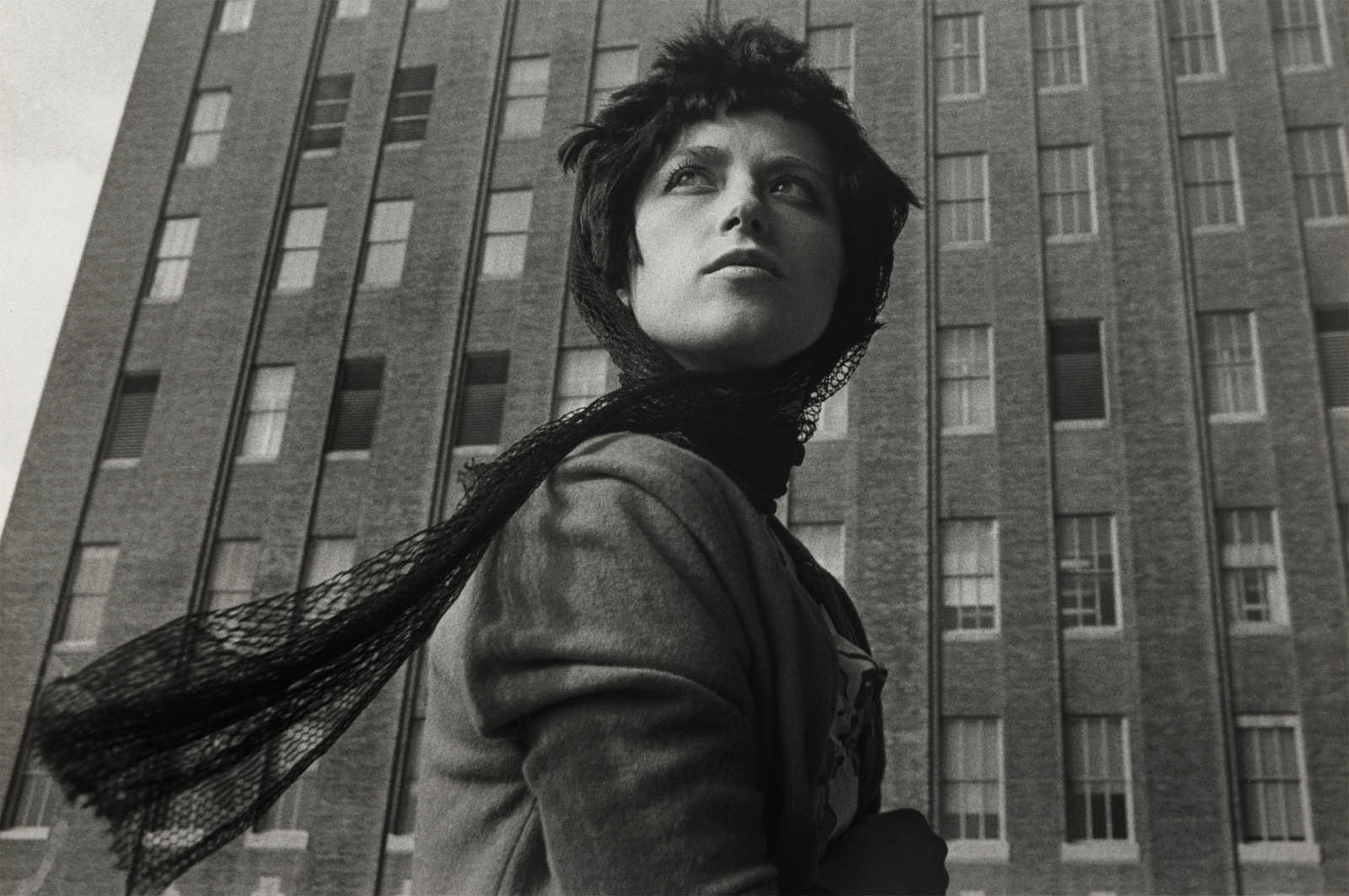
Cindy Sherman (American, b. 1954) Untitled Film Still #58 1980 Gelatin silver print 20.3 x 25.4cm Solomon R. Guggenheim Museum, Gift, Ginny Williams
“I’ve always played with make-up to transform myself, but everything, including the lighting, was self taught. I just learned things as I needed to use them. I absorbed my ideas for the women in these photos from every cultural source that I’ve ever had access to, including film, TV, advertisements, magazines, as well as any adult role models from my youth.”1
Cindy Sherman (b. 1954, Glen Ridge, N.J.) emerged onto the New York art scene in the early 1980s as part of a new generation of artists concerned with the codes of representation in a media-saturated era. Along with many artists working in the 1980s, Sherman explored photography as a way to reveal and examine the cultural constructions we designate as truth. Confronting the belief that photographs are truthful documents, Sherman’s fictional narratives suggested that photographs, like all forms of representation, are ideologically motivated. She is aware that the camera is not a neutral device but rather a tool that frames a particular viewpoint.
Sherman’s reputation was established early on with her Untitled Film Stills, a series of 69 black-and-white photographs that she began making in 1977, when she was twenty-three. In this series, the artist depicted herself dressed in the various melodramatic guises of clichéd B-movie heroines presented in 8 x 10 publicity stills from the 1950s and 1960s. In photograph after photograph, Sherman both acts in and documents her own productions. Although Sherman is both model and photographer, these images are not autobiographical. Rather, they memorialise absence and leave us searching for a narrative and clues to what may exist beyond the frame of the camera.
By the time Sherman made the Untitled Film Stills, black-and-white photography was already recognised as belonging to the past, and the styles she replicated were taken not from her own generation but from that of her mother’s. Sherman used wigs and makeup as well as vintage clothing to create a range of female characters. She sets her photos in a variety of locations, including rural landscapes, cities, and her own apartment. Although many of the pictures are taken by Sherman herself using an extended shutter release, for others she required help, sometimes enlisting friends and family. The characters she created include an ingénue finding her way in the big city, a party girl, a housewife, a woman in distress, a dancer, and an actress. In 1980 she completed the series and has said that she stopped when she ran out of clichés to depict. Unlike the media images they refer to, Sherman’s stills have a deliberate artifice that is heightened by the often-visible camera cord, slightly eccentric props, unusual camera angles, and by the fact that each image includes the artist rather than a recognisable actress or model. Sherman remains an important figure, with works in major collections around the globe, and continues to create striking, imaginative art.
Text from the Teacher’s Guide to the exhibition
1/ Cindy Sherman, quoted in Monique Beudert and Sean Rainbird, eds., Contemporary Art: The Janet Wolfson de Botton Gift, p. 99.
Landscape, Architecture, and the Passage of Time
Historically, one of photography’s primary functions has been to document sites where significant, often traumatic events have taken place. During the Civil War, which erupted not long after the medium was invented, a new generation of reporters sought to photograph battles, but due to the long exposure times required by early cameras, they could only capture the aftermath of the conflicts. These landscapes, strewn with the dead, now seem doubly arresting, for they capture past spaces where something has already occurred. Their state of anteriority, witnessed at such an early stage in the medium’s development, speaks to the very nature of a photograph, which possesses physical and chemical bonds to a past that disappears as soon as it is taken. As viewers, we are left with only traces from which we hope to reconstruct the absent occurrences in the fields, forests, homes, and offices depicted in the works in the exhibition. With this condition in mind, many artists, among them James Casebere, Spencer Finch, Ori Gersht, Roni Horn, Luisa Lambri, An-My Lê, Sally Mann, and Hiroshi Sugimoto, have turned to empty spaces in landscape and architecture, creating poetic reflections on time’s inexorable passing and insisting on the importance of remembrance and memorialisation.
“A good work of art can never be read in one way. My work is full of contradictions. An artwork is open – it is the spectators looking at the work who make the piece, using their own background. A lamp in my work might make you think of a police interrogation, but it’s also religious, like a candle. At the same time it alludes to a precious painting, with a single light shining on it. There are many way of looking at the work. It has to be ‘unfocused’ somehow so that everyone can recognize something of their own self when viewing it.”1
The power of photography to recall the past has inspired many contemporary artists to use photographs to revisit the experience of historical events. In so doing, artists reconsider the photograph itself as an object imbued with history. They became aware that using the medium of photography would lend the elements of specificity and truth to their work.
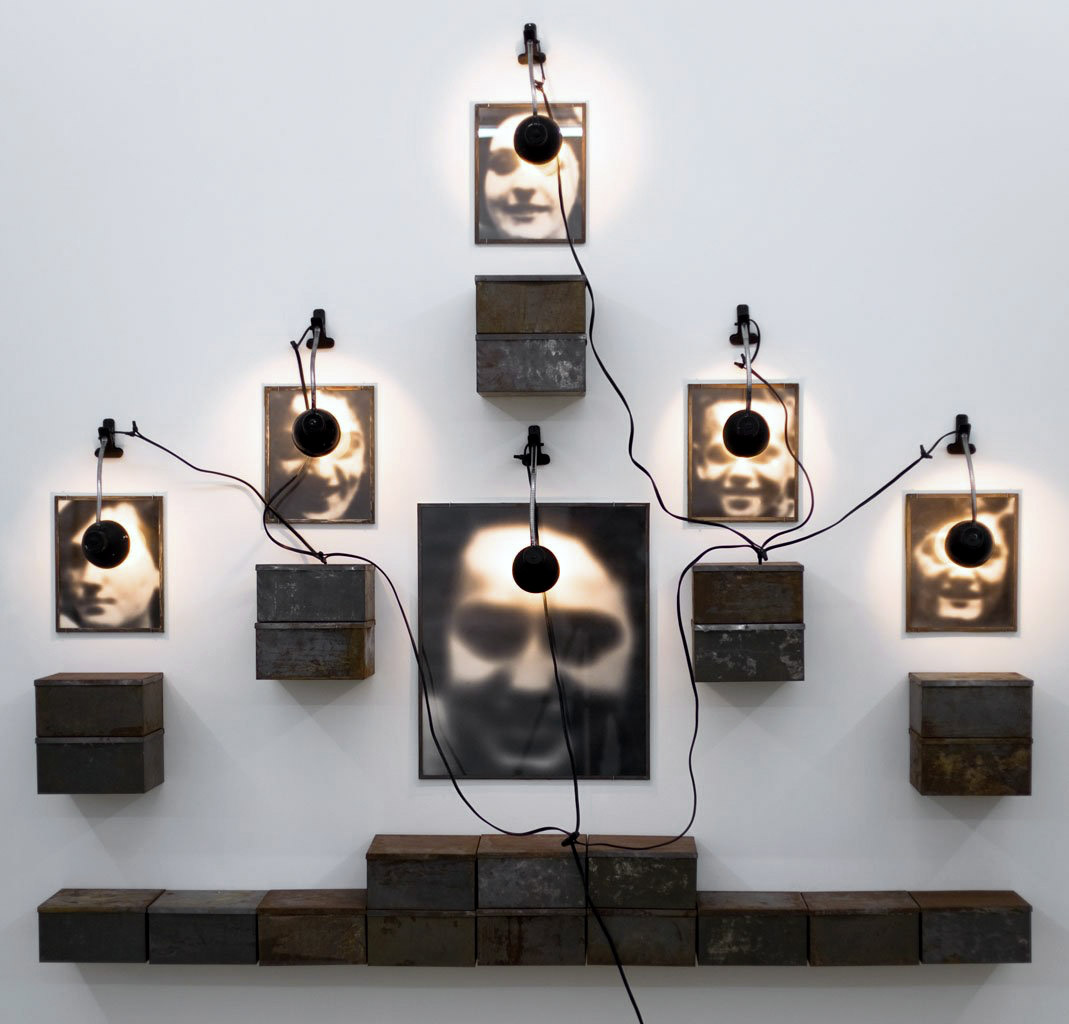
Since the late 1960s, Christian Boltanski (b. 1944, Paris) has worked with photographs collected from ordinary and often ephemeral sources, endowing the commonplace with significance. Rather than taking original photographs to use in his installations, he often finds and rephotographs everyday documents – passport photographs, school portraits, newspaper pictures, and family albums – to memorialise everyday people. Boltanski seeks to create an art that is indistinguishable from life and has said, “The fascinating moment for me is when the spectator hasn’t registered the art connection, and the longer I can delay this association the better.”2 By appropriating mementos of other people’s lives and placing them in an art context, Boltanski explores the power of photography to transcend individual identity and to function instead as a witness to collective rituals and shared cultural memories.
In Boltanski’s 1986-1987 work Autel de Lycée Chases (which means “Altar to the Chases High School”) enlarged photographs of children are hung over a platform constructed from stacked tin biscuit boxes, which are rusted as if they have been ravaged by time. The black-and-white photographs look like artefacts from another era. An electric light illuminates each face while at the same time obscuring it. The arrangement gives no way to identify or connect the unnamed individuals.
The photos used in Autel de Lycée Chases were taken from a real-world source, the school photograph of the graduating class of 1931 from a Viennese high school for Jewish students. These students were coming of age in a world dominated by war and persecution, and it is likely that many perished over the next decade.
At once personal and universal in reference, Boltanski’s work serves as a monument to the dead, hinting at the Holocaust without naming it. Within this haunting environment, Boltanski intermingles emotion and history, sentimentality and profundity.
Text from the Teacher’s Guide to the exhibition
1/ Christian Boltanski, “Tamar Garb in conversation with Christian Boltanski,” in Christian Boltanski (London: Phaidon Press, 1997), p. 24. 2/ “Christian Boltanski: Lessons of Darkness”
Documentation and Reiteration
Since at least the early 1970s, photographic documentation, including film and video, has served as an important complement to the art of live performance, often setting the conditions by which performances are staged and sometimes obviating the need for a live audience altogether. Through an ironic reversal, artworks that revolved around singular moments in time have often come to rely on the permanence of images to transmit their meaning and sometimes even the very fact of their existence. For many artists, these documents take on the function of relics-objects whose meaning is deeply bound to an experience that is always already lost in the past. Works by artists such as Marina Abramović, Christian Boltanski, Sophie Calle, Tacita Dean, Joan Jonas, Christian Marclay, Robert Mapplethorpe, Ana Mendieta, and Gina Pane examine various aesthetic approaches inspired by the reiterative power of the photograph. Using photography not only to restage their own (and others’) performances but to revisit the bodily experience of past events, these artists have reconsidered the document itself as an object embedded in time, closely attending to its material specificity in their works.
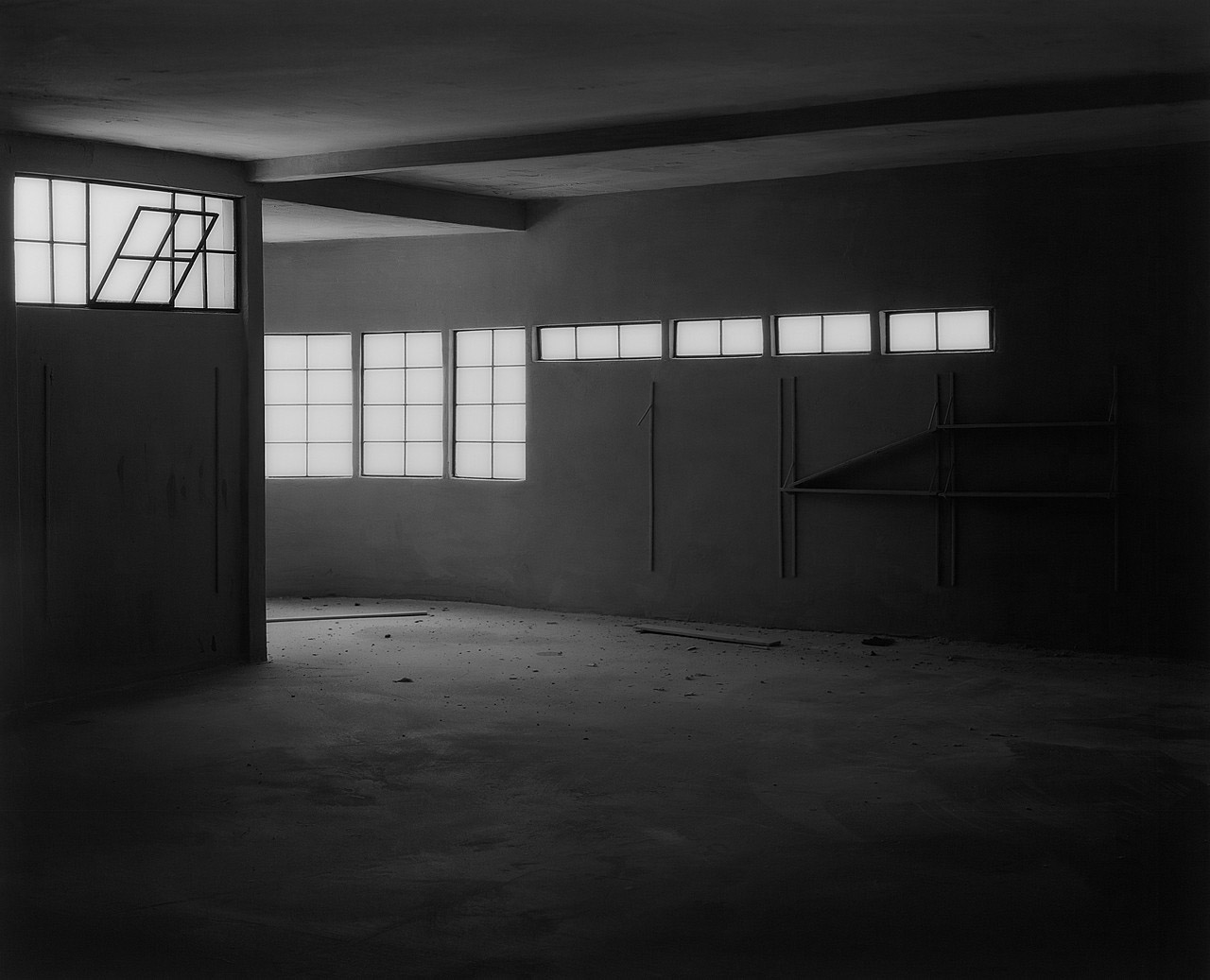
James Casebere (American, b. 1953) Garage 2003 Chromogenic print, face-mounted to acrylic 181.6 x 223.5cm Solomon R. Guggenheim Museum, New York Anonymous gift
“Black and white had more to do with memory and the past. Color was too much about the present, I associated it with color TV, which was not a part of my past. I wanted the images to be related to a sense of history, let’s say, whether personal or social. And I think black and white adds a certain level of abstraction.”1
Since the mid-1970s James Casebere (b. 1953, Lansing, Michigan) has been carefully constructing architectural models and photographing them, yielding images somewhere between realism and obvious fabrication. His photographs are stripped of color and detail to evoke a sense of emotional place rather than the physicality of a place’s forms. Casebere is interested in the memories and feelings that are brought to mind by the architectural spaces he represents. The resulting works are dramatic, surreal, and remarkably true to life, embracing qualities of photography, architecture, and sculpture.
His tabletop models imitate the appearance of architectural institutions (home, school, library, prison) or common sites (tunnel, corridor, archway), representing the structures that occupy our everyday world. These models, made from such featureless materials as Foamcore, museum board, plaster, and Styrofoam, remain empty of detail and human figures. It is only when Casebere casts light on their bland surfaces and spartan interiors that the models are transformed. By eliminating the details, and taking advantage of dramatic lighting effects and the camera’s ability to flatten space, Casebere is able to transform familiar domestic spaces to find the extraordinary in the everyday. He asks viewers to rely on their memory to fill in the gaps and to create a context in which to understand his images.
Casebere stages his photographs to construct realities inspired by contemporary American visual culture that blur the line between fiction and fact. In this way, his images suggest psychologically charged spaces and have an otherworldly quality. The notion that these may be actual places seems plausible, but the lack of human presence leads us to wonder what has happened here. The viewer may imagine a human story within the abandoned spaces. Without people or colour, the photographs are about our own associations with these spaces and what they may represent.
When Andy Warhol created his silkscreen paintings of Marilyn Monroe in the wake of her death, he touched on the darker side of a burgeoning media culture that, during the Vietnam War, became an integral part of everyday life. Today, with vastly expanded channels for the propagation of images, events as varied as the terrorist attack on the World Trade Center and the deaths of celebrities such as Princess Diana and Michael Jackson have the ability to become traumatic on a global scale. Many artists, including Adam Helms, Nate Lowman, Adam McEwen, Cady Noland, and Anri Sala, have reexamined the strategy of image appropriation Warhol pioneered, attending closely to the ways political conflict can take on global significance. At the same time, photography has altered, or as some theorists argue, completely reconfigured our sense of personal memory. From birth to death, all aspects of our lives are reconstituted as images alongside our own experience of them. This repetition, which is mirrored in the very technology of the photographic medium, effectively produces an alternate reality in representation that, especially when coping with traumatic events, can take on the force of the uncanny. Artists such as Stan Douglas, Anthony Goicolea, Sarah Anne Johnson, Jeff Wall, and Gillian Wearing exploit this effect, constructing fictional scenarios in which the pains and pleasures of personal experience return with eerie and foreboding qualities.
Press release from the Solomon R. Guggenheim Museum website [Online] Cited 22/08/2010 no longer available online
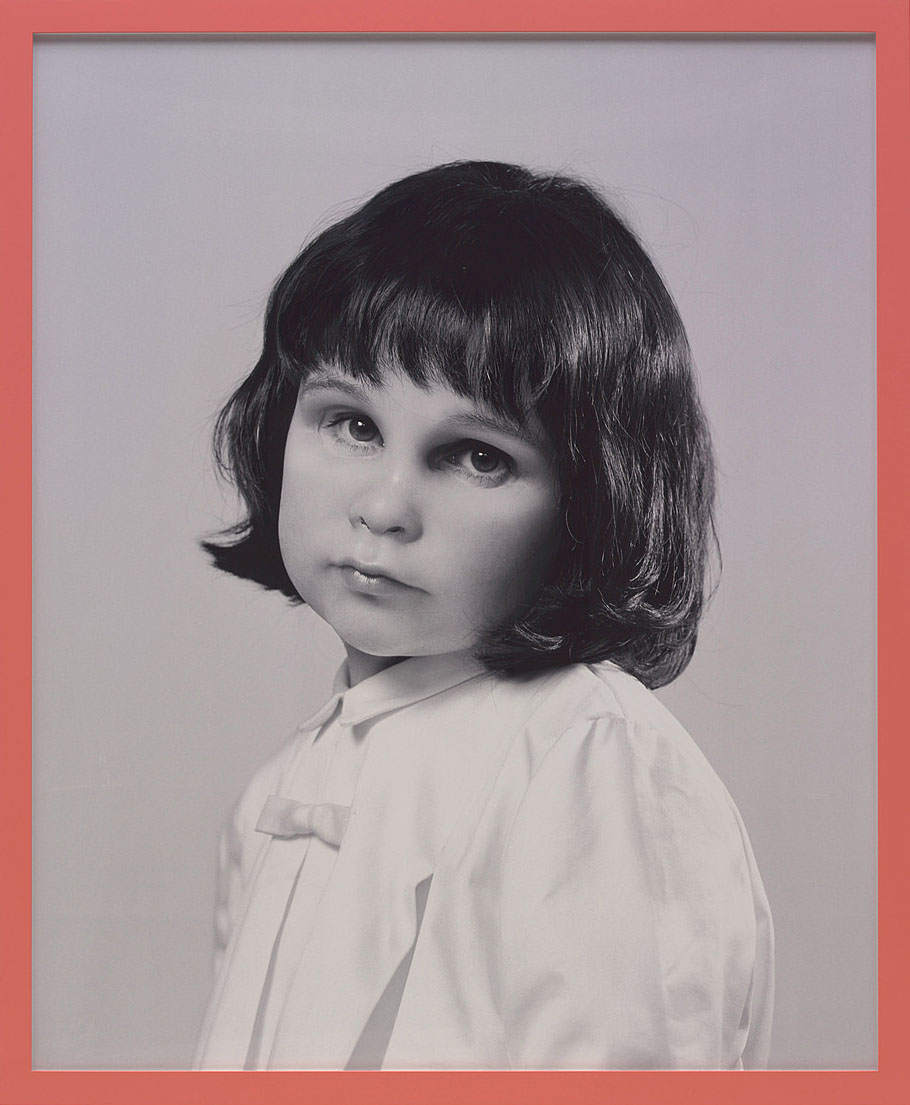
Gillian Wearing (British, b. 1963) Self-Portrait at Three Years Old 2004 Chromogenic print 182 x 122cm Solomon R. Guggenheim Museum, New York Purchased with funds contributed by the International Directors Council and Executive Committee Members: Ruth Baum, Edythe Broad, Elaine Terner Cooper, Dimitris Daskalopoulos, Harry David, Gail May Engelberg, Shirley Fiterman, Nicki Harris, Dakis Joannou, Rachel Lehmann, Linda Macklowe, Peter Norton, Tonino Perna, Elizabeth Richebourg Rea, Mortim
“I taught myself to use a camera – it’s not very difficult to use a camera, but I never bothered looking at any textbooks on how to make a picture. I had a much more casual relation to it. For me at the time it was much more about the process rather than the results.”1
Photography has not only profoundly impacted our understanding of historical events, it has also changed the way we remember our personal histories. Beginning at birth, all aspects of our lives are recorded as images alongside our own experiences of them. These parallel recording devices, the camera and personal memory, produce alternate realities that may sometimes be synchronised but at other times are askew.
Gillian Wearing (b. 1963, Birmingham, England) uses masks as a central theme in her videos and photographs. The masks, which range from literal disguises to voice dubbing, conceal the identities of her subjects and free them to reveal intimate secrets. For her 2003 series of photographs Album, Wearing used this strategy to create an autobiographical work. Donning silicon prosthetics, she carefully reconstructed old family snapshots, transforming herself into her mother, father, uncle, and brother as young adults or adolescents. In one of the works, Wearing recreated her own self-portrait as a teenager – and in fact the artist considers all the photographs in this series as self-portraits. She explains: “I was interested in the idea of being genetically connected to someone but being very different. There is something of me, literally, in all those people – we are connected, but we are each very different.”2
To make the Album series, Wearing collaborated with a talented team (some of whom have worked for Madame Tussaud’s wax works) who sculpted, cast, painted, and applied hair to create the masks, wigs, and body suits used in these photographs. The elaborate disguises the artist wears, when combined with the snapshot “realism” of the original images on which they are based, create an eerie fascination that serves to reveal aspects of her identity rather than conceal it.
Self-Portrait at Three Years Old (2004) carries this role-playing further back in time. Confronting the viewer with her adult gaze through the eyeholes of the toddler’s mask, Wearing plays on the rift between interior and exterior and raises a multitude of provocative questions about identity, memory, and the truthfulness of the photographic medium. Wearing says, “What I love about photographs is that they give you a lot and also they withhold a lot.”3
Text from the Teacher’s Guide to the exhibition
1/ “Gillian Wearing,” interview by Leo Edelstein, Journal of Contemporary Art 2/ Quoted in Jennifer Bayles, “Acquisitions: Gillian Wearing,” Albright-Knox Art Gallery, Buffalo, NY (accessed January 25, 2010) 3/ Sebastian Smee, “Gillian Wearing: The art of the matter,” The Independent (London), October 18, 2003
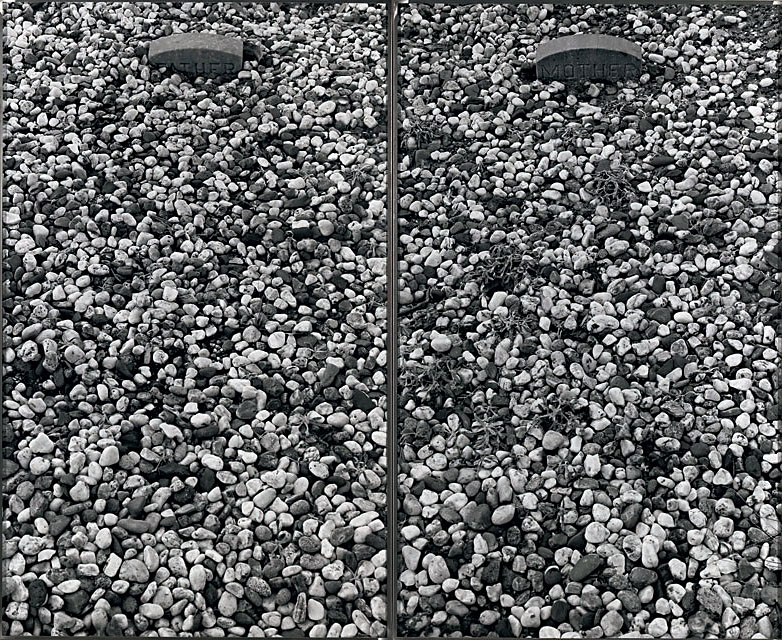
Sophie Calle (French, b. 1953) Father Mother (The Graves, #17) 1990 Two gelatin silver prints in artist’s frames edition 2/2 181.0 x 111.1cm each Solomon R. Guggenheim Museum, New York, Gift, The Bohen Foundation
Ana Mendieta (Cuban American, 1948-1985) Untitled (Silueta series) 1978 Gelatin silver print 20.3 x 25.4cm Solomon R. Guggenheim Museum, New York, Purchased with funds contributed by the Photography Committee
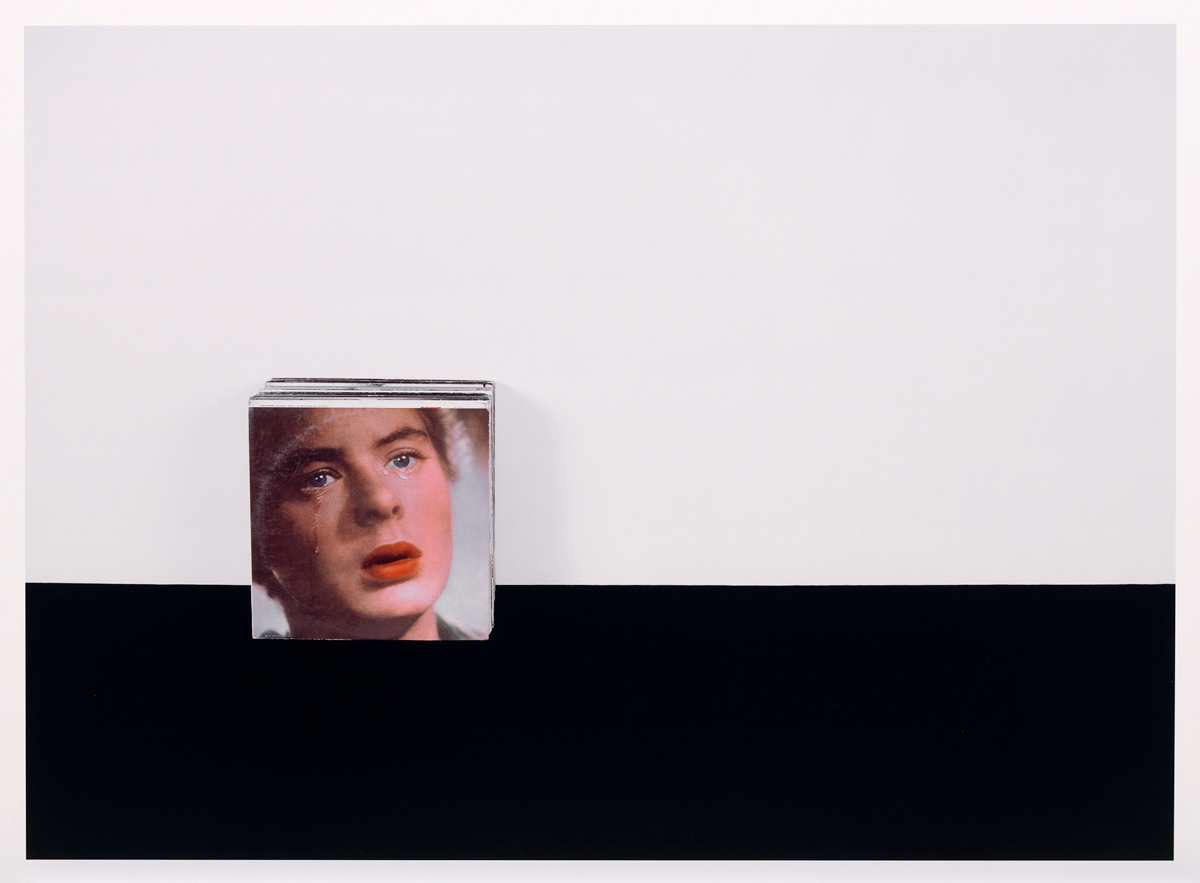
Anne Collier (American, b. 1970) Crying 2005 Chromogenic print edition 1/5 99.1 x 134 x 0.6cm Solomon R. Guggenheim Museum, New York, Purchased with funds contributed by Mr. and Mrs. Aaron M. Tighe
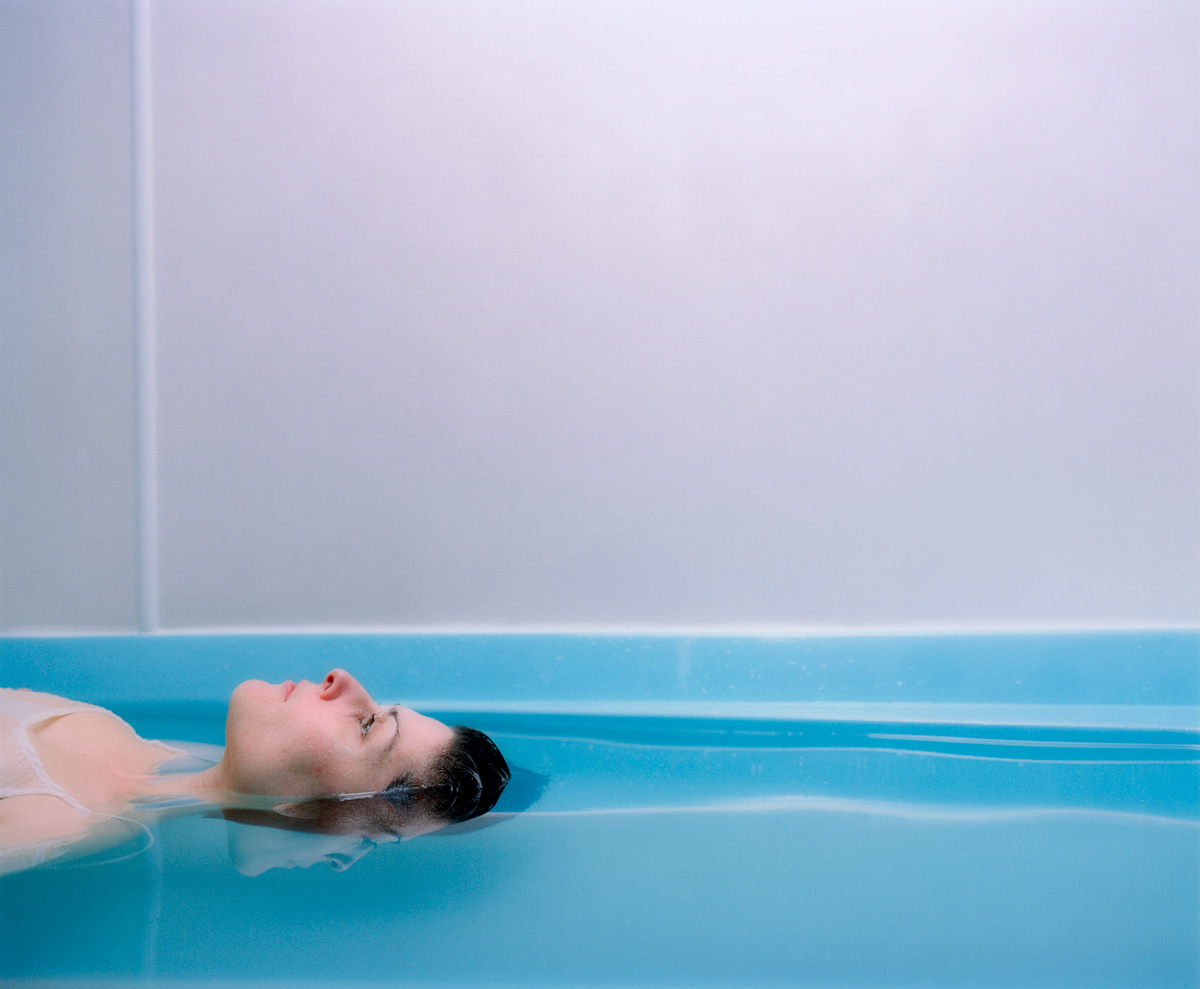
Miranda Lichtenstein (American, b. 1969) Floater 2004 Chromogenic print edition 5/5 104.1 x 127cm Solomon R. Guggenheim Museum, New York, Purchased with funds contributed by the Photography Committee
Sarah Anne Johnson (Canadian, b. 1976) Morning Meeting (from Tree Planting) 2003 Chromogenic print edition 73.7 x 79.7cm Solomon R. Guggenheim Museum, New York, Purchased with funds contributed by Pamela and Arthur Sanders; the Harriett Ames Charitable Trust; Henry Buhl; the Heather and Tony Podesta Collection; Ann and Mel Schaffer; Shelley Harrison; and the Photography Committee
Sally Mann (American, b. 1951) Virginia from the Mother Land series 1992 Gelatin silver print 76.2 x 96.5cm Solomon R. Guggenheim Museum, New York, Gift, The Bohen Foundation
Solomon R. Guggenheim Museum 1071 5th Avenue (at 89th Street) New York
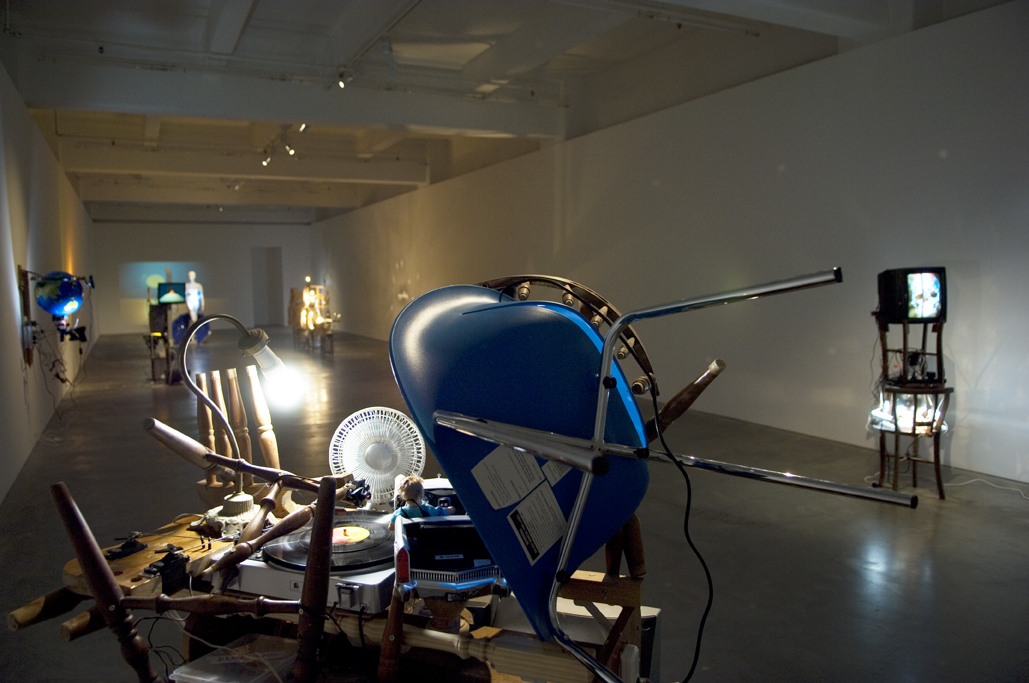
Ian Burns (Australian, b. 1964) AND THEN… 2010 Installation view at Anna Schwartz Gallery, Melbourne
Two words: JUST GO!
Yes the work can be analysed as in the text (below) from the Anna Schwartz Gallery website but this is not necessary to enjoy the work. These are such fun assemblages, the created mis en scenes so magical and hilarious, guffaw inducing even, that they are entirely playful.
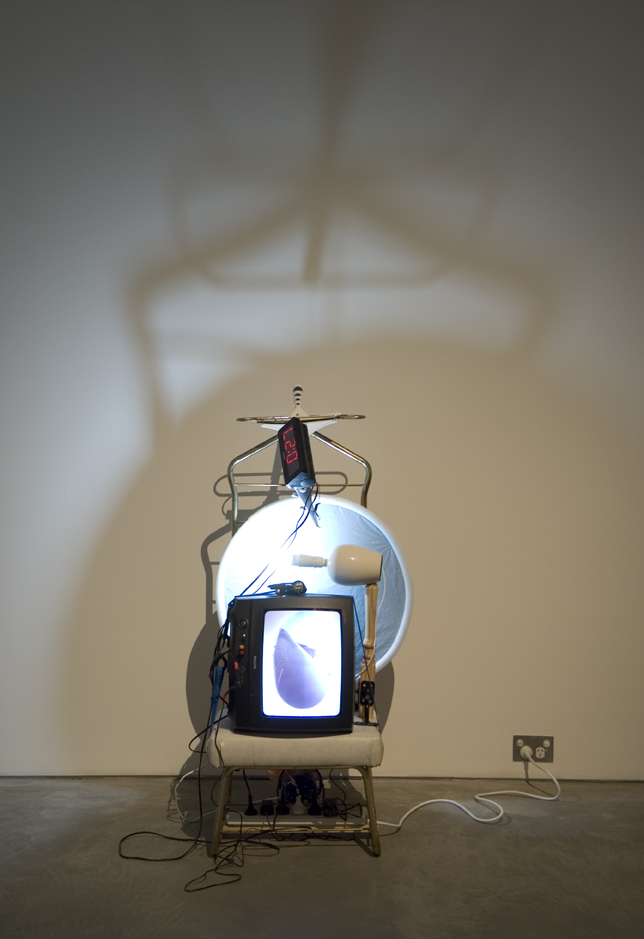
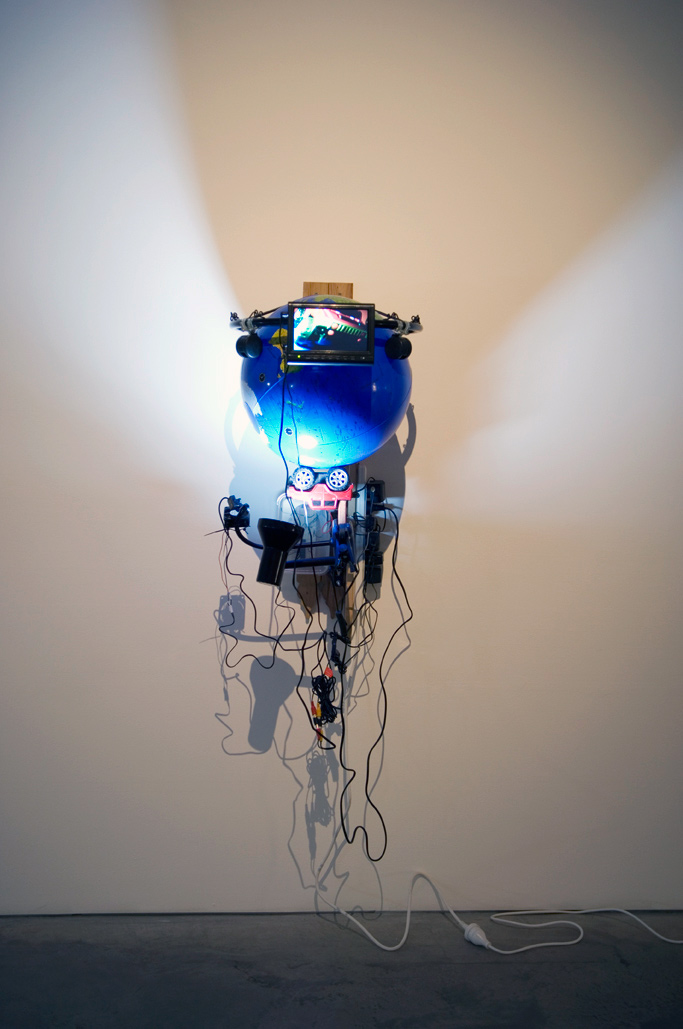
I delighted in how they were constructed, almost thrown together from found objects that relate to the theme of each work; in the miniature cameras and environments – the Jumbo jet flying through the ‘sky’ of clouds created by a boiling water heater; in every particle of light as the words AND THEN… were created through aligned lens prisms (A Moment Implied 2010); and I was in wonder at the shimmering, setting sun in Venus (2010).
There is so much to like here – the inventiveness, the freshness of the work, the insight into the use of images in contemporary culture. Still photographs of this work do not do it justice. I came away from the gallery uplifted, smiling, happy – and that is a wonderful thing to happen.
As I said at the beginning: JUST GO!
Dr Marcus Bunyan
Many thankx to Ash Kilmartin and the Anna Schwartz Gallery for the photographs in the posting. Please click on the images for a larger version of the image. All images are courtesy the artist and Anna Schwartz Gallery.
Ian Burns (Australian, b. 1964) 15 hours v.4 2010 Found object kinetic sculpture, live video and audio Image courtesy the artist and Anna Schwartz Gallery
For his first solo exhibition in Melbourne, and his first exhibition at Anna Schwartz Gallery, Ian Burns presents a number of sculptures that continue to explore the manufactured screen image. Referring in title to the simplistic and little-nuanced plots of pulp fiction, AND THEN… provides a space in which we might become more conscious of the images we consume on a daily basis. Incorporating and sometimes generating sound and image, Burns’ ‘meta-cinematic’ monuments invoke popular moving imagery and by extension the culture which produces them. Burns builds these audio-visual-sculptural forms in order to reveal the clichés of contemporary screen culture. Without ignoring the context of his own production, Burns’ critique of mindless images also extends to those contemporary art practices that similarly play upon the objects familiar to daily life. Comprised of found objects, each sculpture contains within it a unique narrative. For example, the coincidence of discovering a clam-shaped, children’s swimming pool, along with some discarded mannequins, led the artist to Botticelli’s Birth of Venus. What ensues is a unique extension of the metaphor, as Venus – through Burns – gives birth to video. This brings us to the underlying essence of Burns’ work: while critically bringing to light complex theories about popular culture and the entertainment industry, these works contain a necessary dose of humour – making them utterly compelling.
The suspension, the feathers, the monumental scale of both of the forms, the shiny surface of the Jaguar, the beauty and the subversion of the values and purpose of the war machine: bringing the body and the machine into close physical proximity. Light the blue touch paper and step well back … (my English heritage coming in there, on Guy Fawkes night lighting the fireworks)
Dr Marcus Bunyan
Many thankx to Susannah Lally at The Tate for allowing me to publish the photographs in the posting. Please click on the photographs for a larger version of the image.
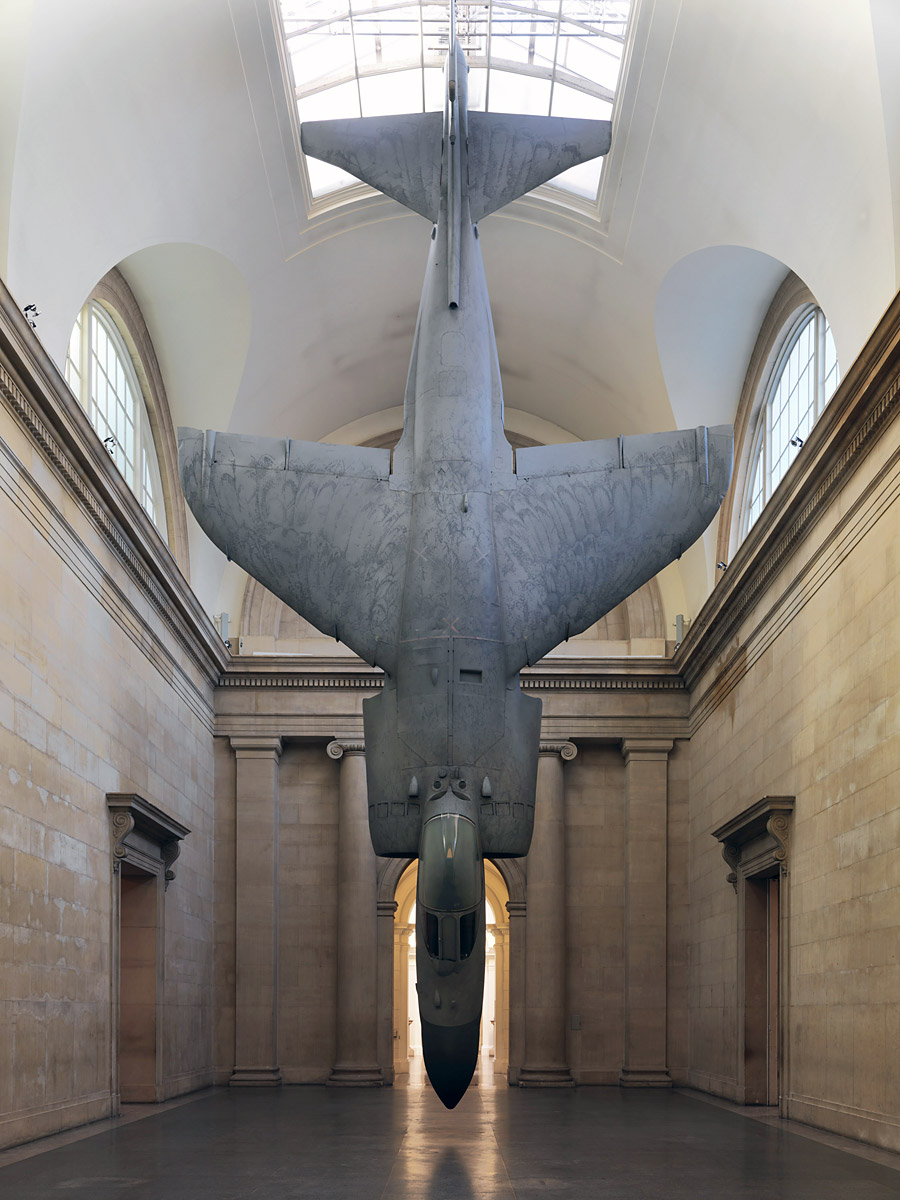
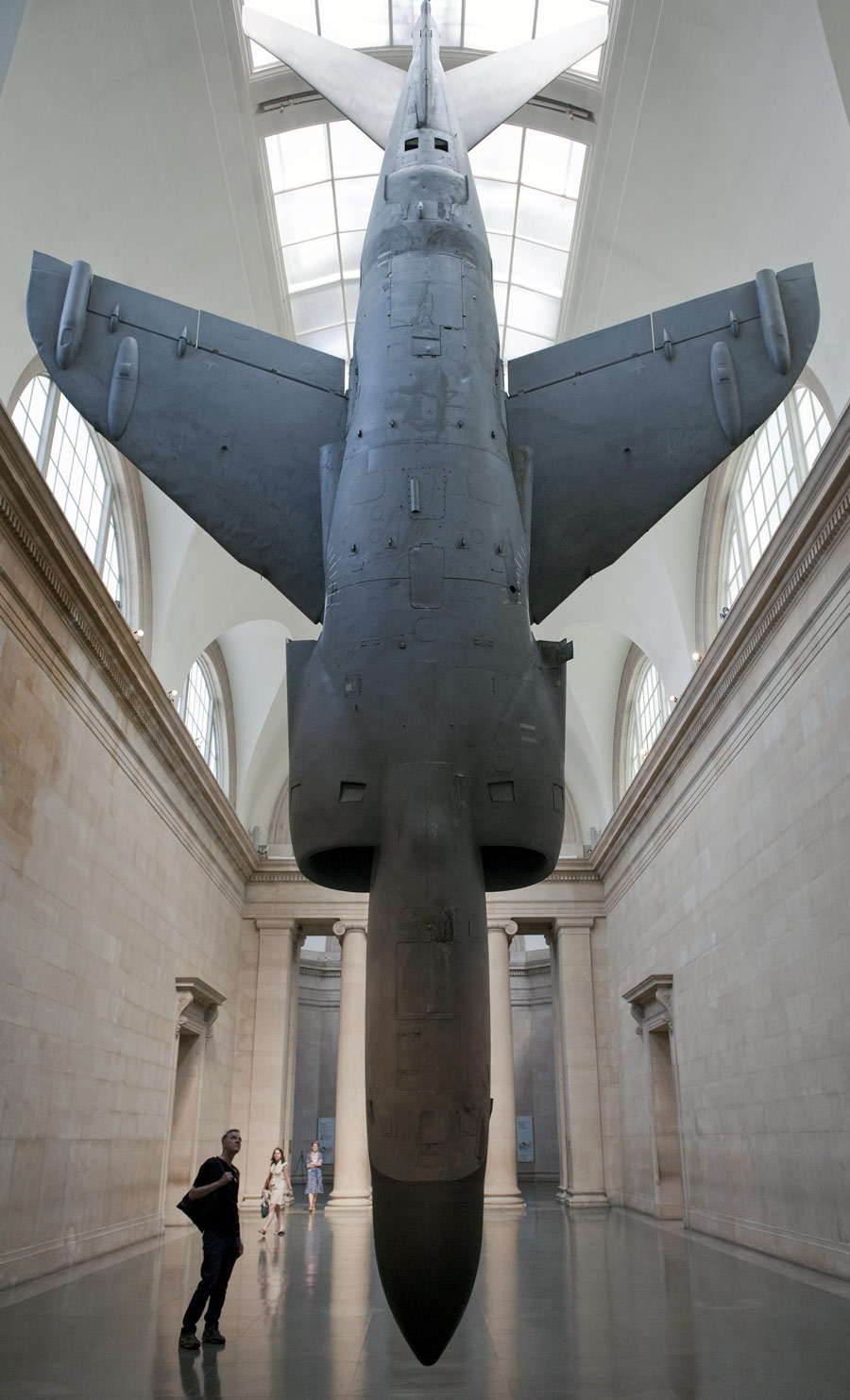
Tate Britain today unveils its new Duveens Commission, Harrier and Jaguar, by Fiona Banner. Banner’s largest work to date, Harrier and Jaguar brings the highly-charged physicality of two real fighter jets, both previously in active military service, into the unexpected setting of the neoclassical Duveen Galleries. Harrier and Jaguar has been specially devised for the Tate Britain Duveens Commission 2010, supported by Sotheby’s.
In the South Duveens, a Sea Harrier jet is suspended vertically, its bulk spanning floor to ceiling, wall to wall. Mimicking its namesake the harrier hawk, the aircraft’s surface has been reworked with handpainted graphic feather markings – the cockpit, the eyes, the nose cone, the beak – and hung nose pointing towards the floor, bringing to mind a trussed bird.
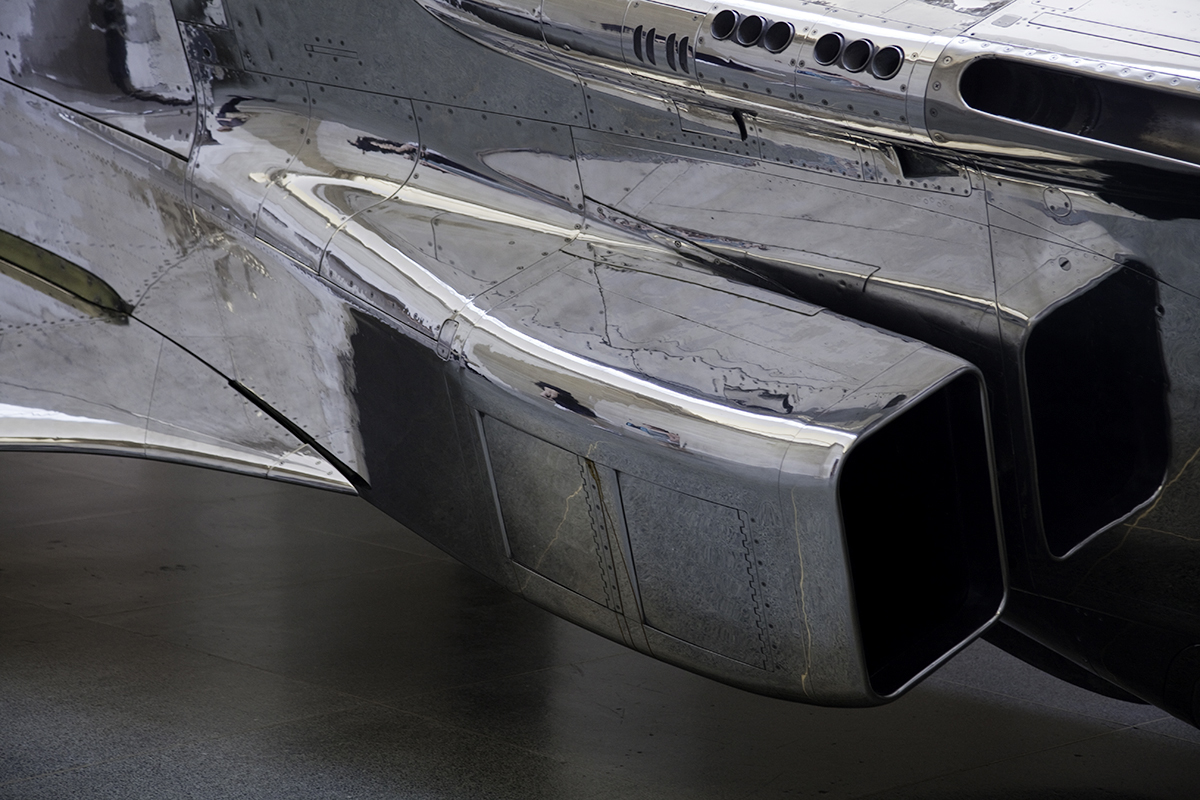
In the North Duveens, a Sepecat Jaguar lies belly-up on the floor, its elegant, elongated body traces the length the gallery. Stripped of paint and polished to reveal a metallic surface, the aircraft becomes a mirror that reflects back its surroundings and exposes the audience to its own reactions. Harrier and Jaguar achieves a powerful presence loaded with the seductive and yet troubling qualities of these objects of war.
Here, Banner places recently decommissioned fighter planes in the incongruous setting of the Duveen Galleries. For Banner these objects represent the ‘opposite of language’, used when communication fails. In bringing body and machine into close proximity she explores the tension between the intellectual perception of the fighter plane and physical experience of the object. The suspended Sea Harrier transforms machine into captive bird, the markings tattooing its surface evoking its namesake the Harrier Hawk. A Jaguar lies belly up on the floor, its posture suggestive of a submissive animal. Stripped and polished, its surface functions as a shifting mirror, exposing the audience to its own reactions. Harrier and Jaguar remain ambiguous objects implying both captured beast and fallen trophy.
“I remember long sublime walks in the Welsh mountains with my father, when suddenly a fighter plane would rip through the sky, and shatter everything. It was so exciting, loud and overwhelming; it would literally take our breath away. The sound would arrive from nowhere, all you would see was a shadow and then the plane was gone.
At the time harrier jump jets were at the cutting edge of technology but to me they were like dinosaurs, prehistoric, from a time before words.”
Fiona Banner said: “It’s hard to believe that these planes are designed for function, because they are beautiful. But they are absolutely designed for function, as a bird or prey is, and that function is to kill. That we find them beautiful brings into question the very notion of beauty, but also our own intellectual and moral position. I am interested in that clash between what we feel and what we think.”
Penelope Curtis, Director of Tate Britain, said: “The power of Banner’s project lies in its simple but unlikely juxtaposition: two fighter jets in a suite of neo-classical galleries.”
A fascination with language and signs is central to Fiona Banner’s practice. The emblem of the fighter jet recurs throughout her work, part of an ongoing enquiry into how signs translate experience. They appeared in pencil drawings she made at art college and then later in her first ‘wordscape’ in 1994 which transcribed the film Top Gun into a frame-by-frame written account. Aircraft are also present in more recent work where the artist has created Airfix models of all the war planes currently in service throughout the world and a taxonomy of fighter-plane nicknames. Harrier and Jaguar extends the artist’s exploration of these themes whilst constituting a dramatic new departure in terms of its monumental scale and the use of actual fighter jets.
Deputy Chairman, Sotheby’s Europe, Lord Poltimore, commented: “Tate Britain’s Duveens Commission is among the art scene’s most celebrated events and Sotheby’s is extremely proud to once again be supporting it, and Tate, one of the world’s leading public art institutions.”
Banner’s Harrier and Jaguar is the latest in a series of sculpture displays in the Duveen Galleries at Tate Britain. The contemporary sculpture commissions have been an annual event for three years since 2008, through the generous support of Sotheby’s. Artists who have previously undertaken the Commission include Eva Rothschild (2009), Martin Creed (2008), Mark Wallinger (2007), Michael Landy (2004), Anya Gallaccio (2002) and Mona Hatoum (2000). The series builds on a long tradition of exhibitions in the Duveen Galleries, which has included memorable installations by Richard Long, Richard Serra and Luciano Fabro.
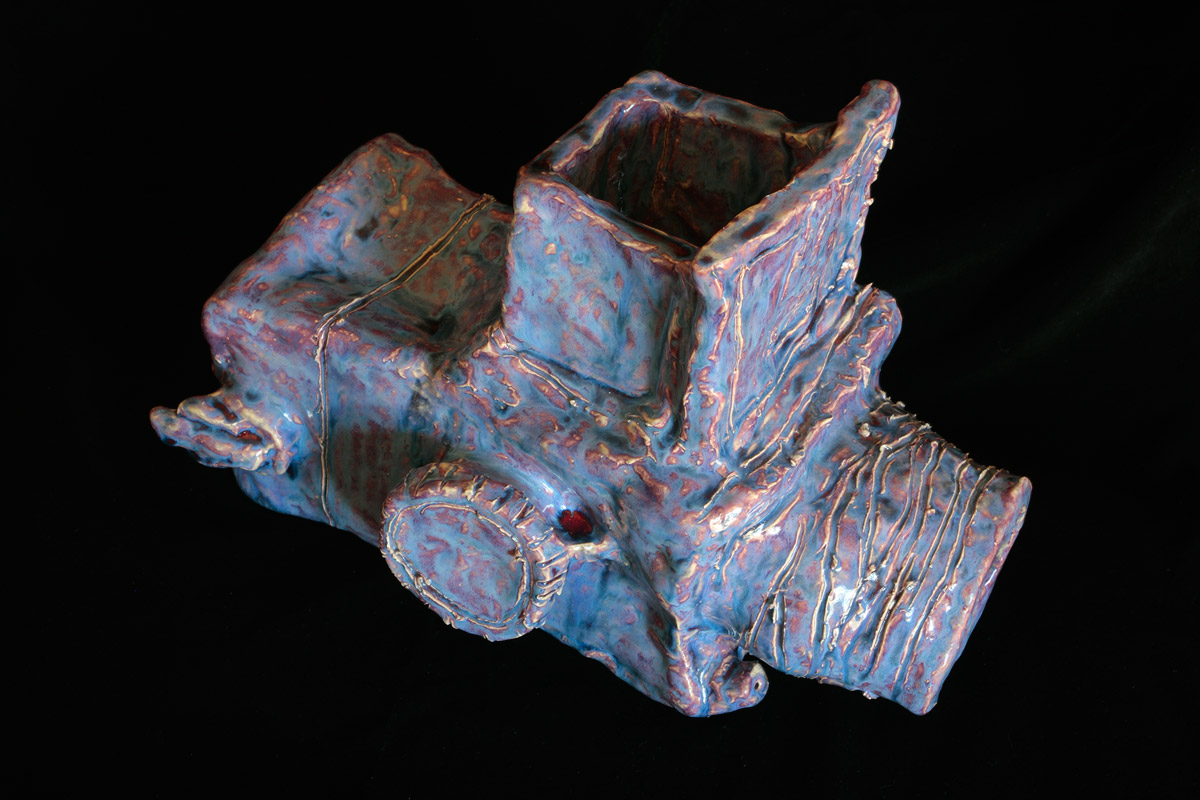
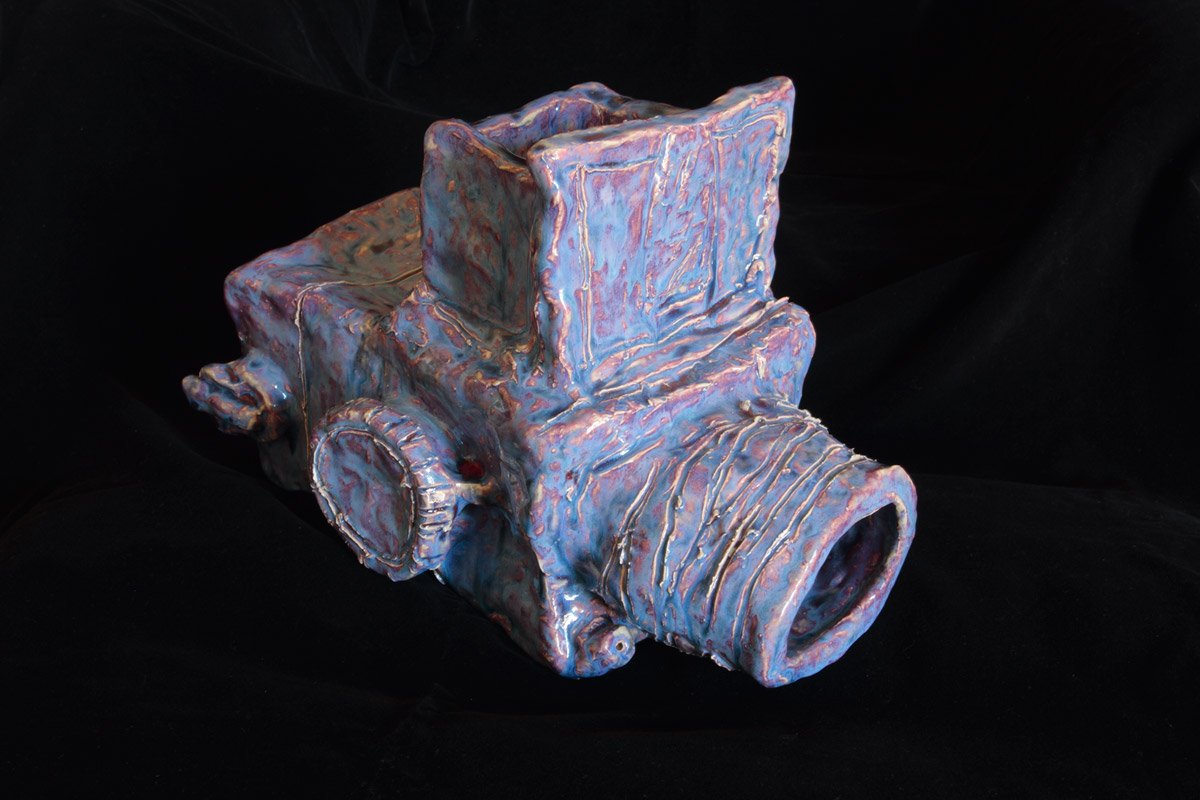
Alan Constable (Australian, b. 1956) Untitled (Hasselblad) 2008 Clay, glaze
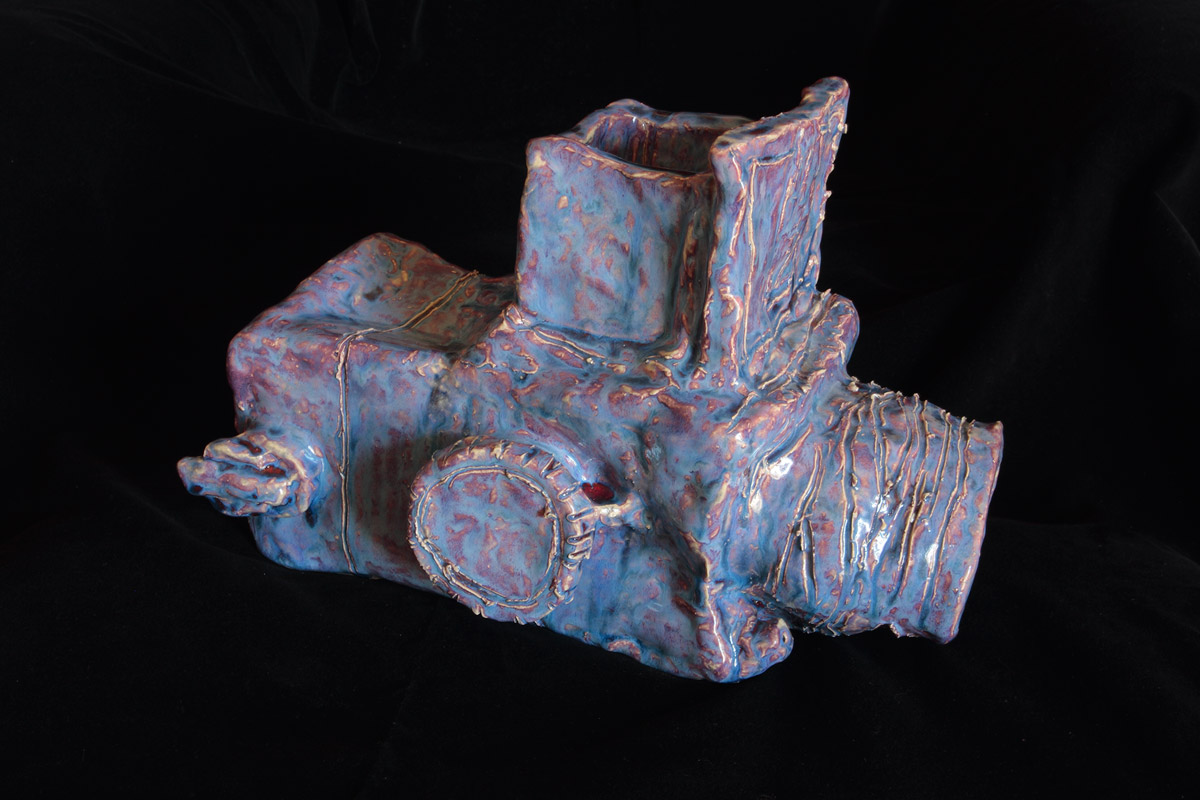
I finally succumbed and bought myself a wonderful Alan Constable ceramic camera from the Arts Project Australia stand at the Melbourne Art Fair on Saturday (see photographs below – click on the photographs for a larger version of the image). I first saw Alan’s ceramic work at his solo exhibition called Clay Cameras at Helen Gorie Galerie in August 2009 (see photographs from the exhibition) and was instantly attracted to the tactility and beauty of the work. Months later I saw more of his cameras at Sophie Gannon Gallery in Richmond and now at the Art Fair. Third time lucky, I found a stunning medium format Hasselblad in a beautiful two tone glaze that really spoke to me in terms of it’s form and aesthetic appeal. Constable’s work has really impinged on my consciousness and the piece has a special resonance for me.
“Constable’s ceramic works reflect a life-long fascination with old cameras, which began with his making replicas from cardboard cereal boxes at the age of eight. The sculptures are lyrical interpretations of technical instruments, and the artist’s finger marks can be seen clearly on the clay surface like traces of humanity. In this way, Alan Constable cameras can be viewed as extensions of the body, as much as sculptural representations of an object.” (Arts Project Australia text)
Highlights of the Art Fair were the outstanding paintings of Juan Ford at Dianne Tanzer Gallery, the mesmeric video work of Daniel Crooks at Anna Schwartz Gallery (who I think is one of the best artists in the country – see more images of his work from his Intersection exhibition), the delicately layered and outrageously beautiful collage work of Peter Madden at Ryan Renshaw Gallery, the layered transcapes of Janet Lawrence at Arc One Gallery and the cosmological paintings of Lara Merrett at Karen Woodbury Gallery. Brickbats for the most overblown presentation must go to Danie Mellor at Michael Reid for a truly over the top performance that just left one speechless.
It was a real pleasure to meet so many gallery directors and managers face to face including Gina Lee at Niagara Galleries, James Makin at James Makin Gallery, Matt Glen at Martin Browne Fine Art, Sydney, Paul Greenway from Gagprojects, Berlin and Ken Fehily from Fehily Contemporary, Melbourne.
Finally, I visited the Notfair 2010 exhibition in Richmond, a disappointing group exhibition of 30 artists selected from over 300 artists suggested by curators from around the country. As with many group exhibitions that lack thematic development the work was all over the place, in every media imaginable. The absolute standout work were the two antique stereoscopic cabinet and LED light animations of Chris Henschke from the duo Topologies. While the idea for the exhibition is to be applauded (that of presenting an exhibition of unknown or little known artists that may or may not be represented by a gallery) perhaps the next exhibition should have fewer artists to give the work chance to speak for the artist instead of just being a token gesture.
Dr Marcus Bunyan
Alan Constable (Australian, b. 1956) Untitled (Hasselblad) 2008 Clay, glaze
I have managed to track down the artist and author Pablo Helguera (after I quoted his words in the review on the work of Jill Orr) and obtain permission to publish his wonderful text How to Understand the light on a Landscape taken from a video work of 2005.
Many, many thankx to Pablo Helguera for allowing my to publish the text and photographs below. The permission is truly appreciated. The text is beautiful, insightful – a must for any artist who wishes to understand the condition of light on a landscape.
“‘How to Understand the Light on a Landscape’ (video, 15 min., 2005) is a work that simulates a scientific documentary about light to discuss the experiential aspects of light as triggered by memory. The images and text below, taken from the video, are part of the book published by the Institute of Cultural Inquiry, entitled Searching for Sebald: Photography After W.G. Sebald edited by Lise Patt, 2007, pp. 110-119.”
“To understand is to forget about loving.”
Fernando Pessoa
For Luis Ignacio Helguera Soiné (1926-2005)
LIGHT is understood as the electromagnetic radiation with a wavelength that is visible to the eye. Yet, the precise nature of light, and the way it affects matter, is one of the key questions of modern physics.
Due to wave-particle duality, light simultaneously exhibits properties of both waves and particles that affect a physical space. There are many sources of light. A body at a given temperature will emit a characteristic spectrum known as black body radiation. The conjunction of a body present in the landscape, along with the interaction of the light in the environment, produces an effect that in modern psychology we describe as experience.
The conjunction of a random site, the accumulated data in the body’s memory that is linked to emotion, and the general behaviour of light form experience. Experience is triggered by light, but not exclusively by the visible light of the electromagnetic spectrum. What the human eye is incapable to perceive is absorbed by other sensory parts of the body, which contribute to the perception that light causes an effect that goes beyond the merely visual.
In our life span, we witness only a few limited emission incidents of light that intersect with spontaneous receptivity of memory in specific places. They happen selectively and in rapid sequences, at night, when a door opens, when we are very young, when we drop off someone at the airport. They all, however, are inscribed by the behaviour of light. As we age and our receptivity declines, our eyes and body become denser material through which there is a reduction of the speed of light, known as a decline in the refractive index of memory.
The extent of the breeding behaviour of EXPERIENTIAL LIGHT is determined by the amount of cyclical phenomena we have experienced, such as the slight humidity that signals the transition of spring into summer. The refractive index of memory is mostly marked by the unusually happy or sad periods of our lives, and the slow decline that gradually dominates our perception. Forgetfulness gradually inhibits the experience of light, and cannot be reversed.
The glow of heaviness, commonly known as SOMBER LIGHT, appears in urban solitude and often towards the end of the day. It is a particularly cruel light to experience, as it stimulates attractive visions, like the singing of two women on a radiant evening but it then reveals hidden anxieties that we may have about the end of things, as Homer describes the fatal singing of the mermaids.
HOME LIGHT is too familiar to be seen. It is the kind of light that we first saw when we were born and we always recognize, but often take for granted. Home light is highly volatile light, and it often vanishes when it is named, as a dream that ends when we dream that we are dreaming. There is no point in explaining this light, because it is too familiar to the owner and too alien to all others. Yet a high experiential index is evident when it’s there, ready to envelop us when we encounter it again wherever we go. We can only know that we all have this kind of light in ourselves, as if in our pockets, ready to come out at a critical moment.
There is the shining of large breath, full of itself, that enters with grandeur into a landscape, uninvited, taking over the logic of everything, promoting the conjunction of belief and fragility. It creates mythologies, and the belief that there is something greater than us in a time that is ungraspable or far larger than our minuscule time in this world.
There is also a glow known as GHOST LIGHT that can only be seen, like some apparitions, in photographs, especially the snapshots taken by those who went through a long trip or extenuating circumstances in their lives, such as returning from a bloody war, escaping hunger and threat. It expresses an image of lonely liberty, where all is in order but there is little that can be enjoyed with that order, as if what happened before had affected the future of it all. It functions like a Swiss clock, harmonious but predictable.
There is the light of the deathbed, that lingers on for a long time after the incident, and often takes the appearance of a rainy day
There is the LIGHT OF THE DEATHBED, that lingers on for a long time after the incident, and often takes the appearance of a rainy day, even many years later, like the widow that will hold on to wearing black. It is a refracting light, the light of the permanent finality of the moment that often creates the impression of letting us know something that we didn’t know, just like an unopened letter found after many years. Its extremely old waves appear to have a cool breeze, as if ready to inspire a Flemish painting.
Those who once read long 19th century novels often recognize RAIN LIGHT. It is often seen from a train in motion, when it is arriving to a station that is not our destination, and yet we feel there is something we are leaving behind, as if we had indeed lived another life, or had developed a sense of belonging to those who we see getting off.
But there is also a tired glow on a cloudy summer afternoon right before or during lunchtime, one that emerges after strenuous work by others but that we see when we are doing nothing, or when we are resting. It is also similar to the light of the movie matinee that we see with the fascination of remembering that it is still daytime after we came from darkness. It also reminds us of food we ate a long time ago and the extinct products and fashions from the time when we were kids.
There is a PROTECTIVE LIGHT that reminds us of the womb, of the time where we were completely protected. This light inspires endless nostalgic yearning to attain that protection again. Our obsession with protective light prevents us from growing and makes us fear change. We wish we could be like that woman in a distant small city who was born, married, and died on the same street. It is true that no velocity and amount of experience can compare with the accumulated placement of experience in a single spot. But due to the impossibility of being able to replace protective light, these attempts derive in the light of the tourist, taking the same image all around the world, seeking comfort in every place when in reality there is no comfort to be had.
Another source of satisfaction is the working light that signals many events that take place on an everyday basis, like business lunches in city cafeterias, like going to the post office, like all the activity proper of the midday urban sprawl, a dynamic, powerful light, with the enthusiasm and perhaps strange mixture of happiness and melancholy we used to feel in school when we were finally off for vacations but we would not get to see our high school crush for the rest of the summer. We will know how to recognize this sunlight when we see it slowly crawl through the walls until it disappears completely.
There is of course the ARTIFICIAL LIGHT. It is a light for waiting, a transitory light that creates the impression that the actual moment doesn’t exist but rather a joining of procedures that take us from one place to another, which we call the obligations of life.
We wish we could be like that woman in a distant small city who was born, married, and died on the same street. It is true that no velocity and amount of experience can compare with the accumulated placement of experience in a single spot.
ARTIFICIAL LIGHT crawls into our lives, and we tend to also see it on the outdoors, sometimes exchanging it mentally for real sunlight. It makes us feel that every place is the same to us because we are the same. Under artificial light, the strangers that we see in the street soon start looking eerily familiar to us.
This is the LIGHT OF THE TRULY BLIND, where unreality is a perfectly kept lawn, an undisturbed peace, and an organized tour to an exotic location where nothing happens. This light constructed by official human communication is an empty airport, a constant waiting room full of scheduled departures with no one in the planes and plenty of flight simulations.
There is the LIGHT OF ADOLESCENCE, a blinding light that is similar to the one we feel when we are asleep facing the sun and we feel its warmth but don’t see it directly. Sometimes it marks the unplace, perhaps the commonality of all places or perhaps, for those who are pessimists, the unplaceness of every location.
There is a SUNDAY LIGHT, profoundly euphoric and unsettling, both because it reminds us of leisure but also of Monday’s obligations; it is the one we used to read comic strips with, while eating pancakes outdoors, or go to the store to buy coffee or watch the sports on TV, a trustworthy companion light that seems to last, creating clear shadows and warmth as well as a confident sense of the present – it is the only light that we enjoy regardless of our age and never want it to ever go away.
There is a HOTEL LIGHT, of transitory nature, that generates unexpected and intense responses especially to those whose happier memories have taken place at the garden or swimming pool of a hotel. It often talks of fantasy worlds that are real just because we let ourselves fall into the fantasy they offer, parentheses of light that can well be captured in a snapshot.
Sometimes we experience the LIGHT OF THE LAST DAY, a kind of light that takes form during farewells or moments of consciousness when we know that what we are looking at that moment shall never be repeated, and that years from now we will be recalling that moment. Moments of memory that are memories even in the moments when we live them.
There is USED LIGHT, light that has been lived by others, and we are always left with the impression that we missed something important, like listening only to the very end of a certain conversation, our constant expectation of a phone call that never arrived, or the obsessive possibilities of an unrequited love.
Or the NARRATED LIGHT, the one that we only know by description and think that we recognize it when we see it when it may always be an impossibility to get a glimpse of its wilderness. It is a light of induced learning, as when we inherit memories from others to the point of believing that they are memories of our own.
And it is in this light where that which is the farthest can suddenly appear very familiar, even if we are in a medieval museum entering into the least observed gallery, when we feel that we share a private life with the people from that time and we see them in our dreams as hybrid beings of flesh and the corroded wood of a sculpted saint.
Sometimes we experience the light of the last day … Moments of memory that are memories even in the moments when we live them.
With this light we can also recall the thousands of pictures taken by our grandparents during their honeymoon in Europe, landscapes and sunsets accumulated in tin boxes for half a century.
Few are able to perceive TRANSPARENT LIGHT, a light that hurts for unknown reasons, perhaps because it is so clear that it allows us to see too much or because it stings our consciousness, awakening images that we may prefer to forget.
And on the other end of the spectrum, there is the AFTER LIGHT, a light of the past, which are echoes from past experiences so intense that they sometimes appear in front of us in the form of unexpected shadows. They hide on clear days under the roofs of houses. It is believed to be the same light seen by people we knew many years ago that survives like a message in a bottle, but always in a precarious way and often vanishes into thin air.
Light likes to introduce trouble and ask questions, forcing us to reconcile our thoughts and decide how we feel – our mind makes photosynthesis out of its particles and we feel we grow or diminish with it, going to sleep when there is no light, waking up when the light comes back.
But ultimately, and given that our perception is generally faulty and dependent on random associations, it is useless to try to categorize the different species of light on the basis of personal experience as we do here, or to speak about a zoology of light that results from the conjunction of landscapes and moving observers.
There is no spirit, but rather a weak string of perceptions, a line of coded language that writes a book to be read only by ourselves, and be given meaning by ourselves and to ourselves.
The intersection of our body with the light and the landscape and the coded form of language that we have to construct by ourselves and explain to ourselves is our daily ordeal, and we are free to choose to ignore and live without it, because there is nothing we can do with this language other than talking to ourselves. There is no point in trying to explain it to others because it is not designed to be this way, other than remaining a remote, if equivalent, language.
Some for that reason prefer to construct empty spaces with nondescript imagery, and thus be free of the seductive and nostalgic undecipherability of the landscape and the light.
Or we may choose to openly embrace the darkness of light, and thus let ourselves through the great gates of placehood, where we can finally accept the unexplainable concreteness of our moments for what they are. There is no spirit, but rather a weak string of perceptions, a line of coded language that writes a book to be read only by ourselves, and be given meaning by ourselves and to ourselves.
When we know that we can’t truly speak about what we experience, we now arrive to the edge of our understanding and the edge of our meanings. While on the other side we may encounter others to talk to, they are much farther than we think, while we are firmly set in here, holding on perhaps to one single image of which we may only continue to hope to decode its meaning up to the very last day when our memory serves our mind, and our mind serves our feelings.
Featuring Museum Highlights: A Gallery Talk by Andrea Fraser (USA) as well as works from the collections of Hany Armanious, Liv Barrett, Polly Borland (UK), Steve Carr (NZ), Lane Cormick, Chantal Faust, Marco Fusinato, Tony Garifalakis, Matthew Griffin, Irene Hanenbergh, Christopher Hanrahan, Hotham Street Ladies, the Kingpins, Paul Knight, Andrew Liversidge, Rob McLeish, Callum Morton, Nat & Ali, Geoff Newton, Martin Parr (UK), Stuart Ringholt, David Rosetzky, Darren Sylvester, Christian Thompson, Lyndal Walker and Caroline Williams.
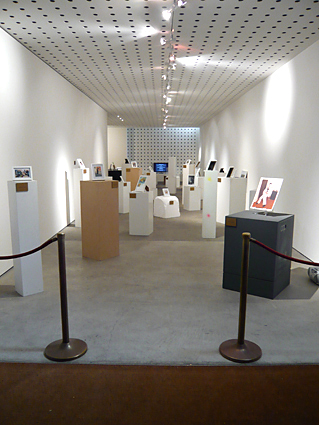
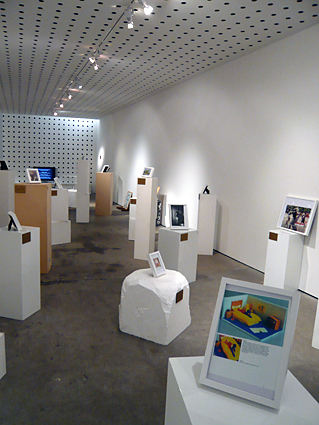
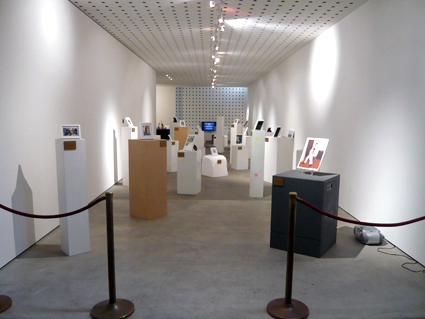
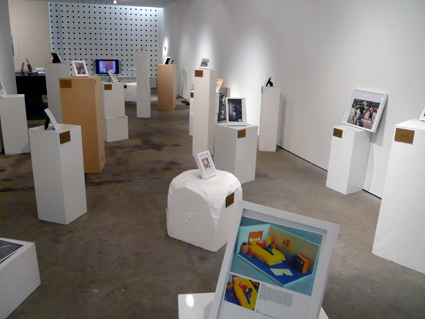
Curated by Mark Feary, this is a deliciously ironic exhibition that asks the audience to question the social and political construction of the blockbuster exhibitions regularly held by large museums around Australia; to question the role of the curator in assembling such exhibitions; and to question the cultural value of permanent collections of ‘Masterpieces’. Autumn Masterpieces displays work that is anything but permanent and undermines the process whereby museums construct frameworks for social understanding. The work, displayed in a roped off space on plinths of various heights, in cheap frames and at skew-whiff angles, seems ephemeral and transitory all the more to contradict both main tenants of the title of the exhibition: masterpiece and permanence.
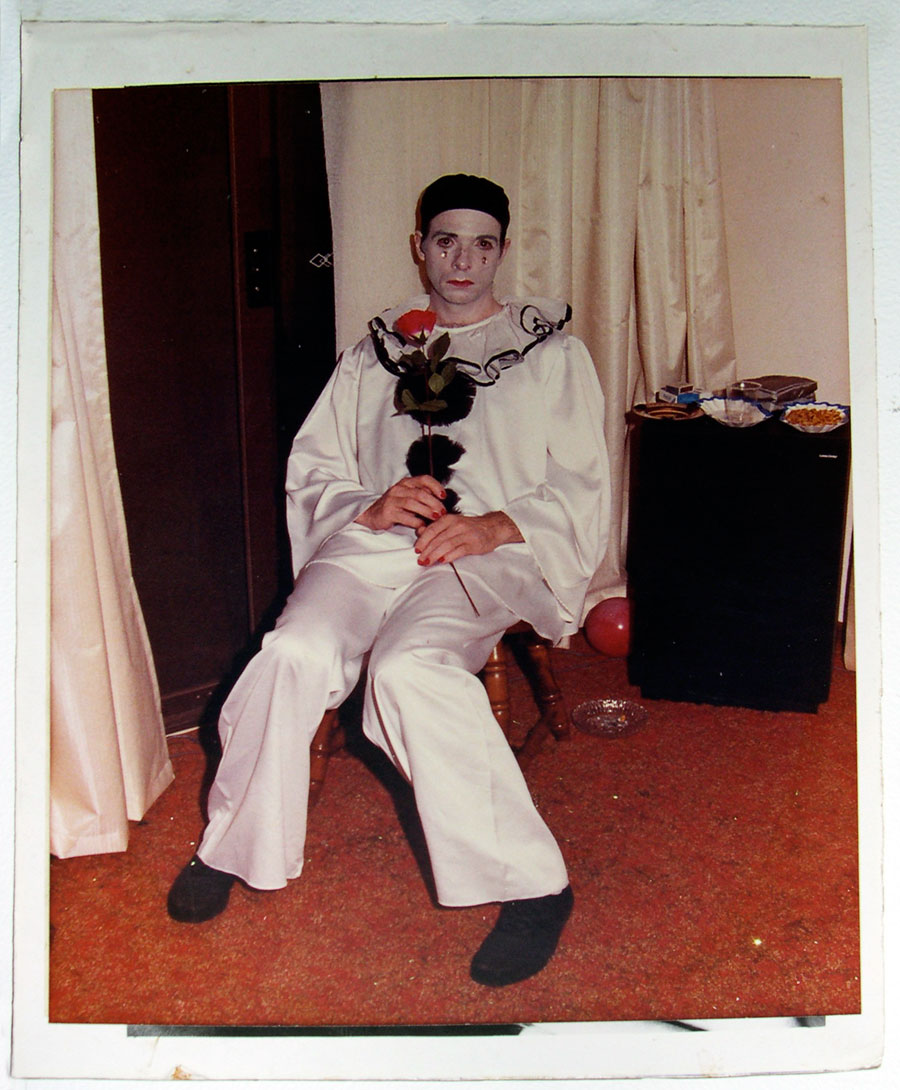
Sitting on plinths that are adorned with plastic gold name plaques emblazoned with the condition of the possibility of the works existence, “From the collection of …” , the untitled works reinforce the conceptual thrust of the exhibition. In one sense the content of the specific images seemed almost irrelevant; in another the collective dialectical argument of the images deconstructs normative interpretations of the masterpiece. ‘Instructions for the Tourist’ and ‘Rules for How to use the playground’ sit next to photographs of dejected clowns; ‘Confusion & Reversals’ sit next to ambiguous photographs of events and actions: people doing ‘normal’ things displayed though Polaroids, newspaper clippings, snapshots, photographs from albums, black and white and colour, framed and in museological glass cases.
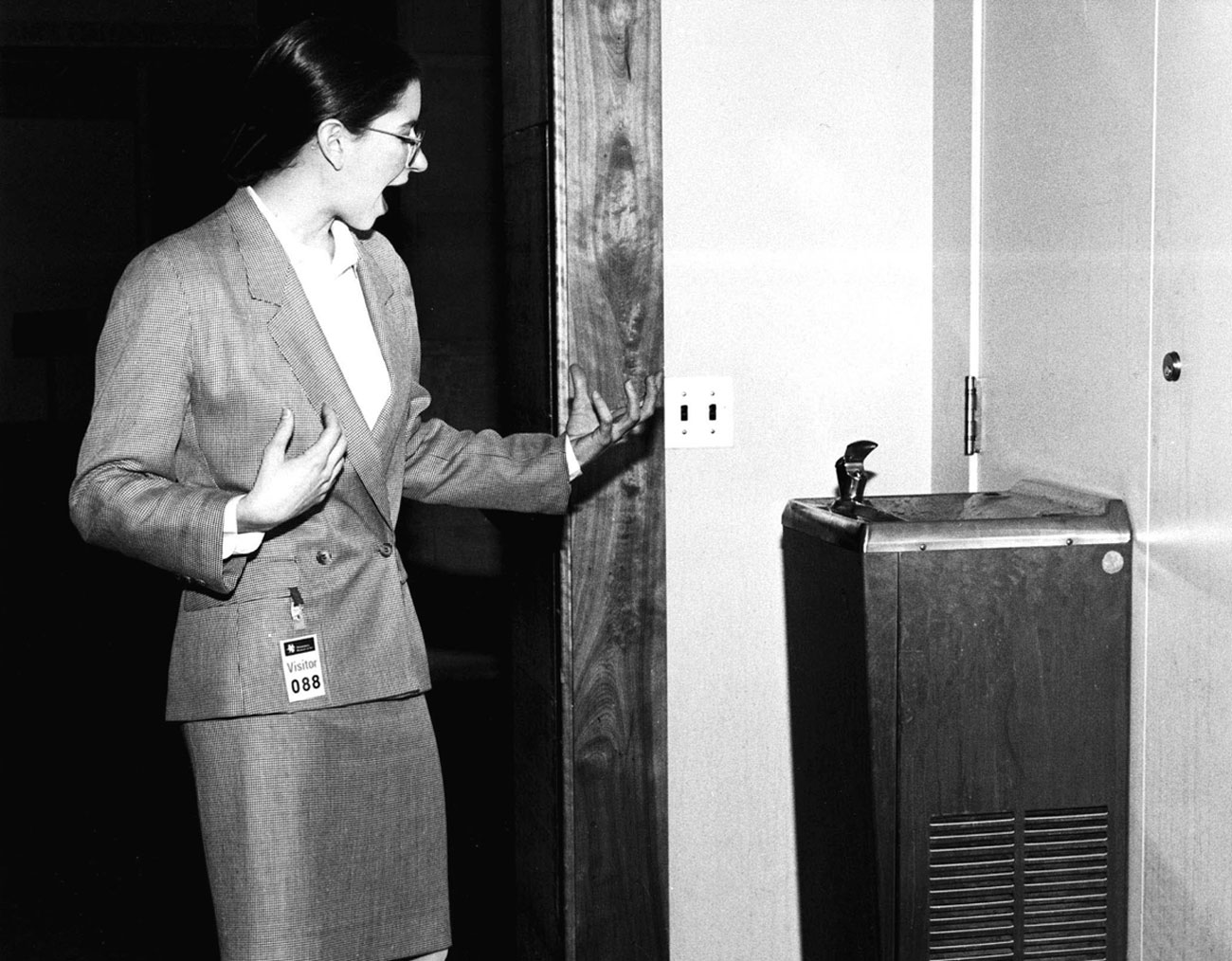
The highlight of the exhibition for me was the guffaw inducing DVD Museum Highlights: A Gallery Talk (1989) by American artist Andrea Fraser. Where Mark Feary found this post-cultural gem is beyond me but I am so glad he did! I stood transfixed as the narrator / curator takes us on a virtual tour of the Philadelphia Museum of Art, along the way pointing out the magnificence and subliminal beauty of the objects in the museum. She stresses the decorum of the institution, it’s tradition in measured, ordered, dignified arrangements that are fine and simple while addressing a water fountain. Oh the deliciousness! She continues with the exultation of the institution, that is to develop an appreciation of values – true / false, better / worse, right / wrong, what is good for you / what is good for society – standards that should be adopted by a discriminating public, while addressing a broom cupboard. The piece subverts an approach “in which visitors’ individual meanings are only validated by the extent to which they concord with the conclusions intended by exhibition-makers or to which they conform to some predetermined and fixed standard truth.”1 And so it goes in an ever so serious, side-splitting soliloquy, critiquing the functions of art, linking the aspirations of humanity with the highest privileges of wealth and leisure. Wonderful!
Dr Marcus Bunyan
1/ Hein, George E. Learning in the Museum. London: Routledge, 1998 quoted in Sandell, Richard. “Reframing conversations,” in Museums, Prejudice and the Reframing of Difference. London and New York: Routledge, p. 179.
Installation views of the exhibition Autumn Masterpieces: Highlights from the Permanent Collection at the Centre for Contemporary Photography, Melbourne Photos: Marcus Bunyan
Courtesy of the collection of Tony Garifalakis
Courtesy of the collection of Irene Hanenbergh
Courtesy of the collection of Hany Armanious
Andrea Fraser (American, b. 1965) Museum Highlights: A Gallery Talk 1989 DVD (colour video with sound. 29′) Courtesy of the artist and Friedrich Petzel Gallery, New York
Exhibition dates: 12th September – 17th October, 2009
Many thankx to Regen Projects for allowing me to publish the art work in the posting. Please click on the photographs for a larger version of the image.
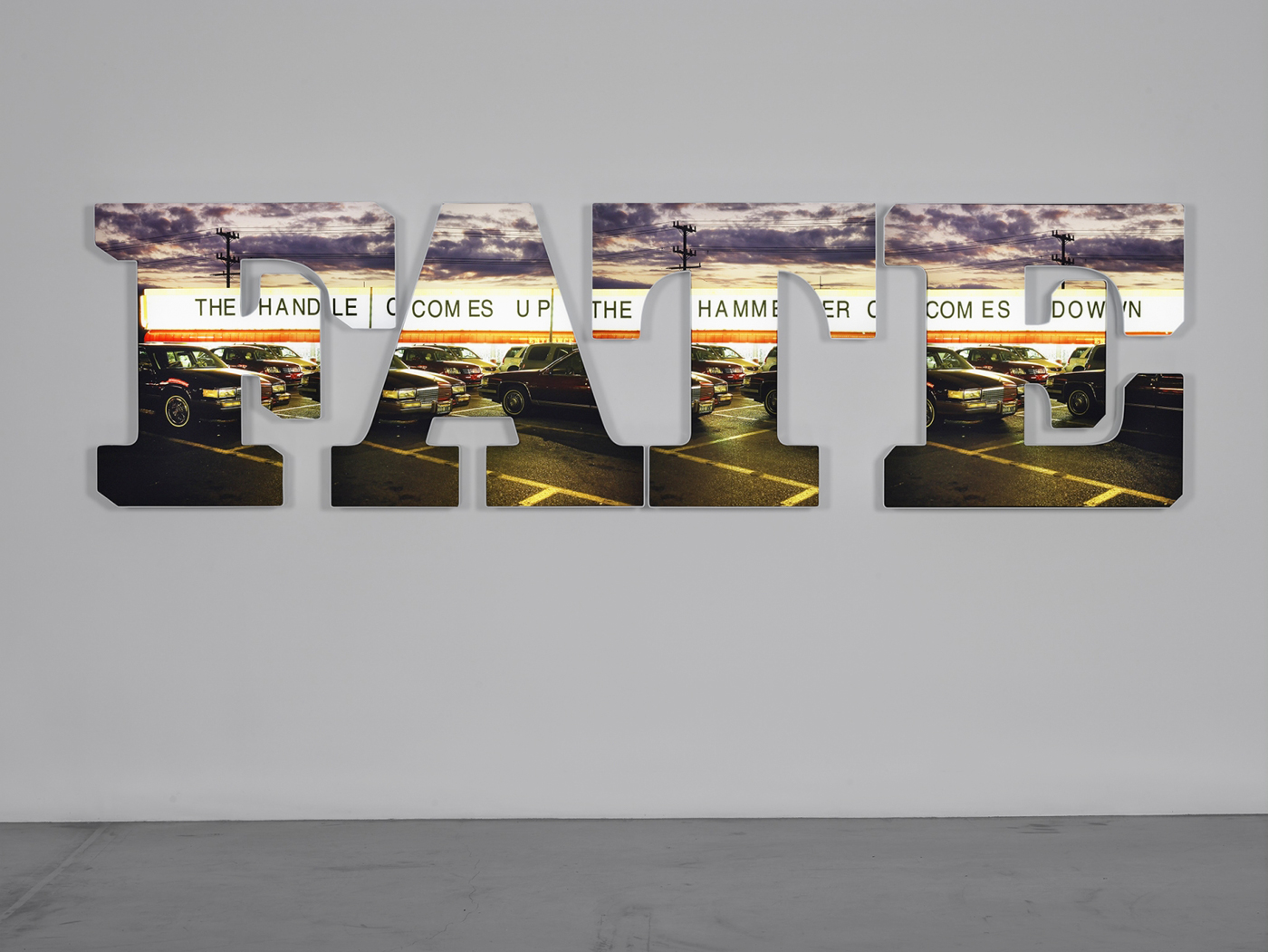
Doug Aitken (American, b. 1968) The handle comes up, the hammer comes down 2009 LED lit lightbox
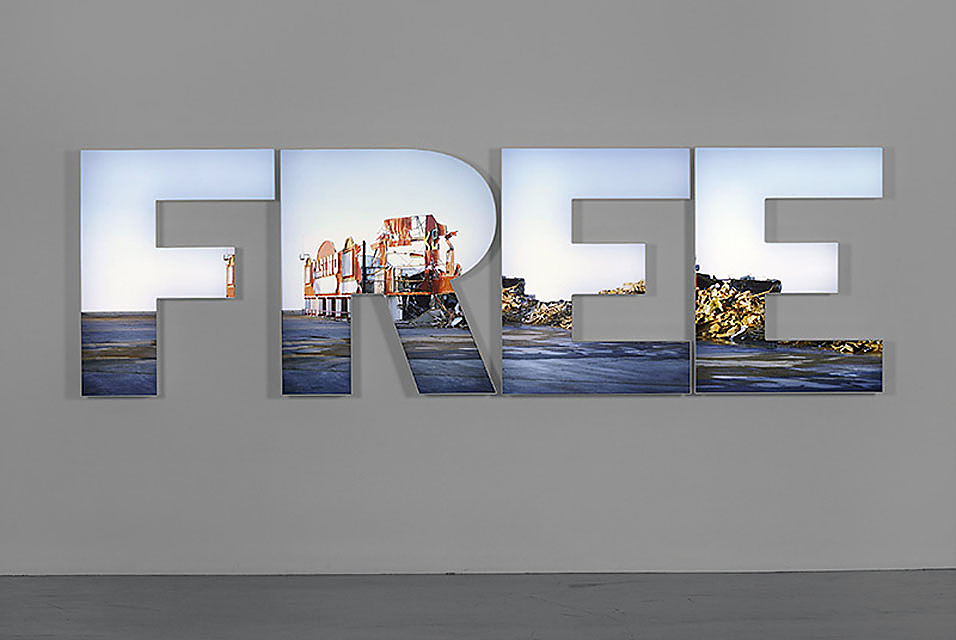
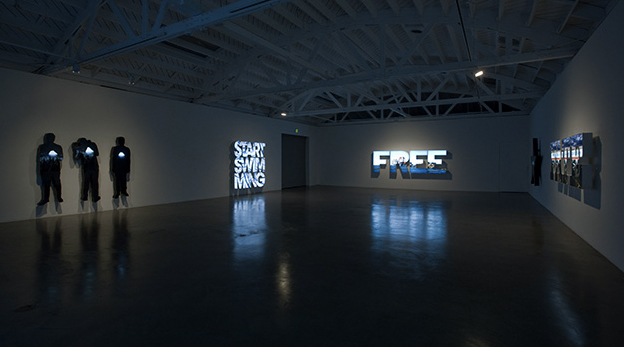
Doug Aitken (American, b. 1968) Free 2009 LED lit lightbox
Doug Aitken (American, b. 1968) Start Swimming LED lit lightbox 2006
Doug Aitken (American, b. 1968) Start Swimming LED lit lightbox 2006
Installation view of Doug Aitken at Regen Projects, Los Angeles
Regen Projects is pleased to announce an exhibition of new works by Los Angeles artist Doug Aitken. This exhibition will present a series of new text-based light boxes and will feature the west coast debut of the film migration. Aitken explores the themes of temporality, space, memory, movement, and landscape in his work. History and themes of both the past and present are interwoven and reconfigured. His work deconstructs the connection between idea and iconography allowing each to reinvent itself.
Doug Aitken’s new light boxes combine image and text in a collision that creates a rupture in which alternate connections are presented. The work frontier depicts a destroyed property on the water’s edge, redefining expectations of what a frontier may hold. The images within some of the light boxes are a photographic collage that references Aitken’s photographic oeuvre and aesthetic. Experimenting with font, borrowed images, and his own photographs, the light boxes will be presented in the darkened gallery, glowing and playing off of one another. The disjunction of word, image, and light in these works also moves toward a cinematic whole, creating panoramic landscapes through text.
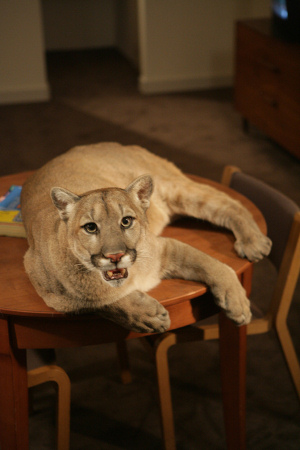
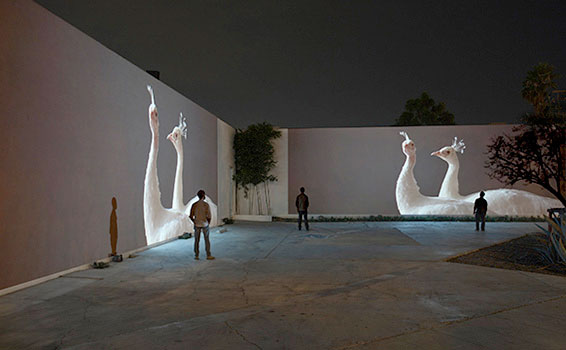
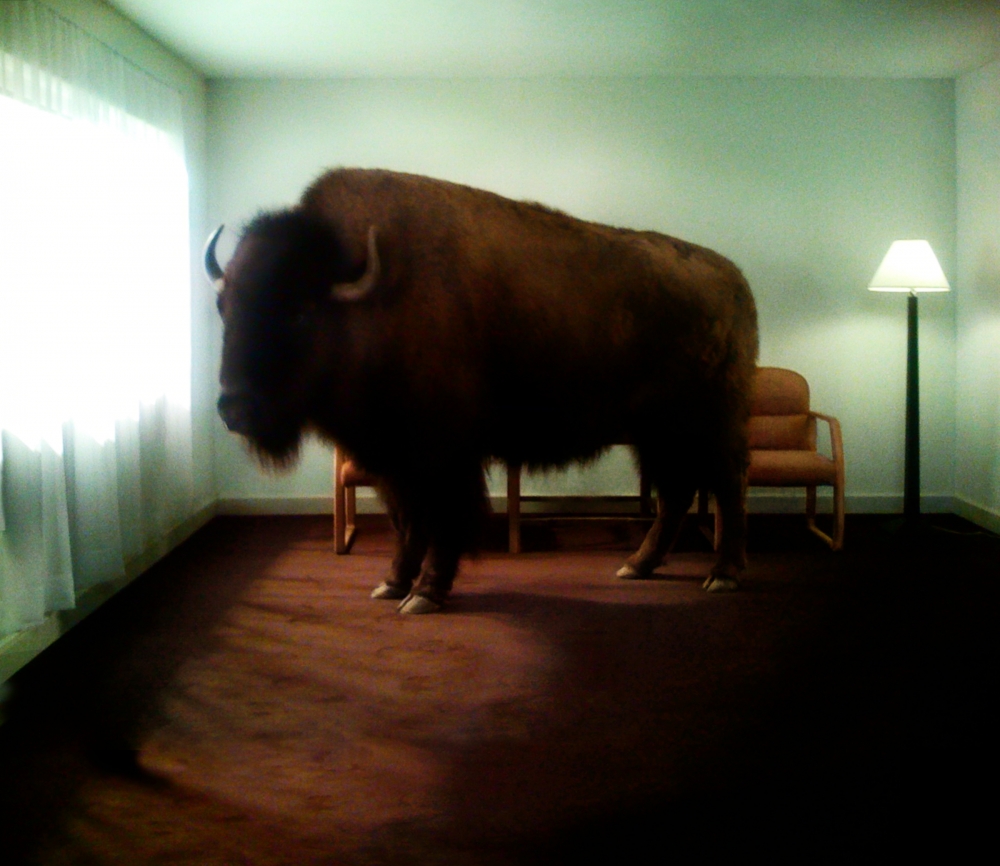
Presented alongside the light boxes will be Aitken’s first large scale public installation in Los Angeles, migration. The film, the first instalment in a three-part trilogy entitled empire, debuted at the 2008 Carnegie International. This hallucinatory epic depicts the movements of migratory animals as they pass through vacant and deserted hotel and motel rooms, delineating a nomadic passage across America from east to west. Fittingly making its first appearance on the west coast, this large-scale cinematic installation will be presented to the public on Santa Monica Boulevard projected onto the courtyard of Regen Projects II; visible only at night from sunset to sunrise. In addition to the nighttime public presentation, migration will also be exhibited at the 633 North Almont Drive space on an indoor billboard accompanied by its original score.
Settlers who met the untamed wilderness to forge new ways of life defined westward expansion. Aitken’s migratory landscape in migration is the opposite; it is a landscape completely devoid of human presence. His non-linear narrative presents a series of different sequences in which the animals and their actions are unique while the rooms and their components are indistinguishable. Hotels such as these offer a sense of both security and isolation and while some animals adapt to these surroundings, others seem conspicuously strange. Rarely do we get to examine these creatures so closely. Their movements and presence make the viewer acutely aware of scale, calling into question various relationships; the most apparent of which is the relationship of the natural and the man-made. In this encounter between the urban and the indigenous the viewer gets a sense of both displacement and habituation. As one critic describes:
“One by one, at different hotels, the animals behave as they behave, sniffing the air, twitching their noses to orient themselves in the desolate human habitat. Imbued with Aitken’s usual intimations of planetary solitude, his sense of spatial dislocation, and gorgeous formalised perception, these images … have the quality not so much of a nonlinear narrative as of a mirage.” (Kim Levin, Artnews, January 2009, p. 110.)
Aitken’s work has been exhibited extensively at museums and galleries worldwide, including his 2007 exhibition “sleepwalkers,” a large-scale outdoor installation at the Museum of Modern Art, New York. He has had numerous solo exhibitions including shows at the Serpentine Gallery, the Kunstmuseum Wolfsberg, the Kunsthaus Bregenz and the Kunsthalle Zurich. Aitken was awarded the international prize at the Venice Biennale in 1999 and was included in the 2000 Whitney Biennial.
Text from the Regen Projects website [Online] Cited 01/11/2009. No longer available online
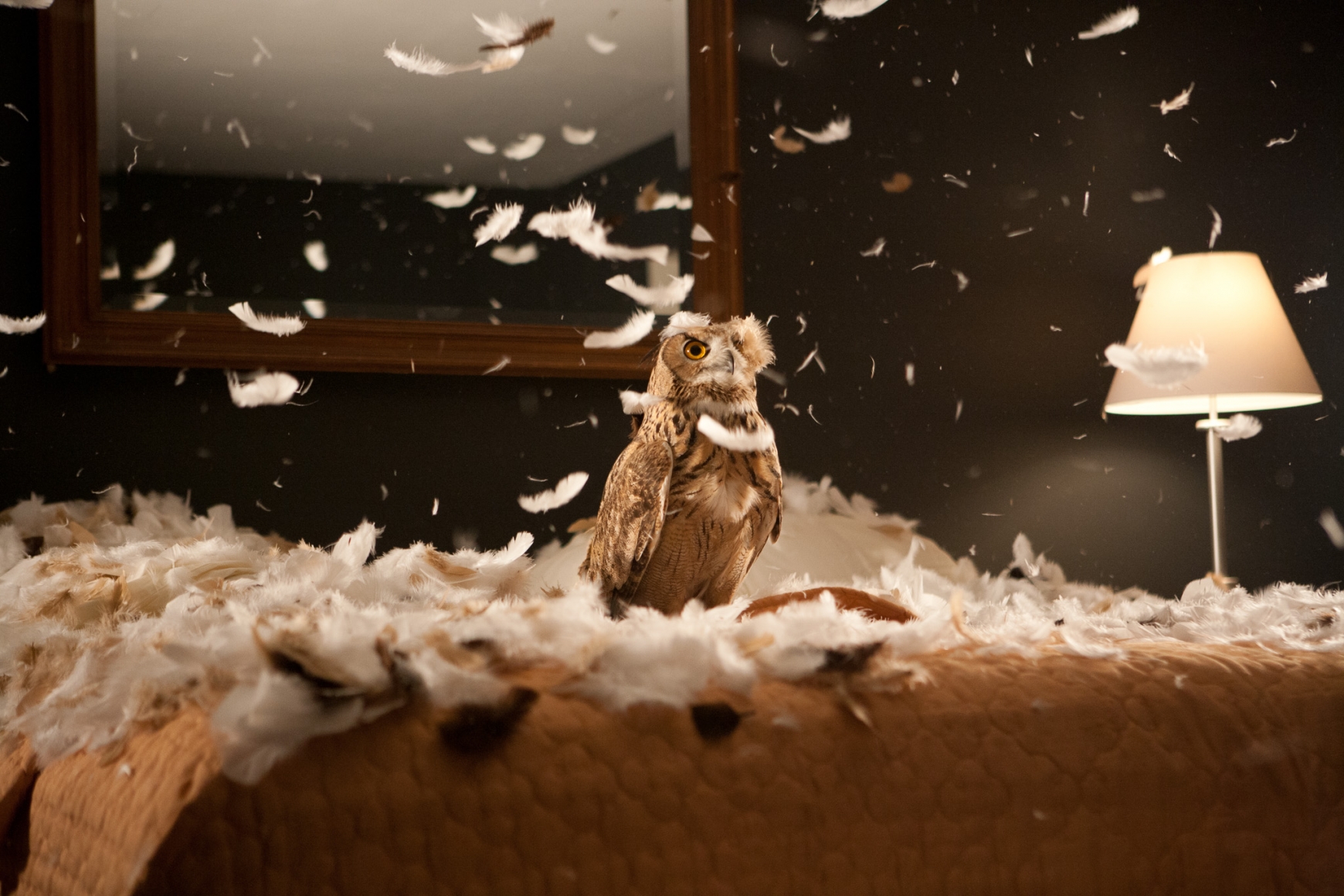
Doug Aitken (American, b. 1968) Stills from Migration 2008 Single video projection with billboard (steel and PVC projection screen)
In Migration, peacocks, deer, and beaver are filmed occupying motel rooms in vignettes that strike a poignant, provocative chord: talk about unexpected guests. Nevertheless, the work isn’t funny; it’s too frank in its beauty, too finely and respectfully wrought to be a joke.
Aitken’s animals are frequently shot in close perspective, which enhances their beauty in a way that is mesmerising. We’re not looking through them as much as we’re looking alongside them, ingesting the utter foreignness of their environs. As evening falls, we see an owl, an already otherworldly creature whose glowing eyes appear extraterrestrial, blinking at us from its perch on a king-size bed. Against the singsong of chirping birds, the camera pans away from the stationary owl as the room fills with thousands of downy feathers. Light is a powerful character in the film, whether gently filtered through sheer curtains or spilling onto carpeted hallways. Rather than highlighting imperfections or ugliness, the light is salvic, evincing a limbo that’s illuminating and warming. In one way or another, all of Aitken’s animals are drawn to light, whether toward a blinking lamp, the refracted surface of a swimming pool, or even the glow of an opened refrigerator door.
Extract from Iris McLister. “Motel chronicles: Doug Aitken,” on the Pasatiempo website October 6, 2017 [Online] Cited 28/04/2019
Regen Projects 6750 Santa Monica Boulevard Los Angeles, CA 90038 Phone: (310) 276 5424





















 Art Blart _ art and cultural memory archive
You must be logged in to post a comment.