
Exhibition dates: 12th December, 2025 – 10th May, 2026
Curator: Gregory Harris, the High Museum’s Donald and Marilyn Keough Family Curator of Photography
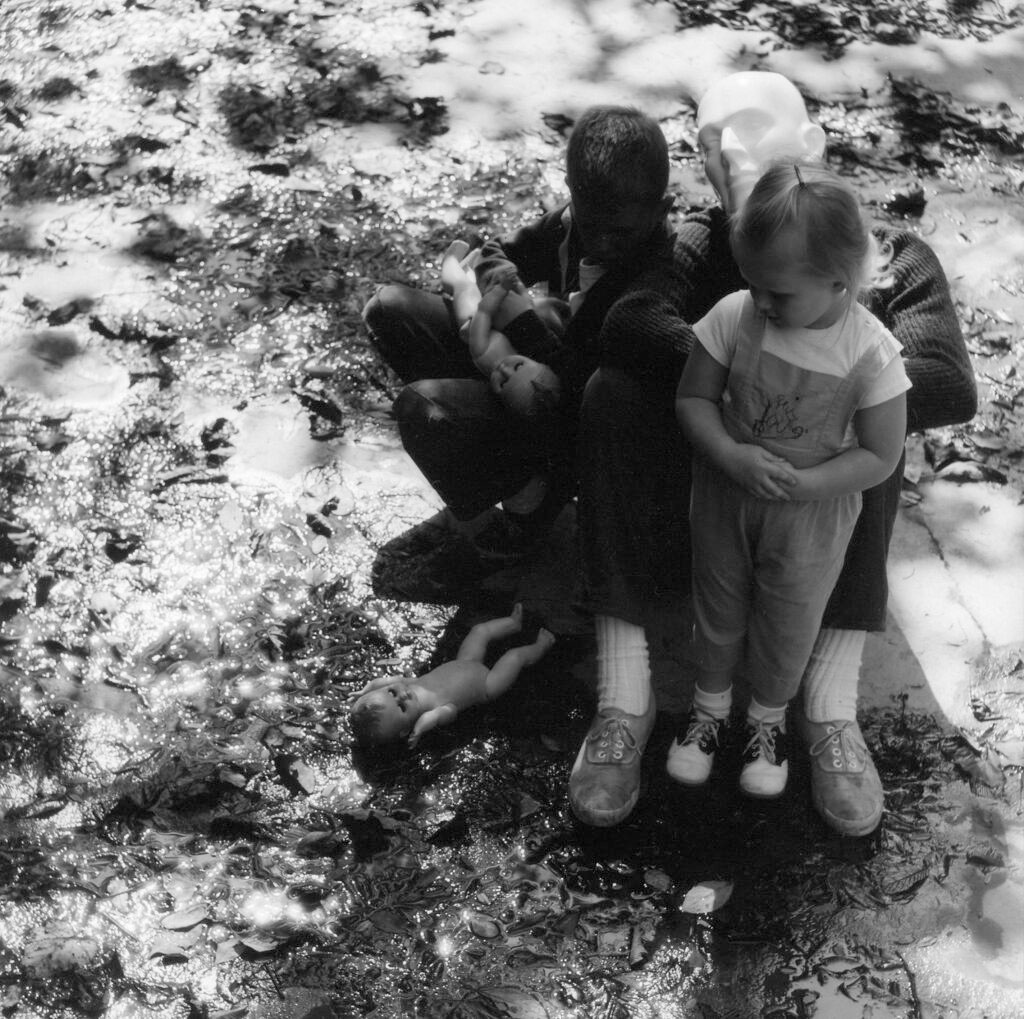
Ralph Eugene Meatyard (American, 1925-1972)
Untitled (cover)
1962
Gelatin silver print
Estate of Ralph Eugene Meatyard
© Estate of Ralph Eugene Meatyard
Gestures on what it is to be human
In the nearly eighteen year history of constructing this archive there has never been a posting on the American photographer Ralph Eugene Meatyard (American, 1925-1972) which tells you a/ how rare exhibitions of his work are today and b/ how under appreciated his art is in recent times when compared to his white, male contemporaries such as Harry Callahan, Minor White and Aaron Siskind. Thus it is a great pleasure to promote this exhibition on Art Blart. I just wish I had more photographs to show you!
His work is polarising. People either hate it or love it. I’m in the latter camp. I admire Meatyard’s disturbing? challenging photographs where youth and innocence meld into a dystopian old age of special beauty, where other worlds of which we know very little are brought close to our imagination.
I admire them for their unconventionality, for their spectral aspect … that fluid dichotomy between reality and fantasy, dreams and nightmares, where the mask comes to stand for another state of being of its subject1 – shadowy, other-worldy phantoms brought into our presence through romantic-surrealist, abstract realisms – un/earthly in/corporealities, bodies and people who are both grounded in the present and transmogrifying in a tumult of magic realism (a literary and artistic genre that seamlessly blends fantastical or mythical elements into otherwise realistic, mundane settings, treating the supernatural as normal).
This unexplained magic, fluid time contains a social critique of childhood, family and adulthood and (most importantly) mortality, merging real-world settings with unbelievable elements.
Meatyards’s staged scenes – often using exposure, shadow (in Jung referencing the unconscious, hidden part of the personality), depth of field, or motion blur – suggest “an absurd fantasy set in the dilapidated houses and banal suburban environs near his home in Lexington, Kentucky … [which] reveal Meatyard’s search for inner truths amid the ordinary.” (Text from the High Museum of Art)
His photographs contain elements of his imagination in segments of the actuality around him, an interface of emotion and feeling about the world which is reflected back to us through his experimental, fantastical images. His subjects simply exist in youth and old age and resonate (that musical influence) “within the infinite possibilities of this fictional world.” Thus, in this fictional world, the masks serve “… to equalise his subjects and shift focus elsewhere – to the poignant juxtaposition of otherworldly faces on human bodies, to the ambiguous and unknowable in human nature.”2
The unknowable in human nature. The phenomenal (appearances) and the noumenal (the harsh reality of things-in-themselves).3 Interstitial. Interspatial. The space between…
Dreams and realities, masks and identities, emotions and fluidities.
Gestures on what it is to be human.
Dr Marcus Bunyan
1/ “The word “persona” originally refers to a theatrical mask worn by actors to depict the roles played by them…
The ego refers to our centre of consciousness which is responsible for our continuing sense of identity throughout our life and the persona is the social mask that we put on. We all embody different masks in different settings, as it is our way to adapt to the demands of society, playing an important part in shaping our social role and in how we deal with other people.”
Anonymous. “The Persona – The Mask That Conceals Your True Self,” on the Eternalised website, December 24, 2021 [Online] Ciuted 20/03/2026
2/ Anonymous. “Ralph Eugene Meatyard: Cranston Ritchie,” on the Artsy website Nd [Online] Cited 20/03/2026
3/ The phenomenal world is the reality we experience through senses and mental structures (space/time), while the noumenal is the unknowable, objective reality existing independently of perception, such as God or the true nature of objects.
Many thankx to the High Museum of Art for allowing me to publish the photographs in the posting. Please click on the photographs for a larger version of the image.
“I seek to create a picture that has implications which may be explored for a new concept of thinking – a picture seen largely from the subjective viewpoint. The man of ideas and ideals will search for and find elements of his imagination in segments of the actuality around him. My pictures are an extension of myself and invite the viewers to participate in my thinking about the object pictured.”
Ralph Eugene Meatyard, Lexington Camera Club, Creative Photography – 1956 catalogue statement
“I adhere to the techniques of the earliest and most sincere workers of the camera – straight, unmanipulated pictures. That which I present is that which I see. However, I work a great deal in romantic-surrealist as well as abstract for I feel that ‘more real than real’ is the special province of the serious photographer.”
Ralph Eugene Meatyard, quoted in Beaumont Newhall, “New Talent in Photography USA,” Art in America 49, No. 1, 1961
Installation view of the exhibition The Family Album of Ralph Eugene Meatyard at the High Museum of Art, Atlanta, GA
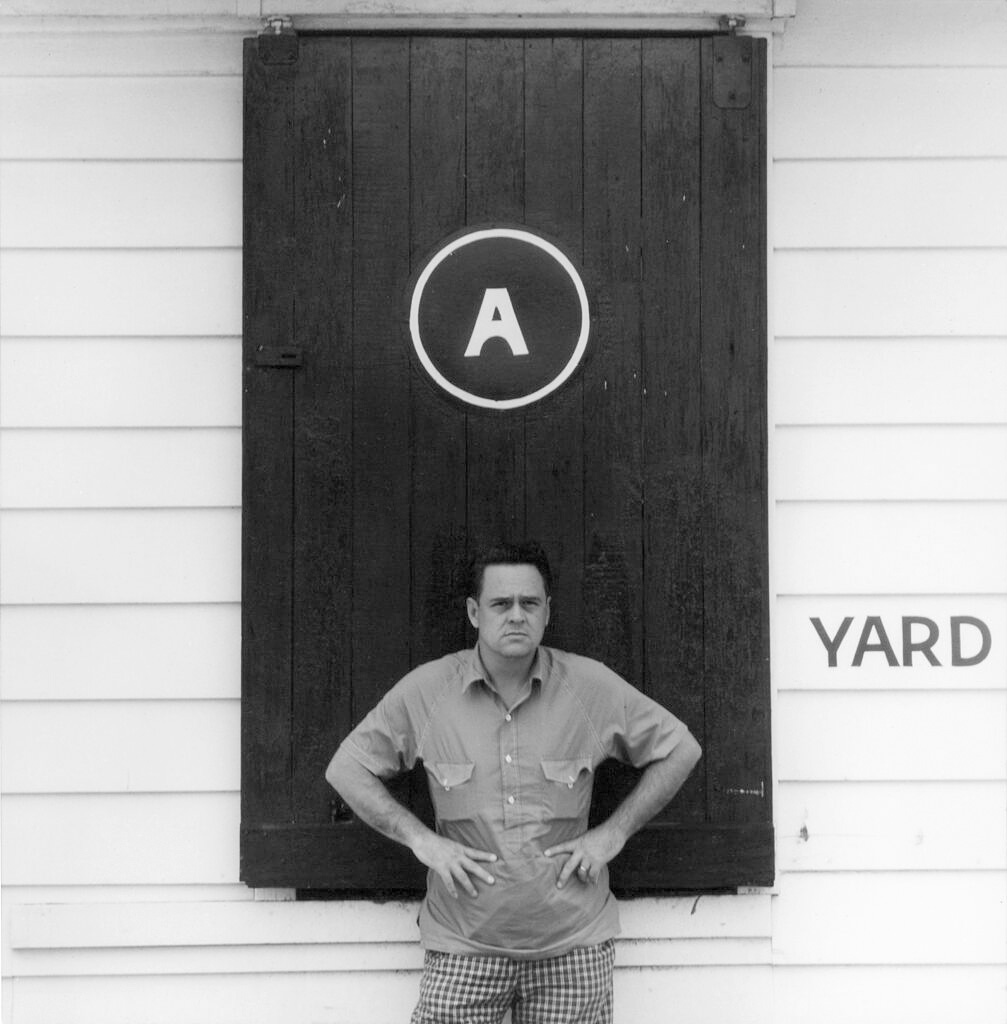
Ralph Eugene Meatyard (American, 1925-1972)
Self-portrait (frontispiece)
c. 1964-1966
Gelatin silver print
High Museum of Art
Purchase with funds from Joe Williams and Tede Fleming, Jane and Clay Jackson, and an anonymous donor
Estate of Ralph Eugene Meatyard
© Estate of Ralph Eugene Meatyard
As an optician by profession, Meatyard’s photography training was largely self-taught. He grew up in Normal, Illinois, and eventually moved to Lexington to take a job at the Tinder-Knaus-Tinder optical shop. Through his occupation, he became fascinated by visual perception, but he did not pick up a camera until the early 1950s when his first son, Michael, was born. He began experimenting with photography and joined the Lexington Camera Club, a group of serious amateur photographers that met regularly to share their work. Meatyard made this self-portrait outside a warehouse in downtown Lexington. The composition, with the artist standing next to the word yard, is a playful visual take on his unusual surname.
A largely self-taught photographer, Ralph Eugene Meatyard (American, 1925–1972) was a pioneering and inventive artist who created some of the most original images of the mid-twentieth century. His work defies easy categorization as he experimented across various genres and subjects, and throughout his career, he maintained the ethos of an amateur, approaching photography with a sense of affection, discovery, and surprise. He is best known for his staged scenes that suggest an absurd fantasy set in the dilapidated houses and banal suburban environs near his home in Lexington, Kentucky. These scenes, often featuring his family as actors and using props such as masks and dolls, reveal Meatyard’s search for inner truths amid the ordinary.
This exhibition, coinciding with the artist’s centenary, features the thirty-six prints that comprise the artist’s first monograph (Gnomon Press, 1970) – one of only two books he published in his lifetime – which Meatyard intended to stand as his definitive artistic statement. All thirty-six prints were recently acquired by the High for the Museum’s permanent collection. Through his idiosyncratic selection of images, this exhibition explores how Meatyard’s singular approach and voracious curiosity expanded photography’s expressive and conceptual potential.
Text from the High Museum of Art website
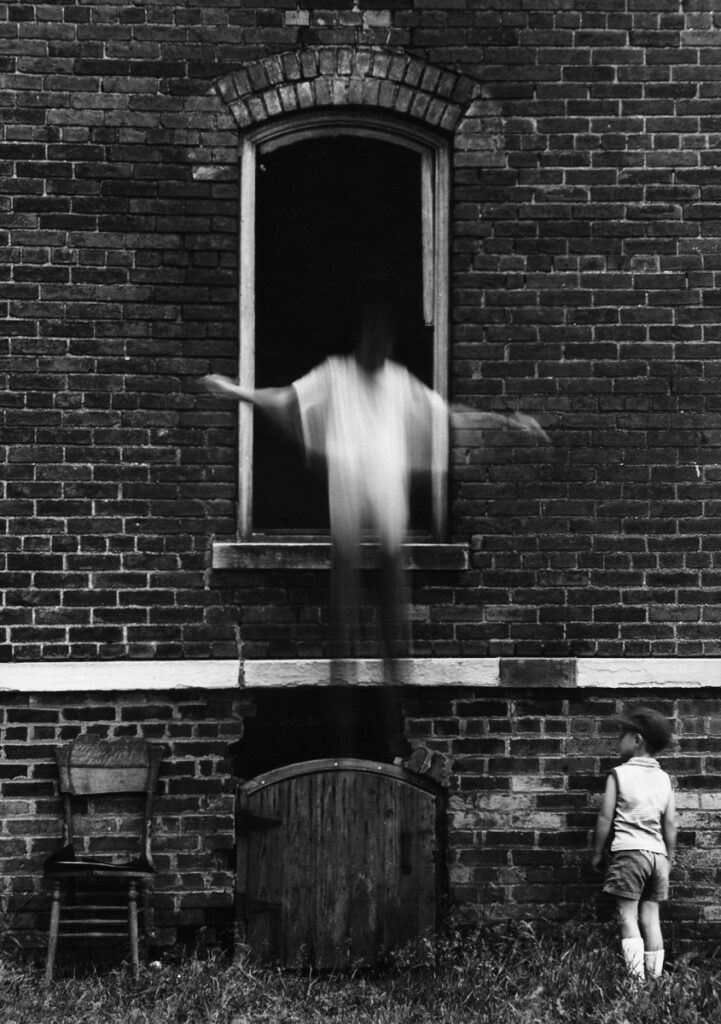
Ralph Eugene Meatyard (American, 1925-1972)
Untitled (plate 1)
1960
Gelatin silver print
Purchase with funds from Purchase with funds from Jane and Clay Jackson
© Estate of Ralph Eugene Meatyard.
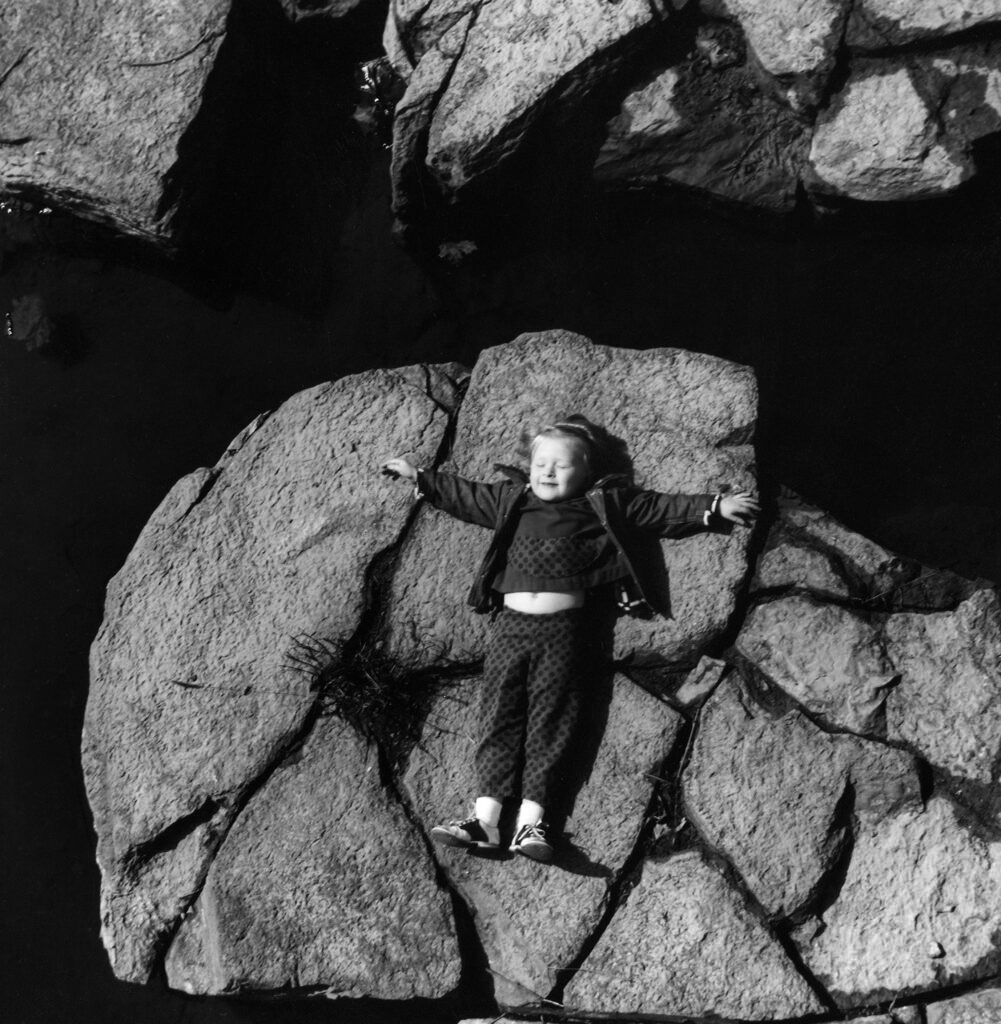
Ralph Eugene Meatyard (American, 1925-1972)
Untitled (plate 7)
1963
Gelatin silver print
Purchase with funds from Joe Williams and Tede Fleming
© Estate of Ralph Eugene Meatyard
Since his untimely death in 1972, American photographer Ralph Eugene Meatyard has come to be regarded among the most pioneering and inventive artists of the medium, and his expressive, surreal photographs are widely celebrated today. This winter, the High Museum of Art presents “The Family Album of Ralph Eugene Meatyard” (Dec. 12, 2025 – May 10, 2026), an exhibition featuring 36 photographs that Meatyard considered his best work, created for one of only two monographs published by the artist in his lifetime. The High recently acquired the prints from his estate, making the museum one of the leading repositories of his photographs in the world.
“Ralph Eugene Meatyard created some of the most original photographs of the mid-20th century, and the prints in this exhibition are exquisite examples of his innovation and creativity,” said the High’s Director Rand Suffolk. “We are grateful to his estate for the opportunity to acquire and present these works and to celebrate his unorthodox yet remarkably generative practice with this exhibition.”
Born in Illinois in 1925, Meatyard eventually settled in Lexington, Kentucky. Because of his professional training as an optician, he was fascinated by visual perception, but he did not pick up a camera until the early 1950s. He began experimenting with photography and joined the Lexington Camera Club, immersing himself in the city’s creative community, which included artists and writers Van Deren Coke, Jonathan Williams, Wendell Berry and Thomas Merton.
Over the next 15 years, Meatyard maintained the ethos of an amateur, approaching the medium with a sense of affection, discovery and surprise. He experimented across various genres and subjects, including portraiture, abstraction, landscape and gothic narrative, constantly seeking to distort proper vision through photographic processes and the unconventional narrative structures that would make him an innovator of the medium.
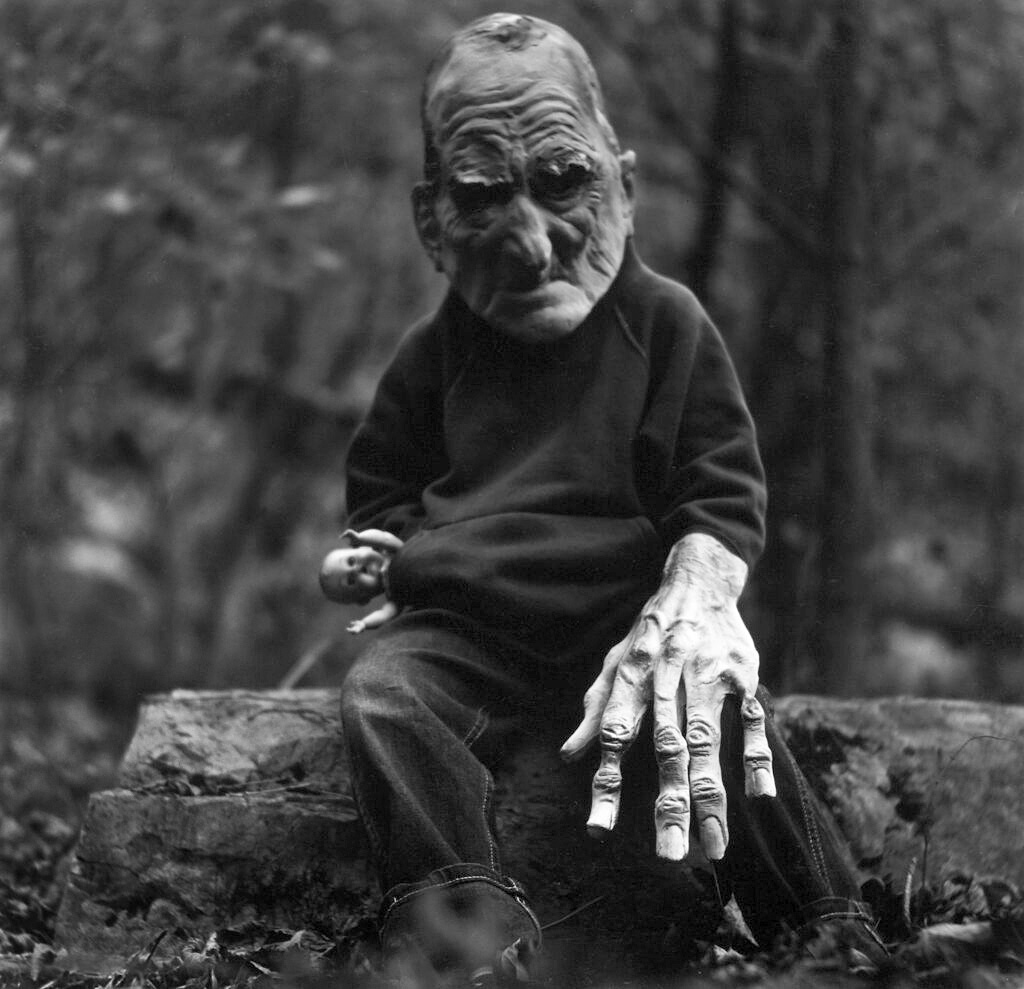
He is best known for his staged scenes that suggest absurd fantasies, played out in the dilapidated houses and banal suburban environs of Lexington. Often featuring his family as actors and including props such as masks and dolls, the scenes reveal his search for inner truths among the ordinary. Though he wasn’t unknown in his lifetime – he exhibited, lectured and showed his work regularly throughout the 1960s – he worked both geographically and conceptually outside of the mainstream of photographic modernism, and it wasn’t until after his death that his reputation began to grow steadily.
More than a dozen books of Meatyard’s photographs have been released to date, but he only published two monographs in his lifetime. “Ralph Eugene Meatyard” (Gnomon Press, 1970), edited while he was dying of cancer, is a survey of what he considered his best work. He hoped the book would stand as his definitive artistic statement, offering his own perspective on his distinctive photographs.
This exhibition features rare prints the artist made of the 36 photographs in the book. These include signature photographs from Meatyard’s “Romance” series, which depict his family in fantastical scenarios, staged in abandoned buildings and bucolic landscapes. The series subverts the traditional family snapshot with a sense of the uncanny, combining youthful innocence with a sense of mortality. Meatyard often referred to these pictures as “romantic-surrealist,” and their fictional aspects were motivated by his desire to make photographs that weren’t bound by reality but were still grounded in the world as we see it. The exhibition also includes a selection of Meatyard’s portraits of writers, poets and artists from his circle, including Merton, Williams, Berry and Guy Davenport, among others. Collectively, the photographs create an unconventional family album by one of the most distinctive artists of the post-war period. The exhibition delves into Meatyard’s personal perceptions of his photographs and his process as a maker and will underscore the important influence of his artistic and intellectual contemporaries in Lexington, all of whom greatly affected his work. It also explores how Meatyard’s singular approach and voracious curiosity expanded photography’s expressive and conceptual potential.
“A family album is a relatable practice of memory, storytelling, aspiration and fabrication familiar to almost everyone,” said Gregory Harris, the High’s Donald and Marilyn Keough Family curator of photography. “While these works echo that nostalgic format, they also offer plenty of surprises and an extraordinary window into Meatyard’s life and creative process. We’re thrilled to share them with our audience.”
“The Family Album of Ralph Eugene Meatyard” is presented in the Lucinda Weil Bunnen Gallery for Photography on the lower level of the High’s Wieland Pavilion.
Press release from the High Museum of Art
Ralph Eugene Meatyard (American, 1925-1972)
Untitled (plate 17)
1962
Gelatin silver print
High Museum of Art
Purchase with funds from Joe Williams and Tede Fleming
Estate of Ralph Eugene Meatyard
© Estate of Ralph Eugene Meatyard
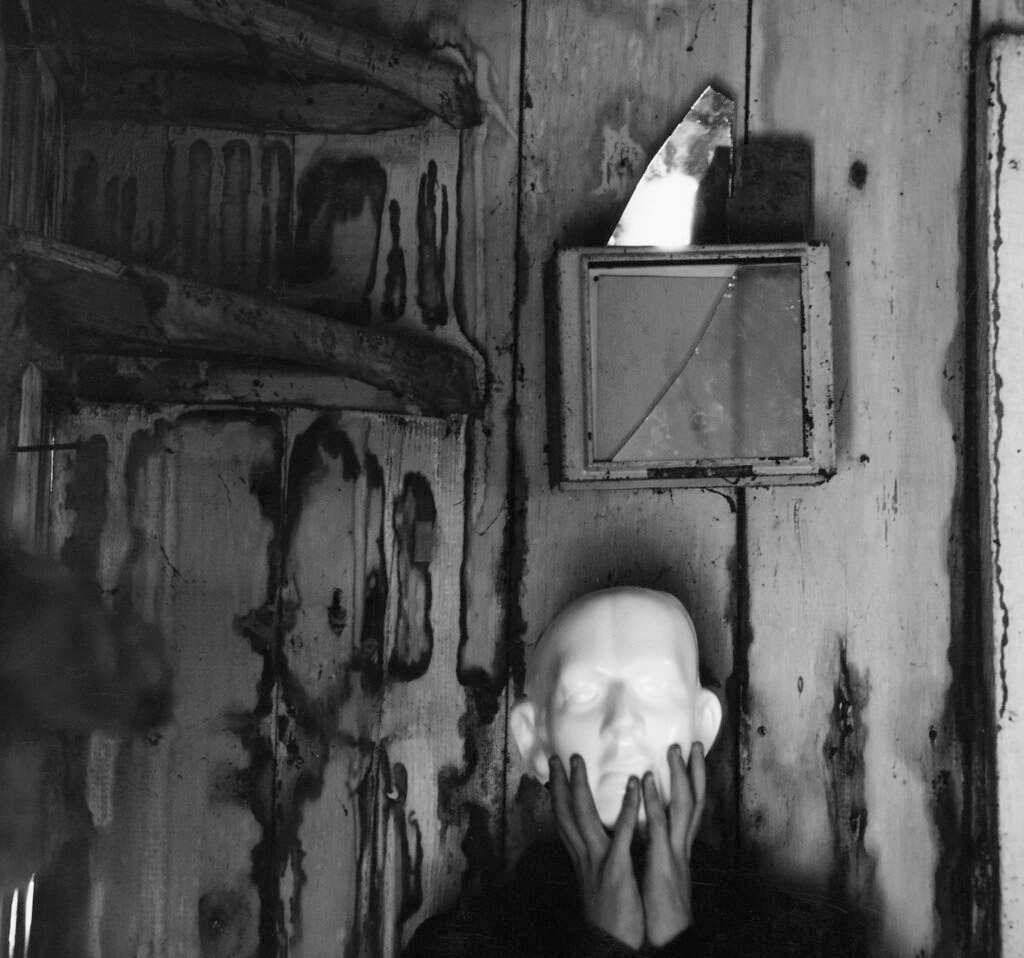
Meatyard suffered a heart attack in 1961. After this brush with mortality, he gave himself ten years to master photography. A sense of anxiety runs through many of his photographs. This image of a vacant masked face with hands pressed against its cheeks and a shard of broken mirror floating above embodies the persistent sense of pressure and tenuousness motivated by the finiteness of time.
Meatyard began editing the Gnomon Press book soon after he was diagnosed with cancer in 1970, and the looming reality of his fragility no doubt informed his selection of images. Arnold Gassan echoed the need to confront death in the longer, unpublished version of his essay for the book.
Ralph Eugene Meatyard (American, 1925-1972)
Untitled (plate 18)
1963
Gelatin silver print
Estate of Ralph Eugene Meatyard
© Estate of Ralph Eugene Meatyard
Ralph Eugene Meatyard (American, 1925-1972)
Untitled (plate 19)
1960
Gelatin silver print
Estate of Ralph Eugene Meatyard
© Estate of Ralph Eugene Meatyard
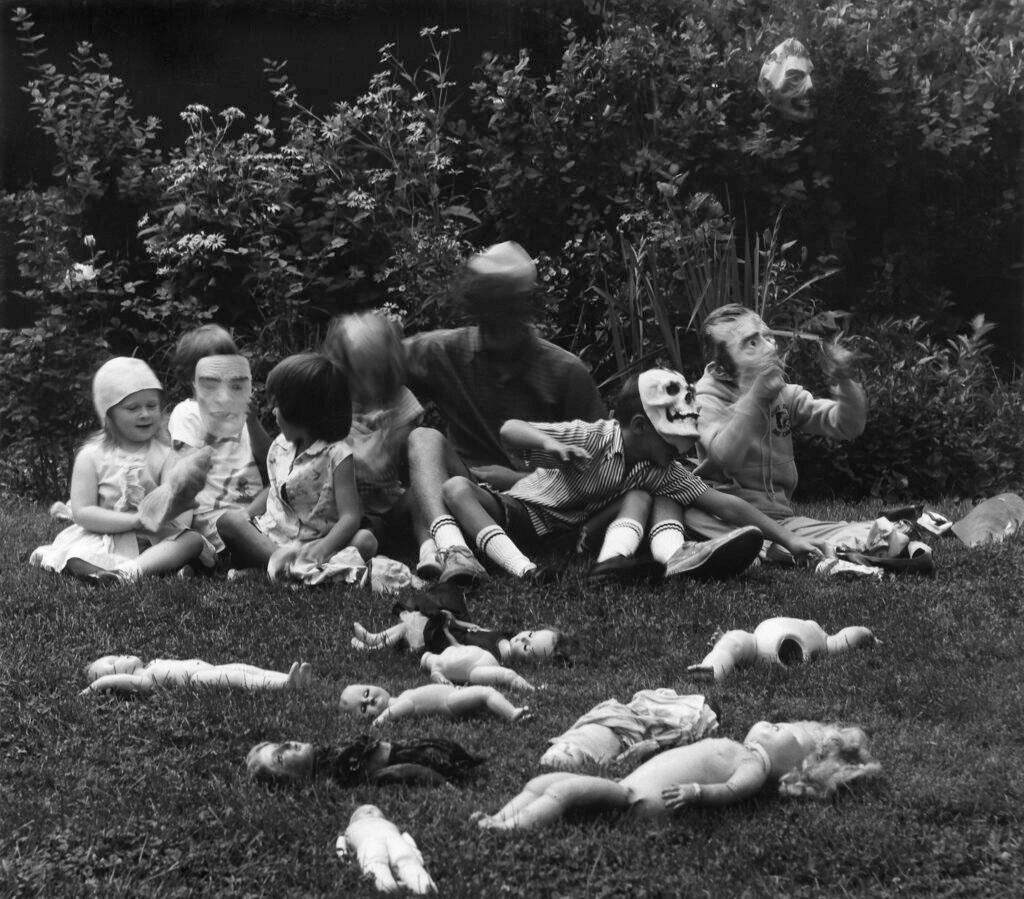
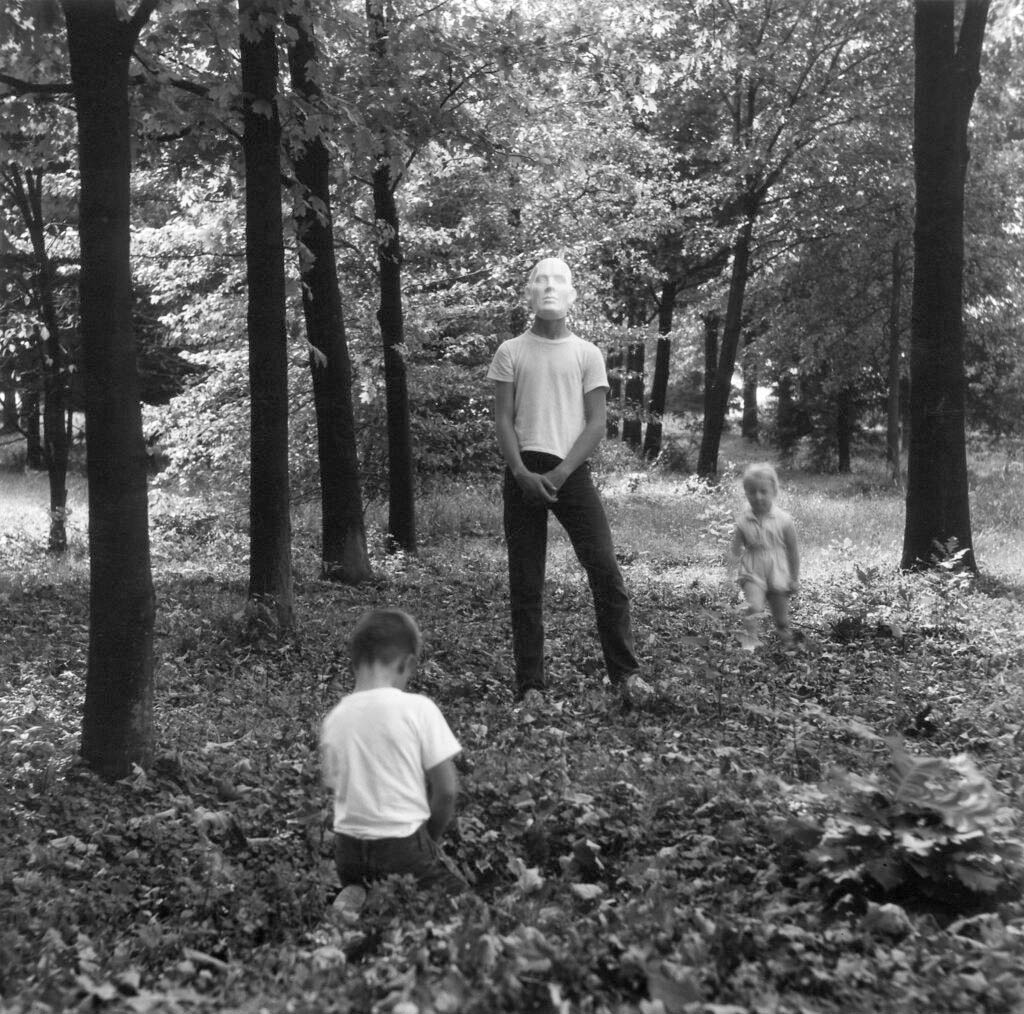
The 36 photographs include a number of signature portraits from Meatyard’s series Romance, and portray his family members, sometimes masked, inhabiting abandoned southern landscapes. Meatyard challenges the idea of traditional family portraits. In some images, children play in deserted rooms, maintaining their innocence in disconcerting environments. They are not afraid or amused – they simply exist within the infinite possibilities of this fictional world. In one image, an unrecognisable figure jumps out of a window into a yard where a little boy awaits. The movement of the jumping figure makes it resemble a spirit appearing to the boy in a dream. In creating this series, Meatyard was inspired by Ambrose Bierce’s definition of “romance” in “The Devil’s Dictionary” – defined as “fiction that owes no allegiance to the God of Things as They are.”
Victoria Gonzalez. “The Family Album of Ralph Eugene Meatyard,” on the Musee website December 15, 2025 [Online] Cited 15/02/2026. Used under fair use conditions for the purposes of education and research
As an adult, Meatyard lived in the South but grew up in Normal, Illinois – an apt birthplace for this man who led a very normal life. (“Meatyard” is an arcane 17th century English surname, but its surrealistic sound is an apt byline for the photographer. Meatyard himself collected strange names that he noted in a loose-leaf binder.) He did not consider himself a Southerner, although he has often been associated with Southern photography.
Although Meatyard counted himself as an amateur and hobbyist, he exhibited his work nationally with fine art photographers such as Minor White (who introduced him to Zen Buddhism), Harry Callahan, Aaron Siskind and Emmet Gowin. His national reputation had grown enough that his 1972 passing garnered a New York Times obituary that described Meatyard as living (somewhat disparagingly) in a backwater. Yet, it was living outside major centers of art and photography that allowed him the freedom to pursue his idiosyncratic creative strategies.
Louise E. Shaw. “Experimentation beyond the lens: a retrospective of Ralph Eugene Meatyard debuts at the High,” on the ArtsATL website, January 8, 2026 [Online] Cited 15/02/2026. Used under fair use conditions for the purposes of education and research
Ralph Eugene Meatyard (American, 1925-1972)
Untitled (plate 20)
1962
Gelatin silver print
Estate of Ralph Eugene Meatyard
© Estate of Ralph Eugene Meatyard
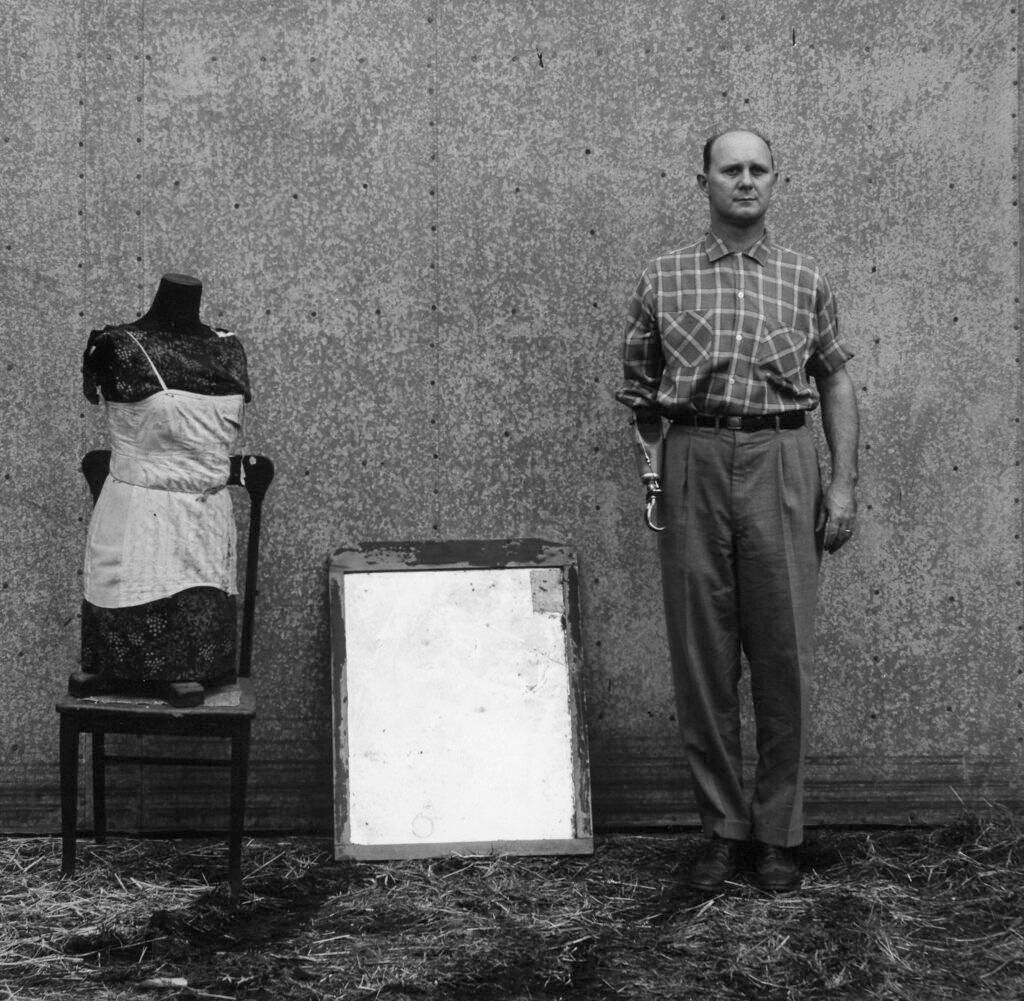
Ralph Eugene Meatyard (American, 1925-1972)
Cranston Ritchie (plate 30)
c. 1958-1959
Gelatin silver print
Estate of Ralph Eugene Meatyard
© Estate of Ralph Eugene Meatyard
The photographs of his friends are more straightforward but equally poetic and surrealistic. An example is his portrait of close friend and fellow Lexington Camera Club member Cranston Ritchie (1923-1961). Like Meatyard, Ritchie received an untimely terminal cancer diagnosis, resulting in multiple amputations of his arm. Facing forward, Cranston stands with an armless mannequin and mirror, a humorous but tragic take on fate and mortality.
Louise E. Shaw. “Experimentation beyond the lens: a retrospective of Ralph Eugene Meatyard debuts at the High,” on the ArtsATL website, January 8, 2026 [Online] Cited 15/02/2026. Used under fair use conditions for the purposes of education and research
Cranston Ritchie was a photographer in the Lexington Camera Club and friend of fellow club member, Ralph Eugene Meatyard. Ritchie died young at the age of 38 from cancer. James Rhem in his essay, Gene’s Friend – Cranston Ritchie, writes, “A little knot the size of a grape and sore to the touch appeared on his right hand. It turned out to be a malignancy. Doctors then thought if the arm were removed above the elbow, the cancer might be stopped from continuing to his lungs. It wasn’t. After five surgeries, each an effort to stop the cancer’s spread, Ritchie died the day after Christmas in 1961.” Rhem quotes Meatyard’s 1971 recollection of Ritchie, “He will certainly be recognised in years to come as an outstanding individual photographer as many of the 19th century men are being recognised today.”
Text from the Gitterman Gallery website
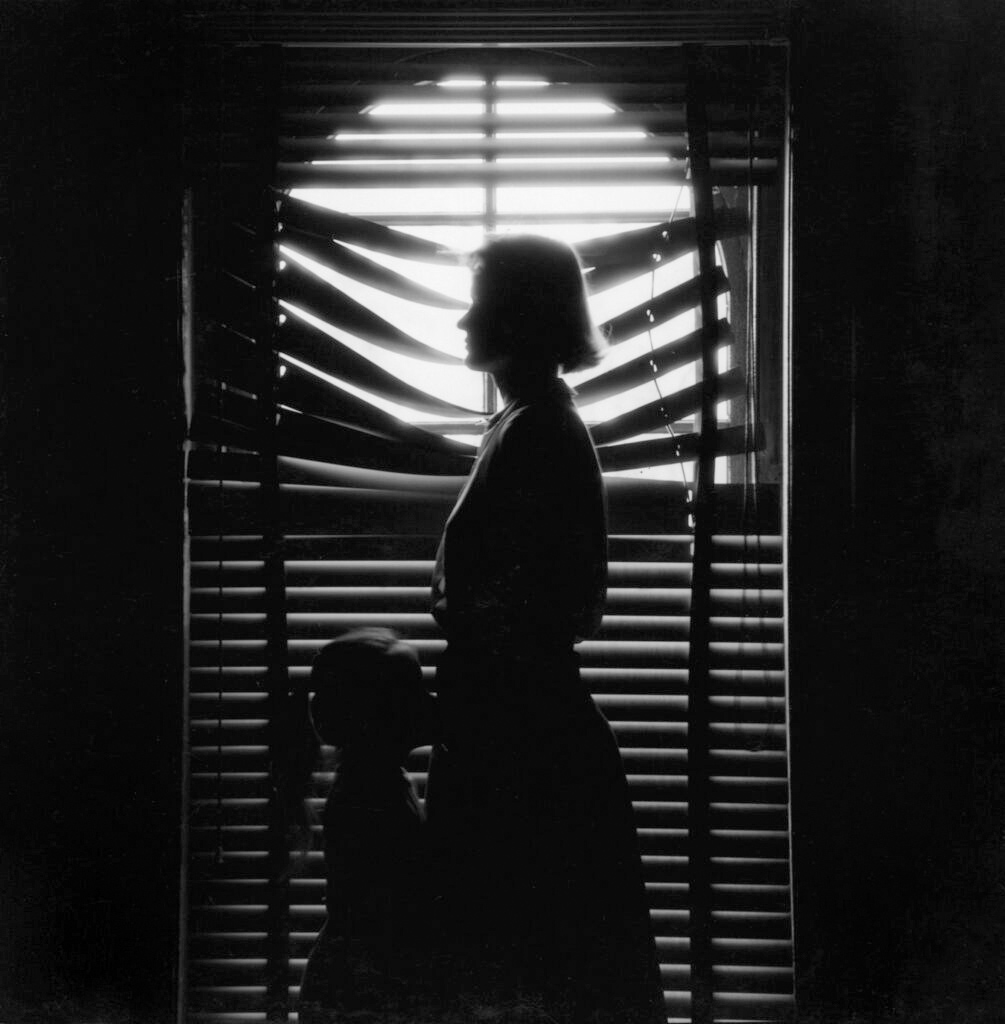
Ralph Eugene Meatyard (American, 1925-1972)
Untitled (Madonna, plate 34)
1964
Gelatin silver print
High Museum of Art
Purchase with funds from the Donald and Marilyn Keough Family Foundation
Estate of Ralph Eugene Meatyard
© Estate of Ralph Eugene Meatyard
While Meatyard regularly photographed his family, his pictures are rarely conventional portraits and are not necessarily indicative of his relationships. Even when he wasn’t including masks, he often obscured his sitters’ identities by skilfully deploying exposure, shadow, depth of field, or motion blur. In this silhouetted image, his wife, Madelyn, and their daughter, Melissa, become the archetypal mother and daughter, their fused forms expressing intimacy and connection. The title of the piece, Madonna, and Meatyard’s use of the arched window as a framing device indicate his desire to place his work within an art historical lineage.
The High Museum of Art
1280 Peachtree St NE
Atlanta, GA
30309
Opening hours:
Tuesday – Saturday 10am – 5pm
Sunday 12 – 5pm
Monday closed
The High Museum of Art website

 Art Blart _ art and cultural memory archive
You must be logged in to post a comment.