Wow, I heard about this video, but nothing compares to seeing and watching Australia’s sordid History and in-humane treatment of the first people. Given that the founding father Barton and recently Lang Hancock actively advocate for sterilisation of the blacks and half-breeds are both confronting and appalling. Denial of basic facilities like electricity, plumbing, good running water, adequate schooling, adequate health services, adequate shelter, transportation – even though these people are tax-paying persons, therefore they are required to have adequate facilities – special mention that this is happening still in 2019, informs thinking people how poor the rights of indigenous peoples are, and how in-humane the Government of Australia is, with regard to first nation people living on their traditional lands. NOTE: Trachoma and other preventable diseases are widespread with Aboriginal and Torres Strait Islander peoples, despite Australia being economically viable country, and these diseases can be prevented. Politicians are not doing enough – end of story.
Eunice Rongo Kizmaz’s comment on YouTube website [Online] Cited 19/01/2021
Curators: Brian Wallis, Chief Curator at the International Center of Photography (ICP), and Julie Maguire, Director of the Brett Weston Archive
Brett Weston (American, 1911-1993) [Air vents, New York] 1945 Image: 10 3/4 x 13 13/16 in. (27.3 x 35.1cm) Gelatin silver print Gift of the Brett Weston Archive, from the collection of Christian Keesee, 2003
Out of the 84 images online on eMuseum I have picked just 13 from the exhibition for this posting. While the press release is loquacious in its praise for these 8 x 10 view camera photographs – and Weston’s subjective and abstract view of the city with it’s flattened and abstracted deep space “distinguished by an attention to the formal values of linearity, depth, and contrast” – only the few that I have focused on here really work to any considerable degree.
Most of the photographs are mundane, prosaic experiments in form, shape and detail. Church door, Bowery, New York and Wrought iron fence, New York (both c. 1945, below) are better examples of detail photographs by Weston, but other than their formal qualities they are pretty boring images. More interesting is the photograph Stoop with broom, arrow, and pushcart, New York (1944, below) with its cacophony of shapes and angles, form, light and shadow.
While most photographs in the posting have some interesting qualities, the only real show stopper is Air vents, New York (1944, below). This is a beautifully resolved modernist image which contrasts the air vents as sculptural objects with the city skyline beyond. Here Weston manipulates deep space (without deep focus / large depth of field) as part of the mise en scène, placing the significant props in different planes of the picture while successfully flattening the whole tableau vivant at the same time. The rendition of light is handsomely controlled, the air vents becoming Brancussi-like sculptures or some form of alien creature.
Dr Marcus Bunyan
Many thankx to the International Center of Photography and the Avenue of the Americas Art Gallery for allowing me to publish the photographs in the posting. Please click on the photographs for a larger version of the image.
Brett Weston (American, 1911-1993) [42nd Street at First Avenue, New York] c. 1945 Image: 7 3/4 x 9 3/4 in. (19.7 x 24.8cm) Gelatin silver print Gift of the Brett Weston Archive, from the collection of Christian Keesee, 2003
Brett Weston (American, 1911-1993) [Oceano Dunes, California] 1934 Image: 10 5/8 x 13 13/16 in. (27 x 35.1cm) Gelatin silver print Gift of the Brett Weston Archive, from the collection of Christian Keesee, 2003
Brett Weston (American, 1911-1993) [Stoop with broom, arrow, and pushcart, New York] 1944 Image: 10 1/4 x 13 5/8 in. (26 x 34.6cm) Gelatin silver print Gift of the Brett Weston Archive, from the collection of Christian Keesee, 2003
Brett Weston (American, 1911-1993) [Airshafts, New York] c. 1945 Image: 13 13/16 x 10 11/16 in. (35.1 x 27.1cm) Gelatin silver print Gift of the Brett Weston Archive, from the collection of Christian Keesee, 2003
Brett Weston (American, 1911-1993) [Courtyard, New York] c. 1945 Image: 19 x 15 1/4 in. (48.3 x 38.7cm) Gelatin silver print Gift of the Brett Weston Archive, from the collection of Christian Keesee, 2003
Brett Weston (1911-1993) is widely regarded as one of the leading photographers of the 20th century. He is known primarily for his bold compositions based on Western landscapes and natural forms, and for his extraordinary printing style. Weston was among a small group of California photographers in the 1930s, known as the Group f/64, who favoured large-format view cameras, straight and uncropped images, and stark black-and-white prints, often contact printed. This group included Ansel Adams and Brett Weston’s father, Edward Weston. But Brett Weston’s style became even more radical when he was drafted into the army during World War II, and, in 1944, sent to the Army Pictorial Center in New York. There, in addition to routine Army work, Weston explored the streets of New York with his large 8 x 10 view camera. Over the next two years, Weston took over 300 photographs, each distinguished by an attention to the formal values of linearity, depth, and contrast. Turning away from the documentary style that characterised much of the photography of New York in the preceding decade, notably Berenice Abbott’s project Changing New York (1939), Weston pioneered a highly subjective and abstract view of the city, often focusing on details such as the finial on an iron railing or ivy on the side of a building. In pictures like Air Vents (1944) and Whelans Drugstore (1944), Weston flattened and abstracted the deep space of the New York cityscape creating rich, two-dimensional black-and-white images. This approach would govern the most prolific period of Weston’s work in the late 1940s and 1950s, when he utilised this highly polished style to photograph Western dunes, beaches, rocks, and vegetation.
This exhibition includes over 100 photographs, drawn largely from the collection of the International Center of Photography. The exhibition is a collaboration between the International Center of Photography, the Brett Weston Archive, and the host Gallery of the Americas. It is organised by Brian Wallis, Chief Curator at the International Center of Photography, and Julie Maguire, Director of the Brett Weston Archive.
Please note that this exhibition is at the 1285 Avenue of the Americas Art Gallery between 51st and 52nd Streets.
Press release from the ICP website
Brett Weston (American, 1911-1993) [House, Ewing Street, Staten Island, New York] c. 1945 Image: 10 x 8 in. (25.4 x 20.3cm) Paper: 10 x 8 in. (25.4 x 20.3cm) Gelatin silver print Gift of the Brett Weston Archive, from the collection of Christian Keesee, 2003
Brett Weston (American, 1911-1993) [Sutton Place, New York] c. 1945 Image: 10 x 8 in. (25.4 x 20.3cm) Paper: 10 x 8 in. (25.4 x 20.3 cm) Gelatin silver print Gift of the Brett Weston Archive, from the collection of Christian Keesee, 2003
Brett Weston (American, 1911-1993) [Skylight and fences, Midtown, New York] c. 1945 Image: 10 x 8 in. (25.4 x 20.3cm) Gelatin silver print Gift of the Brett Weston Archive, from the collection of Christian Keesee, 2003
Brett Weston (American, 1911-1993) [Wrought iron fence, New York] c. 1945 Image: 9 9/16 x 6 13/16 in. (24.3 x 17.3cm) Gelatin silver print Gift of Christian K. Keesee, 2012
Brett Weston (American, 1911-1993) [Church door, Bowery, New York] c. 1945 Image: 9 1/2 x 7 9/16 in. (24.1 x 19.2cm) Gelatin silver print Gift of the Brett Weston Archive, from the collection of Christian Keesee, 2003
Brett Weston (American, 1911-1993) [Pillars and tree, New York] 1944 Image: 10 x 8 in. (25.4 x 20.3cm) Gelatin silver print Gift of the Brett Weston Archive, from the collection of Christian Keesee, 2003
Brett Weston (American, 1911-1993) [St. Francis Grocery & Fruit, New York] c. 1945 Image: 9 1/2 x 7 9/16 in. (24.1 x 19.2cm) Gelatin silver print Gift of Christian K. Keesee, 2012
International Center of Photography 79 Essex Street, New York, NY 10002 between Delancey Street and Broome Street
Darron Davies (Australian) Encased 2012 Archival Pigment Print on Photo Rag 80 x 80cm / edition of 6
Here’s my pick of the nine best local exhibitions which featured on the Art Blart art and cultural memory archive in 2013 (plus a favourite of the year from Hobart). Enjoy!
Dr Marcus Bunyan
1/ Review: Terraria by Darron Davies at Edmund Pearce Gallery, Melbourne
This is the first “magical” exhibition of photography that I have seen in Melbourne this year. Comprising just seven moderately large Archival Pigment Print on Photo Rag images mounted in white frames, this exhibition swept me off my feet. The photographs are beautiful, subtle, nuanced evocations to the fragility and enduring nature of life…
A sense of day / dreaming is possible when looking at these images. Interior / exterior, size / scale, ego / self are not fixed but fluid, like the condensation that runs down the inside of these environments (much like blood circulates our body). This allows the viewer’s mind to roam at will, to ponder the mysteries of our short, improbable, joyous life. The poetic titles add to this introspective reflection. I came away from viewing these magical, self sustaining vessels with an incredibly happy glow, more aware of my own body and its relationship to the world than before I had entered Darron Davies enveloping, terrarium world.
Darron Davies (Australian) The Red Shard 2012 Archival Pigment Print on Photo Rag 80 x 80cm / edition of 6
Presently, contemporary photography is able to reveal intangible, constructed vistas that live outside the realm of the scientific. A photograph becomes a perspective on the world, an orientation to the world based on human agency. An image-maker takes resources for meaning (a visual language, how the image is made and what it is about), undertakes a design process (the process of image-making), and in so doing re-images the world in a way that it has never quite been seen before.
These ideas are what a fascinating exhibition titled Confounding: Contemporary Photography, at the National Gallery of Victoria, Melbourne investigates. In the confounding of contemporary photography we are no longer witnessing a lived reality but a break down of binaries such as sacred and profane, public and private, natural and artificial, real and dreamed environments as artists present their subjective visions of imagined, created worlds. Each image presents the viewerwith a conundrum that investigates the relationship between photographs and the “real” world they supposedly record. How do these photographs make you feel about this constructed, confounding world? These fields of existence?
This is a tough, stimulating exhibition of late works by Louise Bourgeois at Heide Museum of Modern Art, Melbourne. All the main themes of the artist’s work explored over many years are represented in these late works: memory, emotion, anxiety, family, relationships, childhood, pain, desire and eroticism are all present as are female subjectivity and sexuality, expressed through the body…
Bourgeois’ work gives me an overall feeling of immersion in a world view, one that transcends the pain and speaks truth to power. Bourgeois confronted the emotion, memory or barrier to communication that generated her mood and the work. She observed, “My art is an exorcism. My sculpture allows me to re-experience fear, to give it a physicality, so that I am able to hack away at it.” By weaving, stitching and sewing Bourgeois threaded the past through the present and enacted, through artistic performance, a process of repair and reconstruction, giving meaning and shape to frustration and suffering. I have not been so lucky. My mother refuses to discuss the past, will not even come close to the subject for the pain is so great for her. I am left with a heaviness of heart, dealing with the demons of the past that constantly lurk in the memory of childhood, that insistently impinge on the man I am today. Louise Bourgeois’ sculptures brought it all flooding back as the work of only a great artist can, forcing me to become an ethical witness to her past, my past. A must see exhibition this summer in Melbourne.
A stunning, eloquent and conceptually complex exhibition buy Petrina Hicks at Helen Gory Galerie…
I am just going to add that the photograph Venus (2013, below) is one of the most beautiful photographs that I have seen “in the flesh” (so to speak) for a long while. Hicks control over the ‘presence’ of the image, her control over the presence within the image is immaculate. To observe how she modulates the colour shift from blush of pink within the conch shell, to colour of skin, to colour of background is an absolute joy to behold. The pastel colours of skin and background only serve to illuminate the richness of the pink within the shell as a form of immaculate conception (an openness of the mind and of the body). I don’t really care who is looking at this photograph (not another sexualised male gaze!) the form is just beauty itself. I totally fell in love with this work.
Forget the neo-feminist readings, one string of text came to mind: The high fidelity of a fetishistic fecundity.
Petrina Hicks (Australian, b. 1972) Venus 2013 Pigment print, Edition of 8 100 x 100cm
Petrina Hicks (Australian, b. 1972) Enigma 2013 Pigment print, Edition of 8 100 x 100cm
5/ Exhibition: Density by Andrew Follows at Anita Traverso Gallery, Richmond
I include this in my list of magnificent photographic exhibitions for the year not because I curated it, but because of the conceptualisation, the unique quality of the images and the tenacity of a visually impaired artist to produce such memorable work.
A wonderful exhibition by vision impaired photographer Andrew Follows at Anita Traverso Gallery, Richmond. It has been a real pleasure to mentor Andrew over the past year and to see the fruits of our labour is incredibly satisfying. The images are strong, elemental, atmospheric, immersive. Due to the nature of Andrew’s tunnel vision there are hardly any traditional vanishing points within the images, instead the ‘plane of existence’ envelops you and draws you in.
Densityn.
The degree of optical opacity of a medium or material, as of a photographic negative;
Thickness of consistency;
Complexity of structure or content.
Andrew Follows (Australian, d. 2019) Number 31, Eltham 2013 Digital photograph on archival cotton rag 130 cm x 86.5cm
Andrew Follows (Australian, d. 2019 Green, Montsalvat 2013 Digital photograph on archival cotton rag 130 cm x 86.5 cm
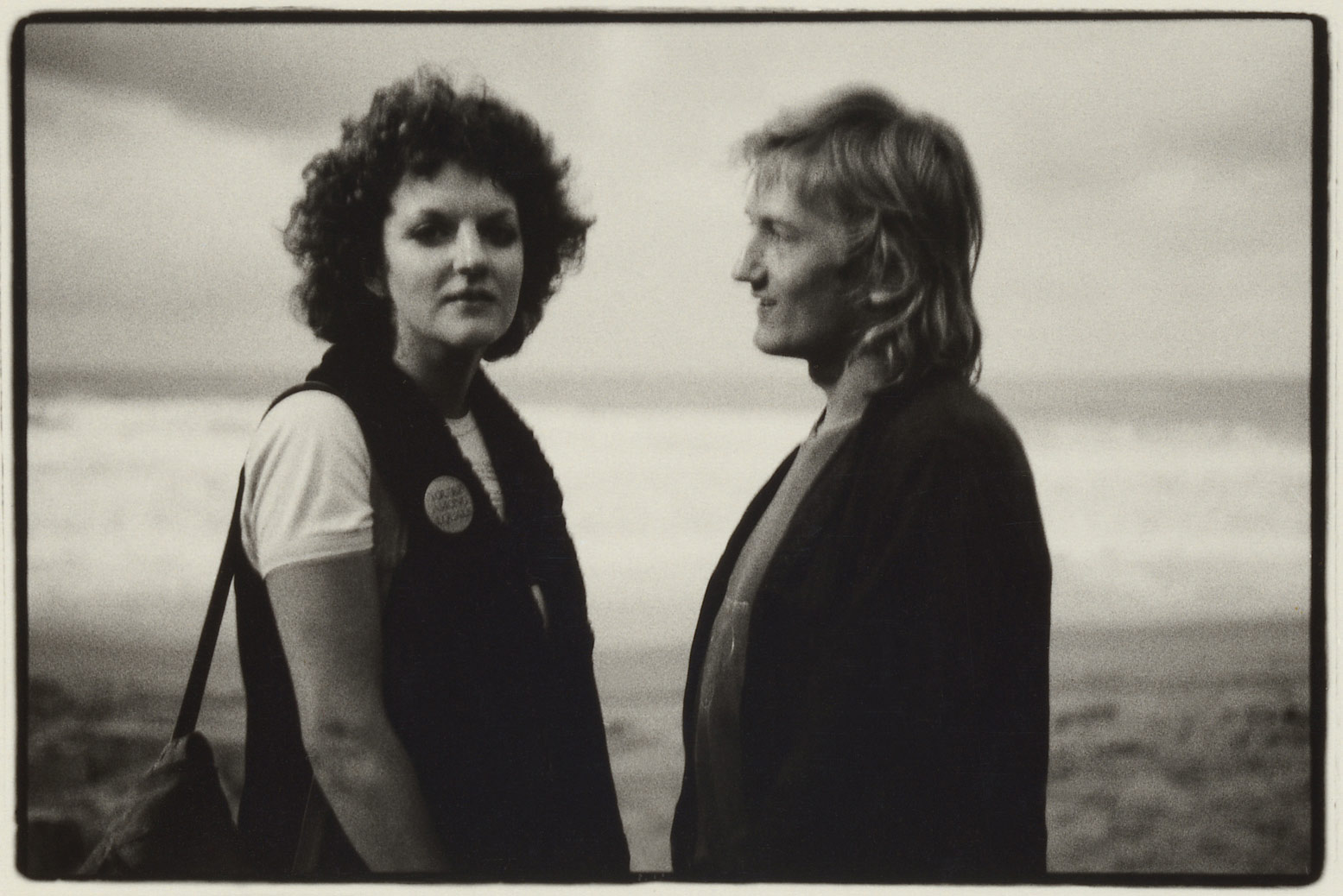
This is a fascinating National Gallery of Australia exhibition about the work of Australian photographer Carol Jerrems at Monash Gallery of Art, Wheelers Hill – in part both memorable, intimate, informative, beautiful, uplifting and disappointing…
The pity is that she died so young for what this exhibition brought home to me was that here was an artist still defining, refining her subject matter. She never had to time to develop a mature style, a mature narrative as an artist (1975-1976 seems to be the high point as far as this exhibition goes). This is the great regret about the work of Carol Jerrems. Yes, there is some mediocre work in this exhibition, stuff that really doesn’t work at all (such as the brothel photographs), experimental work, individual and collective images that really don’t impinge on your consciousness. But there are also the miraculous photographs (and for a young photographer she had a lot of those), the ones that stay with you forever. The right up there, knock you out of the ball park photographs and those you cannot simply take away from the world. They live on in the world forever.
Does Jerrems deserve to be promoted as a legend, a ‘premier’ of Australian photography as some people are doing? Probably not on the evidence of this exhibition but my god, those top dozen or so images are something truly special to behold. Their ‘presence’ alone – their physicality in the world, their impact on you as you stand before them – guarantees that Jerrems will forever remain in the very top echelons of Australian photographers of all time not as a legend, but as a women of incredible strength, intelligence, passion, determination and vision.
What a gorgeous exhibition. It’s about time Melbourne had a bit of style put back into the National Gallery of Victoria, and this exhibition hits it out of the park. Not only are the photographs absolutely fabulous but the frocks are absolutely frocking as well. Well done to the NGV for teaming the photographs with the fashion and for a great install (makes a change to see 2D and 3D done so well together). Elegant, sophisticated and oozing quality, this is a sure fire winner….
Installation photograph of the exhibition Edward Steichen & Art Deco Fashion at NGV International
Monash University Museum of Art (MUMA) is generating an enviable reputation for holding vibrant, intellectually stimulating group exhibitions on specific ideas, concepts and topics. This exhibition is no exception. It is one of the best exhibitions I have seen in Melbourne this year. Accompanied by a strong catalogue with three excellent essays by Thierry de Duve, Dr Rex Butler and Patrice Sharkey, this is a must see exhibition for any Melbourne art aficionado before it closes.
“This transition is a flash, a boundary where this becomes that, not then, not that – falling in love, jumping of a bridge. Alive : dead; presence : absence; purpose : play; mastery : exhaustion; logos : silence; worldly : transcendent. Not this, not that. It is an impossible presence, present – a moment of unalienated production that we know exists but we cannot define it, place it. How can we know love? We can speak of it in a before and after sense but it is always a past moment that we recognise.”
Dr Marcus Bunyan. Made Ready: A Philosophy of Moments. December 2013
Jeff Koons (American, b. 1955) Balloon dog (Red) 1995 designed Porcelain, ed. 1113/2300 11.3 x 26.3 cm diameter National Gallery of Victoria, Melbourne Photo: Marcus Bunyan
Andrew Liversidge (Australian, b. 1979) IN MY MIND I KNOW WHAT I THINK BUT THAT’S ONLY BASED ON MY EXPERIENCE 2009 10,000 $1 coins (AUD) 30 x 30 x 30cm Courtesy of the artist and The Commercial Gallery, Sydney Photo: Marcus Bunyan
Claudia Terstappen (Australian born Germany, b. 1959) Cabbage trees (Queensland, Australia) 2002 From the series Our ancestors 1990- Gelatin silver print 29 x 29cm Courtesy of the artist
Claudia Terstappen (Australian born Germany, b. 1959) Zion Park (USA) 1996 From the series Sacred land of the Navajo Indians 1990- Gelatin silver print 37 x 37cm Courtesy of the artist
Without doubt this is the best pure photography exhibition I have seen this year in Melbourne. The exhibition is stimulating and enervating, the image making of the highest order in its aesthetic beauty and visual complexity. The artist explores intangible spaces which define our physical and spiritual relationship with the un/known world…
In Terstappen’s work there is no fixed image and no single purpose, a single meaning, or one singular existence that the images propose. They transcend claims about the world arising from, for example, natural or scientific attitudes or theories of the ontological nature of the world. As the artist visualises, records the feeling of the facts, such complex and balanced images let the mind of the viewer wander in the landscape. In their fecundity the viewer is enveloped in that situation of not knowing. There is the feeling of the landscape, a sensitivity to being “lost” in the landscape, in the shadow of ‘Other’, enhanced through the modality of the printing. Dreamworld vs analytical / descriptive, there is the enigma of the landscape and its spiritual places. Yes, the sublime, but more an invocation, a plea to the gods for understanding. This phenomenological prayer allows the artist to envelop herself and the viewer in the profundity – the great depth, intensity and emotion – of the landscape. To be ‘present’ in the the untrammelled places of the world as (divine) experience…
I say to you that this is the most sophisticated reading of the landscape that I have seen in a long time – not just in Australia but from around the world. This is such a joy of an exhibition to see that you leave feeling engaged and uplifted. Being in the gallery on your own is a privilege that is hard to describe: to see (and feel!) landscape photography of the highest order and by an Australian artist as well.
The claiming of things The touching of things The digging of land The tagging of place The taking over of the world
Tag and capture. Tag and capture. Shop, dig, spray, destroy.
An ironic critique of the pastoral, neo/colonial world, tagged and captured in the 21st century.
Excellent work. The construction, sensibility and humour of the videos is outstanding. I also responded to the two works Tag and capture and Shopping for butterfly (both 2013, below).
Joan Ross (Australian, b. 1961) Tag and capture 2013 Hand painted pigment print on cotton rag paper 50 x 47cm (image size) Edition of 3
Joan Ross (Australian, b. 1961) Shopping for butterfly 2013 Hand painted pigment print on cotton rag paper 51.5 x 50cm (image size) Edition of 3
Exhibition dates: 29th September 2013 – 5th January 2014
Curator: Sarah Kennel, Associate Curator of Photographs at the National Gallery of Art
Charles Marville (French, 1813-1879) Marché aux chevaux (Horse Market) (fifth arrondissement) c. 1867 Albumen print from collodion negative Image: 26.2 x 36.8cm (10 5/16 x 14 1/2 in.) The J. Paul Getty Museum, Los Angeles
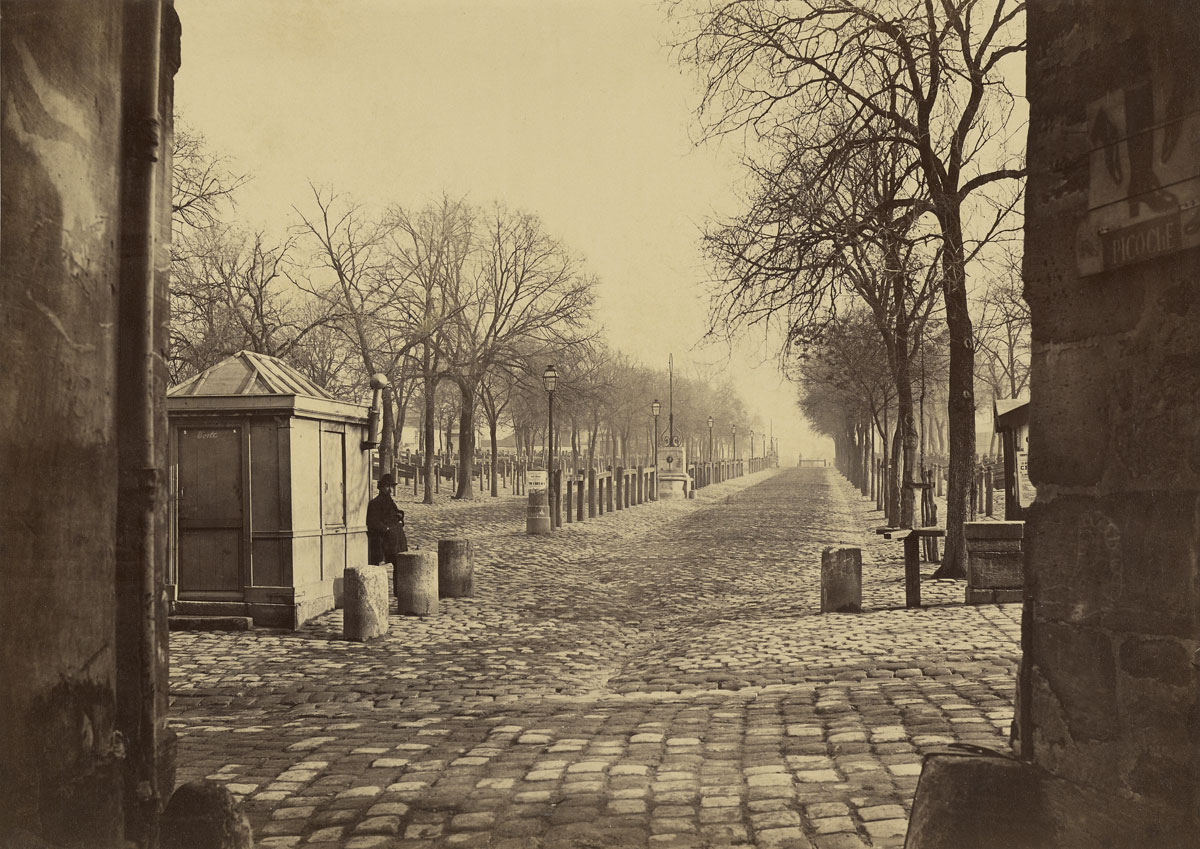
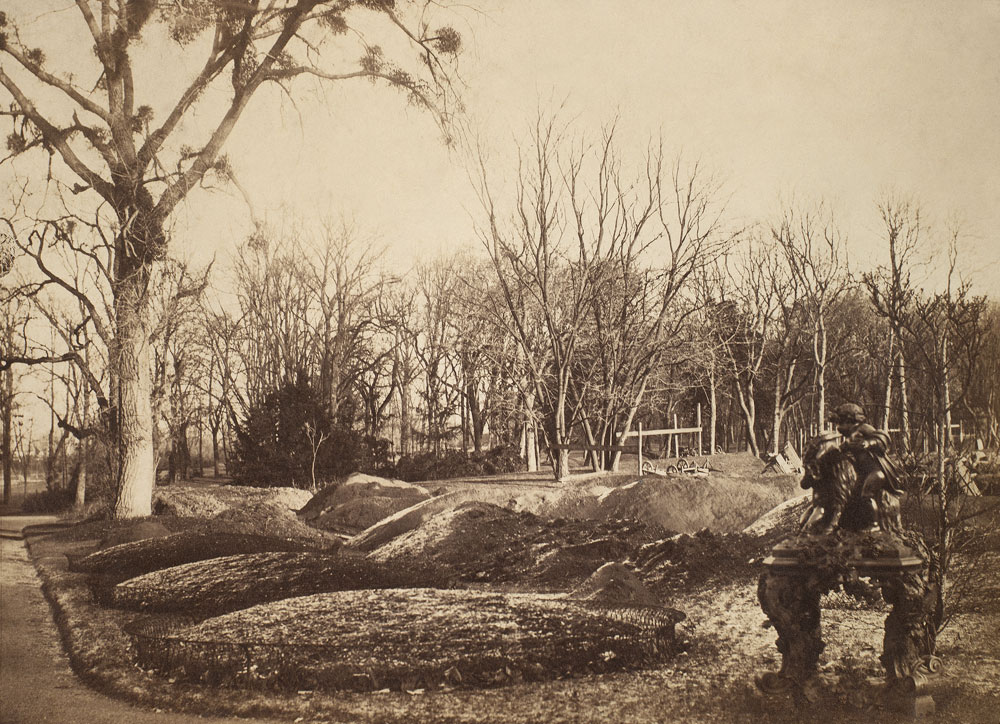
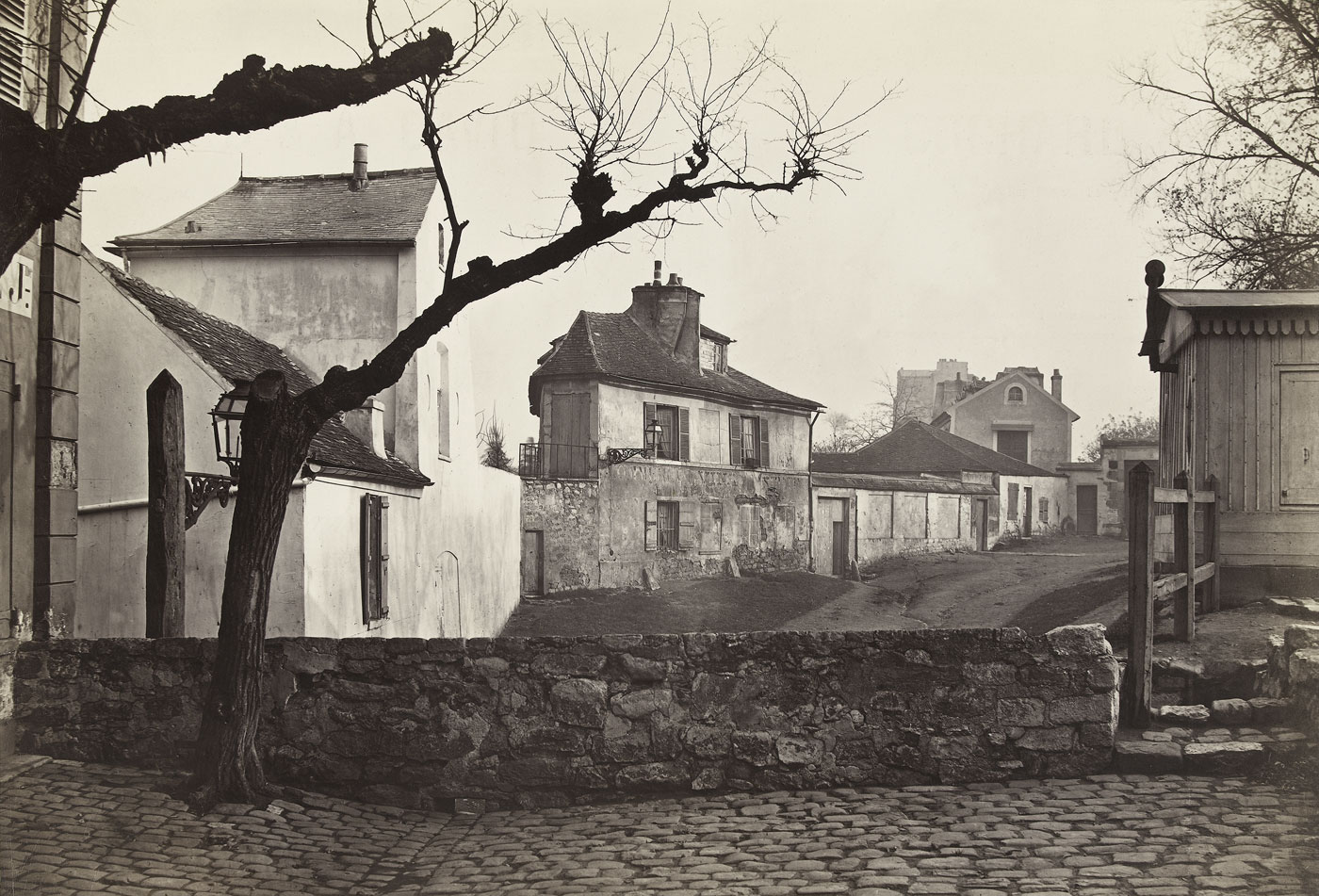
The French photographer Charles Marville (1813-1879) is rapidly becoming a favourite of mine. In fact, I have just ordered Charles Marville: Photographer of Paris by Sarah Kennel from Amazon – a book that comes highly recommended – and I am eagerly awaiting its arrival.
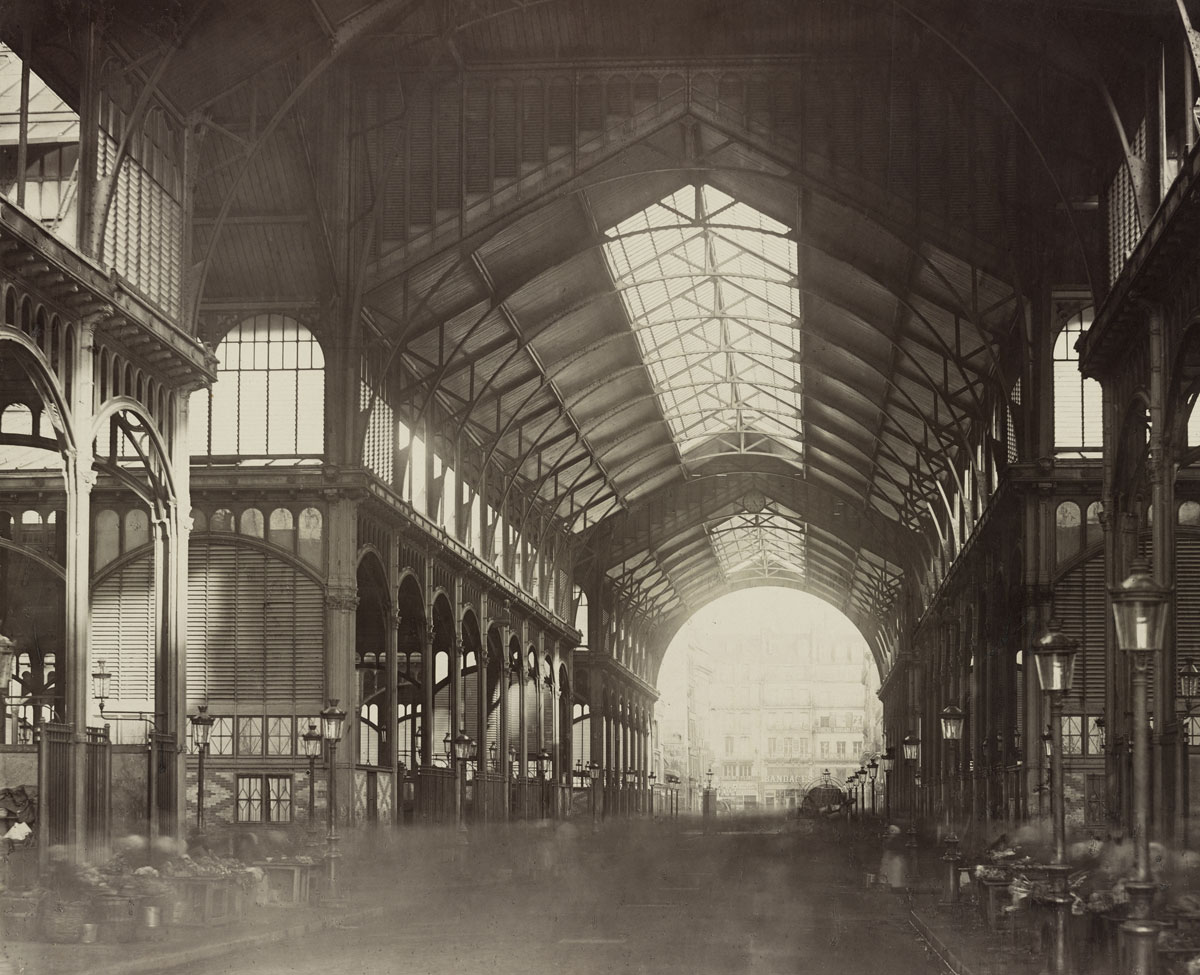
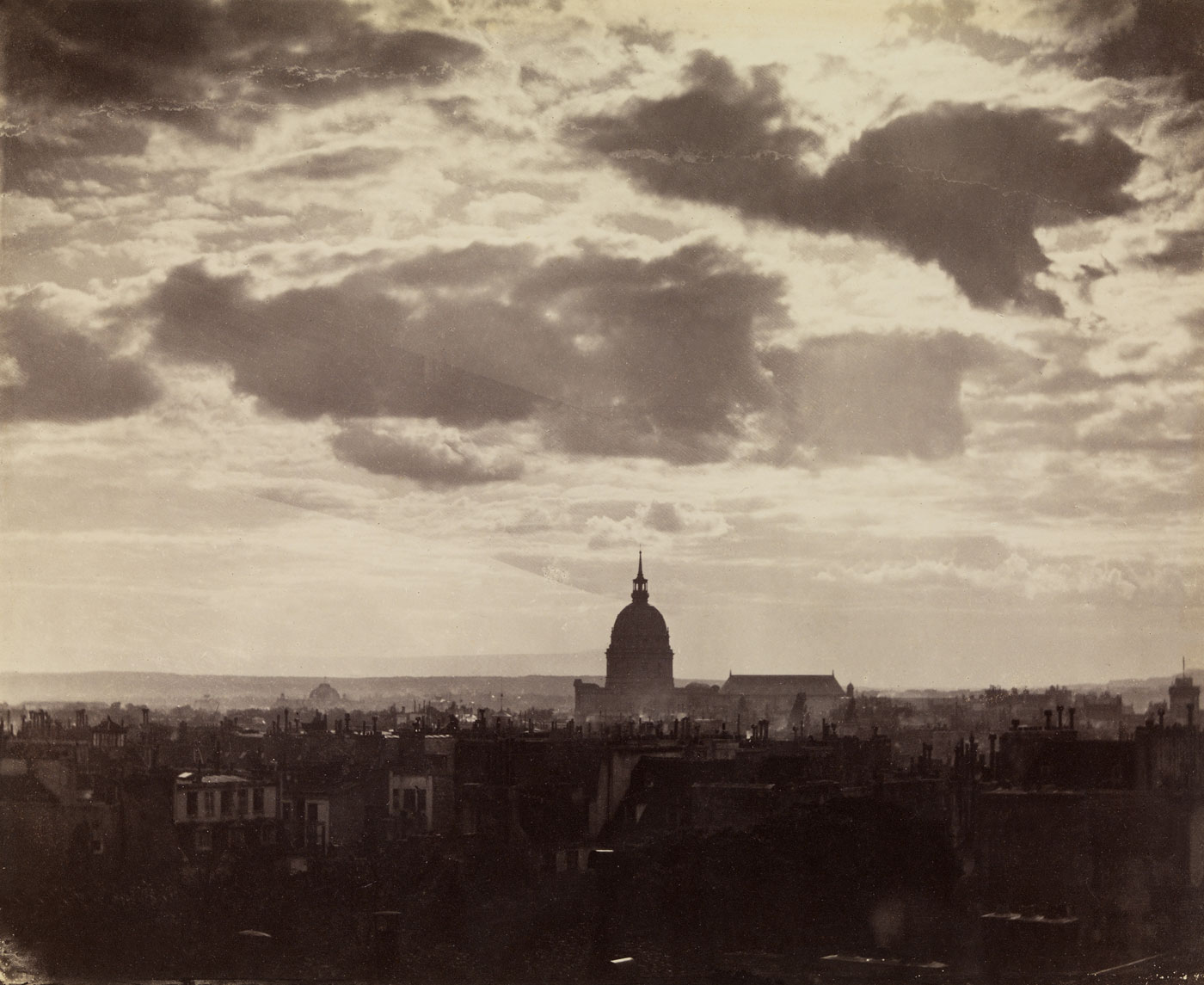
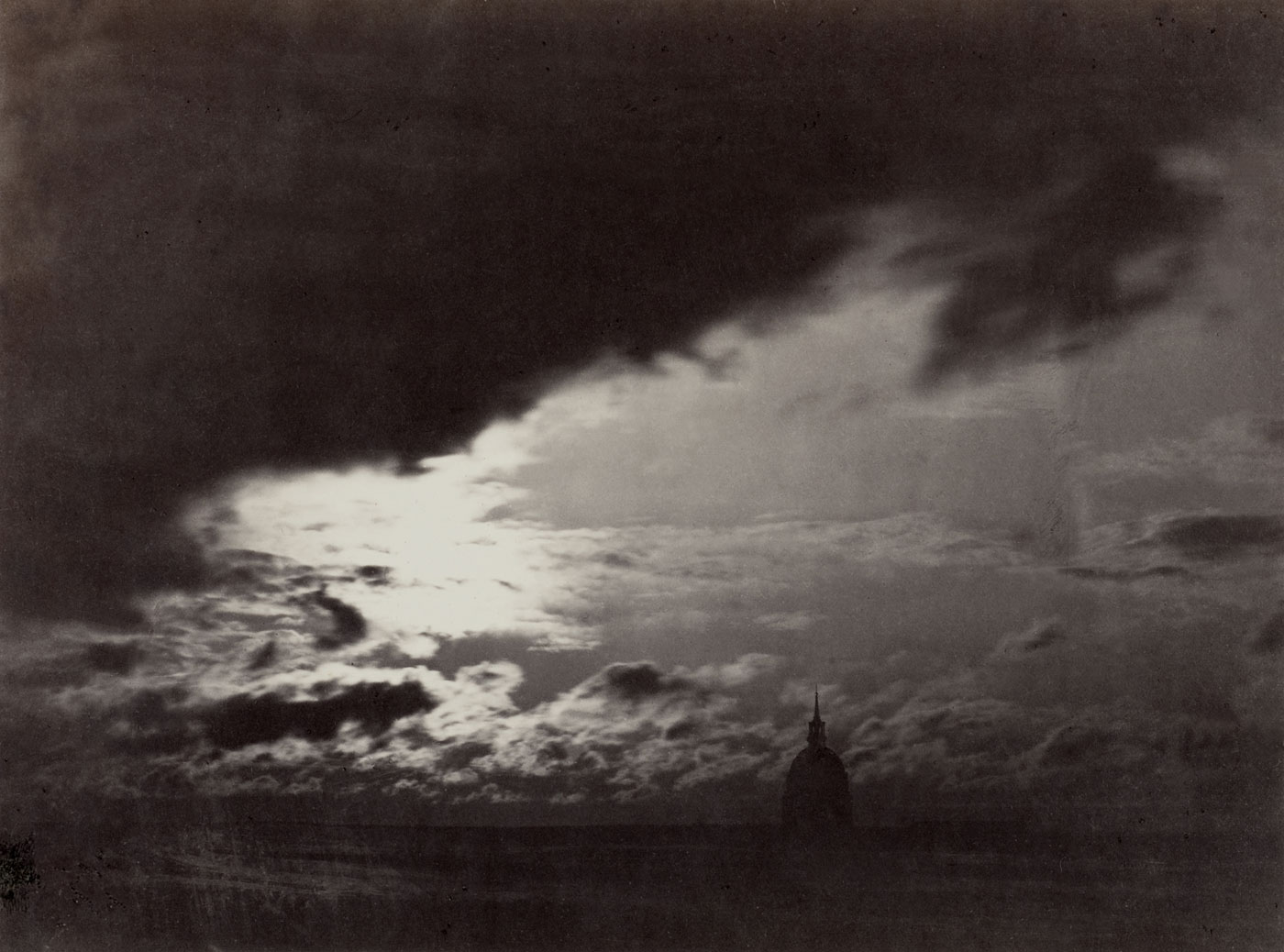
Charles Marville “is primarily known for documenting the transformation of Paris from a medieval city to a modern one, through a series of images of old neighbourhoods lost due to urban renewal… Marville’s earliest works were salted paper prints made from paper negatives – soft, high-contrast images not far removed in feeling from the pioneering, somewhat primitive photographs of William Henry Fox Talbot. As photographic technology advanced, Marville shifted to glass negatives that allowed far more visual precision, particularly in the architectural and streetscape images that compose the largest portion of the National Gallery of Art’s retrospective. By the late 1870s, shortly before his death, Marville’s compositions began to presage the more modernist approaches Alfred Stieglitz would pursue just a few years later. (At one point, Marville even experimented with abstracted cloud images, decades before Stieglitz’s famous “equivalents.”).” (Louis Jacobson. “Reviewed: Charles Marbille at the National Gallery of Art,” on the Washington City Newspaper blog 22nd October 2013 [Online] Cited 19/01/2021)
Marville can be seen as the precursor to Eugène Atget (1857-1927). Atget would have been in his twenties when Marville was in the last few years of his life. It is interesting to speculate whether the two ever met? (and if they did what they would have talked about!) Atget would have been aware of the older photographers’ work, work that has been criticised for its lack of social consciousness and artistic feeling.
“Comparing Atget’s work with that of his best-known predecessor, Charles Marville (1816-1879), demonstrates another of Atget’s artistic contributions. Marville had been commissioned to make a comprehensive documentation of the vast districts of old housing that were to be demolished as part of Napoleon III’s plan to transform Paris into a modern capital. Marville’s photographs do not linger over any particular building, warm to its charm or embrace its artistic qualities. Instead (perhaps because these buildings were slated for destruction anyway), Marville chose a position from which he could see straight to the end of even the most narrow, winding street, enabling him to photograph the maximum number of structures with one shot.” (Gerald M. Panter. “Atget in Historical Perspective” [Online] Cited 01/01/2014. No longer available online)
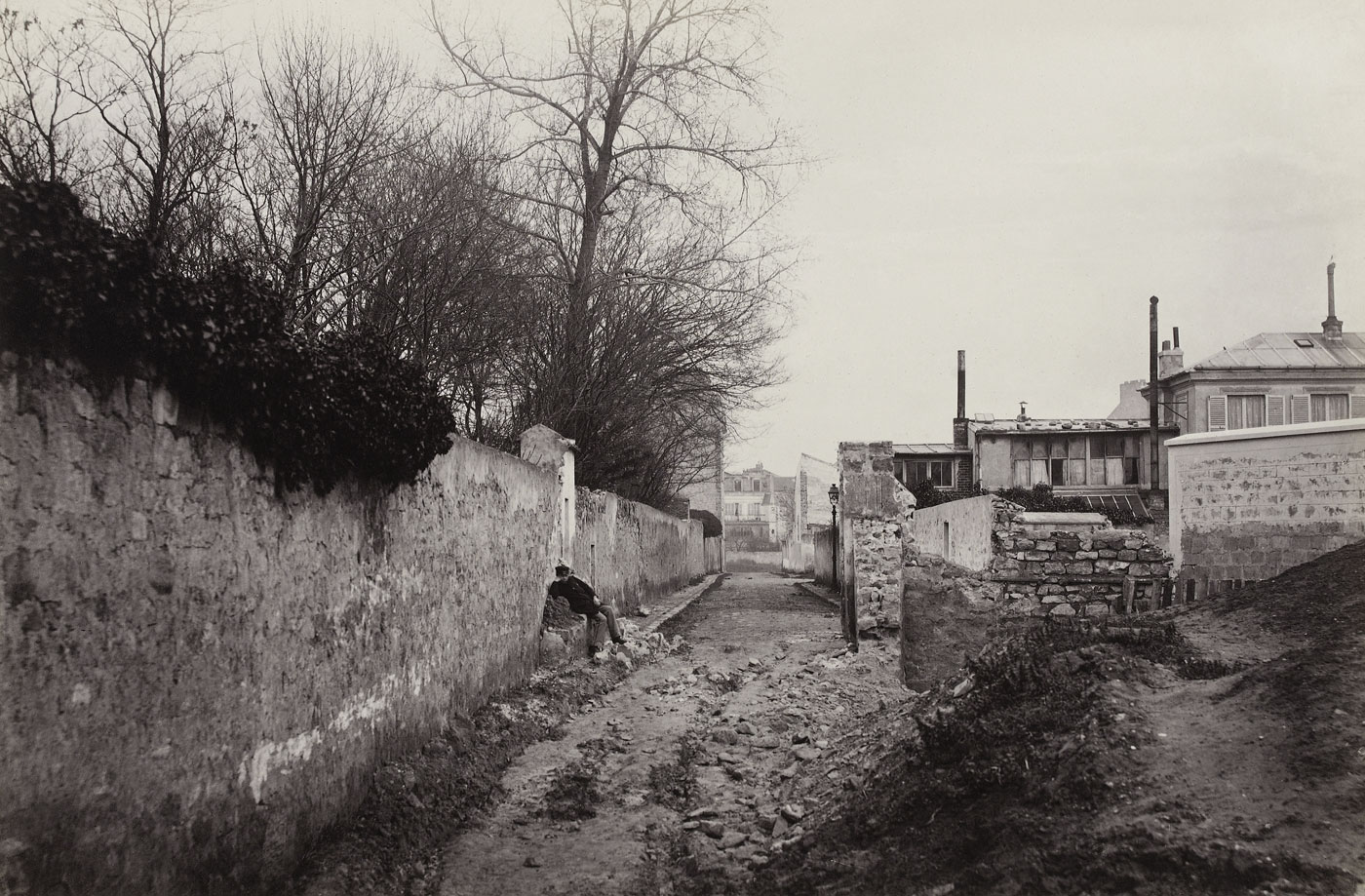
This is to denigrate the work of Marville. His photographs possess more subtly than Atget’s and they sing a different song. To me, Marville’s photographs are like a Bach fugue while Atget’s photographs are a Mozart sonata. Both have different resonances, no less valuable one from the other. It is as if Atget looked at the work of Marville and thought: how can I do this my way, in my own voice and he then proceeded to “turn up the volume” – by changing the angle and perspective of the camera, by moving horse and cart into more prominent positions, by focusing on details and ghosts. But Marville is no less a master than Atget. You only have to look at the photographs to realise what great sensitivity to subject matter he possessed, what a unique voice this artist had.
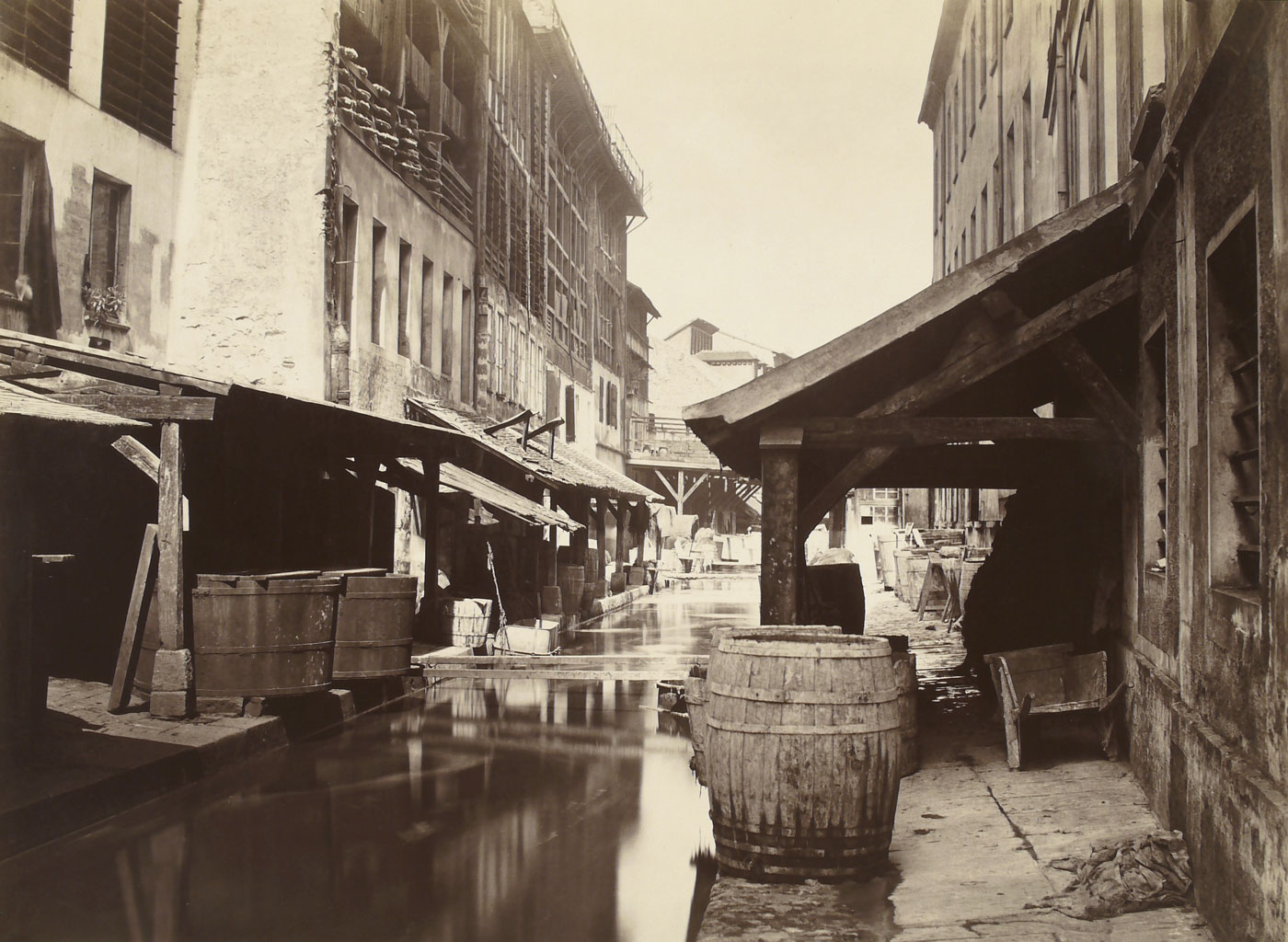
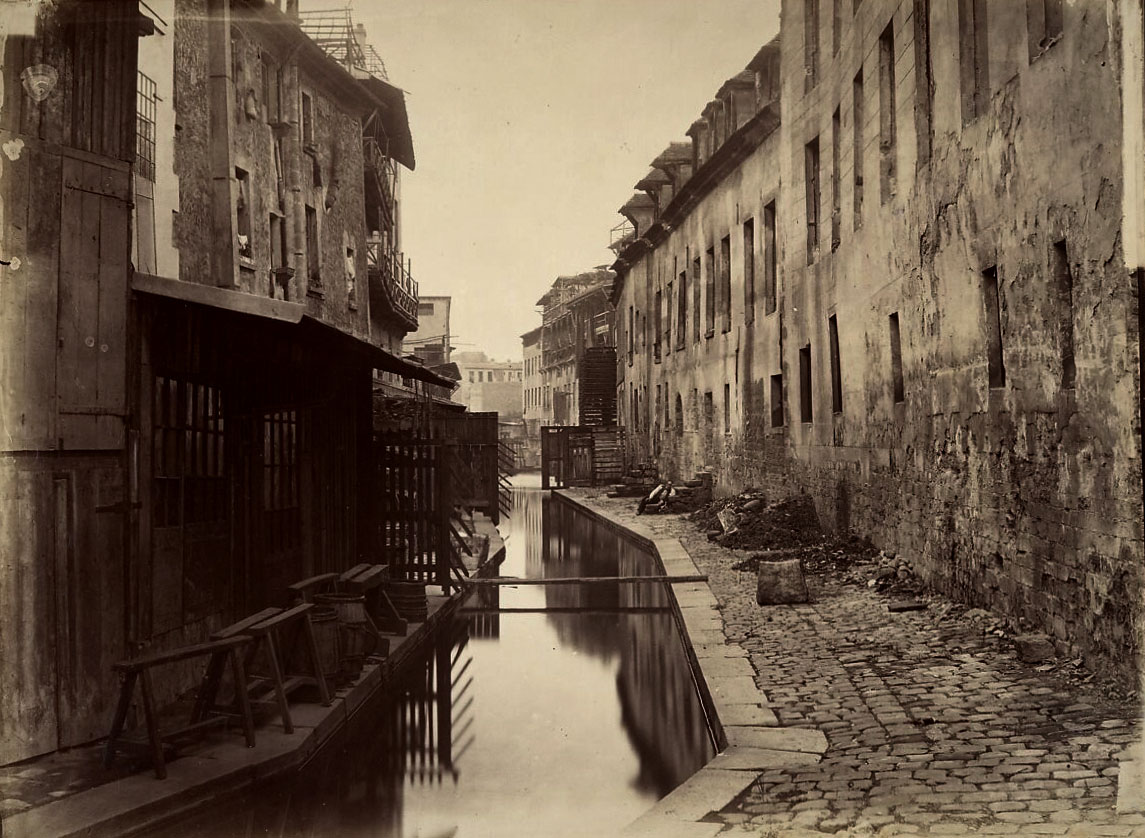
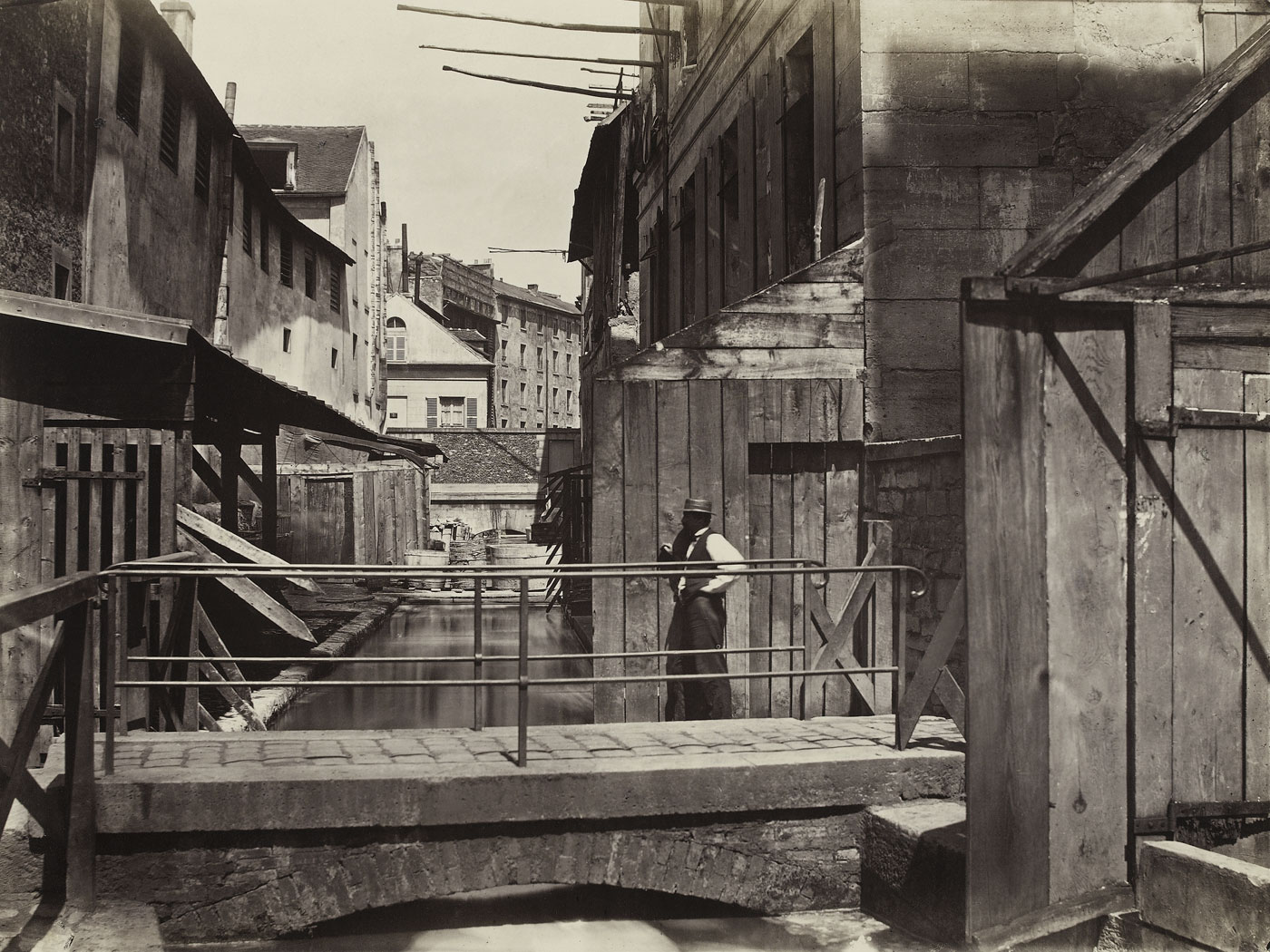
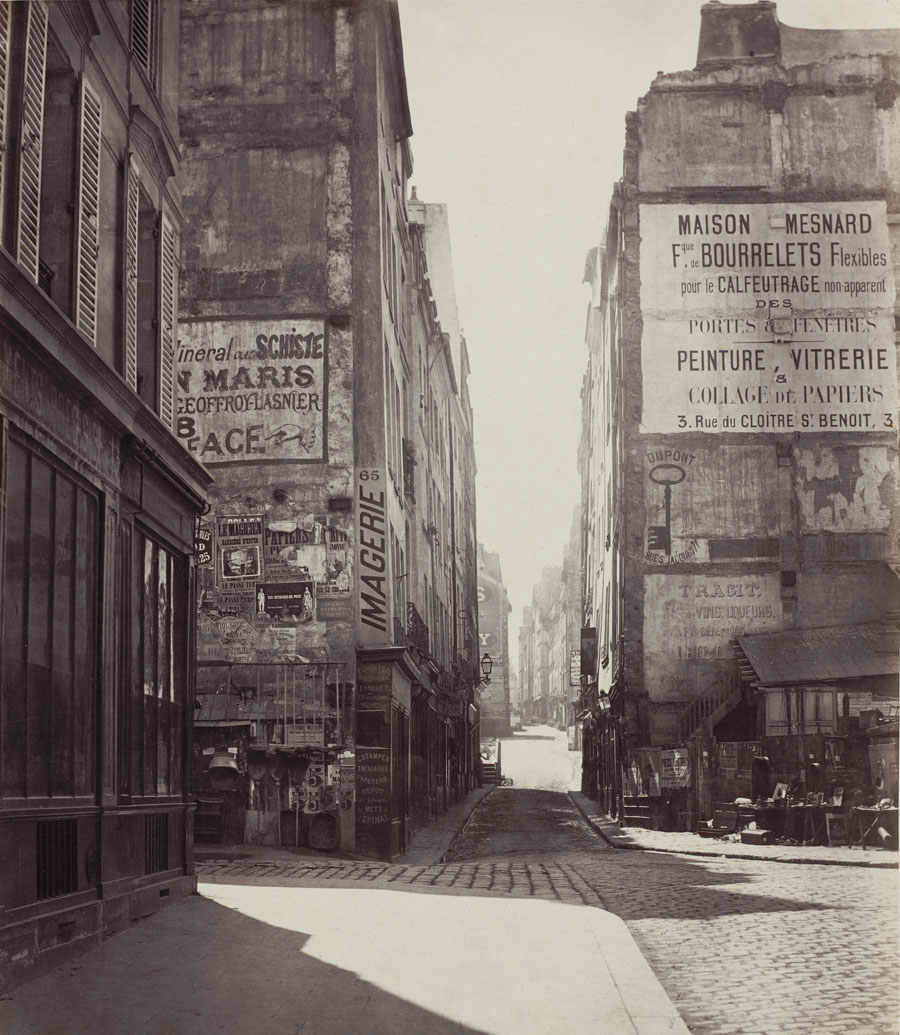
Look at the amazing construction of the picture plane in numerous images in this posting. The wall that blocks the way in Impasse de l’Essai from the Horse Market (c. 1868, below) and the pictures elegiac atmosphere, tensioned by the post mimicking the tree at the left hand side and the threatening, dark, brooding forms of both trees overhanging the rooftops of the houses. The three photographs The Bièvre River (fifth arrondissement) (2 images) and Banks of the Bièvre River at the Bottom of the rue des Gobelins (all 1862, below) where the artist leads the eye of the viewer into the image using water, then partially blocks the line of sight into the distance by barrels and posts, shadows and reflections, at the same time limiting the sky to a small section so that the viewer’s eyes have some escape route out of the image. The last image Bièvre River at the Bottom of the rue des Gobelins is almost Cezanne-like in it’s flattening and fracturing of the image plane into modernist shapes. Atget could never have taken photographs like these. They are true masterpieces.
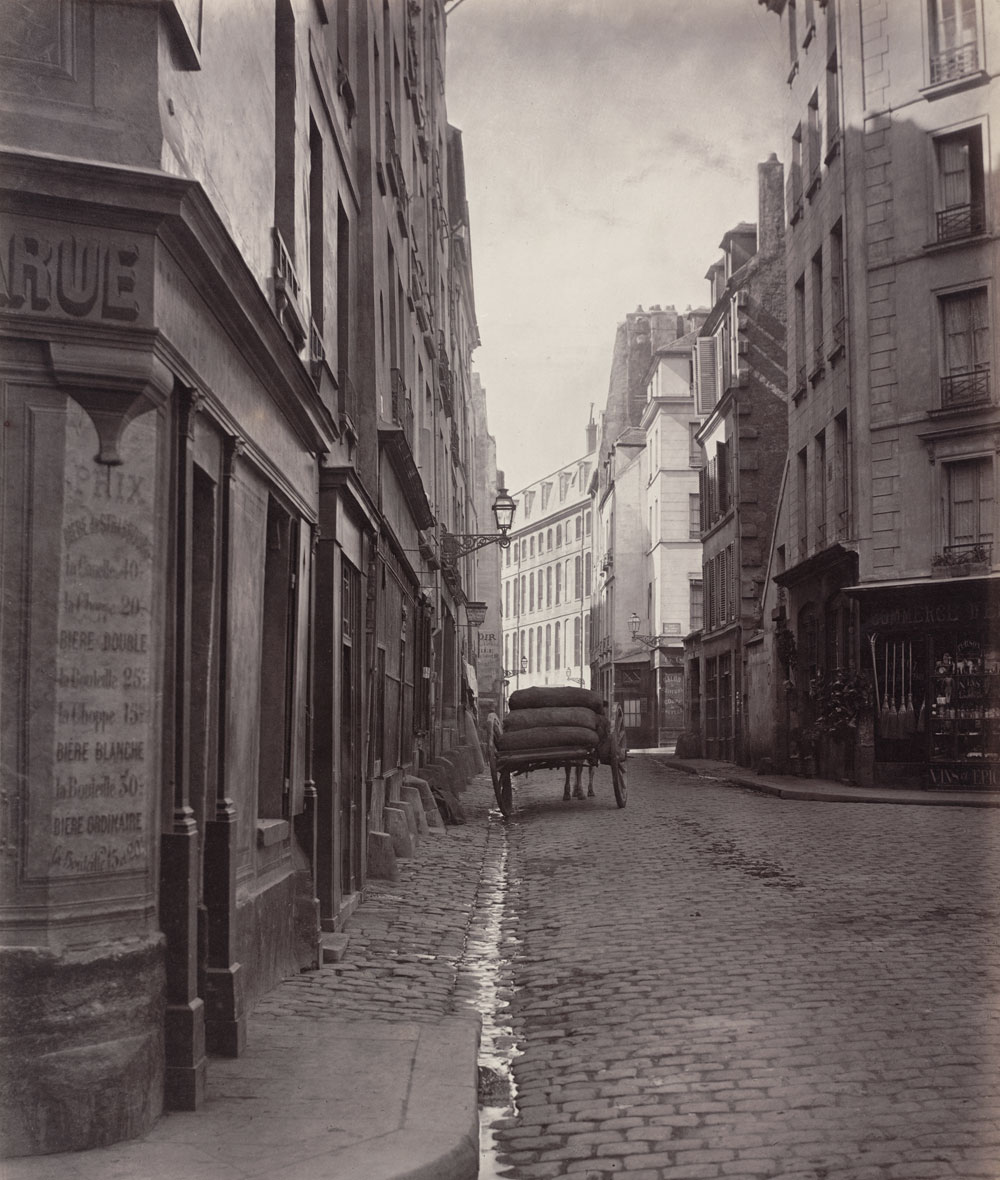
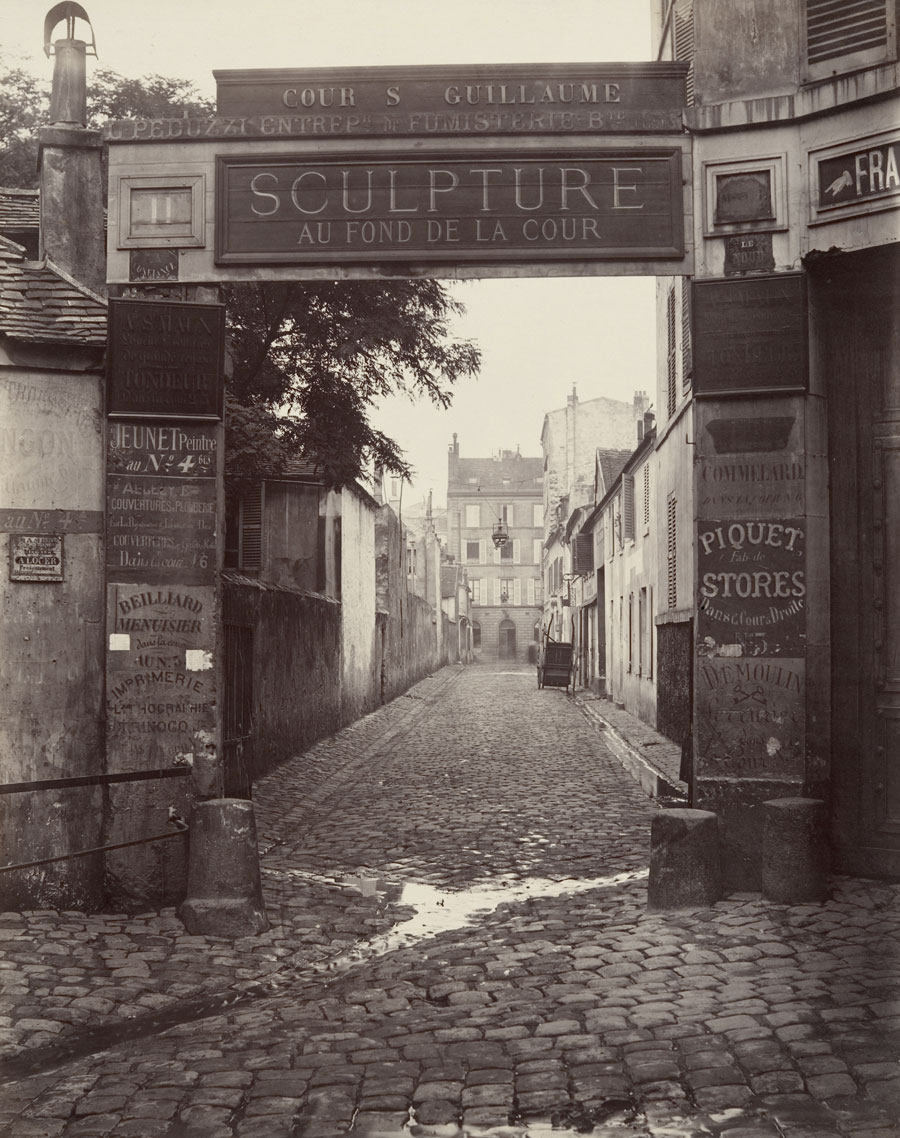
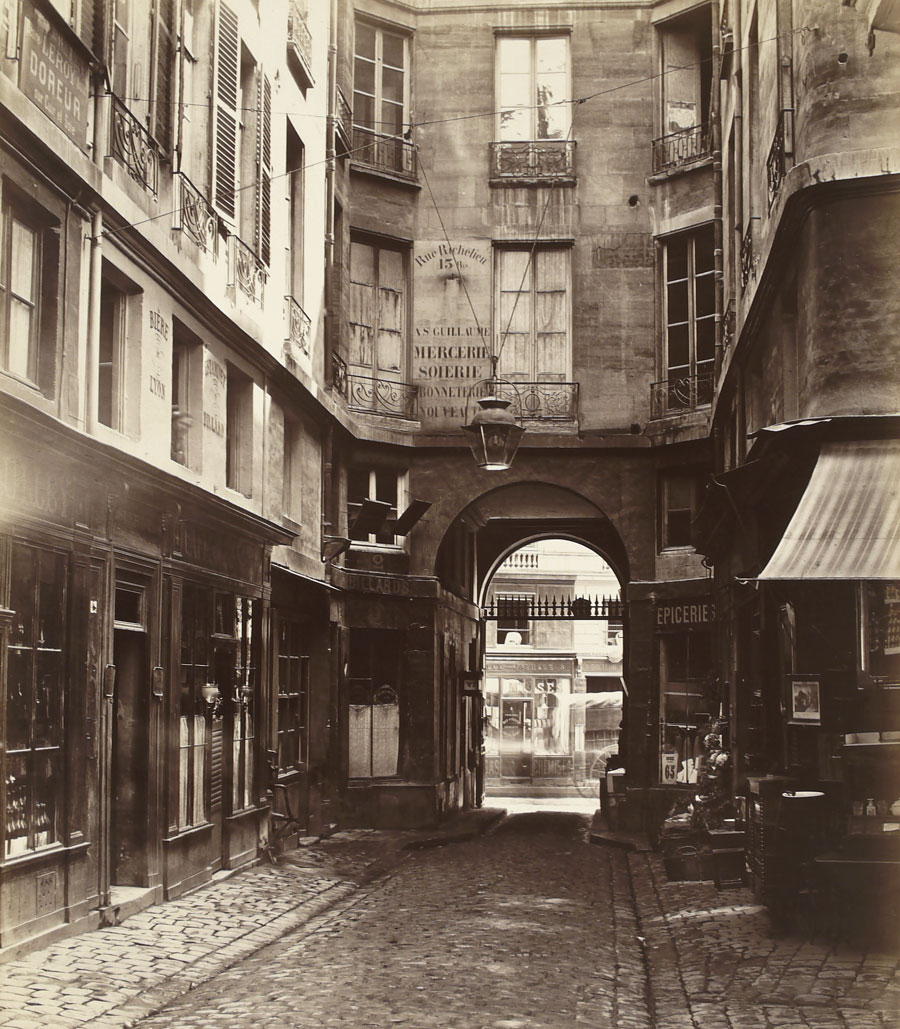
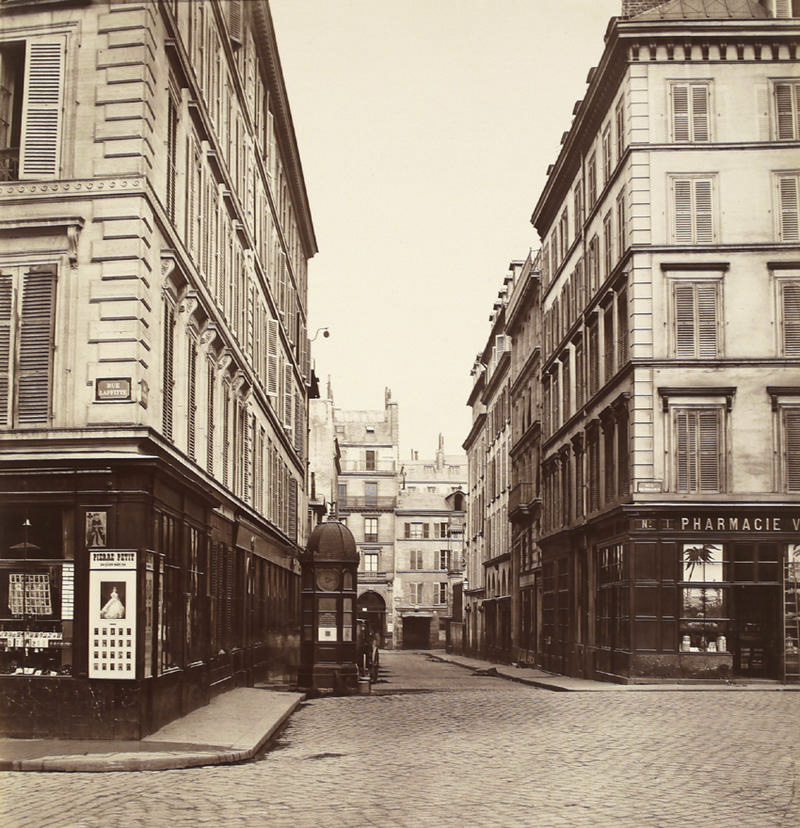
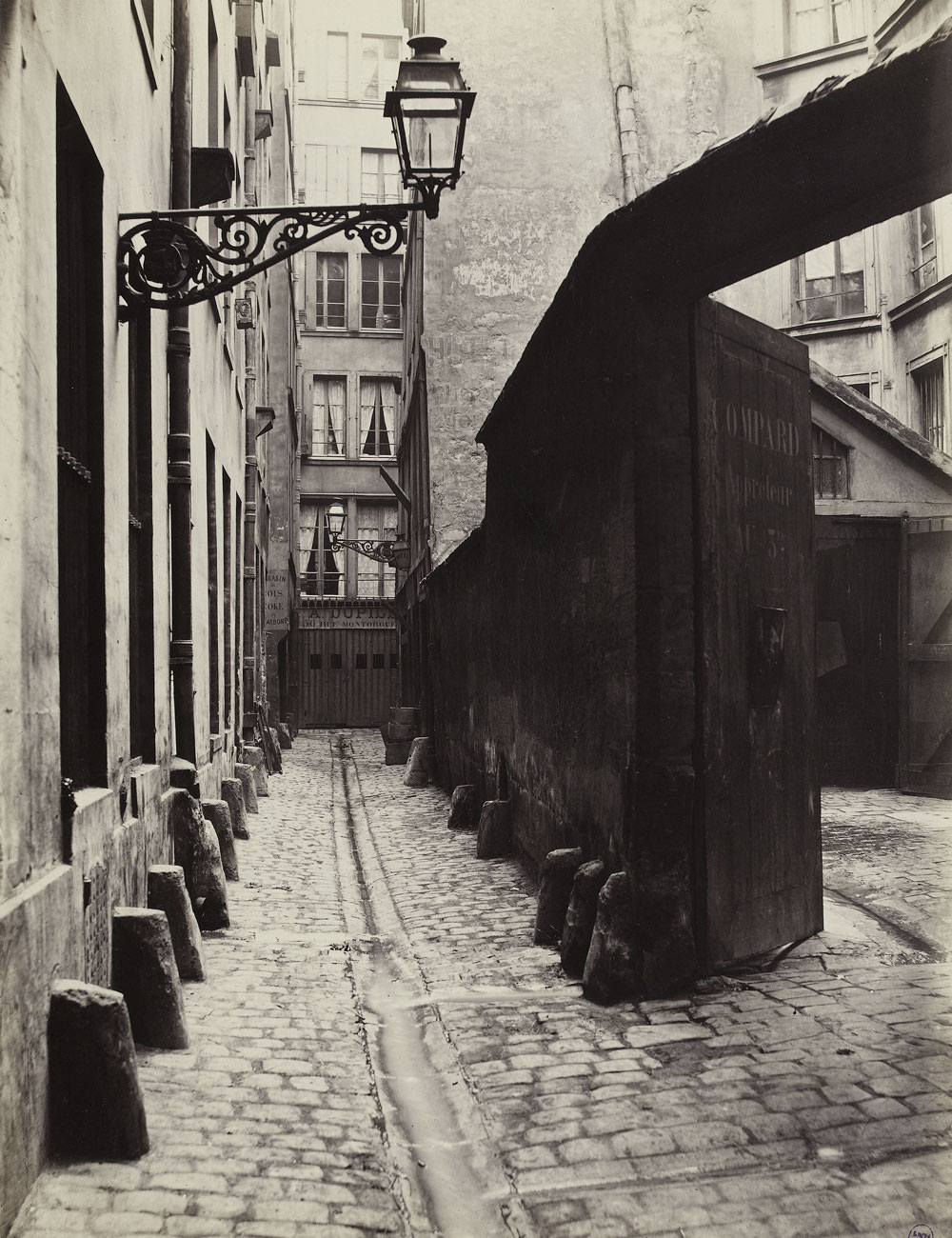
The last five images of city streets in the posting are also illuminating. While they are more frontal than many of Atget’s street photographs, with a longer vista and vanishing point, there is something about them that adds an indelible serenity to the scene. Maybe it’s the foreshortened walls lingering into the distance, the carts, the light, the shadows. Look at the very last photograph, Impasse de la Bouteille (de la rue Montorgeuil) (1865-1868, below) and notice the wonderful two vanishing points and the immense darkness of the intervening wall as it pushes its way into the image, the blackness of this intervention. Incredible.
As John Szarkowski has observed, “In the wet-plate days of Atget’s great predecessor Charles Marville photographed the streets of Old Paris, street by street. In those old streets that still existed a generation later, Atget repeated the work building by building, sometimes door by door, sometimes door knocker by door knocker. He reworked the ore with a finer screen, and sifted out a different precious metal.” (John Szarkowski. Eugène Atget. Museum of Modern Art, 2000, p. 15)
Both Marville and Atget are precious metals. For that we are eternally grateful.
Dr Marcus Bunyan
Many thankx to the National Gallery of Art, Washington for allowing me to publish the photographs in the posting. Please click on the photographs for a larger version of the image.
Charles Marville (French, 1813-1879) Gardens of the Bagatelle under Construction 1858-1862 Albumenised salted paper print from collodion negative Image: 26 x 36cm (10 1/4 x 14 3/16 in.) Paula and Robert Hershkowitz
Charles Marville (French, 1813-1879) Impasse de l’Essai (du marché aux chevaux) (Impasse de l’Essai from the Horse Market) (fifth arrondissement) c. 1868 Albumen print from collodion negative Image: 24.5 x 36.5cm (9 5/8 x 14 3/8 in.) Ville de Paris – Bibliothèque de l’Hôtel de Ville (BHdV)
Charles Marville (French, 1813-1879) Interior of Les Halles Centrales 1874 Albumen print from collodion negative Image: 31.8 x 39.2cm (12 1/2 x 15 7/16 in.) The AIA/AAF Collection, Prints and Photographs Division, Library of Congress, Washington D.C.
Charles Marville (French, 1813-1879) The Bièvre River (fifth arrondissement) c. 1862 Albumen print from collodion negative Image: 26.67 x 37.47cm (10 1/2 x 14 3/4 in.) Joy of Giving Something, Inc.
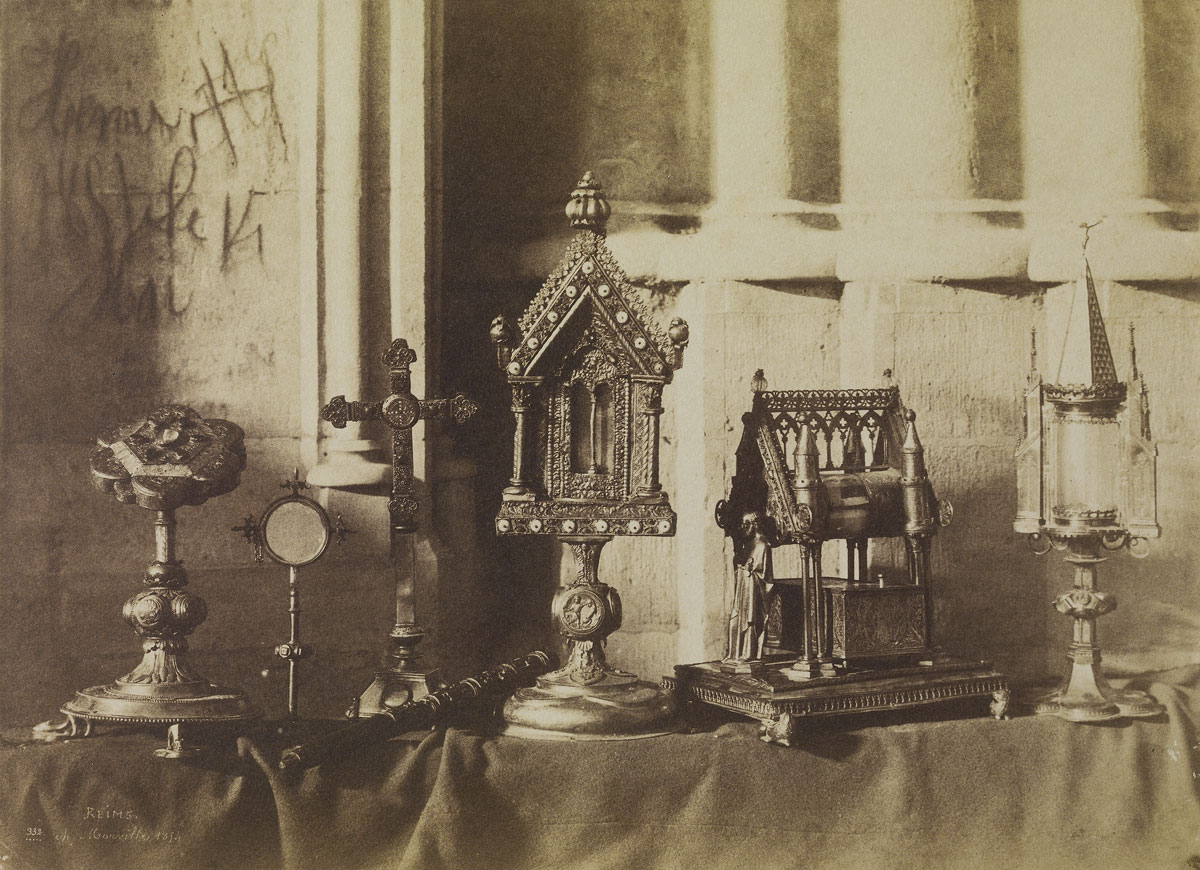
Charles Marville (French, 1813-1879) Treasury of Reims Cathedral 1854 Salted paper print from paper negative 23.1 x 34.5cm (9 1/8 x 13 9/16 in.) Private Collection
Charles Marville (French, 1813-1879) Cloud Study, Paris 1856-1857 Albumen print from collodion negative Image: 15.4 x 25.7cm (6 1/16 x 10 1/8 in.) Sheet: 31 x 43.4cm (12 3/16 x 17 1/16 in.) Wilson Centre for Photography, London
The first exhibition in the United States and the very first scholarly catalogue on the accomplished 19th-century French photographer Charles Marville will explore the beauty, variety, and historical poignancy of Marville’s art. On view at the National Gallery of Art, Washington, from September 29, 2013, through January 5, 2014, Charles Marville: Photographer of Paris will include 99 photographs and three albums that represent the artist’s entire career, from his exquisite city scenes and landscape studies made across Europe in the early 1850s to his compelling photographs of Paris both before and after many of its medieval streets were razed to make way for the broad boulevards, parks, and monumental buildings we have come to associate with the City of Light. The accompanying exhibition catalogue will present recently discovered, groundbreaking scholarship informing Marville’s art and his biography.
“Although his photographs of Paris on the brink of modernity are widely hailed as among the most accomplished ever made of that city, Marville himself has long remained an enigma to art historians,” said Earl A. Powell III, director, National Gallery of Art. “We are thrilled to present this new look at the art and life of Marville and are deeply grateful to lenders, both public and private, for making this landmark show possible.”
Forty-one of the 102 works presented in the exhibition are on loan from the Musée Carnavalet, Paris. Conservation and preparation of the loans from the Musée Carnavalet has been undertaken by the Atelier de Restauration et de Conservation des Photographies de la Ville de Paris (ARCP).
Recent Discoveries
Marville has long remained a mystery partly because documents that would shed light on his biography were thought to have disappeared in a fire that consumed Paris’ city hall in 1871. The whereabouts of other documentation was simply unknown. However, new research has helped curator Sarah Kennel and exhibition researcher Daniel Catan reconstruct Marville’s personal and professional biography.
The son of a tailor and laundress, Charles-François Bossu was born in Paris 1813. In a double act of self-invention, he jettisoned his given name (bossu means hunchback in French) around 1832, at the moment he became an artist. He embarked upon a career as an illustrator in the early 1830s but turned to the young discipline of photography in 1850. Although he continued to be known as Marville until his death in 1879, he never formally changed his name, which is the reason many of the legal documents pertaining to his life have gone unnoticed for decades. The exhibition catalogue establishes Marville’s biography, including his parentage and his relationship with a lifelong companion, and uncovers many significant details that illuminate the evolution and circumstances of his career.
The Exhibition and Artist’s Background
A talented and prolific artist lauded for his rigorously composed, beautifully detailed prints, Marville was commissioned in the early 1860s to record the city of Paris in transition. He soon became known as the official photographer of Paris and produced one of the earliest photographic series documenting urbanisation. He continues to be recognised as one of the most accomplished photographers in the history of the medium.
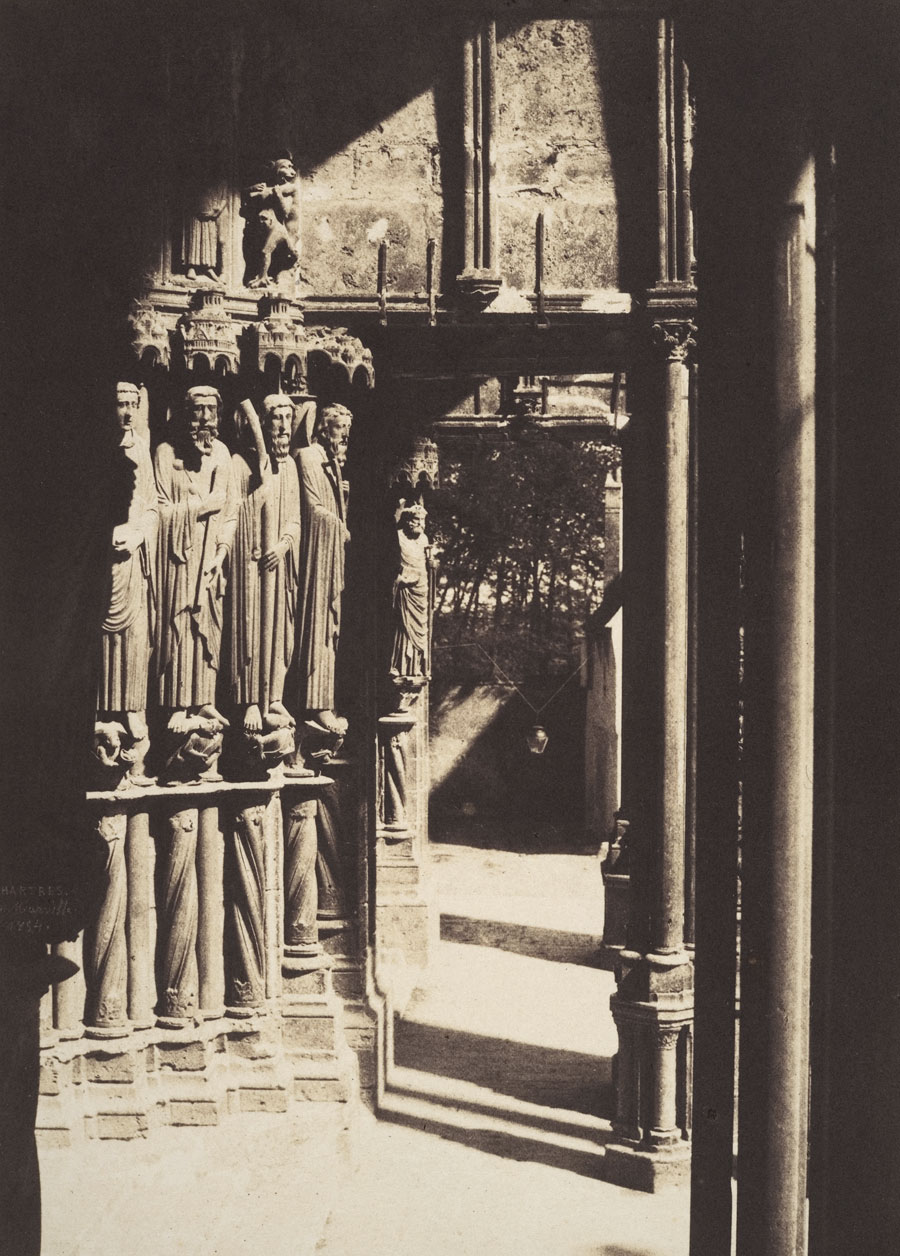
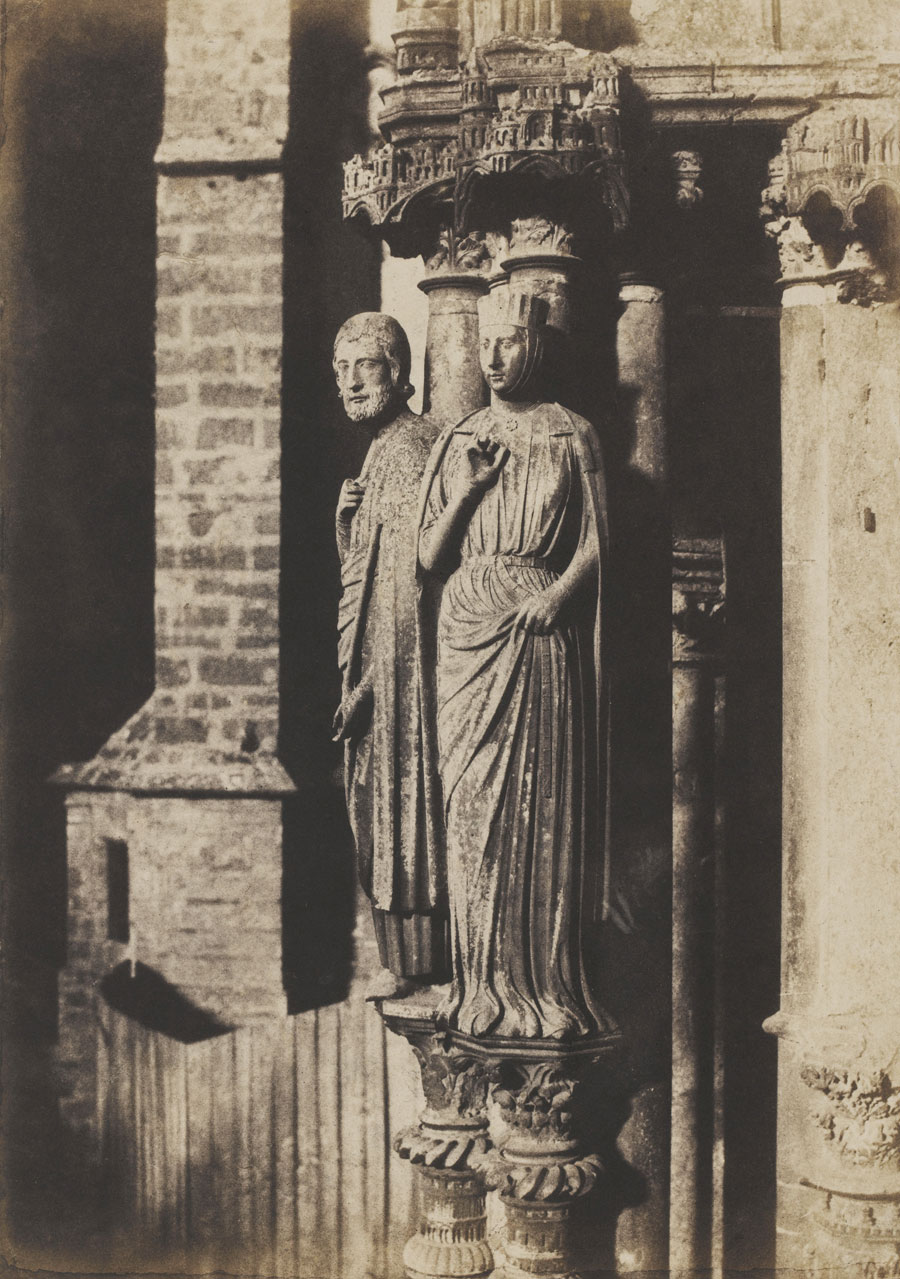
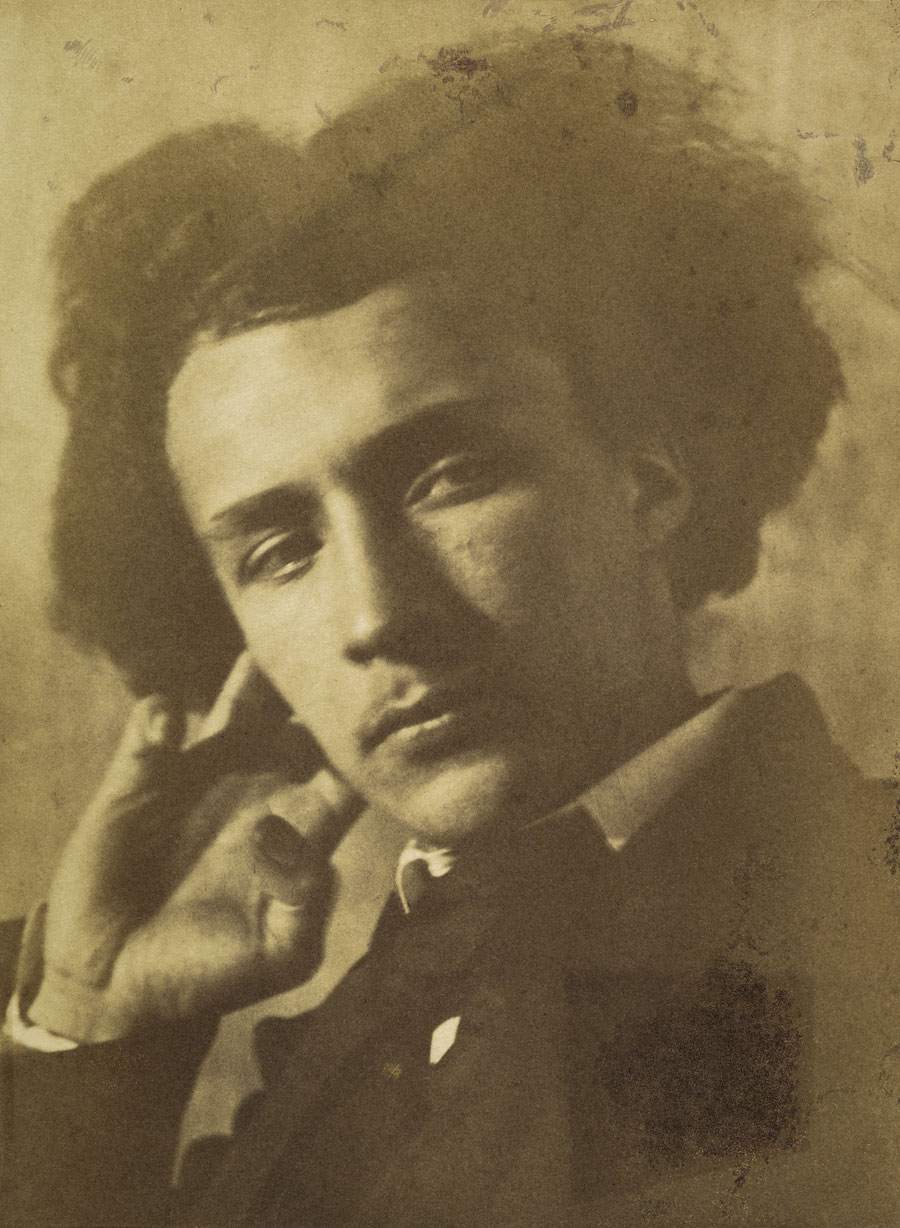
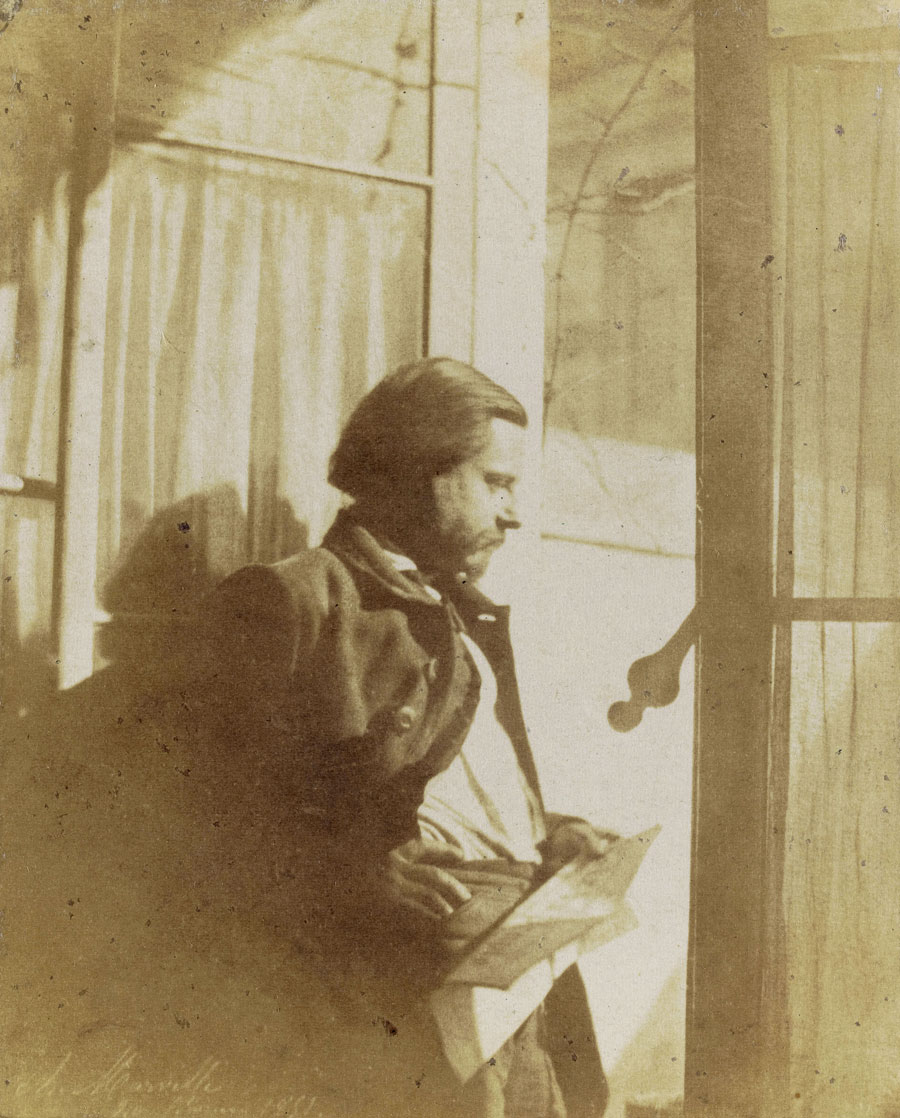
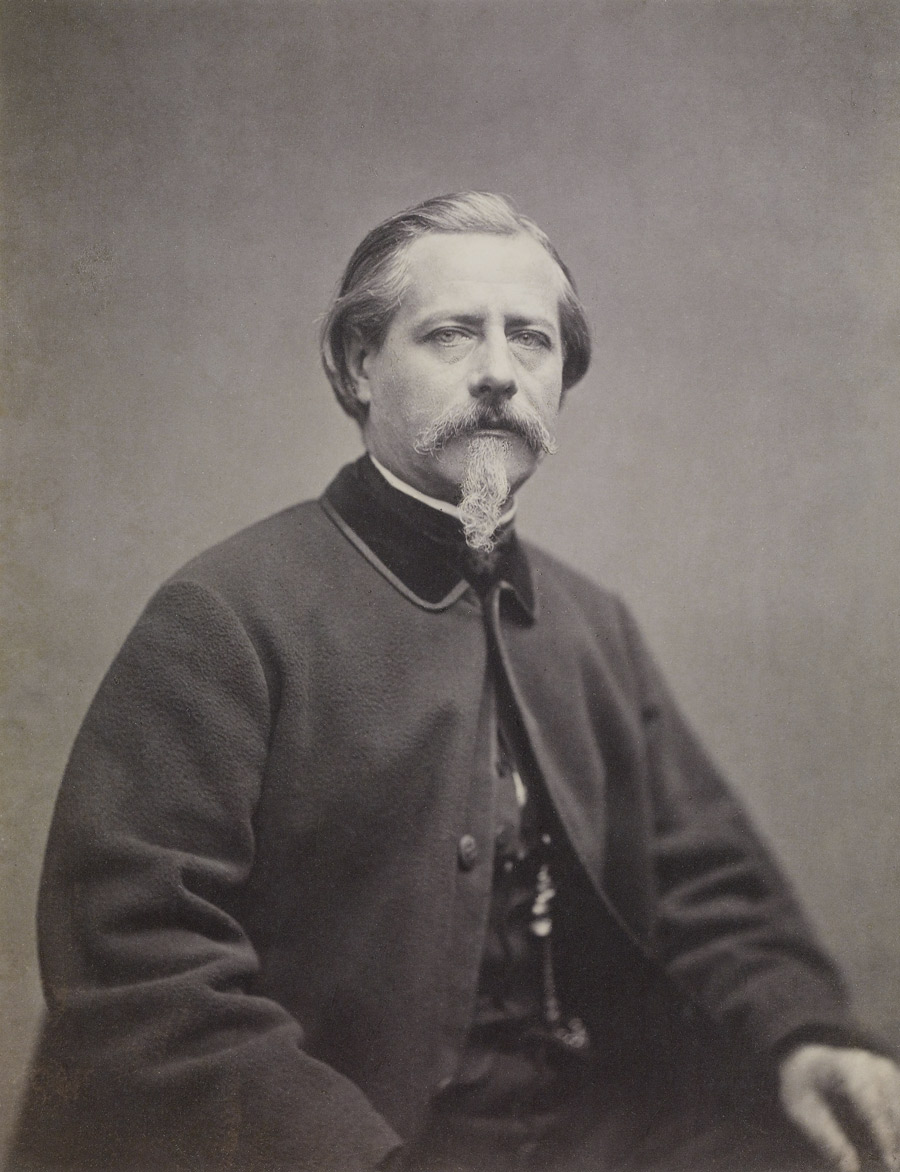
Charles Marville: Photographer of Paris offers an overview of the artist’s photographic career, beginning with a compelling series of intimate self-portraits and portraits of friends and colleagues that provide a fascinating window into Marville’s personal life and professional ties, and serve as an introduction to the exhibition. Starting in 1850, Marville travelled throughout France and Germany, using the paper negative process with great skill to create beautiful landscapes, cityscapes, studies of sculpture, and striking architectural photographs. Many of these works were included in albums produced by the pioneering publisher Louis-Désiré Blanquart-Evrard. The quantity and quality of the photographs used by the publisher serve as both a testament to Marville’s skill and an indication that his training as an illustrator prepared him exceptionally well for this new pictorial enterprise of photographic documentation.
In the mid-1850s, Marville adopted the collodion negative process and undertook a series of sky and cloud studies, made from the rooftop of his Parisian studio. More rapid and sensitive than the paper negative process, the collodion negative process enabled the photographer to capture delicate, luminous cloud formations on the city’s horizon and made him one of the first artists successfully to photograph clouds. At the same time, Marville expanded his practice by honing in on two lucrative areas: reproductions of works of art and architectural photographs. He excelled at both and assumed the title and related privileges of photographer to the Louvre while he also documented building and renovation projects in Paris and the provinces for prominent French architects, including Eugène Viollet-le-Duc.
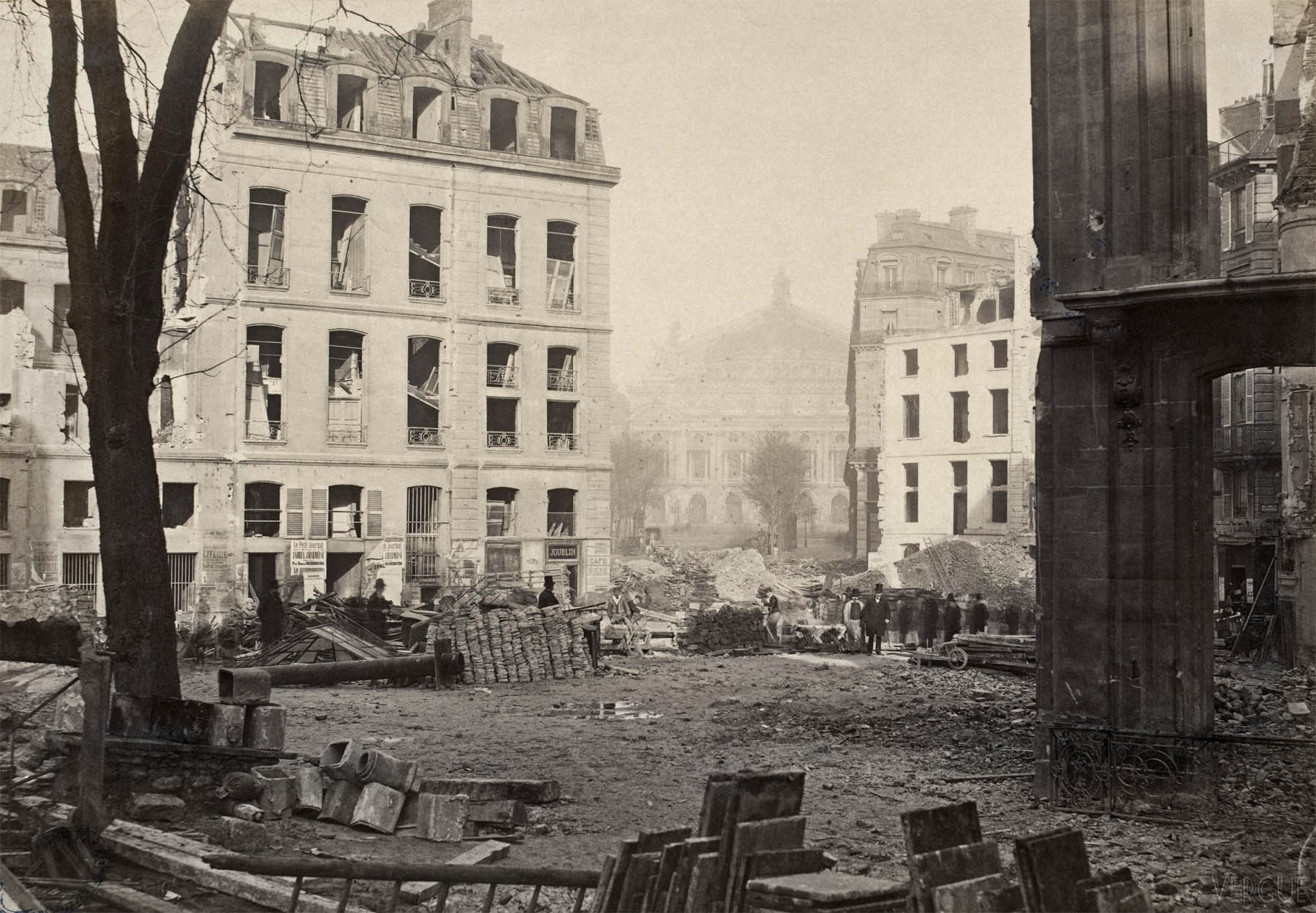
In 1858, Marville was commissioned by the city of Paris to photograph the newly refurbished Bois de Boulogne, a royal park on the edge of Paris that had been transformed under the emperor Napoleon III into a site of bourgeois leisure and pleasure. Arguably his first important body of work that was conceived and executed as a systematic series, the Bois de Boulogne series would influence his best-known work, the Old Paris photographs. Commissioned by Paris’ agency on historic works (under the aegis of urban planner Georges-Eugène Baron Haussmann) in the early 1860s, Marville made more than 425 photographs of the narrow streets and crumbling buildings of the premodern city at the very moment they were threatened by demolition. Known as the Old Paris album, the photographs are captivating for their seamless integration of artistic sensibility and intense devotion to maximum visual clarity. In many cases they serve as the only visual record of sites that have long since vanished.
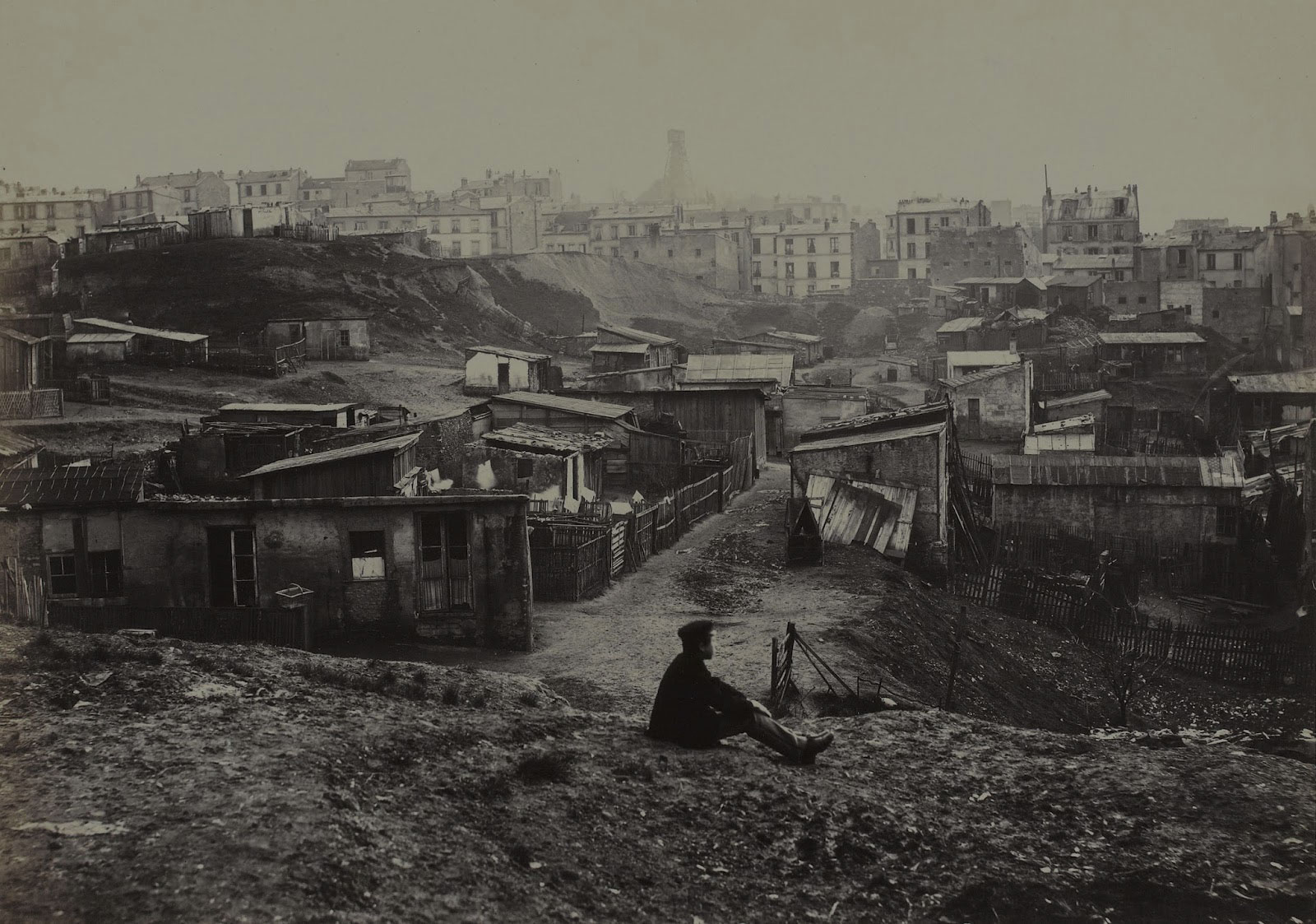
The exhibition closes with an exploration of the emergence of modern Paris through Marville’s photographs. Even before completing the Old Paris series, Marville began to photograph the city that was coming into being, from massive construction projects, renovated churches, and broad boulevards to a host of modern conveniences, such as the elegant new gas lamps and the poetically named vespasiennes (public urinals) that cemented Paris’ reputation in the 1860s as the most modern city in the world. Marville also explored the city’s edges, where desolate stretches of half-finished construction suggest the physical displacements and psychic costs of modernisation. Sharp-edged, beautifully detailed, and brilliantly composed, Marville’s photographs of the French capital as at once glamorous and alienating do not simply document change but in their very form shape the visual rhetoric of modern Paris.
Press release from the National Gallery of Art website
Charles Marville (French, 1813-1879) Cathédrale de Chartres, Grandes Figures des pilastres du portail septentrional (Chartres Cathedral, Columnar Figures, Northern Portal) 1854 Salted paper print from paper negative Image: 36 x 25.6cm (14 3/16 x 10 1/16 in.) The Museum of Modern Art, New York, Gift of Paul F. Walter
Charles Marville (French, 1813-1879) Self-Portrait at a Window, February 20, 1851 1851 Salted paper print from paper negative Image: 14.29 x 11.4cm (5 5/8 x 4 1/2 in.) Support: 32.2 x 24.5cm (12 11/16 x 9 5/8 in.) Mat: 53 x 40.5cm (20 7/8 x 15 15/16 in.) Musée d’Orsay, Paris
Charles Marville (French, 1813-1879) Self-Portrait 1861 Albumen print from collodion negative Image: 23.5 x 18.3cm (9 1/4 x 7 3/16 in.) Collection Debuisson
Charles Marville (French, 1813-1879) Rue de la Bûcherie, from the cul de sac Saint-Ambroise (fifth arrondissement) 1866-1868 Albumen print from collodion negative Image: 32 x 27.1cm (12 5/8 x 10 11/16 in.) National Gallery of Art, Washington, Horace W. Goldsmith Foundation through Robert and Joyce Menschel
Charles Marville (French, 1813-1879) Rue Saint-Jacques (fifth arrondissement) 1865-1866 Albumen print from collodion negative Image: 30.8 x 27cm (12 1/8 x 10 5/8 in.) National Gallery of Art, Washington, Horace W. Goldsmith Foundation through Robert and Joyce Menschel
Charles Marville (French, 1813-1879) Cour Saint-Guillaume (ninth arrondissement) 1866-1867 Albumen print from collodion negative Image: 34.2 x 27.2cm (13 7/16 x 10 11/16 in.) Lent by The Metropolitan Museum of Art, Gilman Collection, Purchase, Alfred Stieglitz Society Gifts, 2005
Charles Marville (French, 1813-1879) Passage Saint-Guillaume (vers la rue Richelieu) (first arrondissement) 1863-1865 Albumen print from collodion negative Image: 31.91 x 27.62cm (12 9/16 x 10 7/8 in.) Joy of Giving Something, Inc.
Charles Marville (French, 1813-1879) Rue Ollivier (vers la rue Saint-Georges) (ninth arrondissement) c. 1868 Albumen print from collodion negative Image: 28.6 x 27.6cm (11 1/4 x 10 7/8 in.) Joy of Giving Something, Inc.

![Brett Weston (American, 1911-1993) '[Air vents, New York]' 1945 from the exhibition 'City of Abstractions: Brett Weston in New York, 1944-45' at 1285 Avenue of the Americas Art Gallery, New York, September 2013- January 2014](https://artblart.com/wp-content/uploads/2014/01/air-vents-web.jpg "Brett Weston (American, 1911-1993) '[Air vents, New York]' 1945 from the exhibition 'City of Abstractions: Brett Weston in New York, 1944-45' at 1285 Avenue of the Americas Art Gallery, New York, September 2013- January 2014")
![Brett Weston (American, 1911-1993) '[42nd Street at First Avenue, New York]' c. 1945 from the exhibition 'City of Abstractions: Brett Weston in New York, 1944-45' at 1285 Avenue of the Americas Art Gallery, New York, September 2013- January 2014](https://artblart.com/wp-content/uploads/2013/12/42nd-street-at-first-avenue-web.jpg "Brett Weston (American, 1911-1993) '[42nd Street at First Avenue, New York]' c. 1945 from the exhibition 'City of Abstractions: Brett Weston in New York, 1944-45' at 1285 Avenue of the Americas Art Gallery, New York, September 2013- January 2014")
![Brett Weston (American, 1911-1993) '[Oceano Dunes, California]' 1934](https://artblart.com/wp-content/uploads/2013/12/oceano-dunes-california-web.jpg "Brett Weston (American, 1911-1993) '[Oceano Dunes, California]' 1934")
![Brett Weston (American, 1911-1993) '[Stoop with broom, arrow, and pushcart, New York]' 1944](https://artblart.com/wp-content/uploads/2013/12/stoop-with-broom-web.jpg "Brett Weston (American, 1911-1993) '[Stoop with broom, arrow, and pushcart, New York]' 1944")
![Brett Weston (American, 1911-1993) '[Airshafts, New York]' c. 1945](https://artblart.com/wp-content/uploads/2014/01/airshafts-web.jpg "Brett Weston (American, 1911-1993) '[Airshafts, New York]' c. 1945")
![Brett Weston (American, 1911-1993) '[Courtyard, New York]' c. 1945](https://artblart.com/wp-content/uploads/2013/12/courtyard-web.jpg "Brett Weston (American, 1911-1993) '[Courtyard, New York]' c. 1945")
![Brett Weston (American, 1911-1993) '[House, Ewing Street, Staten Island, New York]' c. 1945](https://artblart.com/wp-content/uploads/2013/12/house-ewing-street-web.jpg "Brett Weston (American, 1911-1993) '[House, Ewing Street, Staten Island, New York]' c. 1945")
![Brett Weston (American, 1911-1993) '[Sutton Place, New York]' c. 1945](https://artblart.com/wp-content/uploads/2014/01/sutton-place-web.jpg "Brett Weston (American, 1911-1993) '[Sutton Place, New York]' c. 1945")
![Brett Weston (American, 1911-1993) '[Skylight and fences, Midtown, New York]' c. 1945](https://artblart.com/wp-content/uploads/2013/12/skylight-and-fences-web.jpg "Brett Weston (American, 1911-1993) '[Skylight and fences, Midtown, New York]' c. 1945")
![Brett Weston (American, 1911-1993) '[Wrought iron fence, New York]' c. 1945](https://artblart.com/wp-content/uploads/2013/12/wrought-iron-fence-web.jpg "Brett Weston (American, 1911-1993) '[Wrought iron fence, New York]' c. 1945")
![Brett Weston (American, 1911-1993) '[Church door, Bowery, New York]' c. 1945](https://artblart.com/wp-content/uploads/2013/12/church-door-web.jpg "Brett Weston (American, 1911-1993) '[Church door, Bowery, New York]' c. 1945")
![Brett Weston (American, 1911-1993) '[Pillars and tree, New York]' 1944](https://artblart.com/wp-content/uploads/2013/12/pillars-and-tree-web.jpg "Brett Weston (American, 1911-1993) '[Pillars and tree, New York]' 1944")
![Brett Weston (American, 1911-1993) '[St. Francis Grocery & Fruit, New York]' c. 1945](https://artblart.com/wp-content/uploads/2013/12/st-francis-grocery-and-fruit-web.jpg "Brett Weston (American, 1911-1993) '[St. Francis Grocery & Fruit, New York]' c. 1945")





 Art Blart _ art and cultural memory archive
You must be logged in to post a comment.