Exhibition: ‘One Life: Frederick Douglass’ at the National Portrait Gallery, Washington

Exhibition dates: 16th June, 2023 – 21st April, 2024

Curator: John Stauffer, the Sumner R. and Marshall S. Kates Professor of English and of African and African American Studies, Harvard University
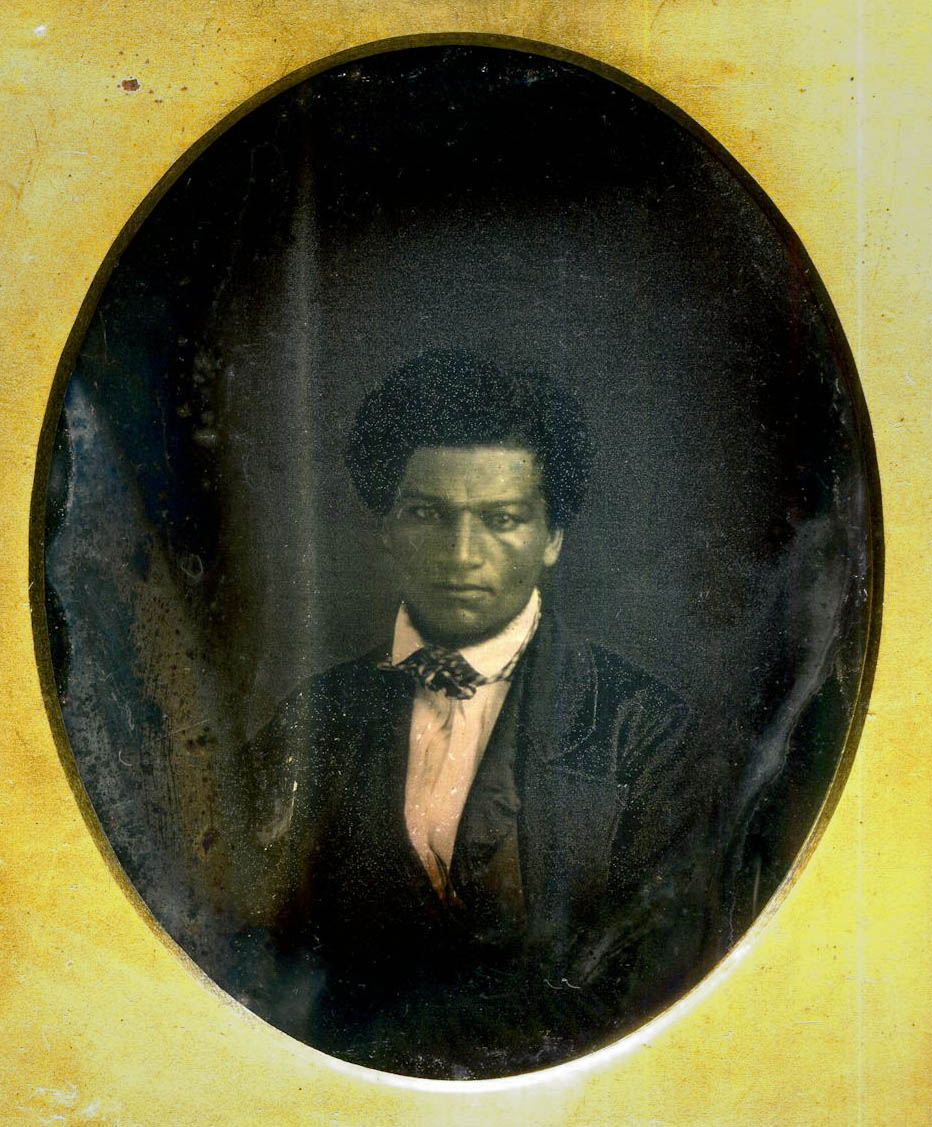
 

Unidentified photographer. 'Frederick Douglass' c. 1841


Unidentified photographer
Frederick Douglass
c. 1841
Sixth-plate daguerreotype
Collection of Gregory French


In this first known photographic image of Douglass, taken only one year after the first commercial daguerreotype studio opened in the United States, he appears somewhat dazed or “statue-like,” as he might have said. In 1841, the exposure time for a daguerreotype of this size could run up to fifteen seconds, depending on the time of day and the amount of available daylight in the daguerreotypist’s studio.

Text from the National Portrait Gallery website


I seem to be envisioning the nineteenth-century at the moment, which is a condition entirely more pleasurable than contemplating the dreadful state of the world at the moment with its environmental desecration, greed, killing of animal and human life and the unconscionable conduct of governments. Ego, greed, religion, power, masculinity, war, nationalism, possession. A toxic mix.

Here we have photographs of a majestic human being, a former slave, social reformer, abolitionist, orator, writer, and statesman – who fought for freedom, who fought against discrimination and racism. And still it goes on today…

“A new memorial to Emmett Till was dedicated on Saturday in Mississippi after previous historical markers were repeatedly vandalized. The new marker is bulletproof.

Till, 14, was kidnapped, beaten and killed in 1955, hours after he was accused of whistling at a white woman. His body was found in a river days later. An all-white jury in Mississippi acquitted two white men of murder charges…

This is the fourth historical marker at the site. The first was placed in 2008. Someone tossed it in the river. The second and third signs were shot at and left riddled with bullet holes. The new 500lb steel sign has a glass bulletproof front.”1

His mother, Mamie Till Mobley, held an open casket funeral in Chicago to let the world see how badly her son had been beaten and mutilated. “There was just no way I could describe what was in that box. No way. And I just wanted the world to see.”

At the end I’ll be glad when I have left this world because I am so disappointed with the human race. High hopes indeed.

Dr Marcus Bunyan


1/ Associated Press. “Emmett Till: new memorial to murdered teen is bulletproof,” on The Guardian website Sun 20 Oct 2019 [Online] 06/04/2024


Many thankx to the National Portrait Gallery for allowing me to publish the photographs in the posting. Please click on the photographs for  a larger version of the image.


The bullet-riddled historical sign for Emmett Till


The bullet-riddled historical sign for Emmett Till, the Chicago teenager whose 1955 slaying helped propel the civil rights movement

Used under fair use conditions for the purposes of education and research


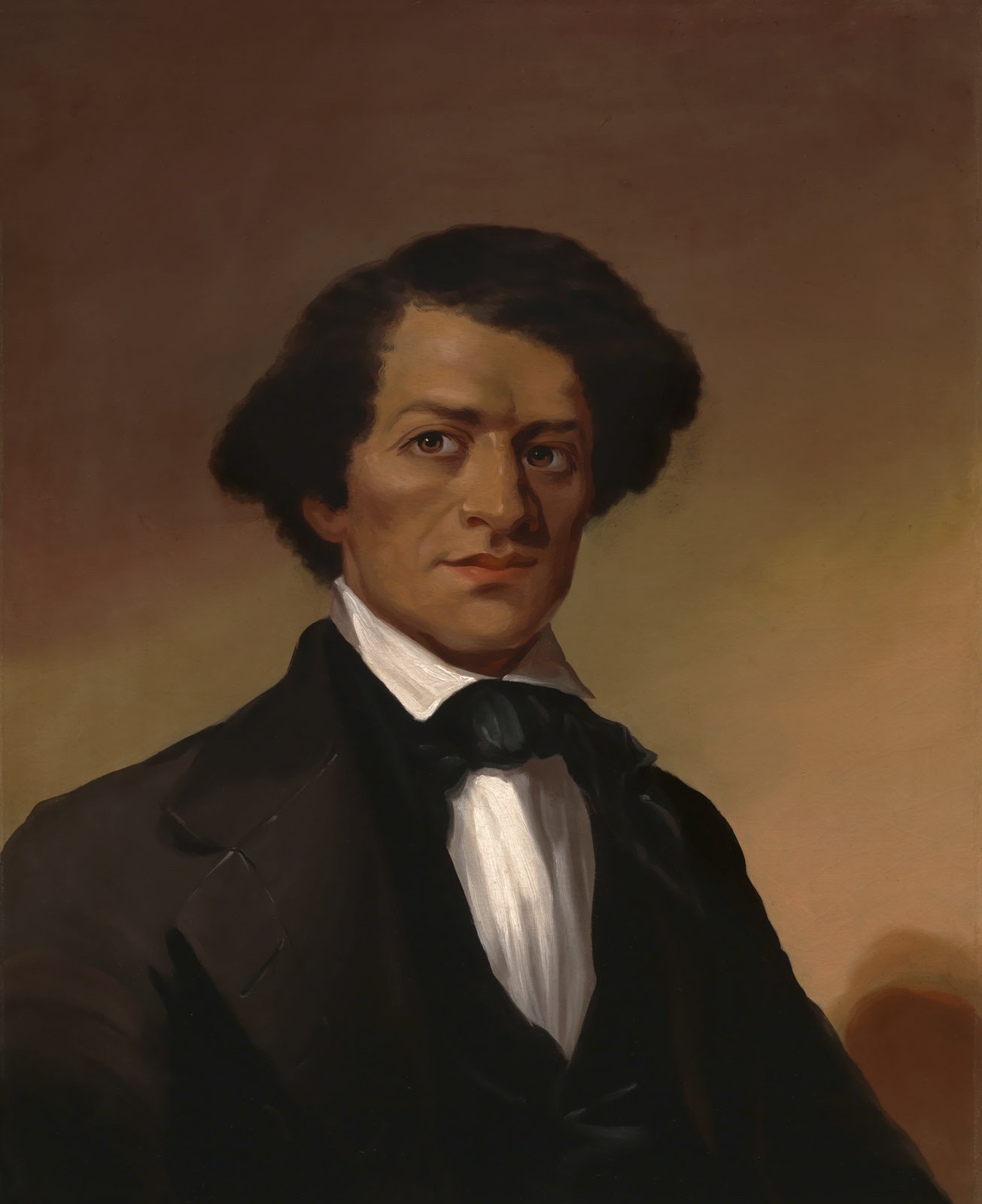
Unidentified artist (formerly attributed to Elisha Livermore Hammond) 'Frederick Douglass' c. 1845


Unidentified artist (formerly attributed to Elisha Livermore Hammond)
Frederick Douglass
c. 1845
Oil on canvas
National Portrait Gallery, Smithsonian Institution


Frederick Douglass became the most influential African American of the nineteenth century by turning his life into a testimony on the evils of slavery and the redemptive power of freedom. After he escaped from bondage in 1838, Douglass quickly emerged as an outspoken advocate for equality and abolition. Aware of the power of telling one’s own story, he frequently spoke about his life, published three genre-defining autobiographies, and founded the influential newspaper, The North Star, in 1847. Douglass also posed for countless photographs, which he considered less susceptible to artists’ racial prejudices.

This painting was likely based on the engraved frontispiece of Douglass’s first autobiography, Narrative of the Life of Frederick Douglass (1845), a gripping account of his struggle for freedom. In My Bondage and My Freedom (1855), Douglass went on to address the psychology of slavery and the racism that continued to define the lives of the newly free.

Text from the National Portrait Gallery website


Southworth & Hawes (active 1843–1862) 'Frederick Douglass' c. 1845


Southworth & Hawes (active 1843–1862)
Frederick Douglass
c. 1845
Whole-plate daguerreotype
Onondaga Historical Association Museum, Syracuse, NY


Douglass likely sat for this daguerreotype in the Boston studio of Southworth & Hawes before he left for England in August 1845. The Twelfth National Anti-Slavery Bazaar, held at Faneuil Hall in December 1845, offered for sale “an excellent Daguerreotype of Frederick Douglass,” according to The Liberator (January 23, 1846). The daguerreotype was “the gift of Mr. Southworth” and “elicited much attention.” John Chester Buttre created an engraving from the daguerreotype, which appeared in Autographs for Freedom (1854), a gift book edited by Douglass’s friend Julia Griffiths to raise money for his North Star newspaper.

Text from the National Portrait Gallery website


Southworth & Hawes (active 1843–1862) 'Frederick Douglass' c. 1845 (detail)


Southworth & Hawes (active 1843–1862)
Frederick Douglass (detail)
c. 1845
Whole-plate daguerreotype
Onondaga Historical Association Museum, Syracuse, NY


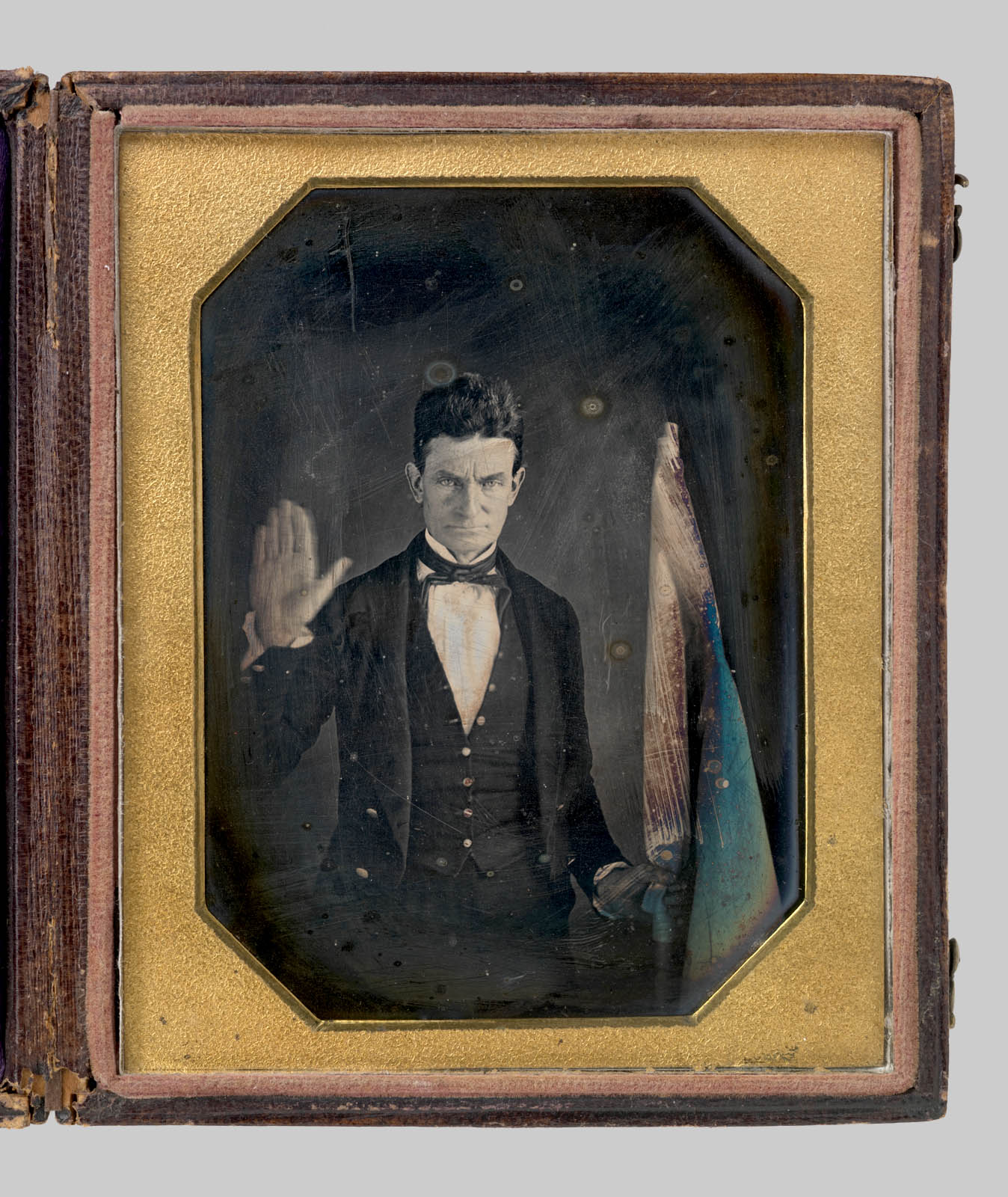
Augustus Washington (American, c. 1820–1875) 'John Brown 1800-1859' c. 1846-1847


Augustus Washington (American, c. 1820–1875)
John Brown 1800-1859
c. 1846-1847
Quarter-plate daguerreotype
National Portrait Gallery, Smithsonian Institution; purchased with major acquisition funds and with funds donated by Betty Adler Schermer in honor of her great grandfather, August M. Bondi


One of the nation’s first African American daguerreotypists, Augustus Washington was also a prominent abolitionist in Hartford, Connecticut, when he made this portrait of the militant abolitionist John Brown. At the time, Brown was working to establish a “Subterranean Pass Way,” a network of armed men in the Alleghenies for conducting fugitives to freedom in Canada.

In Washington’s daguerreotype, Brown apparently holds the Pass Way flag and pledges allegiance to his scheme, which never materialised. In 1853, Washington and his family emigrated to Liberia, the former West African colony founded by the American Colonization Society, which gained independence in 1847.

Text from the National Portrait Gallery website


Frederick Douglass (1818-1895), the preeminent African American voice of the nineteenth century, is remembered as one of the nation’s greatest orators, writers, and picture makers. Born on the Eastern Shore of Maryland in 1818, Frederick Augustus Washington Bailey was the son of Harriet Bailey, an enslaved woman, and an unknown white father. He escaped bondage in 1838 and changed his surname to Douglass.

Over six decades, Douglass published three autobiographies, hundreds of essays, and a novella; delivered thousands of speeches; and edited the longest-running Black newspaper in the nineteenth century, The North Star (later Frederick Douglass’ Paper and Douglass’ Monthly). During the Civil War, he befriended and advised President Abraham Lincoln and met every subsequent president through Grover Cleveland. He was also the first African American to receive a federal appointment requiring Senate approval (U.S. Marshal of the District of Columbia).

Douglass became the most photographed American of the nineteenth century and remains a public face of the nation. As an art critic, he wrote extensively on portrait photography and understood its power. He explained how this “true art” (as opposed to pernicious caricatures) captured the essential humanity of each subject. True art was an engine of social change, he argued, and true artists were activists: “They see what ought to be by the reflection of what is, and endeavour to remove the contradiction.”

Curatorial Statement

Organised into seven sections, this exhibition highlights the long arc and significance of Frederick Douglass’s life: from slave and fugitive to internationally acclaimed abolitionist, women’s rights activist, and statesman after the Civil War. We come to recognise his influences in the Civil War and postwar eras; and the significance of his afterlife, in which his portraits and writings continue to inspire people to seek “all rights for all,” one of his mottos. The range of objects shown here reflects Douglass’s openness to new forms of media and technology to advance the cause of human rights.

John Stauffer, the Sumner R. and Marshall S. Kates Professor of English and of African and African American Studies, Harvard University

Text from the National Portrait Gallery website


Douglass’ ascension into the most preeminent African American voice in the 1800s and one of the handful of most influential and famous Americans in the nation’s history owes itself equally to his merits and good fortune.

“Douglass had an extraordinary work ethic, he was immensely curious and dedicated,” Stauffer explained. “And physically strong and tall – over six feet, a half-foot taller than the average man – which helped him survive slavery.”

Size does matter. George Washington and Abraham Lincoln were also comparative giants for their day. American presidents, on average, stand a great deal taller, literally, than the average citizen.

Douglass’ physical size and strength allowed him to outlast a sadistic “slave breaker,” Edward Covey, in a protracted fight as a teen. After suffering numerous whippings, Douglass stood up to the man. As long as he lived, he referred to the fight as the turning point in his life as a slave.

“He was also lucky to have been born and raised in the upper South and not sold into the Deep South or murdered for his rebelliousness as a slave and his constant battles against slavery and racism as a free man,” Stouffer added. “Had he been born in the Deep South, where most enslaved people lived, his chances of escaping to free soil would have been almost nil.”

Douglass’ circumstances were hardly favourable, but he did win something of a genetic and geographic lottery at birth.

He also caught a rare break, learning to read and write as a young boy, skills most slaveowners prohibited.

“In Baltimore, Douglass asked his mistress, Sophia Auld, to teach him to read, which she did, having never overseen an enslaved person before,” Stouffer said. “Her husband, Hugh Auld, found out and told her in front of Douglass, ‘if you learn him to read, he’ll want to know how to write; and this accomplished, he’ll be running away from himself.’ Hearing this, Douglass ‘understood the direct pathway to freedom,’ as he said.”

Chadd Scott. “Art, Activism And Frederick Douglass At National Portrait Gallery,” on the Forbes website Aug 22, 2023 [Online] Cited 21/04/2024


Unidentified photographer. 'Frederick Douglass' c. 1850 (after c. 1847 daguerreotype)


Unidentified photographer
Frederick Douglass
c. 1850 (after c. 1847 daguerreotype)
Sixth-plate daguerreotype
National Portrait Gallery, Smithsonian Institution


When sitting for a photograph, Douglass would pose as an artist or performer, forming part of a pas de trois with the photographer and the camera. He always dressed up and, as the activist Elizabeth Cady Stanton noted, often appeared “majestic in his wrath.”

Before the mid-1860s, Douglass typically stared into the camera lens with a dramatic look. He wanted the focus on himself. Here, he fills the frame, appearing as an accomplished, dignified activist, and projecting a visual voice of democracy. Through his images, voice, and writings, Douglass sought to “out-citizen” whites, many of whom questioned African American rights.

In the years following his escape from bondage in 1838, Frederick Douglass emerged as a powerful and persuasive spokesman for the cause of abolition. Douglass’s effectiveness as an antislavery advocate was due in large measure to his firsthand experience with the evils of slavery and his extraordinary skill as an orator whose “electrifying eloquence” astonished and enthralled his audiences. Convinced that a peaceful end to slavery was impossible, Douglass embraced the Civil War as a fight for emancipation and called for the enlistment of black troops. Throughout the decades that followed, he remained a tireless champion for civil rights.

In 1845, when the publication of his Narrative of the Life of Frederick Douglass revealed biographical details that could have led to his capture as a fugitive from slavery, Douglass left the United States for an extended stay in Great Britain. He was warmly welcomed by British abolitionists, who raised the funds to purchase his freedom, thereby enabling Douglass to return to the United States in 1847 as a free man. In this daguerreotype, believed to date from the time of his return, Douglass confronts the camera with an intensity that became the hallmark of his photographic portraits.

Text from the National Portrait Gallery website


Ezra Greenleaf Weld (American, 1801-1874) 'Fugitive Slave Law Convention, Cazenovia, New York' 1850


Ezra Greenleaf Weld (American, 1801-1874)
Fugitive Slave Law Convention, Cazenovia, New York
1850
Half-plate copy daguerreotype
Collection of Mr. and Mrs. Set Charles Momjian


On August 21, 1850, two days after the Senate passed the Fugitive Slave Act [Passed on September 18, 1850 by Congress, The Fugitive Slave Act of 1850 was part of the Compromise of 1850. The act required that slaves be returned to their owners, even if they were in a free state. The act also made the federal government responsible for finding, returning, and trying escaped slaves], about two thousand abolitionists convened near Gerrit Smith’s home. Douglass presided as president. Participants approved Smith’s “Letter to the American Slaves,” urging captives to avenge their enslavers. “You are prisoners of war in an enemy’s country,” Smith declared.

Here, Douglass sits at the edge of the table next to Theodosia Gilbert, the fiancée of William Chaplin, who was in prison for aiding fugitives. Behind Douglass stands Gerrit Smith [see photo below], in mid-speech, gesticulating. On either side of Smith, in checkered shawls and day bonnets, are Mary and Emily Edmonson, whose freedom had been orchestrated by Chaplin.

Text from the National Portrait Gallery website


Ezra Greenleaf Weld, known simply as “Greenleaf,” operated a daguerreotype studio in Cazenovia, New York, during a time of intense social and political turmoil. He opened his first studio in his home in 1845, when America began to witness the volatile events that led to the Civil War. At that time, instruction manuals on the daguerreotype process were widely available, and most small towns had at least one studio. In an 1850 advertisement in his local newspaper, Greenleaf offered “Miniatures executed in the finest style, and put in Rings, Pins, Lockets and cases, of great variety size and price.”

Greenleaf seems to have been very successful with his daguerreotype business. By 1851 he had leased new quarters on the top floor of a building, where he placed a skylight to receive northern light for his studio sessions. During the Civil War years, he made numerous pictures in and around Cazenovia.

Text from the J. Paul Getty Museum website


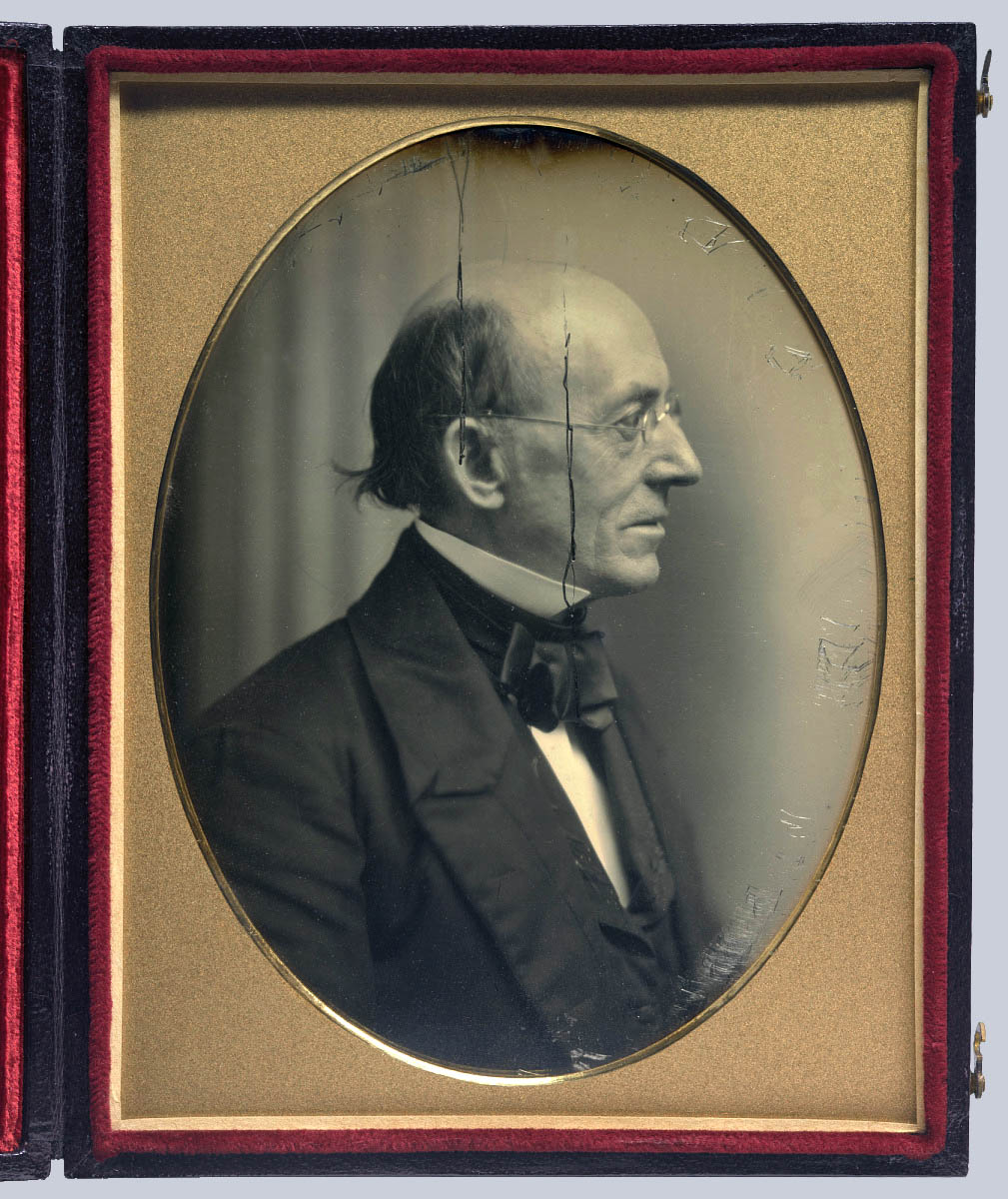
Southworth & Hawes (active 1843–1862) 'William Lloyd Garrison 1805-1879' c. 1851


Southworth & Hawes (active 1843–1862)
William Lloyd Garrison 1805-1879
c. 1851
Half-plate daguerreotype
National Portrait Gallery, Smithsonian Institution


After escaping enslavement, Douglass subscribed to William Lloyd Garrison’s newspaper, The Liberator, and read it as devoutly as his bible. “The paper became my meat and drink,” he recalled.

Garrison promoted Douglass’s 1845 autobiography, which made him famous and prompted him to flee to the British Isles to avoid capture and re-enslavement. British friends then purchased his freedom, and he returned to the United States in 1847, a free man. Wanting to launch his own paper, Douglass soon moved his family to Rochester, New York, a railroad and antislavery hub that lacked an abolitionist paper. The move ruptured his friendship with Garrison until after the Civil War.

Text from the National Portrait Gallery website


The Smithsonian’s National Portrait Gallery will present One Life: Frederick Douglass, an exhibition exploring the life and legacy of one of the 19th century’s most influential writers, speakers and intellectuals. Douglass was a radical activist who devoted his life to abolitionism and rights for all. This exhibition shows the intimate relationship between art and protest through prints, photographs and ephemera. One Life: Frederick Douglass is guest curated by John Stauffer, the Sumner R. and Marshall S. Kates Professor of English and African and African American Studies at Harvard University, and consulting curator Ann Shumard, the National Portrait Gallery’s senior curator of photographs.

“Frederick Douglass was the preeminent African American voice of the 19th century and among the nation’s greatest orators, writers and picture-makers,” Stauffer said. “Born into slavery, he became a leading abolitionist, civil rights activist and the most photographed American of the 19th-century, a public face of the nation. This comprehensive exhibition includes objects from all phases of his life as a way to highlight the power of his remarkable impact. It explores his friendship with President Abraham Lincoln, for example, as well as his enduring influence on artists and activists in the 20th and 21st centuries.”

Douglass was born on the Eastern shore of Maryland in 1818. Having escaped slavery in 1838, he traveled to New York, where he married Anna Murray. After the couple moved to Massachusetts, he began attending abolitionist meetings. Douglass went on to publish three autobiographies and a novella, deliver thousands of speeches and edit the longest continually running Black newspaper of the 19th century, The North Star (later Frederick Douglass’ Paper and Douglass’ Monthly). As a political insider and policy influencer during the Civil War, he befriended and advised President Abraham Lincoln. Douglass changed traditional rules of representation by explaining how “true art” could be an engine of social change.

The exhibition will showcase over 35 objects, including the ledger documenting Douglass’ birth in February 1818; a pamphlet of his “What to the Slave Is the Fourth of July?” oration; two of his three autobiographies – My Bondage and My Freedom and Narrative of the Life of Frederick Douglass, an American Slave, Written by Himself; a letter from Douglass to Lincoln; portraits of activists in Douglass’ circle, such as Harriet Tubman and Sojourner Truth; portraits by the prominent Black photographers Augustus Washington and Cornelius Marion Battey; and portraits of the Black leaders Ida B. Wells-Barnett, Booker T. Washington, W.E.B. Du Bois and Langston Hughes, all of whom carried on his legacy.

Press release from the National Portrait Gallery


Ezra Greenleaf Weld (American, 1801-1874) 'Gerrit Smith 1797-1874' c. 1854


Ezra Greenleaf Weld (American, 1801-1874)
Gerrit Smith 1797-1874
c. 1854
Two-thirds daguerreotype
National Portrait Gallery, Smithsonian Institution; gift of an anonymous donor 

Gerrit Smith, the upstate New York abolitionist and philanthropist, was a close friend of Douglass from the late 1840s to the Civil War. In 1846, Smith gave away 120,000 acres of land in the Adirondacks, known as “Timbuctoo,” to three thousand Black residents of New York State. Smith welcomed Douglass to New York with a deed for forty acres and provided crucial financial support to his newspaper. “You not only keep life in my paper but keep spirit in me,” Douglass wrote. Smith helped convert Douglass into a political abolitionist, one who interpreted the Constitution as an antislavery document.

Text from the National Portrait Gallery website


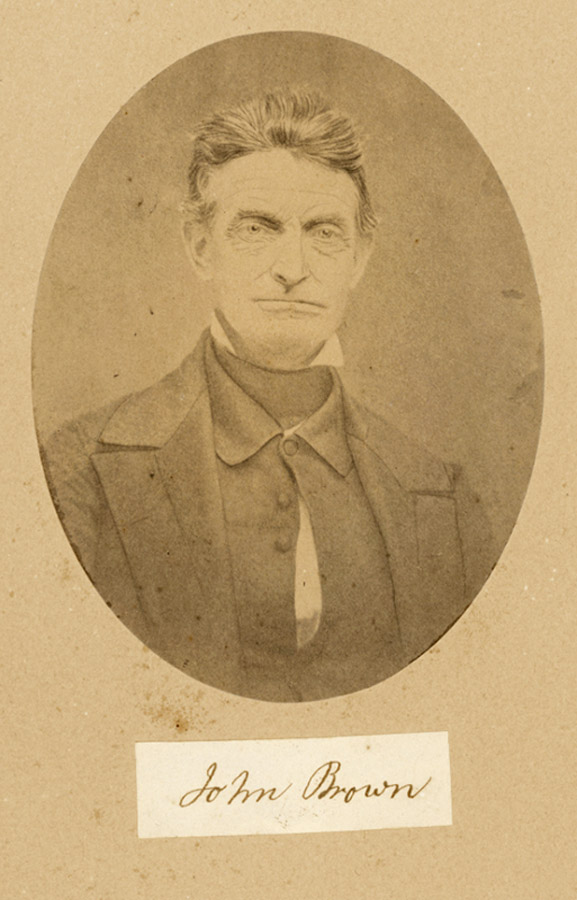
Unidentified photographer. 'John Brown 1800-1859' c. 1857 (after c. 1855 daguerreotype)


Unidentified photographer
John Brown 1800-1859
c. 1857 (after c. 1855 daguerreotype)
Salted paper print
National Portrait Gallery, Smithsonian Institution


Douglass described John Brown as someone who, “though a white gentleman, is in sympathy a black man, and as deeply interested in our cause, as though his own soul had been pierced with the iron of slavery.” They became friends, and in 1859, Brown urged Douglass to join him in raiding the federal arsenal at Harpers Ferry. Douglass, however, refused and told Brown he thought he was entering a “steel trap.” Brown and sixteen others were killed, either during the raid or after they were found guilty of treason. Douglass later credited Brown with starting the war that ended slavery.

Text from the National Portrait Gallery website


Frederick Douglass believed that Brown’s “zeal in the cause of my race was far greater than mine – it was as the burning sun to my taper light – mine was bounded by time, his stretched away to the boundless shores of eternity. I could live for the slave, but he could die for him.”

Douglass, Frederick (1881). John Brown. An Address at the Fourteenth Anniversary of Storer College, May 30, 1881. Dover, New Hampshire: Dover, N. H., Morning Star job printing house. p. 9. Retrieved March 9, 2022


Unidentified photographer. 'Frederick Douglass' c. 1860


Unidentified photographer
Frederick Douglass
c. 1860
Salted paper print
Image: 6 × 4.5cm (2 3/8 × 1 3/4″)
Sheet: 10.1 × 7.9cm (4 × 3 1/8″)
Mount: 17 × 13.6cm (6 11/16 × 5 3/8″)
Mat: 45.7 × 35.6cm (18 × 14″)
National Portrait Gallery, Smithsonian Institution


Douglass’s visual persona continually evolved, which undermined one of the key intellectual foundations of chattel slavery and racism that cast the self as fixed, unable to rise. Perhaps the most noticeable markers of Douglass’s continual evolution are his hairstyle and facial hair. In this salted paper print, he experiments with a mid-scalp part, unique among the 168 separate photographs. Five years later, in a carte de visite, he sports a ponytail, also distinct from his typical hairstyle.

Text from the National Portrait Gallery website


Douglass’ words were powerful; his image, arguably, more so.

“Douglass, along with most Americans, believed that photography was a ‘truthful’ representation and the great democratic art,” Stouffer explained. “He also recognised that the sitter had agency in the outcome of a photographic portrait. He understood his role as an artist or performer, part of a pas de trois with the photographer and the camera. He always dressed up. His photographic portraits, along with those of numerous other African Americans, starkly contrasted the racist caricatures of Blacks created by whites.”

A long American tradition of white artists caricaturing African Americans in prints and paintings influenced public perception. White painters in the antebellum era almost always cast the devil as a Black man. Monkeys and happy slaves were other tropes.

Douglass, meanwhile, always presented himself, in dress, pose, and expression, as a dignified and respectable citizen.

“Photography was a truth-telling medium he emphasised. It bore witness to African Americans, and all humans, essential humanity, and it countered the racist caricatures by whites drawing freehand,” Stouffer said. “Douglass argued that photography inspired people to eradicate the sins of their society. It led them to activism. It stemmed from the power of imagination, which allowed people to appreciate photographs as accurate representations of some greater reality. It encouraged them to realise their ideals in an imperfect world.”

As Douglass put it: “Poets, prophets, and reformers are all picture-makers – and this ability is the secret of their power and of their achievements. They see what ought to be in the reflection of what is, and endeavour to remove the contradiction.”

This is a key message of the exhibition.

“Poets, prophets, and reformers were artists and activists. Activism inspired art and vice versa. Poets, prophets, and reformers saw their community or nation as it was – with all its gross inequalities, injustices, and prejudices – and they contrasted it with what ought to be. The contradiction inspired them to remove structural inequalities, injustices, and prejudices,” Stouffer explained. “Douglass and most other abolitionists, along with many antislavery advocates, considered themselves poets, prophets, and reformers. As a group, they sat for their photographic portraits with greater frequency, distributed them more effectively, and were more taken with photography, than other groups.”

Douglass went so far as to say that “the moral and social influence of pictures” was more important than “the making of its laws.”

Chadd Scott. “Art, Activism And Frederick Douglass At National Portrait Gallery,” on the Forbes website Aug 22, 2023 [Online] Cited 21/04/2024


Johnson, Williams &. Co. (active 1860s and 1870s) 'James McCune Smith 1813-1865' c. 1860


Johnson, Williams &. Co. (active 1860s and 1870s)
James McCune Smith 1813-1865
c. 1860
Albumen silver print
Schomburg Center for Research in Black Culture, Photographs and Prints Division; The New York Public Library, Astor, Lenox and Tilden Foundations


James McCune Smith (April 18, 1813 – November 17, 1865) was an American physician, apothecary, abolitionist and author. He was the first African American to earn a medical degree. His M.D. was awarded by the University of Glasgow in Glasgow, Scotland. After his return to the United States, he also became the first African American to run a pharmacy in the nation.

In addition to practicing as a physician for nearly 20 years at the Colored Orphan Asylum in Manhattan, Smith was a public intellectual: he contributed articles to medical journals, participated in learned societies, and wrote numerous essays and articles drawing from his medical and statistical training. He used his training in medicine and statistics to refute common misconceptions about race, intelligence, medicine, and society in general. He was invited as a founding member of the New York Statistics Society in 1852, which promoted a then new science. Later he was elected as a member in 1854 of the recently founded American Geographic Society. He was never admitted to the American Medical Association or local medical associations,[1] very likely as a result of the systemic racism that Smith confronted throughout his medical career.

He has been most well known for his leadership as an abolitionist: a member of the American Anti-Slavery Society, with Frederick Douglass he helped start the National Council of Colored People in 1853, the first permanent national organisation for blacks. Douglass called Smith “the single most important influence on his life.” Smith was one of the Committee of Thirteen, who organised in 1850 in Manhattan to resist the newly passed Fugitive Slave Law by aiding refugee slaves through the Underground Railroad. Other leading abolitionist activists were among his friends and colleagues. From the 1840s, Smith lectured on race and abolitionism and wrote numerous articles to refute racist ideas about black capacities.

Both Smith and his wife were of mixed African and European descent. As he became economically successful, Smith built a house in a mostly white neighbourhood; in the 1860 census he and his family were classified as white, along with their neighbours. (In the census of 1850, while living in a predominately African-American neighbourhood, they had been classified as mulatto.) Smith served for nearly 20 years as the physician at the Colored Orphan Asylum in New York. After it was burned down in July 1863 by a mob in draft riots in Manhattan, in which nearly 100 blacks were killed, Smith moved his family and practice to Brooklyn for their safety. Many other blacks left Manhattan for Brooklyn at the same time. The parents stressed education for their children. In the 1870 census, his widow and children continued to be classified as white.

Text from the Wikipedia website


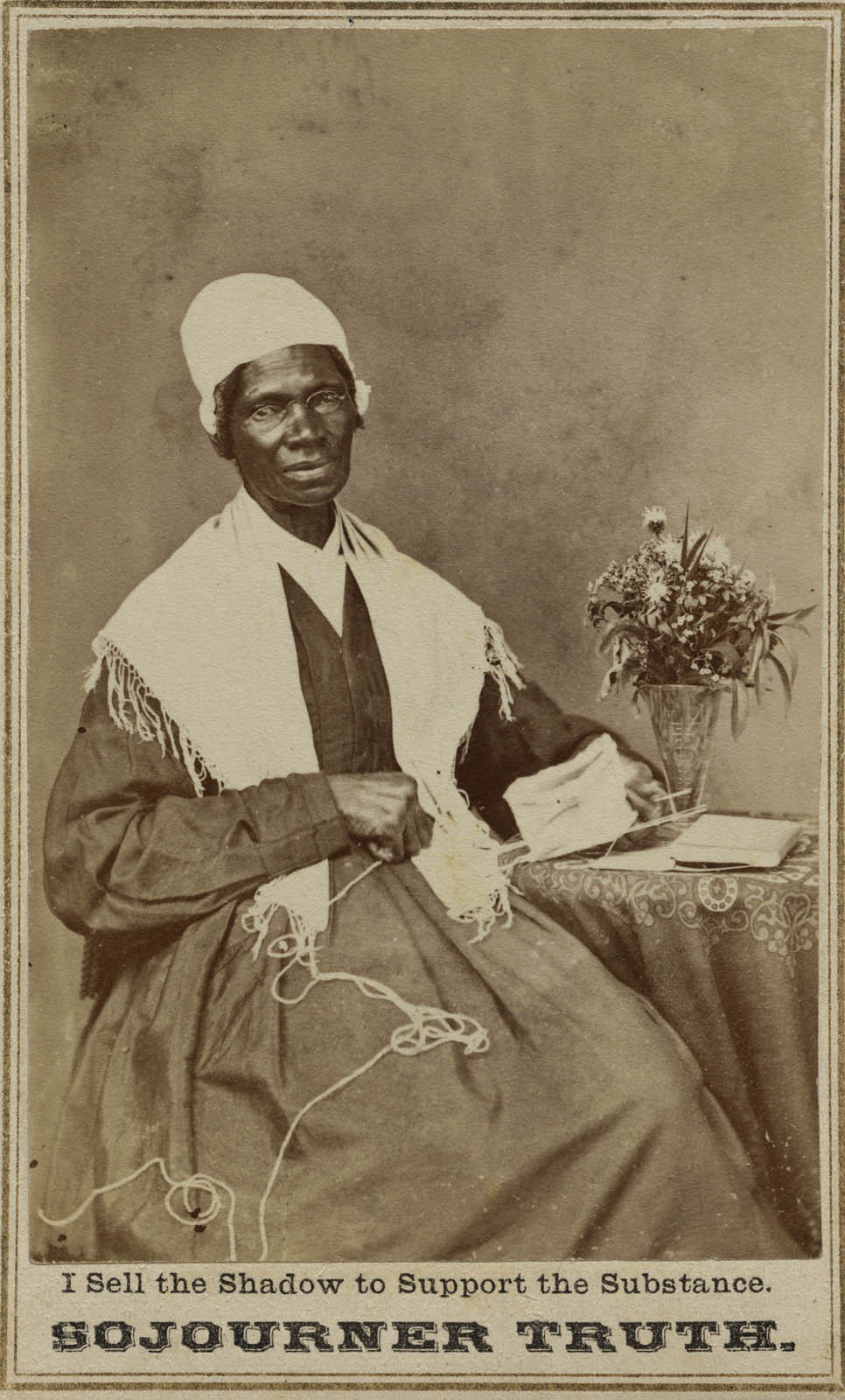
Unidentified photographer. 'Sojourner Truth c. 1797-1883' 1864


Unidentified photographer
Sojourner Truth c. 1797-1883
1864
Albumen silver print
Image/Sheet: 8.7 × 5.6cm (3 7/16 × 2 3/16″)
National Portrait Gallery, Smithsonian Institution


Sojourner Truth was possibly more famous for her carte-de-visite photographs than for her actual presence at abolition meetings. Her carefully chosen images made her a familiar figure to millions of viewers. They depicted a respectable matron. Truth’s famous maxim that she included with her portrait, “I sell the shadow to support the substance,” links her image (shadow) to her actual self (substance) and to the growing demand for photographs during the war years.

Truth’s image becomes an extension of herself and her nation. The yarn forms the contours of the eastern United States, with Florida’s panhandle and Texas clearly visible. As a representative American woman, Truth’s piety, simplicity, and abolitionism were shaping the United States.

Text from the National Portrait Gallery website


L. Schamer (active c. 1870) Louis Prang Lithography Co. (active 1856-1899) 'Representative Women' 1870


L. Schamer (active c. 1870)
Louis Prang Lithography Co. (active 1856-1899)
Representative Women
1870
Lithograph
National Portrait Gallery, Smithsonian Institution


This portrait unites seven leading female suffragists. Clockwise from the top are portraits of Lucretia Mott, Elizabeth Cady Stanton, Mary Livermore, Lydia Maria Child, Susan B. Anthony, and Sara Jane Lippincott, who surround Anna Dickinson, the most popular woman on the lecture circuit; in a sense, Douglass’s counterpart. The visual power of the image stems from its ability to reveal both the cohesiveness of the movement and the strong personalities within it.

Douglass knew these women and, as a leading male advocate for women’s rights, often collaborated with them and attended their conventions. But when Congress passed the Fifteenth Amendment in 1869, granting suffrage to Black men but not to women, their cohesion crumbled. Anthony and Stanton argued that white women should have suffrage before Black men. Douglass supported the amendment but continued to advocate for women’s suffrage.

Between 1860 and 1880, it became common for American reformers to gather on stages – then called lyceums – to promote abolition, temperance, education reform, and women’s rights. Lyceum associations allowed suffragists to speak. In their lectures, suffragists addressed men and women of diverse backgrounds – across state, racial, and economic divides – and reached wider audiences than through women’s organisations alone.

Representative Women is a combinative portrait that brings together seven women who were active on the lecture circuit. The visual power of the image stems from its ability to reveal both the cohesiveness of the movement and the strong individual personalities within it. Clockwise from the top are portraits of Lucretia Coffin Mott, Elizabeth Cady Stanton, Mary Livermore, Lydia Maria Francis Child, Susan B. Anthony, and Sara Jane Lippincott, who surround the central figure of Anna Elizabeth Dickinson. At the time, Dickinson was more popular than Mark Twain and held the distinction of being the highest paid woman on the lecture circuit.

Text from the National Portrait Gallery website


NOT IN THE EXHIBITION BUT IN THE NATIONAL PORTRAIT GALLERY COLLECTION


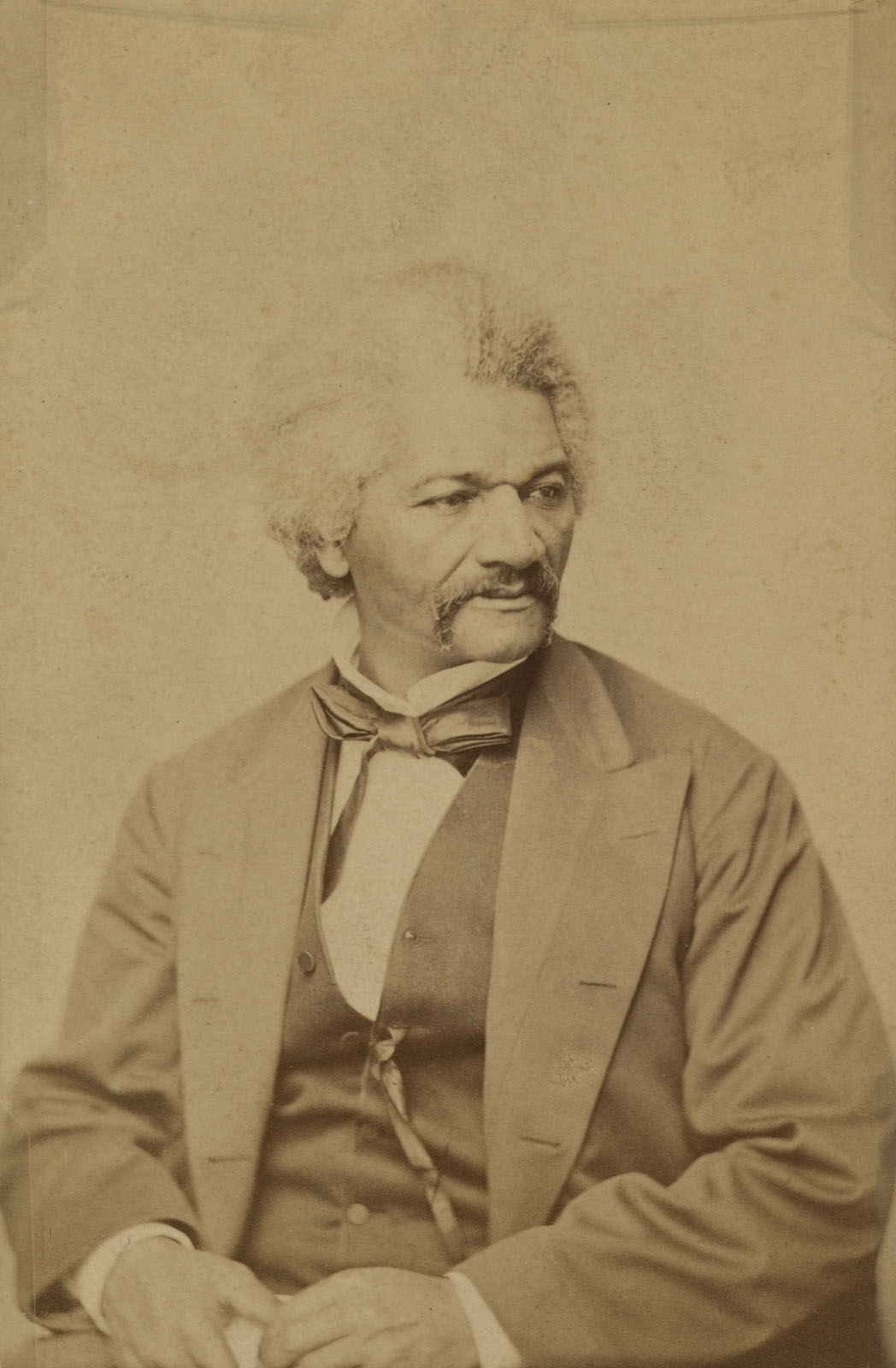
Unidentified photographer. 'Frederick Douglass' 1856


Unidentified photographer
Frederick Douglass
1856
Quarter-plate ambrotype
Image/Sight: 8.8 × 6.7cm (3 7/16 × 2 5/8″)
Mat (brass): 10.8 × 8.3cm (4 1/4 × 3 1/4″)
Case open: 12 × 19.2 × 1.3cm (4 3/4 × 7 9/16 × 1/2″)
Case closed: 12 × 9.5 × 1.9cm (4 3/4 × 3 3/4 × 3/4″)
National Portrait Gallery, Smithsonian Institution; acquired through the generosity of an anonymous donor


In the years following his escape from bondage in 1838, Frederick Douglass emerged as a powerful and persuasive spokesman for the cause of abolition. His effectiveness as an antislavery advocate was due in large measure to his firsthand experience with the evils of slavery and his extraordinary skill as an orator. His “glowing logic, biting irony, melting appeals, and electrifying eloquence” astonished and enthralled his audiences. As this ambrotype suggests, Douglass’s power was also rooted in the sheer impressiveness of his bearing, which abolitionist and activist Elizabeth Cady Stanton likened to that of “an African prince, majestic in his wrath.”

Text from the National Portrait Gallery website


George Francis Schreiber (American, 1803-1892) 'Frederick Douglass' 1870


George Francis Schreiber (American, 1803-1892)
Frederick Douglass
1870
Albumen silver print
Image/Sheet: 9.4 x 5.9cm (3 11/16 x 2 5/16″)
National Portrait Gallery, Smithsonian Institution; gift of Donald R. Simon


George Kendall Warren (American, 1834-1884) 'Frederick Douglass' 1876


George Kendall Warren (American, 1834-1884)
Frederick Douglass
1876
Albumen silver print
Image/Sheet: 9.7 × 5.7cm (3 13/16 × 2 1/4″)
National Portrait Gallery, Smithsonian Institution


Smithsonian National Portrait Gallery
8th and F Sts NW
Washington, DC 20001

Opening hours:
11.30am – 7.00pm daily

Smithsonian National Portrait Gallery website

LIKE ART BLART ON FACEBOOK

Back to top

Exhibition: ‘Dawoud Bey & Carrie Mae Weems: In Dialogue’ at the J. Paul Getty Museum, Los Angeles

Exhibition dates: 4th April – 9th July, 2023


Dawoud Bey (American, b. 1953) 'Two Women at a Parade' 1978 from the exhibition 'Dawoud Bey & Carrie Mae Weems: In Dialogue' at the J. Paul Getty Museum, Los Angeles, April-  July, 2023


Dawoud Bey (American, b. 1953)
Two Women at a Parade
1978
Gelatin silver print
Grand Rapids Art Museum, Michigan Museum purchase
© Dawoud Bey
Courtesy of Stephen Daiter Gallery


Engaging each other in light

Dialogue: Old English dialogas (plural), from Latin from Greek dialogos, from dia ‘through’ + logos ‘word’

“As we define it, dialogue is “a communicative process in which people with different perspectives seek understanding.” To be in dialogue means that participants are not only engaging each other in light of their different views, but they are also striving to achieve a degree of mutual understanding.”

Jason Combs. “What is Dialogue?” on the University of Dayton website Monday October 28, 2019 [Online] Cited 01/07/2023


Short and sweet because I’m not feeling well.

What an inspired pairing for an exhibition. “Each [artist] addresses race, class, representation, and systems of power in their work, creating photographic series grounded in Black history and realities that speak to the human condition.”

From street-based photographs of everyday life to conceptual excavations of Black Histories, they produce incisive thought provoking works “that intermingle past and present, referenc[ing] African Americans whose lives and stories have been co-opted or lost.”

I love them both for their commitment to and passion for life in all its different forms. Bringing people together. Expressing a degree of mutual understanding.

#BlackLivesMatter #AllLivesMatter

Dr Marcus Bunyan


Many thankx to the J. Paul Getty Museum for allowing me to publish the photographs in the posting. Please click on the photographs for a larger version of the image.


Dawoud Bey and Carrie Mae Weems have been friends and colleagues for more than 40 years. Each addresses race, class, representation, and systems of power in their work, creating photographic series grounded in Black history and realities that speak to the human condition. This exhibition sheds light on their unique trajectories and modes of presentation, and their shared consciousness and principles. Organised by the Grand Rapids Art Museum.


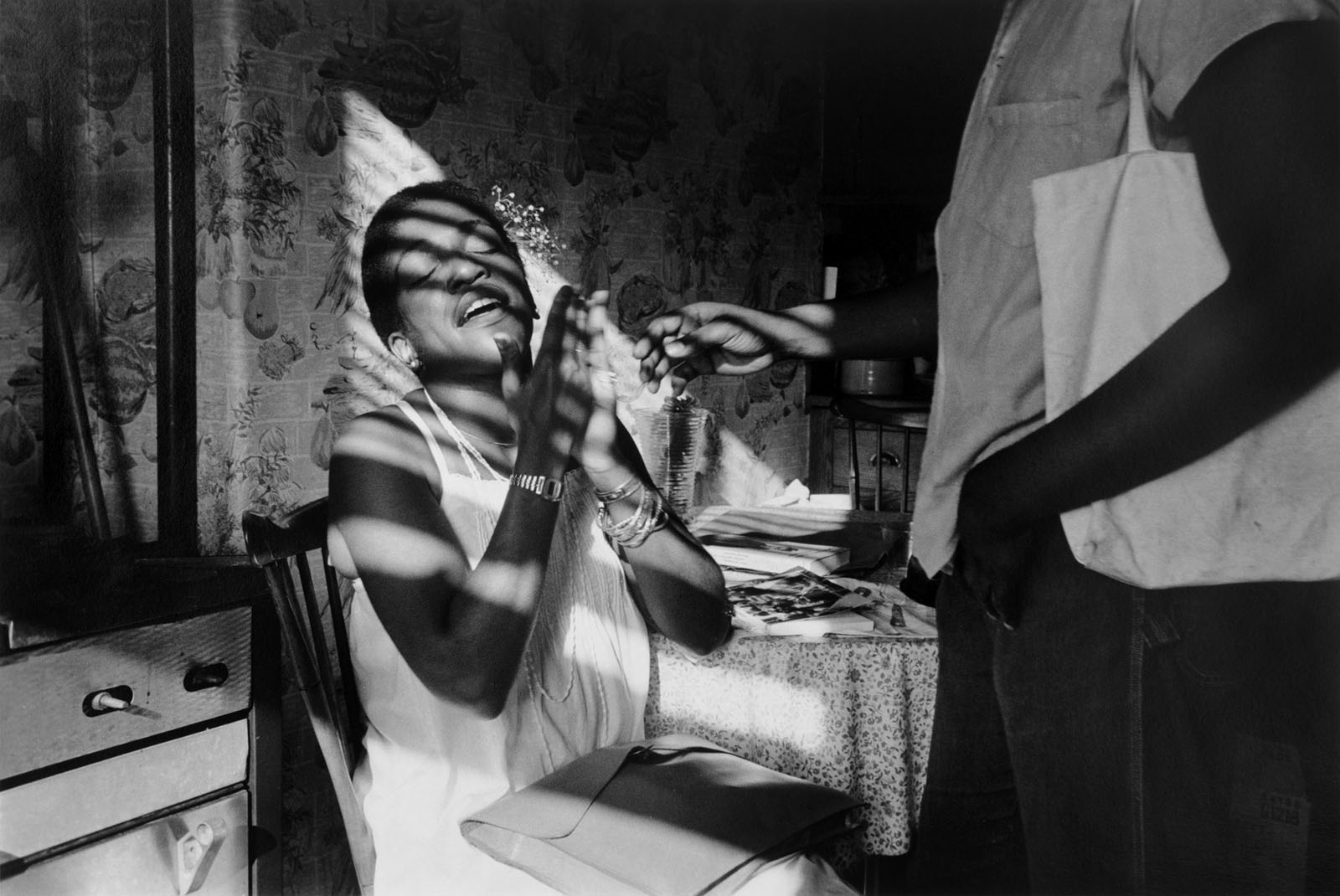
Dawoud Bey (American, b. 1953) 'The Woman in the Light, Harlem, NY' 1980 from the exhibition 'Dawoud Bey & Carrie Mae Weems: In Dialogue' at the J. Paul Getty Museum, Los Angeles, April-  July, 2023


Dawoud Bey (American, b. 1953)
The Woman in the Light, Harlem, NY
1980
Gelatin silver print
© Dawoud Bey
Courtesy of Stephen Daiter Gallery


Dawoud Bey (American, b. 1953) 'Self and Shadow, New York, NY' 1980 from the exhibition 'Dawoud Bey & Carrie Mae Weems: In Dialogue' at the J. Paul Getty Museum, Los Angeles, April-  July, 2023


Dawoud Bey (American, b. 1953)
Self and Shadow, New York, NY
1980
Gelatin silver print
© Dawoud Bey
Courtesy of Stephen Daiter Gallery


Dawoud Bey (American, b. 1953) 'A Young Man Resting on an Exercise Bike, Amityville, NY' 1988


Dawoud Bey (American, b. 1953)
A Young Man Resting on an Exercise Bike, Amityville, NY
1988
Gelatin silver print
© Dawoud Bey
Courtesy of Stephen Daiter Gallery


Dawoud Bey (American, b. 1953) 'Couple in Prospect Park, Brooklyn, NY' 1990


Dawoud Bey (American, b. 1953)
Couple in Prospect Park, Brooklyn, NY
1990
Gelatin silver print Getty Museum
© Dawoud Bey


In 1976 I had been making photographs for a couple of years. I had certainly been looking at a lot more photographs than I had actually made. From looking at photographs in books and magazines and going to exhibitions of pictures by Mike Disfarmer at MoMA, Richard Avedon at Marlborough, and haunting whatever other places there were to see photographs in New York in the early 1970s, I had begun to educate myself, with the intent of adding something to the conversation through my own pictures.

The artist Janet Henry, who was from the same Jamaica, Queens neighborhood that I lived in, had gotten a job in the Education Department at the Studio Museum in Harlem, then located above a Kentucky Fried Chicken on 125th Street and Fifth Avenue in a large second floor loft space. When Frank Stewart, the museum’s staff photographer and photo teacher, left to do a commissioned project in Cuba, Janet called me and asked if I would take over the class. On the first day of class a few students straggled in. One of them, a seemingly shy woman with big expressive eyes, introduced herself, “Hi, my name is Carrie. Do you think I could be a photographer?” she asked, holding her Leica camera in her hand. That began what has now been 33 years of friendship and camaraderie with one of the most brilliant people I know.

From the very beginning, Carrie Mae Weems has had a sharp intelligence that was looking for a way into the world. From her early documentary photographs to the more expansive and materially varied recent works, she has consistently set out to visually define the world on her own terms and to redefine for all of us the nature of the world that we are in. After all these years I still anticipate her work with a fresh sense of wonderment, knowing that her restless search for the deeper meaning of things will yield a continuing rich trove of objects and images. On a Sunday morning in May I called from my home in Chicago to reconnect with my dear friend while she was traveling in Seville, Spain.

Dawoud Bey quoted in “Carrie Mae Weems by Dawoud Bey,” on the BOMB Magazine website July 1, 2009 [Online] Cited 18/06/2023


Dawoud Bey (American, b. 1953) 'Taneesha' 1999


Dawoud Bey (American, b. 1953)
Taneesha
1999
Dye diffusion prints
Collection of Jack and Sandra Guthman
© Dawoud Bey
Courtesy of Stephen Daiter Gallery


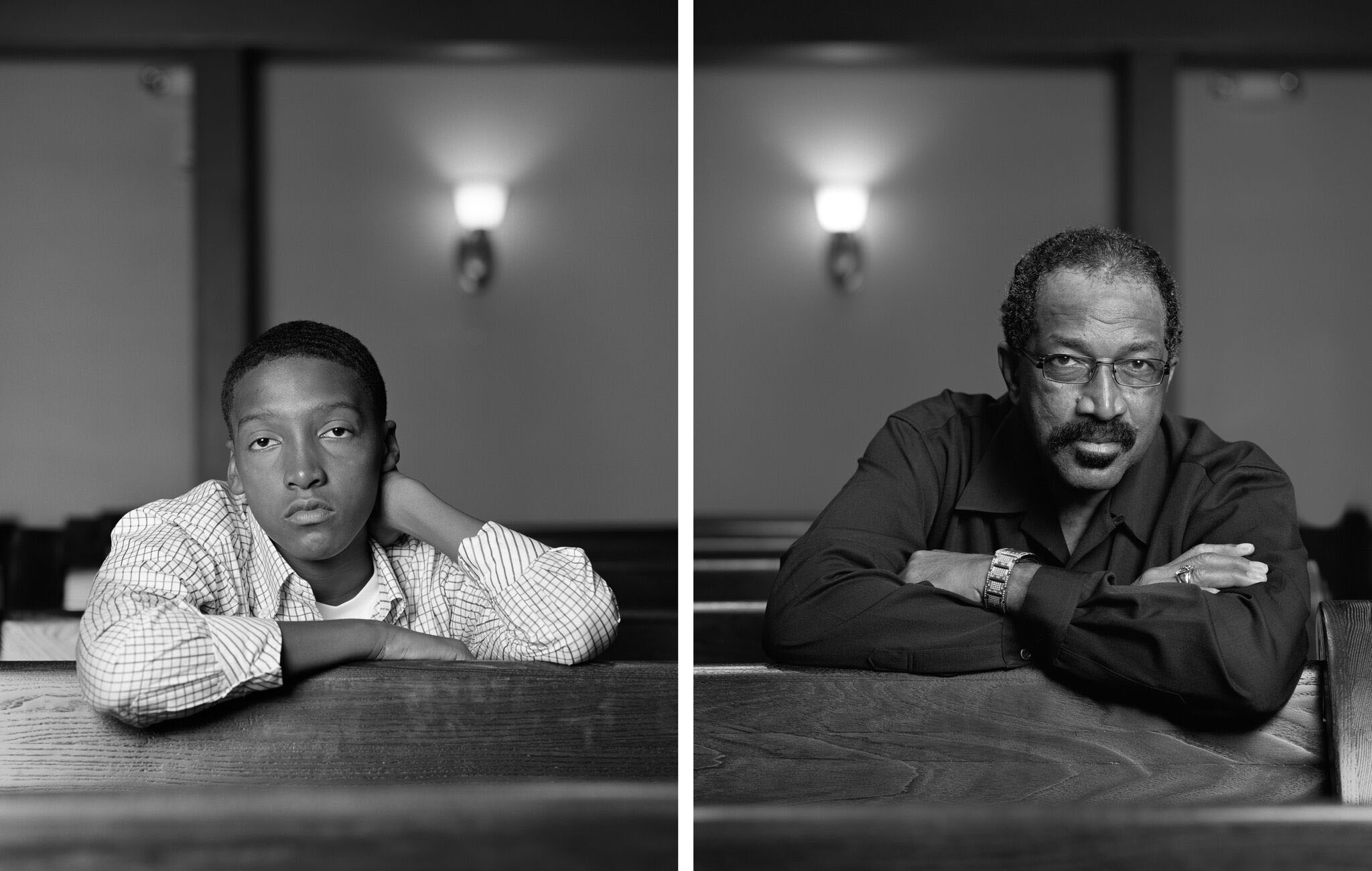
Dawoud Bey (American, b. 1953) 'The Birmingham Project: Wallace Simmons and Eric Allums' 2012


Dawoud Bey (American, b. 1953)
The Birmingham Project: Wallace Simmons and Eric Allums
2012
Inkjet prints
Rennie Collection, Vancouver
© Dawoud Bey
Courtesy of Stephen Daiter Gallery


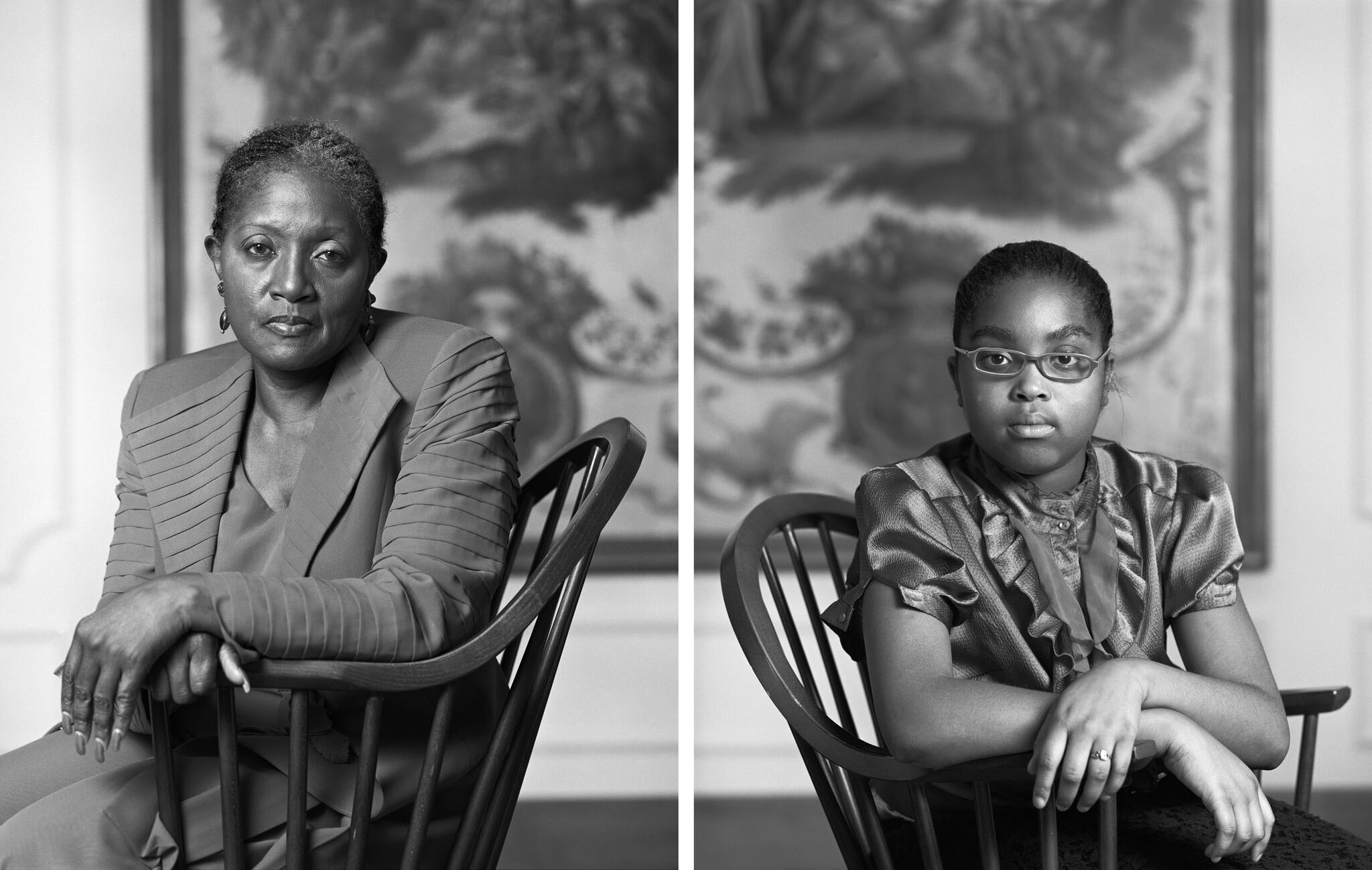
Dawoud Bey (American, b. 1953) 'The Birmingham Project: Taylor Falls and Deborah Hackworth' 2012


Dawoud Bey (American, b. 1953)
The Birmingham Project: Taylor Falls and Deborah Hackworth
2012
Inkjet prints
Rennie Collection, Vancouver
© Dawoud Bey
Courtesy of Stephen Daiter Gallery


Dawoud Bey (American, b. 1953) 'Braxton McKinney and Lavone Thomas, Birmingham, AL' 2012


Dawoud Bey (American, b. 1953)
The Birmingham Project: Braxton McKinney and Lavone Thomas
2012
Inkjet prints
Rennie Collection, Vancouver
© Dawoud Bey
Courtesy of Stephen Daiter Gallery


Dawoud Bey (American, b. 1953) 'Betty Selvage and Faith Speights, Birmingham, AL' 2012


Dawoud Bey (American, b. 1953)
The Birmingham Project: Betty Selvage and Faith Speights
2012
Inkjet prints
Rennie Collection, Vancouver
© Dawoud Bey
Courtesy of Stephen Daiter Gallery


Dawoud Bey (American, b. 1953) 'Boy on Skateboard, Harlem, NY' 2014


Dawoud Bey (American, b. 1953)
Boy on Skateboard, Harlem, NY
2014
Inkjet print
© Dawoud Bey
Courtesy of Stephen Daiter Gallery


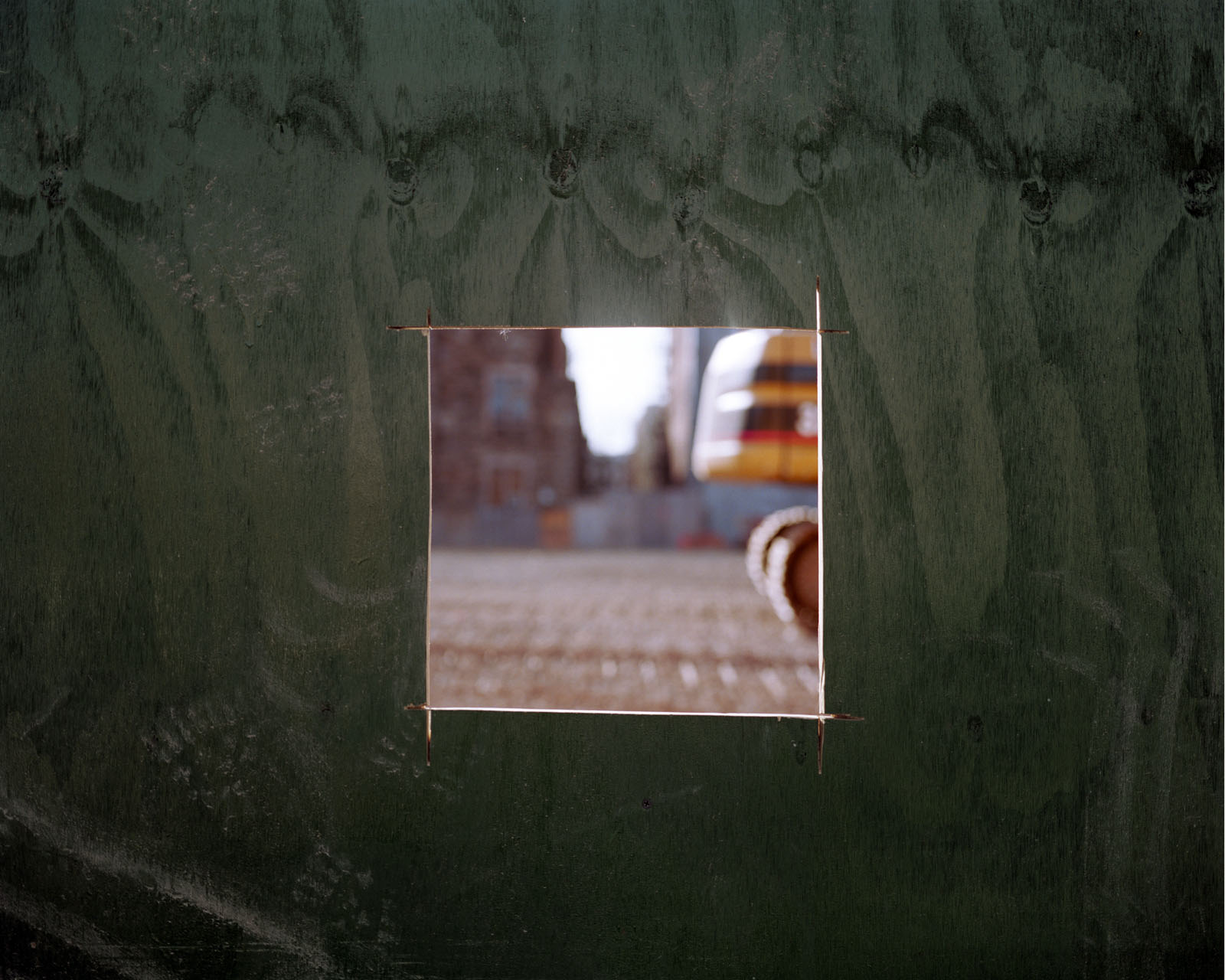
Dawoud Bey (American, b. 1953) 'Former Renaissance Ballroom Site, Harlem, NY' 2015


Dawoud Bey (American, b. 1953)
Former Renaissance Ballroom Site, Harlem, NY
2015
Inkjet print
© Dawoud Bey
Courtesy of Stephen Daiter Gallery


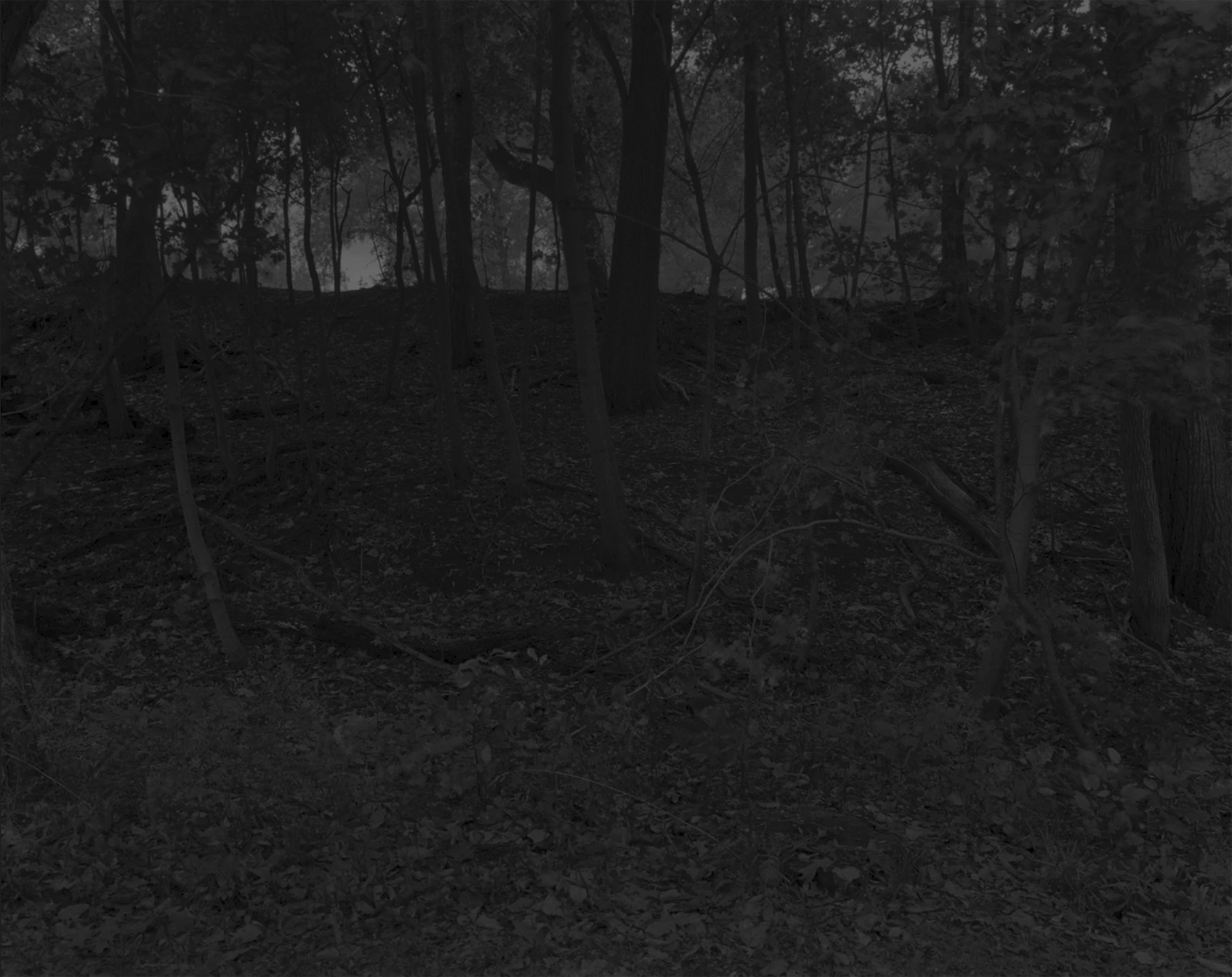
Dawoud Bey (American, b. 1953) 'Untitled #15 (Forest with Small Trees)' 2017


Dawoud Bey (American, b. 1953)
Untitled #15 (Forest with Small Trees)
2017
Gelatin silver print
Getty Museum, purchased with funds provided by the Photographs Council
© Dawoud Bey


Since meeting at the Studio Museum in Harlem in 1977, Dawoud Bey and Carrie Mae Weems have been intellectual colleagues and companions.

From the outset of their careers, both have operated from a deep social commitment to participate in, describe, and define culture. In seeking to express themselves fully, each has expanded possibilities within photography and video to address their chosen subjects.

Dawoud Bey & Carrie Mae Weems: In Dialogue, on view April 4 through July 9, 2023, brings together for the first time a focused selection of work from a period of over 40 years by two of today’s most important and influential photo-based artists. Each grapples with issues of race, class, and representation in their work, making art grounded in the experiences and realities of Black Americans while also speaking to the broader human condition.

“The Museum’s Department of Photographs has made great strides in recent years in building an exhibitions program that highlights more expansive narratives of photographic history,” says Timothy Potts, Maria Hummer-Tuttle and Robert Tuttle Director of the J. Paul Getty Museum. “Dawoud Bey and Carrie Mae Weems are two artists who reframe American traumas that have been ignored or simplified in the national historical record. We are proud to showcase their work in dialogue with one another.”

Jim Ganz, senior curator of photographs, adds, “These artists are two of the most dynamic and insightful of our time. As presented in this extraordinary exhibition, their eloquent dialogue gives unique perspective on their shared concerns as image makers.”

Dawoud Bey (American, born 1953) creates photographs that focus on individuals, communities, and important but often overlooked American histories. His carefully composed images convey the dignity and rich inner lives of his subjects. Carrie Mae Weems (American, born 1953) first gained recognition in the 1980s for exploring identity, race, power, and history, themes that still fuel her art. Over her career, Weems has turned increasingly to staged photography and the use of text to heighten the emotional intensity of her work.

This exhibition is divided into five sections, starting with early pictures that both artists made in the photodocumentary tradition and followed by ambitious, groundbreaking explorations of the medium as it developed technologically and artistically. The exhibition then focuses on how both artists moved beyond candid pictures of everyday life and began making larger scale work that is more planned than spontaneous. Bey’s portraiture evolved from street-based glimpses of the world made with a handheld camera to portraits that are formal but intimate, in which his subjects appear at ease and engage directly with the lens. With her Kitchen Table Series, Weems transitioned from representing real people in their natural environments to creating staged photo essays. For each artist, the techniques developed in this period became the foundation for future projects.

In Resurrecting Black Histories, each artist addresses the 19th century and its legacies in distinctive ways. Bey’s carefully composed landscapes evoke the experience of fleeing along the Underground Railroad, the clandestine network that helped enslaved people escape the South. Weems, by incorporating texts that intermingle past and present, references African Americans whose lives and stories have been co-opted or lost.

In Memorial & Requiem, Bey and Weems reference traumatic 20th-century events. They worked with community partners to stage scenes meant to reinvigorate discussion of the American legacy of racial violence. Each photographer also created a related video, bringing their own sensibility – Bey’s searching, intimate gaze; Weems’ choreographed social commentary – to the moving image, using sequencing and sound to deepen engagement with American history.

The exhibition ends with Revelation in the Landscape, where both Bey and Weems contemplate the built environments in which we live and how those spaces affect our perceptions of the world and ourselves. Bey returns to the Harlem neighbourhoods he photographed in the late 1970s, tracking the changes wrought by gentrification. Weems photographs imposing sites in Rome, inserting herself into historical places imbued with power and legacy. Both series reveal the economic and institutional forces that shape daily life.

In conjunction with the exhibition Getty has created a community program inspired by the exhibition, L.A.: In Dialogue. This program brings Dawoud Bey & Carrie Mae Weems: In Dialogue to a wider Los Angeles community, furthering the influence of the two artists and introducing their work to a new generation of artists and viewers. The artist-led program will host educational workshops for local teens and young adult photographers, and will teach participants techniques in black-and-white photography and the artistic practice of capturing portraiture and place. They will explore themes from the exhibition, collaborate with peers, and explore their local communities: Culver City (Black Image Center), South L.A. (LA Commons), Downtown L.A. (Inner-City Arts), and Venice Beach (Venice Arts). This program will result in a satellite exhibition that will open in June 2023.

Related programming includes Dawoud Bey and Carrie Mae Weems in Conversation on Tuesday, April 4 at 4pm. That evening at 7pm, the Museum presents master saxophonist David Murray in concert with his newly formed quartet as part of the exhibition programming.

Press release from the J. Paul Getty Museum


Carrie Mae Weems (American, b. 1953) 'First Self Portrait' 1975 from the exhibition 'Dawoud Bey & Carrie Mae Weems: In Dialogue' at the J. Paul Getty Museum, Los Angeles, April-  July, 2023


Carrie Mae Weems (American, b. 1953)
First Self Portrait
1975
Gelatin silver print
© Carrie Mae Weems
Courtesy of the artist and Jack Shainman Gallery, New York


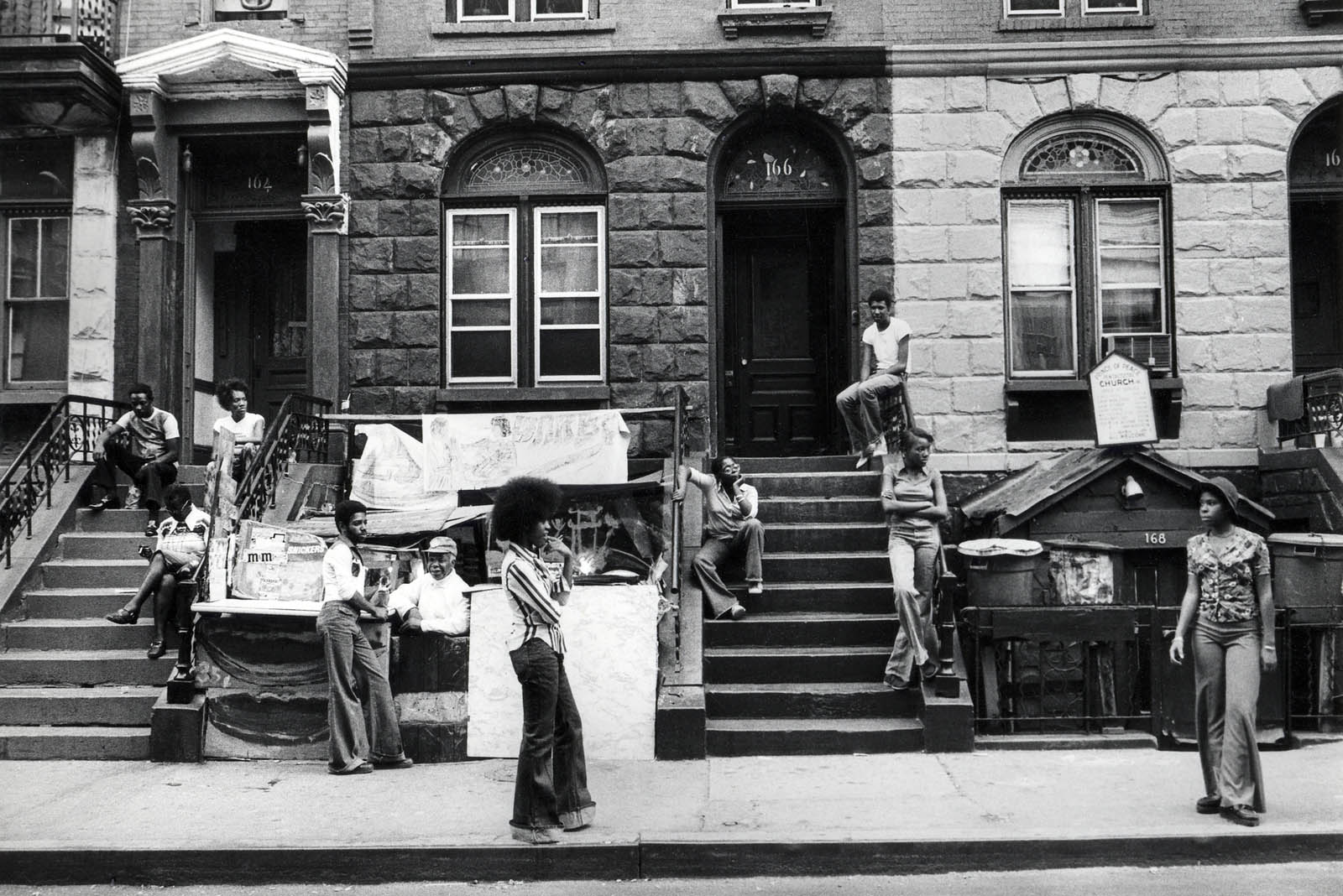
Carrie Mae Weems (American, b. 1953) 'Harlem Street' 1976-1977 from the exhibition 'Dawoud Bey & Carrie Mae Weems: In Dialogue' at the J. Paul Getty Museum, Los Angeles, April-  July, 2023


Carrie Mae Weems (American, b. 1953)
Harlem Street
1976-1977
Gelatin silver print
© Carrie Mae Weems
Courtesy of the artist and Jack Shainman Gallery, New York


Carrie Mae Weems (American, b. 1953) 'Woman in Shorts, Boardwalk, Santa Monica' 1980-1982


Carrie Mae Weems (American, b. 1953)
Woman in Shorts, Boardwalk, Santa Monica
1980-1982
Gelatin silver print
© Carrie Mae Weems
Courtesy of the artist and Jack Shainman Gallery, New York


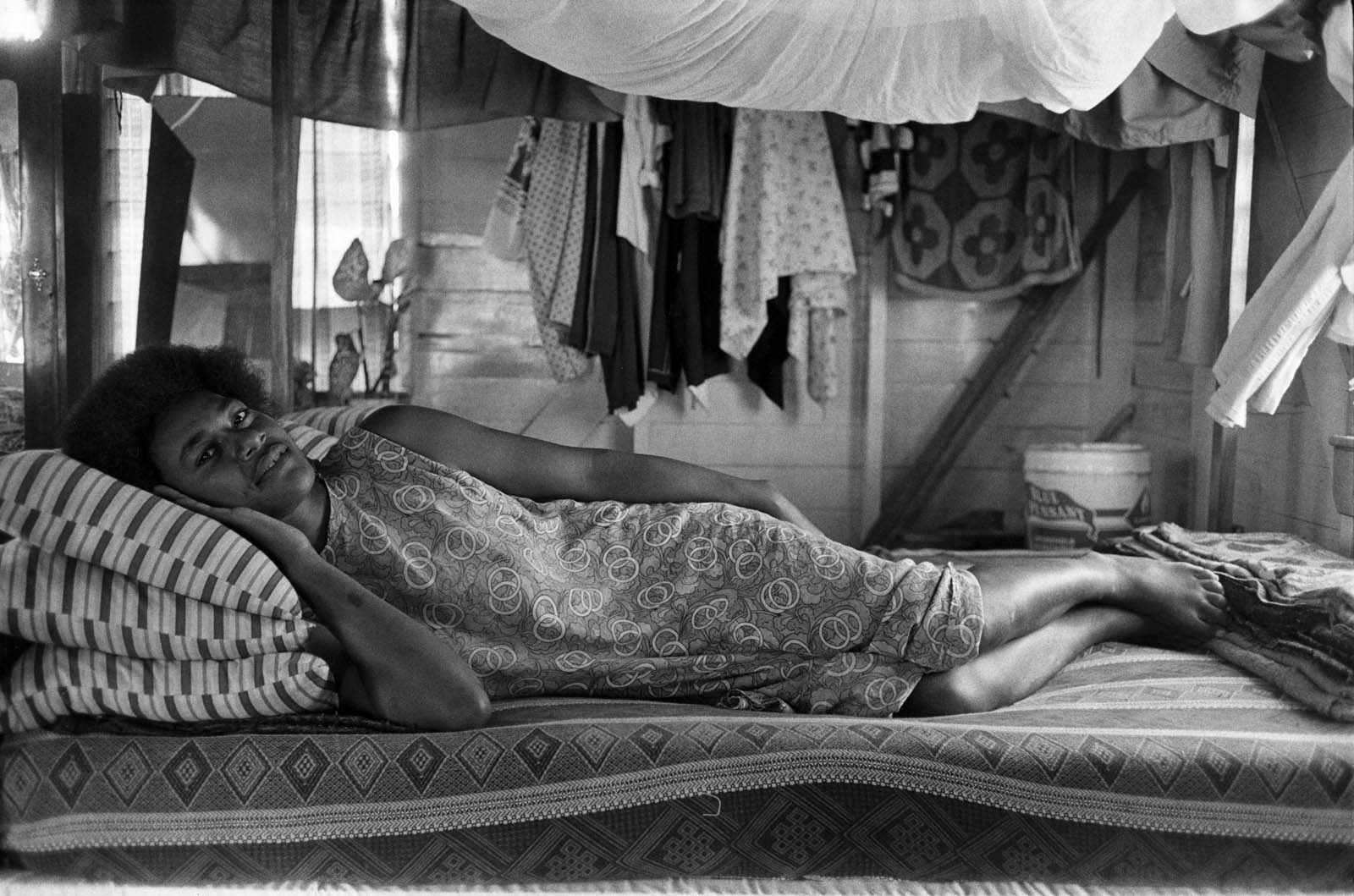
Carrie Mae Weems (American, b. 1953) 'Reclining Girl, Fiji' 1982-1983


Carrie Mae Weems (American, b. 1953)
Reclining Girl, Fiji
1982-1983
Gelatin silver print
© Carrie Mae Weems
Courtesy of the artist and Jack Shainman Gallery, New York


Carrie Mae Weems (American, b. 1953) 'Untitled (Woman and daughter with children)' 1990


Carrie Mae Weems (American, b. 1953)
Untitled (Woman and daughter with children)
1990
Gelatin silver print
© Carrie Mae Weems
Courtesy of the artist and Jack Shainman Gallery, New York


Carrie Mae Weems (American, b. 1953) 'Untitled (Woman standing alone)' 1990


Carrie Mae Weems (American, b. 1953)
Untitled (Woman standing alone)
1990
Gelatin silver print
© Carrie Mae Weems
Courtesy of the artist and Jack Shainman Gallery, New York


Carrie Mae Weems (American, b. 1953) 'Untitled (Woman and Daughter with Makeup)' 1990


Carrie Mae Weems (American, b. 1953)
Untitled (Woman and Daughter with Makeup)
1990
Gelatin silver print
© Carrie Mae Weems
Courtesy of the artist and Jack Shainman Gallery, New York


Carrie Mae Weems (American, b. 1953) 'See No Evil' 1991


Carrie Mae Weems (American, b. 1953)
See No Evil
1991
Dye diffusion print (Polaroid Polacolor)
61 × 50.5cm (24 × 19 7/8 in.)
The J. Paul Getty Museum, Los Angeles, Gift of Daniel Greenberg and Susan Steinhauser
© Carrie Mae Weems


Carrie Mae Weems (American, b. 1953) 'Road Sign' 1991-1992


Carrie Mae Weems (American, b. 1953)
Road Sign
1991-1992
Gelatin silver print
© Carrie Mae Weems
Courtesy of the artist and Jack Shainman Gallery, New York


Carrie Mae Weems (American, b. 1953) 'Untitled (Ebo Landing)' 1992


Carrie Mae Weems (American, b. 1953)
Untitled (Ebo Landing)
1992
Two gelatin silver prints and one screenprinted text panel
© Carrie Mae Weems
Courtesy of the artist and Jack Shainman Gallery, New York


Carrie Mae Weems (American, b. 1953) 'You Became a Scientific Profile / An Anthropological Debate / A Negroid Type / A Photographic Subject' 1995-1996


Carrie Mae Weems (American, b. 1953)
You Became a Scientific Profile / An Anthropological Debate / A Negroid Type / A Photographic Subject
1995-1996
From From Here I Saw What Happened and I Cried
© Carrie Mae Weems
Courtesy of the artist and Jack Shainman Gallery, New York


Carrie Mae Weems (American, b. 1953) 'The Edge of Time – Ancient Rome' 2006


Carrie Mae Weems (American, b. 1953)
The Edge of Time – Ancient Rome
2006
Chromogenic print
© Carrie Mae Weems


Carrie Mae Weems (American, b. 1953) 'The Tragedy of Hiroshima' 2008


Carrie Mae Weems (American, b. 1953)
The Tragedy of Hiroshima
2008
Inkjet print
© Carrie Mae Weems
Courtesy of the artist and Jack Shainman Gallery, New York


The pose of the figures, other than the obvious reference to the Pieta, reminds me of that famous and most moving Eugene W. Smith photograph Tomoko and Mother in the Bath (1971)


The J. Paul Getty Museum
1200 Getty Center Drive
Los Angeles, California 90049

Opening hours:
Daily 10am – 5pm

The J. Paul Getty Museum website

LIKE ART BLACK ON FACEBOOK

Back to top

Exhibition: ‘Dawoud Bey: An American Project’ at the Whitney Museum of American Art, New York

Exhibition dates: 17th April – 3rd October, 2021


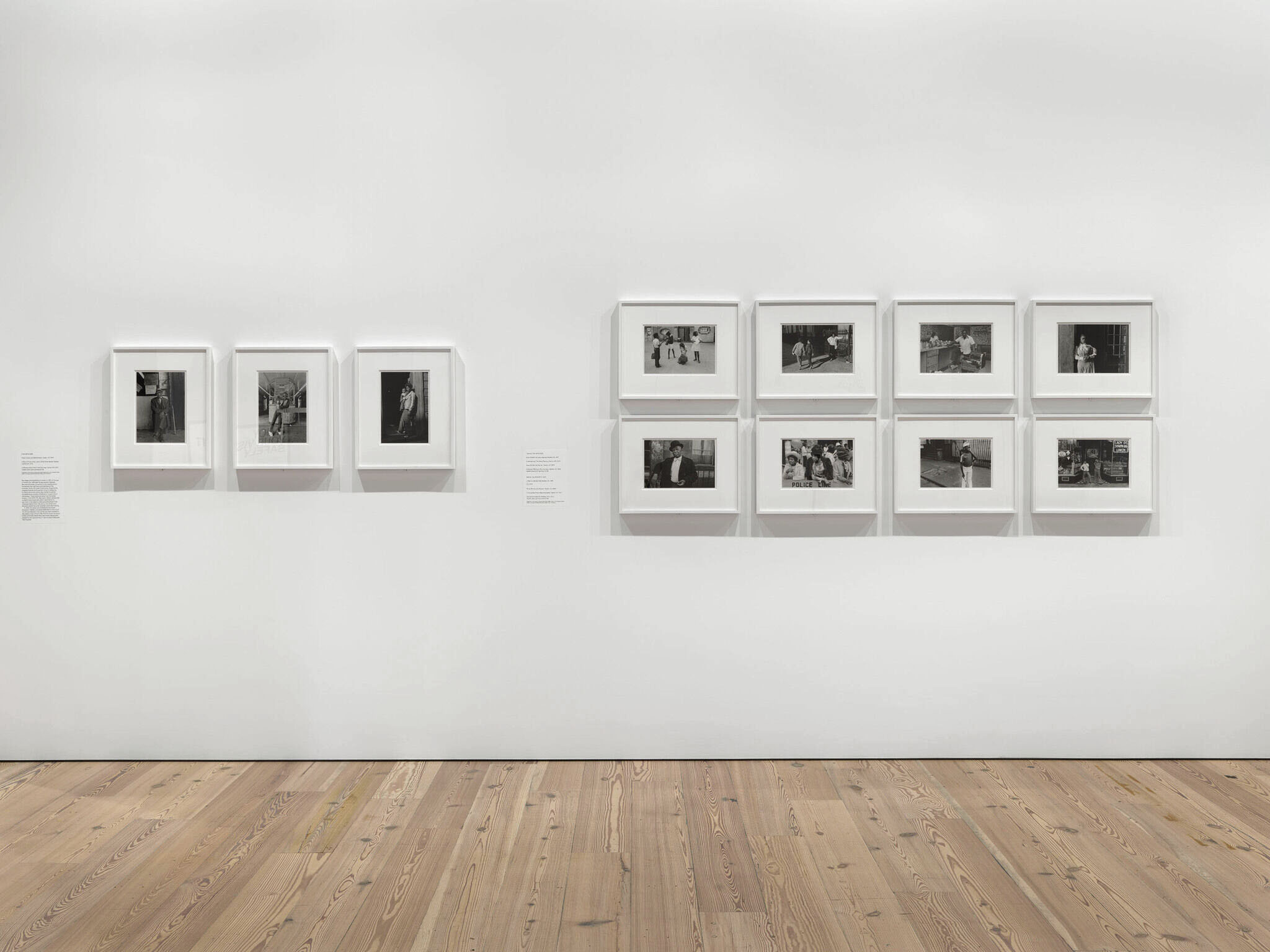
Installation view of 'Dawoud Bey: An American Project' (Whitney Museum of American Art, New York, April 17-October 3, 2021)

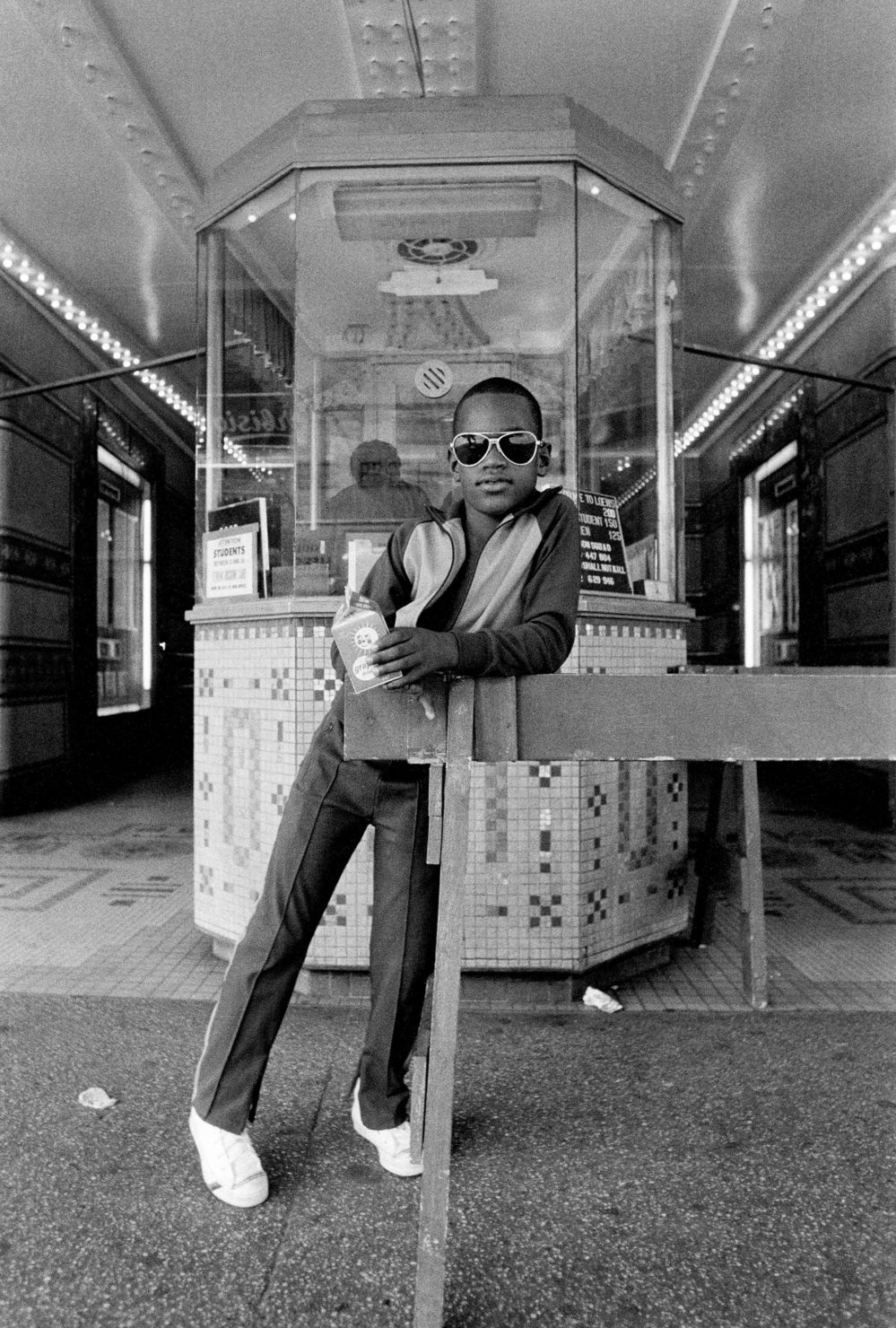
Installation view of 'Dawoud Bey: An American Project' (Whitney Museum of American Art, New York, April 17-October 3, 2021) showing from left to right: Fresh Coons and Wild Rabbits, Harlem, NY, 1975; A Boy in Front of the Loew's 125th Street Movie Theater, Harlem, NY, 1976; A Woman and a Child in the Doorway, Harlem, NY, 1975; Clockwise, from top left: Four Children at Lenox Avenue, Harlem, NY, 1977; A Woman and Two Boys Passing, Harlem, NY, 1978; Deas McNeil, the Barber, Harlem, NY, 1976; A Woman Waiting in the Doorway, Harlem, NY, 1976; Two Girls at Lady D's, Harlem, NY, c. 1976; A Young Boy from a Marching Band, Harlem, NY, 1977; Three Women at a Parade, Harlem, NY, 1978; A Man in a Bowler Hat, Harlem, NY, 1976


Installation view of Dawoud Bey: An American Project (Whitney Museum of American Art, New York, April 17 – October 3, 2021). From left to right: Fresh Coons and Wild Rabbits, Harlem, NY, 1975; A Boy in Front of the Loew’s 125th Street Movie Theater, Harlem, NY, 1976; A Woman and a Child in the Doorway, Harlem, NY, 1975; Clockwise, from top left: Four Children at Lenox Avenue, Harlem, NY, 1977; A Woman and Two Boys Passing, Harlem, NY, 1978; Deas McNeil, the Barber, Harlem, NY, 1976; A Woman Waiting in the Doorway, Harlem, NY, 1976; Two Girls at Lady D’s, Harlem, NY, c. 1976; A Young Boy from a Marching Band, Harlem, NY, 1977; Three Women at a Parade, Harlem, NY, 1978; A Man in a Bowler Hat, Harlem, NY, 1976. Photograph by Ron Amstutz


To fit it in with other exhibitions closing soon, a mid-week posting on this strong exhibition – Dawoud Bey: An American Project – this time at the Whitney Museum of American Art, with further media images, audio and installation photographs. The first posting with my comments about the exhibition was at the High Museum of Art.

Dr Marcus Bunyan


Many thankx to the Whitney Museum of American Art for allowing me to publish the photographs in the posting. Please click on the photographs for a larger version of the image.


Dawoud Bey: An American Project

Since the mid-1970s, Dawoud Bey (b. 1953) has worked to expand upon what photography can and should be. Insisting that it is an ethical practice requiring collaboration with his subjects, he creates poignant meditations on visibility, power, and race. Bey chronicles communities and histories that have been largely underrepresented or even unseen, and his work lends renewed urgency to an enduring conversation about what it means to represent America with a camera.

Spanning from his earliest street portraits in Harlem to his most recent series imagining an escape from slavery on the Underground Railroad, Dawoud Bey: An American Project attests to the artist’s profound engagement with the Black subject. He is deeply committed to the craft of photography, drawing on the medium’s specific tools, processes, and materials to amplify the formal, aesthetic, and conceptual goals of each body of work. Bey views photography not only as a form of personal expression but as an act of political responsibility, emphasising the necessary and ongoing work of artists and institutions to break down obstacles to access, convene communities, and open dialogues.

Dawoud Bey: An American Project is co-organised by the Whitney Museum of American Art and the San Francisco Museum of Modern Art. The exhibition is co-curated by Elisabeth Sherman, Assistant Curator at the Whitney, and Corey Keller, Curator of Photography at SFMOMA.


Room 800 Introduction


Dawoud Bey (American, b. 1953) 'Two Girls at Lady D's, Harlem, NY' c. 1976, printed 2019 from the exhibition Exhibition: 'Dawoud Bey: An American Project' at the Whitney Museum of American Art, New York, April - Oct, 2021


Dawoud Bey (American, b. 1953)
Two Girls at Lady D’s, Harlem, NY
c. 1976, printed 2019
From Harlem, U.S.A.
Gelatin silver print
11 × 14 in. (27.9 × 35.6cm)
Collection of the artist; courtesy the artist and Sean Kelly Gallery, New York; Stephen Daiter Gallery, Chicago; and Rena Bransten Gallery, San Francisco
Image courtesy the artist and Stephen Daiter Gallery, Chicago
© Dawoud Bey


Dawoud Bey (American, b. 1953) 'Four Children at Lenox Avenue, Harlem, NY' 1977, printed 2019 from the exhibition Exhibition: 'Dawoud Bey: An American Project' at the Whitney Museum of American Art, New York, April - Oct, 2021


Dawoud Bey (American, b. 1953)
Four Children at Lenox Avenue, Harlem, NY
1977, printed 2019
From Harlem, U.S.A.
Gelatin silver print
11 × 14 in. (27.9 × 35.6cm)
Collection of the artist; courtesy Sean Kelly Gallery, New York; Stephen Daiter Gallery, Chicago; and Rena Bransten Gallery, San Francisco
© Dawoud Bey


1

Harlem, U.S.A.

Bey began photographing in Harlem in 1975, at the age of twenty-two. Although he was raised in Queens, Bey was intimately connected to the neighbourhood: his parents had met there, and members of his extended family still made it their home. Drawn to the neighbourhood as both a symbol of and a wellspring for Black American culture, Bey wanted to portray its residents as complex individuals in images free of stereotype. These works all come from the series Harlem, U.S.A. (1975-1979).

Bey used a 35mm camera with a slightly wide-angle lens, which required him to get close to his subjects while grounding them in the cityscape behind them. His set-up was nimble and discreet, and let the artist carefully control the framing. In 1979, the series was exhibited at the Studio Museum in Harlem, a museum dedicated to the arts of the African diaspora. Even at this very early moment in his career, it was critical to Bey that the works be shown in the community where they were made, allowing the people he was representing to have access to the work they inspired.


Dawoud Bey (American, b. 1953) 'A Woman Waiting in the Doorway, Harlem, NY' 1977, printed 2019


Dawoud Bey (American, b. 1953)
A Woman Waiting in the Doorway, Harlem, NY
1977, printed 2019
From Harlem, U.S.A.
Gelatin silver print
14 × 11 in. overall (35.6 × 27.9cm)
Collection of the artist; courtesy Sean Kelly Gallery, New York; Stephen Daiter Gallery, Chicago; and Rena Bransten Gallery, San Francisco
© Dawoud Bey


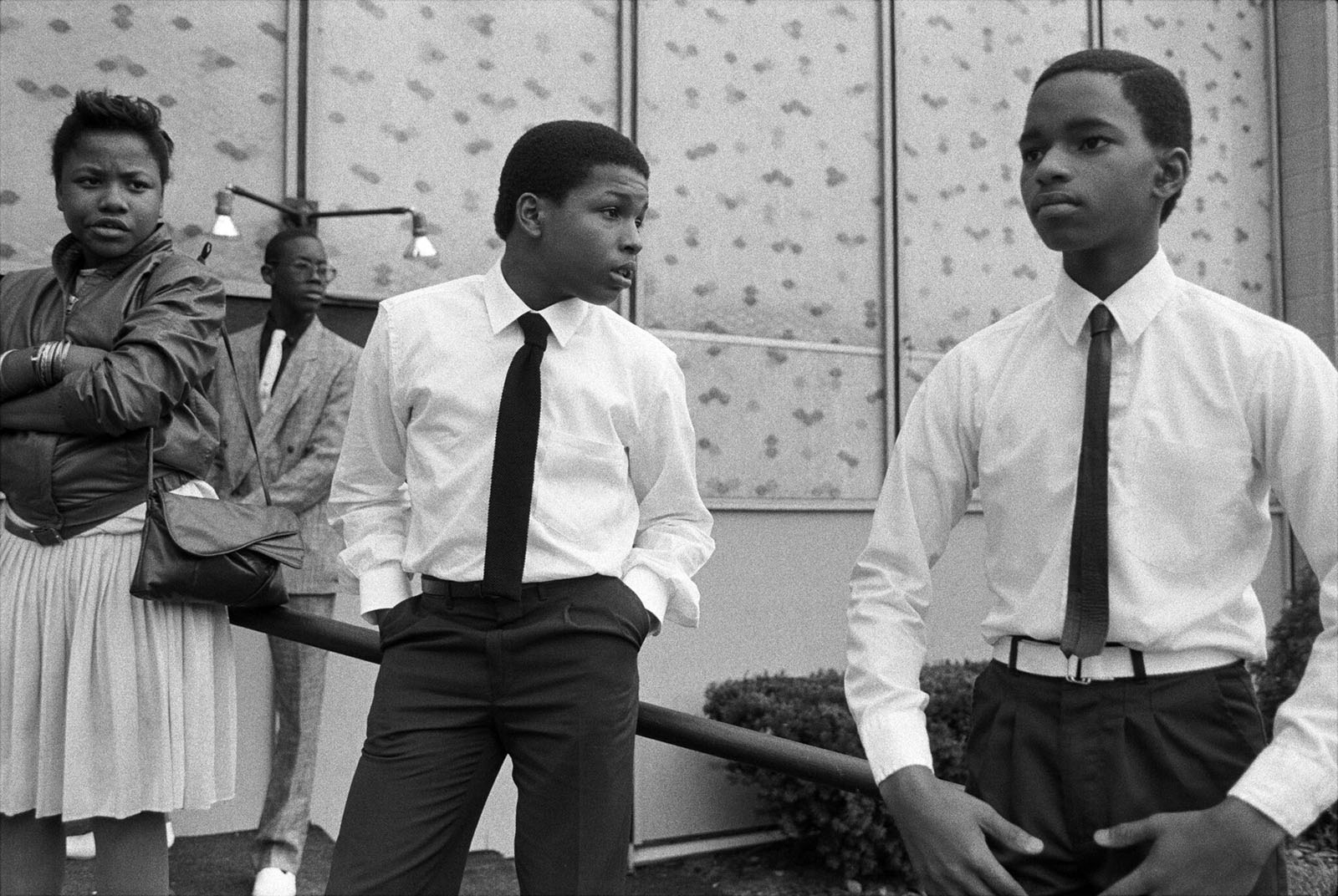
Dawoud Bey (American, b. 1953) 'Four Teenagers after Church Service, Syracuse, NY' 1985, printed 2019


Dawoud Bey (American, b. 1953)
Four Teenagers after Church Service, Syracuse, NY
1985, printed 2019
Gelatin silver print
20 × 24 in. (50.8 × 61cm)
Collection of the artist; courtesy Sean Kelly Gallery, New York
Stephen Daiter Gallery, Chicago; and Rena Bransten Gallery, San Francisco
© Dawoud Bey


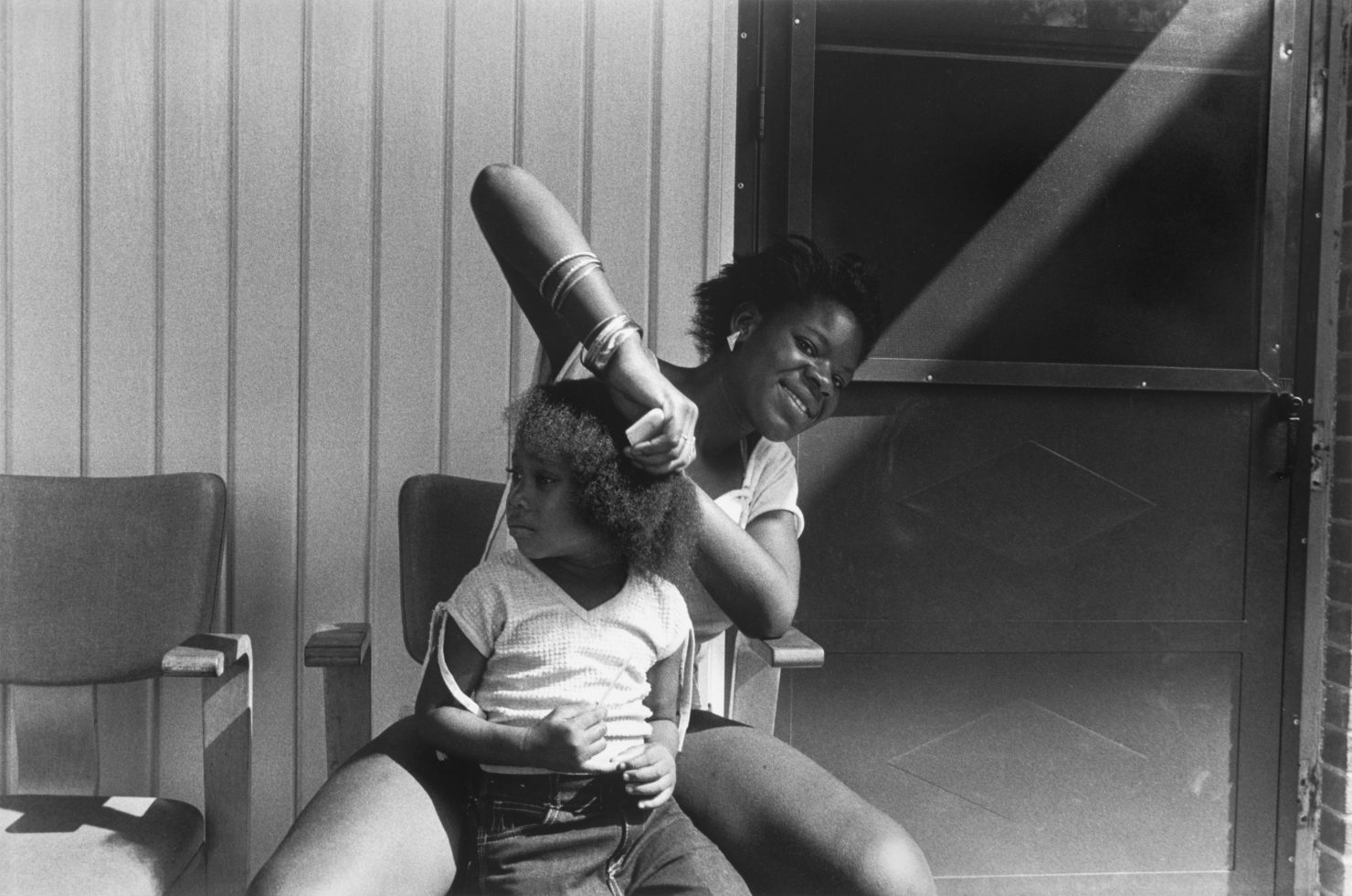
Installation view of 'Dawoud Bey: An American Project' (Whitney Museum of American Art, New York, April 17-October 3, 2021) showing clockwise, from top left: Two Boys, Syracuse, NY, 1985; A Young Man with a Bus Transfer, Syracuse, NY, 1985; Two Boys at a Syracuse Handball Court, Syracuse, NY, 1985; Car in Backyard, Syracuse, NY, 1985; A Young Woman Waiting for the Bus, Syracuse, NY, 1985; A Young Man at the Bus Stop, Syracuse, NY, 1985; Four Teenagers After Church Service, Syracuse, NY, 1985; Combing Hair, Syracuse, NY, 1986; Clothes Drying on the Line, Syracuse, NY, 1985; A Woman and Three Children, Syracuse, NY, 1985


Installation view of Dawoud Bey: An American Project (Whitney Museum of American Art, New York, April 17 – October 3, 2021). Clockwise, from top left: Two Boys, Syracuse, NY, 1985; A Young Man with a Bus Transfer, Syracuse, NY, 1985; Two Boys at a Syracuse Handball Court, Syracuse, NY, 1985; Car in Backyard, Syracuse, NY, 1985; A Young Woman Waiting for the Bus, Syracuse, NY, 1985; A Young Man at the Bus Stop, Syracuse, NY, 1985; Four Teenagers After Church Service, Syracuse, NY, 1985; Combing Hair, Syracuse, NY, 1986; Clothes Drying on the Line, Syracuse, NY, 1985; A Woman and Three Children, Syracuse, NY, 1985. Photograph by Ron Amstutz


Dawoud Bey (American, b. 1953) 'Clothes Drying on the Line, Syracuse, NY' 1985, printed 2019


Dawoud Bey (American, b. 1953)
Clothes Drying on the Line, Syracuse, NY
1985, printed 2019
Gelatin silver print
20 × 24 in. (50.8 × 61cm)
Collection of the artist; courtesy Sean Kelly Gallery, New York
Stephen Daiter Gallery, Chicago; and Rena Bransten Gallery, San Francisco
Image courtesy the artist and Stephen Daiter Gallery, Chicago
© Dawoud Bey


2

Syracuse, NY

For much of the 1980s Bey continued to use the same slightly wide-angle lens and 35mm camera that he had used to make Harlem, U.S.A. Increasingly attuned to the formal and expressive geometries of the camera’s rectangular frame, he explored new ways to make use of shadow and light to help define a dynamic and improvisational composition. These aesthetic choices were deeply informed by the photographers he knew and studied, most importantly Roy DeCarava (1919-2009).

In 1985 Bey had a residency at Light Work in Syracuse, New York. Residencies and the projects that grew out of them would become a key aspect of his career, allowing him to focus on one place or organisation and incorporate that specificity into his work. In this series of photographs made in Syracuse, Bey portrays the city’s Black community. He noted: “It was a deliberate choice to foreground the Black subject in those photographs, giving them a place not only in my pictures … but on the wall[s] of galleries and museums when that work was exhibited.”


Dawoud Bey (American, b. 1953) 'A Young Woman Waiting for the Bus, Syracuse, NY' 1985, printed 2019


Dawoud Bey (American, b. 1953)
A Young Woman Waiting for the Bus, Syracuse, NY
1985, printed 2019
Gelatin silver print
20 × 24 in. (50.8 × 61cm)
Collection of the artist; courtesy Sean Kelly Gallery, New York; Stephen Daiter Gallery, Chicago; and Rena Bransten Gallery, San Francisco
© Dawoud Bey


Ask a Curator: Dawoud Bey: An American Project

Join assistant curator Elisabeth Sherman and curatorial assistant Ambika Trasi for an overview of the exhibition Dawoud Bey: An American Project. For more than four decades, Dawoud Bey has used the camera to create poignant meditations on visibility, power, and race, chronicling communities and histories that have largely been underrepresented or even unseen. The exhibition traces continuities across Bey’s major series, from his earliest street portraits in Harlem through his most recent project imagining an escape from slavery on the Underground Railroad.


Installation view of 'Dawoud Bey: An American Project' (Whitney Museum of American Art, New York, April 17-October 3, 2021) showing from left to right: A Couple in Prospect Park, Brooklyn, NY, 1990; A Woman at Fulton Street and Washington Avenue, Brooklyn, NY, 1988; A Man at Fulton Street and Cambridge Place, Brooklyn, NY, 1988; A Young Man Resting on an Exercise Bike, Amityville, NY, 1988; Max, Celia, Ramon, and Candida, New York, NY, 1992; Martina and Rhonda, Chicago, IL, 1993


Installation view of Dawoud Bey: An American Project (Whitney Museum of American Art, New York, April 17 – October 3, 2021). From left to right: A Couple in Prospect Park, Brooklyn, NY, 1990; A Woman at Fulton Street and Washington Avenue, Brooklyn, NY, 1988; A Man at Fulton Street and Cambridge Place, Brooklyn, NY, 1988; A Young Man Resting on an Exercise Bike, Amityville, NY, 1988; Max, Celia, Ramon, and Candida, New York, NY, 1992; Martina and Rhonda, Chicago, IL, 1993. Photograph by Ron Amstutz


Dawoud Bey (American, b. 1953) 'A Man at Fulton Street and Cambridge Place, Brooklyn, NY' 1988, printed 2019


Dawoud Bey (American, b. 1953)
A Man at Fulton Street and Cambridge Place, Brooklyn, NY
1988, printed 2019
Pigmented inkjet print
30 × 40 in. (76.2 × 101.6cm)
Collection of the artist; courtesy Sean Kelly Gallery, New York; Stephen Daiter Gallery, Chicago; and Rena Bransten Gallery, San Francisco
© Dawoud Bey


3

Type 55 Polaroid Street Portraits

After more than a decade of using a handheld 35mm camera, in 1988 Bey chose to slow down his process, moving to a larger and more conspicuous tripod-mounted 4 × 5-inch-format camera to make this series of street portraits. Like many other photographers working at that time, Bey was increasingly concerned with the ethics of traditional street photography, “which privileged the photographer at the expense of the subject,” and sought more equitable, reciprocal relationships with his sitters.

He began openly approaching strangers he wished to photograph in order to give “the Black subjects [a space] to assert themselves and their presence in the world, with their gaze meeting the viewer’s on equal footing.” He used Polaroid Type 55 film, which produced both instant pictures that he gave to the sitters and negatives that could be used later to make additional prints. Printing technologies have advanced in the decades since Bey made the photographs; the images here have been reprinted at nearly life-size, realising his original intention of creating a more heightened encounter between subject and viewer.


Dawoud Bey (American, b. 1953) 'A Boy Eating a Foxy Pop, Brooklyn, NY' 1988, printed 2019


Dawoud Bey (American, b. 1953)
A Boy Eating a Foxy Pop, Brooklyn, NY
1988, printed 2019
Pigmented inkjet print
40 × 30 in. (101.6 × 76.2cm)
Collection of the artist; courtesy Sean Kelly Gallery, New York; Stephen Daiter Gallery, Chicago; and Rena Bransten Gallery, San Francisco
© Dawoud Bey


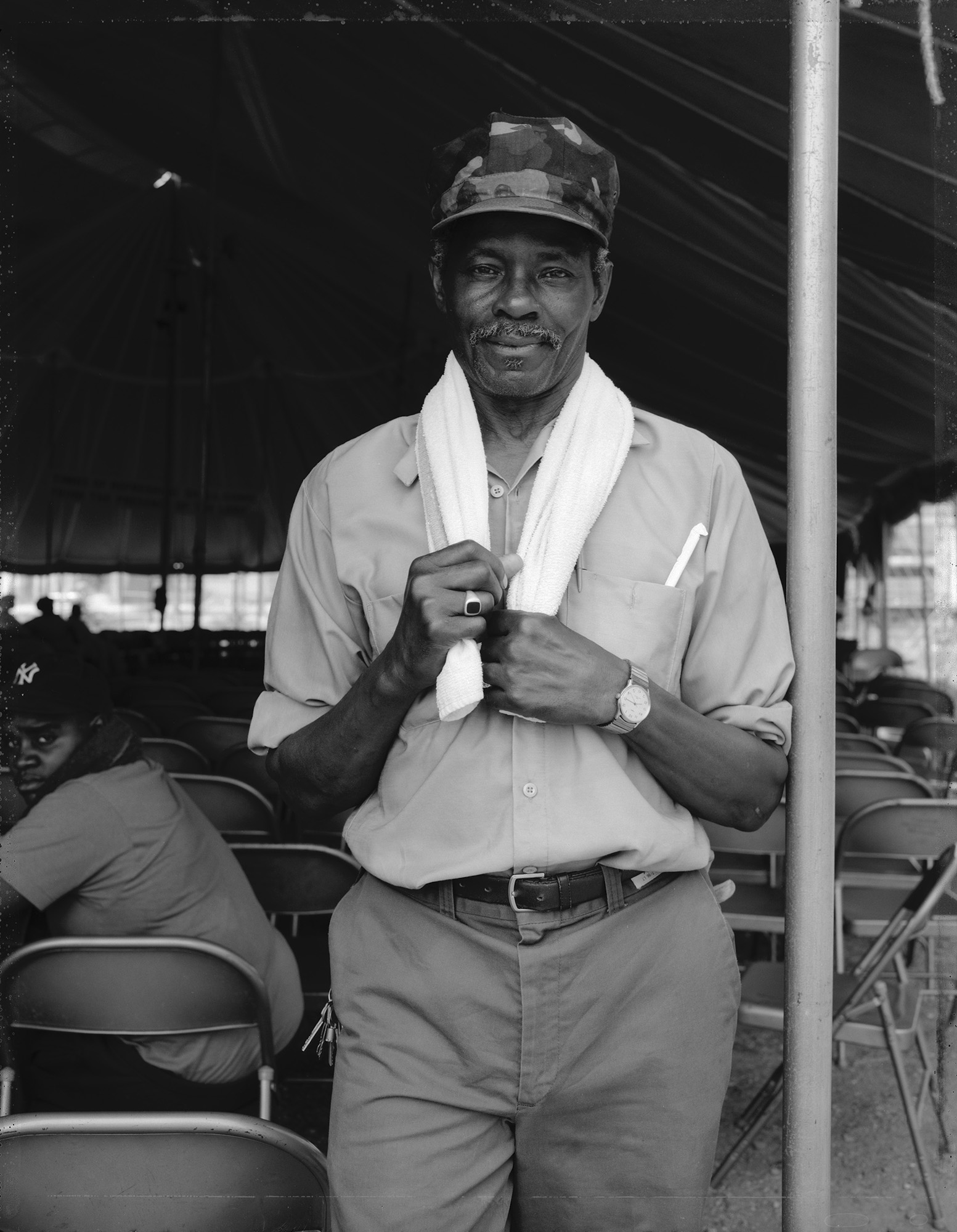
Room 803 Young Man at a Tent Revival, Brooklyn, NY


Dawoud Bey (American, b. 1953) 'Young Man at a Tent Revival, Brooklyn, NY' 1989, printed 2019


Dawoud Bey (American, b. 1953)
Young Man at a Tent Revival, Brooklyn, NY
1989, printed 2019
Pigmented inkjet print
40 × 30 in. (101.6 × 76.2cm)
Courtesy the artist and Sean Kelly Gallery, New York; Stephen Daiter Gallery, Chicago; and Rena Bransten Gallery, San Francisco
© Dawoud Bey


Installation view of 'Dawoud Bey: An American Project' (Whitney Museum of American Art, New York, April 17-October 3, 2021) showing from left to right: (clockwise, from top left) Two Boys, Syracuse, NY, 1985; A Young Man with a Bus Transfer, Syracuse, NY, 1985; Two Boys at a Syracuse Handball Court, Syracuse, NY, 1985; Car in Backyard, Syracuse, NY, 1985; A Young Woman Waiting for the Bus, Syracuse, NY, 1985; A Young Man at the Bus Stop, Syracuse, NY, 1985; Four Teenagers After Church Service, Syracuse, NY, 1985; Combing Hair, Syracuse, NY, 1986; Clothes Drying on the Line, Syracuse, NY, 1985; A Woman and Three Children, Syracuse, NY, 1985; Kenosha II, 1996; Hilary and Taro, Chicago, IL, 1992; A Girl with School Medals, Brooklyn, NY, 1988; A Boy Eating a Foxy Pop, Brooklyn, NY, 1988; A Girl with a Knife Nosepin, Brooklyn, NY, 1990


Installation view of Dawoud Bey: An American Project (Whitney Museum of American Art, New York, April 17 – October 3, 2021). From left to right: (clockwise, from top left) Two Boys, Syracuse, NY, 1985; A Young Man with a Bus Transfer, Syracuse, NY, 1985; Two Boys at a Syracuse Handball Court, Syracuse, NY, 1985; Car in Backyard, Syracuse, NY, 1985; A Young Woman Waiting for the Bus, Syracuse, NY, 1985; A Young Man at the Bus Stop, Syracuse, NY, 1985; Four Teenagers After Church Service, Syracuse, NY, 1985; Combing Hair, Syracuse, NY, 1986; Clothes Drying on the Line, Syracuse, NY, 1985; A Woman and Three Children, Syracuse, NY, 1985; Kenosha II, 1996; Hilary and Taro, Chicago, IL, 1992; A Girl with School Medals, Brooklyn, NY, 1988; A Boy Eating a Foxy Pop, Brooklyn, NY, 1988; A Girl with a Knife Nosepin, Brooklyn, NY, 1990. Photograph by Ron Amstutz


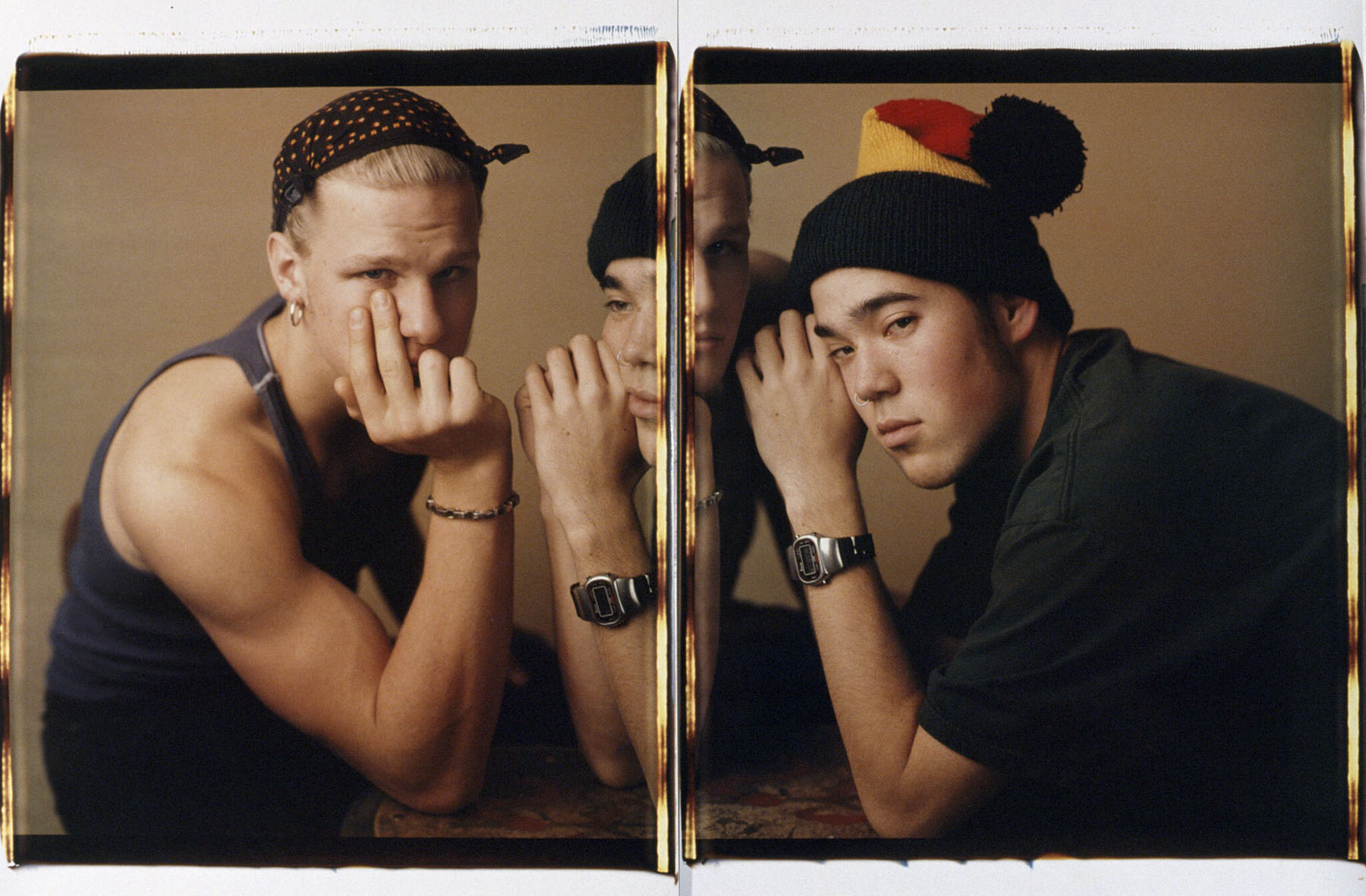
Dawoud Bey (American, b. 1953) 'Hilary and Taro, Chicago, IL' 1992


Dawoud Bey (American, b. 1953)
Hilary and Taro, Chicago, IL
1992
Two dye diffusion transfer prints (Polaroids)
30 1/8 × 44 in. overall (76.5 × 111.8cm)
Whitney Museum of American Art; purchase, with funds from the Photography Committee
© Dawoud Bey


Dawoud Bey (American, b. 1953) 'Max, Celia, Ramon and Candida, New York, NY' 1992


Dawoud Bey (American, b. 1953)
Max, Celia, Ramon and Candida, New York, NY
1992
Three dye diffusion transfer prints (Polaroid)
30 × 67 7/8 in. overall (76.2 × 167.64cm)
Collection of Candida Alvarez
© Dawoud Bey


4

20 × 24 Polaroids

In 1991, Bey began using the 20 × 24-inch camera that the Polaroid Corporation made available to artists through its Artist Support Program. The camera was gargantuan and cumbersome – more than two hundred pounds and over six feet tall and five feet wide – and required two people to operate it, the photographer and a technician. Unlike the chance, and often brief, encounters with his subjects outside when using a 35mm camera, the Polaroid camera studio sessions offered Bey the opportunity to orchestrate all the conditions of the image and to have a more contemplative and sustained engagement with each sitter.

His earliest subjects were his artist friends; later he photographed teenagers that he met through a series of residencies at high schools and museums around the country. Over the course of Bey’s eight-year engagement with the 20 × 24-inch Polaroid camera, he increasingly explored the possibilities of multi-panel portraiture as a way of conveying a sense of the length of a portrait session as well as acknowledging the reality that no one image can fully portray an individual’s complexity.


Room 804 Lorna, New York, NY


Dawoud Bey (American, b. 1953) 'Lorna, New York, NY' 1992


Dawoud Bey (American, b. 1953)
Lorna, New York, NY
1992
Two dye diffusion transfer prints (Polaroid)
30 × 44 in. overall (76.2 × 111.76cm)
Collection of Eileen Harris Norton
© Dawoud Bey


Dawoud Bey (American, b. 1953) 'Martina and Rhonda, Chicago, IL' 1993


Dawoud Bey (American, b. 1953)
Martina and Rhonda, Chicago, IL
1993
Six dye diffusion transfer prints (Polaroid)
48 × 60 in. overall (121.9 × 152.4cm)
Whitney Museum of American Art; gift of Eric Ceputis and David W. Williams
© Dawoud Bey


Reimagining History: Dawoud Bey in conversation with Jason Moran and Sarah M. Broom

On the occasion of the exhibition Dawoud Bey: An American Project, this conversation brings Dawoud Bey together with artist and musician Jason Moran and writer Sarah M. Broom to discuss their shared interest in specific histories and shared memories as the ground for their respective practices.

Inspired by Bey’s The Birmingham Project (2012) – a tribute to the victims of the 16th Street Baptist Church bombing in Birmingham, AL, in 1963 – and Night Coming Tenderly, Black (2019), which imagines the flight of enslaved Black Americans along the final leg of the Underground Railroad, the three speakers reflect on how an artwork can become an act of commemoration and radical reinvention.

Jason Moran is an interdisciplinary artist, musician, and composer who draws on and celebrates the history of Black music and musicians such as James Reese Europe, Thelonious Monk, and Fats Waller, among others.

Sarah M. Broom is the author of The Yellow House, a memoir that weaves the story of her family in New Orleans across multiple generations.


Installation view of 'Dawoud Bey: An American Project' (Whitney Museum of American Art, New York, April 17-October 3, 2021) showing from left to right, from Class Pictures: Kevin, Phillips Academy, Andover, MA, 2005; Simone, Kenwood Academy, Chicago, IL, 2003; Danny, Fashion Industries High School, New York, NY, 2006


Installation view of Dawoud Bey: An American Project (Whitney Museum of American Art, New York, April 17 – October 3, 2021). From left to right, from Class PicturesKevin, Phillips Academy, Andover, MA, 2005; Simone, Kenwood Academy, Chicago, IL, 2003; Danny, Fashion Industries High School, New York, NY, 2006. Photograph by Ron Amstutz


Dawoud Bey (American, b. 1953) 'Kevin, Phillips Academy, Andover, MA' 2005


Dawoud Bey (American, b. 1953)
Kevin, Phillips Academy, Andover, MA
2005
From Class Pictures
Pigmented inkjet print
40 × 32 in. (101.6 × 81.3cm)
Collection of the artist; courtesy Sean Kelly Gallery, New York; Stephen Daiter Gallery, Chicago; and Rena Bransten Gallery, San Francisco
© Dawoud Bey


5

Class Pictures

Bey has long understood that the act of representation – as well as the corollary act of being seen – is both powerful and political. In Class Pictures (1992-2006) he once again turned his attention to teenagers, a population he felt was underrepresented and misjudged, seen either as “socially problematic or as engines for a certain consumerism.” The series originated during a residency at the Smart Museum of Art in Chicago, where Bey began working with local high-school students; during residencies at other museums and schools around the country, he expanded the project to capture a geographically and socioeconomically diverse slice of American adolescence.

Working in empty classrooms between class periods, Bey made careful and tender formal colour portraits of teens. He then invited them to write brief autobiographical statements to accompany their images, giving his subjects voice as well as visibility. Many of the residencies also included a curatorial project with the students using works in the museums’ collections. While the photographs and texts are what remain of these projects, it is the collaborative undertaking that Bey considers the work of Class Pictures.


Dawoud Bey (American, b. 1953) 'Jordan, School of the Arts, San Francisco, CA' 2006


Dawoud Bey (American, b. 1953)
Jordan, School of the Arts, San Francisco, CA
2006
From Class Pictures
Pigmented inkjet print
40 × 32 in. (101.6 × 81.3cm)
Collection of the artist; courtesy Sean Kelly Gallery, New York; Stephen Daiter Gallery, Chicago; and Rena Bransten Gallery, San Francisco
© Dawoud Bey


Dawoud Bey (American, b. 1953) 'Omar, Phillips Academy, Andover, MA' 2005, printed 2019


Dawoud Bey (American, b. 1953)
Omar, Phillips Academy, Andover, MA
2005, printed 2019
From Class Pictures
Pigmented inkjet print
40 × 32 in. (101.6 × 81.3cm)
Collection of the artist; courtesy Sean Kelly Gallery, New York; Stephen Daiter Gallery, Chicago; and Rena Bransten Gallery, San Francisco
© Dawoud Bey


Room 805 Omar, Phillips Academy, Andover, MA


Dawoud Bey (American, b. 1953) 'Omar, Phillips Academy, Andover, MA' 2005, printed 2019


Dawoud Bey (American, b. 1953)
Omar, Phillips Academy, Andover, MA (detail)
2005, printed 2019
From Class Pictures
Pigmented inkjet print
40 × 32 in. (101.6 × 81.3cm)
Collection of the artist; courtesy Sean Kelly Gallery, New York; Stephen Daiter Gallery, Chicago; and Rena Bransten Gallery, San Francisco
© Dawoud Bey


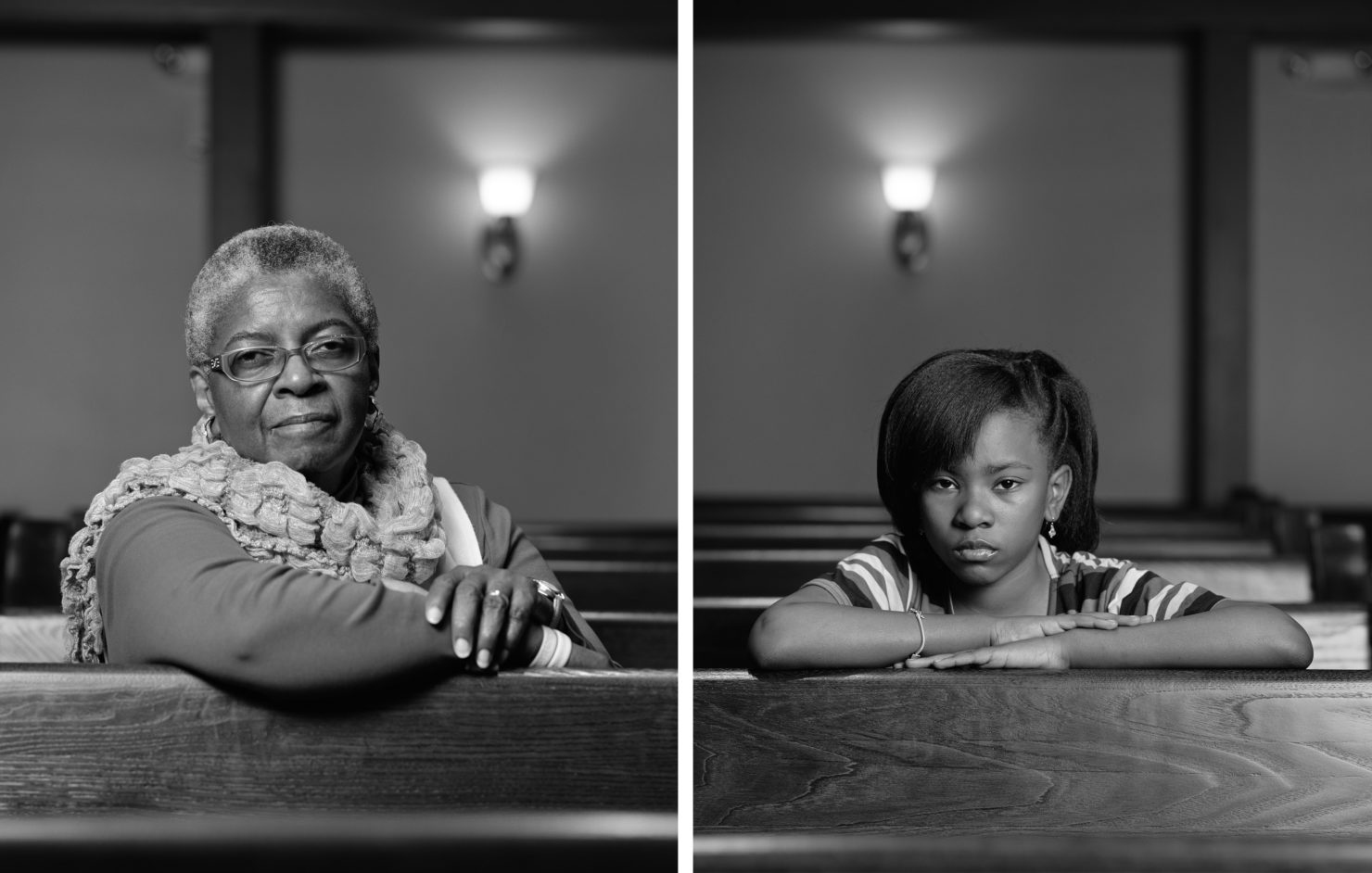
Dawoud Bey (American, b. 1953) 'Braxton McKinney and Lavone Thomas, Birmingham, AL' 2012


Dawoud Bey (American, b. 1953)
Braxton McKinney and Lavone Thomas, Birmingham, AL
2012
From The Birmingham Project
Pigmented inkjet prints
40 × 32 in. each (101.6 × 81.3cm each)
Rennie Collection, Vancouver
© Dawoud Bey


6

The Birmingham Project

On September 15, 1963, the Ku Klux Klan bombed the 16th Street Baptist Church in Birmingham, Alabama, murdering four Black girls – Addie Mae Collins, Denise McNair, Carole Robertson, and Cynthia Wesley – inside. Two Black boys – Johnny Robinson and Virgil Ware – were also killed in racially motivated violence later that day. Bey’s series The Birmingham Project (2012) commemorated the fiftieth anniversary of this horrific event. The artist made formal portraits of Birmingham residents, pairing children the same ages as the victims with adults fifty years older – the ages the victims would have been had they lived.

Bey said of the experience making these works: “To think of someone striking such a young life down with impunity is a renewed horror each time a young person sits in front of my camera. To see the older men and women, having lived rich full lives, reminds me constantly of the tragically abbreviated lives of those six young people.” Bey made the portraits in two locations: Bethel Baptist Church, an early headquarters for the civil rights movement in Birmingham, and the Birmingham Museum of Art, which in 1963 was a segregated space that admitted Black visitors only one day a week. The resulting works both honour the tragic loss of the six children and make plain the continued impact of violence, trauma, and racism.


Dawoud Bey (American, b. 1953) 'Betty Selvage and Faith Speights, Birmingham, AL' 2012


Dawoud Bey (American, b. 1953)
Betty Selvage and Faith Speights, Birmingham, AL
2012
From The Birmingham Project
Pigmented inkjet prints
40 × 32 in. each (101.6 × 81.3cm each)
Rennie Collection, Vancouver
© Dawoud Bey


Installation view of 'Dawoud Bey: An American Project' (Whitney Museum of American Art, New York, April 17-October 3, 2021) showing grom left to right, from The Birmingham Project: Braxton McKinney and Lavon Thomas, 2012; Betty Selvage and Faith Speights, 2012; Jean Shamburger and Kyrian McDaniel, 2012


Installation view of Dawoud Bey: An American Project (Whitney Museum of American Art, New York, April 17 – October 3, 2021). From left to right, from The Birmingham Project: Braxton McKinney and Lavon Thomas, 2012; Betty Selvage and Faith Speights, 2012; Jean Shamburger and Kyrian McDaniel, 2012. Photograph by Ron Amstutz


Installation view of 'Dawoud Bey: An American Project' (Whitney Museum of American Art, New York, April 17-October 3, 2021) showing 'Mathis Menefee and Cassandra Griffin', from 'The Birmingham Project', 2012


Installation view of Dawoud Bey: An American Project (Whitney Museum of American Art, New York, April 17 – October 3, 2021). Mathis Menefee and Cassandra Griffin, from The Birmingham Project, 2012. Photograph by Ron Amstutz


Room 103 Mathis Menefee and Cassandra Griffin


Dawoud Bey (American, b. 1953) 'Mathis Menefee and Cassandra Griffin, Birmingham, AL' 2012


Dawoud Bey (American, b. 1953)
Mathis Menefee and Cassandra Griffin, Birmingham, AL
2012
From The Birmingham Project
Pigmented inkjet prints
40 × 64 in. each (101.6 × 162.56cm each)
Rennie Collection, Vancouver
© Dawoud Bey


Dawoud Bey (American, b. 1953) 'West 124th Street and Lenox Avenue, NY' 2016, printed 2019


Dawoud Bey (American, b. 1953)
West 124th Street and Lenox Avenue, NY
2016, printed 2019
From Harlem Redux
Pigmented inkjet print
40 3/8 × 48 1/4 × 2 in. overall (102.6 × 122.6 × 5.1cm)
Collection of the artist; courtesy Sean Kelly Gallery, New York; Stephen Daiter Gallery, Chicago; and Rena Bransten Gallery, San Francisco
© Dawoud Bey


7

Harlem Redux

In 2014, Bey began the series of which this work is a part, Harlem Redux. It marked a return to the neighbourhood, where four decades earlier he had made his first critically acclaimed body of work, Harlem, U.S.A. If the earlier series is a love letter to the historic epicentre of Black community and culture in the United States, Harlem Redux (2014-17) is an incisive and elegiac look at its recent, rapid transformation and gentrification. Bey used a medium-format camera and made the pictures large scale and in colour, techniques common to contemporary photography practices, in order to signal that these changes are taking place now, and not in a historical moment.

This series commemorates sites of cultural significance in Harlem – such as the legendary jazz club the Lenox Lounge, which was demolished not long after Bey’s photograph was made – and makes evident the impacts of otherwise invisible socioeconomic forces. In his words, Harlem is now a neighbourhood “increasingly defined by a sense of ‘erase and replace’, wherein pieces of social and cultural history, along with memory itself, are routinely discarded.”


Dawoud Bey (American, b. 1953) 'Young Man, West 127th Street, Harlem, NY' 2015, printed 2019


Dawoud Bey (American, b. 1953)
Young Man, West 127th Street, Harlem, NY
2015, printed 2019
From Harlem Redux
Pigmented inkjet print
40 3/8 × 48 1/4 × 2 in. overall (102.6 × 122.6 × 5.1cm)
Collection of the artist; courtesy Sean Kelly Gallery, New York; Stephen Daiter Gallery, Chicago; and Rena Bransten Gallery, San Francisco
© Dawoud Bey


Room 801 Girls, Ornaments, and Vacant Lot


Dawoud Bey (American, b. 1953) 'Girls, Ornaments, and Vacant Lot, NY' 2016, printed 2019


Dawoud Bey (American, b. 1953)
Girls, Ornaments, and Vacant Lot, NY
2016, printed 2019
From Harlem Redux
Pigmented inkjet print
40 3/8 × 48 1/4 × 2 in. (102.6 × 122.6 × 5.1cm)
Collection of the artist; courtesy Sean Kelly Gallery, New York; Stephen Daiter Gallery, Chicago; and Rena Bransten Gallery, San Francisco
© Dawoud Bey


Dawoud Bey (American, b. 1953) 'Untitled #21 (Farmhouse and Picket Fence II)' 2017


Dawoud Bey (American, b. 1953)
Untitled #21 (Farmhouse and Picket Fence II)
2017
from Night Coming Tenderly, Black
Gelatin silver print
44 × 54 5/8 in. (111.8 × 138.7cm)
Whitney Museum of American Art, New York; purchase, with funds from the Photography Committee, in honour of Sondra Gilman
© Dawoud Bey


8

Night Coming Tenderly, Black

Bey’s most recent work imagines the flight of enslaved Black Americans along the leg of the Underground Railroad that operated in Ohio – the last fifty or so miles before they reached the vast expanse of Lake Erie, on the other side of which lay Canada, and freedom. As a covert network of safe houses and churches, the sites of the Underground Railroad were by necessity secret. Bey’s photographs suggest the experience of the journey and the landscapes and buildings that may have provided protection along the way. Night Coming Tenderly, Black (2017) marks the first time in his career that Bey turned completely to landscape photography, removing the presence of the figure entirely.

Nonetheless, the images imply the perspective of the individuals whose invisibility was requisite for their safety. Their large scale and rich black tones invite the viewer to engage their own body in the act of looking, taking time for their eyes to adjust and moving around to register the entirety of each image. The series pays homage to two Black American artists, the photographer Roy DeCarava and the poet Langston Hughes. DeCarava’s influence can be seen in the lush and protective darkness of the prints, while the project’s title is drawn from the final couplet of Hughes’s “Dream Variations”: “Night coming tenderly / Black like me.”


Dawoud Bey (American, b. 1953) 'Untitled #24 (At Lake Erie)' 2017


Dawoud Bey (American, b. 1953)
Untitled #24 (At Lake Erie)
2017
from Night Coming Tenderly, Black
Gelatin silver print
48 × 55 in. (121.9 × 139.7cm)
Whitney Museum of American Art, New York; purchase, with funds from the Photography Committee, in honour of Sondra Gilman
© Dawoud Bey


Room 806 Untitled #25 (Lake Erie and Sky)


Dawoud Bey (American, b. 1953) 'Untitled #25 (Lake Erie and Sky)' 2017


Dawoud Bey (American, b. 1953)
Untitled #25 (Lake Erie and Sky)
2017
From Night Coming Tenderly, Black
Gelatin silver print
44 × 55 in. (111.8 × 139.7cm)
San Francisco Museum of Modern Art; Accessions Committee Fund purchase
© Dawoud Bey


Whitney Museum of American Art
99 Gansevoort Street
New York, NY 10014
Phone: (212) 570-3600

Opening hours:
Mondays: 10.30am – 6pm
Tuesdays: Closed
Wednesdays, Thursdays, Saturdays and Sundays: 10.30am – 6pm
Friday: 10.30am – 10pm

Whitney Museum of American Art website

LIKE ART BLART ON FACEBOOK

Back to top

Exhibition: ‘Dawoud Bey: An American Project’ at the High Museum of Art, Atlanta

Exhibition dates: 7th November, 2020 – 14th March, 2021

Curator: Sarah Kennel, the High’s Donald and Marilyn Keough Family curator of photography


Dawoud Bey (American, b. 1953) 'A Man in a Bowler Hat, Harlem, NY, 1976' 1976 from the exhibition 'Dawoud Bey: An American Project' at the High Museum of Art, Atlanta, Nov 2020 - March 2021


Dawoud Bey (American, b. 1953)
A Man in a Bowler Hat, Harlem, NY, 1976
1976
Gelatin silver print
© Dawoud Bey


Early in his career, Bey realised the importance of collaborating with his subjects to make a picture that would also serve as a dialogue between artist and subject: “I wanted to photograph this man in the bowler hat who was talking to a group of three friends and I had no idea how to interrupt their conversation in order to do so. This is when I first realised that it wasn’t just about the photograph; it was also about establishing a relationship out of which comes the photograph.”


I have always admired artists who have a social conscience, who investigate their subject matter with intelligence, empathy and insight.

I have always admired artist who examine their subject matter from different perspectives, turning the diamond of the world in light, to probe the moral and existential questions of existence.

I have always admired artists who develop their practice, never repeating for the sake of it the same constructs over and over – from a lack of imagination, to be successful, or to follow the money trail.

One such artist is Dawoud Bey.

From formal to informal portraiture, through conceptual “bodies”, Bey’s work visualises Black American history in the present moment, not by using the trope of reusing colonial photographs or memorabilia, but by presenting afresh the history of injustice enacted on a people and a culture, picturing their ongoing pain and disenfranchisement – in the here and now – through powerful and deeply political photographs. As the press release observes, Bey “has used his camera to create poignant meditations on visibility, race, place, and American history.”

“His art is grounded in the concept of citizenship, community and belonging, and especially in centring the experiences and histories of Black Americans at the forefront of our culture. His photographs actively work to provide space, voice and visibility for communities who have long been excluded from dominant narratives, especially in institutions like museums.”

From his early street photographs through the later large format Polaroid work and on to the conceptual series, Bey’s photographs have an engaging directness and candour to them. There are no photographic or subjective histrionics here, just immensely rich social documentary photographs that speak truth to subject. The subjects stare directly at the camera and reveal themselves with a poignant honesty.

The series that affected me most deeply was The Birmingham Project.

“On September 15, 1963, the Ku Klux Klan dynamited the 16th Street Baptist Church in Birmingham, Alabama, murdering four African American girls inside. Two Black boys were also killed later that same day in the violence that ensued. Bey’s series The Birmingham Project commemorated the fiftieth anniversary of this horrific event, rendering it painfully immediate. Bey made formal portraits of Birmingham children the same ages as the victims and adults fifty years older – the ages the victims would have been had they lived. He then paired the photographs in diptychs that both honour the community’s unthinkable loss and make tangible the continued impact of racism, violence, and trauma in the present.”

All the suffering, all the ongoing pain and misery of an unfair world was, to me, wrapped up in these unforgettable images. The violence against other human beings, against people of difference 50 years ago brought into the present. Thinking about what these people could have achieved in the world, what life they would have led, what they would have looked like. Photography transcending time and space, Bey intelligently bringing past into present future. As Bey says, “I wanted to give those young people a more tangible, less-mythic, palpable presence… I wanted to figure out how to show the passage of time and the tragic loss of possibility.”

In my imagination I try to construct this tragic loss of possibility through the agency of Bey’s photographs. They produce sadness, anger, and empathy in me. They bring the possibility of change to the forefront of my mind, and an acknowledgment that we can all do better, that the world must do better. And that experience is a powerful thing.

Dr Marcus Bunyan.


Many thankx to the High Museum of Art for allowing me to publish the photographs in the posting. Please click on the photographs for a larger version of the image.


“I’ve come to believe that the best works tend to result not from the imposition of an idea on a situation, but to be responsive to what’s going on once you get there.”

“How can one visualise African American history and make that history resonate in the contemporary moment?”


Dawoud Bey


“Dreams are spaces that do not yet exist, except by escape through an unknown night.”


Anna Mirzayan


“I Never Had White Folks That Was Good To Me, EVER… We all worked jest like dogs and had about half enough to eat and got whupped for everything. Our days was a constant misery to us… My old Master was Dave Giles, the meanest man that ever lived. He didn’t have many slaves, my mammy, and me, and my sister, Uncle Bill, and Truman. He had owned my grandma but he give her a bad whupping and she never did git over it and died. We all done as much work as a dozen niggers – we knowed we had to. I seen old Master git mad at Truman and he buckled him down across a barrel and whupped him till he cut the blood out of him and then he rubbed salt and pepper in the raw places. It looked like Truman would die it hurt so bad. I know that don’t sound reasonable that a white man in a Christian community would do such a thing but you can’t realise how heartless he was. People didn’t know about it and we dassent tell for we knowed he’d kill us if we did. You must remember he owned us body and soul and they wasn’t anything we could do about it. Old Mistress and her three girls was mean to us too. One time me and my sister was spinning and old Mistress went to the well-house and she found a chicken snake and killed it. She brought it back and she throwed it around my sister’s neck. She jest laughed and laughed about it. She thought it was a big joke. Old Master stayed drunk all the time. I reckon that is the reason he was so fetched mean. My, how we hated him! He finally killed hisself drinking and I remember Old Mistress called us in to look at him in his coffin. We all marched by him slow like and I jest happened to look up and caught my sister’s eye and we both jest natchelly laughed – Why shouldn’t we? We was glad he was dead. It’s a good thing we had our laugh fer old Mistress took us out and whupped us with a broomstick. She didn’t make us sorry though.”


Annie Hawkins, formerly enslaved Afrikan who was sold from Georgia to Texas. This interview was done in Colbert, Oklahoma where her and her family moved after emancipation. Interview, conducted Spring, 1937 with a date stamp of August 16, 1937. Ms. Hawkins was 90 years old at the time of the interview and what she relates occurred in Texas. Source: Library of Congress


Since the beginning of his career in the 1970s, Dawoud Bey (American, b. 1953) has used his camera to create poignant meditations on visibility, race, place, and American history. From early street portraits made in Harlem to a recent series imagining an escape from slavery on the Underground Railroad, Bey explores photography’s potential to reveal communities and stories that have been underrepresented or even unseen. Both a form of personal expression and an act of political responsibility, Bey’s art insists on the power of photography to transform stereotypes, convene communities, and create dialogue.

Dawoud Bey: An American Project traces these through lines across the forty-five years of Bey’s career and his profound engagement with the young Black subject and African American history. The title intentionally inserts his photographs into a long-running conversation about what it means to represent America with a camera. The questions of who is considered an American photographer, or simply an American, and whose story is an American story are particularly urgent today. Bey’s work offers a potent corrective to the gaps in our picture of American society and history – and an emphatic reminder of the ongoing impact of those omissions.


Dawoud Bey on visualising history

Photographer Dawoud Bey’s work grapples with history. The artist asks, “How can one visualise African American history and make that history resonate in the contemporary moment?” Here he discusses several series, sited from Harlem to Birmingham to the Underground Railroad routes of northeastern Ohio, each of which works to make histories visible.


Dawoud Bey: An American Project – Part 1


Dawoud Bey (American, b. 1953) 'A Boy in Front of the Loew's 125th Street Movie Theater, Harlem, NY, 1976' 1976 from the exhibition 'Dawoud Bey: An American Project' at the High Museum of Art, Atlanta, Nov 2020 - March 2021


Dawoud Bey (American, b. 1953)
A Boy in Front of the Loew’s 125th Street Movie Theater, Harlem, NY, 1976
1976
Gelatin silver print
© Dawoud Bey


The Street

Bey’s landmark black-and-white 1975-78 series “Harlem, USA” documents portraits and street scenes with locals of the historic neighbourhood in New York. As a young man growing up in Queens, Bey was intrigued by his family’s history in Harlem, where his parents met and where he visited family and friends throughout childhood. The series premiered at the Studio Museum in Harlem in 1979, when Bey was just 26.


Dawoud Bey (American, b. 1953) 'A Woman at Convent Avenue Baptist Church, Harlem, NY, 1977' 1977


Dawoud Bey (American, b. 1953)
A Woman at Convent Avenue Baptist Church, Harlem, NY, 1977
1977
Gelatin silver print
11 x 14 inches
Image courtesy of the artist and Stephen Daiter Gallery, Chicago
© Dawoud Bey


In his hands, portraiture conveys contradiction – diffident joy, resistant sorrow – and tells the truth.


Dawoud Bey (American, b. 1953) 'Three Women at a Parade, Harlem, NY, 1978' 1978


Dawoud Bey (American, b. 1953)
Three Women at a Parade, Harlem, NY, 1978
1978
Gelatin silver print
© Dawoud Bey


“His art is grounded in the concept of citizenship, community and belonging, and especially in centring the experiences and histories of Black Americans at the forefront of our culture. His photographs actively work to provide space, voice and visibility for communities who have long been excluded from dominant narratives, especially in institutions like museums.”


Dawoud Bey (American, b. 1953) 'Two Boys at a Handball Court, Syracuse, NY, 1985' 1985


Dawoud Bey (American, b. 1953)
Two Boys at a Handball Court, Syracuse, NY, 1985
1985
Gelatin silver print
© Dawoud Bey


Throughout the 1980s, Bey continued to use a handheld 35 mm camera. This lightweight apparatus allowed him to respond intuitively and quickly to whatever captivated his eye, and his photographs during this time reflect his knowledge of contemporary street photography and his growing interest in capturing flux, movement, and the play of light and shadow. Although he continued to photograph people, he moved away from formal portraiture, instead endeavouring to capture individuals in more spontaneous ways.


Dawoud Bey (American, b. 1953) 'Clothes Drying on the Line, Syracuse, NY, 1985' 1985


Dawoud Bey (American, b. 1953)
Clothes Drying on the Line, Syracuse, NY, 1985
1985
Gelatin silver print
20 x 24 inches
Image courtesy of the artist and Stephen Daiter Gallery, Chicago
© Dawoud Bey


Dawoud Bey (American, b. 1953) 'Combing Hair, Syracuse, NY, 1986' 1986


Dawoud Bey (American, b. 1953)
Combing Hair, Syracuse, NY, 1986
1986
Gelatin silver print
© Dawoud Bey


In 1985, during a residency at Light Work, a photography nonprofit affiliated with Syracuse University, New York, Bey photographed the city’s African American community. For him, it was both a political and aesthetic choice: “By then I felt that was part of my agenda: to make the African American subject a visible and resonant presence through my photographs […] it was as much about making a certain kind of photograph, and operating within a certain tradition, as it was a deliberate choice to foreground the black subject […] giving them a place … on the wall of galleries and museums.”


Dawoud Bey (American, b. 1953) 'A Woman at Fulton Street and Washington Avenue, Brooklyn, NY, 1988' 1988


Dawoud Bey (American, b. 1953)
A Woman at Fulton Street and Washington Avenue, Brooklyn, NY, 1988
1988
Gelatin silver print
© Dawoud Bey


By the end of the 1980s, Bey had thoroughly digested the lessons of working spontaneously with a small camera and desired to work in a way that would allow him to engage more directly with his subjects. He began to make formal “street portraits” with a large-format (4 × 5-inch) camera and Polaroid Type 55 film, which produced both instant pictures that he gave to the sitters and negatives that he used to make large-scale, highly detailed prints that could be enlarged to create monumental portraits. Bey was increasingly ambivalent about the ethics of traditional documentary photography and sought more equitable, reciprocal relationships with his sitters. He began to approach the strangers he wished to portray openly and deliberately, giving, as he writes, “the black subjects [a space] to assert themselves and their presence in the world, with their gaze meeting the viewer’s on equal footing.”


Dawoud Bey (American, b. 1953) 'A Young Man Resting on an Exercise Bike, Amityville, NY, 1988' 1988


Dawoud Bey (American, b. 1953)
A Young Man Resting on an Exercise Bike, Amityville, NY, 1988
1988
Gelatin silver print
© Dawoud Bey


Dawoud Bey (American, b. 1953) 'A Young Girl Striking A Pose, Brooklyn, NY, 1988' 1988


Dawoud Bey (American, b. 1953)
A Young Girl Striking A Pose, Brooklyn, NY, 1988
1988
Gelatin silver print
© Dawoud Bey


Dawoud Bey (American, b. 1953) 'A Young Man with Buttons Brooklyn NY 1988' 1988


Dawoud Bey (American, b. 1953)
A Young Man with Buttons Brooklyn NY 1988
1988
Gelatin silver print
© Dawoud Bey


Dawoud Bey (American, b. 1953) 'A Young Woman Coming from the Store, Rochester, NY 1989' 1989


Dawoud Bey (American, b. 1953)
A Young Woman Coming from the Store, Rochester, NY 1989
1989
Gelatin silver print
© Dawoud Bey


Dawoud Bey (American, b. 1953) 'A Young Man with His Hair Brush, Rochester, NY 1989' 1989


Dawoud Bey (American, b. 1953)
A Young Man with His Hair Brush, Rochester, NY 1989
1989
Gelatin silver print
© Dawoud Bey


Dawoud Bey (American, b. 1953) 'Alfonso, Washington, DC, 1989' 1989


Dawoud Bey (American, b. 1953)
Alfonso, Washington, DC, 1989
1989
Gelatin silver print
© Dawoud Bey


Dawoud Bey (American, b. 1953) 'A Woman Wearing Denim, Rochester, NY 1989' 1989


Dawoud Bey (American, b. 1953)
A Woman Wearing Denim, Rochester, NY 1989
1989
Gelatin silver print
© Dawoud Bey


Dawoud Bey (American, b. 1953) 'A Man with a Towel, Brooklyn, NY 1989' 1989


Dawoud Bey (American, b. 1953)
A Man with a Towel, Brooklyn, NY 1989
1989
Gelatin silver print
© Dawoud Bey


Dawoud Bey (American, b. 1953) 'Poppy Brooklyn, NY, 1989' 1989


Dawoud Bey (American, b. 1953)
Poppy, Brooklyn, NY, 1989
1989
Gelatin silver print
© Dawoud Bey


Dawoud Bey (American, b. 1953) 'A Girl Holding a Hotdog and Gum, Brooklyn, NY, 1989' 1989


Dawoud Bey (American, b. 1953)
A Girl Holding a Hotdog and Gum, Brooklyn, NY, 1989
1989
Gelatin silver print
© Dawoud Bey


Dawoud Bey (American, b. 1953) 'A Couple in Prospect Park, Brooklyn, NY, 1990' 1990


Dawoud Bey (American, b. 1953)
A Couple in Prospect Park, Brooklyn, NY, 1990
1990
Gelatin silver print
© Dawoud Bey


Few images of tenderness have such resounding power as this lush portrait of a young, stylish couple embracing in Brooklyn’s Prospect Park. Note how perfectly their bodies fit together as he relaxes his shoulders, allowing her to easily wrap her arms around him protectively, declaring with the upward tilt of her chin and her direct gaze at us that they are together, united in love. Pictures as openly intimate as this one emerged from Bey’s deep and abiding interest in “wanting to describe the Black subject in a way that’s as complex as the experiences of anyone else.”


Dawoud Bey (American, b. 1953) 'Two Girls from a Marching Band, Harlem, NY, 1990' 1990


Dawoud Bey (American, b. 1953)
Two Girls from a Marching Band, Harlem, NY, 1990
1990
Gelatin silver print
Courtesy of the artist, Sean Kelly Gallery, Stephen Daiter Gallery, and Rena Bransten Gallery
© Dawoud Bey


For more than four decades, renowned photographer Dawoud Bey has created powerful and tender photographs that portray underrepresented communities and explore African American history. From portraits in Harlem and classic street photography to nocturnal landscapes and large-scale studio portraits, his works combine an ethical imperative with an unparalleled mastery of his medium. The High Museum of Art celebrates his important contributions to photography as the exclusive Southeast venue for Dawoud Bey: An American Project, the artist’s first full career retrospective in 25 years.

Co-organised by the San Francisco Museum of Modern Art (SFMOMA) and the Whitney Museum of American Art, New York, the exhibition features approximately 80 works that span the breadth of Bey’s career, from his earliest street portraits made in Harlem in the 1970s to his most recent series reimagining sites of the Underground Railroad (2017).

The High has enjoyed a long and fruitful relationship with Bey, who was commissioned in 1996 for the Museum’s inaugural “Picturing the South” series, which asks noted photographers to turn their lens toward the American South. For his project, Bey collaborated with Atlanta high school students to create empathetic, larger-than-life portraits. Made with the monumental 20-by-24-inch Polaroid camera, these photographs explore the complexity of adolescence as a time of critical identity formation and expand the concept of portraiture. The High now holds more than 50 photographs by Bey, one of the most significant museum collections of his work.

“Bey’s portraits are remarkable for their keen sensitivity and for how they elicit and honour their subjects’ sense of self, which is partly an outcome of the artist’s collaborative practice,” remarked Sarah Kennel, the High’s Donald and Marilyn Keough Family curator of photography. “Given the museum’s long relationship with Bey and the strength of our holdings, we are thrilled to present this important retrospective. We look forward to sharing the artist’s photographs and his powerful and moving reflections on African American history and identity in their country with our visitors.”

Bey, born in 1953 in Queens, New York, began to develop an interest in photography as a teenager. He received his first camera as a gift from his godmother in 1968, and the next year, he saw the exhibition “Harlem on My Mind” at The Metropolitan Museum of Art. Widely criticised for its failure to include significant numbers of artworks by African Americans, the exhibition’s representation of Black subjects nonetheless made an impression on Bey and inspired him to develop his own documentary project about Harlem in 1975. Since that time, he has worked primarily in portraiture, making tender, psychologically rich and direct portrayals, often in collaboration with his subjects. More recently, he has explored seminal moments in African American history through both portraiture and landscape.

Dawoud Bey: An American Project includes work from the artist’s eight major series and is organised to reflect the development of Bey’s vision throughout his career and to highlight his enduring engagement with portraiture, place and history.

Press release from The High Museum of Art


Installation view of the exhibition 'Dawoud Bey: An American Project' at the High Museum of Art, Atlanta

Installation view of the exhibition 'Dawoud Bey: An American Project' at the High Museum of Art, Atlanta


Installation views of the exhibition Dawoud Bey: An American Project at the High Museum of Art, Atlanta.
Images courtesy of the artist and High Museum. Photos by Mike Jensen.


Dawoud Bey


Dawoud Bey
Photo: Sean Kelly Gallery


About Dawoud Bey

Dawoud Bey was born in Queens, New York, and began his career as a photographer in 1975 with a series of photographs, Harlem, USA, that were later exhibited in his first solo exhibition at the Studio Museum in Harlem in 1979.

Since then his work has been featured in exhibitions at numerous institutions worldwide, including the Addison Gallery of American Art, Andover, Massachusetts; the Art Institute of Chicago; the Brooklyn Museum; the Detroit Institute of Arts; the Fogg Museum, Harvard University; the High Museum of Art, Atlanta; the Museum of Contemporary Art, Chicago; the Museum of Contemporary Photography (MoCP), Chicago; the National Gallery of Art, Washington, D.C.; and the Walker Art Center, Minneapolis, among many others.

His photographs are represented in collections worldwide, and his critical writings on photography have appeared in numerous publications and exhibition catalogues. Bey received the prestigious MacArthur “Genius” fellowship in 2017 and is also the recipient of fellowships from the Guggenheim Foundation and the National Endowment for the Arts. He holds a Master of Fine Arts degree from Yale University and is currently Professor of Art and a Distinguished College Artist at Columbia College Chicago, where he has taught since 1998.


Dawoud Bey (American, b. 1953) 'Gerard, Edgewater High School, Orlando, FL, 2003' 2003


Dawoud Bey (American, b. 1953)
Gerard, Edgewater High School, Orlando, FL, 2003
2003
Inkjet print
© Dawoud Bey


Behind his Class Pictures series:

“It was a sort of snapshot of America through its young people at that particular moment. I started working in Chicago, then to New York, California and Florida. I wanted it to be geographically representative of the country. I’ve always been acutely aware that photographs tell you a lot less than what they do tell you. There’s certain things you would never know just from looking at them. You wouldn’t know from a portrait if someone is an only child, whether they have siblings, who their parents are. There’s a lot of information outside of a photograph. For Class Pictures, I thought that was important to bring that information into the construct of work and to create a space of self-representation. The young people who I photographed could give a sense of who they were.”

Summer Evans. “Photographer Dawoud Bey Shines A Light On America’s Underrepresented Communities,” on the WABE website Nov 18, 2020 [Online] Cited 01/03/2021


Dawoud Bey (American, b. 1953) 'Usha, Gateway High School, San Francisco, CA, 2006' 2006


Dawoud Bey (American, b. 1953)
Usha, Gateway High School, San Francisco, CA, 2006
2006
Inkjet print
© Dawoud Bey


Bey has long understood that the act of representation – as well as the corollary act of being seen – is both powerful and deeply political. In this series, he once again turned his attention to teenagers, a population he felt was underrepresented and misjudged, seen either as “socially problematic or as engines for a certain consumerism.” Class Pictures (2001-2006) originated during a residency at the Smart Museum of Art in Chicago, where Bey began working with local high school students. He later expanded it to capture a geographically and socioeconomically diverse slice of American adolescence.

Working in empty classrooms between class periods, Bey made formal colour portraits of teens that attend, carefully and tenderly, to their gestures and expressions. He also invited them to write brief autobiographical statements, giving his subjects visibility as well as voice. Class Pictures can also be understood as a play on words, for in several cases, Bey chose to photograph students at elite private schools as well as teens from nearby, poorer neighbourhoods, bringing together these subjects in a single space.


Dawoud Bey (American, b. 1953) 'Don Sledge and Moses Austin' 2012


Dawoud Bey (American, b. 1953)
Don Sledge and Moses Austin
2012
From The Birmingham Project
Inkjet prints
Rennie Collection, Vancouver
© Dawoud Bey


On September 15, 1963, the Ku Klux Klan dynamited the 16th Street Baptist Church in Birmingham, Alabama, murdering four African American girls inside. Two Black boys were also killed later that same day in the violence that ensued. Bey’s series The Birmingham Project commemorated the fiftieth anniversary of this horrific event, rendering it painfully immediate. Bey made formal portraits of Birmingham children the same ages as the victims and adults fifty years older – the ages the victims would have been had they lived. He then paired the photographs in diptychs that both honour the community’s unthinkable loss and make tangible the continued impact of racism, violence, and trauma in the present.


Dawoud Bey (American, b. 1953) 'Mary Parker and Caela Cowan' 2012


Dawoud Bey (American, b. 1953)
Mary Parker and Caela Cowan
2012
From The Birmingham Project
Inkjet prints
Rennie Collection, Vancouver
© Dawoud Bey


“Together the sitters for The Birmingham Project are simultaneously surrogates, mourners, witnesses, community, and agents of their own narratives. These subjects, then are not symbols but flesh and bone.”


In 2012, the project was created as a commission from the Birmingham Museum of Art. It memorialises the victims of the 1963 bombing of the 16th Street Baptist Church in Birmingham. Four African-American girls were killed in the bombing, and two boys were later killed in riots that followed.

“I decided to make portraits of young African-Americans in Birmingham who were the exact same ages as those six young people who had been killed that day. I wanted to give those young people a more tangible, less-mythic, palpable presence.” Bey continues, “It still felt somewhat complete. I wanted to figure out how to show the passage of time and the tragic loss of possibility. Then, I started thinking about making portraits of African-Americans in Birmingham who were the ages of the six young people would have been their age today. I begun pairing those portraits with those young people, which embodied 50 years.”

Summer Evans. “Photographer Dawoud Bey Shines A Light On America’s Underrepresented Communities,” on the WABE website Nov 18, 2020 [Online] Cited 01/03/2021


Night Coming Tenderly, Black

Dawoud Bey’s large-scale photographs dive into art and literary history while trying to re-create the experience of slaves fleeing on the Underground Railroad.

“I consider myself to be making photographs both in conversation with the history of photography and also the history of Black representation within photography. I wanted to use what I learned early on from looking at photographs by Irving Penn, Richard Avedon, Walker Evans and Mike Disfarmer – along with what I learned from Roy DeCarava, who was African American – and apply all of that to my own African American subjects as I began to build my vocabulary of picture-making. Because I’m African American myself, and because so few representations of African Americans are made from inside that experience, I set out to make that my space, to make work that operated at the level of those other photographs but with Black subjects, since those were the people I knew best. I also wanted to add something to the history of Black expressive culture. …

Night Coming Tenderly, Black continues my interest in visualising African American history by visualising the past in the contemporary moment. It takes as its conceptual touchstones the photographs of DeCarava, which are about the Black subject and often printed very darkly, some almost black. The blackness of his prints is a very beautiful and materially lush blackness. And the Black subjects inhabit this wonderful material darkness in a way that is not foreboding but is beautiful.” ~ Dawoud Bey


Dawoud Bey. ‘Untitled #1 (Picket Fence and Farmhouse)’ 2017


Dawoud Bey (American, b. 1953)
Untitled #1 (Picket Fence and Farmhouse)
2017
From the series Night Coming Tenderly, Black
Gelatin silver print
© Dawoud Bey


The photographs in this series are some of the most sensual and layered. These are sights that are at first confining then liberating when you understand them through the lens of history.

In their grandeur and mystery, they transform houses masked in darkness, bodies of water, and fields into an emblematic hope. A pristine fencepost and a homestead visible through the haze of the darkness; a wetland glistening in nightfall; a jungle thick with small trees; an image of Lake Erie, with the expansive sky and horizon forewarning the freedom that lies beyond.


The Underground Railroad

Night Coming Tenderly, Black contains 25 large-scale images of homesteads with wooded or grassy grounds that are believed to have formed the part of the said Underground Railroad. The Underground Railroad is an actual invisible web of routes and safe houses believed to have made the final way station for more than 100,000 fugitive slaves escaping to Canada. But according to the artist himself, some of the images may be of actual Underground Railroad.

The meaning of the title

This series is also a tribute to poet Langston Hughes (1901-1967) and photographer Roy DeCarava (1919-2009), who each played significant roles in addressing the experience of African Americans by representing what DeCarava described as a world shaped by blackness. Bey was inspired by DeCarava’s incredible ability to print a spectrum of dark hues, making him picture landscapes of twilight uncertainty.

On the other hand, Hughes Langston wrote a poem titled Dream Variations in 1926, in which he yearned for a time when the black American worker, extremely tired by the daily hustle of hard labor and prejudice, might be truly free. However, this freedom, he imagined, would not be obtained in the glare of daylight, but instead under the ominous, protective cover of the night.

Upending a dominant literary conceit, blackness, rather than whiteness, functioned as an allegory for hope and transcendence. A night coming tenderly, black like me, (Hughes poem), helped the fight for racial equality and justice. The metaphor in the poem is central to Dawoud Bey’s series Night Coming Tenderly, Black.

Influenced by Roy DeCarava

Bey has never stopped waxing lyrical on the influence of the two figures that inspired his artistic career, especially Roy DeCarava, who was one of the most prominent photographers of his generation. The images he took were visually rich and redolent, and they pushed the aesthetic limits of photography…

Dawoud Bey noted that DeCarava’s images were characteristically printed in dark and rich colour range. In this context, the dark prints served as a symbol for black subjects and experience. Bey says:

“DeCarava used blackness as an affirmative value, as a kind of beautiful blackness through which his subjects both moved and emerged. His work was formative to my own thinking early on, and these dark landscapes are a kind of material conversation with his work, using the darkness of the landscape and the photographic print as an evocative space of blackness through which the unseen and imaginary black fugitive subject is moving.” …

The artist printed these images in a large size to encase the viewer and deliberately dark to reveal his subject matter: He took the photos of the sites in and near Cleveland associated with the Underground Railroad that guided the slaves to liberation.

Anonymous. “Dawoud Bey’s somber ‘Night Coming Tenderly, Black’ project,” on the Public Delivery website  January 30, 2021 website [Online] Cited 02/03/2021


Dawoud Bey (American, b. 1953) 'Untitled #11 (Bent Branches)' 2017


Dawoud Bey (American, b. 1953)
Untitled #11 (Bent Branches)
2017
From the series Night Coming Tenderly, Black
Gelatin silver print
© Dawoud Bey


Dawoud Bey (American, b. 1953) 'Untitled #12 (The Marsh)' 2017


Dawoud Bey (American, b. 1953)
Untitled #12 (The Marsh)
2017
From the series Night Coming Tenderly, Black
Gelatin silver print
© Dawoud Bey


“I ranged far and wideout there since there were expansive rural landscapes that looked as they might have in the 18th and 19th centuries. The landscape and the history there have not been built over…

Some of the photographs, to the extent that we know, are actual Underground Railroad sites, and the majority of them are placed in the landscape that I identified in proximity to some of those locations, where I could make work that suggested the movement of fugitive slaves through the landscape…

I wanted the photographs to almost involuntarily pull you back to the experience of the landscape through which those fugitive black bodies were moving in the 19th century to escape slavery. So I had to learn, for the first time, how to make photographs in the kind of space…
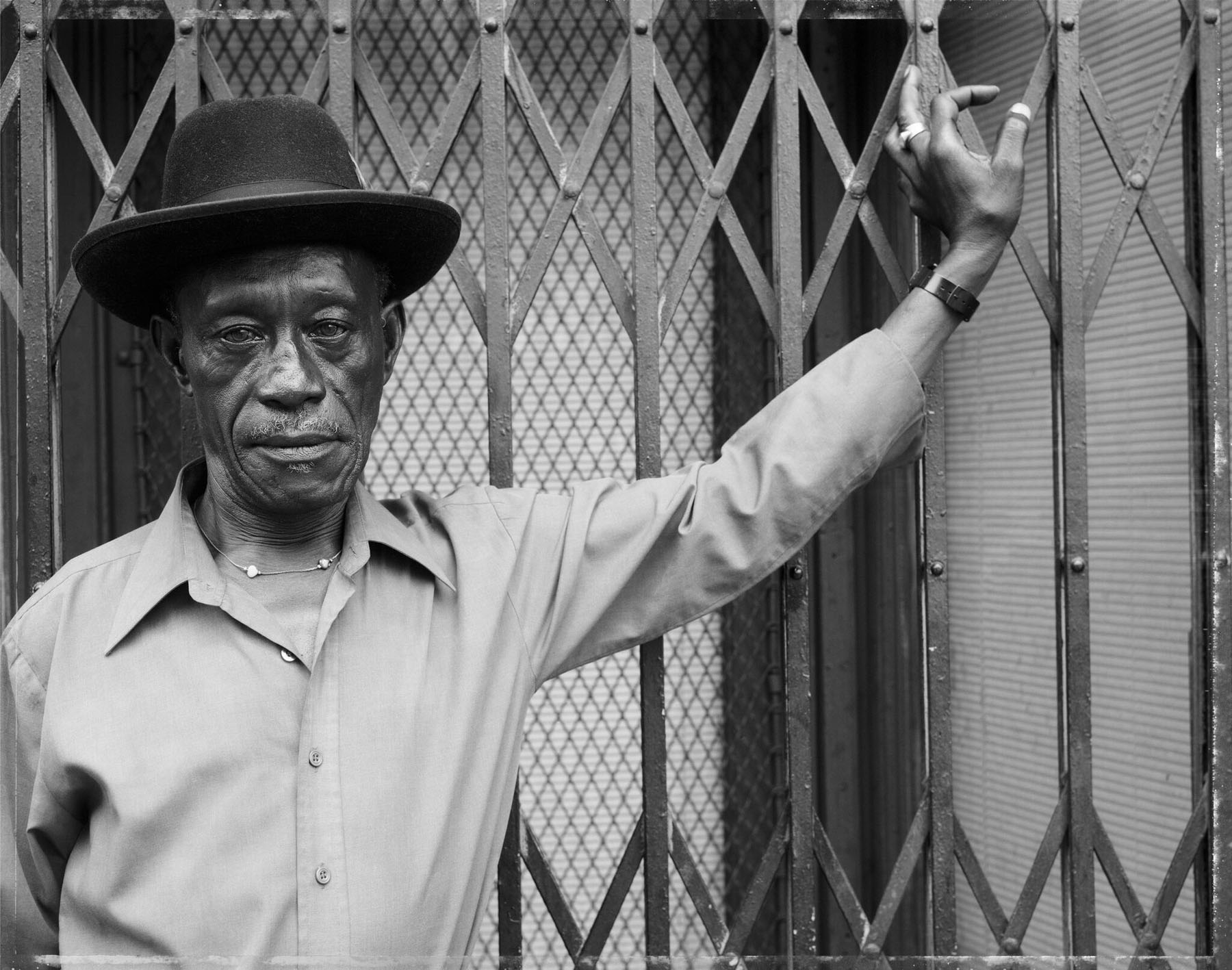
It is a tender one, through which one moves. That is the space I imagined the fugitive black subjects moving through as they sought their self-liberation, moving through the dark landscape of America and Ohio toward freedom under cover of a munificent and blessed blackness.” ~ Dawoud Bey


Dawoud Bey (American, b. 1953) 'Untitled #14 (Site of John Brown's Tannery)' 2017


Dawoud Bey (American, b. 1953)
Untitled #14 (Site of John Brown’s Tannery)
2017
From the series Night Coming Tenderly, Black
Gelatin silver print
© Dawoud Bey


Dawoud Bey (American, b. 1953) 'Untitled #17 (Forest)' 2017


Dawoud Bey (American, b. 1953)
Untitled #17 (Forest)
2017
From the series Night Coming Tenderly, Black
Gelatin silver print
© Dawoud Bey


Bey’s most recent work imagines the flight of enslaved Black Americans along the leg of the Underground Railroad that operated in Ohio – the last fifty or so miles before they reached the vast expanse of Lake Erie, on the other side of which lay Canada, and freedom.


Dawoud Bey (American, b. 1953) 'Untitled #19 (Creek and Trees)' 2017


Dawoud Bey (American, b. 1953)
Untitled #19 (Creek and Trees)
2017
From the series Night Coming Tenderly, Black
Gelatin silver print
© Dawoud Bey


Behind his Night Coming Tenderly, Black series:

“The photographs are meant to imagine or reimagine the path of self-liberation in Northeastern Ohio along what is called the ‘Underground Railroad’. Formerly slaved Africans, and then African-Americans moved towards freedom by way of Lake Eerie in Ohio. I began to think about the fugitive moving through this tender space of blackness.”

Anonymous. “Dawoud Bey’s somber ‘Night Coming Tenderly, Black’ project,” on the Public Delivery website  January 30, 2021 website [Online] Cited 02/03/2021


Dawoud Bey (American, b. 1953) 'Untitled #20 (Picket Fence and Farmhouse I)' 2017


Dawoud Bey (American, b. 1953)
Untitled #20 (Picket Fence and Farmhouse I)
2017
From the series Night Coming Tenderly, Black
Gelatin silver print
© Dawoud Bey


The gelatin silver prints in Night Coming Tenderly, Black are moody and dim, overlaid with a sheen that is almost gritty in texture thanks to the coated paper they are printed on. The trees, fences, lakes, and buildings in the photos are initially obscured, purposefully made more difficult to see through Bey’s printing methods (which take advantage of the light sensitivity of silver particles as well as their ability to be chemically “toned” through the introduction of other substances). These images resist both reproduction and easy interpretation. That one also has to wait for one’s eyes to adjust to the darkness, before slowly traveling over the terrain of each picture, reminds the viewer that the formerly enslaved people who traversed these sites often did so under cover of darkness. Darkness here is multivalent: its obscuring power, which prevents viewers from immediately processing the whole of Bey’s photographs, aided formerly enslaved people in their escape. The Underground Railroad, as the artist has noted, occupies a semi-mythological place in American history, and some of the places Bey photographs are only cannot be confirmed to have been stops on the Railroad. Like the experience of slavery, these places are unrepresentable. They are half-shrouded locales that evade being captured on a map or in a photo.

Though these photographs are dark, they are shot in the daylight and processed in such a way as to make them initially appear to be taken at night. They bring to mind Hiroshi Sugimoto’s eerily beautiful “Seascapes” series (1980 – ongoing), which are shot at night, the film exposed for different lengths of time in order to reveal how light plays even after dark. Yet there is no analogous method for bringing night to the day. Bey may make his photos dark, but this is achieved through processing and glazing the finish image, which occurs after the initial act of taking the photograph. How can we account for Bey’s artificial night?

The philosopher François Laruelle’s 2011 book The Concept of Non-Photography suggests one answer to this question. In essence, Laruelle starts with the premise that works of art cannot and do not represent anything, be it objects, thoughts, concepts, or movements. He posits art as an entirely self-sufficient engagement with the world (which he calls the Real), independent even of viewer and creator. Art is a machine; the medium, processes, and even the artist are its materials. What art “shows,” Laurelle argues, is only the world according to itself – which he terms the world-in-painting, the world-in-photo, and so on. He turns to photography in part because of its connection to modern scientific advancement and its attempts literally to illuminate the world “objectively.” Non-photography aims to re-conceptualise the photographic flash, which Laruelle associates with the flash of logos or reason, as a form of potential insurrection against its traditional association with illumination, and against photography’s constant reproduction of the asymmetrical dichotomy between light and dark.

Anna Mirzayan. “”Artificial night”: on Dawoud Bey’s America,” on the Art Agenda website December 15 2020 [Online] Cited 01/03/2021


Dawoud Bey (American, b. 1953) 'Untitled #23 (Near Lake Erie)' 2017


Dawoud Bey (American, b. 1953)
Untitled #23 (Near Lake Erie)
2017
From the series Night Coming Tenderly, Black
Gelatin silver print
© Dawoud Bey


“I was thinking about this narrative of the Black subject — the unseen Black subject, in this case — a fugitive slave moving through the darkness of night,” Bey explains. “And that darkness of night being the kind of Black space that would lead to liberation.”


Dawoud Bey (American, b. 1953) 'Untitled #25 (Lake Erie and Sky)' 2017


Dawoud Bey (American, b. 1953)
Untitled #25 (Lake Erie and Sky)
2017
From the series Night Coming Tenderly, Black
Gelatin silver print
© Dawoud Bey


As a covert network of safe houses and churches, the sites of the Underground Railroad were by necessity secret, and Bey’s landscapes suggest, rather than document, the experience. Photographed by day but printed in shades of grey and black so deep they resemble nocturnes, the sensuous prints conjure a darkness at once ominous and lush. The series title, which is drawn from the last couplet of Langston Hughes’s poem “Dream Variations” (1926), suggests a black night that envelops the fugitives in a darkness that serves as a protective embrace: “Night coming tenderly / Black like me.”


The High Museum of Art
1280 Peachtree St NE
Atlanta, GA
30309

Opening hours:
Tuesday – Saturday 10am – 5pm
Sunday 12 – 5pm
Monday closed

The High Museum of Art website

LIKE ART BLART ON FACEBOOK

Back to top