Exhibition: ‘Moriendo renascor: 19th century photography’ at the State Library of South Australia, Adelaide

Exhibition dates: 21st May – 31st July 2014


G.B. Goodman (English, ? - 1851) 'Daguerreotype of a group of actors' c. 1850


G.B. Goodman (English, ? – 1851)
Daguerreotype of a group of actors
c. 1850
Daguerreotype of a group of men, possibly actors associated with the Adelaide stage
135mm x 185mm (image); 23cm x 18cm x 2.5cm (case)
B 46371


South Australian photography in the 19th century – daguerreotypes, ambrotypes, tintypes, glass plates and photographic equipment. A fascinating look at our visual past. Moriendo renascor is a latin phrase meaning In death I am reborn. The exhibition runs at the State Library of South Australia till the end of July.

Dr Marcus Bunyan


Many thankx to the State Library of South Australia for allowing me to publish the photographs in the posting. Please click on the photographs for a larger version of the image.


In January 1846, travelling daguerreotype photographer, G.B. Goodman took up a 40 day residency at the rear of Adelaide auctioneer, Emanuel Solomon’s home. Here he created 50 daguerreotype images for Adelaide patrons (Register 21 January 1846). At this time, it had become increasingly common to set up temporary studios at the rear of a building.

According to Jane Messenger in A century in focus: South Australian photography, 1840s-1940s, this daguerreotype differs from others of the period due to its informal nature and the way it flaunts contemporary social and pictorial conventions. Portraits of multiple figures were unusual at the time and usually reserved for family groups. This was due to technical complications related to focal distance, plate sizes and exposure times. Messenger suggests that this image is largely experimental in its composition, and is designed to reveal the photographers sophisticated image creation skills (p. 30). It is also suggested that the man second from right is George Selth Coppin – the father of Australian theatre who lived in Adelaide from 1846 to the end of 1851.

Developed in 1839 by Louis-Jacques-Mande Daguerre and given to the world by the French government, the Daguerreotype was the first photographic method of capturing a scene or a likeness. Despite the difficulty and expense of the Daguerreotype, the process spread rapidly around the world, being first demonstrated in Sydney in 1842 and Adelaide in 1845.


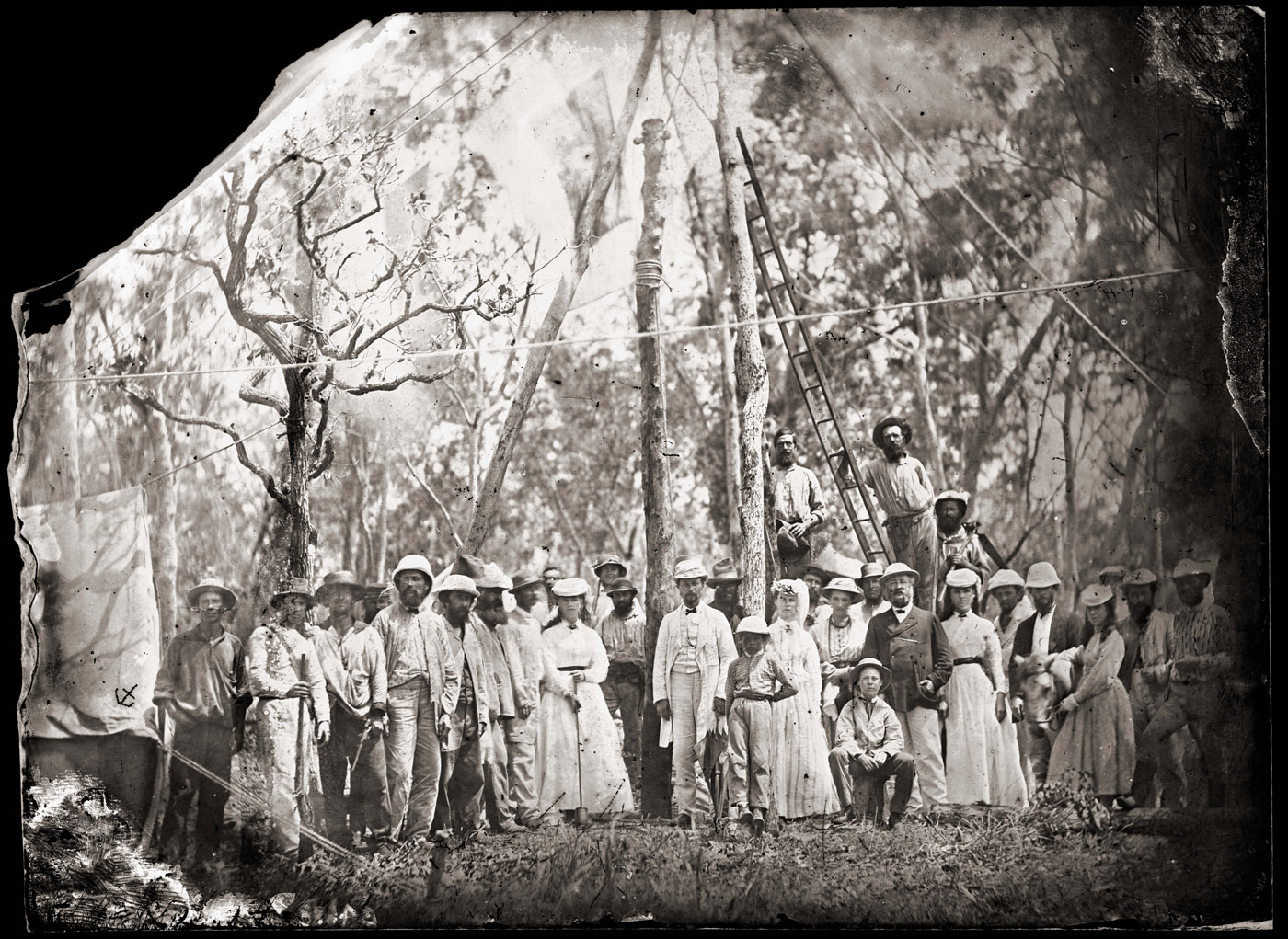
Captain Samuel White Sweet (Australian born England, 1825-1886) 'Planting the first pole of the Overland telegraph at Darwin on the 15th September, 1870' 1870


Captain Samuel White Sweet (Australian born England, 1825-1886)
Planting the first pole of the Overland telegraph at Darwin on the 15th September, 1870
1870
From glass plate negative
B 4638


John W. Butler (publisher) 'Advertisement for Townsend Duryea's studios' Photographic Gallery of Townsend Duryea, south-east corner of Grenfell Street and King William Street National directory of South Australia for 1867-68' 1867


John W. Butler (publisher)
Advertisement for Townsend Duryea’s studios
Photographic Gallery of Townsend Duryea, south-east corner of Grenfell Street and King William Street National directory of South Australia for 1867-68
1867
Created in Melbourne
Object Source: The national directory of South Australia for 1867-68: including a squatters’ directory also a new and correct map of the Colony


In 1867 Townsend Duryea had his photographic gallery on the south-east corner of Grenfell Street and King William Street.

Born in 1823, New Yorker, Townsend Duryea, arrived in South Australia in 1855 and set up a studio on the corner of Grenfell Street and King William Street. He and his brother Sanford were the first photographers known to have worked outside of Adelaide. In a disaster for both the photographer and South Australia his studio caught fire in the early hours of 18 April 1875. Duryea’s entire collection of 60,000 negatives was destroyed.

The Register, reporting on the investigation into the cause of the fire wrote:

“Mr. J. M. Solomon, J.P., on Monday, April 19, held an investigation into the cause of the fire. As the Coroner remarked in summing up, the matter is involved in mystery, and it is just possible that the fire might have resulted from the spontaneous combustion of chemicals used by Mr. Duryea in the prosecution of his business. During the course of the proceedings the Coroner several times checked spectators eager to put questions to witnesses, and stated his view of their position. The Jury returned the following verdict:- “That the premises of Townsend Duryea were destroyed by fire, but that there is not sufficient evidence to show what was its origin.”

South Australian Register April 1875, p. 5.

After the fire he moved to New South Wales where he died in 1888.
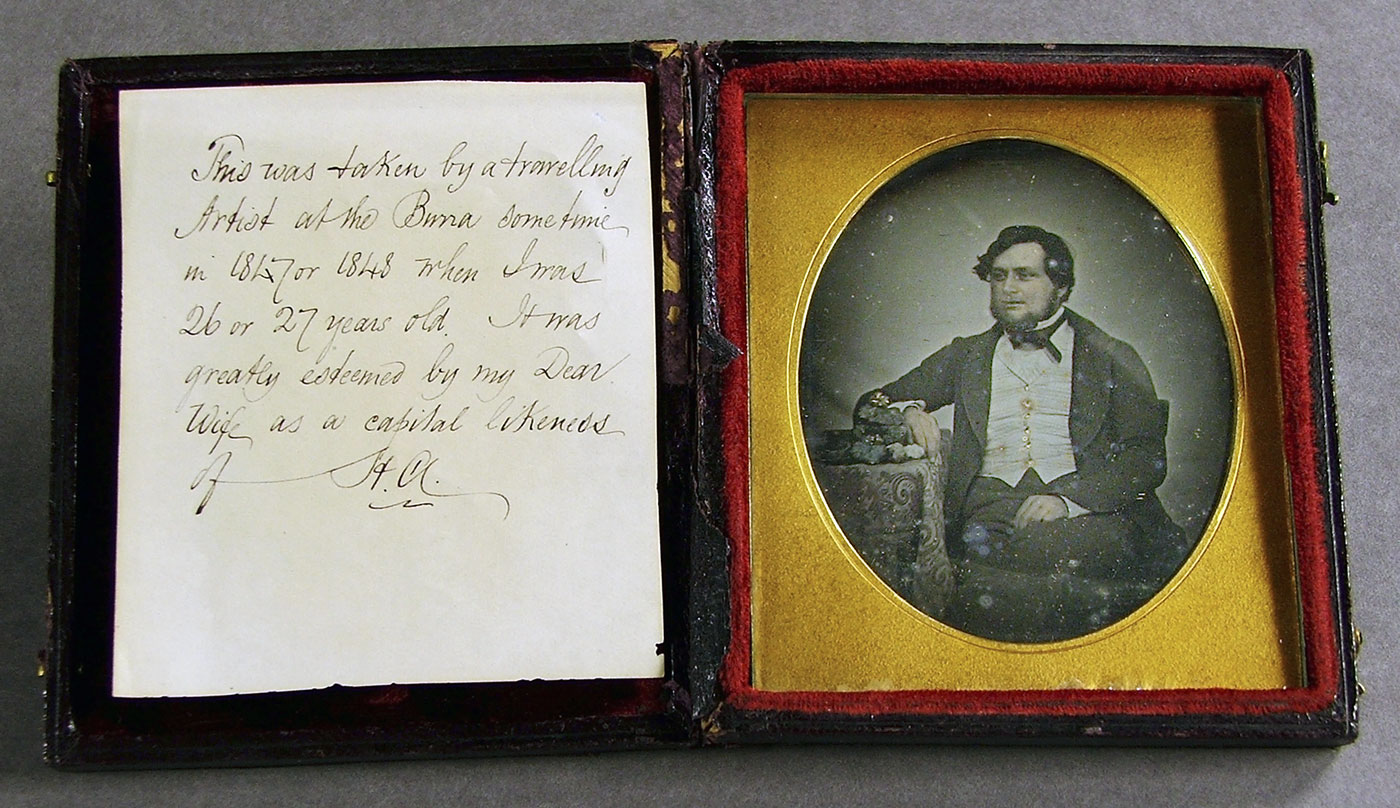
 

Photographer unknown. 'Henry Ayers' c. 1848


Photographer unknown
Henry Ayers
c. 1848
Daguerreotype
PRG 67/48


The oldest known photograph in the State Library’s collection.

This example shows former South Australian Premier Henry Ayers, approximately ten years before he entered parliament. Born in England in 1821, he arrived in South Australia in 1840. He was elected to the first Legislative Council in 1857 and held several positions including chief secretary, premier, and president of the council during his 36 years as a member of parliament. Ayers died on 11 June 1897. Sir Henry Ayers was Premier of South Australia five times between the years 1863 and 1873.

This portrait was accompanied by a note signed by Ayers. It explained that the photo was taken a few years after his appointment as Secretary of the Burra Burra mines in 1845: This was taken by a travelling Artist at the Burra sometime in 1847 or 1848 when I was 26 or 27 years old. It was greatly esteemed by my Dear Wife as a capital likeness of H.A.

The daguerreotype is part of a collection of papers of Sir Henry Ayers, former Premier of South Australia, and of his granddaughter, Lucy Lockett Ayers.


Hammer and Co. 'Bust of a young woman' Rundle Street, c. 1895


Hammer and Co.
Bust of a young woman
Rundle Street, c. 1895
Albumen photograph, cabinet card
B58331/26


Saul Solomon (Australian born England, 1836-1929) 'Man dressed as Robinson Crusoe' 1888


Saul Solomon (Australian born England, 1836-1929)
Published by the Adelaide School of Photography
Man dressed as Robinson Crusoe
1888
Albumen photograph, cabinet card
99mm x 146mm
B 32878


On Monday 30 July 1888 a carnival was held at the Columbia Roller Skating Rink in the Jubilee Exhibition Building, North Terrace, Adelaide. The South Australia Weekly Chronicle, 4 August 1888, reported that over 2,000 persons attended and the floor was reserved for ladies and gentlemen in fancy costume or evening dress and that among the most successful gentlemen’s costumes was a “Robinson Crusoe with a gun and umbrella”.

Cabinet cards were a popular form of family photograph. They often featured the photographer’s details on the front and further description of their services on the reverse.


Photographer unknown. 'Leslie Quinn and W. Dunk' c. 1890


Photographer unknown
Leslie Quinn and W. Dunk
c. 1890
Tintype
B 47091


I just love how the jacket of the lad on the right is about two sizes too small for him. As though he is growing so fast into adulthood, his arms elongating so quickly, that he has outrun the life of his jacket ~ Marcus
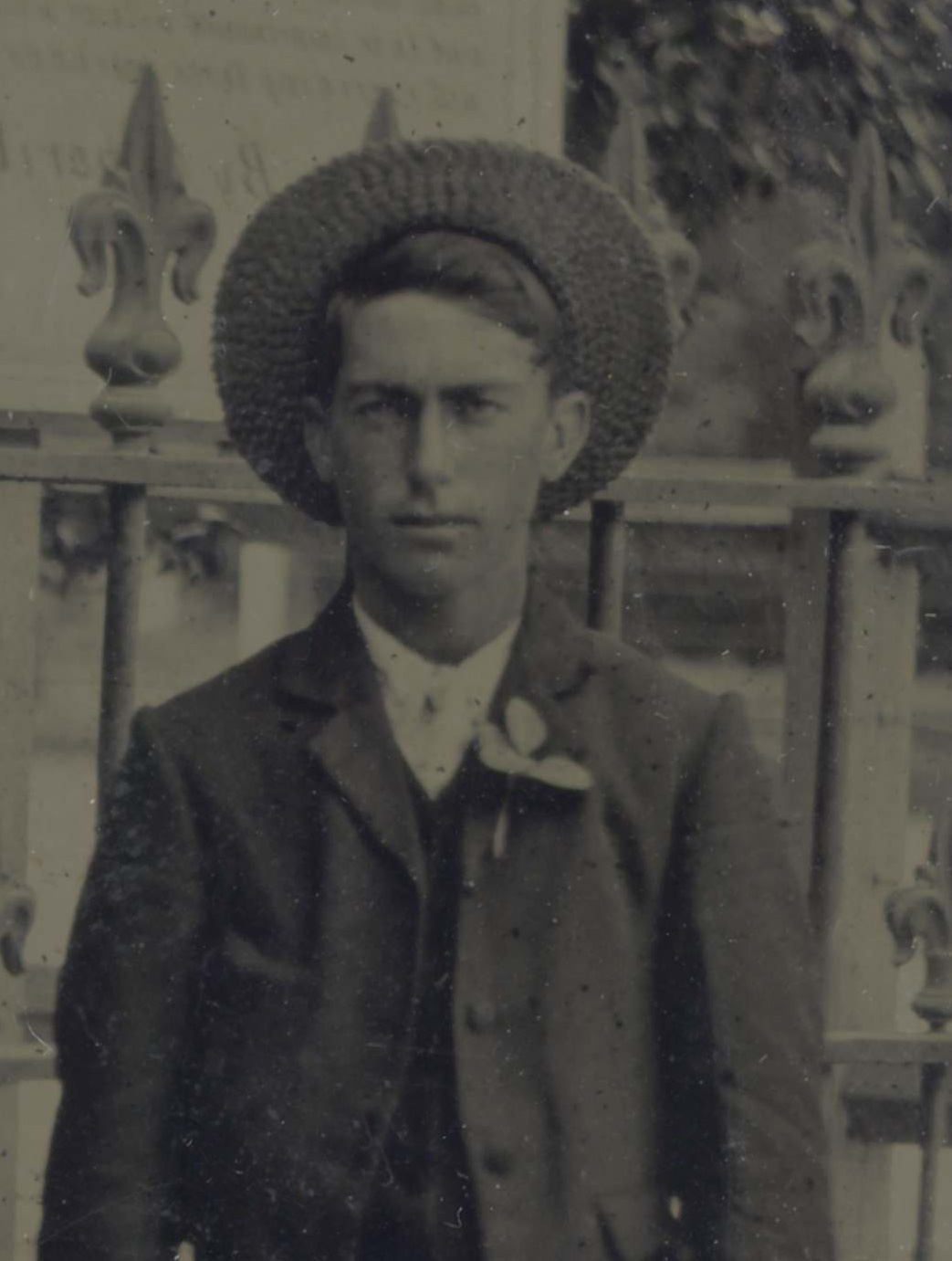
 

Photographer unknown. 'Leslie Quinn and W. Dunk' c. 1890 (detail)


Photographer unknown
Leslie Quinn and W. Dunk (detail)
c. 1890
Tintype
B 47091
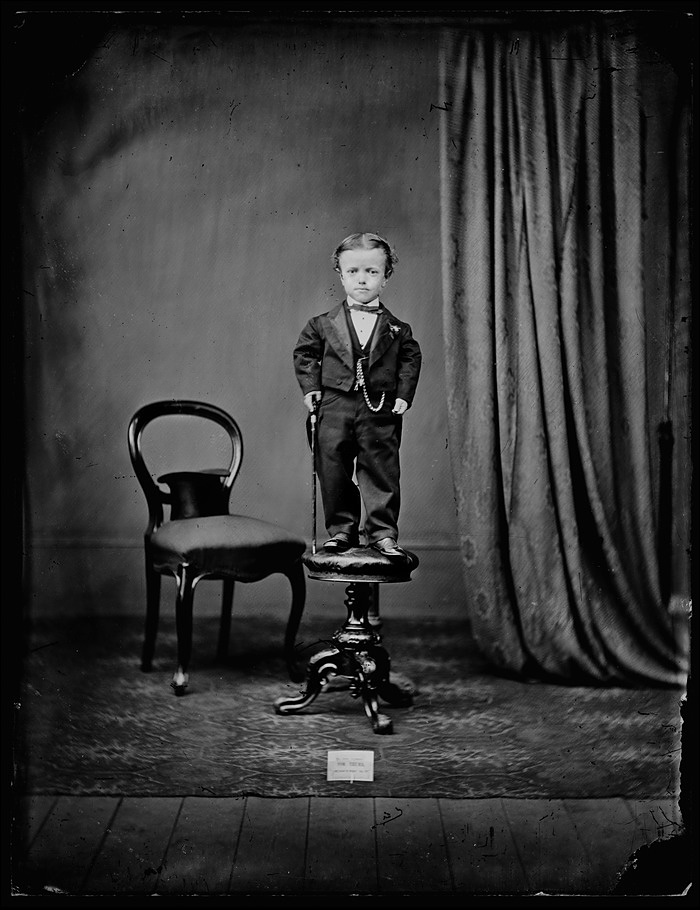
 

Unknown photographer. 'Tom Thumb' c. 1880


Unknown photographer
Tom Thumb
c. 1880
From a glass plate negative


Michael Pynn was born at Baker’s Flat in 1860. In his obituary, the Kapunda Herald (July 5 1929, p. 2), reported that Mickey was known from the late 1870s as the Australian Tom Thumb.

“It was toward the late seventies that General Tom Thumb, of England, visited Australia, and the tour of his little company included Kapunda. It was this circumstance that brought Micky Pynn into prominence, and later into almost world-wide notoriety. He made a career as a circus clown and travelled the world.”

Michael Pynn died in Sydney on 22 June 1929.


Frederick Charles Krichauff (Australian, 1861-1954) 'From the Adelaide Town Hall' c. 1880


Frederick Charles Krichauff (Australian, 1861-1954)
From the Adelaide Town Hall
c. 1880
Photograph


View of the General Post Office (GPO) from the Albert Tower of the Adelaide Town Hall, showing Victoria Square with horse drawn cabs, and the GPO clock showing 1.23 pm.

The State Library holds many thousands of glass plate negatives including a number by amateur photographer Frederick Krichauff (1861-1954). We also hold three of his photograph albums and these may be viewed online via the Library’s catalogue. Krichauff was an architect and a keen member of the Royal Philatelic Society. He lived at Portrush Road, Toorak Gardens.


State Library of South Australia
Kintore Ave, Adelaide SA 5000
Phone: (08) 8207 7250

State Library of South Australia website

Opening hours

LIKE ART BLART ON FACEBOOK

Back to top

Exhibition: ‘Photographic Wonders: American Daguerreotypes from The Nelson-Atkins Museum of Art’ at the Taft Museum of Art, Cincinnati

Exhibition dates: 17th May – 25th August 2013


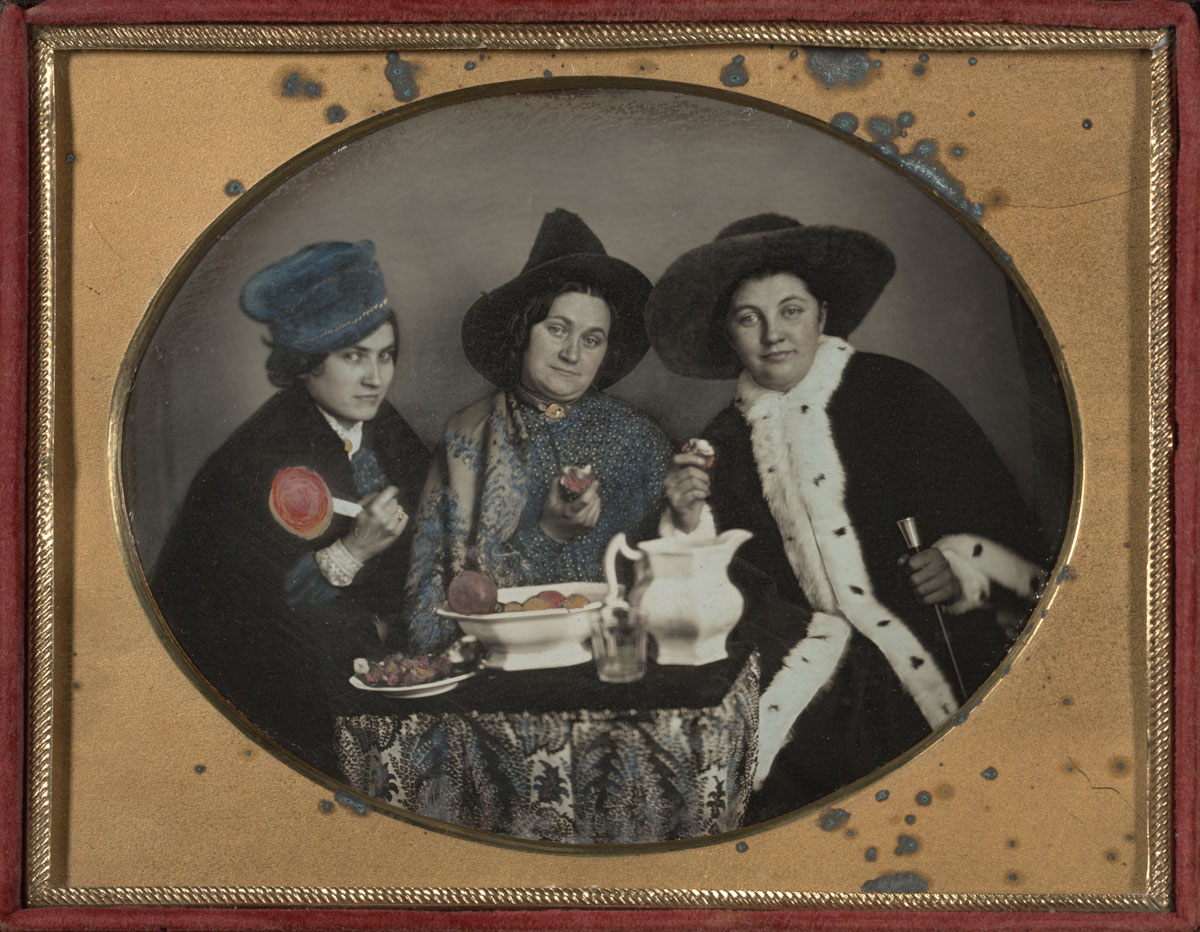
Unknown Maker (American) 'Three Lively Women' c. 1850


Unknown Maker (American)
Three Lively Women
c. 1850
Daguerreotype, quarter plate
3 1/4 x 4 1/4 inches
The Nelson-Atkins Museum of Art, Gift of Hallmark Cards, Inc.,
© Nelson Gallery Foundation


I love the word “occupationals” to describe portraits of individuals with the hallmarks of their trade.

Marcus


Many thankx to the Taft Museum of Art for allowing me to publish the photographs in the posting. Please click on the photographs for a larger version of the image.


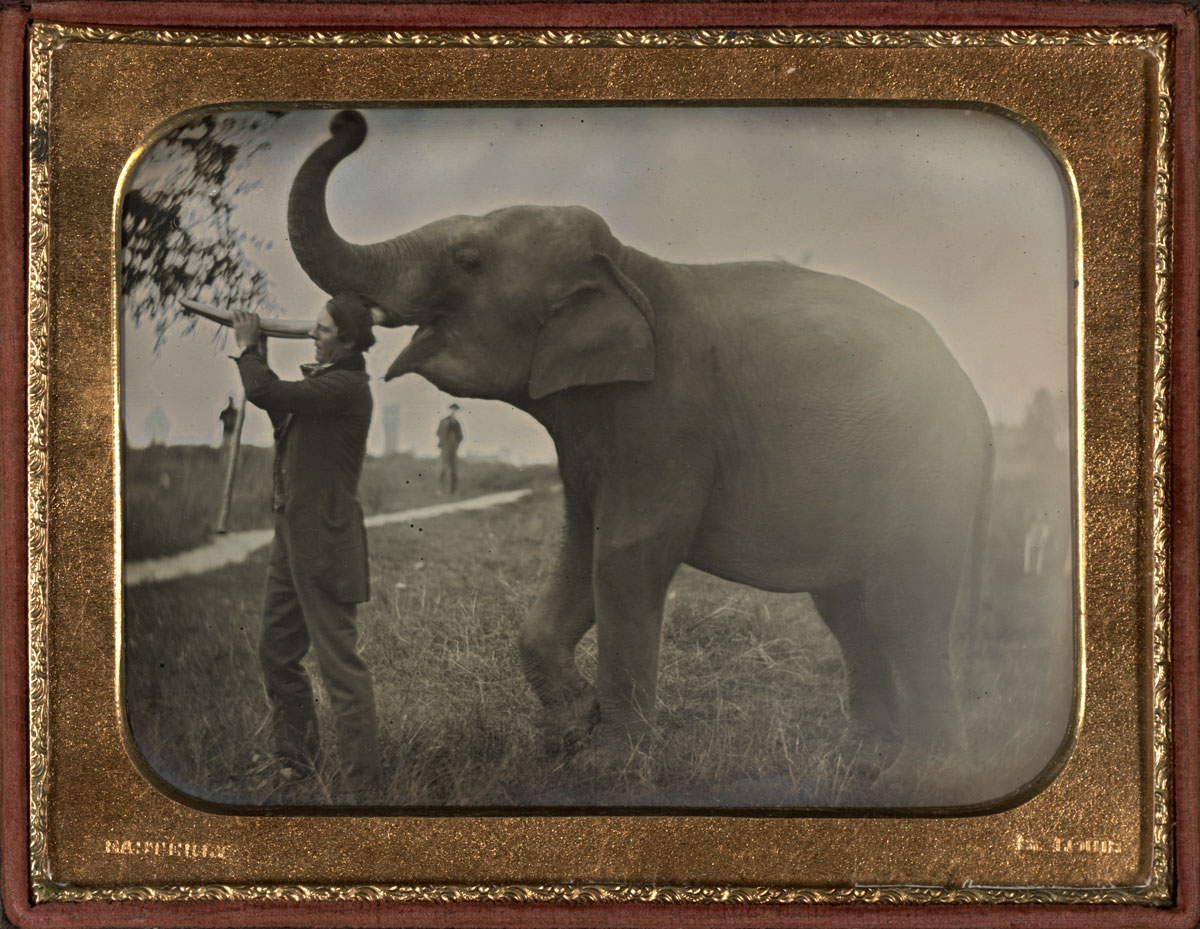
Thomas Easterly (American, 1809-1882) 'Man with Elephant' c. 1850


Thomas Easterly (American, 1809-1882)
Man with Elephant
c. 1850
Daguerreotype, quarter plate
3 1/4 x 4 1/4 inches
The Nelson-Atkins Museum of Art, Gift of Hallmark Cards, Inc.,
© Nelson Gallery Foundation


Thomas Martin Easterly

A sometime calligrapher and writing teacher, Vermont-born Thomas Martin Easterly (b. 1809 Guilford, Vermont, d. 1882) learned the daguerreotype process in New York between 1841 and 1844, possibly from Charles and Richard Meade. In 1844 Easterly sailed from New York City to New Orleans, where he made photographs before returning to Vermont the following year. He did not remain for long: by October, he had entered into a daguerreotype studio partnership in Iowa. He and his partner operated as traveling photographers working throughout Iowa and Missouri for several years. Some scholars have credited Easterly with making the first photographs of Plains Indians.

After the dissolution of the partnership, Easterly moved to Saint Louis and took over a studio in 1848. He had a successful career for ten years, but his loyalty to the daguerreotype process after the introduction of the ambrotype, tintype, and paper photograph processes caused his business to falter. By 1860 Easterly had begun to sell farm implements in addition to continuing his daguerreotype practice.

Text from the J. Paul Getty Museum website


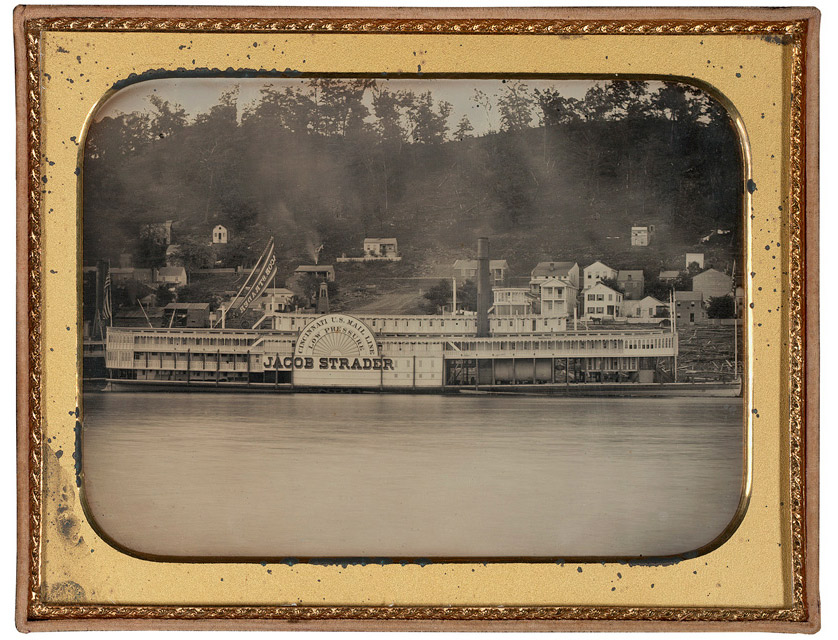
Attributed to Ezekiel Hawkins (American, 1808-1862) 'The Jacob Strader at Wharf, Cincinnati' c. 1853


Attributed to Ezekiel Hawkins (American, 1808-1862)
The Jacob Strader at Wharf, Cincinnati
c. 1853
Daguerreotype, half plate
4 1/4 x 5 1/2 inches
The Nelson-Atkins Museum of Art, Gift of Hallmark Cards, Inc.,
© Nelson Gallery Foundation


This daguerreotype of the side-wheel packet Jacob Strader was taken at the Cincinnati boatyard where she was built in 1853. Owned by the U.S. Mail Line Co., this steamboat was named to honour Jacob Strader, the company’s first president. The Jacob Strader ran regularly between Cincinnati and Louisville, however during the Civil War, because her large cabin contained 310 berths, she was frequently used to transport sick and wounded soldiers. This boat was dismantled in 1866.

As steamboats replaced flatboats and keelboats as the major mode of river transportation, travel along the Ohio River became faster and easier. By the middle of the nineteenth century, more than 3,000 steamboats arrived each year at the port of Cincinnati. The city’s prominent location along the river contributed to its rapid growth, and by 1850 Cincinnati became the sixth largest city in the country. The development of railroads slowly led to the decline of steamboats. They continued to operate on the Ohio River, but their numbers dwindled.

Text from the Ohio Memory Collection website


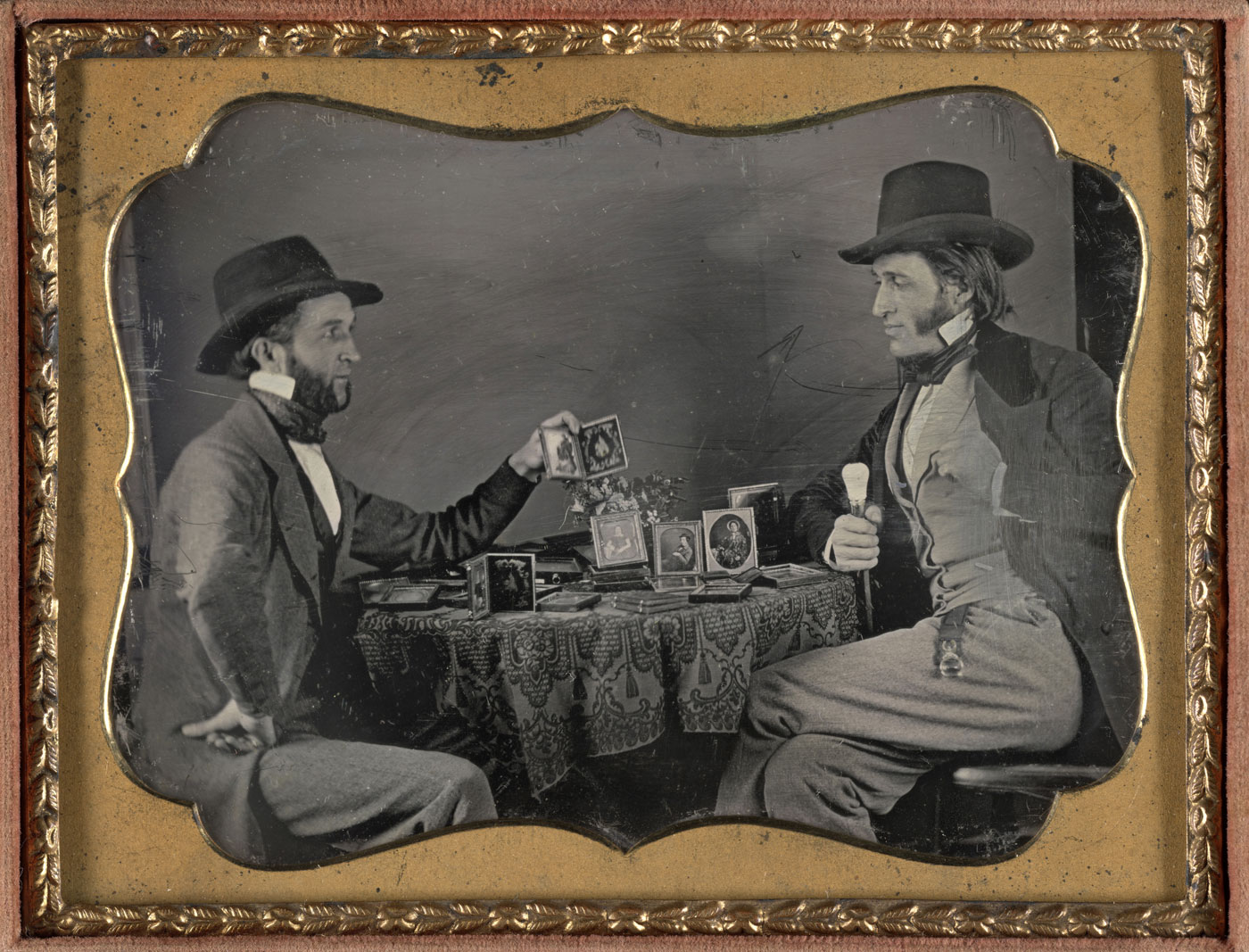
Unknown Maker (American) 'A Showing of Daguerreotypes' c. 1850


Unknown Maker (American)
A Showing of Daguerreotypes
c. 1850
Daguerreotype, quarter plate
3 1/4 x 4 1/4 inches
The Nelson-Atkins Museum of Art, Gift of Hallmark Cards, Inc.,
© Nelson Gallery Foundation


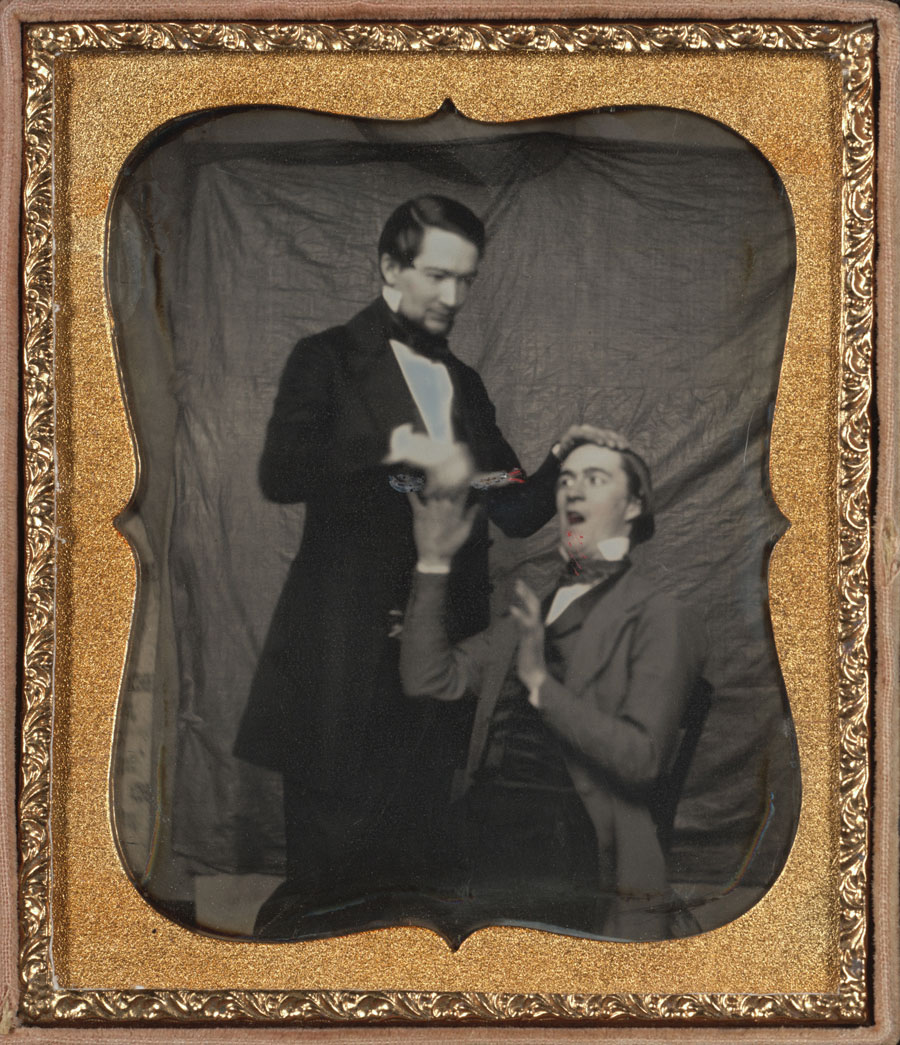
Unknown Maker (American) 'Comic Dentist' c. 1850


Unknown Maker (American)
Comic Dentist
c. 1850
Daguerreotype, sixth plate
3 1/4 x 2 3/4 inches
The Nelson-Atkins Museum of Art, Gift of Hallmark Cards, Inc.,
© Nelson Gallery Foundation


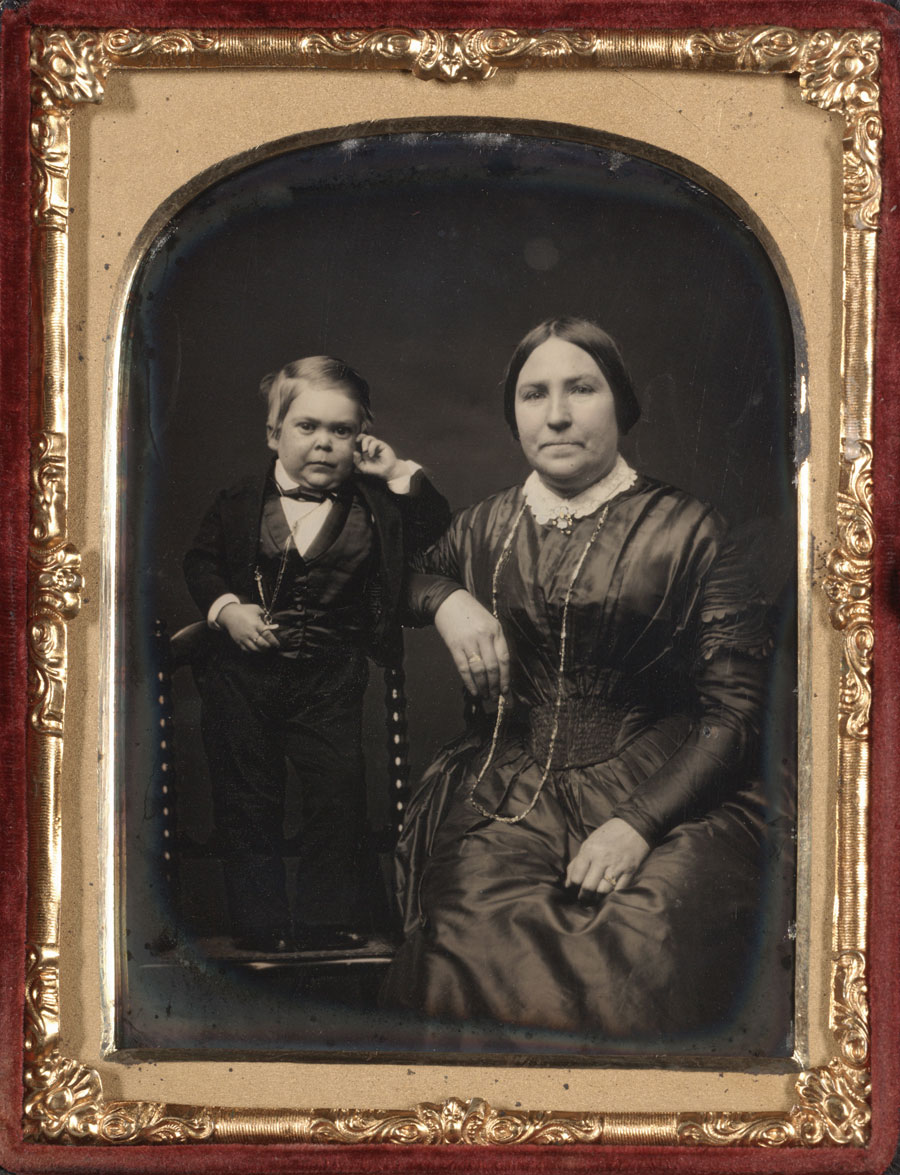
American Daguerreotypes from The Nelson-Atkins Museum of Art, on display May 17 – Aug. 25, features 82 astonishing images of life in 19th-century America. The exhibition includes rare images of such well-known Americans as Harriet Beecher Stowe, Frederick Douglass, and Tom Thumb.

By the middle of the 19th century, Cincinnati was the Queen City of the West. A transportation hub, the city was home to industry, art, and even a professional baseball team. Though there are numerous written accounts of life in the big city at this time, we are also fortunate to have images of this era because of the earliest “photographic” works, known as daguerreotypes. In 1839 the American public first encountered this exciting new invention. By 1843, daguerreotypists had set up shop in every major city in the United States. Visitors to the Taft will have the opportunity to view these remarkable works. This exhibition features about 90 daguerreotypes of exceptional quality and variety, with the high degree of resolution typical of these rare, one-of-a-kind photographs. Works by both famed and anonymous makers provide a window into mid-19th-century America: its occupations, trades, urban and rural scenery, and racial and ethnic diversity.

In 1839 the American public encountered the exciting new invention of photography in its earliest form, the daguerreotype. Together, these two Taft exhibitions present an in-depth look at the art of early photography, as well as candid, touching, and sometimes humorous image of life in mid-19th century America and Cincinnati. A daguerreotype is a unique image crafted on a silvered copper plate, a surface that acts like a mirror. While sometimes hard to view, this exhibition presents the works under perfect lighting conditions. The earliest daguerreotypes required exposures of up to thirty minutes. Within a few years, however, portraits could be made in about ten to twenty seconds.

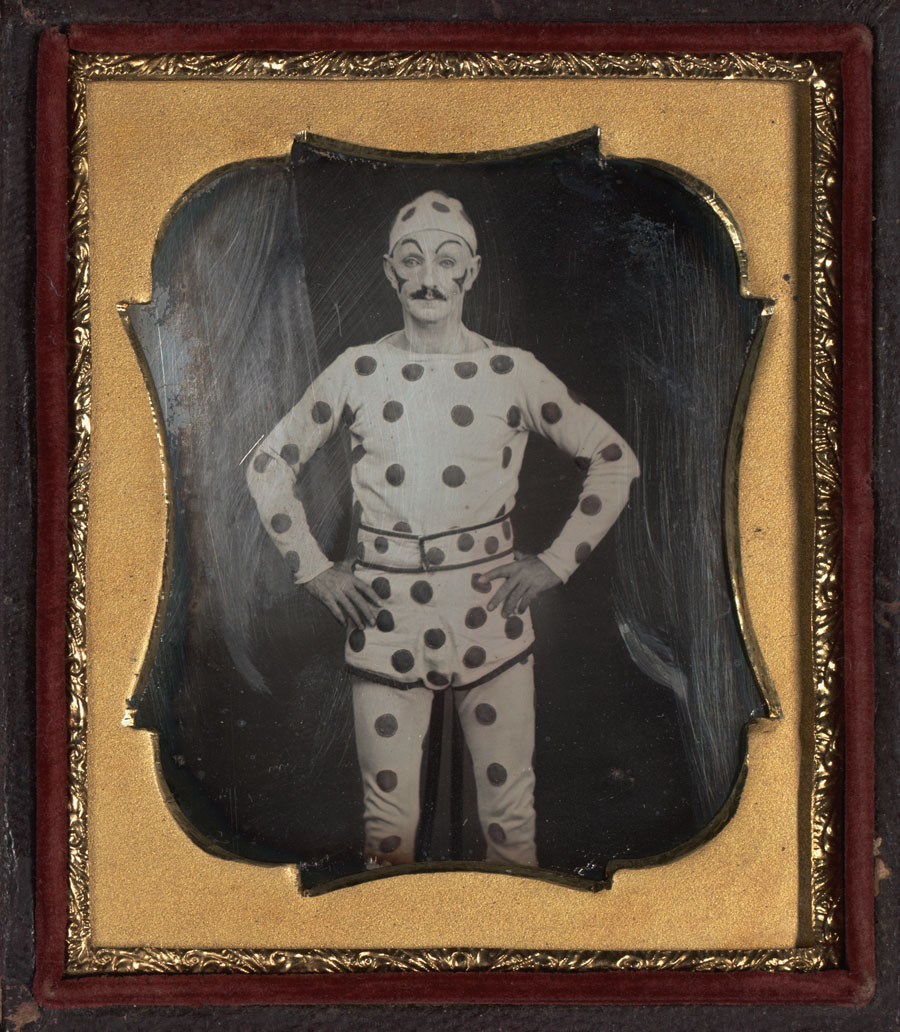
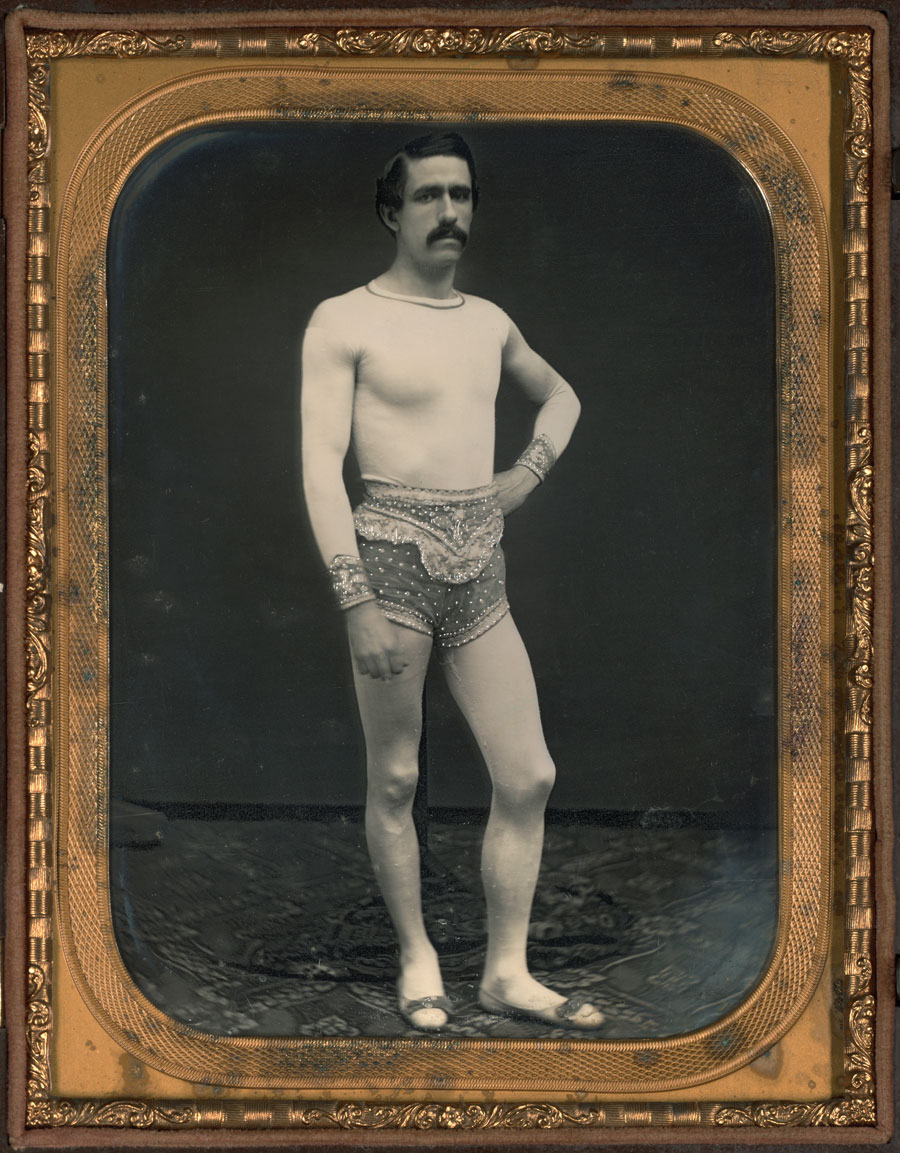
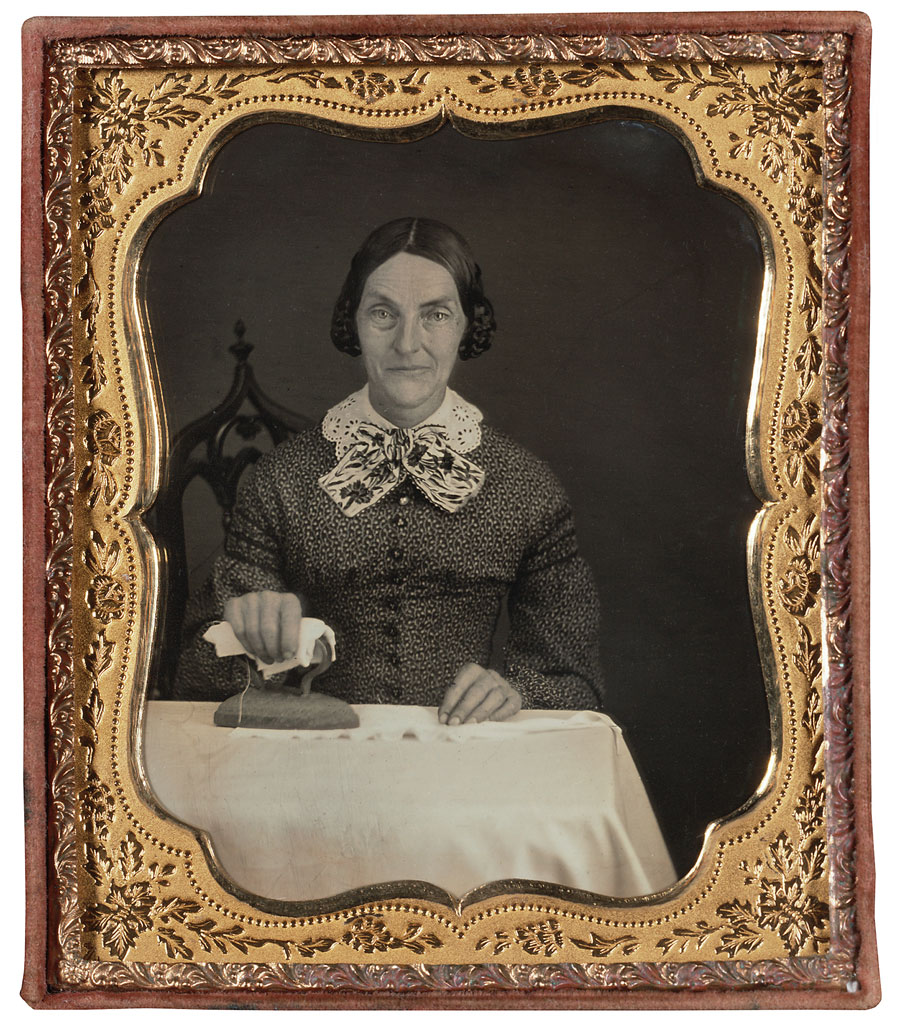
Among the exceptional daguerreotypes in Photographic Wonders are post-mortem images (portraits taken after death) that tell sorrowful stories, while The Comic Dentist and other humorous subjects still amuse today’s audiences. Portraits of individuals with the hallmarks of their trade (called occupationals), including a blacksmith with his tools, a woman ironing, and a clown in costume, show Americans’ pride in their work. Outdoor scenes reveal quaint towns and growing cities, while landscapes feature popular tourist destinations. The wide range of subjects offers something for every interest. The exhibited works in Photographic Wonders are part of an acclaimed collection that Hallmark Cards, Inc., donated in 2005 to The Nelson-Atkins Museum of Art.

The choice examples selected for the Taft date from about 1840 to about 1860, while Nicholas Longworth and his family lived in the historic house that is now the Taft Museum of Art. Local Exposures, a captivating “snapshot” of life in Cincinnati in the 1800s, will delight Cincinnati history enthusiasts. A rarely exhibited Cincinnati streetscape reveals what the city looked like in 1848, while business cards and advertisements for daguerreotype studios show the prominence of the industry in Cincinnati.

“These were the first photographs. Prior to this the only way you could preserve your image was through a painting or sketch. Imagine seeing yourself in a photograph for the first time – it would seem like magic, and that’s exactly the first reaction people had,” says installing curator, Tamera Muente. Taft Museum of Art Director/CEO, Deborah Emont Scott, says, “It’s an amazing experience to view these precious, one-of-a-kind photographs. The images are small and the viewing experience is an intimate one – you step back in time and share a rare mid-19th-century moment with the sitter.”

Press release from the Taft Museum of Art website


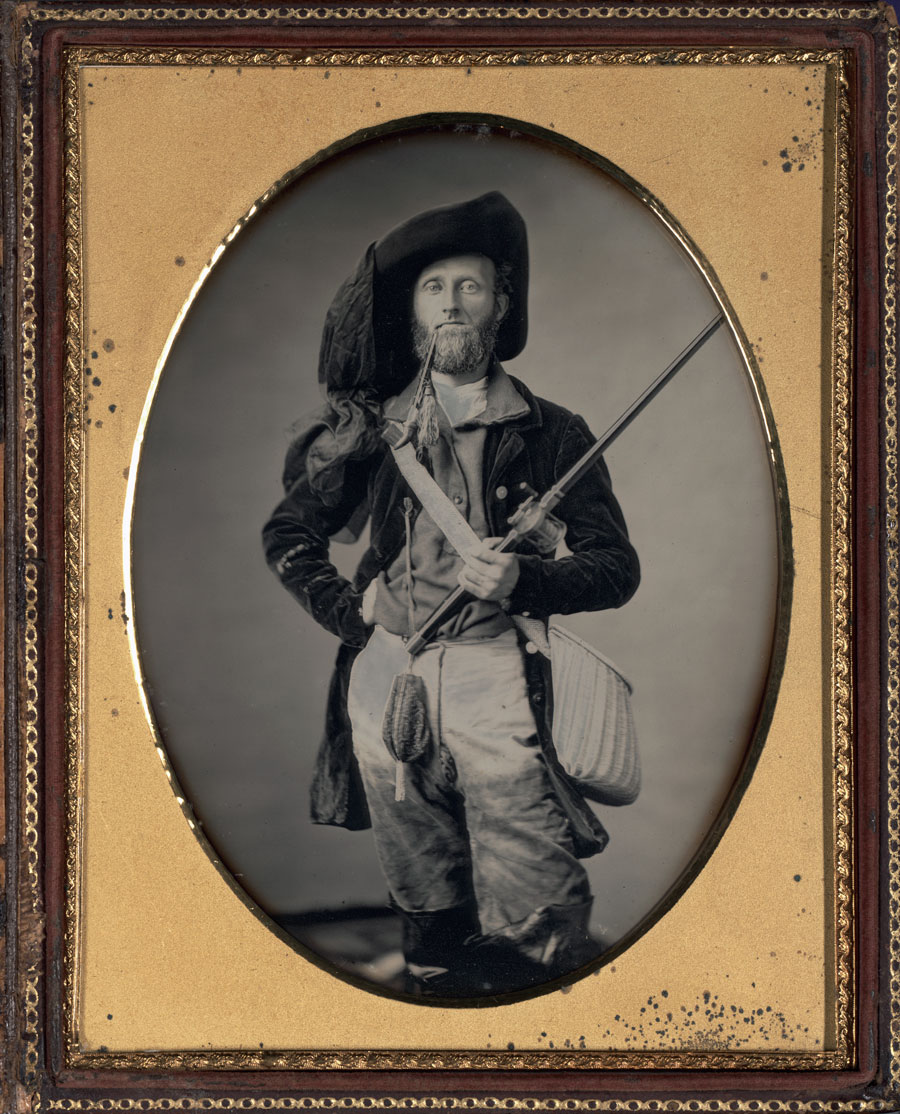
William C. North (American, 1814-1890) 'The Fisherman' c. 1850


William C. North (American, 1814-1890)
The Fisherman
c. 1850
Daguerreotype, half plate
5 1/2 x 4 1/2 inches
The Nelson-Atkins Museum of Art, Gift of Hallmark Cards, Inc.,
© Nelson Gallery Foundation


Unknown Maker (American) 'Clown' c. 1850-1855


Unknown Maker (American)
Clown
c. 1850-1855
Daguerreotype, sixth plate
2 1/4 x 2 3/4 inches
The Nelson-Atkins Museum of Art, Gift of Hallmark Cards, Inc.,
© Nelson Gallery Foundation


Unknown Maker (American) 'Tightrope Walker' c. 1855


Unknown Maker (American)
Tightrope Walker
c. 1855
Daguerreotype, half plate
5 1/2 x 4 1/2 inches
The Nelson-Atkins Museum of Art, Gift of Hallmark Cards, Inc.,
© Nelson Gallery Foundation


Unknown Maker (American) 'Tom Thumb and his Mother' c. 1850-1855


Unknown Maker (American)
Tom Thumb and his Mother
c. 1850-1855
Daguerreotype, quarter plate
4 1/4 x 3 1/4 inches
The Nelson-Atkins Museum of Art, Gift of Hallmark Cards, Inc.,
© Nelson Gallery Foundation


General Tom Thumb was the stage name of Charles Sherwood Stratton (January 4, 1838 – July 15, 1883), a little person who achieved great fame under circus pioneer P.T. Barnum.


Unknown Maker (American) 'Woman Ironing' c. 1850-55


Unknown Maker (American)
Woman Ironing
c. 1850-1855
Daguerreotype, sixth plate
3 1/4 x 2 3/4 inches
The Nelson-Atkins Museum of Art, Gift of Hallmark Cards, Inc.,
© Nelson Gallery Foundation


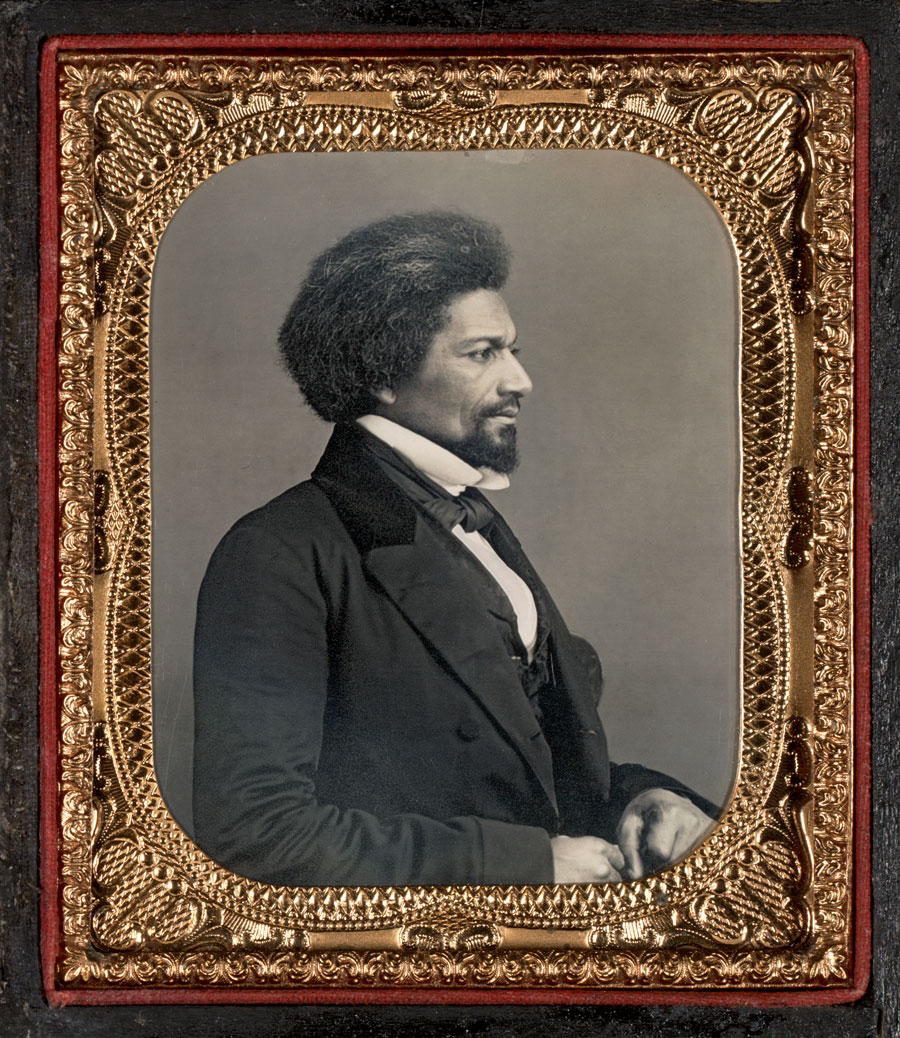
Unknown Maker (American) 'Profile Portrait of Frederick Douglass' c. 1858


Unknown Maker (American)
Profile Portrait of Frederick Douglass
c. 1858
Daguerreotype, sixth plate
3 1/4 x 2 3/4 inches
The Nelson-Atkins Museum of Art, Gift of Hallmark Cards, Inc.,
© Nelson Gallery Foundation


Frederick Douglass

Frederick Douglass (born Frederick Augustus Washington Bailey, c. February 1818 – February 20, 1895) was an African American social reformer, orator, writer and statesman. After escaping from slavery, he became a leader of the abolitionist movement, gaining note for his dazzling oratory and incisive antislavery writing. He stood as a living counter-example to slaveholders’ arguments that slaves did not have the intellectual capacity to function as independent American citizens. Many Northerners also found it hard to believe that such a great orator had been a slave.

Douglass wrote several autobiographies, eloquently describing his experiences in slavery in his 1845 autobiography, Narrative of the Life of Frederick Douglass, an American Slave, which became influential in its support for abolition. He wrote two more autobiographies, with his last, Life and Times of Frederick Douglass, published in 1881 and covering events through and after the Civil War. After the Civil War, Douglass remained active in the United States’ struggle to reach its potential as a “land of the free”. Douglass actively supported women’s suffrage. Without his approval, he became the first African American nominated for Vice President of the United States as the running mate of Victoria Woodhull on the impracticable and small Equal Rights Party ticket. Douglass held multiple public offices.

Douglass was a firm believer in the equality of all people, whether black, female, Native American, or recent immigrant, famously quoted as saying, “I would unite with anybody to do right and with nobody to do wrong.”(Text from Wikipedia)

“I have often been asked, how I felt when first I found myself on free soil. And my readers may share the same curiosity. There is scarcely anything in my experience about which I could not give a more satisfactory answer. A new world had opened upon me. If life is more than breath, and the ‘quick round of blood,’ I lived more in one day than in a year of my slave life. It was a time of joyous excitement which words can but tamely describe. In a letter written to a friend soon after reaching New York, I said: ‘I felt as one might feel upon escape from a den of hungry lions.’ Anguish and grief, like darkness and rain, may be depicted; but gladness and joy, like the rainbow, defy the skill of pen or pencil.”

Douglass, Frederick. Life and Times of Frederick Douglass. 1882, p. 170.


Taft Museum of Art
316 Pike Street at the east end of Fourth Street
across from Lytle Park, in downtown Cincinnati

Opening hours:
Wednesday – Sunday 11am – 4pm
Closed Mondays and Tuesdays

Taft Museum of Art website

LIKE ART BLART ON FACEBOOK

Back to top