Exhibition dates: 29th October – 6th December 2009
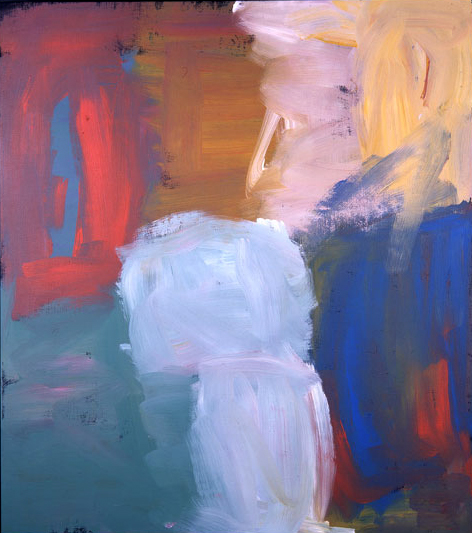
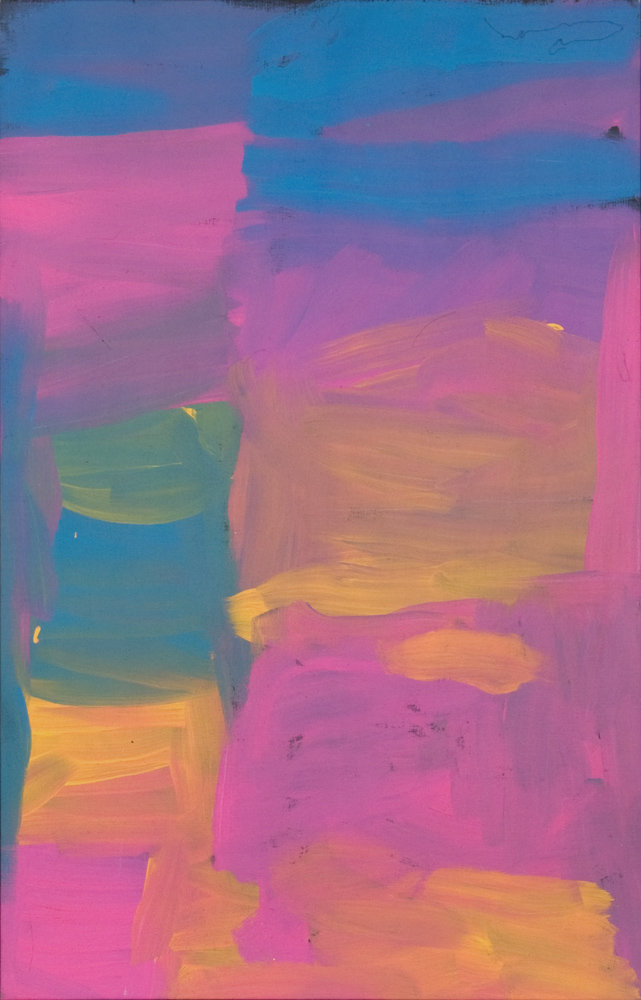
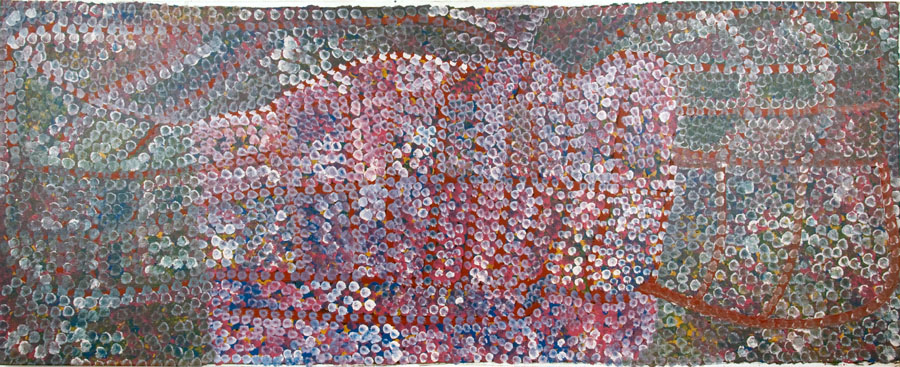
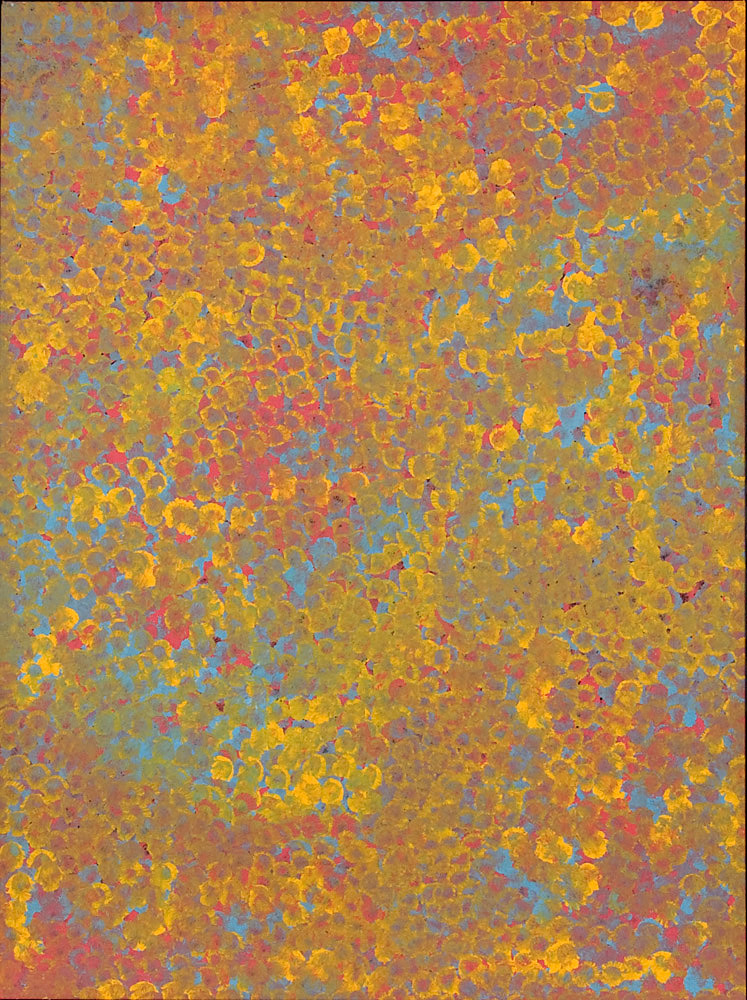
Emily Kame Kngwarreye (Australian, 1910-1996) My Country 1996 Synthetic polymer paint on canvas
“One can theorise about beauty all day, but words are weak and at day’s end one will go out into the blue and golden and multifarious world, and one will know with the responsive heart, before there is time for words, what is and isn’t beautiful.”
Leo Rubinfien1
There are certain existential experiences in art one will always remember:
~ The maelstrom of convulsive colours in the paintings of J. M. W. Turner at the Tate in London
~ Being alone in a gallery at the Louvre with six self-portraits by Rembrandt and embracing their inner humanity
~ Sitting in the Musée de l’Orangerie, Paris and being surrounded by the elemental forces of Monet’s panels of Nymphéas
Added to this list would be my experience of this exhibition of paintings by Emily Kame Kngwarreye.
It was a privilege to spend time alone with the work, just wandering around the gallery that is situated in an industrial estate in Port Melbourne. It is difficult for me to describe the experience such was the connection I had with the work, with the earth. I am emotional even writing about it. Standing in front of these paintings all pretensions of existence, all trappings of society, dissolve in colour, in presence.
I am a naturalised Australian having been born in England; I have never been to the far desert. This does not matter. What I felt, what I experienced was a connection to the land, to the stories that Emily has told in these paintings. We all come from the earth and return to it.
The paintings were painted horizontally (like the painter Jackson Pollock who intuitively accessed the spiritual realm) and evidence a horizontal consciousness not a hierarchical one. Knowledge is not privileged over wisdom. There is a balance between knowledge and wisdom – the knowledge gained through a life well lived and the wisdom of ancient stories that represent the intimacy of living on this world. The patterns and diversities of life compliment each other, are in balance.
Wisdom comes from the Indo-European root verb weid, “to see,” the same root from which words like vision come.2 In this sense these are “Vedic” paintings in that they are ancient, sacred teachings, Veda meaning literally “I have seen.”
On this day I saw. I felt.
Rarely do I have such an emotional reaction to art. When it does happen it washes over me, it cleanses my soul and releases pent up emotions – about life, about mortality, about being.
As Cafe del Mar in one of their songs, “The Messenger” sing:
“We, We got the feeling of Mystery, We got the touch of humanity, I know, we can’t live forever.”
Go and be touched.
Dr Marcus Bunyan
1/ Rubinfien, Leo. “Perfect Uncertainty: Robert Adams and the American West, (2002)” on Americansuburb X: Theory. [Online] Cited 22/11/2009 no longer available online
2/ Doczi, Gyorgy. The Power of Limits: Proportional Harmonies in Nature, Art and Architecture. Colorado: Shambala Publications, 1981, p. 127
Thank you to Leanne Collier and DACOU Aboriginal Art for allowing me to reproduce the three large photographs of two Wildflower paintings and one My Country painting.
Emily Kame Kngwarreye (Australian, 1910-1996) My Country 1996 Synthetic polymer paint on canvas
Emily Kame Kngwarreye (Australian, 1910-1996) My Country 1996 Synthetic polymer paint on canvas
Emily Kame Kngwarreye (Australian, 1910-1996) My Country 1996 Synthetic polymer paint on canvas
Emily Kame Kngwarreye is Australia’s most important and famous female artist. Hailed as a modernist ‘genius’, she has been compared to Rothko and de Kooning. An Anmatyerre elder from Utopia in the remote central desert region of the Northern Territory, Emily first took up painting on canvas in her late 70’s. She quickly became one of the leaders in the contemporary Aboriginal art movement, transforming her style several times during her short career of eight years. Today she is known as one of the greatest abstract painters of the 20th century.
This important exhibition of over 80 pieces covering all significant series and periods of Emily Kngwarreye’s artistic career is the first commercial retrospective exhibition to be held since she passed away in 1996. It gives the public an outstanding chance to view and purchase works in each of her styles. DACOU has retained numerous magnificent pieces over the years that will be included in this exhibition, such as rarely seen works from Emily’s Ochre Series, created with ochre and charcoal she collected from her country. On show will be the sister painting to the famous Earth’s Creation (also titled Earth’s Creation, 1994, 4 panels, 211 x 596cm) and just as splendid in colour and style.
Text from the DACOU Aboriginal Art website [Online] Cited 27/11/2009 no longer available online
Inspired by her cultural life as an Anmatyerre elder Emily produced over 3000 paintings over the course of her short eight-year painting career. Her lifelong custodianship of the women’s Dreaming sites of her clan country and in particular her yam Dreaming is the driving force behind her work (Kame meaning yam seed). Her work displays an instinct created by decades of making art for private purposes, drawing in soft earth and ritual body painting. Strong lineal structures whereupon individual dots overlap lines and appearing within others trace the appearance of seeds, plants and tracks on her country.
Text from the University of Canberra website [Online] Cited 11/05/2019
Exhibition dates: 21st June – 27th September, 2009
Many thankx to the Bruce Museum and Mike Horyczun (Director of Public Relations) for allowing me to publish the wonderful photographs below.
Marcus
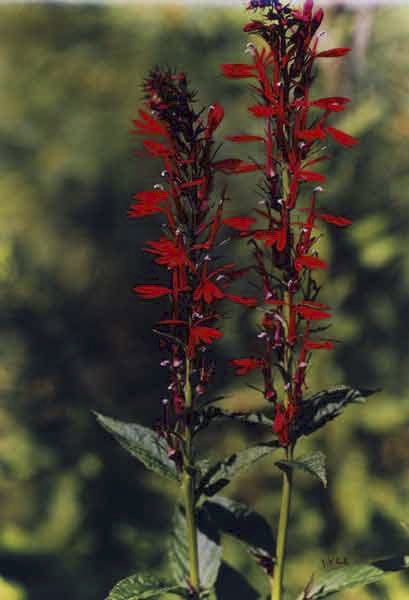
Jeannette Klute (American, 1918-2009) Cardinal Flower Nd (early-mid 1950s) Dye transfer photograph 20 1/4 x 16 1/4 in. Bruce Museum collection Gift of George Stephanopoulos
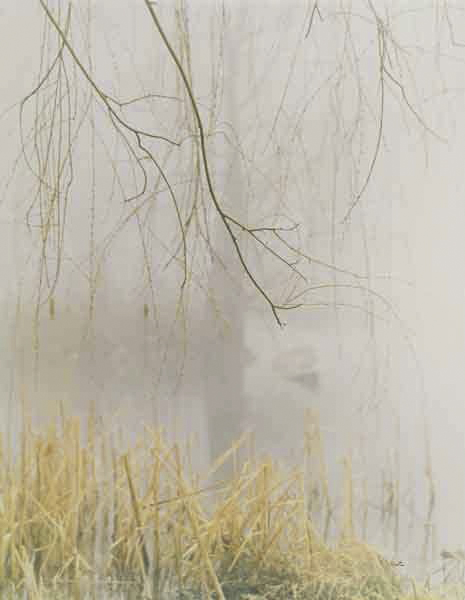
Jeannette Klute (American, 1918-2009) Misty Willow Nd (early-mid 1950s) Dye transfer photograph 20 1/4 x 16 1/4 in. Bruce Museum collection Gift of George Stephanopoulos
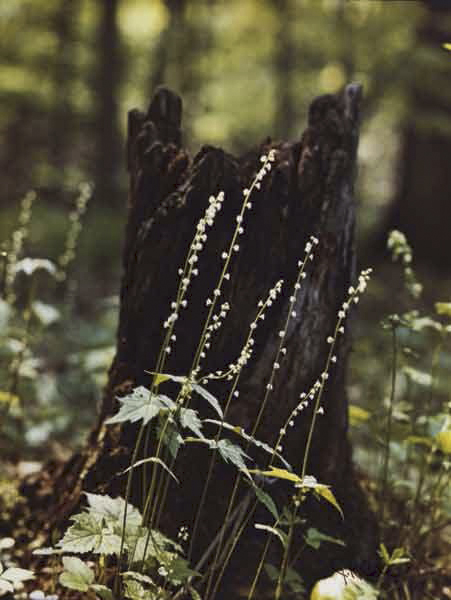
Jeannette Klute (American, 1918-2009) Miterwort Nd (early-mid 1950s) Dye transfer photograph 14 1/8 x 11 1/4 in. Bruce Museum collection Gift of George and Alexandra Stephanopoulos
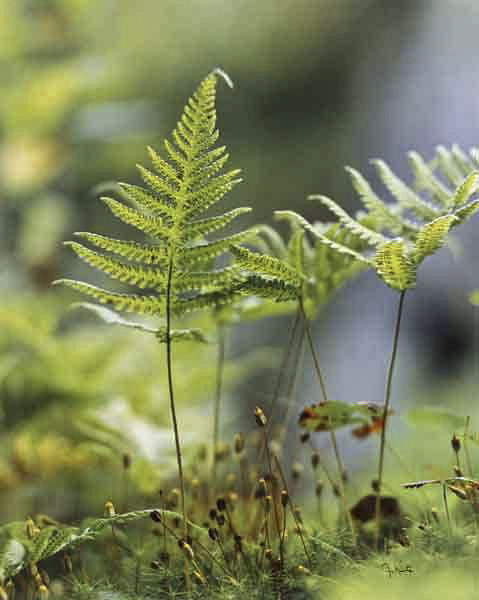
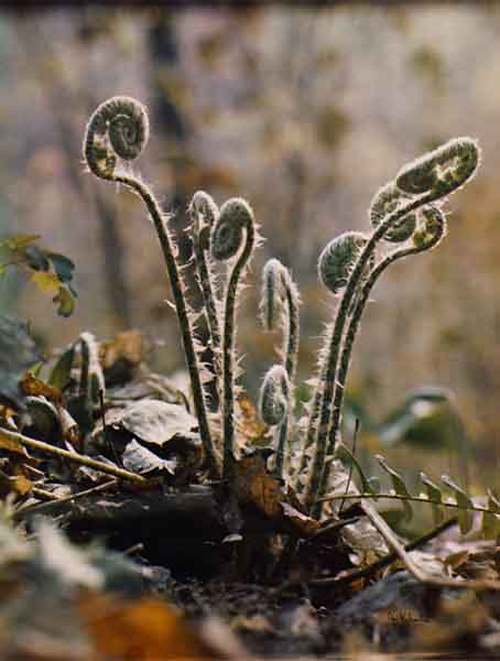
Jeannette Klute (American, 1918-2009) Beech Fern Nd (early-mid 1950s) Dye transfer photograph 20 1/4 x 16 1/4 in. Bruce Museum collection Gift of George Stephanopoulos
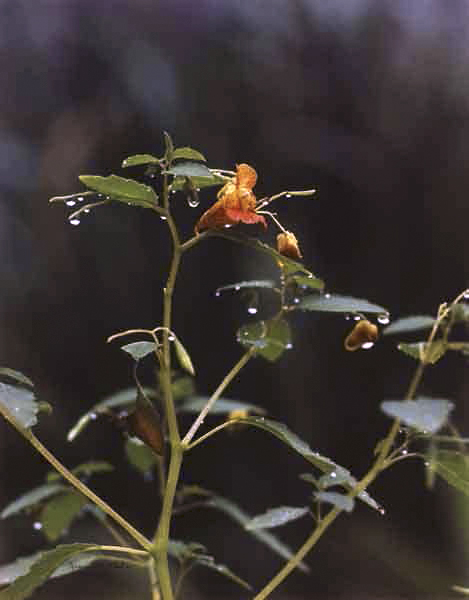
Jeannette Klute (American, 1918-2009) Jewel Weed Nd (early-mid 1950s) Dye transfer photograph 20 1/4 x 16 1/4 in. Bruce Museum collection Gift of George Stephanopoulos
Jeannette Klute (American, 1918-2009) Christmas Fern Nd (early-mid 1950s) Dye transfer photograph 12 1/2 x 9 1/2 in. Bruce Museum collection Gift of George Thomsen
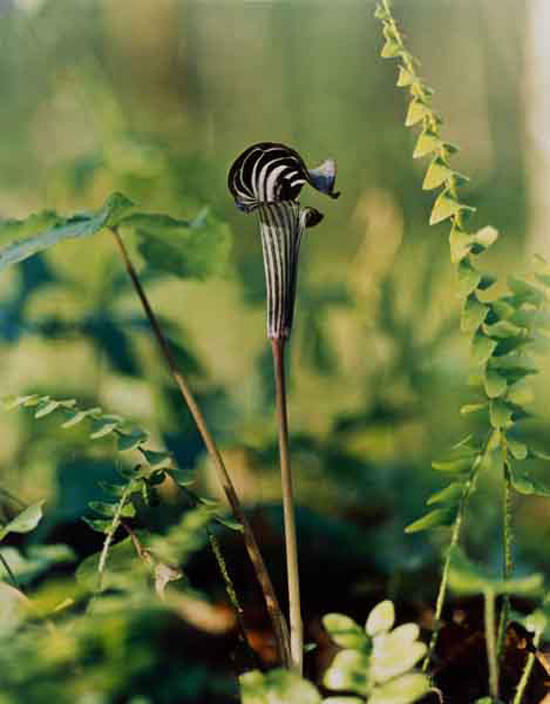
Jeannette Klute (American, 1918-2009) Jack in the Pulpit (Arisaema triphyllum) Nd (early-mid 1950s) Dye transfer photograph 20 1/4 x 16 1/4 in. Bruce Museum collection Gift of George and Alexandra Stephanopoulos
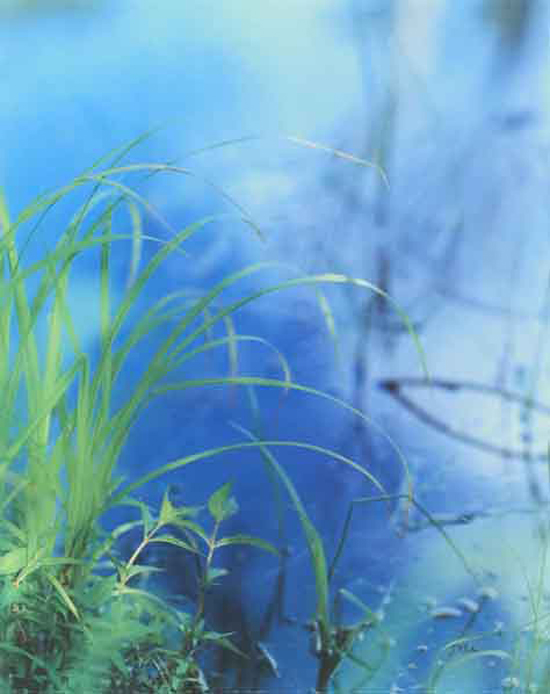
Jeannette Klute (American, 1918-2009) Green Grasses – blue Nd (early-mid 1950s) Dye transfer photograph 20 1/4 x 16 1/4 in. Bruce Museum collection Gift of Richard and Elena Pollack
The exhibition features 24 colour photographs by Jeannette Klute (1918-2009) drawn from more than fifty of her prints held in the Bruce Museum’s permanent collection. Ranging from landscapes to intimate “woodland portraits” of orchids, ferns, and trees, Jeannette Klute’s photographs of New England are vibrant compositions produced through the labour intensive dye transfer process.
Trained at the Rochester Institute of Technology through the Works Progress Administration during the Depression, Jeanette Klute worked extensively on perfecting the dye transfer process, a laborious photographic technique that allowed for rich colours in exceptionally permanent prints. Klute tested and refined this process at the Eastman Kodak Company in Rochester, NY, beginning her career as photographic illustrator to physicist Ralph M. Evans and ascending to research photographer in charge of the Visual Research Studio of the Color Control Division.
Klute’s photography merged environmental consciousness with cutting edge technology. Using only natural light and leaving a minimal impact on the environment, she spent many years investigating colour and demonstrating the capabilities of dye transfer by photographing nature. Her work resulted in some of the finest examples of colour printing and all of its capabilities.
“My purpose has been to somehow express the feeling one experiences being out of doors,” Ms. Klute wrote for her Woodland Portraits exhibition. “I am concerned with the delight to the senses as much as with the intellectual. The woods are mystical and enchanting to me as well as spiritual.”
Jeanette Klute’s work was featured in Edward Steichen’s 1950 exhibition All Color Photography at the Museum of Modern Art, and her large one-woman shows were circulated internationally by the Smithsonian Institution and Kodak International. She was also invited to submit work for the San Francisco Museum of Art’s landmark exhibition Women of Photography: An Historical Survey in 1975.
Text from the Bruce Museum website
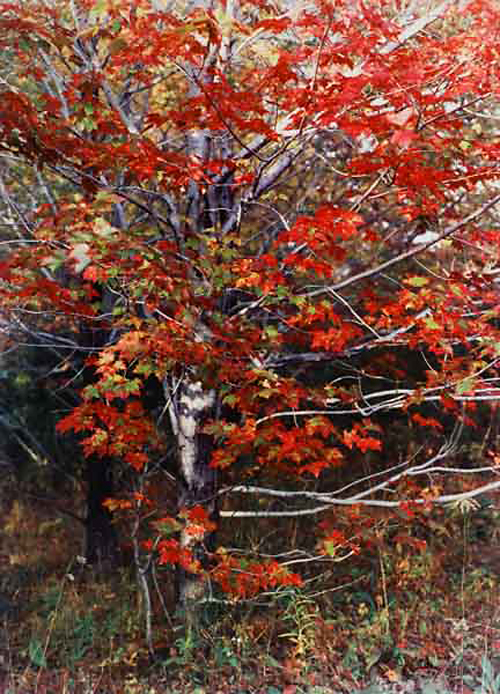
Jeannette Klute (American, 1918-2009) Maple Tree – red leaves Nd (early-mid 1950s) Dye transfer photograph 20 1/4 x 16 1/4 in. Bruce Museum collection Gift of LeGrand Belnap
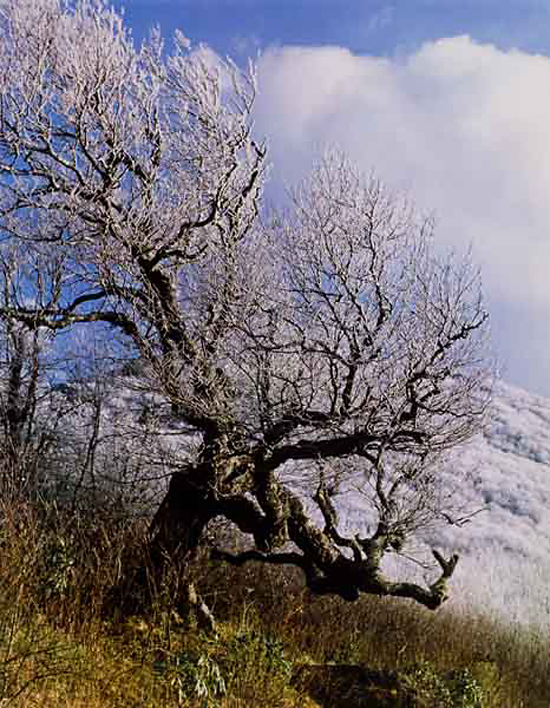
Jeannette Klute (American, 1918-2009) Frosted Tree Nd (early-mid 1950s) Dye transfer photograph 20 1/4 x 16 1/4 in. Bruce Museum collection Gift of Richard and Elena Pollack
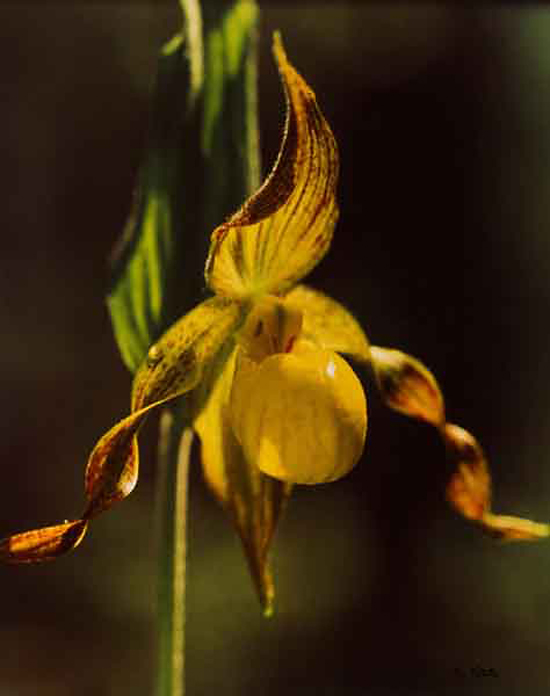
Jeannette Klute (American, 1918-2009) Yellow Lady’s Slipper Nd (early-mid 1950s) Dye transfer photograph 20 1/4 x 16 1/4 in. Bruce Museum collection Gift of LeGrand Belnap
“The first month they were sending people out for job interviews, but not me,” she recalled in a speech at the Rochester Institute of Technology in 1984. “I asked how come? The head of the department said, ‘Oh, there are no jobs for women in photography.’ My world fell apart.”
Ms. Klute took it upon herself to go out for interviews, and every week on her day off, she walked to the offices of Eastman Kodak Co. to ask for a job. For a long time, she never made it past the personnel office. Then, one day, in the pouring rain, decked in her finest navy blue suit, she stalked to the offices and was sent straight to the sixth floor for an interview.
“The man took a look at me with the rain dripping off my hat and said, ‘If you want a job that bad, you’ve got it,'” she recalled. “There was a celebration in the neighbourhood that night.” …
“She was really like my college education,” said Barbara Erbland, who assisted Ms. Klute in the lab at Kodak for many years. “She taught me everything – about light, colour, about people … how to live well.” … “Her lab consisted of all women,” she said. “I think it was by intention. She believed women had brains. We worked very well together.” …
Lugging a 4-by-5 Graflex single-lens reflex camera wherever they went, Erbland ventured into swamps and tide pools… “She taught me you don’t make do, you make things happen,” said Erbland. “You’re not a victim.”
Back in Rochester, the two sought out swamps and woodland for Ms. Klute to take her photographs – or, as she put it, to “make pictures.”
PHOTO GALLERY: In memory of Jeannette Klute, a ‘Renaissance woman’, by Philip Anselmo, August 2009
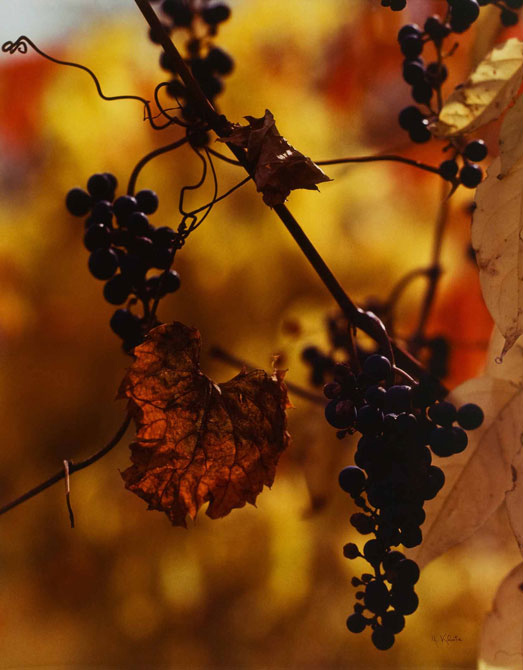
Jeannette Klute (American, 1918-2009) Grape Leaves Nd (early-mid 1950s) Dye transfer photograph 20 1/4 x 16 1/4 in. Bruce Museum collection Gift of George Stephanopoulos
Bruce Museum One Museum Drive Greenwich, CT 06830
Opening hours: Tuesday – Sunday 10am – 5pm Last admission 4.30pm Closed Monday and major holidays




 Art Blart _ art and cultural memory archive
You must be logged in to post a comment.