Exhibition: ‘Distance and Desire: Encounters with the African Archive Part III: Poetics and Politics’ at The Walther Collection Project Space, New York: Part 2

Exhibition dates: 22nd March – 18th May 2013

PLEASE NOTE: THIS POSTING CONTAINS PHOTOGRAPHS OF FEMALE NUDITY – IF YOU DO NOT LIKE PLEASE DO NOT LOOK, FAIR WARNING HAS BEEN GIVEN


Unidentified photographer. 'Dressing hair. Women of the E. Coast. Africa' Tanzania, early twentieth century


Unidentified photographer, inscribed:
Dressing hair. Women of the E. Coast. Africa
Tanzania, early twentieth century
Gelatin or collodion printed-out print mounted on album page


“Distance invokes travel, geographic dichotomies, estrangement, otherness, and separation in time. Whereas desire implies proximity, closeness, affect, and unfulfilled longing.”


Part 2 of the posting about the exhibition Distance and Desire: Encounters with the African Archive Part III. I have added notes under some of the photographs to give context to the tribes, the people and the titles of the photographs. For more information see The New Yorker: Photo Booth’s interview with curator South African scholar Tamar Garb.

See Part 1 of the posting.

Dr Marcus Bunyan


Many thankx to The Walther Collection for allowing me to publish the photographs in the posting. Please click on the photographs for a larger version of the image.


Samuel Baylis Barnard (English, 1841-1916) 'Damara Servant Girl, S. Africa' South Africa, late nineteenth century


Samuel Baylis Barnard (English, 1841-1916), inscribed:
Damara Servant Girl, S. Africa
South Africa, late nineteenth century
Albumen print


Unidentified photographer. 'Photograph of a young woman' East Africa, Early twentieth century


Unidentified photographer
Photograph of a young woman
East Africa, Early twentieth century
Gelatin-silver developed-out print
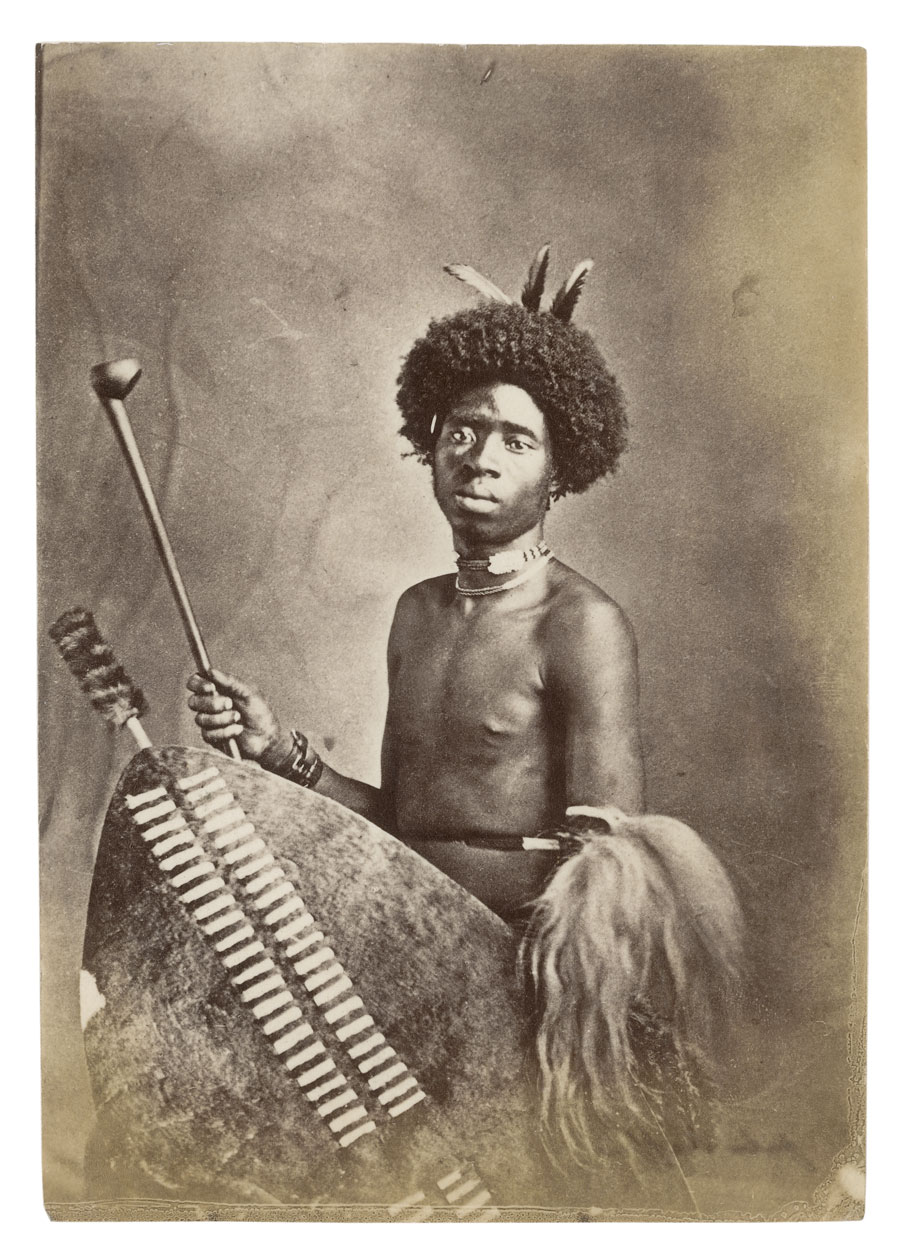
 

Samuel Baylis Barnard (English, 1841-1916) 'Zulu Kaffir' South Africa, late nineteenth century


Samuel Baylis Barnard (English, 1841-1916), inscribed:
Zulu Kaffir
South Africa, late nineteenth century
Albumen print
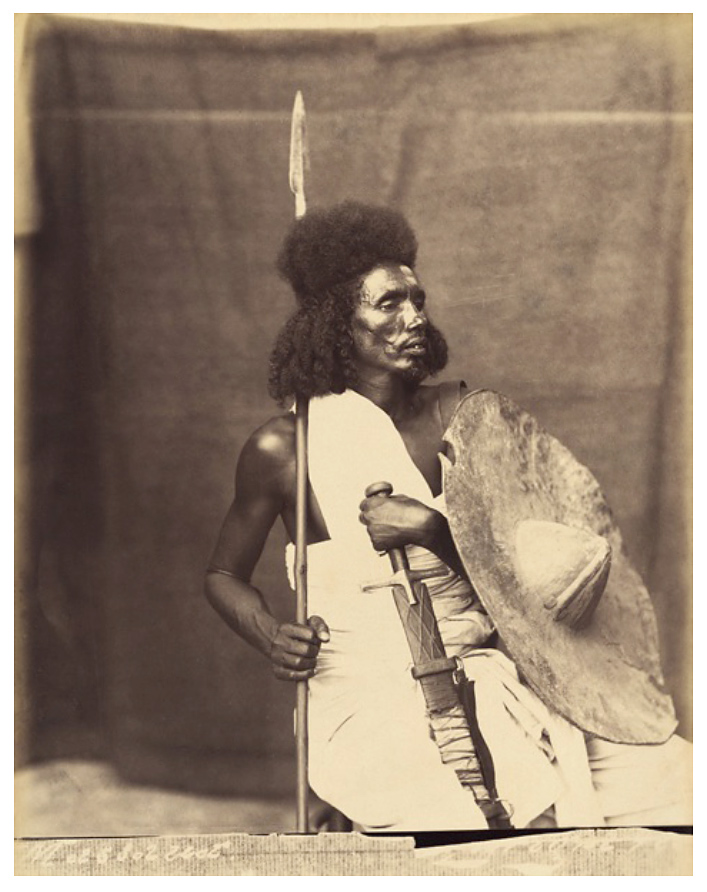
 

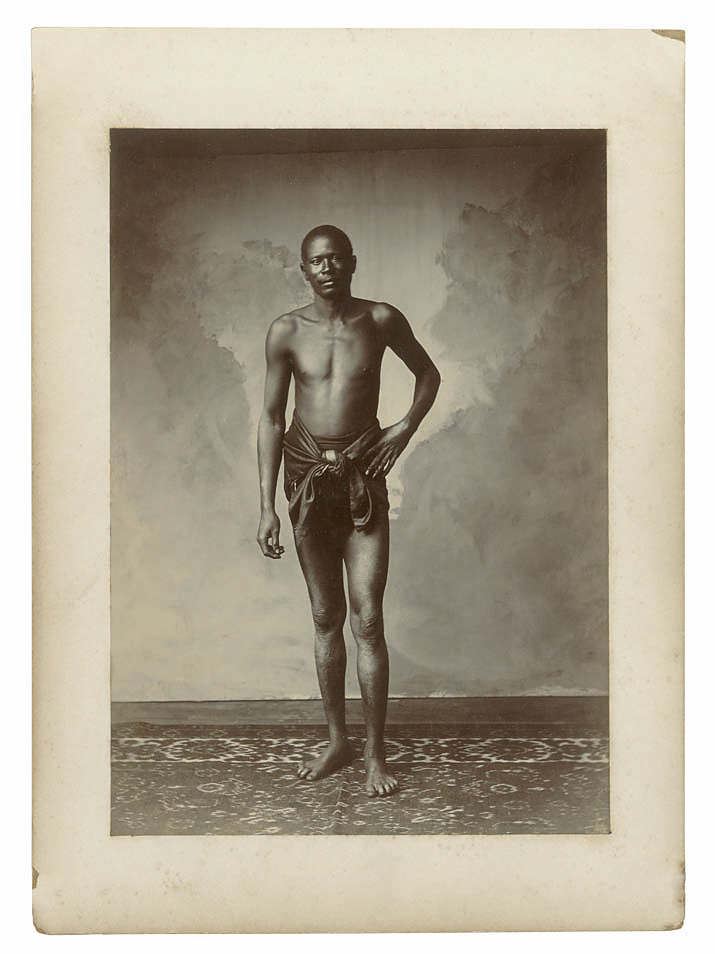
Unidentified photographer. 'Studio photograph of a man' East Africa, late nineteenth century


Unidentified photographer
Studio photograph of a man
East Africa, late nineteenth century
Albumen print


This man is from the Hadendowa tribe, eastern Sudan.

Hadendoa (or Hadendowa) is the name of a nomadic subdivision of the Beja people, known for their support of the Mahdiyyah rebellion during the 1880s to 1890s. The area historically inhabited by the Hadendoa is today parts of Sudan, Egypt and Eritrea.


Unidentified photographer. 'Monsiga Chief of Mafeking' South Africa, late nineteenth century


Unidentified photographer, inscribed:
Monsiga Chief of Mafeking
South Africa, late nineteenth century
Gelatin or collodion printed-out print mounted on album page


Mahikeng – formerly, and still commonly, known as Mafikeng and historically Mafeking in English – is the capital city of the North-West Province of South Africa. It is best known internationally for the Siege of Mafeking, the most famous engagement of the Second Boer War.

Located close to South Africa’s border with Botswana, Mahikeng is 1,400 km (870 mi) northeast of Cape Town and 260 km (160 mi) west of Johannesburg. In 2001, it had a population of 49,300. In 2007, Mafikeng was reported to have a population of 250,000 of which the CBD constitutes between 69,000 and 75,000. It is built on the open veld at an elevation of 1,500 m (4,921 ft), by the banks of the Upper Molopo River. The Madibi goldfields are some 15 km (9.3 mi) south of the town.


A. James Gribble. 'Masupa. Kaffir Chief & sons. Basutoland' South Africa, late nineteenth century


A. James Gribble, inscribed:
Masupa. Kaffir Chief & sons. Basutoland
South Africa, late nineteenth century
Albumen print


Basutoland or officially the Territory of Basutoland, was a British Crown colony established in 1884 after the Cape Colony’s inability to control the territory. It was divided into seven administrative districts; Berea, Leribe, Maseru, Mohales Hoek, Mafeteng, Qacha’s Nek and Quthing.

Basutoland was renamed the Kingdom of Lesotho upon independence from the United Kingdom on October 4, 1966.


W. Rausch (South African, 1862-1900) 'Indaba of Induna Chiefs, Buluwayo' Zimbabwe, 1890s


W. Rausch (South African, 1862-1900), inscribed:
Indaba of Induna Chiefs, Buluwayo
Zimbabwe, 1890s
Gelatin or collodion printed-out print mounted on card


InDuna (plural: izinDuna) is a Zulu title meaning advisor, great leader, ambassador, headman, or commander of group of warriors. It can also mean spokesperson or mediator as the izinDuna often acted as a bridge between the people and the king. The title was reserved for senior officials appointed by the king or chief, and was awarded to individuals held in high esteem for their qualities of leadership, bravery or service to the community. The izinDuna would regularly gather for an indaba to discuss important issues. An indaba is an important conference held by the izinDuna (principal men) of the Zulu or Xhosa peoples of South Africa. (Text from Wikipedia)

William Rausch was born in Cape Colony, South Africa in 1862. Eventually he made his way to Bulawayo where established himself as a photographer. His earliest photos date from 1895. He is one of four photographers listed in Matabeleland during this time: C. Hines, C. H. Newberry, J. Parkin, and W. Rausch. The Rhodesia Scientific Association (1899) lists Rausch as having won a prize for his Rhodesian photographs. He died of pneumonia at Memorial Hospital on 24 September, 1900. H. A. de Beers was appointed as executor and his estate was finalised 24 January 1901.
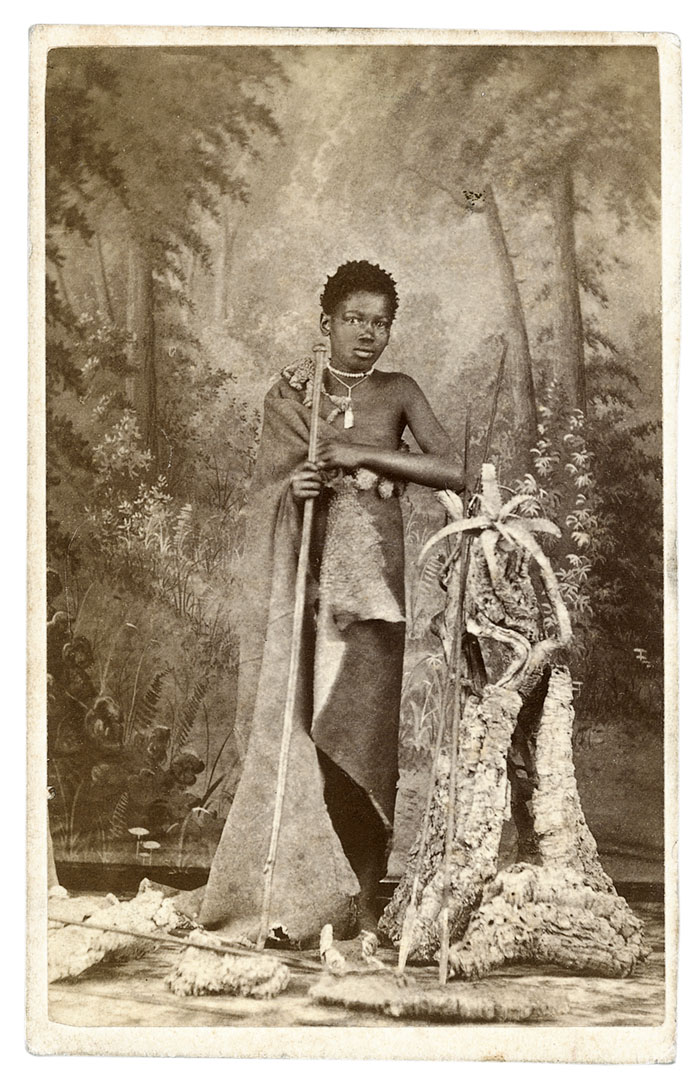
 

Unidentified photographer. 'Studio photograph of a man' South Africa, late nineteenth century


Unidentified photographer
Studio photograph of a man
South Africa, late nineteenth century
Carte de visite


Gray Brothers (Diamond Fields) 'Zulu / Young Warrior in fighting order, and in skin Kaross. Armed with hatchet and assegai' South Africa. c. 1870s


Gray Brothers (Diamond Fields), inscribed:
Zulu / Young Warrior in fighting order, and in skin Kaross. Armed with hatchet and assegai
South Africa. c. 1870s
Carte de visite
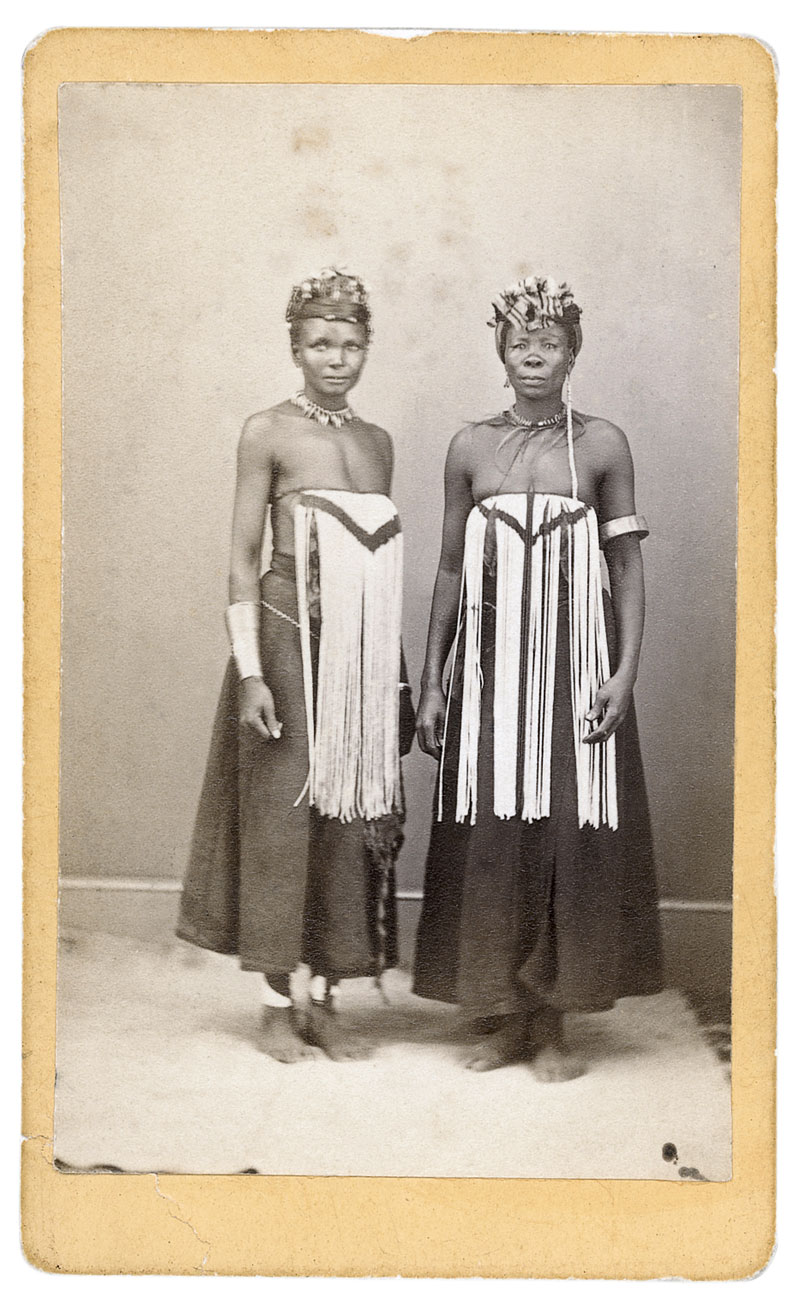
 

G. F. Williams. 'Studio photograph of two women' South Africa, c. 1870s


G. F. Williams
Studio photograph of two women
South Africa, c. 1870s
Carte de visite


Lawrence Brothers, Cape Town (attr.). 'Kaffir girl' South Africa, c. 1870s


Lawrence Brothers, Cape Town (attr.), inscribed:
Kaffir girl
South Africa, c. 1870s
Carte de visite


The partners of Lawrence Bros. were James Lawrence and Colin Gibb Lawrence and they were doing business from Ashley street, Cape Town in 1864. Left for England in 1865. James employed his brothers Alexander and Colin Gibb as his assistants and later joined with Colin in a partnership.

Kaffir (/ˈkæfÉ™r/,Afrikaans: “kaffer”, Sarnami: “kafri”) is an ethnic slur which is used in reference to black Africans in South Africa. Derived from the Arabic word Kafir meaning “nonbeliever”, particularly of Islam.
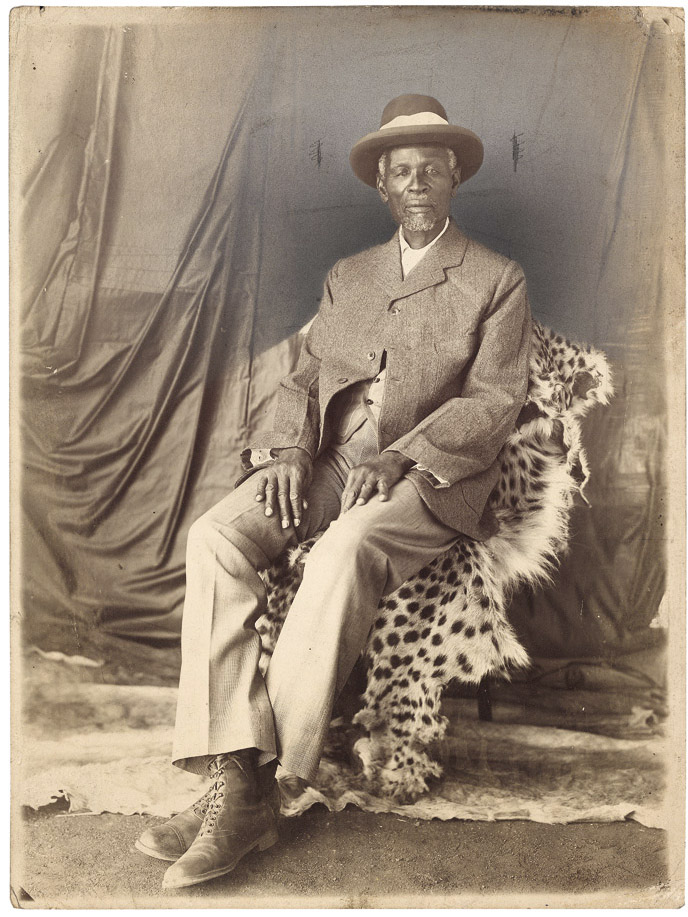
 

Unidentified photographer. 'Portrait of King Khama III' South Africa, early twentieth century


Unidentified photographer
Portrait of King Khama III
South Africa, early twentieth century


Khama III (1837?-1923), also known as Khama the Good, was the kgosi (meaning chief or king) of the Bamangwato people of Bechuanaland (now Botswana), who made his country a protectorate of the United Kingdom to ensure its survival against Boer and Ndebele encroachments.

After Khama became king in 1875, after overthrowing his father Sekgoma and elbowing away his brother Kgamane his ascension came at a time of great dangers and opportunities. Ndebele incursions from the north (from what is now Zimbabwe), Boer and “mixed” trekkers from the south, and German colonialists from the West, all hoping to the seize his territory and its hinterlands. He answered these challenges by aligning his state with the administrative aims of the British, which provided him with cover and support, and, relatedly, by energetically expanding his own control over a much wider area than any “kgosi” before him. Khama converted to Christianity, which moved him to criminalise sectarianism and to deprecate the institutions favoured by traditionalists. At Khama’s request stringent laws were passed against the importation of alcohol.

Text from the Wikipedia website
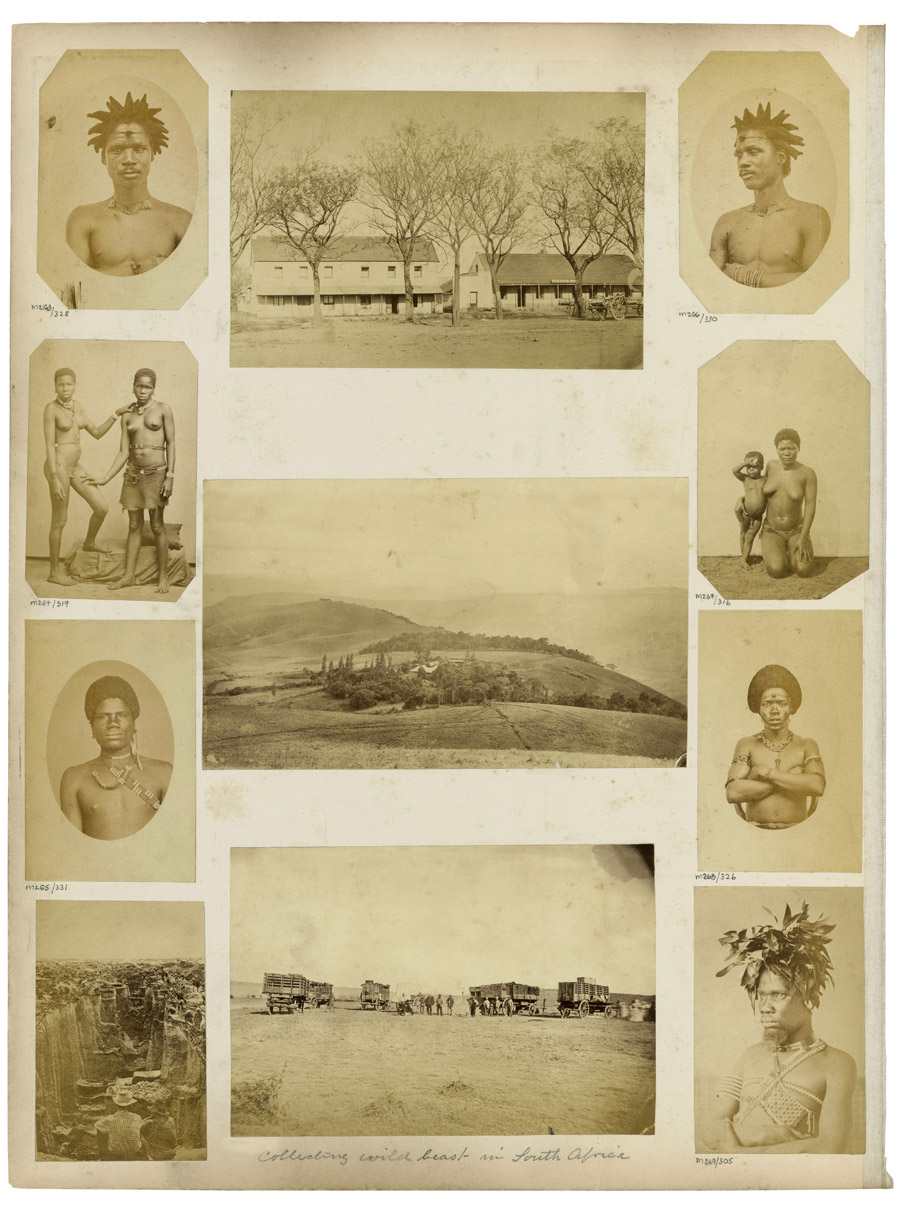
 

G. T. Ferneyhough (attr.) and unidentified photographers. 'Albumen prints mounted to album page' South Africa, last third of the nineteenth century


G. T. Ferneyhough (attr.) and unidentified photographers
Albumen prints mounted to album page
South Africa, last third of the nineteenth century


G. T. Ferneyhough (attr.), Crewes & Van Laun (attr.), H. F. Gros (attr.), and unidentified photographers. 'Album page with photographs of Cetshwayo and his family, Chief Sekhukhune, and unidentified persons' South Africa, last third of the nineteenth century


G. T. Ferneyhough (attr.), Crewes & Van Laun (attr.), H. F. Gros (attr.), and unidentified photographers
Album page with photographs of Cetshwayo and his family, Chief Sekhukhune, and unidentified persons
South Africa, last third of the nineteenth century


The bottom right hand text says, “Cetshwayo’s wives who came to England.” Obviously on the ship that took the King to England in 1882 (see below)


Invading Zululand

Lieutenant-General Sir Frederic Thesiger, 2nd Baron Chelmsford, led the invasion of Zululand on 11 January, with British centre column crossing at Rorke’s Drift. Additional British forces massed at Lower Drift on the Thukela River, near the coast, and on the north-western border near Utrecht.

Isandlawana and Rorke’s Drift

Despite an early success at Isandlwana (22 January) where 24,000 Zulu warriors overran the British camp of 1,700 – over 1,300 British and Imperial troops were annihilated (only 60 of the survivors were Europeans). That evening the small garrison at Rorke’s Drift regained British self-respect by defending the (hospital) station against a force of more than 3,000 Zulu warriors.

Defeat at Ulundi

Cetshwayo’s army was finally defeated at oNdini (Ulundi) on 4 July 1879 and his royal homestead burnt to the ground. Although Cetshwayo escaped from oNdini, he was soon captured in the Ngome Forest by British dragoons (28 August). He was informed by Shepstone that he was to be exiled from Zululand and that the nation would be divided into 13 independent chiefdoms under the authority of the British.

Exile

On 15 September 1879 Cetshwayo was dispatched to Cape Town. He was held as a prisoner of war until February 1881 when he was transferred from the castle to Oude Molen, a farm on the Cape Flats.

“In 1882 Cetshwayo was permitted to travel to England for audience with Queen Victoria – he petitioned for his return to Zululand as ruler. He was a hit amongst London society and became a favourite of the public.”

Cetshwayo was returned in secret to Zululand on 10 January 1883. He was met at Port Durnford by Sir Theophilus Shepstone (who was brought out of retirement for the process). Shepstone arranged the details of Cetshwayo’s restoration (29 January), but he was not permitted an army to defend his somewhat reduced ‘nation’ – part of the arrangement was that the north of Zululand was to be put under the control of his rival, Zibhebhu kaMaphitha.

Defeat and Retreat

By March 1883 Zibhebhu was moving against Cetshwayo’s supporters in his assigned northern territory and Cetshwayo’s uSuthu marched against him. The uSuthu were defeated and driven into Transvaal and back south to oNdini. The civil war between Cetshwayo and Zibhebhu ranged across the Mahlabathini plain and the uSuthu was once again defeated. Whilst Cetshwayo and his 15-year old heir, Dinizulu, were able to escape the capital of oNdini and hide out in the Nkandla forest, theuSuthu leadership was decimated. Cetshwayo was escorted to Eshowe by Henry Francis Fynn jr, the British Resident in Zululand, on the 15 October 1883.

A Disputed Cause of Death

On the afternoon of 8 February 1884 Cetshwayo died. Although officially recorded as a heart attack (Surgeon Scott, the resident military medical officer, was refused permission to do an autopsy and so could record no other cause). However an abortive assassination attempt (by poison) was made against Mnyamana kaNgqengelele, chief of the Buthelezi and Cetshwayo’s chief inDuna, around the same so time it seems likely that Cetshwayo was also poisoned.

Text from the African History website [Online] Cited 11/05/2013 no longer available online
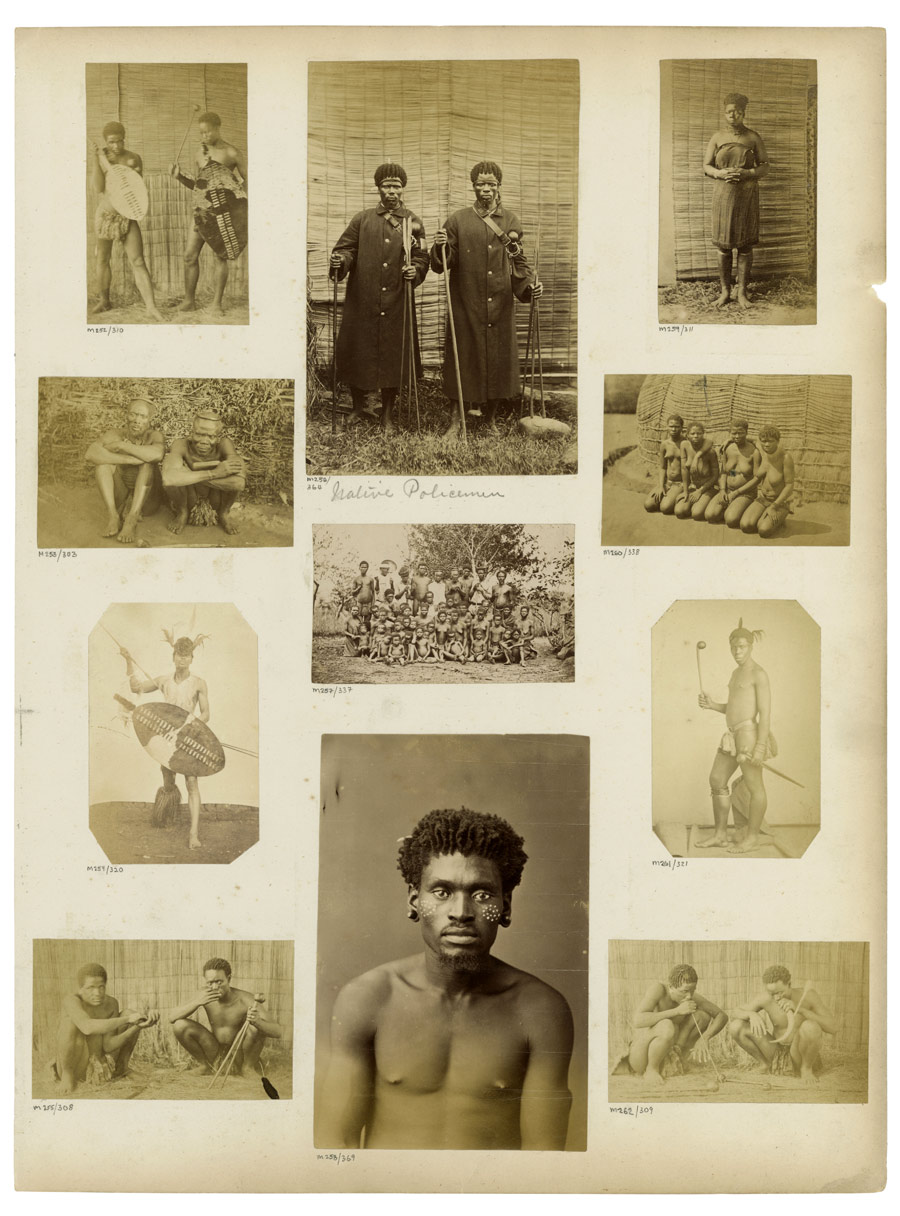
 

Unidentified photographers. 'Albumen prints mounted to album page' South Africa, late nineteen century


Unidentified photographers
Albumen prints mounted to album page
South Africa, late nineteen century


Unidentified Photographer. 'Native Policemen' South Africa, late nineteen century


Unidentified photographer
Native Policemen
South Africa, late nineteen century
from Albumen prints mounted to album page
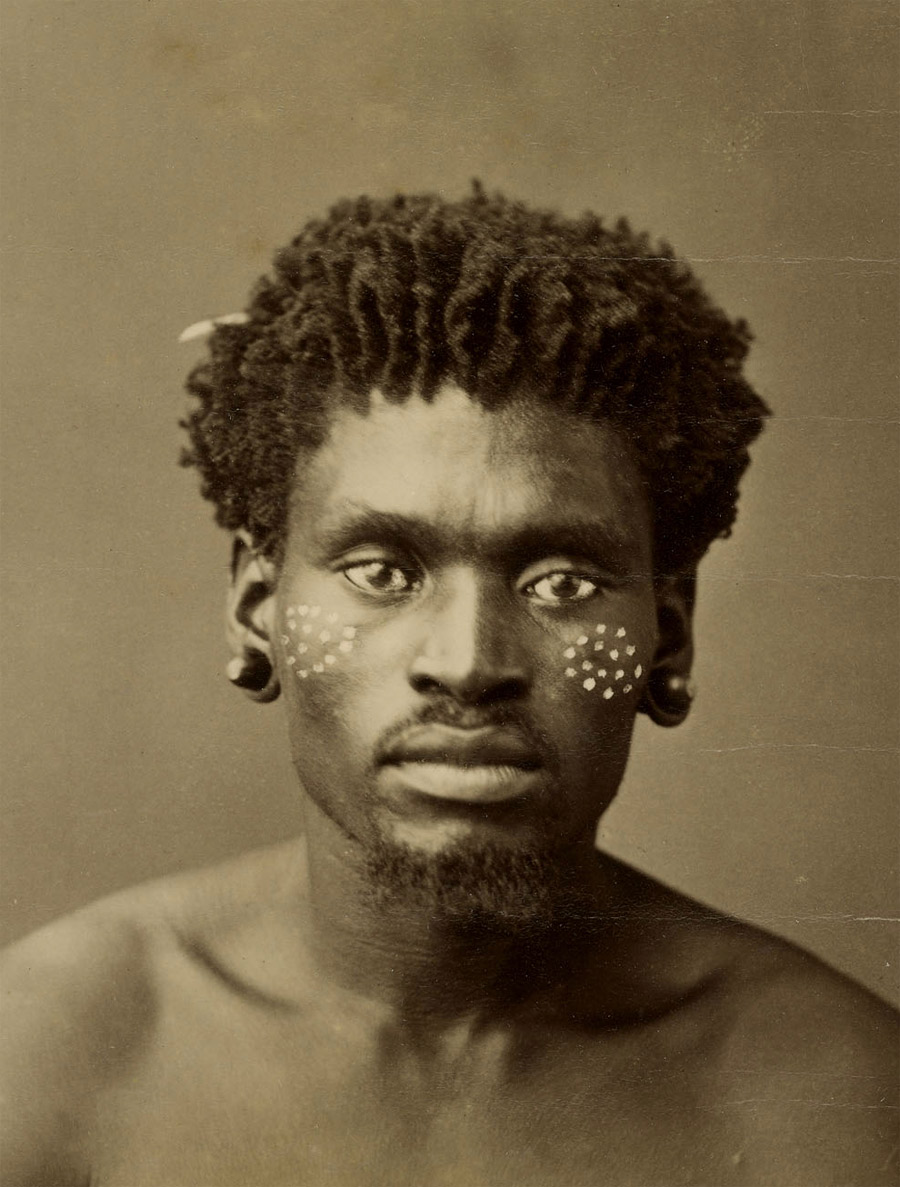
 

Unidentified Photographer. 'Portrait of a Man' (detail) South Africa, late nineteen century


Unidentified Photographer
Portrait of a Man (detail)
South Africa, late nineteen century
from Albumen prints mounted to album page


Notice how the white spots have been painted on by the photographer after exposure, presumably to “exoticise” the noble savage.
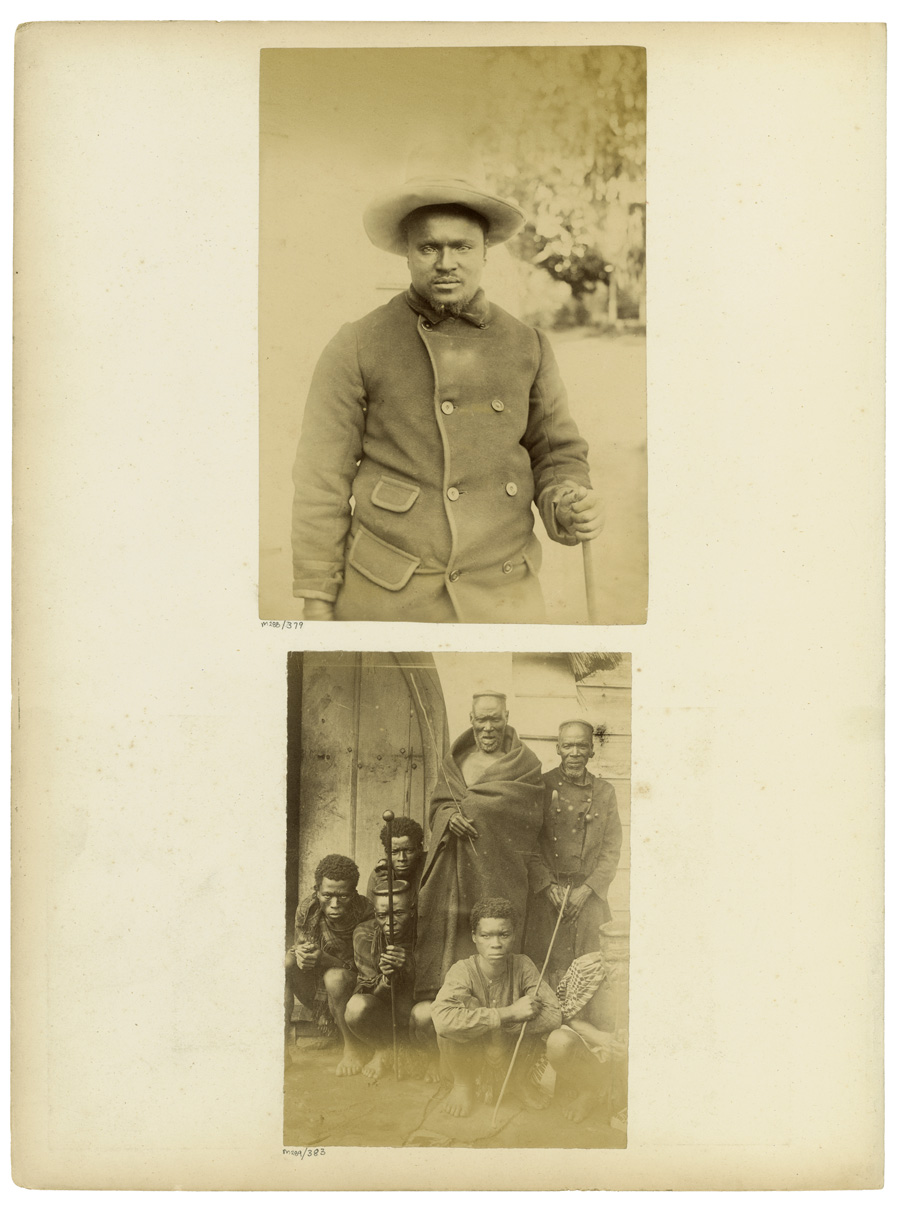
 

Unidentified photographers. 'Album page' South Africa, late nineteenth century


Unidentified photographers
Album page
South Africa, late nineteenth century


The Walther Collection Project Space
Suite 718, 508-526 West 26th Street
New York
Phone: +1 212 352 0683

Opening hours:
Wednesday – Saturday 12pm – 6pm

The Walther Collection website

LIKE ART BLART ON FACEBOOK

Back to top

Exhibition: ‘Distance and Desire: Encounters with the African Archive Part III: Poetics and Politics’ at The Walther Collection Project Space, New York: Part 1

Exhibition dates: 22nd March – 18th May 2013


Unidentified photographer. 'Photograph of a man' South Africa, late nineteenth century


Unidentified photographer
Photograph of a man
South Africa, late nineteenth century
Gelatin or collodion printed-out print


Undertaking research in to the work of South African photographer Ernest Cole, I wanted to know more about “South African colonial photography” pre-Apartheid. If you type the phrase into Google images there is absolutely nothing online about this historical archive. So it is a great privilege that The Walther Collection has allowed me to publish nearly 40 photographs over two postings on Art Blart. What a honour to be the first online space to promote this important historical record.

It is vital that colonial photographs such as these are visible in contemporary society for they bare witness to the conditions of the past and provide a visual language to textualise our experience and thereby make it available for interpretation and closure – for people of all colours and races. This is particularly true for a post-colonial country such as South Africa where the history of the nation must be examined impartially no matter how painful the subject matter in order to understand how the actions of the past influence the present and will continue to be re/sighted in the future. Through continual re/citation by being present in the public sphere for all to see (not hidden away offline) these images will become a source of pride (for person, family, tribe, country) – for these were strong human beings that survived the vicissitudes of colonialism to form the history and lineage of a nation.

We must thank numerous private collectors that have saved many of these photographs from the rubbish tip when no public institution was interested in collecting them. Interesting books about the South African archive include Surviving the Lens: Photographic Studies of South and East African People, 1870-1920 by Michael Graham Stewart (2001) and Contemporary African Photography from the Walther Collection. Events of the Self, Portraiture and Social Identity by Okwui Enwezor (ed.) Göttingen, Steidl, 2010.

See Part 2 of the posting.

Dr Marcus Bunyan


Many thankx to The Walther Collection for allowing me to publish the photographs in the posting. Please click on the photographs for a larger version of the image.


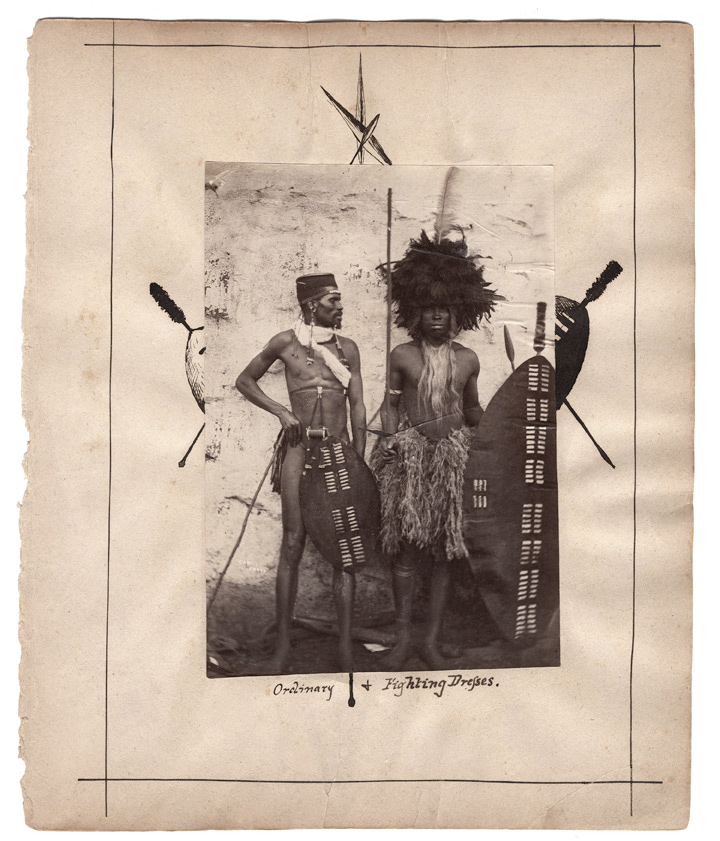
Caney Brothers, inscribed: 'Ordinary & Fighting Dresses.' South Africa, late nineteenth century


Caney Brothers, inscribed:
Ordinary & Fighting Dresses.
South Africa, late nineteenth century
Albumen print


Henri Noyer (attr.), inscribed: 'Taisaka Spearsmen No. 2' Madagascar, early twentieth century


Henri Noyer (attr.), inscribed:
Taisaka Spearsmen No. 2
Madagascar, early twentieth century
Gelatin or collodion printed-out print


The Taisaka come from the South-East coast of the island of Madagascar.


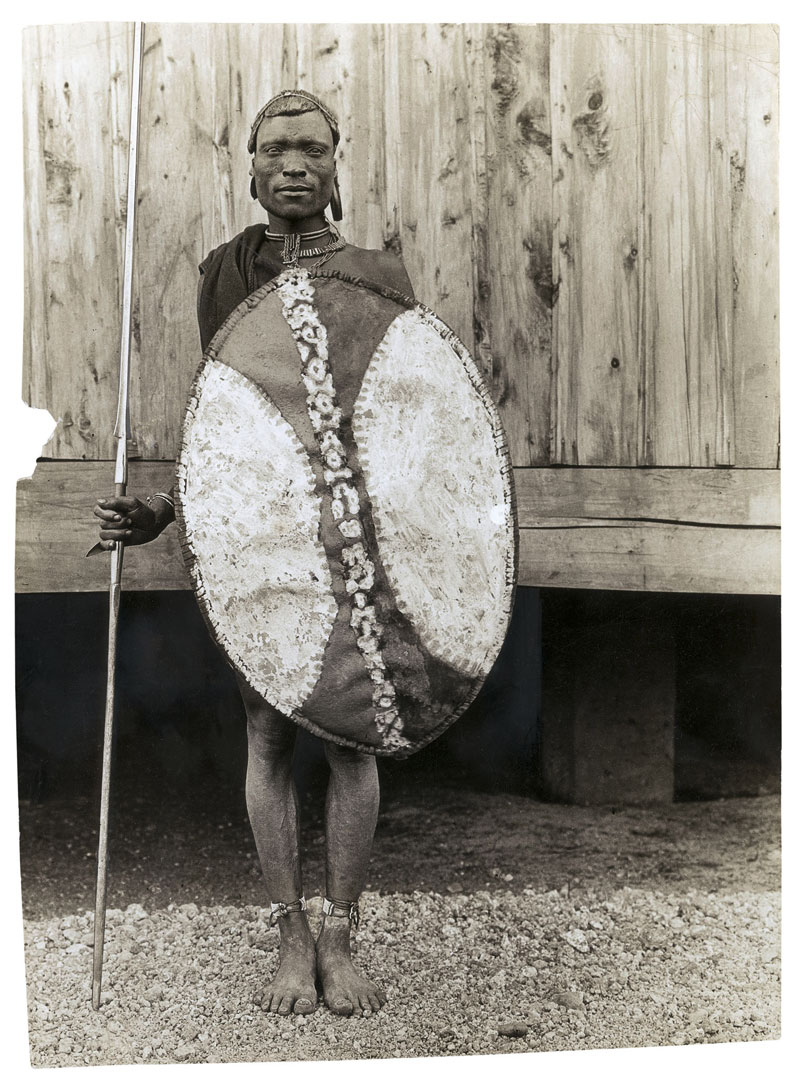
Unidentified photographer. 'Mouv, Nthaka warrior' East Africa, early twentieth century


Unidentified photographer
Mouv, Nthaka warrior
East Africa, early twentieth century
Gelatin or collodion developed out print


The Ameru had an age set system which provided the community with warriors for defence. Boys are circumcised and become Nthaka (warriors). They stay in a Gaaru and learn to defend the community and take care of their families. The warriors were called Nthaka and were isolated from the community for military training


Unidentified photographer. 'Studio photograph of a man' South Africa, late nineteenth century


Unidentified photographer
Studio photograph of a man
South Africa, late nineteenth century


Unidentified photographer. 'Studio photograph of a man' South Africa, late nineteenth century


Unidentified photographer
Studio photograph of a man
South Africa, late nineteenth century


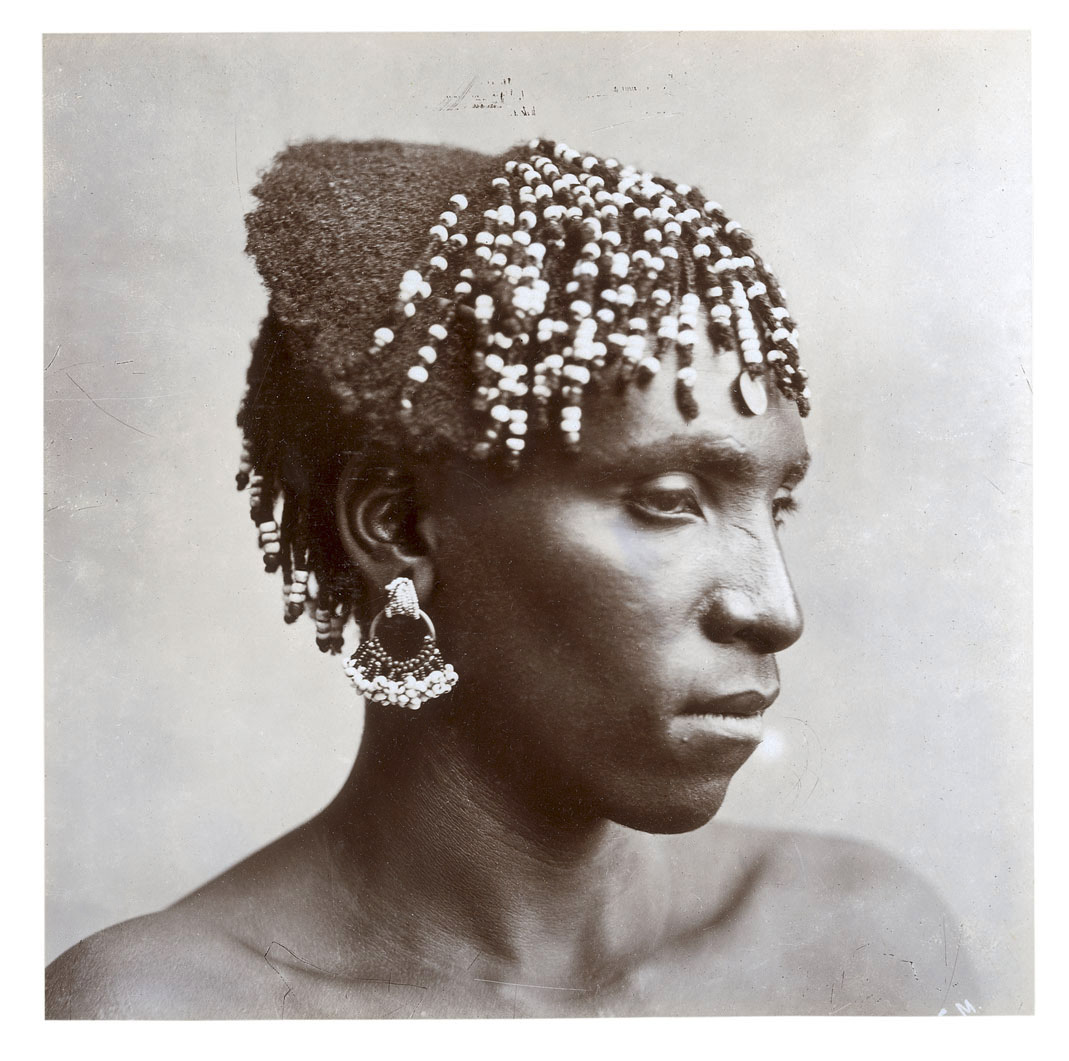
J. E. Middlebrook (South African, active 1870s-1900s) inscribed: 'A Zulu girl. Hair strung with beads' South Africa, late nineteenth century


J. E. Middlebrook (South African, active 1870s-1900s) (attr.), inscribed:
A Zulu girl. Hair strung with beads
South Africa, late nineteenth century
Gelatin-silver printed-out print


The Zulu (Zulu: amaZulu) are the largest South African ethnic group, with an estimated 10-11 million people living mainly in the province of KwaZulu-Natal. Small numbers also live in Zimbabwe, Zambia and Mozambique. Their language, Zulu, is a Bantu language; more specifically, part of the Nguni subgroup. The Zulu Kingdom played a major role in South African history during the 19th and 20th centuries. Under apartheid, Zulu people were classed as third-class citizens and suffered from state-sanctioned discrimination. They remain today the most numerous ethnic group in South Africa, and now have equal rights along with all other citizens.

J. E. Middlebrook. Late 19th-century South African photographer. The flourishing diamond mines in Kimberley brought hundreds of workers and photographers to the area beginning in 1867. J. E. Middlebrook followed soon thereafter in the early 1870s, and set up his photography studio, The Premier Studio, on West Street West ; he had a second studio in Durban, “Opposite the Club.” Middlebrook photographed the landscape, farms, cities, and people of South Africa. His photographs of the Zulu people are considered to be theatrical, deliberating portraying the native people in an idyllic, romantic, and exotic light. He took photographs during the South African war (1899-1902). A number of well-known photographers were based at the studio, including C. Evans, Wunsch, Atkinson and Dyer, who documented Kimberley’s early days. By 1906, Middlebrook’s was bought by Frank Hancox and when German, Charles Seidenstucker, arrived in South Africa, he promptly became the studio’s new owner.


A. James Gribble (South African, 1863-1943) inscribed: 'Kaffer woman' South Africa, late nineteenth century


A. James Gribble (South African, 1863-1943), inscribed:
Kaffer woman
South Africa, late nineteenth century
Albumen print


The word kaffer is a word that is used widely in South Africa and is a derogatory word for a black person. Used mainly by Afrikaans people. In old Dutch it means unbeliever (in God), so should not necessarily mean black, but just unholy or non-Christian. Boers gave the name in early South African history as native Africans did not believe in Jesus. Name came after Bantu – which means the same thing, but was banned as it was discriminatory.


Unidentified photographer. 'Zulu mothers' South Africa, late nineteenth century


Unidentified photographer, inscribed:
Zulu mothers
South Africa, late nineteenth century
Gelatin-silver printed out print


Samuel Baylis Barnard (English, 1841-1916) 'Hottentott S. Africa [Portait of /A!kunta]' South Africa, early 1870s


Samuel Baylis Barnard (English, 1841-1916), inscribed
Hottentott S. Africa [Portait of /A!kunta]
South Africa, early 1870s
Albumen print


The word ‘Hottentots’ was a name disparagingly used to refer to the Khoikhoi people that lived in the southern parts of the African continent as early as the 5th century AD and continued to live till the first colonists arrived in the middle of the seventeenth century. The Dutch colonists called them Hottentots. It means ‘stammerer’ in Dutch. Khoikhoi means ‘people people’. The word Hottentot is no longer used to describe the people.


The Walther Collection is pleased to announce Poetics and Politics, the third and last exhibition in the series Distance and Desire: Encounters with the African Archive, curated by Tamar Garb. Poetics and Politics presents an extraordinary range of previously unseen vintage portraits, cartes de visite, postcards, and album pages from Southern and Eastern Africa, produced from the 1870s to the early twentieth century. The exhibition makes visible both the ideological frameworks that prevailed during the colonial period in Africa and the exceptional skill of photographers working in the studio and landscape.

The culmination of Distance and Desire, Poetics and Politics offers a remarkable opportunity to view the narratives that emerge from this African photographic archive, describing in particular the experience of the studio – the curiosity between subject and photographer, the negotiations of costume and pose, and the will for self-representation. The exhibition investigates typical European depictions of Africans, from scenes in nature, to sexualised images of semi-nude models, to modern sitters posing in elaborate studios, critically addressing the politics of colonialism and the complex issues of gender and identity.

Among over 75 vintage prints, Poetics and Politics includes a selection of elegant studio portraits by Samuel Baylis Barnard, one of Cape Town’s most prominent nineteenth century photographers. Original album pages of landscapes and ethnographic imagery are displayed alongside a series of carte de visite portraits of Africans, created in the 1870s in the Diamond Fields of Kimberley, South Africa. The exhibition also features several double-sided displays of album pages, showing striking combinations of personal and stock images, and the juxtapositions of prominent figures in both African and Western contexts.

Distance and Desire is accompanied by an extensive catalogue, published by The Walther Collection and Steidl, and edited by Tamar Garb. Including twelve original essays, the catalogue offers new perspectives by contemporary artists and scholars on the African archive, reimagining its diverse histories and changing meanings. On June 8, 2013 the expanded exhibition incorporating all three parts of Distance and Desire: Encounters with the African Archive will open at The Walther Collection in Neu-Ulm, Germany. The Walther Collection is a private non-profit foundation dedicated to researching, collecting, exhibiting, and publishing modern and contemporary photography and video art, based in Neu-Ulm, Germany and New York. Distance and Desire is part of the collection’s multi-year investigation of African photography and video.

Press release from the Walther Collection website


Unidentified photographer. 'Native Police' South Africa, Late nineteenth century


Unidentified photographer, inscribed:
Native Police
South Africa, Late nineteenth century
Albumen print mounted on album page


Kimberley Studio (New Rush, Diamond Fields). 'Zulu / Warrior in skin kaross, armed with assegais' and 'Guerrier Zulu a manteau de fourrure et armé de piques' South Africa, c. 1870s


Kimberley Studio (New Rush, Diamond Fields), inscribed:
Zulu / Warrior in skin kaross, armed with assegais and Guerrier Zulu a manteau de fourrure et armé de piques
South Africa, c. 1870s
Carte de visite


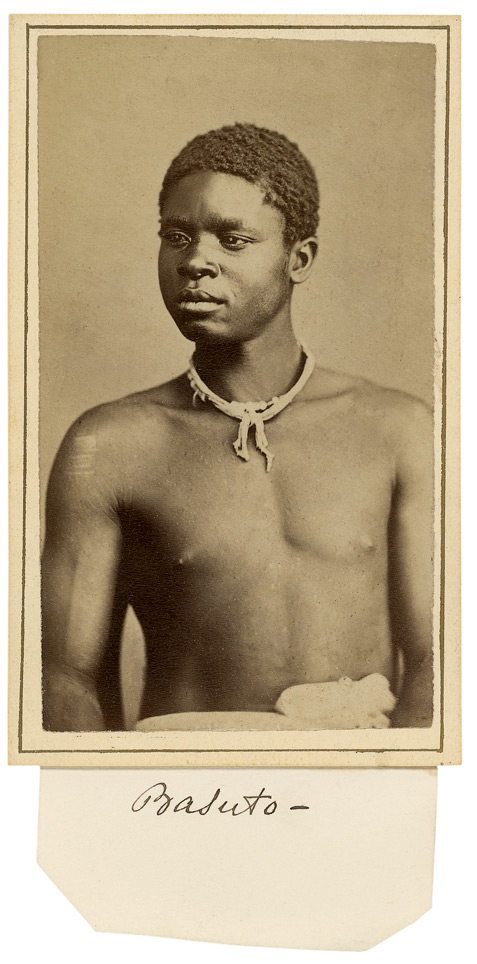
John Salmon. 'Basuto' South Africa, c. 1870s


John Salmon, inscribed:
Basuto
South Africa, c. 1870s
Carte de visite


See Sotho people on Wikipedia


Samuel Baylis Barnard (English, 1841-1916) 'Photograph of a woman' South Africa, late nineteenth century


Samuel Baylis Barnard (English, 1841-1916)
Photograph of a woman
South Africa, late nineteenth century
Carte de visite


William Moore (attr.), 'Macomo and his chief wife [Portrait of Maqoma and his wife Katyi]' South Africa, c. 1869


William Moore (attr.), inscribed:
Macomo and his chief wife [Portrait of Maqoma and his wife Katyi]
South Africa, c. 1869
Albumen print


G. F. Williams. 'Studio photograph of a man' South Africa South Africa, late nineteenth century


G. F. Williams
Studio photograph of a man, South Africa
South Africa, late nineteenth century
Carte de visite


Unidentified photographer. 'Fingo swells' South Africa, late nineteenth century


Unidentified photographer, inscribed:
Fingo swells
South Africa, late nineteenth century
Gelatin or collodion printed-out print


The Fengu (plural amaFengu) are a Bantu people; originally closely related to the Zulu people, but now often considered to have assimilated to the Xhosa people whose language they now speak. Historically they achieved considerable renown for their military ability in the frontier wars. They were previously known in English as the “Fingo” people, and they gave their name to the district of Fingoland (Mfenguland), the South West portion of the Transkei division, in the Cape Province.


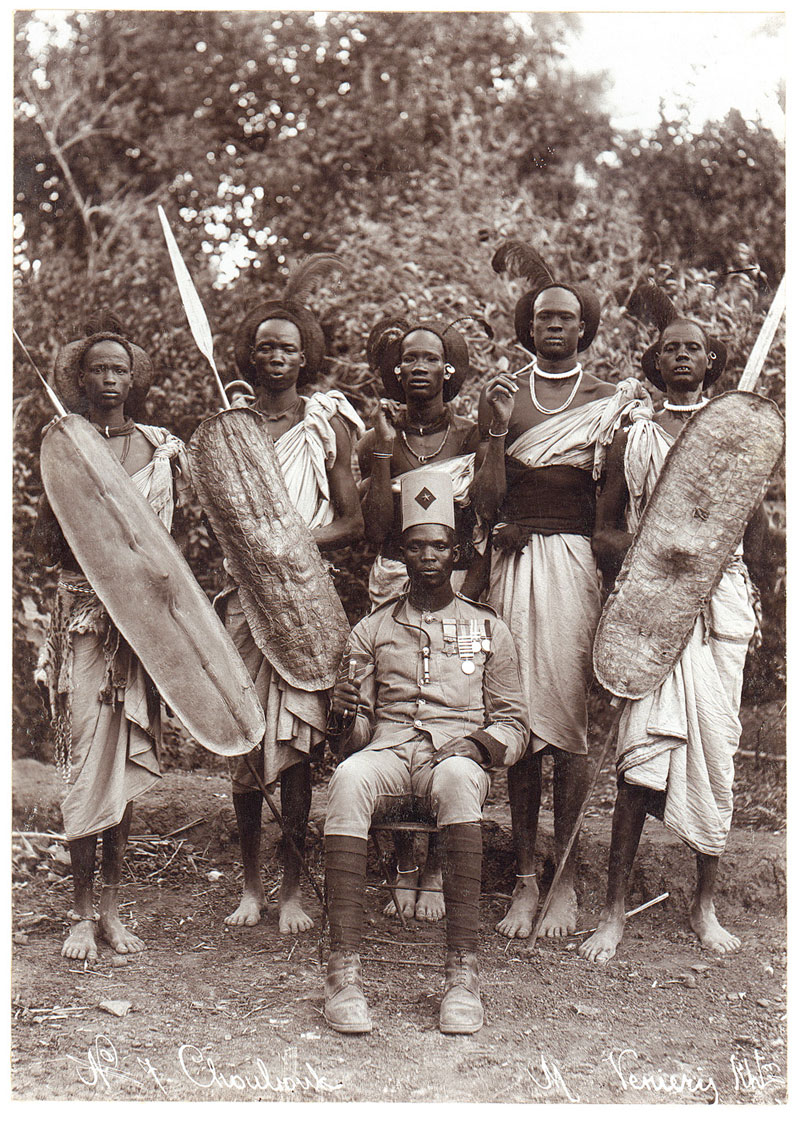
M. Veniery. 'Choubouk' Sudan, early twentieth century


M. Veniery, inscribed:
Choubouk
Sudan, early twentieth century
Gelatin or collodion printedout print mounted on card


Unidentified photographer. 'Bushman' South Africa, late nineteenth century


Unidentified photographer, inscribed:
Bushman
South Africa, late nineteenth century
Gelatin or collodion printed-out print


The San peoples, also known as the Bushmen, are members of various Khoe, Tuu, or Kx’a-speaking indigenous hunter-gatherer groups that are the first nations of Southern Africa, and whose territories span Botswana, Namibia, Angola, Zambia, Zimbabwe, Lesotho and South Africa. In 2017, Botswana was home to approximately 63,500 San people, which is roughly 2.8% of the country’s population, making it the country with the highest population of San people. “Bushmen” is now considered derogatory by many South Africans.


A.C. Gomes & Son. 'Views in Zanzibar – Natives Hairdressing' Tanzania Late nineteenth century


A.C. Gomes & Son, inscribed:
Views in Zanzibar – Natives Hairdressing, Tanzania
Late nineteenth century
Gelatin or collodion printed-out print mounted to album page


A. C. Gomes established a photo studio in Zanzibar perhaps as early as 1868. He had a brief partnership with J. B. Coutinho in the 1890s. His son P. F. Gomes continued the family business in Zanzibar for many years, he died in 1932. Over those years both have left us with some marvellous images.


The Walther Collection Project Space
Suite 718, 508-526 West 26th Street
New York
Phone: +1 212 352 0683

Opening hours:
Wednesday – Saturday from 12pm – 6pm

The Walther Collection website

LIKE ART BLART ON FACEBOOK

Back to top

Review: ‘Aliza Levi / Books on a White Background’ at Edmund Pearce Gallery, Melbourne

Exhibition dates: 10th April – 4th May 2013


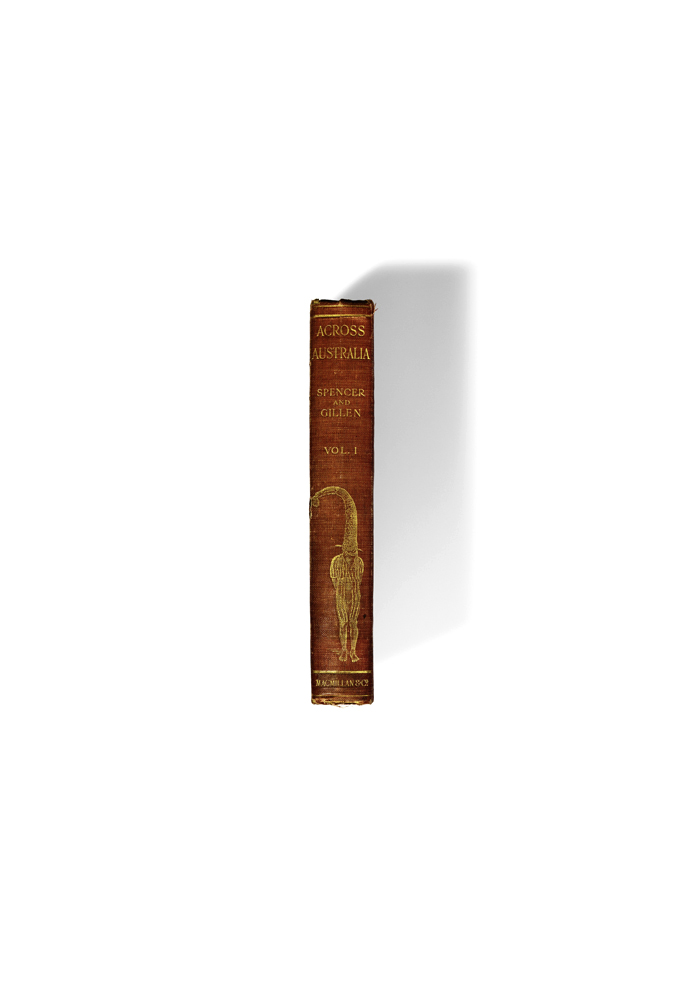
Aliza Levi (South African, b. 1969) 'Across Australia' 2011


Aliza Levi (South African, b. 1969)
Across Australia
2011
Archival Inkjet Print
59 x 42cm


Aura of white

Shadow of black

Books for the boys *

Black bodies out the back


* Books for the bourgeois

* Books for the parlour

* Books for the burning

* Books to hide memories

* Books lost in archives

* Books still in libraries

* Books for the tower (implying Babel)

* Books for the scrapheap

* Books for academics

* Books for the garbo

* Books for the church stall

* Books to forget


Dr Marcus Bunyan


Many thankx to Edmund Pearce Gallery for allowing me to publish the photographs in the posting. Please click on the photographs for a larger version of the image.


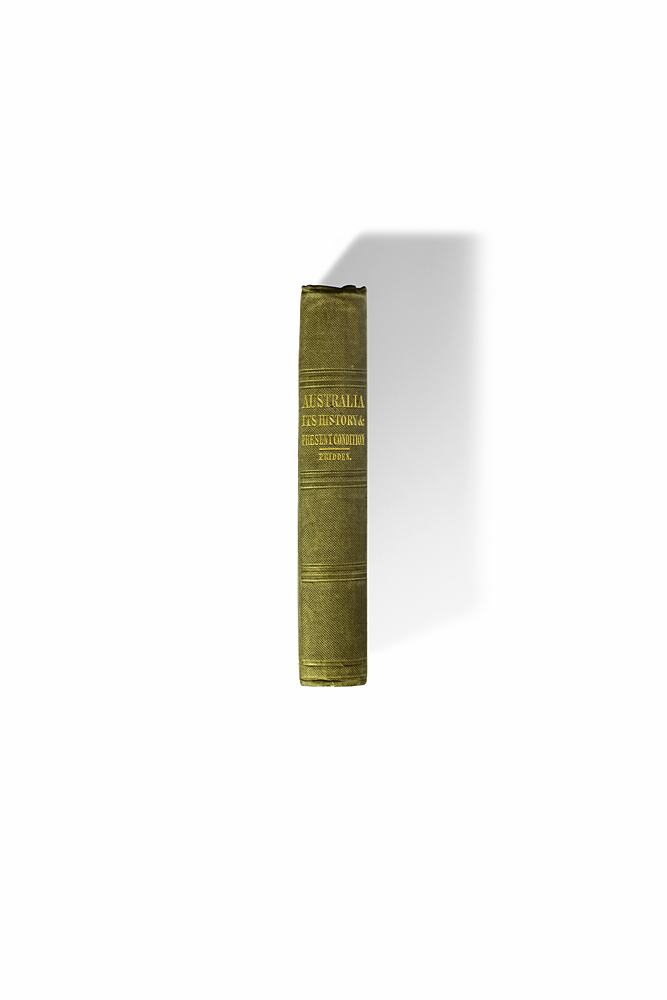
Aliza Levi (South African, b. 1969) 'Australia, its History and Present Condition' 2013


Aliza Levi (South African, b. 1969)
Australia, its History and Present Condition
2013
Archival Inkjet Print
59 x 42cm


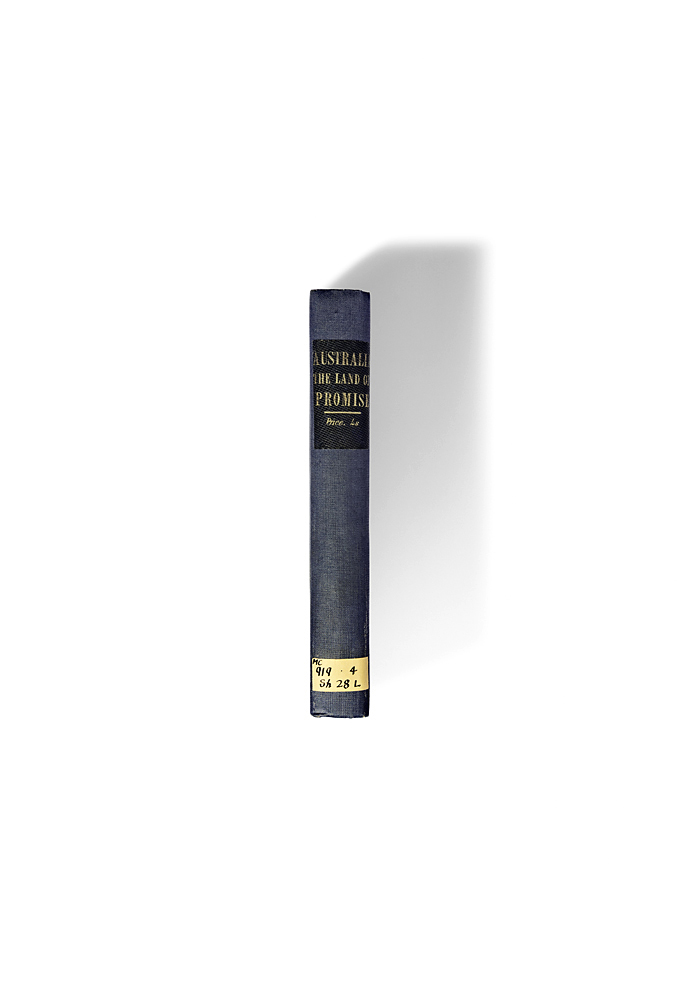
Aliza Levi (South African, b. 1969) 'Australia the Land of Promise' 2012


Aliza Levi (South African, b. 1969)
Australia the Land of Promise
2012
Archival Inkjet Print
59 x 42cm


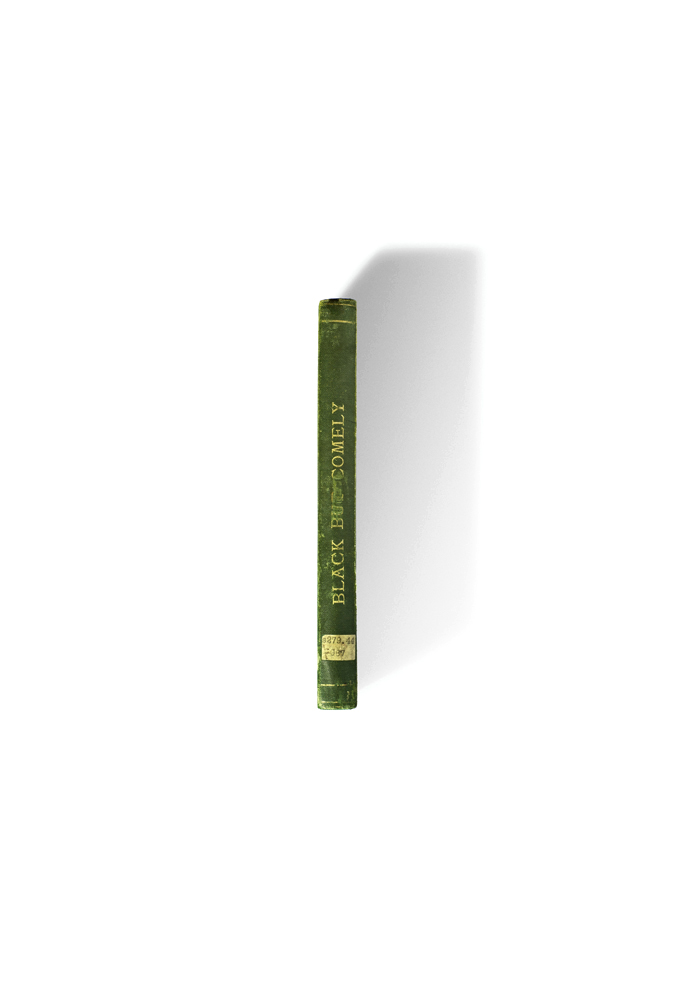
Aliza Levi (South African, b. 1969) 'Black But Comely' 2013


Aliza Levi (South African, b. 1969)
Black But Comely
2013
Archival Inkjet Print
59 x 42cm


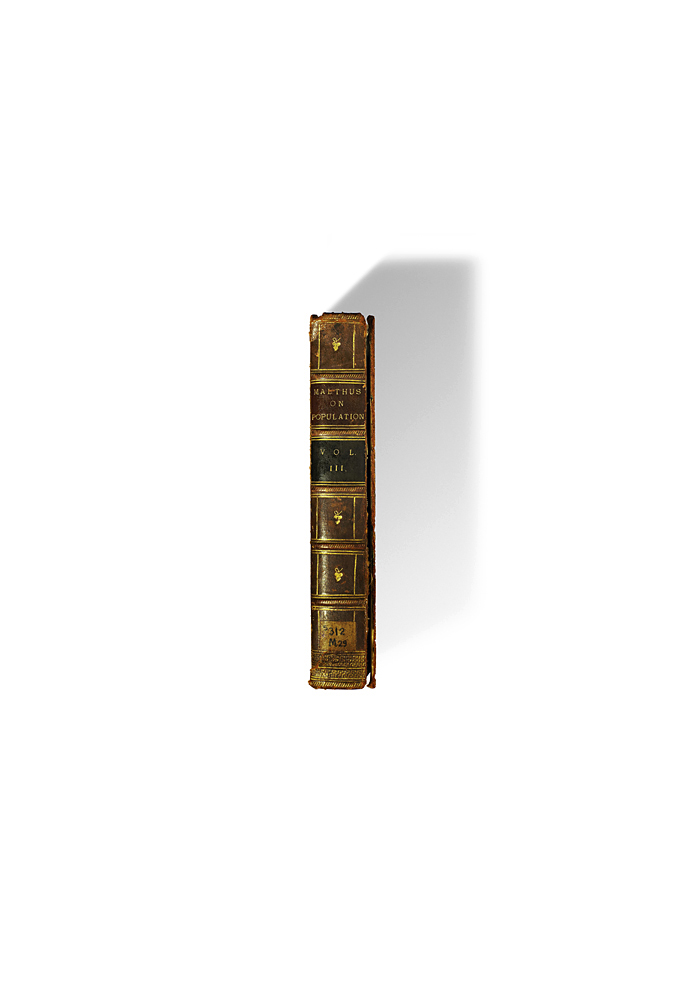
Aliza Levi (South African, b. 1969) 'Malthus on Population' 2012


Aliza Levi (South African, b. 1969)
Malthus on Population
2012
Archival Inkjet Print
59 x 42cm


“I began this series by choosing books that reflected the assumptions and behaviour of the nineteenth century colonists, the persistent notations of self and other. I soon started to notice, that many of the titles were pertinent to today. A blurring of time and relevance, where views from a hundred years ago were intersecting with current attitudes and events.”


Aliza Levi


South African born artist, Aliza Levi premiers her latest body of work Books on a White Background at Edmund Pearce Gallery. Camera and lights in hand, Aliza has been photographing nineteenth century books in small town junk shops, second-hand book dealers, flea markets, rare book collections and libraries both here and in her native South Africa. Books authored by anthropologists, ethnologists and laypersons who took it upon themselves to comment on their travels. To date she has captured nearly 250 books.

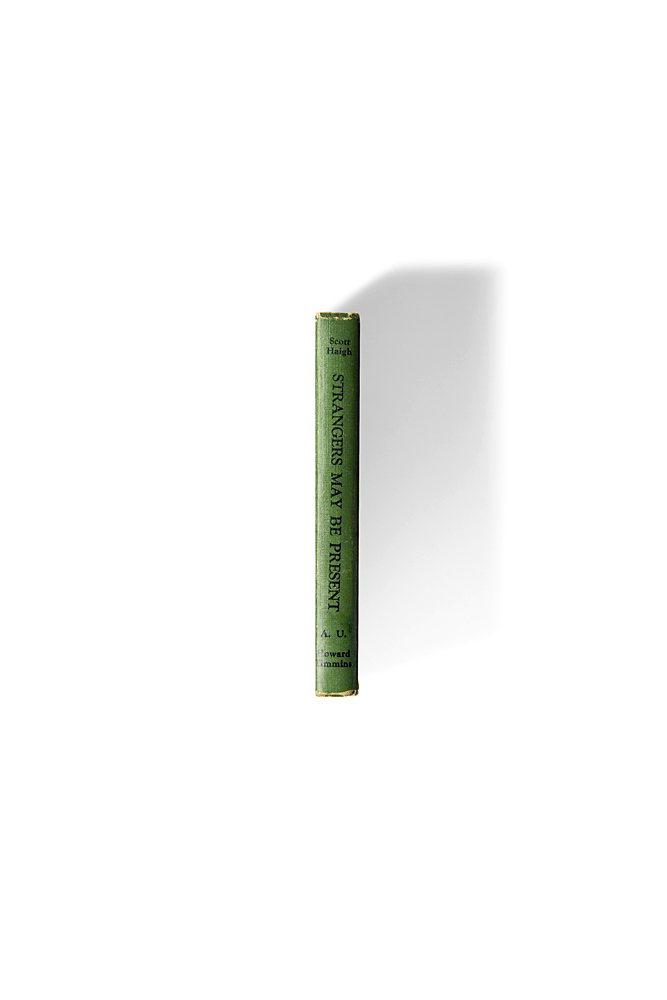
The books, were initially chosen to reflect the ideologies and assumptions of the nineteenth century West. However, Aliza soon realised, that some of the titles were pertinent to today. A blurring of time and relevance where titles from a hundred years ago were intersecting with current attitudes and events. For example, the book Strangers May be Present, in its evocation of colonial settlers viewing the other as stranger also evoked for her the more recent, disturbing events in which the other is articulated: xenophobic attacks and corrective rapes in South Africa. Closer to home, the century old book entitled Australia, the Land of Promise immediately raises questions around certain stark realities such as refugee detention centres.

Kate Warren writes in the accompanying exhibition essay: “The precise regularity of her photographic compositions create a compelling visual plane that immediately draws the viewer’s attention. But look closer. In the situation that Levi presents us with, the seductive nature of the visual cannot escape the immediacy of language. The force of their titles – often starkly confronting and potentially upsetting – leaves the embossing, decoration and materiality of the books themselves as an ironic supplement.”

Born in 1969 in South Africa, Aliza Levi’s practice is multidisciplinary in form yet single-minded in concept. Much of her work presents a relationship to land, consciousness and memory brought on by her South African and Australian citizenship. Having recently presented her work in the UK, this is her first solo show in Melbourne, where she has been producing art as well as facilitating women’s art groups with refugees from Sudan. Levi is currently completing a Masters Degree in Fine Art at Monash University.

Press release from the Edmund Pearce Gallery website


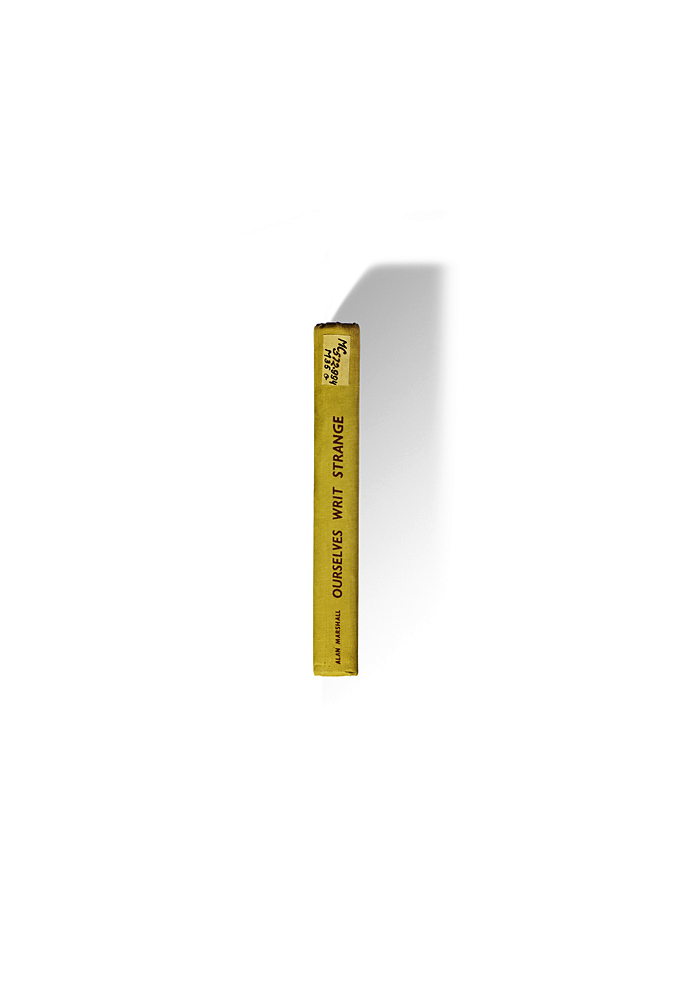
Aliza Levi (South African, b. 1969) 'Ourselves Writ Strange' 2011


Aliza Levi (South African, b. 1969)
Ourselves Writ Strange
2011
Archival Inkjet Print
59 x 42cm


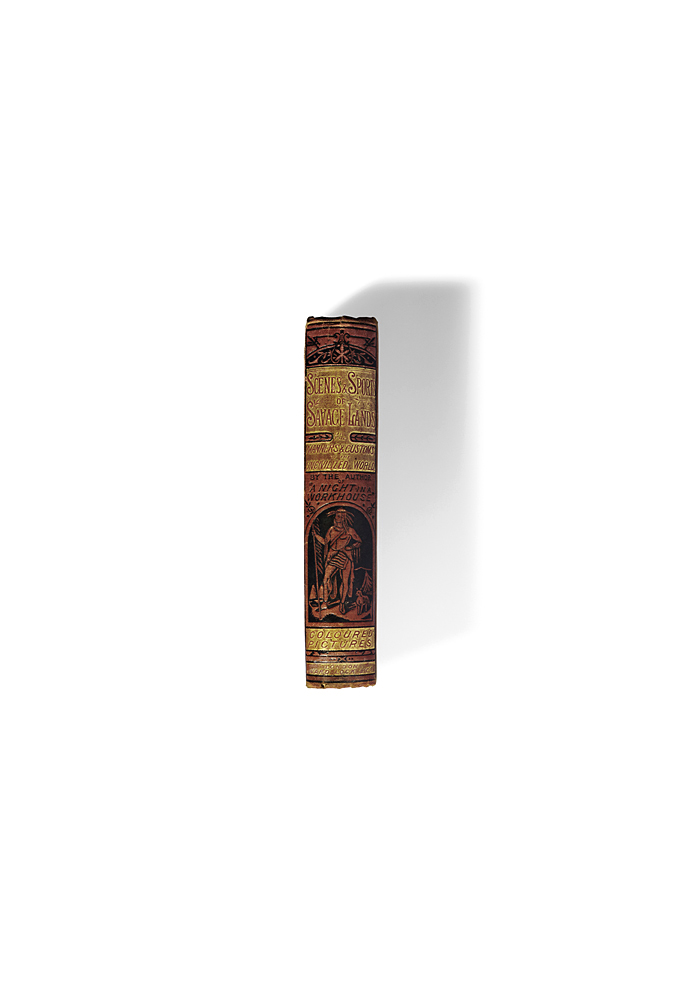
Aliza Levi (South African, b. 1969) 'Scenes and Sports of Savage Lands' 2012


Aliza Levi (South African, b. 1969)
Scenes and Sports of Savage Lands
2012
Archival Inkjet Print
59 x 42cm


Aliza Levi (South African, b. 1969) 'Strangers May Be Present' 2010


Aliza Levi (South African, b. 1969)
Strangers May Be Present
2010
Archival Inkjet Print
59 x 42cm


Aliza Levi (South African, b. 1969) 'The Art of Living in Australia' 2012


Aliza Levi (South African, b. 1969)
The Art of Living in Australia
2012
Archival Inkjet Print
59 x 42 cm


Textual thresholds: The uncomfortable nature of titles in Books on a White Background

Kate Warren

Aliza Levi’s research-based photographic project, Books on a White Background (2012), confronts the viewer with an array that is at once visually compelling and profoundly difficult to look at. The precise regularity of her photographic compositions, the ‘grid-like’ repetition of these images’ installation, the consistent form and shape of her subject matter, and the contrast between the stark white background and the darker shadows thrown, all create a compelling visual plane that immediately draws the viewer’s attention. But look closer. In the situation that Levi presents us with, the seductive nature of the visual cannot escape the immediacy of language. The force of their titles – often starkly confronting and potentially upsetting – leaves the embossing, decoration and materiality of the books themselves as an ironic supplement.

This is not a ‘library’. Although developed from Levi’s archival research, the final photographic project is not an ‘archive’. Rather than displaying the original books themselves as objets trouvés, Levi disavows their materiality and tactility. Photographing the books’ ‘spines’, she not only flattens but removes entirely from view their ‘flesh’ the pages and the content – and in doing so opens up a liminal space that can accommodate and illuminate a multiplicity of (sometimes uncomfortable) and connections between the past and the present.

In the human form, our spines form the connection between the psychical realm of our brains and the physicality of our bodies; between our ‘inner’ subjectivity and our ‘outer’ ability to move, communicate and interact with our surroundings. Likewise in the case of the books that Levi photographs; the spines and titles are liminal spaces that mediate their content and the cultural and historical contexts in which they exist. Gérard Genette calls this the ‘paratext’, the “fringe [which] constitutes a zone between text and off-text, a zone not only of transition but also of transaction: a privileged place of a pragmatics and a strategy, of an influence on the public.” Levi’s project works at this juncture. By denying access to the detailed substance and content of these books she denies their overt ‘authority’, yet at the same time she reveals uncomfortable legacies that persist and cannot be wholly escaped.

The various ‘post’ discourses (post-colonialism, post-structuralism, post-modernism) and their influential theorists and practitioners have done enormous amounts of work to deconstruct and destabilise dominant narratives and histories. The process is necessarily ongoing and open-ended; because although many narratives that were once unquestioned have been removed from their dominance and acceptability, it is often through language that their traces and legacies remain.

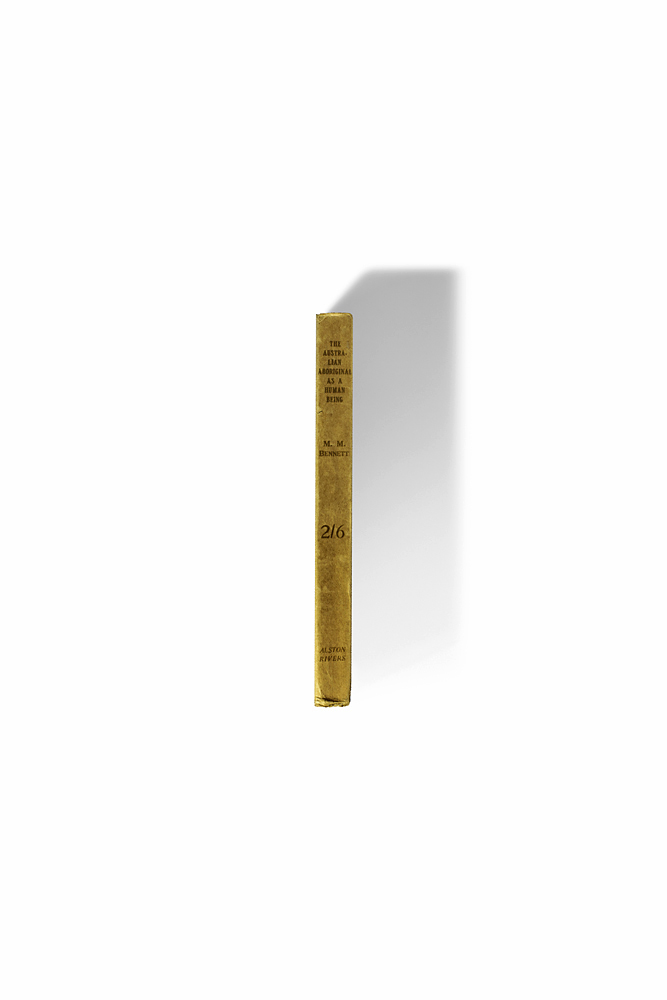
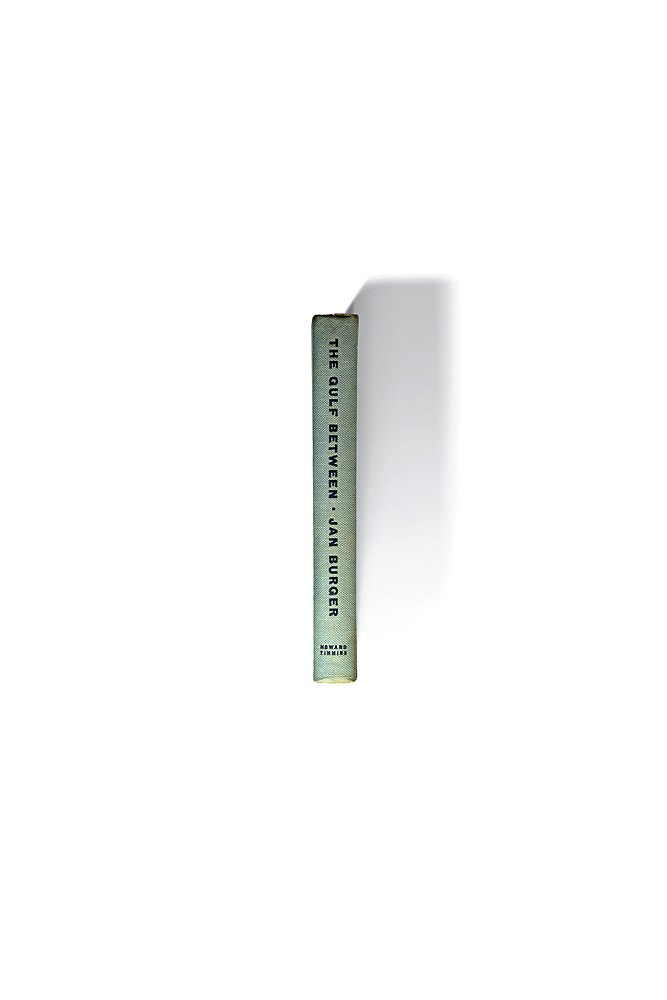
Thus in the selection of Australian books included in this exhibition, there emerges jarring and disturbing contrasts between titles that clearly belie values that are no longer widely accepted (such as The Aboriginal as Human Being), and other titles which still resonate with national myths (such as Australia the Land of Promise). Other titles like Ourselves Writ Large and The Gulf Between become more ambiguous; for without access to the specificities of their content, these books’ paratexts are revealed in Levi’s project as (necessarily) multifaceted signifiers. They immediately open up a ‘zone of transaction’ that reveals the past as an immanent presence, constantly transformed by and transforming of the present. These now abstracted titles retain a force and power to reveal uncomfortable truths and forgotten narrative tropes, speaking to the way that Australian history and presumed cultural values are constructed and repeated in our contemporary life.

Kate Warren would like to thank Aliza Levi for the stimulating and ongoing discussions; and David Wlazlo for his timely and astute insights.

Gérard Genette, Paratexts: Thresholds of Interpretation (Cambridge: Cambridge University Press, 1997), p. 2.


Aliza Levi (South African, b. 1969) 'The Aboriginal as Human Being' 2012


Aliza Levi (South African, b. 1969)
The Aboriginal as Human Being
2012
Archival Inkjet Print
59 x 42cm


Aliza Levi (South African, b. 1969) 'The Gulf Between' 2012


Aliza Levi (South African, b. 1969)
The Gulf Between
2012
Archival Inkjet Print
59 x 42cm


Aliza Levi (South African, b. 1969) 'The Report of the Aborigines Committee of the Meeting for Sufferings 1840' 2012


Aliza Levi (South African, b. 1969)
The Report of the Aborigines Committee of the Meeting for Sufferings 1840
2012
Archival Inkjet Print
59 x 42cm


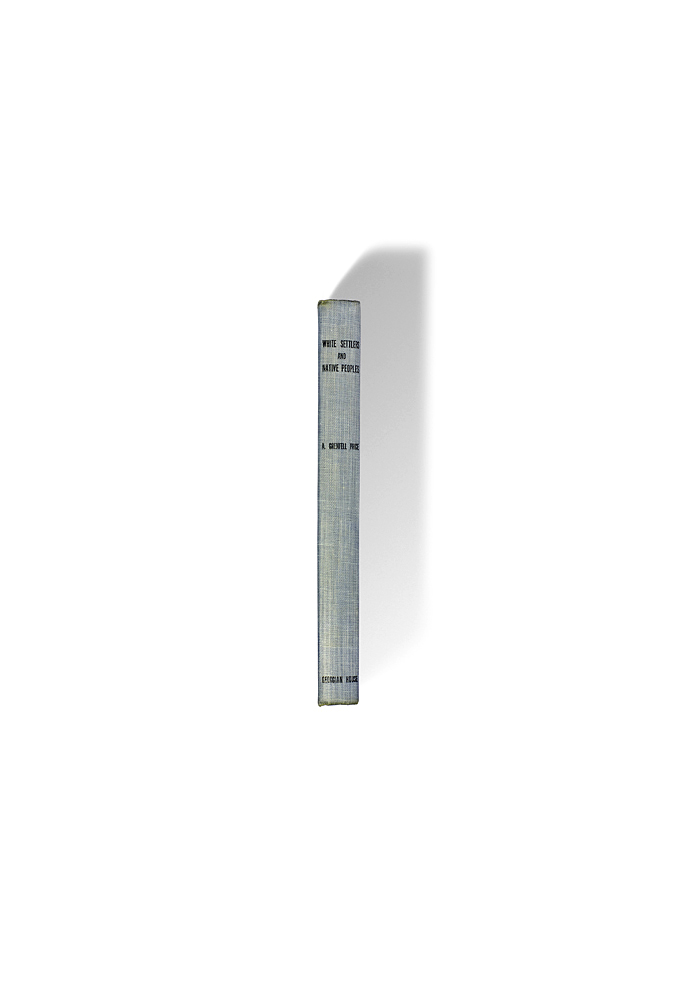
Aliza Levi (South African, b. 1969) 'White Settlers and Native Peoples' 2012


Aliza Levi (South African, b. 1969)
White Settlers and Native Peoples
2012
Archival Inkjet Print
59 x 42cm


Edmund Pearce Gallery

This gallery is no longer open.

LIKE ART BLART ON FACEBOOK

Back to top

Exhibition: ‘South Africa in Apartheid and After: David Goldblatt, Ernest Cole, Billy Monk’ at the San Francisco Museum of Modern Art (SFMOMA)

Exhibition dates: 1st December 2012 – 5th March 2013


Ernest Cole (South African, 1940-1990) 'A student who said he was going to fetch his textbook is pulled in. To prove he was still in school he showed his fountain pen and ink-stained fingers. But that was not enough; in long pants he looked older than sixteen' 1960–1966


Ernest Cole (South African, 1940-1990)
A student who said he was going to fetch his textbook is pulled in. To prove he was still in school he showed his fountain pen and ink-stained fingers. But that was not enough; in long pants he looked older than sixteen
1960-1966
Gelatin silver print
8 11/16 x 12 5/8 in. (22 cm x 32cm)
Courtesy of the Hasselblad Foundation, Gothenburg, Sweden
© The Ernest Cole Family Trust


It is the work of Billy Monk that is most impressive in this posting. Photographed in the rowdy Cape Town nightclub The Catacombs in the 1960s, Monk’s photographs of the racially mixed clientele portray them in extraordinary intimacy in all their states of joy and sadness. While his protagonists take centre stage within his photographs there is a wonderful spatial openness to Monk’s 35mm flash images photographed with a slightly wide angle 35mm lens. Monk does not fill the pictorial frame; he allows his images to breathe. Witness (and that is what he did) the moment of stasis before kiss of The Catacombs, 30 September 1967 (below), the intensity of the man’s passionate embrace, gaze, the sublime distance between bottle at right and bottle top, the image replete with blank, contextless wall behind. There is passion and hilarity here coupled with a feeling of infinite sadness – the squashed faces of The Catacombs, 31 July 1967, the convivial happiness of the couple in The Catacombs, 5 February 1968 (he with his stained trouser leg) counterbalanced by the desolate looking man behind them and the mute expression on the trapped go-go dancers face in The Balalaika, December 1969 as the man reaches his hand through the bars towards her.

Observe the masterpiece that is The Catacombs, 21 November 1967 (below). The cheap Formica bench top and empty Coca-Cola bottle with straw, a half smoked cigarette pointing out of the photograph at bottom right. If the cigarette wasn’t there the image would fall away in that corner: it HAS to be there, and Monk’s eye knew it. The women, standing, singing? holding two bottles of liquor in her out thrust arms, her eyes and hair mimicking the patterns of the painted Medusa behind her. And the young man dressed in jacket and time, one arm outstretched and resting on the bench, the other resting curled up next to his mouth and cheek. It’s his look that gets you – she, declamatory; he, lost in melancholic reverie, with the troubles of the world on his shoulders totally oblivious to her performance. The emotional distance between the two, as the distance between his resting hand and the empty Coke bottle, is enormous, insurmountable. Such a profound and troubling image of a society in hedonistic denial. His look is the look of loneliness, anguish and despair.

These photographs that are the eye of Billy Monk, these slivers of possibility, should not be regarded as a “what if he had lived” sliver, but the silver possibility of what he did see when he was alive. They are a celebration of his informed eye and a recognition of his undoubted talent. I am moved by their pathos and humanity.

Dr Marcus Bunyan


Many thankx to the San Francisco Museum of Modern Art for allowing me to publish the text and photographs in the posting. Please click on the photographs for a larger version of the image.


“We were insiders, all three of us: Ernest Cole, Billy Monk, and me. We each photographed from the inside what we most intimately knew.

Cole was born Ernest Levi Tsoloane Kole in 1940, to a working-class Black family in a Black township outside the city of Pretoria. Growing into that society he came to know, with a depth of understanding that only belonging could bring, both its richness and the hardship and humiliation imposed by apartheid. As a boy he photographed people in the township for a shilling a time. By the age of eighteen he had begun to work as a photojournalist, and within a few years he was deeply committed to his essay on what it meant to be Black under apartheid. At age twenty-six, to escape the Security Police and to publish his seminal book, House of Bondage, he went into bitter and destructive exile. Cancer killed him in 1990. Apartheid destroyed him.

Billy Monk’s photographs have the frank and warm intimacy that comes to someone who was completely trusted by his subjects. They are of a tiny splinter of another way of being: a place in apartheid South Africa of neither Black nor White but of somewhere not quite in between. Not quite, because while Blacks would not have gained participatory entrance to the Catacombs nightclub, people “of colour” did, and mixed there freely with Whites. It was a question of bending the law – within limits. Here you were judged not by your conformity with the pathological rigidities of Calvinism gone mad, but by your immersion in the conviviality of brandy and Coke. We will never know what might have become of the eye of Billy Monk, for in 1982 he died at age forty-five in a brawl while on his way to the first exhibition of his work. He has left us what the photographer Paul Graham might describe as a sliver of possibility.

My series In Boksburg tells of what it meant to be White in a middle-class South African community during the years of apartheid. It was a place of quiet respectability such as might be found in innumerable towns around the world. Except that Blacks were not of it. They were the largest component of its population; they served it, traded with it, received charity from it, and were ruled, rewarded, and punished by its precepts. Some, on occasion, were its privileged guests. But all who went there did so by permit or invitation, never by right. White and Black: locked into a system of manic control and profound immorality. Simply to draw breath was to be complicit. Heroism or emigration seemed to offer the only escape.

That’s how it was and is no longer.”


David Goldblatt


Ernest Cole (South African, 1940-1990) 'After processing they wait at railroad station for transportation to mine. Identity tag on wrist shows shipment of labor to which man is assigned' 1960-1966


Ernest Cole (South African, 1940-1990)
After processing they wait at railroad station for transportation to mine. Identity tag on wrist shows shipment of labor to which man is assigned
1960-1966
Gelatin silver print
8 11/16 x 12 5/8 in. (22 x 32cm)
Courtesy of the Hasselblad Foundation, Gothenburg, Sweden
© The Ernest Cole Family Trust


Ernest Cole (South African, 1940-1990) 'Africans throng Johannesburg station platform during late afternoon rush' 1960–1966


Ernest Cole (South African, 1940-1990)
Africans throng Johannesburg station platform during late afternoon rush
1960-1966
Gelatin silver print
8 11/16 x 12 5/8 in. (22 x 32cm)
Courtesy of the Hasselblad Foundation, Gothenburg, Sweden
© The Ernest Cole Family Trust


Ernest Cole (South African, 1940-1990) 'Every African must show his pass before being allowed to go about his business. Sometimes check broadens into search of a man's person and belongings' 1960-1966


Ernest Cole (South African, 1940-1990)
Every African must show his pass before being allowed to go about his business. Sometimes check broadens into search of a man’s person and belongings
1960-1966
Gelatin silver print
8 11/16 x 12 5/8 in. (22 x 32cm)
Courtesy of the Hasselblad Foundation, Gothenburg, Sweden
© The Ernest Cole Family Trust


Ernest Cole (South African, 1940-1990) 'Untitled [White Washroom]' 1960-1966


Ernest Cole (South African, 1940-1990)
Untitled [White Washroom]
1960-1966
Gelatin silver print
12 5/8 x 8 11/16 in. (32 x 22cm)
Courtesy of the Hasselblad Foundation, Gothenburg, Sweden
© The Ernest Cole Family Trust


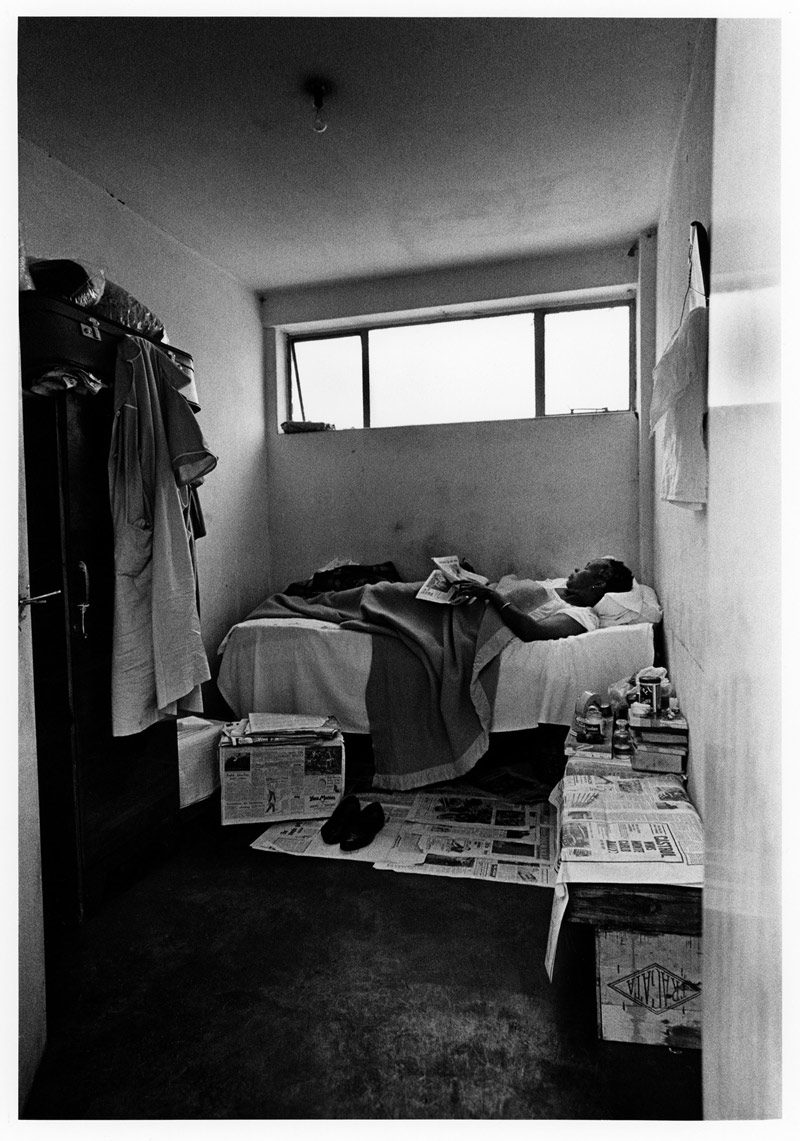
Ernest Cole (South African, 1940-1990) 'Newspapers are her carpet, fruit crates her chairs and table' 1960-1966


Ernest Cole (South African, 1940-1990)
Newspapers are her carpet, fruit crates her chairs and table
1960-1966
Gelatin silver print
12 5/8 x 8 11/16 in. (32 x 22cm)
Courtesy of the Hasselblad Foundation, Gothenburg, Sweden
© The Ernest Cole Family Trust


From December 1, 2012, through March 5, 2013, the San Francisco Museum of Modern Art (SFMOMA) presents South Africa in Apartheid and After: David Goldblatt, Ernest Cole, Billy Monk, featuring work by three photographers that illuminates a rich and diverse photographic tradition as well as a vital, difficult, and contested period in the history of South Africa. The exhibition continues the museum’s longstanding commitment to documentary photography, showcasing the greatest breadth of each artist’s work ever shown in San Francisco, and in the U.S. for Cole and Monk. Organised by Sandra S. Phillips, SFMOMA’s senior curator of photography, South Africa in Apartheid and After brings together more than 120 photographs.

“South Africa is proving to be a very fertile and active area for contemporary photography, to which David Goldblatt’s contributions and longstanding concerns have contributed significantly,” notes Phillips. “With this show we hope to show some of this rich and varied activity.”

The internationally recognised artist David Goldblatt (1930-2018) has created an immense and powerful body of work depicting his native South Africa for a half century. The exhibition features photographs from Goldblatt’s early project In Boksburg (1982), which portrays a suburban white community near Johannesburg shaped by what the artist calls “white dreams and white proprieties.” Losing its distinctiveness in the accelerated growth of development, Boksburg could almost be mistaken for American suburbia in Goldblatt’s pictures, made in 1979 and 1980. In them, the quaintness of small-town life in South Africa is startlingly set against the increasing entrenchment of racial inequality in the country under apartheid.

Offering multiple perspectives on South Africa during this period, the work of Ernest Cole and Billy Monk are presented in the exhibition at Goldblatt’s suggestion. Adding an important dimension to Goldblatt’s Boksburg project is the work of Cole (1940-1990), a black South African photographer who documented the other side of the racial divide until he was forced to leave his country in 1966. The following year, his project was published in the United States as the book, House of Bondage, and immediately banned in South Africa; this major critique of apartheid has hardly been seen in his own country. In 2006, Goldblatt received the Hasselblad Award and became aware of Cole’s original, uncropped prints. Goldblatt was instrumental in helping bring Cole’s work to international prominence, assisting in organising a retrospective tour of the work, and championing an accompanying book project, Ernest Cole Photographer (2010). Selected works from the publication are included in the SFMOMA exhibition, featuring pictures that are eloquent, tragic, and deeply humane without a trace of sensationalism. Billy Monk (1937-1982) was a gregarious self-taught photographer who worked as a bouncer in the rowdy Cape Town nightclub The Catacombs in the 1960s. His work, recovered and reprinted posthumously by South African photographer Jac de Villiers, exists as a raw and beautiful record of the port city’s racially mixed population. These three groups of pictures are complemented by a selection of Goldblatt’s post-apartheid photographs, including large colour triptychs of beautiful and sober yet hopeful records of an imperfect, still evolving democracy.

The work of all three photographers are also featured in the exhibition Rise and Fall of Apartheid: Photography and the Bureaucracy of Everyday Life at the International Center of Photography, New York (September 14, 2012 – January 6, 2013), and Goldblatt and Cole are included in Everything Was Moving: Photography from the 60s and 70s at Barbican Art Gallery, London (September 13, 2012 – January 13, 2013).


David Goldblatt

Born in Randfontein, South Africa, Goldblatt first started photographing his native country in 1948, the same year the National Party came to power and instituted the policy of apartheid. Since then, he has devoted himself to documenting the South African people, landscape, and cities. Goldblatt photographed exclusively in black and white until the late 1990s. Following the end of apartheid and South Africa’s democratic elections in 1994, he looked for new expressive possibilities for his work and turned to colour and digital photography. This transition only took place after developments in scanning and printing technology allowed Goldblatt to achieve the same sense of depth in his colour work as in his black and white photographs.

In 1989 Goldblatt founded the Market Photography Workshop in Johannesburg with “the object of teaching visual literacy and photographic skills to young people, with particular emphasis on those disadvantaged by apartheid,” he has said. In 1998 he was the first South African to be given a solo exhibition at the Museum of Modern Art (MoMA), New York. That year, the retrospective David Goldblatt, Fifty-one Years began its international tour, traveling to New York, Barcelona, Rotterdam, Lisbon, Oxford, Brussels, Munich, and Johannesburg. He was also one of the few South African artists to exhibit at Documenta 11 (2002) and Documenta 12 (2007) in Kassel, Germany. In addition to numerous other solo and group exhibitions, Goldblatt was featured recently in solo shows at the New Museum (2009), the Jewish Museum (2010) in New York – which also traveled to the South African Jewish Museum – and the Victoria and Albert Museum (2011).

Ernest Cole

Cole left school at 16 as the Bantu education for black South Africans during apartheid prepared them only for menial jobs. Essentially self taught, Cole worked early on as a layout and darkroom assistant for Drum Magazine, a publication loosely inspired by Life magazine and directed toward the native African population. Cole was relatively mobile due to his racial reclassification as “coloured,” the designation for mixed race, that likely stemmed from his ability to speak Afrikaans, the language of Afrikaners. However, Cole was closely surveilled and had to photograph covertly, so he always worked at the risk of being arrested and jailed. He believed passionately in his mission to tell the world in photographs what it was like and what it meant to be black under apartheid, and identified intimately with his own people in photographs. With imaginative daring, courage, and compassion, he portrayed the full range of experience of black people as they negotiated their lives through apartheid.

In 1966, Cole decided to leave South Africa with a dream of making a book; House of Bondage was eventually published in the U.S. in 1967. The book, and Cole himself, were immediately banned in South Africa, and Cole passed away after more than 23 years of painful exile, never returning to his home country and leaving no known negatives and few prints of his monumental work. Tio fotografer, an association of Swedish photographers with whom Cole worked from 1970 to 1975 while living in Stockholm, received a collection of his prints, and these were later donated to the Hasselblad Foundation in Sweden.When David Goldblatt received the Hasselblad award in 2006, he viewed the works and then collaborated with the foundation to bring Cole’s work to light. Many of the prints were shown publicly for the first time in the traveling 2010 retrospective Ernest Cole Photographer, which offered new insights to the complex interaction between Cole’s unflinching revelations of apartheid at work and the power, yet subtlety and even elegance, of his photographic perspective. Ernest Cole Photographer has only been seen in South Africa and Sweden. Approximately one-third of Cole’s photographs on view in the SFMOMA exhibition have never been shown before.

Billy Monk

Using a Pentax camera with 35mm lens, Monk photographed the nightclub revellers of The Catacombs and sold the prints to his subjects. His close friendships with many of the people in the pictures allowed him to photograph them with extraordinary intimacy in all their states of joy and sadness. His pictures of nightlife seem carefree and far away from the scars and segregation of apartheid that fractured this society in the daylight.

In 1969, Monk stopped taking photographs at the club. A decade later his contact sheets and negatives were discovered in a studio by photographer Jac de Villiers, who recognised the significance of his work and arranged the first exhibition of Monk’s work in 1982 at the Market Gallery in Johannesburg. Monk could not attend the opening, and two weeks later, en route to seeing the exhibition, he was tragically shot dead in a fight. From 2010 to 2011, De Villiers revisited Monk’s contact sheets and curated an exhibition at the  Stevenson Gallery in Cape Town, including works that had never been shown before, accompanied by a publication.

Press release from the SFMOMA website


Billy Monk (South African, 1937-1982) 'The Catacombs, 30 September 1967' 1967


Billy Monk (South African, 1937-1982)
The Catacombs, 30 September 1967
1967, printed 2011
Gelatin silver print
10 1/16 x 14 15/16 in. (25.56 x 37.94cm)
Collection SFMOMA, Accessions Committee Fund purchase
© Estate of Billy Monk


Billy Monk (South African, 1937-1982) 'The Catacombs, 31 July 1967' 1967


Billy Monk (South African, 1937-1982)
The Catacombs, 31 July 1967
1967, printed 2011
Gelatin silver print; 11 x 16 in. (27.94 x 40.64cm)
Courtesy of Stevenson, Cape Town and Johannesburg
© Estate of Billy Monk


Billy Monk (South African, 1937-1982) 'The Catacombs, 5 February 1968' 1968


Billy Monk (South African, 1937-1982)
The Catacombs, 5 February 1968
1968, printed 2011
Gelatin silver print
11 x 16 in. (27.94 x 40.64cm)
Courtesy of Stevenson, Cape Town and Johannesburg
© Estate of Billy Monk


Billy Monk (South African, 1937-1982) 'The Catacombs, 1968' 1968


Billy Monk (South African, 1937-1982)
The Catacombs, 1968
1968, printed 2011
Gelatin silver print
11 x 16 in. (27.94 x 40.64cm)
Collection SFMOMA, Accessions Committee Fund purchase
© Estate of Billy Monk


Billy Monk (South African, 1937-1982) 'The Balalaika, December 1969' 1969


Billy Monk (South African, 1937-1982)
The Balalaika, December 1969
1969, printed 2011
Gelatin silver print
16 x 11 in. (40.64 x 27.94cm)
Courtesy of Stevenson, Cape Town and Johannesburg
© Estate of Billy Monk


Billy Monk (South African, 1937-1982) 'The Catacombs, 21 November 1967' 1967


Billy Monk (South African, 1937-1982)
The Catacombs, 21 November 1967
1967, printed 2011
Gelatin silver print
15 x 10 in. (38.1 x 25.4cm)
Collection SFMOMA, Accessions Committee Fund purchase
© Estate of Billy Monk


David Goldblatt (South African, 1930-2018) 'At a meeting of Voortrekkers in the suburb of Witfield' 1979-1980


David Goldblatt (South African, 1930-2018)
At a meeting of Voortrekkers in the suburb of Witfield
1979-1980
Gelatin silver print
14 9/16 x 14 9/16 in. (37 x 37cm)
Courtesy of the artist and Goodman Gallery, South Africa
© David Goldblatt


David Goldblatt (South African, 1930-2018) 'Eyesight testing at the Vosloorus Eye Clinic of the Boksburg Lions Club' 1980


David Goldblatt (South African, 1930-2018)
Eyesight testing at the Vosloorus Eye Clinic of the Boksburg Lions Club
1980
Gelatin silver print
19 11/16 x 19 11/16 in. (50 x 50cm)
Courtesy of the artist and Goodman Gallery, South Africa
© David Goldblatt


David Goldblatt (South African, 1930-2018) 'Saturday afternoon in Sunward Park' 1979


David Goldblatt (South African, 1930-2018)
Saturday afternoon in Sunward Park
1979
Gelatin silver print
6 7/8 x 6 7/8 in. (17.5 x 17.5cm)
Collection SFMOMA, purchase through a gift of Mark McCain and the Accessions Committee Fund
© David Goldblatt


San Francisco Museum of Modern Art
151 Third Street
San Francisco, CA 94103

Opening hours:
Monday – Tuesday: 10am – 5pm
Wednesday: Closed
Thursday: 1 – 8pm
Fri – Sun: 10am – 5pm

San Francisco Museum of Modern Art website

LIKE ART BLART ON FACEBOOK

Back to top

Video: ‘Disturbing Visions: the photography of Roger Ballen’ – Lens Culture Conversations with Photographers

June 2012


Roger Ballen: Lens Culture Conversations with Photographers from Jim Casper on Vimeo.


A very interesting video from Lens Culture where Roger Ballen explains his working methodology.

Inspiration comes from inside yourself, always!


Roger Ballen website

LIKE ART BLART ON FACEBOOK

Back to top

Exhibition: ‘South African Photographs: David Goldblatt’ at The Jewish Museum, New York

Exhibition dates: 2nd May – 19th September 2010


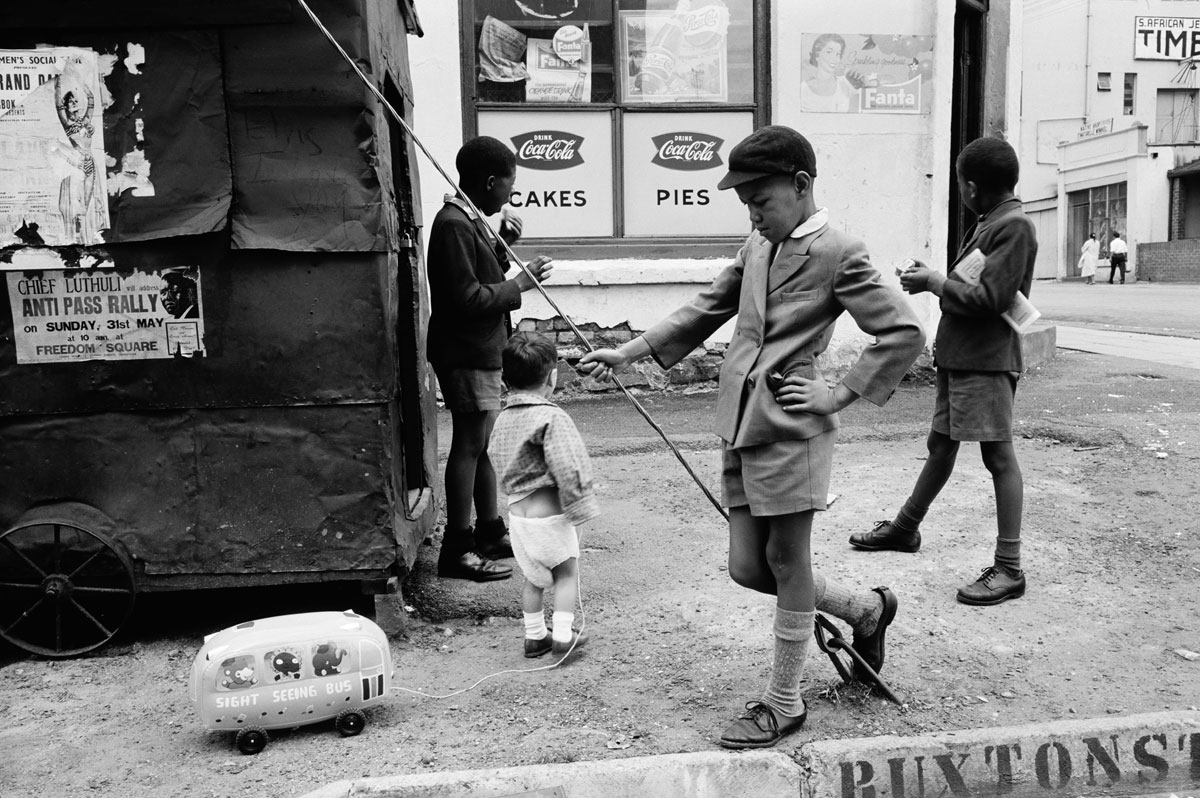
David Goldblatt (South Africa, 1930-2018) 'Steven with Sight Seeing Bus, Doornfontein, Johannesburg, 1960' from the exhibition 'South African Photographs: David Goldblatt' at The Jewish Museum, New York, May - Sept, 2010


David Goldblatt (South Africa, 1930-2018)
Steven with Sight Seeing Bus, Doornfontein, Johannesburg, 1960
1960
Silver gelatin print on fiber-pressed paper
Courtesy of David Goldblatt and the Goodman Gallery, Johannesburg


2019

Now that he has gone, these seem, if possible, more powerful, poignant and prescient / ancient than ever.

Marcus


Many thankx to the Jewish Museum in New York for allowing me to publish the photographs in the posting. Please click on the photographs for a larger version of the image.


David Goldblatt (South Africa, 1930-2018) 'Holdup in Hillbrow, Johannesburg, November 1963' from the exhibition 'South African Photographs: David Goldblatt' at The Jewish Museum, New York, May - Sept, 2010


David Goldblatt (South Africa, 1930-2018)
Holdup in Hillbrow, Johannesburg, November 1963
1963
Silver gelatin print on fibre-pressed paper
Courtesy of David Goldblatt and the Goodman Gallery, Johannesburg


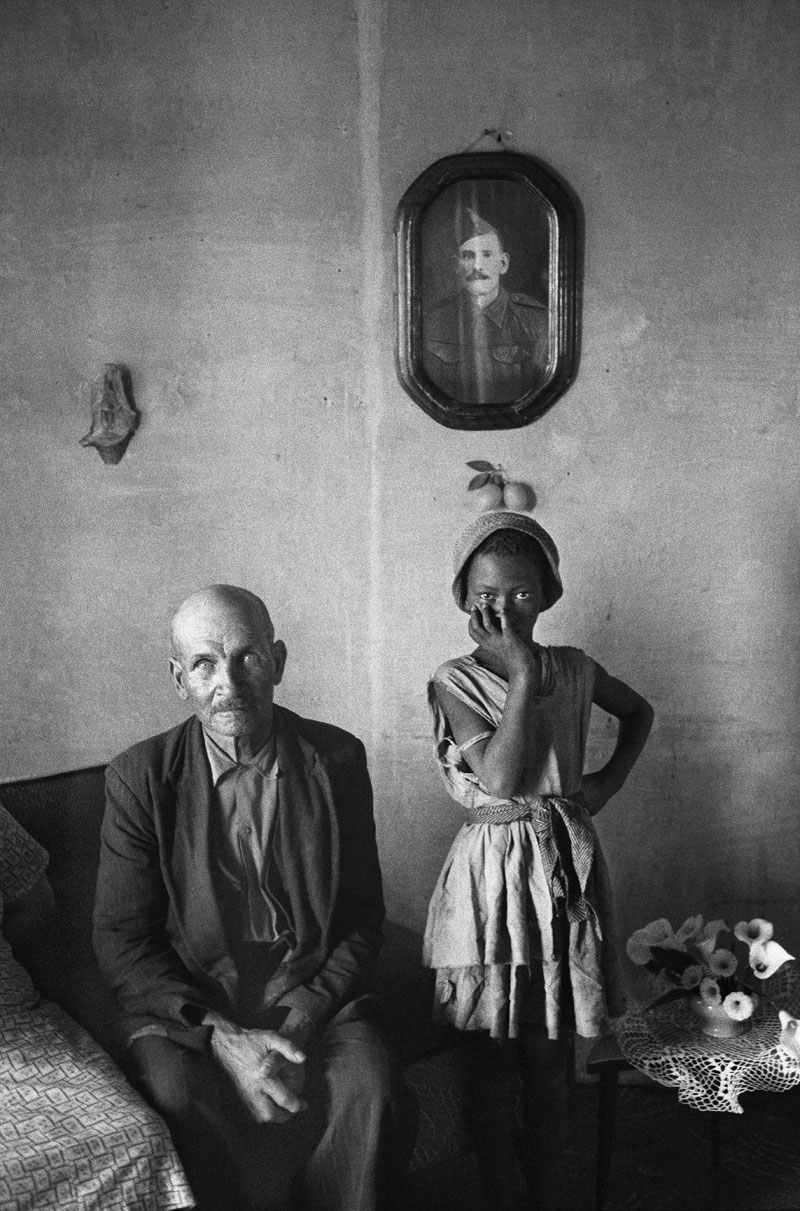
David Goldblatt (South Africa, 1930-2018) 'A plot-holder with the daughter of a servant, Wheatlands, Randfontein, September 1962' from the exhibition 'South African Photographs: David Goldblatt' at The Jewish Museum, New York, May - Sept, 2010


David Goldblatt (South Africa, 1930-2018)
A plot-holder with the daughter of a servant, Wheatlands, Randfontein, September 1962
1962
Silver gelatin print on fibre-pressed paper
Courtesy of David Goldblatt and the Goodman Gallery, Johannesburg


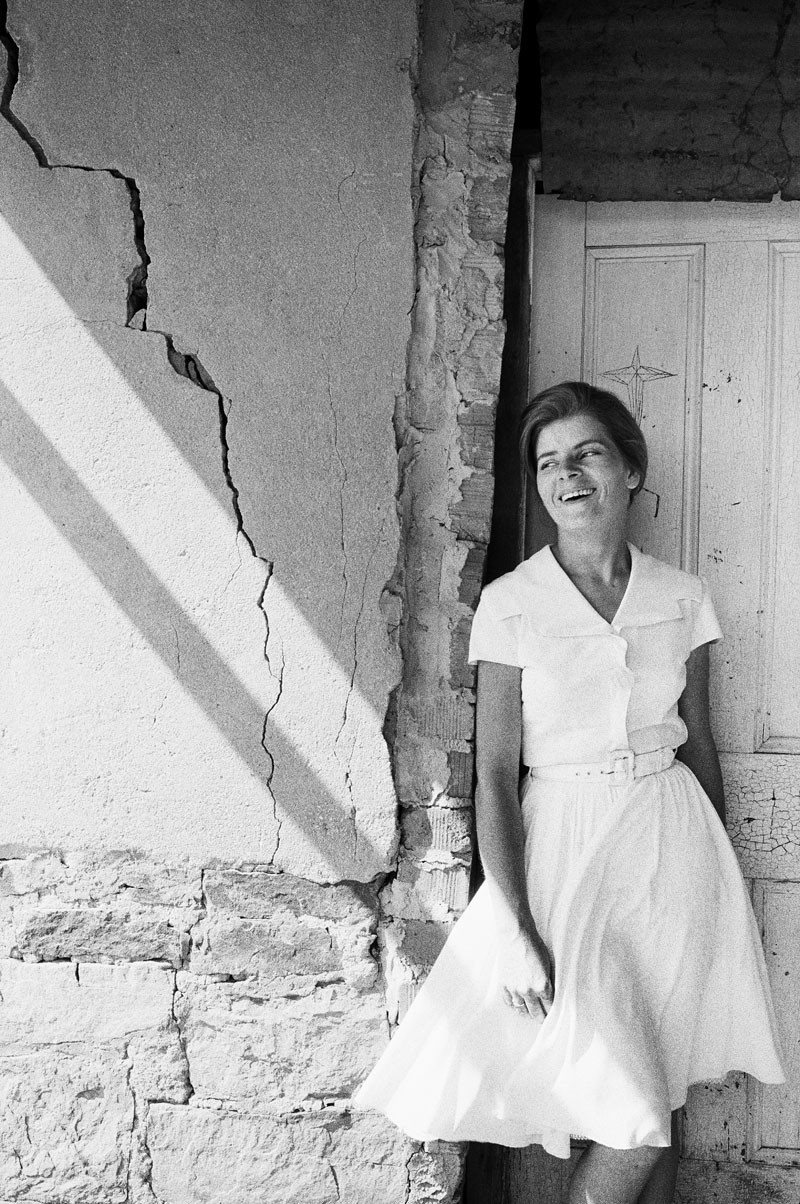
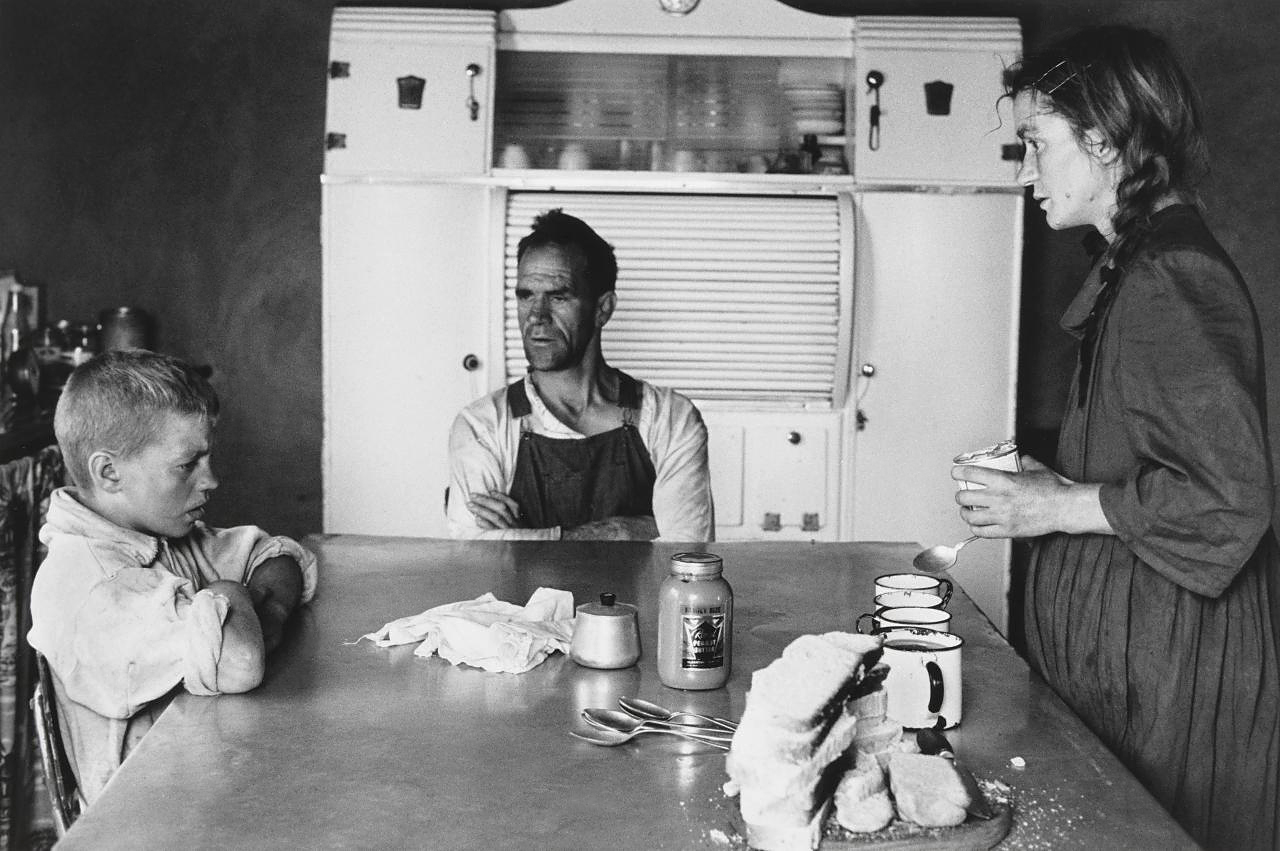
David Goldblatt (South Africa, 1930-2018) 'The farmer's wife, Fochville, 1965'


David Goldblatt (South Africa, 1930-2018)
The farmer’s wife, Fochville, 1965
1965
Silver gelatin print on fibre-pressed paper
Courtesy of David Goldblatt and the Goodman Gallery, Johannesburg


David Goldblatt (South African, 1930-2018) '"Boss Boy" detail, Battery Reef, Randfontein Estates Gold Mine' 1966


David Goldblatt (South African, 1930-2018)
“Boss Boy” detail, Battery Reef, Randfontein Estates Gold Mine
1966
Silver gelatin print on fibre-pressed paper
Courtesy of David Goldblatt and the Goodman Gallery, Johannesburg


The Jewish Museum currently offers visitors an opportunity to see 150 black-and-white silver gelatin prints taken between 1948 and 2009 in South African Photographs: David Goldblatt. The photographs on display focus on South Africa’s human landscape in the apartheid and post-apartheid eras and are accompanied by Goldblatt’s own written commentary. Growing up in segregated South Africa, he witnessed the deep humiliation and discrimination suffered by blacks and experienced anti-Semitism personally.

Goldblatt’s photographs expose the complex and evolving nature of apartheid through the diversity and subtlety of his approach while instilling “… emotional complexity that rewards repeated viewing” (The New Yorker). Instead of documenting major political events or horrifying incidents of violence, he focuses on the details of daily life and the world of ordinary people, a world where the apartheid system penetrates every aspect of society. In his photographs you will find “great beauty and the most profound humanity” (The Wall Street Journal).

For more than half a century, David Goldblatt has been photographing his native South Africa, documenting the social, cultural and economic divides that characterise the country. Recipient of the 2009 Henri Cartier-Bresson Award and the prestigious 2006 Hasselblad Foundation International Award in Photography, David Goldblatt is his country’s most distinguished photographer.

Goldblatt’s photographs expose the complex and evolving nature of apartheid through the diversity and subtlety of his approach. He has not documented major political events or horrifying incidents of violence. Instead, he focuses on the details of daily life and the world of ordinary people, a world where the apartheid system penetrates every aspect of society. He is constantly searching for the substance beneath the surface of human situations. As Nadine Gordimer comments in the exhibition audio guide, Goldblatt captures “… these moments when everything that has happened to an individual is somehow in that image at that time. All the person has felt and known is contained, indeed, in the way he comports himself, the way he’s sitting, the way he looks, and the kind of setting in which he is.” Goldblatt frequently addresses a complex question in his work: how is it possible to be reasonable, decent, and law-abiding, and at the same time, complicit in and even actively supportive of a system that is fundamentally immoral and evil? Each photograph in this exhibition is an intimate portrayal of a culture living with racism and injustice.

David Goldblatt has used his camera to explore South Africa’s mines; the descendants of seventeenth-century Dutch settlers called Afrikaners who were the architects of apartheid; life in Boksburg, a small middle-class white community; the Bantustans or “puppet states” in which blacks were forced to live; structures built for purposes ranging from shelter to commemoration; and Johannesburg, the city in which Goldblatt lives.

The photographer once wrote, “I am neither an activist nor a missionary. Yet I had begun to realise an involvement with this place and the people among whom I lived that would not be stilled and that I needed to grasp and probe. I wanted to explore the specifics of our lives, not in theories but in the grit and taste and touch of things, and to bring those specifics into that particular coherence that the camera both enables and demands.”

David Goldblatt has been photographing the changing political landscape of his country for more than five decades. He is descended from Lithuanian Jews who fled Europe in the 1890s to escape religious persecution. His father passed on to him, the artist said, “a strong sense of outrage at anything that smacked of racism.” Growing up in segregated South Africa, he witnessed the deep humiliation and discrimination suffered by blacks and experienced anti-Semitism personally. These experiences have informed his work.

Goldblatt’s written commentary is an essential part of his work and is presented throughout the exhibition in the texts and labels that accompany the photographs. A context room in the exhibition features a timeline juxtaposing events in South African history and David Goldblatt’s life; books published by the photographer; photography magazines that inspired him; a large map of South Africa; and a 22-minute excerpt of David Goldblatt: In Black and White, a 1985 film originally aired on Channel 4 Television in Great Britain.

The exhibition has been organised by The Jewish Museum’s Senior Curator, Susan Tumarkin Goodman. All the works in the exhibition are silver gelatin prints on fibre-pressed paper.

About David Goldblatt

David Goldblatt was born in 1930, the youngest of the three sons of Eli and Olga Goldblatt. His grandparents arrived in South Africa from Lithuania around 1893, having fled the persecution of Jews in the Baltic countries. David’s paternal grandfather owned a general store in Randfontein, a gold-mining town near Johannesburg. Eli Goldblatt built the business into a respected men’s clothing store and for some years David assisted with the running of the shop when his father’s poor health necessitated it. But he was only biding his time. He had become interested in photography in high school, and after his father’s death in 1962, he sold the business to devote all of his time to being a photographer.

Press release from The Jewish Museum website [Online] Cited 13/09/2010 no longer available online


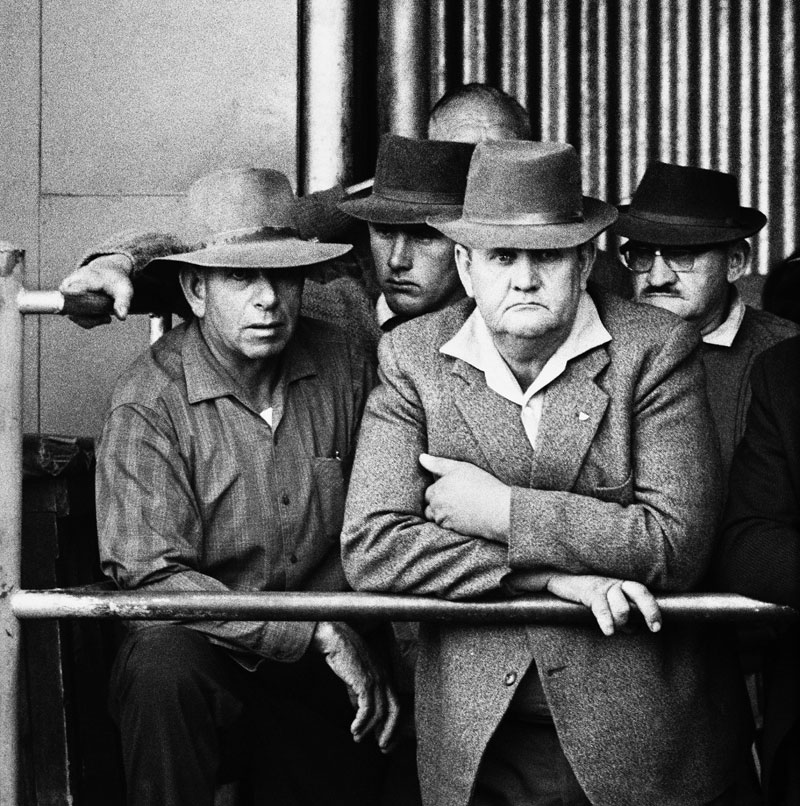
David Goldblatt (South Africa, 1930-2018) 'Farmers at a cattle auction, Vryburg, 1965'


David Goldblatt (South Africa, 1930-2018)
Farmers at a cattle auction, Vryburg, 1965
1965
Silver gelatin print on fibre-pressed paper
Courtesy of David Goldblatt and the Goodman Gallery, Johannesburg


David Goldblatt (South Africa, 1930-2018) 'On an ostrich farm near Oudtshoorn, Cape Province (Western Cape)' 1967
Screenshot


David Goldblatt (South Africa, 1930-2018)
On an ostrich farm near Oudtshoorn, Cape Province (Western Cape)
1967
From the series Some Afrikaners Photographed
Silver gelatin print on fibre-pressed paper
Courtesy of David Goldblatt and the Goodman Gallery, Johannesburg


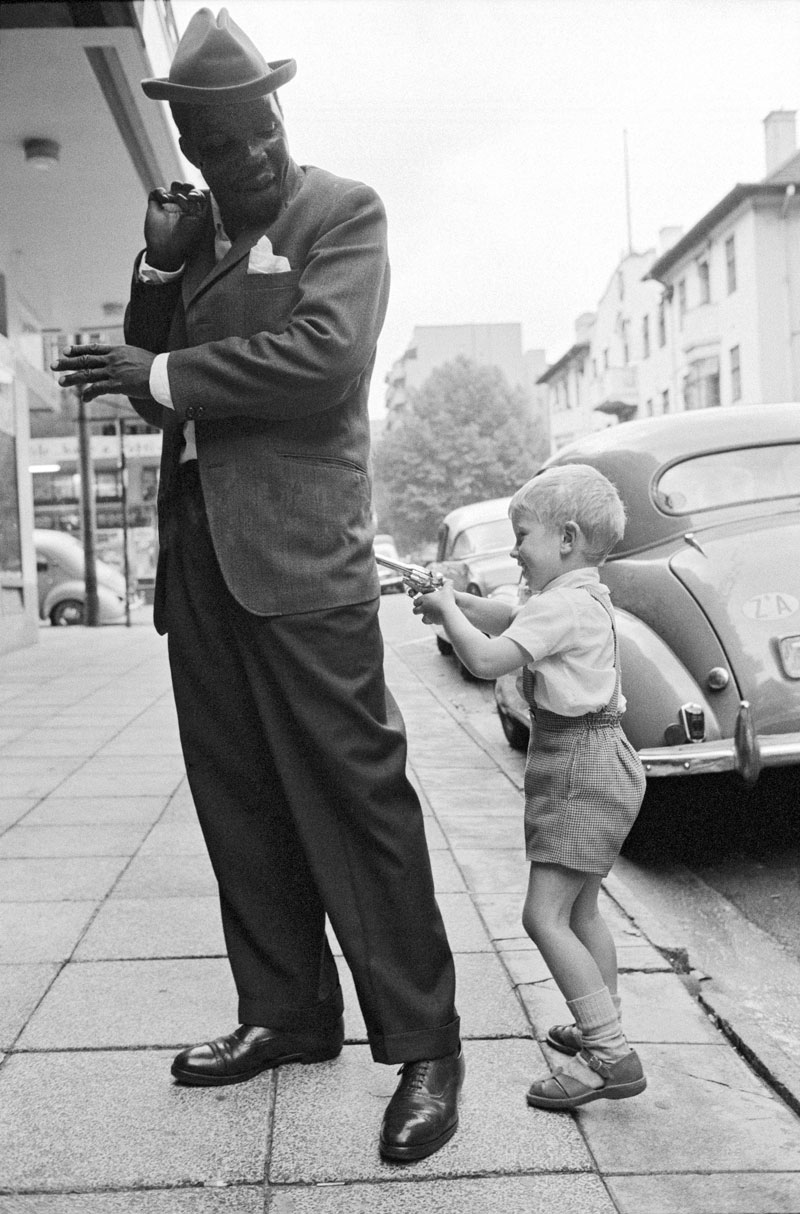
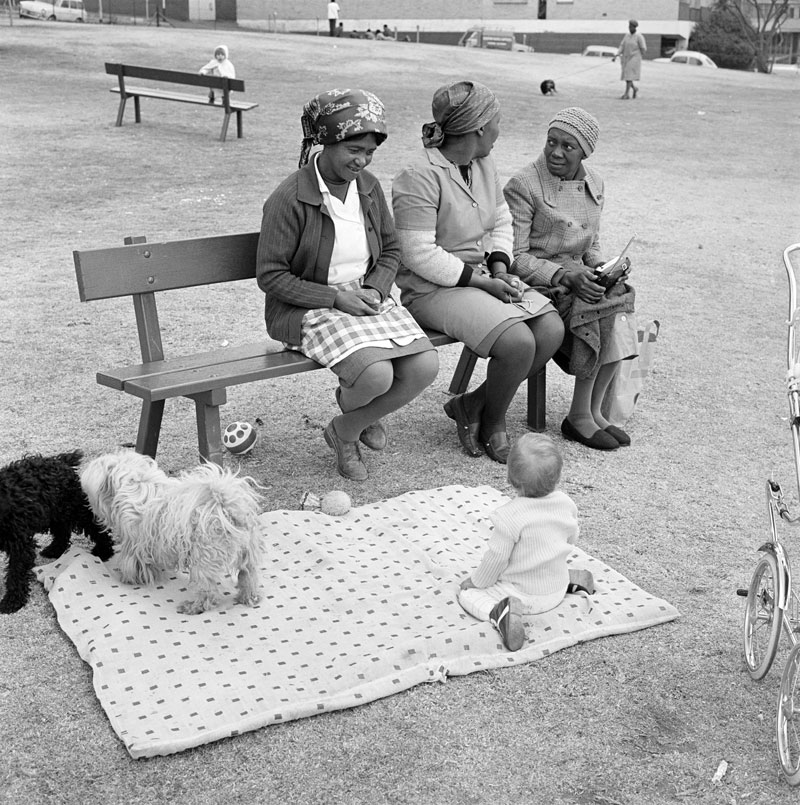
David Goldblatt (South Africa, 1930-2018) 'Baby with childminders and dogs in the Alexandra Street Park, Hillbrow, Johannesburg, 1972'


David Goldblatt (South Africa, 1930-2018)
Baby with childminders and dogs in the Alexandra Street Park, Hillbrow, Johannesburg, 1972
1972
Silver gelatin print on fibre-pressed paper
Courtesy of David Goldblatt and the Goodman Gallery, Johannesburg


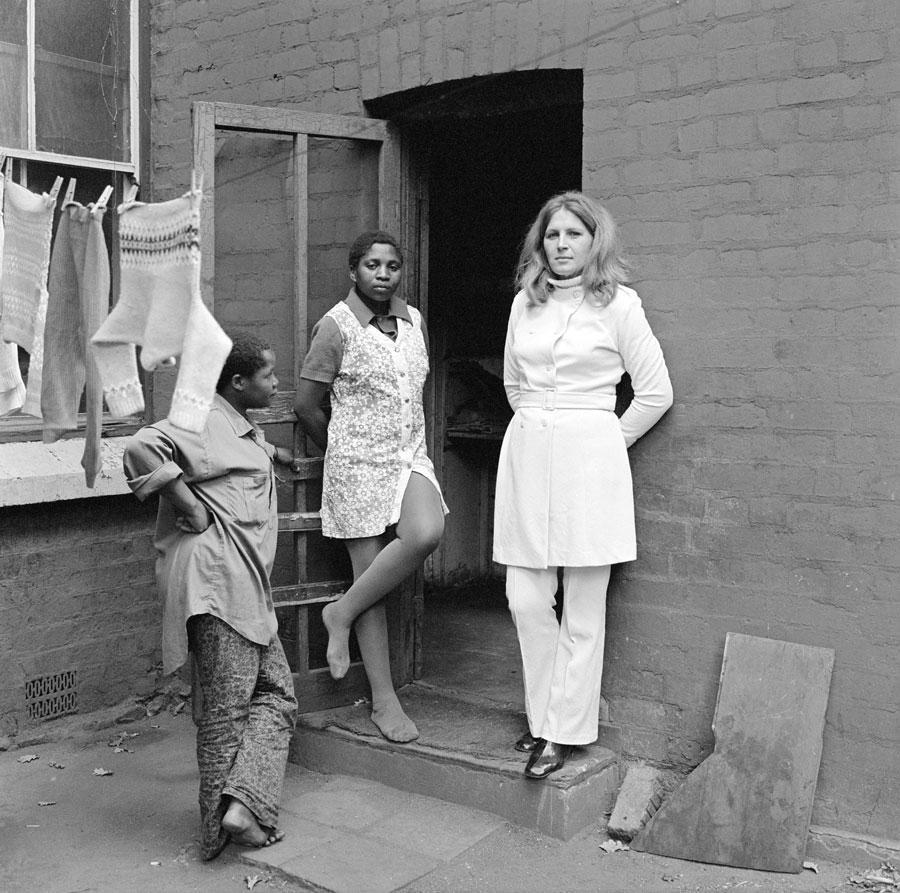
David Goldblatt (South Africa, 1930-2018) 'Three women at 39 Soper Road, Berea, Johannesburg, May 1972'


David Goldblatt (South Africa, 1930-2018)
Three women at 39 Soper Road, Berea, Johannesburg, May 1972
1972
Silver gelatin print on fibre-pressed paper
Courtesy of David Goldblatt and the Goodman Gallery, Johannesburg


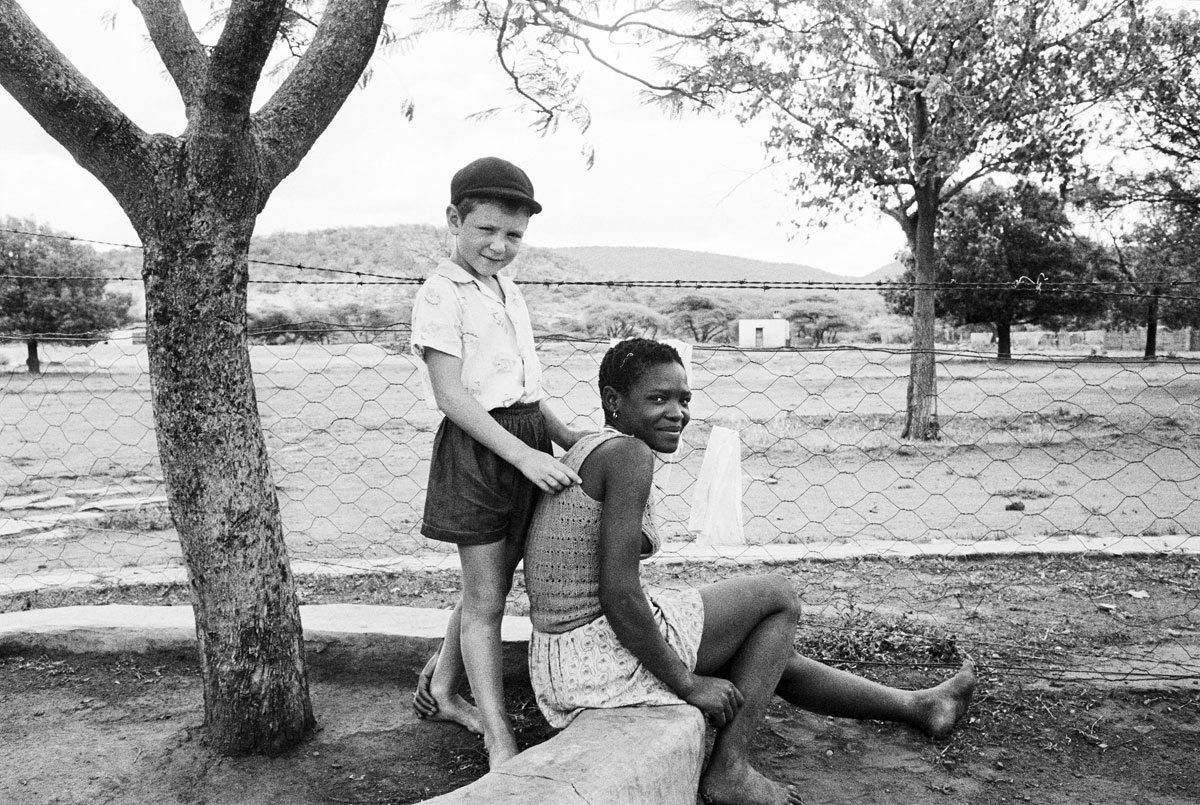
David Goldblatt (South Africa, 1930-2018) 'A farmer's son with his nursemaid, Heimweeberg, Nietverdiend, 1964'


David Goldblatt (South Africa, 1930-2018)
A farmer’s son with his nursemaid, Heimweeberg, Nietverdiend, 1964
1964
Silver gelatin print on fibre-pressed paper
Courtesy of David Goldblatt and the Goodman Gallery, Johannesburg


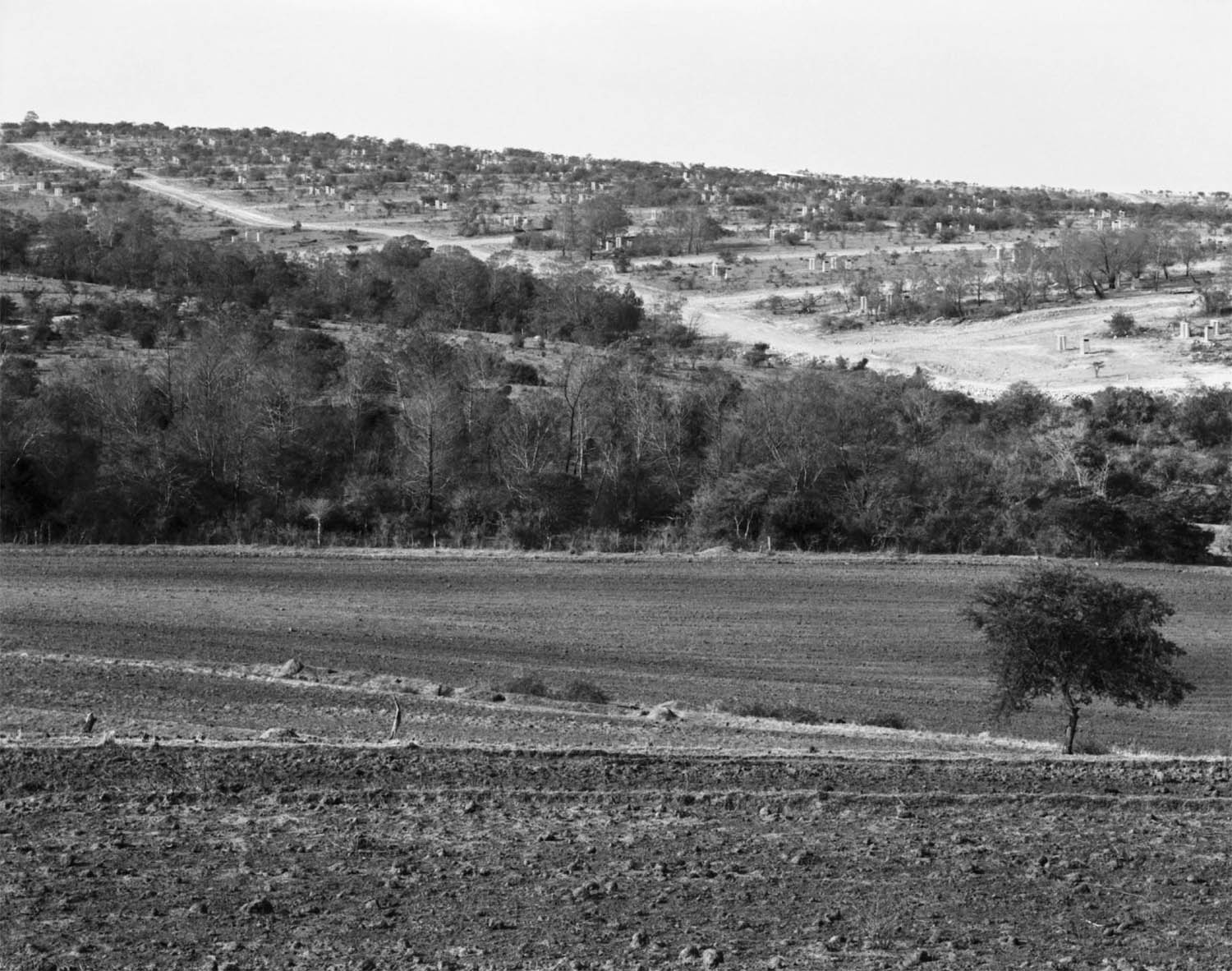
David Goldblatt (South Africa, 1930-2018) 'Landscape with 1500 lavatories, Frankfort, Ciskei' 12 July 1983


David Goldblatt (South Africa, 1930-2018)
Landscape with 1500 lavatories, Frankfort, Ciskei
12 July 1983
From the series Bantustans
Silver gelatin print on fibre-pressed paper
Courtesy of David Goldblatt and the Goodman Gallery, Johannesburg


David Goldblatt (South African, 1930-2018) '9:00 Going home: Marabastad-Waterval bus: For most of the people in this bus the cycle will start again tomorrow at between 2:00 and 3:00 a.m.' 1983-1984


David Goldblatt (South African, 1930-2018)
9:00 Going home: Marabastad-Waterval bus: For most of the people in this bus the cycle will start again tomorrow at between 2:00 and 3:00 a.m.
1983-1984
From the series The Transported of KwaNdebele. A South African Odyssey 
Silver gelatin print on fibre-pressed paper
Courtesy of David Goldblatt and the Goodman Gallery, Johannesburg


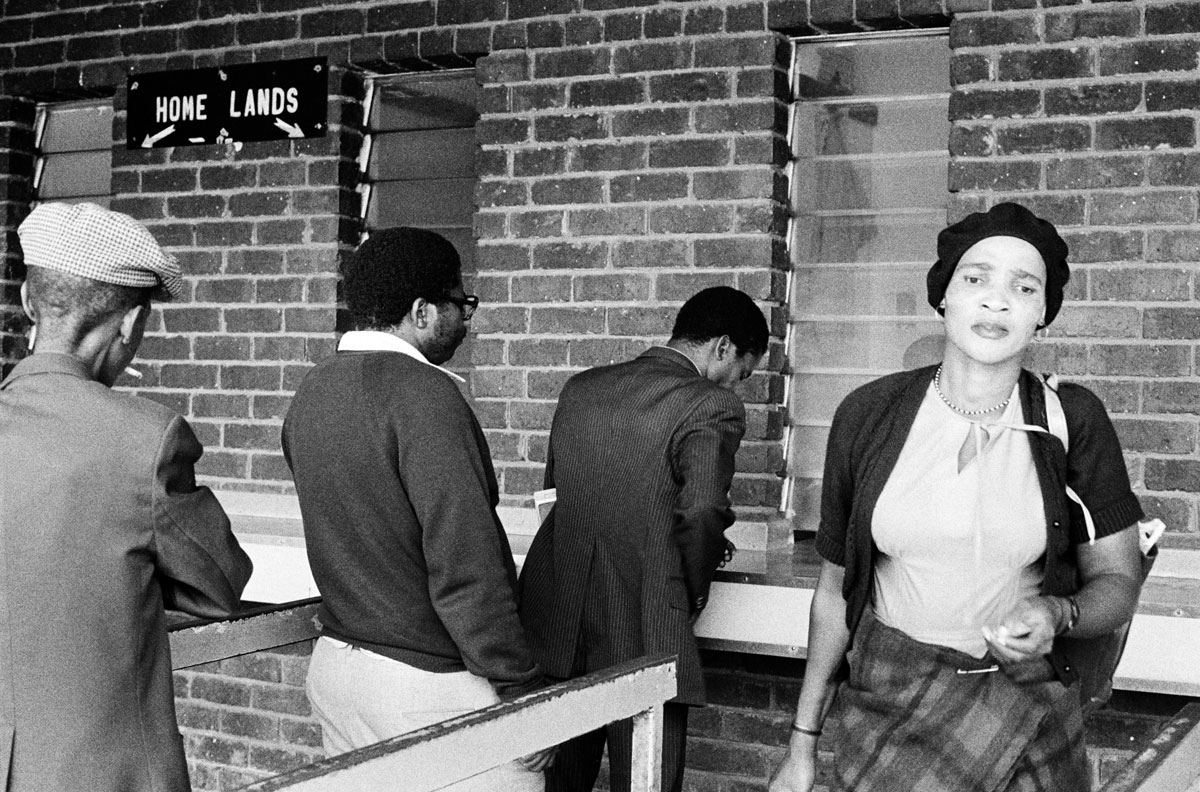
David Goldblatt (South Africa, 1930-2018) 'Travellers from KwaNdebele buying their weekly tickets at the bus depot in Marabastad, Pretoria, February 1984'


David Goldblatt (South Africa, 1930-2018)
Travellers from KwaNdebele buying their weekly tickets at the bus depot in Marabastad, Pretoria, February 1984
1984
Silver gelatin print on fibre-pressed paper
Courtesy of David Goldblatt and the Goodman Gallery, Johannesburg


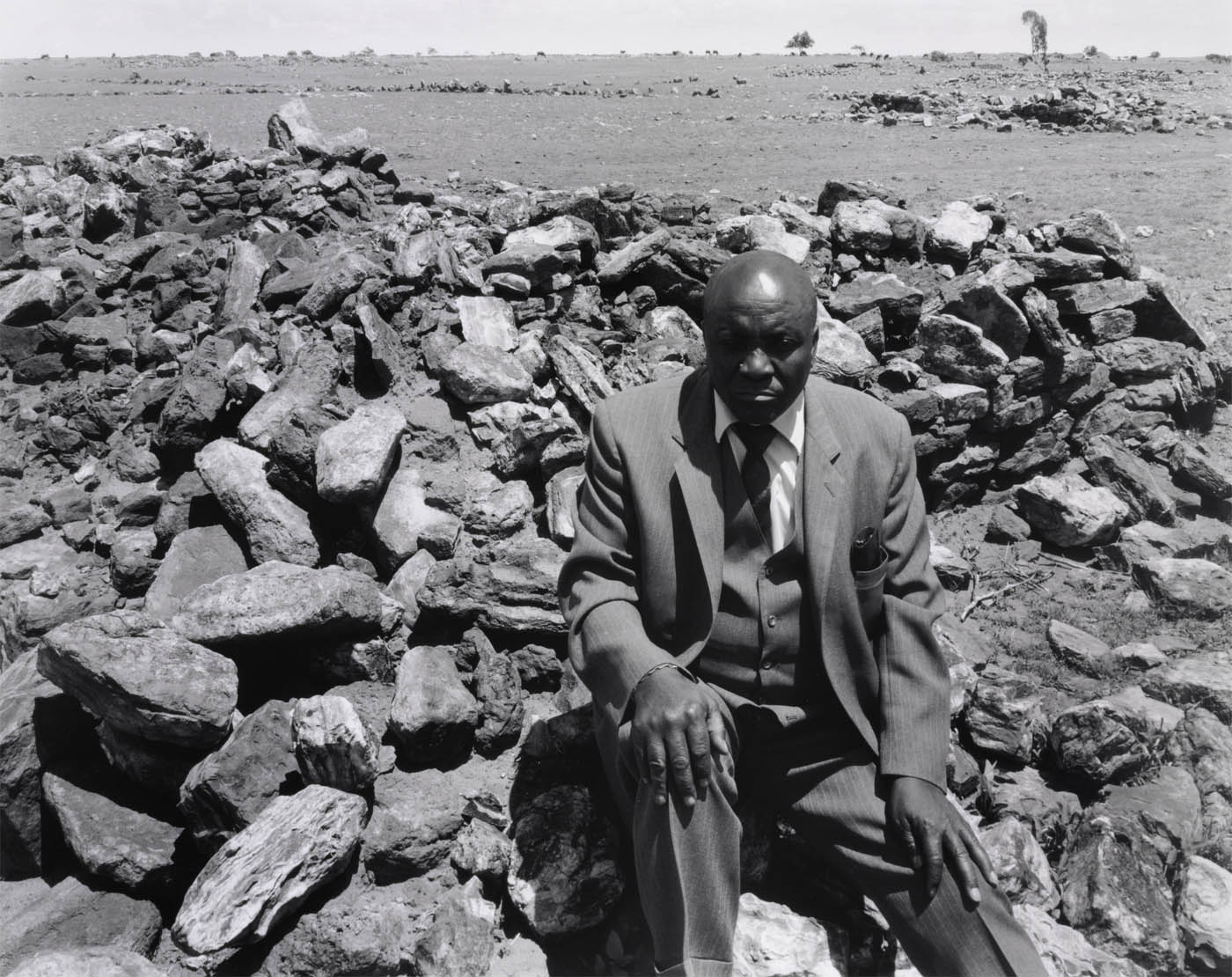
David Goldblatt (South Africa, 1930-2018) 'Luke Kgatitsoe at His House, Magopa, Ventersdorp District, Western Transvaal' 21 October 1986


David Goldblatt (South Africa, 1930-2018)
Luke Kgatitsoe at His House, Magopa, Ventersdorp District, Western Transvaal
21 October 1986
Silver gelatin print on fibre-pressed paper
Courtesy of David Goldblatt and the Goodman Gallery, Johannesburg


The Jewish Museum
1109 5th Ave at 92nd St
New York NY 10128

Exhibition galleries opening hours:
Sunday 11am – 6pm
Monday 11am – 6pm
Tuesday Closed
Wednesday Closed
Thursday 11am – 6pm
Friday 11am – 6pm
Saturday 11am – 6pm

The Jewish Museum website

LIKE ART BLART ON FACEBOOK

Back to top

Exhibition: ‘Intersections Intersected: The Photography of David Goldblatt’ at the New Museum, New York

Exhibition dates: 15th July – 11th October, 2009


David Goldblatt (South African, 1930-2018) 'Family at Lunch, Wheatlands Plots, Randfontein, September 1962' 1962 from the exhibition 'Intersections Intersected: The Photography of David Goldblatt' at the New Museum, New York, July - Oct, 2009


David Goldblatt (South African, 1930-2018)
Family at Lunch, Wheatlands Plots, Randfontein, September 1962
1962
Gelatin silver print


One of the greats.

Marcus


Many thankx to the New Museum for allowing me to publish the photographs in the posting. Please click on the photographs for a larger version of the image.


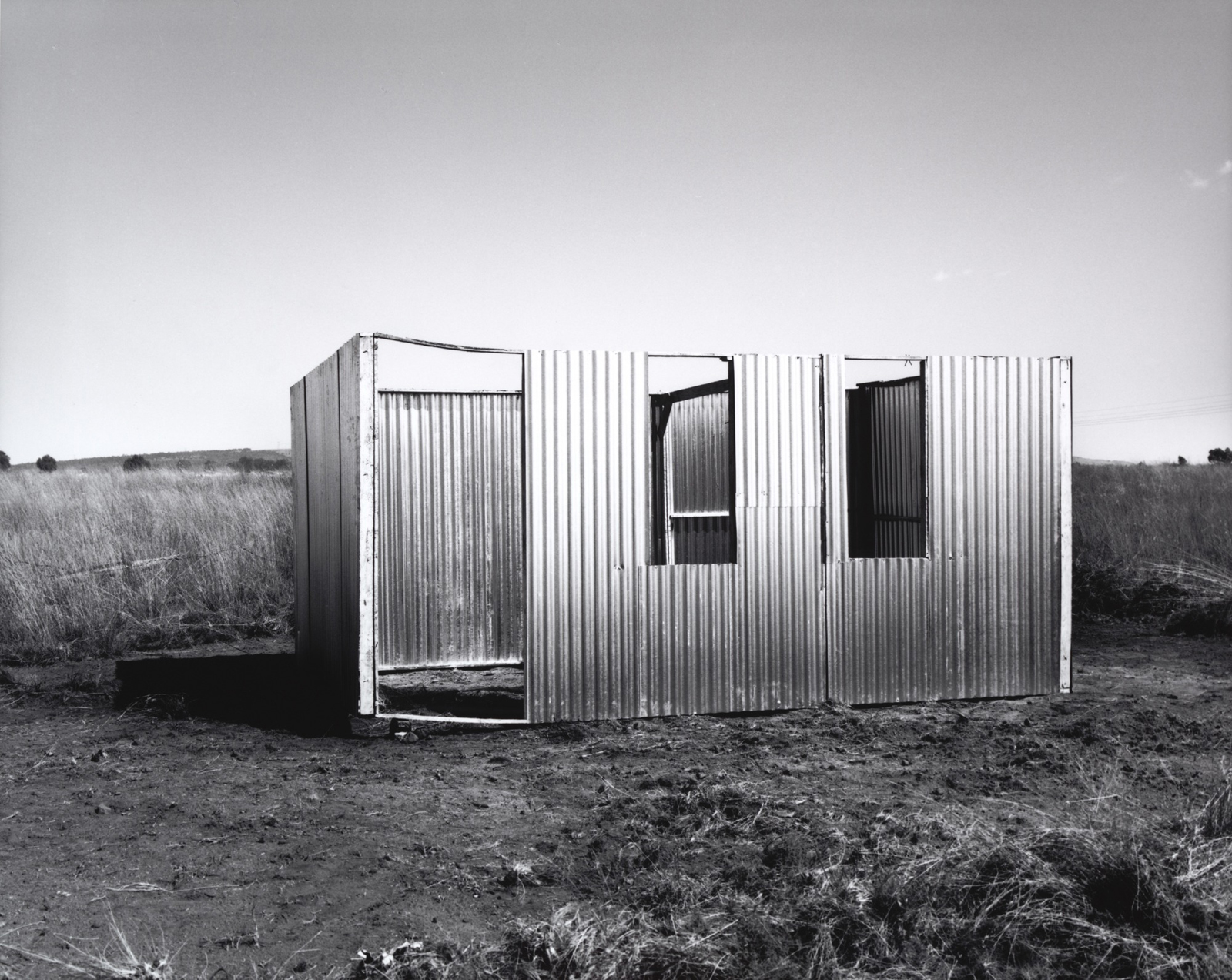
David Goldblatt (South African, 1930-2018) 'A new shack under construction, Lenasia Extension 9, Gauteng' 1990 from the exhibition 'Intersections Intersected: The Photography of David Goldblatt' at the New Museum, New York, July - Oct, 2009


David Goldblatt (South African, 1930-2018)
A new shack under construction, Lenasia Extension 9, Gauteng
1990
Gelatin silver print


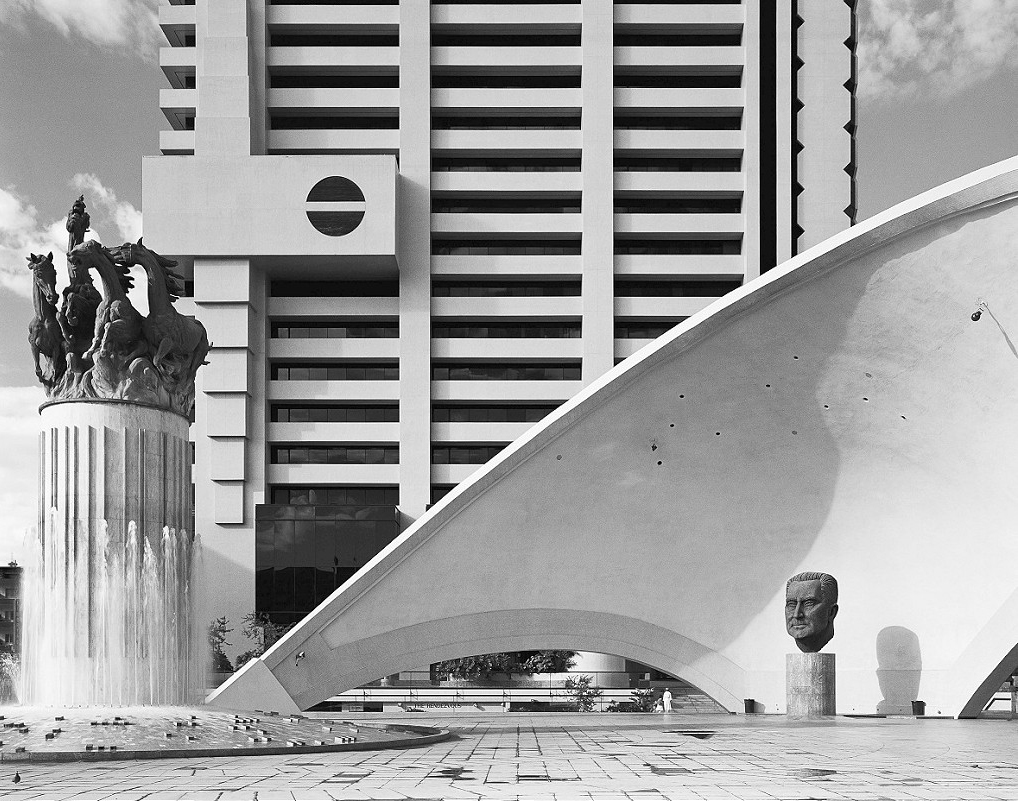
David Goldblatt (South African, 1930-2018) 'Monuments celebrating the Republic of South Africa (left and JG Strijdom, former prime minister (right), with the headquarters of Volkskas Bank, Pretoria. 25 April 1982' 1982


David Goldblatt (South African, 1930-2018)
Monuments celebrating the Republic of South Africa (left and JG Strijdom, former prime minister (right), with the headquarters of Volkskas Bank, Pretoria. 25 April 1982
1982
Black and while photograph on matte paper
Courtesy the artist and Goodman Gallery, Johannesburg


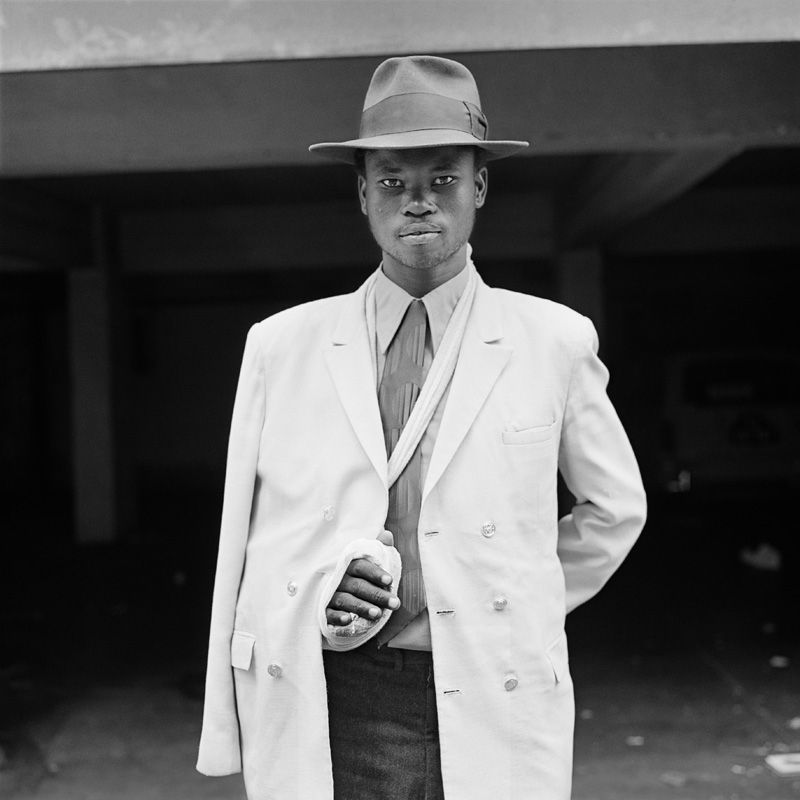
David Goldblatt (South African, 1930-2018) 'Man with an injured arm. Hillbrow, Johannesburg, June, 1972' 1972


David Goldblatt (South African, 1930-2018)
Man with an injured arm. Hillbrow, Johannesburg, June, 1972
1972
Black and while photograph on matte paper
Courtesy the artist and Goodman Gallery, Johannesburg


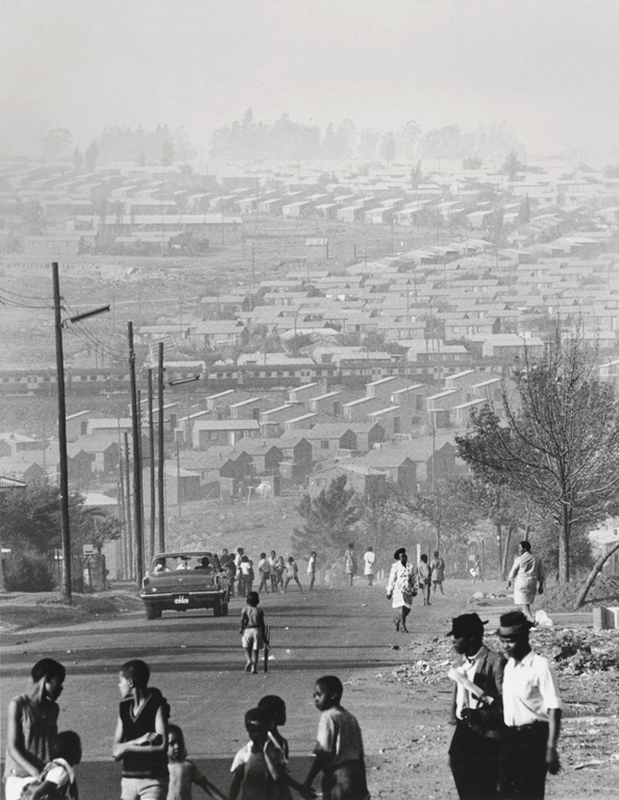
David Goldblatt (South African, 1930-2018) 'Mofolo South, Soweto, September 1972' 1972


David Goldblatt (South African, 1930-2018)
Mofolo South, Soweto, September 1972
1972
Gelatin silver print


Over the last fifty years, David Goldblatt has documented the complexities and contradictions of South African society. His photographs capture the social and moral value systems that governed the tumultuous history of his country’s segregationist policies and continue to influence its changing political landscape. Goldblatt began photographing professionally in the early 1960s, focusing on the effects of the National Party’s legislation of apartheid. The son of Jewish Lithuanian parents who fled to South Africa to escape religious persecution, Goldblatt was forced into a peculiar situation, being at once a white man in a racially segregated society and a member of a religious minority with a sense of otherness. He used the camera to capture the true face of apartheid as his way of coping with horrifying realities and making his voice heard. Goldblatt did not try to capture iconic images, nor did he use the camera as a tool to entice revolution through propaganda. Instead, he reveals a much more complex portrait, including the intricacies and banalities of daily life in all aspects of society. Whether showing the plight of black communities, the culture of the Afrikaner nationalists, the comfort of white suburbanites, or the architectural landscape, Goldblatt’s photographs are an intimate portrayal of a culture plagued by injustice.

In Goldblatt’s images we can see a universal sense of people’s aspirations, making do with their abnormal situation in as normal a way as possible. People go about their daily lives, trying to preserve a sense of decency amid terrible hardship. Goldblatt points out a connection between people (including himself) and the environment, and how the environment reflects the ideologies that built it. His photographs convey a sense of vulnerability as well as dignity. Goldblatt is very much a part of the culture that he is analysing. Unlike the tradition of many documentary photographers who capture the “decisive moment,” Goldblatt’s interest lies in the routine existence of a particular time in history.

Goldblatt continues to explore the consciousness of South African society today. He looks at the condition of race relations after the end of apartheid while also tackling other contemporary issues, such as the influence of the AIDS epidemic and the excesses of consumption. For his “Intersections Intersected” series, Goldblatt looks at the relationship between the past and present by pairing his older black-and-white images with his more recent colour work. Here we may notice photography’s unique association with time: how things were, how things are, and also that the effects of apartheid run deep. It will take much more time to heal the wounds of a society that was divided for so long. Yet, there is a possibility for hope, recognition of how much has changed politically in the time between the two images, and a potential optimism for the future. Goldblatt’s work is a dynamic and multilayered view of life in South Africa, and he continues to reveal that society’s progress and incongruities.”

Joseph Gergel, Curatorial Fellow

Text from the New Museum website [Online] Cited 15/08/2009. No longer available online


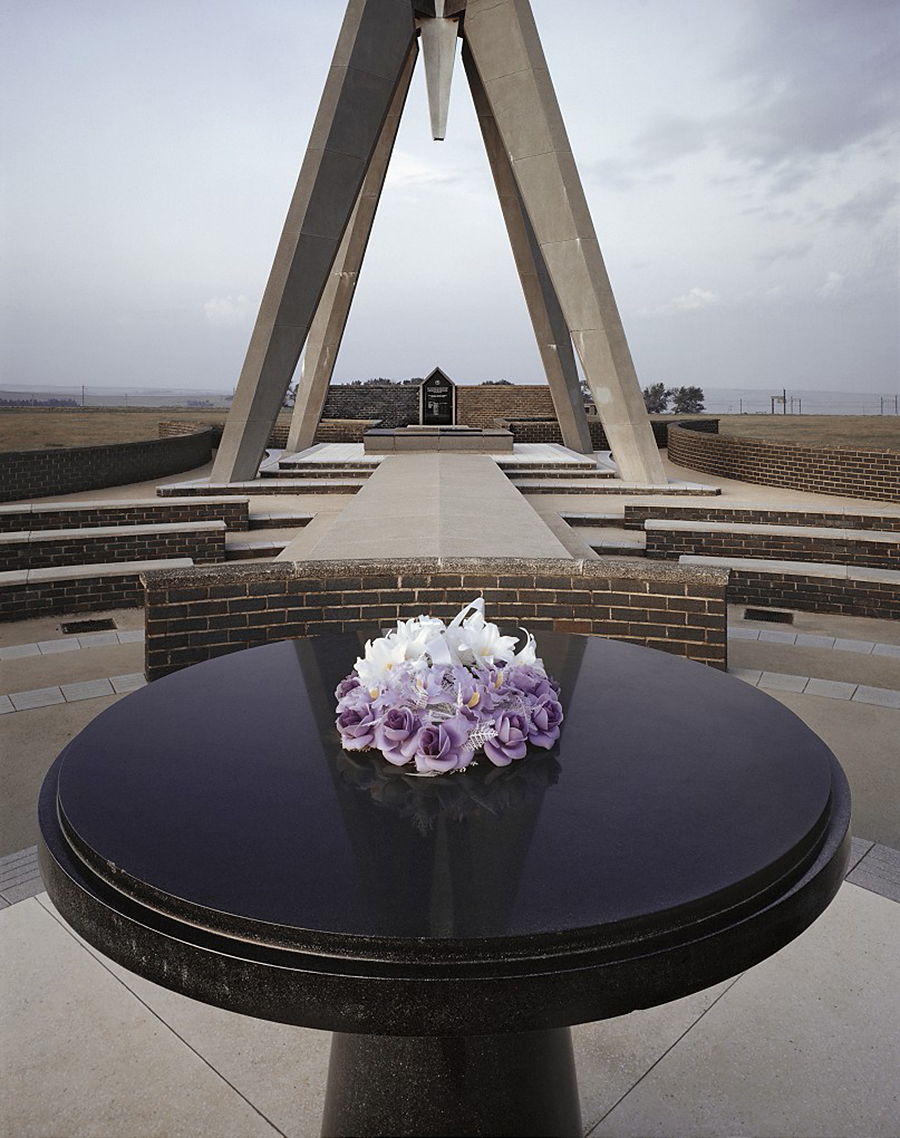
David Goldblatt (South African, 1930-2018) 'Wreath at the Berg-en-Dal Monument' 1983


David Goldblatt (South African, 1930-2018)
Wreath at the Berg-en-Dal Monument which commemorates the courage – and the sarcophagus which holds the bones – of 60 men of the South African Republic Police, who died here 27 August 1900 in a critical battle of the Anglo-Boer War. Dalmanutha, Mpumalanga. December 1983.
1983
Courtesy the artist and Goodman Gallery, Johannesburg


David Goldblatt (South African, 1930-2018) 'The swimming bath rules at the rec, Cape Blue Asbestos Mine, Koegas, Northern Cape' 2002


David Goldblatt (South African, 1930-2018)
The swimming bath rules at the rec, Cape Blue Asbestos Mine, Koegas, Northern Cape
2002


David Goldblatt (South African, 1930-2018) 'The mill, Pomfret Asbestos Mine, Pomfret, North-West Province, 20 December 2002' 2002


David Goldblatt (South African, 1930-2018)
The mill, Pomfret Asbestos Mine, Pomfret, North-West Province, 20 December 2002
2002


David Goldblatt (South African, 1930-2018) 'Johannesburg from the Southwest' 2003


David Goldblatt (South African, 1930-2018)
Johannesburg from the Southwest
2003


David Goldblatt (South African, 1930-2018) 'Incomplete houses, part of a stalled municipal development of 1000 houses. Lady Grey, Eastern Cape, 5 August 2006' 2006


David Goldblatt (South African, 1930-2018)
Incomplete houses, part of a stalled municipal development of 1000 houses. Lady Grey, Eastern Cape, 5 August 2006
2006


New Museum
235 Bowery
New York, NY 10002
212.219.1222

Opening hours:
Tuesday – Sunday 11am – 6pm

New Museum website

LIKE ART BLART ON FACEBOOK

Back to top