Review: ‘New 09’ at Australian Centre for Contemporary Art (ACCA), Melbourne

Exhibition dates: 17th March – 17th May, 2009

Curator: Charlotte Day


ACCA’s annual commissions exhibition – this year curated by Charlotte Day with new works from eight contemporary Australian artists including Justine Khamara, Brodie Ellis, Marco Fusinato, Simon Yates, Matthew Griffin, Benjamin Armstrong and Pat Foster and Jen Berean.


Simon Yates (Australian, b. 1973) 'Rhabdomancy' 2009 from the exhibition 'New 09' at Australian Centre for Contemporary Art (ACCA), Melbourne, March - May, 2009


Simon Yates (Australian, b. 1973)
Rhabdomancy
Tissue paper, wood, fishing rods, tape, string, electrical components, helium balloons dimensions variable
2009
Photo: Marcus Bunyan


“That’s what art is, he said, the story of a life in all its particularity. It’s the only thing that really is particular and personal. It’s the expression and, at the same time, the fabric of the particular. And what do you mean by the fabric of the particular? I asked, supposing he would answer: Art. I was also thinking, indulgently, that we were pretty drunk already and that it was time to go home. But my friend said: What I mean is the secret story … The secret story is the one we’ll never know, although we’re living it from day to day, thinking we’re alive, thinking we’ve got it all under control and the stuff we overlook doesn’t matter. But every damn thing matters! It’s just that we don’t realise. We tell ourselves that art runs on one track and life, our lives, on another, we don’t even realise that’s a lie.”


From the story “Dentist” from the book ‘Last Evenings on Earth’ by Roberto Bolaño1


“A work of art reminds you of who you are now”


Kepesh from the film ‘Elegy’


The curator Charlotte Day has assembled an interesting selection of artists for New 09 at ACCA, Melbourne. It is an exhibition whose ‘presences’ challenge through dark and light, sound and light, contemplation and silence. The journey is one of here and now moments that transport the viewer to states of being that address the fabric of the particular: doubt, anxiety and enlightenment crowd every corner. The particularities of the experience (material, social, psychological and imaginative) impinge on the viewers interior states of being transcending the very physicality and symbolic realism of the works.2

On entering the gallery you are greeted by Simon Yates self-propelled figures that make up the work Rhabdomancy (2009, above). Suspended, tethered, floating just above the floor the figures move eerily about the entrance to the gallery, startling people who have not seen them move before. They stand silent witness, a simulation of self in tissue paper searching for meaning by using a dowsing rod. The word rhabdomancy has as one of it’s meanings ‘the art or gift of prophecy (or the pretence of prophecy) by supernatural means’. Here the figures are divining and divination rolled into one: grounded they seek release through the balloons but through augury they become an omen or portent from which the future is foretold.

“… cutting and slicing in order to see them better, willing them into three dimensions; an attempt to cheat death, or rather, to ward off forgetting of them as they are/were and as I was when the work was made.”

~ Justine Khamara

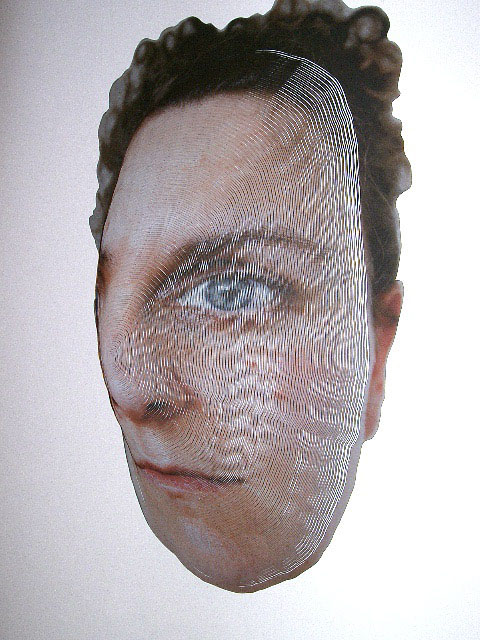
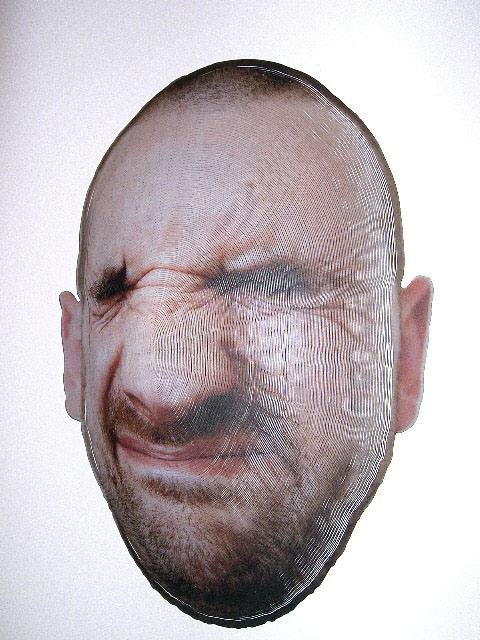
In the first gallery, a very minimal installation by Justine Khamara of two fractured faces stare out at you from the wall, my favourite work of the show. These are unsettling faces, protruding towards you like some topographical map, one eyes screwed shut the other beadily following you as you walk around the gallery space. Here the images of brother and sister presence anterior, already formed subjects not through memory (as photographs normally do) but through the insistence of the their multiple here and now planes of existence. Rather than ‘forgetting’ the images authenticate their identity through their ongoing presence in an ever renewing present.3 Their dissection of reality, the affirmation of their presence (not the photographic absence of a lost subject) embodies their secret story on the viewer told through psychological and imaginative processes: how do they make me feel – about my life, my death and being, here, now.

The pathos of the show is continued with the next work Noosphere (2008) by Brodie Ellis (the noosphere is best described as a sort of collective consciousness of human-beings).4 In this work a video above the clouds is projected onto a circular shape on the ceiling in a darkened room. The emotional and the imaginative impact of the message on the audience is again disorientating and immediate. The images look across the clouds to vistas of setting suns, look down on the clouds and the sea and land below. The images first move one way and then another, disorientating the viewer and changing their perspective of the earth; these are alien views of the earth accompanied by heart beat like ambient music. The perspective of the circle also changes depending on where the viewer stands like some anamorphic distortion of reality. On a stand a beaded yoke for a horse adds to the metaphorical allegory of the installation.

In the next gallery is the literal climax to the exhibition, Marco Fusinato’s Aetheric Plexus (2009). (Aether: medium through which light propagates; Plexus: in vertebrates, a plexus is an area where nerves branch and rejoin and is also a network of blood vessels).

Consisting of scaffolding that forms a cross and supports large numbers of silver spotlights with visible wiring and sound system the installation seems innocuous enough at first. Walking in front of the work produces no effect except to acknowledge the dull glow of red from the banks of dormant lights trained on the viewer. The interaction comes not in random fashion but when the viewer walks to the peripheries of the gallery corners triggering the work – suddenly you are are blasted with white light and the furious sound of white noise for about 15 seconds: I jumped half out of my skin! Totally disorientated as though one has been placed in a blast furnace or a heavenly irradiated crematorium one wonders what has just happened to you and it takes some time to reorientate oneself back in the afterlife of the here and now. Again the immediacy of the work, the particularities of the experience affect your interior states of being.

After a video installation by Matt Griffin you wander into the next gallery where two works by Benjamin Armstrong inhabit the floor of the gallery. And I do mean inhabit. Made of blown glass forms and wax coated tree branches the works have a strange affect on the psyche, to me seemingly emanations from the deep subconscious. Twin glass hemispheres of what look like a brain are surrounded by clasping synaptic nerve endings that support an egg like glass protrusion – a thought bubble? a spirit emanation? These are wonderful contemplative but slightly disturbing objects that have coalesced into shape only in another form to melt and disappear: molten glass and melted wax dissipating the very form of our existence.

Finally we come to the three part installation by Pat Foster and Jen Berean (below). On the right of the photograph you can see three aluminium and glass doors, closed, sealed leading to another gallery. What you can’t see in the photograph is the three pieces of gaffer tape stretched across the glass doors, like they do on the building sites of new homes. No entry here. Above your head is a suspended matrix of aluminium and glass with some of the glass planes smashed. Clean, clinical, safe but smashed, secure but threatening the matrix presses down on the viewer. It reminded me of the vertical standing shards of the World Trade Centre set horizontal suspended overhead. Only the steel cable seemed to ruin the illusion and seemed out of place with the work. It would have been more successful if the matrix was somehow suspended with fewer tethers to increase the sense of downward pressure. Finally you sit on the aluminium benches and contemplate in silence all that has come before and wonder what just hit you in a tidal wave of feelings, immediacies and emotions. The Doing and Undoing of Things.

An interesting journey then, one to provoke thought and emotion.
The fabric of the particular. The pathos of the art-iculate.

My only reservations are about the presence, the immediacy, the surface of it all. How persistent will these stories be? Will the work sustain pertinent inquiry above and beyond the here and now, the shock and awe. Or will it be like a meal one eats and then finds one is full but empty at the same time. A journey of smoke and mirrors.

Dr Marcus Bunyan


1/ Bolano, Robert. Last Evenings on Earth. New Directions, 2007. Available on Amazon.

2/ Blair, French. The Artist, The Body. [Online] Cited on 12/04/2009. No longer available online

3/ Ibid.,

4/ “For Teilhard, the noosphere is best described as a sort of ‘collective consciousness’ of human-beings. It emerges from the interaction of human minds. The noosphere has grown in step with the organisation of the human mass in relation to itself as it populates the earth. As mankind organizes itself in more complex social networks, the higher the noosphere will grow in awareness.” From the concept of Nooshpere on Wikipedia.


Many thankx to ACCA for allowing me to publish the photographs in the posting. All Images © Dr Marcus Bunyan and ACCA.


    Justine Khamara (Australian, b. 1971) 'Dilated Concentrations' 2009 from the exhibition 'New 09' at Australian Centre for Contemporary Art (ACCA), Melbourne, March - May, 2009

    Justine Khamara (Australian, b. 1971) 'Dilated Concentrations' 2009  (detail) from the exhibition 'New 09' at Australian Centre for Contemporary Art (ACCA), Melbourne, March - May, 2009

    Justine Khamara (Australian, b. 1971) 'Dilated Concentrations' 2009  (detail) from the exhibition 'New 09' at Australian Centre for Contemporary Art (ACCA), Melbourne, March - May, 2009

    Justine Khamara (Australian, b. 1971) 'Dilated Concentrations' 2009  (detail) from the exhibition 'New 09' at Australian Centre for Contemporary Art (ACCA), Melbourne, March - May, 2009


    Justine Khamara (Australian, b. 1971)
    Dilated Concentrations
    2009
    UV print on laser cut stainless steel
    Photos: Marcus Bunyan
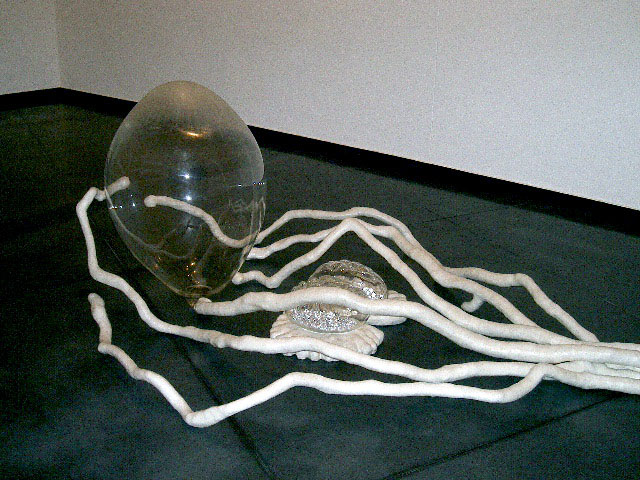
     

    Benjamin Armstrong (Australian, b. 1975) 'Hold Everything Dear I' 2008


    Benjamin Armstrong (Australian, b. 1975)
    Hold Everything Dear I
    2008
    Photo: Marcus Bunyan
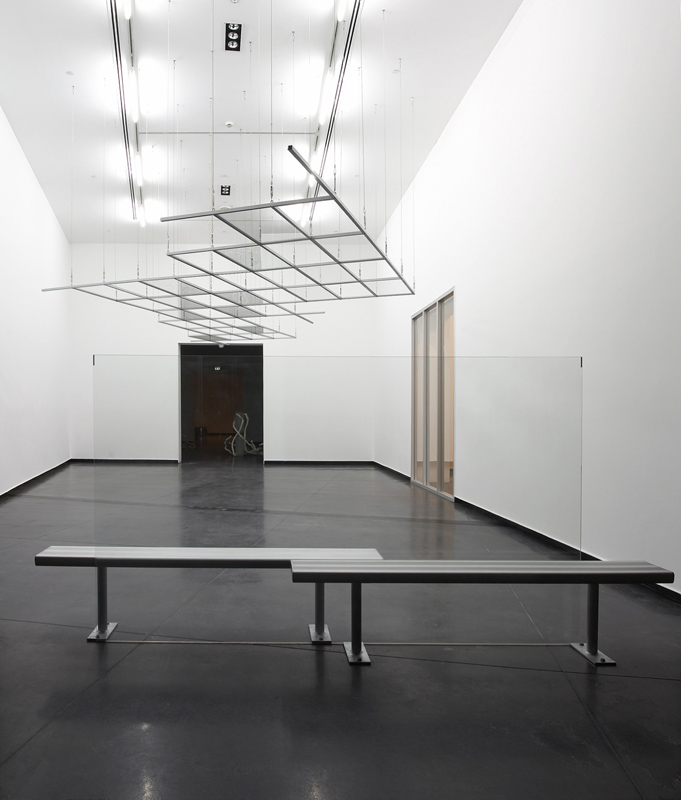
     

    Pat Foster (Australian, b. 1981) and Jen Berean (Canadian, b. 1981) 'Untitled’ from the series ‘The Doing and Undoing of Things’ 2009


    Pat Foster (Australian, b. 1981) and Jen Berean (Canadian, b. 1981)
    Untitled from the series The Doing and Undoing of Things
    2009
    Aluminium, safety glass, steel cable
    Photo: Marcus Bunyan


    Pat Foster (Australian, b. 1981) and Jen Berean (Canadian, b. 1981) 'Untitled’ from the series ‘The Doing and Undoing of Things’ 2009 (detail)


    Pat Foster (Australian, b. 1981) and Jen Berean (Canadian, b. 1981)
    Untitled from the series The Doing and Undoing of Things (detail)
    2009
    Aluminium, safety glass, steel cable
    Photo: Marcus Bunyan


    Australian Centre for Contemporary Art (ACCA)
    111 Sturt Street
    Southbank
    Victoria 3006
    Australia

    Opening hours:
    Tuesday – Friday 10am – 5pm
    Saturday – Sunday 11am – 5pm
    Closed Monday

    ACCA website

    LIKE ART BLART ON FACEBOOK

    Back to top

    Exhibition: ‘Hyper’ by Denis Darzacq at Australian Centre for Photography (ACP), Sydney

    Exhibition dates: 13th March – 12th April, 2009


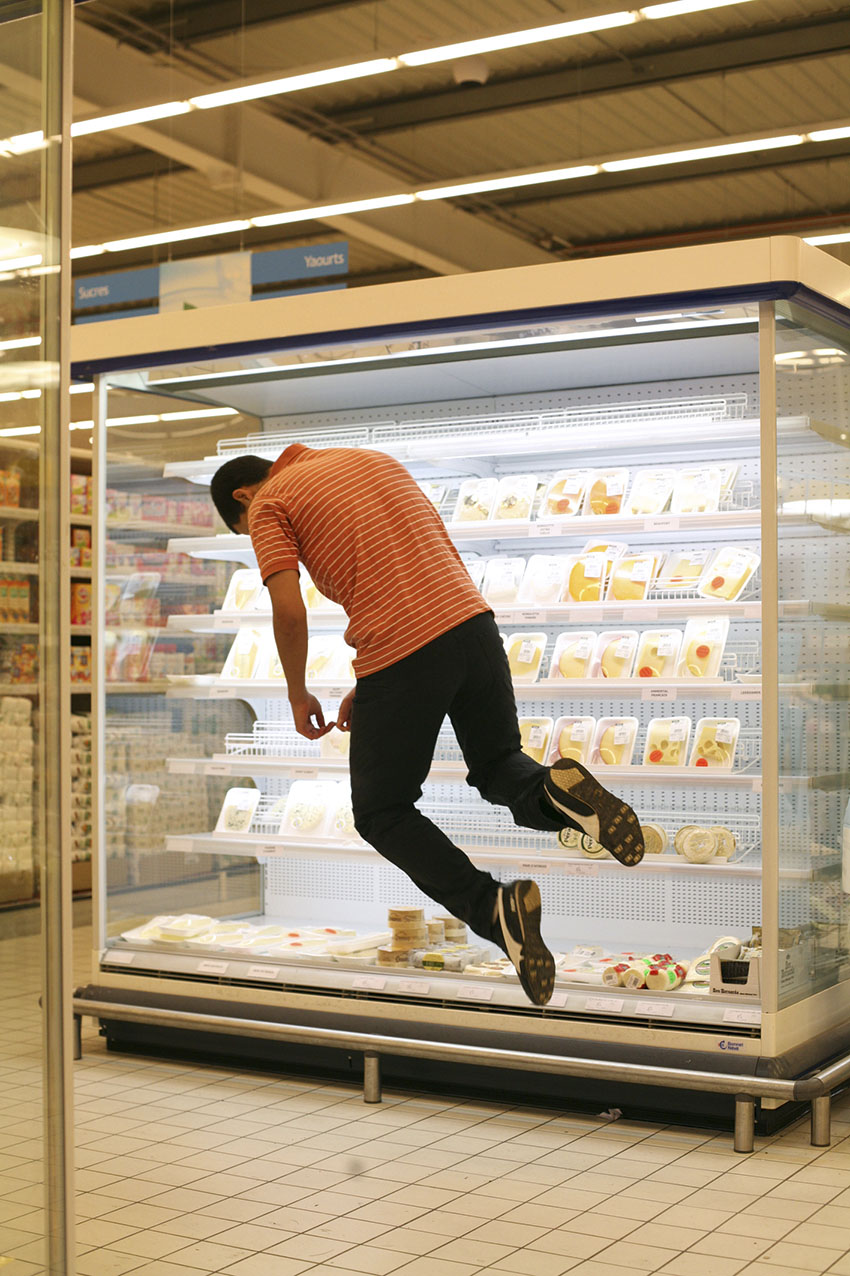
    Denis Darzacq (French, b. 1961) 'Hyper #4' 2007 from the exhibition 'Hyper' by Denis Darzacq at Australian Centre for Photography (ACP), Sydney, March - April, 2009


    Denis Darzacq (French, b. 1961)
    Hyper #4
    2007


    These images form an interesting body of work: levitating bodies suspended between heaven and earth, neither here nor there, form a hyper-real image grounded in the context of the fluorescent isles of French supermarkets. The mainly anonymous humans look like mannequins in their inertness, frozen at the moment of throwing themselves/being thrown into the consumer environment. After his brilliant series La Chute (The Fall) Darzacq has taken people gathered in a casting call from around the town of Rouen and made their frozen bodies complicit in the mass production of the supermarket and the mass consumption of the image as tableaux vivant: the mise en scène directed by the photographer to limited effect. There is something unsettling about these images but ultimately they are unrewarding, as surface as the environment the bodies are suspended in, and perhaps this is the point.

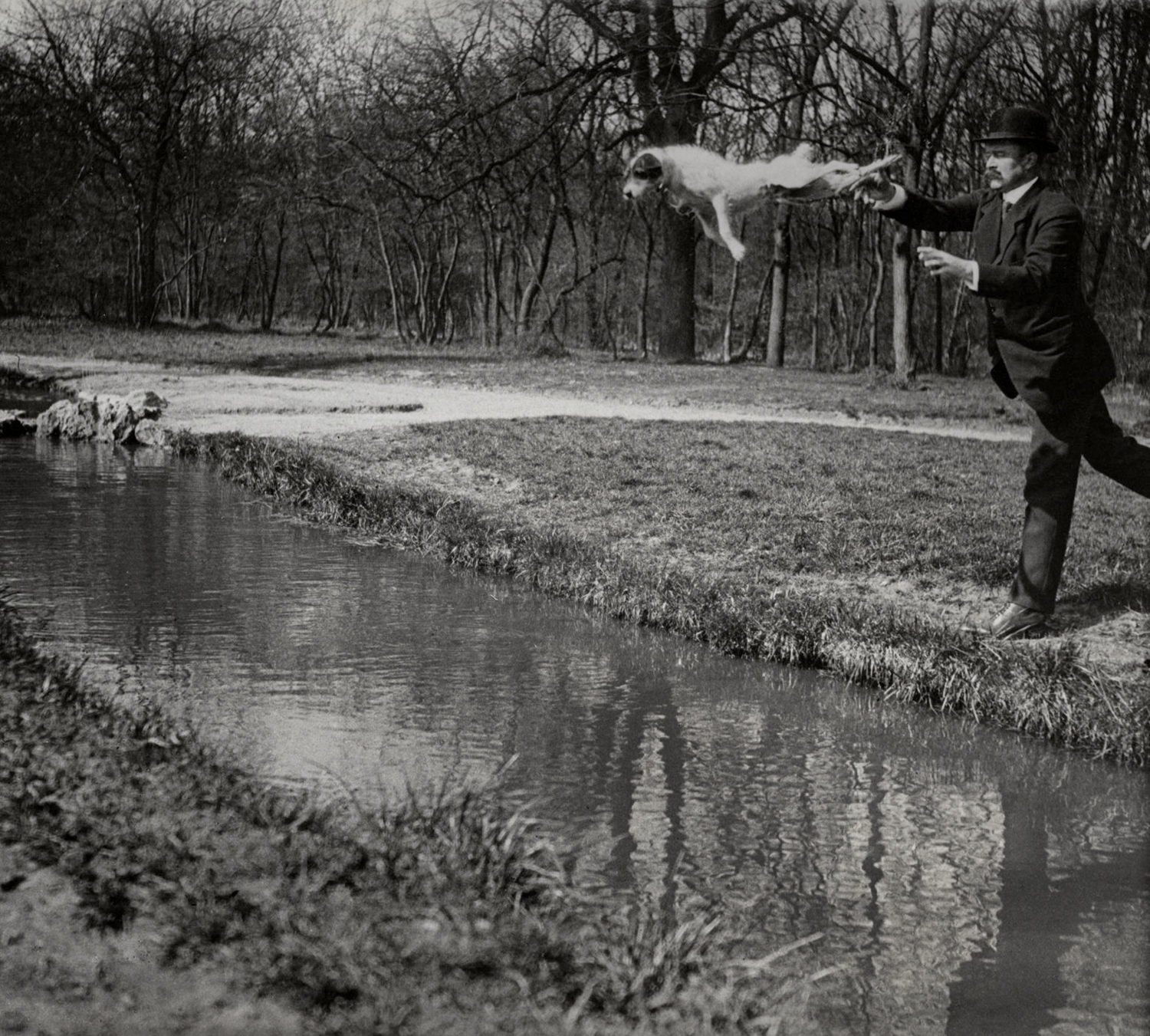
    Suspension of bodies is not a new idea in photography. Jacques Henri Lartigue used the freeze frame to good effect long before Henri Cartier-Bresson came up with his ‘decisive moment’: playing with the effect of speed and gravity in an era of Futurism, Lartigue used the arrested movement of instant photography then afforded by smaller cameras and faster film to capture the spirit of liberation in the ‘Belle Epoque’ period before the First World War.

    “All the jumping and flying in Lartigue’s photographs, it looks like the whole world at the turn of the century is on springs or something. There’s a kind of spirit of liberation that’s happening at the time and Lartigue matches that up with what stop action photography can do at the time, so you get these really dynamic pictures. And for Lartigue part of the joke, most of the time, is that these people look elegant but they are doing these crazy stunts.”1


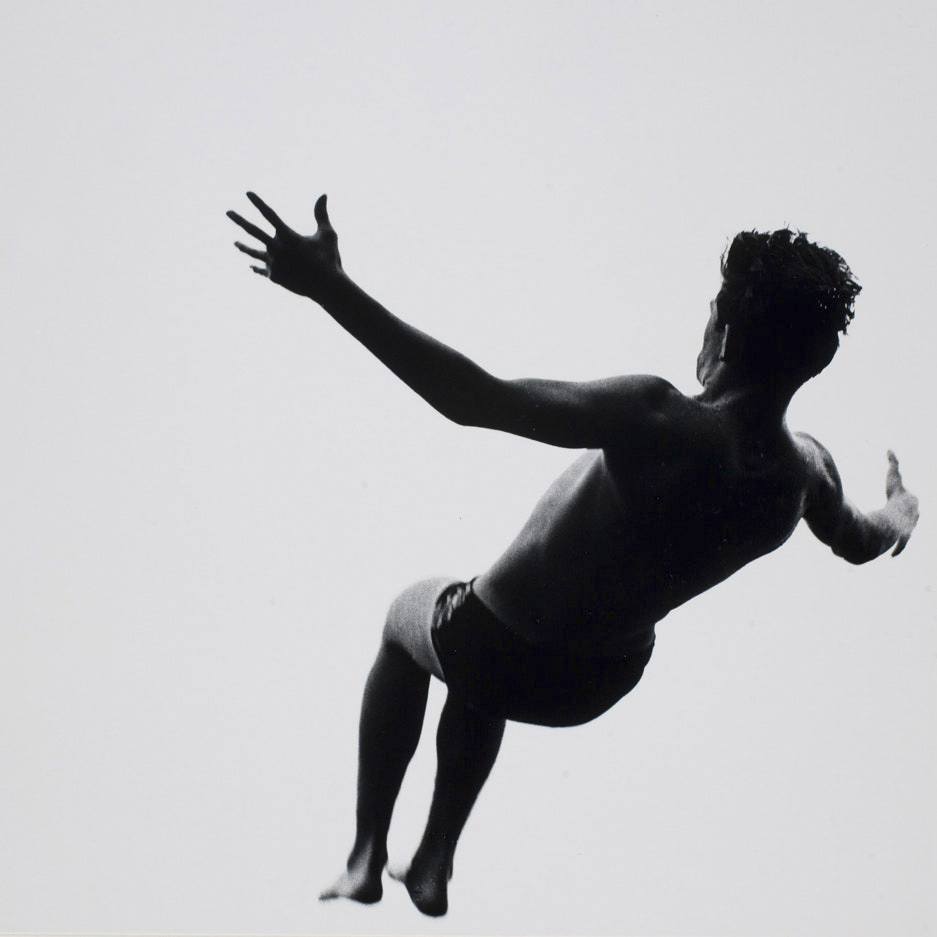
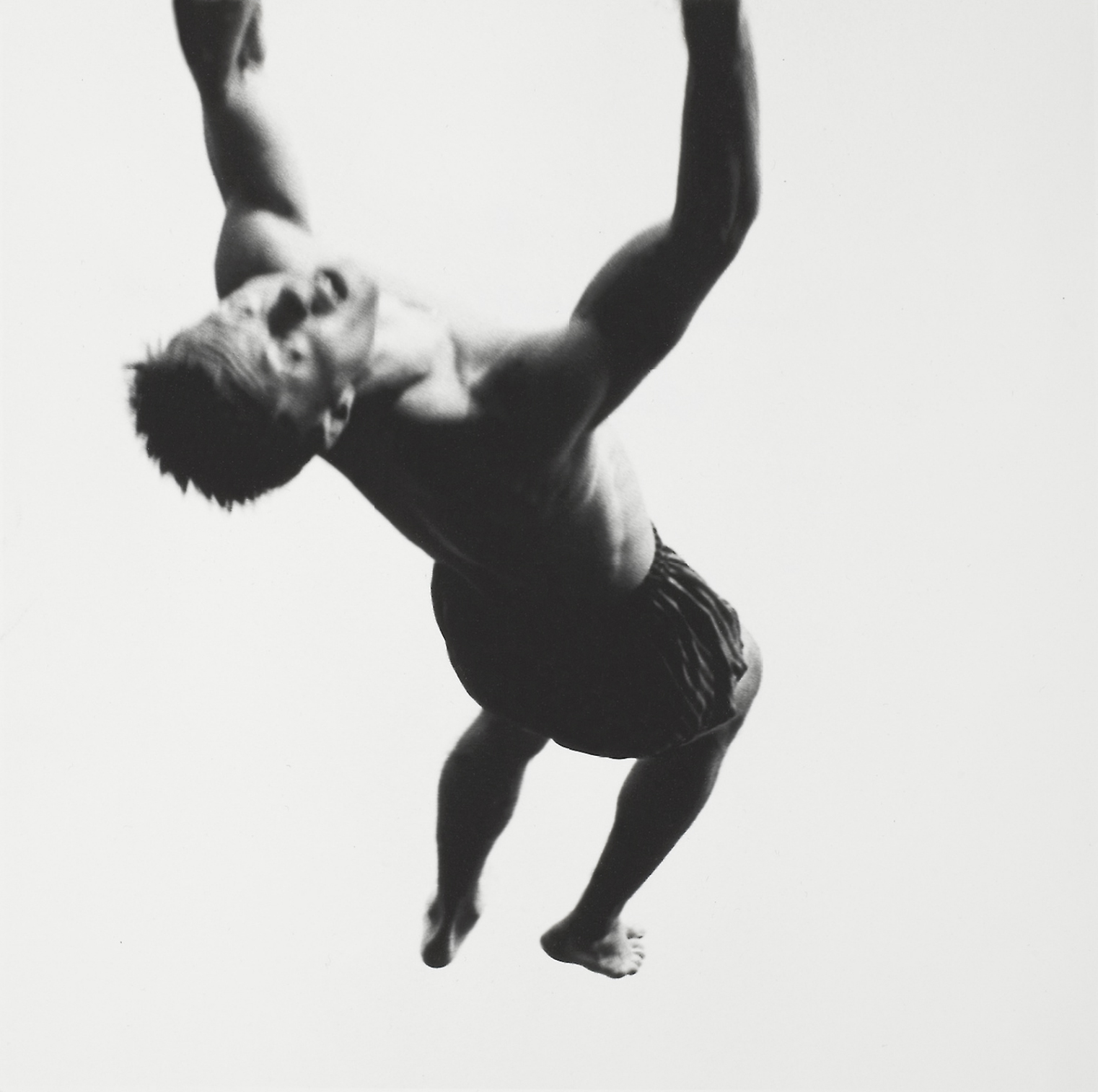
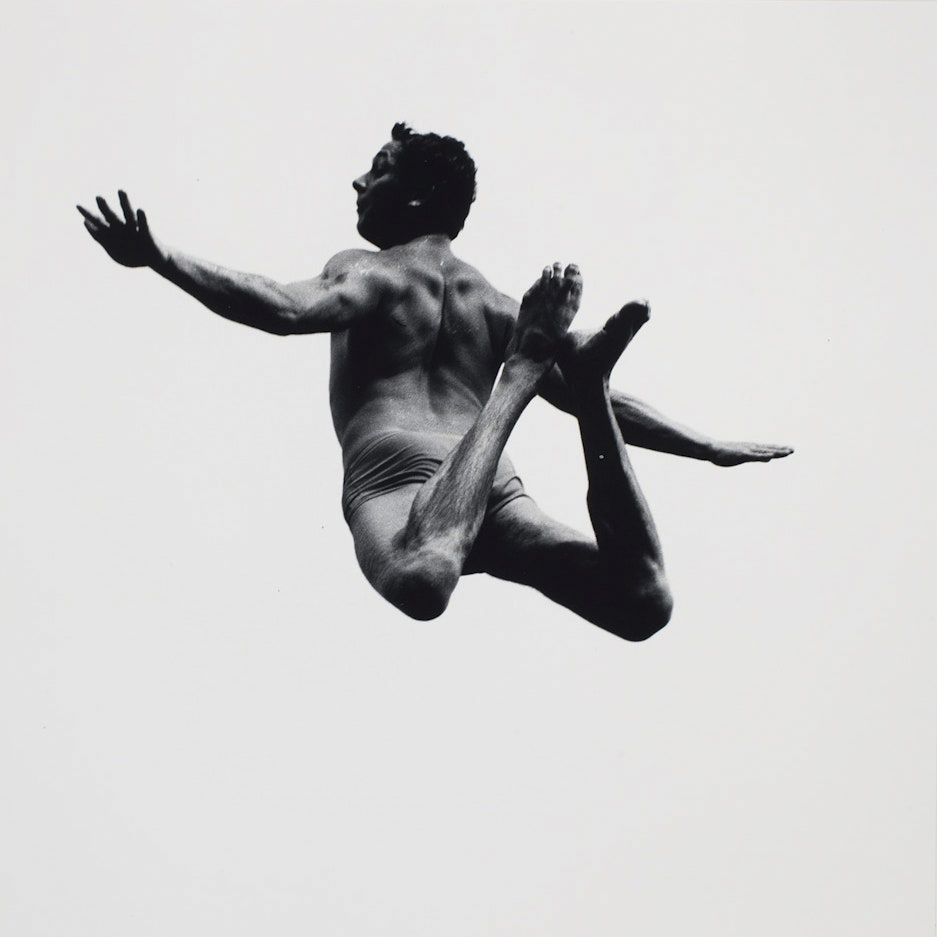
    One of the greatest, if not the greatest ever, series of photographs of levitating bodies is that by American photographer Aaron Siskind. Called Pleasures and Terrors of Levitation (sometimes reversed as Terrors and Pleasures of Levitation as on the George Eastman House website) the images feature divers suspended in mid-air with the sky as their blank, background canvas. The images formal construction makes the viewer concentrate on the state of the body, its positioning in the air, and the look on the face of some of the divers caught between joy and fear.

    “Highly formal, yet concerned with their subject as well as the idea they communicate, the ‘Pleasures and Terrors of Levitation’ photographs depict the dark shapes of divers suspended mid-leap against a blank white sky. Shot with a hand-held twin-lens reflex camera at the edge of Lake Michigan in Chicago, the balance and conflict suggested by the series’ title is evident in the divers’ sublime contortions.”2


    Perhaps because of their air of balance and conflict we can return to these vibrant images again and again and they never loose their freshness, intensity and wonder. The same cannot be said of Denis Darzacq’s Hyper photographs. Slick and surface like the consumer society on which they comment the somnambulistic bodies are more like floating helium balloons, perhaps even tortured souls leaving the earth. Reminiscent of the magicians trick where the girl is suspended and a hoop passed around her body to prove the suspension is real these photographs really are more smoke and mirrors than any comment on the binary between being and having as some commentators (such as Amy Barrett-Lennard, Director Perth Institute of Contemporary Arts) have suggested. There is no spirit of liberation here, no sublime revelation as the seemingly lifeless bodies are trapped between the supermarket shelves, as oblivious to and as anonymous as the products that surround them. The well shot images perhaps possess a sense of fun, if I am being generous, as Darzacq plays with our understanding of reality… but are they more than that or is the Emperor just wearing very thin consumer clothing?

    Dr Marcus Bunyan


    1/ Kevin Moore (Lartigue biographer) quoted in “Genius of Photography,” on the BBC website [Online] Cited 15/03/2009

    2/ Text from the Museum of Contemporary Photography website [Online] Cited 15/03/2009 (no longer available)


    Many thankx to the Australian Centre for Photography for allowing me to publish the Darzacq photographs in the posting. Please click on the photographs for a larger version of the image. All other images are used under “fair use” for the purpose of education, research and critical discourse.


      Denis Darzacq (French, b. 1961) 'Hyper #8' 2007 from the exhibition 'Hyper' by Denis Darzacq at Australian Centre for Photography (ACP), Sydney, March - April, 2009


      Denis Darzacq (French, b. 1961)
      Hyper #8
      2007


      “The astonishing photographs that make up Hyper involve no digital manipulation, just close collaboration between young dancers and sportspeople as they jump for the camera to form strange, exaggerated poses and body gestures. Denis Darzacq was drawn to the trashy, consumerist nature of the French Hypermarkets (the equivalent of our supermarkets) and the hyper coloured backgrounds they provided. These supermarkets offered a sharp juxtaposition to the sublime, almost-spiritual bodies that appear to float in their aisles.

      Hyper is the latest series of works by French photographer Denis Darzacq, who continues to explore the place of the individual in society, a theme which has been crucial to his work in the last few years.”

      Text from the ACP website [Online] Cited 15/03/2009. No longer available online


      Jacques Henri Lartigue (French, 1894-1986) 'L'envol de Bichonnade' 1905


      Jacques Henri Lartigue (French, 1894-1986)
      Bichonnade, 40, Rue Cortambert, Paris
      1905
      Gelatin silver print


      Jacques Henri Lartigue (French, 1894-1986) 'Mr Folletete (Plitt) et Tupy, Paris, March 1912' 1912


      Jacques Henri Lartigue (French, 1894-1986)
      Mr Folletete (Plitt) et Tupy, Paris, March 1912
      1912
      Gelatin silver print


      Jacques Henri Lartigue (French, 1894-1986) 'Fuborg' 1929


      Jacques Henri Lartigue (French, 1894-1986)
      Fuborg
      1929
      Gelatin silver print


      Herni Cartier-Bresson (French, 1908-2004) 'Behind Saint Lazare Station, Paris, France' 1932


      Herni Cartier-Bresson (French, 1908-2004)
      Behind Saint Lazare Station, Paris, France
      1932
      Gelatin silver print


      Aaron Siskind (American, 1903-1991) 'Pleasures and Terrors of Levitation #37' 1954


      Aaron Siskind (American, 1903-1991)
      Pleasures and Terrors of Levitation #37
      1956
      Gelatin silver print


      Aaron Siskind (American, 1903-1991) 'Pleasures and Terrors of Levitation #47' 1954


      Aaron Siskind (American, 1903-1991)
      Pleasures and Terrors of Levitation #47
      1954
      Gelatin silver print


      Aaron Siskind (American, 1903-1991) 'Pleasures and Terrors of Levitation #93' 1961


      Aaron Siskind (American, 1903-1991)
      Pleasures and Terrors of Levitation #93
      1961
      Gelatin silver print


      Aaron Siskind (American, 1903-1991) 'Pleasures and Terrors of Levitation #99' 1953


      Aaron Siskind (American, 1903-1991)
      Pleasures and Terrors of Levitation #99
      1956
      Gelatin silver print


      Aaron Siskind (American, 1903-1991) 'Pleasures and Terrors of Levitation #491' 1954


      Aaron Siskind (American, 1903-1991)
      Pleasures and Terrors of Levitation #491
      1956
      Gelatin silver print


      Denis Darzacq (French, b. 1961) 'Hyper #3' 2007


      Denis Darzacq (French, b. 1961)
      Hyper #3
      2007


      Hyper picks up on La Chute while explicitly focusing the artist’s message on the consumerism which hovered in the background of several previous series. In Casques de Thouars Darzacq explored the connecting power and the limits of a consumer product; here the critique is more biting. Hyper opposes bodies in movement and the saturated, standardised space of mass distribution outlets. In this totally commercial setting, the body’s leap expresses the freedom and unhampered choice of its movement. It is a clear challenge to the marketing strategies which seek to control our behaviour. Some of the figures, glowing with an aura, impose glory and give off a sense of spirituality in total contrast with the temples of consumption in which they are found.

      “Hyper 1, 2007-2010,” on the Denis Darzacq website Nd [Online] Cited 13/06/2022


      Denis Darzacq (French, b. 1961) 'Hyper #14' 2007


      Denis Darzacq (French, b. 1961)
      Hyper #14
      2007


      Australian Centre for Photography

      This gallery has now closed

      Denis Darzacq website

      Denis Darzacq Hyper images

      LIKE ART BLART ON FACEBOOK

      Back to top