Review: ‘The Water Hole’ exhibition by Gerda Steiner and Jorg Lenzlinger at ACCA (Australian Centre for Contemporary Art), Melbourne

Exhibition dates: 23rd December, 2008 – 1st March, 2009


“Warning. Watch your step while gazing at distant view.”

Sign at entrance to the exhibition
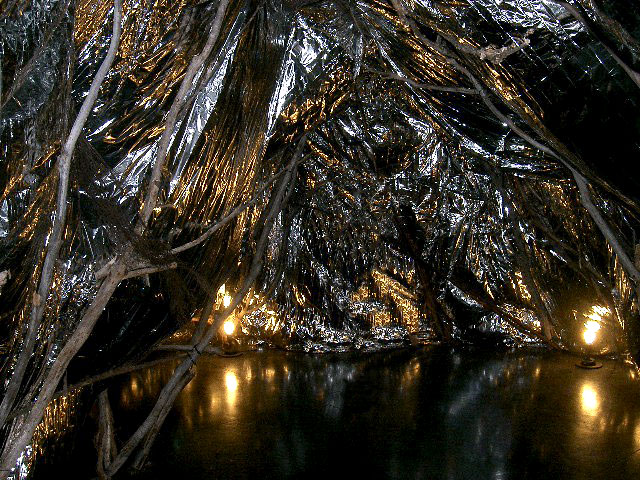
 

Gerda Steiner and Jorg Lenzlinger. Entrance to 'The Waterhole' exhibition at ACCA, Melbourne, 2009


Gerda Steiner (Swiss, b. 1967) and Jorg Lenzlinger (Swiss, b. 1964)
Entrance to The Water Hole exhibition at ACCA, Melbourne
2009
Photo: Marcus Bunyan


A cave like entrance presents itself to the visitor as they enter the exhibition leading to a long winding tunnel that is lined with silver insulation foil and tree branches, lit by floor mounted electric light bulbs. The foil moves with the natural movement of air causing not a rustling of leaves but of artificial surfaces.

At the end of the tunnel the viewer enters a large installation space, confronted with a effusive pop art Garden of Eden, a Magic Forest.

It takes a while to work out what is going on, there are so many elements to the sculptural piece. The main elements are buckets, toilets, basins and drainage pipes, plumbing fittings that all lead to a bed with a drying dam in the centre of a satin bedspread: the ‘waterhole’ of the exhibition title. The waterhole is fed by water dripping from a medical bag suspended high in the air above the dam, a nice touch. The rest of the forest and pipes are dry. The installation comments on our water supplies and the ‘technologies of production’ (Foucault) that permit us to produce, transform or manipulate things. We might install rainwater tanks to catch water but if there is no water to catch in the first place then we are in trouble: we make our bed and have to lie in it, the empty basins like our catchment areas, dry and bleak.

Other elements of the forest have an environmental theme, the installation developed by the artists in response to the extensive drought most of Australia (and it particular Melbourne) is experiencing. Here are spiders with hairy legs and mobile phones for bodies infesting the installation, plumbing fittings with natural seeds sprouting from their ends, brightly coloured crystal forms fed each day with water by gallery staff so that they grow. An upside down umbrella with Polar bear images printed on it’s material has imaginary water draining down a bamboo pipe into a bucket; empty water bottles form a large nest with broken eggs inside; artificial plants, bones, crabs, seaweed and flying stuffed owls are form some of the other elements in the installation.

Climbing a few steps we enter a ‘bird’ watching gallery replete with binoculars to observe the humans in the forest as much as the forest itself. A water cooler sits incongruously in this watching space, silent and somehow complicit in its ironical presence.

The viewer then moves to another room. 4 video projectors display another water themed installation on the gallery walls, the videos meeting in the middle of the walls and reflecting each other. Ambient music accompanies images of rain!, spurting water, owls and plastic pipes, plastic flowers and plastic horses as the viewer relaxes on a waterbed in the middle of the space. The effect of the music and images is quite meditative when combined with the gentle rocking of the waterbed, the projections of the video forming kaleidoscopic ‘Northern lights’ on the ceiling of the gallery. This room is an extension of the themes of the large installation.

Moving forward the viewer enters another room – the meditation room. This room is most effective in encouraging contemplation of the different planes of our existence and our orientation in (environmental) space. Three beds are present, one suspended from the ceiling by four metal rods. Climbing onto this bed the movement from side to side caused by your weight makes you feel seasick and slightly disorientated. Above the second table is a wonderful mobile made of twigs, branches, dried leaves, plastic flowers, beads, plastic bags, baby dummies and jewellery moving gently in the breeze. Lying on the table with the mobile about a foot above your head things drift in and out of view as you change the focus of your eyes – close, mid, far and then onto the moving shadows on the ceiling.

The most effective bed has a small meteorite suspended in a net bag above it. The viewer slides underneath the ‘rock’ placing the meteorite about a foot or so above your face. The meteorite is brown, dark and heavy, swinging slightly above your ‘third eye’. You feel its weight pressing down on your energy, on your life force and you feel how old this object is, how far it has traveled, how fragile and mortal you are. It is a sobering and enlightening experience but what an experience it is!

Entering the final room small colour photos of people being hugged from behind and lifted into the air, laughing, line the gallery walls. These are the weakest elements of the exhibition and seem to bear no relation to all that has passed before. Running off of this gallery is an alcove that is a dead end, a full stop to the exhibition with an installation Desalination plant for tears. A cheap Formica desk sits at the end of the space. Perched above the desk is a tv showing live black and white images of the earlier bird watching gallery – the watcher now the watched. On the desk itself is a microscope (with slide of human tears), pencil, a candle for heat under a glass flask of water (looking like a spider from the large installation!) and various glass test tubes and vials. A diagram explains the working of a Desalination plant for tears, an analogous reference to the desalination plant earmarked for Wonthaggi, south-east of Melbourne. Irony is present (again) in the 2 leaves grown at Singapore Airport by desalinated water (2008), two framed, brown dead leaves, and in the Tear system diagram where glands have turned into forests and the eye into a lake (see below).

This is a magical and poignant exhibition that is a joy for children and adults alike. Children love it running around exploring the environments. Adults love it for it’s magical, witty and intelligent response to the problems facing our planet and our lives. Go and enjoy this interplanetary collision. Highly recommended!

Dr Marcus Bunyan


Many thankx to the Australian Centre for Contemporary Art for allowing me to publish the photographs and text in the posting. All photographs © Marcus Bunyan


Gerda Steiner (Swiss, b. 1967) and Jorg Lenzlinger (Swiss, b. 1964) 'The Waterhole' 2009 (detail)


Gerda Steiner (Swiss, b. 1967) and Jorg Lenzlinger (Swiss, b. 1964)
The Water Hole (detail)
2009
Photo: Marcus Bunyan
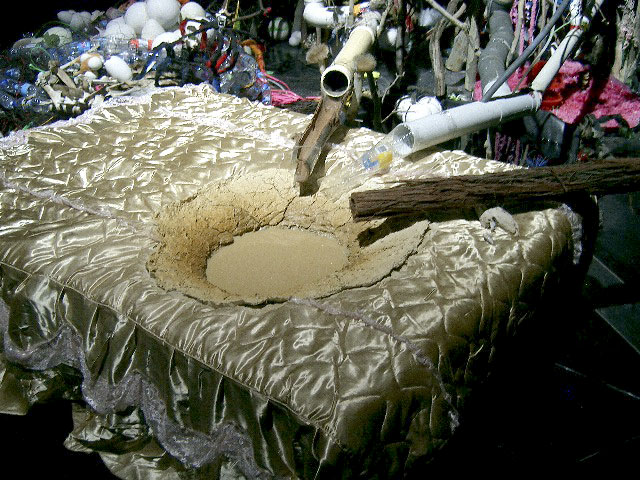
 

Gerda Steiner (Swiss, b. 1967) and Jorg Lenzlinger (Swiss, b. 1964) 'The Waterhole' 2009 (detail)


Gerda Steiner (Swiss, b. 1967) and Jorg Lenzlinger (Swiss, b. 1964)
The Water Hole (detail)
2009
Photo: Marcus Bunyan
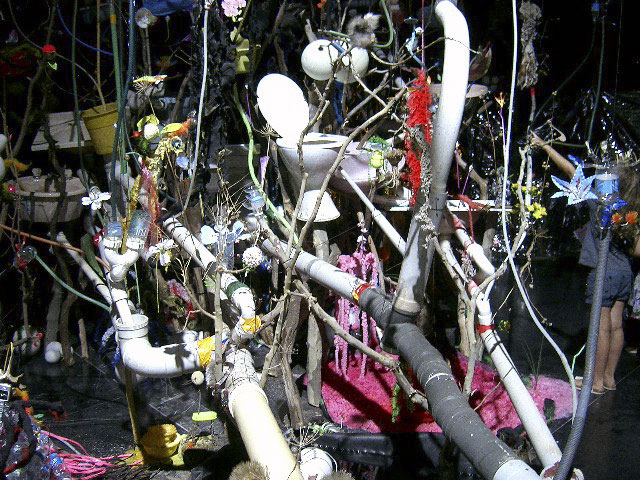
 

Gerda Steiner (Swiss, b. 1967) and Jorg Lenzlinger (Swiss, b. 1964) 'The Waterhole' 2009 (detail)


Gerda Steiner (Swiss, b. 1967) and Jorg Lenzlinger (Swiss, b. 1964)
The Water Hole (detail)
2009
Photo: Marcus Bunyan
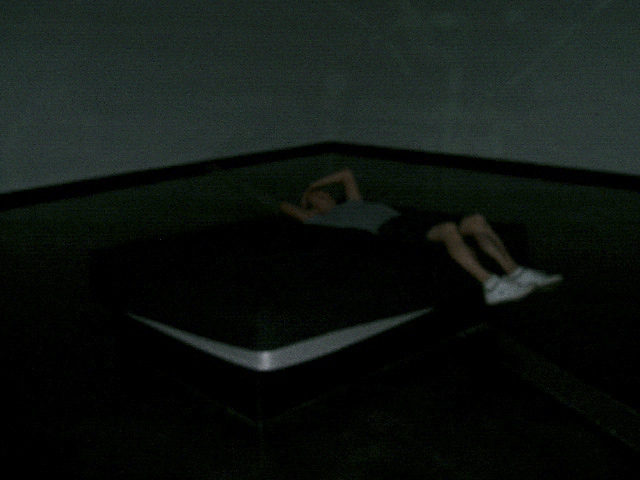
 

Gerda Steiner and Jorg Lenzlinger. Installation view of waterbed at 'The Waterhole' exhibition at ACCA, 2009


Gerda Steiner (Swiss, b. 1967) and Jorg Lenzlinger (Swiss, b. 1964)
Installation view of waterbed at The Water Hole exhibition at ACCA, Melbourne
2009
Photo: Marcus Bunyan
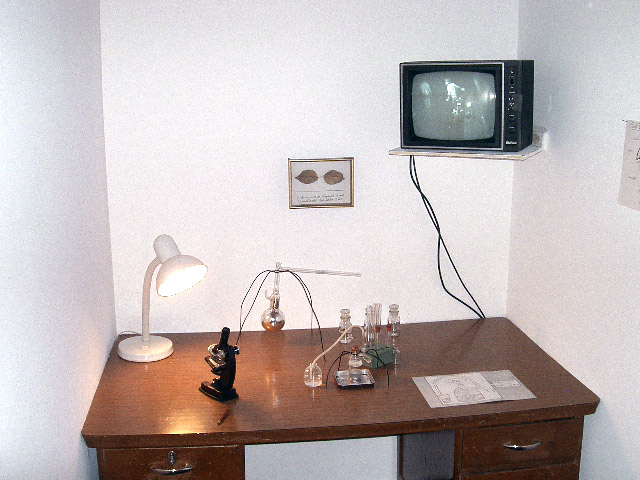
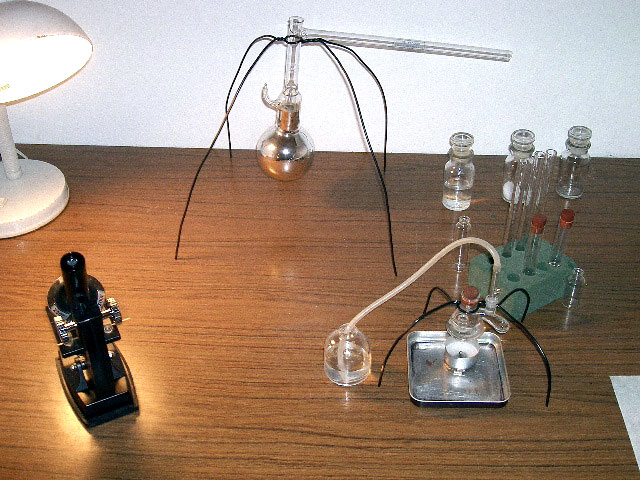
 

Gerda Steiner and Jorg Lenzlinger. Installation view of 'Desalination plant for tears' (detail) from 'The Water Hole' exhibition at ACCA, Melbourne, 2009

Gerda Steiner and Jorg Lenzlinger. Installation view of 'Desalination plant for tears' (detail) from 'The Water Hole' exhibition at ACCA, Melbourne, 2009


Gerda Steiner (Swiss, b. 1967) and Jorg Lenzlinger (Swiss, b. 1964)
Installation view details of Desalination plant for tears from The Water Hole exhibition at ACCA, Melbourne
2009
Photos: Marcus Bunyan


The end of 2008 saw the launch of The Water Hole, a major installation by renowned Swiss artists Steiner and Lenzlinger. The artists created a fantasia of ecology in ACCA’s large hall. In the side galleries a flow out of projects including meteors suspended over beds, a crystal room and a desalination laboratory. The Water Hole, devised specifically for ACCA, referenced Australia’s acute climate challenges as well as the pressure of global waste. The project created a story of place, a fable if you like. And in the tradition of the fable, the artists employed animals, plants and inanimate objects to tell a story that has a moral and ethical dimensions. 

The Water Hole was a big story – filled with pleasurable things but also with the message of peril.  The artists created environments that enabled the visitor to consider and sense our place in history, and our attention to striking a balance between our consumptive desiring and nature.

Text from the ACCA website
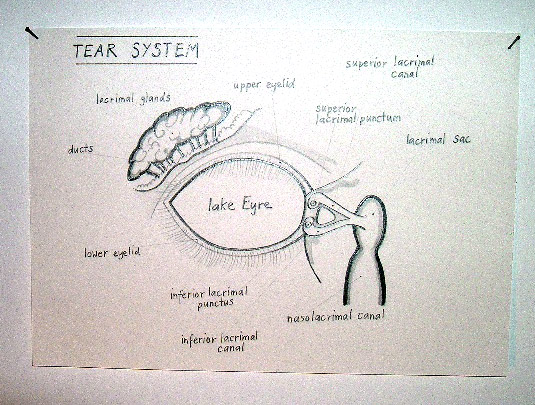
 

Gerda Steiner (Swiss, b. 1967) and Jorg Lenzlinger (Swiss, b. 1964) Diagram from 'Desalination plant for tears' (detail) from the exhibition 'The Water Hole' at ACCA, Melbourne, 2009


Gerda Steiner (Swiss, b. 1967) and Jorg Lenzlinger (Swiss, b. 1964)
Diagram from Desalination plant for tears from the exhibition The Water Hole at ACCA, Melbourne
2009
Photo: Marcus Bunyan


Australian Centre for Contemporary Art (ACCA)
111 Sturt Street
Southbank
Victoria 3006
Australia

Opening hours:
Tuesday to Friday 10am – 5pm
Weekends and Public Holidays 11am – 5pm
Monday by appointment
Open all public holidays except Christmas Day and Good Friday
ACCA website

Gerda Steiner and Jorg Lenzlinger website

LIKE ART BLART ON FACEBOOK

Back to top

Review: ‘Framing Conflict – Iraq and Afghanistan’ exhibition by Lyndell Brown and Charles Green at The Ian Potter Museum of Art, The University of Melbourne

Exhibition dates: 5th November, 2008 – 1st February, 2009


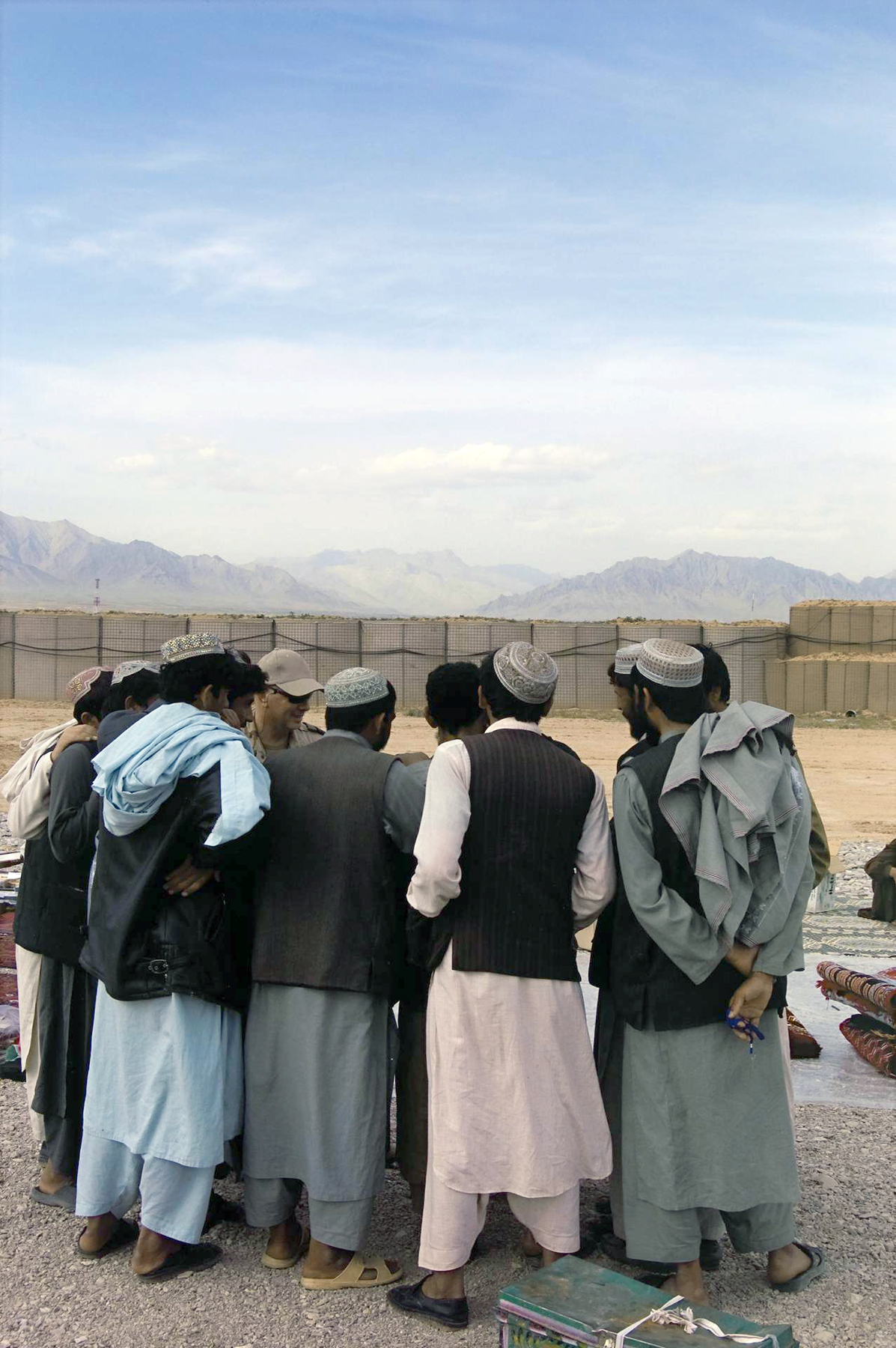
Lyndell Brown (Australian, b. 1961) and Charles Green (Australian, b. 1953) 'Afghan traders with soldiers, market, Tarin Kowt base, Uruzgan province, Afghanistan.' 2007-2008 from the exhibition 'Framing Conflict – Iraq and Afghanistan' exhibition by Lyndell Brown and Charles Green at The Ian Potter Museum of Art, The University of Melbourne, Nov 2008 - Feb 2009


Lyndell Brown (Australian, b. 1961) and Charles Green (Australian, b. 1953)
Afghan traders with soldiers, market, Tarin Kowt base, Uruzgan province, Afghanistan
2007-2008
From The approaching storm series 2007-2009
Digital colour inkjet photograph
155 × 107.5cm


Despite one brilliant photograph and some interesting small painted canvases this exhibition is a disappointment. No use beating around the figurative bush in the landscape so to speak, talking plainly will suffice. Firstly, let’s examine the photographs. Thirteen large format colour photographs are presented in the exhibition out of an archive of “thousands of photographs Brown and Green created on tour”1 from which the paintings are derived.

Most of the photographs are inconsequential and need not have been taken. Relying on the usual trope of painters who take photographs they are shot at night, dusk or dawn when the shadows are long, the colours lush supposedly adding ‘mystique’ to the scene being portrayed. In some cases they are more like paintings than the paintings themselves. Perhaps this was the artist’s plan, the reverse marriage of photography and painting where one becomes the other, but this does little to advance photography as art. There is nothing new or interesting here: sure, some of the photographs are beautiful in the formal representation of a vast and fractured landscape but the pre-visualisation is weak: bland responses to the machines, industry, people and places of the conflict. Go look at the Andreas Gursky photographs at the National Gallery of Victoria to see world-class photography taking reality to the limit, head on.

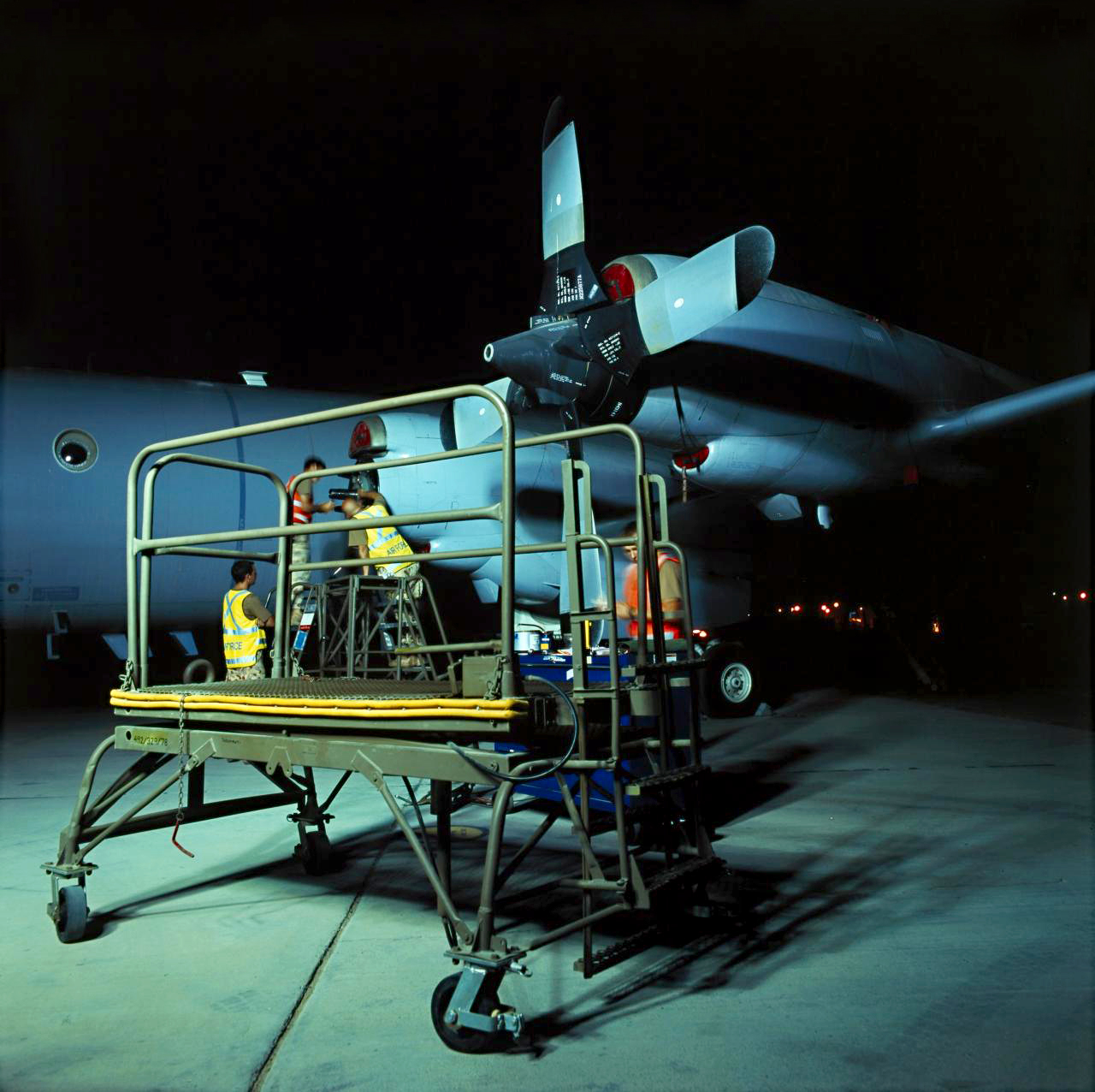
Too often in these thirteen images the same image is repeated with variants – three images of the an aircraft having it’s propeller changed show a lack of ideas or artefacts to photograph – presented out of the thousands taken seems incongruous. The fact that only one photograph is reproduced in the catalogue is also instructive.

Some images are just unsuccessful. For example the photograph Dusk, ship’s bridge with two sailors, northern Gulf is of a formulaic geometry that neither holds the viewers attention nor gives a deeper insight into their lives aboard ship and begs the question why was the photograph taken in the first place? The dark space has little physical or metaphysical illumination and seems purely to be an exercise in formalism. The photograph Dusk, ships’ bridge with sailor, northern Gulf is more successful in the use of light and shade as they play across the form of a sailor, his head resting pensively in his hand, red life vests adding a splash of colour to the bottom right of the photograph.

The brilliant photograph of the group is View from Chinook, Helmand province, Afghanistan. This really is a monstrous photograph. With the large black mass of the helicopter in the foreground of the image containing little detail, the eye is drawn upwards to the windscreen through which a mountain range rises, with spines like the back of a Stegosaurus. To the right a road, guarded by a desolate looking pillbox and yellow barrier, meanders into the distance. Dead flies on the windscreen look like small bullet holes until you realise what they are. This is the image that finally evidences a disquieting beauty present in the vast and ancient landscape.

Turning to the paintings we can say that some of the small 31cm x 31cm paintings work well. From an ‘original’ photograph the artist selects and crops a final image that they work up into a highly detailed oil painting. Distilled (as the artist’s like to put it) from the ‘original’ photographs, the paintings become a “merging of a contemporary sense of composition – borrowed from photography, film and video – with the textures and processes of traditional oil painting.”2

“These works were developed by the artists to be something akin to “Hitchcockian clues” which create the sense of looking out at a scene but being distanced from the action. To some degree the entire suite of small pictures participate in developing this intrigue, by showing an array of ambiguous scenes in which direct action is never present, or is obscured by limited perspectives … The artists noted that the war zones they witnessed were low in action but high in tension”3

To an extent this tension builds in some of the small paintings: the small size lends an intimate, intense quality and forces the viewer to engage with highly detailed renditions of textures of clothing, material, skin and hair and the distorted scale of the ships and aeroplanes portrayed. In these intense visions the painting seems less like a photograph and more like a new way of seeing. However, this occurs only occasionally within the group of small paintings.

If we think of a photograph in the traditional sense as a portrayal of reality, then a distillation of that photograph (the removal of impurities from, an increase in the concentration of) must mean that these paintings are a double truth, a concentrated essence of the ‘original’ photograph that changes that essence into something new. Unfortunately most of these small canvases show limited viewpoints of distilled landscapes that do not lead to ambiguous enigmas, but to the screen of the camera overlaid by a skein of paint, a patina of posing.

This feeling is only amplified in the three large ‘History’ paintings. The three paintings seem static, lifeless, over fussy and lacking insight into the condition of the ‘machine’ that they are attempting to portray. It’s a bit like the ‘Emperors New Clothes’, the lack of substance in the paintings overlaid with the semantics of History painting (“a traditional genre that focused on mythological, biblical, historical and military subjects”) used to confirm their existence and supposed insight into the doubled, framed reality. As Robert Nelson noted in his review of 2008 art in Melbourne in The Age newspaper it would seem that painting is sliding into terminal decline. These paintings only seem to confirm that view.

Here was a golden opportunity to try something fresh in terms of war as conflict – both in photography and painting – to frame the discourse in an eloquent, innovative manner. Most of this work is not interesting because it does not seem to be showing, or being discursive about anything beyond a personal whim. Because an artist can talk about some things, doesn’t mean that he can make comments about other things that have any value. Although the artist was looking to portray landscapes of globalisation and entropy, there are more interesting ways of doing this, rather than the nature of the transcription used here.

“It is very good to copy what one sees: it is much better to draw what you can’t see any more but in your memory. It is a transformation in which imagination and memory work together. You only reproduce what struck you, that is to say, the necessary. That way your memory and your fantasy are freed from the tyranny of nature.”4

No thinking but the putting away of intellect and the reliance on memory and imagination, memory and fantasy to ‘distil’ the essence. This is what needed to happen both in the photographs and paintings – leaving posturing aside (perhaps an ‘unofficial war artist’ would have had more success!) to uncover the transformation of landscape that the theatre of this environment richly deserves.

Dr Marcus Bunyan


Footnotes

1/ Heywood, Warwick. Framing Conflict: Iraq and Afghanistan exhibition catalogue. Canberra: Australian War Memorial, 2008, p. 6
2/ Heywood, Warwick. Framing Conflict: Iraq and Afghanistan exhibition catalogue. Canberra: Australian War Memorial, 2008, p. 6
3/ Heywood, Warwick. Framing Conflict: Iraq and Afghanistan exhibition catalogue. Canberra: Australian War Memorial, 2008, p. 11
4/ Degas, Edgar quoted in Halligan, Marion. “Between the brushstrokes,” in A2 section, The Saturday Age newspaper, January 17th 2008, p. 18


Many thankx to The Ian Potter Museum of Art for allowing me to publish the photographs in the posting. Please click on the photographs for a larger version of the image.


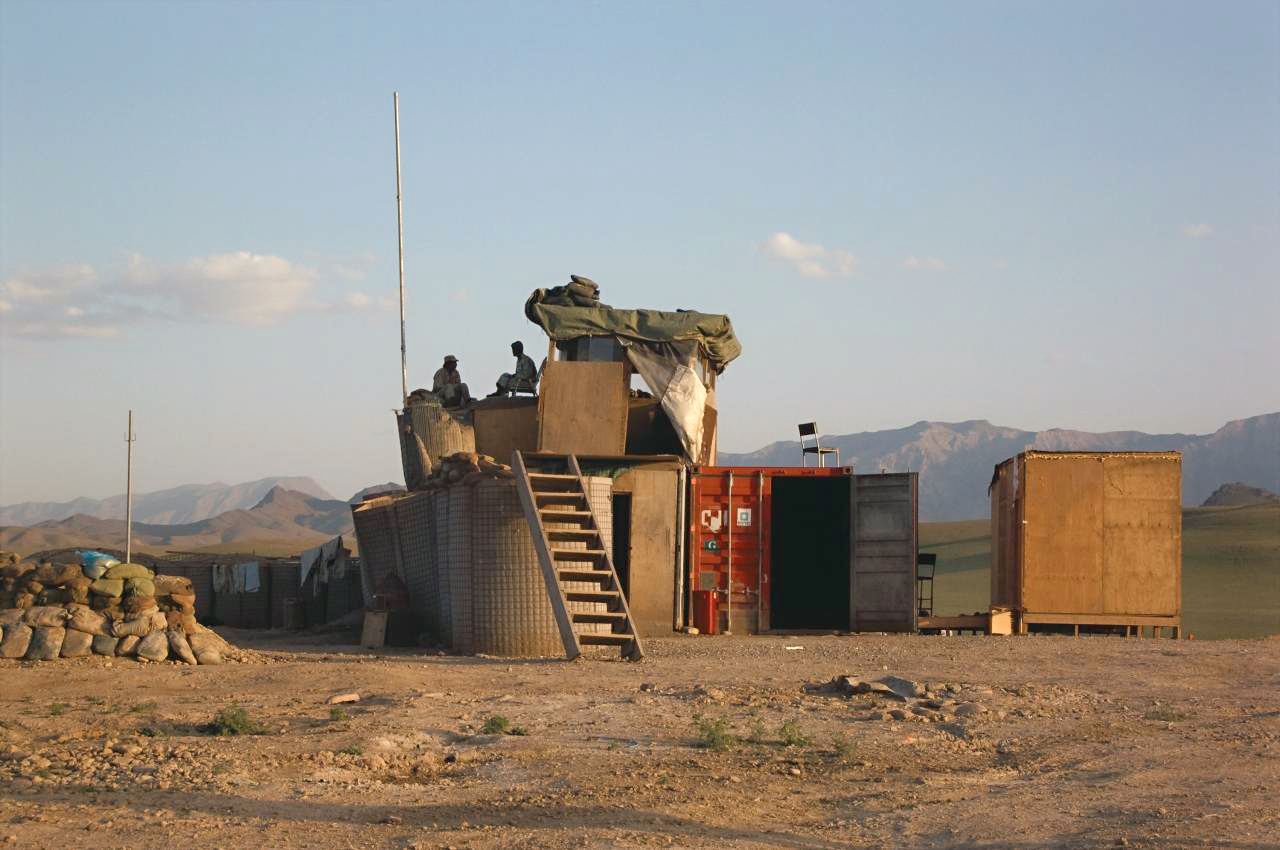
Lyndell Brown (Australian, b. 1961) and Charles Green (Australian, b. 1953) 'Afghan National Army perimeter post with chair, Tarin Kowt base, Uruzgan province, Afghanistan' 2007-2008 from the exhibition 'Framing Conflict – Iraq and Afghanistan' exhibition by Lyndell Brown and Charles Green at The Ian Potter Museum of Art, The University of Melbourne, Nov 2008 - Feb 2009


Lyndell Brown (Australian, b. 1961) and Charles Green (Australian, b. 1953)
Afghan National Army perimeter post with chair, Tarin Kowt base, Uruzgan province, Afghanistan
2007-2008
From The approaching storm series 2007-2009
Digital colour inkjet photograph
111.5 × 151.5cm


Lyndell Brown (Australian, b. 1961) and Charles Green (Australian, b. 1953) 'Dusk, ship's bridge with two sailors, northern Gulf' 2007-2008


Lyndell Brown (Australian, b. 1961) and Charles Green (Australian, b. 1953)
Dusk, ship’s bridge with two sailors, northern Gulf
2007-2008
Digital colour inkjet photograph


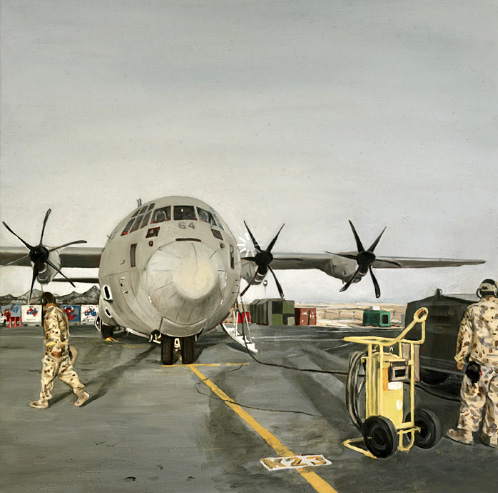
Lyndell Brown (Australian, b. 1961) and Charles Green (Australian, b. 1953) 'Late afternoon, flight line, military installation, Middle East' 2007


Lyndell Brown (Australian, b. 1961) and Charles Green (Australian, b. 1953)
Late afternoon, flight line, military installation, Middle East
2007
Oil on linen


Lyndell Brown (Australian, b. 1961) and Charles Green (Australian, b. 1953) 'Market, Camp Holland, Tarin Kowt, Uruzgan province, Afghanistan' 2007


Lyndell Brown (Australian, b. 1961) and Charles Green (Australian, b. 1953)
Market, Camp Holland, Tarin Kowt, Uruzgan province, Afghanistan
2007
Oil on linen


Lyndell Brown (Australian, b. 1961) and Charles Green (Australian, b. 1953) 'View from Chinook, Helmand province, Afghanistan' 2007-2008


Lyndell Brown (Australian, b. 1961) and Charles Green (Australian, b. 1953)
View from Chinook, Helmand province, Afghanistan
2007-2008
From The approaching storm series 2007-2009
Digital colour inkjet photograph
111.5 × 151.5cm


Lyndell Brown (Australian, b. 1961) and Charles Green (Australian, b. 1953) 'View from Chinook, Helmand province, Afghanistan' 2007


Lyndell Brown (Australian, b. 1961) and Charles Green (Australian, b. 1953)
View from Chinook, Helmand province, Afghanistan
2007
Oil on linen


Lyndell Brown (Australian, b. 1961) and Charles Green (Australian, b. 1953) 'Trolley, propeller change, on flightline at night, military installation, Gulf' 2007-2008


Lyndell Brown (Australian, b. 1961) and Charles Green (Australian, b. 1953)
Trolley, propeller change, on flightline at night, military installation, Gulf
2007-2008
From The approaching storm series 2007-2009
Digital colour inkjet photograph
87.0 × 87.4cm


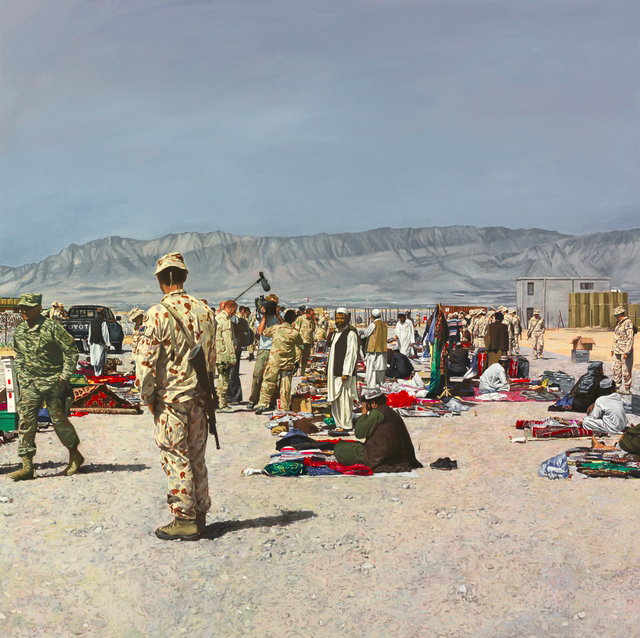
Lyndell Brown (Australian, b. 1961) and Charles Green (Australian, b. 1953) 'History painting: market, Tarin Kowt, Uruzgan province, Afghanistan' 2007


Lyndell Brown (Australian, b. 1961) and Charles Green (Australian, b. 1953)
History painting: market, Tarin Kowt, Uruzgan province, Afghanistan
2007
Oil on linen


Lyndell Brown and Charles Green. Installation view of photographs from the exhibition 'Framing Conflict' at The Ian Potter Museum of Art, The University of Melbourne


Lyndell Brown and Charles Green
Installation view of photographs from the exhibition Framing Conflict at The Ian Potter Museum of Art, The University of Melbourne
2009


Lyndell Brown and Charles Green. Installation view of paintings from the exhibition 'Framing Conflict' at The Ian Potter Museum of Art, The University of Melbourne 2009


Lyndell Brown (Australian, b. 1961) and Charles Green (Australian, b. 1953)
Installation view of paintings from the exhibition Framing Conflict at The Ian Potter Museum of Art, The University of Melbourne
2009


The Ian Potter Museum of Art
The University of Melbourne,
Corner Swanston Street and Masson Road
Parkville, Victoria 3010

Opening hours:
Tuesday – Saturday 11am – 5pm

The Ian Potter Museum of Art website

LIKE ART BLART ON FACEBOOK

Back to top

Review: ‘Bettina Speckner’ jewellery at Gallery Funaki, Melbourne

Exhibition dates: 13th January – 7th February, 2009

Opening: Tuesday 13th January, 2009


Bettina Speckner jewellery


“I never work with the intention to decorate things or to make them look prettier. I try to discover the soul of an object or the essence of a photograph – I want to shape something new which appeals to me and to other people far beyond the optical appearance.”


Bettina Speckner


A very social crowd was in attendance for the opening of an exhibition by German jeweller Bettina Speckner at Gallery Funaki in Melbourne. The jewellery was certainly ravishingly made: refined, beautiful and with an elegance to most of the pieces. Interspersed between the jewellery were colour photographs of about A4 size that featured empty chairs, red benches, huts in the landscape and plants. These photographs seemed to have a very loose association to the form and imagery of the jewellery and were very minor photographs. I was not sure of their actual relevance to the pieces themselves.

Speckner uses a lot of imagery in her jewellery – tintype portraits from the Victorian era, grey etched images of gardens and vases studded with jewels and crystalline forms that have an almost solarised graphite feel to them and flowers, statues, pillars and cows etched into enamel. In these sites of intervention she seeks to make new worlds – inner/outer worlds that e-merge out of the material / worlds that are present and have ‘presence’.

The best work combines enamel, intaglio, jewels and photographic processes together. The art transcends the materials of each and coalesces in objects that transport the viewer – forming other associations, new insights into the condition of the object.

As the artist sees, this is not so much about the memories, cultural significance and semiotics embedded in the photograph but about making something new. For me this is where the problems lies.

Is it inevitable that there is a history and association present with these images or is the viewer culturally able to see them as new objects – in a postmodern sense?

It is almost as though Speckner does want these associations present between the jewellery and the images, why else put the colour photographs between the jewellery – or is this another example of her dissociative technique coming into play. Speckner seems to have purchased the memory of the object (which it still holds) but then wants to completely overwrite it – is this possible?

Personally I don’t think this is fully possible. While no ‘grand narrative’ is present in some of these images (some images seem to be so removed from their context that we will never be able to place them again) in other pieces the images overpower the art. The ‘trace’ of memory and identity, an entity for a split second before a camera, their unique state in this singular tintype, their actual presence and life not so easily destroyed!

When an artist seeks to justify work without fully understanding the cultural implications of the use of such images, even saying she seeks to find the soul of an object when the soul may already exist in another form, then in my eyes the work is unresolved, the vision uneven. Despite the beauty of the art, its refinement and great craftmanship, there is something lacking at the heart of these works – perhaps a deeper understanding that the soul can reside in optical appearance, that less may be more and that transcendence is more than skin deep.

Dr Marcus Bunyan


Bettina Speckner opening crowd at Gallery Funaki, Melbourne


Bettina Speckner opening crowd at Gallery Funaki, Melbourne


Bettina Speckner jewellery

Bettina Speckner jewellery

Bettina Speckner jewellery

Bettina Speckner jewellery


Bettina Speckner jewellery


Gallery Funaki Sackville House Apartment 33 27 Flinders Lane Melbourne 3000 Australia

Opening hours: Wednesday – Friday 12 – 5pm Saturday on occasion (check our socials) or by appointment

Gallery Funaki website

LIKE ART BLART ON FACEBOOK

Back to top

Review: ‘Intimacy’ at the Australian Centre for Contemporary Art (ACCA), Melbourne

Exhibition dates: 7th October – 30th November, 2008

The exhibition includes works by Louise Bourgeois, Nan Goldin, Steve McQueen, Sophie Calle, Mariele Neudecker, Jesper Just, Gabrielle de Vietri, Felix Gonzalez-Torres, Mutlu Çerkez, Amikam Toren, Margaret Salmon and Annika Ström


Sophie Calle (French, b. 1953) 'Doleur exquise' 1984/1999 from the exhibition 'Intimacy' at the Australian Centre for Contemporary Art (ACCA), Melbourne, Oct - Nov, 2008


Sophie Calle (French, b. 1953)
Doleur exquise
1984/1999


Set up by Frank Gehry and Edwin Chan
Exhibition view at Rotonde1, Luxembourg, 2007


An eclectic mix of mixed media, photography and video work is presented in this exhibition. The work examines concepts of intimacy – staged performances, stories of the city, of men, women, families and children; the artists “contemplate passion, love and longing, as well as feelings of disquiet, loss, and loneliness that embody intimate human relations.”

The show exudes a certain melancholia and is troubling in many aspects: loneliness, separation, desire for intimacy, desire for love all being expressed through the presented works. Some of the works are strong but others left me cold and uninterested. Few are joyous renditions of the closeness of intimate relations and most works ponder the dangers and disillusionment of failed intimacies that involve feelings of vulnerability (intimate acts often involve a degree of self-disclosure where intimates show something of themselves that may make them feel vulnerable), ambiguity (intimate acts are often an ambiguous and incomplete shared and often idiosyncratic view of the world) and secrecy (intimate acts are private: they are often constructed, by their participants, to be hidden from the view of others).1

The large work by English artist Steve McQueen features two naked black wrestlers shot in slow motion in grainy black and white video. The wrestlers are photographed from the waist down, images of moving legs, or from below, bodies clinging together, faces grimacing in a hyperreal performance of some hypnotic intimate dance – an acted out state of being.

Amikan Torren’s 2008 video work is by comparison is about the improbabilities of life’s daily encounters: in Downstairs over a video image of 3 steps outside a London railway station the narrator tells of a man, a stockbroker who after an accident sometimes needs help descending steps; in Blind the narrator comments on a person helping a blind man across the street; and in Carrots, over a video image of a London street the narrator tells a story about an adolescent and fresh carrots! The musings on the synchronicity and serendipity of everyday encounters are very effective.

Jesper Just’s two video works No Man Is An island II (2004) and The Lonely Villa (2004) were very effective and moving. In the first lonely men in a pub sing the Roy Orbison song Crying with pictures of naked ladies behind them – it is funny and sad at the same time. In the second men in the shadows sit or stand with telephones in front of them: two men sing to each other the song I Don’t Want To Set The World On Fire with close-ups of their lips singing into the telephone: songs of loss, longing and remembrance.

The two most interesting pieces are not video works, nor are they the overrated photographs of Nan Goldin featuring photographs of a family hugging and lying on a bed, but the work of two women: Sophie Calle and Louise Bourgeois.

In Doleur exquise (exquisite pain) Calle revisits fifteen years later the breakup of a relationship and the aftermath of that event: the distress and pain, the experiences of her friends in such circumstances and turns them into brilliant insightful art. A selection of the whole work is presented here that features colour photographs (multiples of a red telephone, abandoned car with it’s doors open, washbasins and empty bedrooms) above text woven onto linen – black on white, grey on grey. The texts are both painful and repetitive (Calle’s on the left) and others heartbreaking accounts of pain (on the right): “6 days ago, the man I love left me …”

(For an insightful analysis of this work see Can Pain Be Exquisite? Autofictional Stagings of Douleur exquise by Sophie Calle, Forced Entertainment and Frank Gehry and Edwin Chan by Anneleen Masschelein. “On the one hand, it deals with the most intense, acute experiences of pain in a human life. On the other hand, these moments are unique and “localised”, that is, they are connected to a concrete time and space, of which the details are forever inscribed in memory.”)

My favourite work from the show is Louise Bourgeois 10AM IS WHEN YOU COME TO ME (2006) – drawings on music paper of mainly red hands, the key a drawing of a 10am clock with a man the big hand with hands extended drawing towards him (or is it tethered to him) an armless woman, the small hand. Some have seen these as “ambiguous images of a hermetic cosmos, as acts of violence or love” but they represent “both Bourgeois’s hands and those of her friend and muse Jerry Gorovoy” and how he helps her and arrives at her studio at this, the designated hour.

To me they are joyous, liberating, spontaneous expressions of love and intimacy, fingerprints on the page, hands intertwining together. They made me feel the intimate expression of humanity: holding a babies hand, so small and vulnerable and feeling them grasp your hand. That connection is what Bourgeois achieves with this work and I thought it was wonderful.

This exhibition is no easy ride but is well worth the contemplation necessary to tease out the themes and feelings that the work investigates.

Dr Marcus Bunyan


1/ Steve Howard, Frank Vetere, Martin Gibbs, Jesper Kjeldskov, Sonja Pedell, Karen Mecoles, Marcus Bunyan, and John Murphy. Mediating Intimacy: Digital Kisses and Cut and Paste Hugs. 2004.


Sophie Calle (French, b. 1953) 'Doleur exquise' 1984/1999 (detail) from the exhibition 'Intimacy' at the Australian Centre for Contemporary Art (ACCA), Melbourne, Oct - Nov, 2008


Sophie Calle (French, b. 1953)
Doleur exquise (detail)
1984/1999


    Louise Bourgeois (French-American, 1911-2010) 'TEN AM IS WHEN YOU COME TO ME' 2006 (detail)


    Louise Bourgeois (French-American, 1911-2010)
    TEN AM IS WHEN YOU COME TO ME (detail)
    2006


    Louise Bourgeois (French-American, 1911-2010) 'TEN AM IS WHEN YOU COME TO ME' 2006


    Louise Bourgeois (French-American, 1911-2010)
    TEN AM IS WHEN YOU COME TO ME
    2006


    Australian Centre for Contemporary Art
    111 Sturt Street, Southbank
    Victoria 3006, Australia
    Phone: 03 9697 9999

    Opening hours:
    Tuesday – Friday 10am – 5pm
    Saturday – Sunday 11am – 5pm
    Monday Closed
    Open all public holidays except Christmas Day and Good Friday

    Australian Centre for Contemporary Art website

    LIKE ART BLART ON FACEBOOK

    Back to top