
Exhibition dates: 15th September, 2022 – 8th January, 2023
![Unidentified photographer (American). 'Untitled [Two Men in Work Clothes, Wearing Hats, One Standing, One Seated]' c. 1880 from the exhibition 'Called to the Camera: Black American Studio Photographers' at the New Orleans Museum of Art (NOMA), Sept 2022 - Jan 2023](https://artblart.com/wp-content/uploads/2022/11/83-60-4.jpg "Unidentified photographer (American). 'Untitled [Two Men in Work Clothes, Wearing Hats, One Standing, One Seated]' c. 1880 from the exhibition 'Called to the Camera: Black American Studio Photographers' at the New Orleans Museum of Art (NOMA), Sept 2022 - Jan 2023")
Unidentified photographer (American)
Untitled [Two Men in Work Clothes, Wearing Hats, One Standing, One Seated]
c. 1880
Tintype
New Orleans Museum of Art
Gift of Stanley B. Burns, MD
The last posting before Christmas is a valuable photographic exhibition on Black Americans which reveals the importance of photography to their culture.
“Frederick Douglass [that fiery American social reformer, abolitionist, orator, writer, and statesman] wrote multiple essays on the power of photography to shape perceptions about race. He posited that the medium would be a great liberator of Black Americans, allowing them to control their own narrative.”1
Any archive of photographs on a particular culture or subject which is collected and then freely disseminated is an incredible resource for researchers and the uninitiated. Nevertheless, what we must be mindful of is who is taking the photographs and collecting them (institutions) and to what purpose, and from what position, what point of view, are the resulting photographs being viewed – from the point of view of the subjugated or from the point of view of the ruling elite. Are the photographers from within the community, or are they colonial, imperial documenters of (for example), ethnographic status, a vanishing race, or slaves. If a person from outside the community takes the photographs (for example, the photographs of Edward S. Curtis), what was his purpose and what was the constructed, mythical story he wanted to tell… and are the photographs still valuable all these years later to contemporary First Nations people looking back on the people, rituals and customs that were portrayed in them.
The photographs in this posting will have a very different meaning to those that live within the community which is portrayed, I expect bringing mixed feelings of pride and the knowledge of the struggle of Black existence in America. And also the knowledge that “blacks had created their own traditions, rituals, and a history that formed a cohesive and complex culture that was the source of a full sense of identity.”2 The photographs “help reframe the history of American photography and place Black photographers and sitters at the centre of that story.”
Personally, I believe there is no centre and periphery… no inside and outsider art. To believe so is a misnomer, for everything is valuable in and of its own right, and should be acknowledged and appreciated as such.
Dr Marcus Bunyan
PS. I have added bibliographic information where possible to give context to the photographers work.
1/ Earnestine Jenkins. “Hooks Brothers Photography Documented Black Memphis,” on the Chose 901 website February 8, 2019 [Online] Cited 17/11/2022
2/ Anne Seidlitz. “Ralph Ellison: An American Journey,” on the PBS American Masters website 19/02/2002 [Online] Cited 30/12/2022
Many thankx to the New Orleans Museum of Art (NOMA) for allowing me to publish the photographs in the posting. Please click on the photographs for a larger version of the image.
From photography’s beginnings in the United States, Black studio photographers operated on the developing edge of popular media to produce affirming portraits for their clients, as well as a wide range of photographic work rooted in their communities. Called to the Camera offers a comprehensive history of this work, from the nineteenth-century daguerreotypes of James Presley Ball to the height of Black studios in the mid-twentieth century, and considers contemporary photographers responding to Black studio traditions today. In addition to showcasing famous photographers such as Ball, James Van Der Zee, and Addison Scurlock, this volume brings attention to dozens of other artists across the country, including Florestine Perrault Collins, Austin Hansen, and Henry Clay Anderson. The book features more than one hundred extraordinary vintage photographs, many of them unique objects and some, like those by the Hooks Brothers Studio, published here for the first time. Highlighting Black subjects on both sides of the camera, Called to the Camera presents a broader and more inclusive history of photography.

James Presley Ball (American, 1825-1904)
Alexander S. Thomas
c. late 1850s
Quarter plate daguerreotype
Cincinnati Art Museum
Gift of James M Marrs, MD
James Presley Ball, Sr. (1825 – May 4, 1904) was a prominent African-American photographer, abolitionist, and businessman.
Ball was born in Frederick County, Virginia, to William and Susan Ball in 1825. He learned daguerreotype photography from John B. Bailey of Boston, who like Ball was “a freeman of color.” Ball opened a one-room daguerreotype studio in Cincinnati, Ohio, in 1845. The business did not prosper, so Ball worked as an itinerant daguerreotypist, settling briefly in Pittsburgh, Pennsylvania, then in Richmond, Virginia in 1846 to develop a more successful studio near the State Capitol building.
In 1847, Ball again departed for Ohio, again as a travelling daguerreotypist. He settled in Cincinnati in 1849 and opened a studio where his brother Thomas Ball became an operator. The gallery, known as “Ball’s Daguerrean Gallery of the West” or “Ball’s Great Daguerrean Gallery of the West,” ascended “from a small gallery to one of the great galleries of the Midwest.” Starting in 1854 and continuing “for about four years,” Robert Seldon Duncanson worked in Ball’s studio retouching portraits and colouring photographic prints. Gleason’s Pictorial Drawing-Room Companion in 1854 described the gallery as displaying 187 photographs by Ball and 6 paintings by Duncanson; furthermore, the gallery was “replete with elegance and beauty,” with walls “bordered with gold leaf and flowers,” “master-piece” furniture, a piano, and mirrors.
Meanwhile, Ball opened the separate Ball and Thomas Gallery with his brother-in-law Alexander Thomas. In 1855, Ball published an abolitionist pamphlet accompanied by a 600-yard-long panoramic painting entitled “Mammoth Pictorial Tour of the United States Comprising Views of the African Slave Trade”; Duncanson probably participated in the production of the painting. During 1855 Ball’s daguerreotypes were shown at the Ohio State Fair and at the Ohio Mechanics Annual Exhibition. In 1856 Ball traveled to Europe. The Ball and Thomas Gallery was destroyed by a tornado in May 1860, but was later rebuilt with assistance from the community.
During the 1870s Ball ended his partnership with Thomas and moved to Greenville, Mississippi; Vidalia, Louisiana; St. Louis, Missouri; and then Minneapolis, Minnesota, where he started a new studio. By 1887, the studio was known as “J. P. Ball & Son, Artistic Photographers”; Ball’s son was named James Presley Ball, Jr. In September 1887, Ball became the official photographer of the 25th anniversary celebration of the Emancipation Proclamation.
In October 1887, Ball again moved, this time to Helena, Montana, where the “J. P. Ball & Son” studio was established. By 1894, Ball had become active in politics in Helena; for example, he was nominated for a county coroner position which he declined. One of the notable series of photographs Ball took his stay in Helena involved William Biggerstaff (an African-American man) before, during, and after he was hanged in 1896 for committing murder.
In 1900, the Ball family probably moved to Seattle, Washington, where Ball opened the Globe Photo Studio. He may have relocated to Portland, Oregon, in 1901. The family moved to Honolulu in 1902, and Ball died there in 1904.
Among the subjects of Ball’s photographic portraits were P.T. Barnum, Charles Dickens, Henry Highland Garnet, the family of Ulysses S. Grant, Jenny Lind, and Queen Victoria. The techniques used for “all the known photographs of J. P. Ball” as of 1993 included mostly daguerreotypes and albumen prints (e.g., as carte de visites).
Text from the Wikipedia website
Alexander S. Thomas (American, 1826-1910) [was] Ball’s brother-in-law, who worked as a steward on the Mississippi and Ohio Rivers. In November 1857, Thomas became a full partner in the [James Presley Ball photographic] business and the name of the studio changed to Ball & Thomas. Three years later the union dissolved for unknown reasons, and Thomas continued in business with Tom Ball, still under the name of Ball & Thomas. Within two months a tornado destroyed that gallery, but many white friends helped them to repair the place, outfitting it more elaborately than before.
Theresa Leininger-Miller. “An American Journey: The Life and Photography of James Presley Ball,” on the Nineteenth-Century Art Worldwide website Autumn 2011, [Online] Cited 17/11/2022
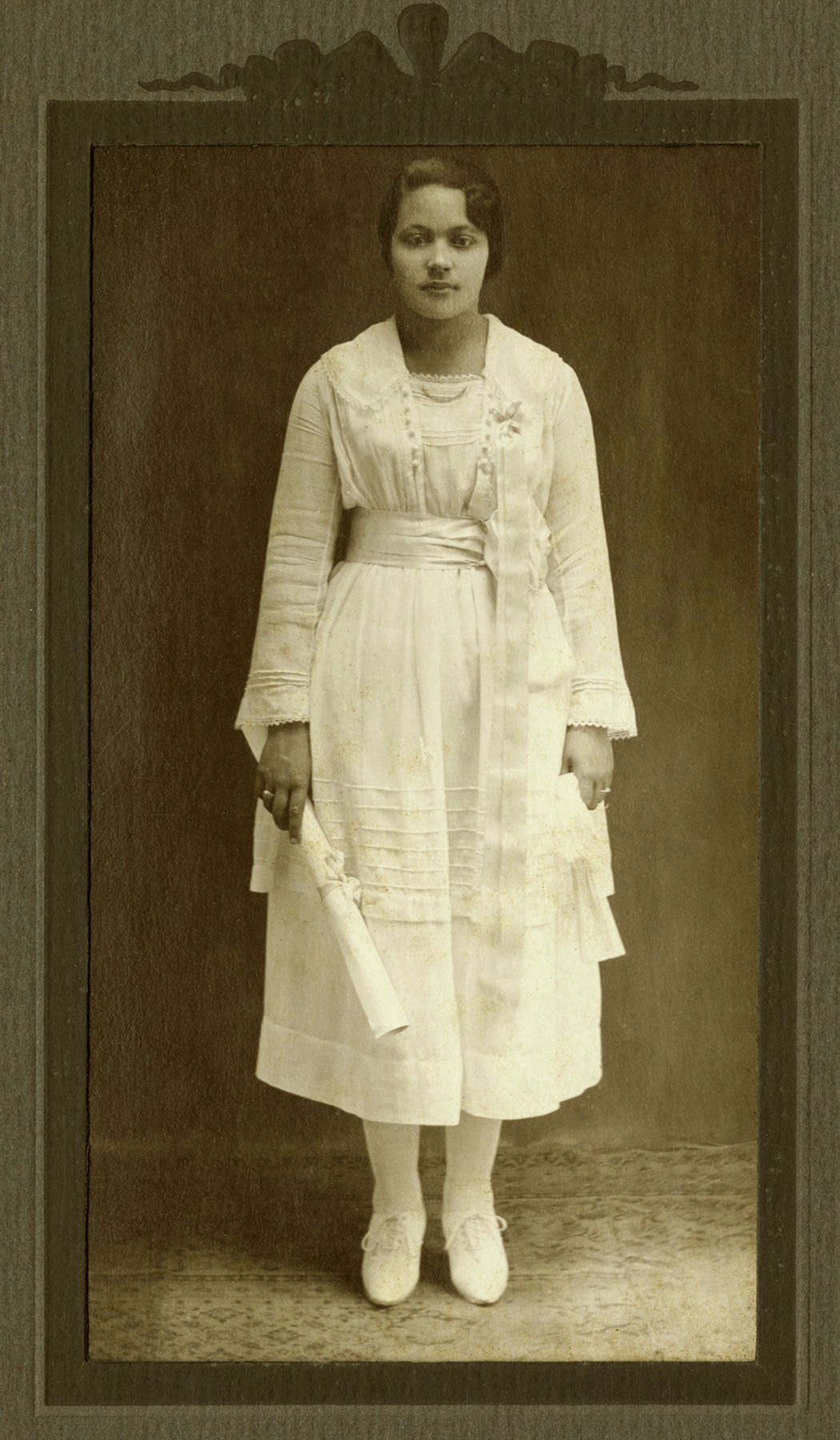
Florestine Perrault Collins (American, 1895-1988)
Portrait of a young woman dressed in white
1920-1928
Gelatin silver print mounted in folder
4 1/4 x 9 1/4 inches
The Historic New Orleans Collection
Florestine Perrault Collins (1895-1988) was an American professional photographer from New Orleans. Collins is noted for having created photographs of African-American clients that “reflected pride, sophistication, and dignity.” instead of racial stereotypes.
In 1909, Collins began practicing photography at age 14. Her subjects ranged from weddings, First Communions, and graduations to personal photographs of soldiers who had returned home. At the beginning of her career, Collins had to pass as a white woman to be able to assist photographers.
Collins eventually opened her own studio, catering to African-American families. She gained a loyal following and had success, due to both her photography and marketing skills. Out of 101 African-American women who identified themselves as photographers in the 1920 U.S. Census, Collins was the only one listed in New Orleans.
She advertised in newspapers, playing up the sentimentality of a well-done photograph. Collins also included her photograph in the ads to appeal to customers who thought a female photographer might take better pictures of babies and children. Collins’ first husband, Eilert Bertrand, believed that women should not have careers and tried to restrain her public appearances. Collins died in 1988.
According to the Encyclopedia of Louisiana, Collins’ career “mirrored a complicated interplay of gender, racial and class expectations”.
“The history of black liberation in the United States could be characterised as a struggle over images as much as it has also been a struggle over rights,” according to bell hooks. Collins’ photographs are representative of that. By taking pictures of black women and children in domestic settings, she challenged the pervasive stereotypes of the time about black women.
Text from the Wikipedia website

Arthur P. Bedou (American, 1882-1966)
Sisters of the Holy Family, Classroom Portrait
1922
Gelatin silver print
Approx. 8 x 10 inches
XULA University Archives and Special Collections
Image Courtesy of Xavier University of Louisiana, Archives & Special Collections
© Arthur P. Bedou
Arthur P. Bedou (July 6, 1882 – July 2, 1966) was an African-American photographer based in New Orleans. Bedou was, for a time, the personal photographer of Booker T. Washington, and documented the last decade of Washington’s life. He also documented campus life at Xavier University of Louisiana, the Tuskegee Institute, and the city life of New Orleans, especially the city’s black residents.
Arthur Paul Bedou was born in New Orleans, Louisiana, in 1882, one of five children of Armand Bedou and Marie Celeste Coustaut. His family was poor and he received very little education; as a photographer he was largely self-taught. Bedou worked for a time as a clerk, but by 1899 he was taking pictures, and his career started in earnest when a photograph he took of a solar eclipse in 1900 received wide notice.
In 1903 Bedou documented a conference at Tuskegee Institute in the hope of gaining visibility for his work. Booker T. Washington saw some of his photographs and invited Bedou to accompany him as his personal photographer, preferring Bedou over other candidates like C. M. Battey in part for his ability to produce dynamic images of unfolding events. Most of Bedou’s photographs of Washington were taken between 1908 and 1915, the year of Washington’s death. Among other tasks, he accompanied Washington on his summer tours with the object of producing an album of each trip. To supplement his uncertain income from these travels, he had some of the photographs he took made into postcards, Christmas cards, and calendars. His position brought him further commissions to photograph notables both black and white, including George Washington Carver, Theodore Roosevelt, Andrew Carnegie, and Julius Rosenwald.
Through the connection to Washington, who was the school’s founding principal, Bedou was invited to become official photographer of the Tuskegee Institute. Shortly after Washington’s death, however, he was replaced as the school’s official photographer by Battey, who at the time was favoured by campus officials for various reasons. He was also in demand by other black colleges and schools such as Fisk University to document life on their campuses, and by professional organisations such as the National Negro Business League, the National Medical Association, and the National Baptist Convention.
In the 1920s, Bedou opened his own photography studio in New Orleans, where he photographed everything from black families and their children to the laying of the cornerstone at Corpus Christi Church to the visits of jazz bands and celebrity speakers. His photographs often appeared in both the Louisiana Weekly (a newspaper with a primarily black circulation) and the general-circulation newspaper Louisiana Times-Picayune. His photographs won several awards over the years, including the gold medal at the 1907 Jamestown Tercentennial Exposition.
Bedou prospered and invested in real estate and companies like the People’s Industrial Life Insurance Company of Louisiana, of which he was for many years a director and vice-president.
Bedou photographed numerous events, activities, and portraits around the Xavier University of Louisiana campus from about 1917 to the late 1950s. When he died in 1966, he left much of his fortune to educational institutions, and his wife, Lillia Bedou, founded a scholarship in his honour at Xavier University of Louisiana. Since her death, the scholarship has been known as the Arthur and Lillia Bedou Scholarship. Xavier University Archives & Special Collections also holds an extensive collection of his photographs.
Text from the Wikipedia website

Arthur P. Bedou (American, 1882-1966)
The Gold Rush – Xavier University of Louisiana Football Squad
Nd
Gelatin silver print
Approx. 4 x 6 inches
Xavier University Archives and Special Collections
Image Courtesy of Xavier University of Louisiana, Archives & Special Collections
© Arthur P. Bedou

James Van Der Zee (American, 1886-1983)
Untitled (Bride and Groom)
1926
Gelatin silver print
Museum purchase, City of New Orleans Capital Funds and P. Roussel Norman Fund
© James Van Der Zee Archive, The Metropolitan Museum of Art
James Augustus Van Der Zee was an American photographer best known for his portraits of black New Yorkers. He was a leading figure in the Harlem Renaissance. Aside from the artistic merits of his work, Van Der Zee produced the most comprehensive documentation of the period.
The New Orleans Museum of Art (NOMA) today announces the fall opening of Called to the Camera: Black American Studio Photographers, a major exhibition focusing on the artistic virtuosity, social significance, and political impact of Black American photographers working in commercial portrait studios during photography’s first century and beyond. Organised by NOMA, the exhibition focuses on a national cohort of professional camera operators, demonstrating the incredible variety of work that they produced and their influence on the broader history of photography. Featuring more than 150 photographs spanning from the 19th century to present day – many of which have never been publicly exhibited and are unique objects – Called to the Camera will be on view at NOMA September 16, 2022 – January 8, 2023.
The exhibition explores how Black studio photographers operated on the developing edge of photographic media from its earliest introduction in the United States. They produced affirming portraits for their clients, while also engaging in other kinds of paid photographic work exemplary of important movements in art like Pictorialism and modernism. Called to the Camera will feature work by over three dozen photographers located across the country, demonstrating how the Black photography studio was a national phenomenon. The exhibition includes an interspersed selection of works by modern and contemporary artists, illustrating connections between the historical legacy of Black photography studios and what we consider to be fine art photography today.
Photographers whose works are featured in Called to the Camera include James Van Der Zee and Addison Scurlock, who worked on a national stage, as well as photographers who were active regionally, among them Florestine Perrault Collins and A.P. Bedou (New Orleans, LA), Reverend Henry Clay Anderson (Greenville, MS), Morgan and Marvin Smith (New York City), and Robert and Henry Hooks (Memphis, TN). Among the contemporary photographers included in the exhibition are Endia Beal, Elliott Jerome Brown Jr., and Polo Silk. The exhibition will feature a range of different types of images, from some of the earliest daguerreotypes of significant Black Americans (such as Frederick Douglass) to early hand-painted gelatin silver prints and panoramic photographs, as well as camera equipment, studio ephemera, and an immersive re-creation of a noted studio’s reception room.
“Chief among NOMA’s goals is to support important projects that amplify the histories of under-represented communities,” said Susan Taylor, Montine McDaniel Freeman Director of the New Orleans Museum of Art. “Called to the Camera does exactly that: it articulates a story that is both local and national, centering the importance of Black photographers in their communities and in the history of photography.”
“As we continue to build our notable photography holdings to make our collection and our exhibition program truly reflect our audiences, this thoughtfully researched national exploration of Black American studio photography is a vital contribution to this work,” added Russell Lord, Freeman Family Curator of Photographs at the New Orleans Museum of Art.
Brian Piper, exhibition curator and Assistant Curator of Photographs at the New Orleans Museum of Art added, “Building on the foundational work of scholars like Dr. Deborah Willis, this exhibition gathers original works by a professional class of Black photographers linked by a shared set of visual and cultural concerns. By bringing these objects – many never before exhibited – into the art museum, we can help reframe the history of American photography and place Black photographers and sitters at the centre of that story. Called to the Camera is, in part, an argument for a reconsideration of how historians and institutions evaluate and display photography.”
The exhibition is organised into five sections across 6,000 square feet that proceed chronologically and thematically from the 1840s to present day. The first section emphasises the pivotal role Black American photographers played in photography during the 19th century, focusing on the establishment of commercial studio practices in the United States by photographers like James Presley Ball and the Goodridge Brothers. The second gallery evokes early 20th century commercial studios and domestic interiors, providing a contextual framework that illustrates the ways in which Black Americans used photography after 1900 to shape both private lives and public expressions of self. From there, the exhibition focuses closely on the practices of a half-dozen photographic studios, providing insights into both similarities and differences across geographies and exploring how these artists used a range of photographic processes and aesthetic styles through the end of the 1960s.
As a whole, the exhibition will consider other work that portrait studio photographers engaged in during this time, including photojournalism, advertising, and event photography. Beyond portraits, Called to the Camera demonstrates how Black American studio photographers worked on the vanguard of fine art photography and argues that the business of the studio cannot be divorced from the rest of these photographers’ practices. Called to the Camera: Black American Studio Photographers is curated by Dr. Brian Piper, NOMA’s Assistant Curator of Photographs. The exhibition draws works from both NOMA’s institutional holdings as well as works loaned from both notable public and private collections including the Schomburg Center for Research in Black Culture; National Museum of African American History and Culture; the Stuart A. Rose Manuscript, Archives, and Rare Book Library at Emory University; and Metropolitan Museum of Art. Called to the Camera will be accompanied by a catalog distributed by Yale University Press featuring over 100 colour plates and essays by leading scholars of photographic and Black American history including Dr. John Edwin Mason, Carla Williams, Russell Lord, and Brian Piper.
The exhibition is sponsored by Catherine and David Edwards; Kitty and Stephen Sherrill; Andrea and Rodney Herenton; Tina Freeman and Philip Woollam; Milly and George Denegre; and Cherye and Jim Pierce. Additional support is provided by Philip DeNormandie; Aimee and Michael Siegel; and the Del and Ginger Hall Photography Fund. This project is supported in part by the National Endowment for the Arts. Research for this project was funded by the Andrew W. Mellon Foundation.
Press release from New Orleans Museum of Art (NOMA)
![Morgan and Marvin Smith (American, 1910-1993)(American, 1910-2003) 'Untitled [Marvin and Morgan Smith and Sarah Lou Harris Carter]' 1940](https://artblart.com/wp-content/uploads/2022/11/sp-2022-59-11.jpg "Morgan and Marvin Smith (American, 1910-1993)(American, 1910-2003) 'Untitled [Marvin and Morgan Smith and Sarah Lou Harris Carter]' 1940")
Morgan and Marvin Smith (American, 1910-1993)(American, 1910-2003)
Untitled [Marvin and Morgan Smith and Sarah Lou Harris Carter]
1940
Gelatin silver print
8 x 10 inches
Schomburg Center for Research in Black Culture, New York Public Library Photograph
© Morgan and Marvin Smith

Morgan and Marvin Smith (American, 1910-1993)(American, 1910-2003)
Marvin Painting a Self-Portrait
c. 1940
Gelatin silver print
8 x 10 inches
Schomburg Center for Research in Black Culture, New York Public Library Photograph
© Morgan and Marvin Smith
Morgan (February 16, 1910 – February 17, 1993) and Marvin Smith (February 16, 1910 – 2003) were identical African-American twin brothers. They were photographers and artists known for documenting the life of Harlem in the 1930s to 1950s. …
The Smiths decided to commit themselves to the media of photography in 1937 and took free art classes taught by sculptor Augusta Savage. There they met numerous other influential artists including Jacob Lawrence and Romare Bearden. Morgan became the first staff photographer for New York Amsterdam News in 1937, the most popular Black newspaper at the time. Two years later they opened their own photography studio, M & M Smith Studios, next to the famed Apollo Theater on 125th Street. The twins were the theatre’s official photographers and through this job met influential models, artists and performers. Their studio became a hub of activity for entertainers and writers, as well as the location of the majority of their portrait photography. They photographed George Washington Carver and Billie Holiday, among other famous Black artists and politicians, as well as street life in Harlem during this time.
The Smiths photographed with the intention of showing the different facets of Black life. Along with capturing the Civil rights movement and anti-lynching demonstrations the brothers were among the first to capture the vibrant lives of Harlem residents.
Text from the Wikipedia website

Rev. Henry Clay Anderson (American, 1911-1998)
A hand-tinted portrait of a young woman
1950s
Hand-coloured gelatin silver print
8 x 10 in.
Collection of the Smithsonian National Museum of African American History and Culture
Gift of Charles Schwartz and Shawn Wilson
© Smithsonian National Museum of African American History and Culture
From the late 1940s into the 1970s, photographer Henry Clay Anderson created a remarkable record of the lively African American community in Greenville, Mississippi. He photographed ordinary people in portraits and at events, including weddings, funerals, baseball games, and school proms and homecomings. Anderson worked as a teacher before serving in the military, and he studied photography on the GI Bill. While working as a photographer, he also served as a minister and helped African Americans pass the literacy test to obtain a voter’s card. Anderson said, “A photographer understands that pictures will show what is in the person… [M]aking pictures is a lot like telling a story.” The story Anderson recorded concerns an aspect of mid-twentieth-century American history that has largely been ignored – the existence of thriving, middle-class African American communities throughout the South.
Anonymous. “Oh Freedom! Rev. Henry Clay Anderson,” on the Smithsonian American Art Museum website Nd [Online] Cited 17/11/2022
Reverend Henry Clay Anderson was a pastor, teacher, veteran, and photographer, best known for capturing the lives of the black middle class of Greenville, Mississippi from 1948 to 1986. He was born in Nitta Yuma, Mississippi, in 1911 and spent his childhood in Hollandale outside of Greenville, Mississippi. No information is known about his parents or siblings, except that he had a brother who worked at an insurance company in the same building as his photography studio. Anderson attended the segregated Washington County Schools for his early childhood and high school education. His love for photography began when his family gave him a box camera to play with at nine years old. …
Anderson married Sadie Lee with whom he had no children. His first occupation was as a teacher before he served in World War II. When he returned from the war to Greenville in 1946, the GI Bill of 1944 allowed Anderson to attend Southern University in Baton Rouge, Louisiana. There, he studied photography from 1946 to 1948 when he opened the Anderson Photo Service. His photography studio did not earn enough to support him and his wife financially, so he worked several other jobs throughout his photography career. These included being a pastor of King Solomon Baptist Church, a voter education teacher through the Southern Christian Leadership Conference during the late 1950s through the 1960s, and a candidate for the Greenville City Council as a Freedom Democratic Party member in 1965 and for the justice of the peace position in District 2 of Washington County in 1971.
Anderson’s photography is notable because he depicted a middle-class blackness that seemed to exist without much racial strife and violence as other Mississippi communities from the 1940s to the 1970s. His work offers a glimpse into young women’s lives participating in beauty pageants, families relaxing in luxury living rooms and on porches, gentlemen and ladies dressed for elegant occasions, and children celebrating birthdays. He recorded what has been called by many a “hidden” portion of middle-class black lives during this period. However, his most recognised work is also his most upsetting: the funeral of Reverend George Lee, who was murdered while helping blacks register to vote in May of 1955. Anderson’s photos of Lee’s marred face and mourning relatives made it into publications of Jet, Ebony, Life, and Time in 1955.
Lane Howell. “Reverend Henry Clay Anderson,” on the Black Past website September 20, 2020 [Online] Cited 17/11/2022

Austin Hansen (American, 1910-1996)
Eartha Kitt Teaching a Dance Class at Harlem YMCA
c. 1955
Gelatin silver print
8 x 10 in.
Schomburg Center for Research in Black Culture, New York Public Library
Photograph by Austin Hansen used by permission of Joyce Hansen
Austin Hansen (1910 – January 23, 1996) was a Black American photographer known for his chronicling of life in Harlem.
Austin Hansen was born in 1910 in Saint Thomas, U.S. Virgin Islands. He began taking photographs at age 12, and was assisted by the island’s official photographer. He served in the United States Navy as a photographer’s mate.
He came to New York City in 1928, but racist attitudes of the time blocked him from employment despite an excellent reference from a naval officer for whom he had worked. He worked instead as a dishwasher and elevator operator, and occasionally played the drums.
Hansen’s first break came when he took a photograph of a young Black woman singing for Eleanor Roosevelt at an uptown hotel, which he sold to the New York Amsterdam News for $2. Building on this small start, he was eventually able to make photography his full-time profession and his portraits and news photographs captured life in Harlem for the next sixty years.
He did portrait work at his studio, as well as freelancing for newspapers such as The Chicago Defender and the Staten Island Advance. In addition to everyday community life such as weddings, street scenes, and Harlem architecture, Hansen captured images of notable political figures (Haile Selassie, Marcus Garvey, Martin Luther King Jr.), authors (Langston Hughes), entertainers (Count Basie, Eartha Kitt), and others.
Hansen was for decades the official photographer for the Abyssinian Baptist Church in Harlem, and documented events at the Cathedral of St. John the Divine in Morningside Heights. For the last five years of his life, he was artist-in-residence at the Photographic Center of Harlem.
Over the course of his life Hansen built a massive collection of over 500,000 portraits of Black Americans, ranging from churchmen and political leaders to everyday working-class people. More than 50,000 of his images are at the Schomburg Center for Research in Black Culture.
Hansen was the subject of the film Search for Hansen: A Photographer of Harlem, directed by Justin Bryant.
Text from the Wikipedia website
Through his lens, Mr. Hansen, who began taking pictures as a 12-year-old in the Virgin Islands, captured a vast spectrum of activity in the community he joined in 1928. Among his images were enraptured young couples, David N. Dinkins’s wedding and the street-corner grief when Franklin D. Roosevelt died in 1945. Here was Lena Horne being interviewed in the Hotel Theresa, and there was a man walking a picket line, carrying a sign that read: “Do Not Ride These Buses Until You See Negro Drivers.”
The photographs Mr. Hansen took were also the story of his life. “And it hasn’t all been beautiful,” he said one day in 1994. “Some has been sad, the way they treated black people in those days. And I have been part of the suffering.” …
for the next six decades, his portraits and news photographs captured the ordinary and extraordinary in Harlem. Eventually, he opened a studio on West 135th Street, where he worked for 47 years, with time out for a hitch as a Navy photographer during World War II and a job as a darkroom technician for the Office of War Information.
But most of his career was spent making portraits and freelancing for newspapers like The New York Amsterdam News and The Pittsburgh Courier.
He took photographs for Malcolm X and for Adam Clayton Powell Sr. and Jr. He recorded historical images of Emperor Haile Selassie of Ethiopia, Marcus Garvey, the Rev. Dr. Martin Luther King Jr., Langston Hughes, Mary McLeod Bethune and Marian Anderson.
For more than 40 years, Mr. Hansen was the official photographer for the Abyssinian Baptist Church, and for more than 20 years Mr. Hansen and his brother, Aubrey, who died before him, documented events at the Cathedral of St. John the Divine.
Lawrence Van Gelder. “Austin Hansen, Visual Chronicler of Harlem Life, Dies at 85,” on The New York Times website Jan. 25, 1996 [Online] Cited 17/11/2022
![Hooks Brothers Studio (Robert and Henry Hooks) 'Untitled [Man in Dollar Bill Suit with Congregation]' c. 1940](https://artblart.com/wp-content/uploads/2022/11/sp-2022-63-20.jpg "Hooks Brothers Studio (Robert and Henry Hooks) 'Untitled [Man in Dollar Bill Suit with Congregation]' c. 1940")
Hooks Brothers Studio (Robert and Henry Hooks)
Untitled [Man in Dollar Bill Suit with Congregation]
c. 1940
Gelatin silver print
Approx. 8 x 10 inches
Collection of Andrea and Rodney Herenton
(The Hooks Brothers Photograph Collection, consisting of original photographs, negatives, equipment, and ephemera was acquired by the RWS Company, LLC in 2018)
![Hooks Brothers Studio (Robert and Henry Hooks) 'Untitled [Students looking at photographs]' c. 1950](https://artblart.com/wp-content/uploads/2022/11/sp-2022-63-26.jpg "Hooks Brothers Studio (Robert and Henry Hooks) 'Untitled [Students looking at photographs]' c. 1950")
Hooks Brothers Studio (Robert and Henry Hooks)
Untitled [Students looking at photographs]
c. 1950
Gelatin silver print
Approx. 8 x 10 inches
Collection of Andrea and Rodney Herenton
(The Hooks Brothers Photograph Collection, consisting of original photographs, negatives, equipment, and ephemera was acquired by the RWS Company, LLC in 2018)

Hooks Brothers Studio (Robert and Henry Hooks)
Al Green in the Hooks Brothers Studio
c. 1968
Gelatin silver print
Approx. 8 x 10 inches
Collection of Andrea and Rodney Herenton
(The Hooks Brothers Photograph Collection, consisting of original photographs, negatives, equipment, and ephemera was acquired by the RWS Company, LLC in 2018)
Robert and Henry Hooks opened a family run photography business that endured in Memphis from 1906 until the 1970s. During the 1940s the studio was taken over by their sons, Charles and Henry Hooks. Hooks Bros. photographs document a rich, in-depth, and complex visual record of African American culture in the Mid-South that no longer exist, for the beautiful images reveal a hidden transcript, the world of segregated Memphis.
Over a period of seventy-six years, the Hooks brothers preserved the totality of black middle-class family life in a large urban setting. Their pictures are stories about schools and graduations, weddings, family occasions, birthday parties, social events, social and fraternal organisations, neighbourhood associations, celebratory events like the Cotton Makers Jubilee, amateur athletes and professional sports, as well as musicians associated with the city’s musical heritage. These images document the significance of the sacred and the social life of the church in black middle-class culture in Memphis. They also record the history of black businesses like Universal Life Insurance Company, Tri-State Bank, as well as the black newspapers, the Memphis World, and the Tri-State Defender.
The local and social history of Memphis preserved in Hooks Bros. photographs includes military history, documenting black Memphians’ military service and participation in World War I and World War II, as well as support of the war effort in Red Cross service and bond drives. The portraits of many prominent leaders is a distinctive category of Hooks Bros. photographs. They developed a manner of capturing the character and social position of black male leaders and celebrities, always picturing the individual in settings, and with objects related to his profession or role in the black community.
It has been said that every black family in Memphis has a Hooks Bros. photograph. The statement is a testament to the visual impact and historical significance of these images. They are extraordinary photographic histories of the black communities in Memphis. However, the astounding depth and breadth of the visual record over a long period of time makes them invaluable as a portrait of the broad spectrum of African American culture at a specific time and place in American history.
Earnestine Jenkins. “Hooks Brothers Photography Documented Black Memphis,” on the Chose 901 website February 8, 2019 [Online] Cited 17/11/2022

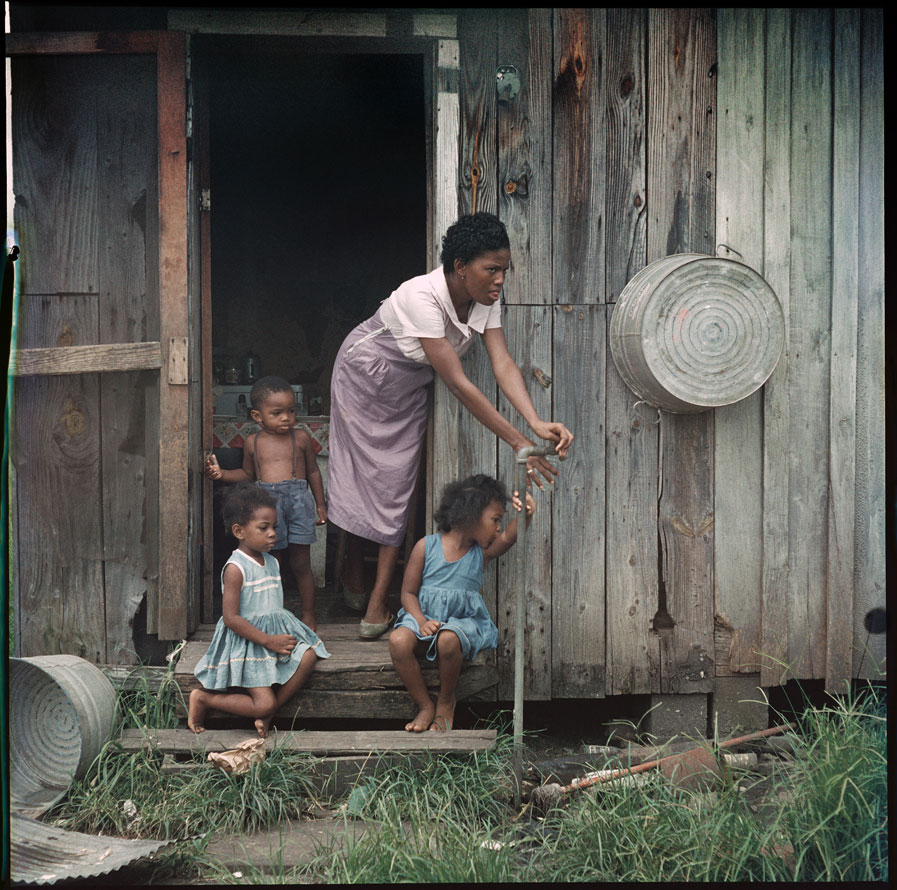
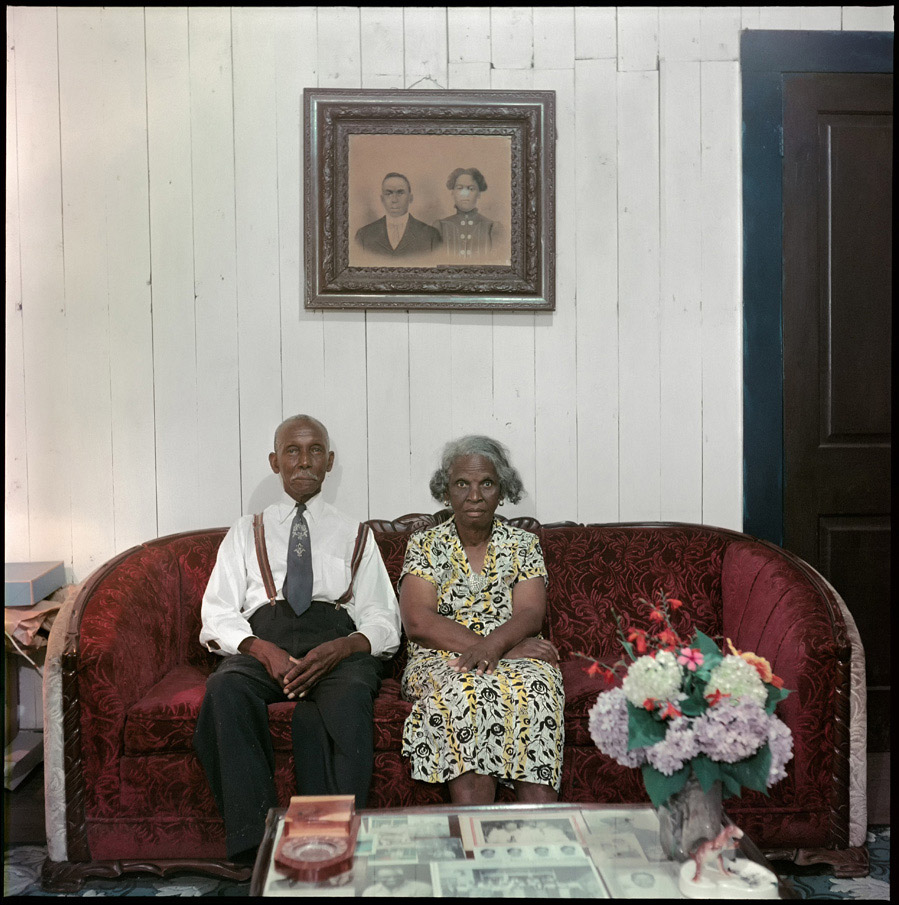
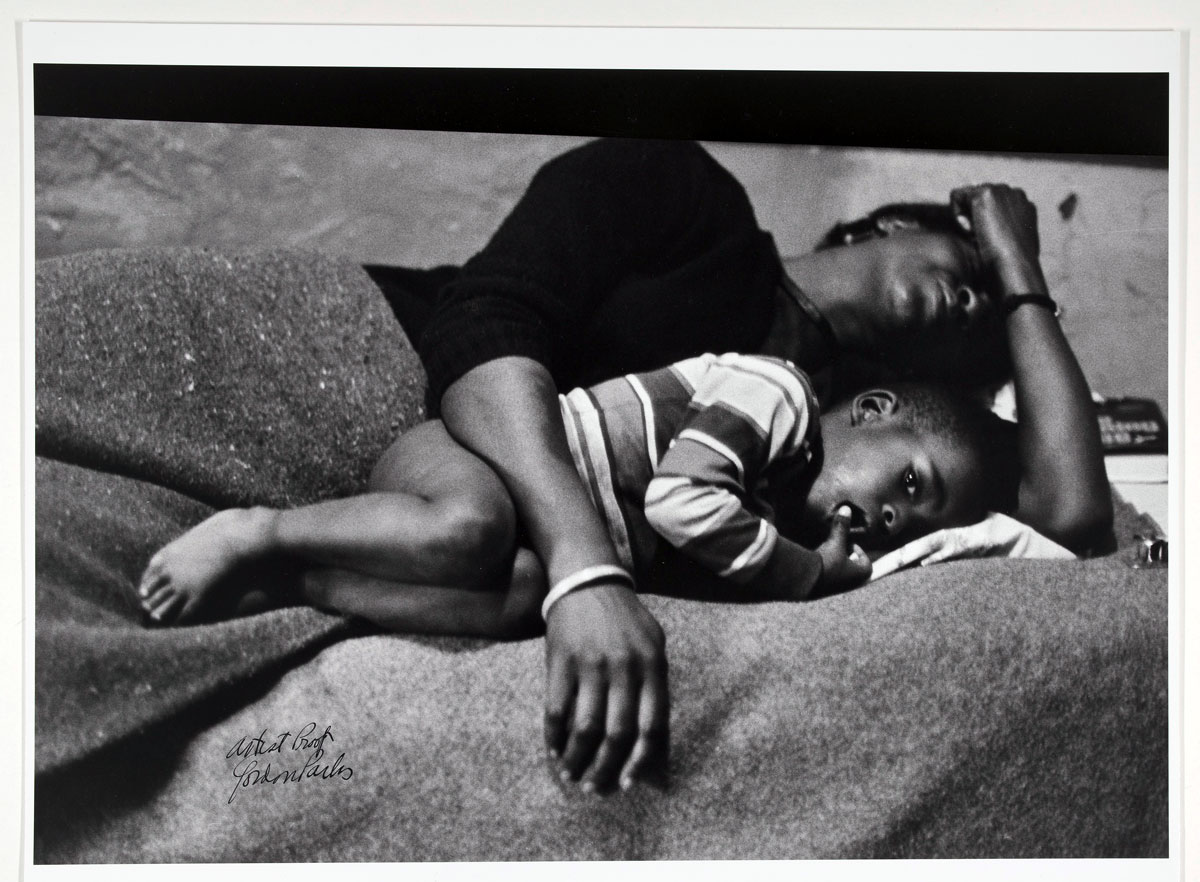
Gordon Parks (American, 1912-2006)
Mr. and Mrs. Albert Thornton, Mobile, Alabama
1956
Archival pigment print
Gift of the Gordon Parks Foundation in Honor of Arthur Roger
© The Gordon Parks Foundation

Polo Silk (American, b. 1964)
Lo Life, Lo Down, Club Detour
1993
Unique Polacolor Print Museum
Purchase, Tina Freeman Fund
Copyright Polo Silk, Fab 5 Legacy Archive
For more than three decades, Selwhyn Sthaddeus “Polo Silk” Terrell (American, b. 1964) has been photographing Black New Orleans, creating a unique body of work that blends elements of portraiture, fashion, performance, and street photography.
Polo Silk mobilised the traditional portrait studio, taking it to the streets and clubs of New Orleans and transforming it into an adaptable, on-the-spot method of picture making. In the course of his career, Polo perfected the use of instant-photo technology, making dynamic, one of a kind portraits that capitalised on the vibrant colour range and immediacy that is a hallmark of Polaroid and other instant films. Sold on demand to clients who wanted a record of an event like Super Sunday, or to show off their carefully planned outfit on any given Saturday night, Polo’s pictures have become an integral part of how many Black New Orleanians have used photography to represent themselves.
Polo’s pictures are often taken in front of the colourful airbrushed backdrops painted by his cousin Otis Spears (American, b. 1969) that feature figures from hip-hop and bounce music, fashion brands, sports logos, and the hot songs of the day. In bringing photography out of the studio and directly to the people, Polo made it a truly accessible phenomenon. While traditional portrait photographs were often designed to appear timeless and placeless, Polo’s pictures are absolutely fixed in time, and rooted in New Orleans. Together, Polo and his subjects have created one of the most important visual archives of this time and place, an important set of pictures that highlight Black expression, individuality, and ultimately, a collective community identity.
Anonymous. “Picture Man: Portraits by Polo Silk,” on the NOMA website [Online] Cited 17/11/2022

Elliott Jerome Brown Jr. (American, b. 1993)
Oftentimes, justice for Black people takes form of forgiveness, allowing them space to reclaim their bodies from wrongs made against them
2018
Archival pigment print
Museum Purchase
© Elliott Jerome Brown Jr.
Elliott Jerome Brown Jr. (born 1993) is a queer black American artist and photographer. In 2019 they received an Emerging Visual Arts Grant by The Rema Hort Mann Foundation.

Endia Beal (American, b. 1985)
Kennedy
2016
Archival pigment print
27 x 40 in.
Courtesy of the artist
© Endia Beal
Endia Beal is an African-American visual artist, curator, and educator. She is known for her work in creating visual narratives through photography and video testimonies focused on women of colour working in corporate environments.

Alanna Airitam (American, b. 1971)
How to Make a Country
2019
Archival inkjet print encased in resin and vignette with oil paint, floated in hand-welded 1 1/2 inch metal frame
14 3/4 x 20 3/4 in.
Courtesy of the artist
© Alanna Airitam
Her newest exhibition, “How to Make A Country” builds on these ideas in her prior work. Including a self-portrait of Airitam stitching an American flag with a basket of fresh cotton at her side, the series highlights the stories that weren’t told. “I was thinking about the people who make up this country, and how this country has become so economically prosperous and huge, and what it took in order to have a country like what we have,” she said.
“I was in my living room one day looking at one of the U.S. flags (I say U.S. flag because America as a whole is actually comprised of several countries, not just this one but that’s a whole other topic) we have here in the studio and I started thinking about the story of Betsy Ross and how she made the U.S. flag. It’s one of those awe inspiring, patriotic stories we’re taught in school that never quite sat well with me. I kept thinking, “But where did she get the cotton from?” Then I started thinking about how much Black women contributed to this country with little or no recognition. Without our sweat, blood, and tears we would not have the foundation for the country we know today.
I wanted to create something to honor those women – my ancestors who sacrificed so much for so little. When I ask myself who actually built this country, I have to give credit to all the Black and Brown women and men who struggled and truly believed in what this country is supposed to be even though it was never available to them. They believed in the idea that all men are created equal, that they were endowed by their Creator with certain unalienable Rights, that among those are Life, Liberty, and the pursuit of Happiness.
They were true Americans. And I wanted to honor those spirited women in this photo because they made this country.”
Alanna Airitam. “How to Make a Country, Alanna Airita,” on the Rfotofolio website July 5, 2020 [Online] Cited 17/11/2022
The New Orleans Museum of Art
One Collins Diboll Circle, City Park
New Orleans, LA 70124
Phone: (504) 658-4100
Opening hours:
Tuesday – Sunday 10am – 5pm
Closed Mondays








 Art Blart _ art and cultural memory archive
You must be logged in to post a comment.