Exhibition: ‘In Focus: Los Angeles, 1945-1980’ at the J. Paul Getty Museum, Los Angeles

Exhibition dates: 20th December 2011 – 6th May 2012


Anthony Friedkin (American, b. 1949) 'Clockwork Malibu' 1978


Anthony Friedkin (American, b. 1949)
Clockwork Malibu
1978
Gelatin silver print
11 15/16 x 18 5/16 in
The J. Paul Getty Museum, Los Angeles
Gift of Sue and Albert Dorskind
© Anthony Friedkin


While Anthony Friedkin has documented subjects as diverse as the marginalised gay community of San Francisco, convicts at Folsom Prison, and brothels in New York, it is the Southern California coastline that has remained a recurrent theme throughout his forty-five-year career. The Los Angeles native took up photography about the same time he learned to surf. His images of waves deftly communicate the primordial power and elusive mysteries that he ascribes to the ocean. This photograph of surfer Rick Dano on an early morning drive up the coast conveys a mood of quiet, anticipatory harmony.

Text from Pacific Standard Time at the Getty


I have never particularly liked Los Angeles as a city. There seems to be something unappealing about the place, some energy lurking just beneath the surface that you can’t quite put your finger on. Maybe it is the comparison with the vivacious San Francisco just up the coast, the awful public transport or, more spookily, the lack of people on the street. People never walk anywhere in LA, it’s a car town. When I did walk on the street I felt vulnerable and surveyed with suspicion by people in cars, like a rabbit caught in the headlights.

These photographs confirm this feeling. Unlike the visual acoustics of the architectural photographs of Julius Shulman (photographs that mythologised this urban metropolis and then exported that idealised presence and Californian mid-century design to the rest of the world) these photographs have an unbelievably desolatory nature to them. They seem to be joyless and sorrowful, devoid of warmth, comfort, or hope – as though the human and the city were separated, as if we are separated from a loved one.

The row after row of tinderbox houses, the ubiquitous cars, the sense of emptiness, hopelessness and menace (see Gary Winogrand Los Angeles 1964, below – if looks could kill this would be it, the bandaged broken nose just perfect for the photograph) all paint a picture of despair. Even the supposedly quiet, anticipatory harmony of the photograph of surfer Rick Dano by Anthony Friedkin (1978, below top) is, to me, full of unresolved tension. The mist in the background hanging over the rocks, blocking out the view, the filthy hands and the bandaged little finger of the right hand, the downcast eyes, the impossibly long cigarette handing from his lips and most importantly the empty distance between the figure and the safety of the automobile. The tension in that distance and the downcast eyes says nothing to me of harmony but of isolation, sadness and regret.

Los Angeles is not my favourite city but it is a fascinating place none the less, as these photographs do attest.

Dr Marcus Bunyan


Many thankx to the J. Paul Getty Museum for allowing me to publish the photographs in the posting. Please click on the photographs for a larger version of the image.
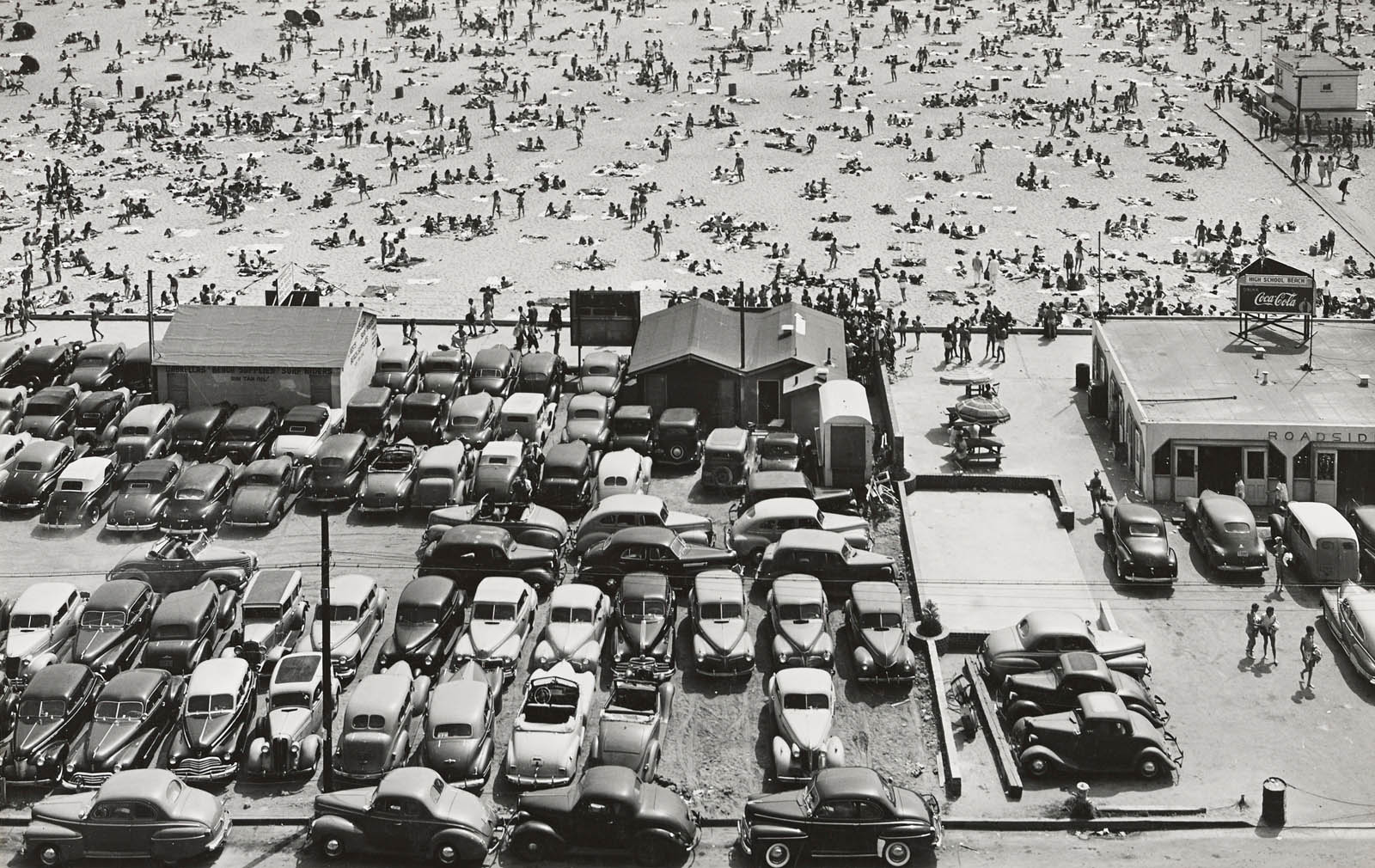


Max Yavno (American, 1911-1985) 'High School Beach' 1945


Max Yavno (American, 1911-1985)
High School Beach
1945
Gelatin silver print
22.1 x 34.4cm
The J. Paul Getty Museum, Los Angeles
Gift of Marjorie and Leonard Vernon
© 1988 Centre for Creative Photography, The University of Arizona Foundation
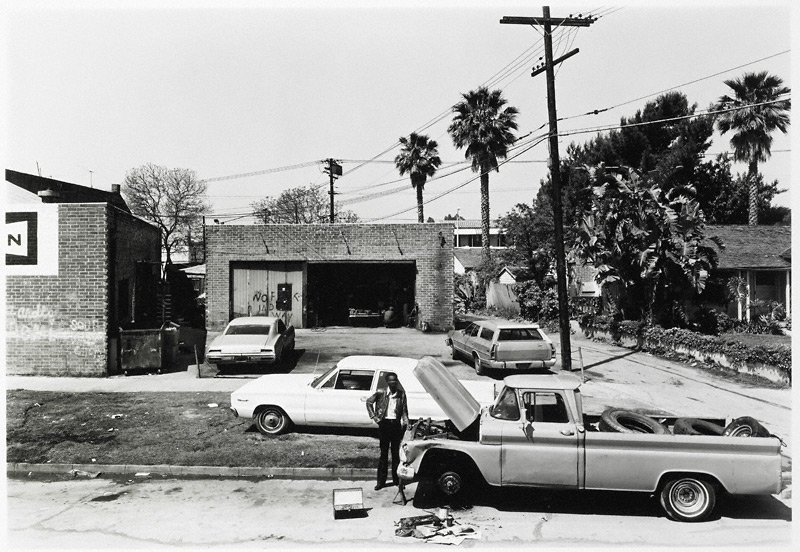
 

Anthony Hernandez (American, b. 1947) 'Automotive Landscapes #5, Los Angeles' 1978


Anthony Hernandez (American, b. 1947)
Automotive Landscapes #5: Los Angeles
1978
Gelatin silver print
11 3/4 x 17 1/8 in
The J. Paul Getty Museum, Los Angeles
Purchased in part with funds provided by the Photographs Council of the J. Paul Getty Museum
© Anthony Hernandez


Hernandez started photographing what he refers to as “automotive landscapes” in 1977, using a 35mm camera until he realised that a large-format camera loaded with 5 x 7-inch negative film would provide the detail he desired. Taken from a slightly elevated vantage point, Hernandez’s image of an immobilised truck and its lone mechanic in front of a repair shop presents a sobering view of Los Angeles’s car-dominant culture.

Text from Pacific Standard Time at the Getty


Gary Winogrand (American, 1928-1984) 'Los Angeles' 1964


Gary Winogrand (American, 1928-1984)
Los Angeles
1964
Gelatin silver print
9 x 13 7/16 in
The J. Paul Getty Museum, Los Angeles
© 1984 The Estate of Gary Winogrand


This image of a couple seated in a parked convertible in front of a nightclub on Sunset Boulevard simultaneously captures the glamour and seediness associated with Hollywood. Evoking a 1940s or ’50s film noir crime drama, a seeming tough guy and femme fatale continue their heated conversation, apparently oblivious to the traffic around them – and to the photographer observing them. A native of New York City, Winogrand studied painting at Columbia University and photography at the New School for Social Research before doing freelance commercial work. He photographed incessantly, using a 35mm camera to create wide-angled or tilted shots that are densely composed and layered with meaning. More than 2,500 rolls of film remained undeveloped at the time of his death in 1984.

Text from Pacific Standard Time at the Getty


As part of the region-wide Pacific Standard Time: Art in L.A., 1945-1980 initiative, The J. Paul Getty Museum presents In Focus: Los Angeles, 1945-1980, an exhibition of photographs from the permanent collection made by artists whose time in Los Angeles inspired them to create memorable images of the city, on view at the Getty Center from December 20, 2011 – May 6, 2012.

This exhibition features both iconic and relatively unknown work by artists whose careers are defined by their association with Los Angeles, who may have lived in the city for a few influential years, or who might have visited only briefly,” said Virginia Heckert, curator, Department of Photographs, the J. Paul Getty Museum, and curator of the exhibition.

The photographs are loosely grouped around the themes of experimentation, street photography, architectural depictions, and the film and entertainment industry. Works featured in the exhibition are from artists such as Jo Ann Callis, Robert Cumming, Joe Deal, Judy Fiskin, Anthony Friedkin, Robert Heinecken, Anthony Hernandez, Man Ray, Edmund Teske, William Wegman, Garry Winogrand, and Max Yavno. Two of the works in the exhibition by Anthony Hernandez and Henry Wessel Jr. were acquired with funds from the Getty Museum Photographs Council. Drawn from the Museum’s permanent collection, including several recent acquisitions inspired by the Pacific Standard Time initiative, the exhibition offers visitors the opportunity to familiarise themselves with a broad range of approaches to the city of Los Angeles as a subject and to the photographic medium itself.

One of the most well-known works in the exhibition is Garry Winogrand’s photograph of two women walking towards the landmark theme building designed by Charles Luckman and William Pereira that has come to symbolise both Los Angeles International Airport and mid-century modern architecture in popular culture. Though a quintessential New Yorker, Winogrand made some of his most memorable photographs in Los Angeles, where he chose to settle in the final years of his life. Also included in the exhibition is Diane Arbus’ dreamily lit photograph of Sleeping Beauty Castle at Disneyland park in Anaheim. Although technically not located in either the city or the county of Los Angeles, Disneyland – and Arbus’ photograph – continues to capture the notion of entertainment and fantasy that has come to be so intrinsically associated with the city.

Other photographers in the In Focus: Los Angeles exhibition who produced the majority of their most creative work in the city include Edmund Teske, with his experimentation in the darkroom and his complex double solarisation process; Robert Heinecken, with images that are equally complex but often incorporate existing printed materials, such as negatives; Anthony Hernandez, whose portraits of Angelenos on the street emphasise the isolation of the individual in an urban environment; and Anthony Friedkin, who combines his passions for surfing and the Southland beaches in his photographs. The inclusion of three photographs from Judy Fiskin’s earliest photographic series, Stucco (1973-1976), provided the impetus for a monographic presentation of the artist’s complete photographic work by Getty Publications. Entitled Some Aesthetic Decisions: The Photographs of Judy Fiskin and featuring an introductory essay by curator Virginia Heckert, the book will be published concurrently with this exhibition.

Press release from the J. Paul Getty Museum website
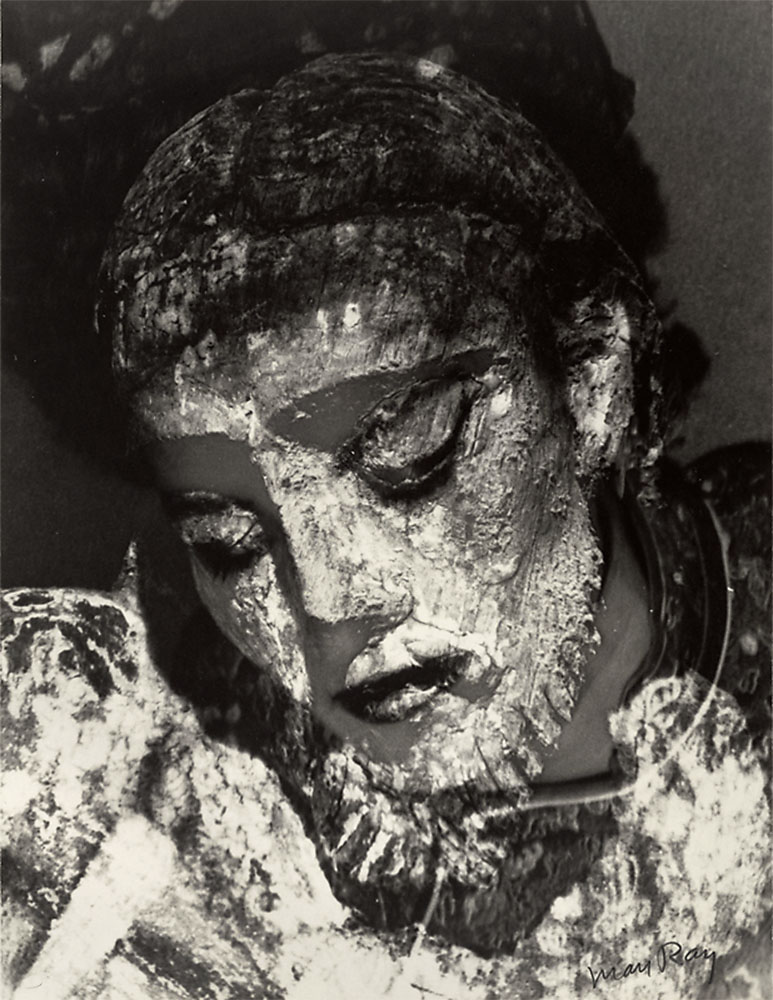
 

Man Ray (Emmanuel Radnitsky)(American, 1890-1976) 'Juliet with Mud Mask' 1945


Man Ray (Emmanuel Radnitsky)(American, 1890-1976)
Juliet with Mud Mask
1945
Gelatin silver print
35.6 x 27.1cm
The J. Paul Getty Museum, Los Angeles
© Man Ray Trust
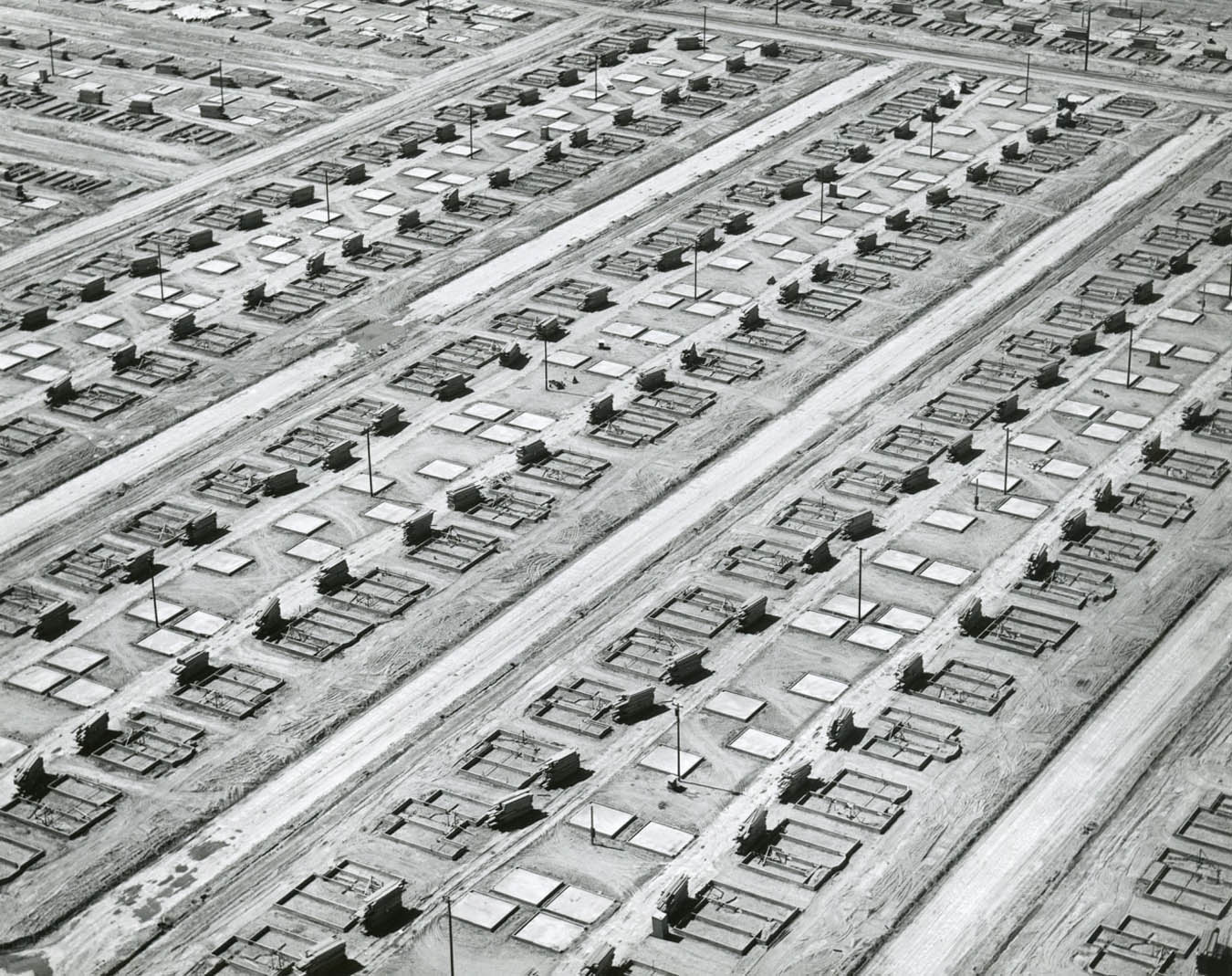
 

William Garnett (American, 1916-2006) 'Foundations and Slabs, Lakewood, California' 1950


William Garnett (American, 1916-2006)
Foundations and Slabs, Lakewood, California
1950
Gelatin silver print
18.9 x 23.8cm
The J. Paul Getty Museum, Los Angeles
© Estate of William A. Garnett
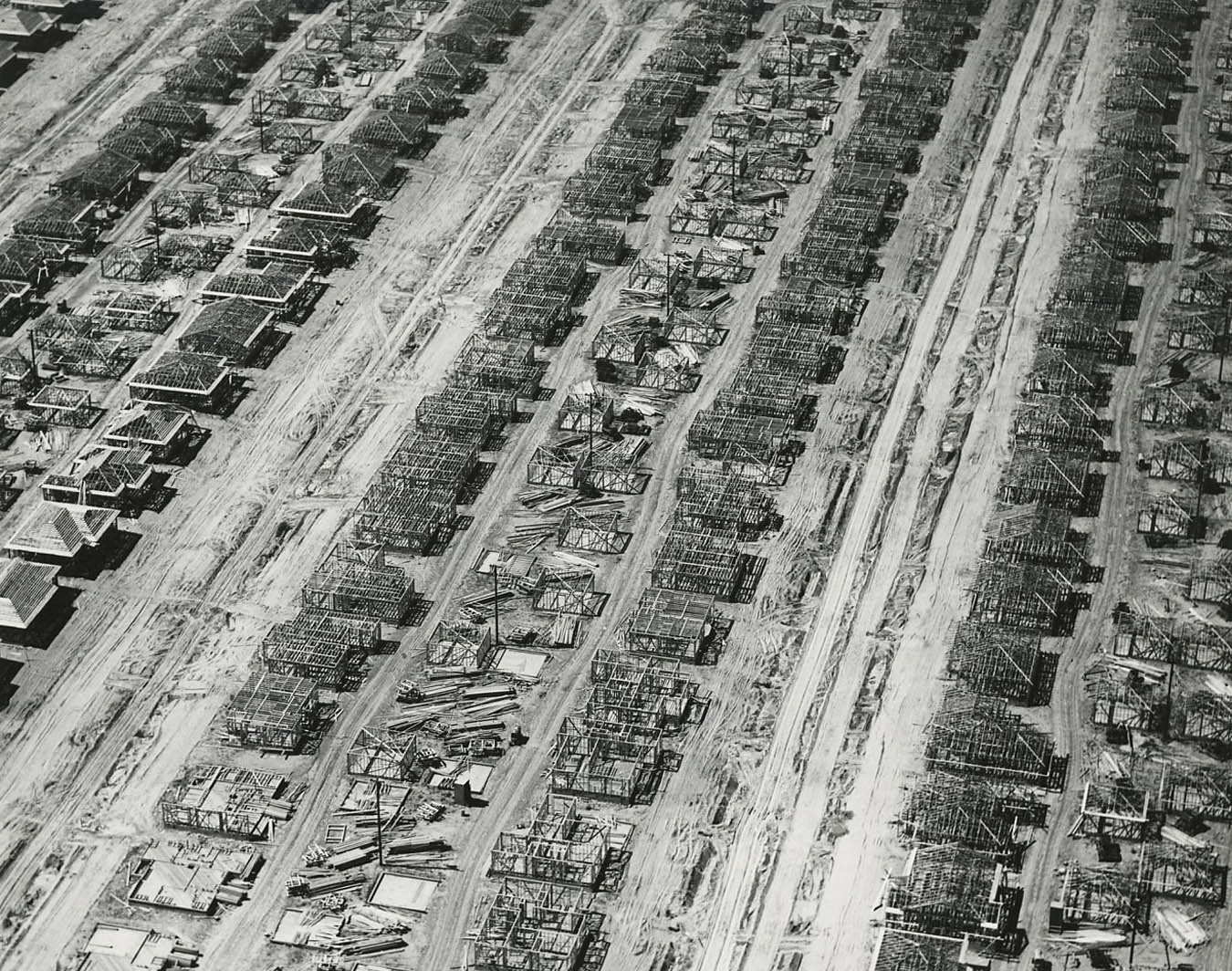
 

William Garnett (American, 1916-2006) 'Framing, Lakewood, California' 1950


William Garnett (American, 1916-2006)
Framing, Lakewood, California
1950
Gelatin silver print
18.4 x 24.1cm
The J. Paul Getty Museum, Los Angeles
© Estate of William A. Garnett
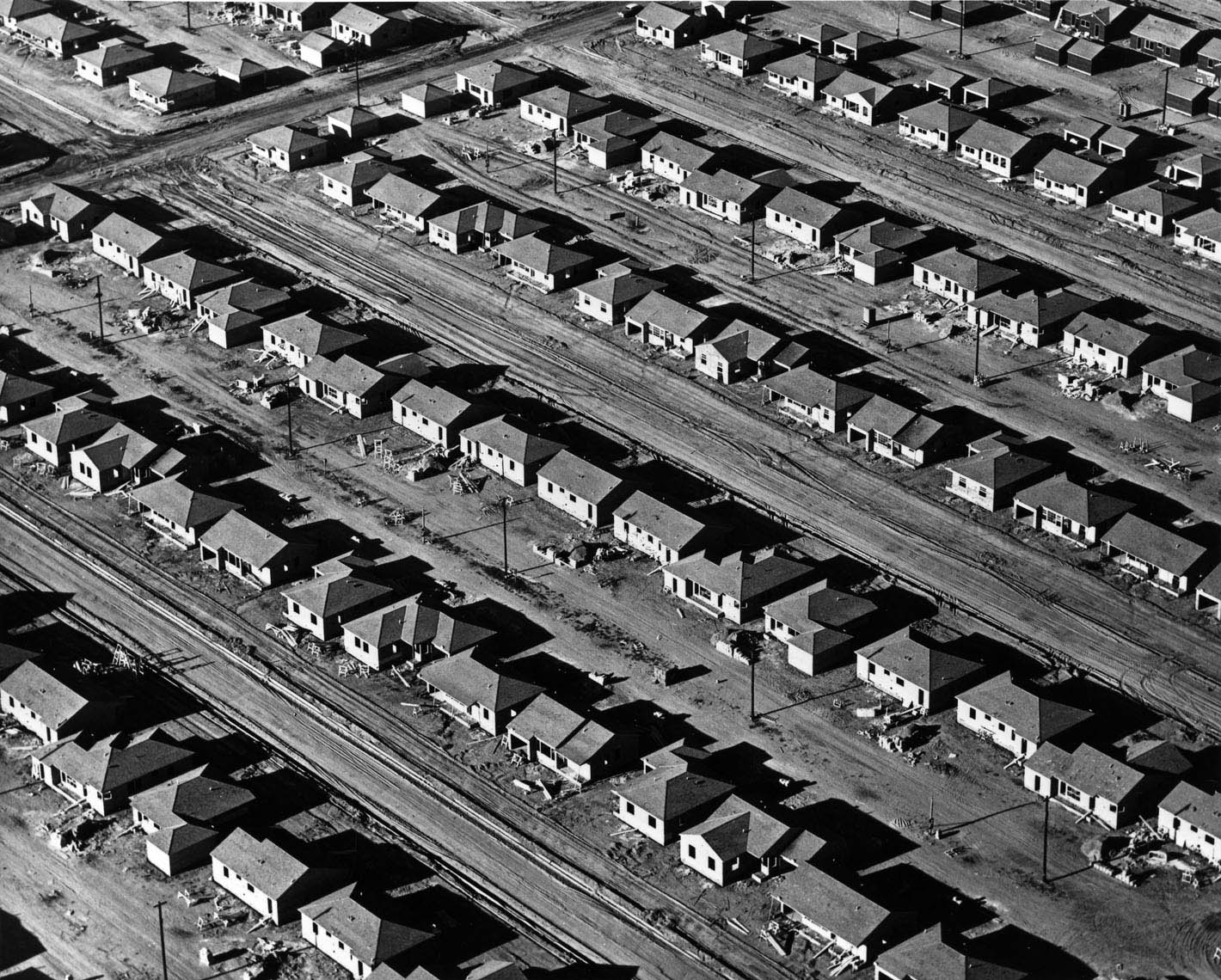
 

William Garnett (American, 1916-2006) 'Plaster and Roofing, Lakewood, California' 1950


William Garnett (American, 1916-2006)
Plaster and Roofing, Lakewood, California
1950
Gelatin silver print
18.4 x 24.1cm
The J. Paul Getty Museum, Los Angeles
© Estate of William A. Garnett
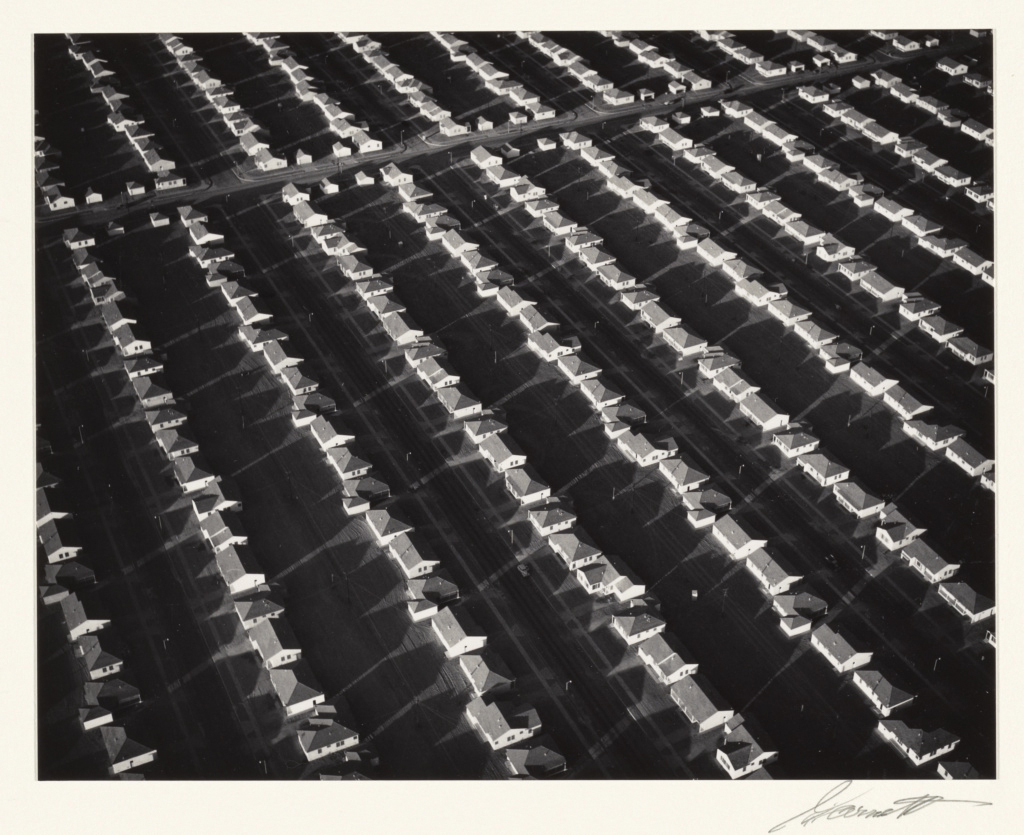
 

William A. Garnett (American, 1916-2006) 'Finished Housing, Lakewood, California' 1950


William A. Garnett (American, 1916-2006)
Finished Housing, Lakewood, California
1950
Gelatin silver print
7 3/8 x 9 7/16 in
The J. Paul Getty Museum, Los Angeles
© Estate of William A. Garnett


The reduced scale and regular spacing of shapes lend a toy-like quality to Garnett’s suite of prints depicting construction phases of tract housing in the Los Angeles County suburb of Lakewood. The deep shadows, overall patterning, and dramatic diagonals that slice through each composition introduce a sophisticated sense of design and abstraction. After studying photography at Art Center College of Design and military service during World War II, William Garnett learned to fly so that he could photograph his subjects from his Cessna 170-B airplane. Although he was hired by developers to document the construction of 17,500 affordable single-family residences in Lakewood, the majority of his aerial photographs depict the beauty of America’s landscape.

Text from Pacific Standard Time at the Getty
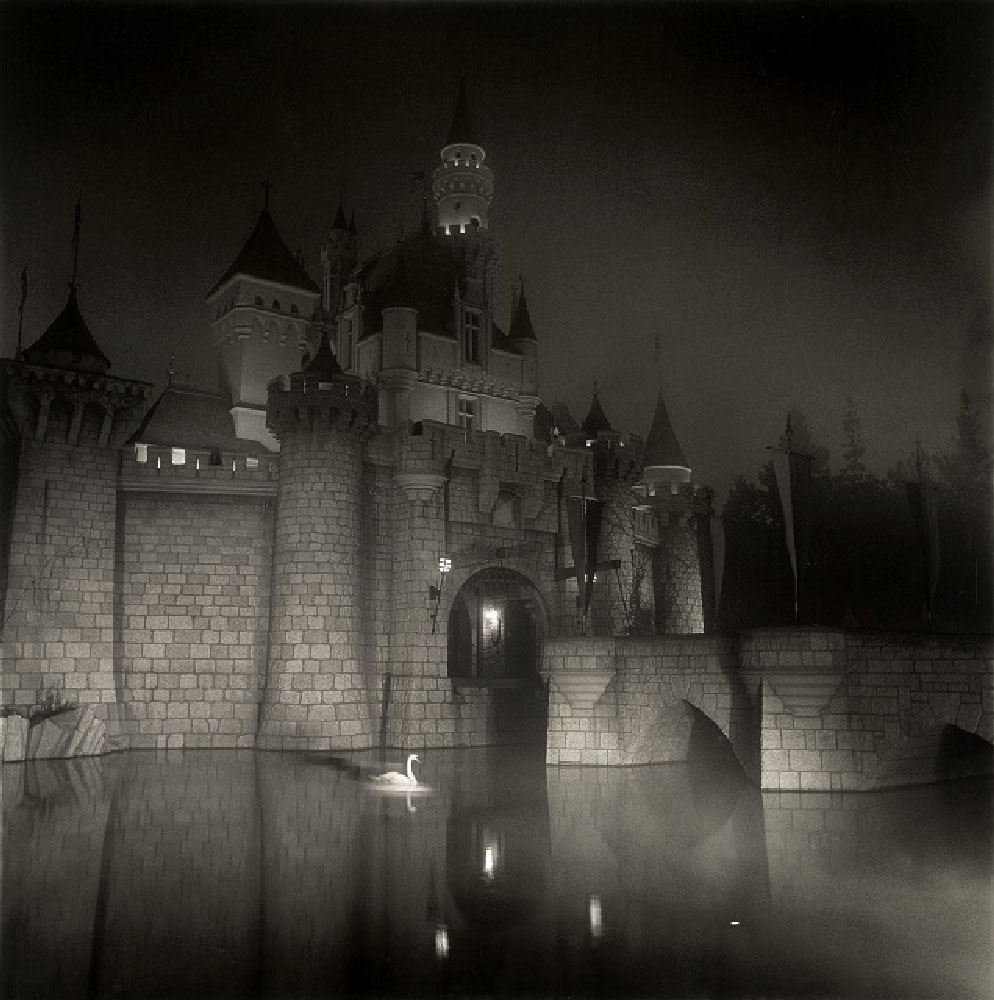
 

Diane Arbus (American, 1923-1971) 'A Castle in Disneyland' Negative, 1962; print, 1973


Diane Arbus (American, 1923-1971)
A Castle in Disneyland
Negative, 1962; print, 1973
Gelatin silver print
24 x 24cm
The J. Paul Getty Museum, Los Angeles
© Estate of Diane Arbus
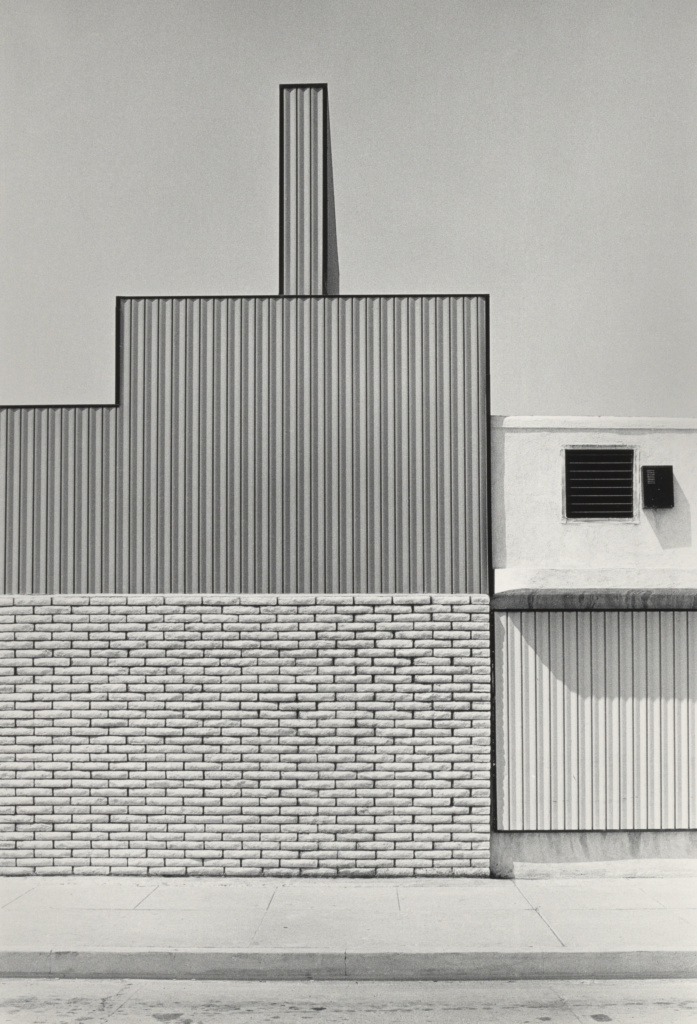
 

Grant Mudford (Australian, b. 1944) 'Los Angeles (US 257/10a)' negative, 1976; print, 1980


Grant Mudford (Australian, b. 1944)
Los Angeles (US 257/10a)
Negative, 1976; print, 1980
Gelatin silver print
19 1/4 x 13 1/8 in
© Grant Mudford


After working for ten years as a commercial photographer, Sydney native Grant Mudford received funding from the Australia Council for the Arts, enabling him to travel throughout the United States to pursue personal work. Mudford’s love of architecture – particularly the vernacular, often anonymous structures of urban America – is evident in the photographs he produced. His head-on depictions of the façades of simple commercial buildings are enlivened by signage, the play of light and shade, the placement of doors and windows, or, as in this image, the rich variety of textures.

Text from Pacific Standard Time at the Getty


Joe Deal (American, 1947-2010) 'Backyard, Diamond Bar, California' 1980


Joe Deal (American, 1947-2010)
Backyard, Diamond Bar, California
1980
Gelatin silver print
11 3/16 x 11 1/4 in
The J. Paul Getty Museum, Los Angeles
© Joe Deal


Joe Deal rose to prominence in the mid-1970s when work he made as a graduate student at the University of New Mexico was included in the exhibition New Topographics: Photographs of a Man-Altered Landscape (1975). From 1976 to 1989, he taught photography at the University of California, Riverside, where he was instrumental in establishing a photography program and developing the university-affiliated California Museum of Photography. His photographs of Diamond Bar feature backyards of this primarily residential suburb located at the junction of the Pomona and Orange freeways in eastern Los Angeles County. Deal’s implementation of a slightly elevated perspective that eliminates the horizon line and provides a view into neighbouring yards effectively conveys the close quarters of life in a master-planned community.

Text from Pacific Standard Time at the Getty
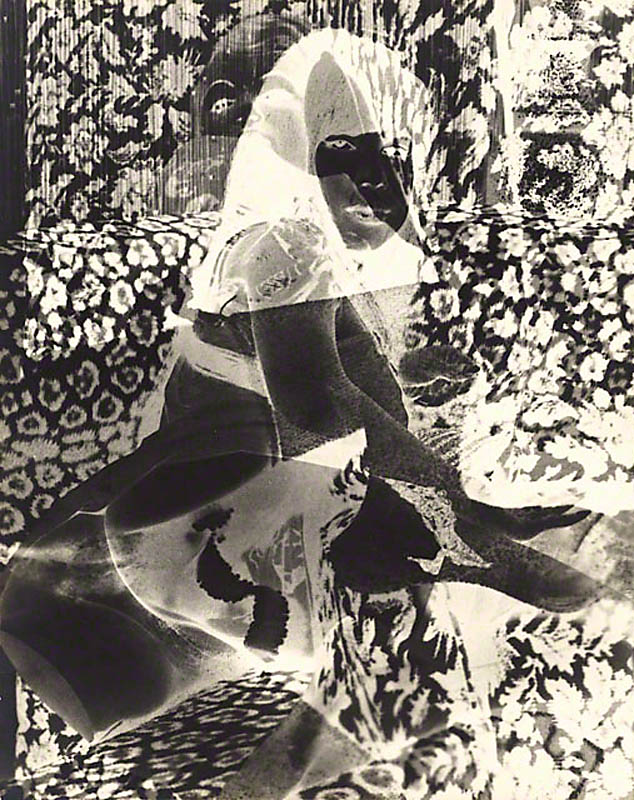
 

Robert Heineken (American, 1931-2006) 'Untitled (Studies #7)' 1970


Robert Heineken (American, 1931-2006)
Untitled (Studies #7)
1970
Gelatin silver print
9 15/16 x 7 15/16 in.
The J. Paul Getty Museum, Los Angeles
© The Estate of Robert Heineken
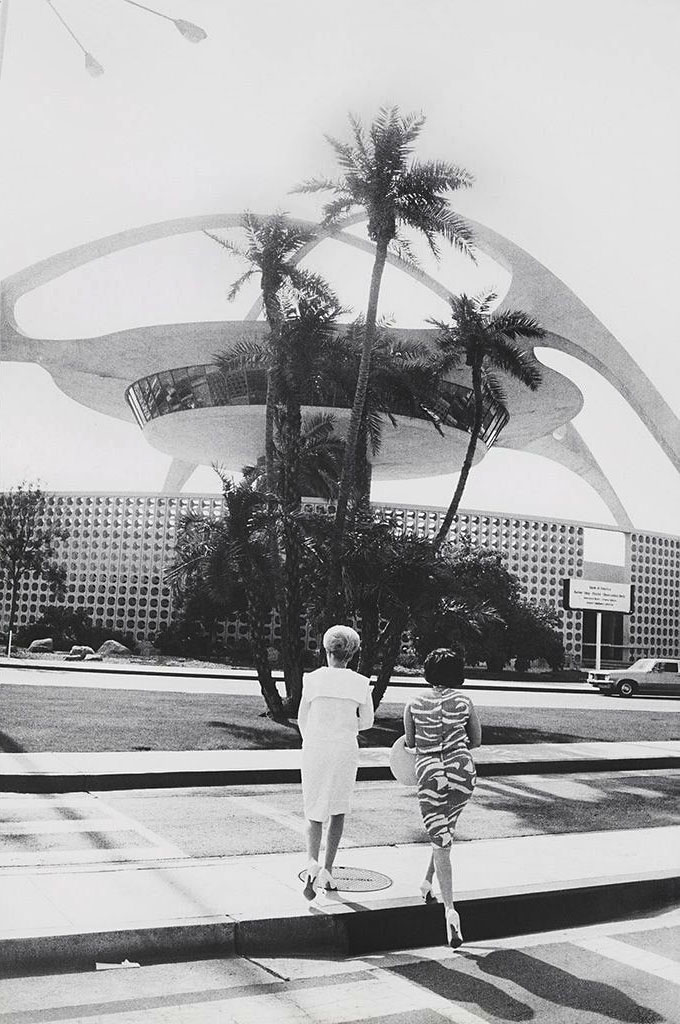
 

Garry Winogrand (American, 1928-1984) 'Los Angeles International Airport' 1964


Garry Winogrand (American, 1928-1984)
Los Angeles International Airport
1964
Gelatin silver print
The J. Paul Getty Museum, Los Angeles
© 1984 The Estate of Garry Winogrand


“It is immediately apparent that no city has ever been produced by such an extraordinary mixture of geography, climate, economics, demography, mechanics and culture; nor is it likely that an even remotely similar mixture will ever occur again.” ~ Reyner Banham, Los Angeles: The Architecture of Four Ecologies, 1971

This exhibition features photographs – made between 1945 and 1980 – from the Museum’s collection that represent diverse responses to the city of Los Angeles as a subject and to photography as a medium for documentary and creative expression. It is loosely grouped around the themes of experimental photography, vernacular architecture, car culture, and fantasy and the film industry.

Both iconic and relatively unknown works are included. One of the best known is Garry Winogrand’s image of two women walking towards the Theme Building at L.A. International Airport (see image above). Though a quintessential New Yorker, Winogrand settled in Los Angeles near the end of his life.

Experimental Photography

With its reclining figure set against a patterned background, Robert Heineken’s image recalls the odalisques of French painter Henri Matisse (see image above). To Heineken, however, traditional subjects and techniques were of little interest. He created this camera-less photograph by using a page torn from a magazine as the negative. This allowed light to pass through and merge depictions on both sides of the page into a single image with reversed tones.

In 1963, Heineken founded the photography program at the University of California, Los Angeles. He forged new directions in photography, utilising strategies of manipulation and appropriation to address themes of consumer culture and sexual politics.

Vernacular Architecture

Judy Fiskin’s propensity to backlight her subjects makes it difficult to read the details in the modest examples of vernacular architecture found in Westside neighbourhoods of Los Angeles that she photographed for her Stucco series. Viewers may be inclined to squint against the harsh light of Southern California that Fiskin makes so palpable. Nevertheless, the small scale of her images, contained by the black edges of the negative, encourages close viewing.

After completing graduate studies in art history at UCLA, Fiskin joined the faculty of the California Institute of Arts in 1977.

Car Culture

A native of Los Angeles, following two years of study at East Los Angeles College and two years of service in the U.S. Army, Anthony Hernandez took up photography in earnest around 1970.

For this image, Hernandez preset his 35mm camera so that objects within a specific range would be in focus. Then, while walking the streets of downtown Los Angeles, he swung the camera to his eye for a fraction of a second to capture fellow pedestrians as well as the ambient mood of a city more typically experienced from the driver’s seat (see image below).

Fantasy and the Film Industry

Los Angeles native Anthony Friedkin took up photography about the same time he learned to surf, and was already an accomplished photographer by age 16. He then studied at Art Center College of Design and the University of California, Los Angeles.

Friedkin began working as a still photographer for motion pictures in 1975. His depiction of row after row of film cans might be viewed as a historical document of a medium that has been replaced by new technology (see image below).

Anonymous. “In Focus: Los Angeles, 1945-1980,” on the J. Paul Getty Museum website Nd [Online] Cited 18/10/2024
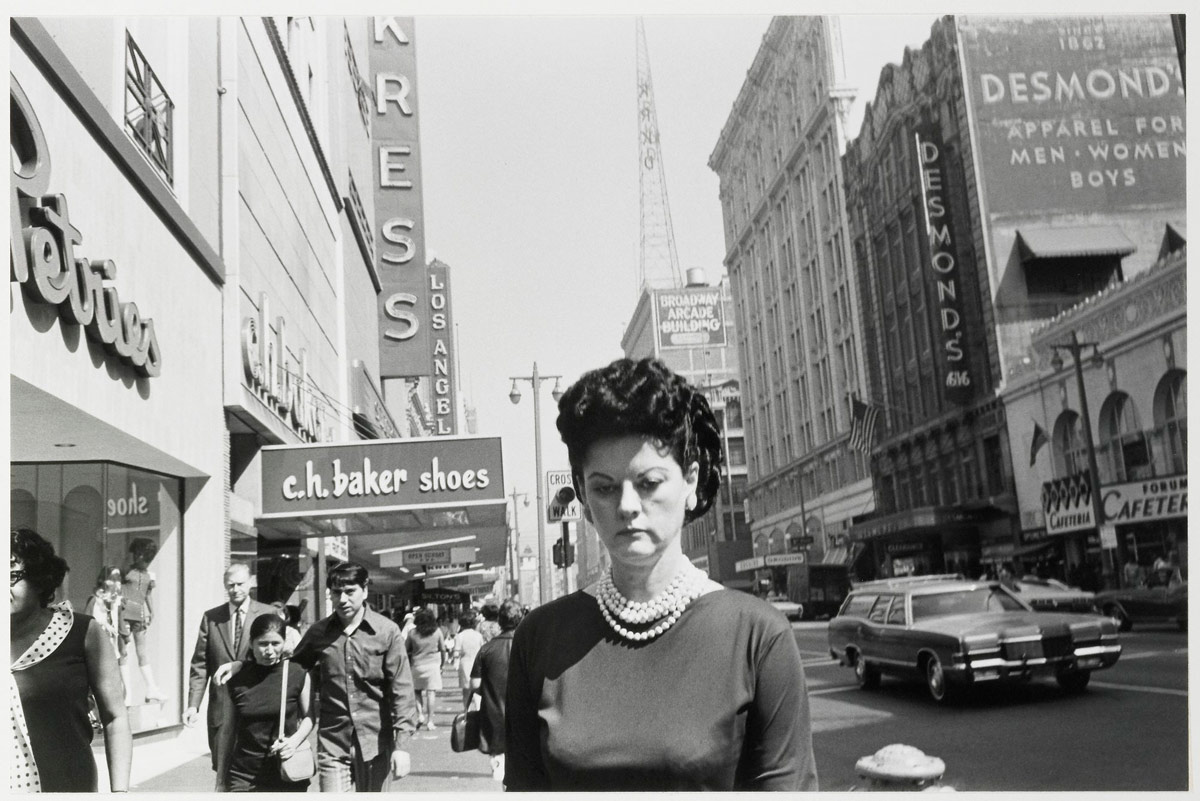
 

Anthony Hernandez (American, b. 1947) 'Los Angeles #3' 1971


Anthony Hernandez (American, b. 1947)
Los Angeles #3
1971
Gelatin silver print
7 3/4 x 11 13/16 in
The J. Paul Getty Museum, Los Angeles
Purchased in part with funds provided by the Photographs Council
© Anthony Hernandez


Following two years of study at East Los Angeles College and two years of service in the U.S. Army, Anthony Hernandez took up photography in earnest around 1970. For this image, he preset his 35mm camera so that objects within a specific range would be in focus. Then, while walking the streets of downtown Los Angeles, he swung the camera to his eye for a fraction of a second to capture fellow pedestrians as well as the ambient mood of a city more typically experienced from the driver’s seat. A native of Los Angeles, Hernandez has continued to photograph the city, addressing issues of community, shelter, and survival in his work.

Text from Pacific Standard Time at the Getty


Anthony Friedkin (American, b. 1949) 'Film Can Library, Universal Studios' 1978


Anthony Friedkin (American, b. 1949)
Film Can Library, Universal Studios
1978
Gelatin silver print
12 x 17 11/16 in
The J. Paul Getty Museum, Los Angeles
Gift of Sue and Albert Dorskind
© Anthony Friedkin


Anthony Friedkin began taking photographs at a young age and had already published his work by the time he was 16. He nonetheless found it important to study photography seriously and did so at Art Center College of Design and the University of California, Los Angeles. Employment as a still photographer for motion pictures beginning in 1975 undoubtedly prepared him to create a portfolio of images of Universal Studios a few years later. His depiction of row after row of film cans might be viewed as a historical document of a medium that has been replaced by new technology. Friedkin’s continued commitment to shooting black-and-white film that he develops and prints in his own darkroom has become increasingly rare.

Text from Pacific Standard Time at the Getty


Darryl J. Curran (American, b. 1935) 'Cocktails with Heinecken' about 1974


Darryl J. Curran (American, b. 1935)
Cocktails with Heinecken
about 1974
Gelatin silver print
9 1/4 x 14 in
The J. Paul Getty Museum, Los Angeles
Gift of Darryl J. Curran
© Darryl J. Curran


After completing his undergraduate degree in design at the University of California, Los Angeles, Darryl Curran entered the school’s newly established photography program, studying with Robert Heinecken, who is positioned toward the center of this image in a black turtleneck. The repeated printing of two frames is typical of Curran’s approach to the photographic medium and the ease with which he employs techniques and strategies derived from his background in printmaking and design. Another form of “mirroring” occurs in the placement of a Heineken beer bottle opposite Heinecken the artist. Curran founded the Department of Photography at California State University, Fullerton, where he taught from 1967 to 2001.

Text from Pacific Standard Time at the Getty
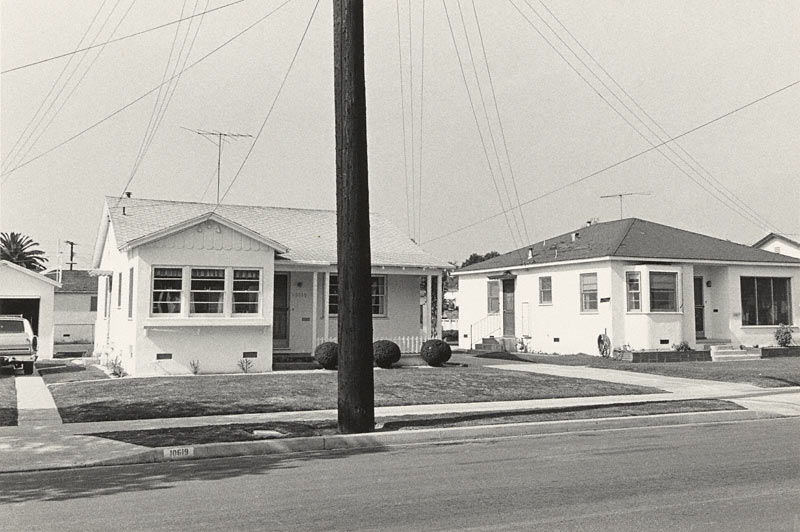
 

Henry Wessel Jr. (American, 1942-2018) 'Los Angeles' 1971


Henry Wessel Jr. (American, 1942-2018)
Los Angeles
1971
Gelatin silver on Dupont Veragam paper print
7 15/16 x 11 7/8 in
The J. Paul Getty Museum, Los Angeles
Purchased with funds provided by the Photographs Council of the J. Paul Getty Museum
© Henry Wessel


Henry Wessel began taking photographs while majoring in psychology at Pennsylvania State University in the mid-1960s. Travel throughout the United States in subsequent years led him to direct his gaze increasingly to details of human interaction with the natural and man-made environment. Wessel’s move to the West Coast in the early 1970s inspired him to incorporate light and climate into his work. His inclusion in the seminal exhibition New Topographics: Photographs of a Man-Altered Landscape, organised in 1975 by the George Eastman House in Rochester, New York, solidified his reputation as a keen observer of the American topography. In this image, electrical and telephone lines tether a row of modest residences to a single utility pole.

Text from Pacific Standard Time at the Getty


The J. Paul Getty Museum
1200 Getty Center Drive
Los Angeles, California 90049

Opening hours:
Daily 10am – 5pm

The J. Paul Getty Museum website

LIKE ART BLART ON FACEBOOK

Back to top

Exhibition: ‘Into the Sunset: Photography’s Image of the American West’ at The Museum of Modern Art (MoMA), New York

Exhibition dates: 29th March – 8th June, 2009

Curator: Eva Respini, Associate Curator, Department of Photography, The Museum of Modern Art


Carelton Watkins (American, 1829-1916) 'View from the Sentinel Dome, Yosemite' 1865-1866 from the exhibition 'Into the Sunset: Photography's Image of the American West' at The Museum of Modern Art (MoMA), New York, March - June, 2009

Carelton Watkins (American, 1829-1916) 'View from the Sentinel Dome, Yosemite' 1865-1866

Carelton Watkins (American, 1829-1916) 'View from the Sentinel Dome, Yosemite' 1865-1866


Carelton Watkins (American, 1829-1916)
Views from the Sentinel Dome, Yosemite
1865-1866
Albumen silver prints from glass negatives
Museum of Modern Art, New York


The Museum of Modern Art presents Into the Sunset: Photography’s Image of the American West, a survey of 138 photographic works dating from 1850 to 2008 that chart the West’s complex, rich, and often compelling mythology via photography. The exploration of a large part of the American West in the mid-nineteenth century by European Americans coincided with the advent of photography, and photography and the West came of age together. The region’s seemingly infinite bounty and endless potential symbolised America as a whole, and photography, with its ability to construct persuasive and seductive images, was the perfect medium with which to forge a national identity. This relationship has resulted in a complex association that shapes the perception of the West’s social and physical landscape to this day. With political, cultural, and social attitudes constantly shifting in the region over the last 150 years, Into the Sunset further examines the way photographers have responded to these changes. The exhibition is organised by Eva Respini, Associate Curator, Department of Photography, The Museum of Modern Art, and is on view in the Special Exhibitions Gallery on the third floor from March 29 to June 8, 2009.

Organised thematically rather than chronologically, Into the Sunset brings together the work of over 70 photographers, including Robert Adams, John Baldessari, Dorothea Lange, Timothy O’Sullivan, Cindy Sherman, Joel Sternfeld, Carleton E. Watkins, and Edward Weston, among others. The exhibition draws extensively from MoMA’s collection, along with private and public collections in the United States, and features new acquisitions from Adam Bartos, Katy Grannan, and Dennis Hopper, with each work also on view for the first time at the Museum.

Ms. Respini states: “Ranging from grand depictions of paradise to industrial development, from pictures taken on the road to prosaic suburban scenes, the photographs included in Into the Sunset do not all picture the West from the same point of view, or even perhaps, picture the same West. Rather, each is one part in a continually shifting and evolving composite image of a region that has itself been growing and changing since the opening of the frontier.”

Into the Sunset begins with the birth of photography and the American West. In the mid-nineteenth century, the region’s seemingly infinite bounty and endless potential symbolised America as a whole, and Carleton E. Watkins (American, 1829-1916) captured the grand depictions of an American paradise in his photographs of Yosemite Valley in California. Arguably the world’s first renowned landscape photographer, Watkins made his first photographs there in 1861 – large sized prints made with an 18-by-22-inch mammoth plate camera, well suited to the grandeur of the land. Included are the three contiguous photographs that make up his extraordinarily detailed View from the Sentinel Dome (1865-1866).

The exhibition balances the early work of landscape photographers with the twentieth century focus on the failure of the West’s promised bounty. In Joel Sternfeld’s (American, b. 1944) After a Flash Flood, Rancho Mirage, California (1979), the photographer documents the impact of a natural disaster, specifically a landslide, shot with neutral tones softly camouflaging the extent of flash flood on this suburban neighbourhood. And in Karin Apollonia Müller’s (German, b. 1963) Civitas (1997), the photographer shows a very different view of California than that of Watkins, with Müller revealing a contemporary Los Angeles as a littered wasteland of freeways and anonymous glass towers.

As highways and interstate travel became more prevalent, the automobile and the open road became synonymous with the region, with Edward Weston (American, 1886-1958) as the first great photographer of these open roads. Included is Weston’s iconic Hot Coffee, Mojave Desert (1937), a humorous black-and-white photograph of a road sign revealing a greater thematic shift to the highway and its signage as an inescapable element in picturing the West in the twentieth century.

Once the West became more populated, photographers began to showcase humans’ effects on the land, including images of industrial development. In the 1950s William Garnett (American, 1916-2006) was hired by a real estate company to record the efficiency of mass-produced housing. For this series, Lakewood, California (1950), Garnett took photographs of the neighbourhood from an airplane, resulting in images that are completely devoid of people and focus on the progress of mass-produced construction. However, the series subsequently came to represent all that was wrong with such development and the massive sprawl of the West in the eyes of its critics.

Photographs of the people of the West represent a diversity of archetypes: gold miners and loggers, Native Americans, cowboys, suburbanites, city dwellers, starlets, dreamers, and drifters. Into the Sunset explores these archetypes, and their mutability into the twenty-first century. Included is Half Indian / Half Mexican (1991), from the photographer James Luna (Native American, Pooyukitchum / Luiseno, b. 1950), an artist of Native American ancestry. This tongue-in-cheek self-portrait captures in profile both an identity photograph and a mug shot, and works as a counterpoint to the tokenised portrayals of Native Americans from the past 150 years.

A similar reevaluation of past archetypes occurs in Richard Prince’s (American, b. 1949) Cowboy series from 1980, with one work from the series included in the exhibition. For that series Prince famously photographed Marlboro advertisements, cutting out the text, cropping the images, and enlarging them, highlighting the artifice of the virile image of the cowboy and its potency as a deeply ingrained figure in American mythology.

The suburbs and their inhabitants have been a rich subject for photographers of the West, and included are Larry Sultan’s (American, b. 1946) Film Stills from the Sultan Family Home Movies (1943-1972), in which Sultan chose individual frames from his family’s home movies and enlarged them. Although the images feature the activities that epitomise suburban life, a sense of unease lurks beneath the surface of these images; cropped and grainy, they resemble surveillance or evidence photographs.

Into the Sunset concludes with the theme of the failed promise of Western migration. Dorothea Lange’s well-known 1936 photograph Migrant Mother, Nipomo, California, photographed when Lange was employed by the Farm Security Administration, is included and documents the conditions of the West in rural areas during the Great Depression. Her photographs had a humanist purpose and resulted in putting a face on the hardships of that era.

This tradition of capturing the downtrodden of the West continues into this century with Katy Grannan (American, b. 1969), a photographer who recently completed a series of new pioneers, individuals struggling to define themselves in the West of today. In Nicole, Crissy Field Parking Lot (I) (2006), a woman, “Nicole,” poses seductively on a gravel parking lot, with her makeup-streaked face and harsh light alluding to her perilous existence on the fringe of society.”

Text from the MoMA website [Online] Cited 12/04/2009. No longer available online


Many thankx to MoMA for allowing me to publish the photographs in the posting. Please click on the photographs for a larger version of the image.


Installation view of the exhibition 'Into the Sunset: Photography's Image of the American West' at The Museum of Modern Art (MoMA), New York showing Ed Ruscha's 'Every Building on the Sunset Strip' 1966


Installation view of the exhibition Into the Sunset: Photography’s Image of the American West at The Museum of Modern Art (MoMA), New York showing Ed Ruscha’s Every Building on the Sunset Strip 1966


Joel Sternfeld (American, b. 1944) 'After a Flash Flood, Rancho Mirage, California' 1979 from the exhibition 'Into the Sunset: Photography's Image of the American West' at The Museum of Modern Art (MoMA), New York, March - June, 2009


Joel Sternfeld (American, b. 1944)
After a Flash Flood, Rancho Mirage, California
1979
Chromogenic colour print, printed 1987
15 15/16 x 20″ (40.5 x 50.8cm)
Museum of Modern Art, New York
Gift of Beth Goldberg Nash and Joshua Nash


During the 1970s, Joel Sternfeld’s work reflected a trend towards a newly dispassionate, less idealised approach to nature and culture. His photographs have a seductive beauty, even though they often focus on those places where the natural and man-made worlds come together in uncomfortable ways. Working with a large-format camera and luminous colour to create images that are frequently ironic or even humorous, his compositions appear simple but in fact are surprisingly complex and often unsettling. In this photograph of a suburban California neighbourhood in the aftermath of a flash flood, the lovely monochrome tones trick us into not immediately seeing the car that has toppled into the gaping sinkhole or realising that the buildings above could be on the verge of falling, too.

Text from the Museum of Fine Arts Boston website


Apollonia Müller (German, b. 1963) 'Civitas' 1997


Apollonia Müller (German, b. 1963)
Civitas
1997
From Angels in Fall
Chromogenic colour print
19 3/4 x 24 1/2″ (50.1 x 62.2cm)
Gift of Howard Stein
Museum of Modern Art, New York
© 2018 Karin Apollonia Müller


William A. Garnett (American, 1916-2006) 'Foundations and Slabs, Lakewood, California' 1950


William A. Garnett (American, 1916-2006)
Foundations and Slabs, Lakewood, California
1950
Gelatin silver print
18.9 × 23.8cm (7 7/16 × 9 3/8 in.)
© J. Paul Getty Museum


William A. Garnett (American, 1916-2006) 'Grading, Lakewood, California' 1950


William A. Garnett (American, 1916-2006)
Grading, Lakewood, California
1950
Gelatin silver print
18.9 × 24cm (7 7/16 × 9 7/16 in.)
© J. Paul Getty Museum


William A. Garnett (American, 1916-2006) 'Trenching, Lakewood, California' 1950


William A. Garnett (American, 1916-2006)
Trenching, Lakewood, California
1950
Gelatin silver print
7 5/16 x 9 7/16 in.
© J. Paul Getty Museum


“I was hired commercially to illustrate the growth of that housing project. I didn’t approve of what they were doing. Seventeen thousand houses with five floor plans, and they all looked alike, and there was not a tree in sight when they got through.”

“I was discharged and heard you could hitchhike on the transport taking GIs home. The airplane was full, but the captain let me sit in the navigator’s seat so I had a command view. I was amazed at the variety and beauty of these United States. I had never seen anything like that – in a book, in school, or since then. So I changed my career.”


William A. Garnett


Lakewood, located on the outskirts of Los Angeles, was the location for the second major postwar housing development built in the United States. Some 17,500 tract houses were constructed assembly-line style on 3,500 acres of cleared farmland. Mass production made the houses affordable, so a greater number of people could take part in the American dream of home ownership. The developers hired William Garnett to document different phases of the subdivision’s construction from his Cessna airplane. He often photographed his subjects early in the day, so the angled light would emphasise their otherwise flat-looking forms. The photographs serve a utilitarian purpose but also demonstrate Garnett’s impeccable sense of design. In Trenching Lakewood, California, stacked lumber appears for the foundations, utility poles are installed, and the main roads are carved out. …

William Garnett took his first cross-country flight after serving as a United States Army Signal Corps cameraman during World War II. What he saw below inspired him to learn how to pilot a plane so he could photograph the American landscape. Garnett’s aerial photographs resemble abstract expressionist paintings or views through a microscope. As landscapes, they do not have the conventional grounding of a horizon line. All reveal astonishing patterns that are not seen from the ground. Garnett honed his elegant design sensibility well before earning a pilot’s license. Before the war, he attended Art Center College of Design in Los Angeles. Later, he headed the Pasadena Police Department’s photography lab. In the 1940s and 1950s, he began to rack up flying hours around Los Angeles, speaking out about the area’s increasing air pollution. He illustrated Nathaniel Owings’s American Aesthetic, a book about land-use practices. During ten thousand hours of flying, Garnett simultaneously piloted a plane while photographing out the window – traveling above every state and many parts of the world. His light 1956 Cessna plane allowed him to fly to just the right location to capture subjects with precision. At first, he experimented with a variety of camera formats and films but found that two 35mm cameras (one loaded with black-and-white film, the other with colour film) best suited his needs. Garnett’s work defies the stereotype of aerial photography as purely scientific and devoid of artistry. He became the first aerial photographer to earn a prestigious Guggenheim fellowship.

Anonymous. “Historical Witness, Social Messaging,” from the J. Paul Getty Museum Education Department [Online] Cited 13/01/2019


William A. Garnett (American, 1916-2006) 'Framing, Lakewood, California' 1950


William A. Garnett (American, 1916-2006)
Framing, Lakewood, California
1950
Gelatin silver print
18.4 × 24.1cm (7 1/4 × 9 1/2 in.)
© J. Paul Getty Museum


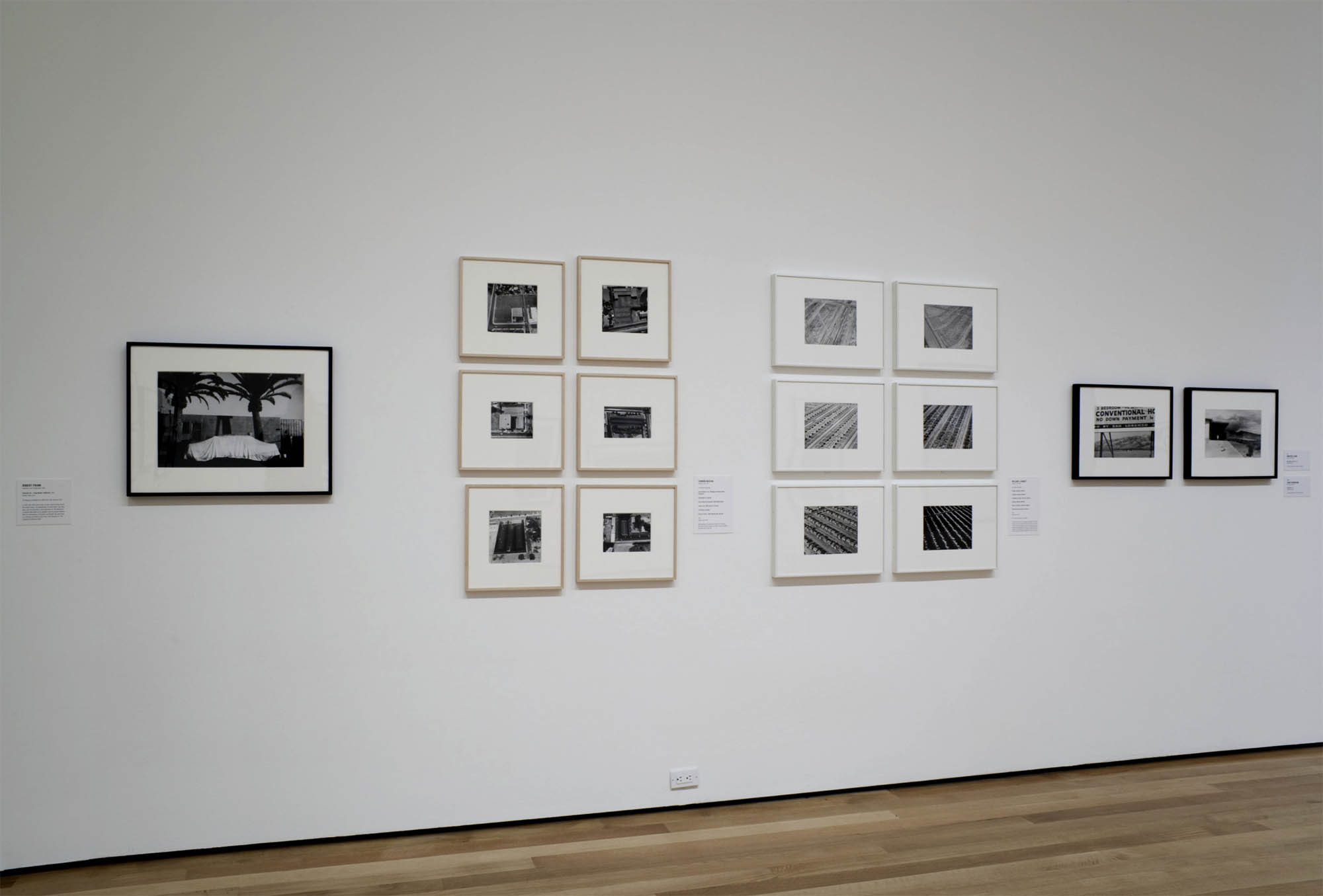
Installation view of the exhibition 'Into the Sunset: Photography's Image of the American West' at The Museum of Modern Art (MoMA), New York showing at left, Robert Frank's 'Covered Car - Long Beach, California' (1956); and at centre right, photographs by William A. Garnett


Installation view of the exhibition Into the Sunset: Photography’s Image of the American West at The Museum of Modern Art (MoMA), New York showing at left, Robert Frank’s Covered Car – Long Beach, California (1956, below); and at centre right, photographs by William A. Garnett (above)


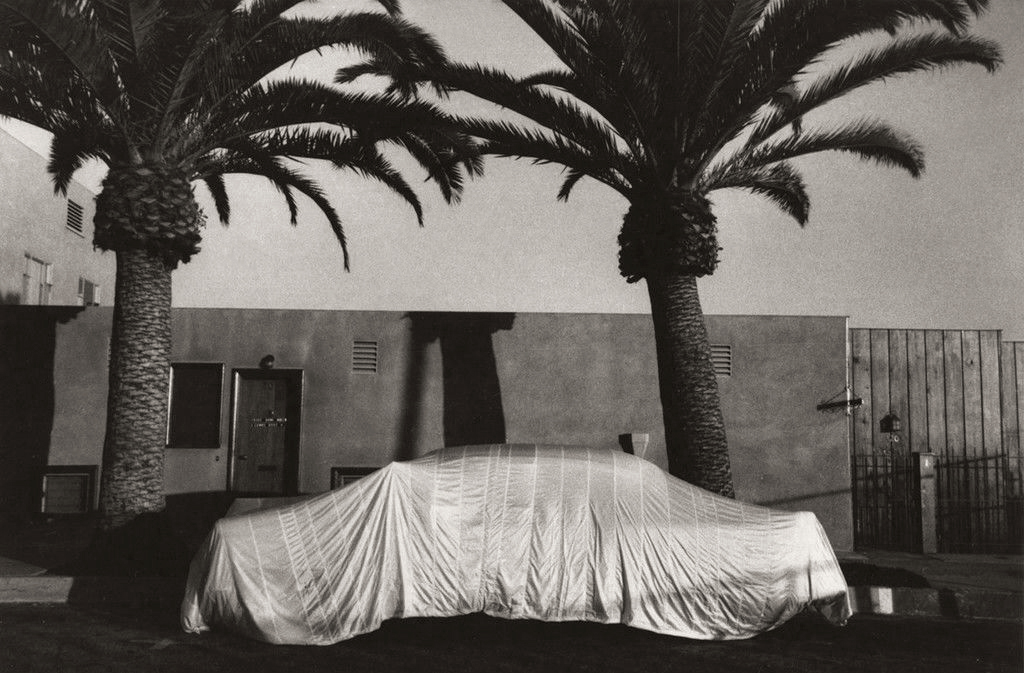
Robert Frank (American, 1924-2019) 'Covered Car - Long Beach, California' 1956


Robert Frank (American, 1924-2019)
Covered Car – Long Beach, California
1956
From The Americans (1955-1956)
Gelatin silver print
Museum of Modern Art, New York


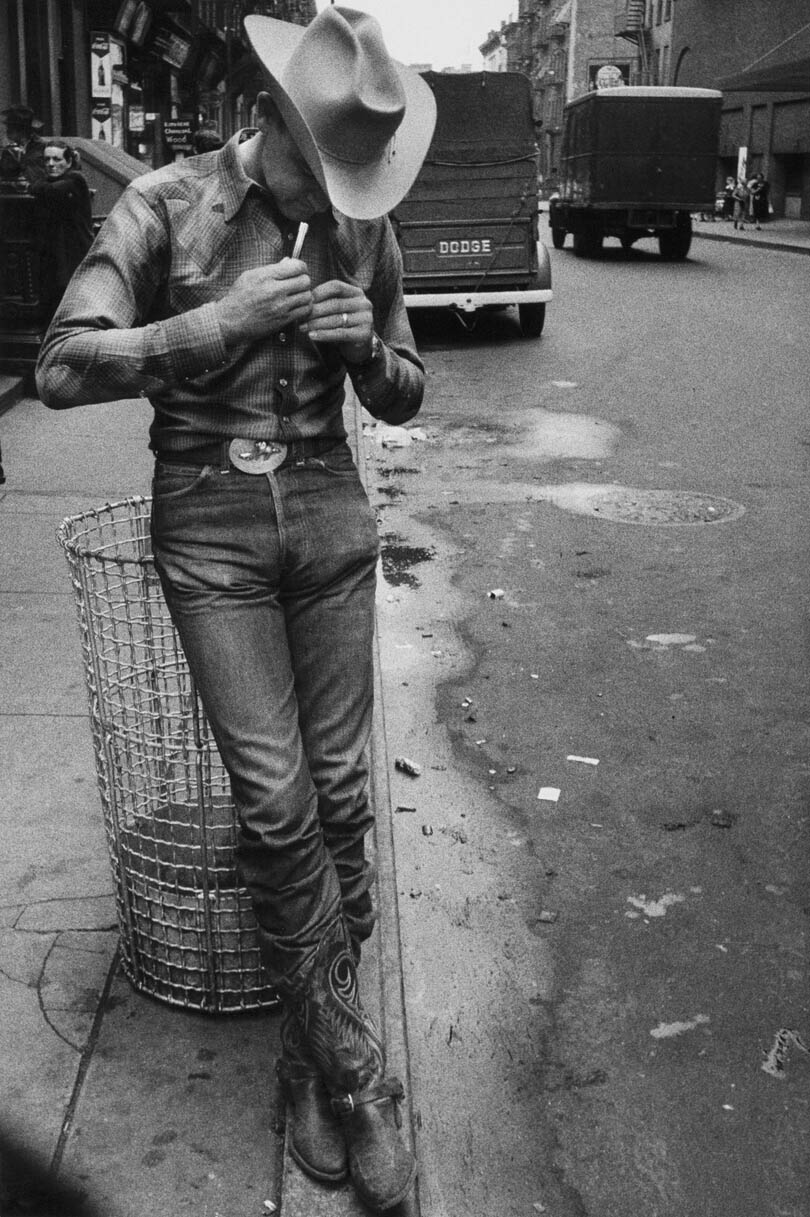
Robert Frank (American, 1924-2019) 'Rodeo - New York City' 1954


Robert Frank (American, 1924-2019)
Rodeo – New York City
1954
From The Americans (1955-1956)
Gelatin silver print
Museum of Modern Art, New York


Dorothea Lange (American, 1895-1965) 'Migrant Mother, Nipomo, California' 1936


Dorothea Lange (American, 1895-1965)
Migrant Mother, Nipomo, California
1936
Gelatin silver print
11 1/8 x 8 9/16″ (28.3 x 21.8cm)
Museum of Modern Art, New York


Dorothea Lange took this photograph on assignment for the U.S. government’s Farm Security Administration (FSA) program, formed during the Great Depression to provide aid to impoverished farmers. FSA photographers documented the conditions that Americans faced throughout the course of the Great Depression, a period of economic crisis. Lange’s photograph suggests the impact of these harsh conditions on a 32-year-old mother of seven. She took a number of pictures of the mother with her children and chose this image as the most effective. Her keen sense of composition and attentiveness to the power of historical images of the Madonna and Child have helped this photograph transcend its original documentary function and become an iconic work of art.

Text from the MoMA website


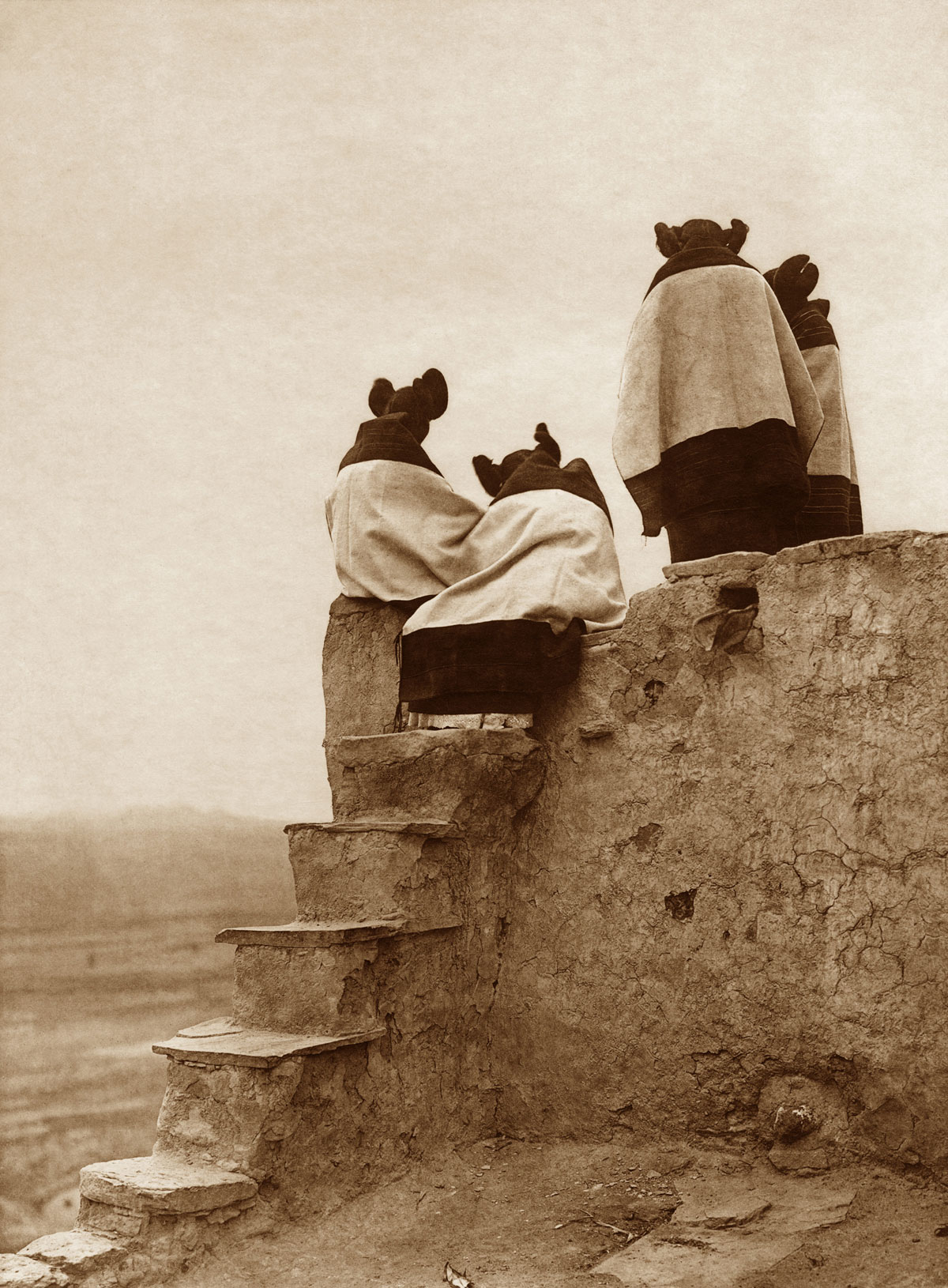
Edward S. Curtis (1868 - 1952) 'Watching the Dancers' 1906


Edward S. Curtis (American, 1868-1952)
Watching the Dancers
1906
Photogravure
Museum of Modern Art, New York


James Luna (American, 1950-2018) 'Half Indian/Half Mexican' 1991


James Luna (American, 1950-2018)
Half Indian/Half Mexican (installation view)
1991
Gelatin silver print


James Luna (February 9, 1950 – March 4, 2018) was a Payómkawichum, Ipi, and Mexican-American performance artist, photographer and multimedia installation artist. His work is best known for challenging the ways in which conventional museum exhibitions depict Native Americans. With recurring themes of multiculturalism, alcoholism, and colonialism, his work was often comedic and theatrical in nature. In 2017 he was awarded a Guggenheim Fellowship.


Richard Prince (American, b. 1949) 'Untitled (Cowboy)' 1989


Richard Prince (American, b. 1949)
Untitled (Cowboy)
1989
Chromogenic print
127 x 177.8cm (50 x 70in.)
The Metropolitan Museum of Art
Purchase, The Horace W. Goldsmith Foundation Gift, through Joyce and Robert Menschel, and Jennifer and Joseph Duke Gift, 2000
© Richard Prince


In the mid-1970s Prince was an aspiring painter who earned a living by clipping articles from magazines for staff writers at Time-Life Inc. What remained at the end of the day were the advertisements, featuring gleaming luxury goods and impossibly perfect models; both fascinated and repulsed by these ubiquitous images, the artist began rephotographing them, using a repertoire of strategies (such as blurring, cropping, and enlarging) to intensify their original artifice. In so doing, Prince undermined the seeming naturalness and inevitability of the images, revealing them as hallucinatory fictions of society’s desires.

“Untitled (Cowboy)” is a high point of the artist’s ongoing deconstruction of an American archetype as old as the first trailblazers and as timely as then-outgoing president Ronald Reagan. Prince’s picture is a copy (the photograph) of a copy (the advertisement) of a myth (the cowboy). Perpetually disappearing into the sunset, this lone ranger is also a convincing stand-in for the artist himself, endlessly chasing the meaning behind surfaces. Created in the fade-out of a decade devoted to materialism and illusion, “Untitled (Cowboy)” is, in the largest sense, a meditation on an entire culture’s continuing attraction to spectacle over lived experience.

Text from the Metropolitan Museum of Art website


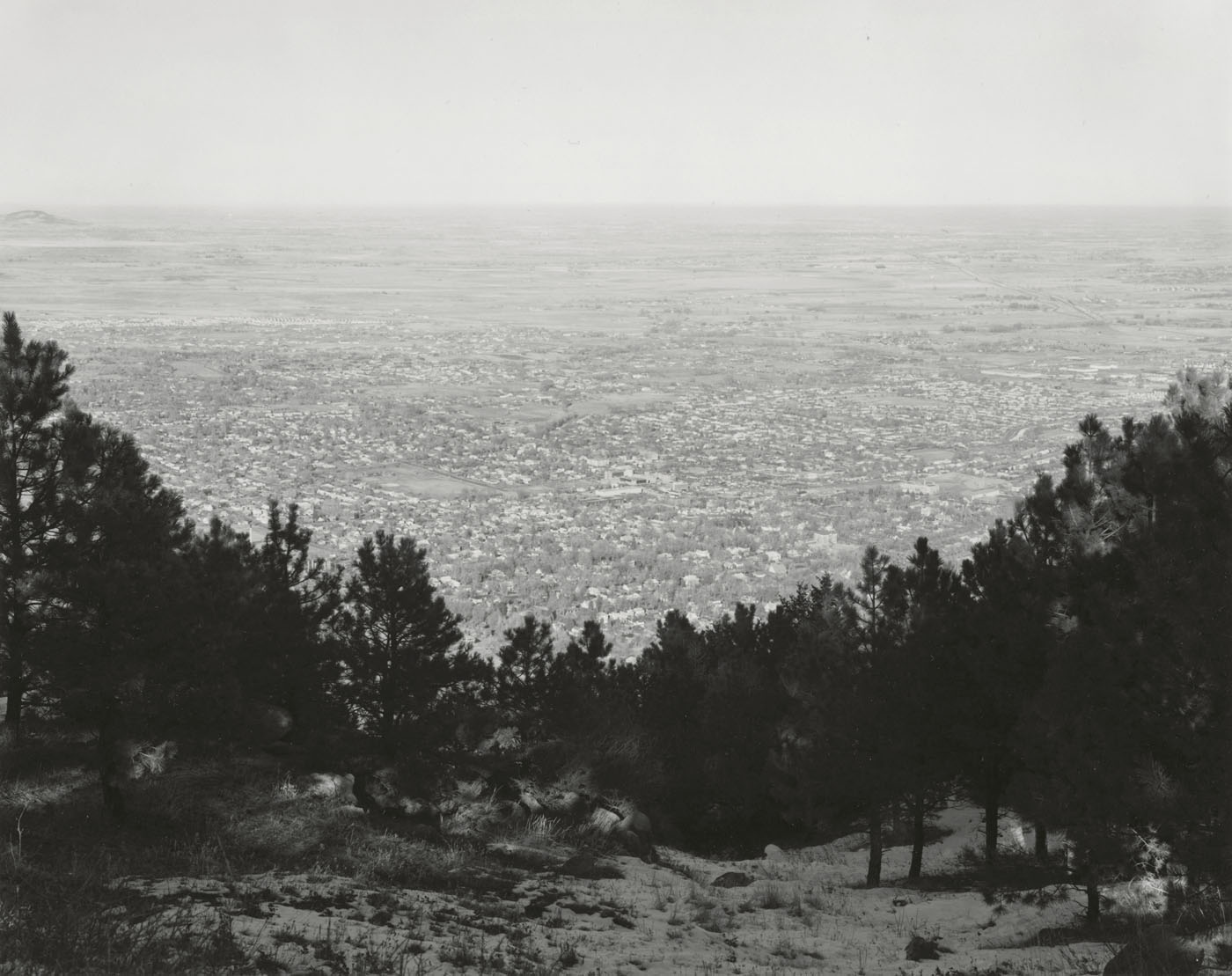
Robert Adams (American, b. 1937) 'East from Flagstaff Mountain, Boulder County, Colorado' 1975


Robert Adams (American, b. 1937)
East from Flagstaff Mountain, Boulder County, Colorado
1975
Gelatin silver print
Museum of Modern Art, New York


Robert Adams (American, b. 1937) 'Colorado Springs' 1968


Robert Adams (American, b. 1937)
Colorado Springs
1968
Gelatin silver print
Museum of Modern Art, New York


Robert Adams (American, b. 1937)
'Burning oil sludge, north of Denver, Colorado' 1973-1974


Robert Adams (American, b. 1937)
Burning oil sludge, north of Denver, Colorado
1973-1974
Gelatin silver print
Museum of Modern Art, New York


Stephen Shore (American, b. 1947) 'Beverly Boulevard and La Brea Avenue, Los Angeles, California, June 21, 1975' From the series 'Uncommon Places', 1973-1986


Stephen Shore (American, b. 1947)
Beverly Boulevard and La Brea Avenue, Los Angeles, California, June 21, 1975
1975
From the series Uncommon Places, 1973-1986
Museum of Modern Art, New York


Katy Grannan (American, b. 1969) 'Nicole, Crissy Field Parking Lot (I)' 2006


Katy Grannan (American, b. 1969)
Nicole, Crissy Field Parking Lot (I)
2006
Pigmented inkjet print
40 x 50″ (101.6 x 127cm)
Cornelius N. Bliss Memorial Fund
Museum of Modern Art, New York
© Katy Grannan


Cindy Sherman (American, b. 1954) 'Untitled Film Still #43' 1979


Cindy Sherman (American, b. 1954)
Untitled Film Still #43
1979
Gelatin silver print
7 9/16 x 9 7/16″ (19.2 x 24cm)
Acquired through the generosity of Sid R. Bass
Museum of Modern Art, New York


Cindy Sherman’s Untitled Film Stills is a suite of seventy black-and-white photographs in which the artist posed in the guises of various generic female film characters, among them, ingénue, working girl, vamp, and lonely housewife. Staged to resemble scenes from 1950s and ’60s Hollywood, film noir, B movies, and European art-house films, the printed images mimic in format, scale, and quality the often-staged “stills” used to promote films. By photographing herself in such roles, Sherman inserts herself into a dialogue about stereotypical portrayals of women. Whether she was the one to release the camera’s shutter or not, she is considered the author of the photographs. However, the works in Untitled Film Stills are not considered self-portraits.

Text from the MoMA website


Bill Owens (American, b. 1938) 'We're really happy. Our kids are healthy, we eat good food, and we have a really nice home' 1972


Bill Owens (American, b. 1938)
We’re really happy. Our kids are healthy, we eat good food, and we have a really nice home
1972
Gelatin silver print
8 1/16 x 9 15/16″ (20.4 x 25.3cm)
Gift of the photographer
Museum of Modern Art, New York
© Bill Owens


Richard Avedon (American, 1923-2004) 'Carl Hoefert, unemployed blackjack dealer, Reno, Nevada', from the series 'In the American West' August 30, 1983


Richard Avedon (American, 1923-2004)
Carl Hoefert, unemployed blackjack dealer, Reno, Nevada
August 30, 1983
From the series In the American West
Gelatin silver print
Museum of Modern Art, New York


The Museum of Modern Art
11 West 53 Street
New York, NY 10019
Phone: (212) 708-9400

Opening hours:
Sun – Fri 10.30am – 5.30pm
Sat 10.30am – 7.00pm

Monday mornings from 10.30am to 1.00pm are reserved exclusively for members and their guests.

MoMA website

LIKE ART BLART ON FACEBOOK

Back to top