
Exhibition dates: 1st June – 15th July 2012
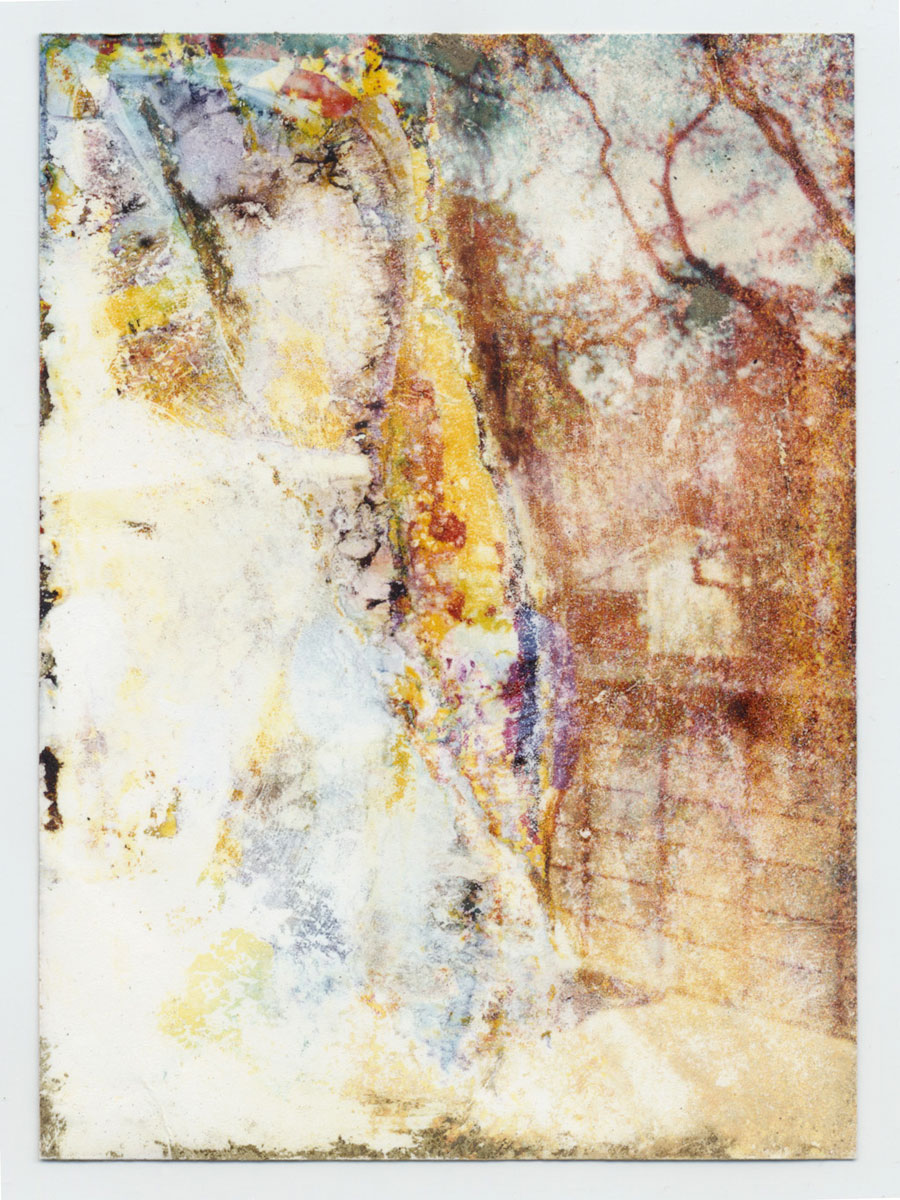
This is a profound exhibition of photographs that have been lost then found. Too damaged to be returned to the families of their missing owners after the 3.11 East Japan Tsunami they have been cleaned, dried, digitally catalogued and put on display. As remnants of disaster they have taken on an ethereal, abstract expressionist beauty.
Like Atget’s photographs (his “documents for artists”) they were never meant to be “art”, but through morphogenesis (‘beginning of the shape’) these snapshots of places, family and friends reveal their inherent form. This beginning of form has been exposed through displacement, washing and erasure. Through this process of erasure these anonymous images reveal their underlying structure with its link to alchemy, as the image dis/appears from view; they have become unfixed (as in the fixer that stabilises the image in the analogue darkroom) from reality. In this process they have become art.
The images are incredibly beautiful.
They hid secrets (of ownership, names, families and places, of time and space).
Something (energy, spirit?) emerges when you least expect it.
Photographs are coded, but usually so as to appear uncoded but here the link to the indexicality of the image – the idea of the visible as evidence of truth – has been broken. These photographs, taken out of their original context, have lost their specific use value in the particular time and place of their consumption. The fragmentation of this use value, together with the dissolution of their formal characteristics, means that they are freed of the conditions that limit and determine their meaning.1 As Annette Kuhn has written in The Power of the Image, “Meanings do not reside in images, then: they are circulated between representation, spectator and social function.”2 And in these images all three things have changed.
Further, the link between the image and its referent, the photograph and the thing being photographed has been irreversibly broken. As the French critic Maurice Blanchot has written, “The image has nothing to do with signification, meaning, as implied by the existence of the world, the effort of truth, the law and the brightness of the day. Not only is the image of an object not the meaning of that object and of no help in comprehending it, but it tends to withdraw it from its meaning by maintaining it in the immobility of a resemblance that it has nothing to resemble.”3 In other words (and especially in these photographs) it is this severance of meaning and its object, this resemblance of nothing.
But think about this idea:
THINK ABOUT THE IDEA OF RE(AS)SEMBLANCE!
DOES THE PHOTOGRAPH REASSEMBLE A SIGNIFICATION, A MEANING WHOLLY ITS OWN, OR IS THAT RE(AS)SEMBLANCE PART OF THE ORIGINAL MEANING OF THE OBJECT PHOTOGRAPHED?
In these photographs there is an obfuscation of reality in which the usually coded photographs now appear to be uncoded in some visceral sense. In fact there is a double obfuscation, a double effacement, as the images are displayed on the wall like a series of bathroom tiles in plastic sleeves, here not at one remove but at two (the clouding of the image and the clouding through the plastic). What emerges from this alchemical miasma is the ghost of the meaning of the object, where we acknowledge that the essence of these people did really exist. The recognition of their presence, this partial reassemblance of the context and meaning of the object originally photographed, is the strength of these images: our acknowledgment of some form of existence in the trace of the photograph, where seeing is subconsciously believing.
What we are left with in these images are vestiges of presence, remnants or traces of people that have passed on. In a kind of divine intervention, these photographs ask the viewer questions about the one fact that we cannot avoid in our lives, our own mortality, and what remains after we pass on. We can never know these people and places, just as we can never know the place and time of our death – when our “time” is up – but these photographs awaken in us a subconscious remembering: that we may be found (in life), then lost (through death), then found again in the gaze of the viewer looking at the photographs in the future present. We are (dis)continuous beings.
There is no one single reading of these photographs for “there are only competing narratives and interpretations of a world that cannot be wholly, accurately described.”4 These indescribable photographs impinge on our consciousness calling on us to remember even as the speed of contemporary life asks us to forget. This ethical act of looking, of mourning and remembering, of paying homage to presence acknowledges that we choose not to let pass into the dark night of the soul these traces of our forebears, for each emanation is deeply embedded within individual and cultural memory.
These photographs are a contemporary form of Western ‘dreaming’ in which we feel a link to the collective human experience. In this reification, we bear witness to the (re)assemblance of life, the abstract made (subconsciously) concrete, as material thing. These images of absent presence certainly reached out and touched my soul.
Vividly, I choose to remember rather than to forget.
Dr Marcus Bunyan
Footnotes
1/ Kuhn, Annette. The Power of the Image: Essays on Representation and Sexuality. London: Routledge and Kegan Paul, 1985, p. 6
2/ Ibid.,
3/ Blanchot, Maurice. The Gaze of Orpheus. New York: Barrytown, 1981, p. 85
4/ Townsend, Chris. Vile Bodies: Photography and the Crisis of Looking. Munich: Prestel, 1998, p. 10
Many thankx to Munemasa Takahashi, Kristian Haggblom and Karra Rees for their help and the CCP for allowing me to publish the photographs in the posting. Please click on the photographs to view a larger version of the image.


Opening of the Lost & Found exhibition at the Centre for Contemporary Photography, Melbourne


Lost & Found is a profoundly moving exhibition of collected photographs recovered from the devastation following the earthquake and tsunami and subsequent nuclear catastrophe that took place in the Tohoku region in 2011. The tsunami not only swept the harbour away, but also houses, cars, trains; and many people lost their lives. Although no longer in the media, people in this region are still in great need. These photographs remind us of their presence and make us aware of their silent voices. The exhibition also gives us an opportunity to think about the relationship people have with their photographs.
The Lost & Found project is attempting to return pictures from the collection to their owners by cleaning, cataloguing and creating a digital database of the photographs. Many images were too badly damaged and can not be returned; rather than discard them, the project team decided to exhibit the imagery and give people the opportunity to see these photographs in the belief that they carry powerful messages. This project was initiated by Munemasa Takahashi and Hiroshi Hatate in Japan and Kristian Haggblom from Wallflower Photomedia Gallery in Australia. Funds raised will go directly to the people of Yamamoto-cho.
Text from the CCP website


All photographs are from the exhibition Lost & Found
Centre for Contemporary Photography
No permanent exhibition space at the moment


 Art Blart _ art and cultural memory archive
You must be logged in to post a comment.