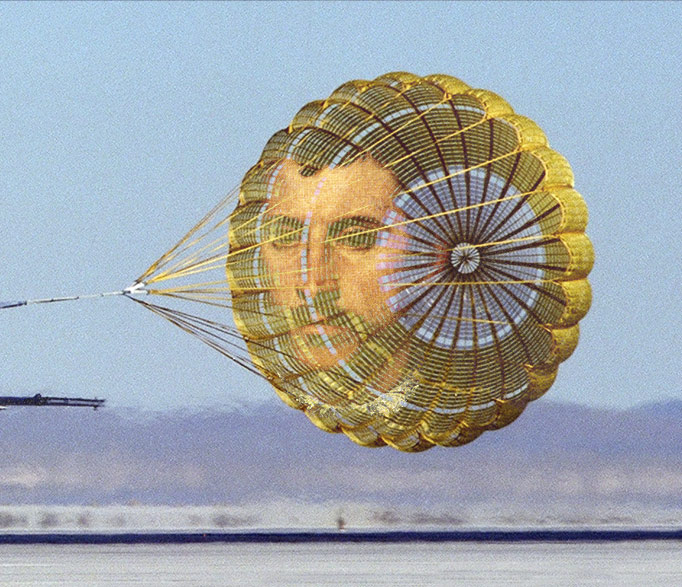
Exhibition: ‘Charting the Canyon: Photographs by Mark Klett and Byron Wolfe’ at Phoenix Art Museum

Exhibition dates: 21st March – 12th July, 2009
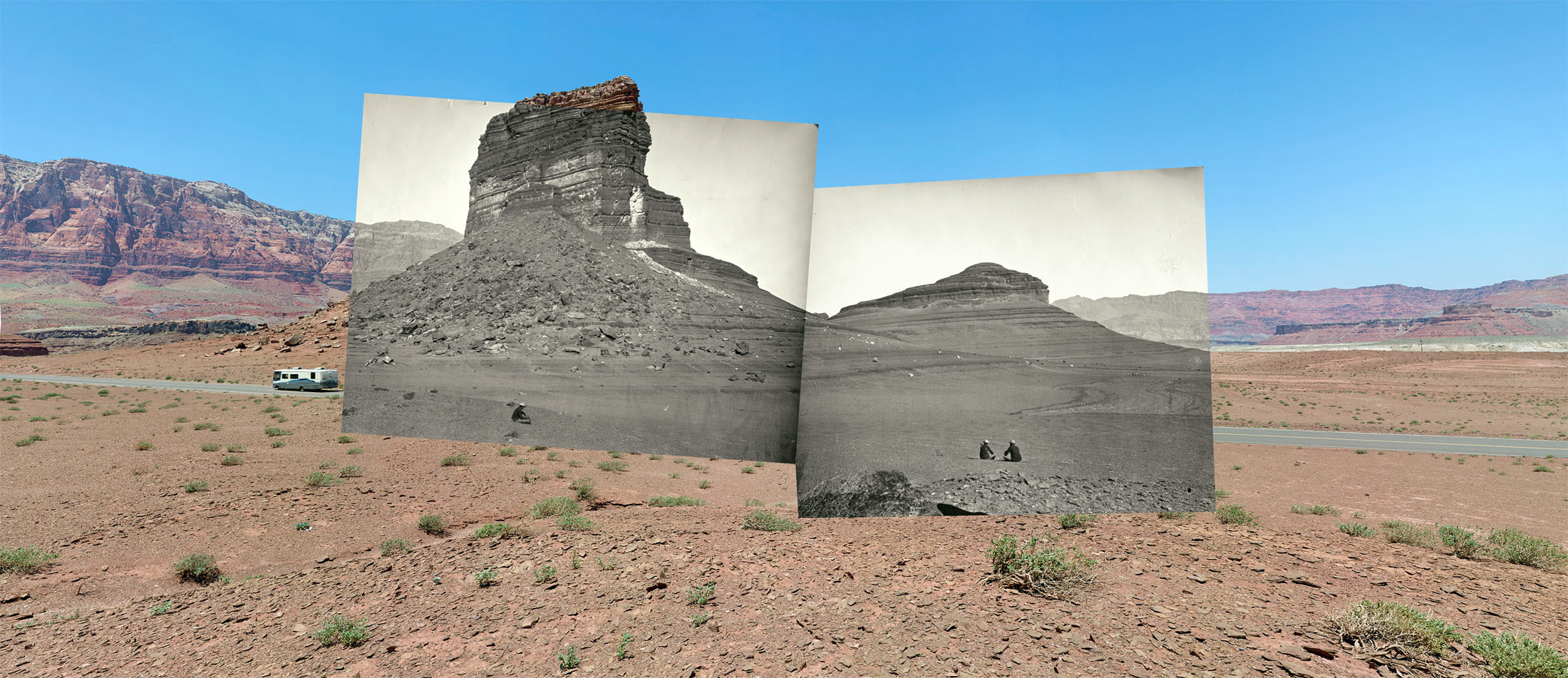
 

Mark Klett and Byron Wolfe. 'Rock formations on the Road to Lee's Ferry, Arizona' 2008 from the exhibition 'Charting the Canyon: Photographs by Mark Klett and Byron Wolfe' at Phoenix Art Museum, March - July, 2009


Mark Klett and Byron Wolfe
Rock formations on the Road to Lee’s Ferry, Arizona
2008
Digital inkjet print
36″ h x 76″ w

Left inset: William Bell. Plateau North of the Colorado River near the Paris 1872 (courtesy National Archives)
Right inset: William Bell. Headlands North of the Colorado River 1872 (courtesy National Archives)


An interesting concept but I’m not entirely sure that the images are successful. Some work better than others. Perhaps it is not necessary for there to be an absolute registration across time and space, the continuation of a horizon line for example. The famous photographic collages by David Hockney are a case in point.

It doesn’t matter when the images were made, whether there is a second, or a century, between compositions. The camera and the artist are always selective, the camera always privileging one view over another view: all images are therefore constructions. Hockney pushes the boundaries of these constructions whereas I don’t think these images do to anywhere near the same extent.

There were some vaguely interesting videos on the Phoenix Art Museum website about the starting point, discovery, process and collaboration for the work which are no longer available. There is one video available on the Klett and Wolfe website.

Dr Marcus Bunyan


Many thankx to Phoenix Art Museum for allowing me to publish the photographs in the posting. Please click on the photographs for a larger version of the image.
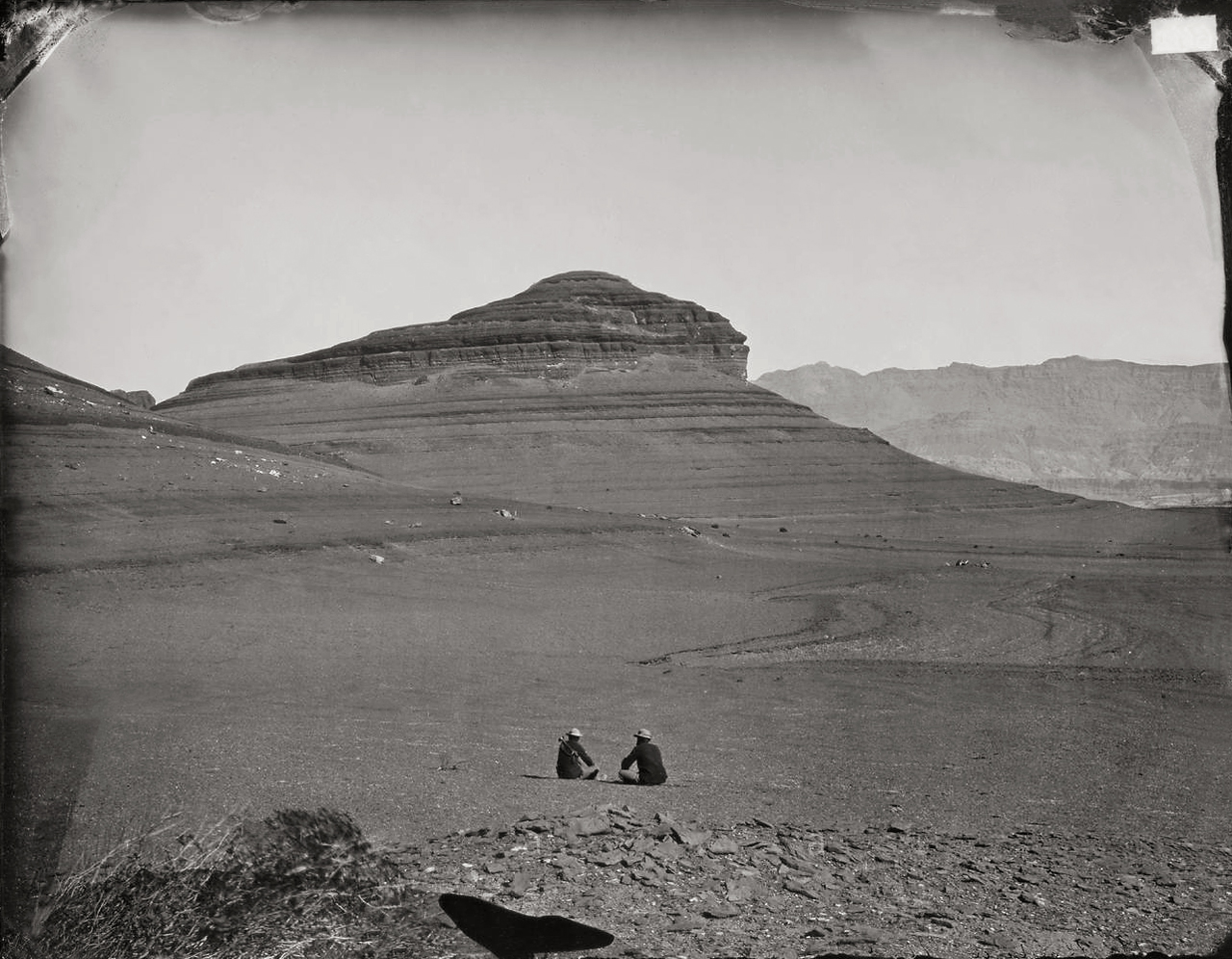


William H. Bell (1830 - January 28, 1910) 'Headlands North of the Colorado River' 1872 from the exhibition 'Charting the Canyon: Photographs by Mark Klett and Byron Wolfe' at Phoenix Art Museum, March - July, 2009


William H. Bell (American, 1830-1910)
Headlands North of the Colorado River
1872
Still Picture Records Section, Special Media Archives Services Division
Courtesy National Archives


Arizona’s Grand Canyon – natural wonder, national park, tourist attraction, sacred land – is perhaps the world’s best “photo op.” The collaborative photographic team of Mark Klett and Byron Wolfe have set out to explore this celebrated place of dramatic beauty, and Phoenix Art Museum is proud to be the first to show a comprehensive look at their powerful, thoughtful, and playful approach to the Grand Canyon.

Drawn from two seasons of fieldwork, Charting the Canyon will include about 30 photographs ranging from a modest 20 by 20-inch print to a panorama nearly 10 feet wide. Mark Klett, a Regents Professor at Arizona State University, and Byron Wolfe, a former student of Klett’s who is now a Lantis’ University Professor teaches at California State University at Chico, have been interested in rephotographing historic images since their collaboration began in 1997.

Now the pair combines their own colour photographs with imagery by 19th-century photographer J. K. Hillers and artist William Holmes and by Ansel Adams and Edward Weston, who worked at the Canyon in the early 20th century. Klett and Wolfe respond to the historic images and the Canyon itself, yielding artworks that reconsider an icon, challenge how we perceive the land, and bring a new perspective to its portrayals.

Charting the Canyon offers visual delights: the humorous layering of a 19th-century drawing with contemporary photographic details, the extension of an Ansel Adams view into a serene panorama, and the illusion of three-dimensions with a stereopticon viewer built for the twenty-first century, among others to be discovered in this unique exhibition.

Text from the Phoenix Art Museum website [Online] Cited 20/04/2009. No longer available online
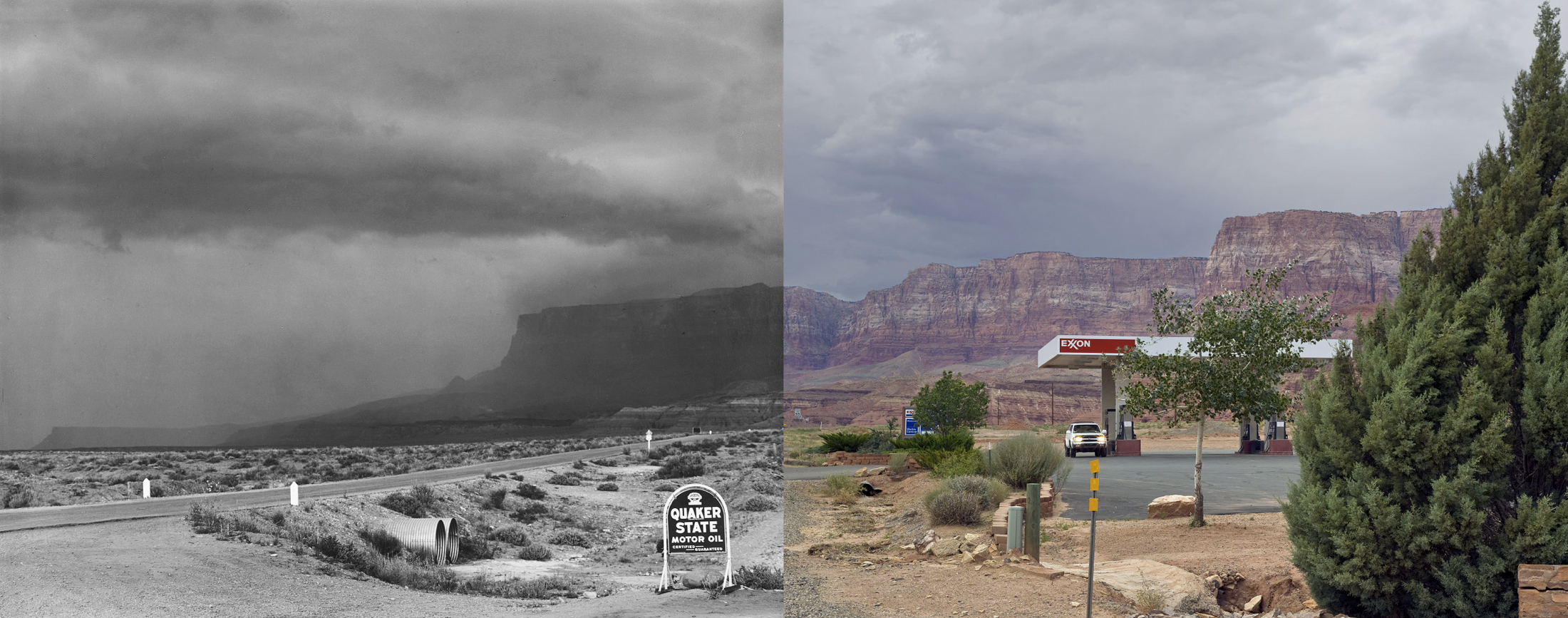
 

Mark Klett and Byron Wolfe. 'Sixty-six years after Edward Weston's "Storm, Arizona" From the Marble Canyon Trading Post' 2007


Mark Klett and Byron Wolfe
Sixty-six years after Edward Weston’s “Storm, Arizona” From the Marble Canyon Trading Post
2007
Digital inkjet print
16″ h x 38.75″ w

Left: Edward Weston. Storm, Arizona 1941 (courtesy of the Center for Creative Photography, Tucson)
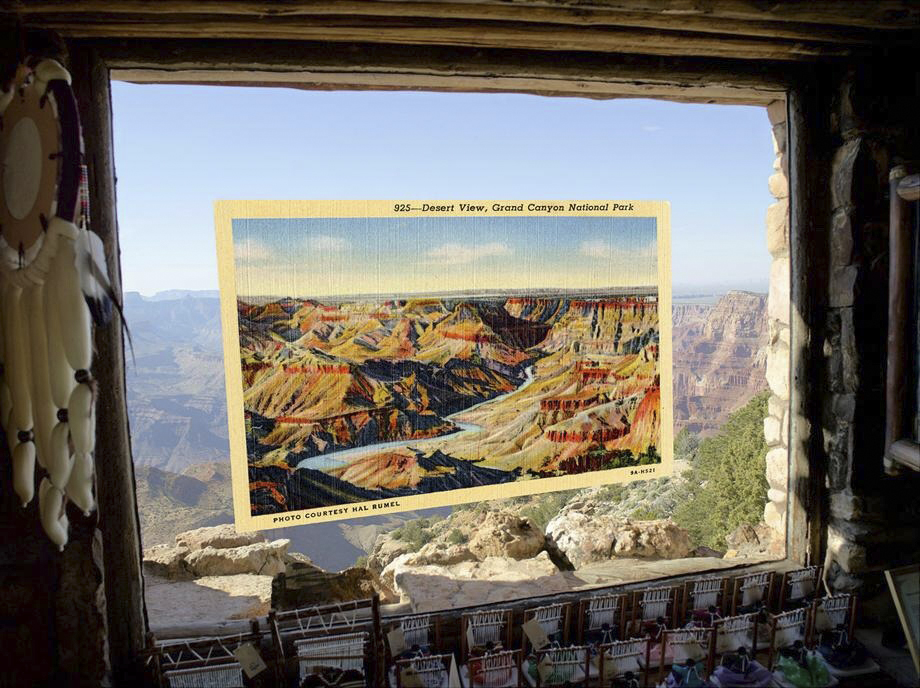
 

Mark Klett and Byron Wolfe. 'Desert View: from the window of the Watchtower gift shop' 2008


Mark Klett and Byron Wolfe
Desert View: from the window of the Watchtower gift shop
2008


The Grand Canyon – natural wonder, sacred ground, national park, international tourist attraction – is perhaps the world’s best “photo op.” Vivid colours, breathtaking vistas and jaw dropping canyon depths have lured photographers to Northern Arizona for years. A new exhibition, Charting the Canyon: Photographs by Mark Klett and Byron Wolfe on view at Phoenix Art Museum through July 12, 2009, explores this celebrated place of dramatic beauty with large-scale sweeping panoramas that marry 21st century colour photographs with historic drawings and images.

In 2007, Mark Klett, a Regents Professor at Arizona State University, and Byron Wolfe, a former student of Klett’s and now a Lantis’ University Professor at California State University at Chico, headed to the Grand Canyon to re-envision the many images made at the site over the last 150 years. During two summers of field work, they identified the exact locations portrayed in early photographs and drawings. From those geographic points they created new photographs that incorporate the original view. Digital versions of the historic images are inserted within the contemporary photograph, creating combined images that convey the big picture surrounding earlier artists’ depicted view.

Working collaboratively, Klett and Wolfe challenge one another to invent new ways to integrate the historic images they discover. Charting the Canyon reveals their combined invention, offering provocative ways to think about the land, its history and our role in seeing it.

“Many of the things we’re trying to do seemed impossible at first – like merging several views of a scene from different times into a continuous space, or extending one photo’s frame to include spaces from multiple vantage points,” commented Klett. “We’re intentionally using playfulness as a way to stretch ideas, a kind of free form exploration that puts a premium on creative solutions to complex space and time problems.”

“The pleasure the artists experienced in the creative process comes through in their work. Charting the Canyon is a joyful exploration allowing Museum visitors to discover the Grand Canyon in a new and thought-provoking way,” commented Rebecca Senf, Norton Family Assistant Curator of photography, Phoenix Art Museum. “Phoenix Art Museum is proud to be the first to show a comprehensive look at Klett and Wolfe’s powerful, thoughtful and playful images.”

Charting the Canyon includes 26 photographs ranging from a modest 20 by 20-inch print to a panorama 10 feet wide. Exhibition highlights include:
The humorous layering of a 19th-century drawing with contemporary photographic details.
The extension of an Ansel Adams view into a serene panorama.
The pairing of a black-and-white Edward Weston view with a colour image made 66 years later.
The illusion of three-dimensions with a stereopticon viewer built for the 21st century.

Text from Artdaily.org website


Mark Klett and Byron Wolfe. 'Point Imperial on the Grand Canyon' 2008


Mark Klett and Byron Wolfe
Point Imperial on the Grand Canyon, 50% Ansel Adams, 50% Red Wall Limestone
2008

Left: Ansel Adams. Grand Canyon National Park, Arizona 1941
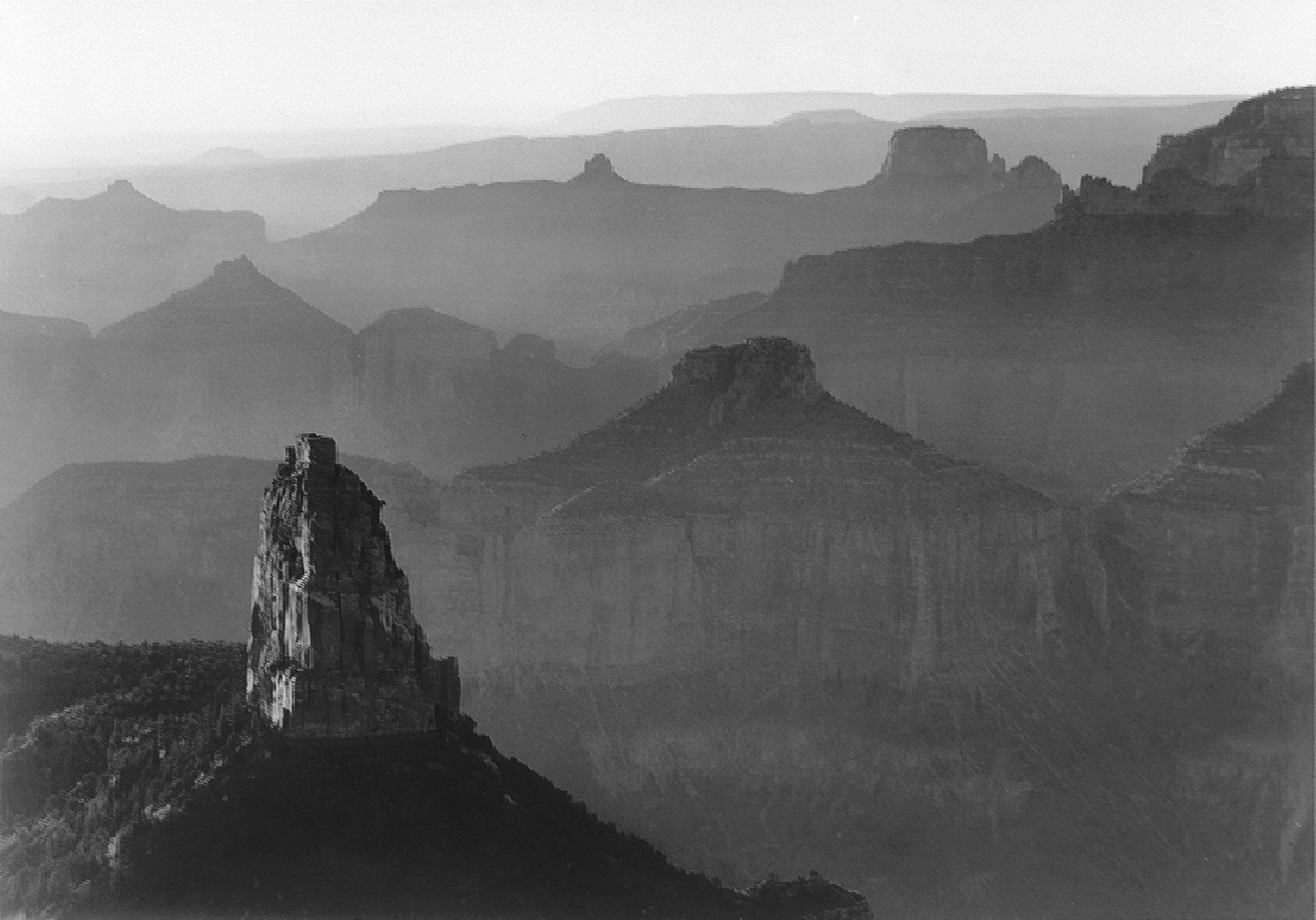
 

Ansel Adams (1902-1984) 'Grand Canyon National Park, Arizona' 1941


Ansel Adams (American, 1902-1984)
Grand Canyon National Park, Arizona
1941
Gelatin silver print

 

Mark Klett and Byron Wolfe. 'Panorama from Hopi Point on the Grand Canyon, made over two days extending the view of Ansel Adams' 2007 


Mark Klett and Byron Wolfe
Panorama from Hopi Point on the Grand Canyon, made over two days extending the view of Ansel Adams
2007

Right: Ansel Adams. Grand Canyon National Park, Arizona 1941 (Courtesy of the Center for Creative Photography, Tucson, AZ)


Ansel Adams (1902-1984) 'Grand Canyon National Park, Arizona' 1941


Ansel Adams (American, 1902-1984)
Grand Canyon National Park, Arizona
1941
Gelatin silver print
Courtesy of the Center for Creative Photography, Tucson, AZ


“We’re intentionally using playfulness as a way to extend ideas, a kind of free-form exploration that puts a premium on creative solutions to complex space and time problems. Many of the things we’re trying to do seemed impossible at first – like merging several views of a scene from different times into a continuous space, or extending one photo’s frame to include spaces from multiple vantage points.”

Klett and Wolfes process of inserting historic views within contemporary photographs, or linking a number of different historic views, emphasises the possibilities of multiple interpretations of a single landscape. If we look at a photograph of the Grand Canyon, we bring to it our own cultural notions, myths, and memories, and read it based on our personal point of view. By bringing together images made throughout time, Klett and Wolfe remind us that any terrain is not only what we see and think about it in this present moment, but it is part of a long evolution of thought and use that includes the past and future, as well. The team’s photographs present time as overlapping layers, much like the stratigraphic rock of the Canyon. This unconventional presentation encourages viewers to see time as a flexible construction.

Text by Rebecca Senf, Assistant Curator of photography, Phoenix Art Museum from the exhibition brochure [Online] Cited 20/04/2009. No longer available online
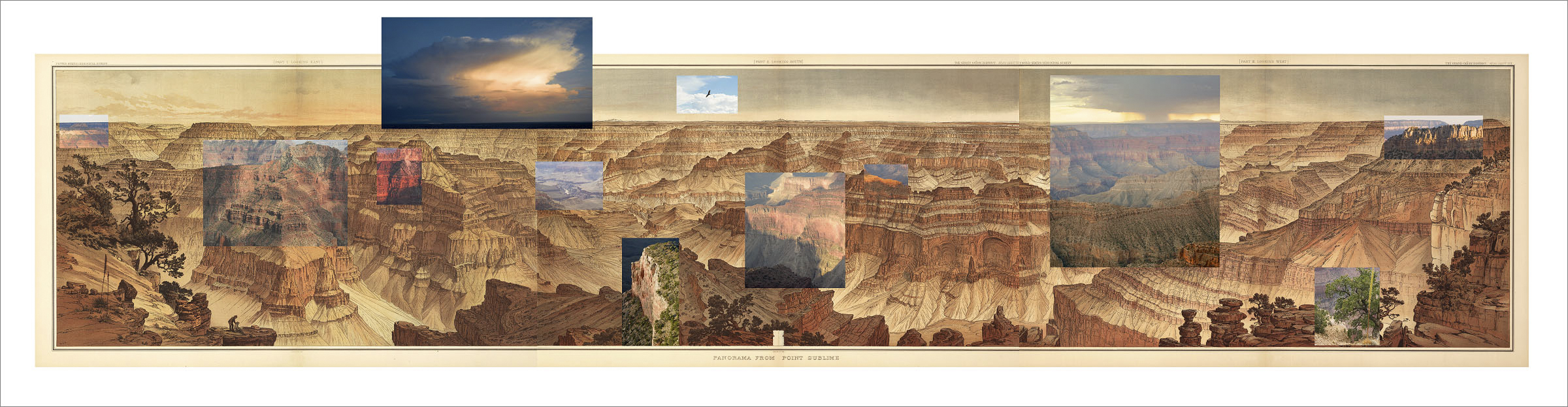
 

Mark Klett and Byron Wolfe. 'Details from the view at Point Sublime on the north rim of the Grand Canyon, based on the panoramic drawing by William Holmes (1882)' 2007


Mark Klett and Byron Wolfe
Details from the view at Point Sublime on the north rim of the Grand Canyon, based on the panoramic drawing by William Holmes (1882)
2007

Lithograph by William Henry Holmes, 1882. From Clarence Dutton, Atlas to Accompany the Monograph on the Tertiary History of the Grand Cañon District. (Courtesy of the Library of Congress).
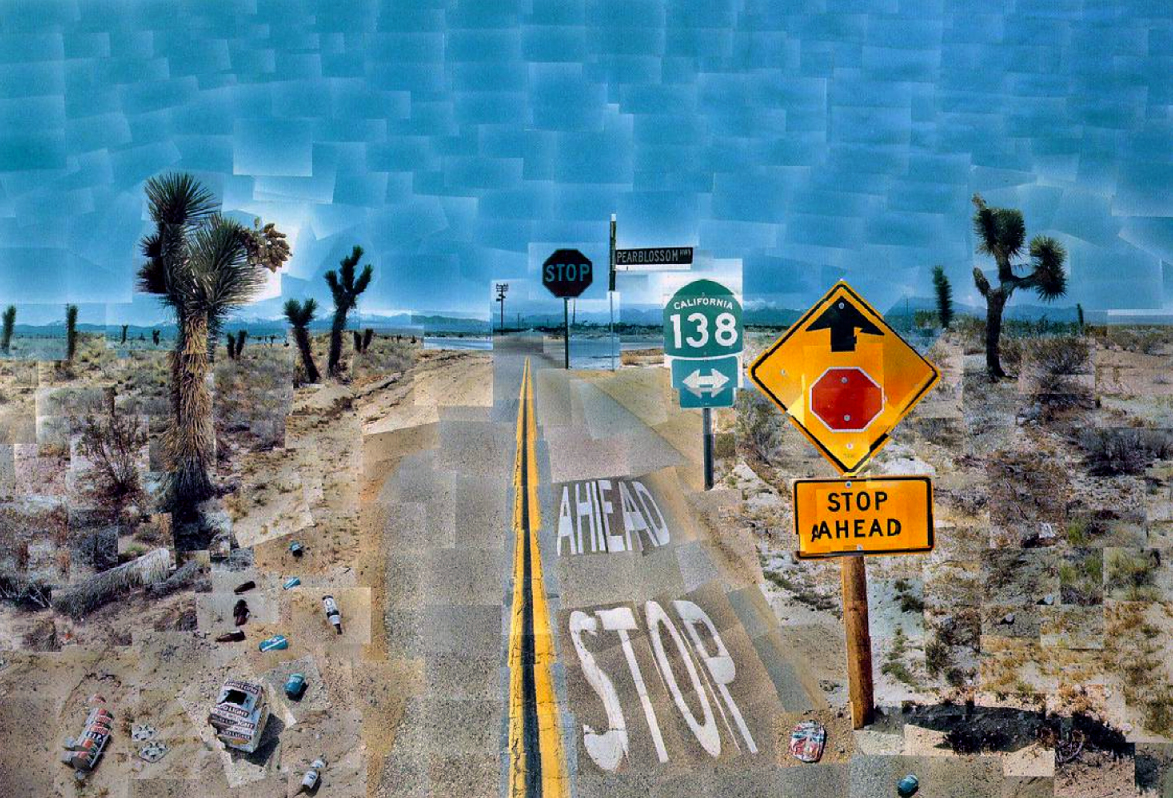
 

David Hockney (English, b. 1937) 'Pearblossom Highway., 11 - 18th April 1986 #2' 1986


David Hockney (English, b. 1937)
Pearblossom Highway., 11-18th April 1986 #2
1986


Phoenix Art Museum
McDowell Road & Central Avenue
1625 N. Central Avenue
Phoenix, AZ 85004

Opening hours:
Monday: Closed
Tuesday: Closed
Wednesday: 10am – 9pm
Thursday – Sunday: 10am – 5pm

Phoenix Museum of Art website

Byron Wolfe website

LIKE ART BLART ON FACEBOOK

Back to top

Opening: ‘Nicola Loder: Tourist #3 sighted child 1-11’ at Helen Gory Gallery, Melbourne

Exhibition dates: 15th April – 2nd May, 2009


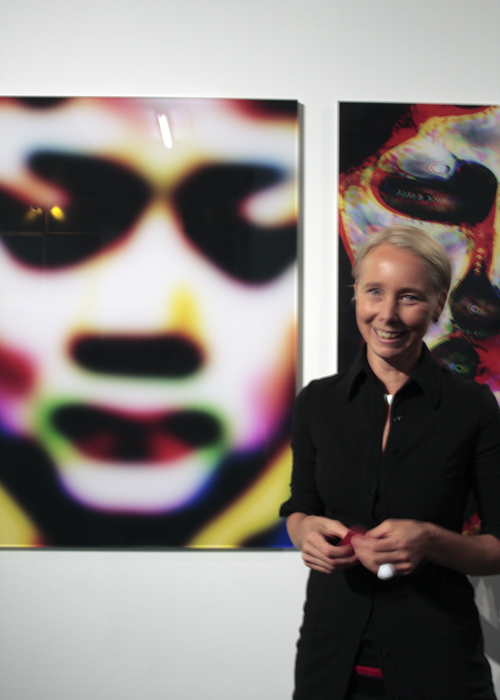
Installation photograph of the opening of Nicola Loder's exhibition 'Tourist #3 sighted child 1-11' at Helen Gory Gallery, Melbourne


Installation photograph of the opening of Nicola Loder’s exhibition Tourist #3 sighted child 1-11 at Helen Gory Gallery, Melbourne


A wonderful, social opening at Helen Gory Gallery of Nicola Loder’s latest work in her ongoing Tourist photographic series. As always Loder’s work looks superb, the mounting of the images at the back of thick perspex giving the images an almost holographic 3D effect. I still remember her exhibition of black and white children’s faces at the sadly closed Stop 22 Gallery in St Kilda many years ago: those images still impinge on the subconscious. This work continues those themes of instability in the mapping of identity, how we begin to see, to represent ourselves as an individual entity. Speaking of Stop 22 it was great to see Marianne, ex curator of that gallery at the opening with new bub in tow! There is an excellent catalogue essay by Stuart Koop (below).

Dr Marcus Bunyan


Many thankx to Nicola Loder and Helen Gory Gallery for allowing me to publish the photographs in the posting. Please click on the photographs for a larger version of the image.


Installation photograph of the opening of Nicola Loder's exhibition 'Tourist #3 sighted child 1-11' at Helen Gory Gallery, Melbourne


Installation photograph of the opening of Nicola Loder’s exhibition Tourist #3 sighted child 1-11 at Helen Gory Gallery, Melbourne


“We might think of Loder’s work as ‘undoing’ visuality. She sets technology in reverse, working against the imperatives of photography to clarify, focus, refine and sharpen images, as if our eyes worked backwards, as if acuity worsened. The face is an obvious (originary) limit beyond which chaos prevails and other senses are engaged to interpret what looks like abstract static but which many now believe is an unstriated sensory realm, a liberated space of interrelated, undifferentiated holistic sensory experiences; the original synaesthesia from which perception emerges as a travesty according to 5 distinct categories.

So it’s not blindness after all that the work references, not the failing of vision, but the first moments of looking, when ‘seeing’ begins to separate from the other senses and consolidates into a face, a percept, then into a code, a genre, a representation.”

Stuart Koop


Installation photograph of the opening of Nicola Loder's exhibition 'Tourist #3 sighted child 1-11' at Helen Gory Gallery, Melbourne


I don’t know who the lady and the bub are but thank you for the wonderful photograph – children upon children!


Nicola Loder (Australian, b. 1964) 'Tourist #3 sighted children 1-11' 2009


Nicola Loder (Australian, b. 1964)
Tourist #3 sighted child 1-11
2009
1200mm x 900mm,
lambda digital prints,10mm acrylic


The radiant Nicola Loder in front of one of her works


The radiant Nicola Loder in front of one of her works


Helen Gory Gallery

This gallery has now closed.

Nicola Loder website

LIKE ART BLART ON FACEBOOK

Back to top

Book: ‘Thomas Ruff: jpegs’ from Aperture Foundation

March 2009


Thomas Ruff (German, b. 1958) 'jpeg sh01' 2005


Thomas Ruff (German, b. 1958)
jpeg sh01
2005
C-print
© Thomas Ruff


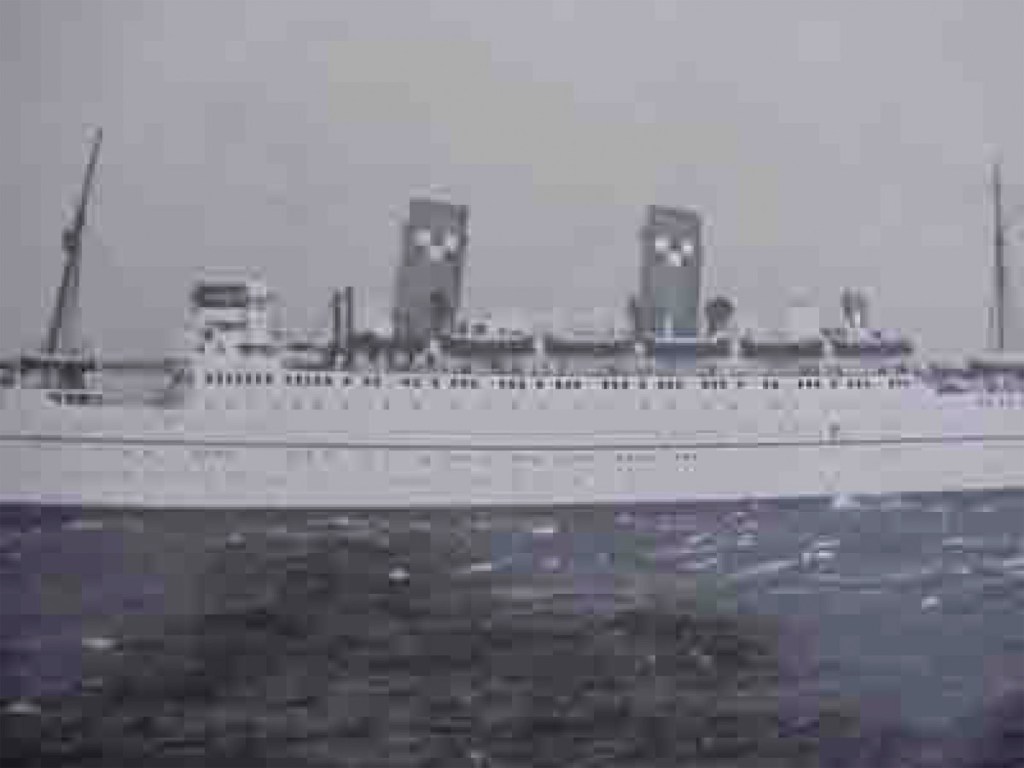
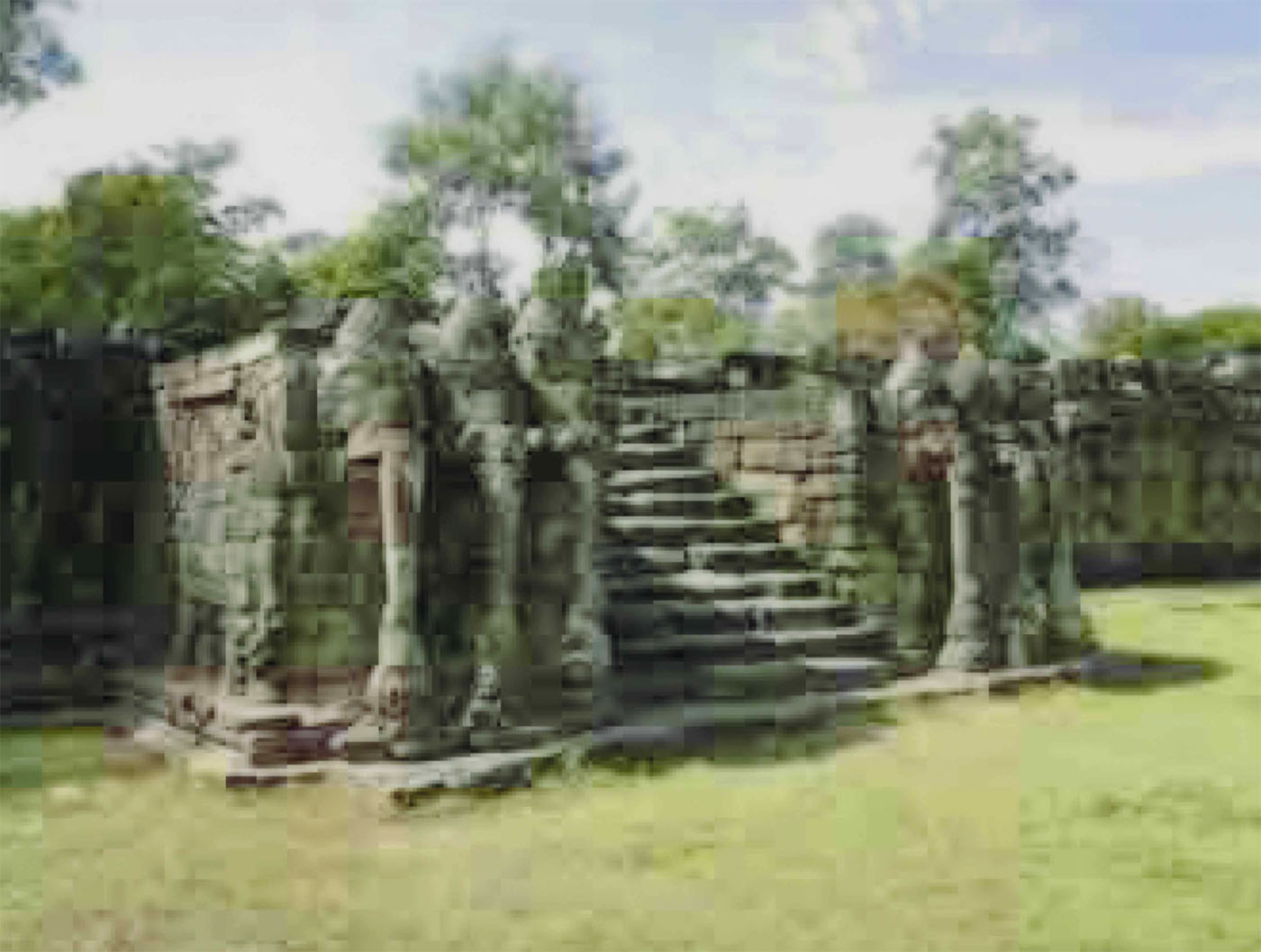
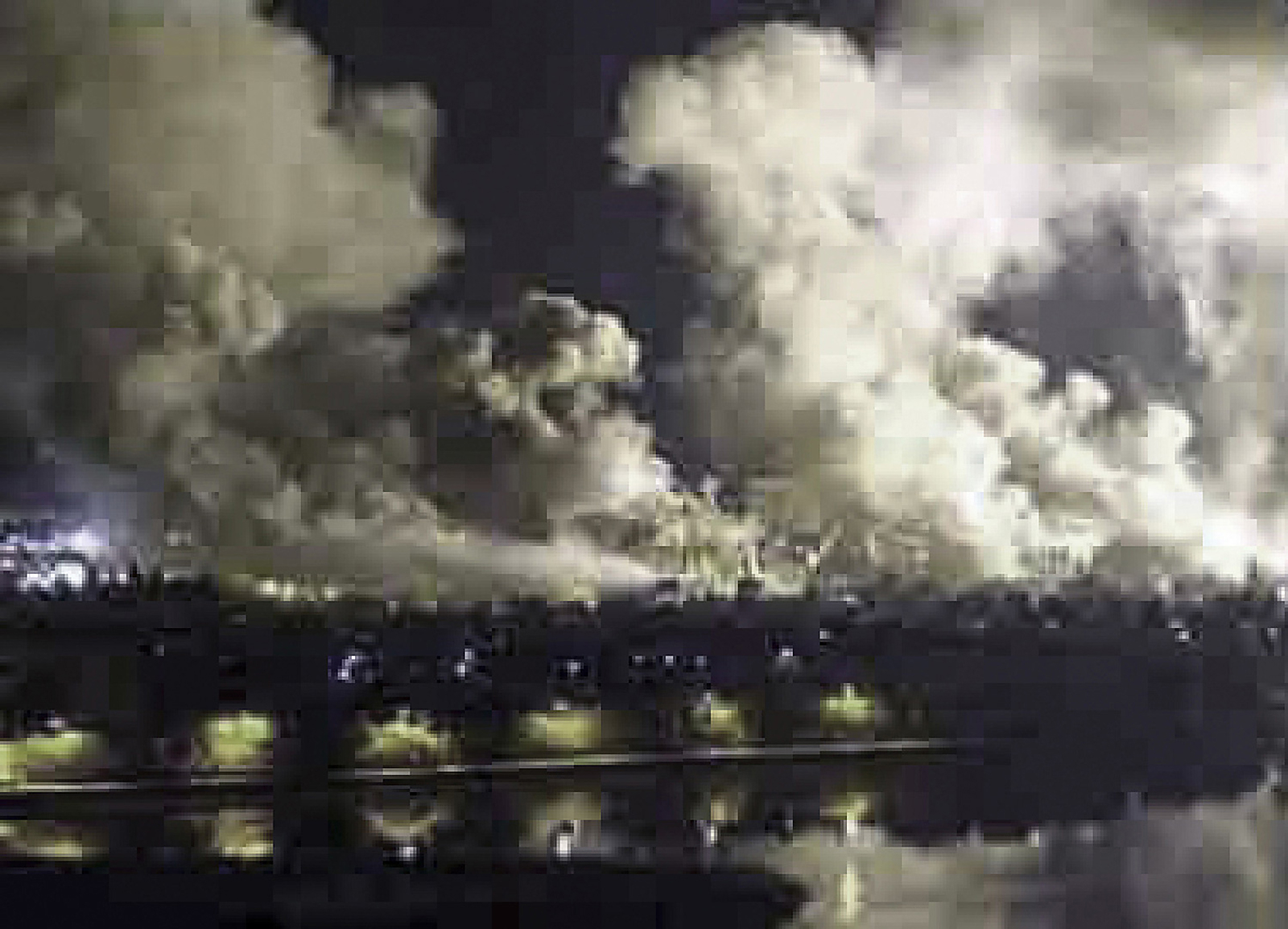
I greatly admire this series of work. It takes a very special artist and a very special person to look at the world – and specifically how the world is represented and presented to us in scrappy, low quality jpgs – and recognise a different perspective, an alternate reality that is staring us in the face, that is confronting us every single day. No body but Ruff did.

Great artists are always ahead of their time, always probing beyond, offering up a mirror to an inchoate, uninformed society. Robert Frank did it with The Americans in the 1950s, and the Americans didn’t like what they were being shown by an outsider, a foreigner. Lee Friedlander did it in the 1970s with his segmented images and reflections, his informality and perspicacity. Now Ruff abstracts an already abstracted and distracted world, a world flooded with meaningless images. He makes giant the landscape, war, eruption, disruption and destruction until when we approach too close… the image dissolves before our eyes. Into nothingness. We retreat in confusion.

He is aware, while so many of us are unaware. He is fully conscious and observant of the processes and effects of contemporary digital photography. And yet. And yet, these fractured images approach the sublime in some mysterious way.

Dr Marcus Bunyan


Thomas Ruff (German, b. 1958) 'jpeg ca02' 2004
Screenshot


Thomas Ruff (German, b. 1958)
jpeg ca02
2004
C-print
© Thomas Ruff


“How much visual information is needed for image recognition? A pretty small quantity of data will go a long way for the brain and the computer, both of which take shortcuts for the sake of speedy comprehension. In the Jpegs series, German photographer Thomas Ruff exploits this imprecision in digital technology, locating online jpegs and enlarging them until the pixels emerge in a chessboard pattern of near abstraction. A closer look at these images reveals that, in addition to the degeneration of the image into a digital grid, the colour and brightness generated by the algorithms of the compression also become visible. Many of Ruff’s works in this series focus on idyllic, seemingly untouched landscapes, or conversely, on scenes of war and nature disturbed by human manipulation – subjects ill suited to disruptive pixelation, and therefore perfect for Ruff’s purposes. Taken together, these images constitute an encyclopaedic compendium of contemporary visual culture that also engages the history of landscape painting. A fittingly deluxe and oversize volume, Jpegs is the first monograph dedicated exclusively to this monumental series.”

Text from the Amazon website


Thomas Ruff (German, b. 1958) 'jpeg cdf01' 2004


Thomas Ruff (German, b. 1958)
jpeg cdf01
2004
C-print
69 5/8 x 87 3/4 in. (177 x 223cm)
© Thomas Ruff


Thomas Ruff (German, b. 1958) 'jpeg bb03' 2007


Thomas Ruff (German, b. 1958)
jpeg bb03
2007
C-print
72 7/8 x 98 1/4 in. (185.1 x 249.56cm)
© Thomas Ruff


Thomas Ruff (German, b. 1958) 'jpeg ny02' 2004


Thomas Ruff (German, b. 1958)
jpeg ny02
2004
C-print
© Thomas Ruff


Thomas Ruff is among the most important international photographers to emerge in the last fifteen years, and one of the most enigmatic and prolific of Bernd and Hilla Becher’s former students, a group that includes Andreas Gursky, Thomas Struth, Candida Höfer, and Axel Hutte. In 2007, Ruff completed his monumental and very timely Jpegs series in which he explores the distribution and reception of images in the digital age. Starting with images he culls primarily from the Web, Ruff enlarges them to a gigantic scale, which exaggerates the pixel patterns, until they become sublime geometric displays of colour. A fittingly deluxe and oversized volume, Jpegs (Aperture, June 2009) is the first monograph dedicated exclusively to the publication of Ruff’s remarkable series.

When viewed up close the images in Jpegs look abstract; as you move away they merge into decipherable photographic images. Like Impressionistic paintings, Ruff’s photographs require the viewer’s active participation and shift in perspective in order to make a complete assessment of the image content. The work ranges from idyllic, seemingly untouched landscapes and popular tourist spots, to scenes of war and nature disturbed by human manipulation. Places and global events that have defined the visual media world of recent decades are represented, including the familiar, almost iconic pictures of atomic bomb tests; 9/11; scenes of warfare in Baghdad, Beirut, and Grozny; the killing fields of Cambodia; and the ravaged Asian coasts after the 2004 tsunami, among others. Taken together, these masterworks create an encyclopaedic compendium of contemporary visual culture that also actively engages the history of landscape painting. Jpegs is a testament to the effects of the digital age on the medium of photography.

Text from Artdaily.org website


Thomas Ruff (German, b. 1958) 'jpeg soi01' 2005


Thomas Ruff (German, b. 1958)
jpeg soi01
2005
C-print
© Thomas Ruff


Thomas Ruff (German, b. 1958) 'jpeg msh01' 2004


Thomas Ruff (German, b. 1958)
jpeg msh01
2004
C-print
© Thomas Ruff


Thomas Ruff (German, b. 1958) 'jpeg ny01' 2004


Thomas Ruff (German, b. 1958)
jpeg ny01
2004
C-print
276 × 188cm
© Thomas Ruff


Thomas Ruff (German, b. 1958) 'jpeg td02' 2006


Thomas Ruff (German, b. 1958)
jpeg td02
2006
C-print
261 × 188cm
© Thomas Ruff


Thomas Ruff (German, b. 1958) 'Jpeg rl104' 2007


Thomas Ruff (German, b. 1958)
Jpeg rl104
2007
C-print
© Thomas Ruff


Thomas Ruff (German, b. 1958) 'Jpeg icbm05' 2007


Thomas Ruff (German, b. 1958)
Jpeg icbm05
2007
C-print
© Thomas Ruff


Book available from the Amazon website

LIKE ART BLART ON FACEBOOK

Back to top

Photographs: Marcus Bunyan. ‘Momentum’ 2009

February 2009


Marcus Bunyan (Australian, b. 1958) 'Untitled' from the series 'Momentum' 2009


Marcus Bunyan (Australian, b. 1958)
Untitled from the series Momentum
2009
Digital colour photograph


Momentum

A new body of work – the first of 2009 – is now online.

All 30 images can be seen on my website.

Marcus

Photographs are available from this series for purchase. As a guide, a digital colour 16″ x 20″ costs $1000 plus tracked and insured shipping. For more information please see my Store web page.


Marcus Bunyan (Australian, b. 1958) 'Untitled' from the series 'Momentum' 2009


Marcus Bunyan (Australian, b. 1958)
Untitled from the series Momentum
2009
Digital colour photograph


Marcus Bunyan (Australian, b. 1958) 'Untitled' from the series 'Momentum' 2009


Marcus Bunyan (Australian, b. 1958)
Untitled from the series Momentum
2009
Digital colour photograph


Marcus Bunyan (Australian, b. 1958) 'Untitled' from the series 'Momentum' 2009


Marcus Bunyan (Australian, b. 1958)
Untitled from the series Momentum
2009
Digital colour photograph


Marcus Bunyan (Australian, b. 1958) 'Untitled' from the series 'Momentum' 2009


Marcus Bunyan (Australian, b. 1958)
Untitled from the series Momentum
2009
Digital colour photograph


Marcus Bunyan (Australian, b. 1958) 'Untitled' from the series 'Momentum' 2009


Marcus Bunyan (Australian, b. 1958)
Untitled from the series Momentum
2009
Digital colour photograph


Marcus Bunyan (Australian, b. 1958) 'Untitled' from the series 'Momentum' 2009


Marcus Bunyan (Australian, b. 1958)
Untitled from the series Momentum
2009
Digital colour photograph


Marcus Bunyan website

LIKE ART BLART ON FACEBOOK

Back to top