
Exhibition dates: 1st June – 28th July, 2019

Edward Weston (American, 1886-1958)
Dr. Federico Marín, Jean Charlot, and Tina Modotti
1925
Vintage gelatin silver print
7 1/2 x 9 1/4 inches
Shown with Modotti are Federico Marín, who was Diego Rivera’s brother-in-law and physician, and Jean Charlot, who is here seen making a sketch on Tina’s back.
If there is one period and two countries that I love more than anything else in the history of medium, it is the avant-garde photography of the interwar years in France and the photography of Mexico in the 1920s and 1930s.
American, French and Italian photographers were drawn like bees to a honey pot to the blossoming artistic scene in Mexico City and the country in general. They soaked up the unique Mexican culture, its atmosphere of work, religion, beauty, death, poverty, and sensuality – its churches, religious icons, sculptures, festivals, pottery, and people – the land, the mountains and the inhabitants all photographed in this dazzling light. They photographed in an “international modernism” style (the supposed revolution in modern photography named in the title), expatriate photographers in a hospitable but impoverished land. But this was not their land, for this was not their country.
While Strand “modified his 5 × 7 Graflex camera, adding a special prism extension that enabled him to clandestinely shoot a subject at a 90° angle from the front of his camera”, surreptitiously making portraits as he had done in his New York subway portraits; while Weston documents the murals of Mexican culture at a distance, the clay pots as an abstract composition, and the traditional art and craft Tehuana dress as idealised icon; while Modotti comes closer with her political statements and constructed still life; it is only the Mexican artist Manuel Álvarez Bravo that steals my heart.
His work exudes the spirit of the country through its sensitivity and connection to the earth from which he was born. The light and form in Bravo La Siesta de los Peregrinos; the light and form in Retrato de lo Eterno. I have studied his work quite thoroughly. He is the blessed one. Through his music, he captures the light and life of Mexico, the spirit of the eternal, “the sunlight [as] a discreet veil that turns the shadows into velvet.” His work is the art of the People.
Dr Marcus Bunyan
Hands in the Water of the Mind
The water of the mind has filled with forms.
Come, come closer now, elusive as
an anemone or a jellyfish a criminal, a saint;
dip your hand in and pull from the tormented water
angles and profiles, an incessant music,
the murmur of the sky, the mouth of the earth,
the crown of the breeze, the rings of fire,
the bodies of the lynxes, the wings of the bat,
the glasses and the pillow, the brightness of hunger.
David Huerta
Many thankx to the Palmer Museum of Art for allowing me to publish the photographs in the posting. Please click on the photographs for a larger version of the image.
In the aftermath of the Mexican Revolution (1910-1920), expatriate photographers flocked to the blossoming artistic scene in Mexico City. Los Angelino Edward Weston reinvented his approach to the medium during three years there in the 1920s. In exploring the development of international modernism into the next decades, this exhibition features rare photographs by Italian Tina Modotti, New Yorkers Helen Levitt and Paul Strand, French master Henri Cartier-Bresson, and Mexico’s own Manuel Álvarez Bravo.
“For six months I worked at still photographs of Mexico, made about sixty platinum prints, completed and mounted them. Among other things I made a series of photographs in the churches, of the Christs and Madonnas, carved out of wood by the Indians. They are among the most extraordinary sculptures I have seen anywhere, and have apparently gone relatively unnoticed. These figures so alive with the intensity of the faith of those who made them. That is what interested me, the faith, even if it is not mine; a form of faith, to be sure, that is passing, that has to go. But the world needs a faith equally intense in something else, something more realistic, as I see it. Hence my impulse to photograph these things, and I think the photographs are pretty swell.”
Paul Strand
“At first the brilliance of technique is commented on. Laymen say: What reality! How three-dimensional. Photographers say: What texture! What a scale of values! What print quality! This is a first reaction and the least significant one. All this virtuosity is at the service of what Strand has to express, the felt idea behind the photograph.”
Leo Hurwitz
“Popular Art is the art of the People. A popular painter is an artisan who, as in the Middle Ages, remains anonymous. His work needs no advertisement, as it is done for the people around him. The more pretentious artist craves to become famous, and it is characteristic of his work that it is bought for the name rather than for the work – a name that is built up by propaganda. Before the Conquest all art was of the people, and popular art has never ceased to exist in Mexico.”
Manuel Álvarez Bravo
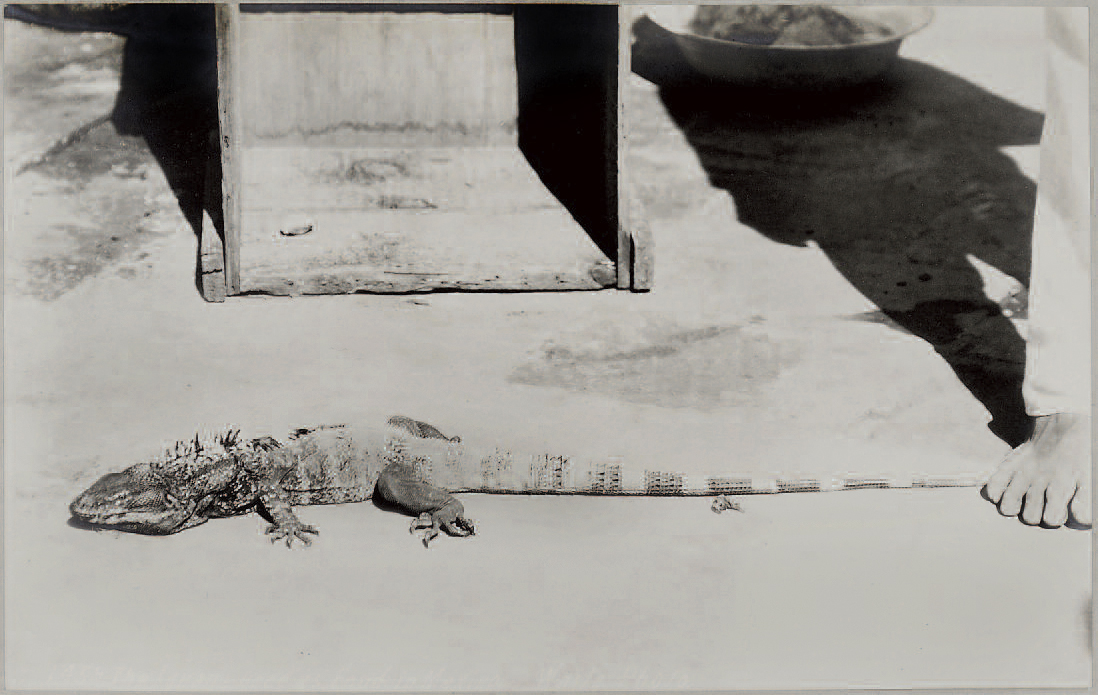
Charles Betts Waite (American, 1861-1927)
The Iguana
1901
Vintage gelatin silver print
5 x 7 7/8 inches
In this playful study, the shadows dominate: the bowl of vittles atop the man’s shadow suggest a sombrero shielding a sleeping man’s face during an afternoon siesta.
[Waite] traveled to Mexico City and in May 1897 established a photography studio there, during the Porfirio Díaz government. He became part of Porfirian society, taking photographs of many in the ruler’s circle. He was among a group of expatriate photographers (such as Winfield Scott and fellow San Diegans Ralph Carmichael and Percy S. Cox) working in Mexico in the first decade of the 20th century. Waite traveled throughout Mexico, exploring archaeological sites and the countryside.
[Waite’s life] corresponds with that of adventurers, brave explorers with romantic spirits and materialistic outlooks, who toured the hitherto unknown world, discovering their riches and inventing paradises.” ~ Francisco Montellano, author of C. B. Waite, fotógrafo
His works were published in books, travel magazines, and on post cards, having contracted with the Sonora News Company. He also worked for several Mexican newspapers, and he documented United States scientific expeditions in Mexico. The images often included scenic Mexican images and the country’s native residents. Many of Waite’s photographs depict railroads, parks, archaeological sites, and business enterprises.
Text from the Wikipedia website
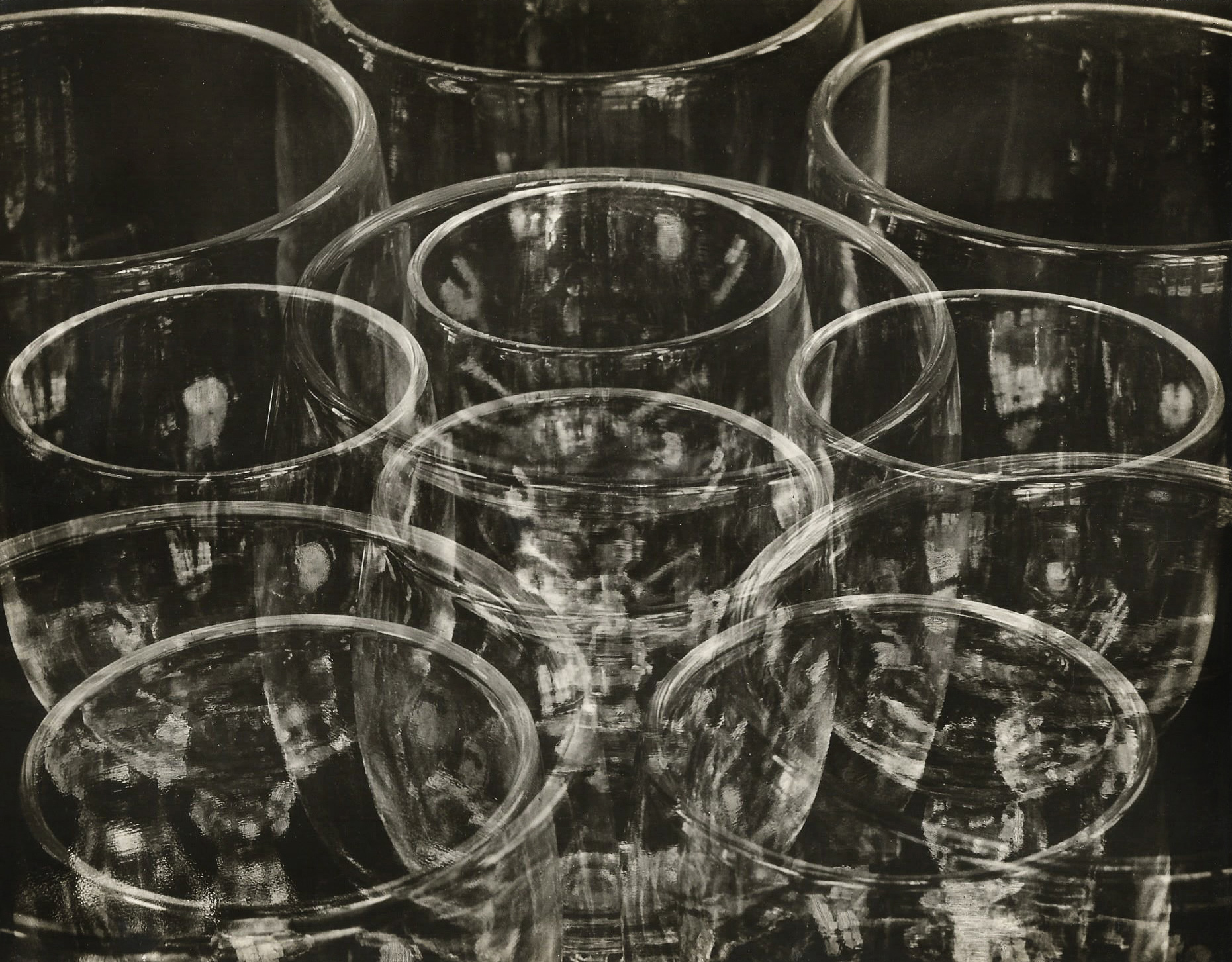
Tina Modotti (Italian, 1896-1942)
Experiment in Related Form
1924
Vintage gelatin silver print
7 3/8 x 9 3/8 inches
This is one of only two known photomontages by Modotti, in which a single image of six wine glasses is enlarged and cropped and then superimposed onto itself.

Edward Weston (American, 1886-1958)
Ollas de Oaxaca
1926
Vintage palladium print
8 x 10 inches
An olla is a clay pot or jar. Weston wrote that his first thought of Oaxaca “is always of the market, – and the market means first of all loza – crockery! I bought and bought – dishes, jars, jugettes, – of the dull black or grey-black ware, and of the deep green glaze ware… Very well do these people reproduce, make use of the essential quality of the material, – splendidly do they observe and utilise to advantage the very essence of a form. A race of born sculptors!”

Edward Weston (American, 1886-1958)
Detail of stone frieze, ruins of Mitla, Oaxaca
1926
Vintage gelatin silver print
7 1/2 x 9 1/2 inches
“I was fascinated by the stone mosaics at Mitla, for besides a variation on the Greek fret, there was a unique pattern – oblique lines of dynamic force – flashes of stone lightning, which remain my strongest memory.” ~ Edward Weston, The Daybooks, vol. I.

Edward Weston (American, 1886-1958)
Stone lions in relief, Oaxaca
1926
Vintage gelatin silver print
7 1/2 x 9 1/2 inches

Edward Weston (American, 1886-1958)
Two clay pitchers
1926
Vintage gelatin silver print
7 1/2 x 9 1/4 inches
These studies of pre-Columbian and folk-art statuary and pottery, done for Anita Brenner’s Idols Behind Altars project, taught Weston the art of the table-top still life. As such, they were the direct precursor to the iconic shells, peppers, and cabbages that occupied him immediately upon his return to Los Angeles in December 1926.

Edward Weston (American, 1886-1958)
Tarascan Pottery, Michoacán
1926
Vintage gelatin silver print
7 1/2 x 8 1/4 inches
The Tarascan people flourished from 1100 A.D. to 1530 A.D. After the Spanish Conquest, missionaries organised the Tarascan empire into a series of craft-oriented villages. Their artistic traditions survive today in the Lake Pátzcuaro region.

Tina Modotti (Italian, 1896-1942)
Jean Charlot
1923
Vintage gelatin silver print
9 1/2 x 7 1/2 inches
Anita Brenner and Tina Modotti remained friendly rivals in Mexico City’s close-knit artistic expatriate community throughout the 1920s. Their intertwined social life revolved around the French-Mexican painter Jean Charlot, who had been a principal assistant to Rivera. Charlot was Weston’s closest friend in Mexico as well as Brenner’s paramour and professional collaborator. In a diary entry in 1927, Brenner made a three-column table captioned “Actively Friends; Actively Enemies; and Actively Both.” Modotti’s name appears in the third column.
This sensitive Modotti portrait is inscribed by Charlot to Brenner, “You are bad tempered / I am worst tempered / Does that explain the sweet / Hours we passed together”

Tina Modotti (Italian, 1896-1942)
Elisa Kneeling
1924
Vintage palladium print
8 7/8 x 6 5/8 inches
The power of Modotti’s portrait of her young chambermaid is due to the contrast between her beatific face and her coiled hands, which suggest a lifetime of hard manual labor.

Edward Weston (American, 1886-1958)
Anita (“Pear-Shaped Nude”)
1925
Vintage gelatin silver print
8 5/8 x 7 3/8 inches
“I was shaving when A[nita] came, hardly expecting her on such a gloomy, drizzling day. I made excuses, having no desire, no ‘inspiration’ to work … but she took no hints, undressing while I reluctantly prepared my camera… And then appeared to me the most exquisite lines, forms, volumes – and I accepted, – working easily, rapidly, surely…
Reviewing the new prints, I am seldom so happy as I am with the pear-like nude of A[nita]. I turn to it again and again. I could hug the print in sheer joy. It is one of my most perfect photographs.” ~ Edward Weston, The Daybooks, vol. I

Edward Weston (American, 1886-1958)
Excusado
1926
Gelatin silver print, 1930s
10 x 8 inches
“‘Form follows function.’ Who said this I don’t know, but the writer spoke well! I have been photographing our toilet, that glossy enamelled receptacle of extraordinary beauty. It might be suspicioned that I am in a cynical mood to approach such subject matter… My excitement was absolute aesthetic response to form… I was thrilled! – here was every sensuous curve of the ‘human form divine’ but minus imperfections.” ~ Edward Weston, The Daybooks, vol. I
Weston was particularly amused when his chambermaid placed a bouquet of flowers in the bowl, in a well-meaning effort to create a more fitting subject for her employer’s lens.

Edward Weston (American, 1886-1958)
Casa de Vecindad
1926
Vintage gelatin silver print
7 3/8 x 9 1/2 inches
A casa de vecindad or “neighborhood house” was a community home or tenement. This one had once been “a fine old convent,” wrote Weston. “The light was made perfect by the collective noise of cats and dogs, children laughing and crying, women gabbling and vendors calling.”
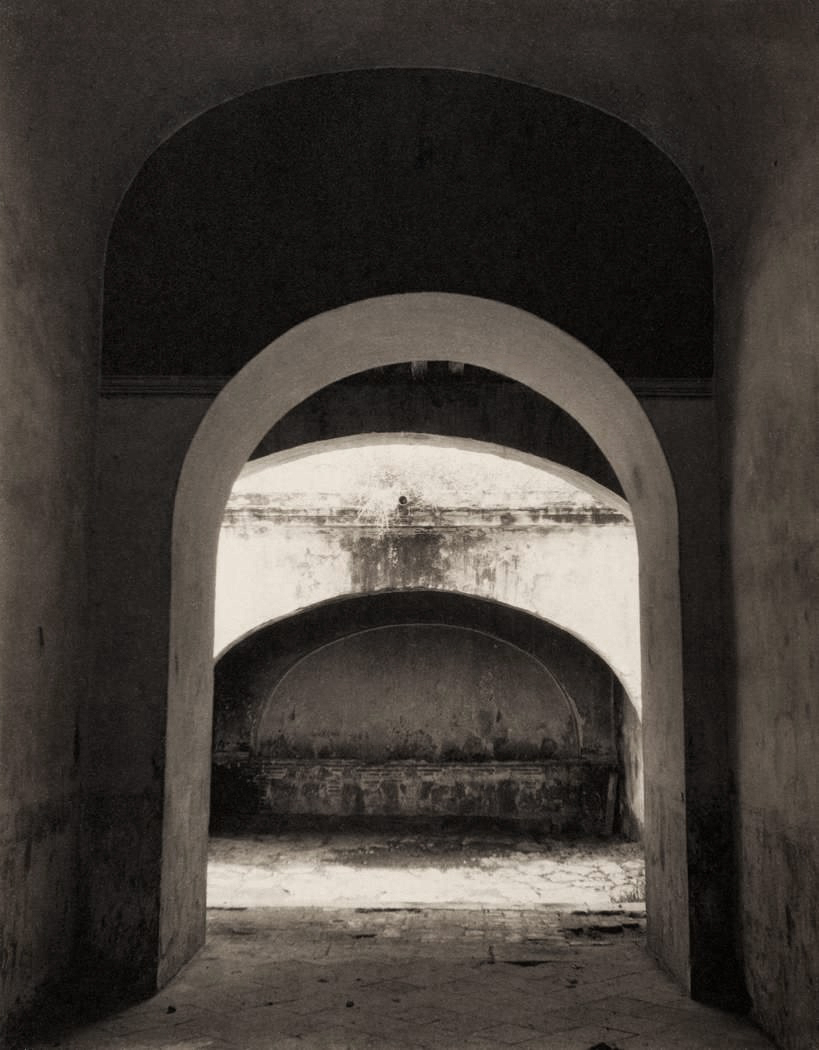
Edward Weston (American, 1886-1958)
Arches, Oaxaca
1926
Vintage gelatin silver print
9 1/2 x 7 1/2 inches

Edward Weston (American, 1886-1958)
Guadalajara, Barranca de los Oblatos: Rocky Trail
1925
Vintage palladium print
10 x 8 inches
Mexico City in the 1920s-30s was the scene of one of the great artistic flowerings of the twentieth century. Like Paris in the aftermath of World War I, Mexico City after the decade-long Mexican Revolution served as a magnet for international artists and photographers. Foremost among the expatriate photographers was the Los Angelino, Edward Weston, who embedded himself in the artistic milieu surrounding the muralist painters Rivera, Orozco, and Siqueiros. Weston reinvented his approach to picture-making during his three years in Mexico, 1923-26. The soft-focus painterliness that had characterised his studio portraiture in the ‘teens melted away under the brilliant Mexican sun, to be replaced by crystalline landscapes as well as evocative still life that prefigured his later shells and peppers. Meanwhile his paramour and protégée, the Italian silent film star Tina Modotti, created photographs that would place her in the pantheon of great photographers of the era. This exhibition features rare vintage Mexican masterworks by both Weston and Modotti from the 1920s, as well as stellar photographs from the 1930s by the New Yorker Paul Strand, the Frenchman Henri Cartier-Bresson, and by Mexico’s own self-taught master of the camera, Manuel Álvarez Bravo.
Already in the first two decades of the 20th century, immigrant photographers had played an outsize role in Mexican photography. German-born Hugo Brehme published picturesque views of Mexican life and landscape in local and international tourist magazines, including National Geographic. Brehme’s fellow German émigré, Carl Wilhelm (Guillermo) Kahlo, meticulously photographed Mexico’s colonial architecture; his daughter Frida would marry Diego Rivera and become a legendary painter and personality. A third talented immigrant photographer was the Californian C.B. Waite, who moved to Mexico City in 1897 and opened a photo studio. At their best, as in The Iguana from 1901, seen here, Waite’s genre studies prefigure by a quarter century the exotic Surrealism that would characterise the work of Modotti, Álvarez Bravo, and Cartier-Bresson.
In 1923, C.B. Waite left Mexico and retired to Glendale, California, a suburb of Los Angeles. Coincidentally, within a few months, Glendale’s leading photographer, Edward Weston, would make that same journey in the opposite direction. Weston sought to escape from the personal and professional distractions that he felt were deterring him from an aesthetic breakthrough. His love affair with Tina Modotti made him realise that he would never be a conventional husband. In August, 1923, Weston left the port of Los Angeles and sailed to Mexico on the S.S. Colima, accompanied by Modotti, who agreed to run his studio in exchange for photography lessons.
The Weston-Modotti home in Mexico City became a gathering place for writers, painters and photographers. This was the time of the Mexican Renaissance, a cultural movement that celebrated the country’s modern artists as well as its popular and indigenous arts. Under the presidency of Álvaro Obregón, the education minister José Vasconcelos sponsored an ambitious program of progressive public art, most notably the mural movement which was led by Diego Rivera, who was in all ways a larger-than-life character.
While Weston never second-guessed his decision to give up the steady income from studio portraiture, he and Tina faced constant money problems during their three years together in Mexico. Financial salvation came in the unlikely guise of a brash 19-year-old anthropology student, Anita Brenner. Born to a mercantile family with roots in both Texas and Mexico, Brenner befriended Weston and Modotti in Mexico City and hired them to furnish 400 photographs for her book, Idols Behind Altars. This was to be the first serious art-historical treatise on pre-Columbian art, Spanish Colonial architecture, and contemporary Mexican folk art. Weston and Modotti rose to the task with gusto, criss-crossing southern Mexico from Oaxaca to Guadalajara in search of prime examples of these genres.
Weston was first introduced to pulquerías, or working-class bars, by Diego Rivera, who was writing an article on pulquería mural painting for Mexican Folkways magazine. Weston was impressed by the vitality of these anonymous murals, writing:
“The aspiring young painters of Mexico should study the unaspiring paintings – popular themes – popular art – which adorn the humble pulquería… brave matadores at the kill – white veiled ladies, pensive beside moonlit waters – an exquisitely tender group of Indians … and all the pictured thoughts, nearest and dearest to the heart of the people.”
When Modotti left Mexico in 1930, she gifted her large-format view cameras to her close friend and protégé, Manuel Álvarez Bravo. With a seven-decade career, he is considered Mexico’s greatest photographer. “I was born in the city of Mexico, behind the Cathedral, in the place where the temples of the ancient Mexican gods must have been built, February fourth, 1902,” he wrote, invoking the magical realism that infuses his most iconic photographs. As a teenager he studied painting at the Academia San Carlos, the same art school that Rivera and Orozco had attended. “Interested since always in art, I committed the common error of believing that photography would be the easiest,” he confessed. In addition to Modotti, another important early mentor was the painter Rufino Tamayo, who counselled Álvarez Bravo against the “surface nationalism” of political art, such as that of Rivera, Orozco, or indeed Modotti herself: “Art is a way of expression that has to be understood by everybody, everywhere. It grows out of the earth, the texture of our lives and our experiences.” Tamayo’s words became Álvarez Bravo’s touchstones.
In 1934, Álvarez Bravo befriended the young painter-turned-photographer Henri Cartier-Bresson, who had come to Mexico to spend the year photographing in the brilliant natural light not often found in his native Paris. At a technical level their approach to photography diverged: Álvarez Bravo, like Weston and Modotti, favoured traditional large-format view cameras, while Cartier-Bresson, the progenitor of the “decisive moment,” was an early proponent of the hand-held 35mm Leica camera. Yet their common interest in capturing the “accidental theater of the street” outweighed these differences. “Cartier-Bresson and I did not photograph together but we walked the same streets and photographed many of the same things,” Álvarez Bravo recalled. They exhibited together in 1935 in a show entitled Documentary and Anti-Graphic Photographs, first at the Palacio de Bellas Artes in Mexico City and then at the Julien Levy Gallery in New York. This seminal exhibit was the first time that “street photography” had been placed in a serious fine art setting. Reviewing that show, poet Langston Hughes wrote: “In a photograph by Cartier-Bresson, as in modern music, there is a clash of sunlight and shadow, while in Bravo, the sunlight is a discreet veil that turns the shadows into velvet.”
Text from the Palmer Museum of Art

Edward Weston (American, 1886-1958)
Los Changos Vaciladores (Playful Monkeys), pulquería mural
1926
Vintage gelatin silver print
7 1/2 x 9 1/2 inches
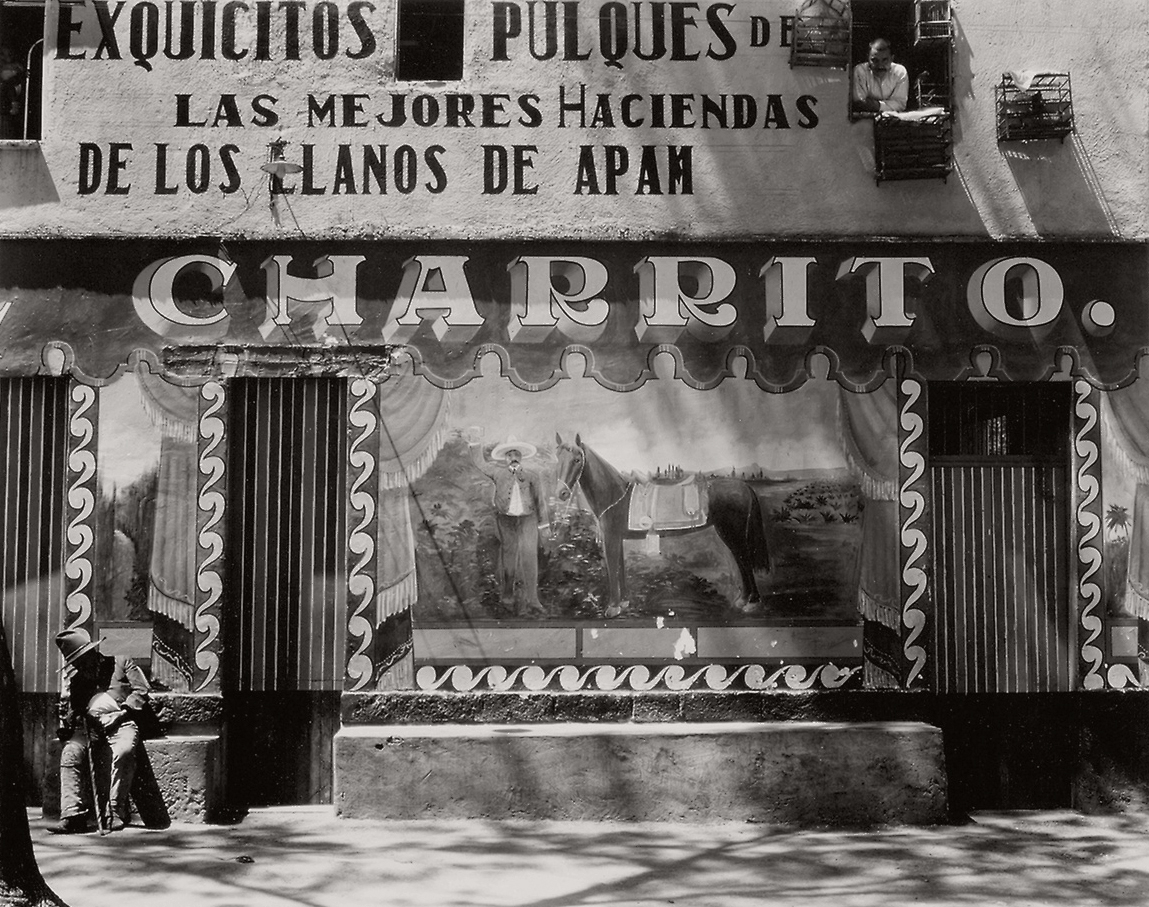
Edward Weston (American, 1886-1958)
Charrito, pulquería mural
1926
Vintage gelatin silver print
7 1/2 x 9 1/2 inches

Edward Weston (American, 1886-1958)
Two children with pulquería mural
1926
Vintage gelatin silver print
9 3/8 x 6 3/4 inches

Edward Weston (American, 1886-1958)
Ceiling of the Church of Santiago, Tupátaro
1926
Vintage gelatin silver print
7 1/2 x 9 1/2 inches
“Few had seen this church of Tupátaro, far from tourist tracks. The ceiling was entirely lacquered, even the beams – a notable achievement in colour, design and craftsmanship. That was a hard day of work. Exposures were prolonged to even fifteen minutes with additional flash light, the while I must remain quite still upon a rickety balcony for fear of jarring the camera, which was real torture with more fleas biting and crawling than I ever knew could jump from a few square feet of space.” ~ Edward Weston, The Daybooks, vol. I

Brett Weston (American, 1911-1993)
Tin roofs, Mexico
1926
Vintage gelatin silver print
7 1/8 x 9 1/2 inches
Edward Weston’s son Brett joined him in his final year in Mexico. Brett was himself a child prodigy photographer, as evidenced by this sensitively balanced and exquisitely printed abstract masterwork, taken when he was fourteen years old.
Theodore Brett Weston (December 16, 1911, Los Angeles – January 22, 1993, Hawaii) was an American photographer. Van Deren Coke described Brett Weston as the “child genius of American photography.” He was the second of the four sons of photographer Edward Weston and Flora Chandler.
Weston began taking photographs in 1925, while living in Mexico with Tina Modotti and his father. He began showing his photographs with Edward Weston in 1927, was featured at the international exhibition at Film und Foto in Germany at age 17, and mounted his first one-man museum retrospective at age 21 at the De Young Museum in San Francisco in January, 1932.
Weston’s earliest images from the 1920s reflect his intuitive sophisticated sense of abstraction. He often flattened the plane, engaging in layered space, an artistic style more commonly seen among the Abstract Expressionists and more modern painters like David Hockney than other photographers. He began photographing the dunes at Oceano, California, in the early 1930s. This eventually became a favourite location of his father Edward and later shared with Brett’s third wife Dody Weston Thompson. Brett preferred the high gloss papers and ensuing sharp clarity of the gelatin silver photographic materials of the f64 Group rather than the platinum matte photographic papers common in the 1920s and encouraged Edward Weston to explore the new silver papers in his own work. Brett Weston was credited by photography historian Beaumont Newhall as the first photographer to make negative space the subject of a photograph. Donald Ross, a photographer close to both Westons, said that Brett never came after anyone. He was a true photographic equal and colleague to his father and “one should not be considered without the other.”
“Brett and I are always seeing the same kinds of things to do – we have the same kind of vision. Brett didn’t like this; naturally enough, he felt that even when he had done the thing first, the public would not know and he would be blamed for imitating me.” Edward Weston – Daybooks – May 24, 1930.
Text from the Wikipedia website

Edward Weston (American, 1886-1958)
Rosa Covarrubias in Tehuana dress
1926
Vintage gelatin silver print
9 3/8 x 7 1/2 inches
Rosa and Miguel Covarrubias were early promoters of traditional Mexican art and craft; their extensive collection now resides at San Francisco’s Mexican Museum. This striking portrait of Rosa in traditional Zapotec dress was appropriated by Diego Rivera for his painting Tehuana Woman, 1929.
Born in Los Angeles, Rosa Rolanda was a dancer with the Marion Morgan dance troupe and the Ziegfeld Follies. She married the Mexican artist Miguel Covarrubias, who was the leading caricaturist of the jazz age. While Rosa and Miguel were accompanying Edward and Tina on one of their trips for Anita Brenner, they taught Rosa the basics of photography. Later, Man Ray would teach her his technique of cameraless photograms. With such tutelage, it is no surprise that Rosa became a gifted photographer in her own right.

Edward Weston (American, 1886-1958)
Rosa Covarrubias
1926
Vintage gelatin silver print
9 x 6 3/4 inches

Edward Weston (American, 1886-1958)
Palma Bendita
1926
Vintage gelatin silver print
9 1/2 x 7 3/8 inches
The branches of the palma bendita, or “blessed palm,” were believed to have been strewn on the road before Christ during his entry into Jerusalem and are blessed on Palm Sunday, an important Mexican holiday.

Tina Modotti (Italian, 1896-1942)
Campesinos (Workers’ Parade)
1926
Vintage palladium print
8 3/8 x 7 1/2 inches
Modotti’s iconic Campesinos has the same formal structure – circular forms filling the picture frame – as Weston’s Olla Pots of Oaxaca made the same year. But Modotti’s picture adds a political dimension that Weston would by nature recoil from. Modotti’s increasingly fervent politicisation contributed to the dissolution of her relationship with Weston, who was fundamentally apolitical. Weston returned to Los Angeles at the end of 1926; Modotti would remain in Mexico another four years.

Tina Modotti (Italian, 1896-1942)
Bandolier, Corn, Sickle
1927
Vintage gelatin silver print
8 3/4 x 7 1/2 inches
This politically-charged still life, and its companion piece Bandolier, Corn and Guitar, were made the year Modotti formally joined Mexico’s Communist Party. At the time she was modelling for Diego Rivera, a fellow traveler. Modotti’s likeness appears in several of Rivera’s most famous Revolutionary murals; she would also be blamed for the break-up of his marriage to Lupe Marín.
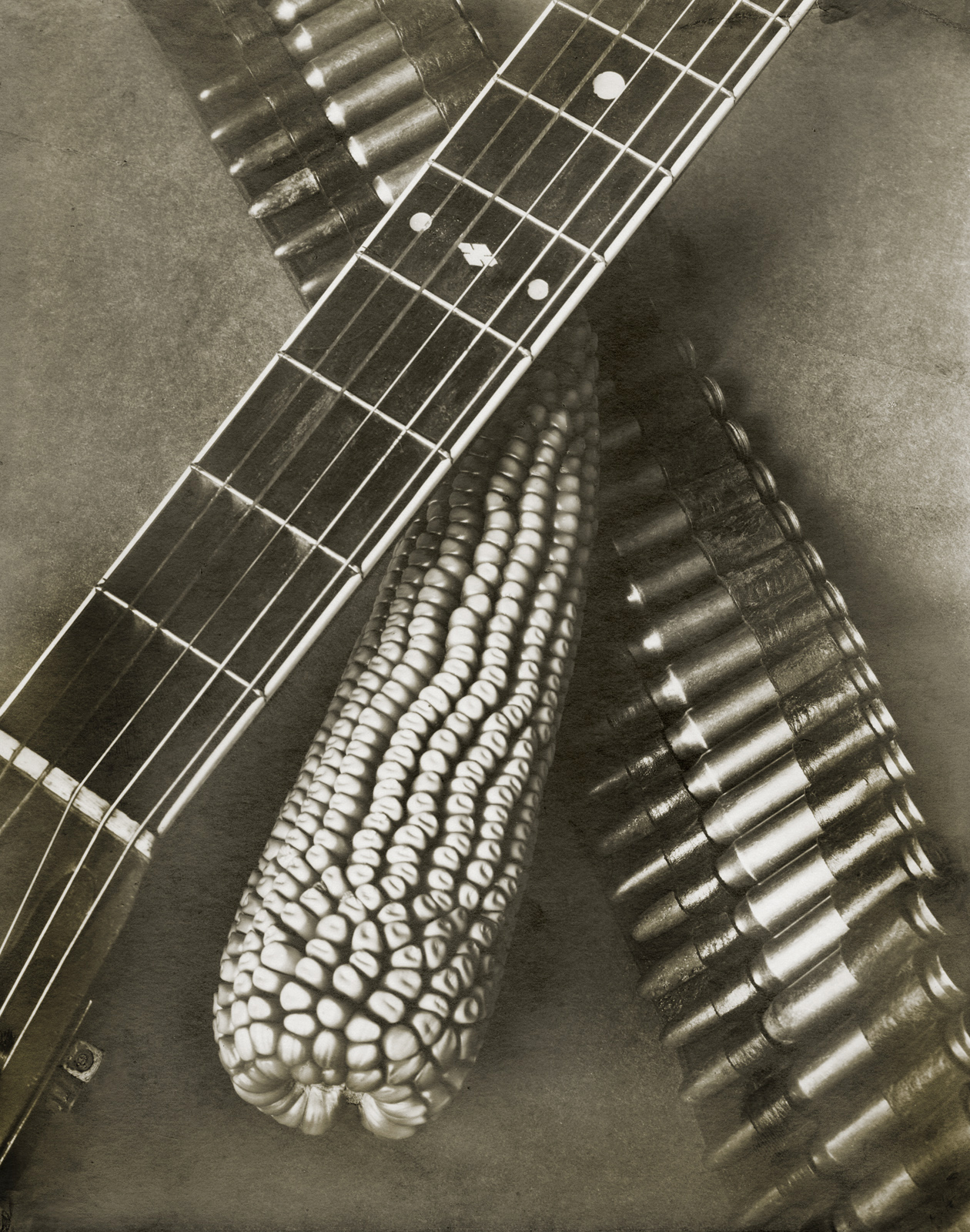
Tina Modotti (Italian, 1896-1942)
Bandolier, Corn and Guitar
1927
Vintage gelatin silver print
9 1/2 x 7 1/2 inches

Tina Modotti (Italian, 1896-1942)
Women of Tehuantepec
1929
Vintage gelatin silver print
9 x 7 1/4 inches
This is one of Modotti’s final masterworks. The following year she would be expelled from Mexico for sedition, due to her work on behalf of the Communist Party. She settled in Russia, giving up photography for relief work with International Red Aid. When the Spanish Civil War erupted in 1936, she joined the fray. She returned to Mexico under a pseudonym in 1939, and died of a heart attack three years later, at age 45, her life the stuff of legend.

Manuel Álvarez Bravo (Mexican, 1902-2002)
La Siesta de los Peregrinos (the siesta of the migrants)
1930s
Vintage gelatin silver print
6 7/8 x 9 3/8 inches
Manuel Álvarez Bravo (February 4, 1902 – October 19, 2002) was a Mexican artistic photographer and one of the most important figures in 20th century Latin American photography. He was born and raised in Mexico City. While he took art classes at the Academy of San Carlos, his photography is self-taught. His career spanned from the late 1920s to the 1990s with its artistic peak between the 1920s and 1950s. His hallmark as a photographer was to capture images of the ordinary but in ironic or Surrealistic ways. His early work was based on European influences, but he was soon influenced by the Mexican muralism movement and the general cultural and political push at the time to redefine Mexican identity. He rejected the picturesque, employing elements to avoid stereotyping. He had numerous exhibitions of his work, worked in the Mexican cinema and established Fondo Editorial de la Plástica Mexicana publishing house. He won numerous awards for his work, mostly after 1970. …
Álvarez Bravo’s photography career spanned from the late 1920s to the 1990s. It formed in the decades after the Mexican Revolution (1920s to 1950s) when there was significant creative output in the country, much of it sponsored by the government wanting to promote a new Mexican identity based on both modernity and the country’s indigenous past.
Although he was photographing in the late 1920s, he became a freelance photographer full-time in 1930, quitting his government job. That same year, Tina Modotti was deported from Mexico for political activities and she left Alvarez Bravo her camera and her job at Mexican Folkways magazine. For this publication, Alvarez Bravo began photographing the work of the Mexican muralists and other painters. During the rest of the 1930s, he established his career. He met photographer Paul Strand in 1933 on the set of the film “Redes”, and worked with him briefly. In 1938, he met French Surrealist artist André Breton, who promoted Alvaréz Bravo’s work in France, exhibiting it there. Later, Breton asked for a photograph for the cover of catalog for an exhibition in Mexico. Alvarez Bravo created “La buena fama durmiendo” (The good reputation sleeping), which Mexican censors rejected due to nudity. The photograph would be reproduced many times after that however.
Alvarez Bravo trained most of the next generation of photographers including Nacho López, Héctor García and Graciela Iturbide. From 1938 to 1939, he taught photography at the Escuela Central de Artes Plásticas, now the National School of Arts (UNAM). In the latter half of the 1960s he taught at the Centro Universitario de Estudios Cinematográficos.
Text from the Wikipedia website
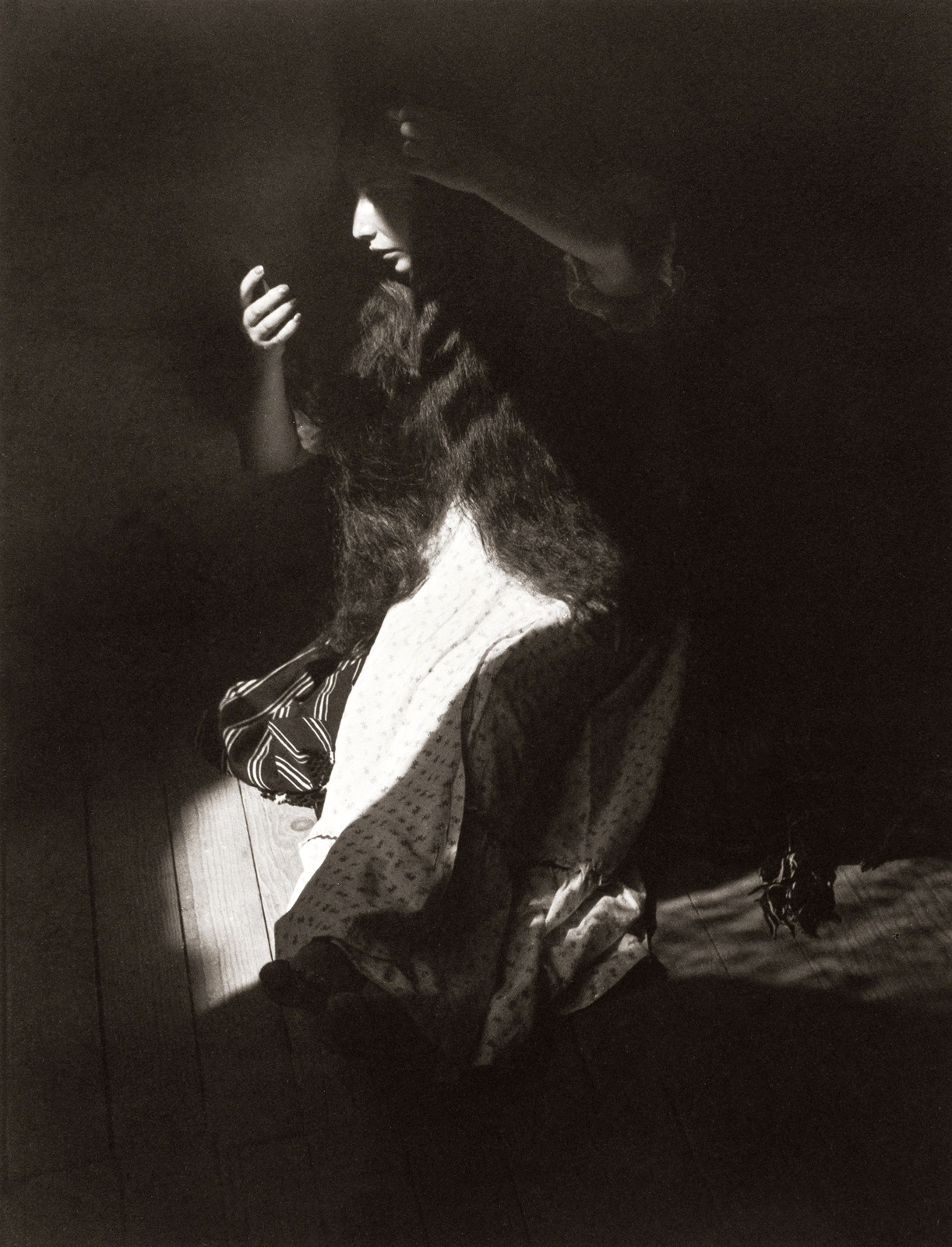
Manuel Álvarez Bravo (Mexican, 1902-2002)
Retrato de lo Eterno (Portrait of the Eternal)
1935
Vintage gelatin silver print
9 1/2 x 7 3/8 inches

Henri Cartier-Bresson (French, 1908-2004)
The Spider of Love, Mexico City
1934
Gelatin silver print c. 1960
6 1/2 x 9 3/4 inches
“I was very lucky. I had only to push the door open. It was so voluptuous, so sensual. I couldn’t see their faces. It was miraculous – physical love in all its fullness. Tonio grabbed a lamp, and I took several shots. There was nothing obscene about it. I could never have got them to pose – a matter of decency.” ~ Cartier-Bresson

Henri Cartier-Bresson (French, 1908-2004)
Calle Cuauhtemoctzin (two prostitutes), Mexico City
1934
Gelatin silver print c. 1960
9 1/8 x 13 3/4 inches
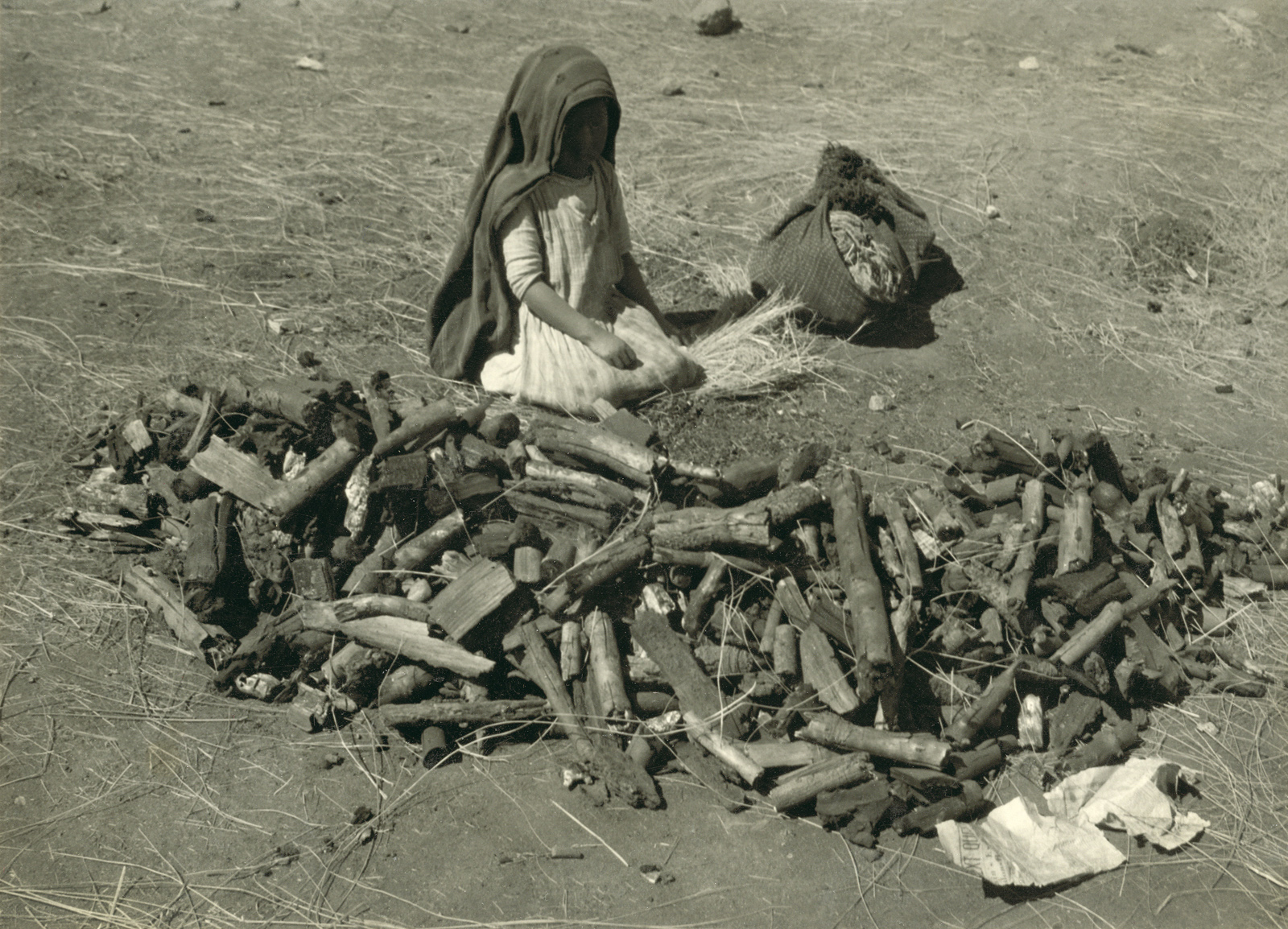
Manuel Álvarez Bravo (Mexican, 1902-2002)
Niña con Leña (Girl with Firewood)
1930s
Vintage gelatin silver print
7 x 9 5/8 inches
Helen Levitt’s photographs of Mexico City, taken in 1941, are a notable exception to her otherwise exclusive focus on New York City during her long career (1930s through 1970s). But the principal subject matter of Levitt’s work was the same in both metropolises: the lives of children in working-class neighbourhoods. In this evocative image, the children’s play is undeterred by their poverty, which is evidenced by their bare feet, the dirt road, and the dilapidated buildings. Levitt studied with the noted photographer Walker Evans; her work was also influenced by the other artists in the present exhibition: like Cartier-Bresson, she favoured the hand-held Leica camera; like Paul Strand, she used a secret sideways lens that enabled her to photograph surreptitiously.
Levitt printed her Mexican photographs only after returning to New York, where they added to her blossoming reputation. Her first one-woman show at the Museum of Modern Art included sixteen photographs from Mexico, including a variant of this image (below).

Helen Levitt (American, 1913-2009)
Mexico City
1941
Vintage gelatin silver print
7 1/4 x 9 5/8 inches

Henri Cartier-Bresson (French, 1908-2004)
Mexico
1963
Vintage gelatin silver print
9 3/4 x 6 1/2 inches
Paul Strand (American, 1890-1976)
Paul Strand achieved early recognition as a protégé of Alfred Stieglitz, the New York photographer and gallerist. In 1917 Stieglitz devoted the final two issues of his Camera Work magazine to Strand’s high modernist photography, which was heavily influenced by avant garde artists such as Paul Cezanne and Pablo Picasso. Stieglitz praised Strand’s work as “brutally direct” and “devoid of all flim-flam.”
By 1932, when Strand drove his Model A Ford from Taos to Mexico, his style had evolved dramatically. Abstraction had given way to humanism, reflecting the influence of his high school photography teacher, the eminent social documentarian Lewis Hine. Strand was now concerned with how people lived, and especially with those aspects of life that “make a place what it is.” Mexico was a logical destination for Strand, whose political concern for the common man intersected with the proletarian goals of the Mexican Revolution.
Over the next several months Strand photographed people and places in rural small towns across southern Mexico, from Michoacán in the West to Oaxaca in the East, unconsciously retracing Edward Weston and Tina Modotti’s footsteps from the 1920s. Strand’s work in Mexico set the tone for the photographic journeys to out-of-the-way destinations in Europe and Africa that would occupy the rest of his long career.
For these Mexican portraits, Strand modified his 5 x 7 Graflex camera, adding a special prism extension that enabled him to clandestinely shoot a subject at a 90° angle from the front of his camera. The subjects of these portraits, absorbedly watching the Yankee photographer at work, were unaware that he was actually aiming his camera at them. Strand had pioneered this technique as a young photographer on the streets of New York.
Strand originally printed his Mexican photographs as platinum prints. The prints shown here are hand-pulled photogravures created for a 1940 portfolio Photographs of Mexico. In his introduction to the portfolio, Strand describes the prints as “a step forward in the art of reproduction processes,” attributing their quality to the production team’s combined two centuries of experience.

Paul Strand (American, 1890-1976)
Near Saltillo
1932
Vintage photogravure
5 x 6 3/8 inches
“When you leave the Texas border for about 70 miles – flat desert, it could still be Texas. Then suddenly appear the mountains of the North around Monterrey and Saltillo – amazing mountains. They are a continuation of the American spur – our Rockies I suppose – but how different – utterly fantastic shapes, like mountains in fairy books. And I never saw the forms within each individual mountain – defined – come right at you as those in the North.” ~ Paul Strand to painter John Marin

Paul Strand (American, 1890-1976)
Gateway – Hidalgo
1933
Vintage photogravure
10 1/8 x 8 inches
“What have come to be known as ‘Strand clouds’ – heavy, lowering shapes holding rain and threat of storm – appear in a great many of his photographs. A friend of Strand’s remembers him cursing under his breath whenever fluffy, cottony cloud formations, which he referred to as ‘Johnson & Johnson,’ took over the sky; they never appear in his prints.” ~ Calvin Tomkins

Paul Strand (American, 1890-1976)
Boy – Hidalgo
1933
Vintage photogravure
6 3/8 x 5 inches

Paul Strand (American, 1890-1976)
Man with Hoe – Los Remedios
1933
Vintage photogravure
6 1/4 x 5 inches

Paul Strand (American, 1890-1976)
Plaza – State of Puebla
1933
Vintage photogravure
5 x 6 3/8 inches
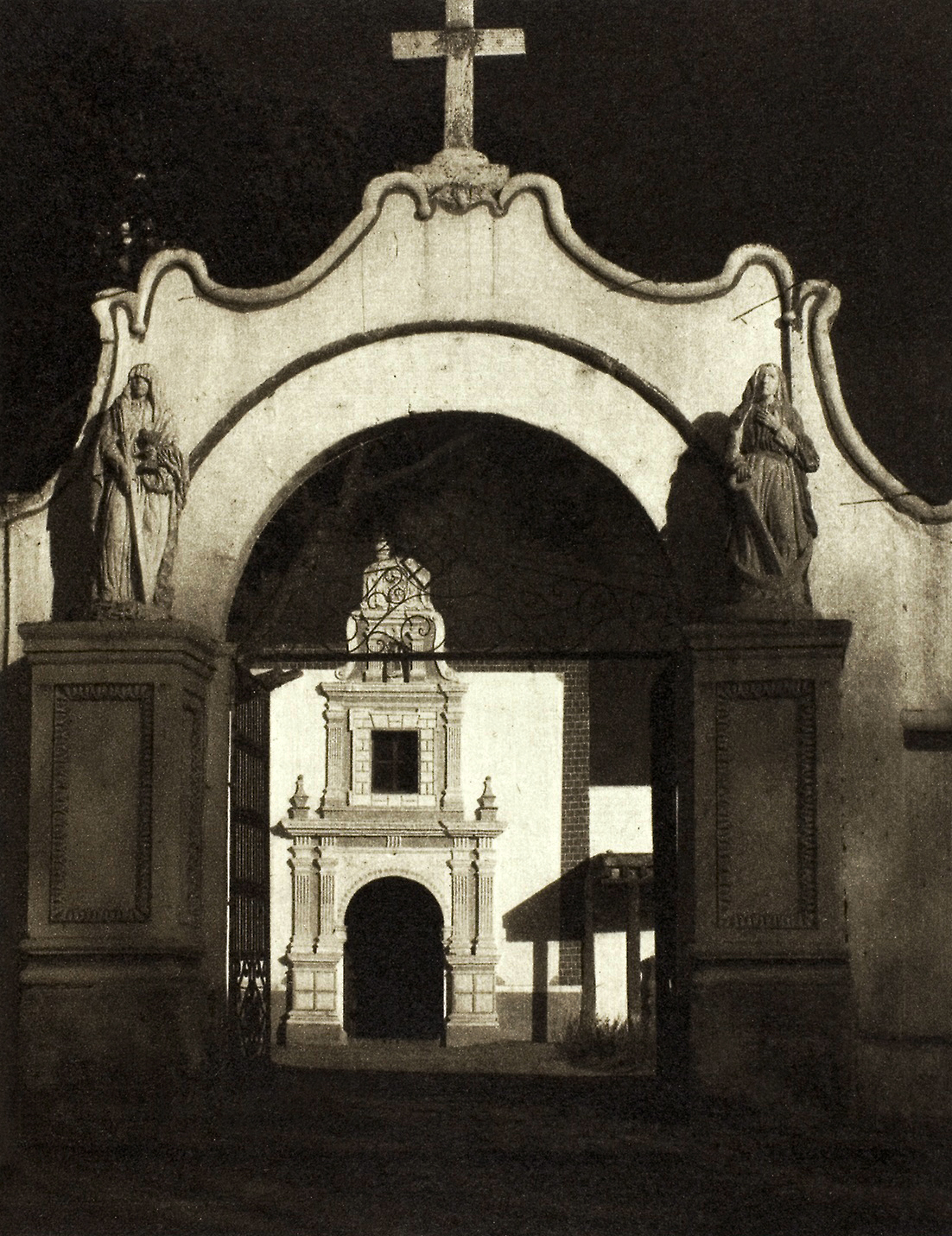
Paul Strand (American, 1890-1976)
Church, Cuapiaxtla
1933
Vintage photogravure
6 3/8 x 5 inches

Paul Strand (American, 1890-1976)
Man – Tenancingo
1933
Vintage photogravure
6 1/2 x 5 1/8 inches

Paul Strand (American, 1890-1976)
Girl and Child – Toluca
1933
Vintage photogravure
6 1/2 x 5 1/8 inches

Paul Strand (American, 1890-1976)
Boy – Uruapan
1933
Vintage photogravure
10 1/8 x 8 1/8 inches

Paul Strand (American, 1890-1976)
Cristo – Oaxaca
1933
Vintage photogravure
10 x 8 inches

Paul Strand (American, 1890-1976)
Cristo with Thorns – Huexotla
1933
Vintage photogravure
10 1/4 x 8 1/8 inches

Paul Strand (American, 1890-1976)
Cristo – Tlacochoaya – Oaxaca
1933
Vintage photogravure
10 1/4 x 8 inches

Paul Strand (American, 1890-1976)
Virgin – San Felipe – Oaxaca
1933
Vintage photogravure
10 1/4 x 8 1/8 inches
Palmer Museum of Art
The Pennsylvania State University
Curtin Road
University Park, PA 16802
Opening hours:
Temporarily closed until June 2024










 Art Blart _ art and cultural memory archive
You must be logged in to post a comment.