Exhibition dates: 20th October – 26th November 2011
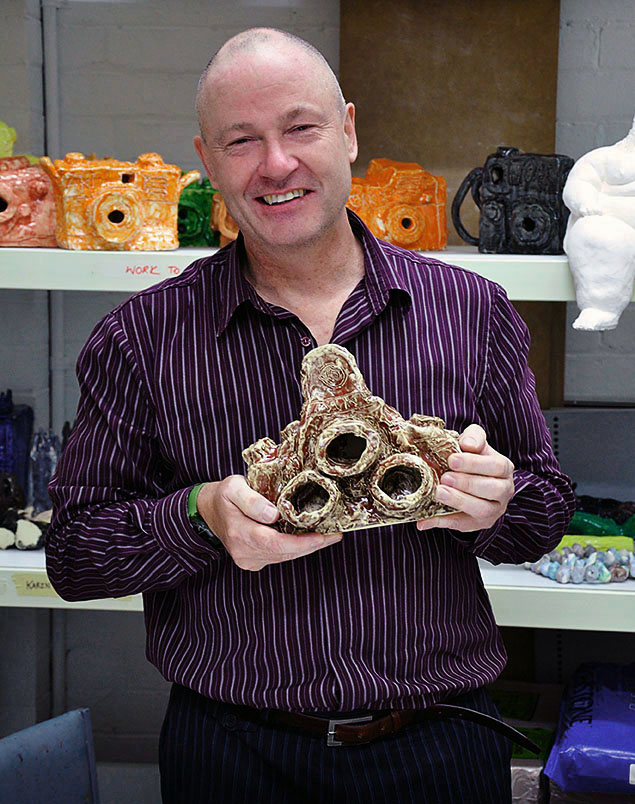
Dr Marcus Bunyan holding his new Alan Constable camera at the opening of Movement and Emotion 2011.
More of Alan’s cameras can be seen behind.
I have added a new Alan Constable camera to my collection. Yah!
The one I have chosen is very unusual. The camera has a third eye and a stunning glaze. The exhibition features the work of three Arts Project Australia artists: Alan Constable, Chris O’Brien and Terry Williams. All three artists explore machine aesthetics within their practice.
I really do hope that the National Gallery of Victoria purchases some of these cameras. They are the most unusual and beautiful sculptural pieces I have seen in a long time.
Dr Marcus Bunyan
Many thankx to Art Project Australia for allowing me to publish the photographs in the posting. Please click on the photographs for a larger version of the image. See more images from the Movement and Emotion exhibition.
Alan Constable (Australian, b. 1956) Not titled (three lens red camera)
2011
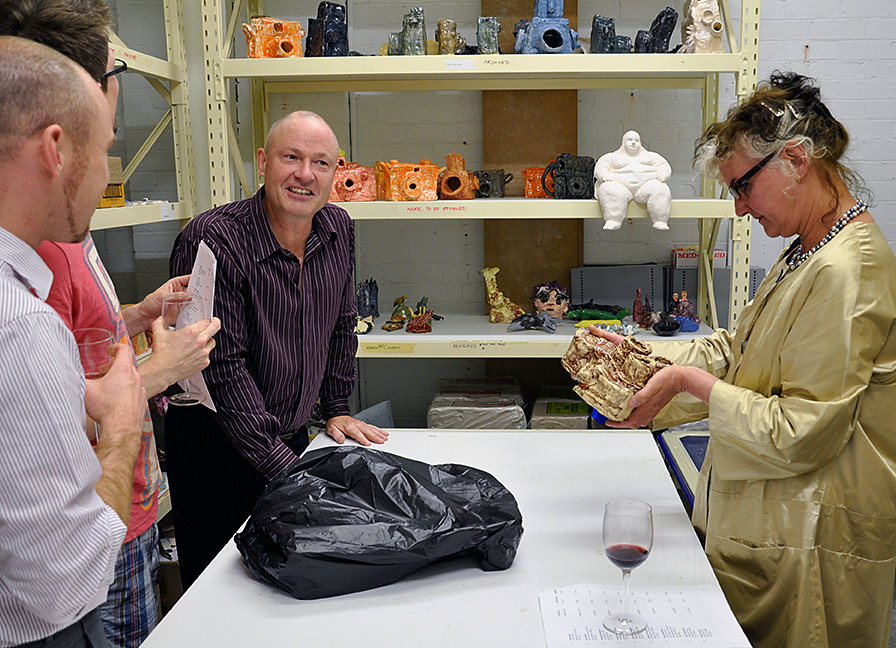
Marcus with jeweller Marianne Cseh at right looking at the Alan Constable camera
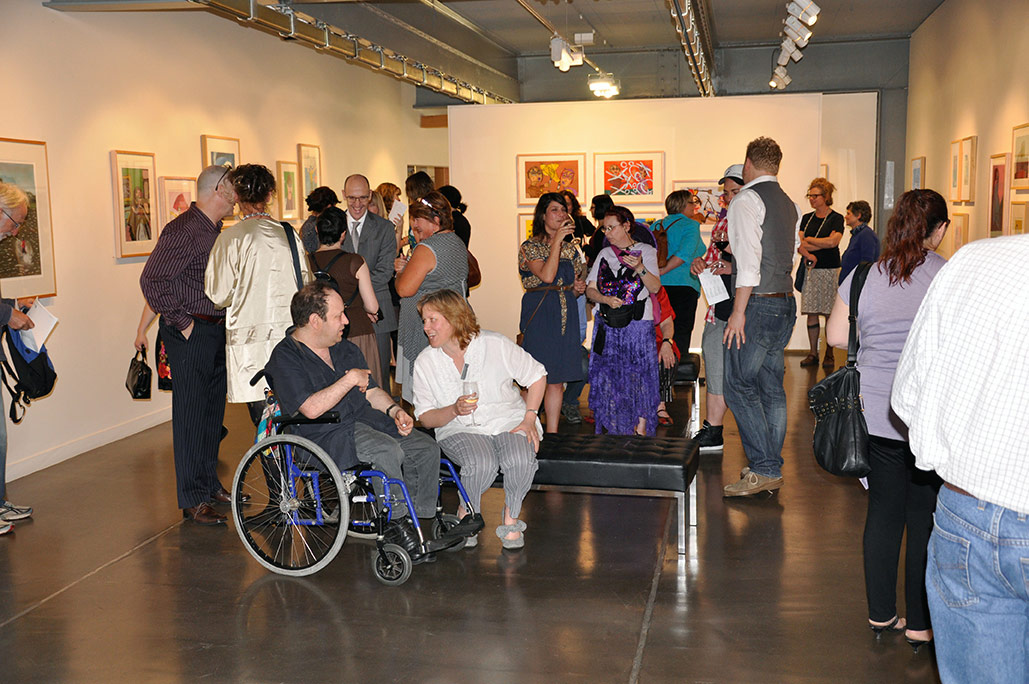
Opening night crowd at Movement and Emotion, Arts Project Australia
Opening night, with at left curator and artist Paul Hodges, artist Jodie Noble (seated), myself and, at right, Jonah Jones, President of the board of Arts Project Australia
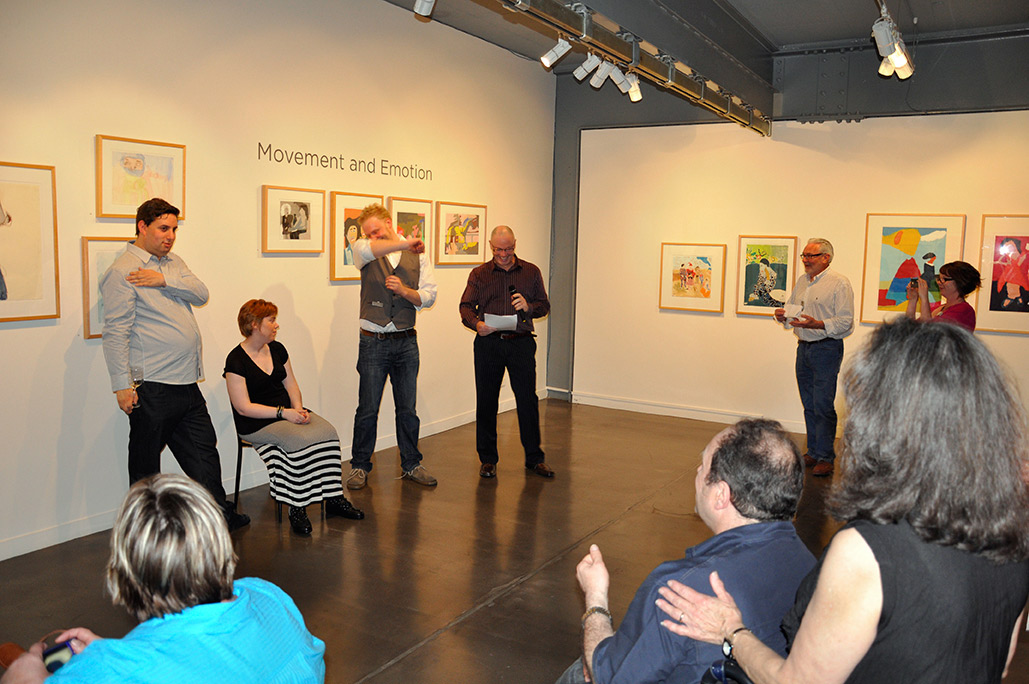
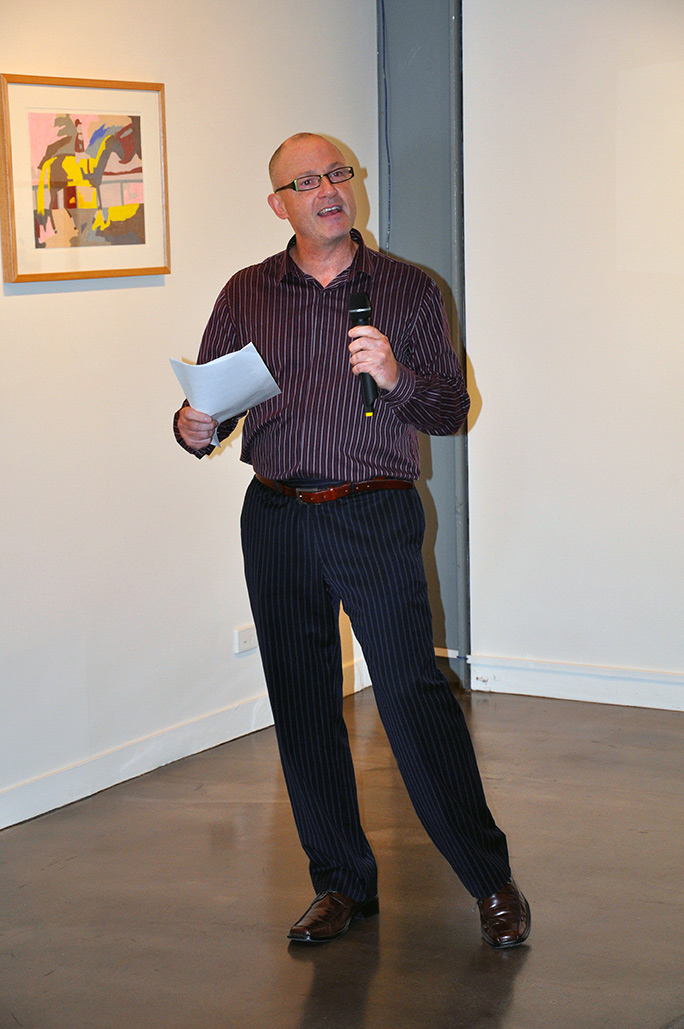
Dr Marcus Bunyan giving the opening night speech for the exhibition Movement and Emotion. Read the opening night speech. I was so nervous my jeweller friend Marianne said she could see my hands shaking from where she was standing in the crowd!!
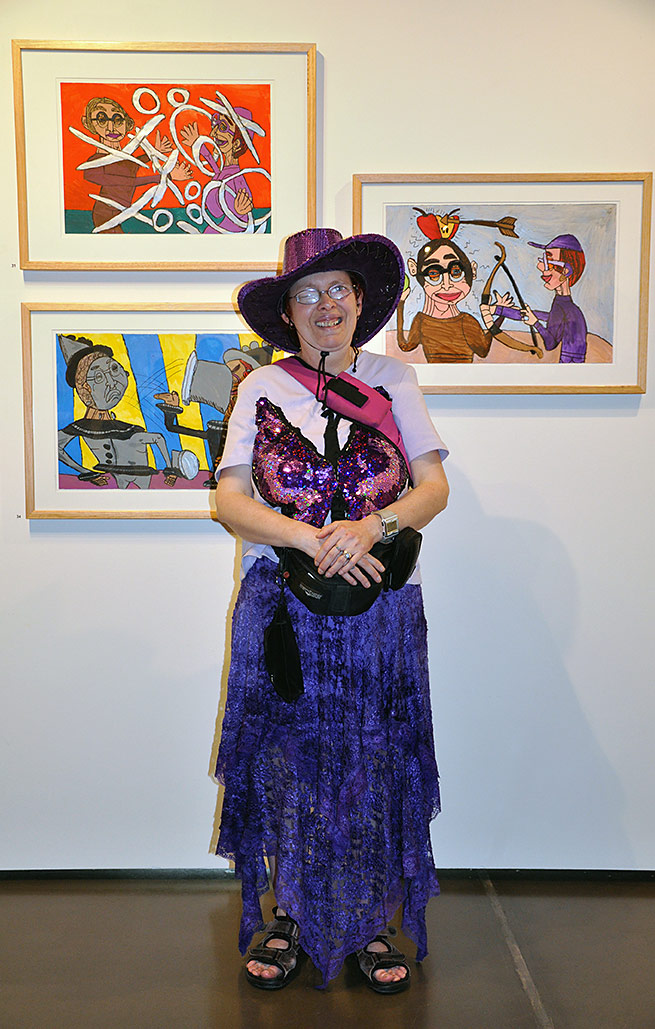
Artist Catherine Staughton standing in front of her work
Arts Project Australia
Studio
24 High Street
Northcote Victoria 3070 Phone: + 61 3 9482 4484
Gallery
Level 1 Perry Street building
Collingwood Yards
Enter via 35 Johnson Street or 30 Perry Street, Collingwood Phone: +61 477 211 699
Emma Davies (Australian, b. 1968) Sekai (meaning ‘be humorous’) 2009
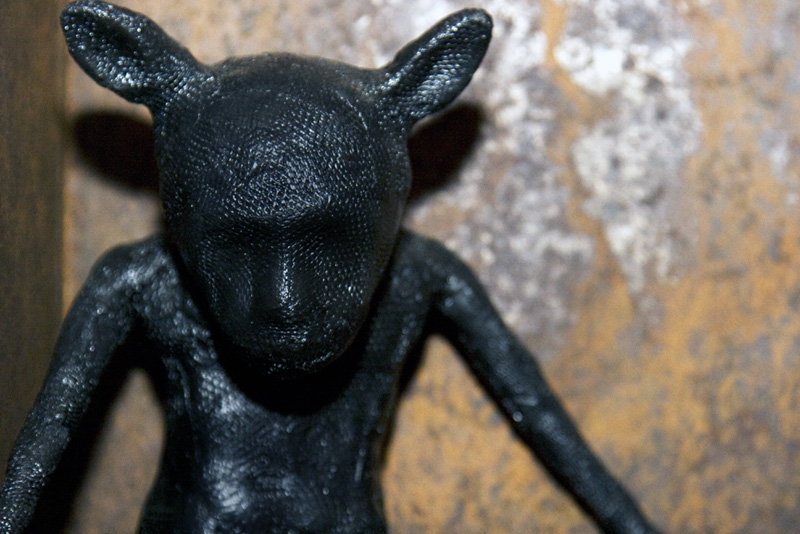
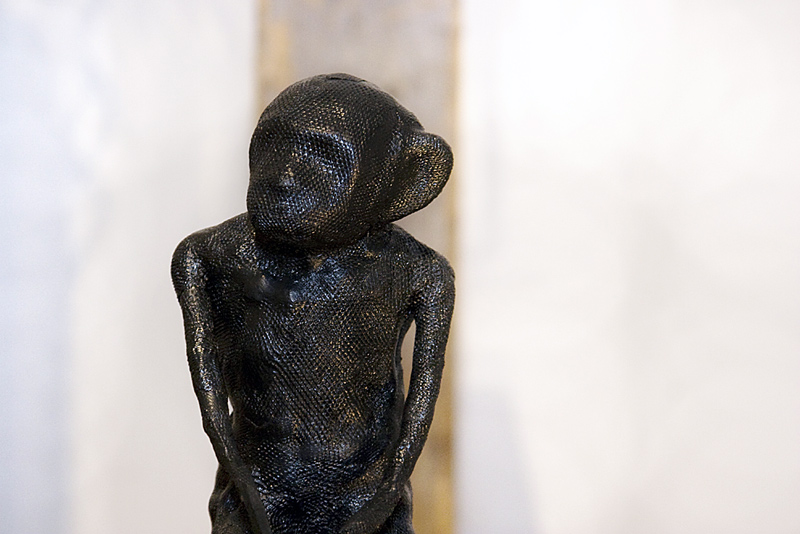
A stimulating exhibition by Emma Davies at Craft Victoria of polypropylene industrial netting and packaging that has been heated, moulded, sculpted and literally morphed into these fantastical sculptures, inspired by the artist’s experiences when visiting Johannesburg in South Africa as part of the South Project. Davies evokes the mysterious and the bizarre in her figures, making the commonplace into something uncommon, taking her themes from the relics of bush medicine present in the street markets: the medicine market of Johannesburg full of dried animal bones, skulls, skins and bottles of alchemistic objects.
Despite their comforting South African names (translated into English as ‘hope’, ‘faith’, ‘quiet, tranquil’, ‘lady’, ‘chief’, ‘prince’ for example) these extremely individual figurative ‘presences’ have a powerful melancholic affect on the viewer. Their elongated long legged and armed, no necked forms create dark eyeless creatures that crouch in rusted boxes or sit on wooden posts with their legs and arms hanging, folded. They seem lonely and sad despite their titles, perhaps reflecting the harsh realities of a life of poverty on the streets of Soweto.
Two figures on wooden blocks seem to walk aimlessly, placed on large rough industrial tables with huge wheels while another figure sits up a rusted ladder propped against the wall. A group of figures are clustered together on top of large wooden posts of different heights, some with arms round each other for comfort, others with black or red feathers sprouting from shoulders, legs or wearing a red feathered skirt. These creatures create a marvellous group of contemplative wandering minstrels while behind them their eerie shadows fall on the gallery wall.
The crystalline nature to the surface of the creatures, like sparkling coal, reminds me of the work of William Kentridge, his white industrial protagonist Felix haunted by images of black workers deep underground mining coal (see Mine (1991) where his coffee plunger goes down into the ground through the bodies of black people). Some of the figures bat like ears also bring to mind the work of Francisco de Goya and specifically his work Los Caprichos (The Whims), plate 43 from the series of 80 etchings published in 1799 titled The Dream of Reason Produces Monsters. The artist described the collection as an exposé of “the innumerable foibles and follies to be found in any civilised society, and from the common prejudices and deceitful practices which custom, ignorance, or self-interest have made usual.”
As Goya began to sympathise with the suffering of the peasants so Davies seems to have been transformed by what she saw around her during her visit, trying to make sense of a foreign culture, dreaming the sleep of reason but surrounded and invaded by a world in which the natural and unnatural has fused and morphed.
I really liked this exhibition and the presence of these figures. I am obviously not alone as the show is almost sold out. A visit to these disturbing, enfolding creatures is recommended.
Dr Marcus Bunyan
All photographs courtesy of Craft Victoria (thankyou Amy Brand!) and taken by their photographer Alexia Skok. Please click on the photographs for a larger version of the image.
Emma Davies (Australian, b. 1968) Tariro (meaning ‘hope’) 2009
Emma Davies (Australian, b. 1968) Rutendo (detail – meaning ‘faith’) 2009
Francisco de Goya (Spanish, 1746-1828) Los Caprichos plate 43 from the series El sueño de la razón produce monstros 1799 Etching and aquatint Height: 21.3cm (8.3″) Width: 15.1cm (5.9″) Museo del Prado, Madrid
Emma Davies (Australian, b. 1968) Zola (detail – meaning ‘quiet, tranquil’) 2009
Emma Davies (Australian, b. 1968) Group with from left to right: Enitan (person of story), Ntombi (lady), Kgosi (chief), Nkosana (prince), Lucky and Alaba (second child after twins) 2009
Emma Davies (Australian, b. 1968) Nkosana (detail – meaning ‘prince’) 2009
Craft Victoria Watson Place, off Flinders Lane, Melbourne 3000 Phone: 03 9650 7775
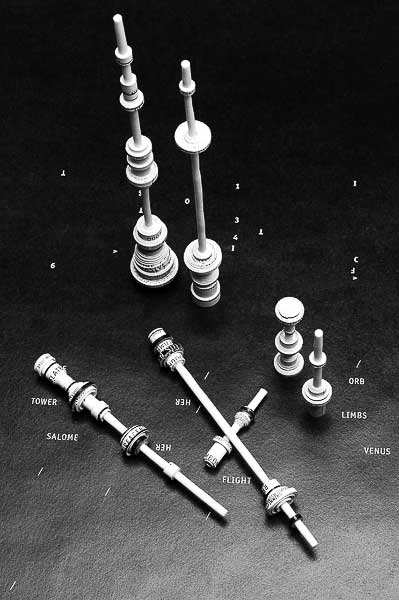
Natasha Dusenjko (Australian) Towers of Babel 2009 Mixed media
Three very interesting exhibitions at Craft Victoria at the moment: Babel by Natasha Dusenjko, Gleaning Potential by Simon Lloyd and Cycle by Liz Low. I particularly liked the delicacy and textuality of Natasha Dusenjko’s sci-fi towers and bone fragments and the wonderful box of 6 red bricks (small and large) that you can buy from the Simon Lloyd show, like blocks for a child builder.
There is an excellent and erudite review of the exhibitions at Daniel Neville’s Nevolution website.
Dr Marcus Bunyan
Many thankx to Craft Victoria for allowing me to publish the photographs in the posting. Please click on the photographs for a larger version of the image.
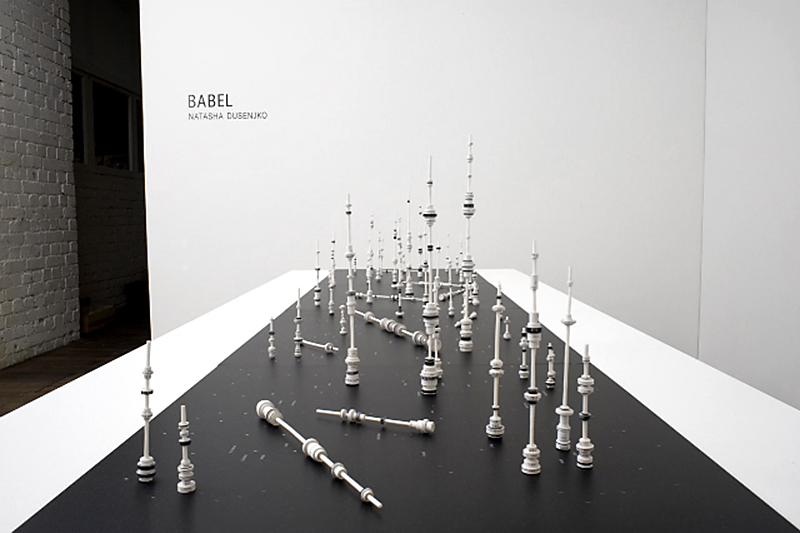
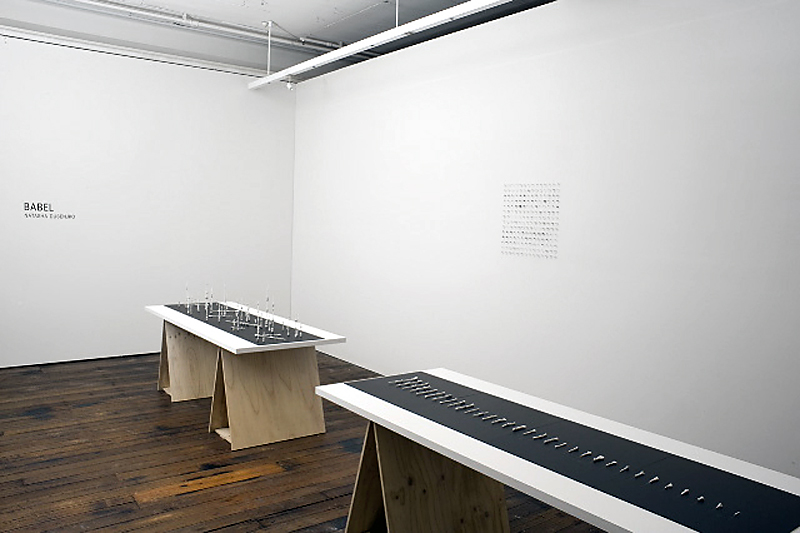
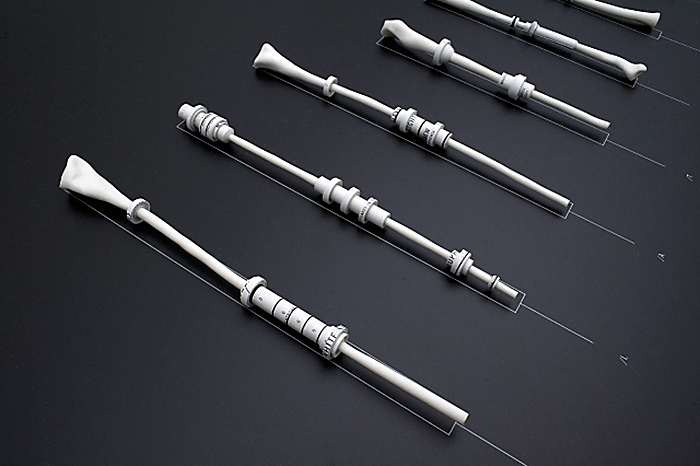
“The two tables allow for different meanings and scales when viewed in opposition. Table 1 alludes to star charts; constellations of texts hinting at importance, especially in relation to the placement of towers. The map looking up to the stars via the towers of babel, communicating unknown messages to the stars above. The cold stark forms of the towers work well with the organic forms of the bones on Table 2. Perfectly ordered and numbered archaeological bone fragments repeat the textual ciphers and codes, meticulously ordered. The jump in scale between the architectural and the archaeological is lovely; each hinting at an underlying language and mythology. Meanwhile both contain elements of each other – the towers of rationality have been placed in a seemingly random manner, while the organic forms of the bones have been laid out in perfect order ranging down in sizes.”
Daniel Neville. Extract from “On the nature of language, order and decay,” on the Nevolution website June 03, 2009 [Online] Cited 05/06/2009
Installation views of Natasha Dusenjko’s exhibition Babel at Craft Victoria, Melbourne
Babel is a word-based collection of fine porcelain and paper works. This collection of short texts constitutes a series of incantations, codes and instructions scrolled around porcelain bones or thin spines. The porcelain bones are internal structures and vessels of ancestor memory. This memory is fluid, is evasive, is aquatic. The thin spines resemble futuristic Towers of Babel reaching into space, anticipating communication and new frontiers. These towers have either an upright or collapsed form.
In the making, both forms build toward new possibility, words become obscured, resulting in a non-defined beginning or end, now replaced by chance permutations of the accumulated text.
The sculptural works are deliberately placed onto two large scale text based charts. Each chart is placed on a raised surface, analogous to work benches in an observatory or laboratory suggesting a process of decipherment. Map 1 exhibits a similarity to ancient star charts, the placement of towers alluding to significant points of a constellation. The accompanying Chart 2 resembles an organised series of archeological artefacts, each piece methodically numbered and labelled.
Ultimately, Babel evokes a spiral passage both outward and inward. To unravel the scrolls initiates a return to the spine – the axis mundi, the source of a universal native tongue – love.
Text from the Craft Victoria website [Online] 05/06/2009. No longer available online
Natasha Dusenjko (Australian) Babelbones 2009 Mixed media
Craft Victoria Watson Place, off Flinders Lane Victoria 3000 Phone: 03 9650 7775






 Art Blart _ art and cultural memory archive
You must be logged in to post a comment.