Exhibitions: ‘Beyond Eden: Polixeni Papapetrou’ / ‘Dutch masters of light: Hendrik Kerstens & Erwin Olaf’ / ‘Glamour stakes: Martin Parr’ at Monash Gallery of Art, Melbourne

Exhibition dates: 22nd October – 4th December, 2016


Installation view of 'Beyond Eden: Polixeni Papapetrou' at Monash Gallery of Art, Melbourne featuring three images from the series 'It's all about me' (2016)


Installation view of Beyond Eden: Polixeni Papapetrou at Monash Gallery of Art, Melbourne, featuring three images from the series It’s all about me (2016)
Photo: © Marcus Bunyan, the artist and the Monash Gallery of Art


There was hardly standing room at the opening of Beyond Eden: Polixeni Papapetrou at Monash Gallery of Art, Melbourne. As for car parking, I had to park the car on the grass out the back of the gallery it was so full. Inside, it was great to see Poli and the appreciative crowd really enjoyed her work.

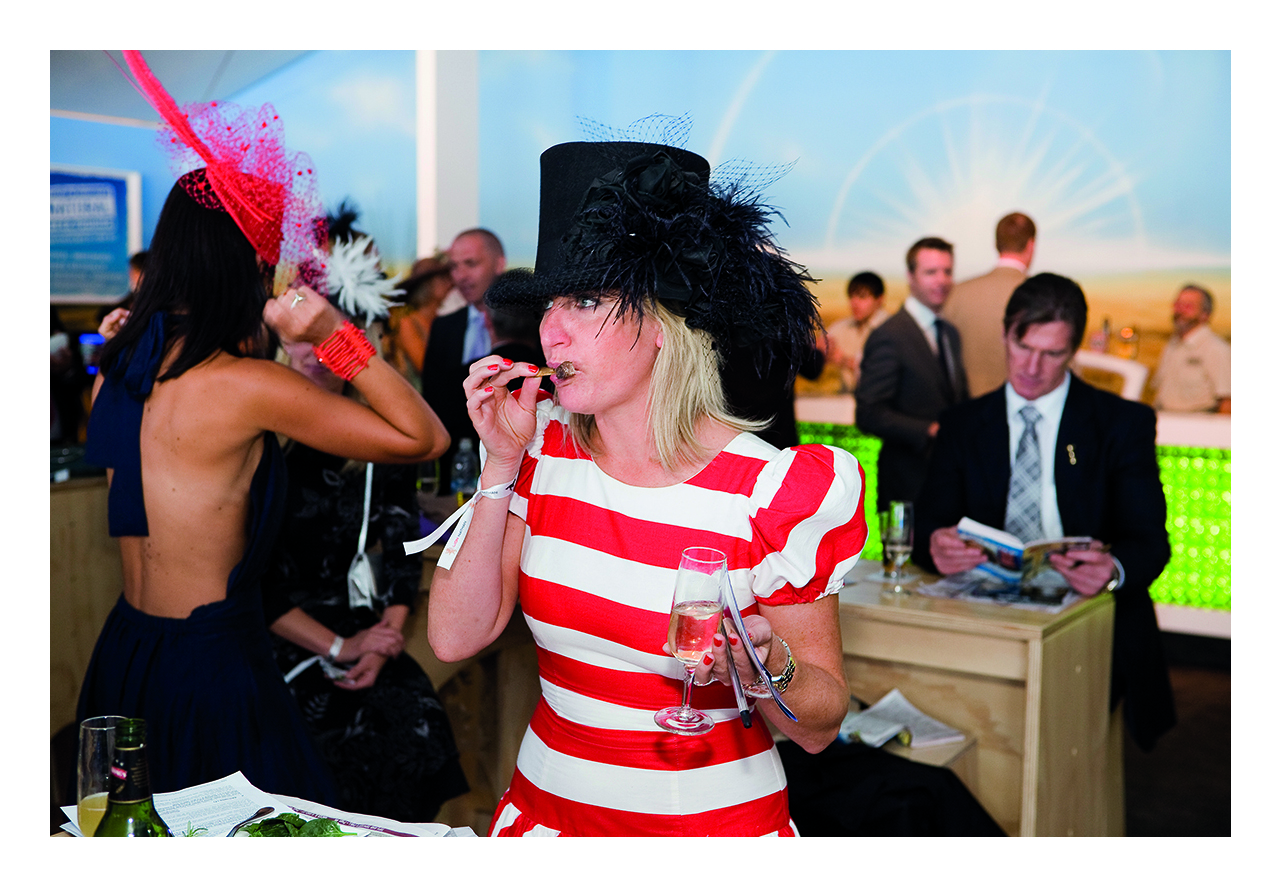
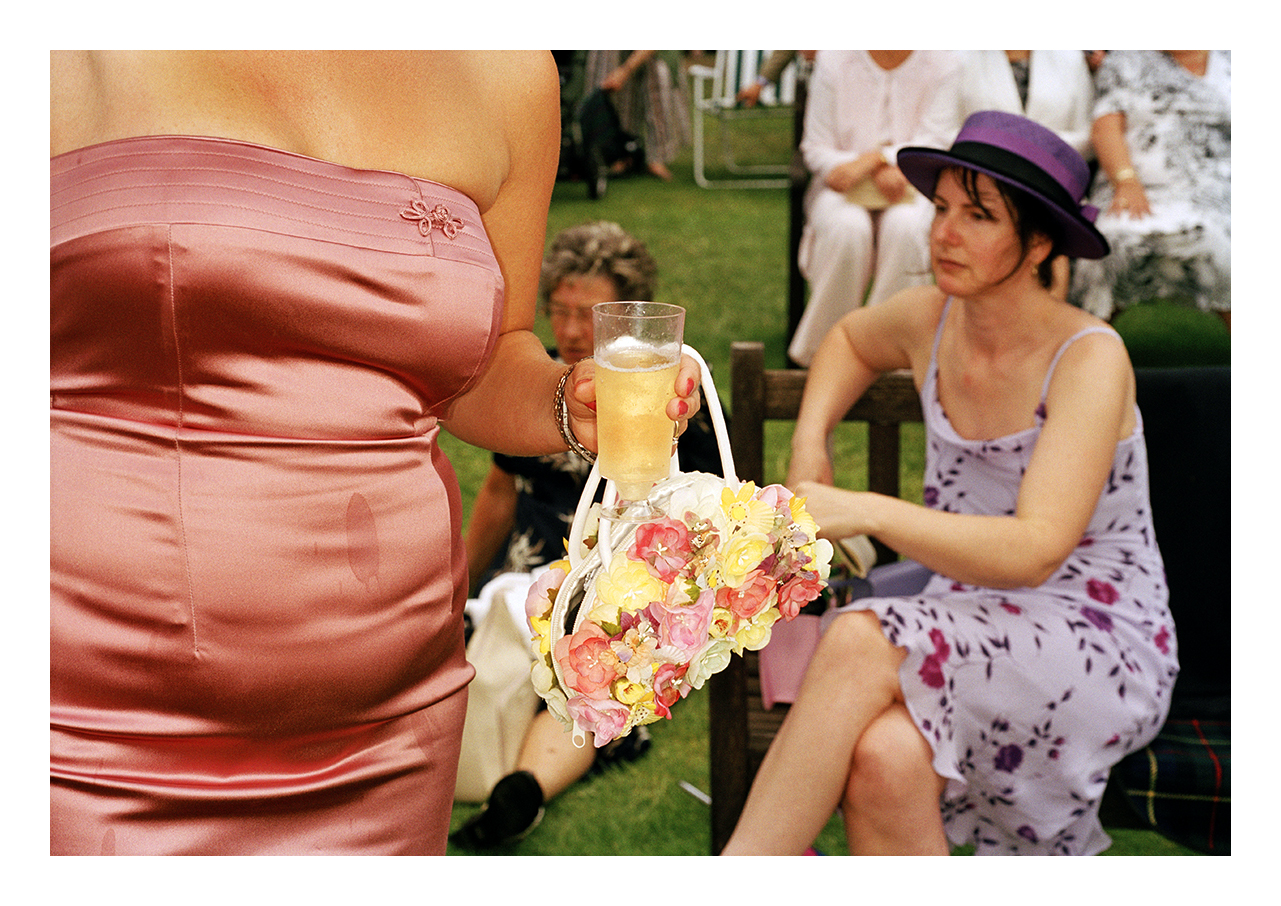
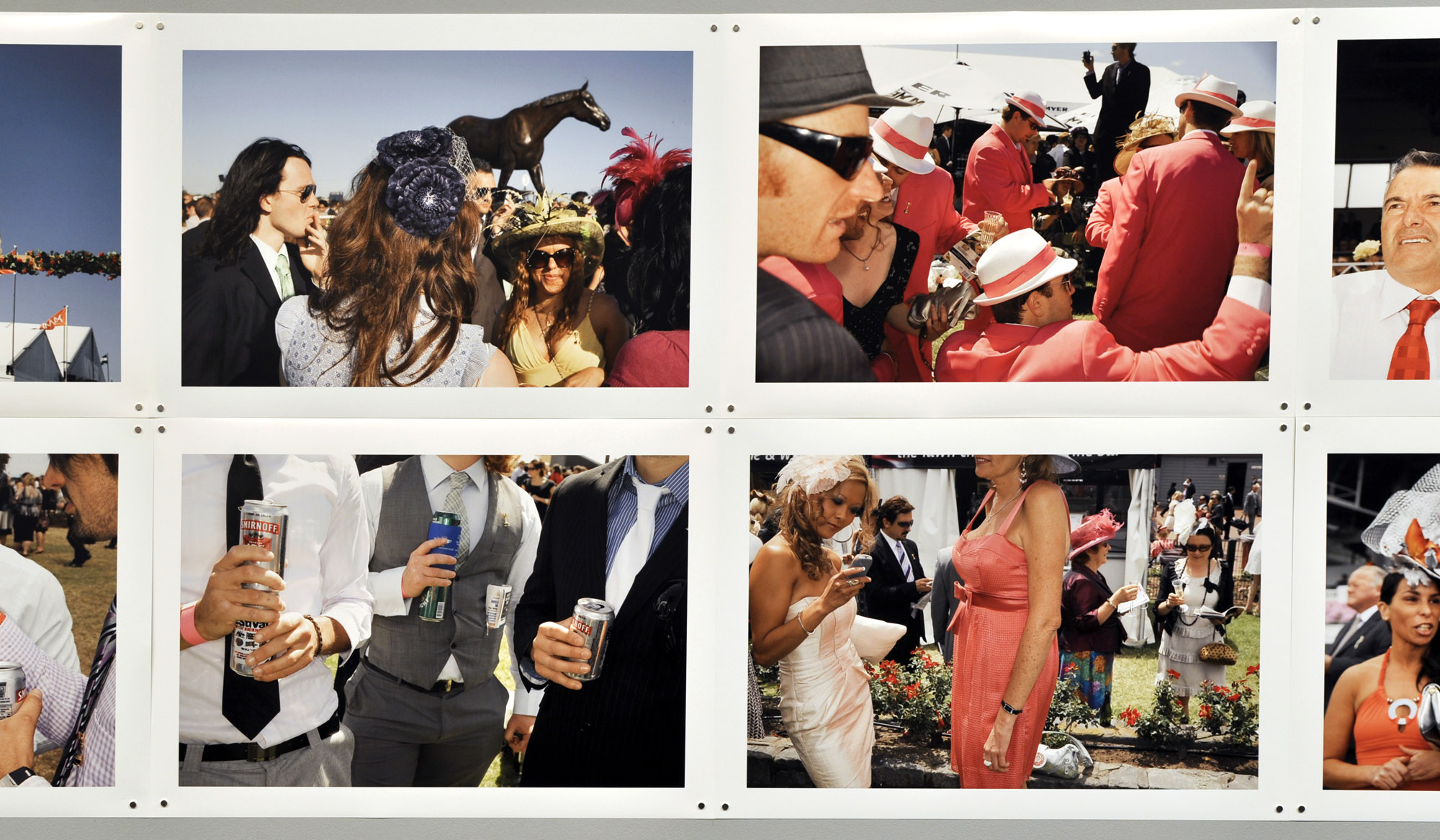
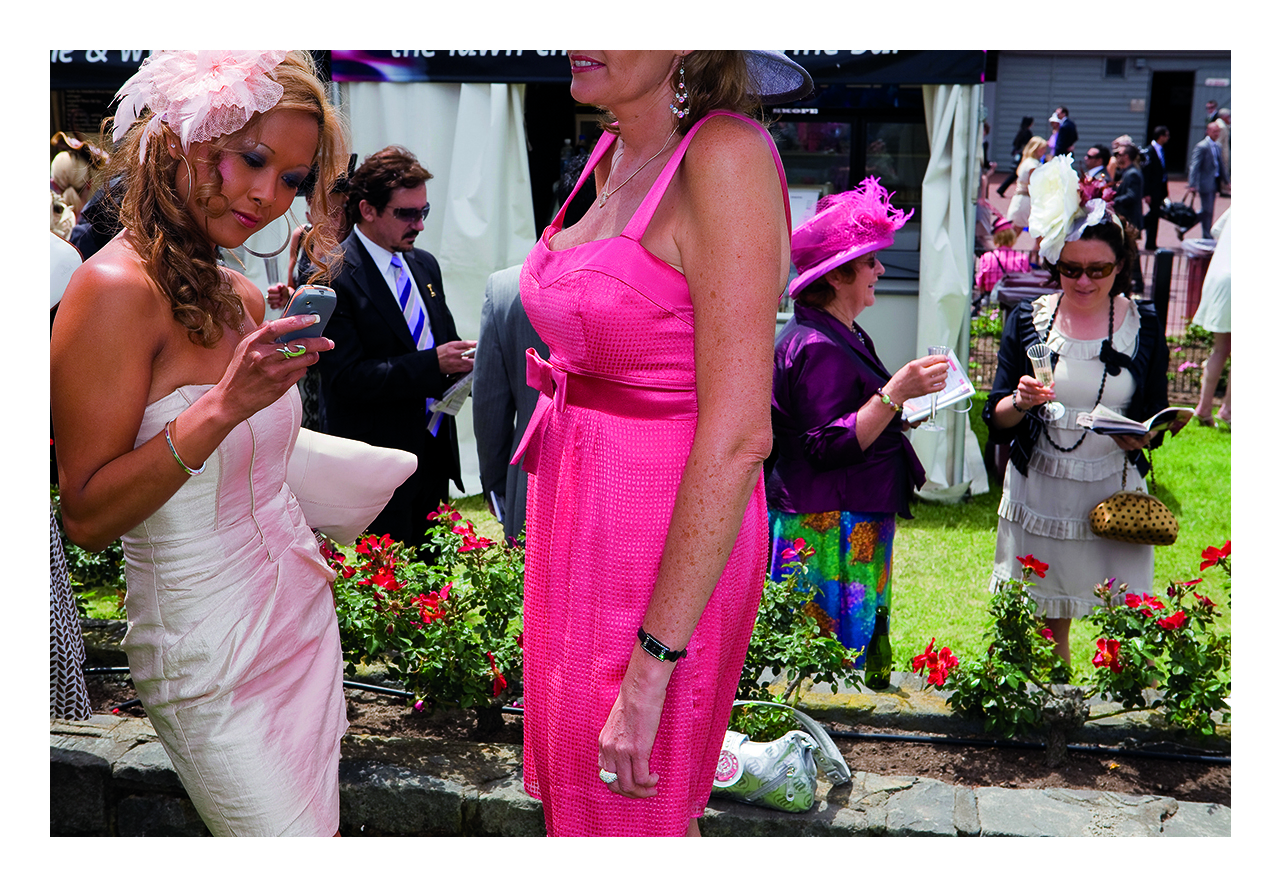
It was the usual fair from the exhibition Glamour stakes: Martin Parr, a whirl of movement, colour, intensity – in the frenetic construction of the picture plane; in the feverish nature of encounter between camera and subject – and obnoxious detail in photographs from the series Luxury (2003-2009). Low depth of field, flash photography, fabulous hats, and vibrant colours feature in images that ‘document leisure and consumption and highlight the unintentional, awkward and often ugly sides of beauty, fashion and wealth’. Sadly, after a time it all becomes a bit too predictable and repetitive.

The pick of the bunch in the exhibition Dutch masters of light: Hendrik Kerstens & Erwin Olaf was the work of Hendrik Kerstens. Simple, elegant portrait compositions that feature, and subvert, the aesthetics of 17th-century Dutch master paintings. I love the humour and disruption in the a/historical account, “the différance [which] simultaneously contains within its neo-graphism the activities of differing and deferring, a distancing acted out temporally as well as spatially.” (Geoffrey Batchen)

Dr Marcus Bunyan


Many thankx to Monash Gallery of Art for allowing me to publish the photographs in the posting. Please click on the photographs for a larger version of the image.
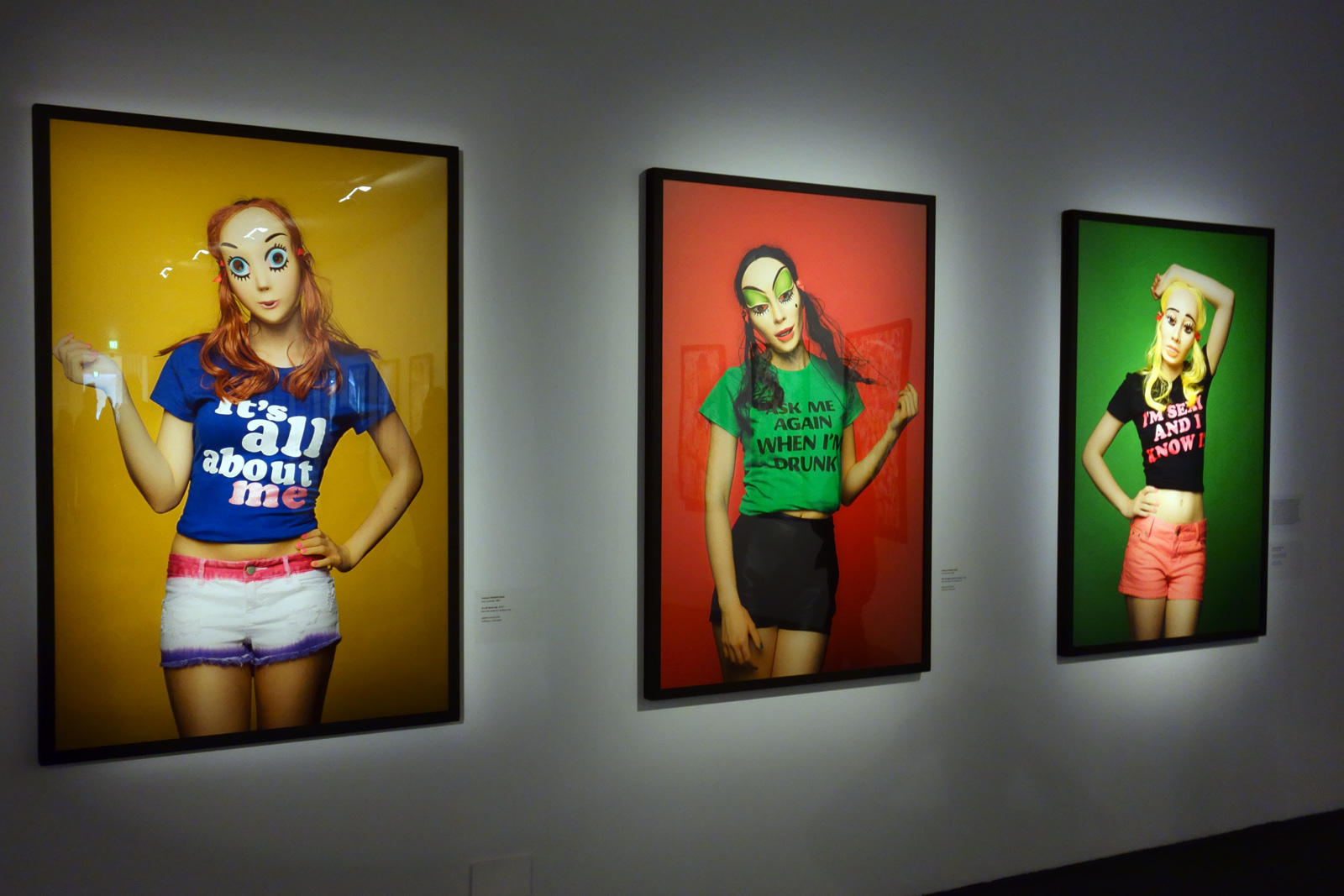


Installation view of 'Beyond Eden: Polixeni Papapetrou' at Monash Gallery of Art, Melbourne featuring three images from the series 'It's all about me' (2016)


Installation view of Beyond Eden: Polixeni Papapetrou at Monash Gallery of Art, Melbourne, featuring three images from the series It’s all about me (2016)
Photo: © Marcus Bunyan, the artist and the Monash Gallery of Art


Polixeni Papapetrou (Australian, 1960-2018) 'It's all about me' 2016 (installation view)


Polixeni Papapetrou (Australian, 1960-2018)
It’s all about me (installation view)
2016
From the series It’s all about me
Pigment ink-jet print
Collection of the artist
Photo: © Marcus Bunyan, the artist and the Monash Gallery of Art


Polixeni Papapetrou (Australian, 1960-2018) 'Ask me again when I'm drunk' (installation view) 2016 from the series 'It's all about me' 2016


Polixeni Papapetrou (Australian, 1960-2018)
Ask me again when I’m drunk (installation view)
2016
From the series It’s all about me
Pigment ink-jet print
Collection of the artist
Photo: © Marcus Bunyan, the artist and the Monash Gallery of Art


It’s all about me comprises five photographs of the artist’s daughter wearing doll-like masks and sporting a series of T-shirts bearing sassy slogans. As in much of Papapetrou’s work, the aesthetic of role-playing is used to suggest an awkward relationship between social appearances and an authentic self. These works specifically explore the complex world that contemporary teenage live in and the way identities are created and manipulated through fashion, social media and the internet. In this respect, the gauche quality of the photographs reflects the awkward self-importance of teenagers reaching for adulthood.
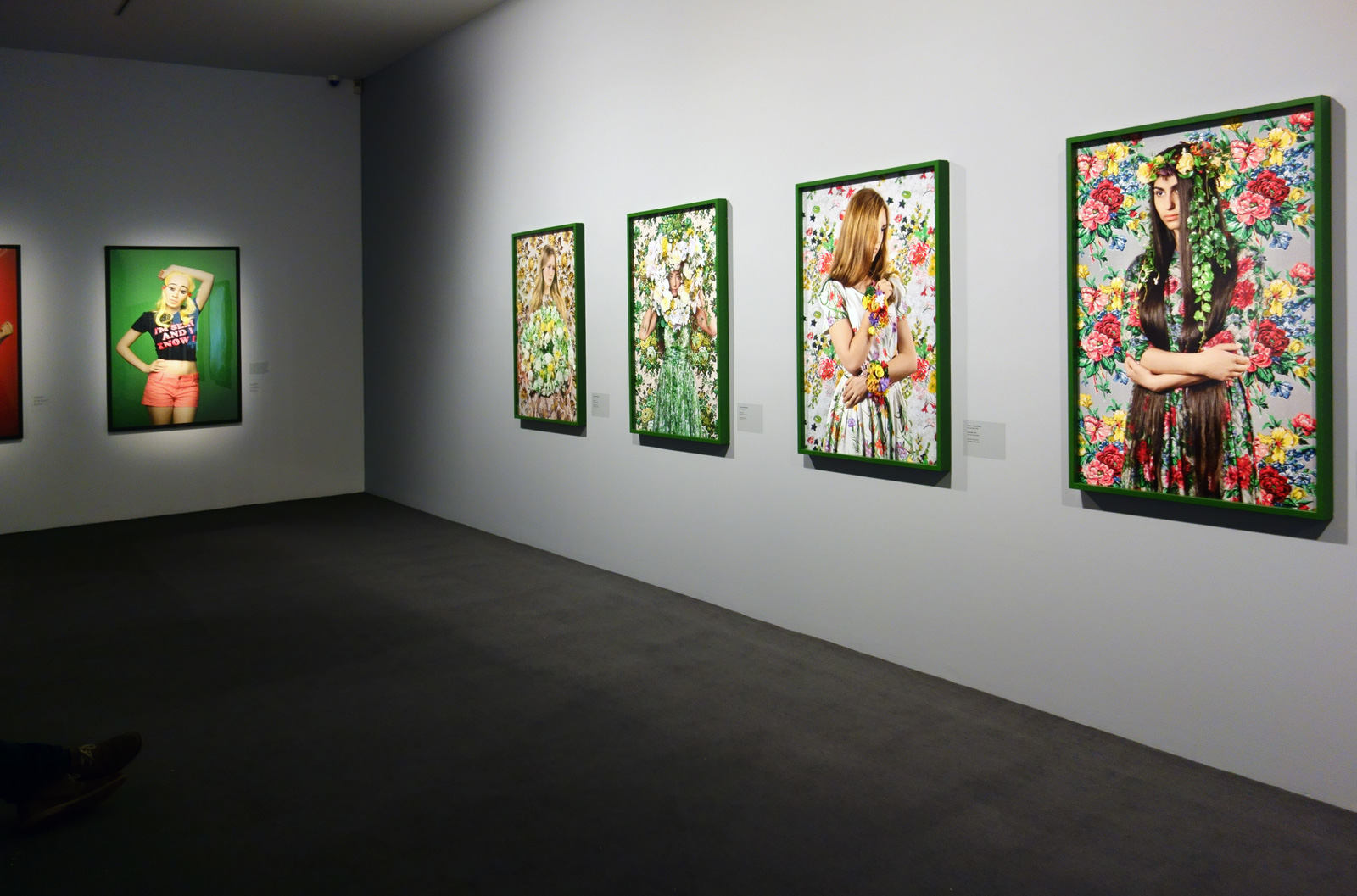
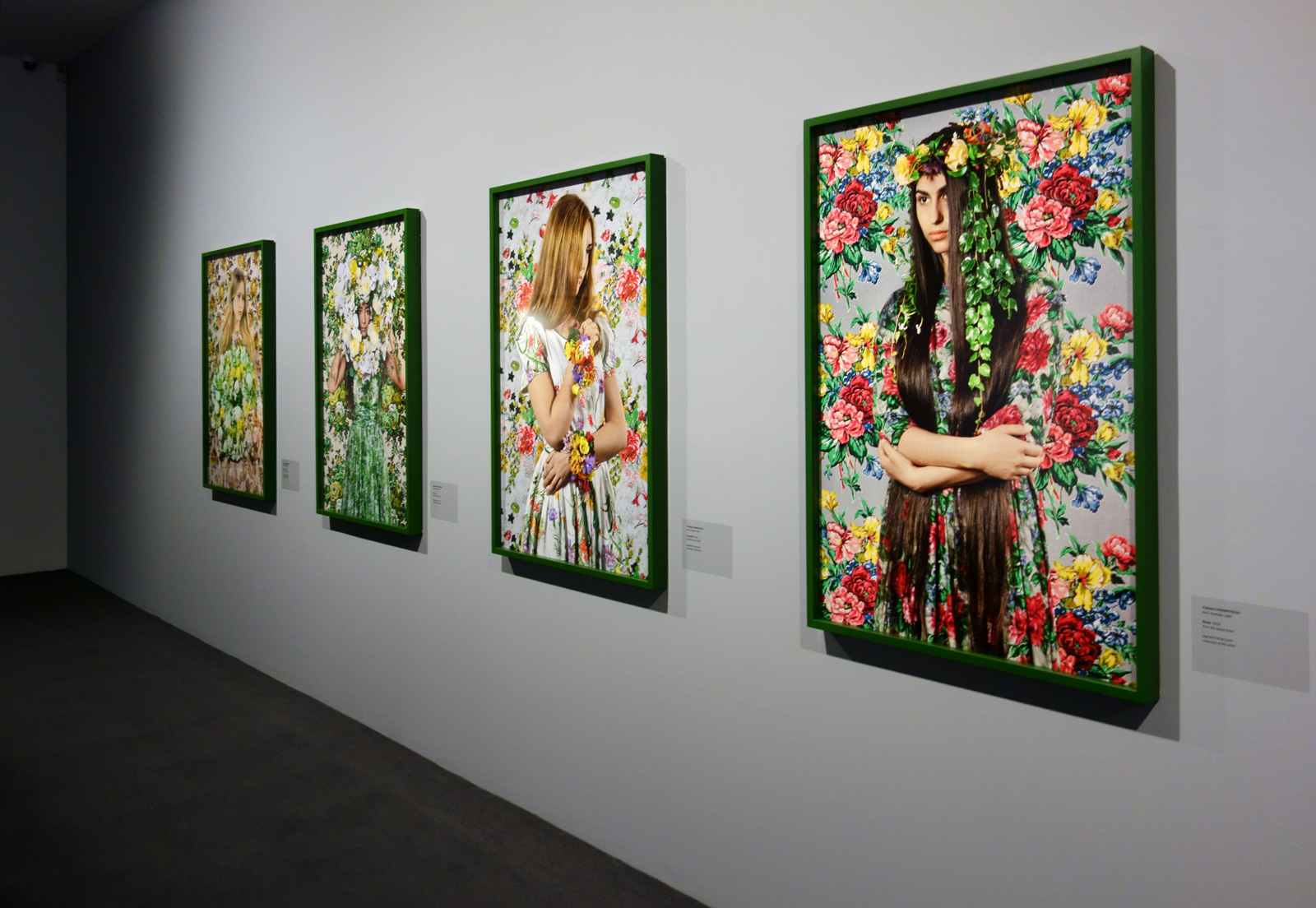
 

Installation view of 'Beyond Eden: Polixeni Papapetrou' at Monash Gallery of Art, Melbourne featuring photographs from the series 'Eden' (2016)

Installation view of 'Beyond Eden: Polixeni Papapetrou' at Monash Gallery of Art, Melbourne featuring photographs from the series 'Eden' (2016)

Installation view of 'Beyond Eden: Polixeni Papapetrou' at Monash Gallery of Art, Melbourne featuring photographs from the series 'Eden' (2016)

Installation view of 'Beyond Eden: Polixeni Papapetrou' at Monash Gallery of Art, Melbourne featuring photographs from the series 'Eden' (2016)

Installation view of 'Beyond Eden: Polixeni Papapetrou' at Monash Gallery of Art, Melbourne featuring photographs from the series 'Eden' (2016)

Installation view of 'Beyond Eden: Polixeni Papapetrou' at Monash Gallery of Art, Melbourne featuring photographs from the series 'Eden' (2016)


Installation views of Beyond Eden: Polixeni Papapetrou at Monash Gallery of Art, Melbourne, featuring photographs from the series Eden (2016)
Photos: © Marcus Bunyan, the artist and the Monash Gallery of Art


Polixeni Papapetrou (seated) surrounded by friends, family and well wishers at the opening of her exhibition 'Beyond Eden: Polixeni Papapetrou' at Monash Gallery of Art, Melbourne


Polixeni Papapetrou (seated) surrounded by friends, family and well wishers at the opening of her exhibition Beyond Eden: Polixeni Papapetrou at Monash Gallery of Art, Melbourne
Photo: © Marcus Bunyan, the artist and the Monash Gallery of Art


Beyond Eden: Polixeni Papapetrou

Polixeni Papapetrou is a Melbourne-based photographic artist. She first began taking photographs in the 1980s, creating documentary-style portraits of drag queens, body builders and Elvis fans. Soon after the birth of her first child, Papapetrou’s artistic practice began to focus on projects that employed her children, Olympia and Solomon, as models. She is now known nationally and internationally for her staged images that show her children dressed in costumes and masks while performing in front of real and imaginary backgrounds.

This exhibition brings together three recent bodies of work by Papapetrou: Lost psyche (2014), It’s all about me (2016) and Eden (2016). Each of these studio-based series explores themes that have been central to Papapetrou’s practice for the past 30 years. In particular, they highlight her long-term interest in social identity being elaborated through the processes of role-playing and performance.

It is important to note that Papapetrou composes her photographs using a range of historical and contemporary references, thereby embedding these staged performances in a network of competing forces. As a result, there is often a purposefully awkward style to the images, which suggests that identity is continually being inherited, negotiated and perpetuated through the history of representation.

As with much of Papapetrou’s work, the series included in this exhibition either partly or wholly feature the artist’s children, who are now in their late teenage years. By photographing her children and at the same time concealing their identities, Papapetrou is able to create portraits that are grounded in her personal experience of parenting but reflect on more universal themes of childhood innocence and the transience of life.

Text from the Monash Gallery of Art website
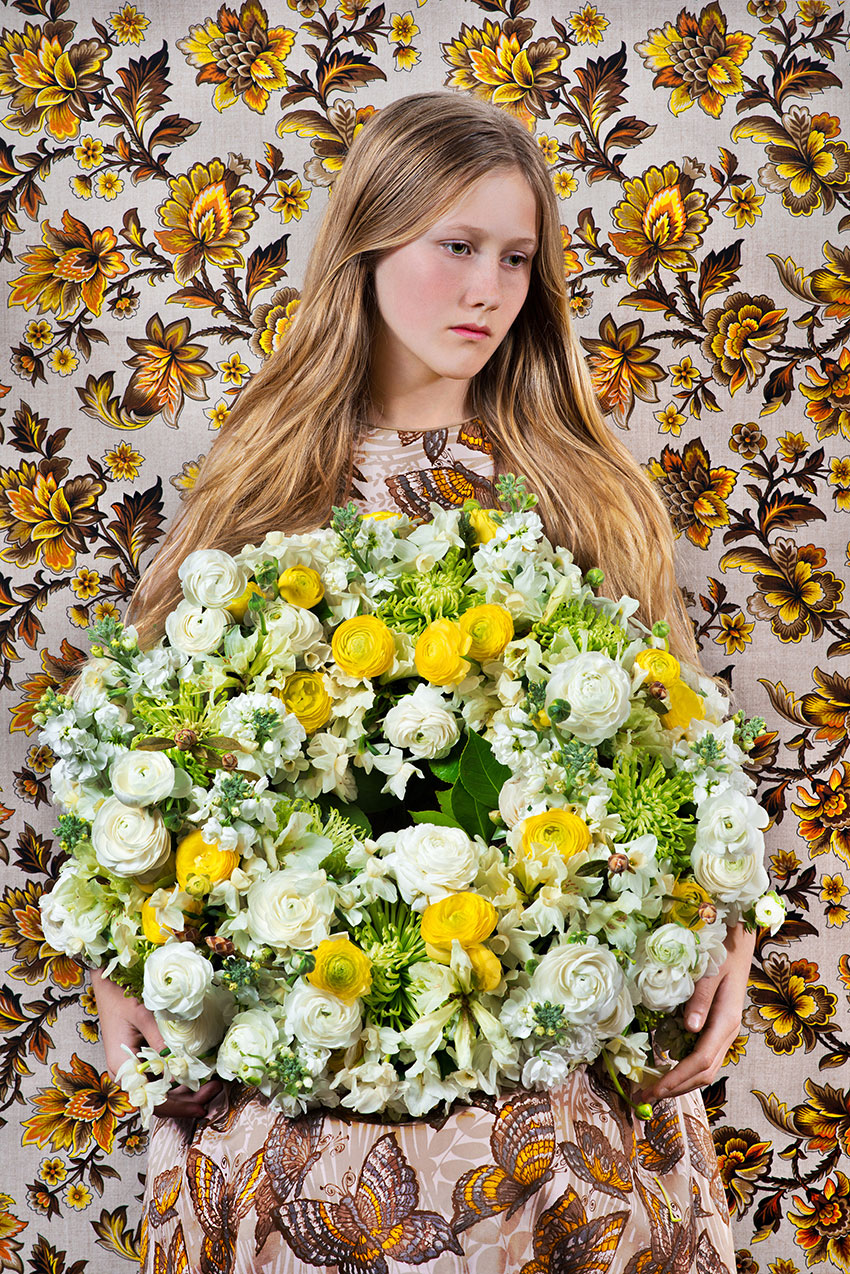
 

Polixeni Papapetrou (Australian, 1960-2018) 'Flora' 2016


Polixeni Papapetrou (Australian, 1960-2018)
Flora
2016
From the series Eden
Pigment print
127.3 x 85cm
Courtesy of the artist and STILLS Gallery, Sydney


In Roman mythology, Flora (Latin: Flōra) was a Sabine-derived goddess of flowers and of the season of spring – a symbol for nature and flowers (especially the may-flower). While she was otherwise a relatively minor figure in Roman mythology, being one among several fertility goddesses, her association with the spring gave her particular importance at the coming of springtime, as did her role as goddess of youth. Her name is derived from the Latin word “flos” which means “flower”. In modern English, “Flora” also means the plants of a particular region or period.


Polixeni Papapetrou (Australian, 1960-2018) 'Blinded' from 'Eden', 2016


Polixeni Papapetrou (Australian, 1960-2018)
Blinded
2016
From the series Eden
Pigment print
127.3 x 85cm
Courtesy of the artist and STILLS Gallery, Sydney


Polixeni Papapetrou (Australian, 1960-2018) 'Eden' 2016


Polixeni Papapetrou (Australian, 1960-2018)
Eden
2016
From the series Eden
Pigment print
127.3 x 85cm
Courtesy of the artist and STILLS Gallery, Sydney
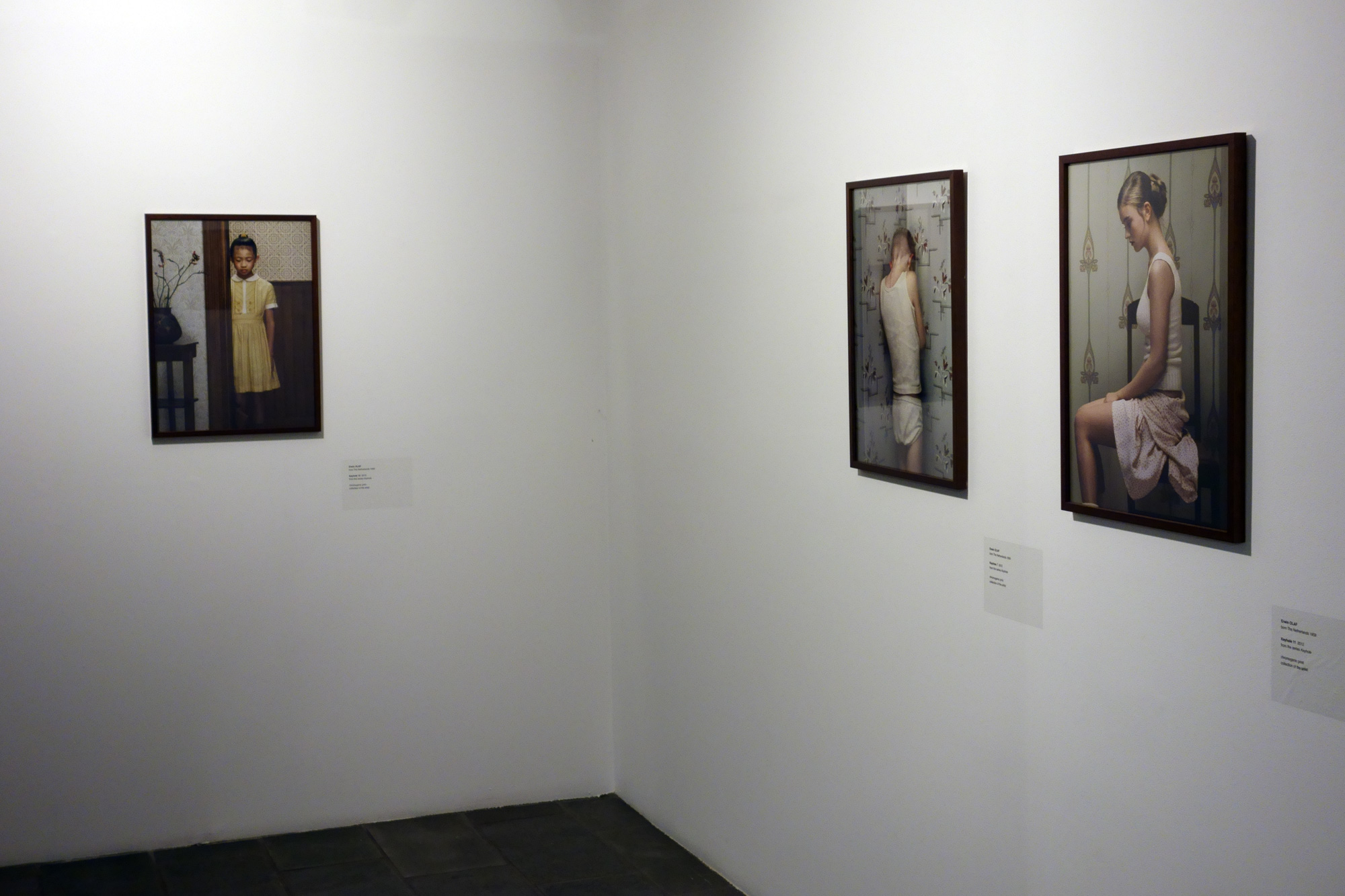
 

Installation view of 'Dutch masters of light: Hendrik Kerstens and Erwin Olaf' at Monash Gallery of Art, Melbourne, featuring photographs Irwin Olaf's 'Keyhole' series (2012)


Installation view of Dutch masters of light: Hendrik Kerstens and Erwin Olaf at Monash Gallery of Art, Melbourne, featuring photographs Irwin Olaf’s Keyhole series
Photo: © Marcus Bunyan, the artist and the Monash Gallery of Art


Installation view of 'Dutch masters of light: Hendrik Kerstens and Erwin Olaf' at Monash Gallery of Art, Melbourne featuring at left, Irwin Olaf's 'Keyhole 7' (2012); and at right, 'Keyhole 12' (2012)


Installation view of Dutch masters of light: Hendrik Kerstens and Erwin Olaf at Monash Gallery of Art, Melbourne featuring at left, Irwin Olaf’s Keyhole 7 (2012); and at right, Keyhole 12 (2012)
Photo: © Marcus Bunyan, the artist and the Monash Gallery of Art


Erwin Olaf (Netherlands, 1959-2023) 'Keyhole 3' 2011


Erwin Olaf (Netherlands, 1959-2023)
Keyhole 3
2011
From the Keyhole series
Chromogenic print
62.5 x 50.0cm
Courtesy of the artist


Installation view of 'Dutch masters of light: Hendrik Kerstens and Erwin Olaf' at Monash Gallery of Art, Melbourne featuring the work of Hendrik Kerstens


Installation view of Dutch masters of light: Hendrik Kerstens and Erwin Olaf at Monash Gallery of Art, Melbourne featuring the work of Hendrik Kerstens
Photo: © Marcus Bunyan, the artist and the Monash Gallery of Art


Hendrik Kerstens (Dutch, b. 1956) 'Bathing cap' 1992


Hendrik Kerstens (Dutch, b. 1956)
Bathing cap
1992
Ink-jet print 62.5 x 50.0cm
Courtesy of the artist
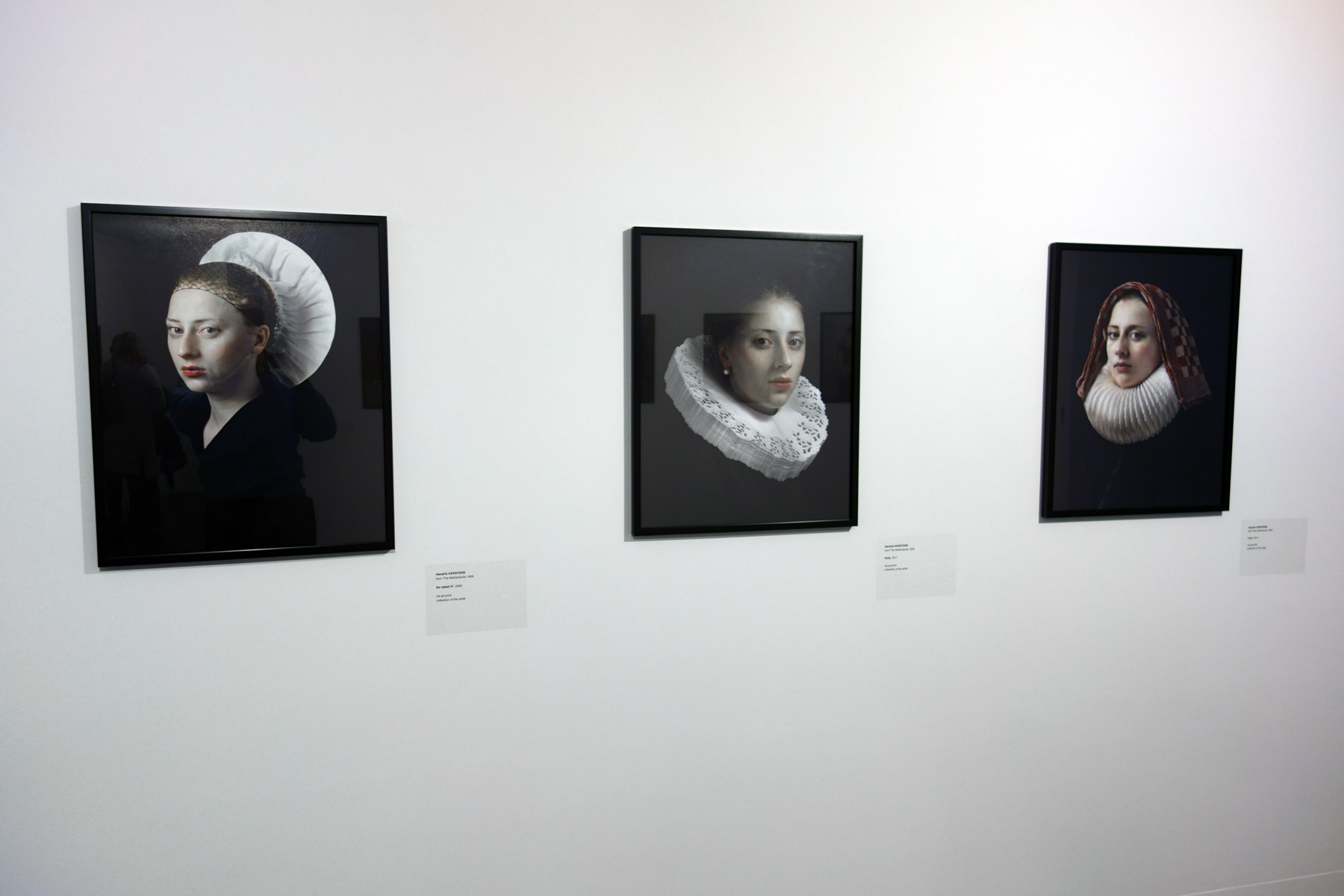
 

Installation view of 'Dutch masters of light: Hendrik Kerstens and Erwin Olaf' at Monash Gallery of Art, Melbourne featuring the work of Hendrik Kerstens with at left, 'Re rabbit IV' (2009); and in centre, 'Doilly' (2011)


Installation view of Dutch masters of light: Hendrik Kerstens and Erwin Olaf at Monash Gallery of Art, Melbourne featuring the work of Hendrik Kerstens with at left, Re rabbit IV (2009); and in centre, Doilly (2011)
Photo: © Marcus Bunyan, the artist and the Monash Gallery of Art
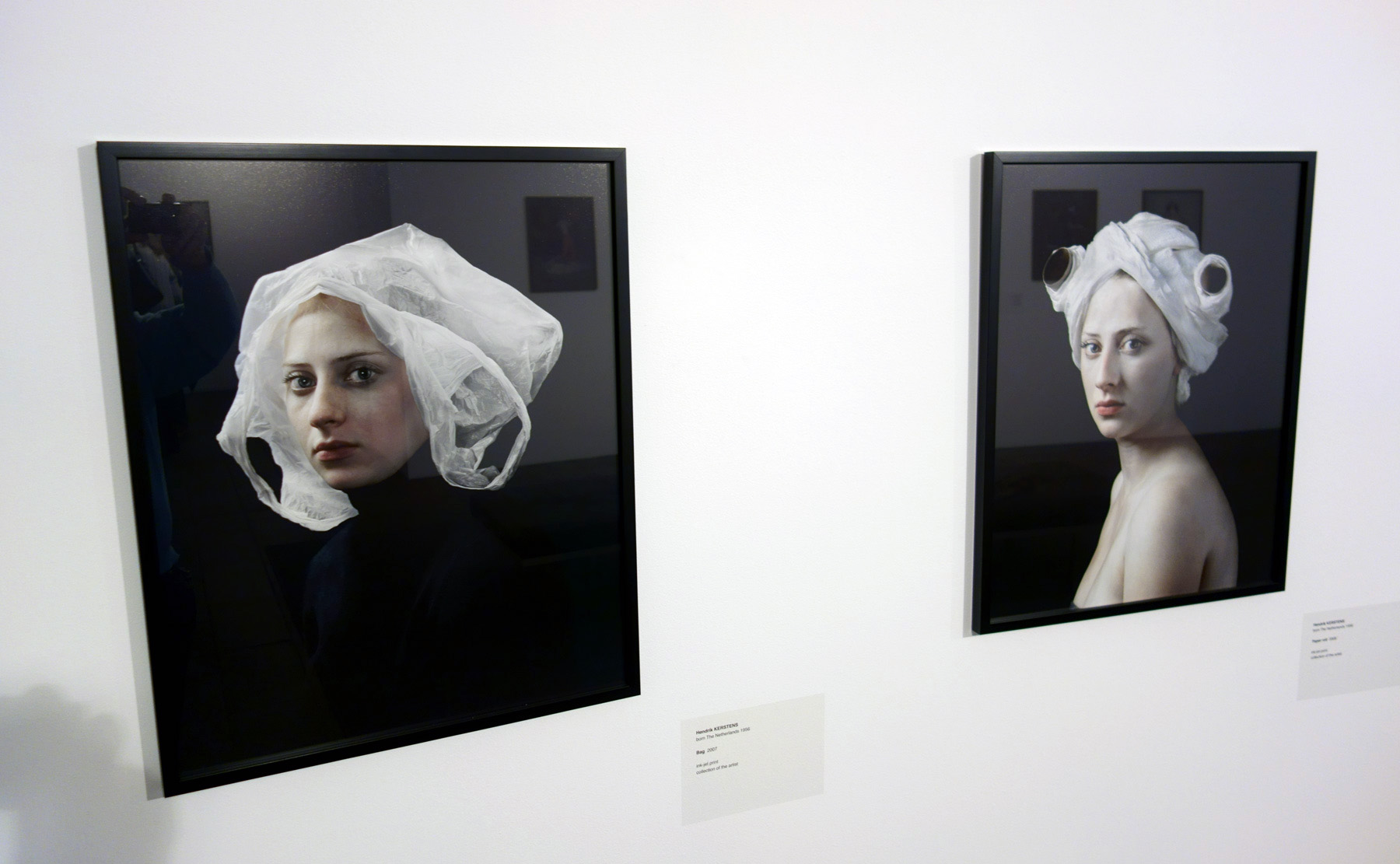
 

Installation view of 'Dutch masters of light: Hendrik Kerstens and Erwin Olaf' at Monash Gallery of Art, Melbourne featuring the work of Hendrik Kerstens with at left, 'Bag' (2007); and at right, 'Paper roll' (2008)


Installation view of Dutch masters of light: Hendrik Kerstens and Erwin Olaf at Monash Gallery of Art, Melbourne featuring the work of Hendrik Kerstens with at left, Bag (2007); and at right, Paper roll (2008)
Photo: © Marcus Bunyan, the artist and the Monash Gallery of Art
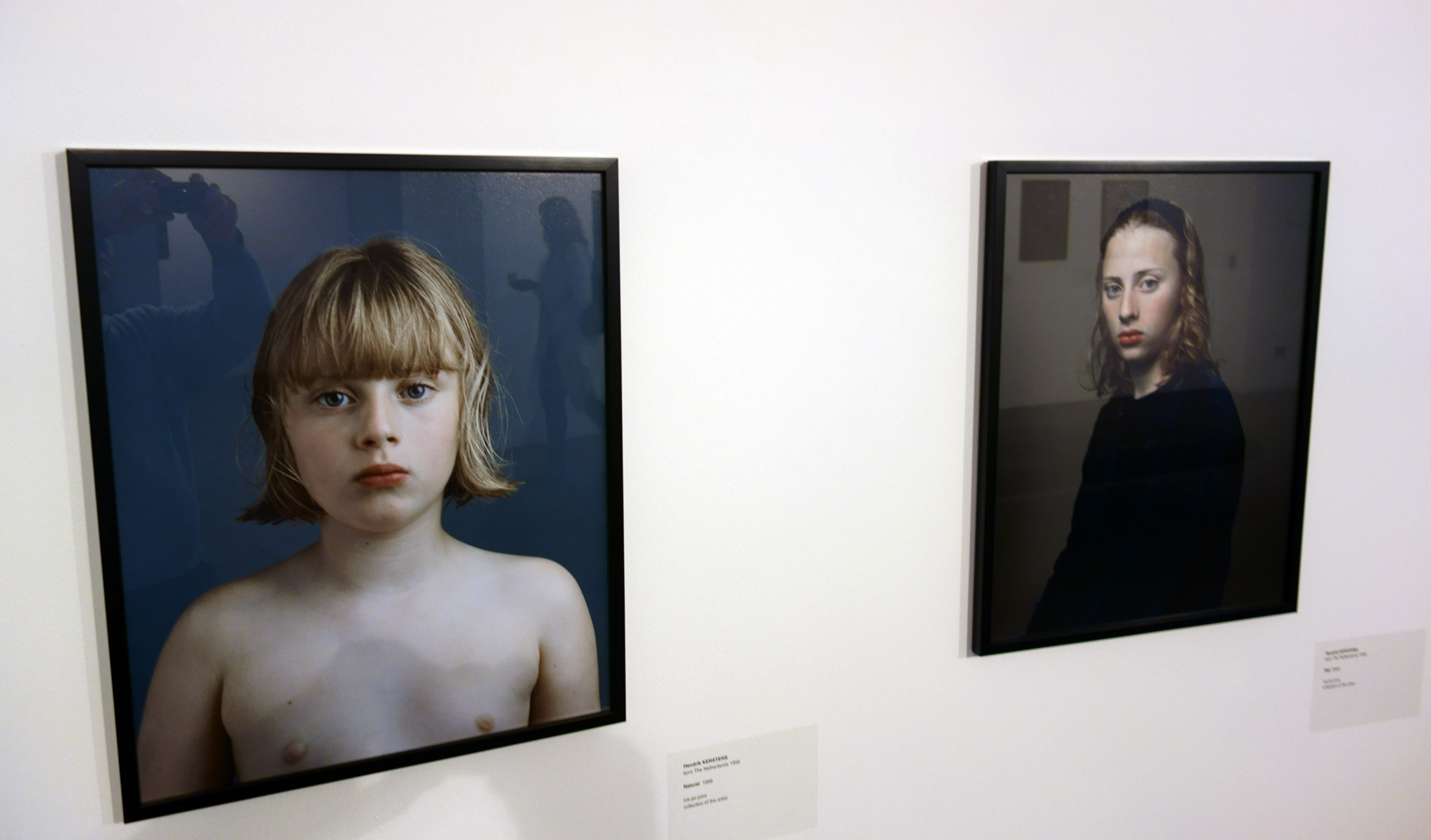
 

Installation view of 'Dutch masters of light: Hendrik Kerstens and Erwin Olaf' at Monash Gallery of Art, Melbourne featuring the work of Hendrik Kerstens with at left, 'Naturel' (1999); and at right, 'Wet' (2002)


Installation view of Dutch masters of light: Hendrik Kerstens and Erwin Olaf at Monash Gallery of Art, Melbourne featuring the work of Hendrik Kerstens with at left, Naturel (1999); and at right, Wet (2002)
Photo: © Marcus Bunyan, the artist and the Monash Gallery of Art


Hendrik Kerstens (Dutch, b. 1956) 'Re rabbit IV' 2009 (installation view)


Hendrik Kerstens (Dutch, b. 1956)
Re rabbit IV (installation view)
2009
Ink-jet print
62.5 x 50.0cm
Collection of the artist
Photo: © Marcus Bunyan, the artist and the Monash Gallery of Art


Dutch masters of light: Hendrik Kerstens and Erwin Olaf

This exhibition features work by the internationally acclaimed Dutch photographers, Hendrik Kerstens and Erwin Olaf. These photographers both create images that reflect an interest in paintings by Dutch Masters such as Rembrandt (1606-1669) and Vermeer (1632-1675). This is particularly evident in their manipulation of light and shade and also in their poetic use of everyday subject matter. Drawing on aesthetics of the past while also incorporating aspects of the present, these photographers create emotionally charged portraits that draw attention to the liminal nature of contemporary life.

Hendrik Kerstens took up photography in 1995 and has since been creating portraits of his daughter, Paula. His photographs began as documents and reflections on the fleeting nature of childhood. He later introduced the aesthetics of 17th-century Dutch master paintings to his portraits, creating a dialogue between painting and photography and between the past and the present.

Erwin Olaf is a multidisciplinary artist who is best known for his highly polished staged photographs that draw on his experiences of everyday life. His refined style and meticulous technique relate his background as a commercial photographer; and his use of light is inspired by painting. The subjects of his Keyhole series turn their gaze away from the camera in a way that evokes feelings of shame and humility.

Dutch masters of light: Hendrik Kerstens and Erwin Olaf is part of a series of events that mark the 400th anniversary of the first Dutch contact with Western Australia. On 25 October 1616, Dirk Hartog made landfall with his ship the Eendracht at Dirk Hartog Island, in the Shark Bay area.

Text from the Monash Gallery of Art website


Hendrik Kerstens (Dutch, b. 1956) 'Bag' 2007


Hendrik Kerstens (Dutch, b. 1956)
Bag
2007
Ink-jet print
62.5 x 50.0cm
Collection of the artist


Hendrik Kerstens (Dutch, b. 1956) 'Cosy' 2012


Hendrik Kerstens (Dutch, b. 1956)
Cosy
2012
Ink-jet print
62.5 x 50.0cm
Collection of the artist


Martin Parr (British, 1952-2025) 'Australia, Melbourne' 2006 (installation view)


Martin Parr (British, 1952-2025)
Australia, Melbourne (installation view)
2006
From the series Luxury
Pigment ink-jet print
50.8 x 76.2cm
Photo: © Marcus Bunyan, the artist and the Monash Gallery of Art
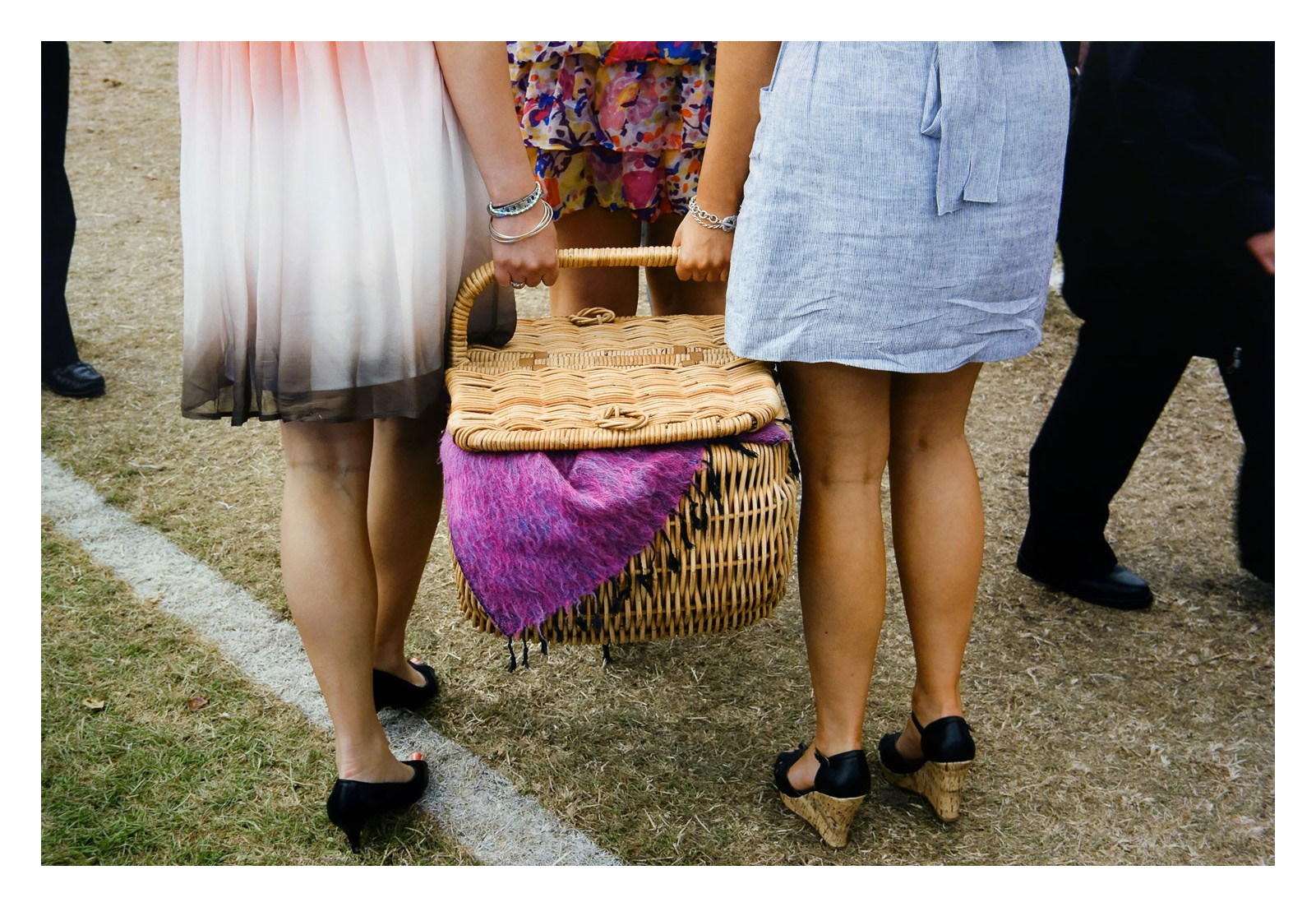
 

Martin Parr (British, 1952-2025) 'Australia, Melbourne' 2008


Martin Parr (British, 1952-2025)
Australia, Melbourne
2008
From the series Luxury
Pigment ink-jet print
50.8 x 76.2cm
Courtesy of the artist and Niagara Galleries (Melbourne)
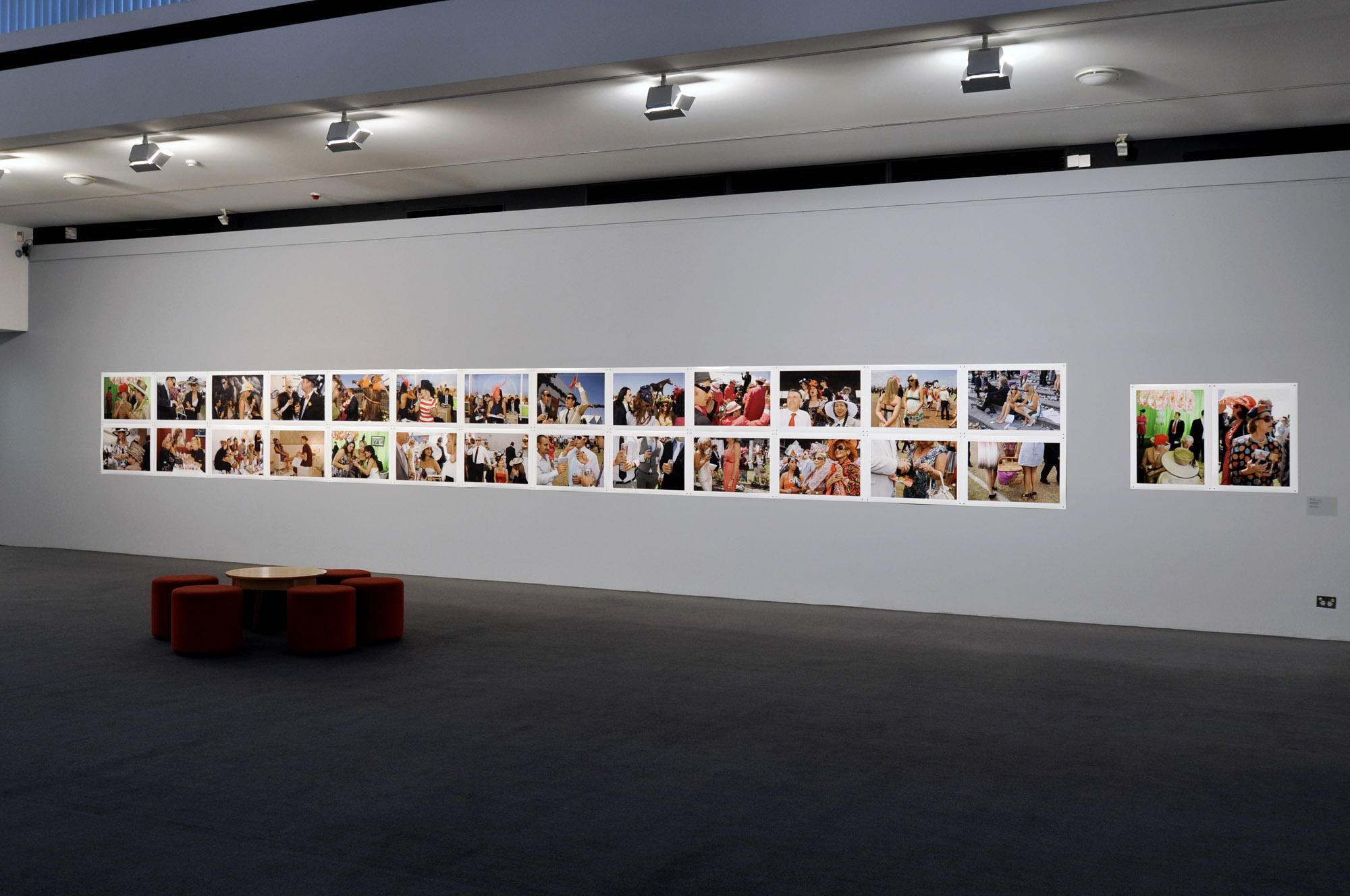
 

Installation view of 'Glamour stakes: Martin Parr' at Monash Gallery of Art, Melbourne with work from the series 'Luxury'


Installation view of Glamour stakes: Martin Parr at Monash Gallery of Art, Melbourne with work from the series Luxury
Photo: © Marcus Bunyan, the artist and the Monash Gallery of Art


Installation view of 'Glamour stakes: Martin Parr' at Monash Gallery of Art, Melbourne with work from the series 'Luxury'

Installation view of 'Glamour stakes: Martin Parr' at Monash Gallery of Art, Melbourne with work from the series 'Luxury'

Installation view of 'Glamour stakes: Martin Parr' at Monash Gallery of Art, Melbourne with work from the series 'Luxury'

Installation view of 'Glamour stakes: Martin Parr' at Monash Gallery of Art, Melbourne with work from the series 'Luxury'


Installation views of Glamour stakes: Martin Parr at Monash Gallery of Art, Melbourne with work from the series Luxury: Australia, Melbourne 2008
Photos: © Marcus Bunyan, the artist and the Monash Gallery of Art


Glamour stakes: Martin Parr

Martin Parr was born in Surrey in the United Kingdom in 1952. He studied photography at Manchester Polytechnic from 1970-73 and held his first exhibition the following year. He has since developed an international reputation as a photographer, filmmaker and curator and has been a full member of Magnum Photos since 1994.

Parr is known for his satirical social documentary photography. Focusing on particular aspects of contemporary consumer culture, he produces images that are a combination of the mundane and the bizarre. He uses the language of commercial photography, creating an aesthetic that is bright, colourful and seductive. However, his images often inspire viewers to cringe or laugh.

Glamour stakes: Martin Parr shows a selection of works from Parr’s Luxury series. This series is comprised of images taken predominantly between 2003 and 2009 in multiple destinations around the world. While creating Luxury, Parr photographed what he describes as ‘situations where people are comfortable showing off their wealth’, such as art fairs, car shows and horse races. The series is indicative of Parr’s practice in that the images document leisure and consumption and highlight the unintentional, awkward and often ugly sides of beauty, fashion and wealth.

The images in this series are not only documents but also critical and humorous reflections on contemporary society. By turning his camera to the world of luxury, Parr invites viewers to consider the sustainability of a culture that constantly demands the latest styles in fashion and the newest luxury items. This exhibition focuses specifically on Parr’s images of horse-racing events, particularly those taken in Melbourne in 2008.

Text from the Monash Gallery of Art website


Martin Parr (British, 1952-2025) 'Australia, Melbourne' 2008


Martin Parr (British, 1952-2025)
Australia, Melbourne
2008
From the series Luxury
Pigment ink-jet print
50.8 x 76.2cm
Courtesy of the artist and Niagara Galleries (Melbourne)


Martin Parr (British, 1952-2025) 'Australia, Melbourne' 2008


Martin Parr (British, 1952-2025)
Australia, Melbourne
2008
From the series Luxury
Pigment ink-jet print
50.8 x 76.2cm
Courtesy of the artist and Niagara Galleries (Melbourne)


Martin Parr (British, 1952-2025) 'Australia, Melbourne' 2008


Martin Parr (British, 1952-2025)
Australia, Melbourne
2008
From the series Luxury
Pigment ink-jet print
50.8 x 76.2cm
Courtesy of the artist and Niagara Galleries (Melbourne)


Martin Parr (British, 1952-2025) 'Australia, Melbourne' 2008


Martin Parr (British, 1952-2025)
Australia, Melbourne
2008
From the series Luxury
Pigment ink-jet print
50.8 x 76.2cm
Courtesy of the artist and Niagara Galleries (Melbourne)


Martin Parr (British, 1952-2025) 'Australia, Melbourne' 2008


Martin Parr (British, 1952-2025)
Australia, Melbourne
2008
From the series Luxury
Pigment ink-jet print
50.8 x 76.2cm
Courtesy of the artist and Niagara Galleries (Melbourne)


Installation view of 'Glamour stakes: Martin Parr' at Monash Gallery of Art, Melbourne with work from the series 'Luxury': showing at right, 'South Africa, Durban' 2003

Installation view of 'Glamour stakes: Martin Parr' at Monash Gallery of Art, Melbourne with work from the series 'Luxury': at right, 'South Africa, Durban' 2003


Installation views of Glamour stakes: Martin Parr at Monash Gallery of Art, Melbourne with work from the series Luxury: at right, South Africa, Durban 2003
Photo: © Marcus Bunyan, the artist and the Monash Gallery of Art


Martin Parr (British, 1952-2025) 'South Africa, Durban' 2005


Martin Parr (British, 1952-2025)
South Africa, Durban
2005
From the series Luxury
Pigment ink-jet print
101.6 x 152.4cm
Courtesy of the artist and Niagara Galleries (Melbourne)
 

Martin Parr (British, 1952-2025) 'England, Ascot' 2003


Martin Parr (British, 1952-2025)
England, Ascot
2003
From the series Luxury
Pigment ink-jet print
101.6 x 152.4cm
Courtesy of the artist and Niagara Galleries (Melbourne)


Monash Gallery of Art
860 Ferntree Gully Road, Wheelers Hill
Victoria 3150 Australia
Phone: + 61 3 8544 0500

Opening hours:
Tue – Fri: 10am – 5pm
Sat – Sun: 10pm – 4pm
Mon/public holidays: closed

Monash Gallery of Art website

LIKE ART BLART ON FACEBOOK

Back to top

Exhibition: ‘Gilbert & George: The Art Exhibition’ at the Museum of Old and New Art (MONA), Hobart

Exhibition dates: 28th November 2015 – 28th March 2016


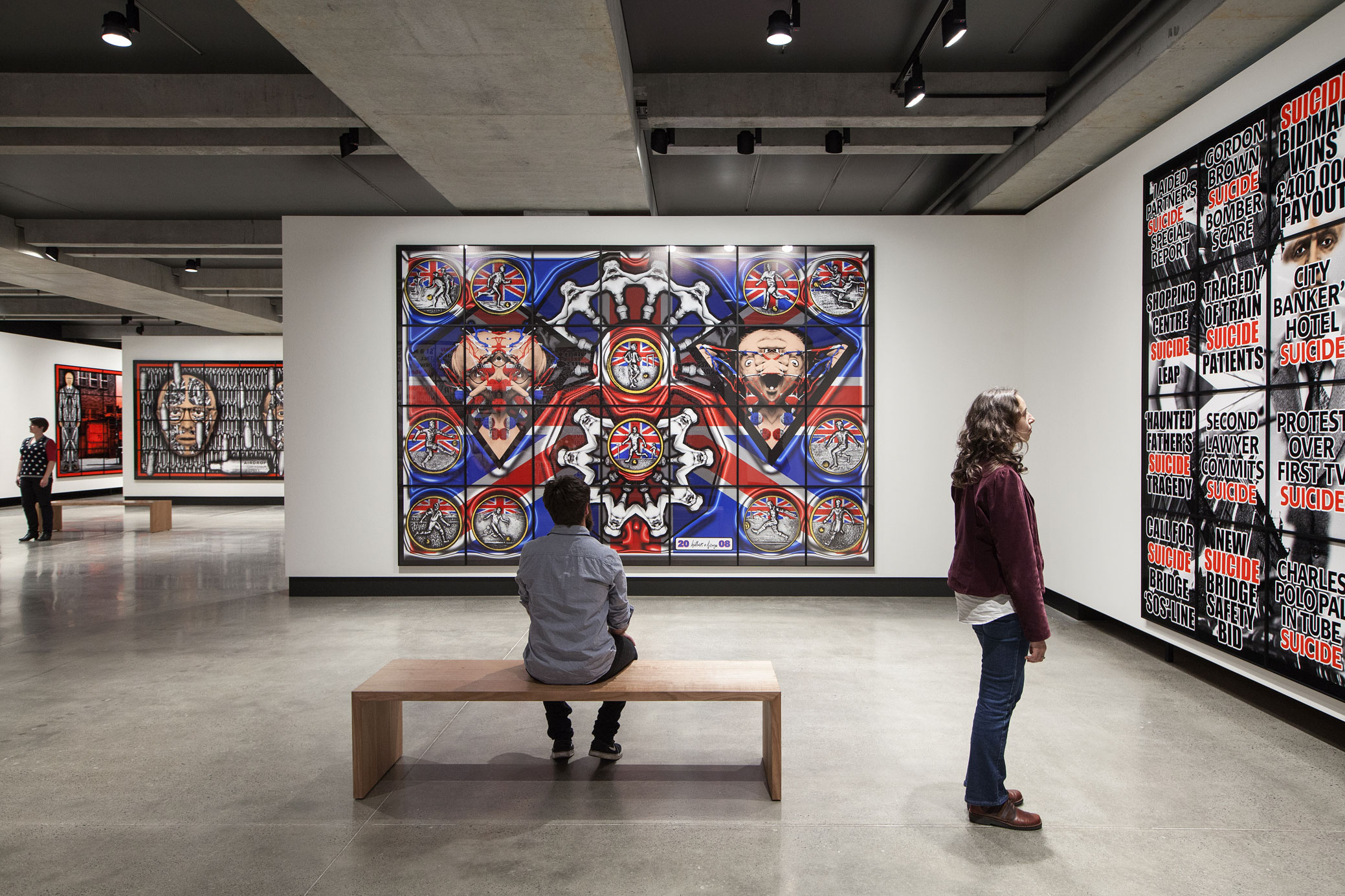
Gilbert & George (Gilbert Prousch, British born Italy, 1943; George Passmore, British, b. 1942) 'FORWARD' 2008


Gilbert & George (Gilbert Prousch, British born Italy, 1943; George Passmore, British, b. 1942)
FORWARD
2008
Mixed media
381 x 604cm
Courtesy of the artists and White Cube


Gentlemen of the gutter

While I admire the mythology of Gilbert and George, that ever so British pair of deviant artists, they have never been among my favourites.

They had a tough road. Imagine meeting in 1967, pre-Stonewall and the beginning of gay liberation, and then moving into the roughest part of London, the East End, to live together and make art, dressed as a pair of besuited businessmen. The prejudice and the abuse would have been intense, but they stuck together, they stuck to their path as artists, and they stuck to each other as human beings. It is fascinating to see the trajectory of their development, to follow the development of the grid, the introduction of one colour and then multiple colours.

I understand what they do, empathise with their endeavour (anti-nationalism, religion, bigotry, racism, homophobia etc etc…) but wonder whether they have not painted themselves and their art into a corner. They are so well known for their long running performance – their vaudeville act reminding me of a contemporary Hieronymus Bosch with text ripped from the headlines / images riffed from hell (portraits of cut up reflections assembled to make surreal creatures with gaping mouths), the gridded works, the colours, the content AS graphic gothic cathedral with stained glass windows – that they seem incapable or willing to push themselves and their art further. To shock us in an altogether different way? Now that would be a greater surprise, than just semen, spit and shit.

What I am saying is that they have got their schtick down pat. They worked hard for their anti-establishment schlock horror. The work has presence and they do know how to reach people with a picture but with each repetition, with each ritual performance the cracks grow ever larger. As John McDonald observes, “They are iconoclastic non-entities making art that attracts and repels.” What actually lies underneath all of this rhetoric. Two caring human beings, two compassionate souls? I think not, therefore I am.**

As can be seen in many of their works, the emperors literally have no clothes…

Dr Marcus Bunyan

** Perhaps it should have been “I care not, therefore I am” … because they don’t really give a dam what people think. This is part of the problem: their rather mean spirited view of the world.


Many thankx to MONA for allowing me to publish the photographs in the posting. Please click on the photographs for a larger version of the image.


Gilbert & George: The Art Exhibition


Gilbert & George In Conversation With Olivier Varenne


“We are unhealthy, middle-aged, dirty-minded, depressed, cynical, empty, tired-brained, seedy, rotten, dreaming, badly-behaved, ill-mannered, arrogant, intellectual, self-pitying, honest, successful, hard-working, thoughtful, artistic, religious, fascistic, blood-thirsty, teasing, destructive, ambitious, colourful, damned, stubborn, perverted and good. We are artists.”


“Art has just become decoration for the very, very rich. We manage to keep our feet on the ground. We have never been part of an elitist art group. Our art is so confrontational that a lot of collectors would never touch it because they don’t want a naked shit picture in their living room… More and more it is difficult to speak as an artist. Nobody hears you because there are too many and there are too many different ways of making art today that there didn’t use to be when we started out in 1969.”


“We never go to the cinema, the theatre, or the ballet or opera. We stopped 40 years ago. We just didn’t want to become contaminated. We know what we’re interested in, we know how we can reach people with a picture. We have a feeling, what we put in that picture that will mean something to somebody.”


Gilbert & George


Two people, but one artist: the legendary Gilbert & George’s first ever exhibition in Australasia, Gilbert & George: The Art Exhibition, is now open at the Museum of Old and New Art in Tasmania, Australia, until March 28, 2016.

Gilbert & George: The Art Exhibition is a major retrospective, including pictures spanning five decades; dating from 1970 to most recent pictures of 2014. Curated by Gilbert & George with organising curators, Mona’s Co-Directors of Exhibitions and Collections, Olivier Varenne and Nicole Durling, the pictures are installed across the entirety of Mona’s touring galleries, 14 metres underground.

“Our pictures deal with the great universals: death, hope, life, fear, sex, money, race and religion. Seeing is believing. See for yourself: Gilbert & George: The Art Exhibition. This is your very first – and last – chance to see one hundred of our pictures, at the wonderful Museum of Old and New Art in Hobart, Tasmania.” ~ Gilbert & George


Since first meeting at St Martin’s school of Art, London, in 1967, Gilbert & George have lived and worked together as one single and fiercely independent artist, dedicated solely to the creation of their art. They have no allegiance to any other trend, school, movement, doctrine, theory or style of art.

Gilbert & George already knew that they were seeking for a form of art that was to them entirely rooted in the real world – in the streets and clamour and traffic and buildings and hearts of strangers: an “Art for All.”

Today, their art continues to be multi-allusive, contemporary and contentious, as their subject is literally at their feet – along countless streets, the thoroughfares of the passage of millions of lives, and dense with the sedimentary tracings of social existence.

Text from MONA


This slideshow requires JavaScript.


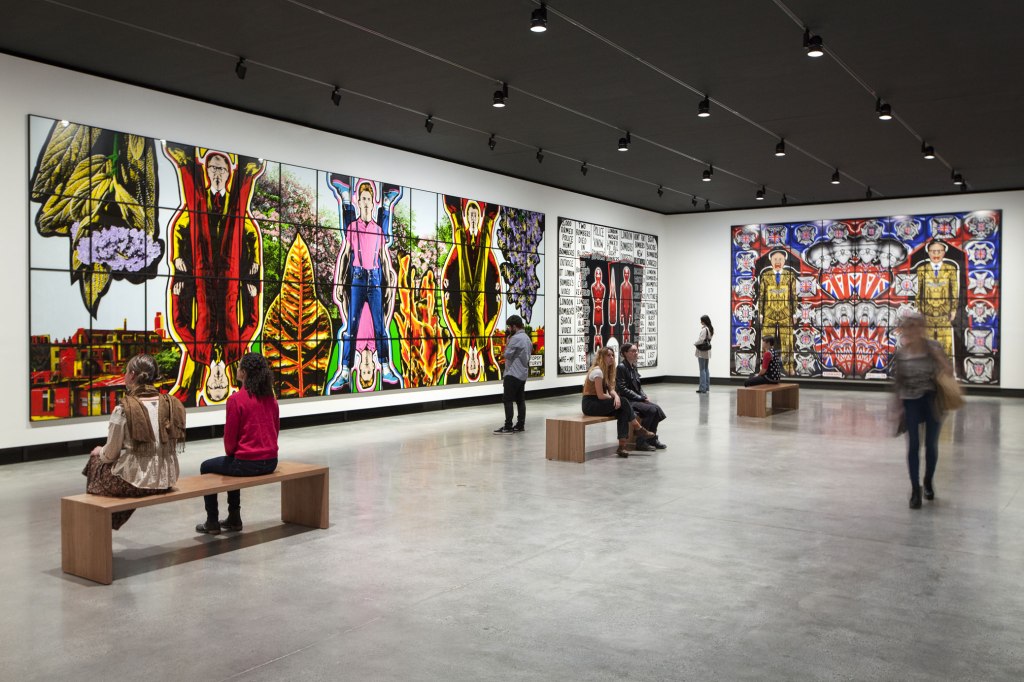
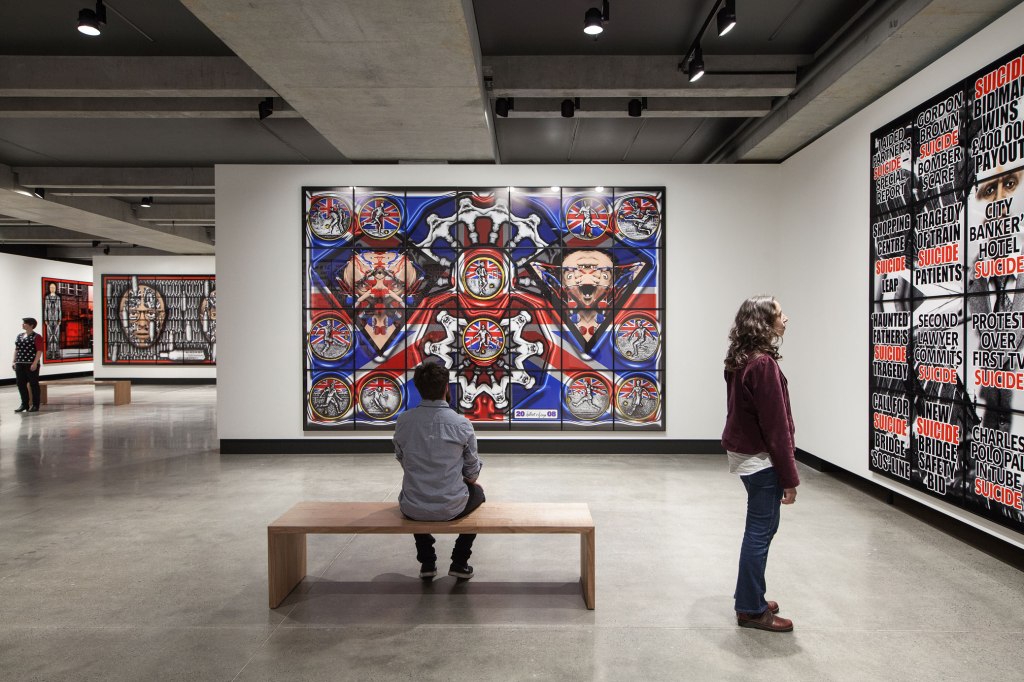
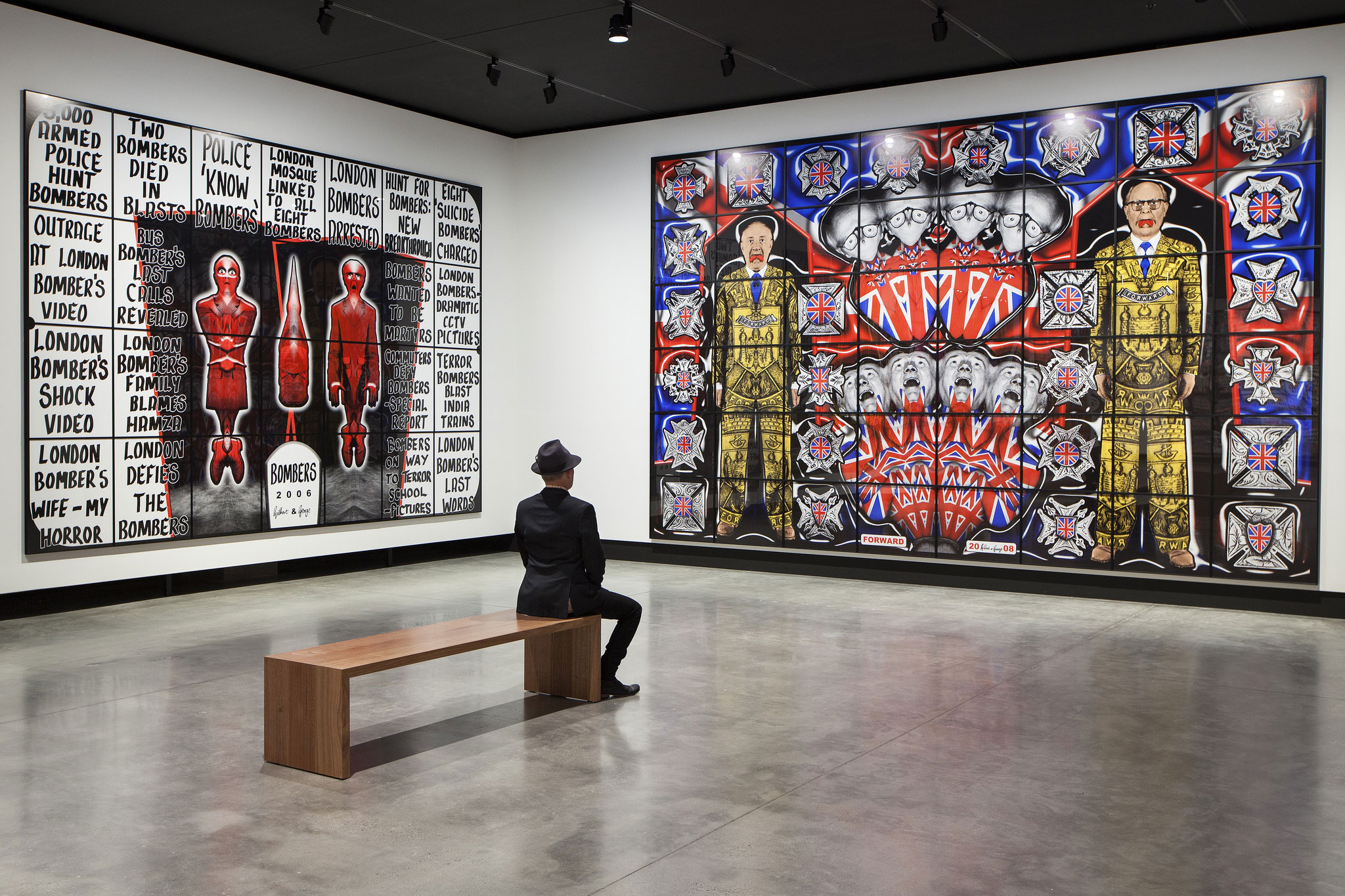
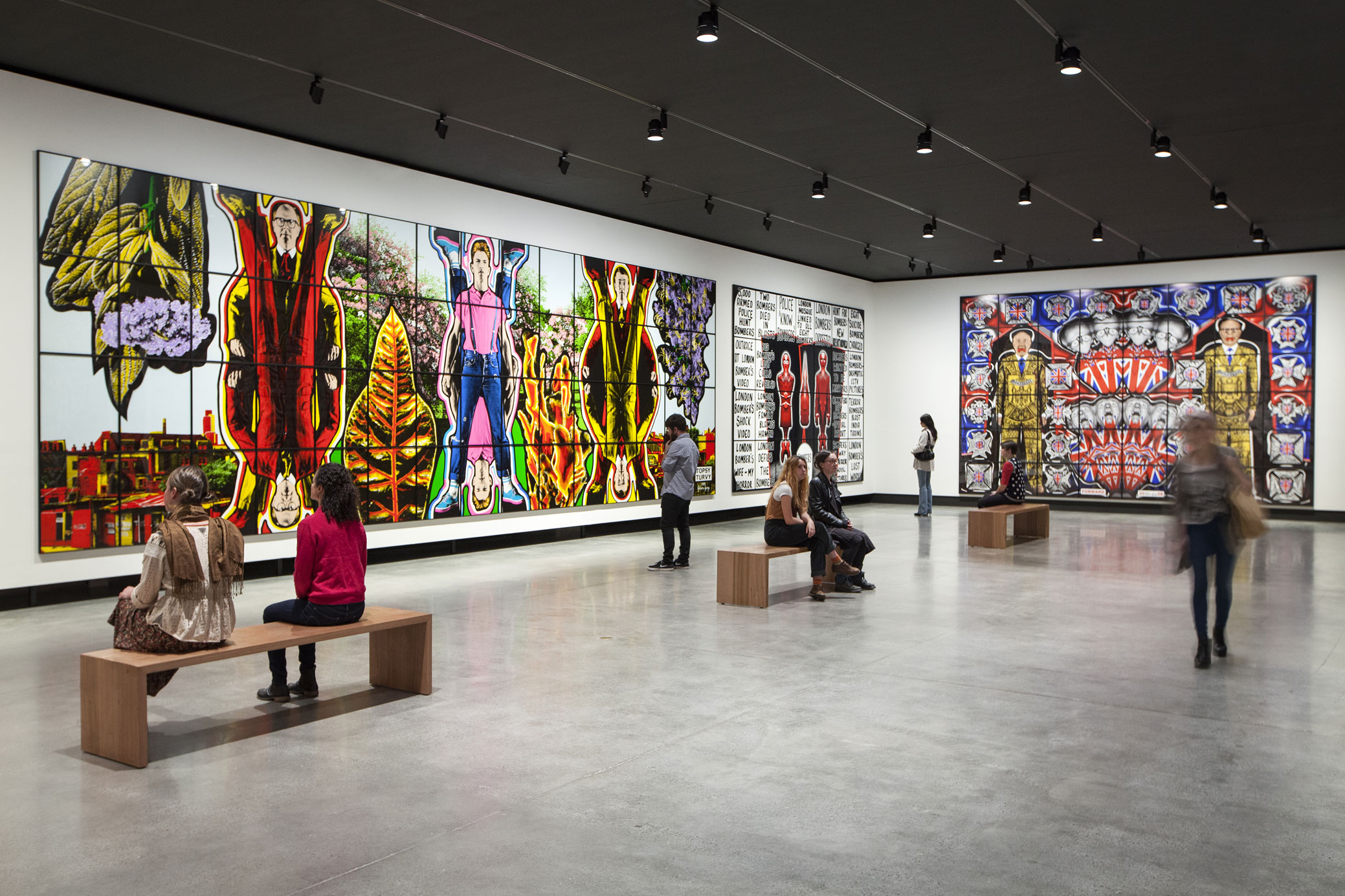
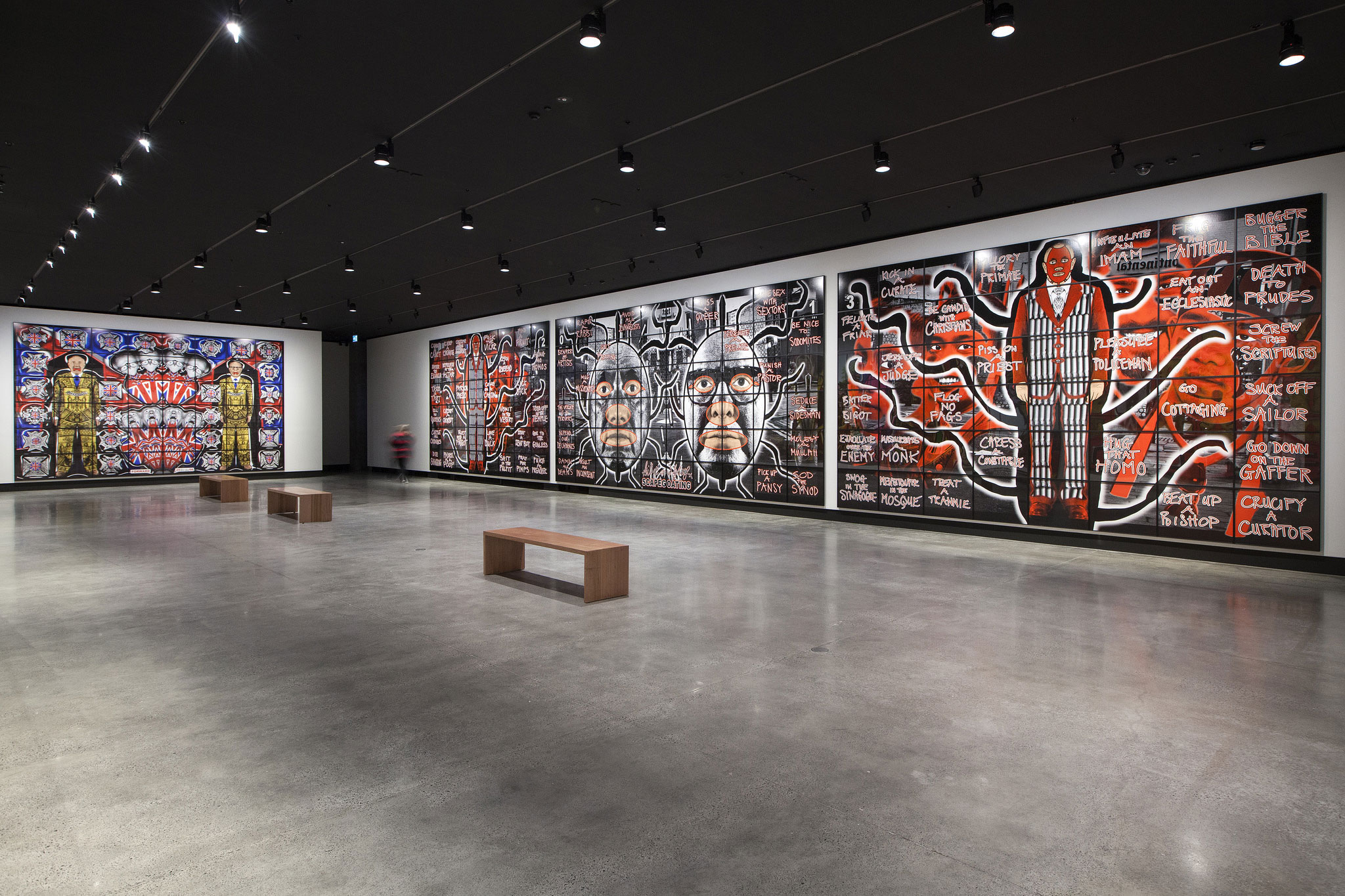
Installation view of the exhibition ‘Gilbert & George: The Art Exhibition’ at the Museum of Old and New Art, Hobart showing at left, 'BOMBERS' (2006), and at right, 'FORWARD' (2008)


Installation view of the exhibition Gilbert & George: The Art Exhibition at the Museum of Old and New Art, Hobart showing at left, BOMBERS (2006), and at right, FORWARD (2008)


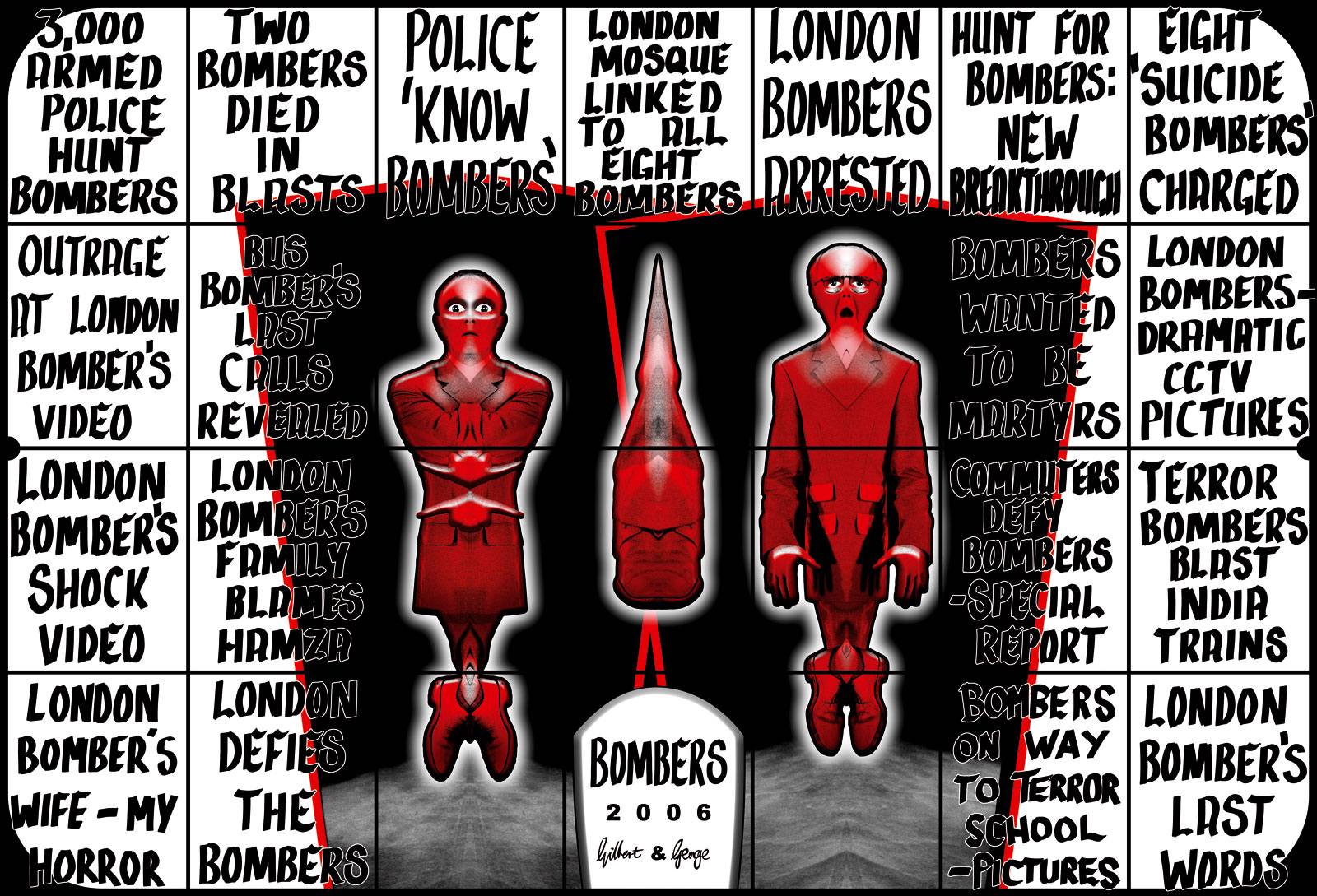
Gilbert & George (Gilbert Prousch, British born Italy, 1943; George Passmore, British, b. 1942) 'BOMBERS' 2006


Gilbert & George (Gilbert Prousch, British born Italy, 1943; George Passmore, British, b. 1942)
BOMBERS
2006
From Bomb Pictures
Mixed media
336 x 493cm
Courtesy of the artists and White Cube


Gilbert & George created an important group of six pictures for their major retrospective at Tate Modern. The six Bomb Pictures, the only pictures created by the artists in 2006, comprise a 14 metre triptych entitled Bomb and five other pictures: Bombs; Bomber; Bombers; Bombing; and Terror. The artists have described this group of pictures as their most chilling to date. The artists intend the pictures to be seen as modern townscapes reflecting the daily exposure in urban life to terror alerts.

Barry Grayshon. “Gilbert and George – The Bomb Pictures (2006),” on the Pinterest website [Online] Cited 16/03/2016


Installation view of the exhibition ‘Gilbert & George: The Art Exhibition’ at the Museum of Old and New Art, Hobart showing at left, 'TOPSY TURVY' (1989) from 'The Cosmological Pictures'


Installation view of the exhibition Gilbert & George: The Art Exhibition at the Museum of Old and New Art, Hobart showing at left, TOPSY TURVY (1989) from The Cosmological Pictures


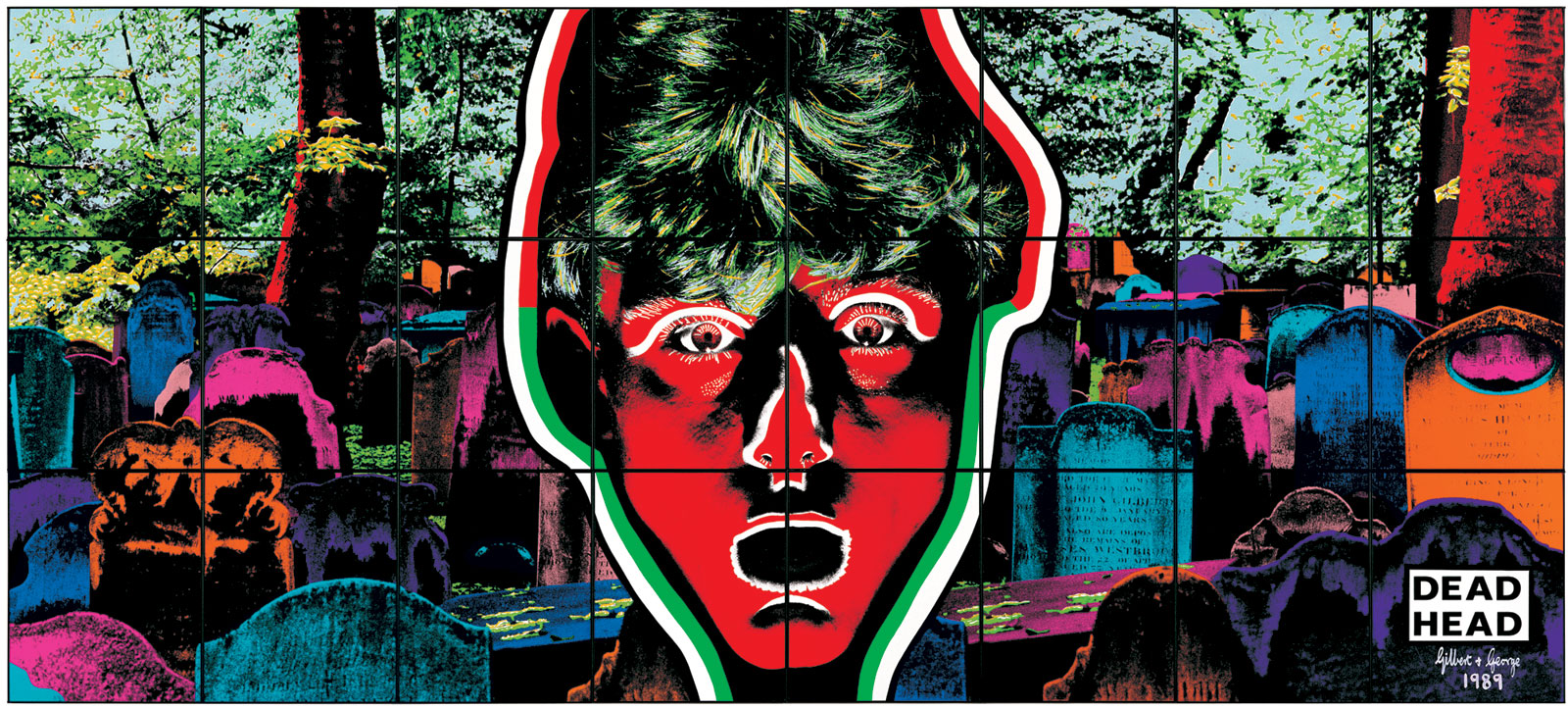
Gilbert & George (Gilbert Prousch, British born Italy, 1943; George Passmore, British, b. 1942) 'DEAD HEAD' 1989


Gilbert & George (Gilbert Prousch, British born Italy, 1943; George Passmore, British, b. 1942)
DEAD HEAD
1989
From The Cosmological Pictures
Picture courtesy of the artists and Mona, Museum of Old and New Art, Tasmania, Australia


With this body of work Gilbert & George stress the power of human thought to remake life and so create the future through a process of communication, discussion and questioning, stimulated by the pictures. The word ‘cosmology’ derives from the Greek words for ‘world’ and ‘discourse’. Since September 1991, The Cosmological Pictures have been touring many European cities. Gilbert and George’s aim – to speak to many people in all of these cities – is at the heart of their cosmology.

Barry Grayshon. “Gilbert and George – The Cosmological Pictures (1989),” on the Pinterest website [Online] Cited 16/03/2016


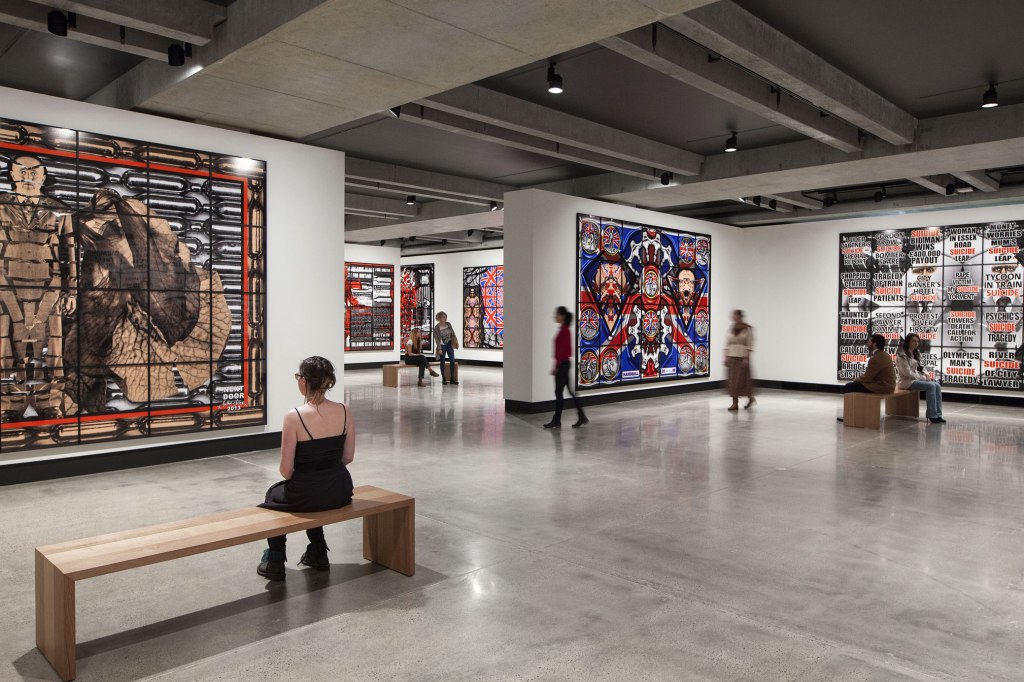
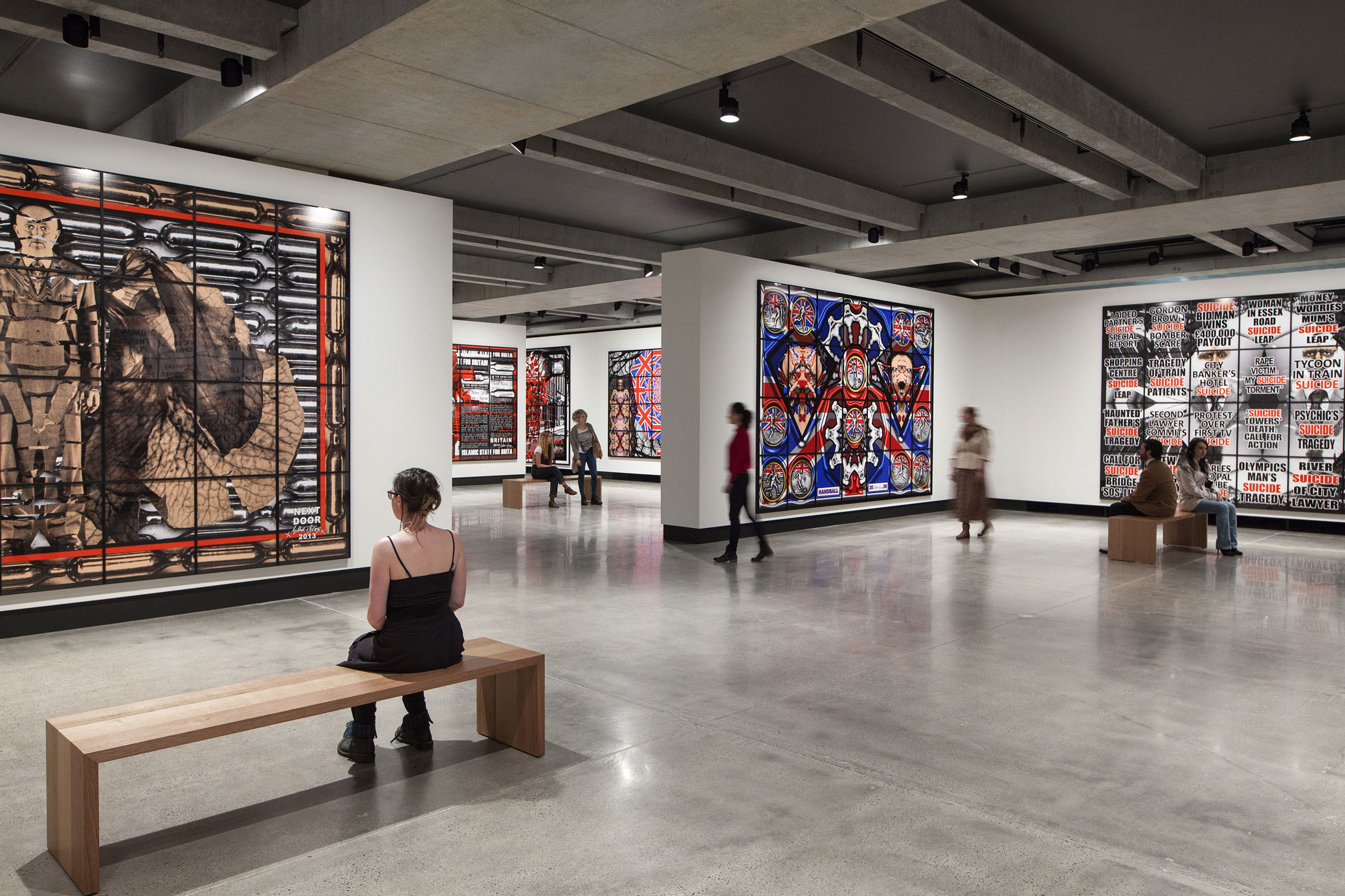
Installation view of the exhibition ‘Gilbert & George: The Art Exhibition’ at the Museum of Old and New Art, Hobart showing at left, 'NEXT DOOR' (2013), in the middle 'HANDBALL' (2008), and at right, 'SUICIDE STRAIGHT' (2011) from 'The London Pictures'


Installation view of the exhibition Gilbert & George: The Art Exhibition at the Museum of Old and New Art, Hobart showing at left, NEXT DOOR (2013), in the middle HANDBALL (2008), and at right, SUICIDE STRAIGHT (2011) from The London Pictures


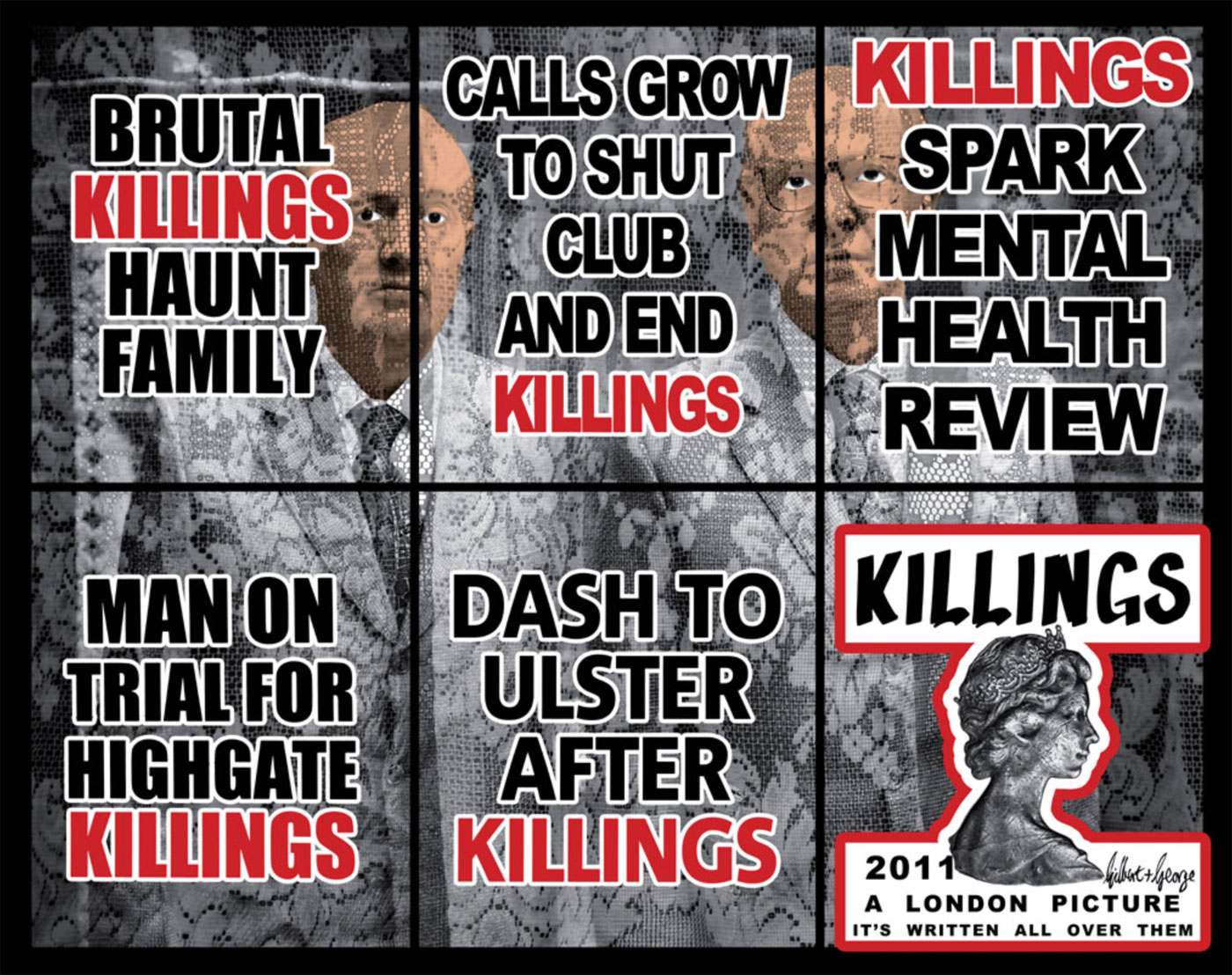
Gilbert & George (Gilbert Prousch, British born Italy, 1943; George Passmore, British, b. 1942) 'KILLERS STRAIGHT' 2011


Gilbert & George (Gilbert Prousch, British born Italy, 1943; George Passmore, British, b. 1942)
KILLERS STRAIGHT
2011
From The London Pictures


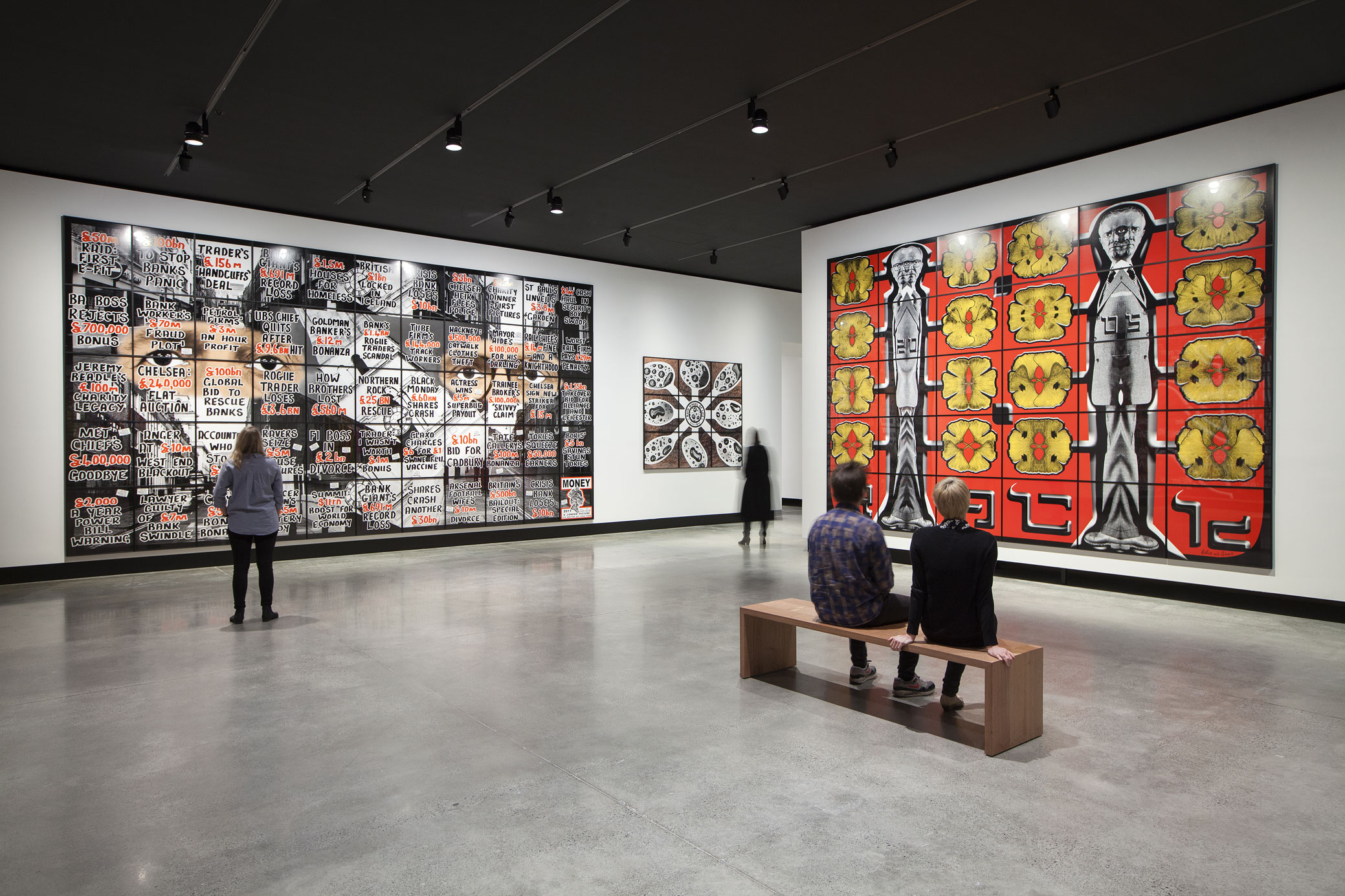
The London Pictures are made up of 292 of the 3,712 newspaper ‘bills’ the pair have doggedly pilfered from outside London newsagents over many years. The pictures present an epic survey of modern urban life in all its volatility, tragedy, absurdity and routine violence. They are Dickensian in scope and ultra-modern in sensibility.

Barry Grayshon. “Gilbert and George – London Photos (2011),” on the Pinterest website [Online] Cited 16/03/2016


Installation view of the exhibition ‘Gilbert & George: The Art Exhibition’ at the Museum of Old and New Art, Hobart showing in the middle 'HANDBALL' (2008), and at right, 'SUICIDE STRAIGHT' (2011) from 'The London Pictures'


Installation view of the exhibition Gilbert & George: The Art Exhibition at the Museum of Old and New Art, Hobart showing in the middle HANDBALL (2008), and at right, SUICIDE STRAIGHT (2011) from The London Pictures


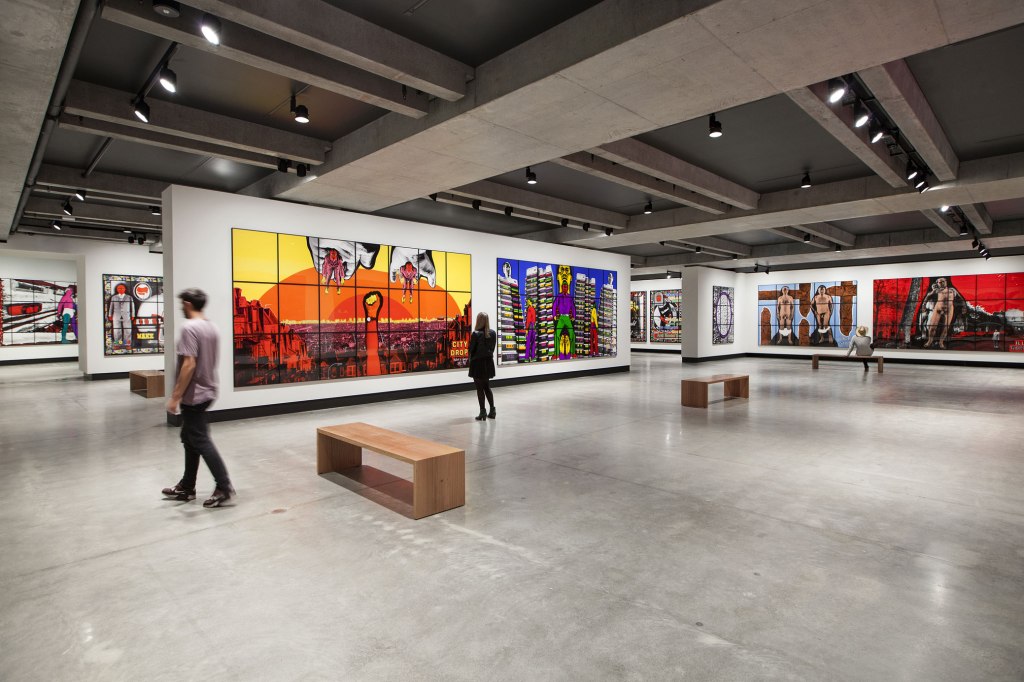
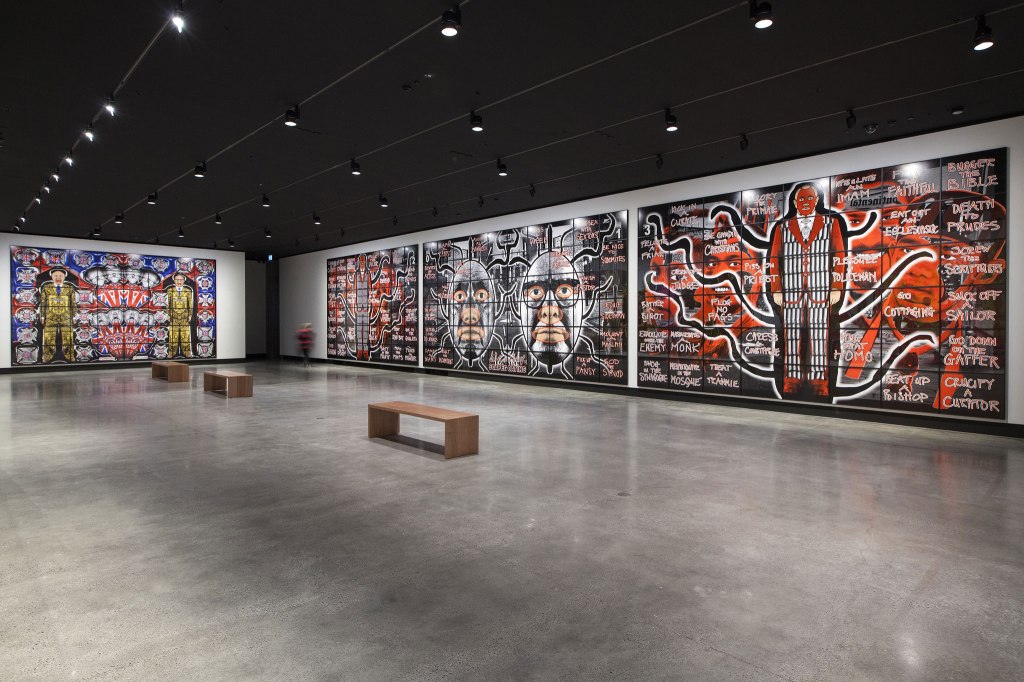
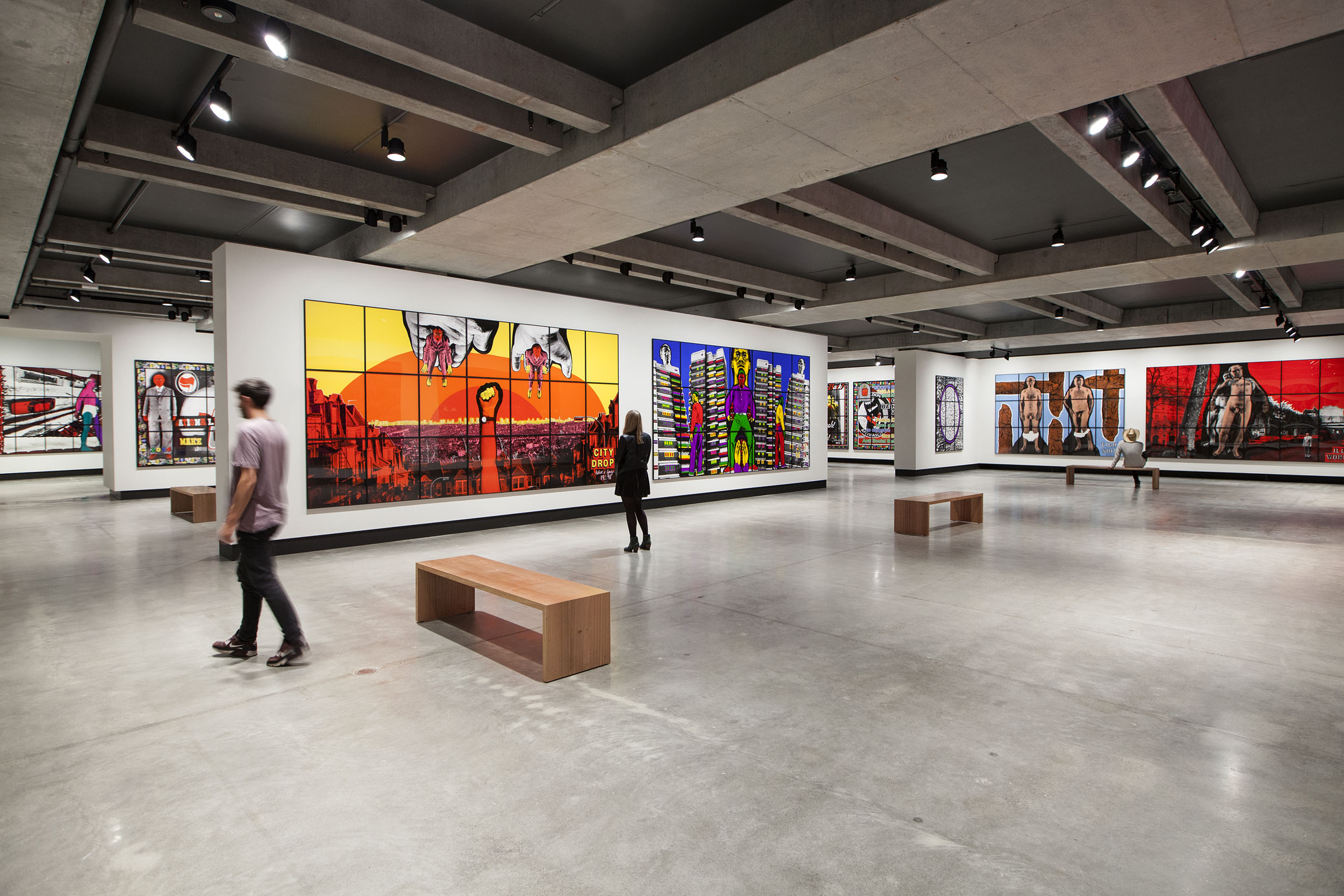
Installation view of the exhibition ‘Gilbert & George: The Art Exhibition’ at the Museum of Old and New Art, Hobart showing from left (large pictures), 'CITY DROP' (1991), 'FLAT MAN' (1991), 'EIGHT SHITS' (1994) and 'ILL WORLD' (1994), both from 'The Naked Shit Pictures'


Installation view of the exhibition Gilbert & George: The Art Exhibition at the Museum of Old and New Art, Hobart showing from left (large pictures), CITY DROP (1991), FLAT MAN (1991), EIGHT SHITS (1994) and ILL WORLD (1994), both from The Naked Shit Pictures


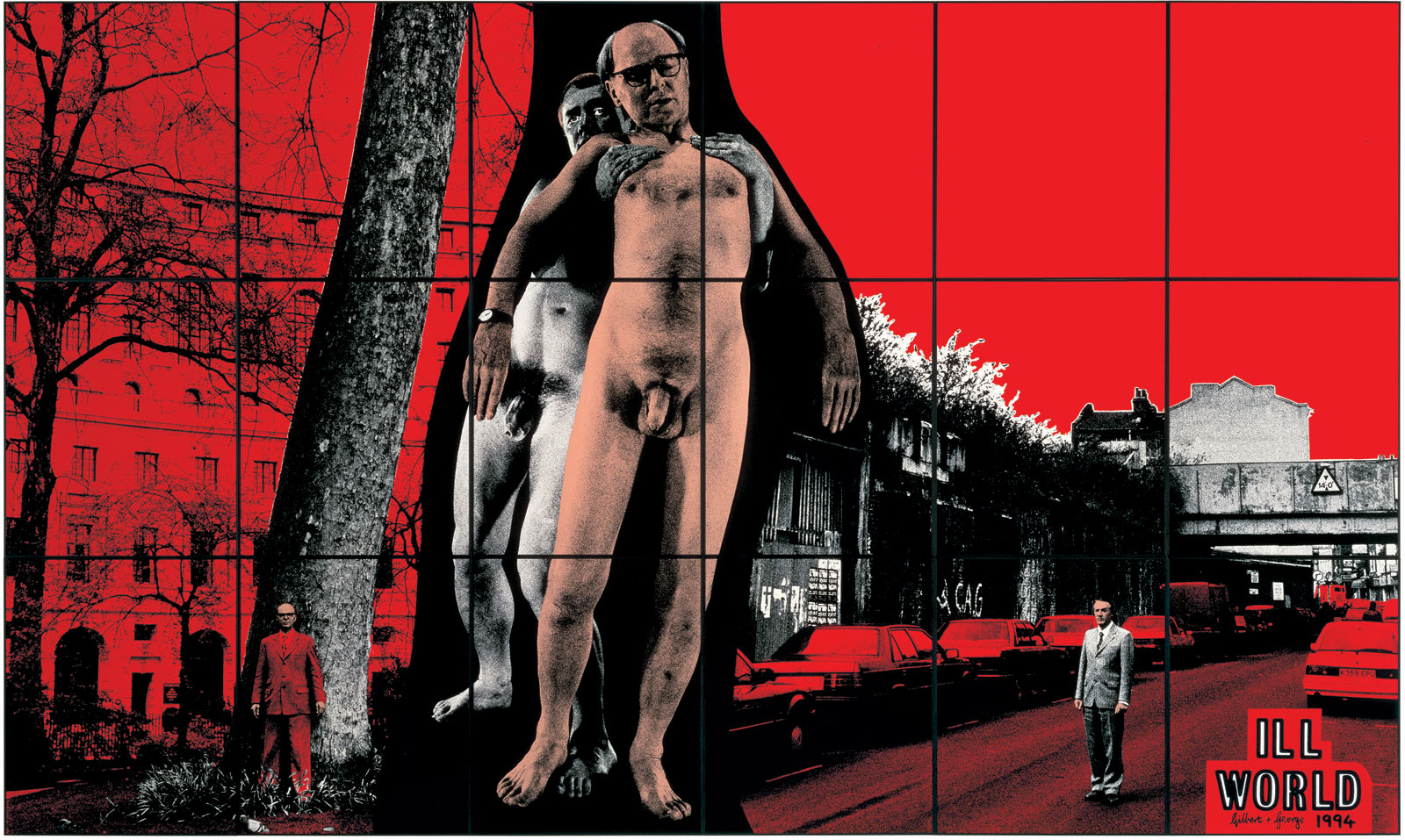
Gilbert & George (Gilbert Prousch, British born Italy, 1943; George Passmore, British, b. 1942) 'ILL WORLD' 1994


Gilbert & George (Gilbert Prousch, British born Italy, 1943; George Passmore, British, b. 1942)
ILL WORLD
1994
Mixed media
253 x 426cm
Courtesy of the artists


The frieze-like composition of The Naked Shit Pictures, with its striking contrasts of scale, was displayed high on the gallery walls. As the title indicates, works in the group depict the artists naked, or semi-dressed, often in conjunction with scaled-up images of faeces. These primary motifs are juxtaposed with urban/parkland scenes, giant anonymous suited bodies and the artists, or set against colour grounds. Marked contrasts in scale are a dominant feature in the series.
Barry Grayshon. “Gilbert and George – The Naked Shit Pictures (1994),” on the Pinterest website [Online] Cited 16/03/2016


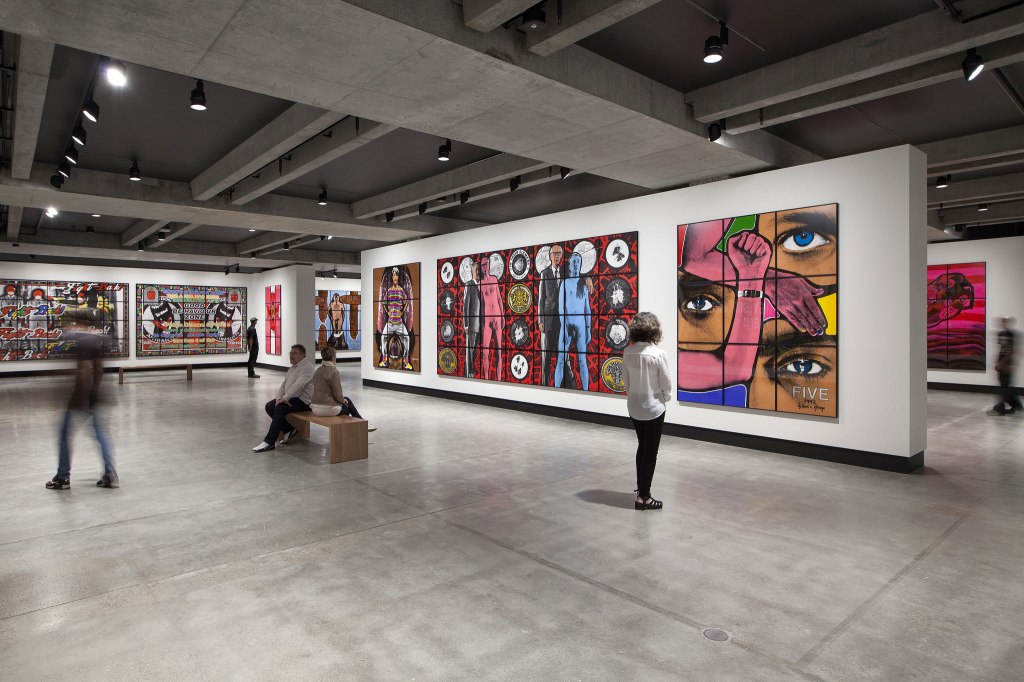
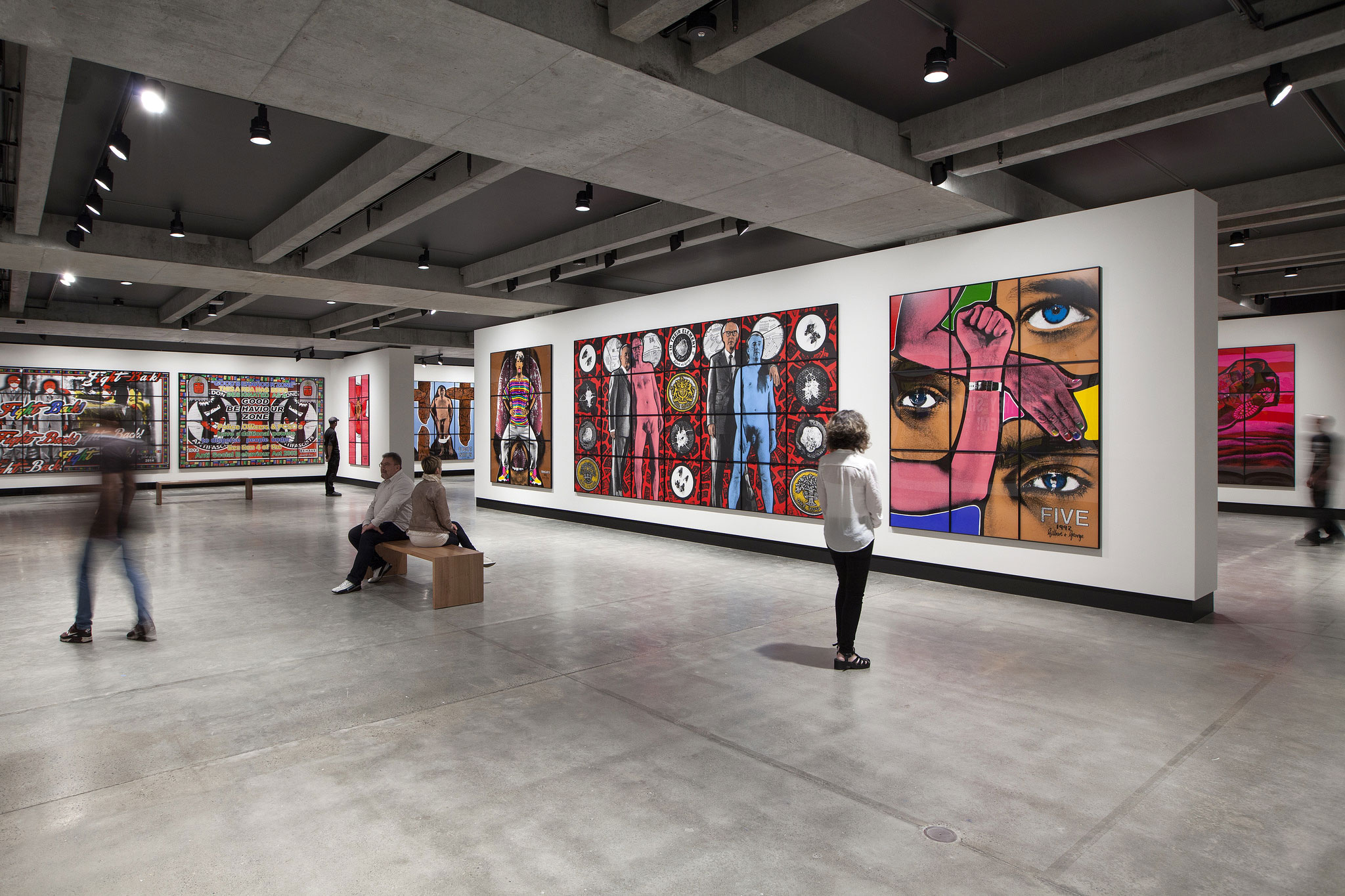
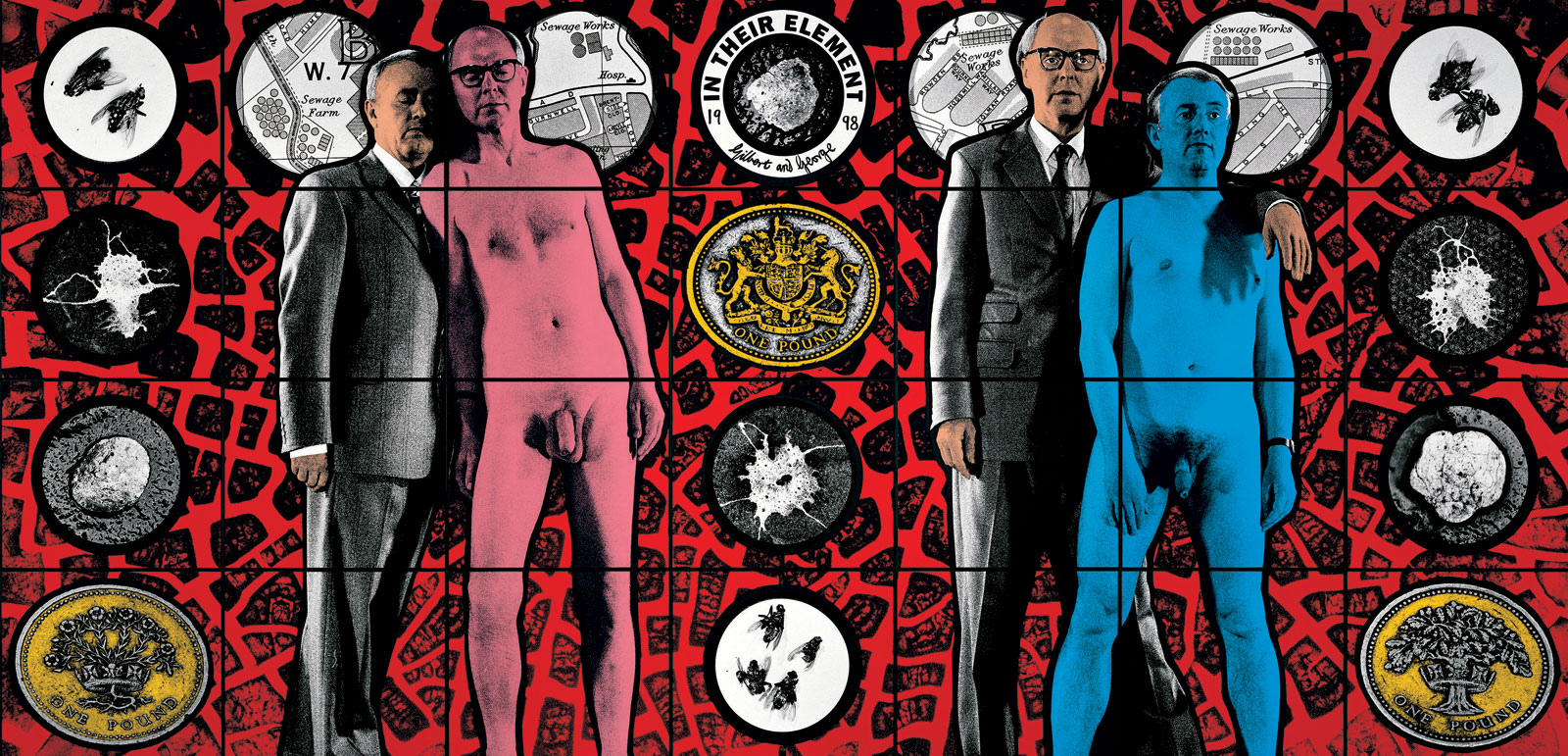
Installation view of the exhibition ‘Gilbert & George: The Art Exhibition’ at the Museum of Old and New Art, Hobart showing at middle, 'IN THEIR ELEMENT' (1998) from the series 'The Rudimentary Pictures' (1998) followed by 'FIVE' (1992)


Installation view of the exhibition Gilbert & George: The Art Exhibition at the Museum of Old and New Art, Hobart showing at middle, IN THEIR ELEMENT (1998) from the series The Rudimentary Pictures (1998) followed by FIVE (1992)


Gilbert & George (Gilbert Prousch, British born Italy, 1943; George Passmore, British, b. 1942) 'IN THEIR ELEMENT' 1988


Gilbert & George (Gilbert Prousch, British born Italy, 1943; George Passmore, British, b. 1942)
IN THEIR ELEMENT
1988
From the series The Rudimentary Pictures
Mixed media
254 x 528 cm
Courtesy of the artists


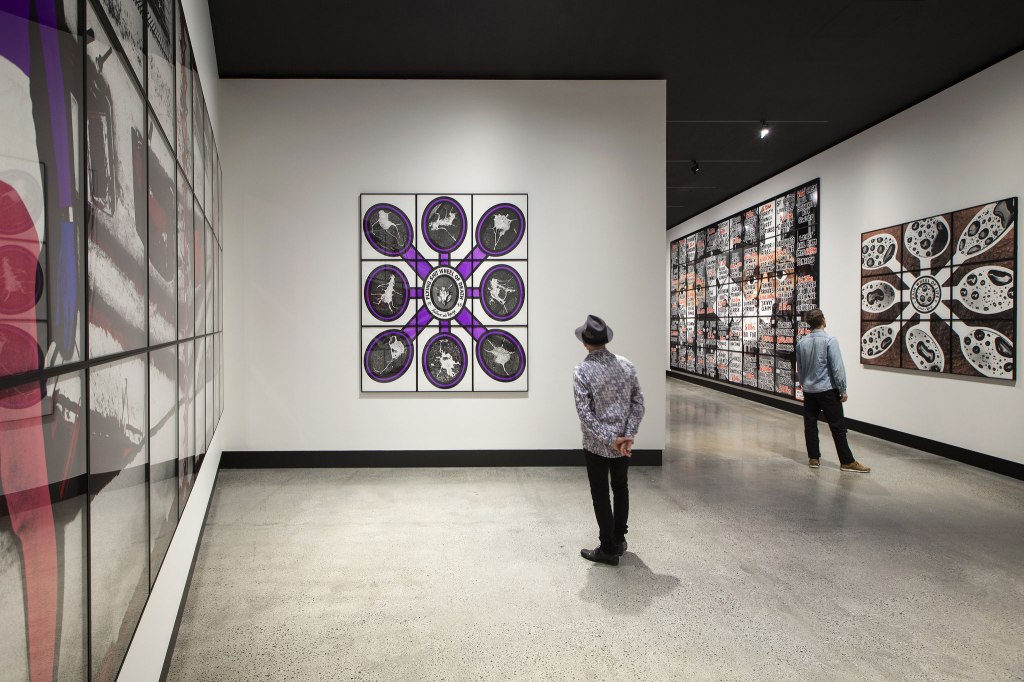
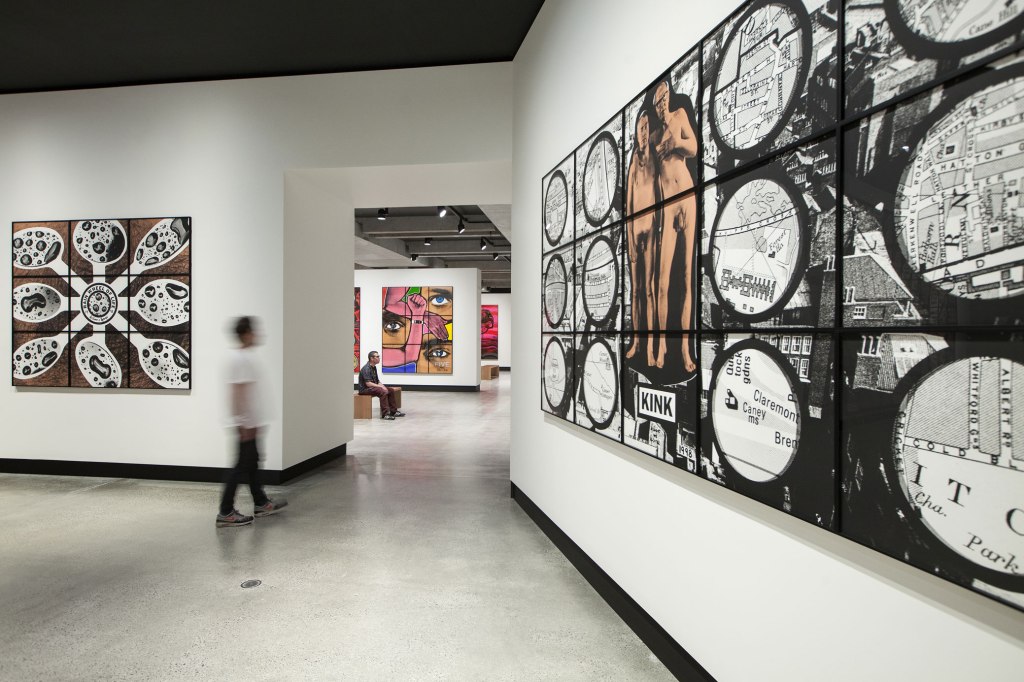
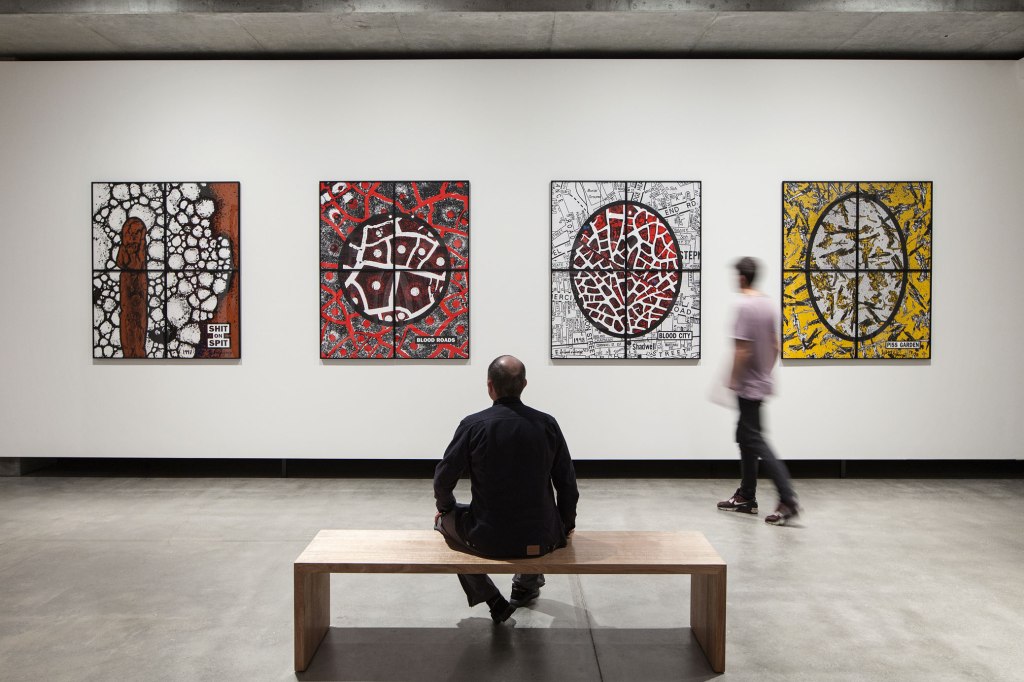
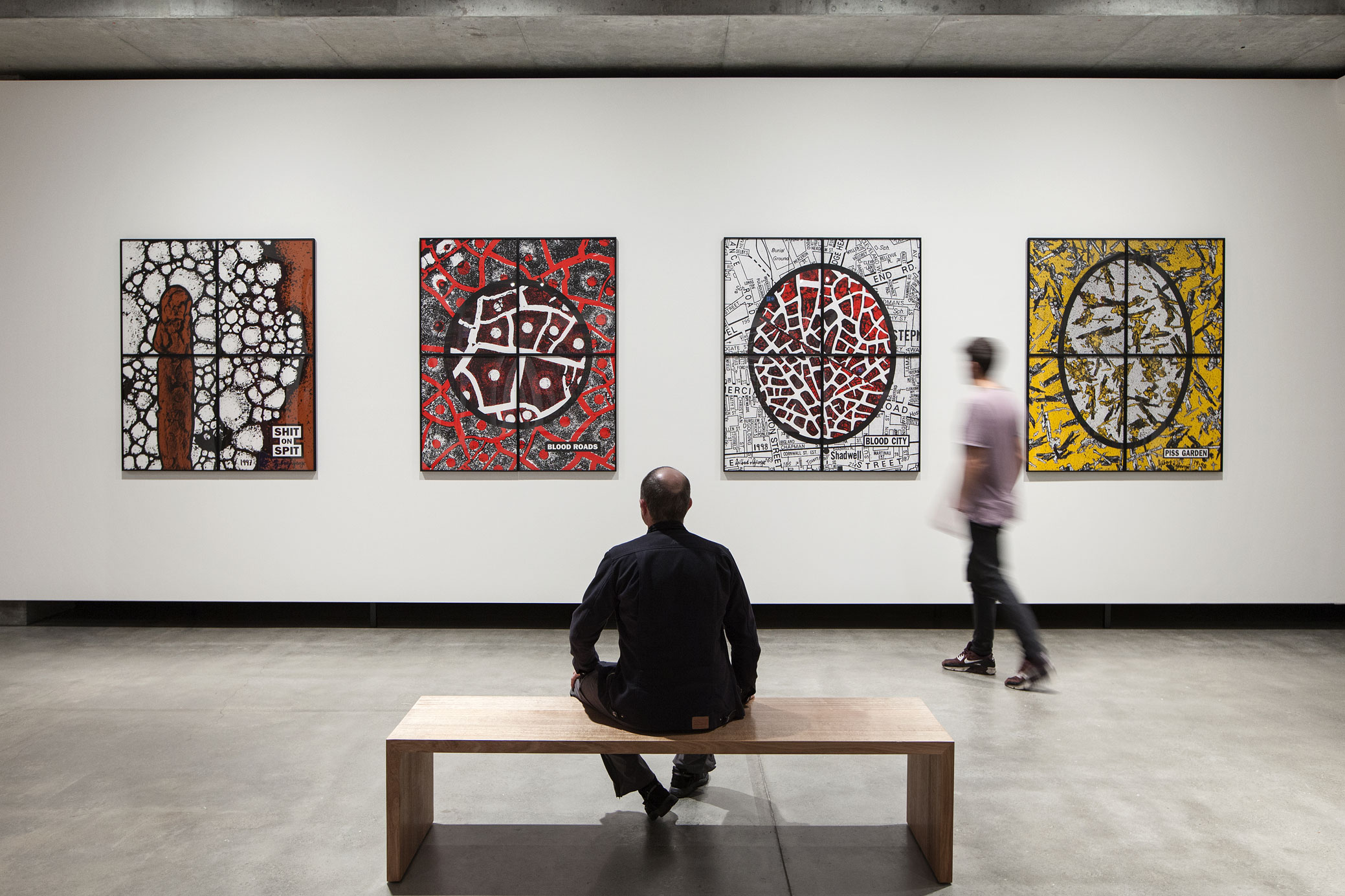
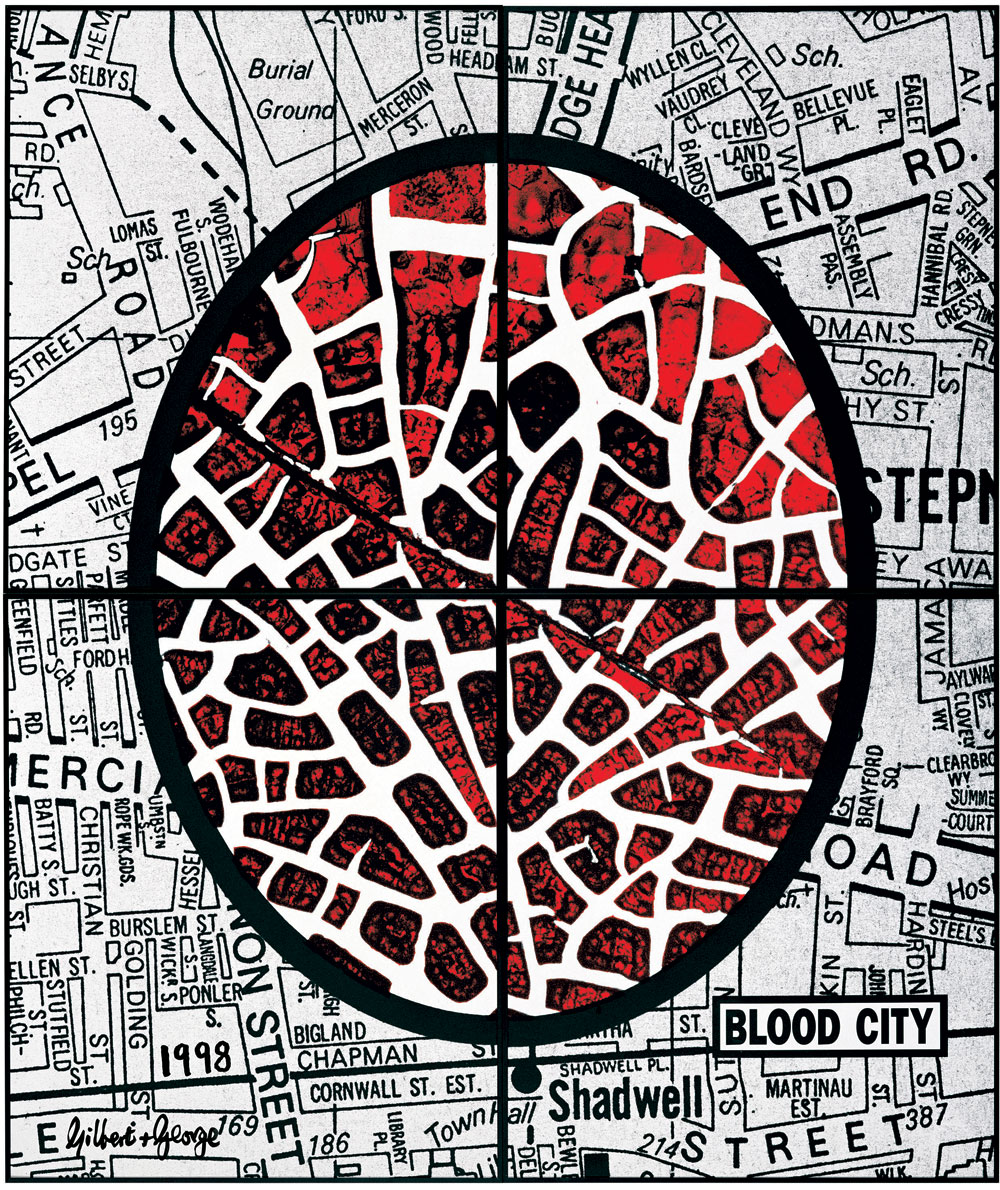
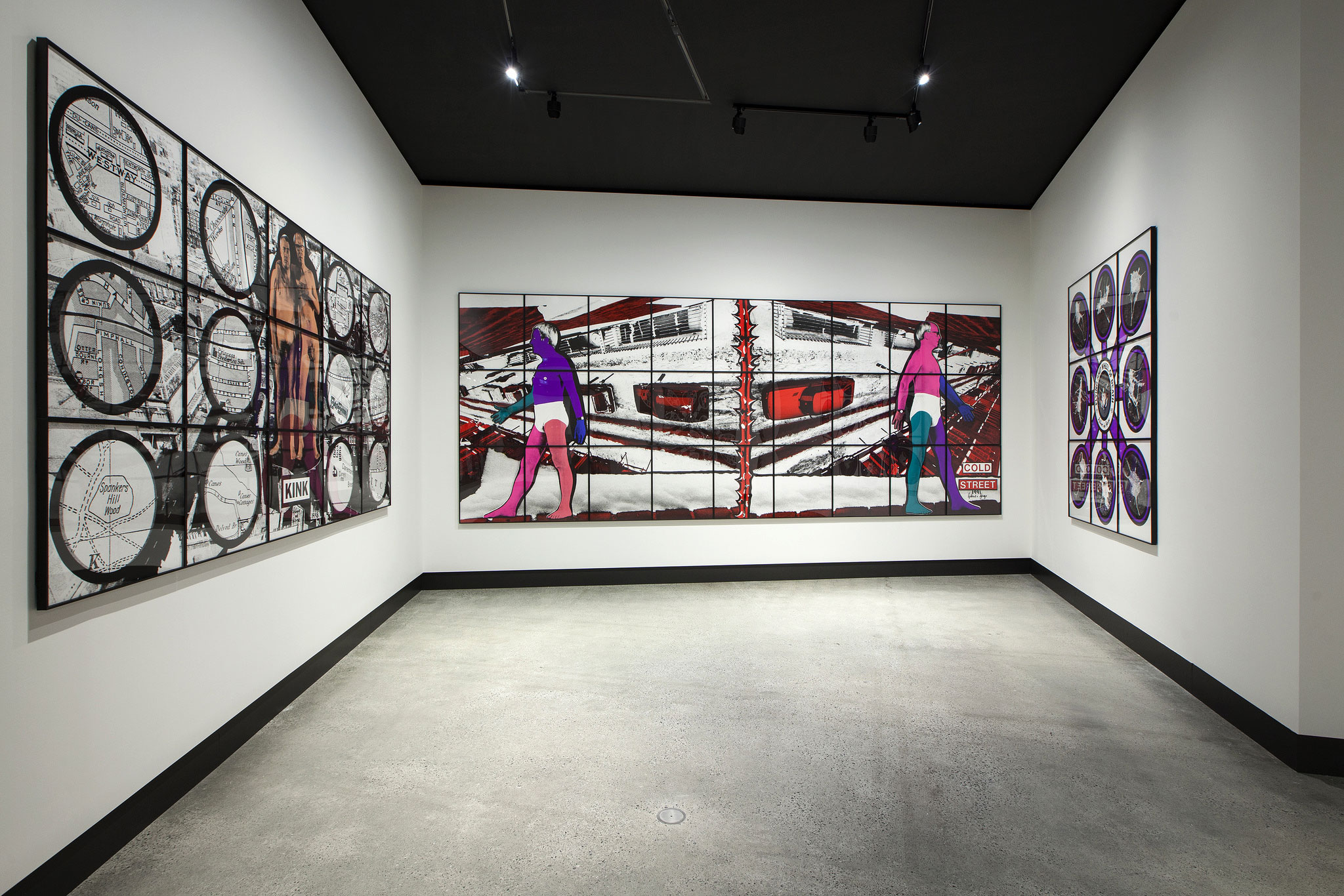
The Rudimentary Pictures, presents thirty-three new works, in which they explore such themes as alienation, sex, race, and human existence. Many of these striking pictures extend the distinctive range of images they have created exploring city life. In Gum City, City Sweat, Money City, Blood City, Piss City, Sex City and Crying City, backgrounds of London street plans are combined with map-like microscopic details of blood, sweat, tears, urine and semen, together with themselves.

Barry Grayshon. “Gilbert and George – The Rudimentary Pictures (1998),” on the Pinterest website [Online] Cited 16/03/2016


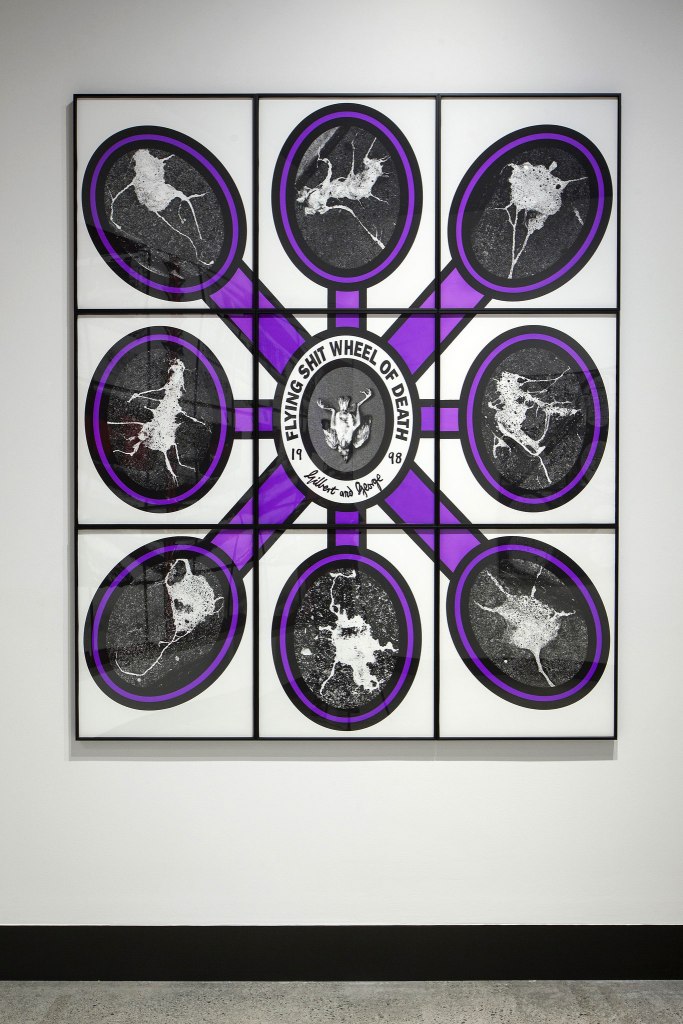
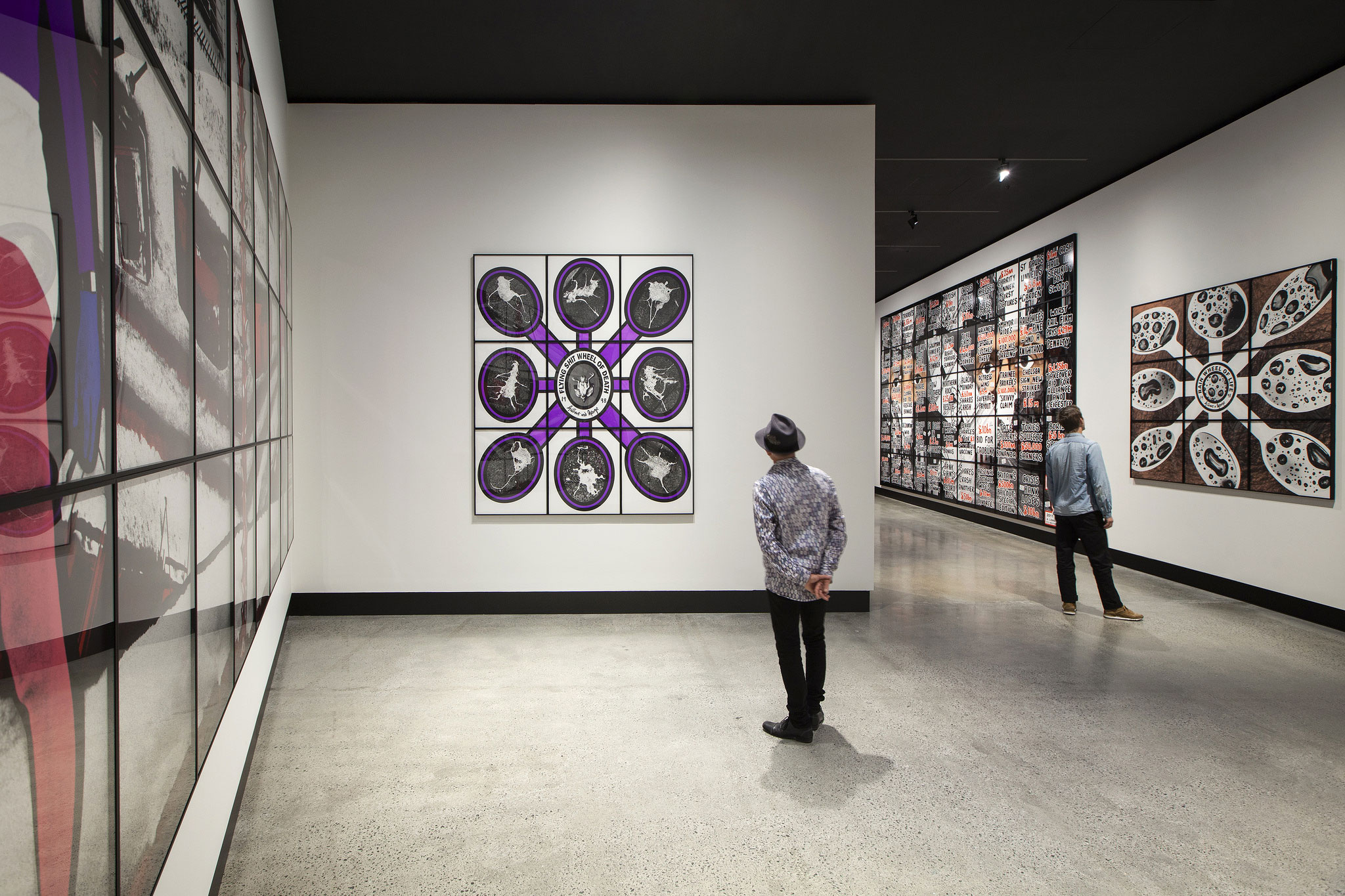
Installation view of the exhibition ‘Gilbert & George: The Art Exhibition’ at the Museum of Old and New Art, Hobart showing at middle, 'FLYING SHIT WHEEL OF DEATH' (1998); and at right, 'RAIN WHEEL OF LIFE' (1998), both from 'The Rudimentary Pictures'


Installation view of the exhibition Gilbert & George: The Art Exhibition at the Museum of Old and New Art, Hobart showing at middle, FLYING SHIT WHEEL OF DEATH (1998) and, at right, RAIN WHEEL OF LIFE (1998), both from The Rudimentary Pictures


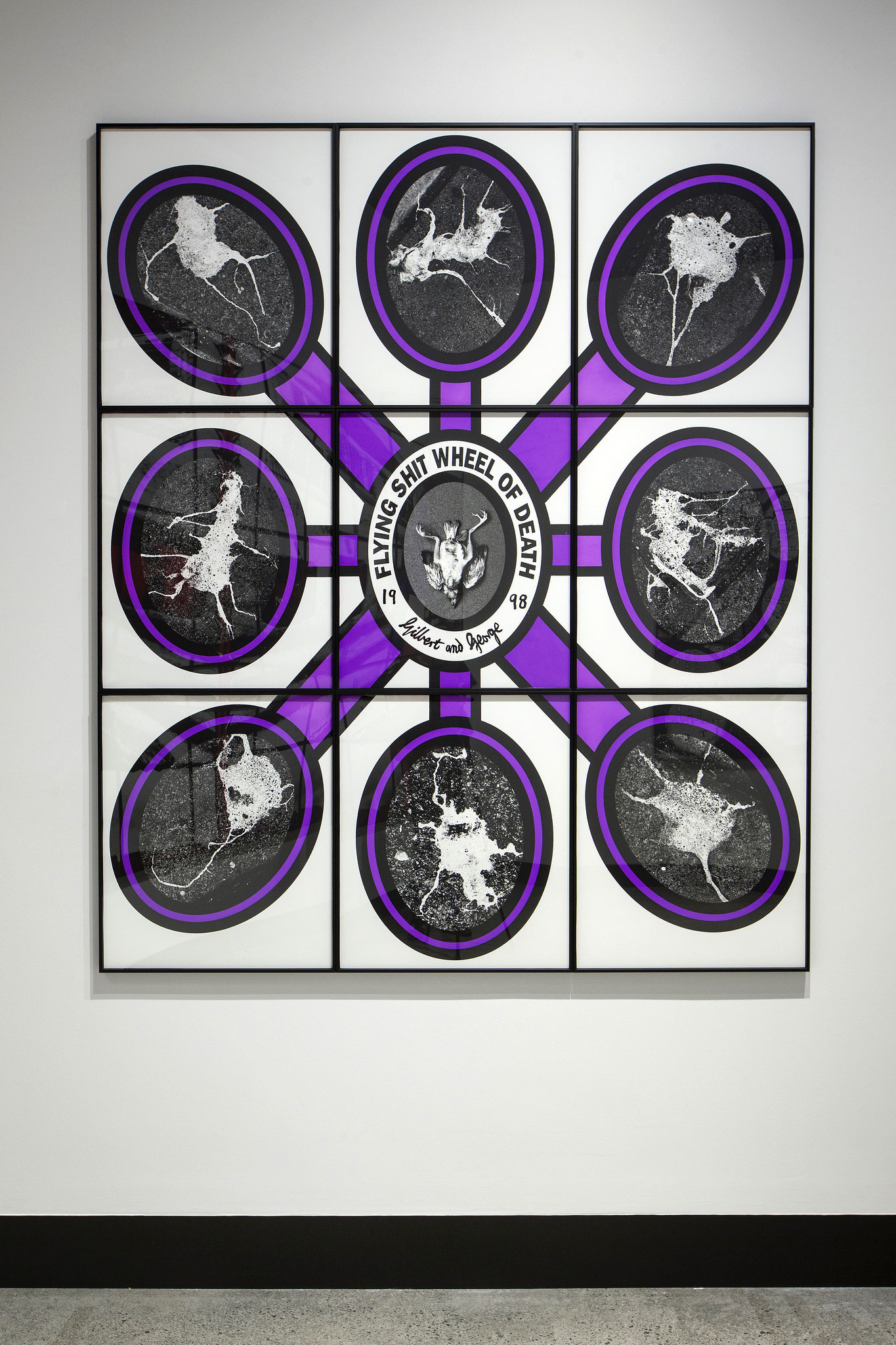
Gilbert & George (Gilbert Prousch, British born Italy, 1943; George Passmore, British, b. 1942) 'FLYING SHIT WHEEL OF DEATH' 1998 (installation view)


Gilbert & George (Gilbert Prousch, British born Italy, 1943; George Passmore, British, b. 1942)
FLYING SHIT WHEEL OF DEATH (installation view)
1998
from the series The Rudimentary Pictures


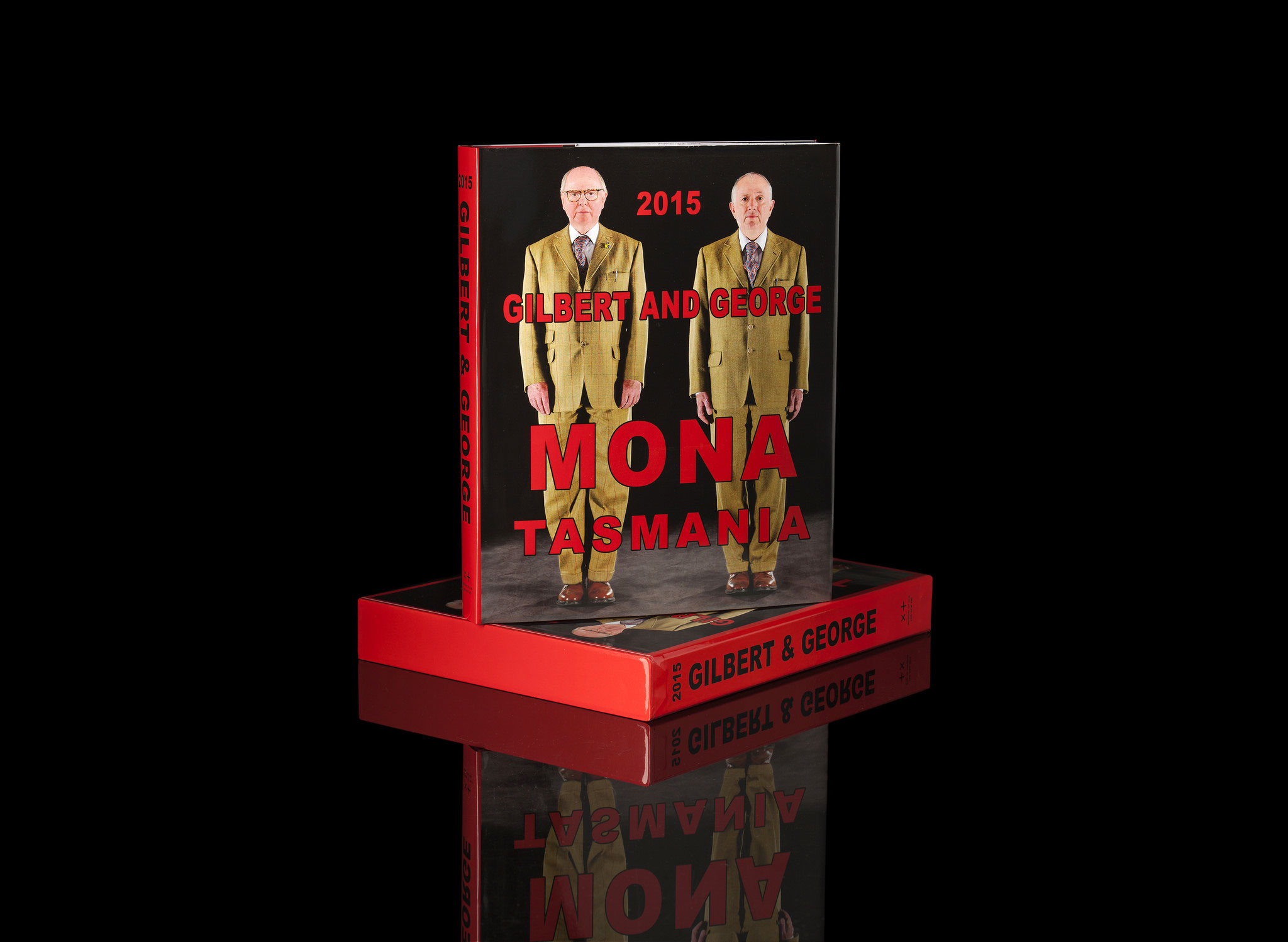
Gilbert & George hardcover catalogue from MONA


Gilbert & George hardcover catalogue
Photo Credit: Mona/Rémi Chauvin
Image Courtesy Mona, Museum of Old and New Art, Hobart, Tasmania, Australia


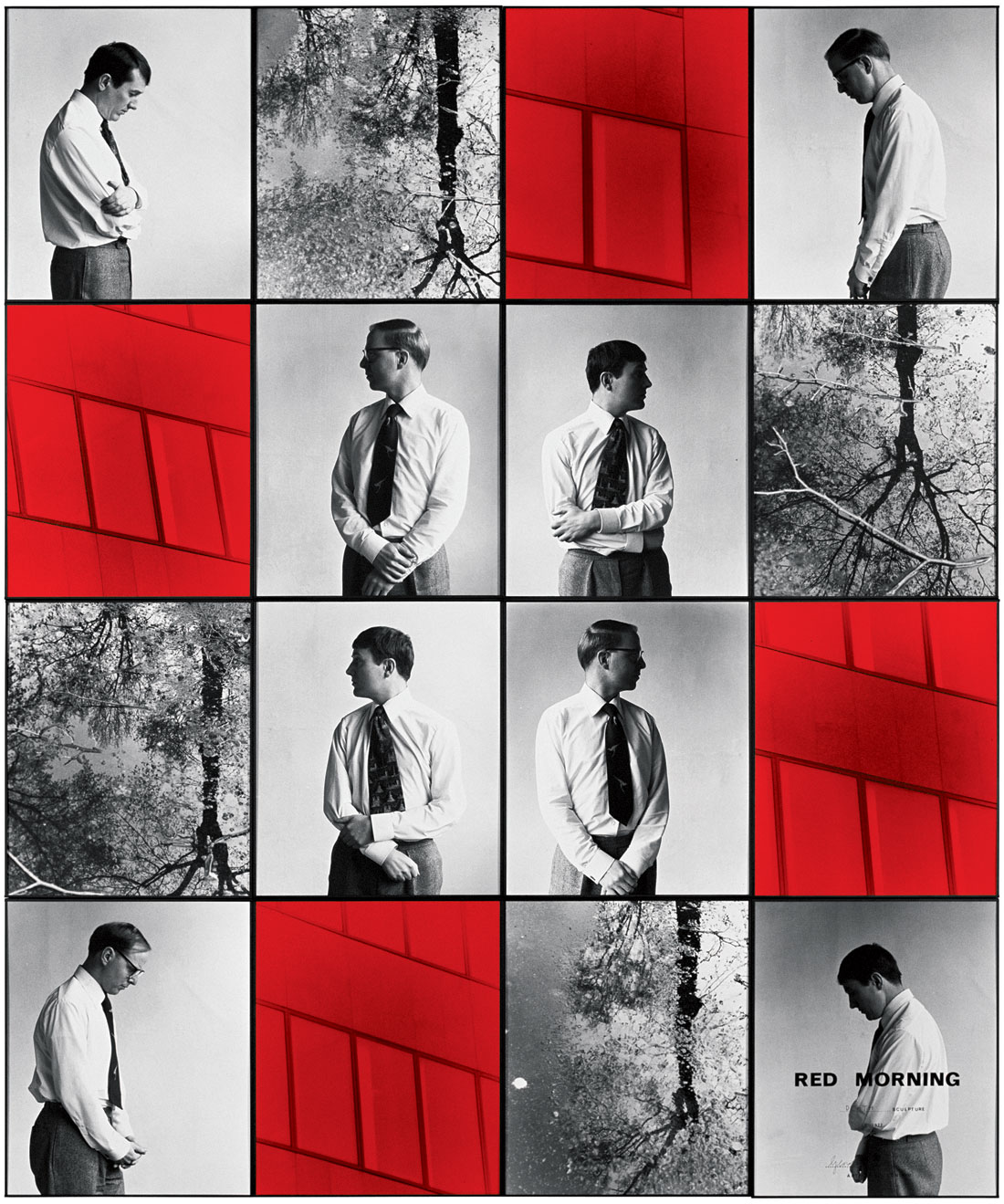
Gilbert & George (Gilbert Prousch, British born Italy, 1943; George Passmore, British, b. 1942) 'RED MORNING DEATH' 1977


Gilbert & George (Gilbert Prousch, British born Italy, 1943; George Passmore, British, b. 1942)
RED MORNING DEATH
1977
Mixed media
241 x 201cm
Private collection


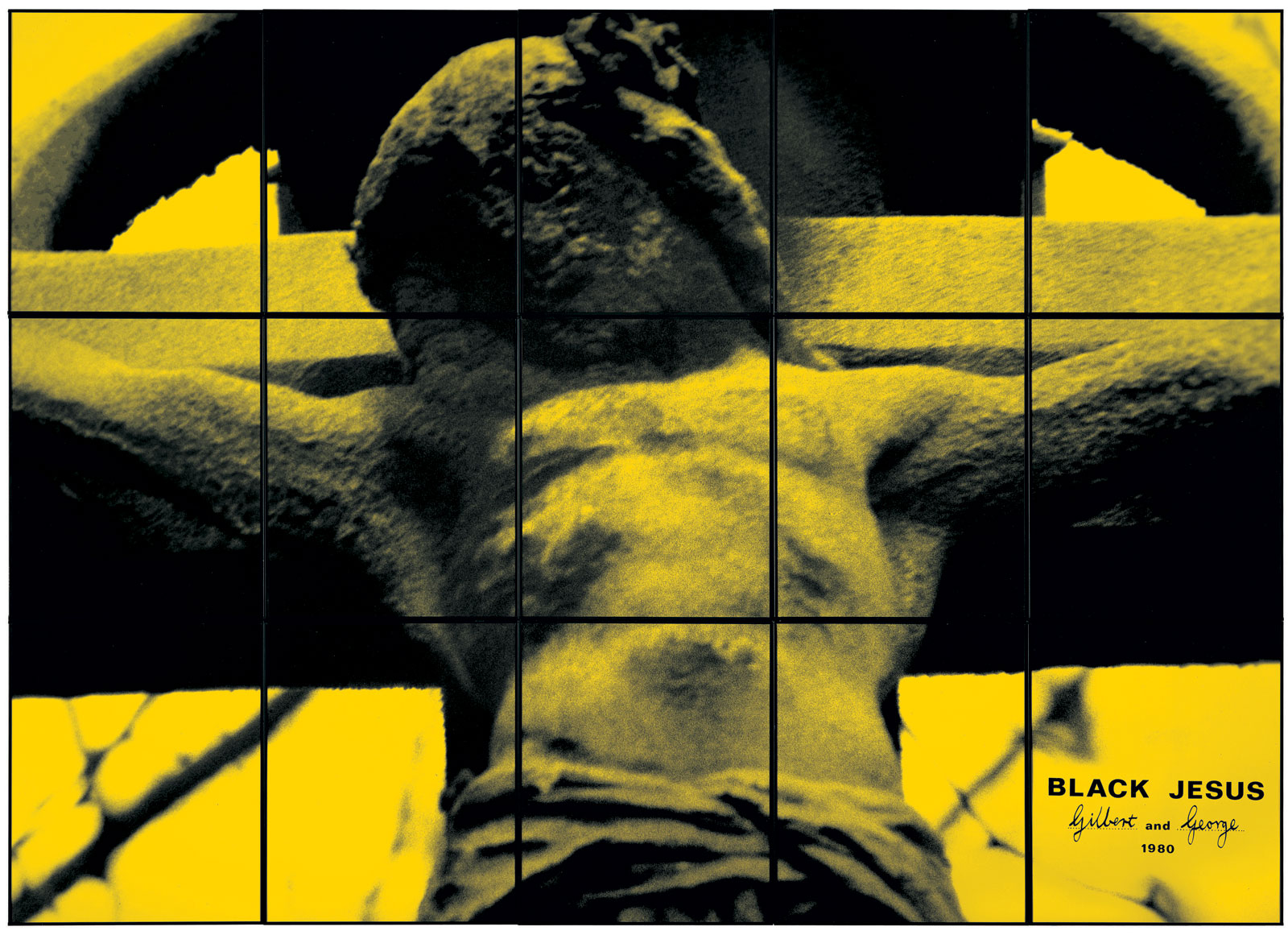
Gilbert & George (Gilbert Prousch, British born Italy, 1943; George Passmore, British, b. 1942) 'BLACK JESUS' 1980


Gilbert & George (Gilbert Prousch, British born Italy, 1943; George Passmore, British, b. 1942)
BLACK JESUS
1980
Mixed media
181 x 251cm
Private collection


In the early 1980s, Gilbert & George began to add a range of bright colours to their photographic images. They dramatically expanded their palette although black & white still remained. The series of photo-pieces that emerge during this vibrant period display a heightened reality, moving away from the earlier naturalism. They also began photographing each other as gargoyles, producing large close-ups of their faces, lit from below, grimacing horribly.

Barry Grayshon. “Gilbert and George – Mixed Media (1980),” on the Pinterest website [Online] Cited 16/03/2016


“… In a show as vast as the MONA survey, one sees the shit pictures as only a small chapter in their catalogue of would-be outrages. There are microscopic close-ups of their own sweat, blood, piss and sperm, presented as a form of decorative art. There are galleries of handsome young men, lined up like homoerotic altarpieces. There are works that excoriate religion – all forms of religion – and nationalism.

It would be an understatement to say these works sail close to the edge – they have plunged joyously over the precipice, beyond any conventions of good or bad taste. The “moral dimension” Gilbert & George seek is a systematic attempt to explode everything they see as false morality and hypocrisy. Homophobia is a constant target, as is racism and religious dogmatism. They are not the first to see organised religion as the root of all evil, but few artists or thinkers have been so consistently, so violently anti-religious.
The joke, of course, is that they look and act like conservative businessmen. Even their most confronting works are as bold and colourful as advertising billboards, or perhaps stained glass windows. They are iconoclastic non-entities making art that attracts and repels.
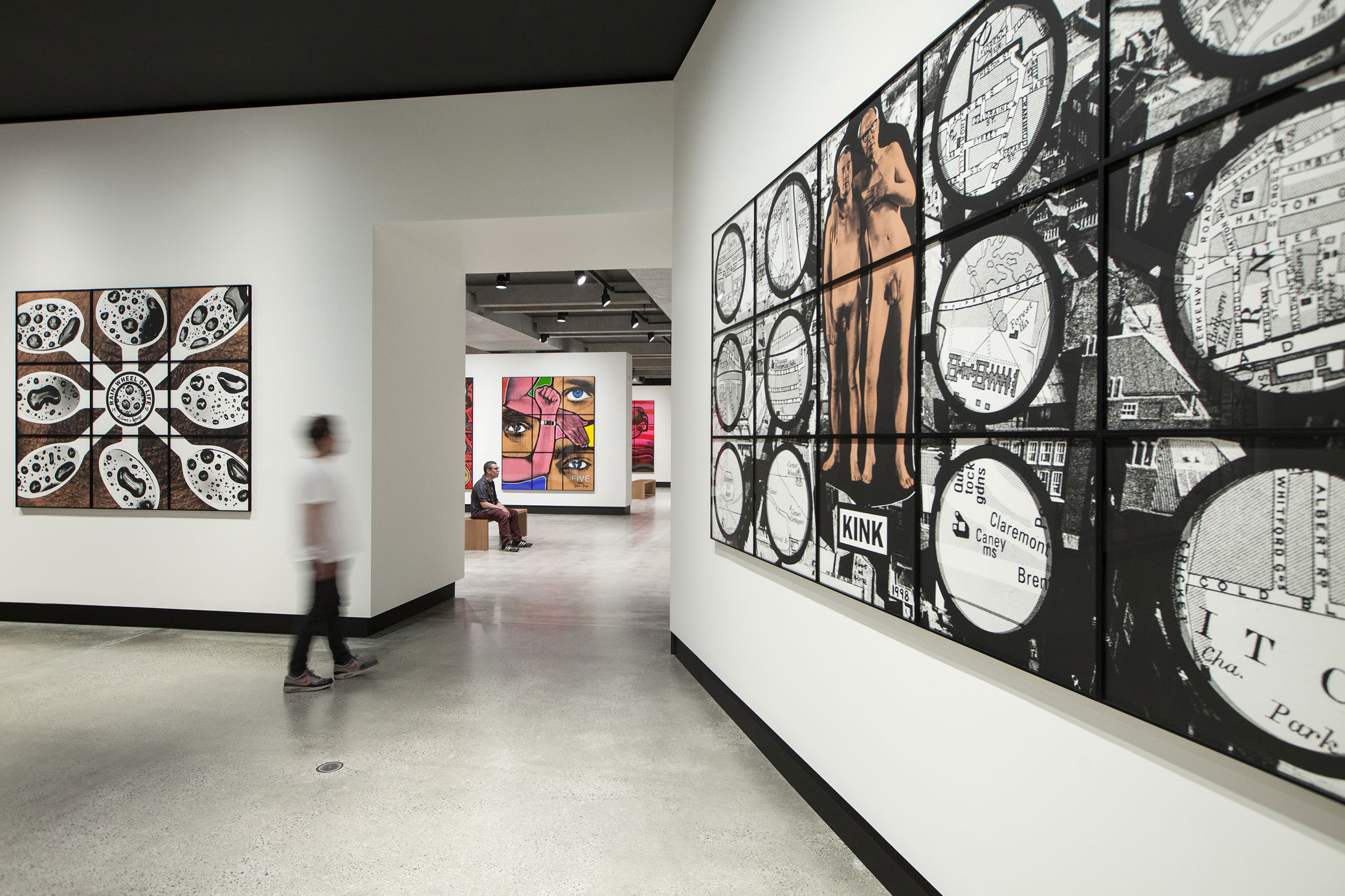
From behind a façade of consummate Englishness they set out to expose the grossness and depravity of the world around them. The Jack Freak Pictures (2008) use images of the Union Jack combined with grotesque morphings of their own figures that make them look like demons or mutants. The London Pictures (2011) use hundreds of daily newspaper banners, purloined from newsagents, to produce a chorus of sordidness and sensationalism.

We see two deadpan comedians enjoying the adolescent humour of exposing themselves to an audience, making wall-sized images of all those things not spoken of in ‘polite’ society. I could almost accept the idea of Gilbert & George as two overgrown children, intent on making mischief, but every so often they hit the mark with surprising force.”

John McDonald. “Gilbert & George,” on the John McDonald website December 4, 2015 [Online] Cited 11/03/2016.


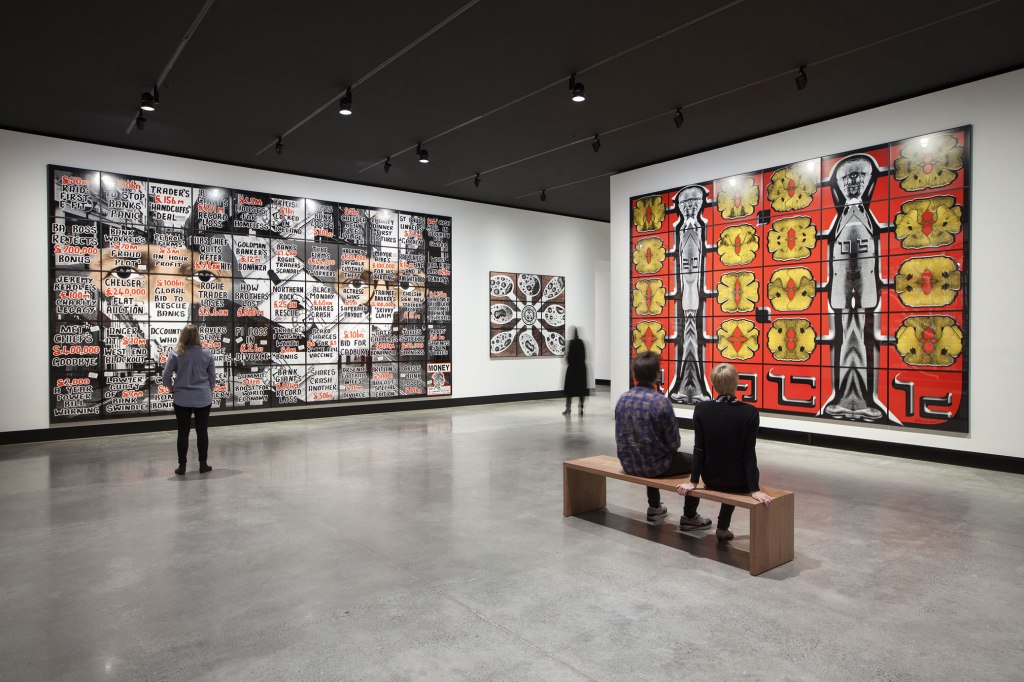
Installation view of the exhibition ‘Gilbert & George: The Art Exhibition’ at the Museum of Old and New Art, Hobart showing at left, 'MONEY' (2011) from 'The London Pictures' and, at right, 'Raack' (2005) from 'Ginkgo Pictures'


Installation view of the exhibition Gilbert & George: The Art Exhibition at the Museum of Old and New Art, Hobart showing at left, MONEY (2011) from The London Pictures and, at right, Raack (2005) from Ginkgo Pictures


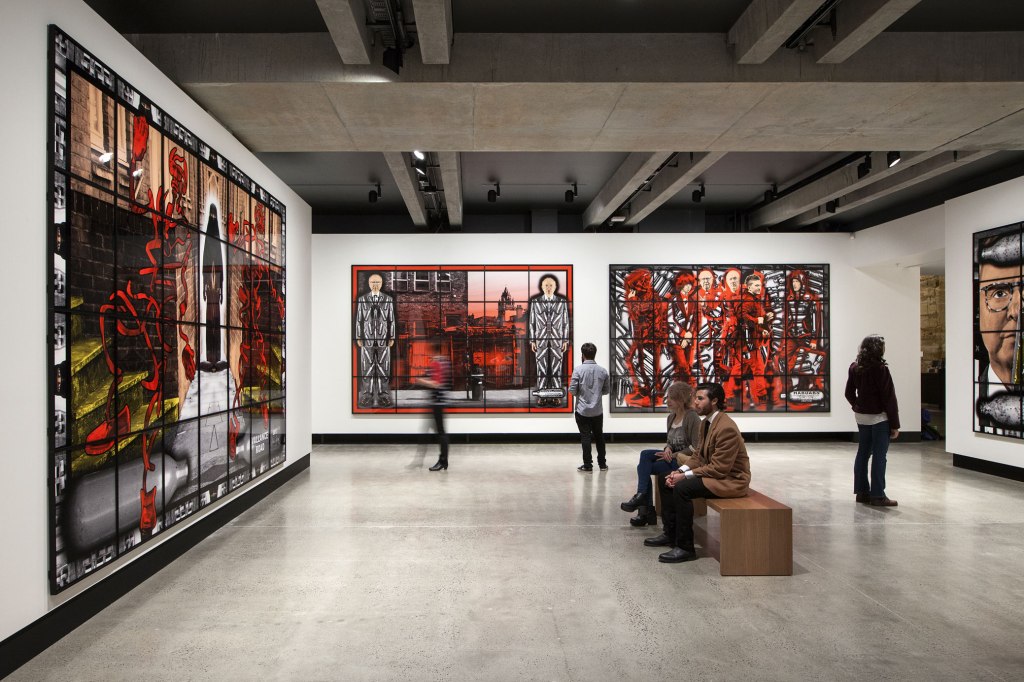
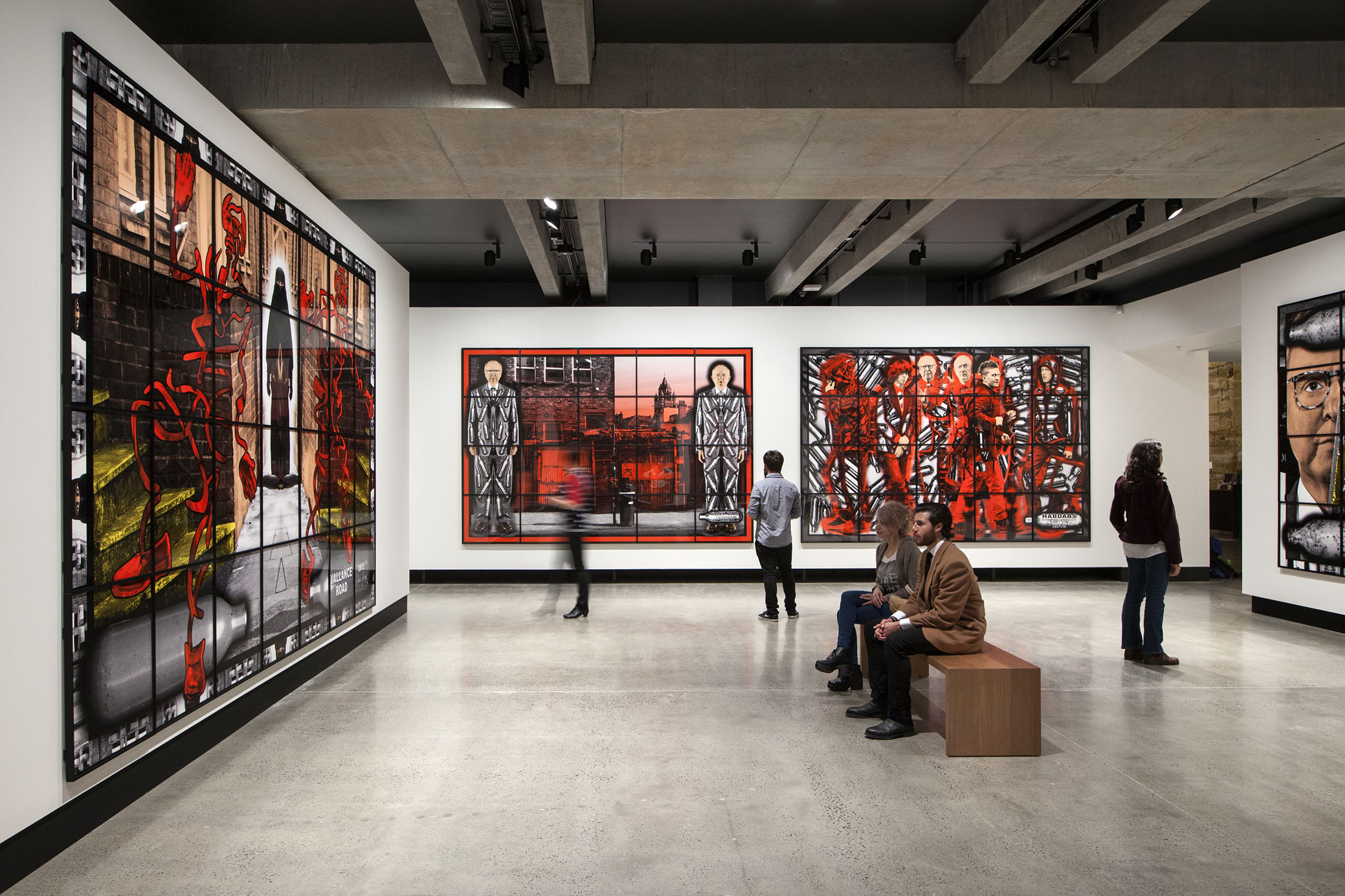
Installation view of the exhibition ‘Gilbert & George: The Art Exhibition’ at the Museum of Old and New Art, Hobart showing at left, 'VALLANCE ROAD' (2013); at centre left 'RIDLEY ROAD' (2013) and at centre right 'HABDABS' (2013) all from the series 'Scapegoating Pictures'


Installation view of the exhibition Gilbert & George: The Art Exhibition at the Museum of Old and New Art, Hobart showing at left, VALLANCE ROAD (2013); at centre left RIDLEY ROAD (2013) and at centre right HABDABS (2013) all from the series Scapegoating Pictures


There are 292 pieces in this series featuring whippets and hippy crack (laughing gas). The SCAPEGOATING PICTURES unflinchingly describe the volatile, tense, accelerated and mysterious reality of our increasingly technological, multi-faith and multi-cultural world. It is a world in which paranoia, fundamentalism, surveillance, religion, accusation and victimhood become moral shades of the city’s temper.

Barry Grayshon. “Gilbert and George – Scapegoating Pictures for London (2013),” on the Pinterest website [Online] Cited 16/03/2016


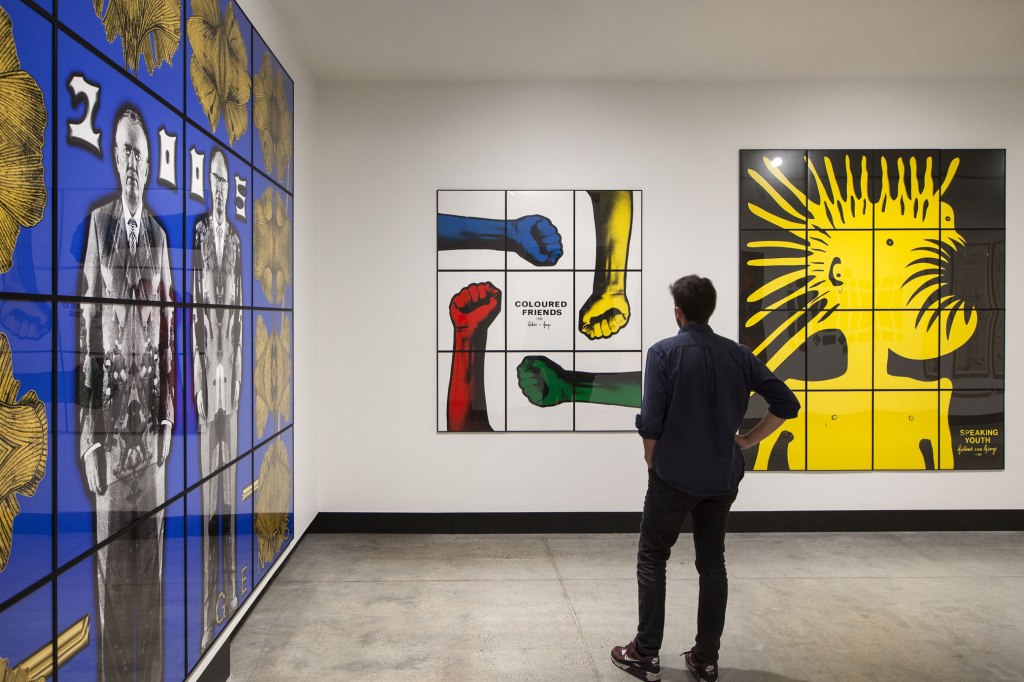
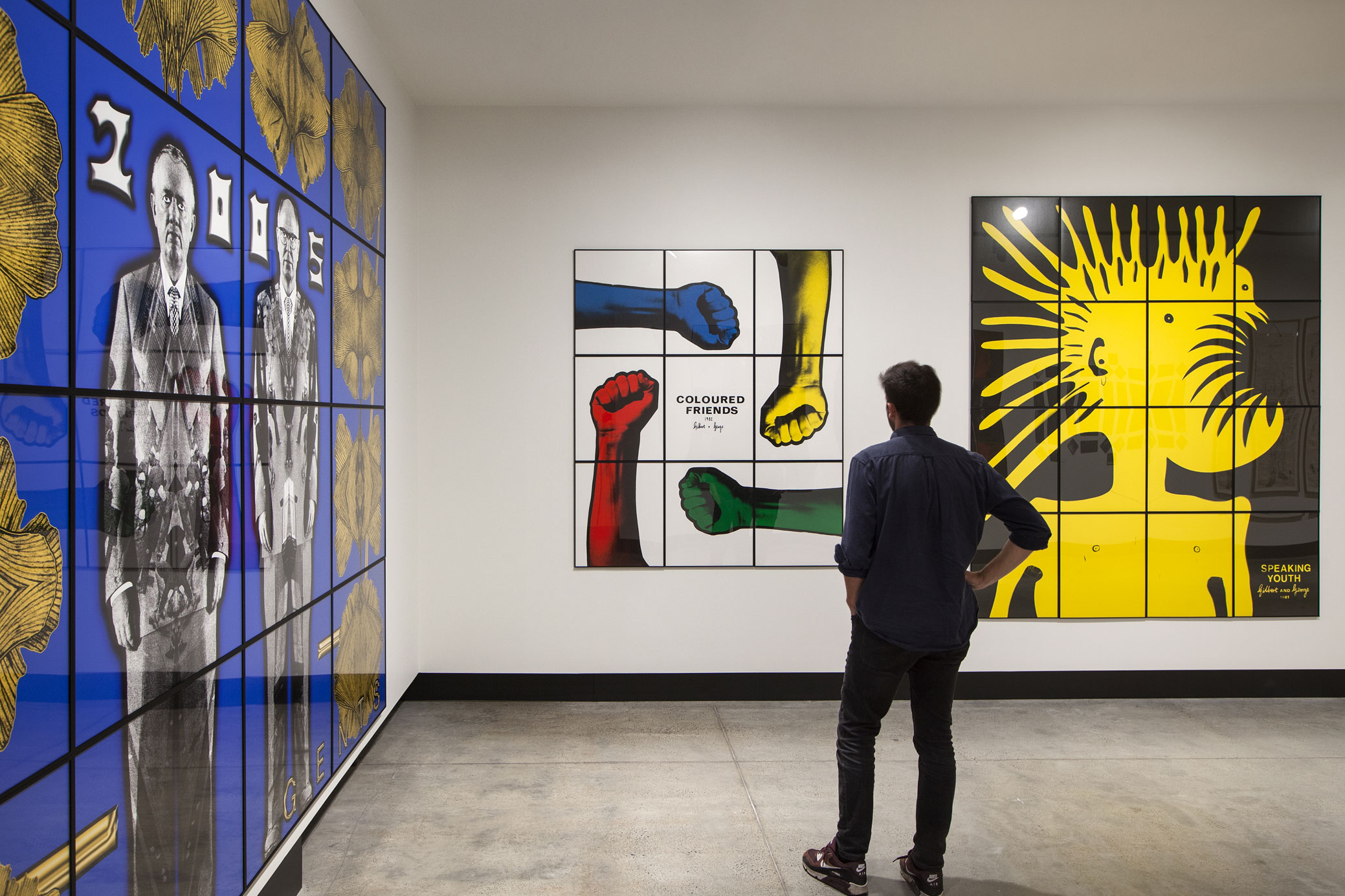
Installation view of the exhibition ‘Gilbert & George: The Art Exhibition’ at the Museum of Old and New Art, Hobart showing at left, 'Citied Gents' (2005) from 'Ginkgo Pictures'; at left rear, 'COLOURED FRIENDS' (1982); and at right rear 'SPEAKING YOUTH' (1981)


Installation view of the exhibition Gilbert & George: The Art Exhibition at the Museum of Old and New Art, Hobart showing at left, Citied Gents (2005) from Ginkgo Pictures; at left rear, COLOURED FRIENDS (1982); and at right rear SPEAKING YOUTH (1981)


Installation view of the exhibition ‘Gilbert & George: The Art Exhibition’ at the Museum of Old and New Art, Hobart showing at left, 'RAIN WHEEL OF LIFE' (1998), and at right 'KINK' (1998), both from 'The Rudimentary Pictures'


Installation view of the exhibition Gilbert & George: The Art Exhibition at the Museum of Old and New Art, Hobart showing at left, RAIN WHEEL OF LIFE (1998), and at right KINK (1998), both from The Rudimentary Pictures


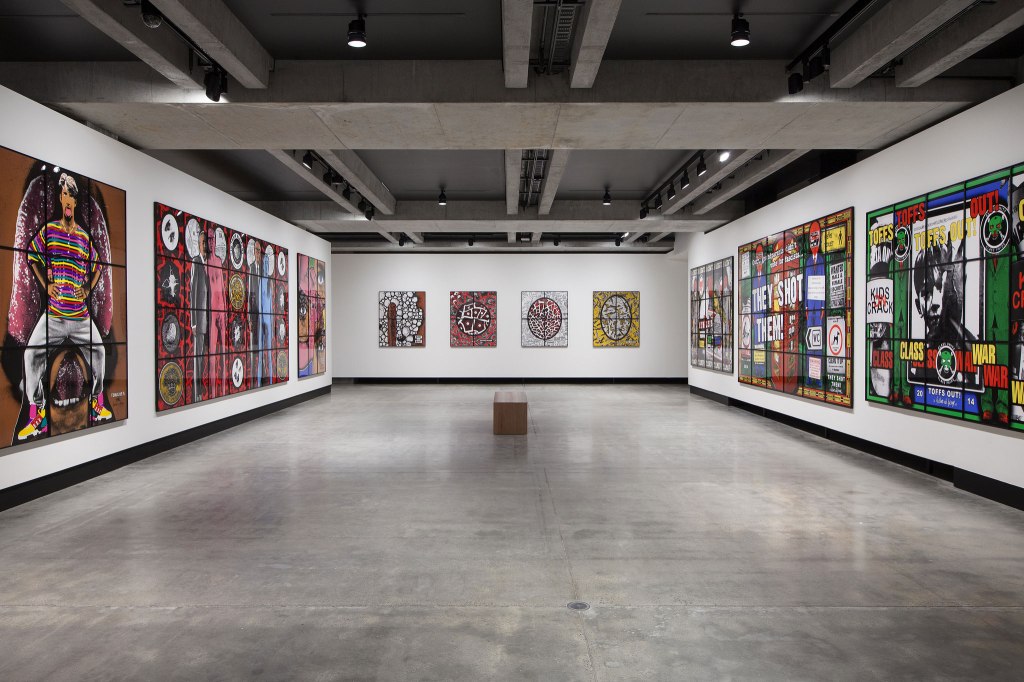
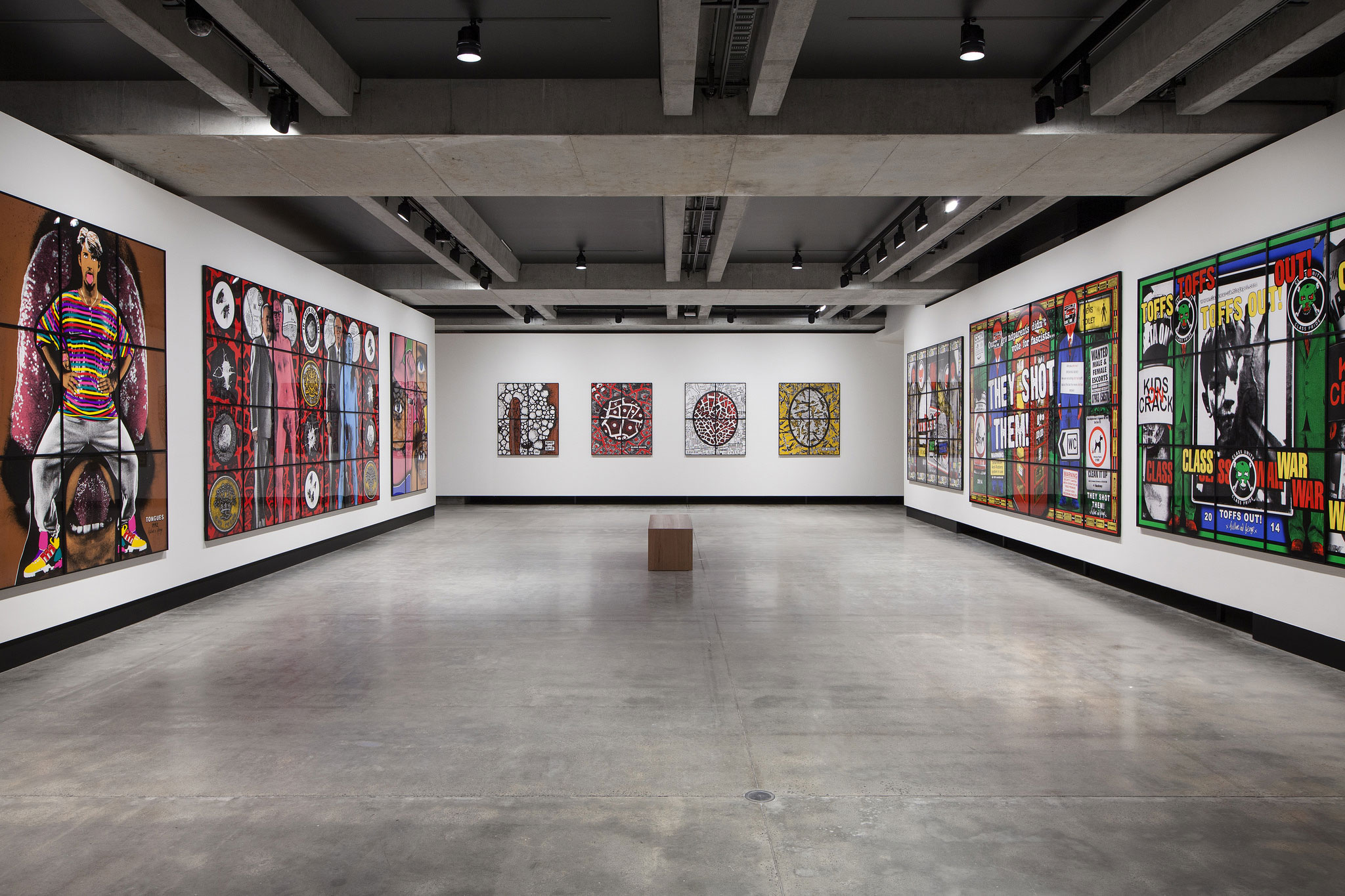
Installation view of the exhibition ‘Gilbert & George: The Art Exhibition’ at the Museum of Old and New Art, Hobart showing at left, 'TONGUES' (1992) followed by 'IN THEIR ELEMENT' (1998) from the series 'The Rudimentary Pictures' followed by 'FIVE' (1992); to the right 'TOFF'S OUT!' (2014) followed by 'THEY SHOT THEM!' (2014), both from the series 'Utopian Pictures'


Installation view of the exhibition Gilbert & George: The Art Exhibition at the Museum of Old and New Art, Hobart showing at left, TONGUES (1992) followed by IN THEIR ELEMENT (1998) from the series The Rudimentary Pictures followed by FIVE (1992); to the right TOFF’S OUT! (2014) followed by THEY SHOT THEM! (2014), both from the series Utopian Pictures


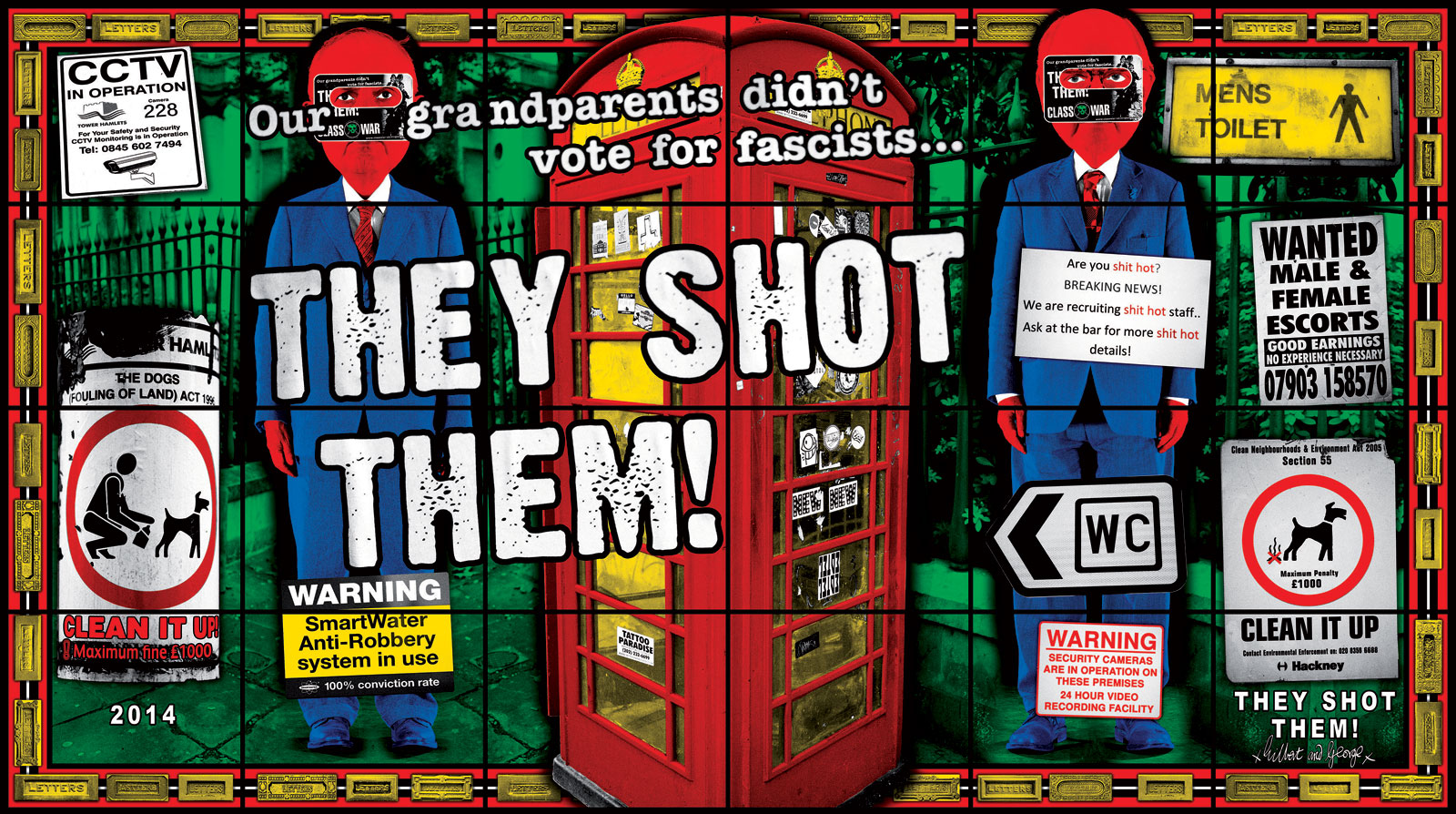
Gilbert & George (Gilbert Prousch, British born Italy, 1943; George Passmore, British, b. 1942) 'THEY SHOT THEM!' 2014


Gilbert & George (Gilbert Prousch, British born Italy, 1943; George Passmore, British, b. 1942)
THEY SHOT THEM!
2014
Mixed media
254 x 453 cm
Courtesy of ARNDT and Gilbert & George


The 26 UTOPIAN PICTURES convey, like an energy storm, the frenetic forces of an endlessly embattled state: between the voices of authority and civic order. These pictures depict a modern world in which authority and the resentment of authority, rules and rebellion, advertising and public information, dogma and warning, boasts and threats co-exist in seemingly endless proclamations.

Barry Grayshon. “Gilbert and George – Utopian Pictures (2014),” on the Pinterest website [Online] Cited 16/03/2016


Installation view of the exhibition ‘Gilbert & George: The Art Exhibition’ at the Museum of Old and New Art, Hobart showing from left to right, 'SHIT ON SPIT' (1997) from 'The New Testamental Pictures', 'BLOOD ROADS' (1998), 'BLOOD CITY' (1998) and 'PISS GARDEN' (1998) from 'The Rudimentary Pictures'


Installation view of the exhibition Gilbert & George: The Art Exhibition at the Museum of Old and New Art, Hobart showing from left to right, SHIT ON SPIT (1997) from The New Testamental Pictures, BLOOD ROADS (1998), BLOOD CITY (1998) and PISS GARDEN (1998) from The Rudimentary Pictures


Gilbert & George (Gilbert Prousch, British born Italy, 1943; George Passmore, British, b. 1942) 'BLOOD CITY' 1988


Gilbert & George (Gilbert Prousch, British born Italy, 1943; George Passmore, British, b. 1942)
BLOOD CITY
1988
Mixed media
151 x 127 cm
Courtesy of the artists


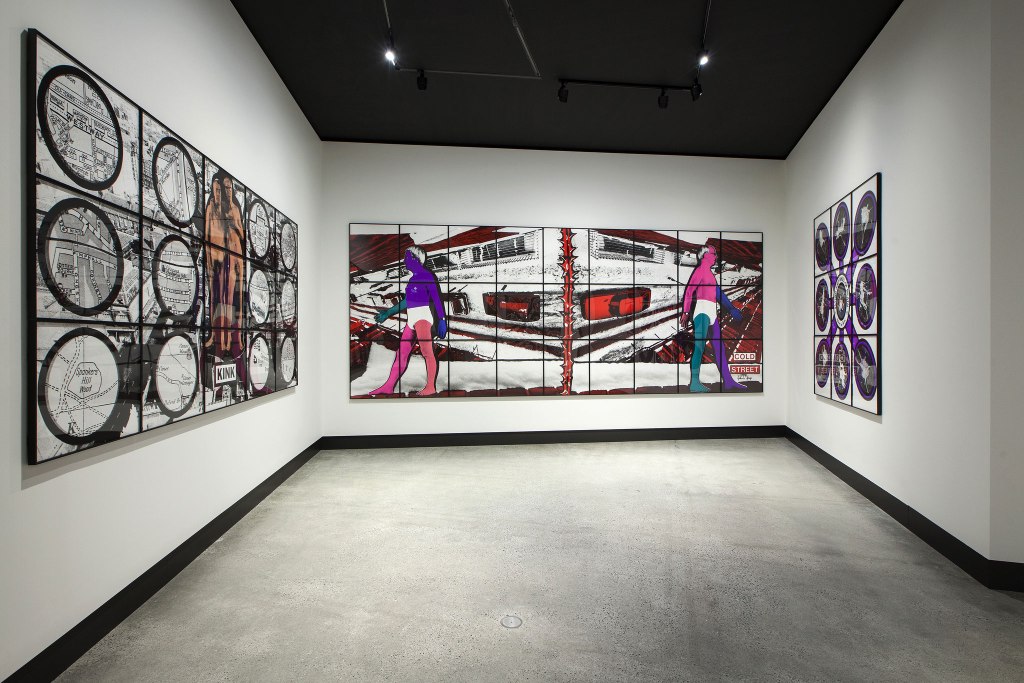
Installation view of the exhibition ‘Gilbert & George: The Art Exhibition’ at the Museum of Old and New Art, Hobart showing at left, 'KINK' (1998), and at rear, 'COLD STREET' (1991)


Installation view of the exhibition Gilbert & George: The Art Exhibition at the Museum of Old and New Art, Hobart showing at left, KINK (1998), and at rear, COLD STREET (1991)


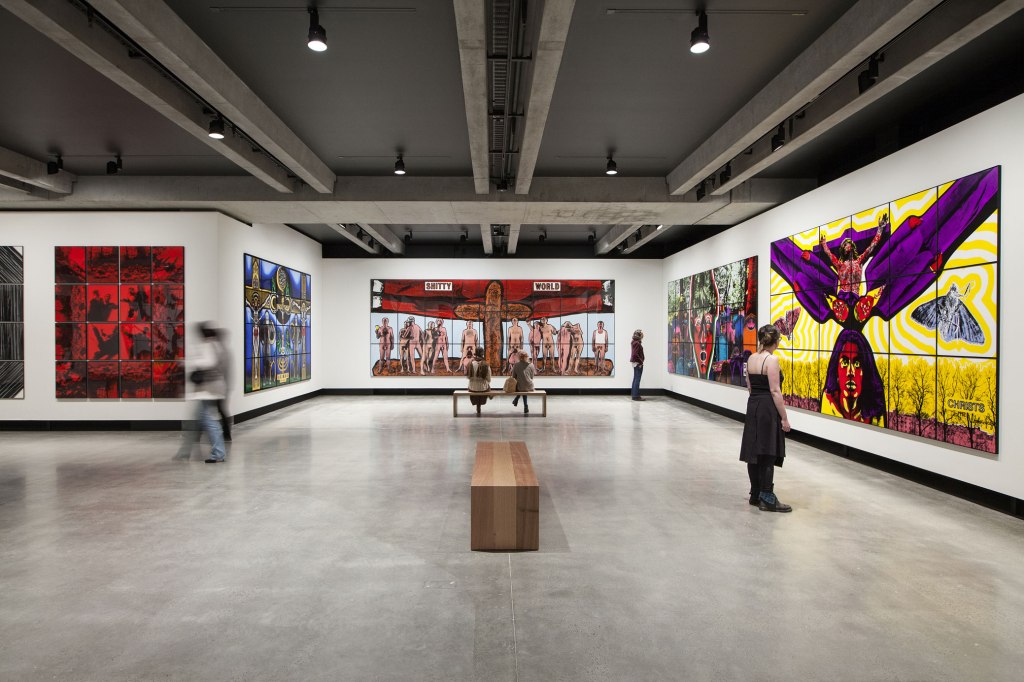
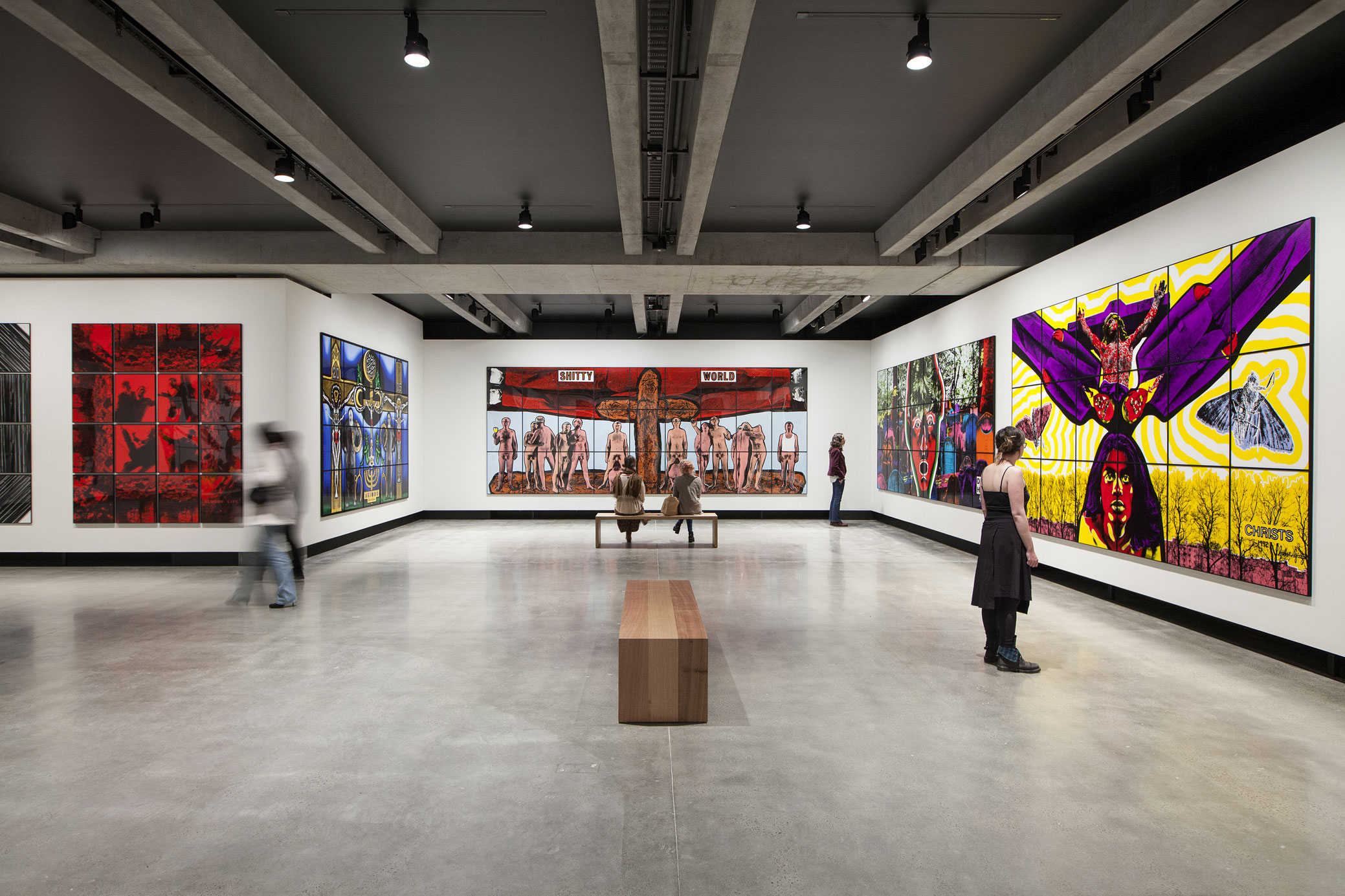
Installation view of the exhibition ‘Gilbert & George: The Art Exhibition’ at the Museum of Old and New Art, Hobart showing from left to right, 'BLOODY LIFE No. 4' (1975), 'AKIMBO' (2005) from 'Sonofagod Pictures', 'SHITTY WORLD' (1994), 'DEAD HEAD' (1989), and 'CHRISTS' (1992) from 'The China Pictures'


Installation view of the exhibition Gilbert & George: The Art Exhibition at the Museum of Old and New Art, Hobart showing from left to right, BLOODY LIFE No. 4 (1975), AKIMBO (2005) from Sonofagod Pictures, SHITTY WORLD (1994), DEAD HEAD (1989), and CHRISTS (1992) from The China Pictures


In the BLOODY LIFE pictures, from 1975, Gilbert & George strike poses with clenched fists and legs kicking. Even the introspective image of the artists in BLOODY LIFE NO.3 is embedded within a frame of alcohol and the boxing ring. The brutality of these pictures reflects their experience at the time. ‘We went through this big destructive period of the drunken scenery, exploring ourselves, exploring our dark side, going out, getting drunk, all those destructive elements’.

Barry Grayshon. “Gilbert and George – Bloody Life (1975),” on the Pinterest website [Online] Cited 16/03/2016


The SONOFAGOD PICTURES consist of 20 paintings that possess a darkly graven strangeness, at once archaic and ultra-modern, in which their temper no less than their signage appears deeply contemporary, ritualistic and disturbed and have all of the dramatic visual impact which one might expect to find in neo-Gothic medievalism.

Christs shows a local youth imagining a butterfly Christ with Gilbert and George wings.


Installation view of the exhibition ‘Gilbert & George: The Art Exhibition’ at the Museum of Old and New Art, Hobart showing at left, 'FORWARD' (2008) and in the middle right, 'SCAPEGOATING' (2013)


Installation view of the exhibition Gilbert & George: The Art Exhibition at the Museum of Old and New Art, Hobart showing at left, FORWARD (2008) and in the middle right, SCAPEGOATING (2013)


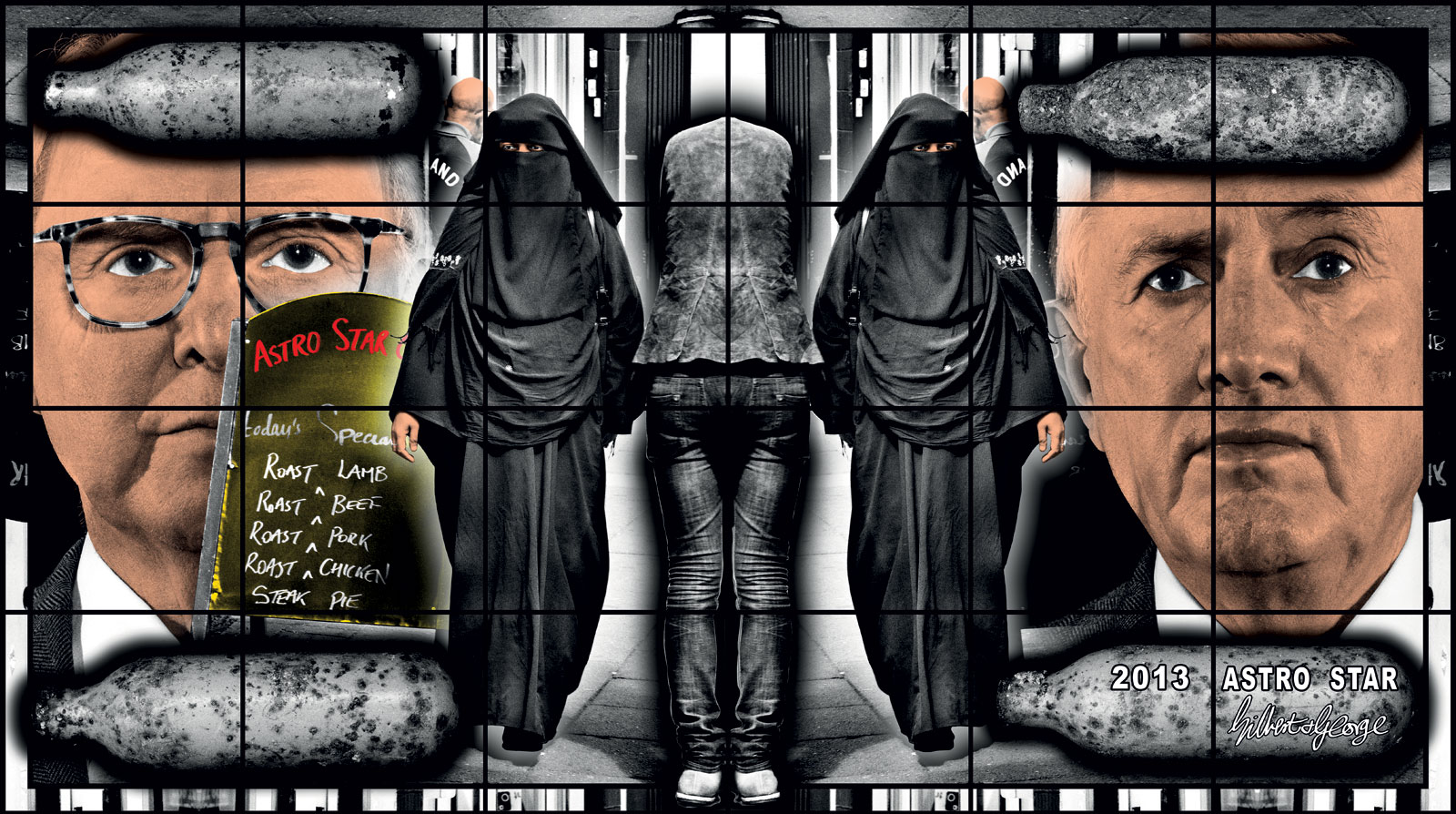
Gilbert & George (Gilbert Prousch, British born Italy, 1943; George Passmore, British, b. 1942) 'ASTRO STAR' 2013


Gilbert & George (Gilbert Prousch, British born Italy, 1943; George Passmore, British, b. 1942)
ASTRO STAR
2013
From Scapegoating Pictures
Picture courtesy of the artists and Mona, Museum of Old and New Art, Tasmania, Australia


There are 292 pieces in this series featuring whippets and hippy crack (laughing gas). The SCAPEGOATING PICTURES unflinchingly describe the volatile, tense, accelerated and mysterious reality of our increasingly technological, multi-faith and multi-cultural world. It is a world in which paranoia, fundamentalism, surveillance, religion, accusation and victimhood become moral shades of the city’s temper.

Barry Grayshon. “Gilbert and George – Scapegoating Pictures for London (2013),” on the Pinterest website [Online] Cited 16/03/2016


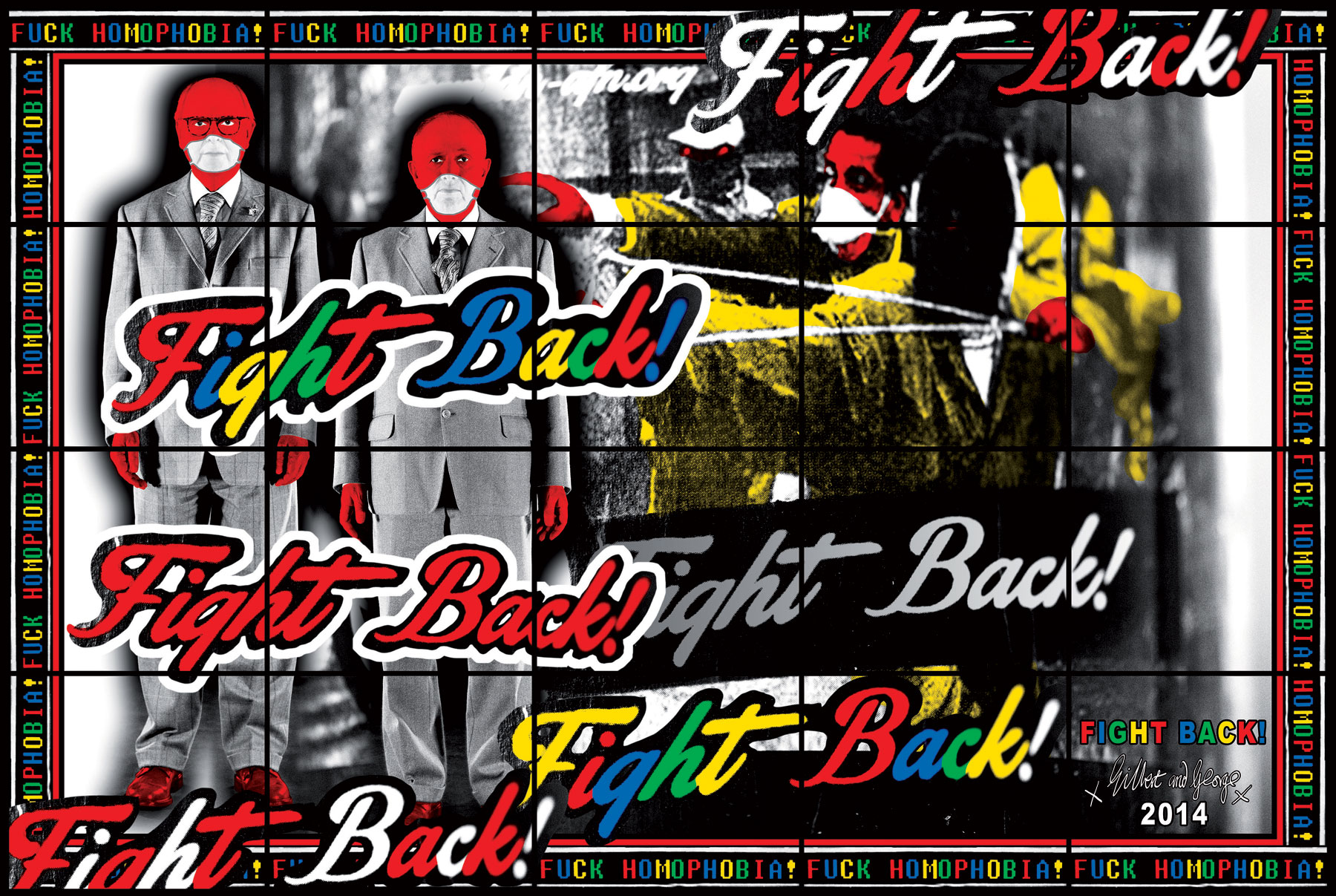
Gilbert & George (Gilbert Prousch, British born Italy, 1943; George Passmore, British, b. 1942) 'FIGHT BACK' 2014


Gilbert & George (Gilbert Prousch, British born Italy, 1943; George Passmore, British, b. 1942)
FIGHT BACK
2014
From the series Utopian Pictures
Mixed media
254 x 377cm
Courtesy of ARNDT and Gilbert & George


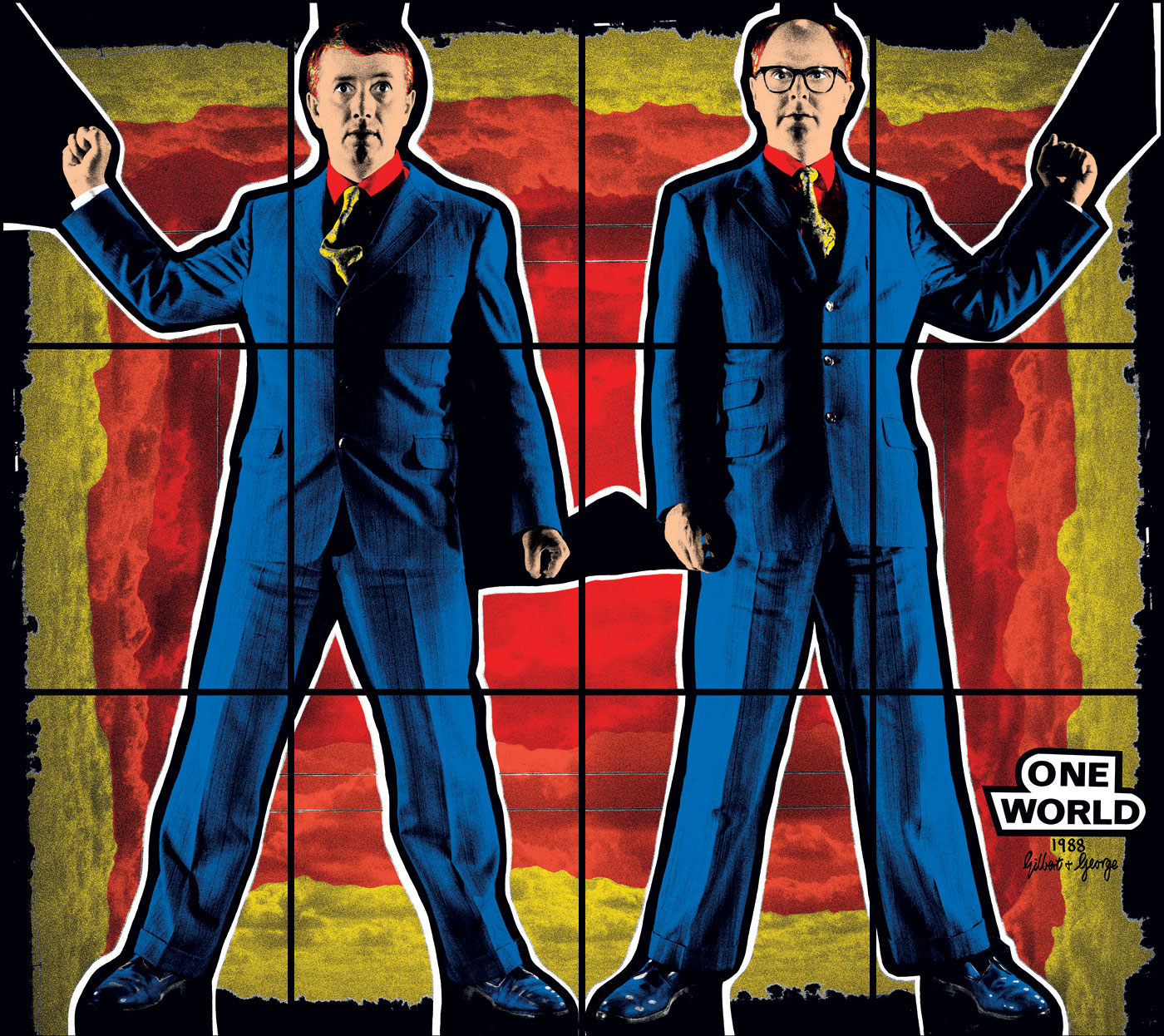
Gilbert & George (Gilbert Prousch, British born Italy, 1943; George Passmore, British, b. 1942) 'ONE WORLD' 1988


Gilbert & George (Gilbert Prousch, British born Italy, 1943; George Passmore, British, b. 1942)
ONE WORLD
1988
Mixed media
226 x 254cm
Courtesy of the artists


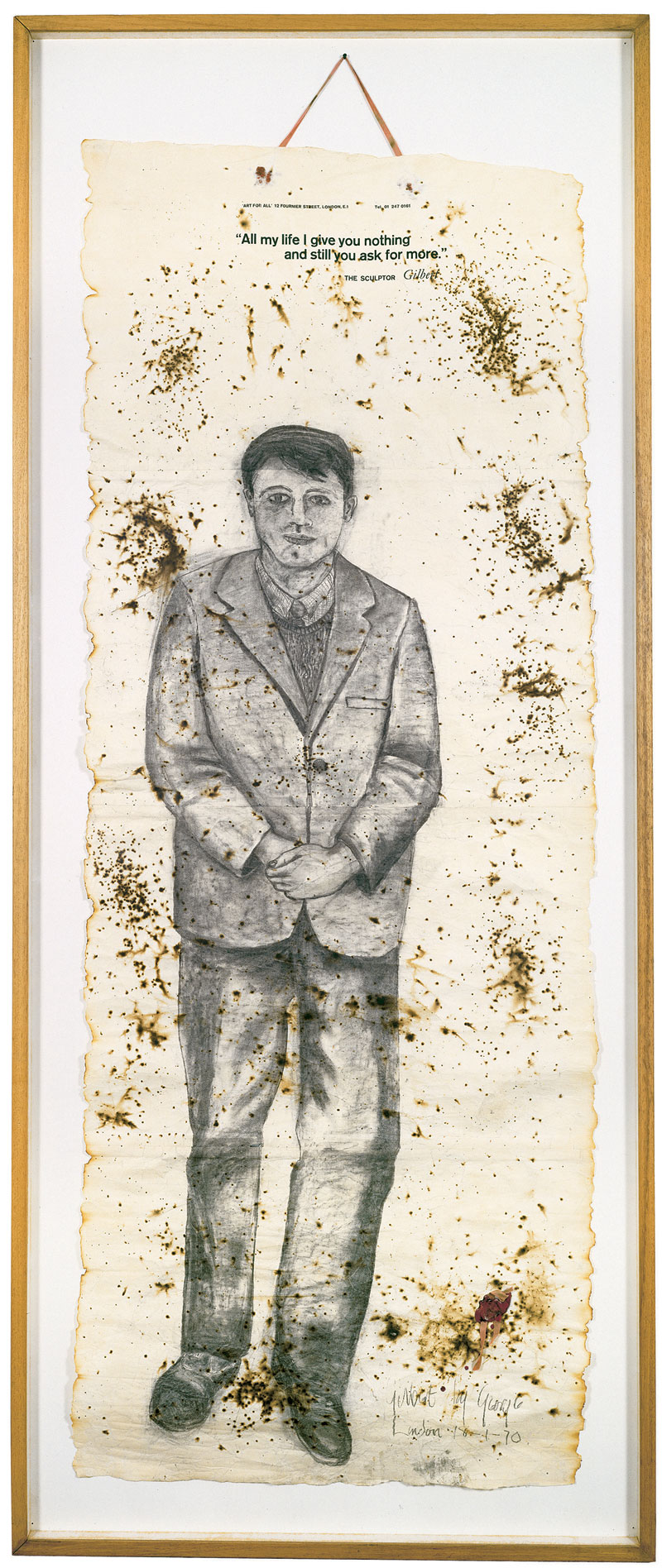
Gilbert & George (Gilbert Prousch, British born Italy, 1943; George Passmore, British, b. 1942) 'ALL MY LIFE I GIVE YOU NOTHING AND STILL YOU ASK FOR MORE' 1970 (Gilbert)


Gilbert & George (Gilbert Prousch, British born Italy, 1943; George Passmore, British, b. 1942)
ALL MY LIFE I GIVE YOU NOTHING AND STILL YOU ASK FOR MORE (Gilbert)
1970
Mixed media
Each 193 x 75cm
Private collection


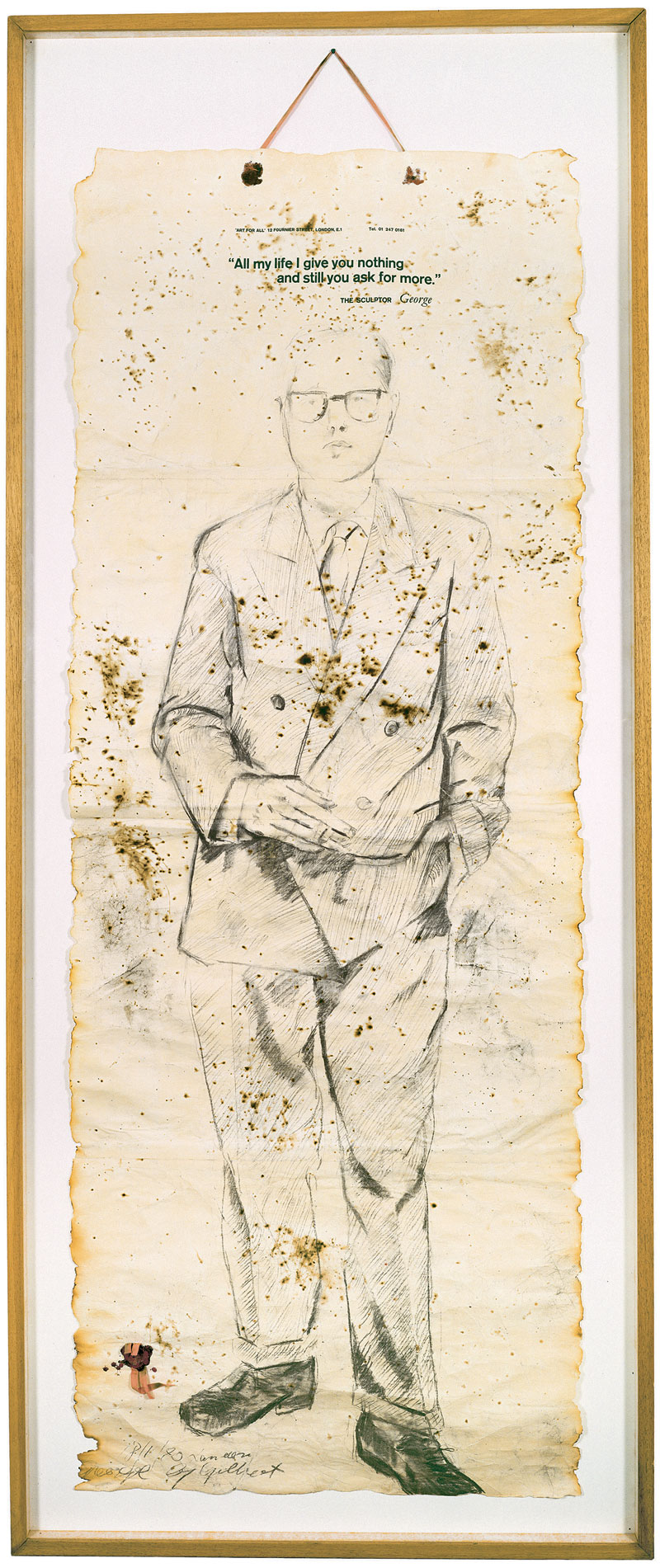
Gilbert & George (Gilbert Prousch, British born Italy, 1943; George Passmore, British, b. 1942) 'ALL MY LIFE I GIVE YOU NOTHING AND STILL YOU ASK FOR MORE' 1970 (George)


Gilbert & George (Gilbert Prousch, British born Italy, 1943; George Passmore, British, b. 1942)
ALL MY LIFE I GIVE YOU NOTHING AND STILL YOU ASK FOR MORE (George)
1970
Mixed media
Each 193 x 75cm
Private collection


Museum of Old and New Art
655 Main Road Berriedale
Hobart Tasmania 7011, Australia

Opening hours:
Daily 10am – 6pm

MONA website

LIKE ART BLART ON FACEBOOK

Back to top