
Exhibition dates: 18th May – 18th October, 2026
Co-curators: Julia Perratore, Associate Curator at The Met Cloisters; Laura Filloy Nadal, Curator in The Michael C. Rockefeller Wing; and Joanne Pillsbury, Andrall E. Pearson Curator, Arts of the Ancient Americas in The Michael C. Rockefeller Wing
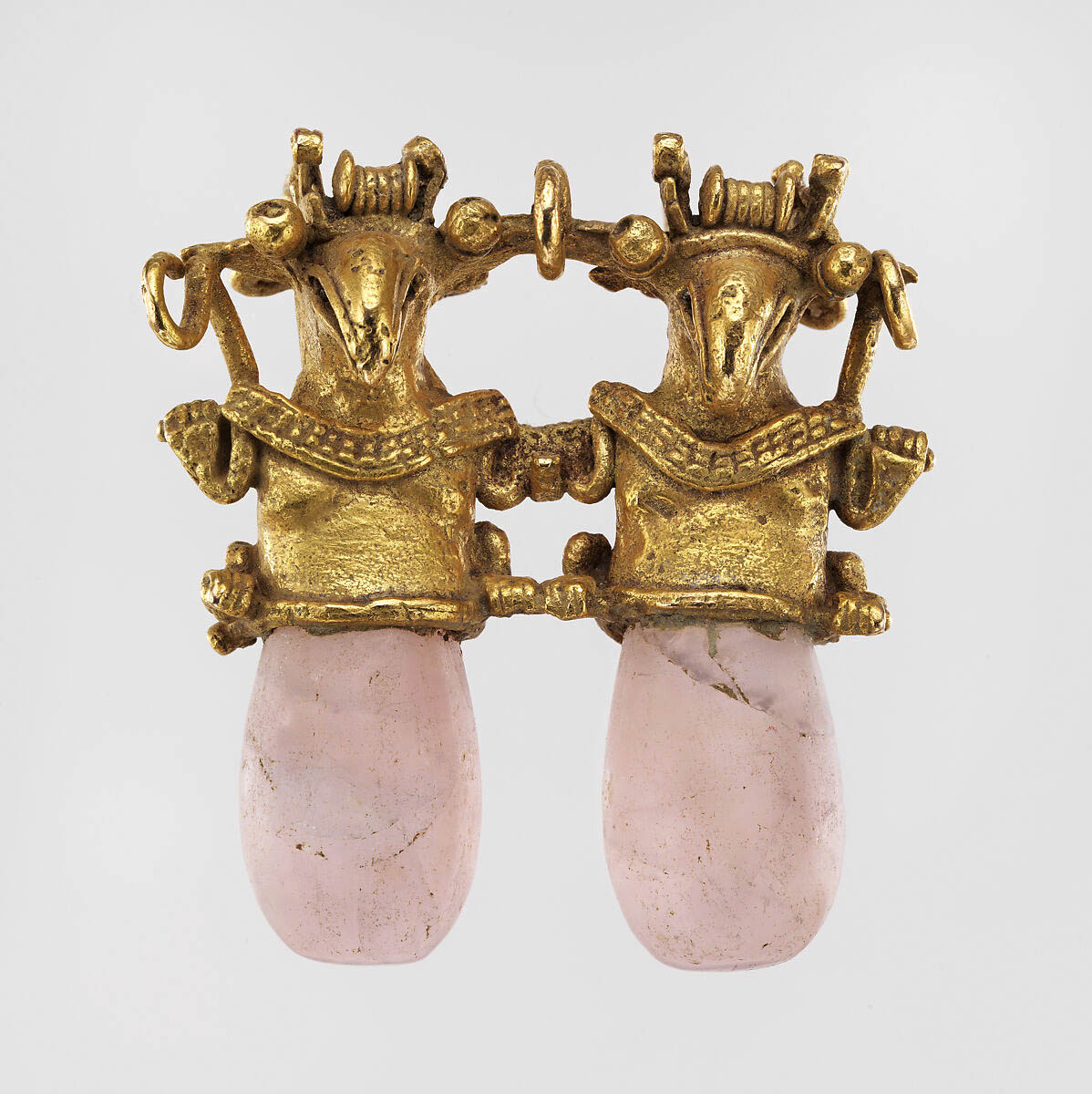
Unknown maker (Coclé (Macaracas))
Double bird pendant
950-1100 CE
Gold, rose quartz
H. 1 3/4 x W. 1 9/16 x D. 1/2 in. (4.4 x 4 x 1.3cm)
The Metropolitan Museum of Art
The Michael C. Rockefeller Memorial Collection, Bequest of Nelson A. Rockefeller, 1979
Artists in ancient Panama created delicate ornaments using the lost-wax technique, sometimes incorporating other materials such as semiprecious stones or shell, which may have conveyed additional concepts or imbued the beings with additional powers. On this pendant, avian beaks are joined with the bodies of quadrupeds, complete with rose quartz tails. The loops at the creatures’ claws allowed them to be suspended from a cord. Similar pendants in the shape of various hybrid creatures have been found in high-status burials at sites such as Sitio Conte and El Caño, associated with the Coclé culture.
Terror and delight
How could I resist…
“…imagined creatures that transcend the natural world. Fantastical beings combining the features of animals, humans, and even plants appear across cultures, emerging in the most ancient myths and enduring in contemporary epics.”
“In the Americas and Europe, hybrid creatures could traverse earthly and supernatural realms, linking the human and the divine. Their images conveyed doctrine, established and reinforced identities, and defined social and cosmological boundaries. Monumental representations of these beings occupied the viewer’s space in a dramatic way, enhancing their effectiveness as agents of social control.”
Wow!
Much as we are becoming hybrid creatures today with the essentiality of AI in contemporary life, so hybrids back then were agents of social control (even if they are creative blends of elements drawn from nature).
I’m just glad I won’t be around in a decade or so (or possibly even less) when AI is integrated into drones, into robots, or even more directly into humans than it is at the moment so that everything can be controlled by an external entity. Can you imagine war in the future where drones go rogue and do their own bidding? Skynet here we come…
“Beings of terror and delight, hybrids are like the natural world – still only partly understood but an inescapable element of the human experience.”
I love all these rich mythological traditions. My particular favourites in this posting are the two Aquamanile (German) from 1200-1025 and the Head of a Crozier with Saint Michael Slaying the Dragon (French) 1220-1230, but in reality any object would look great in my cabinet of curiosities.
Enjoy these beautiful, composite, transmogrified creatures of terror and delight!
Dr Marcus Bunyan
Many thankx to The Metropolitan Museum of Art for allowing me to publish the photographs in the posting. Please click on the photographs for a larger version of the image.
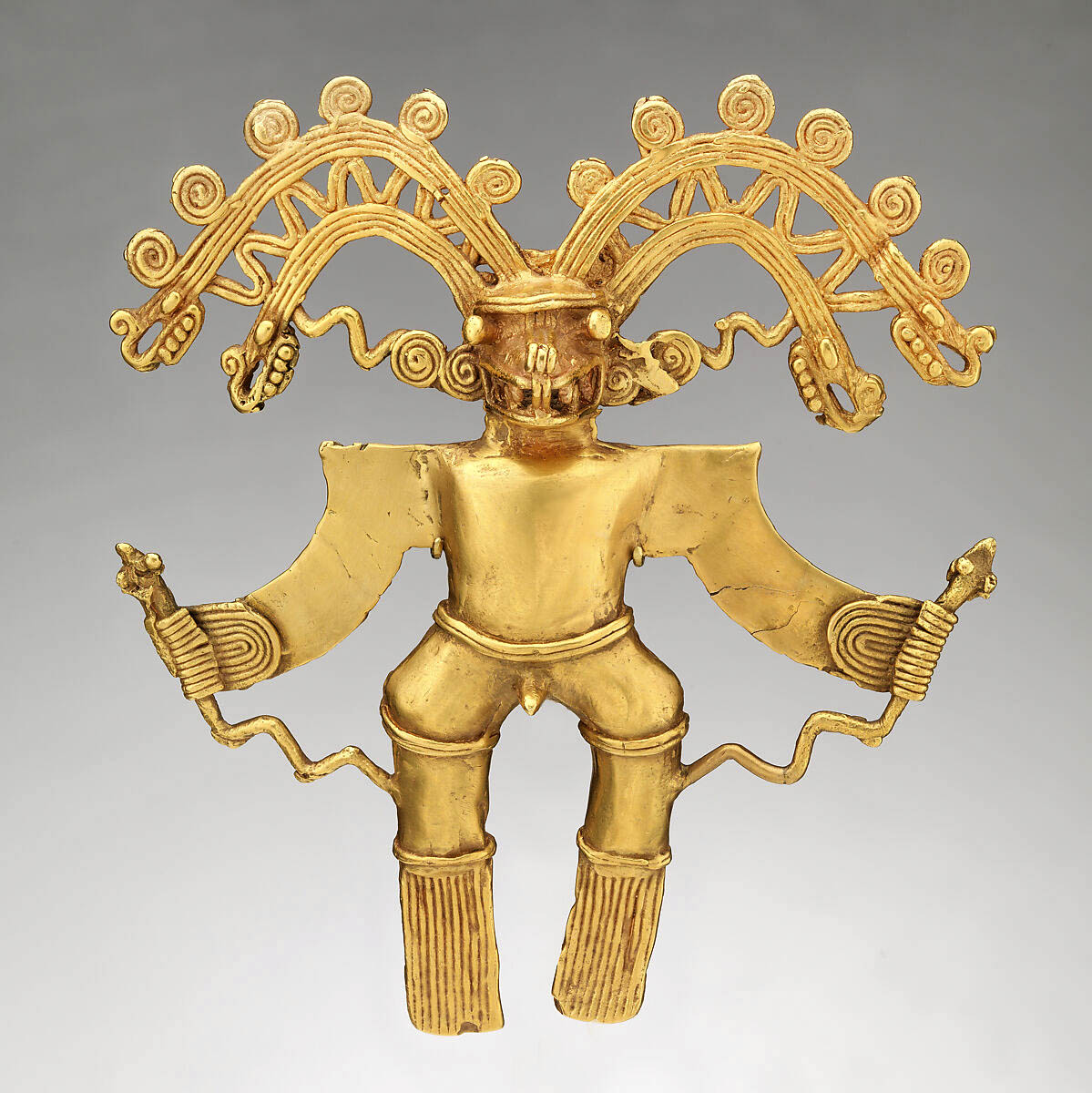
Chiriquí artist(s)
Crocodile-head figure pendant
700-1550 CE
Gold
H. 4 1/2 x W. 4 5/8 x D. 1 3/8 in. (11.4 x 11.7 x 3.5cm)
The Metropolitan Museum of Art
Gift and Bequest of Alice K. Bache, 1966, 1977
This pendant depicts an anthropomorphic figure with a crocodile-shaped face, holding a serpent in each hand. Other serpent-like features emerge from the head of the main figure; however, those too have crocodilian heads. Spirals adorn the ears and the top of the piece. A small ring behind the head, invisible from the front view, would allow this object to hang from a cord so it could be worn as a pendant.
The combination of textures and the contrast between bidimensional and tridimensional features show the range of skills as well as the creativity of the artist. This pendant was first cast using the lost-wax technique, including the delicate filigree detail, and then some elements, such as the arms, were hammered flat.
The gold-working technology used in the Chiriquí region (southern Costa Rica and western Panama) was first developed in Colombia around 100 BCE. Although some themes and styles are shared across this vast territory, specific styles emerged in several regions after approximately 500 CE. Small but extremely intricate body adornments were the preferred products of gold working in this area. These objects were often funerary offerings and possibly used by high status individuals during their lifetime.
Amanda Suárez Calderón, 2025
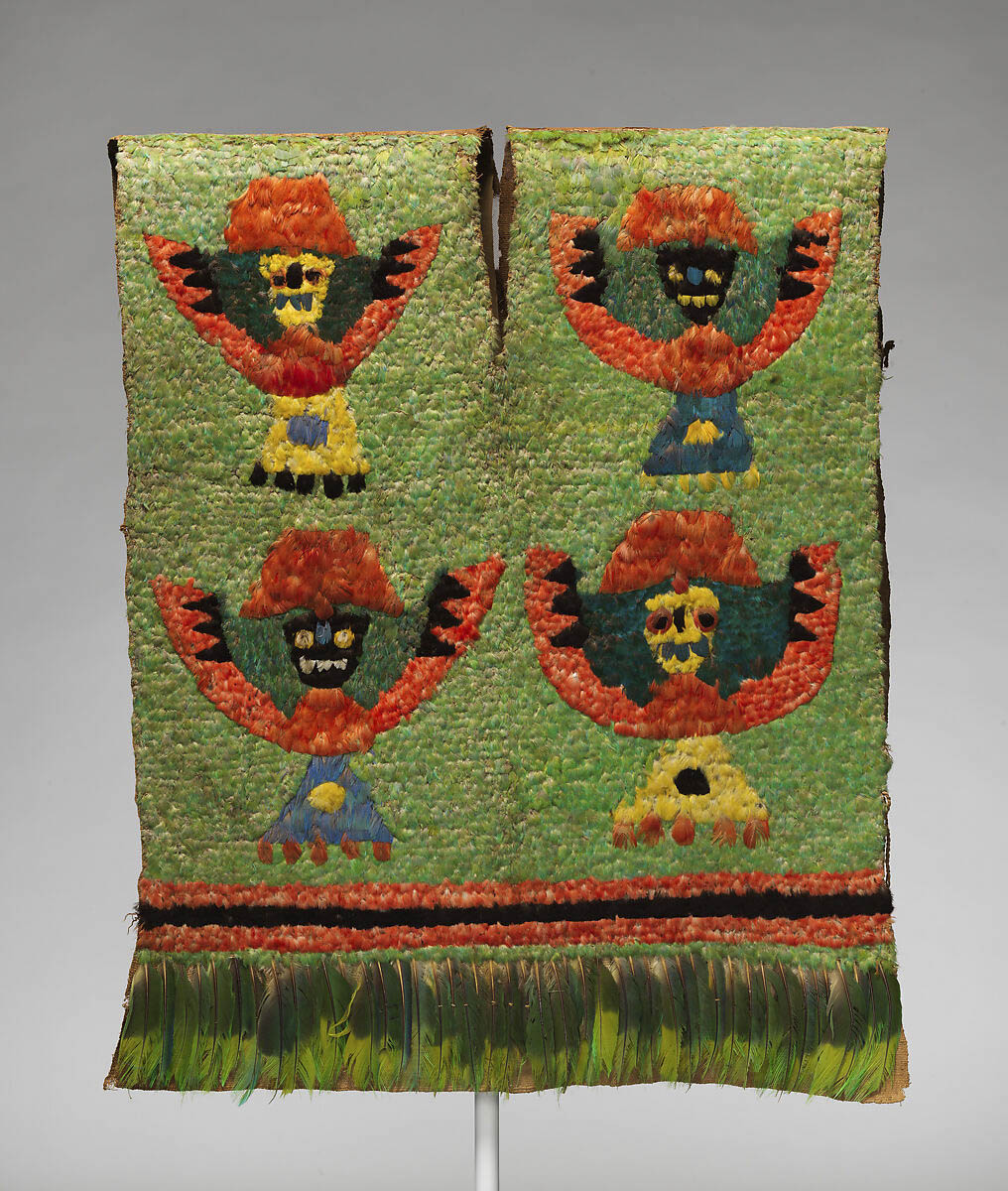
Chimú artist(s)
Tabard
1400-1600 CE
Cotton, feathers, plant fiber
H. 30 x W. 25 in. (76.2 x 63.5cm)
The Metropolitan Museum of Art
Fletcher Fund, 1959
Tabards – open-sided tunics – were worn by men in the ancient Andes. This luxurious example, made with feathers from Amazonia, features four winged figures. In the late 15th century, the Incas conquered Chan Chan, the Chimú capital on Peru’s North Coast, forcibly relocating many of the city’s artisans to distant parts of the empire. This tabard, reportedly found on Peru’s South Coast, bears technical features characteristic of both the North and South coasts.
This vividly colored, well-preserved tabard was created by grouping two or more feathers together and knotting them onto a cotton string, and repeating this process to create long feather strings that were then sewn on a foundation fabric, closely overlapping them in shingle fashion to create a particularly lush surface. The compelling imagery features four frontal birds or birdlike creatures with spread wings, their outlines sharpened by feathers trimmed to shape. Sporting bold red headdresses, they have anthropomorphic faces with fanged mouths, prominent noses, and wide, glaring eyes. It is presumed that they depict supernatural beings.
The tabard incorporates technical features found in different geographic areas. The paired warps have been determined to be a North Coast characteristic, while the woven-in neck slit of the single-panel warp-predominant plain-weave cotton cloth is more characteristic of the south highlands and coast. The four symmetrical figures quarter the surface as they alternate positions in a type of pattern symmetry also common in the south.
Although the feathers were removed from one side of the tabard, horizontal rows of stitching remain clearly visible on the woven support. While it is not possible to know what types of tropical feathers were used, the disposition of the rows suggests that both small and medium-size body feathers, as well as larger flight feathers (or body feathers from large birds), were used. Deploying rows of small feathers along the bend of the shoulder would have provided a smooth transition along that curved contour when the tabard was worn. The variety of spacing between the rows suggests that several different types of feathers were exploited to create a lively banded composition.
Christine Giuntini, Conservator, 2018
For as long as humans have told stories, we’ve imagined creatures that transcend the natural world. Fantastical beings combining the features of animals, humans, and even plants appear across cultures, emerging in the most ancient myths and enduring in contemporary epics. The widespread presence of these supernatural beings, possessing the power to transform and be transformed, reflects a global impulse to make sense of both known and unknown worlds. Visual artists have given form to these imaginary creatures, resulting in some of the most fearsome, beloved, and extraordinary works of art ever made.
Set in the evocative atmosphere of The Met Cloisters, Creatures of Myth and Imagination: Europe and the Americas sheds light on a selection of works created on either side of the Atlantic Ocean between 500 and 1500 CE. The exhibition’s exploration of hybrid creatures deepens our understanding of their apparent necessity among diverse peoples. In the Americas, a complex gold pendant by a Tairona artist of northern Colombia, depicting a confrontational figure with hands on hips, a crocodile-like head, and an enormous headdress, would have reflected and expressed the wearer’s status and power. In Europe, ferocious dragons such as the one depicted on a monumental fresco from the monastery of San Pedro de Arlanza, Spain, took center stage to convey a multiplicity of meanings both sacred and profane.
With these and over 50 other objects, including sculpture, ceramics, ivories, textiles, paintings, and metalwork, Creatures of Myth and Imagination looks beyond a specific story, time, and place to explore larger questions about who we are and what connects us.
Text from The Metropolitan Museum of Art website
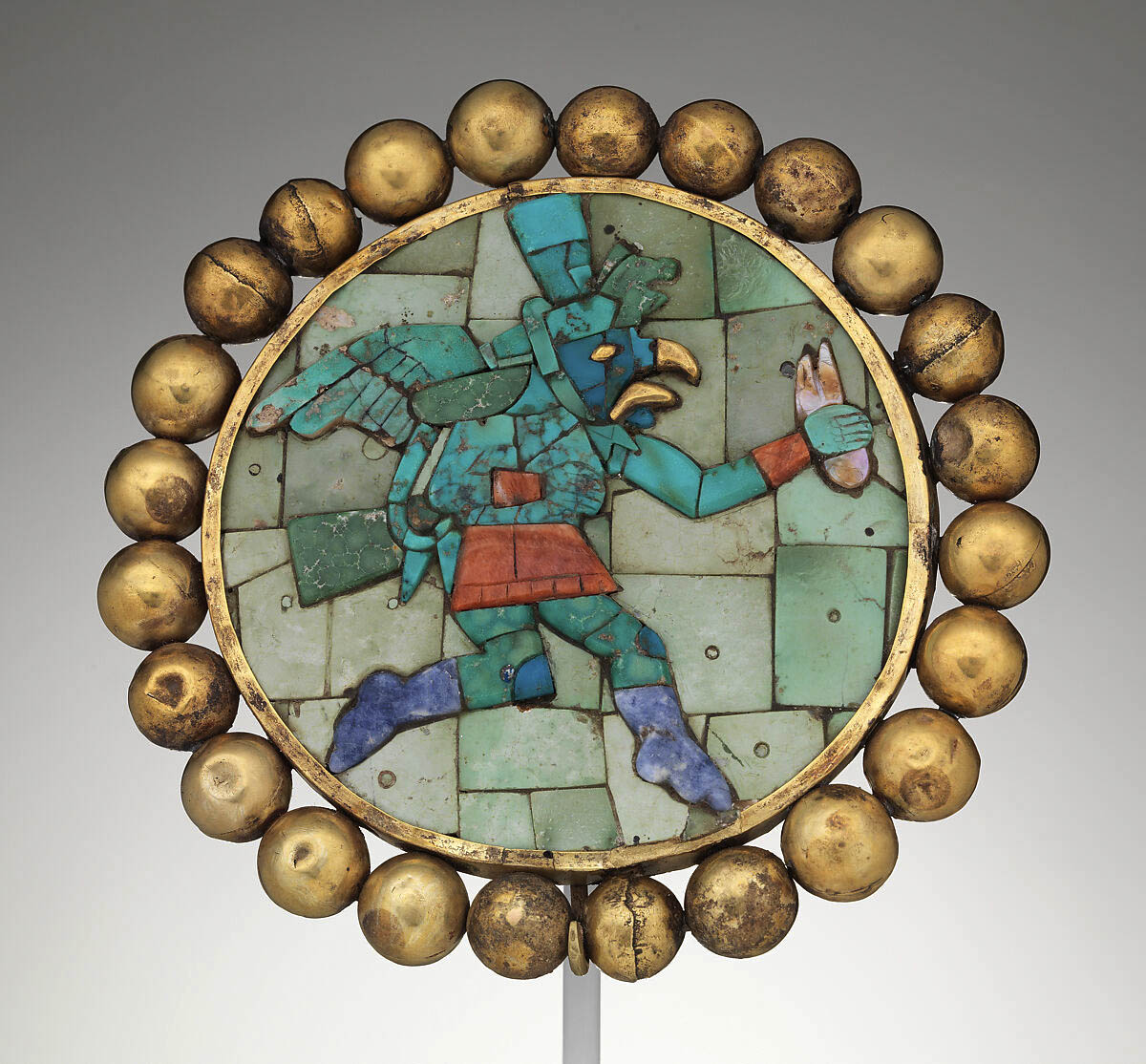
Moche artist(s)
Ear ornament with winged runner
400-700 CE
Gold, turquoise, sodalite, shell
H. 3 3/4 x W. 3 7/8 x D. 3 1/4 in. (9.5 x 9.8 x 8.3cm)
The Metropolitan Museum of Art
Gift and Bequest of Alice K. Bache, 1966, 1977
This ear ornament, one of a pair, depicts a winged runner clutching a small cloth bag. Although it has been suggested that this figure may represent a human in a bird costume, it is more likely to portray an anthropomorphized bird, perhaps a hawk. The Moche (also known as the Mochicas) flourished on Peru’s North Coast from 200-850 CE, centuries before the rise of the Inca. Over the course of some six centuries they built thriving regional centers from the Nepeña River Valley in the south to perhaps as far north as the Piura River, near the modern border with Ecuador, developing coastal deserts into rich farmlands and drawing upon the abundant maritime resources of the Pacific Ocean’s Humboldt Current. Although the Moche never formed a single centralized political entity, they shared unifying cultural traits such as religious practices.
Archaeologists in the middle of the twentieth century dubbed the time when the Moche came to power as the “Mastercraftsman Period” for its striking technological innovations in the arts. Moche artists are well-known for their developments in metal working, but they also excelled at the creation of micro-mosaics, shaping tiny pieces of highly valued materials such as shell, turquoise, and other blue-green stones into tesserae that would be fitted into gold, silver, or wood supports. Here, the mosaic was worked into the large circular frontals of a pair of ear ornaments. Often called earspools, the frontals of these ornaments were attached to long tubular shafts that would have been inserted through the stretched earlobes of a high-status individual, a conspicuous display of the wearer’s power and position. For many years scholars believed that such ornaments were worn only by men; recent archaeological studies on Peru’s north coast, however, reveal that such ornaments were worn by certain high-status women as well.
The pair of ornaments was most likely worn with the (nearly identical) figures facing inward, toward the wearer. The bird’s face is executed in a dark turquoise, with eyes and beaks sheathed in gold. A chin strap fastens an elaborate tall trapezoidal headdress, which extends from a head band, itself bearing a projecting animal head. Graceful wings stretch out from the shoulders, and a rectangular element extending from the lower back likely represents tail feathers. Bracelets and a loincloth or short skirt are made of bright orange Spondylus shell, a vibrant contrast to the turquoise background. The figure holds a small bag, rendered in mother-of-pearl. The outstretched arms are positioned to suggest the vigorous pumping of a speedy runner, and the toes, in their swift movement, just grace the edges of the frontals. Darker inlays represent the runner’s body paint: the kneecaps are a dark turquoise, and the lower legs and feet are picked out in a royal blue mineral known as sodalite. Small hollow gold spheres made of sheet metal encircle the circumference of the frontals, echoing and enlivening the round composition.
The subject matter of these earspools is not well understood. Ritual running – either by a human or a zoomorphic protagonist – is one of the most frequently depicted activities in later Moche ceramics. In the absence of texts from this period (writing, as it is traditionally known, was not practiced in South America until the arrival of Europeans in the 16th century), the precise meaning of such imagery is unknown. The use of rare materials and the high level of craftsmanship evident in these ear ornaments, however, would have definitively marked the wearer as an individual of great importance. Turquoise, for example, may have been imported from sources as far away as northern Chile, and Spondylus – a bivalve closely associated with ideas of water and fertility – was imported into this region from warmer waters off the coast of northern Peru and Ecuador.
Joanne Pillsbury, Andrall E. Pearson Curator of the Arts of the Ancient Americas, 2017
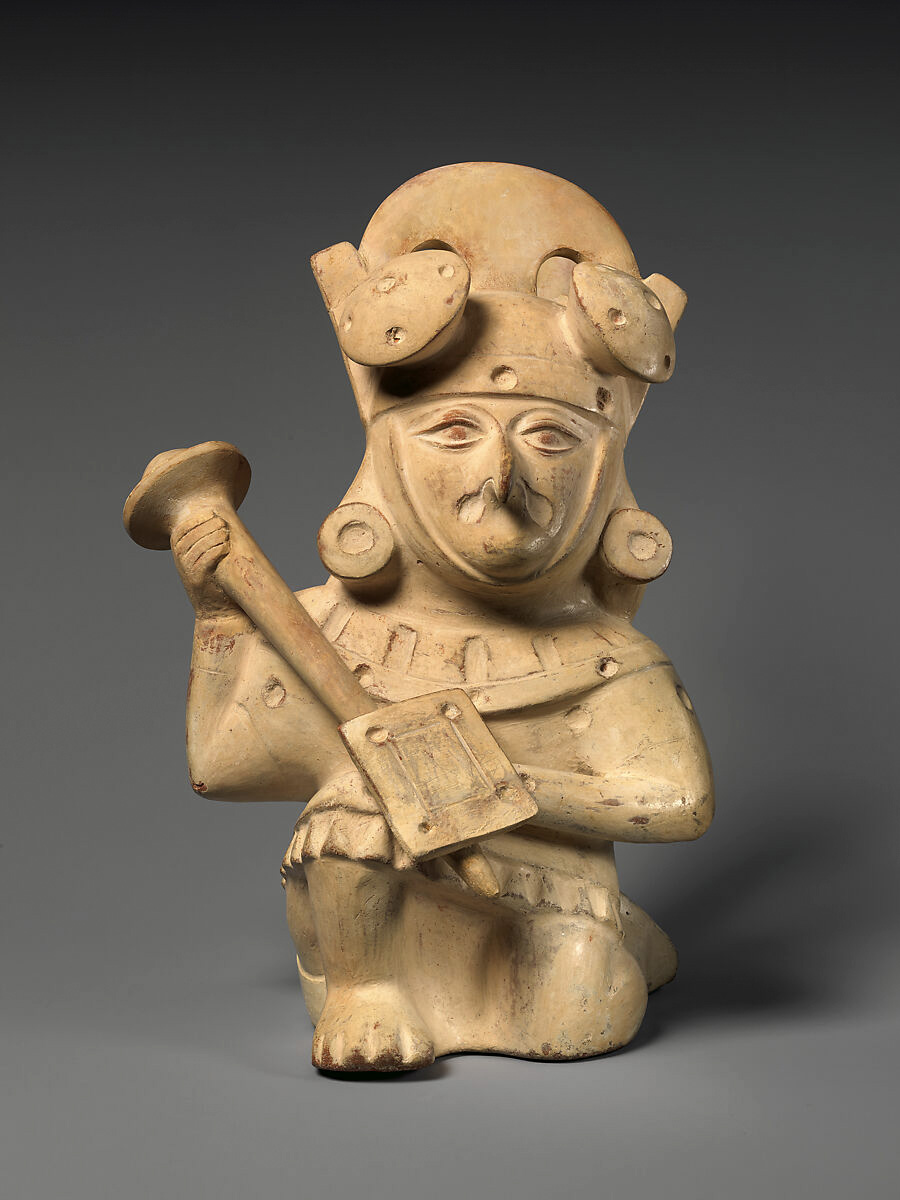
Moche artist(s)
Stirrup-spout bottle with bird warrior
500-800 CE
Ceramic, slip
H. 10 1/4 x W. 9 5/8 x D. 6 3/4 in. (26 x 24.4 x 17.1cm)
The Metropolitan Museum of Art
Gift of Nathan Cummings, 1963
This impressive ceramic stirrup-spout bottle depicting a hawk warrior on bended knee was fabricated by artists of the Moche culture of Peru’s North Coast. The clay was first modeled and specific details of the costume were inscribed or punctated. The surface was then covered with a white slip (a suspension of clay and/or other colorants in water). Traces of red pigment remain on the shield, spout, and the headdress, indicating that additional decoration covered parts of the vessel. The absence of any surface blemishes caused by uneven heating is indicative of the artist’s careful control of the firing process – the method by which soft clay is transformed into hardened ceramic through heat.
The hawk warrior, so called for its beak-like nose, is dressed in classic Moche battle regalia, including a turban or helmet with two round tassels above the forehead and tied under the chin (Donnan, 2003). The headgear, surmounted by a crescent shape, includes two stepped elements on either side of the head. Most of the warrior’s hair is covered by a head scarf, but a few long strands can be seen hanging down the figure’s back, over his shoulders. He wears a tunic, a garment worn by men in the ancient Andes, finished with a fringe of repeating triangular shapes that may represent metal bells. The warrior wears a broad collar, representing the type of intricate shell or stone bead collars that have been found in the tombs of high-status individuals, and holds a mace and a square-shaped shield. Although the multiple depressions in the shield, headdress, ear flares, collar and tunic are reminiscent of the way decorative inlays of stone or shell were fixed to ceramics, the absence of any traces of adhesive in the depressions suggests that the bottle did not originally have inlays.
The stirrup-spout vessel – the shape of the spout recalls the stirrup on a horse’s saddle – was a much favoured form on Peru’s North Coast for about 2,500 years, from at least the beginning of the first millennium BCE through the early colonial period. Although the specific meaning of this distinctive shape is unknown, the double-branch/single-spout configuration may have prevented evaporation of liquids, and/or may have provided a convenient handle for carrying. Early in the first millennium CE, the Moche elaborated stirrup-spout bottles into a wide range of shapes, including human figures, animals, and plants, and combinations of these. About 500 years later, bottle chambers became predominantly globular, providing large surfaces for painting complex, often multi-figure, scenes.
The image of a kneeling warrior is a popular subject in Moche art. Other examples in the Met’s collection include 63.226.88, 64.228.31, 64.228.32, 1987.394.93, 1987.394.114, as well as multiple copper figures believed to come from the site of Loma Negra (1987.394.61, 1987.394.62). The significance of this pose is unclear; are the kneeling figures supplicants or is this a posture of allegiance? Does it signify readiness for battle? As there was no tradition of writing in South America prior to the arrival of Europeans in the sixteenth century, these remain difficult questions to answer. The representation of anthromorphized animals as warriors, including iguanas, crayfish, foxes, and crabs, is also a recurring theme in Moche art. On certain ceramics painted in the fineline style, the hawk warrior is shown with wings and tail feathers (Sawyer 1966:47). Although this figure is referred to as a hawk warrior, the image may represent a harpy eagle, the largest of the raptorial birds in Peru.
The Moche (also known as the Mochicas) flourished on Peru’s North Coast from 200-850 CE, centuries before the rise of the Incas. Over the course of some six centuries, the Moche built thriving regional centers from the Nepeña River Valley in the south to perhaps as far north as the Piura River, near the modern border with Ecuador, developing coastal deserts into rich farmlands and drawing upon the abundant maritime resources of the Pacific Ocean’s Humboldt Current. Although the precise nature of Moche political organisation is a subject of debate, these centers shared unifying cultural traits such as religious practices (Donnan, 2010).
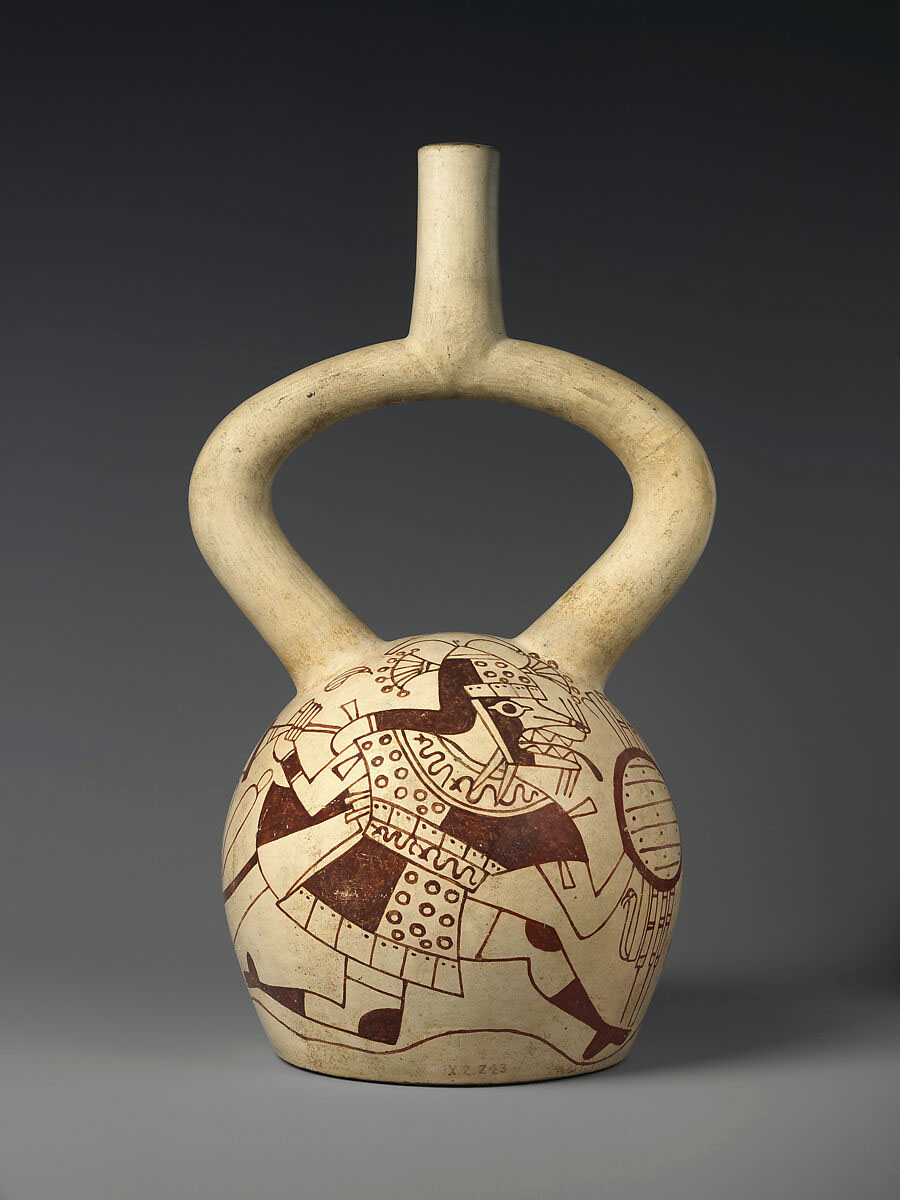
Moche artist(s)
Stirrup-spout bottle with fox warrior
500-800 CE
Moche
Ceramic, slip
H. 11 3/4 x W. 6 1/2 x D. 6 in. (29.8 x 16.5 x 15.2cm)
The Metropolitan Museum of Art
Gift of Henry G. Marquand, 1882
The stirrup-spout vessel – the shape of the spout recalls the stirrup on a horse’s saddle – was a much favoured bottle shape on Peru’s northern coast for about 3,000 years. Although the importance and symbolism of this distinctive form is still puzzling to scholars, it has been suggested that the double-branch/single-spout shape may have prevented evaporation of liquids, and/or that it was convenient for carrying. Early in the first millennium CE, the Moche elaborated stirrup-spout bottles into sculptural shapes depicting a wide range of subjects, including human figures, animals, and plants worked with a great deal of naturalism. About 500 years later, bottle chambers became predominantly globular, providing large surfaces for painting complex multifigure scenes. On this bottle, two animated warriors, their faces covered with fox face masks, carry round shields and war clubs. They are shown running across a hilly desert landscape indicated by a wavy line and cactus plants. A strong sense of forward motion is conveyed by leaning bodies and long strides. The warriors wear decorated long skirts, trapezoidal belt ornaments, and conical helmets.
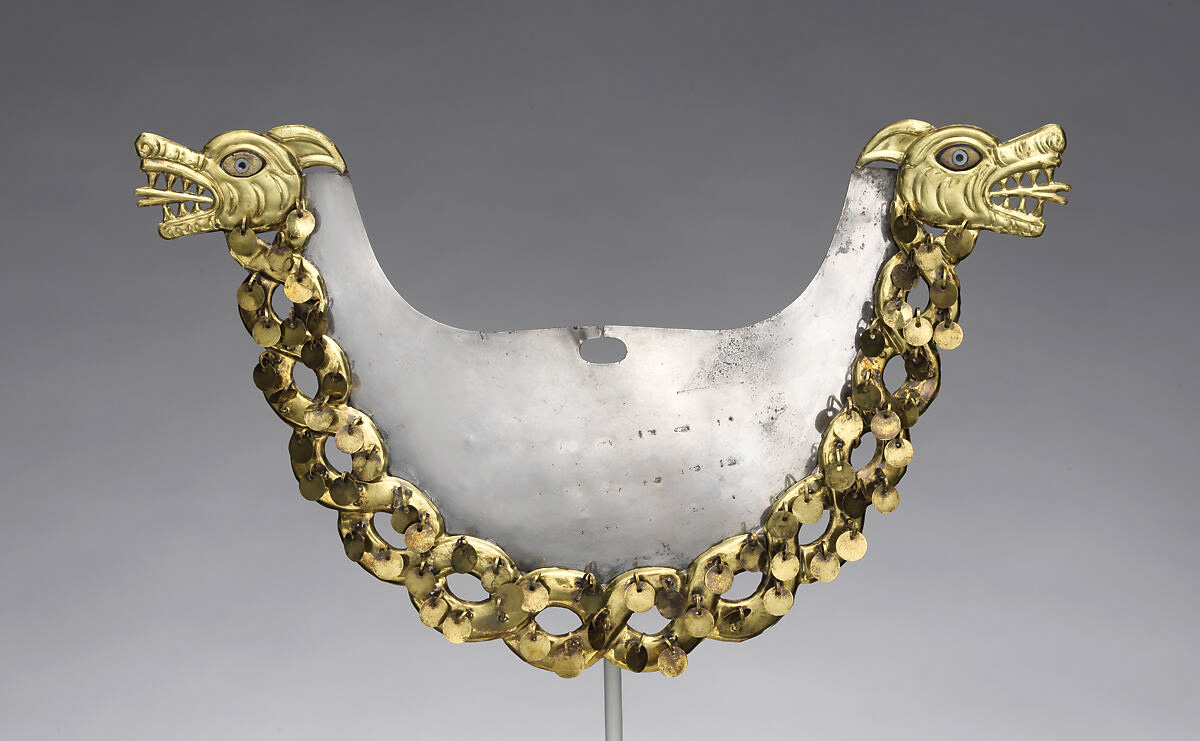
Moche artist(s)
Nose ornament with intertwined creatures
500-800 CE
Gold, silver
H. 4 15/16 x W. 8 5/16 x D. 7/16 in. (12.5 x 21.1 x 1.1cm)
The Metropolitan Museum of Art
The Michael C. Rockefeller Memorial Collection, Bequest of Nelson A. Rockefeller, 1979
The Moche, who flourished on the North Coast of Peru from 200-850 CE, created some of the most sophisticated metal body adornments ever discovered in the ancient Americas. This nose ornament, fashioned from hammered sheet, demonstrates the skill and ingenuity exercised by Moche artists. Two gold serpents with ears and fangs redolent of canines are seen in bilateral symmetry, joined by their intertwined bodies and a silver crescent-shaped plaque. Delicate gold danglers, attached with thin gold wires, hang from the sinuous bodies of the serpents and reflect light with the slightest motion, magnifying the sense of movement created by the fluid, curvilinear forms seen throughout the ornament.
This nose ornament is stylistically associated with a site called Loma Negra, where similar adornments have been unearthed from the several hundred shaft tombs in the area. Loma Negra, which is situated in the semi-desert region of the Piura Valley in northern Peru, contained a particularly rich collection of Moche metalworks in gold, silver, and copper. Regalia created from such precious materials were essential features of elite burials in the ancient Americas. This regalia, which included headdresses, earspools, nose ornaments, pectorals, and bracelets, were thought to identify the status of the interred in the afterlife. Nose ornaments, suspended from the nasal septum and often covering the mouth and lower face, were worn by high-ranking individuals in the Andes and were likely made to exemplify the power and position of the wearer both in life and in death.
The large quantity of funerary regalia discovered at Loma Negra suggests a strong relationship between individual and object in the Moche culture. According to Luis Jaime Castillo, body ornaments were often unique and personalised to each individual and could not be transferred to or inherited by others. Indeed, these objects may have been necessarily buried alongside their original possessors, for the link between ornament and owner was not to be broken even in death. In the underworld, adornments were even thought capable of transforming their wearers into supernatural or ancestral beings (Castillo 2017).
Technical Analysis
Studies by Deborah Schorsch, Objects Conservator at The Metropolitan Museum of Art, have revealed that this ornament was created from hammered sheet, like most Moche metal ornaments. Artists likely used chisels to cut the eye-shaped openings between the twisted bodies of the serpents. A series of tabs mechanically joins the gold and silver components of the ornament. These rectangular tabs, which extend from the top edges of the double serpents, are fitted on the front into slits cut along the bottom edge of the silver crescent and crimped closed on the reverse.
Hybrid beings – imaginary creatures that combine features of different animals, humans, and even plants – abound in the history of art, reflecting the human impulse across time and space to deconstruct, interchange, and reassemble elements of the known world into inventive entities and extraordinary visions. On view this spring at The Met Cloisters, Creatures of Myth and Imagination: Europe and the Americas explores fantastic beings in the visual arts over the course of a millennium, from 500 to 1500 CE. A collaborative effort between The Metropolitan Museum of Art’s Met Cloisters location and Michael C. Rockefeller Wing at The Met Fifth Avenue, this exhibition illuminates the parallel but independent traditions of Europe and the Americas to investigate the multiple functions of works depicting hybrids and the roles these objects played in people’s lives. The exhibition will be on view May 18 through October 18, 2026.
“Artistic traditions throughout human history have included images of fantastical hybrid creatures that combine elements of the natural world to evoke extraordinary, otherworldly powers,” said Max Hollein, The Met’s Marina Kellen French Director and Chief Executive Officer. “Bringing together works from two distinct cultures, Creatures of Myth and Imagination will illuminate the recurring motif of the mythical being and reveal the shared fascinations that drive creativity across time and space.”
“Supernatural, composite beings are key figures in the telling of stories, the making of myths, and the bridging of heaven and earth. Above all, they expand the spheres of action of their worldly counterparts. This exhibition explores how, in the hands of artists, imaginary creatures take on physical form and participate in many facets of human experience,” said Julia Perratore, Associate Curator at The Met Cloisters.
“Created from the stuff of nature, hybrid creatures are supernatural, endowed with powers beyond the visible and the knowable,” added Laura Filloy Nadal, Curator in The Michael C. Rockefeller Wing.
“Above all, these creatures of myth and imagination provide us with ways of thinking about essential questions: they are ways of understanding who we are, and where our boundaries lie,” noted Joanne Pillsbury, Andrall E. Pearson Curator, Arts of the Ancient Americas in The Michael C. Rockefeller Wing.
Creatures of Myth and Imagination presents over 50 objects, including paintings, sculpture, ceramics, ivories, textiles, and metalwork. Drawn mainly from The Met collection, the objects displayed demonstrate how the varied materials of artistic expression are mobilised to create the uncreated. This is the first time that art of the ancient Americas is being presented at The Met Cloisters, opening up exciting new avenues of dialogue between objects rarely seen together. The exhibition also features key loans from the Museo del Templo Mayor, part of the Instituto Nacional de Antropología e Historia in Mexico City, including a remarkable sculpture of Tzinacantecuhtli, the Zapotec “bat lord,” that has never before traveled to New York.
Birds with fangs, snakes with feathers, legumes with arms and legs: For millennia, humans have selected and combined elements from nature to devise supernatural creatures unlike anything seen in the known world. A global phenomenon born of the imagination, hybrid beings have played key roles in storytelling, identity formation, and the bridging of heaven and earth. Given material form, they have taken part in sacred rites, enlivened daily life, and joined the dead in their graves.
Creatures of Myth and Imagination begins by considering how, in the Americas and Europe, hybrid creatures could traverse earthly and supernatural realms, linking the human and the divine. Their images conveyed doctrine, established and reinforced identities, and defined social and cosmological boundaries. Monumental representations of these beings occupied the viewer’s space in a dramatic way, enhancing their effectiveness as agents of social control.
The exhibition then moves on to examine the presence of hybrid beings of Europe and the Americas in more intimate settings, where they sometimes took on new meanings.
Representations decorating utilitarian objects could signal an individual’s religious beliefs, political persuasions, and social status. The distinctive, multifunctional, shaped vessel was one beloved option for giving form to hybrids. Once enjoyed in life, these ceramic objects could also be brought to the grave to commemorate the status, identity, and refinement of the departed. In both Europe and the Americas, such vessels provided rich opportunities for self-expression, from the creative choices of artists and patrons to what were surely lively conversations among their users.
Hybrids are creative blends of elements drawn from nature. Artists deconstructed and reassembled distinctive, powerful features, such as wings, claws, and large ears, into impossible beings endowed with exceptional abilities. Those who possessed and beheld composite creatures believed these beings were capable of expanding human spheres of action. In the arts of the Americas and Europe, hybrids indicate an awareness of the natural order while simultaneously disrupting familiar category distinctions. A result of keen observation of the environment, they perhaps represent a way of making sense of nature in all its complexity.
In Medieval Europe and the Americas, rich mythological traditions ensured that many hybrids were believed to be real, even if no human had ever seen them. Thus, to Europeans, unicorns frolicked at the edges of the world, while in northern Peru, fox warriors charged into battle. A challenge for artists to visualise, given their unreality, hybrid beings provided opportunities to use organic materials – from shell and ivory to feathers – that could recall the hybrids’ animal sources and, by extension, activate the abilities of those animals. These traditions converged in the 16th century, the first period of sustained contact between Europe and the Americas, prompting an exchange of imagery and the creation of new hybrids for new contexts and new audiences.
The exhibition concludes with an exploration of how, as composites of animal, vegetable, and mineral forms, hybrid creatures appear in seemingly endless, visually playful combinations, from reinventions of long-standing types, such as the winged angels of Europe and feathered serpents of the Americas, to new confections. In the Americas, hybrids were potent symbols of metaphysical transformation and empowered those who possessed them. It is not always possible to pinpoint the significance of hybrids in the art of the past, in part because their elusive, indeterminate forms resist interpretation and categorisation. Yet that variability – and great possibility – is a large part of their appeal. The charm of the composite creature is evident in its abiding popularity today, appearing in a range of media, from children’s books to film and television, reminding us of the persistent human impulse to combine and compound.
Creatures of Myth and Imagination: Europe and the Americas is co-curated by Julia Perratore, Associate Curator at The Met Cloisters; Laura Filloy Nadal, Curator in The Michael C. Rockefeller Wing; and Joanne Pillsbury, Andrall E. Pearson Curator, Arts of the Ancient Americas in The Michael C. Rockefeller Wing.
Press release from The Metropolitan Museum of Art
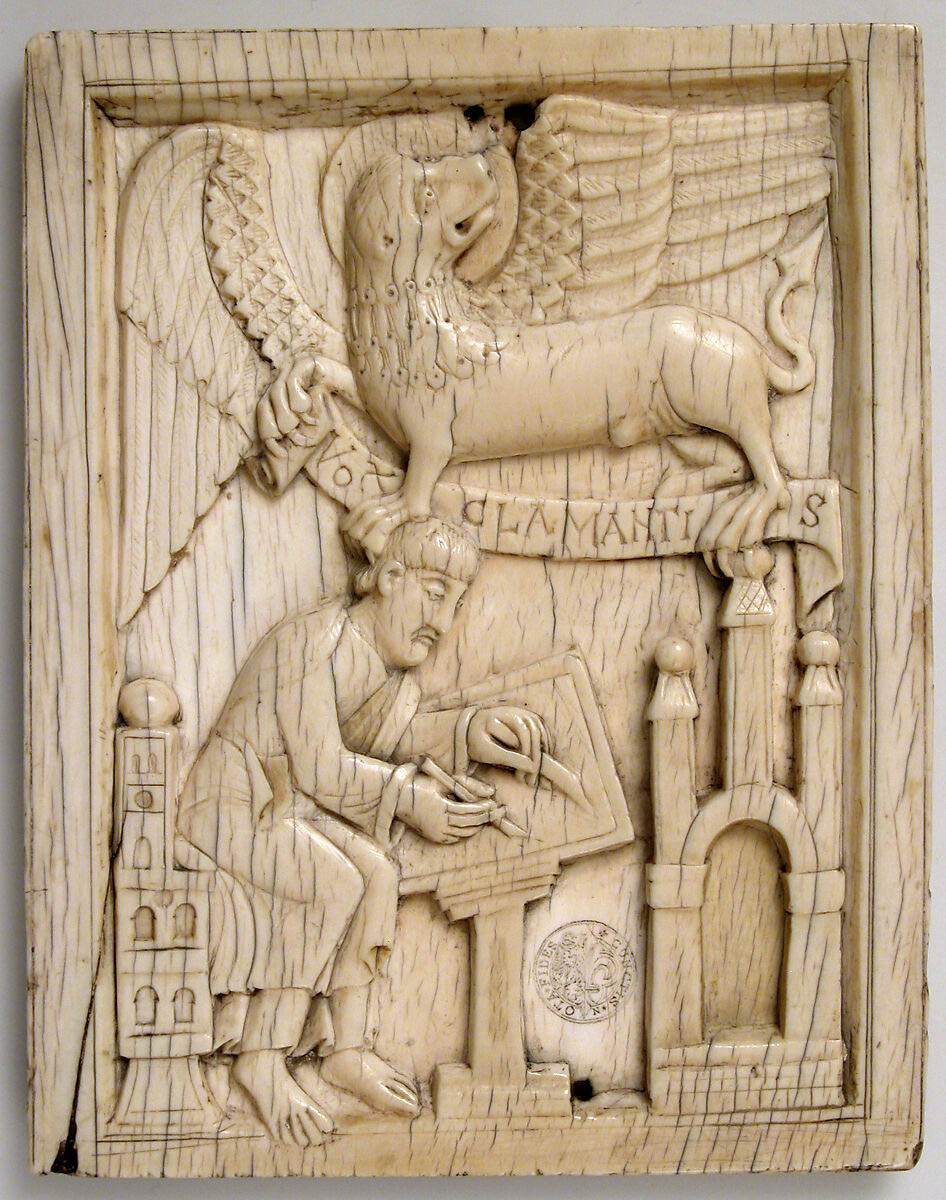
Unknown maker (German)
Evangelist Saint Mark writing the Gospel with his symbol, the Lion, holding a scroll
11th century
Elephant ivory
5 1/2 x 4 1/4 x 5/16 in. (13.9 x 10.8 x 0.8cm)
The Metropolitan Museum of Art
Gift of J. Pierpont Morgan, 1917
This ivory likely decorated the cover of a Gospel book. The abbreviated Latin inscription refers to the opening lines of Mark’s Gospel: “I am the voice of one crying in the wilderness.” The miniature church resembles surviving monuments in Cologne, one of the most important Ottonian artistic centers. A former owner’s stamp is to the right of the desk at which Mark sits.
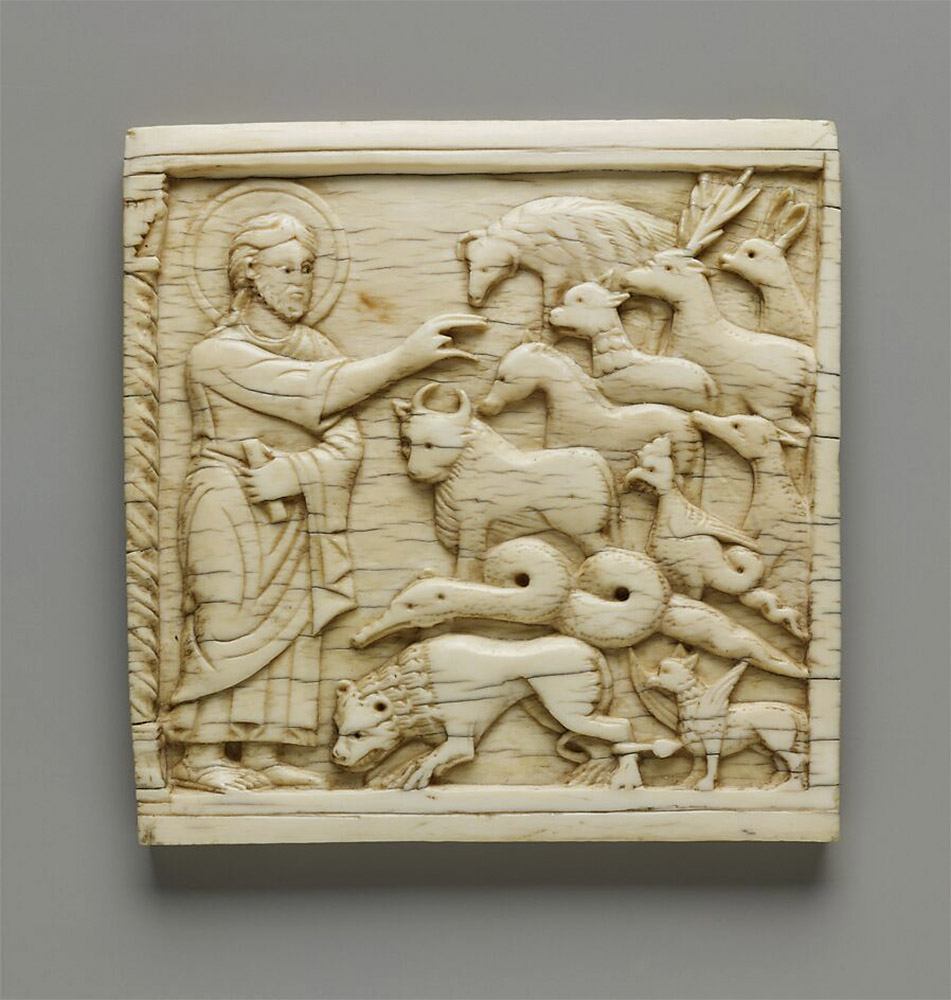
Unknown maker (South Italian)
Plaque with God Creating the Animals
1084
Elephant ivory
4 3/16 x 4 3/16 x 5/16 in. (10.7 x 10.6 x 0.8cm)
The Metropolitan Museum of Art
Gift of J. Pierpont Morgan, 1917
From the Cathedral of Salerno, this plaque comes from a set of about fifty ivories depicting biblical scenes that may have decorated a large church furnishing.
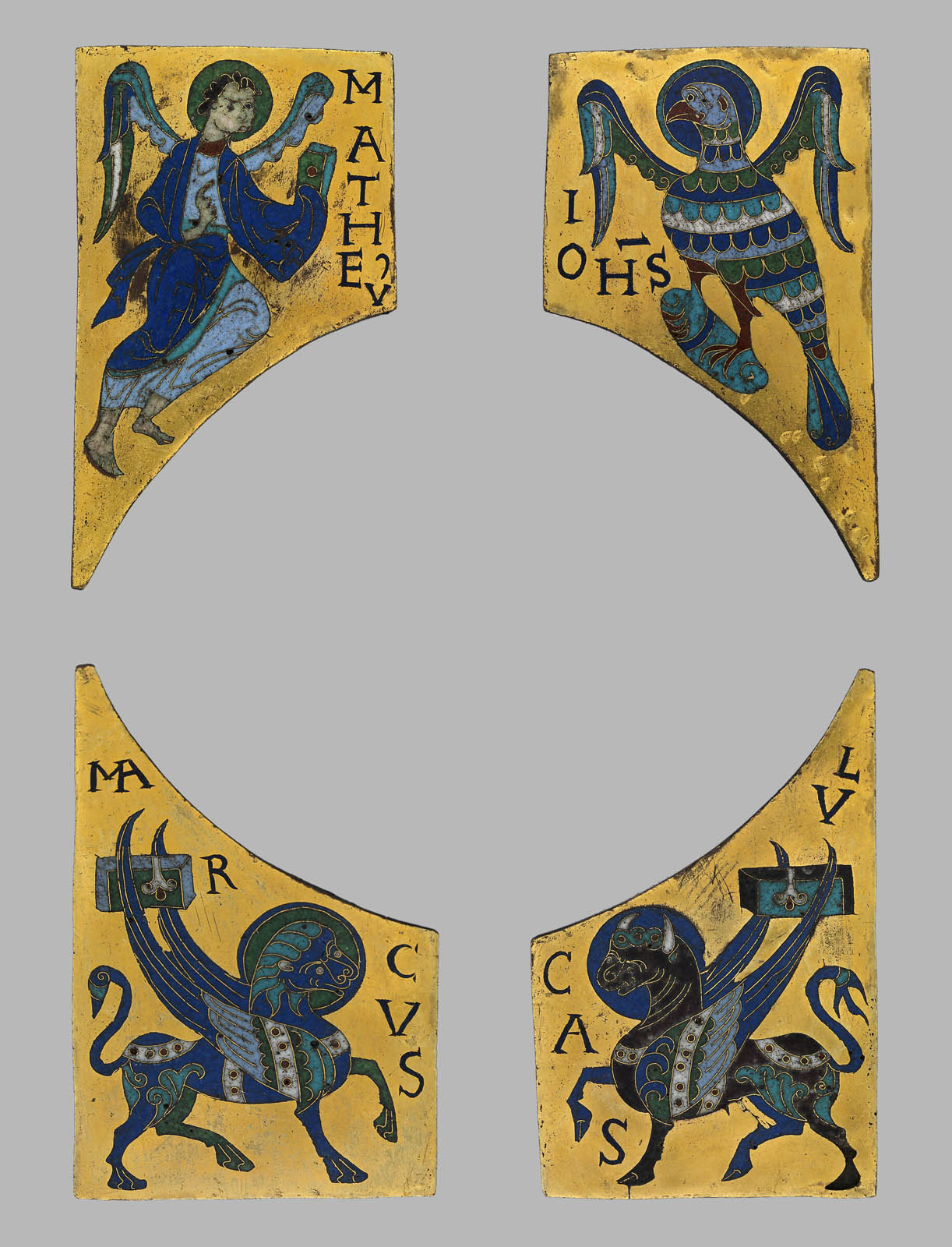
Unknown maker (French)
Plaques with the Symbol of the Evangelist John
c. 1100
Champlevé and cloisonné enamel on gilded copper
4 in. x 2 3/8 in. x 1/8 in. (10.1 x 6.1 x 0.3cm) (each)
The Metropolitan Museum of Art
Gift of J. Pierpont Morgan, 1917
These plaques, part of an ensemble including four plaques with the symbols of the evangelists and a central roundel with the crucifixion, probably from a book cover, can be securely attributed to the celebrated pilgrimage abbey of Saint Foy at Conques, France’s richest surviving repository of medieval goldsmith’s work. Several of the rare works dispersed from the abbey’s treasury in the nineteenth century share with others still in situ a technique, style, and palette uniquely combined during the abbacy of Bégon III in the late eleventh century. For these pieces the monk goldsmiths employed superimposed copper plaques, the lower one to receive the delicate cloisons that define features and drapery, the upper one cut to delineate the silhouettes of the figures and the cross. Hallmarks of the style include the single cloison used to define eyebrows and noses and the thin loop of gold that creates cowlicks. In the Metropolitan’s reconstituted ensemble, the same remarkable oxblood color was used for the symbol of Saint Luke and the hair of the image of the Sun (“Sol”) above the Crucifixion. Furthermore, scientific analysis has determined that common enamel compositions and the same metallic oxides were used to tint and opacify all five pieces.
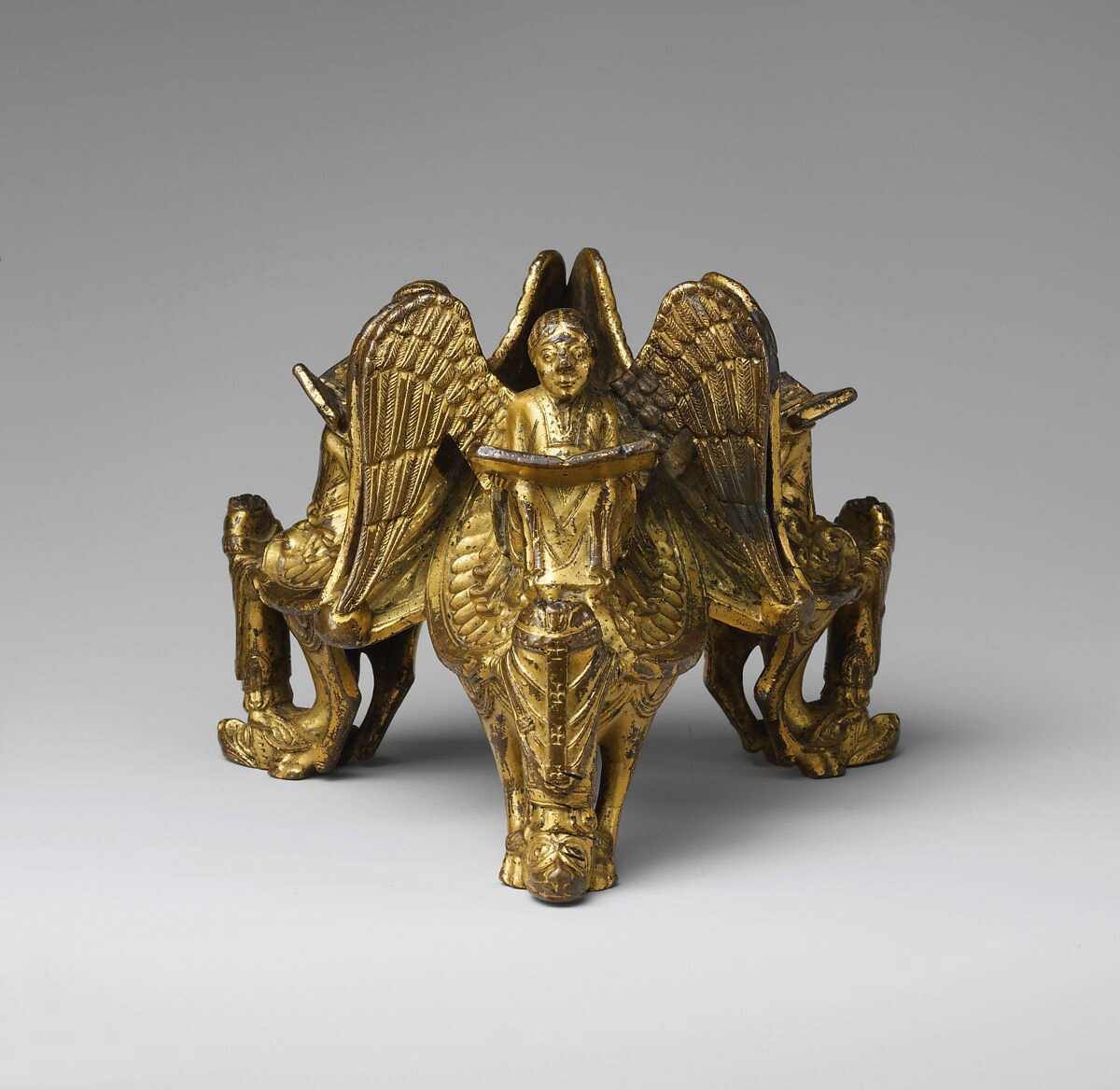
Unknown maker (North Italian)
Base of an Altar Cross with Reading Angels Sitting on Dragons and Standing Church Fathers
c. 1125-1150
Gilded copper alloy
4 in. x 5 1/8 in. x 5 1/8 in. (10.2 x 13 x 13cm)
The Metropolitan Museum of Art
Rogers Fund, 1919
The names of Saints Augustine, Jerome, and Gregory are inscribed on the books held by the angels. The absence of Saint Ambrose from the group (the heads are missing) indicates that the standard form of identifying the Church Fathers had not yet been established.
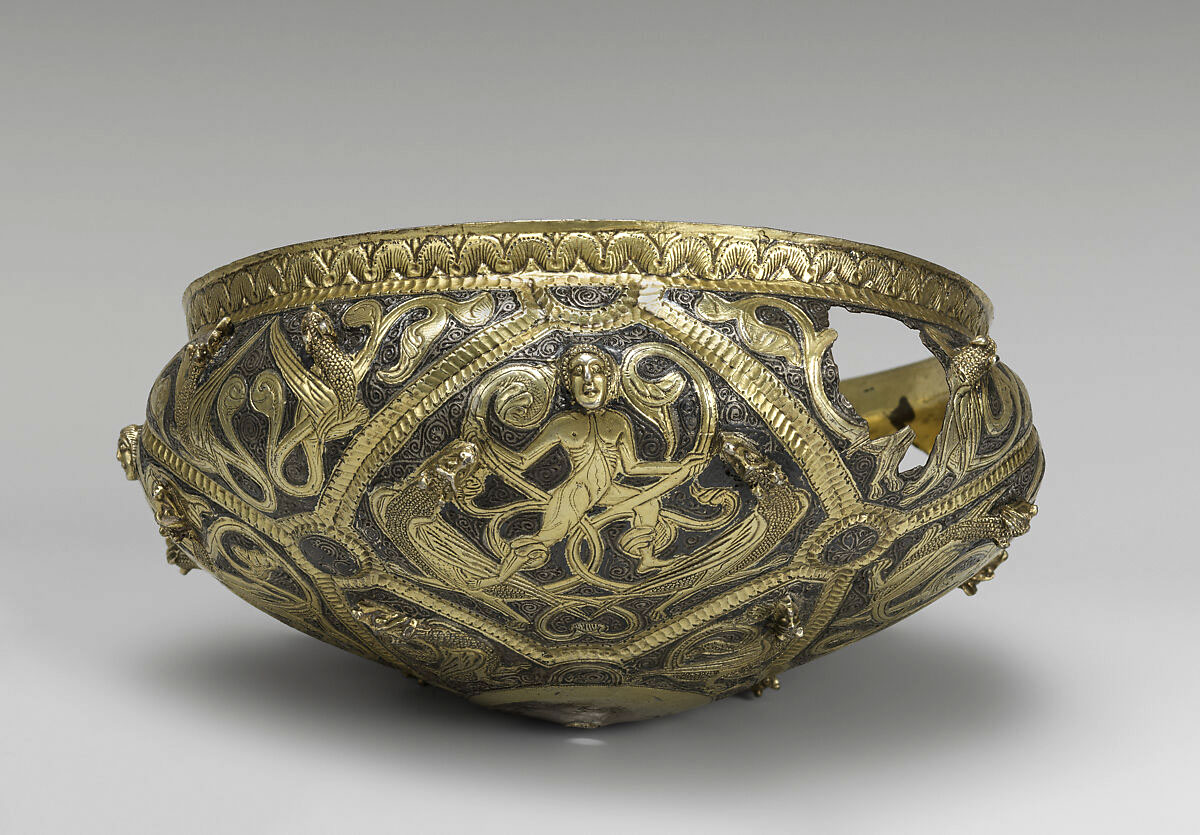
Unknown maker (British or Scandinavian)
Bowl of a Drinking Cup
Late 12th century
Silver, gilded silver, and niello
6 7/8 x 3 1/8 in. (17.5 x 7.9cm)
The Metropolitan Museum of Art
The Cloisters Collection, 1947
With its lively nude male figures and dragons entwined in foliage, this bowl was likely a part of a secular drinking cup rather than a ciborium (a vessel that holds the Host) or a chalice for use in the Mass, as was once thought. Between the principal compartments inhabited by the nude figures and dragons are smaller areas with basilisks. The heads of the men and beasts are in high relief, and the bands between the compartments and the palmette frieze below the rim are crisply rendered. The decoration of the bowl has parallels in twelfth-century English art, but similar pieces have also been found in Sweden. This example was discovered near the Ob’ River in Siberia, an indication of how objects in Middle Ages sometimes circulated far from their place of manufacture.
Introduction
Creatures of Myth and Imagination: Europe and the Americas
Birds with fangs, snakes with feathers, legumes with arms and legs: For millennia, humans have selected and combined elements from nature to devise supernatural creatures unlike anything seen in the known world. A global phenomenon born of the imagination, hybrid beings have played key roles in storytelling, identity formation, and the bridging of heaven and earth. Given material form, they have taken part in sacred rites, enlivened daily life, and joined the dead in their graves.
Creatures of Myth and Imagination examines the impulse to invent composite beings in Latin America and Western Europe between 500 and 1500, long before direct contact began in the late fifteenth century. Comparing these parallel, independent traditions invites us to explore the many ways in which hybrids transform the mundane into the magical and, in the process, to understand the paradoxical human desire to both order and disorder the world.
Brought into existence through both observation and invention, hybrid beings also serve as metaphors for artistic creation. The mythical creatures of the Americas and Europe encourage us to consider the challenges that sculptors, metalsmiths, painters, and weavers the world over faced in shaping them. Artists’ interpretations have given us some of the most perplexing, terrifying, humorous, and beloved images and objects ever made, revealing the extraordinary scope of the human imagination and continuing to enchant us today.
Bridging Realms
In the Americas and Europe, hybrid creatures could traverse earthly and supernatural realms, linking the human and the divine. Their images conveyed doctrine, established and reinforced identities, and defined social and cosmological boundaries. Monumental representations of these beings occupied the viewer’s space in a dramatic way, enhancing their effectiveness as agents of social control.
In ancient Mexico, large-scale images of such supernatural beings were distributed throughout a sacred geography. They marked boundaries and crossroads; they were found in mountains, caves, and springs; and they dominated public spaces, such as plazas, as well as the more restricted ritual spaces of temples. In Europe, hybrid creatures depicted in mural painting and architectural sculpture played equally integral roles in the spiritual landscape, guarding church entrances, conveying prayers at altars, and offering spiritual edification in monastic spaces. Whether seen in a cloister or a plaza, these monumental images radiated power, charisma, and the ability to transform and be transformed.
Nature, Compounded
Hybrids are creative blends of elements drawn from nature. Artists deconstructed and reassembled distinctive, powerful features, such as wings, claws, and large ears, into impossible beings endowed with exceptional abilities. Those who possessed and beheld composite creatures believed these beings were capable of expanding human spheres of action.
In the arts of the Americas and Europe, hybrids indicate an awareness of the natural order while they simultaneously disrupt familiar category distinctions. Some, such as a human figure from Colombia with bat and crocodile features and a basilisk (a combination of a rooster and a snake) from Italy, join elements of animals that normally inhabit different spheres (earth, air, or water). Beings of terror and delight, hybrids are like the natural world – still only partly understood but an inescapable element of the human experience. Resulting from keen observation of the environment, they perhaps represent a way of making sense of nature in all its complexity.
Creating the Uncreated
In premodern Europe and the Americas, rich mythological traditions ensured that many hybrids were believed to be real, even if no human had ever seen them. Thus, to Europeans, unicorns frolicked at the edges of the world, while in northern Peru, fox-warriors charged into battle.
Challenging artists to visualise the unseen, hybrid beings provided opportunities to use organic materials, from shell and ivory to feathers, to recall their animal sources and, by extension, activate the abilities of those animals. The compound nature of hybrids also enabled artists to juxtapose characteristics, as with a fearsome beast wearing a collar of flowers on a tapestry from the Swiss Alps and a muscular runner with a set of wings on an ear ornament from the Moche culture. These traditions converged in the sixteenth century, the first period of sustained contact between Europe and the Americas, prompting an exchange of imagery and the creation of new hybrids for new contexts and new audiences.
Variety, Play, and Possibility
As sums of animal, vegetable, and mineral forms, hybrid creatures appear in seemingly endless, visually playful combinations, from reinventions of long-standing types, such as the winged angels of Europe and feathered serpents of the Americas, to new confections. In the Americas, hybrids were potent symbols of metaphysical transformation and empowered those who possessed them. In the European tradition, charismatic griffins, centaurs, and dragons were ubiquitous, although their meanings were rarely stable, and they were capable of referencing a number of ideas and values.
It is not always possible to pinpoint the significance of hybrids in the art of the past, in part because their elusive, indeterminate forms resist interpretation and categorization. Yet that variability – and great possibility – is a large part of their appeal. The charm of the composite creature is evident in its abiding popularity today, from children’s books to film and television, reminding us of the persistent human impulse to combine and compound.
Text from The Metropolitan Museum of Art website
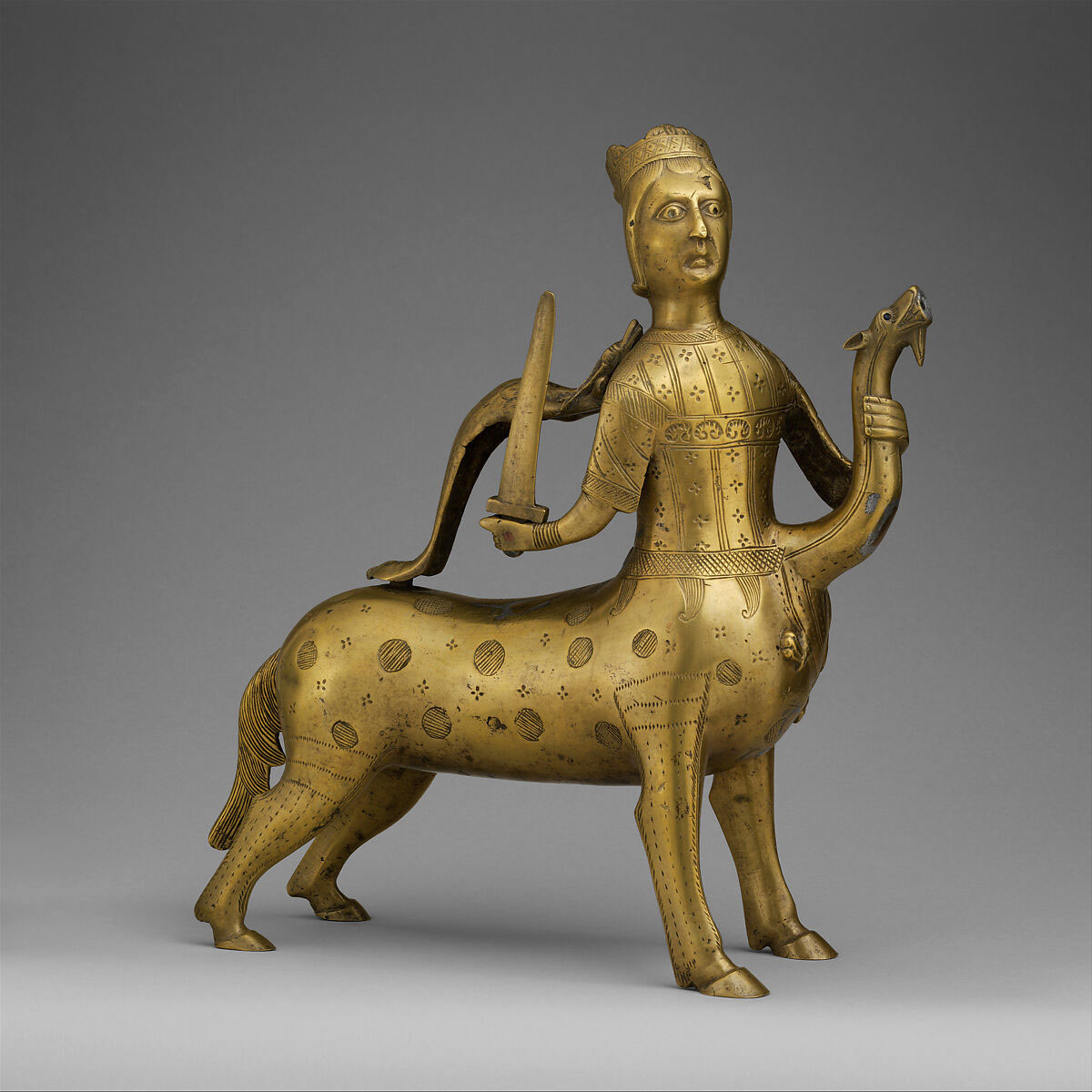
Unknown maker (German)
Aquamanile in the Form of a Crowned Centaur Fighting a Dragon
1200-1225
Copper alloy
14 3/8 x 13 3/4 x 5 in., 8.3 lb. (36.5 x 34.9 x 12.7cm, 3786g)
The Metropolitan Museum of Art
Rogers Fund, 1910
The crowned centaur (probably Chiron, the king of the centaurs), wielding a sword in his right hand, appears about to slay the dragon attacking his left side. Already representing a fantastic beast, the form here is further enriched by the dragon whose head and neck, grasped in the centaur’s left hand, form the spout.
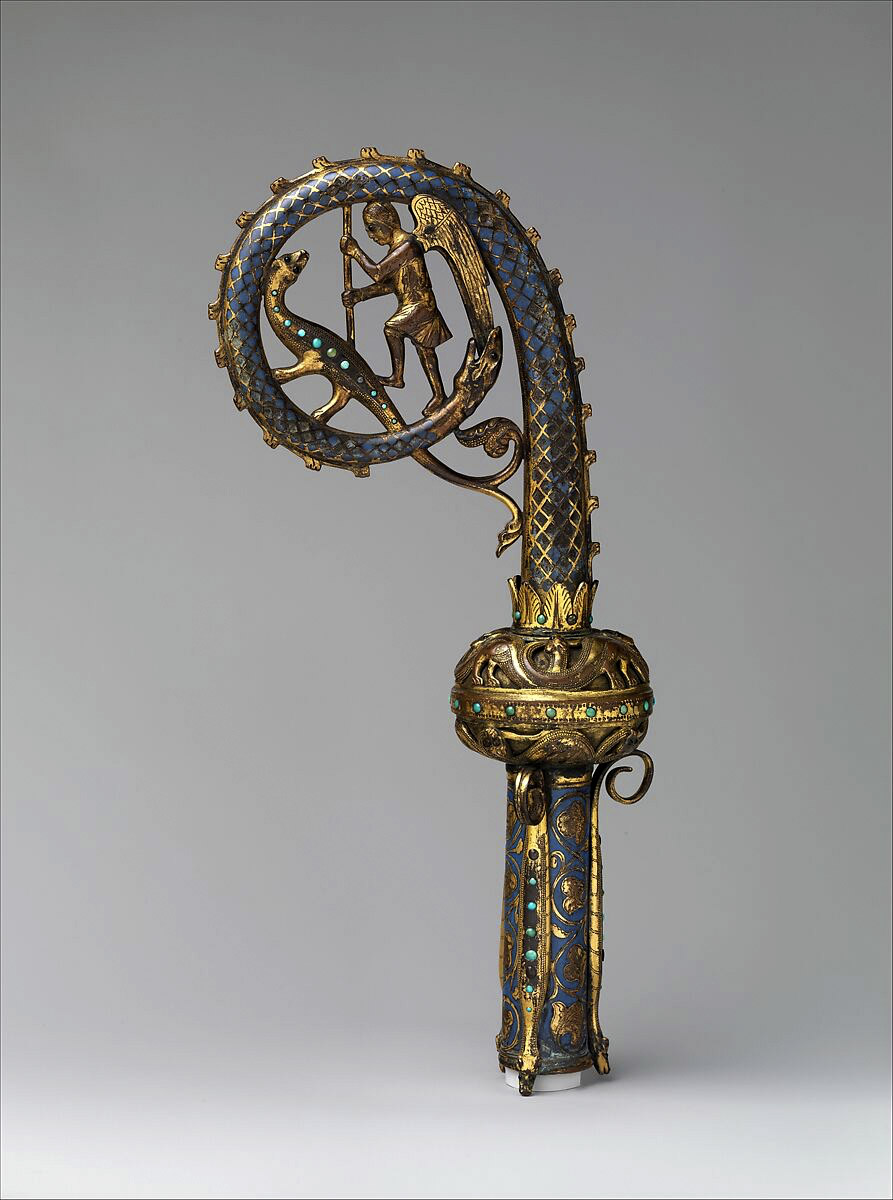
Unknown maker (French)
Head of a Crozier with Saint Michael Slaying the Dragon
1220-1230
Gilded copper with champlevé enamel and glass paste
12 13/16 x 4 15/16 x 2 3/4 in. (32.5 x 12.5 x 7cm)
The Metropolitan Museum of Art
Gift of J. Pierpont Morgan, 1917
At the center of this decoration for a ceremonial staff, the Archangel Michael spears a wingless dragon with a foliate tail. In the Bible’s Book of Revelation, Michael battles a fearsome dragon representing the Devil, expressing the struggle and eventual triumph of good over evil. The rest of the object is crawling with reptilian creatures: a large serpentine dragon attempts to devour the archangel, wings first, while smaller lizard-like beasts adorn the knop and handle.
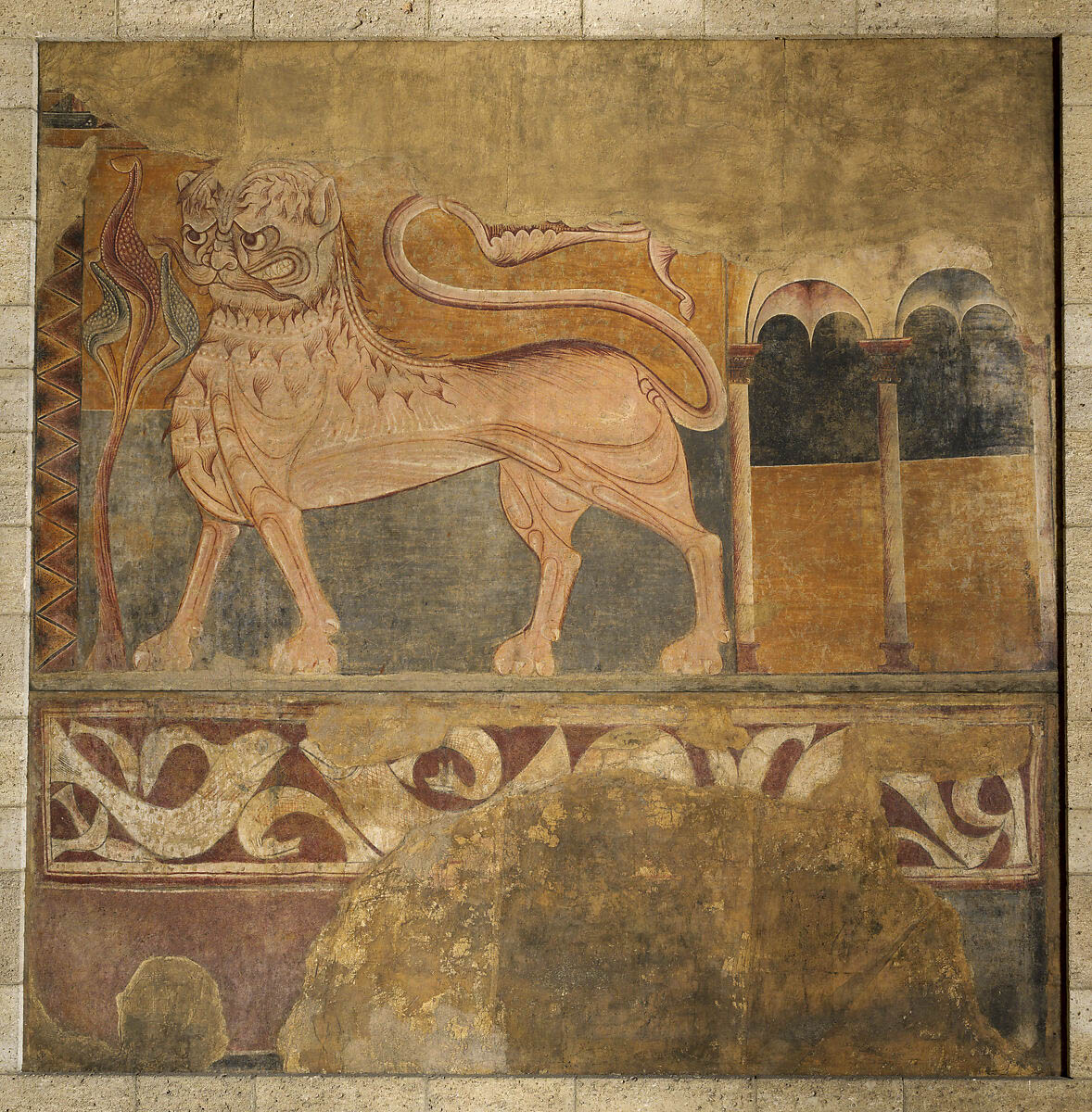
Unknown maker (Spanish)
Lion
After 1200
Fresco, mounted on canvas
10 ft. 11 in. x 11 ft. (332.7 x 335.3cm)
Top panel: 83 in. x 11 ft. (210.8 x 335.3cm)
Lower panel: 48 in. x 11 ft. (121.9 x 335.3cm)
The Metropolitan Museum of Art
The Cloisters Collection, 1931
By portraying this lion with his muscles taut, his fur standing on end, and his gaze intense, the artist conveyed the power of this snarling big cat. Medieval beasts, whether real or imaginary, were often imbued with symbolic meaning, as they are in animal fables today. It is not always possible, however, to reconstruct their specific intention in a given monument, and such beasts could be for “aesthetic delight,” as one thirteenth-century archbishop commented. The monastery from which this fresco comes was abandoned in 1841.
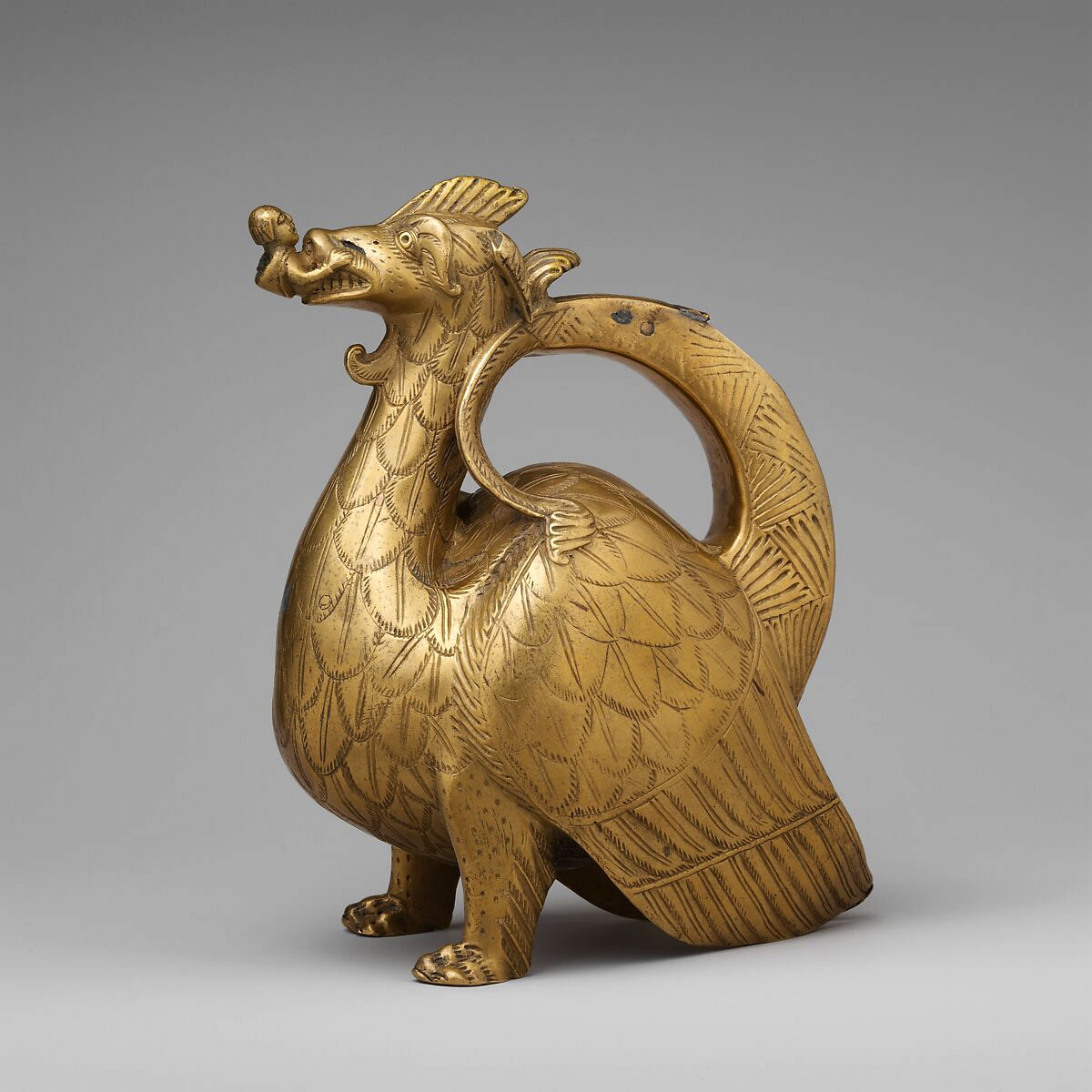
Unknown maker (North German)
Aquamanile in the Form of a Dragon
c. 1200
Copper alloy
8 3/8 x 7 3/16 x 4 3/8 in., 4.4 lb. (21.3 x 18.3 x 11.1cm, 2 kg)
Wall thickness: 1/8 in. (0.3 cm)
The Metropolitan Museum of Art
The Cloisters Collection, 1947
Aquamaniles, which are water vessels used for washing hands, served both liturgical and secular purposes. Those made in the shape of an animal are among the most distinctive products of medieval craftsmen. The most commonly seen zoomorphic aquamaniles are lions, but dragons, griffins, and many other forms were also produced (see acc. nos. 47.101.51, 1994.244).
This striking vessel represents a dragon, which is supported by its legs in front and on the tips of its wings behind, with a tail that curls up into a handle. It was filled through an opening in the tail, now missing its hinged cover. Water was poured out through the spout formed by the hooded or cowled figure held between the dragon’s teeth. In addition to its visual power, this aquamanile is distinguished by fine casting, visible in the carefully chased dragon’s scales and other surface details.
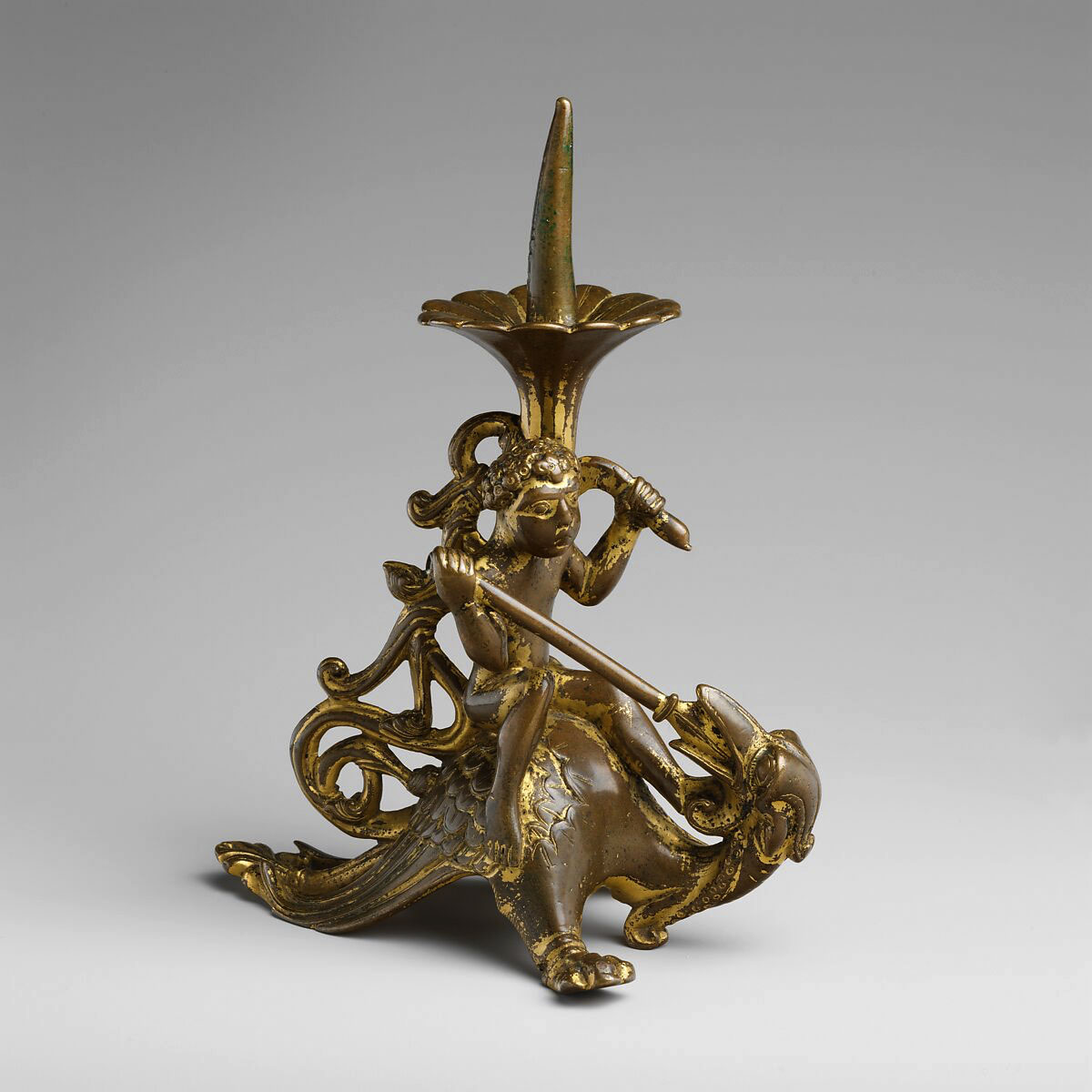
Unknown maker (South Netherlandish)
Pricket Candlestick with a Naked Youth Fighting a Dragon
c. 1140-1160
Gilded copper alloy
7 5/8 in. x 6 in. x 4 in. (19.4 x 15.2 x 10.2cm)
The Metropolitan Museum of Art
Gift of George Blumenthal, 1941
The dragon speared by a naked youth is a fanciful subject typical of the imaginative creatures found in the work of medieval goldsmiths and in manuscript illumination.
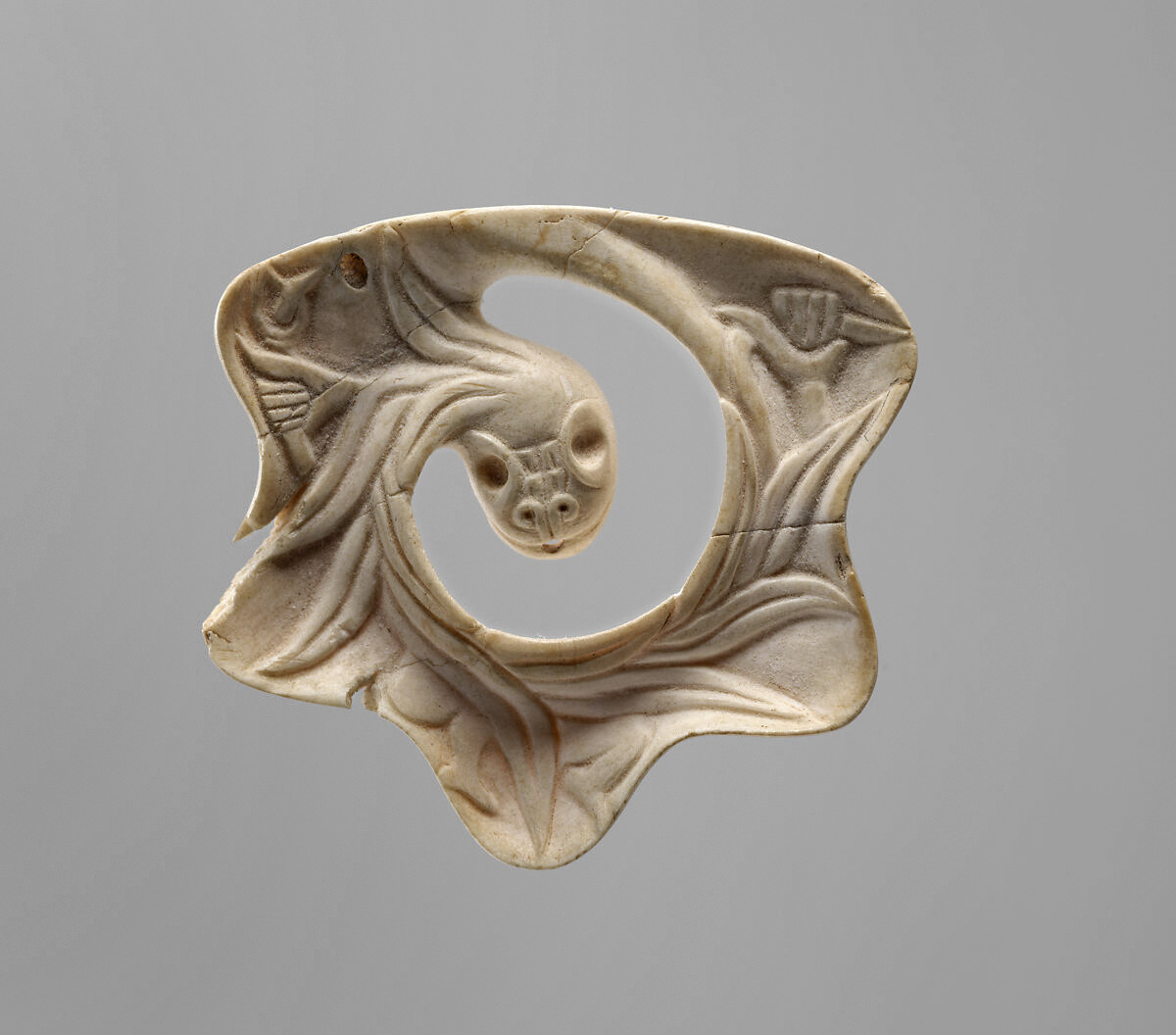
Mexica artist(s)
Feathered serpent pendant
1325-1521 CE
Shell
H. 1 5/8 x W. 1 7/8 x D. 1/4 in. (4.1 x 4.8 x 0.6cm)
The Metropolitan Museum of Art
Gift of the Mol Collection, 2020
This pendant, which retains the shape of a cross-section of a conch shell, features delicately incised imagery of a feathered serpent on one side, and its coiled, rattlesnake-like tail on the other. The head of the serpent, at the center of the ornament, is seen in a dorsal view, with two eyes drilled on either side of the creature’s feathered snout. The serpent’s feathered body is coiled around the center void, with two human hands emerging from either end, along with two legs at the center. Leonardo López Luján has identified the flower held in one hand as a huacalxóchitl, the Nahuatl name for Philodendron affine, a plant associated with sensuality and pleasure. (Nahuatl was the language of the Mexica, the ruling group of the Aztec Empire.) The other hand grasps what may be a knife.
This type of pendant is known as an ehecacozcatl or “wind jewel,” an ornament often associated with Quetzalcoatl-Ehecatl, the creator and Wind God (for a depiction of a spider monkey wearing this regalia see accession number 2017.393). This tiny, exquisitely carved ornament contains multiple, layered meanings, from the general associations of the very material from which it was carved – shell, with its connections to warriors, and, most importantly, water and fertility – to specific associations with deities such as Quetzalcoatl. What is clear is that such ornaments were highly esteemed in Aztec times. As Adrián Velazquez Castro has noted, shell workshops were likely located within royal palaces, and their use appears to have been reserved for the private ceremonies of the Mexica elite. Such an ornament speaks to an extraordinary control over access to resources, from the raw material itself – from far away and difficult to acquire – to access to the finest artists, individuals with the skill required to transform the material into works of great beauty and delicacy.
Joanne Pillsbury Andrall E. Pearson Curator, Arts of the Ancient Americas, 2020
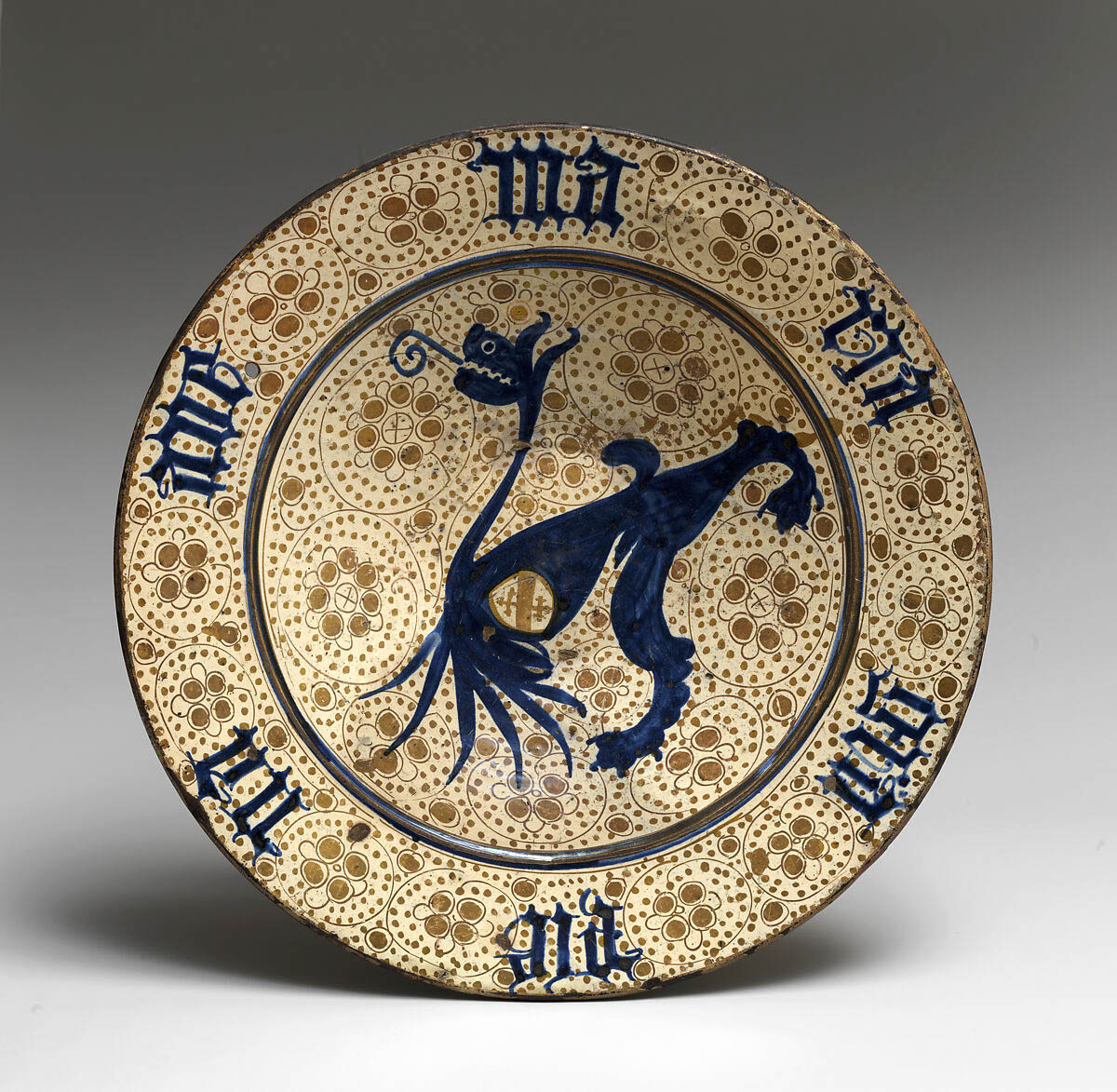
Unknown maker (Spanish)
Dish
1425-1450
Tin-glazed earthenware
Overall: 14 in. (35.6cm)
The Metropolitan Museum of Art
The Cloisters Collection, 1956
Lusterware is the term used to describe a glazed earthenware ceramic decorated with an iridescent finish. The technique for creating this finish was developed in the ninth century under the rule of the Abbasid Caliphate in present-day Iraq. The medium involves a technique that is difficult to master, but if completed successfully, the surfaces of the ceramic objects display an iridescent sheen which is achieved through multiple firings and the application of a metal-based pigment (including silver, copper, tin, or a combination of these). Lusterware manufacture is still difficult to understand from a technical perspective because for generations, production was kept secret to protect workshop practices from being replicated by competitors. Therefore, pigment formulas and trade techniques were passed down from master to pupil and rarely recorded.
Knowledge of the technique for creating lusterware made its way to the Iberian Peninsula by the twelfth century, when most of the region was still under Islamic rule. By the 1400s, the Iberian center of lusterware production was in Manises, near the city of Valencia. Previously a Muslim taifa, or principality, the Kingdom of Valencia was conquered in the thirteenth century by James I for the Crown of Aragon, and it was here that Christians and Muslim potters worked, sometimes together, for a diverse clientele with a voracious appetite for high quality lustered wares.
The inscription around the border of the dish reads ‘Ave Maria, gra[tia] plena’ (Hail Mary, full of grace). These are the opening words spoken to Mary by the Archangel Gabriel at the Annunciation (Luke 1:28). Here, a combination of Gothic lettering and stylised flowers reminiscent of a motif often seen on lusterware from the Islamic world, surround a dragon to create a unique pattern that reflects the multiple stylistic languages available to luster potters. Dragons and other fantastic beasts appear frequently on Valencian lusterware dishes; for example, another, similar plate in the collection, acc. no. 56.171.159, depicts a blue fire-breathing dragon surrounded again by the ‘Ave Maria’ inscription. Upon close inspection of this plate (acc. no. 56.171.110), the circle in the dragon’s chest acts as a frame around an ochre cross that bears the coat of arms of the noble Valencian Argent family.
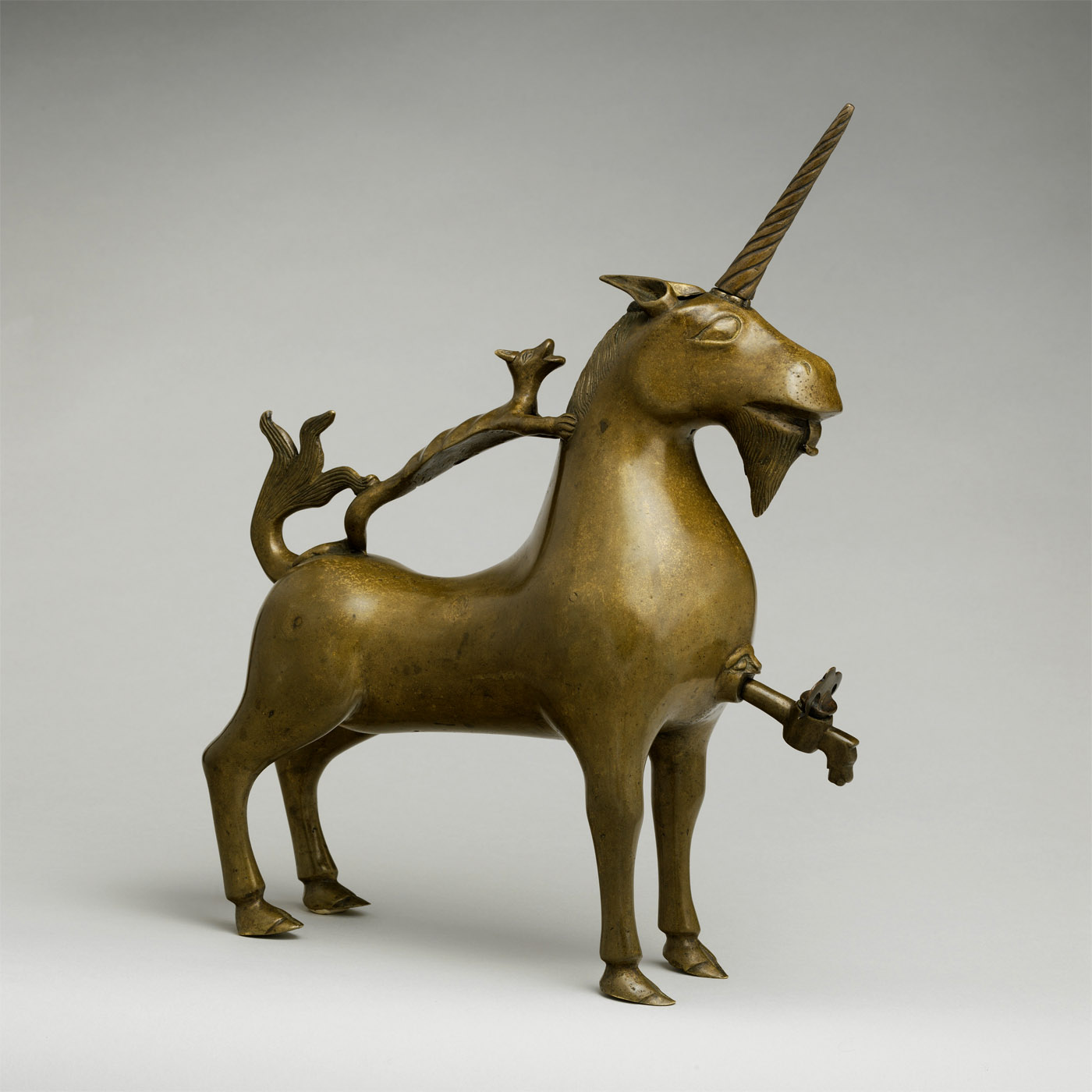
Unknown maker (German)
Aquamanile in the Form of a Unicorn
c. 1425-1450
Copper alloy
15 1/2 x 11 1/2 x 4 7/16 in., 6.8 lb. (39.4 x 29.2 x 11.3cm, 3085g)
The Metropolitan Museum of Art
Gift of Irwin Untermyer, 1964
The aquamanile takes its name from the Latin words for water (aqua) and hand (manus), as it was intended for hand washing at table. Poured through a flap at the top, the water was later dispensed through the spigot in the unicorn’s chest. The flame-like tail is typical of aquamanilia cast in Nuremberg. Residents of the city were enthralled by unicorns, emblazoning their coats of arms with images of the beast. Nuremberg officials, however, sensibly decided against the purchase of a unicorn offered by the distinguished humanist scholar and physician Johannes Sambucus in the mid sixteenth century. The horn of the unicorn on this aquamanile has been replaced.
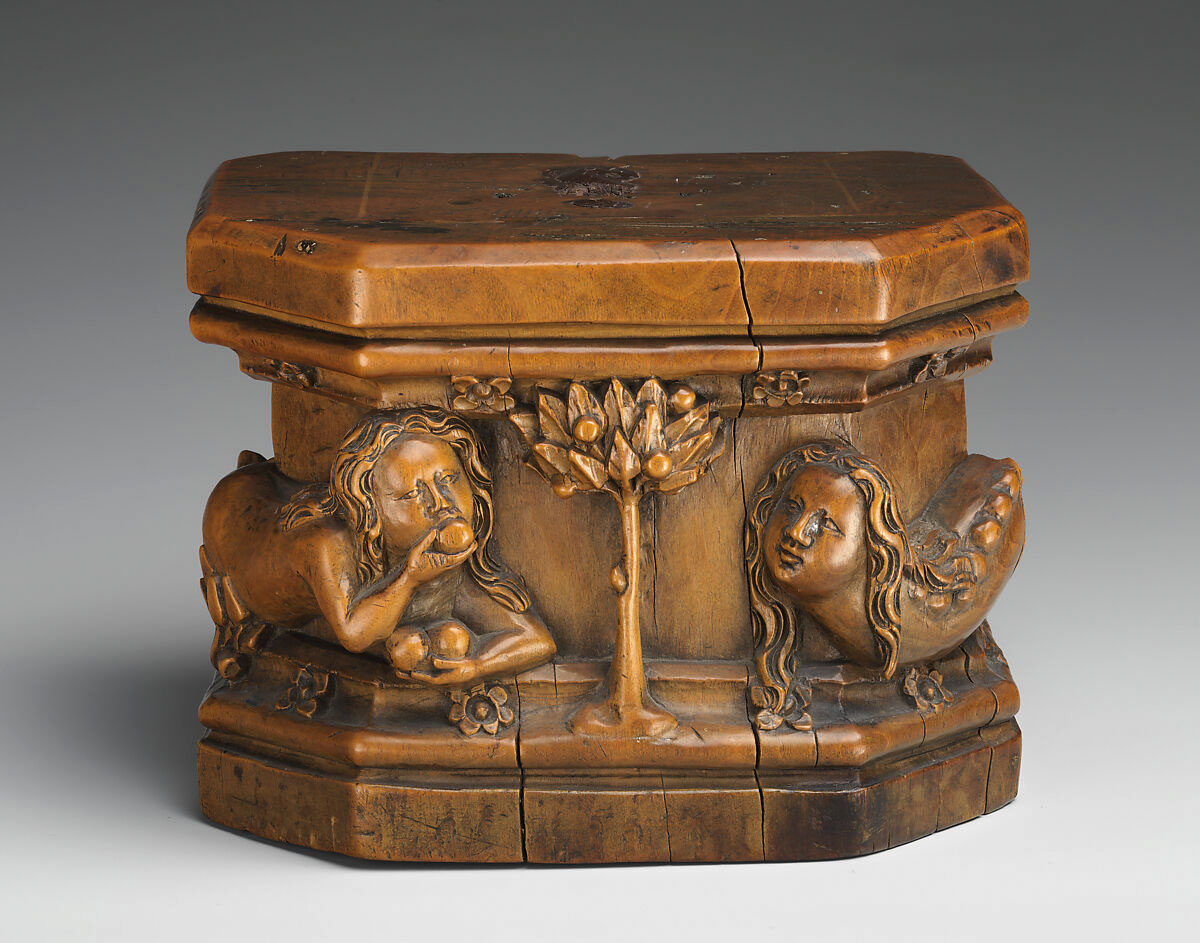
Unknown maker (South Netherlandish)
Base for a Statuette
1470-1480
Boxwood
3 1/2 x 4 7/8 x 3 3/8 in. (8.9 x 12.4 x 8.6cm)
The Metropolitan Museum of Art
The Cloisters Collection, 1955
The figures of Eve and the serpent appear on either side of the Tree of Knowledge in the Garden of Eden. The woman-headed serpent may represent Lilith, the legendary first wife of Adam, who rebelled against her husband and disappeared from Paradise. God then created Eve from Adam’s rib, leading the jealous Lilith to tempt Eve with the forbidden fruit. The common medieval association of Eve, mother of humankind, with Mary, mother of Jesus, suggests that this base may have supported a statuette of the Virgin.
The Metropolitan Museum of Art
1000 Fifth Avenue at 82nd Street
New York, New York 10028-0198
Phone: 212-535-7710
Opening hours:
Thursday – Tuesday 10am – 5pm
Closed Wednesday


You must be logged in to post a comment.