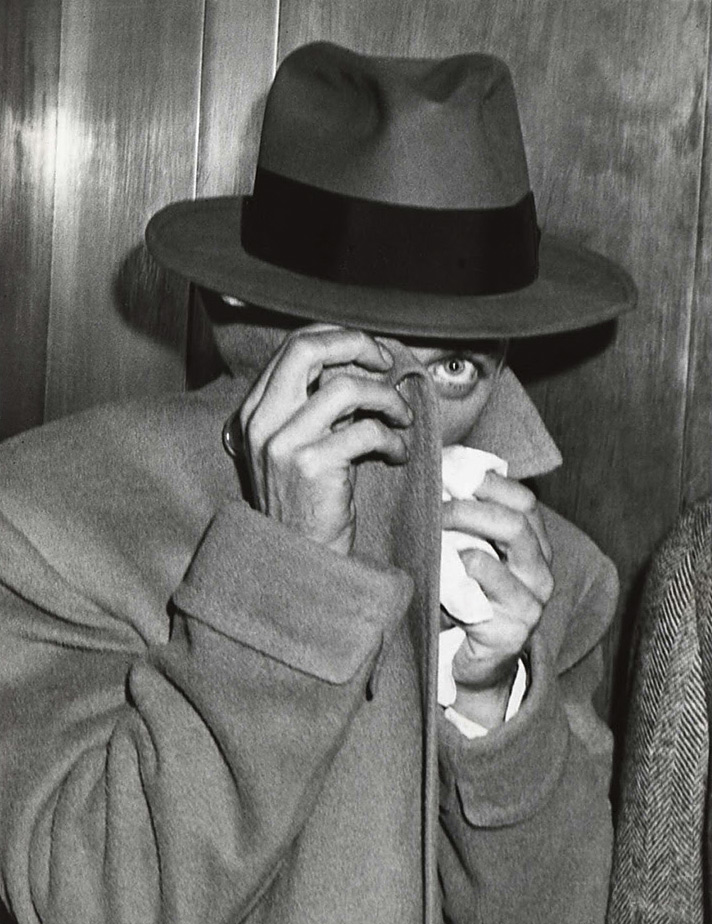
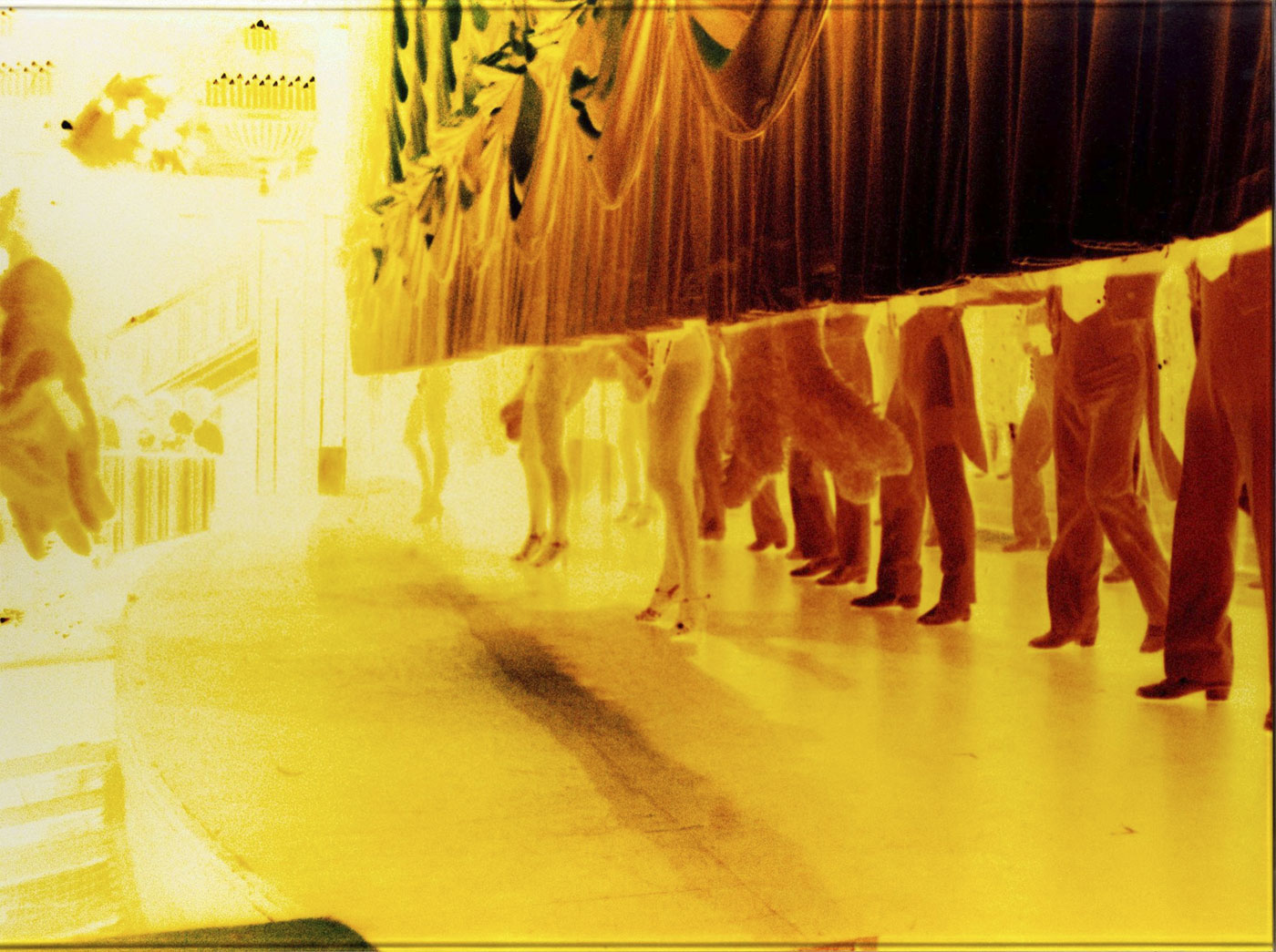
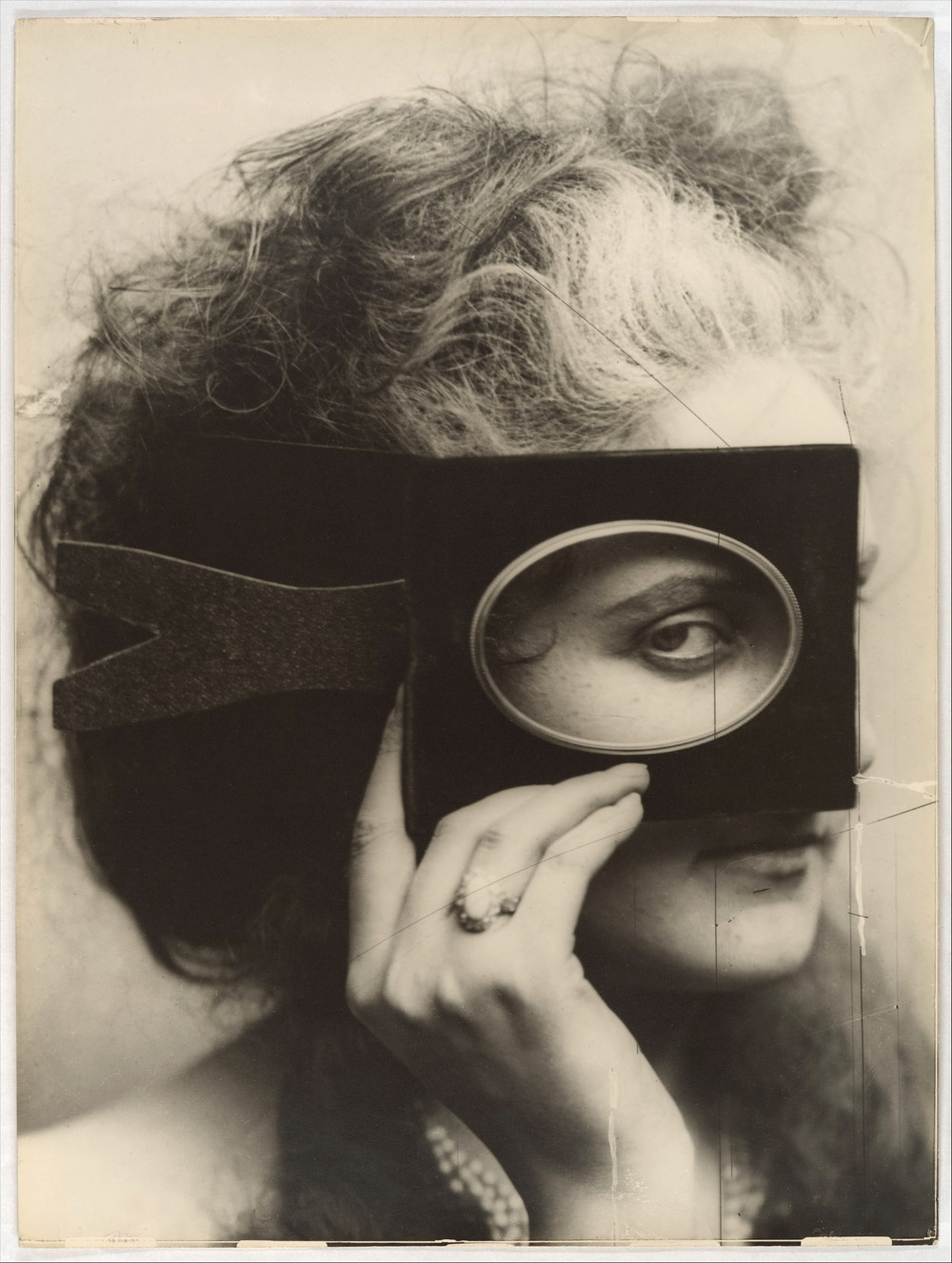
Exhibition: ‘Weegee. Autopsy of the Spectacle’ at Fundación MAPFRE, Madrid

Exhibition dates: 19th September, 2024 – 5th January, 2025

Curator: Exhibition curated by Clément Chéroux, director of the Fondation Henri Cartier-Bresson.


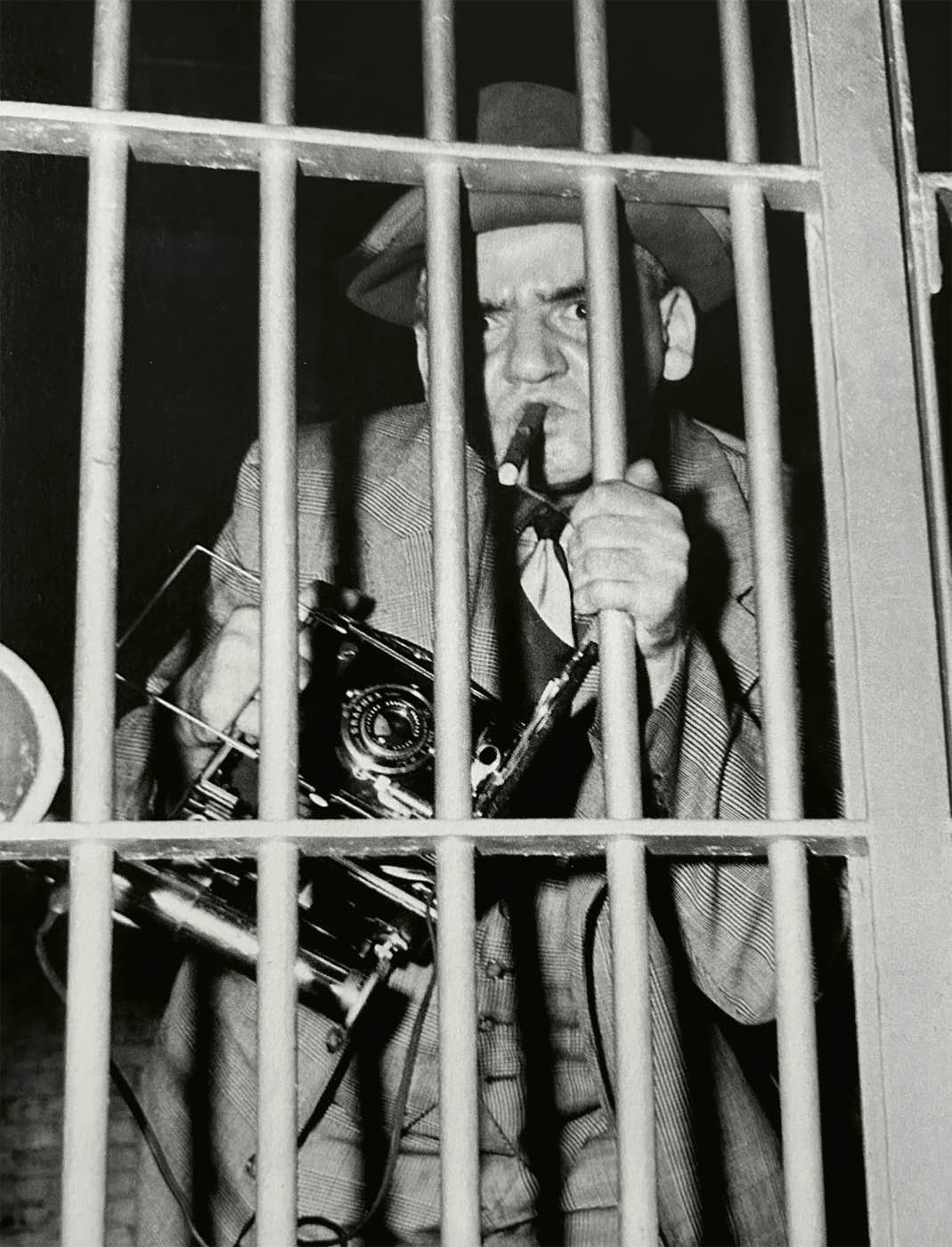
Weegee (Arthur Fellig) (American born Ukraine, 1899-1968) 'Self-Portrait with Speed Graphic Camera' October 13th 1950 from the exhibition 'Weegee. Autopsy of the Spectacle' at Fundacion Mapfre, Madrid Sept 2024 - January 2025


Weegee (Arthur Fellig) (American, 1899-1968)
Self-Portrait with Speed Graphic Camera
October 13th 1950
Gelatin-silver print
© International Center of Photography. Collection Friedsam


Self Seen

I’ve posted on this exhibition once before when it was shown at the Foundation Henri Cartier-Bresson, Paris. While there some photographs that are the same in both postings there are new photographs to admire here. So, let’s have some fun with the text!

I started playing around with ideas in my head… and instead of the “autopsy of the spectacle” – an examination to discover the cause of the spectacle – I inverted that statement to make it the “spectacle of the autopsy”.

What immediately came to mind when I did this was the spectacle, the spectacular, painting that is Rembrandt’s early masterpiece The Anatomy Lesson of Dr. Nicolaes Tulp (1632, below), that tableau – French, late 17th century (in the sense ‘picture’, figuratively ‘picturesque description’) – of figures, spectators, gathered around the corpse of the “criminal Aris Kindt (alias of Adriaan Adriaanszoon), who was convicted for armed robbery and sentenced to death by hanging.”1

Fast forward a few centuries to the “Murder is my business” photographs of Arthur Fellig (alias Weegee) and I again observe spectators gathered around the body of a corpse, either physically examining it or wilfully ignoring it (Drowning victim, Coney Island c. 1940, below), where the men “examine” the drowning victim surrounded by men that stare and the women who smiles for the camera. With the crowd behind, all are physically and metaphorically drawn in to the spectacle of the autopsy and the presence of the camera. “”Spectacle is Capital to such a degree of accumulation that it becomes an image,” explained Guy Debord in 1967. Weegee understood this well.”

In other photographs such as Body of Andrew Izzo, killed by off-duty policeman Elegio Sarro (1942, below) and Body of Dominic Didato (1936, below) Weegee’s camera becomes the spectator, standing in for us as we crane our necks to get a better view of the action. Together, the camera and the viewer, perform what could be seen as a form of “necropsy” – from the Greek words nekros (meaning “corpse”) and opsis (meaning “to view”), and together they mean “to look at the dead body with naked eyes” – that is, a macroscopic examination of a dead body.

Witness, and we do stand witness in Weegee’s photographs looking at dead bodies with naked eyes, the perspectival viewpoint of the bodies of both Andrew Izzo and Dominic Didato similar to the elongated perspective in the painting by Rembrandt, the shading of the face in that painting – the umbra mortis (shadow of death) – now supplanted by the reversed body, head shaded / covered in blood, surmounted with out flung gun and boater.

While these photographs fail “to give shape to feelings of compassion, grief, horror (as if the pictorial repetition of events were a way of understanding these events, being able to live with them)”2 finally, in the derivation of the word “autopsy” – and in the spectacular images of Weegee – we may begin to understand that these photographs are as much about us, the spectator and viewer, and our discontinuous nature (we die) as they are about the pictured bodies. For the meaning of the word autopsy – early 17th century (in the sense ‘personal observation’): from modern Latin autopsia, from Greek, from autoptos ‘self-revealed’, from autos ‘self’ + optos ‘seen’ – reveals as much about ourselves as it does the object of our attention.

Looking at mortality with naked eyes, our self-revealed, our self seen, reflected back to us in the photographs of Weegee.

Dr Marcus Bunyan


1/ Anonymous. “The Anatomy Lesson of Dr. Nicolaes Tulp,” on the Wikipedia website Nd [Online] Cited 05/12/2024

2/ Leah Dickerman. “Gerhard Richter’s Enigmatic Cycle in The Long Run,” on the MoMA website March 1, 2019 [Online] Cited 05/12/2024


Many thankx to Fundación MAPFRE for allowing me to publish the photographs in the posting. Please click on the photographs for a larger version of the image.


“Weegee knew the power of imagery to speak to larger truths about human nature and society. He captured New York as it truly was: gritty, raw, and filled with contrasts. His work turned the everyday violence and chaos of the city into art, making the mundane extraordinary. In Weegee’s own words, “I picked a story that meant something.” He had an instinct for identifying moments that held deeper significance, even if they were just snapshots of daily life in a chaotic metropolis.”


Danny Dutch. “Weegee: The Lens Behind New York’s Darkest Hours,” on the Danny Dutch website Nd [Online] Cited 12/11/2024
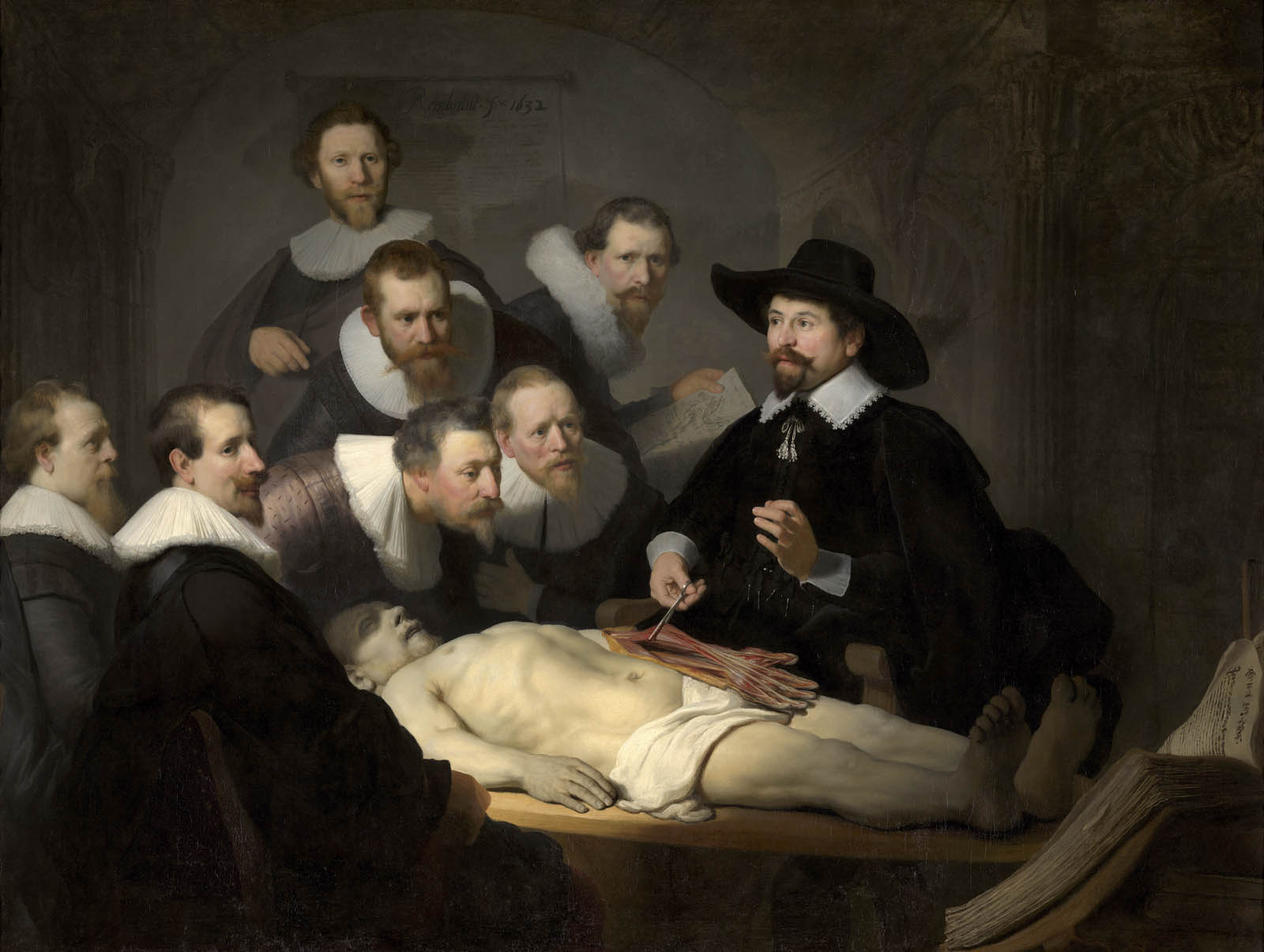


Rembrandt Harmenszoon van Rijn (Dutch, 1606-1669) 'The Anatomy Lesson of Dr. Nicolaes Tulp' 1632


Rembrandt Harmenszoon van Rijn (Dutch, 1606-1669)
The Anatomy Lesson of Dr. Nicolaes Tulp
1632
Oil on canvas
216.5cm × 169.5cm (85.2 in × 66.7 in)
Mauritshuis, The Hague
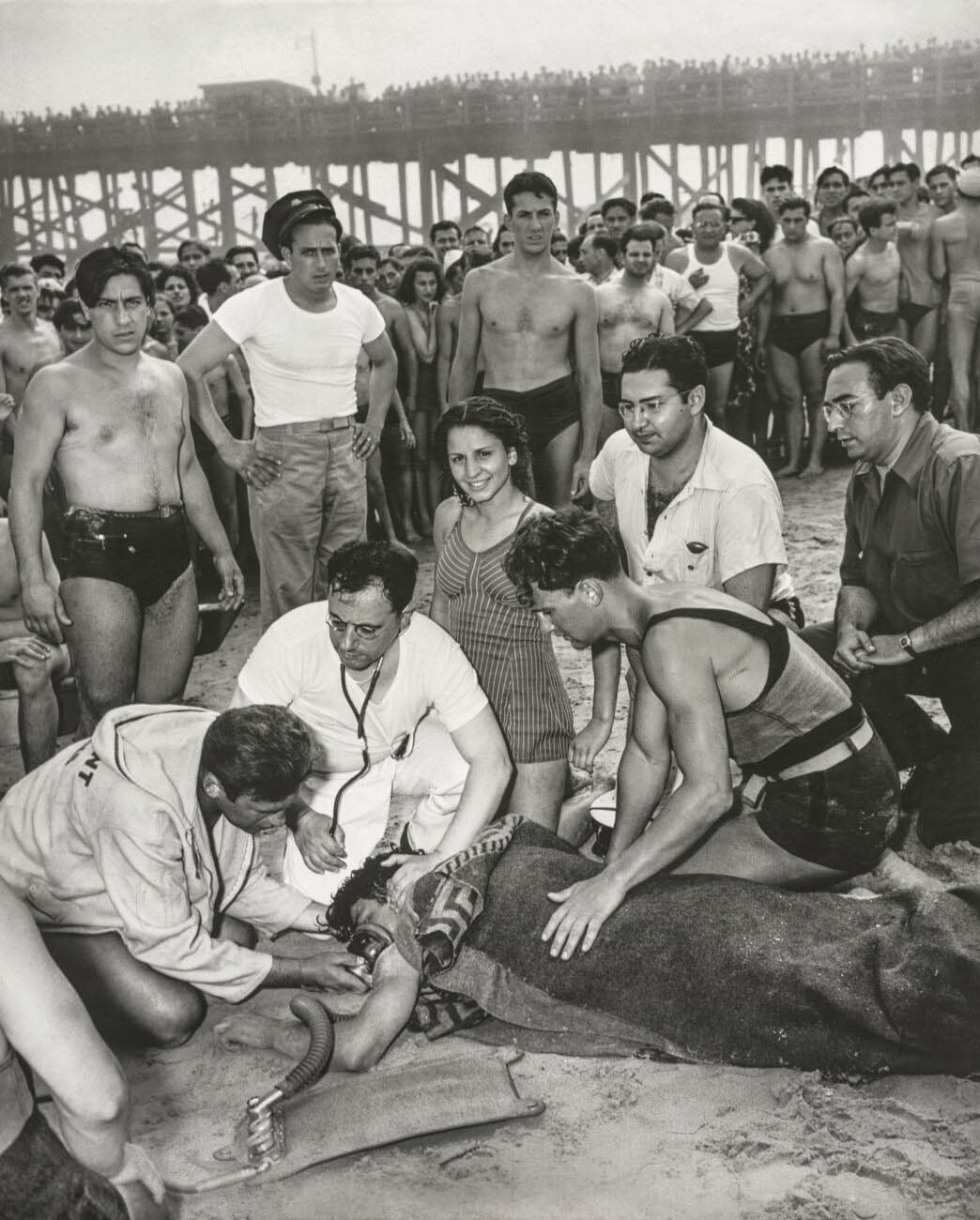
 

Weegee (American, 1899-1968) 'Drowning victim, Coney Island' c. 1940


Weegee (American, 1899-1968)
Drowning victim, Coney Island
c. 1940
Gelatin silver print
© Weegee Archive / International Center of Photography, New York / Collection Galerie Berinson, Berlin
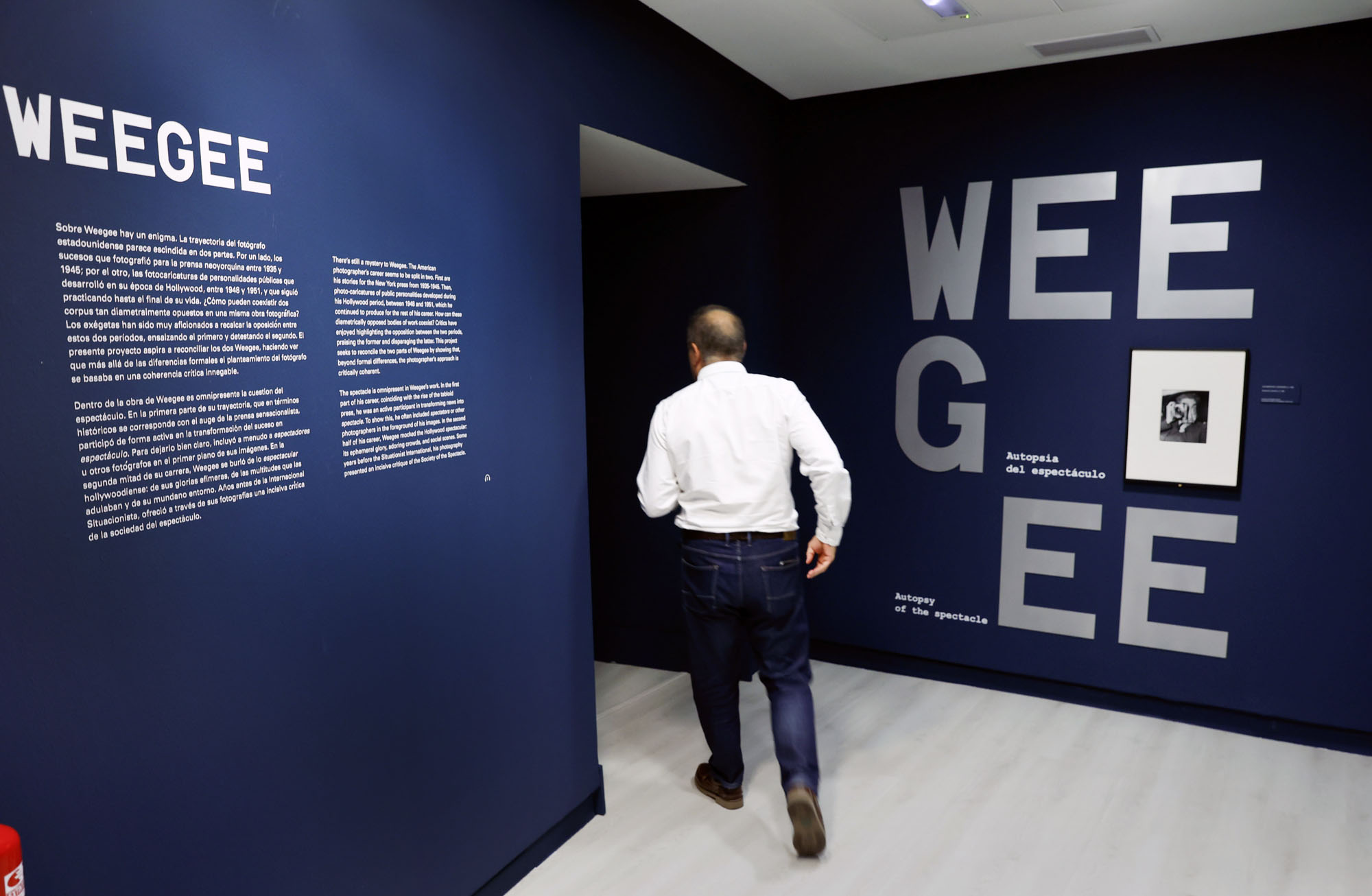
 

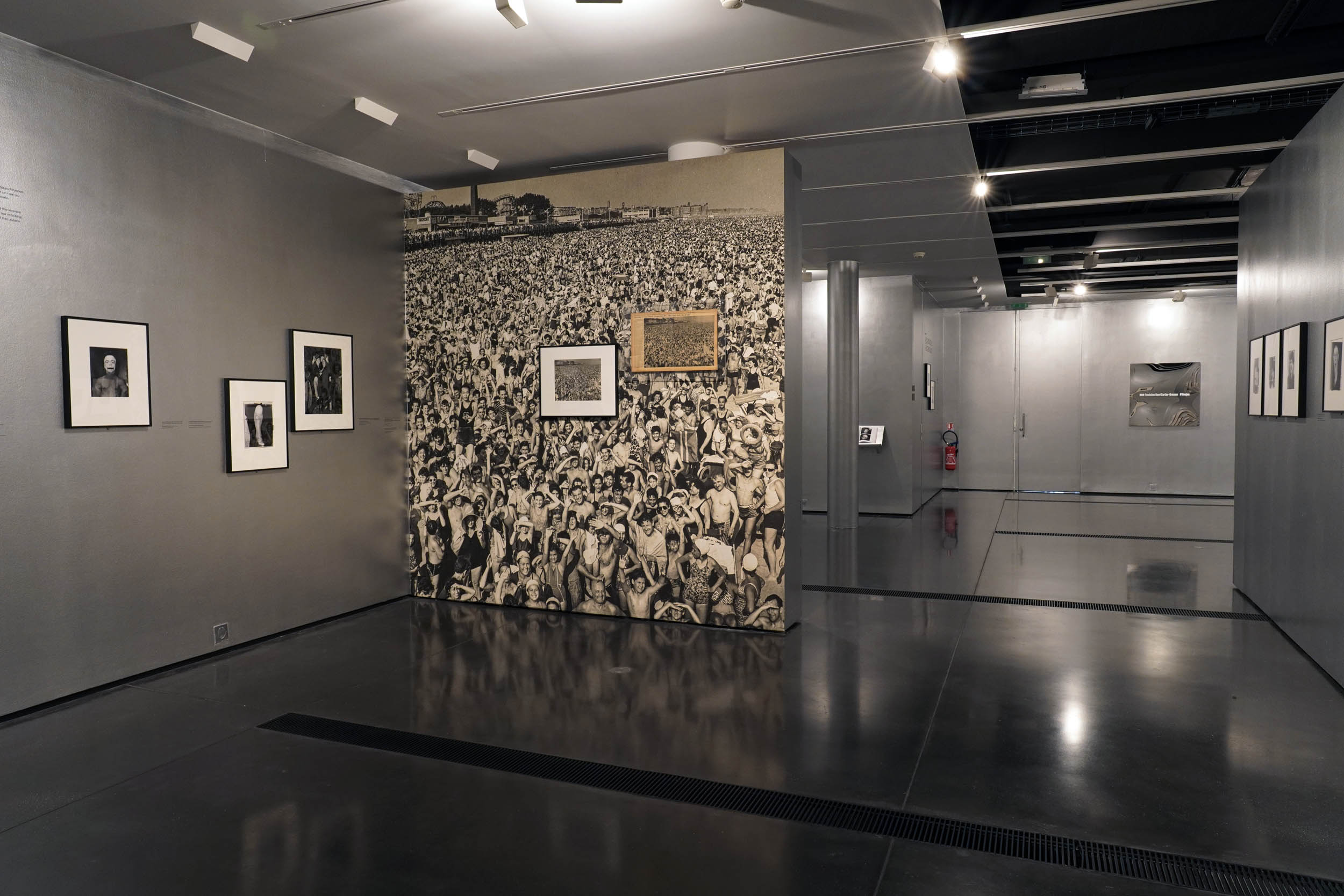
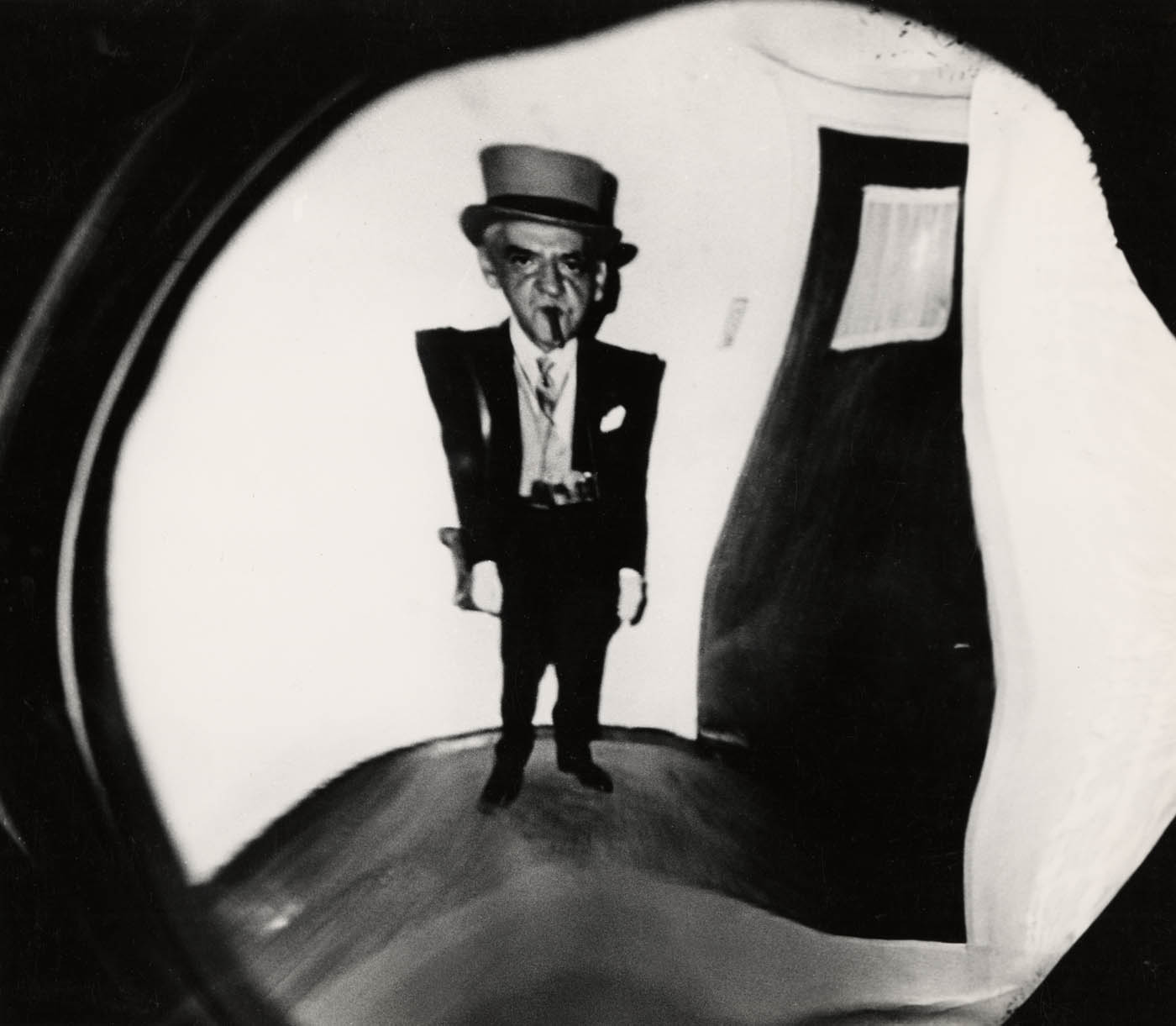
Installation view of the exhibition Weegee. 'Autopsy of the Spectacle' at Fundacion Mapfre, Madrid showing at right Weegee's 'Self-portrait, Distortion' (1955)


Installation view of the exhibition Weegee. Autopsy of the Spectacle at Fundación MAPFRE, Madrid showing at right Weegee’s Self-portrait, Distortion (1955, below)


Weegee (Arthur Fellig) (American born Ukraine, 1899-1968) 'Self-portrait, Distortion' 1955


Weegee (Arthur Fellig) (American born Ukraine, 1899-1968)
Self-portrait, Distortion
1955
Gelatin silver print
© International Center of Photography
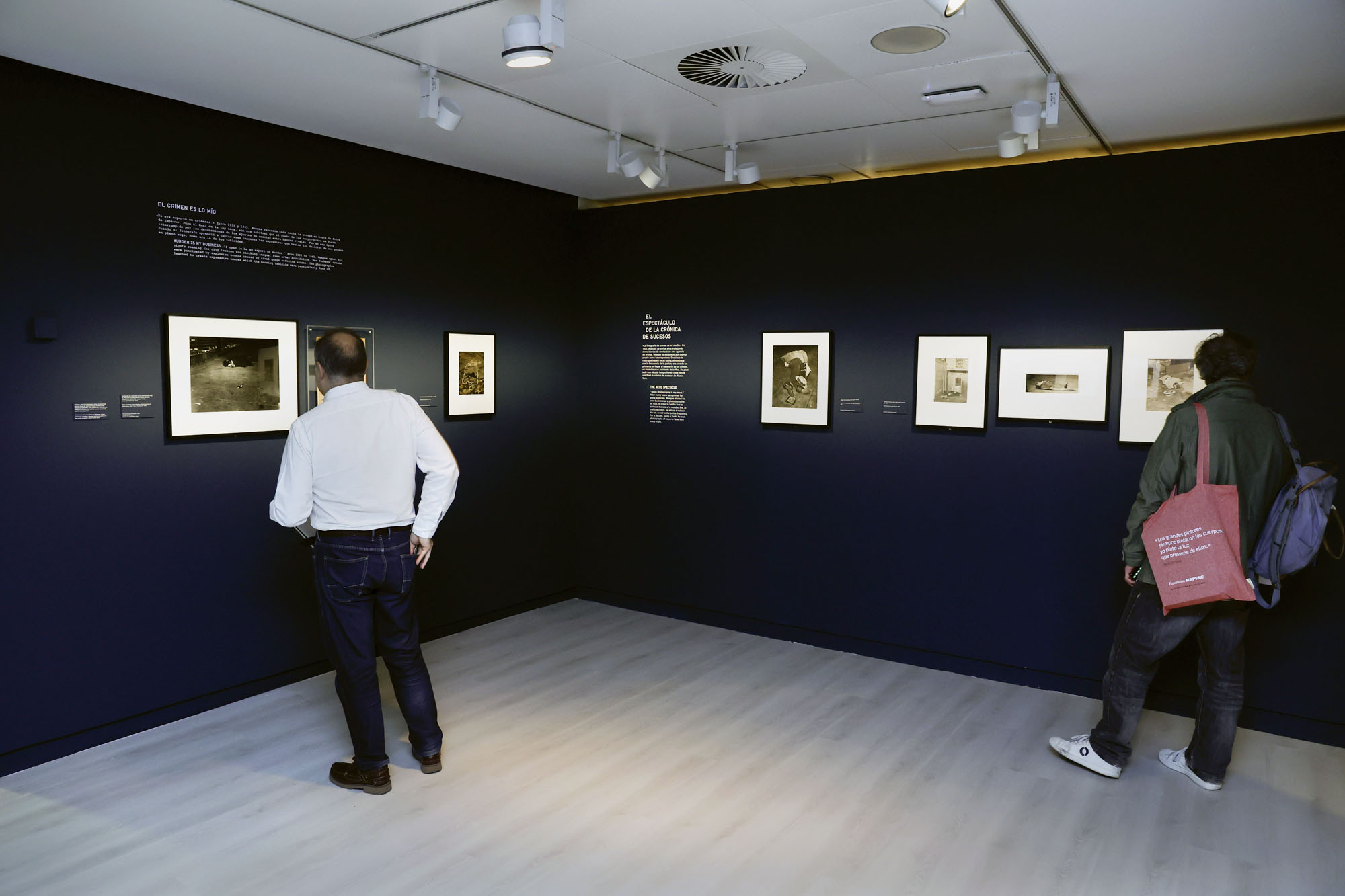
 

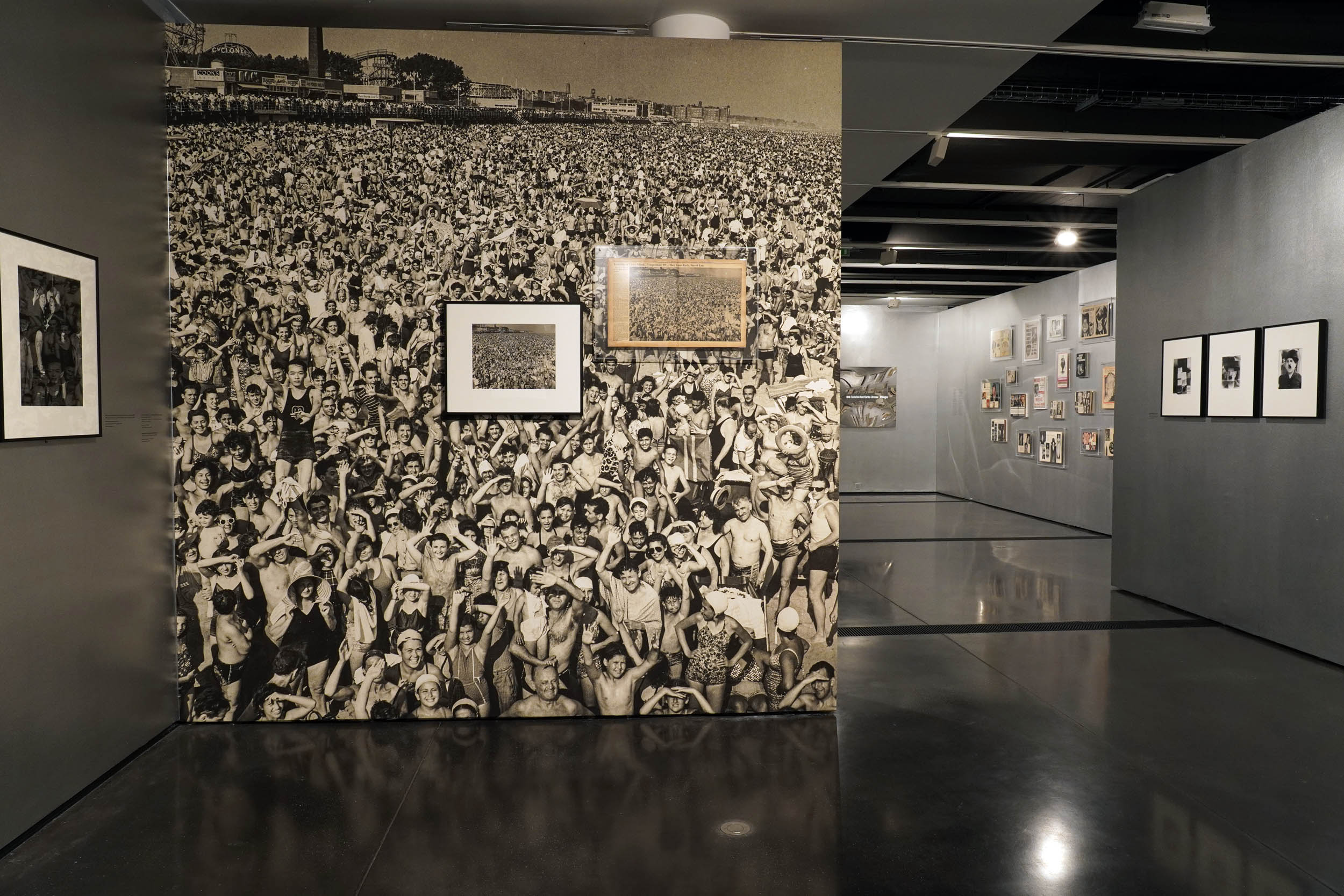
Installation view of the exhibition Weegee. 'Autopsy of the Spectacle' at Fundacion Mapfre, Madrid 


Installation view of the exhibition Weegee. Autopsy of the Spectacle at Fundacion Mapfre, Madrid showing at left Weegee’s Body of Andrew Izzo, killed by off-duty policeman Elegio Sarro (1942, below); at second left, [Outline of a Murder Victim] (1942);  and at right, Body of Dominic Didato, (1936, below)
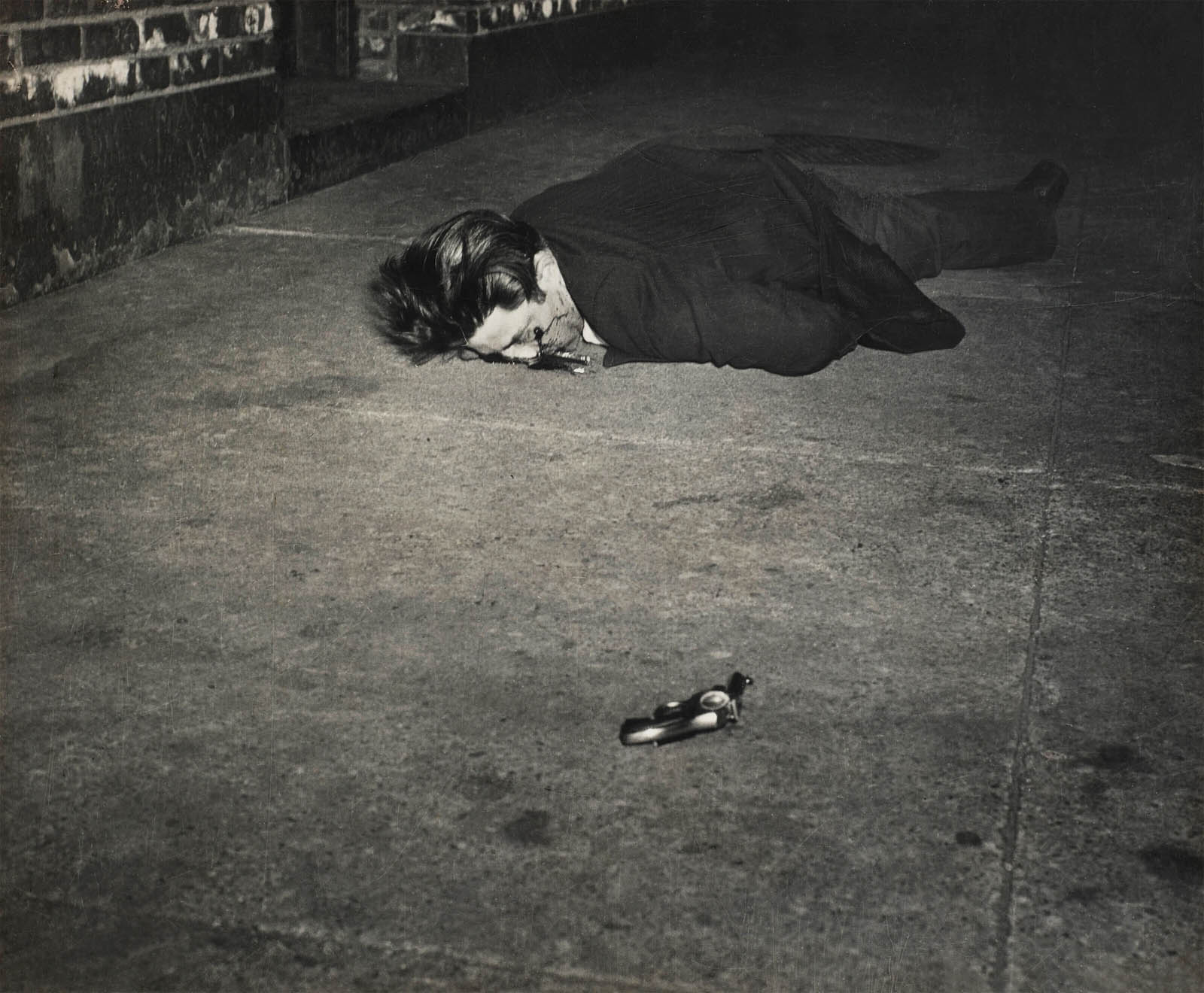
 

Weegee (Arthur Fellig) (American born Ukraine, 1899-1968) 'Body of Andrew Izzo, killed by off-duty policeman Elegio Sarro' 1942 from the exhibition 'Weegee. Autopsy of the Spectacle' at Fundacion Mapfre, Madrid Sept 2024 - January 2025


Weegee (Arthur Fellig) (American born Ukraine, 1899-1968)
Body of Andrew Izzo, killed by off-duty policeman Elegio Sarro
1942
Gelatin silver print
© International Center of Photography
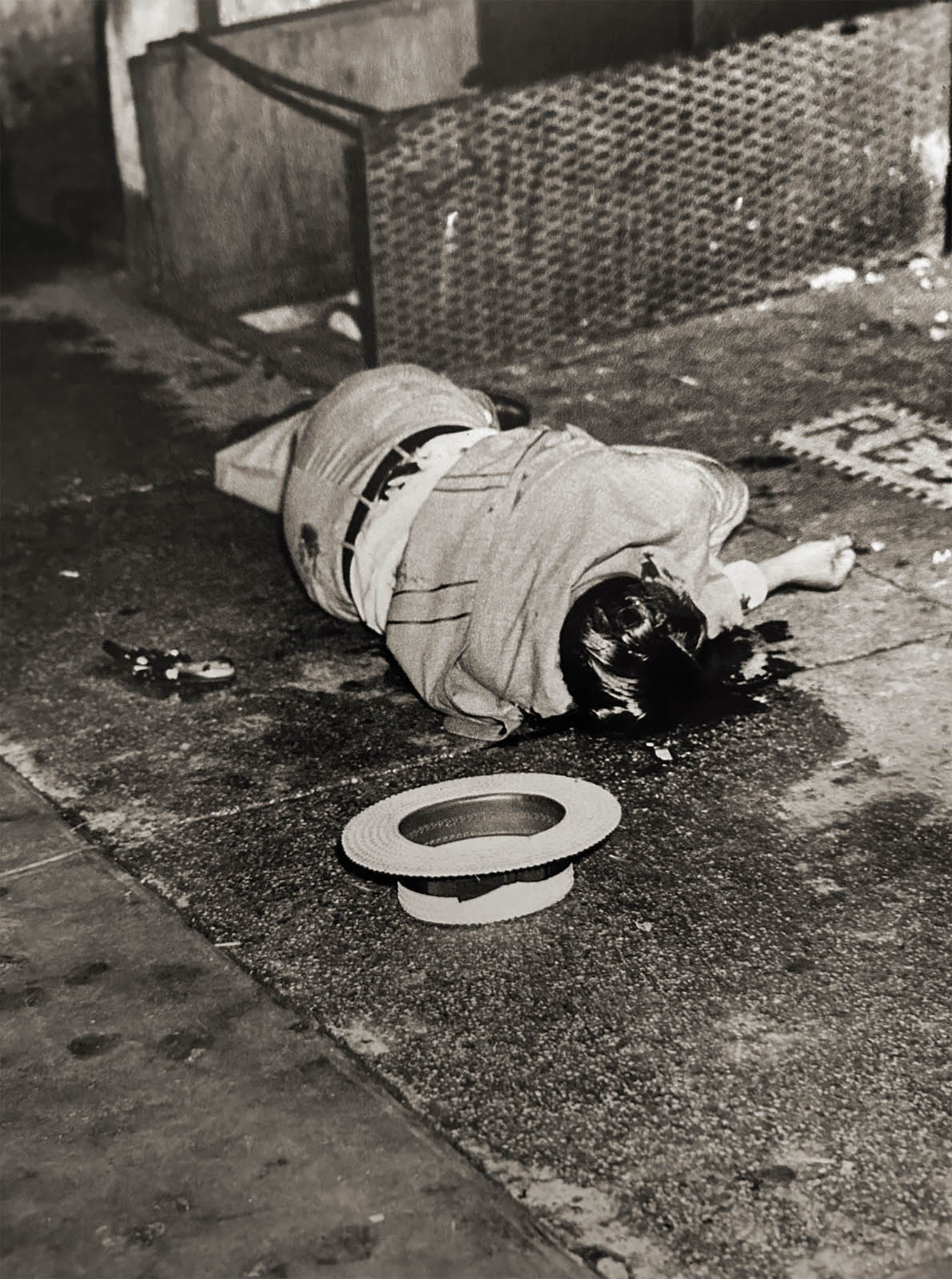
 

Weegee (Arthur Fellig) (American born Ukraine, 1899-1968) 'Body of Dominic Didato' 1936 from the exhibition 'Weegee. Autopsy of the Spectacle' at Fundacion Mapfre, Madrid Sept 2024 - January 2025


Weegee (Arthur Fellig) (American born Ukraine, 1899-1968)
Body of Dominic Didato
1936
Gelatin silver print
© International Center of Photography


Dominick Didato, aka Terry Burns, who you see above in a photo made by Arthur Fellig, aka Weegee, lies dead on a New York City street where he was gunned down today in 1936. He was killed for interfering with rackets run by Lucky Luciano. It was a low percentage play. Luciano was literally the most powerful mobster in the U.S. at the time, and as the saying goes, you come at the king, you best not miss.

Anonymous. “Urban Decay,” on the Pulp International website August 22, 2024 [Online] Cited 11/11/2024


The work of Arthur H. Fellig, known as Weegee (Zolochiv, Ukraine, 1899 – New York, 1968), is, in a sense, an enigma that this exhibition seeks to unravel. His photographs of the underworld and the fringe circles of New York nightlife in the 1930s and 1940s quickly gained wide international recognition. However, the same cannot be said for the photographs he took after settling in Hollywood in 1948: images of Californian high society and the social life of major film celebrities, whom he often portrayed in a markedly ironic or satirical manner, sometimes (as in the case of the “photocaricatures”) as a result of his later work in the laboratory. At the time, critics emphasised the radical opposition between the two periods, openly praising the former and dismissing the latter. In these photographs of his Californian experience (1948-1951), Weegee expressed his critical vision of society and culture from a perspective that anticipated the well-known cultural and social analyses of ‘the society of the spectacle’ (Guy Debord).

Weegee. Autopsy of the Spectacle aims to show the profound coherence that, beyond their stylistic and thematic differences, links these two stages, as well as to highlight the relevance of the critical perspective from which Weegee’s images expose the features and mechanisms of our time as a ‘society of the spectacle’.

Exhibition organised by the Fondation Henri Cartier-Bresson in collaboration with Fundación MAPFRE.

Text from the Fundación MAPFRE website
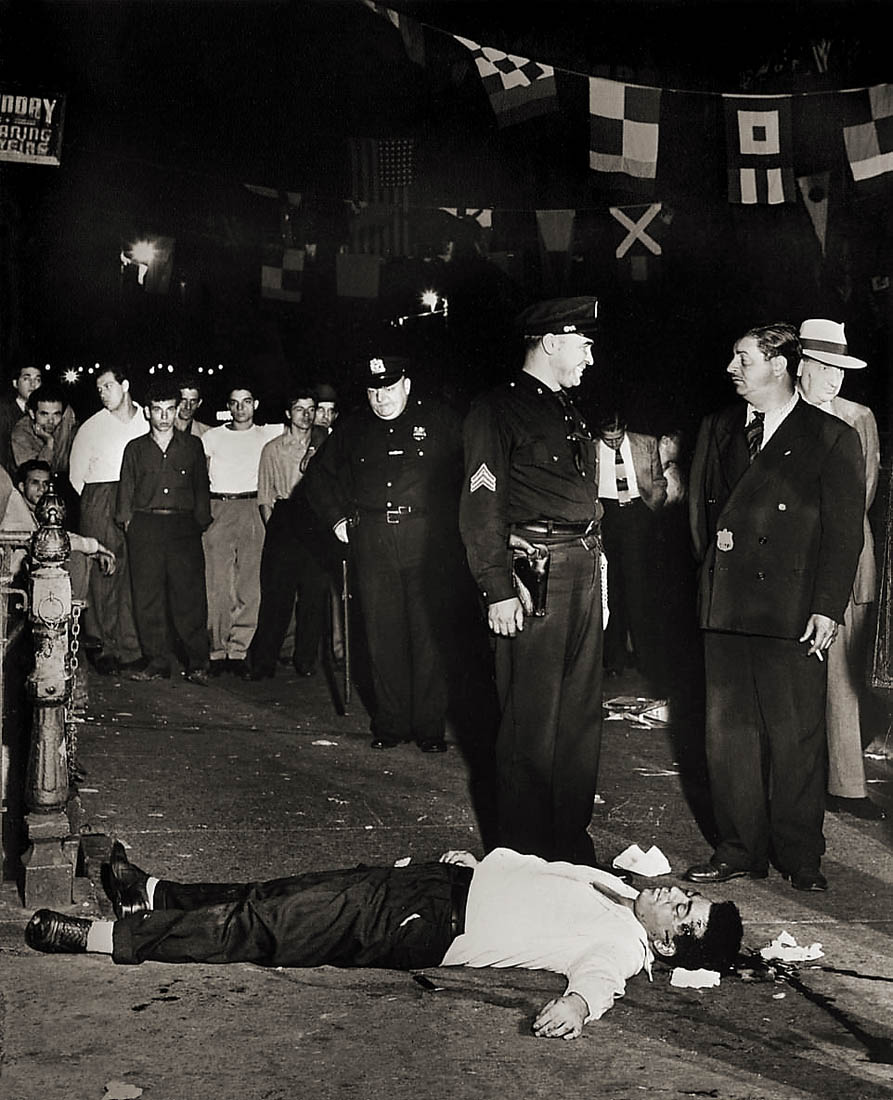
 

Weegee (Arthur Fellig) (American born Ukraine, 1899-1968) 'Police and onlookers with body of Joseph "Little Joe" La Cava, killed during the feast of San Gennaro' 1939


Weegee (Arthur Fellig) (American born Ukraine, 1899-1968)
Police and onlookers with body of Joseph “Little Joe” La Cava, killed during the feast of San Gennaro
1939
Gelatin silver print
© International Center of Photography


The above photo shows the murder scene of a mid-level gangster named Joseph “Little Joe” La Cava, and occurred in New York City on Mulberry Street at the Feast of San Gennaro today in 1939. We’ll go out on a limb and say the festive atmosphere took a fatal hit too. Luckily, the celebration usually went for a week, so we suppose it was salvaged. La Cava was gunned down along with Rocco “Chickee” Fagio… Also interesting, cops being cops, the flatfoot closest to La Cava looks incongruously jocular as he chats with a higher-up. If this wasn’t the most unforgettable Feast of San Gennaro in Little Italy’s history it had to be close.

Anonymous. “Urban Decay,” on the Pulp International website August 22, 2024 [Online] Cited 11/11/2024


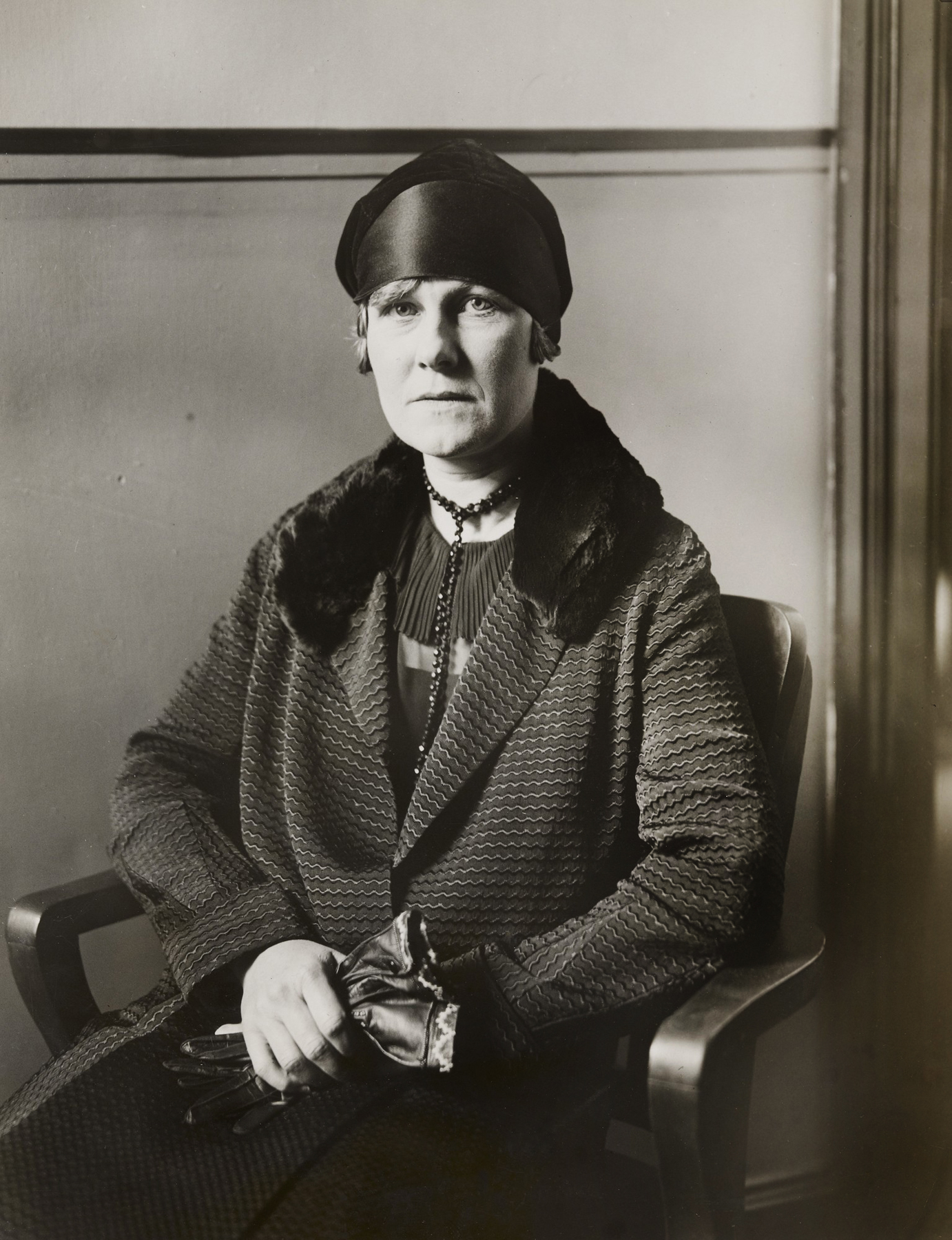
Weegee (Arthur Fellig) (American born Ukraine, 1899-1968) 'Nurse Irma Twiss Epstein, accused of killing a baby' 1942


Weegee (Arthur Fellig) (American born Ukraine, 1899-1968)
Nurse Irma Twiss Epstein, accused of killing a baby
1942
Gelatin silver print
© International Center of Photography


“Distraught and pale with grief, Irma Twiss Epstein, 32-year-old nurse, whose own baby died 18 months ago, is booked on a homicide charge in the death of a baby whose crying, she said, ‘drove me crazy.’ Miss Epstein, Bronx Maternity Hospital nurse, is accused of giving a powerful drug to the 20 hour-old daughter of Mr. and Mrs. Castro Vallee, whose only other child died after birth 11 years ago. Another infant, 4 days old, was revived by nurses and doctors after Miss Epstein was found in a hallway hysterically sobbing: ‘eyedropper, baby.’ Hospital records showed she entered service there in 1940 and after nine months took a leave of absence to have a baby. Police said she had been in Bellevue’s psychopathic ward two years ago for observation after tasking an overdose of sleeping tablets. She told police at Morrisania Station she expected to be married soon.”

PM Daily, December 23, 1940 quoted on the International Center of Photography website


Weegee (Arthur Fellig) (American born Ukraine, 1899-1968) 'Harry Maxwell shot in a car' 1941


Weegee (Arthur Fellig) (American born Ukraine, 1899-1968)
Harry Maxwell shot in a car
1941
Gelatin silver print
© International Center of Photography


A pivotal figure of American photography in the first half of the twentieth century, Arthur H. Fellig, known by his pseudonym Weegee (Zolochiv, 1899 – New York, 1968) was an immensely popular artist thanks to the news photographs he took in New York in the 1930s and 1940s. This new exhibition aims to reveal a lesser-known facet of his career: the work he did between 1948 and 1951 in Hollywood, where he focused on the “society of the spectacle”.

Key themes

High-impact photographs

Some of Weegee’s photographs were veritable “visual punches”. This is true of the pictures he took of murders, corpses, fires and prisoners during the years spent covering crimes and accidents in New York, as well as of his later work, like the series showing circus artist Egle Zacchini being fired from a cannon at a speed of 100 metres per second, or his photo-caricatures of Marilyn Monroe, President Kennedy and other prominent personalities. His images almost always had a powerful impact on viewers, making them think not only about the scene they were contemplating but also about how they were looking at it.

The society of the spectacle

First published in 1967, Society of the Spectacle is one of the most important books by the philosopher Guy Debord, founding member of the Situationist International. It paints an incisive portrait of contemporary society, presumably replaced by its represented image. Throughout the work, Debord critically exposes the theory and practice of the spectacle, explaining how it governs our experience of time, history, goods, territory and happiness. In the twenty-first century, when immediacy reigns supreme, Debord’s ideas resound as the severest, most lucid assessment of the meanness and bondage of a society – the society of the spectacle – in which we all live.

Critique of the society of the spectacle

Class consciousness and empathy for the disadvantaged permeate Weegee’s work, as he never forgot his humble beginnings. Yet his most famous images are snapshots of accidents, fires and murders, in which he underscores the idea that bystanders are also spectators of the tragedies they contemplate, watching a scene in much the same way as cinema-goers watch Hollywood films (which are not all that different to the events captured by Weegee’s camera). He also used trick photography to critique the image of actors, singers, broadcasters, politicians and other public figures.

Weegee’s “satires”, as he called them, were visionary, appearing several years before the Situationist International first posited its theories. As Clement Che roux, curator of the exhibition, has pointed out, during his first period in New York, Weegee proved that the tabloids were selling news as a spectacle, and after 1945 he exposed how the media system radically spectacularised celebrities.

Biography

Weegee was born Usher Felig on 12 June 1899 to a Jewish family in Zolochiv, now in western Ukraine. At the age of ten he travelled to the United States to be reunited with his father, and immigration officers on Ellis Island registered him as Arthur Fellig. At 14, having settled into New York’s Lower East Side, a poor neighbourhood at the time, he left school and started working to help support his family. After trying several jobs, he became an itinerant photographer. He subsequently worked for the photographers Duckett & Adler and later in the ACME Newspictures agency laboratories. In 1935, he went into business for himself as a freelance photojournalist. He began using the pseudonym Weegee around 1937, and in 1941, the year he joined the Photo League (a group of freelance photographers who firmly believed in the emancipating power of images and fought for social justice), he started signing his prints as “Weegee the Famous”. In 1943, his work was included in a group exhibition at New York’s Museum of Modern Art (MoMA).

In 1945 he compiled his best photos in a book titled Naked City, which was a huge critical and commercial success. In the spring of 1948 Weegee moved to Hollywood, where he worked in cinema as a technical consultant and occasionally as an actor. In addition to photographing parties, he devised several trick photography techniques and used them to caricature celebrities. After four years on the West Coast, in December 1951 he returned to New York, although he did not resume his former practice. From that moment until his death on 26 December 1968, Weegee mainly capitalised on his fame to publish more books, do lecture tours, and widely circulate his photo-caricatures in the press.

The exhibition

There is a mystery in Weegee’s work which the exhibition now on view at Fundacio n MAPFRE aims to unravel. From very early on, the artist was internationally renowned for his photographs taken in the 1930s and 1940s and printed in the New York tabloids: corpses, fires, detainees in police wagons, etc. But Weegee had another group of works which, at first glance, might seem diametrically opposed to his reportage: the photo-caricatures of public figures created in Hollywood between 1948 and 1951. Critics highlighted the opposition between these two periods, praising the former and rejecting the latter. Weegee: Autopsy of the Spectacle attempts to reconcile both bodies of work by showing that, stylistic differences aside, they are fundamentally consistent in their portrayal of the “society of the spectacle” which was taking shape in the United States at that time.

In his early years, the artist photographed lurid, violent subjects, but those shots were often deeply ironic and exposed the “spectacular” nature of the depicted events. His images were printed in newspapers, and Weegee often included spectators or fellow photographers – individuals gawking at a traffic accident or murder scene – in the fore or background of his compositions. In a consistent manner, during the second part of his career the artist mocked the Hollywood spectacle: the short-lived fame, the adoring crowds who flocked to see “celebrities”, and the banal society scene. Weegee personally edited and altered these ironic, satirical images in the lab, anticipating the theories of the Situationist International and the critique of the society of the spectacle and its commodification, and always acted in consonance with his own political convictions.

The exhibition curated by Clement Che roux, director of Fondation Henri Cartier-Bresson, features over one hundred photographs and a variety of documentary material. With a new perspective on Weegee’s oeuvre, the itinerary is divided into three sections and offers a sweeping overview of his work.

The spectacle of news reportage

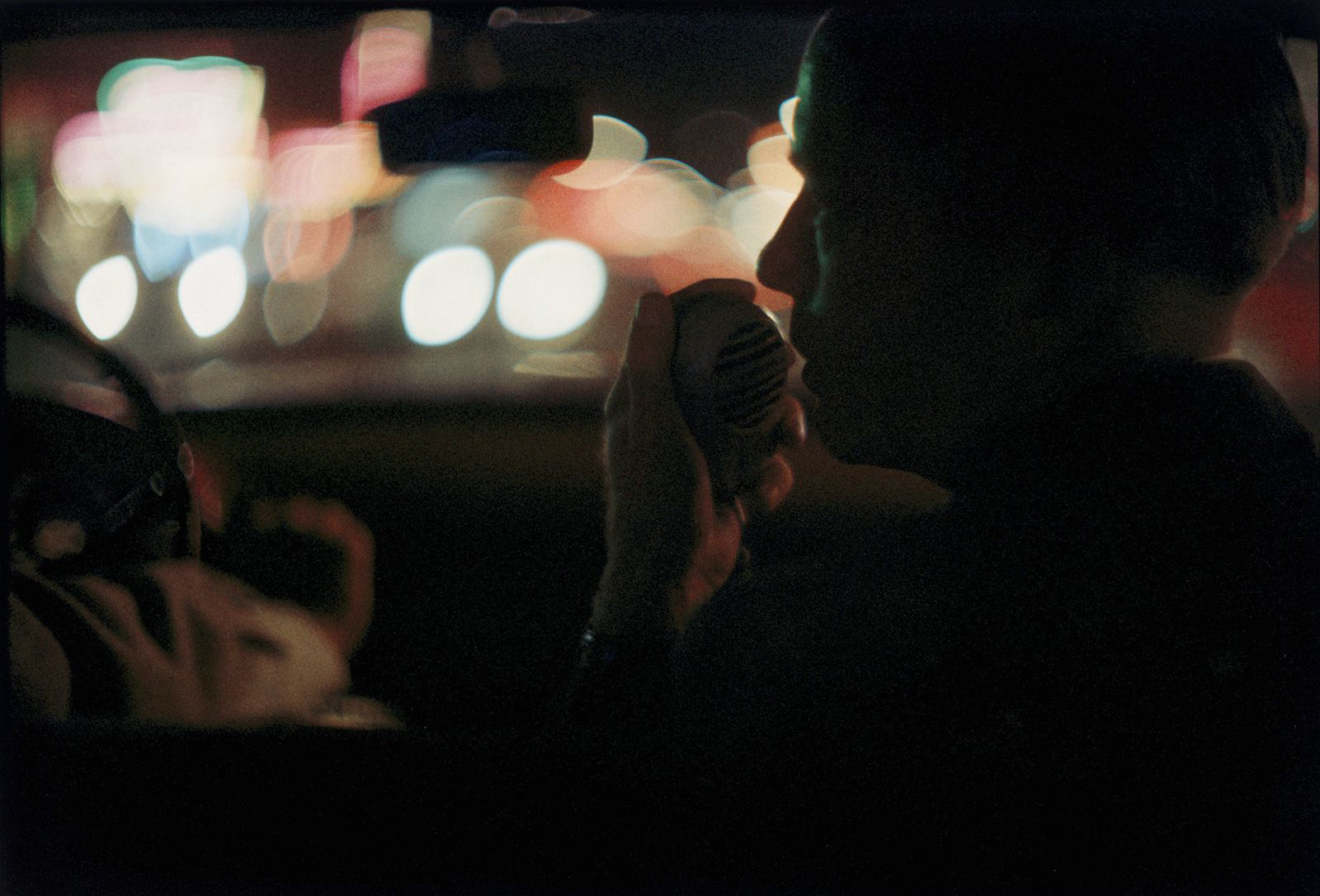
In 1935, Weegee went into business for himself as a freelance photojournalist. Thanks to a radio tuned to the police frequency which he installed in his car – basically a mobile office where he kept everything he needed to take photos – Weegee was always one of the first to arrive at the scene of a crime, fire or traffic accident. It was the Prohibition era, and gang violence was rampant in New York. Every night for ten years, Weegee covered the city’s accidents and crimes with flash photographs and, starting in 1940, did the same for the NP Daily, a newspaper with Marxist leanings. As the artist himself confessed, “Murder is my business.”

In addition to fires and crimes, during this period Weegee also took highly expressive portraits of the individuals who emerged from police wagons after a raid. At a time when it was considered criminal for a man to wear women’s clothes, some of those detainees tried to hide their faces while others basked in the attention, exiting the vehicle as if making a stage entrance. With these images, the artist emphasised the idea that social relations and the world in general were becoming pure spectacle.

At the same time, Weegee never forgot his roots as the son of poor Jewish immigrants and was keenly aware of the living conditions of the most destitute. For this reason, he also captured homeless people and acts of racial and everyday discrimination against the underprivileged, making his photographs “genuine social documents”.

The society of spectators

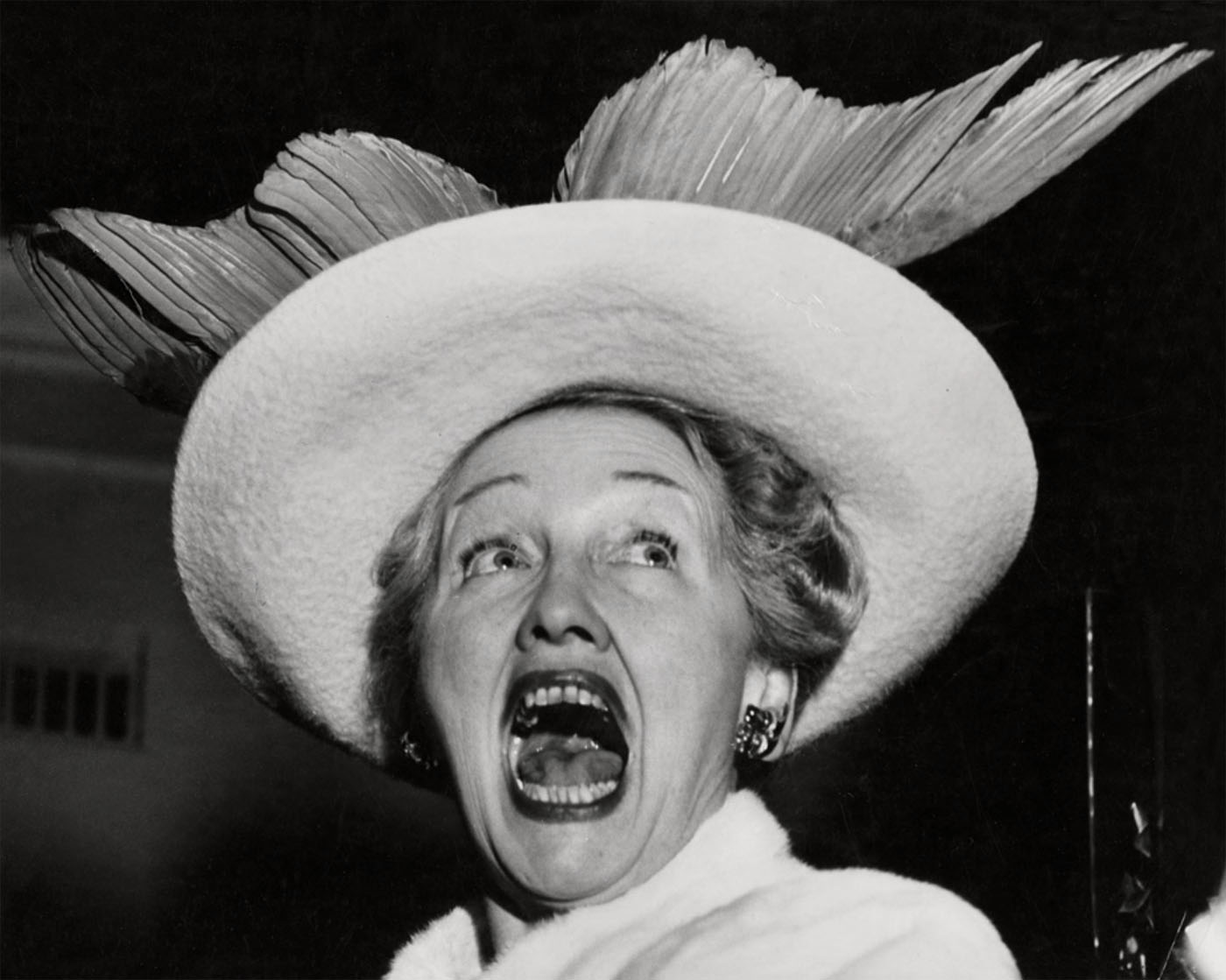
“The Curious Ones” is the title of a chapter in Naked City, the compilation of Weegee’s best photographs that he published in 1945. Thanks to that book, which was a huge critical and commercial success, he began to attend New York’s important society events much more frequently, photographing them exactly as he would a crime or accident scene. This is illustrated by two images taken in New York on 22 November 1943, The Critic and In the Lobby at the Metropolitan Opera, Opening Night. The artist was particularly interested in representing human emotions and tried to prevent his subjects from altering their expressions to pose for the camera. Little by little, he began to portray the witnesses to events that happened after dark in New York City, attempting to reflect the entire range of possible human reactions to a tragedy, from astonishment to nervous laughter or tears. Other photographers who came to the same scenes also caught his interest, prompting him to reflect on the very act of taking photos.

With all this repertoire, Weegee showed how ordinary individuals became voyeurs by treating the scene of the crime as a theatrical stage. Recalling the moment in 1939 when he took the photograph Balcony Seats at a Murder, he explained, “The detectives are all over […]. To me this was drama. This was like a backdrop. I stepped back about a hundred feet. I used flash powder and I got this whole scene. The people on the fire escapes, the body, everything!”

The comedy of the spectacular

In 1967, Guy Debord wrote that “the spectacle is capital to such a degree of accumulation that it becomes an image” in his book Society of the Spectacle. Weegee, who understood this very well, photographed every sight that struck him as out of the ordinary. Fascinated by the makeup of crowds, he portrayed them enjoying a peaceable Sunday afternoon at the beach on Coney Island or celebrating the end of World War II in Chinatown; but he was also drawn to carnival and circus attractions and to cinemas, where he photographed movie-goers in the dark, engrossed in the film on screen.

Tired of murders and crime scenes, in 1948 Weegee moved to Hollywood and traded the direct, documentary-style photography he had practised in New York for manipulated images that required hours in the lab. During his stint in California, he turned his lens upon actors, singers, broadcasters and society figures. His vision of these individuals was not usually very flattering, photographing them from behind or in awkward situations. In some cases he would later distort the images using a kaleidoscope, photomontage or multiple exposure. Weegee created what he called “photo-caricatures”, a tradition that started among amateur photographers in the late nineteenth century and was originally known as “photographic amusements”, although he stated in his autobiography that his photo-caricatures had never been done before. Though a celebrity himself, the artist used photography to criticise the star system.

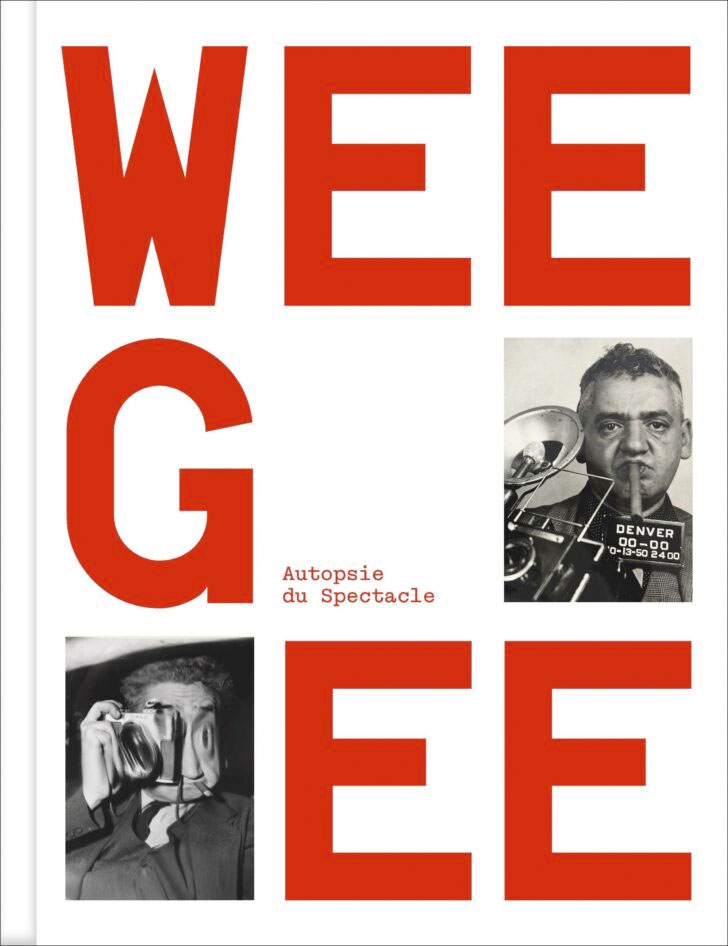
Catalogue

The exhibition, organised by Fondation Henri Cartier-Bresson in partnership with Fundacion MAPFRE, is accompanied by a publication titled Weegee. Autopsia del espectáculo, in which the majority of the images on display are reproduced. The catalogue contains a text by Clement Che roux, the show’s curator and director of Fondation Henri Cartier-Bresson, and two more essays by Cynthia Young, a curator specialised in photojournalism, and Isabelle Bonnet, a lecturer at the Sorbonne and photography expert. The writer, curator and photography lecturer David Campany has also made an important contribution to the volume, in which he compares Weegee and Stanley Kubrick based on their collaboration on Dr. Strangelove or: How I Learned to Stop Worrying and Love the Bomb.

The original edition in French was published by Éditions Textuel with Fondation Henri Cartier-Bresson, and the Spanish-language edition has been co-published with Fundación MAPFRE.

Text from the Fundación MAPFRE
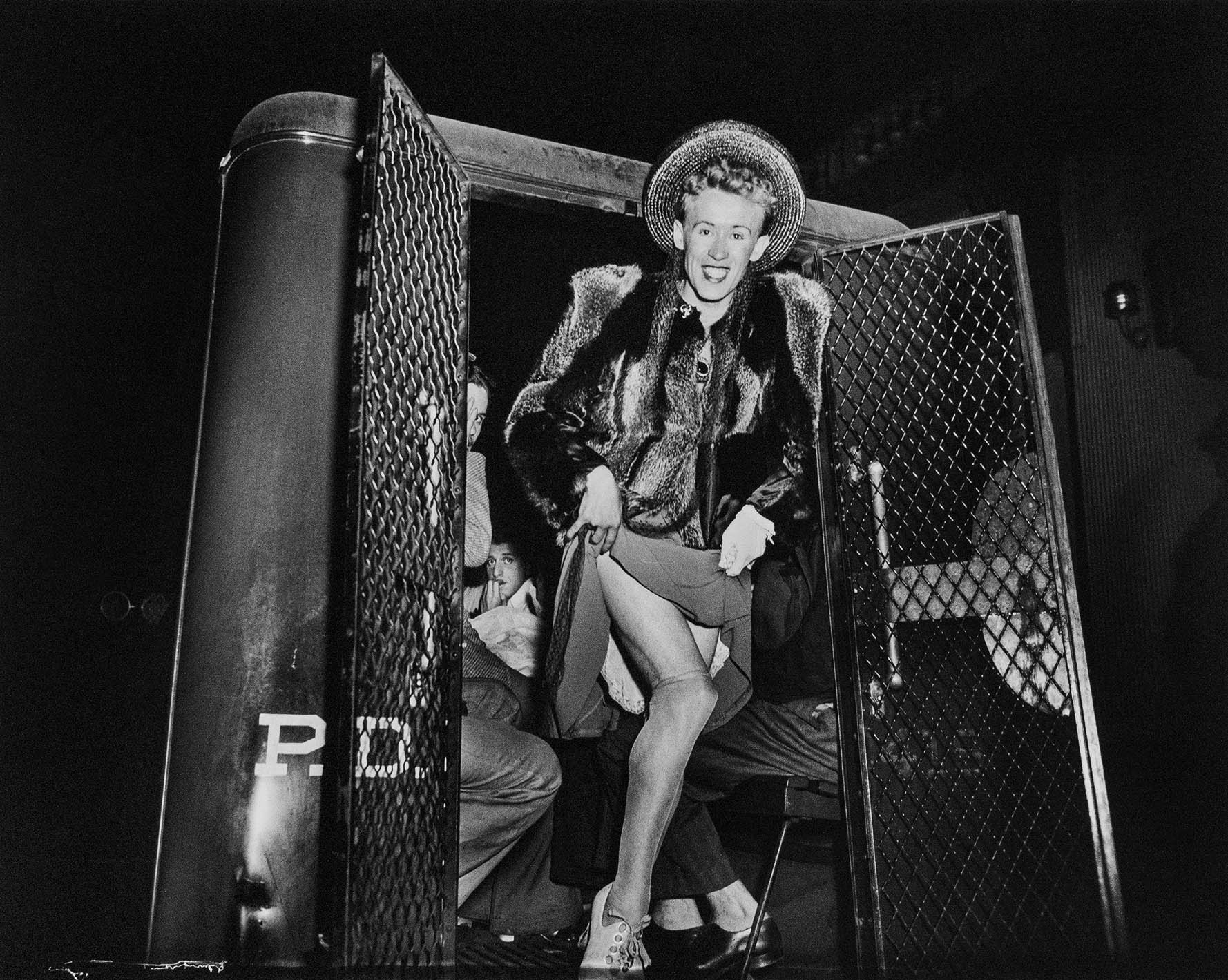
 

Weegee (Arthur Fellig) (American born Ukraine, 1899-1968) 'Man Arrested for Cross-Dressing, New York' c. 1939


Weegee (Arthur Fellig) (American born Ukraine, 1899-1968)
Man Arrested for Cross-Dressing, New York
c. 1939
Gelatin-silver print
© International Center of Photography. Louis Stettner Archives, Paris
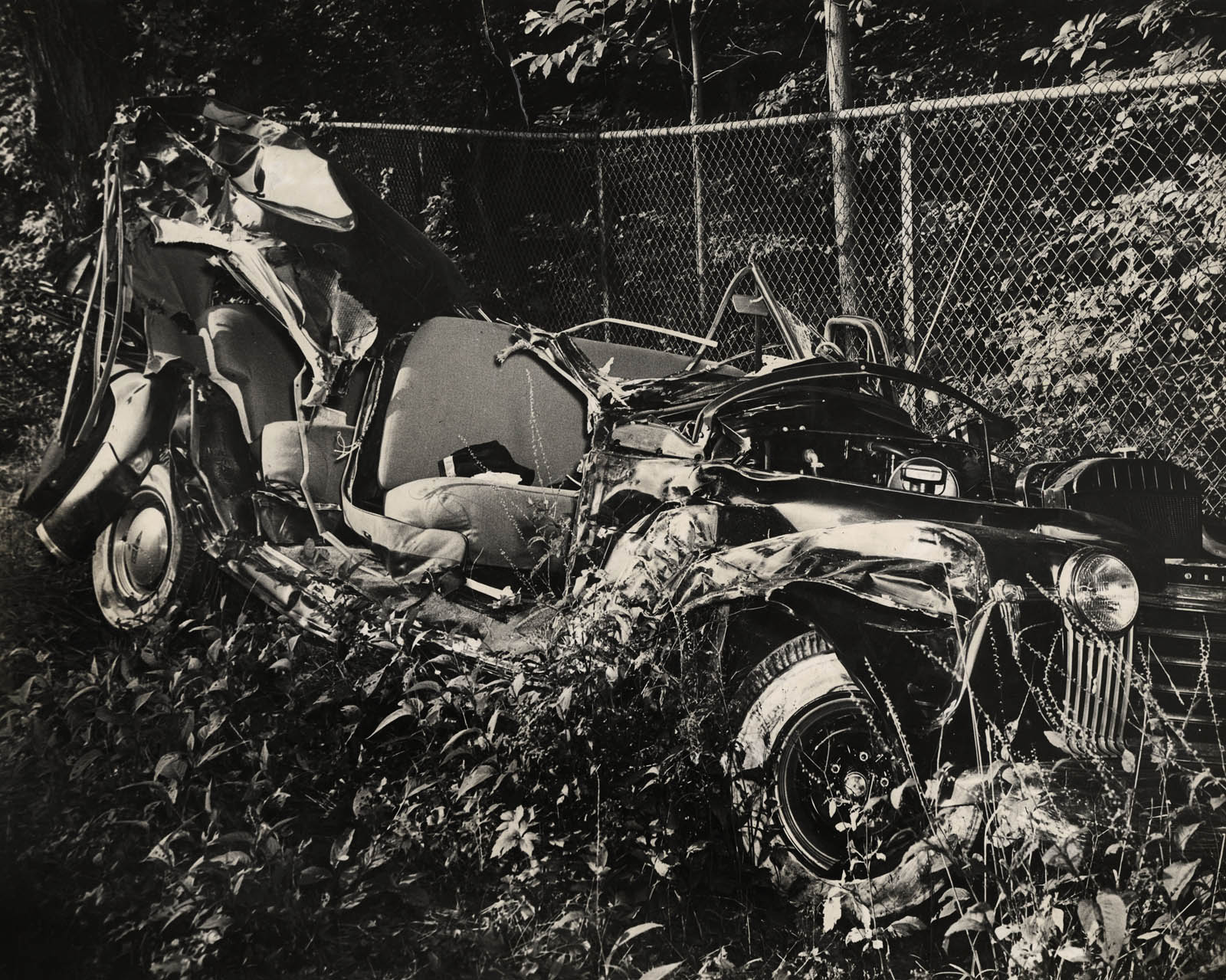
 

Weegee (Arthur Fellig) (American born Ukraine, 1899-1968) 'Holiday Accident in the Bronx' July 30th 1941


Weegee (Arthur Fellig) (American born Ukraine, 1899-1968)
Holiday Accident in the Bronx
July 30th 1941
Gelatin-silver print
© International Center of Photography
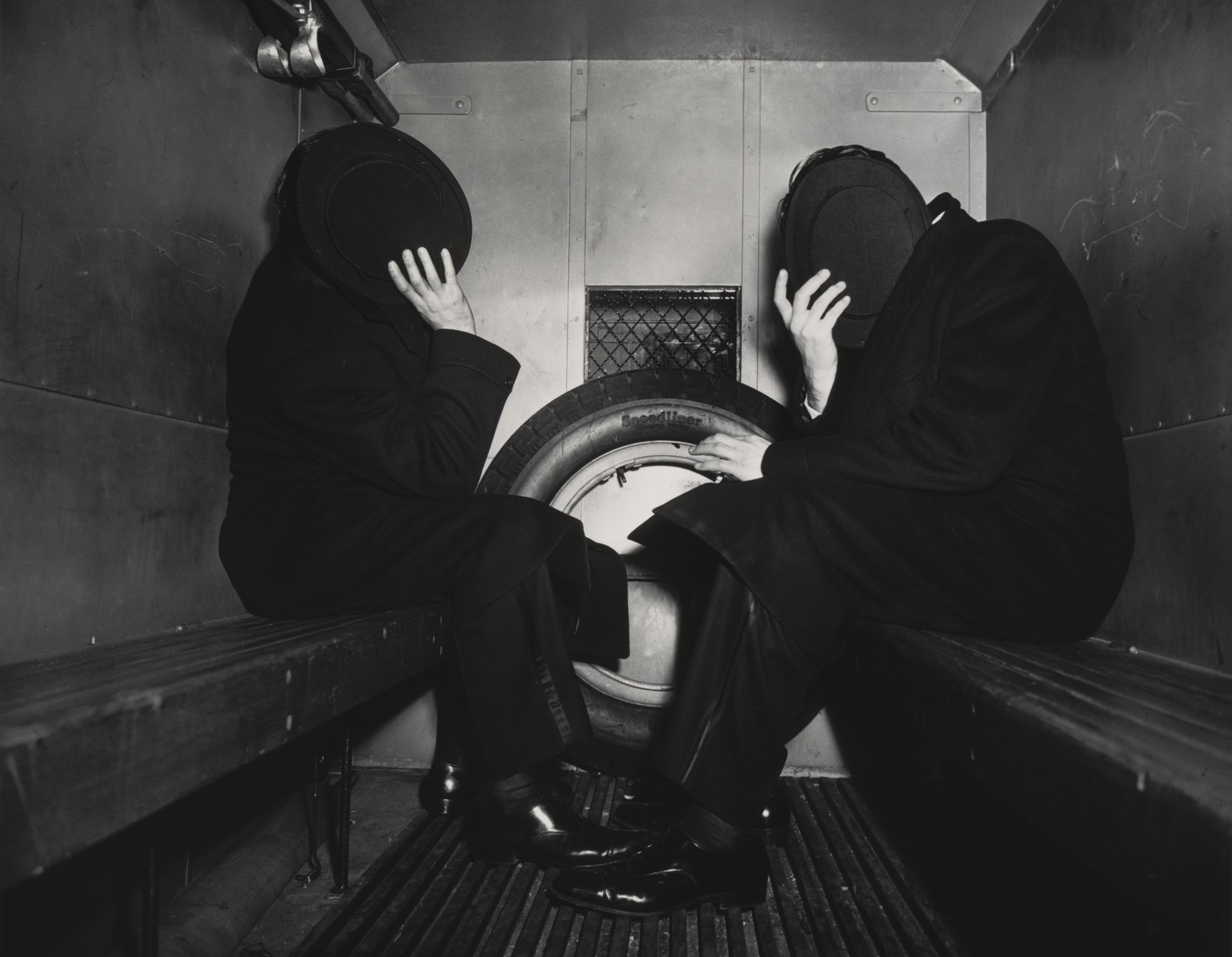
 

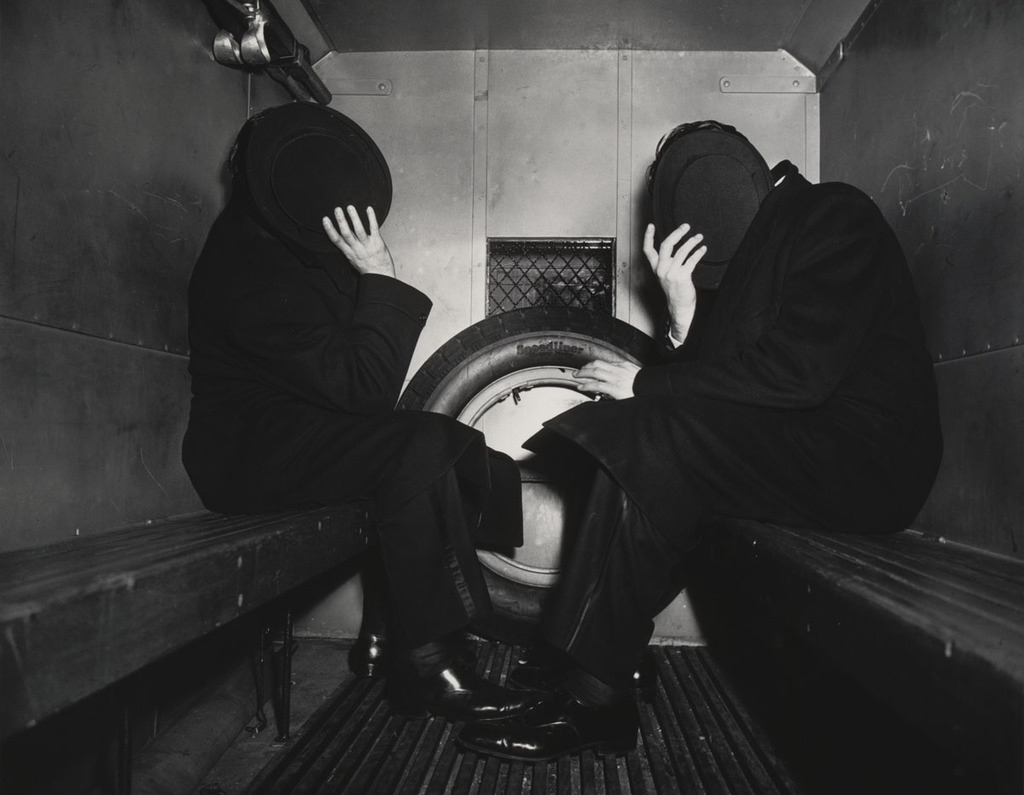
Weegee (Arthur Fellig) (American born Ukraine, 1899-1968) 'Charles Sodokoff and Arthur Webber Use Their Top Hats to Hide Their Faces, New York' January 26th 1942


Weegee (Arthur Fellig) (American born Ukraine, 1899-1968)
Charles Sodokoff and Arthur Webber Use Their Top Hats to Hide Their Faces, New York
January 26th 1942
Gelatin silver print
© International Center of Photography. Louis Stettner Archives, Paris


Weegee (Arthur Fellig) (American born Ukraine, 1899-1968) 'Balcony Seats at a Murder' 1939


Weegee (Arthur Fellig) (American born Ukraine, 1899-1968)
Balcony Seats at a Murder
1939
Gelatin silver print
© International Center of Photography
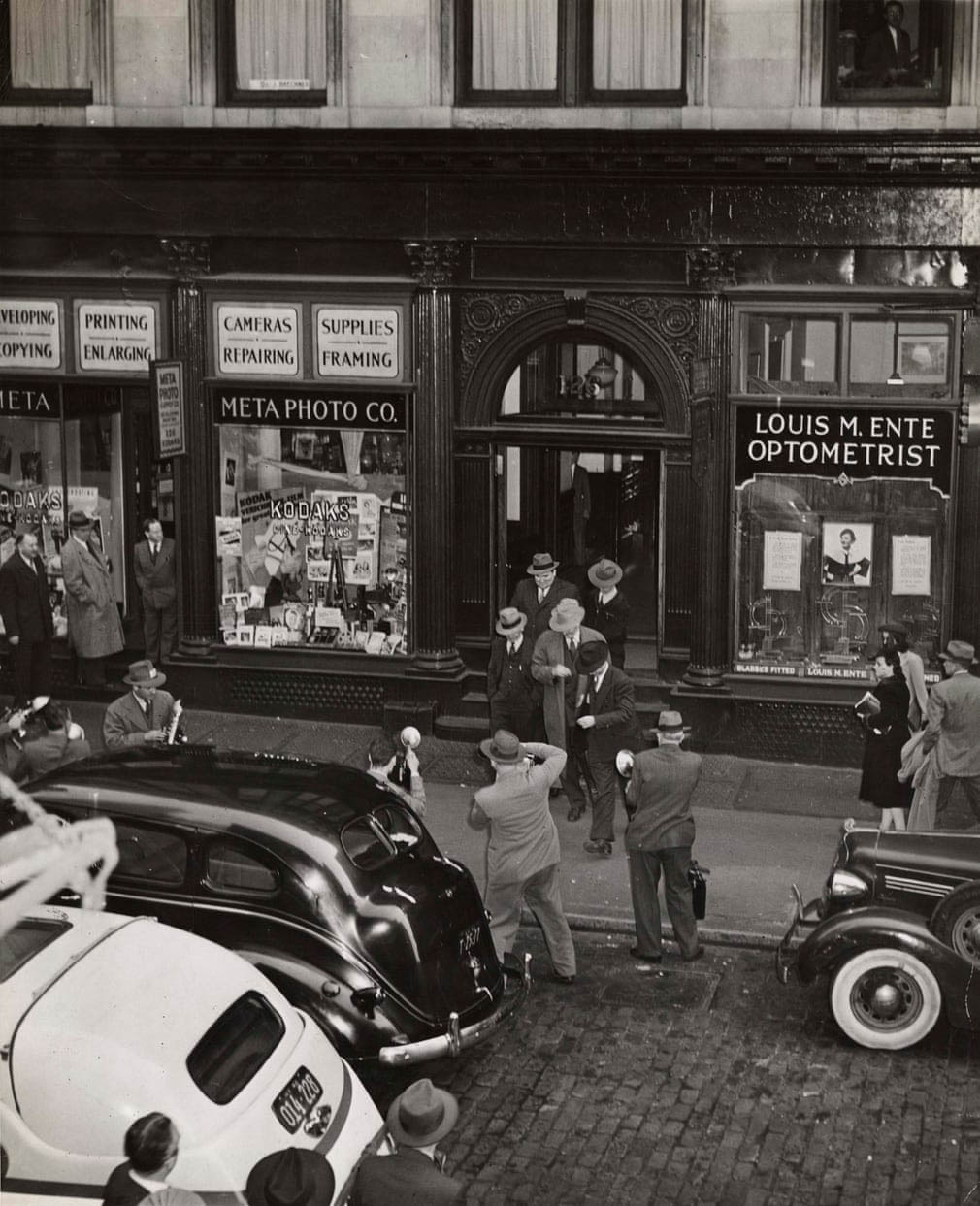
 

Weegee (Arthur Fellig) (American born Ukraine, 1899-1968) 'Arrests made during a gambling raid in lower Manhattan’s Liberty Street' October 1942


Weegee (Arthur Fellig) (American born Ukraine, 1899-1968)
Arrests made during a gambling raid in lower Manhattan’s Liberty Street
October 1942
Gelatin silver print
© International Center of Photography


Weegee (Arthur Fellig) (American born Ukraine, 1899-1968) 'Simply adding boiling water' 1943


Weegee (Arthur Fellig) (American born Ukraine, 1899-1968)
Simply adding boiling water
1943
Gelatin silver print
© International Center of Photography


Weegee (Arthur Fellig) (American born Ukraine, 1899-1968) 'Untitled [Fire in loft building, New York]' 1947


Weegee (Arthur Fellig) (American born Ukraine, 1899-1968)
Untitled [Fire in loft building, New York]
1947
Gelatin silver print
© International Center of Photography


There’s still a mystery to Weegee. The American photographer’s career seems to be split in two. First are his stories for the New York press from 1935-1945. Then, photo-caricatures of public personalities developed during his Hollywood period, between 1948 and 1951, which he continued to produce for the rest of his career. How can these diametrically opposed bodies of work coexist? Critics have enjoyed highlighting the opposition between the two periods, praising the former and disparaging the latter. This project seeks to reconcile the two parts of Weegee by showing that, beyond formal differences, the photographer’s approach is critically coherent.

The spectacle is omnipresent in Weegee’s work. In the first part of his career, coinciding with the rise of the tabloid press, he was an active participant in transforming news into spectacle. To show this, he often included spectators or other photographers in the foreground of his images. In the second half of his career, Weegee mocked the Hollywood spectacular: its ephemeral glory, adoring crowds, and social scenes. Some years before the Situationist International, his photography presented an incisive critique of the Society of the Spectacle.

The News Spectacle

“News photography is my meat.” After many years as a printer for press agencies, Weegee started his own business as a photojournalist in 1935. In order to be the first to arrive at the site of a murder, fire, or traffic accident, he set up a radio in his car, tuned to the police frequency. For a decade, using a flash, he took photographs of news in New York every night.

Weegee Himself

“I have always been a doer and not a thinker.” Weegee enjoyed putting himself in front of the camera, re-enacting circumstances he was confronted with in his daily work. In the name of pedagogy, and probably a little out of narcissism and self-advertisement, he took pictures of himself writing captions for his photographs in the back of his car, in police wagons and behind bars, never without his camera.

Murder Is My Business

“I used to be an expert on murder.” From 1935 to 1945, Weegee spent his nights roaming the city looking for shocking images. Even after Prohibition, New Yorkers’ dreams were punctuated by explosion sounds caused by rival gangs settling scores. The photographer learned to create expressive images which the booming tabloids were particularly fond of.

Off Road

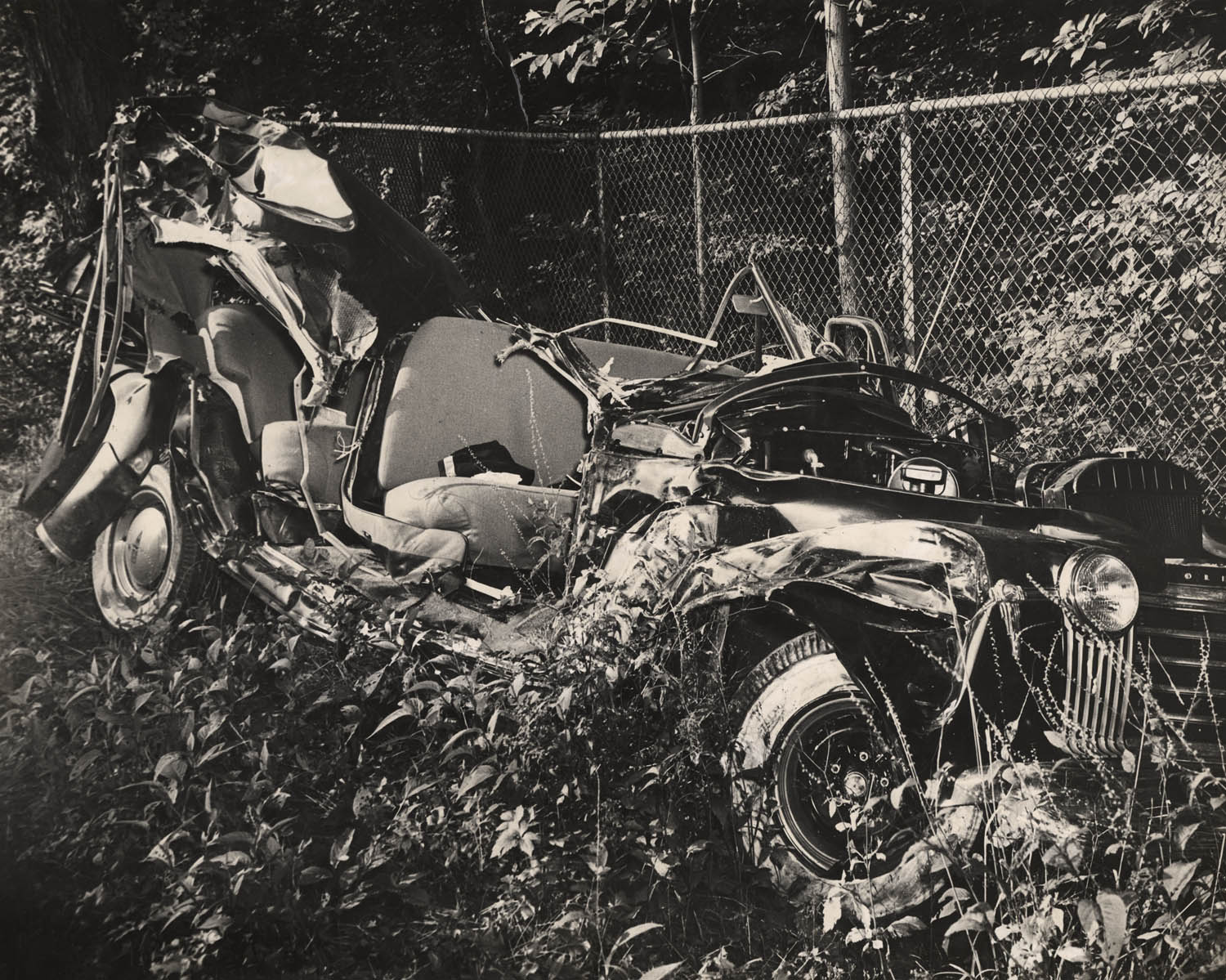
“Sudden death for one…, sudden shock for the other.” American culture is fascinated by twisted metal. In the 19th century, a railroad company staged public collisions between locomotives destined for the junkyard. Weegee photographed many traffic accidents, introducing the “car crash” genre, later adopted by other figures, such as Andy Warhol, J. G. Ballard, David Cronenberg, etc.

The Tragedy of Fire

“Murders and fires (my two best sellers, my bread and butter).” In the darkness of the city, like a moth to a flame, Weegee took photographs of fires. The urban landscape of New York, with its many substandard buildings, provided him with many such opportunities. The combination of fire, smoke and gushing water offered a particularly photogenic spectacle that the press adored.

On The Spot

“The Parade never ceases as the ‘pie’ Wagons unload.” When he wasn’t in the field, Weegee waited at the entrance of the police station for the prison wagon to return with its load of offenders arrested in the night. At a time when it was a criminal act for a man to dress as a woman, some tried to hide their faces, while others took the opportunity to step out of the wagon as if onto a stage.

In Flagrante Delicto

“When criminals tried to cover their faces, it was a challenge to me. I literally uncovered not only their faces, but their black souls as well.” Faced with Weegee’s scrutinising lens, defendants often tried to conceal their identities. In his autobiography, the photographer recounts the many stratagems he developed to oblige them to reveal themselves. Clearly, they didn’t always work.

Social Documents

“The people in these photographs are real.” Coming from a Jewish family who emigrated to the United States from Ukraine at the beginning of the 20th century, experiencing extreme poverty upon their arrival, Weegee was quite aware of standards of living among the underprivileged. He took photographs of ordinary forms of discrimination, people with small trades, and the homeless. His photographs can be seen, in his own words, as “veritable social documents.”

Society of the Spectators

“The Curious ones” is a chapter title from Weegee’s best-seller: Naked City. The photographer takes an interest in people who, like himself, indulge unreservedly in the act of looking. He often includes them in the scenes he photographs, framing them in close-up to create veritable portraits of on-lookers. His work is a particularly striking testimony to the society of spectators developing in the United States at the time.

Meta Photo Co.

“I have no time for messages in my pictures.” Yet Weegee often included other photographers in his compositions as if, through this mise en abyme, he was inciting people to reflect on what it meant to take a photograph. An image from 1942, published in PM’s Weekly, is a good example. Three reporters and the words “Meta Photo Co.” on a window in the background of the photograph indicate there is something to be learned here about photography itself.

The Critic

“‘What is the best picture you ever took?’ Without hesitation I answer, ‘A picture I took at the opening of the Metropolitan Opera House. I consider this to be my masterpiece.'” The circumstances were contrived. Weegee went to a working-class neighbourhood to pick the woman up, then brought her to the entrance of this gala. The image illustrates the widening gap between the rich and the poor under American capitalism. It also reflects the critical power of a simple look.

Looking at Death

“I stepped back far enough to take in the whole scene: the puzzled detectives examining the body, the people on the fire escape, watching… it was like a stage setting.” Balcony seat at a murder: by including spectators in many of his images, Weegee imagines crime scenes as theatrical scenes, underscoring how American society transforms news into spectacle.

Spectators

“When I take a picture of a fire, I forget all about the burning building and I go out to the human element.” After years of tirelessly documenting events of the New York night, Weegee began taking photographs of the individuals who witnessed them. He was thus able to take portraits of groups expressing the full range of human reactions to tragedy, from surprise and tears to nervous laughter.

Out of Frame

“The curious […] ones always rushing by […] but always finding time to stop and look at.” On July 28, 1945, at 9:40 a.m., as a thick fog enveloped New York, a small plane crashed into the 79th floor of the Empire State Building. Weegee photographed spectators trying to catch a glimpse of it. People discovering his photographs in newspapers found themselves in the same position as these observers, a voyeuristic one.

Seeing in the Dark

“It’s hard to photograph people and get natural expressions. The minute they see the camera, they ‘freeze’ up on you.” Weegee was especially interested in depicting emotions on the faces of observers. Concerned that his presence would change their reaction, he had the ingenious idea of taking their photographs in the darkness of a theatre using infrared film. The result is a series of stunning portraits of wide-eyed spectators.

She Gestures of Art

“I used the same technique […] whether it was a murder, a pickpocket, or a society ball.” Following the success of his book Naked City, Weegee was routinely invited to high society events in New York, which he took pleasure in photographing as news items. In October 1945, at the opening of an exhibition by painter Stuart Davis at the MoMA, he captured the strange gestures of the art world.

The Theatre of the Spectacular

“Spectacle is Capital to such a degree of accumulation that it becomes an image,” explained Guy Debord in 1967. Weegee understood this well. He took photographs of all that was visually uncommon: crowds at Coney Island, fairground attractions, stars, acrobats, clowns… and finally, himself. A few years before the Situationist International, he pioneered a visual form of critique of the Society of the Spectacle.

In the Company of Crowds

“And this is Coney Island on a quiet Sunday afternoon […]. A crowd of over a MILLION is usual and attracts no attention.” On a Brooklyn beach, in Times Square or in Chinatown celebrating victory over Nazi power, Weegee never missed the opportunity to photograph crowds. Beyond “mass ornament,” theorised a few years earlier by Siegfried Kracauer, he was fascinated by the ways in which the people constitute themselves as images.

The Cannonball Woman

“Punch in Pictures.” That’s how one magazine described an article on Weegee. The scoop-hunter knows better than anyone else how to produce hard-hitting images. In 1943, Weegee photographed circus performer Egle Zacchini, nicknamed Miss Victory, or The Cannonball Woman, shot out of a cannon at 360 feet per second. As war was raging in Europe, it was a strange metaphor for the role of women in the conflict.

A Circus Community

“Someday they, too, will be stars.” Weegee especially enjoyed hanging around behind the scenes of fairgrounds in the suburbs. He photographed the way a performer at Sammy’s Bar placed her money in her stocking. Elsewhere, a dwarf with a forced smile, a melancholy clown slumped in his dressing room, what remains of the parade after the crowd passes by. Many of his photographs display the ambiance of a sad party.

Photo-caricatures

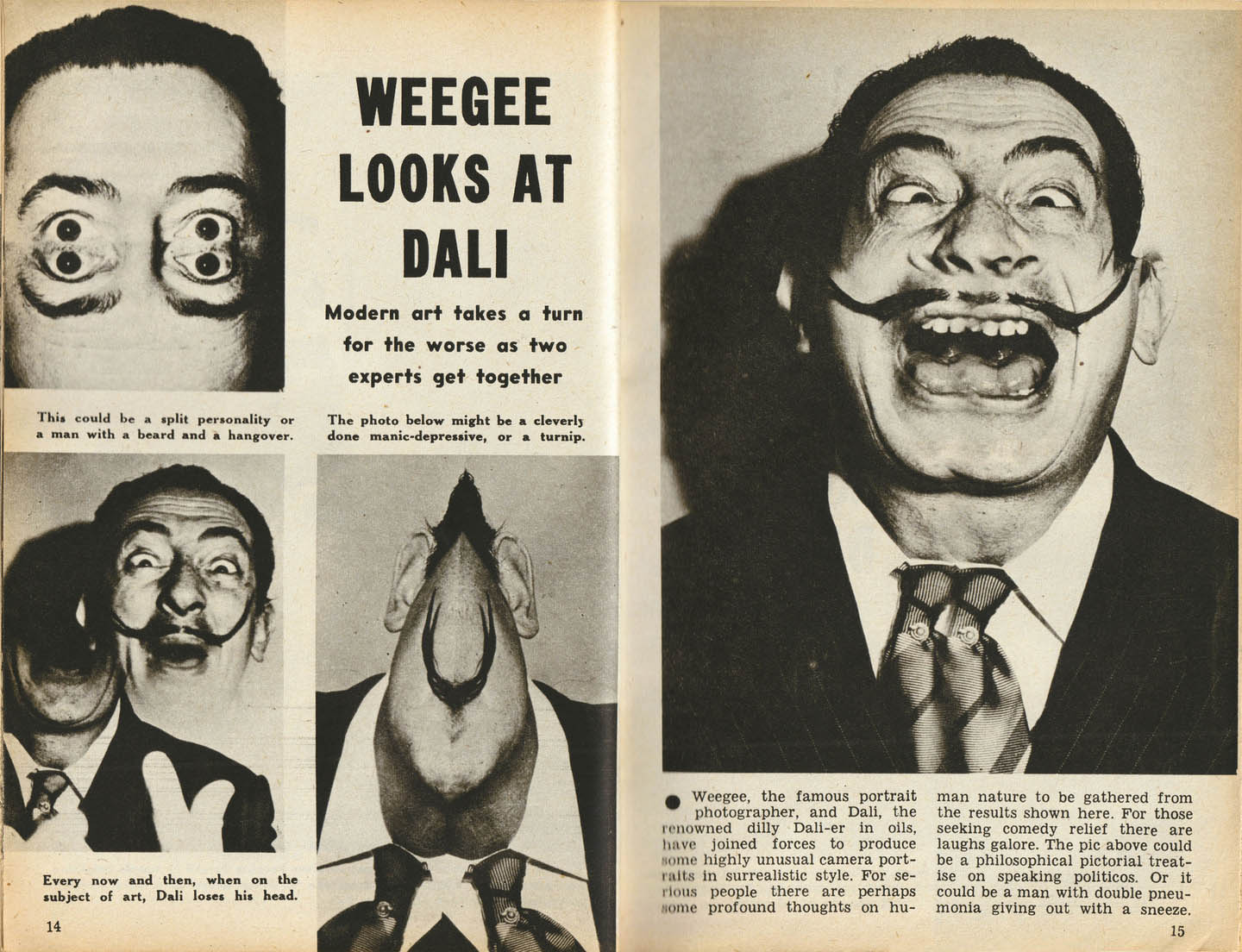
“I was tired of gangsters lying dead with their guts spewed in the gutter, of women crying at tenement-house fires, of automobile accidents […]. I was off to Hollywood.” In the City of Angels, Weegee not only photographs the celebrities he meets, he delights in making caricatures of them with what he calls his “elastic lens,” now mocking the star system.

The Spyglass

“I have used the camera to provoke good old-fashioned belly laughs.” In 1963, Weegee was invited to the set of Stanley Kubrick’s Doctor Strangelove. The director was a great fan of Weegee, and had begun his own career as a press photographer. On set, Weegee applied a new technique for the tubular distortion of faces, as if one were looking through the small end of a spyglass.

Trick Inventory

“Their originality was such that they sold like hot cakes.” This is how Weegee described his photo-caricatures, the first of which appeared in papers in 1947. For 20 years and up until his death in 1968, he would regularly publish these works. Around fifty of the publications are known today. There are most likely many more. In his daily work, the photo-caricature came to definitively replace the news item.

Weegee, Ouija

“I’m called Weegee which comes from Ouija.” The pseudonym Weegee refers to the name of a board used in seances to decipher messages from the beyond. Weegee liked to describe himself as a “psychic photographer”, able to predict in advance where a story will take place. On the scene, he said he photographed using his “third eye.” Whether clairvoyant or voyeur, Weegee was able to see, better than anyone else, transformations in American society.

Text from the Fundación MAPFRE
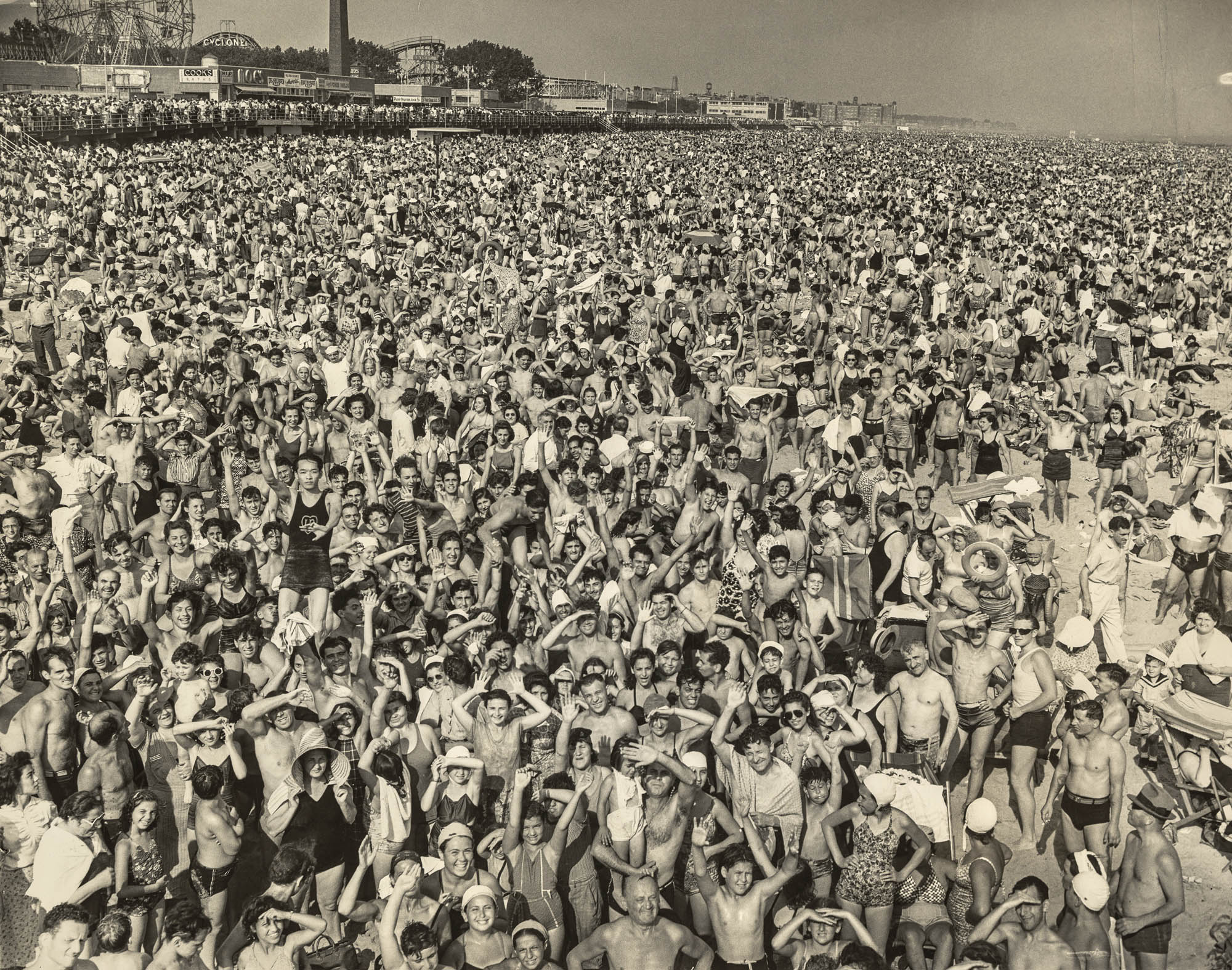
 

Weegee (Arthur Fellig) (American born Ukraine, 1899-1968) 'Afternoon Crowd at Coney Island' July 21st 1940


Weegee (Arthur Fellig) (American born Ukraine, 1899-1968)
Afternoon Crowd at Coney Island
July 21st 1940
Gelatin-silver print
© International Center of Photography. Courtesy Galerie Berinson, Berlin


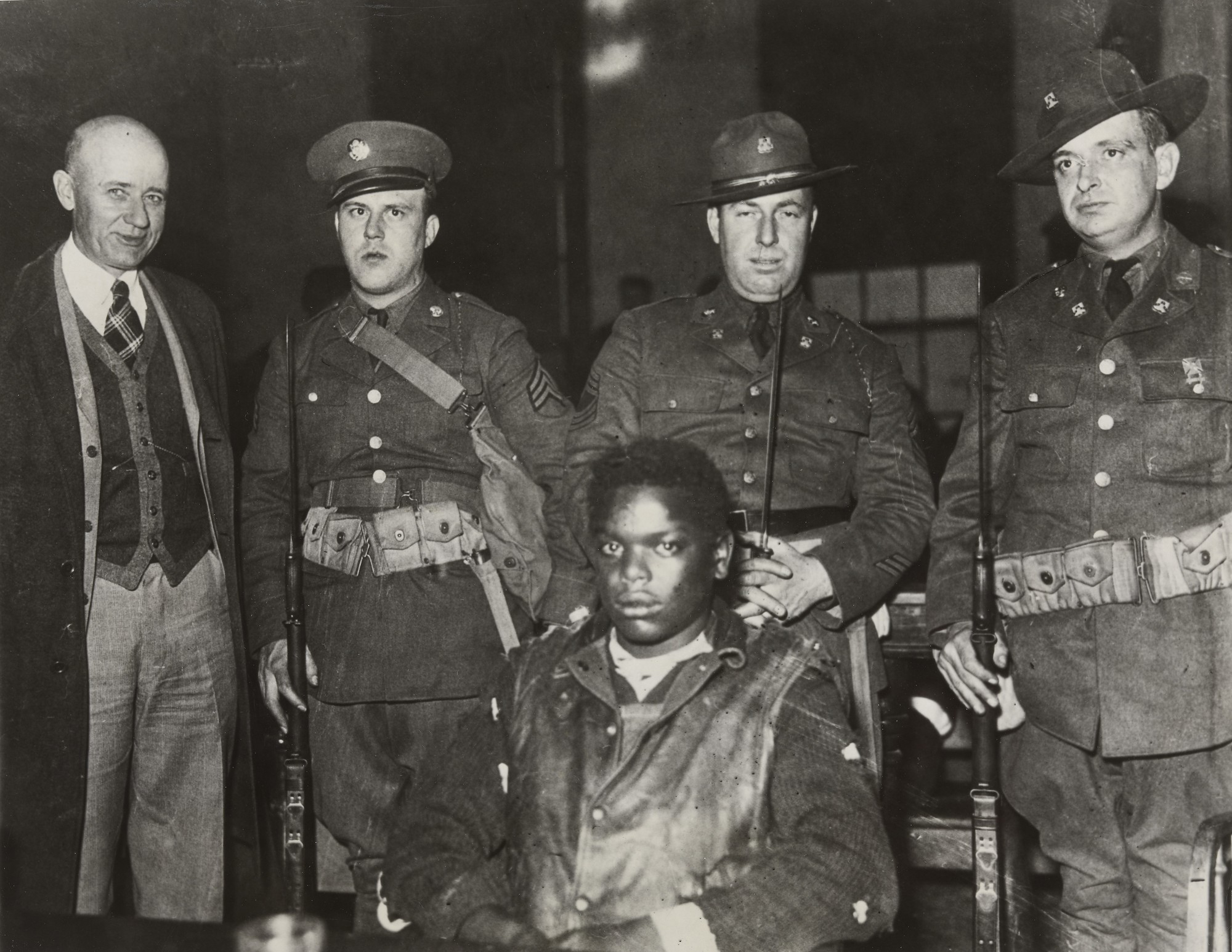
Weegee (Arthur Fellig) (American born Ukraine, 1899-1968) 'Anthony Esposito, Booked on Suspicion of Killing a Policeman, New York' January 16th 1941


Weegee (Arthur Fellig) (American born Ukraine, 1899-1968)
Anthony Esposito, Booked on Suspicion of Killing a Policeman, New York
January 16th 1941
Gelatin silver print
© International Center of Photography. Louis Stettner Archives, Paris


Weegee (Arthur Fellig) (American born Ukraine, 1899-1968) '[Black Buick with dead passenger pulled out of the Harlem River, New York]' February 23, 1942


Weegee (Arthur Fellig) (American born Ukraine, 1899-1968)
[Black Buick with dead passenger pulled out of the Harlem River, New York]
February 23, 1942
Gelatin silver print
© Weegee Archive/International Center of Photography
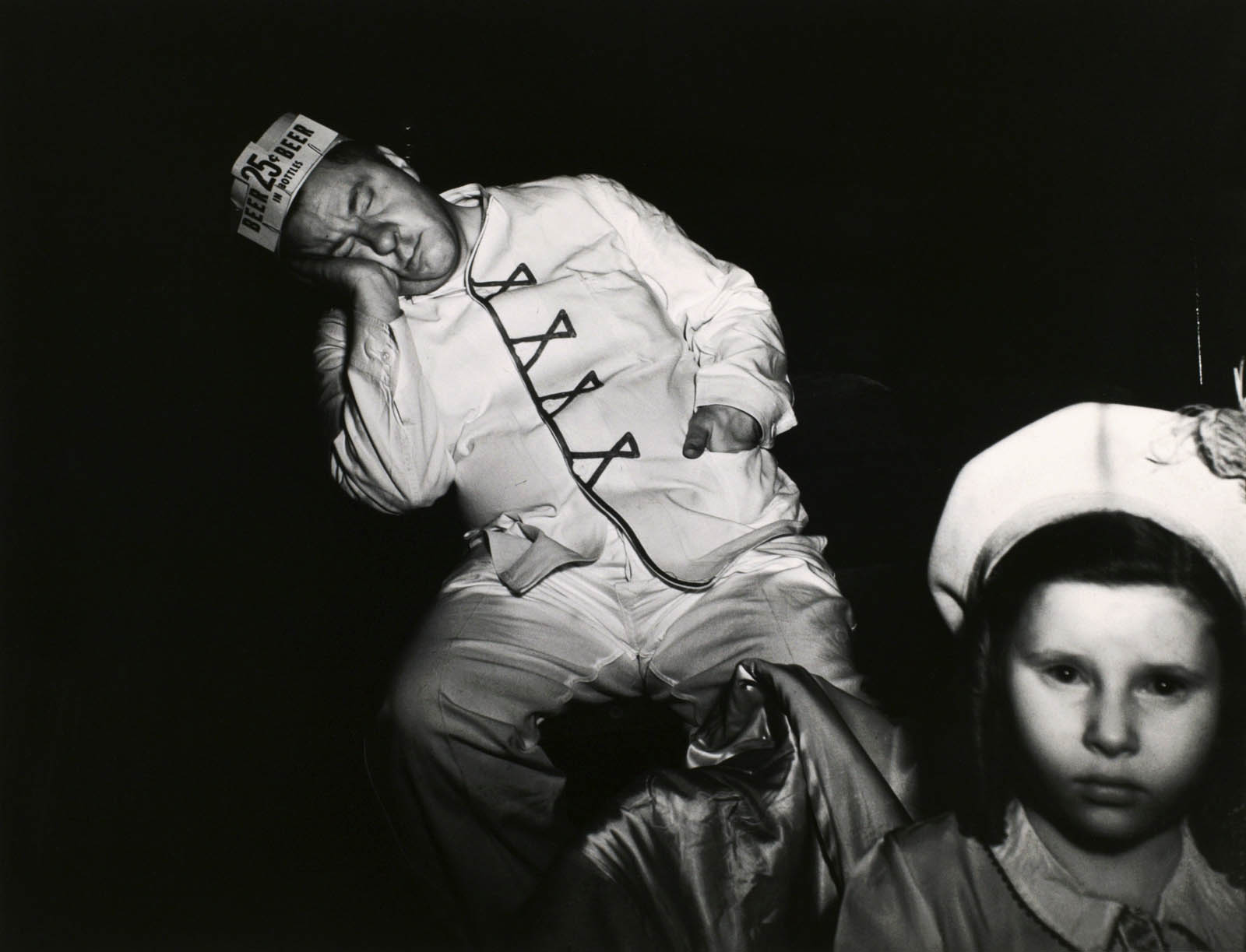
 

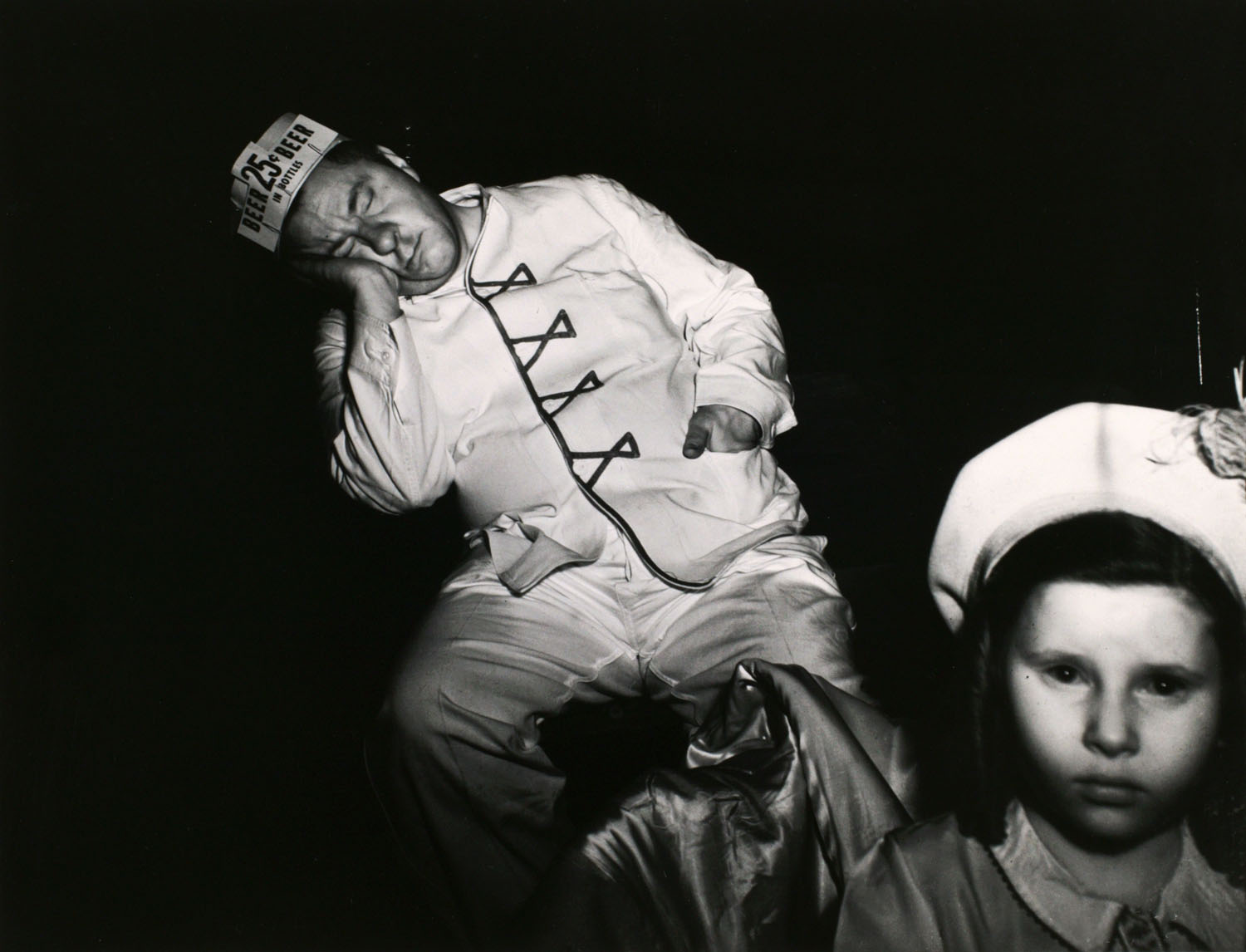
Weegee (Arthur Fellig) (American born Ukraine, 1899-1968) 'Sleeping at the Circus, Madison Square Garden, New York' June 28th 1943


Weegee (Arthur Fellig) (American born Ukraine, 1899-1968)
Sleeping at the Circus, Madison Square Garden, New York
June 28th 1943
Gelatin-silver print
© International Center of Photography


Weegee (Arthur Fellig) (American born Ukraine, 1899-1968) 'The Critic, New York' November 22nd 1943


Weegee (Arthur Fellig) (American born Ukraine, 1899-1968)
The Critic, New York
November 22nd 1943
Gelatin silver print
© International Center of Photography. Collection Friedsam


Weegee (Arthur Fellig) (American born Ukraine, 1899-1968) '[After the opera, Sammy's on the Bowery, New York]' 1943-1945


Weegee (Arthur Fellig) (American born Ukraine, 1899-1968)
[After the opera, Sammy’s on the Bowery, New York]
1943-1945
© Weegee Archive/International Center of Photography
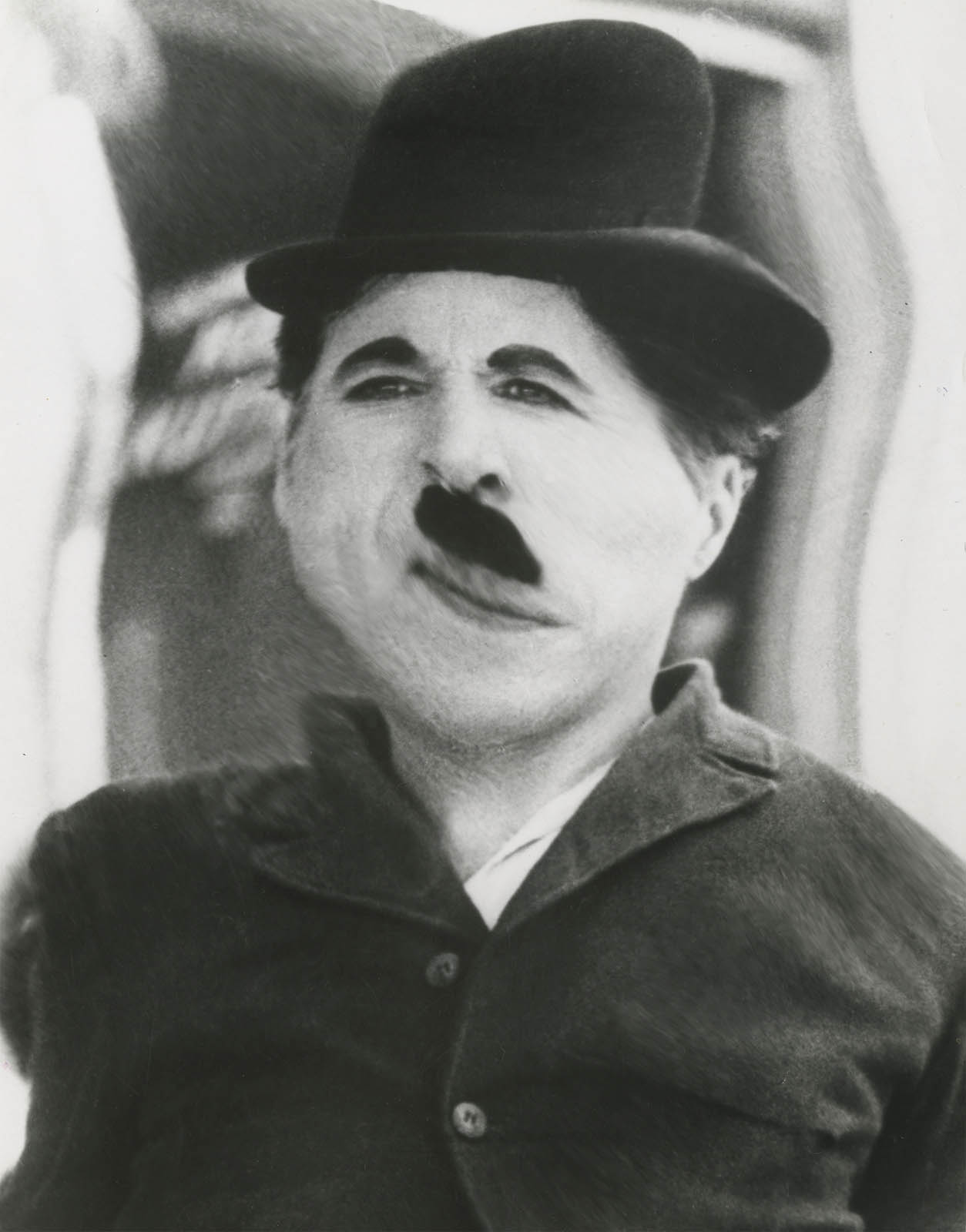
 

Weegee (Arthur Fellig) (American born Ukraine, 1899-1968) 'Charlie Chaplin, Distortion' c. 1950


Weegee (Arthur Fellig) (American born Ukraine, 1899-1968)
Charlie Chaplin, Distortion
c. 1950
Gelatin silver print
© International Center of Photography
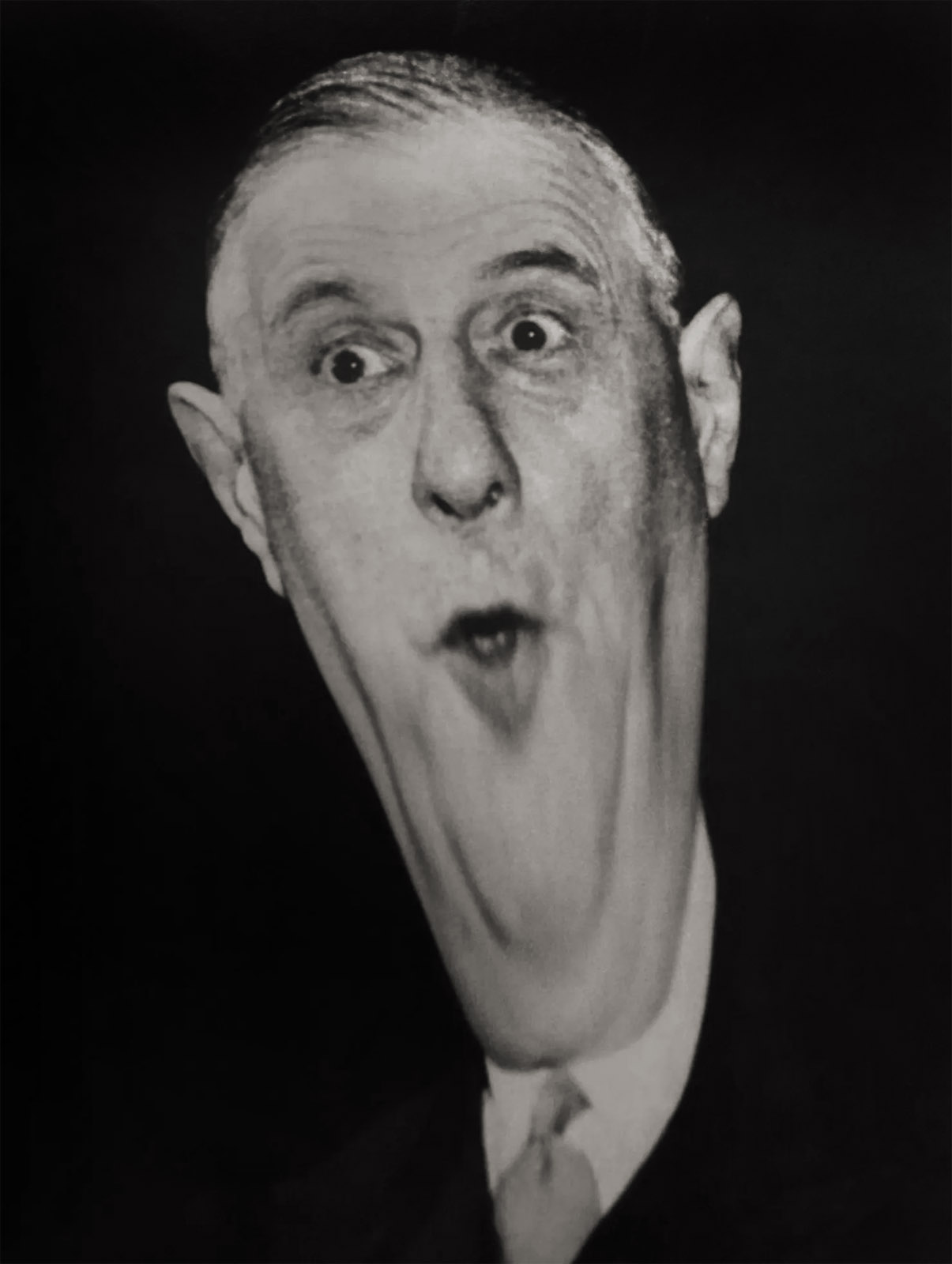
 

Weegee (Arthur Fellig) (American born Ukraine, 1899-1968) 'Charles de Gaulle, Distortion' 1959


Weegee (Arthur Fellig) (American born Ukraine, 1899-1968)
Charles de Gaulle, Distortion
1959
Gelatin silver print
© International Center of Photography
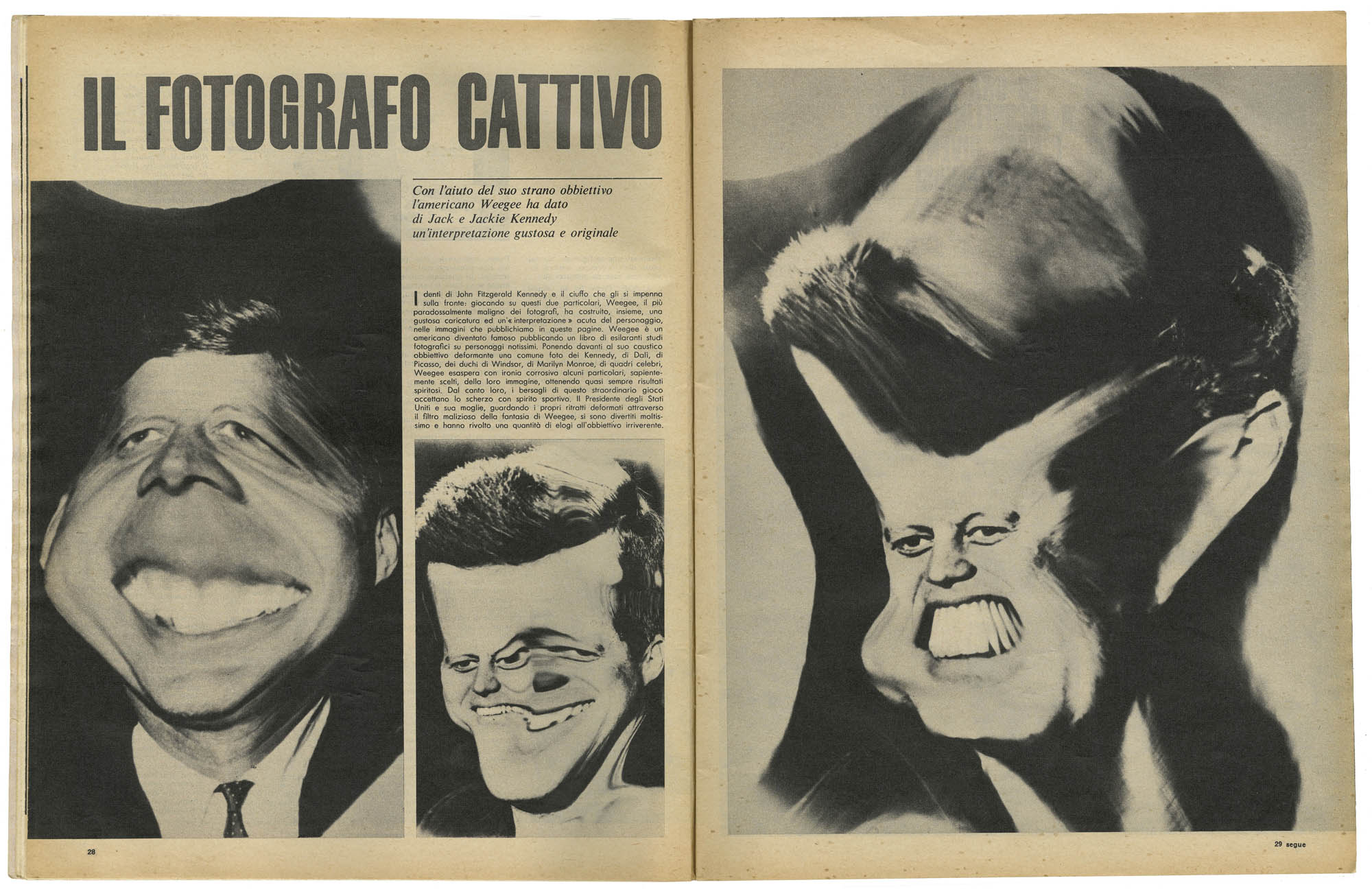
 

"Il Fotografo cattivo", Epoca, vol. XIII, No. 636, December 1962


“Il Fotografo cattivo”, Epoca, vol. XIII, No. 636, December 1962
© International Center of Photography. Collection privée Paris
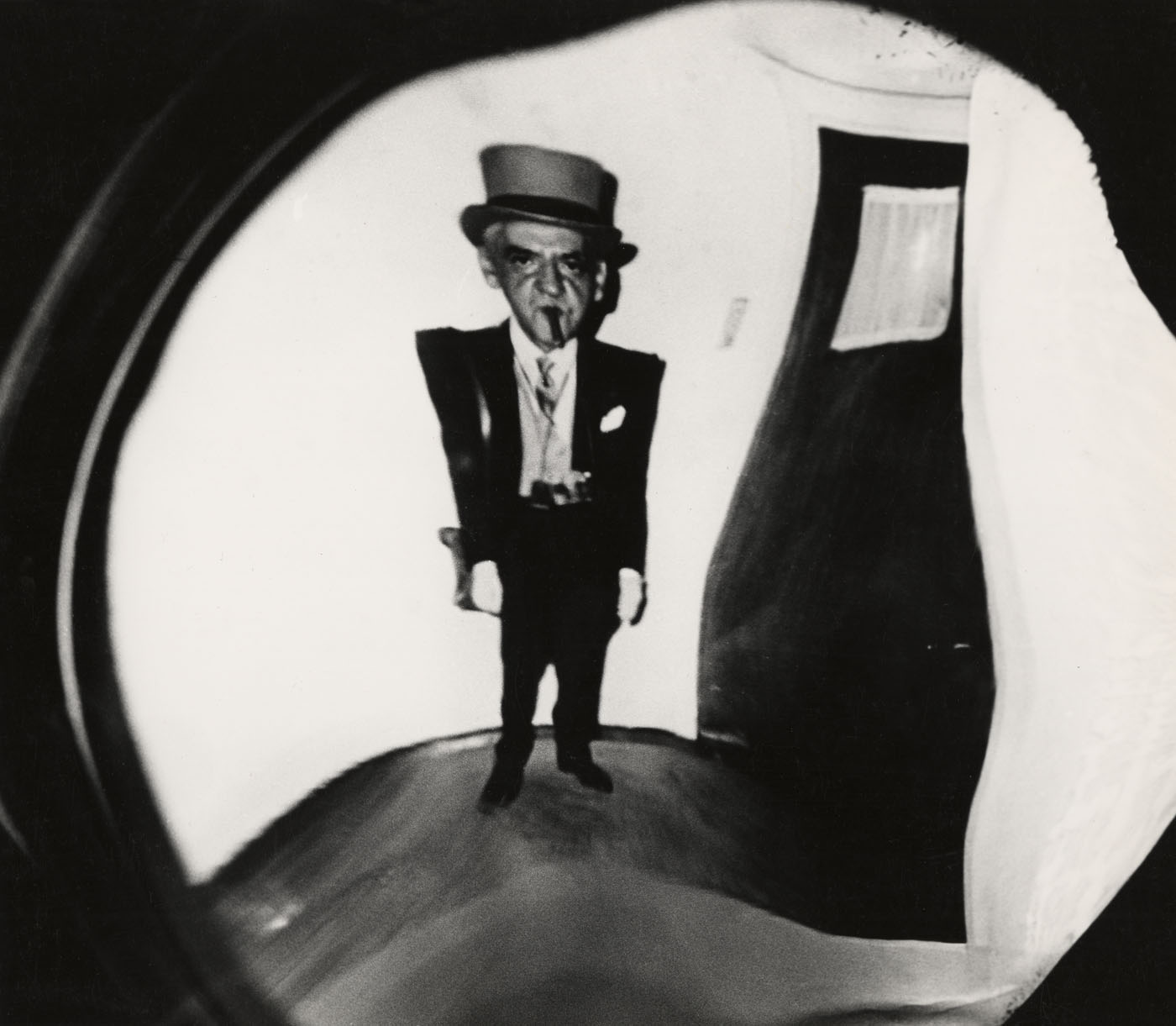
 

Weegee (Arthur Fellig) (American born Ukraine, 1899-1968) 'Self-Portrait' c. 1963 from the exhibition 'Weegee. Autopsy of the Spectacle' at Fundacion Mapfre, Madrid Sept 2024 - January 2025


Weegee (Arthur Fellig) (American born Ukraine, 1899-1968)
Self-Portrait
c. 1963
Gelatin silver print
© International Center of Photography


Fundación MAPFRE
Recoletos Exhibition Hall
Paseo Recoletos 23, 28004 Madrid

Opening hours:
Mondays (except holidays): 2pm – 8pm
Tuesday to Saturday: 11am – 8pm
Sunday and holidays: 11am – 7pm

Fundación MAPFRE website

LIKE ART BLART ON FACEBOOK

Back to top

Exhibition: ‘Weegee, Autopsy of the Spectacle’ at the Foundation Henri Cartier-Bresson, Paris

Exhibition dates: 30th January – 19th May, 2024

Exhibition curator: Clément Chéroux, director, Fondation Henri Cartier-Bresson


Weegee (American, 1899-1968) 'Self-Portrait, Weegee with Speed Graphic Camera' 1950


Weegee (American, 1899-1968)
Self-Portrait, Weegee with Speed Graphic Camera
1950
Gelatin silver print
© International Center of Photography. Collection Friedsam


To see ourselves as others see us

This exhibition attempts to reconcile the two sides of the work of American photographer Weegee (Arthur Felig, 1899-1968) – “First are his stories for the New York press from 1935-1945. Then, photo-caricatures of public personalities developed during his Hollywood period, between 1948-1951, which he continued to produce for the rest of his life” – by showing that, beyond formal differences, the photographer’s approach is a critically coherent investigation into the omnipresence of the spectacle in modern society.

The spectacle is a central notion in the Situationist theory, developed by Guy Debord in his 1967 book The Society of the Spectacle:

“Debord traces the development of a modern society in which authentic social life has been replaced with its representation… The spectacle is the inverted image of society in which relations between commodities have supplanted relations between people, in which “passive identification with the spectacle supplants genuine activity”. “The spectacle is not a collection of images,” Debord writes, “rather, it is a social relation among people, mediated by images.””1


While both halves of Weegee’s photographic work picture the spectacle, I believe that they are a different but connected order of being. Like yin and yang, Weegee’s scenes of chaos “Murder is my business” and “photo-caricatures” emerge from the same psyche but image equal opposites which both repel, attract and complement each other.

Weegee’s photographs which tell stories for the New York press are external representations or emanations captured from the world around us, whereas his later photo-caricatures of public personalities feel to me to be internalised, dream-like representations of his own feelings towards the celebrity people he observed and photographed as much as they are offer insights into their personality.2 Thus, Weegee’s photographs are an examination of a body (an autopsy) both external and internal.

Personally I don’t think that it is necessary to reconcile both halves of Weegee’s work. The bodies exist for what they are: perceptive insights into the existence and spirit of the world and the human race, spec(tac)ular images that mirror a social relation among people which don’t necessarily have to be conflated one with the other.

Dr Marcus Bunyan


1/ Debord, Guy (1994)[1967] The Society of the Spectacle, translation by Donald Nicholson-Smith (New York: Zone Books), p. 4 quoted in “The Society of the Spectacle,” on the Wikipedia website [Online] Cited 10/05/2024

2/ “external exaggeration high-lights internal character and distortion offers surprising insights into personality”
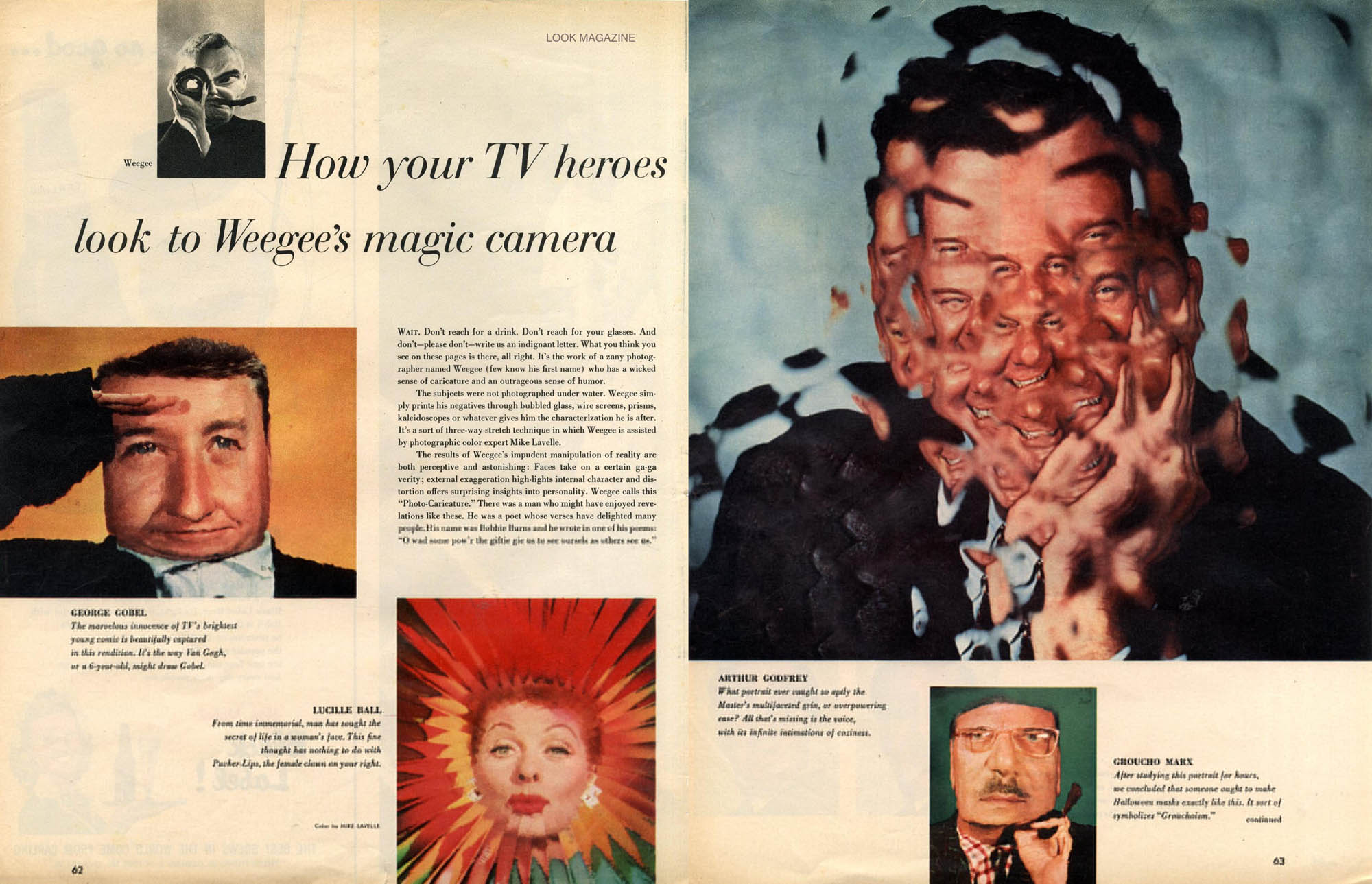
“How your TV heroes look to Weegee’s magic camera” in Look magazine


Many thank to the Foundation Henri Cartier-Bresson for allowing me to publish the photographs in the posting. Please click on the photographs for a larger version of the image.


“The curious […], they’re always in a hurry […], but they still find the time to stop and look.


Weegee


“Crime was my oyster,” Weegee wrote in his 1961 memoir, Weegee by Weegee. “I was friend and confidant to them all. The bookies, madams, gamblers, call girls, pimps, con men, burglars and jewel fencers.” … Weegee’s photos from the 1930s and ’40s defined Manhattan as a film noir nightscape of gangsters, bums, slumming swells and tenement dwellers.”


John Strausbaugh. “Crime Was Weegee’s Oyster,” on The New York Times website June 20, 2008 [Online] Cited 13/04/2024


“Weegee is not the first nor the only person to have taken interest in people watching. Not long before him, in 1937, Henri Cartier-Bresson photographed spectators at the Coronation of George VI for Ce Soir. And a quarter century prior, in 1912, Eugène Atget photographed passers-by observing a solar eclipse at Place de la Bastille. But Weegee took the idea even further. He systematised it. He made it a principle he never shied from applying at the first opportunity. It’s a way of placing things at a distance, pushing the viewers to ask themselves about the manner in which they look, making them aware of the fact that they themselves, like the people watching in the photo, are in a voyeuristic position. It’s also a critique of how American society transforms news into spectacle.”


Clément Chéroux


The specular image, then, is accompanied by anxiety-anxiety that it will “soon dissolve like a cloud.” It is the nature of visions (apparitions) to dissolve before our very eyes without disclosing their secrets, just as dream-images are quickly forgotten upon awakening.


Craig Owens. “Posing,” in Difference: On Representation and Sexuality. New York: The New Museum of Contemporary Art, 1985, p. 12


There’s still a mystery to Weegee. The American photographer’s career seems to be split in two. First are his stories for the New York press from 1935-1945. Then, photo-caricatures of public personalities developed during his Hollywood period, between 1948-1951, which he continued to produce for the rest of his life. How can these diametrically opposed bodies of work coexist? Critics have enjoyed highlighting the opposition between the two periods, praising the former and disparaging the latter. This project seeks to reconcile the two parts of Weegee by showing that, beyond formal differences, the photographer’s approach is critically coherent.

The spectacle is omnipresent in Weegee’s work. In the first part of his career, coinciding with the rise of the tabloid press, he was an active participant in transforming news into spectacle. To show this, he often included spectators or other photographers in the foreground of his images. In the second half of his career, Weegee mocked the Hollywood spectacular, its ephemeral glory, adoring crowds, and social scenes. Some years before the Situationist International, his photography presented an incisive critique of the Society of the Spectacle.

Curator Clément Chéroux

Wall text from the exhibition


Installation view of the exhibition 'Weegee, Autopsy of the Spectacle' at the Foundation Henri Cartier-Bresson, Paris


Installation view of the exhibition Weegee, Autopsy of the Spectacle at the Foundation Henri Cartier-Bresson, Paris showing at left, Self-Portrait, Weegee with Speed Graphic Camera (1950, above); at second left, “Chevrolet”. Weegee in front of his typewriter, installed in the trunk of a 1938 Chevrolet, New York (c. 1943, below); at third left bottom, Weegee covering the morning line-up at police headquarters, New York (c.  1939, below); at fourth left, Self-portrait (1950,below); at fifth left, Frank Pape, Arrested for Homicide (1944, below); at sixth left, Charles Sodokoff and Arthur Webber Use Their Top Hats to Hide Their Faces (1942, below); and at eighth left, Man Arrested for Cross-Dressing, New York (Gay Deceiver) (1939, below)


Weegee (American, 1899-1968) '"Chevrolet". Weegee in front of his typewriter, installed in the trunk of a 1938 Chevrolet, New York' c. 1943


Weegee (American, 1899-1968)
“Chevrolet”. Weegee in front of his typewriter, installed in the trunk of a 1938 Chevrolet, New York
c. 1943
Gelatin silver print
© Weegee Archive / International Center of Photography, New York / Collection Galerie Berinson, Berlin


Weegee Himself: “I have always been a doer and not a thinker.” Weegee enjoyed putting himself in front of the camera, re-enacting circumstances he was confronted with in his daily work. In the name of pedagogy, and probably a little out of narcissism and self-advertisement, he took pictures of himself writing captions for his photographs in the back of his car, in police wagons and behind bars, never without his camera.

Wall text from the exhibition


Unidentified photographer. 'Untitled [Weegee covering the morning line-up at police headquarters, New York]' c. 1939


Unidentified photographer
Untitled [Weegee covering the morning line-up at police headquarters, New York]
c.  1939
Gelatin silver print
© International Center of Photography


Weegee (American, 1899-1968) 'Self-portrait' 1950


Weegee (American, 1899-1968)
Self-portrait
1950
Gelatin silver print
© International Center of Photography


Weegee Tells How

Arthur Fellig, better known as Weegee, was a New York city freelance news photographer from the 1930s to the 1950s. Here he talks about his career and gives advice to those wanting to become news photographers.


Weegee (American, born Ukraine (Austria), Złoczów (Zolochiv) 1899 - 1968 New York) 'Frank Pape, Arrested for Homicide' 1944


Weegee (American, 1899-1968)
Frank Pape, Arrested for Homicide
1944
Gelatin silver print
© International Center of Photography


Weegee (American, 1899-1968) 'Charles Sodokoff and Arthur Webber Use Their Top Hats to Hide Their Faces' 1942


Weegee (American, 1899-1968)
Charles Sodokoff and Arthur Webber Use Their Top Hats to Hide Their Faces
1942
Gelatin silver print
© International Center of Photography. Louis Stettner Archives, Paris


Weegee (American, 1899-1968) 'Man Arrested for Cross-Dressing, New York (Gay Deceiver)' 1939


Weegee (American, 1899-1968)
Man Arrested for Cross-Dressing, New York (Gay Deceiver)
1939
Gelatin silver print
© International Center of Photography. Louis Stettner Archives, Paris


Installation view of the exhibition 'Weegee, Autopsy of the Spectacle' at the Foundation Henri Cartier-Bresson, Paris showing at second left, Weegee's 'Man Arrested for Cross-Dressing, New York (Gay Deceiver)' (1939); and at top right, a magazine print of his photograph 'Untitled [Young man smoking cigarette in crashed car while waiting for ambulance, New York]' (1941)


Installation view of the exhibition Weegee, Autopsy of the Spectacle at the Foundation Henri Cartier-Bresson, Paris showing at second left, Weegee’s Man Arrested for Cross-Dressing, New York (Gay Deceiver) (1939, above); and at top right, a magazine print of his photograph Untitled [Young man smoking cigarette in crashed car while waiting for ambulance, New York] (1941, below)


Off Road: “Sudden death for one… sudden shock for the other.” American culture is fascinated by twisted metal. In the 19th century, a railroad company staged public collisions between locomotives destined for the junkyard. Weegee photographed many traffic accidents introducing the “car crash” genre, later adopted by other figures, such as Andy Warhol, J.G. Ballard, David Cronenberg, etc.

Wall text from the exhibition


Weegee (American, 1899-1968) 'Untitled [Young man smoking cigarette in crashed car while waiting for ambulance, New York]' 1941


Weegee (American, 1899-1968)
Untitled [Young man smoking cigarette in crashed car while waiting for ambulance, New York]
1941
Gelatin silver print
© Photo Weegee/ICP New York


Installation view of the exhibition Weegee, Autopsy of the Spectacle at the Foundation Henri Cartier-Bresson, Paris showing at right, Weegee's photograph 'Henry Rosen (left) and Harvey Stemmer (centre) cover their faces with handkerchiefs after their arrest for bribery and conspiracy to fix a US college basketball match' (25 January 1945)


Installation view of the exhibition Weegee, Autopsy of the Spectacle at the Foundation Henri Cartier-Bresson, Paris showing at right, Weegee’s photograph Henry Rosen (left) and Harvey Stemmer (centre) cover their faces with handkerchiefs after their arrest for bribery and conspiracy to fix a US college basketball match (25 January 1945)


Weegee (American, 1899-1968) 'Holiday Accident in the Bronx' 1941


Weegee (American, 1899-1968)
Holiday Accident in the Bronx
1941
Gelatin silver print
© International Center of Photography


Exhibition

There’s a mystery to Weegee. The American photographer’s career seems to be split in two. One side includes his sensational photography printed in North American tabloids: corpses of gangsters lying in pools of their own blood, bodies trapped in battered vehicles, kingpins looking sinister behind the bars of prison wagons, dilapidated slums consumed by fire, and other harrowing documents on the lives of the underprivileged in New York from 1935 to 1945. Then come the festive photographs – glamorous parties, performances by entertainers, jubilant crowds, openings and premieres – to which we must add a vast array of portraits of public figures that Weegee delighted in distorting using a rich palette of tricks between 1948 and 1951, a practice he pursued until the end of his life.

How can these diametrically opposed bodies of work coexist? Critics have enjoyed highlighting the opposition between the two periods, praising the former and disparaging the latter. The exhibition Autopsy of the Spectacle seeks to reconcile the two parts of Weegee by showing that, beyond formal differences, the photographer’s approach is critically coherent.

The spectacle is omnipresent in Weegee’s work. In the first part of his career, which coincides with the rise of the tabloid press, he was an active participant in transforming news into spectacle. To show this, he often included spectators, or other photographers, in the foreground of his images. In the second half of his career, Weegee mocked the Hollywood spectacular: its ephemeral glory, adoring crowds and social scenes. Some years before the Situationist International, his photography presented an incisive critique of the Society of the Spectacle.

With a new perspective on Weegee’s oeuvre, Autopsy of the Spectacle presents the photographer’s iconic images beside lesser-known works, including images not-yet-exhibited in France.

Biography

Weegee was born Usher Fellig on June 12, 1899, to a Jewish family in Zolochiv, a small town in Galicia, then part of the Austro-Hungarian Empire, today in western Ukraine. At 11 years old, he joined his father who’d emigrated to the United States. At the immigration station Ellis Island, he became Arthur Fellig. Living in the slums of the Lower East Side, he left school at 14 to earn money to support his family. After working in different professions, he became a traveling photographer, worked for photographers Duckett & Adler, then in the lab of ACME Newspictures agency.

Starting in 1935, he was self-employed as photo-reporter. Towards 1937, he began using the pseudonym Weegee, and around 1941, started marking the backs of his prints with a stamp in the form of a self-fulfilling prophecy: “Weegee the Famous.” For 10 years, connected to Police radio, he took photographs, mainly at night, of crime, arrests, fires, accidents and other news items. Though the photographer most certainly had connections within the Police, without whom his work would not have been possible, he also frequented left-wing circles. He was very close to the Photo League, a group of independent photographers who firmly believed in emancipation through the image and fought for social justice. In 1945, he published his best photographs in a book entitled Naked City, which met with great success both in its reception and sales.

In the spring of 1948, he moved to Hollywood to work in cinema as a technical advisor, sometimes as an actor. He photographed the endless party and developed different photographic techniques used to create his caricatures of celebrities. In December of 1951, after four years on the West Coast, he returned to New York with no intention of resuming his former practice. Up until his death on December 26, 1968, the majority of his work involved taking advantage of his notoriety to publish other books, go on tour, and promote his photo-caricatures in newspapers.

Text from the Foundation Henri Cartier-Bresson website


Installation view of the exhibition 'Weegee, Autopsy of the Spectacle' at the Foundation Henri Cartier-Bresson, Paris showing at centre, 'Afternoon Crowd at Coney Island, Brooklyn' (1940)

Installation view of the exhibition 'Weegee, Autopsy of the Spectacle' at the Foundation Henri Cartier-Bresson, Paris


Installation view of the exhibition Weegee, Autopsy of the Spectacle at the Foundation Henri Cartier-Bresson, Paris showing at left, Performer Jimmy Armstrong (c. 1943, below); at second left, Ladies keep their money in their stockings… (1944, below); and at centre, Afternoon Crowd at Coney Island, Brooklyn (1940, below)


Weegee (American, 1899-1968) 'Performer Jimmy Armstrong' c. 1943


Weegee (American, 1899-1968)
Performer Jimmy Armstrong
c. 1943
Gelatin silver print
© International Center of Photography


Weegee (American, 1899-1968) 'Ladies keep their money in their stockings...' 1944


Weegee (American, 1899-1968)
Ladies keep their money in their stockings…
1944
Gelatin silver print
© International Center of Photography


“There is no cover charge nor cigarette girl, and a vending machine dispenses cigarettes. Neither is there a hat check girl. Patrons prefer to dance with their hats and coats on. But there is a lively floor show… the only saloon in the Bowery with a cabaret license.”

Weegee


Weegee (American, 1899-1968) 'Afternoon Crowd at Coney Island, Brooklyn' 1940


Weegee (American, 1899-1968)
Afternoon Crowd at Coney Island, Brooklyn
1940
Gelatin silver print
© International Center of Photography. Courtesy Galerie Berinson, Berlin


Weegee (American, 1899-1968) 'Sleeping at the Circus, Madison Square Garden, New York' 1943


Weegee (American, 1899-1968)
Sleeping at the Circus, Madison Square Garden, New York
1943
Gelatin silver print
© International Center of Photography


Installation view of the exhibition 'Weegee, Autopsy of the Spectacle' at the Foundation Henri Cartier-Bresson, Paris


Installation view of the exhibition Weegee, Autopsy of the Spectacle at the Foundation Henri Cartier-Bresson, Paris showing at centre left, Opening night at the Metropolitan Opera (1943); In the Lobby at the Metropolitan Opera, Opening Night (1943); and at centre right, The Critic (1943, below)


Weegee (American, 1899-1968) 'The Critic' November 22, 1942


Weegee (American, 1899-1968)
The Critic
November 22, 1942
Gelatin silver print
© International Center of Photography. Collection Friedsam


Even his most popular photograph was a set-up, says Wallis: “The Critic, which was taken in 1943, was surely staged and shows the wealthy Mrs George Washington Cavanaugh and Lady Decies arriving at the opera, greeted by a staggering drunk who seems to be mocking them and who Weegee reportedly rounded up at Sammy’s bar on the Bowery.

“This picture is a good example of how Weegee previsualized a scene, developed a punchy satirical narrative, and staged the picture. The Critic was widely reproduced at the time, and even shown at the Museum of Modern Art.”

Boo Paterson. “Big guns to big top: Weegee at circus,” on the Boo York City website [Online] Cited 13/04/2024


In Weegee’s day similar culture clashes happened at Sammy’s Bowery Follies (267 Bowery, between East Houston and Stanton Streets), which from 1934 to 1970 attracted what The New York Times once described as a mixed crowd of “drunks and swells, drifters and celebrities, the rich and the forgotten.” …

Among the regulars, he wrote in his 1945 book, “Naked City,” was a woman they called Pruneface and a midget who walked the streets dressed as a penguin to promote cigarettes. When the midget got drunk, Weegee wrote, he “offered to fight any man his size in the house.”

Weegee held two book parties there. At the photography center Mr. George showed me silent-film footage taken in 1946 at the party for Weegee’s second book, “Weegee’s People.” Pretty uptown blondes and dowagers in pearls mingle with toothless crones and panhandlers, as models parade in their foundation garments, and a man with a flea circus puts his tiny performers through their paces.

John Strausbaugh. “Crime Was Weegee’s Oyster,” on The New York Times website June 20, 2008 [Online] Cited 13/04/2024


Installation view of the exhibition 'Weegee, Autopsy of the Spectacle' at the Foundation Henri Cartier-Bresson, Paris showing Weegee's photographs in magazine layouts


Installation view of the exhibition Weegee, Autopsy of the Spectacle at the Foundation Henri Cartier-Bresson, Paris showing his photographs in magazine layouts


"Il Fotografo cattivo", Epoca, Vol. XIII, No. 636, December 1962


“Il Fotografo cattivo”, Epoca, Vol. XIII, No. 636, December 1962
© International Center of Photography. Collection privée Paris


"Weegee Looks At Dali"


Weegee Looks At Dali


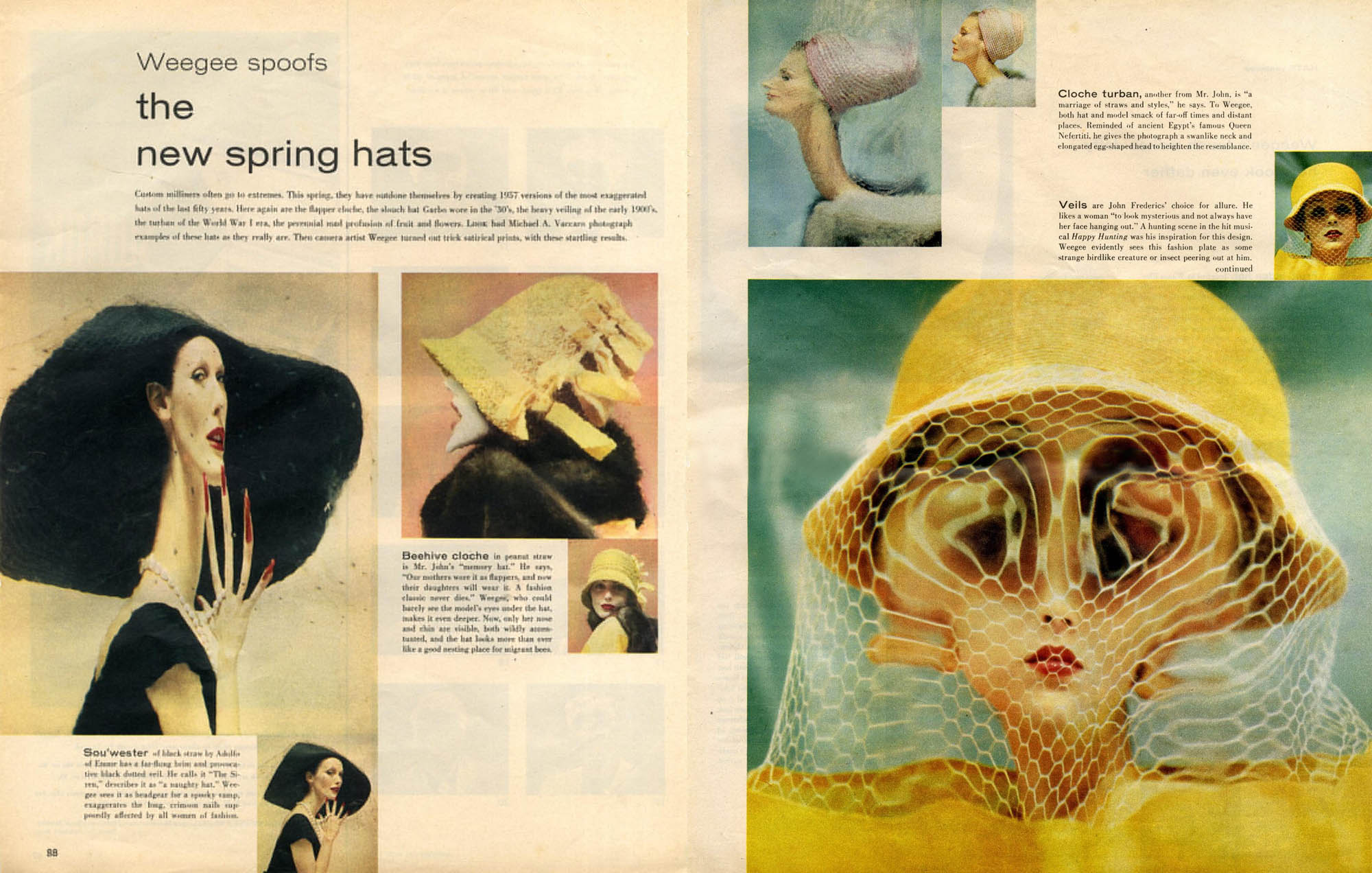
Weegee spoofs the new spring hats 1957


Weegee spoofs
the
new spring hats

Custom milliners often go to extremes. This spring, the have outdone themselves by creating 1957 version of the most exaggerated hats of the last fifty years. Here again are the flapper cloche, the slouch had Garbo wore in the ’30’s, the heavy veiling of the early 1900’s, the turban of the World War I era, the perennial mad profusion of fruit and flowers. Look had Michael A. Vaccaro photograph examples of these hats as they really are. Then camera artist Weegee turned out satirical prints, with these startling results.

Look magazine 1957


"How your TV heroes look to Weegee's magic camera" in Look magazine


WAIT. Don’t reach for a drink. Don’t reach for your glasses. And don’t – please don’t – write us an indignant letter. What you think you see on these pages is there, all right. It’s the work of a zany photographer named Weegee (few know his first name) who has a wicked sense of caricature and an outrageous sense of humor.

The subjects were not photographed under water. Wedge simply prints his negatives through bubbles glass, wire screens, press, kaleidoscopes or whatever gives him the characterization he is after. It’s a sort of three-way-stretch technique in which Weegee is assisted by photographic color expert Mike Lavelle.

The results of Weegee’s impudent manipulation of reality are both perceptive and astonishing: Faces take on a certain ga-ga verity; external exaggeration high-lights internal character and distortion offers surprising insights into personality. Weegee calls this “Photo-Caricature.” There was a man who might have enjoyed revelations like these. His name was Bobbie Burns and he wrote in one of his poems: “O wad some Pow’r the giftie gie us to see oursels as others see us.”

“How your TV heroes look to Weegee’s magic camera” in Look magazine


Weegee Modern Women Aren't Human!


“”Modern Women Aren’t Human!’ … If You Don’t Believe It … This Man Tells Why” in the National Enquirer, 1967


There’s a mystery to Weegee. The American photographer’s career seems to be split in two. One side includes his sensational photography printed in North American tabloids: corpses of gangsters lying in pools of their own blood, bodies trapped in battered vehicles, kingpins looking sinister behind the bars of prison wagons, dilapidated slums consumed by fire, and other harrowing documents on the lives of the underprivileged in New York from 1935 to 1945. Then come the festive photographs – glamorous parties, performances by entertainers, jubilant crowds, openings and premieres – to which we must add a vast array of portraits of public figures that Weegee delighted in distorting using a rich palette of tricks between 1948 and 1951, a practice he pursued until the end of his life. How can these diametrically opposed bodies of work coexist? Critics have enjoyed highlighting the opposition between the two periods, praising the former and disparaging the latter. The exhibition Autopsy of the Spectacle seeks to reconcile the two parts of Weegee by showing that, beyond formal differences, the photographer’s approach is critically coherent.

The spectacle is omnipresent in Weegee’s work. In the first part of his career, which coincides with the rise of the tabloid press, he was an active participant in transforming news into spectacle. To show this, he often included spectators, or other photographers, in the foreground of his images. In the second half of his career, Weegee mocked the Hollywood spectacular: its ephemeral glory, adoring crowds and social scenes. Some years before the Situationist International, his photography presented an incisive critique of the Society of the Spectacle.

With a new perspective on Weegee’s oeuvre, Autopsy of the Spectacle presents the photographer’s iconic images beside lesser-known works, including images not-yet-exhibited in France.

Curator Clément Chéroux

Press release from the Henri Cartier-Bresson Foundation


Weegee (American, 1899-1968) 'Their First Murder' c. 1936


Weegee (American, 1899-1968)
Their First Murder
c. 1936
Gelatin silver print
© Weegee Archive / International Center of Photography


Weegee (American, 1899-1968) 'Drowning victim, Coney Island' c. 1940


Weegee (American, 1899-1968)
Drowning victim, Coney Island
c. 1940
Gelatin silver print
© Weegee Archive / International Center of Photography, New York / Collection Galerie Berinson, Berlin


Weegee (American, 1899-1968) 'Mrs Bernice Lythcott and her son Leonard looking through a window broken by stones thrown by thugs, Harlem, New York' October 18, 1943


Weegee (American, 1899-1968)
Mrs Bernice Lythcott and her son Leonard looking through a window broken by stones thrown by thugs, Harlem, New York
October 18, 1943
Gelatin silver print
© Photo Weegee/ICP New York


Weegee (American, 1899-1968) 'Untitled [Tenement sleeping during heat spell, Lower East Side, New York]' May 23, 1941


Weegee (American, 1899-1968)
Untitled [Tenement sleeping during heat spell, Lower East Side, New York]
May 23, 1941
Gelatin silver print
© Photo Weegee/ICP New York


Son of a Jewish immigrant from Ukraine, Weegee knew the slums, like those children seeking coolness on the fire escape ladder. He produced “real social documents” on the living conditions of the poor.


“In Central Park the lawns were crowded before darkness with family groups,” reported the July 10, 1936 New York Times; the temperature had reached an astounding 106 degrees the day before. “On the Lower East Side traffic was seriously impeded as small armies of persons emerged from tenement houses with chairs, boxes and even beds which they set up in the streets.”

And from the Times on August 4, 1938, when the mercury hit 93 degrees:

“More than 3,000 persons slept on the sand at Coney Island and Brighton Beach to escape the heat last night, the police estimated. Ten additional patrolmen were assigned to the area to prevent molestation of the sleepers, many of whom brought blankets and sheets.”

Anonymous. “How New Yorkers survived hot summer nights,” on the Ephemeral New York website Nd [Online] Cited 14/04/2024


Weegee (American, 1899-1968) 'Untitled [Fire in loft building, New York]' 1947


Weegee (American, 1899-1968)
Untitled [Fire in loft building, New York]
1947
Gelatin silver print
© Photo Weegee/ICP New York


Weegee (American, 1899-1968) 'Simply adding boiling water' 1943


Weegee (American, 1899-1968)
Simply adding boiling water
1943
Gelatin silver print
© Photo Weegee/ICP New York


Weegee (American, 1899-1968) 'Lovers at the Palace Theater' c. 1953


Weegee (American, 1899-1968)
Lovers at the Palace Theater
c. 1953
Gelatin silver print
© Photo Weegee/ICP New York


Weegee (American, 1899-1968) 'Anthony Esposito, Booked on Suspicion of Killing a Policeman' 1941


Weegee (American, 1899-1968)
Anthony Esposito, Booked on Suspicion of Killing a Policeman
1941
Gelatin silver print
© International Center of Photography. Louis Stettner Archives, Paris


At noon Fifth Avenue was crowded. Alfred Klausman, middle-aged office manager of a linen firm, walked across the street from his office to the bank on the corner and drew the weekly pay roll: $649.

As the genial, round-faced Klausman walked back, two men silently threaded through the crowd behind him, two strange, grey-coated creatures washed up from the depths of New York City’s criminal world. One was Anthony Esposito, 35, a long-nosed, horse-faced hoodlum who had been in & out of New York’s prisons and reformatories for 16 years, had once been deported to Italy and sneaked back in. His brother William, 29, had robbed drunks, snatched pocketbooks, done a seven-year stretch in Sing Sing. Their father had served time for forgery. Their brother was in Clinton Prison, Dannemora, N. Y. for parole violation. Their lives had been spent in squalor, petty crime, prison and torpid, hard-eyed loafing.

Klausman entered the elevator to his office. The Esposito brothers stepped in after him. Between the second and third floors they drew revolvers from their overcoat pockets, ordered the operator to stop, face the door. He heard Klausman cry “No! No! No!” – then one of the gunmen put his revolver to Klausman’s head and pulled the trigger.

They ordered the operator to take the elevator down, ducked out into the street, disappeared into B. Altman’s big department store.

Out into the street the operator yelled “Holdup! Murder!” The cry spread. Two patrolmen raced from the corner, into the store, a long way behind.

Down the crowded aisles of the store darted the Espositos, through the block-long building. At the far entrance they climbed into a cab, put a gun at the driver’s head. But Madison Avenue was jammed with traffic; they were trapped. “Get going. Make it fast. Get moving or we’ll kill you.” Back in the store panic was spreading as police with drawn revolvers moved down the aisles shouting, “Get down!” The cab stalled behind a bus. Like men leaping over a cliff, the brothers jumped out into the traffic. At sight of the two running men, waving revolvers, people flattened themselves against the buildings or ducked to the sidewalk. A taxi driver ran to Patrolman Edward Maher, directing traffic on the corner, yelled “Stick-up!” and pointed at the fleeing men. Maher raced after them, only 20 feet behind, afraid to shoot into the crowd. Motorists left their cars and joined the chase. Maher saw a clear space, shot twice, and William Esposito staggered sideways, fell face downward, one arm outstretched, one twisted under him, apparently dead.

A little crowd collected around him. Patrolman Maher held the gunman by the overcoat, started to turn him over, turned to warn the crowd away. “Back up, please,” he said, “someone’s liable to get hurt.” As he rolled William over, the gunman’s .38 came up. William Esposito pulled the trigger and Patrolman Maher slumped over, dead.

The crowd surged back, then forward. A taxi driver named Leonard Weisberg leaped on the prone gunman. He grabbed for the revolver, missed. Esposito jerked it back a few inches, fired again. Weisberg, clutching his throat, gasping for breath, fell to the sidewalk.

Esposito, still lying down, drew another gun from his overcoat pocket. Two men leaped on him. Then the crowd closed in, kicking and beating.

Anthony ran on when his brother fell. Behind him the police fired into the air. He shot a few times, wildly, apparently to clear crowds out of his way on Fifth Avenue. He ducked into Woolworth’s, bowling over the women shoppers. He plunged to the basement, put away his guns, walked up again to hide in the crowd – and met six policemen at the head of the stairs, went down with revolver butts thudding on his skull.

The Espositos went to the hospital, to the lineup, to indictment for murder. Leonard Weisberg, recovering from his throat wound, was promised a new cab of his own, and won a hero’s praise. The Nazi press gleefully played up the crime as evidence of democratic depravity.

Anonymous. “National Affairs: SLAUGHTER ON FIFTH AVENUE,” in TIME Monday, Jan. 27, 1941 on the TIME website [Online] Cited 14/04/2024


Weegee (American, born Ukraine (Austria), Złoczów (Zolochiv) 1899 - 1968 New York) '[Outline of a Murder Victim]' 1942


Weegee (Arthur Fellig) (American born Ukraine (Austria), ZÅ‚oczów (Zolochiv) 1899 – 1968 New York)
[Outline of a Murder Victim]
1942
Gelatin silver print
33.9 x 27.4cm (13 3/6 x 10 13/16 in.)
Gift of Bruce A. Kirstein, in memory of Marc S. Kirstein, 1978
© Weegee / International Center of Photography


Weegee (American, 1899-1968) 'Harry Maxwell shot in a car' 1941


Weegee (American, 1899-1968)
Harry Maxwell shot in a car
1941
Gelatin silver print
© Photo Weegee/ICP New York


Weegee (American, 1899-1968) '"Hopper's Topper" Hedda Hopper Hollywood' c. 1948


Weegee (American, 1899-1968)
“Hopper’s Topper” Hedda Hopper Hollywood
c. 1948
Gelatin silver print
© Photo Weegee/ICP New York


Weegee (American, 1899-1968) 'Marilyn Monroe, Distortion' c. 1955


Weegee (American, 1899-1968)
Marilyn Monroe, Distortion
c. 1955
Gelatin silver print
© Weegee Archive / International Center of Photography, New York / Friedsam Collection, Frankfurt am Main


Weegee (American, 1899-1968) 'Charlie Chaplin, Distortion' 1950


Weegee (American, 1899-1968)
Charlie Chaplin, Distortion
1950
© International Center of Photography


Weegee (American, 1899-1968) 'Self-Portrait' 1963


Weegee (American, 1899-1968)
Self-Portrait
1963
Gelatin silver print
© International Center of Photography


This book accompanies the exhibition 'Weegee, Autopsie du Spectacle' presented from January 30, 2024 to May 19, 2024 at the Henri Cartier-Bresson Foundation


Weegee (author)
Textual, Henri Cartier-Bresson Foundation (editor)
January, 2024 (release)
ISBN 9782845979901
208 pages
55 euros

This book accompanies the exhibition Weegee, Autopsie du Spectacle presented from January 30, 2024 to May 19, 2024 at the Henri Cartier-Bresson Foundation.

There is a Weegee conundrum. His photographs fall into two distinct categories. On the one hand, there are his images of news items taken in New York during the 1940s, in a documentary, direct and raw approach. And on the other, photographs of starlets, politicians and other socialites taken in Hollywood in the following decade, for which he willingly resorted with special effects. Declaring himself “bewitched by the mystery of the murders,” Weegee stood out for his ability to arrive promptly at the crime scene or to wait for the salad baskets to arrive on the steps of the police stations to capture the defendants on the spot. Nevertheless, he strives to bring onlookers, often from the working classes, into his framework, or even to be interested only in them. Made up of around a hundred photographs – the best known, but also many images never highlighted – this book shows the coherence of Weegee’s work based on a radical and incisive critique of the Society of the Spectacle, borrowing from an unexpected empathy towards the disadvantaged.

Weegee (1899-1968) was an American photojournalist known for his images of a New York marked by crime. In 1941, New York’s Photo League dedicated an exhibition to him which was followed by that of MoMA in 1943. He published his first book Naked City in 1945 and his autobiography Weegee by Weegee in 1961.

Hardcover
20 x 26cm
Texts by Isabelle Bonnet, David Campany,
Clément Chéroux and Cynthia Young.
Texts in French

Translated from the French by Google Translate from the Foundation Henri Cartier-Bresson website


Fondation Henri Cartier-Bresson
79 rue des Archives
75003 Paris

Opening hours:
Tuesday – Sunday 11am – 7pm
Closed Mondays

Henri Cartier-Bresson Foundation website

LIKE ART BLART ON FACEBOOK

Back to top

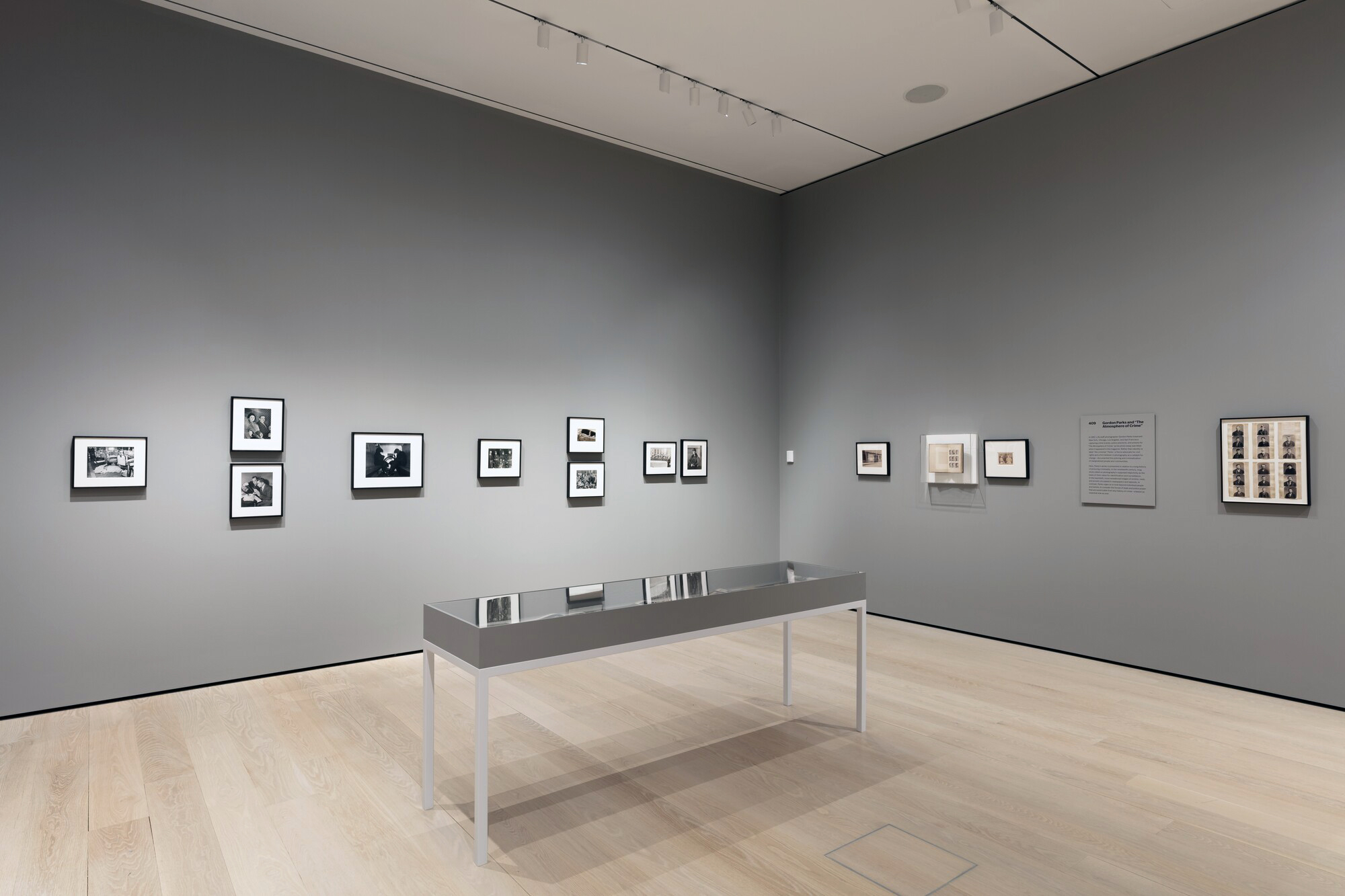
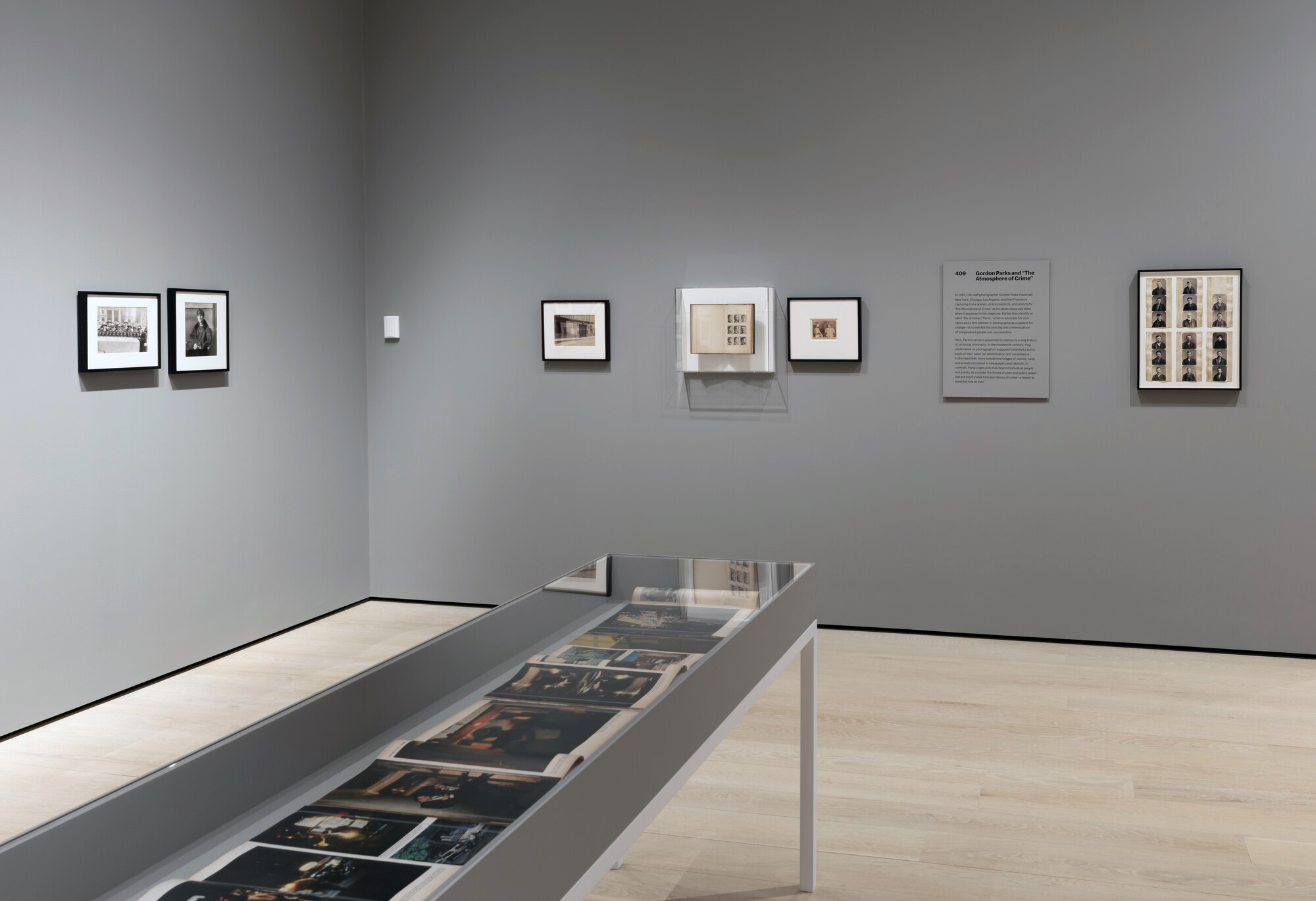
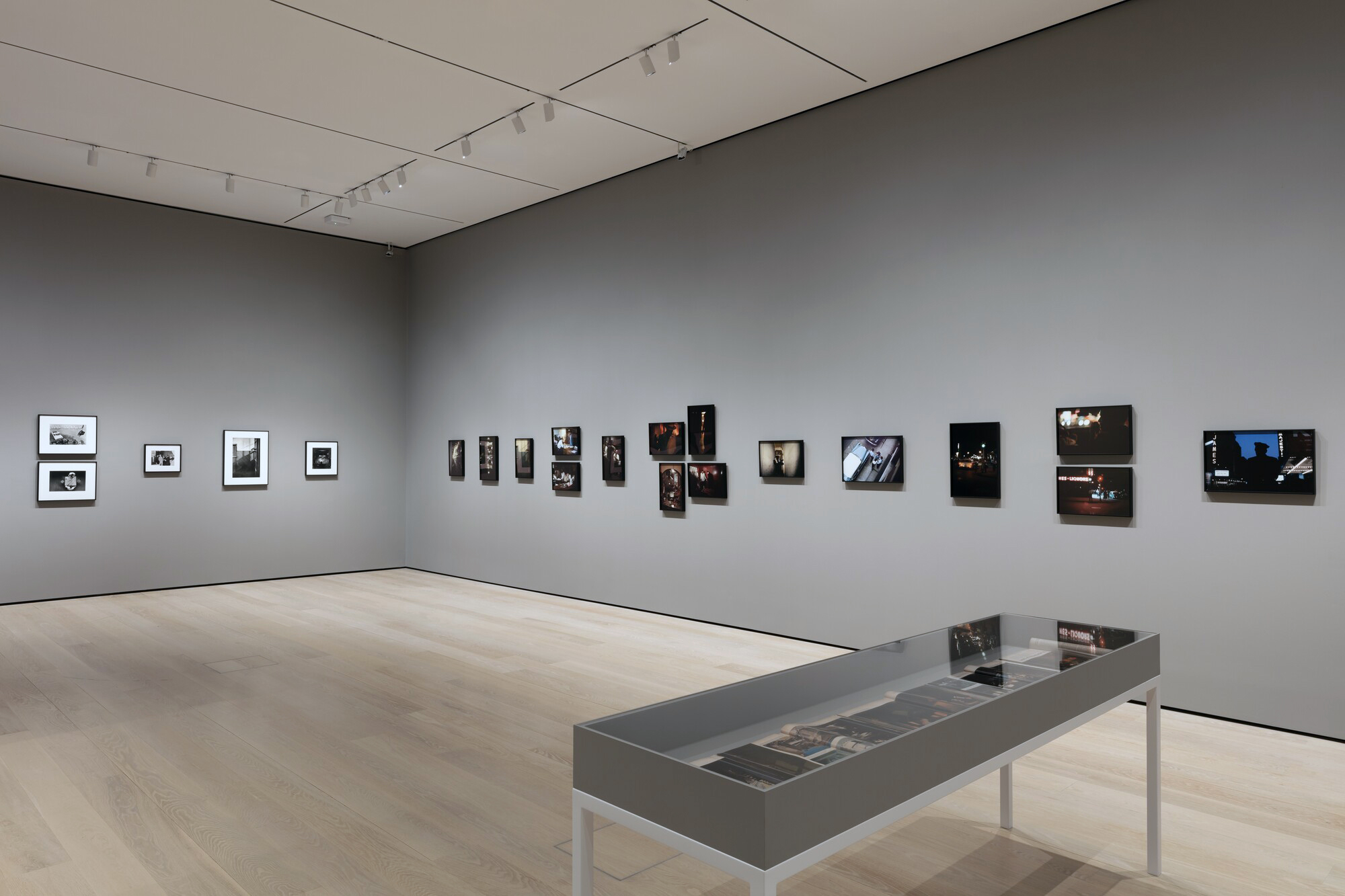
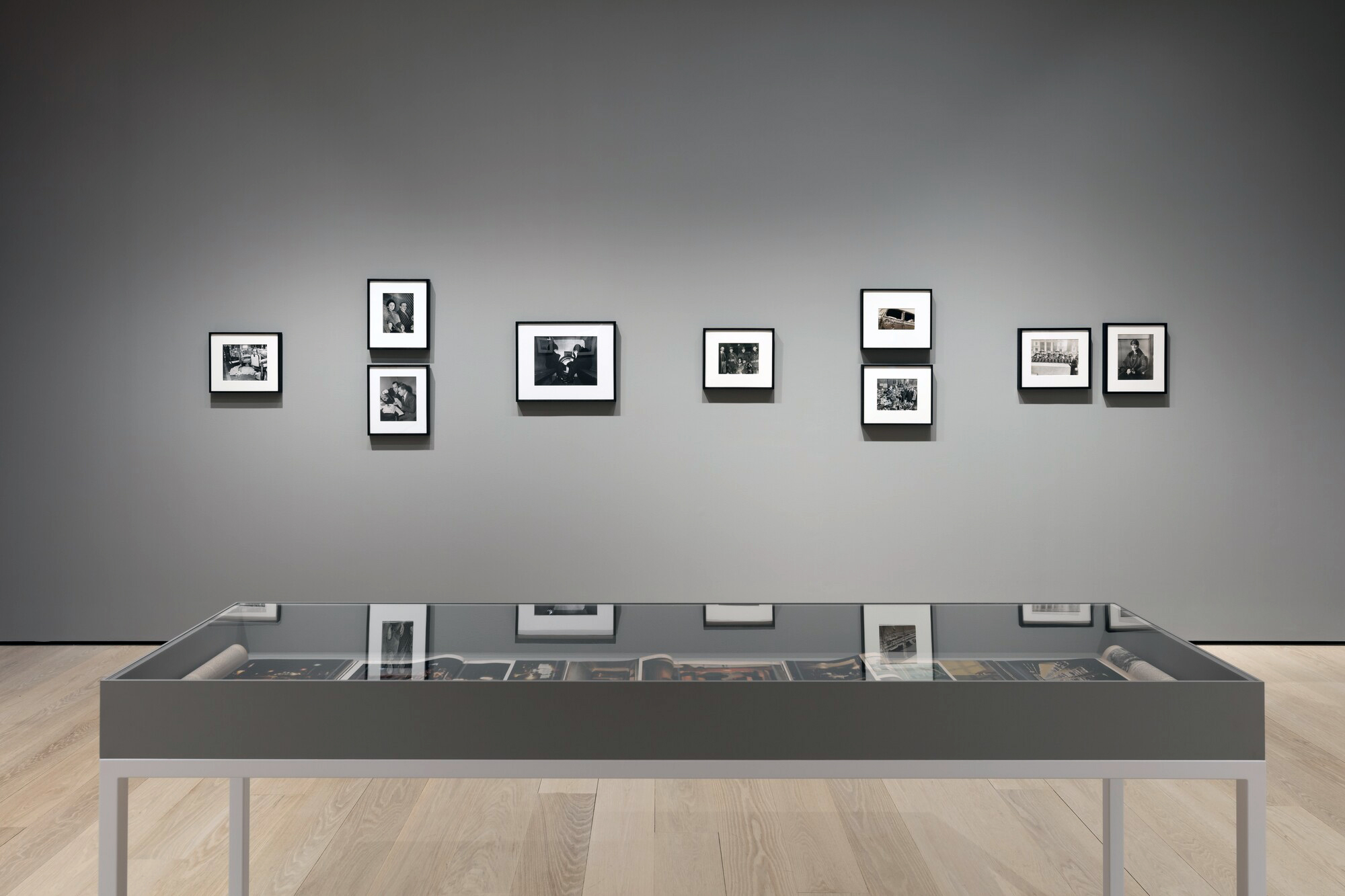
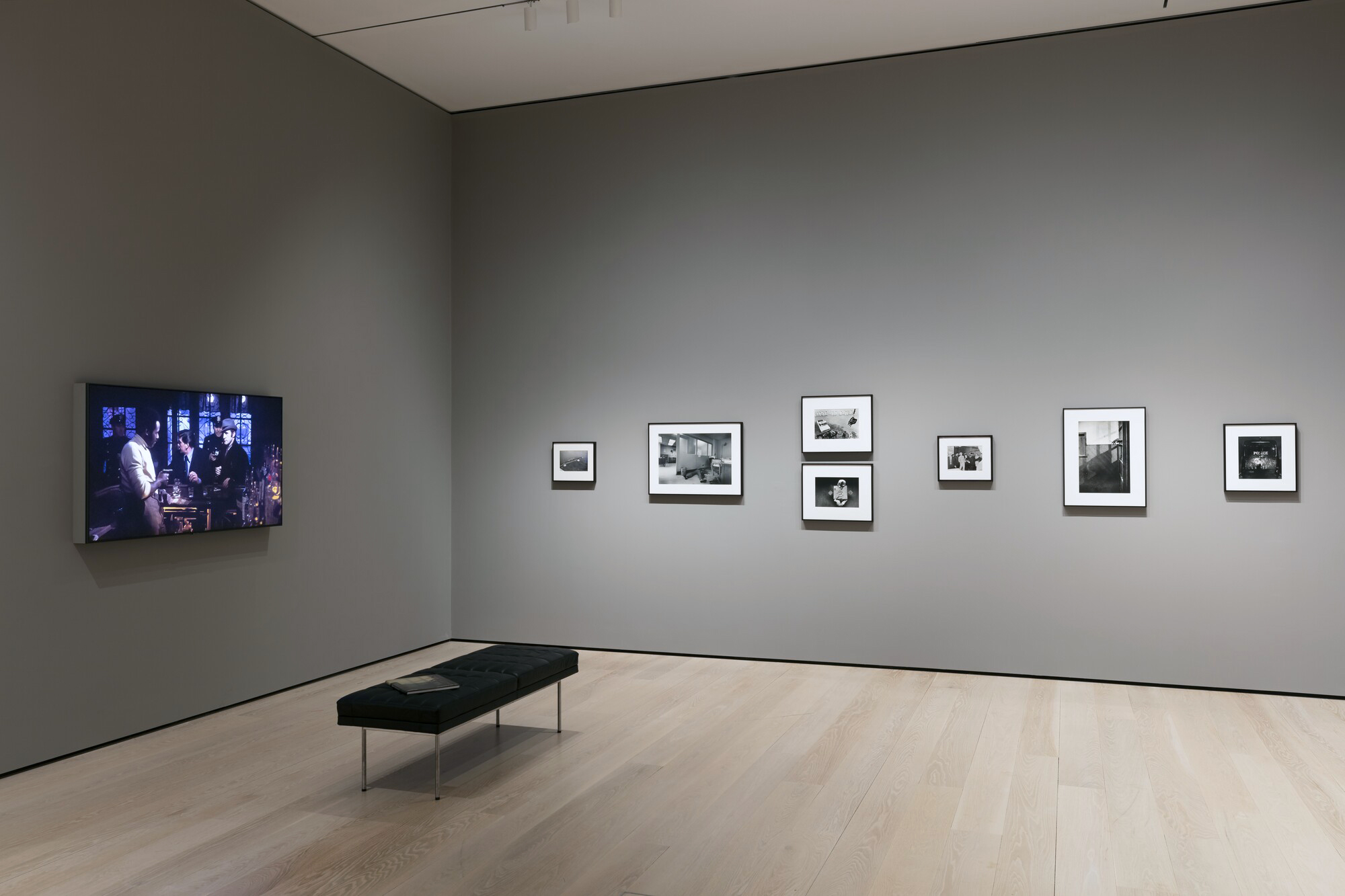
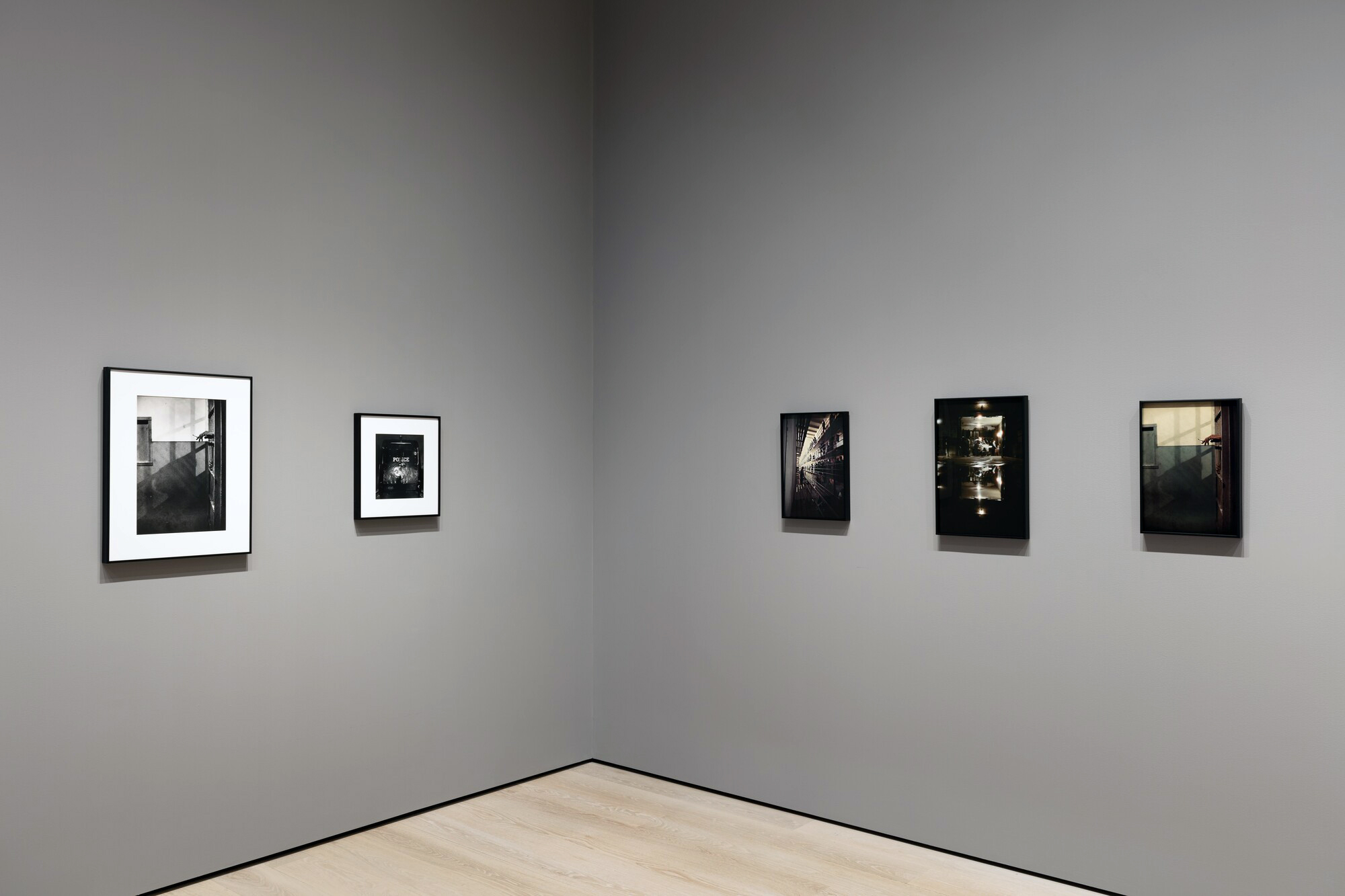
Exhibition: Gordon Parks and “The Atmosphere of Crime” at the Museum of Modern Art (MoMA), New York

Collection 1940s-1970s, Room 409
From ‘New art from wall to wall’ ongoing

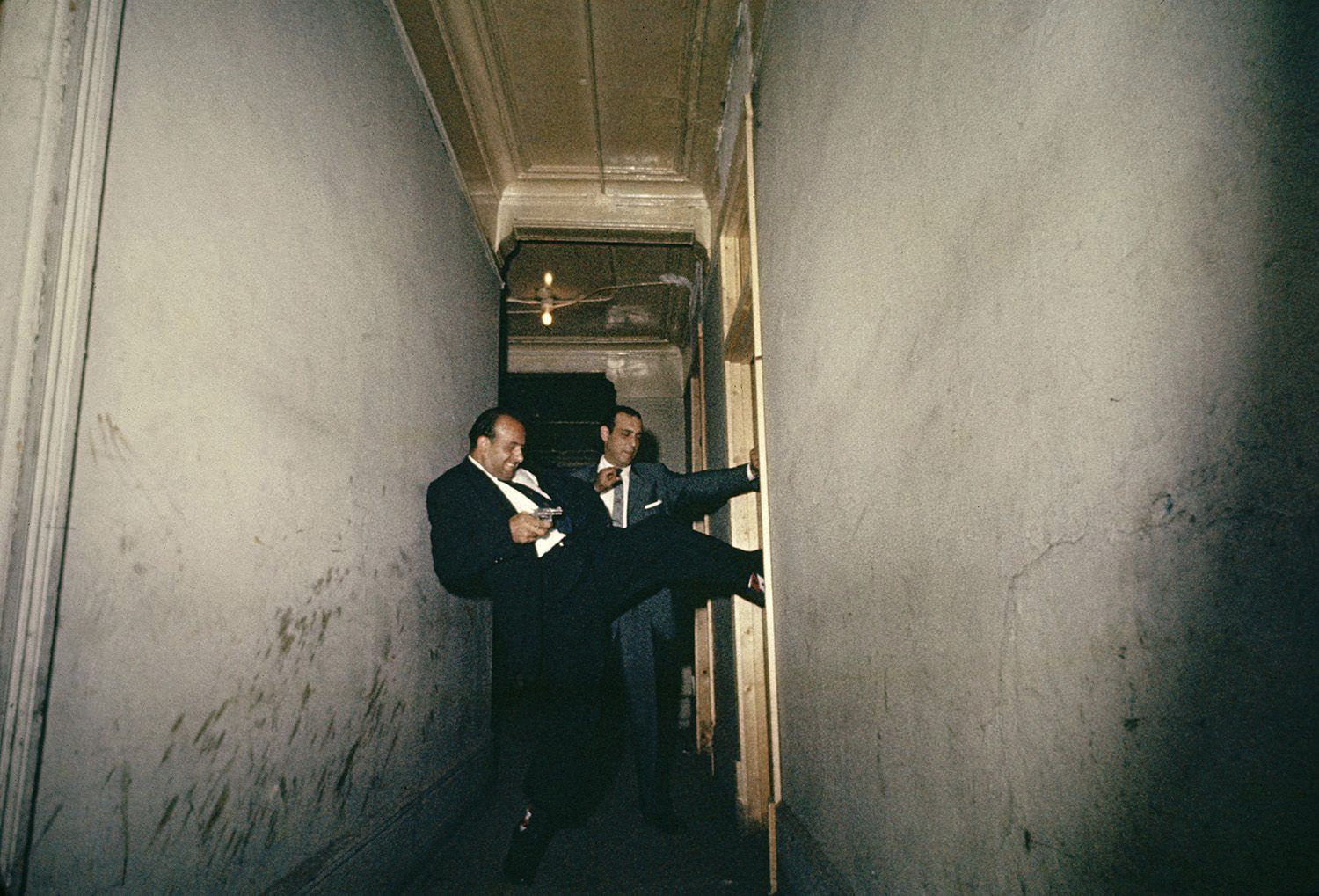
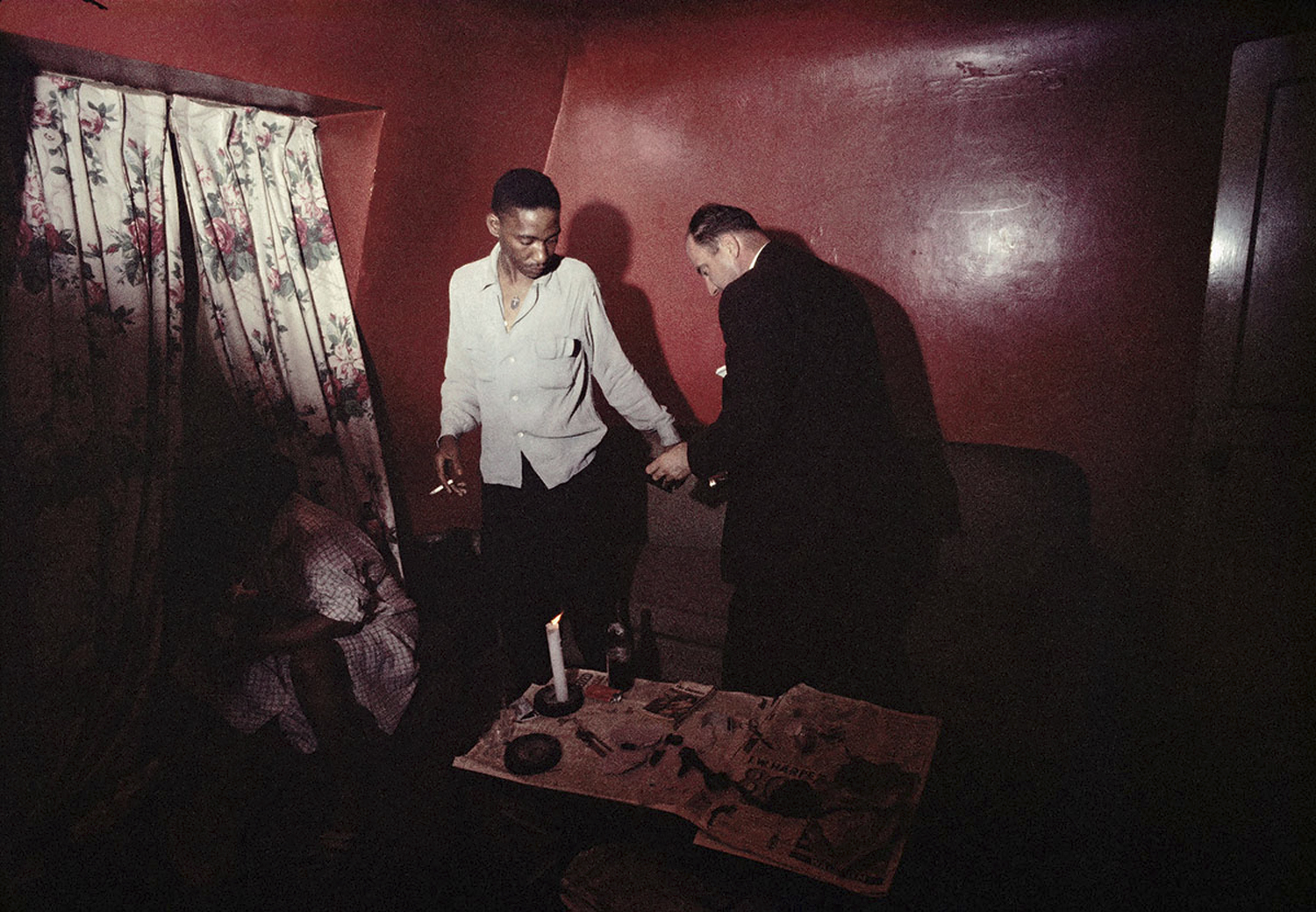
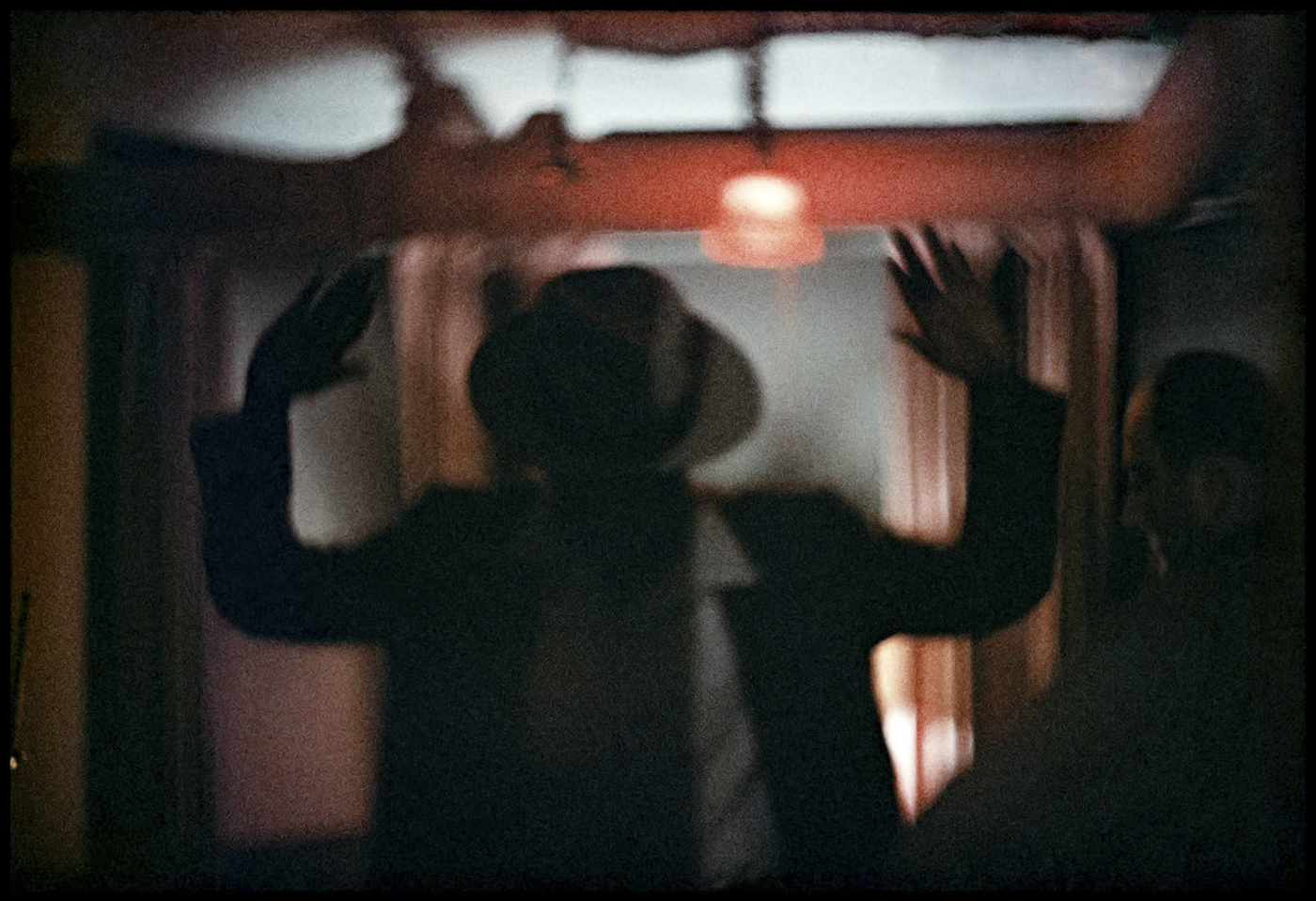
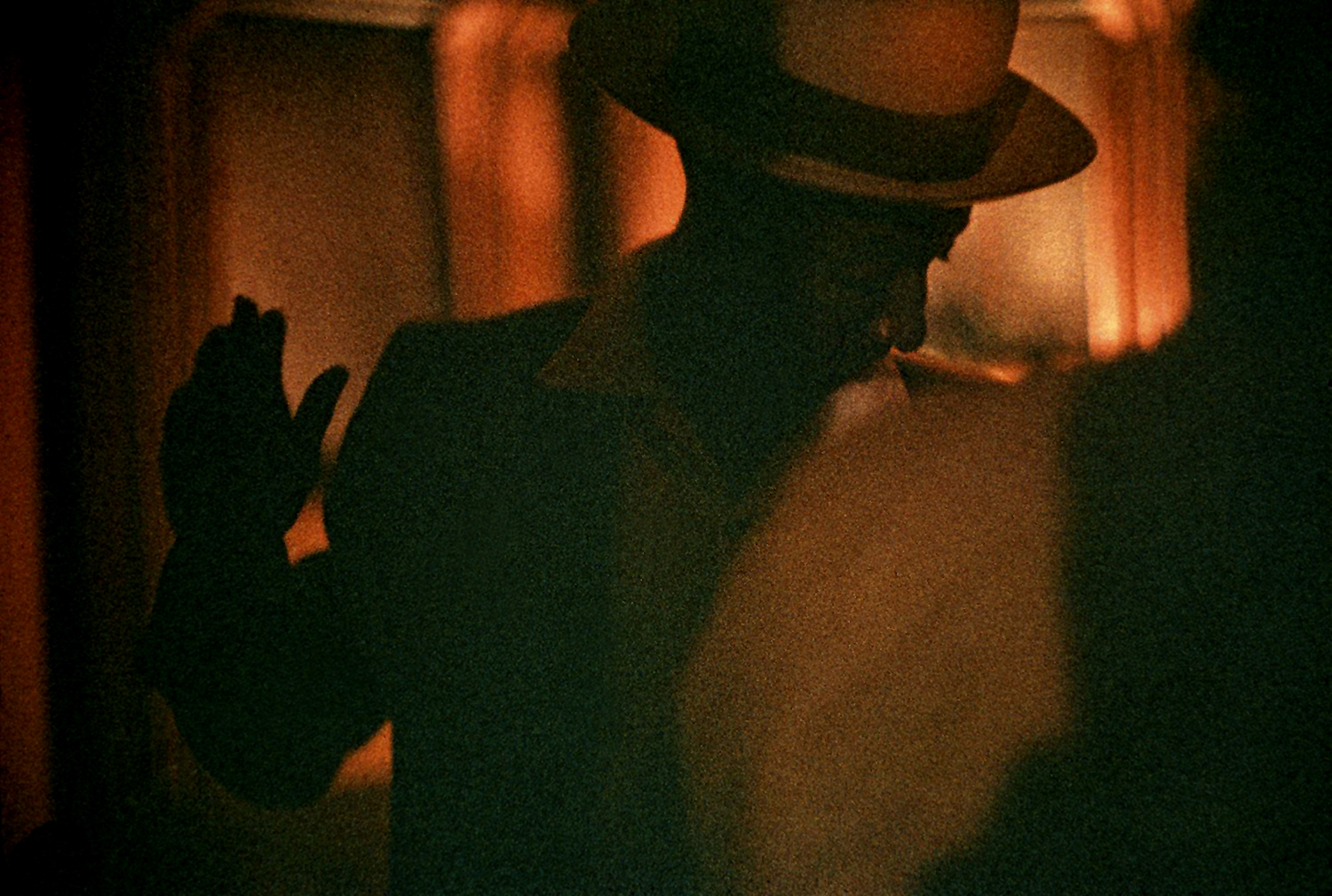
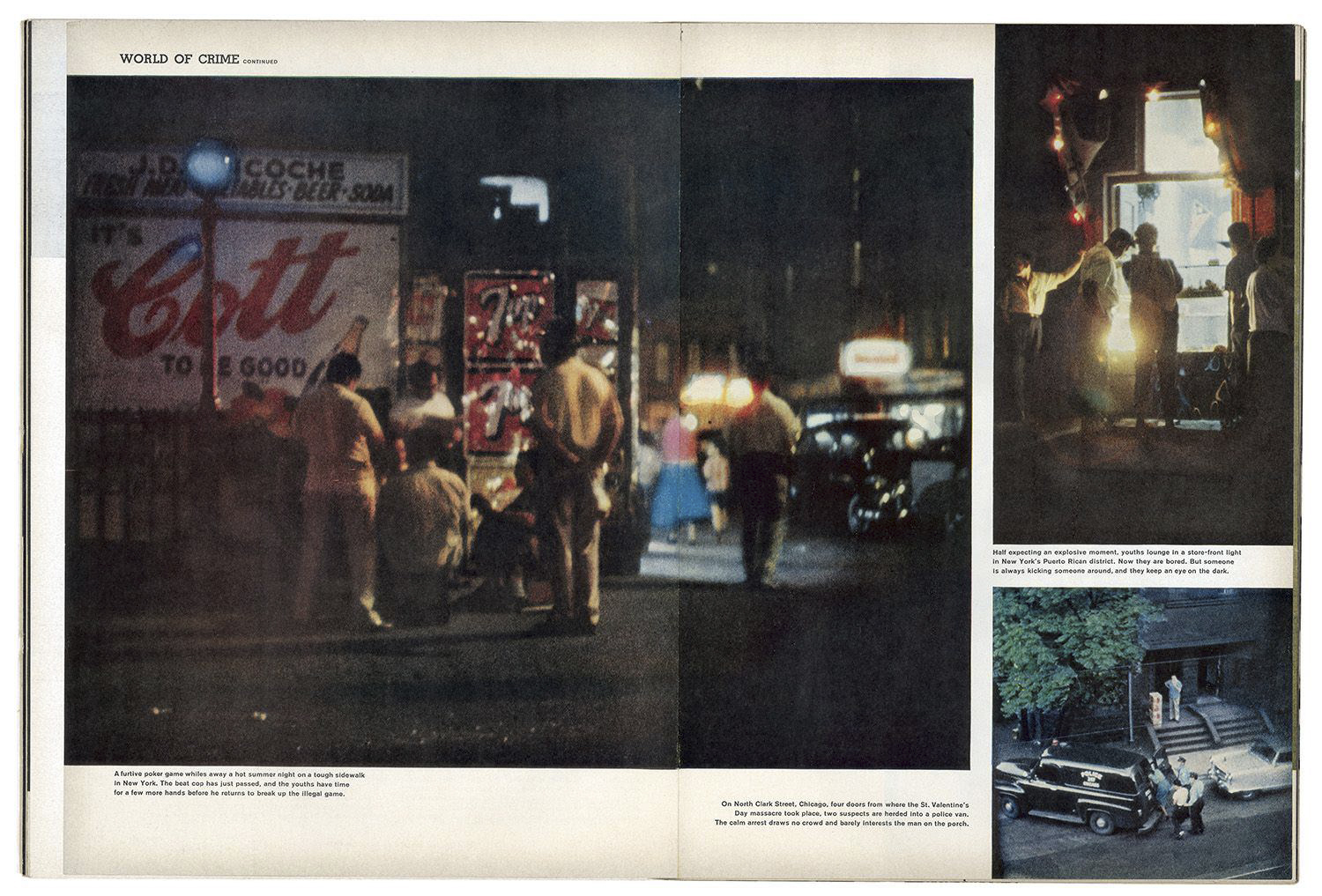
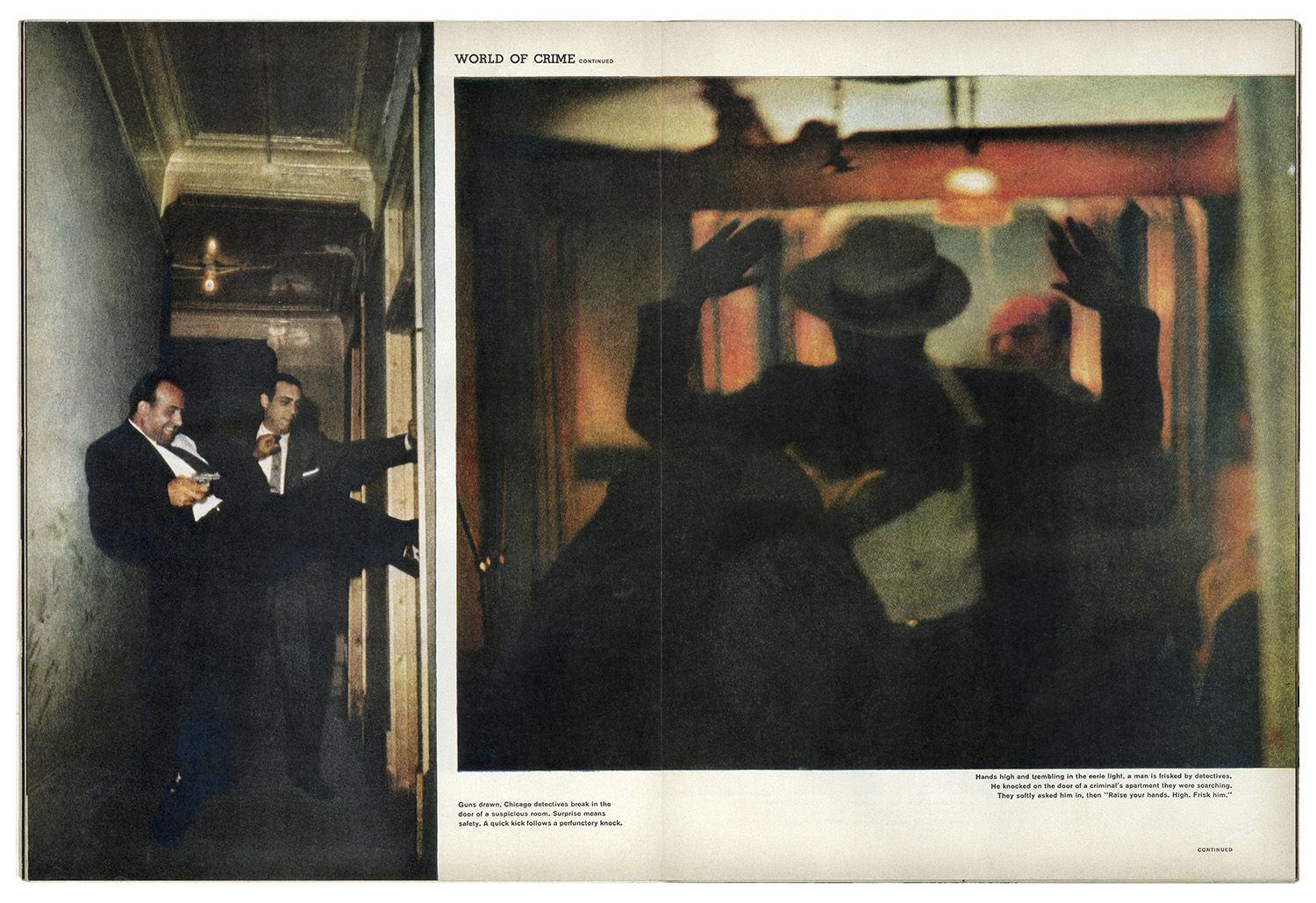
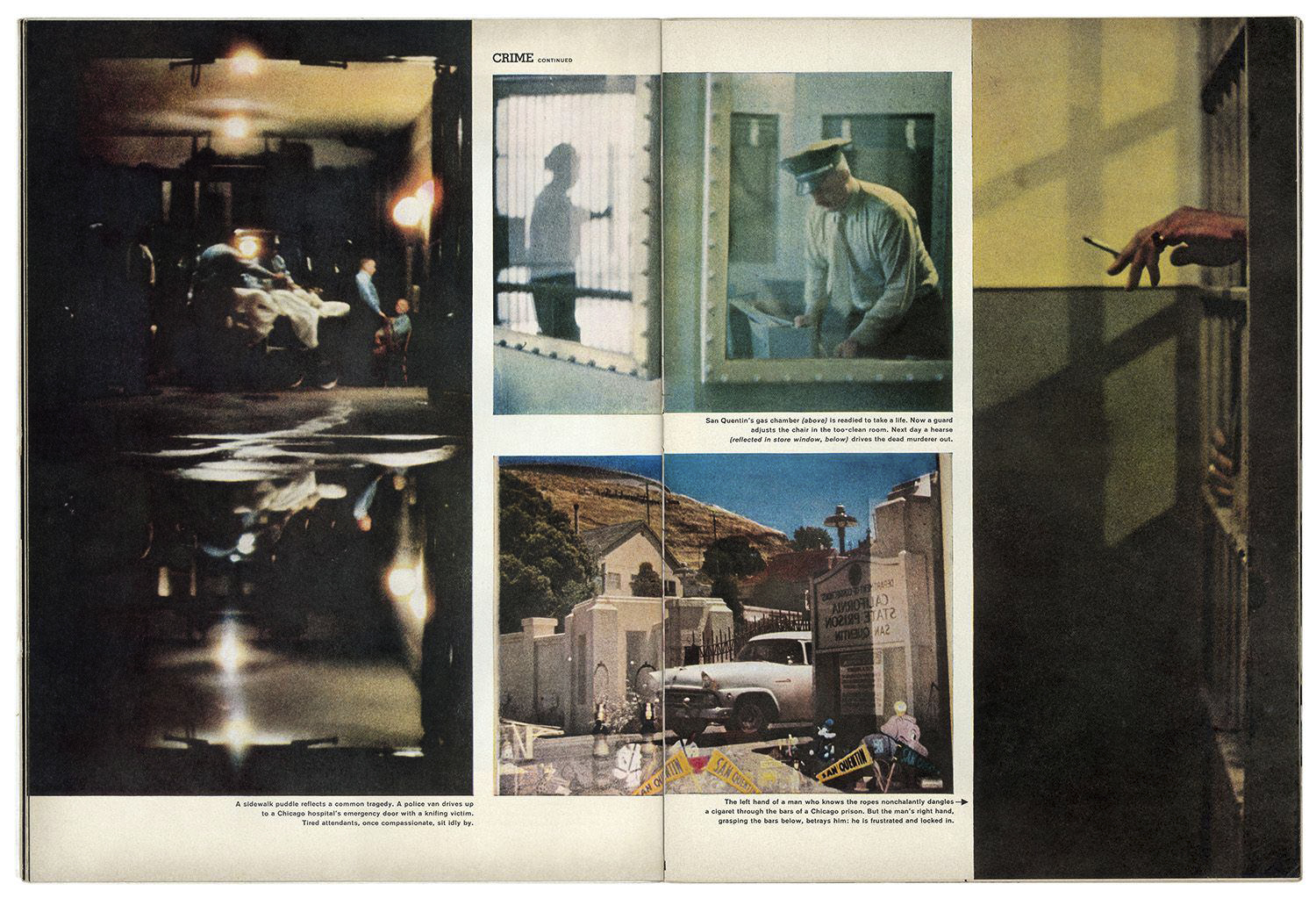
Please note: this posting contains disturbing images of murder and death. Please do not look if you are of a sensitive nature.


Gordon Parks (American, 1912-2006) 'Shooting Victim in Cook County Morgue, Chicago, Illinois' 1957 from the exhibition 'Gordon Parks and "The Atmosphere of Crime"' at the Museum of Modern Art (MoMA), New York, ongoing


Gordon Parks (American, 1912-2006)
Shooting Victim in Cook County Morgue, Chicago, Illinois
1957
Pigmented inkjet print, printed 2019
11 7/8 × 17 15/16″ (30.1 × 45.6cm)
The Museum of Modern Art, New York
The Family of Man Fund
© 2021 Gordon Parks Foundation


As you can imagine, with the tragic situation of the ongoing COVID-19 pandemic around the world at the moment, there are few photography exhibitions on view.

This selection of images comes from the collection 1940s-1970s at the Museum of Modern Art (MoMA) in an ongoing display. Please note that not all Gordon Parks photographs shown here are on display, but I include them to give the viewer an overview, a greater understanding of the breadth of photographs included in Parks’ cinematic photo-essay.

Can you imagine the fortitude of this man: “born into poverty and segregation in Fort Scott, Kansas, in 1912. An itinerant labourer, he worked as a brothel pianist and railcar porter, among other jobs, before buying a camera at a pawnshop, training himself and becoming a photographer. He evolved into a modern-day Renaissance man, finding success as a film director, writer and composer.” “The first Black member of the Farm Security Administration’s storied photo corps; the first Black photographer for the U.S. Office of War Information; the first Black photographer for Vogue; the first Black staff photographer at the weekly magazine Life; and, years later, the first Black filmmaker to direct a motion picture (Shaft) for a major Hollywood studio.” As a photographer he learnt his craft shooting dresses for department stores, taking portraits of society women in Chicago, and studying “the Depression-era images of photographers like Dorothea Lange”. Before joining them as a member of the FSA.

This body of work is remarkable for its non-judgemental gaze, a felt response to a subject which was an assignment for LIFE magazine: an objective reporter with a subjective heart as Parks proclaimed, one who had a certain kind of empathy, “expressing things for people who can’t speak for themselves… the underdogs… in that way I speak for myself.” Park’s photographic strategy was to use colour (rare and expensive in those days), and to close in on detail. Rarely if at all are there any mid to long shots in the photo-essay, placing the photograph in a particular location, the exception being the Untitled street scene under the Chicago “L” (short for “elevated”) rapid transit system and the night-time shot of an illuminated Alcatraz Island – remote, forbidding, isolated.

Photographed with candour – using low depth of field, silhouette, chiaroscuro, natural light, low light, night photography, no blur, little flash and challenging perspective, aesthetically a mixture of Dorothea Lange, Weegee and the colour images of Saul Leiter – other intimate images in the series create an “atmosphere” of everyday life on the streets and in the prisons, capturing how the disenfranchised, the desperate and the destitute are controlled and processed by force. “Parks coaxed his camera to record reality so vividly and compellingly that it would allow Life’s readers to see the complexity of these chronically oversimplified situations.” In Raiding Detectives, Chicago, Illinois (1957) we see two detectives of Italian descent raiding a dingy run-down tenement, busting the door open unannounced, guns drawn. In the photograph underneath in the posting, taken inside the oh so red room with floral curtains, one of the detectives questions a black suspect smoking a cigarette, while on the table covered with newspapers sits a burning candle probably providing the only illumination. Cowering in the shadows is a black women, almost unnoticed until you really look at the photograph. This is what abject poverty looks like. In another photograph, Untitled, New York, New York (1957), black and white men emerge from a police van – about the only time black and white men would have sat together in the segregated society of the time (other than being in prison). Can you imagine the atmosphere inside the paddy wagon, the looks, the conversation or lack of it?

Parks’ beautiful photographs, for they are that, include challenging depictions of death, drug use and nonchalantly displayed items such as guns and knuckledusters. Violence and the outcomes of it are an ever present theme in Parks’ documentation of the policing and criminalisation of marginalised people and communities. The photographs are frequently heartbreaking, such as the scars on the legs of a Black American; or devastating, such as the photograph Knifing Victim I (1957). Park’s compresses the space of the action, attacking the nitty gritty of the mise en scène but with no rush to judgement, just telling it how it is. As Sebastian Smee so eloquently observes, “If all of this were mere history – a series of episodes confined to the past – it would be one thing. But Parks’s photographs are alive to the many ways in which crime in the 1950s was a continuation of this legacy [of slavery, of lynching]. Sixty years after he took these photographs, it’s difficult to deny the conclusion that today’s crime-related inequities, from mass incarceration to police brutality, are likewise an extension of this racist legacy.”

And so it goes, both for the marginalised in America and for Indigenous Australians. “According to the U.S. Bureau of Justice Statistics (BJS) in 2018 Black males accounted for 34% of the total male prison population, white males 29%, and Hispanic males 24%” (Wikipedia) while the percentage of US population that is black is 14%. “As of September 2019, Aboriginal and Torres Strait Islander prisoners represented 28% of the total adult prisoner population, while accounting for 3.3% of the general population.” (Wikipedia)

Dr Marcus Bunyan


Many thankx to MoMA for allowing me to publish the photographs in posting. Please click on the photographs for a larger version of the image. All photographs are used for the purposes of education and research under fair use conditions.


“I’m an objective reporter with a subjective heart,” proclaimed Gordon Parks. “I can’t help but have a certain kind of empathy… It’s more or less expressing things for people who can’t speak for themselves… the underdogs… in that way I speak for myself.” For over half a century, from the 1940s to the 2000s, Gordon Parks captured American life with his powerful photographs. After getting his first camera at the age of 25, he used this “weapon of choice” to attack issues including racism, poverty, urban life, and injustice. He became the first African American staff photographer at Life magazine – an immensely influential platform in the golden age of photo-illustrated magazines that not only allowed his art to be seen by many but also brought a critical, nuanced and, importantly, a Black perspective to the stories and depictions that he shared. For a 1957 assignment, he crisscrossed the streets of New York, Chicago, Los Angeles, and San Francisco, producing vivid colour images addressing the perceived rise in crime in the US. This series, “The Atmosphere of Crime,” challenged stereotypical images of delinquency, drug use, and corruption.


Text from the Gordon Parks Foundation website


“I don’t know that there is any one thing called “the Black experience,” but the way ‘Life magazine’ used Gordon Parks’ photographs for me actually reinscribed some of those notions of Black pathology, such as a story about a gang member (who was actually a pretty normal young man) or extreme poverty and social disenfranchisement. Parks was a much more complex photographer than that, as we came to fully know after his death, but that’s how we came to know him through ‘Life magazine’.”


Dawoud Bey quoted in Gail O’Neill. “Q&A: How Dawoud Bey uses photography to amplify his voice in the world,” on the ‘ARTS ATL’ website November 6, 2020 [Online] Cited 01/03/2021


In 1957, Life staff photographer Gordon Parks traversed New York, Chicago, Los Angeles, and San Francisco capturing crime scenes, police precincts, and prisons for “The Atmosphere of Crime,” as his photo essay was titled when it appeared in the magazine. Rather than identify or label “the criminal,” Parks – a fierce advocate for civil rights and a firm believer in photography as a catalyst for change – documented the policing and criminalisation of marginalised people and communities.

Here, Parks’s series is presented in relation to a long history of picturing criminality. In the nineteenth century, mug shots relied on photography’s supposed objectivity as the basis of their value for identification and surveillance. In the twentieth, more sensational images of victims, raids, and arrests circulated in newspapers and tabloids. In contrast, Parks urges us to look beyond individual people and events, to consider the forces of state and police power that are inextricable from any history of crime – a lesson as essential now as ever.

Text from the MoMA website


Sarah Meister, curator in the Department of Photography, looks at images from Gordon Parks’s 1957 photo essay “The Atmosphere of Crime” (1957) and is moved by the power (and, sadly, continued relevance) of his ability to confront “the great social evils of his time” with an “incredible artistic sensibility.”


Gordon Parks (American, 1912-2006) 'Untitled, Chicago, Illinois' 1957 from the exhibition 'Gordon Parks and "The Atmosphere of Crime"' at the Museum of Modern Art (MoMA), New York, ongoing


Gordon Parks (American, 1912-2006)
Untitled, Chicago, Illinois
1957
Pigmented inkjet print, printed 2019
11 7/8 × 17 15/16″ (30.1 × 45.6cm)
The Museum of Modern Art, New York
The Family of Man Fund
© 2021 Gordon Parks Foundation


Closing in on a known criminal on Chicago’s South Side, police in a scout car check tensely by radio with headquarters. City lights rainbow the storm-splattered windshield as the car approaches the hideout.

Text from LIFE magazine, September 9, 1957, p. 46.


Gordon Parks (American, 1912-2006) 'Raiding Detectives, Chicago, Illinois' 1957


Gordon Parks (American, 1912-2006)
Raiding Detectives, Chicago, Illinois
1957
Pigmented inkjet print, printed 2019
11 7/8 × 17 15/16″ (30.1 × 45.6cm)
The Museum of Modern Art, New York
The Family of Man Fund
© The Gordon Parks Foundation


Gordon Parks (American, 1912-2006) 'Untitled, Chicago, Illinois' 1957


Gordon Parks (American, 1912-2006)
Untitled, Chicago, Illinois
1957
Pigmented inkjet print, printed 2019
11 7/8 × 17 15/16″ (30.1 × 45.6cm)
The Museum of Modern Art, New York
The Family of Man Fund
© 2021 Gordon Parks Foundation


Gordon Parks (American, 1912-2006) 'Drug Search, Chicago, Illinois' 1957


Gordon Parks (American, 1912-2006)
Drug Search, Chicago, Illinois
1957
Pigmented inkjet print, printed 2019
11 7/8 × 17 15/16″ (30.1 × 45.6cm)
The Museum of Modern Art, New York
The Family of Man Fund
© 2021 Gordon Parks Foundation


Gordon Parks (American, 1912-2006) 'Drug Search, Chicago, Illinois' 1957


Gordon Parks (American, 1912-2006)
Drug Search, Chicago, Illinois
1957
Pigmented inkjet print, printed 2019
11 7/8 × 17 15/16″ (30.1 × 45.6cm)
The Museum of Modern Art, New York
The Family of Man Fund
© 2021 Gordon Parks Foundation


Gordon Parks (American, 1912-2006) 'Untitled, Chicago, Illinois' 1957


Gordon Parks (American, 1912-2006)
Untitled, Chicago, Illinois
1957
Pigmented inkjet print, printed 2019
11 7/8 × 17 15/16″ (30.1 × 45.6cm)
The Museum of Modern Art, New York
The Family of Man Fund
© 2021 Gordon Parks Foundation


Gordon Parks (American, 1912-2006) 'Untitled, Chicago, Illinois' 1957


Gordon Parks (American, 1912-2006)
Untitled, Chicago, Illinois
1957
Pigmented inkjet print, printed 2019
13 3/4 × 21″ (35 × 53.3cm)
The Museum of Modern Art, New York
The Family of Man Fund
© 2021 Gordon Parks Foundation


Gordon Parks (American, 1912-2006) 'Untitled, Chicago, Illinois' 1957 (detail)


Gordon Parks (American, 1912-2006)
Untitled, Chicago, Illinois (detail)
1957
Pigmented inkjet print, printed 2019
13 3/4 × 21″ (35 × 53.3cm)
The Museum of Modern Art, New York
The Family of Man Fund
© 2021 Gordon Parks Foundation


Gordon Parks (American, 1912-2006) 'Untitled, Chicago, Illinois' 1957


Gordon Parks (American, 1912-2006)
Untitled, Chicago, Illinois
1957
Pigmented inkjet print, printed 2019
11 7/8 × 17 15/16″ (30.1 × 45.6cm)
The Museum of Modern Art, New York
The Family of Man Fund
© 2021 Gordon Parks Foundation


Gordon Parks (American, 1912-2006) 'Untitled, Chicago, Illinois' 1957


Gordon Parks (American, 1912-2006)
Untitled, Chicago, Illinois
1957
Pigmented inkjet print, printed 2019
11 7/8 × 17 15/16″ (30.1 × 45.6cm)
The Museum of Modern Art, New York
The Family of Man Fund
© 2021 Gordon Parks Foundation


Gordon Parks (American, 1912-2006) 'Untitled' 1957


Gordon Parks (American, 1912-2006)
Untitled, Chicago, Illinois
1957
Pigmented inkjet print, printed 2019
11 7/8 × 17 15/16″ (30.1 × 45.6cm)
The Museum of Modern Art, New York
The Family of Man Fund
© 2021 Gordon Parks Foundation


Gordon Parks (American, 1912-2006) 'Untitled, Chicago, Illinois' 1957


Gordon Parks (American, 1912-2006)
Untitled, Chicago, Illinois
1957
Pigmented inkjet print, printed 2019
11 7/8 × 17 15/16″ (30.1 × 45.6cm)
The Museum of Modern Art, New York
The Family of Man Fund
© 2021 Gordon Parks Foundation


Gordon Parks (American, 1912-2006) 'Narcotics Addict, Chicago, Illinois' 1957


Gordon Parks (American, 1912-2006)
Narcotics Addict, Chicago, Illinois
1957
Pigmented inkjet print, printed 2019
11 7/8 × 17 15/16″ (30.1 × 45.6cm)
The Museum of Modern Art, New York
The Family of Man Fund
© 2021 Gordon Parks Foundation


Gordon Parks (American, 1912-2006) 'Untitled, New York, New York' 1957


Gordon Parks (American, 1912-2006)
Untitled, New York, New York
1957
Pigmented inkjet print, printed 2019
13 3/4 × 21″ (35 × 53.3cm)
The Museum of Modern Art, New York
The Family of Man Fund
© 2021 Gordon Parks Foundation


Gordon Parks (American, 1912-2006) 'Untitled' 1957


Gordon Parks (American, 1912-2006)
Untitled
1957
Pigmented inkjet print, printed 2019
11 7/8 × 17 15/16″ (30.1 × 45.6cm)
The Museum of Modern Art, New York
The Family of Man Fund
© 2021 Gordon Parks Foundation


Gordon Parks (American, 1912-2006) 'San Quentin, California' 1957


Gordon Parks (American, 1912-2006)
San Quentin, California
1957
Pigmented inkjet print, printed 2019
11 7/8 × 17 15/16″ (30.1 × 45.6cm)
The Museum of Modern Art, New York
The Family of Man Fund
© 2021 Gordon Parks Foundation


Gordon Parks (American, 1912-2006) 'Untitled (Alcatraz Island), San Francisco, California' 1957


Gordon Parks (American, 1912-2006)
Untitled (Alcatraz Island), San Francisco, California
1957
Pigmented inkjet print, printed 2019
11 7/8 × 17 15/16″ (30.1 × 45.6cm)
The Museum of Modern Art, New York
The Family of Man Fund
© 2021 Gordon Parks Foundation


Gordon Parks: The Atmosphere of Crime 1957

Gordon Parks’ ethically complex depictions of crime in New York, Chicago, San Francisco, and Los Angeles, with previously unseen photographs.

When Life magazine asked Gordon Parks to illustrate a recurring series of articles on crime in the United States in 1957, he had already been a staff photographer for nearly a decade, the first African American to hold this position. Parks embarked on a six-week journey that took him and a reporter to the streets of New York, Chicago, San Francisco, and Los Angeles.

Unlike much of his prior work, the images made were in colour. The resulting eight-page photo-essay The Atmosphere of Crime was noteworthy not only for its bold aesthetic sophistication but also for how it challenged stereotypes about criminality then pervasive in the mainstream media. They provided a richly hued, cinematic portrayal of a largely hidden world: that of violence, police work and incarceration, seen with empathy and candour.

Parks rejected clichés of delinquency, drug use, and corruption, opting for a more nuanced view that reflected the social and economic factors tied to criminal behaviour and afforded a rare window into the working lives of those charged with preventing and prosecuting it. Transcending the romanticism of the gangster film, the suspense of the crime caper and the racially biased depictions of criminality then prevalent in American popular culture, Parks coaxed his camera to record reality so vividly and compellingly that it would allow Life‘s readers to see the complexity of these chronically oversimplified situations. The Atmosphere of Crime, 1957 includes an expansive selection of never-before-published photographs from Parks’ original reportage.

Anonymous. “Gordon Parks: The Atmosphere of Crime 1957,” on the Exibart Street website [Online] Cited 07/02/2021


Gordon Parks (American, 1912-2006) 'Crime Suspect with Gun, Chicago, Illinois' 1957


Gordon Parks (American, 1912-2006)
Crime Suspect with Gun, Chicago, Illinois
1957
Pigmented inkjet print, printed 2019
17 15/16 × 11 7/8″ (45.6 × 30.1cm)
The Museum of Modern Art, New York
The Family of Man Fund
© 2021 Gordon Parks Foundation


Gordon Parks (American, 1912-2006) 'Police Raid, Chicago, Illinois' 1957


Gordon Parks (American, 1912-2006)
Police Raid, Chicago, Illinois
1957
Pigmented inkjet print, printed 2019
17 15/16 × 11 7/8″ (45.6 × 30.1cm)
The Museum of Modern Art, New York
The Family of Man Fund
© 2021 Gordon Parks Foundation


Gordon Parks (American, 1912-2006) 'Untitled, Chicago, Illinois' 1957


Gordon Parks (American, 1912-2006)
Untitled, Chicago, Illinois
1957
Pigmented inkjet print, printed 2019
17 15/16 × 11 7/8″ (45.6 × 30.1cm)
The Museum of Modern Art, New York
The Family of Man Fund
© 2021 Gordon Parks Foundation


Gordon Parks (American, 1912-2006) 'Untitled' 1957


Gordon Parks (American, 1912-2006)
Untitled
1957
Pigmented inkjet print, printed 2019
17 15/16 × 11 7/8″ (45.6 × 30.1cm)
The Museum of Modern Art, New York
The Family of Man Fund
© 2021 Gordon Parks Foundation


Gordon Parks (American, 1912-2006) 'Untitled, New York, New York' 1957


Gordon Parks (American, 1912-2006)
Untitled, New York, New York
1957
Pigmented inkjet print, printed 2019
17 15/16 × 11 7/8″ (45.6 × 30.1cm)
The Museum of Modern Art, New York
The Family of Man Fund
© 2021 Gordon Parks Foundation


Gordon Parks (American, 1912-2006) 'Untitled, New York, New York' 1957


Gordon Parks (American, 1912-2006)
Untitled, New York, New York
1957
Pigmented inkjet print, printed 2019
11 7/8 × 17 15/16″ (30.1 × 45.6cm)
The Museum of Modern Art, New York
The Family of Man Fund
© 2021 Gordon Parks Foundation


Gordon Parks (American, 1912-2006) 'Untitled' 1957


Gordon Parks (American, 1912-2006)
Untitled
1957
Pigmented inkjet print, printed 2019
17 15/16 × 11 7/8″ (45.6 × 30.1cm)
The Museum of Modern Art, New York
The Family of Man Fund
© 2021 Gordon Parks Foundation


Gordon Parks (American, 1912-2006) 'Checking In Suspect, Chicago, Illinois' 1957


Gordon Parks (American, 1912-2006)
Checking In Suspect, Chicago, Illinois
1957
Pigmented inkjet print, printed 2019
17 15/16 × 11 7/8″ (45.6 × 30.1cm)
The Museum of Modern Art, New York
The Family of Man Fund
© 2021 Gordon Parks Foundation


Gordon Parks (American, 1912-2006) 'Detectives Grilling a Suspect, Chicago, Illinois' 1957


Gordon Parks (American, 1912-2006)
Detectives Grilling a Suspect, Chicago, Illinois
1957
Pigmented inkjet print, printed 2019
17 15/16 × 11 7/8″ (45.6 × 30.1cm)
The Museum of Modern Art, New York
The Family of Man Fund
© 2021 Gordon Parks Foundation


Gordon Parks (American, 1912-2006) 'Fingerprinting Addicts for Forging Prescription, Chicago, Illinois' 1957


Gordon Parks (American, 1912-2006)
Fingerprinting Addicts for Forging Prescription, Chicago, Illinois
1957
Pigmented inkjet print, printed 2019
17 15/16 × 11 7/8″ (45.6 × 30.1cm)
The Museum of Modern Art, New York
The Family of Man Fund
© 2021 Gordon Parks Foundation


Gordon Parks (American, 1912-2006) 'Untitled, Chicago, Illinois' 1957


Gordon Parks (American, 1912-2006)
Untitled, Chicago, Illinois
1957
Pigmented inkjet print, printed 2019
17 15/16 × 11 7/8″ (45.6 × 30.1cm)
The Museum of Modern Art, New York
The Family of Man Fund
© 2021 Gordon Parks Foundation


Gordon Parks (American, 1912-2006) 'Untitled' 1957


Gordon Parks (American, 1912-2006)
Untitled
1957
Pigmented inkjet print, printed 2019
The Museum of Modern Art, New York
The Family of Man Fund
© 2021 Gordon Parks Foundation


Gordon Parks (American, 1912-2006) 'Cops Bring In Knifing Victim, Chicago, Illinois' 1957


Gordon Parks (American, 1912-2006)
Cops Bring In Knifing Victim, Chicago, Illinois
1957
Pigmented inkjet print, printed 2019
21 × 13 3/4″ (53.3 × 35cm)
The Museum of Modern Art, New York
The Family of Man Fund
© 2021 Gordon Parks Foundation


A sidewalk puddle reflects a common tragedy. A police van drives up to a Chicago hospital’s emergency door with a knifing victim. Tired attendants, once compassionate, sit idly by.

Text from LIFE magazine, September 9, 1957


Gordon Parks (American, 1912-2006) 'Police Bring in Victim, Chicago, Illinois' 1957


Gordon Parks (American, 1912-2006)
Police Bring in Victim, Chicago, Illinois
1957
Pigmented inkjet print, printed 2019
The Museum of Modern Art, New York
The Family of Man Fund
© 2021 Gordon Parks Foundation


Gordon Parks (American, 1912-2006) 'Untitled, New York, New York' 1957


Gordon Parks (American, 1912-2006)
Untitled, New York, New York
1957
Pigmented inkjet print, printed 2019
21 × 13 3/4″ (53.3 × 35cm)
The Museum of Modern Art, New York
The Family of Man Fund
© 2021 Gordon Parks Foundation


Gordon Parks (American, 1912-2006) 'Untitled, New York, New York' 1957


Gordon Parks (American, 1912-2006)
Untitled, New York, New York
1957
Pigmented inkjet print, printed 2019
The Museum of Modern Art, New York
The Family of Man Fund
© 2021 Gordon Parks Foundation


A prowl car halts in a New York street, a youth comes nervously to its side. “You clean?” the cop asks. “We’re watching you.”

Text from “The Atmosphere of Crime” photographed for LIFE by Gordon Parks. LIFE magazine, September 9, 1957, p. 50.


Gordon Parks (American, 1912-2006) 'Knifing Victim I, Chicago, Illinois' 1957


Gordon Parks (American, 1912-2006)
Knifing Victim I, Chicago, Illinois
1957
Pigmented inkjet print, printed 2019
17 15/16 × 11 7/8″ (45.6 × 30.1cm)
The Museum of Modern Art, New York
The Family of Man Fund
© 2021 Gordon Parks Foundation


Gordon Parks (American, 1912-2006) 'Untitled, Chicago, Illinois' 1957


Gordon Parks (American, 1912-2006)
Untitled, Chicago, Illinois
1957
Pigmented inkjet print, printed 2019
17 15/16 × 11 7/8″ (45.6 × 30.1cm)
The Museum of Modern Art, New York
The Family of Man Fund
© 2021 Gordon Parks Foundation


Gordon Parks (American, 1912-2006) 'Untitled, Chicago, Illinois' 1957


Gordon Parks (American, 1912-2006)
Untitled, Chicago, Illinois
1957
Pigmented inkjet print, printed 2019
17 15/16 × 11 7/8″ (45.6 × 30.1cm)
The Museum of Modern Art, New York
The Family of Man Fund
© 2021 Gordon Parks Foundation


Gordon Parks (American, 1912-2006) 'Morgue Photos of Dope Peddler Killed by Cops, Chicago, Illinois' 1957


Gordon Parks (American, 1912-2006)
Morgue Photos of Dope Peddler Killed by Cops, Chicago, Illinois
1957
Pigmented inkjet print, printed 2019
17 15/16 × 11 7/8″ (45.6 × 30.1cm)
The Museum of Modern Art, New York
The Family of Man Fund
© 2021 Gordon Parks Foundation


Gordon Parks (American, 1912-2006) 'Untitled, San Quentin, California' 1957


Gordon Parks (American, 1912-2006)
Untitled, San Quentin, California [Pre-execution report]
1957
Pigmented inkjet print, printed 2019
17 15/16 × 11 7/8″ (45.6 × 30.1cm)
The Museum of Modern Art, New York
The Family of Man Fund
© 2021 Gordon Parks Foundation


Gordon Parks (American, 1912-2006) 'Untitled, Chicago, Illinois' 1957


Gordon Parks (American, 1912-2006)
Untitled, Chicago, Illinois
1957
Pigmented inkjet print
16 × 20″ (40.6 × 50.8 cm)
Gift of The Gordon Parks Foundation


The left hand of a man who knows the ropes nonchalantly dangles a cigaret through the bars of a Chicago prison. But the man’s right hand, grasping the bars below, betrays him: he is frustrated and locked in.

Text from LIFE magazine, September 9, 1957


MoMA acquires historic Gordon Parks series The Atmosphere of Crime

The photographs will go on view in the New York museum’s permanent collection galleries in May, along with a selection of works by other artists and a clip from the classic 1971 film Shaft

The Museum of Modern Art (MoMA) in New York has acquired a full set of photographs by Gordon Parks from The Atmosphere of Crime series, a photographic essay examining crime in America he created on assignment with Life magazine in 1957. Along with 55 modern colour inkjet prints created from Parks’s transparencies, selected and bought in consultation with the Gordon Parks Foundation, the foundation has gifted a vintage gelatin silver print that matches a work already in MoMA’s collection, given by the photographer in 1993. Around 15 pieces from the series will go on view in a dedicated gallery on the fourth floor in May, along with an excerpt from his classic 1971 film Shaft and works by other artists from the collection, as part of the next reinstallation of the permanent galleries.

The acquisition comes through years of conversations with the Gordon Parks Foundation, which has been organising in-depth exhibitions of the photographer’s work at major museums since his death in 2006. “When Sarah Meister [MoMA’s curator of photography] and I began speaking a few years ago about how the museum could make a major acquisition, it was about what body of work would really have the most impact to what’s going on in the current world,” says Peter Kunhardt, Jr, the foundation’s executive director. “And we both felt that The Atmosphere of Crime was so relevant, not only because so much hasn’t changed today in our criminal justice system and with police brutality and violence, but also because the work is in colour.”

Colour photography was prohibitively expensive to produce outside of commercial projects at the time Parks first shot the series, Meister explains, and only a selection of images from the series were printed in colour in Life. “The transparencies that Gordon Parks made have been held back for a number of years for the right institution to thoughtfully put together an exhibition and book,” Kunhardt adds. The catalogue, published by Steidl with essays by Meister, Bryan Stevenson, the founder of the Equal Justice Initiative, and the art historian Nicole Fleetwood, who also wrote Marking Time: Art in the Age of Mass Incarceration, includes all the images from the acquisition.

Extract from Helen Stoilas. “MoMA acquires historic Gordon Parks series The Atmosphere of Crime,” on The Art Newspaper website 11 February 2020 [Online] Cited 07/02/2021


Installation view of the Collection 1940s-1970s, Room 409: 'Gordon Parks and "The Atmosphere of Crime"' at the Museum of Modern Art (MoMA), New York

Installation view of the Collection 1940s-1970s, Room 409: 'Gordon Parks and "The Atmosphere of Crime"' at the Museum of Modern Art (MoMA), New York

Installation view of the Collection 1940s-1970s, Room 409: 'Gordon Parks and "The Atmosphere of Crime"' at the Museum of Modern Art (MoMA), New York

Installation view of the Collection 1940s-1970s, Room 409: 'Gordon Parks and "The Atmosphere of Crime"' at the Museum of Modern Art (MoMA), New York

Installation view of the Collection 1940s-1970s, Room 409: 'Gordon Parks and "The Atmosphere of Crime"' at the Museum of Modern Art (MoMA), New York

Installation view of the Collection 1940s-1970s, Room 409: 'Gordon Parks and "The Atmosphere of Crime"' at the Museum of Modern Art (MoMA), New York


Installation views of the Collection 1940s-1970s, Room 409: Gordon Parks and “The Atmosphere of Crime” at the Museum of Modern Art (MoMA), New York


None of these images is crude or cliched. A few, it’s true, are brutally direct, in the spirit of Robert Lowell (“Yet why not say what happened?”) or Walker Evans (“If the thing is there, why there it is.”). But others are oddly – and arrestingly – tentative. They’re optically blurred, obscured by visual impediments, as if filtered through the artist’s melancholy, his pity, his black-of-night bewilderment. Looking at them, you feel that something others might rush to – judgment, sentencing, finality – has been deliberately withheld. …

The presence of the word “atmosphere” in the title is apt. It captures both the cumulative impact of the imagery and the complexity of crime’s causes and effects. Park’s use of blur, his unexpected vantage points and his embrace of pooling darkness all elevate his feeling for complication and suffering over the usual simplistic story lines that crowd to the subject of crime. …

Between 1880 and 1950, lynchings were committed in open defiance of the law, terrorising a Black population that proceeded to escape to the ghettos of the North in massive numbers.

If all of this were mere history – a series of episodes confined to the past – it would be one thing. But Parks’s photographs are alive to the many ways in which crime in the 1950s was a continuation of this legacy. Sixty years after he took these photographs, it’s difficult to deny the conclusion that today’s crime-related inequities, from mass incarceration to police brutality, are likewise an extension of this racist legacy.

Big-city street crime has been in steady decline for three decades now. And yet the complexities and inequities of American crime still hinge on race and are still crudely narrated in the media.

Extract from Sebastian Smee. “With his camera, Gordon Parks humanized the Black people others saw as simply criminals,” on The Washington Post website August 5, 2020 [Online] Cited 07/02/2021


LIFE magazine, September 9, 1957


LIFE magazine, September 9, 1957 front cover


Robert Wallace. "Crime in the U.S." LIFE magazine, September 9, 1957, pp. 46-47.


Robert Wallace. “Crime in the U.S.” LIFE magazine, September 9, 1957, pp. 46-47. Photograph by Gordon Parks.


LIFE magazine 'Crime in the U.S.'

Robert Wallace. "Crime in the U.S." LIFE magazine, September 9, 1957

Robert Wallace. "Crime in the U.S." LIFE magazine, September 9, 1957


Robert Wallace. “Crime in the U.S.” LIFE magazine, September 9, 1957. Photographs by Gordon Parks.


Robert Wallace. "Crime in the U.S." LIFE magazine, September 9, 1957, pp. 68-69.


Robert Wallace. “Crime in the U.S.” LIFE magazine, September 9, 1957, pp. 68-69.


“BANDIT’S ROOST” in New York’s Mulberry Street in 1890s housed Italians who, like most economically exploited immigrant groups, had a high incidence of crime. As Sellin explains, this dropped as they prospered.

Unattributed photograph by Jacob Riis (see below).


Jacob Riis (Danish-American, 1849-1914) 'Bandit's Roost at 59½ Mulberry Street' 1888


Jacob Riis (American born Denmark, 1849-1914)
Bandit’s Roost at 59½ Mulberry Street
1888
From How the Other Half Lives


This image is Bandit’s Roost at 59½ Mulberry Street, considered the most crime-ridden, dangerous part of New York City.


Jacob Riis (American born Denmark, 1849-1914)

Jacob August Riis (1849-1914) was a Danish-American social reformer, “muckraking” journalist and social documentary photographer. He contributed significantly to the cause of urban reform in America at the turn of the twentieth century. He is known for using his photographic and journalistic talents to help the impoverished in New York City; those impoverished New Yorkers were the subject of most of his prolific writings and photography. He endorsed the implementation of “model tenements” in New York with the help of humanitarian Lawrence Veiller. Additionally, as one of the most famous proponents of the newly practicable casual photography, he is considered one of the fathers of photography due to his very early adoption of flash in photography.

While living in New York, Riis experienced poverty and became a police reporter writing about the quality of life in the slums. He attempted to alleviate the bad living conditions of poor people by exposing their living conditions to the middle and upper classes. …

Photography

Bandit’s Roost (1888) by Jacob Riis, from How the Other Half Lives. This image is Bandit’s Roost at 59½ Mulberry Street, considered the most crime-ridden, dangerous part of New York City. Riis had for some time been wondering how to show the squalor of which he wrote more vividly than his words could express. He tried sketching, but was incompetent at this. Camera lenses of the 1880s were slow as was the emulsion of photographic plates; photography thus did not seem to be of any use for reporting about conditions of life in dark interiors. In early 1887, however, Riis was startled to read that “a way had been discovered to take pictures by flashlight. The darkest corner might be photographed that way.” The German innovation, by Adolf Miethe and Johannes Gaedicke, flash powder was a mixture of magnesium with potassium chlorate and some antimony sulfide for added stability; the powder was used in a pistol-like device that fired cartridges. This was the introduction of flash photography.

Recognising the potential of the flash, Riis informed a friend, Dr. John Nagle, chief of the Bureau of Vital Statistics in the City Health Department who was also a keen amateur photographer. Nagle found two more photographer friends, Henry Piffard and Richard Hoe Lawrence, and the four of them began to photograph the slums. Their first report was published in the New York newspaper The Sun on February 12, 1888; it was an unsigned article by Riis which described its author as “an energetic gentleman, who combines in his person, though not in practice, the two dignities of deacon in a Long Island church and a police reporter in New York”. The “pictures of Gotham’s crime and misery by night and day” are described as “a foundation for a lecture called ‘The Other Half: How It Lives and Dies in New York.’ to give at church and Sunday school exhibitions, and the like.” The article was illustrated by twelve line drawings based on the photographs.

Riis and his photographers were among the first Americans to use flash photography. Pistol lamps were dangerous and looked threatening, and would soon be replaced by another method for which Riis lit magnesium powder on a frying pan. The process involved removing the lens cap, igniting the flash powder and replacing the lens cap; the time taken to ignite the flash powder sometimes allowed a visible image blurring created by the flash.

Riis’s first team soon tired of the late hours, and Riis had to find other help. Both his assistants were lazy and one was dishonest, selling plates for which Riis had paid. Riis sued him in court successfully. Nagle suggested that Riis should become self-sufficient, so in January 1888 Riis paid $25 for a 4×5 box camera, plate holders, a tripod and equipment for developing and printing. He took the equipment to the potter’s field cemetery on Hart Island to practice, making two exposures. The result was seriously overexposed but successful.

For three years, Riis combined his own photographs with others commissioned of professionals, donations by amateurs and purchased lantern slides, all of which formed the basis for his photographic archive.

Because of the nighttime work, he was able to photograph the worst elements of the New York slums, the dark streets, tenement apartments, and “stale-beer” dives, and documented the hardships faced by the poor and criminal, especially in the vicinity of notorious Mulberry Street. …

Social attitudes

Riis’s concern for the poor and destitute often caused people to assume he disliked the rich. However, Riis showed no sign of discomfort among the affluent, often asking them for their support. Although seldom involved with party politics, Riis was sufficiently disgusted by the corruption of Tammany Hall to change from being an endorser of the Democratic Party to endorse the Republican Party. The period just before the Spanish-American War was difficult for Riis. He was approached by liberals who suspected that protests of alleged Spanish mistreatment of the Cubans was merely a ruse intended to provide a pretext for US expansionism; perhaps to avoid offending his friend Roosevelt, Riis refused the offer of good payment to investigate this and made nationalist statements.

Riis emphatically supported the spread of wealth to lower classes through improved social programs and philanthropy, but his personal opinion of the natural causes for poor immigrants’ situations tended to display the trappings of a racist ideology. Several chapters of How the Other Half Lives, for example, open with Riis’ observations of the economic and social situations of different ethnic and racial groups via indictments of their perceived natural flaws; often prejudices that may well have been informed by scientific racism.

Criticism

Riis’s sincerity for social reform has seldom been questioned, but critics have questioned his right to interfere with the lives and choices of others. His audience comprised middle-class reformers, and critics say that he had no love for the traditional lifestyles of the people he portrayed. Stange (1989) argues that Riis “recoiled from workers and working-class culture” and appealed primarily to the anxieties and fears of his middle-class audience. Swienty (2008) says, “Riis was quite impatient with most of his fellow immigrants; he was quick to judge and condemn those who failed to assimilate, and he did not refrain from expressing his contempt.” Gurock (1981) says Riis was insensitive to the needs and fears of East European Jewish immigrants who flooded into New York at this time.

Libertarian economist Thomas Sowell (2001) argues that immigrants during Riis’s time were typically willing to live in cramped, unpleasant circumstances as a deliberate short-term strategy that allowed them to save more than half their earnings to help family members come to America, with every intention of relocating to more comfortable lodgings eventually. Many tenement renters physically resisted the well-intentioned relocation efforts of reformers like Riis, states Sowell, because other lodgings were too costly to allow for the high rate of savings possible in the tenements. Moreover, according to Sowell, Riis’s own personal experiences were the rule rather than the exception during his era: like most immigrants and low-income persons, he lived in the tenements only temporarily before gradually earning more income and relocating to different lodgings.

Riis’s depictions of various ethnic groups can be harsh. In Riis’s books, according to some historians, “The Jews are nervous and inquisitive, the Orientals are sinister, the Italians are unsanitary.”

Riis was also criticised for his depiction of African Americans. He was said to portray them as falsely happy with their lives in the “slums” of New York City. This criticism didn’t come until much later after Riis had died. His writing was overlooked because his photography was so revolutionary in his early books.

Text from the Wikipedia website


"The Atmosphere of Crime" photographed for LIFE by Gordon Parks. LIFE magazine, September 9, 1957, p. 50.


“The Atmosphere of Crime” photographed for LIFE by Gordon Parks. LIFE magazine, September 9, 1957, p. 50.


Gordon Parks' photo essay 'The Atmosphere of Crime' in 'Life Magazine', September 9, 1957


Gordon Parks’ photo essay “The Atmosphere of Crime” in Life Magazine, September 9, 1957, pp. 58-59.


Because this year marks the 50th anniversary of his groundbreaking 1971 film, “Shaft”; because two fine shows of his pioneering photojournalism are on view at the Jack Shainman galleries in Chelsea; because a suite from his influential 1957 series, “The Atmosphere of Crime,” is a highlight of “In and Around Harlem,” on view at the Museum of Modern Art; and because, somehow, despite the long shadow cast by a man widely considered the preeminent Black American photographer of the 20th century, he is too little known, the time seems right to revisit some elements of the remarkable life, style and undimmed relevance of Gordon Parks.


Last born of 15 children, he made a career of firsts

Born Gordon Roger Alexander Buchanan Parks in Fort Scott, Kansas, on Nov. 30, 1912, he attended segregated schools where he was prohibited from playing sports and was advised not to aim for college because higher education was pointless for people destined to be porters and maids.

Once, he was beaten up for walking with a light-skinned cousin. Once, he was tossed into the Marmaton River by three white boys fully aware that he could not swim. Once, he was thrown out of a brother-in-law’s house where he was sent to live after his mother’s death. This was in St. Paul, at Christmas. He rode a trolley all night to keep warm.

The road to fame had plenty of detours

At various points in his early years, Parks played the piano in a brothel, was a janitor in a flophouse and was a dining car waiter on the cross-country railroad. He survived these travails to become, following a route that was anything but direct, the first Black member of the Farm Security Administration’s storied photo corps; the first Black photographer for the U.S. Office of War Information; the first Black photographer for Vogue; the first Black staff photographer at the weekly magazine Life; and, years later, the first Black filmmaker to direct a motion picture for a major Hollywood studio. By the standards of a Jim Crow era, Parks’ perseverance rose to the level of the biblical.

He got his break shooting dresses

As passengers have done everywhere and always, those on the North Coast Limited between Chicago and Seattle tossed their onboard reading when they were done. Parks scavenged the well-thumbed magazines and, taking them home, discovered both the Depression-era images of photographers like Dorothea Lange and the exotic spheres depicted in Vogue.

He bought his first camera at a pawnshop in Seattle in 1937 and taught himself how to use it. Returning to the Minneapolis area where he had lived for a time, he scouted work shooting for local department stores. All except one rebuffed him.

This, as it happened, was Frank Murphy, the most fashionable boutique in the city, a shop with a running fountain, a resident parrot and a clientele that ran to women from the Pillsbury, Ordway and Dayton dynasties and who relied on the buyers there to supply them with things like “telephone dresses,” for those who considered it unseemly to take calls in dishabille.

By legend, it was the owner’s wife, Madeleine, who insisted that her husband hire the fledgling photographer despite his inexperience, for reasons never made clear. The bet paid off, though, since the images Parks produced promptly resulted in more work, a local exhibition and a telephone call from Marva Louis, then the wife of the world heavyweight boxing champion, Joe Louis, who encouraged him to relocate to Chicago, where he began taking portraits of society women. It was a career transit compressed in a sequence of events so implausible as to seem cinematic. Yet, for Parks, it was just a beginning.

“From the start, Parks knew how to make a beautiful picture,” photography critic Vince Aletti said. And it is true that, long after Parks established his reputation with unflinching photographic series on the civil rights movement, Harlem gangs, the Black Panthers, Malcolm X and the Nation of Islam, he continued to move easily between photojournalism and the fashion work for which he maintained a lifelong regard – and which, along with his access to elements of Black life largely invisible to white readers, was among the reasons he was hired in the first place by Life.

© 2021 The New York Times Company


Unknown photographer. 'Untitled (Pages from an album of mugshots)' 1870s-1880s


Unknown photographer
Untitled (Pages from an album of mugshots)
1870s-80s
Albumen silver prints
Each 9 1/8 × 4 7/16″ (23.2 × 11.2cm)


Times Wide World Photos. "Ms. Ruth Snyder as She Looks Today" April 1927


Times Wide World Photos
“Ms. Ruth Snyder as She Looks Today”
April 1927
Gelatin silver print
9 7/8 × 7 1/2″ (25.1 × 19.1cm)
The New York Times Collection
© 2021 Times Wide World Photos


Ruth Brown Snyder (March 27, 1895 – January 12, 1928) was an American murderer. Her execution in the electric chair at New York’s Sing Sing Prison in 1928 for the murder of her husband, Albert Snyder, was recorded in a well-publicised photograph.


Associated Press. "Mob Foiled in Attempted Lynching" 1934


Associated Press
“Mob Foiled in Attempted Lynching”
1934
Gelatin silver print
6 1/2 × 8 3/8″ (16.5 × 21.3cm)
The New York Times Collection
© 2021 Associated Press


Weegee (Arthur Fellig) (American, 1899-1968) 'Charles Sodokoff and Arthur Webber Use Their Top Hats to Hide Their Faces' 1942


Weegee (Arthur Fellig) (American, 1899-1968)
Charles Sodokoff and Arthur Webber Use Their Top Hats to Hide Their Faces
1942
Gelatin silver print
10 5/16 × 13 3/16″ (26.2 × 33.5cm)
The Family of Man Fund
© 2021 Weegee/ICP/Getty Images


Associated Press, Roger Higgins. 'Ethel and Julius Rosenberg on Their Way to Jail in New York' March 29, 1951


Associated Press, Roger Higgins
Ethel and Julius Rosenberg on Their Way to Jail in New York
March 29, 1951
Gelatin silver print
6 1/2 × 8 7/16″ (16.5 × 21.4cm)
The New York Times Collection
© 2021 Associated Press


Julius Rosenberg and Ethel Rosenberg were American citizens who were convicted of spying on behalf of the Soviet Union. The couple was accused of providing top-secret information about radar, sonar, jet propulsion engines, and valuable nuclear weapon designs; at that time the United States was the only country in the world with nuclear weapons. Convicted of espionage in 1951, they were executed by the federal government of the United States in 1953 in the Sing Sing correctional facility in Ossining, New York, becoming the first American civilians to be executed for such charges and the first to suffer that penalty during peacetime.

Other convicted co-conspirators were sentenced to prison, including Ethel’s brother, David Greenglass (who had made a plea agreement), Harry Gold, and Morton Sobell. Klaus Fuchs, a German scientist working in Los Alamos, was convicted in the United Kingdom.

For decades, the Rosenbergs’ sons (Michael and Robert Meeropol) and many other defenders maintained that Julius and Ethel were innocent of spying on their country and were victims of Cold War paranoia. After the fall of the Soviet Union, much information concerning them was declassified, including a trove of decoded Soviet cables (code-name: Venona), which detailed Julius’s role as a courier and recruiter for the Soviets. Ethel’s role was as an accessory who helped recruit her brother David into the spy ring and she worked in a secretarial manner typing up documents for her husband that were given to the Soviets. In 2008, the National Archives of the United States published most of the grand jury testimony related to the prosecution of the Rosenbergs.

Text from the Wikipedia website


Dorothea Lange (American, 1895-1965) 'Black Maria, Oakland' 1957


Dorothea Lange (American, 1895-1965)
Black Maria, Oakland
1957
Gelatin silver print
10 15/16 × 9 13/16″ (27.9 × 24.9cm)
Gift of the artist


Meyer Liebowitz (American, 1906-1976) / The New York Times. 'Umberto (Albert) Anastasia Shot to Death in Barber's Chair' October 25, 1957


Meyer Liebowitz (American, 1906-1976) / The New York Times
Umberto (Albert) Anastasia Shot to Death in Barber’s Chair
October 25, 1957
Gelatin silver print
7 5/8 × 8 7/16″ (19.4 × 21.4cm)
The New York Times Collection
© 2021 The New York Times


Umberto “Albert” Anastasia (1902-1957) was an Italian-American mobster, hitman, and crime boss. One of the founders of the modern American Mafia and a co-founder and later boss of the Murder, Inc. criminal collective, Anastasia eventually rose to the position of boss in what became the modern Gambino crime family. He was also in control of the New York waterfront for most of his criminal career, including the dockworker unions. He was murdered on October 25, 1957, on the orders of Vito Genovese and Carlo Gambino; Gambino subsequently became boss of the family.

Anastasia was one of the most ruthless and feared organised crime figures in American history; his reputation earned him the nicknames “The One-Man Army”, “Mad Hatter” and “Lord High Executioner”. …

Assassination

On the morning of October 25, 1957, Anastasia entered the barber shop of the Park Sheraton Hotel, at 56th Street and 7th Avenue in Midtown Manhattan. Anastasia’s driver parked the car in an underground garage and then took a walk outside, leaving him unprotected. As Anastasia relaxed in the barber’s chair, two men – scarves covering their faces – rushed in, shoved the barber out of the way, and fired at Anastasia. After the first volley of bullets, Anastasia reportedly lunged at his killers. However, the stunned Anastasia had actually attacked the gunmen’s reflections in the wall mirror of the barber shop. The gunmen continued firing until Anastasia finally fell dead on the floor.

The Anastasia homicide generated a tremendous amount of public interest and sparked a high-profile police investigation. Per The New York Times journalist and Five Families author Selwyn Raab, “The vivid image of a helpless victim swathed in white towels was stamped in the public memory”. However, no one was charged in the case. Speculation on who killed Anastasia has centred on Profaci crime family mobster Joe Gallo, the Patriarca crime family of Providence, Rhode Island, and certain drug dealers within the Gambino family. Initially, the NYPD concluded that Anastasia’s homicide had been arranged by Genovese and Gambino and that it was carried out by a crew led by Gallo. At one point, Gallo boasted to an associate of his part in the hit, “You can just call the five of us the barbershop quintet”. Elsewhere, Genovese had traditionally strong ties to Patriarca boss Raymond L. S. Patriarca.

Anastasia’s funeral service was conducted at a Brooklyn funeral home; the Roman Catholic Diocese of Brooklyn had refused to sanction a church burial. Anastasia was interred in Green-Wood Cemetery in Greenwood Heights, Brooklyn, attended by a handful of friends and relatives. It is marked “Anastasio”. In 1958, his family emigrated to Canada, and changed the name to “Anisio”.

Text from the Wikipedia website


Danny Lyon (American, b. 1942) 'Dominoes, Walls Unit, Texas' 1967-1969


Danny Lyon (American, b. 1942)
Dominoes, Walls Unit, Texas
1967-1969
Gelatin silver print
11 × 14″ (28 × 35.6cm)
Gift of Mr. and Mrs. James Hunter
© 2021 Danny Lyon


John Hubbard / Black Star Publishing Company. "Kennedy Car off Bridge to Chappaquiddick Island, Massachusetts" July 19, 1969


John Hubbard / Black Star Publishing Company
“Kennedy Car off Bridge to Chappaquiddick Island, Massachusetts”
July 19, 1969
Gelatin silver print
6 13/16 × 9 15/16″ (17.3 × 25.2cm)
The New York Times Collection
© 2021 John Hubbard/Black Star Publishing Co.


The Chappaquiddick incident (popularly known as Chappaquiddick) was a single-vehicle car crash that occurred on Chappaquiddick Island in Massachusetts some time around midnight between Friday, July 18, and Saturday, July 19, 1969. The crash was caused by Senator Edward M. (Ted) Kennedy’s negligence and resulted in the death of his 28-year-old passenger Mary Jo Kopechne, who was trapped inside the vehicle.

Kennedy left a party on Chappaquiddick at 11:15 p.m. Friday, with Kopechne. He maintained his intent was to immediately take Kopechne to a ferry landing and return to Edgartown, but that he accidentally made a wrong turn onto a dirt road leading to a one-lane bridge. After his car skidded off the bridge into Poucha Pond, Kennedy swam free, and maintained he tried to rescue Kopechne from the submerged car, but he could not. Kopechne’s death could have happened any time between about 11:30 p.m. Friday and 1 a.m. Saturday, as an off-duty deputy sheriff maintained he saw a car matching Kennedy’s at 12:40 a.m. Kennedy left the scene and did not report the crash to police until after 10 a.m. Saturday. Meanwhile, a diver recovered Kopechne’s body from Kennedy’s car shortly before 9 a.m. Saturday.

At a July 25, 1969, court hearing, Kennedy pled guilty to a charge of leaving the scene of an accident and received a two-month suspended jail sentence. In a televised statement that same evening, he said his conduct immediately after the crash “made no sense to me at all”, and that he regarded his failure to report the crash immediately as “indefensible”. A January 5, 1970, judicial inquest concluded Kennedy and Kopechne did not intend to take the ferry, and that Kennedy intentionally turned toward the bridge, operating his vehicle negligently, if not recklessly, at too high a rate of speed for the hazard which the bridge posed in the dark. The judge stopped short of recommending charges, and a grand jury convened on April 6, 1970, returning no indictments. On May 27, 1970, a Registry of Motor Vehicles hearing resulted in Kennedy’s driver’s license being suspended for a total of sixteen months after the crash.

The Chappaquiddick incident became national news that influenced Kennedy’s decision not to run for President in 1972 and 1976, and it was said to have undermined his chances of ever becoming President. Kennedy ultimately decided to enter the 1980 Democratic Party presidential primaries, but earned only 37.6% of the vote and lost the nomination to incumbent President Jimmy Carter.

Text from the Wikipedia website


Leonard Freed (American, 1929-2006) 'New York: Woman killed by her boyfriend at her place of employment' 1972


Leonard Freed (American, 1929-2006)
New York: Woman killed by her boyfriend at her place of employment
1972
Gelatin silver print
15 5/8 × 23 9/16″ (39.7 × 59.8cm)
Acquired through the generosity of Thomas L. Kempner, Jr.
© 2021 Leonard Freed/Magnum Photos


The Museum of Modern Art
11 West 53 Street
New York, NY 10019
Phone: (212) 708-9400

Opening hours:
10.30am – 5.30pm
Open seven days a week

MoMA website

LIKE ART BLART ON FACEBOOK

Back to top

Exhibition: ‘Now You See It: Photography and Concealment’ at the Metropolitan Museum of Art, New York

Exhibition dates: 31st March – 1st September 2014


Many thankx to the Metropolitan Museum of Art for allowing me to publish the photographs in the posting. Please click on the photographs for a larger version of the image.


Weegee (American, born Ukraine (Austria), Złoczów (Zolochiv) 1899-1968 New York) 'Charles Sodokoff and Arthur Webber Use Their Top Hats to Hide Their Faces' January 27, 1942, printed c. 1983


Weegee (American born Ukraine (Austria), Złoczów (Zolochiv) 1899-1968 New York)
Charles Sodokoff and Arthur Webber Use Their Top Hats to Hide Their Faces
January 27, 1942, printed c. 1983
Gelatin silver print
31.8 x 41.4cm (12 1/2 x 16 5/16 in.)
Gift of Aaron and Jessica Rose, 1983
Rights and Reproduction: © Weegee / International Center of Photography


Ralph Eugene Meatyard (American, 1925-1972) 'Occasion for Diriment' 1962


Ralph Eugene Meatyard (American, 1925-1972)
Occasion for Diriment
1962
Gelatin silver print
18.0 x 18.7cm (7 1/16 x 7 3/8 in.)
Rogers Fund, 1967
© The Estate of Ralph Eugene Meatyard, Courtesy Fraenkel Gallery, San Francisco


Ralph Eugene Meatyard was a photographer and optician who spent the last two decades of his life in Lexington, Kentucky, producing an eccentric body of work at some remove from the photographic mainstream. He often posed his family and friends in enigmatic tableaux with props such as dolls and rubber masks, imbuing his images with a haunting Surrealist sensibility. The curious title of this photograph stems from Meatyard’s passion for odd names, puns, and peculiar words and phrases. Diriment is a made-up word, a Lewis Carroll-like compound of “dire” and “merriment” that suggests a mood of high-spirited fun and hilarity fraught with anxious undertones.


Lee Friedlander (American, born Aberdeen, Washington, 1934) 'Shadow, New York City' 1966, printed 1973


Lee Friedlander (American born Aberdeen, Washington, 1934)
Shadow, New York City
1966, printed 1973
Gelatin silver print
16.0 x 24.1cm (6 5/16 x 9 1/2 in.)
Purchase, The Horace W. Goldsmith Foundation Gift, through Joyce and Robert Menschel, 1990


Robert Frank (American, born Zurich, 1924) 'Covered Car - Long Beach, California' 1955


Robert Frank (American born Zurich, 1924-2019)
Covered Car – Long Beach, California
1955
Gelatin silver print
21.4 x 32.7cm (8 7/16 x 12 7/8 in.)
Gilman Collection, Purchase, Ann Tenenbaum and Thomas H. Lee Gift, 2005


Photography is a medium prized for its capacity to expose, lay bare, make visible. For many artists, the camera is, above all, a tool for revealing what would otherwise remain unnoticed. As Diane Arbus once said: “I really believe there are things which nobody would see unless I photographed them.” At the root of this artistic impulse is a keen fascination with that which is hidden, obscure, or hitherto unseen. This exhibition presents a selection of contemporary photographs and video from the permanent collection that variously explores the medium’s dynamic interplay between concealment and revelation.

Some of the artists featured here use the camera to reveal subjects or places ordinarily hidden, as in Vera Lutter’s majestic view of the interior of a Pepsi-Cola bottling plant or Miguel Rio Branco’s lush image of a tapestry’s seamy underside. Others address instances of geopolitical obfuscation: Fazal Sheikh’s aerial photographs of the Negev desert in southern Israel record the traces of Bedouin villages that have been transformed into forests or farmland, while Mishka Henner collects images of stylishly censored high-security sites on Google Earth. In Vault (2011), Thomas Demand takes his inspiration from current events, meticulously re-creating a storeroom in which thirty missing works of art were discovered during a recent police raid.

The tension between publicity and privacy – the simultaneous desire to be looked at and to evade the merciless gaze of the camera – animates the work of artists as diverse as Arbus, Lutz Bacher, Jack Pierson, and Taryn Simon. In her video, The Nightingale (2003), Grace Ndiritu explores the tradition of the veil and its complex poetics of exposure and effacement. Complementing the contemporary works on view is a selection of earlier photographs in which the primary subject is hidden or obscured – a brief anthology of playfulness, shame, and seduction.


Fazal Sheikh (American, born 1965) 'Desert Bloom' (various numbers) 2011


Fazal Sheikh (American, b. 1965)
Desert Bloom (various numbers)
2011
Excerpt from the Erasure Trilogy
Inkjet print
Image: 40 × 60cm (15 3/4 × 23 5/8 in.) Sheet: 52.1 × 72.1cm (20 1/2 × 28 3/8 in.)
Frame: 73.7 × 53.3cm (29 × 21 in.)
Purchase, Jane P. Watkins Gift, 2013


In 2011 the French photographer Frederic Brenner invited eleven prominent photographers to spend six months in residence in Israel and the Occupied Territories, or West Bank, to explore the area’s complexity and to create bodies of work that might broaden and reframe the conversation about the region. Among those invited was Sheikh, an artist best known for his sensitive black-and-white portraits of people living in displaced and marginalised communities around the world. Sheikh’s project takes the form of a trilogy titled Erasure, of which Desert Bloom is the central part. The images were made during several months of flying above the Negev desert and are intended to articulate the rapid transformation of the region. On the one hand, they invoke the Israeli endeavour to “make the desert bloom,” and on the other, they reveal traces of the Negev’s history: the construction of towns for the Bedouin, the natural erosion of the land, the demolition of local dwellings, the remains of military installations, the afforestation campaigns of the Jewish National Fund (JNF), and the transformation of nomadic desert regions into farmland.


Thomas Demand (German, b. 1964) 'Vault' 2012


Thomas Demand (German, b. 1964)
Vault
2012
Chromogenic print
220 x 276.9cm (86 5/8 x 109 in.)
Purchase, Louis V. Bell Fund; Alfred Stieglitz Society, The Fledgling Fund, through Diana Barrett and Robert Vila, Joseph M. and Barbara Cohen Foundation Inc. and Hideyuki Osawa Gifts, 2013
© Thomas Demand / Artist’s Rights Society (ARS), New York


Demand’s photographs of the paper constructions he builds in his studio are typically based on photographs related to politically charged real-world events. He begins with an existing image, usually culled from the news media, which he translates into a three-dimensional life-sized model made of coloured paper and cardboard. The models are then carefully lit and photographed, after which they are destroyed. Three times removed from the scenes they depict, Demand’s works are masterpieces of pictorial ambiguity that occupy a mesmerising middle ground between reality and artifice.

Vault is based on a police photograph of a storeroom at the Wildenstein Institute in Paris, where thirty paintings and sculptures that had been missing for decades were discovered during a police raid in 2011. The missing artworks belong to the heirs of a French Jewish family displaced during the Holocaust. In Demand’s picture, as in the photograph on which it is based, the framed paintings – which include works by Degas, Manet, and Morisot – are turned to face the walls and remain tantalisingly hidden from view.


Vera Lutter (German, born Kaiserslautern, 1960) 'Pepsi Cola Interior II: July 6-13, 2000' 2000


Vera Lutter (German, b. 1960)
Pepsi Cola Interior II: July 6-13, 2000
2000
Gelatin silver print
Overall installation: 90 3/4 in. × 14 ft. 3/4 in. (230.5 × 428.6cm)
Sheet (A): 90 in. × 55 3/4 in. (228.6 × 141.6cm)
Sheet (B): 90 in. × 55 3/4 in. (228.6 × 141.6cm)
Sheet (C): 90 in. × 55 3/4 in. (228.6 × 141.6cm)
Frame (each): 90 3/4 × 56 1/4 in. (230.5 × 142.9cm)
Purchase, Joseph M. and Barbara Cohen Foundation Inc. Gift, 2001
© Vera Lutter


While the basis for Lutter’s technique – the camera obscura – is older than photography itself, her images and subject matter are wholly modern. This enormous negative print was made inside a room-sized pinhole camera that Lutter built in a derelict Pepsi-Cola bottling plant on the East River in Hunters Point, Queens. After pinning three huge sheets of photographic paper opposite the camera’s pinhole aperture, she worked inside the camera to monitor and manipulate the light during the weeklong exposure. The bottling plant itself closed in 1999 and was later demolished.


Mishka Henner (British, b. 1976) 'Staphorst Ammunition Depot, Overijssel' 2011, printed 2014


Mishka Henner (British, b. 1976)
Staphorst Ammunition Depot, Overijssel
2011, printed 2014
From the series Dutch Landscapes
Inkjet print
31 1/2 × 35 7/16 in. (80 × 90cm)
Purchase, Vital Projects Fund Inc. Gift, through Joyce and Robert Menschel, 2014
© Mishka Henner


In his “Dutch Landscapes” series, Henner selects and reproduces images of the Netherlands found on Google Earth. The multicoloured shapes punctuating these landscapes were created not by the artist but at the behest of the Dutch government. When Google Earth was introduced in 2005, satellite imagery of the entire planet became freely accessible to anyone with an Internet connection. This sudden visibility created concerns among many governments, who required Google – or its image suppliers – to obscure the details of sites deemed vital to national security. While most nations employed standard techniques, such as blurring, pixilation, or digital cloning, the Dutch chose to conceal hundreds of sites – including royal palaces, army barracks, and fuel depots – with bold, multicoloured polygons. “There is of course an absurdity to these censored images,” Henner has written, “since their overt, bold and graphic nature only draws attention to the very sites that are meant to be hidden. Yet this contradiction seems perfectly apt for the absurd fear of terror that has come to dominate the cultural landscape of the last decade.”


Now You See It: Photography and Concealment, an installation of 25 works at The Metropolitan Museum of Art, focuses on the dynamic interplay between concealment and revelation in contemporary photography and video art. The featured works, all from the Museum’s Department of Photographs, range from a late 19th-century photograph by Pierre-Louis Pierson to a recently acquired work by Thomas Demand.

The installation presents works by artists who use the camera to reveal subjects or places ordinarily hidden from view, as well as works that explore broader themes of secrecy and obscured or partial vision. A highlight of Now You See It is Thomas Demand’s photograph Vault (2012). The image is based on a police photograph of a storeroom at the Wildenstein Institute in Paris, where 30 paintings and sculptures that had been missing for decades were discovered during a police raid in 2011. In Demand’s picture, as in the photograph on which it is based, the framed art works are turned to face the walls, remaining tantalisingly hidden from view. Other highlights include Vera Lutter’s haunting view of the seldom seen interior of the Pepsi Cola bottling plant in Queens, New York, Pepsi Cola Interior II: July 6-13 (2000), and Fazal Sheikh’s Desert Bloom (2011), a series of aerial photographs of the Negev desert. In Grace Nditru’s acclaimed video The Nightingale (2003), the artist explores the tradition of the veil and its complex associations of exposure and effacement. Accompanied by a recording of the Senegalese singer Baaba Maal, Ndiritu evokes a rapid-fire series of cultural references as she performs a hypnotic, Scheherazade-like series of gestures and movements with a piece of fabric, swiftly transforming it from turban to blindfold, and do-rag to noose to niqab. The tension between publicity and privacy, inherent in the field of photography, is explored in works by artists as diverse as Diane Arbus, Lutz Bacher, Jack Pierson, and Taryn Simon. The 20th-century photographs on view present the theme of concealment in a literal way and include Weegee’s Charles Sodokoff and Arthur Webber Use Their Top Hats to Hide Their Faces (January 27, 1942) and Helen Levitt’s Kids in a Box, on the Street, New York City (c. 1942).

Now You See It: Photography and Concealment is organised by Mia Fineman, Associate Curator in the Department of Photographs at The Metropolitan Museum of Art.


Helen Levitt (American, 1913-2009) [Kids in a Box, on the Street, New York City] c. 1942


Helen Levitt (American, 1913-2009)
[Kids in a Box, on the Street, New York City]
c. 1942
Gelatin silver print
Image approx.: 9 × 6 in. (22.9 × 15.2cm)
Promised Gift of Mrs. Robert O. Levitt
© Estate of Helen Levitt


Helen Levitt (American, 1913-2009) [Kids on the Street Playing Hide and Seek, New York City] c. 1942


Helen Levitt (American, 1913-2009)
[Kids on the Street Playing Hide and Seek, New York City]
c. 1942
Gelatin silver print
9 3/4 × 6 3/4 in. (24.8 × 17.1cm)
Promised Gift of Mrs. Robert O. Levitt
© Estate of Helen Levitt


Attributed to Juliette Alexandre-Bisson (French, 1861-1956) [Birth of Ectoplasm During Séance with the Medium Eva C.] 1919-1920


Attributed to Juliette Alexandre-Bisson (French, 1861-1956)
[Birth of Ectoplasm During Séance with the Medium Eva C.]
1919-1920
Gelatin silver print
11.8 x 8.9cm (4 5/8 x 3 1/2 in.)
Gilman Collection, Purchase, The Howard Gilman Foundation Gift, 2001


Bill Wasilevich (American, active 1940s) 'Jimmy "One Eye" Collins After Arraignment' 1946


Bill Wasilevich (American, active 1940s)
Jimmy “One Eye” Collins After Arraignment
1946
Gelatin silver print
18.6 x 14.4cm (7 5/16 x 5 11/16 in.)
Twentieth-Century Photography Fund, 2008
© Steve Schapiro/Corbis


Grace Ndiritu (British, born 1976)
The Nightingale
2003
Video
Gift of the artist, 2009
© 2003 Grace Ndiritu, Courtesy Grace Ndiritu and LUX, London


Before a camera fixed on her face and neck and accompanied by a recording of the Senegalese singer Baaba Maal, Ndiritu performs a hypnotic, Scheherazade-like series of gestures and movements with a piece of fabric, swiftly transforming it from turban to blindfold, from do-rag to noose to niqab. Both jubilant and unsettling, the video evokes a rapid-fire series of cultural references, counterposing the enforced modesty of the Islamic world with Western fantasies of exoticism. Ndiritu, who studied textiles at the Winchester School of Art, acquired this simple red-and-white scarf while traveling in India and carried it with her as a talisman through years of global exploration.


Jack Pierson (American, b. 1960) 'The Lonely Life' 1992


Jack Pierson (American, b. 1960)
The Lonely Life
1992
Chromogenic print
Frame: 76.2 × 101.6cm (30 × 40 in.)
Purchase, The Horace W. Goldsmith Foundation Gift, through Joyce and Robert Menschel, 2000
© Jack Pierson


In 1994, Pierson was invited by the Whitney Museum of American Art to show his photographs alongside a group of works by Edward Hopper (1882-1967) that the artist selected from their vast holdings. Like Hopper, Pierson creates works that are inherently cinematic in their scope and effects; both are primarily concerned with mood, atmosphere, and exhibit a particularly urban kind of melancholy. His greatest asset, however, is an almost overwhelmingly lush palette, which he uses to depict objects of desire or scenes that are unabashedly sensual and emotional. An excellent example of the artist’s high-key chromaticism, The Lonely Life describes the unique brand of loneliness shared by the performer and the fan, both of whom (like Pierson) are doomed to experience existence solely through the intoxications of art.


Pierre-Louis Pierson (French, 1822-1913) 'Scherzo di Follia' 1861-1867, printed c. 1930


Pierre-Louis Pierson (French, 1822-1913)
Scherzo di Follia
1861-1867, printed c. 1930
Gelatin silver print from glass negative
39.8 x 29.8cm (15 11/16 x 11 3/4 in.)
Gilman Collection, Gift of The Howard Gilman Foundation, 2005


Virginia Oldoini, Countess Verasis de Castiglione (1837-1899), created a sensation when she appeared on the social scene in Paris in 1855, having been sent by the Italian statesman Cavour to secretly win Napoleon III over to the cause of Italian unity by “any means she chose.” Within months, the statuesque beauty was the mistress of Napoleon III and a much-talked-about ornament of the lavish balls so prevalent during the period. After the fall of the Second Empire in 1870, she led an increasingly secluded existence, which gave rise to fantastic speculation about her affairs. As the years went by, her mental stability declined and she ventured out only at night, shrouded in veils.

The countess’s raging narcissism found in photography the perfect ally; Pierre-Louis Pierson produced over seven hundred different images of her. In a reversal of roles, the sitter would direct every aspect of the picture, from the angle of the shot to the lighting, using the photographer as a mere tool in her pursuit of self-promotion and self-expression.


The Metropolitan Museum of Art
1000 Fifth Avenue at 82nd Street
New York, New York 10028-0198
Phone: 212-535-7710

Opening hours:
Sunday – Tuesday and Thursday 10am – 5pm
Friday and Saturday 10am – 9pm
Closed Wednesday

The Metropolitan Museum of Art website

LIKE ART BLART ON FACEBOOK

Back to top