Text/Exhibition: ‘David Bowie is’ at the Australian Centre for the Moving Image (ACMI), Melbourne

Exhibition dates: 16th July – 1st November 2015

Melbourne Winter Masterpieces


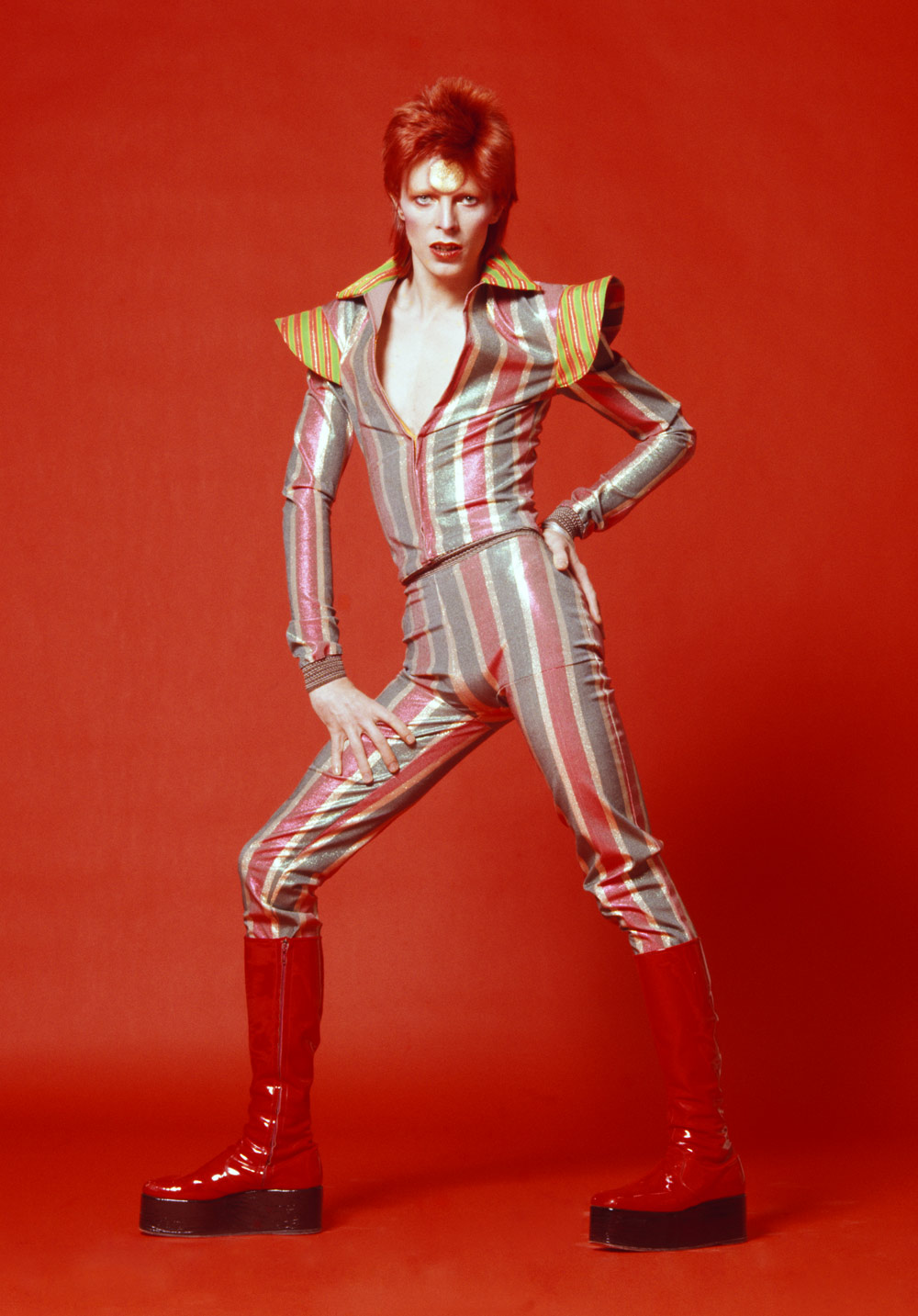
Masayoshi Sukita (Japanese, b. 1938) (photographer) 'David Bowie' 1973


Masayoshi Sukita (Japanese, b. 1938) (photographer)
David Bowie
1973
© Sukita / The David Bowie Archive


This text was written for a special LGBTQI themed edition of the peer reviewed journal Fashion, Style and Popular Culture. At short notice, the co-editor asked me to write, and I quote, “a queer focused review of the Bowie exhibition at ACMI.” When I delivered the piece below, it was rejected as not being academic enough!

Apparently they wanted a deconstruction of the exhibition, its layout, construction, themes, lighting, and good and bad points. No mention of LGBTQI+ issues mind you. What the kind of review they wanted has to do with a LGBTQI+ themed issue, I have absolutely no idea. If they had known anything about my writing, they would have known they would not get academic speak, but something a little more interesting. Their loss, our gain.

The text focuses on Bowie’s impact on me at the time, as a gay man. Bowie is tight. Singing my all time favourite track of his, Young Americans, Bowie is a vocalist like no other. What a voice. Team that with charisma, soul, style, and all the moves … hands on hips, guitar slung backwards, padded shoulders to die for, cheekbones that you could cut with a knife and a presence that is just luminous. No wonder I loved him as an adolescent, he was my Hero. As someone commented on the YouTube live performance of the song (below), “ain’t there 1 goddam song that can make me breakdown + cry*”

This is a flawed but mesmerising exhibition. Allow three to fours hours at least. If you are a Bowie fan it’s a 100% must see; and if you are an aficionado of contemporary culture, you will be amazed at the sources Bowie draws from to create his art, his personas. It did no harm, either, that Bowie had access to some of the most creative designers in the world for his costumes and sets, but he was the inventive force. What a man, what an artist, not just a man who feel to earth, but a man who changed the world.

Dr Marcus Bunyan


Many thankx to ACMI for allowing me to publish the art work in the posting. Please click on the photographs for a larger version of the image. Download the text Reflections on David: In a galaxy all of his own (1.6Mb pdf)


David Bowie – Young Americans

Bowie performing live on the Dick Cavett Show (4th December 1974)


Reflections on David: In a galaxy all of his own

The year was 1975. In London, six years after that seminal event of early gay liberation, the Stonewall Riots, six years after the landing on the moon, and six years after the release of David Bowie’s single, Space Oddity, I came out as a gay man age 17. At the time I felt a bit of a space oddity myself, troubled by my hidden identity and the double life I was leading. My first act of rebellion was to walk into a newsagent at Notting Hill Gate underground station, pick up a copy of Gay Times, fling the money at the store attendant and run from the place as red as a beetroot. I was so embarrassed.

Things quickly changed. I had been listening to Bowie’s music since my early days in boarding school – The Man Who Sold the World, Hunky Dory, Ziggy Stardust, Aladdin Sane – and now, after outing myself, I rocked up to the Royal College of Music with silver hair, wearing the most outrageous satin pink and white bomber jacket, with rings on every finger. I walked down St. Albans high street on a Saturday morning through the market in fake white fur coat and eye shadow. It’s only now, forty years later, that I realise I was channeling my inner Bowie.

This was the era of Campaign for Homosexual Equality (CHE) in England, where we had to gather in people’s lounge rooms to meet other gay men, or once a month at a disco in country Hertfordshire. Or we went to the Pan Club in Luton where drag queens peered imperiously down at us through a grill before they allowed us through the door. The best thing was going to Scandals or Adams night clubs in London, where we danced on illuminated glass dance floors (like in Saturday Night Fever) and wore our army uniforms. We could be whoever we wanted to be. And this was all influenced by the multiple persona of Bowie.

Like an intelligent bower bird, Bowie constructed his different personae through bricolage, building them from cultural signifiers such as German Expressionism, Marlene Dietrich, Sonia Delaunay, Metropolis, Hollywood, Japanese film, JG Ballard and Clockwork Orange, to name just a few. My gay friends and I did much the same. Like Bowie, for us it wasn’t so much about sexuality but about androgyny and the public play of gender (although the two are obviously interlinked). We adored David, a self-educated lad from a poor working class family, initially a Mod, who created his own universe of creatures and characters. Glam yes, but so much more than just putting on a costume like Kiss, David lived and breathed his worlds and we, his fans, believed in him. Not so much gender bender as cultural gender blender.

Critical to this time in my life was the period that followed Ziggy: Young Americans and the Thin White Duke. I got heavily into soul music, going to a basement nightclub behind Bang on Tottenham Court Road, where they played reggae, Barry White and the Love Unlimited Orchestra… and David Bowie. I used to pretend to be one of the back up singers on the song Young Americans: “Young American, young American, she wants the young American.” Bowie is tight. Singing my all time favourite track of his, Young Americans, Bowie is a vocalist like no other. What a voice. Team that with charisma, soul, style, and all the moves … hands on hips, guitar slung backwards, padded shoulders to die for, cheekbones that you could cut with a knife and a presence that is just luminous. No wonder I loved him as an adolescent, he was my Hero. As someone commented on the YouTube live performance of the song, “ain’t there 1 goddam song that can make me breakdown + cry*”. From talking to other gay men, I know that the Young Americans album was also critical for them – all cinched waist, high cheekbones, eye shadow, padded shoulders, flaming hair and soul music.

Australian disc jockey Stephen Allkins observed the same phenomena in Sydney. In a recent interview with me he commented, “My first introduction to the world of David Bowie was in 1975 when I was a 14 year old gay boy hanging out with my gay cousin, coming out unknowingly together. Young Americans was so damn funky and classy and totally different to anything that was happening in the white music world at the time. I couldn’t quite get my head around the way Bowie had gone from Ziggy and Aladdin Sane to the Thin White Duke and funk in one swoop, but I loved it. It’s hard to put into words how, as everyone else was glamming up, Bowie starting wearing suits and playing with the hottest funk band on the planet. No one else at that time moved or evolved with such speed and ease and he made me believe every look and note. He didn’t copy or just follow a trend to get noticed, he created and influenced several generations of people with his music and visual ideas. I say ideas because what he created visually was more than mere fashion, it became art. Looking back on all he’s done now, all that he did was art – musically, visually and sensually.”

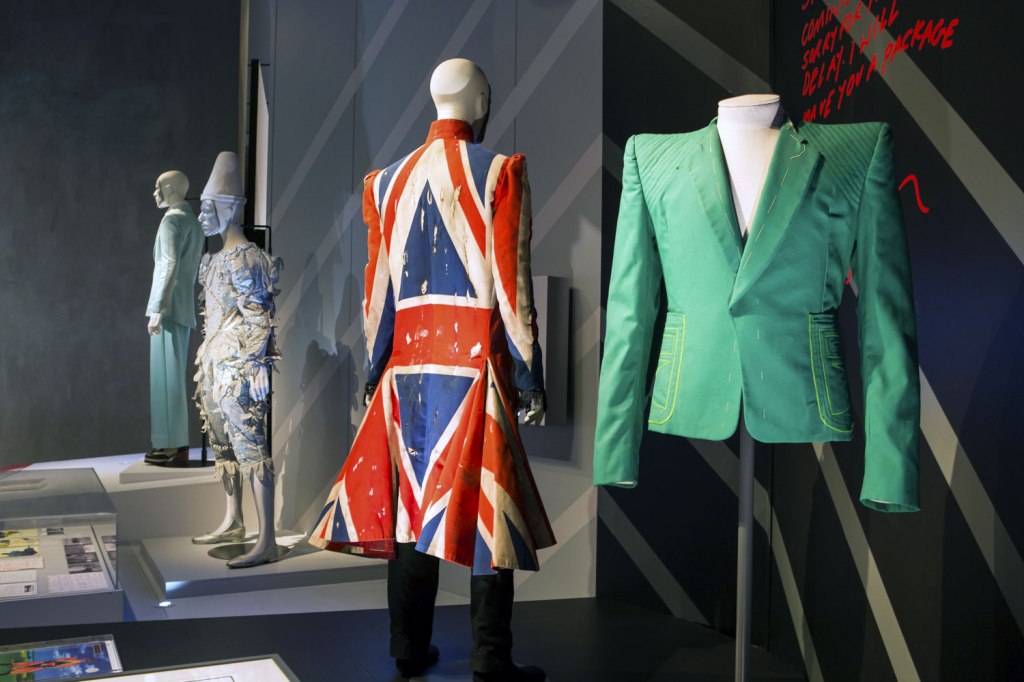
Which leads me on to David Bowie is, an exhibition at the Australian Centre for the Moving Image (ACMI) in Melbourne. This is a fascinating but flawed exploration of the life of one of the world’s great artists. To see his early life, influences, and upbringing, and to have access to his personal archives – especially the wonderful sketches and storyboards showing his creative process – is invaluable. One of the strongest elements of the performance is how the exhibition links his art to the many cultural signifiers he used to construct it: from collage to construction. The costumes are magnificent including the additional Australian content, like the Pierrot costume from Ashes to Ashes. To see artefacts such as the original handwritten stanzas of Ziggy Stardust and Fame is as close as many of us will get to the source of greatness.

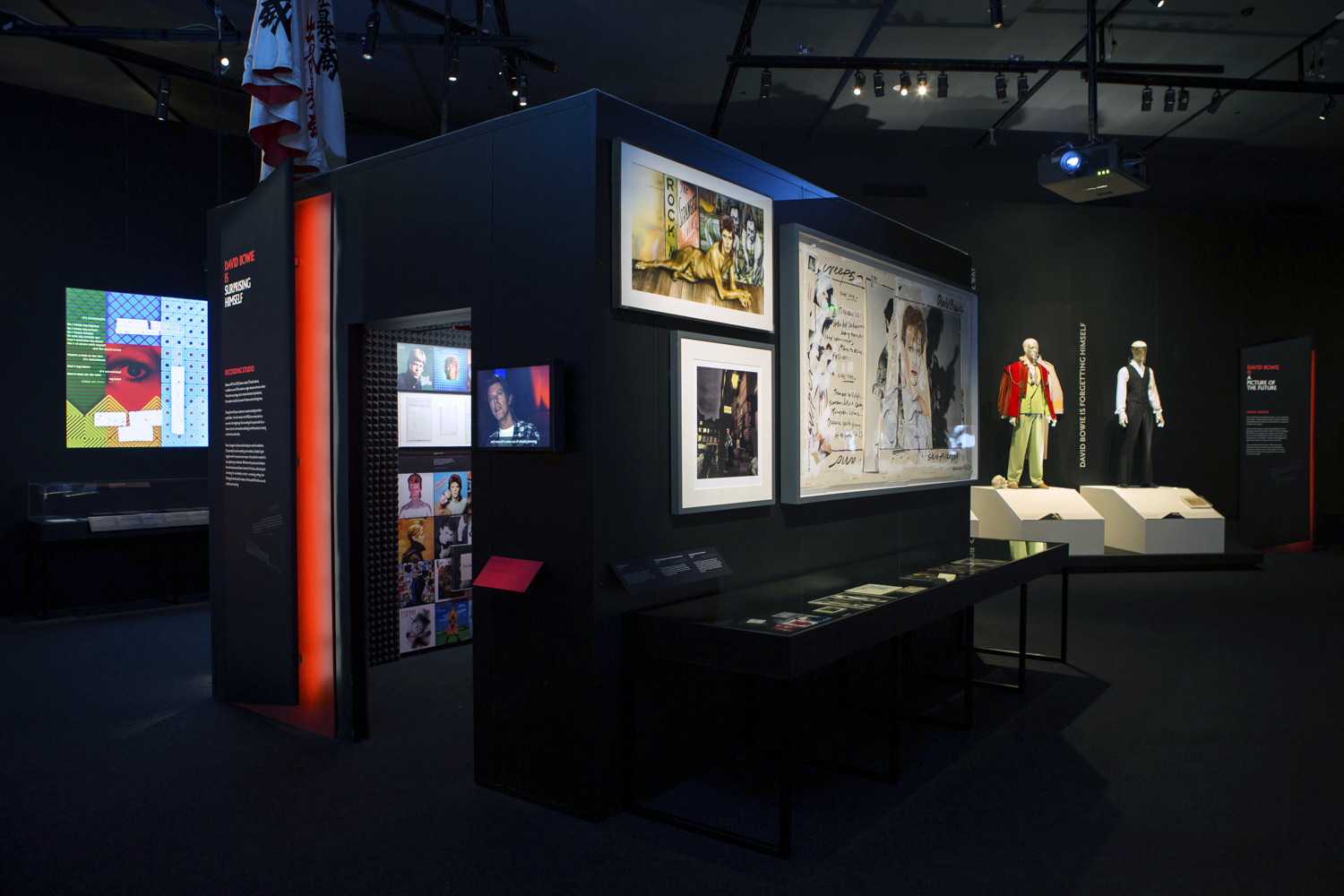
Much less successful was the thematic layout of the exhibition. Sections on film stars, 1930s, and Berlin cabaret (to name but a few), in non-chronological order, made it difficult to comprehend the development of each character and their place in the flow of time and space. While this assemblage of ideas might mimic how Bowie actually constructed his characters, quickly moving from one to another, and then reviving the same character many years later (for example, Space Oddity‘s Major Tom of 1969 and then creating a sequel in Ashes to Ashes in 1980), the imitative representation, or mimesis, of Bowie’s process in the layout of the exhibition simply did not work. Knowing how important Young Americans was to my own gay history, I searched for about 15 minutes with a guide from the exhibition looking for references to Young Americans and the influence of soul music on Bowie. We eventually found just two Thin White Duke suits tucked away right at the end of the show. In the bowels of the dark, subterranean bunker that is ACMI too many artefacts were crammed into too small a location. The artefacts, the ideas and the art have little room to breathe.

Having said that, this is still a mesmerising exhibition. Allow three to fours hours at least. If you are a Bowie fan it’s a 100% must see; and if you are an aficionado of contemporary culture, you will be amazed at the sources Bowie draws from to create his art, his personas. It did no harm, either, that Bowie had access to some of the most creative designers in the world for his costumes and sets, but he was the inventive force. What a man, what an artist, not just a man who feel to earth, but a man who changed the world. He was REAL, his personae were REAL, his art was REAL. He was an astronaut of inner space and when he looked down the barrel of the lens he spoke to young rebels in an authentic voice. He was our hero and no one else’s. As the singer Sylvester would later say: “You make me feel mighty real.” Chimerical, pansexual David, we love you!

Dr Marcus Bunyan
October 2015

Word count: 1,390


Roy Ainsworth. 'David Bowie in The Kon-rads' 1963


Roy Ainsworth
Publicity photograph for The Kon-rads
1963
Courtesy of The David Bowie Archive
© Victoria and Albert Museum


David or ‘Davie’ Jones, as he was then known, became heavily involved in London’s burgeoning music scene at a young age. Before leaving school at the age of 16, he had already joined the band The Kon-rads, playing saxophone and singing vocals. Demonstrating the experimental energy that has driven his solo career, Bowie spent the 1960s trying out different musical, artistic and sartorial styles and performing with several different bands. In 1965 he changed his stage name to David Bowie. The exhibition features several objects from Bowie’s early career including sketches of set, costume and poster designs created for his first bands and footage of early performances.
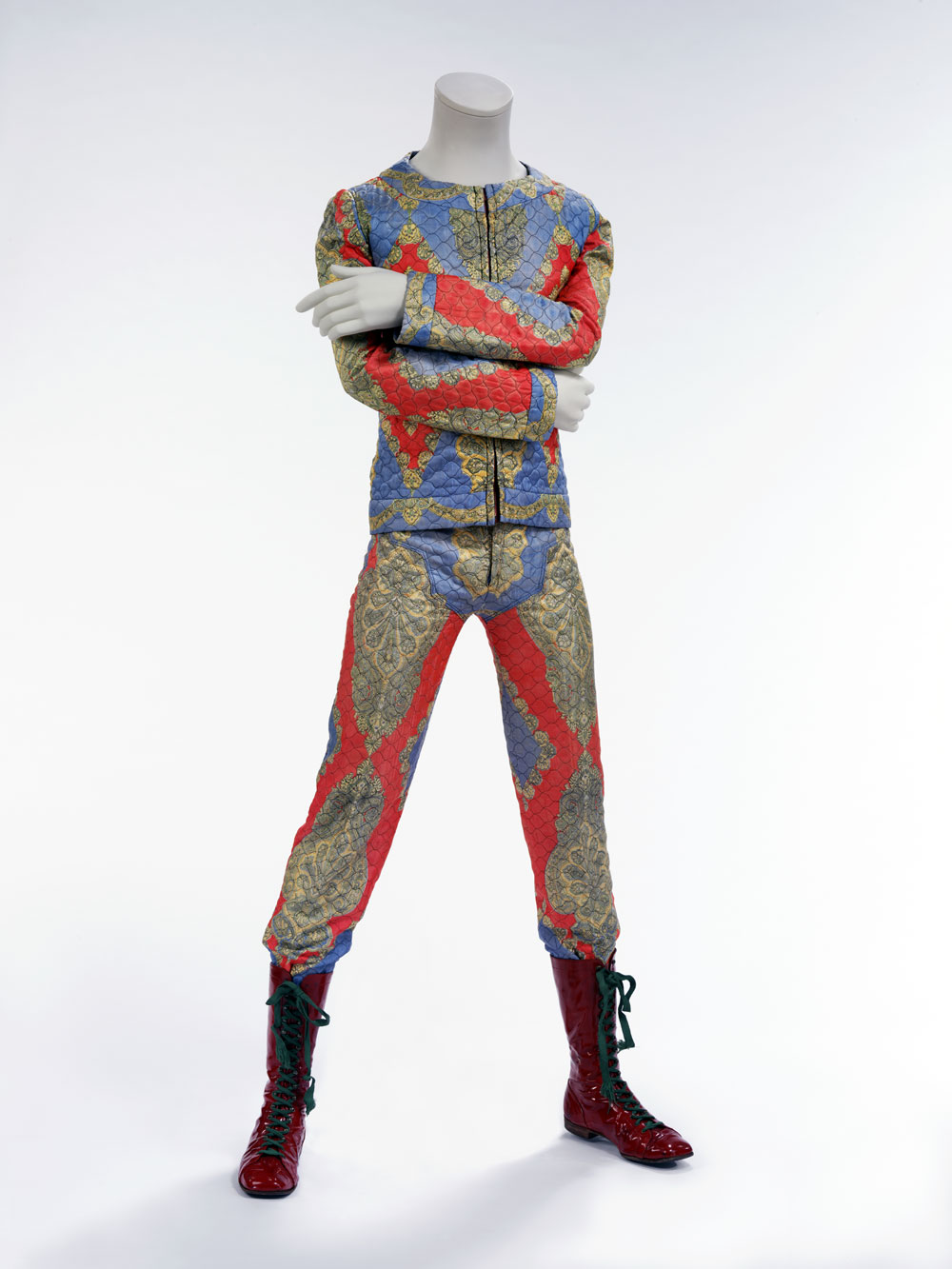
 

Freddie Burretti (British, b. 1952) (designer) 'Quilted two‐piece suit' 1972


Freddie Burretti (British, b. 1952) (designer)
Quilted two‐piece suit
1972
Designed by Freddie Burretti for the ‘Ziggy Stardust’ tour
Courtesy of The David Bowie Archive
© Victoria and Albert Museum


On 6 July 1972 David Bowie performed Starman, the first single from his album The Rise and Fall of Ziggy Stardust and the Spiders from Mars, on BBC One’s Top of the Pops. This pivotal performance was crucial in making Bowie a music star and is acclaimed as a watershed moment which changed rock music and youth culture forever. Appearing on national television with flame-orange hair, make-up, multi-coloured clothing and red patent boots, Ziggy’s otherworldly look and sexual ambiguity created a seismic shift in pop culture. The exhibition features the original suit and boots created by Freddie Burretti and designed in collaboration with Bowie, who took inspiration from the costumes worn by the ‘droogs’ street gang in Stanley Kubrick’s film adaptation of A Clockwork Orange (1971).


Ziggy Stardust | David Bowie

Footage taken from BBC 4’s documentary, The Story of Ziggy Stardust
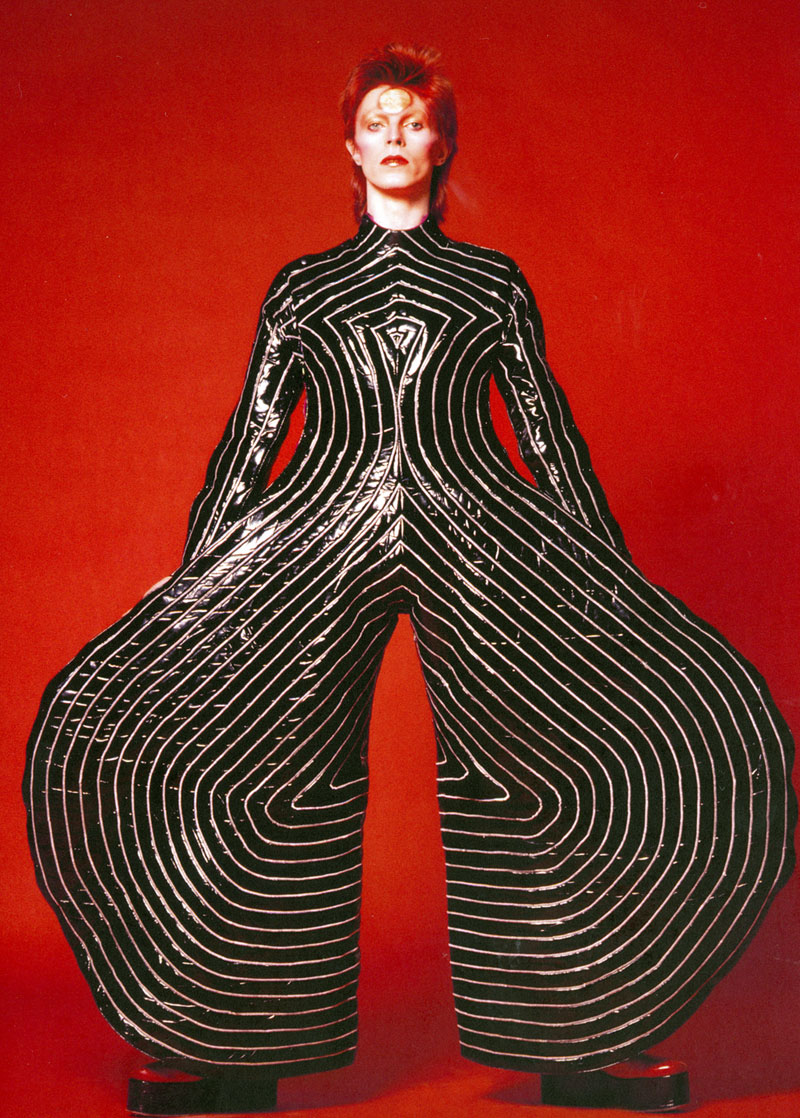
 

Kansai Yamamoto (Japanese, 1944-2020) (designer) Masayoshi Sukita (Japanese, b. 1938) (photographer) 'Striped bodysuit for the Aladdin Sane tour' 1973


Kansai Yamamoto (Japanese, 1944-2020) (designer)
Masayoshi Sukita (Japanese, b. 1938) (photographer)
Striped bodysuit for the Aladdin Sane tour
1973
© Sukita / The David Bowie Archive


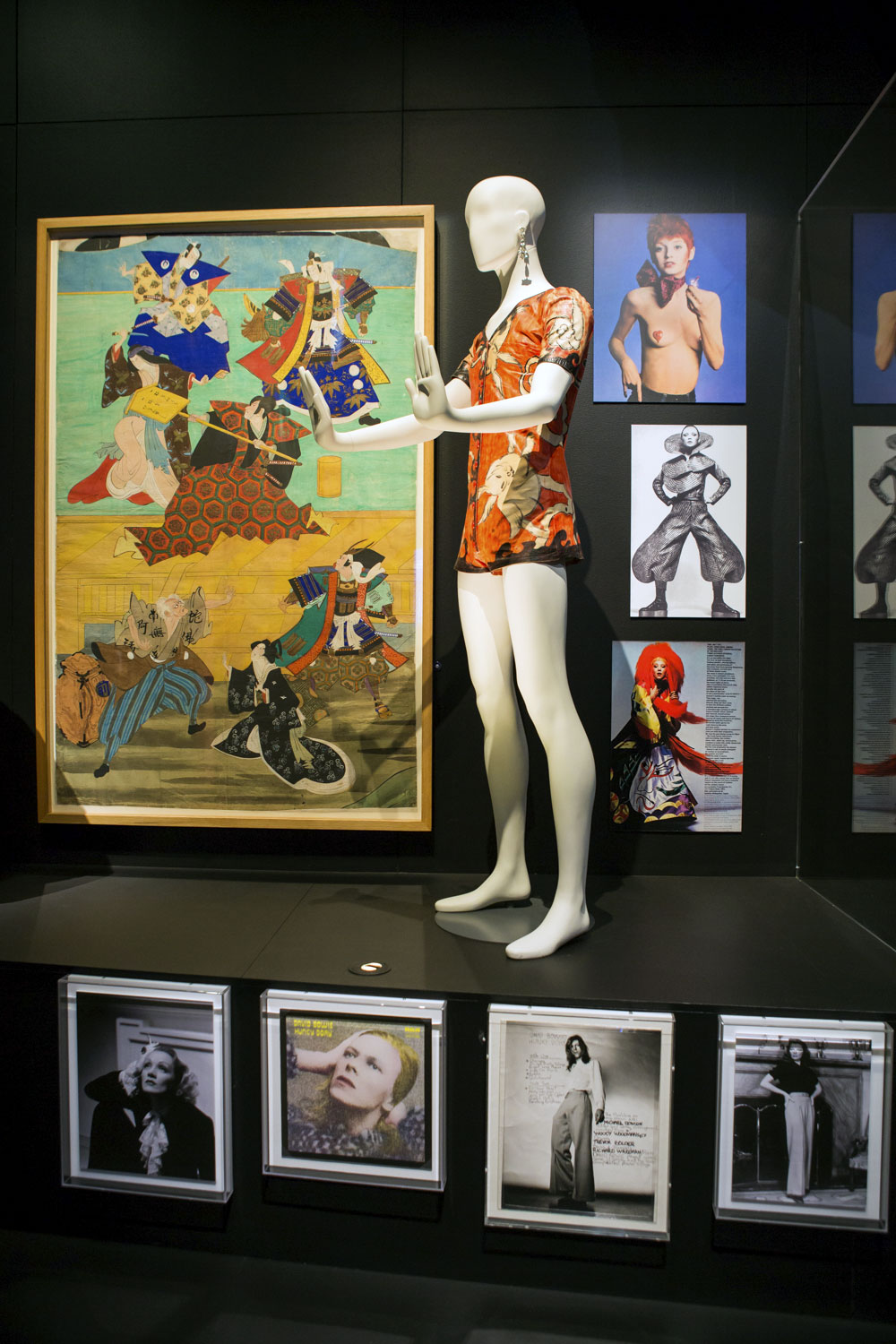
Bowie first saw the work of Japanese fashion designer Kansai Yamamoto at the exhibition Kansai in London in 1971. He could not afford the original designs so copied the look instead, recruiting friends such as Natasha Korniloff and Freddie Burretti to create cheaper versions of Yamamoto’s signature bodysuits and platform boots. After the success of Ziggy Stardust, Bowie approached Yamamoto and commissioned a set of even more flamboyant stage costumes for the Aladdin Sane tour in 1973. These outfits, inspired by the style of Japanese samurai and kabuki actors, are outrageous, sculptural and eye-catching. The exhibition features several Kansai Yamamoto costumes including the black and white striped bodysuit and a white cloak with Japanese kanji lettering spelling out ‘David Bowie’. A flamboyant suit from Yamamoto’s 1971 exhibition which he gifted to the V&A at the time is also on display.
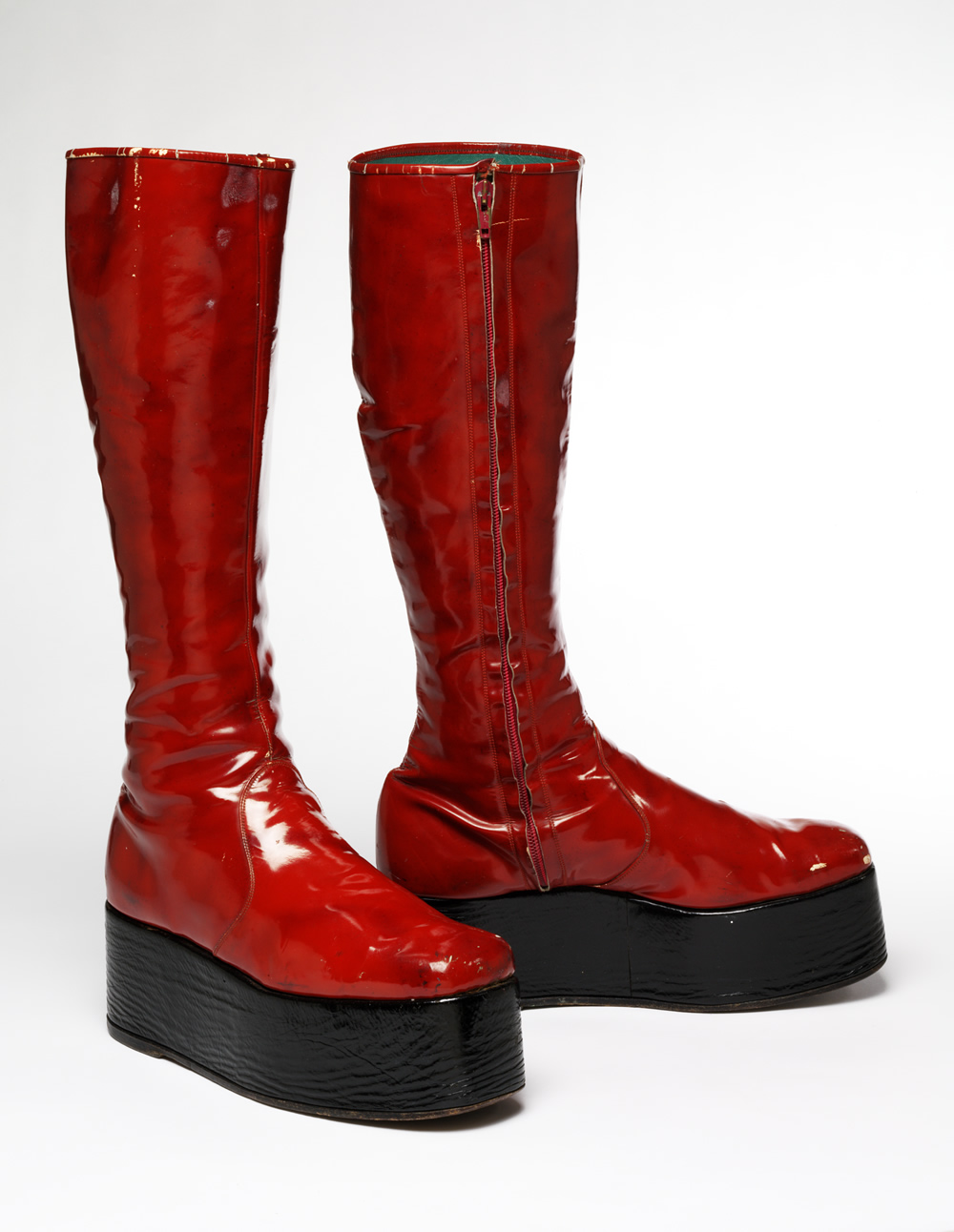
 

'Red platform boots for the 1973 'Aladdin Sane' tour' 1973


Red platform boots for the 1973 ‘Aladdin Sane’ tour
1973
Courtesy of The David Bowie Archive
© Victoria and Albert Museum


Kansai Yamamoto (Japanese, 1944-2020) (designer) 'Metallic bodysuit' 1973


Kansai Yamamoto (Japanese, 1944-2020) (designer)
Metallic bodysuit
1973
Designed by Kansai Yamamoto for the ‘Aladdin Sane’ tour
Courtesy of The David Bowie Archive
© Victoria and Albert Museum


Brian Duffy (English, 1933-2010) 'Album cover shoot for Aladdin Sane' 1973


Brian Duffy (English, 1933-2010)
Album cover shoot for Aladdin Sane
1973
© Duffy Archive & The David Bowie Archive


The Australian Centre for the Moving Image (ACMI) today launched the critically acclaimed exhibition celebrating one of the most influential artists in music, film and video, fashion and performance. David Bowie is comes to ACMI from London’s Victoria and Albert Museum (V&A) for a strictly limited season from 16 July 2015 as part of the Victorian Government’s Melbourne Winter Masterpieces series.

Seen by over 1 million people worldwide at sell-out shows in London, Chicago, Sao Paolo, Paris, and Berlin, David Bowie is was conceived by the prestigious V&A in London, where it premiered in March 2013 before quickly becoming V&A’s fastest selling show. This once-in-a-lifetime experience, now in its only Australasian season, is set to take Melbourne by storm.

Drawing upon unprecedented access to objects from the David Bowie Archive, the exhibition charts the extraordinary career of the boy from London who became an iconic artist and cultural innovator. David Bowie is features over 50 legendary costumes, original stage set designs, handwritten lyric sheets, album artwork, rare film, video and photographs, and interviews with key collaborators. Special displays explore the artistic chameleon’s continuing influences as a musician, stage performer, writer and actor.

ACMI Director and CEO, Katrina Sedgwick, says the groundbreaking exhibition is testament to Bowie’s profound and everlasting impact as a true pioneer in music, fashion and culture. “We are thrilled to be hosting the Australian incarnation of David Bowie is… It is an exhibition that not only illuminates the extraordinary breadth of Bowie’s creative genius and his enormous impact over the decades – but it is also a beautifully curated and staged experience that will delight the many thousands of people who will see it in the coming weeks and months.”

The V&A’s curators, Victoria Broackes and Geoffrey Marsh, from the Museum’s Department of Theatre and Performance, selected more than 300 objects and films for the show. Of the exhibition they said; “We are absolutely delighted to see David Bowie is travel to ACMI. Bowie himself has a long-standing relationship with Australia, including creating the music videos for Let’s Dance and China Girl there. We hope that the exhibition meets the expectations of his extensive Australian fan base.”

The exhibition offers insight into Bowie’s early years and his first steps musical greatness. The creative aspiration of the young David Robert Jones are showcased by early photographs and Bowie’s sketches for stage sets and costumes created for his bands The Kon-rads and The Delta Lemons in the 1960s. Bowie’s first major hit Space Oddity (1969) and the introduction of the fictional character Major Tom inspired by Stanley Kubrick’s 1968 film 2001: A Space Odyssey granted him critical and commercial success as an established solo artist. His cinematic influences abound with his elaborate storyboards and set design for the Diamond Dogs tour (1974) inspired by Fritz Lang’s film Metropolis (1927).

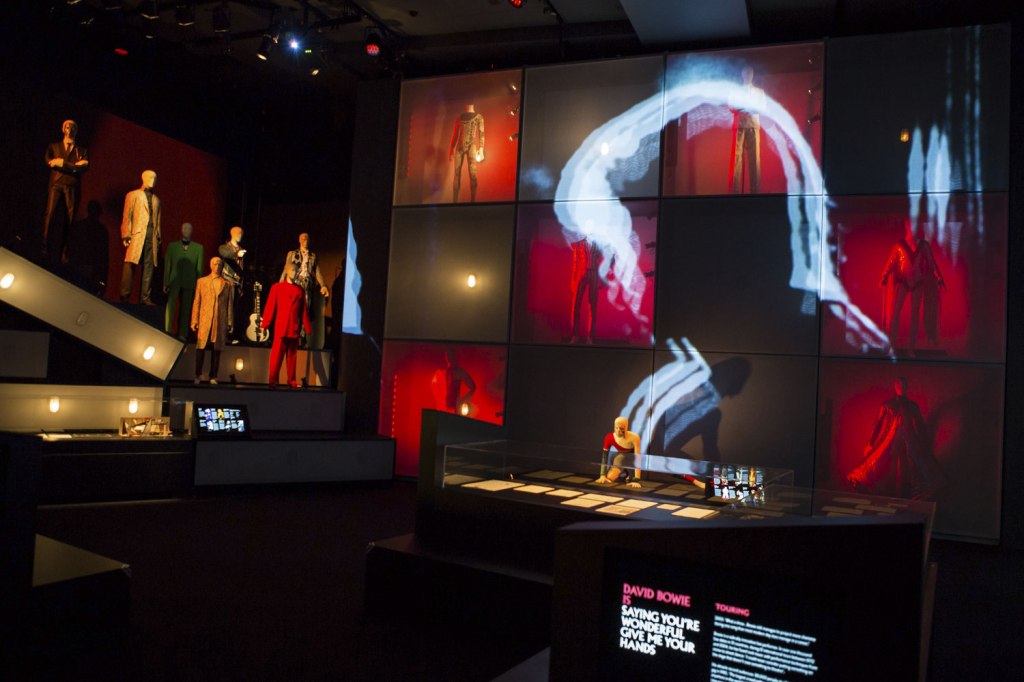
Excerpts and props from Bowie’s on-screen performance in films including The Man Who Fell to Earth (1976), Labyrinth (1986), Basquiat (1996) and The Prestige (2006) show how Bowie has continually explored different notions of character and drawn together the numerous cultural influences that feed into his work. On display is the original multi-coloured suit worn for the pivotal performance of Starman on Top of the Pops in July 1972. An interactive audio-visual display presents some of Bowie’s most ambitious music videos including DJ (1979) and The Hearts Filthy Lesson (1995). Immersive, large-scale projections show recently uncovered footage of Bowie performing Jean Genie on Top of the Pops in 1973 and excerpts from D. A. Pennebaker’s film Ziggy Stardust and the Spiders from Mars: The Motion Picture (1973).

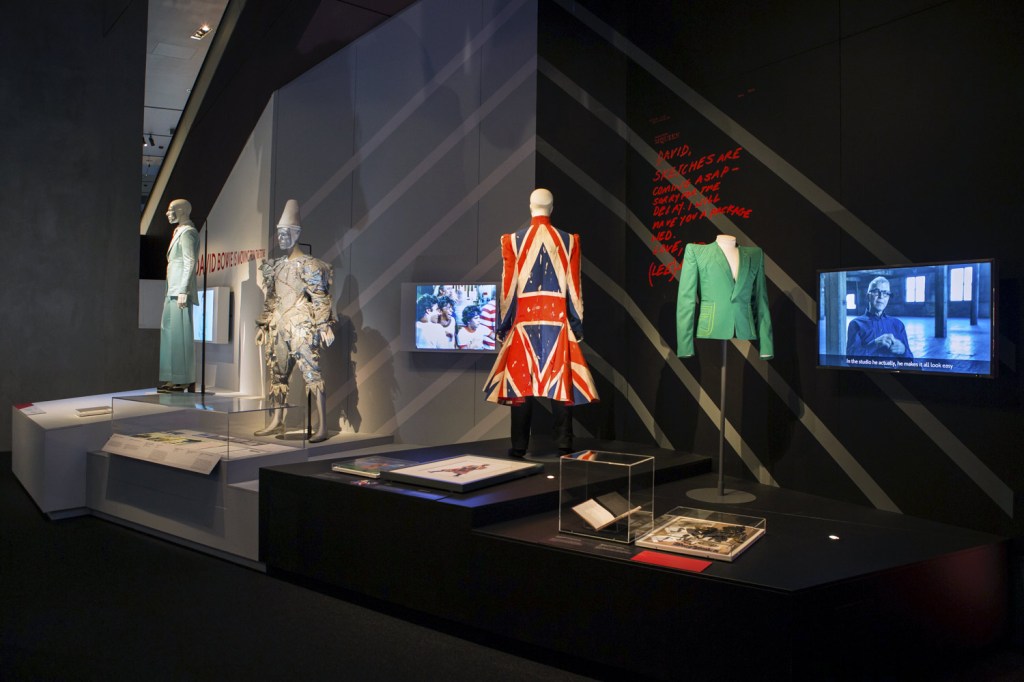
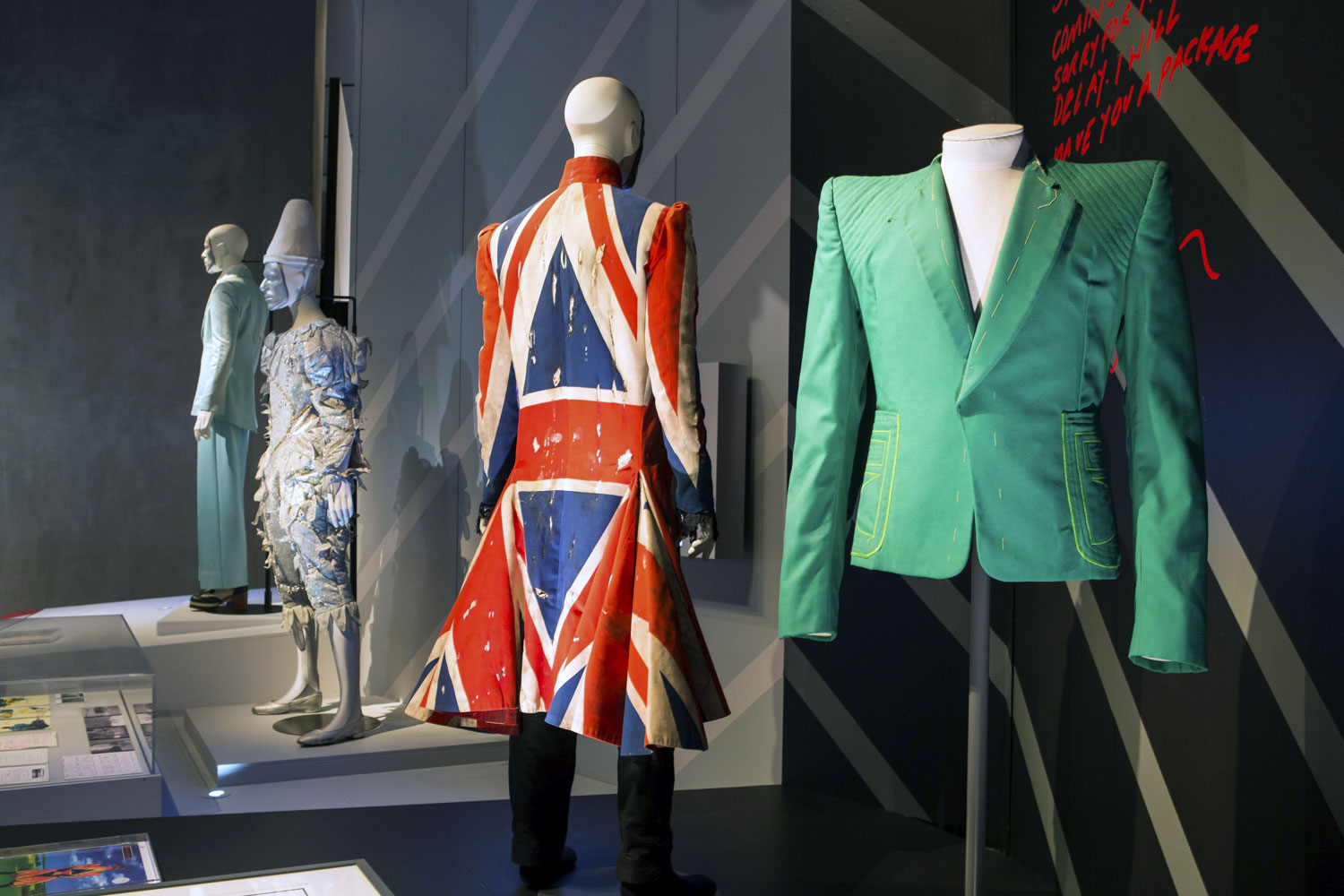
Bowie’s collaborations with artists and designers in the fields of fashion, sound, graphics, theatre, art and film are explored throughout the exhibition. On display are more than 50 stage costumes including Ziggy Stardust bodysuits (1972) designed by Freddie Burretti, Kansai Yamamoto’s flamboyant creations for the Aladdin Sane tour (1973), and the Union Jack coat designed by Bowie and Alexander McQueen for the Earthling album cover (1997). An area has been dedicated to the monochrome theatricality of Bowie’s Berlin period and the creation of the Thin White Duke persona identified with the Station to Station album and tour (1976). It also investigates the series of experimental records he produced between 1977 and 1979 whilst living in Germany, known as the Berlin Trilogy.

More personal items such as never-before-seen storyboards, handwritten set lists and lyrics are also featured in the exhibition as well as some of Bowie’s own sketches, musical scores and diary entries, revealing the evolution of his creative ideas. ACMI is the exclusive Australasian venue for a strictly limited season of David Bowie is. The ACMI season includes a curated program of talks and special events, late night programs, film screenings and live performances.

Press release from ACMI
 

This slideshow requires JavaScript.


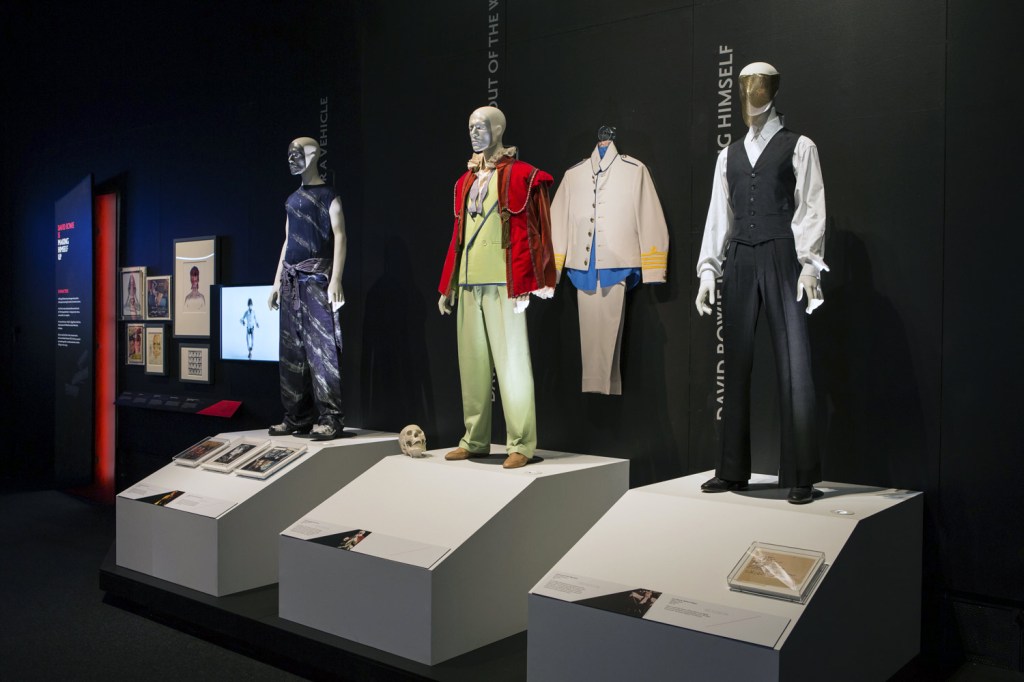
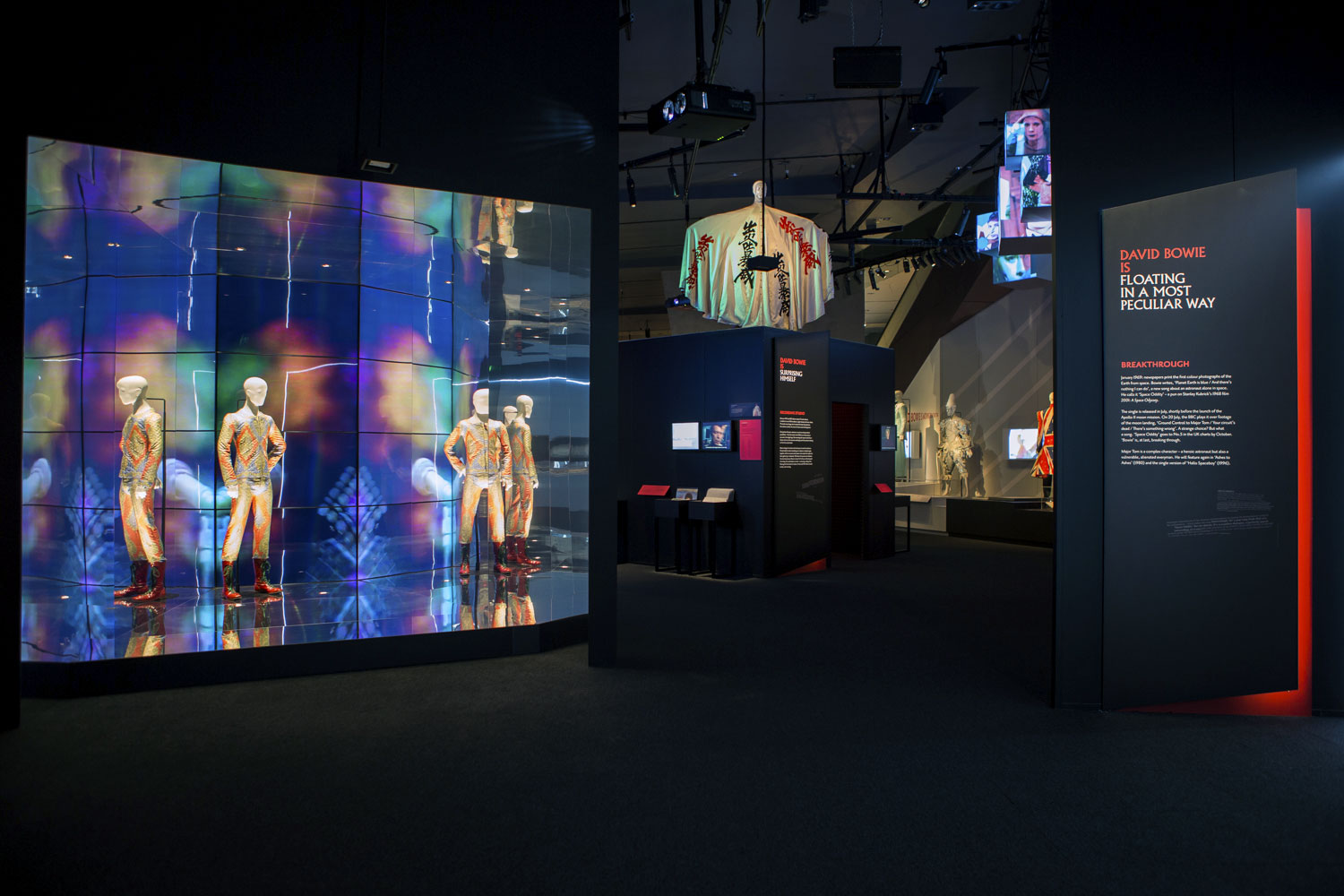
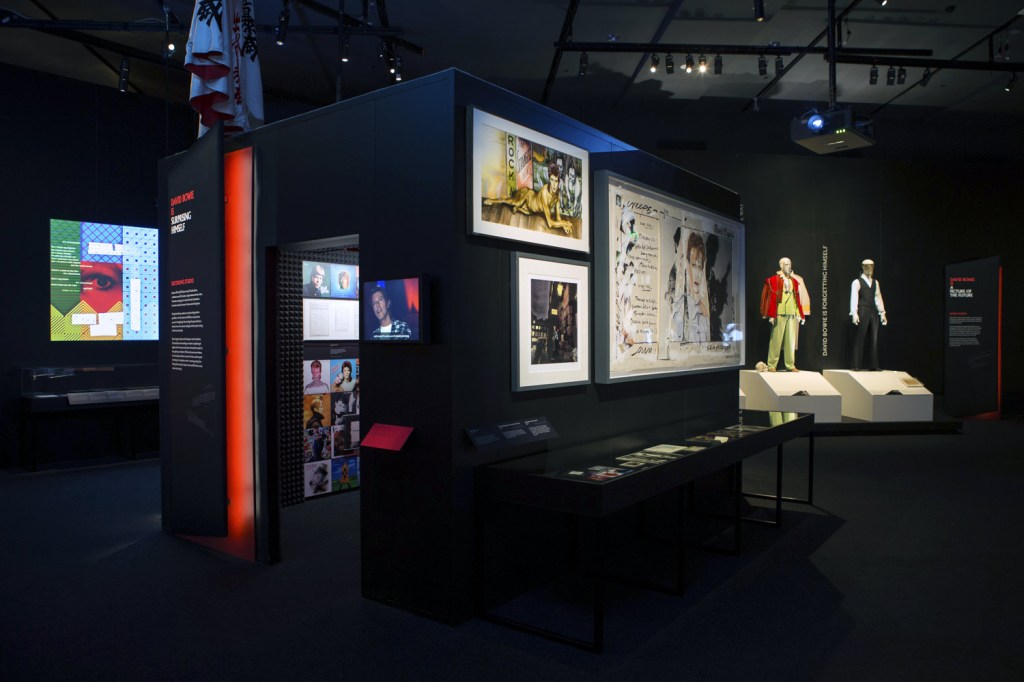
Installation photograph of the exhibition 'David Bowie' is at the Australian Centre for the Moving Image, Melbourne

Installation photograph of the exhibition 'David Bowie' is at the Australian Centre for the Moving Image, Melbourne

Installation photograph of the exhibition 'David Bowie' is at the Australian Centre for the Moving Image, Melbourne

Installation photograph of the exhibition 'David Bowie' is at the Australian Centre for the Moving Image, Melbourne


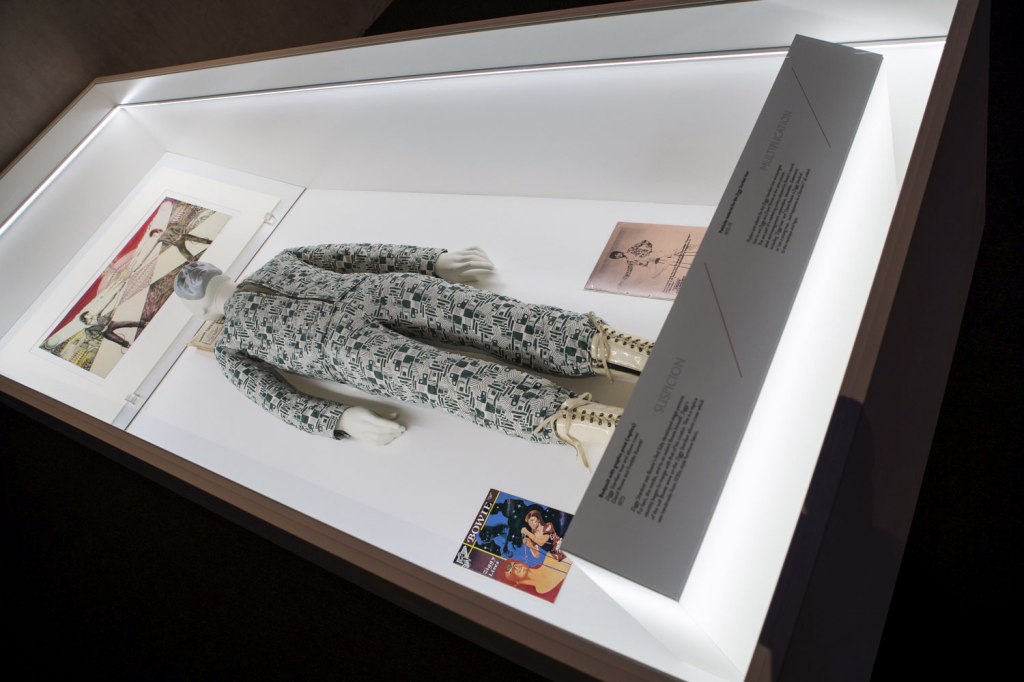
Ziggy Stardust jumpsuit designed by Freddie Burretti (1972)
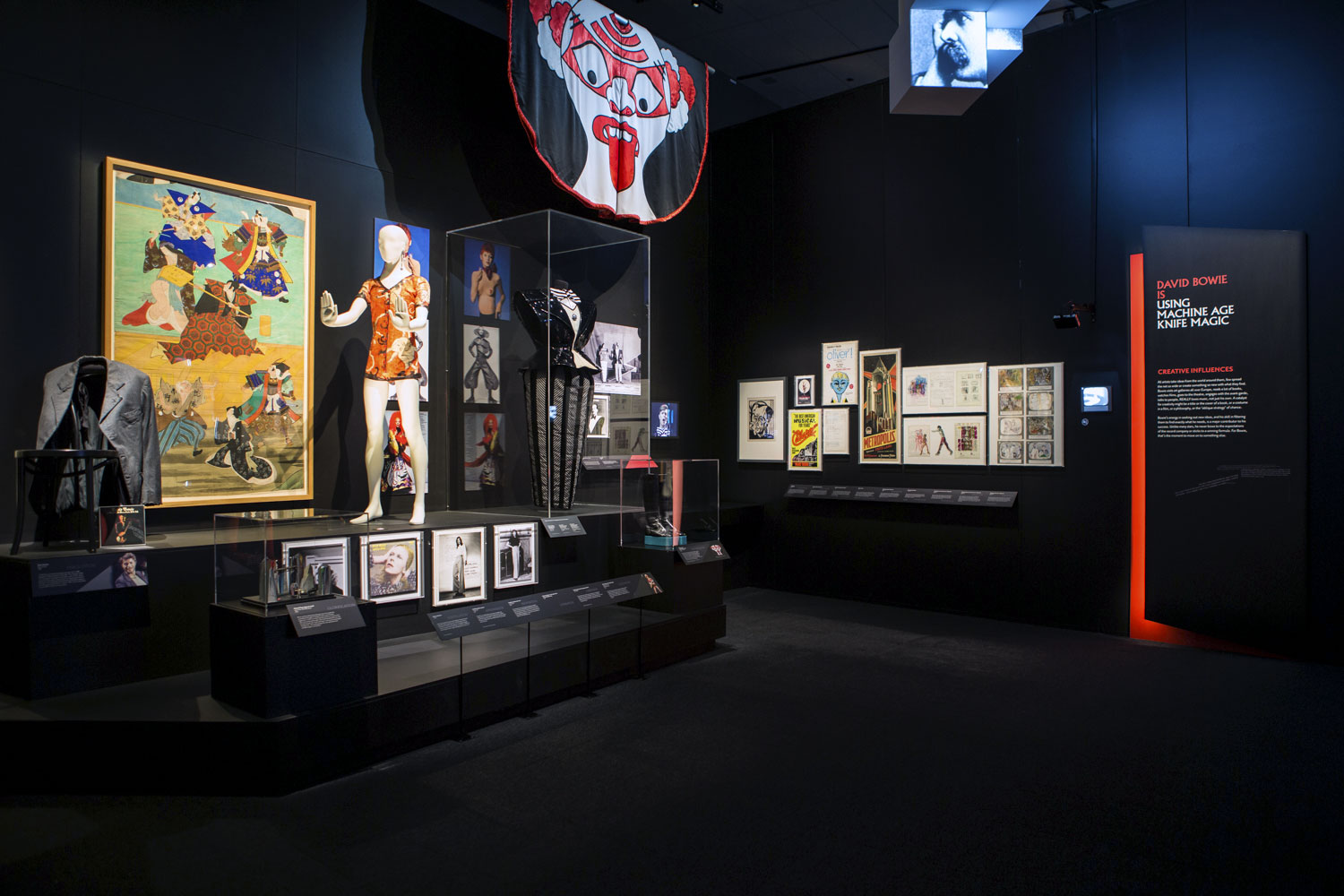
 

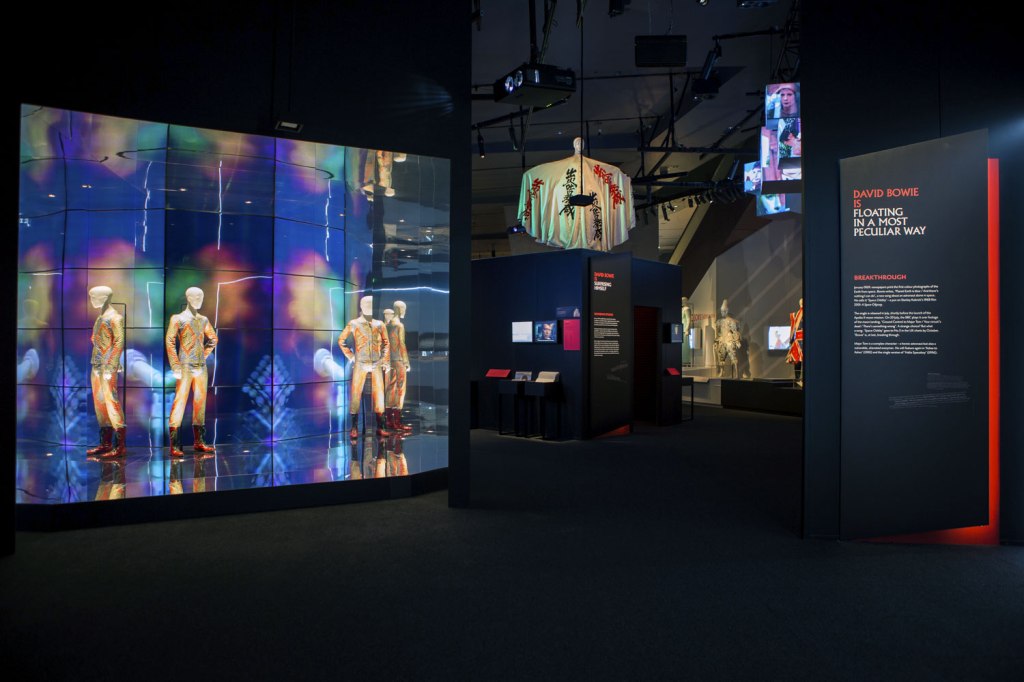
Installation photograph of the exhibition 'David Bowie' is at the Australian Centre for the Moving Image, Melbourne

Installation photograph of the exhibition 'David Bowie' is at the Australian Centre for the Moving Image, Melbourne

Installation photograph of the exhibition 'David Bowie' is at the Australian Centre for the Moving Image, Melbourne

Installation photograph of the exhibition 'David Bowie' is at the Australian Centre for the Moving Image, Melbourne

Installation photograph of the exhibition 'David Bowie' is at the Australian Centre for the Moving Image, Melbourne


Alexander McQueen Union Jack coat designed in collaboration with David Bowie for the Earthling album cover


David Bowie (English, 1947-2016) and Freddie Burretti (British, b. 1952) (designer) 'Bodysuit with graphic print (replica)' 'Ziggy Stardust' tour and album cover 1972


David Bowie (English, 1947-2016) and Freddie Burretti (British, b. 1952) (designer)
Bodysuit with graphic print (replica)
‘Ziggy Stardust’ tour and album cover
1972


Installation photographs of the exhibition David Bowie is at the Australian Centre for the Moving Image, Melbourne showing Kansai Yamamoto striped bodysuit for the 'Aladdin Sane' tour (1973)


Kansai Yamamoto striped bodysuit for the Aladdin Sane tour (1973)


Installation photograph of the exhibition 'David Bowie' is at the Australian Centre for the Moving Image, Melbourne


Installation photographs of the exhibition David Bowie is at the Australian Centre for the Moving Image, Melbourne
Photographer: Mark Gambino


Exhibition overview

The exhibition offers insight into Bowie’s early years and his first steps towards musical success. Tracing the creative aspirations of the young David Robert Jones (born 1947 in Brixton, London), it shows how he was inspired by innovations in art, theatre, music, technology and youth culture in Britain during the aftermath of the Second World War. Pursuing a professional career in music and acting, he officially adopted the stage name ‘David Bowie’ in 1965 and went through a series of self-styled changes from Mod to mime artist and folk singer to R&B musician in anticipation of the shifting nature of his future career. On display are early photographs and Bowie’s sketches for stage sets and costumes created for his bands The Kon-rads and The Delta Lemons in the 1960s.

This opening section concludes with a focus on Bowie’s first major hit Space Oddity (1969) and the introduction of the fictional character Major Tom, who would be revisited by Bowie in both Ashes to Ashes (1980) and Hallo Spaceboy (1995). Inspired by Stanley Kubrick’s 1968 film 2001: A Space Odyssey, the single was released to coincide with the first moon landing and was Bowie’s breakthrough moment, granting him critical and commercial success as an established solo artist.

The exhibition moves on to examine Bowie’s creative processes from song writing, recording and producing to his collaborations on costume designs, stage sets and album artwork. Showing how Bowie works within both established art forms and new artistic movements, this section reveals the scope of his inspirations and cultural references from Surrealism, Brechtian theatre and avant-garde mime to West End musicals, German Expressionism and Japanese Kabuki performance. This section traces the influence of these movements on Bowie’s own work, including the evolution of the lavishly produced Diamond Dogs tour (1974), the design of which was inspired by Fritz Lang’s film Metropolis (1927) and George Orwell’s novel Nineteen Eighty-Four (1949). The tour combined exuberant choreography and a colossal set design, taking the combination of rock music and theatre to new heights. On display are previously unseen storyboards for the proposed musical that Bowie would eventually transform into the Diamond Dogs album and touring show.

In addition, this section chronicles Bowie’s innovative approach to creating albums and touring shows around fictionalised stage personas and narratives. 1972 marked the birth of his most famous creation; Ziggy Stardust, a human manifestation of an alien being. Ziggy’s daringly androgynous and otherworldly appearance has had a powerful and continuous influence on pop culture, signalling a challenge of social conventions and inspiring people to shape their own identities. On display is the original multi-coloured suit worn for the pivotal performance of Starman on Top of the Pops in July 1972, as well as outfits designed for stage characters Aladdin Sane and The Thin White Duke. Costumes from The 1980 Floor Show (1973), album cover sleeves for The Man Who Sold the World (1970) and Hunky Dory (1971), alongside fan material, highlight Bowie’s fluid stylistic transformations and his impact on social mobility and gay liberation.

Excerpts from Bowie’s on-screen performances in films including The Man Who Fell to Earth (1976), Labyrinth (1986), Basquiat (1996) and The Prestige (2006) show how Bowie has continually explored different notions of character and drawn together the numerous cultural influences that feed into his work. Footage and photography of recording sessions for Outside (1995) and ‘Hours…’ (1999) as well as handwritten lyrics and word collages inspired by William Burroughs’ ‘cut up’ method of writing that have never previously been publicly displayed, reveal Bowie’s working processes from writing to recording.

This expansive retrospective also celebrates David Bowie as a pioneering performer concentrating on key performances throughout his career. An interactive audio-visual display presents some of Bowie’s most ambitious music videos including DJ (1979) and The Hearts Filthy Lesson (1995). Immersive, large-scale projections show recently uncovered footage of Bowie performing Jean Genie on Top of the Pops in 1973 and excerpts from D. A. Pennebaker’s film Ziggy Stardust and the Spiders from Mars: The Motion Picture (1973).

An area has been dedicated to the monochrome theatricality of Bowie’s Berlin period and the creation of the stylish Thin White Duke persona identified with the Station to Station album and tour (1976). It also investigates the series of experimental and pioneering records he produced between 1977 and 1979 whilst living in Germany, known as the Berlin Trilogy. Finally, David Bowie is features a display of striking performance and fashion photography taken by photographers including Helmut Newton, Herb Ritts and John Rowlands. These professional portraits are juxtaposed with a collage of visual projections illustrating Bowie’s immense creative influence and ubiquitous presence in music, fashion and contemporary visual and virtual culture.

Press release from the Australian Centre for the Moving Image website


Freddie Burretti (British, b. 1952) (designer) 'Ice-blue suit' 1972


Freddie Burretti (British, b. 1952) (designer)
Ice-blue suit
1972
Designed for the ‘Life on Mars?’ video
Courtesy of The David Bowie Archive
© Victoria and Albert Museum


David Bowie – Life On Mars? (Official Video)
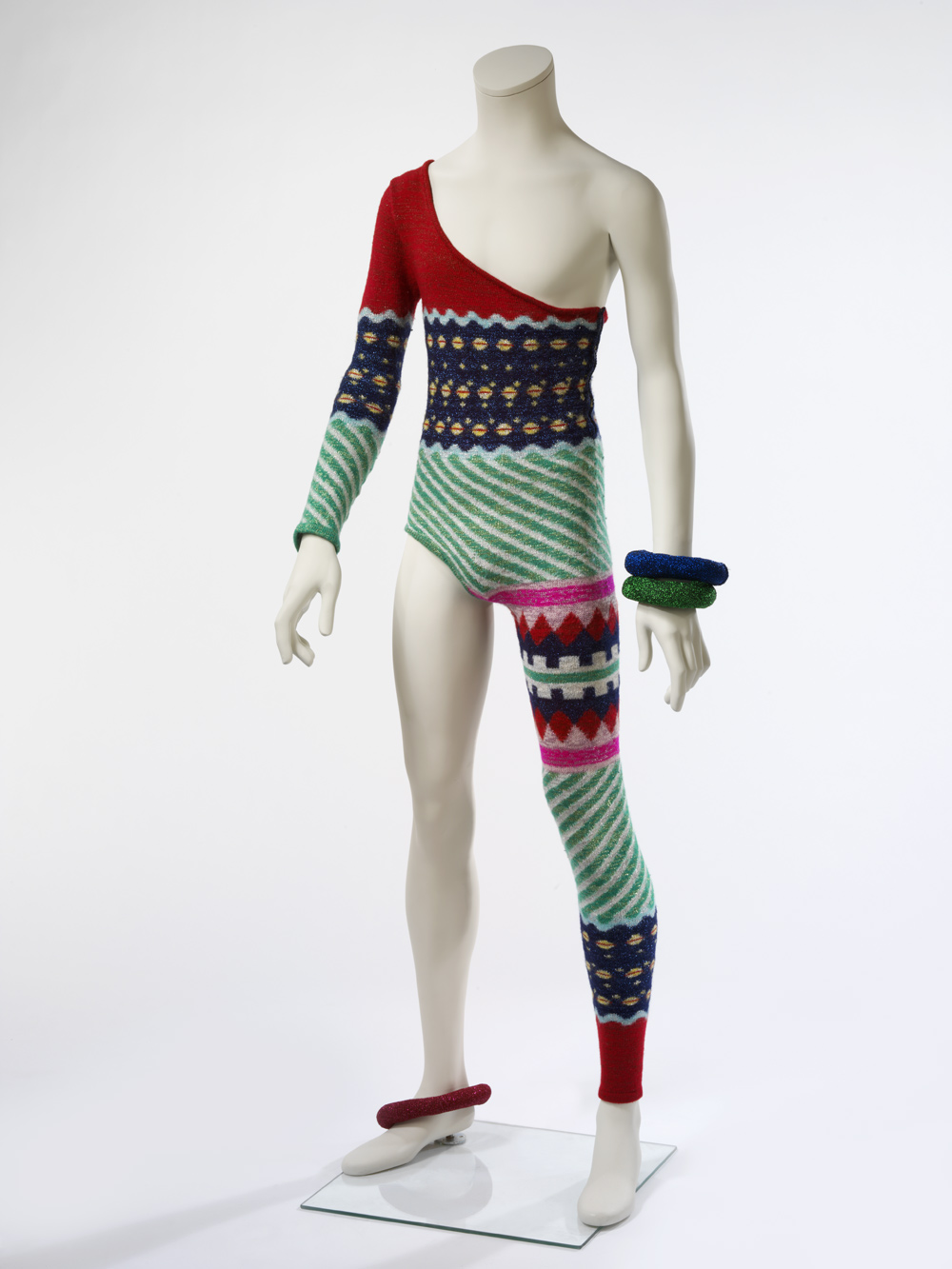
 

Kansai Yamamoto (Japanese, 1944-2020) (designer) 'Asymmetric knitted bodysuit' 1973


Kansai Yamamoto (Japanese, 1944-2020) (designer)
Asymmetric knitted bodysuit
1973
Designed for the ‘Aladdin Sane’ tour
Courtesy of The David Bowie Archive
© Victoria and Albert Museum


Photograph by Terry O'Neill with colour by David Bowie (English, 1947-2016) 'David Bowie with William Burroughs, February 1974' 1974


Photograph by Terry O’Neill with colour by David Bowie (English, 1947-2016)
David Bowie with William Burroughs, February 1974
1974
Courtesy of The David Bowie Archive
© Victoria and Albert Museum


Terry O'Neill. 'Promotional photograph of David Bowie for 'Diamond Dogs'' 1974


Terry O’Neill
Promotional photograph of David Bowie for ‘Diamond Dogs’
1974
© Victoria and Albert Museum


David Bowie – BBC Live – Diamond Dogs & John, I’m Only Dancing (January 1975)


David Bowie (English, 1947-2016) 'Photo-collage by David Bowie of manipulated film stills from The Man Who Fell to Earth' 1975-1976


David Bowie (English, 1947-2016)
Photo-collage by David Bowie of manipulated film stills from The Man Who Fell to Earth
1975-1976
Film stills by David James
Courtesy of The David Bowie Archive, Film stills
© STUDIOCANAL Films Ltd., Image
© Victoria and Albert Museum


'Cut up lyrics for 'Blackout' from "Heroes"' 1977


Cut up lyrics for ‘Blackout’ from “Heroes”
1977
Courtesy of The David Bowie Archive
© Victoria and Albert Museum


'Print after a self‐portrait by David Bowie' 1978


Print after a self‐portrait by David Bowie
1978
Courtesy of The David Bowie Archive
© Victoria and Albert Museum


Brian Duffy (English, 1933-2010) 'David Bowie during the filming of the 'Ashes to Ashes' video' 1980


Brian Duffy (English, 1933-2010)
David Bowie during the filming of the ‘Ashes to Ashes’ video
1980
© Duffy Archive & The David Bowie Archive


'Original storyboards by David Bowie for the 'Ashes to Ashes' video' 1980


Original storyboards by David Bowie for the ‘Ashes to Ashes’ video
1980
Courtesy of The David Bowie Archive
© Victoria and Albert Museum


David Bowie – Ashes To Ashes (Official Video)


Australian Centre for the Moving Image (ACMI)
Federation Square, Melbourne, Australia

Opening hours:
Open daily, 10am – 5pm (Closed Christmas Day)

ACMI website

LIKE ART BLART ON FACEBOOK

Back to top

Catalogue essay: ‘Being (t)here: Gay liberation photography in Australia 1971-73’ from the exhibition ‘Out of the closets, onto the streets’

Exhibition dates: Tuesday 22nd July – Saturday 26th July, 2014

Artists represented: Philip Potter, John Storey, John Englart, Barbara Creed, Ponch Hawkes, Rennie Ellis

Curators: Dr Marcus Bunyan and Nicholas Henderson


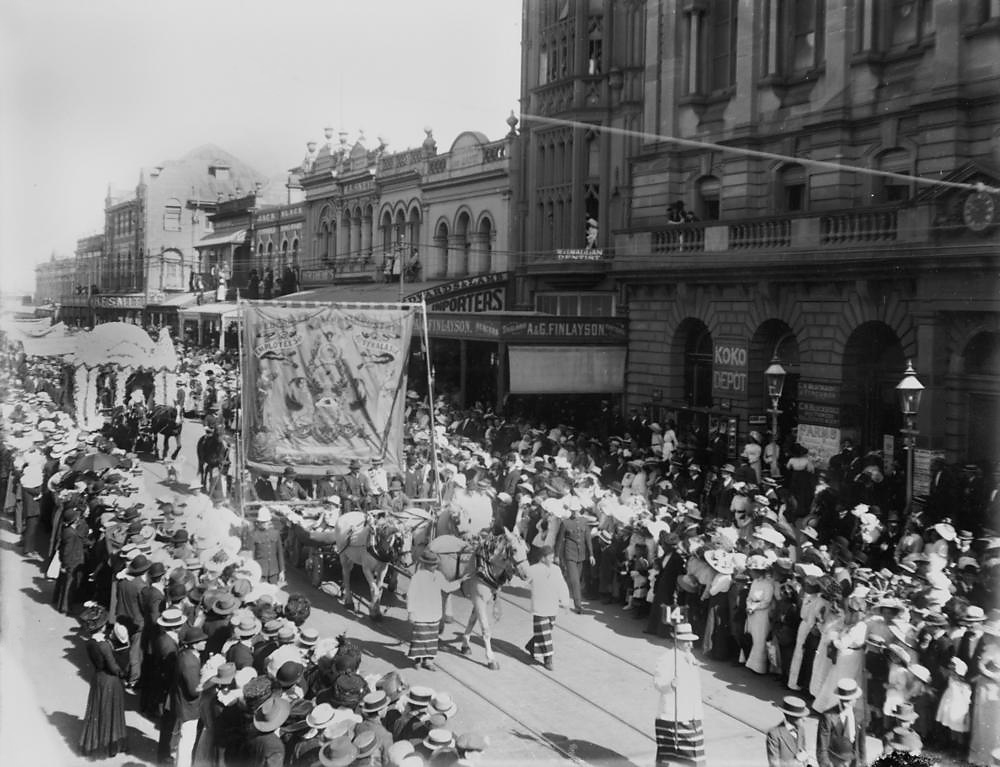
Photographer unknown. 'The original eight hour day banner' 1856


Figure 1
Photographer unknown
The original eight hour day banner
1856


This is my catalogue essay that accompanies the exhibition Out of the closets, into the streets: gay liberation photography 1971-73 at Edmund Pearce Gallery, Melbourne. It’s a bit of a read (3,000 words) but stick with it. I hope you like the insights into the background of the images and the people in the exhibition.

Dr Marcus Bunyan


Many thankx to all the artists for allowing me to publish the photographs in the posting. Please click on the photographs for a larger version of the image. Download the Being (t)here catalogue essay (2.2Mb pdf)


Being (t)here: Gay liberation photography in Australia 1971-73


“For the colour and the soundtrack to be part of the politics, even a central part of the politics… meant something new by way of embodiment. Much of the political action was about being there, about putting one’s body on the line. A demonstration, sit-in or blockade is centrally about occupying space. A nonviolent movement tried to occupy space with bodies, not bullets.

It was a key feature of the new left that this embodied politics couldn’t stop in the streets: that is, the public arena as conventionally understood. ‘Being there’ politically also applied to households, classrooms, sexual relations, workplaces and the natural environment.”1


I came out as a gay man in 1975, six years after Stonewall and only a few short years after the photographs in this exhibition were taken. The first open acknowledgement of my nascent sexuality was to walk into a newsagent in Notting Hill Gate, London, head down, red as a beetroot and pick up a copy of Gay Times. I literally flung the money at the person behind the counter and ran out. I was so embarrassed. I was seventeen.

From the gay rag I found the name of the local convenor of the Campaign for Homosexual Equality (CHE) and went to meet him at his home. John was the very first openly gay man that I had ever met. We became lifelong friends. He used to hold coffee evenings a couple of times a week in his flat so that the local gay men had somewhere safe and secure to meet – to chat and laugh, to talk about love and life. Once a month there was a pub that we all went to in the country for a bit of a dance night, but that was it unless you went up to London to a nightclub.

None of us were very active politically, although we kept an eye on the papers and we all understood the discrimination and persecution we faced. But by the very act of being openly gay, as most of us were, we were making a political statement. I was openly gay at college in London and stopped “passing” as something I was not (a straight man) by coming out to my family and friends. I placed my being – there, there and there, in different contexts, so that my family, friends and the community could not ignore my sexuality. I never lived in fear but there was a great deal of self-loathing going on behind the scenes. In those days you were always thought of as “abnormal” and defective if you were a poofter. And there was the guilt of that association. As James Nichols observes, “To be gay or lesbian meant belonging to a genealogy of suffering, to have a dramatic, if not a tragic, destiny. Despite the many battles and certain victories that ensued, the homosexual remained a victim in the collective consciousness; a hidden man.”2  William Leonard continues the theme: “If concealment is a psychic wounding that divides each gay man against himself, it is also a collective division that precludes the forms of public association and political affiliation on which gay liberation depends. As gay men confront their own internalised feelings of self-recrimination, if not disgust, they begin to rattle the closet door and seek out, in public, others of their own kind.”3 And rattle the closet door I did. I flaunted my hi-vis identity for all to see. If the liberation movement meant putting your body on the line – not so much by consciously protesting on the streets but by being visible in whatever setting as a gay man – then I certainly did that.

Photography documented this Gay Liberation thing, the emergence in public and private of gay people. It not only documented this visibility but also represented it in very aesthetic and artistic ways that up until now have not really been recognised as such. This is where the photographs in this exhibition make their presence known. As gay people found their voice in the early 1970s artists, often at the very beginning of their careers, were there to capture meetings in lounge rooms, consciousness raising groups and street protests. The photographer as artist was not just a witness to these events but actively participated in these actions, which they envisioned in a subjective way. Unlike earlier images of protest marches where there is an observational distance between the photographer / event which allowed for the depiction of environment and numbers (for example in the 8 hour day marches, see figures 1-4) – from the mid-1960s onwards there is a seismic shift in how photographs represent social change and observed history. Now the photographer marches with the inmates and becomes an intimate participant in the proceedings (see figures 5-6).

In this revolutionary era, the artist evidences an empathy with the events being photographed, an up close and personal point of view. Whatever meeting or protest they were there to record was important to them, be it anti-Vietnam war, anti-Apartheid, pro abortion, nuclear disarmament, Gay Liberation, Women’s Liberation, Aboriginal rights, anti-fascist marches and student protests from around the world. And it didn’t matter whether the photographers were gay, straight or whatever. People appropriated public and private space as a form of collective activism, using social movement cultures to re-make the world. The ways of imagining life and transformation, of imaging life and transformation were enabled by the photographer actively participating in these events. The photographer’s “second sight” did not consist in “seeing” but in being there.

As Professor Barbara Creed states of her interest in artistically documenting these actions, “I was very keen on the slogan – ‘The personal is political’. I was in favour of political action of all kinds – direct action, demonstrations, marches, meetings, consciousness raising groups, media publicity, television appearances, coming out at work, talks to schools etc. I was also very interested in the possibility of using artistic practices (film, photography, poetry, fiction, art) to build solidarity among gay people and to help change public opinion.”4

While “the early demonstrations illustrated in this exhibition did often include sympathetic “straights” – a term that seems to have disappeared from the language – for whom gay liberation was part of a wider set of cultural issues,”5 for gay men pictured in the photographs these meetings and marches could be seen as a form of “coming out”, or a place to find solidarity, friendship or sex.6 Gay Pride Week in 1973, for example, was seen as a chance to target, “all the institutions of our oppression: the police courts, job discrimination, the bigoted churchmen and politicians, the media, the psychiatrists, the aversion therapists, the military, the schools, the universities, the work-places … It will also seek to change the mind of the prejudiced, the fearful, the conditioned, the sexually repressed, all those who in oppressing us, oppress themselves.”7 It was also intended to say to gay and straight alike, “gay is good, gay is proud, gay is aggressively fighting for liberation. It will say to gays: come out and stand up. Only you can win your own liberation. Come out of the ghettos, the bars and beats, from your closets in suburbia and in your own minds and join the struggle for your own liberation.”8

For photographers it was a chance to picture a changing world. As Sydney photographer Roger Scott has observed, “I knew I could make a point with my camera. It was exciting. The old conservative world was ending and a new Australia was beginning.”9 With the birth of a new Australia came the end of the White Australia policy when the Whitlam Government passed laws to ensure that race would be totally disregarded as a component for immigration to Australia in 1973; with it came the presence of gay people on the streets shouting ‘come out, come out, wherever you are’ – but certainly not in the newspapers or on television for there was, essentially, the suppression of any reference to, or reportage of ‘homosexuals’ in the mainstream press in Australia.10 If they were pictured, gay people still usually turned away from the camera or had their faces blacked out for fear of discrimination and abuse. As artist John Storey notes, “Conservatism flooded the media, government and all the rest. Homophobia was everywhere but was not a term used in public.”11

As for what prompted artists to document organisations and events, Professor Creed remarks, “I loved to film life around me. I had access to good equipment. I thought it was important to have a visual record of the emergence of Gay Liberation. I believed that films and photos would help to create a sense of community for everyone involved in Gay Liberation. Many members of Gay Lib had been ‘closeted’ all of their lives and so it was a new experience for them to join what is best described as an alternative family. In those days, the Gay Lib group was relatively small – perhaps 30-40 members, so we all knew each other. We held regular meetings, joined CR groups, took part in demonstrations, went away for weekend group events, held dances etc. I also wanted to capture the way we looked, couples together, friends, what we wore, our fashions and styles. Some of the guys had a fantastic sense of style – much more than many of the women who were in revolt against ‘feminine’ fashion. I hoped my films and photos would give support to the gay community and to our emerging sense of forming a new identity.”12

By their very embodiment, the art and politics of these photographs awakens what Roland Barthes calls the “intractable reality” of the image 13 – that prick of consciousness (the punctum), that madness that documents activism and freedom from persecution as both aesthetic and ethical, performative and political. Here, the idea of “being there” – being fully present, in mind and body; being there at the marches; being in the images; being in front of the image looking at it; coupled with the physical presence of the photograph, manifests itself most strongly. Even today, the photographs shock the viewer with their intractable reality. You can just feel the passion of these people, the police presence, the fear, and the authenticity of the photographers’ voice – raw, in your face, people really standing up to be counted.

There is also another side to these photographs – the documentation of the more private moments (meetings, consciousness raising groups, friends in the car etc) and the portrayal of gays one on one, close up and personal with the camera in mugshots used in a grid for the cover of CAMP Ink magazine in 1972. Only today can we truly appreciate the intimacy and beauty of these photographs: the photographs of two young gay men in the back of a VW Kombi van that exists only as a 35mm contact print, now scanned and rescued from oblivion; or the presence of gays posing for the camera against a neutral backdrop, every pore of their skin able to be seen (a precursor to the large colour portraits of Thomas Ruff). As Professor Creed states of her desire to capture these intimate moments, “In the 70s film, media and television rarely if ever depicted us at all – let alone our public or private lives. I have always been drawn to the aesthetic power of film and photography to represent the inner world and inner lives of people. The visual image is a great leveller – it reveals the commonality of living things, the need for affection, companionship, community. Contrary to popular myths of the time, gays and lesbians also have a need for intimacy, as does everyone else. When I made my documentary, Homosexuality A Film For Discussion, I included a segment of intimate moments between couples before the commencement of the documentary street interviews, to link the two (private and public together) and to show that many of the negative comments from the general public about loneliness did not match the actual lives of gay people.”14

So where did the photographs that were taken by these artists end up? Often they were collectively passed from hand to hand and used in newsletters, pamphlets and magazines such as CAMP Ink. As Jill Matthews, who compiled the album of Adelaide photographs observes, “The groups and events were very collective enterprises. In those days anyone who had a camera took photos. If people took photos of you, you asked for copies or they gave you prints. There were many prints made and various people had copies. At the time the use of the photos was personal and collective. The newsletters were collective enterprises with everyone chipping in, using whatever was to hand. There was no editor, although some efforts were made to achieve a sense of continuity. Making the newsletters were always fun group events, with a lot of different things you could do, they were basically parties really.”15

Eventually the photographs settled in personal archives and were largely forgotten or were donated to institutions such as the Australian Lesbian and Gay Archives (now the Australian Queer Archives). And then they all but disappeared from view.

A second (but different) “coming out”

With this exhibition these eclectic photographs re-emerge in a kind of second “coming out.” Having been put away for so many years they appear in the clear light of day, in the clear light of new thinking about their artistic merit and how they act as memory aids to feelings and relationships, events and politics.

While analogue photographic images carry Roland Barthes imprint ‘this has been’ – in other words, a photograph is a depiction of something that has already happened, that is already dead – images do not have fixed or settled meanings. As Scott McQuire insightfully observes, meaning in images “is always transactive: it is the result of complex and dynamic processes of interpretation, contestation and translation. Evidence and testimony is always to be actively produced in the complex present… the photograph’s combination of unprecedented visual detail, which seems to anchor the image in a particular time and place, [is] coupled to the endless capacity for images to travel into new times and places.”16 He goes on to say that photographic history is littered with images that have their meaning altered by entry into a new setting. The images in this exhibition are a case in point for I am examining them as artworks as much as they can be seen as documentary evidence of things that have been.

We should not be afraid of this new interpretation for, as McQuire notes, “Too often when we talk about ‘context’ in relation to a photograph, it is as if there is a finite set of connections that might be fully reproduced, if only we had the time or resources. In other words, the polysemy of the image is given a cursory and limited acknowledgement, in the hope that it can be thereby tamed. Rather than this partial, rather defensive acknowledgement of the fragility of meaning, I am arguing that we need to begin with acceptance of the irreducible openness of technological images. This quality is integrally related to the capacity of any image to circulate and appear in new situations.”17 In other words there is no definitive context for any image and we should not be afraid to approach new interpretations of the work or the coexistence of many possible meanings within that work. This process can be seen as analogous in a contextual sense to the construction of what the French philosopher Henri Bergson (1859-1941) called the ‘composite’ in the physical sense, which he defined as, “construction / model where things different in kind are reconciled through our experience over time. Differences are reconciled not unified. The composite embraces ideas of complexity and multiplicity, allowing different conventions, materials and contents to coexist in an artwork. It therefore permits complexities and relationships of readings to coexist. The viewer becomes aware of new and shifting layers of content revealed over the time of viewing, and of our role in constructing, interpreting and experiencing content(s). This is not just theoretical, it is the way we experience and negotiate the world everyday, as complexity in the continuum of time and space.”18 The viewer thus creates a composite view of these images in the here and now.

The images importance, then, lies in the interplay between the historical and the contemporary, between self-representation and imposed representation, and the relationship between subject and photographer. Their residence in the Australian Lesbian and Gay Archives (ALGA) archive (now the Australian Queer Archives (AQuA), which undoubtedly preserves them, marks this institutional passage, this transition of marginalised histories from private to public, “which does not always mean from the secret to the non-secret.” Under the privileged topology of ALGA they are classified and ordered and made available for study and research, but we must also acknowledge that archives give shape to and regulate cultural memory. They influence our perception of the past and present. As Jacques Derrida writes in Archive Fever: “”There is no political power without control of the archive, if not of memory.” He indicates that the stakes are high over the memorialisation and excavation of sites and people’s histories.”19 This does not mean that ALGA does not promote an active engagement with the works it holds in safe keeping, far from it. They encourage the use of the archive by artists and the recontextualisation and renarrativisation of the images in this exhibition, from documentary objects to visual art works and back again, could not have occurred without their forthright help. But as Mathias Danbolt notes in his excellent article Not Not Now: Archival Engagements in Queer Feminist Art, archives will always be sites of contestation: “The conversations on archives in queer and feminist contexts tend to center on ways to break with the strictures and structures of archival logics, in order to give room for alternative forms of historical (and herstorical) transmissions. But even though archival logics tend to be a continual object of critique in feminist and queer work, the desire for archives is still present… If the process of archivisation is fundamentally about conferring historical status upon material, how to avoid that the status as archival disconnect the queer feminist “past” from the “present” – the “then” from the “now”?”20 Danbolt goes on to suggest that this process is a balancing act, “between the desire for having a history, and the anxiety for being historicised, in the sense of being cut off – metaphorically, practically, systemically – from the present.”21

For me, then, this exhibition is as much about freeing these images from the guardianship of the archive, if ever so briefly, to let them live again in the real world, to let them speak for themselves, as those first gay protesters did all those years ago. To free them of the shackles of being seen as “historical” documentary photographs, the official history of gay liberation in Australia and for them to be seen works of art in their own right. It is about the representation of queer identity through the evidence of photography – from that place, in that time, now breathing in a different era, these people fighting for their liberty. It is about these images and the people in them being (t)here.

In contemporary society, where we are flooded with a maelstrom of images, I believe it is important to contemplate these images for more than just a few seconds in order to understand their history and importance not just for the past, but also for the present and the future. Today, we compose our stories and our histories out of fragments and alterations of spaces. We gather together our sources (in archives, for example) and try and make sense of the past in the present for the future. This process of understanding is about an acknowledgement of the past in the present for the future. Again I say, it is about being (t)here.

In an era of ubiquitous media images, the photographs in this exhibition deserve our attention and contemplation for they are survivors – images that perceptively visualise the initial stages of Gay Liberation in Australia, images that are still alive in the present. Their contemporary re-emergence may lead the community to finally have some iconographic images of the early stages of gay resistance and visibility – intimate representations of protests, meetings and events that ultimately changed the lives of many GLBTI people. They may also have some damn good art upon which to feast their eyes.


Dr Marcus Bunyan
July 2014

Word count: 3,423


Endnotes

1/ Connell, Raewyn. “Ours is in colour: the new left of the 1960s,” in Carolyn D’Cruz and Mark Pendleton (eds.,). After Homosexual: The Legacies of Gay Liberation. Perth: UWA Publishing, 2013, p. 43.

2/ Nichols, James. “Sébastien Lifshitz Releasing ‘The Invisibles: Vintage Portraits of Love and Pride’,” on The Huffington Post website 05/01/2014 [Online] cited 02/05/2014.

3/ Leonard, William. “Altman on Halperin: politics versus aesthetics in the constitution of the male homosexual,” in Carolyn D’Cruz and Mark Pendleton (eds.,). After Homosexual: The Legacies of Gay Liberation. Perth: UWA Publishing, 2013, p. 197.

4/ Email text in response to the question ‘What were your politics during your involvement with Gay Liberation/events (Gay Pride Week etc)’ to co-curator Nicholas Henderson 01/06/2014.

5/ Altman, Dennis. “Out of the closets, into the streets.” Catalogue essay. Melbourne, 2014, p. 2.

6/ Ibid.,

7/ Anon. “Gay Pride Week,” in Melbourne Gay Liberation Newsletter, 1973 quoted in Ritale, Jo and Willett, Graham. “Rennie Ellis at Gay Pride Week, September 1973,” in The La Trobe Journal No. 87, May 2011, pp. 87-88 [Online] Cited 11/07/2014.

8/ Ibid., p. 88.

9/ Scott, Roger quoted in Scott, Roger; McFarlane, Robert and Hock, Peter. Roger Scott: from the street. Neutral Bay, N.S.W.: Chapter & Verse, 2001, p. 13.

10/ Email text from co-curator Nicholas Henderson 12/03/2014.

11/ Email text from John Storey to co-curator Nicholas Henderson 17/05/2014.

12/ Email text in response to the question ‘What prompted you to document the organisations/events?’ to co-curator Nicholas Henderson 01/06/2014.

13/ Barthes, Roland. Camera lucida: Reflections on photography. Hill and Wang, 1st American edition, 1981.

14/ Email text in response to the question ‘One of the aspects of your photographs that I am quite intrigued by is the documentation of the more private moments (meetings, consciousness raising groups, friends in the car etc), what brought you to photograph these subjects?’ to co-curator Nicholas Henderson 01/06/2014.

15/ Jill Matthews notes from telephone conversation to Nicholas Henderson, Tuesday 22 April 2014.

16/ McQuire, Scott. “Photography’s afterlife: Documentary images and the operational archive,” in Journal of Material Culture 18(3) 2013, p. 227.

17/ Ibid.,

18/ Thomas, David. “Composite Realities Amid Time and Space: Recent Art and Photograph,” on the Centre for Contemporary Photography website [Online] Cited 12/07/2014. No longer available online

19/ Derrida, Jacques. Archive Fever. Chicago: University of Chicago Press, 1996, 4, note 1 quoted in Eckersall, Peter. “The Site is a Stage/The Stage is a Site,” on the Archaeology and Narration blog, Saturday, April 9, 2011 [Online] Cited 05/07/2014.

20/ Danbolt, Mathias. “Not Not Now: Archival Engagements in Queer Feminist Art,” in Imhoff, Aliocha and Quiros, Kantuta (eds.,). Make an effort to remember. Or, failing that, invent. Bétonsalon No. 14, 2013, p. 4. ISSN: 2114-155X.

21/ Ibid., p. 5.


John F. Shale (Australian, 1855-1924) 'Mounted police assembled in the square during the General Strike, Brisbane' 1912


Figure 2
John F. Shale (Australian, 1855-1924)
Mounted police assembled in the square during the General Strike, Brisbane
1912


Photographer unknown. 'Eight Hour Day parade in Brisbane' 1912


Figure 3
Photographer unknown
Eight Hour Day parade in Brisbane
1912


Photographer unknown. 'Women evening students' float on Park Street in the 1940s' Photo, Mitchell Library, State Library of NSW


Figure 4
Photographer unknown
Women evening students’ float on Park Street in the 1940s
Photo, Mitchell Library, State Library of NSW


Ponch Hawkes (Australian, b. 1946) 'Poofters!' 1973, printed 2014


Figure 5
Ponch Hawkes (Australian, b. 1946)
Poofters!
1973, printed 2014
Digital C type print on Kodak Endura Matte
© Ponch Hawkes


John Englart (Australian, b. 1955) 'Gay Pride Week poster, Gay Pride march outside the Town Hall Hotel, Sydney Town Hall' Sydney, 1973


Figure 6
John Englart
(Australian, b. 1955)
Gay Pride Week poster, Gay Pride march outside the Town Hall Hotel, Sydney Town Hall
Sydney, 1973
Digital C type print on Kodak Endura Matte
© John Englart


LIKE ART BLART ON FACEBOOK

Back to top