Exhibition: ‘PLEASE SEND TO REAL LIFE: Ray Johnson Photographs’ at the Morgan Library & Museum, New York

Exhibition dates: 17th June – 2nd October, 2022


Ray Johnson (American, 1927-1995) 'Untitled (Eight photo booth self-portraits)' Nd from the exhibition 'PLEASE SEND TO REAL LIFE: Ray Johnson Photographs' at the Morgan Library & Museum, New York, June - Oct, 2022


Ray Johnson (American, 1927-1995)
Untitled (Eight photo booth self-portraits)
Nd
Gelatin silver prints on whiteboard
Sheet: 8 × 9 1/2 in. (20.32 × 24.13 cm)
Courtesy of the Ray Johnson Estate


Ray Johnson was an American artist “known primarily as a collagist and correspondence artist, he was a seminal figure in the history of Neo-Dada and early Pop art…” He absorbed from his teachers Josef Albers, Alvin Lustig, and Robert Motherwell and “entered into Zen kinship with two teachers, John Cage and Merce Cunningham, and into romantic partnership with another, the sculptor Richard Lippold.” And then he burnt all the early paintings in his possession and took the path less trodden. He developed his own artistic language “through the creation of slight, irregular-shaped, frame-resistant (but mailable) collages he called “moticos”.” (The name was an anagram of the word “osmotic”)

After moving from New York to Locust Valley, Long Island in 1968, Johnson continued to make art but only had two more solo exhibitions, the last one in 1991. “Johnson was forever constructing miniature sets for his own delirious theatre of the absurd: puzzles within puzzles. The sensibility is not unlike Joseph Cornell’s [whose work was a major influence], minus the romance and period nostalgia. Johnson worked in another sort of outsider vernacular – at once banal, vulgar, campy, and deeply sophisticated.”1 The curator Joel Smith refers to “the low-key but constant thrum of odd motivation” behind all of the artist’s work.

Towards the end of his life Johnson took up photography and became a master of the throwaway camera, using the machine to create intimate, staged actions “which served the artist as a form of citation: as a way to “reference,” rather than “represent,” his subjects. The hands-off nature of the medium gave Johnson a way to bring topics up yet keep his viewer (his recipient, his reader) focused on something he cared about more: the messaging process itself.”

Each person, each artist has a different reason to communicate. But what are they communicating? In Johnson’s case I think he was expressing his inner alternate reality, a different point of view of the world communicated through a new and fantastical visual language. Inhabited by bunnies and pop stars, Johnson’s work was a collage of the unclassifiable, bizarre, wired, wonderful, pop, performance, licked, action, nothings, dreams, concept, sexual, stamped, eccentric and enigmatic moticos… osmotic and fluidly subversive observational images, staged interventions, obsessive, witty and weird constructions. As Loring Knoblauch observes, “these pictures find new pathways of physical intervention, creating staged installations that combine Johnson’s restless collage combinations and the quirks of photographic vision into something cleverly unexpected.”2

Revelling in his insider-outsider status, Johnson was a naive draftsman / Navy draftsman (he loved a good play on words). There is a “distinctive wit – and the evident delight of discovery – that runs through these photographs.” But it is a dark witticism, as dark one of my favourite movies, Donnie Darko (full of bunnies). His is art as performance… of nothings, of everything, moving everything, setting everything in motion. We follow his in/actions whether it be documenting a flopped stranger wearing a bunny cutout, six Movie Stars in the back of a car, or his prescient undated Eight photo booth self-portraits (above) in which he acts out and obscures different personas.

In his last performance this creative man of nothing (real life) “was seen jumping from a bridge in Sag Harbor… [and] appeared to be doing a backstroke toward the open Atlantic.” He could not swim. As he said of one of his early performances, it (he) “went off into the void in some marvellous fashion…”

Dr Marcus Bunyan


1/ Vince Aletti. “A Trove of Snapshots from a Sly Master of Collage,” on The New Yorker website July 22, 2022 [Online] Cited 26/09/2022

2/ Loring Knoblauch. “PLEASE SEND TO REAL LIFE: Ray Johnson Photographs @Morgan Library,” on the Collector Daily website September 7, 2022 [Online] Cited 26/09/2022


Many thankx to the Morgan Library & Museum for allowing me to publish the photographs in the posting. Please click on the photographs for a larger version of the image.


Johnson, however, was a prankster. Like the bunny head he adopted as his trademark – a cartoonish line drawing that appeared in much of his work, often bearing the name of a key figure in 20th-century art – he hopped lightly, merrily across this playing field. Revelling in puns and irreverence (an untitled 1973 collage known as “Jackson Pollock Fillets” includes cut-out recipes for Pollock Fillets Amandine and Barbecued Pollock Burgers), conducting his life as a nonstop performance, he revived the Dada tradition embodied by his hero Marcel Duchamp. In contrast to the grandiosity of Minimal art, land art, Pop Art and other macho midcentury movements, he offered something much humbler: collages or drawings of portable size and wry wit. … Johnson created some of the earliest works of Pop Art and was an early influence on conceptual art. …

The contents of Johnson’s pictures fall into several categories. At times, he chopped up the photos and used them to form a collage. Usually, though, and more interestingly, he found or created a collage-like pattern within the photographic frame. He made corrugated cardboard pieces that he called movie stars, and carried them to places where he could photograph them. Sometimes they incorporated images of celebrities: Marilyn Monroe, Jack Kerouac, Johns. Often they were renditions of his signature creation, a bunny with long, erect ears and a pendulous nose that, like a “Kilroy was here” graffiti drawing from World War II, feels both childlike and sexualized. He would inscribe a bunny with a name, thereby transforming it into a standardized personal portrait. And then he would drive his movie stars to a picturesque setting and shoot them with his camera.


Arthur Lubow. “An Elusive Artist’s Trove of Never-Before-Seen Images,” on The New York Times website March 23, 2021 [Online] Cited 26/09/2022


As a body of work, these photographs by Johnson absolutely feel unfinished, in an open-ended and unwieldy way, as though he was grasping for new ways to communicate. Seen together, there is both dogged teach-yourself inventiveness and a hint of loneliness on display, with a nostalgia for stars of the past and his own younger face percolating through his iterative reworkings. At their best, these pictures find new pathways of physical intervention, creating staged installations that combine Johnson’s restless collage combinations and the quirks of photographic vision into something cleverly unexpected. At the end of his life, Johnson was actually becoming an interesting photographer, and these unearthed leavings provide tantalizing glimpses of what might have been.


Loring Knoblauch. “PLEASE SEND TO REAL LIFE: Ray Johnson Photographs @Morgan Library,” on the Collector Daily website September 7, 2022 [Online] Cited 26/09/2022


Overview

Dubbed “New York’s most famous unknown artist” by the New York Times, Ray Johnson (1927-1995) was a widely connected downtown figure, Pop art innovator, and pioneer of collage and mail art. After moving from Manhattan to suburban Long Island in 1968, Johnson selectively distanced himself from the mainstream art world, holding only two exhibitions after 1978. Yet even after his last show, in 1991, he remained a prolific and unpredictable artist.

Johnson used photographs in his work for decades, but it was only with his purchase of a single-use, point-and-shoot camera in January 1992 that he embarked on his own “career as a photographer.” By the end of December 1994 he had used 137 disposable cameras. His most frequent subjects were what he called his Movie Stars: meter-high collages on cardboard, often featuring the bunny head that served as his artistic signature. They became ensemble players in the curious tableaux he staged in everyday locales near his Locust Valley home.

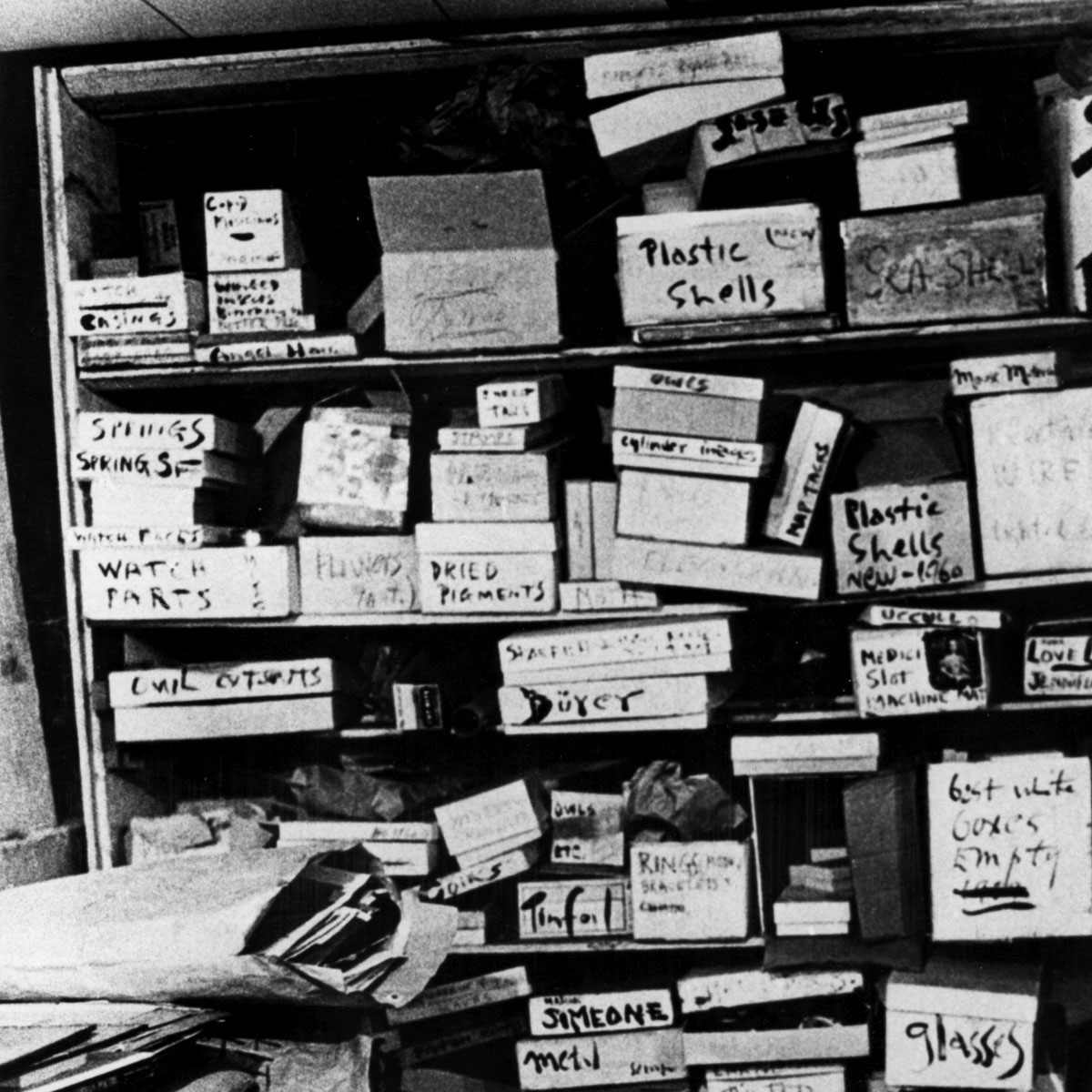
At his death by suicide in January 1995, Johnson left a vast archive of art in boxes stacked throughout his house, including over five thousand colour photographs, still in the envelopes from the developer’s shop. This body of work, virtually unseen until now, comprised his final major art project, the last act in a romance with photography that had begun some forty years earlier.


PLEASE SEND TO REAL LIFE: Ray Johnson Photographs

A widely connected pioneer of Pop and mail art, Ray Johnson (1927-1995) was described as “New York’s most famous unknown artist.” Best known for his multimedia collages, he stopped exhibiting in 1991, but his output did not diminish. In 1992-1994, he used 137 disposable cameras to create a large body of work that is coming to light only now. Staging his collages in settings near his home in Locust Valley, Long Island – parking lots, sidewalks, beaches, cemeteries – he made photographs that pull the world of everyday “real life” into his art. In his “new career as a photographer,” Johnson began making collages in a new, larger format that made them more effective players in his camera tableaux. The vast archive he left behind at his death included over three thousand of the late photographs. Now, his final project makes its debut alongside earlier photo-based collages and works of mail art: fruits of a romance with the camera that spans the four decades of the artist’s career.
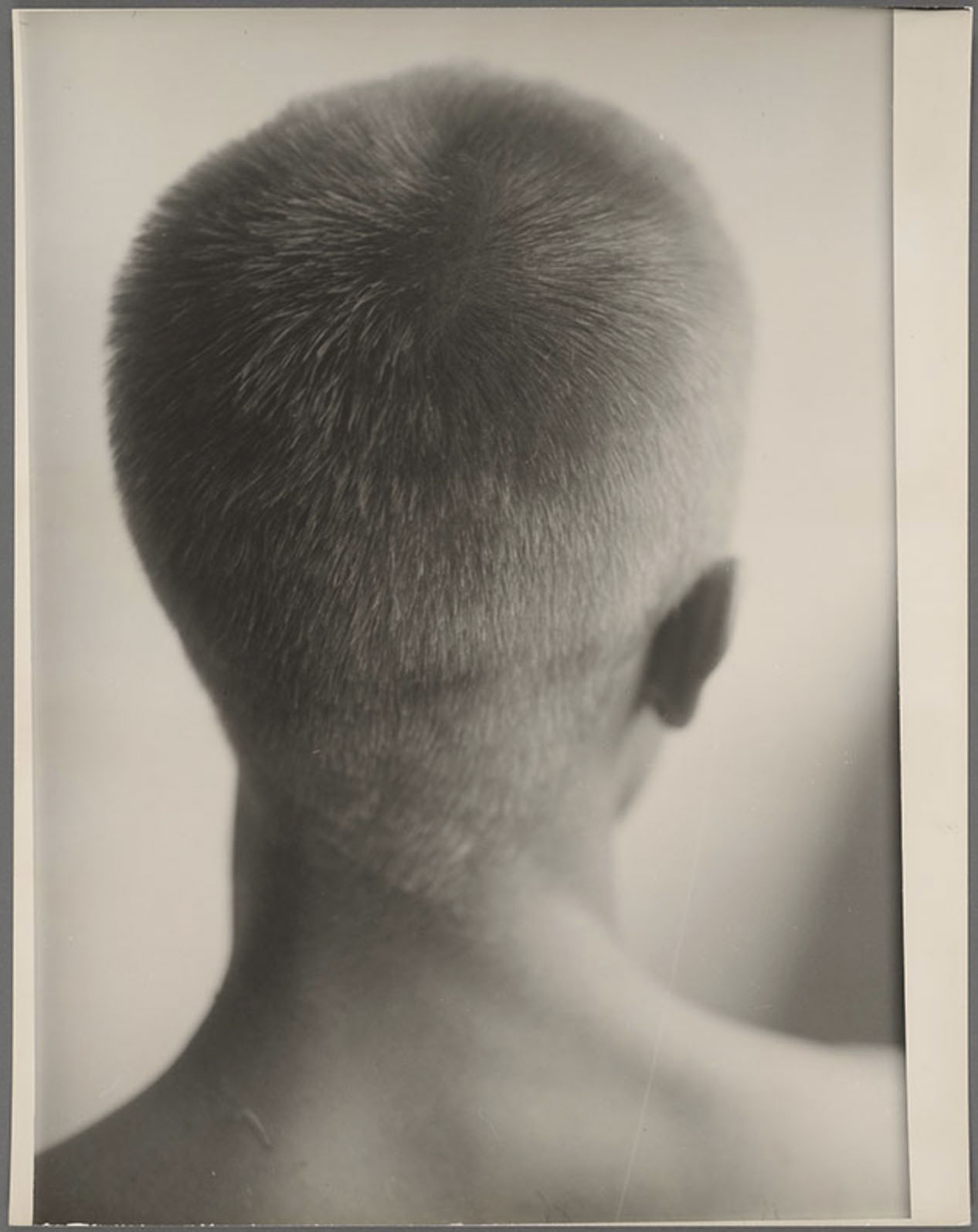
 

Hazel Larsen Archer (American, 1921-2001) 'Ray Johnson at Black Mountain College' 1948 from the exhibition 'PLEASE SEND TO REAL LIFE: Ray Johnson Photographs' at the Morgan Library & Museum, New York, June - Oct, 2022


Hazel Larsen Archer (American, 1921-2001)
Ray Johnson at Black Mountain College
1948
Gelatin silver print
13 3/4 × 9 7/8 inches
The Morgan Library & Museum
Purchased as the gift of David Dechman and Michel Mercure
© Estate of Hazel Larsen Archer


As a student at North Carolina’s Black Mountain College from 1945 to 1948, Johnson thrived under the rigorous tutelage of his foundation-course teacher Josef Albers (1888-1976). Johnson also modelled for Archer, a fellow student who would go on to teach photography at the school. This portrait – lush, faceless, and sexually ambiguous – foreshadows the complexity of Johnson’s use of photography throughout his career. Though attracted by the camera’s peerless ability to bestow glamour, he often tried to undercut its role as a transparent conveyor of facts.


Ray Johnson (American, 1927-1995) 'RJ silhouette and wood, Stehli Beach' Autumn 1992 from the exhibition 'PLEASE SEND TO REAL LIFE: Ray Johnson Photographs' at the Morgan Library & Museum, New York, June - Oct, 2022


Ray Johnson (American, 1927-1995)
RJ silhouette and wood, Stehli Beach
Autumn 1992
Commercially processed chromogenic print
4 × 6 inches
The Morgan Library & Museum
Gift of the Ray Johnson Estate, courtesy of Frances Beatty
© Ray Johnson / Artists Rights Society (ARS), New York


As an artist, Johnson was a master hunter-recycler, constantly revisiting and reinterpreting images from his past. On a visit to the beach at nearby Oyster Bay in 1992, he brought along a camera and a cardboard cutout of his head. Propping the board against a piece of driftwood log, he created a visual pun: the log’s central rings evoke the swirl of hair that Hazel Archer had once photographed on his (now long-bald) head.
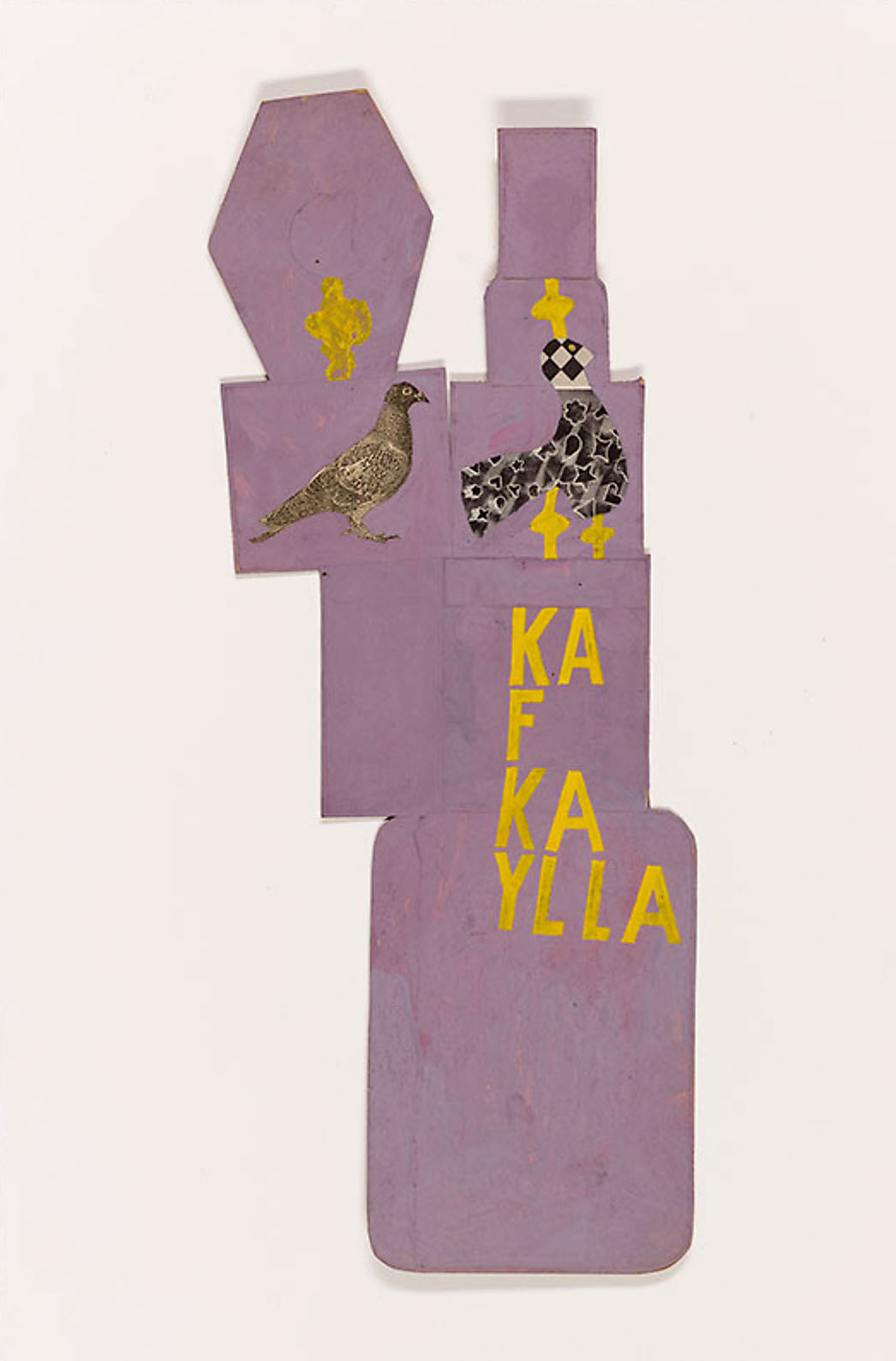
 

Ray Johnson (American, 1927-1995) 'Untitled (Moticos with KAFKAYLLA)' c. 1953-1954


Ray Johnson (American, 1927-1995)
Untitled (Moticos with KAFKAYLLA)
c. 1953-1954
Collage on illustration board
13 × 5 in. (33.02 × 12.7cm)
The Ray Johnson Estate
© Ray Johnson / Artists Rights Society (ARS), New York


Johnson applied one all-purpose noun, “moticos” (both singular and plural), to his short writings, his collages, and the glyph-like shapes he drew. He and his friend Norman Solomon coined the term by reshuffling the word “osmotic,” chosen out of the dictionary. On this moticos made from a flattened box, Johnson paired a photograph of a pigeon with its strange twin: a sort of photo-bird, composed of cookie cutters and a checkerboard. Johnson proposes a second unlikely duo by combining the names of the author Franz Kafka (1883-1924) and the photographer Ylla (Camilla Koffler, 1911-1955), known for her images of animals.


Moticos

In the autumn of 1955, artist Ray Johnson walked through the streets of New York City with a slip of paper, asking strangers if they could define the word he’d written on it: “motico.” People gamely racked their brains: “‘Gee, I wish to hell I knew,’ said one. A nun asked, ‘Isn’t it a kind of colour?'” Johnson recalled these encounters in a story that ran that year in the very first issue of The Village Voice, when he was 27 years old and living in Manhattan, and working primarily in painting and collage.

The word was one Johnson had invented. An anagram of osmotic (a word allegedly chosen at random from a book), “moticos” could refer to several different things. Johnson called the small collage panels he made “moticos” but he also used the word to refer to textual representations too. Johnson would paint and transform the cardboard pieces that came with his laundry into parts of his collages, transforming them into silhouettes and then glyphs, new moticos.

Rebecca Bengal. “Photo Dump: Digging into the 5,000 Photographs Ray Johnson Left Behind,” on the Elephant Art website 20 Jul 2022 [Online] Cited 25/09/2022
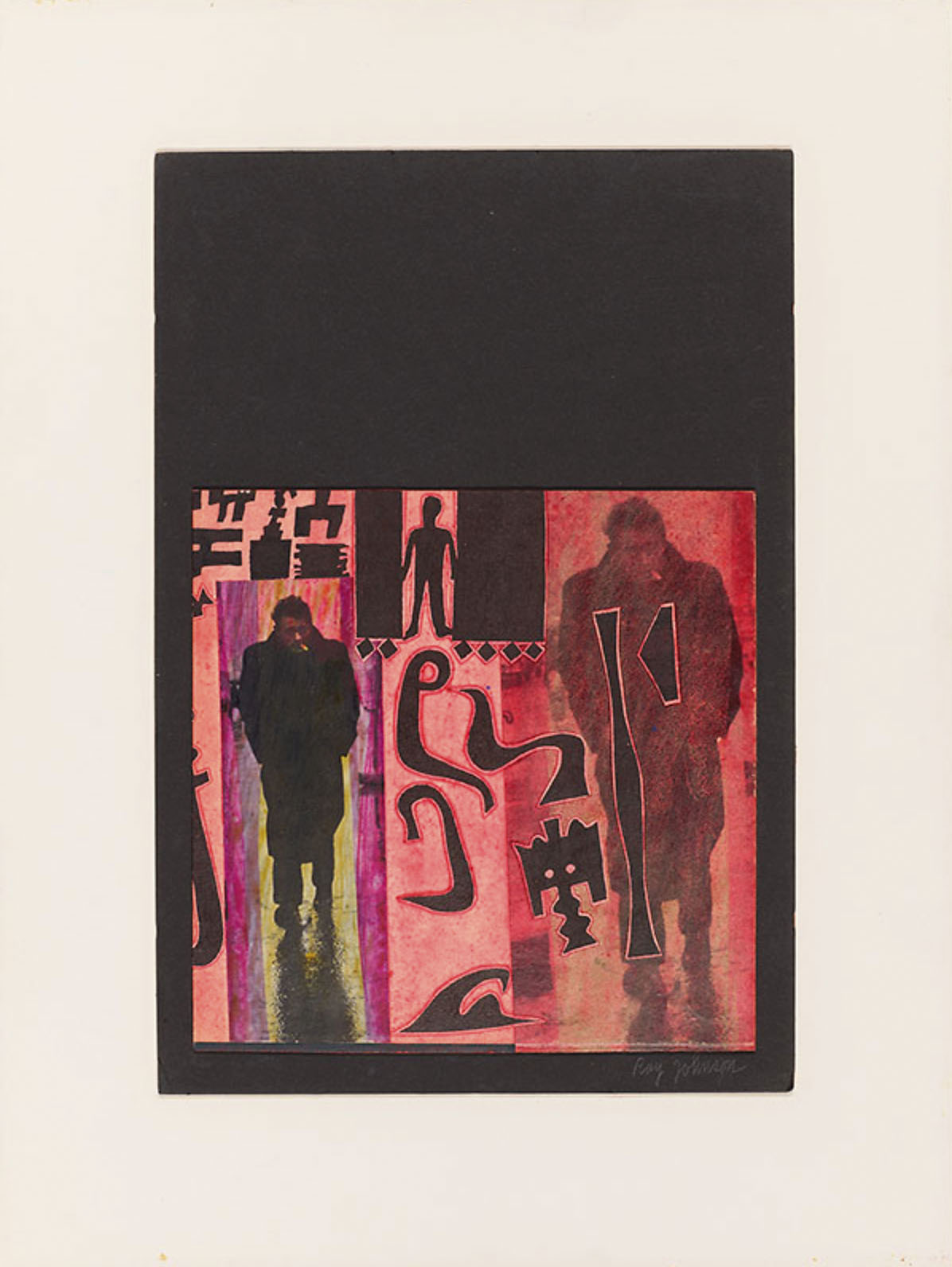
 

Ray Johnson (American, 1927-1995) 'Untitled (James Dean in the Rain)' c. 1953-1959


Ray Johnson (American, 1927-1995)
Untitled (James Dean in the Rain)
c. 1953-1959
Collage on illustration board
15 1/2 × 11 3/4 in. (39.37 × 29.85cm)
The Ray Johnson Estate
© Ray Johnson / Artists Rights Society (ARS), New York


From the early 1950s, Johnson embraced photocollage as a way to inject Hollywood glamour into the cloistered world of avant-garde art. He was appropriating mass-media imagery years before Andy Warhol began populating monumental canvases with celebrity portraits. Here Johnson worked directly upon Dennis Stock’s iconic Life magazine photograph of James Dean walking alone through Times Square, which was published a few months before Dean died in a 1955 car crash. Whether Johnson made this work before or after Dean’s death is unknown. In the 1990s, he would again incorporate the actor’s silhouette in collages and photographs.


Elisabeth Novick. 'Untitled (Moticos on floor)' c. 1955


Elisabeth Novick
Untitled (Moticos on floor)
c. 1955
Gelatin silver print
8 3/4 × 13 1/4 inches
The Morgan Library & Museum
Gift of the Ray Johnson Estate, courtesy of Frances Beatty
Elisabeth Loewenstein / ArenaPAL
© Elisabeth Loewenstein


For a short feature in the first issue of the Village Voice (26 October 1955), a reporter walked with Johnson as he approached strangers in Grand Central Terminal and asked them whether they knew what a “moticos” was. As seen here, Johnson also literally took moticos to the streets, staging crowds of them for the camera in disused spaces in downtown Manhattan. Few early moticos have survived intact: over the next several decades, in a practice he called Chop art, Johnson continually disassembled his work and used the fragments to create new pieces.


Elisabeth Novick. 'Untitled (Ray Johnson and Suzi Gablik)' 1955

Ray Johnson (American, 1927-1995) '1955 moticos photographs from ladder' January 1992


Elisabeth Novick
Untitled (Ray Johnson and Suzi Gablik)
1955
Gelatin silver print
11 × 14 inches
The Morgan Library & Museum
Gift of the Ray Johnson Estate, courtesy of Frances Beatty
Elisabeth Loewenstein / ArenaPAL
© Elisabeth Loewenstein

Ray Johnson (American, 1927-1995)
1955 moticos photographs from ladder
January 1992
Commercially processed chromogenic print
4 × 6 inches
The Morgan Library & Museum
Gift of the Ray Johnson Estate, courtesy of Frances Beatty
© Ray Johnson / Artists Rights Society (ARS), New York


In 1955 Johnson asked his friend Elisabeth Loewenstein (later Novick) to bring a camera along on a walk with their mutual friend Suzi Gablik (1934-2022). Novick’s photographs record the impromptu performance that ensued, in which Johnson draped moticos on Gablik’s face and body. A fellow Black Mountain College alum, Gablik would become an influential critic; in her 1969 book on Pop art, she described improvised actions such as this one as the first “informal happenings” – ephemeral events conceived as works of art – in the postwar era.

Johnson preserved the photographs Novick made that day. Nearly forty years later, in one of his earliest experiments with a “throwaway camera,” he laid out the prints in a grid on his driveway and photographed them from atop a ladder.


Ray Johnson (American, 1927-1995) 'Correspondence to Frances X. Profumo' Undated


Ray Johnson (American, 1927-1995)
Correspondence to Frances X. Profumo
Undated
Typewritten text on paper, newspaper clippings
The Ray Johnson Estate
© Ray Johnson / Artists Rights Society (ARS), New York


In the mid-1950s, Johnson simultaneously shifted from oil painting to small-scale collage and from gallery exhibitions to the mail as a way of putting his art before an individual viewer. An envelope from Johnson often contained enigmatic clippings from books and magazines, including photographic illustrations drawn from the same stockpile that fuelled his collages. These are items Johnson sent in the 1950s to Frances X. Profumo, whom he befriended when he was a student and she an employee at Black Mountain College. The many visual and textual Xs invoke both Profumo’s distinctive middle initial and the convention of signing a fond letter “with kisses” (XXX).
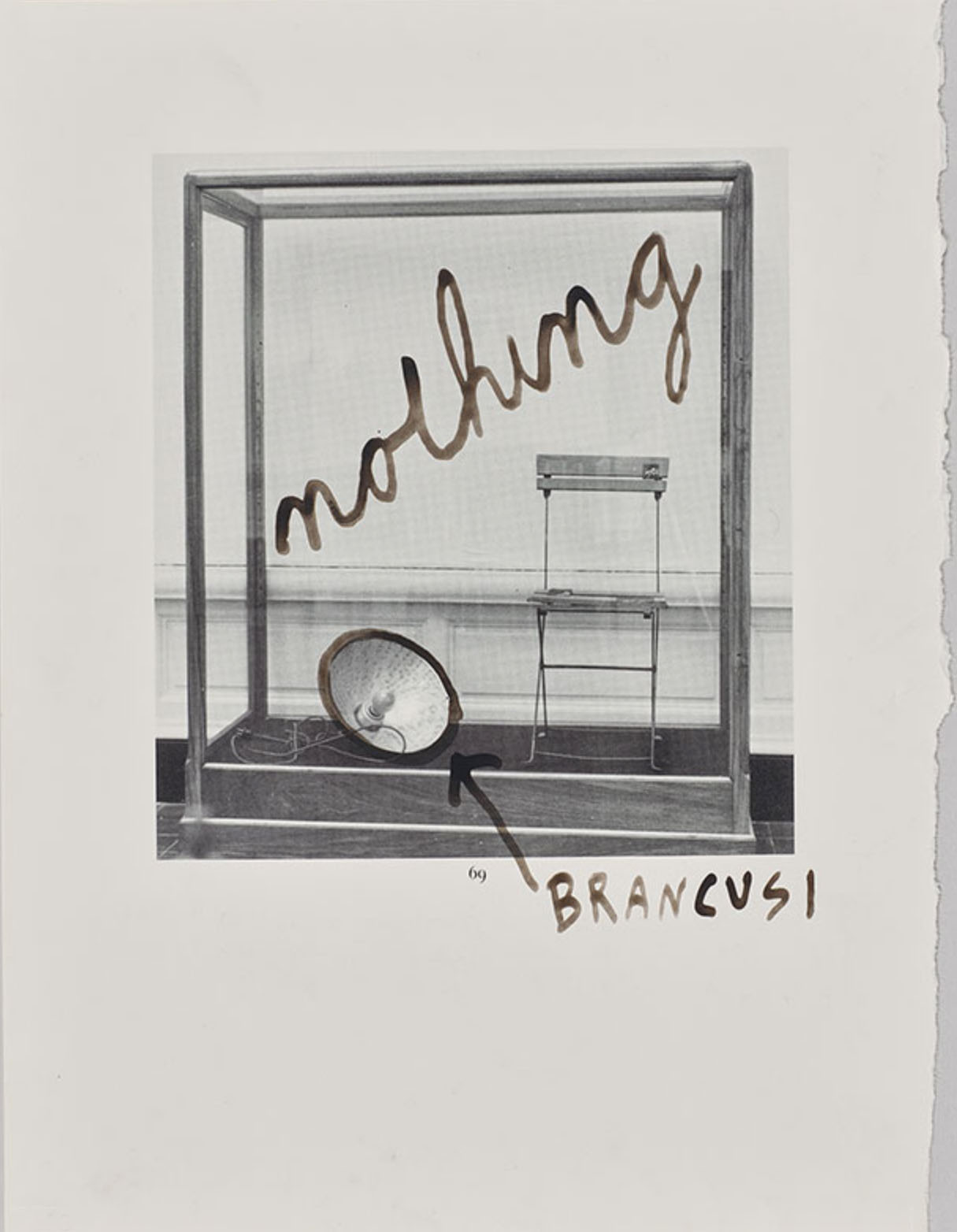
 

Ray Johnson (American, 1927-1995) 'Untitled (Nothing with Brancusi)' Undated

Ray Johnson (American, 1927-1995) 'Untitled (Mapplethorpe with moticos)' Undated

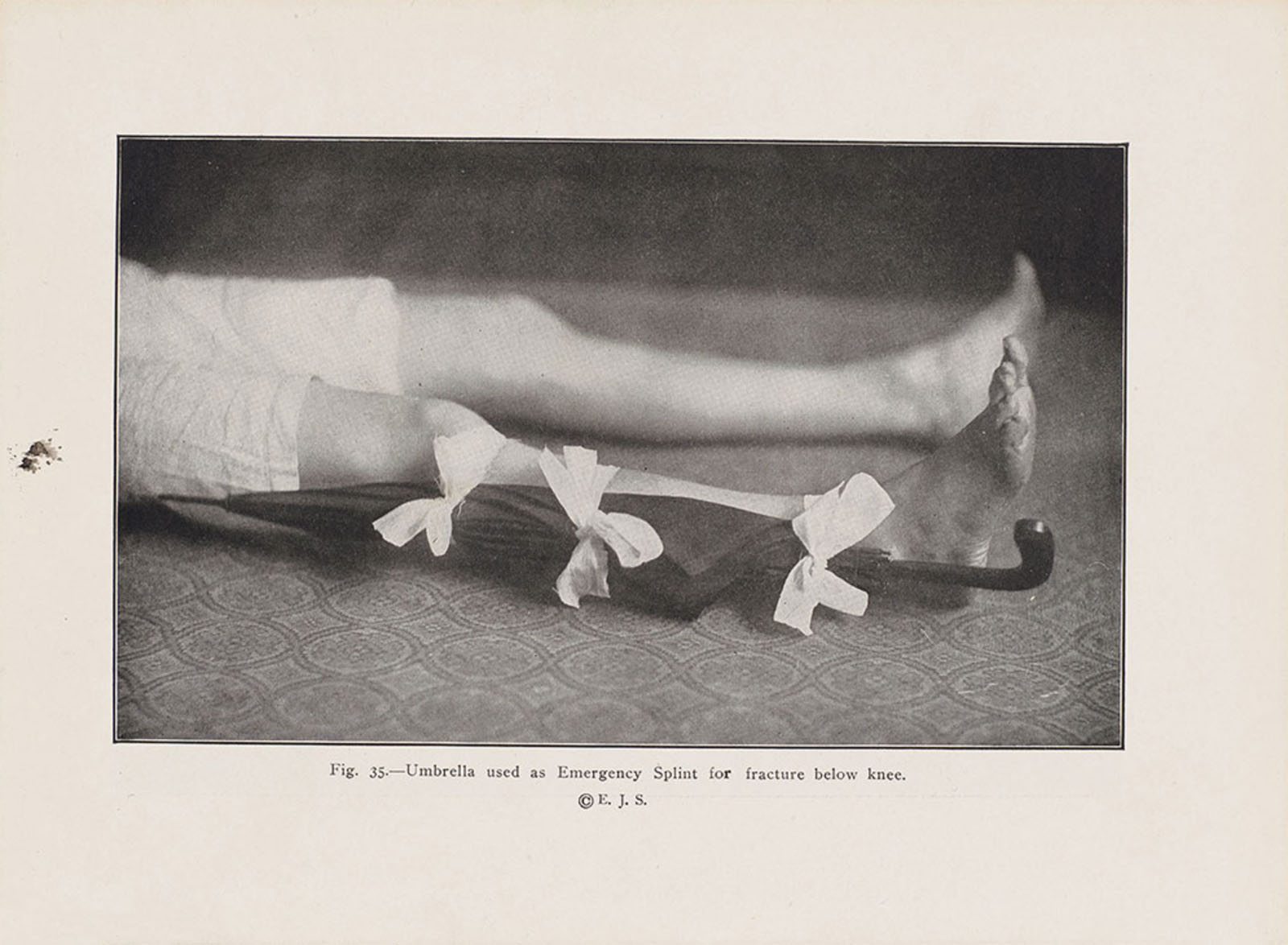
Ray Johnson (American, 1927-1995) 'Untitled (book page with umbrella as splint)' Undated


Ray Johnson (American, 1927-1995)
Untitled (Nothing with Brancusi)
Undated
Ink on book page
9 1/2 × 7 1/2 in. (24.13 × 19.05cm)
The Ray Johnson Estate
© Ray Johnson / Artists Rights Society (ARS), New York

Ray Johnson (American, 1927-1995)
Untitled (Mapplethorpe with moticos)
Undated
Ink on magazine page
Image: 7 × 7 in. (17.78 × 17.78cm)
The Ray Johnson Estate
The Morgan Library & Museum. Gift of the Ray Johnson Estate, courtesy of Frances Beatty.

Ray Johnson (American, 1927-1995)
Untitled (book page with umbrella as splint)
Undated
Ink on paper
Image: 9 1/2 × 7 in. (24.13 × 17.78cm)
The Ray Johnson Estate
© Ray Johnson / Artists Rights Society (ARS), New York


Over the years, Johnson inducted hundreds or thousands of recipients into what he called the New York Correspondence School by mailing them oblique yet personalised messages. These altered book and magazine pages were among the unmailed works found in his house after his death.


Ray Johnson (American, 1927-1995) 'Offset printing plate (Ara Ignatius portrait)' c. 1964

Ray Johnson (American, 1927-1995) 'Untitled (Ara Ignatius portrait with a photograph of lips)' Undated

Ray Johnson (American, 1927-1995) 'Untitled (Ara Ignatius portrait with bunnyheads)' Undated


Ray Johnson (American, 1927-1995)
Offset printing plate (Ara Ignatius portrait)
c. 1964
Metal
Image: 15 1/2 × 10 in. (39.37 × 25.4cm)
The Ray Johnson Estate
© Ray Johnson / Artists Rights Society (ARS), New York

Ray Johnson (American, 1927-1995)
Untitled (Ara Ignatius portrait with a photograph of lips)
Undated
Cut paper on paper
Image: 11 × 8 1/2 in. (27.94 × 21.59cm)
The Ray Johnson Estate
© Ray Johnson / Artists Rights Society (ARS), New York

Ray Johnson (American, 1927-1995)
Untitled (Ara Ignatius portrait with bunnyheads)
Undated
Ink on paper
Image: 11 × 8 1/2 in. (27.94 × 21.59cm)
The Ray Johnson Estate
© Ray Johnson / Artists Rights Society (ARS), New York


Johnson favoured likenesses that masked as much about him as they revealed. He repeatedly used a headshot that his friend Ara Ignatius made around 1963. It is an unnerving image, lacking the conceit of intimacy that characterises most formal portraits; instead it “stands for” Johnson, in the artless manner of a government-issued ID.

Many pieces of mail art that look like photocopies are in fact products of offset printing – a means of transferring photographs and other images to the page from reusable metal plates. The medium allowed Johnson to return to an image repeatedly, imposing variations that reflected his ever-changing purposes.


Ray Johnson (American, 1927-1995) 'Untitled ("I shot an arrow into the air..." with Shirley Temple and Vikki Dougan)' c. 1970-1972


Ray Johnson (American, 1927-1995)
Untitled (“I shot an arrow into the air…” with Shirley Temple and Vikki Dougan)
c. 1970-1972
Ink, wash, collage, vintage photograph on illustration board
18 × 15 in. (45.72 × 38.1cm)
The Ray Johnson Estate
© Ray Johnson / Artists Rights Society (ARS), New York


In this photocollage, two movie actors meet: Vikki Dougan (b. 1929), who became a sex symbol in the 1950s by publicly appearing in backless dresses, and the quintessentially innocent child star Shirley Temple (1928-2014). Temple’s rendering as a blacked-out, moticos-like figure may allude to her adult married name, Shirley Temple Black. Across the bottom of the image, a line from Henry Wadsworth Longfellow’s 1845 poem “The Arrow and the Song” is altered to refer to Johnson’s forerunner in collage and assemblage art, Joseph Cornell (1903-1972), who lived in Flushing, Queens.


Ray Johnson (American, 1927-1995) 'David Hockney's Mother's Potato Masher' 1972-80-88-94


Ray Johnson (American, 1927-1995)
David Hockney’s Mother’s Potato Masher
1972-80-88-94
Collage on cardboard panel
20 3/8 × 15 1/4 in. (51.75 × 38.74cm)
The Morgan Library & Museum
Gift of Frances Beatty, Alexander Adler, and the Ray Johnson Estate
© Ray Johnson / Artists Rights Society (ARS), New York


The title of each collage in the Potato Masher series begins with a notable artist’s or celebrity’s name. The titles then take an abrupt turn away from stardom by alluding first to the famed figure’s mother, and then to her potato masher. Here, Johnson included his own likeness in the form of a headshot, made around 1963 by the photographer Ara Ignatius. His face is covered by black moticos and cut-up fragments of his earlier artworks. Johnson created his collages over a span of weeks, months, or even years, dating each element in pencil as it joined the composition.


The Morgan Library & Museum presents PLEASE SEND TO REAL LIFE: Ray Johnson Photographs, opening June 17 and running through October 2, 2022. This exhibition explores the previously unknown camera work of the widely connected downtown New York figure, Pop art innovator, and pioneer of collage and mail art. At his death on 13 January 1995, Ray Johnson (1927-1995) left behind a vast archive of art in his house, including over five thousand colour photographs made in his last three years. Small prints, neatly stored in their envelopes from the developer’s shop, the photographs remained virtually unexamined for three decades. Now they can be seen as the last act in a romance with photography that had begun in Johnson’s art some forty years earlier. After retracing the story of Johnson’s use of photography throughout his career, PLEASE SEND TO REAL LIFE offers an in-depth look at the late work the artist called “my career in photography.”

After moving from Manhattan to suburban Long Island in 1968, Johnson selectively distanced himself from the mainstream art world, holding only two exhibitions after 1978. Yet even after his last show, in 1991, he remained a prolific and unpredictable artist. With his purchase of a single-use, point-and-shoot camera in January 1992, he embarked on an entirely fresh creative enterprise. By the end of December 1994, he had used 137 disposable cameras. His most frequent subjects were what he referred to as his Movie Stars: meter-high collages on cardboard, often featuring the bunny head that served as his artistic signature. They became ensemble players in the curious tableaux he staged in everyday locales near his Locust Valley home.

As an artist, Johnson was a master hunter-recycler, constantly revisiting and reinterpreting images from his past. He appears to have first used a disposable camera for a practical purpose: documenting his enormous backlog of unused collage fragments. He performed that work in his driveway and on the back steps of his house, but soon he was carrying a pocket-size camera on daily outings to nearby beaches, parks, and cemeteries. Johnson’s photographs exhibit a collagist’s instinct for insertion, layering, and surprise: most of them are centred on objects that he placed between himself and a scene as he found it. In his photographs as in his pun-filled writing and his densely worked collages, Johnson used juxtaposition to suggest that everything finds correspondence in something else. The point-and-shoot habit gave him a way to create an image almost as quickly as he could think of it. As curator Joel Smith writes in the book that accompanies the exhibition, “Nowhere in Johnson’s art does he look more intensely engaged by the present tense, more thrilled to be immersed in real life, than in the inventions of his throwaway camera.”

PLEASE SEND TO REAL LIFE offers a rare chance to examine photographs taken by Ray Johnson, an artist known primarily for his brilliant work in collage,” said Colin B. Bailey, Director of the Morgan Library & Museum. “The images, most of which have gone unexplored until now, are truly innovative and ahead of their time. The exhibition also celebrates a significant gift of Johnson’s work, generously made by Ray Johnson estate, courtesy of Frances Beatty.”

“These photographs show that in his last years, Ray Johnson remained irrepressibly, explosively creative,” said Smith, the Richard L. Menschel Curator of Photography at the Morgan. “It’s his last great body of work, and its very casualness is prophetic: ten years later, smart phones and social media turned daily life into a constant exchange of personal photographs and commentary. Johnson was still making collages right up to the end – but now he made them in a camera, and the ‘real life’ all around him was his medium.”

PLEASE SEND TO REAL LIFE: Ray Johnson Photographs is accompanied by a book with the same title published by Mack Books, which includes an essay by the exhibition’s curator, Joel Smith.

Press release from the Morgan Library & Museum
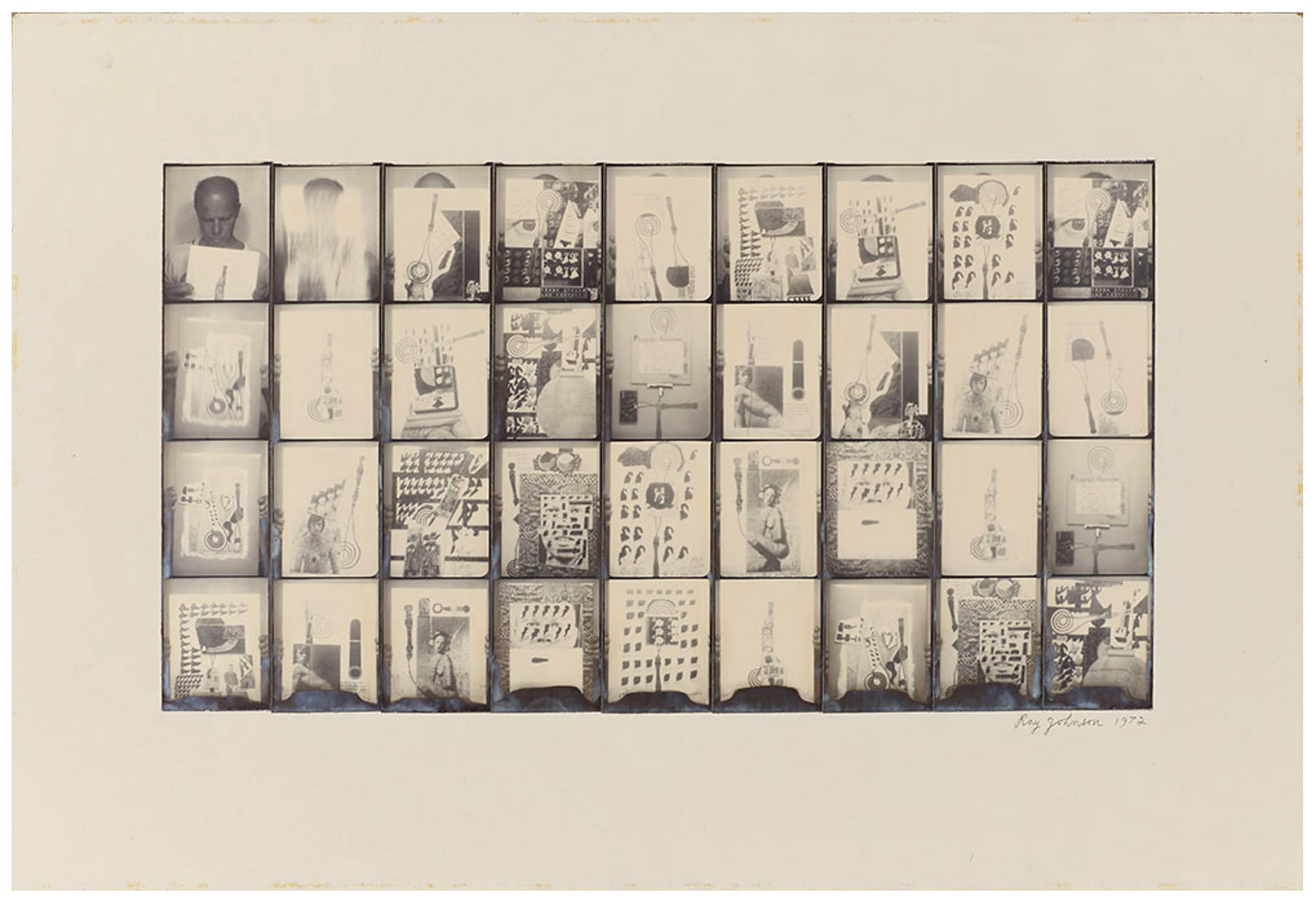
 

Ray Johnson (American, 1927-1995) 'Untitled (Photo Booth Collage)' 1972


Ray Johnson (American, 1927-1995)
Untitled (Photo Booth Collage)
1972
Collage on illustration board
12 7/8 × 19 in. (32.7 × 48.26cm)
The Morgan Library & Museum
Gift of Frances Beatty, Alexander Adler, and the Ray Johnson Estate
© Ray Johnson / Artists Rights Society (ARS), New York


Here, Johnson (visible at top left) employs a booth as an affordable studio for documenting works from his Potato Masher series. Sitting in the photo booth, he simply held up one collage after another for the automatic camera. The resulting sequence of vertical photo strips combines the qualities of a crude performance document and an art gallery’s inventory sheet. David Hockney’s Mother’s Potato Masher appears, not yet finished, fourth from the left in the bottom row.


Ray Johnson (American, 1927-1995) 'Untitled (Tab Hunter William Burroughs)' c. 1976-1981

Ray Johnson (American, 1927-1995) 'William S. Burroughs silhouette and kingfisher' Winter 1992


Ray Johnson (American, 1927-1995)
William S. Burroughs silhouette and kingfisher
Winter 1992
Commercially processed chromogenic print
4 × 6 in.
The Morgan Library & Museum
Gifts of the Ray Johnson Estate, courtesy of Frances Beatty
© Ray Johnson / Artists Rights Society (ARS), New York

Ray Johnson (American, 1927-1995)
Untitled (Tab Hunter William Burroughs)
c. 1976-1981
Collage on cardboard panel
12 × 12 1/2 in. (30.48 × 31.75cm)
The Morgan Library & Museum
Gift of Frances Beatty, Allen Adler, Alexander Adler, and the Ray Johnson Estate
© Ray Johnson / Artists Rights Society (ARS), New York


In 1976 Johnson began asking friends, art-world figures, and celebrities to sit and have their silhouettes traced onto paper. He thus built a library of nearly three hundred profile templates he could use and reuse. As a portrait form, the silhouette reduces its subject to a graphic shape, identifiable but resistant to psychological interpretation. In this example, Johnson overlapped the profiles of 1950s movie heartthrob Tab Hunter (1931-2018) and avant-garde writer William S. Burroughs (1914-1997).

In the 1990s Johnson photographed one of his stock props, a stuffed kingfisher, in combination with Burroughs’s silhouette. The beak of the bird extends the author’s prominent nose: a bill replacing the bill of a Bill.


Even when Johnson avoided direct self-portraiture, his quirky fixations were always evident. (In an essay for the exhibition catalogue, the curator Joel Smith refers to “the low-key but constant thrum of odd motivation” behind all of the artist’s work.) In one of the collages on display, William Burroughs’s profile nearly eclipses that of the nineteen-fifties movie star turned gay icon Tab Hunter, and both are all but obscured by a swarm of pebble-like fragments and bits of collage. Johnson was forever constructing miniature sets for his own delirious theatre of the absurd: puzzles within puzzles. The sensibility is not unlike Joseph Cornell’s, minus the romance and period nostalgia. Johnson worked in another sort of outsider vernacular – at once banal, vulgar, campy, and deeply sophisticated. Like John Baldessari, he favored artless lettering and crisp graphic design. The cardboard slats, especially, might be mistaken for portable Baldessaris.

Vince Aletti. “A Trove of Snapshots from a Sly Master of Collage,” on The New Yorker website July 22, 2022 [Online] Cited 26/09/2022


Ray Johnson (American, 1927-1995) 'Untitled (Elvis with Bunny Ears)' 1987


Ray Johnson (American, 1927-1995)
Untitled (Elvis with Bunny Ears)
1987
Collage with acrylic and ink on canvasboard
16 × 8 in. (40.64 × 20.32cm)
The Morgan Library & Museum
Gift of the Ray Johnson Estate, courtesy of Frances Beatty.
© Ray Johnson / Artists Rights Society (ARS), New York


Beginning in the 1950s, Johnson made artistic use of photographs of the twentieth-century cultural icon Elvis Presley (1935-1977). Johnson’s most emblematic motif, a stylised bunny face, first appeared beside the artist’s name in 1964. Bunny ears would serve both as a kind of trademark and as a way of turning anyone – Elvis, in this case – into a Ray Johnson character. The enlarged halftone dots that compose Elvis’s image confirm its status as a mass-market photographic reproduction.


Ray Johnson (American, 1927-1995) 'Rubble and photo credit' Summer 1992

Ray Johnson (American, 1927-1995) 'Andy Warhol life dates on flowers' July 1992

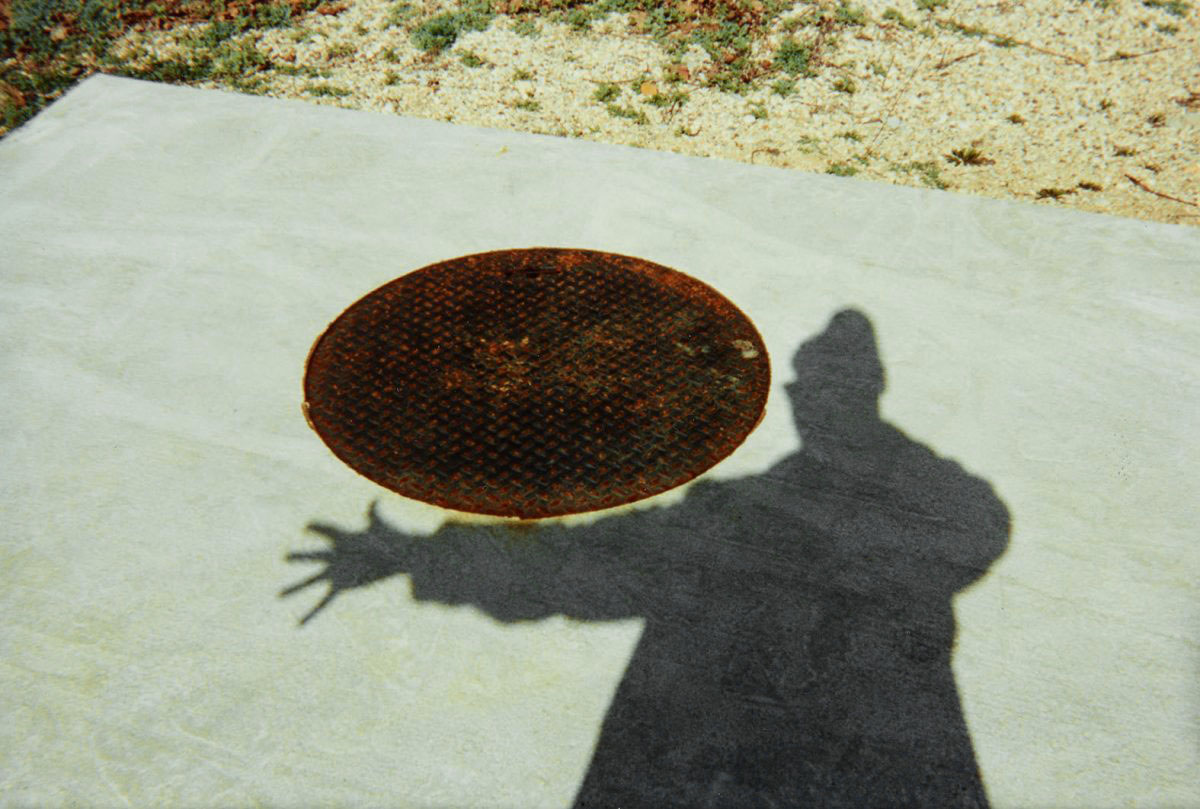
Ray Johnson (American, 1927-1995) 'Shadow and manhole' Spring 1992


Ray Johnson (American, 1927-1995)
Rubble and photo credit
Summer 1992
Commercially processed chromogenic print
4 × 6 in.
The Morgan Library & Museum
Gift of the Ray Johnson Estate, courtesy of Frances Beatty
© Ray Johnson / Artists Rights Society (ARS), New York

Ray Johnson (American, 1927-1995)
Andy Warhol life dates on flowers
July 1992
Commercially processed chromogenic print
4 × 6 in.
The Morgan Library & Museum
Gift of the Ray Johnson Estate, courtesy of Frances Beatty
© Ray Johnson / Artists Rights Society (ARS), New York

Ray Johnson (American, 1927-1995)
Shadow and manhole
Spring 1992
Commercially processed chromogenic print
4 × 6 in.
The Morgan Library & Museum
Gift of the Ray Johnson Estate, courtesy of Frances Beatty
© Ray Johnson / Artists Rights Society (ARS), New York


Johnson appears to have first used a disposable camera for a practical purpose: documenting his backlog of unused collage fragments. But in January 1992, he told curator Clive Phillpot, “I’m pursuing my career as a photographer,” and in March he added, “I’m having fun with my throw-away camera.” Always faithful to the rapidity of his own thinking, Johnson found in the “throwaway” Fuji Quicksnap a way to give graphic form to ideas as they occurred to him.


Ray Johnson (American, 1927-1995) 'Path of headshots and back steps' Spring 1992

Ray Johnson (American, 1927-1995) 'Joseph Cornell silhouette and payphone' Spring 1992

Ray Johnson (American, 1927-1995) 'Bills, Stehli Beach' Summer 1992


Ray Johnson (American, 1927-1995)
Path of headshots and back steps
Spring 1992
Commercially processed chromogenic print
4 × 6 in.
The Morgan Library & Museum
Gift of the Ray Johnson Estate, courtesy of Frances Beatty
© Ray Johnson / Artists Rights Society (ARS), New York

Ray Johnson (American, 1927-1995)
Joseph Cornell silhouette and payphone
Spring 1992
Commercially processed chromogenic print
4 × 6 in.
The Morgan Library & Museum
Gift of the Ray Johnson Estate, courtesy of Frances Beatty
© Ray Johnson / Artists Rights Society (ARS), New York

Ray Johnson (American, 1927-1995)
Bills, Stehli Beach
Summer 1992
Commercially processed chromogenic print
4 × 6
The Morgan Library & Museum. Gift of the Ray Johnson Estate, courtesy of Frances Beatty; 2022.2:11
© Ray Johnson / Artists Rights Society (ARS), New York


Johnson’s first photography studios were the driveway and back steps of his house, but soon he was carrying a pocket-size camera on his daily outings to nearby beaches, parks, and cemeteries. In spring 1992, he threaded a cutout silhouette of Joseph Cornell over the cord of a payphone, then photographed it with one hand while holding the receiver with the other – acting as operator of a hotline to the collage-art pioneer.


Ray Johnson (American, 1927-1995) 'One-legged figure beside back steps' Spring 1992


Ray Johnson (American, 1927-1995)
One-legged figure beside back steps
Spring 1992
Commercially processed chromogenic print
4 × 6 in.
The Morgan Library & Museum
Gift of the Ray Johnson Estate, courtesy of Frances Beatty
© Ray Johnson / Artists Rights Society (ARS), New York


Ray Johnson (American, 1927-1995) 'Mondrian's grave and playing card, Mount Lebanon Cemetery, Queens' spring 1992

Ray Johnson (American, 1927-1995) 'Billboard' Summer 1992


Ray Johnson (American, 1927-1995)
Mondrian’s grave and playing card, Mount Lebanon Cemetery, Queens
spring 1992
Commercially processed chromogenic print
4 × 6 in.
The Morgan Library & Museum
Gift of the Ray Johnson Estate, courtesy of Frances Beatty
© Ray Johnson / Artists Rights Society (ARS), New York

Ray Johnson (American, 1927-1995)
Billboard
Summer 1992
Commercially processed chromogenic print
4 × 6 in.
The Morgan Library & Museum
Gift of the Ray Johnson Estate, courtesy of Frances Beatty
© Ray Johnson / Artists Rights Society (ARS), New York


Even in his photography, Johnson exhibits a collagist’s instinct for insertion and layering. Most of his photographs are centred on objects that he placed between himself and a scene as he found it. On occasion, though, he used the camera in a conventional way, simply collecting views of sights that drew his interest, such as a billboard advertising nothing or the word HELP on the underside of a boat. Photographs such as these are the field notes of a minutely attentive observer.


PLEASE SEND TO REAL LIFE

Joel Smith

In January 1992, a few weeks after his last lifetime exhibition closed at Moore College in Philadelphia, the artist Ray Johnson began photographing in and around his house in Locust Valley, Long Island, using what he called “my throwaway camera”: a single-use point-and-shoot, preloaded with daylight color film. Thirty-five months and 137 throwaways later, he photographed views through the storefront window of an even-more-final exhibition called Ray Johnson: Nothing. It was up during the Christmas week lull of 1994 in a gallery on the main street of Sea Cliff, a few minutes’ drive from Johnson’s house, and around the corner from that of his friend and frequent mail-art partner, Sheila Sporer. Then, one Friday a couple of weeks into 1995, a man was seen jumping from a bridge in Sag Harbor, an hour and a half’s drive east. Witnesses reported that Johnson – the body, when recovered, proved to be his – appeared to be doing a backstroke toward the open Atlantic. (He could not swim.) Johnson’s presumed suicide is often described as the final work of a career in which art and life had long been inseparable.

In his last three years Johnson made and mailed art incessantly, went out for a drive most days, and ran through about one camera a week. When he finished a twenty-four-frame roll, he would drop off the camera – he used a couple of Kodaks at first and then, consistently, Fujicolor Quicksnaps – at Living Color, a shop in Glen Cove, for developing and printing. After turning sixty-five in October 1992, he often took advantage of a senior discount and ordered duplicate prints. For some forty years his art practice had consisted mainly of collage, relief assemblages, and correspondence art. Though photographs had figured in all three channels of work, they were not photographs made by Johnson himself, but portraits of him by others, or images he cut out of books or magazines. Now, in what he called his new “career as a photographer,” Johnson incorporated a few of his own photographs in modest little collages. He also mailed his photographs to correspondents, usually in the form of photocopies. But in the season after his death, among the dozens of boxes of art and effects Johnson left packed up in every room of his house, over five thousand of the color photos were found, still filed with their negatives and receipts in Living Color envelopes. To say the photographs were found needs qualifying: their existence was recorded, but years would pass before photography registered as a central creative pursuit of his final years.

It is not surprising that this work evaded scrutiny. Physically, these are plain, consumer-grade four-by-six-inch color snapshots, indistinguishable from those anyone would take home from the processor’s – whereas Johnson’s art more often took the form of distinctly, peculiarly altered public imagery. After the rise and canonization of Pop art in the 1960s, his work of a few years earlier, notably his addition of dripping red tears to a fan-magazine photo of Elvis Presley (1956-1957), looked prescient. Johnson, like Andy Warhol and Roy Lichtenstein, took mass-market imagery for his muse – but, instead of enlarging it to grandiose scale, his instinct was to bestow the status of an artistic “original” upon ordinary, available-to-everyone printed matter itself. His collages, in that sense, define an antipode to Pop painting’s monumentalised appropriations. His prototype, you could say, was the sardonic teenager he had been not long before, scribbling mustaches onto Marilyns in magazines.

Spend time with the color photographs, and Johnson’s playful, punky persona becomes evident – not in anything he did to the pictures, but in their contents. The straight-men in these images are the streets, beachfronts, and parking lots of bucolic, smalltown northern Long Island: Locust Valley, Sea Cliff, Roslyn, Lattingtown, Glen Cove, Bayville. The scribbled mustaches are the dramatis personae Johnson introduces to those spaces. Within a few months of starting his photo-work, he began making, and photographing, collages on what were, for him, large (thirty-two-by-eight-inch) pieces of corrugated cardboard (62). (The cardboard often bears Fuji brand info; it, too, comes from the camera shop, or out of its dumpster.) In a letter to art critic David Bourdon in summer 1993, Johnson introduces ninety-three of these collages by name (Bobby Short, Greta Garbo …) and calls them his Movie Stars (or Move Stars). Indeed, despite their rectilinear format, they read as figures: paper-doll play-actors for his photo-tableaux. They have faces – most frequently Johnson’s signature pop-eyed, schlong-nosed bunny, inscribed with a name or phrase. (Many of those are rendered in mirror letters, correctly sequenced but laterally FLOPPED, as if in a misbegotten effort to address a reader on the other side of a steamy window.) As he did with his collages generally, Johnson would glue new elements onto these figures over time, dating each newly added bit in pencil. As the weeks of photo-shoots roll by, you can watch as a figure that starts as mostly naked cardboard fills up with information. I picture Johnson exiting his little grey house (he described its color as “grey with an e,” but named it The Pink House) with a freshly worked batch of Movie Stars under his arm, loading them into the back of his Volkswagen Golf, and taking them out on a drive, camera in pocket.

About a decade after these photographs were made, smart phones came into use, and everyone began having a camera on their person all the time. In 1992, making a photograph still required deciding and preparing to do so, and not simply asking oneself (or not even asking), “Why don’t I?” Buying the camera, noting how close to frame zero it was getting, dropping it off, returning to pick up the prints: making these pictures called for effort, on a par with the effort of crafting the Movie Stars. The whole enterprise reflects the low-key but constant thrum of odd motivation that drives all of Johnson’s work. The art he made was irreducibly personal, if gnomic, and he went to lengths to maintain control over how his collages, punning defacements, paradoxes, and near-nothings would make their way into the world. Johnson’s New York Correspondence School – the vast network he invented for circulating mail art – existed mainly in his head, but this, from his angle, made it no less real than the art world.

In the art-historical fairy tale of postwar New York City, young Ray Johnson must have looked, for a few years, like an avant-garde heir apparent. Born in 1927, the only child of loving working-class parents, he grew up in Detroit and, from 1945 to 1948, attended North Carolina’s Black Mountain College, crucible of every far-seeing artistic impulse of that moment. He was shy and hard-working and he devoured all he could from instructors who included Josef Albers, Alvin Lustig, and Robert Motherwell. He left BMC having entered into Zen kinship with two teachers, John Cage and Merce Cunningham, and into romantic partnership with another, the sculptor Richard Lippold. The four of them took up residence in a building in the deep reaches of downtown Manhattan. Johnson earned money working in Ad Reinhardt’s studio and at the Orientalia bookstore. He showed his Albers-sized, minutely rendered geometric paintings as a member of the American Abstract Artists group. In short, he seemed destined for middling highbrow success.

Instead, he became Ray Johnson. Between 1954 and 1956, he ditched his qualifications by burning all the early paintings still in his possession and redirecting his creative effort onto the slight, irregular-shaped, frame-resistant (but mailable) collages he called “moticos.” His move to print-media-based figural collage came at an historical moment far too late to boast a Dada-Surrealist pedigree and too early to get swept neatly up into Pop. The concerted wrongness of this switch makes it, in retrospect, quietly brilliant, and it points to the singularity that doomed Johnson’s crown-prince prospects. (Two of his successors and friends at BMC, Jasper Johns and Robert Rauschenberg, picked up those prospects and put them to good use.)

Johnson hung onto a number of photographs that documented his fateful conversion. At age sixty-four he arranged twenty of them in a grid on the drive behind his house, then scaled a ladder to re-photograph them (26). In most of these old photographs, moticos in profusion can be seen arrayed in two real-world sites, a pallet on a sidewalk and a large industrial interior. In others – which were made in the street by a friend of Ray’s, the future fashion photographer Elisabeth Novick (then Loewenstein) – you can see Johnson draping moticos all over another friend (and fellow BMC alum), Suzi Gablik. These are, in effect, performance records; Gablik even came to describe Johnson’s moticos-stagings as perhaps the first Happenings in art—a notion that arguably proceeds from their having been photographed. Interviewed in 2015, Novick emphasized how casually this came about. Not long before, she had been given her first camera, and one day, Ray simply asked her to bring it along on a walk. “Suzi just sat there,” Novick said, “and he just threw the things on top of her.” She explains: “He was a very lighthearted sort of whimsical person. […] He wasn’t intense. It was the opposite of intense. If I could look up the opposite word of intense, I would say that was him.”

The “opposite-of-intense” mode of hardly-work Johnson was auditioning that day led him to an art based on play, exchange, and movement; on remaining light-footed enough to follow any association that came to mind, be it ever so slight, silly, or hermetic. Perhaps for just that reason, Johnson’s art found its ideal helpmate in the camera, with its knack for lending graphic form to the ephemeral. In any event, the 1955 documents turn up repeatedly in his color photographs of forty years later (44, 102).

Even more prevalent in these images is the infinitely malleable bunny head (64) that Johnson described as “a sort of self-portrait.” Its partner, equally ever-present, is a headshot of Johnson made by Ara Ignatius around 1963. (Johnson kept on hand an offset plate of this image, from which he could order new printings by the hundreds whenever he needed them.) In one early-1992 photograph, nineteen headshots are laid down in a path leading to Johnson’s backdoor stairs, where he would be staging many more photographs (20). In the summer of 1993, four headshots stare in through the windshield of his car, like a posse of avid fans (126). The headshot rides shotgun with Elvis (108) and, reduced to a pair of eyes, lends consciousness to a mob of moticos on camelback (98).

Johnson’s longtime collector, advocate, and chief interpreter, William Wilson, observed that photographs served the artist as a form of citation: as a way to “reference,” rather than “represent,” his subjects. The hands-off nature of the medium gave Johnson a way to bring topics up yet keep his viewer (his recipient, his reader) focused on something he cared about more: the messaging process itself. Using another photography adjacent tool, the silhouette, Johnson could convert the people he knew into references-to-themselves. Starting in 1976, he used pencil and paper to trace the profile shadows of some 284 sitters. He filed these in two big template binders, ready for use in the studio. Most of his profile subjects were writers, artists, and actors, whose shared characteristic is their publicly traded names.

Some of the silhouettes appear in the colour photographs, as do various celebrity portraits – but many more people show up as bunny faces inscribed with their names. Johnson wrote to Bourdon that seventy-two of his Movie Stars were going to appear in a “RAY JOHNSON OUTDOOR MOVIE SHOW” (see 110, 122, and 124 for variant stagings) that would stand “45 feet in length if ever actually placed next to each other and the wind didn’t blow them down.” In the meantime, he posed individual Movie Stars in the company of obliging strangers (54) or leaned them against the occasional dog (222).

The photographs include some one-offs, such as the shadow cast by Johnson’s mailbox (2) and a tar seam in a parking lot (176). Many of the subjects, though, are ones he revisited dozens of times, such as local beaches, cemeteries, and storefronts, a bathtub he found in a field (106, 107), and himself as a shadow, encountering a manhole cover (4).

Most of the photographs work in a collage-like way: they record Johnson’s alteration of a real-world setting through the addition of some flat thing he has made or chosen, such as one of his grimly cartoony black-on-white graphic characters, hiding amid spiky succulents (18), or an ace of clubs, leaning against Piet Mondrian’s grave marker (42).

At other times he works like a conventional photographer, observing but not intervening, as when he captures the horizon across Long Island Sound (230), a faceless billboard (41), the snapped arrow of a rooftop weathervane (16), or a palm frond splayed on beach sand (92).

Still other images define a mode between these two options, as Johnson finds some noteworthy thing to photograph (dragon’s teeth icicles [6], a mortuary angel [8]), then props up beside it a sign that emblazons the view like a maker’s logo or a graffitist’s tag: “PHOTO BY RAY JOHNSON”; “RAY JOHNSON THE PARIS CORRESPONDENCE SCHOOL.”

Here are a few of the subjects that kept Johnson and his 137 cameras coming back most often:

Inside. When Johnson photographed inside his house, the daylight-exposure film in his pre-loaded cameras restricted his work area to patches of direct sunlight. In late afternoon, the window in his front door cast a scalloped picture frame, or spotlight, around whatever he photographed on the floor (132, 168). The window’s shape in turn became a player, alone or in tandem with its mirror image (45).

Telephones. Johnson was as tireless a phone-caller as he was a mailer. Once, while at home, he held the phone for a bunny labeled EAR MUFS, posing between a 1955 photo and a clutch of moticos glyphs (28). Out driving around, he staged momentary installations in payphone boxes (65, 232). He unhooked one phone’s receiver and threaded over its cord a cardboard cutout silhouette of the artist Joseph Cornell, whom he used to visit in Flushing, Queens (12). The cutout void of Cornell’s head frames the telephone’s number-pad, turning Johnson into the operator of a Cornell-box hotline: camera in one hand, receiver in the other, plugged into the head of the master collagist.

Doubles. In Johnson’s universe, doubleness – correspondence – is the norm. No surprise, then, that he should photograph twins, replicas (48, 50), and those spellbinding autocopies, twin-initialed celebrities (Marilyn Monroe, Mickey Mouse [160]). He gives dualism a distinctly photographic turn by pairing things with their reflections or shadows. When photographed, these light-borne modes of doubling assume a concrete presence: they make reality look Johnsonian. A reflection echoes its original, but the two are non-identical. The reflection – being laterally flopped, like Johnson’s mirror letters – is the original’s opposite (52, 172). As for the shadow, it is a flat, graphic version of its original (70), an incorporeal counterpart to reality (136).

Recycling. A collagist traffics in the reincarnation of materials and images. The beginnings of Johnson’s photographs look like an effort to document his vast inventory of “chop art” – his term for the densely-reworked chunks of assemblage he had been building up and cutting apart again for decades (30-33). He abandoned this cataloguing, but his photographs remain as full of junk (130, 131) as his house (228); “WHAT A DUMP.” His movie-reel memory encompassed everything from Bette Davis films to a porn video made famous in the confirmation hearings of Supreme Court nominee Clarence Thomas [150]). He created a deadpan cardboard memorial to his old associate, arch-recycler Andy Warhol, and laid it atop a raked pile of cemetery flowers (142), and, two years later, atop a scattering of donated clothes (144).

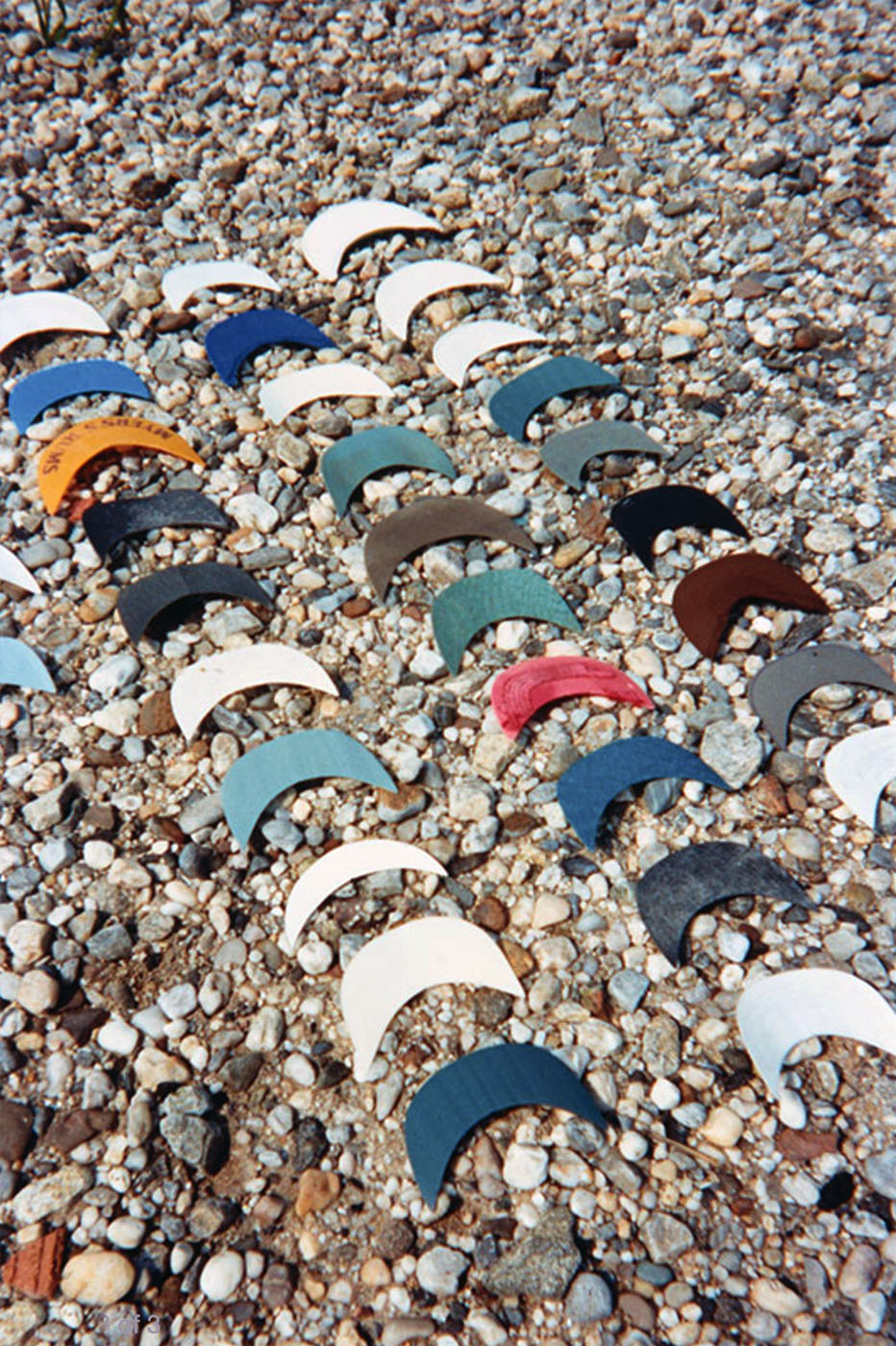
Bills. Scavenged out of those clothing drops, most likely, were the many baseball cap visors Johnson photographed. He held them up before the camera, always in C formation, with deep spaces behind them: the sky, or receding railway tracks (34, 78). He arrayed them on Stehli Beach like a school of migrating horseshoe crabs (94). He cut the bill’s crescent-moon shape out of his headshot (33). If they stand for a name, “Bill,” perhaps he is William Wilson. Or the writer William S. Burroughs, who sat for his silhouette in 1976. Johnson laid a cutout of Burroughs down on cardboard, then extended Bill’s prominent nose with the bill of a kingfisher (96).

Photographers. The photographs feature many images drawn from photography’s historical canon, making Johnson-collaborators of, among others, Walker Evans (via Sherrie Levine) (136), Dennis Stock (158), and Félix González-Torres (186). Some Movie Star bunnies are given the names of photographers, including Horst, Duane Michals (154, 170), and Lord Snowdon (snowed-in / snowed-N [236]). The crane in Bill Brandt’s famous photograph of Kew Gardens provides the top half of an awkward composite figure (159, 174). Johnson perched Michals’s book of portraits on the front bumper of his car, making a third headlight of its cyclopean eye (138). He turned Richard Avedon’s An Autobiography face-down to reveal its author photo and dressed the portraitist in a hat (163) that channels Marianne Moore, who is portrayed in that book wearing her signature tricorn (a moticos-like garment that fascinated Johnson). Late one dusk, Johnson photographed the legs of his shadow spanning a copy of Lee Friedlander’s book Like a One-Eyed Cat, laid down open to its frontispiece, one of Friedlander’s many self-portraits in shadow (80).

Please Send. Between July and December 1994, over twenty wrapped packages appear in Johnson’s photographs. They are addressed to or from his mail-art correspondents, most frequently his local friend Sheila Sporer (158, 242). (The ones Sheila opened – those not marked “DO NOT OPEN” – turned out to be stuffed with plain craft paper.) Often the packages are pictured in the midst of what look like obscure rituals. One stands in Johnson’s driveway, tethered to a helium bunny balloon, ready to begin its physically impossible ascent (206). Others he positioned inside the gallery show-window of his late December 1994 un-show, Ray Johnson: Nothing, and then photographed them from out on the sidewalk (169). (He never ventured inside.) A few days later, he posed two packages, tourist-like, at the end of a pier at sunset (214); distressingly, one of them is next seen drifting in the water below (216).

In late December 1994, Johnson photographed himself in a shop window mirror, holding up a bunny inscribed PLEASE SEND TO REAL LIFE (246). (On the collage, this bunny bears the date December 21; below it, on December 30, Johnson added ONLY YOU [244].) REAL LIFE refers, at one level, to the New York-based art magazine REALLIFE (1979-1994): since late November, Johnson had been urging Sporer to pitch its editor, Thomas Lawson, an article about their three years of collaborative correspondence art.

But the message can mean something else, too – something like: “Here, Life, take this thing I’ve made; I’m going to the other place.” For decades death had been a resolute presence in Johnson’s work, taking such forms as Nothing, pitch-black humor, and a fixation on life dates. Is death palpably present in the photographs of his last three years? It would be silly to deny that it is. And yet it would be trivial to hunt through this large, complex, often comical, always personal body of work for nothing more than a rebus suicide note. Ray Johnson never made himself that easily readable. And nowhere in his art does he look more intensely engaged by the present tense, more thrilled to be immersed in Real Life, than in the inventions of his throwaway camera.

Joel Smith. “PLEASE SEND TO REAL LIFE,” in PLEASE SEND TO REAL LIFE: Ray Johnson Photographs. Mack Books, 2022, pp. 188-195

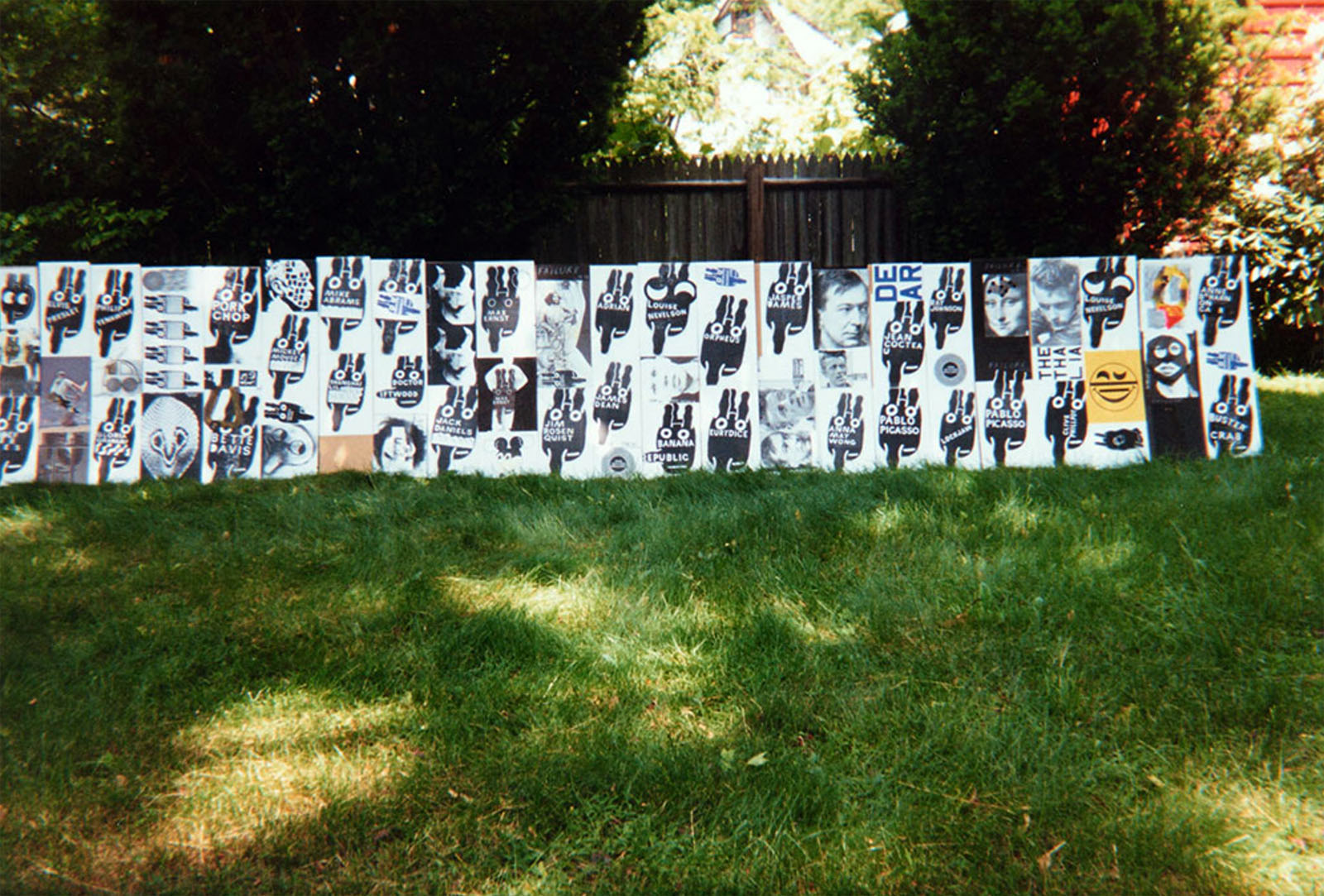
 

Ray Johnson (American, 1927-1995) 'Outdoor Movie Show on RJ's car' February 1993

Ray Johnson (American, 1927-1995) 'Outdoor Movie Show in RJ's backyard' 1 June 1993


Ray Johnson (American, 1927-1995)
Outdoor Movie Show on RJ’s car
February 1993
Commercially processed chromogenic print
4 × 6 in.
The Morgan Library & Museum
Gift of the Ray Johnson Estate, courtesy of Frances Beatty
© Ray Johnson / Artists Rights Society (ARS), New York

Ray Johnson (American, 1927-1995)
Outdoor Movie Show in RJ’s backyard
1 June 1993
Commercially processed chromogenic print
4 × 6 in.
The Morgan Library & Museum
Gift of the Ray Johnson Estate, courtesy of Frances Beatty
© Ray Johnson / Artists Rights Society (ARS), New York


The photographs Johnson made between January 1992 and December 1994 feature several dozen collages in a large, vertical format he had never used before. He referred to these works as Movie Stars (or Move Stars), writing that “if the wind didn’t knock them down,” he planned to cast them in a “Ray Johnson Outdoor Movie Show,” lined up like dancers in a musical revue. In the end, still photography was the nearest he came to filmmaking.


In the same way that Johnson burned his early paintings, renouncing the most reliable route to a successful art career in mid-20th-century New York, he exited the fray of Manhattan. In 1968 he moved to Locust Valley, Long Island, and after 1978 he had only two solo exhibitions – the last one in 1991. He continued to make art, though, and looked to artists like Joseph Cornell, famous for his box assemblages, who lived on Utopia Parkway in Queens. Many of Johnson’s works take Cornell’s idea of the display box filled with quirky objects and expands it to tableaus staged for the camera, using the suburban environment, the woods or the seashore as found theatrical sets. …

Johnson’s presence in many of the photos could be called self-portraiture – but the photos also feel very much like ancestors to the ubiquitous cellphone selfie. The photo “RJ with Please Send to Real Life and camera in mirror” (1994) is an obvious selfie precursor. It includes a number of conceptual twists, however: Johnson appears in a mirror, holding a disposable camera and one of his cardboard signs with an alter-ego bunny and the words “Please Send to Real Life” partially printed in reverse – a reminder of how the camera doesn’t merely document reality, but shapes and potentially distorts it. (This photo might also be a reference to his mail-art practice or the New York art magazine Real Life, published from 1979 to 1994.) …

What is art? What is real? Does the image document reality or create it? “Please Send to Real Life” raises some of these questions and shows how Johnson predicted the growing fuzziness between the realms of photography and IRL (in real life) – from snapshots to social media – suggesting that the relationship between them is porous but also ripe for creative intervention.

Anonymous. “Ray Johnson’s Camera Was Disposable. The Photos Are Unforgettable,” on The New York Times website 24th August 2022 [Online] Cited 28/08/2022


Ray Johnson (American, 1927-1995) 'Untitled (JOSEF ALBERS with cat)' 1993


Ray Johnson (American, 1927-1995) 'Untitled (six blue Rays in Rolls)' Undated


Ray Johnson (American, 1927-1995)
Untitled (yellow DUANE MICHALS bunny)
1993
Collage on corrugated cardboard
13 3/4 × 4 1/2 in. (34.93 × 11.43cm)
The Morgan Library & Museum
Gift of the Ray Johnson Estate, courtesy of Frances Beatty
© Ray Johnson / Artists Rights Society (ARS), New York

Ray Johnson (American, 1927-1995)
Untitled (JOSEF ALBERS with cat)
1993
Collage on corrugated cardboard
17 3/8 × 7 1/2 in. (44.13 × 19.05cm)
© Ray Johnson / Artists Rights Society (ARS), New York

Ray Johnson (American, 1927-1995)
Untitled (six blue Rays in Rolls)
Undated
Collage on corrugated cardboard
21 × 8 1/2 in. (53.34 × 21.59cm)
© Ray Johnson / Artists Rights Society (ARS), New York


Movie Stars

Overhead are some of the several dozen collages that appear in photographs Johnson made between January 1992 and December 1994. He referred to these large, vertical pieces as Movie Stars (or Move Stars), writing that “if the wind didn’t knock them down,” he planned to cast them in a “Ray Johnson Outdoor Movie Show,” lined up like dancers in a musical revue. In the end, still photography was the nearest he came to filmmaking. Were the Movie Stars made to be photographed? Or are the photographs mere documents of the Movie Stars? Perhaps the two bodies of work are best understood as complementary parts of a continuous creative cycle. Many of the Movie Stars are made on cardboard that bears photographic product information, suggesting that it was scavenged from the dumpster of the shop where Johnson bought his cameras and turned them in for developing.

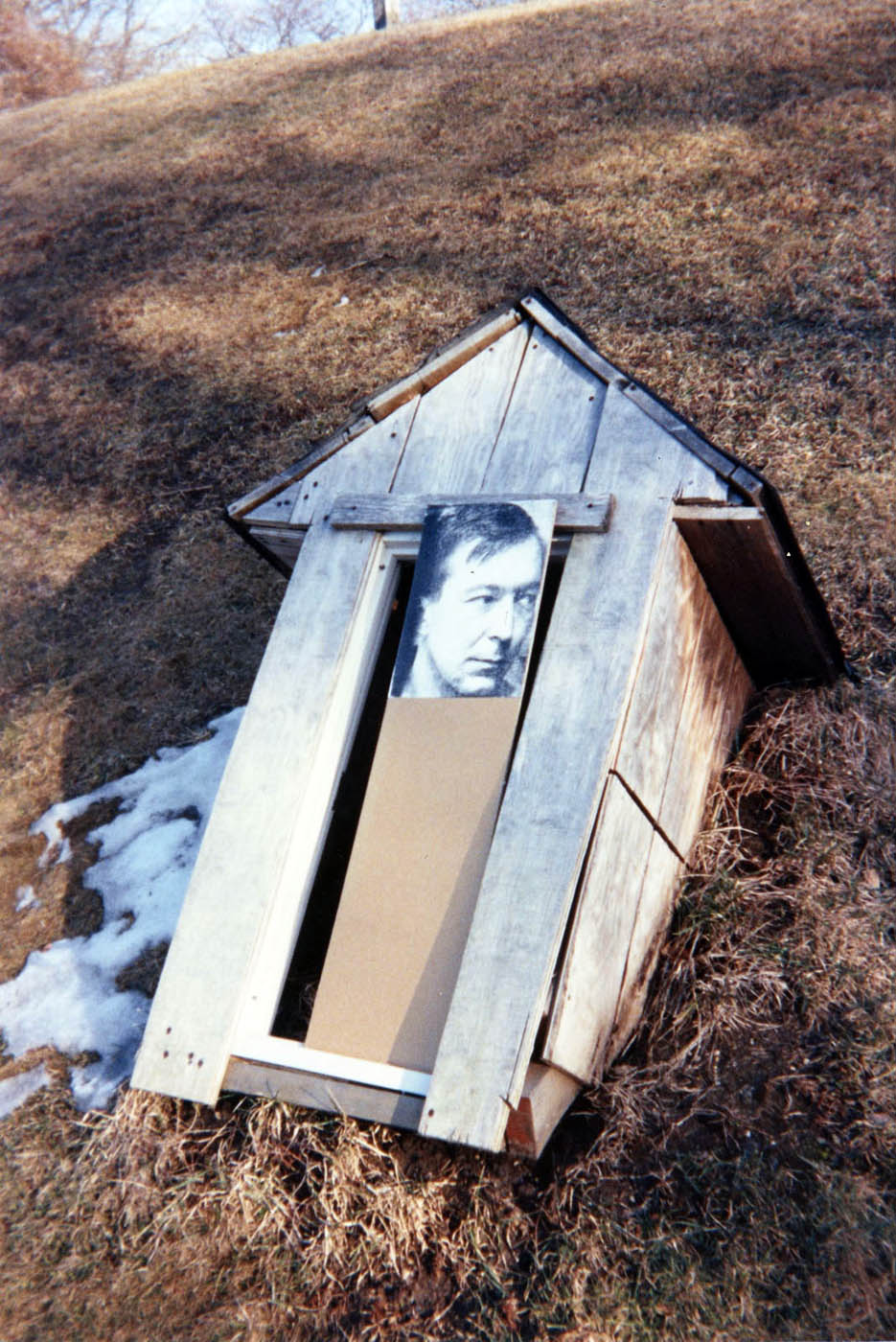
 

Ray Johnson (American, 1927-1995) 'Cage and Satie with Orpheus and Eurydice, Planting Fields Arboretum' February 1993

Ray Johnson (American, 1927-1995) 'Jasper John' February 1993

Ray Johnson (American, 1927-1995) 'WIGART grave and Movie Star of RJ between David Bs' April 1993


Ray Johnson (American, 1927-1995)
Cage and Satie with Orpheus and Eurydice, Planting Fields Arboretum
February 1993
Commercially processed chromogenic print
4 × 6 in.
The Morgan Library & Museum
Gift of the Ray Johnson Estate, courtesy of Frances Beatty
© Ray Johnson / Artists Rights Society (ARS), New York

Ray Johnson (American, 1927-1995)
Jasper John
February 1993
Commercially processed chromogenic print
4 × 6 in.
The Morgan Library & Museum
Gift of the Ray Johnson Estate, courtesy of Frances Beatty
© Ray Johnson / Artists Rights Society (ARS), New York

Ray Johnson (American, 1927-1995)
WIGART grave and Movie Star of RJ between David Bs
April 1993
Commercially processed chromogenic print
4 × 6 in.
The Morgan Library & Museum
Gift of the Ray Johnson Estate, courtesy of Frances Beatty
© Ray Johnson / Artists Rights Society (ARS), New York


The Movie Stars feature a roll call of celebrity faces and names that is, in composite, unique to Johnson’s imagination. By photographing the collages, Johnson animated his personal pantheon in the familiar settings of his daily life. Composers Erik Satie and John Cage rest in the arms of a statue of Orpheus, the prophetic music-maker of Greek myth. Artist Jasper Johns punningly marks the door of an outhouse-like wooden structure. Johnson himself rides shotgun in his Volkswagen Golf while Elvis takes the wheel. And art critic David Bourdon and rock star David Bowie (embodiments, in different ways, of Pop’s legacy) join Johnson at the grave of “Wig art.” Once Johnson even photographed the Movie Stars in their staging area at home, ready to be loaded into the car and taken out for a day’s work.

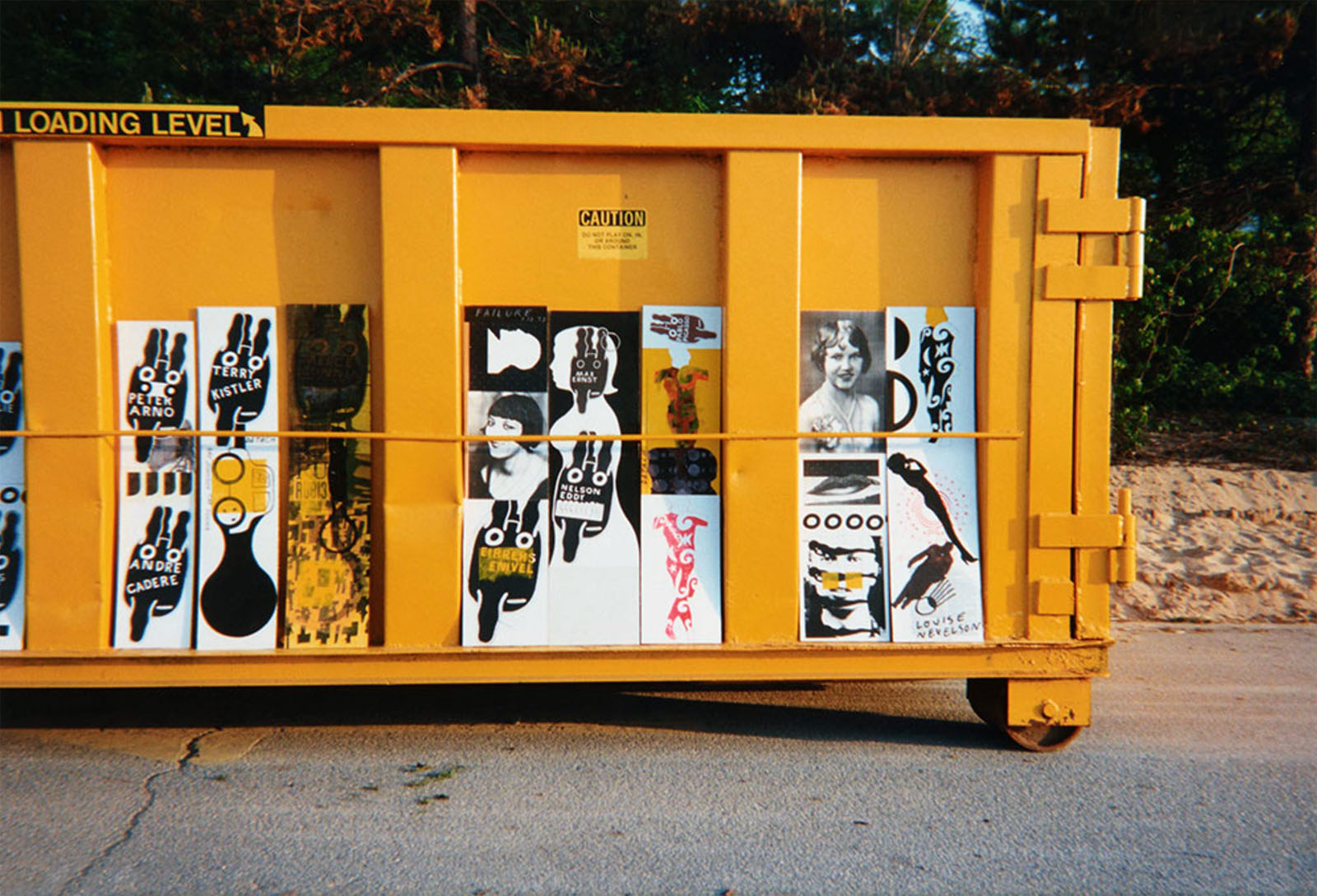
 

Ray Johnson (American, 1927-1995) 'Headshot and Elvises in RJ's car' February 1993

Ray Johnson (American, 1927-1995) 'Outdoor Movie Show on dumpster' 18 May 1993

Ray Johnson (American, 1927-1995) 'Four Movie Stars, Locust Valley Cemetery' 31 March 1993


Ray Johnson (American, 1927-1995)
Headshot and Elvises in RJ’s car
February 1993
Commercially processed chromogenic print
4 × 6 in.
The Morgan Library & Museum
Gift of the Ray Johnson Estate, courtesy of Frances Beatty
© Ray Johnson / Artists Rights Society (ARS), New York

Ray Johnson (American, 1927-1995)
Outdoor Movie Show on dumpster
18 May 1993
Commercially processed chromogenic print
4 × 6 in.
The Morgan Library & Museum
Gift of the Ray Johnson Estate, courtesy of Frances Beatty
© Ray Johnson / Artists Rights Society (ARS), New York

Ray Johnson (American, 1927-1995)
Four Movie Stars, Locust Valley Cemetery
31 March 1993
Commercially processed chromogenic print
4 × 6 in.
The Morgan Library & Museum
Gift of the Ray Johnson Estate, courtesy of Frances Beatty
© Ray Johnson / Artists Rights Society (ARS), New York


Ray Johnson (American, 1927-1995) 'Silhouette version of RJ portrait by Joan Harrison, Lattingtown Beach' Autumn 1992


Ray Johnson (American, 1927-1995)
Silhouette version of RJ portrait by Joan Harrison, Lattingtown Beach
Autumn 1992
Commercially processed chromogenic print
4 × 6 in.
The Morgan Library & Museum
Gift of the Ray Johnson Estate, courtesy of Frances Beatty
© Ray Johnson / Artists Rights Society (ARS), New York


To create this picture-within-a-picture, Johnson returned to the site of a much-reproduced portrait of him that photographer Joan Harrison made in the early 1980s. In the spot where he once sat, knees raised and arms outstretched, Johnson leaned a card that features a black silhouette of his symmetrical pose. As so often occurs in his photographs, Johnson here strikes an unsettling balance between absence and presence, erasure and memorialisation.


Ray Johnson (American, 1927-1995) 'Untitled (Bill and Railroad Tracks)' Spring 1992)

Ray Johnson (American, 1927-1995) 'Bill and Long Island Sound' Winter 1992


Ray Johnson (American, 1927-1995)
Untitled (Bill and Railroad Tracks)
Spring 1992)
Commercially processed chromogenic print
4 × 6 in.
The Morgan Library & Museum
Gift of the Ray Johnson Estate, courtesy of Frances Beatty
© Ray Johnson / Artists Rights Society (ARS), New York

Ray Johnson (American, 1927-1995)
Bill and Long Island Sound
Winter 1992
Commercially processed chromogenic print
4 × 6 in.
The Morgan Library & Museum
Gift of the Ray Johnson Estate, courtesy of Frances Beatty
© Ray Johnson / Artists Rights Society (ARS), New York


Johnson held up the sky-blue bill of a baseball cap over a railroad crossing and photographed it. When he holds it over the ocean in another image, it resembles a crescent moon. With his “throwaway” camera he photographed arrangements of photographs and photobooks by Walker Evans, Lord Snowden, Richard Avedon, Bill Brandt, and Lee Friedlander. Friedlander-like, Johnson photographed his own shadow, interacting with the places of his solitary visits.

He photographed his own works in infinite arrangements and continuous correspondence: two bunnyheads sitting up conversationally in tall chairs. He photographed his headshot, affixed to the passenger seat of a car, next to a double photo of Elvis, in the driver’s seat. He photographed a blank billboard in a field; he photographed a pier; he photographed the ocean. He photographed a picture of himself in his shadow cast across a mailbox, a bunny head peeking out. The unearthed photographs become the last note sent.

Rrebecca Bengal. “Photo Dump: Digging into the 5,000 Photographs Ray Johnson Left Behind,” on the Elephant Art website 20 Jul 2022 [Online] Cited 25/09/2022


Ray Johnson (American, 1927-1995) 'RJ reflected in ice truck and split Duane Michals Movie Star' 11 May 1993

Ray Johnson (American, 1927-1995) 'Back steps and moticos' Spring 1992


Ray Johnson (American, 1927-1995)
RJ reflected in ice truck and split Duane Michals Movie Star
11 May 1993
Commercially processed chromogenic print
4 × 6 in.
The Morgan Library & Museum
Gift of the Ray Johnson Estate, courtesy of Frances Beatty
© Ray Johnson / Artists Rights Society (ARS), New York

Ray Johnson (American, 1927-1995)
Back steps and moticos
Spring 1992
Commercially processed chromogenic print
4 × 6 in.
The Morgan Library & Museum
Gift of the Ray Johnson Estate, courtesy of Frances Beatty
© Ray Johnson / Artists Rights Society (ARS), New York


Twins

In his writing and visual art, Johnson used juxtapositions and puns to suggest that nothing stands alone: everything finds correspondence in something else. Photography’s optical literalness gave him new ways to explore reality’s doubleness. Twins – and photocopied photographs – are nearly alike yet insistently distinct. Mirrors give back a faithful, yet laterally reversed, image of nature. The shadow of a thing echoes its original, but (like a moticos) it is flat and empty of internal detail.

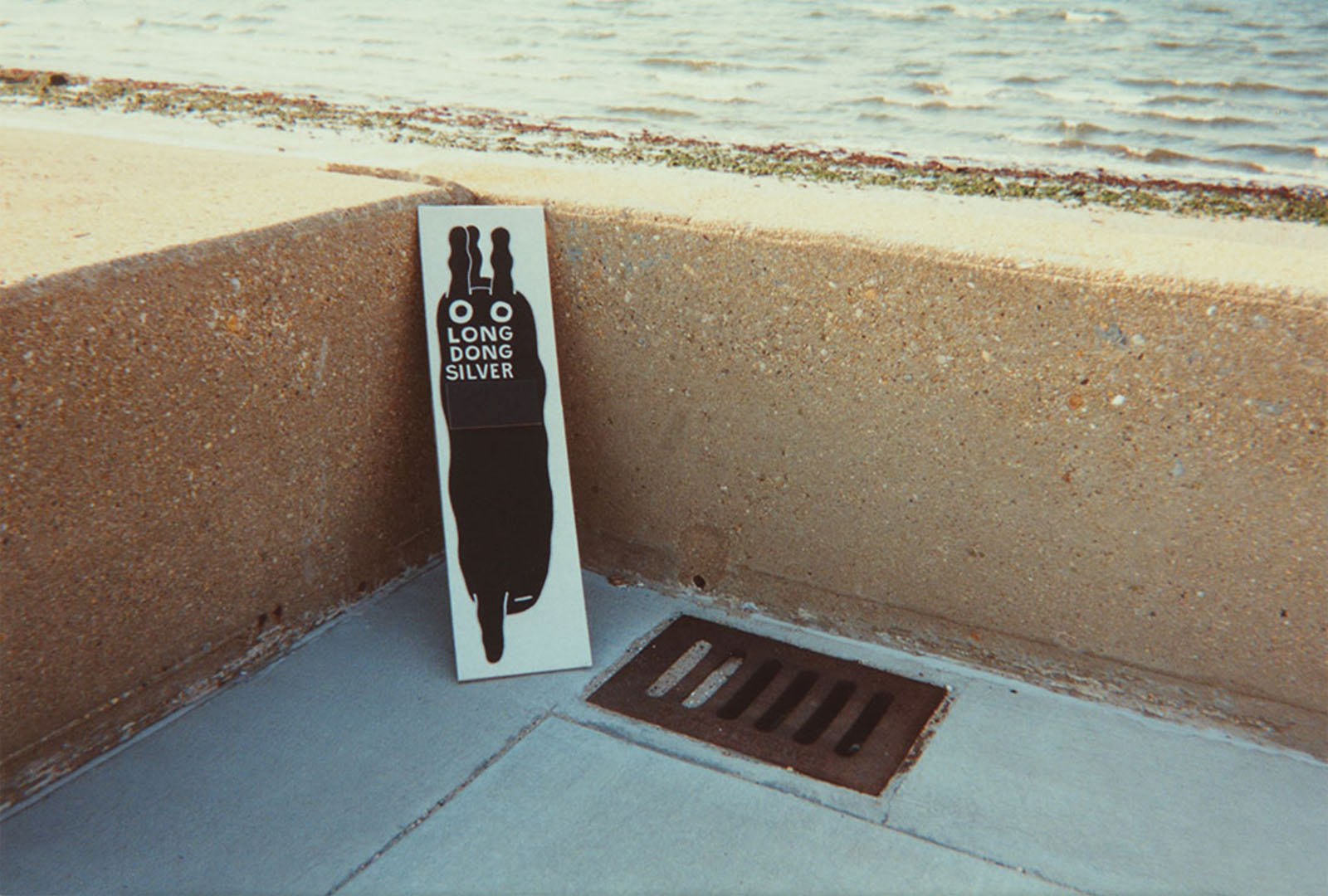
 

Ray Johnson (American, 1927-1995) 'Bunny drawn on Felix Gonzalez-Torres's "Untitled"' 2 January 1994

Ray Johnson (American, 1927-1995) 'Long Dong Silver, Lattingtown Beach' 16 November 1993

Ray Johnson (American, 1927-1995) 'Six Movie Stars in RJ's car' April 1993


Ray Johnson (American, 1927-1995)
Bunny drawn on Felix Gonzalez-Torres’s “Untitled”
2 January 1994
Commercially processed chromogenic print
4 × 6 in.
The Morgan Library & Museum
Gift of the Ray Johnson Estate, courtesy of Frances Beatty
© Ray Johnson / Artists Rights Society (ARS), New York

Ray Johnson (American, 1927-1995)
Long Dong Silver, Lattingtown Beach
16 November 1993
Commercially processed chromogenic print
4 × 6 in.
The Morgan Library & Museum
Gift of the Ray Johnson Estate, courtesy of Frances Beatty
© Ray Johnson / Artists Rights Society (ARS), New York

Ray Johnson (American, 1927-1995)
Six Movie Stars in RJ’s car
April 1993
Commercially processed chromogenic print
4 × 6 in.
The Morgan Library & Museum
Gift of the Ray Johnson Estate, courtesy of Frances Beatty
© Ray Johnson / Artists Rights Society (ARS), New York


Bunnies

A round-eyed, long-nosed bunny head functioned as Johnson’s signature and, as he said, “a kind of self-portrait.” Despite the bunny’s blank expression, context can render it comical, hapless, sinister, or obscene. Johnson altered Felix Gonzalez-Torres’s photograph of a rumpled empty bed – an iconic image of gay mourning during the AIDS crisis – by resting a lone bunny’s head on one of the two pillows. Johnson cut a face-sized hole out of one bunny, then photographed the view outside his front window through the gap. He gave the same bunny to passersby to wear and, once, laid it suggestively atop his toilet bowl. When a large old tree next door was being chainsawed apart, Johnson found in its branching form a gaunt, eyeless bunny’s face.


Ray Johnson (American, 1927-1995) 'Harpo Marx bunny, headshot, and payphone' February 1994

Ray Johnson (American, 1927-1995) 'Bunny tree in backyard' 17 April 1993

Ray Johnson (American, 1927-1995) 'Untitled (red bunny NOTHING)' 1993

Ray Johnson (American, 1927-1995) 'Untitled (Ad Rein Hardt Bunny)' 1993

Ray Johnson (American, 1927-1995) 'Flopped stranger wearing cutout bunny' Spring 1992


Ray Johnson (American, 1927-1995)
Harpo Marx bunny, headshot, and payphone
February 1994
Commercially processed chromogenic print
The Morgan Library & Museum
Gift of the Ray Johnson Estate, courtesy of Frances Beatty
© Ray Johnson / Artists Rights Society (ARS), New York

Ray Johnson (American, 1927-1995)
Bunny tree in backyard
17 April 1993
Commercially processed chromogenic print
The Morgan Library & Museum
Gift of the Ray Johnson Estate, courtesy of Frances Beatty
© Ray Johnson / Artists Rights Society (ARS), New York

Ray Johnson (American, 1927-1995)
Untitled (red bunny NOTHING)
1993
Collage on corrugated cardboard
12 1/2 × 7 1/2 in. (31.75 × 19.05cm)
The Morgan Library & Museum
Gift of the Ray Johnson Estate, courtesy of Frances Beatty
© Ray Johnson / Artists Rights Society (ARS), New York

Ray Johnson (American, 1927-1995)
Untitled (Ad Rein Hardt Bunny)
1993
Collage on corrugated cardboard
12 1/2 × 7 5/8 in. (31.75 × 19.37cm)
The Morgan Library & Museum
Gift of the Ray Johnson Estate, courtesy of Frances Beatty
© Ray Johnson / Artists Rights Society (ARS), New York

Ray Johnson (American, 1927-1995)
Flopped stranger wearing cutout bunny
Spring 1992
The Morgan Library & Museum
Gift of the Ray Johnson Estate, courtesy of Frances Beatty
© Ray Johnson / Artists Rights Society (ARS), New York


What did Johnson intend to do with the thousands of photographs he made between 1992 and 1994? There are few solid indications. He mailed some to correspondents, either in the form of original prints or as photocopies. He also incorporated a handful of his photographs into collages that differ markedly in scale and sensibility from the larger, contemporaneous Movie Stars. In one collage, a photograph of five Movie Stars – arranged like sequential ads beside a road – is punningly combined with a bunny head bearing the name of abstract painter Ad Reinhardt (1913-1967), a friend and employer of Johnson’s in his early New York years.


Ray Johnson (American, 1927-1995) 'Shadow of RJ's mailbox' March 1994

Ray Johnson (American, 1927-1995) 'RJ with PLEASE SEND TO REAL LIFE and camera in mirror' 23 December 1994


Ray Johnson (American, 1927-1995)
Shadow of RJ’s mailbox
March 1994
Commercially processed chromogenic print
The Morgan Library & Museum
Gift of the Ray Johnson Estate, courtesy of Frances Beatty
© Ray Johnson / Artists Rights Society (ARS), New York

Ray Johnson (American, 1927-1995)
RJ with PLEASE SEND TO REAL LIFE and camera in mirror
23 December 1994
Commercially processed chromogenic print
4 × 6 in.
The Morgan Library & Museum
Gift of the Ray Johnson Estate, courtesy of Frances Beatty
© Ray Johnson / Artists Rights Society (ARS), New York


This self-portrait appears on a roll of film Johnson turned in for developing about three weeks before his suicide by drowning on 13 January 1995. The flopped lettering on the Movie Star in his hand undergoes a further reversal in the mirror. On a literal level, the words “REAL LIFE” refer to the New York-based art magazine REALLIFE (1979-1994), which Johnson hoped would soon publish an article about his years-long collaboration with a friend, Sheila Sporer. But the message unmistakably announces, too, that the artist was soon to venture beyond the reach of “real life.”


The Morgan Library & Museum
225 Madison Avenue at 36th Street, New York, NY
Phone: (212) 685-0008

Opening hours:
Tuesday – Thursday, Saturday – Sunday: 10.30am – 5pm
Friday: 10.30am – 7pm
Closed Mondays

The Morgan Library & Museum website

LIKE ART BLART ON FACEBOOK

Back to top

Exhibition: ‘Joseph Cornell: Wanderlust’ at the Royal Academy of Arts, London

Exhibition dates: 4th July – 27th September 2015

The Sackler Wing of Galleries


Hans Namuth (American born Germany, 1915-1990) 'Joseph Cornell' 1969


Hans Namuth (American born Germany, 1915-1990)
Joseph Cornell
1969
Courtesy Center for Creative Photography, University of Arizona
© 1991 Hans Namuth Estate


Now, Voyager


“The untold want by life and land ne’er granted,
Now, voyager, sail thou forth, to seek and find.”

Walt Whitman (1819-1892). “Untold Want,” from Leaves of Grass. 1900


Joseph Cornell is my favourite artist who has ever lived on this Earth. I do not make this observation lightly, but after much consideration, thought and reflection.

I have always loved his work, from the very first time I saw it in a book. To then see a recreation of one of his 1950s exhibitions at the Art Institute of Chicago in 2001 was one of those seminal moments where you are lifted out of yourself, where your life becomes forever changed. For me that transcendent experience is up there with being alone with the Rembrandt portraits in the Louvre for 10 precious minutes. Both were among the most exquisite, poignant and beautiful spiritual experiences I have had in my life.

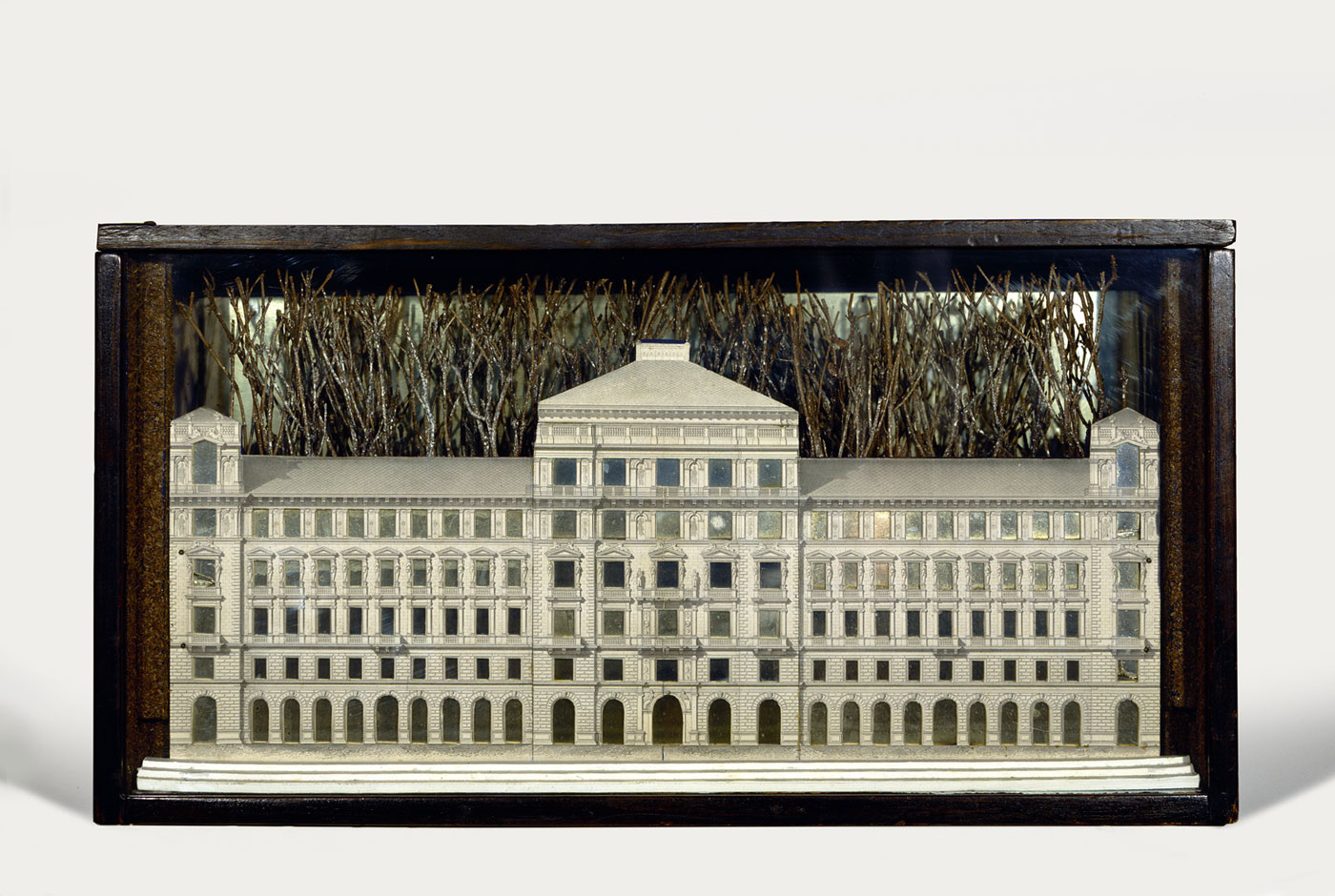
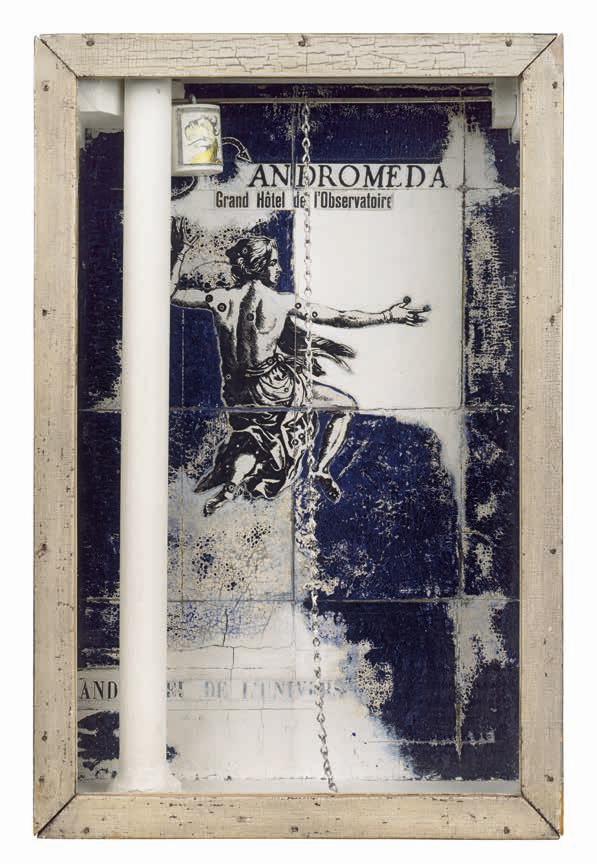
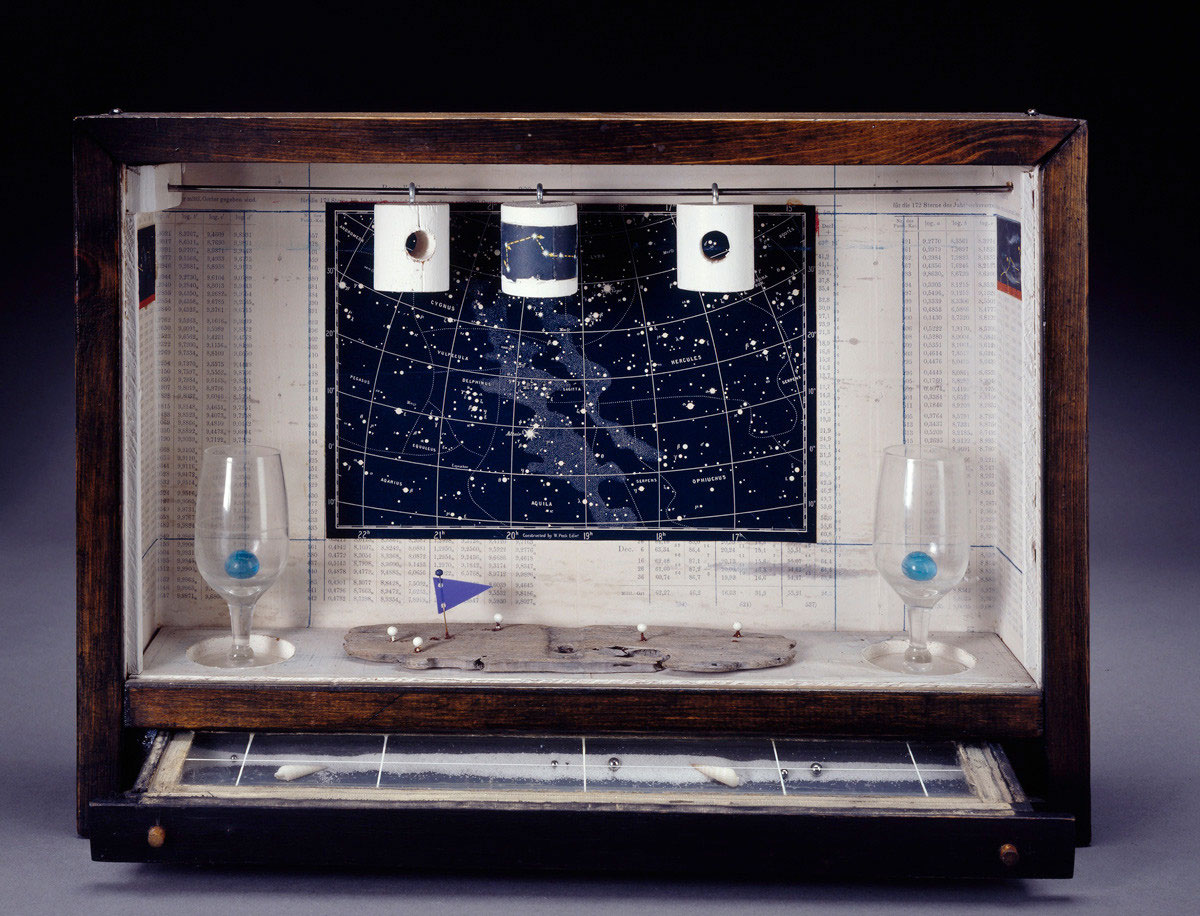
I am not an expert on Cornell, although I have read many books on his work and on his spirituality. He saw himself as an “armchair voyager”, a bit like a latter day Baudelaire, a man who has romantic notions of travel but never actually goes anywhere, who has romantic notions of love but never finds it, except in his imagination. Cornell never left his native New York. Cornell expressed his self through a passion for the artefacts he collected, through his assemblage of those artefacts into magical boxes that addressed unrequited love and faith – for Hollywood and movie stars, ballerinas, hotels, birds, the Renaissance, princes and princesses, the stars, games and chance. He was an avid collector, rummaging through the junk shops of New York and storing his collectibles for his art, something to which I have an affinity, being an avid op shopper (or thrift shopper) myself.

Here I can see an association with the words of Walt Whitman in his lines “Untold Want” from Leaves of Grass, those lines forming the title for the book upon which the film Now Voyager (1942) with Bette Davis was based. “The untold want” of Whitman’s lines are whatever you yearn for and cannot get in the social context (“life”) and place (“land”) where you are born. Whitman says, stop “studying the charts,” and “now obey, thy cherish’d, secret wish,” – in other words he’s saying that your heart’s desire is the best indicator of where your destiny lies, but it is possible to miss out on it by not going for it. Fast forward to Now Voyager where frumpy Bette Davis has an affair with a married man, becomes independent, defies her tyrannical mother who promptly dies, and ends up circuitously looking after her lover’s daughter. They decide to have a platonic relationship “sustaining a romantic, unconsummated relationship and creating a ‘family’ by becoming the surrogate, adoptive care-giver for his daughter.”

There is a specific desire here. Davis and Whitman are freed to love without restriction in a romantic way, and after the end of Now Voyager, perhaps Cornell is channelling Bette Davis. He loved in his mind, he created boxes in his imagination (and then physically), he astral travelled through the stars, he created games of chance (such as penny arcades and slot machines) and shooting galleries (that exposed his inner mind) letting the air rush out into the world. He created surreality itself but he was never surreal, for his work is always based on the collision of realities. His boxes are tiny cosmos, like the Tardis from Dr Who, the interior (under a microscope, within four walls) larger than the exterior … yet, magically, they inhabit the whole world, they inhabit our mind. He used the alchemical reaction of elements, the elementary, to affect travel, love, life and change. And he did it in four dimensions for his boxes affect us as much today as he did when he created them. Perhaps that is why I like his work so much… he used seemingly mundane materials, multi/media objects, imagination and love to let’s our spirits soar into the universe. No other artist has ever affected me so much. No one ever will.

Undeniably, Cornell’s poetic theatres are joyous creations that free our soul from the everyday.

Perhaps it is through love, or in death, or the afterlife, that the Voyager can seek that untold want.

Dr Marcus Bunyan


My Mind to me a Kingdom Is

Sir Edward Dyer (1543-1607)

1 My mind to me a kingdom is;
2 Such perfect joy therein I find
3 That it excels all other bliss
4 Which God or nature hath assign’d.
5 Though much I want that most would have,
6 Yet still my mind forbids to crave.

7 No princely port, nor wealthy store,
8 No force to win a victory,
9 No wily wit to salve a sore,
10 No shape to win a loving eye;
11 To none of these I yield as thrall, –
12 For why? my mind despise them all.

13 I see that plenty surfeit oft,
14 And hasty climbers soonest fall;
15 I see that such as are aloft
16 Mishap doth threaten most of all.
17 These get with toil and keep with fear;
18 Such cares my mind can never bear.

19 I press to bear no haughty sway,
20 I wish no more than may suffice,
21 I do no more than well I may,
22 Look, what I want my mind supplies.
23 Lo ! thus I triumph like a king,
24 My mind content with anything.

25 I laugh not at another’s loss,
26 Nor grudge not at another’s gain;
27 No worldly waves my mind can toss;
28 I brook that is another’s bane.
29 I fear no foe, nor fawn on friend,
30 I loathe not life, nor dread mine end.

31 My wealth is health and perfect ease,
32 And conscience clear my chief defence;
33 I never seek by bribes to please,
34 Nor by desert to give offence.
35 Thus do I live, thus will I die, –
36 Would all did so as well as I!


Many thankx to the Royal Academy of Arts for allowing me to publish the art work in the posting. Please click on the photographs for a larger version of the art work. The excellent, educational text was written by Asha McLoughlin, Learning Department © Royal Academy of Arts.


Bette Davis ~ Don’t Let’s Ask For The Moon (Now Voyager 1942)


“Cornell was a voyager, travelling through space and time to dimensions of the imagination and the spirit. He infused this sense of adventure and an infinite beyond into modestly scaled works whose fragments of reality give way to worlds to be explored.”


Robert Lehrman, Joseph Cornell: Shadowplay Eterniday, 2003


“White is just what I mean. Not monstrously, but in wonderful variations. All I want to perform is white magic.”


Joseph Cornell quoted in Tracking the Marvellous: A Life in the New York Art World, John Bernard Myers, 1984


Unidentified photographer. 'The Cornell family' c. 1915


Unidentified photographer
The Cornell family
c. 1915
Joseph Cornell (far right) with his parents (Joseph I. Cornell, Sr. and Helen Storms Cornell) and siblings (l to r: Elizabeth, Helen, and Robert)
Joseph Cornell papers, Archives of American Art, Smithsonian Institution


Cornell's basement studio, 3708 Utopia Parkway, Flushing, New York, 1964


Cornell’s basement studio, 3708 Utopia Parkway, Flushing, New York, 1964
Collection Duff Murphy and Janice Miyahira
© Terry Schutté


“What kind of man is this, who, from old brown cardboard photographs collected in second-hand bookstores, has reconstructed the nineteenth century “grand tour” of Europe for his mind’s eye more vividly than those who took it, who was not born then and has never been abroad, who knows Vesuvius’s look on a certain morning of AD 79, and of the cast-iron balconies of that hotel in Lucerne?”


Robert Motherwell on Joseph Cornell, Joseph Cornell’s Theatre of the Mind, 1993


“He uses selected, sought-for, desired objects. He must have been clipping all the time, poring through magazines, collecting things and haunting junk shops and flea markets, looking for the images that corresponded to his imagination.”


Susan Sontag, Joseph Cornell: Worlds in a Box, directed by Mark Stokes, 1991


Lee Miller (American, 1907-1977) 'Joseph Cornell, New York' 1933


Lee Miller (American, 1907-1977)
Joseph Cornell, New York
1933
Vintage photograph
‘Joseph Cornell, New York Studio, New York, USA 1933’ by Lee Miller (96-2)
© Lee Miller Archives, England 2015. All rights reserved


Joseph Cornell (American, 1903-1972) 'Untitled (Schooner)' 1931


Joseph Cornell (American, 1903-1972)
Untitled (Schooner)
1931


Joseph Cornell (American, 1903-1972) 'Untitled [Sagittarius, Scorpio, and Lupus Constellations]' c.1934


Joseph Cornell (American, 1903-1972)
Untitled [Sagittarius, Scorpio, and Lupus Constellations]
c. 1934
Collage with ink on paper
14 x 18.6cm
Drs. Steven and Sara Newman. Photo Collection of Drs. Steven and Sara Newman, Chicago, Illinois, USA
© The Joseph and Robert Cornell Memorial Foundation/VAGA, NY/DACS, London 2015


Joseph Cornell (American, 1903-1972) 'Untitled (M'lle Faretti)' 1933


Joseph Cornell (American, 1903-1972)
Untitled (M’lle Faretti)
1933
Box construction
27.9 x 20.3 x 5.1cm
Private Collection
Photo: Michael Tropea, Chicago
© The Joseph and Robert Cornell Memorial Foundation/VAGA, NY/DACS, London 2015


Joseph Cornell (American, 1903-1972) 'Object (Soap Bubble Set)' 1936


Joseph Cornell (American, 1903-1972)
Object (Soap Bubble Set)
1936
Box construction


Joseph Cornell (American, 1903-1972) 'Object (Soap Bubble Set)' 1941


Joseph Cornell (American, 1903-1972)
Object (Soap Bubble Set)
1941
Box construction
46.4 x 31.4 x 9.5cm
The Robert Lehrman Art Trust, Courtesy of Aimee and Robert Lehrman
© The Joseph and Robert Cornell Memorial Foundation/VAGA, NY/DACS, London 2015
Photo: Quicksilver Photographers, LLC. Exhibition organised by the Royal Academy of Arts, London, and Kunsthistorisches Museum, Vienna


Joseph Cornell (American, 1903-1972) 'Object (Soap Bubble Set)' 1941 (detail)


Joseph Cornell (American, 1903-1972)
Object (Soap Bubble Set) (detail)
1941
Box construction
46.4 x 31.4 x 9.5cm
The Robert Lehrman Art Trust, Courtesy of Aimee and Robert Lehrman
© The Joseph and Robert Cornell Memorial Foundation/VAGA, NY/DACS, London 2015
Photo: Quicksilver Photographers, LLC. Exhibition organised by the Royal Academy of Arts, London, and Kunsthistorisches Museum, Vienna


Joseph Cornell (American, 1903-1972) 'Pharmacy' 1943


Joseph Cornell (American, 1903-1972)
Pharmacy
1943
Box construction
38.7 x 30.5 x 7.9cm
Collection Paul Schärer
Photo Dominique Uldry, Bern
© The Joseph and Robert Cornell Memorial Foundation/VAGA, NY/ DACS, London 2015


Joseph Cornell (American, 1903-1972) 'Pharmacy' 1943 (detail)


Joseph Cornell (American, 1903-1972)
Pharmacy (detail)
1943
Box construction
38.7 x 30.5 x 7.9cm
Collection Paul Schärer
Photo Dominique Uldry, Bern
© The Joseph and Robert Cornell Memorial Foundation/VAGA, NY/ DACS, London 2015


Joseph Cornell (American, 1903-1972) 'Palace' 1943


Joseph Cornell (American, 1903-1972)
Palace
1943
Box construction
Glass-paned, stained wood box with photomechanical reproduction, mirror, spray-painted twigs, wood and shaved bark
26.7 x 50.5 x 13cm
The Menil Collection, Houston
Photo: The Menil Collection, Houston. Photography: Hickey-Robertson
© The Joseph and Robert Cornell Memorial Foundation/VAGA, NY/DACS, London 2015


Joseph Cornell (American, 1903-1972) 'Untitled (Tilly Losch)' c. 1935-1938


Joseph Cornell (American, 1903-1972)
Untitled (Tilly Losch)
c. 1935-1938
Box Construction
25.4 x 23.5 x 5.4cm
Collection of Robert Lehrman, courtesy of Aimee and Robert Lehrman
Photo: The Robert Lehrman Art Trust, courtesy of Aimee and Robert Lehrman. Photography: Quicksilver Photographers, LLC
© The Joseph and Robert Cornell Memorial Foundation/VAGA, NY/DACS, London 2015


“Creative filing
Creative arranging
As poetics
As technique
As joyous creation”


Joseph Cornell, diary entry, 9 March 1959


“On the way to ART OF THIS CENTURY from Julien’s, carrying De Medici girl Slot Machine and bird with cracked glass saw Marlene Dietrich in polo coat and black beanie cap on back of hair waiting at curb of Jay Thorpe’s for a taxi. First time I’d seen her off screen and brought an unexpectedly elated feeling. Working in cellar that night on Soap Bubble Set the green glass locket portrait of her on the floor evoked very special feelings.”


Joseph Cornell, diary entry, spring 1944


“Original inspiration of the bird store, windows, simplicity of magic, pet shop.”


Joseph Cornell, c. 1943, Joseph Cornell Papers, Archives of American Art, Smithsonian Institution, Washington, DC


Joseph Cornell (American, 1903-1972) 'Untitled Object (Mona Lisa)' c. 1940-1942


Joseph Cornell (American, 1903-1972)
Untitled Object (Mona Lisa)
c. 1940-1942
Box construction
3.5 x 7.6cm
The Collection of Marguerite and Robert Hoffman
Photo: Brad Flowers
© The Joseph and Robert Cornell Memorial Foundation/VAGA, NY/DACS, London 2015


Joseph Cornell (American, 1903-1972) 'Untitled (Owl Habitat)' c. mid- to late 1940s


Joseph Cornell (American, 1903-1972)
Untitled (Owl Habitat)
c. mid- to late 1940s
Collection Jasper Johns Photo Collection Jasper Johns
© The Joseph and Robert Cornell Memorial Foundation/VAGA, NY/DACS, London 2015


“Some of his boxes are less cryptic, and more naturalistic, such as Untitled (Owl Habitat), from the 1940s. The snowy owl trapped behind a pane of glass is not a fancy piece of taxidermy fit for a natural history diorama, but a mere paper illustration pasted onto plywood. The midnight-blue forest the owl inhabits is contrived from painted bark and lichen. Cornell, of course, was himself a famous night owl. In some ways the owl box can seem as close as he ever came to self-portraiture, with its majestic creature alone in the woods, eyes wide, watching.”

Deborah Solomon, May 2015


Joseph Cornell (American, 1903-1972) 'Habitat Group for a Shooting Gallery' 1943


Joseph Cornell (American, 1903-1972)
Habitat Group for a Shooting Gallery
1943
Mixed media
39.4 x 28.3 x 10.8cm
Purchased with funds from the Coffin Fine Arts Trust; Nathan Emory Coffin Collection of the Des Moines Art Center, 1975.27
Photo: Collection of the Des Moines Art Center
© The Joseph and Robert Cornell Memorial Foundation/VAGA, NY/DACS, London 2015


Joseph Cornell (American, 1903-1972) 'Soap Bubble Set' 1948


Joseph Cornell (American, 1903-1972)
Soap Bubble Set
1948
Box construction
36.8 x 52.1 x 9.8cm
Mr. and Mrs. John Stravinsky
Photo © 2014 Christie’s Images Limited
© The Joseph and Robert Cornell Memorial Foundation/VAGA, NY/DACS, London 2015


Joseph Cornell (American, 1903-1972) 'Andromeda: Grand Hôtel de l'Observatoire' 1954


Joseph Cornell (American, 1903-1972)
Andromeda: Grand Hôtel de l’Observatoire
1954
Box construction
46.5 x 33 x 9.8cm
Solomon R. Guggenheim Museum, New York. Partial gift, C. and B. Foundation, by exchange, 1980
Photo © SRGF, New York
Photography: David Heald
© The Joseph and Robert Cornell Memorial Foundation/VAGA, NY/ DACS, London 2015


Joseph Cornell (American, 1903-1972) 'Andromeda: Grand Hôtel de l'Observatoire' 1954 (detail)


Joseph Cornell (American, 1903-1972)
Andromeda: Grand Hôtel de l’Observatoire (detail)
1954
Box construction
46.5 x 33 x 9.8cm
Solomon R. Guggenheim Museum, New York. Partial gift, C. and B. Foundation, by exchange, 1980
Photo © SRGF, New York
Photography: David Heald
© The Joseph and Robert Cornell Memorial Foundation/VAGA, NY/ DACS, London 2015


Joseph Cornell (American, 1903-1972) 'Untitled (Medici Princess)' c. 1948


Joseph Cornell (American, 1903-1972)
Untitled (Medici Princess)
c. 1948
Box construction
44.8 x 28.3 x 11.1cm
Private collection, New York
Photo courtesy private collection, New York
© The Joseph and Robert Cornell Memorial Foundation/VAGA, NY/ DACS, London 2015


Joseph Cornell and travel

The title of our Joseph Cornell exhibition is Wanderlust. Curator Sarah Lea describes how this theme is closely linked to Cornell’s artistic practice, and his travels of the imagination.


Joseph Cornell (American, 1903-1972) 'Untitled (Celestial Navigation)' 1956-1958


Joseph Cornell (American, 1903-1972)
Untitled (Celestial Navigation)
1956-1958
Box construction
30.8 x 43.2 x 9.2cm
The Robert Lehrman Art Trust, courtesy of Aimee and Robert Lehrman
Photo The Robert Lehrman Art Trust, courtesy of Aimee and Robert Lehrman
Photography: Quicksilver Photographers, LLC
© The Joseph and Robert Cornell Memorial Foundation/VAGA, NY/DACS, London 2015


Joseph Cornell (1903-1972), born on Christmas Eve in Nyack, New York, remains one of the most enigmatic yet influential American artists of the twentieth century. Almost entirely self-taught as an artist, Cornell lived quietly for most of his life with his mother and younger brother, crafting in the confines of his basement or on the kitchen table the ‘shadow boxes’ for which he is best known.

He rarely travelled, and almost never left New York, yet his work, based on collage and assemblage, resonates with references to foreign places and distant times. In the course of his life he befriended ballerinas, film stars, poets and generations of world-famous artists. He showed in a succession of New York galleries, participated in landmark group shows at the Wadsworth Atheneum in Hartford, Connecticut, and the Museum of Modern Art, New York, and was honoured before he died with major surveys at the Pasadena Museum of Californian Art and the Solomon R. Guggenheim Museum.

A popular romanticised image of Cornell pervades as an ascetic outsider – a shy, eccentric man yearning for intimacy, unable to converse with the women who enthralled him but with a vibrant interior life of daydreams and an imagination capable of crossing oceans, centuries and the celestial realm. Yet this mythologised version of the man belies his active interest in the art movements of his time, and the innovative nature of his creations which have paved the way for today’s appropriation and installation artists, contemporary collage and archive based practices.

This exhibition at the Royal Academy brings together 80 of Cornell’s most remarkable shadow boxes, assemblages, collages and films, including many works held in private collections and a number never seen before outside of the USA. The first major UK exhibition solely devoted to Cornell in almost 35 years, it presents a rare chance to experience a concentrated survey of his oeuvre, and to journey inside the mind of an artist who described himself as ‘an armchair voyager’. The ‘wanderlust’ referenced in the exhibition title – the desire to explore and travel the world – is central to Cornell’s art, as was his penchant for collecting and his astonishingly wide-ranging interests. His creations transport the viewer into private universes, populated with objects and ephemera imbued with personal associations.

From a basement in New York, Joseph Cornell channelled his limitless imagination into some of the most original art of the 20th century. Step into his beguiling world at this landmark exhibition. Cornell hardly ventured beyond New York State, yet the notion of travel was central to his art. His imaginary voyages began as he searched Manhattan’s antique bookshops and dime stores, collecting a vast archive of paper ephemera and small objects to make his signature glass-fronted ‘shadow boxes’. These miniature masterpieces transform everyday objects into spellbinding treasures. Together they reveal his fascination with subjects from astronomy and cinema to literature and ornithology and especially his love of European culture, from the Romantic ballet to Renaissance Italy.

Wanderlust brings together 80 of Cornell’s most remarkable boxes, assemblages, collages and films, some never before seen outside the USA. Entirely self-taught, the independence of Cornell’s creative voice won the admiration of artists from Marcel Duchamp and the Surrealists, to Robert Motherwell and the Abstract Expressionists, with echoes of his work felt in Pop and Minimalist art. Wanderlust is a long overdue celebration of an incomparable artist, a man the New York Times called “a poet of light; an architect of memory-fractured rooms and a connoisseur of stars, celestial and otherwise.”

Early Life

Joseph Cornell was the eldest of four children – he had two sisters, Elizabeth and Helen, and a brother, Robert, who suffered from cerebral palsy and was confined to a wheelchair for most of his life. When Cornell was thirteen, his father died of leukaemia and Robert became Joseph’s responsibility (partly to assuage their overbearing mother). Robert however was a cheerful child and took pleasure in drawing and collecting model trains. Cornell considered Robert to be a pure soul, and willingly took on his brother’s care. A salesman and textile designer, Cornell’s father had left considerable debts for his family to manage and for several years Cornell’s mother was forced to take odd jobs to support the family, and move them into a succession of smaller rented houses. In 1917, with the help of his father’s former employer, Joseph was able to enrol at the Phillips Academy in Andover, Massachusetts: a highly regarded private school. There he discovered an interest in American and European literature, poetry, history and French. Yet, away from his close knit family and after the relatively recent death of his father, Cornell struggled and was a mediocre student. He developed the first in a lifelong series of nervous crises and stomach problems, and left the Academy in 1921 without graduating.

Upon his return home, Cornell assumed the role of ‘man of the house’ and became a sample salesman in his father’s trade for a wholesale textile business, the William Whitman Company on lower Madison Avenue. Cornell found the job mundane and himself unsuited to its demands. In his twenties, a time when the stress of supporting his family was exacerbating his stomach ailments, he converted to Christian Science. This religion teaches that reality is purely spiritual and the material world an illusion, so disease and other afflictions associated with the physical body are thought to be manifestations of a troubled mind that ought to be treated with prayer, not medicine. Joseph remained an active member until his death and recruited his brother Robert and sister Elizabeth into the fold.

In 1929, Mrs Cornell moved the family to an unassuming house at 3708 Utopia Parkway in Flushing, Queens, New York. Here, Cornell would live with his mother and brother until he died. His main escape from the tedium of domestic life and the awkward social interactions thrust upon him at work was to walk the city streets in his lunch hour, browsing the second-hand bookshops on Fourth Avenue, the flea markets and dime stores, collecting keepsakes and scavenging for relics and once-precious fragments of other people’s lives. Cornell loved to explore Manhattan and the ‘teeming life of the metropolis’, which seemed to him the epitome of glamour. These wanderings led to Cornell amassing a vast personal archive of treasured finds – books, prints, postcards and three-dimensional ephemera such as clay pipes and watch springs – often tinged with the romance of foreign places and the nostalgia of times past, which would in due course form the material elements of the very personal poetry that is his art.

Play and Experiment

Although he did not complete his formal education, Cornell was extremely well read and kept abreast of Manhattan’s literary, musical and artistic events. Not only did he regularly attend the theatre and the ballet, but he also became an avid cinema-goer, thriving on the excitement of the city. Indeed, Cornell often waited at the stage door of theatres and opera houses for a glimpse of the female performers he idolised. He also spent time in art galleries, and in 1931 at the Julien Levy Gallery he came across collages by Max Ernst (1891-1976), a pioneer of Surrealism, who combined high art and popular imagery in his work.

Although Cornell was never officially part of the Surrealist movement and came to dismiss Surrealist associations with his own practice, it had a major influence on him, most notably inspiring his embrace of unexpected juxtapositions in his assemblages and his experimental films, like Rose Hobart (1936). Rejecting Surrealism’s more violent and erotic aspects – the shock effect of jarring images – Cornell preferred instead what he described as the ‘white magic’ side of Surrealism, and the poetic connections between everyday objects.

By 1931 Cornell had shifted from simply collecting objects to creating them. He began to make collages and assemblages first in a style resembling Max Ernst’s, then in his own manner. The basis of collage – piecing together and assembling – would be central to Cornell’s works throughout his life, be they two- or three-dimensional. At this early stage he took images from the dense dossiers of engravings and clippings that he had accumulated by this time, fashioning compositions from seemingly unrelated cutout images to create whimsical pairings, which often revealed his dual interests in science and the world of children. Both these themes would recur and overlap throughout his career…

After viewing a number of Cornell’s small surreal collages, such as Untitled (Schooner), 1931, Julien Levy invited him to show in his exhibition, Surréalisme, which opened in January 1932. Later, Levy offered Cornell a solo show, the first of several that were held at his gallery. Entitled Objects by Joseph Cornell: Minutiae, Glass Bells, Shadow Boxes, Coups d’Oeil, Jouets Surréalistes, it included a series of collages and small three-dimensional objects such as bell jars and pillboxes. All the works were made at his kitchen table at night as his mother and brother slept.

Uneasy about his work being associated with Surrealism, Cornell later wrote to Alfred H. Barr, founding director of the Museum of Modern Art in New York and organiser of the 1936 exhibition, Fantastic Art, Dada, Surrealism, in which Cornell’s work was to feature: “In the event that you are saying a word or two about my work in the catalogue, I would appreciate your saying that I do not share in the subconscious and dream theories of the Surrealists. While fervently admiring much of their work I have never been an official Surrealist, and I believe that Surrealism has healthier possibilities than have been developed.” Regardless of Cornell’s own attempt to distance himself from the movement, Surrealism provided him, at least, with a context in which he could make his collages and objets, and understand them as deserving of a mature and discerning audience.

Around this time, Cornell encountered the collages and box constructions of Kurt Schwitters (1887-1948), composed of urban detritus, and the ‘readymades’ of Marcel Duchamp (1887-1968), which are ordinary, unaltered manufactured objects designated by the artist to be works of art. In Duchamp, Cornell discovered an unlikely friend; the two regularly corresponded throughout their lifetime. When Duchamp visited New York in the 1940s, he enlisted Cornell to help him with a new project, a miniature ‘museum’ of his work, known as the Boîte-en-valise or ‘box in a suitcase’. Cornell already had his own ‘valise’ experiment, Untitled (The Crystal Cage: Portrait of Berenice).

Collecting and Classification

In the 1930s, Cornell began to make the ‘shadow boxes’ for which he is best known – glass-fronted box constructions containing intimately-scaled arrangements of found objects and paper ephemera, assembled in a sort of three-dimensional collage. The 1936 exhibition Fantastic Art, Dada, Surrealism at MoMA, New York, showed one of his first shadow boxes, Untitled (Soap Bubble Set) (above). This was the first in a long series of the same name and recalls the children’s pastime of blowing bubbles, as well as the eighteenth-century European painting association of bubbles as memento mori, a reminder of the transience of life. Precisely what led Cornell to the idea of the box remains unclear. In a Life magazine article from 1967 he said that it came to him during one of his walks through Manhattan, as he passed a collection of compasses in the window of an antique shop:

“I thought, everything can be used in a lifetime, can’t it, and went on walking. I’d scarcely gone two blocks when I came on another shop window full of boxes, all different kinds […] Halfway home on the train that night, I thought of the compasses and boxes, it occurred to me to put the two together.”

Before Cornell developed his own carpentry skills, his early shadow boxes were housed in prefabricated, semi-antique wooden boxes, popular during the Victorian era for displaying small paintings, ship models, ladies’ handiwork and mementoes. In the nineteenth century, a similar tradition existed in China, where hardwood boxes with sliding glass covers and papered or silk-lined interiors were used to display fine ceramics, especially figurines made for export. Cornell’s approach also recalls European traditions that began to appear in his research dossiers during the 1930s: small seventeenth- and eighteenth-century Dutch and Flemish kunstschranke or kunstkammer – cabinets that housed separate elements assembled to represent the world in miniature. In the mid 1930s, Cornell’s neighbour Carl Backman taught him some basic carpentry skills, which allowed him to construct his own boxes. The boxes are often hard to date accurately, as Cornell would tinker with and refine his constructions over several years, returning to them gradually. However, except for his early boxes which tend to be singular, we can see patterns emerging in his practice as he worked on larger ‘families’ of works that share discernible visual motifs, often unfolding over a decade or more. These series include: ‘Hotels’, ‘Pharmacies’, ‘Aviaries’, ‘Dovecotes’, ‘Observatories’ and ‘Night Skies’.

The ‘Pharmacy’ assemblages, with their compartmentalised structures and associations with collection and classification – a nod to the ordered world of museum display – are a good illustration of one of Cornell’s ‘families’. Here, in this early example of a series that stretched over a decade with at least six similar works, we see a small specimen case containing four ordered rows of five glass jars. Its title appears to refer to medicine and healing, yet as a practising Christian Scientist, Cornell was forbidden to take medicine. Instead, in this miniature apothecary, he has created tonics for the soul and the imagination, with each fragile jar containing an object or substance that has poetic connotations – shells and sand for travel, feathers, delicate butterfly wings, tiny snippets of parchment. The interior is lined with mirrors, creating echoing reflections of the jars that line the shelves. Though its contents may seem trivial, each jar is imbued with significance, its humble items elevated and made precious through the language of their display. Looking into this box, we see a world of associations, nostalgia and elusive meaning.

By the time Cornell created Pharmacy, he had stopped working, and was pursuing his art full time. From this point on, Cornell regularly exhibited and sold his artwork. He also did freelance design work and picture research for magazines such as Vogue and House & Garden. He set up a workshop and storage area in the basement of the house on Utopia Parkway. Working in his new studio, which he sometimes referred to as his ‘laboratory’, Cornell was able to conceive works with more complex craftsmanship than he had been able to do when working at the kitchen table. While most days were spent at home, he would still escape into New York in search of inspiration and to visit friends. A keen diarist, he would sit in Manhattan coffee shops, indulging his notorious sweet tooth with sugary snacks while furiously scribbling notes on scraps of paper that would later be typed up into more formal diary entries.

As well as being an avid people-watcher, Cornell enjoyed ornithology and expressed his love of birds in the ‘Aviary’ and ‘Habitat’ series, which speak of their exoticism and beauty. Birds often symbolise freedom, their flight paths linking the heavens and the earth. In myths and religion, small birds in particular have been used to represent the souls of children freed from their earthly bonds.

While visually distinct from the ‘Pharmacy’ series, Habitat Group for a Shooting Gallery (above) continues the theme of arrangement and classification in Cornell’s work, with the cut-out illustrations of macaws, a parrot and a cockatoo mounted like museum specimens or dioramas against a bright white background. However, this dynamic construction has an uncharacteristic aura of violence, and contrasts with other pieces where the box is seen as a safe environment in which objects could be placed, secure and cherished. In this case, the glass that protects the sanctuary of the box has been cracked, its contents exposed to external elements. The central ‘bullet hole’ directly in front of the cockatoo’s crown acts as a focal point for the assemblage, guiding our eye in and then out to the four corners of the box. Bold splashes of colour convey a sense of theatricality and drama (Cornell referred to some of his boxes as ‘poetic theatres’), and the game counters placed over each bird evoke the targets of shooting galleries in penny arcades. Scattered feathers at the bottom of the construction, the shot glass and splotches of paint all suggest a violent event. In a rare moment of political commentary in Cornell’s work, this habitat serves as a metaphor for the horrors of the Second World War, with the birds embodying the innocence of victims caught up in the destruction of war.

Observation and Exploration

One of the great paradoxes in Cornell’s life was the gulf between the multitudinous references in his work to distant times and foreign places, and the fact that he himself never physically left the USA. He was a devotee of nineteenth century European culture and a collector of Baedeker Guides (to travel, published in the 1830s), timetables and travel literature, yet he never went abroad – not because he didn’t have the means to do so but because, as one commentator noted, he ‘preferred the ticket to the trip’, which makes his evocation of a traveller’s sense of wanderlust even more remarkable. Cornell let dreams of voyages, particularly to Europe, remain imagined and thus unrealised, preserving his reveries in the same fashion as his glass-fronted boxes. Recurring often in his work are poignant emblems of transience and travel – birds, celestial maps, exotic-sounding hotels and luggage tags – but they remain frozen in their boxed confinement. Thus, fittingly, the central paradox in Cornell’s life found expression in the very medium for which he is now best known.

“Original inspiration of the bird store, windows, simplicity of magic, pet shop.”

Joseph Cornell, c. 1943, Joseph Cornell Papers, Archives of American Art, Smithsonian Institution, Washington, DC


Cornell also dreamed of celestial navigation and was fascinated by the night sky and planets. In Soap Bubble Set (1948, below), Cornell arranged fragments collected during his Manhattan wanderings against the backdrop of an antique lunar map, the roundness of the moon alluding to the titular spherical soap bubble. In his shadow boxes, soap bubbles came to symbolise the relationship between science and childhood imagination, knowledge and wonder, as well as serving as an allegory of vanitas and the ephemerality of life. White Dutch clay pipes, the signature motif of the ‘Soap Bubble’ series, are positioned symmetrically in side compartments, laid out like scientific instruments in a lab, gleaming against the dark velvet interior of the case. These pipes, used as toys for blowing bubbles, suggest the element air, while at a lower level a fragment of driftwood (probably scavenged by Cornell while beach combing on Long Island) grounds us in the natural world and hints at the weathering effects of wind and water over time. A cordial glass stands alone, delicate and vulnerable, empty in this construction but in others from this series cradling a marble, perhaps as a metaphor for forces securing the planets in place. At the top of the construction, the artist has hung a row of seven cylinders, the number possibly invoking the Copernican model of the solar system (in which seven planets orbit the Sun). The overall impression is of a poetic understanding of science, the infinity of space made bearable by the inclusion of objects whose culturally recognisable associations position us, along with Cornell, on Earth.

Ironically, Cornell’s first recorded response to the cosmos was fear. According to his sister Elizabeth, after having returned from school for the Christmas holidays, he woke her one night, ‘shaking like a leaf’, and stood at the window while confessing his anxiety about the concept of infinity. His concern translated to intrigue later in life and his shadow boxes abound with references to astronomy and space exploration. Cornell kept up to date with the latest scientific discoveries and was a keen stargazer, regularly observing the night sky from his backyard, or his kitchen window, sometimes referred to as his ‘observatory’.

In 1949, Cornell joined the Egan Gallery in New York, run by Charles Egan. Around this time we can see a fresh approach emerging in his work, as he branched away from the more theatrical Victorian constructs of his early career, which can appear comparatively dense. This may have been a reaction to Abstract Expressionism, a new movement developed by American painters such as Jackson Pollock (1912-1956) and Robert Motherwell (1915-1991) who used abstraction and gesture to convey expressive content. The Egan Gallery’s roster of artists included notable Abstract Expressionists such as Willem de Kooning (1904-1997) and Franz Kline (1910-1962).

Cornell continued to explore themes of astronomy and celestial navigation in the ‘Observatory’, ‘Night Skies’, and ‘Hotel’ series (the latter also playing with the notion of a hotel as a microcosm of the wider world and, for Cornell, the universe). This work, Andromeda: Grand Hôtel de l’Observatoire (1954, above), combines many of the motifs prevalent in these series, yet is noticeably pared back. The deep, contemplative blue of the composition suggests a starry night sky, and the cracked, aged, white frame evokes the faded grandeur of forgotten European hotels, built for wealthy travellers between the 1880s and 1920s but now fallen into disrepair. Cornell scrapbooked the names of the hotels in this series from adverts in turn-of-the-century guidebooks to European cities.

Despite the smallness of the box, Cornell has created a sense of space within by foregrounding a delicate silver chain and white dowel against the rich starry expanse beyond. The female figure we see in the background is Andromeda, a character in Greek mythology who was chained to a rock as a sacrificial offering to a sea monster because her mother, Cassiopeia, had angered the sea god Poseidon and the Nereids by boasting of her and her daughter’s beauty. Andromeda was rescued from her plight by the hero Perseus, who then married her. Upon her death, she was placed in the skies as a constellation alongside her husband and her mother. Like her rescuer, Cornell has liberated Andromeda from the chains that bound her to the Earth. She is not attached to the silver chain, which both recalls the myth and suggests a ladder to the heavens. With the lightest touch, Cornell has skilfully created both the physical presence of a beautiful woman, and her heavenly equivalent as a constellation in the night sky.

As well as seeking inspiration across galaxies and the limitless expanses of space, Cornell would also delve into myth and history, both factual and personal, to seek out the characters who reside in his shadow boxes. In one of his most famous series, the ‘Medici Slot Machines’, Cornell superimposed memories of his own happy childhood (before his father’s death) onto reproductions of portraits of Medici princes and princesses by the Renaissance artists Sofonisba Anguissola (1532-1625), Bronzino (1503-1572) and Pinturicchio (1454-1513). By mixing his personal history (Cornell recalled with fondness the outings to penny arcades and shooting galleries of his youth) with these Florentine children, and further juxtaposing Old Master paintings with symbols of popular amusement, he created a mysterious world that contrasts high and low culture with haunting beauty.

This elegiac composition centres around Bronzino’s posthumous portrait of Bia de’ Medici. Bia, the illegitimate but beloved daughter of Cosimo I de’ Medici, died from a fever aged 6, and Bronzino used her death mask as a model. Around her neck, she wears a medallion with her father’s profile on it. Cornell has effectively enshrined Bia in this box, simultaneously surrounded by the trappings of childhood (marbles, jacks, toy blocks), and, notably, the metal spirals of watch springs in the upper corners, which act as a metaphor for time cycles and life repeating itself. A bright red ball in front of the young girl attracts the viewer, as do the sightlines, mimicking the cross-hair targets of amusement park shooting galleries, which converge over one eye. Bia is flanked by columns, decorated with Baedeker maps of Italy, and further side compartments stacked with repeated images, like the spliced frames of a film, recalling Eadweard Muybridge’s (1830-1904) early sequences of animal and human movement, as well as foreshadowing Pop artist Andy Warhol’s (1928-1987) multiple silkscreen homages to celebrities like Elizabeth Taylor and Marilyn Monroe. There is a concealed drawer at the base of the box, containing a bundle of letters tied with thread, and a paper fan, perhaps a nod to the attributes of the courtly life of a princess. Cornell’s creations often included kinetic elements like marbles or toy balls, although they are seldom activated now, as the assemblages are too delicate. In this box, the unfixed objects placed around Bia accentuate her stillness and steady gaze. Perhaps because of the blue staining of the glass, we become more aware of the wall that separates us from this young girl, frozen in a world that we can look in upon, but not enter. She looks out at us directly, but is she imprisoned or merely on display?

“Peering into glass panelled boxes to inspect their contents is not unlike looking through a telescope in order to bring the distant closer. Windows, doors, compartments, drawers, cross-hair targets – all of these elements grant access or focus as we navigate the world Cornell has framed.”

Lynda Roscoe Hartigan, Joseph Cornell: Shadowplay Eterniday, 2003

That he visited the opera and the ballet in New York is not surprising, as his miniature dioramas also recall stage sets with a scenic and narrative quality. As Mary Ann Caws writes in Joseph Cornell’s Theatre of the Mind, “Cornell’s shadow boxes invite us to peek, to peep, and finally to yield to our imagination… We meet in the confines of this tiny frame, this microcosm of complicity.” The boxes are filled with potential energy, as if just about to move, and are spaces in which multiple scales co-exist: time and history, the natural world and the cosmos. They are places of curious juxtaposition: take Untitled (Celestial Navigation) (1956-1958, above), in which the universe is depicted through everyday objects.

Longing and Reverie

For Cornell, a relationship with a woman (other than his mother) seemed unattainable. He never married, and for him the female figure took on an elevated accumulation of hope and desire of almost mythic proportions. Throughout his life he developed obsessions with opera singers, waitresses, film stars, shop girls and most vividly, ballerinas (alive or dead). In the 1930s he discovered the international revival of the Romantic ballet, and spent the next 30 years exploring his fascination with the ‘queens of the dance’. His favourites included Romanticera prima ballerinas Marie Taglioni (1804-1884) and Fanny Cerrito (1817-1909), and their modern counterparts Tamara Toumanova (1919-1996) and Allegra Kent (b. 1937). He also became good friends with Pavel Tchelitchew (1898-1957), the Russian Surrealist painter and set and costume designer who, as a well-known figure on the international dance scene, introduced Cornell to dancers and other balletomanes.

This box (Naples, 1942, below) is a tender homage to Fanny Cerrito, a nineteenth-century ballerina who captivated Cornell (he first came across her likeness in a bookstore on Fourth Avenue, on a souvenir lithograph from 1842). Cerrito was best known for her 1843 performance in Ondine, a ballet based on a fairy tale about a knight who falls in love with an ethereal water sprite. For her first entrance on stage, Cerrito posed in a giant cockleshell, rising up on a platform through the stage. In this assemblage, Cornell celebrates her birthplace of Naples, illustrating its famously narrow streets festooned with lines of laundry. The luggage label and the handle of the box, which recall a suitcase, give a sense of travel and distance, but the seashells propped up in the corners of the box and the faded sea-green paint that borders the scene speak to Cerrito’s most famous role.

Another example of Cornell’s devotional works is this stunningly austere piece entitled Toward the Blue Peninsula: for Emily Dickinson (1953, below). The purity of this box and the inclusion of a grid-like structure recall the signature style of Piet Mondrian (1872-1944), a Minimalist artist who radically simplified the elements of painting to reflect the underlying spiritual order of the visible world that he believed in. Cornell admired Mondrian’s work and mentioned him in his 1946 diary: ‘Mondrian feeling strong. Feeling of progress and satisfaction.’

As the title suggests, this shadow box was created for the nineteenth-century American poet Emily Dickinson (1830-1886), with whom Cornell felt a deep affinity. Like Cornell, Dickinson lived with her family, never travelled far from home or married, and translated her intense longing into her art. A withdrawn and enigmatic woman, she rarely left the upstairs bedroom in her home in Amherst, Massachusetts, where she wrote her poems. Dickinson’s bedroom inspired the setting for this simple, white-washed box that resembles an abandoned aviary. At first, almost everything about this box suggests containment – the white mesh cage, the dowel perch and bird feeder – but we find no resident here. In fact, the mesh has been cut open and to the left we see a rectangle of clear, refreshing blue suggesting a window open to the sky – the infinite beyond into which our bird has flown. Emily Dickinson sometimes referred to herself as a ‘little wren’ and often, like Cornell, included birds in her work. Here, Cornell ensures that she has been set free, present only in spirit, with two small scraps of printed paper at the bottom of the case the only physical reminder of her presence. The empty box is silent, a vacuum left after the action has occurred. The title of this work comes from a poem by Dickinson that begins: ‘It might be lonelier / Without the Loneliness / I’m so accustomed to my Fate.’ It ends:

It might be easier
To fail – with Land in Sight –
Than gain – My Blue Peninsula –
To perish – of Delight –


Here, Dickinson is asking whether longing is better than having, a question that clearly spoke to Cornell and his own deep-seated yearning. Better that dream remain imagined but unrealised, the poet advises, lest it disappoint. It seems these are words that Cornell heeded his entire life.

In the early 1960s, Cornell did finally break with tradition and became attached to a young woman, a New York waitress named Joyce Hunter. This was Cornell’s first real-life romance and he was dazzled by her, making her several gifts of his boxes and collages. Joyce eventually stole artworks from his home (though he refused to prosecute her), and was later murdered by an acquaintance in an unrelated incident in December 1964. Her death devastated Cornell, and marks the beginning of his decline into isolation; his brother Robert died in 1965, his mother a year later. In the winter of 1965 he began a series of collages dedicated to Robert’s memory…

Now alone in his family home, Cornell still received visitors (an invitation to Utopia Parkway had become something of an art-world trophy) but conditions in the house declined as his involvement in Christian Science and the metaphysical world increased. He would write letters to the ghosts of his former life – Robert, his mother, Joyce Hunter. Cornell became more and more interested in sharing his work with a younger audience and one of his last exhibitions in 1972 was expressly for children: A Joseph Cornell Exhibition for Children at the Cooper Union School of Art and Architecture, where cake and soda pops were served instead of the traditional champagne and canapés. He often said children were his most enthusiastic and receptive audience, and lent boxes to children in his neighbourhood for their enjoyment. Cornell continued to work until the end of his life, although he stopped making new boxes sometime in the 1960s, after which he focused on ‘refurbishing’ earlier boxes by breaking them down and reconstituting them. His main focus was a renewed interest in creating collages, which he saw as freer and more spontaneous than box construction. He also concentrated on making films and re-editing earlier cinematic work. Following prostate surgery in June 1972, he spent several months recuperating with family in Westhampton before returning to Utopia Parkway in November. Cornell died of heart failure alone at home, just a few days after his sixty-ninth birthday.

Conclusion

What can we make of the life of Joseph Cornell? From his shadow boxes we get the impression of a man who preferred fantasy to reality, finding inspiration and affinity with long-dead characters from history, from Renaissance princesses to Romantic ballerinas. But Cornell was also conscious of and responded to the changing landscape of twentieth-century art – Surrealism, Abstract Expressionism, Pop Art and Minimalism – and had a tremendous influence on other artists during his lifetime. He had an appetite for subjects that were as far ranging as his imagination, and was able to express, with the deftest of touches, huge concepts within intimate, self-contained spaces. Cornell’s cloistered worlds seem to encompass the entire universe in microcosm – its infinity, wonder, mystery and power all contained within a small box. Their appeal can only be accentuated by the fact that their creator conjured these worlds purely from imagination rather than experience. His last reported words to his sister Elizabeth on the day he died were, “You know, I was thinking, I wish I hadn’t been so reserved.” While this restraint may have caused him regret in his daily life, we see little trace of it in his art, which seems instead to be a magical, generous invitation to the viewer as a gateway to reverie, and to dream.

Written by Asha McLoughlin
Learning Department
© Royal Academy of Arts


Joseph Cornell (American, 1903-1972) 'L'Égypte de Mlle Cléo de Mérode cours élémentaire d'histoire naturelle' 1940


Joseph Cornell (American, 1903-1972)
L’Égypte de Mlle Cléo de Mérode cours élémentaire d’histoire naturelle
1940
Box construction
11.9 x 27.1 x 18.4cm (closed)
The Robert Lehrman Art Trust, courtesy of Aimee and Robert Lehrman
Photo The Robert Lehrman Art Trust, courtesy of Aimee and Robert Lehrman
Photography: Quicksilver Photographers, LLC
© The Joseph and Robert Cornell Memorial Foundation/VAGA, NY/DACS, London 2015


Joseph Cornell (American, 1903-1972) 'Naples' 1942


Joseph Cornell (American, 1903-1972)
Naples
1942
Box construction
28.6 x 17.1 x 12.1cm
The Robert Lehrman Art Trust, Courtesy of Aimee and Robert Lehrman
© The Joseph and Robert Cornell Memorial Foundation/VAGA, NY/DACS, London 2015
Photo: Quicksilver Photographers, LLC


Joseph Cornell (American, 1903-1972) 'Toward the Blue Peninsula – for Emily Dickinson' c. 1953


Joseph Cornell (American, 1903-1972)
Toward the Blue Peninsula – for Emily Dickinson
c. 1953
Box construction
36.8 x 26 x 14cm
The Robert Lehrman Art Trust, courtesy of Aimee and Robert Lehrman
Photo The Robert Lehrman Art Trust, courtesy of Aimee and Robert Lehrman
Photography: Quicksilver Photographers, LLC
© The Joseph and Robert Cornell Memorial Foundation/VAGA, NY/DACS, London 2015.


Joseph Cornell (American, 1903-1972) 'Untitled (Pinturicchio Boy)' 1942-1952


Joseph Cornell (American, 1903-1972)
Untitled (Pinturicchio Boy)
1942-1952
Box construction
35.4 x 28.4 x 9.8cm
Photo: Tim Nighswander/Imaging4Art.com, courtesy Glenstone
© The Joseph and Robert Cornell Memorial Foundation/VAGA, NY/DACS, London 2015


Joseph Cornell (American, 1903-1972) 'A Parrot for Juan Gris' 1953-1954


Joseph Cornell (American, 1903-1972)
A Parrot for Juan Gris
1953-1954
Box construction
45.1 x 31 x 11.7cm
The Collection of Robert Lehrman, courtesy of Aimee and Robert Lehrman
Photo The Robert Lehrman Art Trust, courtesy of Aimee and Robert Lehrman
Photography: Quicksilver Photographers, LLC
© The Joseph and Robert Cornell Memorial Foundation/VAGA, NY/DACS, London 2015


Joseph Cornell: Wanderlust offers an overview of the American artist’s inventive oeuvre, surveying around 80 of his remarkable box constructions, assemblages, collages and films. The last major solo exhibition of Cornell in Europe took place nearly 35 years ago, originating at the Museum of Modern Art, New York, in 1980, and travelling to the Whitechapel Gallery in the UK. With very few works on permanent display in European museums, the exhibition is an opportunity to see rarely lent masterpieces from public and private collections in the United States, Europe and Japan.

Cornell (1903-1972) never left America and hardly ventured beyond New York City, yet through his art he set out to travel through history, the continents of the globe and even the spiritual realm. His works are manifestations of a powerful ‘wanderlust’ of the mind and soul.

Collecting was central to Cornell’s creativity; he amassed a vast and eclectic personal archive of paper ephemera and found objects, eventually numbering tens of thousands of items. This material revealed his wide-ranging interests from opera, ballet, cinema and theatre to history, ornithology, poetry and astronomy. Europe held a special place in Cornell’s imagination, and many of the works selected for this exhibition highlight his love of its historic cultures, from the Belle Époque to the Italian Renaissance. Inspired by these interests, he incorporated his collected materials inside glass-fronted wooden box constructions creating miniature worlds known as his ‘shadow boxes’, as well as producing collages and film.

Cornell was entirely self-taught and has often been characterised as an outsider to the New York art scene. In reality, he was highly engaged with the art movements and artists of the time, exhibiting regularly alongside the Surrealists and Abstract Expressionists, whilst carefully maintaining his independence from any one group. He counted many vanguard artists among his friends including Marcel Duchamp, Robert Motherwell, and Dorothea Tanning.

The exhibition is arranged thematically in four sections that reflect the artistic processes expressed in Cornell’s diaries and notes; Play and Experiment, Collecting and Classification, Observation and Exploration and Longing and Reverie. The selection brings together key works from his major series: Museums, Aviaries, Soap Bubble Sets, Palaces, Medici Slot Machines, Hotels and Dovecotes.

Press release from the Royal Academy of Arts website


“Impressions intriguingly diverse – that, in order to hold fast, one might assemble, assort, and arrange into a cabinet – the contraption kind of the amusement resorts with endless ingenuity of effect, worked by coin and plunger, or brightly coloured pin-balls – travelling inclined runways – starting in motion compartment after compartment with a symphony of mechanical magic of sight and sound borrowed from the motion picture art – into childhood – into fantasy – through the streets of New York – through tropical skies – etc. – into the receiving trays the balls come to rest releasing prizes.”


Joseph Cornell


Royal Academy of Arts
Piccadilly site
Burlington House, Piccadilly
London W1J 0BD
Burlington Gardens site
6 Burlington Gardens
London W1S 3ET

Opening hours:
Saturday – Thursday 10am – 6pm
Friday 10am – 10pm

Royal Academy of Arts website

LIKE ART BLART ON FACEBOOK

Back to top

Exhibition: ‘Forbidden Games: Surrealist and Modernist Photography’ at the Cleveland Museum of Art

Exhibition dates: 19th October 2014 – 11th January 2015

The Kelvin and Eleanor Smith Foundation Exhibition Hall


Anton Stankowski (German, 1906-1998) 'Photo Eye' (Foto-Auge) 1927, printed 1938-1940


Anton Stankowski (German, 1906-1998)
Photo Eye (Foto-Auge)
1927, printed 1938-1940
Gelatin silver print, montage, from negatives with handwork
10.9 x 14.5cm
The Cleveland Museum of Art, John L. Severance Fund
© Stankowski-Stiftung


Love this period in photographic history and this type of work, love them all. Dora Maar your a star!

Marcus


Many thankx to the Cleveland Museum of Art for allowing me to publish the photographs in the posting. Please click on the photographs for a larger version of the image.


“Often wild and recalcitrant, the images presented in Forbidden Games have been somewhat bridled by the curators who present them in broadly structured theme-based spaces. These categories include Advertising and the Picture Magazine, Collage, City, Natural World, Body, Mannequin, Night Life, and Abstraction. The curatorial rubrics guide the visitor through the exhibition and ease the appreciation of “the eye in its wild state” (l’oeil à l’état sauvage), the museum’s declared leitmotif for the show. Three additional spaces highlight the work of individual artists Marcel Lefranq (1916-1974), Georges Hugnet (1906-1974), and Dora Maar (1907-1997) …

It is not difficult to engage in a personal way with a number of photographs in this exhibition. In sharp contrast to the monumental scale of many late twentieth-century and millennial museum photographs, which often seem designed to engulf and visually overwhelm the viewer, these comparatively ‘small scale’ works radiate a quiet integrity often lacking in the former. The photographs on view are powerful, yet neither dominate the room nor repel the viewer. Instead, and refreshingly so, they are the whispered testimonial of artists who practiced unhurried looking and seeing. These images must be approached without haste; only then, do they yield their subtle beauty and secrets.”


Julie Nero, from her excellent review “Forbidden Games: Surrealist and Modern Photography” on the ArtHopper website [Online] Cited 02/01/2015. No longer available online


Jacques-Henri Lartigue (French, 1894-1986) 'The Crystal Ball' (La Boule de Verre) 1931


Jacques-Henri Lartigue (French, 1894-1986)
The Crystal Ball (La Boule de Verre)
1931
Gelatin silver print, toned
23.7 x 29.9cm
The Cleveland Museum of Art, John L. Severance Fund
© Ministère de la Culture – France / AAJHL


Raoul Ubac (Belgian, 1910-1985) 'The Battle of the Penthesilea' (Le Combat des Penthésiliées) 1937


Raoul Ubac (Belgian, 1910-1985)
The Battle of the Penthesilea (Le Combat des Penthésiliées)
1937
Gelatin silver print
16.9 x 22.8cm
The Cleveland Museum of Art, John L. Severance Fund
© 2013 Artists Rights Society (ARS), New York / ADAGP, Paris


Man Ray
Emak Bakia
1926


Photo of collector, David Raymond


Photo of collector, David Raymond
Photo credit: Elena Dorfman


The Cleveland Museum of Art presents Forbidden Games: Surrealist and Modernist Photography, a fascinatingly varied group of over 160 surrealist and modernist photographs from the 1920s through the 1940s. The exhibition and accompanying catalogue of the extraordinary vintage prints, acquired by the museum in 2007-2008 from the renowned collection of filmmaker David Raymond, represent the collection’s first appearance in print or at a museum. The exhibition will also include six short films and two books. Forbidden Games will be on view at the Cleveland Museum of Art from October 19, 2014, through January 11, 2015.

Through 167 photographs and illustrated books, the Raymond collection tells two stories: one of a radical moment in early twentieth-century art and the other of an impassioned collector whose adventurous spirit and vision harmonised perfectly with his subject. Beginning in the 1990s, art collector and filmmaker David Raymond judiciously sought out vintage prints from the 1920s through the 1940s that reflect “the eye in its wild state” (l’oeil a l’état sauvage), remaining true to the spirit of André Breton, a founder of surrealism. Raymond’s holdings of surrealist and modernist photography were distinguished by their quality, breadth, and rarity of subject matter. In 2007, the Cleveland Museum of Art made a major, transformative acquisition by procuring that collection, one of the most important holdings of twentieth-century surrealist photography that remained in private hands.

Vertiginous camera angles, odd croppings, and exaggerated tones and perspectives are hallmarks of the two principal photographic movements of the period, surrealism and modernism. As with surrealist efforts in other media, artists making photographs also aimed to explore the irrational and the chance encounter – magic and the mundane – filtered through the unconscious defined by Sigmund Freud. Eventually, photography became a preeminent tool of surrealist visual culture.

Artists from fourteen countries, representing diverse artistic pathways and divergent attitudes toward photography, come together in this collection. Many of the photographs reflect Parisian circles, with masterful works by Man Ray, Brassaï, Maurice Tabard, and Roger Parry. Soviet Russia is represented by Alexander Rodchenko and El Lissitzky; Germany by László Moholy-Nagy and Erwin Blumenfeld, among others. In addition to these notable artists, the collection features many photographers whose work is not as well known in the United States, including Horacio Coppola of Argentina, Emiel van Moerkerken of Holland, and Marcel-G. Lefrancq of Belgium. A highlight of the collection is a grouping of 23 works by Dora Maar, a female photographer with a strong voice in surrealist Paris.

“We are proud to celebrate this important acquisition with the first in-depth examination of a segment of our increasingly important collection of photography,” said Dr. William M. Griswold, museum director. “David Raymond is a judicious and passionate collector who assembled his collection with astute judgment and connoisseurship, seeking out works that reflect l’oeil à l’état sauvage – the eye in its wild state, a tenet of surrealism supplied by André Breton, founder of the first surrealist group in Paris.”

“The Cleveland Museum of Art made a major, transformative acquisition by procuring the David Raymond collection, one of the most important holdings of twentieth-century surrealist photography that remained in private hands,” said Barbara Tannenbaum, the museum’s curator of photography. “Forbidden Games offers the public its first chance to view Raymond’s collection and through it, to vicariously experience an exhilarating, sometimes harrowing period of revolutionary social and cultural change.”

Forbidden Games is accompanied by a 240-page catalogue by Tom Hinson, curator emeritus, who tells the story of how the collection came to the museum and discusses the philosophy and the psychology behind Raymond’s collecting style; photo historian Ian Walker of the University of South Wales, who sets the photographs into historical and historiographic contexts; and independent curator Lisa Kurzner, who delves into topics of special interest ranging from examinations of techniques such as photograms and photo collage to explications of the symbolism of the mannequin and biographical studies of Maar and Hugnet. The catalogue, distributed by Yale University Press (Hard cover / $39.95, soft cover / $29.95.)

This exhibition is supported by a grant from the Robert Mapplethorpe Foundation and was developed in part through the generosity of Mark Schwartz and Bettina Katz. The Cleveland Museum of Art is generously funded by Cuyahoga County residents through Cuyahoga Arts and Culture. The Ohio Arts Council helped fund this exhibition with state tax dollars to encourage economic growth, educational excellence, and cultural enrichment for all Ohioans.

Text from the Cleveland Museum of Art website


Raoul Ubac (French, 1910-1985) 'Mannequin d'Andre Masson' 1938


Raoul Ubac (French, 1910-1985)
Mannequin d’Andre Masson
1938


Photographed by Raoul Ubac, André Masson’s Mannequin (1938) was one of sixteen artist-decorated dress-shop dummies on view at the 1938 Paris Exposition Internationale du Surréalisme. Probably the most well-known mannequin of the infamous installation, the head of Masson’s dummy is framed in a wicker bird-cage. Nearby, in the same area devoted to the “Mannequin,” a theme addressed ubiquitously in countless surrealist works, Hans Bellmer’s dismembered Poupée (1936, below) is on view. While both works symbolically objectify and victimise the female ‘body,’ Bellmer’s disturbing Poupée, unlike Masson’s somewhat playful Mannequin, darkly insinuates sexual torture and murder.

Text by Julie Nero


Hans Bellmer (German, 1902-1975) 'The Doll' (La Poupée) 1936


Hans Bellmer (German, 1902-1975)
The Doll (La Poupée)
1936
Gelatin silver print
11.7 x 7.8 cm
The Cleveland Museum of Art,  John L. Severance Fund
© 2013 Artists Rights Society (ARS), New York / ADAGP, Paris


Erwin Blumenfeld (American, 1897-1969) 'Boxers over New York' 1920


Erwin Blumenfeld (American, 1897-1969)
Boxers over New York
1920
Photomontage


A 1920 photo-collage of boxers fighting over New York, an aerial shot of the city overlaid with silver print cut-outs of Jack Johnson and Jim Jeffries, the Great White Hope, duking it out like gods in the sky. It was made by Erwin Blumenfeld, who signed the work Blumenfeldada. (Many of these artists cut and pasted their names as readily as they cut and pasted images.)

Text by Sarah Boxer (NY Times)


François Kollar (Slovak, 1904-1979) 'Wood-Milne' 1930


François Kollar (Slovak, 1904-1979)
Wood-Milne
1930
Gelatin silver print, montage
37.5 x 28.1cm
The Cleveland Museum of Art, John L. Severance Fund
© Ministère de la Culture / Médiathèque du Patrimoine, Dist. RMN


Edward Quigley (American, 1898-1977) 'Photogram (Number 9)' 1931


Edward Quigley (American, 1898-1977)
Photogram (Number 9)
1931
Gelatin silver print, photogram
20.7 x 16.6cm
The Cleveland Museum of Art, John L. Severance Fund


Thurman Rotan (American, 1903-1991) 'New York Montage' 1928


Thurman Rotan (American, 1903-1991)
New York Montage
1928
Gelatin silver print, montage
11.5 x 8.2cm
The Cleveland Museum of Art, John L. Severance Fund


Dora Maar (French, 1907-1997) 'Double Portrait with Hat' c. 1936-1937


Dora Maar (French, 1907-1997)
Double Portrait with Hat
c. 1936-1937
Gelatin silver print, montage, from negatives with handwork
29.7 x 23.8cm
The Cleveland Museum of Art, Gift of David Raymond
© 2013 Artists Rights Society (ARS), New York/ADAGP


In Double Portrait with Hat (1936-1937), Dora Maar radically altered and reconfigured photographic materials to generate an image. In her quietly gripping self-portrait, Maar cut and scraped directly into two negatives to create a heavy and forbidding halo above a torn and divided self. Works such as these… explore the formal definition and limits of photographic ‘content’ and anticipate the experiments of non-narrative filmmakers Stan Brakhage and Jonas Mekas of the 1960s and 1970s.

Text by Julie Nero


Dora Maar (French, 1907-1997) 'Mendiant aveugle' (Blind Beggar) 1934


Dora Maar (French, 1907-1997)
Mendiant aveugle (Blind Beggar)
1934
Vintage gelatin silver print
30 x 23.9cm


The Second Spanish Republic fascinated many of the photographers active in the international context during the first half of the 20th century, such as Henri Cartier-Bresson, Man Ray and Dora Maar. The latter travelled to Barcelona in the summer of 1933; there, imbued with the spirit of the flâneur (Baudelaire’s stroller looking for chance encounters), she wandered through the city taking photographs of anonymous characters. In Mendiant aveugle (Blind Beggar), Dora Maar felt drawn to blindness, a motif that had been recurrent in photography from its very beginnings, because of the paradox of capturing the image of someone who cannot see. Dora Maar plays a game that is both conceptual and aesthetic, by combining elements that seek symbolic efficacy, in harmony with the interests of Surrealism: the subject’s open eyes, which preserve the gesture of seeing but not the sense of sight, the mysterious wrapped object the beggar is holding in his lap (probably a stringed instrument) and the lowered metallic blinds that serve as a backdrop to the character’s drama. This image is evidence of the affinity that Dora Maar felt with the surrealist group; in the opinion of its early theorists, André Breton and Paul Éluard, artists should “train one’s eyes by closing them” in order to shape their gaze and direct it towards the alternative reality associated with the unconscious mind.

Text by Almudena Cruz Yábar


Dora Maar (French, 1907-1997) 'Jeux interdits' (Forbidden Games) 1935


Dora Maar (French, 1907-1997)
Jeux interdits (Forbidden Games)
1935
Photomontage


Brassaï (French, 1899-1984) 'Young Couple Wearing a Two-in-One Suit at the Bal de la Montagne Sainte-Geneviève' 1931


Brassaï (French, 1899-1984)
Young Couple Wearing a Two-in-One Suit at the Bal de la Montagne Sainte-Geneviève
1931
Gelatin silver print, ferrotyped
29.8 x 22cm
The Cleveland Museum of Art, John L. Severance Fund
© The Brassaï Estate – RMN


Georges Hugnet (French, 1906-1974) 'The Architect of Magus' 1935


Georges Hugnet (French, 1906-1974)
The Architect of Magus
1935
Collage; photomechanical reproductions on drawing (graphite, watercolour, black pen, and ink)
31.3 x 22.7cm
The Cleveland Museum of Art, John L. Severance Fund
© 2013 Artists Rights Society (ARS), New York / ADAGP, Paris


Cleveland Museum of Art
11150 East Boulevard
Cleveland, Ohio 44106

Opening hours:
Tuesdays, Thursdays, Saturdays, Sundays 10.00am – 5.00pm
Wednesdays, Fridays 10.00am – 9.00pm
Closed Mondays

Cleveland Museum of Art website

LIKE ART BLART ON FACEBOOK

Back to top