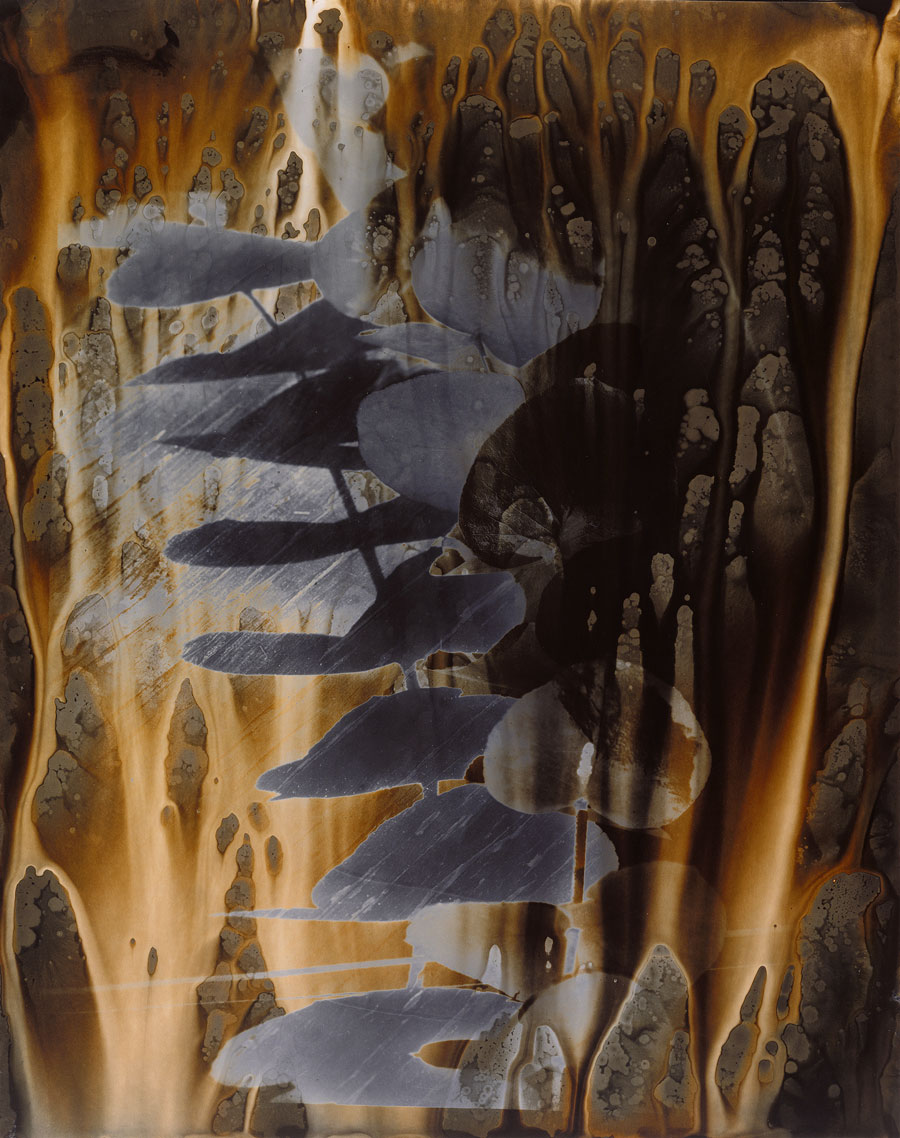
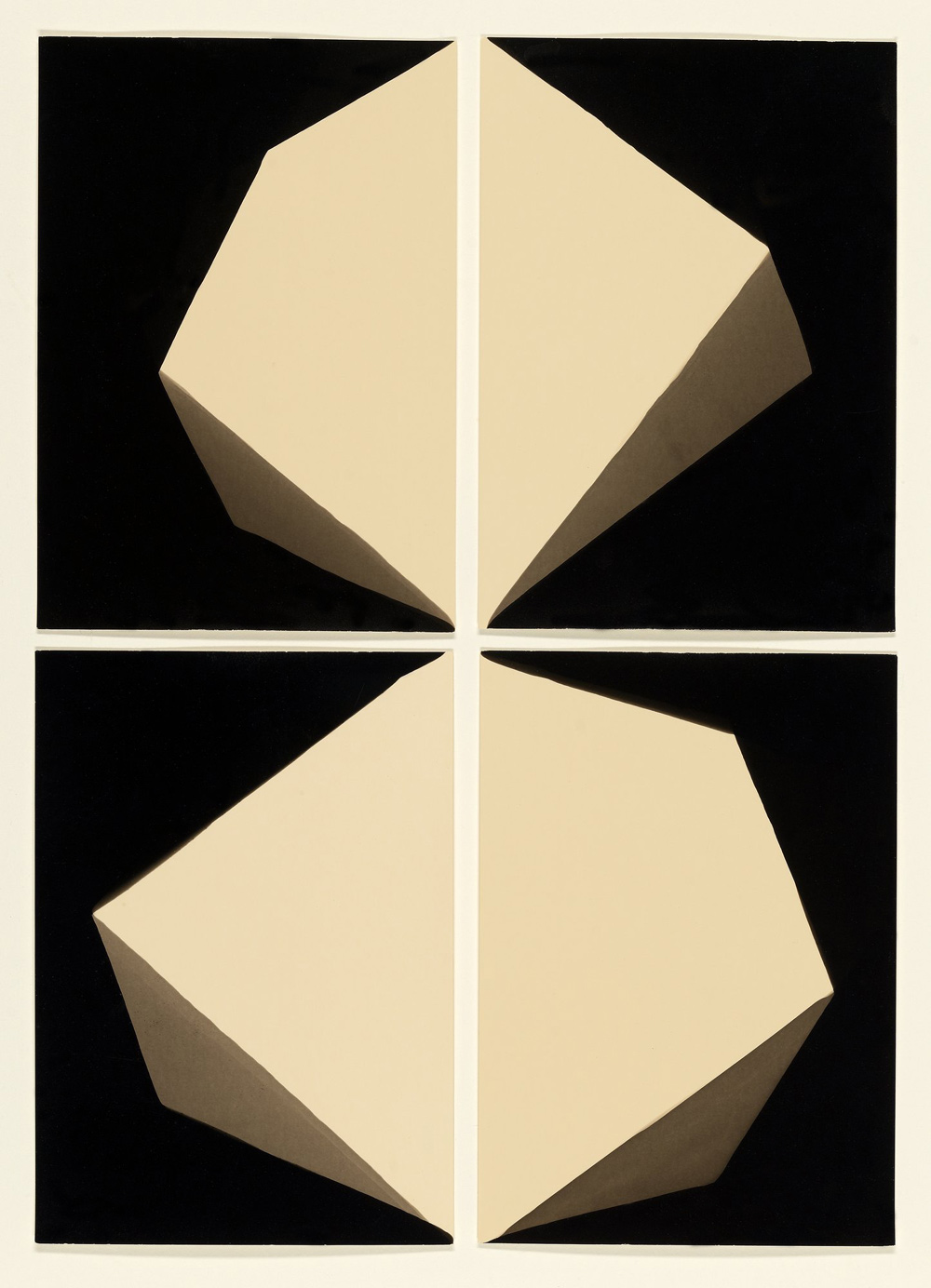
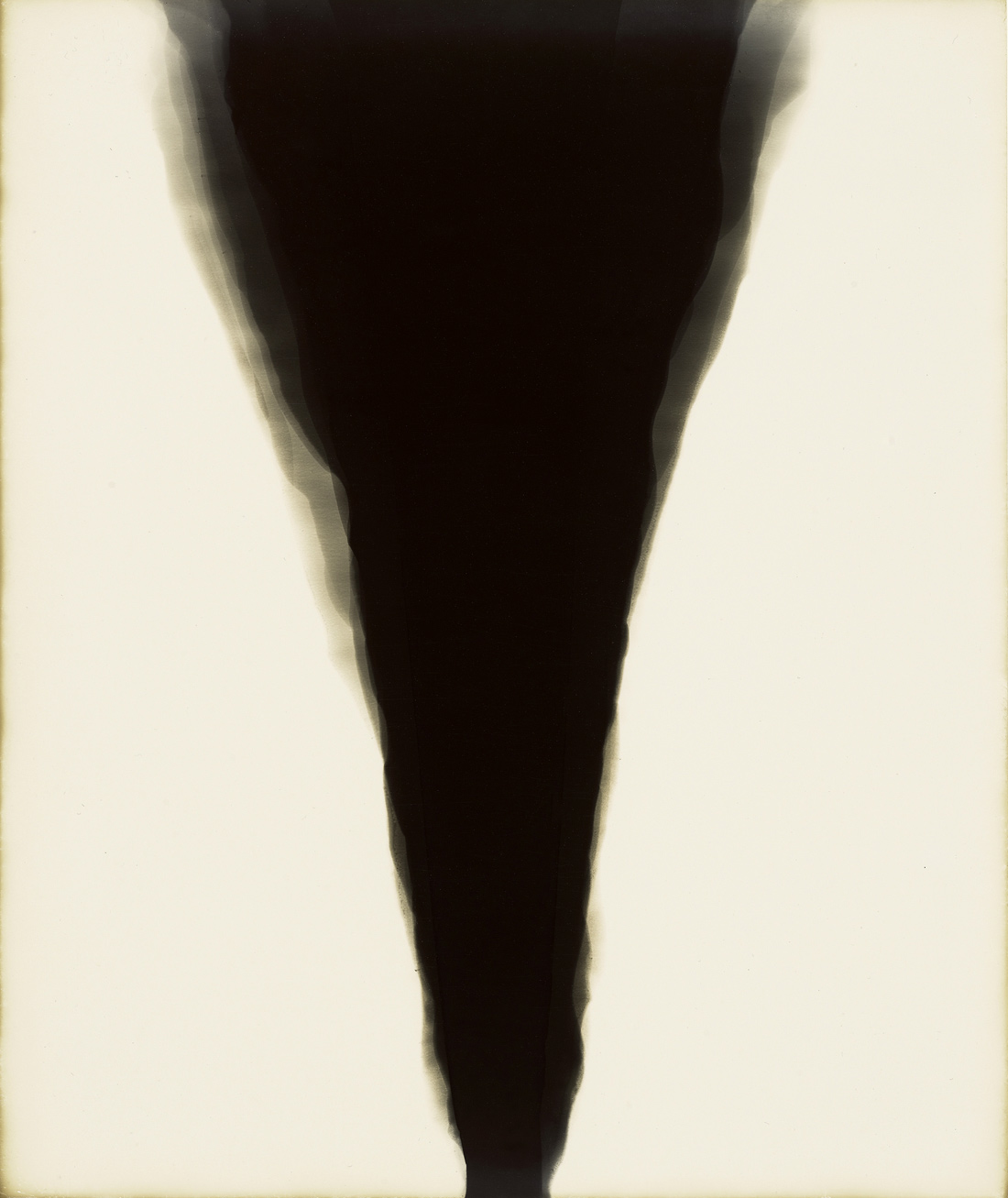
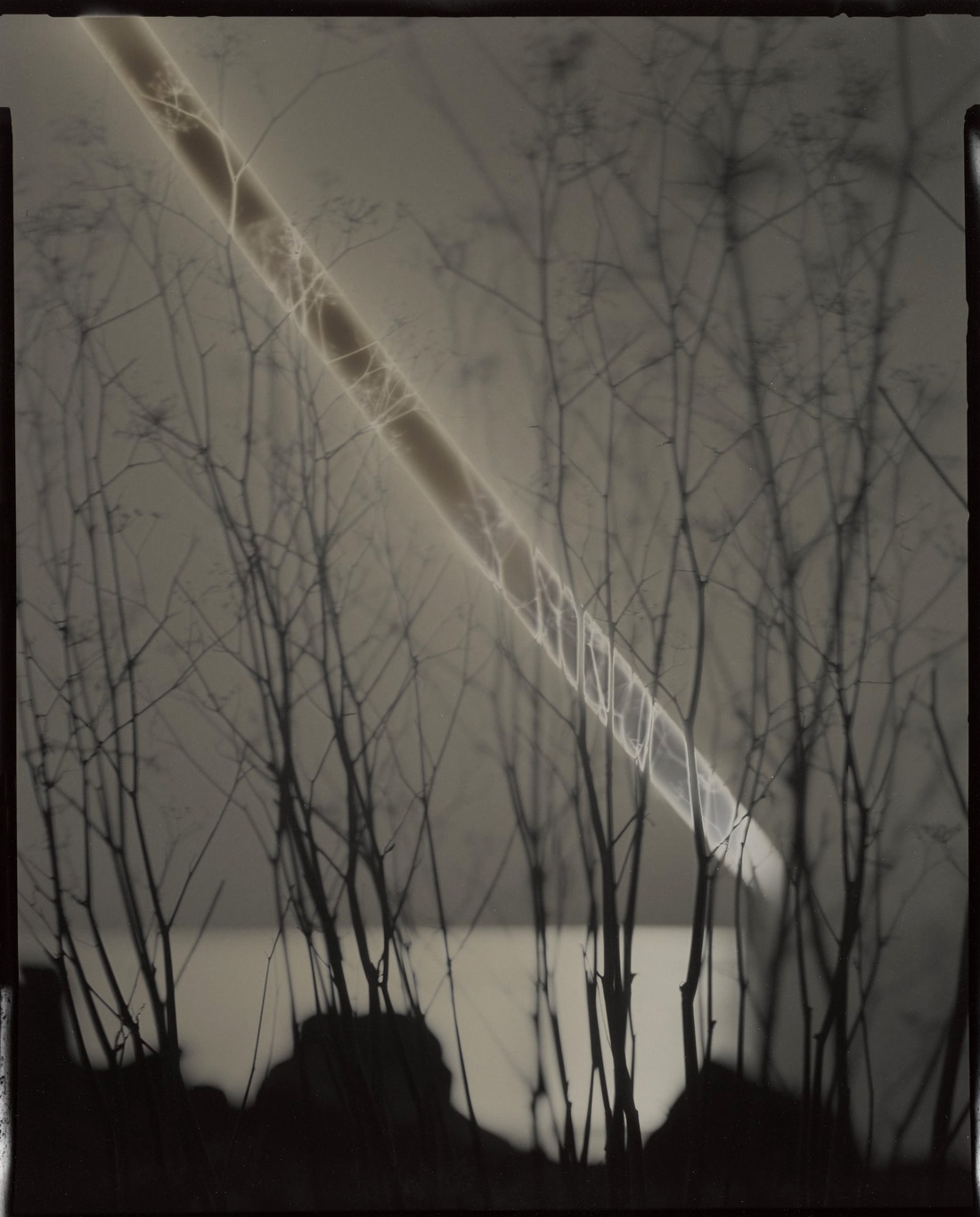
Exhibition: ‘Shape of Light: 100 Years of Photography and Abstract Art’ at Tate Modern, London

Exhibition dates: 2nd May – 14th October, 2018

Curators: Simon Baker, Senior Curator, International Art (Photography) and Shoair Mavlian, Assistant Curator, Tate Modern, with Emmanuelle de l’Ecotais, Curator for Photographs


Pierre Dubreuil (French, 1872-1944) 'Interpretation of Picasso, The Railway' 1911 from the exhibition 'Shape of Light: 100 Years of Photography and Abstract Art' at Tate Modern, London, May - Oct, 2018


Pierre Dubreuil (French, 1872-1944)
Interpretation Picasso, The Railway
1911
Gelatin silver print on paper
238 x 194mm
Centre Pompidou, Paris
Musée National d’Art Moderne / Centre de Création Industrielle
Purchased, 1987


An interesting premise –

“a premise is an assumption that something is true. In logic, an argument requires a set of (at least) two declarative sentences (or “propositions”) known as the premises or premisses along with another declarative sentence (or “proposition”) known as the conclusion” (Wikipedia)

– that the stories (the declarative sentences) of abstract art and abstract photography are intertwined (the conclusion). The two premises and one conclusion forms the basic argumentative structure of the exhibition.

Unfortunately in this exhibition, the abstract art and abstract photographs (declarations), seem to add up to less than the sum of its parts (conclusion).

Why is this so?


The reason these two bedfellows sit so uncomfortably together is that they are of a completely different order, one to the other.

Take painting for example. There is that ultimate linkage between brain, eye and hand as the artist “reaches out” into the unknown, and conjures an abstract representation from his imagination. This has a quality beyond my recognition. The closest that photography gets to this intuition is the cameraless Photogram, as the artist paints with light, from his imagination, onto the paper surface, the physical presence of the print.

Conversely, we grapple with the dual nature of photography, its relation to reality, to the real, and its interpretation of that reality through a physical, mechanical process – light entering a camera (metal, glass, digital chips, plastic film) to be developed in chemicals or on the computer, stored as a physical piece of paper or in binary code – but then we LOOK and FEEL what else a photograph can be. What it is, and what else it can be.

Initially, to take a photograph is to recognise something physical in the world which can then be abstracted. Here is a tree, a Platonic ideal, now here is the bark of the tree, or cracks in dried mud, or Aaron Siskind’s Pleasures and Terrors of Levitation in which, in our imagination, the body is no longer human. This archaeology of photography is a learnt behaviour (from the world, from abstract paintings) where ones learns to turn over the truth to something else, a recognition of something else. Where one digs a clod of earth, inspects it, and then turns it over to see what else it can be.

We can look at something in the world just for what it is and take a photograph of it, but then we can look at the same object for what else it can be (for example, Man Ray’s image Dust Breeding (1920), which is actually dust motes on the top of Duchamp’s Large Glass). Photographers love these possibilities within the physicality of the medium, its processes and outcomes. Photographers love changing scale, perspective, distortion using their intuition to perhaps uncover spiritual truths. Here I are not talking about making doodles – whoopee look what I can make as a photographer! it’s important because I can do it and show it and I said it’s important because I am an artist! the problem with lots of contemporary photography – it is something entirely different. It is the integrity of the emotional and intellectual process.

Not a reaching out through the arm and hand, but an unearthing (a reaching in?) of the possibilities of what else photography can be (other than a recording process). As Stieglitz understood in his Equivalents, and so Minor White espoused through his art and in one of his three canons:

When the image mirrors the man
And the man mirrors the subject
Something might take over


And that revelation is something completely different from the revelation of abstract art.

Dr Marcus Bunyan


Many thankx to the Tate Modern for allowing me to publish the art work in the posting. Please click on the photographs for a larger version of the image.


“Despite its roll call of stellar names, the show’s adrenaline soon slumps. A rhythm sets in, as each gallery offers perhaps a single non photographic work and dozens of medium format black and white abstracts arranged on an allied theme: extreme close ups, engineered structures, worms’ and birds’ eye views, moving light, the human body, urban fabric.

Individually each photograph is quite wonderful, but they echo each other so closely in their authors’ attraction to diagonal arrangements, rich surface textures, dramatic shadows, odd perspectives and close cropping, that the same ‘point’ is being made a dozen times with little to distinguish between the variants. …

By the present day, abstract photography has given in to its already Ouroboros-like tendencies, and swallowed itself whole, offering abstract photographs about the process of photography, and the action of light on its materials. This is a gesture I relished in Wolfgang Tillmans’s show in the same space this time last year, when it was broken up by a plethora of other ideas and perspectives on photography. Here it feels like another level of earnest self-absorption with a century-long backstory.”


Hettie Judah. “By halfway round I actually felt faint,” on the iNews website May 5th 2018 [Online] Cited 14/07/2018. No longer available online


For the first time, Tate Modern tells the intertwined stories of photography and abstract art. The birth of abstract art and the invention of photography were both defining moments in modern visual culture, but these two stories are often told separately.

Shape of Light is the first major exhibition to explore the relationship between the two, spanning the century from the 1910s to the present day. It brings to life the innovation and originality of photographers over this period, and shows how they responded and contributed to the development of abstraction.

Key photographs are brought together from pioneers including Man Ray and Alfred Stieglitz, major contemporary artists such as Barbara Kasten and Thomas Ruff, right up to exciting new work by Antony Cairns, Maya Rochat and Daisuke Yokota, made especially for the exhibition.


Shape of Light | First Look

Tate Curator, Simon Baker, meets Caroline von Courten from leading photography Magazine, Foam. Together they explore the exhibition Shape of Light: 100 Years of Photography and Abstract Art at Tate Modern.


Exhibition Review – Shape of Light: 100 years of Photography and Abstract Art at Tate Modern


Wyndham Lewis (British, 1882-1957) 'Workshop' c. 1914-1915 (installation view)


Wyndham Lewis (British, 1882-1957)
Workshop (installation view)
c. 1914-1915
Tate
Purchased 1974
© Wyndham Lewis and the estate of Mrs G A Wyndham Lewis by kind permission of the Wyndham Lewis Memorial Trust (a registered charity)


Percy Wyndham Lewis (18 November 1882 – 7 March 1957) was a British writer, painter, and critic. He was a co-founder of the Vorticist movement in art and edited BLAST, the literary magazine of the Vorticists.

His novels include Tarr (1918) and The Human Age trilogy, composed of The Childermass (1928), Monstre Gai (1955) and Malign Fiesta (1955). A fourth volume, titled The Trial of Man, was unfinished at the time of his death. He also wrote two autobiographical volumes: Blasting and Bombardiering (1937) and Rude Assignment: A Narrative of my Career Up-to-Date (1950).


Paul Strand (American, 1890-1976) 'Abstraction Bowls, Twin Lakes, Connecticut' 1916 from the exhibition 'Shape of Light: 100 Years of Photography and Abstract Art' at Tate Modern, London, May - Oct, 2018


Paul Strand (American, 1890-1976)
Abstraction Bowls, Twin Lakes, Connecticut
1916
Silver gelatin print


Alvin Langdon Coburn (American, 1882-1966) 'Vortograph' 1917


Alvin Langdon Coburn (American, 1882-1966)
Vortograph
1917
Gelatin silver print on paper
283 x 214mm
Courtesy of the George Eastman Museum NY
© The Universal Order
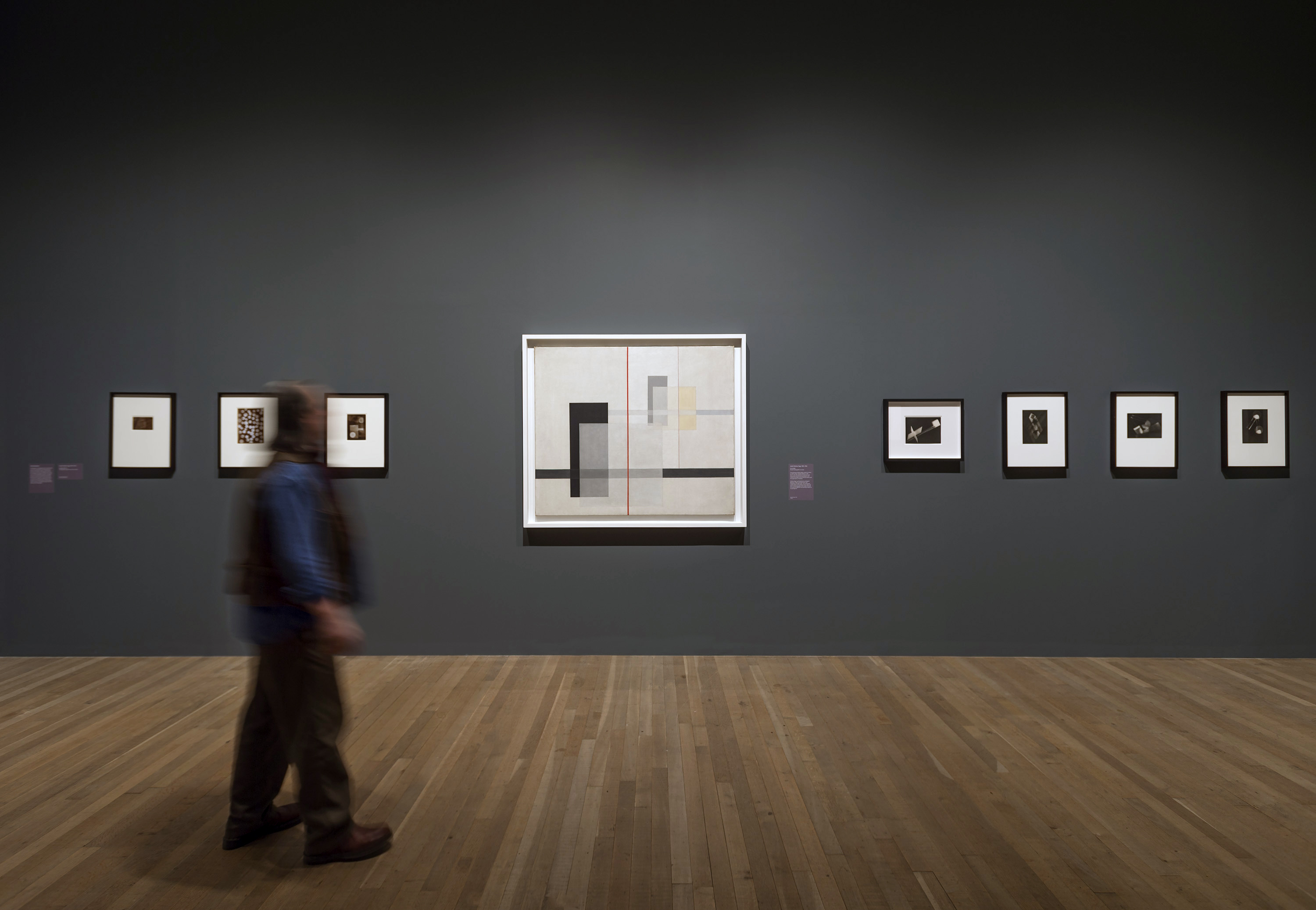
 

Installation view of the exhibition 'Shape of Light: 100 Years of Photography and Abstract Art' at Tate Modern, London showing László Moholy-Nagy's 'K VII' at centre


Installation view of the exhibition Shape of Light: 100 Years of Photography and Abstract Art at Tate Modern, London showing László Moholy-Nagy’s K VII at centre
Photo: © Tate / Andrew Dunkley


László Moholy-Nagy (Hungarian, 1895-1946) 'K VII' 1922


László Moholy-Nagy (Hungarian, 1895-1946)
K VII
1922
Oil paint and graphite on canvas
Frame: 1308 x 1512 x 80mm
Tate
Purchased 1961


The ‘K’ in the title of K VII stands for the German word Konstruktion (‘construction’), and the painting’s ordered, geometrical forms are typical of Moholy-Nagy’s technocratic Utopianism. The year after it was painted, he was appointed to teach the one year-preliminary course at the recently founded Bauhaus in Weimar. Moholy-Nagy’s appointment signalled a major shift in the school’s philosophy away from its earlier crafts ethos towards a closer alignment with the demands of modern industry, and a programme of simple design and unadorned functionalism.

Gallery label, April 2012


Man Ray (American, 1890-1976) 'Rayograph' 1922


Man Ray (American, 1890-1976)
Rayograph
1922
Gelatin silver print on paper
Private Collection
© Man Ray Trust/ADAGP, Paris and DACS, London 2018


El Lissitzky (Russian, 1890-1941) 'Proun in Material (Proun 83)' 1924


El Lissitzky (Russian, 1890-1941)
Proun in Material (Proun 83)
1924
Gelatin silver print on paper
140 x 102mm
© Imogen Cunningham Trust. All rights reserved
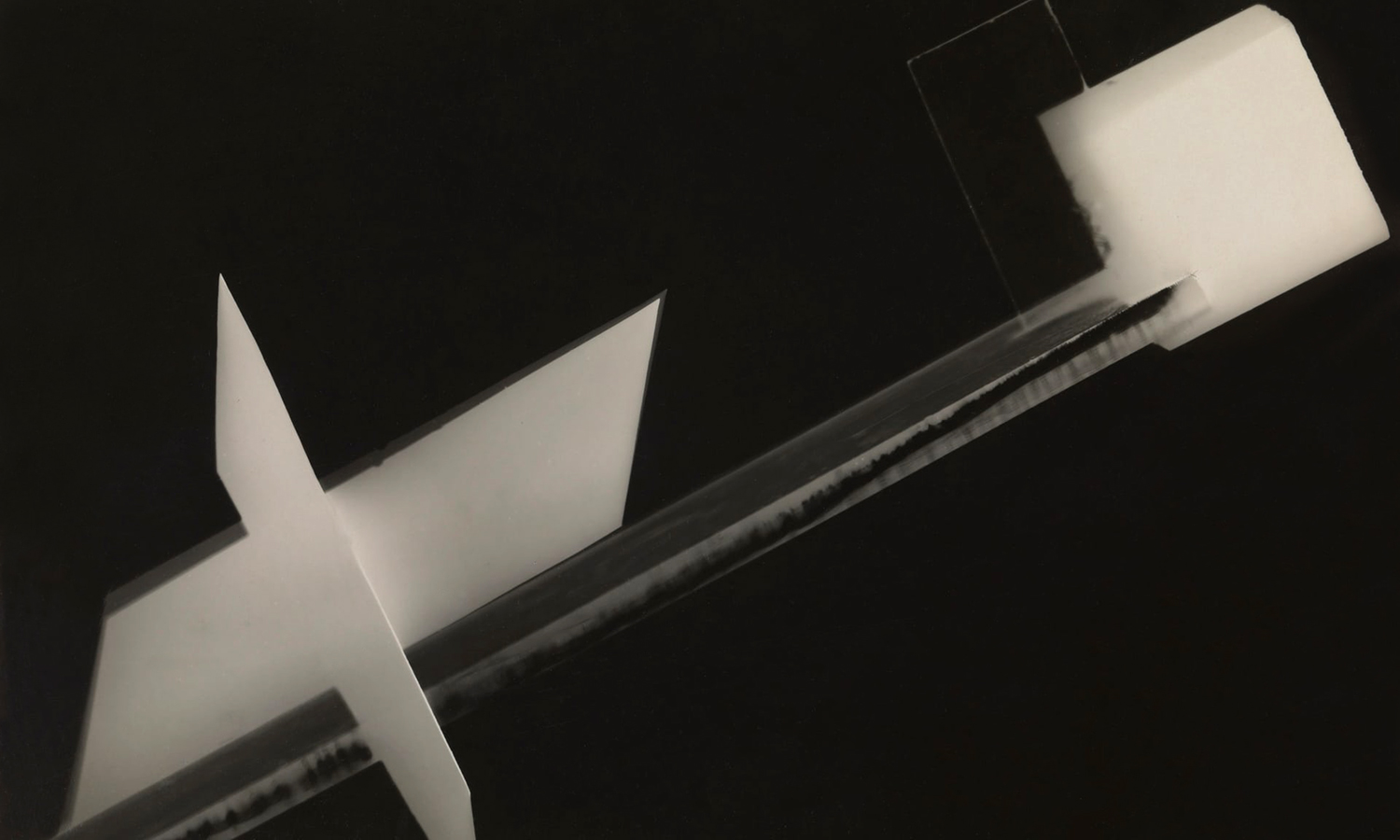
 

László Moholy-Nagy (Hungarian, 1895-1946) 'Photogram' c. 1925


László Moholy-Nagy (Hungarian, 1895-1946)
Photogram
c. 1925
Gelatin silver print on paper
Photo: Jack Kirkland Collection, Nottingham


Wassily Kandinsky (Russian, 1866-1944) 'Swinging' 1925


Wassily Kandinsky (Russian, 1866-1944)
Swinging
1925
Oil paint on board
705 x 502mm
Tate


Edward Steichen (American, 1879-1973) 'Bird in Space' [L'Oiseau dans l'espace] 1926


Edward Steichen (American, 1879-1973)
Bird in Space (L’Oiseau dans l’espace)
1926
Gelatin silver print on paper
253 x 202mm
Bequest of Constantin Brancusi, 1957
Centre Pompidou, Paris
Musée National d’Art Moderne / Centre de Création Industrielle
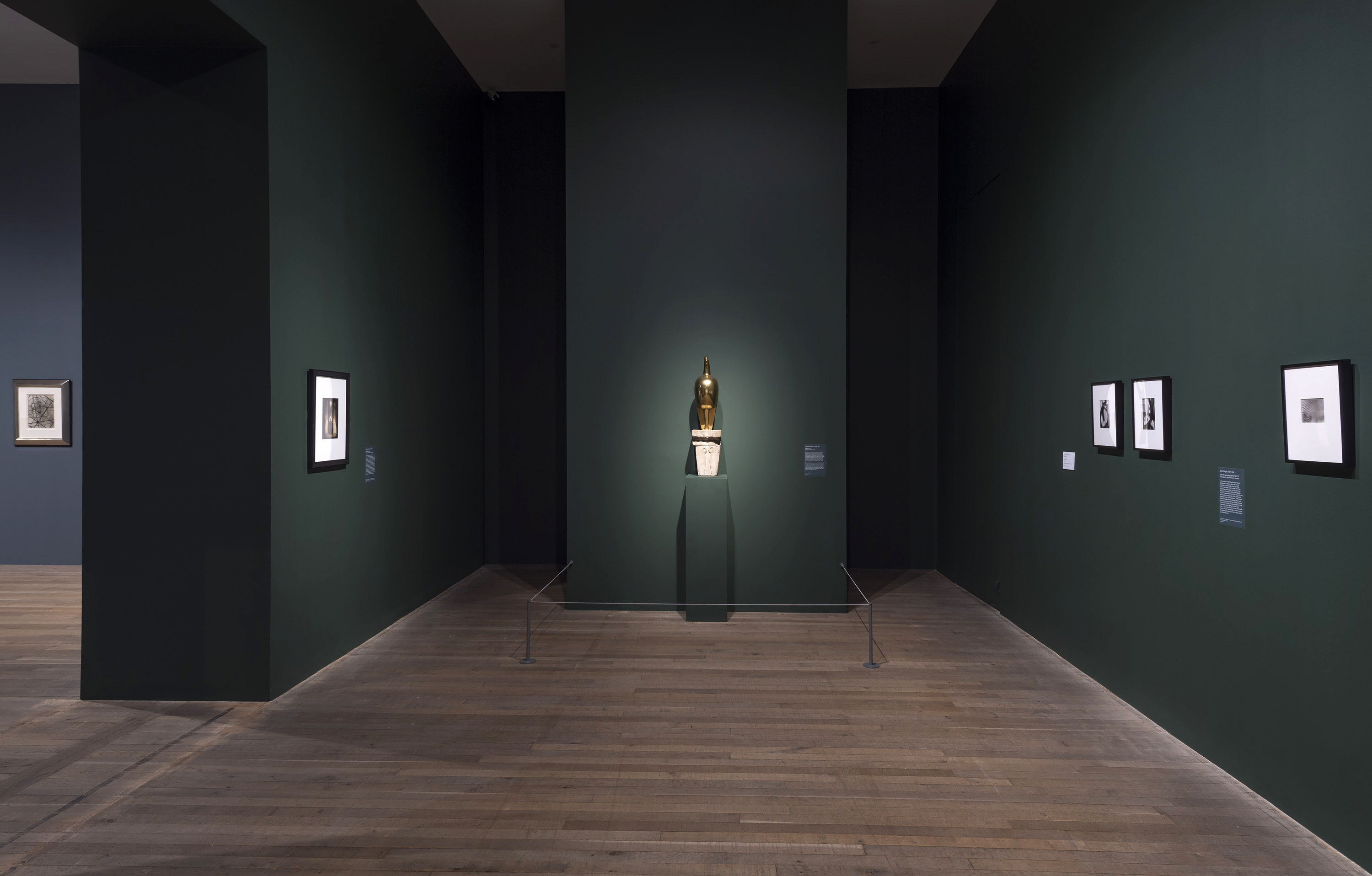
 

Installation view of the exhibition 'Shape of Light: 100 Years of Photography and Abstract Art' at Tate Modern, London showing at centre, Constantin Brancusi's bronze and stone sculpture 'Maiastra' (1911)


Installation view of the exhibition Shape of Light: 100 Years of Photography and Abstract Art at Tate Modern, London showing at centre, Constantin Brancusi’s bronze and stone sculpture Maiastra (1911)
Photo: © Tate / Andrew Dunkley


Imogen Cunningham (American, 1883-1976) 'Triangles' 1928


Imogen Cunningham (American, 1883-1976)
Triangles
1928, printed 1947-1960
Gelatin silver print on paper
119 x 93mm
Pierre Brahm
© Imogen Cunningham Trust. All rights reserved
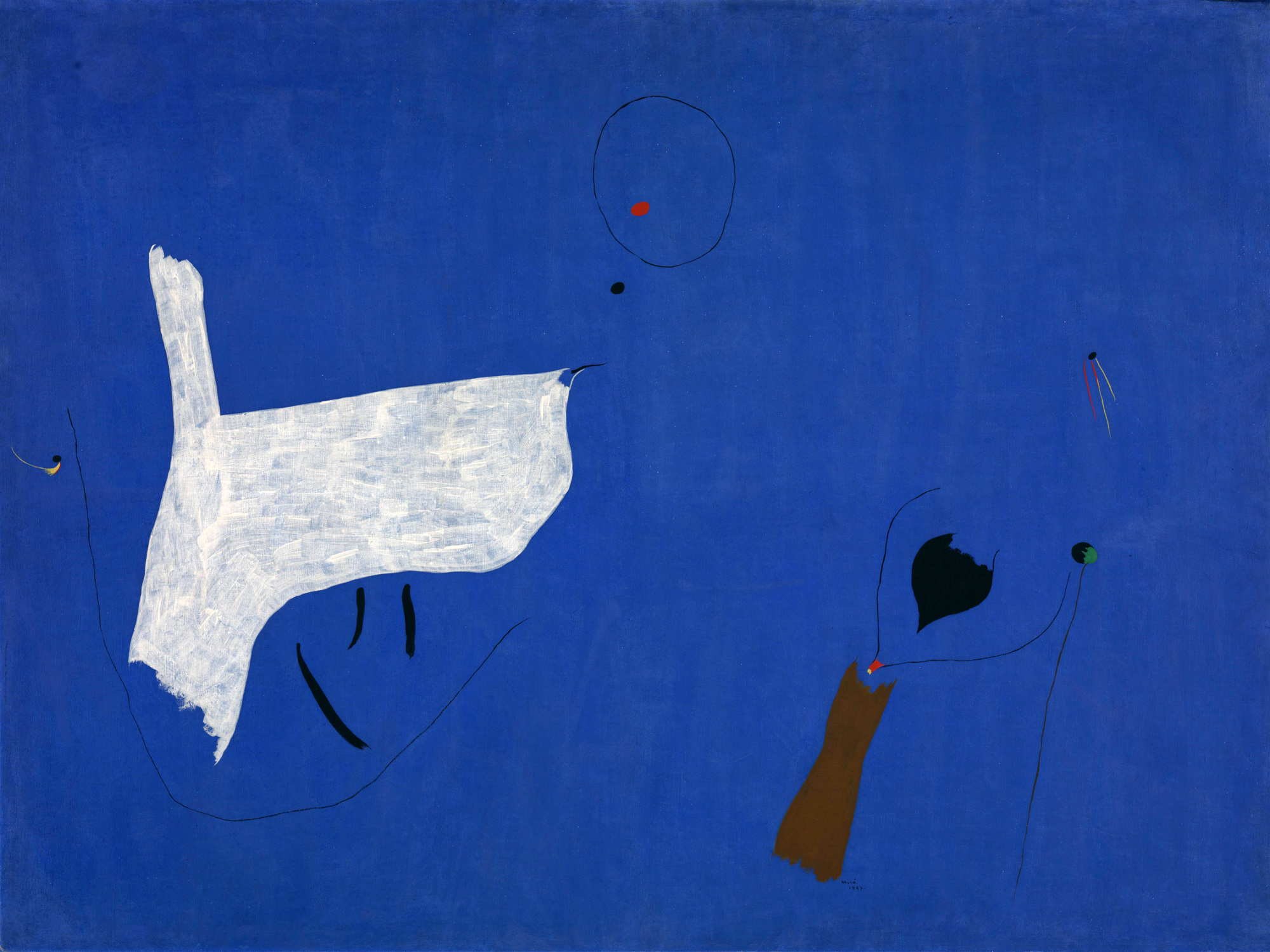
 

Joan Miró (Spanish, 1893-1983) 'Painting' 1927


Joan Miró (Spanish, 1893-1983)
Painting
1927
Tempera and oil paint on canvas
972 x 1302mm
Tate
© Succession Miro/ADAGP, Paris and DACS, London 2018


Man Ray (American, 1890-1976) 'Anatomies' 1930


Man Ray (American, 1890-1976)
Anatomies
1930
Photo: © Man Ray Trust/ADAGP, Paris and DACS, London 2016
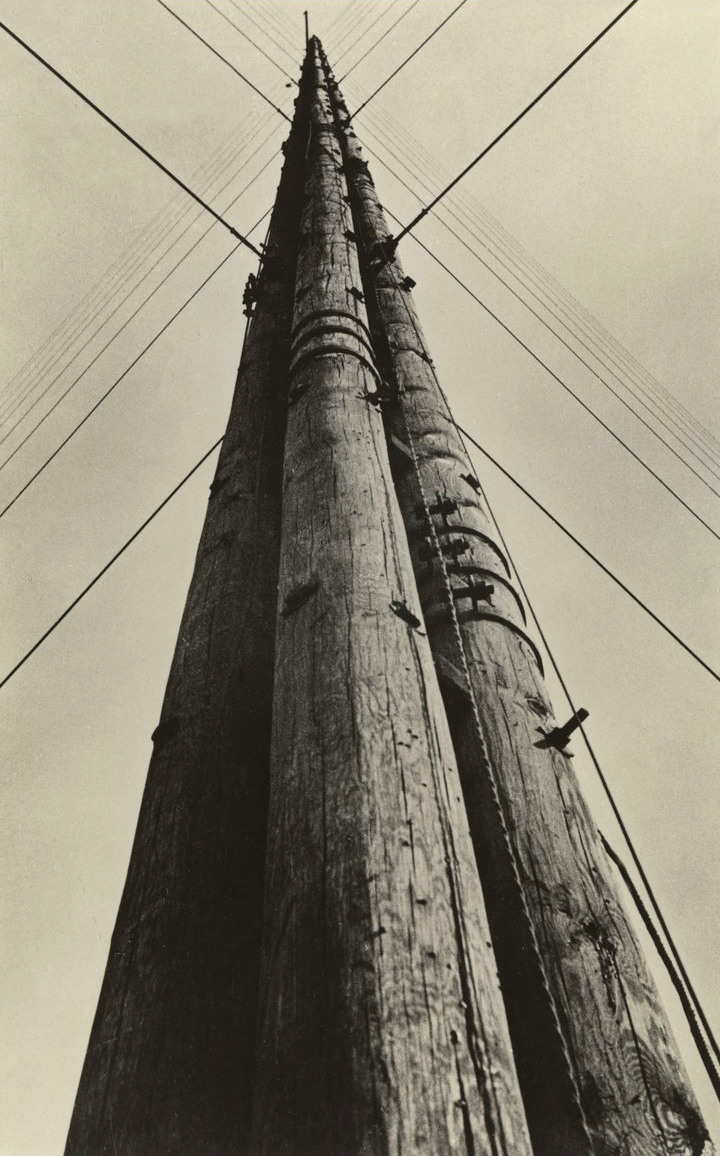
 

Aleksandr Rodchenko (Russian, 1891-1956) 'Radio Station Power' 1929


Aleksandr Rodchenko (Russian, 1891-1956)
Radio Station Power
1929
Gelatin silver print on paper
Lent by Jack Kirkland Collection, Nottingham
© A. Rodchenko and V. Stepanova Archive. DACS, RAO 2018
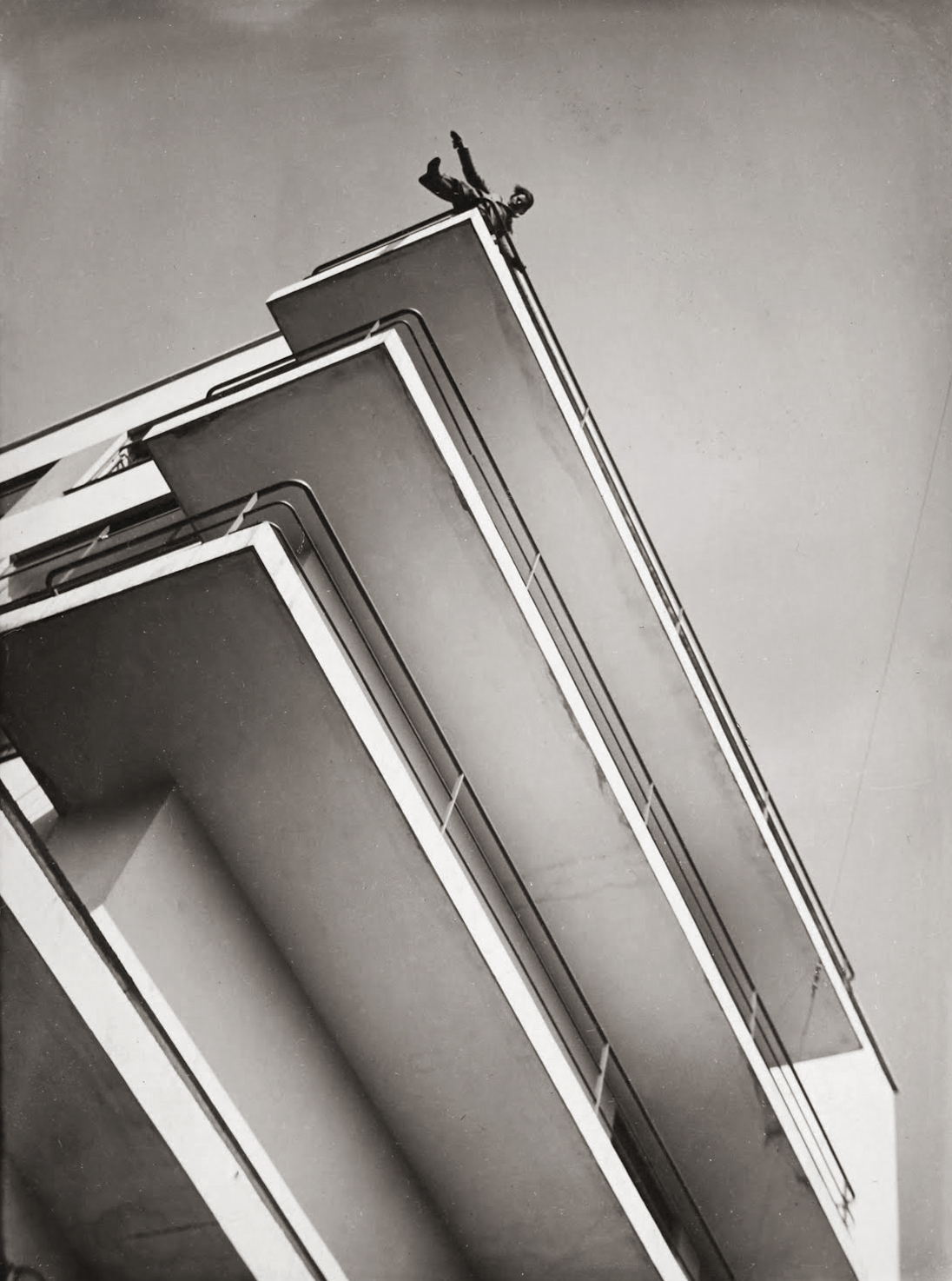
 

László Moholy-Nagy (Hungarian, 1895-1946) 'Xanti Schawinsky on the balcony of the Bauhaus' 1929


László Moholy-Nagy (Hungarian, 1895-1946)
Xanti Schawinsky on the balcony of the Bauhaus
1929
Gelatin silver print on paper


Luo Bonian (Chinese, 1911-2002) 'Untitled' 1930s


Luo Bonian (Chinese, 1911-2002)
Untitled
1930s
Gelatin silver print on paper
Courtesy The Three Shadows Photography Art Centre, Beijing
© Luo Bonian


Marta Hoepffner (German, 1912-2000) 'Homage to de Falla' 1937


Marta Hoepffner (German, 1912-2000)
Homage to de Falla
1937
Gelatin silver print on paper
387 x 278mm
Stadtmuseum Hofheim am Taunus
© Estate Marta Hoepffner


Nathan Lerner (American, 1913-1997) 'Light Tapestry' 1939


Nathan Lerner (American, 1913-1997)
Light Tapestry
1939
Gelatin silver print on paper
401 x 504mm
Musée d’Art Moderne de la Ville de Paris
Gift of Mrs Kiyoko Lerner, 2014
Photo: Nathan Lerner/© ARS, NY and DACS, London
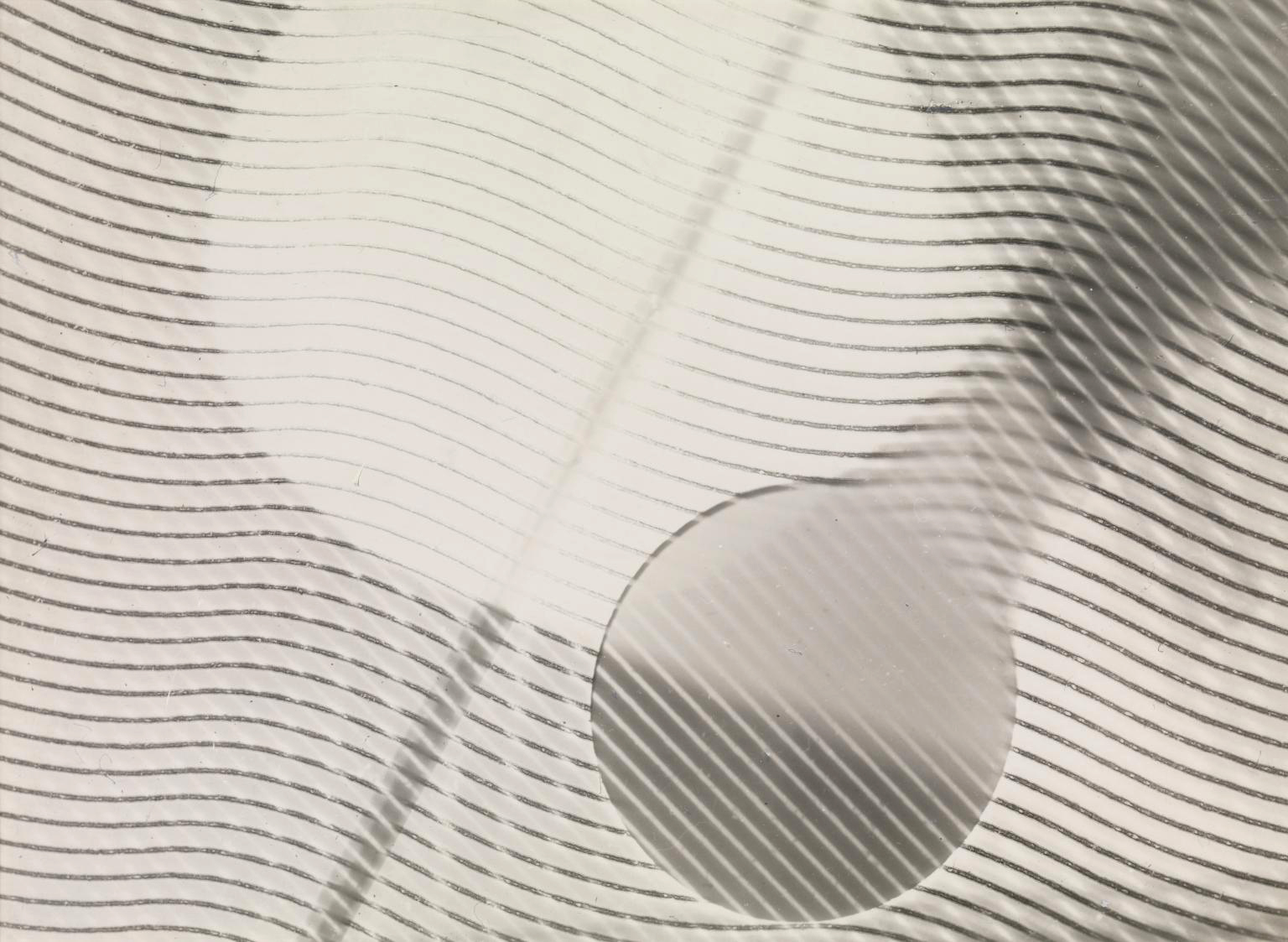
 

Luigi Veronesi (Italian, 1908-1998) 'Construction' 1938


Luigi Veronesi (Italian, 1908-1998)
Construction
1938
Gelatin silver print on paper
286 x 388mm
Tate
Accepted under the Cultural Gifts Scheme by HM Government from Massimo Prelz Oltramonti and allocated to Tate 2015


Luigi Veronesi (Italian, 1908-1998) 'Photo n.145' 1940, printed 1970s


Luigi Veronesi (Italian, 1908-1998)
Photo n.145
1940, printed 1970s
Gelatin silver print on paper
310 x 280mm
Tate
Accepted under the Cultural Gifts Scheme by HM Government from Massimo Prelz Oltramonti and allocated to Tate 2015


Luigi Veronesi (Italian, 1908-1998) 'Photo n.152' 1940, printed 1970s


Luigi Veronesi (Italian, 1908-1998)
Photo n.152
1940, printed 1970s
Gelatin silver print on paper
320 x 298mm
Tate
Accepted under the Cultural Gifts Scheme by HM Government from Massimo Prelz Oltramonti and allocated to Tate 2015


A major new exhibition at Tate Modern will reveal the intertwined stories of photography and abstract art. Shape of Light: 100 Years of Photography and Abstract Art will be the first show of this scale to explore photography in relation to the development of abstraction, from the early experiments of the 1910s to the digital innovations of the 21st century. Featuring over 300 works by more than 100 artists, the exhibition will explore the history of abstract photography side-by-side with iconic paintings and sculptures.

Shape of Light will place moments of radical innovation in photography within the wider context of abstract art, such as Alvin Langdon Coburn’s pioneering ‘vortographs’ from 1917. This relationship between media will be explored through the juxtaposition of works by painters and photographers, such as cubist works by George Braque and Pierre Dubreuil or the abstract expressionism of Jackson Pollock and Otto Steinert’s ‘luminograms’. Abstractions from the human body associated with surrealism will include André Kertesz’s Distorsions, Imogen Cunningham’s Triangles and Bill Brandt’s Baie des Anges, Frances 1958, exhibited together with a major painting by Joan Miró. Elsewhere the focus will be on artists whose practice spans diverse media, such as László Moholy-Nagy and Man Ray.

The exhibition will also acknowledge the impact of MoMA’s landmark photography exhibition of 1960, The Sense of Abstraction. Installation photographs of this pioneering show will be displayed with some of the works originally featured in the exhibition, including important works by Edward Weston, Aaron Siskind and a series by Man Ray that has not been exhibited since the MoMA show, 58 years ago.

The connections between breakthroughs in photography and new techniques in painting will be examined, with rooms devoted to Op Art and Kinetic Art from the 1960s, featuring striking paintings by Bridget Riley and installations of key photographic works from the era by artists including Floris Neussis and Gottfried Jaeger. Rooms will also be dedicated to the minimal and conceptual practices of the 1970s and 80s. The exhibition will culminate in a series of new works by contemporary artists, Tony Cairns, Maya Rochat and Daisuke Yokota, exploring photography and abstraction today.

Shape of Light is curated by Simon Baker, Senior Curator, International Art (Photography) and Shoair Mavlian, Assistant Curator, Tate Modern, with Emmanuelle de l’Ecotais, Curator for Photographs, Musée d’Art Moderne de la Ville de Paris. The exhibition will be accompanied by a fully illustrated catalogue from Tate Publishing and a programme of talks and events in the gallery.

Press release from Tate Modern
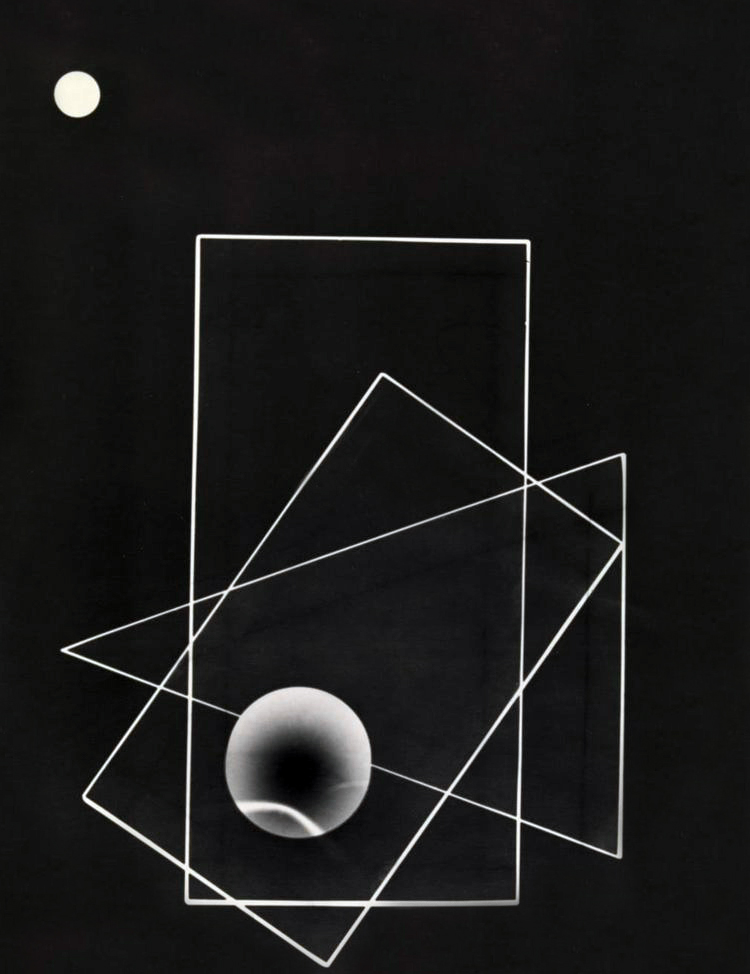
 

Otto Steinert (German, 1915-1978) 'Composition of Forms' 1949


Otto Steinert (German, 1915-1978)
Composition of Forms
1949
Gelatin silver print on paper
290 x 227mm
Jack Kirkland Collection, Nottingham


Guy Bourdin (French, 1928-1991) 'Untitled' 1952


Guy Bourdin (French, 1928-1991)
Untitled
1952
Gelatin silver print on paper
277 x 164mm
Purchased with funds provided by the Photography Acquisitions Committee 2015
© The Guy Bourdin Estate


Guy Bourdin (French, 1928-1991) 'Untitled' 1952


Guy Bourdin (French, 1928-1991)
Untitled
1952
Gelatin silver print on paper
232 x 169mm
Purchased with funds provided by the Photography Acquisitions Committee 2015
© The Guy Bourdin Estate


Guy Bourdin (French, 1928-1991) 'Untitled' c. 1950s


Guy Bourdin (French, 1928-1991)
Untitled
c. 1950s
Gelatin silver print on paper
239 x 179mm
Purchased with funds provided by the Photography Acquisitions Committee 2015
© The Guy Bourdin Estate


Untitled c.1950s is a black and white photograph by the French photographer Guy Bourdin. The entirety of the frame is taken up by a close-up of peeling paint. The paint sections fragment the image into uneven geometric shapes, which are interrupted by a strip of the dark surface beneath that winds from the top to the bottom of the frame. There is little sense of scale or contextual detail, resulting in a near-abstract composition.

Bourdin is best known for his experimental colour fashion photography produced while working for French Vogue between 1955 and 1977. This photograph belongs to an earlier period of experimentation, before he began to use colour and work in fashion. Taken outside the studio, it shows Bourdin’s sensitivity to the natural world and his attempt to transform the everyday into abstract compositions, bridging the gap between surrealism and subjective photography. Bourdin’s early work was heavily influenced by surrealism, as well as by pioneers of photography as a fine art such as Edward Weston, Paul Strand and Bill Brandt. His surrealist aesthetic can be attributed to his close relationship with Man Ray, who wrote the foreword to the catalogue for Bourdin’s first solo exhibition of black and white photographs at Galerie 29, Paris, in 1952.

This and other early works in Tate’s collection (such as Untitled (Sotteville, Normandy) c. 1950s, Tate P81205, and Solange 1957, Tate P81216) are typical of Subjektive Fotografie (‘subjective photography’), a tendency in the medium in the late 1940s and early 1950s. Led by the German photographer and teacher Otto Steinert, who organised three exhibitions under the title Subjektive Fotografie in 1951, 1954 and 1958, the movement advocated artistic self-expression – in the form of the artist’s creative approach to composition, processing and developing – above factual representation. Subjektive Fotografie’s emphasis on, and encouragement of, individual perspectives invited both the photographer and the viewer to interpret and reflect on the world through images. Bourdin’s interest in this can be seen in his early use of texture and abstraction, evident in close-up studies of cracked paint peeling off an external wall or a piece of torn fabric. These still lives were often dark in subject matter and tone, highlighting Bourdin’s interest in surrealist compositions and the intersection between death and sexuality. The works made use of the photographer’s urban environment, with deep black and high contrast printing techniques employed to create a sombre mood.

This approach was also important for Bourdin’s early portraiture, which anticipated his subsequent work in fashion. The subject of his portraits – often Solange Gèze, to whom the artist was married from 1961 until her death in 1971 – is usually framed subtly, rarely appearing in the centre or as the main focus of the image. In these works the figure is secondary, showing how Bourdin let the natural or urban environment frame the subject and integrate the body into its immediate surroundings. Bourdin was meticulous about the creative process from start to finish, sketching out images on paper and then recreating them in the landscape, using the natural environment as a stage set for his work.

Shoair Mavlian
August 2014
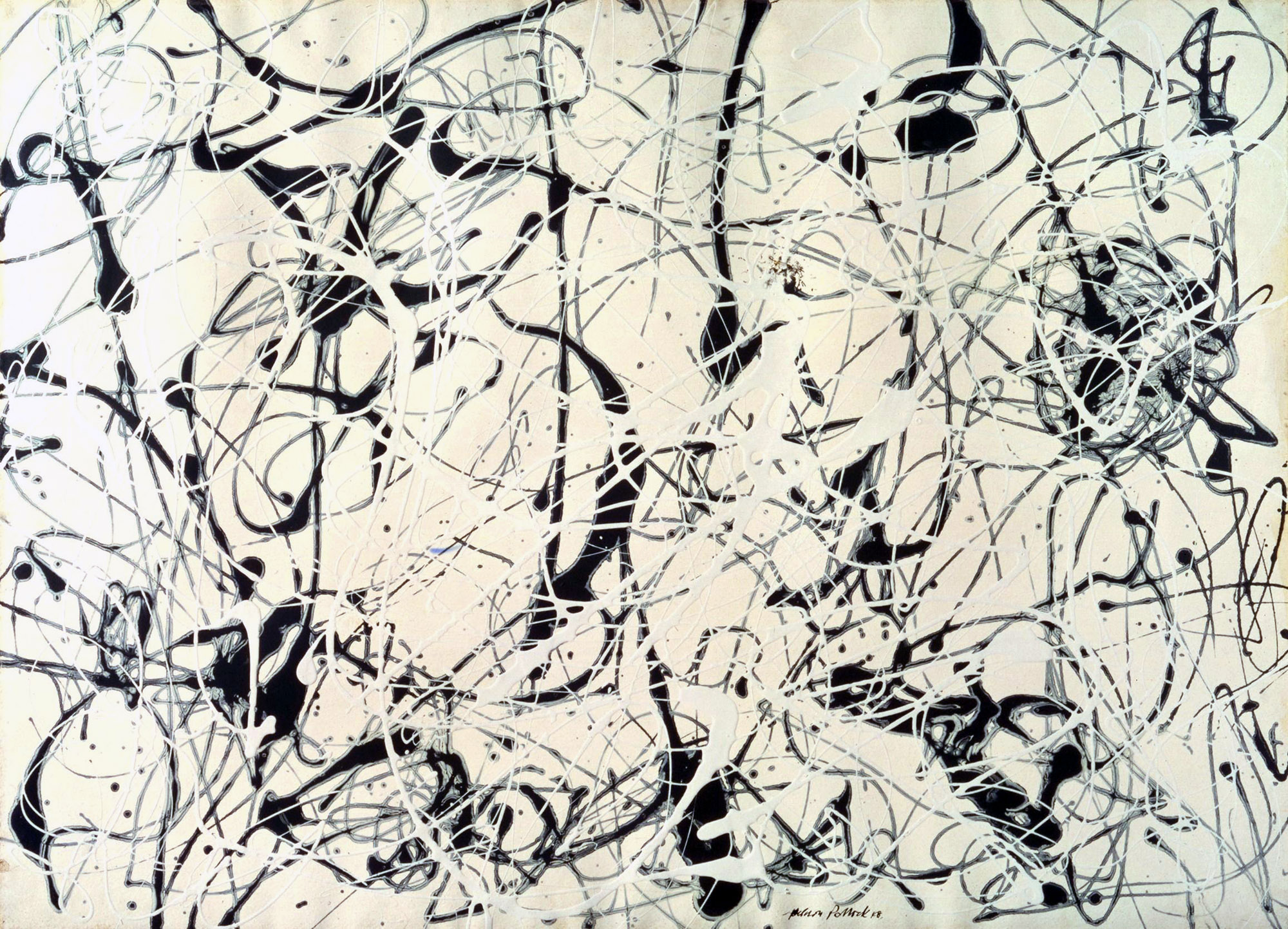
 

Jackson Pollock (American, 1912-1956) 'Number 23' 1948


Jackson Pollock (American, 1912-1956)
Number 23
1948
Enamel on gesso on paper
575 x 784mm
Tate: Presented by the Friends of the Tate Gallery (purchased out of funds provided by Mr and Mrs H.J. Heinz II and H.J. Heinz Co. Ltd) 1960
© ARS, NY and DACS, London 2018


Installation view of the exhibition 'Shape of Light: 100 Years of Photography and Abstract Art' at Tate Modern, London showing  at left Jackson Pollock's 'Number 23' (1948)


Installation view of the exhibition Shape of Light: 100 Years of Photography and Abstract Art at Tate Modern, London showing  at left Jackson Pollock’s Number 23 (1948, above)
Photo: © Tate / Sepharina Neville


Installation view of the exhibition 'Shape of Light: 100 Years of Photography and Abstract Art' at Tate Modern, London showing at top left, Nathan Lerner's 'Light Tapestry'; and at centre right, Otto Steinert's 'Luminogram II' (1952)


Installation view of the exhibition Shape of Light: 100 Years of Photography and Abstract Art at Tate Modern, London showing at top left, Nathan Lerner’s Light Tapestry; and at centre right, Otto Steinert’s Luminogram II (1952, below)
Photo: © Tate / Sepharina Neville
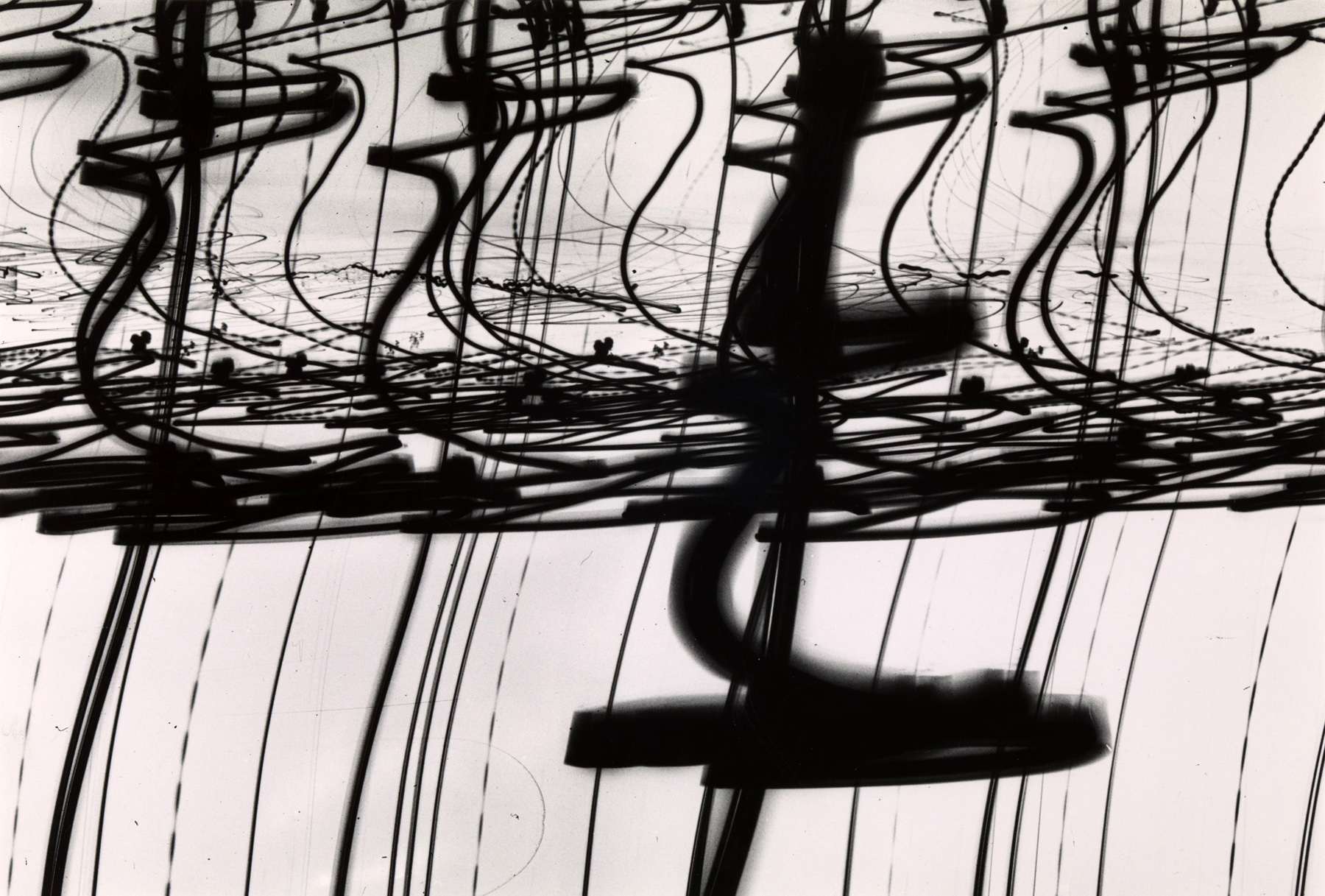
 

Otto Steinert (German, 1915-1978) 'Luminogram II' 1952


Otto Steinert (German, 1915-1978)
Luminogram II
1952
Gelatin silver print on paper
302 x 401mm
Jack Kirkland Collection Nottingham
© Estate Otto Steinert, Museum Folkwang, Essen
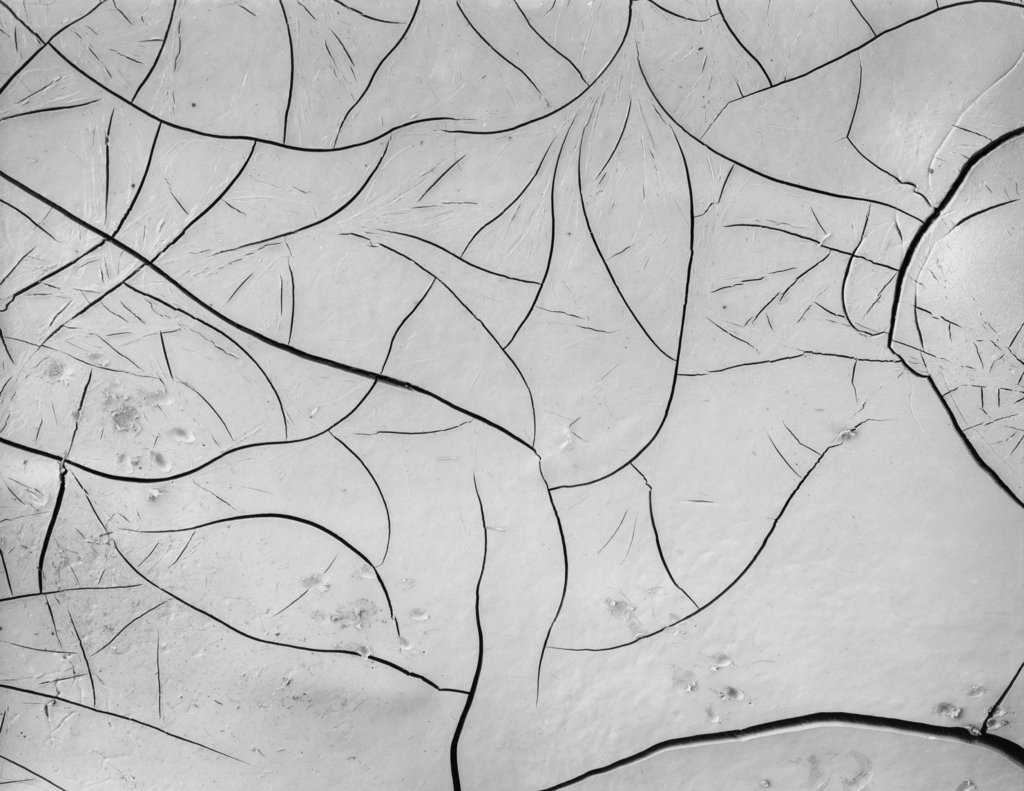
 

Brett Weston (American, 1911-1993) 'Mud Cracks' 1955


Brett Weston (American, 1911-1993)
Mud Cracks
1955
Silver gelatin print
203 x 254mm
Lent by the Tate Americas Foundation, courtesy of Christian Keesee Collection 2013
© The Brett Weston Archive/CORBIS


Peter Keetman (German, 1916-2005) 'Steel Pipes, Maximilian Smelter' 1958


Peter Keetman (German, 1916-2005)
Steel Pipes, Maximilian Smelter
1958
Gelatin silver print on paper
508 x 427mm
F.C. Gundlach Foundation


Man Ray (American, 1890-1976) 'Unconcerned Photograph' 1959


Man Ray (American, 1890-1976)
Unconcerned Photograph
1959
Museum of Modern Art, New York
© Man Ray Trust/ADAGP, Paris and DACS, London 2018
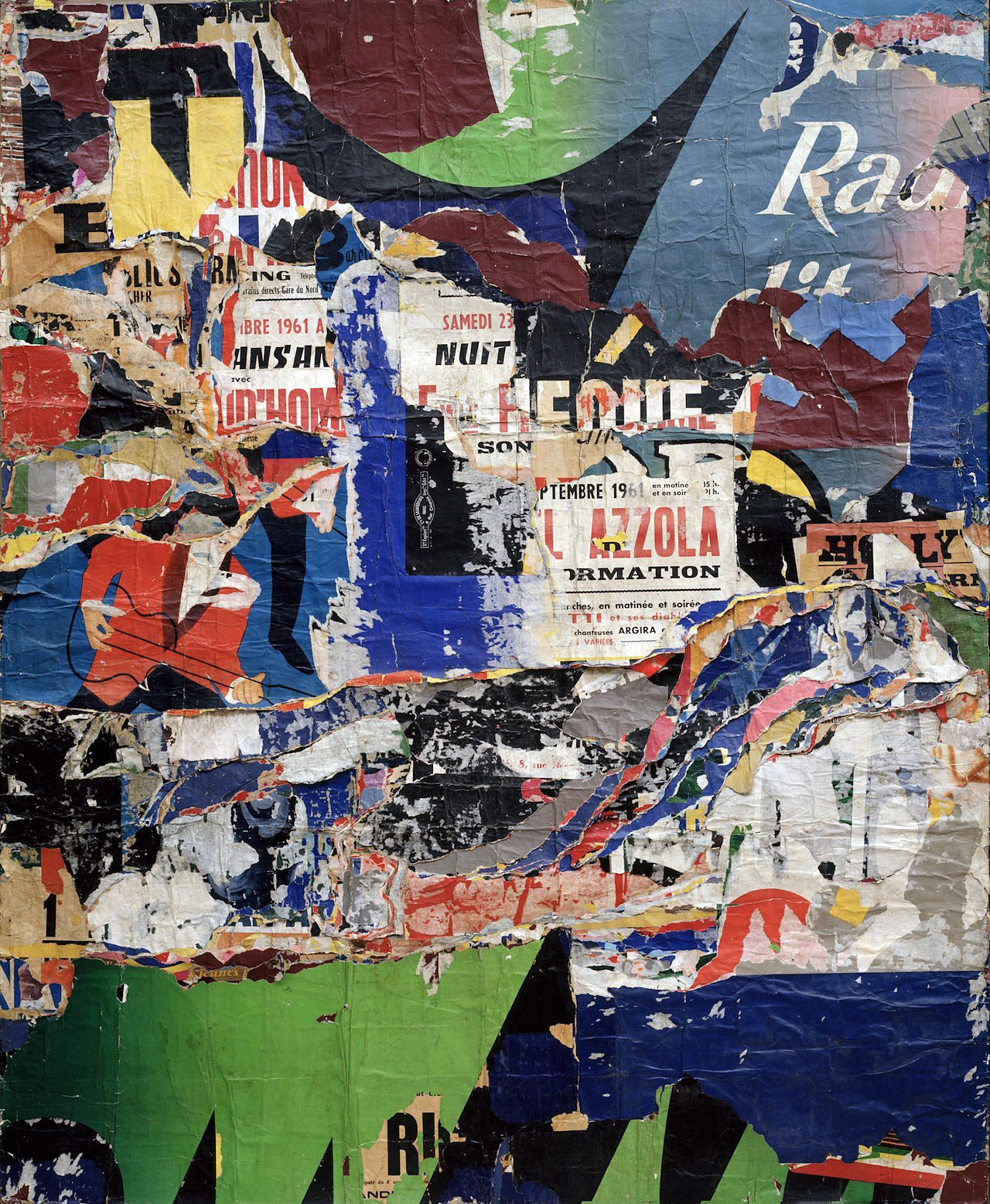
 

Jacques Mahé de la Villeglé (French, 1926-2022) 'Jazzmen' 1961


Jacques Mahé de la Villeglé (French, 1926-2022)
Jazzmen
1961
Printed papers on canvas
2170 x 1770mm
Presented by the Friends of the Tate Gallery 2000
© Jacques Mahé de la Villeglé


The Jazzmen is a section of what Jacques Villeglé termed affiches lacérées, posters torn down from the walls of Paris. These particular ones were taken on 10 December 1961. Following his established practice, Villeglé removed the section from a billboard and, having mounted it on canvas, presented it as a work of art. In ‘Des Réalités collectives’ of 1958 (‘Collective Realities’, reprinted in 1960: Les Nouveaux Réalistes, pp. 259-60) he acknowledged that he occasionally tore the surface of the posters himself, although he subsequently restricted interventions to repairs during the mounting process. The large blue and green advertisements for Radinola (at the top right and lower left) provide the main visible surface for The Jazzmen. These establish a compositional unity for the accumulated layers. Overlaid are fragmentary music posters and fly-posters, some dated to September 1961, including the images of the red guitarists that lend the work its title. The artist’s records give the source as rue de Tolbiac, a thoroughfare in the 13th arrondissement in south-east Paris. Villeglé usually uses the street as his title, but has suggested (interview with the author, February 2000) that the title The Jazzmen may have been invented for the work’s inclusion in the exhibition L’Art du jazz (Musée Galliera, Paris 1967).

Villeglé worked together with Raymond Hains (b. 1926) in presenting torn posters as works of art. They collaborated on such works as Ach Alma Manetro, 1949 (Musée nationale d’art moderne, Centre Georges Pompidou, Paris), in which typography dominates the composition. They first showed their affiches lacérées in May 1957 at the Galerie Colette Allendy, Paris, in a joint exhibition named Loi du 29 juillet 1881 ou le lyrisme à la sauvette (The Law of 29 July 1881 or Lyricism through Salvage) in reference to the law forbidding fly-posting. Villeglé sees a social complexity in the developments in the style, typography and subject of the source posters. He also considers the processes of the overlaying and the pealing of the posters by passers-by to be a manifestation of a liberated art of the street. Both aspects are implicitly political. As Villeglé points out, anonymity differentiates the torn posters from the collages of the Cubists or of the German artist Kurt Schwitters. In ‘Des Réalités collectives’ Villeglé wrote: ‘To collages, which originate in the interplay of many possible attitudes, the affiches lacérées, as a spontaneous manifestation, oppose their immediate vivacity’. He saw the results as extending the conceptual basis of Marcel Duchamp’s readymades, whereby an object selected by an artist is declared as art. However, this reduction of the artist’s traditional role brought an end to Villeglé’s collaboration with Hains, who held more orthodox views of creative invention.

In 1960 Villeglé, Hains and François Dufrêne (1930-1982), who also used torn posters, joined the Nouveaux Réalistes group gathered by the critic Pierre Restany (b.1930). Distinguished by the use of very disparate materials and techniques, the Nouveaux Réalistes – who also included Arman (b.1928), Yves Klein (1928-1962) and Jean Tinguely (1925-1991) – were united by what Villeglé has called their ‘distance from the act of painting’ as characterised by the dominant abstraction of the period (interview February 2000). In this way, Klein’s monochrome paintings (see Tate T01513) and Villeglé’s affiches lacérées (lacerated posters) conform to the group’s joint declaration of 27 October 1960: ‘The Nouveaux Réalistes have become aware of their collective singularity. Nouveau Réalisme = new perceptual approaches to reality.’ The Jazzmen, of the following year, embodies Villeglé’s understanding of his ‘singularity’ as a conduit for anonymous public expression.

Matthew Gale
June 2000


Edward Ruscha (American, b. 1937) 'Gilmore Drive-In Theater - 6201 W. Third St.' 1967, printed 2013


Edward Ruscha (American, b. 1937)
Gilmore Drive-In Theater – 6201 W. Third St.
1967, printed 2013
Gelatin silver prints on paper
356 x 279mm
Courtesy Ed Ruscha and Gagosian Gallery
© Ed Ruscha
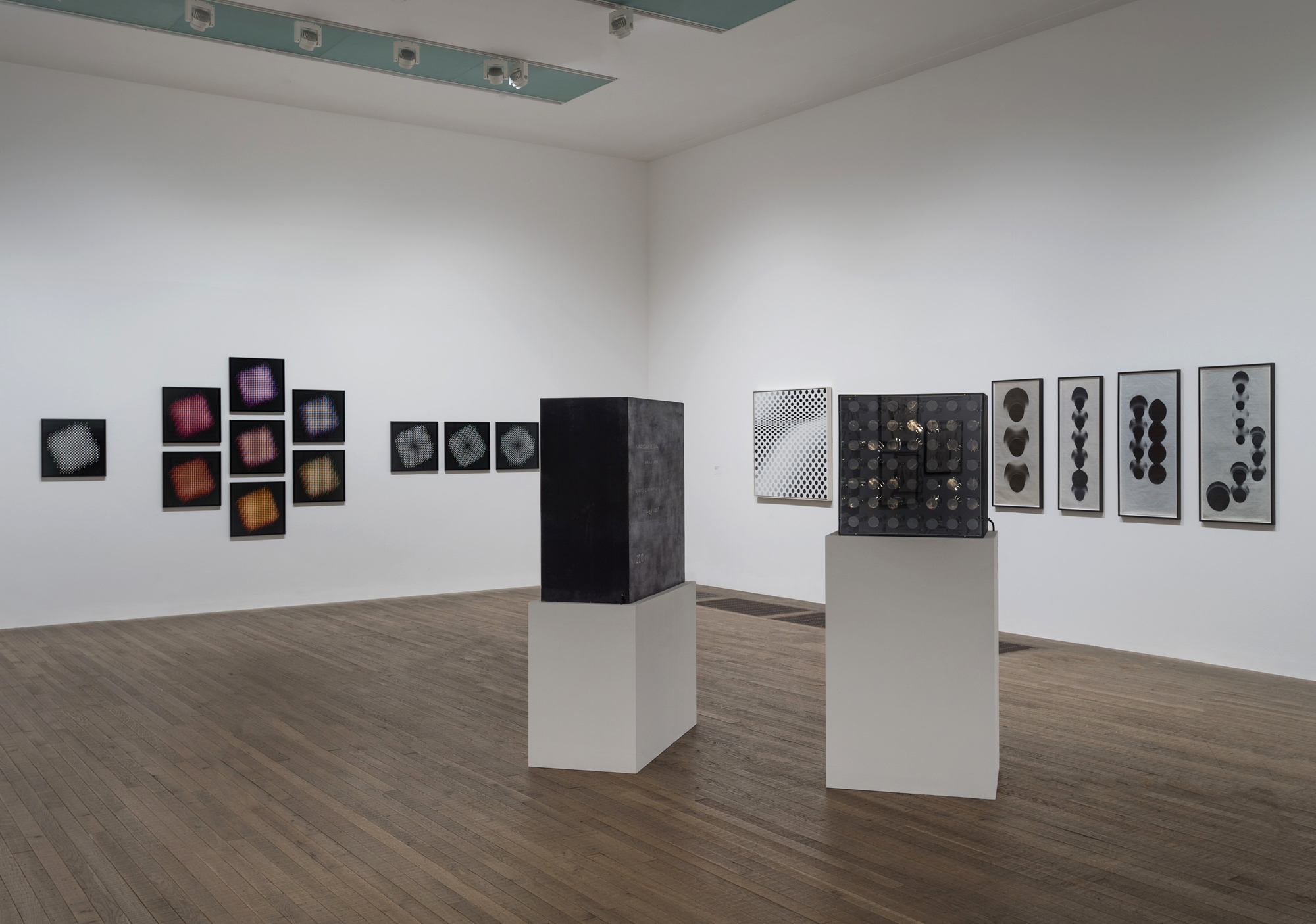
 

Installation view of the exhibition 'Shape of Light: 100 Years of Photography and Abstract Art' at Tate Modern, London


Installation view of the exhibition Shape of Light: 100 Years of Photography and Abstract Art at Tate Modern, London
Photo: © Tate / Andrew Dunkley
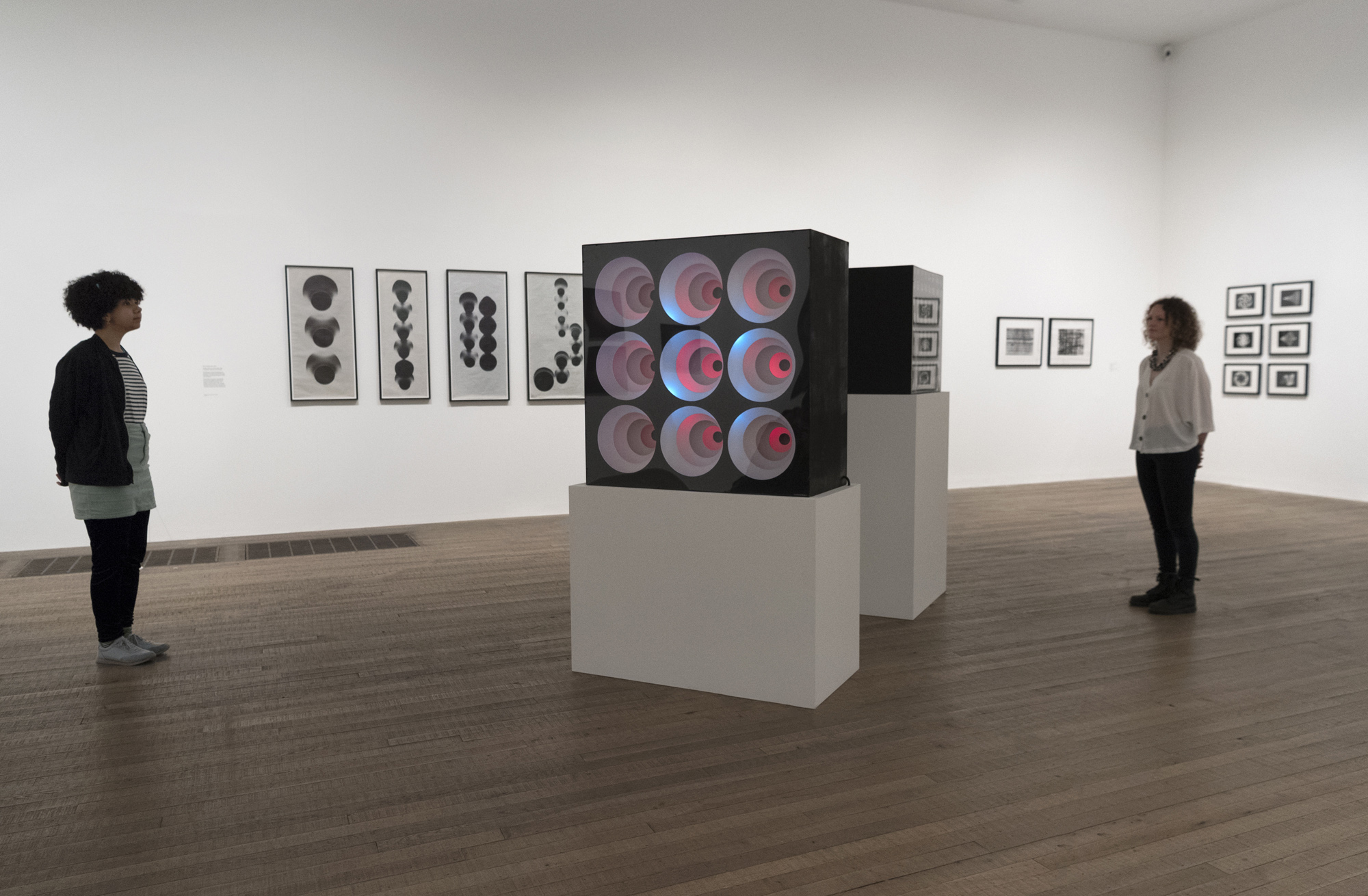
 

Installation view of the exhibition 'Shape of Light: 100 Years of Photography and Abstract Art' at Tate Modern, London showing Gregorio Vardanega's 'Circular Chromatic Spaces' 1967


Installation view of the exhibition Shape of Light: 100 Years of Photography and Abstract Art at Tate Modern, London showing Gregorio Vardanega’s Circular Chromatic Spaces 1967. Musée d’Art moderne de la Ville de Paris
Photo: © Tate / Andrew Dunkley


John Divola (American, b. 1949) '74V11' 1974


John Divola (American, b. 1949)
74V11
1974
Silver gelatin print
Jack Kirkland Collection, Nottingham
© John Divola
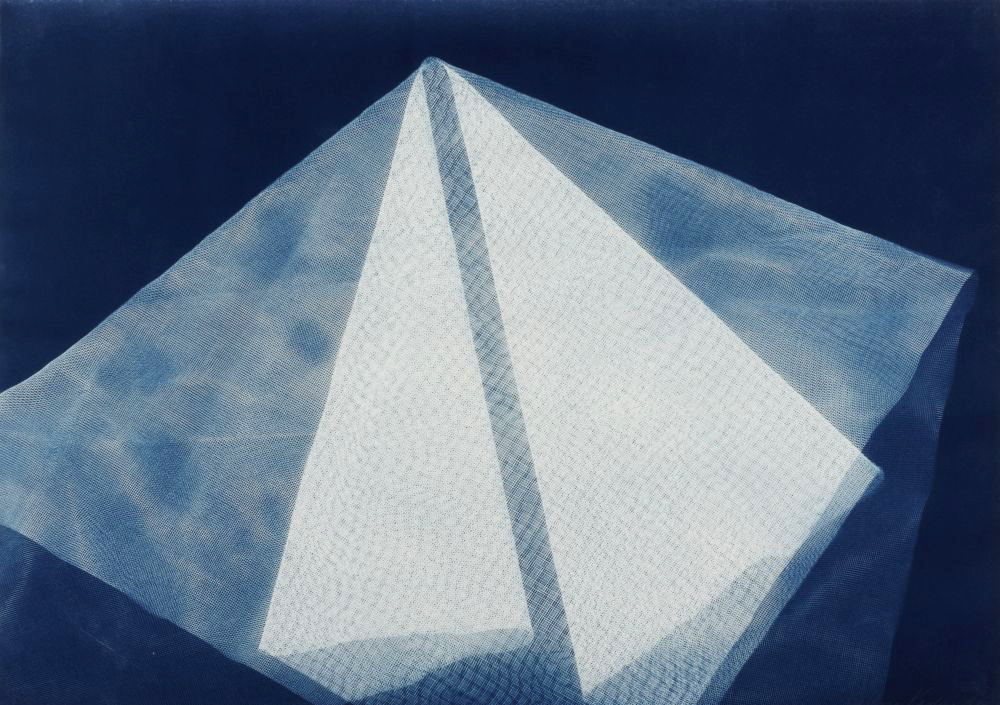
 

Barbara Kasten (American, b. 1936) 'Photogenic Painting, Untitled 74/13' (ID187) 1974


Barbara Kasten (American, b. 1936)
Photogenic Painting, Untitled 74/13 (ID187)
1974
Salted paper print
558 x 762mm
Courtesy the artist, Thomas Dane Gallery and Bortolami Gallery, New York
© Barbara Kasten
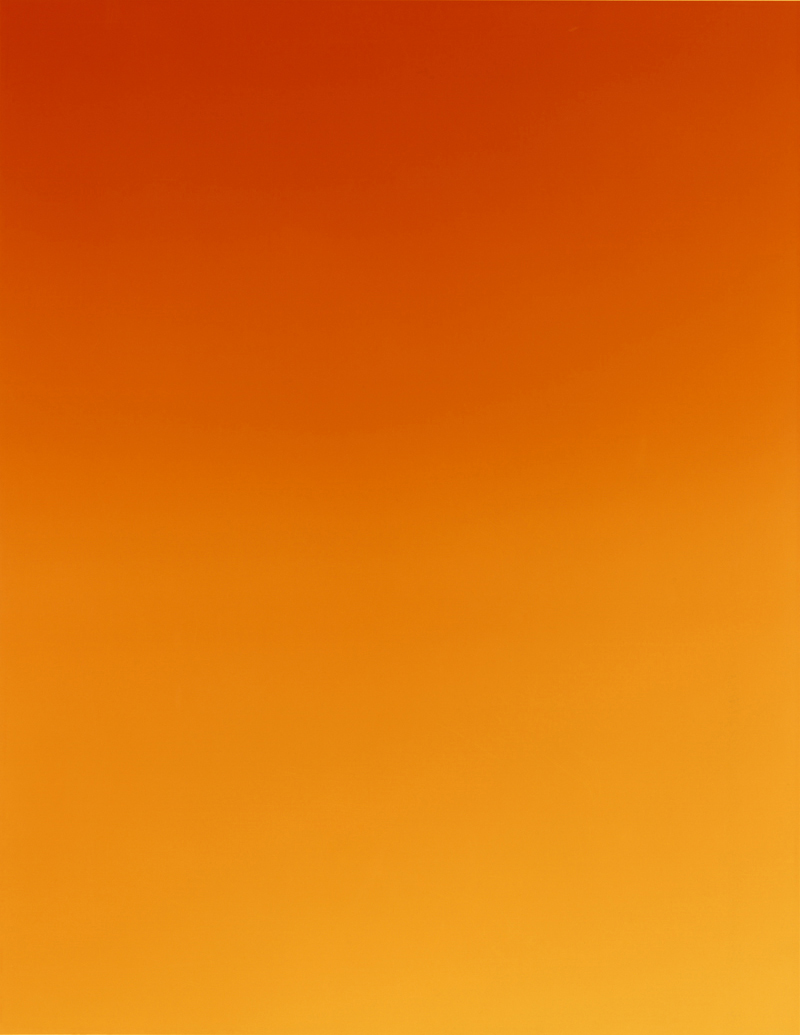
 

James Welling (American, b. 1951) 'Untitled' 1986


James Welling (American, b. 1951)
Untitled
1986
C-print on paper
254 x 203mm
Jack Kirkland Collection, Nottingham
© James Welling. Courtesy the artist and David Zwirner, New York/London/Hong Kong and Maureen Paley, London


Installation view of the exhibition 'Shape of Light: 100 Years of Photography and Abstract Art' at Tate Modern, London showing Sigmar Polke's 'Untitled (Uranium Green)' 1992


Installation view of the exhibition Shape of Light: 100 Years of Photography and Abstract Art at Tate Modern, London showing Sigmar Polke’s Untitled (Uranium Green) 1992. Hans Georg Näder © The Estate of Sigmar Polke / VG Bild-Kunst Bonn and DACS London, 2018
Photo: © Tate / Seraphina Neville
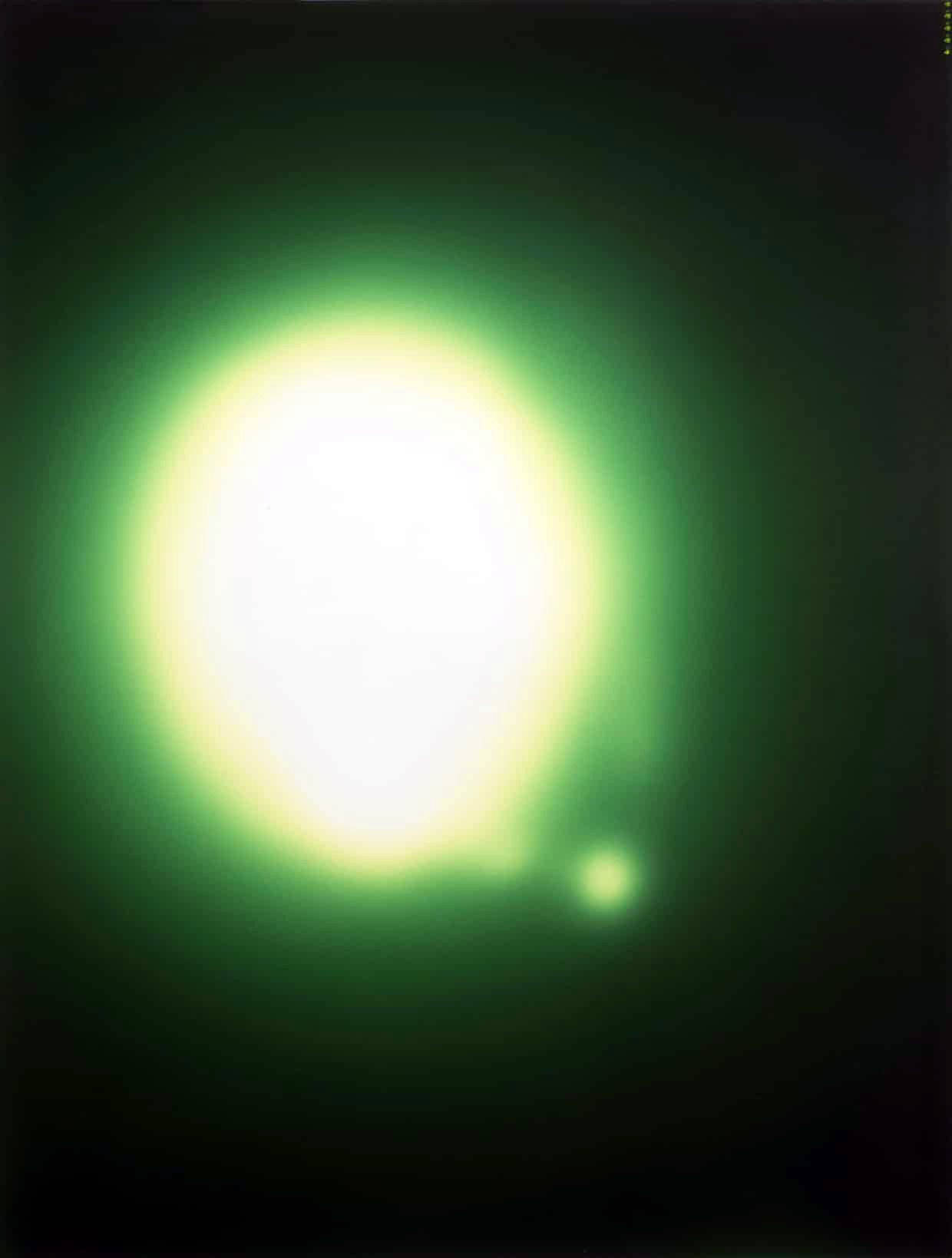
 

Sigmar Polke (German, 1941-1910) 'Untitled (Uranium Green)' 1992


Sigmar Polke (German, 1941-1910)
Untitled (Uranium Green) (detail)
1992
10 Photographs, C-print on paper
Image, each: 610 x 508mm
The Estate of Sigmar Polke / VG Bild-Kunst Bonn 2017
Photo: Adam Reich/The Estate of Sigmar Polke / VG Bild-Kunst Bonn and DACS London, 2018
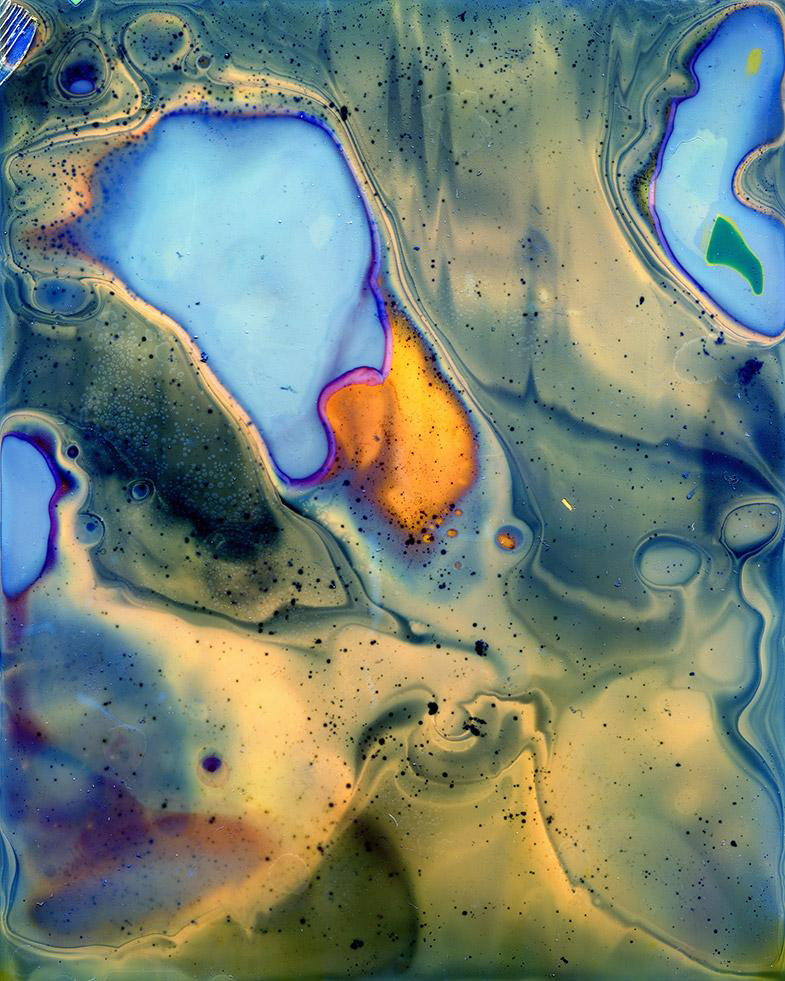
 

Daisuke Yokota (Japanese, b. 1983) 'Untitled' 2014


Daisuke Yokota (Japanese, b. 1983)
Untitled
2014
from Abstracts series
© Daisuke Yokota
Courtesy of the artist and Jean-Kenta Gauthier Gallery


Process is at the core of Yokota’s photographs. For his black-and-white work, such as the series Linger or Site/Cloud, Yokota sifts through an archive of more than 10 years of photographs in his Tokyo apartment. When he finds something that speaks to him – a nude figure, a chair, a building, a grove of trees – he makes a digital image of it, develops it, and rephotographs the image up to 15 times, until it becomes increasingly degraded. He develops the film in ways that are intentionally “incorrect,” allowing light to leak in, or singeing the negatives, using boiling water, or acetic acid. The purported subject fades, and shadows, textures, spots and other sorts of visual noise emerge. For his recent colour work, trippy, sensual abstractions, the process is similar, except that it is cameraless; he doesn’t start with a preexisting image. “I wanted to focus on the emulsion, on the different textures, more than on a subject being photographed,” says Yokota.

IN THE STUDIO
Daisuke Yokota
By Jean Dykstra

November – December 2015. No longer available online


Antony Cairns (British, b. 1980) 'LDN5_051' 2017


Antony Cairns (British, b. 1980)
LDN5_051
2017
Courtesy of the artist
© Antony Cairns
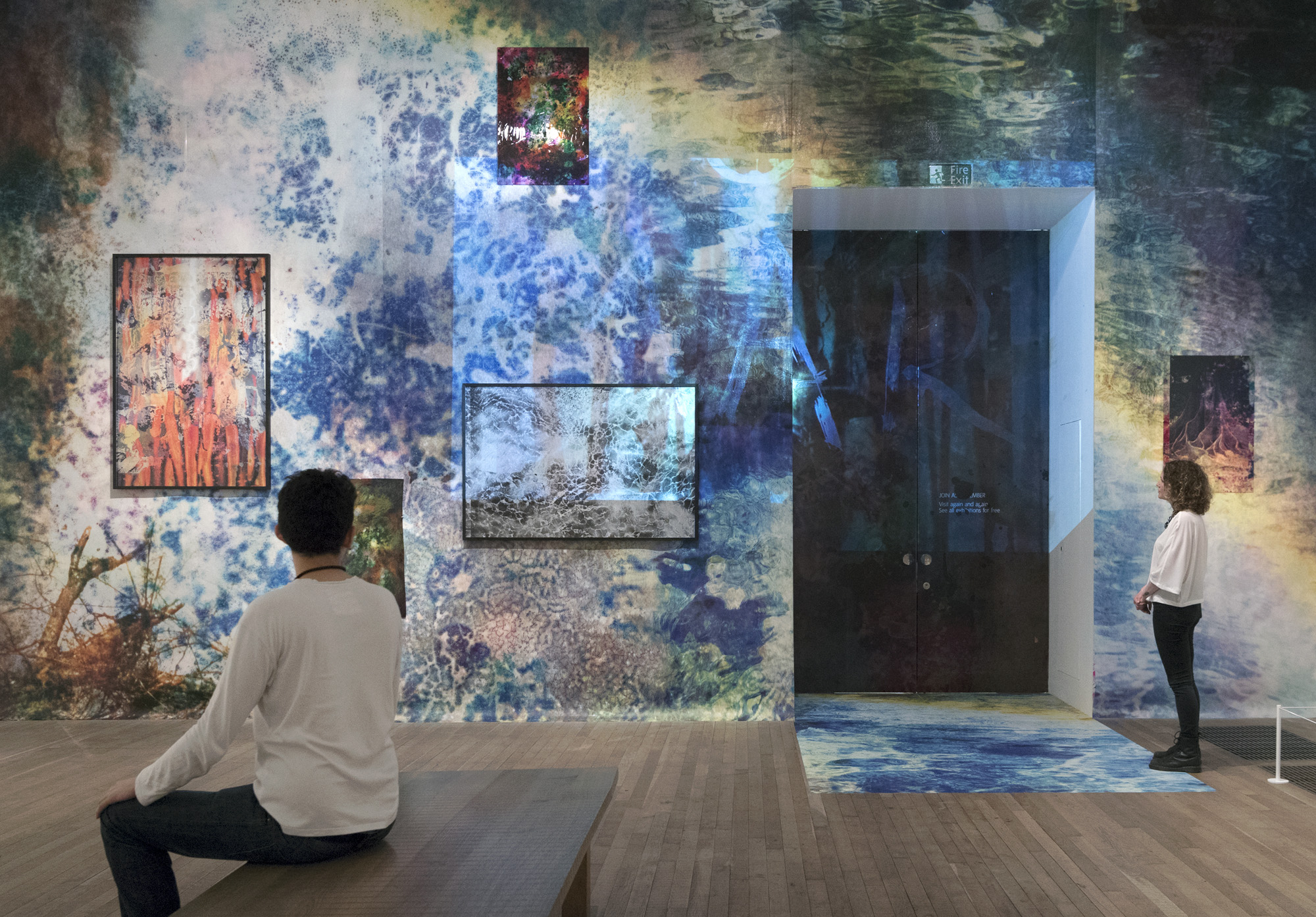
 

Installation view of the exhibition 'Shape of Light: 100 Years of Photography and Abstract Art' at Tate Modern, London showing the installation 'A Rock Is A River', 2018 by the artist Maya Rochat


Installation view of the exhibition Shape of Light: 100 Years of Photography and Abstract Art at Tate Modern, London showing the installation A Rock Is A River, 2018 by the artist Maya Rochat. Courtesy Lily Robert and VITRINE, London | Basel © Maya Rochat
Photo: © Tate / Sepharina Neville
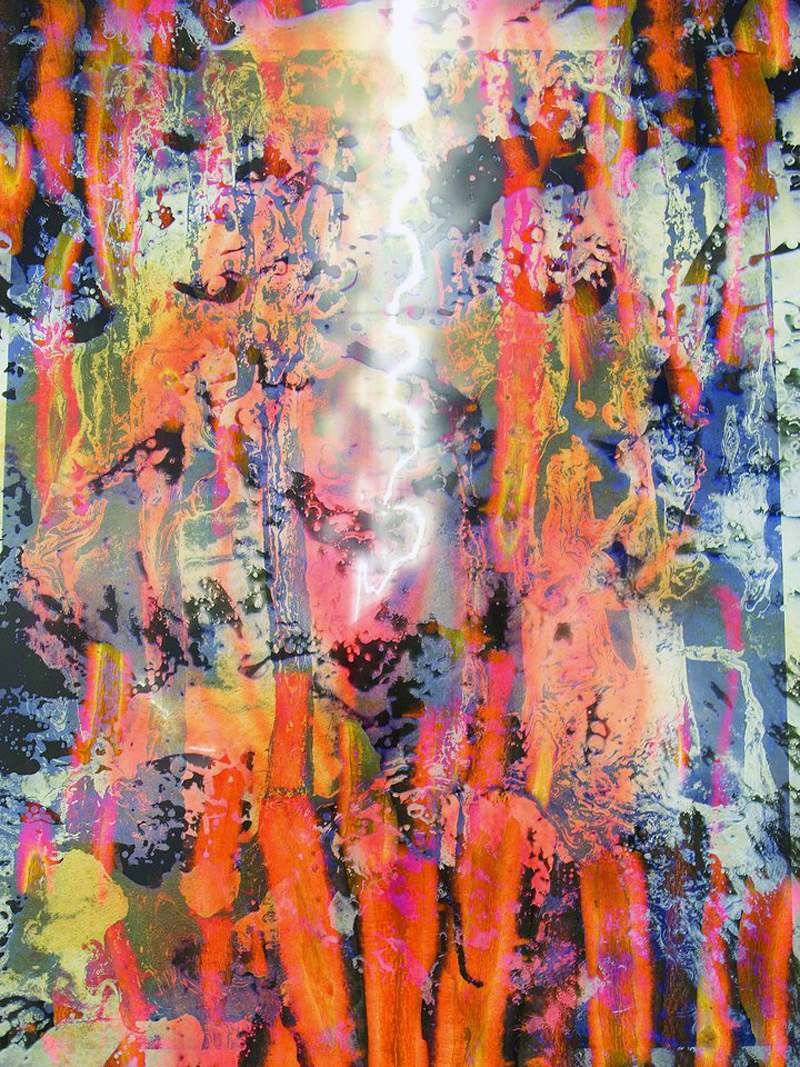
 

Maya Rochat (German, b. 1985) 'A Rock is a River (META CARROTS)' 2017


Maya Rochat (German, b. 1985)
A Rock is a River (META CARROTS)
2017
Courtesy Lily Robert
© Maya Rochat
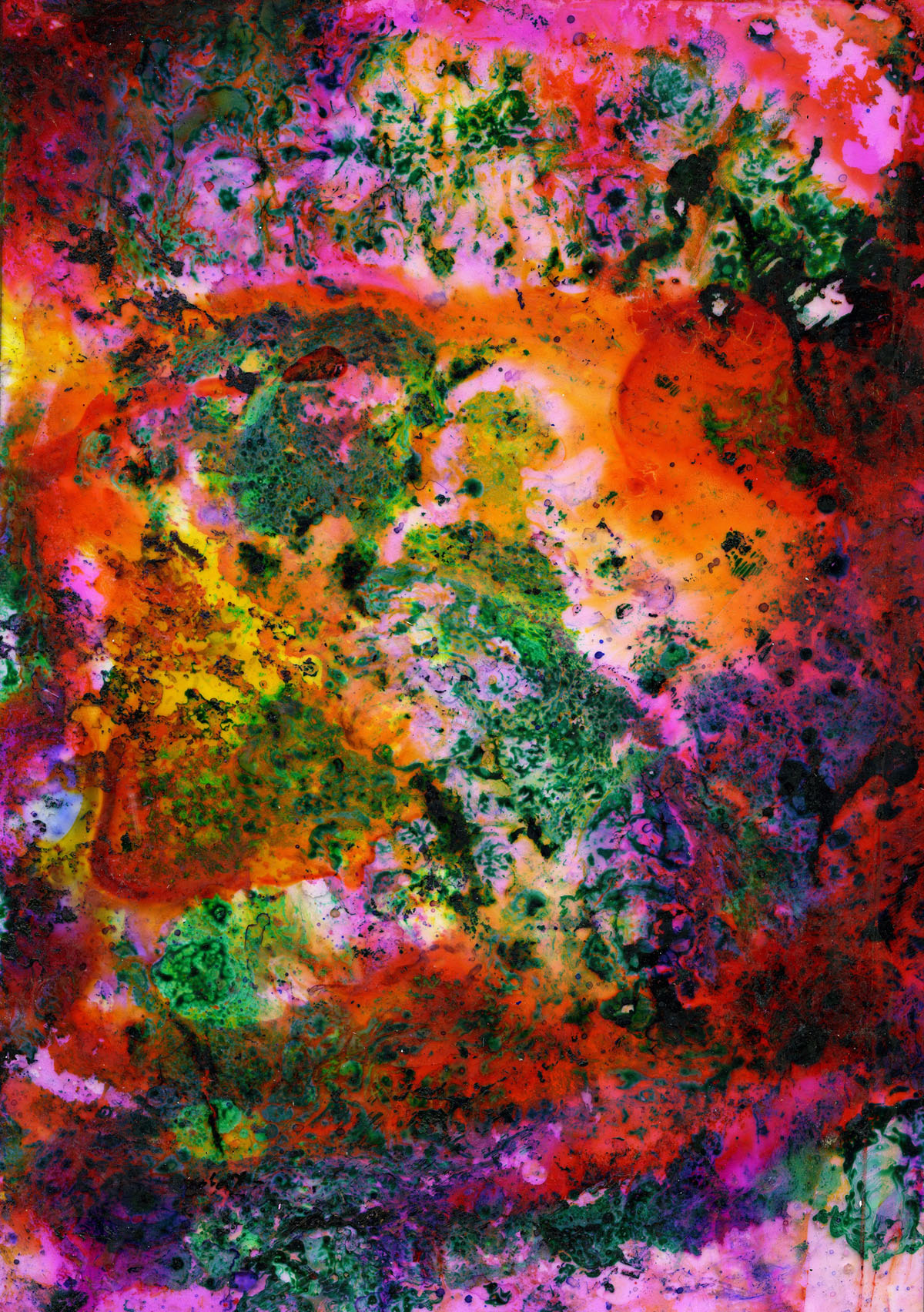
 

Maya Rochat (German, b. 1985) 'A Rock is a River (META RIVER)' 2017


Maya Rochat (German, b. 1985)
A Rock is a River (META RIVER)
2017
Courtesy Lily Robert
© Maya Rochat


Tate Modern
Bankside
London SE1 9TG
United Kingdom

Opening hours:
Daily 10am – 5pm

Tate Modern website

LIKE ART BLART ON FACEBOOK

Back to top

Exhibition: ‘Brett Weston: Significant Details’ at Pasadena Museum of California Art

Exhibition dates: 17th April – 11th September, 2016

Curator: Erin Aitali, PMCA Director of Exhibitions and Registrar


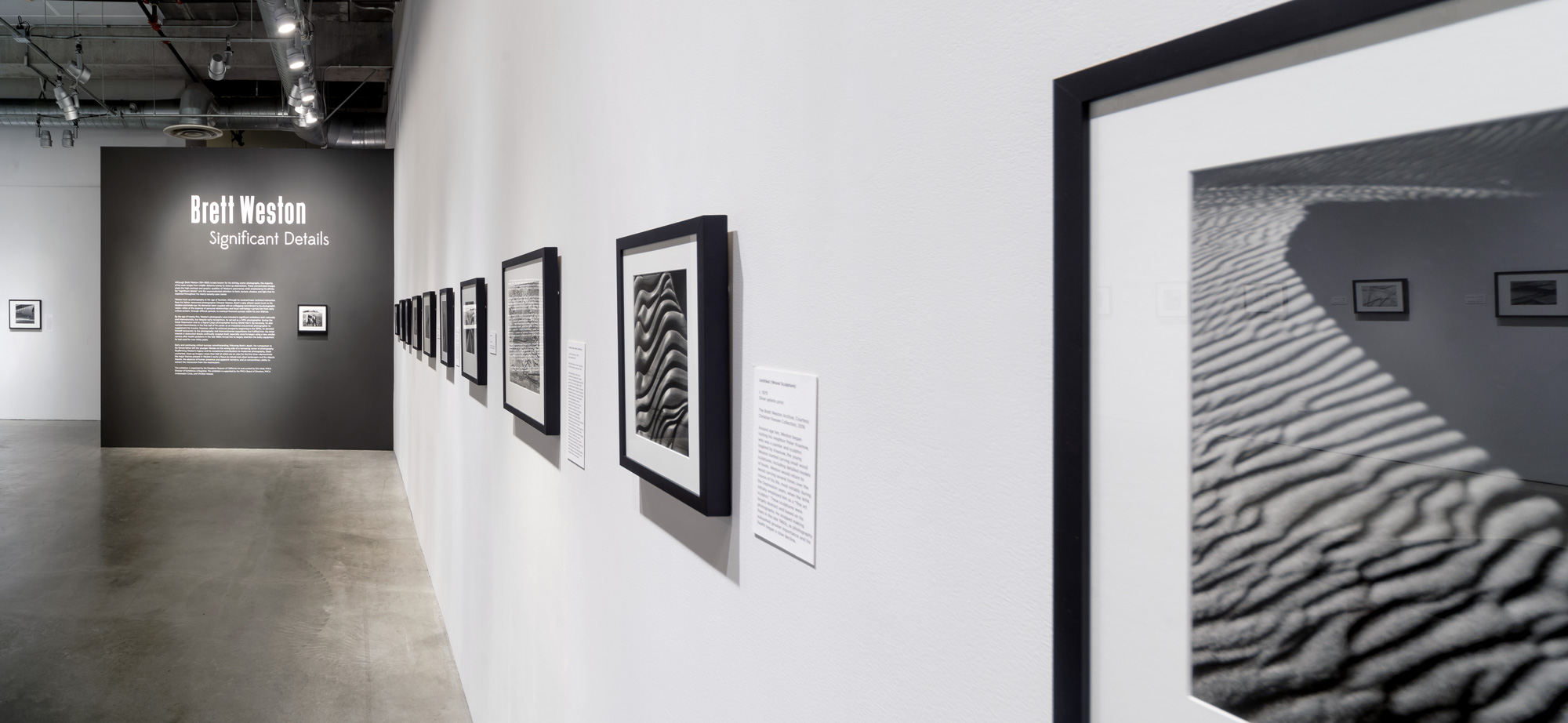
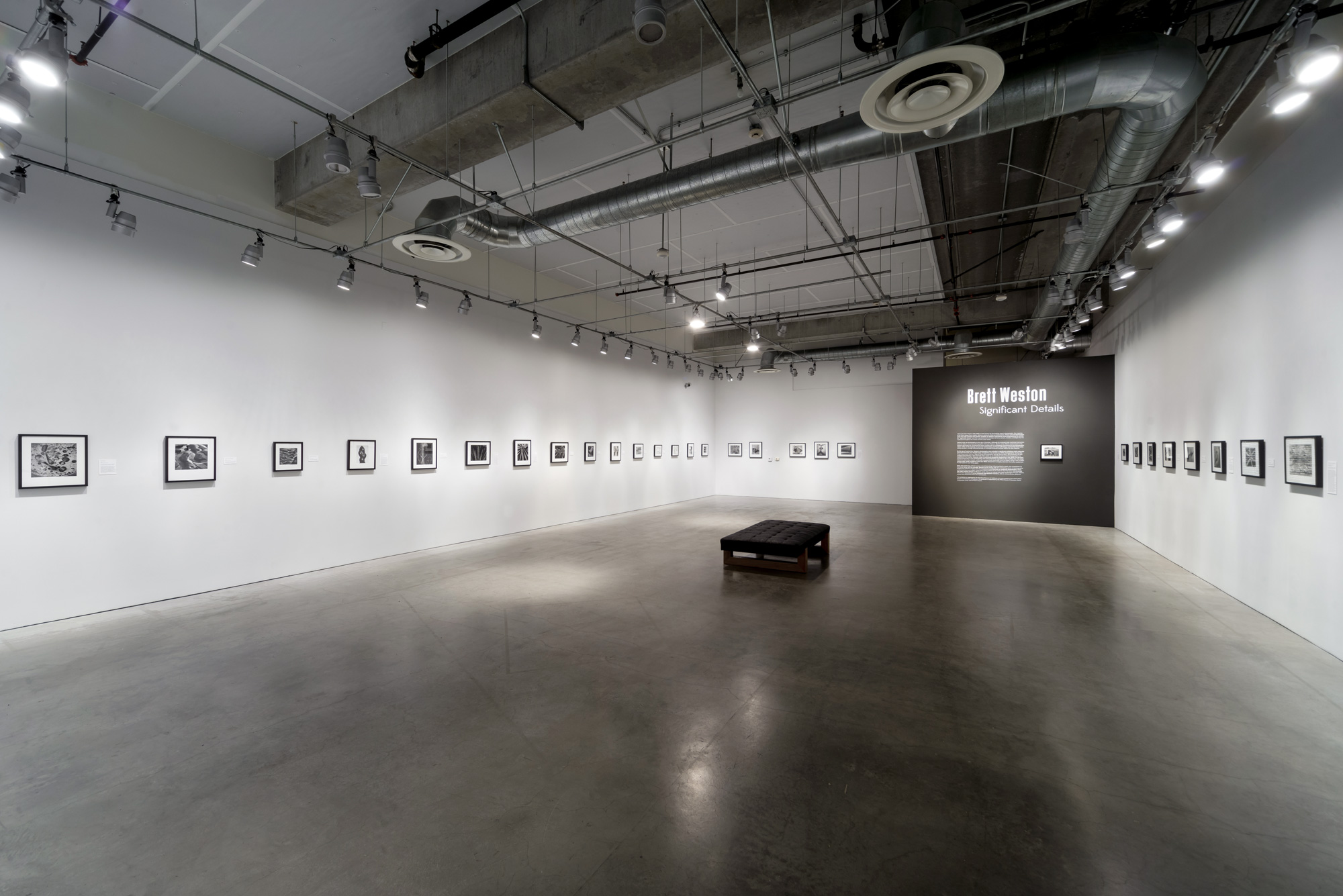
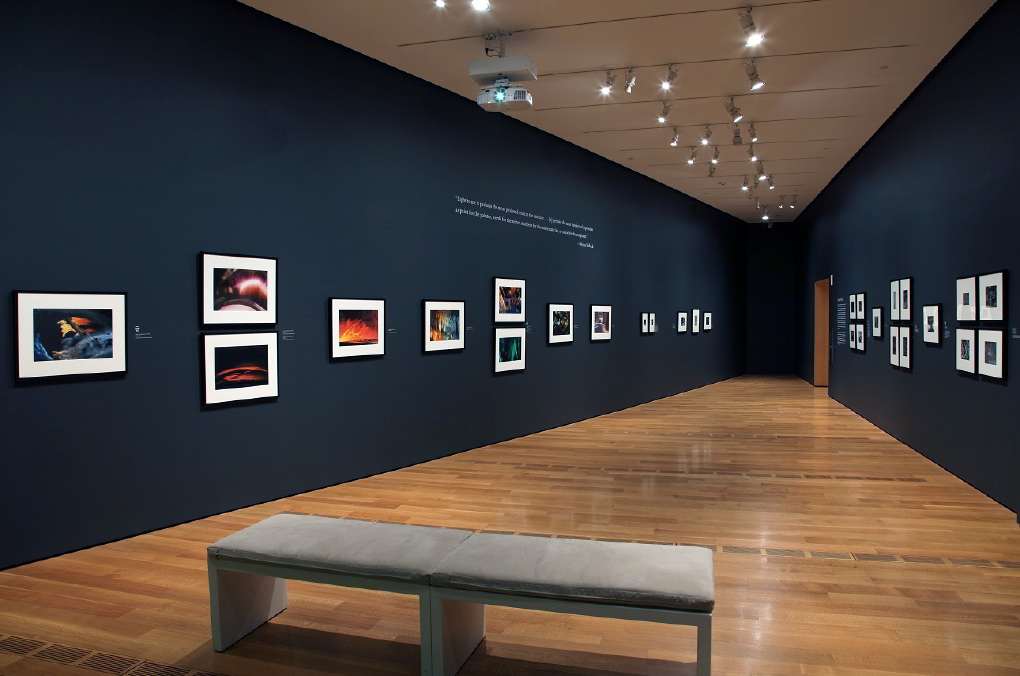
Installation view of the exhibition 'Brett Weston: Significant Details' at the Pasadena Museum of California Art


Installation photographs of the exhibition Brett Weston: Significant Details at the Pasadena Museum of California Art
Photos: © 2016 Don Milici


If your subject is essentially unrecognisable – a defining characteristic of many of Weston’s photographs – devoid of sentimentality, featuring an explosion of geometry as a form of Western expressionism, able to extract the microcosm from the macrocosm through an absence of human presence and apparent narrative – then your previsualisation must be spot on otherwise you loose clear focus as to just what it is you are trying to communicate. It’s all very well being obsessed with capturing the intricacies and rhythms of form, light and shadow, visual poetry in photography, but if that obsession has no ‘feeling’ outcome then you are doomed to failure.

Imagine (if you can) that master of documentary realism Eugène Atget placing his camera in just the wrong position for one of his photographs. The tripod just a little too low, the position a metre to the left of where it should have been. The resulting image would not feel like an Atget, the angles would not feel right, the mixture of objective and subjective would not be present, the magic of his photographs – recognisably his photographs – would be missing. What Atget does so convincingly is to combine the aesthetic with the documentary or representational. As G.H. Saxon Mills observes in his essay ‘Modern photography’ ‘”modern” photography means photography whose aim is partly or wholly aesthetic, as opposed to photography which is merely documentary or representational.’ Atget proves that both were possible within the same frame.

This is not the case with the photographs by Brett Weston in this posting. Although I have commented elsewhere on this website that, “Brett Weston’s pictures are ageing well – the decorative aesthetic seems to have more currency today than previously when the values of his father were predominant,” and admired the reductive minimalism of his photographs … this is not the case with these ‘significant details’. In this instance they are just representation, poor relations to the photographs of Minor White and Aaron Siskind.

I think that the best of his work is very fine – a sort of celebration of all that had gone before with a layer of super-fineness added. However he made many images that were a bit like a preacher rather than an artist. In some of his portfolios the choice of images is just plain weird, catering to the market rather than taking the chance to make a powerful statement. And photography aficionados remain unconvinced by his work, shying away from collecting it. Perhaps they know, or feel a lack of something, some spirit or other, or a seeming unevenness in the quality of his artistic production.

Perhaps it is his printing, which is a bit “Kodak meets EW” in the darkroom (even as his father entrusted him with printing some of his negatives). Weston achieved his good results because he was a careful craftsman, not an experimenter. Someone, I forget who, said that you never looked at his work when desperate for sustenance – and I think a lot of “connoisseurs” think that – and in a Brett Weston you can too often argue yourself out of the celebration. There is a certain dourness that is hard to overcome. I challenge you, now, to say one meaningful thing about any of the images presented here. They take you nowhere. They are either too tightly cropped (that lack of true previsualisation / placing the camera in the wrong position / lack of context) or rely on pattern and representation, and only that, to do the heavy lifting.

My feeling about his work is that he saw and felt many great things that he used in his work – but at the final hurdle, his implementation was always handled a little directly, or not a well as might have been… or is sometimes absent. Perhaps it’s just his viewpoint which seems to be too limited in a psychological sense. If Atget had photographed the city without those magnificent tripod positions and understanding of space, then they would have been dead. That’s how BW’s work sometimes feels. Instead of the space feeling larger than the camera can contain, on occasions his photographs feel enclosed and stilted.

Weston said, “There are a million choices for shot. At its simplest, photography is very complex. So I try to keep it simple and focus on things I can master.”

Sometimes, keeping things simple does not result in preternatural outcomes.

Dr Marcus Bunyan


Many thankx to the Pasadena Museum of California Art for allowing me to publish the photographs in the posting. Please click on the photographs for a larger version of the image.


“My father was driven and so am I. You’re ruthless. You brush off your friends and women. He was much kinder than me. I don’t verbalize well and I don’t socialize much. Too time consuming. And I’m not a good salesman of my work. I love people, but they can be a drain. Some are stimulating; some are leeches. So I seek people on my own terms. Most artists are loners. I guess they have to be.”


Brett Weston


“Weston isn’t really a nature photographer… He was obsessed with capturing the intricacies and rhythms of form, light and shadow. Weston is as fascinated by close-ups of the exfoliating bark of a bristlecone pine or the spikes of a Joshua Tree as he is with the visual poetry of peeling paint on the side-panel of a rusted out truck.”


Jeffrey St. Clair. “A Natural Eye,” on the Counter Punch website, May 25, 2012 [Online] Cited 01/10/2021


Installation view of the exhibition 'Brett Weston: Significant Details' at the Pasadena Museum of California Art

Installation view of the exhibition 'Brett Weston: Significant Details' at the Pasadena Museum of California Art


Installation photographs of the exhibition Brett Weston: Significant Details at the Pasadena Museum of California Art
Photos: © 2016 Don Milici


Although Brett Weston (1911-1993) is best known for his striking scenic photographs, the majority of his work ranges from middle-distance scenes to close-up abstractions. These concentrated images share the high-contrast and graphic qualities of Weston’s panoramas while emphasising his affinity for “significant details” and the unprecedented attention to form, texture, shadow, and light that he explored throughout his nearly-seventy-year career.

Weston took up photography at the age of fourteen. Although he received basic technical instruction from his father, renowned photographer Edward Weston, Brett’s early efforts owed much to his intuition and innate eye. His elemental talent coupled with an unflagging commitment to his photographic vision – often at the expense of personal relationships and fiscal well-being – carried him from early critical acclaim, through difficult periods, to eventual financial success within his own lifetime.

By the age of twenty-five, Weston’s photographs were included in significant exhibitions both nationally and internationally, but despite early recognition he served as a WPA photographer during the Great Depression and as a Signal Corps photographer during World War II. By necessity, he also worked intermittently in the first half of his career as an industrial and portrait photographer. However, when he achieved prosperity beginning in the 1970s, he devoted himself exclusively to the photography and intercontinental expeditions that fulfilled him. His initial interest in abstracted details continually revealed itself, especially once he began using a new, smaller camera after health problems in the late 1960s forced him to abandon the bulky equipment he had used for over thirty years.

Early and continuing critical success notwithstanding, following Brett’s death, the comparison to his famed father left the younger Weston on the wrong side of a narrowing modern canon of photography. Reaffirming Weston’s legacy and his exceptional contributions to modernist photography, these uncharted, close-up images – more than half of which are on view for the first time – demonstrate the major themes present in Weston’s work: a focus on natural and urban landscapes and the objects therein, the absence of human presence and apparent narrative, and an extraordinary ability to extract the microcosm from the macrocosm.

Introduction text from the exhibition


Brett Weston (American, 1911-1993) 'Untitled (Worm Wood, California)' c. 1937 (printed c. 1970) from the exhibition 'Brett Weston: Significant Details' at Pasadena Museum of California Art, April - Sept, 2016


Brett Weston (American, 1911-1993)
Worm Wood, California
c. 1937 (printed c. 1970)
Silver gelatin print
10 1/2 x 13 3/4 inches
The Brett Weston Archive
Courtesy Christian Keesee Collection, 2016


Although Weston’s wife Cicely provided the couple with a steady income, she became pregnant with the pair’s first (and only) child in 1937, providing Weston impetus to generate additional means of support. Hoping to replicate the financial success of Ansel Adams’s portfolio of limited edition original photographs, Weston produced one of his own. His first portfolio San Francisco (1937) consisted of twelve 8 x 10 original prints. Unlike the photograph Staircase, San Francisco (1928) included in this exhibition, the portfolio photos were panoramic vistas. However, without the robust support of a collector like Albert Bender, who both promoted and purchased enough of Adams’s portfolios to assure commercial success, Weston didn’t profit from his portfolio. He lacked not only the promotional skills and collector base but also refused gallery sales owing to his deep distrust and outrage at their commissions.


Brett Weston (American, 1911-1993) 'Wood' 1972 from the exhibition 'Brett Weston: Significant Details' at Pasadena Museum of California Art, April - Sept, 2016


Brett Weston (American, 1911-1993)
Wood
1972
Silver gelatin print
7 1/2 x 8 5/8 inches
The Brett Weston Archive
Courtesy Christian Keesee Collection, 2016


One of the most celebrated and prolific photographers of the twentieth century, Brett Weston (1911-1993) is best known for his striking scenic images, yet the bulk of his work ranges from middle-distance scenes to closeup abstractions. The Pasadena Museum of California Art (PMCA) is proud to present Brett Weston: Significant Details, the first museum exhibition to focus on Weston’s close-up photography. The works – over half of which are on view for the first time – share the high-contrast and graphic qualities of Weston’s panoramic photographs while emphasising the “significant details,” the tendency toward abstraction and extremes in tonality that Weston explored through his nearly 60-year career. The exhibition further contextualises Weston within the pivotal Group f/64 and highlights how intuition and a dedication to photography in its purest form guided his practice.

Although the teaching of his father, famed modernist photographer Edward Weston, was invaluable and his influence undeniable, Weston’s practice was largely shaped by instinct and informal training. He took up photography at the age of 14 when, on an extended trip to Mexico with his father, he started photographing the crew of the SS Oaxaca with the elder Weston’s Graflex camera. This trip also coincided with the end of his formal education; he was enrolled at an English-speaking school, but dropped out within two weeks. While in Mexico, Weston became part of the modernist mileu, socialising with and viewing the work of some of the greatest artists of the time, including David Siqueiros, Diego Rivera, and José Clemente Orozco.

Weston’s professional entry into the world of photography occurred during a shift from the East Coast Pictorialists and their accentuation of romantic effects to the West Coast photographic movement, which coalesced with Group f/64 and their sharp images that captured daily life. Like the members of Group f/64, which included Edward Weston and Ansel Adams, Brett Weston focused primarily on two types of images: close-ups and the scenic view. However, Weston’s approach was distinct, tending toward highly graphic images, with intense areas of dark and highlights, rather than mid-grey tones used by many, including his father.

By the age of 25, Weston’s work had been included in the landmark international photography exhibition Film und Foto and in a solo exhibition at the M. H. de Young Museum in San Francisco. Though he received critical acclaim and  his reputation grew, Weston remained dedicated to art for art’s sake and to creating pure, elemental photographs. He was a simple man and used the same equipment for most of his career. However, when health problems forced him to switch to a smaller camera – the Rollei – in 1968, he further experimented with close-up photographs, and his work became even more intent on exploring specific details and abstract qualities. In Torn Leaf, Hawaii (1978, below), for example, the brittle, curling leaf appears monumental on a black ground. It exists as a singular object, not fully contained within the composition, and the size is indeterminable without context.

The uncharted, close-up images that are the focus of Significant Details demonstrate the major themes present in Weston’s work: a play on scale, the absence of the human presence, and a refrain from imposed order. This exhibition features approximately 40 works taken over a period of 55 years, ranging from 1929 to 1984, and brings to the forefront the unprecedented attention to form, texture, shadow, and light that was the distinctive characteristic of Weston’s oeuvre.

Press release from the Pasadena Museum of California Art


Brett Weston (American, 1911-1993) 'Wall, Europe' 1971


Brett Weston (American, 1911-1993)
Wall, Europe
1971
Silver gelatin print
8 x 10 inches
The Brett Weston Archive
Courtesy Christian Keesee Collection, 2016


In 1971 Brett returned to Europe for the third time. While there, he captured both abstract images, like this one, and panoramas. Notably, this trip resulted in the photograph of Holland Canal, which Weston grew to hate, despite its commercial success or perhaps because of it, “I’m so sick of the thing but people love it. I could retire on sales of this print alone. I’d hate to tell you how many of these I’ve printed.” Although this scenic print wasn’t the legacy Weston desired for himself, it led to an overall increased attention from collectors interested in his work, including his abstractions.


Brett Weston (American, 1911-1993) 'Untitled (Cracked Mud, High Sierra, California)' 1960


Brett Weston (American, 1911-1993)
Cracked Mud, High Sierra, California
1960
Silver gelatin print
8 x 10 inches
The Brett Weston Archive
Courtesy Christian Keesee Collection, 2016


Direct evidence of human presence was rare in Weston’s photos. But here, two playful sets of handprints on the mud provide scale, which would otherwise be indeterminable in the image.


Brett Weston (American, 1911-1993) 'Electrical Towers, Metal' c. 1975


Brett Weston (American, 1911-1993)
Electrical Towers, Metal
c. 1975
Silver gelatin print
8 x 10 inches
The Brett Weston Archive
Courtesy Christian Keesee Collection, 2016


Brett Weston: Significant Details

Brett Weston, born in 1911 in Tropico, CA (now Glendale), took up photography at the age of fourteen while on an extended trip to Mexico with his father, famed photographer Edward Weston. In Mexico for just over a year, his time there was pivotal in many ways, not only marking the start of his photography career, but also the end of his formal education. His father allowed him to drop out of the international school after two short weeks and provided the younger Weston with basic instructions in photography. Still, Brett relied heavily on his innate sensibilities toward form and tonality, evident in Tin Roof, Mexico, an early photograph from 1926 featuring a cropped view of a jagged roofline with dramatic dark shadows splitting the image. Weston also benefited from a social education of sorts. Through connections of his father’s mistress, photographer Tina Modotti, Weston became a part of the Mexican modernist milieu, socialising with and viewing the work of some of the greatest artists of the time, including Frida Kahlo, Diego Rivera, José Clemente Orozco, and David Alfaro Siqueiros.

During his nearly-seventy-year career, Weston’s talent and unique vision developed into two related types of works, panoramic landscapes and abstracted close-ups. The image most associated with Weston was and probably still is Holland Canal from 1971. The photograph of a tree-lined canal with still water reflecting a flawless image of the surrounding landscape is sensual and magnificently balanced. However, the photographer bemoaned his connection to this particular work and its extreme popularity saying, “I’m so sick of the thing, but people love it.” Although this print and other panoramic images, such as Mendenhall Glacier, Alaska (1973), came to typify his work in the public’s mind, the bulk of Weston’s photographs range from middle-distance scenes to close-ups, which became increasingly abstract beginning in the 1950s. Brett Weston: Significant Details focuses on the close-up works that epitomise his unique and unwavering vision. These images share the high-contrast and graphic qualities of Weston’s well-known scenic photographs while emphasising what the photography historian Beaumont Newhall characterised as his affinity for “significant details.” Weston applied this penchant for details to natural and urban environments alike. Another early image, Stairway, Grandview Park, San Francisco from 1928, offers a fragmented view of a San Francisco stairwell. Without context, the unpopulated image’s narrative possibilities are limited; instead, the emphasis is on the orderly, graphic form of the staircase.

From the beginning of his career, Weston’s work was celebrated by institutions and peers. The year following Stairway, Weston’s work was included in the landmark 1929 German photography exhibition Film und Foto, and the early 1930s saw his association with Group f/64, a distinctly West Coast movement of “straight” photographers (as opposed to the East Coast Pictorialist tradition, which was waning at this time) that comprised Ansel Adams, Imogen Cunningham, Edward Weston, and others. Brett’s work appeared in their 1932 inaugural exhibition at the M.H. de Young Memorial Museum in San Francisco. The following year, both San Francisco Stairway and Tin Roofs (presumably the same works discussed in this essay) were included with forty-three other photographs in a solo exhibition at the de Young.

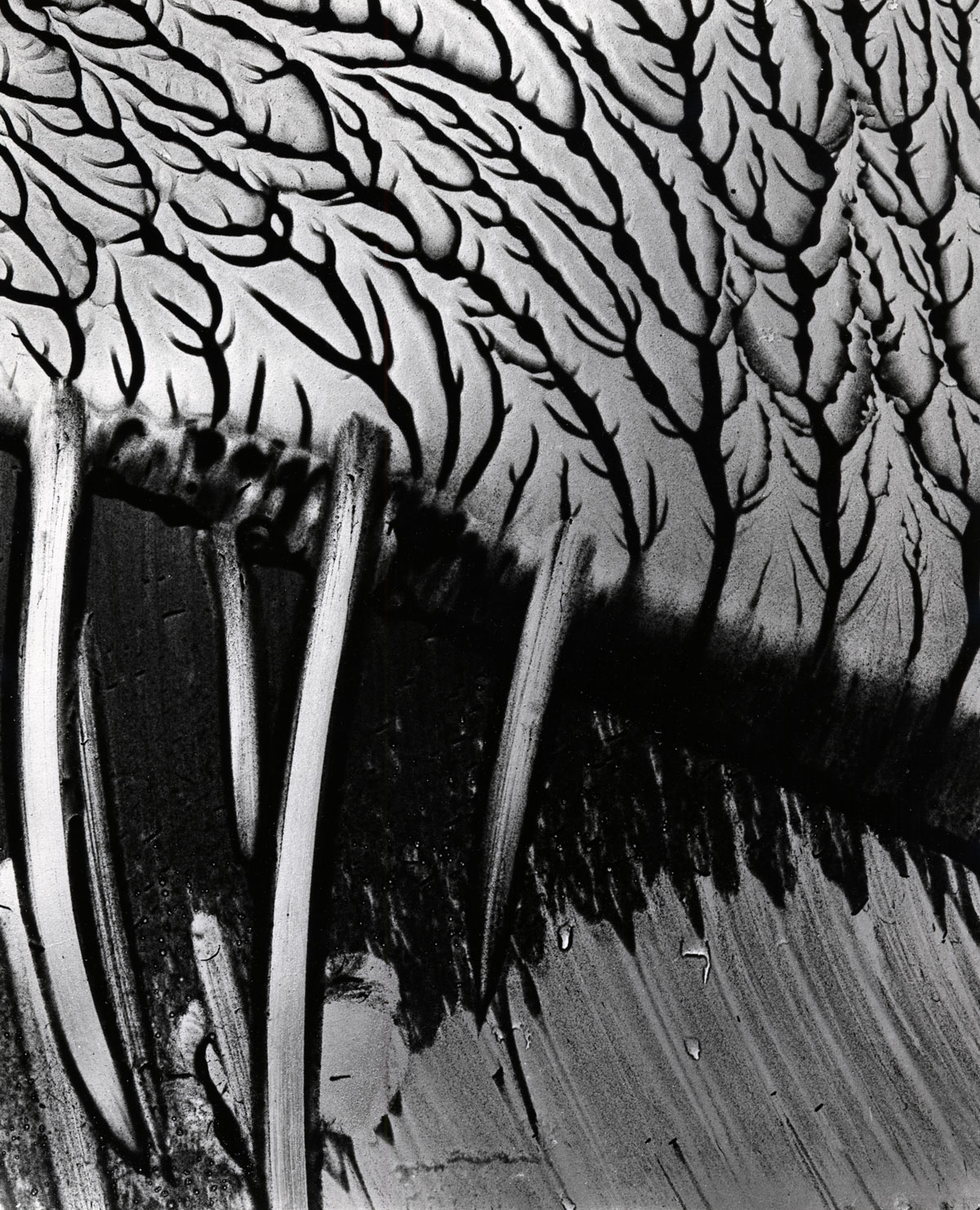
Although Weston saw early success with his work included in major exhibitions, this did not translate into a steady income. Like most artists during the Great Depression, the Federal Art Project – a branch of the Works Progress Administration – employed Weston, first as a sculptor and then later as a photographer. He quit the FAP in December of 1936 after about two and half years because he had no passion for the documentary nature of the work and it impinged upon time for his personal projects, something that he could not bear for long. Throughout the thirties and forties, he worked intermittently – and discontentedly – as a portrait and industrial photographer to stave off poverty and support his daughter who was born in 1938. In complete contrast to the realistic, documentary style of his FAP and commissioned works, an untitled photograph from 1937 is an extreme close-up of paint that is almost organic in appearance, with leaf-like veins in the upper portion of the image. The subject is essentially unrecognisable, which is a defining characteristic of many of Weston’s photographs.

The slim Depression years segued into the tumultuousness of World War II, during which Weston served in the US Army before a much-requested transfer to the US Signal Corps stationed him to work as a photographer in New York. At the end of the war, when Brett returned to Carmel, CA, where the Weston family had made their long-time home, he found his father beginning to show marked symptoms of Parkinson’s disease, which would increasingly debilitate the elder Weston in the last decade of his life. Before Edward’s death in 1958, he enlisted his sons Brett and Cole and a small group of trusted assistants to secure his lasting legacy by making thousands of prints under his supervision. In addition to printing work for his father, during this time, Brett also worked on his Guggenheim fellowship project and his second and third portfolios, White Sands (1949) and New York (1954).

Besides photographing the beaches of Carmel, one of which was dubbed “Weston Beach,” Brett also traveled up and down the California coast countless times over the decades. He repeatedly returned to capture the dunes of Oceano, and these images range from sweeping vistas to striking abstractions. An image from 1952, Dune, Oceano, although not technically a detail, falls into the latter category. The dunes appear wave-like and swirling, and a dark, somewhat-menacing shadow at the centre – similar to the roofline image taken in Mexico – provides graphic force. Jellyfish, California, another beach image, taken in 1967, is a close-up of one of the bulbous marine animals washed ashore. In contrast to the ethereal and weightless appearance jellyfish take underwater, it looks monumental and grotesquely beautiful. The curving form expands beyond the picture’s boundaries and in place of luminescence is a gradation of pure white reflections to jet-black striated patterns on the bell.

Although the tendency to work close-up had always been present in Weston’s work, it became much more pronounced and obvious after health issues necessitated a change in camera equipment. For over thirty years, Weston worked with a large format 8 x 10 camera and preferred contact prints (versus enlarging from smaller negatives). However, a heart attack in 1967 and an ongoing battle with angina forced Weston to switch to a smaller camera because he could no longer manage the bulky equipment. In 1968, he began using the Rollei SL-66 almost exclusively. The camera used roll film that produced small, square negatives and allowed the artist to work close-up with ease. As a result, his work became even more intent on exploring specific elements and abstract qualities. Sand and Kelp from around 1970 is a lyrical example of this. Individual grains of sand are visible and marked by traces of implied movement, both in the dancing shadows of the kelp and the trailing patterns lightly indented into the surface.

While Weston had traveled steadily and as often as he could afford to in his younger years – expeditions that included Europe, Japan, the Pacific Northwest, Baja California, and Mexico – his later years were spent primarily in Hawaii. The tropical climate was beneficial for his health, and the varied terrain provided limitless visual appeal. In 1979, the photographer purchased land there on the slopes of a volcanic mountain. He became especially engrossed with the lava formations and the verdant and spectacular plant life, which he photographed until his death in 1993.

Weston achieved, within his lifetime, the recognition and financial comforts of a highly esteemed photographer. Even so, following his death, Brett’s reputation was eclipsed in favour of his father, due in part to the notion that there wasn’t room for two Westons in the canon of modernist photography. The 2008 exhibition Out of the Shadow (Oklahoma City Museum of Art and The Phillips Collection) and his biography A Restless Eye (2011) have begun to remedy this situation. Significant Details furthers that work by centring on the uncharted, closeup images that characterise Weston’s innate and distinctive eye. These photographs reveal the major themes present in his oeuvre: a focus on natural and urban landscapes and the objects therein, the absence of human presence and apparent narrative, and an extraordinary ability to extract the microcosm from the macrocosm.

Erin Aitali, Director of Exhibitions and Registrar


Brett Weston (American, 1911-1993) 'Broken Glass, California' 1954


Brett Weston (American, 1911-1993)
Broken Glass, California
1954
Silver gelatin print
8 x 10 inches
The Brett Weston Archive
Courtesy Christian Keesee Collection, 2016


Brett Weston (American, 1911-1993) 'Torn Leaf, Hawaii' 1978


Brett Weston (American, 1911-1993)
Torn Leaf, Hawaii
1978
Silver gelatin print
10 3/4 x 12 inches
The Brett Weston Archive
Courtesy Christian Keesee Collection, 2016


Brett Weston (American, 1911-1993) 'Jellyfish, California' 1967


Brett Weston (American, 1911-1993)
Jellyfish, California
1967
Silver gelatin print
7 5/8 x 9 5/8 inches
The Brett Weston Archive
Courtesy Christian Keesee Collection, 2016


Brett Weston (American, 1911-1993) 'Cracked Paint' 1937 (printed later)


Brett Weston (American, 1911-1993)
Cracked Paint
1937 (printed later)
Silver gelatin print
12 1/2 x 10 1/8 inches
The Brett Weston Archive
Courtesy Christian Keesee Collection, 2016


Like Broken Glass, California (1954, above), this image of cracked paint is an extreme close-up to the point that the subject is indistinguishable. Instead pure form becomes the focus. This intense focus also characterises Weston’s approach to life; he prioritised his photography above all else, often at the expense of both financial stability and personal relationships (he was married four times and had countless lovers).

In 1937 Weston was living with his first wife, Cicely, in San Francisco who was employed as a violinist in the WPA symphony. Weston had recently quit the WPA because, as he explained in a letter to his father in December 1936, “It has been a good thing in many ways but after 2 1/2 years I feel that I have had enough experience of this kind. I feared it was beginning to tell on me as well as my work. I would rather divorce, starve, anything, than have this happen. The actual work I’ve been doing for the work program has been child’s play but the sacrifice of one’s priceless days… has become too much.”


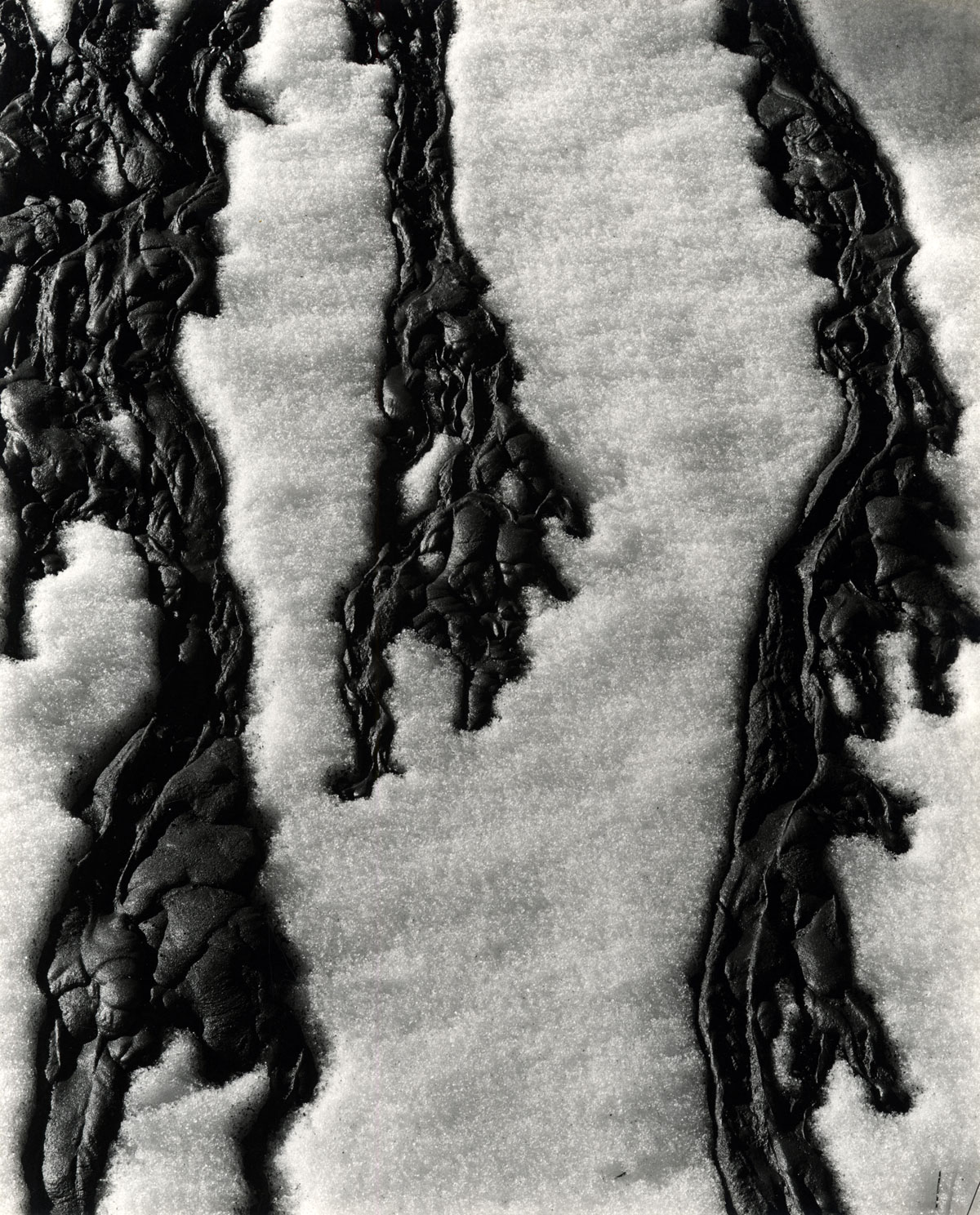
Brett Weston (American, 1911-1993) 'Snow' 1954


Brett Weston (American, 1911-1993)
Snow
1954
Silver gelatin print
9 1/2 x 7 5/8 inches
The Brett Weston Archive
Courtesy Christian Keesee Collection, 2016


Pasadena Museum of California Art

This museum closed in October 2018

LIKE ART BLART ON FACEBOOK

Back to top

Exhibition: ‘Light, Paper, Process: Revolutionizing Photography’ at the J. Paul Getty Museum, Getty Center, Los Angeles

Exhibition dates: 14th April – 6th September 2015


Man Ray (Emmanuel Radnitsky) (American, 1890-1976) 'Untitled (Smoke)' 1928


Man Ray (Emmanuel Radnitsky) (American, 1890-1976)
Untitled (Smoke)
1928
Gelatin silver print
24.6 x 19.8cm (9 11/16 x 7 13/16 in.)
The J. Paul Getty Museum, Los Angeles
© Man Ray Trust ARS-ADAG


These days, photography can be anything your imagination, concept and process desires…

Whether that makes for interesting / lasting (ie. memorable) / good, (post)photographic outcomes is up to you to decide.

Marcus


Many thankx to the J. Paul Getty Museum for allowing me to publish the photographs in the posting. Please click on the photographs for a larger version of the image.


Chargesheimer (Karl Heinz Hargesheimer) (German, 1924-1971) 'Picturesque' 1949


Chargesheimer (Karl Heinz Hargesheimer) (German, 1924-1971)
Picturesque
1949
Gelatin silver print
49.5 x 39.6cm (19 1/2 x 15 9/16 in.)
The J. Paul Getty Museum, Los Angeles
© Museum Ludwig, Cologne


Henry Holmes Smith (American, 1909-1986) 'Man and Woman' 1976


Henry Holmes Smith (American, 1909-1986)
Man and Woman
1976
Dye imbibition print
33.2 x 26.2cm (13 1/16 x 10 5/16 in.)
The J. Paul Getty Museum, Los Angeles, Gift of the Smith Family Trust
© J. Paul Getty Trust


Edmund Teske (American, 1911-1996) 'Leaves on Glass, Topanga Canyon, California' 1952; print 1960s


Edmund Teske (American, 1911-1996)
Leaves on Glass, Topanga Canyon, California
1952; print 1960s
Gelatin silver duotone solarized print
35.4 x 27.9cm (13 15/16 x 11 in.)
The J. Paul Getty Museum, Los Angeles
© Edmund Teske Archives/Laurence Bump and Nils Vidstrand, 2001


Alison Rossiter (American, b. 1953) 'Gevaert Gevarto 47, exact expiration date unknown, about 1960s, processed 2013 (#37)' 2013


Alison Rossiter (American, b. 1953)
Gevaert Gevarto 47, exact expiration date unknown, about 1960s, processed 2013 (#37)
2013
Four gelatin silver print
Each image: 10.8 x 8.3cm (4 1/4 x 3 1/4 in.)
Courtesy of the artist and Yossi Milo Gallery, New York
© Alison Rossiter


Chris McCaw (American, b. 1971) 'Sunburned GSP #202 (San Francisco Bay)' 2008


Chris McCaw (American, b. 1971)
Sunburned GSP #202 (San Francisco Bay)
2008
Gelatin silver print
37.5 x 47.6cm (14 3/4 x 18 3/4 in.)
Santa Barbara Museum of Art, Museum Purchase
© Chris McCaw


Pierre Cordier (Belgian, b. 1933) 'Chemigram II' 1976


Pierre Cordier (Belgian, b. 1933)
Chemigram II
1976
Gelatin silver print
23.8 x 17.9cm (9 3/8 x 7 1/16 in.)
The J. Paul Getty Museum, Los Angeles
© 2015 Artists Rights Society (ARS), New York / SABAM, Brussels


From its very beginnings in the 19th century, photography has been shaped by the desire of the artist to continually explore and expand its possibilities through experimentation. Taking that spirit of invention and discovery as a point of departure, some artists today have chosen to distill photography to its most essential components of light-sensitivity and the chemical processing of photographic papers, challenging viewers to see the medium anew. Light, Paper, Process: Reinventing Photography, on view at the Getty Center April 14-September 6, 2015, features the work of seven contemporary artists – Alison Rossiter, Marco Breuer, James Welling, Lisa Oppenheim, Chris McCaw, John Chiara, and Matthew Brandt – all of whom have created inventive photographs that reveal aspects of their making (or unmaking).

The artists in the exhibition utilize an extensive array of practices – often achieved through trial and error, accident, or chance – that shift the understanding of photography from a medium that accurately records the world to one that revels in its materiality. Whether they use handmade cameras or none at all, work with expired papers or toxic chemicals, the images remain latent until processed, fixed, or otherwise coaxed from the paper.

“Each of the artists in this exhibition engages in some way with the process by which the photographic medium captures and transmutes light into a two-dimensional image on paper,” says Timothy Potts, director of the J. Paul Getty Museum. “But rather than seeing this process as something to be ‘perfected,’ or even neutralised, they exploit its ability to be manipulated and deconstructed, thus collapsing process and product into a single creative activity. I am particularly pleased that the Getty Museum Photographs Council has provided funds to acquire works by Matthew Brandt, Marco Breuer, John Chiara, and Allison Rossiter for our permanent collection that are included in the exhibition.”

The exhibition begins with an overview of 20th-century practices that were experimental in nature, featuring works by Man Ray, László Moholy-Nagy, Nathan Lerner, Edmund Teske, and others. The renewed interest of artists of this period in techniques such as camera-less photograms, chemigrams, and solarisation serves as inspiration for today’s artists. Each of the subsequent galleries in the Getty Museum’s Center for Photographs will be dedicated to the work of one of the seven featured contemporary artists, and follows a progression from abstract, camera-less works to representative images made with custom-built cameras.

“This exhibition is an excellent opportunity to feature the work of living artists alongside earlier photographs from our permanent collection,” says Virginia Heckert, department head of the Getty Museum’s Department of Photographs and curator of the exhibition. “By focusing on work of a more experimental nature, visitors will be reminded that the exploration of materiality and process has been an important aspect of photography since its inception and continues to motivate and inspire artists working with the medium today.”

Alison Rossiter (American, born 1953) takes a minimalist approach to the materials she uses to create her photographic works. She does not use a camera, film, or light, but instead only uses unprocessed sheets of expired gelatin silver paper and photographic chemicals in the darkroom. Through the simple acts of immersing or dipping a sheet of paper in developer or pouring and pooling developer onto the paper’s surface, she achieves a rich array or results. Some suggest faint impressions of primitive mark-making, others resemble landscapes, and still others call to mind abstract painting of the mid-20th-century.

Working since the early 1990s without a camera or film, Marco Breuer (German, born 1966) subjects light-sensitive paper to various acts that abrade, burn, or scrape away the emulsion layer. Completely nonrepresentational, his “photographs” look like no others; they elicit the hues and textures of rare metals, mineral deposits, or oil spills, and display marks ranging from fine incisions and abrasions to scar-like burns and gashes. His deliberate misuse of black-and-white and photographic papers is the starting point for a negotiation between the paper as recording material, the hand, and the tools employed.

James Welling (American, born 1951) spent the first ten years of his career exploring painting, sculpture, performance art, video art, conceptual art, and installation before he committed to thinking of himself as a photographer. For the past four decades, he has explored photography, from documentary to experimental, with and without a camera, using black-and-white, colour, and Polaroid films and papers, as well as digital files and printing. Since 1995 he has worked increasingly with colour, filters, and camera-less photography. Three bodies of recent work presented in the exhibition include variations on the photogram, chemigram, and printing-out process.

Influenced by her background in structural/materialist filmmaking, Lisa Oppenheim (American, born 1975) is interested in exploring the ways in which a photograph can record both its subject and the process by which it was made. In three bodies of work dating from 2010 to present, she enlists the very entities depicted in the negatives – the sun, the moon, and smoke / fire – in the act of exposing them. Although they sound scientific, the titles of two of these bodies of work, Heliograms and Lunagrams, are made up, combining the name of the camera-less photogram technique and the source of light by which the enlarged negatives have been contact-printed.

Chris McCaw (American, born 1971) establishes an immediate, visceral relationship between his subject, the sun, and his process, which involves loading photographic paper directly into the camera. The photographs in his Sunburn series record the sun’s movement, which literally sears its path into the paper in the form of dots, lines, or arcs, depending on its position, the weather conditions, and the length of the exposure(s). McCaw uses customised cameras outfitted with vintage military lenses pointed directly at the sun to function like a magnifying glass that burns through the emulsion layer and paper base, leaving behind singe marks and solarised passages.

John Chiara’s (American, born 1971) large-scale colour prints convey a hands-on – rather than pristine, mechanised – aesthetic. For the past decade his subjects have been both uninhabited landscapes and the built environment. He works with large custom-built cameras that he loads with colour photographic paper that he then processes himself by pouring chemicals into a six-foot-long section of PVC sewer pipe, sealing the tube, and then rolling it back and forth on the floor. Irregular streaks and drips characterise his prints, as do areas of overexposure and underexposure, flare from light leaks, and unevenly saturated colours.

Matthew Brandt (American, born 1982) has created diverse bodies of work, some of which are realised with photographic means and others that are more tangentially related to photographic images, techniques, or ideas. He may begin with a photograph that he has made with a 4 x 5-inch view camera, a digital camera, or his iPhone, one that he has sourced from archives in public libraries, or one that he has clicked and dragged from Ebay. His fascination with early photographic processes has led him to experiment with salted paper prints, gum bichromate prints, and heliographs, examples of which will be on view. Brandt’s interest in both photographic/visual and the physical/material forms of representation has led him to bring the two together, incorporating physical elements from his subjects into his photographic representations of them.

Light, Paper, Process: Reinventing Photography, is on view April 14-September 6, 2015 at the J. Paul Getty Museum, Getty Center. The exhibition is curated by Virginia Heckert, department head of the Museum’s Department of Photographs. A related publication of the same title will be produced by Getty Publications.

Press release from the J. Paul Getty Museum website


Alison Rossiter (American, b. 1953) 'Haloid Platina, exact expiration date unknown, about 1915, processed 2010' 2010


Alison Rossiter (American, b. 1953)
Haloid Platina, exact expiration date unknown, about 1915, processed 2010
2010
Gelatin silver print
Image (each): 21.6 x 16.5cm (8 1/2 x 6 1/2 in.)
The J. Paul Getty Museum, Los Angeles, Purchased with funds provided by the Photographs Council
© Alison Rossiter


Alison Rossiter (American, b. 1953) 'Fuji gaslight, exact expiration date unknown, about 1920s, processed 2010' 2010


Alison Rossiter (American, b. 1953)
Fuji gaslight, exact expiration date unknown, about 1920s, processed 2010
2010
Gelatin silver print
30.5 x 25.4cm (12 x 10 in.)
The J. Paul Getty Museum, Los Angeles, Purchased with funds provided by the Photographs Council
© Alison Rossiter


Alison Rossiter (American, b. 1953) 'Kilbourn Acme Kruxo, exact expiration date unknown, about 1940s, processed 2013' 2013


Alison Rossiter (American, b. 1953)
Kilbourn Acme Kruxo, exact expiration date unknown, about 1940s, processed 2013
2013
Gelatin silver print
12.7 x 17.8cm (5 x 7 in.)
The J. Paul Getty Museum, Los Angeles, Purchased with funds provided by the Photographs Council
© Alison Rossiter


Marco Breuer (German, b. 1966) 'Untitled (Heat/Gun)' 2001


Marco Breuer (German, b. 1966)
Untitled (Heat/Gun)
2001
Gelatin silver paper, burned
27.9 x 21.6cm (11 x 8 1/2 in.)
The J. Paul Getty Museum, Los Angeles, Purchased with funds provided by the Photographs Council
© Marco Breuer


Marco Breuer (German, b. 1966) 'Untitled (C-62)' 2002


Marco Breuer (German, b. 1966)
Untitled (C-62)
2002
Chromogenic paper, exposed and abraded
35.6 x 27.9cm (14 x 11 in.)
Courtesy of the artist and Yossi Milo Gallery, New York
© Marco Breuer


Marco Breuer (German, b. 1966) 'Spin (C-824)' 2008


Marco Breuer (German, b. 1966)
Spin (C-824)
2008
Chromogenic paper, embossed and scratched
34.6 x 27cm (13 5/8 x 10 5/8 in.)
The J. Paul Getty Museum, Los Angeles, Purchased with funds provided by the Photographs Council
© Marco Breuer


James Welling (American, b. 1951) 'Water' 2009


James Welling (American, b. 1951)
Water
2009
Chromogenic print
60.3 x 50.2cm (23 3/4 x 19 3/4 in.)
Courtesy of the artist and Regen Projects, Los Angeles
© James Welling


James Welling (American, b. 1951) 'Water' 2009


James Welling (American, b. 1951)
Water
2009
Chromogenic print
58.7 x 49.5cm (23 1/8 x 19 1/2 in.)
Courtesy of the artist and Regen Projects, Los Angeles
© James Welling


James Welling (American, b. 1951) 'Chemical' 2013


James Welling (American, b. 1951)
Chemical
2013
Chemigram on chromogenic paper
35.6 x 27.9cm (14 x 11 in.)
Courtesy of the artist and David Zwirner, New York/London
© James Welling


Lisa Oppenheim (American, b. 1975) 'Heliograms July 8, 1876 / October 16, 2011' 2011


Lisa Oppenheim (American, b. 1975)
Heliograms July 8, 1876 / October 16, 2011
2011
Gelatin silver print exposed with sunlight, toned
30 x 27.9cm (11 13/16 x 11 in.)
The J. Paul Getty Museum, Los Angeles
© Lisa Oppenheim


Lisa Oppenheim (American, b. 1975) 'A Handley Page Halifax of No. 4 Group flies over the suburbs of Caen, France, during a major daylight raid to assist the Normandy land battle. 467 aircraft took part in the attack, which was originally intended to have bombed German strongpoints north of Caen, but the bombing area was eventually shifted nearer the city because of the proximity of Allied troops to the original targets. The resulting bombing devastated the northern suburbs, 1944/2012' 2012


Lisa Oppenheim (American, b. 1975)
A Handley Page Halifax of No. 4 Group flies over the suburbs of Caen, France, during a major daylight raid to assist the Normandy land battle. 467 aircraft took part in the attack, which was originally intended to have bombed German strongpoints north of Caen, but the bombing area was eventually shifted nearer the city because of the proximity of Allied troops to the original targets. The resulting bombing devastated the northern suburbs, 1944/2012
2012
Gelatin silver print
Framed (approx.): 71.1 x 86.4 cm (28 x 34 in.)
Overall: Five gelatin silver prints (photograms)
Overall (approx.): 24 × 110″ (61 × 279.4 cm)
The Museum of Modern Art, New York. Fund for the Twenty-First Century
Digital Image © The Museum of Modern Art / Licensed by SCALA / Art Resource, NY
© Lisa Oppenheim


Lisa Oppenheim (American, b. 1975) 'A Handley Page Halifax of No. 4 Group flies over the suburbs of Caen, France, during a major daylight raid to assist the Normandy land battle. 467 aircraft took part in the attack, which was originally intended to have bombed German strongpoints north of' 2012 (detail)


Lisa Oppenheim (American, b. 1975)
A Handley Page Halifax of No. 4 Group flies over the suburbs of Caen, France, during a major daylight raid to assist the Normandy land battle. 467 aircraft took part in the attack, which was originally intended to have bombed German strongpoints north of Caen, but the bombing area was eventually shifted nearer the city because of the proximity of Allied troops to the original targets. The resulting bombing devastated the northern suburbs, 1944/2012 (detail)
2012
Gelatin silver print
Framed (approx.): 71.1 x 86.4 cm (28 x 34 in.)
Overall: Five gelatin silver prints (photograms)
Overall (approx.): 24 × 110″ (61 × 279.4 cm)
The Museum of Modern Art, New York. Fund for the Twenty-First Century
Digital Image © The Museum of Modern Art / Licensed by SCALA / Art Resource, NY
© Lisa Oppenheim


Oppenheim produces experimental films and photograms (photographs made without a camera). In Smoke and related works she uses the techniques of documentary photography to call the premises of the genre into question. She begins with the photo-sharing site Flickr, as a source for images of fire caused by natural or industrial disasters or bombing attacks (such as those over occupied France during World War II), and outputs segments of these pictures to create digital negatives. She then exposes photographic paper through the negatives, using firelight instead of the typical darkroom enlarger as a light source, then develops the photographic paper in solarol, a specially designed developer that creates a solarised effect, reversing lights and darks. The schism between the optical expressiveness of the pictures and the scientism of the captions (which are long, descriptive, and include the date and location of the event), shows that one’s understanding of the world is partial, that photography can only represent the world, and that the documentary genre is ultimately fraught with uncertainty.

Gallery label from New Photography 2013, September 14, 2013 – January 6, 2014, Museum of Modern Art website.


Chris McCaw (American, b.1971) 'Sunburned GSP #609 (San Francisco Bay)' 2012


Chris McCaw (American, b. 1971)
Sunburned GSP #609 (San Francisco Bay)
2012
Gelatin silver paper negatives
76.1 x 101.6cm (30 x 40 in.)
The J. Paul Getty Museum, Los Angeles


Chris McCaw (American, b. 1971) 'Sunburned GSP #555 (San Francisco Bay)' 2012


Chris McCaw (American, b. 1971)
Sunburned GSP #555 (San Francisco Bay)
2012
Gelatin silver paper negative
20.3 x 25.4cm (8 x 10 in.)
Courtesy of Stephen Wirtz Gallery San Francisco
© Chris McCaw


Chris McCaw (American, b. 1971) 'Poly-optic #10' 2012


Chris McCaw (American, b. 1971)
Poly-optic #10
2012
Gelatin silver paper negative
20.3 x 25.4cm (8 x 10 in.)
Collection of Leslie, Judith and Gabrielle Schreyer, Courtesy of Stephen Wirtz Gallery
© Chris McCaw


John Chiara (American, b. 1971) 'Longview at Panorama' 2007


John Chiara (American, b. 1971)
Longview at Panorama
2007
Dye destruction photograph on Ilfochrome paper
50.8 x 40.6cm (20 x 16 in.)
Rose Gallery and Von Lintel Gallery
© John Chiara


John Chiara (American, b. 1971) 'Grandview at Elysian' 2012


John Chiara (American, b. 1971)
Grandview at Elysian
2012
Dye destruction photographs on Ilfochrome paper
Each image: 85.1 x 71.1cm (33 1/2 x 28 in.)
The J. Paul Getty Museum, Los Angeles, Gift of Trish and Jan de Bont
© John Chiara


John Chiara (American, b. 1971) 'Starr King: 30th: Coral' 2013


John Chiara (American, b. 1971)
Starr King: 30th: Coral
2013
Dye destruction photograph on Ilfochrome paper
83.8 x 71.1cm (33 x 28 in.)
Kerstin Morehead
© John Chiara


John Chiara (American, b. 1971) 'Sierra at Edison' 2012


John Chiara (American, b. 1971)
Sierra at Edison
2012
Chromogenic photograph on Kodak Professional Endura Metallic paper
127 x 182.9cm (50 x 72 in.)
The J. Paul Getty Museum, Los Angeles, Purchased with funds provided by the Photographs Council
© John Chiara


Matthew Brandt (American, b. 1982) '00036082-3 "Mathers Department Store, Pasadena, 1971"' 2013


Matthew Brandt (American, b. 1982)
00036082-3 “Mathers Department Store, Pasadena, 1971”
2013
Gum bichromate print with dust from AT&T parking structure level 2
110.5 x 143.5cm (43 1/2 x 56 1/2 in.)
The J. Paul Getty Museum, Los Angeles, Gift of the artist and M+B
© Matthew Brandt, Source image courtesy of the Los Angeles Public Library Photo Collection


Matthew Brandt (American, b. 1982) 'Rainbow Lake, WY A4' Negative 2012; print 2013


Matthew Brandt (American, b. 1982)
Rainbow Lake, WY A4
Negative 2012; print 2013
Chromogenic print, soaked in Rainbow Lake water
76.2 x 101.6cm (30 x 40 in.)
The J. Paul Getty Museum, Los Angeles, Purchased with funds provided by the Photographs Council
© Matthew Brandt


Matthew Brandt (American, b.1982) 'Rainbow Lake, WY A20' Negative 2012; print 2013


Matthew Brandt (American, b. 1982)
Rainbow Lake, WY A20
Negative 2012; print 2013
Chromogenic print, soaked in Rainbow Lake water
76.2 x 101.6cm (30 x 40 in.)
The J. Paul Getty Museum, Los Angeles, Purchased with funds provided by the Photographs Council
© Matthew Brandt


The J. Paul Getty Museum
1200 Getty Center Drive
Los Angeles, California 90049

Opening hours:
Tuesday – Sunday 10am – 5.30pm
Closed Mondays

The J. Paul Getty Museum website

LIKE ART BLART ON FACEBOOK

Back to top

Text/Exhibition: ‘Wynn Bullock: Revelations’ at the High Museum of Art, Atlanta

Exhibition dates: 14th June 2014 – 18th January 2015


Wynn Bullock (American, 1902–1975) 'Del Monte Forest' 1969


Wynn Bullock (American, 1902-1975)
Del Monte Forest
1969
Gelatin silver print
High Museum of Art, Atlanta, promised gift of Barbara and Gene Bullock-Wilson
© Bullock Family Photography LLC. All rights reserved


Being and Becoming in the work of Wynn Bullock

It’s strange how some artists become famous while others wane in relative obscurity. For 50 years after his death, J. S. Bach’s reputation as a composer declined, his work regarded as old-fashioned compared to the new style of the day. Just look at him now.

Wynn Bullock, contemporary of Edward Weston, Minor White, Harry Callahan, Aaron Siskind, Imogen Cunningham, Frederick Sommer and Ansel Adams, is not yet as well known as any of them. He should be. As the press release states, “Despite early acclaim, the true breadth and depth of Bullock’s career has remained largely in the shadows.” This first retrospective of his work in 40 years will hopefully start to change that perception. In my estimation he is up there in the pantheon of photographic stars. There are photographers… and there are master photographers. Bullock is one of the latter, in my top ten classical black and white analogue photographers of all time.

Bullock began pursuing “straight” photography after meeting Edward Weston in 1948. Work from the early 1950s has an essential, humanist flavour as can be seen in photographs such as Child in Forest (1951) and Let There Be Light (1951), both images appearing in Edward Steichen’s seminal exhibition The Family of Man at the Museum of Modern Art in 1955, printed at large scale. By the mid-50s Bullock was really hitting his straps and the work starts to become less didactic and more open to multiple interpretations and possibilities.

As Bullock says, the mysteries lie all around us waiting only to be perceived. But it’s more than that… it’s more than “what if”. Bullock claims the existence of these things while at the same time acknowledging that they are not generally accessible within the Western canon. That he expresses their existence is his gift to the world.

Take, for example, that most complex of images, Point Lobos Tide Pool (1957). Once seen, never forgotten. I remember seeing this image in my first year studying photography at university and it being seared into my brain. How could you get such an image! It encompasses every feeling and emotion about our place in the cosmos that I could ever think of. And then you hear the story (one that I recently confirmed with his daughter Barbara), which I recount here and which appeared in the book Darkroom edited by Eleanor Lewis, published in 1976 by Lustrum Press, and dedicated to Bullock’s memory.

Bullock was only able to make ONE exposure.

“The first photograph I want to discuss is the POINT LOBOS TIDE POOL. This is a contact print from an 8 x 10 negative. The picture was taken at sunset and the light was dim. The sun was striking only the edges of the rocks in the upper-left-hand corner. The tide pool itself was especially dull, and the light was disappearing so fast I had to make a quick exposure. The negative is very soft because in my hurry to capture the picture, I forgot to underexpose the film so that I could expand the contrast by overdeveloping. The tide pool, a critical part of the image, is especially soft.

“For the final print, I used Brovira No. 5 paper, Amidol developer, and developed it for three minutes to keep the dull parts from going flat. As soon as you use high contrast papers, everything gets more critical. A second or two variation in exposure in high contrast areas can mean the difference between seeing what I want to see, and not seeing anything but black or white paper.

“I could think of the negative-making process as one in which I would make a technically perfect negative. But the technically perfect negative doesn’t always give me what I want… By not always reaching for the easily printed negative, I get luminosity I wouldn’t otherwise have.

In the tide pool print, it’s always been a touchy problem to get the brilliance in the pool itself, where the negative is soft. Unless carefully controlled, that part goes muddy. The rest of the photograph is secondary, but requires some burning and dodging to get tonal balance.

“These are problems I’ve been living with. In doing so, I’ve developed printing skills. It’s a way of life with me. In printing, I don’t want to distort the reality of the image, but I don’t want to distort the reality of my feelings for it either. The two go hand in hand. I have no qualms about altering the image by burning and dodging. I’m not a purist in that way. I am a purist in that I don’t want the manipulation to show. As soon as it does, the magic is destroyed.”


As his daughter Barbara notes, “Point Lobos Tide Pool, 1957 is another serendipitous image that took place on the [Point Lobos State] Reserve. The day this photograph was made, Dad was hauling his heavy field camera along the South Shore Trail when he happened upon a tide pool with a galaxy in its midst. He set up his equipment as quickly as he could and made his first exposure. Normally, he liked to bracket his exposures, but before he could make a second one, a gust of wind swept across the pool and the complex pattern of microscopic organisms vanished.

Fortunately, one exposure was good enough. Whenever he told the story, Dad would laugh and say, “I was just damn lucky that day!” What he often left unexpressed was the lasting impression of the experience that exemplified for him the continual being-and-becoming nature of the universe as well as the kinship of its microcosmic and macrocosmic dimensions. The image remained a personal favourite for the rest of his life.” (Barbara Bullock-Wilson. “Point Lobos Tide Pool, 1957” Commentary © 2013/2015 Barbara Bullock-Wilson. All rights reserved.)


It is as if the universe stood still for the length of time that it took Bullock to expose his plate, as though the universe was giving him permission for his previsualisation … … … before it moved on, in a gust of wind. But that is not the end of it, no! Because of the thin negative Bullock had to print on grade 5 paper, the most contrasty paper that you can get. And because the area of the tide pool was especially thin, the exposure time is absolutely critical for this print, to get the luminosity in the pool that the artist required. In the whole scheme of things there is a tiny window of opportunity with the exposure of this negative to get a glorious print. This is far from a straight print, and what makes the story even more remarkable is that Bullock had to delve into his scientific knowledge, had to experiment with his feelings (his exposure time), with the magic of the analogue print, to make this apparition appear!

The whole story is quite thrilling really. As my mentor observes, “Point Lobos is several km of coast if you measured into every bay – but there aren’t that many spots where you can photograph the actual tide zone – probably 7 or 8 inlets – some smaller than a basketball court. The spot that Minor White talks about as Weston cove is about basketball court size from memory. You can walk around above it a few metres in the air and see it all. Only someone with a specific aim would scramble down to be amongst what could already be clearly seen. There are just as many spots where you can’t get down like Weston’s sparkle on the sea shot. Weston cove feels amazing; full of ghosts. Bullock would have been very familiar with what would be likely to come around again and what would not.”

Close your eyes and just imagine dragging an 8 x 10 camera down there and finding that image.


Readers, you know that I am a passionate person, that I am passionate about photography. As I relatively young man what these great artists seemed to me to be doing were noble artistic things; I still feel that. You cannot talk about photography like other mediums that define themselves – not in a modernist sense of materials – Rothko can only be talked about by referring to Rothko, Beethoven, Mozart, etc… Much as Bullock says that light “permits the same freedom of expression as paint for the painter, words for the writer, numbers for the mathematician, or sound for the composer,” photography is of a different order. You are comparing a system of making using the hand with a system using a photo-mechanical eye. Making great images is of necessity much more difficult within this process (as can be see in the millions of meaningless images that flood the world today).

I believe that inherent to any photograph is the ability to transcend the medium – whether that is in vernacular photography (by chance) or through astute observation and meditation (MW and WB). Whether the person then recognises these images as such is another matter, but it only happens on limited occasions. But when you get something, the magic just works. In his Point Lobos Tide Pool (1957), Navigation without Numbers (1957), Under Monterey Wharf (1969) and Erosion (1959), Bullock is like a mystical time traveller – of both the body and the landscape. You only have to look at the timbre of the prints and the layering of tones. These images can’t be judged on any terms other than the terms the image itself lays down. They are beyond serious: and it shows how difficult photography really is – and how rare the good photograph is – that most photographers don’t really have a count that gets into double figures for a decade’s work. It doesn’t add up to much of a crop for a lifetimes work but does Bullock care… hell no!

As he says, “You really have to give of yourself to make good pictures… The fact that good pictures are rare, however, has never slowed me down. Just going out and looking at things and using a camera is therapeutic. I deeply love the whole process.”


A deep love of the whole process, a deep love of being and becoming.


The ability of the photographer is that they can massage the medium – through imagination, surrealism, reality, space / time etc… that ENACTS a difference that painters, musicians can only dream of – through a manipulation of reality, through a form of hyper-reality. In Bullock’s case it is the recognition of the mysteries that lie all around us in which the images take on a symbiotic relationship with an observation of the human mind THROUGH photography.

Openly talking in a clear language from a lifetime of meditation.

A clear language where words don’t quite equal the meanings normally attached to them.

From another dimension.


“In streams of light I clearly saw
The dust you seldom see,
Out of which the Nameless makes
A Name for one like me.

I’ll try to say a little more:
Love went on and on
Until it reached an open door –
Then Love Itself
Love Itself was gone.

All busy in the sunlight
The flecks did float and dance,
And I was tumbled up with them
In formless circumstance.

I’ll try to say a little more:
Love went on and on
Until it reached an open door –
Then Love Itself
Love Itself was gone.”

(from “Love Itself” lyrics by Leonard Cohen)


Dr Marcus Bunyan


Many thankx to the High Museum of Art for allowing me to publish the photographs and text in the posting. Please click on the photographs for a larger version of the image.


“Mysteries lie all around us, even in the most familiar of things, waiting only to be perceived.”


“Light to me is perhaps the most profound truth in the universe… [It] permits the same freedom of expression as paint for the painter, words for the writer, numbers for the mathematician, or sound for the composer.”


“You really have to give of yourself to make good pictures. Well, that giving takes a lot out of you, and you simply can’t operate at that intense level all the time. Neither can you predetermine what happens outside you.

The fact that good pictures are rare, however, has never slowed me down. Just going out and looking at things and using a camera is therapeutic. I deeply love the whole process.”


Wynn Bullock


Wynn Bullock (American, 1902-1975) 'Point Lobos Tide Pool' 1957


Wynn Bullock (American, 1902-1975)
Point Lobos Tide Pool
1957
Gelatin silver print
7 9/16 x 9 1/2 in.
Collection Center for Creative Photography
© Bullock Family Photography LLC. All rights reserved


Point Lobos Tide Pool appears simultaneously to resemble both a galaxy and a bacterial growth across a petri dish, when in fact it is neither so large nor so small a subject, but rather a pool arrayed with microorganisms along the Carmel coast, transformed into a picture of astounding beauty.


Wynn Bullock (American, 1902-1975) 'Erosion' 1959


Wynn Bullock (American, 1902-1975)
Erosion
1959
Gelatin silver print
Collection Center for Creative Photography
© Bullock Family Photography LLC. All rights reserved


Bullock found this scene along a California roadway and was drawn to the insight it provides into what goes on in spaces that normally lie beyond our perception. The eroded embankment reveals the slow evolution of the world across centuries, with organic and inorganic elements coexisting together at different stages of growth and decay. Stripped of its skin and flayed by the corrosive power of water, the hill in Bullock’s picture reveals a powerfully foreign world as real and as beautiful as anything on the surface of the earth. Bullock’s efforts were decidedly pointed toward making the ordinary profound and in revealing a complexity beyond the surface of things.


Wynn Bullock (American, 1902-1975) 'Under Monterey Wharf' 1969


Wynn Bullock (American, 1902-1975)
Under Monterey Wharf
1969
Gelatin silver print
Collection Center for Creative Photography
© Bullock Family Photography LLC. All rights reserved


Wynn Bullock (American, 1902-1975) 'Navigation without Numbers' 1957


Wynn Bullock (American, 1902-1975)
Navigation without Numbers
1957
Gelatin silver print
6 13/16 x 8 15/16 in.
Collection Center for Creative Photography
© Bullock Family Photography LLC. All rights reserved


Wynn Bullock (American, 1902-1975) 'Nude by Sandy's Window' 1956


Wynn Bullock (American, 1902-1975)
Nude by Sandy’s Window
1956
Gelatin silver print
Center for Creative Photography
© Bullock Family Photography LLC. All rights reserved


In this picture, a brightly lit window occupies the bulk of Bullock’s composition, hovering over a woman who appears to be asleep; light shines in through the glass with a blinding intensity that obscures a clear view of the exterior while alluding to the existence of a world of indefinite proportions beyond.


Wynn Bullock (American, 1902-1975) 'Lynne, Point Lobos' 1956


Wynn Bullock (American, 1902-1975)
Lynne, Point Lobos
1956
Gelatin silver print
7 1/2 x 9 7/16 in.
Collection Center for Creative Photography
© Bullock Family Photography LLC. All rights reserved


“The most beautiful thing we can experience is the mysterious. It is the source of all true art and science.

He to whom this emotion is a stranger, who can no longer pause to wonder and stand rapt in awe, is as good as dead: his eyes are closed.”

Albert Einstein, quoted by Wynn Bullock


In June 2014, the High Museum of Art will become the first major museum in nearly 40 years to mount a retrospective of work by Wynn Bullock (1902-1975) with the exhibition Wynn Bullock: Revelations, organised by the High in collaboration with the Center for Creative Photography.

One of the most significant photographers of the mid-20th century, Bullock worked in the American modernist tradition alongside Edward Weston, Harry Callahan and Ansel Adams. More than 100 black-and-white and colour works by Bullock will come together for the exhibition, which will coincide with a major gift to the High from the Bullock Estate of a large collection of vintage photographs, making the Museum one of the most significant repositories of Bullock’s work in the U.S.

The High is home to the most robust photography program in the American Southeast with particularly distinct holdings in the classic modernist tradition. Wynn Bullock: Revelations offers an unprecedentedly holistic look at Bullock’s innovative career, beginning with his early light abstractions and moving through his landscapes, figure studies, colour work, negative images and late abstractions. The exhibition will be on view June 14, 2014 through Jan. 18, 2015.

A close friend of influential West Coast artists Ansel Adams and Edward Weston, and a contemporary of Minor White, Harry Callahan, Aaron Siskind, Imogen Cunningham and Frederick Sommer, Bullock created a body of work marked by a distinct interest in experimentation, abstraction and philosophical exploration. His images Let There Be Light and Child in Forest (both of which will be included in the High’s exhibition) became icons in the history of photography following their prominent inclusion in Edward Steichen’s landmark 1955 exhibition at the Museum of Modern Art, The Family of Man.

Bullock’s photography received early recognition in 1941, when the Los Angeles County Museum of Art staged his first solo exhibition. His mature work appeared in one-man shows at the Bibliotèque Nationale, Paris; the Royal Photographic Society, London; the Metropolitan Museum of Art, New York; and the Art Institute of Chicago; among other prestigious venues. His archive was a foundational collection for the Center for Creative Photography in Tucson, Ariz., which is recognised as one of the most important photographic resources in the world.

Despite early acclaim, the true breadth and depth of Bullock’s career has remained largely in the shadows. Wynn Bullock: Revelations offers the most comprehensive assessment of the photographer’s extraordinary career in nearly 40 years. This retrospective traces Bullock’s evolution from his early experimental work of the 1940s, through the mysterious black-and-white imagery of the 1950s and colour light abstractions of the 1960s, to his late metaphysical photographs of the 1970s.

“Bullock’s arresting work was integral to codifying what we now think of as quintessential mid-century style, which in turn paved the way for every stage of photography that has followed,” said Brett Abbott, curator of photography and head of collections at the High. “Presenting this exhibition and acquiring this generous body of work from Bullock’s estate will allow us to play a role in bringing him back into the popular consciousness. Our photography department has expanded greatly over the last few years, in terms of the work we own and the exhibitions we mount, giving us the ability to position this pivotal body of work as part of the nearly two-century-long story of the development of photography.”

Wynn Bullock: Revelations will be accompanied by a fully illustrated catalogue to be produced by the High in collaboration with the University of Texas Press. The book presents 110 images, including some from the Bullock Estate that have never been published before. An essay by Abbott explores the nuances of Bullock’s approach to photography and its fascinating relationship to the history of science and philosophy. The volume also includes an illustrated chronology, bibliography, selected collections, exhibitions history, plate list and notes.

About Wynn Bullock

Wynn Bullock was born on April 18, 1902, in Chicago, Ill. After graduating from high school, Bullock worked as a professional singer in New York City and across Europe. In 1938 he moved to Los Angeles to pursue a law degree but soon dropped out of school to become a photography student at Art Center School, where he became deeply involved in exploring alternative processes such as solarisation and bas relief and began building a career in commercial photography. Bullock went on to serve in the military and then to build a successful private photography business, where he developed a way to control the line effect of solarisation, a discovery for which he was awarded patents. Bullock began pursuing “straight” photography after meeting Edward Weston in 1948. Throughout the 1950s he explored the natural world from his own unique perspective in photography and came into the public spotlight through exhibitions at the Museum of Modern Art in New York City and the Corcoran Gallery in Washington, D.C. In the 1960s he created an innovative body of abstract colour images. He later returned to experimental black and white, on which he continued to focus until his death in 1975. Bullock’s work is part of the collections of more than 90 major institutions throughout the world.

Press release from the High Museum of Art website


Wynn Bullock (American, 1902-1975) 'Color Light Abstraction 1076' 1963


Wynn Bullock (American, 1902-1975)
Color Light Abstraction 1076
1963
Inkjet print
14 x 21 in.
High Museum of Art, Atlanta, promised gift of Barbara and Gene Bullock-Wilson
© Bullock Family Photography LLC. All rights reserved


Wynn Bullock (American, 1902-1975) 'Color Light Abstraction 1075' 1963


Wynn Bullock (American, 1902-1975)
Color Light Abstraction 1075
1963
Inkjet print
14 x 21 in.
High Museum of Art, Atlanta, promised gift of Barbara and Gene Bullock-Wilson
© Bullock Family Photography LLC. All rights reserved


Entrance Mural to the exhibition 'Wynn Bullock: Revelations' at the High Museum of Art, Atlanta with glimpses of Galleries 1 and 3

Installation view of the exhibition 'Wynn Bullock: Revelations' at the High Museum of Art, Atlanta with a view of Gallery 1

Installation view of the exhibition 'Wynn Bullock: Revelations' at the High Museum of Art, Atlanta with a view of Gallery 2

Installation view of the exhibition 'Wynn Bullock: Revelations' at the High Museum of Art, Atlanta with a view of Gallery 3


Wynn Bullock: Revelations installation at the High Museum of Art, Atlanta
Entrance mural with glimpses of Galleries 1 and 3 (top), Galleries 1, 2 and 3 (bottom)


“Love Itself”

The light came through the window,
Straight from the sun above,
And so inside my little room
There plunged the rays of Love.

In streams of light I clearly saw
The dust you seldom see,
Out of which the Nameless makes
A Name for one like me.

I’ll try to say a little more:
Love went on and on
Until it reached an open door –
Then Love Itself
Love Itself was gone.

All busy in the sunlight
The flecks did float and dance,
And I was tumbled up with them
In formless circumstance.

I’ll try to say a little more:
Love went on and on
Until it reached an open door –
Then Love Itself
Love Itself was gone.

Then I came back from where I’d been.
My room, it looked the same –
But there was nothing left between
The Nameless and the Name.

All busy in the sunlight
The flecks did float and dance,
And I was tumbled up with them
In formless circumstance.

I’ll try to say a little more:
Love went on and on
Until it reached an open door –
Then Love itself,
Love Itself was gone.


Lyrics by Leonard Cohen


Wynn Bullock (American, 1902-1975) 'Child in Forest' 1951


Wynn Bullock (American, 1902-1975)
Child in Forest
1951
Gelatin silver print
7 7/16 x 9 3/8 in.
High Museum of Art, Atlanta, purchase
© Bullock Family Photography LLC. All rights reserved


Wynn Bullock (American, 1902-1975) 'Stark Tree' 1956


Wynn Bullock (American, 1902-1975)
Stark Tree
1956
Gelatin silver print
7 5/8 x 9 1/16 in.
Collection Center for Creative Photography
© Bullock Family Photography LLC. All rights reserved


Wynn Bullock (American, 1902-1975) 'Let There Be Light' 1954


Wynn Bullock (American, 1902-1975)
Let There Be Light
1954
Gelatin silver print
7 3/8 x 9 7/16 in.
Collection Center for Creative Photography
© Bullock Family Photography LLC. All rights reserved


Wynn Bullock (American, 1902-1975) 'Old Typewriter' 1951


Wynn Bullock (American, 1902-1975)
Old Typewriter
1951
Gelatin silver print
7 1/16 × 9 7/16 in.
High Museum of Art, Atlanta, Gift of Lucinda W. Bunnen for the Bunnen Collection
© Bullock Family Photography LLC. All rights reserved


Wynn Bullock (American, 1902-1975) 'The Shore' 1966


Wynn Bullock (American, 1902-1975)
The Shore
1966
Gelatin silver print
9 1/4 x 13 5/8 in.
High Museum of Art, Atlanta, promised gift of Barbara and Gene Bullock-Wilson
© Bullock Family Photography LLC. All rights reserved


Wynn Bullock (American, 1902-1975) 'Sea Palms' 1968


Wynn Bullock (American, 1902-1975)
Sea Palms
1968
Gelatin silver print
7 1/2 x 9 1/4 in.
High Museum of Art, Atlanta, promised gift of Barbara and Gene Bullock-Wilson
© Bullock Family Photography LLC. All rights reserved


Wynn Bullock (American, 1902-1975) 'Driftwood' 1951


Wynn Bullock (American, 1902-1975)
Driftwood
1951
Gelatin silver print
7 1/2 x 9 1/2 in.
High Museum of Art, Atlanta, promised gift of Barbara and Gene Bullock-Wilson
© Bullock Family Photography LLC. All rights reserved


Wynn Bullock (American, 1902-1975) 'Point Lobos Tide Pools' 1972


Wynn Bullock (American, 1902-1975)
Point Lobos Tide Pools
1972
Gelatin silver print
© Bullock Family Photography LLC. All rights reserved


Wynn Bullock (American, 1902-1975) 'Early Solarization' 1940


Wynn Bullock (American, 1902-1975)
Early Solarization
1940
Gelatin silver print
6 1/4 x 8 in.
Collection of Barbara and Gene Bullock-Wilson
© Bullock Family Photography LLC. All rights reserved


Wynn Bullock (American, 1902-1975) 'Edna' 1956


Wynn Bullock (American, 1902-1975)
Edna
1956
Gelatin silver print
7 1/2 x 7 1/2 in.
High Museum of Art, Atlanta, promised gift of Barbara and Gene Bullock-Wilson
© Bullock Family Photography LLC. All rights reserved


Wynn Bullock (American, 1902-1975) 'Portrait of Edna, Cannery Row' 1955


Wynn Bullock (American, 1902-1975)
Portrait of Edna, Cannery Row
1955
Gelatin silver print
9 1/2 x 7 1/2 in.
Collection of Barbara and Gene Bullock-Wilson
© Bullock Family Photography LLC. All rights reserved


Wynn Bullock (American, 1902-1975) 'Barbara through Window' 1956


Wynn Bullock (American, 1902-1975)
Barbara through Window
1956
Gelatin silver print
9 1/2 x 7 1/2 in.
Collection Center for Creative Photography
© Bullock Family Photography LLC. All rights reserved


Wynn Bullock (American, 1902-1975) 'Nude Torso in Forest' 1958


Wynn Bullock (American, 1902-1975)
Nude Torso in Forest
1958
Gelatin silver print
9 1/2 x 6 1/4 in.
Collection of Barbara and Gene Bullock-Wilson
© Bullock Family Photography LLC. All rights reserved


Wynn Bullock (American, 1902-1975) 'Child on Forest Road' 1958


Wynn Bullock (American, 1902-1975)
Child on Forest Road
1958
Gelatin silver print
© Bullock Family Photography LLC. All rights reserved


Wynn Bullock (American, 1902-1975) 'Fallen Tree Trunk' 1972


Wynn Bullock (American, 1902-1975)
Fallen Tree Trunk
1972
Gelatin silver print
8 5/8 x 7 1/2 in.
High Museum of Art, Atlanta, promised gift of Barbara and Gene Bullock-Wilson
© Bullock Family Photography LLC. All rights reserved


Wynn Bullock (American, 1902-1975) 'Tree Trunk' 1971


Wynn Bullock (American, 1902-1975)
Tree Trunk
1971
Gelatin silver print
Promised Gift of Lynne Harrington-Bullock
© Bullock Family Photography LLC. All rights reserved


To create this image, Bullock reversed the positive and negative values of his rendering of a tree trunk, and then turned the composition upside down. In so doing, he disrupts a habitual reading of the natural world, creates an experience of disorientation, and allows the forms pictured to engage the eye in freshly invigorating ways.


Wynn Bullock (American, 1902-1975) 'Photogram' 1970


Wynn Bullock (American, 1902-1975)
Photogram
1970
Gelatin silver print
9 1/8 x 7 3/8 in.
Collection of Barbara and Gene Bullock-Wilson
© Bullock Family Photography LLC. All rights reserved


Wynn Bullock (American, 1902-1975) 'Rock' 1973


Wynn Bullock (American, 1902-1975)
Rock
1973
Gelatin silver print
8 5/8 x 6 3/4 in.
Collection of Barbara and Gene Bullock-Wilson
© Bullock Family Photography LLC. All rights reserved


High Museum of Art
1280 Peachtree Street,
N.E. Atlanta, GA 30309

Opening hours:
Monday Closed
Tuesday – Saturday 10am – 5pm
Sunday 12 noon to 5pm

High Museum of Art website

Wynn Bullock Photography website
Wynn Bullock Photography web page dedicated to the exhibition

LIKE ART BLART ON FACEBOOK

Back to top

Review: ‘Luminous Cities: Photographs of the Built Environment’ at NGV International, Melbourne

Exhibition dates: 22nd October 2010 – 13th March 2011


Eugène Atget (French, 1857-1927) 'Coin de la rue Valette et Pantheon, 5e arrondissement, matinee de mars' 1925, printed 1978  from the exhibition 'Luminous Cities: Photographs of the Built Environment' at NGV International


Eugène Atget (French, 1857-1927)
Coin de la rue Valette et Pantheon, 5e arrondissement, matinee de mars
1925, printed 1978
Gelatin silver photograph
17.8 x 23.7cm
National Gallery of Victoria, Melbourne
Purchased, 1980


A delightful exhibition of photographs of the built environment at the National Gallery of Victoria, Melbourne. The exhibition contains some interesting photographs from the collection including the outstanding Coin de la rue Valette et Pantheon, 5e arrondissement, matinee de mars by Eugene Atget taken two years before his death (1925, printed 1978, see below) that simply takes your breath away.

Atget was my hero when I started to study photography in the late 1980s and he remains my favourite photographer. His use of light coupled with his understanding of how to organise space within the pictorial frame is exemplary (note the darkness of the right-hand wall as it supports the integrity of the rest of the image, as it leads your eye to that wonderful space between the buildings, the shaft of light falling on the ground, the blank wall topped by an arrow leading the eye upwards to the misty dome!). The ability to place his large format camera and tripod in just the right position, the perfect height and angle, to allow the subject to reveal itself it all it’s glory is magical: “Atget’s interest in the variable play between nature and art through minute changes in the camera’s angle, or as functions of the effects of light and time of day, is underscored in his notations of the exact month and sometimes even the hour when the pictures were taken.”1 Two other immense works in the exhibition are New York at Night by Berenice Abbott (1932, printed c. 1975 below) and the incredible multiple exposure The Maypole, Empire State Building, New York by Edward Steichen (1932, below).

The only disappointment to the exhibition is the lack of vintage prints, a fair portion of the exhibition including the three prints mentioned above being later prints made from the original negatives. I wonder what vintage prints of these images would look like?

The purchasing of non-vintage prints was the paradigm for the collection of international photographs early in the history of the Department of Photography at the National Gallery of Victoria and was seen as quite acceptable at the time. The paradigm was set by Athol Shmith in 1973 on his visit to Paris and London.

“Typically for the times, Shmith did not choose to acquire vintage prints, that is, photographs made shortly after the negative was taken. While vintage prints are most favoured by collectors today, in the 1970s vintage prints supervised by the artists were considered perfectly acceptable and are still regarded as a viable, if less impressive option now.”2

Some museums including the NGV preferred to acquire portfolios of modern reprints as a speedy way of establishing a group of key images. As noted in the catalogue essay to 2nd Sight: Australian Photography at the National Gallery of Victoria by Dr Isobel Crombie, Senior Curator of Photography at the National Gallery of Victoria, the reason for preferring the vintage over the modern print “is evident when confronted with modern and original prints: differences in paper, scale and printing styles make the original preferable.”3 The text also notes that this sensibility, the consciousness of these differences slowly evolved in the photographic world and, for most, the distinctions were not a matter of concern even though the quality of the original photograph was not always maintained.

This is stating the case too strongly. Appreciation of the qualities of vintage prints was already high in the period of the mid-1970s – early 1980s most notably at institutions such as The Museum of Modern Art, a collection visited by photography curators of the NGV. Size and scale of the vintage prints tend to be much smaller than later prints making them closer to the artists original intentions, while the paper the prints are made on, the contrast and colour of the prints also varies remarkably. Other mundane but vitally important questions may include these: who printed the non-vintage photograph, who authorised the printing and how many non-vintage copies of the original negative were made, none of which are answered when the prints are displayed.

I vividly remember seeing a retrospective of Henri Cartier-Bresson’s work in Edinburgh at the Dean Gallery, National Gallery of Scotland in 2005, the largest retrospective of Cartier-Bresson’s work ever staged in Britain with over 200 photographs. Three large rooms were later 1970s reprints of some of his photographs, about 20″ x 24″ in size, on cold, blue photographic paper. One room, however, was full of his original prints from the 1920s and 30s. The contrast could not have been different: the vintage prints were very small, intense, subtle, printed on brown toned paper, everything that you would want those jewel-like images to be, the vision of the artist intensified; the larger prints diluted that vision until the images seemed to almost waste away despite their size.

Although never stated openly I believe that one of the reasons for the purchase of non-vintage prints was the matter of cost, the Department of Photography never being given the budget to buy the prints that it wanted to in the 1970s – early 1980s, the collection of photography not being a priority for the NGV at that time. In other words by buying non-vintage prints in the 1970s you got more “bang for your buck” even when the cost of vintage prints was relatively low. Unfortunately the price of vintage prints then skyrocketed in the 1980s putting them well outside the budget of the Department. While Dr Crombie acknowledges the preponderance of American works in the collection over European and Asian works she also notes that major 20th century photographers that you would expect to be in the collection are not and blames this lack “on the massive increases in prices for international photography that began in the 1980s and which largely excluded the NGV from the market at this critical time.”4

The policy of purchasing non-vintage prints has now ceased at the National Gallery of Victoria.

The purchasing of non-vintage prints and the paucity of purchasing vintage prints by master photographers during the formative decade of the collection of international photographs in the Department of Photography (1970-1980) is understandable in hindsight but today seems like a golden opportunity missed. While the collection contains many fine photographs due to the diligence of early photographic curators (notably Jennie Boddington), the minuscule nature of the budget of the department in those early years when vintage prints were relatively cheap and affordable (a Paul Caponigro print could be purchased for $200-300 for example) did not allow them to purchase the photographs that the collection desperately needed. With one vintage print by a master of photography now fetching many thousands of dollars the ability to fill gaps in the collection in the future is negligible (according to Dr Crombie) – so we must celebrate and enjoy the photographs that are in the collection such as those in Luminous Cities: Photographs of the Built Environment.

Dr Marcus Bunyan


2/ Crombie, Isobel. “Creating a Collection: International Photography at the National Gallery of Victoria,” in Re_View: 170 years of Photography. Melbourne: National Gallery of Victoria, 2009, p. 9

3/ Crombie, Isobel. Second sight: Australian photography in the National Gallery of Victoria. Melbourne: National Gallery of Victoria, 2002, p. 10

4/ Op.cit. p. 10


Many thankx to Jemma Altmeier for her help and to the National Gallery of Victoria for allowing me to publish the photographs in the posting. Please click on the photographs for a larger version of the image.


Stephen Thompson (active throughout Europe, 1850s-1880s) 'Grande Canale, Venice' c. 1868 from the exhibition 'Luminous Cities: Photographs of the Built Environment' at NGV International


Stephen Thompson (active throughout Europe, 1850s-1880s)
Grande Canale, Venice
c. 1868
Albumen silver photograph
21.2 x 29.2cm
National Gallery of Victoria, Melbourne
Purchased from Admission Funds, 1988


England (active in England 1860s) 'Houses of Parliament, London' 1860s from the exhibition 'Luminous Cities: Photographs of the Built Environment' at NGV International


England (active in England 1860s)
Houses of Parliament, London
1860s
Albumen silver photograph
18.5 x 24.1cm
National Gallery of Victoria, Melbourne
Purchased from Admission funds, 1988


On 22 October the National Gallery of Victoria will open Luminous Cities, a fascinating exhibition that examines the various ways photographers have viewed cities as historical sites, bustling modern hubs and architectural utopias since the nineteenth century.

The great cities of the world are vibrant creative centres in which the built environment is often as inspirational as the activities of its citizens, and, since the nineteenth century photographers have creatively explored the idea of the city.

This exhibition, drawn from the collection of the NGV, considers various ways in which photographers in the 19th and 20th centuries have viewed cities as historical sites, bustling modern metropolises and architectural utopias. These lyrical images describe the physical attributes of cities, offer insights into the creative imaginations of architects and photographers and embody the zeitgeist of their times.

Frances Lindsay, Deputy Director, NGV said: “Through the work of a range of photographers Luminous Cities will take viewers on a fascinating journey around the world, into the streets, buildings and former lives of great international cities.

“Drawn from the NGV collection, Luminous Cities includes works by renowned photographers Eugene Atget, Alfred Stieglitz, Edward Steichen, Berenice Abbott, Laszlo Moholy-Nagy, Bill Brandt, Lee Freidlander and Grant Mudford amongst many others.

The exhibition will also extend into our contemporary gallery space where an outstanding selection of works by celebrated contemporary artists such as Bill Henson, Andreas Gursky and Jon Cattapan will be on display,” said Ms Lindsay.

Through examples from the mid 19th century, Luminous Cities explores the relationship between photographer, architect and archaeologist with photos of Athens, Rome and Pompeii. This was also a time when great cities such as London and Paris underwent unprecedented renewal and expansion, photography served to document new constructions and also presented heroic, inspirational visions of new cities emerging from old.

Susan van Wyk, Curator, Photography, NGV said: “The works on display in Luminous Cities describe the physical attributes of cities, offer insights into the creative imaginations of architects and photographers, and embody the zeitgeist of their times.”

New York, one of the great 20th century cities, was a captivating subject for generations of photographers. Through the work of architects and the images photographers made of the city, New York became synonymous with its skyline. The images of renowned photographers including Alfred Stieglitz, Edward Steichen, Paul Strand and Berenice Abbott show the pictorial possibilities of the modern city in photographs that embody the dynamism of the city that never sleeps.

The contemporary art works included in Luminous Cities explore the creative ways in which artists imagine and represent the cityscape. Vast glittering panoramas taken from bustling urban communities, sprawling architectural structures and fictitious landscapes all combine to reveal fascinating insights into both physical and psychological geographies.

Ms van Wyk said: “At the end of the 20th century a much cooler, more abstracted strain of photography emerged. Photographs in the exhibition from this period range from the formalism of the 1970s to more recent cinematic visions of the nocturnal city.”

Press release from the National Gallery of Victoria website


Lee Freidlander (American, b. 1934) 'Stamford, Connecticut' 1973, printed c. 1977 from the exhibition 'Luminous Cities: Photographs of the Built Environment' at NGV International


Lee Freidlander (American, b. 1934)
Stamford, Connecticut
1973, printed c. 1977
Gelatin silver photograph
18.9 x 28.3cm
National Gallery of Victoria, Melbourne
Purchased, 1977
© Lee Friedlander


In the decades following the Second World War the idea of ‘the city’, notably in work of American, European and Australian photographers, came to symbolise the modern condition, the best and worst of contemporary life. This ambiguous stance on the city is exemplified in the work of American photographer Lee Friedlander whose photographs of seemingly ordinary urban scenes are at once amusing and slightly disturbing. In his 1973 photograph Stamford, Connecticut, the banal vernacular architecture of suburban shopping street forms the backdrop to a peculiar scene where shoppers are ‘stalked’ by a statue of first world war sniper. Despite its witty elements, this image has a somewhat despairing tone. The women walking along this rather bleak street are isolated and anonymous, ciphers for the worst aspects of contemporary city life.


Grant Mudford (b. Australia 1944, lived United States 1977- ) 'New York' 1975 from the exhibition 'Luminous Cities: Photographs of the Built Environment' at NGV International


Grant Mudford (b. Australia 1944, lived United States 1977- )
New York
1975
Gelatin silver photograph
33.8 x 49.8cm
National Gallery of Victoria, Melbourne
Purchased, 1977
© Grant Mudford


A more neutral view of the contemporary city can be seen in the work of Australian photographer Grant Mudford. After moving to the US in 1970s, Mudford continued to photograph the built environment. Familiar with the work of Lee Friedlander, and citing Walker Evans as an influence, Mudford’s photographs continue a tradition of photographing the city as an empty backdrop devoid of the bustle of human activity. In his 1975 Untitled photograph of a truck depot in New York, Mudford simplifies what could be a chaotic scene to the verge of abstraction.


Berenice Abbott (american, 1898-1991) 'New York at Night' 1932 from the exhibition 'Luminous Cities: Photographs of the Built Environment' at NGV International Review: 'Luminous Cities: Photographs of the Built Environment' at NGV International, Melbourne


Berenice Abbott (American, 1898-1991)
New York at Night
1932
Gelatin silver print
34.1 × 26.1cm (image and sheet)
National Gallery of Victoria, Melbourne
Gift of an anonymous donor in memory of Rosa Zerfas (1896-1983), 1985
©Artist estate through the Howard Greenberg Gallery, New York


Edward Steichen (American, 1879-1973) 'The maypole' 1932 from the exhibition 'Luminous Cities: Photographs of the Built Environment' at NGV International Review: 'Luminous Cities: Photographs of the Built Environment' at NGV International, Melbourne


Edward Steichen (American, 1879-1973)
The maypole
1932
Gelatin silver photograph
35.1 × 27.1cm
National Gallery of Victoria, Melbourne
Presented by Maxwell Photo-Optics Pty Ltd, 1973
© Edward Steichen. ARS/Copyright Agency, 2023


Wolfgang Sievers (Australian born Germany, 1913-2007) 'Old Frankfurt before its total destruction in World War II, Germany' 1933, printed 1986 from the exhibition 'Luminous Cities: Photographs of the Built Environment' at NGV International, Melbourne


Wolfgang Sievers (Australian born Germany, 1913-2007)
Old Frankfurt before its total destruction in World War II, Germany
1933, printed 1986
gelatin silver photograph
28.9 x 26.2 cm
National Gallery of Victoria, Melbourne
Purchased, 1986


Bill Henson (Australian, b. 1955)
'Untitled' 1987-1988 From the 'Untitled 1987/88' series 1987-1988 from the exhibition 'Luminous Cities: Photographs of the Built Environment' at NGV International, Melbourne


Bill Henson (Australian, b. 1955)
Untitled
1987-1988
From the Untitled 1987/88 series 1987-1988
Type C photograph
183.5 x 125.6cm
National Gallery of Victoria, Melbourne
Purchased through The Art Foundation of Victoria with the assistance of the Moët & Chandon Art Acquisition Fund, Fellow, 1989
© The artist and Robert Miller Gallery, New York


NGV International
180 St Kilda Road

Opening hours
Daily 10am – 5pm

National Gallery of Victoria website

LIKE ART BLART ON FACEBOOK

Back to top