Exhibition: ‘Photographs. An Early Album of the World (1842-1911)’ at the musée du quai Branly – Jacques Chirac, Paris

Exhibition dates: 4th April – 2nd July 2023

Curators: Christine Barthe: Head of the Photography Heritage Department at the Musée du quai Branly – Jacques Chirac; Annabelle Lacour: Head of the Photography Collection at the Musée du quai Branly – Jacques Chirac

Warning: Aboriginal and Torres Strait Islander readers should be aware that this posting contains images and names of people who may have since passed away.


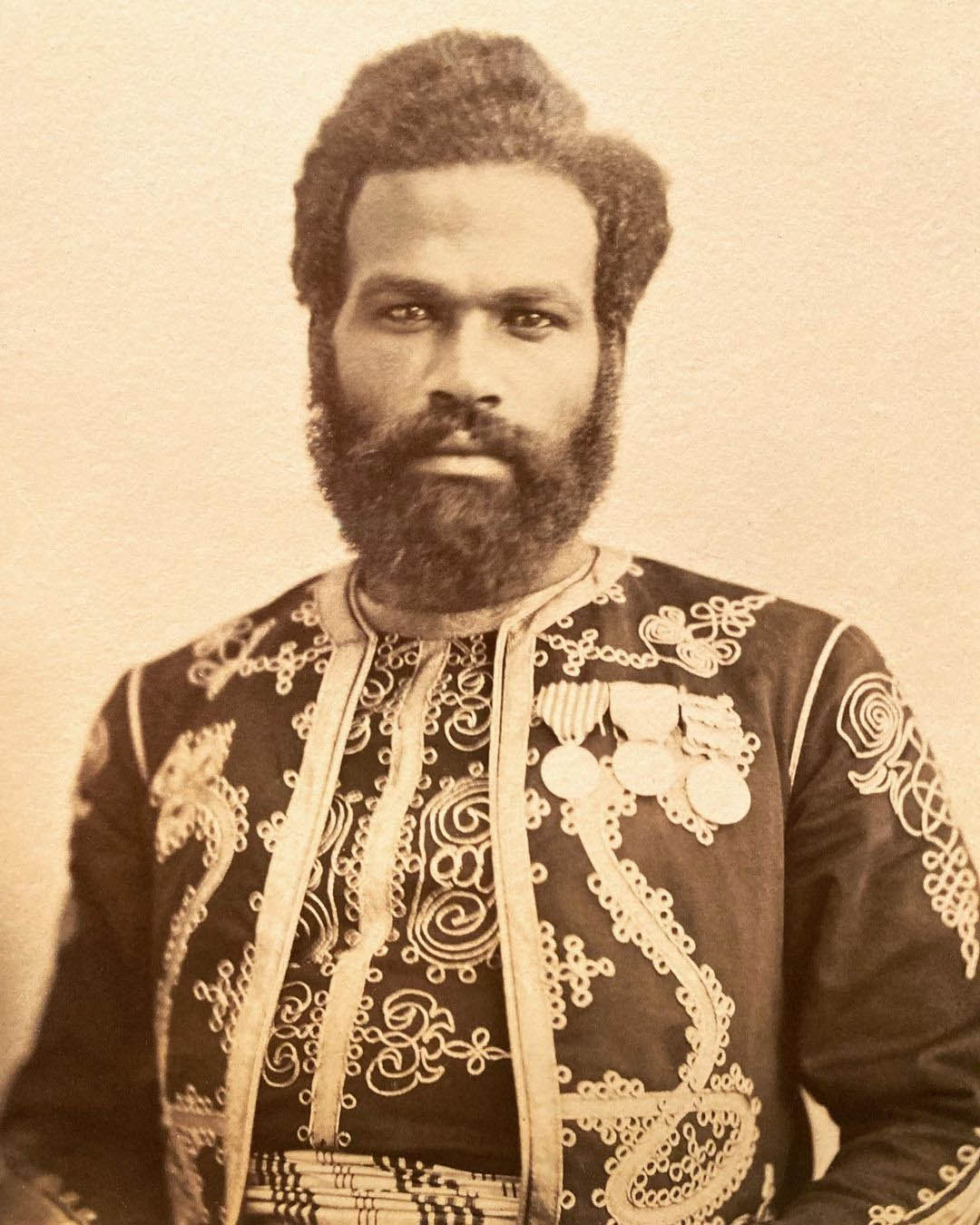
Unknown photographer. 'Portrait of a Persian Dignitary' Tehran, 1848 from the exhibition 'Photographs. An Early Album of the World (1842-1911)' at the musée du quai Branly – Jacques Chirac, Paris, April - July, 2023


Unknown photographer
Portrait of a Persian Dignitary
Tehran, 1848
Daguerreotype
Photo: RMN – Grand Palais (Musée d’Orsay)  Hervé Lewandowski


I wish we had tele-transportation so that I could go and see this incredible exhibition about the beginnings of photography practiced outside Europe.

It took me many hours to construct this posting. Placing the information into a logical order was an important consideration, matching the installation photographs with the exhibition texts and individual images so that the story makes sense. Finding country of origin and dates for the photographers was another issue. Further bibliographic information has been added from sources around the internet to fill out life stories and sometimes this information was difficult to find.

Congratulations to the curators for assembling a photographic tour de force in which “the production of these images is diverse and responds to different wishes, desires, and fits into various different contexts.” In other words what was the force majeure, the greater force, that directed the what, where, when, how, who and for whom of their production. Here, force is the operative word… for many of the foremost contexts are both anthropological and geographic (to record what people and places looked like) under the guise of European colonial conquest: to “capture” the spirit of the people and conquered lands under force of occupation.

More interesting are the photographs taken by photographers of their own people, for example different Indian “casts” taken by a Indian born photographer. How did they picture themselves using a European machine? In this context we must remember that the images were usually taken to fulfil a commercial brief, either taken for a rich patron or to be sold through the photographers studio to local and foreign clients.

Predominantly using a Western pictorial language, sometimes these local photographers step outside the mould of making a portrait or casting a ‘type’ or recording a monument within the landscape by embodying within their art the aesthetics of their own cultural history. For example, “Lai Afong’s photographic compositions show the technical and aesthetic influence of traditional Chinese painting, known as guóhuà.” (Wikipedia) “In many regions, from Colombia to West Africa to Madagascar, and from Iran to Japan to India, photography was adopted and sometimes adapted to social uses and local cultures and in many places seems to satisfy the desire for self-representation and the construction of modern identities.” (Exhibition text)

Undoubtedly this was the exception rather than the rule – for the rule of the lawful image was usually Western in power and aesthetic. As the exhibition text notes, “The 19th century in Europe was characterised by a need to accumulate objects, knowledge and also territory. Through photography, landscapes became lands to be mapped and conquered, and their inhabitants subjects to be studied. In the scientific field, the natural history model influenced the use of photography. It contributed to the myth of virgin territories and was a tool in the growing geographical discipline, making claims of exhaustivity: see everything, photograph everything.” And one might add, own everything, both physically and visually (through the photographers and viewers gaze).

Thus the European photographer of the 19th century taxonomically ordered the world around him through a classification of the visual culture of the exotic. Anthropologically, “within the framework of a science then racial, and in a project typology inherited from natural history classification methods, photography is a tool that establishes visual categories that shape racial stereotypes.” This racial science was to have a lasting impact well into the 20th century through the now debunked theory of eugenics (which has no association with anthropology) – “the study of all agencies under human control which can improve or impair the racial quality of future generations” (Galton) – influencing cultures around the world with devastating impact especially through the genocide of untermensch, or what were seen as racial subhumans, by the Nazi party in Germany in the 1930s-1940s.

What is undeniable is the inalienable presence of the sitter in these powerful portraits. This is William Lane in the here and now, with his strong face and sorrowful eyes. This is Botcudo “brought to France by a certain Mr. Porte and are going to stay in Paris for a few months.” This is his representation but also his spirit from the past, this impression all that is left of his life force today. But it is enough. We pay reverence to his life. This is a half-length portrait of a 77-year-old Japanese man… what did he do in his life, what journey led him to be present in front of the camera in February 1890, the learnt lines on his open face evidence of a hard life well lived. And these are Majeerteen Woman trapped in silver like ghosts in a machine, a movement of mutable energy through time and space that still has me engaging with their life even today. Bless them all.

Dr Marcus Bunyan


Many thankx to the musée du quai Branly – Jacques Chirac for allowing me to publish the photographs in the posting. Please click on the photographs for a larger version of the image.


“Among the 101 photographers on show, 52 are Westerners and 49 are indigenous. This near-parity was made possible by the rise, over the last decade, of acquisitions of works by artists from the four continents.”


Quotation by curator Christine Barthe, head of the heritage unit at the Quai Branly’s photographic collection and co-curator of the exhibition with Anabelle Lacour, head of the photographic collection


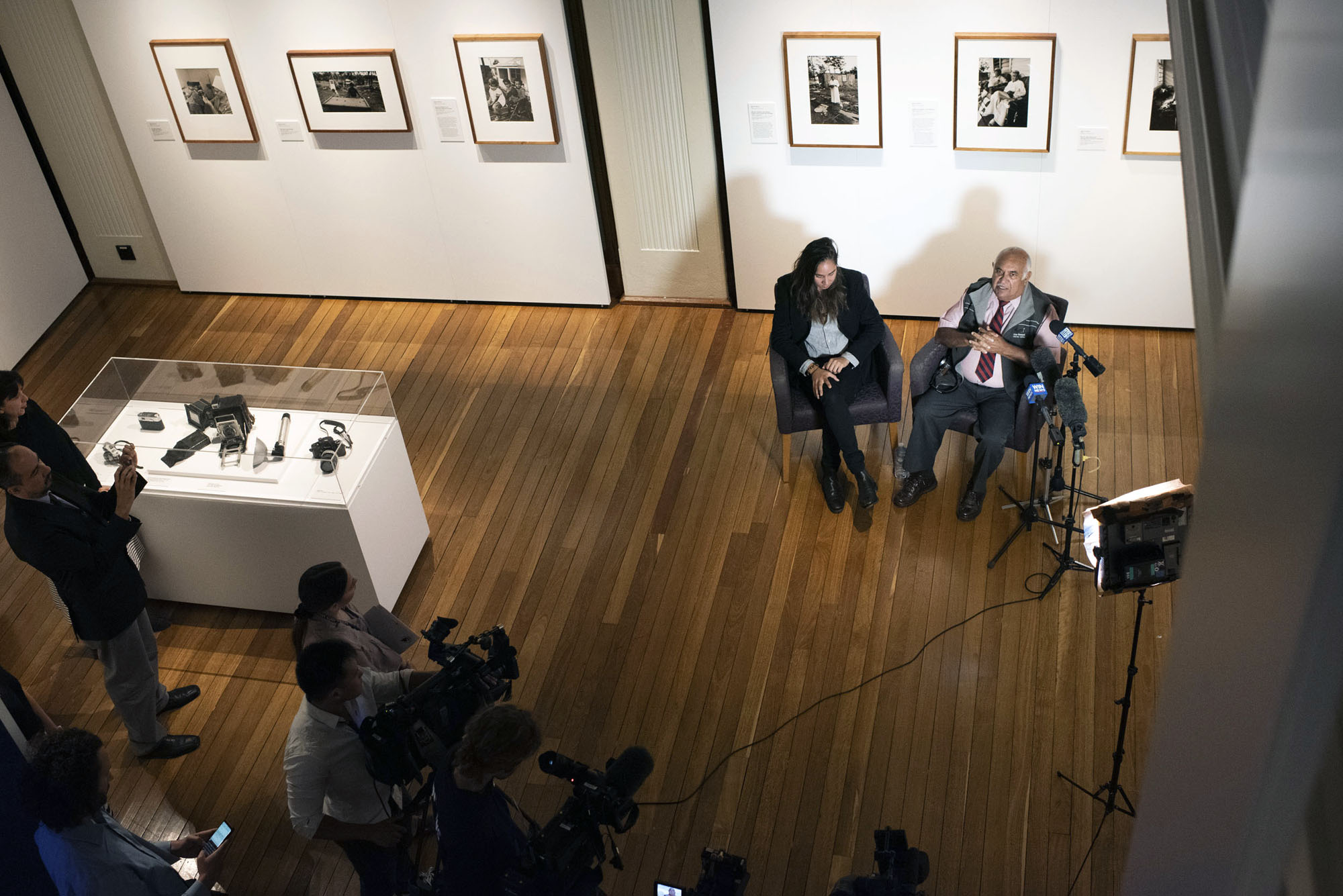
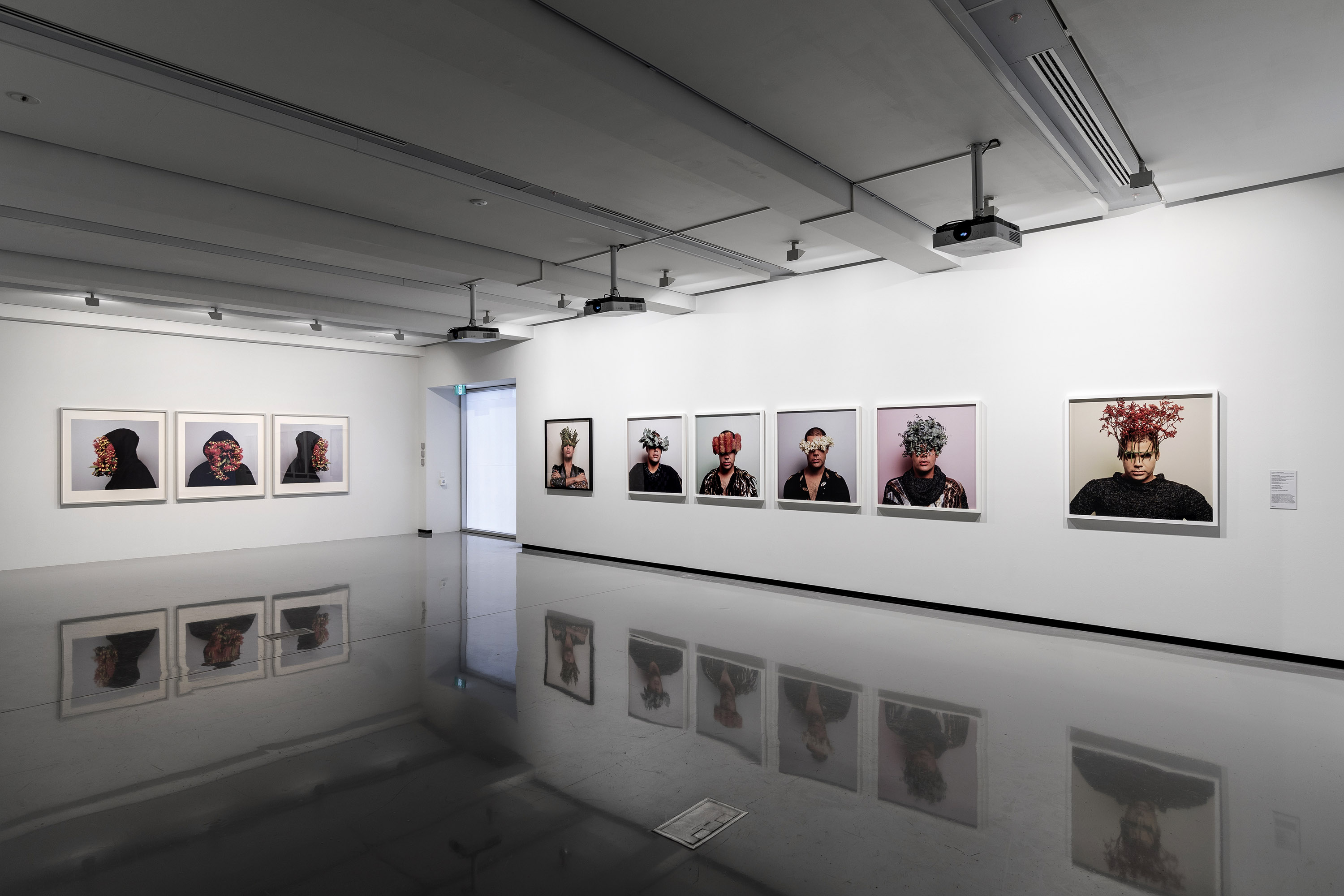
Installation view of the exhibition 'Photographs. An Early Album of the World (1842-1911)' at the musée du quai Branly – Jacques Chirac, Paris

Installation view of the exhibition 'Photographs. An Early Album of the World (1842-1911)' at the musée du quai Branly – Jacques Chirac, Paris showing the section 'Daguerreotypes for anthropology'

Installation view of the exhibition 'Photographs. An Early Album of the World (1842-1911)' at the musée du quai Branly – Jacques Chirac, Paris showing the section 'Daguerreotypes for anthropology' and the daguerreotypes of Henri Jacquart (French, 1809 - died after 1873) from September 1851


Installation views of the exhibition Photographs. An Early Album of the World (1842-1911) at the musée du quai Branly – Jacques Chirac, Paris showing in the two bottom images the section ‘Daguerreotypes for anthropology’ and in the bottom image the daguerreotypes of Henri Jacquart (French, 1809 – died after 1873) from September 1851 (below)


Many places in the world became accessible through photography as soon as it was invented in 1839. From the 1840s, darkrooms were taken on official expedition ships and crossed the borders of Europe. From Mexico to Gabon, the camera served the taste of the time for archaeological and geographical description and curiosity about the models encountered. In the second half of the 19th century, photography was used to examine all areas of the globe. This thirst for images was notably fuelled by the European colonial conquest.

Starting from the Musée du quai Branly – Jacques Chirac’s photograph collection, completed by exceptional loans from public and private collections, the exhibition considers the routes and the dissemination of photography outside Europe in the 19th century. Through a selection of photographs produced between 1842 and 1911 in Asia, Africa, Oceania and the Americas, it aims to understand better the development and the different appropriations of the medium locally by bringing to light less well-known photographs, patrons, phenomena and forms of photography in different parts of the world. An attempt to rebalance the history of photography, too often centred on Europe and the United States.

This exhibition is an adaptation of the exhibition Photographs. 1842-1896: An Early Album of the World designed by the Musée du quai Branly – Jacques Chirac and presented at the Louvre Abu Dhabi from 25 April to 13 July 2019.

Text from the musée du quai Branly – Jacques Chirac website


There was a time without photography, and there were places without cameras. Even if it is hard to imagine nowadays, it was not so long ago. Since its invention in 1839, photography has extended its reach at varying paces into all the visible spaces and every corner of the globe: starting in familiar places, spreading to nearby regions and neighbouring countries, and finally making it way into more far-flung lands as well. From the most extraordinary scenes to the most trivial, from breathtaking scenery to the food on our plates, nothing is too intimate or too grandiose to escape our desire to take a picture of it.

But how did it all start? How did photography spread, contributing to our view of the world? Who are the players who make this “photo album of the world”?

Since the 1840s, photography has accompanied countless scientific and military expeditions and trips. It was part of the usual conquest of the world, in the context of colonial expansion by the European powers, which intensified in the second half of the 19th century. As a tool to describe landscape and map territories, it contributed to the knowledge and control of Indigenous populations. Europe did not have a monopoly over this modern technology, however. Photography travelled and was transformed. In many regions, from Mexico and Colombia to Sierra Leone and Madagascar, Iran, Japan and India, it was adopted and sometimes adapted to social practices and local cultures, to create, control and conserve an image of the self and one’s environment.

The exhibition revisits some of this early histories of photography outside of Europe.

Text from the exhibition
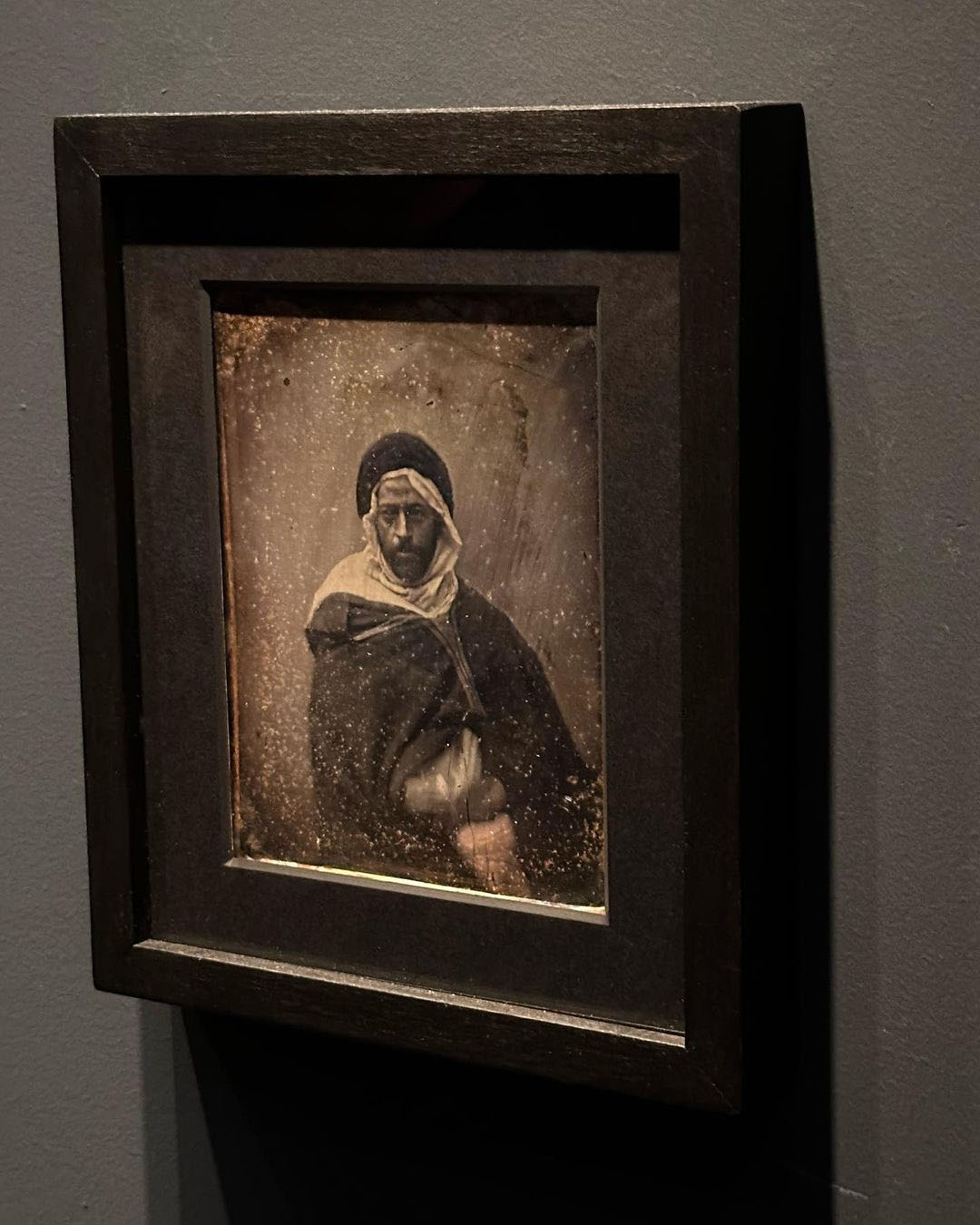
 

Henri Jacquart (French, 1809 died after 1873) 'Mohamed ben Said' Paris, France, 1851 (installation view)


Henri Jacquart (French, 1809 – died after 1873)
Mohamed ben Said (installation view)
Paris, France, 1851
Daguerreotype
© musée du quai Branly – Jacques Chirac
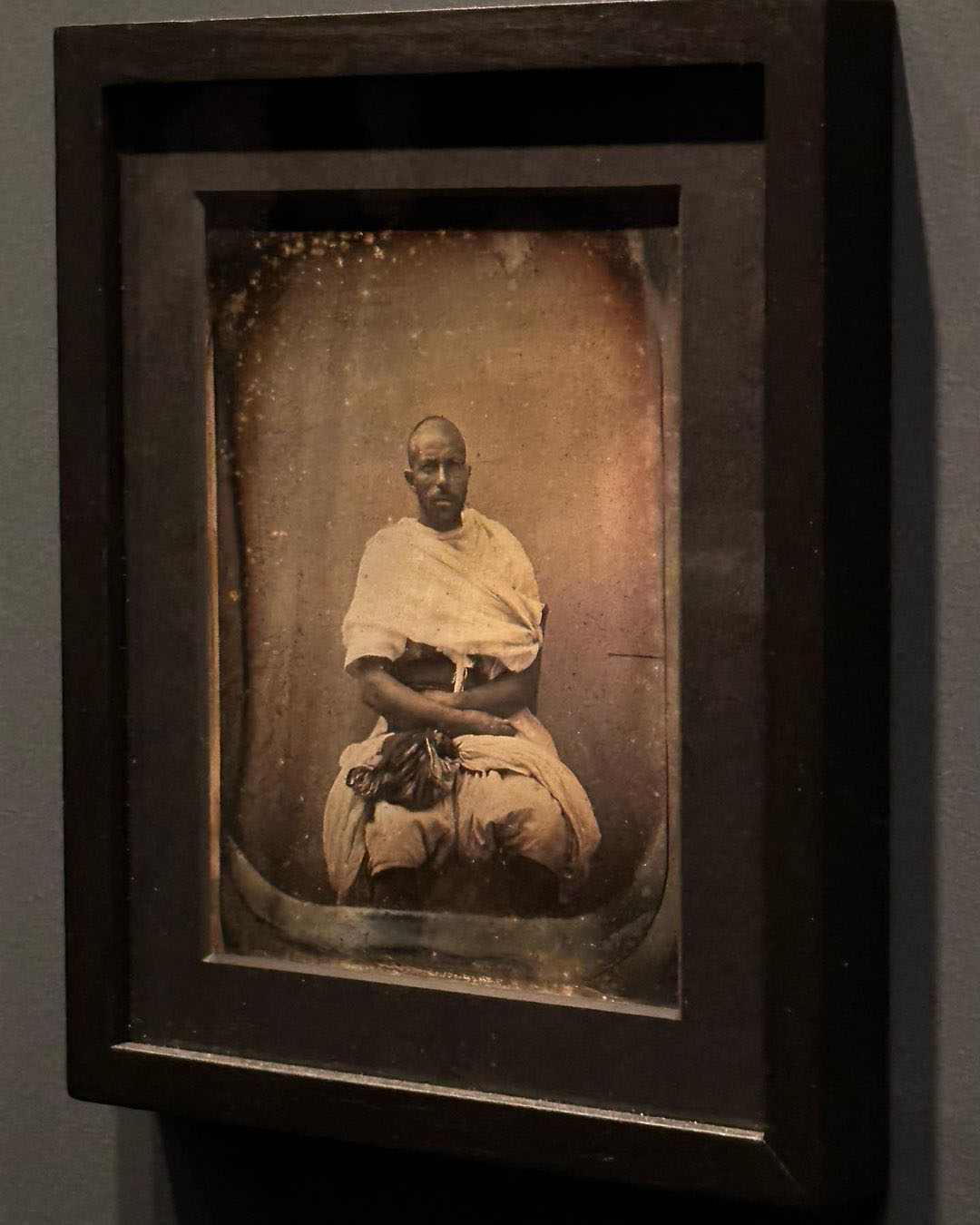
 

Henri Jacquart (French, 1809 died after 1873) 'Ibrahim Nascer, mozabite' Paris, France, September 1851 (installation view)


Henri Jacquart (French, 1809 – died after 1873)
Ibrahim Nascer, mozabite (installation view)
Paris, France, September 1851
Daguerreotype
© musée du quai Branly – Jacques Chirac


Exhibition introduction

There was a time without photography and places without a camera. Even if it is difficult to imagine it today, this period is not so far away.

Since the announcement of its invention in 1839, photography has more or less quickly invaded all visible spaces, penetrated all places on the scale of the globe: familiar places, nearby regions, then neighbouring countries, also the most distant. From the most extraordinary to the most trivial, from the sublime landscape to the content of our plates, nothing was too intimate or too grandiose to escape the desire to create its image.

How did it all start? How did photography come about? propagated, participating in the global geographical imagination? Who are the actors who make up this “world album”?

Since the 1840s, photography has accompanied the countless voyages and scientific and military expeditions. It participates in the visual conquest planetary, in the context of the colonial expansion of the European powers which accelerated in the second half of the 19th century. Description tool landscapes, territorial mapping, it supported the knowledge and population control. But Europe did not have a monopoly on this modern technology. Photography travels, transforms, takes root. In many regions, Mexico, Colombia, West Africa in Madagascar, from Iran to Japan via India, it has been adopted and sometimes adapted to social uses and local cultures to build, control and maintain an image of oneself and one’s environment.

This exhibition proposes to return to some of these stories from the beginnings of photography practiced outside Europe.

First appearances

The first technique that was widely used in the early days photography, between the 1840s and 1850s, takes its name “daguerreotype” of its inventor Louis Jacques Mandé Daguerre. It’s about of a copper plate coated with silver and made sensitive to light. Relatively expensive to manufacture and requiring learning, this technique was widely used to produce portraits. The long exposure time made it difficult to apply it to the landscape. These images are unique because formed directly on the silver plate, they cannot therefore give rise to several tests. The difficulty of their realisation as well as their cost explain their rarity today. European and American practice in its very beginnings, the daguerreotype quickly exported around the world. new technique modifying the relationship to its own image, the daguerreotype is also used as a tool of scientific description. Practiced by travellers and traveling photographers, it was also adopted very early in many photographic studios of major world cities, such as Mexico City, Bogotá and Lima. In Tehran, the daguerreotype is practiced at the court of the Shah of Persia from 1845.

Daguerreotypes for anthropology

If photography is quickly adopted by travellers and offers a new vision of the real world, it also serves a new discipline: anthropology. In France, the first scientific applications of photography to this burgeoning field are experienced in the years 1840-1850. Within the framework of a science then racial, and in a project typology inherited from natural history classification methods, photography is a tool that establishes visual categories, that shape racial stereotypes. Daguerreotypes made on demand from the anthropology laboratory of the National Museum of Natural History show the importance attached by scientists to skulls, casts and human skeletons, central in a discipline marked by the medicine and comparatism. Produced by professionals like Louis-Auguste Bisson, or by employees of the Museum like Henri Jacquart, these examples testify of an objectification of bodies that photography reinforces. These daguerreotypes are produced or collected by the institution in the same way as the portraits of living people.

Text from the exhibition
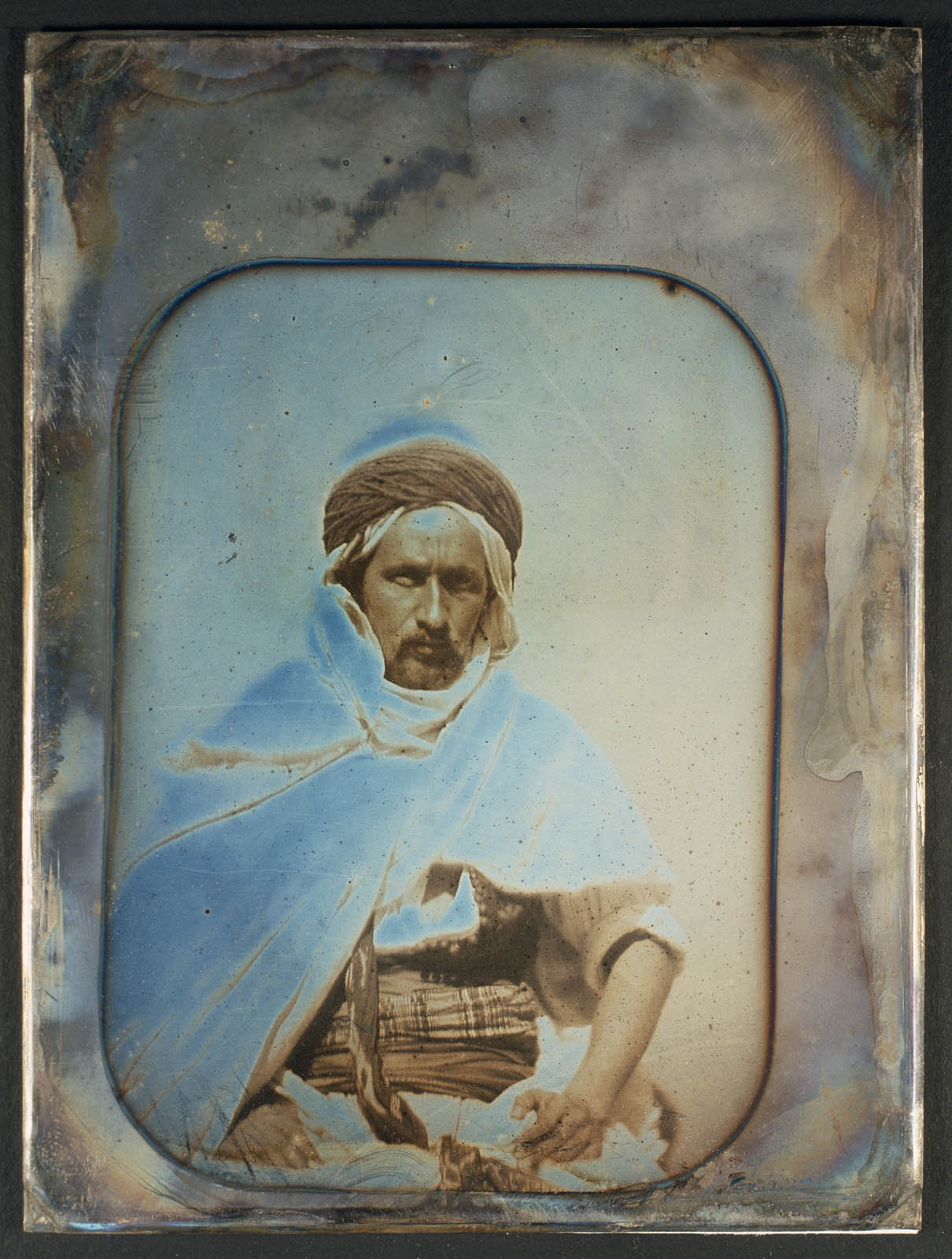
 

Henri Jacquart (French, 1809 died after 1873) 'Ali ben Mohamed, 29 ans, Arab from the plain' September 1851 from the exhibition 'Photographs. An Early Album of the World (1842-1911)' at the musée du quai Branly – Jacques Chirac, Paris, April - July, 2023


Henri Jacquart (French, 1809 – died after 1873)
Ali ben Mohamed, 29 ans, Arab from the plain
September 1851
Daguerreotype
© musée du quai Branly – Jacques Chirac


Henri Jacquart (French, 1809 died after 1873) 'Ali ben Mohamed, 29 ans, Arab from the plain' September 1851 (detail)


Henri Jacquart (French, 1809 – died after 1873)
Ali ben Mohamed, 29 ans, Arab from the plain (detail)
September 1851
Daguerreotype
© musée du quai Branly – Jacques Chirac


Twenty years after the conquest of Algeria, the Arab horsemen have stopped fighting, and are but the shadows of those who for years thwarted the French army. They came to Paris for a show set up by the Museum, Children of the Desert, a fantasia on the Champ de Mars in June, 1851. They too are photographed, and casts of their bodies taken for science – but as popular artists, these horsemen leave their names under their portraits and are paid to pose.

Catherine Darley. “Ghosts (1) – Shadows,” on the Poemas del río Wang blog 10/08/2012 [Online] Cited 07/05/2023
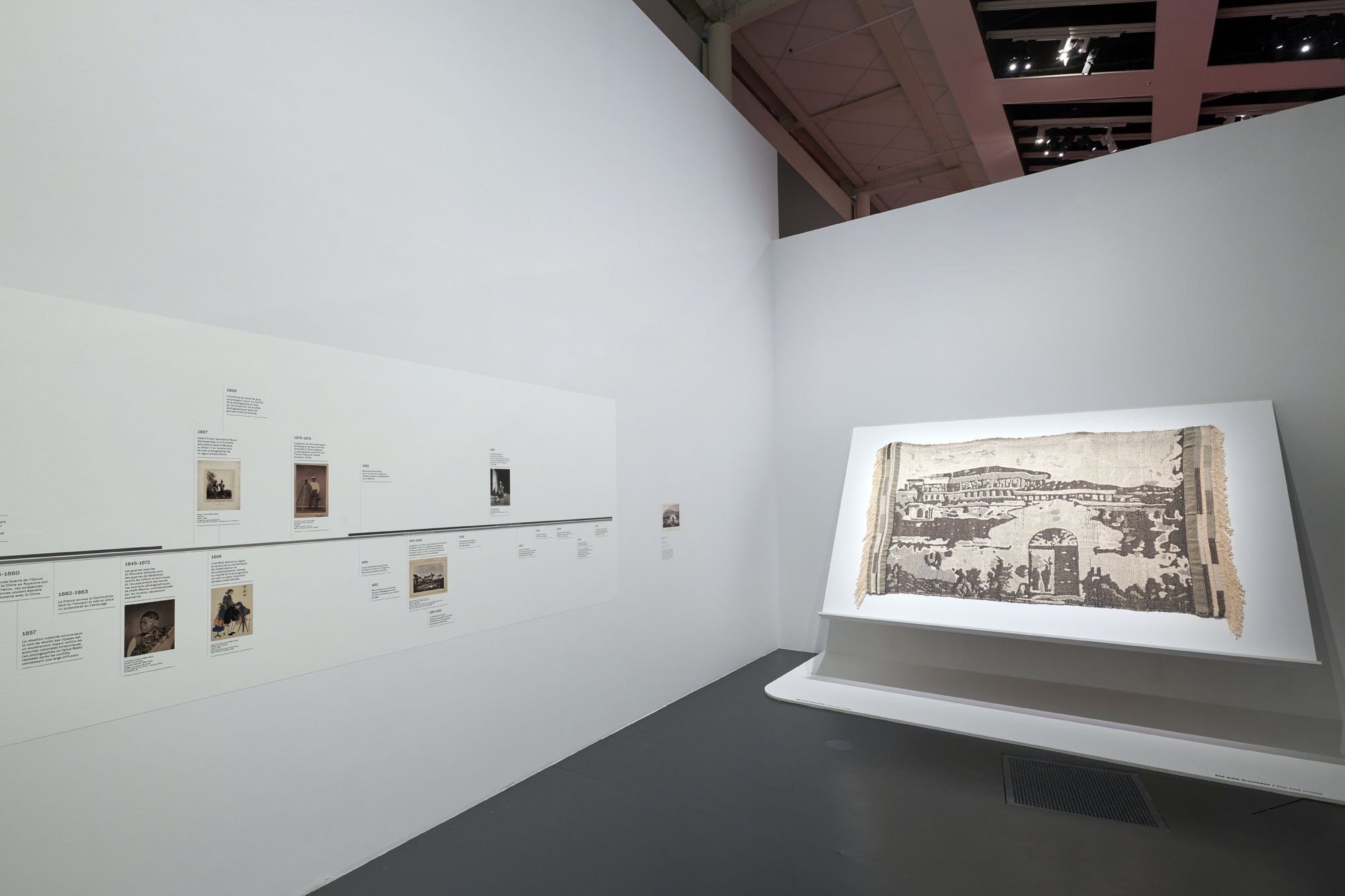
 

Installation view of the exhibition 'Photographs. An Early Album of the World (1842-1911)' at the musée du quai Branly – Jacques Chirac, Paris

Installation view of the exhibition 'Photographs. An Early Album of the World (1842-1911)' at the musée du quai Branly – Jacques Chirac, Paris

Installation view of the exhibition 'Photographs. An Early Album of the World (1842-1911)' at the musée du quai Branly – Jacques Chirac, Paris

Installation view of the exhibition 'Photographs. An Early Album of the World (1842-1911)' at the musée du quai Branly – Jacques Chirac, Paris

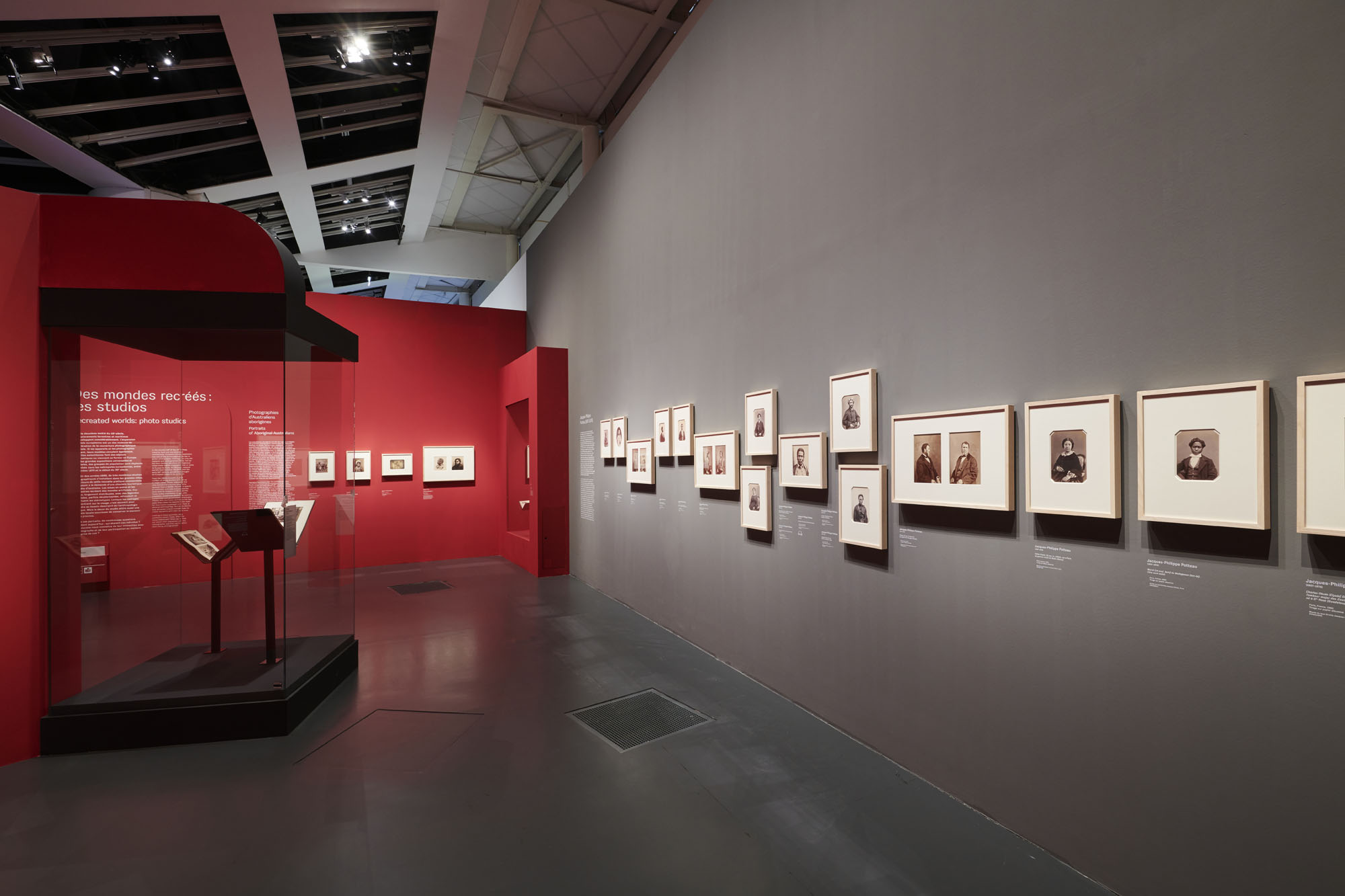
Installation views of the exhibition 'Photographs. An Early Album of the World (1842-1911)' at the musée du quai Branly – Jacques Chirac, Paris showing in the bottom image the section 'Recreated worlds: photo studios'


Installation views of the exhibition Photographs. An Early Album of the World (1842-1911) at the musée du quai Branly – Jacques Chirac, Paris showing in the bottom image the section ‘Recreated worlds: photo studios’ (below)


Recreated worlds: photo studios

In the second half of the 19th century, travel by land and sea developed considerably. European colonial expansion was one of the drivers behind the rise in global photographic coverage, not only did cameras and photographers travel, but so did their models. Members of the Indigenous elites made regular diplomatic trips or came to Europe to study. At the major colonial world’s fairs between 1870 and the early 20th century, groups were brought to European cities to be exhibited.

From the 1860s onwards, a great number of photo studios were set up in major cities. Those involved in this new commercial practice adapted to demand from a tourist clientele in search of exoticism, and sets and accessories were used to recreate artificial worlds. These widely distributed images with simplistic, sometimes demeaning captions, transmitted and perpetuated stereotypes. Photos with the frame centred on the face were often taken to respond to the need for description expressed in the field of physical anthropology. But studio decors also attracted a local clientele keen to create souvenirs with their loved ones.

Looking at these portraits, many questions remain today: Who are these individuals? What can we find out about their interactions with the photographer and their participation when being photographed?

Portraits of Aboriginal Australians

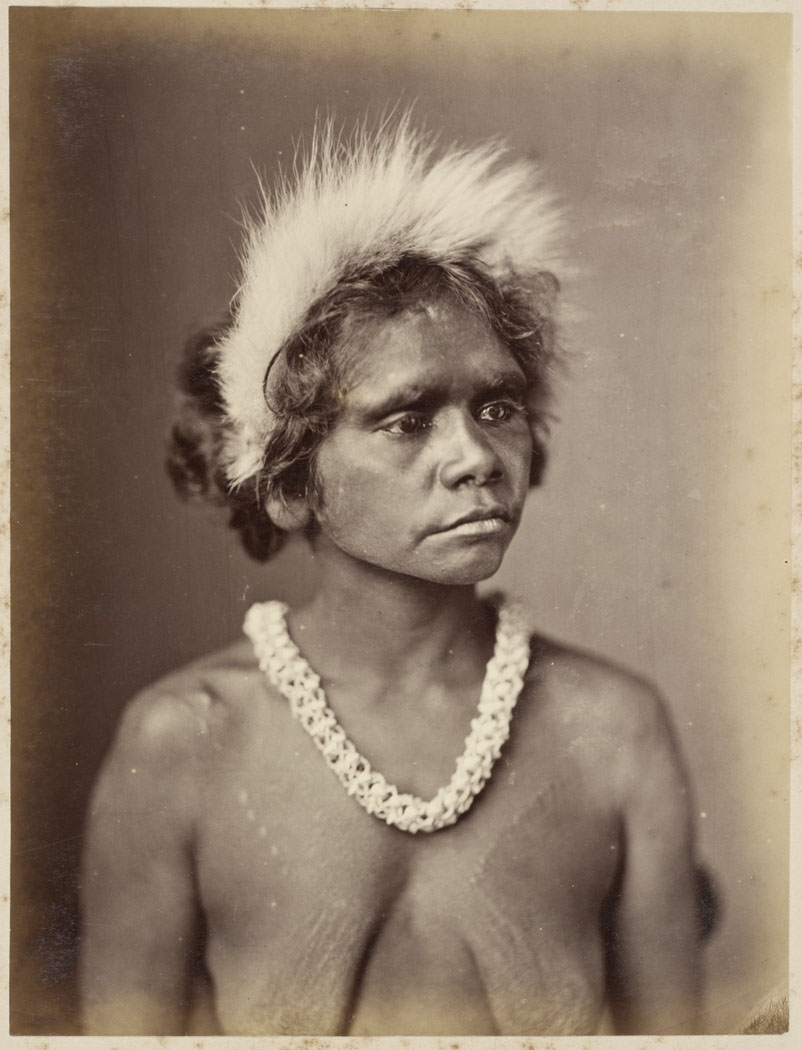
The aboriginal populations were privileged subjects of the first commercial photographers in Australia. Produced in the studio, these portraits obey 19th century racialist scientific interests; they are designed to document what was then considered to be an endangered population. German photographer John William Lindt, based in Grafton, New Wales of the South, produces a series of portraits of the aboriginal populations of Clarence Valley, marketed in the form of portfolios from the 1870s.

Combining exoticism and pictorial tradition, his pictures met with great success. Despite this problematic production context and the sometimes artificial nature stagings, this visual heritage is now a resource important for the descendants of the communities. In Australia, research have been undertaken since the 1990s to obtain information on the models, their identity and their territory of origin. The photography model known as “Mary Ann of Ulmarra” was identified in 2013 as Mary Ann Williams, née Cowan, through research conducted by one of his descendants.

Text from the exhibition


John William Lindt (Australian born Germany, 1845-1926) 'Mary Ann of Ulmarra' (Mary Ann Williams, née Cowan) 1873 from the exhibition 'Photographs. An Early Album of the World (1842-1911)' at the musée du quai Branly – Jacques Chirac, Paris, April - July, 2023


John William Lindt (Australian born Germany, 1845-1926)
Mary Ann of Ulmarra (Mary Ann Williams, née Cowan)
1873
Albumen print


Lindt took at least sixty photographs in this series of studio portraits of Clarence River Aborigines, although extant albums usually contain fewer than a dozen each. When first published, these studio tableaux were regarded as accurate. Reference: An Eye for Photography: the camera in Australia / Alan Davies. Carlton, Vic: Melbourne University Press, 2004, p. 60.


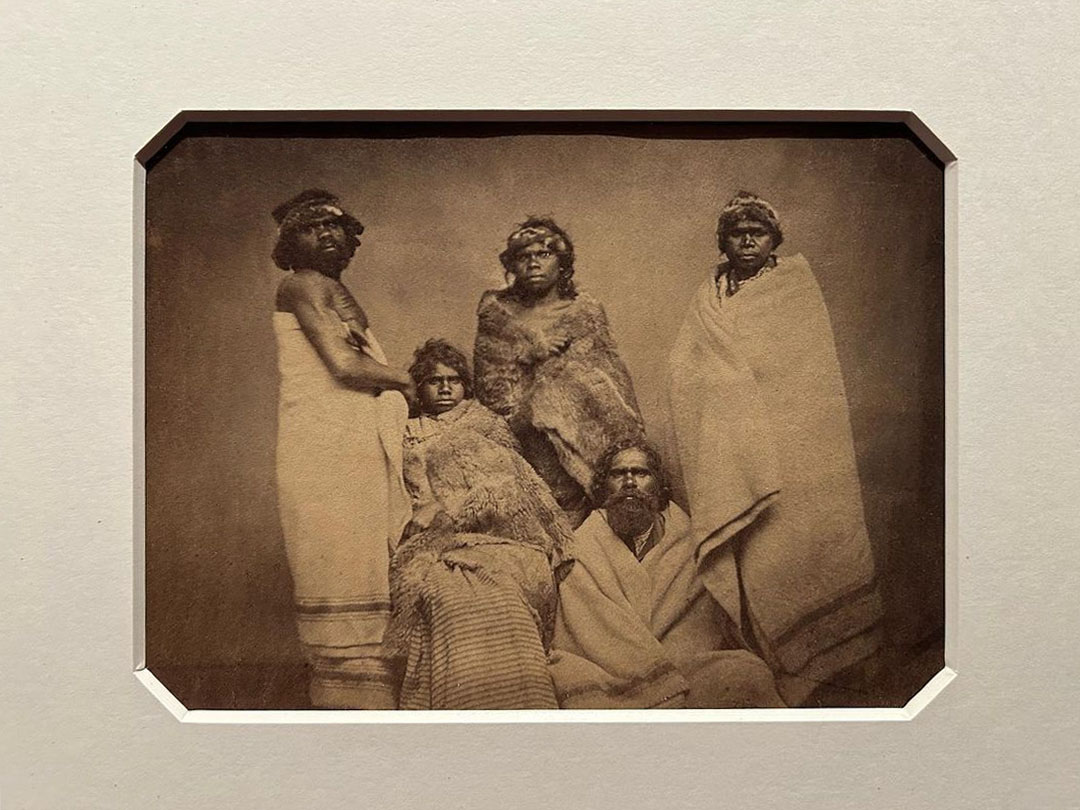
Antoine Julien Nicolas Fauchery (French, 1823-1861) and Richard Daintree (Australian born United Kingdom, 1832-1878) 'Untitled (Two Aborginal Australian men and three women posing in front of a studio backdrop)' Victoria possibly Mt Franklin, 1858


Antoine Julien Nicolas Fauchery (French, 1823-1861) and Richard Daintree (Australian born United Kingdom, 1832-1878)
Untitled (Two Aborginal Australian men and three women posing in front of a studio backdrop)
Victoria possibly Mt Franklin, 1858
9.20 x 21.20cm


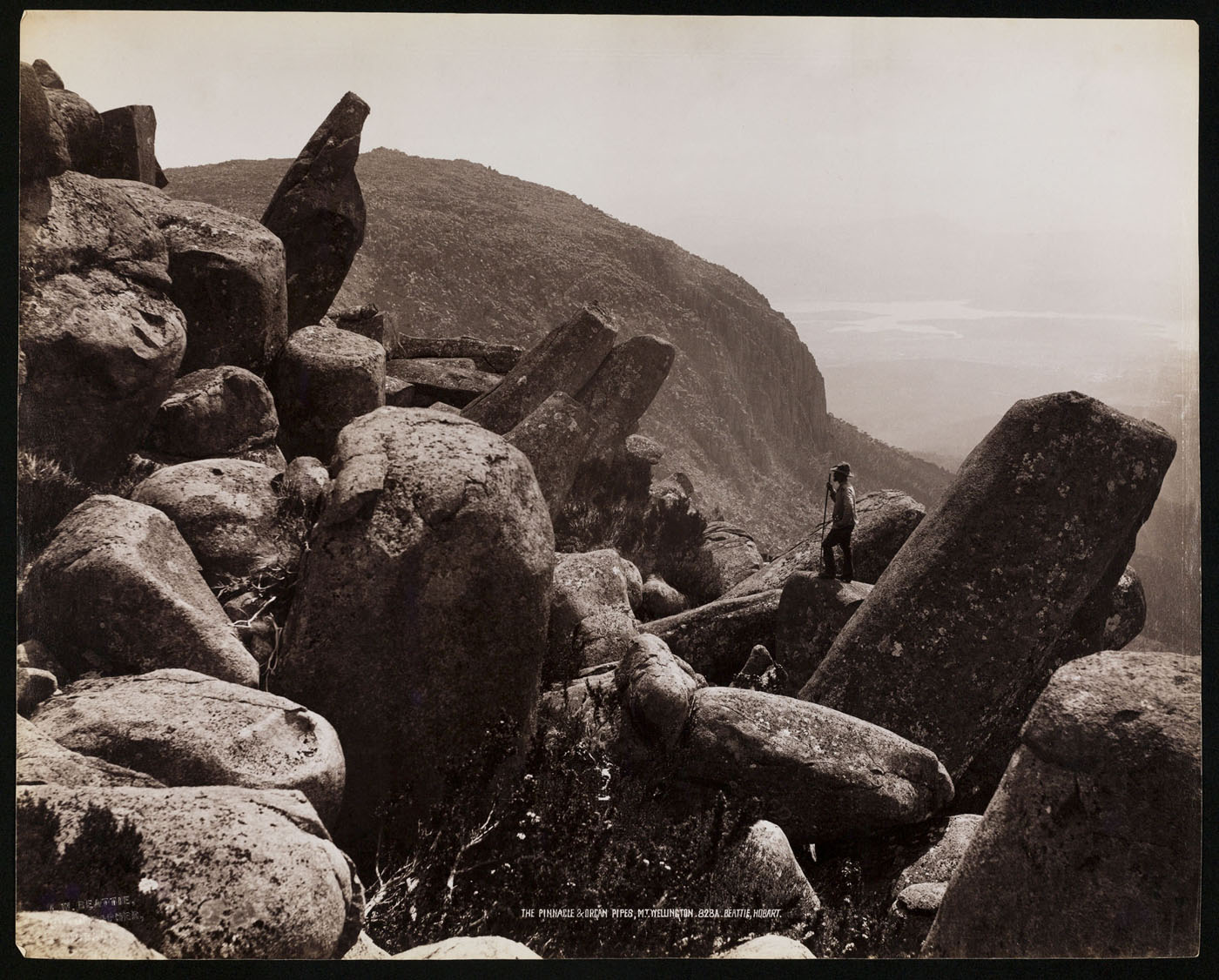
John Watt Beattie (Australian born Scotland, 1859-1930) 'The Pinnacle & Dream Pipes, Mt Wellington, Hobart, Tasmania' Australia, 1880-1890


John Watt Beattie (Australian born Scotland, 1859-1930)
The Pinnacle & Dream Pipes, Mt Wellington, Hobart, Tasmania
Australia, 1880-1890
Albumen paper print
© Quai Branly Museum – Jacques Chirac


John Beattie

John Beattie (1859-1930) came to Tasmania from Scotland at the age of nineteen, in 1878. Within a year, he was using the brand-new dry-plate photographic technique to take a series of views of Lake St Clair. He joined the Anson Brothers studio, and worked with the three siblings until he bought them out in 1891. In the 1890s he established a museum of curiosities he had collected. The first of the island’s wilderness photographers – with a keen interest in preservation of the environment – Beattie became the ‘official’ photographer for the Tasmanian Government. In addition to his well-known series of photographs of convicts, he made a number of portraits of Aboriginal people, of whom he said ‘for about thirty years this ancient people held their ground bravely against the invaders of their beautiful domain.’

Text from the National Portrait Gallery


Of Scottish origin, John Watt Beattie landed in Australia in 1878. The following year, he moved to Tasmania to a farm in New Norfolk, northwest of Hobart. Feeling more interest in going out in the bush than for the work of the farm, he then devotes himself to the photography of countryside. He was appointed official government photographer of Tasmania in 1896. Able to promote his work, he also enthusiastically supported the development of the tourism industry. In 1906, he traveled to Melanesia, Polynesia and the Norfolk Islands and derives hundreds of widely distributed photographs.

Text from the exhibition


Charles Woolley (Australian, 1834-1922) 'William Lanne' 1866


Charles Woolley (Australian, 1834-1922)
William Lanne
1866
Albumen silver photograph


William Lanne (1834-1869), also known as King Billy or William Laney, is said to have been Truganini’s third partner. Lanne was captured along with his family in 1842 and taken to the Aboriginal camp at Wybelenna on Flinders Island. He moved for a time to Oyster Cove in 1847, before spending the years until 1851 in a Hobart orphanage. Four years later he joined a whaling ship. Regarded as the last surviving male of the Oyster Cove clan, Lanne died in March 1869 from a combination of cholera and dysentery. Following his death an argument broke out between England’s Royal College of Surgeons and Tasmania’s Royal Society over who should have his remains for scientific purposes. A member of the College of Surgeons, William Crowther, managed to break into the morgue where Lanne’s body was kept, decapitating the corpse, removing the skin and inserting a skull from a white body into the remnants. The Royal Society, discovering Crowther’s work, moved to thwart any further violations by amputating the hands and feet and discarding them separately. In this state, Lanne’s body was buried.

Text from the National Portrait Gallery website


Charles Alfred Woolley (17 December 1834-1922) was born in Hobart Town, Tasmania, Australia. He was an Australian photographer but also created drawings, portraits and visual art. He is best known for his photographic portraits of the five surviving Oyster Cove Aboriginal people taken in August 1866 and exhibited at the Intercolonial Exhibition of Australasia colonial exhibition in Melbourne the same year. …

In August 1866, Woolley took photographic portraits in his studio of the five surviving Oyster Cove Aboriginal people which became his best known work. These were exhibited at the Intercolonial Exhibition of Australasia colonial exhibition in Melbourne later that year. Two of the portraits were of Truganini, a female, and William Lanne, also known as King Billy.

These works are now exhibited in the National Library, and the State Libraries of New South Wales, Tasmania and Victoria. James Bonwick’s publication The Last of the Tasmanians (1870) included several of the photographs and shortly after engravings started to appear. Woolley exhibited the prints again in 1875 at the Victorian Intercolonial Exhibition. A few of the original sets survive, mainly in English collections, as well as copies that J. W. Beattie made.

After Lanne’s death in 1869, his grave was desecrated and his body mutilated and a full sized bust was produced by an artist named Francisco Santé. The Evening Mail advertised that it could be seen for a “small fee”. Though Woolley was not known as a sculptor, the Hobart Town Examiner reported that “numerous” busts he had produced were at Walch and Sons and Birchall’s bookshops.

Text from the Wikipedia website


Installation view of the exhibition 'Photographs. An Early Album of the World (1842-1911)' at the musée du quai Branly – Jacques Chirac, Paris showing the section 'Conquering souls and spreading the word' with, at left, three photographs by Augustine Dyer (Australian, 1858-1931) of Papua New Guinea (1884)


Installation view of the exhibition Photographs. An Early Album of the World (1842-1911) at the musée du quai Branly – Jacques Chirac, Paris showing the section ‘Conquering souls and spreading the word’ with, at left, three photographs by Augustine Dyer (Australian, 1858-1931) of Papua New Guinea (1884, see below)


Conquering souls and spreading the word

The movement of colonial conquest also proceeded through missionary work where competition between congregations and between nations played out, much like at the political level. The Pacific was a place of rivalry between the United Kingdom and France. Protestant societies established from 1875 onwards in south-eastern New Guinea found themselves in competition with the Catholic missionaries. National alliances were formed between explorers and missionaries, promoting each other’s work. At the turn of the 19th and 20th centuries, the development of illustrated travel press allowed these heroic stories to be shared with a wide audience. Conferences with photo projections organised by the Geographical and Anthropological Societies were part of this process, combining different sources of images and narratives and establishing a lasting visual culture of the exotic.

Text from the exhibition


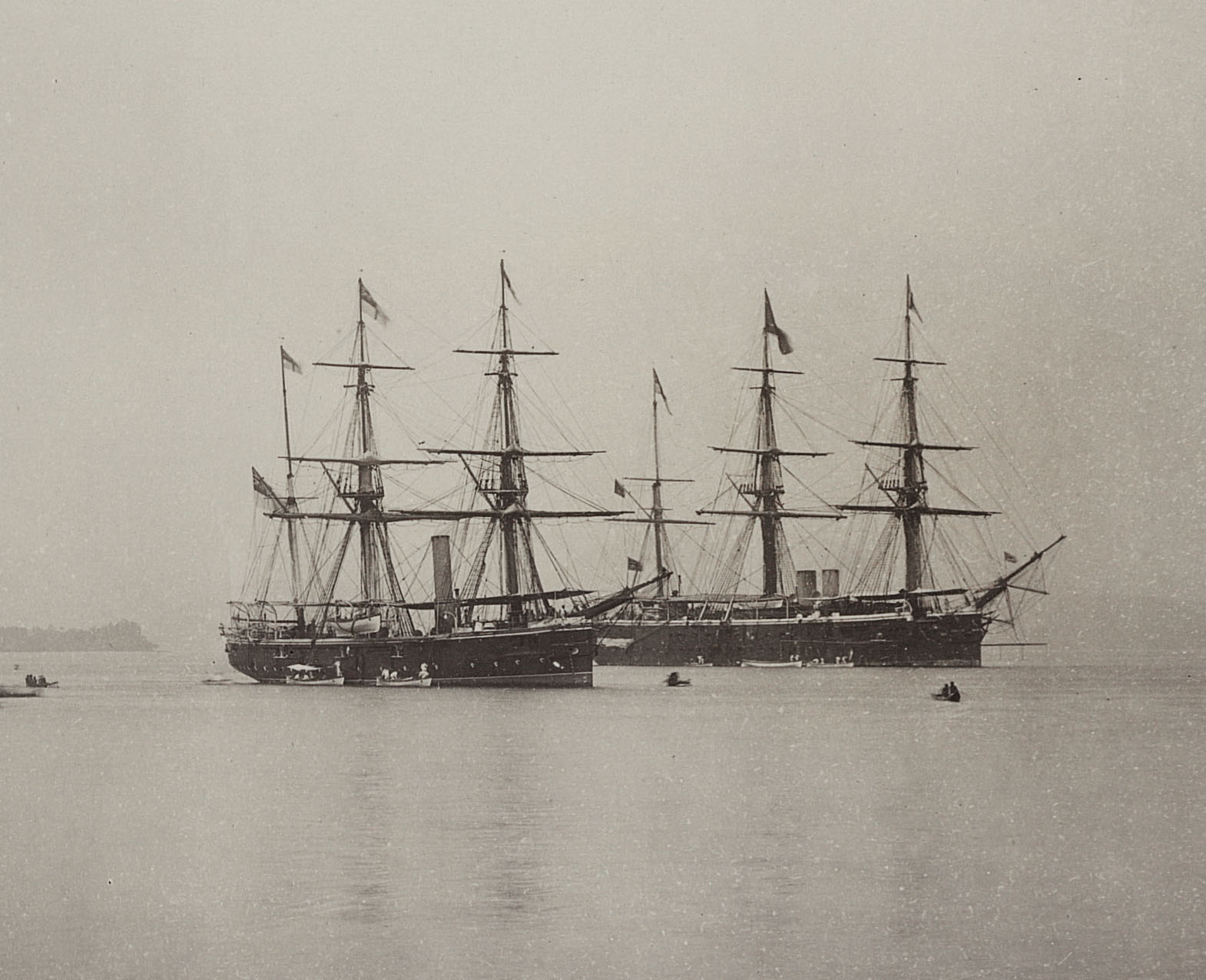
Augustine Dyer (Australian, 1858-1931) 'View from Dinner Island, China Strait, H.M. Ships "Nelson" and "Espiègle" at anchor, Papua New Guinea' 1884


Augustine Dyer (Australian, 1858-1931)
View from Dinner Island, China Strait, H.M. Ships “Nelson” and “Espiègle” at anchor, Papua New Guinea
1884
© Musée du Quai Branly – Jacques Chirac


Dyer was the Australian Government Printing Office photographer who went to British New Guinea with John Paine (a studio photographer), for the purpose of recording the British annexation of the territory. He travelled more extensively with Paine in 1884 through PNG visiting Port Moresby, Motu-Motu, Kerepunu, etc.


Augustine Dyer (Australian, 1858-1931) 'View from Dinner Island, China Strait, H.M. Ships "Nelson" and "Espiègle" at anchor, Papua New Guinea' 1884 (detail)


Augustine Dyer (Australian, 1858-1931)
View from Dinner Island, China Strait, H.M. Ships “Nelson” and “Espiègle” at anchor, Papua New Guinea (detail)
1884
© Musée du Quai Branly – Jacques Chirac


Taking as its starting point the photography collection of the musée du quai Branly – Jacques Chirac, a reference collection for the representation of the extra-European world in the early years of photography, the exhibition focuses on the trajectories and geographies of the medium outside Europe in the 19th century, from its invention. Through a selection of nearly 300 photographs taken between 1842 and 1911 in Asia, Africa, Oceania, and the Americas, it seeks to better understand the phenomenon of the global dissemination of photography and the regional histories of non-European photography.


A visual collection of the world

Many places in the world became accessible through photography after the official announcement of its invention. The technical details of the daguerreotype were revealed in Paris in August 1839 and, in September, the darkrooms were loaded onto ships and crossed the borders of Europe. A tool associated with Western technological modernity, taken on countless voyages and scientific and military expeditions around the world, the medium of photography was used in the second half of the 19th century to investigate everywhere on the globe. From Mexico to Gabon, photography was in turn an instrument of description and the visual appropriation of landscapes and monuments, a tool for knowledge and the control of populations, and an object of diplomacy with the local elite. European colonial expansion was one of the driving forces that greatly accelerated global photography.

Dissemination and local appropriation

The new medium spread throughout the world from the 19th century, with very varied adoption rates in different regions. Europeans were no longer the only ones experimenting with, commissioning and marketing photography. Its local roots can be linked to the relations of countries with the West and to the relationship of societies to images. The exhibition, which presents the work of European and local photographers on four continents, seeks to better understand the development and appropriation of the medium around the world on a local scale by bringing to light lesser-known photographers, sponsors, phenomena and photographic forms, in an attempt to rebalance a history of photography that too often focuses on Europe and the United States. In many regions, from Colombia to West Africa to Madagascar, and from Iran to Japan to India, photography was adopted and sometimes adapted to social uses and local cultures and in many places seems to satisfy the desire for self-representation and the construction of modern identities. If cameras and photographers travelled, their models also travelled. The indigenous elites made regular diplomatic visits or came to Europe for training. From the 1860s, many photography studios were set up in large cities to meet the demands of tourists looking for exoticism. But the studios’ decor also attracted a local clientele wanting to preserve the memory of their loved ones.

How far should photography be taken?

The 19th century in Europe was characterised by a need to accumulate objects, knowledge and also territory. Through photography, landscapes became lands to be mapped and conquered, and their inhabitants subjects to be studied. In the scientific field, the natural history model influenced the use of photography. It contributed to the myth of virgin territories and was a tool in the growing geographical discipline, making claims of exhaustivity: see everything, photograph everything. But this thirst for images, which began in 1840 in Europe and then spread rapidly throughout the world, met with contrasting situations. From the beginning, the question of limits arose: how far to go, under what conditions and for what purposes should a photograph be taken? This was sometimes a technical challenge, but above all an ethical question when it involved showing the horrors of wars or producing the image of scenes or objects that were supposed to remain hidden. Some photographers may have tricked, coerced or negotiated to get an image.

The selection of works, mostly taken from the quai Branly photography collection, highlights the diversity of photographic practices outside Europe at their origins and reveals early testimonies of indigenous photographers. By revealing the scientific, military and commercial uses, as well as the memorial and social functions of photography, and by presenting a wide range of objects and techniques, the exhibition invites us to re-examine today the meaning of the photographic gesture in these different non-European contexts.

Publication

Mondes photographiques, histoires des débuts

The book that accompanies the exhibition broadens its scope of study to offer the first decentralised history of early world photography. Taking as its base the photography collection of the musée du quai Branly – Jacques Chirac, a reference collection for the representation of the extra-European world in the early years of photography, it deepens this study to focus on the trajectories and geographies of the medium outside Europe from the 19th century. Co-publication musée du quai Branly – Jacques Chirac / Actes Sud 400 pages. €69

Text from the musée du quai Branly – Jacques Chirac


Eugene Thiesson (French, 1822-1877) 'Botocudo' 1844


Eugene Thiesson (French, 1822-1877)
Botocudo
1844
Daguerreotype
10.5 x 8cm
© Quai Branly Museum – Jacques Chirac


Eugene Thiesson

In 1844, two Brazilian Indians were brought to France by a certain Mr. Porte and are going to stay in Paris for a few months. This man baptised Manuel (and the young woman baptised Marie) in the press, will arouse interest certain among the anthropologists of the Natural History Museum. Werner, painter from the Museum, paints their portrait in watercolour, while Thiesson photographs them using the daguerreotype. They also lend themselves at a moulding session in the anthropology laboratory. The five daguerreotypes that remain today from the photography session show us two people with the top of the body undressed, and the bottom dressed of what appears to be European clothing.

Text from the exhibition


This man from the Canaries counts among the very first non-Europeans to have been photographed, probably in Paris. His portrait illustrates the first scientific publication offering daguerreotypes to visually appreciate the anatomic characteristics of human skulls. The Botocudo Indian from Brazil was photographed in Lisbonne, in 1844, but he visited Paris; his name was Manuel, and his wife was Maris. They lodged with some man called Porte, who brought them to the Museum. There, people wanted to make casts of their faces, their torsos, their arms and legs. Manuel and Marie walked across Marville’s Paris – across that city that was to disappear; they walked on the Boulevard du Temple and might have even visited the theaters. Actors, spectators? Dressed, costumed, naked? Under applause, mockery, examination, or measurement?

Catherine Darley. “Ghosts (1) – Shadows,” on the Poemas del río Wang blog 10/08/2012 [Online] Cited 07/05/2023


Luis Garcia Hevia (Colombian, 1816-1887) 'Untitled (portrait of a man)' c. 1843-1850


Luis Garcia Hevia (Colombian, 1816-1887)
Untitled (portrait of a man)
c. 1843-1850
Colourized daguerreotype, mounted under passe-partout and under glass, encased in a gutta-percha box
Dimensions of the plate: 7.5 x 10cm
Dimensions of the assembly: 10 x 12.4cm
Dimensions with box open: 20.2 x 12.4cm
© Quai Branly Museum – Jacques Chirac


Luis Garcia Hevia

Luis Garcia Hevia is the first Colombian photographer and daguerreotypist. He exhibited his first “two essays of daguerreotypes” at the exhibition of industry in Bogota in November 1841. He was also a painter and miniaturist.

Recreated Worlds: The Studios

In the second half of the 19th century, land and sea travel grow considerably. European colonial expansion is one of the driving forces behind the acceleration of global photographic coverage. If cameras and photographers travel, their models also travel. The indigenous elites make regular diplomatic visits or come to
train in Europe. During major universal and colonial exhibitions, population groups are moved and exhibited in European metropolises, between the 1870s and the beginning of the 20th century.

From the 1860s, many photographic studios set up in the big cities. The actors of this new commercial practice adapt to the demand of a tourist clientele in search of exoticism. Staging and props recreate artificial worlds. When the framing refocuses on the face, it is often to respond to the descriptive need of physical anthropology. But the decor of the studio attracts also a local clientele anxious to preserve the memory of their loved ones.

Faced with these portraits, many questions persist today: who were these individuals? What can we know of their interaction with the photographer and their participation at the time of the shot?


Jacques-Philippe Potteau (French, 1807-1876) 'Charles Ozbee' Nd


Jacques-Philippe Potteau (French, 1807-1876)
Charles Ozbee
Nd
© Quai Branly Museum – Jacques Chirac


Jacques-Philippe Potteau (1807-1876)

In photography, the portrait genre has from the outset brought together goals and very different situations. Like today, it may have been used at recreational or law enforcement purposes, as a personal memento or as a means of recording. The very ambiguity of the medium lies in this possible permeability of domains: a family album image can leave the private sphere, a photograph made for an anthropological description can sometimes also be a true portrait, shedding light on the personality of its subject.

The images of Jacques-Philippe Potteau, produced for scientific purposes between 1860 and 1869 at the National Museum of Natural History in Paris, confer a undeniable dignity to their models, sometimes photographed as part of diplomatic functions (embassies of India, Siam, Japan). Jean Lagrêne, Philippe Colarossi are closely associated with the artistic world, as models. If Jacques-Philippe Potteau, a technician employed by the Museum, took care to note the names of the people he photographs, the reason for their presence in the photographic workshop, or in the Parisian capital is not always known to us. This is currently under research.

Text from the exhibition


Jacques Philippe Potteau (French, 1807-1876) 'Mostapha Ahmed (21), Nubian born in Mudrici d'Ungle' Paris, France, 1862


Jacques Philippe Potteau (French, 1807-1876)
Mostapha Ahmed (21), Nubian born in Mudrici d’Ungle
Paris, France, 1862
Print on albumen paper
18 x 12.7cm
© Quai Branly Museum – Jacques Chirac


Jacques-Philippe Potteau was a member of the anthropology department of the Muséum d’histoire naturelle, Paris. Between 1860 and 1869 he made a series of ethnographic portraits for the museum under the collective title Collection anthropologique du Muséum de Paris. In 1862 Potteau succeeded Louis Rousseau as the departmental photographer. Potteau showed his work at the London Photography Exhibit in 1862 and 1863, and the 1863 Paris International Photography Exhibit.


Jacques Philippe Potteau (French, 1807-1876) 'Mostapha Ahmed (21), Nubian born in Mudrici d'Ungle' Paris, France, 1862 (detail)


Jacques Philippe Potteau (French, 1807-1876)
Mostapha Ahmed (21), Nubian born in Mudrici d’Ungle (detail)
Paris, France, 1862
Print on albumen paper
18 x 12.7cm
© Quai Branly Museum – Jacques Chirac


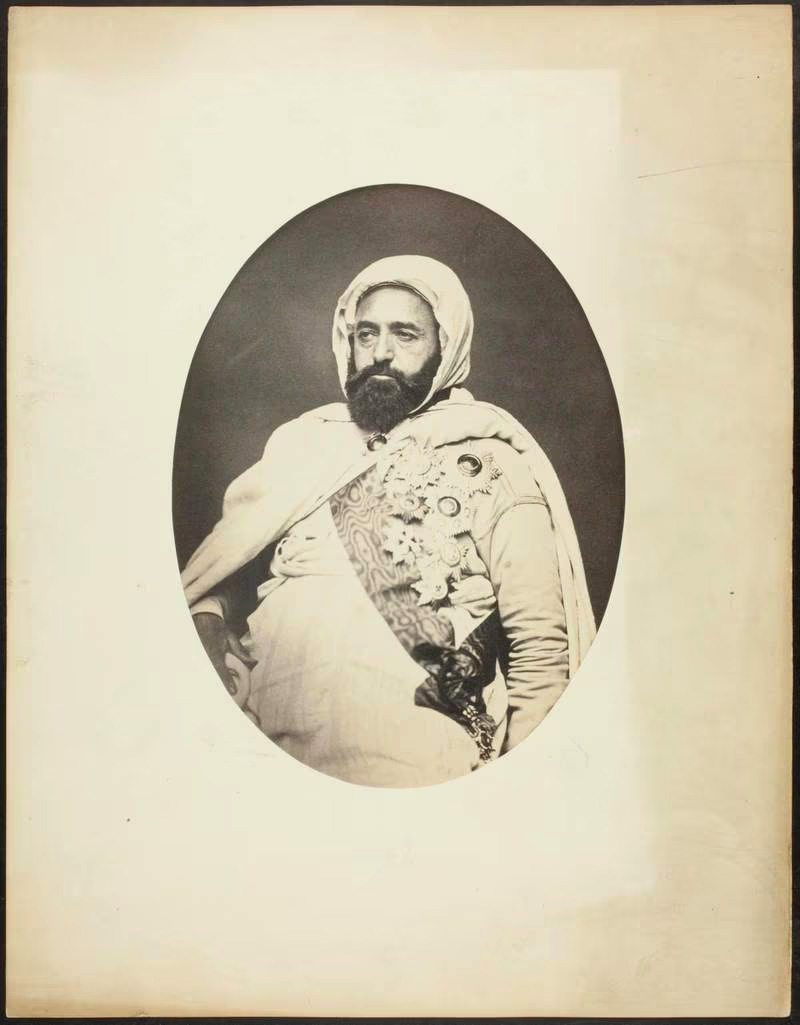
Jacques Philippe Potteau (French, 1807-1876) 'Emir Abd el-Kader (57), born in Maskara (Province of Oran, Algeria)' Paris, 1865


Jacques Philippe Potteau (French, 1807-1876)
Emir Abd el-Kader (57), born in Maskara (Province of Oran, Algeria)
Paris, 1865
Albumen paper print
Paris, musée du quai Branly – Jacques Chirac
Crédit photo: © musée du quai Branly – Jacques Chirac, Dist. RMN – Grand Palais / image musée du quai Branly – Jacques Chirac


Capture the distance

As early as the 1840s, cameras were on board on expedition ships departing from Europe. sailors, explorers, archaeologists, missionaries, artists are among the first experimenters of this new technology in remote regions, which are gradually passing under the yoke of the colonial powers. From Mexico to Gabon, photography is in turn an instrument of description and visual appropriation landscapes and monuments, a knowledge and control tool populations, or even an object of diplomacy vis-à-vis the local elite.

If the camera records with the same acuity the architectural detail, the landscape grandiose and the faces crossed, the authors gathered here turn out to be excellent technicians with a personal eye. Their travelogues relate the difficulties overcome: technical challenges, climatic constraints or even reluctance of local populations to pose. But these spectacular images, carried out in more or less accessible places, are also the result of a collaboration with many less visible local intermediaries: guides, interpreters, informants or porters – necessary to transport photographic equipment – ​​played a decisive role.

Text from the exhibition


Philip Henry Egerton (Welsh, 1824-1893) '"Kee Monastery", Pl. 22, Journal of a tour through Spiti, to the frontier of Chinese Tibet' Tibet, 1863


Philip Henry Egerton (Welsh, 1824-1893)
“Kee Monastery”, Pl. 22, Journal of a tour through Spiti, to the frontier of Chinese Tibet
Tibet, 1863
Album comprising 37 albumen prints
Dimensions of the album: 29 x 38.4cm
Dimensions of the prints: 21.6 x 26.7cm
© Quai Branly Museum – Jacques Chirac
 

Philip Henry Egerton (Welsh, 1824-1893) '"Kee Monastery", Pl. 22, Journal of a tour through Spiti, to the frontier of Chinese Tibet' Tibet, 1863 (detail)


Philip Henry Egerton (Welsh, 1824-1893)
“Kee Monastery”, Pl. 22, Journal of a tour through Spiti, to the frontier of Chinese Tibet (detail)
Tibet, 1863
Album comprising 37 albumen prints
Dimensions of the album: 29 x 38.4cm
Dimensions of the prints: 21.6 x 26.7cm
© Quai Branly Museum – Jacques Chirac
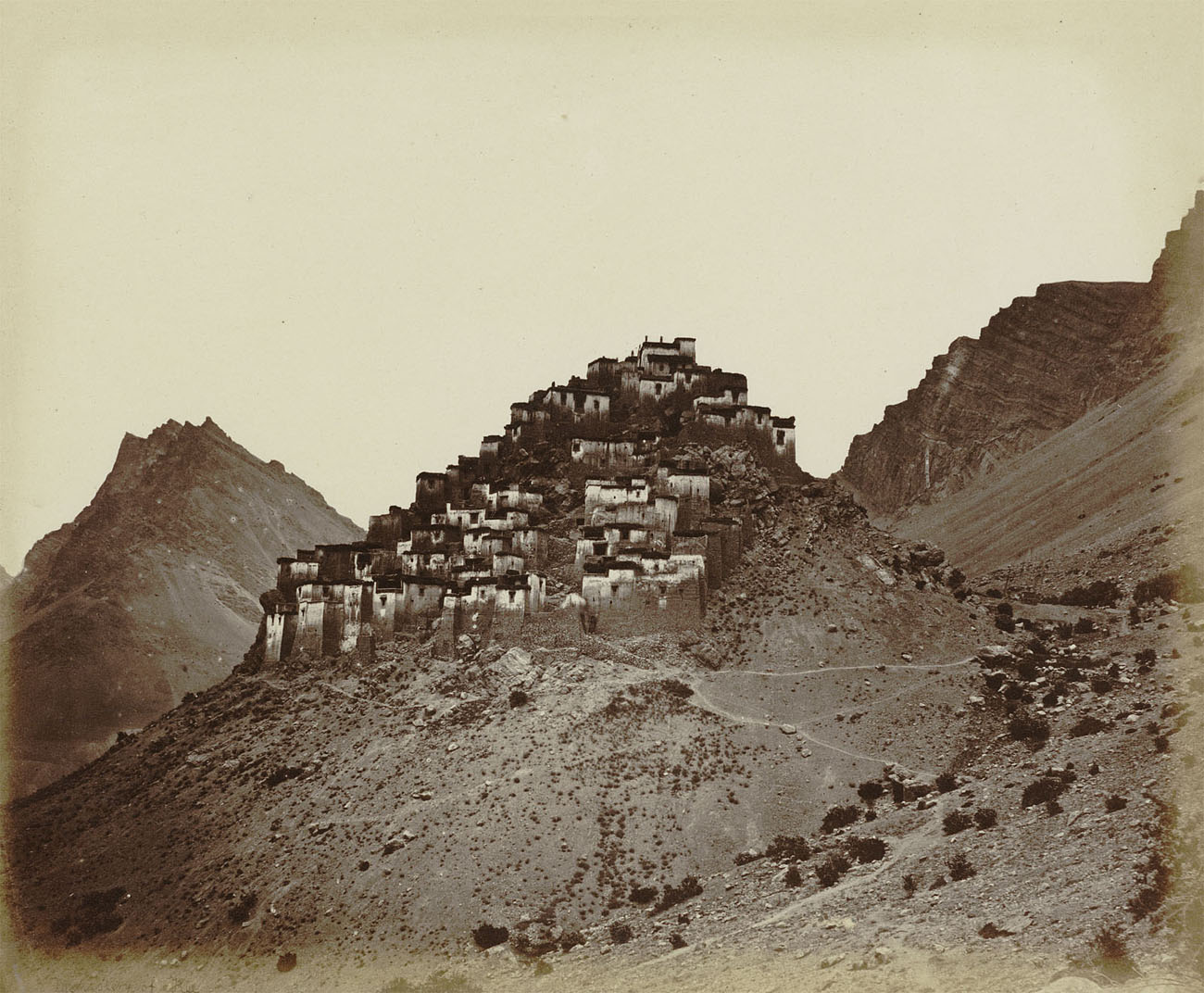
 

Philip Henry Egerton

The Briton Philip Henry Egerton worked for most of his life as senior civil servant for the colonial regime in northern India. He realises these photographs during a semi-official mission in the Himalayas, trying identify alternative routes for the wool trade across the border

India and Chinese Tibet. The Kangra and Kullu valleys, as well as the sites of Spiti and the Bara Shigri glacier are thus photographed for the first time. The images are published, accompanied by the story of their author, in 1864, with the support of the government of Punja.

Text from the exhibition


Philip Henry Egerton (Welsh, 1824-1893) 'Shigri Glacier – From the River (Main View)' Negative June - August 1863; print 1863-1864


Philip Henry Egerton (Welsh, 1824-1893)
Shigri Glacier – From the River (Main View)
Negative June – August 1863; print 1863-1864
From Journal of a Tour Through Spiti, To The Frontier of Chinese Thibet, With Photographic Illustrations
Albumen silver print
21.6 × 26.5cm (8 1/2 × 10 7/16 in.)
Credit Line: The J. Paul Getty Museum, Los Angeles
Public domain


Philip Henry Egerton (Welsh, 1824-1893) 'Shigri Glacier – Lower View' Negative June - August 1863; print 1863-1864


Philip Henry Egerton (Welsh, 1824-1893)
Shigri Glacier – Lower View
Negative June – August 1863; print 1863-1864
From Journal of a Tour Through Spiti, To The Frontier of Chinese Thibet, With Photographic Illustrations
Albumen silver print
21.6 × 26.5cm (8 1/2 × 10 7/16 in.)
Credit Line: The J. Paul Getty Museum, Los Angeles
Public domain


Désiré Charnay (French, 1828-1915) 'Palace of governor in Uxmal Yucatán' Mexico, June 1860


Désiré Charnay (French, 1828-1915)
Palace of governor in Uxmal Yucatán
Mexico, June 1860
Assembly of two prints on paper albumen
32.8 x 84.8cm
© Quai Branly Museum – Jacques Chirac


Desire Charnay

Improvised archaeologist and photographer with a taste for travel, Désiré Charnay is known to be the first to have brought back from several archaeological sites Mexicans a harvest of spectacular images. He uses the process of the negative on wet collodion glass, which requires him to carry heavy equipment. His fame was ensured by the publication, in 1861-1862, of the album photographic American cities and ruins.

Local stories and self-images

Europeans are not the only ones to experiment, order and market photography from the 19th century. The new medium is spreading to scale across the globe and has very variable rates of adoption depending on the region. Its local roots can be linked to the countries’ relations with the West or the relationship of societies to images. In Qajar Iran, in Siam (Thailand present day), in the princely courts of India and Java, royalty has been a patron enthusiast of photography and accelerated its growth by designating official photographers and importing equipment. The leaders take awareness of the potential of photography for the representation of power and the assertion of their authority. In India, Japan, China, West Africa and in Madagascar, indigenous photographers are getting professional training to practice, open their commercial studio in the major port cities, and very often work for a wider clientele, among the local and colonial elite. Photography is appropriate and adapted to social uses, it sometimes mixes to local visual traditions – such as painting or calligraphy – and seems in many places respond to the desire for self-representation and construction modern identities.

Royal appropriations of photography in Iran and Thailand

The monarchs Naser al-Din Shah (r. 1848-1896), in Iran, and Mongkut in Siam (Rama IV, r. 1851-1868), seduced by the technology and the possibilities of dissemination of the royal image, were important patrons. Naser al-Din Shah, defender of the arts and open to Europe, initiated himself into the practice, becoming an amateur keen. It promotes the development of photography through the diversity of actions which he led: in 1858, he established the Royal Photography Workshop within the of the Golestan Palace in Tehran, promotes the teaching of technique at school polytechnic of Dar ol-Fonoun, imports equipment, translates manuals, and appoints official court photographers who are given the title of Akkasbashi. Siam’s science-savvy King Mongkut also ramps up production photography at court. The Thai Francis Chit, who receives the title of “photographer of His Majesty the King of Siam”, produced several portraits of the royal family and views of official court events.

Text from the exhibition


Anonymous photographer. 'Half-length portrait of a 77-year-old man' Kyoto area, Japan, February 1890

Anonymous photographer. 'Half-length portrait of a 77-year-old man' Kyoto area, Japan, February 1890


Anonymous photographer
Half-length portrait of a 77-year-old man
Kyoto area, Japan, February 1890
Ambrotype
11 x 8.5cm
© Quai Branly Museum – Jacques Chirac


In Japan, a considerable boom during the Meiji era (1868-1912)

In Japan, photography developed as soon as the country opened up to trade international in 1859, and experienced considerable growth during the Meiji era (1868-1912), period of great modernisation. Uchida Kuichi and Ueno Hikoma, trained in Nagasaki, are among the most famous Japanese photographers of their time. They have developed a unique style with a pronounced taste for theatricality and sometimes humour. The production of ambrotypes, known as garasu shashin – “photography on glass” – is experiencing a particular boom in the field portraiture from the 1860s. Unique objects, they are mounted in boxes in raw paulownia wood, with traditional geometric shapes simple, used to preserve calligraphy or personal property.

The ambrotypes were intended for the private sphere of Japanese families, wishing to pass on the portraits of their loved ones as an inheritance. The tekagami-style accordion albums, richly decorated with gilding and sophisticated paintings, originally planned to accommodate calligraphy, have been diverted from their traditional use to receive prints large format photographs of Ichida Sota and Suzuki Shin’ichi II.


Anonymous photographer. 'Half-length portrait of a 77-year-old man' Kyoto area, Japan, February 1890 (detail)


Anonymous photographer
Half-length portrait of a 77-year-old man (detail)
Kyoto area, Japan, February 1890
Ambrotype
11 x 8.5cm
© Quai Branly Museum – Jacques Chirac
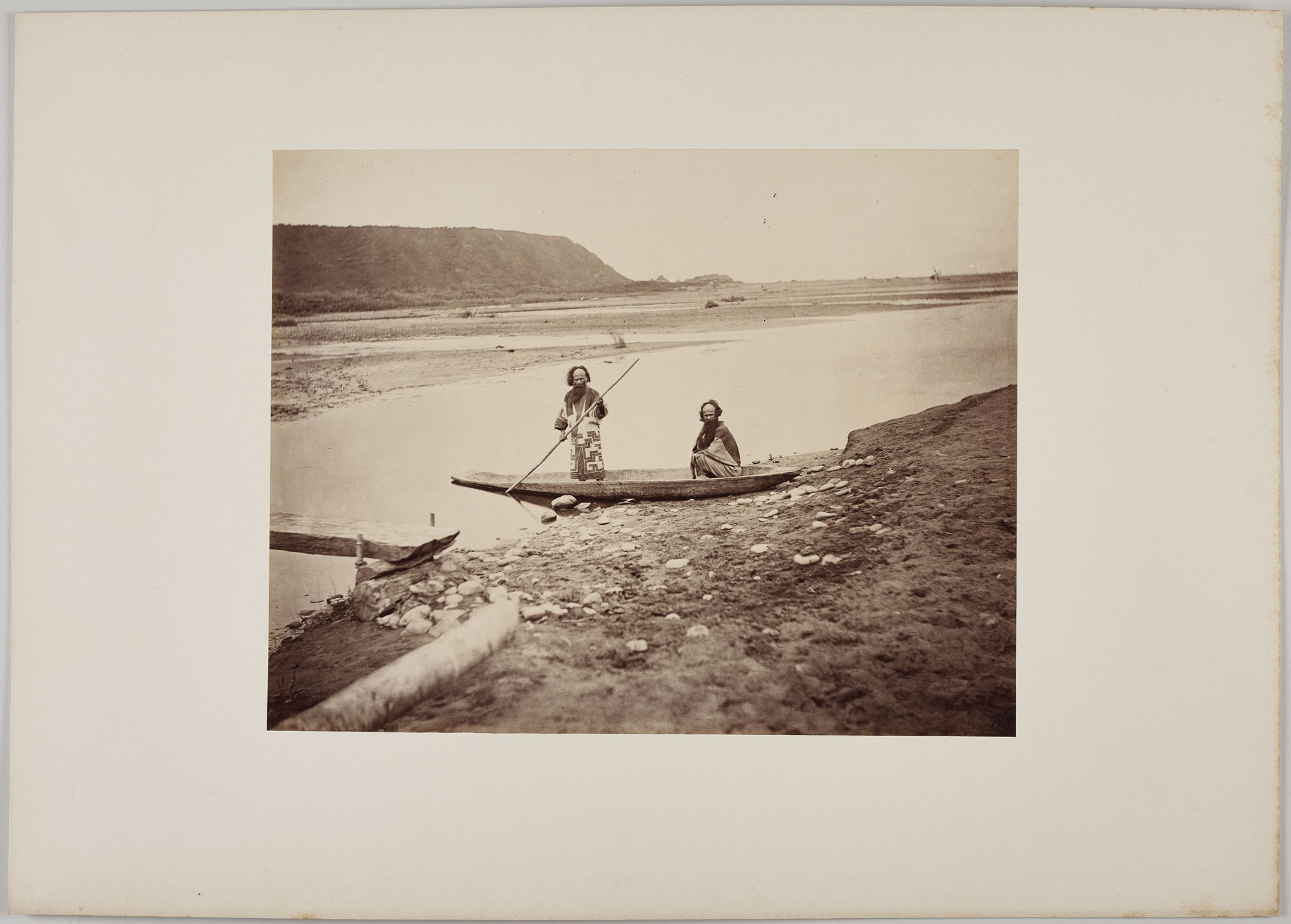
 

Tamoto Kenzō (Japanese, 1832-1912) 'Ainu with boat' Hokaido, Japan, c. 1874


Tamoto Kenzō (Japanese, 1832-1912)
Ainu with boat
Hokaido, Japan, c. 1874
© Kenzo Tamoto © Quai Branly Museum – Jacques Chirac


Tamoto Kenzō (田本 研造, 1832-1912) was a Japanese photographer. He was born in Kumano, in the Mie Prefecture of Honshu. When he was twenty-three, he moved to Nagasaki to study western culture. In 1859, he relocated to Hakodate, where he lost a foot due to frostbite. The surgeon who amputated his foot had an interest in photography, specifically ambrotypes, and Tamoto became his apprentice. It was not until 1866 that he began working as a photographer. In 1867, he photographed the construction of the last castle to be built in Japan, Fukuyama Castle. Tamoto took photographs of military leaders Enomoto Takeaki and Hijikata Toshizō during the Battle of Hakodate between 1868-1869. Tamoto opened his own portrait studio in Hakodate in 1869. Starting in 1871, he documented the improvements to infrastructure in the Hokkaido region, eventually presenting 158 photographs of the process to the Settlement Office.

Text from the Wikipedia website


Tamoto Kenzō (Japanese, 1832-1912) 'Ainu with boat' Hokaido, Japan, c. 1874 (detail)


Tamoto Kenzō (Japanese, 1832-1912)
Ainu with boat (detail)
Hokaido, Japan, c. 1874
© Kenzo Tamoto © Quai Branly Museum – Jacques Chirac


In India, a technology adopted by the elites

Introduced in India in 1840, photography was used by the authorities British and quickly adopted by the Indian elite. Studios set up in major port cities like Bombay, Madras and Calcutta. Active members of the Photographic Society of Bombay, Narayan Dajee and Hurrychund Chintamon are among the first native photographers to practice from the 1850s with the local elite, Brahmans, members of the government, and at the same time participate in colonial projects ethnographic documentation. The technology aroused enthusiasm very early on many maharajas. Famous Indian photographer Lala Deen Dayal received the title of official photographer of the ruler of Hyderabad in 1884. In some princely states like Indore, Udaipur and Mewar, photography of painted court is a great success and is part of the tradition of royal portraiture of pageantry. Enlarged prints are coated with a vivid layer of paint and opaque, which emphasises the abundance of jewels and the sumptuous character clothes.

Text from the exhibition


Hurrychund Chintamon. 'Untitled (Portrait of a man)' 1860s-1880s


Hurrychund Chintamon (Indian)
Untitled (Portrait of a man)
1860s-1880s
Albumen print
© Quai Branly Museum – Jacques Chirac


One of India’s earliest commercial photographers who specialised in portraiture, Hurrychund Chintamon was based in Bombay (now Mumbai). He received his training at Elphinstone College in 1855 under WHS Crawford, a secretary of the Photographic Society of Bombay, where Chintamon also exhibited his work the following year. He subsequently set up his photography studio in the city, initially photographing members of local mercantile families and later expanding his clientele to aristocracy and important political, administrative and literary figures, including Jamsetjee Jejeebhoy and Manickjee Antarya.

When Elphinstone introduced a course in photography in 1855, under instruction from the British East India Company, Chintamon was among the first batch of forty students to enroll. He graduated in 1856 with distinction, having twice earned the best photographs prize. The same year, he exhibited his photographs at the Bombay Photographic Society, along with others such as Narayan Daji, gaining the visibility he needed to operate as an independent professional. He also went on to produce a number of ethnographic images, some of which were displayed at the Exposition Universelle, or the Paris International Exposition, of 1867 for industrial, art and craft manufactures. His studio, Hurrychund & Co., which he set up at Rampart Row in 1858 flourished until 1881, when it ceased operations. …

Accompanying the proliferation of independent photography studios in the mid-nineteenth century, was the development of a hybrid aesthetic, seen also in Chintamon’s work. He evolved a visual style that combined the Victorian iconographies of class and refinement with the Indian symbols of ethnicity, caste and status. In staging his sitters, he used the popular European conventions of painted backdrops as well as props such as printed carpets and flower vases. The sitters were often posed or arranged to suggest an air of casualness or informality, in conspicuous contrast to their own self-conscious formality – likely a result of having to hold still during extended individual exposure times. This unintended tension between setting and sitter is another notable characteristic of Chintamon’s portraits.

Anonymous. “Hurrychund Chintamon,” on the Mapacademy website April 21, 2022 [Online] Cited 27/05/2023


Anonymous photographer. 'Portrait of a Maharaja of the Royal Family. Holkar, princely state of Indore' 1910-1920


Anonymous photographer
Portrait of a Maharaja of the Royal Family. Holkar, princely state of Indore
1910-1920
Silver print enhanced with gouache
© Quai Branly Museum – Jacques Chirac


Johnston & Hoffmann (active 1880-1950) 'The Maharani of Nepal and her Ladies in Waiting' Nepal, 1885-1894


Johnston & Hoffmann (active 1880-1950).
The Maharani of Nepal and her Ladies in Waiting
Nepal, 1885-1894
Albumen print
musée du quai Branly – Jacques Chirac
© Musée du Quai Branly – Jacques Chirac, Dist. RMN-Grand Palais
Image: Musée du Quai Branly – Jacques Chirac


Johnston & Hoffmann (active 1880-1950) 'The Maharani of Nepal and her Ladies in Waiting' Nepal, 1885-1894 (detail)


Johnston & Hoffmann (active 1880-1950).
The Maharani of Nepal and her Ladies in Waiting (detail)
Nepal, 1885-1894
Albumen print
musée du quai Branly – Jacques Chirac
© Musée du Quai Branly – Jacques Chirac, Dist. RMN-Grand Palais
Image: Musée du Quai Branly – Jacques Chirac


P.A. Johnston and Theodore Julius Hoffmann

Of British origin, P. A. Johnston and Theodore Julius Hoffmann founded the Johnston & Hoffmann studio, at its time the second largest European studio important in India. Established in Calcutta in 1882, they opened eight years later a annex to Darjeeling. Their studio is best known for its portraits of locals and royalty from Nepal, Sikkim and Tibet.

Text from the exhibition
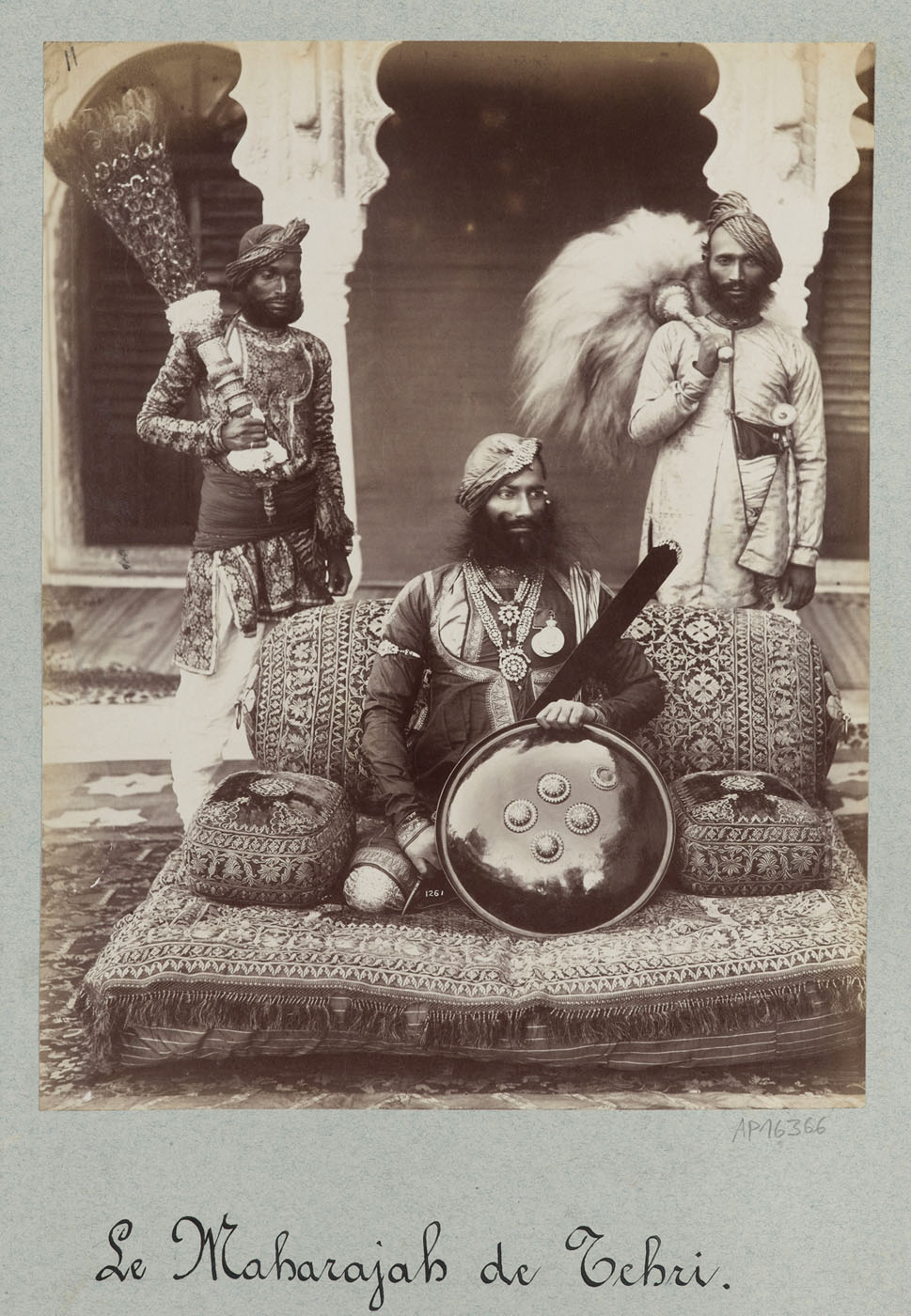
 

Lala Deen Dayal (Indian, 1844-1905) 'Portrait of Sir Pratab Singh, Maharajah of Orchla, with his entourage India' 1882


Lala Deen Dayal (Indian, 1844-1905)
Portrait of Sir Pratab Singh, Maharajah of Orchla, with his entourage
India, 1882
Albumen print
musée national des arts asiatiques – Guimet
© Bibliothèque nationale de France, Paris


Lala Deen Dayal

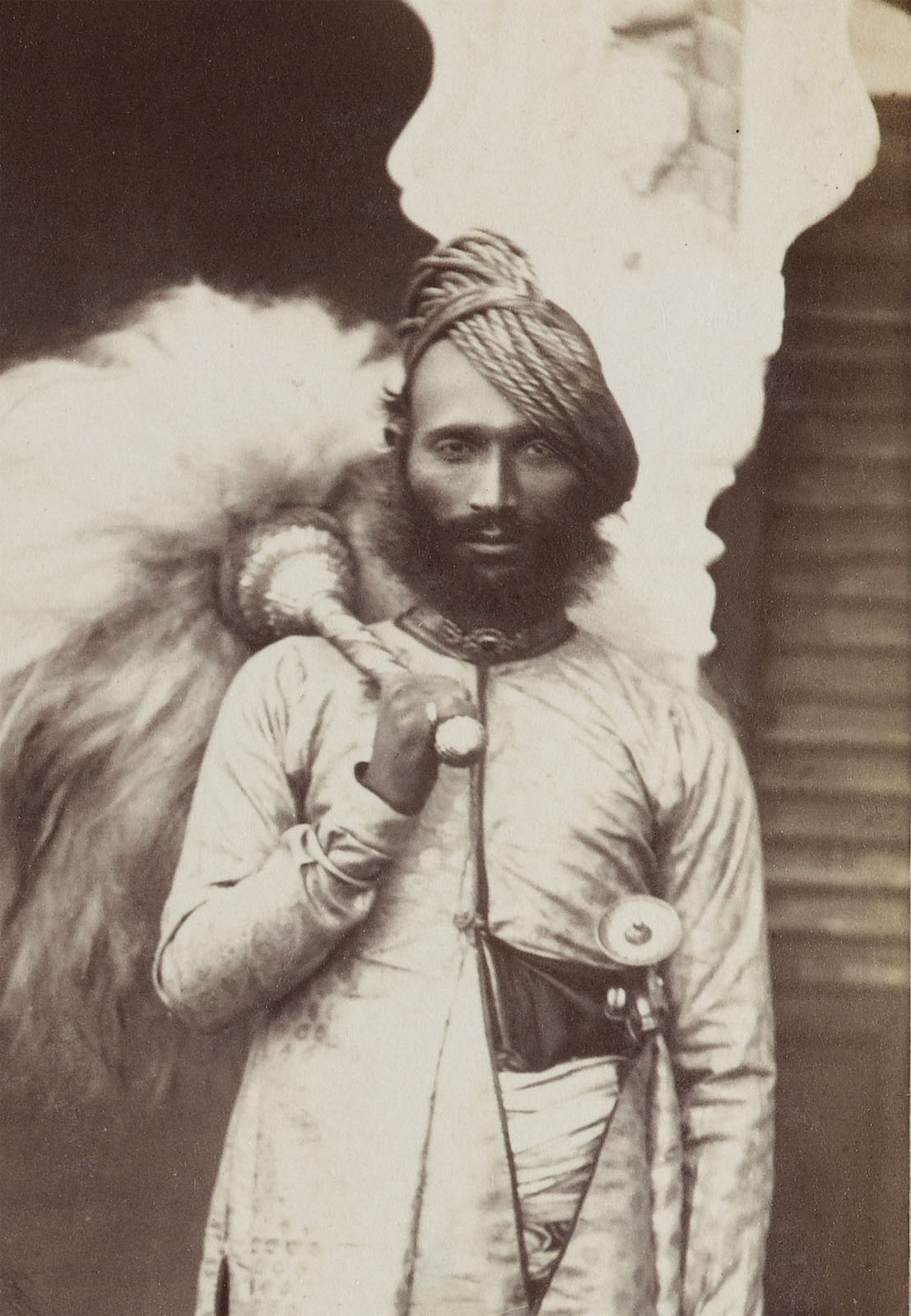
Raja Lala Deen Dayal (Hindi: लाला दीन दयाल; 1844-1905; also written as ‘Din Dyal’ and ‘Diyal’ in his early years), famously known as Raja Deen Dayal) was an Indian photographer. His career began in the mid-1870s as a commissioned photographer; eventually he set up studios in Indore, Mumbai and Hyderabad. He became the court photographer to the sixth Nizam of Hyderabad, Mahbub Ali Khan, Asif Jah VI, who awarded him the title Raja Bahadur Musavvir Jung Bahadur, and he was appointed as the photographer to the Viceroy of India in 1885. He received the Royal Warrant from Queen Victoria in 1897.


Lala Deen Dayal (Indian, 1844-1905) 'Portrait of Sir Pratab Singh, Maharajah of Orchla, with his entourage India' 1882 (detail)


Lala Deen Dayal (Indian, 1844-1905)
Portrait of Sir Pratab Singh, Maharajah of Orchla, with his entourage (detail)
India, 1882
Albumen print
musée national des arts asiatiques – Guimet
© Bibliothèque nationale de France, Paris
 

Lala Deen Dayal (Indian, 1844-1905) 'Portrait of Sir Pratab Singh, Maharajah of Orchla, with his entourage India' 1882 (detail)


Lala Deen Dayal (Indian, 1844-1905)
Portrait of Sir Pratab Singh, Maharajah of Orchla, with his entourage (detail)
India, 1882
Albumen print
musée national des arts asiatiques – Guimet
© Bibliothèque nationale de France, Paris


Installation view of the exhibition 'Photographs. An Early Album of the World (1842-1911)' at the musée du quai Branly – Jacques Chirac, Paris showing the section 'Composite photographs in Mexico'


Installation view of the exhibition Photographs. An Early Album of the World (1842-1911) at the musée du quai Branly – Jacques Chirac, Paris showing the section ‘Composite photographs in Mexico’


Composite photographs in Mexico

In the history of painted photography practices, colourisation often aims to embellish the print considered monochromatic and dull. A set of photographs painted by landscape artist Conrad Wise Chapman show a association of these two techniques around picturesque and popular subjects. Other forms of formal hybridisation are attested in Mexico. Three shots set with a medallion were partially covered with feathers in the colours shimmering, to highlight clothes and certain elements of the decor. These composite objects are rare testimonies that combine the art of featherwork, widespread in Mexico during the pre-Hispanic and colonial periods, with the new technique of photography. The figure of the peddler is attributed to the photographer Augustin Péraire [below] and the image of the three women is a reproduction of a print of the popular figure showing the “China poblana”.

Wall text from the exhibition


Augustin Péraire (active c. 1860) 'Portrait of a Man' c. 1867


Augustin Péraire (active c. 1860)
Portrait of a Man
c. 1867
Print on albumen paper enhanced with gouache and partially feather coloured, laminated on card size cardboard. Oval frame format, frame and gilt window, black and tan passe-partout swirl effect
13 x 9.2cm
© Quai Branly Museum – Jacques Chirac


Installation view of the exhibition 'Photographs. An Early Album of the World (1842-1911)' at the musée du quai Branly – Jacques Chirac, Paris showing at second left, W.J. Sawyer's 'Mr Sawyer, photo man' (Nigeria, 1880-1890)


Installation view of the exhibition Photographs. An Early Album of the World (1842-1911) at the musée du quai Branly – Jacques Chirac, Paris showing at second left, W.J. Sawyer’s Mr Sawyer, photo man (Nigeria, 1880-1890, below)


W.J. Sawyer (Nigerian) 'Mr Sawyer, photo man' Nigeria, 1880-1890


W.J. Sawyer (Nigerian)
Mr Sawyer, photo man
Nigeria, 1880-1890
Albumen paper print
Print on aristotype paper
© Quai Branly Museum – Jacques Chirac


Photo of W. J. Sawyer and his sons taken in Calabar (possibly at his studio). W. J. Sawyer was a photographer based in Calabar, mostly active during the late 19th century and early 20th century, having photographed the Oba of Benin during the period of his craft.


W.J. Sawyer

The biography of W. J. Sawyer is still quite incomplete. He takes, on demand of the Spanish Commander Francisco Romero, several photographs in Bioko (current Equatorial Guinea), in 1883. The images are shown the same year at the International Colonial and Export Exhibition in Amsterdam. The picture showing a man accompanied by two boys could be a self-portrait of the photographer, as the title on the back suggests.

Rapid growth in West Africa

Photography was quickly adopted in many regions in the world from the 1840s to the 1860s. West Africa combines several factors which have fostered its rapid growth. Many ports connect the cities with each other and with the European continent, facilitating transatlantic and regional trade. In Freetown (current Sierra Leone), Lagos (current Nigeria), Libreville (current Gabon) established communities made up of elders freed and returning slaves from North and South America and the Caribbean. A cosmopolitan culture reigns in these cities where trade can develop.

As early as 1853, the African-American Augustus Washington left the United States and set up a daguerreotype studio in Monrovia. In the 1860s, Francis W. Joaque or J.P. Decker practice photography on an itinerant basis on the coast. These photographers respond to a local demand for photography loved ones or events to remember. They also include a clientele European, Joaque realising for example many portraits of the explorer Italian Pierre Savorgnan de Brazza. The Lutterodt dynasty establishes several studios photographers who operate in Accra (current Ghana) and Freetown between the years 1870 and 1940.

Text from the exhibition


Jonathan Adagogo Green (Nigerian, 1873-1905) 'Last photo of Chief Henry Long John. Behind him stands his successor' Nigeria, 1895


Jonathan Adagogo Green (Nigerian, 1873-1905)
Last photo of Chief Henry Long John. Behind him stands his successor
Nigeria, 1895
Albumen print
© Quai Branly Museum – Jacques Chirac


J.A. Green

J. A. Green is one of West Africa’s most prolific photographers. Born in Nigeria, he is the son of a palm oil merchant. He practices photography from 1891 and provides images to a clientele African and European. He also trains other photographers. In this image, Green photographs a stage at the leader’s funeral slaver Amonibienye Ofori Long John. The tanda burial custom involves, for the elites, the public presentation of the body of the deceased dressed in his clothes of pageantry. Son Henry Obulu supports his father’s jaw to affirm his position as legitimate heir.

Text from the exhibition

Jonathan Adagogo Green

Jonathan Adagogo Green (J. A. Green), born in the village of Ayama (Peterside), Bonny (Rivers State, Nigeria) in 1873. The son of Chief Sunju Okoronkwoye Dublin Green and Madame Idameinye Green, he was looked after by his uncle Uruasi Dublin Green after his father’s death in 1875. He attended school in Lagos and possibly Sierra Leone. It is unknown where he trained as a photographer but by 1891 he had set up his photographic practice in Bonny. His work covered a range of themes including portraiture of British colonial officers, European merchants, prominent chiefs and their families, scenes of daily and ritual life, commerce and building – a body of work that appealed to both local elites and expatriate clients. Green died in 1905 at the age of 32, after practicing in the Niger Delta for 14 years. His work is in held in a number of collections in the UK, USA and Nigeria.

Text from the exhibition


Jonathan Adagogo Green (1873-1905) was according to some sources the first professional photographer in what is now Nigeria to have ethnic origins in that area. He is significant in being a pioneering photographer in what is now Nigeria, noted for his documentation of the colonial power and local culture, particularly his Ibani Ijo community.

Green was born in Bonny, present day Rivers State. “He studied photography in Sierra Leone and then established a studio in Bonny.” The area where he lived became part of the British Oil Rivers protectorate in 1884, which was renamed to the Niger Coast Protectorate in 1893. It was part of the Southern Nigeria Protectorate for the last few years of Green’s life, starting in 1900.

Green was active as a photographer for only a short lifetime, dying at the age of 32. “But during this period he was both energetically productive and remarkably adroit in serving both indigenous and colonial clienteles.” “When he set up shop his work was appreciated and rewarded by two very different communities.” His “strategic use of initials on his business cards and stamps… disguised his African origins”, part of his working with the colonial era officials.

Text from the Wikipedia website


Jonathan Adagogo Green (Nigerian, 1873-1905) 'Last photo of Chief Henry Long John. Behind him stands his successor' Nigeria, 1895 (detail)


Jonathan Adagogo Green (Nigerian, 1873-1905)
Last photo of Chief Henry Long John. Behind him stands his successor (detail)
Nigeria, 1895
Albumen print
© Quai Branly Museum – Jacques Chirac


William Ellis (British, 1794-1872) 'Untitled (portrait of a woman)' 1853-1865


William Ellis (British, 1794-1872)
Untitled (portrait of a woman)
1853-1865
Salted paper print
20.5 x 24cm
© musée du quai Branly – Jacques Chirac
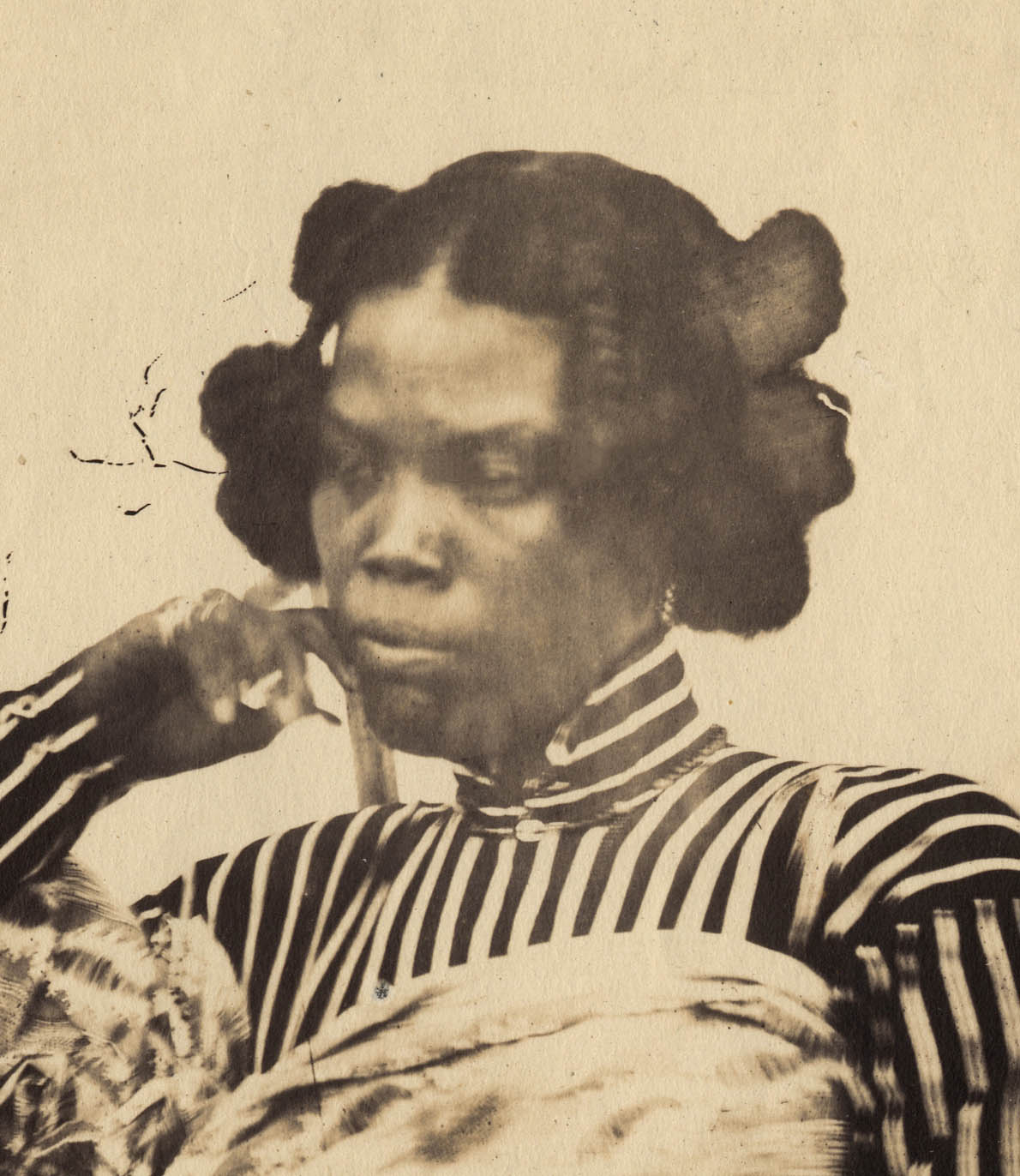
 

William Ellis (British, 1794-1872) 'Untitled (portrait of a woman)' 1853-1865 (detail)


William Ellis (British, 1794-1872)
Untitled (portrait of a woman) (detail)
1853-1865
Salted paper print
20.5 x 24cm
© musée du quai Branly – Jacques Chirac


William Ellis (29 August 1794 – 9 June 1872) was a British missionary and author. He travelled through the Society Islands, Hawaiian Islands, and Madagascar, and wrote several books describing his experiences.
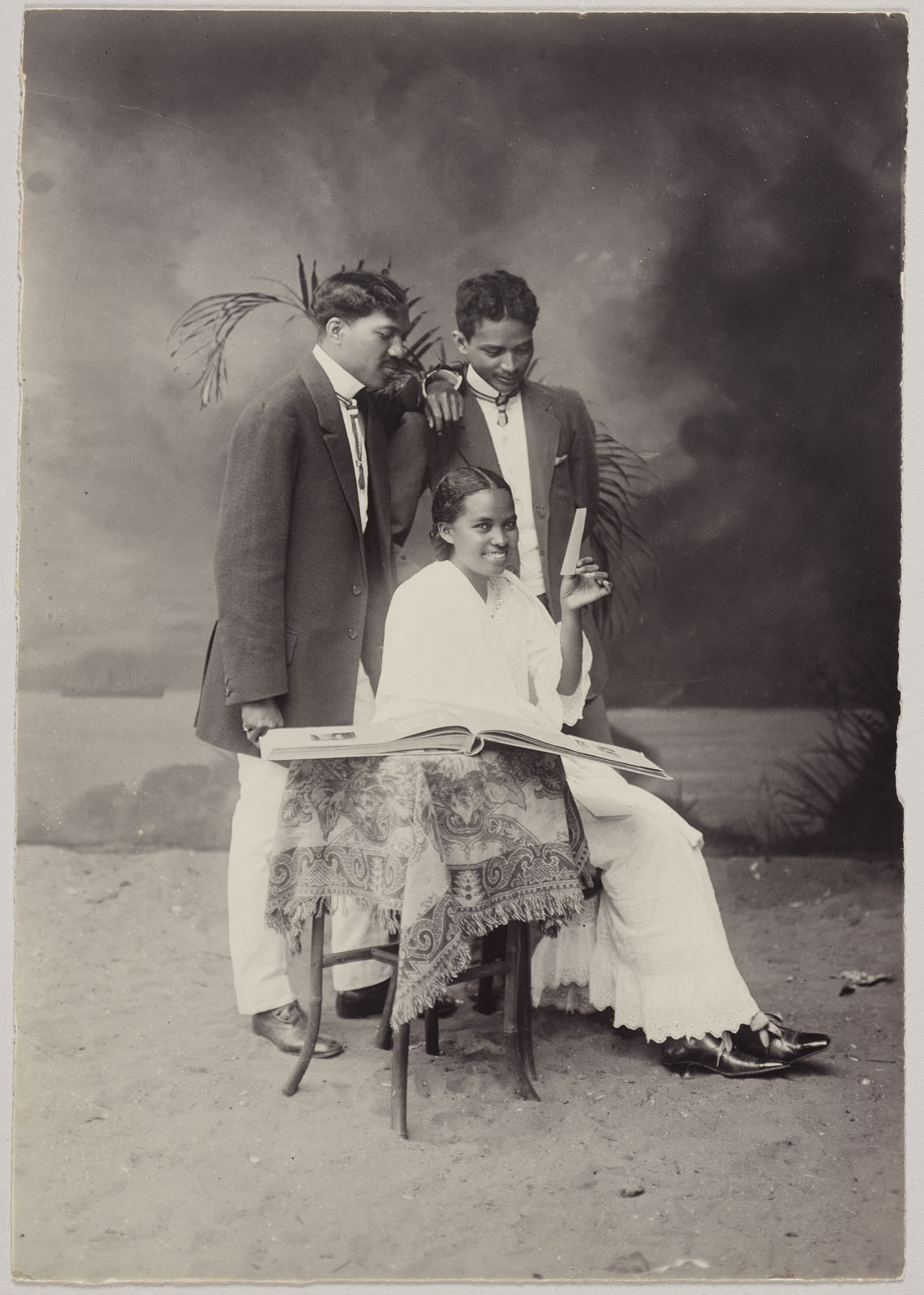
 

Joseph Razafy (Madagascar, 1881-1949) 'Untitled (portrait of two men and a woman)' Nd


Joseph Razafy (Madagascar, 1881-1949)
Untitled (portrait of two men and a woman)
Nd
© musée du quai Branly – Jacques Chirac


In Madagascar, photography as a tool of social distinction

Photography is introduced to Madagascar by the British missionary William Ellis [above]. First rejected by Queen Ranavalona I (r. 1828-1861), the technology was enthusiastically adopted during the reign of Radama II (r. 1861-1863) by the king himself, the court and the Malagasy elite, responding to the desire for individualisation and social distinction from high society. Several European photographers mentioned the ease and familiarity of the models with the device. From the 1890s, the first Malagasy studios won great success with a population wishing to design and maintain a self-image. The photos presented here are the work of this first generation Malagasy photographers, including Joseph Razaka based in Antananarivo and Joseph Razafy in Toamasina.

Text from the exhibition
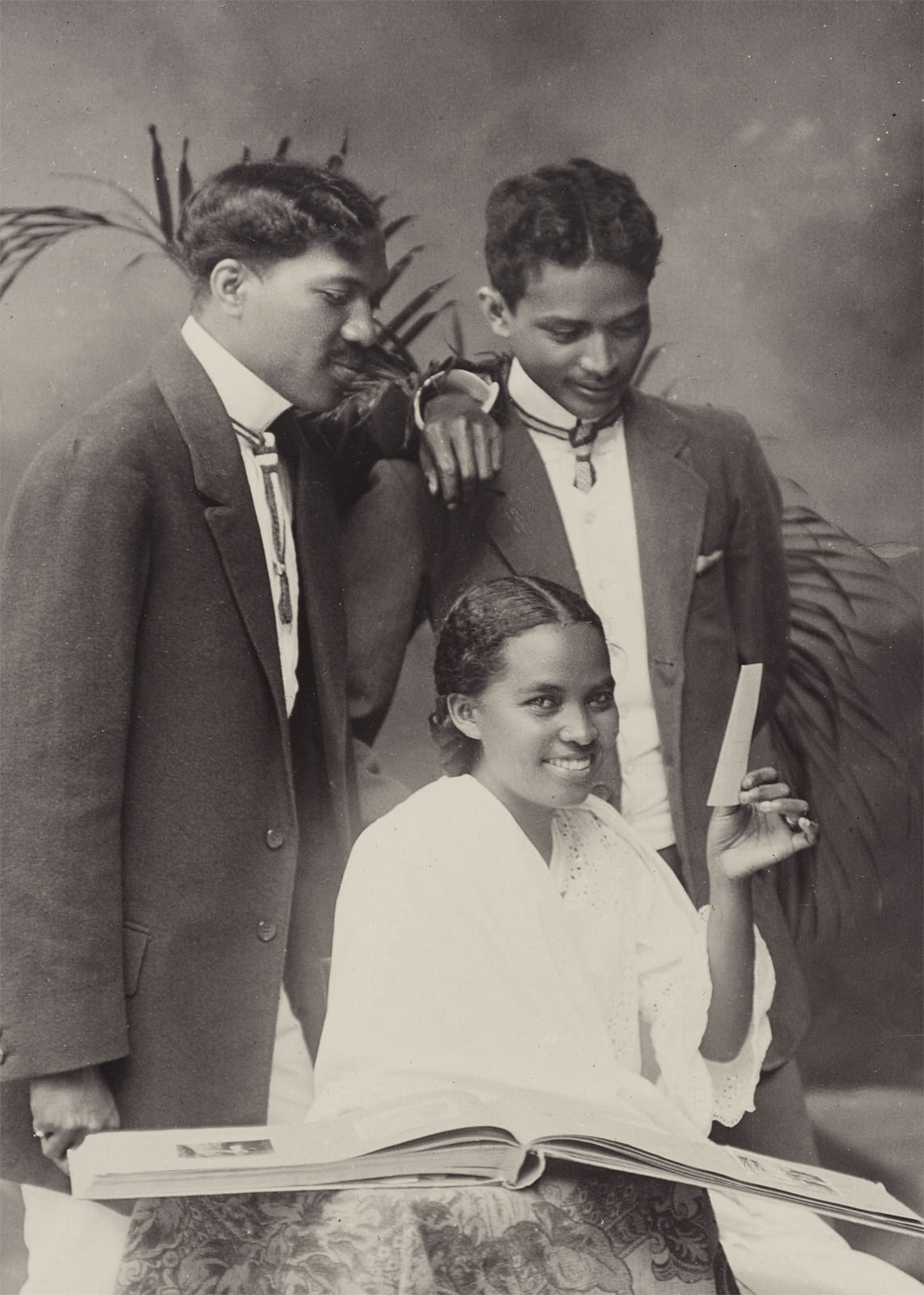
 

Joseph Razafy (Madagascar, 1881-1949) 'Untitled (portrait of two men and a woman)' Nd (detail)


Joseph Razafy (Madagascar, 1881-1949)
Untitled (portrait of two men and a woman) (detail)
Nd
© musée du quai Branly – Jacques Chirac


Joseph Razafy (Madagascar, 1881-1949) 'Untitled (portrait of a woman)' Nd


Joseph Razafy (Madagascar, 1881-1949)
Untitled (portrait of a woman)
Nd
© musée du quai Branly – Jacques Chirac
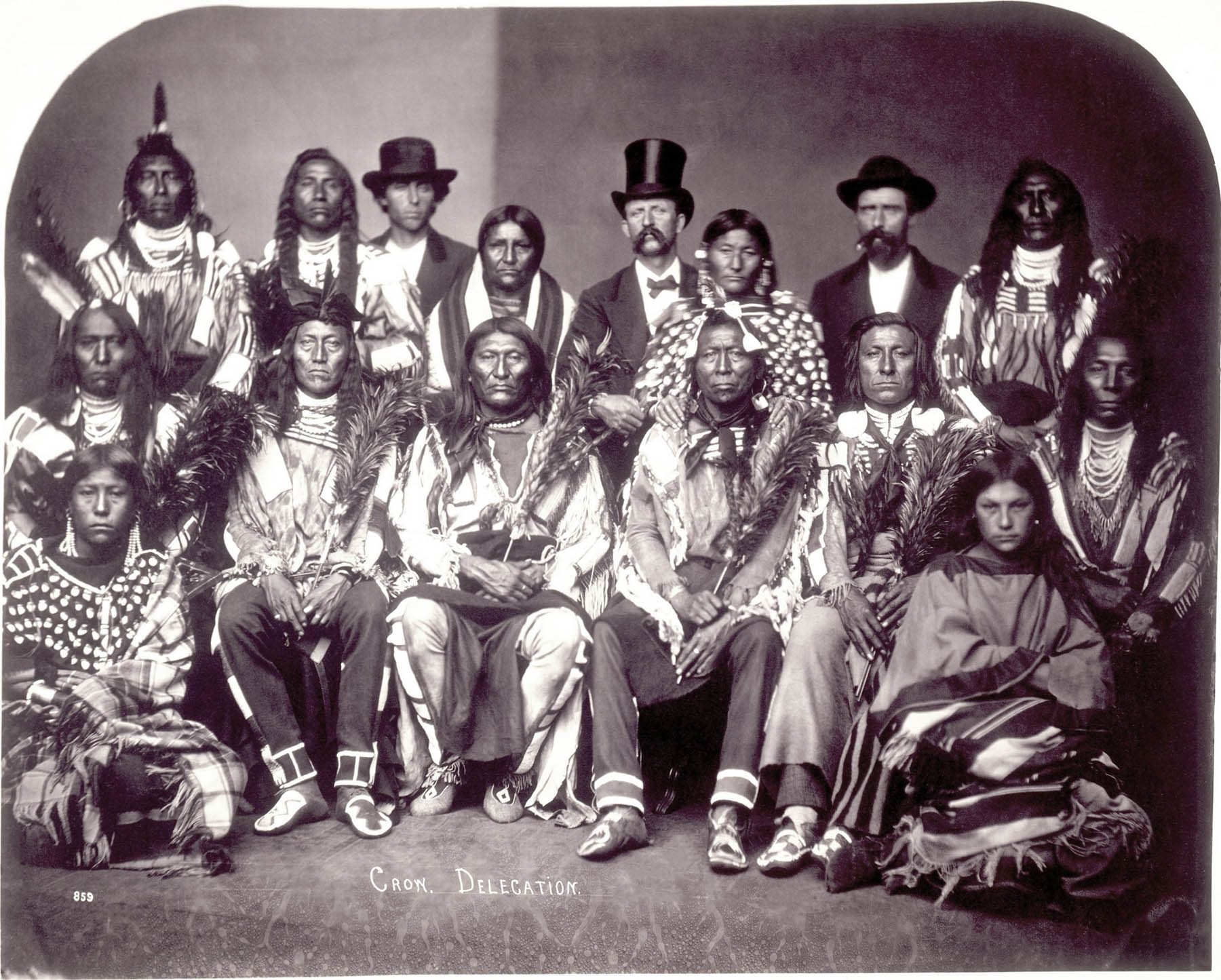
 

Ulke Brothers Studio (Julius Ulke and Henry Ulke) 'Apsáalooke (Crow) delegation' 1872


Ulke Brothers Studio (Julius Ulke and Henry Ulke)
Apsáalooke (Crow) delegation
1872
Albumen silver print from glass negative
8 x 10 in.
National Anthropological Archives, Smithsonian Institution

Back row (standing) from left to right: Long Horse; Thin Belly; Bernard Prero (interpreter); unknown name, wife of Awé Kúalawaachish (Sits In The Middle Of The Land); Major F.D. Pease (agent); unknown name, wife of Uuwatchiilapish (Iron Bull); Frank Shane (interpreter); and Bear In The Water. Front row (seated in chairs) from left to right: Bear Wolf; White Calf; Awé Kúalawaachish (Sits In The Middle Of The Land); Uuwatchiilapish (Iron Bull); One Who Leads The Old Dog; and Peelatchixaaliash (Old Crow [Raven]). Front row (seated on the floor) from left to right: Stays With The Horses, wife of Bear Wolf; and Pretty Medicine Pipe, wife of Peelatchixaaliash (Old Crow [Raven])
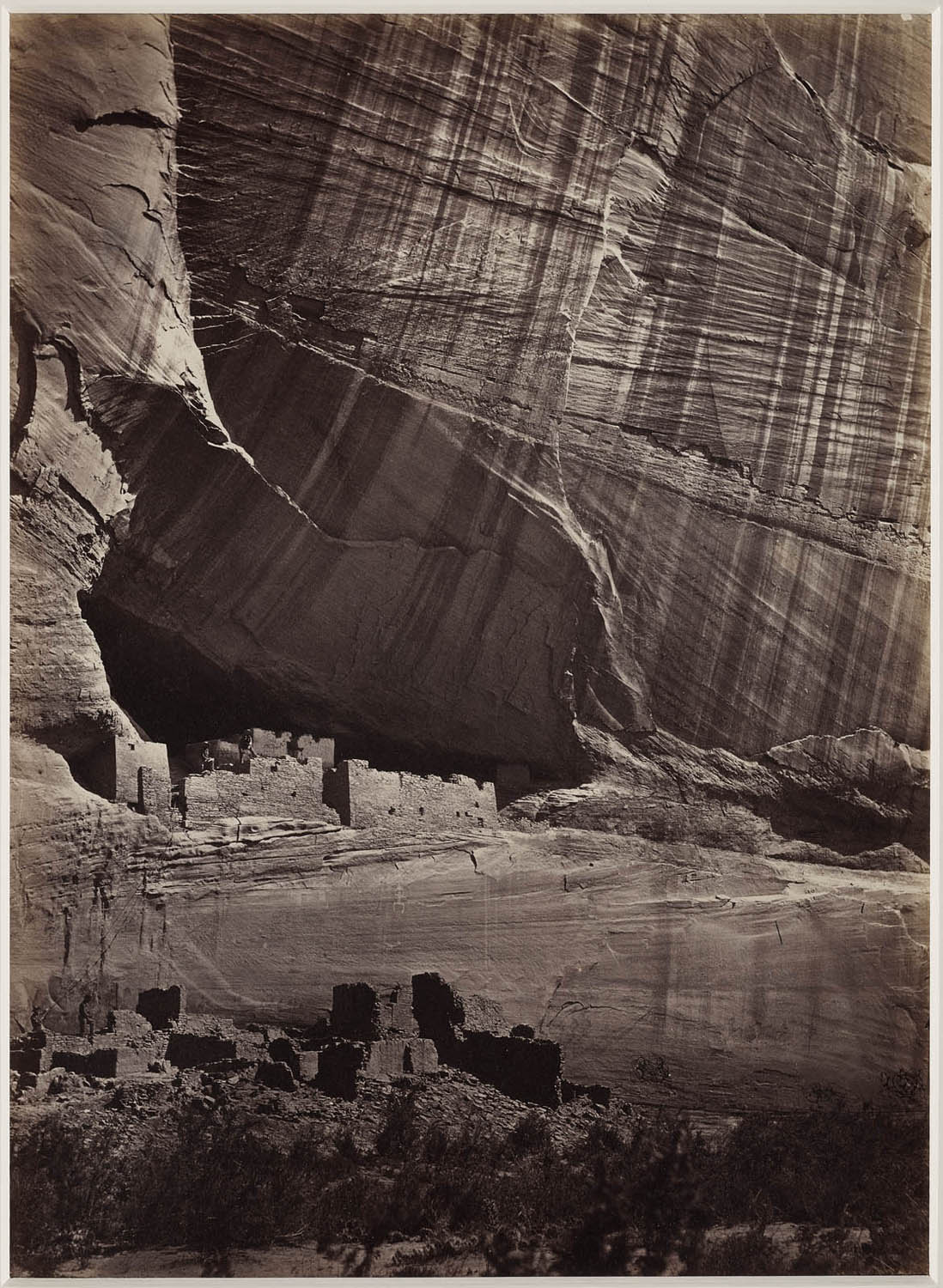
 

Timothy H. O'Sullivan (American born Ireland, 1840-1882) 'Photographs from Geographical explorations and surveys west of the 100th meridian Wheeler' 1873


Timothy H. O’Sullivan (American born Ireland, 1840-1882)
Photographs from Geographical explorations and surveys west of the 100th meridian Wheeler 1871-2-3
1871-1873
© musée du quai Branly – Jacques Chirac


Timothy H. O’Sullivan

This series by Timothy H. O’Sullivan comes from the album Photographs from Geographical explorations and surveys west of the 100th meridian Wheeler 1871-2-3, consisting of fifty photographs of explorations in the Western United States (New Mexico, Nevada, Arizona, Utah, etc.). The set shows mainly landscapes and natural sites, some portraits of Zunis, Apaches and Navajos, and views of architecture and monuments.

The limits of visibility

The thirst for images which manifested itself as early as 1840 in Europe and then rapidly in the whole world has encountered contrasting situations. From the beginning arose the question of limits: how far to go? Under what conditions do a photography ? For what purposes? Technical challenge sometimes but above all question ethics when it comes to bearing witness to the horrors of war, or when it comes to to produce the image of scenes or objects that are supposed to remain hidden. Some photographers could trick, coerce or negotiate. The images produced are remained secret or, conversely, circulated widely. The life of photographs after the shot is a fundamental element of this medium, they are led to undergo multiple changes of meaning depending on the way we perceives them, from which they are presented. In this section are photographs that evoke certain situations limits: images of conflicts shown or hidden, sacred places of which a part remains invisible, images obtained by trickery. These photographs are not shown as trophies but as traces of practices that we can re-examine today.

Uncover the Sacred

For many photographers, the attraction of the forbidden or the opportunity to attend a singular event played into the desire to create an image. We consider
today with a certain reserve these images of masks or places Holy. While they may still constitute factual documents, our attention now turns to the conditions of their realisation. In what contexts could they have been made, and what do they show us, apart from the very fact that they were produced in an exceptional way?

James album

The history of photography in Pueblo territory, in the United States, offers a rare example of strong reaction to the invasion of photography. The first reactions of mistrust from the Indian communities, from the 1890s, are linked to the dissemination of images and the tourist promotion of rituals supposed remain secret. The Hopi Snake Dance ceremony had become a major attraction. Often disrupted by ever-increasing numbers of visitors, it will be definitively prohibited to photographers in 1913, following the mobilisations of Hopi communities. The exhibition does not present here the photographs of this ritual that George Wharton James manages to capture, in order respect the Hopi restrictions. The exposed double page combines two times of shooting, the first image showing the perplexed waiting of the Indians in front the church of Acoma, and the second their reaction of just surprise and mistrust after shooting.

Text from the exhibition


F. Bonfils et Cie (French, 1831-1885) 'Egyptian mummy, Medinet-Abou, Egypt' Cairo, 1870


F. Bonfils et Cie (French, 1831-1885)
Egyptian mummy, Medinet-Abou, Egypt
Cairo, 1870
© Quai Branly Museum – Jacques Chirac


Félix Adrien Bonfils was a French photographer and writer who was active in the Middle East. He was one of the first commercial photographers to produce images of the Middle East on a large scale and amongst the first to employ a new method of colour photography, developed in 1880. …

Maison Bonfils produced thousands of photographs of the Middle East. Bonfils worked with both his wife and his son. Their studio became “F. Bonfils et Cie” in 1878. They photographed landscapes, portraits, posed scenes with subjects dressed up in Middle Eastern regalia, and also stories from the Bible. Bonfils took photographs in Lebanon, Egypt, Palestine, Syria, Greece and Constantinople (now Istanbul). While Bonfils produced the vast majority of his work, his wife, Lydie, and son Adrien were also involved in photography produced by the studio. As few are signed, it is difficult to identify who is responsible for individual photographs. Lydie is thought to have taken some of the studio portraits, especially those of Middle Eastern women, who were more inclined to pose for a female photographer. Adrien became more involved in the landscape photography at age 17, when Félix returned to Alès to have compiled collections of their photographs published and then to open a collotype printing factory. Félix died in Alès on the 9th of April 1855.

Text from the Wikipedia website


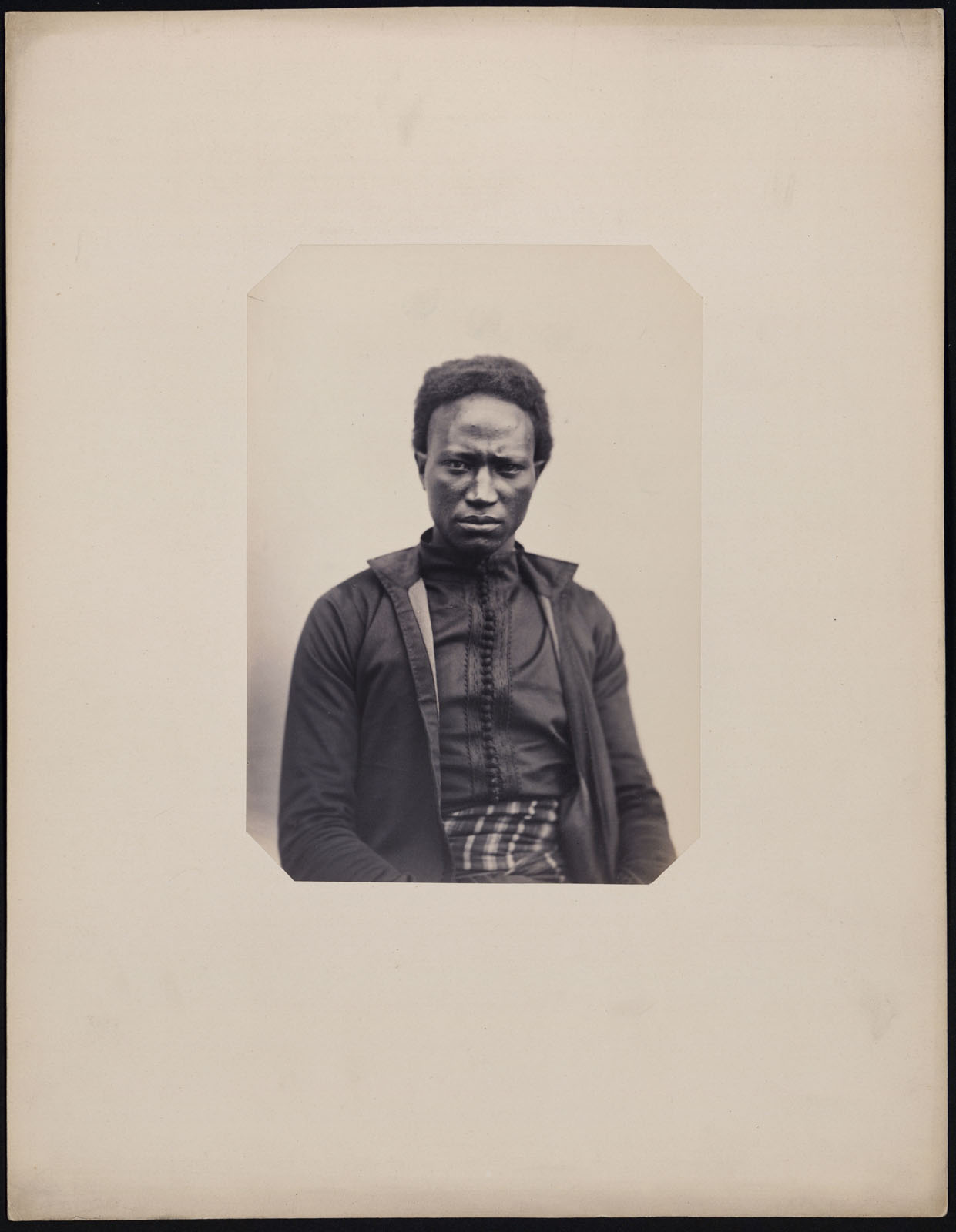
Charles Guillain (French, 1808-1875) 'Majeerteen Woman' East Coast of Africa, 1847-1848


Charles Guillain (French, 1808-1875)
Majeerteen Woman
East Coast of Africa, 1847-1848
Daguerreotype
Musée du Quai Branly – Jacques Chirac
© Musée du Quai Branly – Jacques Chirac, Dist. RMN-Grand Palais
Image: Musée du Quai Branly – Jacques Chirac


As Christine Barthe observes, “In the first ten years of photography, from 1841 to 1851, many travelers would try their hands at daguerreotypes outside Europe. Guillain’s photographs, taken in very difficult conditions, are not always perfect from a technical point of view, but they nevertheless represent the pioneering works in the history of photography.” They offer extraordinary insight into the people, the policies, and the places along the east coast of Africa during the mid nineteenth-century.

Erin Rushing. “Swahili Coast: Exploration by French Captain Charles Guillain, 1846-1848. Part 3, Encounters and Partnerships,” on the Smithsonian Unbound blog May 13, 2015 [Online] Cited 22/05/2023


Ernest Benecke (German born England, 1817-1894) 'Dead crocodile on a boat on the Nile' Egypt, 1852


Ernest Benecke (German born England, 1817-1894)
Dead crocodile on a boat on the Nile
Egypt, 1852
Salt paper print
Bibliothèque nationale de France, Manuscripts Department
Émile Prisse d’Avennes Egyptian Collection
© Bibliothèque nationale de France, Paris


Ernest Philipp Benecke may have been part of a well-known German banking family of the same name from the Hamburg and Hanover area. Benecke made his only known photographs in Egypt and Nubia in 1852, which consisted of portraits and studies of the daily life of the cultures he visited. His works are among the earliest surviving photographs of non-Western civilizations.


Muhammad Sadiq Bey (Egyptian, 1822-1902) 'View of the Holy Shrine and the City of Mecca' Saudi Arabia, 1881


Muhammad Sadiq Bey (Egyptian, 1822-1902)
View of the Holy Shrine and the City of Mecca
Saudi Arabia, 1881
Photographic print
Bibliothèque nationale de France, Rare Books Reserve
© Bibliothèque nationale de France, Paris


Muhammad Sadiq Bey

Muhammad Sadiq Bey (1832-1902) was an Ottoman Egyptian army engineer and surveyor who served as treasurer of the Hajj pilgrim caravan. As a photographer and author, he documented the holy sites of Islam at Mecca and Medina, taking the first ever photographs in what is now Saudi Arabia. …

Born in Cairo, Sadiq was educated in Cairo’s military college and at the Paris École Polytechnique. He qualified as an colonel in the Egyptian army and returned to the military college to teach cartographic drawing.

In 1861, he was assigned to visit the region of Arabia from Medina to the port of Al Wajh and conduct a detailed survey. He took a small team and some surveying equipment as well as his own camera; photography was not part of the official mission. His records of the expedition are the earliest known detailed accounts of the region’s climate and settlements. His photographs of Medina were the first ever taken there. In 1880 he was assigned to accompany the Hajj pilgrim caravan from Egypt to Mecca as its treasurer. He was responsible for the safe passage of the mahmal, a ceremonial passenger-less litter, to Mecca. Again he brought a camera, becoming the first person to photograph Mecca, the Great Mosque, the Kaaba, and pilgrim camps at Mina and Arafat. …

Sadiq used a wet-plate collodion camera, which had been invented in the 1850s. This produced negatives on wet glass plates, requiring a portable darkroom. From these negatives he made albumen prints which he signed or, later, stamped.

The sanctuaries of Mecca and Medina are the holiest sites of Islam. As part of the Hajj which is one of the five pillars of Islam, pilgrims perform rituals at Mecca and other nearby sites. On his expeditions from 1861 to 1881, Sadiq photographed the interiors and exteriors of sites on the Hajj pilgrimage route as well as at Medina. Photographing the Al-Masjid an-Nabawi (Prophet’s Mosque) and its surroundings in Medina on 11 February 1861, he noted in his diary that no-one had taken such photographs before.

He used walls and mosque roofs as vantage points to capture panoramas of the cities. He also photographed people connected to the holy sites. As well as the Hajj pilgrims walking around the Kaaba, he photographed Shaykh ‘Umar al-Shaibi, the keeper of the key of the Kaaba, and Sharif Shawkat Pasha, guardian of the Prophet’s Mosque.

Text from the Wikipedia website


Jules Borelli (French, 1853-1941) 'Portrait of a young woman' Ethiopia 1885-1888


Jules Borelli (French, 1853-1941)
Portrait of a young woman, Ethiopia
1885-1888
Photo: © Dist. RMN – Grand Palais/musée du quai Branly – Jacques Chirac


Jules Borelli

Jules Borelli (b. 1853, d. 1941) was a French traveller and explorer who travelled to Ethiopia from Egypt on 16 September 1885 to explore the Omo river. In this effort he was supported by his brother, a financier in Cairo and the owner of a fine collection of Egyptian antiquities. He was delayed from moving into western and southwestern Ethiopia by ase Ménilék II, who, out of political concerns, detained him at the capital of Éntotto for part of the period from July 1886 to November 1887. Finally, in November 1887. Borelli started out for the headwaters of the Omo river, and reached a point some 300 miles north of Lake Rudolf (Turkana) on 17 June 1888, three months after Count Samuel Teleki von Szek and Lieutenant Ludwig Ritter von Hohnel had arrived on the lake’s southern shore. Had Ménilék not detained him and had he not fallen ill with malaria, Borelli could have reached the lake well before Teleki and von Hohnel. During his travels, Borelli was given a good description of the lake by people in Ethiopia, who called it Lake Šambara.

Borelli arrived in Cairo on 15 November 1888, where he later met Teleki and von Hohnel who were returning to Europe from their trip. The latter assisted B. in drawing his maps of the country surrounding the Omo river. Borelli doubted von Hohnel’s unsubstantiated claim that two rivers flowed into Lake Rudolf, and, as was later proven, correctly deduced that only the Omo flowed into the lake. In 1889, Borelli invited von Hohnel to Paris to attend an international geographical congress, where both men lectured. Borelli described his Ethiopian travels in his beautifully illustrated and well documented book published in 1890.

Text from Encyclopaedia Aethiopica
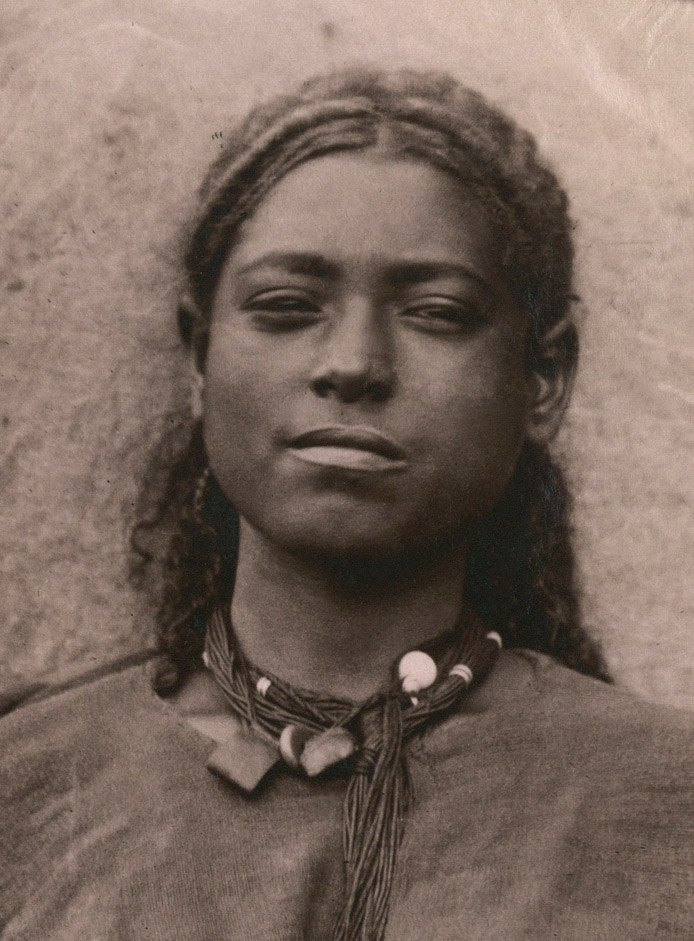
 

Jules Borelli (French, 1853-1941) 'Portrait of a young woman' Ethiopia 1885-1888 (detail)


Jules Borelli (French, 1853-1941)
Portrait of a young woman, Ethiopia (detail)
1885-1888
Photo: © Dist. RMN – Grand Palais/musée du quai Branly – Jacques Chirac


Unknown photographer. 'Malay Interior' Nd


Unknown photographer
Malay Interior
Nd
Photo: musée du quai Branly – Jacques Chirac, Dist. RMN – Grand Palais image musée du quai Branly – Jacques Chirac


Isidore Van Kinsbergen (Dutch-Belgian, 1821-1905) 'Baris, Warrior dancers Bali' Indonesia, 1865-1866


Isidore Van Kinsbergen (Dutch-Belgian, 1821-1905)
Baris, Warrior dancers Bali
Indonesia, 1865-1866
Albumen print
Musée du Quai Branly – Jacques Chirac
© Musée du Quai Branly – Jacques Chirac, Dist. RMN-Grand Palais
Image: Musée du Quai Branly – Jacques Chirac


Isidore van Kinsbergen (Bruges 1821-Batavia 1905) was a Dutch-Belgian engraver, who after an educational period in Bruges and Gent discovered the artistic wealth of the theatre. In Batavia (Jakarta) he proved to be a real all-rounder, combining decoration painting with singing, acting and management. In 1855, Van Kinsbergen also took up photography. He was invited to photograph ‘all peculiarities’ on the Dutch mission to Bangkok in 1862 and took part in two inspection tours covering Java, Madura and Bali (1862 and 1865). Between 1863 and 1867 and again in 1873 he was contracted by the Government of the Netherlands-Indies to photograph Java’s antiquities. Two series, together holding over 375 photos, constitute his art and archaeology legacy.

There is a less or even ‘unknown’ Van Kinsbergen as well, who commercially operated from a professional studio in Batavia. Thanks to research, more than 200 anonymous or wrongly attributed photos can now be assigned to him. How to recognize Van Kinsbergen in portraits, landscapes, views and ‘types’? After all, making a portrait or casting a ‘type’ is quite different from photographing monuments. Are characteristics found within his art and archaeology series evident in his so-called commercial work? Yes, but not in one stereotypical way. Besides a general artistic rendering of items and the careful use of light, his style is direct, full of contrast, academic and theatrical at the same time.

Gerda Theuns de Boer. “Isidore van Kinsbergen: photographs of Java and Bali, 1855-1880,” on the International Institute for Asian Studies website Newsletter #35 June 2005 [Online] Cited 21/05/2023


Isidore van Kingsbergen (1821-1905) is sometimes described as the “sleeping beauty” of nineteenth-century photography, because his remarkable body of work has never been presented in its entirety. Yet he was a flamboyant artist who appeals to the imagination. For the first time, this publication gives a broad overview of the exceptional qualities of this photo pioneer. Van Kinsbergen became famous for the almost four hundred photographs he took of Java’s antiquities at the behest of the Dutch colonial government and the Batavian Society. Detailed research has also brought to light a hitherto unknown part of his oeuvre, including the portraits he made at the courts of Yogyakarta, Surakarta, Bandung, Madura and Buleleng (Bali). In his studio, he used his experience as a theatre director to photograph people from various social backgrounds in an expressive manner. Due to his tireless efforts for new cultural projects, he has also been called as the “soul of colonial artistic life in Batavia.”

Text from the Brill website


Unknown photographer. 'Album of photographs of the Philippines' Nd


Unknown photographer
Album of photographs of the Philippines
Nd
Photo: musée du quai Branly – Jacques Chirac, Dist. RMN – Grand Palais image musée du quai Branly – Jacques Chirac
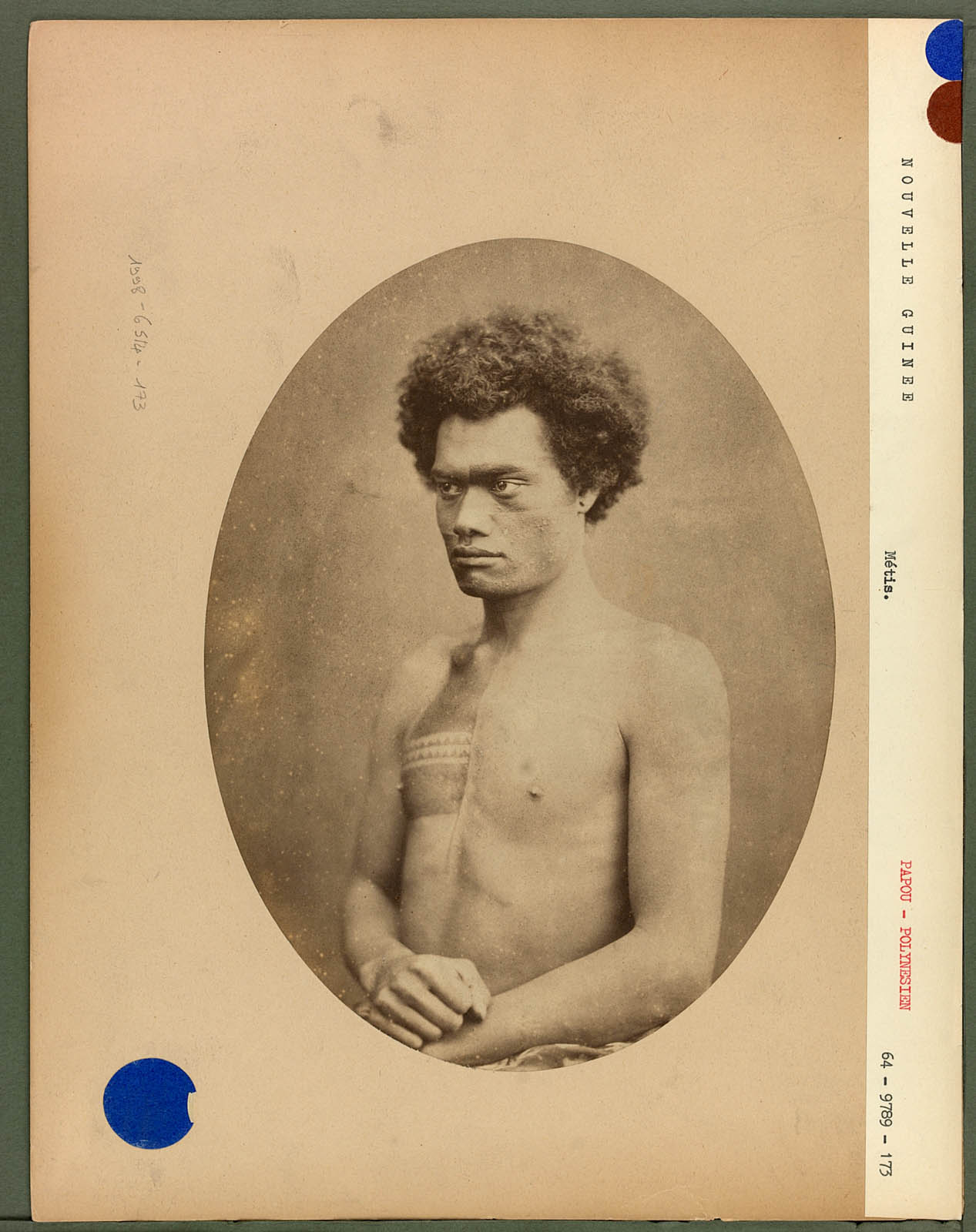
 

Eugene Maunoury (French, 1830-1896) 'Hitoro, King of the island Ua Pou in the Marquesas Archipelago' Peru, 1863


Eugene Maunoury (French, 1830-1896)
Hitoro, King of the island Ua Pou in the Marquesas Archipelago
Peru, 1863
Albumen paper print
© Quai Branly Museum – Jacques Chirac


The text on the photo stating that this man is from Papua New Guinea is incorrect. He is from the Marquesas archipelago. Please see another photograph of Hitoro, King of the island Ua Pou by Eugene Maunoury on the Ua Pou Wikipedia entry.


Eugene Maunoury

Eugène Maunoury settled in Chile between 1858 and 1865, in Santiago and Valparaiso. Then, from 1861, he was at the head of a luxurious studio in Lima (Peru) which saw parade the elite of society. From 1862 he was a correspondent for the Nadar studio. However, these portraits of Marquesans taken in Peru are neither intended images exotic, or photographs intended for scientific use. They were made by Maunoury to protest against the kidnapping of these people intended for be employed in forced labor in the exploitation of guano, in Peru. Maunoury publishes in L’Illustration of August 29, 1863 an article denouncing the situation of the raid, using some of his portraits. We recognise the king of the island Ua Pou, in the Marquesas Archipelago.


Émile Colpaërt (French born 1830 died after 1874, active 1858-1870) 'Native of Urcos' Scientific Expedition Peru, 1864


Émile Colpaërt (French born 1830 – died after 1874, active 1858-1870)
Native of Urcos
Scientific Expedition, Peru, 1864
© Musée du Quai Branly – Jacques Chirac, Dist. RMN-Grand Palais
Image: Musée du Quai Branly – Jacques Chirac
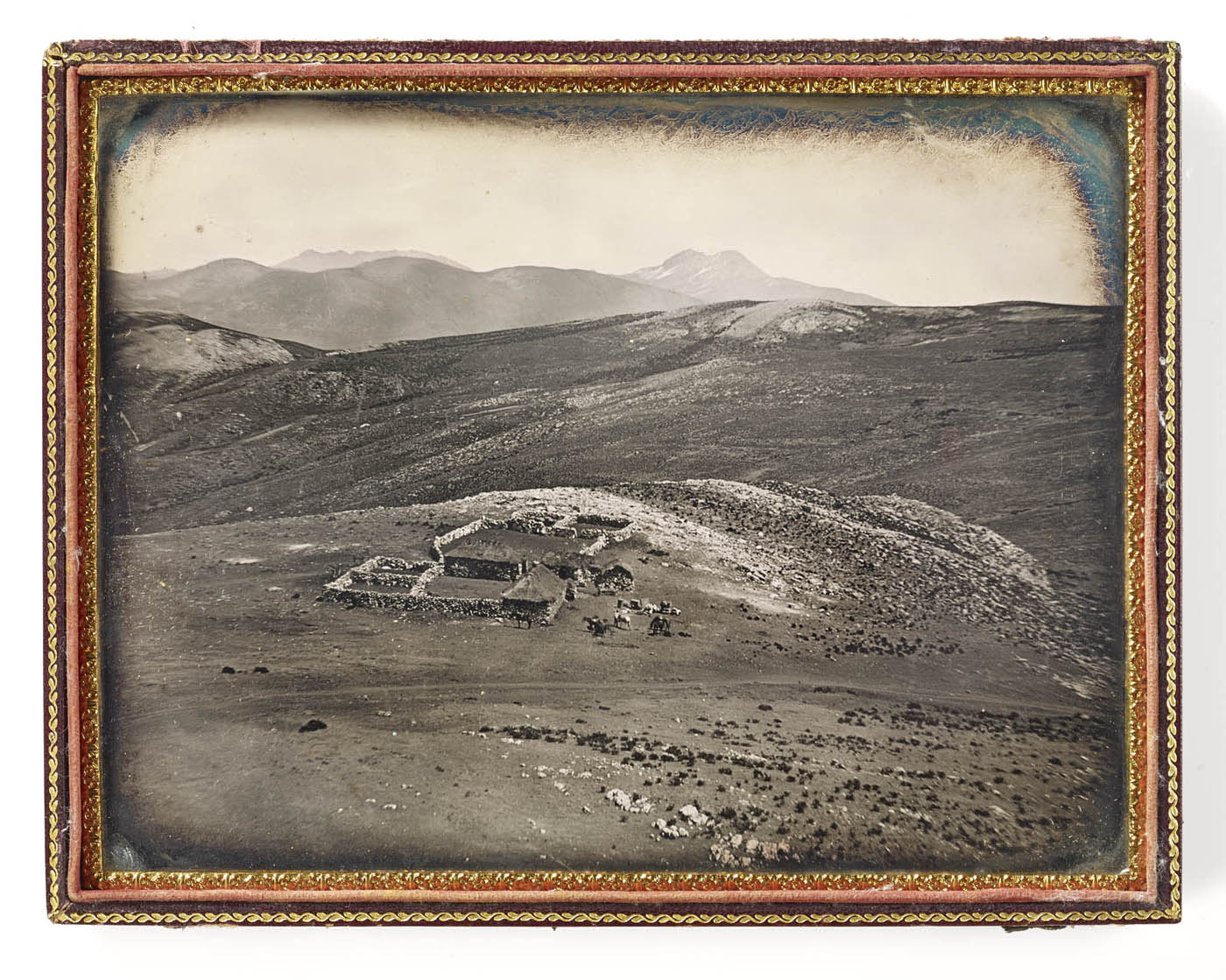
 

Attributed to Robert H. Vance (American, 1825-1876) 'A Tambo in the Mountains at a Height of 16,000 Feet, Andes Mountains' 1849


Attributed to Robert H. Vance (American, 1825-1876)
A Tambo in the Mountains at a Height of 16,000 Feet, Andes Mountains
1849
Daguerreotype
RMN – Grand Palais image musée du quai Branly – Jacques Chirac
Photo: © musée du quai Branly – Jacques Chirac, Dist


Attributed to Robert H. Vance (American, 1825-1876) 'A Tambo in the Mountains at a Height of 16,000 Feet, Andes Mountains' 1849 (detail)


Attributed to Robert H. Vance (American, 1825-1876)
A Tambo in the Mountains at a Height of 16,000 Feet, Andes Mountains (detail)
1849
Daguerreotype
RMN – Grand Palais image musée du quai Branly – Jacques Chirac
Photo: © musée du quai Branly – Jacques Chirac, Dist


Paul-Émile Miot (French, 1827-1900) 'Portrait of three Mi'kmaq Women, Newfoundland' 1857


Paul-Émile Miot (French, 1827-1900)
Portrait of three Mi’kmaq Women, Newfoundland
1857
Image: Bibliothèque nationale de France, Paris


Paul-Émile Miot (French, 1827-1900) 'Matelots virant au Cabestan, Gaillard d'avant de l'Ardent, Terre Neuve' (Sailors tacking to Capstan, forecastle of the Ardent, Newfoundland) 1857


Paul-Émile Miot (French, 1827-1900)
Matelots virant au Cabestan, Gaillard d’avant de l’Ardent, Terre Neuve (Sailors tacking to Capstan, forecastle of the Ardent, Newfoundland)
1857
Albumen print
6 1/2 x 10 in.
© musée du quai Branly – Jacques Chirac, Dist


Many places in the world have become accessible through photography since it was invented. In August 1839, the technical details of the daguerreotype were revealed in Paris, and from September onwards, cameras were taken on board the ships of countless scientific and military expeditions and voyages all around the world. Associated with technological modernity, photography was used in the second half of the 19th century to record the whole planet. From Mexico to Gabon, photography was in turn an instrument of description and the visual appropriation of landscapes and monuments, a tool for knowledge and the control of populations, and an object of diplomacy with the local elite.

European colonial expansion was one of the driving forces that greatly accelerated global photography. Taking as its starting point the collection of photographs at the musée du quai Branly – Jacques Chirac, enriched by several exceptional loans from public and private collections, the exhibition focuses on the trajectories and geographies of photography outside Europe in the 19th century.


4 key questions for Christine Barthe and Annabelle Lacour, the curators of the exhibition

1- What is the origin of this exhibition project?

Christine Barthe: The origins of this exhibition can be found in a project set up for the Louvre Abu Dhabi, where a first version of the exhibition was shown in 2019. Originally, it was based on the museum’s own collection, focusing on early photographs taken in regions far removed from Europe. The museum’s collection mainly reflects the European and American point of view, and we wanted, right from the beginning, and even more so for this adaptation for the musée du quai Branly – Jacques Chirac, to show a little more interest in local productions, which are not so well known and visible as those of Westerners. So this project quickly expanded in terms of research to try and decentralise the history of photography.

2- More precisely, what discoveries did you make during this new research?

C.B.: The project was built up over a period of several years, and so we benefited from the layering of experiences, in-depth research, new acquisitions, contacts… It’s a long-term project. Right from the beginning, we have been researching images from the museum’s collection. This work has allowed us to re-identify major artists in the history of photography, whose images were previously anonymous in the museum’s collections. Lesser-known photographers have been found in French collections such as the National Library and the Asian arts museum Guimet. We were thus able to include a lot of local photographers in the exhibition, especially from West Africa, in present-day Ghana, Sierra Leone, Iran, India, Japan…

3- How did photography spread outside Europe?

Annabelle Lacour: What is striking about the beginning is how fast things happened. As soon as the French government announced the invention of the process in 1839, there were articles in newspapers all over the world. In the weeks that followed, boats left for foreign countries carrying cameras to make daguerreotypes. Lots of people all over the world were curious to see how it worked. As early as 1842, the Shah of Iran asked Russia and the United Kingdom to send him some cameras. Photographers trained people at the Persian court. There were different examples in India, in Thailand, where we see this infatuation of sovereigns for photography. However, the speed it was taken up with also varied greatly depending on the region. In Japan, for example, photography developed a little later, in the late 1850s, when the country opened up to trade. In Europe, photography was related to the idea of a visual conquest that accompanied the colonial conquest. And of course, we should never forget the significant use of photography to design and build up one’s own image.

4- Today, the way we perceive these photographs has evolved. How does this translate into the way they are displayed?

A.L.: The idea of this exhibition, through these fascinating images, is to give visitors the opportunity to see how, right from the beginning, the production of these images is diverse and responds to different wishes, desires, and fits into various different contexts. Obviously, the intention with which they were made for was not fixed in time. Some images may have seen their meaning change completely in the course of history. So we have this whole issue of a new reading of the images, which is important. The questions they posed when they were taken, and pose again today, are very much contemporary. The end of the exhibition raises certain ethical questions: what does it mean to want to photograph everything? What do we do with the images of scenes or people that we were not allowed to see or photograph? I don’t think the choice lies in the alternative of showing or concealing everything. The interest in showing these images today is the possibility to reflect, to ask the question of meaning, to show certain contexts and historical narratives, to realise just how contemporary these issues are.

Text from the musée du quai Branly – Jacques Chirac


Lai Afong (Chinese, c. 1838 or 1839 - 1890) 'China. A Street, Canton' c. 1860


Lai Afong (Chinese, c. 1838 or 1839 – 1890)
China. A Street, Canton
c. 1860
Albumen print
© musée du quai Branly – Jacques Chirac, Dist


Lai Afong

Lai Afong (Chinese: 黎芳; c. 1838 or 1839 – 1890) was a Chinese photographer who established Afong Studio, considered to be the most successful photographic studio in the late Qing Dynasty. He is widely acknowledged as the most significant Chinese photographer of the nineteenth century. …

Lai Afong was the most successful of his generation of Chinese photographers in appealing to both a Chinese and foreign cosmopolitan clientele. Lai Afong advertised in English-language newspapers – offering a “Larger, and more complete collection of Views than any other Establishment in the Empire of China” – and the artist captioned much of his work in both Chinese and English. Afong Studio photographs were sold to both Chinese patrons – both those local to Hong Kong and those visiting from other parts of China – and foreign visitors to China.

The Afong Studio became a destination and training ground for foreign photographers in the region, and photographers such as Emil Rusfeldt and D.K. Griffith began their careers under the tutelage of Lai Afong. In 1875, Griffith claimed that his mentor had “entered the arena of European art, associating his name with photography in its best form, and justly stands first of his countrymen in Hong Kong.” John Thomson, a Scottish photographer working in China at the time, praised Lai Afong’s images as “extremely well-executed, [and] remarkable for their artistic choice of position,” in his book The Straits of Malacca, Indo-China, and China.

Lai Afong seems to have been the only Chinese photographer of his generation to be embraced by his foreign contemporaries. However, his work is distinct among them, as many of Lai Afong’s photographic compositions show the technical and aesthetic influence of traditional Chinese painting, known as guóhuà. Additionally, Lai Afong favoured the panorama more than any other photographer working in China in the 19th century, earning his work a place among the giants of 19th century landscape photography such as Carleton Watkins in America and Gustave Le Gray in France. No other nineteenth-century Chinese photographer offered as extensive and diverse a view of late Qing Dynasty China.

Text from the Wikipedia website
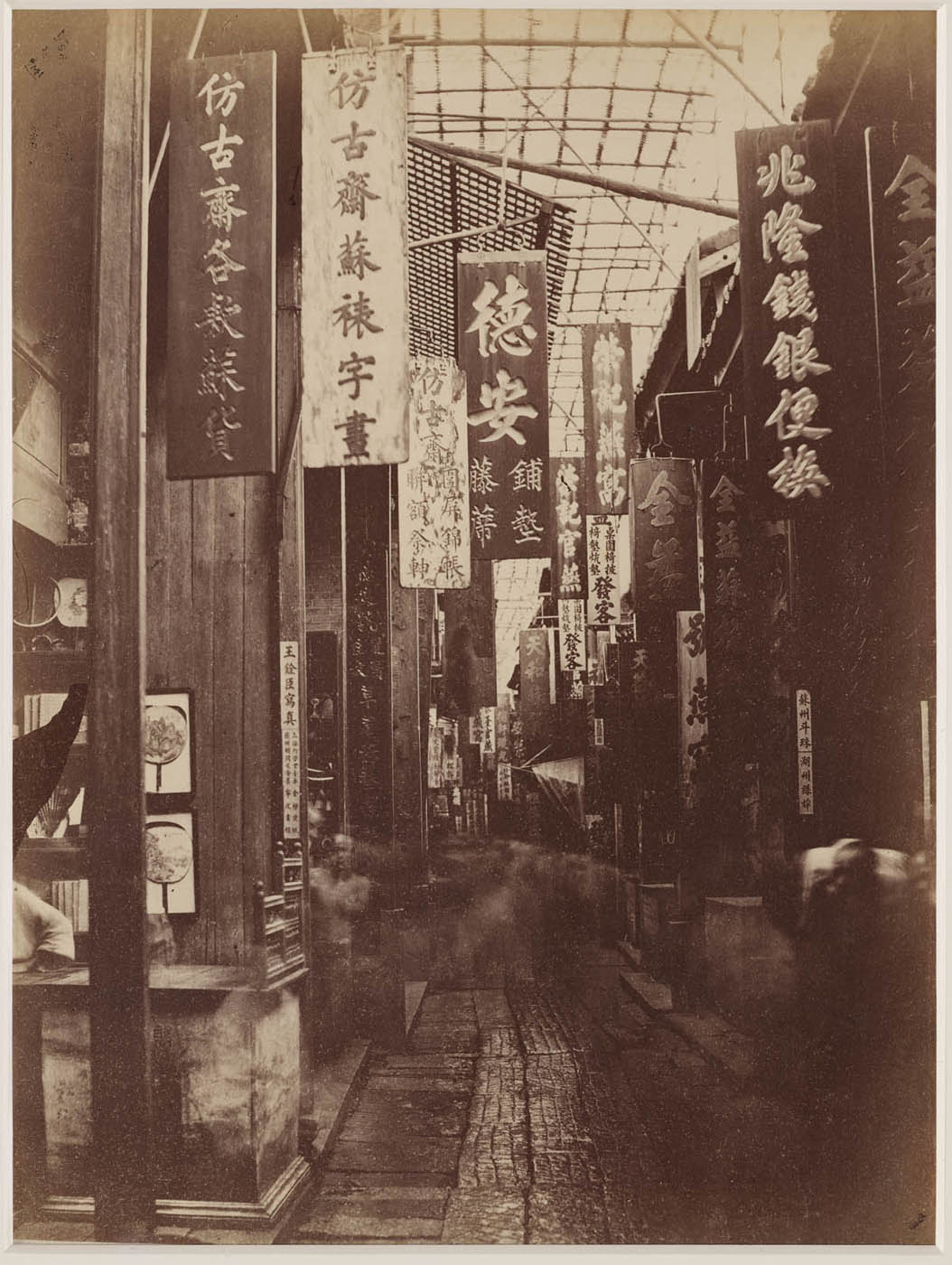
 

Lai Afong (Chinese, c. 1838 or 1839 - 1890) 'China. A Street, Canton' c. 1860 (detail)


Lai Afong (Chinese, c. 1838 or 1839 – 1890)
China. A Street, Canton (detail)
c. 1860
Albumen print
© musée du quai Branly – Jacques Chirac, Dist


Poster for the exhibition 'Photographs. An Early Album of the World (1842-1911)' at the musée du quai Branly – Jacques Chirac, Paris


Poster for the exhibition Photographs. An Early Album of the World (1842-1911) at the musée du quai Branly – Jacques Chirac, Paris


Musée du Quai Branly – Jacques Chirac
37 Quai Jacques Chirac
75007 Paris, France

Opening hours:
Closed on Monday
Monday, Tuesday, Wednesday, Friday, Saturday, Sunday: 10.30am – 7.00pm
Thursday: 10.30 am – 10.00pm

Musée du Quai Branly – Jacques Chirac website

LIKE ART BLART ON FACEBOOK

Back to top

Text/Exhibition: ‘Mervyn Bishop: Australian Photojournalist’ at the National Film and Sound Archive of Australia, Acton, Canberra ACT

Exhibition dates: 5th March – 4th October, 2021

Warning: Aboriginal and Torres Strait Islander readers should be aware that this posting contains images and names of people who may have since passed away.


Mervyn Bishop (Australian, b. 1945) 'Girl pours tea, Burnt Bridge' 1988 from the exhibition 'Mervyn Bishop: Australian Photojournalist' at the National Film and Sound Archive of Australia, Acton, Canberra ACT, march - Oct, 2021
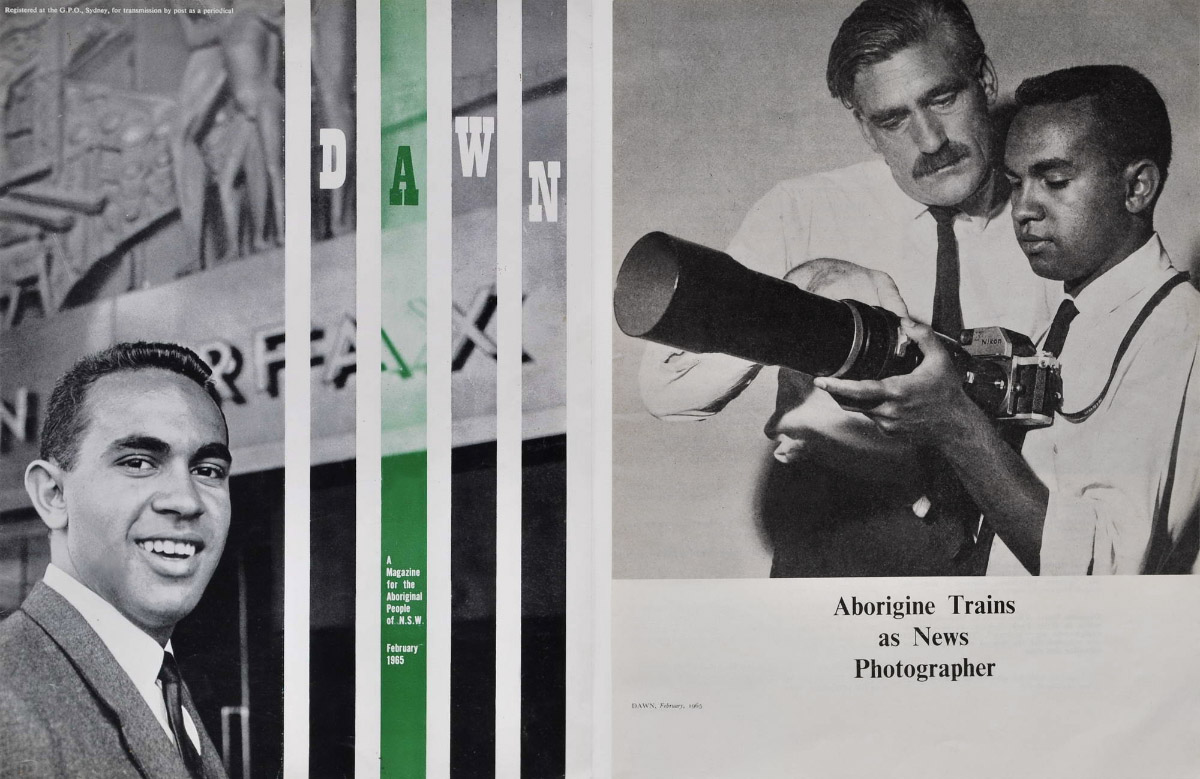
 

Mervyn Bishop (Australian, b. 1945)
Girl pours tea, Burnt Bridge
1988
Gelatin silver photograph
30.1 x 40.4cm
Art Gallery of New South Wales
Hallmark Cards Australian Photography Collection Fund 1991
© Mervyn Bishop
Photo: AGNSW


In our sight, in our mind

Can you imagine, please, being the first person to step foot on the moon. Or the first person to discover radium. Now imagine being the first Indigenous Australian photojournalist, for the very first time taking photographs of your culture from the inside, photographs that picture the ongoing suffering of Indigenous people but also, as importantly, their strength and joy. Such was the calling of that legend of Australian photography, Mervyn Bishop.

Bishop was the first in a long line of Indigenous photographers who unearth, investigate, picture and honour their community, although interestingly none of the later photographers are photojournalists. Artists such as Tracey Moffatt, Michael Riley, Ricky Maynard, Lisa Bellear, R e a (rea saunders), Michael Cook, Brook Andrew, Bindi Cole and Christian Thompson) follow in his footsteps. Indeed in this posting, there is a photograph by Bishop presumably of the father of the photographer Ricky Maynard, Eric Maynard cleaning a mutton bird, Great Dog Island, Tasmania (1975, below), followed by a photograph by Maynard himself of muttonbirding on Dog Island from his series Portrait of a Distant Land. The songlines of place and ancestors are strong in Aboriginal culture, and “show the connectedness between places and the Creation events and ceremonies associated with those places. People born in that country are forever tied to the creation history of their birthplace and have custodial obligations to that place.”

The stories Bishop shares through his images are different from the colonial ones of yesteryear because they come from within the spirit and soul of the communities he is photographing. Less than 20 years before Bishop’s first photographs things were very different. The Australian journalist and writer Stan Grant observes that, “…there are images in our history, of Aboriginal people in chains. Aboriginal people tied together, with armed police standing either side of them.” In an article on The Guardian website we learn that “Neck chains were still being used on Aboriginal people in Western Australia in 1958. Witnesses at Halls Creek in the Kimberley reported seeing Aboriginal prisoners chained to a veranda post of the police station for weeks at a time… At peak periods, from the 1880s to the 1940s, hundreds of Aboriginal people were chained for alleged cattle theft, and marched out of their country, some for up to 400km. Each neck piece weighed 2.4kg.”1 Even in Dawn – A Magazine for the Aboriginal People of N.S.W. created by the New South Wales Aboriginal Welfare Board and aimed at Aboriginal Australians (running monthly from January 1952 until December 1968) – in which there was an article in February 1965 on a young Mervyn Bishop training to become a photographer (see below) – the forces of colonial assimilation were hard at work, as can be seen on the back cover of the Dawn October 1965 issue, where Leslie Ryan makes his debut at a “Deb” Ball for kindergarten children, where he “seems to be getting a better deal out of life now that he has love and attention.” Now that he has love and attention. Just let that sink in. Today, the dripping irony and sadness of this photograph in relation to what is now known as “The Stolen Generation”2 is apparent, the two young children taken from their families, taken from their culture, dressed to the nines in formal Western attire at such a young age. Remember, this is less than 60 years ago.

As much as Eugène Atget (French, 1857-1927) was a working photographer making “Documents pour artistes,” declaring his modest ambition to create images for other artists to use as source material, so Bishop was a working photographer who created “Documents for people” at the Department of Aboriginal Affairs in Canberra from 1974 onwards, where he covered the major developments in Aboriginal communities throughout Australia. As Mervyn himself says, “Photography has been my life, my passion for 60 years: the art and technique, the stories I’ve witnessed and captured. I’m glad to be able to share my life’s work with the public.” There it is in a nutshell… an intimate understanding of the the art and technique of photography (the construction the image plane, lighting, point of view, scale, printing, etc… ) and the stories he wanted to tell. And he tells those stories straight down the line, with no bullshit. When asked in an audio recording in this posting about why his award winning photograph Life and death dash (1971, below) was misunderstood, he says “it has nothing to do with blackfellas, put it that way… people say it’s a nun running away with a little black kid, the Stolen Generation – nothing to do with it! Not a bloody thing! … people interpret their own way. Who would know that I was black? People still go on about it but people are talking through their … whatever… so, you don’t know what your talking about.” There you have it.

Like his personality, Bishop’s wonderful photographs are strong and direct, informed and understanding of the work of Walker Evans or Dorothea Lange. In Girl pours tea, Burnt Bridge (1988, above), an Aboriginal mother sits at a kitchen table in a corrugated iron shack and pours tea from a large battered teapot into enamel mugs, one for herself and one presumably for the photographer. Light pours through a hole in the roof. The table is covered in a floral probably plastic table cloth. There are plastic flowers set upon it. The chairs are vinyl. Behind her is an old kitchen unit from the 1950s with a wire screen at eye level, used to keep flies out. To the right are boxes and detritus while to the left a plastic bucket sits on the battered sink. Her child plays next to her oblivious of the camera flash while she stares directly at the camera. Much as Lange’s Migrant Mother, this women possesses her own inner dignity which Bishop captures so well: an unexpected intimacy with the subject in which we confront uncomfortable truths.

Other photographs, such as Children playing in river, Mumeka (1975, below) capture the pure joy of Aboriginal life, or the resoluteness of a people having to survive the trauma of cultures and societies and their complex histories (Couple on veranda, Coffs Harbour 1988, below). But let us be clear… this is not a vanishing race, nor an assimilated race but a proud, creative and intelligent race now picturing its own history and future. As Ricky Maynard states, “The contest remains over who will image and own this history. We must define history, define whose history it is, and define its purpose, as well as the tools used for the telling of this.” Bishop was at the very beginning of this imaging and ownership of Aboriginal history, not by colonial photographers of the past, but from within the community itself, in the present. His photographs are about speaking up about injustice and making sure that Indigenous perspectives were heard and not railroaded by non-indigenous people – Bishop was at the beginning of this – and about how the image speaks truth to power (a non-violent political tactic, employed by dissidents against the received wisdom or propaganda of governments they regard as oppressive, authoritarian or an ideocracy),

Towards the end of the documentary “The Bowraville Murders”, Stan Grant observes that Aboriginal people are kicked every day… [and this remains] out of sight, out of mind. He reminds us that between 1991 and 2021 there have been more than 470 Aboriginal deaths in custody… and not a single conviction. Out of sight, out of mind. Indeed, “fluidity of memory and a capacity to forget is perhaps the most haunting trait of our species. As history confirms, it allows us to come to terms with any degree of social, moral, or environmental degradation.”3 And this is what we all do. That is, until a photographer and artist like Mervyn Bishop comes along and reminds us through his photographs of the integrity, vitality and presence of Aboriginal people, spirit that stretches back thousands of years – despite our capacity to forget the trauma that Indigenous Australians have endured. This is the purpose of Bishop’s photographs … they bring to the forefront of our knowledge and imagination an understanding of the history and future of Aboriginal people. They remain, in our sight, in our mind.

Dr Marcus Bunyan


Footnotes

1/ Chris Owen. “How Western Australia’s ‘unofficial’ use of neck chains on Indigenous people lasted 80 years,” on The Guardian website Sun 7 March 2201 [Online] Cited 03/10/2021.

2/ The Stolen Generations refers to a period in Australia’s history where Aboriginal children were removed from their families through government policies. This happened from the mid-1800s to the 1970s.In the 1860s, Victoria became the first state to pass laws authorising Aboriginal children to be removed from their parents. Similar policies were later adopted by other states and territories – and by the federal government when it was established in the 1900s. For about a century, thousands of Aboriginal children were systematically taken from their families, communities and culture, many never to be returned. These children are known as the Stolen Generations survivors, or Stolen Children.These children were taken by the police; from their homes; on their way to or from school. They were placed in over 480 institutions, adopted or fostered by non-Indigenous people and often subjected to abuse. The children were denied all access to their culture, they were not allowed to speak their language and they were punished if they did. The impacts of this are still being felt today.There are currently more than 17,000 Stolen Generations survivors in Australia. Over one third of all Aboriginal and Torres Strait Islander people are their descendants. In Western Australia almost half of the population have Stolen Generation links.
Anonymous. “Who are the Stolen Generations?” on the Healing Foundation website [Online] Cited 03/10/2021.

3/ Wade Davis. “The Unraveling of America,” on the Rolling Stone website August 6, 2020 [Online] Cited 03/10/2021.


Many thankx to the National Film and Sound Archive of Australia for allowing me to publish the photographs in the posting. Please click on the photographs for a larger version of the image.


“The contest remains over who will image and own this history. We must define history, define whose history it is, and define its purpose, as well as the tools used for the telling of this.”


Ricky Maynard, 2007


“Australia in many ways is a crime scene. And the first crime is Captain Cook ordering his men to shoot at Aboriginal people. That’s the shot that we still hear all around Australia. And of course, there are images in our history, of Aboriginal people in chains. Aboriginal people tied together, with armed police standing either side of them. This is what has happened in our country, so it isn’t a great step to go from frontier attitudes of violence to deaths of three children in Bowraville. Because for us, it’s the same thing. It’s a killing that never stops.”


Stan Grant quoted in the documentary “The Bowraville Murders” directed by Allan Clarke on SBS on Demand, Australia, 2021


The National Film and Sound Archive of Australia will celebrates Mervyn Bishop, one of Australia’s most prolific and influential photographers, with a new exhibition 5 March – 4 October 2021.

Mr Bishop’s images of culture, politics and people have significantly influenced our collective understanding of Australia’s history. This exhibition is drawn from the Art Gallery of New South Wales collection, the artist’s private archive, and enriched by sound and moving image from the NFSA.

Mervyn Bishop features iconic photographs that derive from his career as a photojournalist, alongside personal images of family and friends and intimate portraits of members of the Aboriginal community. Spanning the past 60 years, the exhibition provides a fascinating insight into Bishop’s life and work.

In 1963 Mervyn Bishop left his hometown of Brewarrina, venturing to Sydney, where he successfully applied for a cadetship at The Sydney Morning Herald. He became Australia’s first Aboriginal press photographer and in 1971 won the News Photographer of the Year Award with his front-page photograph Life and Death Dash, 1971.

Bishop went on to work at the Department of Aboriginal Affairs in Canberra in 1974 where he covered the major developments in Aboriginal communities throughout Australia. This included his iconic image from 1975 when the (then) Prime Minister, Gough Whitlam, poured a handful of earth back into the hand of Vincent Lingiari, Gurindji elder and traditional landowner.


Unknown photographer. 'Untitled [Australian Aborigines in chains]' Nd


Unknown photographer
Untitled [Australian Aborigines in chains]
Nd


Indigenous Australians in neck chains


Indigenous Australians in neck chains. Historical records say they had been chained after killing an animal. Neck chains were used by police across Western Australia from the 1880s to the late 1950s. Photograph: State Library of Western Australia


Mervyn Bishop (Australian, b. 1945) 'Prime Minister Gough Whitlam pours soil into the hands of traditional land owner Vincent Lingiari, Northern Territory' 1975, printed 1999 from the exhibition 'Mervyn Bishop: Australian Photojournalist' at the National Film and Sound Archive of Australia, Acton, Canberra ACT, march - Oct, 2021


Mervyn Bishop (Australian, b. 1945)
Prime Minister Gough Whitlam pours soil into the hands of traditional land owner Vincent Lingiari, Northern Territory
1975, printed 1999
Type R3 photograph
30.5 x 30.5cm
Art Gallery of New South Wales
Hallmark Cards Australian Photography Collection Fund 1991
© Mervyn Bishop/ Department of the Prime Minister and Cabinet
Photo: AGNSW


Gurindji strike (or Wave Hill Walk-Off) led by Vincent Lingiari

On 23 August 1966 200 Gurindji stockmen, domestic workers and their families walked off Wave Hill station in the Northern Territory and refused to keep working for the station owners. The disagreement over wages and land ownership lasted for seven years. In 1974 some of the Gurindji people’s homelands were returned to them. This influenced the first legislation, passed in 1976, that allowed Aboriginal people to claim land title. In September 2020 the Gurindji claim for native title to Wave Hill station was granted, 54 years after the walk-off that helped to spark Australia’s Indigenous land rights movement.

Why did the Gurindji people strike?

In the 1960s Wave Hill station was owned by an international company called Vestey Brothers. Vestey Brothers paid the Gurindji people working on the station very low wages. On 23 August 1966 the Gurindji people stopped working and walked off Wave Hill station in protest. They were led by elder Vincent Lingiari.

In 1967 the Gurindji set up a camp at Daguragu (also known as Wattie Creek). It soon became clear that the Gurindji did not simply want fair wages. More importantly they wanted the government to return some of their land. For seven years the Gurindji stayed at Daguragu and sent letters and petitions to the Northern Territory Government and the Australian Government asking that their land be returned to them.

How was the dispute resolved?

In 1972 the Labor Party led by Gough Whitlam came to power. The Whitlam government was interested in establishing Aboriginal land rights. Around the same time, Vestey Brothers finally agreed to hand over a small section of Wave Hill station around Daguragu to the Gurindji people.

In 1975 Prime Minister Whitlam visited Daguragu and in a ceremony he returned the land to the Gurindji people. Whitlam famously poured a handful of soil through Vincent Lingiari’s hand and said, ‘Vincent Lingiari, I solemnly hand to you these deeds as proof, in Australian law, that these lands belong to the Gurindji people’. …

The Gurindji strike helped to make the Australian public aware of Aboriginal land ownership claims. It also influenced the first legislation in Australia that allowed Aboriginal people to apply for ownership of their traditional lands, the Aboriginal Land Rights (Northern Territory) Act 1976.

Text from the National Museum of Australia website [Online] Cited 14/09/2021


“I bin thinkin’ this bin Gurindji country. We bin here longa time before them Vestey mob.”


Vincent Lingiari, 1966


“We originally took the picture under the shade of a bough shed and it didn’t have a nice look about it.”


Mervyn Bishop


What’s the backstory to your famous land rights photograph?


Conversation between Guardian Australia picture editor Jonny Weeks and the photographer Mervyn Bishop in the article by Jonny Weeks and Miles Martignoni. “Great Australian photographs: Mervyn Bishop’s symbolic shot – an audio essay,” on the Guardian Australia website Mon 5 Jun 2017 [Online] Cited 14/9/2021.


An historic handful of dirt: Whitlam and the legacy of the Wave Hill Walk-Off

On the prime ministerial jet that morning, public servant turned Aboriginal affairs adviser H.C. ‘Nugget’ Coombs urged Whitlam to keep his speech short and invest the day with a sense of ceremony.

Coombs recounted a story told by anthropologist Bill Stanner: how Wurundjeri elders had formalised their people’s 1835 land treaty with encroaching settlers at Port Phillip by placing soil into the hand of explorer John Batman. Hearing Coombs’ suggestion that the PM might reverse the gesture with Lingiari, Whitlam revised his performance plan for Daguragu on the spot.

When it came to his turn to speak, Whitlam congratulated the Gurindji and their supporters on their victory after a nine-year “fight for justice”. Promising that the Australian government would “help you in your plans to use this land fruitfully”, his speech concluded with the words:

Vincent Lingiari, I solemnly hand to you these deeds as proof, in Australian law, that these lands belong to the Gurindji people, and I put into your hands this piece of the earth itself as a sign that we restore them to you and your children forever.

In finishing, Whitlam handed Lingiari the new deeds to the Gurindji’s land, now officially dubbed NT Pastoral Lease 805. Then, to the joy of assembled photographers, he stooped down, grabbed a handful of red earth, and poured it into Lingiari’s open palm. …

Lingiari – who according to one reporter was struck with a case of nerves – responded to Whitlam and the crowd in his own language:

The important white men are giving us this land ceremonially… It belonged to the whites, but today it is in the hands of us Aboriginals all around here. Let us live happily as mates, let us not make it hard for each other… They will give us cattle, they will give us horses, and we will be happy… These important white men have come here to our ceremonial ground and they are welcome…

You (Gurindji) must keep this land safe for yourselves, it does not belong to any different Welfare man. They took our country away from us, now they have bought it back ceremonially.

After Whitlam gave the old man even more dirt for the benefit of the press, photographer Mervyn Bishop’s images of the “handover” became some of the most recognised in Australian political history. The power of the photos rested in the symbolism of Whitlam’s gesture, made on behalf of millions concerned by Aboriginal dispossession.

The handover implicitly acknowledged the moral rightfuness of the Gurindji’s stand, and the historical injustices done to them by the Europeans on their country. It was by dint of the Gurindji’s hard slog at Wattie Creek that they had successfully brought all this to the nation’s attention. The handover day was the old Gurindji men’s finest hour, and their victory.

Charlie Ward. “An historic handful of dirt: Whitlam and the legacy of the Wave Hill Walk-Off,” on The Conversation website August 21, 2016 [Online] Cited 14/09/2021


Mervyn Bishop: pioneer, artist, and source of inspiration

Hear from National Film and Sound Archive of Australia curator Tara Marynowsky as she describes the ‘insider’s knowledge’ visitors to the Mervyn Bishop exhibition will receive, and how his story brings together those of the famous faces he captured.


In this excerpt from ABC series art+soul curator Hetti Perkins talks with artist photographer Mervyn Bishop


Mervyn Bishop exhibition at the National Film and Sound Archive of Australia (NFSA), Canberra


Mervyn Bishop exhibition at the National Film and Sound Archive of Australia (NFSA), Canberra
Courtesy NFSA


Mervyn Bishop exhibition at the National Film and Sound Archive of Australia (NFSA), Canberra


Mervyn Bishop exhibition at the National Film and Sound Archive of Australia (NFSA), Canberra
Photo by Madeleine Stevens, Courtesy NFSA


Mervyn Bishop exhibition entrance


Mervyn Bishop exhibition entrance
Courtesy NFSA


Mervyn Bishop at NFSA


Mervyn Bishop at NFSA
Photo by Madeleine Stevens, Courtesy NFSA


Mervyn Bishop exhibition at the NFSA

Mervyn Bishop exhibition at the NFSA


Mervyn Bishop exhibition at the NFSA, featuring images and footage of boxer Lionel Rose. See Bishop’s photograph Lionel Rose at his press conference (1968, below)
Photographs by Grace Costa


Mervyn Bishop (Australian, b. 1945) 'Lionel Rose at his press conference' 1968


Mervyn Bishop (Australian, b. 1945)
Lionel Rose at his press conference
1968
Gelatin silver photograph
30.1 x 30.1cm
Art Gallery of New South Wales
Hallmark Cards Australian Photography Collection Fund 1991
© Mervyn Bishop
Photo: AGNSW


Mervyn Bishop exhibition at the NFSA

Mervyn Bishop cameras


Mervyn Bishop exhibition at the NFSA showing some of his cameras
Courtesy NFSA


Mervyn Bishop with camera


Mervyn Bishop with camera
Courtesy NFSA


Teenage Mervyn had already in a sense begun his career in the mid 1950s. He started to take documentary family snaps on his mother’s Kodak 620, followed by a more expensive fifteen pound Japanese 35mm of his own in 1957. He was encouraged by with the help of a Church of England Bush Brother [priest] Brother Richard and Vic King a local photographer who had a dark room that Merv frequented. He then began to hold backyard slide nights of his family and neighbourhood snaps.

By the beginning of the 1960s the search for the exotic authentic had shifted from the south-east to northern Australia. Although Australian painters such as Russell Drysdale and Arthur Boyd had created images from their trips to western NSW post WWII, photographer Axel Poignant and US Life magazine photographer Fritz Gorro both visited Arnhem Land in the 1950s to document and ‘compose’ their subject matter. …

‘Merv Bishop Graduates from Photographers’ Course’, Dawn magazine’s headline said. After leaving Dubbo High in 1962 he spent a year as a clerk with the ABC before starting as a cadet photographer at the Sydney Morning Herald in 1963, (the first Aboriginal photographer ever hired by the paper) and entered the first photographic course at the Sydney Technical College, Broadway Sydney, graduating in 1966, Next year was the important year of the referendum concerning Aboriginal people and ‘the state’…

Djon Mundine. “Brewarrina Boy,” on the Australian Museum website 12/07/2021 [Online] Cited 14/09/2021


Mervyn Bishop media call 4 March 2021 - Curator Coby Edgar and Mervyn Bishop


Mervyn Bishop media call 4 March 2021 – Curator Coby Edgar and Mervyn Bishop
Courtesy NFSA


Mervyn Bishop in a recreation of his darkroom at the exhibition media call


Mervyn Bishop in a recreation of his darkroom at the exhibition media call
Courtesy NFSA


Mervyn Bishop at NFSA


Mervyn Bishop at NFSA
Photo by Madeleine Stevens, Courtesy NFSA


Mervyn Bishop exhibition at the NFSA showing at left, 'Pool game, Burnt Bridge' (1988); at second left, 'Save the children pre-school, Nambucca Heads' (1974); at centre 'Woman standing near electric power cord in water, Burnt Bridge' (1988); and at right, 'Couple on veranda, Coffs Harbour' (1988)


Mervyn Bishop exhibition at the NFSA showing at left, Pool game, Burnt Bridge (1988, below); at second left, Save the children pre-school, Nambucca Heads (1974, below); at centre Woman standing near electric power cord in water, Burnt Bridge (1988, below); and at right, Couple on veranda, Coffs Harbour (1988, below)
Courtesy NFSA


Mervyn Bishop (Australian, b. 1945) 'Pool game, Burnt Bridge' 1988


Mervyn Bishop (Australian, b. 1945)
Pool game, Burnt Bridge
1988
Gelatin silver photograph
40 x 30cm
Art Gallery of New South Wales
Purchased under the terms of the Florence Turner Blake Bequest 2008
© Mervyn Bishop
Photo: AGNSW


Mervyn Bishop (Australian, b. 1945) 'Save the children pre-school, Nambucca Heads' 1974


Mervyn Bishop (Australian, b. 1945)
Save the children pre-school, Nambucca Heads
1974
Gelatin silver photograph
40 x 30cm
Art Gallery of New South Wales
Purchased under the terms of the Florence Turner Blake Bequest 2008
© Mervyn Bishop
Photo: AGNSW


“I don’t think there were even Indigenous journos in those days. As my friend said: ‘You were the lone ranger'”


Mervyn Bishop


How diverse was your photographic subject matter?


Conversation between Guardian Australia picture editor Jonny Weeks and the photographer Mervyn Bishop in the article by Jonny Weeks and Miles Martignoni. “Great Australian photographs: Mervyn Bishop’s symbolic shot – an audio essay,” on the Guardian Australia website Mon 5 Jun 2017 [Online] Cited 14/9/2021.


Mervyn Bishop (Australian, b. 1945) 'Woman standing near electric power cord in water, Burnt Bridge' 1988, printed 2008


Mervyn Bishop (Australian, b. 1945)
Woman standing near electric power cord in water, Burnt Bridge
1988, printed 2008
Gelatin silver print
40.0 x 30.0cm
Art Gallery of New South Wales
Purchased under the terms of the Florence Turner Blake Bequest 2008
© Mervyn Bishop
Photo: AGNSW


Mervyn Bishop (Australian, b. 1945) 'Couple on veranda, Coffs Harbour' 1988


Mervyn Bishop (Australian, b. 1945)
Couple on veranda, Coffs Harbour
1988
Gelatin silver photograph
40 x 30cm
Art Gallery of New South Wales
Purchased under the terms of the Florence Turner Blake Bequest 2008
© Mervyn Bishop
Photo: AGNSW


Mervyn Bishop exhibition at the NFSA showing at middle, 'Elders, Amata' (1977); and at right, ''Bob's catch' Shoalhaven Heads' (1974)


Mervyn Bishop exhibition at the NFSA showing at middle, Elders, Amata (1977, below); and at right, ‘Bob’s catch’ Shoalhaven Heads (1974, below)
Courtesy NFSA


Mervyn Bishop (Australian, b. 1945) 'Elders, Amata' 1977, printed 1991


Mervyn Bishop (Australian, b. 1945)
Elders, Amata
1977, printed 1991
Gelatin silver print
29.9 x 40.5cm
Art Gallery of New South Wales
Hallmark Cards Australian Photography Collection Fund 1991
© Mervyn Bishop
Photo: AGNSW


Mervyn Bishop (Australian, b. 1945) ''Bob's catch' Shoalhaven Heads' 1974, printed 1991


Mervyn Bishop (Australian, b. 1945)
‘Bob’s catch’ Shoalhaven Heads
1974, printed 1991
Gelatin silver print
30.2 x 30.1cm
Art Gallery of New South Wales
Hallmark Cards Australian Photography Collection Fund 1991
© Mervyn Bishop
Photo: AGNSW


Installation view of Mervyn Bishop's photograph 'Life and death dash' 1971


Mervyn Bishop exhibition at the NFSA showing his photograph, Life and death dash (1971, below)
Courtesy NFSA


“People say it’s about the stolen generations, but it’s got nothing to do with that – not a bloody thing.”


Mervyn Bishop


Why is ‘Life-and-death dash’ misunderstood?


Conversation between Guardian Australia picture editor Jonny Weeks and the photographer Mervyn Bishop in the article by Jonny Weeks and Miles Martignoni. “Great Australian photographs: Mervyn Bishop’s symbolic shot – an audio essay,” on the Guardian Australia website Mon 5 Jun 2017 [Online] Cited 14/9/2021.


Mervyn Bishop (Australian, b. 1945) 'Life and death dash' 1971


Mervyn Bishop (Australian, b. 1945)
Life and death dash
1971
Gelatin silver photograph
40.4 x 30.1cm
Art Gallery of New South Wales
Hallmark Cards Australian Photography Collection Fund 1991
© Mervyn Bishop
Photo: AGNSW


Mervyn Bishop (Australian, b. 1945) 'Far West Children's health clinic, Manly' 1968


Mervyn Bishop (Australian, b. 1945)
Far West Children’s health clinic, Manly
1968
Gelatin silver photograph
40 x 30cm
Art Gallery of New South Wales
Purchased under the terms of the Florence Turner Blake Bequest 2008
© Mervyn Bishop
Photo: AGNSW


Mervyn Bishop (Australian, b. 1945) 'Alan Judd, ABC trainee radio announcer, Sydney' 1968


Mervyn Bishop (Australian, b. 1945)
Alan Judd, ABC trainee radio announcer, Sydney
1968
Gelatin silver photograph
40 x 30cm
Art Gallery of New South Wales
Purchased under the terms of the Florence Turner Blake Bequest 2008
© Mervyn Bishop
Photo: AGNSW


Mervyn Bishop (Australian, b. 1945) 'Lois O'Donoghue CBA, AM, and Oodgeroo Noonuccal' 1974


Mervyn Bishop (Australian, b. 1945)
Lois O’Donoghue CBA, AM, and Oodgeroo Noonuccal
1974
Gelatin silver photograph
30 x 30.4cm
Art Gallery of New South Wales
Purchased under the terms of the Florence Turner Blake Bequest 2008
© Mervyn Bishop
Photo: AGNSW


Lowitja Lois O’Donoghue Smart, AC, CBE, DSG (born Lois O’Donoghue; 1 August 1932) is an Aboriginal Australian retired public administrator. In 1990-1996 she was the inaugural chairperson of the Aboriginal and Torres Strait Islander Commission (ATSIC) (dismantled in 2004). She is patron of the Lowitja Institute, a research institute for Aboriginal & Torres Strait Islander health and wellbeing.

Oodgeroo Noonuccal (/ˈʊdɡəruː ˈnuːnəkəl/ UUD-gə-roo NOO-nə-kəl; born Kathleen Jean Mary Ruska, later Kath Walker (3 November 1920 – 16 September 1993) was an Aboriginal Australian political activist, artist and educator, who campaigned for Aboriginal rights. Noonuccal was best known for her poetry, and was the first Aboriginal Australian to publish a book of verse.


Mervyn Bishop (Australian, b. 1945) 'Photography cadets with model, Sydney Morning Herald' 1967


Mervyn Bishop (Australian, b. 1945)
Photography cadets with model, Sydney Morning Herald
1967
Gelatin silver photograph
29.8 x 40.4cm
Art Gallery of New South Wales
Hallmark Cards Australian Photography Collection Fund 1991
© Mervyn Bishop
Photo: AGNSW


Mervyn Bishop (Australian, b. 1945) 'Cousins, Ralph and Jim, Brewarrina' 1966


Mervyn Bishop (Australian, b. 1945)
Cousins, Ralph and Jim, Brewarrina
1966
Gelatin silver photograph
30 x 40cm
Art Gallery of New South Wales
Purchased under the terms of the Florence Turner Blake Bequest 2008
© Mervyn Bishop
Photo: AGNSW


Mervyn Bishop (Australian, b. 1945) 'Roslyn Watson' 1973


Mervyn Bishop (Australian, b. 1945)
Roslyn Watson
1973
Gelatin silver photograph
40 x 30cm
Art Gallery of New South Wales
Purchased under the terms of the Florence Turner Blake Bequest 2008
© Mervyn Bishop
Photo: AGNSW


Mervyn Bishop (Australian, b. 1945) 'Children playing in river, Mumeka' 1975


Mervyn Bishop (Australian, b. 1945)
Children playing in river, Mumeka
1975
Gelatin silver photograph
30.1 x 29.9cm
Art Gallery of New South Wales
Hallmark Cards Australian Photography Collection Fund 1991
© Mervyn Bishop
Photo: AGNSW


Mervyn Bishop (Australian, b. 1945) 'Children playing in river, Mumeka' 1975 (detail)


Mervyn Bishop (Australian, b. 1945)
Children playing in river, Mumeka (detail)
1975
Gelatin silver photograph
30.1 x 29.9cm
Art Gallery of New South Wales
Hallmark Cards Australian Photography Collection Fund 1991
© Mervyn Bishop
Photo: AGNSW


Mervyn Bishop (Australian, b. 1945) 'Untitled. 2 Boys posing, Tony Mundine's gym, Redfern' Nd


Mervyn Bishop (Australian, b. 1945)
Untitled. 2 Boys posing, Tony Mundine’s gym, Redfern
Nd
35mm black and white slide
2.5 x 3.5cm
Mervyn Bishop Archive, Art Gallery of New South Wales Archive
© Mervyn Bishop
Photo: AGNSW


Mervyn Bishop (Australian, b. 1945) 'H Thomas, C Dixon, K Smith ACT' 1976


Mervyn Bishop (Australian, b. 1945)
H Thomas, C Dixon, K Smith ACT
1976
35mm colour slide
2.5 x 3.5cm
Mervyn Bishop Archive, Art Gallery of New South Wales Archive
© Mervyn Bishop
Photo: AGNSW


Mervyn Bishop (Australian, b. 1945) 'Murray Island' 1977


Mervyn Bishop (Australian, b. 1945)
Murray Island
1977
35mm colour slide
3.5 x 2.5cm
Mervyn Bishop archive, Art Gallery of New South Wales Archive
© Mervyn Bishop
Photo: AGNSW


Exhibition dedicated to photographer Mervyn Bishop opens in Canberra

National Film and Sound Archive of Australia (NFSA) to showcase work of award-winning artist from 5 March – 1 August 2021.

The National Film and Sound Archive of Australia (NFSA) is celebrating Mervyn Bishop, one of Australia’s most prolific and influential photographers, with a new exhibition opening in Canberra tomorrow Friday 5 March. Mr Bishop himself will present a floor talk on opening day, at 12pm.

Mr Bishop’s images of culture, politics and people have significantly influenced our collective understanding of Australia’s history. This exhibition is drawn from the Art Gallery of New South Wales (AGNSW) collection, the artist’s private archive, and enriched by sound and moving image from the NFSA.

Mervyn Bishop features iconic photographs that derive from his career as a photojournalist, alongside personal images of family and friends and intimate portraits of members of the Aboriginal community. Spanning the past 60 years, the exhibition provides a fascinating insight into Bishop’s life and work.

NFSA Acting CEO Nancy Eyers said: ‘We are pleased to bring the work of Mervyn Bishop to Canberra and share his story with our audiences. Mr Bishop’s photographs present us with a wonderful combination of history, artistic excellence, and self-representation. In addition to the striking prints from the AGNSW, the NFSA’s audiovisual collection will bring a new dimension to the exhibition.’

‘This comprehensive exhibition was developed by the Art Gallery of New South Wales (AGNSW), but there are new additions from the NFSA collection for Canberra audiences. It’s been fantastic working with them; there are not many exhibitions that combine photography with mixed media, and I think visitors will be amazed by this combination.’

AGNSW Curator Coby Edgar added: ‘Working with Mervyn Bishop and the NFSA to build this show has been a truly collaborative process with the aim to present Australia through Mervyn’s eyes. He has captured many of our country’s most pivotal moments politically and socially, and this exhibition is a celebration of his life and practice and the Australian peoples and cultures that he has documented.’

In 1963 Mervyn Bishop left his hometown of Brewarrina, venturing to Sydney, where he successfully applied for a cadetship at The Sydney Morning Herald. He became Australia’s first Aboriginal press photographer and in 1971 won the News Photographer of the Year Award with his front-page photograph Life and Death Dash 1971. Bishop went on to work at the Department of Aboriginal Affairs in Canberra in 1974 where he covered the major developments in Aboriginal communities throughout Australia. This included his iconic image from 1975 when the (then) Prime Minister, Gough Whitlam, poured a handful of earth back into the hand of Vincent Lingiari, Gurindji elder and traditional landowner. Bishop’s childhood, his life experiences and career will be explored by former Reuters journalist Tim Dobbyn in an upcoming biography tentatively titled A Handful of Sand.

Mervyn Bishop said: ‘Photography has been my life, my passion for 60 years: the art and technique, the stories I’ve witnessed and captured. I’m glad to be able to share my life’s work with the public.’

An AGNSW touring exhibition, presented in collaboration with NFSA.


About Mervyn Bishop

Born and raised in Brewarrina, New South Wales, Mervyn Bishop was encouraged by his mother to take his first photograph. After witnessing the ‘magic’ of the developing process, he became passionate about photography. In 1963 he successfully applied for a four-year cadetship at The Sydney Morning Herald and completed a Photography Certificate Course at Sydney Technical College during these years. Bishop continued to work for The Sydney Morning Herald and was Australia’s first Aboriginal press photographer. In 1971 he won the News Photographer of the Year Award with his front-page photograph, Life and Death Dash, 1971.

Bishop started work at the Department of Aboriginal Affairs in Canberra in 1974, in the early years of an important era in Indigenous self-determination. Here he covered the major developments in Aboriginal communities throughout Australia, including the historical moment in 1975 when the (then) Prime Minister, Gough Whitlam, poured a handful of earth back into the hand of Vincent Lingiari, Gurindji elder and traditional landowner. This image – representing the Australian government’s recognition of Aboriginal land rights – became an icon of the land rights movement and Australian photography. In 1989 Bishop received his Associate Diploma in Adult Education at Sydney College of Advanced Education and went on to teach photography at Tranby Aboriginal College in Glebe, Sydney and the Eora Centre TAFE (Technical and Further Education) in Redfern, Sydney.

Bishop’s diverse career, combining journalistic and art photography, was celebrated in 1991 in his solo exhibition and accompanying monograph, ‘In Dreams: Mervyn Bishop Thirty Years of Photography 1960-1990’. This important exhibition was curated by Tracey Moffatt and opened at the Australian Centre for Photography, Sydney, before touring nationally and internationally. The timely and intimate photographs celebrate Bishop’s contribution to Australian art and photojournalism. In 2000, Bishop was presented with the Red Ochre Award from the Aboriginal and Torres Strait Islander Board of the Australia Council, in recognition of his pioneering work and ongoing influence.

Biography by Jonathan Jones, first published in ‘Tradition today: Indigenous art in Australia’, Art Gallery of New South Wales, Sydney, 2014.


Mervyn Bishop’s journey to be one of Australia’s best-known photographers is paved with triumphs, setbacks and tragedy. Bishop left Canberra in 1979 to return to The Sydney Morning Herald in a career choice that ended with his departure in 1986. While looking for work he was befriended by people from the Sydney arts scene, leading to his first solo exhibition in 1991, the In Dreams show. But this victory is forever linked to the death of his wife Elizabeth on the same day as the exhibition’s opening. His later work is dominated by portraiture that demonstrates his ability to put people at ease and a sympathetic appreciation for the human condition.

Synopsis from the upcoming biography A Handful of Sand, by author Tim Dobbyn.

Press release from the NFSA


Mervyn Bishop (Australian, b. 1945) 'Fisherman Charlie Ardler, Wreck Bay' 1975, printed 2008


Mervyn Bishop (Australian, b. 1945)
Fisherman Charlie Ardler, Wreck Bay
1975, printed 2008
Gelatin silver print
30.0 x 30.4cm
Art Gallery of New South Wales
Purchased under the terms of the Florence Turner Blake Bequest 2008
© Mervyn Bishop
Photo: AGNSW


Mervyn Bishop (Australian, b. 1945) 'Womenfolk, Bowraville' 1974, printed 2008


Mervyn Bishop (Australian, b. 1945)
Womenfolk, Bowraville
1974, printed 2008
Gelatin silver print
30.0 x 30.4cm
Art Gallery of New South Wales
Purchased under the terms of the Florence Turner Blake Bequest 2008
© Mervyn Bishop
Photo: AGNSW


What is your legacy? And whose work do you admire?


Conversation between Guardian Australia picture editor Jonny Weeks and the photographer Mervyn Bishop in the article by Jonny Weeks and Miles Martignoni. “Great Australian photographs: Mervyn Bishop’s symbolic shot – an audio essay,” on the Guardian Australia website Mon 5 Jun 2017 [Online] Cited 14/9/2021.


Additional images not in exhibition


Aboriginal Protection Board (1952-1969) (publisher) "Aborigine Trains as News Photographer," 'Dawn' magazine, February 1965

Aboriginal Protection Board (1952-1969) (publisher) "Aborigine Trains as News Photographer," 'Dawn' magazine, February 1965


Aboriginal Protection Board (1952-1969) (publisher)
Department of Child Welfare and Social Welfare (1970-1975)
Aborigine Trains as News Photographer
Dawn magazine, February 1965


Aboriginal Protection Board (1952-1969) (publisher) "Your Career – Photography," 'Dawn' magazine, October 1965


Aboriginal Protection Board (1952-1969) (publisher)
Department of Child Welfare and Social Welfare (1970-1975)
Your Career – Photography
Dawn magazine, October 1965


Aboriginal Protection Board (1952-1969) (publisher) Department of Child Welfare and Social Welfare (1970-1975) "Untitled [Deb Ball]" Dawn magazine, October 1965 back cover


Aboriginal Protection Board (1952-1969) (publisher)
Department of Child Welfare and Social Welfare (1970-1975)
Untitled [Deb Ball]
Dawn magazine, October 1965 back cover


Dawn – A Magazine for the Aboriginal People of N.S.W.

Dawn was an Australian magazine created by the New South Wales Aboriginal Welfare Board and aimed at Aboriginal Australians. It ran monthly from January 1952 until December 1968. Two issues were published in 1969 before the disbanding of the Aboriginal Welfare Board led to the publication ceasing. The magazine was relaunched in April 1970 under the title New Dawn, published by the New South Wales Department of Child Welfare and Social Welfare. It continued to be produced on a monthly basis; production slowed in 1974 and a final issue was published in July 1975.

Text from the Wikipedia website


Mervyn Bishop (Australian, b. 1945) 'Aboriginal children, cousin Helen Bishop, Gibbs children, Brewarrina, New South Wales' 1965, printed 2014


Mervyn Bishop (Australian, b. 1945)
Aboriginal children, cousin Helen Bishop, Gibbs children, Brewarrina, New South Wales
1965, reproduction 2014
Gelatin silver print
27 x 40cm
National Library of Australia
© Mervyn Bishop


Mervyn Bishop (Australian, b. 1945) 'Bishop Town picnic, Brewarrina' 1966, printed 2008


Mervyn Bishop (Australian, b. 1945)
Bishop Town picnic, Brewarrina
1966, printed 2008
Gelatin silver print
30.0 x 40.0cm
Art Gallery of New South Wales
Purchased under the terms of the Florence Turner Blake Bequest 2008
© Mervyn Bishop
Photo: AGNSW


Mervyn Bishop (Australian, b. 1945) 'Lil and Larry Cargill at the rocks, Brewarrina, New South Wales' 1967, reproduction 2014


Mervyn Bishop (Australian, b. 1945)
Lil and Larry Cargill at the rocks, Brewarrina, New South Wales
1967, reproduction 2014
Gelatin silver print
27 x 40cm
National Library of Australia
© Mervyn Bishop


Mervyn Bishop (Australian, b. 1945) 'A woman drinks a pint of beer in a Glebe pub on the eve of its closing' 1967


Mervyn Bishop (Australian, b. 1945)
A woman drinks a pint of beer in a Glebe pub on the eve of its closing
1967
Gelatin silver print
30.2 x 30.3cm
National Library of Australia
© Mervyn Bishop


Mervyn Bishop (Australian, b. 1945) 'Patrons drinking at a pub on the eve of its closure, Glebe, New South Wales' 1967, reproduction 2014


Mervyn Bishop (Australian, b. 1945)
Patrons drinking at a pub on the eve of its closure, Glebe, New South Wales
1967, reproduction 2014
Gelatin silver print
30.2 x 30.3cm
National Library of Australia
© Mervyn Bishop


''YES' for Aborigines pamphlet' 1967


‘YES’ for Aborigines pamphlet
1967
Donated by Janelle Marshall, the child pictured on the pamphlet
National Museum of Australia


It is 1967.

Aboriginal and Torres Strait Islander people are citizens, can vote and are as entitled to government pensions as all other Australians.

But they are not formally counted in census returns, and the Australian Government does not have the power to make laws for their benefit.

Aboriginal and Torres Strait Islander Australians are subject to individual state controls and laws, rather than uniform national ones, and in several cases the states are not legislating for the benefit of their Aboriginal and Torres Strait Islander inhabitants.

To change this situation there needs to be a change to the Constitution, by a referendum, a national vote.

Text from the National Museum of Australia website


Mervyn Bishop (Australian, b. 1945) 'The Murai tree at the Rocks, Brewarrina, New South Wales' 1969, reproduction 2014


Mervyn Bishop (Australian, b. 1945)
The Murai tree at the Rocks, Brewarrina, New South Wales
1969, reproduction 2014
Gelatin silver print
30.3 x 30.3cm
National Library of Australia
© Mervyn Bishop


Mervyn Bishop (Australian, b. 1945) 'Guests at Lorraine Taylor's wedding at Terrigal, New South Wales' 1973, reproduction 2014


Mervyn Bishop (Australian, b. 1945)
Guests at Lorraine Taylor’s wedding at Terrigal, New South Wales
1973, reproduction 2014
Gelatin silver print
27 x 40cm
National Library of Australia
© Mervyn Bishop


Mervyn Bishop (Australian, b. 1945) 'Warning sign 30 kilometres from Maningrida, Arnhem Land, Northern Territory' 1974, reproduction 2014


Mervyn Bishop (Australian, b. 1945)
Warning sign 30 kilometres from Maningrida, Arnhem Land, Northern Territory
1974, reproduction 2014
Gelatin silver print
27.3 x 40.2cm
National Library of Australia
© Mervyn Bishop


“Do not take picture with camer. If someone take it? The law said, please, when coming in here, take only the park painting, no money, but someone else body is ten dollars and countrie is eleven dollars. This is going all over the world to white men and blacks.”


Mervyn Bishop (Australian, b. 1945) 'School bus, Yarrabah' 1974, printed 2008


Mervyn Bishop (Australian, b. 1945)
School bus, Yarrabah
1974, printed 2008
Gelatin silver print
30.0 x 40.0cm
Art Gallery of New South Wales
Purchased under the terms of the Florence Turner Blake Bequest 2008
© Mervyn Bishop
Photo: AGNSW


Mervyn Bishop (Australian, b. 1945) 'The bus stop, Yalambie Reserve, Mt Isa' 1974, printed 2008


Mervyn Bishop (Australian, b. 1945)
The bus stop, Yalambie Reserve, Mt Isa
1974, printed 2008
Gelatin silver print
30.0 x 40.0cm
Art Gallery of New South Wales
Purchased under the terms of the Florence Turner Blake Bequest 2008
© Mervyn Bishop
Photo: AGNSW


Mervyn Bishop (Australian, b. 1945) 'Sawmill workers, Cherbourg' 1974


Mervyn Bishop (Australian, b. 1945)
Sawmill workers, Cherbourg
1974, reproduction 2014
Gelatin silver print
27 x 40cm
National Library of Australia
© Mervyn Bishop


Mervyn Bishop (Australian, b. 1945) 'Pay day, Hooker Creek, Northern Territory' 1974, reproduction 2014


Mervyn Bishop (Australian, b. 1945)
Pay day, Hooker Creek, Northern Territory
1974, reproduction 2014
Gelatin silver print
27.3 x 40.2cm
National Library of Australia
© Mervyn Bishop


Mervyn Bishop (Australian, b. 1945) 'Pay day, Hooker Creek, Northern Territory' 1974, reproduction 2014


Mervyn Bishop (Australian, b. 1945)
Pay day, Hooker Creek, Northern Territory
1974, reproduction 2014
Gelatin silver print
27.3 x 40.2cm
National Library of Australia
© Mervyn Bishop


Mervyn Bishop (Australian, b. 1945) 'Aboriginal man beside humpy, Yuendumu, Northern Territory' 1974, reproduction 2014


Mervyn Bishop (Australian, b. 1945)
Aboriginal man beside humpy, Yuendumu, Northern Territory
1974, reproduction 2014
Gelatin silver print
27 x 40cm
National Library of Australia
© Mervyn Bishop


Mervyn Bishop (Australian, b. 1945) 'Woman attend home management course at Yuendumu' 1974, printed 2008


Mervyn Bishop (Australian, b. 1945)
Woman attend home management course at Yuendumu
1974, printed 2008
Gelatin silver print
30.0 x 40.0cm
Art Gallery of New South Wales
Purchased under the terms of the Florence Turner Blake Bequest 2008
© Mervyn Bishop
Photo: AGNSW


Yuendumu is a town in the Northern Territory of Australia, 293 kilometres northwest of Alice Springs on the Tanami Road, within the Central Desert Region local government area. It ranks as one of the larger remote communities in central Australia, and has a thriving community of Aboriginal artists.


Mervyn Bishop (Australian, b. 1945) 'Melba Saunders surrounded by stuffed koalas at an Aboriginal craft shop, Brisbane' 1974, reproduction 2014


Mervyn Bishop (Australian, b. 1945)
Melba Saunders surrounded by stuffed koalas at an Aboriginal craft shop, Brisbane
1974, reproduction 2014
Gelatin silver print
40.2 x 27cm
National Library of Australia
© Mervyn Bishop


Mervyn Bishop (Australian, b. 1945) 'John Nykamula treating patient Gurrumuru Mala, Arnhemland, Northern Territory' 1975, reproduction 2014


Mervyn Bishop (Australian, b. 1945)
John Nykamula treating patient Gurrumuru Mala, Arnhemland, Northern Territory
1975, reproduction 2014
Gelatin silver print
40.2 x 30cm
National Library of Australia
© Mervyn Bishop


Mervyn Bishop (Australian, b. 1945) 'Bishop and Gurindji men outside the Murramulla Social Club' 1975


Mervyn Bishop (Australian, b. 1945)
Bishop and Gurindji men outside the Murramulla Social Club
1975, reproduction 2014
Gelatin silver print
National Library of Australia
© Mervyn Bishop


Mervyn Bishop (Australian, b. 1945) 'An Aboriginal school teacher and two children, Maningrida community, Arnhem Land, Northern Territory' 1975, reproduction 2014


Mervyn Bishop (Australian, b. 1945)
An Aboriginal school teacher and two children, Maningrida community, Arnhem Land, Northern Territory
1975, reproduction 2014
Gelatin silver print
30 x 29.8cm
National Library of Australia
© Mervyn Bishop


Mervyn Bishop (Australian, b. 1945) 'Eric Maynard cleaning a mutton bird, Great Dog Island, Tasmania' 1975, reproduction 2014


Mervyn Bishop (Australian, b. 1945)
Eric Maynard cleaning a mutton bird, Great Dog Island, Tasmania
1975, reproduction 2014
Gelatin silver print
30.2 x 30cm
National Library of Australia
© Mervyn Bishop


Ricky Maynard (Australian, b. 1953; Trawlwoolway) 'Coming Home' 2005


Ricky Maynard (Australian, b. 1953; Trawlwoolway)
Coming Home
2005
From the series Portrait of a Distant Land
Gelatin silver print
33.8 x 52.0cm
© Ricky Maynard


Shearwaters, a type of muttonbird, also called yolla or moonbird, are harvested for food (the meat tastes like mutton), feathers for mattress fill, and the omega-3 rich oil, which is squeezed out of the birds’ guts, for medicinal use. Harvesting is a confronting job to outsiders: chicks are pulled from their burrows and their necks are quickly snapped. …

Indigenous people have been catching muttonbirds for thousands of years. “Millennia,” Maynard emphasises. “It’s just evolved. Our old fellas used to go to the rookeries, and get these birds when they were there because they were a great food source; a seasonal tucker.”

Dog Island, where the muttonbirds are harvested in Maynard’s play, is named for Great Dog or Big Dog Island: a 354-hectare granite isle filled with tussock grassland, off the south coast of Flinders Island in Bass Strait, where commercial birding operations have existed for more than 200 years. Maynard’s father didn’t take him muttonbirding on Big Dog, his family’s “spiritual home”, until he was 15, because birding season, which runs late March through late April, clashed with the school term. Maynard, though, takes his eight-year-old son each year.

Maynard is a Trawlwoolway man and descendant of Mannalargenna, a leader of the north-east Tasmanian Indigenous peoples, who led resistance against British soldiers in the early 19th century.

In 1995 the Tasmanian government handed back several sites, including Great Dog and Babel islands, to Indigenous people in an acknowledgement of Aboriginal dispossession.

Steve Dow. “‘I wanted something to celebrate’: Indigenous playwright tackles tradition in ‘The Season’,” on The Guardian website Wed 14 Dec 2016 [Online] Cited 14/09/2021


Mervyn Bishop (Australian, b. 1945) 'Three Aboriginal women holding cakes, Mungundi, New South Wales' 1976, reproduction 2014


Mervyn Bishop (Australian, b. 1945)
Three Aboriginal women holding cakes, Mungundi, New South Wales
1976, reproduction 2014
Gelatin silver print
30 x 30cm
National Library of Australia
© Mervyn Bishop


Mervyn Bishop (Australian, b. 1945) 'Charles Perkins shaking hands with members of the National Aboriginal Congress, Canberra' 1978, reproduction 2014


Mervyn Bishop (Australian, b. 1945)
Charles Perkins shaking hands with members of the National Aboriginal Congress, Canberra
1978, reproduction 2014
Gelatin silver print
30 x 30cm
National Library of Australia
© Mervyn Bishop


Charles Perkins (Australian, 1936-2000; Arrernte; Kalkadoon)

Charles Nelson Perkins AO, commonly known as Charlie Perkins (16 June 1936 – 19 October 2000), was an Australian Aboriginal activist, soccer player and administrator. He was the first Indigenous Australian man to graduate tertiary education, and is known for his instigation and organisation of the 1965 Freedom Ride and his key role in advocating for a “yes” vote in the Australian referendum, 1967 (Aboriginals). He had a long career as a public servant.


Mervyn Bishop (Australian, b. 1945) 'Untitled (Bellbrook NSW, man leaning on fence)' 4 May 1988


Mervyn Bishop (Australian, b. 1945)
Untitled (Bellbrook NSW, man leaning on fence)
4 May 1988
Art Gallery of New South Wales
© Mervyn Bishop
Photo: AGNSW


Mervyn Bishop (Australian, b. 1945) 'Children floating on board, Yirrkala, Northern Territory' 1989, reproduction 2014


Mervyn Bishop (Australian, b. 1945)
Children floating on board, Yirrkala, Northern Territory
1989, reproduction 2014
Gelatin silver print
27 x 40cm
National Library of Australia
© Mervyn Bishop


Mervyn Bishop (Australian, b. 1945) 'Aboriginal Australian Gerard Rice at the Rally, Sydney' 1989, reproduction 2014


Mervyn Bishop (Australian, b. 1945)
Aboriginal Australian Gerard Rice at the Rally, Sydney
1989, reproduction 2014
Gelatin silver print
40 x 27cm
National Library of Australia
© Mervyn Bishop


National Film and Sound Archive of Australia
McCoy Circuit, Acton ACT 2601

Opening hours:
Daily 10am – 4pm

National Film and Sound Archive of Australia website

LIKE ART BLART ON FACEBOOK

Back to top

Review: ‘Christian Thompson: Ritual Intimacy’ at Monash University Museum of Art (MUMA), Melbourne

Exhibition dates: 27th April – 8th July, 2017

This project has been supported by the Victorian Government through Creative Victoria

PLEASE NOTE: I am still recovering from my hand operation which is going to take longer than expected. All of the text has been constructed using a dictation programme and corrected using only my right hand – a tedious process. I have to keep my mental faculties together, otherwise this hand will drive me to distraction… Marcus


Christian Thompson (Australian, b. 1978) 'Black gum 1-3' 2007 from the exhibition 'Christian Thompson: Ritual Intimacy' at Monash University Museum of Art (MUMA), Melbourne, April - July, 2017


Christian Thompson (Australian, b. 1978)
Black gum 1-3
2007
From the series Australian graffiti
C-type prints
Collection of the National Gallery of Australia, Canberra
Photo: Andrew Curtis


Still singing, still Dreaming,
still loving… not dying.

This is a strong survey exhibition of the work of contemporary Australian Indigenous artist and Bidjara man exploring the world, Christian Thompson. As with any survey exhibition, it can only give us a glimpse into the long standing development of the artist’s work, inviting the viewer to then research more fully the themes, conceptual acts and bodies (of work) that have led the artist to this point in his artistic development. Having said that the exhibition, together with its insightful catalogue essays and additional images that do not appear in the exhibition, allow the viewer to be challenged intellectually, aesthetically and most importantly … spiritually. And to be somewhat conflicted by the art as well, it has to be said.

Thompson’s “multidisciplinary practice explores notions of cultural hybridity, along with identity and history, creating works that transcend cultural boundaries.” His self-reflexive and self-referential bodies of work, often with the artist using his body as an “armature for his characters, costumes and various props,” are intuitive and imaginative in how they relate Aboriginal and Australian/European history, taking past time into present time which influences future time. Time, memory, history, space, landscape are conflated into one point, enunciated through acts of ritual intimacy. These ritual intimacies, these performative acts, are enabled through an understanding of a regularised and constrained repetition of norms (in this case, the declarative power of colonialism), where the taking of a photograph of an Aboriginal person (for example), is “a ritual reiterated under and through constraint, under and through the force of prohibition and taboo, with the threat of ostracism and even death controlling and compelling the shape of the production…” (Judith Butler, Bodies That Matter. New York: Routledge, 1993, p. 95).

What is so heartening to see in this exhibition is a contemporary Indigenous artist not relying on re-animating colonial images of past injustices, but re-imagining these images to produce a spiritual connection to Country, to place, to people in the present moment. As Charlotte Day, Director, MUMA and Hetti Perkins, guest curator observe in the wall text at the beginning of the exhibition, “Rather than appropriating or restaging problematic ethnographic images of indigenous ancestors held in the Museum’s photographic collection, Thompson has chosen to spend significant periods of time with these images, absorbing their ‘aura’ and developing a personal artistic and deferential response that is decisively empowered.” As Marina Warner states in her excellent catalogue essay “Magical Aesthetics”, these ritual intimacies are a “magical re-animation and adopt time-honoured processes of making holy – of hallowing. Adornment is central to ritual and a prime way of glorifying and consecration.” What Thompson is doing is not quoting but translating the source-text into new material. As Mary Jacobus notes of the work of the painter Cy Twombly, “Quotation involves the repurposing of an existing text: translation requires a swerve from the source-text as it finds new directions and enters unknown terrain.” (Mary Jacobus. Reading Cy Twombly: Poetry in Paint.  Princeton & Oxford: Princeton University Press, 2016, p. 7).

This auto-ethnographic exploration and adornment leads to a deterritorialisation and reterritorialisation of time in a heterotopic space, juxtaposing in a single real place several spaces, several sites of contestation – Thompson’s travels and research from around the world, the embodiment in his own culture and that of contemporary Australia, pop culture, fashion, music and language – where, as Hetti Perkins says, “the unknowable is a lovely thing” and where Thompson can affect and influence “the Zeitgeist through more subversive means.” These spaces of ritualised production overlaid with memory, imagination, desire, and nostalgia, these fragmented images, become a process and a performance in which Thompson seeks to ameliorate the objects aura through a process of ‘spiritual repatriation’. Thompson’s performativity is where the ritual of production and meaning is never fully predetermined at any stage of production and reception.

Here, in terms of ‘aura’ and ‘spirit’, I am interested in the word “repatriation”. Repatriation means to send (someone) back to their own country – from the verb repatriare, from re- ‘back’ + Latin patria ‘native land’. It has an etymological link to the word “patriot” – from late Latin patriota ‘fellow countryman’, from Greek patriōtēs, from patrios ‘of one’s fathers’, from patris ‘fatherland’ – and all the imperial connotations that are associated with the word. So, to send someone back (against their own will? by force?) or to be patriotic, as belonging to or coming from, the fatherland. A land that is father, farther away. Therefore, it is with regard to a centralised, monolithic body and its materialities (for the body is usually centrally placed in Thompson’s work) in Thompson’s instinctive works, that relations of discourse and power will always produce hierarchies and overlappings which are going to be contested. As Judith Butler notes,

“That each of those categories [body and materiality] have a history and a historicity, that each of them is constituted through the boundary lines that distinguish them and, hence, by what they exclude, that relations of discourse and power produce hierarchies and overlappings among them and challenge those boundaries, implies that these are both persistent and contested regions.” (Judith Butler. Bodies That Matter. New York: Routledge, 1993, pp. 66-67)


Thus performativity is the power of discourse, the politicisation of abjection, and the ritual of being.

This is where I become conflicted by much of this work. Intellectually and conceptually I fully understand the instinctive, intuitive elements behind the work (crystals, flowers, maps, butterflies, dreams) but aesthetically I feel little ‘aura’ emanating from the photographs. Thompson’s “peripatetic life and your bowerbird, magpie-like fascination” (p. 107) lead to all sorts of influences emerging in the work – orange from The Netherlands, Morris dancers from England, Jewish heritage, Aboriginal and Australian heritage, fashion, pop culture, music, language – all evidenced through “acts of concealment in his self-portraits.” (p. 75). Now there’s the rub!

In Thompson’s ritual intimacies the intimacy is performed only once, for the camera. It is not didactic, but it is interior and hidden, leaving much to the feelings of the viewer, looking. The re-presentation of that intimacy is performed by the viewer every time they look at the art. I think of the work of one of my favourite performance artists, Claude Cahun, where the artist inhabits her personas, adorning her androgynous face with costume after costume to become something that she wants to become – a buddha, a double, a harpy, a lunatic or a doll with equal ease. Cahun is always and emphatically herself, undermining a certain authority… and she produces indelible images that sear the mind.

I don’t get that from Thompson. I don’t know who he really is. Does it matter? Yes it does. In supposedly his most autobiographic work (according to Hetti Perkins), the video Heat (2010, below) the work emerges out of Thompson’s memories of growing up in the desert surrounding Barcaldine in central west Queensland where “heat captures the sensation that he associates with being on his country: the dry wind blowing through his hair.” Perhaps for him or someone from the desert country like Hetti Perkins (as she states in the catalogue), but not for me. I feel no ‘heat’ from these three beautiful woman standing in a contextless background with a wind machine blowing their hair. The only ‘heat’ I felt was perhaps the metaphoric heat of colonisation, violence and abuse thrust on a vulnerable culture.

Talking of vulnerable cultures, in the work Polari (2014, below) Thompson invokes the history of languages in an intimate ritual “as he seeks to reanimate and repossess vanishing knowledge. Polari is a private language … a kind of code used by sailors, circus and fairground folk, and in gay circles. … Thompson’s Polari series warns us that the artist has a language of his own, which we can overhear but not fully understand: something is withheld, in contrast to the imposed and implacable exposure which the subjects of scientific collections were made to suffer in the past.” (Warner, p. 74) But why is he using Polari specifically, a language that is strongly associated with the libertine gay culture of the 1950s-70s? Does he have a right to use this word and its linguistic heritage because he is gay? It is never stated, again another thing left hidden, concealed and unresolved.

Although no culture can ever fully own its language (language is a construct after all) … if Thompson is not gay, then I would take exception to his invoking the Polari language, just as an Indigenous artist would take exception to me using Bidjara language in an art work of my own. I remember coming out in London in 1975 and speaking Polari myself when it was still being used in pubs and clubs such as the A + B club in Soho. It was not being used as a language of resistance, far from it, but as a language of desire. It was a language used to inculcate that desire. As a video on YouTube observes of speaking Polari, “you didn’t think, oh God I’m so oppressed I can never speak about myself, you just did it, you just slipped into it without thinking.” It was your own language, like a comfortable pair of slippers. Does Thompson understand how using that word to title a body of work could be as offensive to some people as he finds the denaturing of his own culture? For me this is where the work really becomes problematic, when an artist does not enunciate these connections, where things, like sexuality, remain hidden. Similarly, with historical photographs of Indigenous people taken for ethnographic study, Thompson fails to acknowledge the work of academics such as Jane Lydon and her important books Eye Contact: Photographing Indigenous Australians (2005) and Photography, Humanitarianism, Empire (2016) where she unpacks the historical baggage of the images and notes that the photographs were not solely a tool of colonial exploitation. Lydon articulates an understanding in Eye Contact that the residents of Coranderrk, an Aboriginal settlement near Healsville, Melbourne, “had a sophisticated understanding of how they were portrayed, and they became adept at manipulating their representations.” Again, there is more than meets the eye, more than just ‘spiritual repatriation’ of aura.

For me, the magic of this exhibition arrives when Thompson lets go all obfuscation, let’s go all actions that make something obscure, unclear, or unintelligible. Where his ritual intimacies become grounded in language, earth and spirit. This happens in the video works, Desert slippers (2006, below), Refuge (2014, below), Gamu Mambu (Blood Song) (2011) and Dhagunyilangu (Brother) (2011, below). In these videos, the Other’s gaze disintegrates and we are left with poignant, heart felt words and actions that engage history, emotion, family and Country.

The video Desert slippers “features a Bidjara ritual in which a father and son transfer sweat. The desert slipper is a native cactus that symbolises the transferal of the spirit back to earth as the plant grows.” It is simple, eloquent, powerful, present. The other videos feature two baroque singers from Europe and Thompson singing in his native tongue Bidjara (Bidyara, Pitjara), a language that Wikipedia states “is an extinct Australian Aboriginal language. In 1980 it was spoken by twenty elders in Queensland, between Tambo and Augathella, Warrego and Langlo rivers.” Spelt out in black and white. Extinct. To hear Thompson sing a berceuse (French, from bercer ‘to rock’), or lullaby in his native language, a language taught to him by his father, is the most emotional of experiences. The work “combines evocative chanting and electronic elements to invoke the cultural experiences and narratives of his Bidjara culture,” and “is premised on the notion that if one word of Bidjara is spoken, or sung in this case, it remains a living language.” Amen to that.

This is the real hallowing, not the dress ups or the concealments. It is in these videos that the raw material of his and his cultures experience is transmuted into living, breathing stories, in an alchemical transmutation, a magical re-animation of past time into present and future time. My transfiguration into a more spiritual state was complete when listening in quiet contemplation. For I was given, if only for a very brief moment, access to the pain of our First Peoples and a vision of hope for their future healing.

Still singing, still Dreaming,
still loving… and certainly not dying.

Dr Marcus Bunyan

Word count: 2,053


Many thankx to MUMA for allowing me to publish the photographs and videos in the posting. All installation photographs unless otherwise noted © Marcus Bunyan, the artist and MUMA. Please click on the photographs for a larger version of the image.


Christian Thompson (Australian, b. 1978) 'Black gum 1' 2007 (installation view)


Christian Thompson (Australian, b. 1978)
Black gum 1 (installation view)
2007
From the series Australian graffiti
C-type print
Collection of the National Gallery of Australia, Canberra
Photo: Marcus Bunyan


Christian Thompson (Australian, b. 1978) 'Black gum 2' 2007 (installation view)


Christian Thompson (Australian, b. 1978)
Black gum 2 (installation view)
C-type print
2007
From the series Australian graffiti
Collection of the National Gallery of Australia, Canberra
Photo: Marcus Bunyan


“While I’m interested in portraiture – I don’t consider my work as portraiture because that suggests that I’m trying to portray myself, my own visage, my own image. I employ images, icons, materials, metaphors to capture and idea and moment in time. There are many different things at play; taking a picture of myself is really the last thing that’s on my mind.”


Christian Thompson in conversation with Hetti Perkins, catalogue extract


“I’m interested in simple aesthetic gestures that can say something … something quite profound about the world that we live in. I tend to build images how I create a sculpture. I borrow from the world around me.”

On being away from home: “You’re able to remove yourself from the local discourse, and romanticise home. When you’re displaced you tend to gravitate towards certain memories … But this is who I am. It would be weird not to express that somehow. I combine memories of my past with my lived experience and an idea of where I’d like to be … it’s all montaged into one.”


Christian Thompson quoted in Will Cox. “Christian Thompson’s Ritual Intimacy,” on the Broadsheet website 15 June 2017 [Online] Cited 22/12/2021


“But Thompson makes things up. His ‘We bury our own’ does not let us see the early daguerreotype but improvises a series of fugues on its spiritual essence. This is the crucial step that Thompson has taken: if you repeat the spectacle you cannot escape the past. But if you, a spiritual descendant, transmogrify yourself in keeping with the aura of the image’s subject, during the prolonged period of encounter and immersion, you can ‘repatriate’ that forebear. Or so he desires.”

“Through these conjurings of the language his people spoke before colonisation set out to strip them of their culture as well as their land, Christian Thompson performs private ceremonies – to reach beyond visual statements of personal presence and reawaken the knowledge of his forebears, and allow us, his listeners and viewers, into their living story.”


Marina Warner. “Magical Aesthetics,” extracts from the catalogue essay


“At the heart of my practice is a concern with aura: what it is, how it can be photographed and how it can be repatriated.”


Christian Thompson


'Christian Thompson: Ritual intimacy', installation view: Monash University Museum of Art, Melbourne 2017


Christian Thompson: Ritual intimacy, installation view: Monash University Museum of Art, Melbourne 2017
Photo: Andrew Curtis


Christian Thompson (Australian, b. 1978) 'Untitled #6' 2010


Christian Thompson (Australian, b. 1978)
Untitled #6
2010
From the series King Billy
C-type print
Image courtesy of the artist, Sarah Scout Presents, Melbourne, and Michael Reid, Sydney and Berlin


'Christian Thompson: Ritual intimacy', installation view: Monash University Museum of Art, Melbourne 2017 featuring stills from the video 'Berceuse' (2017)

'Christian Thompson: Ritual intimacy', installation view: Monash University Museum of Art, Melbourne 2017 featuring stills from the video 'Berceuse' (2017)


Christian Thompson: Ritual intimacy, installation view: Monash University Museum of Art, Melbourne 2017 featuring stills from the video Berceuse (2017)
Photos: Marcus Bunyan


Christian Thompson (Australian, b. 1978)
Berceuse (extract installation view)
2017
Three-channel digital colour video, sound
5.47 minutes
Sound design: Duane Morrison


Christian Thompson (Australian, b. 1978)
Berceuse
2017
Three-channel digital colour video, sound
5.47 minutes
Sound design: Duane Morrison


In this newly commissioned work, Thompson sings a berceuse – a cradle song or lullaby – that combines evocative chanting and electronic elements to invoke the cultural experiences and narratives of his Bidjara culture. Intended as a gesture of re-imagining his traditional Bidjara language, which is been categorised as extinct, the work is premised on the notion that if one word of Bidjara is spoken, or sung in this case, it remains a living language.

Thompson makes subtle reference to his maternal Sephardic Jewish roots by ruminating in this work on the lullaby Nani Nani:


Lullaby, lullaby
The boy wants a lullaby,
The mother’s son,
Who although small will grow.

Oh, oh my lady open,
Open the door,
I come home tired,
From ploughing the fields.

Oh, I won’t open them,
You don’t come home tired,
You’ve just come back,
From seeing your new lover.


'Christian Thompson: Ritual intimacy', installation view: Monash University Museum of Art, Melbourne 2017 featuring the series 'Museum of Others' (2016)

'Christian Thompson: Ritual intimacy', installation view: Monash University Museum of Art, Melbourne 2017 featuring the series 'Museum of Others' (2016)


Christian Thompson: Ritual intimacy, installation view: Monash University Museum of Art, Melbourne 2017 featuring the series Museum of Others (2016)
Photos: Marcus Bunyan


Installation view of Christian Thompson's 'Museum of Others (Othering the Ethnologist, Augustus Pitt Rivers)' 2016


Installation view of Museum of Others (Othering the Ethnologist, Augustus Pitt Rivers) 2016
Photo: Marcus Bunyan


Christian Thompson (Australian, b. 1978) 'Museum of Others (Othering the Anthropologist, Walter Baldwin Spencer)' 2016 (installation view)


Christian Thompson (Australian, b. 1978)
Museum of Others (Othering the Anthropologist, Walter Baldwin Spencer)
2016
From the series Museum of Others
C-type print


Installation view of Christian Thompson's 'Museum of Others (Othering the Explorer, James Cook)' 2016


Installation view of Museum of Others (Othering the Explorer, James Cook) 2016
Photo: Marcus Bunyan


Christian Thompson (Australian, b. 1978) 'Othering the Explorer, James Cook' 2016


Christian Thompson (Australian, b. 1978)
Museum of Others (Othering the Explorer, James Cook)
2016
From the series Museum of Others
C-type print


Christian Thompson (Australian, b. 1978) 'Equilibrium' 2016


Christian Thompson (Australian, b. 1978)
Equilibrium
2016
From the series Museum of Others
C-type print


Museum of others is Thompson’s most recent photographic series and continues to reflect on his time at the University of Oxford. It features several ‘dead white males’ from the pantheon of British and Australian culture. The explorer, the ethnologist and the anthropologist all had roles in the process of colonisation in Australia but the art critic is particular to Thompson; Ruskin was the first Slade Professor of Fine Art at University of Oxford, just as Thompson was one of its first Australian Aboriginal students. Thompson explains his motivation for the series:

“Historically, it was the western gaze that was projected onto the ethnic other and I thought I’ll create a ‘museum of others’ and I’ll be the one othering, so to speak. ‘Equilibrium’ is based around the idea that the vessel is the equaliser. The vessel is the cradle of all civilisations. We all have that in common.”


Wall text from the exhibition


'Christian Thompson: Ritual intimacy', installation view: Monash University Museum of Art, Melbourne 2017 featuring photographs from the series 'We bury our own' 2010 (C-type prints)

'Christian Thompson: Ritual intimacy', installation view: Monash University Museum of Art, Melbourne 2017 featuring photographs from the series 'We bury our own' 2010 (C-type prints)


Christian Thompson: Ritual intimacy, installation view: Monash University Museum of Art, Melbourne 2017 featuring photographs from the series We bury our own 2010 (C-type prints)
Photos: Andrew Curtis


We bury our own is a body of work that was developed in response to the historic collection of photography, featuring Aboriginal people from the late nineteenth century, at the Pitt Rivers Museum in Oxford. Thompson noted in 2012 that these early images “have permeated my work over the last year. They have remained at the forefront of every artistic experiment and they have pushed me into new territory, they have travelled with me… I was drawn to elements of opulence, ritual, homage, fragility, melancholy, strength and even a sense of play operating in the photographs…”

Each of Thompson’s lyrical photographic images from We bury our own and Pagan sun feature himself partially disguised with props and costumes. The works are virtually monochromatic with elements highlighted in full colour, and his eyes, or face, are partially concealed or painted. The use of votive objects is explained in his equally lyrical 2012 statement: “I lamented the passing of the flowers at the meadow, I lit candles and offered blood to the ancestral beings, looked into the black sparkling sea, donned the Oxford garb, visited the water by fire light and bowed at the knees of the old father ghost gum.”

Text from the Turner Galleries website [Online] Cited 22/12/2021


Christian Thompson (Australian, b. 1978) 'Energy Matter' 2010


Christian Thompson (Australian, b. 1978)
Energy Matter
2010
From the series We bury our own
C-type print


Christian Thompson (Australian, b. 1978) 'Lamenting the flowers' 2010


Christian Thompson (Australian, b. 1978)
Lamenting the flowers
2010
From the series We bury our own
C-type print


Christian Thompson (Australian, b. 1978) 'Forgiveness of Land' 2010 from the exhibition 'Christian Thompson: Ritual Intimacy' at Monash University Museum of Art (MUMA), Melbourne, April - July, 2017


Christian Thompson (Australian, b. 1978)
Forgiveness of Land
2010
From the series We bury our own
C-type print


Christian Thompson (Australian, b. 1978) 'Down Under World' 2010


Christian Thompson (Australian, b. 1978)
Down Under World
2010
From the series We bury our own
C-type print


I conceived the We Bury Our Own series in 2010 after curator Christopher Morton invited me to develop a body of work that would be inspired by and in dialogue with the Australian photographic collection at the Pitt Rivers Museum…

The archival images have permeated my work over the last year. They have remained at the forefront of every artistic experiment and pushed me into new territory; they have travelled with me to residencies at the Fonderie Darling in Montreal and Greene Street Studio, New York. I was drawn to elements of opulence, ritual, homage, fragility, melancholy, strength and even a sense of play operating in the photographs. The simplicity of a monochrome and sepia palette, the frayed delicate edges and the cracks on the surface like a dry desert floor that reminded me of the salt plains of my own traditional lands.

I wanted to generate an aura around this series, a meditative space that was focused on freeing oneself of hurt, employing crystals and other votive objects that emit frequencies that can heal, ward off negative energies, psychic attack, geopathic stress and electro magnetic fields, and, importantly, transmit ideas.

I lamented the passing of the flowers at the meadow, I lit candles and offered blood to the ancestral beings, looked into the black sparkling sea, donned the Oxford garb, visited the water by fire light and bowed at the knees of the old father ghost gum. I asked the photographs in the Pitt Rivers Museum to be catalysts and waited patiently to see what ideas and images would surface in the work, I think with surprising results. Perhaps this is what art is able to do, perform a ‘spiritual repatriation’ rather than a physical one, fragment the historical narrative and traverse time and place to establish a new realm in the cosmos, set something free, allow it to embody the past and be intrinsically connected to the present?

I heard a story many years ago from some old men, they told me about a ceremony where young warriors would make incisions through the flesh exposing the joints, they would insert gems between the bones to emulate the creator spirits, often enduring infection and agonising pain or resulting in death. The story has stuck with me for many years, one that suggests immense pain fused with intoxicating beauty. The idea of aspiring to embody the creators, to transgress the physical body by offering to our gods our spiritual heart, freeing ourselves of suffering by inducing a kind of excruciating decadent torture. This was something that played on my mind during the production of this series of photos and video work. The deliverance of the spirit back to land – the notion that art could be the vehicle for such a passage, the aspiration to occupy a space that belongs to something higher than one’s physical self.

Christian Thompson artist statement in “Christian Thompson: We Bury Our Own,” on the Pitt Rivers Museum website [Online] Cited 21/12/2021


'Christian Thompson: Ritual intimacy', installation view: Monash University Museum of Art, Melbourne 2017 featuring 'Ship of dreams', 'Ancient bloom', 'Death's second self', and 'Gods and kings' from the series 'Imperial relic' 2015 (C-type prints) and a still from the video 'dead tongue' 2015


Christian Thompson: Ritual intimacy, installation view: Monash University Museum of Art, Melbourne 2017 featuring Ship of dreams, Ancient bloom, Death’s second self, and Gods and kings from the series Imperial relic 2015 (C-type prints) and a still from the video dead tongue 2015
Photo: Andrew Curtis


In Dead tongue Thompson continues to interrogate the implications of England’s empirical quest on the former colonies of the British Empire through the threat to or loss of Indigenous languages. In works such as this, Thompson actively challenges the perception that Aboriginal culture has become reduced to a captured trophy of Empire.

Wall text from the exhibition


'Christian Thompson: Ritual intimacy', installation view: Monash University Museum of Art, Melbourne 2017 featuring 'Ship of dreams', 'Ancient bloom', 'Death's second self', and 'Gods and kings' from the series 'Imperial relic' 2015 (C-type prints)


Christian Thompson: Ritual intimacy, installation view: Monash University Museum of Art, Melbourne 2017 featuring Ship of dreams, Ancient bloom, Death’s second self, and Gods and kings from the series Imperial relic 2015 (C-type prints)
Photo: Andrew Curtis


In … Imperial relic, he continues to use himself as the ‘armature for his characters, costumes and various props’. Drawing on his background in sculpture, he has created ‘wearable sculptures’ including a trumpet shaped shirt collar, an eruption of white flowers from a union jack hoodie, and an armature of maps. In each his face is partially or fully obscured again. “I’m interested in ideas of submission and domination,” he says. “So the trumpet headpiece is beautiful, but it also potentially muffles or silences the voice. The same thing with maps: they are purporting different kinds of historical narrative, depending who is telling the story. One is about the history of Indigenous people, one is about the history of white colonisers and then one is about the idea of charting the land and of discovery. I’m wearing it as an armature over my own body: that’s part of my own history but also of Australian history.”

Text from the Turner Galleries website [Online] Cited 22/12/2021


Christian Thompson (Australian, b. 1978) 'Ancient bloom' 2015


Christian Thompson (Australian, b. 1978)
Ancient bloom
2015
From the series Imperial relic
C-type print on fuji pearl metallic paper
100 x 100cm
Image courtesy of the artist, Sarah Scout Presents, Melbourne, and Michael Reid, Sydney and Berlin


Christian Thompson (Australian, b. 1978) 'Ship of dreams' 2015


Christian Thompson (Australian, b. 1978)
Ship of dreams
2015
From the series Imperial relic
C-type print on fuji pearl metallic paper
100 x 100 cm
Image courtesy of the artist, Sarah Scout Presents, Melbourne, and Michael Reid, Sydney and Berlin


The series title Imperial relic, summarises the fundamental philosophy underpinning the colonial occupation of Australia. Like the nearby series We bury our own, it is closely connected to Thompson’s studies in the collections of the Pitt Rivers Museum and shares with the Australian graffiti series Thomson’s physical presence is standing in for the Australian landscape.

The work Ancient bloom alludes to the phonograph horn out which might be heard the voice of Fanny Cochran Smith, who’s wax cylinder recordings of songs are the only historical audio recordings of any of the Tasmanian Aboriginal languages. Is also represents a Victorian-era shirt collar – a motif that has appeared in Thompson’s work since his Emotional striptease series of 2003 – but here is exaggerated into a soft-sculptural form that both projects and stifles the voice.

In Death’s second self the artist’s face is uncovered but distorted by make up and digital postproduction effects.The title quotes William Shakespeare’s Sonnet 73:

As after sunset fadeth in the west,
Which by and by black night doth take away,
Death’s second self, that seals up all in rest.


In God and Kings Thompson is cloaked with a map of Aboriginal language groups like a coat of armour. In the Ship of dreams he reprises the motif of Australian flora obscuring his face but here his hoodie is stitched together from several flags: the red ensign (flown by British registered ships), the RAAF flag and the Australian flag.


“I’m interested in ideas of submission and domination … So the trumpet headpiece is beautiful, but it also potentially muffles or silences the voice. The same thing with maps: they are purporting different kinds of historical narrative, depending who is telling the story. One is about the history of Indigenous people, one is about the history of white colonisers and then one is about the idea of charting the land and of discovery. I’m wearing it as an armature over my own body: that’s part of my own history but also of Australian history.”


Christian Thompson in text from the Turner Galleries website [Online] Cited 22/12/2021


'Christian Thompson: Ritual intimacy', installation view: Monash University Museum of Art, Melbourne 2017 featuring 'Isabella kept her dignity', 'I'm not going anywhere without you', 'Dead as a door nail' and 'Hannah's diary' from the series 'Lost together' 2009


Christian Thompson: Ritual intimacy, installation view: Monash University Museum of Art, Melbourne 2017 featuring Isabella kept her dignity, I’m not going anywhere without you, Dead as a door nail and Hannah’s diary from the series Lost together 2009 (C-type prints)
Photo: Andrew Curtis


On 13 February 2008 then Prime Minister Kevin Rudd made an official apology to Aboriginal Australians for the Stolen Generations – the children of Aboriginal and Torres Strait Islander descent who were removed from their families between 1910 and 1970 under the respective Federal and State government policies of assimilation. At the time, Thompson was preparing to leave Australia for further studies aboard and felt this historic gesture allowed him to proudly take his culture and history with him as he ventured into the world.

Thompson photographed the series Lost together in the Netherlands while studying at the DasArts Academy of Theatre and Dance at Amsterdam University. The theme of the orange throughout the series is a reference to the national colour of the Netherlands, while the tartan patterning refers to early clan societies in the United Kingdom. The combination of these different styles is based on counter-cultural aesthetics – particularly punk collage of 1970s London.


Christian Thompson (Australian, b. 1978) 'Hannah's Diary' 2009


Christian Thompson (Australian, b. 1978)
Hannah’s Diary
2009
From the series Lost Together
C-type print
Image courtesy of the artist, Sarah Scout Presents, Melbourne, and Michael Reid, Sydney and Berlin


MUMA | Monash University Museum of Art is proud to announce the first major survey exhibition of the work of Bidjara artist, Christian Thompson, one of Australia’s leading and most intriguing contemporary artists.

Thompson works across photography, video, sculpture, performance and sound, interweaving themes of identity, race and history with his lived experience. His work is held in the collections of major state and national art museums in Australia and internationally.

Thompson made history as one of the first two Aboriginal Australians to be accepted into the University of Oxford as a Charlie Perkins Scholar, where he completed his Doctorate of Philosophy (Fine Art) in 2016. Christian Thompson: Ritual Intimacy opens as the artist looks forward to the graduation ceremony in July, when he will be conferred his degree.

Featuring a major new commission created for this exhibition, Christian Thompson: Ritual Intimacy will survey Thompson’s diverse practice, spanning fifteen years, and will also be accompanied by the publication of the first monograph on the artist’s career and work, including essays by Brian Catling RA and Professor Dame Marina Warner DBE, CBE, FBA, FRSL.

The specially commissioned installation will be an ambitious multichannel composition, developing the sonic experimentation that is a signature of Thompson’s work. Incorporating Bidjara language, it will invite viewers into an immersive space of wall-to-wall imagery and sound:

“Bidjara is officially an endangered language but my work is motivated by the simple yet profound idea that if even one word of an endangered language is spoken it continues to be a living language,” Thompson says.

Christian Thompson: Ritual Intimacy explores the unique perspective and breadth of Thompson’s practice from the fashioning of identity through to his ongoing interest in Indigenous language as the expression of cultural survival. The new multichannel work will develop musical ideas Thompson has previously explored.

“It will be a much more ambitious iteration of a song in Bidjara. At one stage I’m singing on one screen and then other versions of me appear singing the melodies. I really see it as an opportunity to do something that’s more complex musically, more textured sonically – I also want it to be more intricate with my use of language,” the artist says.

Ritual Intimacy is curated by MUMA director Charlotte Day and guest curator Hetti Perkins. Day explains that the exhibition is part of MUMA’s Australian artist series, which affords the opportunity to look at each artist’s practice in depth. “Christian’s exhibition traces a particularly productive period of research and development, from early well-known works such as the Australian Graffiti series to more recent experiments with language in sound and song works,” Day says.

A long-time curatorial collaborator with Thompson, Perkins is the writer and presenter of art + soul, the ABC’s acclaimed television series about contemporary Aboriginal and Torres Strait Islander art. Thompson was accepted to Oxford University on an inaugural Charlie Perkins Scholarship, set up to honour Hetti Perkins’s famous father – a leader, activist and the first Aboriginal Australian to graduate from university. Perkins says the MUMA exhibition is well-earned recognition for Thompson’s work, which she featured in the second series of art + soul.

“Christian has spent periods of his adult life, as a practicing artist, away from home, but there is a common thread in his work, and it’s this connection to home or Country,” Perkins says. “In terms of the rituals or rites of the exhibition title, he is constantly reiterating that connection to home – through words, through performance, through his art, through ideas and writing,” she says.

Alongside performance and ritual, Thompson’s concept of “spiritual repatriation” is central to his work. Working with the Australian collection at famed ethnographic storehouse the Pitt Rivers Museum, Oxford, the artist was offered copies of colonial photographs of Aboriginal people but preferred not to work this way. Instead, he chose to spend significant periods of time with these ancestral images, absorbing their “aura” in order to then make his own artistic response that did not reproduce those original problematic images.

Dr Christian Thompson is a Bidjara contemporary artist whose work explores notions of identity, cultural hybridity, and history; often referring to the relationships between these concepts and the environment. Formally trained as a sculptor, Thompson’s multidisciplinary practice engages mediums such as photography, video, sculpture, performance, and sound. His work focuses on the exploration of identity, sexuality, gender, race, and memory. In his live performances and conceptual anti-portraits he inhabits a range of personas achieved through handcrafted sculptures and carefully orchestrated poses and backdrops.

Press release from MUMA


'Christian Thompson: Ritual intimacy', installation view: Monash University Museum of Art, Melbourne 2017 featuring the series 'Polari' (2014)

'Christian Thompson: Ritual intimacy', installation view: Monash University Museum of Art, Melbourne 2017 featuring the series 'Polari' (2014)


Christian Thompson: Ritual intimacy, installation view: Monash University Museum of Art, Melbourne 2017 featuring the series Polari (2014)
Photos: Marcus Bunyan


‘Polari’ is a form of cant or cryptic slang that evolved over several centuries from the various languages that converged in London’s theatres, circuses and fairgrounds, the merchant navy and criminal circles. It came to be associated with gay subculture, as many gay men worked in theatrical entertainment or joined ocean liners as waiters, stewards and entertainers at a time when homosexual activity was illegal. This slang rendered the speaker unintelligible to hostile outsiders, such as policeman, but fell out of use after the Sexual Offences Act (1967) effectively decriminalised homosexuality in the United Kingdom. Attracted to the theatricality and defiant nature of Polari (which he likens to the situation of Australian Indigenous languages under assimilationist policies), Thompson borrowed its name for the series which examines how subcultures express themselves.


Christian Thompson (Australian, b. 1978) 'Siren' 2014


Christian Thompson (Australian, b. 1978)
Siren
2014
From the series Polari
C-type print
Image courtesy of the artist, Sarah Scout Presents, Melbourne, and Michael Reid, Sydney and Berlin


Christian Thompson (Australian, b. 1978) 'Trinity II' 2014


Christian Thompson (Australian, b. 1978)
Trinity II
2014
From the series Polari
C-type print
Image courtesy of the artist, Sarah Scout Presents, Melbourne, and Michael Reid, Sydney and Berlin


Christian Thompson (Australian, b. 1978) 'Trinity III' 2014


Christian Thompson (Australian, b. 1978)
Trinity III
2014
From the series Polari
C-type print
Image courtesy of the artist, Sarah Scout Presents, Melbourne, and Michael Reid, Sydney and Berlin


Christian Thompson (Australian, b. 1978) 'Ariel' 2014


Christian Thompson (Australian, b. 1978)
Ariel
2014
From the series Polari
C-type print
Image courtesy of the artist, Sarah Scout Presents, Melbourne, and Michael Reid, Sydney and Berlin


'Christian Thompson: Ritual intimacy', installation view: Monash University Museum of Art, Melbourne 2017 showing at left, 'Ellipse' (2014)


Christian Thompson: Ritual intimacy, installation view: Monash University Museum of Art, Melbourne 2017 showing at left, Ellipse (2014, below)
Photo: Marcus Bunyan


Christian Thompson (Australian, b. 1978) 'Ellipse' 2014


Christian Thompson (Australian, b. 1978)
Ellipse
2014
From the series Polari
C-type print
Image courtesy of the artist, Sarah Scout Presents, Melbourne, and Michael Reid, Sydney and Berlin


Putting on the Dish – A short film in Polari

Polari was a form of slang used by gay men in Britain prior to the decriminalisation of homosexuality in 1967, used primarily as a coded way for them to discuss their experiences. It quickly fell out of use in the 70s, although several words entered mainstream English and are still used today. For more about Polari see Wikipedia.


Polari – The Story of Britain’s Gay Slang

Author and academic Paul Baker of Lancaster University discusses a form of gay slang known as Polari that was spoken in Britain. It was a secret type of language used mainly by gay men and some lesbians and members of the trans, drag and other communities in the United Kingdom in the 20th century until it largely died out by the early 1970s.


Christian Thompson (Australian, b. 1978)
Refuge
2014
Video and sound
4 mins 18 secs


Refuge is a video work by contemporary Australian artist Christian Thompson. Thompson sings in the endangered Bidjara language of his heritage. A collaboration with James Young formerly of ‘Nico’ and recorded the original track in Oxford, United Kingdom.


'Christian Thompson: Ritual intimacy', installation view: Monash University Museum of Art, Melbourne 2017 featuring stills from the video 'Heat' (2010)

'Christian Thompson: Ritual intimacy', installation view: Monash University Museum of Art, Melbourne 2017 featuring stills from the video 'Heat' (2010)

'Christian Thompson: Ritual intimacy', installation view: Monash University Museum of Art, Melbourne 2017 featuring stills from the video 'Heat' (2010)


Christian Thompson: Ritual intimacy, installation view: Monash University Museum of Art, Melbourne 2017 featuring stills from the video Heat (2010)
Photos: Marcus Bunyan


Christian Thompson (Australian, b. 1978)
Heat (extract)
2010
Three-channel digital colour video, sound
5.52 minutes


Like the Australian graffiti photographs [see photographs below], Heat come out of Thompson’s memories of growing up in the desert surrounding Barcaldine in central west Queensland. Barcaldine is famous for its role in the foundation organised labor in Queensland and ultimately the formation of the Australian Labor Party. It also holds historical significance for Thompson’s family as it is where his great-great-grandfather, Charlie Thompson, surreptitiously bought a block of land before Aboriginal people could legally buy land, creating a safe haven for his family and other Aboriginal families at the time when Aboriginal people had few legal rights. For Thompson, heat captures the sensation that he associates with being on his country: the dry wind blowing through his hair. It features the three granddaughters of Aboriginal rights pioneer Charlie Perkins, who are the daughters of Thompson’s Long time collaborator Hetti Perkins.


'Christian Thompson: Ritual intimacy', installation view: Monash University Museum of Art, Melbourne 2017 featuring photographs from the series 'Australian graffiti' (2007)


Christian Thompson: Ritual intimacy, installation view: Monash University Museum of Art, Melbourne 2017 featuring photographs from the series Australian graffiti (2007)
Photo: Marcus Bunyan


Christian Thompson (Australian, b. 1978) 'Untitled (Blue Gum)' 2007


Christian Thompson (Australian, b. 1978)
Untitled (blue gum)
2007
From the series Australian graffiti
C-type print
Image courtesy of the artist, Sarah Scout Presents, Melbourne, and Michael Reid, Sydney and Berlin


Christian Thompson (Australian, b. 1978) 'Untitled (banksia)' 2007


Christian Thompson (Australian, b. 1978)
Untitled (banksia)
2007
From the series Australian graffiti
C-type print
Monash University Collection


Australian graffiti was the last work that Thompson made before leaving Australia for Europe. It connects with his memories of growing up in the outback and its desert flowers, which he perceives to be both fragile and immensely powerful. I adorning himself with garlands of these flowers and flamboyant garments of the 1980s and 1990s – the period in which he grew up – Thompson juxtaposes these elements against his own Bidjara masculinity. By wearing native flora he also stands in for the landscape, invoking an Indigenous understanding of the landscape as a corporeal, living ancestral being.


Christian Thompson (Australian, b. 1978)
Desert slippers (extract)
2006
Single-channel digital colour video, sound
34 seconds


Desert slippers was made at the time the Northern Territory government commissioned research into allegations of the abuse of children in Aboriginal communities. When the ‘Little Children are Sacred’ report was tabled the following year, the federal government under John Howard staged the Northern Territory Emergency Response (NTER), which quickly became known as ‘the intervention’. This action was enacted without consultation with Indigenous people and ignored the substantive recommendations of the report to which it was allegedly responding.

Thompson made this video, involving his father, and the ceremonial aspects of their daily lives, during this period. Desert slippers features a Bidjara ritual in which a father and son transfer sweat. The desert slipper is a native cactus that symbolises the transferal of the spirit back to earth as the plant grows.


Christian Thompson (Australian, b. 1978)
Dhagunyilangu (Brother) 
(extract installation view)
2011
Single-channel digital colour video, sound, subtitled
2.19 minutes


Christian Thompson
Dhagunyilangu (Brother)

2011
Single-channel digital colour video, sound, subtitled
2.19 minutes


Gamu Mambu (Blood Song) and Dhagunyilangu (Brother) were made in England and in the Netherlands respectively. While studying at the DasArts Academy of Theatre and Dance in Amsterdam, a centre for the study of early musical styles such as the baroque, Thompson realised that his own Bidjara language could be interpreted through the matrix of another cultural context and sphere. He undertook operatic training with this in mind, choosing in the end to work with specialist singers Sonja Gruys and Jeremy Vinogradov to realise the two works.


Monash University Museum of Art (MUMA)
Ground Floor, Building F,
Monash University Caulfield campus,
900 Dandenong Road,
Caulfield East, VIC 3145
Phone: 61 3 9905 4217

Opening hours:
Tuesday – Friday 10am – 5pm
Saturday 12 – 5pm

Monash University Museum of Art (MUMA) website

LIKE ART BLART ON FACEBOOK

Back to top